• 10 Reasons to Remember…
  • A Brief Word About…
  • About
  • For One Week Only
  • Happy Birthday
  • Monthly Roundup
  • Old-Time Crime
  • Other Posts
  • Poster of the Week
  • Question of the Week
  • Reviews
  • Trailers

thedullwoodexperiment

~ Viewing movies in a different light

thedullwoodexperiment

Tag Archives: Nazis

Overlord (2018)

05 Monday Nov 2018

Posted by dullwood68 in Movies

≈ Leave a comment

Tags

Action, Drama, Horror, Jovan Adepo, Julius Avery, Mathilde Ollivier, Nazis, Pilou Asbæk, Review, Thriller, World War II, Wyatt Russell

D: Julius Avery / 109m

Cast: Jovan Adepo, Wyatt Russell, Pilou Asbæk, Mathilde Ollivier, John Magaro, Iain De Caestecker, Jacob Anderson, Dominic Applewhite, Gianny Taufer, Bokeem Woodbine

The night of 5 June 1944: a squad of paratroopers have been tasked with destroying a radio mast located in the tower of a church in a small Normandy village. When their plane is shot down before they can reach the drop zone, the survivors band together in order to complete their mission. Under the command of Corporal Ford (Russell), a demolitions expert, Privates Boyce (Adepo), Tibbet (Magaro), and Chase (De Caestecker), reach the outskirts of the village, where they encounter Chloe (Ollivier). Distrustful of them at first, Chloe agrees to help them once she realises what their mission is. But there’s a problem: the church has become part of a Nazi compound, and is heavily guarded. It soon becomes clear that there’s something strange going on in the compound, something that has seen the Nazis – under the command of Wafner (Asbæk) – abduct many of the villagers, who haven’t been seen again. A visit by Wafner to Chloe’s home, and Boyce unexpectedly finding himself inside the compound, ensures the mission becomes about more than just blowing up a radio mast…
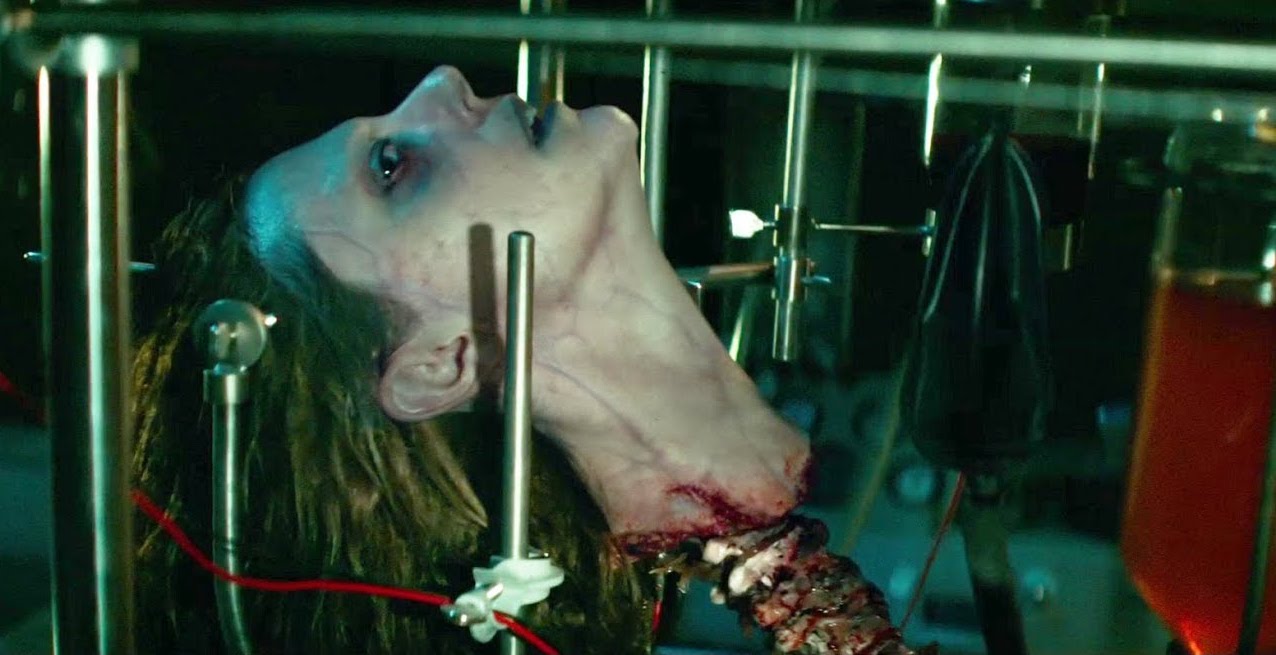
Though the above synopsis is light on detail – and deliberately so – what you can gauge from the trailer for Overlord is that this is pretty much a big budget version of all those Outpost movies we’ve been “treated” to over the last ten years; it also bears a strong resemblance to Frankenstein’s Army (2013). Whatever the inspiration for its making, though, the key question is: is it any better than those movies? Fortunately, the answer is yes. However, the script – by Billy Ray and Mark L. Smith – doesn’t push the basic storyline in any new directions, and runs out of dramatic steam once Boyce gets in and out of the compound with remarkable ease. From then on, the material plays out in entirely familiar fashion, and regular viewers of this kind of thing will be able to predict each narrative development with a minimum of effort. The characters are broadly drawn too, with Boyce at first showing fear at every turn before displaying true bravery (as we know he will), Ford the taciturn brute, Tibbet the mouthy sharpshooter, Chloe the plucky heroine, and Wafner the smarmy villain who gets a taste of his own medicine (literally). Sometimes these stereotypes can be reassuring, but here they stop the audience from engaging with anyone. Instead, they and the viewer, are stuck with going through the appropriate (e)motions.

The movie is loud and violent and glaringly obtuse at times, though punctuated by odd moments of quiet where the script attempts to provide some depth to the characters, even though it’s already too late. Avery, who provided his first feature, Son of a Gun (2014), with a rough around the edges energy that suited the material, here finds himself constrained by the demands of both the material and the requirements of making a more mainstream movie. The cast do what they can, but there’s no challenge to any of the roles, and Asbæk opts to portray Wafner as a pantomime villain almost from the off. Along the way, there’s some good practical effects work (though none of it is as shocking as might be hoped for), and one scene where a paratrooper – and then everyone else – gets a nasty “wake up” call, is splendidly staged and proves to be the movie’s highlight. But all in all it’s the movie’s lack of inventiveness that stops it from being as successful as its makers would have hoped, and which robs of it any appreciable thrills and spills.

Rating: 6/10 – despite being better than its low budget rivals, Overlord still falls into the same traps as those movies, and proves to be a modest diversion at best; once again we’re confronted with a mainstream horror movie that falls way short of its aims, and which serves as a reminder that money can’t buy everything.

Share this:

  • Click to share on X (Opens in new window) X
  • Click to share on Facebook (Opens in new window) Facebook
  • More
  • Click to print (Opens in new window) Print
  • Click to email a link to a friend (Opens in new window) Email
Like Loading...

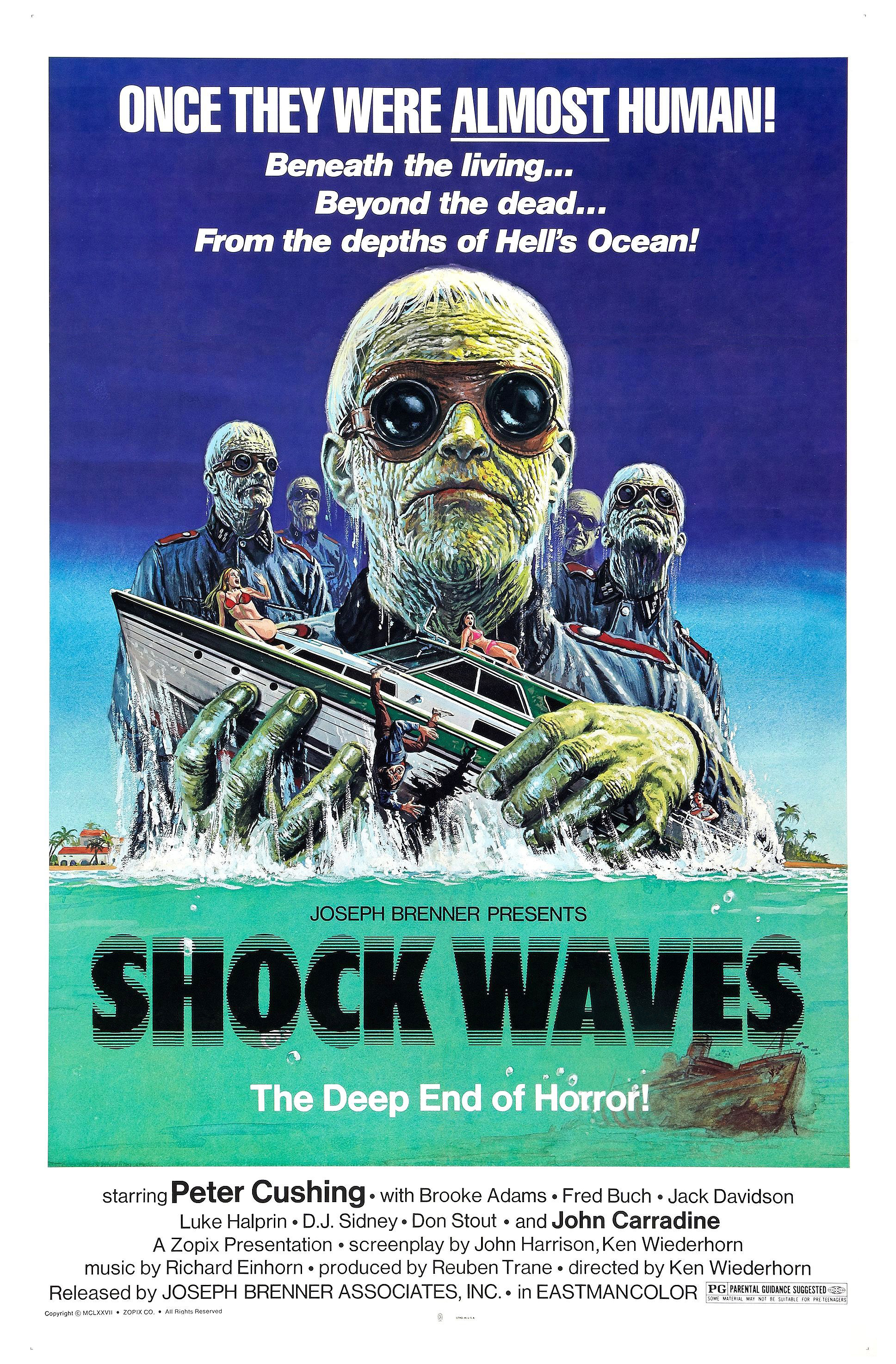
Shock Waves (1977)

31 Monday Jul 2017

Posted by dullwood68 in Movies

≈ Leave a comment

Tags

Brooke Adams, Catch Up movie, Death Corps, Drama, Horror, John Carradine, Ken Wiederhorn, Luke Halpin, Nazis, Peter Cushing, Review, Thriller, World War II, Zombies

aka Almost Human

D: Ken Wiederhorn / 85m

Cast: Peter Cushing, Brooke Adams, Luke Halpin, Fred Buch, Jack Davidson, D.J. Sidney, Don Stout, John Carradine

Horror movies in the Seventies went through a kind of sea change. By the middle of the decade, Hammer were on their last legs having exhausted their Dracula and Frankenstein franchises, and the big Hollywood studios had yet to embrace the genre as fully as they could have, content to leave it to low budget production companies such as Amicus and Roger Corman’s New World Pictures. In Europe, horror movies were more concerned with providing sleaze than monsters, and further afield there were sporadic releases that rarely made an impact beyond their own borders. Zombie movies were still few and far between despite the success of George A. Romero’s Night of the Living Dead (1968), and movies where the protagonists were zombie Nazis were even rarer, with only The Frozen Dead (1966) predating the eerie chills of Shock Waves.

The movie begins in typical fashion, with a group of strangers on a chartered boat that’s seen better days, just like its crusty old captain, Ben (Carradine). The rest of his crew amounts to Keith (Halpin), who seems to be there just to steer the boat, and Dobbs (Stout), the booze-living galley hand. The passengers are a mixed bunch as well, consisting of middle-aged couple Norman and Beverly (Davidson, Sidney), and younger couple Chuck and Rose (Buch, Adams). Norman is already complaining about the age of the boat and the cost of the trip, but when the sky turns crimson and the boat’s instruments don’t respond, he really has something to complain about. An night-time encounter with a mysterious freighter leads to the boat needing repairs, but in the morning, Ben has disappeared. Believing he’s headed towards a nearby island, everyone gets in a dinghy and heads for shore. They find Ben but he’s dead. They also find a hotel, long abandoned – or so they think. Instead they find themselves challenged by a German-sounding stranger (Cushing).

The stranger insists they leave immediately, and tells them of a boat they can use to get off the island. In the meantime, Dobbs is killed, and his body discovered by Rose. Seeking answers, the group confront the stranger, who tells them of a secret experiment that the Nazis carried out during World War II, an experiment to create a ruthless super-soldier. The result was a soldier not living and not dead, and too difficult to control. When the war ended, the stranger, an SS Commander, was charged with disposing of the super-soldiers under his command, and so he sunk their ship. But now they have returned, and will continue to kill everyone they encounter. As far as getting off the island is concerned, avoiding the Death Corps will be difficult enough, but as fear and terror take hold, those who remain alive begin to fight amongst themselves…

If it’s a gore-soaked, ripped-out entrails kind of zombie movie that you’re after, then be warned: Shock Waves is not the movie for you. In fact, this is possibly the first and only post-1968 zombie movie where not even a single drop of blood is spilt. Instead, director Wiederhorn (making his first feature), and co-writer John Kent Harrison concentrate on creating an unnerving, atmospheric chiller-thriller that does its best to be macabre rather than gory, and which largely succeeds in its aim. There’s something to be said for any horror movie that eschews blood and gore in its efforts to make viewers feel unnerved and uncomfortable, and though the movie suffers due to genre-standard scenes where the characters run from place to place without actually getting anywhere, the scenes that involve the implacable zombie Nazis have a certain frisson about them. At one point they emerge from the surf, one by one, and stand as if waiting for a signal only they can hear; it’s genuinely creepy.

Wiederhorn is to be congratulated on being so constrained, and relying on menace and a febrile atmosphere to accentuate the occasional shocks. He’s helped by the choice of location, which isn’t an island at all, but several sites in Florida, including an area of swampland that the characters are forced to take flight and stumble through time and again as they try and escape, but though all that running about quite aimlessly seems to be just a way of padding out the running time, like all swampland, it has an unpleasant, threatening vibe that slowly makes itself felt the longer everyone crashes around it. Wiederhorn and DoP Reuben Trane do well to create such a hostile, potentially deadly environment… and that’s without the zombies. Also, there are times, notably at the beginning when the sky turns red, that the movie feels like it’s heading into full-on Twilight Zone territory, and these moments add to the growing sense of unease that the movie promotes in its opening half hour.

But while there’s plenty of effective atmosphere to be had, the movie is less successful when it comes to its motley crew of characters. Cushing and Carradine are old hands at this sort of thing and manage their roles accordingly, while Adams, in her first leading role, has little to do but pose or swim in a bikini. Ex-Flipper star Halpin fares better as the nominal hero, but everyone else is saddled with the usual horror stereotypes: the long-suffering wife, the outwardly macho/inwardly cowardly adult jock, the self-important malcontent, and the booze-fuelled worrier. Once Ben is killed off the script disposes of the rest of the characters in predictable fashion (and order), without once attempting to make them more relatable. This, however, shouldn’t be much of a surprise, as creating likeable characters never seems to be a priority in horror movies, and Shock Waves is no different. But what is notable about it is that in the context of when it was released, it dared to be different in its approach and with its “monsters”. Many more zombie Nazi movies have followed in the years since, and some can be considered better movies overall, but with apologies to The Frozen Dead, this is the grandaddy of them all, and still as diverting and sinister as it was forty years ago.

Rating: 6/10 – if you can put aside the genre conventions and occasional dumb-ass decision-making, Shock Waves is a grim, intense horror movie that makes good use of its “bad guys” and has a palpable sense of disquiet about it; still more of a curio than a cult movie, it’s better than it looks but is hamstrung by poor production values and some very choppy editing. (29/31)

Share this:

  • Click to share on X (Opens in new window) X
  • Click to share on Facebook (Opens in new window) Facebook
  • More
  • Click to print (Opens in new window) Print
  • Click to email a link to a friend (Opens in new window) Email
Like Loading...

Yoga Hosers (2016) – Or, Whatever Happened to Kevin Smith

09 Sunday Apr 2017

Posted by dullwood68 in Movies

≈ 1 Comment

Tags

Bratzis, Canada, Comedy, Eh-2-Zed, Harley Quinn Smith, Johnny Depp, Justin Long, Kevin Smith, Lily-Rose Depp, Nazis, Review, True North trilogy, Yoga

D: Kevin Smith / 88m

Cast: Lily-Rose Depp, Harley Quinn Smith, Johnny Depp, Austin Butler, Tyler Posey, Justin Long, Tony Hale, Natasha Lyonne, Adam Brody, Jennifer Schwalbach Smith, Genesis Rodriguez, Vanessa Paradis, Haley Joel Osment, Ralph Garman, Jason Mewes, Kevin Smith

Twenty-three years ago, a young, bearded denizen of New Jersey made his first movie, the very low-budget indie comedy, Clerks. It was an overnight sensation: acutely funny within the milieu it created, and introducing audiences to two unforgettable characters in the stoner forms of Jay and Silent Bob. The young movie maker who maxed out around a dozen credit cards and sold off a large portion of his comic book collection to make his first movie was, of course, Kevin Smith. He followed it up with Mallrats (1995), a TV pilot, Hiatus (1996), Chasing Amy (1997), Dogma (1999), an unreleased Prince documentary, and Jay and Silent Bob Strike Back (2001), a string of projects that cemented Smith’s reputation, increased his fanbase, and garnered a fair amount of critical approval.

But somewhere around the time of Jay and Silent Bob Strike Back, Smith’s energies seemed to wane. Both Jersey Girl (2004) and Clerks II (2006) felt as if Smith was treading water, while Zack and Miri Make a Porno (2008), despite the kind of premise that Smith could have had a lot of fun with, proved to be even more underwhelming than his previous two movies. He followed Zack and Miri… with the dreadful Cop Out (2010), a director-for-hire gig that made audiences and critics wonder why the King of Static Camerawork would be asked to make an action comedy. Red State (2011) came next, and while it was well-received by critics, and looked on as a return to form, it’s still a movie that only needs to be watched once. Smith took a break, and didn’t return to our screens until 2014, with Tusk. That particular movie, a Kafka-esque body horror comedy, was even more of a return to form (and despite an unnecessary cameo from Johnny Depp). Now, Smith has chosen to follow Tusk with Yoga Hosers, a movie for kids, and the second in the True North trilogy (Moose Jaws will complete the series).

For all that Smith has been making strides in regaining the kind of critical and audience mass that went with his work in the Nineties, Yoga Hosers remains Smith’s worst movie to date, a sprawling, endlessly disappointing concoction that lies flat on the screen like the title character in The Autopsy of Jane Doe (2016) (and without that character’s internal life to help it). By taking two minor characters from Tusk – the store clerks who didn’t even have names – and spinning a whole movie around them, Smith has managed to do three things all at the same time: one, write his lamest script yet; two, bring back Depp’s eye-swivelling private detective Guy Lapointe to no greater effect than before; and three, prove that nepotism is alive and well when it comes to making movies.

This time, the two store clerks are given names – Colleen Collette (Depp) and Colleen McKenzie (Smith) – and are portrayed as vacuous fifteen year olds who can’t live without their phones for more than five seconds, who disparage everyone and everything around them, and who seem destined to be the lead characters in Clerks III (should Smith ever write it). Working at the store owned by Colleen C’s dad (Hale), the pair spend much of their worktime rehearsing songs with their only other bandmate, drummer Ichabod (Brody) (cue a string of “inspired” jokes such as “Dickabod” that will give you an idea of the level Smith is aiming for). One night, one of their customers is murdered in a nearby park (though why in a park is a mystery the movie doesn’t have an answer for). The killer? Ah, there’s the rub (as Shakespeare would put it), because the killer is a six-inch tall Nazi bratwurst – or Bratzi.

Inevitably, there’s a back story, a tale of Nazis in Canada, and the legacy of Aryan supremo Andronicus Arcane (Garman). There’s cryogenesis, an arrested experiment that gives rise to the Bratzis, and a Bratzi-filled creature that’s made out of body parts and is technically inanimate, but which can still be kicked between the legs as a means of hindering it. And in an extended scene that matches Lapointe’s lone scene in Tusk for abject pointlessness, Garman gets to monologue by doing impressions of actors such as Al Pacino (‘hoo-ah!”) and Sylvester Stallone. So clever is Smith’s script, he has the Colleens unable to recognise any of Arcane’s impressions, thus reinforcing the notion (already made several times) that they don’t know about anyone or anything that hasn’t happened within their lifetime, or who isn’t their friend on Facebook, Twitter, or Instagram. (When Smith includes social commentary like that, it’s a shame he doesn’t realise how much it’s been done before.)

But being clever, and putting together a script that gels in all the right ways, is something that Smith seems unable to do anymore. Along with the Bratzis, the Colleens have to endure Collette C’s irritating stepmom (Lyonne) (quite lame), two teen Satanists (Butler, Posey) out to claim their virgin souls (very lame), and the snarky comments of their customers (not lame, just boring). What’s most dispiriting about the script is that Smith no longer seems to have that distinctive ear for dialogue that he had back in the days of the Quick Stop. Here, it’s all about providing the Colleens with the kind of empty-headed dialogue that confirms their latent idiocy, while poking fun at the Canadian accent, particularly the way they say words like about, which sounds like ah-boot, as in “I’m sorry ah-boot that”. Stress the word once and it’s mildly funny; stress it a hundred times and it becomes tedious.

Ultimately, the whole thing looks and sounds like a mess that’s been made off the back of a draft script that Smith couldn’t be bothered to tidy up or give a proper shape to. The performances range from grating (Depp as Lapointe, Rodriguez as the Colleens Phys Ed teacher), to one-note (Depp as Lapointe, Lyonne, Hale, Posey, Garman), to passable (Depp as Colleen C, Smith as Colleen M, Long as their yoga teacher), but it’s hard to stand out when the script you’re working from is determined to be as juvenile as possible while also trying to hold onto a semi-adult sensibility (this is only a movie for kids if those kids are fourteen to seventeen in age). Smith just doesn’t seem to have the focus or the fire that would make this movie even partially entertaining, and long stretches of it pass by without making any difference to the plot, any of the storylines, or any of the characters. And the Colleens remain the same at the end as they were at the beginning.

Whatever’s going on with Smith at the moment, one thing is very clear: like Austin Powers in The Spy Who Shagged Me (1999), Smith needs to get his mojo back. How he’s going to do that – or if he can – remains to be seen, but right now he’s fast becoming a member of that singular group of movie makers, the ones who are fast out of the gate with their first movie, but who struggle to maintain the initial quality of their work. Directors such as Tobe Hooper and Spike Lee, movie makers for whom the news of a new project is no longer cause for the kind of interest they garnered earlier in their career. Smith is at that point, where his career may be better suited to podcasting and one-man shows than it is to making movies. Time, perhaps, for a rethink going forward, before his career is littered with more bad movies than good.

Rating: 3/10 – if this is what Kevin Smith is happy to see released with his name attached, then Yoga Hosers is a sign that any ideas relating to originality he may have had have long since left the building; he’s already proven that low budget doesn’t have to mean low quality, but this has all the hallmarks of a movie made cheaply and with the idea of making a quick return before anyone realises just how awful it is.

Share this:

  • Click to share on X (Opens in new window) X
  • Click to share on Facebook (Opens in new window) Facebook
  • More
  • Click to print (Opens in new window) Print
  • Click to email a link to a friend (Opens in new window) Email
Like Loading...

Race (2016)

30 Monday May 2016

Posted by dullwood68 in Movies

≈ Leave a comment

Tags

1936 Olympics, Athletics, Biography, Carice van Houten, Drama, Four gold medals, Germany, Jason Sudeikis, Jeremy Irons, Jesse Owens, Larry Snyder, Leni Riefenstahl, Nazis, Racism, Review, Stephan James, Stephen Hopkins, True story

Race

D: Stephen Hopkins / 134m

Cast: Stephan James, Jason Sudeikis, Jeremy Irons, Carice van Houten, Eli Goree, Shanice Banton, David Kross, Jonathan Higgins, Tony Curran, Barnaby Metschurat, Chantel Riley, William Hurt, Glynn Turman

Made with the support of Jesse Owens’ family, Race follows Owens as he enrols at Ohio State University in 1933, meets athletics coach Larry Snyder who teaches him how to be a better sprinter, and on through until his appearance at the 1936 Olympics, held in Berlin. It’s a powerful story, and Owens’ performance at the Games is legendary… which makes Race all the more surprising for how tame it is, and how unsure it is in what it wants to say.

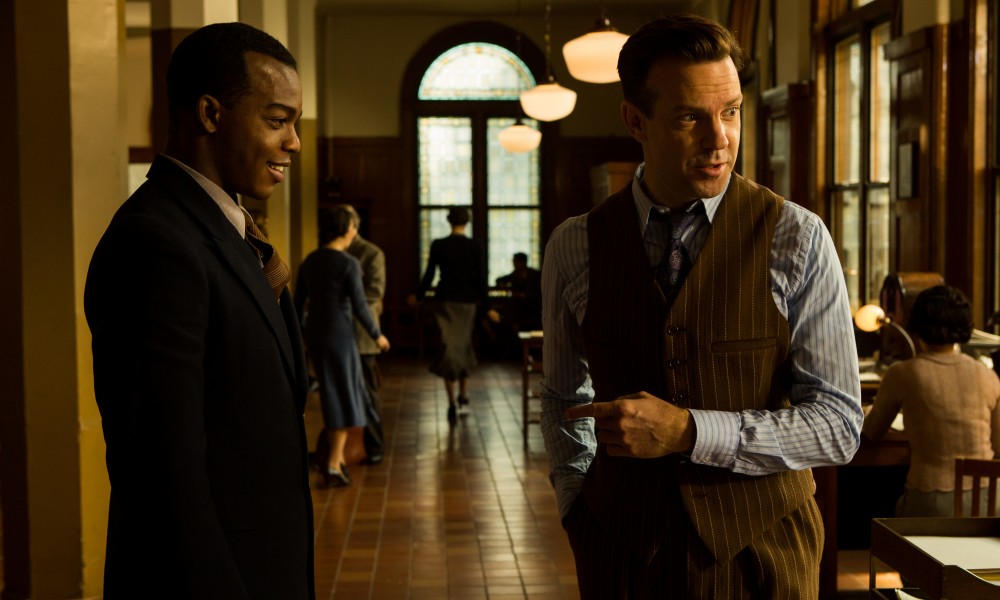
As biopics go, it’s all standard stuff. We see Owens (James) as a young man saying goodbye to his sweetheart (and mother of his child), Ruth (Banton) before he heads off to Ohio State University. Once there, he encounters a predictable amount of systemic and endemic racism from pupils and staff alike, but concentrates on what he can do on the running track. Attracting the attention of athletics coach Larry Snyder (Sudeikis), Owens dispels any doubts about his abilities by matching the fastest recorded time in the 100 metre dash, and doing it as casually as if it were just “one of those things”. It’s not long before Snyder is talking about the 1936 Olympics, and Owens representing his country in Nazi Germany.

Race - scene3

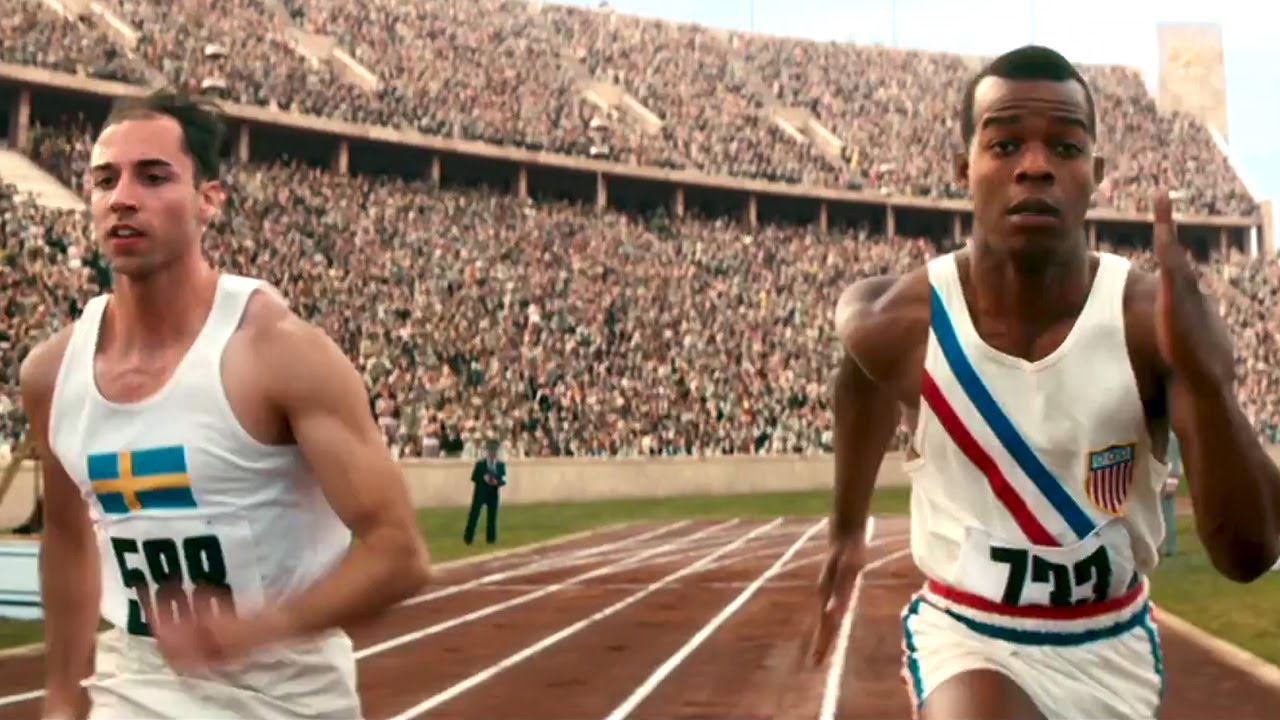
Before then there’s the small matter of the 1935 Big Ten track meet in Ann Arbor, Michigan where Owens’ set three world records and tied a fourth in under an hour, his marriage to Ruth, and the political manoeuvrings that saw the US agree to compete in the 1936 Olympics once their envoy, construction magnate Avery Brundage (Irons), had negotiated terms with Dr Goebbels (Metschurat). With these things in place, Owens and the US team arrive in Berlin and begin preparations for the Games. Once they begin, it doesn’t take Owens long to disprove the Nazis’ idea of Aryan supremacy. He wins four gold medals: in the 100 metres, the 200 metres, the broad (long) jump, and the 4×100 metre relay (which was ironic as he replaced a Jewish runner who was dropped thanks to last-minute political expediency). History is made, and in the most bittersweet of circumstances.

Race covers all this, and more, but fails to make it interesting for the viewer, instead falling back on the kind of biopic clichés that were old back in the era Owens was breaking track records like they were nothing of importance. It also tries to cram in too much in the way of subplots, particularly in the way that Leni Riefenstahl (van Houten) goes about filming the Games, and often in defiance of Goebbels and his indifference to her efforts. Riefenstahl’s presence in the movie is surprising, as the movie could have worked well enough without her. Instead we’re treated to Riefenstahl acting as an unofficial interpreter/translator for Goebbels, and van Houten struggling to look intimidated when necessary. Riefenstahl keeps cropping up, and after a while you begin to wonder if she was as involved as the movie makes her out to be.

Race - scene2

The effect of all these subplots and extraneous storylines is to (almost) make Owens a secondary character in his own biopic. And one unfortunate romantic dalliance aside, Owens is given the kind of never-do-wrong attributes that hype the legend instead of portraying the man behind the legend. As Owens, James is confident enough, but doesn’t seem able to go beyond the script’s insistence on making Owens as unaffectedly noble as possible, and in some respects, operating in a vacuum that leaves him unaware of the political and racial maelstrom going on around him once he’s in Germany. This leads to an awkward scene where Snyder wanders around Berlin and just happens to see a group of Jews being rounded up at the end of a back street. There are other moments where the era’s ugly racism is pushed to the forefront, but strangely, there’s more of it on display in the US than there is in Berlin.

By failing to make the inherent drama of Owens’ participation, well… dramatic, the movie never fully engages the audience, or allows it to become emotionally invested in the man’s achievements (although the focus is rightly on the Olympics, his achievement at Ann Arbor carries more resonance). Left with little to identify with beyond the casual attempts at characterisation made by Joe Shrapnel and Anna Waterhouse’s banal script, the viewer has no choice but to sit back and hope that the movie remembers he or she is there at some point, but without any guarantees that this will happen.

Race - scene1

The cast do their best but the odds are stacked against them. Sudeikis dials down the comic charm he uses elsewhere but can do little with a role that requires him to take a back seat once Berlin rolls around, and which seems there to mainly provide Owens with motivational pep talks when he needs them. Irons is all capitalist swagger as the man who demanded superficial concessions from Nazi Germany in return for the US’s taking part in the Games, while as mentioned above, van Houten enjoys a bigger role as Riefenstahl than it’s likely she had historically. Of the rest of the cast, only Metschurat stands out as an icy, thuggish-looking Goebbels who wouldn’t look out of character if he was wearing braces and Doctor Martens boots.

Attempting to make a cohesive whole out of so many disparate strands, director Stephen Hopkins instead places a similar feel and importance on all of them, leading to a movie that moves seamlessly from one scene to the next without ever rising or falling in terms of the low-key drama, or tinkering with the tone of the movie. Hopkins has had a varied career, but while this isn’t his first biopic – he also made The Life and Death of Peter Sellers (2004) – this is his first “prestige” picture, and he falls back on the kind of easy choices that a first-timer might make, and in doing so, fails to charge the movie with the kind of energy that would draw in an audience and keep them glued to their seats.

Rating: 5/10 – not quite an also-ran, but near enough, Race plays liberally with the connotations of its title but is ultimately too lightweight in its execution to be a pointed, and poignant, reflection of the period it covers; Owens was an exceptional athlete, and while the movie does acknowledge this, what it doesn’t do is raise its own game to match that of its subject.

Share this:

  • Click to share on X (Opens in new window) X
  • Click to share on Facebook (Opens in new window) Facebook
  • More
  • Click to print (Opens in new window) Print
  • Click to email a link to a friend (Opens in new window) Email
Like Loading...

Woman in Gold (2015)

15 Wednesday Jul 2015

Posted by dullwood68 in Movies

≈ 1 Comment

Tags

Art theft, Austria, Drama, E. Randol Schoenberg, Gustav Klimt, Helen Mirren, History, Maria Altmann, Nazis, Portrait of Adele Bloch-Bauer 1, Review, Ryan Reynolds, Simon Curtis, True story, World War II

Woman in Gold

D: Simon Curtis / 109m

Cast: Helen Mirren, Ryan Reynolds, Daniel Brühl, Katie Holmes, Tatiana Maslany, Max Irons, Charles Dance, Antje Traue, Elizabeth McGovern, Jonathan Pryce, Frances Fisher, Moritz Bleibtreu, Tom Schilling, Allan Corduner, Henry Goodman, Nina Kunzendorf, Justus von Dohnányi

Following the death of her sister, Maria Altmann (Mirren), who fled from Austria before the war and now resides in Los Angeles, finds letters that relate to an attempt to recover artwork that her family owned before it was stolen by the Nazis, and in particular, the famous Klimt painting, Woman in Gold (who in reality was Maria’s aunt Adele). This painting and several other items are on display in a gallery in Vienna, Maria’s birthplace. Wanting to get them back, she enlists the help of a friend’s son, lawyer E. Randol Schoenberg (Reynolds).

They travel to Vienna – against Maria’s initial wishes – but find that the country’s minister and art director are unwilling to hear her case. The Klimt painting is regarded as a national treasure, and Maria is told that it was given to the gallery in Adele’s will. Schoenberg, aided by Austrian journalist Hubertus Czernin (Brühl), discovers that it wasn’t Adele’s property in the first place, but even though this evidence is presented to the Austrian officials, and a hearing takes place, Maria’s claim is denied. Unable to challenge the ruling because the cost is too prohibitive, Maria and Schoenberg return to the US.

Some time later, Schoenberg is browsing in a bookstore when he sees an art book with the Woman in Gold on the cover. It gives him an idea but Maria is against pursuing the claim any further. He manages to persuade her to move forward, and using precedents relating to retroactive art restitution claims, begins the process of suing the Austrian government for the return of the artwork. The case goes all the way to the Supreme Court, where the case is ruled in Maria’s favour. But it still means she and Schoenberg need to return to Vienna to resolve the claim completely. Maria refuses to go, and Schoenberg goes by himself. There he pleads their case to the art restitution board, a panel of three who are the last hurdle in the attempt to get the artwork returned.

Woman in Gold - scene

If you’re already aware of the case of the Woman in Gold, then you’ll know how the movie ends, but in many ways the outcome – which most people could accurately predict – isn’t the focus here, but the way in which notions of family and heritage are portrayed via the flashbacks to Maria’s youth, and the resonance they have in the present day.

The modern day scenes, while adequately presented and lensed in a way that adds a sheen to events, are moderately effective and benefit greatly from the performances of Mirren and Reynolds. But they’re also largely perfunctory, a predictable set of events and occasions that tick all the appropriate boxes: investigation, doubts, bureaucratic indolence, setback, regrouping, pushing forward to a final resolution. It’s all handled with intelligence and precision but this actually robs the modern day scenes of any emotion. Despite Mirren’s semi-anguished, semi-determined portrayal, and Reynolds’ naïve yet stubborn lawyer, the movie seems too generic in these moments, as if it were following some kind of true story template.

Where the movie improves is in its recreation of the younger Maria’s family life, the relationship she has with her parents, and the myriad relatives and friends that populate their apartment. Here there’s life aplenty, and a sense of an age when life wasn’t about looking back. In contrast to the older Maria’s attempts to reclaim what’s rightfully hers, the scenes from her youth are redolent of ownership of both the times and the place they live in. It’s a microcosm to be sure, but one that you feel would have been replicated in many other homes as well. When that ownership turns to loss, and Maria and her husband Fritz make plans to leave Austria for the US, and in doing so leave their families to an uncertain fate, the emotional strain is clearly and effectively shown, giving those scenes the resonance the modern day story lacks.

That said, in the hands of Mirren and Reynolds, the quest to win back the Woman in Gold is more compelling than it seems from the basic qualities of Alexi Kaye Campbell’s script. Aside from some legal technicalities, it’s a straightforward, plainly told endeavour that would have seemed even blander without their participation. The rest of the cast are used to a much lesser extent, often to the point of appearing in what are mostly cameo roles (McGovern, Pryce, Dance) or in supporting roles that add little to the overall story (Holmes, Irons). But again its the cast who appear in the pre-war scenes (Corduner, Goodman, Traue, Kunzendorf) who come off best, and in particular Maslany as the younger Maria, who exudes a fortitude and an honesty that Mirren reflects with ease.

In the end, as a drama, Woman in Gold isn’t quite as effective as it wants to be, and in places is far too turgid to work properly. As an exploration of one woman’s desire to be repatriated with her family’s possessions it’s moderately engaging, and while the viewer will no doubt sympathise with her plight, this is a David vs Goliath tale that lacks an emotional core to keep the viewer on the edge of the seat, or railing against the impropriety of the Austrian officials. Much of this is due to Curtis’s matter-of-fact directing style, which is unfussy and lacks a level of sophistication that would have improved things immeasurably.

Rating: 6/10 – with two stories intertwined, Woman in Gold suffers from only one of them – and not the main one – being interesting; with a cast that appear to have been encouraged to play down their roles to augment the two leads, this is a movie that stutters to the finish line, and unconvincingly at that.

Share this:

  • Click to share on X (Opens in new window) X
  • Click to share on Facebook (Opens in new window) Facebook
  • More
  • Click to print (Opens in new window) Print
  • Click to email a link to a friend (Opens in new window) Email
Like Loading...

Oh! the Horror! – Backtrack (2014) and The Last House on Cemetery Lane (2015)

13 Friday Mar 2015

Posted by dullwood68 in Movies

≈ Leave a comment

Tags

Andrew Jones, Blind woman, Camping trip, Georgina Blackledge, Haunted house, Horror, Julian Glover, Lee Bane, Mark Drake, Murder, Nazis, Plumpton, Reincarnation, Revenge, Review, Rosie Akerman, Screenwriter, Sophie Barker, South Downs, Tom Sands, World War II

Backtrack

aka Nazi Vengeance

D: Tom Sands / 97m

Cast: Mark Drake, Sophie Barker, Rosie Akerman, Miles Jovian, Julian Glover

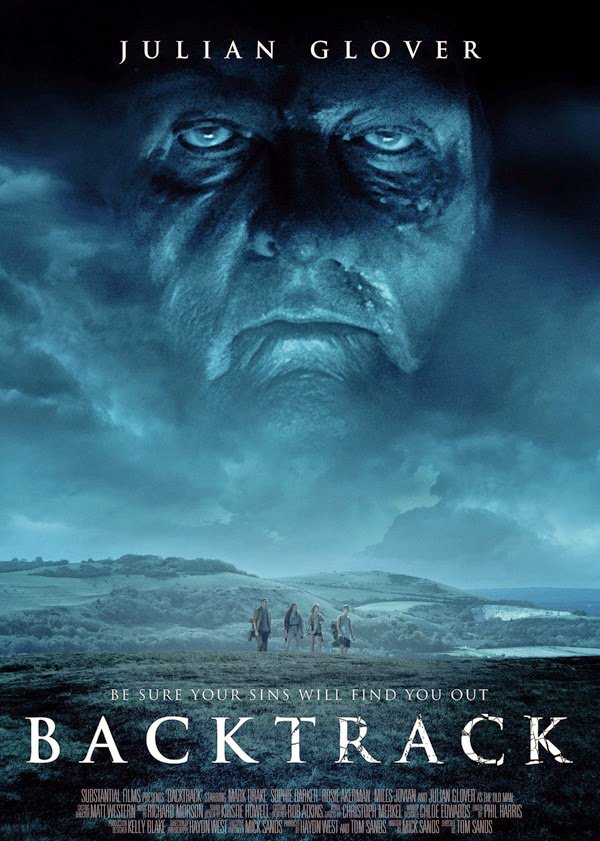
When Ralph (Drake) undergoes past life regression at the suggestion of his friend Claudia (Akerman), he has visions of Nazis in the small English village of Plumpton, and the deaths of an unknown woman and her three children. Confused and upset by this, Ralph manages to persuade his girlfriend, Andrea (Barker), along with Claudia and her boyfriend Lucas (Jovian), to go on a camping trip to the South Downs, and to investigate the area that Ralph saw glimpses of. Finding the village proves more difficult than expected, and while Ralph and Claudia explore further afield, Andrea and Lucas stay with the tents and continue the affair they’ve been having. While in the midst of having sex, an old man knocks Lucas unconscious and threatens Andrea with a shotgun. He ties up both of them and takes them to an old farm building where he tortures them before leaving to find Ralph and Claudia.

Ralph and Claudia return to the tents but don’t immediately realise that their partners have been abducted. Later they do, but by then it’s late and they decide to bed down for the night and go for help in the morning. The old man attempts to grab them but they manage to escape. Having got away, Claudia suggests that Ralph undergo further regression in an effort to find out more about what happened in Plumpton, and if it has any bearing on what’s happening to them now. Ralph learns he was one of the Nazis he saw before, and that he was responsible for the deaths of the woman and her children. He and Claudia seek shelter in a church but the old man is laying in wait for them; they too find themselves held captive with their partners in the old farm building and at the mercy of the old man’s thirst for revenge.

Backtrack - scene

Sometimes, when watching horror films – especially if you’ve seen way too many of them for your own good – there’s often a point where you know exactly what’s going to happen next, and how, and why. This is the feeling you get after the first five minutes of Backtrack, and the feeling persists throughout. For example, when Ralph and Claudia realise their other halves have been abducted, neither of them can make a call on their mobile phones (naturally). Or when Ralph realises he was a Nazi – something the viewer’s known all along. Or when Claudia tells Ralph to keep a Swiss Army knife in his pocket because, you know, it just might come in handy later on. But these examples of lazy storytelling aside, this is a movie that gets it wrong on so many levels it’s almost embarrassing.

While the basic idea of Backtrack is okay for this sort of thing – revenge-driven World War II survivor targets reincarnated souls who killed his family – the movie is defeated from the beginning by some really really really terrible dialogue (think Harrison Ford’s famous quote, “You can type this shit, but you can’t say it”, and you’ll find you’re not even close to how bad the dialogue is). Defeat comes as well through its cast’s complete inability to make the dialogue sound even remotely normal (even Glover, a classically trained actor, can’t do anything with it). And to make matters worse, the cast are uniformly awful, giving amateurish performances and exposing their lack of experience, and lack of knowledge of their craft in every scene.

Stepping away from the world of documentaries for which he’s best known, Sands does a ham-fisted job in every sense, and fails to inject any tension or drama into the proceedings, leaving the cast to fend for themselves and showing no sign that he’s recognised the absurdities of Mick Sands’ apparently first draft script (the old man stalks the two couples by tractor, one that must have the biggest muffler in the world attached to it, as it doesn’t make a sound). With basic attempts at framing and composition, and the feeling that a lot of shots were first takes, the look and feel of Backtrack is that of a movie that should have had a lot more attention paid to it at all stages of its production.

Rating: 1/10 – dire in every way possible, Backtrack is an object lesson in how not to make a low budget horror movie; if the choice is watching this or watching paint dry, then watch the paint – at least it’s got a more credible story arc.


Last House on Cemetery Lane, The

D: Andrew Jones / 81m

Cast: Lee Bane, Georgina Blackledge, Tessa Wood, Vivien Bridson

When screenwriter John Davies (Bane) rents a house for a couple of months in order to work on his latest screenplay, he finds there’s a sitting tenant up on the third floor: a blind old lady (Bridson) who never leaves her room. Annoyed at first because there was no mention of the old lady in the advertisement he saw, John is reassured by the estate agent (Wood) that it won’t interfere with his work. He spends a day or so visiting the nearby town and reminiscing on the visits he made to the area as a child. Then, one day, he meets a young woman, Cassie (Blackledge) in the garden. She apologises for being there, but John is unconcerned and, slightly smitten, tells her she can visit again if she wants to.

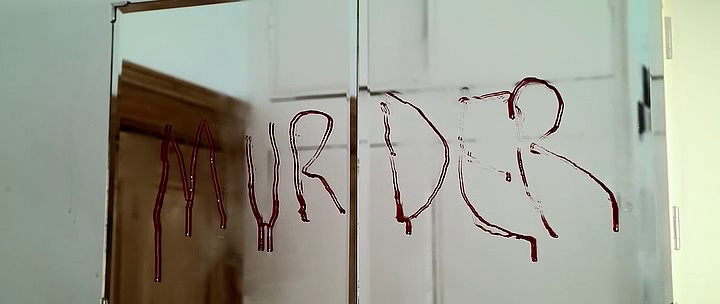
As his relationship with Cassie develops into something more romantic, John begins to have nightmares and experience strange phenomena. At night, a record player comes on and plays the same song each time. A doll in one of the bedrooms is found on the stairs, and a picture that hangs in the hallway ends up on the floor without being touched. He contacts the estate agent to see if the house has a history, but she says there’s nothing to tell. Cassie suggests using a ouija board, but John rejects the idea – at first. One night he uses one to find out if anything has happened in the past, and it tells him that there was a murder there. Convinced that the old lady must know what’s going on, he visits her, only to find that nothing is quite as it seems, and that his life is now in danger.

Cemetery Lane

With the look and feel of a short movie expanded to meet the needs of a full-length feature, The Last House on Cemetery Lane contains a lot of padding and a shortage of actual drama. The first twenty minutes contain enough off-putting moments to make even die-hard horror fans tune out from boredom, and though the introduction of the blind old lady adds a bit of mystery to proceedings, John’s walk through the nearest town, and then along the beach (accompanied on the soundtrack by a trenchant piece of AOR) seems almost like a test: if you can endure this, then the rest of the movie will be a piece of cake (or a walk on said beach). And even though writer/director Jones begins throwing the odd bit of supernatural phenomena into the mix, the movie finds itself focusing on John and Cassie’s relationship instead, subjecting the viewer to mildly interesting scenes where they get to know each other and trade inane lines of dialogue.

It’s not until John consults the ouija board that the movie begins to pick up pace and reminds itself as to why it’s here. The old lady’s revelations, though, prove less than original and lead to a violent showdown that borrows from Halloween (1978) for a key moment, and which lacks any real tension thanks to the clumsy way in which it’s shot and edited. And with a clear resolution to the tale, the script then undermines and ignores its own logic, both insulting itself and the patient viewer. With so much going on that lacks adequate attention from Jones, it’s left to Bane to carry the bulk of the movie, and while he’s worked with Jones on several previous occasions, even he can’t help the viewer along when the going becomes dull.

A haunted house mystery where the real mystery is why the movie was ever produced, Jones’ strives for atmosphere but misses it by a mile, and never develops his own tale beyond its mundane opening scene. There’s the germ of a good movie here, but Jones and his crew can’t quite get a grip on it.

Rating: 3/10 – only occasionally intriguing, The Last House on Cemetery Lane is a throwback to the kind of rural thrillers made in the Seventies, but without any energy or attempts at effective pacing; with a score that’s more irritating than eerie (not to mention too loud in places), any pleasure to be had will come from its brevity, and its brevity alone.

Share this:

  • Click to share on X (Opens in new window) X
  • Click to share on Facebook (Opens in new window) Facebook
  • More
  • Click to print (Opens in new window) Print
  • Click to email a link to a friend (Opens in new window) Email
Like Loading...

The Book Thief (2013)

19 Wednesday Mar 2014

Posted by dullwood68 in Movies

≈ 3 Comments

Tags

Brian Percival, Emily Watson, Geoffrey Rush, Germany, Jewish refugee, Library, Liesel Meminger, Markus Zusak, Nazis, Review, Sophie Nélisse, World War II

Book Thief, The

D: Brian Percival / 131m

Cast: Geoffrey Rush, Emily Watson, Sophie Nélisse, Ben Schnetzer, Nico Liersch, Levin Liam, Rainer Bock, Barbara Auer, Roger Allam

Literary adaptations are a perilous thing, both for filmmakers and audiences alike. For every Schindler’s List there’s a Bonfire of the Vanities. Some are critically bulletproof, such as the Harry Potter series; despite the turgid nature of the first two movies featuring the bespectacled wizard, they were huge box office successes and paved the way for the remaining instalments (which, effectively, meant they were commercially bulletproof as well). Most fall somewhere in-between, neither success nor failure but an often strange combination of the two e.g. The Mortal Instruments: City of Bones or Smilla’s Sense of Snow, one moment distilling the essence of the original novel, the next demolishing that moment with an ill-judged sequence or change from the source material. Others simply die on the screen (the aforementioned Bonfire of the Vanities, The Osterman Weekend, the Jack Black version of Gulliver’s Travels).

Most try to be faithful to the novel they’re adapting but sometimes this is the very thing that stops the movie from being a success: by cleaving to the set-up, the characters and the events depicted in the novel, the movie somehow misses the spark that made the book a must-read. Instead of a must-see movie, audiences are presented with an adaptation that keeps the essential components but fails to breathe cinematic life into them.

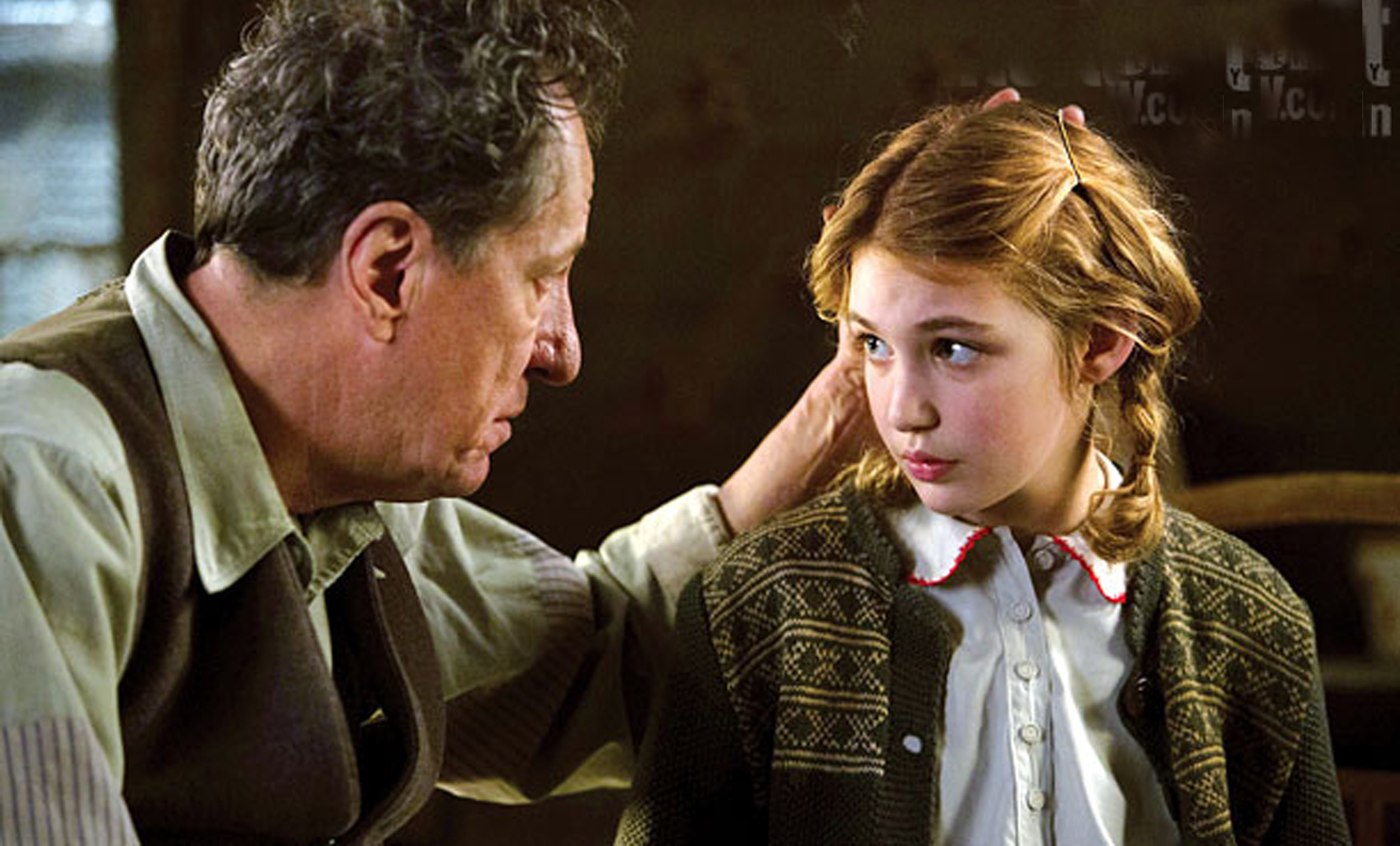
DF-05687.JPG

And so it is with The Book Thief. Adapted from the novel by Markus Zusak, The Book Thief in question is Liesel Meminger (Nelisse), a young girl who is given up for adoption by her mother (who may or may not be a communist) during the Second World War. She is taken in by the Hubermanns, Hans (Rush) and Rosa (Watson). Hans is a gentle, encouraging man who teaches Liesel how to read; from this Liesel develops her love of books. Rosa is stern and constantly criticising Liesel’s behaviour (though you know she has a soft spot for her, however horrid she might be). As time goes by and Liesel settles in to life with her new Mama and Papa, the war that seems to be going on in a separate part of Germany altogether, begins to encroach on their daily lives.

One day a young Jewish man called Max Vandenburg (Schnetzer) comes to their house. On the run from the Nazis, he is hurt and needs a place to hide. Owing a debt to his father, the Hubermanns at first hide him in Liesel’s room, then transfer him to the basement. There is an anxious occasion when a Nazi officer visits them and asks to see the basement but he goes away pretty quickly and has no idea that Max is there (and it turns out he’s not even looking for him). Helped back to nearly full health by Rosa’s administrations and Liesel’s reading to him (through books stolen from the burgermeister’s library), Max leaves before he can put them in greater danger. Then Hans is conscripted, despite his age. With the war getting nearer and nearer, Liesel’s future looks increasingly uncertain.

The Book Thief is a curiously flat, dramatically sterile movie that sticks to the same pace from its strikingly photographed opening to its let’s-try-and-be-upbeat-even-though-the-ending’s-a-downer conclusion. There’s very little drama here, very little of what the Germans refer to as sturm und drang (“storm and drive”). Michael Petroni’s adaptation is as dull and uneventful as a trip to a colour chart museum. There’s the visit by the Nazi officer, which should have the viewer on the edge of their seat, but as there’s so little invested in Max’s character, it doesn’t come across as a tense moment at all; it would have been more dramatic by this point if he had been discovered. The only other source of “trouble” that Liesel faces is from school bully and Nazi Youth member Franz Deutscher (Liam), and all he does is make empty threats about “reporting” her (and literally does no more than that). With such an absence of tension throughout, The Book Thief – while remaining true to its source – ends up being a collection of scenes that relate to each other but do little to involve the viewer at any particular point.

As a result, Rush and Watson have to fall back on their expertise to raise their characters from the level of caricatures or cardboard cut-outs, while newcomer Nelisse actually manages to impress even though she has as little to work with as her more experienced co-stars. Percival’s direction does nothing to improve things and is workmanlike at best, though the production – on a technical level – makes up for the emotional detachment, and is often lovely to look at. And there should be one final word for the narrator. Step forward, Death, as voiced by Roger Allam. If there is any further proof required that The Book Thief doesn’t work as well as it should, then take a listen to the dreadful dialogue Allam has to give voice to. If you’re not cringing after the first few sentences (right at the start of the movie) then you’ll probably enjoy The Book Thief a lot more than most.

Rating: 5/10 – dull as the proverbial ditchwater, and spoilt by a lack of engagement from its director and its writer; saved by the professionalism of its cast and crew, but a major disappointment nevertheless.

Share this:

  • Click to share on X (Opens in new window) X
  • Click to share on Facebook (Opens in new window) Facebook
  • More
  • Click to print (Opens in new window) Print
  • Click to email a link to a friend (Opens in new window) Email
Like Loading...

The Monuments Men (2014)

21 Friday Feb 2014

Posted by dullwood68 in Movies

≈ 7 Comments

Tags

Bill Murray, Bob Balaban, Cate Blanchett, George Clooney, Ghent Altarpiece, Hidden treasures, Hugh Bonneville, Jean Dujardin, John Goodman, Madonna of Bruges, Matt Damon, Nazis, Review, Stolen art, True story, World War II

Monuments Men, The

D: George Clooney / 118m

Cast: George Clooney, Matt Damon, Bill Murray, Cate Blanchett, John Goodman, Jean Dujardin, Hugh Bonneville, Bob Balaban, Dimitri Leonidas, Justus von Dohnányi, Holger Handtke

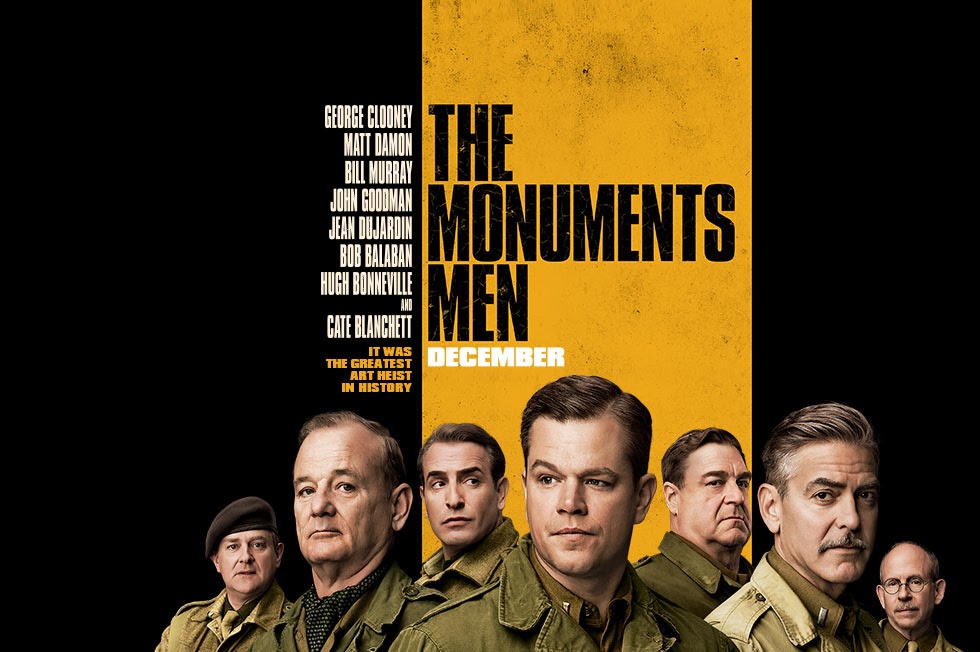
When you see the phrase “Based on a true story” at the beginning of a movie, there’s an expectation that what you’re about to see really happened, and in the way that it’s portrayed.  But the key word is “based”.  The word serves as a get-out clause for filmmakers the world over, so that when anyone criticises a movie for its accuracy they can say it’s not meant to be taken as a de facto retelling of events but as an interpretation.

With The Monuments Men, actor/director and co-scripter Clooney has taken a relatively unknown tale from World War II and – forgive the clumsy analogy – used broad brush strokes to bring it to the screen.  Playing Frank Stokes, we first see him in 1943 canvassing President Roosevelt about the importance of finding and safeguarding the huge amount of art that the Nazis are plundering across Europe, as well as asking for the military’s cooperation in avoiding unnecessary damage to important historical buildings and monuments.  Asked by Roosevelt how many men he needs, Stokes tells him six.

The six men are Americans James Granger (Damon), Richard Campbell (Miurray), Walter Garfield (Goodman), and Preston Savitz (Balaban), plus Brit Donald Jeffries (Bonneville), and Frenchman Jean Claude Clermont (Dujardin).  All six have the skills and the experience Stokes needs to identify, trace and recover the stolen art, and two pieces in particular: Michelangelo’s Madonna of Bruges and Jan van Eyck’s Ghent Altarpiece.  Splitting up to cover as much ground as possible the men set about tracing various treasures and seeking the cooperation necessary to avoid the continued ruinous bombing of buildings such as Monte Cassino.  In this respect, and despite clear orders from Roosevelt, they find themselves rebuffed at every turn.  They have better luck tracing the routes the Nazis are using to hide everything, but they still always seem to be one step behind.

In Paris, Granger is put in touch with Claire Simone (Blanchett).  She has a detailed list of all the artwork and treasures that were stolen by the Nazis in Paris, as well as who they belonged to and where they were to be taken.  Using this list, Stokes and co are able to discover the locations the Nazis chose to hide everything.  With the war now drawing to a close they face a race against time to reach the treasures before the approaching Russians.

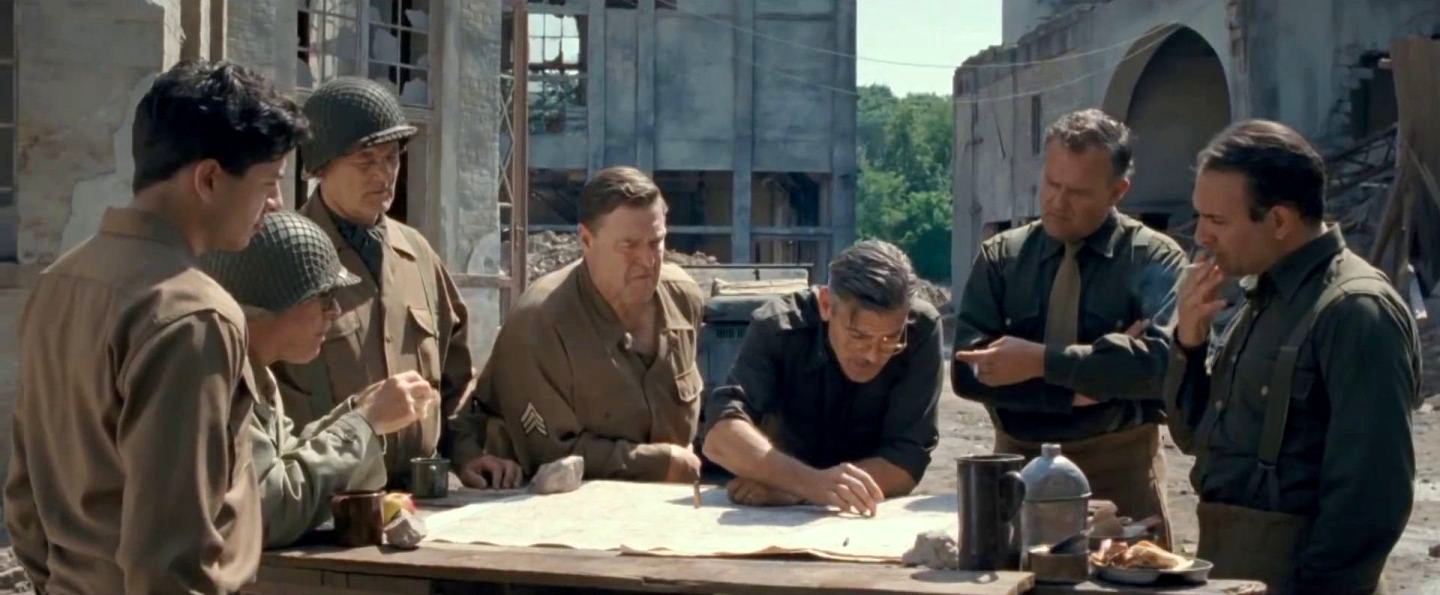
Monuments Men, The - scene

The story of the Monuments Men and their achievements makes for a thrilling read but on screen it’s a different matter.  Clooney and co-scripter (and long-time collaborator) Grant Heslov have fashioned a story from the facts that has all the hallmarks of a rush job.  Character development is perfunctory and relies on the actors to fill in the gaps by using established traits: Dujardin flashes the winning smile seen in The Artist, Murray rehashes his bucolic approach to Lost in Translation, and Goodman continues to play the same role he’s played for the last ten years.  In a way it’s a clever approach, a kind of cinematic shorthand to help introduce the characters quickly and then get on with things, but other than the fact that these men all knew (or knew of) each other before coming together, we don’t really get to know them.  As Stokes, Clooney takes a back seat, giving himself a couple of rousing, authoritative speeches, and generally directing traffic – that’s not a criticism, there is an awful lot of poring over maps and working out which direction to take.  Damon and Blanchett struggle to make her initial distrust of Granger credible, while Bonneville’s turn as the plucky Brit using the mission to overcome his drink problem, though one of the (slightly) better performances, is undermined when you realise his drink problem isn’t going to reoccur and jeopardise things.

The movie also jumps about quite a bit as it attempts to cover both time and distance.  The events shown take place between 1943 and the end of the war.  Some scenes, particularly Garfield and Clermont’s encounter with a sniper, seem included for no other reason than they might prove exciting, but this rarely works out.  Clooney tries to instil a sense of urgency, but the timescale defeats him every time.  Even towards the end with the Russians right around the corner and the Madonna of Bruges to be rescued, there’s just no excitement to be had.  And when the team are put in harm’s way, it’s hard to be concerned because a) you don’t care enough them (see previous paragraph) and Clooney’s direction doesn’t stretch itself enough to provide any tension.

What you have then is a strangely flat movie that never really takes off but which, thanks to both the art and Phedon Papamichael’s wonderful photography, looks good and is handsomely mounted.  Clooney does have a good eye for composition, and he uses the camera to good effect throughout but by the end it’s not enough to distract from the disappointment that will have already been felt.  There’s also some misguided humour, along with a few too many one-liners (there are times when the movie skirts perilously close to coming across as a kind of Ocean’s Seven).  One moment, though, that does deserve a mention: Campbell, having received a recording from his daughter, hears it played over the camp tannoy system while in the shower.  As his tears mingle with the water from the shower, it’s an instance of emotional beauty in amongst all that glorious art.

Rating: 6/10 – a missed opportunity, too lacking in focus and without a cohesive script; a great story that will hopefully be revisited at a later date.

Share this:

  • Click to share on X (Opens in new window) X
  • Click to share on Facebook (Opens in new window) Facebook
  • More
  • Click to print (Opens in new window) Print
  • Click to email a link to a friend (Opens in new window) Email
Like Loading...

Blog Stats

  • 486,528 hits

Recent Posts

  • 10 Reasons to Remember Bibi Andersson (1935-2019)
  • Fantasia (1940)
  • Dances With Wolves (1990) – The Special Edition
  • Kiss of the Spider Woman (1985)
  • The Three Musketeers (1973)

Top Posts & Pages

  • Lost for Life (2013) - Another Look
    Lost for Life (2013) - Another Look
  • Lost for Life (2013)
    Lost for Life (2013)
  • About
    About
  • Mr. Topaze (1961)
    Mr. Topaze (1961)
  • Billy Lynn's Long Halftime Walk (2016)
    Billy Lynn's Long Halftime Walk (2016)
  • Winter's Tale (2014)
    Winter's Tale (2014)
  • The Hitman's Bodyguard (2017)
    The Hitman's Bodyguard (2017)
  • 5 Famous Movie Roles That Nearly Went to Someone Else
    5 Famous Movie Roles That Nearly Went to Someone Else
  • The Layover (2017)
    The Layover (2017)
  • Transcendence (2014)
    Transcendence (2014)
Follow thedullwoodexperiment on WordPress.com

Blogs I Follow

  • Rubbish Talk
  • Film 4 Fan
  • Fast Film Reviews
  • The Film Blog
  • All Things Movies UK
  • Interpreting the Stars
  • Let's Go To The Movies
  • Movie Reviews 101
  • TMI News
  • Dan the Man's Movie Reviews
  • Film History
  • Jordan and Eddie (The Movie Guys)

Archives

  • April 2019 (13)
  • March 2019 (28)
  • February 2019 (28)
  • January 2019 (32)
  • December 2018 (28)
  • November 2018 (30)
  • October 2018 (29)
  • September 2018 (29)
  • August 2018 (29)
  • July 2018 (30)
  • June 2018 (28)
  • May 2018 (24)
  • April 2018 (21)
  • March 2018 (31)
  • February 2018 (25)
  • January 2018 (30)
  • December 2017 (30)
  • November 2017 (27)
  • October 2017 (27)
  • September 2017 (26)
  • August 2017 (32)
  • July 2017 (32)
  • June 2017 (30)
  • May 2017 (29)
  • April 2017 (29)
  • March 2017 (30)
  • February 2017 (27)
  • January 2017 (32)
  • December 2016 (30)
  • November 2016 (28)
  • October 2016 (30)
  • September 2016 (27)
  • August 2016 (30)
  • July 2016 (30)
  • June 2016 (31)
  • May 2016 (34)
  • April 2016 (30)
  • March 2016 (30)
  • February 2016 (28)
  • January 2016 (35)
  • December 2015 (34)
  • November 2015 (31)
  • October 2015 (31)
  • September 2015 (34)
  • August 2015 (31)
  • July 2015 (33)
  • June 2015 (12)
  • May 2015 (31)
  • April 2015 (32)
  • March 2015 (30)
  • February 2015 (37)
  • January 2015 (39)
  • December 2014 (34)
  • November 2014 (34)
  • October 2014 (36)
  • September 2014 (25)
  • August 2014 (29)
  • July 2014 (29)
  • June 2014 (28)
  • May 2014 (23)
  • April 2014 (21)
  • March 2014 (42)
  • February 2014 (38)
  • January 2014 (29)
  • December 2013 (28)
  • November 2013 (34)
  • October 2013 (4)

Blog at WordPress.com.

Rubbish Talk

Film 4 Fan

A Movie Blog

Fast Film Reviews

The Film Blog

The official blog of everything in film

All Things Movies UK

Movie Reviews and Original Articles

Interpreting the Stars

Dave Examines Movies

Let's Go To The Movies

Film and Theatre Lover!

Movie Reviews 101

Daily Movie Reviews

TMI News

Latest weather, crime and breaking news

Dan the Man's Movie Reviews

All my aimless thoughts, ideas, and ramblings, all packed into one site!

Film History

Telling the story of film

Jordan and Eddie (The Movie Guys)

Movie Reviews & Ramblings from an Australian Based Film Fan

Privacy & Cookies: This site uses cookies. By continuing to use this website, you agree to their use.
To find out more, including how to control cookies, see here: Cookie Policy
  • Subscribe Subscribed
    • thedullwoodexperiment
    • Join 481 other subscribers
    • Already have a WordPress.com account? Log in now.
    • thedullwoodexperiment
    • Subscribe Subscribed
    • Sign up
    • Log in
    • Report this content
    • View site in Reader
    • Manage subscriptions
    • Collapse this bar
 

Loading Comments...
 

    %d