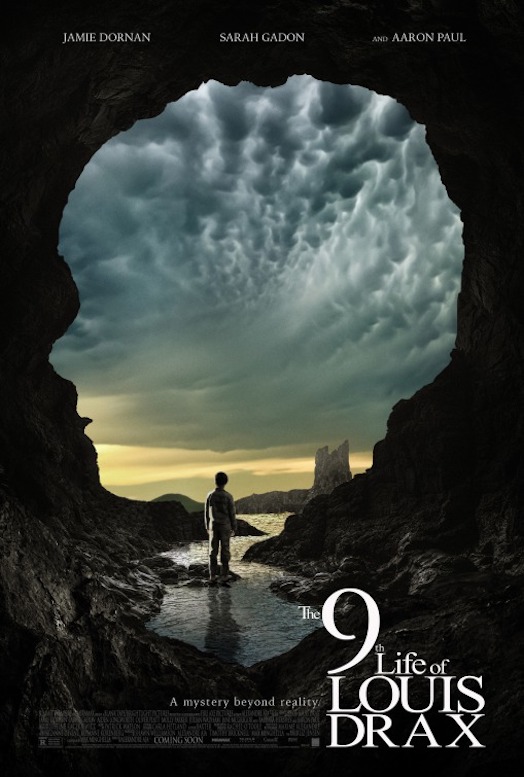
Cast: Jamie Dornan, Aiden Longworth, Sarah Gadon, Aaron Paul, Oliver Platt, Molly Parker, Terry Chen, Julian Wadham, Barbara Hershey
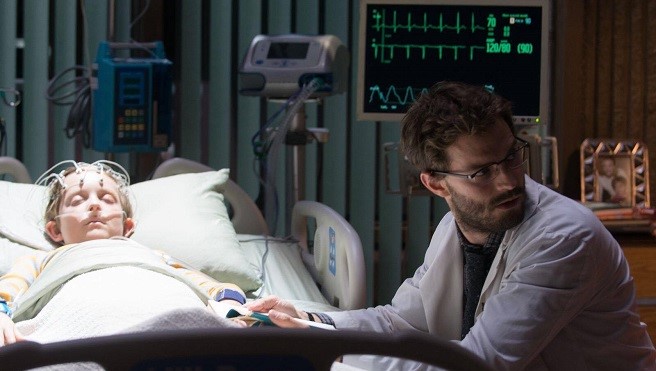
Narrated by the title character, The 9th Life of Louis Drax introduces us to a nine year old boy who is always having near-fatal accidents. His ninth involves a cliff-top fall into the sea while on a picnic with his parents, Natalie (Gadon) and Peter (Paul). While Louis (Longworth) is rescued but trapped in a coma, mystery surrounds his father, who is missing, and his mother, who may or may not be telling the truth about what happened. While the police (Parker, Chen) investigate, Louis’s care falls under the remit of pediatric coma specialist Dr Allan Pascal (Dornan). He believes that Louis can recover in time, even though there are no signs to support this, Louis having been diagnosed as being in a persistent vegetative state.
Over time, Pascal finds himself growing closer to Natalie, while also delving into Louis’s past medical history, including his visits to a psychiatrist, Dr Perez (Platt). It soon becomes clear that there is a mystery surrounding Louis’s accidents, and letters begin appearing that seem to have been written by Louis – which is impossible. Meanwhile, in his coma, Louis is discovering truths about his life that he has been aware of but has suppressed. As the mystery begins to unravel, both Pascal and Louis come to realise that strange forces are at work, and that neither will remain unaffected by them.
If you know nothing about The 9th Life of Louis Drax before settling down to watch it, then the direction that it takes in telling its story may baffle you or seem inexplicably weird. This will be due to the dreamlike fantasy world that Louis inhabits inside his coma, a place where a gravel-voiced sea creature acts as a guide in allowing Louis to understand his past, and what it means for the present. It’s these scenes which are both fascinating and frustrating in equal measure, though, as Max Minghella’s adaptation of the novel by Liz Jensen uses these scenes to explain – at length – what has been going on, and why. While they are necessary in terms of the plot, their presence does, however, make the movie a more sluggish beast (much like the sea creature itself) than it needs to be.
Indeed, the pacing is a problem throughout, with a rapid compendium of Louis’s previous eight “lives” given a Jeunet-esque run-through, before the movie settles down to tell a (mostly) more conventional story. But it only ever really convinces in terms of the relationship between Louis and Peter, while Pascal’s attraction to Natalie feels very much like a tired, hoary old plot device that’s never going to go anywhere (and despite a last-minute reveal that will either have you groaning or grinning – or both). Likewise, Louis is another of those precocious pre-teens whose grasp of human dynamics and adult language only occurs in the movies. The performances are adequate – Gadon’s Natalie though, looks culpable right from the start – but the movie itself is a pedestrian affair that lacks pace and energy, and struggles to make you care about Louis or the people around him.
Rating: 5/10 – some arresting visuals aside, The 9th Life of Louis Drax is a slow, unengaging movie that tries to present its story as a puzzle-box mystery, but fails to make it anything more than a run-of-the-mill thriller; with Aja seemingly unable to elevate the material to the level it needs to reach to be effective, this has to go down as a missed opportunity, and yet another movie that doesn’t do its source material any justice.
Cast: Logan Lerman, Sarah Gadon, Tracy Letts, Linda Emond, Danny Burstein, Philip Ettinger, Ben Rosenfield, Pico Alexander, Noah Robbins
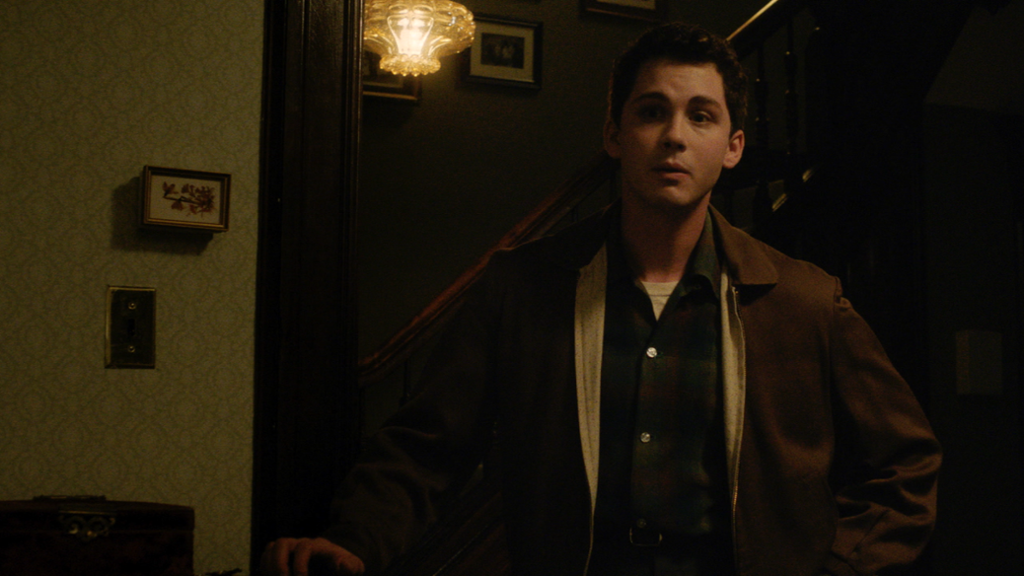
In New Jersey in the early Fifties, Marcus Messner (Lerman), the son of a local butcher, has been awarded a scholarship to attend Winesburg College in Ohio. His father (Burstein) is over-protective and fearful that something will happen to Marcus when he’s there, but Marcus is having none of it; he can’t wait to get away. At Winesburg he finds himself boarding with two other Jewish students, Ron Foxman (Ettinger) and Bertram Flusser (Rosenfield). He throws himself into his studies, takes on a job at the college library, and generally keeps himself to himself. He doesn’t socialise, and when he’s offered a chance to join a largely Jewish fraternity, he refuses.
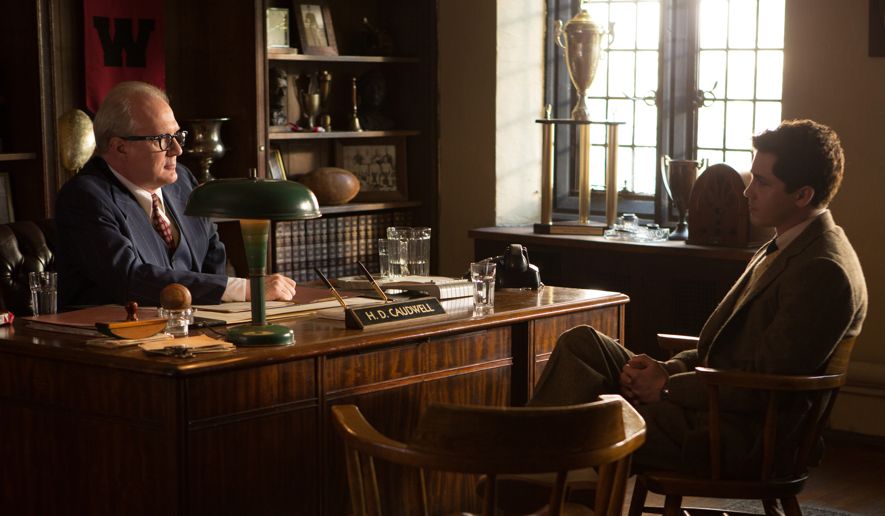
Marcus is drawn out of his self-contained world by the presence of Olivia Hutton (Gadon), an elegant fellow student he’s immediately attracted to. He plucks up the courage to ask her out on a date; at the evening’s end, Olivia surprises him by doing something so unexpected that he doesn’t know what to think of Olivia, or how to assimilate what happened within his limited experience of girls. He decides to avoid Olivia while he comes to a decision about how he feels, but this has the consequence of Olivia believing he doesn’t like her. Simmering tensions with his roommates come to a head in the meantime, and his decision to find alternative lodging within the college brings him to the attention of the dean, Hawes D. Caudwell (Letts). During a meeting between them, the conversation becomes heated, with Marcus decrying some of Winesburg’s traditions, including the mandatory attendance of chapel each week, especially as Marcus regards himself as an atheist. As he attempts to leave, he collapses and ends up in hospital thanks to a ruptured appendix.
Olivia makes several visits, and their relationship develops further. She reveals a secret about herself, one that complicates matters when he receives a visit from his mother (Emond) as well. The two women are introduced to each other, which makes an initially nervous Marcus quite happy. But his mother warns him that he should have nothing further to do with Olivia, a piece of advice that he ignores once he’s allowed out of the hospital. But his pursuit of Olivia, and his making a foolish decision in relation to attending chapel, leads to another encounter with the Dean, one that will have far-reaching consequences.
Adaptations of novels by Philip Roth have proven a mixed bunch in recent years, with the likes of Elegy (2008) and The Humbling (2014) receiving a lukewarm welcome with critics and audiences alike. And at first, Indignation seems as if it’s going to buck the trend of its predecessors. It opens with a sequence set during the Korean War, with Korean soldiers attempting to kill a US soldier. The soldier appears to avoid being killed, and we’re then transported to Newark and the funeral of a young Jewish soldier. We meet Marcus, fresh-faced, and anxious to get away from the stifling attention of his father. He’s well-liked in the neighbourhood, obviously bright, and will be the first Messner to attend college. It’s a neat, concise set up, and writer-director Schamus introduces us to the Messners and their milieu with a minimum of effort and a maximum of probity.
Once at Winesburg, though, and Schamus’s efforts begin to unravel. Marcus becomes a withdrawn, mirthless individual, and not without a degree of arrogance about his manner. This change of character is disturbing, as it challenges the viewer’s ability to feel sympathy for Marcus as the movie unfolds. His interaction with his fellow roommates borders on petulant, while he pursues Olivia with an eagerness that borders on obsession (he’s won over by the sight of her bare leg dangling over the arm of a chair). Only his inexperience with girls and obvious social naïvete spares him from being regarded as a jerk, but it’s a close run thing. His dismay at Olivia’s behaviour only adds to the impression of Marcus as a bemused but intolerant, shallow young man, and Schamus doesn’t do enough to offset that belief with anything more convincing or conclusive.
The encounter between Marcus and Dean Caudwell is the movie’s highlight, a near-fifteen minute masterclass in screen acting and writing that eclipses everything that comes before and after it. It’s somewhat of a shame that the scene is that good, because it exposes Marcus’s contempt for the college, and his disaffection with everything around him. This is where the “indignation” of the title is supposed to be revealed, from Marcus being made to do things that he doesn’t like or want to do (like join a fraternity), and railing against them. But Marcus’s indignation is misplaced and misappropriated; he’s an angry young man fighting for what he believes is just and right, but based on too little experience of life and the demands it can make on a person. He’s the classic angry young man/anti-authority figure, cocksure and heading for a fall.
And so it plays out, with Schamus guiding Marcus – and the viewer – to an inevitable downfall, one where Roth, via Schamus, reveals the truth behind Marcus’s animosity: that he’s the victim of his own poor choices, and has no one else to blame but himself. There’s a wider argument: that when we make decisions we do so mostly without giving those decisions proper consideration, and Marcus’s story is a perfect example. But in adapting Roth’s novel, Schamus – known as a screenwriter and making his directorial debut here – pares back the drama so that there are long stretches where Marcus’s search for recognition (of his needs in others) occupies too much screen time. The tentative romance between Marcus and Olivia is also an issue, as Olivia’s dialogue is almost entirely given over to evasive, tissue-thin comments about relationships, and sidestepping questions about herself. And there’s a grim inevitability to it all that Schamus isn’t able to hide or exploit, despite the tragedy that surrounds her.
Thankfully, Schamus is well-served by his cast. Lerman, who despite appearances in movies such as Noah (2014) and Fury (2014), still carries the aura of being Percy Jackson with him, here embraces Marcus’s faults and growing cynicism with such confidence that it’s perhaps his most intuitive and perceptive performance to date. He’s not able to engender too much sympathy as Marcus, but perhaps that’s the point, that Marcus shouldn’t be too likeable, because if he was, his attitude and displeasure with college life (and much else) wouldn’t be as strident. In support, Gadon is radiant, her blonde hair, marbled skin and ruby red lips – such perfection – covering a damaged soul whose emotional needs are unlikely to ever be met. And then there’s Letts, his stern yet worryingly blank features proving the perfect foil for Lerman’s anguished expressions in their mid-movie encounter, his stillness and slightly menacing approach to his dialogue adding unexpected layers to the performance.
While Indignation does touch on elements and notions of anti-semitism, sexual mores, and the wider political and social worries of the time, including the shadow of the Korean War, at its heart it’s the story of a broken romance. Marcus and Olivia are a good match, one of them with too little experience of the world, one with too much; one of them has yet to make any real, life-changing decisions in their life, the other has made one too many. Again, as Roth says, it all comes down to choices, and when we make them, how we respond when they don’t work out. The consequence for Marcus can be seen at the movie’s end, and if there’s a degree of justice in that consequence, then should we be surprised?
Rating: 7/10 – with too many of its source novel’s subtleties and nuances jettisoned in favour of a more straightforward retelling, Indignation doesn’t have the impact that it should, and as a result, it only delivers emotionally and/or dramatically on a few, isolated occasions; bolstered by a trio of very good performances, and a feel for the period that helps ground the narrative, the movie struggles to make you care about Marcus or his “indignation”, and is only gripping when Marcus and the Dean go toe to toe.
Cast: Alexander Skarsgård, Samuel L. Jackson, Margot Robbie, Christoph Waltz, Djimon Hounsou, Jim Broadbent, Simon Russell Beale, Ben Chaplin
Rating: 3/10 – “meh”; woeful only just about covers how bad this movie is, from the wooden performances, to the haphazard scripting, to Yates’s casual engagement with the material, and all the way to the creaky use of CGI to simulate the African backgrounds – at no point does The Legend of Tarzan ever feel as if it has any intention of putting any real effort into things.
400 Days (2015) / D: Matt Osterman / 91m
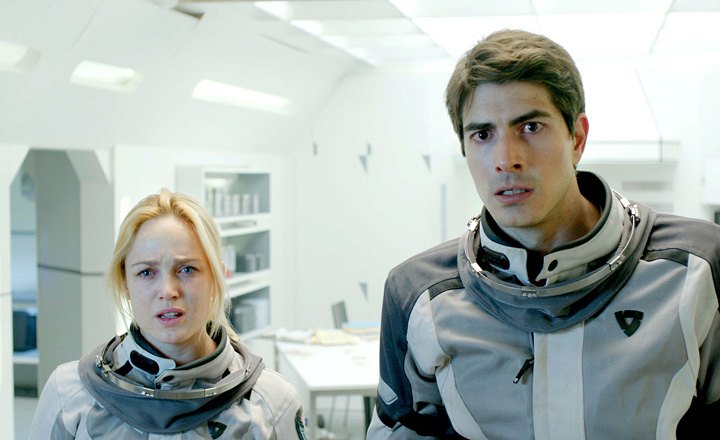
Cast: Brandon Routh, Dane Cook, Caity Lotz, Ben Feldman, Tom Cavanagh, Grant Bowler, Dominic Bogart, Fernanda Romero, Sally Pressman, Mark Steger
Rating: 4/10 – four astronauts are locked inside a chamber designed to simulate the timescale of a planned mission, and the psychological effects of such a journey, but as the simulation nears its finish, the quartet find that things aren’t entirely what they seem; a mystery thriller that doesn’t need its sci-fi trappings (and where the mystery is unengaging), 400 Days plays out like an old Outer Limits episode but without the succinctness that show could provide, all of which leaves the viewer trying hard to make sense of what’s going on, and trying equally hard to decide whether or not they should be bothered about it all.
The Girl King (2015) / D: Mika Kaurismäki / 106m
Cast: Malin Buska, Sarah Gadon, Michael Nyqvist, Lucas Bryant, Laura Birn, Hippolyte Girardot, Peter Lohmeyer, François Arnaud, Patrick Bauchau
Rating: 5/10 – the story of Queen Kristina of Sweden (Buska), who in the ten years she ruled her country, did her best to bring enlightenment and peace for everyone, and who fought against her advisors’ insistence that she marry and secure her throne for the future; reminiscent of the Euro-pudding movies so prevalent in the late Seventies and throughout the Eighties, The Girl King lacks a coherent shooting style that isn’t helped by Hans Funck’s scattershot approach to the editing, but it does keep things admirably simple (if not too simple at times), and remains unexpectedly watchable thanks to Kaurismäki’s determined effort to convert Kristina’s reign (and her presumed lesbianism) into historical soap opera.
My Scientology Movie (2015) / D: John Dower / 99m
With: Louis Theroux, Marty Rathbun, Marc Headley, Tom De Vocht, Jeff Hawkins, Andrew Perez, Rob Alter
Rating: 7/10 – Louis Theroux, intrepid (and annoying) documentarian turns his attention onto Scientology, and attempts to understand why the organisation is so litigious and defensive about its practices; Theroux teams up with ex-Scientology bigwig Marty Rathbun to learn about what goes on behind the scenes, but succeeds largely in having childish spats with one of the organisation’s “security” team (very funny indeed), while organising a filmed representation of a meeting where Scientology leader David Miscavage threw a major tantrum, all of which leaves My Scientology Movie feeling arid for long stretches and not quite as illuminating as Theroux might have hoped.
Transpecos (2016) / D: Greg Kwedar / 86m
Cast: Johnny Simmons, Gabriel Luna, Clifton Collins Jr, Julio Oscar Mechoso
Rating: 5/10 – three Border Patrol guards find themselves in trouble with a Mexican cartel when they stop the wrong car at a checkpoint, and learn that one of them is in even deeper trouble than anyone knew; Transpecos makes good use of its New Mexico locations, and the opening twenty minutes point towards the movie being a tense, tightly constructed thriller, but sadly it soon degenerates into an unconvincing, meandering collection of scenes that are often dramatically inert, and which stretch the narrative in a variety of ineffective ways that it can’t recover from.
End of a Gun (2016) / D: Keoni Waxman / 87m
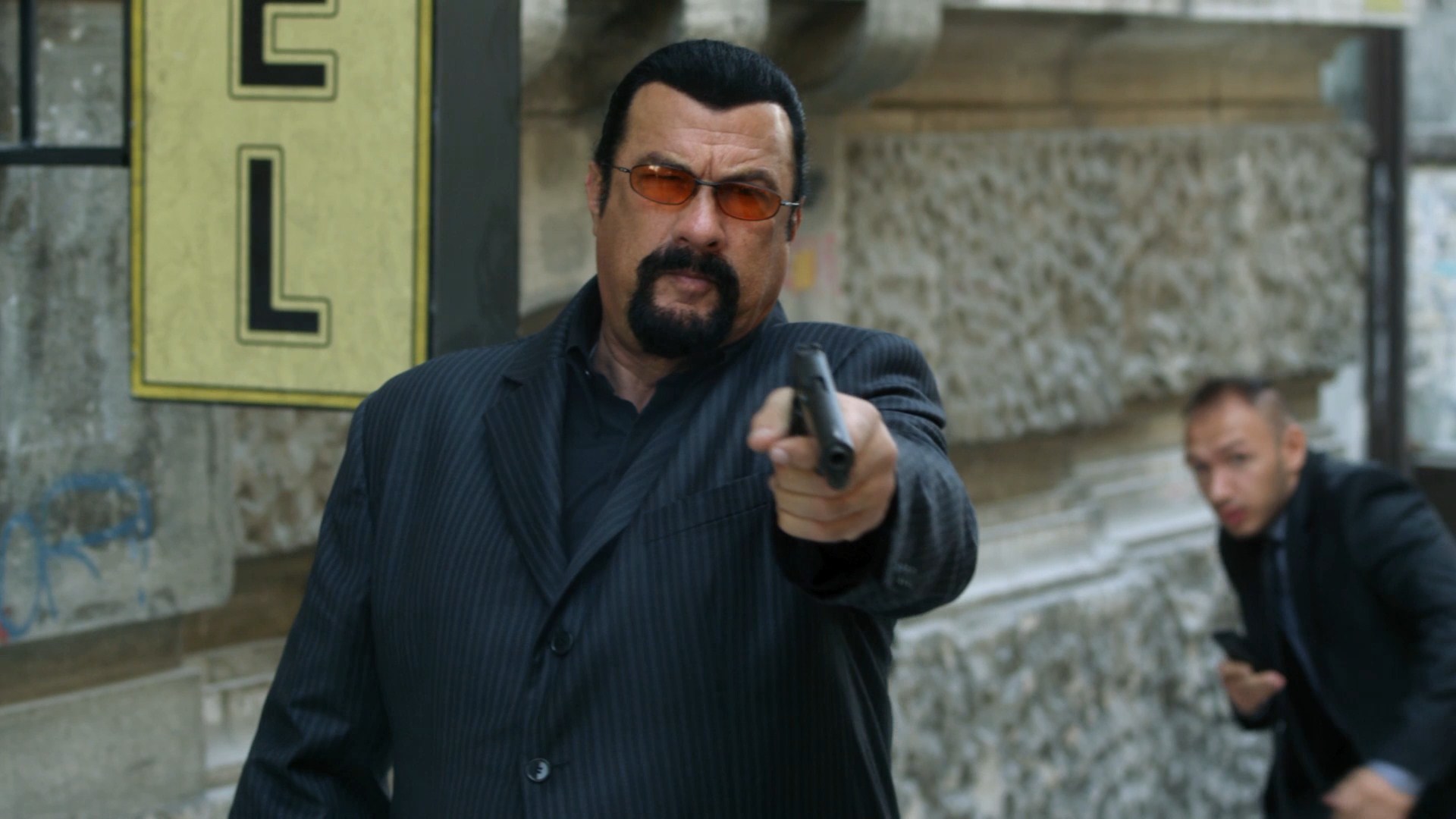
Cast: Steven Seagal, Florin Piersic Jr, Jade Ewen, Ovidiu Nicolescu, Jonathan Rosenthal, Alexandre Nguyen, Claudiu Bleont
Rating: 4/10 – retired DEA agent-cum-“ghost” Michael Decker (Seagal) rescues a stripper (Ewen) from her abusive boyfriend (by killing him) and finds himself helping her steal €2m of the man’s money – which doesn’t go down well with his drug czar boss; another Romanian-shot quickie from Seagal that keeps his stunt double, his running double, and his walking double in gainful employment, End of a Gun is made bearable thanks to a good performance from Piersic Jr, and Waxman’s ingenuity when shooting low-budget shootouts, but otherwise it’s business as usual, which is to say, pretty awful (and the less said about ex-Sugababes member Ewen, the better).
For his feature debut as a director, Ewan McGregor could have (probably) chosen any project he wanted, but not one to shirk a challenge, the actor has decided to film Philip Roth’s Pulitzer Prize-winning novel (it’s been in development for over a decade, and Jennifer Connelly is the only person still on board from back then). So, no pressure there, then. But the trailer reveals, albeit in a disjointed fashion, that McGregor appears to have found a way of coherently presenting the various social and political upheavals of the period (the Sixties), and without sacrificing any of the personal or emotional effects these events have on the characters involved. With David Strathairn cast as Roth’s alter ego Nathan Zuckerman, and a supporting cast that also includes Molly Parker and Peter Riegert, McGregor has found himself in very good company indeed, and if his direction, allied with John Romano’s screenplay, is as good as it looks (and thanks to DoP Martin Ruhe it looks beautiful indeed), then this could be a strong Oscar contender come next February.
In The 9th Life of Louis Drax (it’s never Johnny Smith anymore, is it?), a young boy’s fall from a cliff and subsequent coma opens up a mystery that will involve his parents (Sarah Gadon, Aaron Paul) and his doctor (Jamie Dornan). Liz Jensen’s 2004 novel was due to be adapted by Anthony Minghella before his untimely death in 2008, but now it’s been adapted for the screen by his son Max, and with the formidable talent of Alexandre Aja in the director’s chair. The trailer is sufficiently twist-y enough for clues to Louis’s “condition” to be given in one second and then overturned in another, and the movie’s success is likely to depend on how well the mystery is maintained before answers have to be revealed. The cast also features the likes of Oliver Platt, the ubiquitous Molly Parker, and Barbara Hershey, and seems to have got a firm hold on the supernatural thriller aspects of the story, so this should be as satisfying – hopefully – as it looks.
Whatever you want to say or think about Keeping Up With the Joneses, there’s little doubt that this mix of action and comedy about a suburban couple (Zach Galifianakis, Isla Fisher) who discover that their new neighbours (Jon Hamm, Gal Gadot) are international spies, is exactly the kind of moderately high concept idea that the Hollywood studios love to put their money behind. The trailer offers perhaps too many laughs (and hopefully not all the best ones), while downplaying the inevitable action sequences, but whatever the finished product gives us, let’s hope that director Greg Mottola’s quirky sense of humour is front and centre, and the chemistry between each couple adds to the fun to be had. If not we’ll just have to chalk it up to a good idea gone bad, or to put it another way, a movie that you switch off from once it’s started.
Cast: Sarah Gadon, Bel Powley, Jack Reynor, Rupert Everett, Emily Watson, Jack Laskey, Jack Gordon, Roger Allam, Ruth Sheen
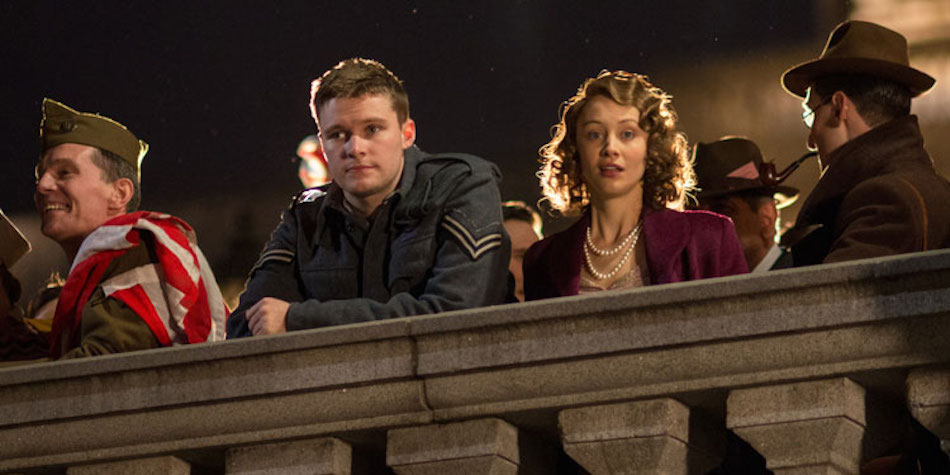
A Royal Night Out is based on real events: on V.E. Day, May 8 1945, Princess Elizabeth and Princess Margaret went out in a group that included their nanny, several friends, and a military detail as protection (one of whom was Group Captain Peter Townsend, who would later have a relationship with Margaret). They were charged by their father, King George VI, to be home by one a.m. – which they were. Nothing of any real significance happened, and the evening passed off without incident.
But in an attempt to overcome this disappointing outcome, A Royal Night Out chooses to paint an entirely different portrait of what happened that night, and in doing so, pushes the boundaries of credibility at every turn. It’s a movie that embraces the newspaper cry of “Print the Legend!”, and has no intention of worrying about just how far-fetched or unlikely it all is. And thanks to one of the most careless and poorly constructed screenplays of recent years – courtesy of Trevor De Silva and Kevin Hood – the movie limps from one unconvincing scene to another, and never once provides a moment’s plausibility.
From the moment that Gadon’s Elizabeth and Powley’s Margaret are introduced – responsible and carefree respectively – it’s clear that these characterisations aren’t going to change much as the movie progresses. Elizabeth is the thoughtful, considerate sister, always looking out for her younger, less mature sibling. Margaret is a pleasure-seeker, stifled by the conventions of royal life, and looking for a chance to express her more extrovert nature. Although there is some truth in both these approaches – Margaret definitely liked a good party – by reducing both young women to such paper-thin representations of their real counterparts, the movie avoids asking its audience to identify with them at all.
What the movie does to compensate is to infuse the action with liberal dollops of comedy. Surprisingly, a lot of it works, even though it’s often corny, and relies on the idea that Elizabeth and Margaret are so far removed from “ordinary” folk that they’re unable to deal with the simplest of social interactions. The humour is also derived in part from a lazy interpretation of the social divide between the princesses and the people they meet. Margaret is far too trusting, while Elizabeth becomes acutely aware of how little she really knows about everyday people. It’s predictable stuff, and if it wasn’t for the jokes, the movie would be dangerously difficult to sit through.
As well as De Silva and Hood’s just-enough-done-to-get-by script, there’s Jarrold’s lacklustre direction to contend with. There are moments when it really seems as if he settled for the first take and had no interest in finding out if the actors had anything else to offer. Whole stretches of the movie play out at a sedated pace that deadens each scene it touches, and it makes the performances seem stilted and free from nuance. Jarrold, whose last theatrical feature was the similarly underwhelming Brideshead Revisited (2008), misses almost every opportunity to make the movie relevant to its time frame, and concentrates instead on various levels of slapstick and farce to push the narrative forward. It leaves the movie feeling disjointed and as unconcerned about itself as Margaret is when she goes off with a man she doesn’t know.
There are issues with the various relationships as well. Elizabeth meets AWOL airman Jack (Reynor) who helps her find Margaret after they’re separated. You can tell straight away that the script wants them to get together, but at the same time it wants to stay true to historical events, so what we’re left with is an attraction that can’t (and doesn’t) lead anywhere, and which is entirely redundant as a plot device. The same can be said for Jack’s AWOL status, a dramatic angle that is resolved with the neatness of a parcel tied up with string. (There really isn’t anything in the movie that the viewer won’t be able to guess the outcome of – and long before it happens.)
Elsewhere, Laskey and Gordon play their military detail roles as if they were auditioning for an X Factor comedy special, with Laskey mugging for all he’s worth, and Gordon’s Lieutenant Burridge behaving in such an inappropriate manner it’s ridiculous. Allam is introduced late on as a mix of low-rent pimp and black marketeer who Margaret calls Lord Stan, but it’s the fanciful way in which her royal status is exploited that raises a chuckle, as Stan uses her to get some of his working girls inside the Chelsea Barracks, and circulating amongst the guests at a party there. Again it’s this kind of non-threatening, breezy plotting that hampers the movie and stops it from having any kind of edge.
The cast are left adrift to fend for themselves, with Watson coming off best by (ostensibly) directing herself, while the likes of Everett, Allam and Powley are stranded playing caricatures. Reynor can’t do anything with his establishment-baiting airman, and Gadon looks bewildered throughout, as if she can’t quite believe what she’s being asked to do (though, to be fair, her bewilderment could be down to the demands of the script).
Away from the uninspired direction and unimaginative script, A Royal Night Out struggles to rise above its TV movie look and feel, and some of the myriad night shots look like they were filmed during the day. And with the best will – or art direction – in the world, Hull is no substitute for London, leaving several scenes feeling incomplete in terms of the movie’s visual style. As a result, Christophe Beaucarne’s photography is choppy at best, though it suits the muddy compositions. And Luke Dunkley’s editing is so haphazard in its approach that a lot of scenes lack that all-important through line.
Rating: 4/10 – even though it’s an interpretation of what “might” have happened on the night of 8 May 1945, A Royal Night Out‘s script shows such a lack of imagination almost any other interpretation would be preferable; saved entirely by its sense of humour, and despite its being entirely nonsensical at times, the movie is one of those ideas that seemed like a good one at the time, but which should have been left well alone by all concerned.
Cast: Luke Evans, Dominic Cooper, Sarah Gadon, Art Parkinson, Charles Dance, Diarmaid Murtagh, Paul Kaye
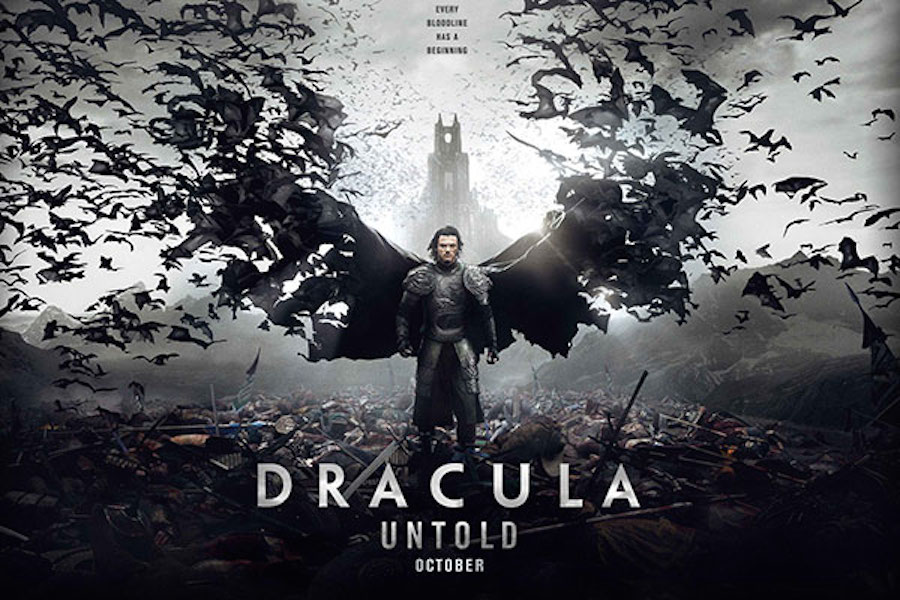
Set in the Middle Ages in Eastern Europe, fealty to the Sultan of Turkey is observed by the giving of a thousand boys to be trained in his army. Such is the early fate of Vlad Tepes (Evans), who grows up to be a fierce warrior and friend of the subsequent Turkish ruler, Mehmet (Cooper). Turning his back on war, Vlad returns home to rule his people. He marries Mirena (Gadon) and has a son, Ingeras (Parkinson). After years of peace, Vlad is alerted to the presence of Turkish scouts in his homeland. He tracks them to Broken Tooth Mountain, where in a cave that reveals itself as a slaughterhouse, Vlad comes face to face with a monster (Dance). He escapes, but not before two of his men have been claimed by the creature. Returning home, Father Lucien (Kaye) advises Vlad of the creature’s origins, and its vampiric nature. They decide to keep their knowledge a secret between them.
A Turkish envoy, come to collect his master’s tribute, tells Vlad the Sultan wants a thousand boys for his army. Vlad wavers over doing his duty to the Sultan and doing what’s best for his people. When the Sultan’s envoy adds that Mehmet wants a thousand and one boys, and the extra boy should be Ingeras, Vlad is even further torn. But at the point of giving his son to the envoy, Vlad makes a fateful decision: no boys will go to the Sultan. War is inevitable, but Vlad seeks a way to avoid his people being decimated by the Turkish hordes. He returns to Broken Tooth Mountain where he confronts the vampire and asks to share in his power. The creature agrees but stipulates that if Vlad is to drink any human blood in the next three days then he will be cursed as a vampire forever, and unable to be fully human again.
When the Turks march on Castle Dracula, Vlad goes out to meet them alone… and he decimates their forces. With a greater army on the way, headed by Mehmet himself, Vlad orders his people to move to a monastery high up in the mountains, somewhere it will be difficult for the Turks to attack directly. A surprise attack leaves Mirena and Ingeras in peril, but Vlad saves them using his newfound powers. The next day, at the monastery, suspicions over Vlad’s new powers leads to him being attacked by his own people. He survives to rebuke them, telling them that what he has done is because of them, and that they should be concentrating on Mehmet’s approaching army.
Arriving just before dawn, the Turkish forces are met by Vlad but they prove to be a decoy for a smaller force that gains entry to the monastery and targets Mirena and Ingeras. With their fates intertwined with his, Vlad is forced to make a decision that will affect all their lives, and bring him face to face with his boyhood friend.
Dracula Untold is yet another reboot of an established and well-defined character that seeks to make them look less like a monster and more like someone who has to be bad in order to do good (this year’s Maleficent is another example). It’s a strange phenomenon in the movies these days, almost as if moviemakers feel they have to apologise for these characters’ behaviour. It also ends up rendering them relatively anaemic (excuse the pun) in comparison to their original incarnation. And so it proves with this reimagining of the Dracula story.
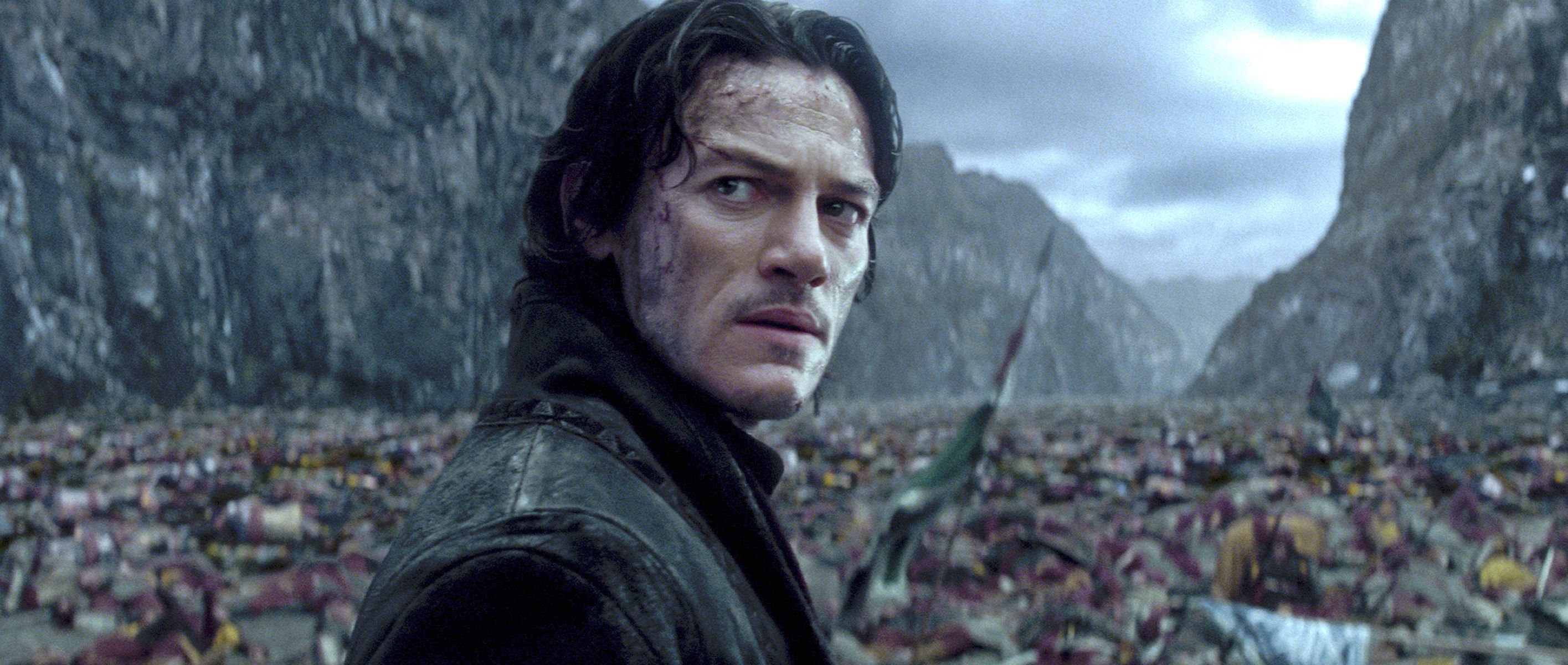
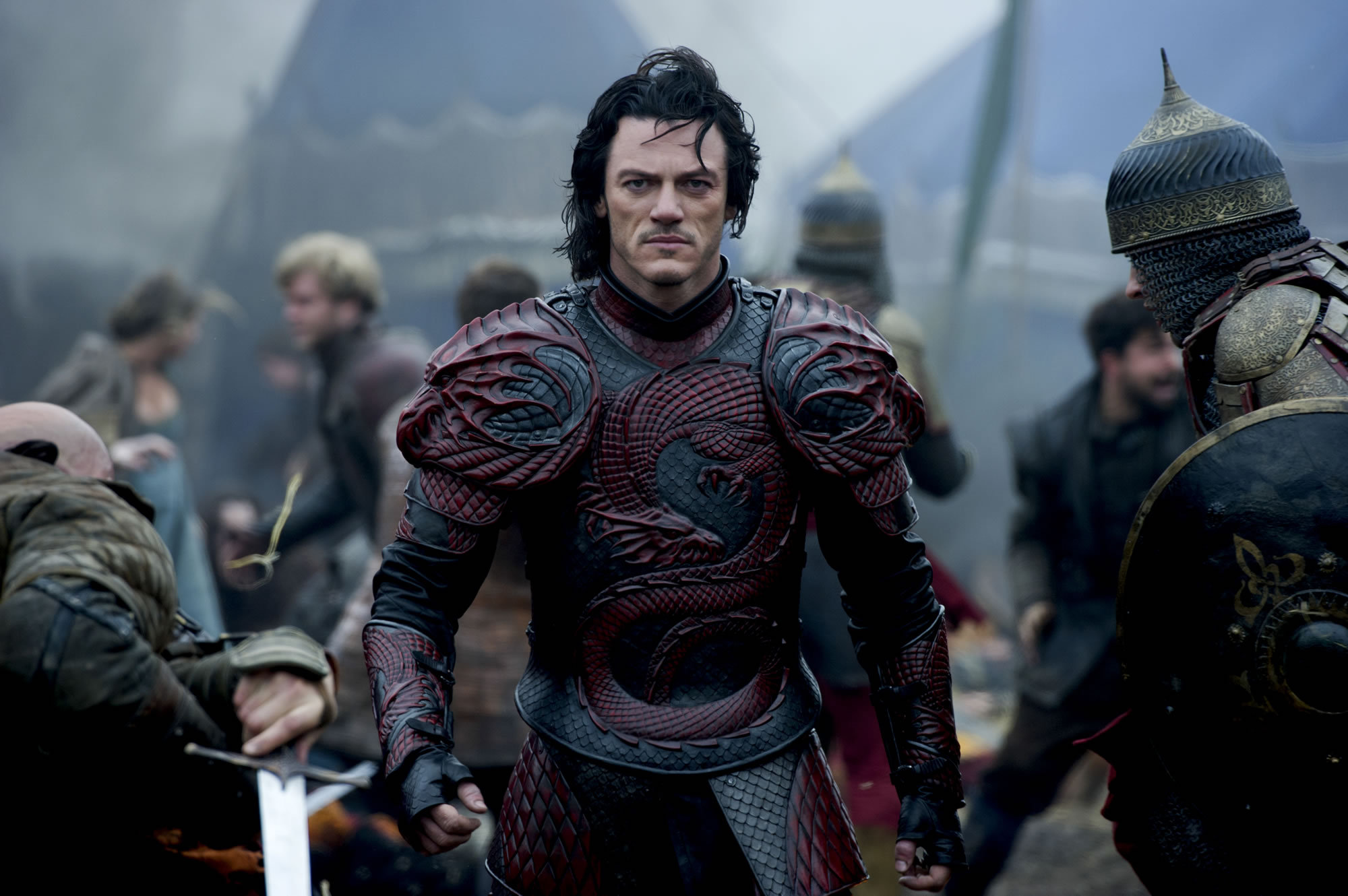
While the initial idea is sound – show how Vlad Tepes, Transylvanian prince and hero to his people became Dracula, bloodthirsty monster feared by all – the movie fumbles its way through its attempts to create an origin story partly based on historical fact and partly on romantic fiction. Vlad is shown as a peaceful man reigning in a vicious, cruel capacity for violence but even though we see the the results of his warlike nature – the infamous impalings on the battlefield – it’s hard to associate the two differing temperaments. As played by a suitably brooding Evans, Vlad is a bit of a wimp in the opening scenes, browbeaten by the Turkish envoy and then dismissed by Mehmet in a scene where Vlad pleads for clemency in relation to the thousand boys. Vlad doesn’t appear the proud leader of men he’s meant to be, but more an easily cowed man with no stomach for a fight. It’s only when he saves his son and kills some of Mehmet’s men that he shows some mettle.
It’s here that Dracula Untold finally becomes a vampire movie, reintroducing Dance’s withered creature, and setting up a future storyline if the movie is as successful at the box office as Universal hope it will be (they have a modern Monsters Cinematic Universe in mind). The bargain is made, allowing the inevitable tragedy of such a bargain to begin playing out. Vlad tries to deny his thirst for blood while Mirena marvels at the disappearance of his battle scars. And in a scene of limited ferocity and actual bloodshed, Vlad takes on a thousand Turks and kills them all. But it’s all done at a remove, with the intensity of the situation dialled down a notch or two, and Vlad’s predicament reduced to the level of suffering occasional stomach cramps. From here, the movie picks up the pace but it’s at the expense of time-related logic and dramatic credibility.
With Vlad needing to defeat Mehmet and his army within three days, the Turks’ ability to travel huge distances in such a short space of time goes unquestioned, while Vlad creates a vampire horde of his own to take them on (would a ruler who truly cares for his people do such a thing even if they were on the verge of dying?). And the script tries for an ironic twist – Vlad’s fate is sealed by the one person he loves most – that feels hackneyed and short on originality.
Muddled though the movie is for the most part, it’s stronger in its performances. Evans brings a brutish physicality to the role that suits the warrior Vlad, and he dominates scenes just by being present. He’s a more thoughtful actor than you might expect from his resumé, and he does his best to offset some of the more florid dialogue in the script, as well as making Vlad a more rounded character. Gadon also gives a good performance, matching Evans for intensity in their scenes together and making Mirena slightly more than the wife who waits anxiously at home while her man goes off to battle. Dance radiates a cold disdain as the trapped “master vampire” though his voice retains too much of its recognisable charm to make that disdain truly chilling. Parkinson proves an adequate match for the demands of a role that could so easily have been more stereotypically presented, while Kaye as Father Lucien has a small but pivotal role that he acquits himself well in (even if some audience members will be saying to themselves, “but that’s Dennis Pennis”). The only disappointment is Cooper, once again confirming his limited range as an actor, and making Mehmet look and sound like an arrogant jerk.
In the director’s chair, Shore (making his feature debut) uses his experience working in high-end commercials to provide some impressive visuals – one shot shows Vlad taking on the Turks as reflected in the blade of a sword – and shows a confidence that bodes well for the future if it’s combined with a better script. He’s clearly comfortable directing actors as well, and the performances are as much to his credit as to theirs. The photography by John Schwartzman is predictably gloomy, though it avoids the steely gray-blue aesthetic of the Underworld series, and there’s a dramatic if occasionally intrusive score courtesy of Ramin Djawadi that is used to good effect throughout.
Ultimately, Dracula Untold is a bit of a mixed bag, its historical pretensions never fully reconciled with its need to reinvent its title character. The script – by Matt Sazama and Burk Sharpless – remains jumbled throughout and it’s this lack of focus that hampers things the most. As an entreé into the revamped (excuse the pun) world of Universal’s collection of classic monsters it’s maybe not quite the start the company were looking for, but it’s also not as bad as it could have been.
Rating: 5/10 – despite some occasionally severe deficiencies in the script, Dracula Untold is a solid, unpretentious reintroduction to the world’s most (in)famous vampire; a good mix of the epic and the intimate also helps but the characters remain at too much of a remove to make us truly care what happens to them.
Cast: Jake Gyllenhaal, Mélanie Laurent, Sarah Gadon, Isabella Rossellini, Joshua Peace, Tim Post
Adam Bell (Gyllenhaal) is an associate professor of history, a little removed from his colleagues and students, but in a relationship with Mary (Laurent), though this has its ups and downs. On the advice of a fellow teacher (Peace), Adam rents a movie called Where There’s a Will There’s a Way. That night he watches the movie, but it’s only later that same night that he’s awoken by the realisation that one of the bellhops in the movie – played by Daniel Saint Claire (Gyllenhaal) – looks exactly like him. Fascinated by his discovery, Adam decides to track down the actor; an online search reveals the talent agency that represents him. Adam visits the building where the agency is based and is mistaken for Saint Claire. He receives an envelope that contains a letter addressed to Anthony Claire (the actor’s real name) at his home. Adam goes there but is too nervous to call at the man’s apartment. Instead he telephones Claire but his wife Helen (Gadon) answers.
Adam calls again when Anthony is home but the actor tells him not to call again. Later, he changes his mind and agrees to meet Adam at a hotel. Meanwhile, Helen, suspecting Anthony is cheating on her, goes to where Adam teaches and briefly speaks to him (though she doesn’t tell him who she is). Adam and Anthony meet and find they are entirely identical, even down to a scar they both have on their chest. Scared by this, Adam flees. Now it’s Anthony’s turn to be fascinated by Adam: he finds out where Adam lives and sees him with Mary. Anthony becomes infatuated with Mary and manipulates Adam into letting him take Mary away overnight. Adam goes to Anthony’s apartment and stays there until Helen arrives home, and as the evening progresses, the two couples’ lives become inextricably entwined…
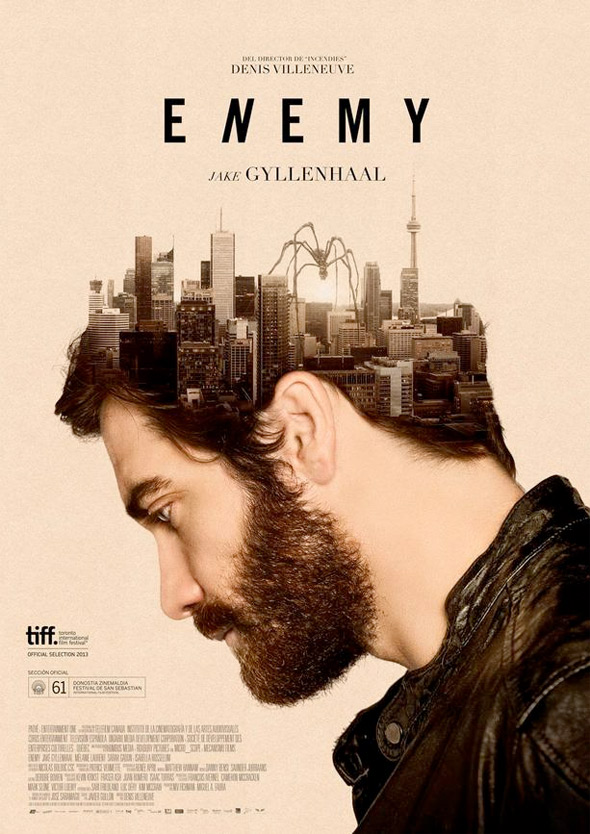
Right from the start, with its opening scene set in an underground sex club, Enemy lets its audience know that it’s not going to be the type of psychological drama/thriller where things are explained too easily. That scene, with its ritualised stage show, serves as an introduction to the wider mystery that envelops Adam, and yet it remains frustratingly unexplored (though it is referred to later on in the movie). For the casual viewer, frustration is the one constant the movie cleaves to, as scene after scene fails or refuses to give an explicit reason for what’s happening; very little can be accepted or relied upon at face value. Enemy is a movie where inference and supposition will only get the viewer so far, and where the plot’s strange twists and turns only serve to make things more convoluted and disorienting.
And while some might find this counter-productive in terms of getting the most out of the movie, ultimately it enhances the experience, with director Villeneuve’s decision to make some scenes completely enigmatic while lacing others with complex misdirection, adding to the sense of unease that the movie builds up. It’s an accomplished piece of deconstruction, removing key elements that most other movies would rush to include in order to make things easier for the audience. Here Villeneuve avoids any attempt at clarity, and by doing so, creates a deceptively elegant, thought-provoking movie that rewards more and more with each repeat viewing.
He’s aided by an impressively layered script by Javier Gullón (adapted from the novel, The Double, by José Saramago), that makes a virtue of ambiguity and provokes as many questions as can be reasonably squeezed into ninety minutes. It’s a delicate balancing act, providing just enough information to keep the viewer intrigued and baffled at the same time, while choosing to reveal very little through either characterisation or dialogue (unless you’re paying very close attention). Between them, Gullón and Villeneuve have designed a movie that defies conventions and exceeds expectations with a great deal of audacity and artistic brio.
Of course, none of this would be possible without the participation of Gyllenhaal, who excels as Adam and Anthony, his performances so finely attuned to the material that he doesn’t put a foot wrong throughout, whether he’s required to play nervous and scared (Adam) or confident and predatory (Anthony). It’s his finest role to date, and proof (if any were needed) that he is one of the best actors around today. He’s ably supported by Laurent in a role that appears to be underwritten but which fits perfectly with the storyline, and Gadon (also seen in Belle), whose portrayal of Anthony’s loyal but emotionally scarred wife matches Gyllenhaal’s performance for intensity and poignancy.
The look of the movie (bearing in mind it’s set in Toronto) is suitably chilly, and the colour scheme – a mix of dark browns and greys – complements the often oppressive nature of the storyline, and the movie’s sense of impending doom. There’s also a fantastic, unnerving score by Danny Bensi and Saunder Jauriaans that is both portentous and imposing at the same time, adding a dark undercurrent to proceedings that is strikingly effective. Technically daring, Enemy succeeds by grounding its ambiguous, sometimes fantastical, storyline and plot in a world where the mystery surrounding Adam and Anthony can be perceived as both rational and weird… and it still works.
Rating: 9/10 – a modern classic, precisely assembled and without an ounce of cinematic fat to it, Enemy is a psychological thriller that mesmerises with ease and ends with a visual punch to the gut that you definitely won’t see coming; the first of (hopefully) many more remarkable collaborations between Villeneuve and Gyllenhaal, and deserving of a much wider audience.









 thedullwoodexperiment