• 10 Reasons to Remember…
  • A Brief Word About…
  • About
  • For One Week Only
  • Happy Birthday
  • Monthly Roundup
  • Old-Time Crime
  • Other Posts
  • Poster of the Week
  • Question of the Week
  • Reviews
  • Trailers

thedullwoodexperiment

~ Viewing movies in a different light

thedullwoodexperiment

Tag Archives: Sherlock Holmes

Holmes & Watson (2018) – Or, Time for Will Ferrell to Do Something Different

27 Thursday Dec 2018

Posted by dullwood68 in Movies

≈ Leave a comment

Tags

Comedy, Dr Watson, Etan Cohen, John C. Reilly, Moriarty, Parody, Queen Victoria, Rebecca Hall, Review, Sherlock Holmes, Will Ferrell
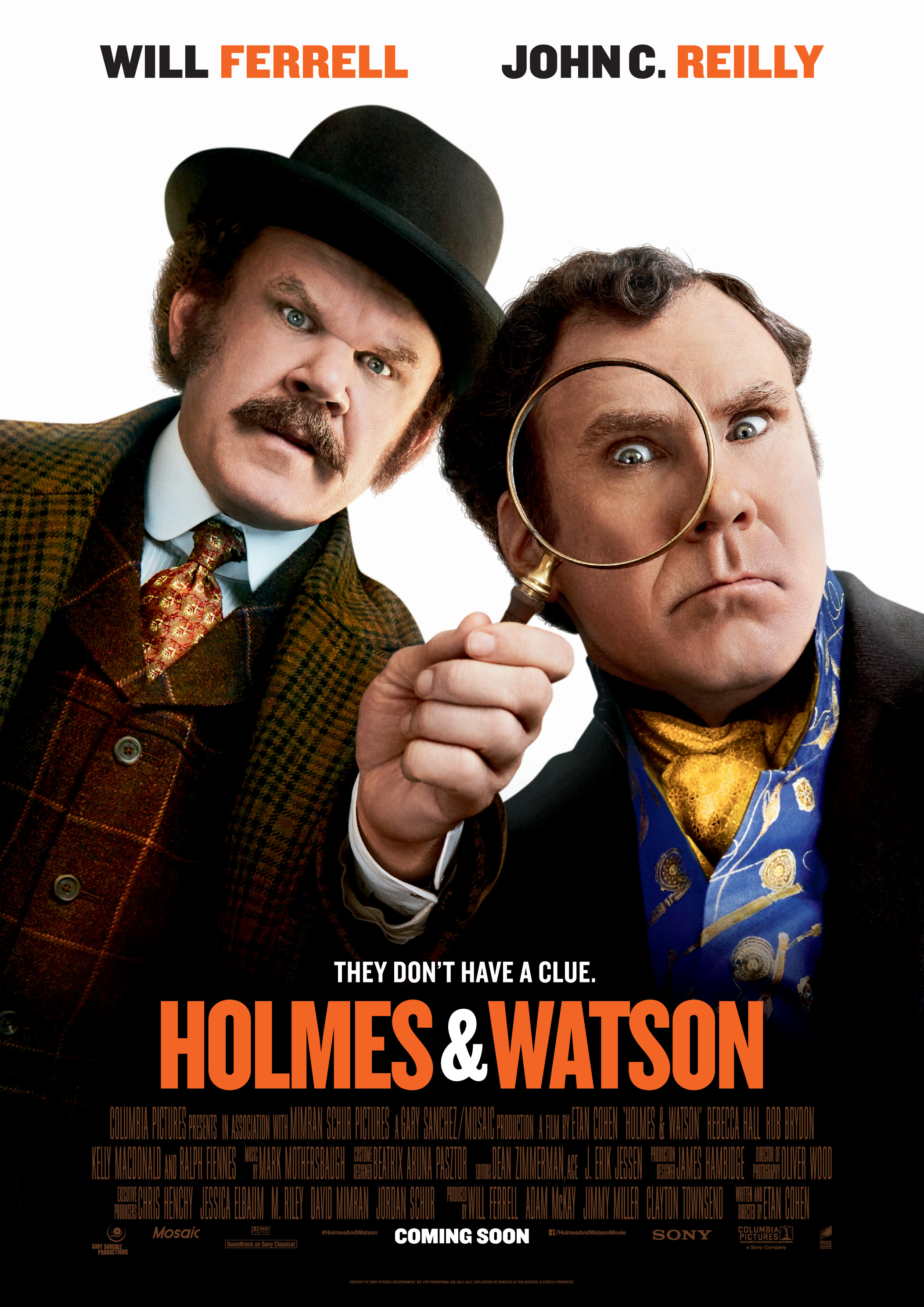
D: Etan Cohen / 90m

Cast: Will Ferrell, John C. Reilly, Rebecca Hall, Kelly Macdonald, Lauren Lipkus, Rob Brydon, Pam Ferris, Steve Coogan, Hugh Laurie, Ralph Fiennes

A score of 3.9 on IMDb. A score of 25 on Metacritic. A 6% rating on Rotten Tomatoes. All beg the question: is Holmes & Watson really that bad? The answer is unequivocal: yes, it is.

It’s not just bad, it’s abysmal. It’s sluggish, dull, uninspired, monotonous, vapid, unimaginative, feeble, pointless, moronic, inane, stupid, tedious, stale, lacklustre, incompetent, and worst of all for a supposed comedy, almost entirely laugh free. It’s a clear contender for worst movie of the year, something of a feat when 2018 has already given us the likes of Lake Placid: Legacy, The Nun, Mile 22, Supercon, and Proud Mary. This is a movie that is so awful you have to wonder if anyone was paying attention while they were making it, a piece of dreadful nonsense about a plot to kill Queen Victoria (Ferris) by Professor Moriarty (Fiennes) that is so lazy its climax takes place on RMS Titanic (Victoria was long dead by the time it launched in 1912). Writer/director Cohen brings absolutely nothing new to the idea of a Sherlock Holmes parody, and wastes the time and efforts of his very talented cast. A perfect example of Cohen’s approach is the moment when Holmes smears Watson in horse shit; a better metaphor for the movie as a whole couldn’t be more fitting.

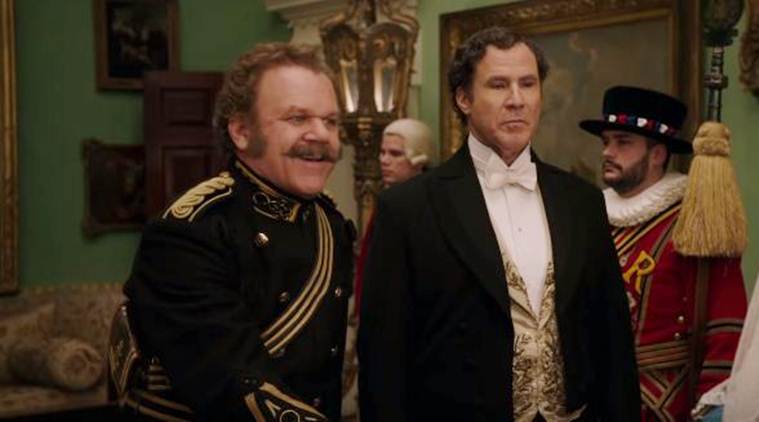
But more concerning perhaps than all of this is the performance of Will Ferrell. Someone really needs to take him to one side and tell him that his manic style of comic acting is wearing perilously thin these days. Shouting isn’t inherently funny, but Ferrell does this a lot, and when he isn’t shouting, he’s behaving in such an arch, mannered fashion that he just looks and sounds like he’s trying too hard, as if someone had told him that if he didn’t behave that way then the material – and his performance – wouldn’t be as effective. As a result, it’s hard to tell if Ferrell is afraid to try something different, or he’s just being lazy. Either way, he’s the movie’s weakest link, and he drags it down every time he opens his mouth or offers us another of his “hilarious” facial expressions (see above). Maybe it’s time for Ferrell to broaden his horizons and make more serious fare, and remind audiences that beneath his default man-child persona, there’s an actor with a greater range than portrayals such as Chazz Michael Michaels in Blades of Glory (2007) and James in Get Hard (2015) would seem to indicate. It’s not as if he hasn’t proved this already, with Stranger Than Fiction (2006) and Everything Must Go (2010), movies that showed he could do subtle and restrained, and find the truth in a character, rather than their inner idiot.
In the meantime we’re stuck with Holmes & Watson, a movie that sucks hard at the teat of comedy and comes away with the merest of dribbles to sustain its inept storyline, dire dialogue, and crass characterisations (you really have to feel for the likes of Fiennes and Hall, forced to standby as their credibility as serious actors is stripped from them with each passing moment they’re on screen). Cohen – whose first outing as a writer/director was the less than appropriately titled short, My Wife Is Retarded (2007) – displays a singular lack of ability behind the camera, cluttering up the frame, placing the camera where it has the least impact, and utilising close ups for dramatic purposes that only he can explain. Scenes connect haphazardly and awkwardly with each other, and Holmes’ leaps of intuition make about as much sense as why this farrago was made in the first place. This is the second movie of 2018 to feature John C. Reilly and Steve Coogan in its cast, and it’s instructive that this is markedly inferior to their other outing, the sublime Stan & Ollie. Now that really is a funny movie (take note, Will Ferrell).

Rating: 3/10 – saved from a 2/10 rating by virtue of its production design alone, Holmes & Watson is a terrible, dispiriting way to see out the year, and a firm reminder that Ferrell’s “schtick” is well past its sell-by date; when a “comedy” with such a talented cast is released straight to cinemas without the benefit of critics’ screenings beforehand then the warning signs couldn’t be more obvious, and the timing of its release near Xmas is entirely apt: it’s an enormous turkey.
Share this:

  • Click to share on X (Opens in new window) X
  • Click to share on Facebook (Opens in new window) Facebook
  • More
  • Click to print (Opens in new window) Print
  • Click to email a link to a friend (Opens in new window) Email
Like Loading...

Mr. Holmes (2015)

07 Tuesday Jul 2015

Posted by dullwood68 in Movies

≈ Leave a comment

Tags

A Slight Trick of the Mind, Bees, Bill Condon, Glass harmonica, Grey glove, Historical drama, Ian McKellen, Japan, Laura Linney, Literary adaptation, Milo Porter, Mystery, Prickly ash, Review, Royal jelly, Sherlock Holmes, Sussex

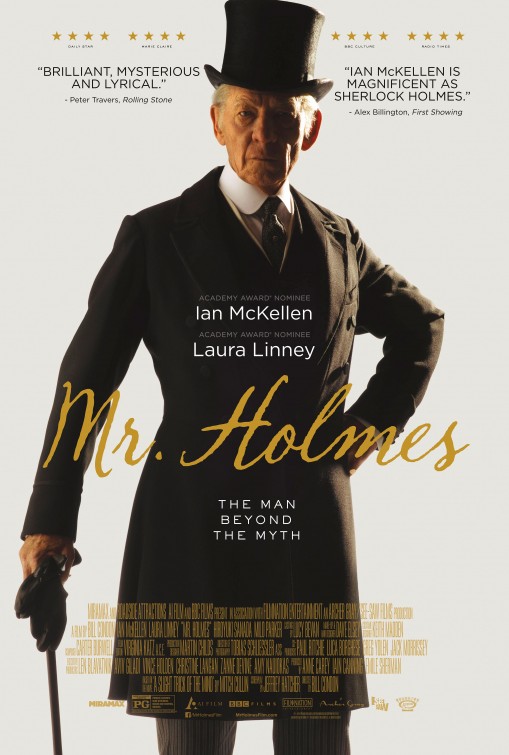
Mr. Holmes

D: Bill Condon / 104m

Cast: Ian McKellen, Laura Linney, Milo Porter, Hiroyuki Sanada, Hattie Morahan, Patrick Kennedy, Roger Allam, Frances de la Tour, Philip Davis, John Sessions

In 1947, Sherlock Holmes (McKellen), now 93, lives in a Sussex farmhouse, and is looked after by his housekeeper, Mrs Munro (Linney), and her young son, Roger (Porter). He keeps bees and uses royal jelly as a means of improving his memory, which has deteriorated in recent years. A recent trip to Japan in search of supplies of prickly ash, a plant also known for improving the memory, has been undertaken with a view to ensuring that Holmes can complete one last project before he becomes unable to: to write a true account of his last case as a detective. Unhappy with the way Dr Watson portrayed those events, Holmes is struggling to remember the details of the case. Urged on by the interest shown by Roger, Holmes renews his efforts to pin them down.

His recollections take him back thirty years, after Watson has gotten married and their partnership has dissolved. He’s visited by Thomas Kelmot (Kennedy), a man worried about the behaviour of his wife, Ann (Morahan). Following two miscarriages, Ann Kelmot has become withdrawn; her husband has advised her to take up a musical hobby but now that has become an obsession, and even though he has forbade her from continuing her lessons with glass harmonica teacher, Madame Schirmer (de la Tour), he has discovered Ann is still visiting her. He suspects the music teacher of some kind of plot and wants Holmes to investigate.

Back in the present, Holmes takes Roger under his wing in and introduces him to his apiary. Roger persists in asking about Holmes’ last case; his enthusiasm prompts Holmes to make more of an effort to remember Ann Kelmot, including following her to Madame Schirmer’s and from there to various places before he approaches her in a public garden. Their conversation becomes confrontational but Holmes reveals the depth of his knowledge about her situation, and the effect the two miscarriages has had on her.

Mrs Munro, meanwhile, informs Holmes that she is planning to move to Portsmouth and work in a hotel; it will mean taking Roger with her. Roger doesn’t want to go, but when Holmes suffers a collapse shortly after, they are forced to stay. While he remains bedridden on the advice of his doctor (Allam), Roger takes care of the bees. He also finds a grey glove in Holmes’ study, a memento from the case of Ann Kelmot that Holmes can’t remember keeping or having. As Holmes remembers more about the case he also recalls the event that led to his retirement as a detective, and the reasons behind Watson’s subsequent involvement. But his remembrance of the past is put into perspective when he finds Roger has been stung by dozens of bees, and the boy’s life is hanging in the balance…

Mr. Holmes - scene

Dealing with themes of sadness and loss and regret, Mr. Holmes presents us with a portrait of a master detective beset by echoes from his past. It’s a richly detailed depiction of times long past, anchored by a superb performance from McKellen, and redolent of a bygone age, with its frock coats and steam trains and pre-suffrage gender politics. Expertly marshalled by Condon – reunited with McKellen for the first time since they collaborated on Gods and Monsters (1998) – the movie is a flawless recreation of two periods in English history that still exert a strong fascination: the post-Victorian era and the years immediately following the cessation of World War II. There’s also Holmes’ trip to Japan and the sight of the devastation wrought on Hiroshima. The historical trappings carry so much weight it’s almost as if the audience has been transported back with Holmes and are experiencing things themselves.

With the period detail proving so effective, it’s the twin mysteries on offer – what really happened during Holmes’ last case, and what is causing the deaths of his beloved bees – that unfortunately stop the movie from becoming even more memorable (an ironic outcome for a movie that deals with the loss and despair in losing one’s own memory). The story of Ann Kelmot has all the initial hallmarks of a classic Holmes tale, with its anxious husband and a heroine seemingly under the influence of a scheming criminal. But the truth, when Holmes finally remembers it, is far more prosaic than that, and while presented with some emotional impact, still doesn’t seem as devastating as Holmes makes out. Maybe it’s seeing it from the perspective of an old man trying to make sense of things that remain just out of reach that leaves the viewer with a sense of detachment: if Holmes can’t access those recollections and connect with them, how are we to do so?

But the movie, even with its handful of slightly underdeveloped storylines, has several aces up its sleeve that mitigate and make up for the paucity of the plot and the general structure. These are the performances from McKellen, Linney, Porter and Morahan. As already mentioned, McKellen is superb as Holmes, fragile, distressed, playful, curmudgeonly, afraid – tuning his portrayal of the master detective to such a fine degree that it’s both an acting and organic masterclass; he’s believable and convincing throughout, particularly when he’s trying to downplay the public misconceptions about him that are thanks to Watson’s writings. As Holmes’ housekeeper, Linney adopts a country dialect with precision and aplomb, and imbues Mrs Munro with a stoic dignity that stops her from expressing her misgivings about the relationship between Holmes and her son. As Roger, Porter gives another of those naturalistic, not-even-trying performances that it seems most child actors can produce at the drop of a hat; his scenes with McKellen are affecting and perfectly modulated. And as the focus of Holmes’ disturbed memories, Morahan is quietly magnificent as the troubled Ann Kelmot, her tear-rimmed eyes a more than adequate depiction of the turmoil her character has fallen prey to.

The movie has an often stately, measured pace, and some viewers may find the early scenes a little hard going, but once Holmes begins to remember events following the arrival of Thomas Kelmot at Baker Street, Condon increases the rate at which things begin to happen, until the final thirty minutes are as engrossing as any modern day thriller. With Martin Childs’ meticulous production design being augmented by often beautiful cinematography from Tobias A. Schliessler, and a delicately evocative score courtesy of Carter Burwell, there’s so much to enjoy here that audiences who stay the course will be rewarded by a movie that quietly steals up behind them and warms their hearts.

Rating: 8/10 – modest in intention and design, Mr. Holmes is a small-scale triumph of historical veracity and emotional honesty, focusing as it does on the melancholic suffering of a man for whom his intellect, now foundering, defined him; full of deceptively powerful performances, this is one historical drama that resonates long after it’s ended.

Share this:

  • Click to share on X (Opens in new window) X
  • Click to share on Facebook (Opens in new window) Facebook
  • More
  • Click to print (Opens in new window) Print
  • Click to email a link to a friend (Opens in new window) Email
Like Loading...

Poster of the Week – The Hound of the Baskervilles (1959)

01 Monday Sep 2014

Posted by dullwood68 in Movies

≈ 1 Comment

Tags

Baskerville, Christopher Lee, Hammer Films, Hound, Movie poster, Peter Cushing, Poster of the week, Sherlock Holmes

Hound of the Baskervilles, The (1959)

The Hound of the Baskervilles (1959)

Another Hammer movie poster – see also Dracula (1958) – this unusually simple piece of advertising (for its time), has an impact that can’t be denied.  With its human cast relegated to the sidelines (literally), the hound is allowed to take centre stage and dominate the poster.  It’s less of a hound and more of a wolf, of course, but its sharp, pointed teeth, tipped with blood, and yellow-eyed stare, is more than enough to put anyone off from wanting to encounter the beast on a lonely, deserted moor.

Its grey and white fur, offset by deep, shadowy blacks, frames the hound’s features to considerable effect, with its canines to the fore, almost as if it’s about to take a chunk out of the title.  The eyes have a demonic gleam to them, and there’s a hypnotic quality to them as well, as if by staring at them for too long there’s a chance the hound will jump out of the poster and rip you to pieces – far-fetched, perhaps, but there is a certain, unnerving element to the image, one that is far more effective on closer inspection.  And then there’s the moon, a grey smudge near the top right corner, hinting at lycanthropy and occupying a place that would otherwise have been completely blank (though no less effective for being so).

The bold red of the title, in its way splashed across the poster, demands attention from the eye, and the colour hints at the bloodshed that is likely to occur in the movie (even if it’s not quite as brutal as we’d like to imagine).  The tag line at the top of the poster tries too hard to grab the attention away from the hound, while the main cast members are sequestered over on the left hand side, almost as an afterthought; even the acknowledgment to Sir Arthur Conan Doyle turns out to be in a smaller typeface  than that advising of the movie’s having been made in Technicolor (as for the director et al., mentioned in the bottom left hand corner, unless you’ve got 20/20 vision, you won’t have a clue who they are).

It’s a simple, effective poster and deserves a wider audience, free from artifice and pseudo-intellectual interpretations: in short, a poster that’s way more compelling than you’d initially give it credit for.

Agree?  Disagree?  Please feel free to let me know.

Share this:

  • Click to share on X (Opens in new window) X
  • Click to share on Facebook (Opens in new window) Facebook
  • More
  • Click to print (Opens in new window) Print
  • Click to email a link to a friend (Opens in new window) Email
Like Loading...

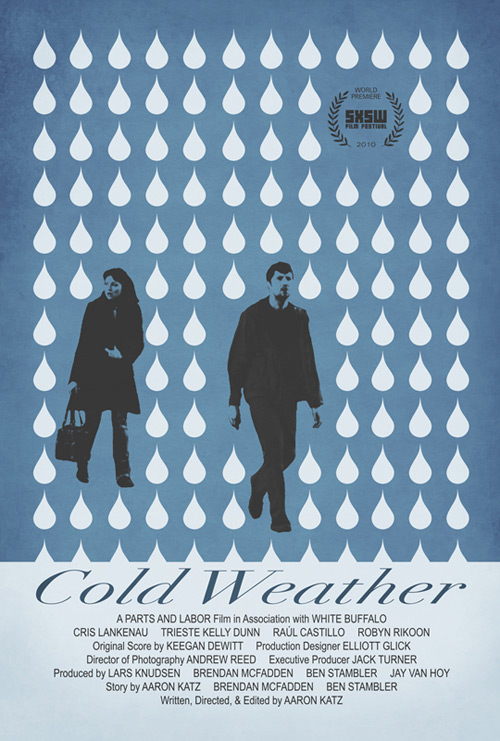
Cold Weather (2010)

09 Sunday Mar 2014

Posted by dullwood68 in Movies

≈ Leave a comment

Tags

Aaron Katz, Cris Lankenau, Disappearance, Mystery, Portland, Raúl Castillo, Raffles, Review, Robyn Rikoon, Sherlock Holmes, Trieste Kelly Dunn

Cold Weather

D: Aaron Katz / 96m

Cast: Cris Lankenau, Trieste Kelly Dunn, Raúl Castillo, Robyn Rikoon, Jeb Pearson, Brendan McFadden

Doug (Lankenau) is a twenty-something slacker with a background in forensic science but no motivation to make a career from it.  When Cold Weather begins he’s without a job, without a girlfriend, and reduced to sleeping on his sister’s couch.  He’s a classic underachiever.  Eventually he gets a job working nights at an ice factory where he meets Carlos (Castillo).  They become friends, and the usually aimless Doug begins to come out of his shell, admitting his love of Sherlock Holmes and his dream to become a detective some day, like the sleuth of 221b Baker Street (also, throughout the movie Doug carries a copy of E.W. Hornung’s Raffles around with him).  When Doug’s ex-girlfriend, Rachel (Rikoon) appears on the scene her subsequent disappearance leads Doug, aided and pushed in equal measure by his sister, Gail (Dunn) and Carlos, into using his nascent detective skills to find her.

Cold Weather is a curious movie.  It mixes modern film noir with a slacker aesthetic and adopts a slow-burn pace in an effort to heighten the drama and the mystery of Rachel’s disappearance.  However, the mix fails to gel, and the viewer is left waiting for the movie to pull itself together.  When Doug and Carlos are in Rachel’s motel room looking for clues – a scene normally ripe for increased tension – there’s some rudimentary checking of drawers and the bathroom before Doug notices something in the parking lot.  Instead of this being a sudden revelation geared to reinforcing the audience’s attention, it falls flat due to a) Lankenau’s reading of the line (it’s not his fault, to be fair, it’s how the character has been written by Katz), and b) the static camerawork that leaves Carlos’ reaction almost offscreen.

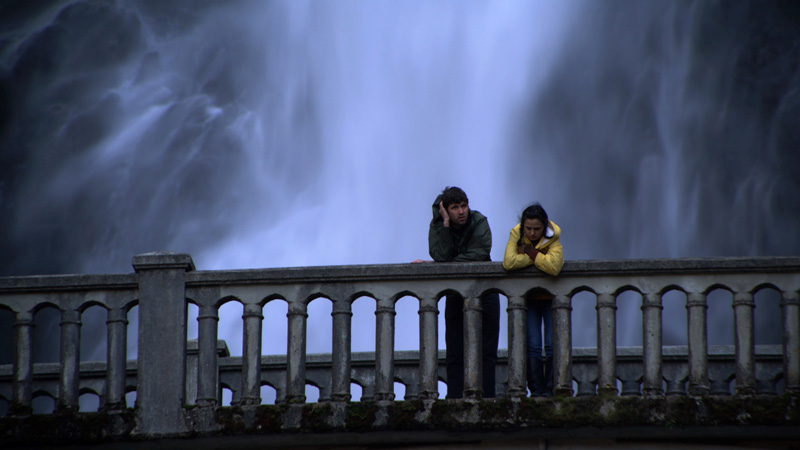
Cold Weather - scene

There’s a fair degree of intelligence at work here but it’s undermined by the decision to pace the movie so glacially, and by having its central character be so socially awkward and unable to engage with others.  When we meet Rachel it’s hard to understand what she might have seen in Doug; plus it’s already obvious that the only female relationship that Doug is comfortable with is with Gail, and she is often more of a mother to him than a sister.  As the movie struggles on to its annoyingly abrupt ending, Doug does become less and less insular but only registers any real emotion when delighting in some minor vandalism.  What becomes clear is that without the involvement of Carlos and Gail, Doug would never have looked into Rachel’s disappearance at all.  With this in mind, the movie now feels contrived, and Doug given no motivation to act unless his friend and sister bully him into it.

Against this, there’s also the aforementioned glacial pacing.  Katz directs at a snail’s pace, dragging out shots and scenes for no other purpose (it seems) than to extend what would otherwise be a pretty short movie.  One sequence, where Gail and Doug are driving up to the top of a multi-storey car park, is filmed from the backseat and contains no dialogue as they ascend.  The view through the windscreen is over-exposed, so there’s no detail… and the whole sequence serves no valid purpose.  There are other, similar moments and while slow-paced movies can be rewarding in their own right, they still have to be engaging and astute in the assembly of the material.

Fortunately the performances are good, with Lankenau – who also appeared in Katz’s Quiet City (2007) – effective as the bordering-on-Asperger’s Doug, while Dunn quietly outshines everyone with her take on a sister who seems to have willingly put her life on hold to look after her brother.  Castillo and Rikoon provide solid support and the suitably wintry location photography – all steely greys and blues – is lensed by Andrew Reed to great effect.  And while Katz’s screenplay is packed with unnecessary longueurs, there is still enough of merit to warrant looking out for his other works (he just needs to sack his current editor – himself).

Rating: 5/10 – it drags badly in places but Cold Weather has a quirky feel to it that helps it through; there’s a deeper meaning here too but it all depends on whether or not the viewer is interested enough to dig for it.

Originally posted on thedullwoodexperiment website.

Share this:

  • Click to share on X (Opens in new window) X
  • Click to share on Facebook (Opens in new window) Facebook
  • More
  • Click to print (Opens in new window) Print
  • Click to email a link to a friend (Opens in new window) Email
Like Loading...

Blog Stats

  • 486,655 hits

Recent Posts

  • 10 Reasons to Remember Bibi Andersson (1935-2019)
  • Fantasia (1940)
  • Dances With Wolves (1990) – The Special Edition
  • Kiss of the Spider Woman (1985)
  • The Three Musketeers (1973)

Top Posts & Pages

  • Lost for Life (2013) - Another Look
    Lost for Life (2013) - Another Look
  • Lost for Life (2013)
    Lost for Life (2013)
  • About
    About
  • BFI London Film Festival 2015
    BFI London Film Festival 2015
  • Mr. Topaze (1961)
    Mr. Topaze (1961)
  • Hunt for the Wilderpeople (2016)
    Hunt for the Wilderpeople (2016)
  • Shock and Awe (2017)
    Shock and Awe (2017)
  • Cardboard Boxer (2016)
    Cardboard Boxer (2016)
  • Exposed (2016)
    Exposed (2016)
  • Billy Lynn's Long Halftime Walk (2016)
    Billy Lynn's Long Halftime Walk (2016)
Follow thedullwoodexperiment on WordPress.com

Blogs I Follow

  • Rubbish Talk
  • Film 4 Fan
  • Fast Film Reviews
  • The Film Blog
  • All Things Movies UK
  • Interpreting the Stars
  • Let's Go To The Movies
  • Movie Reviews 101
  • TMI News
  • Dan the Man's Movie Reviews
  • Film History
  • Jordan and Eddie (The Movie Guys)

Archives

  • April 2019 (13)
  • March 2019 (28)
  • February 2019 (28)
  • January 2019 (32)
  • December 2018 (28)
  • November 2018 (30)
  • October 2018 (29)
  • September 2018 (29)
  • August 2018 (29)
  • July 2018 (30)
  • June 2018 (28)
  • May 2018 (24)
  • April 2018 (21)
  • March 2018 (31)
  • February 2018 (25)
  • January 2018 (30)
  • December 2017 (30)
  • November 2017 (27)
  • October 2017 (27)
  • September 2017 (26)
  • August 2017 (32)
  • July 2017 (32)
  • June 2017 (30)
  • May 2017 (29)
  • April 2017 (29)
  • March 2017 (30)
  • February 2017 (27)
  • January 2017 (32)
  • December 2016 (30)
  • November 2016 (28)
  • October 2016 (30)
  • September 2016 (27)
  • August 2016 (30)
  • July 2016 (30)
  • June 2016 (31)
  • May 2016 (34)
  • April 2016 (30)
  • March 2016 (30)
  • February 2016 (28)
  • January 2016 (35)
  • December 2015 (34)
  • November 2015 (31)
  • October 2015 (31)
  • September 2015 (34)
  • August 2015 (31)
  • July 2015 (33)
  • June 2015 (12)
  • May 2015 (31)
  • April 2015 (32)
  • March 2015 (30)
  • February 2015 (37)
  • January 2015 (39)
  • December 2014 (34)
  • November 2014 (34)
  • October 2014 (36)
  • September 2014 (25)
  • August 2014 (29)
  • July 2014 (29)
  • June 2014 (28)
  • May 2014 (23)
  • April 2014 (21)
  • March 2014 (42)
  • February 2014 (38)
  • January 2014 (29)
  • December 2013 (28)
  • November 2013 (34)
  • October 2013 (4)

Create a free website or blog at WordPress.com.

Rubbish Talk

Film 4 Fan

A Movie Blog

Fast Film Reviews

The Film Blog

The official blog of everything in film

All Things Movies UK

Movie Reviews and Original Articles

Interpreting the Stars

Dave Examines Movies

Let's Go To The Movies

Film and Theatre Lover!

Movie Reviews 101

Daily Movie Reviews

TMI News

Latest weather, crime and breaking news

Dan the Man's Movie Reviews

All my aimless thoughts, ideas, and ramblings, all packed into one site!

Film History

Telling the story of film

Jordan and Eddie (The Movie Guys)

Movie Reviews & Ramblings from an Australian Based Film Fan

Privacy & Cookies: This site uses cookies. By continuing to use this website, you agree to their use.
To find out more, including how to control cookies, see here: Cookie Policy
  • Subscribe Subscribed
    • thedullwoodexperiment
    • Join 481 other subscribers
    • Already have a WordPress.com account? Log in now.
    • thedullwoodexperiment
    • Subscribe Subscribed
    • Sign up
    • Log in
    • Report this content
    • View site in Reader
    • Manage subscriptions
    • Collapse this bar
 

Loading Comments...
 

    %d