• 10 Reasons to Remember…
  • A Brief Word About…
  • About
  • For One Week Only
  • Happy Birthday
  • Monthly Roundup
  • Old-Time Crime
  • Other Posts
  • Poster of the Week
  • Question of the Week
  • Reviews
  • Trailers

thedullwoodexperiment

~ Viewing movies in a different light

thedullwoodexperiment

Tag Archives: The Sixties

The Shape of Water (2017)

19 Friday Jan 2018

Posted by dullwood68 in Movies

≈ 1 Comment

Tags

Baltimore, Cold War, Creature, Doug Jones, Drama, Guillermo del Toro, Michael Shannon, Michael Stuhlbarg, Music, Octavia Spencer, Review, Richard Jenkins, Romance, Sally Hawkins, Sci-fi, The Sixties

D: Guillermo del Toro / 123m

Cast: Sally Hawkins, Michael Shannon, Richard Jenkins, Octavia Spencer, Michael Stuhlbarg, Doug Jones, David Hewlett, Nick Searcy, Lauren Lee Smith

A romantic fairy tale set during the Cold War era of the Sixties, Guillermo del Toro’s latest feature is set in a secret government laboratory in Baltimore. Elisa Esposito (Hawkins) is a cleaner who works the night shift. She’s also mute from birth. One night the laboratory receives a new “asset”, an amphibious creature (Jones) captured in the Amazon river by military man Richard Strickland (Shannon). The creature proves to be humanoid, and though it’s ostensibly dangerous, Elisa develops a bond with it, and even uses sign language to communicate with it on a basic level. With the creature able to breathe in and out of water, the intricacies of its anatomy lead to the decision to have it vivisected. Elisa is horrified by this, and with the aid of her fellow cleaner, Zelda (Spencer), and her neighbour, elderly artist Giles (Jenkins), she determines to free the creature and return it to the sea. As she puts her plan into action, she finds unexpected assistance from one of the scientists at the laboratory, Dr Hoffstetler (Stuhlbarg), and unwanted attention from Strickland.

Fully and firmly back on track after the disappointment that was Crimson Peak (2015), Guillermo del Toro has made perhaps his best movie yet. The Shape of Water is a veritable treasure trove of delights. By turns funny, dramatic, sad, tender, exciting, joyous, imaginative, bold, romantic, uplifting, and poignant, it’s a movie that crams so much into its two hour running time that it should feel heavy-handed. Instead it feels like the lightest of confections, even with the overtly darker undertones that are threaded throughout the narrative and which help the movie add a credible and palpable sense of menace to the overall tone. del Toro has long wanted to make a movie inspired by Creature from the Black Lagoon (1954), but it’s unlikely even he could have predicted just how good the end result would be. From Paul D. Austerberry’s masterful period production design, to the efforts of the set dressers (so much detail), this is a movie that is constantly inviting the viewer to come nearer and peer closely at all the objects that fill each frame. And then there are the small yet seemingly effortless moments that pepper the movie, moments such as Elisa and Giles’ seated dance routine, or the man at the bus stop with the partially eaten cake. It all adds up to a richness of texture that is nigh-on faultless.

But the movie isn’t just beautiful to look at, it’s also an old-fashioned love story (an inter-species love story, to be fair, but hey, so what? As Joe E. Brown says at the end of Some Like It Hot (1959), “Nobody’s perfect”). It would have been so easy to misjudge the tone and the mood in presenting this romance, but del Toro and co-screenwriter Vanessa Taylor handle it perfectly, combining elements of magical realism and the aforementioned fairy tale aspect to wonderful effect. Hawkins – for whom the role of Elisa was written – gives a mesmerising performance, passionate and vulnerable, determined and caring, and capable of expressing any of Elisa’s emotions through the delicate shading of her features. As the principal villain, Shannon gets to add unexpected psychological layers to the role of Strickland, something that keeps the part from being that of a stereotypical bad guy, while Jenkins provides the majority of the laughs (and a great deal of pathos) as Giles, an elderly gay man still hoping to find love himself. Everything is rounded off by the music, as del Toro harks back to the golden era of Hollywood musicals. And just when you think he can’t squeeze in anything else, he gives us a black and white dance number featuring Elisa and the creature which is a tribute to Follow the Fleet (1936). This all leaves just one option: this much confidence must be applauded.

Rating: 9/10 – made with an intense amount of love and affection for its central characters, and with an elegance that shines throughout, The Shape of Water is a triumph of both style and substance; look closely, though, and you’ll find del Toro being quietly and unobtrusively subversive: ask yourself – which other movie are you likely to see where the heroes are in turn disabled, gay, black, and a Communist?
Share this:

  • Click to share on X (Opens in new window) X
  • Click to share on Facebook (Opens in new window) Facebook
  • More
  • Click to print (Opens in new window) Print
  • Click to email a link to a friend (Opens in new window) Email
Like Loading...

The Sense of an Ending (2017)

04 Sunday Jun 2017

Posted by dullwood68 in Movies

≈ Leave a comment

Tags

Charlotte Rampling, Diary, Drama, Harriet Walter, Jim Broadbent, Literary adaptation, Review, Ritesh Batra, Suicide, The Sixties

D: Ritesh Batra / 108m

Cast: Jim Broadbent, Charlotte Rampling, Harriet Walter, Michelle Dockery, Matthew Goode, Emily Mortimer, James Wilby, Edward Holcroft, Billy Howle, Freya Mavor, Joe Alwyn, Peter Wight, Hilton McRae

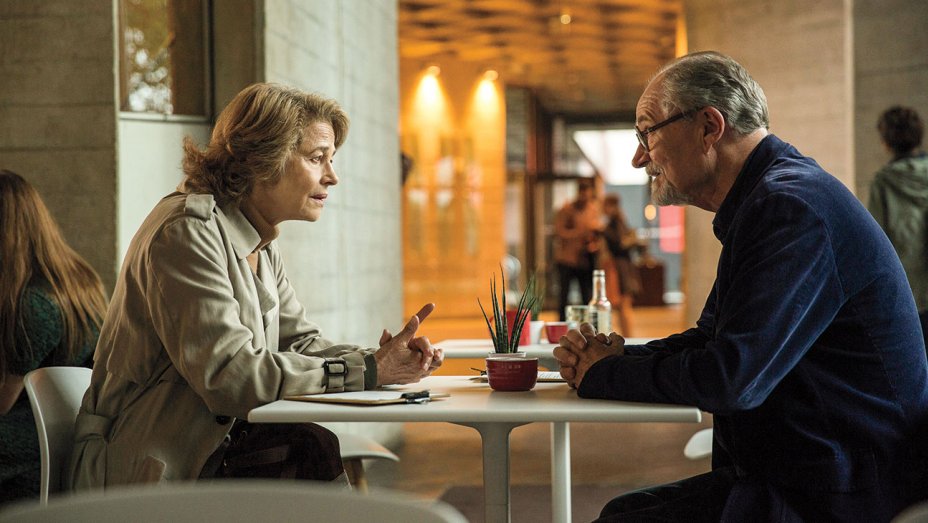
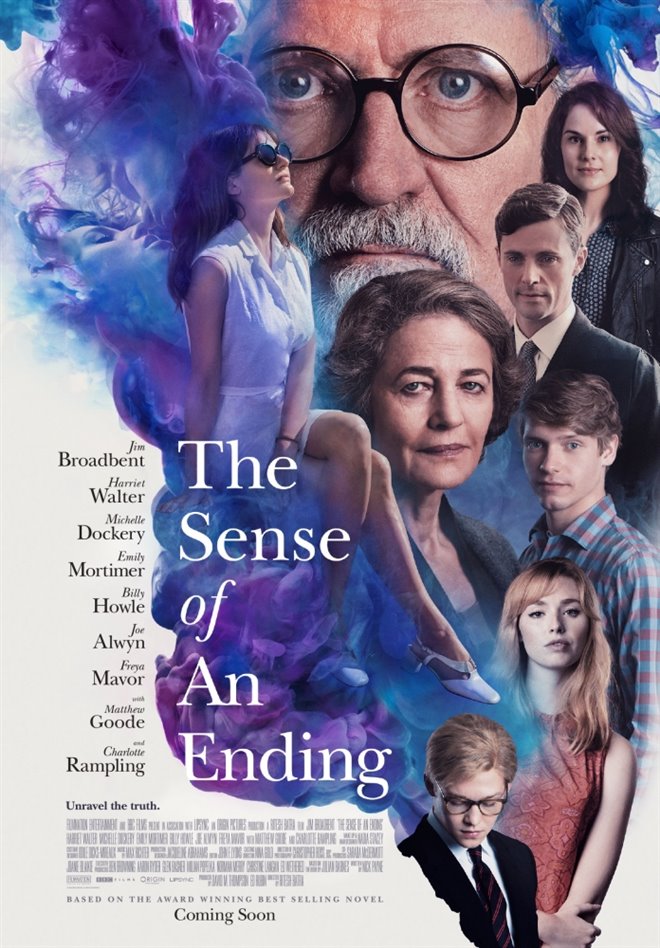
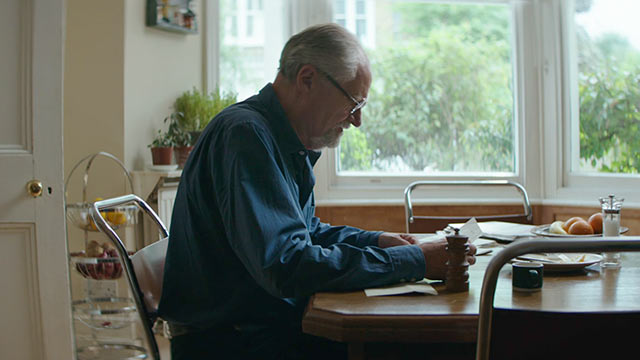
In Ritesh Batra’s first movie since The Lunchbox (2013), Jim Broadbent’s elderly divorcé, Tony Webster, receives a solicitor’s letter telling him that he has been left something in the will of a woman he knew back in the Sixties. The woman was Susan Ford (Mortimer), the mother of Tony’s first love, Veronica (Mavor). At first, Tony is puzzled by the news, and he’s further puzzled when he discovers that the “something” is the diary of a schoolfriend, Adrian Finn (Alwyn). This prompts Tony to reflect back on his life as a university student, and his relationship with Veronica. But getting hold of Adrian’s diary proves more difficult than he expects; it’s in Veronica’s hands and she’s not passing it on to her solicitors’.

Tony seeks advice from his ex-wife, Margaret (Walter), who is also in the legal profession. Margaret, though, can’t understand why getting hold of the diary means so much to Tony, so he attempts to tell her the story of how he and Veronica met, and the beginning of his friendship with Adrian. As he recounts that period of his life, Tony remembers times and events that he had largely forgotten, and he begins to suspect that things were happening that he wasn’t fully aware of. Eventually he persuades Veronica’s solicitors to ask her to contact him, and they arrange to meet. Tony is expectant that he’ll finally receive the diary, but Veronica is distant and tells him that she’s burnt it. After the meeting, Tony follows Veronica but is unable to find out where she lives.

Tony’s memories of his student days continue to plague him, forcing him to remember a letter he wrote when Veronica stopped seeing him and began seeing Adrian instead. The events that followed his sending the letter make Tony view himself in a bad light, but then another attempt to follow Veronica reveals a circumstance that takes him by surprise. In time, this circumstance shows that his understanding of the events of his school days is not only flawed, but has informed the majority of his adult life, something that means Tony has to face up to the idea that he’s lived a life that could have been very much different.

An adaptation of Julian Barnes’ 2011 Man Booker Prize-winning novel, The Sense of an Ending is the kind of low-key, measured drama that offers big rewards provided that you can get past its slow, deceptively pedestrian approach. This is a movie that relies on teasing out the emotional undercurrents of its story, and doing so in a well considered, thoughtful manner that makes each revelation and divulgence of motive more affecting than you might suspect. Barnes’ novel concerned itself with notions of memory and ageing, and while both those aspects are present here, there are others that are equally potent. Adapted by Nick Payne, the movie seeks to explore the ways in which the actions of our youth inform our behaviour as adults, and the ways in which the consequences of those actions can lead to repressed feelings and the slow accumulation of guilt.

At the beginning of the movie, Tony has no understanding of the events that surrounded him as a student, other than how they affected him at the time. However, Tony’s involvement, when looked at closely, was entirely minimal, and as the movie progresses and we see more of those events unfold, what emerges is a portrait of a man trying to attach meaning to a period of his life where he was in many ways a supporting character in the drama of everyone else’s lives. It’s instructive that as an adult Tony’s life is lived somewhat on the fringes as well. He’s divorced though still in touch with his ex-wife, has a daughter whose pregnancy brings them only slightly more together (he attends a pre-natal class with her), and owns a business that sells classic Leica cameras (in a very small shop). It’s not clear that he has any appreciable “life” beyond these things, and his general demeanour is dismissive. He may not be living in the past – until the solicitor’s letter arrives that is – but he’s not exactly living in the present either.

As the past exerts a fearsome pull on Tony, his memories begin to have a profound effect on him, leading him to question what he remembers and what actually happened. Veronica is pre-disposed not to help him, and as her story is revealed you can understand why. But Tony’s determination to solve the mystery of his youth and reconstruct his younger self from the tangle of his memories at least proves cathartic, and by the movie’s end he’s more settled than perhaps he’s ever been. As we follow Tony on his journey of self-rediscovery, we’re guided along the way by another terrific performance from the ever-reliable Broadbent, whose initially perplexed expressions speak of credible bemusement. But soon these give way to expressions of doubt and regret, as the full enormity of what happened all those years ago begins to unravel and Tony’s foundations as an adult begin to crumble. Broadbent allows the audience to see the tragic trajectory of Tony’s life, and the hollow man he’s become, and still he maintains a sympathy for the character that’s not entirely deserved.

Carrying the majority of the movie, Broadbent is simply magnificent in a role that is heartfelt, honest and sincere. He’s also at the top of a very impressive cast, with Rampling excelling as usual as Veronica, a woman who has no time for broad introspection or revisiting a past that is painful to her if not to Tony. The rest of the cast provide sterling support, with special mentions going to Howle as the younger Tony, and Mortimer as Veronica’s mother. Even the likes of Goode and Holcroft (as Tony’s teacher and Veronica’s brother respectively) make an impact despite being given less to do than others, and Alwyn – in only his second movie after Billy Lynn’s Long Halftime Walk (2016) – handles Finn’s philosophical musings with both humour and subtlety.

The contrasts between the past and the present are handled well by Batra and his talented production crew, with Tony’s student days presented in a warm, nostalgic glow that could be considered rose-tinted were it not for the tragic elements at the heart of it all. The present day is much more airy and coolly defined, with sharper colours and rigid edges used to define the emotional trap waiting for Tony to walk into it. Batra displays a confidence with the material that keeps it all feeling genuine and without guile, and as the narrative builds toward its inevitable (and only semi-signposted) revelation, his skill at revealing the various complexities of Tony’s student days becomes more and more evident. And by the time Tony’s daughter has given birth and he’s accepted his life for what it can be rather than what it is, the movie has provided rich dividends for the viewer willing to look beyond its superficially mundane surface.

Rating: 8/10 – something of a mood piece, but bolstered by assured direction, a weighty and compelling script, and skilled performances from its cast, The Sense of an Ending is an engaging and thought-provoking movie that makes a virtue of its earnest and somewhat melancholy narrative; a prime example of a literary adaptation that takes the virtues of its source material and adds a smattering of cinematic probity to the mix, it’s a plaintive, absorbing investigation into the nature of elusive recall and the relationship between memory and remembrance.

Share this:

  • Click to share on X (Opens in new window) X
  • Click to share on Facebook (Opens in new window) Facebook
  • More
  • Click to print (Opens in new window) Print
  • Click to email a link to a friend (Opens in new window) Email
Like Loading...

Monthly Roundup – January 2017

31 Tuesday Jan 2017

Posted by dullwood68 in Movies

≈ 3 Comments

Tags

Action, Animation, Ariel Schulman, Auli'i Cravalho, Chester Morris, Chris Wedge, Chris Williams, D.J. Caruso, Dave Franco, David Yates, Disney, Don Hall, Donnie Yen, Dwayne Johnson, Eddie Redmayne, Emma Roberts, Fantastic Beasts and Where to Find Them, George Sherman, Gerry O'Hara, Guy Hamilton, Heart of a Dog, Henry Joost, Horror, Howard Lovecraft and the Frozen Kingdom, Ian McShane, J.K. Rowling, January 2017, John Musker, Laurie Anderson, Lolabelle, Lucas Till, Moana, Monster Trucks, Monthly roundup, Movies, Nerve (2016), Oliver Reed, Rat terrier, Ray Enright, Reviews, Richard Conte, Ron Clements, Sean Patrick O'Reilly, The Party's Over, The Pleasure Girls, The Sixties, The Sleeping City, Tomorrow at Seven, Vin Diesel, xXx: Return of Xander Cage

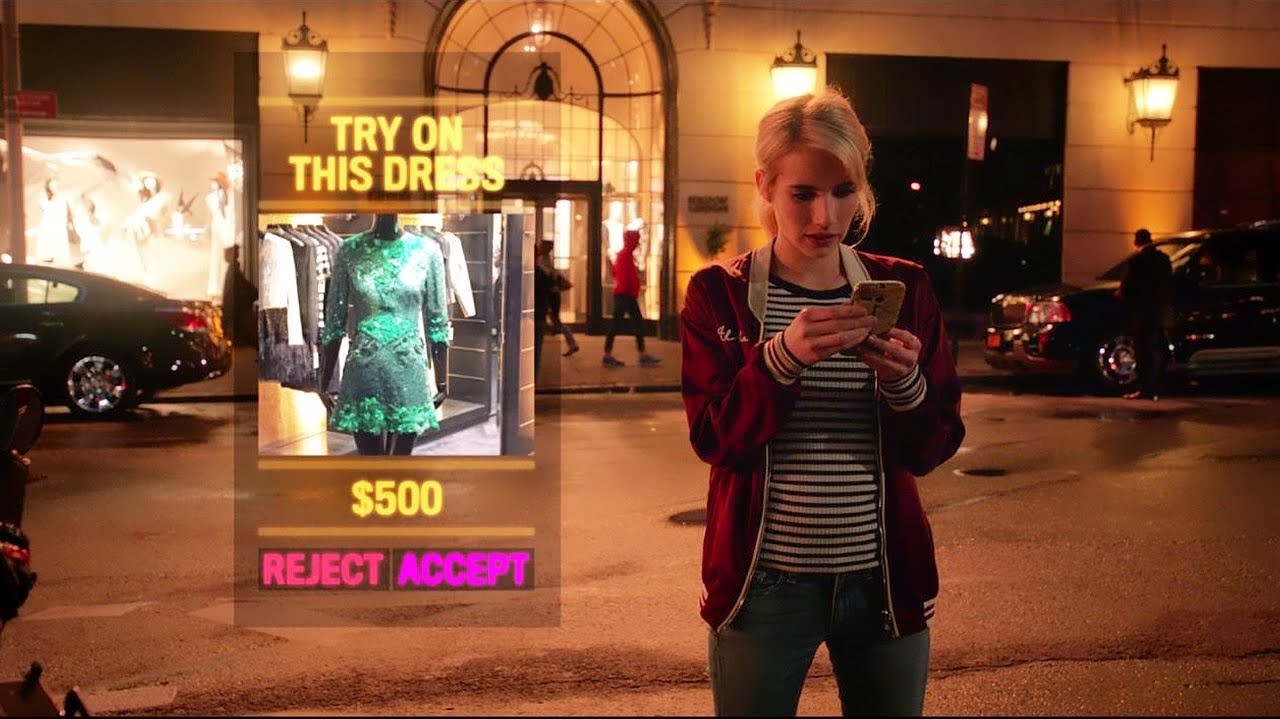
Nerve (2016) / D: Henry Joost, Ariel Schulman / 96m

Cast: Dave Franco, Emma Roberts, Emily Meade, Miles Heizer, Juliette Lewis, Kimiko Glenn, Marc John Jefferies, Colson Baker, Brian Marc

maxresdefault

Rating: 6/10 – an online game of Truth or Dare quickly escalates into something more dangerous than expected when Vee (Roberts) decides to escape her comfort zone and take on the game’s challenges; less than subtle criticisms of the Internet and social media can’t hide the fact that this kind of scenario – teens (mostly) take risks to become “cool” in the eyes of the world – lacks immediacy and a real sense that its characters are in any actual danger, leaving Nerve to flirt with its ideas but never really take them out on a first date.

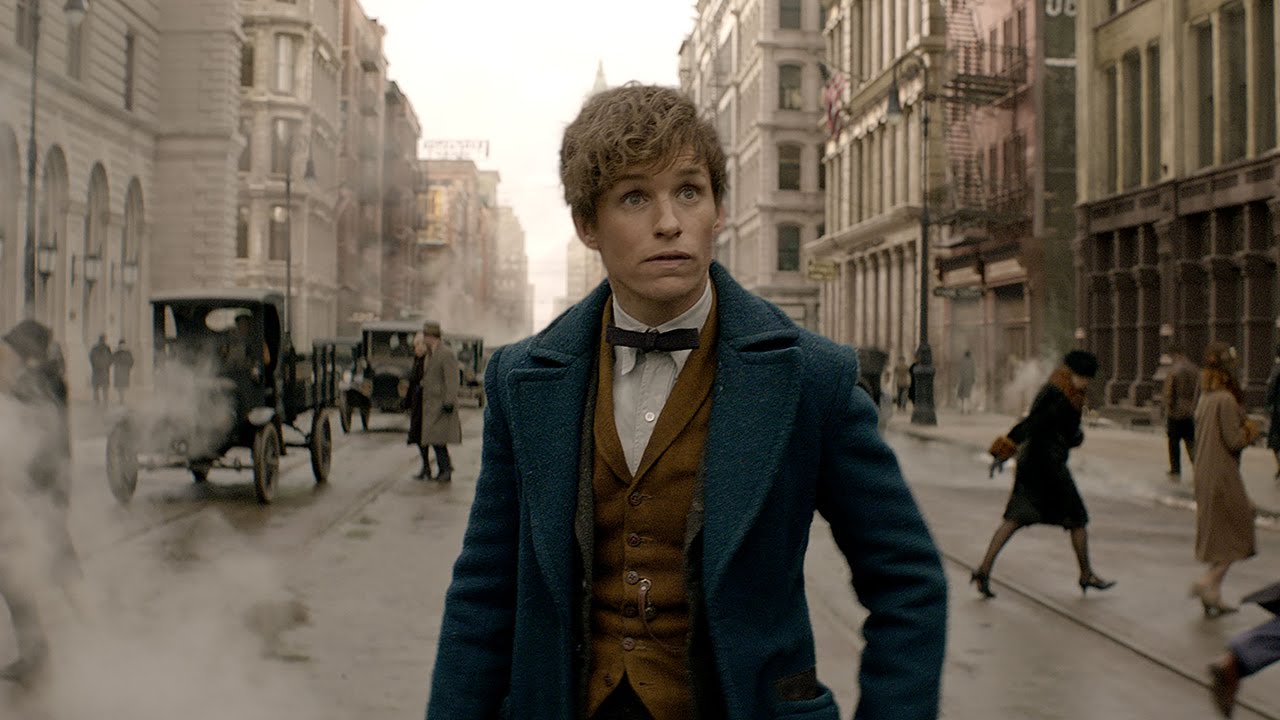
Fantastic Beasts and Where to Find Them (2016) / D: David Yates / 133m

Cast: Eddie Redmayne, Katherine Waterston, Dan Fogler, Colin Farrell, Alison Sudol, Samantha Morton, Ezra Miller, Faith Wood-Blagrove, Jenn Murray, Jon Voight, Ronan Raftery, Josh Cowdery, Ron Perlman, Carmen Ejogo

maxresdefault-1

Rating: 5/10 – in New York in 1926, young wizard, Newt Scamander (Redmayne), arrives with a case full of fantastic beasts (what else?) and finds himself in the midst of an evil plot to boost Warner Bros.’ take at the box office; despite being written by J.K. Rowling, Fantastic Beasts... is littered with characters we never get to know, clumsy demarcations between the wizarding world and that of the Muggles (or No-Maj’s as they’re known here), features another tedious series of destruction-porn episodes, and fosters the overwhelming sense that, despite protestations to the contrary, this is a franchise cash-in and nothing more.

Moana (2016) / D: Ron Clements, John Musker, Don Hall, Chris Williams / 107m

Cast: Auli’i Cravalho, Dwayne Johnson, Rachel House, Temuera Morrison, Jemaine Clement, Nicole Scherzinger, Alan Tudyk

36190303mauiandmoana-1280-1479767753823_large

Rating: 6/10 – when a curse threatens the island she lives on, chief’s daughter Moana (Cravalho) goes in search of the one person who can put things right: the cause of the curse, demi-god Maui (Johnson); following on from the delightful (and fresh) Zootopia (2016), it’s shocking to see just how lightweight Moana is in comparison, with little depth to the characters, and a plot so flimsy it’s almost see-through, all of which leaves the movie’s stunning animation as the only thing that makes an impact.

The Party’s Over (1965) / D: Guy Hamilton / 94m

Cast: Oliver Reed, Clifford David, Ann Lynn, Katherine Woodville, Louise Sorel, Mike Pratt, Maurice Browning, Jonathan Burn, Roddy Maude-Roxby, Annette Robertson, Alison Seebohm, Eddie Albert

cache_2432985076

Rating: 7/10 – an American businessman (David) comes to London to persuade his fiancée (Lynn) to return home and get married, but he finds himself battling against her friends (led by Reed’s anti-Establishment poser), and her sudden disappearance; seen today, The Party’s Over has all the hallmarks of a Sixties curio, but at the time it pushed quite a few boundaries, and fell foul of the British censors, forcing Hamilton to remove his name from the credits – but not before he’d made a fascinating and striking movie that’s only let down by a handful of weak performances and an ending that matches them.

The Sleeping City (1950) / D: George Sherman / 85m

Cast: Richard Conte, Coleen Gray, Richard Taber, John Alexander, Peggy Dow, Alex Nicol

image-w384

Rating: 6/10 – the murder of a doctor at New York’s Bellevue Hospital prompts the police to place three undercover officers there in an attempt to flush out the killer; beginning with an awkward endorsement of the Bellevue staff by Conte (whose inability to read from cue cards is obvious), The Sleeping City soon settles into its film noir trappings but while it’s diverting enough, it doesn’t know what to do with Conte’s lead detective, or how to make its central plot more interesting than it is.

Heart of a Dog (2015) / D: Laurie Anderson / 75m

With: Laurie Anderson

hoad_stills_05_lolaconcert

Rating: 8/10 – a tone poem, an essay, a treatise on the unconditional love a dog has for its owner, and a wider examination of grief and loss allied to the events of 9/11 – this isn’t just about Laurie Anderson’s relationship with her beloved rat terrier, Lolabelle, but about the various ways that love and loss can affect us; at its core, Heart of a Dog is not a documentary, but a collage of distressed film stock, abstract sound and sound effects, Anderson’s performance persona, visual memories, heartfelt imagery and reminiscences, poetic reality, and Anderson’s own unique view of the world and the essential poetic nature of it all, all of which combines to provide the viewer with one of the most intriguing and thought-provoking movies of recent years.

Tomorrow at Seven (1933) / D: Ray Enright / 62m

Cast: Chester Morris, Vivienne Osborne, Frank McHugh, Allen Jenkins, Henry Stephenson, Grant Mitchell, Charles Middleton, Oscar Apfel, Virginia Howell

tomorrowatseven

Rating: 7/10 – the Black Ace is a master criminal/murderer who predicts the time he’ll kill each of his victims, and he never fails, but crime writer Neil Broderick (Morris) is on his trail, and with the help of Black Ace expert, Thornton Drake (Stephenson), is determined to catch him; an old dark house mystery that features light relief (or major annoyance – take your pick) from the double act of McHugh and Jenkins as two of the stupidest cops on the force, Tomorrow at Seven does a good job of playing cat and mouse with the audience, but with so few suspects on display, the identity of the Black Ace is, sadly, all too obvious.

The Pleasure Girls (1965) / D: Gerry O’Hara / 88m

Cast: Ian McShane, Francesca Annis, Mark Eden, Klaus Kinski, Anneke Wills, Tony Tanner, Rosemary Nicols, Suzanna Leigh, Colleen Fitzpatrick, Carol Cleveland

the-pleasure-girls-images-b1253ff6-802d-4e22-a998-7d660e9305d

Rating: 6/10 – Sally (Annis) comes to London to be a model, and soon falls in with a like-minded group of young women looking to find their way in the world – and have a lot of fun at the same time, even though it doesn’t always work out like that; though the focus is in on Sally, her friends, and the various relationships they form, The Pleasure Girls makes more of an impact thanks to its male cast, with McShane, Eden and Kinski (very good) all standing out thanks to strong characterisations and having less soap opera-style dialogue than that of the female cast, and O’Hara’s direction appearing to wander whenever two or more of the girls are on screen.

Monster Trucks (2016) / D: Chris Wedge / 105m

Cast: Lucas Till, Jane Levy, Thomas Lennon, Barry Pepper, Rob Lowe, Holt McCallany, Amy Ryan, Danny Glover, Frank Whaley

monster-trucks

Rating: 7/10 – an oil-drilling operation leads to the release of three “monsters” that live deep underground, but while the oil company captures two of the creatures, the third ends up befriending high school senior, Tripp (Till), who in turn helps it to avoid being captured as well; an innocuous throwback to the kind of fantasy movies made for kids in the Eighties, Monster Trucks is a lot of fun if you let yourself just go with it, and though its message of tolerance and understanding of “foreigners” seems at odds with current notions of US nationalism, it’s still a message we can all stand to hear one more time.

Howard Lovecraft and the Frozen Kingdom (2016) / D: Sean Patrick O’Reilly / 83m

Cast: Kiefer O’Reilly, Sean Patrick O’Reilly, Jane Curtin, Ron Perlman, Christopher Plummer, Alison Wandzura, Tyler Nicol, Doug Bradley

howard-lovecraft-5

Rating: 5/10 – young Howard Lovecraft (Kiefer O’Reilly) finds himself transported to a strange kingdom of ice which is inhabited by equally strange creatures, and where he finds himself searching for both a way back, and a way to reassure his father (Nicol) (who’s locked up in an asylum) that his ravings about other worlds and said creatures are all true; a curious blend of children’s animation and H.P. Lovecraft’s Cthulhu mythos, Howard Lovecraft and the Frozen Kingdom is quite straightforward in its approach, but is let down by poor production values, an animation style that makes it look like a video game from the Nineties, and a script that juggles motivations and dialogue like a one-handed man in a chainsaw-catching competition.

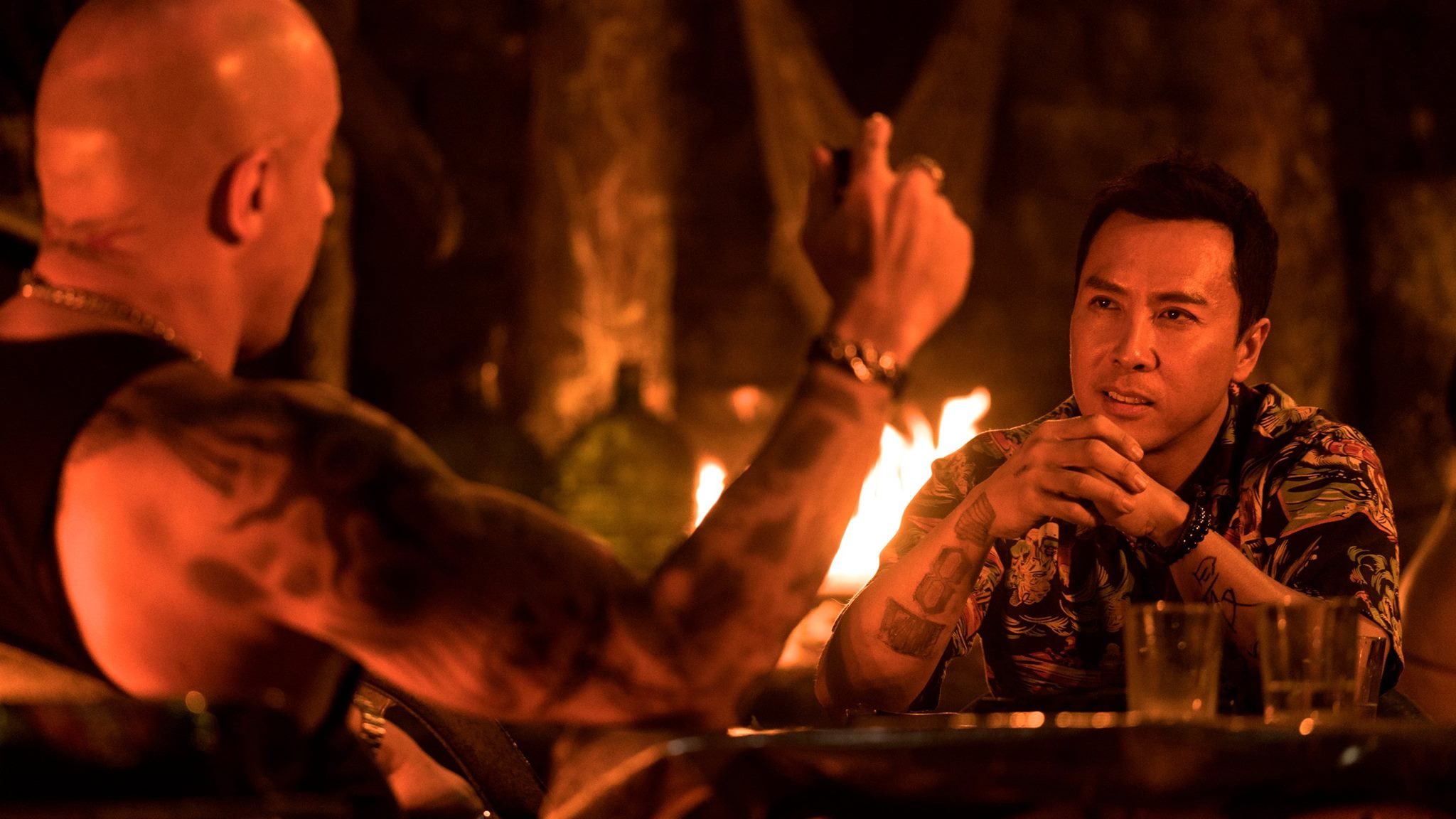
xXx: Return of Xander Cage (2017) / D: D.J. Caruso / 107m

Cast: Vin Diesel, Donnie Yen, Deepika Padukone, Toni Collette, Ruby Rose, Kris Wu, Tony Jaa, Nina Dobrev, Rory McCann, Michael Bisping, Samuel L. Jackson

xxx-the-return-of-xander-cage-vin-diesel-donnie-yen

Rating: 4/10 – the world is in peril from yet another technological McGuffin, and it’s up to extreme sports enthusiast/secret agent Xander Cage (Diesel) to save the day; with Diesel unable to get The Last Witch Hunter (2015) off the ground as another franchise earner, it’s no surprise that he’s returned to a character he left behind fifteen years ago, but this is as uninspired and as predictable as you’d expect, and only Yen’s (always) impressive physicality makes any kind of an impact.

Share this:

  • Click to share on X (Opens in new window) X
  • Click to share on Facebook (Opens in new window) Facebook
  • More
  • Click to print (Opens in new window) Print
  • Click to email a link to a friend (Opens in new window) Email
Like Loading...

Mini-Review: The Man from U.N.C.L.E. (2015)

19 Wednesday Aug 2015

Posted by dullwood68 in Movies

≈ 1 Comment

Tags

Action, Alicia Vikander, Armie Hammer, Atom bomb, CIA, Cold War, Drama, Elizabeth Debicki, Guy Ritchie, Henry Cavill, Hugh Grant, Ilya Kuryakin, KGB, Napoleon Solo, Review, Spies, The Sixties, Thriller, U.N.C.L.E.

Man from U.N.C.L.E., The

D: Guy Ritchie / 116m

Cast: Henry Cavill, Armie Hammer, Alicia Vikander, Elizabeth Debicki, Luca Calvani, Sylvester Groth, Hugh Grant, Jared Harris, Christian Berkel, Misha Kuznetsov

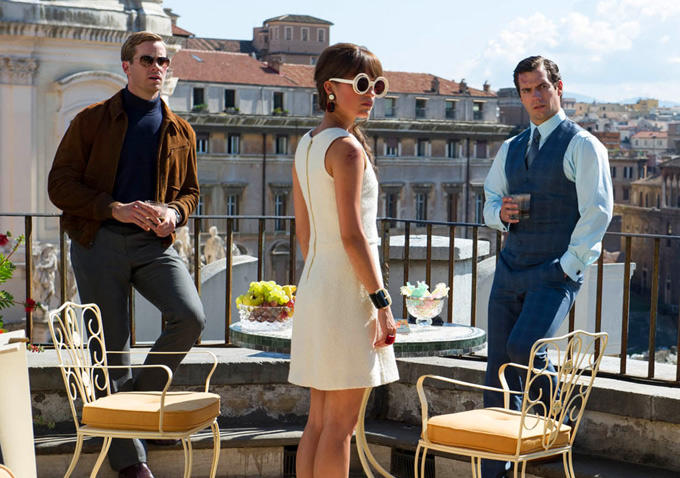
Following his rescue of a scientist’s daughter, Gaby Teller (Vikander) from East Berlin, CIA agent Napoleon Solo (Cavill) is told by his boss (Harris) that he has a new partner: the KGB agent who tried to stop him, Ilya Kuryakin (Hammer). Gaby’s father, Udo (Berkel), is building an atom bomb that’s intended for a hidden Nazi group. Her Uncle Rudi (Groth) is suspected of knowing where he is. Solo and Kuryakin must take Gaby to Rome where evidence points to the involvement of the Alexanders (Calvani, Debicki). While Solo poses as an antiquities dealer, Kuryakin poses as Gaby’s fiancé. Solo and Kuryakin attend a party given by Victoria Alexander where they discover evidence that the atom bomb (and Udo) must be nearby. That night they both break in to the Alexanders’ factory where they find further evidence of Udo’s work.

Solo meets with Victoria but she drugs his drink. When he wakes he finds himself strapped to a chair and about to be tortured by Uncle Rudi who turns out to be an evil Nazi scientist. With Kuryakin’s aid he escapes, while Gaby is taken to an island where her father is putting the finishing touches to the bomb. It’s at this point that Solo and Kuryakin are introduced to Commander Waverly (Grant), a member of British intelligence. He fills them in on some information that’s been held back from them, and reveals a plan to infiltrate the island, seize the atom bomb, and rescue Gaby and her father. But the Alexanders have an ace up their sleeve…

Man from U.N.C.L.E., The - scene

The Man from U.N.C.L.E. (on the big screen at least) has been a long time coming. But up until the recent involvement of Ritchie and his producing partner Lionel Wigram, every attempt to make a movie version of the classic 60’s TV show has stalled, often before it’s even cleared the gate. Coming off two very successful Sherlock Holmes movies, Ritchie has clearly been given as much leeway as he needs in order to bring this movie to audiences, and while he uses many of the stylistic shooting techniques he used on the Holmes movies, what he’s failed to do is come up with a story that is either exciting or engrossing. It’s a shame as the potential is there for another successful franchise, but aside from a splendidly retro feel for the era, the movie lacks the kind of impact that would lift it out of the bin marked “ordinary”.

Things aren’t helped by the casting of Cavill and Hammer, two averagely effective actors who lack the subtlety required to make Solo and Kuryakin anything more than grudging partners. Sure it’s an origin story so the animosity is understandable, but they’re also highly skilled professionals, the best at what they do; so why make Solo a preening plank, or Kuryakin a headstrong liability? It’s a curious decision, to make your two leading men so unrelatable, but Ritchie’s gone with it completely, and the movie suffers appropriately. Thankfully, the same can’t be said of Vikander and Debicki, who save the movie from being too much of a debacle, and the involvement of Grant, who seems to be having the most fun he’s had in years. If there is to be a sequel – and at the moment the movie’s performance at the box office seems to indicate there won’t be – then a serious rethink is in order.

Rating: 5/10 – not as bad as it could have been, but also not as good as it should have been, The Man from U.N.C.L.E. lacks energy and limps uneasily from scene to scene in search of a consistently entertaining tone that it doesn’t find; a pleasant enough diversion if you’re in the mood, but definitely not a movie to expect too much from.

Share this:

  • Click to share on X (Opens in new window) X
  • Click to share on Facebook (Opens in new window) Facebook
  • More
  • Click to print (Opens in new window) Print
  • Click to email a link to a friend (Opens in new window) Email
Like Loading...

Match (2014)

30 Monday Mar 2015

Posted by dullwood68 in Movies

≈ Leave a comment

Tags

Carla Gugino, Dance, Dance community, Dissertation, DNA, Drama, Interview, Matthew Lillard, Paternity, Patrick Stewart, Review, Stephen Belber, The Sixties, Theatre production

Match

D: Stephen Belber / 92m

Cast: Patrick Stewart, Carla Gugino, Matthew Lillard, Jaime Tirelli

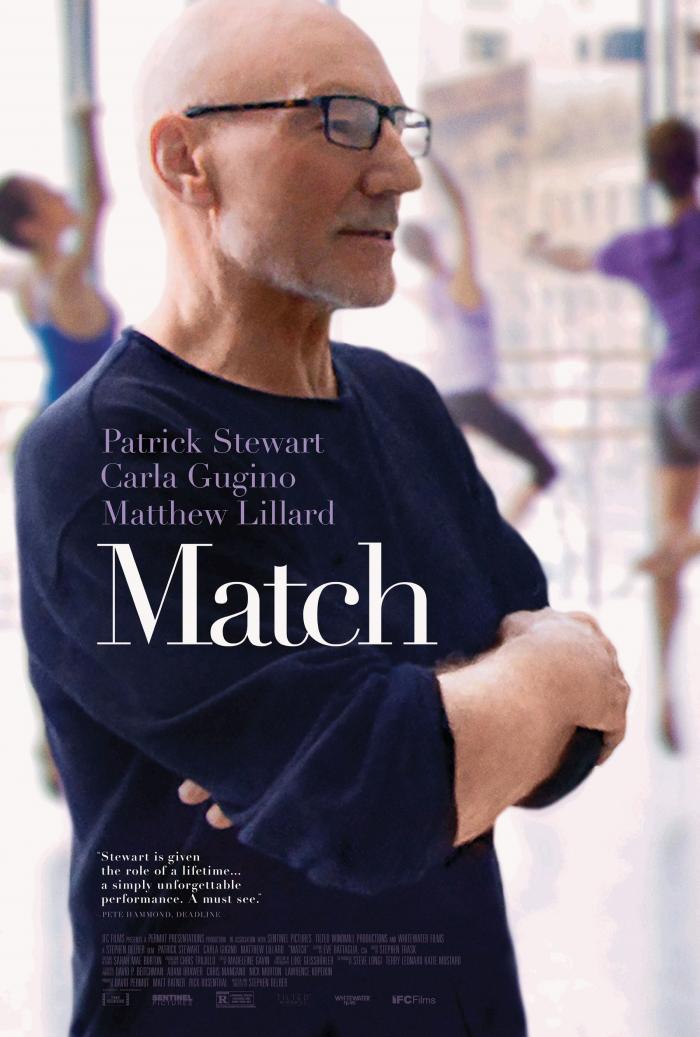
Tobi Powell (Stewart) is an aging ballet instructor at Juilliard. He’s a lonely man, given to rejecting offers of friendship from his colleagues, and he lives by himself in an apartment in New York’s Inwood hamlet. Despite this he agrees to give an interview to Lisa Davis (Gugino) who is writing a dissertation on the dance community during the Sixties. Accompanied by her husband, Mike (Lillard), the three meet in Tobi’s favourite Greek diner. Lisa is bright and attentive to Tobi’s flamboyant personality, while Mike is more reserved. The interview continues at Tobi’s apartment, but Mike, who is ostensibly there to support his wife, begins to ask more pointed questions about the Sixties and in particular, Tobi’s sexual liaisons.

Tobi is initially perplexed by Mike and Lisa’s focus on the sexual mores of the period until they mention the name of a dancer he knew called Gloria Rinaldi. Tobi had a brief affair with her in the latter part of 1967, but she gave up a potential career as a dancer to have a child. That child is Mike and he thinks Tobi is his father. Tobi denies being this and tells them both that it would have been impossible as he always wore a condom in those days. Mike doesn’t believe him and becomes aggressive; Tobi asks them both to leave. Instead, Mike refuses and pins down Tobi so he can take a DNA swab from Tobi’s mouth. Having got what he came for, he leaves, but not before Lisa has made it clear that she’s unhappy with the way things have gone.

While Mike heads for a nearby forensics lab where a friend works, Lisa stays with Tobi and they begin to bond over prune pastries and Tobi’s love of knitting. He lets her know he can see the cracks in her marriage to Mike, and Lisa admits Mike has become a different man in recent months as the idea of finding and confronting Tobi has eaten away at him. Moved by Lisa’s honesty, Tobi shows a newspaper clipping he’s kept from when Mike was fifteen and he’d taken part in a fencing competition. He reveals that he knew Gloria was pregnant and that she asked him to be the child’s father but he refused; instead he decided to focus on building his career. And when he saw the newspaper clipping he sent Gloria a sum of money towards Mike’s college fund. But with all this he still can’t be Mike’s father: it’s all too late.

When Mike returns to the apartment, both men are forced to confront some unpleasant truths about each other, while Lisa is left to hope that some degree of reconciliation can be found.

Match - scene

Originally a stage play by writer/director Belber that opened in 2004 (and featured Frank Langella, Jane Adams and Ray Liotta as Tobi, Lisa and Mike respectively), Match still retains the look and feel of a stage play and the type of staging that betrays its theatrical origins. That’s not an entirely bad thing, but it does contribute to several occasions during the narrative where certain developments feel artificial and/or forced.

There’s always a degree of contrivance that accompanies a theatrical adaptation, and Match is no exception. In opening out his play from the constraints of Tobi’s apartment, Belber has chosen to also constrict it (the play ran half an hour longer), and while this possibly helps, there is still a sense that the story gets a little rushed once the trio reach Tobi’s humble abode. Following a number of flamboyant embellishments to his answers, and as many sidetrack comments as he can muster, Tobi is side-swiped by Mike’s bullish demeanour, and while there’s an argument that the movie needs to pick up some speed – and get to the crux of the matter – by this point, it’s done in such a clumsy way that Belber’s careful character building is given the cinematic equivalent of a knee-capping.

From here on until the end of the movie, Match struggles to regain the momentum it has carefully built up, and the characters’ attempts at connecting with each other become more unlikely and more laboured. Tobi and Lisa at one point have a discussion about the pleasures of giving and receiving cunnilingus, as unlikely a conversation as any that two strangers would have within a couple of hours of meeting. They go through Tobi’s collection of self-made knitwear and go up to the roof where Tobi tries to get Lisa to dance. It’s uncomfortably like a courtship, and despite Tobi’s obvious homosexuality, these events still provoke an uncertainty about Belber’s motives in putting these two characters together for so long. And when Mike returns, his confrontation with Tobi is resolved – with admirable speed, but at the expense of a fair degree of credibility.

With the narrative proving unwieldy and uneven, it’s a good thing that Belber has chosen well with his cast. Tobi is the kind of camp, peacockish character that an actor of Stewart’s calibre can bring to life with the twitch of an eyebrow, or the shake of a scarf. He dominates the movie, revelling in Tobi’s arch, semi-pretentious musings, his passion for life at odds with his self-enforced solitude, and still having an insatiable curiosity about the lives of others. It’s a performance that appears effortless, and Stewart is hypnotic throughout, smoothing over the cracks in Belber’s script with a well-timed expression here and a well-considered line reading there. He’s ably supported by Gugino, though Lisa appears largely out of her depth in the situation, two steps away from being entirely subordinate to her husband. When Tobi recognises the problems in their marriage, Gugino shows Lisa to be a woman looking for the answers to questions she hasn’t thought of, and displays the character’s sad-hearted vulnerability with admirable understated precision.

Unfortunately for Lillard, Mike is required to be a kind of aggressive deus ex machina, bulldozing his tight-lipped way through Tobi’s rambling reminiscences and being unnecessarily abusive to Lisa. It’s a dangerously underwritten part, but Lillard manages to salvage some of the pent-up sadness and disappointment Mike has been feeling throughout his life, and he makes it all the more evident when he challenges Tobi’s assertion that Gloria chose her life.

Belber proves to be an erratic director, depending too much on close ups to impart sincere emotion, and never quite knowing where to place the camera in Tobi’s apartment, leading to some odd framing that sees the characters either squeezed into shot and/or suffering a kind of temporary dismemberment. The scene at the forensics lab is dramatically unnecessary (but does remind us that Mike is still part of the story), and the ending, while entirely predictable, is an example of the way in which Belber wants to both punish and celebrate Tobi’s decision all those years ago, but can’t make up his mind which is the more appropriate.

Rating: 6/10 – with strong, committed performances from its main cast, Match maintains the audience’s interest despite some clumsy, ill-considered plot developments and a sense that it’s all a bit too overwrought for it’s own good; the fact that it’s taken ten years to reach the screen may give potential viewers enough of a warning, however, not to expect too much.

Share this:

  • Click to share on X (Opens in new window) X
  • Click to share on Facebook (Opens in new window) Facebook
  • More
  • Click to print (Opens in new window) Print
  • Click to email a link to a friend (Opens in new window) Email
Like Loading...

Blog Stats

  • 490,512 hits

Recent Posts

  • 10 Reasons to Remember Bibi Andersson (1935-2019)
  • Fantasia (1940)
  • Dances With Wolves (1990) – The Special Edition
  • Kiss of the Spider Woman (1985)
  • The Three Musketeers (1973)

Top Posts & Pages

  • The Dark Tower (2017)
    The Dark Tower (2017)
  • The White Orchid (2018)
    The White Orchid (2018)
  • Central Intelligence (2016)
    Central Intelligence (2016)
  • Taken (2008)
    Taken (2008)
  • Lost for Life (2013) - Another Look
    Lost for Life (2013) - Another Look
  • Captain Fantastic (2016)
    Captain Fantastic (2016)
  • Miss Baek (2018)
    Miss Baek (2018)
  • Two Shorts by François Ozon: A Summer Dress (1996) and X2000 (1998)
    Two Shorts by François Ozon: A Summer Dress (1996) and X2000 (1998)
  • Cardboard Boxer (2016)
    Cardboard Boxer (2016)
  • A Brief Word About Cineworld Unlimited
    A Brief Word About Cineworld Unlimited
Follow thedullwoodexperiment on WordPress.com

Blogs I Follow

  • Rubbish Talk
  • Film 4 Fan
  • Fast Film Reviews
  • The Film Blog
  • All Things Movies UK
  • Interpreting the Stars
  • Let's Go To The Movies
  • Movie Reviews 101
  • TMI News
  • Dan the Man's Movie Reviews
  • Film History
  • Jordan and Eddie (The Movie Guys)

Archives

  • April 2019 (13)
  • March 2019 (28)
  • February 2019 (28)
  • January 2019 (32)
  • December 2018 (28)
  • November 2018 (30)
  • October 2018 (29)
  • September 2018 (29)
  • August 2018 (29)
  • July 2018 (30)
  • June 2018 (28)
  • May 2018 (24)
  • April 2018 (21)
  • March 2018 (31)
  • February 2018 (25)
  • January 2018 (30)
  • December 2017 (30)
  • November 2017 (27)
  • October 2017 (27)
  • September 2017 (26)
  • August 2017 (32)
  • July 2017 (32)
  • June 2017 (30)
  • May 2017 (29)
  • April 2017 (29)
  • March 2017 (30)
  • February 2017 (27)
  • January 2017 (32)
  • December 2016 (30)
  • November 2016 (28)
  • October 2016 (30)
  • September 2016 (27)
  • August 2016 (30)
  • July 2016 (30)
  • June 2016 (31)
  • May 2016 (34)
  • April 2016 (30)
  • March 2016 (30)
  • February 2016 (28)
  • January 2016 (35)
  • December 2015 (34)
  • November 2015 (31)
  • October 2015 (31)
  • September 2015 (34)
  • August 2015 (31)
  • July 2015 (33)
  • June 2015 (12)
  • May 2015 (31)
  • April 2015 (32)
  • March 2015 (30)
  • February 2015 (37)
  • January 2015 (39)
  • December 2014 (34)
  • November 2014 (34)
  • October 2014 (36)
  • September 2014 (25)
  • August 2014 (29)
  • July 2014 (29)
  • June 2014 (28)
  • May 2014 (23)
  • April 2014 (21)
  • March 2014 (42)
  • February 2014 (38)
  • January 2014 (29)
  • December 2013 (28)
  • November 2013 (34)
  • October 2013 (4)

Create a free website or blog at WordPress.com.

Rubbish Talk

Film 4 Fan

A Movie Blog

Fast Film Reviews

The Film Blog

The official blog of everything in film

All Things Movies UK

Movie Reviews and Original Articles

Interpreting the Stars

Dave Examines Movies

Let's Go To The Movies

Film and Theatre Lover!

Movie Reviews 101

Daily Movie Reviews

TMI News

Latest weather, crime and breaking news

Dan the Man's Movie Reviews

All my aimless thoughts, ideas, and ramblings, all packed into one site!

Film History

Telling the story of film

Jordan and Eddie (The Movie Guys)

Movie Reviews & Ramblings from an Australian Based Film Fan

Privacy & Cookies: This site uses cookies. By continuing to use this website, you agree to their use.
To find out more, including how to control cookies, see here: Cookie Policy
  • Subscribe Subscribed
    • thedullwoodexperiment
    • Join 481 other subscribers
    • Already have a WordPress.com account? Log in now.
    • thedullwoodexperiment
    • Subscribe Subscribed
    • Sign up
    • Log in
    • Report this content
    • View site in Reader
    • Manage subscriptions
    • Collapse this bar
 

Loading Comments...
 

    %d