• 10 Reasons to Remember…
  • A Brief Word About…
  • About
  • For One Week Only
  • Happy Birthday
  • Monthly Roundup
  • Old-Time Crime
  • Other Posts
  • Poster of the Week
  • Question of the Week
  • Reviews
  • Trailers

thedullwoodexperiment

~ Viewing movies in a different light

thedullwoodexperiment

Tag Archives: Liev Schreiber

RKO 281 (1999)

19 Wednesday Jul 2017

Posted by dullwood68 in Movies

≈ Leave a comment

Tags

Benjamin Ross, Catch Up movie, Drama, History, James Cromwell, John Malkovich, Liev Schreiber, Melanie Griffith, Orson Welles, Review, RKO Pictures, True story, William Randolph Hearst

D: Benjamin Ross / 87m

Cast: Liev Schreiber, James Cromwell, Melanie Griffith, John Malkovich, Brenda Blethyn, Roy Scheider, Liam Cunningham, David Suchet, Fiona Shaw, Anastasia Hille

In 1939, Orson Welles (Schreiber), the “boy wonder”, signed a movie contract with RKO Pictures. He was given unprecedented freedom to make whatever movie he wanted (though RKO hoped he would make a movie version of his infamous War of the Worlds radio broadcast). After two attempts at making his first picture, Welles, along with old friend and writer Herman J. Mankiewicz (Malkovich) came up with the idea of making a loosely fictionalised version of the life of publishing magnate William Randolph Hearst (Cromwell). Welles regarded Hearst as a hypocrite and a monster, a man richly deserving of being exposed in much the same way that Hearst’s newspapers had done to others. Welles considered he had nothing to lose by making such a movie, but before long it became something much more personal, and with a great deal of meaning for him. RKO 281 – Citizen Kane‘s production number – shows how the movie came to be made, some of the pitfalls along the way, and the pressure Hearst tried to exert in order to make the movie disappear without the public ever seeing it.

Like many an acknowledged classic, Citizen Kane didn’t just appear out of nowhere. In RKO 281, we see the genesis of both the myth and the legend, and the movie itself. After a year in Hollywood, and with nothing to show for his efforts, Welles was already being looked upon as a failure, a circumstance that didn’t bother him in the slightest, but which would spur him on to make a movie that is generally regarded as the best American movie ever made. Based in part on the documentary The Battle Over Citizen Kane (1996), RKO 281 begins with Welles’ arrival in Hollywood, his fame preceeding him. Persuaded to come out there by RKO head George J. Schaefer (Scheider), Welles attends a dinner held by Hearst and is appalled by the man’s attitude and takes immediate offence. Soon he’s telling Mankiewicz that Hearst is the perfect subject for his first movie. But Mankiewicz isn’t so sure and tries to warn Welles of the trouble he’ll face if he goes ahead with his plan.

Soon, however, they have a screenplay, and though the two men have a falling out over Mankiewicz’s name being removed from the final script, the movie goes ahead and production begins in earnest. But Welles is soon behind, his quest for perfection causing delays and production overspends. The industry, still unaware of the content of Welles’ movie, predicts it will be a disaster. It’s only when news of its focus reaches the ears of Hearst that the possibility of its truly being a disaster becomes more likely. Determined to ensure that the movie, originally titled American, is never shown in cinemas, Hearst brings pressure to bear on the heads of the other studios, partly by playing the race card – that the heads were all Jewish wasn’t widely known or acknowledged – and partly by threatening to expose the immoral activities of their stars. While everyone else around him views Hearst as being entirely capable of destroying Welles’ career, and their own if he so wishes, it’s left to Welles to fight for his movie. Help, though, comes in an unexpected form…

The story behind the making of Citizen Kane is often as fascinating as the actual movie itself, and though RKO 281 uses The Battle Over Citizen Kane as its template for John Logan’s vigorous screenplay, there’s still a sense that this is a movie going over old ground, and without achieving the same effect. Logan certainly hits his mark as it were, and there are some priceless lines of dialogue – Mankiewicz on San Simeon, the massive estate where Hearst lived: “it’s the place God would have built if he had the money” – but once Hearst becomes aware of just how much of his life Welles has appropriated for Citizen Kane, the movie makes an unjustified attempt at becoming a thriller, with Welles’ career on the line versus Hearst’s reputation. And despite a passionate performance by Schreiber, and with the outcome already known in advance, the movie struggles to make Hearst’s threats as worrying as they must have been at the time, and he comes across as a petulant control freak. The same can be said for Welles also, and the movie makes the point several times over that the two men were very similar, but in doing this so often, it lessens the impact of what the movie is trying to say.
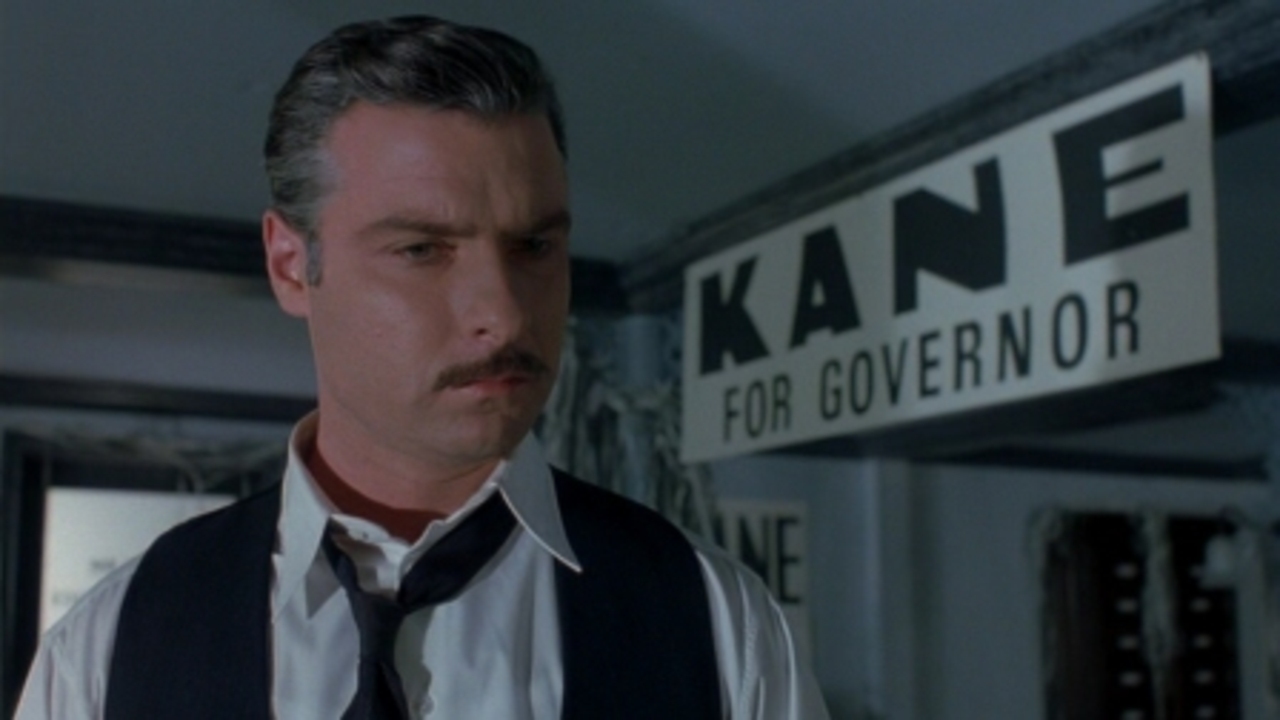
Before then, the movie focuses on the making of Citizen Kane, and here the movie is on firmer ground, replicating the ups and downs of the production with a great deal of enthusiasm, and recreating events such as the time that Welles had a massive hole dug in the studio floor to facilitate a particular low-level shot he wanted (apparently he never thought of raising the set instead). His relationship with the cinematographer, Gregg Toland (Cunningham) is also explored, but ultimately it’s his friendship with Mankiewicz that gets the most screen time, and the ways in which Welles exploited his friend’s talent. Both Schreiber and Malkovich relish the dialogue they’re given in their scenes together, and these scenes are some of the best in the movie, with both men sparking and feeding off each other to very good effect. Cromwell injects a little bit of pathos into his portrayal of Hearst, but it’s not enough to offset the idea that here is a man whose monomania – himself – has become a lifestyle choice. As the former silent actress Marion Davies, Griffith gives a sympathetic and sincere performance, while Scheider is equally good as the put-upon studio head who puts his career on the line to ensure Welles succeeds in getting his own off the ground.

The movie is attractively shot and lit by DoP Mike Southon, and there are some well chosen contemporary numbers on the soundtrack, but though the script is good enough to tell the story in a slightly lumbering fashion (there are very few highs and lows to help capture the intensity of the production itself), Ross’s direction is too pedestrian to elevate the material above that of solid and dependable. Too many scenes lack the energy to push the narrative forward with any real conviction, while others are repetitive in nature, as if the audience wouldn’t understand things the first time. And that’s without the scene near the end where the story contrives to have Welles and Hearst alone in an elevator – let the verbal sparring commence! It’s an unnecessary cinematic cliché that’s included in a movie about another movie that was anything but clichéd.

Rating: 7/10 – a mixed bag of a movie, with good performances overcoming several narrative slip-ups, RKO 281 is mostly intriguing if you don’t know the story, and fairly run of the mill if you do; still, it’s a movie that’s largely entertaining despite itself, and as a passive recreation of the making of one of the most influential features of all time, it’s effective without being too demanding. (18/31)


Share this:

  • Click to share on X (Opens in new window) X
  • Click to share on Facebook (Opens in new window) Facebook
  • More
  • Click to print (Opens in new window) Print
  • Click to email a link to a friend (Opens in new window) Email
Like Loading...

Fading Gigolo (2013)

07 Friday Jul 2017

Posted by dullwood68 in Movies

≈ Leave a comment

Tags

Comedy, Drama, Escort, John Turturro, Liev Schreiber, Review, Romance, Sharon Stone, Sofía Vergara, Vanessa Paradis, Woody Allen

D: John Turturro / 90m

Cast: John Turturro, Woody Allen, Vanessa Paradis, Liev Schreiber, Sharon Stone, Sofía Vergara, Tonya Pinkins, Bob Balaban

Question: when is a Woody Allen movie not quite a Woody Allen movie? Answer: when it’s written and directed by John Turturro… who’s had help from Woody Allen in assembling the script. A broad romantic comedy with a large helping of sympathy for its characters, Turturro’s fifth outing in the director’s chair is an engaging, likeable movie that has all the hallmarks of a Woody Allen movie, but then tweaks them in varied and surprising ways.

It begins with Turturro’s character, Fioravante, helping his friend, Murray (Allen), with the closure of his bookstore. Looking for a new business opportunity, Murray reveals that his dermatologist, Dr Parker (Stone), revealed to him during an appointment that she and a girlfriend of hers, Robbie (Vergara), are looking to engage in a ménage à trois. As Dr Parker is willing to pay for the experience, Murray suggests that Fioravante is the man they need, but he’s initially resistant to the idea. Eventually, Murray convinces his friend to take the “job” and contacts Dr Parker. She decides to meet Fioravante on her own to see if he will be suitable. He passes the test and soon, Dr Parker is recommending his services to some of her friends, while Murray is drumming up clients in his own fashion.

Fioravante’s success as an escort leads to an unexpected encounter. Through Murray, Fioravante meets the widow of a Hassidic Jew, Avigal (Paradis). They begin a tentative relationship that attracts the attention of Dovi, who works for Shomrim, a neighbourhood patrol. He has been in love with Avigal since they were teenagers, and he begins to follow her when she leaves the neighbourhood. While Fioravante and Avigal spend more and more time together, Dr Parker finally decides the time is right for the planned threesome to go ahead. But just at the point that Fioravante realises that he’s in love with Avigal, Dovi grabs Murray off the street and takes him to face a Rabbinic court. His involvement with Avigal is questioned, and it takes an unexpected intervention to resolve matters once and for all.

From the very beginning, Fading Gigolo is a genial, simple, romantic comedy drama that does what it does with equanimity, and which never tries to go beyond its basic remit. It’s this self-awareness that helps the movie immensely, and while the characters are largely stereotypical and written in broad brush strokes, Turturro’s direction encourages his talented cast to portray them with small, idiosyncratic details that help enhance the material as a whole. Turturro, both as director and actor, is generous with his cast, and his lack of selfishness in front of the camera is reflected in his largesse behind it.  Turturro also encourages his cast to underplay their emotions and provide more subtle character beats than would be expected (Stone in particular is good as a confident professional whose vulnerability is revealed during her first meeting with Fioravante). There’s a lot going on below the surface a lot of the time, and more is relayed to the viewer by the characters’ expressions than by the dialogue.

This allows the viewer to respond to the material to a much greater degree than might be expected. As a result, the movie gains increasing credibility as a romantic drama, and the cast respond accordingly. As it slips off its comedic mantle in favour of dealing properly with the emotional and relationship issues that have arisen, Turturro ensures each development is accorded the relevant amount of sincerity and pathos (except for Balaban’s appearance as Murray’s lawyer at the Rabbinic court, a turn that is resolutely out of place, and is the one major lapse in Turturro’s direction). The emerging friendship between Fioravante and Avigal is treated with a tenderness and a subtlety that mirrors the mutual uncertainty that both are feeling, and Paradis perfectly expresses the sadness and the hope that Avigal feels as both a widow and a woman. In comparison, Turturro keeps his performance reined in, barely moving, and keeping his dialogue to a minimum, and yet still expressing his character’s anxieties and sense of anticipation. The outcome of their relationship is never in doubt – such is the entirely foreseeable nature of the screenplay – but when it comes it, it’s a brief and affecting moment that in a very succinct fashion, highlights exactly why the outcome is what it is.

Allen’s participation is unusual in that he rarely appears in other people’s movies these days – the last time was in Alfonso Arau’s Picking Up the Pieces (2000), which also featured Stone – but what isn’t a surprise is that he plays yet another minor variation on the neurotic Jewish intellectual-cum-nebbish he’s been playing for over fifty years. He does infuse the role with a desperate, greedy quality we haven’t seen before, but otherwise it’s business as usual. Fortunately, Allen’s presence doesn’t overwhelm things, and his supporting role is integrated effectively into the main storyline. Again, there are many similarities between this movie and others that Allen has made over the years, enough perhaps to make him feel comfortable in taking on the part. But though his involvement in the script has been confirmed by Turturro, this isn’t a movie that anyone could say Allen directed. Turturro has his own style, and he approaches the characters in a very different way from the way that Allen does. And faced with such a predictable plot to begin with, that Turturro does overcome it is a sign of the actor’s confidence in being a director.

Rating: 7/10 – funny and dramatic in equal measure, Fading Gigolo never loses sight of what’s important and at the heart of its tale: how much we want to connect, and how much we’re willing to give of ourselves in order to make that connection; Turturro makes it all look relatively easy, and does so by remembering that every character (even Murray) is looking for love in some form or other, and that even if it’s provided by an escort, it can still be fulfilling and/or the right choice. (7/31)

Share this:

  • Click to share on X (Opens in new window) X
  • Click to share on Facebook (Opens in new window) Facebook
  • More
  • Click to print (Opens in new window) Print
  • Click to email a link to a friend (Opens in new window) Email
Like Loading...

The 5th Wave (2016)

13 Wednesday Apr 2016

Posted by dullwood68 in Movies

≈ Leave a comment

Tags

Alex Roe, Alien invasion, Aliens, Chloë Grace Moretz, Drama, J Blakeson, Liev Schreiber, Literary adaptation, Maria Bello, Nick Robinson, Review, Rick Yancey, Sci-fi, Thriller, Wright Patterson Air Force Base, YA novel

The 5th Wave

D: J Blakeson / 112m

Cast: Chloë Grace Moretz, Nick Robinson, Alex Roe, Liev Schreiber, Maria Bello, Ron Livingston, Maggie Siff, Zackary Arthur, Maika Monroe, Tony Revolori, Talitha Bateman, Cade Canon Ball, Alex MacNicoll, Nadji Jeter, Gabriela Lopez

It’s actually hard to know where to start with The 5th Wave. (It’s equally hard to know where to finish as well.) Yet another adaptation of the first in a trilogy of YA novels – this time by Rick Yancey – the movie has so many problems, and so many flaws it’s almost embarrassing. Up front and centre there’s Chloë Grace Moretz, an actress whose career has evolved – somehow – out of calling a bunch of goons “c*nts”, and who lacks the wherewithal to cry properly when her character’s father dies (look closely and you’ll find that Moretz’s face is not the definition of “tear-streaked”). Moretz just isn’t convincing enough as Cassie, the nominal heroine of the novels and the movie, and every time she’s asked to show some emotion it’s like there’s a war of attrition going on in her head, as she struggles to work out which facial expression will fit the bill. Often she settles for confused, or confused and angry, almost like they’re default modes for acting.

The 5th Wave - scene2

Then there’s the supporting cast, a mix of relative newcomers and veterans who all should have known better and sought employment elsewhere. On the veterans side there’s Liev Schreiber and Maria Bello, two very good, accomplished actors who are more than capable of giving award-winning performances (and they have). But here it’s a very different story (much like this adaptation of Yancey’s novel). Schreiber, playing a US military commander, looks bored and sounds bored throughout, as if he’s committed to the movie before reading the script and is now regretting the decision completely. Bello, on the other hand, at least has the luxury of being almost unrecognisable as another member of the military, but even she can’t bring anything resembling an effective portrayal to a role that requires her to jab her co-stars with a needle gun or spit out her lines as if they were poisonous.

On the relative newcomers side, it’s disheartening to see the likes of Revolori, excellent as the bellboy in The Grand Budapest Hotel (2014), and Monroe, also excellent as the heroine of It Follows (2014), reduced to making ends meet by playing characters who are either unmemorable (Revolori) or stereotypically superficial (Monroe – the tough as nails female who doesn’t take shit from anyone). If this is the best movie they could get to work on in 2015 then they need to seriously rethink who’s representing them. As the two male leads, Robinson (as Cassie’s high school crush, Ben) opts for sulky and remote, while Roe (as Evan, who helps Cassie when she’s injured) aims for a combination of Theo James and Ansel Elgort from the Divergent series, and misses them both by a mile.

The 5th Wave - scene3

The look of the movie is also a problem. At the beginning, as Cassie provides an overview of the alien invasion and the various waves that have occurred so far, there’s a definite feel of money being well-spent, and the movie has an exciting buzz about it. But once that section is over, and Cassie, her father (Livingston), and her younger brother Sam (Arthur), arrive at the refugee camp it all becomes very generic in terms of both the art direction and the cinematography. And by the movie’s end, the cast are consigned to running around empty underground corridors in a volley of scenes that could be taking place in any post-apocalyptic low-budget sci-fi movie.

All this can be laid firmly at the door of the script, a mishmash of YA tropes and sci-fi melodrama that’s been cobbled together by three writers, all of whom should have been able to do a better job than this. Susannah Grant wrote the script for Erin Brockovich (2000) and was nominated for an Oscar, while Jeff Pinkner has an envious track record on TV shows such as Lost and Fringe. And then there’s Akiva Goldsman, an Oscar winner for A Beautiful Mind (2001), and a recent participant in YA adaptations with the script for Insurgent (2015). But when all three can’t stop a movie from sounding like it was written by a trio of people who believe caricature and cliché are the best options, then the movie is pretty much abandoning all hope and waving a surrender flag.

The 5th Wave - scene1

But all this pales in comparison to the flaccid direction foisted on the movie by Blakeson. Making only his second feature after The Disappearance of Alice Creed (2009), Blakeson has trouble making any of it sound or look convincing, from the tepid romance between Cassie and Evan, to the video game sequences where Ben and his squad try and hunt down the aliens – possibly the worst example of the movie’s haphazard approach to editing – whatever the requirement, Blakeson finds some way to spoil it or prevent it from reaching its full potential. When you can’t even find a way of making Liev Schreiber look menacing, or inject any excitement into the destruction of a major air force base then you’ve got real problems. Maybe there’s a budgetary explanation for some of this but in the main, nothing works as well as it should.

Rating: 3/10 – its opening salvo of disaster aside, The 5th Wave works best as a cautionary tale to other makers of dystopian YA movies, in that they should avoid replicating this movie’s mistakes and do exactly the opposite of what it does here; limp and unappealing, with yet another inexplicable lead role for Moretz, it’s a movie that redefines the term “lacklustre” and has hopefully done enough to dissuade any sequels from being made.

Share this:

  • Click to share on X (Opens in new window) X
  • Click to share on Facebook (Opens in new window) Facebook
  • More
  • Click to print (Opens in new window) Print
  • Click to email a link to a friend (Opens in new window) Email
Like Loading...

Spotlight (2015)

29 Tuesday Dec 2015

Posted by dullwood68 in Movies

≈ 4 Comments

Tags

Boston Globe, Cardinal Law, Catholic Church, Drama, Investigation, Liev Schreiber, Mark Ruffalo, Michael Keaton, Priests, Rachel McAdams, Review, Sexual abuse, Stanley Tucci, Tom McCarthy, True story

Spotlight

D: Tom McCarthy / 128m

Cast: Mark Ruffalo, Michael Keaton, Rachel McAdams, Liev Schreiber, John Slattery, Brian d’Arcy James, Stanley Tucci, Billy Crudup, Jamey Sheridan, Paul Guilfoyle, Len Cariou, Neal Huff, Michael Cyril Creighton, Richard Jenkins

In 2001, the Boston Globe newspaper hired a new editor, Marty Baron (Schreiber). Baron noticed a column in the paper about a Catholic priest, John Geoghan, who was known to be a paedophile, and a lawyer, Mitchell Garabedian (Tucci) who claimed he had evidence that the Archbishop of Boston, Cardinal Law (Cariou), knew all about it and did nothing to stop Geoghan’s activities. Urging the paper’s Spotlight section – an investigative team made up of four people – to look more closely at the matter, Baron set in motion an investigation that would expand rapidly to reveal a far greater problem than one errant priest.

This is the story that Spotlight tells: the investigation into one priest’s predatory behaviour that revealed the systemic abuse of children over decades, and which had been covered up by the Catholic Church. It’s a tale of widespread abuse, and the political and legal corruption, and immorality, that goes with it. As the team – editor Walter “Robby” Robinson (Keaton), and reporters Mike Resendez (Ruffalo), Sacha Pfeiffer (McAdams), and Matt Carroll (James) – begin looking into the story they learn that the Globe was aware of some of the allegations being made as far back as 1996 following a similar case, but these were never followed up. They speak to the founder of a support group for people who have been abused by priests, Phil Saviano (Huff), who reveals that, based on what he’s been told, Goeghan is one of thirteen priests in the Boston area that have molested children over the years.

Spotlight - scene3

Shocked by this, the team divide their attention in different areas: Resendez contacts the lawyer, Garabedian, in order to find out what evidence he has; Pfeiffer meets with a victim, Joe Crawley (Creighton); and Carroll starts looking into the backgrounds of the priests Saviano has named. What emerges is a picture of abuse that appears to have been ignored or covered up by the Church, and which is still continuing. They also get in touch with an ex-priest, Richard Sipe (Jenkins), who worked at a “treatment centre” back in the Sixties. Since leaving the Church he’s made a thorough study of the “phenomena” of sexual abuse wihtin the priesthood, and in one particularly chilling telephone conversation with the Spotlight team he tells them his findings indicate that 6% of priests abuse children. Now the team has to rethink their strategy: based on Sipe’s findings, they’re no longer looking at thirteen priests in the Boston area, but ninety.

With the enormity of the problem now fully revealed, the team have to tread even more carefully, and refocus their investigation; it’s no longer enough to target Cardinal Law and his tacit allowance of the abuse. It’s now obvious that the abuse isn’t confined to Boston, it happens everywhere. The story becomes about how the Church itself allows this to happen and never disciplines its priests, preferring instead to move them around and still allowing them to have unsupervised access to children.

In the end, Spotlight broke the story in early 2002. It was the major news story of its day, and the movie recounts those days with a measured simplicity that avoids any potential hyperbole or grandstanding. Thanks to an intelligently constructed script by McCarthy and Josh Singer, the way in which the story unfolded is handled with a sensitivity and compassion for the victims that is offset by the Spotlight team’s increasing sense of disgust at the Church’s mistreatment of them. Each of the team is affected in their own way, showing just how pervasive the issue was, and without anyone realising. It’s a sobering realisation, that the abuse of children by a powerful organisation such as the Catholic Church – such a huge presence in so many people’s lives – can have such far-reaching consequences.

S_09159.CR2

Thanks again to the script, the legal and moral issues surrounding the cases are clearly laid out on both sides, and Mitchell Garabedian aside, the lawyers involved in out of court settlements fare badly, as they put ethical issues aside and justify their actions by virtue of “just doing their job”. As one of these lawyers, Billy Crudup has a small but crucial role that highlights just how much one section of the Boston legal system was prepared to look the other way. And the Cardinal’s spokesman, a wily operator called Joe Connelly (Guilfoyle), is on hand to show how the political machine tried to keep the Church from being exposed by attempting to make it seem that the revelations would be bad for the city.

It’s safe to say that the movie exposes a lot more than the hypocrisy of the city’s movers and shakers, and it does so in a low key dramatic manner that allows the horror of the situation to seep through as the movie progresses. McCarthy and his talented cast never let us forget just how awful the amount of abuse was, and through their pursuit of the truth we get to see levels of betrayal that most of us would be hard pressed to even consider let alone believe in. And when a necessary delay in printing the story leads to an angry outburst by Resendez, we can sympathise with him, because by then the audience wants the story to be told equally as much as he does.

In many ways, Spotlight‘s steady pace and determined approach is unexpectedly gripping. As each new development unfolds, the movie steps up a gear, until the viewer is completely enthralled and can’t look away. It doesn’t matter that you know the outcome in advance, this is one of those movies that is so well constructed that you can’t help but be drawn along with it. Helping McCarthy make such an impact is his cast. Keaton is the wise old newspaperman, determined not to let the story get away and the Church off the hook, and patient enough to wait for the right evidence to come along. Ruffalo is the cocksure reporter who feels too much too often, and who uses his anger and disgust at the abuse to fuel his work. By contrast, McAdams’ lone female is affected in small ways, as in the way in which the news will be hurtful to her devout grandmother. And James’ dogged researcher learns that the issue is much closer to home than he’d realised (and which leads to one of the movie’s rare moments of humour).

Spotlight - scene1

It’s a powerful movie about a powerful subject and although the naysayers will point to diffusions and imperfections in the story – this didn’t happen like that, that didn’t happen like they say it did – the truth is still clear: abuse happened and the Church covered it up. In 2002 alone, Spotlight ran a further 600 articles based on what they learned from victims. What the movie reminds us is that looking the other way can be even more uncomfortable than looking straight at something that’s too horrible to contemplate.

Rating: 9/10 – one of 2015’s best movies, Spotlight is tense, absorbing, horrifying, and a must-see, with superb performances and and one of the year’s best scripts; it’s already won a shedload of well-deserved awards, and as a movie that tackles a disturbing subject with tact and sensitivity, should gain even more further down the road – it’s that good.

Share this:

  • Click to share on X (Opens in new window) X
  • Click to share on Facebook (Opens in new window) Facebook
  • More
  • Click to print (Opens in new window) Print
  • Click to email a link to a friend (Opens in new window) Email
Like Loading...

The Last Days on Mars (2013)

01 Thursday May 2014

Posted by dullwood68 in Movies

≈ Leave a comment

Tags

Bacteria, Elias Koteas, Irish Film Board, Jordan, Liev Schreiber, Mars, Review, Romola Garai, Ruairi Robinson, Sci-fi

Last Days on Mars, The

D: Ruairi Robinson / 98m

Cast: Liev Schreiber, Elias Koteas, Romola Garai, Olivia Williams, Johnny Harris, Goran Kostic, Tom Cullen, Yusra Warsama

With less than twenty hours to go before their time on Mars is to end, a team of scientists winding up their six month stay as part of the Aurora 2 mission are thrown into peril when one of the team, Marko Petrovic (Kostic), with colleague Richard Harrington (Cullen), goes to check on a broken sensor rather than attend a last briefing. Marko has an ulterior motive for going, one that the rest of the team find out about while he journeys away from their command centre. It appears there is life on Mars, at a microbial level, but just as Marko discovers this the ground beneath him gives way and he plunges into a cavern. Harrington is unable to save or rescue him, but he does notify the rest of the team. Headed by senior officer Charles Brunel (Koteas), a rescue team consisting of Brunel, systems specialist Vincent Campbell (Schreiber), and scientist Kim Aldrich (Williams) attempts to rescue Marko’s body, and discover the whereabouts of medic Lauren Dalby (Warsama) who was left to watch over the site while rescue apparatus was obtained from the command centre.

However, Marko’s body and Dalby have disappeared, but Campbell sees the microbial organism (though he can’t describe it properly). As the rescue team heads back, two figures appear on the scanners, heading for the command centre. Harrington lets the first of them in, and it proves to be Marko… or at least, what remains of Marko. Affected by the microbial organism, Marko attacks Harrington and the remainder of the team before being joined by an equally altered Dalby. The rescue team returns and they and the rest of the (unaffected) crew trap Marko and Dalby in part of the command centre, but not before Brunel has been badly wounded. With their communications to Aurora base compromised, Campbell tries to reboot the system, but has to do so by himself, leaving the rest of the team to fend off Marko and Dalby’s attempts to get to them. When things go from bad to worse, Campbell, and scientists Rebecca Lane (Garai) and Robert Irwin (Harris), head for the Aurora rendezvous point in the hope that they can alert Aurora base and stop any of the infected team from being picked up.

Last Days on Mars, The - scene

With Jordan standing in for Mars, the movie’s exteriors look suitably other-worldly, and the Martian Rovers the team uses to get around in are quite impressive, leaving the look and feel of the movie well-grounded and believable. For a relatively low-budget production, this UK/Irish co-production looks ten times better than it should – hats off to production designer Jon Henson – and the special effects are uniformly excellent.

But – and yes, this is a very predictable ‘but’ – the storyline doesn’t match the quality of the look of the movie. Adapted from the short story, The Animators, by Sydney J. Bounds, Clive Dawson’s script has its scientific team behave in ways that make you want to slap your forehead and cry, Really? From Marko’s initial lying about going to check on the sensor, to Harrington’s letting Marko in without any attempt at decontamination (shown quite clearly as protocol before then), to Irwin’s sudden decision to betray a teammate, while these things obviously advance the storyline, they make a nonsense of these people being (hopefully) highly trained and motivated, not to mention well chosen for the mission. And none of them spot that the microbial organism craves water – though why it should turn the crew into homicidal maniacs is another question entirely – and none of them think to arm themselves at any time despite the obvious threat.

There’s also some scientific anomalies that rankle as well, like the EVA suits that have a limitless supply of oxygen, and the likelihood of the microbial organism behaving as if it has a hive mind. There’s an attempt to kill it using antibiotics but this serves only to highlight the resemblances to both The Thing (1982) – testing the antibiotics on a restrained Brunel – and Alien (1979) – the last remaining threat to Campbell’s escape from Mars being expelled from an airlock. These moments only add to the disappointment that accrues as the movie progresses, and while Robinson maintains a good pace throughout and keeps a firm hand on proceedings, the movie often stumbles with the weight of its contrivances. The cast do their best – Schreiber and Koteas put in their usual committed performances – but are hampered by having to behave in such unconvincing ways.

Rating: 5/10 – hamstrung by playing to too many stock situations and character development, The Last Days on Mars starts off well but goes downhill quicker than Marko down a crater; great visuals compensate for the poor plot and storyline, but there’s still the small fact that the movie should more accurately be called The Last Hours on Mars.

Share this:

  • Click to share on X (Opens in new window) X
  • Click to share on Facebook (Opens in new window) Facebook
  • More
  • Click to print (Opens in new window) Print
  • Click to email a link to a friend (Opens in new window) Email
Like Loading...

Blog Stats

  • 486,528 hits

Recent Posts

  • 10 Reasons to Remember Bibi Andersson (1935-2019)
  • Fantasia (1940)
  • Dances With Wolves (1990) – The Special Edition
  • Kiss of the Spider Woman (1985)
  • The Three Musketeers (1973)

Top Posts & Pages

  • Lost for Life (2013) - Another Look
    Lost for Life (2013) - Another Look
  • Lost for Life (2013)
    Lost for Life (2013)
  • About
    About
  • Mr. Topaze (1961)
    Mr. Topaze (1961)
  • Billy Lynn's Long Halftime Walk (2016)
    Billy Lynn's Long Halftime Walk (2016)
  • Winter's Tale (2014)
    Winter's Tale (2014)
  • The Hitman's Bodyguard (2017)
    The Hitman's Bodyguard (2017)
  • 5 Famous Movie Roles That Nearly Went to Someone Else
    5 Famous Movie Roles That Nearly Went to Someone Else
  • The Layover (2017)
    The Layover (2017)
  • Transcendence (2014)
    Transcendence (2014)
Follow thedullwoodexperiment on WordPress.com

Blogs I Follow

  • Rubbish Talk
  • Film 4 Fan
  • Fast Film Reviews
  • The Film Blog
  • All Things Movies UK
  • Interpreting the Stars
  • Let's Go To The Movies
  • Movie Reviews 101
  • TMI News
  • Dan the Man's Movie Reviews
  • Film History
  • Jordan and Eddie (The Movie Guys)

Archives

  • April 2019 (13)
  • March 2019 (28)
  • February 2019 (28)
  • January 2019 (32)
  • December 2018 (28)
  • November 2018 (30)
  • October 2018 (29)
  • September 2018 (29)
  • August 2018 (29)
  • July 2018 (30)
  • June 2018 (28)
  • May 2018 (24)
  • April 2018 (21)
  • March 2018 (31)
  • February 2018 (25)
  • January 2018 (30)
  • December 2017 (30)
  • November 2017 (27)
  • October 2017 (27)
  • September 2017 (26)
  • August 2017 (32)
  • July 2017 (32)
  • June 2017 (30)
  • May 2017 (29)
  • April 2017 (29)
  • March 2017 (30)
  • February 2017 (27)
  • January 2017 (32)
  • December 2016 (30)
  • November 2016 (28)
  • October 2016 (30)
  • September 2016 (27)
  • August 2016 (30)
  • July 2016 (30)
  • June 2016 (31)
  • May 2016 (34)
  • April 2016 (30)
  • March 2016 (30)
  • February 2016 (28)
  • January 2016 (35)
  • December 2015 (34)
  • November 2015 (31)
  • October 2015 (31)
  • September 2015 (34)
  • August 2015 (31)
  • July 2015 (33)
  • June 2015 (12)
  • May 2015 (31)
  • April 2015 (32)
  • March 2015 (30)
  • February 2015 (37)
  • January 2015 (39)
  • December 2014 (34)
  • November 2014 (34)
  • October 2014 (36)
  • September 2014 (25)
  • August 2014 (29)
  • July 2014 (29)
  • June 2014 (28)
  • May 2014 (23)
  • April 2014 (21)
  • March 2014 (42)
  • February 2014 (38)
  • January 2014 (29)
  • December 2013 (28)
  • November 2013 (34)
  • October 2013 (4)

Create a free website or blog at WordPress.com.

Rubbish Talk

Film 4 Fan

A Movie Blog

Fast Film Reviews

The Film Blog

The official blog of everything in film

All Things Movies UK

Movie Reviews and Original Articles

Interpreting the Stars

Dave Examines Movies

Let's Go To The Movies

Film and Theatre Lover!

Movie Reviews 101

Daily Movie Reviews

TMI News

Latest weather, crime and breaking news

Dan the Man's Movie Reviews

All my aimless thoughts, ideas, and ramblings, all packed into one site!

Film History

Telling the story of film

Jordan and Eddie (The Movie Guys)

Movie Reviews & Ramblings from an Australian Based Film Fan

Privacy & Cookies: This site uses cookies. By continuing to use this website, you agree to their use.
To find out more, including how to control cookies, see here: Cookie Policy
  • Subscribe Subscribed
    • thedullwoodexperiment
    • Join 481 other subscribers
    • Already have a WordPress.com account? Log in now.
    • thedullwoodexperiment
    • Subscribe Subscribed
    • Sign up
    • Log in
    • Report this content
    • View site in Reader
    • Manage subscriptions
    • Collapse this bar
 

Loading Comments...
 

    %d