• 10 Reasons to Remember…
  • A Brief Word About…
  • About
  • For One Week Only
  • Happy Birthday
  • Monthly Roundup
  • Old-Time Crime
  • Other Posts
  • Poster of the Week
  • Question of the Week
  • Reviews
  • Trailers

thedullwoodexperiment

~ Viewing movies in a different light

thedullwoodexperiment

Tag Archives: Mystery

The Automatic Hate (2015)

23 Saturday Jul 2016

Posted by dullwood68 in Movies

≈ Leave a comment

Tags

Adelaide Clemens, Brothers, Cousins, Deborah Ann Woll, Drama, Dysfunctional family, Joseph Cross, Justin Lerner, Mystery, Relationships, Review, Richard Schiff, Ricky Jay
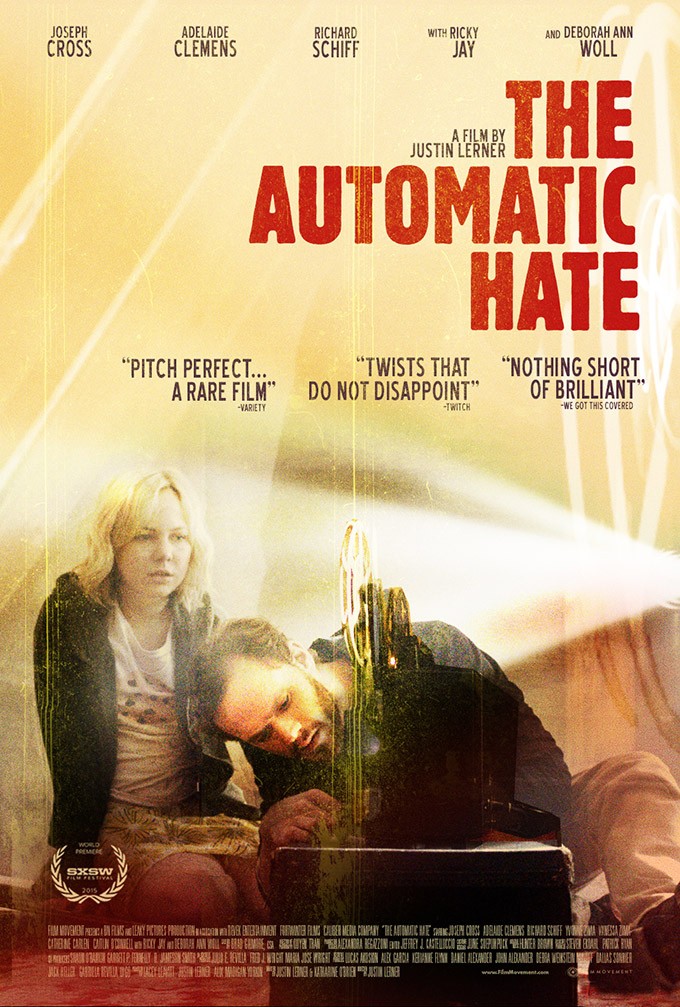
The Automatic Hate

D: Justin Lerner / 97m

Cast: Joseph Cross, Adelaide Clemens, Deborah Ann Woll, Richard Schiff, Ricky Jay, Yvonne Zima, Vanessa Zima, Catherine Carlen, Caitlin O’Connell

What do you do when someone you’ve never met before – or more appropriately, never knew existed – suddenly appears and tells you they’re related to you, that you’re cousins? That’s the situation that Davis Green (Cross) faces at the beginning of The Automatic Hate, an indie drama that asks the question, should family secrets stay secret for the good of everyone involved?

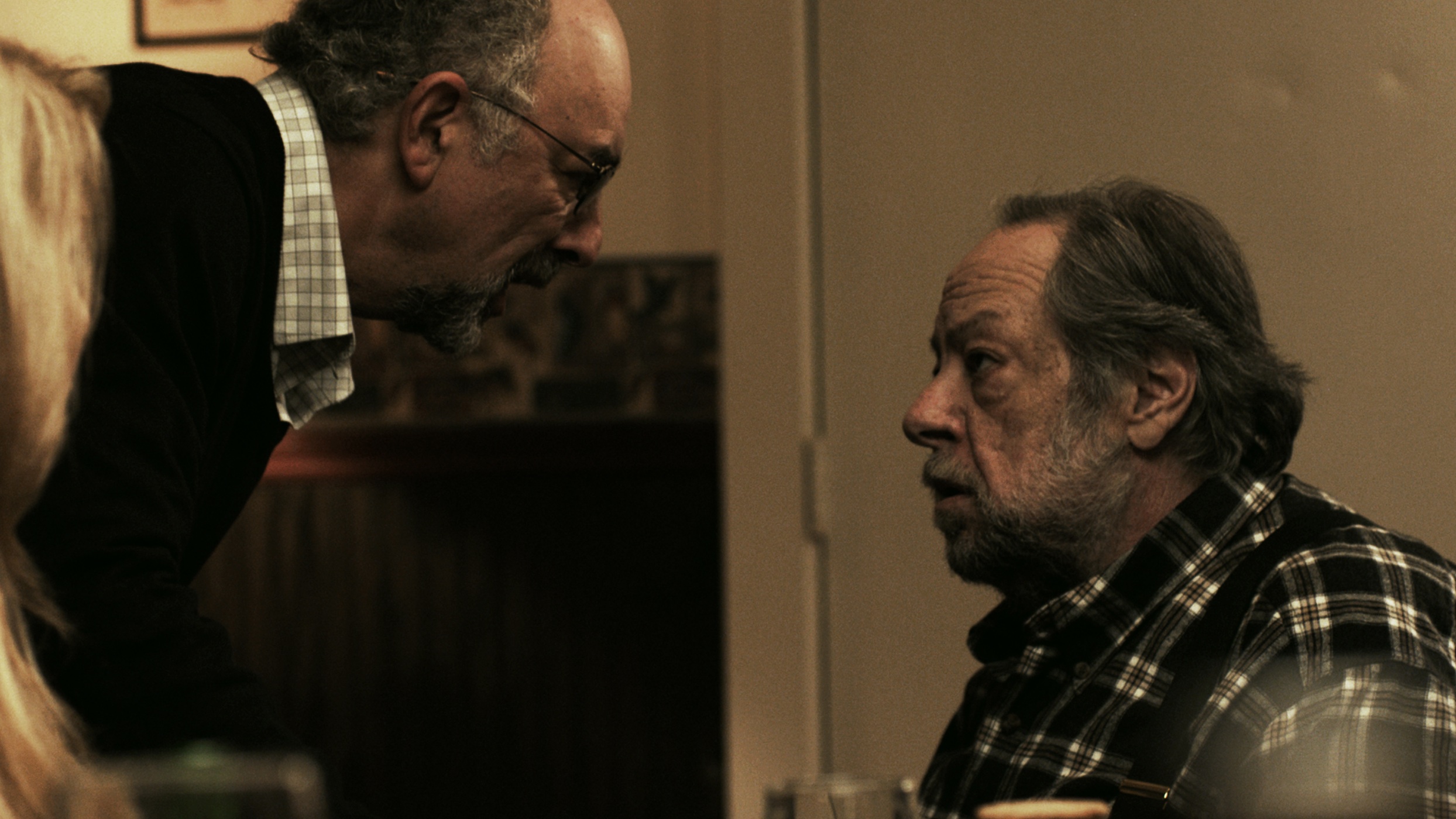
When Davis’s cousin Alexis (Clemens) comes calling out of the blue, his relationship with Cassie (Woll) is going through a rough patch. Cassie is distant yet emotional, and conversation between the two is awkward. When Alexis reveals that she is the daughter of his uncle Josh (Jay), Davis is understandably confused because up until that moment he didn’t know he had an uncle. And when he tackles his father, Ronald (Schiff), over this surprising news, all he gets in return is, “We never talk about him”. As you might expect, Davis isn’t exactly satisfied with his father’s response, but can’t get any further answers.

THA - scene2

Partly to find out why there’s such a hatred and division between his father and his uncle, and partly to give himself some space from Cassie, Davis decides to seek out his extended family and to try and discover why such a serious rift began in the first place. He travels to upstate New York and learns that he has two other cousins, Annie (Yvonne Zima) and Amanda (Vanessa Zima), and in turn meets his uncle. Josh at first believes Davis has been sent by Ronald to spy on him, and insists Davis should leave. But the mystery of the rift, and Alexis’s increasingly romantic attentions keep him there; he finds himself responding to Alexis’s almost desperate attraction to him, and he stops responding to Cassie’s texts and calls.

The discovery of some old home movies by Davis and Alexis shows the two brothers as much younger men, and in the company of a young woman. One scene shows Josh and the young woman holding hands. Davis deduces that the rift is the result of a romantic triangle, and that Josh stole Ronald’s girlfriend from him. But this development has to be put on hold due to the death of Davis’s grandfather (and the brothers’ father). Despite the differences between the two men, Davis convinces Josh to attend the funeral, which is to be held near to a summer house owned by the family. The family unites at last, but tensions are high, and matters are made more difficult for Davis by his relationship with Alexis and the unexpected presence of Cassie. And then the mystery of what happened all those years ago is revealed…

THA - scene1

Fans of indie dramas will be pleased with the nature of Justin Lerner’s latest feature, and in particular with the way in which he sets up the main storyline, which isn’t the mystery at the heart of things, but the relationship between Davis and Alexis. From the moment they meet there’s a clear attraction between the two, but Lerner keeps them apart for quite a while, with Davis’s loyalty and commitment to Cassie as his reason for not acting on his newfound feelings. It’s during this period that the movie moves in parallel with events from the past, and there are tonal and emotional references that infuse both past and present. Lerner, along with co-writer Katharine O’Brien, keeps things low-key, but with hints of the greater drama to come, and the opening forty minutes sees the movie establish a setting and a mood that is very effective.

But then the family comes together, and the movie feels obliged to step up a gear. The ensuing drama, heightened as it is by the revealing of family secrets and the kind of dinner table confrontations – physical and verbal – that have a habit of destroying any attempt at familial accord, is an uncomfortable change of approach and the movie suffers as a result. Alexis’s behaviour in particular is a cause for concern, as the script allows her full rein to express her feelings for Davis. But she does so in such a way that most viewers will be thinking, “Uh oh, watch out Davis!” And how their relationship develops from then on also weakens the movie, leaving the final scenes to limp unconvincingly to the end credits, undoing so much of the good work that’s gone before.
THA - scene3

But while the final twenty minutes prove disappointing due to the script’s need to provide viewers with an unequivocal ending to the problem of Davis and Alexis’s relationship (and the decision it makes regarding their relationship), there are still plenty of things to recommend the movie. Along with Lerner’s confident handling of the material, there’s a clutch of effective, carefully modulated performances with Clemens and Jay stealing the honours from everyone else. Clemens – yet another Australian actress making the successful transition to US movie making – is vulnerable and disturbing in equal measure as Alexis, and exudes an unspoken menace at times that gives her character an edgy, dangerous quality that is both attractive and unnerving at the same time. Jay is equally good as the estranged uncle, resigned, implacable, and dignified in the face of Schiff’s angry brother. He’s an actor you can always rely on, and here he gives one of his best performances, allowing the enmity Josh feels to be expressed in dismissive looks and carefully loaded comments.

And of course, there’s the mystery itself, the movie’s McGuffin. Lerner is canny enough to provide clues that point in one direction while also maintaining the sense that nothing is quite what it seems (the home movie footage, if watched closely, is both explanation and red herring). When it is revealed it packs a punch that doesn’t dissipate easily, but it’s not allowed to overwhelm what follows. Lerner switches focus quickly, and the movie becomes oppressive for how it prompts reactions amongst the characters, and some bitter outpourings. Again, it’s not an entirely successful transition but one of the movie’s strengths is that it doesn’t always do what the audience may be expecting it to.

Rating: 7/10 – with much to recommend it, The Automatic Hate is a worthy indie drama with good performances, a (mostly) well constructed script, and a director firmly in control of the material if not the narrative; tense on occasion, with flashes of mordaunt humour to offset the latter half’s overwrought drama, the movie is on firmer ground as a study of the ties that bind family members, and is especially effective at exposing just how fragile those ties can be.
Share this:

  • Click to share on X (Opens in new window) X
  • Click to share on Facebook (Opens in new window) Facebook
  • More
  • Click to print (Opens in new window) Print
  • Click to email a link to a friend (Opens in new window) Email
Like Loading...

Monthly Roundup – June 2016

30 Thursday Jun 2016

Posted by dullwood68 in Movies

≈ Leave a comment

Tags

A Certain Justice, A Place to Go, Action, Al Pacino, Ann Sheridan, Anne Heywood, Antoine Bardou-Jacquet, Bascom Affair, Baseball, Basil Dearden, Bernard Lee, Bethnal Green, Cecil Parker, Cochise, Crime, Cung Le, D. Ross Lederman, David Gordon Green, Dennis O'Keefe, Dolph Lundgren, Drama, Ethan Hawke, Freddie Francis, Frieda Inescort, George Sherman, Giorgio Serafini, Heather Angel, Holly Hunter, Jack Elam, James Coyne, Jay Silverheels, Jeff Chandler, John Lund, Johnny Simmons, Literary adaptation, Manglehorn, Mike Sarne, Monument Valley, Moon landing, Moonwalkers, Mystery, Noah Buschel, Norman Foster, Paul Cavanagh, Paul Giamatti, Peter van Eyck, Relationships, Reviews, Rita Tushingham, Robbery, Robert Keith, Ron Perlman, Rupert Grint, Sci-fi, Shadows on the Stairs, Susan Cabot, The Battle at Apache Pass, The Brain, The Phenom, Thriller, Vinnie Jones, Western, Whodunnit, Woman on the Run

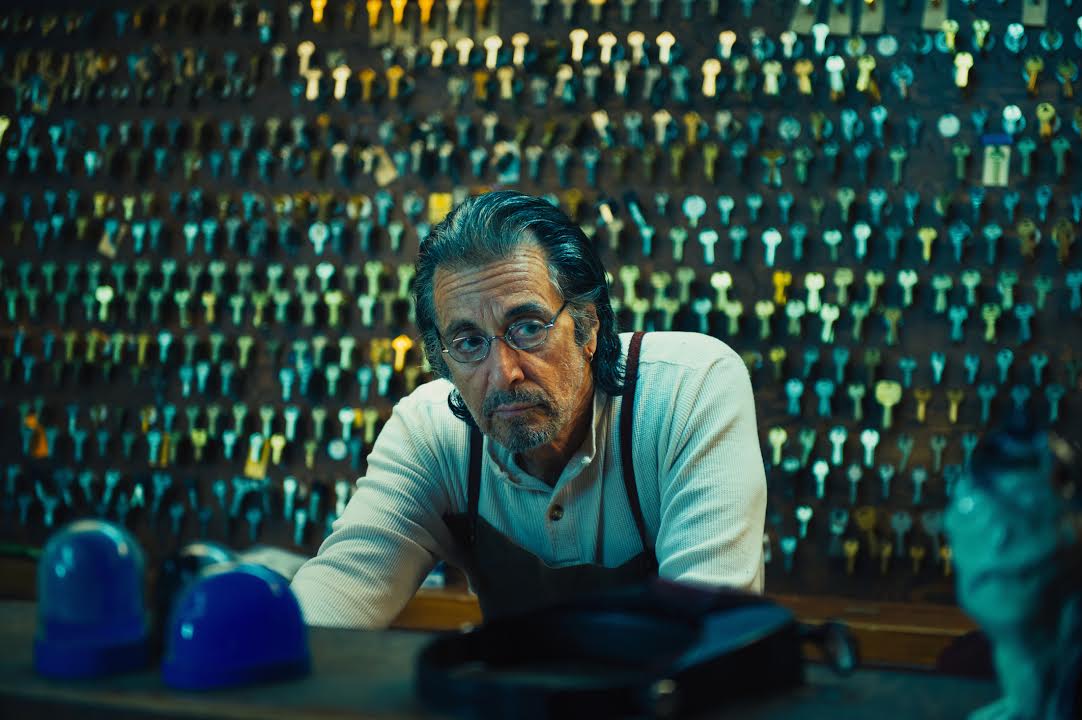
Manglehorn (2014) / D: David Gordon Green / 97m

Cast: Al Pacino, Holly Hunter, Harmony Korine, Chris Messina, Skylar Gasper

Manglehorn

Rating: 5/10 – in the wake of a failed romance that has left him heartbroken, locksmith A.J. Manglehorn (Pacino) decides to try again with bank teller Dawn (Hunter), but his personality puts obstacles in his way; despite the obvious talent involved, Manglehorn is a chore to sit through, as the character himself – as Dawn discovers – isn’t someone you want to spend too much time with.

The Brain (1962) / D: Freddie Francis / 83m

Cast: Anne Heywood, Peter van Eyck, Cecil Parker, Bernard Lee, Jeremy Spenser, Maxine Audley, Ellen Schwiers, Siegfried Lowitz, Hans Nielsen, Jack MacGowran, Miles Malleson, George A. Cooper

The Brain

Rating: 5/10 – a fatal plane crash sees a millionaire businessman’s brain kept alive by pioneering scientists, one of whom (van Eyck) finds himself searching for the person who caused the plane crash when the businessman’s brain communicates with him; an erratic sci-fi thriller that gets bogged down whenever it concentrates on the murder suspects, this adaptation of Curt Siodmak’s novel Donovan’s Brain has a great cast and a terrific premise, but is let down by Francis’ pedestrian direction and a style that wants to evoke film noir but can’t because the script hasn’t been written that way.

A Certain Justice (2014) / D: James Coyne, Giorgio Serafini / 96m

aka Puncture Wounds

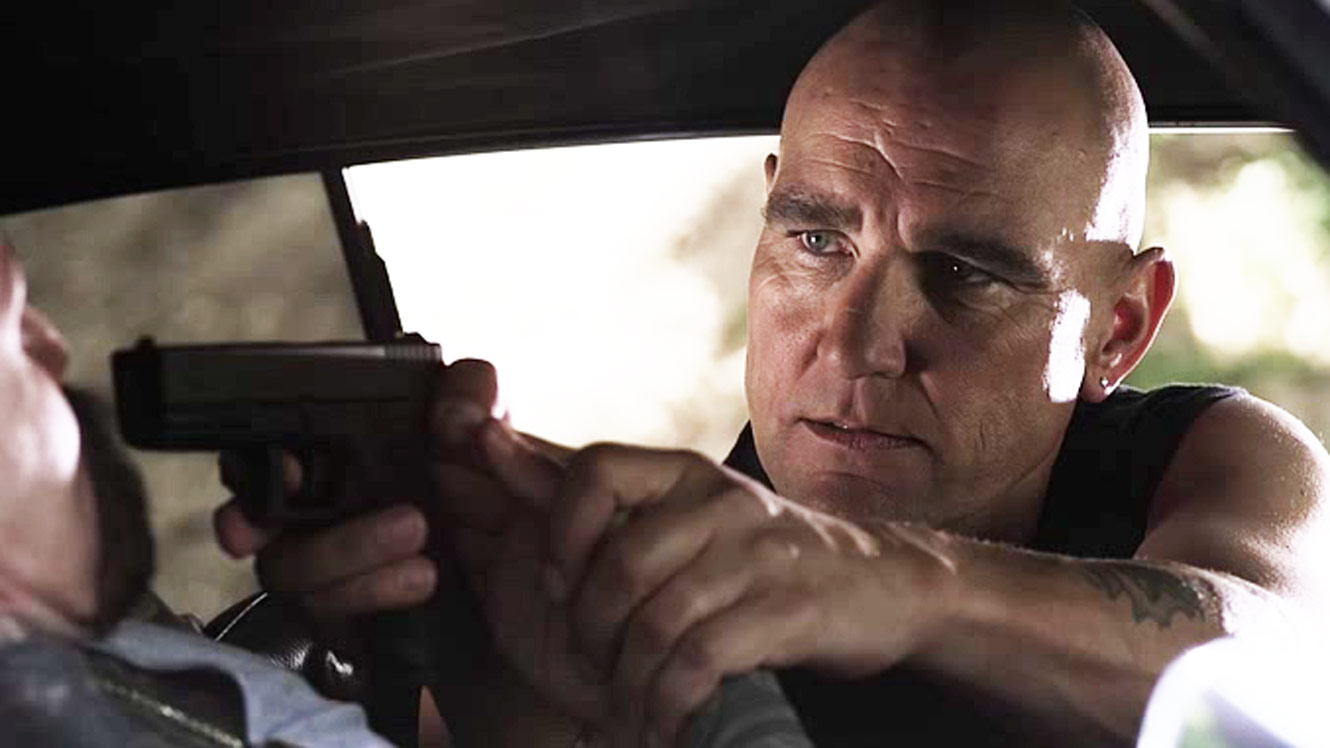
Cast: Cung Le, Dolph Lundgren, Vinnie Jones, Briana Evigan, Gianni Capaldi, James C. Burns, Robert LaSardo, Jonathan Kowalsky, Sean O’Bryan, Eddie Rouse

A Certain Justice

Rating: 4/10 – Iraq veteran John Nguyen (Le) returns home and becomes embroiled in a fight against big-time drug dealer Hollis (Lundgren) when he saves a hooker (Evigan) from the violent attentions of Hollis’ men; as a showcase for Le, A Certain Justice works well enough, but this is still a muddled actioner that cuts narrative corners more often than it doesn’t, and sees Lundgren adopting a wig and ponytail that makes him look like an aging hippie instead of a menacing crime boss.

Woman on the Run (1950) / D: Norman Foster / 77m

Cast: Ann Sheridan, Dennis O’Keefe, Robert Keith, John Qualen, Frank Jenks, Ross Elliott, J. Farrell MacDonald, Victor Sen Yung, Steven Geray

Woman on the Run.jpg

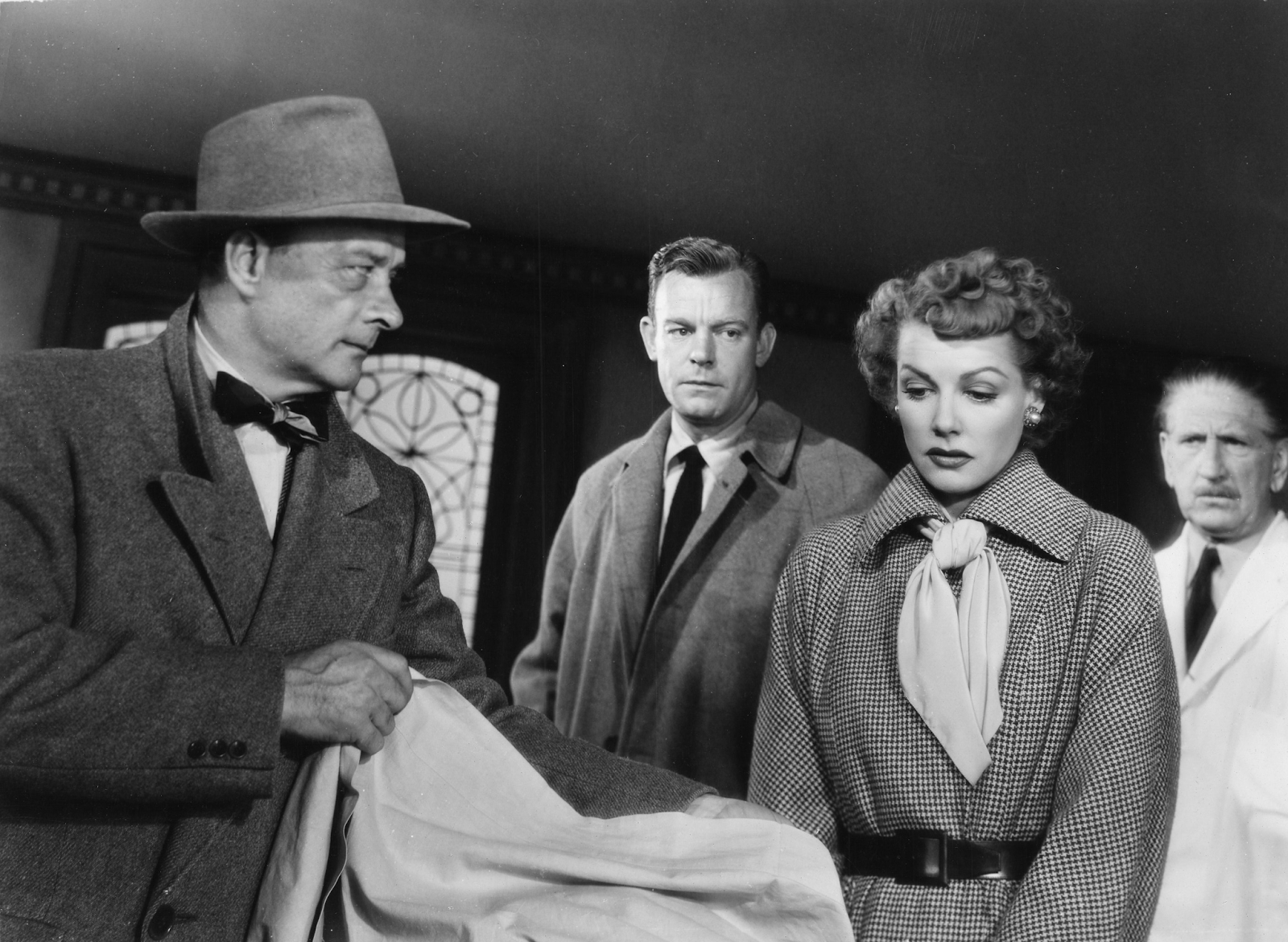
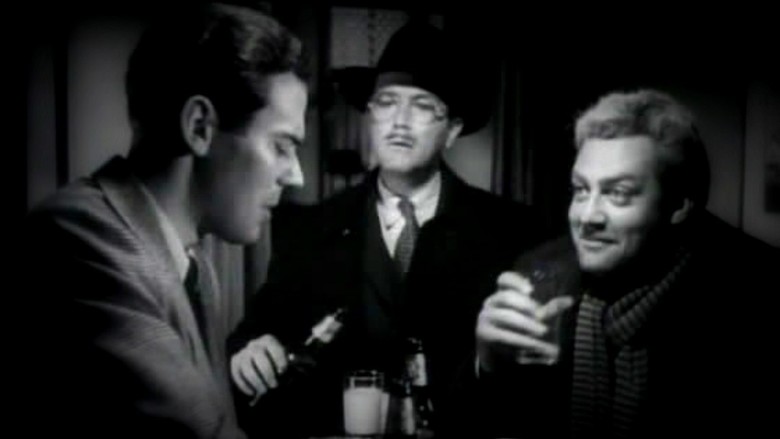
Rating: 7/10 – when store window designer Frank Johnson (Elliott) witnesses a gangland execution he goes on the run, leaving his estranged wife (Sheridan), the police, and a persistent reporter (O’Keefe) trying to track him down before the killer does; a cleverly written film noir based on Sylvia Tate’s original story, Woman on the Run may have a misleading title but it features hard-boiled dialogue, bruised relationships, and atmospheric location work, all of which means the movie is an under-rated gem and deserves a wider audience.

The Battle at Apache Pass (1952) / D: George Sherman / 82m

Cast: John Lund, Jeff Chandler, Susan Cabot, Bruce Cowling, Beverly Tyler, Richard Egan, Jay Silverheels, John Hudson, Jack Elam, Regis Toomey

The Battle at Apache Pass

Rating: 6/10 – peace on the frontier with the Apache nation is threatened by the divisive tactics of Indian Affairs agent Neil Baylor (Cowling) and unsanctioned raids by Geronimo (Silverheels); based around two historical events – the Bascom Affair in 1861, and the title encounter in 1862 – The Battle at Apache Pass is an enjoyable Western featuring good location work in Monument Valley, beautiful photography, and Chandler (as Cochise) and Silverheels reprising their roles from Broken Arrow (1950).

The Phenom (2016) / D: Noah Buschel / 88m

Cast: Johnny Simmons, Ethan Hawke, Paul Giamatti, Sophie Kennedy Clark, Yul Vazquez, Louisa Krause, Paul Adelstein, Elizabeth Marvel, Marin Ireland

The Phenom

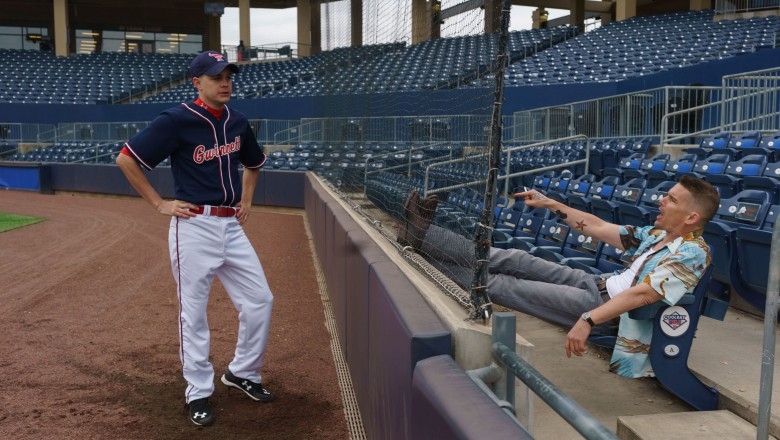
Rating: 5/10 – Hopper Gibson (Simmons) is a talented pitcher who has a shot at the big leagues but suffers a crisis of confidence, one that threatens his future; well acted but dour and uninviting, The Phenom plods along in such a low-key manner that some viewers may well decide they don’t care enough if Hopper overcomes his slump, and may also decide to watch something else instead.

A Place to Go (1964) / D: Basil Dearden / 86m

Cast: Rita Tushingham, Mike Sarne, Bernard Lee, Doris Hare, Barbara Ferris, John Slater, David Andrews, William Marlowe, Michael Wynne, Roy Kinnear

A Place to Go

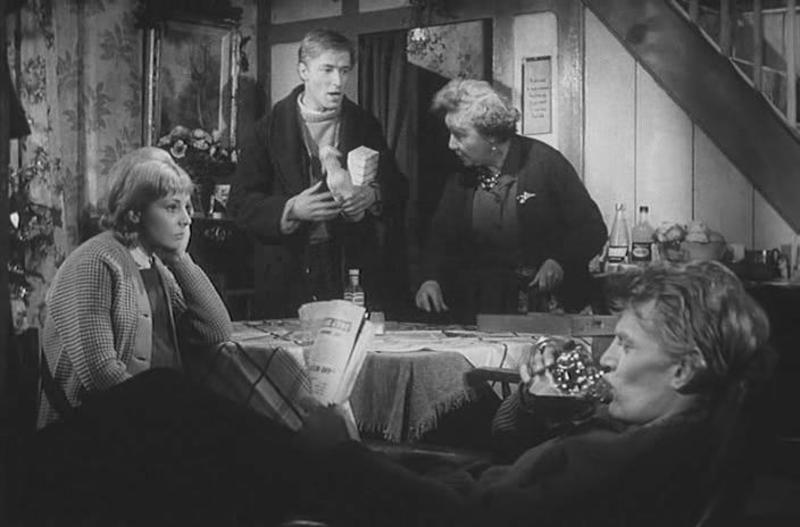
Rating: 5/10 – an ambitious young man who wants to get away from Bethnal Green gets involved with a local racketeer (Slater) and a young woman (Tushingham) at the same time, and much to the consternation of his parents (Lee, Hare); a slice of life, East London style, this kitchen sink drama is enjoyable enough but is hampered by a dreadful performance by Sarne and some weak plotting, but still has enough to recommend it, particularly the (deliberately) sad sight of Lee’s character trying to impress as an escapologist.

Shadows on the Stairs (1941) / D: D. Ross Lederman / 64m

Cast: Frieda Inescort, Paul Cavanagh, Heather Angel, Bruce Lester, Miles Mander, Lumsden Hare, Turhan Bey, Charles Irwin, Phyllis Barry, Mary Field

Shadows on the Stairs

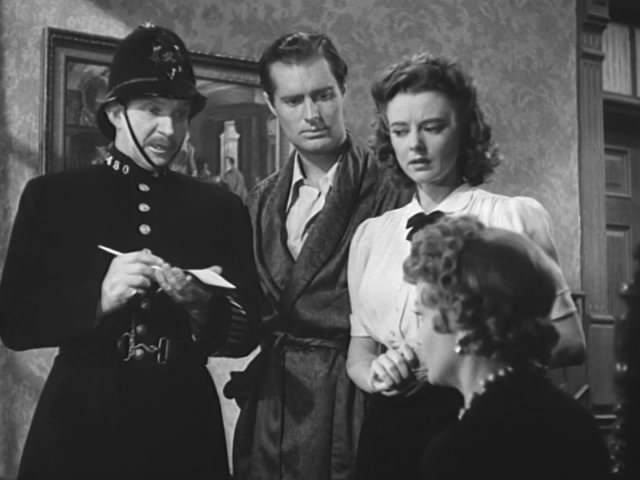
Rating: 4/10 – a killer strikes in a boarding house where everyone comes under suspicion; a leaden whodunnit shot in a pedestrian style, Shadows on the Stairs is typical of the period with its mix of drama, comic relief in the form of Hare and Irwin as bumbling policemen, romantic triangles, and occasional flashes of social comment, but it all adds up to a movie that betrays its stage origins at every turn.

Moonwalkers (2015) / D: Antoine Bardou-Jacquet / 107m

Cast: Rupert Grint, Ron Perlman, Robert Sheehan, Stephen Campbell-Moore, Tom Audenaert, Jay Benedict, James Cosmo, Eric Lampaert, Kevin Bishop, Erika Sainte

Moonwalkers

Rating: 4/10 – in 1969, the US military sends unstable CIA agent Kidman (Perlman) to London to contact Stanley Kubrick with an offer to film a mock moon landing (in case the real mission goes wrong) – but he ends up working with a would-be rock band manager (Grint) instead; uneven and often groan-inducing, Moonwalkers takes a great idea and tramples all over it with a mix of psychedelia, undercooked comedy and inappropriate violence, leaving just a few knowing nods and winks in relation to the period to provide anything of interest.

Share this:

  • Click to share on X (Opens in new window) X
  • Click to share on Facebook (Opens in new window) Facebook
  • More
  • Click to print (Opens in new window) Print
  • Click to email a link to a friend (Opens in new window) Email
Like Loading...

Trailers – American Pastoral (2016), The 9th Life of Louis Drax (2016) and Keeping Up With the Joneses (2016)

30 Thursday Jun 2016

Posted by dullwood68 in Movies

≈ Leave a comment

Tags

Aaron Paul, Action, Alexandre Aja, Comedy, Drama, Ewan McGregor, Gal Gadot, Greg Mottola, Isla Fisher, Jamie Dornan, Jennifer Connelly, Jon Hamm, Literary adaptation, Liz Jensen, Mystery, Philip Roth, Previews, Sarah Gadon, Supernatural, Thriller, Trailers, Zach Galifianakis

For his feature debut as a director, Ewan McGregor could have (probably) chosen any project he wanted, but not one to shirk a challenge, the actor has decided to film Philip Roth’s Pulitzer Prize-winning novel (it’s been in development for over a decade, and Jennifer Connelly is the only person still on board from back then). So, no pressure there, then. But the trailer reveals, albeit in a disjointed fashion, that McGregor appears to have found a way of coherently presenting the various social and political upheavals of the period (the Sixties), and without sacrificing any of the personal or emotional effects these events have on the characters involved. With David Strathairn cast as Roth’s alter ego Nathan Zuckerman, and a supporting cast that also includes Molly Parker and Peter Riegert, McGregor has found himself in very good company indeed, and if his direction, allied with John Romano’s screenplay, is as good as it looks (and thanks to DoP Martin Ruhe it looks beautiful indeed), then this could be a strong Oscar contender come next February.


In The 9th Life of Louis Drax (it’s never Johnny Smith anymore, is it?), a young boy’s fall from a cliff and subsequent coma opens up a mystery that will involve his parents (Sarah Gadon, Aaron Paul) and his doctor (Jamie Dornan). Liz Jensen’s 2004 novel was due to be adapted by Anthony Minghella before his untimely death in 2008, but now it’s been adapted for the screen by his son Max, and with the formidable talent of Alexandre Aja in the director’s chair. The trailer is sufficiently twist-y enough for clues to Louis’s “condition” to be given in one second and then overturned in another, and the movie’s success is likely to depend on how well the mystery is maintained before answers have to be revealed. The cast also features the likes of Oliver Platt, the ubiquitous Molly Parker, and Barbara Hershey, and seems to have got a firm hold on the supernatural thriller aspects of the story, so this should be as satisfying – hopefully – as it looks.


Whatever you want to say or think about Keeping Up With the Joneses, there’s little doubt that this mix of action and comedy about a suburban couple (Zach Galifianakis, Isla Fisher) who discover that their new neighbours (Jon Hamm, Gal Gadot) are international spies, is exactly the kind of moderately high concept idea that the Hollywood studios love to put their money behind. The trailer offers perhaps too many laughs (and hopefully not all the best ones), while downplaying the inevitable action sequences, but whatever the finished product gives us, let’s hope that director Greg Mottola’s quirky sense of humour is front and centre, and the chemistry between each couple adds to the fun to be had. If not we’ll just have to chalk it up to a good idea gone bad, or to put it another way, a movie that you switch off from once it’s started.

Share this:

  • Click to share on X (Opens in new window) X
  • Click to share on Facebook (Opens in new window) Facebook
  • More
  • Click to print (Opens in new window) Print
  • Click to email a link to a friend (Opens in new window) Email
Like Loading...

Monthly Roundup – May 2016

31 Tuesday May 2016

Posted by dullwood68 in Movies

≈ 2 Comments

Tags

Arkansas, Basil Dearden, Bedouin tribes, Biopic, Boaz Yakin, Carla Balenda, Cheerleaders, Chris White, Christine Nguyen, Crazy About Tiffany's, Crime, Damian Lewis, Documentary, Dog handler, Dominique Swain, Drama, Elliott Reid, Fantasy, Gertrude Bell, Googie Withers, History, Holly Golightly, Horror, Illegal arms, J.B. Priestley, James Franco, Jamie Brown, Jewellery, Jim Wynorski, John Clements, Jon Fabris, Josh Wiggins, Lauren Graham, Lawrence of Arabia, Matthew Miele, Max, Middle East, Mystery, Nicole Kidman, Prisoners, Queen of the Desert, Reviews, Robert Pattinson, Sharkansas Women's Prison Massacre, Stage play, Summer camp, The City, The Whip Hand, They Came to a City, Thomas Haden Church, Thriller, Tiffany's, Toxic waste, Traci Lords, True story, US Marines, Werner Herzog, William Cameron Menzies, Winnoga, Zombie Cheerleader Camp

Max (2015) / D: Boaz Yakin / 111m

Cast: Josh Wiggins, Thomas Haden Church, Lauren Graham, Luke Kleintank, Robbie Amell, Mia Xitlali, Dejon LaQuake, Jay Hernandez, Owen Harn

Max

Rating: 6/10 – after his handler is killed in Afghanistan, Max goes to stay with his handler’s family, and helps expose a plot to supply arms to a Mexican cartel; a feature that ticks every box in the “family movie” canon, Max is enjoyable enough but is also too lightweight to make much of a sustained impact, even though the cast enter wholly into the spirit of things.

They Came to a City (1944) / D: Basil Dearden / 78m

Cast: John Clements, Googie Withers, Raymond Huntley, Renee Gadd, A.E. Matthews, Mabel Terry-Lewis, Ada Reeve, Norman Shelley, Fanny Rowe, Ralph Michael, Brenda Bruce, J.B. Priestley

They Came to a City

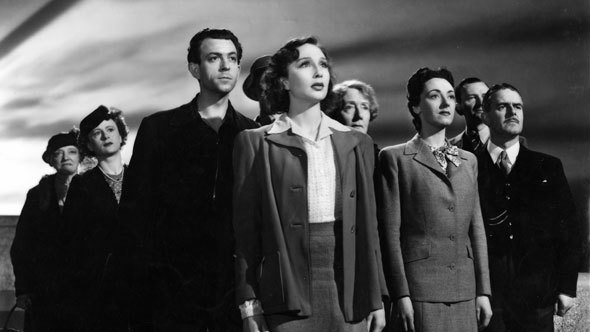
Rating: 6/10 – nine individuals find themselves in unfamiliar terrain and on the outskirts of a vast city – and have to decide if they’re going to stay there; J.B. Priestley’s play is as close to a socialist tract as you could have got during World War II, and while They Came to a City betrays its stage origins and is relentlessly polemical, it has a stark, overbearing visual style that is actually quite effective.

Crazy About Tiffany’s (2016) / D: Matthew Miele / 86m

With: Jessica Alba, Katie Couric, Amy Fine-Collins, Fran Lebowitz, Baz Luhrmann, Sam Taylor-Johnson, Jennifer Tilly, Andrew & Andrew

Crazy About Tiffany's

Rating: 6/10 – a documentary charting the rise and rise of Tiffany’s, the jewellery store made even more famous by Truman Capote and Audrey Hepburn (who he despised in the role of Holly Golightly); a tremendously indulgent puff-piece for the company, Crazy About Tiffany’s is redeemed by some fascinating anecdotes, and the faint whiff of pretentiousness given off by most of its customers.

Queen of the Desert (2015) / D: Werner Herzog / 128m

Cast: Nicole Kidman, James Franco, Damian Lewis, Robert Pattinson, Jay Abdo, David Calder, Jenny Agutter, Holly Earl, Mark Lewis Jones, Christopher Fulford

Queen of the Desert

Rating: 5/10 – a biopic of the explorer and writer, Gertrude Bell (Kidman), and how she  won the trust of numerous Middle Eastern tribes at a time when British colonialism was  looked upon with distrust and contempt by those very same tribes; not one of Herzog’s best (or Kidman’s), Queen of the Desert suffers from being treated as history-lite by the script, and never quite being as courageous in its efforts as Miss Bell was in hers (and not to mention a disastrous turn by Pattinson as Lawrence of Arabia).

Zombie Cheerleader Camp (2007) / D: Jon Fabris / 85m

Cast: Jamie Brown, Chris White, Nicole Lewis, Jason Greene, Brandy Blackmon, Daniel Check, Terry Chandeline Nicole Westfall, Micah Shane Ballinger

Zombie Cheerleader Camp

Rating: 2/10 – when cheerleaders attend a summer training camp, they’re unaware that a squirrel exposed to toxic waste will be the catalyst that turns them and a group of horny males into flesh-eating zombies; all you need to know is that Zombie Cheerleader Camp was made at the extreme low budget end of movie making and features camera work that’s so bad it’s almost a challenge to find a well-framed shot anywhere in the movie (and then there’s the “acting”…)

Sharkansas Women’s Prison Massacre (2015) / D: Jim Wynorski / 84m

Cast: Dominique Swain, Traci Lords, Christine Nguyen, Cindy Lucas, Amy Holt, John Callahan, Corey Landis, Skye McDonald, Chris De Christopher

Sharkansas Women's Prison Massacre

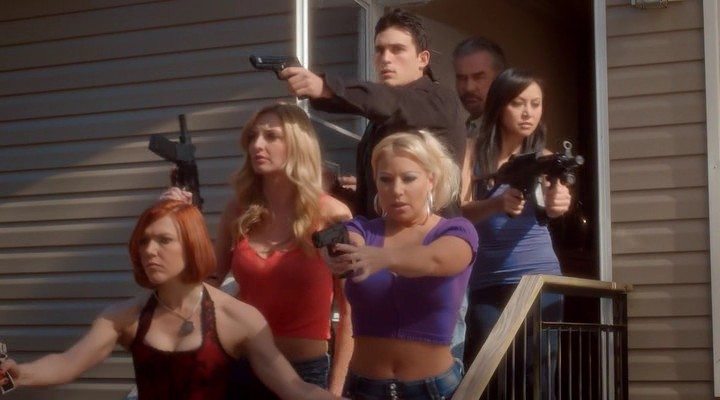
Rating: 3/10 – fracking causes the release of an unspecified number of prehistoric sharks into the Arkansas waterways, and this jeopardises the escape of several women prisoners from a work detail; yes, Sharkansas (actually filmed in Florida) Women’s Prison Massacre is as bad as it sounds, and yes it is as cheesy as you’d expect, but it’s also one of the tamest and most annoying of all the recent shark-related movies we’ve had foisted upon us, and not even the talents of low budget movie maestro Wynorski can rescue this from the bottom of the barrel.

The Whip Hand (1951) / D: William Cameron Menzies / 82m

Cast: Carla Balenda, Elliott Reid, Edgar Barrier, Raymond Burr, Otto Waldis, Michael Steele, Lurene Tuttle, Peter Brocco, Lewis Martin, Frank Darien

The Whip Hand

Rating: 6/10 – a journalist (Reid) on vacation stumbles across a mystery involving a lake where the fish have all died, and a nearby ghost town where the remaining locals aren’t too friendly, and he finds himself prevented from leaving; a well-paced but forgettable effort from master production designer Menzies, The Whip Hand starts off well but soon ties itself inside out in trying to be a confident thriller, an ambition it fails to achieve thanks to untidy plotting and thin characterisations.

Share this:

  • Click to share on X (Opens in new window) X
  • Click to share on Facebook (Opens in new window) Facebook
  • More
  • Click to print (Opens in new window) Print
  • Click to email a link to a friend (Opens in new window) Email
Like Loading...

The American Side (2016)

23 Monday May 2016

Posted by dullwood68 in Movies

≈ Leave a comment

Tags

Alicja Bachleda, Camilla Belle, Directed energy weapon, Drama, Free energy, Greg Stuhr, Jenna Ricker, Matthew Broderick, Mystery, Niagara Falls, Nikola Tesla, Private detective, Review, Robert Forster, Thriller

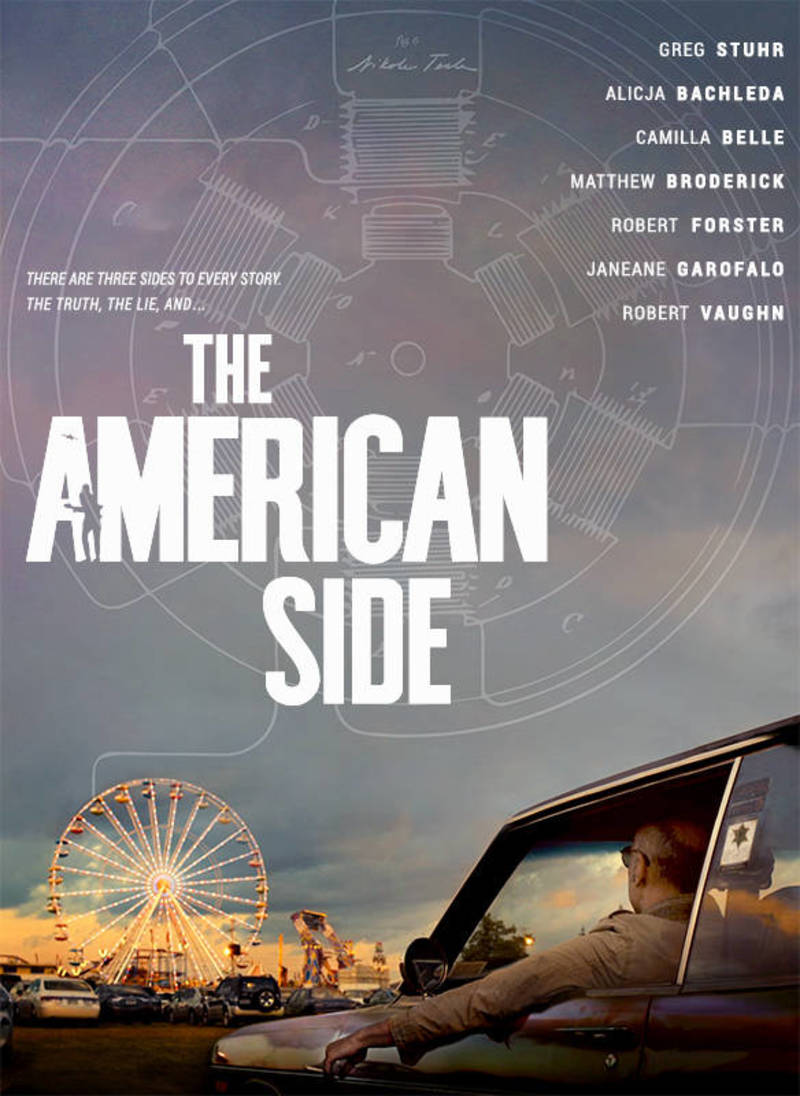
The American Side

D: Jenna Ricker / 102m

Cast: Greg Stuhr, Alicja Bachleda, Camilla Belle, Matthew Broderick, Robert Forster, Janeane Garofalo, Grant Shaud, Harris Yulin, Joe Grifasi, Stephen Henderson, Kelsey Siepser, Robert Vaughn

Some movies give the impression that they should be longer, that their proper running time has been truncated during the editing and post-production process. These movies seem to be saying that there’s something missing, an element that would enable the movie to be better than it is, sharper, clearer, more dynamic, more interesting, funnier, darker, better focused all round. And then there are the movies where that same impression is made, but no matter how much you may think that a longer cut might be the answer, the truth is, it wouldn’t make a difference.

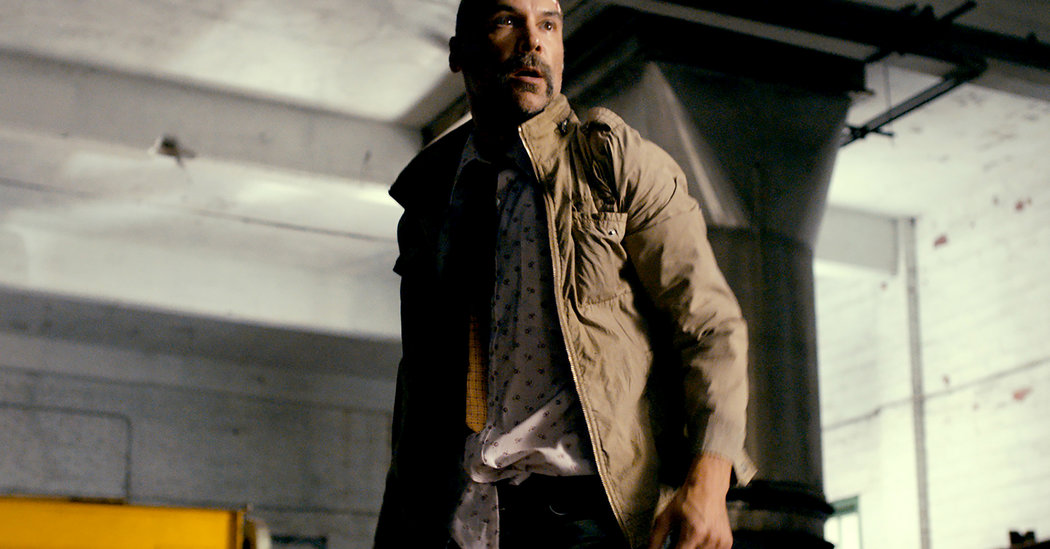
Such is the case with The American Side. It’s ostensibly a modern noir thriller, with many familiar elements to ground it in that particular genre. There’s a grizzled, world-weary private detective, Charlie Paczynski (Stuhr); a damsel in distress, Nikki Meeker (Bachleda), who knows too much and whose life appears to be in danger; a femme fatale, Emily Chase (Belle), who may or may not be on the side of the bad guys; two competing businessmen – Borden Chase (Broderick) (Emily’s older brother) and Sterling Whitmore (Forster) – either of whom could be the main bad guy; and a McGuffin in the form of a mechanical design by Nikola Tesla that could be used as a weapon. In some respects its noir business as usual, and while these familiar elements should allow for a degree of comfort in navigating the twists and turns of the script, in reality they’re only used to reel in any curious – potential – viewers.

The American Side - scene1

Once the movie gets started, most viewers could be forgiven for thinking that The American Side, with its early murder of a minor character and Charlie’s determined attitude in finding their killer would be the kind of investigation that leads to corruption in high places, and the private detective realising that he can’t trust anyone. Alas, here, this is only partially true, as Charlie trusts one too many people in his quest to find his friend’s killer, and a wider conspiracy begins to make itself felt. Charlie also comes across as a little too gullible, a fact that doesn’t help him with his investigations, and which leads to his being easily fobbed off or deflected by everyone around him. And as the mystery deepens, the script – courtesy of director Ricker and star Stuhr – becomes an erratic mix of noir beats and muddled plotting.

It begins simply enough, establishing Charlie as a low-rent private eye who works out of a bar and who uses a stripper, Kat (Siepser), to help catch cheating husbands, who he then blackmails so that he receives payment from both the errant husband and the suspicious wife. It’s not a particularly lucrative business, and Charlie isn’t the most likeable of guys, but he gets by. But when Kat is killed by a man they both believe will fit the brief of cheating spouse, Charlie finds himself looking for a college professor called Soberin (Yulin) who’s mixed up in a plot to build a directed energy weapon designed by Tesla.

Sadly, what up til now has been a fairly straightforward, if gloomily shot movie, becomes a puzzle that goes off in various different directions, many of which lack a purpose other than to make things even more mysterious or inexplicable. Charlie’s own investigation sees him (traditionally) one step behind everyone else, but even when he does get up to speed the viewer is left with the sense that he’s only pretending to understand what’s going on, and in reality still doesn’t have a clue as to who’s doing what, and why. It’s not even that the plot, such as it is, is unusually complex. It’s that when explanations are forthcoming, and motivations are revealed, they just don’t make any sense. The viewer is left scratching their head and wondering if they’ve missed something.

The American Side - scene2

Ricker and Stuhr’s intention seems to have been a pretty simple one: combine basic noir components with a low-budget indie sensibility and stir together accordingly. But there’s something missing from the recipe, and the movie ends up sacrificing clarity in favour of providing uneven twists and turns, some of which feel awkward and contrived rather than organic. As the plot unfolds, some narrative decisions prove so unwieldy that you begin to suspect the script is a first draft that no one got around to looking at for errors or inconsistencies. It’s a shame as there’s the germ of a great idea here, and Tesla was enough of a maverick inventor for any movie maker to “have fun with”, but Ricker and Stuhr use him sparingly as a character, preferring instead to refer to him constantly as an under-appreciated genius who knew what was best for the world.

One of the movie’s main distractions is the continual referral to Niagara Falls and its history. The Falls are used as a backdrop – Charlie catches up with Soberin there – and events there in the past serve as clues to what Tesla was up to with his directed energy weapon, but this inclusion leads to more questions than the script can answer, and it makes for at least two unsatisfactory moments at the movie’s climax (which is also set at the Falls). This fascination also explains the movie’s title: no one has gone over the Falls from the American side and lived. (Alas, this isn’t a metaphor for anything that happens in the movie.)

The American Side - scene3

By making so much of the movie incomprehensible, or just plain confusing, Ricker and Stuhr have undermined their own project in such a comprehensive manner that the cast have no other choice but to make the best of it. Stuhr is a relaxed, no frills actor who’s not quite hard-boiled enough to make Charlie the anti-hero the script wants him to be, and he serves as the stooge in too many scenes where he should be in control. Bachleda’s role is underwritten, Belle struggles to keep her character on the right side of believable, while Broderick has his own problems with the kind of arch, mannered dialogue that even the most inexperienced of actors would run a mile from.

Under Ricker’s purview, The American Side ends up being a cumbersome, cruelly ill-considered movie that evinces little sympathy for its characters, and which proves very difficult to care about beyond a superficial level. It’s not a bad movie per se, just one that takes what should be a simple storyline and plot, and buries both of them under a pile of unnecessary implausibilities and contradictions. And it’s a movie where continuity screams excised scenes, as Charlie suffers head lacerations that happen entirely off camera and without being referred to by anyone. Somewhere there’s a longer cut of this movie, and someone needs to release it. Only then will the movie have a real chance of impressing its audience.

Rating: 5/10 – a film noir wannabe that neglects both its storyline and its plot, The American Side is so preoccupied with prolonging its inherent mystery that it can’t resist keeping it’s distance from the viewer; as a result everything suffers, and the movie never recovers from Ricker and Stuhr’s apparent insistence on filming their script as is.

Share this:

  • Click to share on X (Opens in new window) X
  • Click to share on Facebook (Opens in new window) Facebook
  • More
  • Click to print (Opens in new window) Print
  • Click to email a link to a friend (Opens in new window) Email
Like Loading...

The Lady in the Car With Glasses and a Gun (2015)

24 Sunday Apr 2016

Posted by dullwood68 in Movies

≈ Leave a comment

Tags

Benjamin Biolay, Drama, Elio Germano, France, Freya Mavor, Joann Sfar, Literary adaptation, Mystery, Sébastien Japrisot, Secretary, Stacy Martin, Thriller, Thunderbird

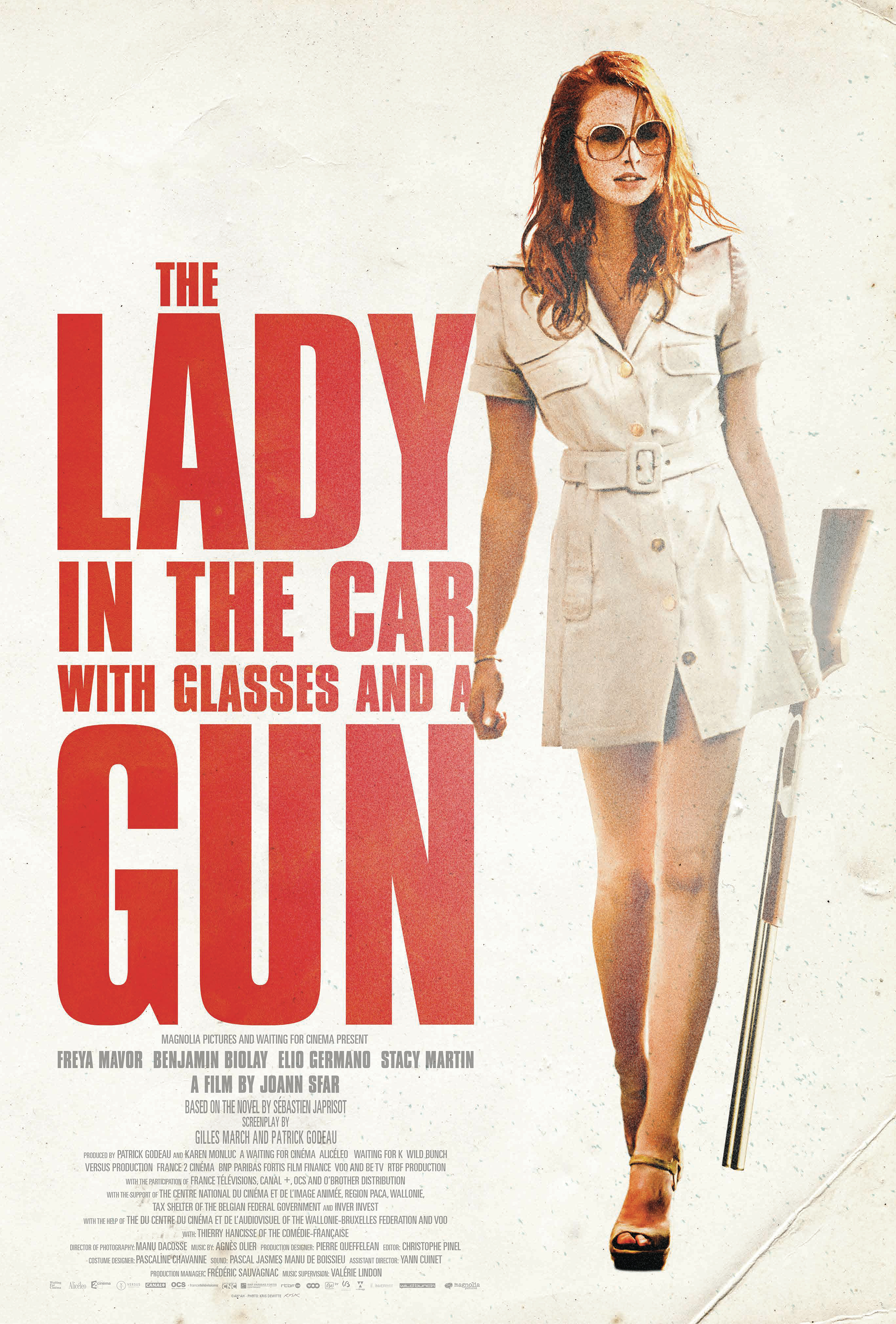
The Lady in the Car

Original title: La dame dans l’auto avec des lunettes et un fusil

D: Joann Sfar / 95m

Cast: Freya Mavor, Benjamin Biolay, Elio Germano, Stacy Martin, Thierry Hancisse, Alexandre von Sivers, Olivier Bonjour

Mousy secretary Dany (Mavor) works for businessman Michel Caravaille (Biolay). She has undeveloped fantasies about their relationship becoming something more than just employer and employee, but Michel is clearly uninterested. When he tells her he needs a report typed up urgently, she tells him it will take her all night. As he needs it first thing in the morning he tells her she can do the work at his home. After a quick stop at her home for some things, they arrive at Michel’s home where she is given a room to work in, and meets his wife, Anita (Martin).

The next day, and with the report completed, Michel asks Dany to drive himself and Anita to the airport, and then take the car, a magnificent Thunderbird, back to his home. Dany drops them off but decides that, with the weekend ahead of her, no one will know if she drives the car out to the coast (she’s never seen the sea), and as long as she gets the car back before Michel and Anita return. But as she makes her way through the French countryside, Dany finds herself meeting people who say they’ve seen, and talked to her, earlier on. This angers Dany, especially when the staff at a gas station are more concerned with her having been there before than in paying credence to the attack that was made on her in the toilets, and despite her receiving an injury that she didn’t have “before”.

TLITC - scene2

At a hotel Dany finds again that she’s recognised by the staff. She also meets an Italian who calls himself Georges (Germano). Dany allows herself to be seduced by Georges, but the next day she finds he has stolen the Thunderbird. Desperate to get the car back she enlists the aid of a truck driver and his friends on the CB network to find out where Georges has got to. But when she tracks him down to a seaside town, events take an even more disturbing turn, and Dany discovers that she’s now connected to a murder.

Adapted from the novel by Sébastien Japrisot, Joann Sfar’s third feature is a twisty, Gallic thriller that looks cool, plays it cool, but becomes quite heated in the last quarter of an hour, as its tricksy, mysterious narrative unravels thanks to one massive mistake made early on in the movie’s construction. It’s not hard to work out what’s happening, or who’s responsible, but the why is kept under wraps until quite near the end. By the time all is revealed though, Dany’s journey from subdued, submissive secretary to not quite defenceless stooge-in-the-making has taken one too many “unexpected” turns for it all to work properly or credibly.

Which is a shame, as for much of its running time, The Lady in the Car With Glasses and a Gun is an entertaining mystery movie, sometimes feeling a little surreal, sometimes a little like experiencing a mild hallucinogen, but always keeping the audience a little off-kilter. This helps the viewer identify more closely with Dany and her escalating problems, as the script by Patrick Godeau and Gilles Marchand does its best to retain a semblance of “normality” while putting its heroine through the emotional wringer. Each successive encounter with someone who’s already met her leaves Dany questioning what’s going on but this isn’t some Twilight Zone fantasy that she’s experiencing; instead it’s a much more sinister world she finds herself dealing with, and as the script keeps Dany on the back foot, it strives to keep the viewer in suspense at the same time.

TLITC - scene1

That it doesn’t fully succeed is due to the somewhat generic nature of the mystery itself. It’s unlikely that Dany is going mad, and to be fair, the movie doesn’t take that tack, but in putting her in situations where things aren’t as clearcut or as straightforward as they should be, Sfar and the screenwriters portray a secondary world where nothing is obvious, and expectations should be abandoned. Once Dany veers off the main road back to Michel’s home and heads for the seaside, it’s almost as if she’s entered some kind of alternate reality, a dream world perhaps, and the movie tries hard to maintain that illusion for as long as possible. And until Dany meets Georges, it succeeds quite well in creating that kind of atmosphere.

In a lot of mystery thrillers, the introduction of a man who is sympathetic to the heroine’s troubles, and wants to help out, usually leads to a romance between them that’s borne out of tackling those troubles. And at first it seems as if Georges is there to fulfill that role, but even though they end up in bed together, the audience will already know that Georges isn’t to be trusted (Germano’s performance practically screams “con man”). By removing this small amount of hope, the audience begins to understand that this movie may be more nihilistic than they expected. And as Dany gets further and further into trouble, so it proves.

TLITC - scene3

Sfar is a competent director, certainly able to elicit strong performances from his cast – Mavor, perhaps best known as Mini from the TV series Skins (2011-12) is very good indeed as Dany – but the movie’s tone is wayward, and the ending feels rushed, as if the movie had to come in at a certain running time and a less hurried denouement would have ruined things. He’s also never quite sure as a director with where to place the camera, leaving the movie looking and feeling a little awkward in its presentation of certain scenes, such as Dany’s romantic fantasies, and when he feels the need to vary the camera angles when Dany’s in the car. And he fumbles the revelation of what’s been happening (and why), leaving the viewer unsure if he/she heard right, or if there’s something more to be added. As it is, the revelation is unnecessarily complicated, and relies too much on coincidence to work effectively, a problem Sfar doesn’t have the experience to solve.

But as already mentioned, the movie does look cool, thanks to Manuel Dacosse’s sterling cinematography. The movie has an autumnal, melancholy feel to it that Dacosse highlights through the use of some unfussy yet effective lighting, and a subdued colour palette. And it’s a movie that gets progressively darker in terms of light and shade as Dany’s problems worsen. This makes the movie intriguing to watch on a visual level, and helps make up for some of the failings elsewhere. But all in all, it’s a movie where style and substance aren’t on an equal footing.

Rating: 6/10 – while there’s much to admire in The Lady in the Car With Glasses and a Gun, it’s narrative isn’t rewarding enough to overcome the pitfalls it finds itself creating; Mavor has the look of a troubled innocent, and is the glue that holds the movie together, but her performance alone isn’t enough to overcome the movie’s various narrative problems.

Share this:

  • Click to share on X (Opens in new window) X
  • Click to share on Facebook (Opens in new window) Facebook
  • More
  • Click to print (Opens in new window) Print
  • Click to email a link to a friend (Opens in new window) Email
Like Loading...

Midnight Special (2016)

12 Tuesday Apr 2016

Posted by dullwood68 in Movies

≈ 3 Comments

Tags

Adam Driver, Drama, FBI, Jaeden Lieberher, Jeff Nichols, Joel Edgerton, Kirsten Dunst, Michael Shannon, Mystery, NSA, Review, Sci-fi, The Ranch, Thriller

Midnight Special

D: Jeff Nichols / 112m

Cast: Michael Shannon, Joel Edgerton, Jaeden Lieberher, Kirsten Dunst, Adam Driver, Bill Camp, Scott Haze, Sam Shepard, Paul Sparks, David Jensen

It’s only taken writer/director Jeff Nichols four movies to become a movie maker whose projects carry an enormous weight of expectation. First there was Shotgun Stories (2007), then there was Take Shelter (2011). He followed that up with Mud (2012), and now he brings us Midnight Special, a tale about an eight year old boy who may be an alien, or an emissary from God, or something else completely. It’s a measure of Nichols’ success that he’s taken what could have been an awkward, unconvincing story – in lesser hands – and made it into an articulate, gripping tale that’s also exciting and thought-provoking.

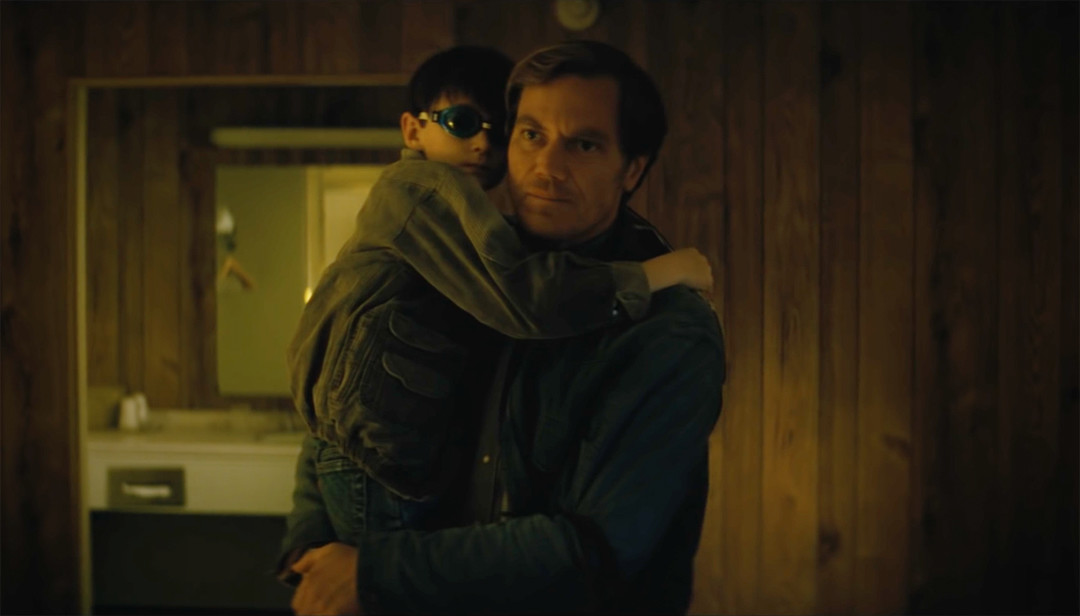
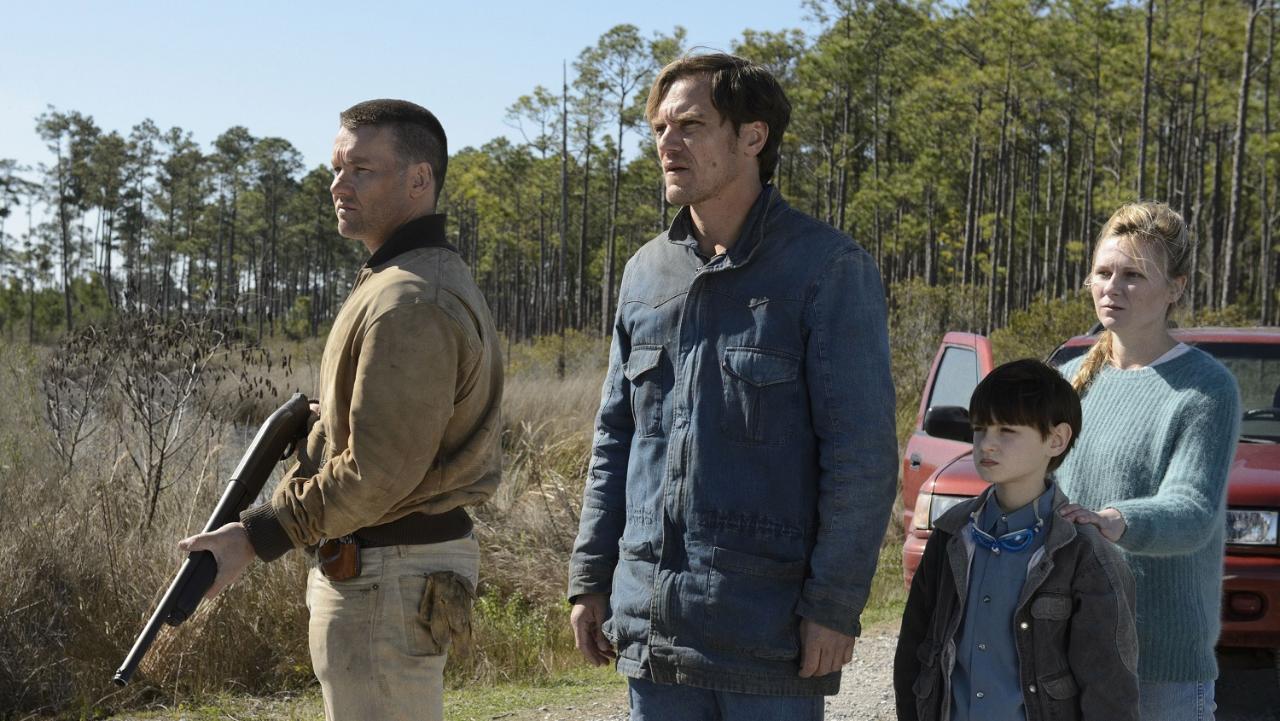
The movie begins with the police searching for a missing child called Alton Meyer (Lieberher). He’s been abducted from a religious compound known as the Ranch. It’s head, Alton’s adoptive father, Calvin Meyer (Shepard), wants him back, and within the next four days. But Alton – who has to wear blue goggles during daylight hours – has been abducted by his real father, Roy Tomlin (Shannon), and he, along with his friend, Lucas (Edgerton), are trying to keep Alton safe and also get him to a certain place in four days’ time. There, something momentous will happen, but neither Roy nor Calvin Meyer knows what it is; and at this point, Alton doesn’t know either.

MS - scene3

The FBI, and the NSA – in the form of agent Paul Sevier (Driver) – are also trying to find Alton, as they have become aware that he has been including coded intelligence in the sermons he’s written for Meyer. But Alton has other gifts, and one in particular, connected to his sight. When Ray decides to stop off at an old Ranch member’s home, that particular gift almost causes the house to shake apart. From there, the trio drive to the home of Alton’s mother, Sarah (Dunst), but not before an incident at a gas station reveals that Alton’s heat signature is similar to that of a nuclear bomb. Now a foursome, they travel on to the location that Alton must reach, however, they’re unaware that two members of the Ranch, Doak (Camp) and Levi (Haze), are tracking them with the intention of kidnapping Alton and returning him to the Ranch.

Before they are able to, Alton, who has been getting sicker and sicker, and has to avoid direct sunlight, tells Roy that he can no longer continue to keep hidden from the sun. Roy exposes Alton to a sunrise, and it has an extraordinary effect: he can now walk about unaffected in daylight, and knows exactly what he needs to do and why he needs to be in a certain place at a certain date and time. As he tells Roy: he doesn’t belong here.

MS - scene1

Whether or not Alton makes it to his rendezvous is, ultimately, neither here nor there. What’s important is the journey he makes getting there, and the way in which he and his parents, and Lucas, make it there. One of the strengths of Nichols’ impressive and layered screenplay is the way in which Roy’s parental determination to not let anything stop him from getting Alton to his rendezvous, sometimes presents itself as unfeeling and harsh. When he and Lucas encounter a state trooper, Roy is unequivocal: he tells Lucas to shoot him. Roy doesn’t care about anyone else, only Alton, and his zeal and willingness to put moral certitude aside makes him one of recent cinema’s more interesting and intriguing characters. Shannon is perfect for the role, morally absent when he needs to be, but a committed, loving father as well, and fully able to show these two sides of Roy’s character without any sense that he’s a Jekyll and Hyde personality and able to call on either side when necessary.

What’s also important is that Roy believes in Alton, albeit in a different way from Calvin (he and his followers believe that Alton’s rendezvous is also the time when they will all be judged by God). He believes in his son, wholeheartedly, and even if what he knows is incredibly far-fetched. If it wasn’t for the light that can stream from Alton’s eyes when he’s exposed to sunlight, the viewer would be hard pressed to believe in the same way as Roy does. Nichols doesn’t keep the viewer in the dark for long (no pun intended), and any doubts are dispelled when Elden (Jensen), the ex-Ranch member has to have “another look”. From then on, Alton’s gifts/abilities/powers are assimilated into the narrative in a way that both explores them and allows them to drive events forward. As the otherworldly Alton, Lieberher does a fantastic job of balancing his closeted childhood with his increasing awareness of the skills he really possesses (he reads a lot of comic books and at one point asks about Kryptonite as if it were real).

MS - scene2

Nichols orchestrates all this with a tremendous amount of flair, even as he keeps a tight rein on the more overt sci-fi elements of his screenplay. The subplot involving the Ranch members sometimes comes across as more of an afterthought, or late addition to the script, while the inclusion of Sarah doesn’t give Dunst much more to do than look concerned and hesitant. And there’s one very important question that Nichols leaves right until the very final shot to explain (in many respects it’s the most important question). But with such a high level of confidence on display, Nichols can be forgiven a couple of narrative faux pas, and his handling of the action sequences is bracing and not at all derivative (a major feat in itself). The whole thing is beautifully shot by Nichols’ regular DoP Adam Stone, and there’s an insidious, disorientating score courtesy of another Nichols’ regular, David Wingo.

Rating: 8/10 – Nichols continues his run of impressive features with a movie that asks what it is to be human, and comes up with some unexpected answers in the process; Midnight Special is an intelligent, original, and supremely well executed sci-fi drama, as well as a fantastic example of what can be done with a well constructed script, a more than willing cast, inspired direction, and all on a modest budget.

Share this:

  • Click to share on X (Opens in new window) X
  • Click to share on Facebook (Opens in new window) Facebook
  • More
  • Click to print (Opens in new window) Print
  • Click to email a link to a friend (Opens in new window) Email
Like Loading...

Crack-Up (1946)

10 Thursday Mar 2016

Posted by dullwood68 in Movies

≈ Leave a comment

Tags

Art, Claire Trevor, Crime, Drama, Fraud, Herbert Marshall, Irving Reis, Murder, Museum, Mystery, Pat O'Brien, Ray Collins, Review, RKO, Thriller, Train crash, X-rays

Crack-Up

D: Irving Reis / 93m

Cast: Pat O’Brien, Claire Trevor, Herbert Marshall, Ray Collins, Wallace Ford, Dean Harens, Damian O’Flynn, Erskine Sanford, Mary Ware

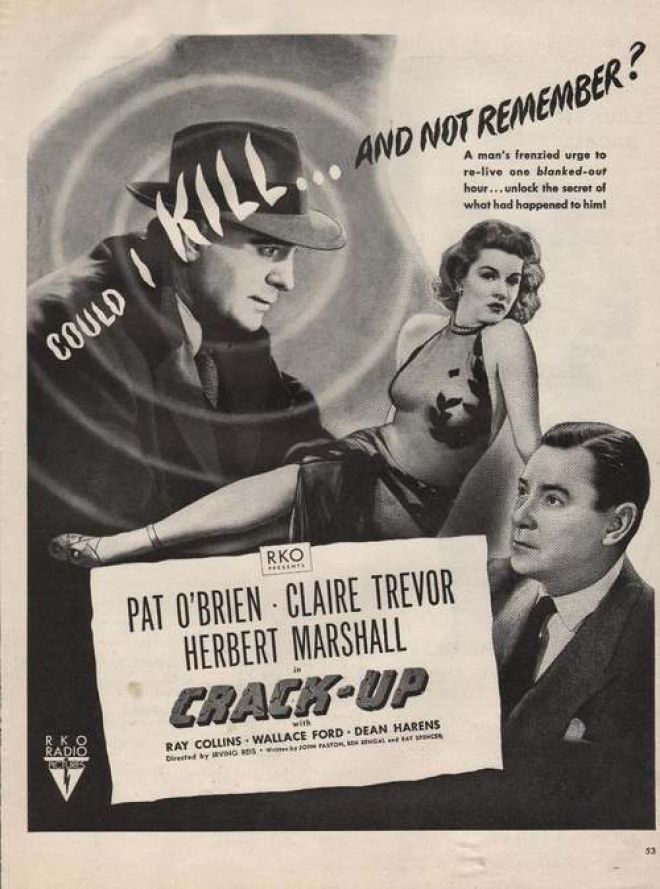
Suggested by the wonderfully titled short story, Madman’s Holiday by Fredric Brown, Crack-Up is, on face value, yet another cheap throwaway movie made by RKO in the post-war years, and of little interest to anyone who isn’t a fan of Pat O’Brien, Claire Trevor or Herbert Marshall. But look more closely and you’ll find a neat little thriller, still modest by the standards of the day, but with an approach to the material that makes it a fascinating piece to watch.

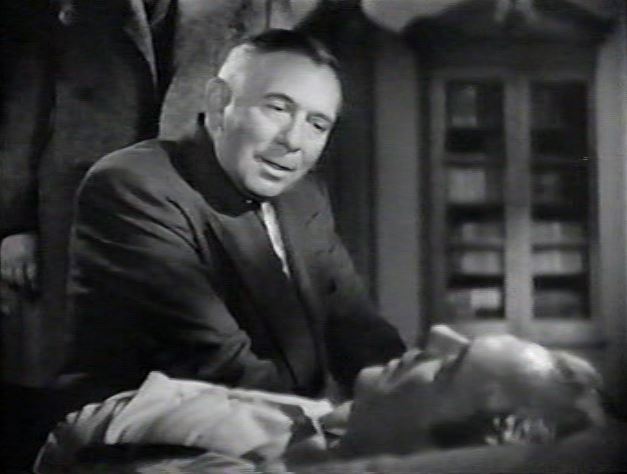
O’Brien is noted art critic and curator George Steele. When the movie begins we see him desperately trying to break into a museum late one evening. He appears drunk and he’s violent towards the policeman who tries to stop him. Once inside the museum the policeman manages to knock him unconscious. When he comes to he’s surrounded by Barton and some of the other museum trustees, as well as Terry, a visiting Englishman called Traybin (Marshall), and a police lieutenant called Cochrane (Ford). When Steele starts talking about being involved in a train crash earlier, it’s Cochrane who breaks the bad news: there hasn’t been a train crash (and his mother isn’t in the hospital). Certain there has been a crash, Steele allows himself to be pacified by one of the trustees, Dr Lowell (Collins). Lowell asks Steele if he can remember anything before the so-called crash, and though his mind is obviously disturbed, Steele recounts events from earlier in the day.

Crack-Up - scene1

He gives a lecture at the museum, and is particularly interested in debunking the idea that art and culture are the exclusive properties of the rich and prosperous. He wants to see art made more available to the general public, an idea that worries the museum’s director, Barton (Sanford). When Steele goes further, and voices his plan to allow the public to see paintings being x-rayed so as to see how some artists have painted over an existing work, Barton is incensed and tells Steele he will do his best to block the idea and ensure it never happens.

Unperturbed by Barton’s waspish attitude, Steele hooks up with an old flame, Terry Cordell (Trevor) and they go for a drink together. Steele receives a call that tells him his mother is sick in hospital. He heads straight for the train station where he boards the first available train north. But as the train approaches one of its stops, Steele sees another train that he’s convinced will crash headlong into his. The other train gets nearer and nearer, and beyond that Steele can’t remember anything else, and certainly not breaking into the museum. With Traybin intervening to stop Cochrane from arresting Steele for assaulting the policeman, and with the trustees all wanting the whole affair being kept out of the press, Steele is allowed to go home.

Crack-Up - scene2

But you can’t keep a confused art critic down and soon Steele is determined to find out what happened to him. He makes the same journey by train and learns enough to know that there’s something suspicious going on at the museum, and that it has something to do with a painting by Gainsborough that was recently lost at sea. With Terry’s aid he begins to piece together the fragments of a conspiracy that brings together the museum, a collection of old masters, and his own unwitting involvement.

There’s something undeniably charming about Crack-Up, with its murky lighting and frazzled hero, its well-oiled narrative and pleasing performances. For modern audiences it’ll prove too familiar perhaps, but if viewed with the eyes and ears of a contemporary viewer, there’s a lot that won’t seem as predictable or commonplace as it would do today. And a large part of the movie’s charm is the freshness the script – by John Paxton, Ben Bengal and Ray Spencer – brings to its central mystery: did George Steele experience a train crash, and if he didn’t, then why does he think he did? And as the story unfolds there are enough twists and turns to keep things lighhhearted and playful.

This is largely due to Irving Reis’s exemplary direction. Reis was a director who by 1946 had made a number of low budget thrillers including three featuring The Falcon. But while the projects he worked on were largely prosaic and uninspiring, Reis himself didn’t see it that way, and he worked hard to elevate the material he had to work with. This can be evidenced by the way in which Crack-Up is structured – there are breaks in the narrative where the viewer could convince him- or herself that they’ve missed something (just as Steele does) – and the way in which Steele is never able to fully convince himself that his sanity is as secure as he’d like it to be (he’s not quite the tortured hero of other film noirs, but his insecurity is a definite plus).

Crack-Up - scene3

Reis is aided by strong performances from O’Brien and Trevor, with the latter given the chance to be more than just a piece of attractive window dressing to pose beside the lead actor. While O’Brien is steadfast and determined (while remaining unsure deep down), Trevor is angry and tenacious, refusing to believe her man is of unsound mind, and willing to support him no matter what. It’s a tough, unwavering performance, and Trevor, who was always an actress capable of far more than she was usually asked to provide, here makes Terry the equal of any of the male characters, and someone who the audience can identify with and be sympathetic towards. As the urbane Traybin, Marshall plays to type and uses his sleepy-eyed features to good effect, drawling his way through the material with a casual deference that balances O’Brien’s gruffer, more aggressive portrayal.

For fans of the genre (and the era) there are cameos from the likes of Edward Gargan (an arcade cop), Eddie Parks (a drunk in the same arcade), and Gertrude Astor (a nagging wife), and there’s an above average score by Leigh Harline that includes a couple of unsettling motifs that are used during some of the more intense sequences. It all builds to a satisfactory climax, with the villain – and their accomplice – proving not quite as obvious as usual (though, again, fans of the genre may think otherwise). It all adds up to a surprisingly rewarding film noir, and a movie well worth checking out if you get the opportunity.

Rating: 7/10 – an unassuming, modest little thriller that features a robust script, adroit performances, and assured, confident direction, Crack-Up is a movie that goes some way to proving that not all post-war mysteries were derivative and/or bland; not just for fans, this is a welcome addition to the genre that doesn’t settle for being second best or tired and predictable.

NOTE: Alas, no trailer for Crack-Up is available.

Share this:

  • Click to share on X (Opens in new window) X
  • Click to share on Facebook (Opens in new window) Facebook
  • More
  • Click to print (Opens in new window) Print
  • Click to email a link to a friend (Opens in new window) Email
Like Loading...

Monthly Roundup – February 2016

29 Monday Feb 2016

Posted by dullwood68 in Movies

≈ Leave a comment

Tags

5th birthday, Action, Adam Sandler, Andy Samberg, Animation, Athletics, Batman, Batman: Bad Blood, Batwing, Batwoman, Benson Fong, Bruce Wayne, Charlie Chan, Crime, Detective, Dracula, Drama, Fast Girls, Genndy Tartakovsky, Hotel Transylvania 2, Jason O'Mara, Jay Oliva, Kevin James, Lenora Crichlow, Lily James, Mantan Moreland, Morena Baccarin, Murder, Mystery, Nightwing, Noel Clarke, Phil Karlson, Radium, Regan Hall, Relay team, Review, Robin, Sean Maher, Selena Gomez, Sequel, Shanghai, Sidney Toler, Sports, Steve Buscemi, Stuart Allan, The Heretic, Thriller, Yvonne Strahovski

Batman: Bad Blood (2016) / D: Jay Oliva / 72m

Cast: Jason O’Mara, Yvonne Strahovski, Stuart Allan, Sean Maher, Morena Baccarin, Gaius Charles, James Garrett, Ernie Hudson, Robin Atkin Downes, Travis Willingham, Geoff Pierson

Batman Bad Blood

Rating: 7/10 – when Batman (O’Mara) is missing believed dead after an encounter with  The Heretic (Willingham), it falls to Nightwing (Maher), Robin (Allan) and newcomer Batwoman (Strahovski) to discover if he really is dead, or if his disappearance is part of a bigger plot; continuing Warner Bros. impressive streak of animated Batman movies, Batman: Bad Blood is as moody and psychologically sombre as its live action counterparts, even if some of its characters behave like children in their attempts to get along.

The Shanghai Cobra (1945) / Phil Karlson / 64m

Cast: Sidney Toler, Mantan Moreland, Benson Fong, James Cardwell, Joan Barclay, Addison Richards, Arthur Loft

The Shanghai Cobra

Rating: 5/10 – the Oriental detective is tasked with finding the murderer of several bank employees, but the mystery turns out to be connected to an old case Chan was involved in years before in Shanghai; another conveyor belt Monogram/Charlie Chan movie, The Shanghai Cobra is hardly distracting, or distinguishable from any of its Forties brethren, but it’s entertaining enough in its way, and Toler still seems to be enjoying himself in the role (which is no mean feat).

Fast Girls (2012) / D: Regan Hall / 91m

Cast: Lenora Crichlow, Lily James, Lorraine Burroughs, Noel Clarke, Lashana Lynch, Dominique Tipper, Rupert Graves, Philip Davis, Bradley James, Emma Fielding

Fast Girls

Rating: 3/10 – Olympics wannabe sprinter Shania Andrews (Crichlow) makes it onto the UK team but finds her progress hampered by a rivalry with fellow athlete Lisa Temple (James), as well as personal problems of her own; for Fast Girls, writer and star Noel Clarke has fashioned a cliché-strewn drama that lacks cohesion between scenes and is laden with unconvincing dialogue, not to mention the paper-thin plotting and some extremely wayward performances.

Hotel Transylvania 2 (2015) / D: Genndy Tartakovsky / 89m

Cast: Adam Sandler, Andy Samberg, Selena Gomez, Kevin James, Steve Buscemi, David Spade, Keegan-Michael Key, Asher Blinkoff, Fran Drescher, Molly Shannon, Megan Mullally, Nick Offerman, Dana Carvey, Rob Riggle, Mel Brooks

Hotel Transylvania 2

Rating: 6/10 – Count Dracula (Sandler) has a grandchild – but will the little sprog turn out to be fully human, or will he sprout fangs and make his grandfather eternally happy?; a serviceable sequel, Hotel Transylvania 2 lacks momentum in the first hour and then pulls it together to provide a fun conclusion, which makes it okay for children, but adults will probably be wishing they were watching the first movie instead.

Share this:

  • Click to share on X (Opens in new window) X
  • Click to share on Facebook (Opens in new window) Facebook
  • More
  • Click to print (Opens in new window) Print
  • Click to email a link to a friend (Opens in new window) Email
Like Loading...

The Hateful Eight (2015)

18 Thursday Feb 2016

Posted by dullwood68 in Movies

≈ 1 Comment

Tags

Bounty hunter, Bruce Dern, Demián Bichir, Drama, Jennifer Jason Leigh, Kurt Russell, Michael Madsen, Minnie's Haberdashery, Mystery, Quentin Tarantino, Review, Samuel L. Jackson, Thriller, Tim Roth, Walton Goggins, Western, Wyoming

The Hateful Eight

D: Quentin Tarantino / 167m

Cast: Samuel L. Jackson, Kurt Russell, Jennifer Jason Leigh, Walton Goggins, Tim Roth, Demián Bichir, Michael Madsen, Bruce Dern, James Parks, Channing Tatum

It’s post-Civil War Wyoming, and a stagecoach trying to outrun a fast approaching snowstorm (in already treacherous weather) is stopped by an unexpected encounter with a bounty hunter, Major Marquis Warren (Jackson), stranded on the road to the nearest safe haven, a staging post named Minnie’s Haberdashery. On board the stagecoach is another bounty hunter, John “The Hangman” Ruth (Russell) and his prisoner, Daisy Domergue (Leigh), heading for the town of Red Rock so she can face trial. Once bona fides are established between the two men, Warren is allowed to journey on aboard the stagecoach. Later they pick up another stranded man, Chris Mannix (Goggins), who tells them he’s also heading to Red Rock where he is to take up the post of sheriff.

At Minnie’s Haberdashery, they find that an earlier stagecoach has taken shelter there, and there are four men waiting out the impending snowstorm. One is a Southern general, Sanford Smithers (Dern), who’s come to Wyoming in search of his missing son. Another is Joe Gage (Madsen), a cowboy heading home after being away on a lengthy cattle trail. The third introduces himself as Oswaldo Mobray (Roth), on his way to Red Rock to act as hangman should Daisy Domergue be found guilty at her trial. And then there’s Bob (Bichir), a Mexican who tells Warren that Minnie and her husband, Sweet Dave, have gone to see her mother, and that they’ve entrusted the upkeep of the staging post to him. But Warren is unconvinced.

Once everyone is inside and introduced to each other, Ruth is quick to make it clear that he believes at least one person there isn’t who he says he is, and that it’s likely they’re going to try and free Daisy (though he doesn’t say why, or how he knows). Warren believes him, and they agree to join forces and keep an eye on the other men. But things begin to go wrong when Warren recognises Smithers, and he realises why the old man is there, and so far from home.

THE - scene1

The eighth movie by Quentin Tarantino is ostensibly a Western, but thanks to its writer/director’s penchant for being a movie magpie, it’s also a thriller, a revenge drama, an old dark house-style mystery, and yet another movie where he assembles a great cast only to give preference to some – Jackson, Russell, Goggins – while neglecting others – Leigh, Bichir, Madsen. That Tarantino wants to stuff his movie with references to other movies has always been a part of his movie making raison d’être, so it shouldn’t come as any surprise that The Hateful Eight isn’t just a Western. But this time around, the end result is a movie that struggles to find its identity, and thanks to the novel-style approach of Tarantino’s script – it’s made up of six Chapters – it feels much more artificial than it should be.

As Tarantino nudges along his characters in the wake of Jackson’s central character, and takes in issues of racism and post-War guilt, and a very occasional stab at the morality behind the execution of women, it becomes clear that these characters are mere cyphers, lacking in development and free from any real, appreciable insight into their motives. Given this lack of investment by Tarantino’s script, and despite the detailed and often hypnotic rhythms of the dialogue he grants them, it’s left to his very talented cast to make up the shortfall. Some achieve this with aplomb – Goggins in particular – but even the likes of Russell and Leigh can’t elevate the shallow nature of their characters. Russell bellows like an absurdist bully, while Leigh at one point is reduced to the kind of playground boasting that was outmoded even in the 1860’s.

Spare a thought then for Tarantino regular Jackson. Having landed the lead role in the movie, and been given the kind of back story that most actors would relish getting their hands on (or teeth into), it must have been dispiriting to see the final product and realise that for all the blood and thunder involved, it was all for nought given how the character is treated in the movie’s final chapter. There’s a lot to be said for a movie of this length when it exposes some of its maker’s more crueller narrative decisions and forces its audience to wonder if its wunderkind creator is quite the impressive writer/director he’s reputed to be. And this is where The Hateful Eight is most successful: in showing that the hype surrounding Tarantino isn’t always deserved.

THE - scene2

Take one scene in particular, the beginning of Chapter Four, entitled Domergue’s Got a Secret. Unable to introduce a major plot development in any other way (apparently), Tarantino resorts to the use of an offscreen narrator (voiced by himself) who not only explains what Daisy’s secret is, but clearly signposts for those in the audience who may be hard of understanding, what this means in terms of what follows. It’s like someone stopping a theatre production of Macbeth and stepping forward to explain that when Shakespeare says Macbeth can’t be “killed by man born of woman” he actually means he can be killed by someone born via Caesarean. Got it? Then let’s move on.

From there on The Hateful Eight swiftly unravels in a welter of violence and bloodshed that throws out all the groundwork made to get this far, and concentrates instead on bumping off its cast of characters. But any fascination or sympathy the viewer may have had for anyone is eroded by Tarantino’s decision to go for a bloodbath rather than a tense showdown. And then there’s the final chapter, so awkward and clunkily written that the viewer can’t help but wonder if Tarantino didn’t know how to end his movie, and settled on the first thought that came to him – and then didn’t even bother to polish the finished script. For once, Tarantino relinquishes control over the material, and the camerawork by Robert Richardson – up til then one of the few consistent positives about the movie – is undermined by the kind of reckless scissor-happy editing that you’d expect from someone having to deal with far less filmed material and an impossible deadline (and the movie’s editor, Fred Raskin, is a much better editor than that – check out his work on another 2015 Western, Bone Tomahawk, for proof).

THE - scene3

When all is said and done, The Hateful Eight isn’t a movie that works; at least, not entirely. If anything, the movie never proceeds to anywhere successful once Chris Mannix boards the stagecoach and they arrive at Minnie’s Haberdashery. Up til then, Tarantino does what he does best: he introduces his characters through his trademark intricate dialogue, and he sets the scene for the rest of the movie. But once in Minnie’s Haberdashery, the plot has to take over, and it soon runs out of steam. The addition of a flashback in Chapter Five feels even more awkward than the revelation that Daisy has a secret, and makes scant use of Channing Tatum into the bargain.

And finally, as if to rub salt into the movie’s wounds, we have a score by Ennio Morricone that has no impact throughout, and isn’t in any way memorable (there are times when it doesn’t even feel suited to the material). When your favourite movie composer can’t even make a difference then you just know that it’s not going to work. Sometimes – and this applies to anyone who writes and directs their own movies, or who have carte blanche from the studio that writes the cheques – having an idea isn’t enough. And building on that idea isn’t enough. And writing a screenplay isn’t enough. Sometimes you just have to let an idea go. Often it’s the kindest thing you can do for everyone.

Rating: 6/10 – narrative glitches aside, Tarantino’s eighth movie proves lacklustre both in terms of its visuals and its attention to its characters, leaving the viewer without anyone to sympathise with or warm to; The Hateful Eight is also the first of the writer/director’s movies to feel incomplete in terms of his investment in the project, and while he may argue otherwise, there’s a distance between him and the final product that hasn’t been there in any of his other, seven movies.

Share this:

  • Click to share on X (Opens in new window) X
  • Click to share on Facebook (Opens in new window) Facebook
  • More
  • Click to print (Opens in new window) Print
  • Click to email a link to a friend (Opens in new window) Email
Like Loading...

Paper Towns (2015)

09 Friday Oct 2015

Posted by dullwood68 in Movies

≈ Leave a comment

Tags

Agloe, Austin Abrams, Cara Delevingne, Disappearance, Drama, Jake Schreier, John Green, Justice Smith, Literary adaptation, Mystery, Nat Wolff, Orlando, Prom, Review, Road trip, Romance, Teenagers

Paper Towns

D: Jake Schreier / 109m

Cast: Nat Wolff, Cara Delevingne, Austin Abrams, Justice Smith, Halston Sage, Jaz Sinclair, Cara Buono

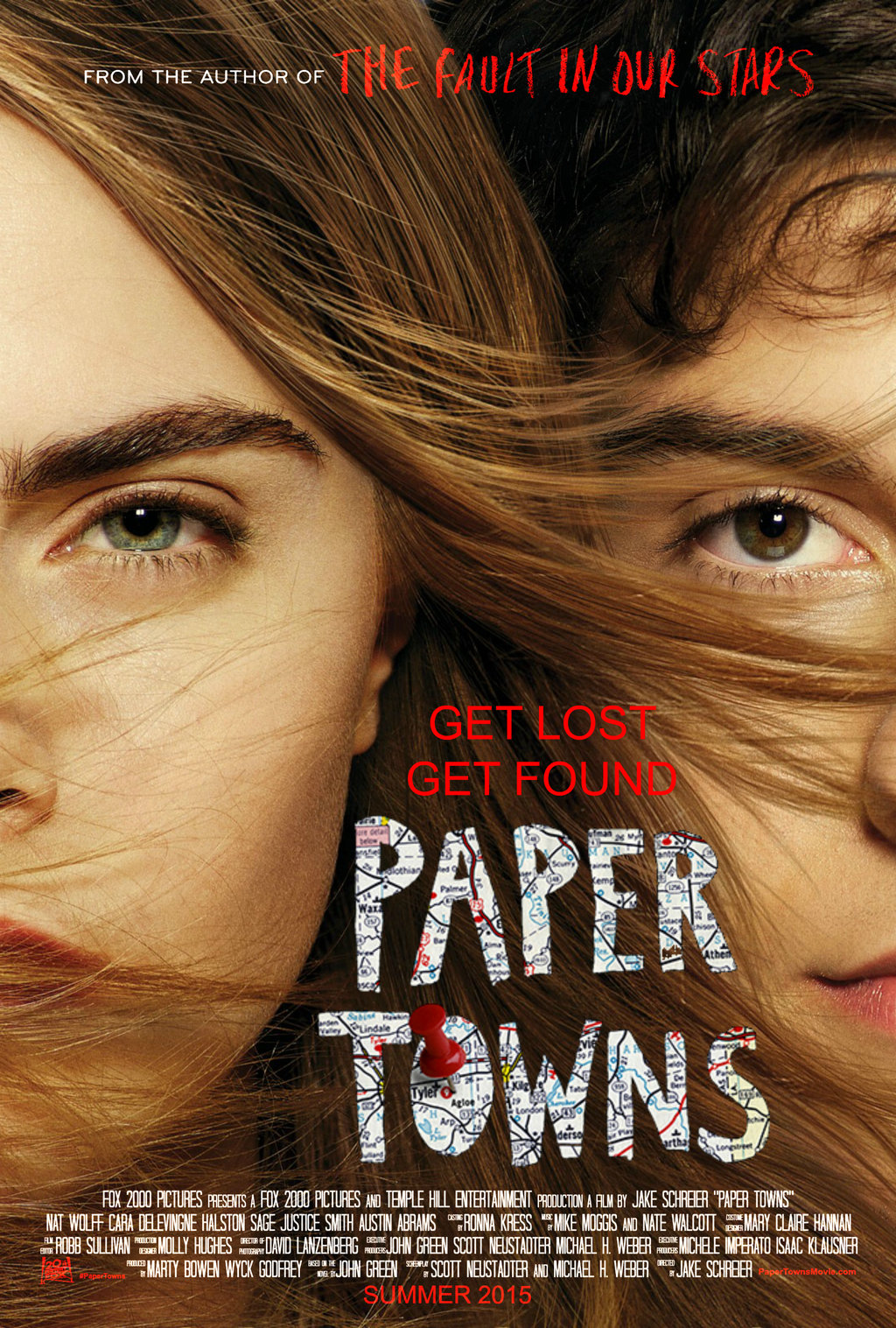
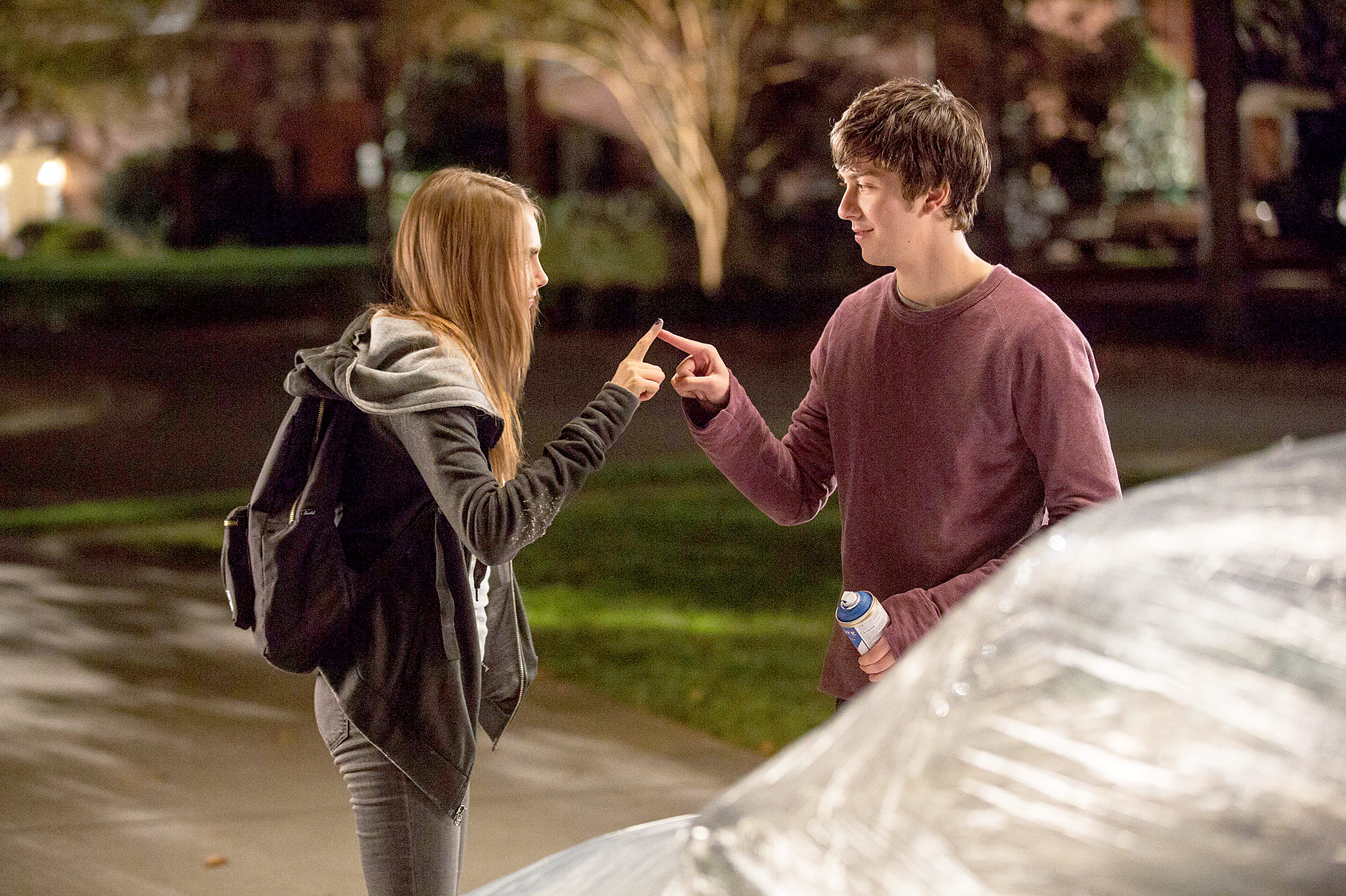
Ever since Margo Roth Spiegelman (Delevingne) moved in across the street from Quentin “Q” Jacobsen (Wolff) when they were kids, Quentin has looked on her as his one true love. But even though they grew up together as friends, and spent a great deal of time together, they’ve drifted apart and no longer even acknowledge each other in high school. All that changes however when, one night, Margo comes in through Q’s bedroom window and asks to borrow a car. She tells him that she has nine things she needs to do that night (some of which are illegal), and she needs his help. Reluctant at first, Q agrees to help her, and they take his mother’s car and head to the nearest Costco.

There they pick up various supplies including duct tape, a lot of Saran wrap, and a raw catfish. Margo explains that she’s out to get revenge on her boyfriend and her close friends; her boyfriend has been cheating on her with one of her friends, and at least one more friend knew it was happening and didn’t say anything. As the night progresses, and they play prank after prank, it becomes more and more like the times they spent together as kids, and Q finds his attraction for Margo rekindled. The next day though there’s no sign of Margo; a few more days pass before it becomes clear that Margo has disappeared.

Q is certain that Margo has left for a reason and that she wants to be found. He bribes her younger sister to look for clues in her bedroom. A Walt Whitman quote leads Q to finding a note with an address on it. With his friends Radar (Smith) and Ben (Abrams), he goes there and finds an abandoned store but they don’t find another clue. The next day, Q is approached by Lacey (Sage), one of Margo’s friends who is concerned about what’s happened to her. When the boys go back to the abandoned store she follows them there, and the four of them discover an atlas with a page torn out, a page that indicates Margo has gone to a small town in upstate New York called Agloe.

Q decides to throw caution to the wind and travel to Agloe. His friends, and Lacey, all agree to go with him, but only as long as they can get back in time for the upcoming prom. Radar’s girlfriend, Angela (Sinclair), comes along with them. Along the way they have a near-miss with a cow that sees their car spin off the road. Stranded for the night, Ben and Lacey develop a fondness for each other, while Radar and Angela pre-empt the plans they have for after the prom. The next day, with the car repaired, they finally make it to Agloe, but what they find there isn’t exactly what Q expected…

Paper Towns - scene

A teen romance where the romance is potentially illusory, and a teen drama where the drama is assembled through the filter of a mystery, Paper Towns is a heartfelt ode to teenage longing and seizing the moment. It features several moments where it seems the narrative is being forced along by contrivance and crude coincidence, but the movie has the presence of mind to excuse itself by a trick of the very same narrative. This is to do with the clues Margo has left behind, and the way in which Q responds to them, but as they are the crux of the matter – even more so than Q and Margo’s relationship – it’s hard to imagine the movie working out in any other way, faithful as it is to the structure and tone of John Green’s novel.

However, what is difficult to pin down successfully in the novel is also difficult to pin down in the movie. Q’s commitment/devotion/attachment to Margo is never quite believable, despite Wolff’s compelling performance, and hinges on that one night of prankdom that in itself seems unlikely. Some viewers might not be too concerned by Margo’s appearance in Q’s room after so long, but it’s hard to believe that after so long “apart” that she would rekindle their friendship, and then make it so memorable for Q before disappearing. And Q’s disappointment only lasts until it becomes clear that Margo has run away, but instead of feeling taken advantage of, he becomes certain she wants him to find her. All of which begs the question, is Q just lovesick, or a stalker in training?

Michael H. Weber and Scott Neustadter’s adaptation does its best to portray Q’s search for Margo as the grand romantic gesture it appears to be, but the script never manages to make his obsession credible or based on anything but an intellectual challenge (can he find her from the clues she’s left behind?). As a result, and again despite Wolff’s engaging portrayal, Q comes across as a loyal puppy dog willing to do whatever he believes his mistress wants him to do. So wedded to the idea of his being with Margo does Q become that a more appropriate liaison with Lacey is quickly nipped in the bud by pairing her off with Ben, a relationship that would be more credible in a Revenge of the Nerds movie.

In the end the movie’s central concept is that we – or more particularly Q – should live for the moment, and create our own dreams instead of following someone else’s, and while this is a tenet that’s worth taking to heart, here it follows in the footsteps of too many other teen dramas to be either relevant or anything other than jaded. But thanks to its gifted cast, and a sense of fun that is more appealing than the drama that occupies centre stage, the movie is by no means a chore to watch, and features warm, soothing cinematography by David Lanzenberg, and a charming score by Son Lux. Schreier’s direction is unobtrusive for the most part, and with the help of Wolff and Delevingne he imbues the scenes between Q and Margo with a sense of unspoken yet mutual affection that is entirely touching.

Rating: 7/10 – in many respects a missed opportunity, Paper Towns has a superficial fascination that draws in the viewer but will leave them feeling less than fully satisfied by the movie’s end; competently made but missing that vital spark needed to make the material sing, it has another delightful performance from Wolff, and gives Delevingne the chance to shine in what is the movie’s most important, and unexpectedly fascinating, supporting role.

Share this:

  • Click to share on X (Opens in new window) X
  • Click to share on Facebook (Opens in new window) Facebook
  • More
  • Click to print (Opens in new window) Print
  • Click to email a link to a friend (Opens in new window) Email
Like Loading...

Mini-Review: The Falling (2014)

09 Wednesday Sep 2015

Posted by dullwood68 in Movies

≈ 6 Comments

Tags

1969, Carol Morley, Drama, Fainting, Florence Pugh, Girls' school, Greta Scacchi, Maisie Williams, Mass hysteria, Maxine Peake, Mystery, Review

Falling, The

D: Carol Morley / 102m

Cast: Maisie Williams, Maxine Peake, Greta Scacchi, Florence Pugh, Anna Burnett, Joe Cole, Rose Caton, Lauren McCrostie, Katie Ann Knight, Evie Hooton, Morfydd Clark, Monica Dolan, Mathew Baynton

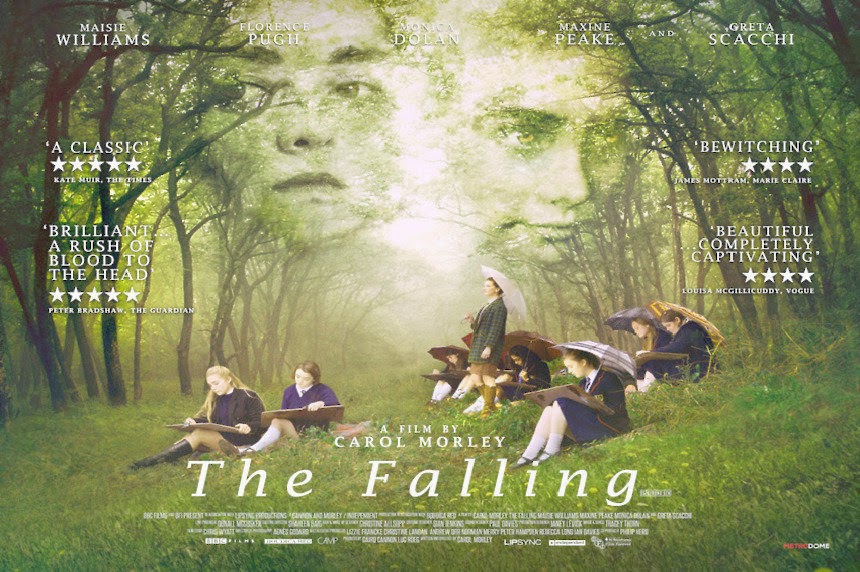
At a British girls’ school in 1969, Abbie Mortimer (Pugh) is liked and admired by all, especially her best friend, Lydia Lamont (Williams). Abbie though, has a rebellious streak, and is the first of the girls to have sex. But this leads to her falling pregnant and a subsequent series of fainting spells that lead to her unexpected death. Stunned by this sudden turn of events, Lydia begins to feel unwell herself, and soon she too is fainting, both at school, and at home where her mother Eileen (Peake) hides herself away from the world.

Lydia now assumes the role Abbie had in the school, and much to the vexation of teacher Miss Mantel (Scacchi) and school head Miss Alvaro (Dolan), more and more of the other girls begin to show similar signs of illness, and start fainting as well. At first, Miss Alvaro refuses to believe that anything is wrong, and is certain that Lydia and the rest are faking their attacks. But when it also affects one of the other teachers, Miss Charron (Clark), at an assembly, the school is faced with no option but to send the girls to hospital for tests to see if the pupils are guilty of deception, or if there’s a real medical reason for what’s happening.

Falling, The - scene

Despite the crispness of Agnès Godard’s often exquisite photography, and an insistent but strangely apt soundtrack involving original music by Tracey Thorn, The Falling is not as mysterious or dramatic as it seems, relying heavily on visual motifs and too many shots that are meant to increase the sense of foreboding, but which only go to show that trees used as a metaphor actually remain just trees. The same goes for the repetitive nature of the faintings – instead of instilling any sense of dread they happen so regularly that by the time we see a group of schoolgirls hyperventilating in a hospital corridor, it’s more a cause for laughter than concern.

Morley leaves a lot of questions unanswered (not the least of which is the cause of Abbie’s death), and avoids taking one or two subplots down roads that would have made for more dramatic results (Lydia’s growing attraction for her brother, Kenny (Cole), for example), while the cast do their best with poorly motivated characters and the kind of dialogue that only teenagers in the movies come out with (Lydia even yells “Kill the system!” at one point). It’s all meant to be a fervent hotbed of paranoid mass hysteria, and while it’s a situation that obviously goes too far, there are few consequences for the characters involved, and by the end we’re back where we started. There’s a decent idea here, but there’s also too much that’s elliptical or left hanging, leaving the movie only occasionally successful in what it’s trying to do, and only occasionally rewarding for the viewer.

Rating: 5/10 – dramatically unsound and lacking in any clear focus as to what it’s trying to say (other than that teenage girls are incredibly susceptible to hysteria), The Falling is a psychological mystery overlaid with an arthouse approach that doesn’t suit the material; obtuse and trying to be profound, the movie stumbles along revealing little about its characters beyond the obvious, and does its best to keep them at a distance.

Share this:

  • Click to share on X (Opens in new window) X
  • Click to share on Facebook (Opens in new window) Facebook
  • More
  • Click to print (Opens in new window) Print
  • Click to email a link to a friend (Opens in new window) Email
Like Loading...

Nancy Drew… Reporter (1939)

13 Monday Jul 2015

Posted by dullwood68 in Movies

≈ Leave a comment

Tags

Bonita Granville, Crime, Drama, Frankie Thomas, John Litel, Literary adaptation, Murder, Mystery, Nancy Drew, Review, Series, Thriller, William Clemens

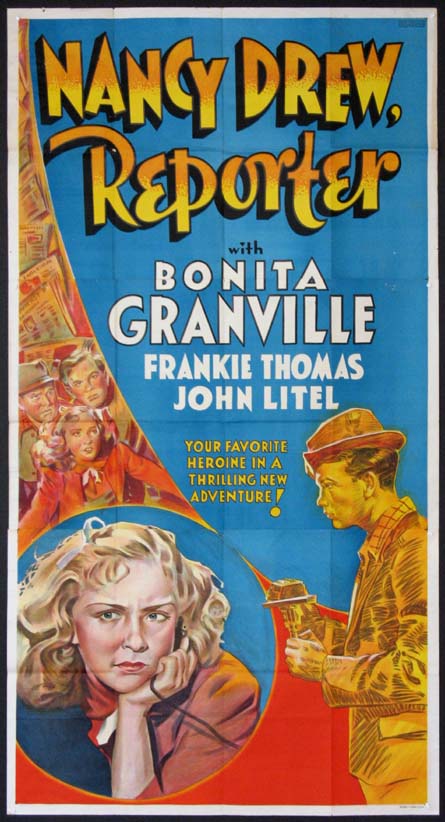
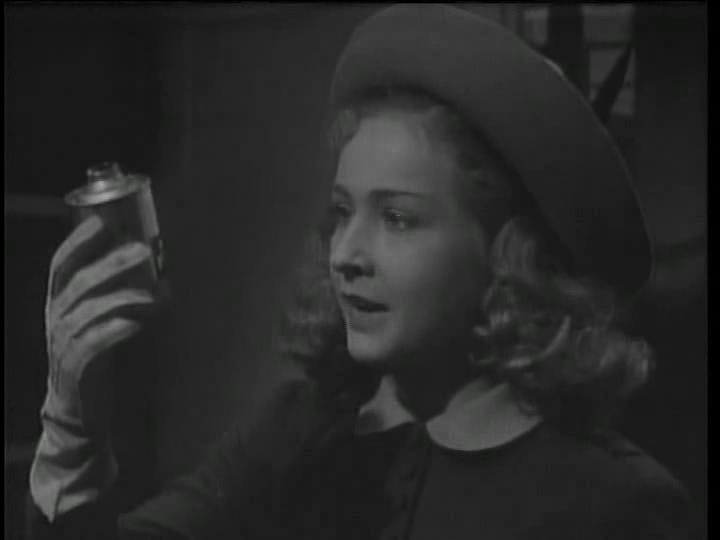
Nancy Drew... Reporter

D: William Clemens / 68m

Cast: Bonita Granville, John Litel, Frankie Thomas, Dickie Jones, Mary Lee, Larry Williams, Betty Amann, Jack Perry, Thomas E. Jackson, Olin Howland, Sheila Bromley

When she takes part in a newspaper contest, headstrong Nancy Drew (Granville) doesn’t like the assignment she’s given, so instead she swipes another reporter’s assignment: to cover the inquest of a woman, Kate Lambert, who was recently found dead. At the inquest, it’s revealed that Mrs Lambert was poisoned by a photographic chemical, and suspicion falls on her companion, Eula Denning (Amann). Protesting her innocence, and stating that whoever killed Mrs Lambert would have left fingerprints on the tin the poison came in, Eula is still remanded in custody for trial.

Also at the inquest is a man with a cauliflower ear (Perry) who hits Nancy’s bumper as he leaves the courthouse. She follows him to the Lambert house where he tries to gain entry, but Nancy and a guard stop him. She tells her father, well-known and respected lawyer Carson Drew (Litel), all about it but he warns her to leave well alone. Instead, Nancy gains the help of her neighbour, Ted Nickerson (Thomas) and together they visit Eula in jail. She tells them the tin must still be in the house and gives them a clue as to where to find it. At the Lambert house, Ted distracts the guard while Nancy sneaks inside and finds the tin. But the man is also there, and tries to grab the tin but Nancy gets away from him. She takes the tin to the police station, but before she can hand it over, the man’s girlfriend (Bromley) steals it from her.

Nancy discovers that the man is a boxer, Soxie Anthens, and she also discovers the gym where he trains. She and Ted go there and further learn that Soxie’s girlfriend is called Miss Lucas. They track her down to the Beldenburg Hotel, where they also find out that she’s gone to the Mandarin Cafe. Nancy and Ted head over there, and find Soxie’s girlfriend in the company of Miles Lambert (Williams), the son of the murdered woman. Alerting Soxie to their being together, he causes a scene when he arrives at the cafe. During the altercation, Nancy learns enough about the tin and the murder to set a trap for the killer.

Nancy Drew... Reporter - scene

The second of four movies made in 1938-9 by Warner Bros. and based on the character created by Edward Stratemeyer, Nancy Drew… Reporter is a fast-paced comedy whodunnit that has time to pause for a musical interlude, and adds two young “whippersnappers” in the form of Ted’s younger sister Mary (Lee) and her friend in mischief Killer Parkins (Jones) to the mix as often as it can. It has a certain degree of innocent charm, and is largely inoffensive, but beneath the irreproachable content of the plot and storyline, the movie is surprisingly subversive.

When Nancy steals the reporter’s assignment, she later justifies her actions by stating that a good reporter should always do what it takes to get the story. It’s the best example of the lying and manipulation that Nancy displays throughout the movie in her efforts to catch the killer. She hoodwinks Ted on more than one occasion, traps her father into defending Eula thanks to a fait accompli, and blatantly lies in order to get the newspaper to print a fraudulent headline in order to flush out the killer. In her quest to uncover the truth it seems that Nancy will bend or break the rules in whatever way she needs in order to do so. And it’s noticeable that she rarely – if ever – apologises.

With its heroine proving almost as devious and deceitful as the bad guys, the movie carries on as if it hadn’t noticed at all that Nancy was so duplicitous, and of course, she wins the newspaper contest (though, to be fair, she declines the cash prize, but accepts the accompanying medal). There’s too much of this ironic counterpoint for the movie to be an entirely comfortable watch, with its moral compass being so broadly compromised. Of course, Nancy isn’t the only character in the movies to behave in such a way, but this is a character who was intended to encourage young girls to read more; what message are they meant to be getting when Nancy behaves as if the usual rules don’t apply to her?

Away from the dubious character of Nancy, there’s the small matter of the plot, which is very basic to say the least, and which advertises the villains straight away at the inquest. Usually, the killer is revealed in the final reel, but here anyone will be able to work out their identity well in advance, and this helps to dilute whatever drama or tension is inherent in the plot. In fact, there are times when the plot is so lightweight it’s almost gossamer thin. But the cast are entertaining to watch, with Granville and Thomas proving a good pairing, while Litel is kept firmly in the background, aside from an uncomfortable moment when he carries Granville off to bed and sings an awkward lullaby to her while also tucking her in.

Series’ director Clemens maintains a loose feel throughout and gives his cast enough room to indulge themselves when appropriate, and this happy-go-lucky approach makes the movie seem smarter and more energetic than it actually is, and despite the best efforts of screenwriter Kenneth Gamet. A mention too for editor Frank DeWar whose skill in the cutting room means the movie contains very little fat, and has a freshness to it even now, over seventy-five years since its release.

Rating: 6/10 – allowing for its (probably) unintentionally crafty heroine, Nancy Drew… Reporter is still an interesting, if flawed, take on the teen sleuth genre; bolstered by good performances, though with a mystery that even a blind person could work out, the movie is nevertheless a minor treat for fans of this type of movie, and of Granville in particular.

Share this:

  • Click to share on X (Opens in new window) X
  • Click to share on Facebook (Opens in new window) Facebook
  • More
  • Click to print (Opens in new window) Print
  • Click to email a link to a friend (Opens in new window) Email
Like Loading...

Mr. Holmes (2015)

07 Tuesday Jul 2015

Posted by dullwood68 in Movies

≈ Leave a comment

Tags

A Slight Trick of the Mind, Bees, Bill Condon, Glass harmonica, Grey glove, Historical drama, Ian McKellen, Japan, Laura Linney, Literary adaptation, Milo Porter, Mystery, Prickly ash, Review, Royal jelly, Sherlock Holmes, Sussex

Mr. Holmes

D: Bill Condon / 104m

Cast: Ian McKellen, Laura Linney, Milo Porter, Hiroyuki Sanada, Hattie Morahan, Patrick Kennedy, Roger Allam, Frances de la Tour, Philip Davis, John Sessions

In 1947, Sherlock Holmes (McKellen), now 93, lives in a Sussex farmhouse, and is looked after by his housekeeper, Mrs Munro (Linney), and her young son, Roger (Porter). He keeps bees and uses royal jelly as a means of improving his memory, which has deteriorated in recent years. A recent trip to Japan in search of supplies of prickly ash, a plant also known for improving the memory, has been undertaken with a view to ensuring that Holmes can complete one last project before he becomes unable to: to write a true account of his last case as a detective. Unhappy with the way Dr Watson portrayed those events, Holmes is struggling to remember the details of the case. Urged on by the interest shown by Roger, Holmes renews his efforts to pin them down.

His recollections take him back thirty years, after Watson has gotten married and their partnership has dissolved. He’s visited by Thomas Kelmot (Kennedy), a man worried about the behaviour of his wife, Ann (Morahan). Following two miscarriages, Ann Kelmot has become withdrawn; her husband has advised her to take up a musical hobby but now that has become an obsession, and even though he has forbade her from continuing her lessons with glass harmonica teacher, Madame Schirmer (de la Tour), he has discovered Ann is still visiting her. He suspects the music teacher of some kind of plot and wants Holmes to investigate.

Back in the present, Holmes takes Roger under his wing in and introduces him to his apiary. Roger persists in asking about Holmes’ last case; his enthusiasm prompts Holmes to make more of an effort to remember Ann Kelmot, including following her to Madame Schirmer’s and from there to various places before he approaches her in a public garden. Their conversation becomes confrontational but Holmes reveals the depth of his knowledge about her situation, and the effect the two miscarriages has had on her.

Mrs Munro, meanwhile, informs Holmes that she is planning to move to Portsmouth and work in a hotel; it will mean taking Roger with her. Roger doesn’t want to go, but when Holmes suffers a collapse shortly after, they are forced to stay. While he remains bedridden on the advice of his doctor (Allam), Roger takes care of the bees. He also finds a grey glove in Holmes’ study, a memento from the case of Ann Kelmot that Holmes can’t remember keeping or having. As Holmes remembers more about the case he also recalls the event that led to his retirement as a detective, and the reasons behind Watson’s subsequent involvement. But his remembrance of the past is put into perspective when he finds Roger has been stung by dozens of bees, and the boy’s life is hanging in the balance…

Mr. Holmes - scene

Dealing with themes of sadness and loss and regret, Mr. Holmes presents us with a portrait of a master detective beset by echoes from his past. It’s a richly detailed depiction of times long past, anchored by a superb performance from McKellen, and redolent of a bygone age, with its frock coats and steam trains and pre-suffrage gender politics. Expertly marshalled by Condon – reunited with McKellen for the first time since they collaborated on Gods and Monsters (1998) – the movie is a flawless recreation of two periods in English history that still exert a strong fascination: the post-Victorian era and the years immediately following the cessation of World War II. There’s also Holmes’ trip to Japan and the sight of the devastation wrought on Hiroshima. The historical trappings carry so much weight it’s almost as if the audience has been transported back with Holmes and are experiencing things themselves.

With the period detail proving so effective, it’s the twin mysteries on offer – what really happened during Holmes’ last case, and what is causing the deaths of his beloved bees – that unfortunately stop the movie from becoming even more memorable (an ironic outcome for a movie that deals with the loss and despair in losing one’s own memory). The story of Ann Kelmot has all the initial hallmarks of a classic Holmes tale, with its anxious husband and a heroine seemingly under the influence of a scheming criminal. But the truth, when Holmes finally remembers it, is far more prosaic than that, and while presented with some emotional impact, still doesn’t seem as devastating as Holmes makes out. Maybe it’s seeing it from the perspective of an old man trying to make sense of things that remain just out of reach that leaves the viewer with a sense of detachment: if Holmes can’t access those recollections and connect with them, how are we to do so?

But the movie, even with its handful of slightly underdeveloped storylines, has several aces up its sleeve that mitigate and make up for the paucity of the plot and the general structure. These are the performances from McKellen, Linney, Porter and Morahan. As already mentioned, McKellen is superb as Holmes, fragile, distressed, playful, curmudgeonly, afraid – tuning his portrayal of the master detective to such a fine degree that it’s both an acting and organic masterclass; he’s believable and convincing throughout, particularly when he’s trying to downplay the public misconceptions about him that are thanks to Watson’s writings. As Holmes’ housekeeper, Linney adopts a country dialect with precision and aplomb, and imbues Mrs Munro with a stoic dignity that stops her from expressing her misgivings about the relationship between Holmes and her son. As Roger, Porter gives another of those naturalistic, not-even-trying performances that it seems most child actors can produce at the drop of a hat; his scenes with McKellen are affecting and perfectly modulated. And as the focus of Holmes’ disturbed memories, Morahan is quietly magnificent as the troubled Ann Kelmot, her tear-rimmed eyes a more than adequate depiction of the turmoil her character has fallen prey to.

The movie has an often stately, measured pace, and some viewers may find the early scenes a little hard going, but once Holmes begins to remember events following the arrival of Thomas Kelmot at Baker Street, Condon increases the rate at which things begin to happen, until the final thirty minutes are as engrossing as any modern day thriller. With Martin Childs’ meticulous production design being augmented by often beautiful cinematography from Tobias A. Schliessler, and a delicately evocative score courtesy of Carter Burwell, there’s so much to enjoy here that audiences who stay the course will be rewarded by a movie that quietly steals up behind them and warms their hearts.

Rating: 8/10 – modest in intention and design, Mr. Holmes is a small-scale triumph of historical veracity and emotional honesty, focusing as it does on the melancholic suffering of a man for whom his intellect, now foundering, defined him; full of deceptively powerful performances, this is one historical drama that resonates long after it’s ended.

Share this:

  • Click to share on X (Opens in new window) X
  • Click to share on Facebook (Opens in new window) Facebook
  • More
  • Click to print (Opens in new window) Print
  • Click to email a link to a friend (Opens in new window) Email
Like Loading...

Housebound (2014)

03 Saturday Jan 2015

Posted by dullwood68 in Movies

≈ Leave a comment

Tags

Comedy, Gerard Johnstone, Glen-Paul Waru, Haunted house, Horror, Morgana O'Reilly, Mystery, Review, Rima Te Wiata, Thriller, Unsolved murder

HB POSTER FINAL_BLEED_3

D: Gerard Johnstone / 107m

Cast: Morgana O’Reilly, Rima Te Wiata, Glen-Paul Waru, Cameron Rhodes, Ross Harper, Ryan Lampp, Mick Innes

After an attempted robbery of an ATM goes wrong, Kylie Bucknell (O’Reilly) is sentenced to eight months house arrest and forced to move back in with her mother, Miriam (Te Wiata) and father Graeme (Harper). Not getting on with them in the first place, Kylie’s disdain is increased by Miriam’s insistence that the house is haunted. Dismissive of her mother’s claims, Kylie keeps to herself and refuses to help out, but soon she too begins to experience strange happenings.

One such happening leads to her ankle tag being activated and the involvement of security operative Amos (Waru). When he’s not being a security operative, Amos is a paranormal investigator. He begins an investigation but it’s an encounter with a stuffed toy bear that convinces Kylie something sinister might be taking place. While she comes to terms with the possibility that her mother has been right all along, she has to put up with visits from court appointed counsellor Dennis McRandle (Rhodes). But it’s the discovery of a box of personal effects belonging to a teenage girl that deepens the mystery of what’s happening in the house.

Kylie learns that the house was originally a halfway house, and that a young girl was murdered there sixteen years before. Her killer was never caught, and Kylie begins to suspect that her ghost is causing all the strange disturbances. During a visit, Dennis is attacked and injured, but the police believe Kylie is responsible and dismiss her claims of a malevolent spirit. She tries to run away but is stopped by Amos, who persuades her to return and get to the bottom of things.

Another strange occurrence leads to the discovery of a clue to the young girl’s murder: a denture left behind by the murderer. The evidence points toward their neighbour, Mr Kraglund (Innes). Kylie breaks into Kraglund’s home in an attempt to steal his current denture for comparison but her plan backfires. But when Amos returns by himself, Kraglund tells him a story that changes everything.

Housebound - scene

A horror-comedy-mystery-thriller from New Zealand, Housebound is a wonderfully barmy breath of fresh air that mixes its various components with skill and confidence. Making his feature debut, writer/director Johnstone has fashioned a movie that pleases on so many different levels that it works as an object lesson in how to balance several genres all at once.

Beginning with a botched attempt at stealing an ATM where Kylie’s accomplice is knocked out by his own sledgehammer, the humour in Housebound is laugh-out-loud funny and as sharp as a scalpel. Throughout the movie, Johnstone throws in hilarious one-liners – “He’s a cabbage in a polo fleece” – priceless visual gags – Amos taking the knife from the killer – and absurd props such as a three-quarter size Jesus. The humour complements perfectly the mystery elements and the increasing physical horror of the movie’s final third, providing an amusing tone that never tires and offers often clever distractions and highlights.

Johnstone’s script segues from sitcom to supernatural chiller with aplomb, and helps draw in the viewer, painting a picture of domestic disharmony with broad, effective strokes that introduce the characters and sets up the ensuing disturbances with both charm and a refreshing conviction. Kylie’s relationship with her mother is deftly handled, while the awkwardness of her relationship with her father is shown best in a basement scene where he tries to have a proper conversation with her.

The central mystery – who killed the young girl? – is another example of how cleverly Johnstone’s script is constructed, its introduction around the forty-minute mark providing a reason for the supernatural happenings and paving the way for the movie’s transition from ghost story to whodunnit. (The structure of the movie is such that it moves from one genre to another with polished ease, and does justice to each one, making the whole experience so enjoyable it’s difficult to separate one particular genre from the rest as being the best served.)

Once the mystery is solved and a highly relevant character is introduced, Housebound switches tone and genre once more to become a violent thriller, with peril introduced at every turn (but still shot through with enough comedy to off-set the often vicious nature of the violence). Johnstone handles this transition with invention and panache, and makes a virtue of what amounts to a home invasion approach to the material, using the house and its internal environs to good effect.

Johnstone is well served by his cast, with O’Reilly making a tremendous impression as the sulky, standoffish Kylie, her surly looks and waspish remarks wonderfully rendered; it’s a captivating performance, mordantly funny and surprisingly emotive. She’s matched by Te Wiata as Miriam, her blasé reactions and dotty demeanour dovetailing neatly with Kylie’s antipathy, creating a mother-daughter relationship that is entirely credible. Waru is similarly effective as the trusting Amos, his faith in the supernatural played so amusingly he provides most of the comic relief (he also gets the best line in the movie: in response to Kylie’s assertion that she’ll “smash” any hostile spirits “in the face”, he mutters plaintively, “You can’t punch ectoplasm”.)

Rating: 8/10 – funny, thrilling, violent and hugely enjoyable, Housebound is the kind of movie that comes along every once in a while, but rarely reaches a wider audience than genre fans and festival audiences; one of the best feature debuts of recent years and one that marks out Johnstone as a talent to keep an eye out for.

Share this:

  • Click to share on X (Opens in new window) X
  • Click to share on Facebook (Opens in new window) Facebook
  • More
  • Click to print (Opens in new window) Print
  • Click to email a link to a friend (Opens in new window) Email
Like Loading...

Enemy (2013)

11 Friday Jul 2014

Posted by dullwood68 in Movies

≈ 1 Comment

Tags

Actor, Denis Villeneuve, Double, Drama, History teacher, Jake Gyllenhaal, Mélanie Laurent, Mystery, Psychological thriller, Sarah Gadon, Toronto

Enemy

D: Denis Villeneuve / 90m

Cast: Jake Gyllenhaal, Mélanie Laurent, Sarah Gadon, Isabella Rossellini, Joshua Peace, Tim Post

Adam Bell (Gyllenhaal) is an associate professor of history, a little removed from his colleagues and students, but in a relationship with Mary (Laurent), though this has its ups and downs.  On the advice of a fellow teacher (Peace), Adam rents a movie called Where There’s a Will There’s a Way.  That night he watches the movie, but it’s only later that same night that he’s awoken by the realisation that one of the bellhops in the movie – played by Daniel Saint Claire (Gyllenhaal) – looks exactly like him.  Fascinated by his discovery, Adam decides to track down the actor; an online search reveals the talent agency that represents him.  Adam visits the building where the agency is based and is mistaken for Saint Claire.  He receives an envelope that contains a letter addressed to Anthony Claire (the actor’s real name) at his home.  Adam goes there but is too nervous to call at the man’s apartment.  Instead he telephones Claire but his wife Helen (Gadon) answers.

Adam calls again when Anthony is home but the actor tells him not to call again.  Later, he changes his mind and agrees to meet Adam at a hotel.  Meanwhile, Helen, suspecting Anthony is cheating on her, goes to where Adam teaches and briefly speaks to him (though she doesn’t tell him who she is).  Adam and Anthony meet and find they are entirely identical, even down to a scar they both have on their chest.  Scared by this, Adam flees.  Now it’s Anthony’s turn to be fascinated by Adam: he finds out where Adam lives and sees him with Mary.  Anthony becomes infatuated with Mary and manipulates Adam into letting him take Mary away overnight.  Adam goes to Anthony’s apartment and stays there until  Helen arrives home, and as the evening progresses, the two couples’ lives become inextricably entwined…

Enemy - scene

Right from the start, with its opening scene set in an underground sex club, Enemy lets its audience know that it’s not going to be the type of psychological drama/thriller where things are explained too easily.  That scene, with its ritualised stage show, serves as an introduction to the wider mystery that envelops Adam, and yet it remains frustratingly unexplored (though it is referred to later on in the movie).  For the casual viewer, frustration is the one constant the movie cleaves to, as scene after scene fails or refuses to give an explicit reason for what’s happening; very little can be accepted or relied upon at face value.  Enemy is a movie where inference and supposition will only get the viewer so far, and where the plot’s strange twists and turns only serve to make things more convoluted and disorienting.

And while some might find this counter-productive in terms of getting the most out of the movie, ultimately it enhances the experience, with director Villeneuve’s decision to make some scenes completely enigmatic while lacing others with complex misdirection, adding to the sense of unease that the movie builds up.  It’s an accomplished piece of deconstruction, removing key elements that most other movies would rush to include in order to make things easier for the audience.  Here Villeneuve avoids any attempt at clarity, and by doing so, creates a deceptively elegant, thought-provoking movie that rewards more and more with each repeat viewing.

He’s aided by an impressively layered script by Javier Gullón (adapted from the novel, The Double, by José Saramago), that makes a virtue of ambiguity and provokes as many questions as can be reasonably squeezed into ninety minutes.  It’s a delicate balancing act, providing just enough information to keep the viewer intrigued and baffled at the same time, while choosing to reveal very little through either characterisation or dialogue (unless you’re paying very close attention).  Between them, Gullón and Villeneuve have designed a movie that defies conventions and exceeds expectations with a great deal of audacity and artistic brio.

Of course, none of this would be possible without the participation of Gyllenhaal, who excels as Adam and Anthony, his performances so finely attuned to the material that he doesn’t put a foot wrong throughout, whether he’s required to play nervous and scared (Adam) or confident and predatory (Anthony).  It’s his finest role to date, and proof (if any were needed) that he is one of the best actors around today.  He’s ably supported by Laurent in a role that appears to be underwritten but which fits perfectly with the storyline, and Gadon (also seen in Belle), whose portrayal of Anthony’s loyal but emotionally scarred wife matches Gyllenhaal’s performance for intensity and poignancy.

The look of the movie (bearing in mind it’s set in Toronto) is suitably chilly, and the colour scheme – a mix of dark browns and greys – complements the often oppressive nature of the storyline, and the movie’s sense of impending doom.  There’s also a fantastic, unnerving score by Danny Bensi and Saunder Jauriaans that is both portentous and imposing at the same time, adding a dark undercurrent to proceedings that is strikingly effective.  Technically daring, Enemy succeeds by grounding its ambiguous, sometimes fantastical, storyline and plot in a world where the mystery surrounding Adam and Anthony can be perceived as both rational and weird… and it still works.

Rating: 9/10 – a modern classic, precisely assembled and without an ounce of cinematic fat to it, Enemy is a psychological thriller that mesmerises with ease and ends with a visual punch to the gut that you definitely won’t see coming; the first of (hopefully) many more remarkable collaborations between Villeneuve and Gyllenhaal, and deserving of a much wider audience.

Share this:

  • Click to share on X (Opens in new window) X
  • Click to share on Facebook (Opens in new window) Facebook
  • More
  • Click to print (Opens in new window) Print
  • Click to email a link to a friend (Opens in new window) Email
Like Loading...

Mini-Review: The Panther’s Claw (1942)

10 Thursday Jul 2014

Posted by dullwood68 in Movies

≈ Leave a comment

Tags

B-movie, Byron Foulger, Crime, Drama, Extortion, Murder, Mystery, Opera company, PRC, Producers Releasing Corporation, Sidney Blackmer, William Beaudine

Panther's Claw, The

D: William Beaudine / 70m

Cast: Sidney Blackmer, Rick Vallin, Byron Foulger, Herbert Rawlinson, Lynn Starr, Barry Bernard, Gerta Rozan, Joaquin Edwards, John Ince, Martin Ashe, Frank Darien, Billy Mitchell

When gauche wigmaker Everett P. Digberry (Foulger) is discovered leaving a cemetery at one in the morning, it’s not long before the extortion plot he’s mixed up in leads to murder.  Having been sent a letter demanding he leave $1000 in the cemetery, it transpires that similar letters have been received by members of the New York Opera Company (or Gotham Opera Company if you read the headlines); Digberry has a connection to the company in that he provides the wigs for their productions.  The case is taken up by the police commissioner, Thatcher Colt (Blackmer), but his search for an extortionist who signs his letters with the footprint of a panther points increasingly to Digberry being the culprit behind it all.  And then one of the members of the opera company is found dead, and it appears that Digberry is guilty of that crime as well.  Is Digberry a cunning criminal mastermind, or is he being set up?

Panther's Claw, The - scene

Another quickie from low-budget movie factory Producers Releasing Corporation – the third and last movie to feature Anthony Abbot’s fictional detective, Thatcher Colt – The Panther’s Claw is a convoluted tale, with twists and turns galore and a large dash of playful humour, held together by Foulger’s dazed, nervous performance and a confidence in the material that helps move things along swiftly.  Foulger is effectively the lead and is afforded a lot of screen time, leaving Blackmer to sit back and appear knowing and debonair at the same time.  There’s able support from the rest of the cast, including Rawlinson as an impatient District Attorney looking to convict Digberry because it’s an election year, and Edwards as the kind of hammy opera singer with a drink problem that’s almost a caricature by modern standards.

Beaudine’s direction is as briskly efficient as ever, and while the sets are of the usual “bare bones” quality and the camerawork as bland and uninspired as you might expect, the movie has an energy and a surprising sense of its own silliness (which it embraces).

Rating: 6/10 – an offbeat, entertaining production from PRC that is better than most of their output from the period; Blackmer is a great replacement for Adolphe Menjou, and the mystery elements add to the fun.


Share this:

  • Click to share on X (Opens in new window) X
  • Click to share on Facebook (Opens in new window) Facebook
  • More
  • Click to print (Opens in new window) Print
  • Click to email a link to a friend (Opens in new window) Email
Like Loading...

The Inner Circle (1946)

13 Sunday Apr 2014

Posted by dullwood68 in Movies

≈ Leave a comment

Tags

Adele Mara, Blackmail, Crime, Johnny Strange, Murder, Mystery, Philip Ford, Republic Pictures, Review, Secretary, Warren Douglas

Inner Circle, The

D: Philip Ford / 57m

Cast: Adele Mara, Warren Douglas, William Frawley, Ricardo Cortez, Virginia Christine, Will Wright, Dorothy Adams

When private eye Johnny Strange (Douglas) wants a new secretary, he calls an agency and explains what he needs: “a blonde, beautiful, between 22-28, unmarried, with skin you love to touch, and a heart you can’t”.  His wish is granted immediately in the form of Geraldine Travis (Mara), who appears before he can finish the call, and effectively gives herself the job.  Overwhelmed and on the back foot from the moment she appears, Strange agrees to her employment just as the phone rings.  Geraldine deals with the call which is from a Spanish woman, asking for Strange to meet her later that evening; she has something very important she needs to talk to him about.

Strange meets the woman, who insists on hiding her identity behind a thick black veil.  They drive to her home where Strange is surprised to find the body of a man who’s been shot dead.  The Spanish woman attempts to bribe Strange into dealing with the body her way but when he declines and begins to call the police, she knocks him unconscious.  At this point, the movie reveals a major twist in the plot, and it becomes as much a whodunit as a whydunit?  The police, headed by ultra-suspicious Detective Lieutenant Webb (Frawley), think Strange killed the man – revealed as notorious gossip columnist Anthony Fitch – but with little evidence to secure a conviction, and the testimony of his new secretary keeping him out of jail, Strange resolves to find the killer and clear his name completely.

It soon becomes evident that Fitch wasn’t well-liked, and a number of people had motive and opportunity: there’s club owner Duke York (Cortez); singer Rhoda Roberts (Christine); Fitch’s housekeeper Emma Wilson (Adams); and Fitch’s gardener Henry Boggs (Wright).  Each behaves suspiciously but each denies any involvement in Fitch’s murder, even though they all saw him on the day he was killed.  When Strange learns that Fitch was about to reveal somebody’s big secret in his next radio broadcast, the why becomes clear but the who remains a mystery (unless you’ve seen some of these kind of movies before).

Inner Circle, The - scene

The Inner Circle has a jaunty, often comic feel to it that is nicely underplayed by its cast, and there are some great one-liners (mostly at Strange’s expense).  The humorous tone softens and complements the mystery elements, while the drama spins out at a surprisingly leisurely pace given the movie’s short running time.  It’s an easy movie to watch, and has a distinct charm that lifts it above the usual fare delivered by Republic Pictures during the Forties.  Mara and Douglas are a good match for each other, displaying a real chemistry together, and adding a spark to their scenes that benefits the movie throughout.  The mystery itself is hardly original, and there are moments when the audience’s credulity is strained as Strange makes yet another goof (is he really as good a private investigator as he thinks he is?), but taken as a whole, The Inner Circle succeeds with defiant ebullience.

What helps is it’s determination not to take the easy route.  So much of the movie – courtesy of Dorrell and Stuart E. McGowan’s fractious screenplay – turns on a willingness to upset its audience’s preconceptions.  The twist revealed after Strange is knocked unconscious gives a great indication of how slyly subversive the rest of the movie will turn out to be, with the murder complicated by side orders of blackmail, theft and unexpected revelations.  It all culminates in a radio broadcast where all the suspects are persuaded to play themselves in reenactments of key moments from earlier in the plot.  It’s like an Agatha Christie homage but with extra attitude in the staging and playing.

The cast all give good performances – Wright is a particular joy as the irascible gardener – and Ford’s direction shows a firm grasp of the material.  With its short running time and pleasant air, The Inner Circle deserves a wider audience than it’s likely to get these days.  As an example from the days when Poverty Row often meant appalling sets and even worse acting and/or directing, this is one movie that bucks the trend, and does it with a wonderful lack of concern.

Rating: 7/10 – often surprisingly witty and with a slightly eccentric approach to telling its story, The Inner Circle is a delight from beginning to end; proof as well that even Republic could grind out a winner every now and then.

Share this:

  • Click to share on X (Opens in new window) X
  • Click to share on Facebook (Opens in new window) Facebook
  • More
  • Click to print (Opens in new window) Print
  • Click to email a link to a friend (Opens in new window) Email
Like Loading...

Fear Island (2009)

23 Sunday Mar 2014

Posted by dullwood68 in Movies

≈ Leave a comment

Tags

Aaron Ashmore, Haylie Duff, Horror, Michael Storey, Mystery, Review, Serial killer, Summer vacation, Teens

Fear Island

D: Michael Storey / 95m

Cast: Aaron Ashmore, Haylie Duff, Lucy Hale, Kyle Schmid, Anne Marie DeLuise, Martin Cummins, Jacob Blair, Jessica Harmon, Jim Thorburn

Told in flashback by the lone survivor of a group of teens spending one last summer vacation together, and who find themselves at the mercy of a killer, Fear Island is a mystery/thriller/horror movie that tries to throw in more twists than a Chubby Checker dance competition.  When Jenna (Duff) is found covered in blood and clutching a knife she is immediately arrested by Detective Armory (Cummins).  Before he can bully a confession from her, police psychologist Dr Chalice (DeLuise) takes charge, and slowly, Jenna – who has very little memory of what took place – begins to tell the story of what happened on the island.

As Jenna recalls the events that led to the deaths of her friends, it looks at first as if there is a killer on the island with them, but then it appears that the killer may be one of the group – but who?  A further mystery unfolds surrounding the death of another girl the year before – were the friends involved, and are they being targeted because of it?  And is Jenna telling the truth about what happened, or is she warping the story to avoid incriminating herself?

Fear Island - scene

There’s a moment during Fear Island when one of the characters goes in search of her dog – alone – in the woods – by herself.  As this hoary old device is trotted out for the four billionth time, the full extent of the movie’s reliance on horror cliches becomes all too apparent.  As well as the brooding member of the group who is the initial suspect, through to the ripped devil-may-care lothario who cares only about himself, Fear Island allows itself the merest nod to adequate characterisation, throws in a few red herrings, and tries to make its mystery more difficult to unravel than it actually is.  The scenes with Jenna, Dr Chalice and Detective Armory are risible, and as a result, Duff struggles to maintain any continuity of tone or emotional distress.  The rest of the cast fare equally as badly, with only Ashmore providing a performance that keeps itself a few notches above adequate.

The island location is underused, and any sense of terror is undermined by director Storey’s inability to create tension or increasing dread.  The script is largely to blame, but the execution is so ham-fisted it just makes matters worse.  The action is often poorly framed and the editing seems intent on removing all tension or thrills from the murder sequences.  By the movie’s end, it’s as much a relief for the audience as it must have been for the cast and crew when filming was completed.

Rating: 3/10 – an underwhelming combination of I Know What You Did Last Summer and The Usual Suspects, Fear Island fails to generate any excitement at any stage of the proceedings; one for single location murder mystery enthusiasts only.

Originally posted on thedullwoodexperiment website.

Share this:

  • Click to share on X (Opens in new window) X
  • Click to share on Facebook (Opens in new window) Facebook
  • More
  • Click to print (Opens in new window) Print
  • Click to email a link to a friend (Opens in new window) Email
Like Loading...

Group Review: Shed No Tears (1948) / Child Bride (1938) / Detective Kitty O’Day (1944)

13 Thursday Mar 2014

Posted by dullwood68 in Movies

≈ Leave a comment

Tags

Child marriage, Crime, Exploitation, Harry Revier, Insurance fraud, Jean Parker, Jean Yarbrough, June Vincent, Murder, Mystery, Ozarks, Review, Shirley Mills, Wallace Ford, William Beaudine, www.archive.org

NOTE: All three movies were viewed courtesy of http://www.archive.org – go check it out!

Shed No Tears (1948)

Shed No Tears

D: Jean Yarbrough / 70m

Cast: Wallace Ford, June Vincent, Mark Roberts, Johnstone White, Frank Albertson, Dick Hogan, Elena Verdugo

Spirited noir with a constantly twisting, changing plot to keep its audience guessing (although the eventual outcome is never in doubt – it’s the Forties after all, and bad people still need to be punished).  After faking his death with the help of his wife Edna (Vincent), Sam Grover (Ford) hides out until Edna can collect on the insurance money.  What Sam doesn’t know is that Edna has no intention of sharing the money with him, and has her own plans involving her lover, Ray (Roberts).  Meanwhile, Sam’s son Tom (Hogan), unconvinced that his father’s “death” was accidental, hires a private detective (White) to look into the matter.  What follows is an entertaining yarn full of double crosses, unexpected twists and turns, and hard-boiled dialogue (mostly uttered by Vincent).  The cast are proficient – though some of Vincent’s line readings are memorable for all the wrong reasons – and Yarbrough’s direction shows a sure hand.  Not as slick or as impressive as some other post-war noirs but worth catching nevertheless.

Rating: 6/10 – a minor gem that works well when focusing on its lead characters’ greed; Vincent looks completely untrustworthy throughout.

Child Bride (1938)

Child Bride

D: Harry Revier / 62m

Cast: Shirley Mills, Bob Bollinger, Warner Richmond, Diana Durrell, Dorothy Carrol, George Humphreys, Frank Martin

Exploitation curio that mixes child marriage reform with more traditional soap opera elements.  Jennie (Mills) is twelve.  She’s a bright, precocious child who lives with her mother (Carrol) and father (Humphreys) in the Ozarks.  The community there sees nothing wrong with children Jennie’s age being married because, as one character puts it, “there ain’t enough adult women to go round”.  The local school teacher, Miss Carol (Durrell) is fighting to have the law changed but it’s an uphill struggle.  Meanwhile, Jennie’s father falls foul of his partner in an illegal still, Jake Bolby (Richmond).  Events play out so that Jennie ends up betrothed to Bolby.  Will she be saved in the nick of time?  Child Bride moves along at a rapid pace and crams a lot into its short running time.  Revier directs ably enough but the cast vary from just about credible (Richmond) to downright terrible (Durrell and Martin).  There’s an extended sequence where Jennie goes skinny-dipping and it’s clear that Mills is naked, and an even more risible sequence where Miss Carol is abducted at night by hooded men.

Rating: 4/10 – engrossing in its way, Child Bride ends up being a little too melodramatic for its own good; it’s also dated badly but the presentation of its central theme still has the ability to make modern audiences uncomfortable.


Detective Kitty O’Day (1944)

Detective Kitty O'Day

D: William Beaudine / 61m

Cast: Jean Parker, Peter Cookson, Tim Ryan, Veda Ann Borg, Edward Gargan, Douglas Fowley, Herbert Heyes, Pat Gleason

Fast-paced comedy whodunnit featuring Parker as Kitty O’Day, who, when her boss is murdered, decides to find the killer – against the best advice of her boyfriend Johnny (Cookson) and the police (Ryan, Gargan).  But everywhere she turns, more dead bodies pop up and soon Kitty and Johnny become the number one suspects.  Parker and Cookson make for a good team, and if their banter seems a little forced at times, it doesn’t detract from the obvious chemistry they have together.  The storyline dips in and out of being plausible, and the final explanation is unnecessarily convoluted, but otherwise this is an enjoyable romp that relies largely on short, punchy scenes to make up its running time.  Beaudine – who could make this kind of movie in his sleep – keeps it light and frothy, and the cast fill their roles with ease, especially Ryan and Gargan who steal the show as the by turns exasperated and clueless cops on the case.  Not a classic – and neither is the sequel, Adventures of Kitty O’Day (1945) – but it’s a fun way to pass an hour.

Rating: 5/10 – tries to be rip-roaring but gets bogged down in its own plot; light and breezy throughout with few variations to compensate for all the frivolity.

Share this:

  • Click to share on X (Opens in new window) X
  • Click to share on Facebook (Opens in new window) Facebook
  • More
  • Click to print (Opens in new window) Print
  • Click to email a link to a friend (Opens in new window) Email
Like Loading...

Cold Weather (2010)

09 Sunday Mar 2014

Posted by dullwood68 in Movies

≈ Leave a comment

Tags

Aaron Katz, Cris Lankenau, Disappearance, Mystery, Portland, Raúl Castillo, Raffles, Review, Robyn Rikoon, Sherlock Holmes, Trieste Kelly Dunn

Cold Weather

D: Aaron Katz / 96m

Cast: Cris Lankenau, Trieste Kelly Dunn, Raúl Castillo, Robyn Rikoon, Jeb Pearson, Brendan McFadden

Doug (Lankenau) is a twenty-something slacker with a background in forensic science but no motivation to make a career from it.  When Cold Weather begins he’s without a job, without a girlfriend, and reduced to sleeping on his sister’s couch.  He’s a classic underachiever.  Eventually he gets a job working nights at an ice factory where he meets Carlos (Castillo).  They become friends, and the usually aimless Doug begins to come out of his shell, admitting his love of Sherlock Holmes and his dream to become a detective some day, like the sleuth of 221b Baker Street (also, throughout the movie Doug carries a copy of E.W. Hornung’s Raffles around with him).  When Doug’s ex-girlfriend, Rachel (Rikoon) appears on the scene her subsequent disappearance leads Doug, aided and pushed in equal measure by his sister, Gail (Dunn) and Carlos, into using his nascent detective skills to find her.

Cold Weather is a curious movie.  It mixes modern film noir with a slacker aesthetic and adopts a slow-burn pace in an effort to heighten the drama and the mystery of Rachel’s disappearance.  However, the mix fails to gel, and the viewer is left waiting for the movie to pull itself together.  When Doug and Carlos are in Rachel’s motel room looking for clues – a scene normally ripe for increased tension – there’s some rudimentary checking of drawers and the bathroom before Doug notices something in the parking lot.  Instead of this being a sudden revelation geared to reinforcing the audience’s attention, it falls flat due to a) Lankenau’s reading of the line (it’s not his fault, to be fair, it’s how the character has been written by Katz), and b) the static camerawork that leaves Carlos’ reaction almost offscreen.

Cold Weather - scene

There’s a fair degree of intelligence at work here but it’s undermined by the decision to pace the movie so glacially, and by having its central character be so socially awkward and unable to engage with others.  When we meet Rachel it’s hard to understand what she might have seen in Doug; plus it’s already obvious that the only female relationship that Doug is comfortable with is with Gail, and she is often more of a mother to him than a sister.  As the movie struggles on to its annoyingly abrupt ending, Doug does become less and less insular but only registers any real emotion when delighting in some minor vandalism.  What becomes clear is that without the involvement of Carlos and Gail, Doug would never have looked into Rachel’s disappearance at all.  With this in mind, the movie now feels contrived, and Doug given no motivation to act unless his friend and sister bully him into it.

Against this, there’s also the aforementioned glacial pacing.  Katz directs at a snail’s pace, dragging out shots and scenes for no other purpose (it seems) than to extend what would otherwise be a pretty short movie.  One sequence, where Gail and Doug are driving up to the top of a multi-storey car park, is filmed from the backseat and contains no dialogue as they ascend.  The view through the windscreen is over-exposed, so there’s no detail… and the whole sequence serves no valid purpose.  There are other, similar moments and while slow-paced movies can be rewarding in their own right, they still have to be engaging and astute in the assembly of the material.

Fortunately the performances are good, with Lankenau – who also appeared in Katz’s Quiet City (2007) – effective as the bordering-on-Asperger’s Doug, while Dunn quietly outshines everyone with her take on a sister who seems to have willingly put her life on hold to look after her brother.  Castillo and Rikoon provide solid support and the suitably wintry location photography – all steely greys and blues – is lensed by Andrew Reed to great effect.  And while Katz’s screenplay is packed with unnecessary longueurs, there is still enough of merit to warrant looking out for his other works (he just needs to sack his current editor – himself).

Rating: 5/10 – it drags badly in places but Cold Weather has a quirky feel to it that helps it through; there’s a deeper meaning here too but it all depends on whether or not the viewer is interested enough to dig for it.

Originally posted on thedullwoodexperiment website.

Share this:

  • Click to share on X (Opens in new window) X
  • Click to share on Facebook (Opens in new window) Facebook
  • More
  • Click to print (Opens in new window) Print
  • Click to email a link to a friend (Opens in new window) Email
Like Loading...

Roar of the Press (1941)

26 Tuesday Nov 2013

Posted by dullwood68 in Movies

≈ Leave a comment

Tags

B-movie, Comedy, Crime mystery, Drama, Honeymoon, Jean Parker, Monogram Pictures, Murder, Mystery, New York, Newlyweds, Phil Rosen, Review, Thriller, Wallace Ford

Roar of the Press

D: Phil Rosen / 71m

Cast: Jean Parker, Wallace Ford, Jed Prouty, Suzanne Kaaren, Harland Tucker, Evalyn Knapp, Robert Frazer, Dorothy Lee, John Holland, Maxine Leslie, Paul Fix, Betty Compson, Matty Fain, Byron Foulger

When journalist Wally Williams (Ford) and his just-married-that-morning bride Alice (Parker) arrive in New York for their honeymoon, little does Alice know she’s about to find out just how committed her husband is to his job. Within seconds of arriving at the building where they’ll be staying, Alice sees a body fall from a nearby building. Rushing over to the scene, Wally purloins a piece of paper from the dead man’s hands then runs back to Alice is waiting, rushes into their building, commandeers the telephone and phones the news through to his editor at the Globe, Gordon MacEwan (Prouty). Soon, MacEwan is doing everything in his power to keep Wally on the story, and away from an increasingly isolated and fuming Alice. The piece of paper turns out to be a personal ad from the Globe. This leads Wally to another dead body, and a deepening mystery involving a pacifist organisation. All the while, Alice remains at a loose end in their honeymoon penthouse, except for visits from some of the other newspaper wives, including Angela (Kaaren). As Wally’s plans to spend time with Alice are either curtailed or he finds himself hijacked, he finds himself torn between wanting to spend time with her, and solving the mystery.

Roar of the Press - scene

A Monogram picture – one of twenty-nine released in 1941 – Roar of the Press benefits from its two leads’ performances (though Parker is sorely underused throughout), and the kind of newsroom comedy made popular by His Girl Friday (1939). While the mystery itself is rather dull and only routinely presented – it doesn’t really take centre stage until the last twenty minutes – and the domestic issues are repeated a little too often, its the characters that make the movie, from MacEwan’s story-at-all-costs approach, to Mrs Mabel Leslie (coincidentally, Leslie)’s acid take on the reliability of newspaper men, to dodgy businessman ‘Sparrow’ McGraun (Fix) who proves to be a valuable friend to Wally, and to henpecked Eddie Tate (Foulger), a fellow newshound. These and other smooth characterisations provide the enjoyment the movie’s plot sadly lacks, and shows the cast picking up the slack with enviable ease. This is one of those B-movies where, by the end, everyone’s an old friend.

Rosen, who cut his teeth working successfully in silent movies, here does his best with some really slight material and keeps things as engaging as possible. His skill as a director isn’t tested here, and while some aspects of the movie are handled well, Roar of the Press always feels like an assembly line production where everyone was encouraged to knock off early but thankfully didn’t. The script, by Albert Duffy from an original story by Alfred Block, struggles to unite the two story lines – crime mystery and domestic drama – and the dialogue isn’t as snappy as it would like to be. The photography by Harry Neumann is proficient enough, but often settles for a standard medium-shot that doesn’t help the movie visually. For true movie buffs out there, there are also one-scene cameos for Dorothy Lee (regular foil to Bert Wheeler and Robert Woolsey) and Betty Compson, and a blink-and-you’ll-miss-it appearance by I. Stanford Jolley.

Rating: 5/10 – it often misses the mark (sometimes by a mile) but Roar of the Press gets by thanks to sterling work by its cast, and by having a director who can (mostly) elevate poor material; if you’re a fan of Ford or Parker then by all means track it down, otherwise this is one trip to the newsroom that can be missed.

NOTE: Currently, there’s no trailer for Roar of the Press.

Share this:

  • Click to share on X (Opens in new window) X
  • Click to share on Facebook (Opens in new window) Facebook
  • More
  • Click to print (Opens in new window) Print
  • Click to email a link to a friend (Opens in new window) Email
Like Loading...
Newer posts →

Blog Stats

  • 487,102 hits

Recent Posts

  • 10 Reasons to Remember Bibi Andersson (1935-2019)
  • Fantasia (1940)
  • Dances With Wolves (1990) – The Special Edition
  • Kiss of the Spider Woman (1985)
  • The Three Musketeers (1973)

Top Posts & Pages

  • Lost for Life (2013) - Another Look
    Lost for Life (2013) - Another Look
  • Lost for Life (2013)
    Lost for Life (2013)
  • About
    About
  • Cardboard Boxer (2016)
    Cardboard Boxer (2016)
  • The Monuments Men (2014)
    The Monuments Men (2014)
  • Exposed (2016)
    Exposed (2016)
  • Bone Tomahawk (2015)
    Bone Tomahawk (2015)
  • Happy Birthday - Carey Mulligan
    Happy Birthday - Carey Mulligan
  • Mini-Review: Good Kill (2014)
    Mini-Review: Good Kill (2014)
  • Irrational Man (2015)
    Irrational Man (2015)
Follow thedullwoodexperiment on WordPress.com

Blogs I Follow

  • Rubbish Talk
  • Film 4 Fan
  • Fast Film Reviews
  • The Film Blog
  • All Things Movies UK
  • Interpreting the Stars
  • Let's Go To The Movies
  • Movie Reviews 101
  • TMI News
  • Dan the Man's Movie Reviews
  • Film History
  • Jordan and Eddie (The Movie Guys)

Archives

  • April 2019 (13)
  • March 2019 (28)
  • February 2019 (28)
  • January 2019 (32)
  • December 2018 (28)
  • November 2018 (30)
  • October 2018 (29)
  • September 2018 (29)
  • August 2018 (29)
  • July 2018 (30)
  • June 2018 (28)
  • May 2018 (24)
  • April 2018 (21)
  • March 2018 (31)
  • February 2018 (25)
  • January 2018 (30)
  • December 2017 (30)
  • November 2017 (27)
  • October 2017 (27)
  • September 2017 (26)
  • August 2017 (32)
  • July 2017 (32)
  • June 2017 (30)
  • May 2017 (29)
  • April 2017 (29)
  • March 2017 (30)
  • February 2017 (27)
  • January 2017 (32)
  • December 2016 (30)
  • November 2016 (28)
  • October 2016 (30)
  • September 2016 (27)
  • August 2016 (30)
  • July 2016 (30)
  • June 2016 (31)
  • May 2016 (34)
  • April 2016 (30)
  • March 2016 (30)
  • February 2016 (28)
  • January 2016 (35)
  • December 2015 (34)
  • November 2015 (31)
  • October 2015 (31)
  • September 2015 (34)
  • August 2015 (31)
  • July 2015 (33)
  • June 2015 (12)
  • May 2015 (31)
  • April 2015 (32)
  • March 2015 (30)
  • February 2015 (37)
  • January 2015 (39)
  • December 2014 (34)
  • November 2014 (34)
  • October 2014 (36)
  • September 2014 (25)
  • August 2014 (29)
  • July 2014 (29)
  • June 2014 (28)
  • May 2014 (23)
  • April 2014 (21)
  • March 2014 (42)
  • February 2014 (38)
  • January 2014 (29)
  • December 2013 (28)
  • November 2013 (34)
  • October 2013 (4)

Blog at WordPress.com.

Rubbish Talk

Film 4 Fan

A Movie Blog

Fast Film Reviews

The Film Blog

The official blog of everything in film

All Things Movies UK

Movie Reviews and Original Articles

Interpreting the Stars

Dave Examines Movies

Let's Go To The Movies

Film and Theatre Lover!

Movie Reviews 101

Daily Movie Reviews

TMI News

Latest weather, crime and breaking news

Dan the Man's Movie Reviews

All my aimless thoughts, ideas, and ramblings, all packed into one site!

Film History

Telling the story of film

Jordan and Eddie (The Movie Guys)

Movie Reviews & Ramblings from an Australian Based Film Fan

Privacy & Cookies: This site uses cookies. By continuing to use this website, you agree to their use.
To find out more, including how to control cookies, see here: Cookie Policy
  • Subscribe Subscribed
    • thedullwoodexperiment
    • Join 481 other subscribers
    • Already have a WordPress.com account? Log in now.
    • thedullwoodexperiment
    • Subscribe Subscribed
    • Sign up
    • Log in
    • Report this content
    • View site in Reader
    • Manage subscriptions
    • Collapse this bar
 

Loading Comments...
 

    %d