• 10 Reasons to Remember…
  • A Brief Word About…
  • About
  • For One Week Only
  • Happy Birthday
  • Monthly Roundup
  • Old-Time Crime
  • Other Posts
  • Poster of the Week
  • Question of the Week
  • Reviews
  • Trailers

thedullwoodexperiment

~ Viewing movies in a different light

thedullwoodexperiment

Tag Archives: Review

Mini-Review: The Possession of Michael King (2014)

30 Saturday Aug 2014

Posted by dullwood68 in Movies

≈ Leave a comment

Tags

Angels, Bereavement, David Jung, Demons, Found footage, Horror, Possession, Review, Shane Johnson, Supernatural, Tomas Arana

Possession of Michael King, The

D: David Jung / 83m

Cast: Shane Johnson, Julie McNiven, Jed Rees, Ella Anderson, Cara Pifko, Cullen Douglas, Freda Foh Shen, Patricia Healy, Dale Dickey, Tomas Arana

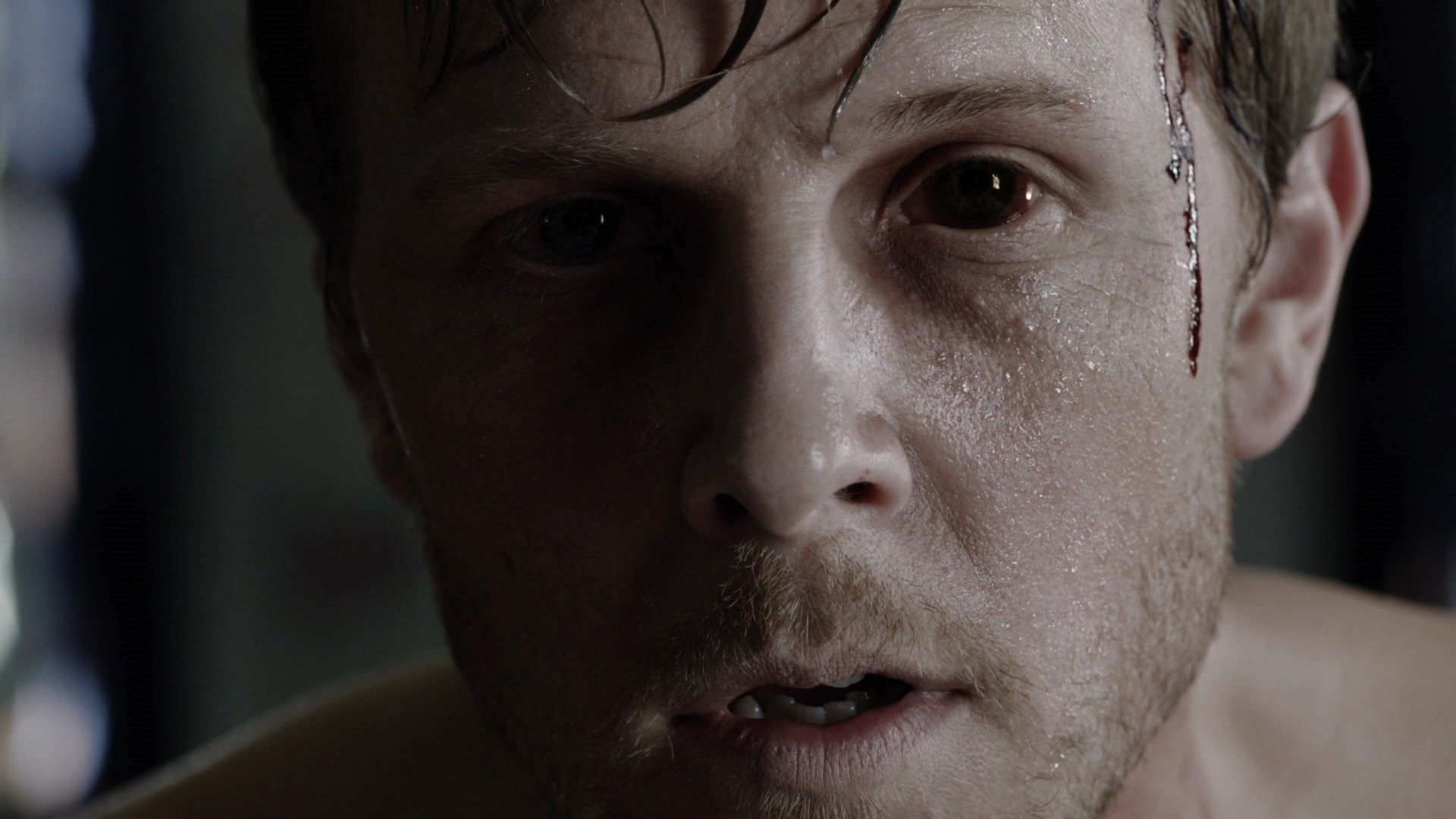
Following the tragic demise of his wife, Samanatha (Pifko), distraught Michael King (Johnson) decides to make a film about the search for the existence of the supernatural.  By placing himself at the centre of the search, and by allowing all sorts of demonologists and occult practitioners to involve him in their spell-castings, Michael hopes they’ll all fail, thereby reinforcing his belief that it’s all just hokum.  Aided at first by cameraman Jordan (Rees), Michael’s initial endeavours bear little or no fruit until a meeting with a mortician (Douglas) leads to a ritual that doesn’t go as expected.  Plagued by fugue moments, unexplained phenomena, and a persistent noise like interference that only he can hear, Michael begins to suspect that something has happened to him.

He retraces his steps but everyone he’s spoken to or encountered, including the mortician, wants nothing more to do with him.  Rebuffed, and with his behaviour slowly but surely estranging him from everyone else around him, including his pre-teen daughter Ellie (Anderson) and sister Beth (McNiven), Michael struggles to control the often violent transformation he begins to experience, as well as trying to ignore the voice he can hear beneath the interference – a voice that urges him to harm his daughter.

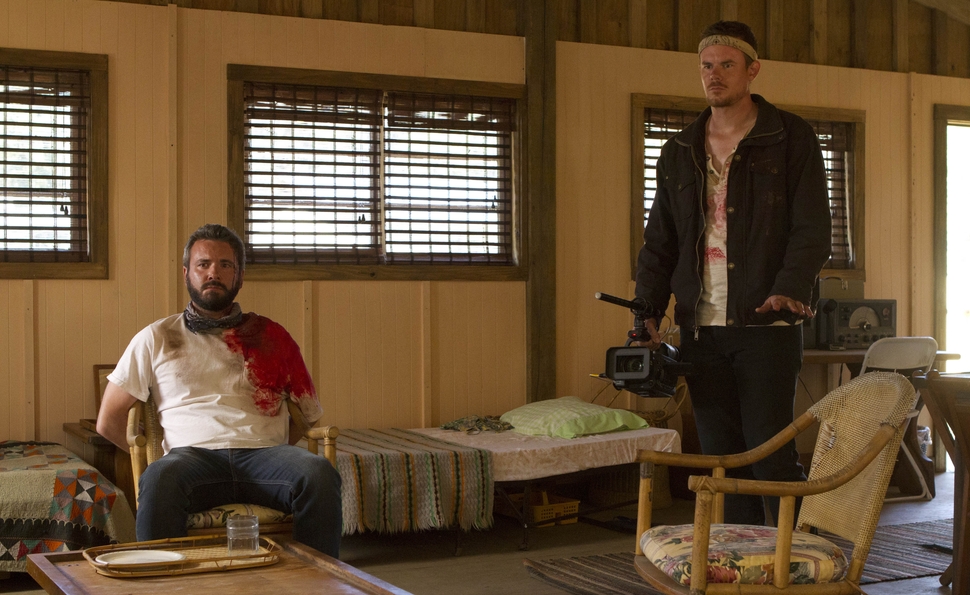
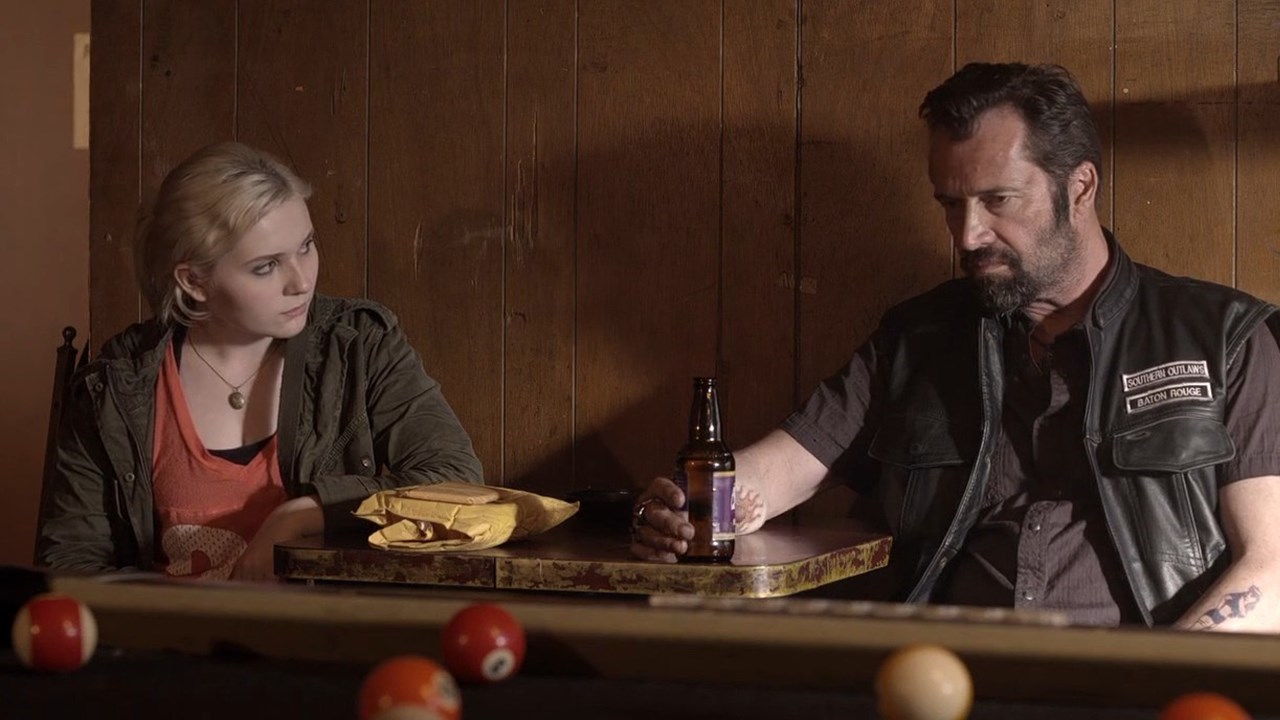
Possession of Michael King, The - scene

Let down by the stupidity of its central character, The Possession of Michael King is a hyper-stylised found footage movie that throws logic out of the window at the first opportunity and never looks back.  With a visual style that’s reminiscent of Se7en (1995) (albeit without the constant rainfall), first-time writer/director Jung assembles a woeful mess that rehashes motifs and camera angles from the Paranormal Activity series, as well as a hundred other found footage movies.  In short, there’s little that’s new or original here, although Michael’s reasons for making his film are certainly some of the dumbest heard for a long time.

The movie also suffers from a final third that seeks to inject some menace via Michael’s attempts to kill his daughter, attempts that are about as frightening as her being chased by a Care Bear.  To be fair, there are some effective moments where Jung employs some uncomfortable body horror but these are few and far between.  Johnson gamely struggles against the script’s more absurd quirks and foibles, and in doing so, saves Michael from being a complete idiot and elicits some much-needed sympathy by the movie’s end.  However, by then, like Michael, you’ll be praying for a way out from all the misery.

Rating: 3/10 – despite several attempts to be cleverer than the average found footage horror movie, The Possession of Michael King undermines itself by having its title character behave as stupidly as possible at pretty much every turn; for found footage, or possession movie completists only.

Share this:

  • Share on X (Opens in new window) X
  • Share on Facebook (Opens in new window) Facebook
  • More
  • Print (Opens in new window) Print
  • Email a link to a friend (Opens in new window) Email
Like Loading...

Sleepy Hollow (1999)

30 Saturday Aug 2014

Posted by dullwood68 in Movies

≈ 1 Comment

Tags

Christina Ricci, Christopher Walken, Hammer homage, Headless horseman, Ichabod Crane, Johnny Depp, Literary adaptation, Michael Gambon, Review, Tim Burton, Washington Irving, Witchcraft

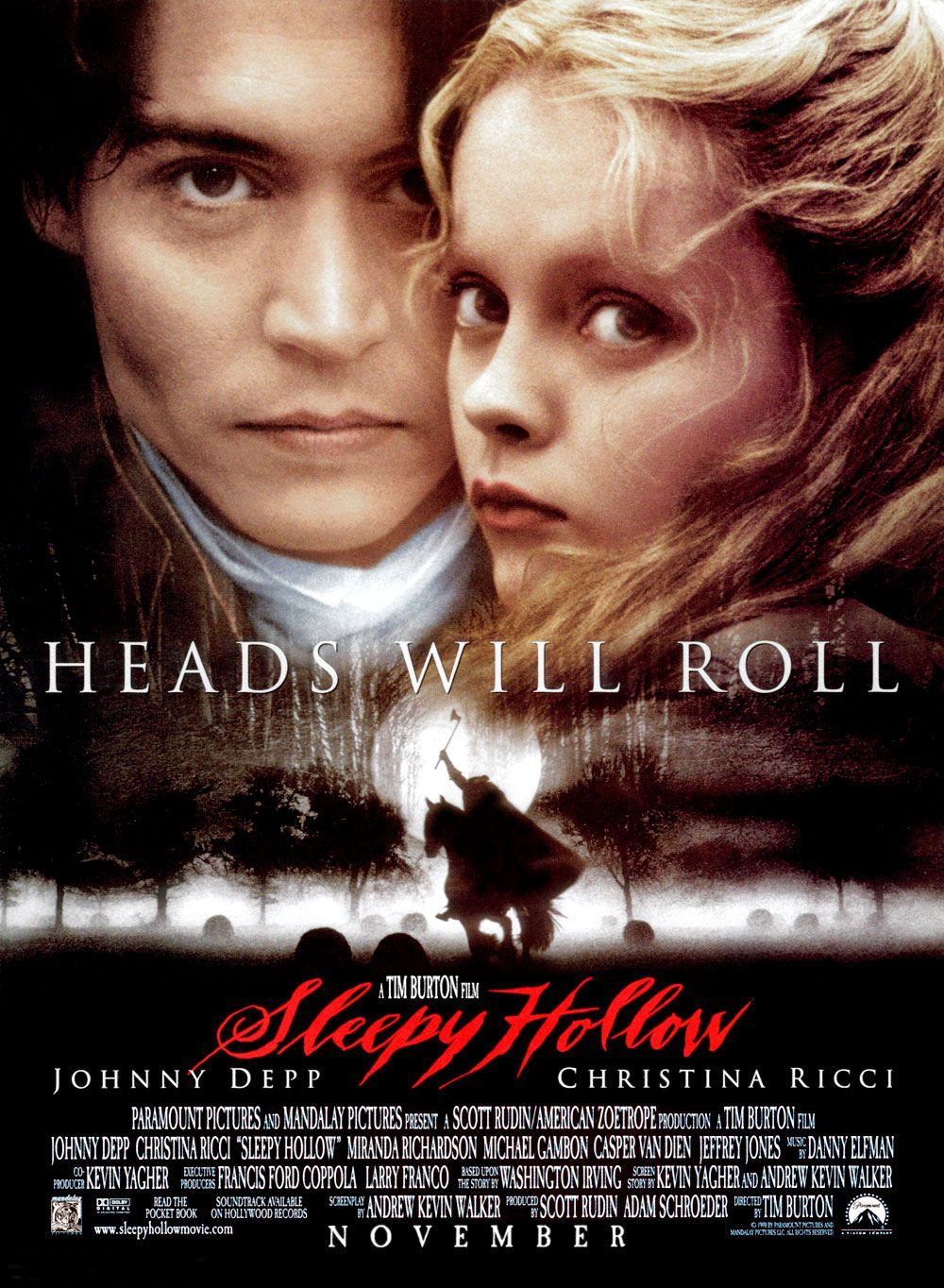
Sleepy Hollow

D: Tim Burton / 105m

Cast: Johnny Depp, Christina Ricci, Miranda Richardson, Michael Gambon, Casper Van Dien, Jeffrey Jones, Richard Griffiths, Ian McDiarmid, Michael Gough, Christopher Walken, Marc Pickering, Lisa Marie, Steven Waddington, Claire Skinner, Christopher Lee, Martin Landau

New York State, 1799.  Young policeman Ichabod Crane (Depp), viewed as an embarrassment by his superiors due to his interest in unorthodox investigation techniques such as fingerprinting and forensic testing, is dispatched upstate to the small hamlet of Sleepy Hollow to investigate a spate of murders where the victims have been found headless.  When he arrives he finds the town’s elders, led by Baltus Van Tassel (Gambon), have no doubt as to the murderer’s identity: a vengeful spirit known as the Headless Horseman (Walken).

A disbelieving Crane begins his investigation.  He learns that one of the victims was pregnant at the time of her death and that there is a link between them all to a will made by the first victim, Peter Van Garrett (Landau).  Further slayings take place, though Crane continues to believe the killer is made of flesh and blood.  It’s not until he witnesses the death of Magistrate Phillipse (Griffiths) that he realises that the Headless Horseman is real.

During all this Crane becomes infatuated with Van Tassel’s daughter, Katrina (Ricci).  Along with the son of one of the victims, Young Masbath (Pickering), she helps him find the Horseman’s grave; the skull is missing, convincing Crane that someone is using it to control the Horseman.  Crane deduces that “someone” is Van Tassel as before Van Garrett changed his will, he stood to inherit Van Garrett’s fortune.  Katrina, however, burns the evidence and renounces her feelings for Crane.  Though, when Crane is wounded by the Horseman in a fight, she tends him until he is better.

Things escalate when the town’s notary, Hardenbrook (Gough) takes his own life.  A town meeting is held in the church, during which both Dr Lancaster (McDiarmid) and the Reverend Steenwyck (Jones) are killed, before Van Tassel is claimed by the Horseman.  With Crane’s chief suspect murdered, he begins finally to piece together the identity of the person who is really controlling the Horseman, and the reasons why they have employed him in such a fashion.

Sleepy Hollow - scene

Justly celebrated at the time of its release for its remarkably effective on screen beheadings, Sleepy Hollow was something of a return to form for Burton, who hadn’t directed a movie since the less-than-well received Mars Attacks! (1996).  Although he wasn’t originally scheduled to direct the movie – that was meant to be creature effects designer Kevin Yagher, who also constructed the story with screenwriter Andrew Kevin Walker – this is recognisably a Tim Burton movie right from the start, and his tribute to Hammer movies.  With its muted colour palette, and grim rural setting, Sleepy Hollow is not perhaps the most attractive looking movie you’ll ever see, but it definitely suits the action, its steely blues and ghostly greys adding greatly to the often stifling atmosphere.  There’s a real sense of foreboding about the hamlet and its surroundings, and the movie uses Rick Heinrichs’ excellent production design to impressive effect.  And then there’s the Tree of the Dead, a superbly realised gateway to Hell that is almost a character all by itself.

If the screenplay ultimately is a pretty convoluted concoction, with the motivations of the Horseman’s controller proving to be unnecessarily tangled, there’s still tremendous fun to be had from a movie that invokes the spirit of 60’s Hammer movies with such obvious affection, and includes roles for horror icons Christopher Lee and Michael Gough (who was persuaded to come out of retirement for the movie).  The movie’s mix of horror, humour, action and romance is intoxicating, and is helped by a clutch of performances that embrace the proceedings with gusto.  Depp anchors the movie with a slightly prissy interpretation of Ichabod Crane that gives rise to much of the humour, while Ricci is more quietly proficient as Katrina, her role more in keeping with the independent heroine who still requires saving in the final reel.  Gambon does nervous and guilty with aplomb, while Griffiths is a (brief) standout as the petrified Magistrate. And Walken, with his piercing blue eyes and sharply pointed teeth, impresses as the Hessian horseman, all snarling rage and bloodthirsty intensity.  In smaller roles, Richardson, Jones, McDiarmid and Van Dien all have their moments, but it’s a measure of their collective abilities that they aren’t all lost in the mix.

There’s a lot packed into Sleepy Hollow, from the various well-mounted and staged killings (Van Tassel’s is a striking example), to the back story involving Crane’s mother (Lisa Marie), to the elements of witchcraft that underpin the Horseman’s return, to a thrilling three-way battle between Crane, Bram Von Brunt (Van Dien) and the Horseman (Ray Park, fresh from filming his role as Darth Maul in Star Wars Episode I: The Phantom Menace (1999) and as equally menacing here), but under Burton’s expert guidance, all these disparate components come together to make a richly rewarding whole.  The movie takes the more fantastical aspects of the story and grounds them effectively, and if there’s a few too many occasions where things are glossed over or rushed through in order to get to the Horseman’s next appearance, then overall it doesn’t hurt the movie’s drive.  With its fiery windmill confrontation and stagecoach chase climax, the movie ends on a thrilling note, and provides a suitably horrible fate for both the Horseman and his controller.

Rating: 8/10 – a stylish exercise in period horror, Sleepy Hollow has yet to be equalled or bettered, and features one of the most memorable villains in recent movie history; with its excellent production design and convincing special effects, Burton’s homage to the horror movies of his youth is both memorable and exciting.

Share this:

  • Share on X (Opens in new window) X
  • Share on Facebook (Opens in new window) Facebook
  • More
  • Print (Opens in new window) Print
  • Email a link to a friend (Opens in new window) Email
Like Loading...

Coherence (2013)

27 Wednesday Aug 2014

Posted by dullwood68 in Movies

≈ 2 Comments

Tags

Blackout, Comet, Dinner party, Drama, Emily Foxler, Hugo Armstrong, James Ward Byrkit, Maury Sterling, Review, Schrödinger's Cat, Sci-fi

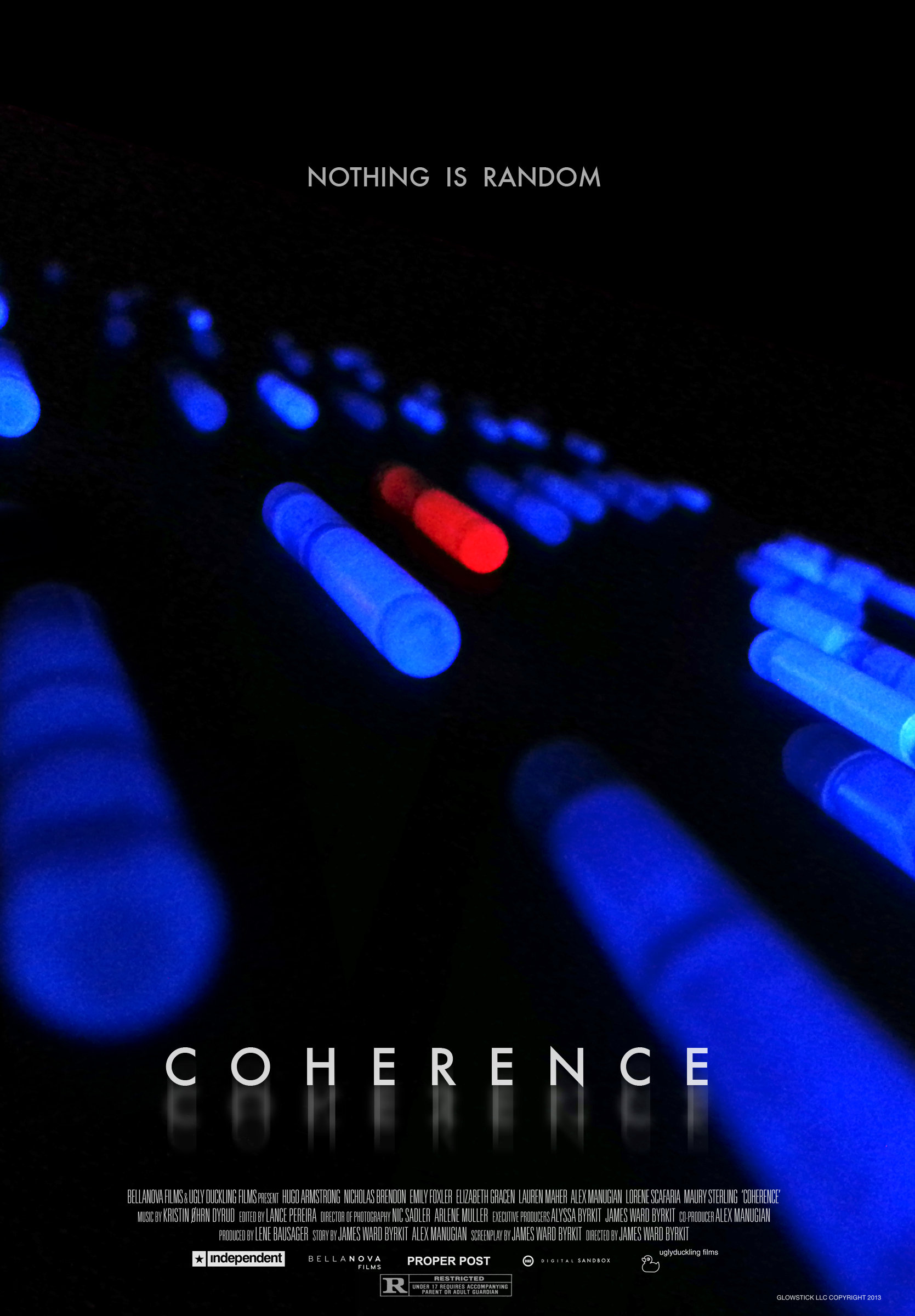
Coherence

D: James Ward Byrkit / 89m

Cast: Emily Foxler, Maury Sterling, Nicholas Brendon, Elizabeth Gracen, Alex Manugian, Lauren Maher, Hugo Armstrong, Lorene Scafaria

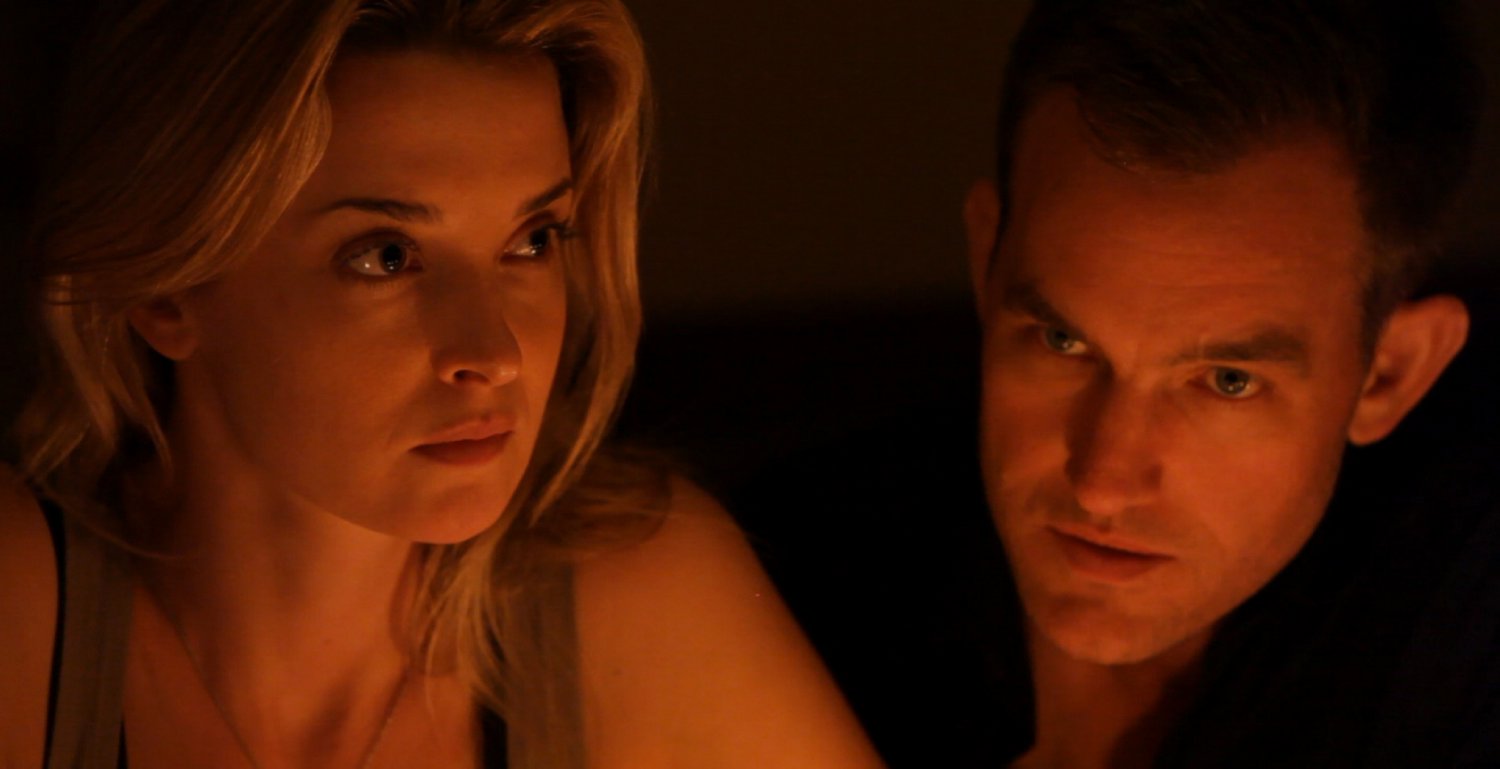
Eight friends gather together for a dinner party on an evening when a comet is passing close to Earth.  Em (Foxler) is the first to arrive and just as she gets there the screen of her mobile phone cracks for no apparent reason.  The same thing happens to Hugh (Armstrong).  Passing it off as an unfortunate side effect of the comet’s passing, the group of friends continue with their meal.  There is some tension as one of them, Amir (Manugian), has brought his new girlfriend, Laurie (Maher) with him and she used to go out with Kevin (Sterling) who is there with Em.  As they talk about various issues, Em has a growing sense of unease.  When the lights go out suddenly, a look outside reveals the whole area is without electricity – except for another house a couple of blocks away.  With their mobile phones not working, and no landline, Hugh and Amir decide to go over to the other house to see if the people there have a phone they can use.

When they return, they have a box with them.  When they open the box they find a ping pong bat and pictures of themselves with numbers written on the back of each of the pictures.  What makes this discovery even more disturbing is that the photo of Amir has been taken that evening, there in the house.  As the group tries to work out what’s going on, personal rivalries and past betrayals come to the fore, and the secret of the house nearby begins to reveal itself.

Coherence - scene

To reveal more about the structure and the nature of Coherence would be to do a disservice to both the movie and any potential viewers.  Suffice it to say, the movie is a clever, intriguing mix of science fiction and relationship drama, with more twists and turns than the average Agatha Christie adaptation.  The central premise is well executed, and the way in which the characters behave, and how they react to what is going on, is handled with careful attention to detail.  The mystery unfolds slowly at first, and deliberately, until the effects of the comet’s passing begin to snowball, with one revelation after another pulling the rug out from under each of the friends.

Be warned though: you will need to pay attention, and not just to what’s being said, but also to the visuals, where there are plenty of clues to be found.  Coherence demands a lot, but it’s worth the investment.  Thanks to the cleverly detailed script by writer/director Byrkit, the movie takes a recent development in quantum mechanics and uses it as the foundation for the strange events that take place.  As the movie gets “weirder”, Byrkit keeps track of the marginal changes that occur alongside the more obvious ones in a way that – mostly – keeps the viewer up to speed.  It’s often the more subtle clues that have the greater effect (keep an eye out for the band aid).  That said, the movie does trip itself up a couple of times in its efforts to make things even more complex than they already are, but for such a low-budget, and largely improvised production, these should be forgiven.

The cast do extremely well with the material, especially considering they were given only basic outlines of their characters and motivations, and the more major plot points.  To their collective credit, they all acquit themselves well, with special mention going to Foxler (better known as Emily Baldoni), Brendon (as host Mike), and Armstrong.  Considering the set up, and its potential for some unnecessary over-acting, it’s good to see a cast who are committed to the material in such a way that even the most dubious of reactions or decisions are acceptable, or made plausible by their conviction.  One revelation could have easily gone down the route of being played as soap opera, but instead it’s played with power and validity.

In the director’s chair, Byrkit orchestrates things with confidence and uses hand-held cameras to provide a sense of immediacy.  It’s a sometimes dizzying effect and can be annoying when anyone ventures outside the house and there’s a reliance on close ups (so as to avoid any evidence of non-blackout areas in the background), but by and large it adds to the growing sense of paranoia and disquiet.  The use of Byrkit’s own home as the principal setting allows for an increasingly claustrophobic atmosphere, and he uses the space to move his characters around like pieces on a chess board.

Anyone interested in science will (hopefully) find much to like – it’s a rare movie that takes time out to explain the concept behind Schrödinger’s Cat – and there’s enough here to attract the attention of fans of cerebral dramas also.  The movie does descend into thriller territory as one character searches for a way out of their predicament, and while this does seem forced, it also adds another layer to the quandary everyone’s facing, giving rise to the question, What would you do if it was you yourself that was threatening your place in the world?

Rating: 8/10 – some narrative stumbles aside, Coherence is a complex sci-fi thriller that is as much about notions of existence as it is about the nature of reality; intelligent and gripping, this is one movie that is rigorous, inventive and when it needs to be, effortlessly chilling.

Share this:

  • Share on X (Opens in new window) X
  • Share on Facebook (Opens in new window) Facebook
  • More
  • Print (Opens in new window) Print
  • Email a link to a friend (Opens in new window) Email
Like Loading...

Draft Day (2014)

26 Tuesday Aug 2014

Posted by dullwood68 in Movies

≈ Leave a comment

Tags

American Football, Cleveland Browns, Denis Leary, First pick, Ivan Reitman, Jennifer Garner, Kevin Costner, NFL, Quarterback, Review, Sport

Draft Day

D: Ivan Reitman / 110m

Cast: Kevin Costner, Jennifer Garner, Denis Leary, Frank Langella, Ellen Burstyn, Chadwick Boseman, Sean Combs, Josh Pence, Terry Crews, Arian Foster, Patrick St Esprit, Chi McBride, Tom Welling, Pat Healy, Rosanna Arquette, Sam Elliott

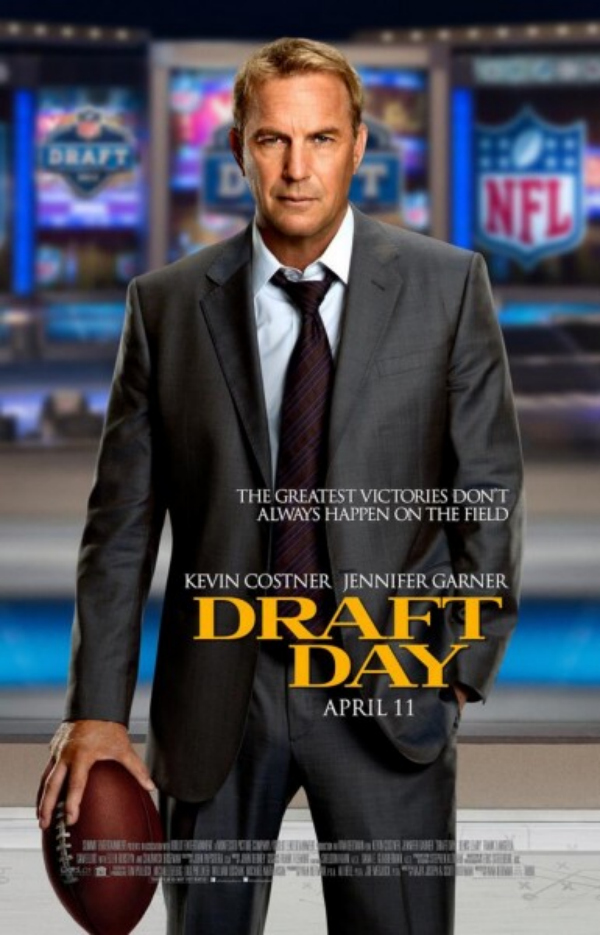
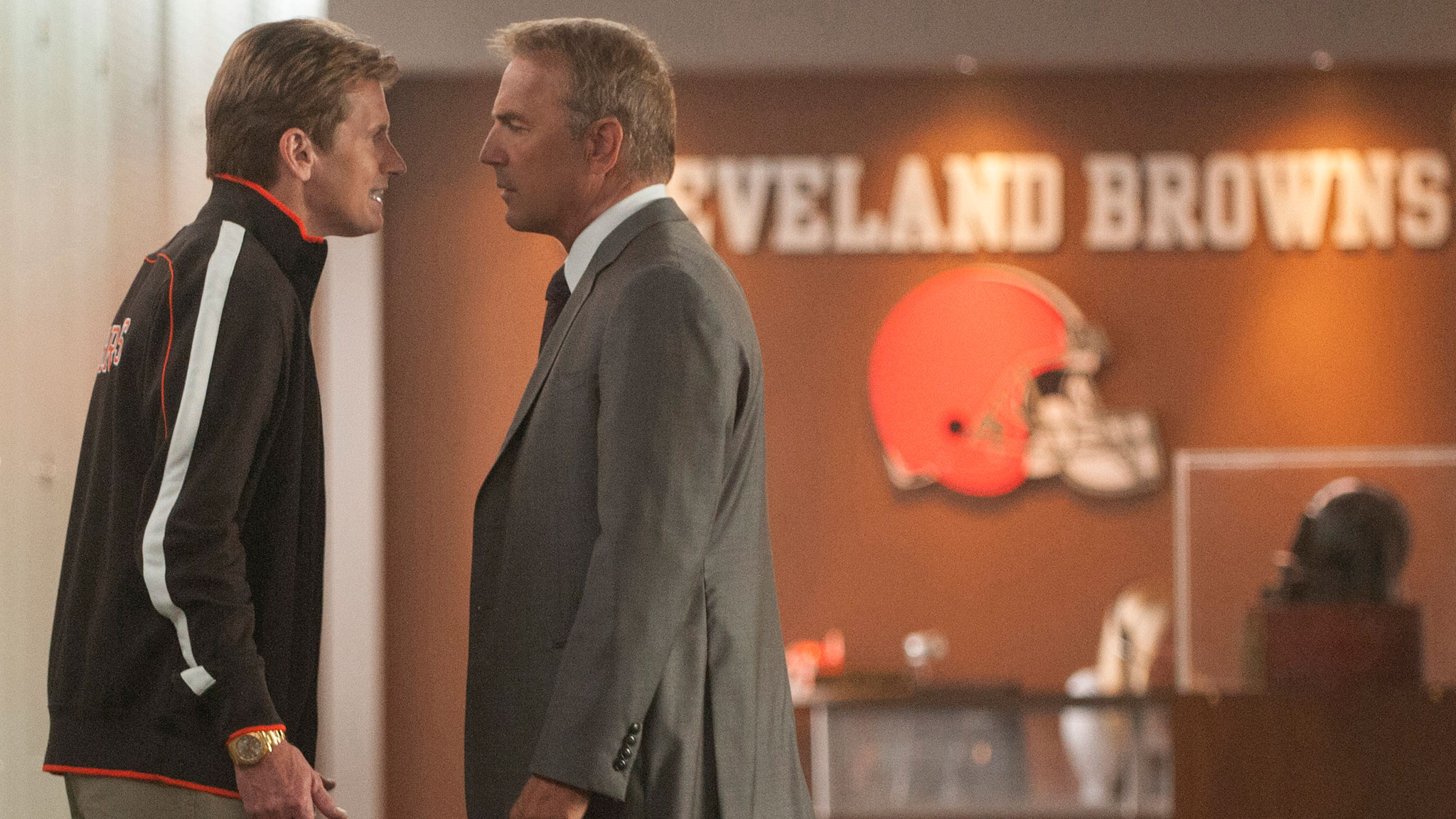
It’s Draft Day in the NFL and the number one pick is quarterback Bo Callahan (Pence). Cleveland Browns general manager Sonny Weaver Jr (Costner) is given the chance to have him as his first choice in the pick but he declines.  Urged by club owner Anthony Molina (Langella) to make “a splash”, Weaver changes his mind and does a deal with the Seattle Seahawks for Callahan that allows them first pick in the draft.  As the news leaks out that the deal has been done, it earns the animosity of the Browns’ Coach Penn (Leary), and defensive player Vontae Mack (Boseman).  Penn wants another player, Ray Jennings (Foster) to be picked in order to complement their existing quarterback Brian Drew (Welling).  Mack wants to play for the Browns, and he tells Weaver that picking Callahan is a bad move.

As the day carries on, Weaver is forced to confront the notion that Callahan isn’t all he’s made out to be, and that he has serious character flaws that could well cause him to be a liability down the line.  Weaver also has to contend with the news that his girlfriend, Ali (Garner), who works for the Browns as a lawyer, is pregnant.  And as if that wasn’t enough, his mother (Burstyn) arrives at the ground to scatter his father’s ashes on the training field, something that Weaver is resistant of as he had to fire his father as coach the year before.

At the first pick, Weaver surprises everybody with his first choice, and this leads to moves and counter-moves involving the Jacksonville Jaguars and the Seattle Seahawks, moves that will determine whether or not Weaver continues as the Browns’ general manager.

Draft Day - scene

An unabashed sports movie that plays out like a good old-fashioned drama laced with broad, comic elements, Draft Day is the kind of movie you can watch and just let wash over you.  It’s professionally done, with a likeable cast, an enjoyable set up, a good-natured feel to it, and easy-going direction thanks to Reitman, back on form after the regrettable No Strings Attached (2011).  It’s an easy movie to like, then, and the kind of movie that has no other agenda than to entertain its audience for a couple of hours.  In short, it’s the kind of movie that doesn’t come around very often.

The main reason Draft Day is so engaging and fun to watch is due to its performances.  Costner could probably play Sonny Weaver Jr in his sleep, and while the actor brings his usual gravitas to the dramatic scenes, he’s equally appealing (if not more so) when the script throws a comedic curve ball at him.  It’s an assured performance, Costner’s experience and acting chops perfectly suited to the role; he’s back in the kind of everyman hero role he made his own in the late Eighties/early Nineties, but older and wiser, and with less to prove (especially as an actor).  It’s good to see him back doing the kind of role he does best: being the calm at the centre of the storm, the rock that everyone can cling on to and know that they’ll be safe.  For the audience, it’s like seeing an old friend after a number of years have gone by, and picking up right where you left off.

In support, Garner is patient and compassionate, while Leary is ill-tempered and aggressive.  Both actors have roles that play to their strengths, and it’s good to see them sparring so happily with Costner, and with each other.  They may be playing familiar roles, with little variation, but it makes the audience feel comfortable; it’s reassuring in such a way that it puts a smile on the viewer’s face without them realising it.  As the Browns’ owner, Langella is appropriately supercilious, while Boseman, Pence, Welling and Foster offer various approaches to the ways in which young American men can view football as not just a game, but what gives their lives meaning.

Under Reitman’s relaxed though confident direction, the cast keep the momentum going, the movie’s rhythm never allowed to flag or stutter or the audience to lose interest.  If you’re not a fan of American Football, then some of the dialogue is going to seem like it’s spoken in a foreign language, but the script by Rajiv Joseph and Scott Rothman takes pains to explain the various ins and outs of the game itself and the behind the scenes machinations that make up most of what goes on on Draft Day.  It doesn’t succeed entirely, but what gets lost in the “translation” won’t impede anyone’s enjoyment of the movie.  And if it all seems a little too convoluted for its own good, then that’s just the way the NFL has set things up (so go figure).

The various subplots and storylines are all resolved with varying degrees of neatness, though this doesn’t detract from the enjoyment the movie provides, and the approach to the material – albeit lightweight and occasionally superficial – fits with the overall intended effect.  Brightly filmed, and with a serendipitous score courtesy of the ever-reliable John Debney, Draft Day succeeds in bringing back some much needed entertainment in amongst all the horror remakes, scuzzy crime thrillers and high octane superhero movies.

Rating: 8/10 – what it lacks in depth, Draft Day more than makes up for in likability; a return to old-fashioned story telling and all the better for it.

Share this:

  • Share on X (Opens in new window) X
  • Share on Facebook (Opens in new window) Facebook
  • More
  • Print (Opens in new window) Print
  • Email a link to a friend (Opens in new window) Email
Like Loading...

The Prince (2014)

25 Monday Aug 2014

Posted by dullwood68 in Movies

≈ 1 Comment

Tags

Brian A. Miller, Bruce Willis, Car bomb, Crime thriller, Drugs, Hitman, Jason Patric, John Cusack, Mechanic, New Orleans, Review, The Pharmacy

Prince, The

D: Brian A. Miller / 93m

Cast: Jason Patric, Bruce Willis, Jessica Lowndes, John Cusack, Gia Mantegna, Jeong Ji-Hoon, Johnathon Schaech, Don Harvey, Tyler J. Olson, Curtis “50 Cent” Jackson

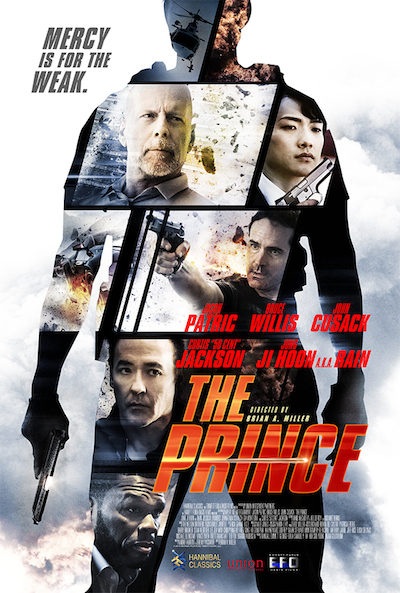
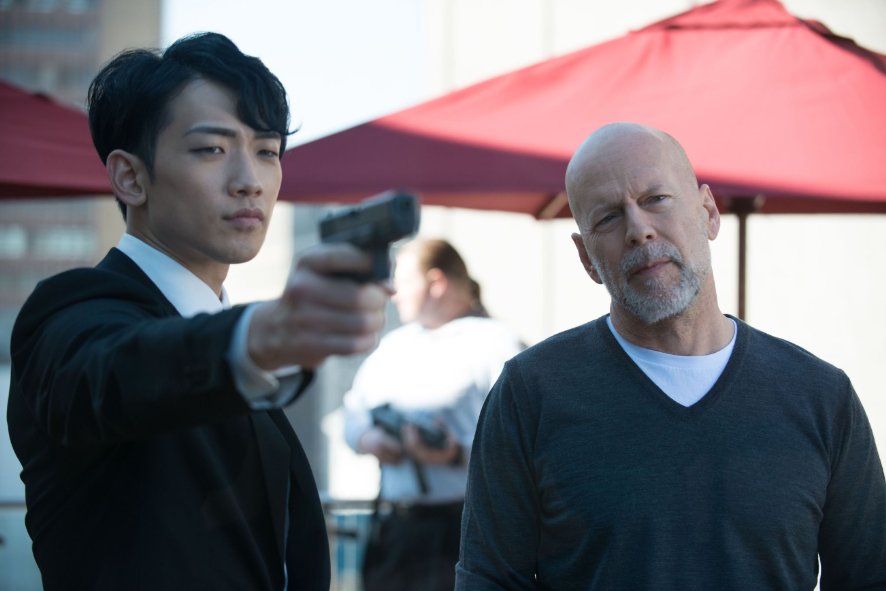
Paul (Patric), a mechanic working in a small town in Mississippi, has an only daughter, Beth (Mantegna), away at college.  She’s due home for a weekend visit but she fails to show up.  Worried that something has happened to her, Paul travels to the college and checks her room, where he finds a picture of Beth and another girl outside a bar.  He goes to the bar and in time the girl turns up.  Her name is Angela (Lowndes), and while she can’t tell Paul where Beth is, she does know that she was seeing a dealer called Eddie (Olson).  She helps him track Eddie down to New Orleans, and in the process, comes to learn that Paul isn’t just a mechanic, but that he has fighting skills she’s never seen before.

When he finds Eddie, Paul discovers that Beth has left him to go live with a more dangerous drug dealer known as the Pharmacy (Jackson).  Paul pledges to rescue her and tries to persuade Angela to go back home, but she refuses.  Meanwhile, Paul’s arrival in New Orleans is reported to ruthless crime boss Omar (Willis).  Twenty years before, Paul was responsible for the deaths of Omar’s wife and daughter.  Now, Omar sees his chance for revenge.  Paul seeks help from old friend, Sam (Cusack) while he goes to rescue Beth.  He discovers that the Pharmacy has been told by Omar to keep Paul there, but he takes Beth and escapes during the subsequent gunfight.  Back at Sam’s, and as they’re preparing to leave, Omar’s second-in-command, Mark (Ji-Hoon), ambushes them and manages to get away with Beth.  Paul follows him to Omar’s, and a final confrontation between the two.

Prince, The - scene

At ninety-three minutes, one thing that The Prince does have in its favour is a fairly short running time.  Otherwise, this is yet another heavily padded, strictly by-the-books crime thriller with an invincible hero, a bad-ass villain, and a damsel in distress. With such a predictable nature, the movie struggles from the outset to provide its audience with anything new or different, even down to the scene where Omar has an employee killed for being out of line, just so we know how bad-ass he is (the fact the employee is standing next to a pool and looks incredibly nervous is also a bit of a giveaway as to what’s going to happen).

As the titular Prince, Paul is a methodical, no-nonsense, quietly threatening ex-hitman who hasn’t lost his touch, but who is also hard to like and thanks to Patric’s portrayal and the script’s lack of humour, comes off as colourless and remote.  When he rescues Beth from the Pharmacy there’s so little emotion he might as well have been retrieving a can of peas he’d left behind at the grocery store.  Paul is a character who seems estranged from everyone except Beth, and even then he seems to be trying a little too hard, as if he can’t quite work out if he’s doing things in the right way or not.  It makes his interaction with Angela unnecessarily stilted and repetitious, and their scenes together suffer accordingly.

Paul’s determination to get Beth back is laudable, but with such a lack of emotion on his part, his efforts don’t have the resonance that even something as contrived as Taken (2008) and its two sequels have (yes, Taken 3 will be with us in 2015).  What emoting there is in the movie is left to Angela – who keeps saying how shocked she is by each turn of event or revelation – and Omar, whose need for revenge is almost pathological (though as usual, he holds off on killing Beth long enough for Paul to turn the tables on him).  Lowndes is okay, but Angela is a character that never rings true, allowing herself to go with a man she doesn’t know to New Orleans for $500, and who stays around when the bullets start flying and the bodies start piling up.  Willis plays Omar as controlled at first but soon ramps up the ham, and by the movie’s end he’s dispensed entirely with characterisation and gone completely for caricature.

With minor support from Mantegna (sidelined for most of the movie), and Cusack (winning this year’s Nicolas Cage Award for Worst Hairstyle), The Prince ticks all the boxes when it comes to low-budget movie-making, with its dull, uninspired script courtesy of Andre Fabrizio and Jeremy Passmore; poorly edited and choreographed action sequences (the showdown between Paul and Mark is the worst example); trite, repetitive dialogue; clumsy framing and photography; lacklustre direction; and the kind of approach that almost screams “Doing it purely for the money!”  Several moments are of the wince-inducing variety (e.g. Jackson’s attempts at acting), and despite all the gunplay and dead bodies, not one police officer makes an appearance at any point in the proceedings, which only serves to highlight the improbability of everything that happens.

Rating: 3/10 – a nail in the coffin of several careers (though probably not the last one), The Prince is a ham-fisted attempt at an urban western but without any of that genre’s appeal or distinctive flavour; entirely derivative and short on imagination, this is one crime thriller that can safely be avoided.

Share this:

  • Share on X (Opens in new window) X
  • Share on Facebook (Opens in new window) Facebook
  • More
  • Print (Opens in new window) Print
  • Email a link to a friend (Opens in new window) Email
Like Loading...

Starred Up (2013)

24 Sunday Aug 2014

Posted by dullwood68 in Movies

≈ Leave a comment

Tags

Ben Mendelsohn, Criminals, David Mackenzie, Drama, Eric Love, Jack O'Connell, Prison, Review, Rupert Friend, Solitary confinement, Support group, Violence, Young offender

Starred Up

D: David Mackenzie / 106m

Cast: Jack O’Connell, Ben Mendelsohn, Rupert Friend, Sam Spruell, David Ajala, Peter Ferdinando, Anthony Welsh, David Avery, Mark Asante, Raphael Sowole, Ryan McKenna, Tommy McDonnell, Sian Breckin

Eric Love (O’Connell) is a young offender transferred to an adult prison.  With a huge chip on his shoulder and an uncompromising attitude, it’s not long before he’s antagonised one of the other inmates, Jago (Sowole), and earned the enmity of Deputy Governor Haynes (Spruell).  When a misunderstanding with a fellow inmate leads to violence, Eric is forcibly removed from D Wing and moved to solitary.  On the way he tries to avoid being beaten and finds an ally in voluntary therapist Oliver (Friend), who intervenes.  Against the advice of Haynes, and with the agreement that if Eric causes even one disturbance in his group he’s banned from any further attendance, the prison Governor (Breckin) agrees to let Oliver try and help Eric deal with his anger issues.

Matters are further complicated by the presence on the same wing of Eric’s father, Neville (Mendelsohn).  Neville is an enforcer for the wing’s top dog, Spencer (Ferdinando), and is instructed by him to make sure Eric doesn’t cause too many problems with his attitude.  Neville tells Eric to keep his nose clean and do what he’s told but he’s a poor role model, and soon becomes envious of the relationships Eric makes with Oliver and the other group members.  His resentment hinders Eric’s progress in the group; meanwhile Jago gets another inmate, O’Sullivan (McKenna) to try and kill Eric, but some of the therapy group intercede and the plan fails.  Later, when an altercation within the group happens, Haynes uses it as an excuse to have Eric removed under the terms of the agreement (even though Eric wasn’t directly involved).  O’Sullivan makes another attempt to kill Eric but is overpowered and he gives up Jago.  When Eric confronts Jago, he gives up Spencer.

This leads to Eric assaulting Spencer and Neville having mixed loyalties.  As he struggles to come to terms with being a true father for the first time, Neville discovers that Spencer has arranged for Eric to “commit suicide” while in solitary, and with Haynes’ cooperation.  With little time to lose, Neville must try and persuade Spencer to change his mind, but if he won’t, to stop his son from being killed.

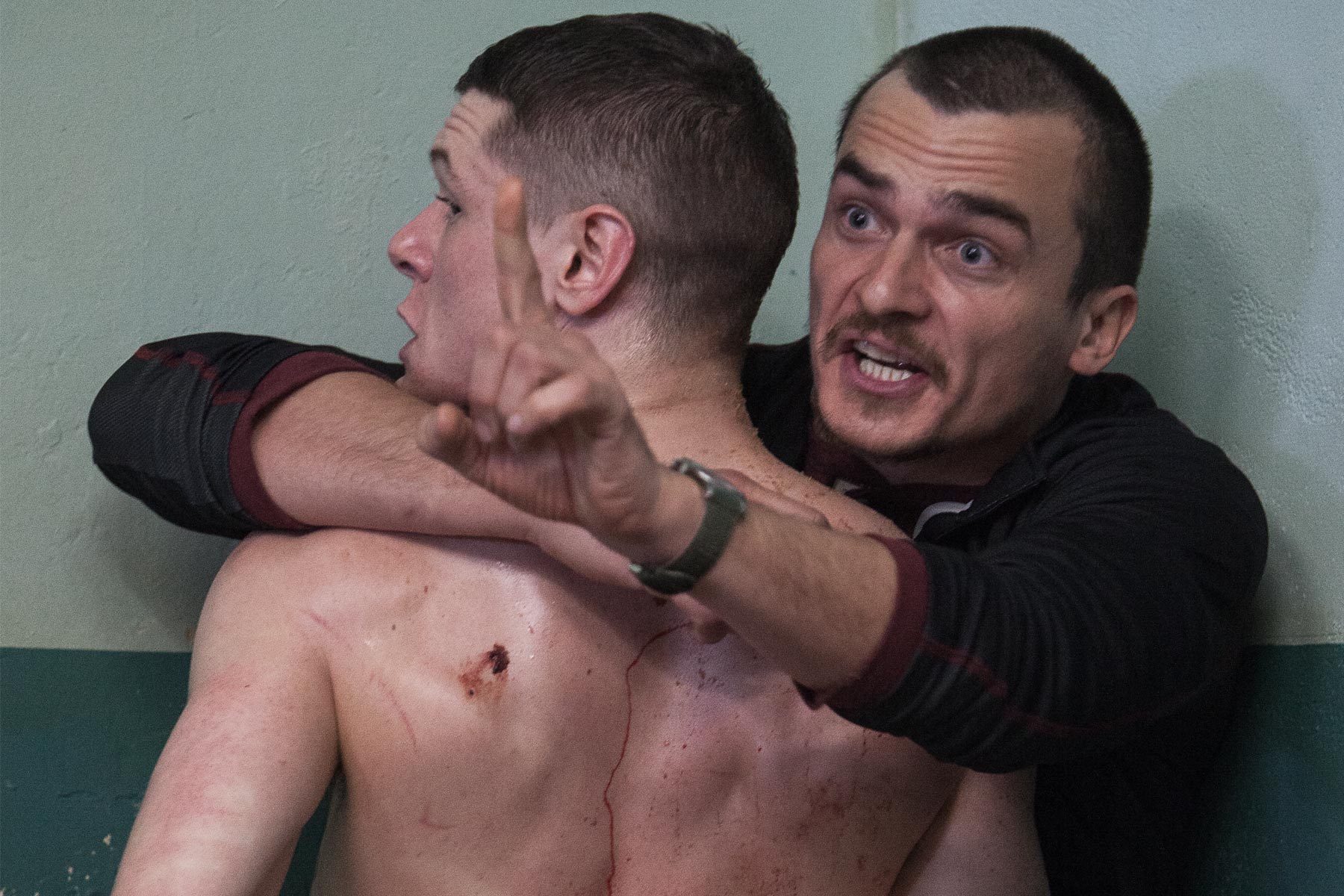
Starred Up - scene

Based on screenwriter Jonathan Asser’s own experiences as a voluntary prison therapist, Starred Up is a brutal, compelling prison drama that is uncompromising, often savage, and disturbingly realistic in its portrayal of institutional abuse carried out both by prison staff and the prisoners themselves.  It’s a movie that makes no attempt to pull its punches, and it’s this determined approach that keeps the movie both gripping and horrific to watch in equal measure.

As a modern day descent into Hell, Starred Up – filmed mostly in Belfast’s notorious Crumlin Road gaol – is a harsh, merciless look at how violence begets violence and how macho posturing is as much a currency in prison as it is a state of mind.  Thanks to Asser’s impressive script, the movie is chilling in its matter-of-fact depictions of anger-fuelled bloodshed, as well as the mental cruelty prevalent (and on occasion, encouraged) within the prison system.  The worst part of it all is the complicity on both sides, with only Oliver and the inmates in his group willing to try and change things, if only for themselves.  Without this one ray of hope, the movie would be even more challenging to watch, its in-built nihilism being even more devastating to watch.

It’s a tribute both to Asser’s script and Mackenzie’s controlled, rigorous direction that the movie doesn’t descend entirely into loosely controlled anarchy, and that the relationships that develop, particularly between Eric and Neville, are as well-defined and credible as they are.  The father-son bond, so tenuous as to be almost invisible at first, slowly becomes more important to both characters, and there’s an unspoken need between them that inevitably leads to a violent confrontation.  But thanks to two remarkable performances from O’Connell and Mendelsohn, this confrontation acts as a cathartic breakthrough for both men, and allows them both to move on as the family they should be.

These two lead performances are nothing short of spectacular, O’Connell like a coiled spring, Eric’s barely suppressed anger almost threatening to consume him, but thanks to the group something he learns to control rather than be controlled by it.  It’s a breakthrough performance, an alarming, expressive, startling portrayal of a young man struggling to keep his anger and his reputation within the system from defining him.  And then there’s Mendelsohn, making Neville a chilling, rage-fuelled monster of a man, a berserker with little regard for others, a wellspring of bile, racism and thuggish behaviour who can barely contain the fury inside him.  It’s a masterful performance, and when Mendelsohn’s on screen, you can’t take your eyes off him; you just don’t know what he’s going to do next.

Ably supported by Friend as the therapist with as many issues as the men he’s trying to help, and Spruell, whose permanent sneer suggests a man who would be equally at home on either side of the fence, as well as group stand-outs Welsh and Ajala, Starred Up boasts a cast that doesn’t put a foot wrong throughout.  It’s such an accomplished ensemble that Mackenzie doesn’t seem to be directing them; instead it seems as if he’s just positioning the cameras and then sitting back (though that probably wasn’t the case).  And the camerawork is just as impressive, with several hand-held tracking shots as Eric roams around D Wing making the oppressive environment seem less confining, less restrictive.  It’s a gloomy set of interiors but the photography by Michael McDonough is richly detailed and on several occasions, beautifully framed despite the prison settings.  The editing by Nick Emerson and Jake Roberts is equally impressive: there’s not one scene that outstays its welcome, or where each element of a scene is given its due significance.

Rating: 9/10 – an effortlessly superior prison drama, Starred Up features a confident, uncompromising script, remarkable, assured direction, and a couple of lead performances that are nothing short of extraordinary; despite its grim backdrop, the movie succeeds in offering hope out of adversity and is complex, challenging viewing and all the better for it.

Share this:

  • Share on X (Opens in new window) X
  • Share on Facebook (Opens in new window) Facebook
  • More
  • Print (Opens in new window) Print
  • Email a link to a friend (Opens in new window) Email
Like Loading...

The Rover (2014)

22 Friday Aug 2014

Posted by dullwood68 in Movies

≈ 3 Comments

Tags

Australia, David Michôd, Economic collapse, Guy Pearce, Outback, Review, Robbery, Robert Pattinson, Scoot McNairy, Stolen car

Rover, The

D: David Michôd / 103m

Cast: Guy Pearce, Robert Pattinson, Scoot McNairy, Gillian Jones, David Field, Tawanda Manyimo, Anthony Hayes, Susan Prior

Set ten years after a global economic collapse, and in the Australian outback, an embittered loner named Eric (Pearce) stops at a bar for a drink.  His car is stolen by a trio of thieves led by Henry (McNairy), after their own car crashes following a robbery that has seen Henry wounded in the leg, and forced to leave his brother behind.  With the car being his only remaining possession, Eric gets their car started again and chases after them. They stop and there is a confrontation that sees Eric knocked unconscious.  When he comes to, Henry and his friends are gone.  Eric journeys on to the next town where he obtains a gun; he also meets Rey (Pattinson), who turns out to be Henry’s younger brother.  Like his brother, Rey is suffering from a gunshot wound.  In return for finding medical help for him, Rey agrees to help Eric track down his brother.

Once Rey is seen by a doctor (Prior), the duo head for the next town where they stay at a motel.  While in their room, Rey is shot at by a soldier but Eric comes to his rescue.  The next day, while camping, Eric is apprehended by army sergeant Rickofferson (Hayes) and taken to a nearby army base.  Eric reveals why he is so bitter and angry but the sergeant is uninterested.  A few moments later, Rey bursts in having come to rescue Eric; with the sergeant and his men all dead, the pair escape and head for the next town, where Henry and his gang are hiding out.  At the house where they’re staying, Rey, armed with a gun, goes in first…

Rover, The - scene

The Rover is, at first glance, a meticulously crafted thriller that confirms the promise shown in its director’s previous movie Animal Kingdom (2010), but on closer inspection the movie proves to be a case of the emperor’s new clothes rather than anything more substantial.  It’s a shame because it has much to recommend it, with often stunning visuals that underpin its lead character’s psychological distance from the people he meets.  Eric is a man alone, both in company and in the vast stretches of the Outback that he travels through.  He’s adrift in his own life, but he keeps his resentment of past events close to him, feeding off it, letting it keep him going; without it he would stop moving altogether.  As portrayed by Pearce, Eric is a man clinging on to his sanity, a hair’s breadth away from taking his anger and pain out on everyone he meets.  That he manages to keep himself in check so much speaks of the shadow of the man he used to be, and which is still inside him somewhere.  Pearce gives an appropriately intense performance and makes Eric a fiercely relentless force of nature, largely unrepentant, and borderline psychotic.  It’s a darkly hypnotic portrayal, and easily Pearce’s finest in years.

He’s matched in the performance stakes by Pattinson, who as the slow-witted Rey, commands as much attention as Pearce does, his slack-eyed look and simplistic understanding of his situation making Rey as much a casualty in his own way as Eric is.  Rey is needy, so much so that he attaches himself to Eric in lieu of his brother’s presence, his loyalty changing depending on his proximity to whoever shows an interest in him or supports him.  He’s the opposite of Eric, a (younger) man in constant need of company in order to validate his own existence, and almost incapable of acting independently, such is his reliance on others.  Pattinson subverts his pretty boy image to make Rey effectively an awkward adolescent, his semi-vacant gaze never wavering, his panic in situations he can’t control the reaction of an emotionally under-developed child.  It’s a stirring performance, one that proves beyond a shadow of a doubt that Pattinson has a greater range than perhaps many people give him credit for.

With two such riveting performances it’s a shame then that Michôd’s script isn’t as well-structured, or clever, as it seems at first glance.  There are too many moments where convenience drives the plot forwards, and few occasions where The Rover feels like an organic story, where the events involving Eric and Rey seem entirely plausible.  The confrontation between Eric and Henry that results in Eric being knocked unconscious is a serious case in point: why doesn’t Henry just kill Eric, instead of leaving him alive, and with their car, and with the keys tossed carelessly aside where they’re easily found?  The movie displays a keen sense of nihilism elsewhere, but here, with the encounter happening so early on, it just undermines the whole notion of Henry’s gang being any kind of threat to Eric, and the script pretty much abandons them from this point on, only bringing them back for the finale (it also undermines the notion that, in the future, life has become even less of a commodity than it is now).

There’s also the reason for Eric being so dogmatic in wanting his car back.  It’s not until the very end that we discover the reason for his relentless pursuit, and it’s a reason that is bound to cause endless debate amongst moviegoers for some time to come.  For this reviewer, it’s a “twist” that doesn’t quite work, and serves only to try and (in a way) rehabilitate Eric with the audience.  It’s a brave move on Michôd’s part but again, for this reviewer, adds little to what’s gone before.  Perhaps it would have been better not to know.

Where the movie is on firmer ground is with its location work and glorious photography courtesy of Natasha Braier, the Australian Outback looking both vast and unexpectedly restraining at the same time, its untamed wilderness as much a character as the people that inhabit it.  Its rugged, inhospitable backdrop serving as a reflection of the hardships the characters have to endure to survive, Braier’s lensing brings out its beauty as well, and in the process, rewards the viewer with breathtaking vista after breathtaking vista.  To complement the visuals there is a strong, percussive score by Anthony Partos that underlines the starkness of the surroundings, but which becomes more emotive as the relationship between Eric and Rey begins to change.  It’s a subtle process but very well done.

Rating: 5/10 – with many aspects that don’t work as well as its writer/director may have intended, The Rover is likely to divide audiences for some time to come; what isn’t in doubt, though, is the quality of the lead performances which are well worth the price of admission.

Share this:

  • Share on X (Opens in new window) X
  • Share on Facebook (Opens in new window) Facebook
  • More
  • Print (Opens in new window) Print
  • Email a link to a friend (Opens in new window) Email
Like Loading...

Mini-Review: The Love Punch (2013)

22 Friday Aug 2014

Posted by dullwood68 in Movies

≈ Leave a comment

Tags

Cap d'Antibes, Celia Imrie, Comedy, Diamond, Emma Thompson, Joel Hopkins, Paris, Pierce Brosnan, Review, Robbery, Romance, Timothy Spall, Wedding

Love Punch, The

D: Joel Hopkins / 94m

Cast: Pierce Brosnan, Emma Thompson, Timothy Spall, Celia Imrie, Louise Bourgoin, Laurent Lafitte, Tuppence Middleton, Jack Wilkinson, Olivier Chantreau, Marisa Berenson

When divorced couple Richard (Brosnan) and Kate (Thompson) discover that their pensions are worthless thanks to a company takeover orchestrated by French businessman Vincent (Lafitte), they put aside their differences and set out to steal a diamond worth $10.8 million that he has just purchased.  Their plan sees them travel to the Cap d’Antibes where Vincent is due to marry supermodel Manon (Bourgoin), and for whom he has had the diamond made into a necklace for their wedding day.

Aided by their friends, Jerry (Spall) and Penelope (Imrie), the still-sparring couple plan to attend the wedding disguised as Texans (there to cement a deal with Vincent), steal the diamond and replace it with a fake, and then head back to the UK to sell the diamond and disperse the money from the sale to everyone who’s lost their pension.  But not everything goes to plan…

Love Punch, The - scene

Look through most actors’ filmographies and you’ll see one or two movies that look like they were made a) for the money, b) because of the location, or c) both.  Well, for Messrs. Brosnan, Thompson, Spall, and Imrie, this is that movie, a dreadfully unfunny romantic comedy/caper hybrid that boasts beautiful locations but little else.  It’s a measure of writer/director Hopkins’ script that belief has to be suspended time and time again, from Kate’s unconvincing faint that gets them into Vincent’s building, to the idea of four Fifty-somethings even planning a diamond robbery.  And when they decide the only way to physically attend the wedding is by climbing a nearby cliff face, then you know rampant absurdity is the order of the day.

The performances are hampered accordingly, though Thompson does her best with what she has.  Brosnan tries too hard, Spall is given a military background that no one knows about, and Imrie revisits the sex-hungry character she’s played so many times before (but without bringing anything new to the idea).  The rest of the cast do what they can but it’s an uphill struggle.

The Love Punch was obviously intended as a bit of a light-hearted romp featuring two of Britain’s most popular actors, but instead it’s a stodgy, lumpen mess that never gets off the ground.  Definitely not one for the promo reel.

Rating: 3/10 – awkward and terrible, The Love Punch should be approached with caution; hampered by a dire script and with too many moments where the audience will be wondering if they’re really seeing what they’re seeing, this is one for fans of the principal cast only.

Share this:

  • Share on X (Opens in new window) X
  • Share on Facebook (Opens in new window) Facebook
  • More
  • Print (Opens in new window) Print
  • Email a link to a friend (Opens in new window) Email
Like Loading...

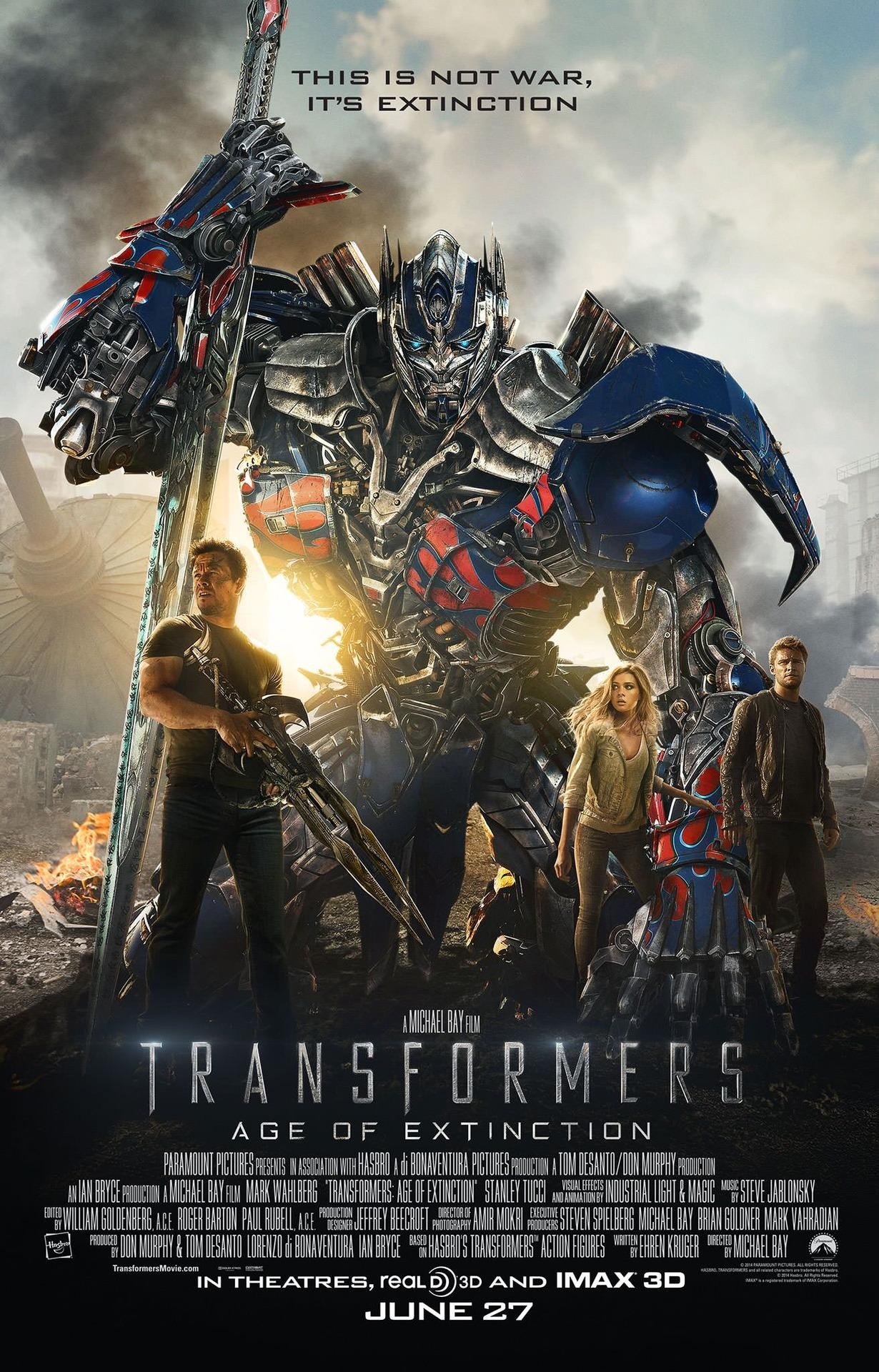
Transformers: Age of Extinction (2014)

19 Tuesday Aug 2014

Posted by dullwood68 in Movies

≈ 1 Comment

Tags

Michael Bay, Review, Transformers

Transformers Age of Extinction

D: Michael Bay / 165m

Cast: Mark Wahlberg, Stanley Tucci, Kelsey Grammer, Nicola Peltz, Jack Reynor, Titus Welliver, Sophia Myles, Bingbing Li, T.J. Miller, James Bachman, Thomas Lennon, Peter Cullen, Frank Welker

Dear Mr Bay –

Please, please, please – no more.

Regards –

thedullwoodexperiment

Share this:

  • Share on X (Opens in new window) X
  • Share on Facebook (Opens in new window) Facebook
  • More
  • Print (Opens in new window) Print
  • Email a link to a friend (Opens in new window) Email
Like Loading...

The Hooligan Factory (2014)

18 Monday Aug 2014

Posted by dullwood68 in Movies

≈ Leave a comment

Tags

Cameos, Comedy, Danny Dyer, Dex, Football hooligans, Jason Maza, Keith-Lee Castle, Nick Nevern, Review, Spoof, The Baron

Hooligan Factory, The

D: Nick Nevern / 90m

Cast: Jason Maza, Nick Nevern, Tom Burke, Ray Fearon, Keith-Lee Castle, Steven O’Donnell, Morgan Watkins, Josef Altin, Leo Gregory, Lorraine Stanley

As a young lad, Danny (Maza) gets expelled from school, and with his father in prison, winds up living with his grandfather (an uncredited Ian Lavender).  Wanting to follow in his father’s footsteps as a top football hooligan (but unsure how to go about it, and not as obviously mental as his father), Danny is drifting through life when his grandfather announces he’s selling his flat and moving abroad.  Forced to move out, Danny takes his belongings and is looking for somewhere to stay when he finds himself being mugged.  But help comes from an unexpected source: recently released from prison hard man Dex (Nevern), one of the most vicious leaders of a football hooligan firm ever.  Dex is looking for revenge on the Baron (Castle), a rival firm leader, and responsible for the death of Dex’s young son.

Dex takes Danny under his wing, and he sets about rebuilding his old gang.  Danny begins to find his place in life as he joins Dex and his firm on trips around the country taking on other firms, and getting involved in violent clashes.  As Dex’s firm defeats more and more rivals, the Baron issues a challenge to the remaining firms: put Dex in his place once and for all.  But this proves too difficult, and in the end, the Baron is forced to confront Dex back at the same site where Dex’s son was killed.  Can Dex avenge his son?  Will the Baron get his just desserts?  Will Danny ever gain the respect of Dex’s right hand man, Bullet (Burke)?  And will anyone in Dex’s firm realise that Old Bill (O”Donnell) really is the Old Bill?

THE HOOLIGAN FACTORY

Though rough around the edges, The Hooligan Factory is a much-needed spoof of the recent spate of British football hooligan movies, such as Green Street (2005) and The Firm (2009) (there’s also a terrific parody of Rise of the Footsoldier (2007) in the movie’s prologue).  Where those movies have a kind of grim social commentary driving them forward, here the emphasis is on cutting that approach down to size and then trampling all over it (and with the proper colour co-ordinated trainers).

There’s much to commend it, even though it is uneven and some of the jokes aren’t as original (or amusing) as the filmmakers would like, but it is funny and it lampoons its targets with commendable attention to detail, from Danny and Dex’s outfits, to the scene where most of the various firms’ leaders admit to having an autobiography either on the shelves already, or about to be published.  There’s so much going on at times, particularly in the first hour, that when the movie begins to flag, it comes as no surprise at all, but by then it’s created such a good vibe that a shortfall in laughs is compensated for by the need for a more dramatic resolution (though as if to compensate even for that, Dex’s “passing of the torch” is one of the movie’s best – and most unexpected – visual gags).

In the director’s chair – he’s also the co-writer, with Michael Lindlay – Nevern assembles his cast and lets them loose on the material with what appears to be a great deal of leeway, with some scenes having a semi-improvised feel to them.  Maza has just the right amount of gung-ho neediness that helps make Danny so appealing, while the supporting cast all register their intent to make as much of the script as they possibly can (and if there’s the odd bit of over-acting here and there, well… so what?).  It’s Nevern, though, who makes the biggest impact, imbuing Dex with a violent streak a mile wide but also making him as naive as a newborn, his inability to realise that his two year old son (born while he was in prison) is the offspring of his best mate Midnight (Fearon), both endearing in its own way, as well as being laughable.  To Nevern’s credit, he plays it straight, and while there’s a minor amount of winking at the camera, Nevern doesn’t allow himself the luxury of breaking the fourth wall.

With priceless cameos from the likes of British crime movie stalwarts Tamer Hassan, Craig Fairbrass and Danny Dyer, as well as minor celebs such as Chloe Sims from The Only Way Is Essex and former hooligan Cass Pennant, The Hooligan Factory has its fair share of surprises to keep its audience on its toes, but it’s the humour that counts, and for long stretches this is a movie that delivers belly laughs galore, some that are very silly indeed, some that are blackly comic, and some that are clever allusions to the movie’s more dramatic forebears.  Strangely, there are moments that feel rushed, while others seem stretched out beyond the script’s requirements; on these occasions the movie does grind to a halt, but thanks to Nevern’s firm hand on the tiller, they don’t upset the movie’s rhythm too much, and he soon gets things back on an even keel.

The violence is toned way down in comparison with, say, I.D. (1995), but then this is a spoof, and while it may not be so bloody or contentious, what it lacks in febrile intensity, it more than makes up for with clever laughs and knowing performances from all concerned.

Rating: 7/10 – uneven at times but doing its best to please throughout, The Hooligan Factory succeeds largely due to the involvement of so many people who’ve been involved in the very movies this seeks to mock (including Nevern); a great movie for a Saturday night with a few beers, and well worth watching just for the aforementioned “passing of the torch” moment.

Share this:

  • Share on X (Opens in new window) X
  • Share on Facebook (Opens in new window) Facebook
  • More
  • Print (Opens in new window) Print
  • Email a link to a friend (Opens in new window) Email
Like Loading...

The Sacrament (2013)

17 Sunday Aug 2014

Posted by dullwood68 in Movies

≈ 3 Comments

Tags

AJ Bowen, Cult, Eden Parish, Father, Gene Jones, Horror, Joe Swanberg, Review, Sober living community, Thriller, Ti West, Vice

Sacrament, The

D: Ti West / 95m

Cast: Joe Swanberg, AJ Bowen, Kentucker Audley, Gene Jones, Amy Seimetz, Katie Forbes, Shirley Jones-Byrd, Kate Lyn Sheil, Donna Biscoe, Talia Dobbins

When photographer Patrick (Audley) receives a letter from his sister, Caroline (Seimetz), that tells him she’s part of a sober living community, and that she’s moving with them to a foreign country, he enlists the help of Vice, a multi-media company, to discover what’s really happening.  Joined by reporter Sam (Bowen) and cameraman Jake (Swanberg), they travel to the community’s new location – a compound named Eden Parish – and find Caroline safe and well and happy, along with dozens of people of all ages who have dedicated their lives to the teachings of the man they call Father (Jones).  Father has created a drug and alcohol free, politically independent society where there is no violence, no crime, only a firm belief in the Bible and the need for the community to remain apart from others.

Father agrees to be interviewed by Sam but it doesn’t go as Sam expects, and he finds himself wrong-footed and confused.  He and Jake become increasingly aware that not everything is as it seems, or as Father professes.  A woman implores them to take her mute daughter with them when they leave; an encounter with Caroline leads Sam and Jake to believe that she is high; and Patrick is kept away from them deliberately.  The next morning, as well as the woman and her mute child, there are several other people trying to leave the compound.  Fearing an end to his work, Father makes a drastic decision, one that has terrible consequences for everyone there.

Sacrament, The - scene

With obvious parallels to the story of Jim Jones, The Sacrament has a horrible fatalism that permeates the movie throughout, and makes for often uncomfortable viewing.  Filmed found footage style – but with the odd occasional shot that clearly isn’t part of the set up – Ti West’s latest sees the world of exclusionist religion brought into sharp relief.  It’s a difficult subject to tackle, but West crafts a gripping thriller from the premise of a collective created out of one man’s misguided wish to provide a better life for his followers.  As it becomes more and more evident that Eden Parish is not the paradise that Father would have Sam and Jake (or the outside world) believe, the movie develops a quiet power and the tragedy that unfolds takes on a grim inevitability.

To be clear, there is nothing new here, and nor does West’s screenplay attempt to add anything different to the basic set up, but such is his growing confidence as a filmmaker that, while The Sacrament plays out as predictably as expected, it does so with a compelling fascination that keeps the viewer hooked as events unfold.  It’s also one of the few found footage movies that doesn’t look contrived with its framing, West proving capable of making the majority of shots look organic and plausible in their focus (and without resorting to any manufactured jump scares).  That said, the movie could have been filmed in a more traditional manner and it would still have been as effective.

Adding another layer of credibility to proceedings, West coaxes some great performances from his cast, with Bowen and Jones proving particularly impressive. Bowen is gaining more and more exposure as an actor, his indie leanings often leading to characterisations that have a greater depth to them than you might expect, and here he expertly displays the indecision that Sam feels about Eden Parish and its leader.  And as that leader, Jones is simply mesmerising, his low-key, slightly pained delivery both forceful and unnerving in equal measure.  As his vision for the community begins to unravel, so too does Father, revealing the psychosis beneath the believer, a psychosis shared by Caroline and many others.  It’s a subtle, confident performance, one that stays in the memory long after the movie is over.  Until now, Jones has been known primarily as the gas station proprietor who survives an encounter with Javier Bardem’s badly tonsured psycho in No Country for Old Men (2007), but on this evidence he deserves to be given even bigger and better opportunities to shine.

The Sacrament does have one major flaw however, and while it’s entirely forgivable, it does undermine the growing tension of the first hour.  With the understanding that there are people who want to leave Eden Parish because it’s not all it seems, but are too afraid to speak out, the sudden attempt at an exodus comes across as expediency instead of an intrinsic consequence of events so far.  This awkward turn of events also brings forward the expected denouement, and in doing so, sees the movie abandon its measured approach in the first hour in favour of various confrontations and chase sequences.  These scenes are still effective – one that features Patrick and Caroline and the fate of one of them is as terrible to watch as anything featured in a more bloody horror film – but they end up divorced from the cumulative effect of what’s gone before.

But when all is said and done, this is a testament to West’s increasing skills as a writer/director.  With his revenge Western, In a Valley of Violence, due in 2015, it’s not unreasonable to place him on the list of directors whose movies are eagerly looked forward to, especially on this evidence.  And with so few original voices working in the field of horror these days, West is a talent to be followed with avid interest.

Rating: 8/10 – essential viewing for fans of intelligent, well-constructed terror, with an understated but scary performance from Jones, The Sacrament is a throwback to the paranoia-ridden horror movies of the Seventies; potent and rewarding, this confirms West’s rising status and is pretty much a horror sleeper.


Share this:

  • Share on X (Opens in new window) X
  • Share on Facebook (Opens in new window) Facebook
  • More
  • Print (Opens in new window) Print
  • Email a link to a friend (Opens in new window) Email
Like Loading...

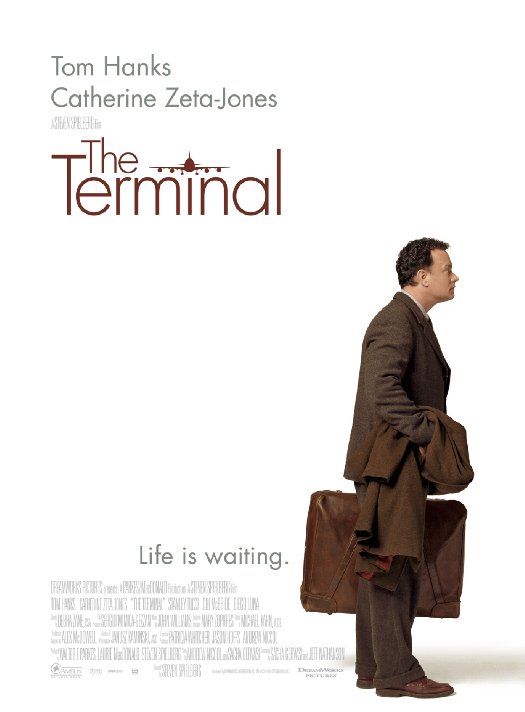
The Terminal (2004)

16 Saturday Aug 2014

Posted by dullwood68 in Movies

≈ 1 Comment

Tags

Airport, Catherine Zeta-Jones, Comedy, Drama, Krakozhia, Review, Romance, Stanley Tucci, Steven Spielberg, Tom Hanks, Unacceptable, Viktor Navorski, Zoe Saldana

Terminal, The

D: Steven Spielberg / 128m

Cast: Tom Hanks, Catherine Zeta-Jones, Stanley Tucci, Chi McBride, Diego Luna, Barry Shabaka Henley, Kumar Pallana, Zoe Saldana, Eddie Jones, Michael Nouri

Arriving at JFK International Airport, Viktor Navorski (Hanks) learns that while he was travelling from his home country of Krakozhia, a civil war has broken out and all travel permits and visas have been suspended; this means he can’t return home.  To make matters worse, the US government is refusing to recognise the revolutionary Krakozhian government, so won’t allow anyone from there to enter the US.  This makes Viktor “unacceptable”.  The only place he can stay is in the airport’s international terminal, something that Customs and Border Protection head Frank Dixon (Tucci) isn’t happy about but believes will be only temporary.

Viktor settles in at Gate 67 which is unfinished.  From there he ventures forth each day in the hope that the civil war has ended and he can either go home or go into New York as he’d originally planned (he has made a promise to do something for his father, who has recently died).  Through this he strikes up a friendship with Dolores (Saldana), a Customs officer who processes visa applications.  This in turn leads to a friendship with Enrique (Luna), an airport worker who has a crush on Dolores.  In return for food that hasn’t been used on flights, Viktor learns about Dolores’ likes and dislikes and relays this information back to Enrique.  During this time, Viktor also meets air stewardess Amelia (Zeta-Jones).  His attraction to her is tempered by her seeing a married man, Max (Nouri), but a relationship develops between them nevertheless.

As Viktor gets to know more of the airport staff – including Mulroy (McBride) and Gupta (Pallana) – Dixon becomes more and more irritated by his presence in the airport.  He tries to persuade Viktor to leave the airport but Viktor doesn’t take the bait.  With an important inspection coming up that will help towards an expected promotion, Dixon is anxious that nothing interfere with his plans, yet when a desperate Russian with undocumented drugs for his father arrives on the day of the inspection, Viktor interprets for him and resolves the situation with a lie, making Dixon furious with him. This makes Viktor very popular with the rest of the airport staff.

Viktor also continues to see Amelia when she flies in and when she tells him she’s stopped seeing Max, Viktor arranges a romantic dinner but it turns out Amelia has resumed the relationship (though this has an unexpected benefit later on).  When the war in Krakozhia ends, Dixon tells Viktor he has to return home and that he can’t go into New York; with the plane home ready to take off, Gupta stands on the tarmac and blocks it from moving, giving Viktor the chance to leave the airport and honour the promise he made to his father.

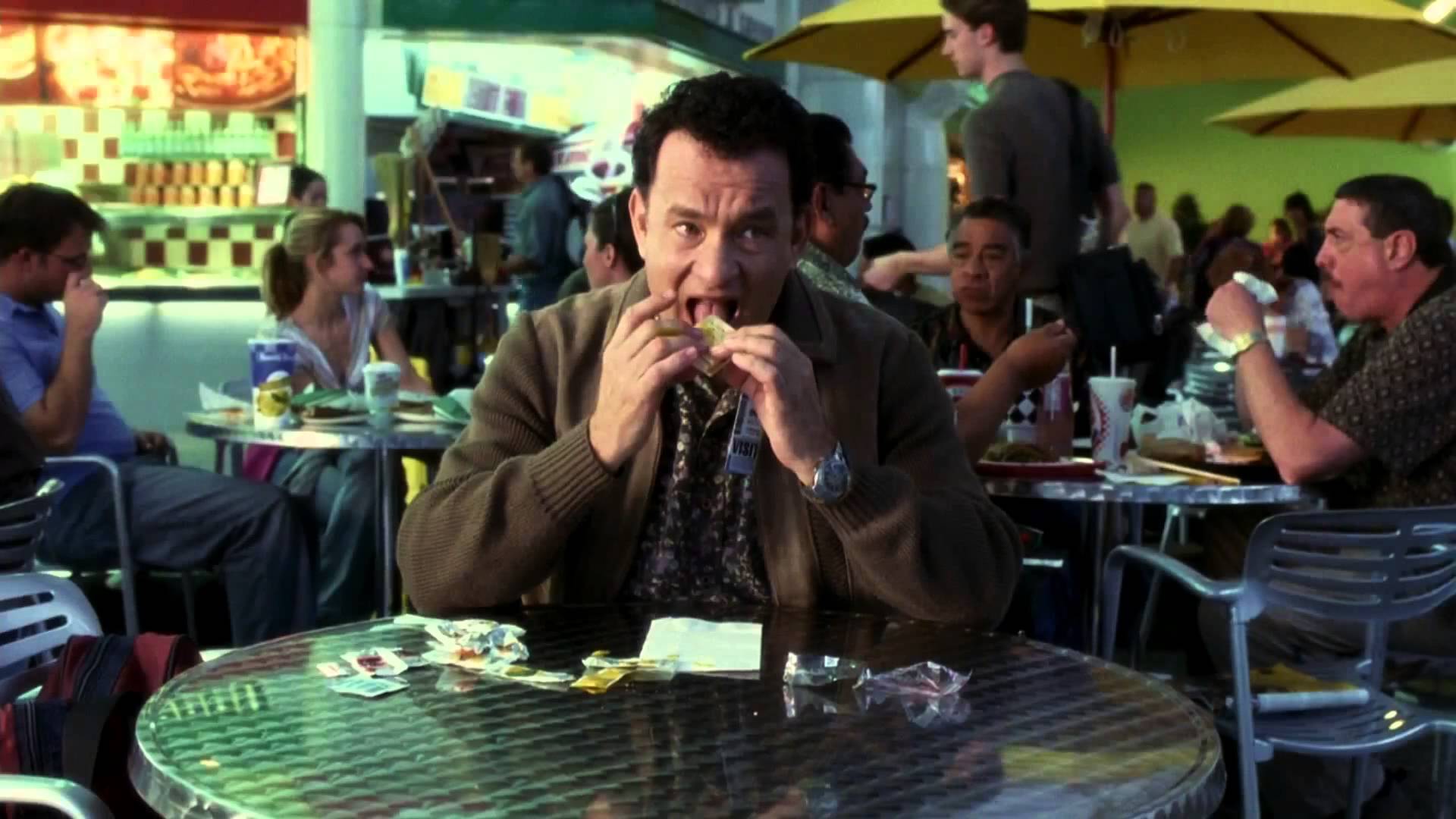
Terminal, The - scene

With a wonderful central performance from Hanks, The Terminal is glossy whimsy of the highest quality, a modern day fairy tale that features a princess in peril (Amelia), a wicked ogre (Dixon), three fairy godmothers (Enrique, Mulroy and Gupta), a maid (Dolores), and a handsome prince (Viktor – kind of).  It’s hugely enjoyable and is the type of movie that you can watch over and over again and still spot things you missed every other time (such as the head of the Statue of Liberty – keep an eye peeled, it’s there).  And like all good fairy tales it has a happy ending (though not the kind you might be thinking of).

Based around the true story of Mehran Karimi Nasseri, an Iranian refugee who spent eighteen years living in the departure lounge of Terminal One at Paris’s Charles de Gaulle airport, The Terminal downplays the drama inherent in such a predicament in favour of a heartwarming tale that is often hilarious, and which adds a romantic element that is both cute and bittersweet.  The script by Sacha Gervasi and Jeff Nathanson is structured much like a play, with act one concerning Viktor’s arrival at the airport, act two detailing his coming to terms with living in the airport, and act three showing his becoming a valued and respected member of the airport “staff”.  It’s a cleverly constructed script, with nods to wider issues such as immigration and racism, but included in such a way that they don’t intrude on the feelgood, aspirational  drive of the movie, or its message that tenacity and self-belief will always see you through.

It’s Viktor’s positive nature – so ably portrayed by Hanks – that is so affecting, his resourcefulness and persistence the very qualities we would like to think we’d have if we were in his position.  Hanks is nothing less than superb in a performance that is as richly nuanced as any other he’s given.  His choice of expressions alone offers a masterclass in acting; the scene in the men’s room when a traveller asks him, “Ever feel like you’re living in an airport?” is worth watching just for the stupefied look Viktor gives as a silent reply – and it’s made all the more impressive for being a reflection (and Hanks makes it all seem so effortless).

He has some great support too.  Zeta-Jones, still fresh from her Oscar-winning turn in Chicago (2002), makes Amelia appealing and sad at the same time, and in doing so makes the character more credible as Viktor’s possible love interest.  As the hard-nosed Customs and Borderland Protection administrator, Tucci is contained and hard to like but it’s a subtler performance than at first meets the eye, with echoes of a more sympathetic man showing through at odd moments.  And then there’s Pallana, whose deceptively expressive features are a joy to watch, his character’s unwavering paranoia amusing and wistful and, ultimately, well justified.  Luna plays Enrique as an adorable puppy, while McBride and Hensley are more stoic, and as Dolores, Saldana’s sunny approach to the character makes her more and more likeable as the movie goes on (it’s also fun to discover that Dolores is a Trekkie).

With all this favourable material allied to a raft of great performances, it comes as no surprise that Spielberg orchestrates everything with consummate ease, employing a lightness of touch that helps elevate Viktor’s plight from personal tragedy to unalloyed victory.  There’s more than a hint of Thirties screwball comedy in The Terminal, especially in Viktor’s confrontations with Dixon, and it’s to Spielberg’s credit that he augments such a contemporary story with such “old-fashioned” elements, and does it so seamlessly.  As with Hanks’ performance, this is one of Spielberg’s less appreciated movies, but one serious misstep aside – would Dixon really have been promoted after he grabbed Viktor by the neck and remonstrated with him? – he hits the movie out of the ballpark.

Rating: 8/10 – ripe for reassessment, The Terminal showcases an actor and a director working completely in synch, and providing their audience with a delightful slice of feelgood entertainment; richly detailed and with a clutch of stand-out moments, this is avowedly superior stuff.


Share this:

  • Share on X (Opens in new window) X
  • Share on Facebook (Opens in new window) Facebook
  • More
  • Print (Opens in new window) Print
  • Email a link to a friend (Opens in new window) Email
Like Loading...

The Expendables 3 (2014)

15 Friday Aug 2014

Posted by dullwood68 in Movies

≈ Leave a comment

Tags

Action, Antonio Banderas, Arms dealer, Arnold Schwarzenegger, Barney Ross, Conrad Stonebanks, Harrison Ford, Jason Statham, Mel Gibson, Patrick Hughes, Review, Sequel, Sylvester Stallone, War criminal

Expendables 3, The

D: Patrick Hughes / 127m

Cast: Sylvester Stallone, Jason Statham, Antonio Banderas, Jet Li, Wesley Snipes, Dolph Lundgren, Kelsey Grammer, Harrison Ford, Mel Gibson, Randy Couture, Terry Crews, Arnold Schwarzenegger, Kellan Lutz, Ronda Rousey, Glen Powell, Victor Ortiz, Robert Davi

Having rescued old friend Doc (Snipes), who’s been in prison in a foreign country for eight years, Barney (Stallone) and part of his team of Expendables head for Somalia in order to stop an arms deal that the US government – represented by Drummer (Ford) – wants foiled; they also have to capture arms dealer Victor Mins in the process.  But the plan goes wrong when Victor Mins turns out to be Conrad Stonebanks (Gibson), co-founder of the Expendables, and a man Barney thought he’d killed years before.  As Barney and his team come under increasing firepower, Stonebanks targets Caesar (Crews) and shoots him, wounding him badly.  They manage to escape but the experience prompts Barney to “retire” the rest of his team, even his closest friend Lee (Statham).  With Drummer still anxious to get Mins/Stonebanks, Barney enlists the help of Bonaparte (Grammer) in putting together a newer, younger team.  Once assembled, Barney and his new recruits go after Stonebanks.  They manage to capture him but their getaway is prevented by Stonebanks’ men who rescue him, and in a reversal of fortune, seize Barney’s young team.

With at first only Galgo (Banderas), a mercenary desperate to prove himself, and Trench (Schwarzenegger) to help him, Barney finds his old team refusing to let him go without them; he also finds himself backed up (unofficially) by Drummer.  The group heads for Stonebanks’ military training complex.  Getting in proves to be easy, but with Stonebanks’ men plus an army ranged against them, getting back out is a whole different matter.

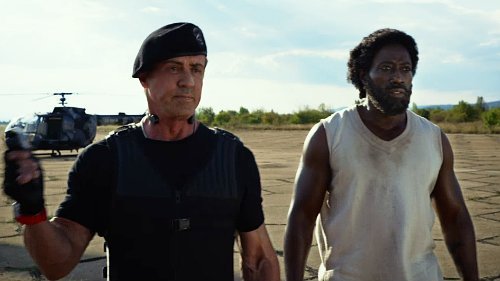
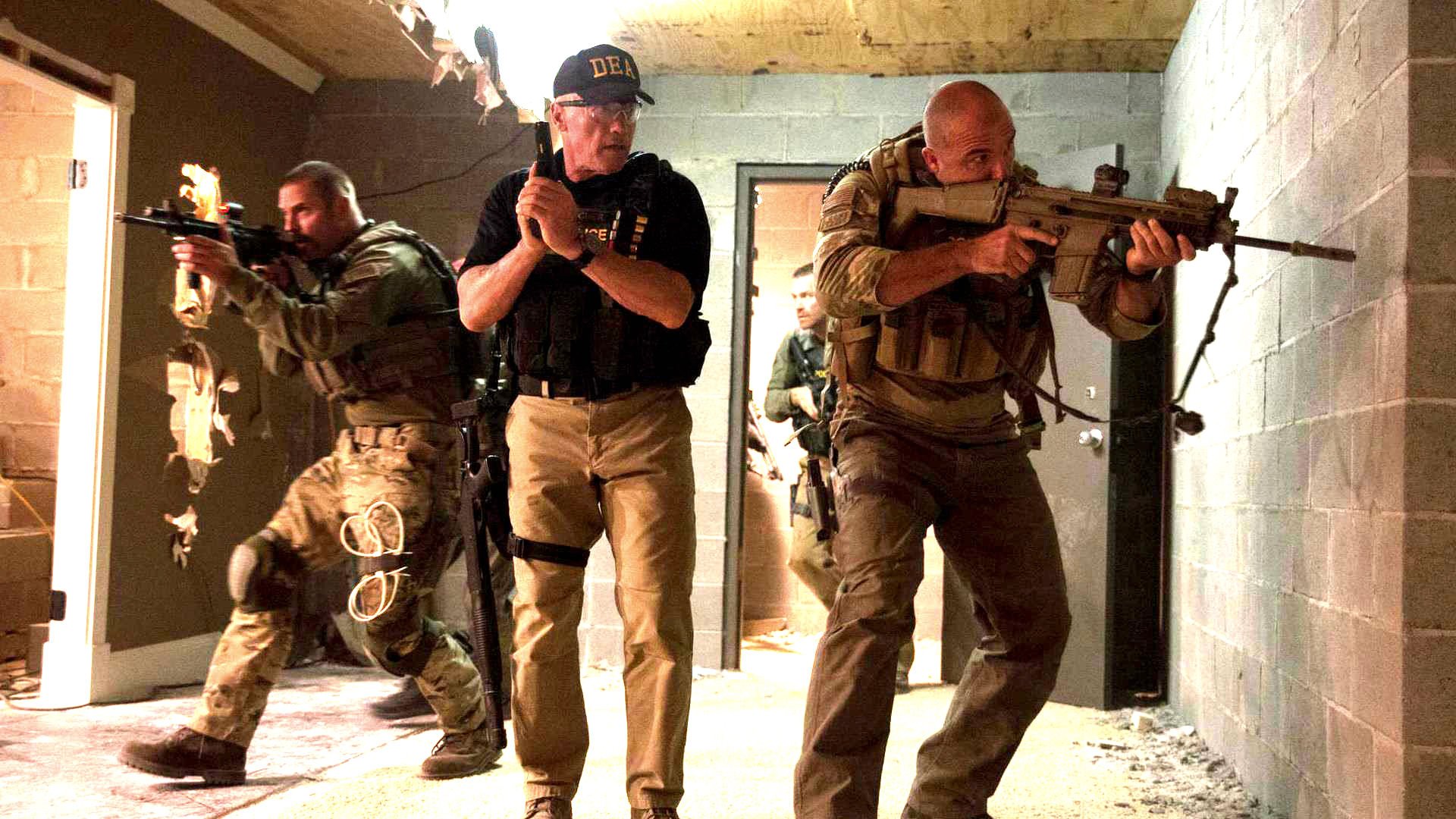
Expendables 3, The - scene

The first Expendables movie was an okay affair bolstered by the concept itself: take a number of ageing action stars and put ’em all together and see how much fun can be had.  The follow up was more of the same and had an extended airport shootout that was bizarrely unexciting.  Now, with Hollywood’s current penchant for making trilogies out of almost any movie idea, we have the latest – and hopefully last – testosterone-fuelled outing for the getting-on-a-bit daredevils.

For anyone who’s seen the first two movies, the lack of a solid storyline won’t come as a surprise, nor will the lack of credible characters, residing as they do in such an incredible world (perhaps Barney and his team should be called The Incredibles – no, wait, that’s already been taken).  The returning viewer will also see that the dialogue has been kept at a first draft stage, character motivations remain simplistic at best, and the performances are as one-note as before.  In short, there’s been as much effort put into this movie as the first two.

It’s an amazing achievement when a movie is the culmination of all the bad things of its predecessors, and then adds a few more bad things for good measure.  With The Expendables 3, Stallone and co-writers Clayton Rothenberger and Katrin Benedikt have taken the witlessness of these movies and instead of reining it all in, have instead ramped it up another notch.  There’s the opening sequence where Doc is rescued from a heavily guarded train: he’s been in prison for eight years – why is it only now that Barney decides to free him?  In Somalia, Barney’s jeopardises the mission when he sees Stonebanks and tries to kill him (it’s Stallone’s “Khan!” moment).  When he assembles his new team, Barney awkwardly swaps his old friends for “kids” he feels a paternal responsibility for – so in either case he’s trying to people he cares about from getting hurt, so why the need to change the team (other than as a script requirement)?  Surely it would be more dramatic if it’d been the other way round and Barney was using the new team to rescue the old one.

And then there’s the big bad villain himself, Conrad Stonebanks, a vicious, preening, self-deluded ex-mercenary turned arms dealer who doesn’t exactly hide from the world – at one point he’s seen attending a museum exhibition in the middle of Moscow – but whom the US government appears to have no knowledge of and worse yet, no photos of him.  And yet Drummer tracks him down to Bucharest with apparent ease and the new team track his movements – again, with ease.  But before all this, nothing?  No clue?  Not one photograph to run through a Facial Recognition programme?  No?  Really?

It’s disheartening when you see so little effort going into something that cost $90 million to make (though really it’d be disheartening whatever the budget; the makers of these movies aren’t exactly inexperienced).  But where the script founders and sinks under the weight of its own (limited) expectations, the hoped-for rescue from complete viewing drudgery courtesy of some slam-bang action sequences also fails to materialise.  Just how many times can these guys go through the same motions, the same fights, wade through hundreds of run-into-the-line-of-fire extras and stuntmen, without themselves wondering if it’s all worth it?  And how many times can the audience?

In terms of the cast, the Expendables themselves walk through it all without pausing to act, while newcomers Ford, Banderas and Grammer – we’ll leave Lutz et al. as they’re not allowed to contribute very much – do their best to inject some energy into the proceedings, though Ford’s grumpy turn serves only to reinforce every off screen curmudgeon story you’ve ever heard about the man.  Only Banderas seems to have gauged the mediocrity of the situation and decided to ignore it all; Galgo is the only character you can even remotely warm to (and he’s essentially a big motor mouth).

In the director’s chair, Hughes – who’s been tapped for the upcoming remake of The Raid (2011) (as if we need it) – shows a grasp of how to assemble an impressive action sequence but doesn’t bring anything new to the equation, instead falling back on tried and tested shots, camera angles and set ups.  Of the various showdowns at Stonebanks’ hideout, a two-hander featuring Banderas and Rousey taking on all-comers is more effective than most, and the eventual brawl between Barney and Stonebanks is a severe let-down, less of a brawl and more of a slightly “harder” version of patty-cake.

With The Expendables 4 already rumoured to happen, there’s a sense that whatever box office returns this outing secures, the series is going to continue until Stallone says otherwise (he’s also prepping further Rambo and Rocky sequels).  But unless he hands the writing reins over to somebody else, the law of diminishing returns may well dictate otherwise.

Rating: 4/10 – loud, dumb, unadventurous, and reworking a whole raft of already tired scenarios, The Expendables 3 proves that however much fun a bunch of actors are having on a movie, it doesn’t mean the audience will have the same experience watching it; short on ingenuity and with the now de rigueur extended action sequence to round things off, this is one movie that doesn’t know when to quit.

Share this:

  • Share on X (Opens in new window) X
  • Share on Facebook (Opens in new window) Facebook
  • More
  • Print (Opens in new window) Print
  • Email a link to a friend (Opens in new window) Email
Like Loading...

Mini-Review: Brick Mansions (2014)

13 Wednesday Aug 2014

Posted by dullwood68 in Movies

≈ Leave a comment

Tags

Action, Banlieue 13, Camille Delamarre, David Belle, Detroit, Luc Besson, Parkour, Paul Walker, Remake, Review, RZA, Undercover cop

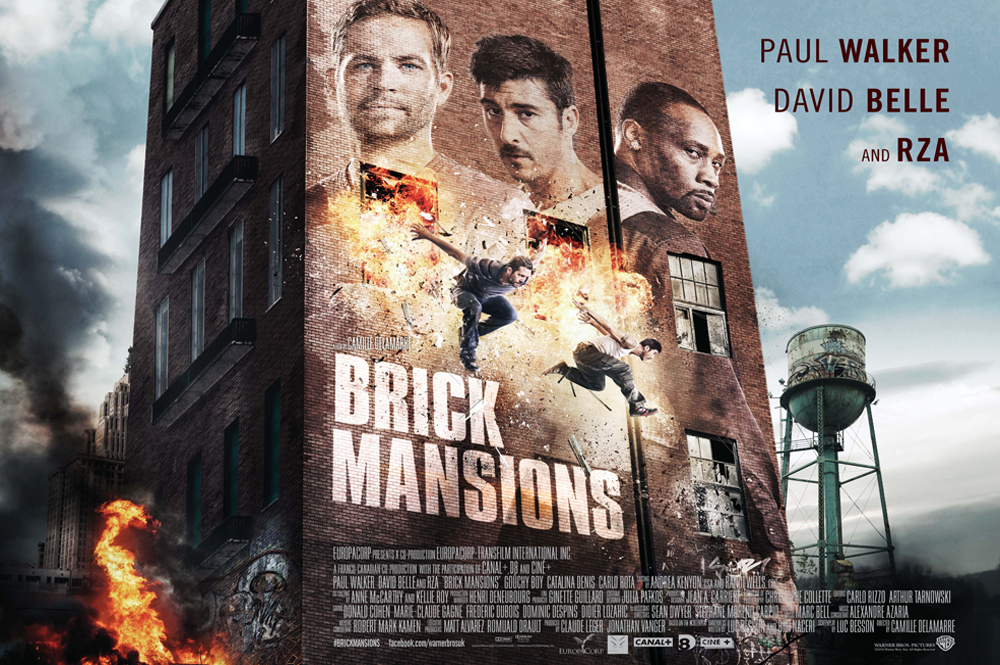
28616Quad_Final.indd

D: Camille Delamarre / 90m

Cast: Paul Walker, David Belle, RZA, Gouchy Boy, Catalina Denis, Ayisha Issa, Bruce Ramsay, Richard Zeman, Andreas Apergis, Carlo Rota, Frank Fontaine

In the not-too-distant future, Detroit has erected a wall around an area known as Brick Mansions.  Ruled over by crime boss Tremaine Alexander (RZA), this ghettoised area is full of drugs and guns and gang members (but not, it seems, any ordinary folk).  When the Mayor (Ramsay) decides that Brick Mansions has to be replaced by a brand new commercial development, he concocts a plan that involves sending undercover cop Damien Collier (Walker) into Brick Mansions to retrieve and “disarm” a hijacked bomb that could destroy the entire area.

On the inside, Alexander is having his own problems.  One of his drug shipments has been stolen by Lino (Belle) (and for no other reason than because the script needs him to).  When Lino proves too elusive to capture, Alexander has his ex-girlfriend Lola (Denis) kidnapped in retaliation.  He tries to rescue her but ends up in jail where Collier engineers a meeting with him and then tries to use him as a way of finding the bomb.  They form an uneasy alliance, and go after Alexander and the bomb together.

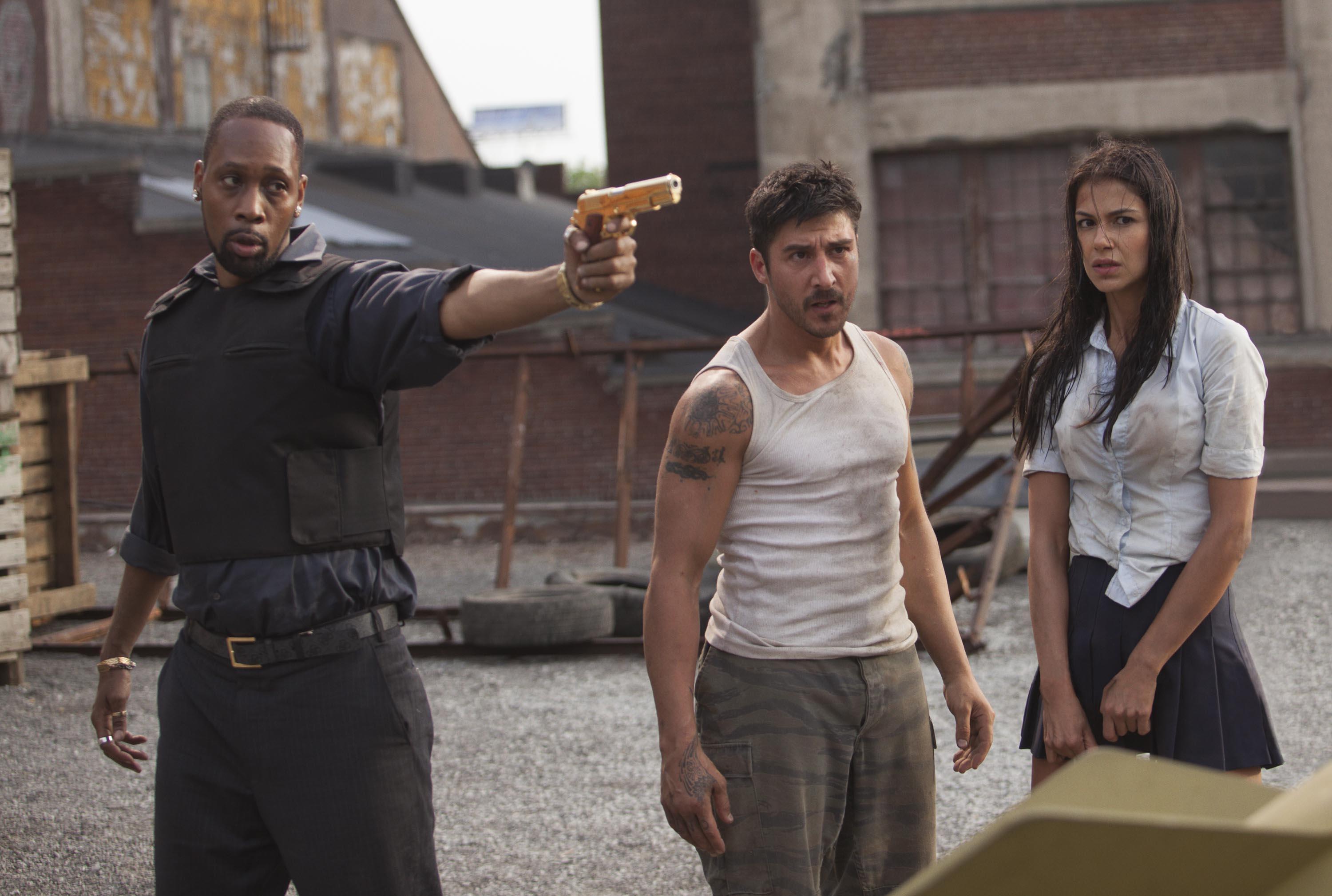
Brick Mansions - scene

As unnecessary remakes go, Brick Mansions gets by on its high-impact action scenes – expertly crafted and assembled by Delamarre and the movie’s stunt team – and the still impressive parkour abilities of Belle (who starred in the original movie, Banlieue 13 (2004), and doesn’t look a day older).  Beyond these elements, though, the movie pays lip service to plotting, characterisation, consistency and credibility, and merely jumps from one action sequence to the next with a minimum of fuss or subtlety.

The performances range from so-so (Belle, who has only the one facial expression) to trying (Walker, unable to create a character out of nothing), to embarrassing (RZA – when will someone tell him he can’t do menacing?).  The rest of the cast struggle with roles so under-developed they don’t even reach the level of being generic, and Luc Besson’s script (adapted from his co-written original) further handicaps everyone by relying on the kind of dialogue that sounds like it’s been badly translated from the original French.  While it’s true that Banlieue 13 isn’t perfect, it’s still the much better movie, and all Brick Mansions does is prove it.

Rating: 4/10 – a movie where acting was clearly not a requirement, Brick Mansions revels in its many patent absurdities; as brain-dead a movie as you’re likely to see all year but saved from being a complete loss by its well-staged action sequences.

Share this:

  • Share on X (Opens in new window) X
  • Share on Facebook (Opens in new window) Facebook
  • More
  • Print (Opens in new window) Print
  • Email a link to a friend (Opens in new window) Email
Like Loading...

I’ll Follow You Down (2013)

12 Tuesday Aug 2014

Posted by dullwood68 in Movies

≈ 1 Comment

Tags

1947, Albert Einstein, Disappearance, Drama, Gillian Anderson, Haley Joel Osment, Missing scientist, Review, Rufus Sewell, Sci-fi, Time machine, Time travel

I'll Follow You Down

D: Richie Mehta / 93m

Cast: Haley Joel Osment, Gillian Anderson, Rufus Sewell, Victor Garber, Susanna Fournier, John Paul Ruttan, Sherry Miller

When scientist Gabe Whyte (Sewell) flies off to New York for a convention, his wife Marika (Anderson) and young son Erol (Ruttan) have no idea that it’s the last time they’ll ever see him.  The mystery deepens when they discover that he never checked out of his hotel room, and he never attended the conference.  With the aid of her father, Sal (Garber), a physics professor, Marika discovers a basement laboratory that Gabe was using, along with his wallet and mobile phone, and crates of equipment.

Twelve years pass.  Erol is now attending university, while Marika is a successful artist though she has yet to come to terms with Gabe’s disappearance.  They have an uneasy relationship, both excelling in their relative fields but also going through the motions in many respects.  When Sal approaches Erol with details about Gabe’s work, details which indicate that Gabe was working on some kind of time travel device, Erol’s reaction is that it’s all a fantasy and he walks away from it.  He puts Sal’s revelation behind him, but when Marika takes an overdose it spurs him on to replicate his father’s work, and to try and find out if his father really did travel back to 1947 as his notebooks indicate, and if he met Albert Einstein as he’d planned.

But certain elements elude him and the project always fails.  Erol also learns that a man similar in description to his father was killed in 1947.  Now Erol has a twofold mission: to save his father, and to bring him back to the present in order that his family’s lives can resume from when his father was due back from New York.  In the meantime his relationship with his girlfriend Grace (Fournier) runs aground when she finds out what he’s trying to do; if Erol succeeds then the life they’ve built together from when they were children, and the child she is carrying, will disappear, leaving no guarantee that she and Erol will have the same life if his father goes back.  Undeterred, he redoubles his efforts and having solved the problem that had been eluding him, travels back to 1947 with a plan to make sure his father returns home.

I'll Follow You Down - scene

More of a family drama than a sci-fi movie, I’ll Follow You Down downplays the science in favour of a measured approach to its domestic tribulations.  Sadly, this decision makes for a somewhat dour, unattractive looking movie that relies heavily on its cast’s commitment to the material, but which never really springs to life, despite its intriguing premise.  Its low budget doesn’t help either, lending the movie the look of a TV drama of the week, with its drab lighting and flat photography exacerbating things from start to finish.

The performances are the best thing here: from Osment’s tortured son, to Anderson’s depressed wife and mother, to Fournier’s challenging girlfriend, the cast do wonders with a script that skirts banality with uncomfortable regularity.  As Erol, Osment has a tough time developing his character beyond that of the enfant terrible whose genius outshines his father’s, and while he’s convincing enough, when he reveals his solution for persuading his father to return to his own time, it’s hard to credit that Erol would do what he does, as sudden and unexpected as it is.  Before that, Erol is a young man adrift in the world, his father’s disappearance having caused an impediment to his emotional development.  In his scenes with his girlfriend, Grace (Fournier), his lack of understanding of her needs make him seem ungrateful rather than appreciative, and in these scenes his single-mindedness leaves a lingering aftertaste that undermines any sympathy the audience is supposed to feel for him.  But Osment makes Erol as fatally determined as his father, and this symmetry works in the movie’s favour.  It’s not a great performance, but it’s better than the character deserves.

As his overwhelmed mother, Anderson gives a persuasive portrayal of a woman as adrift as her son, but who struggles to lead a normal life after her husband vanishes.  It’s the mystery surrounding his disappearance – the unexplained nature of it – that swamps her and causes her to withdraw from so much of her “normal” life.  Thanks to Anderson, Marika draws the audience’s sympathy in ways that Erol isn’t even close to, and she does it with a minimum of fuss, eliciting the viewer’s support without them being aware of it.  The same can’t be said for Gabe, who in the opening scenes is seen as a doting father, loving husband and all-round good guy.  By the end, these aspects of his character seem more like a charade, as he is revealed to be self-centred and not as considerate of his family as you’d expect him to be.  Sewell has probably the most difficult job of all in trying to make Gabe as credible as he should be, but the script is against him, and never fully expands on his reasons for creating the time machine in the first place.

Garber and Fournier are fine in supporting roles, but again it’s the script – by writer/director Mehta – that lets things down, its plotting too contrived at times (and also, strangely predictable) to be entirely coherent (not to mention that it avoids any philosophical or metaphysical implications relating to the issue of time travel).  In addition, Mehta’s direction fails to add any tension to proceedings, and leaves the final confrontation between Erol and his father lacking in both drama and plausibility; it’s as if the movie needed to end as quickly as possible by this point, and this scene was the only thing Mehta could come up with to do so.  I’ll Follow You Down could have been a deeper, richer, more cinematic experience but instead it opts for a level tone that it rarely deviates from, and which ultimately stops it from being as absorbing and entirely worthwhile.

Rating: 5/10 – viewers expecting a sombre drama centred around the impact of a father’s disappearance on his family, will be disappointed, while sci-fi fans will find the haphazard focus on time travel quite annoying; a bit of a misfire, then, I’ll Follow You Down lacks both emotional substance and a fervent approach to the material, leading to a movie that hopes the viewer will engage with it, while it makes almost the least amount of effort.

Share this:

  • Share on X (Opens in new window) X
  • Share on Facebook (Opens in new window) Facebook
  • More
  • Print (Opens in new window) Print
  • Email a link to a friend (Opens in new window) Email
Like Loading...

Robin Hood: Prince of Thieves (1991)

10 Sunday Aug 2014

Posted by dullwood68 in Movies

≈ 1 Comment

Tags

Action, Adventure, Azeem, Crusades, Kevin Costner, Kevin Reynolds, King Richard, Little John, Locksley, Maid Marian, Moor, Nottingham Forest, Outlaws, Review, Sheriff of Nottingham, Will Scarlett, Witch

Robin Hood Prince of Thieves

D: Kevin Reynolds / 143m

Cast: Kevin Costner, Morgan Freeman, Alan Rickman, Mary Elizabeth Mastrantonio, Christian Slater, Geraldine McEwan, Micheal McShane, Michael Wincott, Nick Brimble, Soo Drouet, Walter Sparrow, Harold Innocent, Daniel Newman, Daniel Peacock, Jack Wild, Imogen Bain, Brian Blessed, Sean Connery

Jerusalem, 1194: Having taken part in the Crusades in support of King Richard the Lionheart, Robin of Locksley (Costner) is a prisoner facing a bleak future.  Seizing a chance to escape he finds himself doing so with Moor Azeem (Freeman), who tells Robin he must stay with him until he can repay the debt of Robin saving his life.  Back in England, Robin’s father (Blessed) is killed by the Sheriff of Nottingham (Rickman), his castle razed to the ground, and his lands forfeited.  Four months pass before Robin and Azeem arrive back in England.  When Robin learns of his father’s fate, he seeks out his former childhood friend, Marian (Mastrantonio).  The Sheriff’s men – led by his cousin Guy of Gisborne (Wincott) – chase Robin and Azeem into Sherwood Forest, where they find refuge with a band of outlaws.

Robin soon becomes the outlaws’ leader, and they start to rob convoys and shipments that travel through the forest, including a large cache of money that they learn is intended to pay off a group of barons who will support Nottingham’s challenge for the throne in King Richard’s absence.  With their increasing resistance interfering with the Sheriff’s plans, he hires a band of Celts to find and lead an assault on the outlaws’ hideaway.  With several of the outlaws taken prisoner, and with their executions planned to take place on the same day that the Sheriff intends to marry Marian against her wishes, Robin, Azeem and a few remaining outlaws – including Little John (Brimble), Will Scarlett (Slater), and Friar Tuck (McShane) – must save their comrades, stop the marriage, and thwart the Sheriff’s plans to overthrow the monarchy.

Robin Hood Prince of Thieves - scene

Back in 1991, Kevin Costner was fresh off the Oscar-winning success garnered by Dances With Wolves (1990), and audiences had the prospect of Oliver Stone’s JFK to come later in the year.  But in between there was Robin Hood: Prince of Thieves, a movie that promises so much but in practice offers a rather lumpen retelling of the Robin Hood myth, and which makes the mistake of having a lead character who is so bland and unexciting to watch that the movie stumbles along for far too long before it ratchets up the action for its extended, exhilarating climax.

Costner’s Robin is a bit of a dullard, so much so that the romance with Marian makes you question her eyesight and experience of other men.  With such an unnecessary and distracting approach, it falls to the supporting characters to provide any vitality or energy, though we’re talking minor supporting characters in the main, such as Bull (Peacock) and Much (Wild), or McEwan’s cackling turn as the witch Mortianna.  Thank the screenwriters then – Pen Densham and John Watson – that they gave us a Sheriff of Nottingham straight out of the am-dram leagues, and that Alan Rickman (only three years on from his breakout performance as Hans Gruber in Die Hard) embraced the pantomime aspects of the character and gave the movie a much-needed boost.  When he’s on screen there are just waves of pleasure generated by his exasperated, frustrated Sheriff, and lines of dialogue that continue to impress even after all this time: “That’s it then.  Cancel the kitchen scraps for lepers and orphans, no more merciful beheadings, and call off Christmas.”  But good as he is, Rickman’s performance only serves to highlight how little effort has gone into making Robin anywhere near as interesting.

It’s not really noticeable either, just how much time elapses over the course of the movie.  It takes Robin and Azeem four months to get home, and once they meet up with the outlaws in the forest, a further five months elapse before the Sheriff is given the idea of hiring the Celts.  This seriously undermines any dramatic tension the movie has – until the planned executions are announced – and this leaves the middle section feeling drawn out and at the mercy of the romance between Robin and Marian, which, despite being well acted by Costner and Mastrantonio, still drains the movie of any impetus it’s managed to build up by then.

The unevenness of the script, and problems with the pacing aside, there’s still much to recommend, from the stirring action set pieces, to the often pointed humour – “Where I come from, we talk to our women. We do not drug them with plants.” – as well as the aforementioned supporting turns, to the look of the movie, its rural settings and heavy greens and browns providing a rich palette for the audience to look at.  Reynolds directs with conviction, and with DoP Douglas Milsome’s help, keeps the camera moving in and around the action, often getting in close at unexpected, but effective, moments.

As an updated version of the classic tale, there are some unfortunate anachronisms throughout (mostly of the verbal variety – would Will Scarlett really have said what he does when Robin and Azeem catapult over a castle wall?), and some of the more modern, ironic sensibilities in the script are at odds with the medieval milieu, but they come across as part of the uneven approach to the material; ultimately these elements  fail to gel but don’t impede a basic enjoyment of the movie, and don’t detract when the movie picks up the pace (and becomes more exciting).

Rating: 7/10 – slow-moving in parts (and geographically amusing – Dover to Nottingham via Hadrian’s Wall, anyone?), Robin Hood: Prince of Thieves takes a high concept, big budget approach to a small-scale adventure drama and loses its focus accordingly; with Costner and most of the cast hindered by poor characterisations, it’s left to a bravura finale to rescue the film from being completely bland.

Share this:

  • Share on X (Opens in new window) X
  • Share on Facebook (Opens in new window) Facebook
  • More
  • Print (Opens in new window) Print
  • Email a link to a friend (Opens in new window) Email
Like Loading...

Lost for Life (2013)

07 Thursday Aug 2014

Posted by dullwood68 in Movies

≈ 18 Comments

Tags

Brian Draper, Documentary, Jacob Ind, Joshua Rofé, Josiah Ivy, Juvenile killers, Life sentences, Murder, Review, Sean Taylor, teenkillers.org, Torey Adamcik

Lost for Life

D: Joshua Rofé / 75m

A candid, often unsettling look at juvenile killers, Lost for Life looks at four cases where teenagers have committed murder and are currently serving life sentences in US prisons.

The first case is that of Brian Draper and Torey Adamcik, a couple of sixteen year olds who convinced each other it would be a good idea to kill their classmate, Cassie Stoddart.  One night they went to her home and stabbed her to death.  The second case involves Jacob Ind, who at fifteen, killed his mother and stepfather by shooting them.  Third is the case of Josiah Ivy, who at sixteen killed two strangers, Stacy Dahl and Gary Alflen, at their home.  And lastly, there’s Sean Taylor, who at seventeen killed a rival gang member in a drive-by shooting.

Each case features the juvenile killers several years on from when they committed their crimes, and explores their reasons for killing and how they’ve dealt with the repercussions of their actions, and how  – or if – they’ve come to terms with what they did.  There’s also input from their families as well as some of the relatives of the victims, and the movie also takes in the recent Supreme Court decision relating to whether or not minors who commit murder should be sentenced to life without parole.

Lost for Life - scene

All four stories are potent in their own way, and initially it’s hard to understand just how any one of these murders could have come about, but thanks to the involvement of the perpetrators, it becomes clearer and clearer as the movie goes on that there’s never just one factor that sets things in motion, and that the reasons for these dreadful acts are often complex and unpredictable.  What makes these cases all the more interesting is the distance in time and attitude that these “teen killers” have travelled in their own efforts to recognise and grasp both the enormity of what they’ve down, and how their deeds have affected others.

Brian is perhaps the most balanced – if that word can be applied to someone who deliberately set out to kill a girl he was attracted to – of the group, and despite an intermittent stutter, is quite articulate as he talks about what he did and how he’s come to terms with his guilt and how “broken” he was as a teenager.  By contrast, his accomplice in the crime, Torey, is shown evincing an almost complete denial of his actions, and he’s supported by his parents who in one uncomfortable moment – both for Torey and the viewer – state his innocence as if it was the most obvious thing imaginable.  (And this in spite of the fact that the pair filmed themselves planning the murder, and then again after they’d committed it.)

Jacob is equally articulate but there’s something not quite right about his responses and the moments when he closes his eyes – which happen quite a lot – it’s as if he’s reliving the memories of killing his mother and stepfather.  It’s an unnerving possibility, and he’s almost casual about the effect killing them has had on him.  He’s aware of the wickedness of his crime, but it all comes across as if it had happened to someone else, and he talks dispassionately about the events that led up to the crime, including his persuasion of a friend to carry out the murders first of all, and his equally worrying admission that he shot both parents almost as if it was a fait accompli (his friend having failed to do the “job” properly).

The saddest case is that of Josiah, abused as a child and seen as a withdrawn adult, his emotions and his ability to talk about the random killings that will see him spend the rest of his life in prison so suppressed that his lawyer has to instruct him in how to respond from off camera.  To compensate, the movie spends more time with his sister Amber.  She proves to be an eloquent interviewee, but even she struggles to completely understand how her brother could have killed two complete strangers “just to see what it felt like”.  From this we meet Jennifer Bishop-Jenkins, who founded the website www.teenkillers.org following the deaths of her sister and brother-in-law and their unborn baby, and Sharletta Evans who has forgiven the killers of her three year old son and thinks other teen “lifers” should be given a “first chance”.  Seeing the two women together is inspiring – albeit for different reasons – and adds a layer of emotion that helps show the effect that these crimes have on the victims’ families.

Sean’s story shows how redemption can be achieved.  In prison he became interested in Islam and eventually became a Muslim, changing not only his religion but his approach to life, rejecting his gang background and lifestyle, and forging a new life for himself.  His moving account of his rehabilitation offers hope for all those teenagers who have killed without giving due consideration of the effect their actions will have on others, and the way in which self-respect can be regained.  Without him the movie would have been painfully pessimistic, but thanks to Rofé’s considered approach to the material and the careful assembly of the various interviews, Lost for Life is a captivating, intriguing, and necessarily thought-provoking documentary that wisely avoids looking for definitive answers as to why these terrible crimes happened, but asks if we can ever forgive the people who commit them.  It’s a difficult question, and as mentioned before, the candour the movie invokes goes some way to increasing the difficulty in deciding, but without this challenge, the movie would not be as rewarding or as stimulating as it is.

Rating: 8/10 – a tough subject given fair treatment, and very pertinent in terms of what’s happened recently in US law, Lost for Life paints a terrifying portrait of youth gone awry; by shying away from a more sensationalist approach, this is an impressive, often haunting documentary that is both horrific and uplifting.

Share this:

  • Share on X (Opens in new window) X
  • Share on Facebook (Opens in new window) Facebook
  • More
  • Print (Opens in new window) Print
  • Email a link to a friend (Opens in new window) Email
Like Loading...

Sharknado 2: The Second One (2014)

04 Monday Aug 2014

Posted by dullwood68 in Movies

≈ Leave a comment

Tags

Anthony C. Ferrante, Ian Ziering, New York, Review, Sci-fi, Sequel, Sharks, Statue of Liberty, SyFy Channel, Tara Reid, The Asylum, Tornados, Vivica A. Fox

Sharknado 2 The Second One

D: Anthony C. Ferrante / 90m

Cast: Ian Ziering, Tara Reid, Vivica A. Fox, Mark McGrath, Kari Wuhrer, Courtney Baxter, Dante Palminteri, Judd Hirsch

On a flight to New York, Fin (Ziering) and April (Reid) are discussing their plans to meet up with Fin’s sister, Ellen (Wuhrer), her husband Martin (McGrath), and their two children, Mora (Baxter) and Vaughn (Palminteri).  As the plane heads into a storm, Fin thinks he sees a shark outside the plane.  When he sees more, and so does April, he’s absolutely sure.  When one of the sharks is sucked into one of the engines, blowing it out, the plane begins a rapid descent made worse by the subsequent deaths of the pilot and co-pilot, but not before April loses her hand to a shark in the melee.  Fin manages to land the plane, but before you can say FAA regulations or investigation, he’s warning the public about the impending sharknado and then heading off to the hospital with April.

With April (very, very) quickly recovered from her surgery, Fin leaves to find Ellen and her family.  He catches up with Martin and Vaughn, along with old flame Skye (Fox) at a Mets game and they flee to the subway just as the storm hits.  Meanwhile, Ellen and Mora are on a ferry heading back from the Statue of Liberty, along with a couple of Ellen’s friends, one of whom gets taken out by a flying shark.  Back in the subway, flooding causes sharks to attack the train, but the group survive and head above ground where they collect bomb-making equipment from various places; Fin’s idea is to destroy the storm – which has now mutated into two enormous twisters (as in the first movie) – and save the city.  Items collected, they head to the hotel building where his sister is staying, and where they are reunited, Ellen and Mora having made it back safely (but without the other friend, who gets flattened by a falling shark).

Fin and Skye try to destroy the twisters before they combine but their home-made bombs aren’t powerful enough.  Devising a back-up plan involving freon tanks stored at the top of the Empire State Building, Fin’s attempts to get there are helped by the unexpected arrival of April in a fire truck, and the cooperation of the city’s mayor.  Fin and Skye head to the top of the Empire State Building, and with three twisters now about to converge, Fin’s plan has to succeed.

Sharknado 2: The Second One - 2014

The success of Sharknado (2013), a movie with all the style of a bull in a china shop spouting nonsense rhymes, was completely unexpected considering it was more awful than anyone could have imagined.  And with that movie earning itself a 1/10 rating with this reviewer, the prospect of a sequel was like the cinematic equivalent of surviving testicular cancer with one intact, only to be told it’s back, and in the other one.  But – and this is the amazing part – Sharknado 2: The Second One, despite its clunky title, its risible dialogue and still dreadful CGI, is actually more fun than the original, and even more amazingly, it’s actually better than the original.

To be fair, that’s not saying that much, because even with what looks to be a bigger budget, the plot still plays fast and loose, and loose again, with logic and reality, the dialogue is still laughable – check out Fin’s line to April when he retrieves her severed arm (which should have been just a hand) – the special effects are still not even remotely convincing, the sharks are still shoved into as many contrived places as returning screenwriter Thunder Levin can come up with, and Tara Reid returns to give everyone that dead-eyed stare that sharks would give their dorsal fins for.  It’s an impressive collection of negatives for one low-budget movie to cram into ninety minutes, but you can just imagine the folks at The Asylum taking it up as a kind of challenge.

And yet, this time round the makers have added a vital ingredient that wasn’t in the first movie: ironic self-awareness.  It makes all the difference, lifting The Second One up from its expected rung on the lower depths of cinematic hell to a slightly higher rung where it can look down smugly on its predecessor.  From the moment Robert Hays pops up as the pilot of the New York flight, and Fin sees sharks outside the plane in the same way that William Shatner saw a gremlin on the wing in The Twilight Zone episode Nightmare at 20,000 Feet, there’s a palpable sense that someone, somewhere at The Asylum had realised what was missing from the first movie, and acted accordingly.  There are further cameos from the likes of Richard Kind as a washed-up baseball player who gets to swing one last bat at a falling shark, Billy Ray Cyrus as a doctor called Quint (not the only Jaws reference: Martin and Ellen’s surname is Brody), Sandra Denton (Pepa from the rap duo Salt-n-Pepa) as one of Ellen’s unfortunate friends, Andy Dick as a cop with the most unlikely haircut this side of Phil Spector, Kurt Angle as a fire chief, and Perez Hilton as an impatient subway traveller – all of them adding to the unexpected fun the movie’s been infused with.  (There’s also loads more in-jokes and shark movie references.)

Returnees Ziering and Reid keep it (largely) straight though, as does Fox, charged with providing some unneeded back story between Skye and Fin that no one’s interested in, and Hirsch makes way more of his role than he has any right to (even when he has to say the same dialogue twice in different shots).  Also returning as director, Ferrante keeps the pace moving but still leaves a lot of scenes bereft of tension, while the editing is as haphazard and ill-focused as the first movie, and the score relies a little too much on the (The Ballad of) Sharknado to support the action.

Rating: 3/10 – it’s still a mess, whichever way you chainsaw it, but at least Sharknado 2: The Second One knows it; with Sharknado 3 already promised for 2015, let’s hope the makers secure an even bigger budget and do something about those ropey effects, and the ropey production design, and the ropey editing, and the ropey plots, and the – oh well, you get the picture…


Share this:

  • Share on X (Opens in new window) X
  • Share on Facebook (Opens in new window) Facebook
  • More
  • Print (Opens in new window) Print
  • Email a link to a friend (Opens in new window) Email
Like Loading...

The Purge: Anarchy (2014)

02 Saturday Aug 2014

Posted by dullwood68 in Movies

≈ Leave a comment

Tags

Annual event, Big Daddy, Carmen Ejogo, Crime, Frank Grillo, James DeMonaco, Murder, Revenge, Review, Sequel

Purge Anarchy, The

D: James DeMonaco / 103m

Cast: Frank Grillo, Carmen Ejogo, Zach Gilford, Kiele Sanchez, Zoë Soul, Justina Machado, John Beasley, Jack Conley, Michael K. Williams

March 31, 2023: The annual Purge is mere hours away.  A police sergeant, Leo (Grillo) is preparing to use the twelve hour crime amnesty to murder the man who ran over and killed his son.  A diner waitress, Eva (Ejogo) is on her way home to spend the evening with her daughter, Cali (Soul) and father, Rico (Beasley).  And a couple, Shane (Gilford) and Liz (Sanchez), are travelling to see his sister; they have something important to tell her.  Then the couple’s car breaks down, leaving them stranded and pursued by a gang of masked and face-painted Purgers.  Meanwhile, Eva and Cali are doing their best to reassure their father that they will be able to cope with the increasing cost of his medical treatment, but Rico is dismissive.  While they prepare dinner, he leaves their apartment, having made arrangements that will see both of them well taken care of… but at a price.

The Purge begins.  Leo takes to the streets, while Shane and Liz continue to try and avoid the gang that’s pursuing them.  Eva and Cali discover their father has gone – and the reason why.  They also find their building under attack from a team of SWAT-like intruders led by Big Daddy (Conley).  A more immediate threat comes from one of their neighbours but the women find themselves abducted by Big Daddy’s men instead.  Leo happens to be passing by when he sees Eva and Cali being dragged into the street; against his better judgment he rescues the women, and without knowing it, Shane and Liz as well (they’ve taken the opportunity to hide in the back of his car).  Their escape sees Leo’s car hit several times by bullets and later it breaks down.  Eva tells Leo she has a friend nearby with a car and if he gets everyone to her friend’s apartment then she’ll persuade her friend, Tanya (Machado) to let him have the car.  Leo agrees and they all set off on foot.  The group finds itself under attack before they reach Tanya’s apartment, and Shane is wounded in the shoulder in the process.

Simmering tensions amongst Tanya’s family leads to unexpected bloodshed and the group are forced to leave – but without a car.  Outside it isn’t long before Big Daddy’s men capture them.  They are taken to a building that has been set up to provide rich patrons with the opportunity to have their own private Purge, and the five find themselves in a room being stalked by seven of the rich Purgers.  Leo kills some of them, at which point the building is invaded by a group of anti-Purgists led by Carmelo (Williams).  Leo, Eva and Cali flee in the confusion and they head to the home of the man who killed Leo’s son.  The women try to convince Leo to let it go, but he enters the man’s home anyway…

Purge Anarchy, The - scene

It’s an ominous thought, but there’s a good possibility that we’ll be “treated” to a Purge movie every year until the law of dwindling financial returns convinces the producers to shut up shop and move on to pastures new.  In the meantime, this first sequel does its best to expand on the original movie’s intriguing premise, but dulls matters despite its increased budget ($9 million, triple the original’s), and a broadening of the material that takes in everything from Government corruption to an anti-Purge movement to its third act Most Dangerous Game development.   It’s a smart move, but it’s not too long before the viewer may well be wondering, Why didn’t they stick with the whole home under siege schtick of the first movie?  The family under attack is briefly referenced when Eva and Cali’s building is stormed by Big Daddy’s men but it’s less an excuse for some carefully built-up tension and suspense than for Noel Gugliemi’s gun-toting neighbour to bring on the ham.  And the makers have fallen into the trap of so many other filmmakers in the past, and failed to realise that having a group of people running around deserted streets at night while being pursued is about as exciting a prospect as watching an Uwe Boll double bill.

The main problem here is that none of the characters are particularly likeable, so it’s difficult to care if they’re killed or not.  Where The Purge (2013) took some time to introduce its dysfunctional family, here the emphasis is on quick brush strokes and on to the next set up before anyone realises how little has been invested in creating a group the audience can root for.  Leo is as taciturn as you’d expect from a character who occupies an uneasy moral high ground, while Eva, who you might also expect to turn out to be the resourceful heroine is instead relegated to bystander the longer the movie goes on.  Cali is too whiny to care about, and Shane and Liz are as irritating as a paper cut – of all five, these are the ones you hope don’t make it to the next morning.  However, this isn’t the actors’ fault, but returning writer/director DeMonaco’s, his script trying to cram too much in – the whole third act with the moneyed elite feels like it should be the focus of another instalment, and is as dramatically rushed as the rest of the movie.

Thanks to its hurried pacing and uninspired plotting, The Purge: Anarchy is only fitfully involving, and with only hints and oblique clues as to the even wider conspiracy still to be explored, the movie feels increasingly like a transition piece, something to keep the audience happy until the bigger story can be worked out and put on screen.  That said, there are some nice, incidental touches: the woman covered in blood at the roadside, the bus on fire rolling by in the background, the return of the Stranger (Edwin Hodge) from the first movie, but they’re so few and far between, they make you wonder why the rest of the movie has to be so predictable.  The cast do their best with the material but the limitations of their characters defeat them for the most part, and the lack of any real threat – having someone wearing face paint really isn’t scary or threatening any more, not on screen at least – leaves the group’s chances of survival looking more likely than not.  DeMonaco directs efficiently enough but without bringing anything new visually or stylistically that we haven’t seen in a hundred other similar movies.

Rating: 5/10 – a calculated sequel that never really takes off, The Purge: Anarchy shows what can happen when a movie is unexpectedly successful and the idea of a franchise is borne; future Purges will need to be more tightly focused than this episode, and with characters the audience can invest in emotionally, otherwise the series may well find itself purged of anyone who’s interested.

Share this:

  • Share on X (Opens in new window) X
  • Share on Facebook (Opens in new window) Facebook
  • More
  • Print (Opens in new window) Print
  • Email a link to a friend (Opens in new window) Email
Like Loading...

Belle (2013)

20 Friday Jun 2014

Posted by dullwood68 in Movies

≈ 3 Comments

Tags

Amma Asante, British history, Captain John Lindsay, Dido Elizabeth Belle, Emily Watson, Gugu Mbatha-Raw, Lord Chief Justice, Lord Mansfield, Racism, Review, Slavery, Tom Wilkinson, True story, Zong

Belle

D: Amma Asante / 104m

Cast: Gugu Mbatha-Raw, Tom Wilkinson, Emily Watson, Sam Reid, Sarah Gadon, Penelope Wilton, Miranda Richardson, James Norton, Tom Felton, Matthew Goode

The illegitimate offspring of Royal Navy captain John Lindsay (Goode) and an African slave woman named Maria Bell, young Dido Elizabeth Belle is sent to live with his uncle, Lord Mansfield (Wilkinson) and his wife (Watson) at Kenwood House.  Despite her mixed race heritage, Dido is brought up as one of the family though some social – or possibly, household – conventions are upheld: Dido is unable to take part in dinner parties but is allowed to take coffee with guests afterwards.  She grows up in the company of her cousin, Elizabeth, who is also a ward of Lord Mansfield.  When both girls become of age, Dido (Mbatha-Raw) and Elizabeth (Gadon) expect to “come out” and find a husband.  However, Lord Mansfield has other ideas: with Dido having received a substantial inheritance upon the death of her father, he feels that her financial independence would only frighten off any potential suitors; he wants her to stay on at Kenwood and run the household.

While Elizabeth attracts the attention of James Ashford (Felton), it is his brother, Oliver (Norton) who finds himself drawn to Dido.  Unfortunately for Oliver, Dido has affections for John Davinier (Reid), a headstrong young lawyer-in-training who Lord Mansfield takes under his wing.  When the two men fall out over a ruling Lord Mansfield has to give – he’s the Lord Chief Justice – on the matter of the Zong slave ship (where slaves were cast deliberately overboard to drown), Dido endeavours to help Davinier as much as she can.  While the Mansfield household resides in London in their efforts to secure a husband for Elizabeth, Dido secretly meets with Davinier and his pro-abolitionist comrades and supplies them with as much information as she can about the case.  As the time approaches for Lord Mansfield to give his ruling, Dido’s involvement is revealed and Oliver Ashford proposes marriage.  With her future happiness hanging in the balance, Dido must decide if the life she requires will be dictated to her by social expectations or by her own desires.

Gugu Mbatha-Raw Sarah Gadon

Based – very, very, very loosely – on a true story, Belle is a handsomely mounted, beautifully lensed movie that tackles its subject matter with intelligence and a keen eye for the vagaries of the social hierarchy of Britain in the late 1700s.  The ingrained racism of the times is depicted far more subtly than expected, and is best expressed in the actions and thoughts of Lord Mansfield as he displays public disgust over the concept and practice of slavery, but in the privacy of his own home, represses Dido with his notions of correct social etiquette (and that’s without mentioning the implicit sexism of his position as well).  With the crusading Davinier to root for, and his “colour blindness”, the movie gives the viewer someone to help navigate the maze of 18th century politics, and just as Dido herself has an awakening in this matter, it’s one of the strengths of Misan Sagay’s heartfelt screenplay that matters become as clear as they do.

With the racism and the politics and the social niceties of the period so well rendered, it’s disappointing that the romantic aspects of the movie aren’t as strongly defined or developed.  Elizabeth is the trusting young hopeful, an almost stock character of the period whose lack of experience with men is redeemed by her telling Dido, “We are but their property”.  Against this, Dido is necessarily more confident and aware of the pitfalls of relationships though her confidence is established too easily, and there are times when the movie’s need for her to be a support for Elizabeth becomes irritating (Elizabeth isn’t exactly vapid but she is unremittingly naive).  Davinier’s ardent pursuit of Dido is too avid at times, and his passion for both the cause of abolition and Dido’s freedom from social strictures, as written, leaves the character looking almost (but not quite) insufferable.

In the title role, Mbatha-Raw gives a perceptive, masterful performance that is both emotionally honest and fiercely intelligent, and she is skilfully supported by Wilkinson and Watson, the former imbuing a cleverly written and yet difficult character with sincerity and charm.  Reid is earnest and declamatory (thanks to the script), and Gadon’s coquettish take on Elizabeth is occasionally affecting but she too is hindered by the restrictions of the script.  Wilton, Richardson and Norton flesh out their roles to good effect but Felton is stifled by a character who is never allowed to be anything more than the stock villain (not only is he an outspoken racist but he assaults Dido as well, as if his odiousness was in some way in doubt).

In the director’s chair, Asante shows an assured and substantial understanding of the issues being examined, and is particularly impressive when exploring the curious anomalies of Dido’s life at Kenwood House.  Under her committed and often powerful guidance, Belle overcomes its romantic Georgian soap opera elements to become a potent, articulate condemnation of a period in British history when endemic racism and the commerce of slavery was beginning to be challenged both socially and in law.

Rating: 8/10 – the aforementioned romantic elements and Rachel Portman’s often intrusive score aside, Belle is a vivid, impassioned look at the often complex life of a woman whose social position meant she was too low to eat with her family and at the same time, too high to eat with servants; a powerful, accomplished movie from a powerful, accomplished director.

Share this:

  • Share on X (Opens in new window) X
  • Share on Facebook (Opens in new window) Facebook
  • More
  • Print (Opens in new window) Print
  • Email a link to a friend (Opens in new window) Email
Like Loading...

Oculus (2013)

19 Thursday Jun 2014

Posted by dullwood68 in Movies

≈ 3 Comments

Tags

Brenton Thwaites, Horror, Karen Gillan, Katee Sackhoff, Mike Flanagan, Mirror, Possession, Review, Rory Cochrane, Spirits, Supernatural

Oculus

D: Mike Flanagan / 104m

Cast: Karen Gillan, Brenton Thwaites, Katee Sackhoff, Rory Cochrane, Annalise Basso, Garrett Ryan, James Lafferty, Miguel Sandoval

Upon his release from a psychiatric hospital, Tim Russell (Thwaites) is met by his sister, Kaylie (Gillan) and reminded of a promise he made when they were children: to destroy the mirror she believes was responsible for the deaths of their parents eleven years before.  Tim has done his best to overcome the trauma of that event, and has no wish to relive it.  But Kaylie has become obsessed with destroying the mirror, and since its time in their childhood home, she has kept track of it and has managed to get it put up for sale at the auction house where she works.  On the pretext of having it checked for any necessary repairs before sending it off to the buyer, Kaylie takes it to their old home; there she has set up cameras and various recording devices in an attempt to prove that the mirror is possessed of an evil force.  Tim is less than convinced, despite the number of bizarre deaths that have happened to the mirror’s owners over the years.  As the plan progresses, Tim begins to remember more and more about the past, and the events that led up to the deaths of their mother, Marie (Sackhoff), and father, Alan (Cochrane).  With the mirror increasingly able to manipulate their minds into seeing what it wants them to see, Tim and Kaylie fight to stay one step ahead in their efforts to destroy it.

Oculus - scene

At first glance, Oculus looks and feels like a throwback to early Seventies horror, with its slow build up and emphasis on tension and suspense.  The early scenes, where Kaylie and Tim are introduced both as adults and as children (Basso, Ryan) are well constructed and as the movie unfolds, they show clearly how Kaylie and Tim have become the people they are now.  Young Kaylie is headstrong and a little rebellious; adult Kaylie is forceful and determined.  Young Tim lacks confidence and is easily scared; adult Tim is reticent and emotionally withdrawn.  The conflict between the two siblings is well handled and credible – even if what they’re attempting to deal with is incredible – and the dynamic of their relationship as children is echoed in their behaviour as adults.  It’s a smart move on the part of co-writer and director Flanagan, and helps keep things grounded when the tension and suspense is dropped in favour of a more violent and gory approach.

The structure employed here is unusual too.  Both storylines are allowed to run side by side, and in doing so, the movie keeps Kaylie and Tim in peril in two different time frames.  Although we know their parents died all those years ago, the how is still a mystery, and as the two strands are allowed to dovetail closer and closer together, so events become inter-related, with scenes cutting from then to now, allowing us to see, for example, adult Kaylie running into a room and then young Kaylie facing what awaited her there in the past.  It’s a clever approach and serves to keep the audience on the back foot for most of the last thirty minutes, but sadly, becomes too clever for its own good.  A more linear retelling would expose some lapses in the movie’s internal logic, and its reliance on all the cross-cutting to hide some further inconsistencies in continuity (though the one big problem with the movie is never adequately addressed: why not just destroy the mirror in the first place, why go to all the trouble of setting up cameras etc.).

With the two storylines allowed almost equal running time, it also becomes clear that the events of the past, though occasionally sacrificing coherence for effect (Alan’s recurring fingernail problem, Marie’s apparent possession), are the more engrossing and thrilling, while there’s too much arguing amongst the adults (as it were) for those sequences to be completely effective.  And with the present’s dependence on its scientific hardware and Kaylie’s unwavering belief in its effectiveness, the ease with which she and Tim are regularly outmanoeuvred becomes wearing and just a little too predictable.  In contrast, the past has more of a “kids-trapped-in-a-house-with-a-psycho-killer” approach, and their fight for survival is played out more effectively.

It’s no surprise, then, that the younger actors provide the more compelling performances, and are ably supported by Sackhoff and Cochrane.  Gillan overdoes the older Kaylie’s obsession with the mirror to the point where it becomes uncomfortable to watch, while Thwaites is stuck with playing the older Tim as little more than a bystander.  There’s a couple of suitably nasty moments – older Kaylie making the wrong choice between an apple and a light bulb; Alan removing a plaster from over his fingernail (it’s worse than it sounds) – and there are undeniably creepy moments involving one of the mirror’s previous victims that add to the dread-fuelled atmosphere.  Flanagan, who made the even creepier Absentia (2011), is definitely one to watch and as a calling card for the big leagues, Oculus should secure his future.

Rating: 7/10 – a horror film that attempts to mix an original storyline with its sequel, Oculus is brim-full of ideas, most of which work with unexpected panache; it’s a shame then that the sequel strand lets the movie down by being so derivative and predictable.

Share this:

  • Share on X (Opens in new window) X
  • Share on Facebook (Opens in new window) Facebook
  • More
  • Print (Opens in new window) Print
  • Email a link to a friend (Opens in new window) Email
Like Loading...

The Borderlands (2013)

16 Monday Jun 2014

Posted by dullwood68 in Movies

≈ Leave a comment

Tags

Church, Elliot Goldner, Found footage, Gordon Kennedy, Horror, Miracle, Pagan deity, Paranormal, Review, Robin Hill, Vatican

Borderlands, The

D: Elliot Goldner / 89m

Cast: Gordon Kennedy, Robin Hill, Aidan McArdle, Luke Neal, Patrick Godfrey

Following reports of paranormal activity at a church in Devon, a small team of investigators is sent by the Vatican to look into the matter.  The team consists of Deacon (Kennedy), an investigator with many years’ experience; Gray (Hill) an IT specialist who has been drafted in to set up and monitor various cameras and recording devices; and Mark (McArdle), a priest who is in charge.  Deacon and Gray meet with the church’s incumbent, Father Crellick (Neal) who shows them video footage from a christening where items on the altar are seen to move (apparently) by themselves.  Deacon is unconvinced there is any paranormal involvement, while Father Crellick believes his church may be the site of a miracle.  Gray is also sceptical but he and Deacon go ahead with the installation of several cameras within the church.

Strange phenomena continues to be seen and heard in and around the church, and Father Crellick begins to behave oddly.  As the possibility of a hoax being played out becomes increasingly unlikely, Deacon looks further into the church’s history, discovering a diary written by a priest in the 1880’s.  In it there are disturbing references to a nearby orphanage that was open at the time, and hints that the children were abused, all of which is somehow linked to the church.  Exploring the church itself more thoroughly, Deacon discovers a concealed doorway and steps that lead down under the building.  He also hears sounds and then a voice that references one of Deacon’s previous investigations.  Fearing they may be dealing with something far more serious than they’d originally imagined, Deacon calls on the services of Father Calvino (Godfrey), an expert on matters relating to pagan deities.  The four men make their way to the church to perform a cleansing ritual, but things don’t go as they planned…

Borderlands, The - scene

The Borderlands – as you may have guessed – is a found footage horror movie, and while that particular sub-genre has been filmed to death over the last seven to eight years, there are several things that make this movie stand out from the crowd, and help make it a more rewarding experience than say, Grave Encounters (2011) or Devil’s Due (2014).  First and foremost are the characters, which are drawn quite broadly but with enough detail to make them credible as individuals, and their motivations and approach to events at the church remain consistent throughout.  Deacon is the world-weary pragmatist faced with something he can’t explain, while Gray has an initial happy-go-lucky approach that you know won’t last.  Mark is the uptight cleric whose faith only extends to the teachings of Jesus, and Father Crellick is the young priest who may or may not be looking for some publicity to bolster the attendance at his services.  There’s a good feel to their interaction with each other, and the dynamic of the team is quickly and easily established.

The Borderlands also boasts a very creepy vibe from the outset, and while there are the standard camera shots where nothing happens, the movie’s use of head cams makes for a steadier and surprisingly unsettling perspective than the standard shaky cam, and allows for each character’s reactions to events to be seen there and then.  The church – unused in real life for worship since 1981 – has an unsettling feel to it, and the scenes inside it, for the most part, achieve an unnerving quality that is quite unexpected.  Also, the pagan backdrop is used sparingly but to good effect, and the inclusion of allegations of historical child abuse has a resonance (thanks to the inclusion of a character called Mandeville – British viewers may pick up on this) that is given a distinctly uncomfortable payoff.

The denouement has Lovecraftian overtones, and there are some neat touches for those eagle-eyed viewers watching the background and not the foreground – look out for the headstone Gray stands near to at one point.  Goldner, directing from his own script, assembles the various elements to very good effect, and creates a palpable, nightmarish atmosphere.  There are a few narrative stumbles – an episode involving a sheep doesn’t lead anywhere, Crellick’s behaviour is odd from the word go, and Father Calvino arrives (at short notice) with information about the church that hints of the Vatican’s prior awareness of the site – but on the whole the movie successfully rises above the slough of other found footage movies and does so by virtue of working hard on the characters.  Kennedy gives an unusually layered performance, while Hill adds depth to a character who seems to be there just for comic relief but who actually serves as the viewer’s way in to the movie.  In support, McArdle and Neal have less to do but acquit themselves well playing secondary characters, and Godfrey arrives too late to make much of an impact but handles his exposition-heavy dialogue with aplomb.

Rating: 7/10 – With some comic moments early on that stem from the characters and their situation, and don’t feel shoehorned in to provide relief from the growing unease the movie is creating, The Borderlands is an effective little chiller; with good location work and a screenplay that subverts audience expectations, this is one found footage movie that can easily be viewed more than once.


Share this:

  • Share on X (Opens in new window) X
  • Share on Facebook (Opens in new window) Facebook
  • More
  • Print (Opens in new window) Print
  • Email a link to a friend (Opens in new window) Email
Like Loading...

Fruitvale Station (2013)

13 Friday Jun 2014

Posted by dullwood68 in Movies

≈ Leave a comment

Tags

BART, Bay Area, Drama, Ex-con, Fruitvale, Melonie Diaz, Michael B. Jordan, Octavia Spencer, Oscar Grant III, Review, Ryan Coogler, Shooting, Transit police, True story

Fruitvale Station

D: Ryan Coogler / 85m

Cast: Michael B. Jordan, Melonie Diaz, Octavia Spencer, Kevin Durand, Chad Michael Murray, Ahna O’Reilly, Ariana Neal, Keenan Coogler, Trestin George, Joey Oglesby, Michael James, Marjorie Crump-Shears

Oscar Grant III (Jordan) is a twenty-two year old resident of the Bay Area in San Francisco.  On New Year’s Eve 2008 he has a number of  problems he’s trying to deal with: he’s had a one night stand that his girlfriend Sophina (Diaz) hasn’t fully forgiven him for, he’s been unemployed for two weeks but hasn’t told Sophina, he’s holding drugs that he is expected to sell, the rent is due on January 1st and he doesn’t have the money, and to cap it all it’s his mother’s birthday (more of a welcome distraction than a problem, but still something to be added to the mix).  Oscar has done time and is trying to make a new life for himself, but all these problems seem to be holding him back.

As the day progresses we see him struggle with the demands of being a father – to his endearing daughter, Tatiana (Neal) – of being an ex-employee trying to get his job back, and how to put his drug-related past behind him.  He sees or speaks to friends and family, helps out a stranger in the supermarket where he used to work, antagonises his ex-boss, shows some kindness to a stray dog that gets run over, he gets rid of the drugs he’s holding, and he helps organise his mother’s birthday party.  After the party, Oscar, Sophina and some of their friends take the train to the Embarcadero to see in the New Year.  Returning home around two a.m., an altercation breaks out on the train as it arrives at the Fruitvale Station.  Transit cops at the station detain Oscar and three of his friends.  When one of them is handcuffed, Oscar protests enough for two of the cops – Officers Caruso (Durand) and Ingram (Murray) – to restrain him face down on the ground.  In the process of handcuffing Oscar, Ingram stands clear enough to draw his gun and shoot Oscar in the back…

Fruitvale Station - scene

By now, anyone watching Fruitvale Station will probably know that Oscar died from his wounds (though it does come as a bit of a shock to learn that had he lived, he would have done so minus his right lung).  In recreating the events leading up to and surrounding Oscar’s death, writer/director Coogler has created a fascinating and complex movie that doesn’t paint Oscar as a resolutely good man, but as a man beset by doubts and fears, and with a temper that can get the better of him – as best displayed in a flashback scene set on New Year’s Eve 2007, when Oscar was in prison (it also helps to explain why the altercation on the train came to happen).  He’s also a generous man, a devoted dad, and doing his best to get his life moving forward on a new track.  He has hopes and dreams, just like everyone else, and it’s this mix of good and bad that makes Oscar so credible as a person, and Jordan’s performance so convincing.

It’s a tribute to Coogler’s handling of the material that even though we know the eventual outcome of the movie, there’s little or no attempt to foreshadow the events that occurred on the platform at Fruitvale Station (the encounter with the stray dog comes close, highlighting as it does Oscar’s innate concern for others, a factor in what happened on the platform).  It’s not until his mother, Wanda (Spencer) persuades him to take the train that night, and not drive, that the often – in movies, at least – convenient hand of Fate steps in.  Once the fight breaks out on the train, the movie also speeds up, swapping its laid-back editing style (courtesy of Claudia Costello and Michael Shawver) for a brisker, faster-paced approach that lends an urgency to the inevitability of Oscar’s shooting.  And when the fatal shot is fired, the investment in Oscar that Coogler has built up, makes it all the more shocking.  It’s an unforgettable moment, and the suddenness of it is like a blow.

Being a true story there have been the usual claims and counter-claims about the movie’s authenticity, with various scenes coming under fire for not having happened at all (the scene with the dog), while Coogler has been accused of manipulating events to suit the needs of the movie.  It’s a very emotive issue, but any movie based on real events will always be “unfaithful” in some respects, and artistic licence will always play a part in how such a movie is put together.  And Fruitvale Station is no different.  But what it gets right is the everyday nuances of Oscar’s life, and the absolute injustice meted out to him by an officer who over-reacted in a situation he wasn’t fully in control of (it’s interesting that while Oscar and his family are known by their real names, the officers involved in Grant’s death have been renamed).  With these aspects so well constructed and identified, the movie gains a strength that is at once restrained and grimly moving.

Jordan (as mentioned above) is convincing throughout, and shows a range and quality to his performance that elevates his portrayal of Oscar, and he’s both sensitive and quietly eloquent.  It’s a bravura performance, as effective for its quiet moments as its dramatic ones.  The rest of the cast put in equally sensitive performances – Spencer’s turn as Oscar’s mother fully encapsulating the sadness she must have felt at the tragic result of persuading Oscar to take the train – though Durand is perhaps a little too heavy-handed as one of the cops that pin Oscar to the ground (he starts off as angry and unyielding and stays that way).

Rating: 8/10 – whatever your thoughts about the merits of adapting a true story for the screen, Fruitvale Station is one of the more honourable movies out there, and avoids any hint of sensationalism with ease; with a superb performance from Jordan, and inspired direction from Coogler, Oscar Grant’s final twenty-four hours are treated with both an admirable constraint and an unsuppressed sense of outrage.

Share this:

  • Share on X (Opens in new window) X
  • Share on Facebook (Opens in new window) Facebook
  • More
  • Print (Opens in new window) Print
  • Email a link to a friend (Opens in new window) Email
Like Loading...

The Look of Love (2013)

12 Thursday Jun 2014

Posted by dullwood68 in Movies

≈ Leave a comment

Tags

Anna Friel, Biopic, Debbie Raymond, Drugs, Fiona Richmond, Imogen Poots, Jean Bradley, Men Only, Michael Winterbottom, Paul Raymond, Pornography, Review, Revue Bar, Sex, Steve Coogan

Look of Love, The

D: Michael Winterbottom / 100m

Cast: Steve Coogan, Anna Friel, Imogen Poots, Tamsin Egerton, Chris Addison, James Lance, Shirley Henderson, David Walliams

Presented as a series of flashbacks as Paul Raymond (Coogan) reflects on his life in the wake of his daughter Debbie’s death, The Look of Love takes us back to his early years as part of a mind-reading act, his early attempts at providing a show including static nudes, and the founding in 1958 of the infamous Revue Bar strip club in London’s Soho.  From there he ventures into publishing, though it isn’t until 1971 that the publication of Men Only brings him success in that field.  With pornography proving such a lucrative business, he stages risqué plays, and in the early Seventies branches out into real estate, mostly in Soho (there’s a scene early on in the movie where Raymond and his granddaughter Fawn are being driven through London and she has to pick out the properties he owns; later the scene is repeated but with a young Debbie).

Raymond is a somewhat mercurial man, adept at persuading those around him to follow in his wake, though his more personal relationships don’t fare so well.  As he builds his empire his marriage to Jean (Friel) begins to show signs of falling apart, his affairs with other women proving too much for her (it’s a sign of the times that is cleverly subverted, this was the Swinging Sixties after all).  His time with Fiona Richmond (Egerton) shows him at possibly his happiest, even when it leads to his taking drugs, but it’s a relationship that is doomed to failure, especially when her fame begins to outstrip his.  And his daughter Debbie (Poots), who he hopes will take over his empire, has dreams of being a performer but she lacks enough talent, and he has to close the show he’s set her up in.  From there, Debbie’s insecurities take hold and Raymond’s inability to support her leads us back to the movie’s beginning.

Look of Love, The - scene

The Look of Love takes a conventional approach to the biopic format, and charts Raymond’s life with obvious respect, but in many ways it feels as if there’s too much of a distance between the movie and its audience for it to be completely effective.  Despite the often challenging subject matter, and Raymond’s role in what was as much a cultural revolution as a sexual one, the movie is often like watching a mildly interested TV documentary, one that wants to say something about its subject but never quite manages it.  Under the auspices of its very talented director, The Look of Love is still an intriguing viewing experience, and its success in recreating the Sixties and Seventies and the vibe that was around during those times helps bolster the sense of a period when society was changing (though for better or worse is another matter).

Winterbottom is aided by a clutch of great performances.  Coogan, not a naturally gifted actor, works hard at presenting the various aspects of Raymond’s often contradictory nature, and – bad wigs aside – does an impressive, if at times awkward, job.  Raymond is still a character (albeit one that really lived), and Coogan displays a remarkable intuition at times that offsets any doubts about the man’s behaviour.  But there are also too many occasions when he affects a range of comic expressions that come across less as character detail and more as Coogan falling back on tried and tested habits.  The actor is clearly having fun in the role, but perhaps a little too much fun.

As his long-suffering wife, Jean, Friel manages to avoid being pushed to the sidelines, and imbues her with a no-nonsense determination that makes the poignancy of her (later) photo-shoot all the more effective.  Jean’s relationship with Raymond was mostly one-sided and her pragmatism in the face of so much “meaningless adultery” highlights the fortitude she had, and Friel brings these traits to the fore with an unshowy display that grounds her character completely.  As porn icon Fiona Richmond, Egerton expertly navigates the character’s transition from eager free spirit to self-publicising brand name with persuasive ease.  Her early scenes, as Raymond becomes more and more besotted with her, show both the carefree willingness to push boundaries alongside the more measured awareness of the benefits of doing so.  It’s a much more subtle performance than it appears, and Egerton never puts a foot wrong throughout.  As the emotionally wayward Debbie, Poots delivers an assured combination of vulnerability and self-destructive neediness, and her scenes with Coogan show the depth of their emotional co-dependency.  It’s an assured performance, and Poots displays a maturity and depth that belies her years.

There’s the requisite amount of nudity throughout, though nothing that would embarrass anyone – this isn’t 9 Songs (2004) – and the casual sexism of the times is adequately reflected in the attitude of Raymond’s advertising associate Tony Power (Addison).  The awkwardness and the inappropriate relationship between Raymond and Debbie is shown by their taking cocaine together, and there’s a perfectly judged moment at Debbie’s funeral where Jean accuses Raymond of failing their daughter by wanting her to be like him.  The emotional fallout from all this leaves Raymond adrift, and although the movie doesn’t cover his final years, he spent most of them as a recluse.

Rating: 7/10 – an absorbing look at the life of Paul Raymond, The Look of Love recreates the times of his rise to fame in an earnest yet thoughtful manner, yet doesn’t quite manage to be impassioned about its subject; the supporting characters prove to be more interesting, and there’s a great deal of misguided humour that only serves to undermine the tragicomic atmosphere.


Share this:

  • Share on X (Opens in new window) X
  • Share on Facebook (Opens in new window) Facebook
  • More
  • Print (Opens in new window) Print
  • Email a link to a friend (Opens in new window) Email
Like Loading...

Drive Hard (2014)

11 Wednesday Jun 2014

Posted by dullwood68 in Movies

≈ 1 Comment

Tags

Action, Australia, Bank robbery, Brian Trenchard-Smith, Car chases, Corrupt cops, Gold Coast, John Cusack, Review, Thomas Jane

Drive Hard

D: Brian Trenchard-Smith / 92m

Cast: John Cusack, Thomas Jane, Zoe Ventoura, Christopher Morris, Yesse Spence, Damien Garvey

Former race car driver Peter Roberts (Jane) runs a driving school but continues to dream of race car glory.  His wife, Tessa (Spence) and daughter Rebecca are not entirely supportive of him, and he’s very much stuck in a rut.  When a driving lesson with visiting American, Keller (Cusack) begins uncomfortably – Keller seems to know an awful lot about Peter, his family, and his past – Peter decides to end the lesson.  Keller persuades him to make a stop at a bank; when Keller comes out it’s clear he’s just committed a robbery, and Peter is now his getaway driver.  They evade the police and swap Peter’s clunky driving school car for a souped-up GT before heading further up the coast to where Keller can leave the country.

Of course, Keller hasn’t just committed any old bank robbery, he’s stolen $9 million in bearer bonds from a bank that acts as a front for the crime syndicate that left him high and dry after a job he did for them (Keller is a thief and spent five years in jail).  With the bank’s “security” staff after them, as well as the local police (who are on the bank’s payroll), and the Federal police, Peter and Keller have to try and keep a low profile on their journey, something that proves easier said than done.  And as their relationship develops, Keller shows Peter that his life isn’t as rosy as he thinks it is.  It all leads to a showdown at a marina that sees Peter and Keller working together to get both of them out of danger.

Drive Hard - scene

Drive Hard is best summed up in four words: it’s just plain awful.  This is movie-making of such depressing witlessness that it makes you wonder how on earth anyone could have thought they were doing a good enough job in the first place.  Watching actors of the calibre of Cusack and Jane trying to make any of it interesting or entertaining is like watching two ageing boxers trying to land punches but missing every time.  Jane is simply embarrassing; it’s like he’s decided that making his character seem credible just isn’t relevant or necessary.  It’s possibly the worst performance he’s ever given on screen.  And Cusack is only marginally better, again ditching a credible characterisation in favour of mangled line readings.  If there was ever a performance that shouted, “paying the mortgage here!” then this is the one.

At the reins, and failing to bring anything remotely interesting or new to proceedings is veteran director (and co-screenwriter) Trenchard-Smith, a cult figure quite well-regarded but on this outing, clearly going through the motions.  For a movie with a title like Drive Hard, it’s equally clear that the title came first, and the story and plot came along a very distant second and third.  Even the chase sequences – strictly speaking, one chase sequence split into two sections – are dull and uninspired, and you know things are bad when the budget isn’t big enough to come up with at least one decent collision or car wreck.  Otherwise there are plenty of shots of Peter and Keller driving through the (admittedly) beautiful Gold Coast countryside on their not very fast trip to the marina, and an encounter with a group of bikers that should provide some much-needed tension but which is resolved with a minimum of fuss and/or bother (basically these bikers are about as scary as a bunch of leather-clad Teletubbies).

There are other encounters along the way – a gas station attendant tries to steal the bonds but ends up like Marvin in Pulp Fiction (1994), an elderly woman at the site of a wedding reception goes gun crazy when she realises who Peter and Keller are – but these (very minor) highlights are still badly paced and edited.  The subplot involving the corrupt cops and the Feds is allowed to trundle on in such a contrived manner it makes its resolution all the more welcome, even if it is entirely implausible, and the main bad guy, Rossi (Morris) is so colourless he might as well be see-through.  Peter’s relationship with Tessa feels like it was adapted from an agony aunt column, and the solution to their problems proves to be unashamedly sexist.

The worst aspect of this absolute mess of a movie is without doubt the dialogue, with enough clunkers per minute to warrant some kind of award.  Cusack seems saddled with most of them, and his attempts to justify his actions are both lame and ludicrous at the same time.  Jane blusters his way through his lines with all the enthusiasm of someone who can’t wait to get them over and done with, and Rossi’s attempts to sound threatening are about as impressive as someone trying to intimidate a snail.  And as if things couldn’t get any worse, the end credits fail to list the young actress who plays Rebecca, but does list Cusack’s personal chef twice.

Rating: 3/10 – abysmal, and a low point for pretty much everyone concerned, Drive Hard disappoints on almost every level; leaden, tension-free and careless, this is filmmaking for the sake of it and as entertaining as watching your toenails grow.

Share this:

  • Share on X (Opens in new window) X
  • Share on Facebook (Opens in new window) Facebook
  • More
  • Print (Opens in new window) Print
  • Email a link to a friend (Opens in new window) Email
Like Loading...

22 Jump Street (2014)

11 Wednesday Jun 2014

Posted by dullwood68 in Movies

≈ Leave a comment

Tags

Action, Bromance, Channing Tatum, College, Comedy, Drugs, Ice Cube, Jenko, Jonah Hill, Peter Stormare, Review, Schmidt, Sequel, Spring break, Undercover cops

22 Jump Street

D: Phil Lord, Chris Miller / 112m

Cast: Jonah Hill, Channing Tatum, Ice Cube, Peter Stormare, Wyatt Russell, Amber Stevens, Jillian Bell, Kenny Lucas, Keith Lucas, Nick Offerman, Jimmy Tatro, Caroline Aaron

Having saved the day in 21 Jump Street – and to everyone’s surprise – rookie cops Schmidt (Hill) and Jenko (Tatum) are given another assignment, but this time instead of going undercover at a high school, they’re off to college instead.  With the church at 21 Jump Street having been bought back by the Koreans, the pair are assigned to the Vietnamese church across the road at 22 Jump Street.  Still under the command of the ever-cussing Captain Dickson (Cube), Schmidt and Jenko have to find who’s dealing a new drug on campus called WhyPhy (pronounced Wi-Fi), and who the supplier is as well.

College life proves to be divisive for the duo, with Jenko being welcomed into a jock fraternity headed by Zook (Russell), while Schmidt finds himself welcome amongst the geeks, in particular, art major Maya (Stevens).  When Zook is revealed to have an incriminating tattoo, Jenko refuses to accept he might be the dealer; so strong is his new attachment to the fraternity life he decides he and Schmidt should go their own way.  When the college counsellor is arrested and the case officially closed, neither Schmidt nor Jenko is convinced he’s the dealer.  They resume their investigation and discover the supplier is a criminal known as the Ghost (Stormare).  They also find out he plans to distribute the new drug at the upcoming spring break celebrations at Puerto Mexico.  With the dealer’s identity still a mystery, Schmidt and Jenko travel there in a bid to apprehend him and stop the drug spreading nationwide.

22 Jump Street - scene

The surprise success of 21 Jump Street meant that a sequel was inevitable, and returning writers/directors Lord and Miller have a great time subverting the pitfalls of such an endeavour, most notably in an extended sequence featuring the hangdog Deputy Chief Hardy (Offerman) where his instructions to Schmidt and Jenko to “keep things the same because they seemed to work the first time” are carried to their logical extreme (and then beyond).  There’s even a reference to the increased budget for the movie – $70m as opposed to the original’s $42m – when Hardy says the top brass have given 22 Jump Street more money to help them with their investigation.  It’s one of the funniest scenes in the movie, and played to perfection by messrs Offerman, Tatum and Hill.

As it turns out, the investigation is of secondary (hell, even tertiary) importance, as the movie focuses on the break-up of Schmidt and Jenko’s professional and personal relationships, with Jenko’s bromance with Zook taking up a great deal of screen time (as if we didn’t get how important it is to him), leaving Schmidt to act possessive and look broken hearted, even with his budding romance with Maya taking off at the same time.  This jealousy angle, somewhat signposted from the beginning, is given far more emphasis than it needs, and there’s very little room for the actual investigation, other than a few half-hearted attempts at surveillance and a trip to the counsellor’s office that ends up mocking every couples therapy session you’ve ever seen.  But, despite these scenes being very well played by Tatum and Hill, they often outstay their welcome, and could do with some judicious editing.

With plenty of scenes that could have been excised or shortened, 22 Jump Street is a movie sequel where the saying “Less is more” is definitely not adhered to.  It’s as if Lord and Miller, by embracing the tropes and conventions that contribute to most sequels, felt that being self-referential was all they had to do, and that it would get them off the hook when things didn’t quite work out.  But by following the template of the first movie so closely, what little originality there is on display is overwhelmed by so much that is familiar.  It’s a tightrope walk, and one where not everyone manages to stay on.  That said, the jokes about the stars’ age and looks come thick and fast and are very funny, with Hill in particular being given a roasting on more than one occasion.

Hill and Tatum still make for a great double act, though it’s Tatum who edges it here, his physicality and willingness to look foolish having more appeal than Hill’s strident comic style.  Cube is, well, Cube playing every other foul-mouthed, aggressive character he’s ever played (he’s in danger of becoming his own caricature now), while the rest of the supporting cast deal well with a range of underwritten characters.  There are cameos from Rob Riggle and Dave Franco, and the usual attempts to make it difficult to work out who the dealer is (not easy but not difficult either), and there’s a great moment when Jenko uses a girl on the beach to see off two of the Ghost’s thugs (who appear out of nowhere).

Enjoyable for the most part, with one absolutely standout moment about halfway through – watch for Jenko’s reaction when he finds out something about Schmidt’s love life – 22 Jump Street coasts along for much of its running time, riffing off the previous movie and doing just enough for the most part to avoid being looked on as a “contractual obligation”.  There are laughs to be had, but the action scenes are low-key and not very exciting, and there’s an incredibly indulgent end credits sequence that is amusing to begin with but soon runs out of both steam and imagination.

Rating: 5/10 – too long, and too uninterested in its drugs-related storyline, 22 Jump Street will nevertheless please fans of the original; if there is a 23 Jump Street (as seems likely) then a tighter, less self-reverential storyline will be required.

Share this:

  • Share on X (Opens in new window) X
  • Share on Facebook (Opens in new window) Facebook
  • More
  • Print (Opens in new window) Print
  • Email a link to a friend (Opens in new window) Email
Like Loading...

Silent House (2011)

09 Monday Jun 2014

Posted by dullwood68 in Movies

≈ 1 Comment

Tags

Chris Kentis, Elizabeth Olsen, Escape, Haunted house, Horror, Injured father, Laura Lau, Locked in, Remake, Review, Supernatural, Thriller, Visions

Silent House

D: Chris Kentis, Laura Lau / 86m

Cast: Elizabeth Olsen, Adam Trese, Eric Sheffer Stevens, Julia Taylor Ross, Adam Barnett, Haley Murphy

While renovating the summer home her family hasn’t visited or used for some time, Sarah (Olsen) begins to experience strange phenomena that may mean the house is haunted.  She is particularly attuned to the strange goings on, and finds herself becoming more and more aware that not everything is as it should be.  A visit from childhood friend, Sophia (Ross), whom she clearly doesn’t remember, adds to the sense of unease Sarah feels.  When her uncle Peter (Stevens) leaves after a dispute with her father John (Trese), Sarah starts to hear weird noises coming from one of the rooms upstairs.  She gets her dad to investigate but at first they don’t find anything (though John does find some photographs that he quickly hides away).  When her father is attacked and injured, Sarah tries to flee the house but finds herself locked in and unable to get out.  With someone else in the house, stalking her, Sarah becomes increasingly terrified; she finds a key to the padlock on the storm cellar door and escapes.

Outside, she has a vision of a young girl (Murphy), and runs into her returning uncle.  She tells him about her father and they head back to the house.  Peter goes inside; while Sarah waits in the car she becomes convinced someone has gotten in there with her.  She runs back into the house and locks the front door behind her.  Peter can’t find her father’s body (though he does find some photographs that he quickly hides away).  They search for John but Peter is attacked and knocked unconscious by the unknown intruder (Barnett).  Sarah’s visions of the young girl become more frequent, and the intruder looks more and more like a reanimated corpse.  Once again, Sarah tries to flee the house…and runs into Sophia who begins to challenge her memories of the past.  With her visions of the young girl proving more and more revealing of a past tragedy that happened at the house, Sarah is forced to confront some horrible truths surrounding her childhood.

Silent House - scene

A remake of the Uruguayan movie La casa muda (2010), Silent House starts off well, its remote lakeside location just wintry enough to make things feel eerie from the start.  The house is a bit of a labyrinth and seems to contain more rooms than seems feasible when looking at it from the outside, and the basement seems twice as large again.  The lack of working electricity adds to the atmosphere and the battery lamps used throughout throw out just enough light to keep things hidden in the shadows, further adding to the sense of foreboding, while Olsen’s wide-eyed moon face reflects the building tension with unexpected authority.

With all this in place, it’s a surprise then that the movie doesn’t work as well as it should.  The main problem lies in the approach to the material. What begins as a haunted house movie mutates part way through into a psychological thriller with lingering supernatural overtones, and ends as an uncomfortable revenge drama.  Wearing and shedding so many identities leaves Silent House feeling as if the writer (co-director Lau) couldn’t decide which approach was the most effective.  This also leaves the movie feeling disjointed and incohesive, and there are too many moments when the requirements of the script make for forced (non-)activity on screen – is it unreasonable to assume that Sarah wouldn’t be seen hiding under the kitchen table by the intruder?  There’s also the issue of what’s real and what’s not real – there’s a good argument to be made for Sophia not being real throughout, but this isn’t confirmed one way or the other – and it’s unclear if what Sarah is seeing is happening at all, but in the hands of Kentis and Lau the ending is inconclusive (but maybe deliberately so).

While the directors try and decide what kind of a movie they’re making, it’s left to Olsen to shoulder the burden of selling the movie and its twists and turns.  Fortunately she’s up to the task, and even if she can’t quite make the final scenes ring true, it’s still a strong performance, Sarah’s increasing hysteria tempered by an overriding obduracy.  Trese and Stevens are fine, if underused, and Ross is realistically creepy in her manner; when Sophia gives Sarah a hug it’s so awkward as to be cringe-inducing.  When she returns towards the movie’s end, her appearance is a powerful boost to proceedings (even if it doesn’t make complete sense for her to be there).

Rating: 6/10 – it needs a better ending, but on the whole Silent House works well within its (for the most part) interior location; a great performance from Olsen anchors the more outlandish moments and there’s a degree of fun to be had in trying to work out what’s happening and why, but sadly the movie stumbles far too often for it to be completely successful.

Share this:

  • Share on X (Opens in new window) X
  • Share on Facebook (Opens in new window) Facebook
  • More
  • Print (Opens in new window) Print
  • Email a link to a friend (Opens in new window) Email
Like Loading...

Winter’s Tale (2014)

08 Sunday Jun 2014

Posted by dullwood68 in Movies

≈ 3 Comments

Tags

Akiva Goldsman, Colin Farrell, Drama, Fantasy, Good and evil, Jessica Brown Findlay, Mark Helprin, Miracles, Review, Romance, Russell Crowe, Stars, Terminal illness, White Horse, William Hurt

Winter's Tale

aka A New York Winter’s Tale

D: Akiva Goldsman / 118m

Cast: Colin Farrell, Russell Crowe, Jessica Brown Findlay, Jennifer Connelly, William Hurt, Graham Greene, Mckayla Twiggs, Eva Marie Saint, Ripley Sobo, Kevin Corrigan, Kevin Durand, Will Smith

1895.  A couple entering the US at Ellis Island are turned back because the man is terminally ill.  From the ship that is taking them back to their homeland, they set their infant child adrift in a model schooner in the hope that he will be found and given a better life.

1916.  The child is now a young man and a thief, Peter Lake (Farrell).  On the run from local gang boss Pearly Soames (Crowe), Peter is saved by a white horse that appears out of nowhere.  Using the horse both as transport and as an accomplice in his stealing, Peter finds himself outside the house of the Penn family.  Isaac Penn (Hurt) is the editor-in-chief of the New York Sun newspaper; he lives there with his two daughters, Beverly (Findlay) and Willa (Twiggs).  Thinking everyone has left on a trip, Peter breaks in but finds that Beverly has stayed behind.  She is unperturbed by finding a burglar in her home, and invites him to have tea with her.  While they talk, Peter learns she is terminally ill with consumption.

While Peter prepares to leave the city Soames is increasingly determined to track him down.  There proves to be a supernatural reason for Soames’ pursuit of Peter, a reason that involves the balance between good and evil.  Peter has a miracle to give to someone with red hair, and when Soames becomes aware of this, and Peter’s recent association with Beverly, he attempts to take her away from him.  Peter intervenes and they head for the Penns’ country home upstate.  There, their relationship deepens into love, but at a New Year’s Eve ball, Beverly’s drink is poisoned by one of Soames’ men, and she later dies.  Peter allows himself to be found by Soames and is pushed off a bridge into the river.

2014.  Peter is walking through a park one day when he meets a young girl, Abby (Sobo) and her mother, Virginia (Connelly).  He has no memory of who he is and later, attempting to follow up on a clue he’s found, he meets Virginia again at the offices of the New York Sun (where she works).  She helps him and they discover his association with the Penns; he also meets the adult Willa (Saint).  Soames, who is also still alive, becomes aware of Peter’s return and tracks him to Virginia and Abby’s apartment.  Abby wears a red bandanna that looks like she has red hair; she is also ill with cancer.  Realising that Peter’s miracle is for Abby and not Beverly, he tries to escape Soames and his men, and save Abby.

DSC_8310.dng

A pet project is not always the best idea for a first-time director, and it seems especially true if the director is also the screenwriter.  Sadly, with this adaptation of Mark Helprin’s novel, respected wordsmith Goldsman must be added to the list.  Helprin’s tale of magical realism is given a decidedly lacklustre retelling, and while some elements work better than others (as would be expected), those that do work are unable to compensate for those that don’t.  For example, the true nature of Soames – and later, that of the Judge (Smith) – is revealed in a shocking moment that is so unexpected it has the effect of destroying the mood the movie has spent quite some time establishing.  With that particular cat let out of the bag, the movie becomes quite different, and the tone darkens, but without lending the ensuing tragedy of Beverly’s death any real weight.  Coming as it does with around a third of the movie still to run, the audience is left wondering what on earth is going on, and their empathy for Peter and Beverly is wiped away as if it never happened.  And then Peter is killed…

Watching Winter’s Tale is like trying to watch two different movies at the same time.  There’s the syrupy, overly-sentimental movie that will attract fans of romantic dramas, and then there’s the dark supernatural movie that might attract fans of fantasy horror (if they’re aware the movie includes these aspects).  The combination of the two means they cancel each other out, so that neither is as effective or powerful as the other, and neither maintains its grip on the audience’s emotions.  The romance between Peter and Beverly is so cute as to be almost sickly, and their initial conversation – which includes deathless lines of dialogue such as, “What’s the best thing you’ve ever stolen?” “I’m beginning to think I haven’t stolen it yet.” – is so saccharine it’s almost stripping the enamel from the viewer’s teeth as the scene progresses (and there’s worse to come).

As for the fantasy elements, they serve only to confuse matters with their emphasis on souls as stars and the white horse as an agent for good, and Soames as a denizen of the underworld (or just this one – it’s hard to tell for sure).  As the movie reveals more and more of its miraculous background, Soames’ almost psychotic need to stop Peter from delivering his miracle becomes less and less credible by the minute, and Beverly’s innate understanding of the way in which the afterlife works is equally unexplained.  And there’s more dialogue to make a grown man cringe: “Look closely, for even time and distance are not what they appear to be.”

The dialogue, and its woeful attempts to be deep and meaningful throughout, is all the more perplexing given Goldsman’s acuity as a writer, but here he seems in thrall to the archness of the material.  It’s a testament to the acting prowess of Farrell et al. that a lot of it is made to sound more profound than it actually is.  Findlay is given the lion’s share of mystical pronouncements, and amazingly, makes incredibly light work of them, but is still unable to rescue them entirely from being torpid.  Of the acting, Farrell does floppy-fringed lovesick melancholia better than anyone for a long, long while, while Crowe chews the scenery as if it’s his last meal.  Findlay is simply mesmerising, and is sorely missed once Beverly is killed off, while Connelly is impeded from giving any kind of performance by having to accept Peter’s longevity in about two seconds flat.  Hurt essays his patrician role with dismissive ease, and Greene cameos as a friend of Peter who doubles as an agony aunt for him.

Goldsman directs with the finesse of a shovel to the back of the head, and fails to grasp that what may work on the page doesn’t always translate well to the screen.  With the movie being so uneven, and its characters serving as prosaic archetypes rather than fully-fledged people, Winter’s Tale stumbles and stutters its way to a conclusion that seems as rushed as it is unlikely (it also requires a character to make such a mind-bogglingly stupid decision it takes the breath away).  In fairness, though, it’s beautifully mounted with often luminous photography courtesy of Caleb Deschanel, and the movie’s production design is of such a high standard that it wouldn’t be too much of a stretch for it to be nominated come next year’s Oscars.

Rating: 4/10 – a poorly developed adaptation that takes magical realism and softens the edges of both, leaving a mawkish, haphazardly constructed movie to fend for itself; disappointing for fans of the novel, Winter’s Tale has none of the energy needed to make it compelling for newcomers.

Share this:

  • Share on X (Opens in new window) X
  • Share on Facebook (Opens in new window) Facebook
  • More
  • Print (Opens in new window) Print
  • Email a link to a friend (Opens in new window) Email
Like Loading...

Mini-Review: Hours (2013)

06 Friday Jun 2014

Posted by dullwood68 in Movies

≈ Leave a comment

Tags

Drama, Eric Heisserer, Genesis Rodriguez, Hospital, Hurricane Katrina, Looters, New Orleans, Paul Walker, Premature baby, Review, Ventilator

Hours

D: Eric Heisserer / 97m

Cast: Paul Walker, Genesis Rodriguez, Nancy Nave, Shane Jacobsen, Natalia Safran, TJ Hassan, Lena Clark, Yohance Myles, Kerry Cahill

Just before Hurricane Katrina makes land in New Orleans in August 2005, Nolan Hayes (Walker) and his pregnant wife, Abigail (Rodriguez), arrive at Saint Mary’s hospital.  Abigail has their baby prematurely but dies as a result.  The baby is put on a ventilator until she can breathe for herself.  Soon after, the hospital is evacuated.  Nolan stays behind with his daughter as the ventilator she’s in can’t be moved.  When the power fails, Nolan has to hook up the ventilator to a battery charger, but the ventilator battery is faulty and Nolan has to hand crank the charger every three minutes.  But as time goes by, the battery retains less and charge, and Nolan’s attempts to get help are hampered by having to return to the charger every couple of minutes or so.  And then he realises there are looters in the hospital…

Hours - scene

Hours, despite its disaster-of-the-week TV-movie trappings is a reasonably well produced human drama that acts as a showcase for the talents of the late Paul Walker.  Once the hospital is evacuated, the movie does its best to ramp up the tension but whatever happens, and wherever Hayes goes in the hospital (including at one point, the roof), he always makes it back in time to crank up the charger, even when he’s knocked unconscious trying to restart the hospital’s generator.  This hampers the movie and reduces Walker to running down the same corridor over and over, and being filmed using the crank over and over.  It makes for a frustrating watch, and writer/director Heisserer never overcomes this basic flaw in his script.  Also, Hayes isn’t really required to be too resourceful, and deals with each successive problem with relative ease.

With the tension never reaching a level that leaves the ending in any doubt, Hours is only occasionally compelling.  Walker puts in a good performance, and Rodriguez (seen mostly in flashback as Hayes tells his daughter how they met etc.) does well in support, while Heisserer directs capably enough but without any visual flair.

Rating: 5/10 – a lacklustre drama that never really puts its premature newborn in any real jeopardy, Hours coasts along for much of its running time; one for fans of Walker, but otherwise, of only passing interest.

Share this:

  • Share on X (Opens in new window) X
  • Share on Facebook (Opens in new window) Facebook
  • More
  • Print (Opens in new window) Print
  • Email a link to a friend (Opens in new window) Email
Like Loading...

Willow Creek (2013)

06 Friday Jun 2014

Posted by dullwood68 in Movies

≈ 1 Comment

Tags

Alexie Gilmore, Bigfoot, Bluff Creek, Bob Gimlin, Bobcat Goldthwait, Bryce Johnson, Found footage, Horror, Review, Roger Patterson, Sasquatch

Willow Creek

D: Bobcat Goldthwait / 80m Cast: Alexie Gilmore, Bryce Johnson, Laura Montagna, Bucky Sinister, Tom Yamarone, Troy Andrews

Riffing on the legend of Bigfoot, Willow Creek is yet another entry in the overstuffed found footage genre.  Jim (Johnson) and his girlfriend Kelly (Gilmore) are making a trip to the spot where the famous Patterson-Gimlin footage of a sasquatch-type creature was shot in 1967.  Other than the fact that Jim is a big fan of the hairy biped, there seems no real reason for them to make the journey, as Kelly is a non-believer, and there are signs that their relationship isn’t as strong as it might be (though it’s intimated that Jim hopes to find the creature and film it as well).  Making a variety of stops along the way, Jim and Kelly head further and further into Bigfoot country, and despite an angry warning from one of the locals, head for the trail that will be the start of their trek to Bluff Creek.

As they approach the trail, another local stops them and tells them to turn around; intimidated but still determined, Jim takes another route to the trail.  He and Kelly begin to head into the forest.  By nightfall they still haven’t reached the creek and so make camp.  During the night they are woken by strange sounds coming from the forest.  They also hear what sounds like a woman crying.  Soon they hear footsteps outside their tent, and the tent is shaken by whatever is there.  The next morning they head back to the head of the trail but become lost.  With nightfall quickly approaching, they find themselves at the mercy of whatever it is that inhabits the forest.

Willow Creek - scene

Willow Creek makes a valiant effort to return to the halcyon days of the found footage genre, when The Blair Witch Project (1999) made such an impact, but in simplifying both its story and its presentation, the end result is largely unremarkable.  Jim and Kelly as a couple are likeable enough, though Jim – in the grand tradition of this kind of movie – behaves like an unfeeling idiot far too many times, and as the movie ventures further into the wilderness, writer/director Goldthwait throws in a left field moment that undermines their relationship even further.  It’s certainly a first for the genre but lacks sincerity, and will have viewers wondering if there was a point to even including it.

Frustratingly, the movie spends so much time getting Jim and Kelly into harm’s way that when they finally are, it’s almost a relief.  It seems that the couple visit every Bigfoot-related tourist trap and “expert” in the entire Orleans, California area (including the very real Tom Yamarone; his song, “Roger and Bob (Rode Out That Day)” is the movie’s unexpected highlight).  It’s also here that Goldthwait makes a grievous error in judgment and signals way in advance just what Jim and Kelly are going to encounter once they get to the forest.  Even if you’ve seen just a handful of similar movies, you’ll be able to work it out, and being put “in the know” so far in advance has the effect of robbing the movie of any subsequent tension; you’ll just be waiting for your suspicions to be proved correct – and they will be.

There’s an impressive eighteen-minute scene that is comprised solely of a medium shot of Jim and Kelly in their tent on the first night.  As the noises outside grow more and more unnerving and frightening, Goldthwait’s decision to hold the camera on them for so long pays off (though Jim seems not to be too bothered by what’s happening).  It’s a bravura scene, and Goldthwait milks it for all it’s worth.  Afterwards though, the movie hurries towards its conclusion, and the entirely predictable ending feels rushed and a concession to the budget.

Light on real scares, and low on atmosphere, Willow Creek is a laudable effort to return to genre basics, but achieves its remit at the expense of characters you can care about, and any distinct threat.  Goldthwait directs with a clear affection for, and knowledge of, the genre but is let down by the weaknesses in his own script.  With average performances from Gilmore and Johnson, Willow Creek is only fitfully engaging and will leave you wondering what all the fuss is about.

Rating: 5/10 – with its first half entrenched firmly in “warning” territory, Willow Creek doesn’t follow through with the scares it needs to ensure it stands out from the crowd; not bad, but not great either.

Share this:

  • Share on X (Opens in new window) X
  • Share on Facebook (Opens in new window) Facebook
  • More
  • Print (Opens in new window) Print
  • Email a link to a friend (Opens in new window) Email
Like Loading...

A Million Ways to Die in the West (2014)

04 Wednesday Jun 2014

Posted by dullwood68 in Movies

≈ Leave a comment

Tags

Amanda Seyfried, Charlize Theron, Comedy, Gunfights, Liam Neeson, Neil Patrick Harris, Old Stump, Outlaw, Review, Romance, Seth MacFarlane, Sheep farmer, The Old West, Western

Million Ways to Die in the West, A

D: Seth MacFarlane / 116m

Cast: Seth MacFarlane, Charlize Theron, Amanda Seyfried, Liam Neeson, Giovanni Ribisi, Neil Patrick Harris, Sarah Silverman, Christopher Hagen, Wes Studi, Matt Clark, John Aylward, Evan Jones

It’s 1882, and on the edge of the wild frontier is the town of Old Stump, a place that epitomises the daily fight for survival, where “everything that isn’t you, wants to kill you”.  So believes Albert Stark (MacFarlane), a sheep farmer with low self esteem and a girlfriend, Louise (Seyfried) who dumps him after he chickens out of a gunfight.  Hurt, angry and depressed, Albert hides away at his farm until his best friend, Edward (Ribisi) persuades him to come back into town and try and win back Louise.  It soon becomes clear though that Louise has moved on, and she’s now seeing smarmy moustache salesman Foy (Harris).  Meanwhile, vicious outlaw Clinch Leatherwood (Neeson), riding nearby on his way to rob a stagecoach with his gang, decides to keep his wife, Anna (Theron) out of harm’s way and tells her to hide out in Old Stump until he can come back for her.

When a fight breaks out in Old Stump’s saloon, Albert saves Anna from being injured and a friendship develops between them.  He tells her about Louise and Anna agrees to help Albert win her back.  At the County Fair, Albert’s attempts to make Louise jealous by pretending Anna is his new girlfriend backfires when he ends up challenging Foy to a gunfight in a week’s time.  Albert has never fired a gun before and proves to be the worst shot in the world, but with Anna teaching him he slowly improves.  As the week progresses, Albert grows in confidence, and he and Anna begin to fall in love.  When Clinch comes to Old Stump he learns that Anna has been seen kissing another man, and he makes it clear that unless the man in question meets him at high noon the next day, he’ll keep killing the townspeople until he does.

Anna is forced to reveal Albert’s identity to Clinch.  She gets away from him and warns Albert who runs away.  An encounter with Cochise (Studi) and some serious peyote reveals Albert’s true courage and he returns to town to face Clinch and go through with the gunfight.

A Million Ways to Die in the West

As you’d expect from a movie starring, and written and directed by, Seth MacFarlane, A Million Ways to Die in the West does its best to raise big laughs, and there are plenty of laugh out loud moments that are either inspired or just plain funny (the movie’s best gag is also its most contentious, the Runaway Slave Shooting Gallery).  But there are also too many occasions when the humour falls flat, though to be fair it’s the attempts at injecting modern, gross-out gags into the mix that generally don’t work (except for one priceless combination of sound effect and line of dialogue that sounds like an outtake from Family Guy).  Albert’s claim that the West is a horrible place to live in is reinforced by some great sight gags, and Foy’s need for a hat at one point is a joy to watch.  And then there’s Edward’s girlfriend Ruth (Silverman), a prostitute who believes they shouldn’t have sex until they’re married, but who sleeps with around ten men each day (when things are slow).  All these aspects help to make A Million Ways to Die in the West one of the most entertaining comedies of recent years (though your appreciation for MacFarlane’s line in humour will go some way to determining that).

What does come as a surprise is MacFarlane’s handling of some of the other elements.  The romance between Albert and Anna is well thought out and handled with care, making it quite affecting, and MacFarlane ups his game during these scenes, matching Theron for soulfulness and charm.  Their romance is the heart of the movie and MacFarlane takes more care with these scenes than he does with most of the comedy, and proves himself a better director here than elsewhere.  He’s matched by Theron – who’s clearly enjoying herself – and even though the movie slows down a bit to accommodate this particular subplot, there’s no harm done.  There’s also some beautiful location photography, with the glories of Monument Valley on display throughout, and the score encapsulates nods to all the great Western musical themes without descending entirely into pastiche.  MacFarlane obviously has a love of the genre, and even though he spends as much time spoofing it as he does celebrating it, that appreciation shines through and provides the soul of the movie.

He’s helped by a great cast.  Theron, as noted above, has a whale of a time.  She hasn’t made a comedy since Waking Up in Reno (2002) – though the uncharitable of you out there might opt for Æon Flux (2005) – but on this evidence casting directors need to be looking at her anew.  She has a lightness of touch that makes her comic timing quite subtle.  Seyfried, unfortunately, is given very little to do except hang on Harris’s arm, though the sight of Louise giving head to Foy’s moustache is definitely an image not to be forgotten.  Harris is an appropriately hissable secondary villain, while Neeson plays it straight as the dastardly Clinch.  As the “virginal” lovers, Edward and Ruth, Ribisi and Silverman are given plenty of opportunities to shine as all good sidekicks should be, and there’s a number of cameos that add to the overall feel good vibe that MacFarlane engenders from start to finish (one in particular, featuring a character from another movie series altogether, is an unexpected delight).

On the minus side, and despite all the positives, MacFarlane’s script is in need of some judicious pruning, and as a result the movie is uneven and the various elements don’t always gel.  Scenes overrun, while others feel in need of further development, as if MacFarlane has thought of a great idea but isn’t sure where to take it; the end result is an addition to the movie that doesn’t feel right (the hallucination sequence toward the end is a good case in point).  Again, there are too many jokes that don’t work, or seem forced, and while the cast all acquit themselves well, there are too many occasions when they’re foundering trying to make a joke work.  Also, the last third plays much as if MacFarlane hadn’t quite worked out the ending, and there’s an air of settlement about the whole thing, as if it was the best conclusion he could think of.  Considering the attention given to the build-up, it’s a major disappointment (and to make matters worse, MacFarlane adds an unnecessary explanation into the mix as well).

Rating: 7/10 – there’s more to like here than not, but a lot will depend on your tolerance for MacFarlane’s sense of humour; not quite the edgy, smut-filled laugh-fest you might be expecting, and with a bigger heart as well, and topped off by a great cast clearly entering into the spirit of things (and we need more Westerns anyway).


Share this:

  • Share on X (Opens in new window) X
  • Share on Facebook (Opens in new window) Facebook
  • More
  • Print (Opens in new window) Print
  • Email a link to a friend (Opens in new window) Email
Like Loading...

Maleficent (2014)

03 Tuesday Jun 2014

Posted by dullwood68 in Movies

≈ 2 Comments

Tags

Angelina Jolie, Aurora, Disney, Elle Fanning, Fantasy, Pixies, Review, Robert Stromberg, Sharlto Copley, Sleeping Beauty, Spinning wheel, The Moors, True love's kiss, Wings

Maleficent

D: Robert Stromberg / 97m

Cast: Angelina Jolie, Elle Fanning, Sharlto Copley, Lesley Manville, Imelda Staunton, Juno Temple, Sam Riley, Brenton Thwaites, Kenneth Cranham, Hannah New

A revisionist version of the Sleeping Beauty story, Maleficent begins long before the traditional tale begins, and tells of two neighbouring lands, one human, one fairy, that exist with animosity simmering between them.  As a young child, Maleficent (Isobelle Molloy) is curious about humans but doesn’t venture any further than the boundary of the fairy lands (known as the Moors).  One day a young boy, Stefan (Michael Higgins) is found stealing in the Moors.  Maleficent saves him from the forest guards and a friendship is born.  Stefan returns to the Moors from time to time and friendship blossoms into romance.  When Maleficent is sixteen, Stefan gives her a “true love’s” kiss, but he never returns after that day.

Years pass.  Now an adult, Maleficent (Jolie) is the de facto queen of the Moors.  When King Henry (Cranham) tries to invade the fairy lands she repels his army and the King is injured.  With no natural heir to succeed him, he offers the throne to whomever kills Maleficent.  Stefan (Copley) is a courtier but uses his relationship with Maleficent to get close to her.  Unable to kill her outright, instead he cuts off her wings; he brings them back to Henry and becomes King when Henry dies; he also marries Henry’s daughter, Leila (New).  Maleficent, meanwhile, saves a raven from being captured by a human and transforms him into a man who tells her his name is Diaval (Riley).  Diaval agrees to be Maleficent’s spy in the human lands, and brings news when Stefan and Leila have a daughter, Aurora.

Maleficent attends the christening and bestows a gift on the child, a curse that on her sixteenth birthday Aurora will prick her finger on the spindle of a spinning wheel and fall asleep for the rest of eternity; the only thing that can lift the curse is a “true love’s” kiss.  Stefan orders all the spinning wheels in the kingdom broken up and burned and sends Aurora away under the charge of three pixies, Knotgrass (Staunton), Flittle (Manville) and Thistlewit (Temple), to live in a cottage deep in the nearby woods; she is to live there until the day after her sixteenth birthday.

As she approaches that fateful date, Aurora (Fanning) becomes increasingly fascinated with the Moors.  Maleficent puts her under a spell and brings her into the Moors.  Aurora is enchanted by what she sees and she becomes determined to stay there (she has no idea of her background or history).  At the same time her relationship with Maleficent develops into a strong bond, and Maleficent softens in her attitude toward her.  On her way to tell the pixies of her decision, she meets Prince Philip (Thwaites) with whom there is an instant mutual attraction.  When she reaches the cottage, Knotgrass inadvertently mentions her father, whom Aurora has been told died long ago.  The pixies reveal the truth about her heritage and Aurora confronts Maleficent.  Distraught, Aurora returns to the castle on her sixteenth birthday, where Stefan is preparing for what he believes will be  Maleficent’s imminent arrival.  That night, Aurora escapes from her room but ends up in the basement where all the broken up and charred spinning wheels are.  As the curse decrees, Aurora pricks her finger on a spindle and falls into eternal sleep…

Maleficent - scene

With the look and feel of both Tim Burton’s Alice in Wonderland (2010) and Sam Raimi’s Oz the Great and Powerful (2013) – and it’s no surprise, as director Stromberg was the production designer on both movies – Maleficent is a feast for the eyes and looks beautiful throughout.  The Moors has an air of whimsy about it and the various pastel shades employed to bring it to life are cleverly overlapped to create a ravishing whole.  Once Maleficent is betrayed, the colours are muted and the Moors is not quite as vividly rendered, but it’s still a wonderful place for a young girl to grow up in.

It’s a shame then that as much effort wasn’t put into the human kingdom, its stone walls and bland woodwork acting as a dreary counterpoint to the Moors.  It’s also a good reference point when discussing the characters.  Maleficent herself is a wonderful creation, given depth and pathos by Jolie, and graced with the sharpest cheekbones you’re ever likely to see on screen.  It’s a magnificent performance, and a reminder that Jolie, last seen in the less than wonderful The Tourist (2010), is an accomplished actress, but here she’s the sole focus in a movie that short changes its other characters, leaving the rest of the cast to fend for themselves while Jolie gets the lion’s share of the screen time and any character development.  Ultimately, this single-mindedness hurts the movie tremendously, and wastes the talents of Fanning, Copley, Staunton et al.  Copley, despite a minimal attempt to endow Stefan with a degree of guilt for his actions, is hamstrung by the lack of range his character is imbued with, and by the movie’s end he’s so close to providing a one-note performance as to make no difference (it doesn’t help that his accent wavers all over the place in his early scenes).

With Linda Woolverton’s script providing less meat than required, Maleficent suffers in other areas as well.  For such a handsomely mounted, cleverly revisionist tale, it’s also curiously flat throughout.  The early scenes – pre-adult Maleficent – seem in a hurry to get to the main bulk of the movie, and the remainder doesn’t excite or captivate in the way that it should.  Scene follows scene but not in any organic way; instead it’s as if the movie is more concerned with hitting each plot development in turn but not with how it gets there.  This leaves some scenes feeling redundant, often before the scene has ended.  And too much happens purely because the script needs it to: Stefan’s preparations for Maleficent’s return to the castle, for example, planned so far in advance of her actually needing to go there that it doesn’t make sense; and Maleficent’s wings, unmoving and apparently lifeless when Stefan removes them, but animated and responsive after more than sixteen years (and just when Maleficent needs them).

Story and plot problems notwithstanding, Maleficent lacks the zest and energy needed to fully bring it’s reworking of Sleeping Beauty (1959) to life.  There’s also the issue of whether or not Maleficent is really the villainous character she is in Disney’s animated version of the story.  Here, she’s clearly a character who’s been tragically wronged, and despite attempts to make her “evil”, they’re never convincing, and Jolie’s approach to the character highlights the theme of female empowerment that permeates the movie throughout.  This leaves Stefan as the movie’s one true villain, and far more “evil” than Maleficent could ever be, even with the maniacal chuckling that Jolie strives for during the christening.  (It’s a shame as it would definitely have made the movie more interesting, but with the emphasis on rehabilitating the character for a modern audience – as if we really needed it – a completely evil Maleficent was never on the cards.)

Stromberg is not a strong director, either, and his lack of experience contributes to the overall shortcomings of the movie.  The action sequences lack the excitement expected from them, and the editing by Chris Lebenzon and Richard Pearson often contributes to the sense that there’s a more structured, deliberate movie back in the cutting room (a longer version might be interesting to watch).  In the end, this is Jolie’s triumph, not anyone else’s, but by herself she’s not able to rescue the movie from the doldrums it repeatedly finds itself in.

Rating: 5/10 – not entirely the success its makers would have hoped for, but not entirely a dud either, just a maddeningly disappointing movie that never takes off (as Maleficent herself does); plagued by too many bad decisions affecting its presentation, Maleficent keeps the viewer at arm’s length for long periods, and only occasionally tries to bring them any closer.

Share this:

  • Share on X (Opens in new window) X
  • Share on Facebook (Opens in new window) Facebook
  • More
  • Print (Opens in new window) Print
  • Email a link to a friend (Opens in new window) Email
Like Loading...

Lucky Them (2013)

02 Monday Jun 2014

Posted by dullwood68 in Movies

≈ 2 Comments

Tags

Disappearance, Documentary, Drama, Ex-boyfriend, Lost love, Megan Griffiths, Music journalist, Musician, Oliver Platt, Review, Road trip, Ryan Eggold, Stax magazine, Thomas Haden Church, Toni Collette

Lucky Them

D: Megan Griffiths / 97m

Cast: Toni Collette, Thomas Haden Church, Oliver Platt, Ryan Eggold, Nina Arianda, Ahna O’Reilly

Ellie Klug (Collette) is a music journalist working for Stax magazine.  Ten years before, her then boyfriend – and well-loved musician – Matthew Smith disappeared; his car was found abandoned and it was assumed he’d committed suicide, though his body was never found.  Ellie has never really recovered from Matthew’s disappearance, and has yet to put it behind her.  Her boss, Giles (Platt), challenges her to write a story about Matthew and how much his music means ten years on.  Ellie is hesitant but grudgingly accepts the assignment, though she’s unsure of just what she’s going to write.  Her friend, Dana (Arianda), asks the all-important question: doesn’t Ellie want to know, once and for all, what happened?

Ellie is still unsure.  While she works out the best way to approach the assignment she meets aspiring musician Lucas (Eggold).  They begin a tentative relationship, but Ellie isn’t sure about about committing to this either.  At a bar she bumps into Charlie (Church), an ex-boyfriend who decides it would be a great idea if he made a documentary about Ellie’s search for Matthew (as he’s just completed a documentary filmmaking course).  They embark on a road trip, visiting places that were important in the early days of Ellie and Matthew’s relationship, including his home.  They also have a lead on Matthew’s whereabouts, footage of a singer in a club who may or may not be the missing musician.  Although the man who says he shot the footage turns out to be a fraud, Ellie comes to believe the footage really is of Matthew.  Meanwhile her relationship with Lucas becomes more serious, and when Charlie announces his engagement to Charlotte (O’Reilly), Ellie and Lucas are happy to go as a couple.

With the story on hold, Ellie attends Charlie’s wedding by herself, Lucas having gone to L.A. for talks with a record company (though he promises he’ll be back in time).  When Lucas fails to turn up, Ellie winds up in bed with one of the other guests.  Lucas discovers them together; to make matters worse she insults Charlie as well.  Ellie hides away in her apartment, ignoring her calls and fixating on the supposed footage of Matthew.  It’s only when Dana shows up to jolt her out of her misery that Ellie realises she may know a way of finding Matthew after all.  She apologises to Charlie and they resume their road trip…

Lucky Them - scene

Lucky Them has several themes woven through its meandering script, though none of them are particularly original.  There’s lost love, perceived betrayal, irreconciled emotions, and they all lead to Ellie’s unwitting withdrawal from Life.  She’s a close approximation of the person she was ten years before, surrounded by reminders of the time she spent with Matthew, and tortured by not knowing why he disappeared (and if she’d only admit it, still in love with him).  Ellie hasn’t moved on from that time, hasn’t found a way to let go of the past.  She takes part in Life at a superficial level and derives no real enjoyment from it; she lacks passion, though it’s instructive that she becomes more expressive when talking about Matthew’s disappearance to a woman in a bar, almost defending him.  She’s also easily led, allowing Giles to dictate the nature of the assignment to her, allowing Lucas to pursue her and almost force their relationship into being, letting Charlie decide about the documentary and cajoling her to reveal more and more about herself during the filming.  Without the people around her, Ellie would be living her life completely in the past.

As Ellie, Collette has a tough time making the character sympathetic.  She’s a walking bundle of apathy and negativity, and while the reasons for her being so are clearly outlined, it doesn’t help draw the viewer in; there’s no point at which you’re hoping that she’ll turn everything around (though obviously she will).  With Ellie being so emotionally constipated, Collette doesn’t quite manage to make her a more interesting character, and settles for a kind of low-key cynicism in order to provide Ellie with a defining trait.  Charlie refers to relationships being unable to last if they can be summed up in a single sentence (e.g. “I was the exotic aesthete to her mid-Western homebody”).  For Ellie, the extrapolation would be, “A woman who refuses to see the good life going on around her”.  With this obstacle established from the beginning, Lucky Them struggles to give the viewer anyone to root for.

That said, it’s a relief that screenwriters Huck Botko and Emily Wachtel have come up with the character of Charlie, a socially awkward, dry-humoured man who doesn’t always appreciate the finer points of social interaction or etiquette.  In Church’s more-than-capable hands, Charlie is the movie’s saving grace, a direct, emotionally distant demi-pedagogue who’s funny throughout and the kind of true friend that Ellie really doesn’t deserve.  Church adopts an almost stentorian way of speaking that makes Charlie sound pompous at first until you realise just how awkward his manner is.  He’s also a bit of a bully, but in a caring, let’s-have-none-of-that-nonsense kind of way.  As the movie progresses, Ellie warms to him, and they bring each other out of their respective shells.  It’s these moments that have the greatest resonance in the movie, and as played by Collette and Church are also the most emotionally rewarding.

With Ellie proving such a poorly drawn character, and with her troubles being entirely self-inflicted, Lucky Them often goes off at a tangent in its efforts to hold its audience’s attention, and the search for Matthew often takes a back seat while Ellie continues to behave selfishly.  The answer to the question, is Matthew alive after all, is resolved in a satisfying manner, but without all the digressions could have been arrived at a lot sooner.  The subplot involving Lucas is both predictable and dull, while Giles is the kind of patrician mentor figure who seems out of place in today’s publishing world.  It’s not surprising then that the movie is directed in unspectacular fashion by Griffiths, and there’s little in the way of visual styling or flair, while the soundtrack is populated by a succession of indie tracks that only occasionally enhance what’s happening on screen (though fans of Rachael Yamagata will enjoy the end credits song she provides).

Rating: 5/10 – a disappointing exploration of how someone copes when the person they love most disappears suddenly without explanation, Lucky Them flounders for most of its running time and rarely convinces; saved (rescued even) by Church’s note-perfect performance, and best approached as a curious mix of emotional apathy and (very) low-key romanticism.

Share this:

  • Share on X (Opens in new window) X
  • Share on Facebook (Opens in new window) Facebook
  • More
  • Print (Opens in new window) Print
  • Email a link to a friend (Opens in new window) Email
Like Loading...

Edge of Tomorrow (2014)

01 Sunday Jun 2014

Posted by dullwood68 in Movies

≈ 2 Comments

Tags

Action, Aliens, Bill Paxton, Brendan Gleeson, Doug Liman, Emily Blunt, Exo-skeleton, Live Die Repeat, Mimics, Review, Sci-fi, The Louvre, Tom Cruise

Edge of Tomorrow

D: Doug Liman / 113m

Cast: Tom Cruise, Emily Blunt, Brendan Gleeson, Bill Paxton, Noah Taylor, Kick Gurry, Jonas Armstrong, Charlotte Riley, Tony Way, Franz Drameh, Dragomir Mrsic, Masayoshi Haneda

Sometime in the near future, a meteor crashes to earth in Europe, bringing with it an alien race called Mimics.  The Mimics set about taking over the planet, swiftly conquering Europe, with the UK next in line.  Military forces under the command of General Brigham (Gleeson) are preparing for a full-scale counter attack on French soil.  When Lt. Col. Bill Cage (Cruise) arrives in London to continue the PR drive he’s orchestrated from the US, he’s shocked to find he’s expected to do so from the Front and will be going in with the first wave of the attack.  His attempts to avoid this end up with him being busted down to private and made to join J Squad, under the auspices of Master Sergeant Farell (Paxton).  With no combat training or experience, Cage has a crash course in using the exo-skeletons the military provides and finds himself in a troop carrier the very next morning.  The attack is ambushed by the Mimics; Cage survives for a few minutes before he’s confronted by an Alpha Mimic.  He manages to kill the Alpha, getting the alien’s blood on him in the process.  Instead of dying as well, Cage wakes up back at the base in the UK on the day before the attack and has to relive the exact same experience all over again.

Despite still getting killed again and again, Cage does learn to anticipate events on the battlefield.  When he saves the life of Sergeant Rita Vrataski, the military’s poster girl and with more Mimic kills than any other soldier, Vrataski is obviously shocked and tells him to find her when he wakes up.  When he does, Cage learns that what is happening to him happened to Vrataski but she lost the ability after receiving a blood transfusion.  He also learns that the reason the Mimics have been so successful in conquering Europe is due to their ability to reset time; they are a hive race controlled by what is described as an Omega creature, like a queen.  Thanks to the Alpha’s blood, Cage is linked to the aliens, and Vrataski sees a chance for them to be defeated, using their ability to reset time to anticipate their actions and change the outcome of the attack.  But Cage’s continuous efforts prove fruitless; no matter how hard he trains with Vrataski or memorises the details of what happens during the attack, he still dies.

When Dr Carter (Taylor) tells Cage and Vrataski they need to find and eliminate the Omega alien, they realise they have to get away from the battle and track it down.  This proves harder than expected, but eventually they trace the Omega to the sub-cellars of the Louvre.  With the aid of J Squad, Cage and Vrataski mount an attack on the alien hideout.

Edge of Tomorrow - scene

A mash-up of Groundhog Day (1993), D-Day the Sixth of June (1956) and Starship Troopers (1997), Edge of Tomorrow is by no means an original concept, but thanks to a whip-smart script by Christopher McQuarrie and Jez and John-Henry Butterworth, it’s easily one of the more enjoyable sci-fi movies of recent years.  There are some inconsistencies – it’s never made clear exactly why Cage is reliving the same day over and over again when the Omega appears to reset time only when necessary – but this is such a gung-ho ride that it doesn’t matter.  From the moment Cage tries to blackmail Brigham into getting out of going with the first wave (with Cruise’s cowardly efforts proving no match for Gleeson’s blank-faced indifference), Edge of Tomorrow sweeps up the viewer and doesn’t let them down until the movie’s satisfying, if slightly corny, ending.

A lot of this is down to Cruise and Blunt, who make a great team.  Cruise is in his element, all cocky charm and mega-wattage smile at the beginning, then increasingly serious as the movie progresses, his physicality predominant in the action scenes, and his generosity as an actor evident in his scenes with Blunt and the rest of the cast.  (Cruise may have his detractors but even they should find little to confirm their doubts about him here.)  It’s a well-rounded performance, giving Cruise a chance to display a variety of moods and emotions, some that rarely get a look in during big budget sci-fi spectaculars.  There are a couple of quiet moments where it’s just him and Blunt, and the warmth of those scenes makes their characters’ relationship all the more credible, and shows two actors elevating what could have been just a couple of moments where the movie slows down to take a breather.  Blunt is just as good, taking a straightforward, no-nonsense soldier and giving her an emotional strength that strikes a necessary balance with her obvious physical strength (and she must have had fun killing Cruise over and over again).  In addition, Blunt may not be everyone’s idea of a bad ass, but she’s very convincing, and if the casting director on the upcoming female Expendables movie is still looking for some cast members, well, they need to sign up Blunt right away.

As marshalled by a reinvigorated Liman – after the twin disappointments of Jumper (2008) and Fair Game (2010) – the production is handsomely mounted with some of the most effective use of London locations this side of 28 Days Later… (2002) (and those of us in the UK will know just how much was filmed on Saturday and Sunday mornings, as well as how under-developed Heathrow is).  The hardware is a credible mix of low-tech – the exo-skeletons still shoot live rounds – and high-tech – the troop carriers – while communications in London are still carried out largely by telephone (a nice touch), and the colour scheme is a steely blue/grey mix that suits the mood entirely.  The Mimics are mostly a rapid blur and all the more scary for it, and the replayed scenes are given enough of a visual spin – different camera angles, close ups etc. – that they never become tiresome.  There’s plenty of wry humour to be had, as well as a couple of laugh-out-loud moments on the battlefield that should feel incongruous but aren’t, and Cruise displays a knack for comic timing that might surprise some people.  The action sequences are inventive and  well-staged, and the special effects are impressive throughout.

What makes Edge of Tomorrow so effective in the long run though is its ability to take elements from various other movies and sources and meld them into an action-packed, exhilarating fun ride of a movie that is as broadly entertaining as any other big budget mainstream movie, and adds a generous dash of heart and soul to the mix as well.  It’s an accomplished piece of movie-making and an early highlight in a (so far) largely disappointing year.

Rating: 8/10 – a must-see on the big screen (and even better in IMAX 3D), Edge of Tomorrow has all the ingredients of a smart, self-aware movie designed to entertain at maximum levels; a couple of dodgy plot twists aside, this is exhilarating stuff and an almost perfect way to spend a couple of hours.


Share this:

  • Share on X (Opens in new window) X
  • Share on Facebook (Opens in new window) Facebook
  • More
  • Print (Opens in new window) Print
  • Email a link to a friend (Opens in new window) Email
Like Loading...

Bad Asses (2014)

31 Saturday May 2014

Posted by dullwood68 in Movies

≈ Leave a comment

Tags

Action, Andrew Divoff, Comedy, Craig Moss, Danny Glover, Danny Trejo, Drugs, Fanny pack, Frank Vega, Ice pick, Review, Vigilante pensioner

bad-asses_9f0f4187

aka Bad Ass 2: Bad Asses

D: Craig Moss / 91m

Cast: Danny Trejo, Danny Glover, Andrew Divoff, Jacqueline Obradors, Ignacio Serricchio, Melany Ochoa, Patrick Fabian, Jeremy Ray Valdez, Jonathan Lipnicki, Leon Thomas III

Three years on from the events of Bad Ass (2012), Frank Vega (Trejo) is mentoring young boxers at a community centre.  One of his young proteges, Manny Parkes (Valdez), is poised to turn professional but has gotten mixed up with a drug dealer called Adolfo (Serricchio).  Manny steals from Adolfo and is killed in retaliation.  At first Frank leaves it to the police to investigate Manny’s murder, but when Manny’s mother, Rosaria (Obradors) asks him to look into it the obligation he feels convinces him.  Suspecting another of the young boxers at his gym must know something, he trails them to an apartment block where the young boxer, Tucson (Thomas III), collects a packet of drugs from one of the rooms.  Frank busts down the door, beats up the muscle, and burns the drugs.

Frank lives next door to a convenience store run by Bernie Pope (Glover), a grumpy old man with a serious liver problem that has left him with around six months to live.  When Frank is ambushed by some of Adolfo’s goons, Bernie comes to his aid.  Frank tortures one of the goons and learns about Adolfo’s involvement; hearing about Manny, Bernie offers to help.  Despite warnings from Officer Malark (Fabian), Frank and Bernie track down a lead that takes them to a frat house and another of Adolfo’s street dealers, Hammer (Lipnicki).  Hammer, encouraged by having a fan pressed against a tender part of his anatomy, tells Frank where Adolfo lives.  Frank goes there and confronts Adolfo who ends up with an ice pick in his right eye; he also tells Frank that it was his father, an Argentinian diplomat called Leandro (Divoff) who ordered the hit on Manny.  Frank and Bernie carry out a citizen’s arrest on Leandro but his diplomatic immunity means he’s released the same day.

Following Leandro’s release, Frank and Bernie trail him to a meat packing plant where they find out how the drugs are being smuggled into the country.  They are captured, and Leandro tells Frank that he’s going to retaliate for Adolfo’s losing an eye by taking Rosario and her daughter, Julia (Ochoa), away from him.  Frank and Bernie escape but are too late to stop Adolfo from kidnapping Rosario…

Bad Asses - scene

As a low budget follow-up to an equally low budget original, Bad Asses retains the first movie’s sense of its own absurdity and refuses to take itself seriously, eliciting groans throughout and an equal measure of affection.  Both movies are cut from the same template, with an Eighties action vibe that is reflected in the fight sequences and the way in which the script connects scenes with only the merest nod to logical continuity.  It’s easy to criticise a movie like Bad Asses but it’s mostly a pastiche of the kinds of movies that starred Chuck Norris or Michael Dudikoff, unrepentant in its paper-thin characterisations and their flimsy motivations, the meagre plotting, the dreadful picture car filming, the perfunctory nod to a romantic angle for the main character, and a villain who is both suave and slimy at the same time.  And all wrapped up with a knowing, almost winking at the camera kind of humour that offsets the predictable nature of the script and stops the movie from being completely ridiculous.

Thanks to returning director Moss and his star, Bad Asses works for the most part and is genuinely entertaining.  Watching Trejo and Glover riffing off each other is great fun, and even if they are “too old for this shit” their obvious enjoyment at working together boosts the movie immeasurably.  The retooling of the plot of Lethal Weapon 2 isn’t as off-putting as it might seem, and while some moments seem misguided or out of place – Bernie chatting up a young girl who’s only wearing her underwear, Adolfo surviving having the ice pick go through his eye and into his brain, Frank taking out a helicopter with a grenade flung from a moving car – the good will the rest of the movie engenders allows these moments the equivalent of a free pass.  (Even so, it’s inevitable the movie will have its naysayers but they won’t be picking up on the clear love of the genre the filmmakers have, and the necessity of embracing its faults as well as its good points.)

Rating: 6/10 – with Bad Ass 3 already in the can (and reuniting Moss, Trejo and Glover), Bad Asses is an unexpectedly enjoyable second outing for the vigilante pensioner; funny, derivative, good-natured, improbable, knowing, problematic – the movie is all these and more, and proof that some movies can be all the better for being uneven… but only when that was the intention.

Share this:

  • Share on X (Opens in new window) X
  • Share on Facebook (Opens in new window) Facebook
  • More
  • Print (Opens in new window) Print
  • Email a link to a friend (Opens in new window) Email
Like Loading...

Dr. Jekyll and His Women (1981)

30 Friday May 2014

Posted by dullwood68 in Movies

≈ Leave a comment

Tags

Chemical bath, Dinner party, Dr Jekyll, Giant phallus, Howard Vernon, Marina Pierro, Miss Osbourne, Mr Hyde, Patrick Magee, Review, Robert Louis Stevenson, Sadism, Sex, Udo Kier, Walerian Borowczyk

Dr. Jekyll and His Women

Original title: Docteur Jekyll et les femmes

aka: Bloodbath of Doctor Jekyll; The Blood of Dr. Jekyll; The Strange Case of Dr. Jekyll and Miss Osbourne

D: Walerian Borowczyk / 92m

Cast: Udo Kier, Marina Pierro, Patrick Magee, Gérard Zalcberg, Howard Vernon, Clément Harari, Gisèle Préville

A rarely seen outing from late in Borwoczyk’s oeuvre, Dr. Jekyll and His Women, an adaptation of Robert Louis Stevenson’s novella The Strange Case of Dr Jekyll and Mr Hyde, is in many ways a typical Borowczyk movie, heavy on the production design and shot using an array of filters, with a loud soundtrack punctuated throughout by repetitive shouts and screams, and brief forays into the kind of erotica that now looks merely quaint instead of shocking.

Centred around a dinner party to announce the engagement of Henry Jekyll (Kier) to Fanny Osbourne (Pierro), the various guests – including a general (Magee) and his daughter, a doctor, Lanyon (Vernon), and the reverend Regan (Harari) – and staff, find themselves at the mercy of a sadistic maniac who calls himself Edward Hyde (Zalcberg). Hyde is the result of Jekyll’s immersion in a chemical bath; this allows the mild-mannered doctor to express the darker, more rapacious side of his nature. With the guests being attacked and/or abused by Hyde – in one scene he bends the general’s daughter over a gramophone and rapes her, displaying one of Borowczyk’s trademark large phalluses – a state of siege is soon in place, with Dr Lanyon attempting to take charge. When Hyde sodomises another guest, a young man, it becomes clear he really has no qualms about his behaviour, and the remaining guests redouble their efforts to stop him.

Of course, Jekyll is absent throughout all this, but when the effects of the chemical bath wear off, he returns to his guests to find one of the staff has been killed etc., but instead of helping he returns to his laboratory to immerse himself yet again in the chemical bath. However, Fanny, who has been looking for him, sees Henry transform into Hyde. She tries to convince Henry that he can overcome his baser instincts, but Hyde shoots her with an arrow, wounding her.Hyde kills the general and his daughter before being held at gunpoint by Dr Lanyon.  Hyde avoids being killed by convincing the doctor to give him a medicine called Sokilor. He takes the medicine and reverts back to Henry Jekyll. When Henry gets back to the laboratory he finds the wounded Fanny. She attempts to get into the chemical bath but Henry is too weak to stop her, despite her injury. Revitalised, she entreats Henry to join her in casting off their inhibitions once and for all.

Dr. Jekyll and His Women - scene

Borowczyk would only make three more movies after this one – including the execrable Emmanuelle V (1987), which he disowned – but this is generally regarded as the last flourish of a director whose ability to create a dreamlike world not so far removed from our own was a testament to his ingenuity as a director and his beginnings as a painter. No matter what else you might say about Borowczyk’s movies, they always looked good, and Dr. Jekyll and His Women is no exception, its darkened rooms and authentic-looking Victorian set design adding to the tense atmosphere created by Hyde’s attacks. When Jekyll’s alter ego vents his anger on inanimate objects, often smashing them repeatedly, Borowczyk keeps the camera on the objects for longer than necessary, highlighting the mundane and the banal ephemera of Jekyll’s life, and showing Hyde’s disdain for it all. It’s another form of transformation, and entirely in keeping with Hyde’s hatred of the world he finds himself in.

Focusing the events of Stevenson’s novella into a period of one night obviously means that much is overlooked in the adaptation, but there’s enough here to lay claim to a greater fidelity than some other cinematic versions of the story. The idea of the chemical bath is neither a plus or a minus in terms of the rest of the movie (and watching Kier and Pierro writhe around in the water is more amusing than chilling), but Hyde’s murderous impulses are effectively portrayed by the eyebrow-less Zalcberg, making Borowczyk’s decision to cast separate actors in the two main roles an inspired one. Kier brings a nervous intensity to the role of Jekyll, while Pierro, a Borowczyk regular, gives one of her best performances. Sadly, Magee looks drunk throughout, though B-movie veteran Vernon is as capable as ever, lending his customary commitment to the kind of role that has ‘generic’ written all over it.

Borowczyk exploits the vagaries of his own script – Jekyll’s house seems impossibly huge, Jekyll’s mother (Préville) is forced to play the piano by Hyde but continues to do so after he’s left the room – to add to the sense of increasing dread, and he’s aided by a formidable score by Bernard Parmeggiani that effortlessly complements the horror that’s unfolding. However, the movie isn’t as carefully assembled as it should be, and Khadicha Bariha’s editing often stifles the flow of a scene, leaving the viewer adrift in a sea of disconnected images and shots, and undermining the sterling work of cinematographer Noël Véry. And the so-called sleaze – so tame now by today’s standards – is a minor distraction at best, although the sight of the general flogging his daughter’s bare behind is still unsettling on so many levels.

Rating: 7/10 – much better than it appears to be on face value, Dr. Jekyll and His Women is a hybrid horror/romantic drama with occasional sexual and comedic overtones; that it works so well is due to Borowczyk’s unique style and a commitment to the material that makes for an invigorating, often jarring version of Stevenson’s classic tale.

Share this:

  • Share on X (Opens in new window) X
  • Share on Facebook (Opens in new window) Facebook
  • More
  • Print (Opens in new window) Print
  • Email a link to a friend (Opens in new window) Email
Like Loading...

Wicked Blood (2014)

28 Wednesday May 2014

Posted by dullwood68 in Movies

≈ Leave a comment

Tags

Abigail Breslin, Alexa Vega, Chess, Crime, Delivering drugs, Down South, Drama, Drugs, Jake Busey, James Purefoy, Lew Temple, Mark H. Young, Review, Sean Bean

Wicked Blood

aka Bad Blood

D: Mark H. Young / 92m

Cast: Abigail Breslin, Sean Bean, James Purefoy, Alexa Vega, Lew Temple, Jake Busey, Jody Quigley

Hannah Lee Baker (Breslin) and her sister Amber (Vega) live in a small Southern town. Both their parents are dead and they live with their uncle Donny (Temple). Hannah is something of a chess prodigy and views the world around her in terms of a tournament match, with the pieces on the board representing the people she interacts with. The king is her uncle Frank (Bean), the local crime boss. After receiving a threatening visit from the FBI about Frank, she hatches a plan to leave town and take her sister and Donny with her. She approaches Frank and asks for a job making drug deliveries at $20 a time. He agrees to the job but gives her only $10 a time. Picking up the drugs from the trailer where Donny cooks it, her first delivery is to biker Bill Owens (Purefoy), a meth dealer who acts as Frank’s distributor; unknown to Hannah, Bill has begun seeing Amber.

When some of the drugs Bill has been distributing prove to be cut with vitamins, he tells Frank about it and asks for compensation. When Frank refuses to pay, an argument breaks out between Bill’s buddy Jackson (Quigley) and Frank’s brother Bobby (Busey). Bobby is keen to hit back at Bill and Jackson for their being disrespectful but Frank needs Bill to continue distributing his meth. Nevertheless, Bobby kills Jackson and another of Bill’s associates, but Bill doesn’t retaliate. He tells Hannah (who he’s now befriended) that he doesn’t want a war. He’s also fallen in love with Amber and doesn’t want to jeopardise his relationship with her. Meanwhile, Hannah is trying to convince Donny to leave with her and Amber but he’s too afraid of what Frank will do if he does; he’s also addicted to the product he makes.

Things are brought to a head when Bobby, who has a crush on Amber, sees her with Bill. One night he goes to collect her at Frank’s request but she refuses to go. When he grabs her she fights back but Bobby overpowers her and beats her half to death before dumping her body outside town. When she wakes up in the hospital, Bobby pays her a visit and threatens to hurt Hannah if Amber says anything. But Hannah guesses the truth and seeks Bill’s help. He refuses though, leaving Hannah to seek revenge on her own, and set in motion a series of events that will either see her plan come to fruition, or find her dead at the hands of her uncle Frank.

Wicked Blood - scene

From its low-key opening, with Hannah playing chess against a little boy, to its downbeat ending at the trailer, Wicked Blood is a crime drama that aspires to be something more than just another tale of one person’s determination to break free from hometown ties. Hannah’s need to escape is highlighted by her serious demeanour: she finds it difficult to find any amusement in life, brushing off the attentions of a skateboarder with undisguised disdain, and being told by Donny that she doesn’t smile anymore. She relies on her plan, adapting it when necessary, refusing to let go of it, or come up with another one. The allusion to chess, that it’s not just a game, the same as Life, is firmly made, and Hannah’s focus is unwavering. It all adds up to a character who is entirely believable, despite her teenage years, and Hannah is ably brought to life by Breslin. It’s a strong performance, utterly credible and a clear indication that Breslin isn’t going to be one of those child actors that doesn’t make the transition to adult roles.

With such a strong central character it would be natural to expect a slight drop-off in the quality of the remaining individuals the movie is concerned with. But thanks to the quality of the script, courtesy of director Young, this isn’t the case. Frank is presented more as a businessman than a crime boss (though these days the two roles aren’t so dissimilar); for most of the movie he sits in a darkened office poring over balance sheets. It’s a given that he’s a hard man, but it’s a subtler performance from Bean than might be expected, and even when the expected outburst of violence occurs towards the movie’s end, it’s a tribute to Young’s script – and Bean as well – that Frank doesn’t just become a psycho with a gun. Equally memorable is Temple’s performance as drug-addled Donny, a man who recognises the dead end his life has become, and who clings to Hannah’s offer of a new life with a mixture of childish hope and diminished longing.

In comparison, Purefoy has the harder task of making Owens’ passivity credible, and it’s not until he makes an unexpected confession to Hannah that his reluctance to engage with Frank is fully understood. It’s a difficult role, and one of the few areas where the script doesn’t entirely convince, but Purefoy is such a good actor that he never quite loses the credibility the character needs. Amber is a secondary character, a little naive but with a good heart even if she and Hannah are at loggerheads like most sisters, and Vega brings a confidence to the role that makes Amber both level-headed and hopelessly romantic at the same time. As Bobby, Busey has the most generic role, that of slow-thinking muscle to Frank’s brains, but imbues the character with a kind of nervous puppy energy that makes Bobby scarily unpredictable.

The small-town milieu is well represented by a handful of recurring locations, and there’s an emotive score courtesy of Elia Cmiral. Young shows a liking for low-level camerawork which allows for several shots to stand out in terms of space and composition, and the violence, when it comes, is almost casually brutal yet effective. All in all, Wicked Blood is a well-paced drama whose only drawbacks are its predictability and its repeated use of chess as a metaphor for life, but thanks to Young’s assured handling of the material as a whole, it remains absorbing and potent throughout.

Rating: 7/10 – a well-worn idea given a spirited interpretation by Young, and bolstered by strong turns from its cast, Wicked Blood has a quiet, slow burn intensity that works well; easy to overlook considering how many other low-key crime dramas are out there, but definitely worth a look, and a rewarding one at that.

Share this:

  • Share on X (Opens in new window) X
  • Share on Facebook (Opens in new window) Facebook
  • More
  • Print (Opens in new window) Print
  • Email a link to a friend (Opens in new window) Email
Like Loading...

Knights of Badassdom (2013)

28 Wednesday May 2014

Posted by dullwood68 in Movies

≈ 1 Comment

Tags

Comedy, Demons, Fantasy, Gore effects, Horror, Joe Lynch, LARPing, Live action role playing, Peter Dinklage, Review, Ryan Kwanten, Steve Zahn, Summer Glau

Knights of Badassdom

D: Joe Lynch / 86m

Cast: Steve Zahn, Ryan Kwanten, Summer Glau, Peter Dinklage, Margarita Levieva, Jimmie Simpson, Brett Gipson, Danny Pudi

When heavy metal loving Joe (Kwanten) is dumped by his girlfriend, Beth (Levieva), his best friends Eric (Zahn) and Hung (Dinklage) try to cheer him up by taking him on a larping weekend.  Larping is short for Live Action Role Playing, the province of fantasy game players who want to act out their roles for “real” as well as doing so online.  Eric is an enchanter, and has obtained a copy of a rare book said to have been written by Dr John Dee as an attempt to conjure angels but which was subsequently hidden when Dee found he was conjuring demons instead (though Eric thinks it’s just a prop he got off the Internet).  Challenged by games organiser Ronny (Simpson) to come up with a casting spell that will allow Eric, Joe and Hung – accompanied by Lando (Pudi), Gwen (Glau) and Gunther (Gipson) – to progress to the games’ next level, they use an incantation from Dee’s book.

Unaware at first that in doing so they’ve raised a succubus – and that it’s taken on the form of Joe’s ex-girlfriend – the three friends and their new companions continue with the games.  As the succubus begins killing stray larpers, it’s only when Hung, Ronny and Lando encounter her later that night that anyone becomes aware of what’s happening.  She kills Hung and Lando but Ronny runs away; while he tries to find his way back to where the gamers are camped overnight, Joe and Gwen find Hung’s body and are joined by Eric and Gunther.  They too try to get back to the campground but they run into the succubus; Eric recites another incantation to try and send it back to hell and the succubus runs off, apparently hurt.  When Ronny sees the book he recognises it straight away and is horrified to learn what’s happened, and lambasts Eric for his stupidity, telling him that if he spoke Enochian (the book’s language) he would have known that the incantation wasn’t for sending the succubus back to hell, but for transforming it.  Now the succubus is a demon, Abominog, and it’s down to the remaining group to stop it from feeding on the souls of anyone it encounters, and to destroy it.

KNIGHTS OF BADASSDOM

Originally filmed in 2010, Knights of Badassdom has had a chequered history.  A cut of the movie was shown at 2011’s Comic-Con but was held back from distribution by producers IndieVest Pictures (IVP).  Rumours that IVP were cutting the movie without Lynch’s involvement were rife, and it seemed that the movie might end up being released in a bowdlerised version, one that didn’t match Lynch’s vision.  Eventually a cut of the movie was screened in March 2013 and it was picked up by distributors Entertainment One.  How the movie would have turned out without all that having happened we’ll probably never know, but even if Lynch did have a different approach to the one we’re presented with, it’s unlikely it would have saved the movie from being so bad.

The problem, mainly, is the movie’s tone.  It wants to be a hip, clever horror comedy in the vein of Evil Dead II (1987), but where that movie was successful in its combination of extravagant, gory horror with laugh-out-loud sardonic humour, Knights of Badassdom is a crude misfire in comparison, providing lame jokes, gags that are shouted for emphasis by its cast, and which relies on Zahn’s intimidated baby face reactions to criticism as a humorous device.  There’s also an over-reliance on having the cast speak in mock-Shakespearean English before relapsing back into modern-day slang or swearing; what the movie’s makers have failed to realise is that it’s not even funny once, let alone the numerous times it’s trotted out over eighty-six laborious minutes.

There’s a woeful lack of characterisation as well, with Joe turning out to be one of the blandest heroes to reach our screens, and the rest of the characters are given little to do but run around and shout a lot.  Zahn does a watered-down version of his usual comedy schtick, Glau looks pretty but loses out to Levieva as the woman to watch (she gets far more to do as the bloodthirsty succubus), and Kwanten defaults to looking perplexed throughout (as well he might be).  Only Dinklage makes an impression, embracing the intrinsic absurdity of getting dressed up and running around in the woods playing fantasy games, and having as much fun as possible; when his character is killed off, his presence is sorely missed.

With an emphasis on the gore that overwhelms the comedy (such as it is), Knights of Badassdom further demonstrates its inability to strike a balance between the two, leaving the viewer to wonder if Kevin Dreyfuss and Matt Wall’s screenplay really was this artless to begin with, or if the rumoured tampering is to blame.  Either way, the movie fails on so many levels that by the time Abominog is despatched in a blaze of ill-conceived coloured lighting, the viewer can only heave a sigh of relief that it’s finally over (and for once there’s no hint of a possible sequel).

Rating: 3/10 – pleasingly old school gore effects aside, Knights of Badassdom has so little to recommend it that the viewer could well end up rooting for Abominog in its efforts to feast on the characters; dreadful and dire in equal measure and a warning to anyone trying to make a modern-day horror comedy.


Share this:

  • Share on X (Opens in new window) X
  • Share on Facebook (Opens in new window) Facebook
  • More
  • Print (Opens in new window) Print
  • Email a link to a friend (Opens in new window) Email
Like Loading...

Sabotage (2014)

28 Wednesday May 2014

Posted by dullwood68 in Movies

≈ 2 Comments

Tags

Action, Arnold Schwarzenegger, Crime, David Ayer, DEA agents, Drugs cartel, Murder, Olivia Williams, Review, Robbery, Sam Worthington, Stolen money

sabotage_c82f99af

D: David Ayer / 109m

Cast: Arnold Schwarzenegger, Sam Worthington, Olivia Williams, Terrence Howard, Mireille Enos, Joe Manganiello, Harold Perrineau, Josh Holloway, Max Martini, Kevin Vance, Martin Donovan

When a DEA task force led by veteran John “Breacher” Wharton takes down a house used by a Mexican drugs cartel, it becomes clear they have a more primary mission their superiors know nothing about: to steal $10 million of the cartel’s money.  Hiding the money in the sewers to be collected later, “Breacher” and his team – “Monster” (Worthington), “Grinder” (Manganiello), “Sugar” (Howard), “Neck” (Holloway), “Pyro” (Martini), “Tripod” (Vance), and Lizzy (Enos) – are soon under investigation by Internal Affairs on suspicion of stealing the money, but when they go to collect it, they find it’s gone.  Six months later, and with IA having found no evidence to prove they took the money, “Breacher” and his team are reinstated.

Shortly after, one of the team is killed when his trailer is hit by a train (it was moved onto the tracks while he was unconscious).  The death is investigated by Detective Caroline Brentwood (Williams) and her partner Darius Jackson (Perrineau).  Attempting to interview the team proves fruitless, and Brentwood enlists “Breacher”‘s help in talking to them.  They visit one of the team, only to find he’s been killed as well, and in a way that suggests the Mexican drugs cartel is targeting them in retaliation for stealing the money.  They find a third member of the team murdered also, along with clear evidence that he was killed by the cartel, one of whom they find dead nearby.  Jackson traces the dead man’s mobile phone to an apartment block; he and Brentwood take a squad there to arrest them but “Breacher” and the remainder of his team get there first and kill the men they find there, only to discover they aren’t the cartel’s hit squad.  When the bodies of the cartel hit squad are found a short time after, and it becomes clear they couldn’t have committed the first two murders, “Breacher” realises it’s one of his team that is picking them off one by one.

Things quickly unravel.  One of the team tells Brentwood about the money, and is subsequently murdered while talking to her and “Breacher”.  With no other possibilities as to the murderer’s identity, “Breacher” agrees to a meeting with them.  In the ensuing showdown, the whereabouts of the money is revealed and the motive for its theft becomes clear.

Sabotage (2014) - scene

Aiming for the kind of contemporary, gritty, urgent, down and dirty feel achieved in two of Ayer’s other outings as a writer – Training Day (2001) and End of Watch (2012) – Sabotage starts promisingly enough with a well-staged assault on the cartel house but then stumbles badly with its decision to delay the ensuing action for six months.  It doesn’t make sense that the cartel would wait that long to make their reprisals, nor that the killer within the team – especially when their motive is revealed – would also wait so long to target their teammates.  There’s also the matter of the back story involving “Breacher” that is revealed halfway through, which, once out in the open, muddies the waters even further.  With three separate ways of approaching the murders, and the reasons for them, Ayer’s script does its best to keep things as straightforward as possible, but there are too many times when narrative complexity is abandoned for moving the story along quickly to the next action sequence.  This leads to some lapses in logic that also weaken proceedings, such as Brentwood jumping into bed with “Breacher” at the drop of a hat, and “Breacher” allowing one of his team to have a drug problem, and there’s an air of convenience throughout.

Continuing his return to the big screen, Schwarzenegger puts in a grizzled performance that still relies on his trademark squint and square-jawed impassivity.  He’s the rock that anchors the movie but he doesn’t bring anything new to the table, and coasts on his physical presence, leaving the emoting to the rest of the cast (it’s still good to have him back though).  The casting of Williams is an interesting choice but she’s hampered by having to provide “Breacher” with a potential love interest, as well as trying to be a bad-ass detective.  From the team, Worthington and Enos fare best, while Holloway, whose career post-Lost seems to consist of uninspiring cameo turns, is forgettable in a role that appears written as one-dimensional.  Howard is sidelined for much of the movie, and Perrineau is the kind of peppy partner who’s so annoying you wonder why Brentwood hasn’t already shot him for the peace and quiet.

What hampers the movie most, though, is the curiously flat feel it has.  Everything happens at the same pitch, with little or no attempt to make even the action scenes tense or exciting, and the drama is disappointing for being so casually handled.  With Ayer’s direction largely AWOL, his and Skip Woods’ script is left to fend for itself, and its limitations are cruelly highlighted as a result.  By the time we get to the movie’s epilogue – a long time coming in and of itself – the viewer is left wondering what was the point.

Rating: 5/10 – not quite as terrible as it looks, Sabotage is nevertheless a serious letdown given the talent involved; one for fans of Ah-nold, and best viewed as an undemanding Saturday night/beer and a takeaway movie.

Share this:

  • Share on X (Opens in new window) X
  • Share on Facebook (Opens in new window) Facebook
  • More
  • Print (Opens in new window) Print
  • Email a link to a friend (Opens in new window) Email
Like Loading...

X-Men: Days of Future Past (2014)

27 Tuesday May 2014

Posted by dullwood68 in Movies

≈ 1 Comment

Tags

Beast, Bolivar Trask, Bryan Singer, Hugh Jackman, Ian McKellen, James McAvoy, Jennifer Lawrence, Magneto, Marvel, Michael Fassbender, Mutants, Patrick Stewart, Professor X, Quicksilver, Review, Sci-fi, Sentinels, Time travel, Wolverine

x-men-days-of-future-past_04aaf850

D: Bryan Singer / 131m

Cast: Hugh Jackman, James McAvoy, Michael Fassbender, Jennifer Lawrence, Nicholas Hoult, Patrick Stewart, Ian McKellen, Ellen Page, Peter Dinklage, Halle Berry, Shawn Ashmore, Evan Peters, Omar Sy, Josh Helman, Mark Camacho

With X-Men: The Last Stand (2006) leaving a sour taste in the mouth after the glories of the first two X-Men movies, and with two subsequent Wolverine adventures proving that even a massive fan favourite doesn’t mean an automatically good movie, the future of the X-Men franchise was looking a little doubtful.  With both Patrick Stewart and Ian McKellen “getting on a bit”, the decision to revisit Charles Xavier and Eric Lehnsherr in their younger days in X-Men: First Class (2011) was a positive boon for the franchise and one that revitalised what was otherwise a moribund series.  Now, with the equivalent of a spring in its step, we have a movie that both acknowledges its predecessors and forges a whole new path for its mutant protagonists.

Opening in the near future, with mutants and mankind alike being targeted for extinction by Sentinels, the world is a wasteland.  With the Sentinels able to assimilate whatever mutant powers are pitched against them, a band of mutants including Kitty Pryde (Page), Bishop (Sy) and Iceman (Ashmore) fight a rearguard action against them that sees Professor X’s pupils evade certain death through Kitty’s ability to send a person’s consciousness back in time; this allows the remaining mutants to anticipate a Sentinel attack and flee before it can happen, thus erasing that particular timeline.  With the arrival of Professor X (Stewart), Magneto (McKellen), Logan aka Wolverine (Jackman) and Storm (Berry), a last, desperate decision is made to send Wolverine’s consciousness back into his body in 1973, the year the Sentinels were created by industrialist Bolivar Trask (Dinklage).  Back then, Trask was assassinated by Raven aka Mystique (Lawrence), which led to her capture and the advancement of the Sentinel programme using her DNA (this enables the Sentinels to assimilate other mutants’ powers).  Logan’s mission: to unite the estranged Charles and Erik, track down Raven, and stop her from killing Trask.

Of course, it’s not easy.  Since the events of X-Men: First Class, Charles has taken to wallowing in self-pity at the loss of Raven, and has lost his powers thanks to a serum created by Hank McCoy aka Beast (Hoult) that allows him to walk.  He agrees to help for Mystique’s sake, though he is unhappy about needing Erik’s help.  With the aid of Quicksilver (Peters), they free Erik from a cell beneath the Pentagon and travel to Paris (where Raven is due to kill Trask at a conference).  Imitating a Vietnamese officer, Raven infiltrates the conference room where Trask plans to sell his Sentinel technology to the highest bidder.  He reveals a hand-held mutant detector that is triggered by Raven’s presence.  Hastily despatching the other attendees – including a young William Stryker (Helman) – Raven is stopped from shooting Trask by the arrival of Logan et al.  Erik disarms her and then turns the gun on her; aware that her DNA will make the Sentinels an unstoppable force he believes it is better for her to die than to let them become so strong.  Raven makes her escape but is wounded in the attempt.  Erik tries to follow her but is stopped by Hank who has morphed into his Beast persona.  All three are caught on film and the “mutant menace” espoused by Trask is taken up by President Nixon (Camacho) who gives the go ahead to the Sentinel programme.

At a press conference in the grounds of the White House set up to reveal the existence of the Sentinels and their purpose, Raven impersonates a Secret Service agent in order to get to Trask.  Now on his own, Erik steals back the helmet that magnifies his powers and uses them to levitate a baseball stadium; he transports it to the press conference and drops it around the White House, effectively sealing it off from the police and everyone else.  Charles is trapped under a piece of fallen scaffolding, while Logan and Hank do battle with one of the Sentinels (which are now under Erik’s control).  In the future, the Sentinels attack the mutant hideout; casualties mount up as Professor X and Magneto wonder if Logan’s mission will be successful in time.  As the future becomes ever bleaker, Erik castigates the President and his staff for their animosity towards mutants, and threatens them with a new world order, with mutants in control.  With Logan and Hank unable to stop the Sentinel, and Raven still intent on killing Trask, and Erik about to dispose of Nixon and his staff, in the future the Sentinels breach the mutant hideout and target Magneto and Professor X…

X-Men Days of Future Past - scene

Even at this late stage in the game there’s still more to the story than you’d expect.  X-Men: Days of Future Past is a triumph for all concerned, an exciting, often unpredictable addition to the X-Men saga that more than lives up to expectations but also deepens and enriches the story begun in X-Men: First Class.  With the stakes upped considerably, and the inclusion of more mutants than have been seen since The Last Stand, the movie seems, at first glance, to be overdoing it, adding too much to the mix for it to be as satisfying or rewarding as it should be (by necessity as much as expediency, some characters have more screen time than others).  But thanks to Simon Kinberg’s measured script, the movie glides smoothly along, gaining momentum, adding layer upon layer of meaning, and providing an emotional depth that is missing from most – if not all – other superhero movies.

Largely this is due to the stellar cast, led by McAvoy and Fassbender, two actors who have made their roles their own.  Their adversarial friendship is expanded upon here, both characters’ sense of having been betrayed by the other adding a dangerous edge to their scenes together, adding to the tension that develops as the world heads towards oblivion.  Both actors give tremendous performances (McAvoy is superb in his opening scenes with Jackman), and the support they receive, notably from Hoult and Jackman, is equally impressive, while Dinklage (sporting a wig and a half) invests Trask with an eerie messianic quality that elevates the character from perfunctory villain to unwavering fear monger.  And then there’s Lawrence, endowing Raven/Mystique with a mix of rage, sadness and longed-for redemption that makes her the most intriguing character of all, her dual nature at odds with itself even when fiercely determined to walk her own path.  The real surprise, though, is the inclusion of Quicksilver.  Peters turns in a funny, smart, freewheeling performance that is as charming as it is a real comedic shot in the arm.  His sardonic smile and deadpan glances are perfectly pitched, and his appearance leaves you wanting more (which we’ll get in X-Men: Apocalypse).

Returning to the director’s chair following the departure of Matthew Vaughn, Singer shows a firm grasp of the material and an even firmer grasp on ensuring the human/mutant element isn’t lost amongst all the special effects and impressively mounted carnage.  Even a small scene, such as the one between Professor X and Magneto towards the end of the movie, is more affecting than you might expect, and there are numerous occasions where Singer’s pleasure at being back in the director’s chair couldn’t be more evident if he’d stopped the movie mid-scene and held up a sign saying “I loved making this movie”.  Singer is an expressive director, always willing to try something new, and his staging of the showdown at the White House shows a clear intention to avoid the usual action motifs, making the sequence that much more impressive (it’s also a clever move to reduce Logan’s involvement in the action, especially as he doesn’t have his adamantium skeleton for Erik to play around with).

The early Seventies are recreated with a fine eye for the details of the time, and there’s an astute tweaking on contemporary fashions (though it might have been fun to see Wolverine in bell bottoms), while the inclusion of footage shot as if it were news reports from the time is a clever conceit and works particularly well during Raven’s escape from the conference.  The Sentinels are appropriately scary (and make Terminator 2’s T-1000 look like a skinny prototype), there’s the by-now obligatory post-credits sequence that sets up the next instalment, and there are a number of cameos that will have fans cheering in their seats (two cameos are very welcome indeed).

There are some stumbles.  The opening ten to fifteen minutes, where the plot is established and some new characters introduced, is a bit clunky and muddled, and as mentioned before some of the cast don’t fare as well as others.  Page does little more than sit with her fingers poised either side of Jackman’s temples for most of the movie, while McKellen gets to add the odd line here and there, but it’s Berry who’s almost completely sidelined, so much so that one of the cameo turns has more lines than her.  (And on the subject of screen time, someone should give Anna Paquin’s agent a gold star; she appears for approximately ten dialogue-free seconds but is seventh billed; now that’s impressive.)  Trask’s hand-held mutant detector is a clumsy contrivance that feels like it was added at the last minute, and the movie’s coda owes a little too much to another recent sci-fi franchise reboot (but it’s a welcome development nevertheless).  All in all, though, the movie is too well constructed and executed for any of these (very minor) problems to spoil the overall presentation.

Rating: 8/10 – back on top as the best of the superhero movie franchises thanks to Singer’s return and an intelligent approach to the story (one of the comics’ most well-respected outings), X-Men: Days of Future Past is a treat for fans and non-fans alike; audacious, skilful, thought-provoking and often dazzling, the movie helps erase the debacle that was X-Men: The Last Stand, and is a better alternative universe for it.

Share this:

  • Share on X (Opens in new window) X
  • Share on Facebook (Opens in new window) Facebook
  • More
  • Print (Opens in new window) Print
  • Email a link to a friend (Opens in new window) Email
Like Loading...

Mini-Review: Closed Circuit (2013)

25 Sunday May 2014

Posted by dullwood68 in Movies

≈ 2 Comments

Tags

Bombing, Cover up, Eric Bana, John Crowley, Lawyers, Rebecca Hall, Review, Steven Knight, Terrorism, Thriller

closed-circuit_8547532a

D: John Crowley / 96m

Cast: Eric Bana, Rebecca Hall, Ciarán Hinds, Jim Broadbent, Riz Ahmed, Anne-Marie Duff, Julia Stiles, Kenneth Cranham, Denis Moschitto

When a bomb goes off at a London market, the investigation leads to the arrest of Farroukh Erdogan (Moschitto). Government evidence that might support his case must be deliberated in closed court before an open trial can be conducted. Following the death of Erdogan’s lawyer, Martin Rose (Bana) is asked by the Attorney General (Broadbent) to represent the suspect at the open trial, while Claudia Simmons-Howe (Hall) is chosen to represent Erdogan at the closed hearings. Neither can be in contact with each other once the government evidence is submitted, but as both become aware they’re being followed, they begin to realise there’s more to the case than meets the eye.

Martin discovers that Erdogan is an MI5 agent who was working within the terrorist cell that carried out the bombing. With Erdogan refusing to confirm or deny anything, it’s unclear if he has double-crossed MI5, or the cell has set him up instead. Meanwhile, Claudia learns that Farroukh’s family are more involved than anyone thought. Claudia and Martin choose to work together – in spite of the risk of being disbarred – and endeavour to find out if MI5 had any further, more damaging involvement in the bombing.

Closed

Closed Circuit wants to be topical and thought-provoking but is too predictable – and cynical – to be entirely effective. Government involvement in terrorist matters is hardly news, and the idea that a cover up might be taking place is clear from the outset. The cat-and-mouse game that follows ticks all the relevant boxes – murder made to look like suicide, an MI5 overseer (Ahmed) who makes veiled threats, the revelation of a colleague working against Martin and Claudia – and there’s a subplot around Martin and Claudia’s having had an affair in the past that is dramatically redundant, but on the whole, the movie is a well-crafted, if obvious thriller that never quite takes off. Bana and Hall don’t quite gel as a couple, Crowley’s direction is efficient if indistinctive, and the script by Steven Knight isn’t as sharp as it needs to be.

Rating: 6/10 – as a paranoid conspiracy thriller, Closed Circuit is neither exciting nor provocative enough to succeed fully; with its idea of a government cover up, it’s also thirty years too late to provide much of a surprise.


Share this:

  • Share on X (Opens in new window) X
  • Share on Facebook (Opens in new window) Facebook
  • More
  • Print (Opens in new window) Print
  • Email a link to a friend (Opens in new window) Email
Like Loading...

Sleepaway Camp (1983)

24 Saturday May 2014

Posted by dullwood68 in Movies

≈ Leave a comment

Tags

Angela Baker, Boating accident, Bullying, Camp Arawak, Felissa Rose, Gruesome murders, Horror, Review, Robert Hiltzik, Surprise ending

Sleepaway Camp

D: Robert Hiltzik / 88m

Cast: Felissa Rose, Jonathan Tiersten, Karen Fields, Christopher Collet, Mike Kellin, Katherine Kamhi, Paul DeAngelo, Desiree Gould, Owen Hughes, Robert Earl Jones

Eight years after the death of her father and brother in a boating accident, Angela Baker (Rose) is heading off to Camp Arawak for the summer with her cousin Ricky (Tiersten).  Angela is withdrawn, says hardly anything to anyone, rarely joins in the camp’s activities, and soon becomes the target of bully Judy (Fields), as well as some of the boys.  She finds an ally in Ricky’s friend, Paul (Collet).  He shows an interest in her, and they begin a tentative relationship.  Meanwhile, a killer has struck twice, attempting the death of kitchen worker Artie (Hughes), and drowning one of the boys who tormented Angela earlier.  Camp owner Mel (Kellin) refuses to close the camp, though, and as Angela continues to be bullied by Judy and camp counsellor Meg (Kamhi), the body count rises.

The Eighties were a tough time for some horror movies.  The templates established by Halloween (1978) and Friday the 13th (1980) dictated a serial killer with supernatural abilities, not the least of which was the ability to suffer all manner of physical punishment and still keep on killing.  To be noticed in this particular sub-genre there had to be something different about either the setting (The Funhouse, 1981), or the killer (Curse of the Cannibal Confederates, 1982 – actually zombies).  By the time Sleepaway Camp appeared in 1983, there were already too many weird and wonderful slicers and dicers out there, and too many appearing against the backdrop of a very low budget (and even less imagination).

On face value, Sleepaway Camp had two things working against it from the start: the summer camp setting appropriated by the Friday the 13th series, and an eponymous mystery killer with a grudge against, well, pretty much everyone.  But somehow, and despite some very obvious disadvantages – the acting, the $350,000 budget, the relative inexperience of both cast and crew – the movie struck a nerve with audiences (and went on to make a very tidy profit).  The “shocking” twist ending had a lot to do with the movie’s success – it’s still one of the most unnerving final shots/close ups in horror movie history – but even without this, Sleepaway Camp has an unexpected, and goofy, charm that more than makes up for its faults.

Sleepaway Camp - scene

The familiar location, the typical teenage bickering and peer pressure, the now-awful fashions (did men really wear shorts that short back then?), all these aspects add to the tremendous sense of goodwill the movie engenders, and it’s a measure of writer/director Hiltzik’s confidence in his own material that Sleepaway Camp works so well.  With its slightly askew framing style, and scenes that often run just a beat or two longer than they need to, the movie has a disquieting feel about it from the start; it also throws in a few close ups when the audience least expects it, and this all adds to the disconcerting atmosphere the movie creates from its opening credits sequence showing the camp abandoned and in disrepair. It’s rare that a slasher movie is also creepy, but Sleepaway Camp is creepy without even having to try too hard.

The murders are carried out with gusto, although with an emphasis on not showing too much actual gore, that’s saved for the discovery of the body later on when the special make up effects come into their own (though it’s perhaps a good thing that the aftermath of one character’s death by hair straightener isn’t shown).  There’s the usual moments when you wonder just how one killer could have apparently been in more than one place at a time, and the average viewer could be forgiven for thinking the killer must be on steroids, but this is one time where the logistics of a killing spree can be safely ignored; the escalation has a kooky inventiveness that just works (even though it shouldn’t).  And the killer’s identity, when revealed, is still a moment of genius that has never been imitated since.

As mentioned before, the acting does hamper things, and some of the performances are practically raw (Fields doesn’t appear to be able to deliver a line without pouting at the same time), and some of the dialogue comes out sounding as if English isn’t the actor’s first language.  There’s also the sense that the actors aren’t listening to each other so much as just waiting for each other to finish talking so they can get their own lines out.  Again though, it all adds to the movie’s charm (though you have to see Gould’s performance to get a real idea of just how many “different” acting styles are on display here).

Rating: 7/10 – a superior slasher (and cult favourite) that still impresses over thirty years on; unintentionally funny to be sure (from the perspective of so many years having gone by, at least) but still an effective shocker with a killer twist ending that lodges itself in the memory and stays there.

Share this:

  • Share on X (Opens in new window) X
  • Share on Facebook (Opens in new window) Facebook
  • More
  • Print (Opens in new window) Print
  • Email a link to a friend (Opens in new window) Email
Like Loading...

Worst Movie Remakes…Ever!

24 Saturday May 2014

Posted by dullwood68 in Movies

≈ Leave a comment

Tags

Disturbia, Movie Remakes, Rear Window, Remake, Review, Shia LaBeouf

In the light of the recent, hugely disappointing remake of Godzilla, I’ve been thinking about other remakes that have been less than a) wonderful, b) acceptable, and c) wanted, remakes such as any of the recent horror mishaps – A Nightmare on Elm Street (2010) etc. – or modern reworkings of classic oldies such as The Postman Always Rings Twice (1981). I’ve compiled a list of my Top 10 Worst Remakes…Ever!, but before I reveal them to the world, I wanted to find out which movies other people think are terrible remakes. So… I’ve set up a survey for people to vote for their favourite worst remakes (or even worst favourite remakes). No more than three choices, though (so I can more easily tally up the totals), and if you want to express your reasons for a movie’s inclusion, please feel free.

To give everyone an idea of where I’m coming from, here’s the movie that just missed out on my Top 10 and currently resides at No 11:

Disturbia (2007) – D: D.J. Caruso / 105m

Cast: Shia LaBeouf, Sarah Roemer, Carrie-Anne Moss, David Morse, Aaron Yoo, Viola Davis

A remake of Rear Window (1954) that did away with all the original’s subtlety, suspense and wit, and cast a sadly lacking LaBeouf in the James Stewart role. With no tension, and dubious attempts at making Morse’s character glamorous, the movie limps along like a bad graze looking for a plaster to make it feel better.

Disturbia

Happy Voting!

http://dullwood68.polldaddy.com/s/what-are-worst-movie-remakes-ever


Share this:

  • Share on X (Opens in new window) X
  • Share on Facebook (Opens in new window) Facebook
  • More
  • Print (Opens in new window) Print
  • Email a link to a friend (Opens in new window) Email
Like Loading...

Godzilla (2014)

20 Tuesday May 2014

Posted by dullwood68 in Movies

≈ 4 Comments

Tags

Aaron Taylor-Johnson, Bryan Cranston, Elizabeth Olsen, Gareth Edwards, Gojira, Japan, Ken Watanabe, Monsters, Muto, Nuclear fuel, Review, San Francisco, Sci-fi, Tsunami

godzilla_485dca15

D: Gareth Edwards / 123m

Cast: Aaron Taylor-Johnson, Ken Watanabe, Elizabeth Olsen, Bryan Cranston, Sally Hawkins, David Strathairn, Victor Rasuk, Carson Bolde, Juliette Binoche

Opening with a montage of grainy black and white footage from the Fifties that reveals the real reason for all those atomic bomb detonations in the Pacific – Bikini Atoll et al – the movie fast forwards to 1999 and the discovery in The Philippines of a massive skeleton and two egg sacs, one of which bears the signs of a recent hatching. At the same time, the Janjira nuclear plant in Japan is experiencing a series of seismic anomalies that has plant supervisor Joe Brody (Cranston) worried that these anomalies may cause damage to the plant. While his wife Sandra (Binoche) investigates below ground, there is a reactor breach and the plant is destroyed.

Fifteen years on, the site of the Janjira plant is still a quarantine area.  Joe’s son Ford (Taylor-Johnson), now living in San Francisco with wife Elle (Olsen) and young son Sam (Bolde), receives a call telling him that Joe has been arrested for trespassing in the quarantined area. Ford travels to Japan to find out what his father is up to. They go back to the Janjira plant and are promptly arrested. They are taken to a secret facility within the plant where a chrysalis containing the creature that destroyed the plant is being studied by scientists Ishiro Serizawa (Watanabe) and Vivienne Graham (Hawkins). The chrysalis hatches, releasing a massive winged monster that devastates the facility before flying off. Ford, Serizawa and Graham join an American-led mission to track the monster, which is heading for Hawaii.

In Hawaii, the creature – known as a MUTO (Massive Unidentified Terrestrial Organism) – is discovered feeding on the reactor of a Russian submarine. The military attack the MUTO but it proves too much for them. Godzilla arrives to battle the MUTO but it flees. Serizawa sees the creature is headed toward the US and realises it’s trying to reach its mate, the inhabitant of the other egg sac from The Philippines, and which has been housed in a secure nuclear waste repository in Nevada. This MUTO, the female, hatches and begins heading towards the coast (but not before laying waste to Las Vegas). Serizawa is afraid the two MUTOs are making their way to each other with the intention of breeding… and if his calculations are correct, they’ll meet in San Francisco.

The military comes up with a plan to destroy the MUTOs using a more-powerful-than-usual nuclear weapon (basically two nuclear warheads strapped together). Ford goes along with the team assigned to getting it offshore far enough that it will destroy the creatures but cause minimal damage to the coastal region, but the female MUTO wrecks the train it’s being transported on and eats one of the warheads. The other is saved and flown to San Francisco. The two MUTOs meet there and capture the remaining warhead, which the female uses to build a nest for her offspring. Godzilla arrives to battle the MUTOs. While they’re distracted, Ford destroys the nest and regains the warhead, but it’s damaged and he can’t disarm it. He gets it to a boat and heads out to sea in the hope of getting far enough before it explodes. Meanwhile, Godzilla battles the MUTOs…

Godzilla (2014) - scene

One of the most eagerly awaited movies of 2014, Godzilla arrives trailing a ton of hype and pre-release fervour, but sad to say this is a major disappointment. The story is nonsensical and at almost every turn throws up a WTF? moment. There are inconsistencies galore, some of the worst dialogue so far this year, a sad waste of a more than capable cast, an incredible lack of tension or threat throughout, and the usual reliance on mass destruction to provide any thrills.  Here are just ten reasons why Godzilla doesn’t work:

1 – The characters are paper-thin and serve no purpose other than to mouth expository dialogue of the “This must mean…” variety.

2 – The cast are required to do little more than gawp and gasp at the destruction going on around them. Seriously, why employ actors such as Juliette Binoche (who had to be persuaded to take part), Sally Hawkins and David Strathairn if you’re going to give them so little to do?

3 – Inconsistency No. 1: Godzilla’s arrival in Hawaii causes a tsunami, but not when he arrives in San Francisco (perhaps the budget didn’t stretch to two such sequences).

4 – Ford has a son who isn’t put in jeopardy once; instead the writers have Ford save some random Asian-American kid when the train they’re on is attacked by one of the MUTOs (plus having Ford save his own son would have added some much needed emotional resonance to the drama).

5 – Elle is seen escaping from the destruction of San Francisco, but at no point is she in any peril; in fact she survives unscathed. What was the point of showing this (other than to give Elizabeth Olsen something more to do than make phone calls and look worried a lot)?

6 – Ford is introduced as an adult as an explosive ordnance disposal officer (and a lieutenant at that), but this skill is never utilised (it’s his relationship with his dad and his dad’s data that keeps him along for the ride).

7 – The MUTOs, even though they are supposed to be MASSIVE, seem able to appear and disappear at will.

8 – The MUTOs are attracted by nuclear radiation but the male MUTO, the one that hatches at Janjira, doesn’t stop to munch on the rest of Japan’s nuclear plants (there’s nearly fifty of them). Is MUTO love really that strong a call?

9 – How many times do the same buildings have to be destroyed in San Francisco before anyone is supposed to notice?

10 – Inconsistency No. 2: Why, if the MUTOs are supposed to have migrated towards the earth’s core for their radiation fix, is one found so close to the surface in The Philippines (and what has sustained the egg sacs)?

11 – And why was the Russian nuclear submarine found perched in the trees (on a mountainside) in Hawaii when it was earlier reported as missing at sea?

Yes, that was eleven reasons instead of ten but that just goes to show how lazy the screenwriters – all five of them! – were in assembling this narrative mess. It’s sad when a project that’s been in development for as long as this one has, falls at the first hurdle because the filmmakers couldn’t spot the problems inherent in the script (though with five writers having worked on it, maybe they did). And while this is a Godzilla movie, and what we’re looking for is some outstanding monster-on-monster action, does the rest of the movie have to be so bad? Well, the answer seems to be yes. And because the filmmakers have opted for a slow-build, let’s-keep-Godzilla-hidden approach, the effect of all this underwhelming drama is that the audience are soon praying for things to hurry up so they can get to the big showdown without lapsing into complete slack-jawed lethargy.

Once all three monsters reach San Francisco the movie does pick up, and the battle between them goes a long way toward redeeming things, though there’s still far too much cutting away to see what the human characters are up to (as if we care by now). There’s also a slightly corny moment where Ford and Godzilla share a look, but it’s the one misstep in a section where the filmmakers do get it right. And we get to witness Godzilla’s famous nuclear breath, something that will have fans cheering in their seats.

So, it’s not all bad, and the visuals (as expected) are often stunning to behold. The much-touted HALO drop is still eerily effective despite the long-term exposure given it in the trailers and the movie’s print ads, and the scenes of devastation are effectively rendered (as expected). The MUTOs have a realistic-looking solidity about them (even if they look like second cousins to the kaiju from Pacific Rim), and Godzilla himself is a leaner, meaner looking version of himself (though the problem of scale is still an issue – he’s taller in some scenes and shorter in others depending on the background). Monster-wrangling for the second time, director Gareth Edwards shows his obvious empathy for the material and despite its limitations, rescues large chunks of it from the mangler. He has a visual style and flair that is reminiscent of early Spielberg, and he has a firm grasp on how to stage the final showdown, paying special attention to the framing and using the most effective camera angles. There’s a kinetic energy to these scenes that is lacking in the rest of the movie, but it does add up to a more satisfying conclusion.

Rating: 4/10 – woeful for the most part, and just plain horrible to sit through at others, Godzilla lurches on to the big screen like the big, lumbering beast he was in the Fifties and Sixties (though minus the saggy underbelly); embarrassing to watch at times, and with no clear idea of what to do for the first ninety minutes, the movie is only slightly better than Roland Emmerich’s 1998 version, and is saved by the panache of its final showdown.

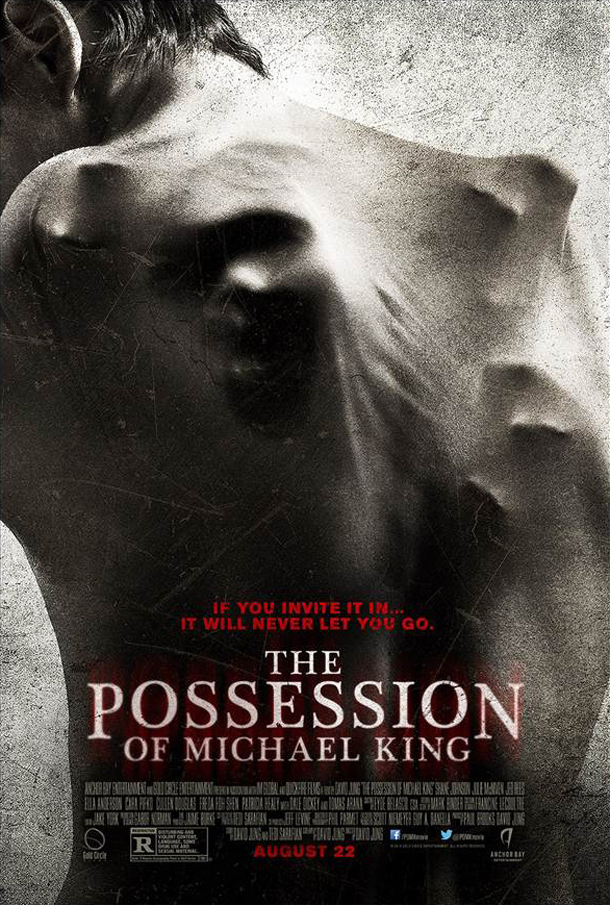
 

Share this:

  • Share on X (Opens in new window) X
  • Share on Facebook (Opens in new window) Facebook
  • More
  • Print (Opens in new window) Print
  • Email a link to a friend (Opens in new window) Email
Like Loading...

We 3 (2011)

19 Monday May 2014

Posted by dullwood68 in Movies

≈ Leave a comment

Tags

Brazil, Gabriel Godoy, Juliana Schalch, Nando Olival, Reality TV, Review, Romantic triangle, Sao Paolo, Sponsorship, Students, Victor Mendes

We 3

Original title: Os 3

D: Nando Olival / 80m

Cast: Juliana Schalch, Victor Mendes, Gabriel Godoy, Sophia Reis, Rafael Maia, Alceu Nunes, Henrique Taubaté, Cecília Homem de Mello

Three university students – Camila (Schalch), Rafael (Mendes), and Cazé (Godoy) – all meet at a party shortly after arriving in Sao Paulo to begin their studies.  Both Rafael and Cazé are attracted to Camila, and she in turn is attracted to them.  When they agree to move in together at Cazé’s apartment, Camila insists that they be friends only, and that neither Rafael nor Cazé should try to sleep with her.  Rafael abides by the rule, but it soon becomes apparent that Camila and Cazé are sleeping together.  When he realises this, Rafael wants to leave but he persuades himself to stay, his feelings for Camila keeping him there despite the pain of seeing her with Cazé.

Time passes and the three friends complete a university project together, a proposal for a TV show where the actors and actresses use featured products that can be bought via a website connected to the show.  The trio are approached by marketing executive Guilherme (Maia).  He wants to make their idea a reality by creating a show exactly as they describe, but with them as the “stars”.  When they ask how they should behave, Guilherme tells them to be themselves.  They agree, and cameras are installed in the apartment.

The show gets off to a disastrous start, with the trio’s activities failing to win viewers (and more importantly, consumers).  To combat this, the trio decide to highlight their lives more effectively by playing on the notion of their living in a ménage à trois.  Creating scenarios to keep the viewers guessing and intrigued, they become increasingly adept at convincing themselves that what they’re doing isn’t having an effect on their relationships away from the cameras.  As Rafael finds it more and more difficult to carry on with the deception, the introduction of Barbara (Reis), Camila’s cousin, threatens to break the trio’s friendship, and cause Camila to reassess her feelings for Rafael and Cazé.

We3 - scene

A low-key production with an air of improvisation around some of its scenes, We 3 is an unpretentious look at the ways in which love, passion, lust and friendship (words highlighted at the movie’s beginning) can affect people who try to manipulate those feelings without seeing the potential consequences.  There’s a sense of denial about the characters and the way they behave toward each other, as if the lives they’ve chosen to lead, and with each other, were more a matter of expediency than desire (though it does appear initially that Cazé has got what he’s wanted from the start).  As the show becomes more and more popular, and the trio come up with ever more revelatory exploits, denial gives way to understated desperation in their attempts to maintain the fiction of their own lives, both on camera and behind the scenes.  It’s this duality that gives the movie its bite, as the viewer attempts to work out if the three friends are playing to the audience or themselves.

Olival’s script, co-written with Thiago Dottori, has plenty of intriguing things to say about modern day consumerism, but it’s the façade that Camila, Rafael and Cazé commit to that commands the most attention.  Despite all the technical trappings of the show, it’s the human element that holds the attention and thanks to some clever cutting between “reality” footage and what’s “really” happening, Olival is able to highlight the increasing distance the show is creating between the three friends.  That the three of them have managed to live together for four years without the arrangement imploding is a little credulous, and Cazé comes across as too emotionally insecure to be Camila’s choice of partner, but these are minor quibbles, and the movie’s heaping of pretence on top of pretence to protect an already fragile pretence is absorbing enough to offset any reservations the viewer might pick up along the way.

The cast are uniformly excellent, and the three young leads display a maturity in their approach to the characters that augurs well for future performances.  Schalch in particular is a captivating presence, and there’s fine support from Reis as the annoying, always aspiring Barbara.  The apartment is a great physical space that is used to good effect, its various sections adding to the definition of the trio’s inter-relationship.  The cinematography by Ricardo Della Rosa is adroit and purposeful, while the movie is cleverly constructed by editor Daniel Rezende.

Rating: 8/10 – with good location work and the sense of a larger world waiting for the trio to discover outside the confines of the apartment, We 3 is an understated gem of a movie with a real emotional core; heartfelt if occasionally hard on its lead characters, the movie is a welcome addition to South American cinema.

Share this:

  • Share on X (Opens in new window) X
  • Share on Facebook (Opens in new window) Facebook
  • More
  • Print (Opens in new window) Print
  • Email a link to a friend (Opens in new window) Email
Like Loading...

In a World… (2013)

18 Sunday May 2014

Posted by dullwood68 in Movies

≈ 1 Comment

Tags

Comedy, Don LaFontaine, Father/daughter rivalry, Fred Melamed, Lake Bell, Marital break-up, Movie trailers, Review, Rob Corddry, Romance, The Amazon Games, Voice over

In a World...

D: Lake Bell / 93m

Cast: Lake Bell, Fred Melamed, Rob Corddry, Michaela Watkins, Alexandra Holden, Ken Marino, Demetri Martin, Nick Offerman, Tig Notaro, Stephanie Allynne, Geena Davis, Jason O’Mara

When King of the Voice Overs, Don LaFontaine dies, he leaves a vacuum within the voice over industry, one that veteran Sam Sotto (Melamed) would like to fill but he’s too aware of his own limitations to do so, and decides to support up and coming Gustav Warren (Marino) instead.  His daughter, Carol (Bell) works as a dialect coach, and while she would like to break into voice over work, the industry’s male-dominated nature – as well as Sam’s dismissal of her chances to succeed – keeps her from trying.  One day, while she’s teaching Eva Longoria to speak with a Cockney accent, Carol is asked by Heners (Offerman) to provide the voice over for the trailer for a children’s movie, one that Gustav was meant to do but which he hasn’t shown up for.  Helped by Louis (Martin), a sound engineer at the studio, Carol nails the voice over and begins to gain further trailer work on other children’s movies.

Gustav is upset by this, but Sam regards this development as a flash in the pan (neither of them know it’s Carol at this point).  When Gustav hosts a party for everyone in the industry, Carol attends with her father and sister, Dani (Watkins).  Gustav seduces Carol, much to the disgust and disappointment of Louis who has a crush on her, and the bemusement of her co-workers at the sound mixing studio.  When Carol is picked to voice the trailer for the upcoming futuristic fantasy movie The Amazon Games, and they plan to use the iconic phrase “in a world…” to begin the voice over, the news is greeted less than warmly by Sam.  He forces the issue with the movie’s producers, making them commit to an audition process.  Now facing competition from her father and Gustav, Carol almost throws in the towel, but Louis convinces her to go ahead with her audition tape.  At the Golden Trailer Awards, where Sam is to receive a Lifetime Achievement Award, the trailer’s first showing will reveal the producers’ choice.

In a World... - scene

Riffing off the death of LaFontaine, a real-life voice over artist, In a World… at first appears uncomfortably opportunistic, but thanks to Bell’s sure hand on the tiller, this feeling is soon dispensed with.  Writing as well as directing, Bell brings the audience into a world just as narcissistic and competitive as any other, but imbues it with enough good-natured characters and charm to offset the rampant ambition and casual backstabbing (Sam drops Gustav as soon as he knows Carol’s got the Amazon Games gig).  Indeed it’s only Sam who’s truly horrible, and Bell handles Carol’s scenes with him with understated simplicity, painting a portrait of a fractured relationship that shows no sign of ever being repaired.  Carol’s frustration with her father’s outdated sexist approach, as well as his lack of support for her and her career, are convincingly highlighted, and the way in which she deals with them completely plausible (it helps that Carol doesn’t have all the answers to the problems that beset her).

In her private life, Carol succumbs a little too easily to Gustav’s attentions, but there’s a lovely moment later when Louis declares his “liking” for her, and while this aspect of the script is less than persuasive, by the time it arrives the movie has built up so much good will it doesn’t matter.  There’s a subplot involving Dani and a guest at the hotel where she works, and whether or not she cheats on husband Moe (Corddry), and while it provides some much needed drama, it’s easily and neatly resolved, as are pretty much all the conflicts Bell’s script creates for her characters.  The movie relies on Carol’s placid nature throughout, and though there are plenty of laughs to be had, these are largely due to the activities and actions of the supporting cast – Notaro as deadpan lesbian Cher, Allynne as predatory receptionist Nancy, Offerman and Corddry.  Bell is an appealing presence as Carol, and proves an unselfish actor in scene after scene.  She draws good performances from her cast (Watkins and Corddry shine), and directs with an ease that some veteran directors never attain.  If the movie suffers from anything, it’s a lightness of touch that could have been fatal in the hands of someone less committed to the material.

Rating: 7/10 – satisfying for the most part, In a World… is a treat, but one that might not bear repeated viewings; it’s a great “debut” for Bell to be sure, but a little too lightweight in its execution to be truly memorable.

Share this:

  • Share on X (Opens in new window) X
  • Share on Facebook (Opens in new window) Facebook
  • More
  • Print (Opens in new window) Print
  • Email a link to a friend (Opens in new window) Email
Like Loading...

Snowpiercer (2013)

17 Saturday May 2014

Posted by dullwood68 in Movies

≈ 2 Comments

Tags

Chris Evans, CW7, Ed Harris, Ice Age, Jamie Bell, John Hurt, Joon-ho Bong, Kang-ho Song, Le Transperceneige, Protein meal, Review, Sacred engine, Tilda Swinton, Train

snowpiercer_3a25f386

D: Joon-ho Bong / 126m

Cast: Chris Evans, Kang-ho Song, Jamie Bell, Tilda Swinton, John Hurt, Ah-sung Ko, Octavia Spencer, Alison Pill, Ed Harris, Luke Pasqualino, Ewen Bremner, Vlad Ivanov, Clark Middleton, Emma Levie

In 2014 global warming has reached such a level it threatens the entire human race with extinction. To combat this, scientists release a reversing agent, CW7, into the atmosphere. To the world’s horror, CW7 destroys all life on the planet and returns it to the ice age. The only survivors are those on a train that circumnavigates the globe without ever stopping, the brain child of reclusive Mr Wilford (Harris). But even on the train there is a class system: those at the tail end exist in cramped, overcrowded conditions, while those at the front of the train live a life of conspicuous luxury. Seventeen years later, the people at the tail are guided by Gilliam (Hurt), but place their trust for a planned revolution in the hands of Curtis Everett (Evans). Aided by Edgar (Bell), Curtis is planning to reach the front of the train and take control of the “sacred engine”, thus allowing him control over the whole train (he is also receiving cryptic messages written on red paper from a mystery source).

When two of the tail people’s children are taken by the armed guards that oversee the tail section, the agony experienced by the mother of one, Tanya (Spencer), and the father of the other, Andrew (Bremner), prompts Curtis to seize his chance to move forward through the train earlier than planned. At the first section, the de facto jail, they free Namgoong Minsu (Song), a security expert whose knowledge of the train and its systems will help them get through each door they come to; they also free his daughter, Yona (Ko). As the tail people make their way from one car to the next, they discover all manner of disturbing facts about life on the train, and are hindered continually in their progress by Miss Mason (Swinton), Mr Wilford’s representative on the train.

Despite overwhelming odds, Curtis reaches the front of the train sections of the train and the gap between the people there and at the tail is thrown into sharp relief. At a classroom run by Teacher (Pill), he learns more about Mr Wilford and his plan for the train, as well as learning that the person who is sending him the messages is part of the hierarchy he seeks to overthrow. With Mr Wilford’s guards, as well as the citizens of the front sections, determined to stop him from reaching the “sacred engine”, Curtis is forced to make some difficult decisions to achieve his aim, but when he does he’s faced with an even more difficult, unexpected decision to make, one that threatens to overturn everything he’s ever believed about the train, and himself.

Snowpiercer - scene

Snowpiercer is an odd movie, a mix of high concept filmmaking supported by cod-literate meditations on the nature of existence and the need for balance in a world that’s a microcosm of the world we still live in. It’s a long, uneven movie as a result, with an expected emphasis on bone-crunching action while it attempts to say something about a range of subjects, from rampant consumerism to notions of self-sacrifice to carefully monitored euthanasia to the morality of keeping one set of passengers in what amounts to a rigorously controlled ghetto. Some of these aspects are handled adroitly (the euthanasia), others less so (the ghetto), but the movie is largely thought-provoking in its approach, and while some of the twists and turns can be seen a snow-covered mountain away, there’s still enough here to surprise the average viewer.

What stops the movie dead in its tracks sometimes (no pun intended), are the moments when something is revealed that immediately makes no logical sense. One of the biggest of these moments occurs when Curtis and his companions reach the abattoir car, and there are row upon row of chicken carcasses on display – after seventeen years, really? Another is why, considering the lethal sub-zero temperatures outside the train, none of the rails have ever split or buckled? And the biggest flaw concerns the train itself and its route: was Mr Wilford so prescient he knew CW7 wasn’t going to work even before it was conceived, because the movie makes it seem as if everything was in place from the moment the reagent was launched. (There are other moments that give pause for credulity but then the whole idea is inherently nonsensical; criticising it further would be like taking a blind man to task for failing to pin the tail on a donkey… that isn’t there.)

These lapses aside, there is still much to admire in Bong’s adaptation of the graphic novel Le Transperceneige by Jacques Lob, Benjamin Legrand and Jean-Marc Rochette (Rochette also supplies the artwork seen in the tail end of the train). As Curtis makes his way to the “sacred engine”, discovering more and more unpalatable truths about the workings of the train, there is a marked sense that he is becoming physically more restricted than he was at the tail, despite the increase in space in which to move. Bong makes being at the front just as bad as being at the end, if not worse, and Evans gives a performance that sees his character become more and more insular and compacted than he was at the beginning (he also gets to deliver an emotionally charged, yet chilling, speech towards the end that resonates even more when he reaches the “sacred engine”). Evans is one of those actors who can easily subvert his handsome looks, and here his grimy appearance is offset by a physical, tightly coiled performance that fits the mood perfectly. He’s ably supported by Swinton as the tombstone-dentured Mason (and in another, blink-and-you’ll-miss-her smaller role), Spencer as the mother obsessed with retrieving her child, and Song as the drug-addled security expert. Bell, however, has little chance to make anything of Curtis’s young follower, while Hurt lends the necessary gravitas to a role that is as close to underwritten as you’d expect.

The depiction of a new ice age is effectively maintained throughout, and the cities the train passes through are thankfully anonymous. The functions of the various train cars are imaginatively handled (the woman knitting in the garden car is a particular favourite), while the special effects are, for the most part, seamlessly integrated into the physical action. Bong directs with a visual flair that suits the movie’s mise-en-scene, and despite filming in English for the first time, doesn’t miss a nuance or moment of subtle shading. He’s ably supported by Kyung-pyo Hong’s often striking photography, and the tremendous production design by Ondrej Nekvasil, continually supporting the notion of people living in one place for so long and often surprising in its details as a result. There’s also an impressive score by Marco Beltrami that skilfully avoids the musical clichés that usually clog up dystopian flavoured movies such as this.

Rating: 7/10 – not the sci-fi masterpiece some may have been expecting (the hype surrounding proposed cuts of twenty minutes for the US release hasn’t helped), Snowpiercer is an often thought-provoking movie that tries its best to add political and social content to its storyline without skimping on the action; sometimes awkward in its execution, this still has more going on than most sci-fi movies out there these days, and is well worth seeking out.

Share this:

  • Share on X (Opens in new window) X
  • Share on Facebook (Opens in new window) Facebook
  • More
  • Print (Opens in new window) Print
  • Email a link to a friend (Opens in new window) Email
Like Loading...

The Lucky One (2012)

16 Friday May 2014

Posted by dullwood68 in Movies

≈ Leave a comment

Tags

Blythe Danner, Dead brother, Ex-husband, Green Kennels, Iraq, Louisiana, Nicholas Sparks, Photograph, Review, Romantic drama, Scott Hicks, Taylor Schilling, Zac Efron

the-lucky-one_ec5d8c66

D: Scott Hicks / 101m

Cast: Zac Efron, Taylor Schilling, Blythe Danner, Jay R. Ferguson, Riley Thomas Stewart, Adam LeFevre, Robert Hayes, Joe Chrest, Ann McKenzie, Kendal Tuttle

Adapted from the novel by Nicholas Sparks, The Lucky One opens in Iraq and a night mission where Logan (Efron) and his platoon run into Aces (Tuttle) and his platoon. There is a firefight with some Iraqis and Aces is killed. The next morning, Logan spies a picture of a woman in the rubble. He picks it up just seconds before an incendiary device goes off, killing several of his comrades. Logan survives, and for the rest of the tour he keeps the photo with him and it acts as a talisman, warding off harm and keeping him safe. He also tries to find out if anyone knows who the picture belongs to, but no one recognises it.

Back home, Logan traces the location where the picture was taken, and with his dog, Zeus, heads off on foot across country from Colorado to Louisiana, and the small town of Hamden, where after asking around, he discovers the woman’s name is Beth Green (Schilling) and she runs a kennels on the outskirts of town. When Logan goes there to tell her about the picture he finds he doesn’t know how to, and the situation is further complicated by Beth’s assumption that he’s there to apply for a job. Accepting the job, but with Beth having reservations about someone who walks so far just to work at a kennels, Logan makes himself useful doing repairs and general chores.
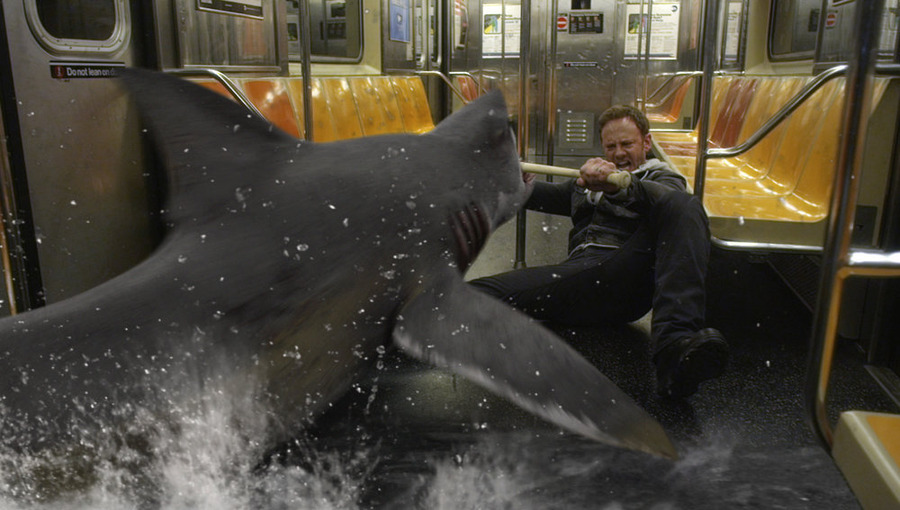
Beth’s grandmother, Ellie (Danner) takes to Logan from the start, as does Beth’s seven year old son, Ben (Stewart). The one person who doesn’t is Beth’s ex-husband, Keith (Ferguson), a deputy sheriff whose jealousy and violent temper have him believing that Logan is trying to usurp his position as Beth and Ben’s protector. With Keith making it difficult for Beth to move on with her life, Logan becomes increasingly close to her, and soon they are looking at each other with more than curiosity. They begin a hesitant romance, but Logan still finds it impossible to tell Beth about the photo, even when it becomes clear that Aces was her brother.

When Keith finds out that Logan was showing Beth’s picture around town he wastes no time in telling Beth (he also has the picture, stolen from Logan’s home). Beth confronts Logan and she asks him to leave. Keith makes an attempt to reconcile once more with Beth but when she rejects him, he threatens to take Ben there and then. Ben runs away, but in doing so, puts his life in danger…
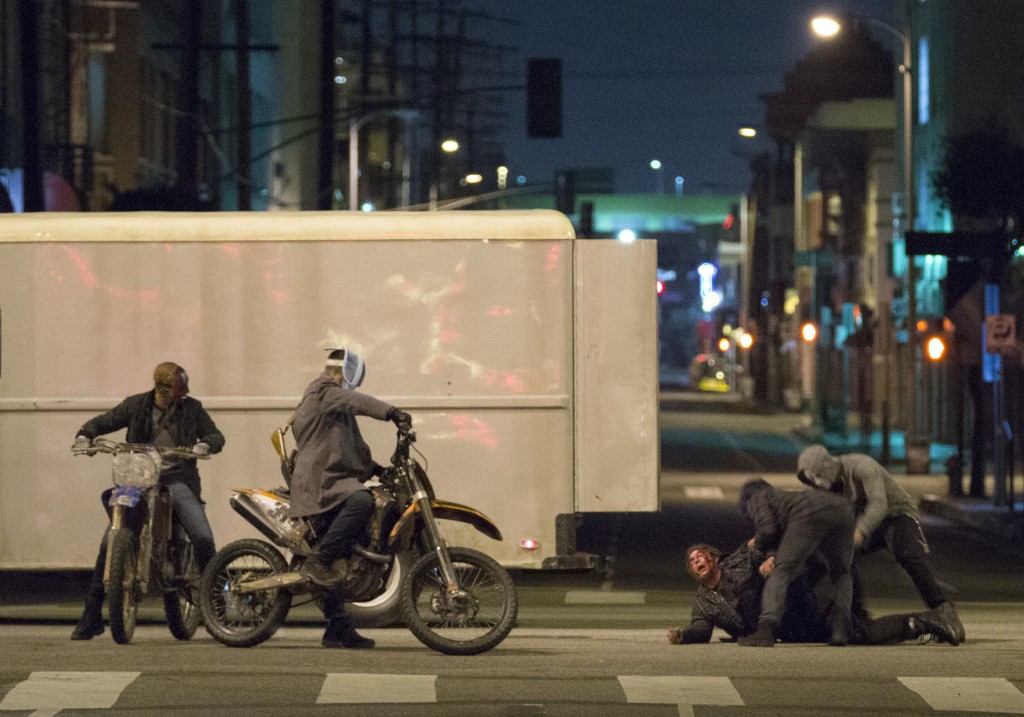
The Lucky One

With its typical stranger-with-a-secret-comes-to-town storyline, The Lucky One doesn’t bring anything new to the romantic drama genre, but in many ways that’s its strength. Its reliance on minor soap opera clichés to reinforce both the romantic and the dramatic aspects helps establish the movie as a straightforward telling of a familiar story, and one that the audience can take a great deal of comfort from. As Logan and Beth circle each other, there’s never any doubt as to how their romance will proceed, and the familiarity of the situation is aided greatly by the performances of Efron and Schilling, his brooding reticence complimenting her fragile beauty.

Beautifully set (and shot) in Louisiana, the movie moves easily from one reassuring plot development to the next, almost casually hitting its emotional high points, and thanks to Will Fetters’ astute screenplay, never trying to subvert or over-complicate matters. Hicks, who shot to fame with the altogether weightier Shine (1992), directs with a confidence that is reflected in the ease with which the cast inhabit their characters, and the credibility of their interaction. Efron plays the strong, silent type effortlessly but for long stretches Logan is almost a secondary character, as the movie sets up the family dynamic around Beth, Ben, Keith and Ellie. Once the romance kicks in, Efron gets to show just why he’s become one of the most sought after actors working today, showing a vulnerability the likes of Channing Tatum and Josh Duhamel (both male leads in other Sparks’ adaptations) would struggle to portray. It’s a low-key performance and one that befits the character of an ex-Marine trying to rebuild his life one step at a time.

Schilling also impresses as the put upon single mother putting a brave face on being divorced and bereaved at the same time, as well as looking for some way to rebuild her own life. Beth and Logan are kindred spirits in that sense, and when they begin their romance, their need for each other ignites a coming together that breathes new fire into both their lives (surprisingly, their love scenes are quite steamy for a PG-13 movie, but that’s not a bad thing). As Keith, Ferguson (mostly known for his TV work) makes more of the dastardly ex-husband role than appears to have been a part of the script, and the scene where his armour cracks during a recital given by his son is both unexpected and affecting in equal measure. Danner outshines them all, of course, but then if she hadn’t then something would have really been wrong.

The movie does have some faults, however. Logan’s PTSD is clumsily dealt with and is forgotten once he’s met Beth, and there’s a few too many occasions where the central conceit struggles to fend off its own implausibility, and Ben behaves a little too much like the semi-adult he clearly isn’t at seven years old, but these are minor complaints. All in all, The Lucky One is a rewarding experience, cleverly presented, and if things are a little too predictable at times – fans of this type of movie will be able to spot the outcome from a mile off – as noted above, the filmmakers’ determination to embrace the customary elements of such a storyline is a benefit and not a detraction.

Rating: 7/10 – a solid if unspectacular production, The Lucky One will please fans of the genre for its straight on approach and for treating its main characters with sympathy and respect; bolstered by often beautiful location photography, it’s also blessed with a score by Mark Isham that avoids all the usual emotional cues.

(for Roxanne xx)

Share this:

  • Share on X (Opens in new window) X
  • Share on Facebook (Opens in new window) Facebook
  • More
  • Print (Opens in new window) Print
  • Email a link to a friend (Opens in new window) Email
Like Loading...

3 Days to Kill (2014)

15 Thursday May 2014

Posted by dullwood68 in Movies

≈ Leave a comment

Tags

Amber Heard, Cancer, CIA, Connie Nielsen, Experimental drug, Hailee Steinfeld, Kevin Costner, McG, Paris, Review, The Albino, The Wolf

3 Days to Kill

D: McG / 123m

Cast: Kevin Costner, Amber Heard, Hailee Steinfeld, Connie Nielsen, Tómas Lemarquis, Richard Sammel, Marc Andréoni, Bruno Ricci, Jonas Bloquet, Eriq Ebouaney

Veteran CIA agent Ethan Renner (Costner) is part of a mission to capture international terrorist The Wolf (Sammel).  Acting on intelligence that his associate The Albino (Lemarquis) is selling a dirty bomb at a hotel in Belgrade, Ethan and his team attempt to capture him but the mission goes wrong when The Albino recognises one of Ethan’s team.  The Albino makes his escape in the ensuing shootout; Ethan chases him but finds himself short of breath, and he collapses.  Despite being wounded, The Albino gets away.  Ethan blacks out.  Later, in a local hospital, a doctor tells him he has cancer, and at best, has 3-5 months to live.

Having been pensioned off from the CIA, Ethan moves to Paris where his estranged wife, Tina (Nielsen), and daughter Zooey (Steinfeld) live.  He tries to reestablish his relationship with Zooey but his first attempts are clumsy and backfire on him.  When Tina has to go to London for a few days, Ethan persuades her that he can look after Zooey, and he moves into their apartment.  That same day, Ethan is approached by Vivi Delay (Heard), a senior CIA agent who wants him to continue looking for The Wolf, and offers him an experimental drug that will stave off the effects of his cancer enough to extend his life by a few more months.  Ethan accepts the job.  He begins targeting known associates of The Wolf and The Albino, until he learns that The Albino will be in Paris in a few days’ time.

His relationship with Zooey improves slowly, and is cemented when he saves her from being raped in a nightclub.  As their time together becomes more and more important to Zooey, Ethan has to juggle the demands made on him as a father, and as an agent.  Tina returns home and is pleased to see Ethan and Zooey getting on so well, and she and Ethan have a reconciliation.  His mission to capture The Wolf comes to a head when Zooey’s boyfriend Hugh (Bloquet) invites them to a party at his parents’ home, and in one of those amazing moments of serendipity that exist only in the movies, it turns out that Hugh’s father is The Wolf’s Paris business partner, and he’s there as well.

3 Days to Kill - scene

Another low-concept idea from the mind of Luc Besson, 3 Days to Kill bears all the hallmarks of a hastily put together movie production and lurches from one badly thought out scene to another, trading on Costner’s innate gravitas as an actor (and then doing it’s best to undermine that gravitas with some ill-considered comedy beats), and complete with awful dialogue and weak characterisations.  Not one of the relationships foisted on us by Besson and co-writer Adi Hasak is at all plausible, and Ethan himself is a bizarre combination of action hero, concerned absentee father, and comedic torturer.  The movie is full of awkward moments that add nothing to the plot but do succeed in padding out the running time.  There is a whole third-string storyline involving Ethan’s apartment and the family of squatters that have taken it over; unable to evict them, Ethan allows his anger at their being there to develop into a strange paternal devotion: when one of patriarch Jules’s (Ebouaney) daughters has a child in the apartment, Ethan is on hand to become a de facto godfather (and hold the baby).

Even more bizarre is the character of Vivi Delay, portrayed by Heard as a mixture of modern-day vamp and emotionally vacant dominatrix.  The actress’ interpretation of the role is (hopefully) based on what direction there is in the script, but if it’s not then it’s a freakish performance and one that makes Heard look like an amateur trying to break free from regional theatre.  Even the way she delivers her lines – arch, and laced with undisguised sarcasm – makes them sound like a first draft reading, and it’s a relief that she’s not on screen any more than she is.  Steinfeld is equally guilty of putting in a sub-par performance, giving us a moody teenager that no one would believe in, and failing to make Zooey’s relationship with Ethan anything other perfunctory and/or glib (depending on a scene’s requirements).  Nielsen has the thankless role of mother removed for the sake of the plot, while Costner (who has said he liked the character of Ethan, but didn’t like the movie) does his best with one of the most uneven roles of his career.  (You know an actor’s in trouble when his character name is a combination of Ethan Hunt and Jeremy Renner from Mission Impossible: Ghost Protocol.)  Looking uncomfortable throughout, and burdened with the daunting prospect of injecting some credibility into the proceedings, Costner does just enough to keep the audience from tuning out completely, and shows that it’s not only Liam Neeson who can still kick ass at an advanced age (Costner is 59).

Under the less than capable direction of McG, 3 Days to Kill is a mess of a movie that only moves up a notch with its action scenes, including a cleverly constructed kidnapping involving a bus, a bicycle, and a small claymore mine.  The Paris locations are also worth mentioning, as is the somewhat bucolic score by Guillaume Roussel, and the often tightly-framed compositions of veteran cinematographer Thierry Arbogast.  As a thrill ride, the movie is fitfully effective, but as an absorbing, entertaining piece it’s as lightweight as a feather, with too many narrative absurdities than it could ever overcome, including the experimental drug that only Vivi knows anything about (oh yeah?).

Rating: 4/10 – a second-hand script (replete with Besson’s recurring penchant for casual racism) masquerading as a polished action movie, 3 Days to Kill never lives up to its initial promise; with weak direction and the kind of cast that deserves more, the movie struggles to establish the same tone throughout, and boasts the kind of unlucky central performance from its star that, in the Nineties, would have doomed his career quicker than The Postman did.

Share this:

  • Share on X (Opens in new window) X
  • Share on Facebook (Opens in new window) Facebook
  • More
  • Print (Opens in new window) Print
  • Email a link to a friend (Opens in new window) Email
Like Loading...

Molly Maxwell (2013)

11 Sunday May 2014

Posted by dullwood68 in Movies

≈ 1 Comment

Tags

Charlie Carrick, Growing pains, Indie movie, Krista Bridges, Lola Tash, Phoenix Progressive School, Photography, Review, Romantic drama, Sara St. Onge, Student/teacher relationship

Molly Maxwell

D: Sara St. Onge / 90m

Cast: Lola Tash, Charlie Carrick, Krista Bridges, Rob Stewart, Richard Clarkin, Brooke Palsson, A.K. Shand, Nicholas Bode

Sixteen year old Molly Maxwell (the wonderfully named Tash) is a pupil at Phoenix Progressive School, where creative self-expression is encouraged amongst the pupils and where being ordinary (or settling for it) is not only discouraged, but viewed as abnormal.  Molly has a genius IQ but doesn’t want to be singled out or regarded as special.  When the head teacher, Raymond (Clarkin), pushes Molly to choose her ‘elect’ subject, she finds herself being guided towards photography by her handsome English teacher, Ben Carter (Carrick).  Surprised by his interest in her, Molly insists that Ben be her supervisor on the ‘elect’ subject.  Ben is initially hesitant but eventually agrees.  As they work ever more closely together, Molly and Ben become increasingly intimate (though Ben resists the temptation to make it a physical relationship).

As the relationship develops, Molly finds herself lying to her friends Caitlin (Palsson) and Gala (Shand), and her parents, Marilyn (Bridges) and Evan (Stewart).  She invents a boyfriend called Spencer who goes to another school to explain the time she spends with Ben, including a field trip that wouldn’t have been sanctioned by the school.  Molly’s attitude becomes more confrontational, while her behaviour around Ben when they’re in school begins to attract the attention of Raymond.  Things come to a head when the photos she took on the unofficial field trip are discovered at the school, and the seriousness of the situation – and its potential consequences – is brought to light.

Molly Maxwell - scene

There’s a moment in Molly Maxwell where Molly is outside Ben’s apartment.  She has a gift for him, a framed photograph she knows he’ll like.  In turn he has something for her, some books on photography.  Molly flicks through one of them and shows no sign of moving from Ben’s doorstep.  It’s an awkward moment, both for the characters and the audience, but it’s indicative of the problems the movie has in trying to approach its subject matter: forbidden love between a student and her teacher.  Molly Maxwell is an indie movie through and through, with an indie movie’s sensibility, and it wants to be different in the way that all indie movies want to be different: it wants to be “about something”.  (This might seem like an obvious thing to point out, but there are plenty of indie movies out there that strive to be different but come off as aloof or detached, with characters that operate in an emotional vacuum, apart from anything even remotely resembling reality.)

The “something” Molly Maxwell wants to be about is ostensibly growing pains, but there’s a deeper message hidden in the movie, and it’s not until Molly and Ben’s relationship is outed that it becomes clear.  Arising from the ashes of the relationship’s predictable demise is the reaffirmation of Molly’s relationship with her mother, a once solid connection that seems irreparably damaged by Molly’s love for Ben and the strain it places on the family structure.  Marilyn is a wonderfully complex creation, outwardly controlling in an overbearing, condescending way that most children would find hard to deal with anyway.  But Molly rebels against her mother when she receives real support from Ben, and as she becomes more and more infatuated with her teacher, so her disillusionment with her mother increases.  Marilyn clearly wants the best for Molly but has a tough time showing it appropriately.  In their efforts to be understood, both Molly and Marilyn end up pushing each other away.

It’s this secondary storyline – and its resolution – that ultimately has the most impact, and while Molly’s burgeoning love affair with Ben takes up most of the screen time, it’s predictable nature isn’t as appealing in the long run.  Molly’s naiveté gets in the way of making her attraction for Ben believable, while Ben’s motivation for pursuing the romance is murky at best, leaving the audience to wonder what exactly has brought them together.  That said, Tash and Carrick deliver good performances despite the flaws in first-time director St. Onge’s script, and there is a definite chemistry between them that bolsters their scenes together.  Tash is a good casting choice as Molly, and has a maturity that adds immeasurably to her reading of the character, while her scenes with Bridges are exhilarating for the depth that each actress brings.

Further on the plus side, St. Onge shows a keen eye for the absurdities of such a privileged milieu, while there’s a terrific indie soundtrack (keep an ear out for the perfect placement of Audrey & The Agents’ Hate Fuck).  For a first feature it’s a decent enough attempt, and if some of the drama veers perilously close to highlighting its soap opera similarities, then St. Onge’s lack of experience can be excused thanks to the movie’s overall quality.

Rating: 7/10 – an absorbing (though emotionally redundant in places) debut feature that features good performances in support of a not quite fully realised script; at times charming, Molly Maxwell works best when looking at the small tragedies that can beset a mother/daughter relationship.

Share this:

  • Share on X (Opens in new window) X
  • Share on Facebook (Opens in new window) Facebook
  • More
  • Print (Opens in new window) Print
  • Email a link to a friend (Opens in new window) Email
Like Loading...
← Older posts
Newer posts →

Blog Stats

  • 500,777 hits

Recent Posts

  • 10 Reasons to Remember Bibi Andersson (1935-2019)
  • Fantasia (1940)
  • Dances With Wolves (1990) – The Special Edition
  • Kiss of the Spider Woman (1985)
  • The Three Musketeers (1973)

Top Posts & Pages

  • The White Orchid (2018)
    The White Orchid (2018)
  • Mary Queen of Scots (2018)
    Mary Queen of Scots (2018)
  • Maine (2018)
    Maine (2018)
  • The Courageous Dr. Christian (1940)
    The Courageous Dr. Christian (1940)
  • I Can't Think Straight (2008)
    I Can't Think Straight (2008)
  • Porco Rosso (1992)
    Porco Rosso (1992)
  • Broken Gardenias (2014)
    Broken Gardenias (2014)
  • About
    About
  • Poster of the Week - The Rules of Attraction (2002)
    Poster of the Week - The Rules of Attraction (2002)
  • Cleopatra (1963)
    Cleopatra (1963)
Follow thedullwoodexperiment on WordPress.com

Blogs I Follow

  • Rubbish Talk
  • Film 4 Fan
  • Fast Film Reviews
  • The Film Blog
  • All Things Movies UK
  • Interpreting the Stars
  • Let's Go To The Movies
  • Movie Reviews 101
  • TMI News
  • Dan the Man's Movie Reviews
  • Film History
  • Jordan and Eddie (The Movie Guys)

Archives

  • April 2019 (13)
  • March 2019 (28)
  • February 2019 (28)
  • January 2019 (32)
  • December 2018 (28)
  • November 2018 (30)
  • October 2018 (29)
  • September 2018 (29)
  • August 2018 (29)
  • July 2018 (30)
  • June 2018 (28)
  • May 2018 (24)
  • April 2018 (21)
  • March 2018 (31)
  • February 2018 (25)
  • January 2018 (30)
  • December 2017 (30)
  • November 2017 (27)
  • October 2017 (27)
  • September 2017 (26)
  • August 2017 (32)
  • July 2017 (32)
  • June 2017 (30)
  • May 2017 (29)
  • April 2017 (29)
  • March 2017 (30)
  • February 2017 (27)
  • January 2017 (32)
  • December 2016 (30)
  • November 2016 (28)
  • October 2016 (30)
  • September 2016 (27)
  • August 2016 (30)
  • July 2016 (30)
  • June 2016 (31)
  • May 2016 (34)
  • April 2016 (30)
  • March 2016 (30)
  • February 2016 (28)
  • January 2016 (35)
  • December 2015 (34)
  • November 2015 (31)
  • October 2015 (31)
  • September 2015 (34)
  • August 2015 (31)
  • July 2015 (33)
  • June 2015 (12)
  • May 2015 (31)
  • April 2015 (32)
  • March 2015 (30)
  • February 2015 (37)
  • January 2015 (39)
  • December 2014 (34)
  • November 2014 (34)
  • October 2014 (36)
  • September 2014 (25)
  • August 2014 (29)
  • July 2014 (29)
  • June 2014 (28)
  • May 2014 (23)
  • April 2014 (21)
  • March 2014 (42)
  • February 2014 (38)
  • January 2014 (29)
  • December 2013 (28)
  • November 2013 (34)
  • October 2013 (4)

Create a free website or blog at WordPress.com.

Rubbish Talk

Film 4 Fan

A Movie Blog

Fast Film Reviews

The Film Blog

The official blog of everything in film

All Things Movies UK

Movie Reviews and Original Articles

Interpreting the Stars

Dave Examines Movies

Let's Go To The Movies

Film and Theatre Lover!

Movie Reviews 101

Daily Movie Reviews

TMI News

Latest weather, crime and breaking news

Dan the Man's Movie Reviews

All my aimless thoughts, ideas, and ramblings, all packed into one site!

Film History

Telling the story of film

Jordan and Eddie (The Movie Guys)

Movie Reviews & Ramblings from an Australian Based Film Fan

Privacy & Cookies: This site uses cookies. By continuing to use this website, you agree to their use.
To find out more, including how to control cookies, see here: Cookie Policy
  • Subscribe Subscribed
    • thedullwoodexperiment
    • Join 481 other subscribers
    • Already have a WordPress.com account? Log in now.
    • thedullwoodexperiment
    • Subscribe Subscribed
    • Sign up
    • Log in
    • Report this content
    • View site in Reader
    • Manage subscriptions
    • Collapse this bar
 

Loading Comments...
 

    %d