• 10 Reasons to Remember…
  • A Brief Word About…
  • About
  • For One Week Only
  • Happy Birthday
  • Monthly Roundup
  • Old-Time Crime
  • Other Posts
  • Poster of the Week
  • Question of the Week
  • Reviews
  • Trailers

thedullwoodexperiment

~ Viewing movies in a different light

thedullwoodexperiment

Tag Archives: Relationships

The Intern (2015)

23 Wednesday Dec 2015

Posted by dullwood68 in Movies

≈ Leave a comment

Tags

About the Fit, Anders Holm, Anne Hathaway, Business problems, Comedy, Drama, Fashion retailer, Internet, Nancy Meyers, Relationships, Rene Russo, Review, Robert De Niro, Senior intern programme
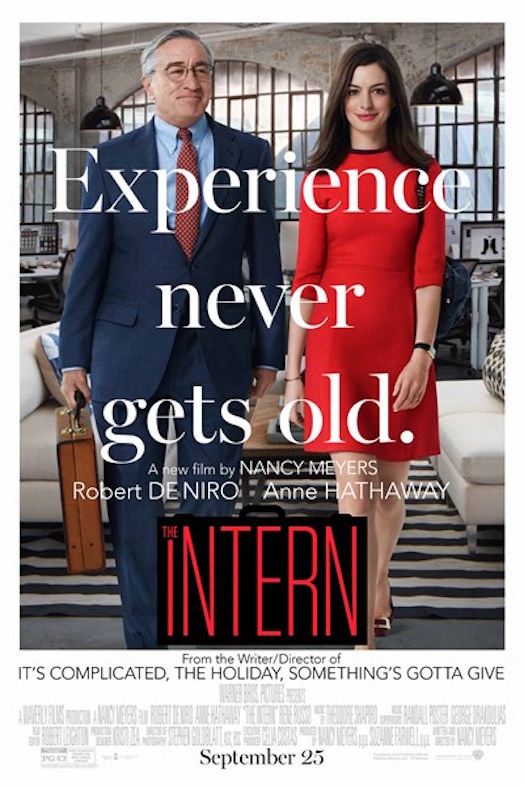
The Intern

D: Nancy Meyers / 121m

Cast: Robert De Niro, Anne Hathaway, Rene Russo, Anders Holm, JoJo Kushner, Andrew Rannells, Adam DeVine, Zack Pearlman, Jason Orley, Christina Scherer, Nat Wolff, Celia Weston, Linda Lavin

Taken at face value, The Intern looks like a movie that you could easily pass by. For one thing it’s a comedy starring Robert De Niro, not exactly the best recommendation a movie could have these days, and secondly, there’s the possibility of a May-December romance between De Niro and Hathaway (and with all due respect to both actors, nobody wants to see that). Look a little closer and it still doesn’t look like a great prospect: it’s about a small internet fashion retailer, built up out of nothing by Hathaway’s determined entrepreneur, and facing an uphill battle to maintain and expand on its initial successes. Then there’s the whole senior intern programme idea that’s bolted onto the basic storyline – and where De Niro’s Ben Whittaker comes in. Sold yet? Maybe not? Then consider this: Hathaway’s character, Jules Ostin, is neglecting her husband and young daughter while she builds her business empire. Sound familiar, maybe overly so? Any guesses as to who helps Jules get her business and private lives back in sync and on track?

If you’re still not sold on The Intern, and this type of comedy (with a smattering of light drama added) still doesn’t appeal, then fair enough, move on to something else. But you’d be making a mistake, because against all the odds, Nancy Meyers’ latest writing/directing gig is deceptively charming and warm-hearted, the movie equivalent of a hug from a loved one. In these days of mega-budget, special effects-laden tributes to the joys of target demographics, The Intern is a refreshing change of pace, a movie that plays out simply and effectively, and not without a degree of style all its own.
The Intern - scene2

What makes it work so well is Meyers’ well-balanced, and surprisingly intuitive script. Even though the majority of what unfolds has been done before, and will be again (and again), here familiarity breeds contentment, and fosters a relationship between the characters and the audience that allows some of the more sentimental moments to slide by without too much approbation. In short, it’s a joy to watch from its slightly slow beginning to its let’s-wrap-all-this-up-with-a-bow-on-top finish.

By marrying the two ideas – senior citizen with oodles of personal and business experience looking to keep busy, young internet-based company trying to move up to the next level but uncertain how to do it – Meyers has created a movie that looks at how little difference there is in generational thinking when it comes to relationships, and how it’s often true that experience can offer a much simpler solution than seems immediately apparent. At one point, one of Jules’ staff, Jason (DeVine) asks Ben for advice. He’s cheated on his girlfriend, co-worker Becky (Scherer), and hasn’t had much luck getting her to forgive him. Ben’s advice is simple: say sorry to her and do it face-to-face, not via texts. But where some movies might take that advice and have it work straight away, here Meyers is canny enough to make it just the first move in an eventual reconciliation.

So, with Ben’s experience of life and work clearly to his advantage, it’s all down to Jules to realise that it’s to her advantage as well. It doesn’t happen overnight, and along the way Jules makes the kind of mistakes that a lack of experience will bring out. But through it all Ben maintains a patience and a determination not to let things overwhelm or get the better of him that eventually has its effect on the other staff around him. And, of course, along the way, he helps Jules come to realise just how her behaviour and narrow focus on work is contributing to the problems she has both in the office and at home.
The Intern - scene1

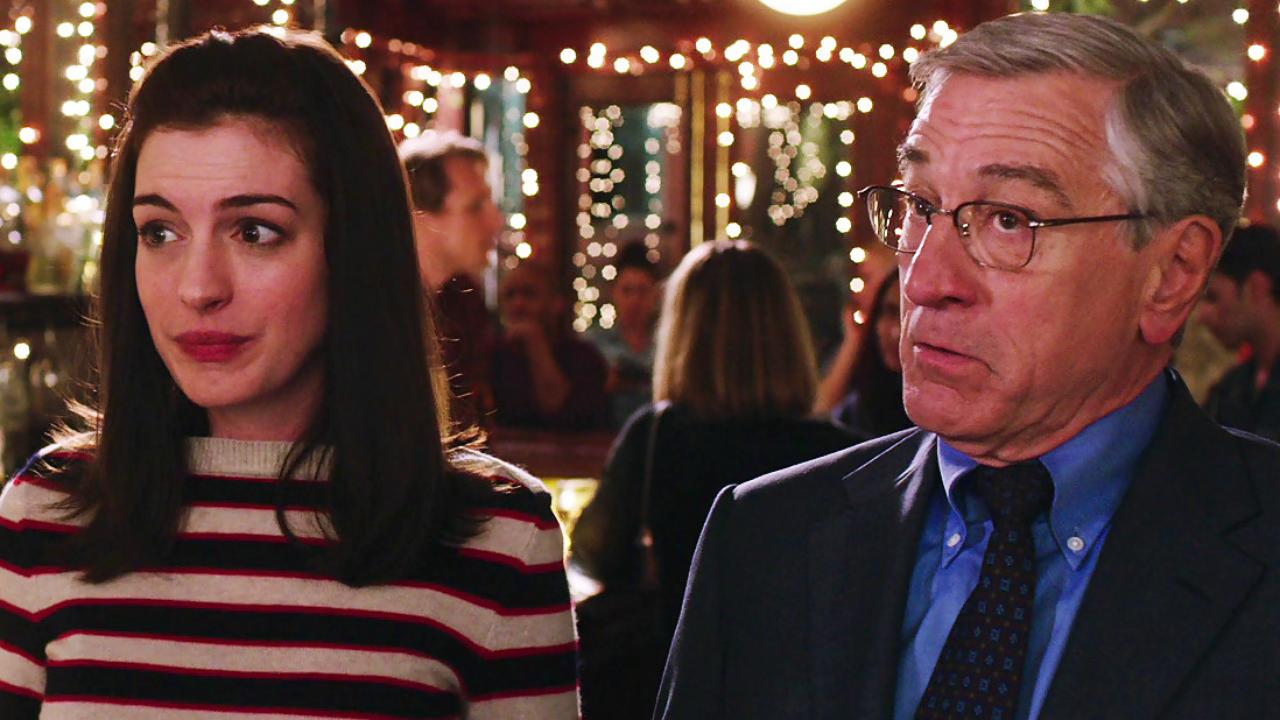
Meyers keeps things light and airy throughout, and her insistence that old age is not a passport to obsolescence is well handled; it’s patently obvious but not rammed down our throats. And the relationship between Ben and Jules is handled so deftly that as it develops and they come to have a mutual respect for each other, there’s not one awkward moment for the viewer where they might suspect Ben and Jules will find themselves in a romantic situation.

De Niro is self-effacing and modest as Ben, always dressed in a suit, always shaving every day (even if he’s not seeing anyone he knows, even on a Sunday), and always ready with the right thing to say. It’s a quiet, mostly internal performance from De Niro, and if he still has a rampant tendency to grimace uncontrollably every time he’s called upon to be embarrassed or uncertain or surprised, it’s strangely effective here even if it is overdone. It’s not a role that was ever likely to tax him as an actor, but he gives a commitment to the part that he hasn’t done in some of his more recent movies (Heist (2015) anyone?).

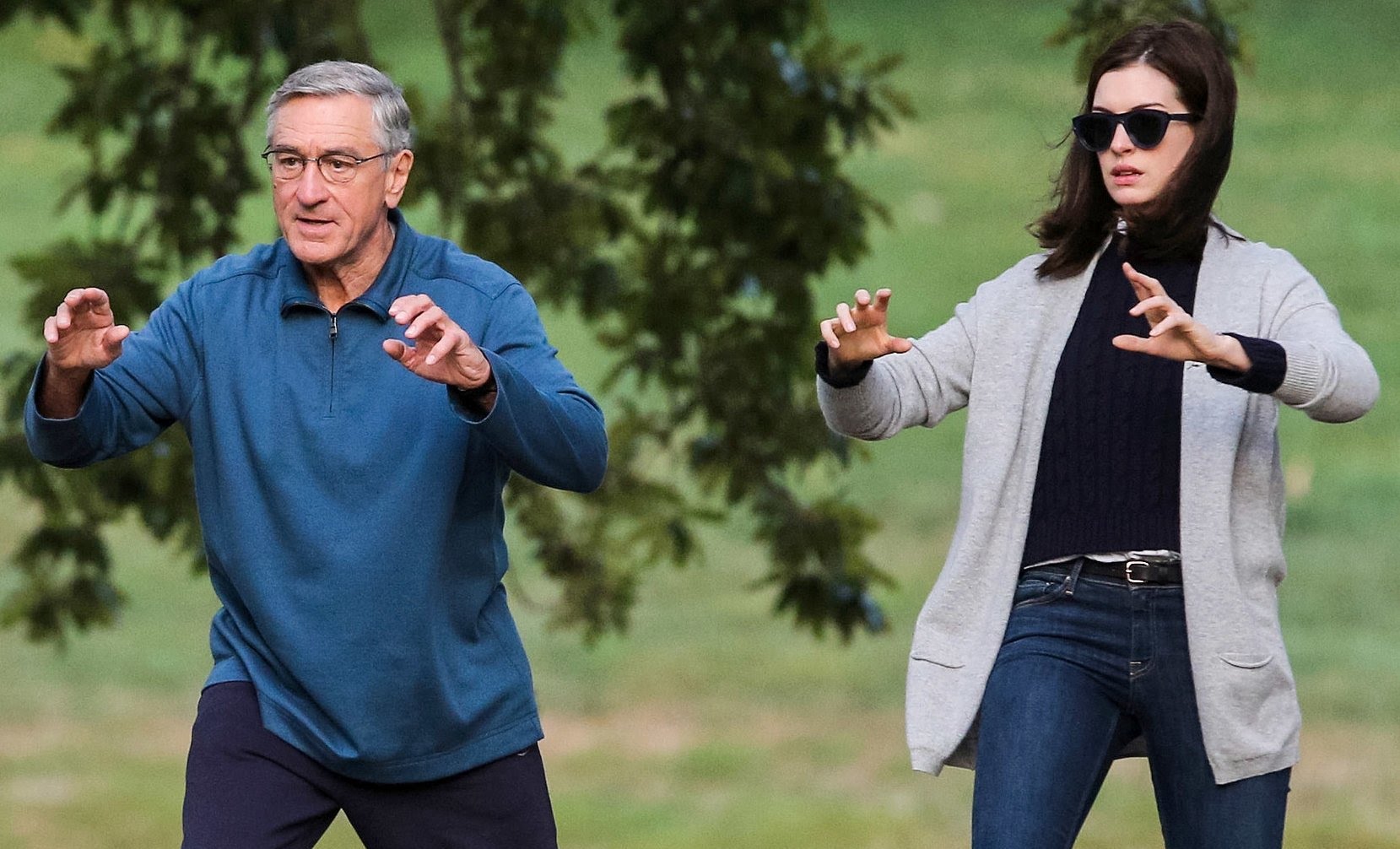
Matching him for effort and commitment, Hathaway combines vulnerability, fortitude, uncertainty and a blinkered siege mentality with casual ease, and makes Jules an easily recognisable and sympathetic character from the start. It’s the more emotional role (naturally) but she handles it with skill and sensitivity, maintaining a through line that makes her journey from overwhelmed businesswoman to poised, decisive company head all the more credible. It’s worth pointing out again that this is a relatively lightweight movie that provides just enough depth for its characters to avoid being stereotypes, but it’s the themes around age and experience that are more important, and thanks to De Niro and Hathaway’s involvement, Ben and Jules are the kind of unlikely friends that really do crop up in real life.
The Intern - scene3

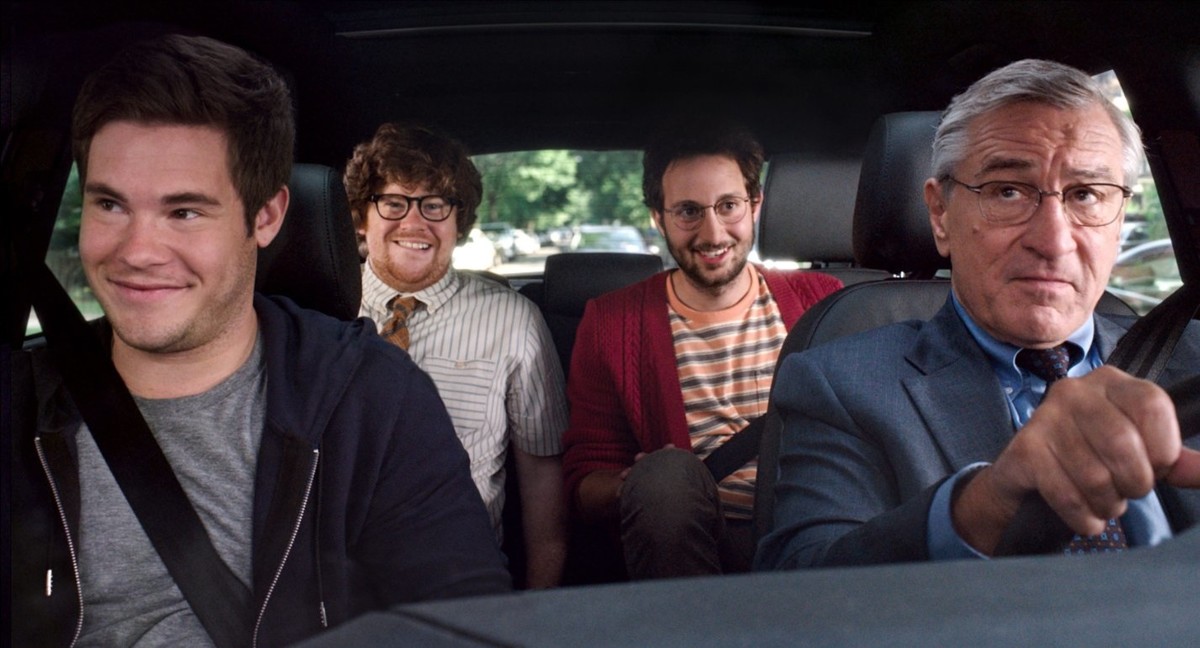
And it’s a genuinely funny movie, with the humour arising from the characters and their individual foibles. There’s a sequence where Ben and three other staffers volunteer to break into Jules’ parents’ home to delete a nasty e-mail she’s sent to her mother by mistake, and while it may seem out of place, it allows some of the secondary cast members a chance to impress, and they grab the opportunity with gusto; as a result it’s the funniest part of the movie. Meyers is also good at providing her willing cast with great dialogue, dialogue that doesn’t sound like lines to be acted but which is natural-sounding and far from contrived.

Modestly budgeted at $35m, The Intern has gone on to make nearly $200m at the box office (worldwide), and is a good sign that there’s room for intelligent, adult comedies that don’t rely on gross-out gags and puerile humour to attract audiences. It’s not a movie that will win tons of awards (or gain many nominations), but the fact that it’s been as successful as it has should be counted as a very good sign indeed that audiences know a good movie when they see them.

Rating: 8/10 – above average comedy with something to say about the compatibility between the young and the old, The Intern is charming and, as it progresses, irresistible; De Niro and Hathaway have a great chemistry, but it’s Meyers’ combination of great script and assured direction that makes this movie so enjoyable.

Share this:

  • Click to share on X (Opens in new window) X
  • Click to share on Facebook (Opens in new window) Facebook
  • More
  • Click to print (Opens in new window) Print
  • Click to email a link to a friend (Opens in new window) Email
Like Loading...

The Little Death (2014)

04 Friday Dec 2015

Posted by dullwood68 in Movies

≈ Leave a comment

Tags

A Funny Kind of Love, Alan Dukes, Bojana Novakovic, Comedy, Dacryphilia, Damon Herriman, Drama, Erin James, Fetishes, Josh Lawson, Kate Box, Kate Mulvany, Lisa McCune, Patrick Brammall, Relationships, Review, Roleplay fetishism, Sex, Sexual masochism, Sign language, Somnophilia, Telephone scatalogia, TJ Power

The Little Death

aka A Funny Kind of Love

D: Josh Lawson / 96m

Cast: Bojana Novakovic, Josh Lawson, Damon Herriman, Kate Mulvany, Kate Box, Patrick Brammall, Alan Dukes, Lisa McCune, Erin James, TJ Power, Kim Gyngell, Lachy Hulme, Genevieve Hegney

What do sexual masochism, roleplay fetishism, dacryphilia, somnophilia, and telephone scatalogia all have in common? Well, the answer is, they’re all sexual impulses, and they’re all used by Josh Lawson in his feature debut as writer/director to look at five different relationships – some of which interconnect – and how these sexual obsessions can affect how people behave.

First up we have Paul (Lawson) and Maeve (Novakovic). Maeve wants to be raped, which sounds awful, but it’s a fantasy she’s always had, and she wants Paul to help her play out her fantasy. Paul is initially aghast, but he loves Maeve so much he decides he’ll do it. There’s only one proviso: Maeve doesn’t want to know when or where it’s going to happen. Paul’s first attempt is less than successful, but he tries again, but with completely unexpected results.

The Little Death - scene1

Then there’s Dan (Herriman) and Evie (Mulvany). We first meet them in couples’ therapy, where it’s clear they’re not communicating properly with each other. The therapist suggests they try some roleplay; when they do, Evie can’t quite take it seriously enough for Dan but the sex is incredible and afterwards, Evie compliments Dan on his roleplaying. This leads to Dan taking the whole thing way too seriously, and his commitment to “acting” begins to threaten their marriage.

The third couple is Richard (Brammall) and Rowena (Box). They’re trying to have a baby but nothing’s working, and sex has become perfunctory. Rowena is advised by her doctor that she and Richard should try and time their orgasms to happen at the same time, thus increasing their chances of conception. But she and Richard never get a chance to try this out; Richard learns that his father has died, and when he breaks down in tears, Rowena discovers she’s turned on by the sight of his crying (this is dacryphilia). They have sex right then and Rowena becomes addicted to the intensity it provides, and she starts to engineer circumstances where Richard is made upset enough to cry… and Rowena can experience more orgasms.

All these couples live in the same street, as do Phil (Dukes) and Maureen (McCune). Phil’s compulsion is watching his wife while she sleeps (somnophilia). But Maureen is cold and abusive toward him, while at work his long nights spent watching her means he finds it hard to stay awake during the day. His boss (Hulme) gives him some strong sedatives to help with his sleeping problem, but Maureen unwittingly takes them. Now Phil can indulge his obsession to hisnheart’s content as he makes sure Maureen takes the sedatives each night. But it doesn’t help his case at work, and it doesn’t help either when Maureen accuses him of having an affair.

The Little Death - scene2

Lastly, there’s Monica (James) and Sam (Power), who aren’t a couple, but who do meet – and connect – in the unlikeliest of cirumstances. Monica works at a video relay company that helps deaf individuals make telephone calls to other people via their computers. Sam uses sign language to tell Monica what to say to the other person, and Monica signs back their replies. When Sam connects one evening, Monica is surprised to learn that he wants to connect to a telephone sex line. Her discomfort at having to repeat what Sam and the sex worker (Hegney) are saying makes it all the more awkward, but through it all there’s a hint of mutual attraction there.

All five stories, and a sixth involving Steve (Gyngell) – about whom little should be said other than that he has his own sexual predisposition – are funny, romantic, poignant, sometimes sad, sometimes dramatic, ocasionally outrageous, but always pertinent and credible. Lawson shows he has a keen ear (and eye) for the more absurd aspects of sexual behaviour, and he doesn’t hesitate to confound audience expectations by having three of the five stories end badly. This isn’t a standard rom-com where everyone is united or reunited in the last five minutes and they all live happily ever after. Instead, Lawson’s script makes it clear that compromise is a large part of everyday relationships, and that sins of omission can be just as devastating as outright lies (two characters never confess their compulsions, or the way in which they’ve manipulated their partners).

So there’s a strong dramatic element to each story, but Lawson layers each story with a fantastic amount of comedy (though Phil and Maureen’s tale, of necessity, is more sad and depressing than the rest), and there are moments where the viewer will be laughing out loud at the antics, and dialogue, played out on screen (this is likely to be the only time in a movie where you’ll hear the line, “How’s your cervical mucus – okay?”). Lawson is also astute at teasing out the subtleties and self-imposed dilemmas that come with modern day relationships, and there are plenty of times where his confidence in his own observations and his own script leave the viewer not knowing whether to laugh or grimace. When Rowena tells Richard a massive, horrible lie to get him to cry, it’s funny and deplorable at the same time, and Lawson’s fearlessness with the narrative means that both reactions are entirely acceptable; you can laugh and you can feel repelled.

The Little Death - scene3

Lawson is backed up by a great cast who all enter into the spirit of things with gusto, though special mention has to go to Herriman as the acting-obsessed Dan, whose idea of roleplay morphs from straightforward policeman interrogating helpless female suspect, and with no costumes used other than their own clothing, to kitting out his and Evie’s garage to house a prison set so he can play a jailbird about to have sex with a prison guard (Evie) – but not before he tells her he’s inside for sexually assaulting a man (it’s called having a backstory). Herriman as Dan is wonderfully unaware of anything else going on in his life, and his narrow, self-absorbed thinking is a constant source of humour. A joy to watch as well are James’s reactions to the comments made by Sam and the sex worker, her wide-eyed dismay and prudish distaste testing her professionalism at every turn. And there’s Gyngell as Steve, popping up here and there, often at the wrong time, but guaranteed to make the viewer laugh once his own “backstory” is revealed.

There’s a feeling that this is a movie that could only have come out of Australia. It’s brash, it’s sweet-natured, it’s romantic yet not idealistic, and it has bags of charm. You can imagine an American remake trying hard to be more gross or unnecessarily explicit (for a movie that’s ostensibly about sex there’s no nudity at all), and it would probably fumble the more serious strands that run through it all, but thankfully that’s unlikely to happen. Lawson advances the various stories by switching back and forth between them, though Monica and Sam’s story does occupy most of the last twenty minutes, its single location and textured narrative requiring a lengthier time on screen than the other stories. This does make the movie feel a little lopsided, and there’s a final scene that connects four of the stories in an unexpected and not wholly satisfying way, but by then the viewer will be more than happy to forgive Lawson his attempt at what might be regarded as closure. With a great soundtrack and score by Michael Yezerski that isn’t just there to provide musical cues or augment each of the character’s feelings or emotions, Lawson has made an entertaining and unexpectedly clever movie that packs an equally unexpected emotional punch as well.

Rating: 8/10 – movies from Down Under are still proving to be a little underwhelming, but The Little Death is definitely not one of them, combining as it does passion, wit and style to tremendous effect; mixing drama and comedy with heart makes for a small but terrific movie, and one that rewards the viewer over and over again.

Share this:

  • Click to share on X (Opens in new window) X
  • Click to share on Facebook (Opens in new window) Facebook
  • More
  • Click to print (Opens in new window) Print
  • Click to email a link to a friend (Opens in new window) Email
Like Loading...

Digging for Fire (2015)

28 Saturday Nov 2015

Posted by dullwood68 in Movies

≈ 1 Comment

Tags

Bones, Brie Larson, Comedy, Drama, Friendships, Jake Johnson, Joe Swanberg, Marriage, Orlando Bloom, Relationships, Review, Rosemarie DeWitt, Sam Rockwell

Digging for Fire

D: Joe Swanberg / 84m

Cast: Jake Johnson, Rosemarie DeWitt, Brie Larson, Orlando Bloom, Sam Rockwell, Anna Kendrick, Mike Birbiglia, Chris Messina, Tom Bower, Sam Elliott, Judith Light, Steve Berg, Ron Livingston, Melanie Lynskey, Jane Adams

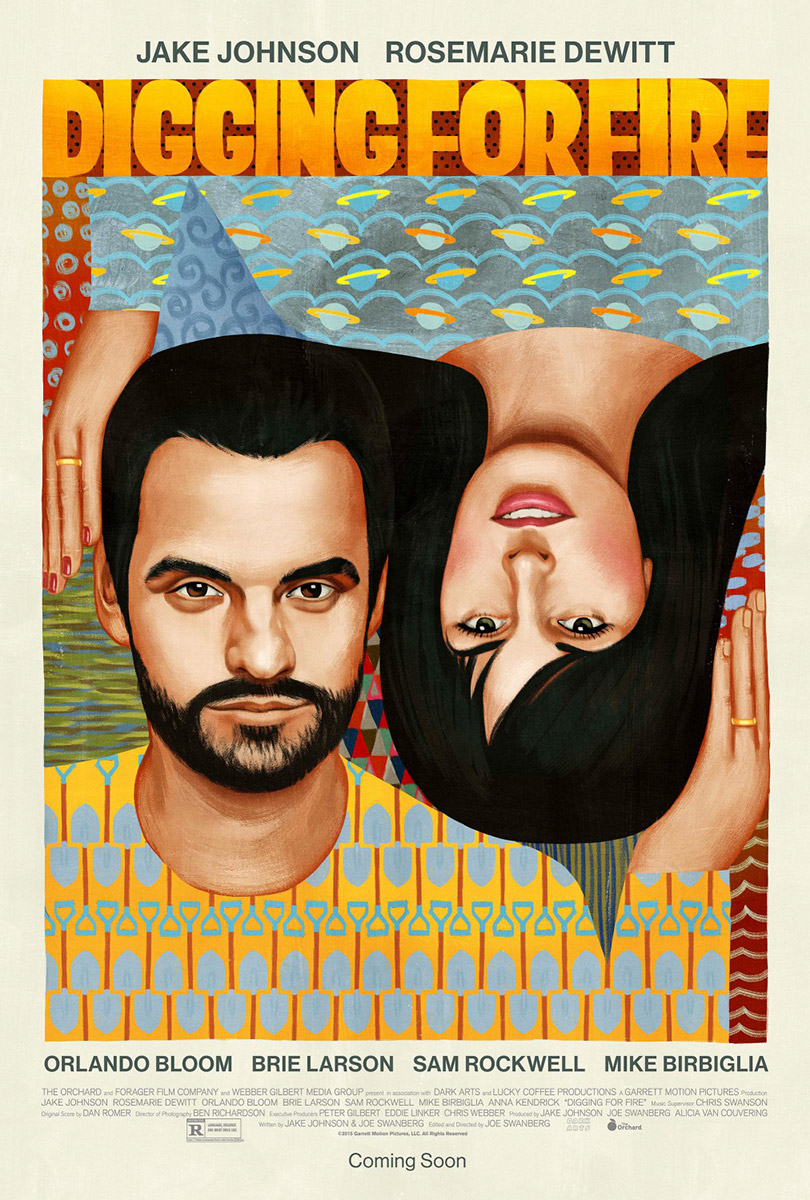
Tim (Johnson) and Lee (DeWitt) are a young-ish couple with a three year old son who agree to housesit for one of Lee’s clients while they’re away. On their first day there, while doing some gardening, Tim unearths what looks like a human bone, and a handgun. Lee is all for putting them back and forgetting about them, reasoning that the two items don’t have to be linked. Tim is brimming over with curiosity and wants to do more digging, but nevertheless he calls the police; when they prove uninterested Tim lets himself be persuaded not to pursue it further.

The weekend begins the next day. Lee has made arrangements to take their son to visit her mother (Light) and stepfather (Elliott), while Tim is tasked with completing their tax returns. But both have other plans for their respective weekends: Tim has invited several of his friends for a barbecue and beers, while Lee is looking forward to a girls’ night out with her friend Squiggy (Lynskey). Neither knows of the other’s plans, and neither of them has any intention of letting the other know what they’ve been up to.

Digging for Fire - scene2

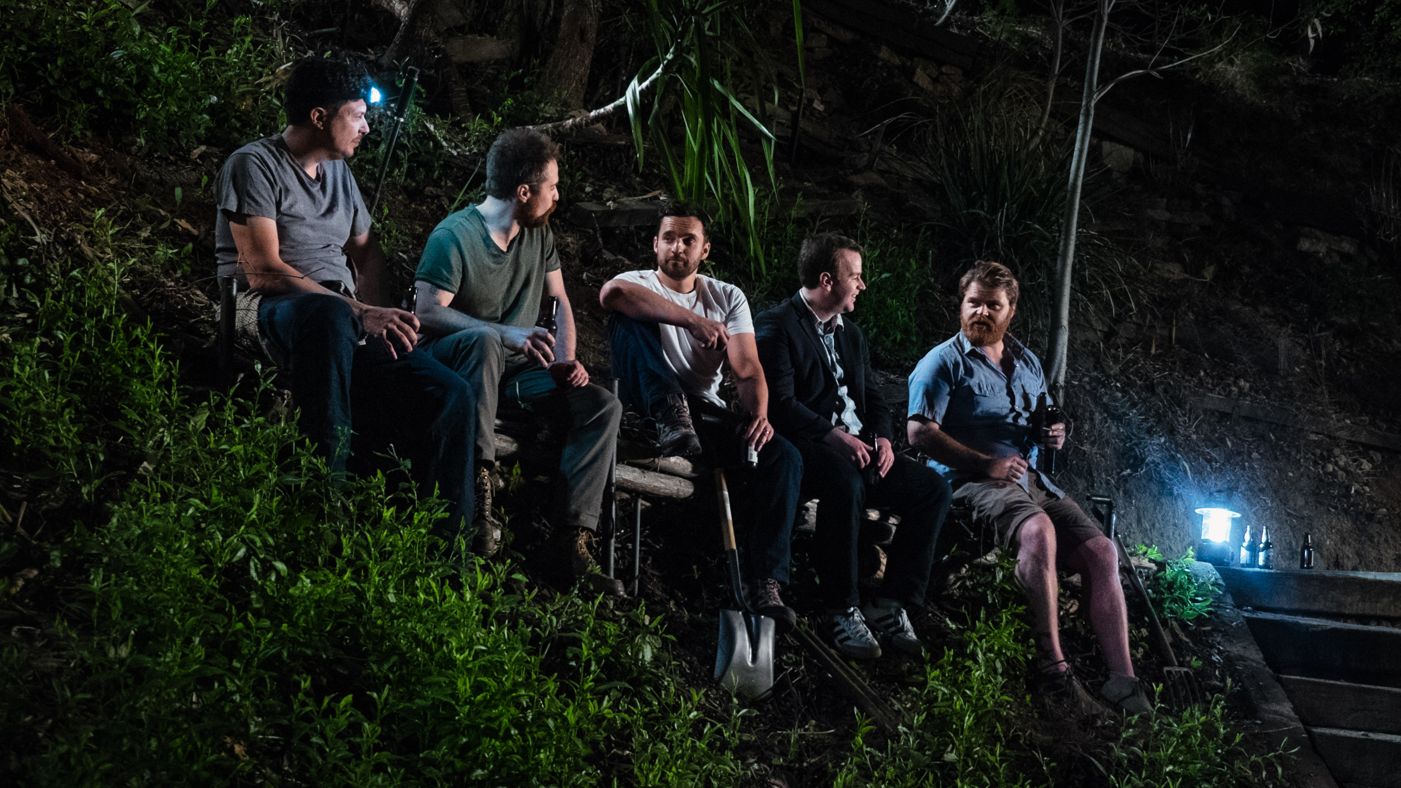
That nothing goes quite as either of them expect shouldn’t come as any surprise. Tim’s excitement about his discovery leads to his roping his friends into helping him dig for further remains, while Lee’s friend, too busy warring with her husband Bob (Livingston) to leave him alone with their children’s nanny for the evening, backs out of their arrangement. More of Tim’s friends turn up, with one of them, Billy Tango (Messina), bringing with him two women, Max and Alicia (Larson, Kendrick). While Tim finds himself digging alone, he’s joined by Max who shows an interest in what he’s doing, and digs with him. Meanwhile, Lee resigns herself to a quiet night at her mother’s.

The next day sees Tim making a half-hearted attempt to do the taxes before resuming his digging. Lee goes shopping and buys herself a leather jacket before returning to her mother’s and deciding that this evening she’s going to go out, even if it is by herself. Tim finds himself rejoined by Max and together they continue looking for more evidence of foul play. When he calls it a day he offers to take Max out for a bite to eat as a thank you for helping him. With her own clothes dirty from all the digging, Tim tells her to choose from Lee’s clothes. And while Tim’s evening heads in one direction, Lee’s heads in another as she meets Ben (Bloom) in a restaurant bar.

Digging for Fire - scene1

Right about now, anyone watching Digging for Fire will be sizing up each situation and deciding which one of Tim and Lee will make the classic mistake of sleeping with someone else. But co-writers Swanberg and Johnson don’t make it so easy, and deftly pull the rug out from under the viewer’s feet. This may seem like a movie whose focus is on what happens when both halves of a married couple experience some much longed-for freedom, but it’s a much cleverer movie than that, and despite all the drinking and drug-taking and sexual tensions that occur, this is a staunchly conservative movie that reinforces marriage, fidelity and parenthood as truly desirous states to be in.

With temptation placed firmly in the way of both Tim and Lee, it’s interesting to see how the script has them react. Tim wants to party like he used to before he got married but he’s only really comfortable when he’s focused on his digging; when he calls it a night he barely receives any acknowledgment from any of his friends, so keen are they to carry on partying. And when he’s joined by Max the next day he’s so pleased that someone wants to help him it doesn’t matter to him if that someone is male or female. For Tim, discovering further evidence of foul play – if indeed there is any – has added an extra layer of blinkers to the way he views other women anyway, and despite Max’s obvious good looks and equally obvious liking for him, he can only view her as a friend.

Digging for Fire - scene4

Lee, however, becomes seduced by Ben’s carefree nature, a world away from her life as a wife and mother, tied down by responsibilities (even though she tells their son they’re down to his father to deal with – or mommy will be angry), and a belief that her life as an individual is over with. Call it post-natal depression, or a post-marital fugue, but Lee sees herself as having lost touch with herself, while Tim tells anyone who’ll listen how much his life has changed for the good through being a parent. Neither is wrong, and their feelings are true for each of them, but it’s whether or not they really need to recapture their lives before marriage and parenthood “tied them down” that counts.

Swanberg has been making smart, subtly sophisticated comedy dramas like this one for some time now – Drinking Buddies (2013), also with Johnson, is a gem that should be tracked down immediately if you haven’t seen it already – and while you could level an accusation of naïvete at the way in which Tim and Lee behave around their “prospective partners”, it’s the way in which they recognise the strength and durability of their marriage, and how it enhances their individual lives as well as their commitment to each other that makes it all work so well. And Swanberg is aided by two generous central performances from Johnson and DeWitt, wonderful supporting turns from Birbiglia, Larson and Lynskey, and rounds it all off with a carefully chosen soundtrack that perfectly complements the events happening on screen.

Rating: 8/10 – full of indie charm and a raft of likeable characters we can all relate to, Digging for Fire is another winner from Swanberg; smart, funny, emotional and knowing, it’s a movie that many married couples will find themselves relating to, and never once gives in to the temptation of being self-conscious or patronising.

Share this:

  • Click to share on X (Opens in new window) X
  • Click to share on Facebook (Opens in new window) Facebook
  • More
  • Click to print (Opens in new window) Print
  • Click to email a link to a friend (Opens in new window) Email
Like Loading...

The Overnight (2015)

29 Tuesday Sep 2015

Posted by dullwood68 in Movies

≈ Leave a comment

Tags

Adam Scott, Comedy, Drama, Jason Schwartzman, Judith Godrèche, Love, Marriage, Patrick Brice, Relationships, Review, Sex, Taylor Schilling

Overnight, The

D: Patrick Brice / 79m

Cast: Adam Scott, Jason Schwartzman, Taylor Schilling, Judith Godrèche, R.J. Hermes, Max Moritt

Newly moved to Los Angeles, Alex (Scott) and Emily (Schilling) are both unsure just how successful their move will prove to be. They have a young son, RJ (Hermes), but no friends or family that live nearby; starting afresh is both challenging and scary. Emily goes out to work while Alex stays at home to look after their son. Their sex life is perfunctory and predictable, but they support each other and both are happy with their relationship.

One day at a local park, their son begins to make friends with another boy, Max (Moritt), who is of a similar age. This leads to their being approached by the other boy’s father, Kurt (Schwartzman). He gives them some good advice about getting RJ into a good school, and the three of them find themselves hitting it off, so much so that Kurt invites Alex and Emily to come over for dinner; they can even bring RJ with them. They accept, but when they’re getting ready that evening, their worries about not enjoying the dinner leads to them deciding to leave at the earliest opportunity.

Kurt’s home proves to be spacious and impressive. Alex and Emily are introduced to his wife, Charlotte (Godrèche), who is French, and they all start to get to know each other. Kurt is very artistic: he renovated the house himself, likes to paint (though the recurring theme of his paintings is surprising), and even makes short movies that feature Charlotte (and the content of these movies is also surprising). Despite Alex and Emily becoming more and more uncomfortable with the way the evening is going, they also find themselves fascinated by what might happen next. They’re persuaded to stay longer than they planned, and RJ and Max are put to bed, leaving the adults to continue learning about each other.

It isn’t long before the conversation becomes more personal, though Alex finds his own hang-ups alleviated by what’s said, while Emily becomes even more uncomfortable. When Kurt suggests they all go skinny-dipping in the pool it proves to be a major turning point for both the way the evening is going, and for Alex personally as he confronts one of his major demons. And Emily finds herself going on a trip with Charlotte that results in an experience that she could never have predicted at the beginning of the evening, but which leaves her uncomfortable and confused. It all leads to a moment of confession that reveals a hidden truth about Kurt and Charlotte and their enviable lifestyle, and which also reveals unspoken truths about Alex and Emily.

Overnight, The - scene

The second feature from writer/director/actor Patrick Brice is a complete about face from his first movie, the horror thriller Creep (2014). The Overnight is a comedy about sexual attraction, relationships, hidden desires, emotional and physical honesty, and to a lesser degree, self-loathing. It’s smart, clever, funny, surprisingly wistful, and features four wonderful performances, particularly from Schwartzman, whose impish portrayal of Kurt mines the character for extra layers of depth and is as fully rounded a performance as you’re likely to see all year.

It’s an enjoyable movie that some viewers may find predictable as it picks its way through the minefield of modern marriage, but Brice’s main trick is to keep the dialogue sparkling and fresh, so that by the time Kurt falls back naked into the pool it’s a moment that is both surprising and unnerving – surprising for Schwartzman being completely nude, and unnerving because the viewer is suddenly unsure of just where this movie is going (there’s more than a hint of a swinging motive at play here, but Brice isn’t that obvious). As Alex embraces each twist and turn the evening throws at him, and Emily holds back in her perceived role of the voice of reason, the cracks in their relationship begin to show, and their conservatism is shown to be a mask of self-deception.

Brice cleverly dissects the threads of attraction that exist in all marriages, both internal and external, but isn’t judgmental at all, and he doesn’t encourage his audience to be either. It makes for an intelligent look at the secret fantasies couples keep from each other, and how such fantasies can be harmful if not given proper expression (though it does depend on the fantasy). As the couple who think they’re reading from the same page, Scott and Schilling are both terrific, his nervy apprehensive nature perfectly complementing her outwardly confident demeanour, while in reality these traits are what the other really feels on the inside. Alex has the greater character arc, and his relationship with Kurt is carefully written so as to show the emerging similarities between the two of them, while Charlotte’s French sensibilities and lack of patience with Alex and Emily’s reluctance to be honest with themselves about what they want helps propel the story to its conclusion.

It’s a lively, very humorous tale constructed with a view to hoodwinking the audience at various points. That Brice succeeds in his intentions so easily is partly due to the way in which he makes each revelation about Kurt and Charlotte’s relationship a part of a larger puzzle for the viewer to solve, and the way he structures each revelation around the bemusement that Alex and Emily feel; they’re fish out of water and they flounder accordingly for much of the movie.

Overnight, The - scene2

There are minor quibbles: in comparison to Kurt and Alex, Emily and Charlotte are afforded less screen time and attention; a particular “visual effect” looks unconvincing (as well as uncomfortable); and the emotional boldness on display throughout is undermined by the timidity of the movie’s penultimate scene. That said, Brice is firmly in control in the director’s chair, and the movie is adroitly assembled by editor Christopher Donlon. There’s also some subtly observant camera work courtesy of John Guleserian that keeps things focused and visually interesting, and the whole movie has an enviable pace that maintains the audience’s interest throughout.

Rating: 8/10 – smart, funny, intelligent, honest – The Overnight is all these things and more, and a rare example of a movie that isn’t afraid to explore the secret motives and desires of married couples; with its quartet of candid performances and Brice’s assured direction it’s a movie with so many nuances it bears a second, equally rewarding, viewing.

Share this:

  • Click to share on X (Opens in new window) X
  • Click to share on Facebook (Opens in new window) Facebook
  • More
  • Click to print (Opens in new window) Print
  • Click to email a link to a friend (Opens in new window) Email
Like Loading...

Laggies (2014)

13 Sunday Sep 2015

Posted by dullwood68 in Movies

≈ 1 Comment

Tags

Chloë Grace Moretz, Drama, Elopement, Engagement, Keira Knightley, Lynn Shelton, Mark Webber, Relationships, Review, Romance, Sam Rockwell, Single father

Laggies

aka Say When

D: Lynn Shelton / 99m

Cast: Keira Knightley, Chloë Grace Moretz, Sam Rockwell, Mark Webber, Jeff Garlin, Ellie Kemper, Sara Coates, Kirsten deLohr Helland, Kaitlyn Dever, Daniel Zovatto, Dylan Arnold, Gretchen Mol

At twenty-six, Megan (Knightley) still doesn’t know what she wants to do with her life. She helps out her dad (Garlin) with his store, but otherwise does little beyond spend time with her friends, or her boyfriend, Anthony (Webber). When her friend Allison (Kemper) gets married, the day of the wedding proves traumatic when Anthony proposes to her unexpectedly and Megan sees her father fooling around with another woman. Unable to deal with the two events, she leaves the reception and drives around until she stops at a convenience store. There she’s stopped by a young girl, Annika (Moretz) and asked if she’ll buy alcohol for her and her friends. Megan agrees, and ends up spending the next few hours with them.

When she eventually gets back home, Anthony reveals that he thinks they should forgo a big wedding and elope to Las Vegas. Megan agrees that they should, but she still has qualms about getting married, and uses a trip to a planned careers advice seminar to delay their marriage for a week. Her idea is to give herself the space and time to decide if she wants to spend the rest of her life with Anthony. As she leaves Seattle, Megan receives a phone call from Annika asking if she can pose as her mother for a meeting with a school guidance counsellor. Megan does so, and asks Annika if, in return, she can stay with her for the upcoming week.

Annika is fine with the idea but knows her father, Craig (Rockwell), will be less enthusiastic about it, but Annika’s attempt to sneak Megan into the house fails, and Megan ends up being questioned by Craig – who’s a lawyer – about why she’s there. Megan lies and tells him she’s between apartments due to lease problems, and just needs somewhere to stay temporarily. Craig lets her stay, and as the week progresses he begins to trust her. So does Annika, so much so that she asks Megan to go with her to see her estranged mother, Bethany (Mol).

Craig and Megan spend an evening together at a bar and on their way home begin kissing. They have sex when they get home; next morning Craig offers to let Megan stay longer, but she reluctantly tells him she has to leave. They kiss again and this time Annika sees them. She later tells Megan that she doesn’t have a problem if they got together, but when they go shopping for a prom dress for Annika, Annika discovers Megan’s engagement ring. Forced to admit the truth, Megan’s deception proves to have lasting consequences…

Laggies - scene

After the disappointment of her previous movie, Touchy Feely (2013), hopes were high that Lynn Shelton’s next project would be an improvement, and re-cement her position as one of today’s more intriguing and perceptive directors. Working from a script by first-time screenwriter Andrea Siegel, Laggies – the phrase refers to people who are always late or lagging behind in some way – Shelton has certainly made a better feature than her last, but it’s still a movie that suffers from a lack of conviction.

Part of the problem is the central character of Megan, a young woman apparently experiencing a “quarter-life crisis”. While it’s not improbable for anyone to find themselves in their mid-twenties and without a clear idea of where their life is heading, where Megan is concerned it’s very clear that she’s an intelligent, independently-minded young woman, but someone who is unable to deal with the larger, more important aspects of becoming an adult. She avoids responsibility and appears emotionally shallow, but somehow manages to retain the affection and support of everyone around her. How she’s arrived at this point is never explained, and the movie never explores fully the implications of such an arrested lifestyle, preferring instead to have Megan float through her own life waiting for the answers to come to her rather than working them out for herself.

With Megan having little in the way of self-awareness (or even pride), it’s difficult to fully sympathise with her, especially when she falls for Craig so easily, a plot development that couldn’t have been signposted better if it had been written in fiery letters in the sky. It’s this conventional romantic approach that anchors the movie’s second half and leads to the kind of unsurprising resolution that’s been seen a million times before. That Shelton manages to keep the viewer interested despite all this is a tribute to her skills as a director, and the performance of Knightley, who adopts not only a convincing American accent, but also fleshes out the character of Megan against all the odds. There’s a scene after Megan has slept with Craig where she talks with her father; unable to judge him anymore, Megan’s lack of ambivalence over her own actions further hurts the scene, and it’s only rescued by Knightley’s decision to play it with a sense of newly discovered regret at the way she’s acted towards him.

Moretz is sidelined by the script’s insistence on her being a constant reminder of the simpler life Megan is looking for, while Rockwell brings his usual quirky schtick to a character who really needs to be more conservative, and not an older, wiser version of Megan. Spare a thought for Webber, though, playing a character so wet and puppy like you can only think Megan’s with him out of a sense of obligation, or worse, pity. With its four main characters either stretching credulity or in place to meet the wider needs of the storyline, the movie feels and sounds like an examination of a particularly callow way of living, and one that most of us would have little time for.

On the plus side, Shelton does make more of the material than it deserves, and she invests the movie with a rhythm that helps the viewer get through some of the more unlikely moments. Knightley dials down most of her usual mannerisms to give a polished portrayal of a lost soul who’d prefer to remain that way, and Mol deserves a mention for making Annika’s mother something more than the standard embittered ex-wife. Nat Sanders’ editing is another plus, especially when called upon to enhance a character’s emotional reaction in a scene, and there’s an often delightfully apt score by Benjamin Gibbard that subtly reflects Megan’s confusion.

Rating: 6/10 – while the movie’s structure is fairly sound, and Shelton shows an awareness of the script’s faults that compensates greatly, Laggies still feels undercooked, and as a result, falls short of what it’s aiming for; while it’s refreshing to see a woman in her mid-twenties having a life crisis, it’s also a shame to find said crisis left mostly unexplored.

Share this:

  • Click to share on X (Opens in new window) X
  • Click to share on Facebook (Opens in new window) Facebook
  • More
  • Click to print (Opens in new window) Print
  • Click to email a link to a friend (Opens in new window) Email
Like Loading...

Me and Earl and the Dying Girl (2015)

07 Monday Sep 2015

Posted by dullwood68 in Movies

≈ Leave a comment

Tags

Alfonso Gomez-Rejon, Comedy, Drama, Friendship, Gabriel Mann, Home movies, Hospice, Jesse Andrews, Leukaemia, Literary adaptation, Olivia Cooke, Relationships, Review, RJ Cyler

Me and Earl and the Dying Girl

D: Alfonso Gomez-Rejon / 105m

Cast: Gabriel Mann, Olivia Cooke, RJ Cyler, Connie Britton, Nick Offerman, Molly Shannon, Jon Bernthal, Katherine C. Hughes

Aloof and self-conscious, Greg Gaines (Mann) is a senior at Pittsburgh’s Schenley High School. He keeps himself to himself and avoids the standard drawbacks of high school life by belonging to all the various cliques rather than just the one; for Greg this means no one gets on his case, and his life remains unblemished by involvement with anyone other than his best friend, Earl (Cyler). Together, they make home movies based on the pictures they like, but they give them all alternative titles, such as Sockwork Orange and My Dinner With Andre the Giant.

Greg’s carefree, reclusive life is thrown into turmoil when his mother (Britton) announces that a fellow student of his, Rachel Kushner (Cooke) has been diagnosed with leukaemia, and his mother wants him to spend time with her, and be her friend. Greg visits Rachel and he confesses the reason why he’s there, and asks her to go along with his mother’s idea so that he won’t need to bother her after this one visit. But Greg’s quirky, unorthodox way of looking at things amuses Rachel, and they agree to keep meeting up.

Earl convinces Greg to show Rachel the movies they’ve made, and she finds them entertaining. As Rachel’s condition worsens, so Greg finds himself spending more time with her, and supporting her through her illness. When he and Earl are found making another movie by Madison (Hughes), the girl Greg has a crush on, she tells them they should make a movie for Rachel. Meanwhile, Rachel convinces Greg to apply for a local college; he gets accepted but his grades begin to suffer because of all the time he spends with Rachel. But when she decides to stop having chemotherapy, her decision causes Greg to become angry with her; they argue, and unable to vent his anger on Rachel, he takes out his frustration on Earl, which leads to their friendship ending. And to make matters worse, his failing grades mean he loses his college place.

Some time later, Madison informs Greg that Rachel has been admitted to a hospice. She also asks him to be her date for the upcoming prom. Greg agrees, but on the night, he gets his limo driver to take him somewhere else instead…

Me and Earl and the Dying Girl - scene

A hit at this year’s Sundance Film Festival, where it won both the Grand Jury Prize and the Audience Award, Me and Earl and the Dying Girl arrives at cinemas trailing a heap of advance praise, and with raised expectations. An adaptation from his own novel by Jesse Andrews, it’s a bittersweet coming-of-age/disease-of-the-week movie that is intelligently crafted, beautifully acted, and put together so effectively that it constantly surprises and entertains in equal measure.

Where many teen-related movies trade in clichés and broad stereotypes, Me and Earl and the Dying Girl avoids such drawbacks by keeping them far enough in the background that they register, but not with any cause for concern that they’ll ever undermine the good work Andrews’ script has built up. There’s a recognisable milieu here, to be sure, but it’s one that’s skewed and twisted through the unhappy state of Greg’s perception. He doesn’t want to get involved with Rachel and her illness, but to his surprise he finds that she likes him, and this emboldens him to turn away from his usual selfish, rootless behaviour. Blossoming from the attention that Rachel gives him, Greg comes to depend on her approval, and he has the idea that this is reciprocated. But when Rachel stops taking her meds, and he falls out with Earl, he learns a valuable lesson: that friendship is more complicated than he’s ever considered.

As Greg navigates his way through the choppy waters of teen angst and self-imposed reclusivity, Rachel’s bravery in facing her mortality is used in sharp contrast to highlight Greg’s lack of empathy. He finds a purpose in befriending Rachel but it’s at the expense of his carefully arranged lifestyle, and her determination has the effect of threatening to eliminate the new emotions and feelings he’s begun to experience. Torn between his need for these feelings, and the safety provided by his usual reticence, Greg has to face up to the uncomfortable fact that, in Rachel, he’s found someone he cares about as much, if not more so, than himself. This leads to him being noticed in school, something he’s studiously avoided, but by being forced out into the open he benefits in ways he would never have imagined, and especially when Madison asks him to be her prom date.

That Greg slowly matures over the course of the movie is a given, but thanks to Andrews’ confident, eloquent script, his journey is less one of self-discovery than selfless acceptance that some friendships or relationships will cause pain more often than not, but it doesn’t mean they’re not worth it. Rachel learns to accept her fate, and in the end she embraces it with a fierce disregard for the fear she has about dying. She’s almost heroic in a way that teenagers can’t generally manage, and it’s a tribute to the script and Cooke’s performance that even when Rachel is sad and afraid it’s heart-wrenching to see someone finding hidden sources of courage that will also weaken her further.

Me and Earl and the Dying Girl - scene2

If Greg and Rachel’s friendship forms the core of the movie’s focus, then Greg’s friendship with Earl is its foundation, their relationship bordering on the kind of geeky mutual reliance that allows two outsiders to bond without any formal acknowledgment of their dependence on each other. Mann and Cyler have an ease about them that translates well in their scenes together, and the way they covertly emphasise the regard they have for each other is touching. Both young actors are excellent, teasing out the subtle nuances of their characters and looking entirely credible throughout.

With all three leads on superb form, they’re more than ably supported by the likes of Offerman and Britton, and there’s a great, unexpected cameo from Hugh Jackman that highlights the offbeat nature of the humour – Greg’s penchant for pillows, for instance. But while there are plenty of funny moments, this is still first and foremost a drama, and Gomez-Rejon’s self-assured direction teases out themes of alienation and personal courage, self-pity and despair with precision and skill, guiding the characters through their travails with a fondness for them that is evidenced by the clarity with which their thoughts and feelings are portrayed.

It’s a movie that’s also been wonderfully shot, with Chung-hoon Chung’s photography framed to perfection and lit with such confidence that every scene has the look and feel of a still shot. The movie further benefits from a cleverly muted score by Brian Eno that plays along in the background for the most part, and acts as an indirect reflection of the movie’s moods, accentuating some and downplaying others, its quirky nature almost like a character in itself. The movie is stylish, thoughtful, acutely aware of the message it wants to impart, and effortlessly affecting.

Rating: 9/10 – this year’s indie movie to beat, Me and Earl and the Dying Girl is the kind of multi-layered drama that rewards the viewer in so many ways it’s like taking part in a feast; imaginative and delightful, it’s a movie that actually has something to say, and does it eloquently and with commanding ease.

Share this:

  • Click to share on X (Opens in new window) X
  • Click to share on Facebook (Opens in new window) Facebook
  • More
  • Click to print (Opens in new window) Print
  • Click to email a link to a friend (Opens in new window) Email
Like Loading...

Ask Me Anything (2014)

06 Sunday Sep 2015

Posted by dullwood68 in Movies

≈ 2 Comments

Tags

Allison Burnett, Blogging, Britt Robertson, Christian Slater, Drama, Gap year, Justin Long, Literary adaptation, Martin Sheen, Relationships, Review, Robert Patrick, Romance, Sex, Undiscovered Gyrl

Ask Me Anything

D: Allison Burnett / 99m

Cast: Britt Robertson, Christian Slater, Molly Hagan, Justin Long, Robert Patrick, Martin Sheen, Kimberly Williams-Paisley, Andy Buckley, Max Carver, Zuleikha Robinson, Sharon Omi, Gina Mantegna, Max Hoffman

When Katie Kampenfelt (Robertson) decides to take a gap year before attending college, her high school careers advisor (Omi) suggests she starts to keep a diary or a blog. Katie chooses to write a blog detailing her life and sexual experiences, but more importantly, to tell the truth (though in order to do this she changes her name and the names and places of everyone and everywhere else that she describes). In it she talks about her life, and in particular her relationship with an older man, Dan Gallo (Long). She sees Dan as often as she can but no one knows about him, not her mother, Caroline (Hagan), stepfather Mark (Buckley), or her father Doug (Patrick), and especially not her boyfriend Rory (Carver) (or Dan’s girlfriend, Martine).

But when Dan moves nearer to his work it makes it more difficult for them to see each other, and their relationship begins to unravel. Katie finds a job in a bookstore run by Glen Warburg (Sheen) and continues to try and contact Dan, but to no avail. She spends time with her best friend, Jade (Mantegna), and finds her blog is developing a loyal following. But just as things seem to be going well – Dan’s reticence aside – Mark reveals that Glen has an unsavoury past, and Katie is forced to quit her job. A week or so later, though, she receives a call from Paul Spooner (Slater), a local hedge fund manager looking for a nanny for his newborn son. Katie meets his wife, Maggie (Williams-Paisley), and is hired on the spot.

Soon after, Katie manages to contact Dan and persuades him to see her. She meets him at his new home, but her happiness at seeing him again is ruined by her realising that their in Martine’s home, and Dan has moved in with her; he also tells her that he and Martine are engaged. Furious, she leaves. When she gets home, Rory is there wanting to know where she’s been. He’s angry with her and challenges her assertion she was at the cinema, and when she tells him she was with Dan, Rory assaults her before being thrown out. With Rory out of the picture, she begins to develop an attraction for Paul, and they end up having sex. But like Dan he has no intention of making their affair more permanent, and Katie begins to face the probability that she will always be let down by the men she’s attracted to. And then she finds out she’s pregnant…

Ask Me Anything - scene

On the surface, Ask Me Anything is yet another coming-of-age teen drama that sees its central character encounter all sorts of emotional and social obstacles on the way to becoming a more grounded (and rounded) individual. It’s a scenario we’ve seen countless times before, and while this movie steers close to many of the genre’s staple ingredients, there’s a subtler, more mysterious thread running beneath Katie’s exploits that creates a completely different vibe than is present in other, similar movies.

In adapting his novel Undiscovered Gyrl, Burnett has fashioned an unexpectedly compelling tale that begins as brightly and humorously as you’d expect, but as the narrative progresses, it takes on a darker hue, and cracks begin to appear, and not just in Katie’s various romantic relationships, but in her story as well. Central to this is her relationship with her father, and the way in which she chooses older men for sexual partners as a way of pleasing an idea of him that she’s had since childhood. Once a sports writer but now an angry alcoholic – he refers to Caroline as “the witch” – Doug reminds Katie at one point that he was her hero when she was younger. Tellingly, Katie doesn’t remember this, and can’t work out why. Astute viewers at this point will be thinking that Katie was abused by her father (she has flashbacks to her childhood, but only when she’s on the point of orgasm), but Burnett is canny enough to sow seeds of doubt, and the viewer is never quite sure until late on what really happened.

Katie has only one positive relationship with a male in the movie, and it’s with manic depressive Joel Seidler (Hoffman), who she knew in school and who contacts her out of the blue. Joel becomes her confidant, but because he’s near to her own age, she feels safe with him, and while he offers her good advice throughout, Katie continues to continue down the self-destructive path she’s chosen for herself. As her problems increase and she finds herself struggling to cope, Burnett has Katie floundering so much that the viewer can see just how easy it’s been for her to end up like this, but at the same time he restricts the amount of sympathy the audience can feel for her: like many teens who think they have a handle on the world, Katie’s problems are a result of Katie’s ill-informed choices and decisions.

With so much that’s hidden from plain view, the audience is taken on a journey where what they learn about Katie and her life increasingly comes to be tainted by a sense that all is not what it seems. It’s a very clever trick by Burnett, and the movie’s coda serves as a beautiful payoff of what’s gone before (there’s a big clue near the beginning, but you’ll need to be sharp to spot it). And it’s here that the movie’s true message comes through, with an indelible flourish that is as audacious as it is sincere.

Burnett is blessed with a cast that ably skewers the conventions of the genre while maintaining them at the same time. Robertson confirms the promise shown in The Family Tree (2011) and in TV’s Under the Dome, and provides a confident performance that easily encompasses Katie’s contradictions and insecurities. As the men in Katie’s sex life, Long and Carver are given interesting character arcs, but Slater is hamstrung by Paul’s being a stereotypical middle-aged seducer. Hagan and Patrick are solid in support, while Sheen is the kindly grandfather figure who’s straight out of wish fulfilment central.

Rating: 8/10 – deceptive and quietly affecting, Ask Me Anything steals up on its unsuspecting audience and delivers one hell of a sucker punch at the end, but it’s one that will have you saying “Bravo!” rather than “What the hell?”; clever, intelligent, and rewarding, Burnett’s movie is an underrated gem that deserves a wider audience.

Share this:

  • Click to share on X (Opens in new window) X
  • Click to share on Facebook (Opens in new window) Facebook
  • More
  • Click to print (Opens in new window) Print
  • Click to email a link to a friend (Opens in new window) Email
Like Loading...

The To Do List (2013)

14 Friday Aug 2015

Posted by dullwood68 in Movies

≈ 1 Comment

Tags

Aubrey Plaza, Big Bun, Bill Hader, Comedy, Johnny Simmons, Lifeguard, Maggie Carey, Relationships, Review, Romance, Sex, Swimming pool, Virgin

To Do List, The

D: Maggie Carey / 104m

Cast: Aubrey Plaza, Johnny Simmons, Bill Hader, Alia Shawkat, Sarah Steele, Scott Porter, Rachel Bilson, Connie Britton, Clark Gregg, Christopher Mintz-Plasse, Andy Samberg, Donald Glover

High school valedictorian Brandy Klark (Plaza) is a straight-A student who’s looking forward to going off to college. She’s fiercely intelligent, studious and focused, but when her two best friends, Fiona (Shawkat) and Wendy (Steele) coerce her into attending a party, the sight of blonde beefcake Rusty (Porter) awakens feelings in her that she’s never experienced before. That night she gets drunk for the first time, and when Rusty comes into the room where she’s trying to sleep it off, he mistakes her for someone else. They start making out, but Brandy’s reaction stops Rusty short. He apologises and leaves. Confused by her newfound feelings, Brandy seeks advice from her older sister, Amber (Bilson). Astonished that Brandy has no sexual experience at all, Amber tells her that she needs to address the issue before she gets to college. In order to do so, Brandy compiles a list of sexual acts to experience over the course of the summer.

While she begins to put her plan into action, Brandy works at an outdoor swimming pool. On her first day she finds that Rusty works there too, as well as her friend Cameron (Simmons). Cameron wants to be her boyfriend but he’s too shy to ask her out. Brandy also meets their boss, Willy (Hader), who it transpires, is homeless and lives on site. Brandy flirts with Rusty who appears bemused by the attention, while at the same time she begins her voyage of sexual exploration, co-opting a willing Cameron into the process, and giving him the impression that she has feelings for him. But for Brandy, becoming sexually experienced is treated like a school project, and she approaches each sex act with an air of detachment. As she ticks off each item on her list, she begins to discover that sex can cause a lot of problems she wouldn’t previously have considered.

Soon, word gets round about her list. One of Cameron’s friends, Duffy (Mintz-Plasse) takes advantage of Brandy’s curiosity, as does her co-worker Derrick (Glover). She also hooks up with a rock singer called Van (Samberg) at the pool, but though she’s able to tick off one more sexual practice, she’s interrupted by Willy, who’s horrified by Brandy and her friends’ behaviour. And when Cameron discovers what’s been going on he refuses to have anything further to do with her. When Fiona tells Brandy that she’d like to date Cameron, Brandy’s confusion over her feelings leads to a breakdown in her relationship with Fiona and Wendy. Undeterred though, Brandy forges ahead with her plan, and finally plucks up the courage to ask Rusty on a date, a date where she plans to tick off one experience in particular: losing her virginity.

To Do List, The - scene

Anchored by a fearless performance from Aubrey Plaza – watch the masturbation scene to see just how fearless – The To Do List is a raucous, raunchy, pull-no-punches look at female sexual instruction and empowerment. Maggie Carey’s screenplay often finds itself very near the knuckle (though it does depend on where that knuckle is at the time), and paints a uniquely female perspective on the ups and downs of early sexual experiences. Through the character of Brandy, Carey’s script skewers some probable misconceptions about female sexuality, and provides an object lesson in the differences between the sexes. It’s scabrously funny at times, with much of the humour arising from Brandy’s unfamiliarity with certain sexual techniques (“What’s a rim job? Guess I’ll have to ask at the library”), and the posturing that teenagers adopt in order to look and feel more adult.

If you’re one of those teenagers then this movie is going to feel a lot like a documentary, but there’s enough staple rom-com ingredients to help allay any fears that this is going to end up abandoning subtlety at the side of the road and being cruder than a turd in a swimming pool – oh, hang on, there is one (and Brandy takes a bite out of it). And yet, while the movie appears to be a distaff relation to the American Pie series, it retains a sweet, harmless core that makes some of the more questionable moments easier to accept and deal with. Again, this is largely due to Carey’s clever, balanced script, and the familiarity of seeing teenagers pretending to be adults while getting it completely wrong.

In the lead role, Plaza shows once again why she’s one of the best young(-ish) actresses around – it’s hard to believe but she was twenty-nine when The To Do List was released. She takes great care in making Brandy as credibly naïve as possible, even to the point that she’s never had any amorous feelings until she sets eyes on Rusty (what have she and her friends been talking about all this time?). With that battle won, her studious, almost lab-based approach to discovering sex is presented in such a witty and laugh out loud way that it’s no surprise that the viewer ends up rooting for her, even when things start to go wrong through her own intransigence.

The rest of the cast take turns in sharing the glory of Plaza’s performance, with Hader (in real life, Carey’s husband) coming off best as the slightly seedy, sometimes cruel Willy, unaverse to making fun of Brandy’s boobs (or lack of them), and yet paternal and supportive when confronting her over her “experiment” with Van. While there isn’t one horrible person in the whole movie, Willy comes closest thanks to the scene where he encourages boob jokes at Brandy’s expense, and it’s the one scene in the whole movie that feels out of place. Elsewhere, Brandy’s verbal battles with Amber are ambitiously aggressive, and Plaza and Bilson are clearly revelling in spitting out so much bile at each other. Porter exudes surf dude manliness with ease, Simmons does awkward adolescent with aplomb, Mintz-Plasse does would-be Lothario with gusto, and Gregg is terrific as Brandy’s dad, a judge for whom any talk of sex is embarrassing and unnerving.

Some viewers, inevitably, will take issue with some of the more ruder content, but this is less about sex and more about finding oneself through sex, and becoming a more rounded person. As Cameron says towards the end, “sometimes sex is just sex”, and as a judicious summing up of what’s gone before, it’s entirely accurate. And the beauty of this movie is that it knows it as surely as finger-banging is really known as finger-blasting… or is it finger-bombing…?

Rating: 8/10 – a delight from start to finish and one that doesn’t patronise either its characters or its audience, The To Do List is one of the more honest movies about sex you’re ever likely to see; funny, compassionate, disarming, and defiantly rude, it’s some of the best fun you can have with your clothes on.

Share this:

  • Click to share on X (Opens in new window) X
  • Click to share on Facebook (Opens in new window) Facebook
  • More
  • Click to print (Opens in new window) Print
  • Click to email a link to a friend (Opens in new window) Email
Like Loading...

Honeytrap (2014)

06 Thursday Aug 2015

Posted by dullwood68 in Movies

≈ 3 Comments

Tags

Brixton, Drama, Jessica Sula, Love, Lucien Laviscount, Naomi Ryan, Ntonga Mwanza, Rapper, Rebecca Johnson, Relationships, Review, Romance, Trinidad, True story

Honeytrap

D: Rebecca Johnson / 93m

Cast: Jessica Sula, Lucien Leviscount, Ntonga Mwanza, Naomi Ryan, Danielle Vitalis, Lauren Johns

Fifteen year old Layla (Sula) has had to move from Trinidad to Brixton to live with her mother, Shiree (Ryan). Neither of them is happy about the arrangement: Shiree makes it clear that Layla isn’t going to change her routine to help her fit in, while Layla makes it equally clear that she doesn’t want to be in the UK. They come to an uneasy arrangement, and Layla begins attending school. At first she finds it hard to fit in, but she eventually makes friends with a group of girls that includes Tonisha (Vitalis) and Jade (Johns). They take her under their wing but at the same time keep a distance from her, and encourage Layla to shoplift. Not wanting to remain an outsider, Layla goes along with whatever they do, including taking part in a music video being made by local rapper Troy (Leviscount).

Troy takes a close interest in Layla and gives her the impression that he really likes her. Layla is smitten and starts spending time with him, believing she’s his new girlfriend. When Troy’s attention begins to wane, and her friends become less interested in her because of the way she’s apparently snared Troy, whom they’re attracted to as well. With Troy losing interest, Layla goes to his flat where she is confronted by his real girlfriend. The visit ends badly, while at home, Shiree’s new boyfriend notices Layla and makes things awkward between mother and daughter.

At school, and with Troy no longer making any attempt to see Layla, she begins to spend time with Shaun (Mwanza). She regards Shaun as a friend while he hopes they can be closer. When he’s seen with Layla once too often, Troy hears about it and is angered by what he sees as an unacceptable relationship (Shaun has an effeminate air about him that Troy is disgusted by). Using Tonisha and Jade’s influence on Layla, Troy gets them to convince Layla to bring Shaun to a particular spot where Troy and some of his friends will be lying in wait for him With her loyalties torn between her friendship for Shaun and her need to fit in, Layla has to make a decision that will prove to be life changing.

Jessica Sula in Honeytrap

Based on a true story, Honeytrap is a sparse, naturalistic drama that highlights issues of race, acceptance, self-respect, jealousy, bullying, love, and manipulation amongst teenagers. It’s a powerfully direct movie capped by a terrific performance from Sula, and consistently thought-provoking. In the hands of writer/director Johnson, Layla’s struggle to fit in and be valued is given a fresh, pragmatic approach that helps the movie overcome some very clichéd moments as it recounts a tale that most viewers will already be familiar with from other, fictional dramatisations.

Where the story’s familiarity may appear to be a hindrance, the opposite is true. As Layla becomes more and more aware of the role she must play in order to be accepted, we see the decisions she makes and the effect they have on her, and the efforts she goes to in order to live with them. Some are easy (shoplifting clothes), others are more difficult (bonding with Shiree), but Layla approaches them all with a tremulous optimism that everything will work out for the best, even though she clearly has her doubts that this will be the case. Johnson and Sula make Layla’s insecurity and  need for acceptance so keenly felt that the viewer can almost forgive her for the fate that eventually awaits Shaun; it’s certainly understandable.
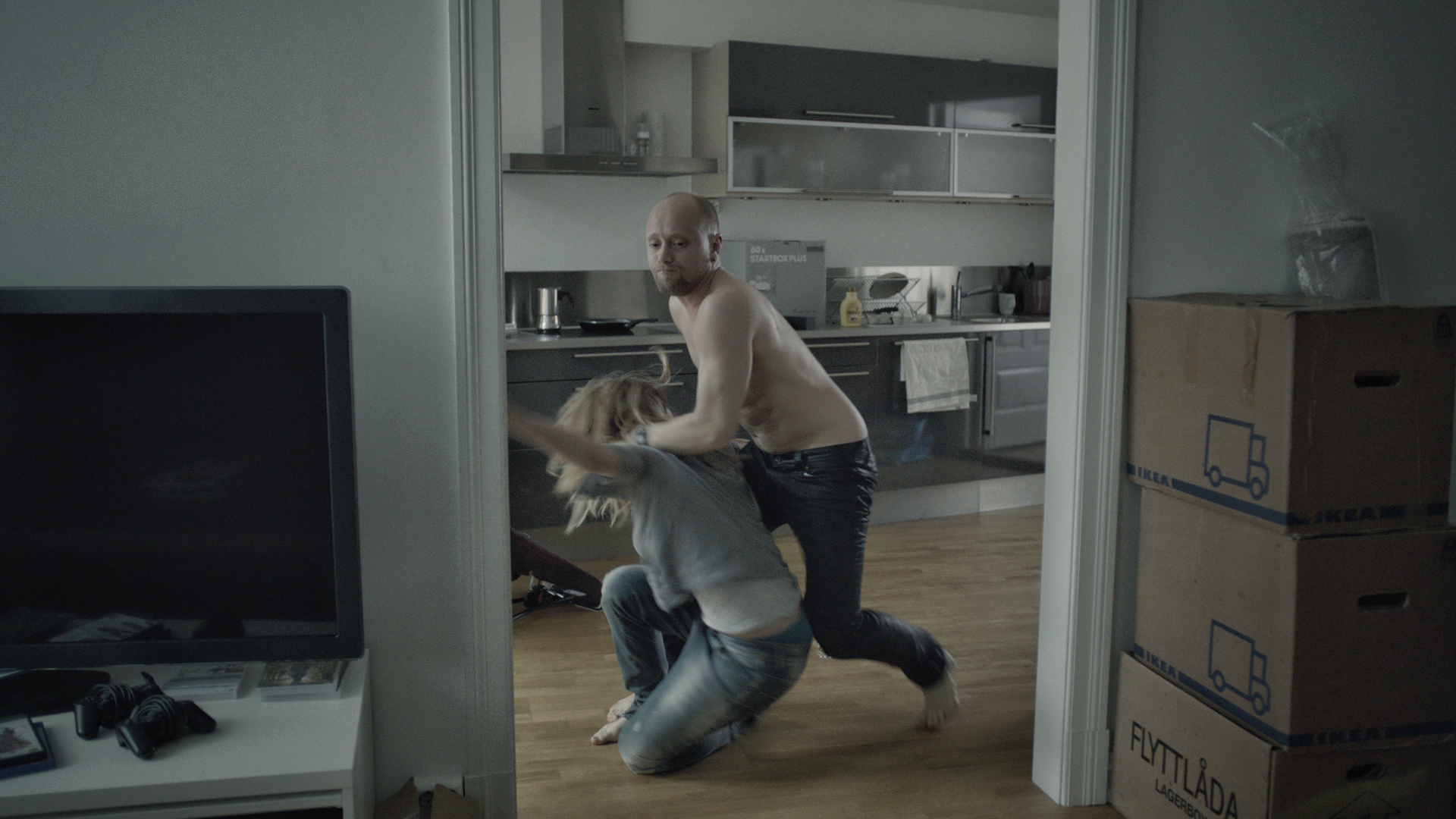
By making Shaun and Layla victims of their own desires, Johnson creates a milieu where the simplest act of affection or friendship can be misconstrued, and with terrible consequences. This would be bad enough if the characters depicted were adults, but Johnson is good at making the tragedy of teenage self-consciousness that much more stark and (seemingly) unavoidable. When Layla makes known her feelings for Troy, it’s with that desperate, needy wish to be noticed that most teenagers go through at some point, and it’s heartbreaking to see someone heading down a path that will ultimately see them place themselves, and others, in jeopardy.

In the main role of Layla, Sula is outstanding, bringing spirit, poignancy and a tempered ambivalence to the role that elevates Layla’s insecurities to a level that further underlines her initial timidity. As she gains in confidence, Johnson cleverly skewers that confidence by having Layla stumble and make mistakes, so that by the time she’s coerced into walking Shaun to an uncertain fate, her complicity in what follows becomes more credible and affecting. Sula is persuasive throughout, giving a polished, intuitive performance that anchors the movie and gives it an additional emotional grounding that becomes more necessary as the movie progresses.

In support, Leviscount is arrogant and charming as Troy, showing the attractive side of his art before revealing the seedier, more misogynistic values he really adheres to. In comparison to Layla, Troy is more of a stereotype, though one can see a hint of the “good guy” he’d like people to believe he can be, or is. Mwanza is diffident and restrained as Shaun, keeping his feelings for Layla bottled up and settling for being with her as an acceptable substitute for being “with” her. And as Shiree, Ryan is on top form as the mother whose idea of parental responsibility is to pretend (for the most part) that she’s not really a mother; her scenes with Sula are subtle and potent all at once.

Filmed on the streets and in the houses of Brixton, Honeytrap is a straightforward though dramatically authoritative movie that tells its melancholy story with a great deal of empathy for its characters, and with a telling sense of its own worth as a (fictional) record of a terrible tragedy.
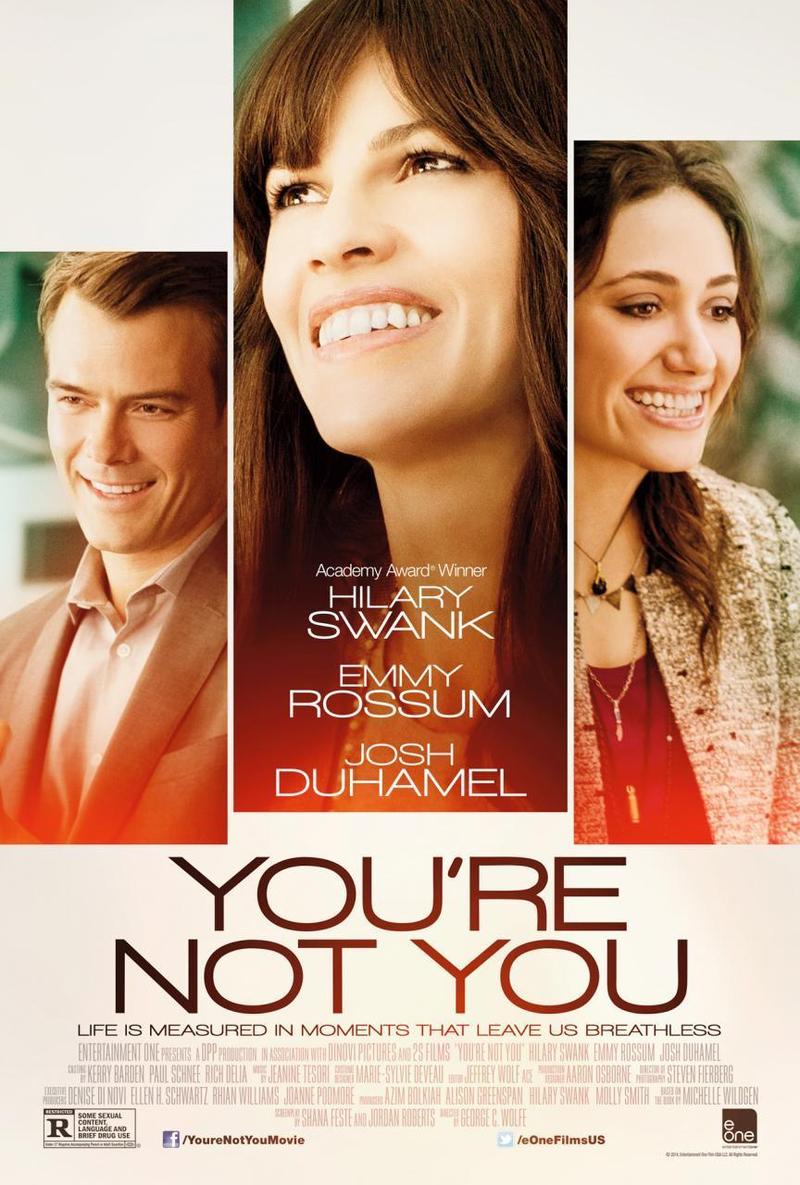
Rating: 8/10 – not an uplifting or redemptive movie by any stretch, Honeytrap is nevertheless a moody, compelling examination of teenage social exclusion that builds to a dread-filled climax; unapologetically bleak in places, it’s still one of the finest British dramas of recent years and deserving of a much wider audience than it’s received so far.

Share this:

  • Click to share on X (Opens in new window) X
  • Click to share on Facebook (Opens in new window) Facebook
  • More
  • Click to print (Opens in new window) Print
  • Click to email a link to a friend (Opens in new window) Email
Like Loading...

Safelight (2015)

19 Sunday Jul 2015

Posted by dullwood68 in Movies

≈ Leave a comment

Tags

Christine Lahti, Drama, Evan Peters, Juno Temple, Kevin Alejandro, Lighthouses, Photography competition, Prostitute, Relationships, Review, Tony Aloupis, Truck stop

Safelight

D: Tony Aloupis / 83m

Cast: Evan Peters, Juno Temple, Christine Lahti, Kevin Alejandro, Jason Beghe, Ariel Winter, Will Peltz, Don Stark, Joel Gretsch, Ever Carradine, Meaghan Martin, Gigi Rice

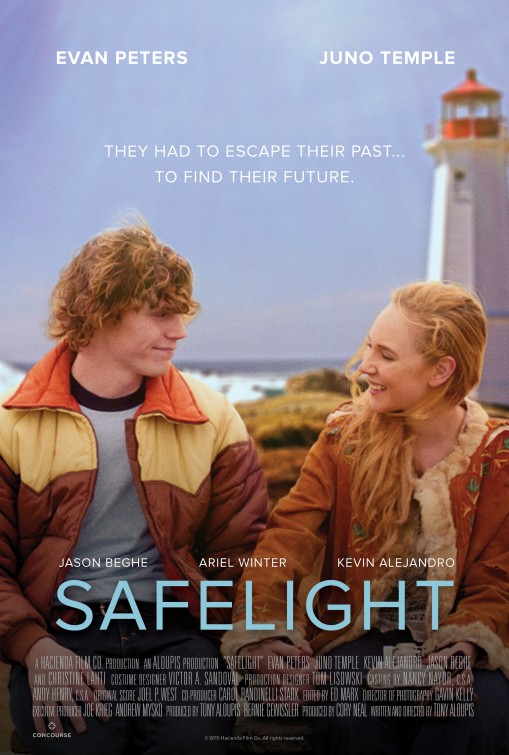
California, the Seventies. Charles (Peters) is seventeen, attends high school, has an absent mother, a deceased older brother, a seriously ill father (Beghe), legs that cause him difficulty in walking, and a job working in the diner at a truck stop. One night he sees a teenage girl named Vicki (Temple) accosted by a man called Skid (Alejandro). Charles intervenes and threatens Skid with a baseball bat. Skid is amused by Charles’s attitude and drives off. Over the next few nights, Vicki – who is a prostitute – comes into the diner for coffee, and she and Charles begin a fledgling relationship.

Meanwhile, Charles decides to enter a school photography competition. For his theme he picks the lighthouses of the California coast but his disability stops him from driving. However, when he mentions his idea to Vicki she volunteers to drive him to each location. With each successive trip they grow a little bit closer, and Charles introduces Vicki to his father and his boss at the diner, Peg (Lahti). She impresses them, so much so that Peg invites Vicki and Charles to a girls’ night at a local bar. They dance together for the first time, and later, Vicki takes Charles back to the hotel room where she lives (and which Skid, who’s her pimp, doesn’t know about).

Some time later, Charles persuades Vicki to visit her estranged family: mother Lois (Carradine), and younger sisters Kate (Winter) and Sharon (Martin). The visit doesn’t go as well as Charles had hoped, with recriminations on both sides, and it leads to Vicki disappearing. When Skid begins asking Charles if he’s seen her, he can honestly say no, but Skid makes it clear he’ll find her, no matter what. Charles completes his entry for the photography competition, and goes back to his regular life at the truck stop. It’s when Skid finally does locate Vicki that things take a desperate turn, one that will either bond them together forever, or part them irrevocably.

Safelight - scene

Slow moving but character driven, Safelight is a contemplative look at how two teenagers (Vicki is eighteen) form a relationship while viewing themselves as outsiders, Charles because of his physical condition, Vicki because of her occupation. It’s an often wistful tale, with sterling performances from Peters and Temple, and assured writing and direction from Aloupis.

But for every positive footstep the movie makes there’s an annoying misstep – sometimes in the very next scene – as Aloupis tries to explore aspects of both lead characters’ lives that don’t immediately add to the central storyline or overall plot. A case in point is the harassment Charles receives at the hands of three bullies. It serves to highlight just how difficult his life is, and the problems he has to face, but it all seems contrived and unnecessary, as if having legs that don’t work properly isn’t enough. It also leads to a scene where Vicki arrives in the nick of time and scares off the bullies with a handgun that she conveniently has in her bag – as if that’s nothing more than the writer/director adding in a bit of wish fulfilment to perk up the audience.

Vicki’s visit to her family is another area in which the script dares to travel where it has no need to go. By the time of the visit, Vicki has already told Charles about her upbringing, and her mother’s abusive boyfriend, so any information we glean has been rendered redundant, and the whole thing isn’t helped by an awkwardly judged performance by Rice as the mother doing her best not to feel guilty at failing to protect her daughter. It leads to the necessary break up of Charles and Vicki, but still it seems like an afterthought in the scriptwriting process.

Thankfully, these missteps don’t hurt the bulk of the (short) running time, but they do seem like intruders, disrupting the movie’s flow and causing the viewer to stop short. Away from these errors of judgment, Apoulis is on firmer ground when dealing with the nascent relationship between Charles and Vicki, and garnering the aforementioned sterling performances from his leads, and in particular, from Alejandro. Where Peters gives Charles a diffidence and lack of confidence that makes him immediately sympathetic, Temple takes Vicki in the opposite direction, making her too worldly-wise yet with a streak of tough vulnerability that she can drawn on when needed. The two characters complement each other, and Peters and Temple display a winning chemistry. At odds with their more structured performances, Alejandro is a sweaty, broiling, unpredictable Skid, his manic movements and unnerving laughter leaving the viewer uncertain as to what he’s going to do next (it sometimes feels as if even Alejandro didn’t know). The movie also picks up some energy when he’s on screen, a valuable counterpoint to the considered perspective offered by Peters and Temple.

At its heart, of course, the movie is an unconventional love story, and it’s here that it’s at its most effective. While the idea of two professed outsiders finding common ground isn’t unusual in the movies, what Aloupis has done is to make a virtue of Charles’ emotional reticence, and Vicki’s need to be loved for herself and not just her body (which leads to an uncomfortable and telling moment in Vicki’s motel room). With their relationship falling into place so neatly and plausibly, Aloupis moves the supporting characters around with ease, eliciting strong performances from Lahti and Beghe, and showing a flair for spare, unshowy dialogue. The desert landscapes and coastal cliffs are beautifully photographed by DoP Gavin Kelly, and Charles’s photographs of the lighthouses and Vicki are rendered in wonderful black and white by Darrell Lloyd, making the movie a visual treat at times and surprisingly poetic.

Rating: 7/10 – some narrative flaws stop Safelight from being more accomplished, but there’s lots to enjoy here, from the performances to the writing, and all backed by an evocative visual style that keeps the drama from becoming too gloomy; while some elements may be predictable to seasoned viewers it’s Apoulis’ approach to the material that keeps it interesting.

Share this:

  • Click to share on X (Opens in new window) X
  • Click to share on Facebook (Opens in new window) Facebook
  • More
  • Click to print (Opens in new window) Print
  • Click to email a link to a friend (Opens in new window) Email
Like Loading...

Mini-Review: We’ll Never Have Paris (2014)

16 Thursday Jul 2015

Posted by dullwood68 in Movies

≈ 2 Comments

Tags

Comedy, Drama, Florist, Jocelyn Towne, Maggie Grace, Melanie Lynskey, Paris, Relationships, Review, Romantic comedy, Simon Helberg

We'll Never Have Paris

D: Jocelyn Towne, Simon Helberg / 92m

Cast: Simon Helberg, Maggie Grace, Melanie Lynskey, Zachary Quinto, Alfred Molina, Jason Ritter, Fritz Weaver, Dana Ivey, Ebon Moss-Bachrach

Quinn (Helberg) is a florist who’s also a bit of a hypochondriac. He’s also in a long-term relationship with Devon (Lynskey), his high school sweetheart. Encouraged by his optometrist father Terry (Molina), he decides to ask Devon to marry him. But when he announces his intentions to his assistant, Kelsey (Grace), it prompts her to reveal her feelings for him.  Confused by this revelation, Quinn seeks advice from his best friend, Jameson (Quinto), but it all leads to Quinn having second thoughts about matrimony. Devon takes it badly and leaves him. Believing that he needs to explore other relationships, he starts seeing Kelsey, but her behaviour becomes distressing to him and he distances himself from her.

Quinn’s attempts to regain Devon’s trust and forgiveness but it all falls flat. She moves to Paris, and when Quinn finds out – and despite the continued attentions of Kelsey – he decides to pluck up the courage and follow her there in an effort to win her back. When he does he finds Devon has forged a friendship with a Frenchman called Guillaume (Moss-Bacharach), and is planning to spend some time with his family. Quinn follows her there but his visit is a disaster and prompts him to return to the US and put his relationship with Devon behind him. But he learns that it’s not all over…

We'll Never Have Paris - scene

Best known for his role as Howard Wolowitz on The Big Bang Theory, Simon Helberg is to be congratulated for writing, co-directing and starring in a romantic comedy that a) sees him as an object of lust and b) has attracted a good cast. However, somewhere along the way, Simon Helberg the writer seriously undermined Simon Helberg the actor, and in doing so was in cahoots with Simon Helberg the co-director, for Quinn the character is one of the most irritating creations seen in recent years. Quinn is a nebbish, an ineffectual, stuttering idiot who isn’t so much easily led as emotionally vacant. His relationship with Devon is unconvincing – why would she love such a man when he’s so obviously gornisht helfn?

But even if Helberg the writer had given Helberg the actor a better role, he still would have let him down by failing to make his character funny or even halfway amusing. We’ll Never Have Paris is simply not funny – at all. Helberg’s script meanders from one poorly developed scene to the next, with spurious character motivations thrown in at random moments, and supposedly humorous situations allowed to peter out before they can achieve any relevance or resolution. Against this, Grace and Lynskey struggle to make anything of the material, with Lynskey particularly hamstrung by a role that requires her to be continually forgiving in the face of Quinn behaving (repeatedly) like an ass. Only Molina comes out of it all with any dignity intact, popping up at the beginning and again at the end in what is effectively a cameo role, his cheery demeanour and impish behaviour showing how it should be done.

Rating: 3/10 – dreadful, and lacking in anything remotely resembling dramatic or comedic acuity, We’ll Never Have Paris is sluggish, implausible stuff that is a struggle to sit through; Helberg isn’t the writer he thinks he is, and lets himself down too often for this to succeed, leaving the viewer with the feeling that they’ve sat through a movie that was filmed from a first draft.

Share this:

  • Click to share on X (Opens in new window) X
  • Click to share on Facebook (Opens in new window) Facebook
  • More
  • Click to print (Opens in new window) Print
  • Click to email a link to a friend (Opens in new window) Email
Like Loading...

No Way Jose (2015)

09 Thursday Jul 2015

Posted by dullwood68 in Movies

≈ Leave a comment

Tags

Adam Goldberg, Ahna O'Reilly, Anna Belknap, Children's parties, Comedy, Drama, Eric Siegel, Gillian Jacobs, Indie movie, Mexico, Musician, Pat Healy, Relationships, Review, Romance, The Borges

MrsMiracle_DVD_Sleeve

D: Adam Goldberg / 98m

Cast: Adam Goldberg, Ahna O’Reilly, Eric Siegel, Anna Belknap, Pat Healy, Greg Pritikin, Gillian Jacobs, Emily Osment, Brendan Hines

Musician Jose Stern (Goldberg) is fast approaching forty and is reduced to playing children’s parties with his band, the Borges. He’s also engaged to Dusty (O’Reilly), and though they haven’t set a date, they have decided on where to go for their honeymoon: Mexico (as you can’t drive to Hawaii). When best friends Gabe and Kate (Siegel, Belknap) suggest that they hold a joint birthday party for Jose and their young daughter Violet, Jose is initially ambivalent, but thanks to Dusty’s urging, agrees to the idea. Later that night in their new apartment, Dusty downloads an app to her phone that brings to light something about Jose that she doesn’t know. For Dusty it proves to be a deal breaker, despite Jose’s explanation of what she’s learnt.

Their relationship over, Jose crashes on Gabe and Kate’s couch. Kate goes out to work while Gabe stays at home to look after Violet and their infant son, Fred, and provide piano lessons to children. They row a lot, but in-between times, Jose manages to get them to give their opinions on what to do next. Their answer (based on having two impressionable children in the home): frog Dusty and move on. But Jose can’t quite do that, even though he won’t contact her. Instead he hooks up with an old girlfriend, Penny (Jacobs), when she calls him out of the blue, but the evening they spend together proves disappointing.

With his friends, Lawrence (Healy) and Mickey (Pritikin), Jose begins to put Dusty behind him (though he still feels strongly about her). When he learns that Dusty has decided to cash in their honeymoon tickets and go by herself, Jose – who doesn’t fly – follows her there in a last ditch effort to win her back. But when he gets there, he gets a surprise, one that’s exacerbated by Dusty telling him something unexpected…

No Way Jose - scene

Adam Goldberg’s fourth directorial feature since 1998 (the last one, I Love Your Work, was released in 2003), No Way Jose is an acerbic, drily witty look at the pitfalls of modern relationships. Co-written with Sarah Kate Levy, Goldberg’s take on the middle-aged man-child coming to terms with commitment has a couple of comedic set pieces – Jose struggling to talk to Dusty while strung out on Ativan; Kate coming home and yelling coarsely at someone on the phone – but is mostly a sedate, considered drama that  features some great performances while never quite saying anything too profound about the differences between men and women.

From the outset it’s clear that Jose is out of his depth, somehow having reached the age of forty without getting married or having children. His musical career is in the doldrums, and while his relationship with Dusty seems like a dream come true (you know she’s far too good for him), his cavalier attitude and need for approbation marks him out as an outsider, jogging along but without much purpose or direction. Faced with having to grow up and find some meaning in his life, Jose’s reaction is to cling even tighter to his sense of freedom, even though losing Dusty has made him begin (without realising) to reassess what he wants from Life.

Goldberg is a quirky, unpredictable actor, but here he tones down his usual schtick to give us a character who’s more unsure than confident, and who’s only a few steps away from being a complete loser. As such it’s hard to sympathise with him completely as a lot of his problems are caused by a lack of consideration of others; he’s his own worst enemy. By making Jose so insecure, and with so little ambition, Goldberg has painted himself into a bit of a corner. It doesn’t take long to realise that Jose’s coasting along is robbing the movie of a good deal of drama, and with that realisation, most viewers may find themselves less interested in how things play out. It doesn’t help either that Dusty is sidelined once their relationship is over, and disappears until the movie’s end, when she’s required to respond to Jose’s lovelorn melancholy in a way that will be familiar to anyone who’s seen more than a few romantic dramas.

With Jose being less than completely interesting, it falls to the supporting cast to provide most of the entertainment. It’s here that Goldberg and Levy have done the movie a favour, investing the supporting characters with enough humorous foibles to offset the moodiness of the central storyline. Siegel and Belknap are terrific as a warring couple continually trying to score points off each other and offloading their parental responsibilities on each other at every opportunity (the phrase “Violet’s done a bad thing” will linger in the memory). Healy and Pritikin also provide sterling performances, their characters’ idiosyncrasies played to the fore and fully recognisable as the kind of friends most of us have despite our best wishes or intentions.

On the distaff side, O’Reilly is a pleasure to watch as Jose’s engaging other half, and she makes enough of an impact that her enforced departure from the story feels calamitous. As the “coconut water” drinking Penny, Jacobs soon turns into the ex we’d all like to forget, but instead of enhancing the drama by having Jose sleep with her (or just be seen with her by Dusty), Goldberg elects to have Jose refuse her overtures and not go through with anything, reaffirming his inability to take chances.

Where Goldberg does get things right is in his choice of music to support the emotional beats within the movie – the songs that play in Jose’s car shortly after Dusty dumps him, including One Is the Loneliest Number, are inspired – and his choice of cinematographer, Mark Putnam, his go-to guy when making features. Putnam is great at coming up with shots that provide maximum effect, and guided by Goldberg, keeps things continually interesting within the frame. It all serves to make the visual aspect of the movie more compelling than expected.

Rating: 7/10 – flawed but still mostly enjoyable, No Way Jose is an indie drama with comedic overtones that tells its simple story without much embellishment or pretentiousness; alas this makes for a movie that feels somewhat underdeveloped, and while there are good performances throughout, there’s too little of substance going on to improve things.

Share this:

  • Click to share on X (Opens in new window) X
  • Click to share on Facebook (Opens in new window) Facebook
  • More
  • Click to print (Opens in new window) Print
  • Click to email a link to a friend (Opens in new window) Email
Like Loading...

Like Sunday, Like Rain (2014)

27 Wednesday May 2015

Posted by dullwood68 in Movies

≈ Leave a comment

Tags

Billie Joe Armstrong, Cello player, Child prodigy, Debra Messing, Drama, Frank Whaley, Julian Shatkin, Leighton Meester, Music, Relationships, Review

Like Sunday Like Rain

D: Frank Whaley / 104m

Cast: Leighton Meester, Julian Shatkin, Billie Joe Armstrong, Debra Messing, Olga Merediz, J. Smith-Cameron, James McCaffrey, Sammy Pignalosa

Eleanor (Meester) is a twenty-three year old waitress whose relationship with aspiring musician Dennis (Armstrong) comes to an end when he fails yet again to return home one night from a gig. Reggie (Shatkin) is a twelve year old child prodigy whose advanced intellect keeps him remote from everyone around him. When an argument with Dennis at her place of work leads to Eleanor losing her job, a friend of hers recommends signing up with an agency. When she does she’s told about a job as a nanny that requires a same day start. Interviewed and hired by Reggie’s mother, Barbara (Messing), the job involves making sure Reggie gets to and from school and that he eats while Barbara is away for the next two months.

Eleanor soon finds that Reggie has his own unique way of looking at the world, and her expectations are swept aside as Reggie refuses to go to camp as planned and she begins to get to know someone who believes that “art as a language is dead”. Reggie and Eleanor spend time in the park, watching movies, and eating out, and as time goes by, the two grow closer, while Dennis refuses to accept that his relationship with Eleanor is over. One night though, Eleanor receives a call from her uncle Dale (McCaffrey) telling her that her father is seriously ill in hospital. She tells Reggie that she has to leave for a couple of days, but rather than be left in the care of someone he doesn’t know, Reggie offers to go with her.

They travel to Eleanor’s home town where they receive a less than hospitable welcome from Eleanor’s mother (Smith-Cameron). They switch to a motel where Eleanor reveals that she too has a musical talent (Reggie is a gifted cellist and composer), and that she once got into Juilliard but they couldn’t give her a full scholarship. Reggie decides that he’ll include a part of the cornet (Eleanor’s instrument) in the composition he’s written called Like Sunday, Like Rain. At the hospital, Eleanor learns that no one has been in to see her father; when she goes back home it leads to a row that has her vowing never to return. With her job looking after Reggie coming to an end, and with her bridges burnt at home, Eleanor now has to plan for her immediate future, a future that means leaving Reggie behind…

Like Sunday Like Rain - scene

The fourth feature from writer/director/actor Whaley, Like Sunday, Like Rain is a movie in which not a lot happens in terms of plot or even in dramatic terms, but which explores the dynamics of its central characters’ relationship with a great deal of charm and skill. As Eleanor and Reggie get to know each other – and we get to know them – the emotional differences between them become blurred, and various connections become apparent. It’s a delicate movie in many ways, with Whaley taking the time to explore Eleanor and Reggie’s personalities in deceptively fine detail, and in the process, allowing their eventual bond to become entirely believable.

As a result of ending her relationship with Dennis, Eleanor is both jobless and homeless, and at a crossroads in her life. Thanks to Meester’s intuitive, adept portrayal, Eleanor’s predicament is given a realistically poignant feel further enhanced by the combined expressions of resignation and frustration she evinces. It’s a subtler performance than it seems at first, and Meester shines throughout, building layer upon layer of resilience and determination and allowing Eleanor the opportunity to move forward with her life.

But this is Shatkin’s movie pure and simple, his performance another of those given by a child actor that is so perfectly gauged and delivered it puts most adult actors and actresses to shame (it’s a good job that Meester is a match for him). It’s a showy role – just watch Reggie’s response to his friend Raj’s crossword clue – but Shatkin is more than up to the task, and steals almost every scene he’s in, whether it’s questioning the maid, Esa (Merediz), as to the content of his meals, or quoting the sad fate of the artist Modigliani. Reggie’s over-confidence and child prodigy status hides a deep-rooted vulnerability, and Shatkin is excellent at showing the emotionally scared young boy hidden beneath the academic outer shell. His expression when Eleanor announces she has to leave to visit her father is a perfect display of need and understanding at war with each other.

Alas, where Whaley puts so much time and effort into making Eleanor and Reggie as credible as characters as he possibly can, the same can’t be said for Barbara and Dennis. Barbara is the stereotypical socialite so wrapped up in her own world she can’t be bothered to remember Eleanor’s name two minutes after she’s heard it. It’s a mannered, brittle performance by Messing, and amounts to barely ten minutes of screen time as she’s shuffled off to China to make way for Eleanor and Reggie to begin bonding. As Dennis, a musician with delusions of adequacy, Armstrong is a better singer than he is an actor, and Whaley doesn’t really do anything with the character other than to make him consistently whiny and annoying. Faced with such a limited characterisation, Armstrong doesn’t have the experience to make any more of the role, and consequently he’s the weakest link in the movie.

By concentrating on the subtle and meaningful ways in which two people, despite the gap in their ages and experiences of life, can develop a friendship that’s mutually beneficial and rewarding, Whaley makes Like Sunday, Like Rain a pleasure to watch despite its more dramatic turn when Eleanor goes home. This section of the movie feels a little rushed, as Eleanor’s differences with her family are brought to the fore in what are very broad strokes. But the ending restores the tone and the simplicity of what’s gone before, and the movie, already a pleasure to be a part of, concludes on a perfect note of synchronicity.

Rating: 8/10 – a slow-moving, leisurely paced movie that draws in the viewer and makes them care about its two central characters, Like Sunday, Like Rain is a small-scale movie that can be treasured time and time again; with terrific performances from Meester and Shatkin, and a nuanced script from Whaley, it’s a winning combination that rewards throughout.

Share this:

  • Click to share on X (Opens in new window) X
  • Click to share on Facebook (Opens in new window) Facebook
  • More
  • Click to print (Opens in new window) Print
  • Click to email a link to a friend (Opens in new window) Email
Like Loading...

See You in Valhalla (2015)

15 Friday May 2015

Posted by dullwood68 in Movies

≈ Leave a comment

Tags

Bret Harrison, Drama, Dysfunctional family, Family, Funeral, Jarret Tarnol, Michael Weston, Relationships, Review, Sarah Hyland, Steve Howey, Unexpected death, Vikings

See You in Valhalla

D: Jarret Tarnol / 82m

Cast: Sarah Hyland, Michael Weston, Bret Harrison, Steve Howey, Conor O’Farrell, Alex Frost, Emma Bell, Odeya Rush, Beau Mirchoff, Allie Gonino, Jake McDorman

Following the unexpected (and quite bizarre) death of their brother Max (McDorman), remaining siblings Johana (Hyland), Don (Weston), and Barry (Harrison) all return to their estranged father’s home for the funeral. With all his children having left the family home after their mother’s death some years before, Woody (O’Farrell) sees this as an opportunity to reconcile with them, and to reunite as a family.

Johana brings along Peter (Frost), whom she’s just started dating. Don brings his daughter, Ashley, while Barry brings his boyfriend, Makewi (Howey). They find their father has a live-in nurse, Faye (Bell), who is very much into a new age lifestyle, and who seems to have made Woody’s life more bearable (he walks with a cane and is in generally poor health). But tensions run high from the first day they’re all together, and long-held resentments begin to make themselves felt. Johana has unfinished business with an old flame, Johnny (Mirchoff), and is tortured by regrets over the abortion she had when she was much younger. Don blames his father for not being there for all of them when their mother died, and refuses to let go of the anger he feels about it. Barry has lost a lot of weight and works as a therapist; Makewi was a patient of his. Woody does his best but his children fight amongst themselves and show no sign of putting their differences behind them.

Johana’s budding relationship with Peter is put in jeopardy by her conflicted need to see Johnny. When she finally does he seems ready to rekindle their old romance, but an unpleasant discovery forces Johana to reassess her feelings both for Johnny and for Peter. Meanwhile, a play fight between Don and Barry turns nasty and leads to Don making a homophobic remark. Threatened by Makewi if he says the same thing again, and intending to leave there and then, Don is confronted by Woody, who tries to settle things between them once and for all. But all it does is bring on a stroke. In the hospital, all three of Woody’s children begin to realise just how much they’re in danger of losing by remaining at odds with each other. And then, Makewi has an idea for Max’s funeral that finally unites them as a family…

See You in Valhalla - scene

Watching See You in Valhalla, it’s hard to work out if the Tarnol brothers – director Jarret and scripter Brent – have made their characters deliberately unlikeable or not. All three are so weighed down by the various slights and disappointments of their earlier lives, that these slights and disappointments have come to define them as individuals. Johana is haunted by the decision she made at sixteen and seeks some form of closure by seeing Johnny. Don has allowed his anger to turn him into a hurtful malcontent, foisting his own unhappiness on others, and turning his daughter into a carbon copy of himself. Barry’s feelings of inadequacy from the bullying he endured at school due to being overweight have never really left him, and he’s sensitive to criticism of his work and the provenance of his relationship with Makewi. And Max is shown finding a way out from his addictions through love (and a passion for Vikings), but falling back into old habits when his girlfriend suddenly dies.

But while a knee-jerk reaction to all this angst might be to say, “Oh for God’s sake, just get over yourselves!”, it’s thanks to some astute performances that the viewer is dissuaded from doing so (though it has to be said there are some moments where that temptation is really strong). We’ve seen this type of movie too many times before for the whole dysfunctional-family-learning-to-get-along scenario to appear fresh and engaging, and yet even though Brent Tarpol’s script strays too often into areas of predictability and familiarity, there’s just enough going on to keep the viewer interested in seeing where the movie goes next. The obvious antecedent here is The Big Chill (1983), but where that looked at its characters’ lives and relationships in depth, See You in Valhalla makes only a cursory attempt at making Johanna et al interesting or sympathetic, leaving the viewer largely unconcerned as to whether or not they’ll overcome their differences.

And yet, while the script lurches from one underwhelming emotional confrontation to another, the cast continually pick up the slack and keep things moving forward, doing their best to weed out nuances and thoughtful assertions about their characters and their past histories. Hyland is terrific as a young woman beset by inner demons, eschewing an easy vulnerability for a raw sense of personal transgression. The scene where Johana confesses to Peter her reasons for leaving home is skilfully played by Hyland, and her indecisiveness over Johnny will speak to anyone who’s had regrets over a past relationship and what might have happened if things had been different. Weston does equally as well as Don, taking a stereotypically angry character and showing the need for acknowledgment beneath the irate behaviour. Elsewhere, Howey steals the movie with his flamboyant turn as Makewi, adding some much needed humour to the mix and giving the movie a bump just when it needs it.

If Jarret Tarnol had been stricter with the vagaries of his brother’s script then See You in Valhalla might have been a more polished and engrossing movie. As it is, it suffers from moments of contrivance that threaten to overturn the movie completely in its first half, but the script rallies in the second half and there’s a greater sense that these characters can put aside their differences in order to support their father, and each other. With this in place, the movie ends on a satisfying note that looked doubtful at the beginning. Again, it’s thanks to a cast that takes the material and works wonders with it, giving a sometimes fresh but knowing spin on such tried and tested tropes.

Rating: 6/10 – bolstered by an infectious indie score (mostly) by 10K Dragons, See You in Valhalla takes too long to become effective, but when it does it’s truly rewarding viewing; rescued from the doldrums by its cast, the movie works best when allowing its quirkier characters free rein, and by allowing much of the movie to be filmed in an unfussy, observational style.

Share this:

  • Click to share on X (Opens in new window) X
  • Click to share on Facebook (Opens in new window) Facebook
  • More
  • Click to print (Opens in new window) Print
  • Click to email a link to a friend (Opens in new window) Email
Like Loading...

Rebels of the Neon God (1992)

22 Wednesday Apr 2015

Posted by dullwood68 in Movies

≈ Leave a comment

Tags

Arcades, Chen Chao-jung, Drama, Lee Kang-sheng, Relationships, Review, Taipei, Taiwan, Tsai Ming-liang, Wang Yu-Wen

Rebels of the Neon God

Original title: Qing shao nian nuo zha 

D: Tsai Ming-liang / 106m

Cast: Chen Chao-jung, Lee Kang-sheng, Wang Yu-Wen, Lu Yi-Ching, Tien Miao, Jen Chang-bin

Ah-tse (Chen) lives in a flat where the drain in the kitchen has backed up and water covers the floor. He’s not too concerned about it; instead he’s more interested in stealing money from telephone booths with his friend Ah-ping (Jen). He has a relationship with Ah-kuei (Wang) that he’s not fully committed to, and no sense of purpose. Elsewhere, student Hsiao-kang (Lee) is bored with his studies and with his life in general. His relationship with his mother (Lu) and father (Tien) is strained and he spends most of his time in his room.

Hsiao-kang’s father is a taxi driver. When he sees his son out of school one morning he elects to take him there. At a junction, his father is held up by Ah-tse, who is on his motor bike (with Ah-kuei on the back). Ah-tse’s anger at being scolded by a taxi driver prompts him to smash the taxi’s side mirror. Later that night, Ah-tse and Ah-ping meet up with Ah-kuei and they go out. Ah-kuei gets drunk and the two friends take her to a hotel where they leave her to sleep it off. The next day, Hsiao-kang drops out of the tutorial school he’s attending and collects the refund that’s due. He buys a cap gun and heads to a nearby arcade, which is where he sees Ah-tse and Ah-kuei. Recognising them, he decides to watch them. They meet up with Ah-ping at a restaurant then they head back to the arcade; at closing time they hide in the toilets until it’s locked up. Hsiao-kang hides too and sees them pry open several of the arcade machines and remove the motherboards.

The next day, Hsiao-kang’s father discovers he’s no longer enrolled at the tutorial school. Meanwhile, Hsiao-kang has found out that Ah-kuei works at a skating rink. When she meets Ah-tse after her shift is over, they end up at a hotel where they spend the night. While they’re there, Hsiao-kang takes the opportunity to vandalise Ah-tse’s motorbike, rendering it unrideable. He goes home but is refused entry by his father. The next morning, when Ah-tse finds his motor bike, the cost of its repair is more than he can afford, unless he sells the motherboards. But when he and Ah-ping take them to the owner of another arcade, his hopes for a quick sale don’t go as planned…

Rebels of the Neon God - scene

There’s a moment towards the end of Rebels of the Neon God when Ah-kuei suggests that she and Ah-tse “leave this place”. Ah-tse responds by asking where she wants to go, but Ah-kuei is unable to answer him. It’s a moment that perfectly encapsulates the message behind writer/director Tsai’s foray into the lives of Taiwanese youth: that disaffection and ennui are powerful motivators toward isolation. None of the three main characters has a place in the world that gives them purpose. Ah-tse appears to be the more focused of the three, his petty larcenies and casual insolence informing his personality and making him seem as if he knows what he’s doing. Ah-kuei has little identity beyond that given to her by being with Ah-tse and Ah-ping; otherwise she’s alone and struggling to connect with others. Hsiao-kang is the most alienated, his intolerance and disdain for others a reaction to his parents’ expectations of him.

As the lives of all three intersect and criss-cross, Tsai focuses on the ways in which they fail to connect emotionally with themselves, each other, and the world around them. Ah-tse uses the people around him, Ah-ping as his willing accomplice in crime, and Ah-kuei as an accessory he’s barely concerned about. When the three of them are together he acts as an unelected leader, deciding what they’ll do and where they’ll go. He looks for power in whichever way he can find it, all to make him feel superior. But it’s a hollow superiority, as shown when his plan to sell the motherboards backfires, and his sense of place in the world is rudely undermined. With his bravado severely compromised and his self-belief in tatters, Ah-kuei’s increasing need to understand the parameters of their relationship forces him to consider someone else for the first time. It’s a transitive moment and allows their relationship a moment of hope.

Hsiao-kang though is completely lost, unable to connect to anyone except in the most basic way and even when it would be of benefit to him; at one point he visits a phone dating service but can’t pick up the phone when someone is calling. His feelings are compromised so badly he can’t even react when he’s thrown out of his own home. His attack on Ah-tse’s motor bike is less of a chance at payback for his father and more of an expression of self-loathing.

Tsai positions his characters against a neon-lit, brightly dramatic background, as Taipei’s nightlife throbs and pivots and vibrates around them. It helps highlight the level of dissociation the characters exhibit, and serves as a dispassionate character all its own. It’s an added layer in a movie that examines the connections and disparities our emotions can lead us into, and which leaves it all open-ended as to where its characters will end up and how withdrawn they’ll continue to be. The cast handle their roles well, though Wang’s character is given little development beyond her need for physical approbation. Lee is moody and recalcitrant as Hsiao-kang, capturing the character’s deep-rooted antagonism with quiet skill. And Chen displays the cocksure bluster that Ah-tse uses to make himself feel important.

With it’s attempts at lyricism amidst the garish neon wasteland of Taipei’s arcade district, offset with the colder austerity of its daytime appearance, and the poorly maintained rooms that Ah-tse uses, the movie paints a vivid portrait of a society and a generation unable to come to terms with its lack of direction.

Rating: 8/10 – with a poster of James Dean from Rebel Without a Cause (1955) as its guide, Rebels of the Neon God is an effective, thought-provoking look at teenage alienation; with a script that provides no easy solutions for its characters, it’s a sombre piece and with an unexpectedly emotional core.

Share this:

  • Click to share on X (Opens in new window) X
  • Click to share on Facebook (Opens in new window) Facebook
  • More
  • Click to print (Opens in new window) Print
  • Click to email a link to a friend (Opens in new window) Email
Like Loading...

90 Minutes (2012)

04 Saturday Apr 2015

Posted by dullwood68 in Movies

≈ Leave a comment

Tags

Abuse, Aksel Hennie, Bjørn Floberg, Drama, Eva Sørhaug, Mads Ousdal, Marital problems, Norway, Pia Tjelta, Relationships, Review

90 Minutes

Original title: 90 minutter

D: Eva Sørhaug / 89m

Cast: Bjørn Floberg, Mads Ousdal, Pia Tjelta, Aksel Hennie, Annmari Kastrup, Kaia Varjord

Johan (Floberg) has reached a point in his life where he’s made a profound decision as to his immediate future. He’s determined to put several aspects of his life behind him, such as the room he rents and a subscription he’s taken out. As he makes these changes, he’s goes about them with a sense of finality and sadness. Fred (Ousdal) is a cop who’s marriage to Elin (Tjelta) has ended in divorce. They have two young children, both girls, and Fred’s presence in their home while Elin plans a party is being tolerated by his ex-wife. When she takes a call from someone who is coming to the party and is currently playing golf, Fred assumes the man is the new love in her life, something that he isn’t happy about. Trond (Hennie) is a young man who appears to be living alone in a sparsely furnished apartment. He listens to the radio and tapes up his right hand but otherwise seems unmotivated. He goes into his bedroom, where he strips and has sex with a woman (Varjord) who is gagged and tied to the bed. Also in the room is a baby, which starts crying.

Johan arrives back home from a trip out. His wife, Hanna (Kastrup), is there. He begins to prepare dinner for them while Hanna has a shower. He is methodical and precise and makes sure that everything is just so. Fred begins to antagonise Elin by refusing to leave when she asks him to, and by complaining that she never seemed interested in golf before. He also finds excuses to remain there that involve either their children, or a neighbour. Elin loses her patience and insists that he leave. He eventually does so, and drives off angrily. Trond releases the woman tied to his bed to see to the baby. She is his partner, Karianne, and the baby is theirs. With the baby seen to, she begins to cook for them both, but when she looks out of the window, Trond becomes angry and attacks her. He drags her back into the bedroom and reties her to the bed. He snorts some cocaine, then arranges to meet a friend in order to get some more.

During their dinner, Johan prepares some gravy that he lets his wife try first. She becomes woozy and soon passes out. Fred drives around until he ends up back at his old home. He gets out of his car and goes inside to confront his family. Trond is visited by his friend and another man, who assault him and take his TV as repayment for his drug debts. Angry at being humiliated he decides to take it out on Karianne. He forces her to have sex and in the process nearly suffocates her, but stops just short of doing so. All three men find themselves on the verge of having their lives changed forever.

90 Minutes - scene

Only the second feature by talented director Sørhaug after Cold Lunch (2008), 90 Minutes is a bleak, uncompromising slice of Norwegian angst that gives the barest amount of detail for each man’s behaviour, and is coldly judgmental when it comes to the outcomes of each story. We meet each man at a stage where their individual journeys have reached a point of no return (though Trond’s is a little less cut and dried).

Johan’s actions are calculated and, in their own way, heartless and cruel. There may be an element of love involved in his actions toward Hanna, but the absence of any concrete reason for his actions doesn’t allow for any sympathy from the viewer. It’s clear he does have a reason for doing what he’s doing but Sørhaug is clever enough to make that reason irrelevant; his sadness tells us enough, and as we watch Johan carry out his plan, the sense of foreboding that builds is carefully orchestrated to the point where inevitability and hope collide, leaving a melancholy chill over the storyline that is quietly and unquestionably effective. Floberg is subdued, almost absent throughout, his careworn face providing all the information we need as to what he’s feeling. Of the three men he’s the most restrained and the most agonised, and Floberg gives perhaps the best performance as a result.

Fred is a man with unresolved marital issues and a simmering layer of anger lurking beneath an outwardly pleasant façade. Of the three men he’s the most recognisable and understandable, his jealous possessiveness a staple of marital dramas the world over. Sadly, this very familiarity stops Sørhaug from making his and Elin’s storyline from being anything more than entirely predictable, and his return to their home has all the surprise of presents at Xmas, especially after we learn he’s “taking a break” from active duty as a cop and is behind a desk. Nevertheless, Ousdal steers clear of making Fred too obvious, and makes his face almost mask-like when around other people. It’s only when he’s in his car that we see the full range of the emotions he’s feeling and realise just where those emotions will take him. As a transformation it’s unnerving and unexpectedly affecting.

As for Trond, he’s perhaps the most tormented of the three, his drug dependency exacerbating his paranoia and abusive behaviour towards Karianne. He’s an ogre, pitiless and self-absorbed, a rapist whose abusive nature has robbed him of every last ounce of decency. His actions are abominable, and it’s a measure of Sørhaug’s script, and Hennie’s abilities as an actor, that Trond isn’t allowed even the faintest hint of understanding or redemption; he’s unlikeable all the way through. Of the three storylines, Trond’s is the most difficult to watch, with its moments of domestic violence and sexual assault, and Sørhaug (again) is clever enough to thwart the audience’s expectations. The ultimate fate of Trond and Karianne and the baby is one that allows the movie to end on a note of cautious hope, but a note that nevertheless comes without any guarantees.

90 Minutes is a hard movie to like as such, its unremittingly grim mise en scene and examination of extreme misogynistic behaviour making it tough to engage with. But Fred’s story aside, Sørhaug’s script is still intrepid enough to make the other two storylines surprisingly engrossing. She also makes the camera more of an observer than a participant, allowing a more dispassionate approach to the material that offsets the horrors being witnessed. Henrik Skram’s icy score adds another dimension to the austere proceedings, and there’s sterling camera work from Harald Gunnar Paalgard, particularly in Trond’s apartment.

Rating: 7/10 – by making Johan, Fred and Trond so unsympathetic, writer/director Sørhaug runs the risk of making 90 Minutes too unpalatable for the average viewer, but there’s enough to admire in the stringent, uncompromising set ups to make up for any distaste at the characters’ actions; one that will linger in the memory and with a cathartic moment that remains appropriately unsatisfying.

Share this:

  • Click to share on X (Opens in new window) X
  • Click to share on Facebook (Opens in new window) Facebook
  • More
  • Click to print (Opens in new window) Print
  • Click to email a link to a friend (Opens in new window) Email
Like Loading...

When Evening Falls on Bucharest or Metabolism (2013)

01 Wednesday Apr 2015

Posted by dullwood68 in Movies

≈ Leave a comment

Tags

Actress, Affair, Bogdan Dumitrache, Bucharest, Corneliu Porumboiu, Diana Avramut, Director, Drama, Movie, Rehearsal, Relationships, Review, Romania, World Cinema Month

When Evening Falls

Original title: Când se lasă seara peste Bucureşti sau Metabolism

D: Corneliu Porumboiu / 85m

Cast: Diana Avramut, Bogdan Dumitrache, Mihaela Sirbu, Alexandru Papadopol

Paul (Dumitrache) is a writer/director making his latest movie. He hasn’t worked with his lead actress, Alina (Avramut) before, but he likes to challenge her over her interpretation and understanding of the script as well as her personal opinions on topics such as shooting on film as opposed to digitally. One day during the movie’s production, Paul fakes a stomach problem and lets his producer, Magda (Sirbu) know that he can’t work; instead he meets up with Alina. They rehearse a scene where Alina’s character gets out of the shower, and as she gets dressed, overhears a conversation involving the male lead character. She and Paul discuss the various reasons for her behaviour during the scene, and try and pin down the various actions that will be involved. Afterwards they have sex.

As the day progresses they have lunch at a Chinese restaurant, and much later, they run into Magda at a hotel where some of the cast are staying. Magda isn’t happy with the male lead’s behaviour from the night before, and she’s also unhappy with Paul because she doesn’t believe his assertion that he’s seen a doctor and had an endoscopy carried out. Afterwards, Paul and Alina continue to block out the shower/dressing scene, going over it time and again in their efforts to fine tune the motivation of Alina’s character. Later, they eat out at another restaurant, where they are joined briefly by Laurentiu (Papadopol), one of Paul’s fellow movie makers. He mentions that Alina has the look of Monica Vitti about her, but Alina doesn’t know who that is. Paul is surprised, and when they leave they talk about the differences between theatre – which is Alina’s professional background – and cinema.

The next morning they meet up before heading for the day’s shooting location. There, Paul gives Magda a copy of the endoscopy exam to watch with a doctor called to the set. Despite some irregularities, the doctor is satisfied, though Magda remains convinced Paul has falsified the recording, though she can’t figure out why. And in a conversation with a makeup lady, Alina reveals its her last day on the production.

When Evening Falls - scene

The so-called Romanian New Wave has been responsible for a number of stark, minimalist movies in the last ten years, most of them poignant, subtle explorations of the effects of Communist rule on the lives of everyday people. Some movies, such as The Death of Mr. Lăzărescu (2005) and 4 Months, 3 Weeks and 2 Days (2007), have found an international audience and been critically applauded. And Porumboiu himself has been feted for his previous movies, including Police, Adjective (2009). Here, he adopts a rigid, formal approach to what is essentially a diffused romantic two-hander, as Paul attempts to both impress and manipulate Alina into giving the performance he’s looking for, and in the process, foster a relationship that, deep down, he knows will only be temporary.

Beneath his rigorous, intellectual demeanour however, Paul is a fraud: pompous, insecure, and insincere. He wants Alina to appear naked in his movie and uses the notion that she’ll be thankful fifty years on that she’ll have a permanent reminder of her youth and beauty. Alina turns the tables on him, though, and shoots down his argument by asking the simple question, what makes him think people will be watching his movies in fifty years’ time? It’s a lovely moment, Paul’s presumptuous ideas punctured without a trace of animosity, and showing just who has the upper hand in their relationship. As the movie progresses, and Paul’s continued attempts to gain some measure of control become less and less effective, Alina reveals more and more of the determination and poise that have been there all along, but which Paul has been too blinkered to notice. The moment when Alina reveals she’s never heard of Antonioni (let alone Monica Vitti) is a wonderful indication of how unconcerned she is by Paul’s cinematic posturing.

Both Avramut and Dumitrache excel in providing well-considered, measured performances, making even the blandest of Paul and Alina’s interactions more intriguing and suggestive than they appear on the surface. Avramut keeps Alina’s face in repose for most of the movie, deflecting Paul’s advances with cool detachment and engaging with him on her own terms. Dumitrache evinces disappointment and dismay, giving Paul the air of a man for whom this isn’t his first experience of being out-manoeuvred by his leading lady. Their relationship is one full of delicate cuts and thrusts, and Porumboiu directs their subtle feints and ripostes with a careful eye for the casual gains and losses inherent in such an unsatisfactory affair.

Unexpectedly absorbing as it is though, the movie does a visual aesthetic that could be off-putting to certain viewers. Porumboiu’s adoption of rigid camerawork and single shot set ups, while keeping things at a distance, actually works to force the audience to pay attention to what’s being said, and the way in which Paul and Alina move around each other, as if in a dance, reaps its own dividends. Particularly effective are the neutral backgrounds Porumboiu places his characters in front of, their non-committal colours and broad expanses reflecting the disinterest Alina and Paul really have in each other. It’s only when Paul and Magda run into each other in the hotel lobby that the environment changes, becoming more decorous and richly detailed. It’s a refreshing change for the viewer, but as Alina leaves them to it and Magda displays her anger, it becomes an indication that Paul’s personality needs an impersonal surrounding in order for him to feel comfortable, and to have a degree of control that reassures him (under Magda’s withering gaze Paul reacts like a chided schoolboy).

Rating: 8/10 – surprisingly emotional beneath its stringent visuals, Where the Evening Falls on Bucharest or Metabolism is deceptively simple and subtly rewarding; less a meditation on the nature of movie making (though with nods in that direction), and more an examination of two people using each other out of convenience, Porumboiu’s movie is an unexpected pleasure.

Share this:

  • Click to share on X (Opens in new window) X
  • Click to share on Facebook (Opens in new window) Facebook
  • More
  • Click to print (Opens in new window) Print
  • Click to email a link to a friend (Opens in new window) Email
Like Loading...

You’re Not You (2014)

27 Friday Mar 2015

Posted by dullwood68 in Movies

≈ Leave a comment

Tags

ALS, Caregiver, Classical pianist, Drama, Emmy Rossum, George C. Wolfe, Hilary Swank, Josh Duhamel, Literary adaptation, Michelle Wildgen, Relationships, Review

You're Not You

D: George C. Wolfe / 102m

Cast: Hilary Swank, Emmy Rossum, Josh Duhamel, Stephanie Beatriz, Jason Ritter, Julian McMahon, Frances Fisher, Marcia Gay Harden, Ali Larter, Andrea Savage, Loretta Devine, Ernie Hudson, Ed Begley Jr

Kate (Swank) is a successful classical pianist who begins to experience muscle spasms in her hands that affect her playing. Eighteen months later, Kate has been diagnosed with Amyotrophic Lateral Sclerosis (ALS) and needs daily personal care. With her regular caregiver having left, Kate is being looked after by her husband, Evan (Duhamel), but he works full-time and is unable to look after her during the day. Kate makes arrangements to interview a replacement caregiver. The first interviewee is Bec (Rossum), a college student who, despite her lack of experience, makes enough of an impression on Kate to be hired. And despite a first day that goes less than smoothly, and against Evan’s objections, Kate determines that Bec should continue as her caregiver.

While Bec and Kate get used to each other and develop a bond, they also learn that Evan has had a short affair with one of the women in his office. It leads to Kate feeling that she’s holding Evan back; she tries to get Bec to take her to an assisted living facility but Bec refuses to go through with the visit and instead they go to Evan’s office where Kate tells him she wants a divorce. Meanwhile, Bec has relationship problems of her own: she’s been sleeping with one of her tutors, Liam (MacMahon), but while she wants to end things, he doesn’t. And she’s attracted the interest of a young man named Wil (Ritter), who she believes is too nice for her.

Kate and Bec meet another couple where the wife has ALS, Marilyn (Devine) and John (Hudson). Their positive attitude and obvious love for each other give Kate the boost she needs to deal with her illness more effectively and she becomes more outgoing; she even allows Evan to express his feelings and regrets to her. At Xmas, Bec’s parents pay a visit, but a heated conversation between Bec and her mother (Harden) has Kate feeling that she’s holding Bec back from living her own life. Consequently, she fires Bec and arranges for her mother, Gwen (Fisher) to look after her. When Kate’s breathing becomes so bad she ends up hospitalised, Gwen wants her to be put on a ventilator but it’s revealed that Kate has given Bec authority to make any medical decisions relating to treatment or care. Knowing that being on a ventilator isn’t what Kate wants, and against Gwen and Evan’s wishes, she takes Kate home…

You're Not You - scene

Adapted from the novel by Michelle Wildgen, You’re Not You provides pretty much everything you could ever want from a movie trying its very best to make having a debilitating disease seem not so bad. This type of movie – or indeed any type of movie where the protagonist faces a difficult personal battle – always strives to “accentuate the positive”, making the illness/life changing event/seemingly insurmountable problem/horrible setback the trigger that allows the affected character to display resilience and fortitude in the face of such a terrible obstacle. It’s wish fulfilment on an adversarial basis, where triumph of the will trumps, if only temporarily, the problem that can’t be beaten (or which will require a high level of personal sacrifice). And so it proves, with Swank’s ALS sufferer fighting her husband’s selfishness, her dwindling social status, her own growing physical disablement, and a script that coats everything with the rosy glow of female empowerment.

This is a movie that ticks all the boxes. Main character shows stubborn attitude to dealing with illness? Check. Secondary main character shows increased ability to deal with own issues as a result of spending time with main character? Check. Family and friends of main character show complete lack of understanding re: issue main character is dealing with? Check. Main character has “dark moment” where suicide seems like an attractive option? Check. These and more pop up throughout the movie, making it seem like a “greatest hits” disease movie, rather than the heartfelt drama it wants to be.

What doesn’t help as well is that we never really get to know Kate as a person. Sure, she’s an accomplished pianist, and sure she’s bright and funny in the way that accomplished people are, and sure she appears to have reconciled herself to the eventual outcome having ALS dictates, but all this has happened before Bec comes on the scene. Swank is an accomplished actress but even she struggles to make Kate more than a cypher to hang an illness on. And when her speech necessarily worsens, Kate – and Swank – becomes even less of a presence in the movie. Thanks to Jordan Roberts and Shana Feste’s superficial screenplay, there’s no real depth that allows Swank to adequately portray anything like the absolute terror someone must feel as their body slowly but surely shuts down. All we’re left with is a selection of expressions that show patient acceptance or occasional, brief disappointment.

Rossum fares better, but that’s because she has more screen time (and not because Bec’s problems are any more interesting than Kate’s), while Duhamel flits in and out of the narrative as the penitent Evan, looking sheepish and lost for the most part, and blander than a beige throw rug. The rest of the cast come and go without making much of an impact, and as we head toward the inevitable outcome, emotions rise to a level where heartstrings are plucked to predictable effect but still without any depth behind them. Wolfe – making only his second feature – adopts a slightly diffident, low key approach to the material that keeps the audience from getting too involved, and which stops the movie from being as dramatic as it should be. Ultimately, it’s a movie that flirts with the tragedy of Kate’s dilemma without fully embracing it.

Rating: 5/10 – too derivative of every other “disease of the week” movie, You’re Not You struggles to attain any dramatic traction, and wastes the talents of its star; a so-so attempt that is likely to leave viewers wondering how patient they have to be before they’ll be able to connect with the storyline.

Share this:

  • Click to share on X (Opens in new window) X
  • Click to share on Facebook (Opens in new window) Facebook
  • More
  • Click to print (Opens in new window) Print
  • Click to email a link to a friend (Opens in new window) Email
Like Loading...

Amira & Sam (2014)

20 Friday Mar 2015

Posted by dullwood68 in Movies

≈ Leave a comment

Tags

Comedy, Deportation, Dina Shihabi, Drama, Martin Starr, Paul Wesley, Racism, Relationships, Review, Romance, Sean Mullin, War veteran

Amira & Sam

D: Sean Mullin / 90m

Cast: Martin Starr, Dina Shihabi, Paul Wesley, Laith Nakli, David Rasche, Ross Marquand, Taylor Wilcox

Former Green Beret Sam (Starr), fresh out of the army, visits an old friend, Bassam (Nakli), who was an interpreter during Sam’s time in Iraq. He is there to repay a debt, and in the process he meets Bassam’s niece, Amira (Shihabi). However, she is rude and unwelcoming to him as her brother was also an interpreter, and he was killed by friendly fire.

Having lost his job, Sam visits his cousin Charlie (Wesley) for help. Charlie is a hedge fund manager, and Sam’s visit prompts him to ask Sam to help him land a potential investor he’s had trouble convincing to come on board. In exchange for Sam’s help, Charlie agrees to pay him $50,000; he also gives him the keys to his father’s boat, which Charlie has inherited but doesn’t use. Glad of the support, Sam agrees to help out. Meanwhile, Amira is stopped by a police officer while selling fake DVDs on the street; a check on her I.D. reveals she is in the country illegally. She runs away from the police officer and heads back to her uncle’s. Stuck with a job that requires him to be away for a few days, he contacts Sam and asks him to look after Amira until he gets back.

Sam agrees but Amira is less than happy about everything. She reluctantly allows Sam to take her to his apartment. He meets Charlie’s prospective investor, a Vietnam veteran called Jack (Rasche), and impresses him so much that Jack increases his investment beyond what Charlie was expecting. Feeling good about things, Sam takes Amira out on the boat and their relationship thaws as a result. Soon after, Charlie invites Sam to his engagement party, but asks him if he can wear his Army dress uniform; Sam agrees though he’s a little reluctant. He takes Amira with him but some of Charlie’s colleagues prove too aggressively racist toward her and an altercation ensues, during which Amira accidentally hits Charlie’s fiancé, Claire (Wilcox). She presses charges and Amira is arrested. As a result, she has only twenty-four hours before she’ll be deported back to Iraq – and there’s nothing Sam or Bassam can do…

Amira & Sam - scene

An unusual mix of interracial romance and army veteran adjusting to “normal” life dramatics, Amira & Sam is an absorbing combination of sub-genres that overcomes a somewhat staid, foreseeable approach to Sam’s troubles with his cousin, and scores heavily when portraying Amira and Sam’s growing relationship. It doesn’t try to be clever, but it does get its points across with a winning charm, and thanks to the well thought out script by writer/director Mullin, and the performances of the two leads, is a pleasure to watch.

There’s plenty to enjoy, from Sam’s horrible attempt at doing a stand up gig, to his letting Amira steer the boat (and then jumping overboard), to the awkward conversation he has with Jack about the realities of post-Army life. The movie is peppered with scenes that work because of the care and attention given to the characters, with even Charlie’s duplicitous nature proving less stereotypical than expected. And Mullin shows a complete command of the material, keeping it grounded and realistic, letting the narrative unfold at a steady, convincing pace, and placing the emotional lives of Amira and Sam at the forefront.

As the “unlikely” couple, Starr and Shihabi display a definite chemistry, their scenes together evincing a surety and a confidence that not only makes their relationship all the more credible, but all the more engaging as well. As these two very different people discover a common ground and develop their feelings for each other they become a couple for whom the word “cute” seems entirely appropriate. Mullin captures the first flush of romance with ease, and in the hands of his leads, that burgeoning romance is handled with aplomb. Starr has had a varied career in front of the camera, mostly as a supporting actor, but here he takes on his first lead role and shows a range and a capability that should have been exploited a long time ago. His deadpan looks and unhurried style suits Sam perfectly, making him feel like someone we might know in our own lives. Shihabi is equally as good, investing Amira with a tenacious yet sensitive quality that proves a match for Starr’s interpretation of Sam, and which makes their romance all the more credible. The bond they develop, and their need for each other, is never in doubt.

Less effective are the scenes designed to add some secondary drama to the proceedings, such as Charlie’s investigation by the SEC which feels entirely predictable, and the racial outbursts at the engagement party, which have been a longtime coming and which feel like the movie is ticking a box. And yet the idea of Sam being exploited by Charlie, of his Army veteran status being used to win over investors, is dealt with succinctly and the point is made with a minimum of fuss or attention. Likewise, the notion that Sam can be a funny guy in front of an audience when he’s clearly more of a storyteller, a feature of his personality that is explored casually but with a great deal of efficiency, is also a plus. Mullin proves how capable and subtle he can be in these scenes, and again, is helped immeasurably by his cast.

With a pleasing visual approach courtesy of DoP Daniel Vecchione, linked to Julian Robinson’s astute editing, the movie looks good and has a bright shine to it that reflects and enhances the romantic aspects while never downplaying the reality of Amira’s predicament or Sam’s need to “assimilate” back into society. It’s an enjoyable movie from start to finish, confidently assembled and memorable enough to warrant a second or third viewing.

Rating: 8/10 – surprising in places and yet overly familiar in others, Amira & Sam is a confident mix of comedy, drama and romance that features two first class lead performances; any flaws the movie may have are more than compensated for by the sheer goodwill the movie generates throughout.

Share this:

  • Click to share on X (Opens in new window) X
  • Click to share on Facebook (Opens in new window) Facebook
  • More
  • Click to print (Opens in new window) Print
  • Click to email a link to a friend (Opens in new window) Email
Like Loading...

X/Y (2014)

15 Sunday Mar 2015

Posted by dullwood68 in Movies

≈ 1 Comment

Tags

America Ferrera, Break up, Common, Drama, Friendships, Jon Paul Phillips, Melonie Diaz, One night stand, Relationships, Review, Ryan Piers Williams, Sex

X:Y

D: Ryan Piers Williams / 83m

Cast: America Ferrera, Ryan Piers Williams, Melonie Diaz, Jon Paul Phillips, Amber Tamblyn, Dree Hemingway, David Harbour, Common, Adam Rapp, Maria Dizzia, Danny Deferrari, Sue Jean Kim

Mark (Williams) and Silvia (Ferrera) are unhappy with their relationship, with both of them feeling unappreciated, and with both of them failing to communicate with each other. These issues come to a head when Silvia reveals she’s slept with someone else called Jason (Common). Mark takes some of his stuff and moves in with his friend Jake (Phillips). While he tries to work out what to do next, he also tries to get a movie script he’s written off the ground via his agent, Todd (Harbour).

Elsewhere that morning, one of Silvia’s friends, Jen (Diaz) is waking up in the bed of a stranger she met the night before. She leaves before he wakes up, but leaves a bag behind so she has an excuse to see him again. At a coffee shop she leaves her number for the guy behind the counter, Phil (Deferrer). She meets Silvia and they talk about Mark leaving, but when Jen tells Silvia she “fucked up”, Silvia gets defensive and deliberately upsets Jen to the point where Jen tells her to go. Later, Jen goes back to retrieve her bag only to find the man she met is married.

Mark’s friend, Jake, meanwhile, is trying his best to get over the break up of a five year relationship. He has meaningless sex with a woman in the club where he DJ’s, but can’t connect with a woman, Claudia (Hemingway), he meets at a photo shoot and who is clearly attracted to him. He spies on his ex-girlfriend and uses his emotions to fuel the artwork he paints. Silvia’s separation from Mark means more time to have sex with Jason but her work begins to suffer as a result, and she begins to realise that she and Mark splitting up hasn’t been for the best after all.

X:Y - scene

While not pushing any boundaries at all in its depiction of the lives of four fairly messed up individuals, X/Y does have an honest approach to the material that helps carry it through some of the more dull and unsurprising stretches. It’s another movie that reminds us that people in relationships are notoriously bad at talking to each other, and that they only really confess their feelings to their friends: Mark and Silvia tell Jake and Jen respectively how they feel about each other, but somehow find it too difficult when in the same room together.

While this is standard operating procedure for most romantic dramas, the problem with this type of movie is how much depth the characters’ problems have. Here, Mark and Silvia have been together for six years but seem to have reached a point where they’re making each other unhappy but without understanding why. Unfortunately, over the course of the movie, the audience doesn’t find out either. Mark admits at one point that he doesn’t always know what he wants, and there are times when the multi-character set up means the movie doesn’t either. While Mark and Silvia’s relationship takes up most of the narrative, the time spent with Jen and Jake offers the viewer nothing more than two people who are struggling not to connect. Both characters are adrift, grabbing illusory notions of love and emotional attachment where none is present. Jen’s sadness at being alone prompts her to binge shop despite being unemployed; Jake moves from one pursuit to another in an attempt to outrun his sadness at being alone. But Mark and Silvia have each other, even though they’re apart, and while Jen and Jake’s problems add some range to the material, they’re vignettes that don’t add any depth to the basic storyline.

With Mark and Silvia’s troubles bookending the movie, and its centre proving something of a distraction, it’s left to the performances to rescue things. Real-life couple Ferrera and Williams are entirely credible as a couple too entrenched in their own differences to see how unimportant they are. Ferrera brings a rawness to her scenes with Williams that makes Silvia more sympathetic than she appears, her judgmental attitude giving way as the movie progresses to a more ambivalent awareness of how she’s behaved, and finally to a better understanding. As Mark, Williams brings less to the table, but that’s more to do with the way the character is written: he’s the typical male who thinks everything is okay until he finds out it isn’t… and then he’s completely bewildered. Williams does a good job in getting that across while making Mark’s initial need to keep his distance entirely understandable; he wants his relationship to work but not at the expense of his pride.

As Jen and Jake, Diaz and Phillips acquit themselves equally well, with Diaz proving again why she’s one of the most intuitive actresses working today. As the seemingly vapid (but clued up) Jen she almost steals the movie in terms of performance. When she confronts her one night stand and his wife, it’s a small masterpiece of injured pride and smiling revenge, and the movie benefits from her involvement (and seems somehow less of a piece after her segment is over). Phillips has the most challenging role, keeping Jake’s deep-rooted insecurities and emotional instability from becoming too much for the audience to believe in, but he juggles the various dilemmas Jake has to face with equanimity and quiet inspiration.

All told, X/Y is a valiant effort but somehow it doesn’t quite hit the mark, leaving the viewer with the sense that, not only has this been done before, but it’s probably been done in a better fashion and with more to say. Williams directs with an acceptable, if unremarkable, visual style that improves when he uses close ups to highlight the emotional tension in a scene, and he often lingers on characters’ faces to good effect, their feelings allowed full expression without any chance of doubtful interpretation. The soundtrack features a selection of indie songs that come and go without making much of an impression, and while this isn’t unusual – so many soundtracks nowadays seem like a contractual obligation than a benefit to the movie they’re in – they do distract from the overall feel that Williams is aiming for.

Rating: 5/10 – feeling like a collection of short films stitched together, X/Y lacks the drive and energy needed to make its audience care about its characters and their problems; not without its good moments, but lacking in necessary detail, the movie isn’t as compelling as it needs to be.

Share this:

  • Click to share on X (Opens in new window) X
  • Click to share on Facebook (Opens in new window) Facebook
  • More
  • Click to print (Opens in new window) Print
  • Click to email a link to a friend (Opens in new window) Email
Like Loading...

The Second Best Exotic Marigold Hotel (2015)

04 Wednesday Mar 2015

Posted by dullwood68 in Movies

≈ 2 Comments

Tags

Bill Nighy, Celia Imrie, Comedy, Dev Patel, Drama, Hotel inspector, India, Jaipur, John Madden, Judi Dench, Maggie Smith, Marriage, Relationships, Review, Richard Gere, Ronald Pickup, Sequel

Second Best Exotic Marigold Hotel, The

D: John Madden / 122m

Cast: Judi Dench, Maggie Smith, Bill Nighy, Dev Patel, Celia Imrie, Ronald Pickup, Tina Desai, Diana Hardcastle, Richard Gere, Tamsin Greig, Penelope Wilton, Lillete Dubey, Shazad Latif, Claire Price, Rajesh Tailang, David Strathairn

With the Best Exotic Marigold Hotel a success, and extra rooms being added due to its popularity, owner Sonny (Patel) and his manager, Muriel (Smith) travel to San Diego to meet with Ty Burley (Strathairn), the owner of a string of hotels that cater to the elderly. Their plan is to purchase another hotel in Jaipur, but while Burley is enthusiastic about their plan, he tells them that any agreement will be dependent on his sending an anonymous inspector to the Best Exotic Marigold Hotel; it will be their recommendation that wins or loses the deal.

Back in Jaipur, Evelyn (Dench) and Douglas (Nighy) have yet to make a commitment to each other. They skirt around their friendship, too afraid to confess or reveal their true feelings for each other. In the meantime, Douglas works as a part-time tour guide (though he’s terrible at it), while Evelyn works for a company sourcing local fabrics. Another resident, Madge (Imrie), is having trouble deciding which one of two suitors to accept if they propose, while Norman (Pickup) and Carol (Hardcastle) are adjusting to being a couple after years of casual relationships. And preparations for Sonny’s impending wedding to Sunaina (Desai) are well under way.

The arrival of new guest Guy Chambers (Gere) has Sonny in a fluster as he thinks Guy is the anonymous hotel inspector. He goes all out to impress him, even to the point of showing him the nearby hotel he’s looking to buy. But a problem arises: an old friend of his and Sunaina’s, Kushal (Latif), has bought the hotel as an investment opportunity. Angered by this, and jealous of the time Kushal is spending with Sunaina arranging the wedding, Sonny puts his marriage in jeopardy. His problems are further added to when Guy shows a romantic interest in Sonny’s mother (Dubey).

Evelyn and Douglas continue to avoid committing to each other, and the arrival of Jean (Wilton), Douglas’s estranged wife, adds confusion to the mix. Madge finds her feelings for her suitors moving in an unexpected direction, and Norman begins to suspect that Carol is having an affair. With Guy and Sonny’s mother hitting it off as well, and Muriel receiving some unwelcome news following a check-up at the clinic, it’s left to Sonny and Sunaina’s wedding to bring everyone together, and to help everyone resolve their issues, and seal the fate of the second Best Exotic Marigold Hotel.

Second Best Exotic Marigold Hotel, The - scene2

The continued health and well-being of its stars permitting, the unexpected success of The Best Exotic Marigold Hotel (2011) was always likely to inspire a sequel – or, in this case, a follow on – and it’s a relief to find that the elements that made the first movie such a hit haven’t been ignored or forgotten about. And so, The Second Best Exotic Marigold Hotel, like its predecessor before it, is by turns funny, dramatic, sad, hopeful, colourful, affecting, and undemanding. This last isn’t a negative, however, but a recognition that this is a movie that doesn’t have to try too hard to be entertaining or provide its audience with anything more than they’re expecting. It does what it needs to do with the utmost confidence, and it doesn’t disappoint.

It’s a movie with a great deal of heart, and a great deal of affectionate humour too; and, for a movie with such an predominantly aging cast, a lot of energy. Madden directs Ol Parker’s script with an eye for the subtle moments in amongst the more farcical elements (Norman trying to “save” Carol), or those that seem too unlikely (Guy being attracted to Sonny’s mother). And he gets them: Douglas’s wistful wedding speech; Madge’s tearful recognition of the relationship she really wants; Sonny’s doorstep apology to Sunaina; Evelyn’s uncertainty about meeting Douglas in Mumbai; the manager of the Viceroy Club’s comment about their bedrooms: “They’re for guests when they’re tired… or fortunate”; and Guy’s quietly moving speech to Sonny’s mother.

Helped tremendously by its returning cast, writer, and director, the movie has an advantage right from the start: everyone knows what to do. If things seem too reminiscent of the first movie, then that’s a plus on this occasion, as familiarity breeds endearment and acceptance. It helps that actors of the calibre of Dench, Smith and Nighy are so loved by audiences around the globe, and that they rarely put a foot wrong or try to sell an unconvincing emotion. They’re past masters at this type of movie and their roles, and they inhabit their characters with ease. And if the main plot and various accompanying storylines seem a little obvious or straightforward – predictable even – then, again, this isn’t a negative. Sometimes you can have too much of a good thing.

The various Indian locations are used to good effect and remain a perfect backdrop for such an unlikely tale of success (both the hotel and the movie). The peace of the hotel is contrasted nicely with the din and the hubbub of the street scenes, and Ben Smithery’s cinematography adds a painterly sheen to everything, making the sights seem even more colourful than they are. There’s a well-choreographed dance routine to round things off, as well as a more sombre farewell to one of the characters, and the sense that if there were to be a third movie, the recognition that it might struggle to keep matters as interesting as the first two.

Rating: 8/10 – a sequel that’s as effective as its precursor, The Second Best Exotic Marigold Hotel is an enchanting, appealing return to Jaipur and some much-loved characters; while not pushing any boundaries (or needing to), it remains guaranteed to put a smile on the face of even the most indifferent of viewers.

Share this:

  • Click to share on X (Opens in new window) X
  • Click to share on Facebook (Opens in new window) Facebook
  • More
  • Click to print (Opens in new window) Print
  • Click to email a link to a friend (Opens in new window) Email
Like Loading...

Summer of Sam (1999)

01 Sunday Mar 2015

Posted by dullwood68 in Movies

≈ Leave a comment

Tags

1977, Adrien Brody, Ben Gazzara, CBGB's, David Berkowitz, Disco, Drama, Drugs, Homosexuality, Jennifer Esposito, John Leguizamo, Mira Sorvino, Punk, Relationships, Serial killings, Sex, Son of Sam, Spike Lee, True story

Summer of Sam

D: Spike Lee / 142m

Cast: John Leguizamo, Adrien Brody, Mira Sorvino, Jennifer Esposito, Michael Rispoli, Saverio Guerra, Brian Tarantina, Al Palagonia, Ken Garito, Bebe Neuwirth, Patti LuPone, Mike Starr, Anthony LaPaglia, Roger Guenveur Smith, Ben Gazzara, John Savage, Michael Badalucco, Spike Lee, Jimmy Breslin

New York City, 1977. The serial killer known as Son of Sam (Badalucco) is terrorising the city, randomly shooting people. He sends taunting messages to the police who are no nearer to catching him after seven murders than they were after the first. Against this backdrop, a group of friends try to make sense of what’s happening as well as trying to deal with their own problems. Vinny (Leguizamo) is a hairdresser working in the Bronx. He’s married to Dionna (Sorvino) but cheats on her every chance he gets. His best friend, Ritchie (Brody) has adopted a punk lifestyle, complete with spiked hair and punk clothing. It bothers Vinny and the rest of their friends, but proves attractive to Ruby (Esposito), who’s treated poorly by everyone else because she’s perceived as “easy”.

With the police struggling to make any headway in the Son of Sam case, the lead detective, Petrocelli (LaPaglia) approaches local crime boss, Luigi (Gazzara) for help in catching him. His men begin compiling a list of suspects, an idea that spreads throughout the neighbourhood and which is taken up by Vinny’s friends, led by Joey T (Rispoli). Suspicious of Ritchie’s new lifestyle, they add him to their list. Meanwhile, Vinny and Dionna’s marriage is unravelling. Vinny is still seeing other women – including his boss, Gloria (Neuwirth) – and he’s flirting more and more with drugs. He and Dionna are invited to a gig that Ritchie’s band is playing at CBGB’s but Dionna refuses to go inside. Vinny suggests they go to Studio 54 instead but they’re not able to get in. A photographer (Savage) who’s coming out of Studio 54 takes a liking to Vinny and they go with him to Plato’s Retreat, a swingers club. There, Dionna and Vinny have sex with other people, but on the way home Vinny becomes resentful and accuses Dionna of being a “lesbian freak”. Outraged by his accusation (and his double standards) she reveals she knows about his affairs and leaves him stranded at the side of the road.

Ritchie’s relationship with Ruby, however, is going from strength to strength, even though he dances at a gay club and prostitutes himself with the clientele. When Brian (Garito), one of Vinny’s friends, discovers this and tells Joey, it serves to make Ritchie more suspicious in everyone’s eyes, and when an artist’s impression of Son of Sam is published in the newspapers it looks enough like Ritchie for Joey to believe he is the killer. With Dionna having ended things with Vinny, and his reliance on drugs taking over his life, he’s persuaded by Joey to lure Ritchie out into the street where he can be attacked by his “friends”. But what none of them realise is that the police have made a breakthrough in the case, and that a terrible injustice is about to be carried out.

Summer of Sam - scene

Filmed in and around the actual areas where David Berkowitz killed six people and wounded seven others between July 1976 and July 1977, Summer of Sam is a jarring, hedonistic movie that paints an hallucinatory portrait of the time, and which acts like a fever dream of desire and mistrust. It’s a scurrilous, profane movie, sometimes scabrous and full of bile, as its characters deal with their own personal hells, all potent counterpoints to the madness experienced by Berkowitz. It deals with themes of betrayal and promiscuity, xenophobia and suspicion, and is unforgiving in its attempts to shine an unforgiving light on the social mores of the time.

The time period is recreated with verve and attention to detail (though it does get quite a few of the punk-related details wrong), and Ellen Kuras’ cinematography captures the vibrancy of the era, as disco battled with punk, and misogynism and distrust maintained a firm stronghold in Italian neighbourhoods. The lighting often makes scenes, and especially interiors, look grimy and slightly soiled, a trenchant reflection of the characters and their rude approach to life and each other. Lee explores and exploits the late Seventies with gusto, ramping up the intensity of the emotions and the spirit of the times, and encouraging a handful of career-best performances from his cast. The movie benefits enormously from its depiction of the fear and terror people felt in the wake of Berkowitz’s murderous activities, and the closed-minded vigilantism that grew out of them.

The movie generates such a speed and a momentum that it propels the viewer toward its denouement with alacrity, and through the machinations of Vinny and his friends, with undisguised relish. All this leads to a movie that operates at such a pitch that there’s little room for subtlety or tenderness. However, Lee’s confident handling of the narrative more than compensates for any rough handling or delirious imagery. When the heatwave of the time results in a power outage which in turn leads to rioting and vandalism, it’s depicted with a torrid matter-of-fact quality that it fits in completely with Lee and co-scripters Victor Colicchio and Michael Imperioli’s aggressive, no holds barred approach to the various storylines.

Lee is incredibly well served by his cast, who enter into things with complete commitment. Leguizamo, one of the most prolific and versatile actors working today – he currently has five movies in various stages of post-production – puts in a career best performance, expertly displaying the narcissistic selfishness of a man who projects strength but who is battling his fear of commitment every day. It’s a riveting portrayal, and even when he’s not the focus of a scene the viewer’s eye is drawn to him, as if at any moment he’s going to demand their attention again. He’s matched by Sorvino, whose quiet, unassuming portrayal of Dionna in the movie’s early stages gives way to a gutsy, impassioned performance that matches Leguizamo’s for emotional ferocity. Like her co-star, it’s a career best outing, and it’s a shame that post-Summer of Sam she’s not appeared in any movies that have allowed her to shine as she does here.

Brody offers strong support though he’s given less and less to do as the movie progresses, while Esposito suffers the same fate. Badalucco is an imposing presence as Berkowitz, and sharp-eared viewers will recognise John Turturro’s voice as Harvey the Dog (who tells Berkowitz to “kill”). LaPaglia’s detective flits in and out of the narrative (and is nowhere to be seen when Berkowitz is arrested), Gazzara coasts as the local mob boss, and Savage is on screen for all of a minute. The soundtrack consists of a great mix of contemporary songs alongside Terence Blanchard’s driving score, and there’s terrific use of The Who’s Baba O’Riley two thirds of the way in to accompany a brilliant montage (another song by The Who, Won’t Get Fooled Again, is used near the end for another very dramatic sequence, but it’s not as effective).

Rating: 9/10 – Summer of Sam won’t be to everyone’s taste, but it is one of Lee’s most daring, uncompromising movies, and has a charge that few other movie makers could achieve or maintain over such a long running time; demanding and uncompromising, it’s a movie that doesn’t pull any punches and is all the better for it.

Share this:

  • Click to share on X (Opens in new window) X
  • Click to share on Facebook (Opens in new window) Facebook
  • More
  • Click to print (Opens in new window) Print
  • Click to email a link to a friend (Opens in new window) Email
Like Loading...

Mr. Turner (2014)

21 Saturday Feb 2015

Posted by dullwood68 in Movies

≈ Leave a comment

Tags

Biography, Dorothy Atkinson, Drama, History, JMW Turner, Marion Bailey, Mike Leigh, Painting, Paul Jesson, Relationships, Review, Royal Academy of Arts, Timothy Spall

Mr. Turner

D: Mike Leigh / 150m

Cast: Timothy Spall, Dorothy Atkinson, Marion Bailey, Paul Jesson, Karl Johnson, Ruth Sheen, Lesley Manville, Martin Savage, David Horovitch, Joshua McGuire, Kate O’Flynn, Leo Bill

Eminent painter Joseph Mallord William Turner is famous for his land- and seascapes. He lives in a big house in London with his father, William (Jesson) (who acts as his assistant), and his devoted housekeeper, Hannah (Atkinson). He has children he’s estranged from: two daughters from a relationship with Hannah’s aunt Sarah (Sheen). He rejects their attempts to procure financial support from him, even when they visit with his first grandchild. When he’s not at home, Turner travels the country (and sometimes abroad) making sketches that he can expand into paintings when he’s home.

He also visits members of the aristocracy and valued patrons. On one such visit he’s accosted by the struggling artist Benjamin Haydon (Savage), who asks him for the sum of £100 to help him avoid ruin. Haydon’s entreaties lead to Turner promising to lend him £50 instead, which Haydon accepts. When his father dies, Turner becomes depressed but the need to draw and paint is stronger than his despair. Shortly after, Turner visits Margate where he finds lodging with Mrs Booth (Bailey) and her husband (Johnson). He stays there awhile and finds himself enjoying the couple’s company. When he returns a second time he learns that Mrs Booth’s husband has passed away.

In the meantime his anarchic behaviour at the Royal Academy of Arts beguiles and amuses some of his fellow artists, and angers and upsets others, such as Constable. He appears to deface one of his own seascapes with a splotch of red, then removes himself. His associates are appalled and discomfited at this, until he returns and shapes the splotch until it resembles a buoy. At this their respect is renewed, and Turner’s notoriety is upheld, along with the acceptance of his genius. Around this time, Haydon, who has had his run-in with the Academy, visits Turner and tries to repay part of his debt. Turner, whose reputation is that of a curmudgeon, relents and waives the debt.

Returning to Margate he begins a relationship with Mrs Booth; they find a place together in Chelsea where Turner spends most of his time. But when the young Queen Victoria voices her disapproval over one of his paintings, his fame and public support begins to diminish. And following an attempt to experience what it feels like to be in the midst of a snowstorm by having himself strapped to the mast of a sailing ship, his health deteriorates as well.

Mr. Turner - scene

Biopics of famous artists usually depend on their having lived eventful, passionate lives away from the canvas, but what is a director to do when their subject lives a fairly hermetic life, and who feels compelled to sketch at every opportunity (even when they’re with a prostitute and still mourning the loss of their father)? Unfortunately, Mike Leigh never really finds an answer to the question, which leaves Mr. Turner somewhat dry and determinedly episodic.

Turner’s life did have a few memorable moments but they largely occurred when he was much younger (the movie covers the last twenty-five years of his life). His younger sister died aged four and his mother was committed to an asylum where she later died. At the age of fourteen he was admitted to the Royal Academy of Arts school, and into the Academy itself a year later (Sir Joshua Reynolds was on the panel that admitted him). Perhaps the movie should have focused on these events, showing us how the “painter of light” earned that sobriquet.

Instead we have a movie that begins with Turner at the height of his powers and fame, and which seeks to concentrate on his private life, but without convincing the viewer that there’s any connection between the two. Despite his reputation for being a social malcontent, the Turner we encounter here is more open and friendly than expected and appears to be acidulous only with people he actively dislikes – there’s a great scene where the art critic John Ruskin (McGuire) reflects disapprovingly on a style of painting he clearly has no understanding of and Turner soundly rebuffs him. But while Leigh may be attempting to separate the man from his reputation, that he proves to be a more rounded individual shouldn’t come as a surprise.

In his relationships with women things vary between interesting and banal, and with his visit to a prostitute having a much different outcome than might be typical, that his emotional life was unconventional is to miss the point. There’s an element of desperation in his exploitation of Hannah that would border on abuse if she wasn’t such a willing accomplice, while his “wooing” of Mrs Booth speaks more of two lost souls finding each other than anything more dramatic. In both relationships however, Turner remains on the outside, receiving comfort when he needs it, and giving little back in return. It’s indicative of the female role in society at the time, 1826-1851, that Turner does all this without a moment’s consideration (or remorse) for his actions, and Hannah and Mrs Booth remain grateful for being part of his life.

Outside of these relationships there’s little else that serves as a way of learning more about Turner’s life, and as a result, the movie adds scene after scene that either reinforces what we already know about him, or adds nothing more to the narrative than the opportunity to show off some more of Leigh’s fastidious period recreation. This is hugely impressive, though, and is one area in which Mr. Turner can’t be faulted. Suzie Davies’ production design coupled with Charlotte Watts’ set decoration and Jacqueline Durran’s costume design, and all lovingly shot by DoP Dick Pope (and all four of them Oscar nominated for their efforts) make the movie a visual treat that is as richly rewarding as the reproductions of Turner’s paintings. It’s heritage moviemaking of the highest order.

Mr. Turner - scene2

Despite problems with the movie’s narrative and structure, Leigh is still able to show why he’s one of the most distinctive and idiosyncratic directors working today, and why any of his future projects will still command attention and respect. Leigh’s work ethic and methods are well-known, as well as his organic approach to the material he and his cast are working on, and with Mr. Turner those methods are all in place, leading to a clutch of excellent performances and some splendid supporting turns. Spall is simply magnificent, grumbling and grunting his way through scenes with a sour face and occasional flashes of charm. It’s a deceptively simple and sympathetic portrayal, and Spall inhabits the character completely, so much so that you forget he’s acting. He’s matched by Atkinson, whose screen time is much less, but who brings an unforgettable sadness and pathos to her role as Turner’s subjugated housekeeper (and for those who might be wondering why Hannah looks so dreadful by the movie’s end, it’s because she suffered from psoriasis). As Hannah’s “competitor” Mrs Booth, Bailey expresses more in one rueful smile than some actresses manage in an entire movie, and her pleasant, amiable approach to the character serves as a telling counterpoint to the gruff demeanour of Turner himself.

A movie then that requires a great deal of perseverance but which is helped immeasurably by its cast and its presentation, Mr. Turner is likely to divide audiences into two camps: those looking for a story to follow, and those who can forgive its absence. With too many longueurs for its own good, the movie struggles to be as effective as it needs to be, but retains just enough energy to help audiences reach the end. It’s a close run thing, though, and with so little explained throughout, will definitely try some viewers’ patience.

Rating: 7/10 – fans of Leigh’s might be tempted to forgive the lack of a recognisable storyline, but without it Mr. Turner suffers accordingly; strong performances and often beautiful compositions and framing can’t prevent the movie from feeling hollow, nor the material from seeming as if it wasn’t quite as fully developed as it should have been.

Share this:

  • Click to share on X (Opens in new window) X
  • Click to share on Facebook (Opens in new window) Facebook
  • More
  • Click to print (Opens in new window) Print
  • Click to email a link to a friend (Opens in new window) Email
Like Loading...

Love Is Strange (2014)

01 Sunday Feb 2015

Posted by dullwood68 in Movies

≈ Leave a comment

Tags

Alfred Molina, Drama, Gay couple, Homelessness, Ira Sachs, John Lithgow, Marisa Tomei, Music teacher, Painter, Relationships, Review, Same sex marriage

Love Is Strange

D: Ira Sachs / 94m

Cast: John Lithgow, Alfred Molina, Marisa Tomei, Darren Burrows, Charlie Tahan, Eric Tabach, Christina Kirk, Christian Coulson

Ben (Lithgow) and George (Molina) are a gay couple who, after nearly forty years together, decide to get married. They have a wonderful day surrounded by friends and Ben’s family, but their happiness is short-lived. George works as a music teacher at a Catholic school; when the archdiocese finds out he’s now married, he’s dismissed. Unable to afford the upkeep on their apartment, they’re forced to sell it and seek somewhere else to live. They round up their friends and Ben’s family and ask them to put them up until they can find somewhere. Ben goes to live with his nephew, Elliot (Burrows), his wife Kate (Tomei) and their teenage son Joey (Tahan). Meanwhile George moves in with their friends and neighbours, Ted and Roberto.

At his nephew’s Ben finds himself sharing a room with Joey, a situation that is uncomfortable for both of them. Kate, a writer working on her latest book, soon tires of Ben’s presence as he interrupts her work. Elliot, a music producer, works long hours and doesn’t always see the upheaval Ben’s being there entails. Issues surrounding Joey’s friendship with another boy called Vlad (Tabach) begin to cause arguments between Elliot and Kate, and Ben does his best to remain neutral but he’s clearly affected by the atmosphere in their home.

George also encounters problems at Ted and Roberto’s. They have a large group of friends that are always visiting. George’s sense of isolation begins to increase, and the frustration of not finding work straight away, or being able to find a new place to live, soon wears him down. He finds solace by visiting Ben as often as he can, and the two of them rekindle their life together. One day, Ben has a bad fall and his injuries leave him with his right arm in a sling. As he recovers, Joey and Vlad are discovered to have been stealing books from their school library. This leads to a confrontation between Elliot and Kate that results in her feelings about Ben being made apparent. And then George has a chance meeting with Brit Ian (Coulson), one that could mean he and Ben have somewhere new to live.

Film Set - 'Love Is Strange'

A measured, emotionally gratifying movie about long-term commitment and mutual dependence, Love Is Strange features the kind of performances that seem effortless, a script that is both poignant and relevant (and would remain so whatever the nature of the main relationship), direction that is carefully nuanced, and a set up with consequences that are entirely convincing. It’s a modern day chamber piece, a look at the lives of a couple whose near forty year relationship is threatened by the vicissitudes of contemporary living. It’s also one of the most emotionally honest movies made in recent years.

The relationship between retired painter Ben and music teacher George is one based on a love of the arts, but more importantly it’s the love they have for each other that the movie focuses on. Their artistic backgrounds inspire their life together; without each other they stumble and – literally in Ben’s case – fall. Once they reconnect with each other, they become re-energised, their adoration for each other so genuine that the viewer can’t help but be moved by it. After some time apart, George has had enough. He hurries to see Ben, and when he gets to him he collapses, sobbing with relief, in Ben’s arms. It’s a powerful, heart-rending moment, but where most writers would end the scene there, co-scripters Sachs and Mauricio Zacharias let the scene play on to include Elliot and Kate and their reactions. Both are made ill at ease by George’s emotional outburst, and walk away, their discomfort magnified by the lack of such a devotion in their own marriage (there’s an unresolved subplot that hints at Elliot having an affair; Kate is distant toward him as a result). It’s a brilliant moment, quietly yet impressively shot, and with such a visceral impact it’s almost shocking.

As the beleaguered duo, Lithgow and Molina are superb, investing both characters with  charm, honesty, intelligence, depth of feeling, and pathos. There’s very little that’s sentimental or saccharine about their performances either; they play each emotion and feeling with a refreshing lack of embellishment, unafraid to play it straight. It’s a joy to watch them, two experienced actors taking the material laid down by Sachs and Zacharias and making it sing. It’s a testament to both men that, although the focus is more on Ben than George, it always seems that they’re sharing the same amount of screen time, that the audience is investing the same amount of energy in following their individual trials and tribulations. Lithgow essays Ben’s increasing frailty with authority, while Molina conveys George’s sadness at his predicament with practiced ease. There’s not a false note from either of them throughout.

The same can be said for Tomei, whose portrayal of Kate continues to show her at the top of her game; the moment when she responds to Elliot’s accusation of being too soft with Joey is so vivid and so powerful it’s alarming. Tahan and Burrows offer solid support, and the narrative is beautifully endorsed by several pieces by Chopin, their melancholy refrains providing a moving counterpoint to Ben and George’s travails. A special mention as well for editors Affonso Gonçalves and Michael Taylor, who keep the rhythm of the movie at such a steady, effective pace throughout that it’s almost like “watching” a piece of music. But overall, this is Sachs’s triumph, a balanced, emotive, wonderfully constructed and delivered movie that rewards on every level.

Rating: 9/10 – with the feel and style of a European arthouse movie, but married to an American indie movie sensibility, Love Is Strange is simply, a pleasure; Lithgow and Molina make a great team, and Sachs throws his hat in the ring as someone whose next movie should definitely be sought out.

Share this:

  • Click to share on X (Opens in new window) X
  • Click to share on Facebook (Opens in new window) Facebook
  • More
  • Click to print (Opens in new window) Print
  • Click to email a link to a friend (Opens in new window) Email
Like Loading...

All Relative (2014)

29 Thursday Jan 2015

Posted by dullwood68 in Movies

≈ Leave a comment

Tags

Affair, Comedy, Connie Nielsen, Drama, J.C. Khoury, Jonathan Sadowski, Marital problems, Relationships, Review, Romance, Sara Paxton, Weekend fling

All Relative

D: J.C. Khoury / 85m

Cast: Connie Nielsen, Jonathan Sadowski, Sara Paxton, David Aaron Baker, Al Thompson, Erin Wilhelmi, Liz Fye

Harry (Sadowski) is still getting over the break up with his fiancée – after a year has gone by. He’s continually encouraged to meet new women by his best friend, Jared (Thompson), but he’s afraid to take the plunge. One night, while out bowling with Jared, Harry meets Grace (Paxton); they hit it off but when he walks her home she reveals she’s seeing someone. They part as friends. Later that evening, Harry is in a hotel bar having a drink when he meets Maren (Nielsen). She’s in New York for the weekend and interested in “having fun”. They have sex in her room, but agree that it’s all purely physical. Over the course of the weekend, Harry tells Maren about Grace and she encourages him to call her. Harry and Grace meet up but she still treats him like a friend. When Harry is next with Maren, Grace texts him urgently and he goes to her, but not before Maren has made clear her disappointment with Harry’s reaction.

A month later, Harry and Grace are on their way to meet her parents. He’s nervous as Grace’s father, Phil (Baker), owns the architectural firm where he’s applied for a job. But his nervousness turns to outright dismay when Grace’s mother turns out to be Maren. With cracks in Maren and Phil’s marriage apparent from the beginning, and both Harry and Maren worried that one of them will tell Grace about their weekend together, the visit becomes bogged down by arguments and misunderstandings. When Harry is persuaded to stay over he finds himself giving marital advice to both Maren and Phil in which he preaches the values of listening and honesty – two things he’s not doing with Grace. When he finally decides to tell Grace about his time with her mother, Maren pre-empts him and sends Grace a text from his phone that ends their relationship but without mentioning their affair.

Unaware of what Maren has done, Harry is told by her as well that Grace no longer believes in his commitment to their relationship and she has ended it. Harry goes back to New York City, but doesn’t give up on Grace, or their relationship, and does his best to win her back.

All Relative - scene

There’s a point about two thirds into All Relative where Maren and Phil sit down and discuss their marriage and where it’s all gone wrong. It’s a long scene, well acted by Nielsen and Baker, but not as dramatic as it’s meant to be, and it’s a good example of the movie’s inability to make the serious parts of the script really dramatic, and to make the humorous parts really comedic. It’s an awkward mix, made more awkward by the movie’s frankly unbelievable sequence of events once Maren and Grace’s relationship is revealed. Suspension of disbelief is one thing, but writer/director Khoury clearly hasn’t worked out how to make Harry’s predicament even remotely credible. And with a conclusion that feels more like a compromise than a realistic outcome, All Relative deprives the viewer of a fully rewarding experience.

Which is a shame as the movie could have been a lot sharper and a lot wittier. The initial scenes between Harry and Jared are handled with a pleasant whimsicality that bodes well for the rest of the movie, and Harry’s bashful approaches to Grace are cute without being overly cringeworthy. It’s all pointing to an enjoyable rom-com with an indie slant, and with the introduction of Maren, an indie rom-com with a slight hint of danger: will Harry have to choose between the two new women in his life?  Alas, any edge is pushed to the kerb as the movie enters farce territory with Maren’s reaction to Harry’s arrival. Nielsen’s performance teeters on the overblown at this point (and is a good indicator as to why this is her first “comedy”), but the script, on its way to being completely schizophrenic in tone, helps her out by reining in her outlandish attitude, but only by making her a relative figure of sympathy. As the movie progresses, Maren veers between being cunning and manipulative, and sensitive and thoughtful, but this inconsistency hurts both the character and the movie.

However, Maren’s uncertain personality is nothing compared to Harry’s unnecessary insistence on being truthful. Only in the movies would someone take another person at their word if they said, let’s be completely honest about everything. Harry’s need to reveal all about his fling with Maren often feels like the character can’t get by without the occasional bit of self-flagellation; here, his need provides the movie with what little real drama it can muster, but it feels forced purely by virtue of its repetition. It also leaves Harry sounding like an emotional misanthrope, as if by being completely honest he’ll be better than everyone around him (even if he doesn’t say this outright). Sadowski looks uncomfortable throughout, as if he’s realised that Harry is a bit of a dumbass and he’s decided to act accordingly (to be fair, the script does paint him that way).

With only Grace and Phil given anything remotely reminiscent of a believable personality or character, All Relative falls back too many contrivances and there-for-the-sake-of-it moments to make it all work. Khoury relies heavily on his cast to make the material more effective but alas they can’t, and while Paxton and Baker come out of things with their reputations intact, sadly, Nielsen and Sadowski give mannered, uneven performances that are often uncomfortable to watch. The movie is also quite bland in its look and feel and there’s no appreciable zing to proceedings, events and occurrences happening with what appears to be a frightening lack of consideration or interest on Khoury’s part (and that’s without taking the viewer into account).

Rating: 4/10 – let down by a script that can’t decide what kind of movie it wants to be, All Relative staggers along without making the audience care about its characters or what happens to them; too awkward to work effectively, the movie runs aground with indecent haste and never recovers its forward momentum.

Share this:

  • Click to share on X (Opens in new window) X
  • Click to share on Facebook (Opens in new window) Facebook
  • More
  • Click to print (Opens in new window) Print
  • Click to email a link to a friend (Opens in new window) Email
Like Loading...

Two Night Stand (2014)

16 Friday Jan 2015

Posted by dullwood68 in Movies

≈ 1 Comment

Tags

Analeigh Tipton, Blizzard, Comedy, Max Nichols, Miles Teller, One night stand, Online dating, Relationships, Review, Romance, Romantic comedy, Sex

Two Night Stand

D: Max Nichols / 86m

Cast: Analeigh Tipton, Miles Teller, Jessica Szohr, Scott Mescudi, Leven Rambin

Megan (Tipton) is unemployed, single, and getting on her roommate’s nerves. She prevaricates over getting a job, and won’t go out and meet new people, preferring to stay in the flat and waste her time. Pushed to do something different she signs up to a dating website but doesn’t arrange to meet anyone. One night she’s finally convinced by Faiza (Szohr), her roommate, to come out with her and her boyfriend, Cedric (Mescudi). But the evening backfires when she sees her ex-boyfriend with his new partner. Upset and angry, she goes home and decides to “get her own back” by meeting one of the men on the dating website. She chooses Alec (Teller) and goes to his apartment where they have a one night stand.

The next morning, a few wrong words leads to an argument and Megan leaving the apartment – but not the building; overnight a blizzard has deposited three feet of snow against the door of the building, and Megan can’t get out. With little choice but to return to Alec’s apartment they slowly, but with some effort, begin to make the best of a bad situation, and get to know each other a bit better. They discuss their views on relationships, and sex, and decide to be brutally honest with each other about how they were during their one night stand. Over the next day, their relationship improves but stalls when Megan finds a closet full of women’s clothes and learns that Alec has a girlfriend, Daisy (Rambin). Alec explains that Daisy is away but the reason Megan is there is that he found a break-up note Daisy had written but not given him. To get back at her, he joined the dating website. Angry, and with the snow having abated enough, Megan leaves.

When Daisy returns home, she finds a note that Megan had written, while he reveals her note to him, and they split up. Later, on New Year’s Eve, Megan is arrested at a party for breaking and entering; while she and Alec were together they broke into his neighbour’s apartment to find a toilet plunger. Alec has planted Megan’s note there in a bizarre attempt at getting back in touch with her as he can’t stop thinking about her, but when he tries to bail her out she refuses to budge. It’s only when Faiza does that she is released, but Alec isn’t giving up…

Two Night Stand - scene

As an attempt to do something slightly different with the rom-com format, Two Night Stand is an awkward mix of the refreshing and the inevitable, as it plays around with an established formula to sometimes winning, but equally distracting effect. Playing Russian roulette with the concept of honesty in a relationship, the movie tries to show that while it’s a wonderful idea in principle, in practice it’s prone to so many pitfalls you might as well not bother.

In rom-coms we’re used to seeing characters hold back on their feelings, or mistrust their partner’s motives, or skirt uncomfortably around the heart of a particular matter, and Two Night Stand does its best to waive all that aside and focus on two people who try to be open and honest from the start rather than finding out the truth about each other much later on. It’s a neat spin on the traditional idea that new partners set out to impress each other at the beginning and present the best version of themselves (only to relax into their usual personalities when the relationship is established). Of course, that kind of grandstanding is essentially unavoidable, and both Megan and Alec still try to impress each other, fanning that spark of attraction that has brought them together in the first place. They’re a match for each other – not that they realise this so much, though – but they have to endure some trials and tribulations before they work this out (and as usual one of them has to be persuaded by the other). It’s standard fare, pleasingly done, but nothing we haven’t seen a thousand times before.

The performances are above average, with Tipton shrugging off her supporting actress mantle and grabbing a lead role with gusto. She’s a gauche, intuitive presence on screen, gangly but with her own peculiar physical grace, and she makes Megan an appealing person to spend time with, insecure, clumsy, self-reliant despite any apparent real experience of life, and despite her reluctance to commit to romance after breaking up with her ex. As she navigates the troubled waters of internet dating, and the Alec’s murkier motives for doing so as well, Tipton maintains an honesty that befits the character and makes her entirely credible. Teller keeps it real as well, investing Alec with a self-protective, evasive veneer that is at first off-putting, but which becomes entirely understandable once Daisy’s note is revealed. He portrays Alec like a man caught between doing what’s right and what’s wrong, and not caring either way. It’s a winning performance, light-hearted when it needs to be, earnest at other times, but always carefully balanced so that Alec’s never too obnoxious or too offhand.

Good as their performances are though, neither Tipton nor Teller can compensate for the narrative version of jumping through hoops that the movie indulges in in its final third. It’s almost as if the script – by Mark Hammer – doesn’t really know what to do with Megan and Alec once she leaves his building, and the manner in which they’re reunited is so contrived as to be incredible. Not even Nichols, making his feature debut, can compensate for the straight up absurdity of the situation, and the result is a movie that goes from mostly entertaining to full-on bizarre in a matter of minutes. Bereft of an organic conclusion, Two Night Stand trusts to the standard emotional outpouring by one of the characters, and the equally standard (blanket) acceptance of same by the recipient. Trust and early love are resumed, and everyone lives happily ever after… probably.

Rating: 6/10 – bright and breezy, with some tellingl insights into modern relationships peppered throughout its first hour, Two Night Stand benefits from two sterling performances and a largely theatrical presentation; heartfelt and amusing for the most part (if not entirely original), the movie runs aground in the final third and never recovers.

Share this:

  • Click to share on X (Opens in new window) X
  • Click to share on Facebook (Opens in new window) Facebook
  • More
  • Click to print (Opens in new window) Print
  • Click to email a link to a friend (Opens in new window) Email
Like Loading...

The Skeleton Twins (2014)

03 Wednesday Dec 2014

Posted by dullwood68 in Movies

≈ Leave a comment

Tags

Attempted suicide, Bill Hader, Comedy, Craig Johnson, Drama, Kristen Wiig, Luke Wilson, Pregnancy, Relationships, Review, Ty Burrell

Skeleton Twins, The

D: Craig Johnson / 93m

Cast: Bill Hader, Kristen Wiig, Luke Wilson, Ty Burrell, Boyd Holbrook, Joanna Gleason

Following an unsuccessful suicide attempt, Milo Dean (Hader) agrees to stay for a while with his twin sister, Maggie (Wiig) and her husband, Lance (Wilson). Milo and Maggie haven’t seen or spoken to each other in ten years, and at first, they are hesitant with each other. Milo is gay, and getting over the end of a relationship (hence the suicide attempt), while Maggie appears happy in her marriage but is always off taking courses – currently it’s scuba diving – and while Lance is keen to have children, Maggie is secretly taking the pill.

While out one day, Milo sees an “old flame”, Rich (Burrell), working in a bookstore. He approaches him but Rich is hostile. Meanwhile, Maggie is becoming increasingly attracted to her scuba diving instructor, Billy (Holbrook). Milo begins helping Lance with his work clearing paths in the woods, and after a visit from their mother (Gleason) that doesn’t go well, Milo and Maggie take the first proper steps in rebuilding their relationship. The next day, Milo returns to the bookstore and things go better with Rich; Maggie though, goes to a bar after class with Billy and they end up having sex in the bathroom.

The issue of pregnancy and Maggie’s abilities as a mother lead to a falling out between her and Milo. They patch things up, and in the process, tell each other some secrets: Milo reveals he has had sex with a woman, while Maggie reveals she’s on birth control. She further reveals it’s not because she doesn’t want children, but that she always sleeps with her instructors; it’s a compulsion she can’t help. That evening, Milo meets up with Rich and they spend the night together (even though Rich has a wife and son).

Halloween comes round and Milo and Maggie decide to dress up and go out like they did as kids. While they’re in a bar, Milo goes to the bathroom and leaves his phone behind. It rings and Maggie sees that it’s Rich calling. This leads to a row between them. Soon after, Lance and Milo have a Dudes Day, during which Lance voices his concerns that he might be shooting blanks because of how long it’s taking for Maggie to become pregnant. Milo, still smarting over Maggie’s reaction to his seeing Rich, plants the seed that she may be taking some “medication” that Lance doesn’t know about. But unbeknownst to both Lance and Milo, Maggie just might be pregnant after all.

Skeleton Twins, The - scene

Early on in The Skeleton Twins we see Maggie holding a handful of pills with the intention of taking them and ending her life. She’s interrupted by the call that tells her about Milo’s failed attempt. Suicide is a big issue in the movie, and while it sets the scene for the movie as a whole, and is referred to on several occasions, it appears more as a deus ex machina than as a raison d’être, spurring the movie on when Craig Johnson and Mark Heyman’s script needs it to. There’s plenty of incident in the movie, and there’s more than enough to keep an audience interested, but the recurring use of suicide as a plot device makes it seem – by the movie’s end – artificial, and it loses its effect. If it had been used just to set up, or introduce, the characters of Milo and Maggie then it might have had more potency. As it is, their reasons for trying to end their lives – while obvious – are never really explored in any real depth, and what becomes clear as the movie progresses is that the viewer will only be given access to Milo and Maggie’s surface feelings and nothing more profound.

Which makes The Skeleton Twins a frustrating, though nevertheless enjoyable viewing experience. As mentioned above, there’s a lot going on in the movie, and a lot of it is very engaging, and even though it’s predictable in the way that indie movies that deal with fractured relationships often are, it’s that familiar sheen that carries the movie forward and makes it work (for the most part). Milo and Maggie live average lives that border on quiet desperation; they both want to feel something more than they usually feel, and both are searching for a contentment they can’t quite grasp hold of. Milo feels the need to brag to Rich about an acting career he doesn’t have, because he’s envious of the life Rich is leading. Maggie feels the need to have affairs because being settled scares her. Both of them want stability but don’t know to achieve or maintain it. In the end, they learn to rely on each other a little bit more than they used to, but they’re still a long way from finding the peace that has so far eluded them.

There are other angles and avenues that aren’t fully explored – their mother’s role in their childhood (and the same for their father), the previous relationship between Milo and Rich, Maggie’s compulsion re: extra-marital sex – and these add to the sense that the script wasn’t fully developed before filming began. However, the script does have its compensations, not least some terrific dialogue, and an often delightful sense of the absurd. And there’s a great sequence where Milo cheers up Maggie by miming to Starship’s Nothing’s Gonna Stop Us Now, so vividly expressed by the pair that it’s easily the movie’s highlight.

What saves the movie completely, though, are the performances from Hader and Wiig. Wiig is on fine form, displaying an understanding of the character that makes Maggie a lot more sympathetic than she might be otherwise (both she and Milo are quite self-centred and narcissistic in their own ways, and these aren’t always attractive qualities in either of them). Maggie has a vulnerability about her as well that Wiig portrays with skill, and she pulls off the difficult moments when Maggie is overwhelmed by her own feelings with both talent and proficiency. But the real performance of note is Hader’s, shrugging off his usual comic schtick to provide an impressive, noteworthy portrayal of a man hoping to reconnect with a time when he felt valued and needed (even if it wasn’t the best of situations). There’s a soulful aspect to his performance that makes Milo the more likeable of the two siblings, and even when he’s messing things up in his relationship with Maggie, you can see clearly that Milo is doing his best, even if it’s coming out wrong. It’s a well-balanced rendition that is more affecting that might be expected, and shows Hader to be a far more intuitive actor than previous roles have indicated.

Alongside Hader and Wiig, Wilson takes Lance’s almost puppy-dog looks and personality and makes him the quintessential good guy, but not quite so bland or vanilla that you can’t see Maggie’s attraction to him. It’s the awkward, not-quite-so-invested-in-by-the-script supporting role that can seem a bit colourless, but Wilson is quietly effective throughout. As Rich, Burrell has the more dramatic role, and gives a good portrayal of a man afraid of his past and the feelings it brings up, matching Hader for intensity in their scenes together.

Skeleton Twins, The - scene2

In the director’s chair, Johnson directs his and Heyman’s script with a delicate touch that, unfortunately, leaves much of the drama either quickly dispelled with or feeling lightweight and lacking in importance. He fares better with the visual look of the movie, the various locations and interiors given a sharp focus by Reed Morano’s complementary photography, and he uses close ups with a firm understanding of how potent they can be at the right time. Nathan Larson’s score is evocative and breezy, and full marks absolutely have to go to key makeup artist Liz Lash for coming up with Milo’s Halloween look – disturbing, for once, for all the right reasons.

Rating: 6/10 – with the material only scratching the surface of its characters lives and problems, The Skeleton Twins just misses out on being as poignant and as emotionally involving as it should have been; stellar lead performances aside, this is a movie that is still worth watching but with the proviso that it’s sadly less than the sum of its parts.

Share this:

  • Click to share on X (Opens in new window) X
  • Click to share on Facebook (Opens in new window) Facebook
  • More
  • Click to print (Opens in new window) Print
  • Click to email a link to a friend (Opens in new window) Email
Like Loading...

Listen Up Philip (2014)

23 Sunday Nov 2014

Posted by dullwood68 in Movies

≈ Leave a comment

Tags

Alex Ross Perry, Drama, Elisabeth Moss, Isolation, Jason Schwartzman, Jonathan Pryce, Novels, Relationships, Review, Writers, Writing

Listen Up Philip

D: Alex Ross Perry / 109m

Cast: Jason Schwartzman, Elisabeth Moss, Jonathan Pryce, Krysten Ritter, Joséphine de La Baume, Jess Weixler, Dree Hemingway, Keith Poulson, Kate Lyn Sheil, Eric Bogosian

On the verge of having his second novel published, Philip Lewis Friedman (Schwartzman) takes the opportunity to berate the people who didn’t support him when he was trying to get his writing career off the ground. And yet he doesn’t feel any better for doing so. His success is making him unhappy, both with his publisher who wants him to undergo a book tour, and with his girlfriend, Ashley (Moss), a photographer who’s beginning to achieve her own success. As Philip does his best to sabotage his various relationships, his publisher puts him in touch with respected, prize-winning novelist Ike Zimmerman (Pryce). Ike has read Philip’s second novel and liked it enough to want to meet him.

Their meeting leads Ike to offer Philip the use of his country house. Ike feels that living in the city isn’t conducive to producing great writing, and Philip agrees with him. His decision adds tension to his relationship with Ashley who hates that he’s made such a decision without involving her. At Ike’s country house, Philip meets Ike’s daughter, Melanie (Ritter). She’s not impressed by his angry, selfish behaviour, and sees him as just another (younger) version of her father, someone Ike can further mould in his own image.

Ike arranges for Philip to teach at a college for a semester. Again his decision upsets Ashley and she decides while he’s gone to end their relationship. As she begins to establish a life without Philip, he becomes intrigued by one of the other teachers at the college, Yvette (de La Baume), and they begin a tentative relationship. When things with Yvette don’t work out, Philip returns to Ashley but finds that his certainty about their relationship and her needs aren’t exactly what he believed.

Listen Up Philip - scene

An absorbing if not entirely rewarding look at the life of a writer who takes the pursuit of selfishness to new extremes, Listen Up Philip is an unsubtle drama that spends a lot of its running time reinforcing – as if we need it – the idea that Philip is a deeply unpleasant person to be around. From the first scene where he lambasts his ex-girlfriend, Philip’s caustic, choleric attitude is clearly going to be difficult to deal with for the entire movie, and writer/director Perry wisely avoids putting Philip centre stage throughout. He’s quite simply an asshole, something Philip himself acknowledges from time to time, but the problem is that his self-awareness isn’t used to initiate any self-improvement. Philip remains resolutely selfish and arrogant all the way to the movie’s end, and even though he’s played superbly by Schwartzman, the lack of an appreciable character arc is disappointing, and leaves the movie feeling like an extended snapshot rather than a full-fledged story.

There’s also the issue of Philip’s relationship with Ike, a father/son dynamic that never really goes anywhere, other than to show that how Ike is now, is how Philip will be when he’s older, whether he’s as successful or not. As played by Pryce, Ike is as unappealing and dismissive as Philip is, intellectually snobbish, emotionally stunted, and a firm believer in the high quality of his own endeavours. So instead of having one unpleasant, narcissistic character to deal with, Perry gives us two, and the movie seems set to be a bit of an endurance test: can the viewer possibly withstand the deleterious effects of spending so much time with two such disagreeable characters? But, thankfully, Perry splits them up and sends Philip off to college where he can alienate a whole new bunch of characters.

With Philip out of the way, Perry turns his attention to Ashley, and at last the movie gives us a chance to get to know someone we can sympathise with. Moss is just as good as Schwartzman – if not better – and she shines as the under-appreciated Ashley, slowly building up the character’s confidence and determination to improve matters relating to her work, her friendships, and her relationship with Philip. It’s a terrific performance, balanced and intuitive, and the movie becomes more interesting when she’s on screen. (If the movie had been about Ashley, and Philip was a secondary character, then, who knows?) By the end, the viewer is rooting for her to succeed, and Perry gives us the outcome we’ve all been hoping for.

Perry also gives us a very erudite script with plenty of juicy, faux-intellectual dialogue for the cast – and narrator Eric Bogosian – to sink their teeth into. There are literary, cinematic and philosophical references galore, some obvious, some more obscure, but all seemingly included to give the impression that Philip and Ike operate on a higher creative plane than the rest of the characters. It soon becomes overbearing, which may have been the intention, but when the narrator spouts such precepts and apothegms as well, it becomes too arch and mannered to have any meaning, even if it does sound good.

Ultimately, there’s no explanation for Philip’s behaviour that would allow the viewer to appreciate the way he is, and again, this leaves us with a main character it’s hard to associate with, or feel any affinity for. Nihilistic it may be but with Philip so determined not to be happy, and with no intention of letting others around him be happy, not even Keegan DeWitt’s vibrant score, or long-time collaborator Sean Price Williams’ immaculate photography can counteract Perry’s attempts to show how isolated we can become from our friends and family, and ourselves. It’s doubly ironic then that when Philip is off screen, the movie picks up and becomes more involving.

Rating: 5/10 – dour and often feeling like it’s too clever for its own good, Listen Up Philip has two impressive central performances, and a vivid sense of its main character’s vanity, but at the expense of a narrative that holds the attention; a good effort nevertheless, but one that the casual viewer might need to be in a certain frame of mind for before watching it.

Share this:

  • Click to share on X (Opens in new window) X
  • Click to share on Facebook (Opens in new window) Facebook
  • More
  • Click to print (Opens in new window) Print
  • Click to email a link to a friend (Opens in new window) Email
Like Loading...

St. Vincent (2014)

22 Saturday Nov 2014

Posted by dullwood68 in Movies

≈ Leave a comment

Tags

Bill Murray, Bullying, Chris O'Dowd, Comedy, Drama, Gambling, Jaeden Lieberher, Loan shark, Melissa McCarthy, Naomi Watts, Neighbour, Pregnant stripper, Relationships, Review, Terrence Howard, Theodore Melfi

St. Vincent

D: Theodore Melfi / 102m

Cast: Bill Murray, Melissa McCarthy, Naomi Watts, Jaeden Lieberher, Chris O’Dowd, Terrence Howard, Kimberly Quinn, Donna Mitchell, Dario Barosso

Vincent McKenna (Murray) is the kind of curmudgeonly old man it’s best to steer clear of. He drinks to excess, gambles too much, and is about as sociable as a dose of the clap; in short, he’s the kind of you’d cross the street to avoid. When new neighbours Maggie (McCarthy) and her son Oliver (Lieberher) move in next door, relations are initially frosty as the removals van causes damage to Vincent’s car. On Oliver’s first day at his new school he falls foul of bully Ocinski (Barosso) and has his keys, wallet and phone stolen. He manages to get home but with his mother at work and no other way of getting in, he calls on Vincent to use his phone to call his mother. Vincent isn’t best pleased but agrees nevertheless and Oliver stays with him until Maggie can get home from work – but not before he’s agreed a babysitting rate with her.

The money is important as Vincent’s terrible luck at gambling has left him very short of money. He can’t get a loan from the bank, he owes too much money to loan shark Zucko (Howard), and he’s behind on payments to the care home that looks after his wife Sandy (Mitchell). With Maggie working late more and more, he and Oliver spend more and more time together. Vincent teaches Oliver to defend himself from bullies such as Ocinski, and takes him to the race track where Oliver learns how to bet. He also bonds with the old man, becoming the only friend Vincent really has, unless you count pregnant stripper Daka (Watts), who has a fondness for the old man that she plays down at every opportunity.

When Vincent and Oliver win big at the race track, it’s potentially the beginning of a big change in Vincent’s life, but he still avoids paying Zucko. Meanwhile, Maggie’s husband begins a custody battle for Oliver, leading to an awkward court appearance where the depth of her son’s relationship with Vincent is revealed, and with less than perfect consequences. And matters are made worse when Zucko pays Vincent a surprise visit at home.

St. Vincent - scene

If you’re looking to make a movie where the main character is a caustic, mean-spirited, emotionally withdrawn malcontent, well, in the words of one of his earlier movies, “Who ya gonna call?” The obvious answer is Bill Murray, the one actor who does “grumpy” better than anyone else on the planet, and for whom the art of being a killjoy seems like second nature. He’s the perfect choice to play Vincent, and it’s a good job writer/director Melfi was able to get him to commit to the movie because without him, St. Vincent may not have turned out to be as enjoyable as it actually is.

It’s a particular kind of actor who can pull off such a deceptively difficult role, for while Vincent is outwardly abrasive, there’s a grudging kindness and likeability buried below the surface that is reserved for the people he cares about. As he becomes more and more enamoured of Oliver and Maggie, it’s good to see that the script doesn’t do the one thing that most movies of this kind do without fail: have the main character renounce his mordant ways and become more agreeable. Here, Vincent remains unlikeable to pretty much everyone for the entire movie, allowing Murray to paint a convincing portrait of a man continually at war with a world that kicks the rug out from under him at nearly every opportunity. His antipathy towards the world is entirely understandable, but it’s his willingness to let some people in, while retaining that antipathy, that saves the character from being entirely one note.

Murray grabs the character of Vincent and gives the kind of assured, entirely believable performance that only he can pull off, making the old man by turns acerbically funny, justly melancholy, disappointingly selfish, and unsurprisingly reticent. It’s a virtuoso performance, one that lifts the movie up and out of the rut of its less than original plotting and straightforward storylines. Aside from a couple of instances that don’t turn out in just the way the viewer might expect – the result of the custody hearing, the outcome of Zucko’s home visit – Melfi, making his feature debut as writer/director, has assembled an old-fashioned drama with over-familiar characters we’ve all seen at least a dozen times before, added the kind of spiteful humour that modern audiences appreciate, and has made his movie seem fresh and unconventional.

He’s also procured a raft of excellent performances, and not just from Murray. Leaving behind the forced hilarity of movies such as The Heat (2013) and Tammy (2014), McCarthy excels as Oliver’s mother, playing her with an honesty and put-upon vulnerability that works effectively against Murray’s obnoxious grouch. Watts is equally as good as the pregnant Daka, her hard-boiled exterior the perfect foil for Vincent’s ingrained irascibility; when they spar it’s like watching an old married couple, and the fondness that builds up in such a relationship. Howard, sadly, has little to do but appear menacing in a couple of scenes, and O’Dowd works his magic as Oliver’s home room teacher, a priest with very relaxed ideas about prayer. But the real revelation here is Lieberher as Oliver – like Melfi, making his feature debut – giving the role a delicate, yet simple touch that dispels the idea early on that Oliver is going to be one of those precious and precocious kids that Hollywood is so fond of putting on screen. He’s a natural, comfortable with his dialogue and able to hold his own with Murray (it really feels like he’s been doing this for a lot longer).

With its deft one-liners and subtle nuances, Melfi’s script makes the occasional stumble – Zucko disappears completely after he visits Vincent, Oliver and Ocinski become friends a little too easily (you’ll understand why when you see the movie), and the sub-plot involving Vincent’s wife adds little to the mix – but all in all this is a solid, hugely enjoyable movie that features some terrific performances, a great score by Theodore Shapiro, and enough charm to melt a dozen icebergs.

Rating: 8/10 – a great first feature from Melfi – who’s now one to watch out for – St. Vincent is a breath of fresh air, and rarely puts a foot wrong with its main characters; Murray carries the movie with ease, and the movie’s indie sensibility isn’t allowed to overwhelm the material, making for a very good time to be had by all.

Share this:

  • Click to share on X (Opens in new window) X
  • Click to share on Facebook (Opens in new window) Facebook
  • More
  • Click to print (Opens in new window) Print
  • Click to email a link to a friend (Opens in new window) Email
Like Loading...

What If (2013)

16 Sunday Nov 2014

Posted by dullwood68 in Movies

≈ Leave a comment

Tags

Adam Driver, Comedy, Daniel Radcliffe, Dublin, Michael Dowse, Rafe Spall, Relationships, Review, Romance, Romantic comedy, Taiwan, Toothpaste & Cigars, Zoe Kazan

What If

D: Michael Dowse / 98m

Cast: Daniel Radcliffe, Zoe Kazan, Megan Park, Adam Driver, Mackenzie Davis, Rafe Spall

Following a difficult break-up, Wallace (Radcliffe) wants nothing to do with love. He no longer believes in it, and is in no hurry to hook up with someone new. At a party held by his best friend Alan (Driver) however, he meets Chantry (Kazan), Alan’s cousin. They hit it off, and he walks her home; at this point she reveals she has a boyfriend. Even so, Chantry gives Wallace her number but feeling that nothing good can come of their new association he doesn’t keep it. Sometime later they bump into each other outside a cinema they’ve just been to, and they pick up from where they left off. This time, when they reach Chantry’s home, she asks if they can be friends, to which Wallace agrees.

Their relationship grows as they spend more time together. Chantry invites Wallace to meet her boyfriend, Ben (Spall), and her sister, Dalia (Park). Ben warns Wallace off, while Dalia finds him attractive. An accident leaves Ben in the hospital overnight, and leads to his revealing why he’s so anti-love: his parents were doctors who cheated on each other until they divorced, and while he was a med student his girlfriend (also a med student) cheated on him with another doctor. Now he’s determined not to behave like his parents did.

Ben takes advantage of a job opportunity and moves to Dublin for six months, though he and Chantry commit to keeping their relationship going despite the distance between them. Alan and his girlfriend, Nicole (Davis) realise that Wallace is falling for Chantry, and even though he denies it, they keep pushing him to tell her how he feels about her, even on the day they get married. A disastrous night left naked and stranded at the beach by Alan and Nicole with just a sleeping bag to keep them warm, leads to an estrangement between Wallace and Chantry that neither knows how to fix. Confused about her feelings for Wallace she flies to Dublin and discovers that Ben has been offered a further job in Rio de Janeiro for another six months.

Alan tries once again to get Wallace to come clean to Chantry. Goaded to the point where he feels he has to come clean about his feelings for her, he follows Chantry to Dublin but receives a voicemail message when he gets there from Chantry that tells him she’s returned home and can he meet her. He rushes back and still feeling it’s best that he tells her how she feels, he tells her about his trip to Dublin and how much she means to him. Angry that he went to break up her relationship with Ben – something he’d promised he would never do – Chantry dismisses his claims that she has similar feelings for him, and they part. She accepts a promotion that means her moving to Taiwan. Realising that she’s not handled things too well, Chantry clings to the hope that Wallace will attend her leaving party, and they will have one last chance to make amends to each other.

What If - scene

Romantic comedies, these days at least, come in two forms: the kind that falls back on  gross-out humour to provide something memorable, and the kind that makes an effort to create memorable characters so that the humour flows organically from the actual set up. What If is definitely in the latter category, a rom-com that pitches two of the most appealing, agreeable characters that we’ve seen for a long while, and develops their relationship with patience and a surprising degree of skill.

Adapted from the play Toothpaste & Cigars by T.J. Dawe and Michael Rinaldi, What If scores highly by virtue of the script by Elan Mastai – coming a very long way from his debut script for MVP: Most Vertical Primate (2001) – and the inspired pairing of Radcliffe and Kazan. As the couple living in mutual denial of their feelings for each other, both actors excel, raising the movie’s standard plotting and set up into something much more worthwhile and affecting. (This isn’t to say that Mastai’s screenplay is lacking in any way, it’s just that it does follow the basic formula of boy-meets-girl, boy-keeps-his-feelings-to-himself-for-too-long, boy-finally-reveals-feelings-but-girl-feels-betrayed, boy-and-girl-may-or-may-not-be-reconciled that holds up most romantic comedies.)

Kazan and Radcliffe are both on terrific form, creating a convincing, captivating couple that makes it easier to root for them both through their personal and united travails. Kazan is a remarkably intuitive actress, able to adequately demonstrate the pain and confusion of unexpected love with an intensity that’s not often called for in a rom-com, but it all leads to a well-rounded, vivid characterisation and performance that elevates the material. She’s a beguiling actress, her unconventional looks and line readings adding to the believability of both Chantry as a character and her reactions to the developments in her relationship with Wallace. There are numerous moments where she reveals both the strength and the insecurity inherent in Chantry’s personality, and each moment is rendered beautifully.

Matching Kazan for believability and commitment is Radcliffe, demonstrating once again that he is one of the most talented actors of his generation. As the conflicted, honourably-minded Wallace, Radcliffe nails yet another role where he’s required (or so it seems) to be the engine that drives the movie on. Here he expertly dissects Wallace’s character and shows us the torment of a man whose experience of love has been so cruelly undermined by the people most important to him, and before he’s really had a chance to participate in it properly. It’s a measured, perceptive performance, full of insight and wit, and it complements Kazan’s role perfectly.

The secondary characters are well-drawn even if they’re unsurprisingly not as alluring or interesting as Chantry and Wallace are, but the supporting cast have fun with them nevertheless. Driver and Davis are a great match as the overly physical Alan and Nicole, their free-spiritedness at odds with the more closed in, hesitant natures of Chantry and Wallace, while Park is daffily amusing as Chantry’s predatory sister. And in the often thankless role of partner-who-must-be-shown-the-door, Spall makes Ben more interesting (and sympathetic) than the viewer might expect.

With a great script and great performances, the romantic aspects are handled with a great deal of delicacy and skill – the scene where Wallace helps Chantry out of a dress she’s trying on but has got stuck in is a superb case in point; the longing both characters display for each other is unexpectedly moving and outstandingly played. In the director’s chair, Dowse orchestrates things with poise and sensitivity, and shows an innate understanding of the characters and the material. He also knows when to let the camera linger on his leads, and when to go for the “killer” close up. It all adds up to a movie that’s not afraid to look good while pointing up the intimacy of the feelings on display. And there’s a wonderfully appropriate indie-style score by A.C. Newman that enhances and embellishes the action with casual aplomb.

Rating: 8/10 – funny, sad, heartwarming, quirky and absorbing, What If is a cleverly constructed, endlessly entertaining rom-com with two hugely impressive central performances; the perfect movie for singles looking for reassurance that love is just around the corner, or couples who want to rediscover that first thrill of finding someone special.

Share this:

  • Click to share on X (Opens in new window) X
  • Click to share on Facebook (Opens in new window) Facebook
  • More
  • Click to print (Opens in new window) Print
  • Click to email a link to a friend (Opens in new window) Email
Like Loading...

Phoenix (2014)

02 Sunday Nov 2014

Posted by dullwood68 in Movies

≈ 1 Comment

Tags

Christian Petzold, Concentration camp, Drama, Germany, Literary adaptation, Marriage, Nina Hoss, Reconstructive surgery, Relationships, Review, Ronald Zehrfeld, World War II

Phoenix

D: Christian Petzold / 98m

Cast: Nina Hoss, Ronald Zehrfeld, Nina Kunzendorf, Michael Maertens, Imogen Kogge

Nelly (Hoss) is a former nightclub singer who was interned in a concentration camp during World War II and subsequently disfigured.  At the war’s end she undergoes reconstructive surgery that makes her look as close as possible to her real self.  The resemblance is striking but there are enough differences that she could be mistaken for someone else.  Nelly recovers from her surgery with the help of fellow survivor, Lene (Kunzendorf).  When Nelly is better, Lene wants both of them to emigrate to Israel, but Nelly has other ideas: she wants to return to Berlin and find her husband, Johnny (Zehrfeld).

Her search takes her to the Phoenix club, where she finds Johnny, but there is no happy reunion.  When he sees her, Johnny doesn’t recognise her, but he does see the resemblance and comes up with a plan to claim Nelly’s inheritance.  After a period in which he will teach her to “be” Nelly, he will present her to their families and friends, and pass her off as his wife.  Nelly goes along with the plan.  She keeps quiet about her identity in the hope that Johnny will one day recognise her, but those hopes are cruelly dashed when Lene learns that Johnny was the person who deposed her to the authorities and which led to her being taken to the concentration camp (and then divorced her the day after).

Upset by this news, Nelly becomes ambivalent towards Johnny and begins to question his plan and its chances of succeeding.  She drops hints about her true identity but he doesn’t pick up on them.  She challenges him and makes things more difficult for him when he tries to tell her about their past, questioning what he tells her.  She also changes the way she is asked to dress and behave, subtly altering the balance of power in their relationship.  As the time approaches when Nelly is due to “return”, she must make the decision to either reveal the truth, or go along with the deception.

Phoenix - scene

A mordant, austere tale about one woman’s attempt to reconstruct her life and reconnect with her past, but under unexpected conditions, Phoenix is the sixth collaboration between Petzold and Hoss, and a great example of contemporary German cinema.

Adapted by Petzold from the novel Return from the Ashes by Hubert Monteilhet, Phoenix is a quietly gripping examination of memory and identity, and the ways in which each can undermine the other.  From the movie’s beginning, with Nelly about to undergo the surgery she hopes will give her her life back, it’s clear that she has lost more than just her looks.  She’s lost her sense of self, and by looking as much as possible as she did – and not differently as recommended by her surgeon – she has faith that this will restore her.  But what is really missing is the self-confidence she had before she was interned, and even looking as she did, she’s still hesitant and unsure of herself.

When it comes to actually rebuilding her life with Johnny she doesn’t find it easy, her emotional fragility keeping her subdued and unwilling to jeopardise the duplicitous scheme her ex-husband has come up with.  Being able to do the “role” justice begins to change matters, Nelly slowly gaining in confidence until she is as much in control of Johnny’s scheme as he is – if not more so.  The power play that develops between them adds tension and a deeper emotional complexity than up til now, and as Nelly begins to assert herself – and not the impostor version she’s adopted – her sense of pride develops as well.  The final scene shows just how far Nelly has come, and it’s a rewarding moment both for her and for the viewer (if not for Johnny).

With Nelly finding that Johnny’s memories of their marriage lack any residual warmth or fondness, she also has to come to terms with the idea that her view of their marriage may not be as truthful as she believed.  As she struggles to maintain that wilting perspective, the moment when she puts it all behind her and decides to move forward is put off until the very end, leaving the movie balanced on a cinematic precipice.  Mean-spirited it may be, but whether or not Nelly and Johnny do go back to each other after all their plotting, is largely irrelevant.  That Nelly now has a choice in the decision is what matters, and by the look on Johnny’s face at the end, it’s not a choice he’s looking forward to her making.

As the uncertain, deceptively enigmatic Nelly, Hoss puts in a superb performance, perfectly capturing the various fears, worries and concerns of a person playing a part and slowly learning how empowering it can be.  Hoss is one of the best actresses working in movies today, and she gives a measured, quietly authoritative performance that shows her complete command of the character and her (somewhat skewed) behaviour.  It’s a fantastic achievement, outwardly clinical in that detached manner people expect from German actors, but ruinously emotional underneath, emoting often with just her eyes, her expressionless face hiding the inner turmoil Nelly feels inside.  It’s an acting masterclass, the kind of role that would go to Nicole Kidman if there was an English language remake (though let’s hope there isn’t).

Phoenix Ronald Zehrfeld Nina Hoss

With his lead actress having such firm control over the main character, Petzold is free to highlight the emotional and psychological aspects of his script, keeping “Nelly” hidden away for most of the movie, even when the war is over and she’s forced to hide behind the surgery she’s had.  Petzold (with Hoss’s help of course) brings Nelly to life with painstaking attention to the more poignant aspects of her tale, most notably in a scene where by dressing as she once did Nelly hopes to reignite a spark in Johnny’s heart, that even though he doesn’t feel toward her as he did before the War, that he might do so now, even though she’s different.  It’s an incredibly touching, hopeful moment, beautifully and sensitively acted by Hoss and Zehrfeld, and on its own, one of the most powerful scenes you’re likely to see all year.

The post-war period is effectively replicated and photographed (by Hans Fromm), and there’s a simple but equally effective score by Stefan Will (who has worked on all bar one of Petzold’s movies).  It all adds up to a quietly engrossing tale that makes a virtue of keeping its main characters’ emotions hidden close under the surface, and by making Nelly’s struggle to unite her past and future all the more enthralling.

Rating: 8/10 – at first glance, Phoenix looks gloomy and uninviting, but Petzold is an astute director and the movie is far more passionate than it seems; with another outstanding performance from Hoss, this is a movie that exceeds expectations and does so with honesty and tremendous skill from its makers.

Share this:

  • Click to share on X (Opens in new window) X
  • Click to share on Facebook (Opens in new window) Facebook
  • More
  • Click to print (Opens in new window) Print
  • Click to email a link to a friend (Opens in new window) Email
Like Loading...

Obvious Child (2014)

11 Saturday Oct 2014

Posted by dullwood68 in Movies

≈ 2 Comments

Tags

Abortion, Comedy, Gaby Hoffmann, Gillian Robespierre, Jake Lacy, Jenny Slate, One night stand, Pregnancy, Relationships, Review, Romance, Romantic comedy, Stand up comedy


D: Gillian Robespierre / 84m

Cast: Jenny Slate, Jake Lacy, Gaby Hoffmann, Gabe Liedman, Richard Kind, Polly Draper, David Cross, Paul Briganti

Donna (Slate) is an aspiring comedienne who uses her own life as the basis for her stand up routines. On stage she’s fearless and bold, inviting audiences to share in her bewilderment at the stains she finds in her underwear, and the equally bewildering state of her sex life with boyfriend Ryan (Briganti). When he splits up with her after a gig, Donna doesn’t know what to do. Matters don’t improve when her boss at the bookstore where she works – the wonderfully named Unoppressive Non-Imperialist Bargain Books – tells her it’s going to be closing down. She looks to her parents (Kind, Draper) for advice but they both say the same thing: treat the current changes in her life as a challenge.

Donna uses the break up with Ryan as part of a routine but it goes badly. Afterwards she meets Max (Lacy) and they hit it off and end up having a one-night stand. Weeks later, while out on a shopping trip with best friend Nellie (Hoffmann), Donna realises she’s pregnant. Not ready to have a child yet, she decides to have an abortion. It’s at this point that Max reappears in her life, but while they begin to build a relationship together, Donna doesn’t tell him about the pregnancy. It becomes even more difficult to tell him when he reveals he can’t wait to be a grandfather after they see an elderly couple in a restaurant.

When Donna arranges with Max for him to come to her next show, she leaves with old friend Sam (Cross) before he can get there. They have an awkward moment at the kerbside that derails their relationship, leaving Donna feeling guilty and Max feeling confused. She tells her mother who confides that she was in the same position when she was young. From this, Donna decides to tell Max but he doesn’t find out until he goes to another of her shows and hears her discussing the pregnancy (and her plans to abort it) as part of the routine. The next day, and just as she’s leaving for the clinic, Max turns up with flowers…

Obvious Child - scene

Expanded from a short made in 2009, Obvious Child is an indie movie that mixes traditional romantic comedy fare with more considered dramatic elements and fuses them together to make a curious mix that is both beguiling and intriguing to watch. It all hinges on whether or not you buy into the character of Donna as a confident artist on stage, but an insecure, diffident person off stage. Thanks to Slate and writer/director Robespierre, Donna is someone we can all relate to, her lack of self-confidence away from the mic no different from the way in which any project or hobby or interest can elevate our faith in ourselves, if only for a short while, and allow us to put aside the more humdrum or mundane aspects of our daily lives. Donna’s also in her early twenties, still unsure about a lot of things, and like most of us at that age, still trying to find a place in the world around us. Her stand up routines are the way in which she works things out and puts some perspective on her life.

With Donna so cleverly and concisely drawn as a character, it leaves plenty of room for Slate to develop the role into something with a much greater depth than you’d normally expect from a comedy with such dramatic overtones. Donna is a mass of insecurities, flaws, uncertainties and self-doubts, but once she becomes pregnant she undergoes a sea change. It’s gradual but it’s there, a growing capacity for clear decision making, as the demands of Donna’s life become easier to deal with and her perception of herself becomes less debilitating. In short, deciding to have an abortion proves the making of her.

Abortion as a means to self-empowerment may not be the angle the filmmakers were aiming for, but it’s there nevertheless, and whether by design or not, it makes Donna all the more credible as a character. Cliché or not, adversity often brings out the best in people, and here, despite a couple of wobbles early on, Donna’s decision is one that proves to be a turning point, allowing her to grow and improve as a person. Slate is flawless in the role; she’s funny, poignant, touching, and she doesn’t strike a false note in the entire movie (and it’s helpful that’s she’s reprising her role from the short). It’s a star turn, able and arresting.

The rest of the cast provide more than capable support, with Lacy making Max the kind of amiable, dependable boyfriend material that all mothers would like to see their daughters hook up with, and Hoffmann providing an often acerbic turn as Donna’s best friend. Robespierre provides everyone with great dialogue – the exchange between Donna and her father at the dining table; Nellie’s admonishment, “You’re dizzy because you played Russian roulette with your vagina” – and directs loosely but with a judicious use of close ups. Donna’s stand up routines are darkly hilarious, and it’s great to see a female comic speaking as candidly as she does about such otherwise “hush hush” topics.

The subject of abortion may not be to everyone’s taste, and pro-Lifers may feel angered by the approach the movie takes, but this is one woman’s considered, positive reaction to an event she’s unprepared for, and on that level it works tremendously well. Robespierre and Slate et al should be congratulated for making a movie that doesn’t shy away from its contentious topic and doesn’t seek to complicate matters by referring to all the other agendas out there that relate to the issue.

Rating: 8/10 – an indie movie that is honest, emotive and rewarding, Obvious Child crams a lot into its short running time, and has much to recommend it; a breath of fresh air and seriously funny.

Share this:

  • Click to share on X (Opens in new window) X
  • Click to share on Facebook (Opens in new window) Facebook
  • More
  • Click to print (Opens in new window) Print
  • Click to email a link to a friend (Opens in new window) Email
Like Loading...

Gone Girl (2014)

09 Thursday Oct 2014

Posted by dullwood68 in Movies

≈ 1 Comment

Tags

Amazing Amy, Ben Affleck, David Fincher, Drama, Gillian Flynn, Literary adaptation, Marital problems, Murder, Neil Patrick Harris, Relationships, Review, Rosamund Pike, Thriller, Unhappy marriage

Gone Girl

D: David Fincher / 149m

Cast: Ben Affleck, Rosamund Pike, Neil Patrick Harris, Tyler Perry, Carrie Coon, Kim Dickens, Patrick Fugit, David Clennon, Lisa Banes, Missi Pyle, Emily Ratajkowski, Casey Wilson, Lola Kirke, Boyd Holbrook, Sela Ward, Scoot McNairy

One morning in July, Nick Dunne (Affleck) comes home to find signs of a violent struggle and his wife, Amy (Pike), missing.  He calls the police and when they arrive, Detective Boney (Dickens) and Officer Gilpin (Fugit), soon find further evidence that something bad has happened.  Soon, Amy’s face is everywhere, and while it’s assumed at first that she’s been abducted, Nick’s behaviour doesn’t ring true and he becomes a suspect in what may be his wife’s death.  With evidence building up against him, Nick and his sister Margo (Coon) try to figure out what’s going on, but they’re stumped at every turn.  It’s only when they make a startling discovery in a woodshed on Margo’s property that they begin to realise what’s really happening.

At this point in the movie, as well as in Gillian Flynn’s original novel, there is a major plot twist, and both incarnations of the story begin to move in a new direction, opening out what is a fairly claustrophobic small-town mystery into something that strains credulity and begins to founder under the weight of its attempts to be cleverer than it needs to be.  There are many, many problems with the plot against Nick Dunne, not least Nick’s conveniently inappropriate responses in front of the police and the media, but also the introduction of Amy’s diary.  This offers a disjointed view of Nick and Amy’s marriage that’s meant to put doubts in the minds of the audience as to Nick’s innocence, but which has its effectiveness rendered null and void by the aforementioned plot twist.

It’s not unusual to watch a thriller and find yourself questioning the logic of what’s happening, but with Gone Girl it’s a constant process.  There’s little doubt that Flynn’s tale of marital discord has a degree of cultural relevancy, and her examination of the hidden duplicities and feelings within a marriage is sharper than expected, but ultimately, what we’re talking about here is an above averagely presented potboiler that marries trenchant observations on the media and modern marriage with more traditional thriller elements, and which muddles its way through to an ending which can be seen as either depressingly nihilistic or just desserts for a character – Nick – who has been outclassed from the beginning (though it seems at first glance that it’s all happening because the person doing it all really holds a grudge).

Gone Girl - scene

What happens in the movie’s second half, as Nick attempts to regain control of his life, and defend himself from the police and the media, is confidently arranged and presented by Fincher, but with what the audience knows is happening elsewhere, the movie maintains its measured, effective pacing but at the expense of the tension that’s been built up before.  It’s not the movie’s fault; it is, after all a very faithful adaptation by Flynn of her own novel, and Fincher seems happy to go along with the twists and turns and her reliance on dramatic licence to steer her characters through.  The weaknesses that plague the second half of the novel are present in the movie, and have the same effect: they make everything too unbelievable, and lead to a denouement that will either have audiences who haven’t read the novel shaking their heads in disbelief and asking, “Is that it?”, or audiences who have read the novel shaking their heads in disbelief and asking, “Is that still it?”

So – is Gone Girl then a bad movie?  The answer is very definitely No.  In Fincher’s hands, Gone Girl overcomes it’s cod-psychological thriller origins to become a dark, unsettling movie that picks at the conventional notions of love and marriage and finds murky, troubled waters flowing just below the surface.  As an examination of how two people can fall out of love with each other so easily, and be so ready to hurt each other in the process, the movie scores on all counts.  Nick and Amy, once so right for each other, are now adversaries, both looking to come out on top.  It’s an unfair fight; after all, if Nick was a box-cutter, he’d be the last one you’d use to open up something (he’s just not that sharp).  But Amy is sharp, smart as a whip in fact.  She’s Amazing Amy, the ultimate version of herself that her parents created when she was a little girl, a prodigy who always excels, who always ends up the winner, just because she’s Amazing Amy.  (Amy has always been in competition with her literary alter-ego, but the movie only mentions it in passing, while the novel explores the idea in greater, and more rewarding, depth.  It’s important to take in, though.)

Fincher excels at fleshing out the characters.  Nick is smug and stupid and reckless and self-satisfied and callow and foolish, and he has no idea how idiotically he behaves.  He’s like Bambi in a hunter’s sights, a prize just waiting to be claimed.  Affleck gives perhaps his best performance in years, earning our initial sympathy then dashing it to the ground in one superbly orchestrated scene that pulls the rug out from under the audience with undisguised pleasure.  Nick is twitchy, nervous, anxious, panicky – all the things you’d expect when someone is increasingly viewed as having killed their wife, but Affleck never puts a foot – or an inappropriate grin – wrong, imbuing Nick with an easy-to-warm-to naïveté that hardens as the movie plays out, his nervous energy transformed into a need for redemption in the public’s eye.  As mentioned before, Nick is a frustratingly obtuse character, but Affleck makes it a positive.  Even when Nick is doing or saying something witless, like posing with a woman for a selfie, it’s witless because it’s part of his nature, his way of dealing with people.  He’s like a puppy: he just wants to be loved.

Gone Girl - scene2

Conversely, Amy has always been loved, her parents’ books about her excelling alter-ego having made her treasured by default.  But that affection comes with an expectation that everyone around Amy will feel the same way about her, and if she’s in a relationship then it’s all or nothing, her way or no way.  Pike is a revelation here: as we learn more and more about Amy, she reveals more and more of the fractured person Amy really is.  It’s a role that would test any actress, but Pike – who probably wasn’t most people’s first choice for the part – claims the role as her own and pulls off a devastating performance.  She’s an actress who shows everything with her eyes; watch those and you’ll know everything her character is thinking and feeling, and some things you might not want to know.  She complements Affleck’s performance superbly, and she even manages to make some of Flynn’s more tortured dialogue sound appropriate and convincing.

In support, Dickens is excellent as the detective who never feels entirely satisfied with the way things keep happening, her experience telling her that there’s more going on than meets the eye.  As one of Amy’s old boyfriends, Desi Collings, Harris is awkwardly emotional and manipulative at the same time, the kind of creepy paramour most women would run a mile from.  Coon offers solid support as Nick’s sister but the role is  stereotypically rendered: she believes in him no matter what, even when he does something really stupid.  And Perry – as Nick’s lawyer, Tanner Bolt – has fun with a role that could have done with a bit more bluster, and he provides some much needed levity from the seriousness of the situation.

Marshalling the production into something much greater than its origins, though, is Fincher, a director able to elevate any material he’s given – save Alien³ (1992) – and make it riveting to watch.  In hand with cinematographer Jeff Cronenweth, Fincher makes Gone Girl an impressively visual experience, with shots and images that linger in the memory, and never so cleverly as with Nick and Amy’s home, a large, airy property that serves to highlight how far apart from each other they actually are.  Fincher also takes the more outlandish aspects of Flynn’s story and makes them more credible (though even he’s powerless to override the flimsy psychology that underpins the ending), and he makes the audience want to know what happens next, even if it might be obvious.  With two commanding central performances as well, Gone Girl cements Fincher’s reputation even further, and if at some point down the road Flynn decides to revisit Nick and Amy’s marriage, there shouldn’t be any question as to who should direct the movie version.

While it may divide some audiences – especially those who like their endings to be unequivocal (although this is, in its way) – Gone Girl is nonetheless superior movie-making, and should be regarded as such.  Fincher shows a complete understanding of the characters and their motivations, and delivers one of the most unexpectedly energised movies of the year.  It’s a thriller, yes, but at its heart it’s a movie about the expectations of love and the slow decay of a relationship, where passion turns to pain and love turns to hate.  And it’s relentless.

Rating: 8/10 – the script’s deficiencies knock this one down a point, but this is still very impressive stuff indeed; a taut, engrossing thriller that impresses with every scene, Gone Girl is that rare movie that grips the audience despite its faults and becomes a movie that everyone will want to talk about afterwards.

Share this:

  • Click to share on X (Opens in new window) X
  • Click to share on Facebook (Opens in new window) Facebook
  • More
  • Click to print (Opens in new window) Print
  • Click to email a link to a friend (Opens in new window) Email
Like Loading...

The Longest Week (2014)

03 Friday Oct 2014

Posted by dullwood68 in Movies

≈ Leave a comment

Tags

Billy Crudup, Comedy, Eviction, Jason Bateman, Olivia Wilde, Peter Glanz, Relationships, Review, Romantic comedy, Therapy

Longest Week, The

D: Peter Glanz / 86m

Cast: Jason Bateman, Olivia Wilde, Billy Crudup, Jenny Slate, Tony Roberts, Barry Primus, Laura Clery

Conrad Valmont (Bateman) is a man in his early forties who has never had a job, lives in a hotel apartment owned by his wealthy parents (who he hasn’t seen in years), and who has few real friends.  He sees a therapist, Barry (Roberts) on a regular basis but pays little heed to what Barry advises him.  When his parents split up, neither one of them wants the responsibility of continuing to pay his allowance, so one day Conrad is told by the hotel management that he’s being evicted.  On the subway, travelling to a friend’s, Conrad sees a young woman (Wilde) he finds himself attracted to, and even though they only exchange looks, she gives him her phone number.

Conrad arrives at his friend’s apartment, but lies about the eviction, and tells his friend, Dylan (Crudup), that his suite is being redecorated.  Dylan welcomes him in, and later they attend a party where Dylan introduces Conrad to the woman he’s currently dating; it’s the woman on the subway, and her name is Beatrice.  There’s clearly an attraction between Conrad and Beatrice, and it’s something Dylan is afraid of.  He tells his friend repeatedly not to try anything with her.  Conrad agrees to stay away from Beatrice, but he reneges on the agreement straight away and starts seeing Beatrice behind Dylan’s back.

The three of them – plus a date for Conrad, Jocelyn (Slate) – go out for the evening, but the two couples pair off, leaving Dylan with Jocelyn, and Conrad with Beatrice.  Conrad tells Dylan he’s seeing Beatrice and Dylan throws him out.  He goes to stay with Beatrice but keeps quiet about his circumstances.  The couple go to see a theatre performance but Conrad inexplicably leaves Beatrice on her own; later that same evening, he sees her and Dylan in a cafe together.  An argument leads to Conrad telling Beatrice he’s homeless and broke.  They break up but not before Beatrice reveals the reason she and Dylan met up that night.

Leaving Beatrice’s, Conrad is knocked off his scooter by a truck; he suffers minor injuries.  He tries to get back with Beatrice, and rebuild his friendship with Dylan, but there’s a twist in store for him, one that will change things for the better and for good.

Longest Week, The - scene

With the look and feel of a sophisticated romantic comedy, The Longest Week is a movie that does its best to appear artless and affecting, but which ends up being a bit of a hard slog to get through.  With such a narcissistic main character, Peter Glanz’s debut feature struggles to involve its audience in Conrad’s efforts to win the heart of the fair Beatrice, and makes him largely unsympathetic throughout.  His privileged existence is portrayed as a fait accompli, an unfortunate outcome from his parents’ continual travelling abroad.  Cocooned in his suite, Conrad has little idea of how to engage with “real” people, even his trusted chauffeur, Bernard (Primus).  When he’s evicted – and later, when he tries to sneak back in with Beatrice in tow – his world view remains the same, and his sense of entitlement is rarely compromised.  With such a closed off, selfish main character, the movie is at an immediate disadvantage: it makes it very hard to like him.

As portrayed by Bateman, Conrad is an arrogant martinet, a slightly jaded rich kid who’s never really grown up.  Bateman is good in the role, but he still has to try hard to make Conrad likeable, and – thanks to Glanz’s script – he doesn’t always succeed.  He gives a mannered performance that highlights Conrad’s sense of entitlement, while at the same time, doing his best to redeem the character by the movie’s end.  It’s too much for the actor to achieve under ordinary circumstances, but with The Longest Week having the look and the feel of a Wes Anderson project (with extra added nods to Woody Allen), it’s a performance that feels incomplete, as if Bateman was given a character study that was missing a vital page in the middle.

Wilde and Crudup hold their own, but their characters aren’t very well defined.  Beatrice is close to being a cipher, a woman who exists (within the script) to justify Conrad’s gradual change in the way he sees the world.  The change is minimal, though, and undermines the preceding ninety minutes, leaving the viewer wondering if the storyline was adequately transcribed to screen.  For a character’s story arc to have such little effect, and promote such little change, makes for an uncomfortable movie, and an equally uncomfortable viewing experience.  It’s not Bateman’s fault, though: he does his best with a script that settles for enigmatic instead of decisive.

Glanz directs with confidence but it’s in service to a script that’s as lightweight as a feather and he seeks to add depth and meaning at every turn, but without success.  Sometimes arch, but mostly forgettable, the movie has little that’s new to say about relationships and keeps its comedy locked up except for “special” occasions.

Rating: 4/10 – lifeless and uninvolving for long stretches, The Longest Week is a romantic comedy where both elements don’t quite connect; with characters that are hard to care about, it’s a movie that’s as shallow as its main protagonist.

Share this:

  • Click to share on X (Opens in new window) X
  • Click to share on Facebook (Opens in new window) Facebook
  • More
  • Click to print (Opens in new window) Print
  • Click to email a link to a friend (Opens in new window) Email
Like Loading...

Forgetting the Girl (2012)

07 Sunday Sep 2014

Posted by dullwood68 in Movies

≈ 1 Comment

Tags

Childhood trauma, Christopher Denham, Disappearance, Drama, Elizabeth Rice, Head shots, Lindsay Beamish, Nate Taylor, Photographer, Relationships, Review, Thriller

Forgetting the Girl

D: Nate Taylor / 85m

Cast: Christopher Denham, Lindsay Beamish, Elizabeth Rice, Paul Sparks, Anna Camp, Phyllis Somerville, Joel de la Fuente, Caitlin Carmichael, Holley Fain

Head shot photographer Kevin Wolfe (Denham) has a small studio from which he runs his business, aided by make up assistant Jamie (Beamish).  Kevin is looking for the right girl to settle down with but he’s socially awkward, quick to assume a “connection” with the women he does date, and unable to deal with the emotional fallout when his mostly short-lived romances come to an end.  In order to deal with the negative feelings he experiences, he has developed a system of forgetting, a way in which he can erase the bad memories of that person from his mind.

Kevin is also trying to deal with the memory of the death of his sister, Nicole (Carmichael) as a young child.  He feels responsible as he was there when it happened but he can’t fully remember all the details.  He asks his grandmother (Somerville) about it but she’s as haunted by the event as he is, and resists his enquiries, leaving him to deal with this childhood trauma as best he can.  When Kevin asks out Adrienne (Camp), a client, his surprise at her agreeing to see him causes him – as usual – to make more of the relationship than is actually the case and he quickly ruins things between them.  He tries to make amends but Adrienne tells him in no uncertain terms that they can’t be a couple.

Kevin tries to forget Adrienne but some time later he receives a visit from her sister, Denise (Fain).  Adrienne is missing, and Kevin is one of the last people to have seen her.  Kevin is unable to help and throws himself into his work in an effort to further erase Adrienne from his memory.  One of his clients, Beth (Rice) agrees to go out with him.  They go to the theatre and later Beth invites Kevin into her apartment for a nightcap.  He tries to force himself on her, believing again that they have a “special connection”.  Beth is frightened and pushes him away; Kevin leaves, thinking he’s ruined everything.

Through all this, Jamie has been struggling with her feelings for Kevin, and her sense of self-worth which is pushing her toward suicide.  One night, she takes the plunge and reveals her feelings to Kevin.  At first he’s receptive, but he still has hopes of getting back with Beth.  Unable to deal with the mixed emotions he’s feeling, Kevin decides to resort to an extreme solution in order to resolve his growing problems.

Forgetting the Girl - scene

Shot and framed as a video diary, Forgetting the Girl is a fairly straightforward thriller tricked out with overt psychological trimmings.  It has that low-budget indie feel that relies on short scenes, mannered performances and sometimes oblique direction.  As an exercise in paranoid psychosis it’s not entirely convincing, but features a handful of facile performances, not the least of which is Denham’s as the eerily blank-faced Kevin, his emotions buried so far behind his eyes you have to wonder if he really feels anything at all.  His speech is often short, clipped almost, as if by saying too much he’ll lay himself open to people in ways he won’t be able to control (and yet he wants to be “normal”, to have that everyday interaction everyone else has).

With such a tightly-wound character as its focus, the movie only rarely strays away from Kevin, focusing more and more on Jamie only as the movie progresses towards its tragic conclusion (and as a necessity).  This broadening of the story is at odds with Kevin’s video diary confession – how can he know even half of what’s been happening with her? – but provides a much needed contrast from Kevin’s subdued susceptibilities.  They’re a couple waiting to implode together, and Peter Moore Smith’s screenplay, based on his own story, has a dreadful fascination about it as these two damaged individuals use each other to achieve (temporary) happiness.

Forgetting the Girl works well as an examination of one man’s attempt to control the emotional content of his life, but in true indie style, it pays little attention to the standard thriller elements that it presents, opting to downplay these elements in favour of more exacting expressions of personal angst.  It’s not until the final twenty minutes that the introspection and clever insights give way in favour of a denouement that demands a final twist (that, sadly, doesn’t come).  Adrienne’s disappearance is used to point suspicion at secondary character Tanner (Sparks), but this attempt comes across as a little too pat, and long-time thriller fans won’t be fooled at all.  And the truth about what happened to Nicole, though left unrevealed until late on, is a little too predictable to provide the resonance that’s needed later on.

Denham captures Kevin’s slow-burn detachment with precision, offering a performance that is by turns creepy and sympathetic.  As the desperately lonely Jamie, Beamish uses her character’s punk clothing and make up to point up the emotional defences she uses to stop herself from being hurt, and the supporting cast flesh out their characters appropriately.  But, ultimately, this is Denham’s movie from start to finish, ably encouraged and directed by Taylor, and at times, frighteningly realistic in his attempts to prove he can “connect”, when in truth he never will.

Rating: 7/10 – Denham’s superb central performance anchors the movie and is often unnerving to watch; with an unexpectedly powerful last act redeeming the more pedestrian aspects of the rest of the movie, Forgetting the Girl emerges as a small-scale winner deserving of a wider audience.


Share this:

  • Click to share on X (Opens in new window) X
  • Click to share on Facebook (Opens in new window) Facebook
  • More
  • Click to print (Opens in new window) Print
  • Click to email a link to a friend (Opens in new window) Email
Like Loading...

Filth and Wisdom (2008)

21 Friday Mar 2014

Posted by dullwood68 in Movies

≈ 1 Comment

Tags

Dancing, Dom, Eugene Hutz, Gogol Bordello, Holly Weston, London, Love, Madonna, Relationships, Review, Richard E. Grant, Stephen Graham, Vicky McClure

Filth and Wisdom

D: Madonna / 80m

Cast: Eugene Hutz, Holly Weston, Vicky McClure, Richard E. Grant, Inder Manocha, Elliot Levey, Francesca Kingdon, Clare Wilkie, Stephen Graham, Hannah Walters, Shobu Kapoor

A somewhat philosophically inclined comedy surrounding three flatmates, A.K. (Hutz), Holly (Weston) and Juliette (McClure), Filth and Wisdom charts their attempts to find love, job fulfilment, and to make sense of their lives.

A.K. works as a dom (a male dominatrix), while Holly is a struggling dancer, and Juliette works in a chemist’s.  All three of them are floundering through life, trying to get ahead but never getting further than where they are.  When he isn’t abusing middle-aged men for money, A.K. is a furrow-browed philosopher, keen to point out the futilities of life or the conundrums of existence as he sees them.  Hutz – the lead singer of gypsy-punk band Gogol Bordello – spends most of the movie spouting apothegms and cod-literate sayings to camera.  Some of these sayings strive for importance and/or relevance to the events happening elsewhere in the movie but they have a poor success rate.

Holly attends regular dance lessons but seems to be getting no further in her ambition to be a dancer.  She visits a club and is offered a job there by the owner, Harry Beechman (Graham).  She agrees to audition only to find the job is pole dancing.  Terrible at it at first, she is taken under the wing of Francine (Kingdon), and soon becomes more confident.

Meanwhile, Juliette is treading water at the chemists’s, run by Sardeep (Manocher).  She steals pills off the shelves when he’s not looking though she doesn’t seem to have a drug problem; she’s just bored and wants to do something more meaningful.  She has a running battle with Sardeep over which charity collection box is more deserving: starving Africans or starving Asians.  All the while she is unaware that Sardeep – who is married – is attracted to her.

Downstairs from the three flatmates lives blind Professor Flynn (Grant).  A.K. gets his groceries for him and spends time with him.  Flynn is a melancholy figure surrounded by books he can no longer read.  As the movie progresses he becomes more and more withdrawn.

Filth and Wisdom - scene

Filth and Wisdom drew some unfavourable criticism when it was first released, and to be fair some of it is justifiable.  A.K. is just the kind of waffle-spouting poseur you’d cross the road to avoid.  This isn’t Hutz’s fault, it’s just the way the character’s written.  In fact, Hutz does well enough to create a modestly well-rounded character when he’s interacting with others, especially in his scenes with Professor Flynn.  Otherwise, when he’s talking to camera you just wish he’d get it over with.

Given roughly equal screen time, Weston and McClure fare better for having more straightforward roles, and both actresses shine.  Grant’s role is a little more complex but Professor Flynn is a secondary character, and once the script reaches a certain point, his storyline is discontinued.  The supporting cast, particularly Manocher, fare equally well, and there’s a lovely scene between Holly and Professor Flynn at a restaurant, but what scuppers Filth and Wisdom is its lack of focus from one scene to the next.  When Hutz is on screen it’s almost as if he’s acting in another movie entirely, and some scenes have a Seventies feel to them, as if Madonna’s main point of reference for filming in the UK was sitcoms from that era, such as Man About the House or Love Thy Neighbour; for such a cosmopolitan city, London comes across as parochial and insular.

And then there is the final scene.  It takes place at a Gogol Bordello concert and unites all the main characters, including a suddenly much happier Professor Flynn.  As if that isn’t jarring enough, there’s been no previous indication that A.K. is in a band at all.  Still, maybe it was a contractual obligation for Hutz appearing in the movie.

Filth and Wisdom isn’t quite as bad as some people would have it, but it does fall down far too often for its own good (although it does always get back up on its feet and try again – you can’t fault it for that).  Madonna, making her directorial debut, contributes some haphazard direction, while the script, which she co-wrote with Dan Cadan, shouldn’t have tried to sum up the trials and tribulations of daily life as it does.  The photography is dull, reflecting the environs in which it was shot, and the music – for a Madonna movie – isn’t entirely memorable.  However, the movie does manage to hold the viewer’s attention and there are far worse movies you could spend eighty minutes watching.

Rating: 5/10 – not bad, but not good, and too casual in its set up, Filth and Wisdom doesn’t always make as much sense as it thinks it does; with little wisdom (and even less filth) on display, the movie ends up failing to convince.

Originally posted on thedullwoodexperiment website.

Share this:

  • Click to share on X (Opens in new window) X
  • Click to share on Facebook (Opens in new window) Facebook
  • More
  • Click to print (Opens in new window) Print
  • Click to email a link to a friend (Opens in new window) Email
Like Loading...

That Awkward Moment (2014)

01 Saturday Mar 2014

Posted by dullwood68 in Movies

≈ 1 Comment

Tags

Bromance, Commitment, Dating, Friends, Imogen Poots, Marriage, Michael B. Jordan, Miles Teller, Relationships, Review, Romance, Tom Gormican, Zac Efron

That Awkward Moment

D: Tom Gormican / 92m

Cast: Zac Efron, Miles Teller, Michael B. Jordan, Imogen Poots, Mackenzie Davis, Jessica Lucas, Addison Timlin, Josh Pais

With the rom-com feeling like it’s hit a bit of a rut at the moment, this male-centric offering from first-time writer/director Gormican seems – at first glance – to offer something a little bit different.

When Mikey (Jordan) tells his friends Jason (Efron) and Daniel (Teller) that his wife, Vera (Lucas) wants a divorce, it prompts them to make a pact: to avoid serious, long-term relationships and revisit their younger days when they partied and flirted and drifted from woman to woman.  For Jason and Daniel this isn’t so difficult as this is what they’re already doing; for Mikey it proves a little bit harder as he still wants to rescue his marriage.

Jason meets Ellie (Poots) at a bar and they go back to her place.  A misunderstanding sees him leave before she wakes the next morning, but already he’s smitten.  When they meet again where he works as a book jacket designer (in tandem with Daniel), they resume their fledgling relationship, and begin spending more time together.  Daniel, who uses his friend Chelsea (Davis) to pick up girls, finds himself becoming attracted to her; their friendship evolves into their becoming lovers themselves.  With Mikey rekindling his marriage to Vera, all three men find themselves reneging on the pact they made.  Afraid of ruining their own relationships, the men find themselves struggling to admit their feelings for the women in their lives, both to themselves and to each other.

Film Review That Awkward Moment

That Awkward Moment is, at heart, more of a bromance than a romantic comedy, with the relationship between Jason, Daniel and Mikey taking centre stage.  With this in mind it’s easy to dismiss the movie as a “guys-can-be-jerks-but-deep-down-they’re-really-sensitive” modern-day fairy tale.  They’re all good guys and they have an obviously close bond but they can’t seem to relate that well to women, until they meet the right ones (or in Mikey’s case, fail to call her back).  There’s the usual missteps and misunderstandings along the way, a couple of minor emotional upheavals, and the sight of Efron and Teller both attempting to pee while dealing with the effects of Viagra.  The humour is generally low-key (there are few laugh-out-loud moments), and some scenes are entertaining in an offbeat way, but the way in which the guys lie and deceive each other is wearing and uninspired.  It’s this haphazard approach that keeps the movie from being as insightful as it would like to be, and as original as it thinks it is.

Of the male leads, Teller (recently revealed to be the new Reed Richards in the Fantastic Four reboot) fares best, his rapid fire delivery and caustic put-downs infused with a nervous energy that suits his often dismissive character.  Jordan is required to look either bemused or credulous a lot, and while his character is the most likeable of the three, he gets less screen time.  It’s Efron, though, who gets a bit of a raw deal.  Jason is, to put it bluntly, a bit of a prick.  He’s a commitment-phobe who balks when the women he’s seeing start to ask where their relationship is going (the awkward moment of the title), and he badly disappoints Ellie at a time when she really needs him.  He views being “serious” as something to be avoided, even when he is clearly falling in love; why he’s so repressed in this area is never satisfactorily explored or explained.  As a consequence, Efron is hard-pressed to make Jason sympathetic; he just makes too many easily avoided mistakes.

As the slightly kooky Ellie, Poots cements her rising star status, while Davis’s confident turn should ensure her career gains momentum, but Lucas is saddled with a one-note character who is never developed in a way that would make her interesting.  The script is at fault here, and it’s this lack of attention to some of the characters that stops the movie from breaking out of its own shell.  That aside, there are some good moments – Jason attending a party and misunderstanding the dress code, Daniel and Chelsea’s friendship evolving into something more serious – but there aren’t enough of them to make up for the shortage elsewhere.

Under Gormican’s direction, That Awkward Moment ambles through its running time, neither pleasing its audience entirely or taking too many risks.  The material wears thin too soon, and there’s not enough depth to make the interplay between the couples anything less than perfunctory.  There’s the germ of a good idea here, but Gormican can’t quite get it to flower.

Rating: 5/10 – below par bromantic comedy that never takes off or seems to want to; a patchy script means a patchy movie and a severely weakened premise.

Share this:

  • Click to share on X (Opens in new window) X
  • Click to share on Facebook (Opens in new window) Facebook
  • More
  • Click to print (Opens in new window) Print
  • Click to email a link to a friend (Opens in new window) Email
Like Loading...

Mini-Review: Thanks for Sharing (2012)

18 Tuesday Feb 2014

Posted by dullwood68 in Movies

≈ 2 Comments

Tags

Addiction, Drama, Gwyneth Paltrow, Josh Gad, Mark Ruffalo, Patrick Fugit, Pink, Relationships, Review, Sex addiction, Stuart Blumberg, Therapy, Tim Robbins

Thanks for Sharing

D: Stuart Blumberg / 112m

Cast: Mark Ruffalo, Tim Robbins, Gwyneth Paltrow, Josh Gad, Joely Richardson, Patrick Fugit, Alecia Moore, Carol Kane, Emily Meade

Initial expectations or perceptions would peg this as a romantic comedy, but in actuality this is a low-key drama with comic highlights (mostly provided by Gad). Focusing on Adam (Ruffalo), five years sober as a sex addict, his sponsor Mike (Robbins), and newbie Neil (Gad), Thanks for Sharing follows each addict as he tries to rebuild a particular area of his life: Adam begins a new relationship with Phoebe (Paltrow), Mike has to deal with the return of his ex-junkie son Danny (Fugit), and Neil has to want to be honest with himself and others.

Thanks for Sharing - scene


The movie pitches its highs and lows effectively, even if there’s nothing particularly original on display here, and the different story lines are each given sufficient space to involve the audience and draw them in to each characters’ plight. Ultimately though, the movie lacks any appreciable depth, and what few dramatic moments there are have been done more persuasively elsewhere. That said, the script has some good one-liners and the cast does well with the material over all; Ruffalo and Paltrow have a definite chemistry together, and Moore (better known as the pop singer Pink) almost steals the movie. Blumberg’s direction is efficient without ever being spectacular, and the movie keeps the audience’s attention throughout thanks to the quality cast.

Rating: 6/10 – a pleasant enough way to spend a couple of hours but too lightweight to make more than a passing impression; a great cast let down by a script that needed more focus.

Share this:

  • Click to share on X (Opens in new window) X
  • Click to share on Facebook (Opens in new window) Facebook
  • More
  • Click to print (Opens in new window) Print
  • Click to email a link to a friend (Opens in new window) Email
Like Loading...

Seeing Other People (2004)

31 Friday Jan 2014

Posted by dullwood68 in Movies

≈ Leave a comment

Tags

Bryan Cranston, Casual sex, Dating, Jay Mohr, Julianne Nicholson, Lauren Graham, Pre-marital nerves, Relationships, Review, Romantic drama, Wally Wolodarsky

Seeing Other People

D: Wally Wolodarsky / 90m

Cast: Jay Mohr, Julianne Nicholson, Josh Charles, Andy Richter, Lauren Graham, Bryan Cranston, Matthew Davis, Helen Slater

Seeing Other People begins with Ed (Mohr) and Alice (Nicholson) head over heels in love and recently engaged.  Everything is going well… until Alice spies one of her friends having sex with a waiter at their engagement party.  This leads to Alice wondering if her relationship with Ed would be stronger if they were able to sleep with other people before they get married, in a kind of “let’s get it out of our systems” kind of way.  Alice also believes that she has missed out on a wider range of sexual experiences, and feels a little disadvantaged.  Ed is initially reluctant but agrees to go ahead with Alice’s plan, and they both begin to date other people.

At first, it all goes smoothly, with Alice seeing, but not sleeping with, Donald (Davis), and Ed also finding it difficult to actually have sex with someone else.  Their own sex life improves as a result, but soon Alice’s intimacy with Donald becomes a wedge that drives them apart.  Alice and Ed’s growing estrangement has a knock-on effect on Alice’s sister, Claire (Graham) and her husband, Peter (Cranston). Both unhappy with their marriage, they begin to search for their own fulfilment, using Ed and Alice’s example as either a guide or a warning of how to proceed.  Meanwhile, Alice and Ed’s friend, Carl (Richter) is so lovelorn he doesn’t believe he will ever find the woman of his dreams.  It’s only when he meets Penelope (Slater) that he begins to believe otherwise.  What follows for all is a somewhat bittersweet look at the perils of getting what you wish for.

Seeing Other People - scene

Seeing Other People starts off well, and once you get past the basic implausibility of the idea that two committed people would deflect to such a course of action – and the scene in which Alice convinces Ed her plan will work struggles to maintain a real sense of “this could happen” – there’s a certain amount of fun in trying to work out how things will progress, and what the eventual outcome will be.  Partly this is because the script by husband and wife team Wolodarsky and Maya Forbes shies away from the standard rom-com tropes and tries hard to make the situations its leading characters find themselves in as difficult to extract themselves from as possible.  It also creates an environment where the way each character expresses him- or herself is rarely pain-free, but is equally humorous at the same time.  This is a difficult juggling act, and Wolodarksy gets it right most of the time (he also contributes a funny cameo as a pushy salesman).

He’s helped by an enthusiastic cast led by Mohr and Nicholson.  Mohr has a boyish vulnerability that is pushed to the fore here, while Nicholson’s gamine appearance underscores Alice’s naïve willingness to put her relationship with Ed in jeopardy.  The supporting cast shine too, with Graham and Cranston on great form as a warring couple whose dislike of each other borders on the pathological.  On a warmer front, the developing relationship between Carl and Penelope is handled sweetly without it becoming too saccharine.

On the production side, the photography by Mark Doering-Powell matches the main characters’ moods throughout, while the music – the usual mix of contemporary songs and original score – highlights each prevailing mood to good effect.  Wolodarsky directs with a great eye for the foibles of modern relationships, and manages his cast, and the material, with aplomb.

Rating: 7/10 – an adroit romantic drama that overcomes the absurdity of its central premise by focusing instead on the pros and cons of getting what you want… and regretting it; well-acted and with a script that heads off predictability with ease.

Originally posted on thedullwoodexperiment website.

Share this:

  • Click to share on X (Opens in new window) X
  • Click to share on Facebook (Opens in new window) Facebook
  • More
  • Click to print (Opens in new window) Print
  • Click to email a link to a friend (Opens in new window) Email
Like Loading...

Inside Llewyn Davis (2013)

26 Sunday Jan 2014

Posted by dullwood68 in Movies

≈ 1 Comment

Tags

Audition, Carey Mulligan, Chicago, Drama, Ethan Coen, Folk music, Gaslight Café, Greenwich Village, Joel Coen, John Goodman, Justin Timberlake, Llewyn Davis, New York, Oscar Isaac, Relationships, Review

Inside Llewyn Davis

D: Ethan Coen, Joel Coen / 104m

Cast: Oscar Isaac, Carey Mulligan, John Goodman, Justin Timberlake, Garrett Hedlund, Adam Driver, Stark Sands, Jeanine Serralles, F. Murray Abraham

The Coen brothers have led a remarkably charmed cinematic life, making quirky, offbeat movies featuring all sorts of weird and wonderful characters in all sorts of weird and wonderful situations. Part of the fun to be had from watching a Coen brothers movie is that you never quite know what’s going to happen next; the Coens are so unpredictable there’s always that element of surprise in every movie, even something as outwardly formulaic as The Ladykillers (2004) or True Grit (2010). It’s a real surprise then, to find that the main character in their latest melancholy opus, Inside Llewyn Davis is, to put it mildly, a bit of a shit.

The movie is set in Greenwich Village, New York in 1961. Davis (Isaac) is a folk singer, eking out a career in clubs but without a clear idea on where he’s heading. He doesn’t have a place to live, so he sofa hops from place to place, trying the patience of friends and acquaintances, and never really repaying their kindnesses to him. He scoffs at the performances of others, including folk duo Jim (Timberlake) and Jean (Mulligan), but fails to see the weakness in his own abilities, weaknesses exacerbated by the recent death of his singing partner. Davis is horrible to just about everyone around him, foisting his unhappiness on them with all the fervour of a man trying to offload his troubles as fast as he gains them. His relationship with Jean becomes complicated when she tells him she’s pregnant and he might be the father. But Davis is so wretched she would rather have an abortion than give birth to a child that might be his. While he tries to deal with that issue, he’s also trying to deal with having lost his friends, the Gorfeins, cat. (When he takes a replacement cat back to them, it leads to one of the best lines in a Coen brothers movie ever.)  Taking a chance he can kick start his solo career in Chicago, Davis travels with proto-beat poet Johnny Five (Hedlund) and musician Roland Turner (Goodman) to audition for promoter Bud Grossman (Abraham). What he learns there has the possibility of changing his life.

Inside Llewyn Davis - scene

From its darkened, confessional-style opening at the Gaslight Café with Isaac proving himself to be a passionate vocalist, Inside Llewyn Davis is a fitting tribute to the era when folk music was at a turning point (see the singer who follows Davis on stage at the movie’s end). As well, though, it’s a clever, witty and engaging look at a man for whom Life is a constant struggle, but only because he hasn’t developed the ability to be happy. Thanks to a terrific performance by Isaac, Davis isn’t entirely the angry curmudgeon he appears to be. There are glimmers of hope throughout the movie that elicit the audience’s sympathy for him, and if he buries those glimmers almost as soon as they pop up, it’s still enough that they happen for him. Davis is like the black sheep of the family or the troubled friend you secretly like – despite all the times they upset you or let you down – and hope Life will eventually be kind to. For Davis it’s all about the music, the only thing he truly cares about, and around which his life revolves; without it he would be a truly broken man.

Once again, the Coens have chosen a strong supporting cast for their leading man, with Mulligan’s angry turn a standout, and Goodman close behind as the disabled, anecdote spouting Turner. It’s good to see the likes of Driver and Sands given the chance to shine in small, beautifully realised roles, and Abraham too, albeit in a smaller though more pivotal role (and obviously fitted in between episodes of Homeland). A wintry New York looks cold and yet somehow vibrant thanks to crisp, striking photography courtesy of Bruno Delbonnel, and the period detail is subtly evoked by Jess Gonchor’s production design and Deborah Jensen’s art direction.

What is less obvious from this review so far is the humour that permeates the movie. Davis may be an awkward, unlikely source of merriment, but the Coens weave comedy into the somewhat solemn proceedings with deceptive skill. There are laughs to be had, and they’re scattered here and there in the script like precious jewels. And then there’s the music. Perhaps closest to O Brother, Where Art Thou? (2000) in terms of dramatic importance, the music in Inside Llewyn Davis is extremely well chosen, both for reflecting the state of Davis’s life, and for providing a candid view of the folk music scene at the time (check out the wonderfully daft Please Mr. Kennedy, an ode to world peace performed by Isaac, Timberlake and Driver that amazes as much as it amuses). As already noted, Isaac has a commanding vocal style, and his deep, rich, melodic delivery suits the material well; it’s hard now to imagine anyone else in the role.

Rating: 9/10 – a richly detailed movie that delights and impresses in equal measure; confident, absorbing, and wickedly funny in places, Inside Llewyn Davis confirms once more that when it comes to off-kilter, the Coen brothers are in a class of their own.

Share this:

  • Click to share on X (Opens in new window) X
  • Click to share on Facebook (Opens in new window) Facebook
  • More
  • Click to print (Opens in new window) Print
  • Click to email a link to a friend (Opens in new window) Email
Like Loading...

Love Before Breakfast (1936)

21 Tuesday Jan 2014

Posted by dullwood68 in Movies

≈ Leave a comment

Tags

Carole Lombard, Cesar Romero, Comedy, Preston Foster, Relationships, Review, Romantic comedy, Walter Lang, Yacht

Love Before Breakfast

D: Walter Lang / 70m

Cast: Carole Lombard, Preston Foster, Cesar Romero, Janet Beecher, Betty Lawford, Richard Carle

Enamoured with ambitious would-be executive Bill Wadsworth (Romero), Kay Colby (Lombard) can’t wait to marry him.  However, she doesn’t reckon on Bill’s boss Scott Miller (Foster) who also loves Kay and will do anything to come between the two lovebirds.  Scott offers Bill a promotion in Japan; when he takes up the offer, Bill leaves behind a disappointed Kay and a delighted Scott.  He makes every attempt to woo Kay and get her to give up Bill but Kay remains committed to her (now) long-distance relationship.

Scott “coincidentally” runs into Kay at every opportunity, but his persistence has the opposite effect at first, causing Kay to resent his attentions.  As time goes by, Kay begins to soften but remains Bill’s girl.  When Scott makes a calamitous mistake and Kay refuses to have anything further to do with him, he takes the advice of employee, Brinkerhoff (Carle) and brings Bill back to the US.  Brinkerhoff tells Scott it will only be a matter of time before Kay realises she’s with the wrong man and loves Scott after all.  When Bill returns, he’s even more ambitious than before, and sure enough, cracks begin to show in their relationship.

Love Before Breakfast - scene

A light, frothy romantic comedy, Love Before Breakfast coasts along on Lombard’s considerable charm, and even softens Foster’s tough guy image in the process (though it’s hard not to imagine what William Powell or Clark Gable would have made of the role).  As the battling pair, Lombard and Foster don’t always display the necessary chemistry, but what they have more than makes up for the complete lack of it between  Lombard and Romero.  Beecher is good as Kay’s mother, always supportive of Scott’s pursuing her daughter, and unwilling to indulge her daughter’s tantrums.

The script by Herbert Fields, from Faith Baldwin’s short story Spinster Dinner, contains some witty one-liners, and provides a lot of fun to be had at Lombard’s expense.  There’s a steady pace maintained by director Lang, and the movie is always engaging and enjoyable, with Lombard displaying the comic timing that made her a star.  If it’s ultimately predictable and tries a little to hard, it’s also pretty much irrelevant as there’s so much in the movie to be enjoyed.

Rating: 7/10 – a (very) minor gem raised up by the peerless Lombard, and scripted to just the right running time, Love Before Breakfast is cheerful and fun throughout; worth it just for the sight of Lombard and Romero getting drenched on a yacht.

Share this:

  • Click to share on X (Opens in new window) X
  • Click to share on Facebook (Opens in new window) Facebook
  • More
  • Click to print (Opens in new window) Print
  • Click to email a link to a friend (Opens in new window) Email
Like Loading...

Last Vegas (2013)

19 Sunday Jan 2014

Posted by dullwood68 in Movies

≈ 1 Comment

Tags

Ageism, Comedy, Jon Turteltaub, Kevin Kline, Las Vegas, Mary Steenburgen, May-December relationship, Michael Douglas, Morgan Freeman, Relationships, Review, Robert De Niro, Romance, Stag party

Last Vegas

D: Jon Turteltaub / 105m

Cast: Michael Douglas, Robert De Niro, Morgan Freeman, Kevin Kline, Mary Steenburgen, Jerry Ferrara, Romany Malco, Roger Bart, Joanna Gleason, Michael Ealy, Bre Blair, April Billingsley

Four friends – Billy (Douglas), Paddy (De Niro), Archie (Freeman), and Sam (Kline) – are reunited when Billy is set to get married in Las Vegas.  For three of them it’s a chance to escape from the mundanity of their lives and live a little.  Paddy is still mourning the death of his wife after a year; Archie is living with his son, yet being treated as if he’s too fragile to be trusted even to look after his granddaughter; and Sam is dying a slow death from boredom in a retirement community in Florida.  Meanwhile, Billy is marrying 32-year-old Lisa (Blair), and while he’s outwardly happy, it becomes clear he’s not as committed to the idea as his friends might have expected.  Friends since childhood, the four come together despite Paddy’s animosity towards Billy for not attending his wife’s funeral, and declare they’r going to party “like it’s 1959”.  With a burgeoning romance developing between Billy and lounge singer Diana (Steenburgen) that threatens to undermine his marriage plans, as well as his friendship with equally smitten Paddy, it’s up to Archie and Sam to keep things on track, and ensure everything goes as smoothly as possible…if they can.

As close to a vanity project as you’re likely to get these days, Last Vegas plays like a fever dream for the geriatric community.  With none of its star quartet below the age of sixty-five, seeing them behave as if they were still teenagers is alternately disquieting and off-putting.  Douglas is the lonely Lothario, afraid of getting old and losing out on love and companionship altogether.  De Niro is the devoted husband bereft at losing his wife and retreating from life.  Freeman is the supposedly frail grandfather who whose life is governed by his ill health (not that he displays any of this in the movie).  And Kline is the bored retirement dweller who feels his life and any excitement is behind him.  Frankly, if I was the same age as these guys and I felt they were supposed to represent my age group, I’d want to punch their lights out.

K72A6355.CR2

There’s nothing wrong with wanting to feel young again when you reach a certain age and the things you took for granted have become the things you have to think about before you do them.  But here, all the initial complaints about getting old are soon left behind once everyone’s in Las Vegas, and they can start to “party like it’s 1959”.  Archie busts some serious moves on the dance floor, Sam nearly gets to use the condom his wife has given him (so he can get over his “depression”), Paddy realises his wife wouldn’t want him to hole up in their apartment for the rest of his life, and Billy finds true love with Diana having come to terms – quickly – with his loneliness.  Tonally, Last Vegas is one of those “have your cake and eat it” movies where it’ll all come right if you remain true to yourself, and don’t lose sight of who you are.  It’s a wish fulfilment movie with no sense of irony or its own absurd premise.

It’s a good job then that the movie delivers on the laughter front.  There are some belly laughs to be had, mostly related to Freeman, and the movie has a good time making its characters look foolish before it makes them out to be super-cool.  The script by Dan Fogelman does its best to wring laughs out of the situations the four friends find themselves in, rather than completely at their expense, while most of the supporting characters are there mainly to show how ageist we are as a society, and to be humiliated (see Dean, played by Ferrara).

Of the four leads, it’s Freeman and Kline who come off best but that’s because they’ve got slightly more to work with (and Kline can do this sort of thing in his sleep).  Douglas looks uncomfortable, as if he really would like to be marrying a 32-year-old, while De Niro is just uncomfortable to watch.  Despite the number of comedies he’s made in the last twenty years, De Niro still fumbles the ball when it comes to humour. Here he looks like the guy who not only doesn’t get the joke, but isn’t even aware that a joke’s been told (it doesn’t help that Paddy has to remain angry with Billy for most of the movie).  Steenburgen does well as the singer with a heart of gold, but isn’t given much to do other than listen to the travails of the four friends, or warble a couple of songs.  Of the rest of the cast, only Malco stands out, as the organiser of Billy’s stag party.

The movie is adequately directed by Turteltaub, and there’s fun to be had from seeing a slightly different side of Las Vegas than the one normally seen, but without the committed performances of its leads, and the better-than-expected humour in the script, Last Vegas would be a waste of time and effort.  That it partially succeeds is therefore a surprise, and a pleasant one at that.

Rating: 7/10 – worth seeing for Freeman and Kline alone, and the rare sight of De Niro having a DJ’s crotch thrust at his face repeatedly, Last Vegas works a lot better than you’d think; no awards winner, it’s true, but a pleasing diversion nevertheless.

Share this:

  • Click to share on X (Opens in new window) X
  • Click to share on Facebook (Opens in new window) Facebook
  • More
  • Click to print (Opens in new window) Print
  • Click to email a link to a friend (Opens in new window) Email
Like Loading...

Don Jon (2013)

05 Sunday Jan 2014

Posted by dullwood68 in Movies

≈ 2 Comments

Tags

Casual sex, Comedy, Drama, Joseph-Gordon-Levitt, Julianne Moore, One-night stands, Porn, Relationships, Review, Scarlett Johansson

Don Jon

D: Joseph Gordon-Levitt / 90m

Cast: Joseph Gordon-Levitt, Scarlett Johansson, Julianne Moore, Tony Danza, Glenne Headly, Brie Larson, Rob Brown, Jeremy Luke

Jon (Gordon-Levitt) is young, brash, cocky, and with his buddies, more comfortable rating women out of ten than engaging with them on a more meaningful level.  Although Jon has a lot of one-night stands, he finds the sex unfulfilling; often, once the women he’s with are asleep, he’ll go and fire up his laptop and masturbate to online porn.  For Jon, this kind of sexual activity is more rewarding than the real thing, and it dominates his life and his attitude to relationships.

When he meets Barbara (Johansson) in a club and she rebuffs his advances, he finds himself intrigued by her, and what begins as a chase to get her to sleep with him soon becomes more serious as Jon realises he has stronger feelings for Barbara than he would have thought possible.  When Barbara agrees to go out with him, she tells Jon the only thing she asks for is complete honesty; if he lies to her their relationship will be over.  Unable or unwilling to give up online porn, it’s only a matter of time before Jon slips up.  Will their relationship survive?  Will Jon change his ways to keep Barbara in his life, or will Jon’s addiction to porn continue to hamper his emotional growth?

The answers to these questions are all answered by a film that is only notionally edgy, and wants to argue the question of men’s use of porn from the perspective of both camps: the one where it’s okay (but not in a relationship), and the one where it is completely wrong altogether.  There’s a middle ground but for the purposes of this movie, first-time writer/director Gordon-Levitt focuses on the absolute wrongs and rights of the issue.  It makes for a starker, more clear-cut approach to the material and the characters reactions to porn, but at the same time, makes anticipating the outcome a little too easy.  Jon sees porn as the answer to all those unhappy fumbles one night stands often end up becoming, where a lack of awareness of each other’s likes and dislikes can lead to disappointment all round.  Jon wants solid, satisfying sex every time; once actual people are involved, well, there’s the problem.

Don Jon - scene

As a critique of modern sexual etiquette, Don Jon takes a mainly male point of view and leaves the female perspective largely undeveloped.  While Jon – thanks to well-written and conceived voice overs – expresses his feelings, however stunted, Barbara is less accessible.  She believes in love, that much is obvious, and she relishes the type of romantic chick flick where true love conquers everything, but aside from the need for honesty she remains the deus ex machina required to bring Jon up short and get him to rethink his approach to women and sex.  And to further help him, Jon meets Esther (Moore) at night school.  She catches him watching porn on his phone, but isn’t fazed by it; instead, the next time she sees him, she brings him some porn DVDs to watch.  As their relationship begins to broaden, the audience is left to wonder if Esther will free Jon of his predilection for porn, thus allowing him to grow as a person and begin to trust in relationships.

Putting aside the issue of porn and its mass consumption by men whether in or out of a relationship, Gordon-Levitt’s main focus seems to be on the emotional distancing that can arise out of such a dependency.  When we first meet Jon he’s not actually that likeable.  He has a boyish charm, sure, but his attitude is off-putting and offensive.  He works hard, goes to the gym where he works even harder, meets his buddies at the weekend, goes to church each Sunday with his family (and where he confesses the number of sexual liaisons he’s had), and all the while treats women like accessories.  As the movie progresses, and his relationship with Barbara becomes more and more important to him, his weakness for porn proves too much.  It’s at this point that, much as the audience might not realise it, Jon becomes more sympathetic.  We’ve all been in situations where we can’t help ourselves and we do the wrong thing even though we know it’ll get us in trouble, and it’s the same for Jon.  He just can’t resist the lure of unattached, unemotional sex.  When Barbara discovers he’s been lying about porn, you can’t help but feel sorry for the guy, but only because you begin to realise that, thanks to his avoiding commitment for all this time, he just doesn’t have a clue.

It’s a clever twist on Gordon-Levitt’s part and offsets the likelihood that Don Jon is going to be pro-porn all the way through.  As it is, the porn on display is unlikely to upset any but the most prurient of viewers, and the movie is far from explicit.  On an emotional level, Gordon-Levitt’s script provides the necessary number of beats to show Jon’s burgeoning awareness of the benefits of a fully committed relationship, and the performances are effective and well-judged (Danza, as Jon’s father, is a stand-out).  (Though as already noted, Johansson isn’t given a great deal to work with.)  The script is clever, laugh-out-loud funny in places, and each scene is tooled to produce the maximum effect.  As a director, Gordon-Levitt displays a confident approach to his own material, and handles the cast with supportive aplomb; he also knows when to keep the camera on a particular character, something of a lost art these days.  The movie is attractive to look at, boasts a great score courtesy of Nathan Johnson, and while it ends somewhat abruptly, certainly doesn’t outstay its welcome.

Rating: 8/10 – uneven in places but awash with good intentions, Don Jon isn’t quite the challenging movie it might appear; it is heartfelt though, and marks Gordon-Levitt as a writer/director to watch out for.  Oh, and despite what you might believe, this is a perfect date movie.

Share this:

  • Click to share on X (Opens in new window) X
  • Click to share on Facebook (Opens in new window) Facebook
  • More
  • Click to print (Opens in new window) Print
  • Click to email a link to a friend (Opens in new window) Email
Like Loading...

Qualche nuvola (2011)

15 Friday Nov 2013

Posted by dullwood68 in Movies

≈ Leave a comment

Tags

Drama, Engagement, Greta Scarano, Housing project, Italian film, Michele Alhaique, Relationships, Review, Romance, Saverio Di Biagio, Scattered Cloud

Qualche nuvola

English title: Scattered Cloud

D: Saverio Di Biagio / 99m

Cast: Michele Alhaique, Greta Scarano, Aylin Prandi, Giorgio Colangeli, Michele Riondino, Paola Tiziana Cruciani, Paolo De Vita

Diego (Alhaique) and Cinzia (Scarano) have been engaged for ten years and finally their wedding is approaching. Diego is having second thoughts about getting married, and while he loves Cinzia, he has the usual young man’s doubts about committing himself. He works as a builder, and while working on a housing project for a Ristoratore (Nick Nicolosi), he’s asked to do some work on the apartment of the man’s niece Viola (Prandi). For Diego, meeting her is like a bolt out of the blue.  Viola is a free spirit, a contrast to the practical-minded Cinzia. Where Cinzia’s focus is purely on the wedding, Viola is carefree and artistic; she and Diego go for walks, she gives him a book to read (Haruki Murakami’s Sputnik Sweetheart), and eventually their relationship becomes more intimate. Soon, Diego is leading a double life, and his relationship with Cinzia begins to break down. And then her friend Maria (Cruciani) sees Diego and Viola together…

Qualche Nuvola - scene

Scattered Cloud is an engaging, simply told movie that holds the attention but for most of its running time doesn’t really offer anything new (although it does wrong foot the viewer a couple of times). The two relationships – Diego and Cinzia, Diego and Viola – are given equal screen time, and all three actors give good performances. Alhaique portrays both his reluctance to marry and his infatuation with Viola skilfully and with confidence, while Scarano ensures that Cinzia, who could have been just a scold, is shown as being tough and vulnerable at the same time. Prandi does well also with a largely underwritten role, providing Viola with a child-like intensity that allows Diego to see the world around him a little bit differently. (It comes as no surprise when the Ristoratore warns Diego that Viola is “unstable”, but this isn’t taken any further.)

Di Biagio handles things with ease, and directs his cast with a confidence that allows them to expand on the characters as written (he also wrote the script). The movie’s visual style is naturalistic, with an emphasis on low-key lighting and tight close-ups on the characters’ faces. While the script anchors the movie in too-familiar territory, including a sub-plot involving discontented workers at Diego’s workplace, there’s enough here to engage the viewer and keep things interesting, even if, at times, you can anticipate a lot of the dialogue. A mention too for Francesco Cerasi’s score, sparsely but effectively used, and using subtle motifs to highlight the characters’ moods.

Rating: 7/10 – an almost traditional romantic drama, with flashes of humour, that is easy to watch but lacks any real depth or packs any real emotional heft; a pleasant enough diversion that relies heavily on its performances.

Share this:

  • Click to share on X (Opens in new window) X
  • Click to share on Facebook (Opens in new window) Facebook
  • More
  • Click to print (Opens in new window) Print
  • Click to email a link to a friend (Opens in new window) Email
Like Loading...

Concussion (2013)

08 Friday Nov 2013

Posted by dullwood68 in Movies

≈ 1 Comment

Tags

Drama, Female sexuality, Indie movie, Julie Fain Lawrence, Lesbian, Prostitution, Relationships, Review, Robin Weigert, Sexual identity, Stacie Passon

D: Stacie Passon / 96m

Cast: Robin Weigert, Julie Fain Lawrence, Johnathan Tchaikovsky, Maggie Siff, Janel Moloney, Emily Kinney, Laila Robins

A hit at both this year’s Sundance and Berlin Film Festivals, Concussion is a drama that looks at lesbian desire from the perspective of Abby (Weigert), 42 years old, in a loving yet loveless relationship with Kate (Lawrence), and who, following a severe concussion, finds a way to regain the sexual passion her life is missing.

Abby and Kate have a son and daughter who are both under ten, a group of close friends they socialise often with, a busy home life, and jobs that require a lot of time and effort from both of them: Kate is a lawyer, while Abby buys, renovates and sells vacant properties. Following her concussion, Abby finds an apartment that she wants to work on with her friend Justin (Tchaikovksy). With her sexual identity becoming stifled by Kate’s inattention, Abby visits a prostitute. The experience is a liberating one but she is unsure if she should pursue things further. She confides in Justin who tells her he knows someone who might be able to help her: his current girlfriend (Kinney) (known only as The Girl). And so, while Kate remains completely unaware, Abby embarks on a personal odyssey as a prostitute, using the apartment as the place for her appointments.

Concussion - scene

While Concussion is a thought-provoking movie that provides viewers with a well-rounded, intelligent portrait of a middle-aged woman dealing with a personal crisis, it’s also occasionally glib and paints a rather depressing portrait of middle-class suburban lives where wives play games such as “You Should”, and in this milieu at least, the men are only occasionally referred to or seen. This bitter backdrop helps highlight the difficulty Abby has in connecting with Kate: they don’t really communicate with each other. Even when Abby is spending far longer than usual at the apartment, Kate doesn’t suspect anything may be untoward; and equally, Abby carries on as if the two worlds she now inhabits will never overlap. At the movie’s start, Kate is the only one who is indifferent; now it’s Abby too.

Abby’s journey of rediscovery is well-handled, her encounters with a variety of women of all ages, shapes and sizes, painted by writer/director Passon with tenderness, wit and compassion. (One small complaint though: why is it only the young, slim clients that are seen semi-naked?) Each client has their story to tell, and Abby forges relationships with all but one of them, seeing them each several times. Over time she learns that very few relationships work out in the way people expect or want them to, and that her relationship with Kate is far from unusual in its dynamic. As for the sex scenes, Passon highlights the passion and desire inherent in each coupling, and Weigert excels in displaying both her physical and emotional needs throughout.

in fact, Weigert is excellent, by turns vulnerable, aggressive, confident, remorseful, anxious, frustrated, sexy and vital. Lawrence has the more subdued role but proves herself entirely capable of fleshing out her character’s vulnerability and emotional reticence. The rest of the cast make equally vital contributions, and there isn’t a false note to be had. Passon has a keen eye for the quirks and foibles of every day suburban life, and her dialogue is fresh and convincing. She’s a fine director, too, with an equally keen eye for composition and how one scene connects to another.

That said, there are plot contrivances – it’s convenient that Justin’s girlfriend is effectively a madam even though she’s in law school and looks like she’s still in her teens – and it’s a shame that we have another movie where the main characters can’t or won’t talk to each other thereby precipitating the movie’s raison d’être. But Concussion works as a compelling drama exploring one woman’s efforts to reclaim her sexual identity, and more pertinently, how a relationship can maintain an equilibrium despite little or no input from both partners. It’s this relatively under-explored aspect of the movie that resonates the most.

Rating: 8/10 – an absorbing tale that takes an honest, often unflinching approach to female sexuality and one woman’s need to redefine her sexual identity; an indie gem from a writer/director whose future projects will be worth looking out for.

Share this:

  • Click to share on X (Opens in new window) X
  • Click to share on Facebook (Opens in new window) Facebook
  • More
  • Click to print (Opens in new window) Print
  • Click to email a link to a friend (Opens in new window) Email
Like Loading...

Mojave Phone Booth (2006)

01 Friday Nov 2013

Posted by dullwood68 in Movies

≈ Leave a comment

Tags

Aliens, Annabeth Gish, Drama, Greta, Indie film, John Putch, Mojave Desert, Mojave Phone Booth, Relationships, Review, Steve Guttenberg

Mojave Phone Booth

D: John Putch / 88m

Cast: Annabeth Gish, Christine Elise, Tinarie van Wyk Loots, Robert Romanus, Steve Guttenberg, Missi Pyle, Joy Gohring, David DeLuise, Jacleen Haber, Kevin Rahm, Larry Poindexter, Shani Wallis

Based around a real phone booth that was situated in the Mojave desert and which people would call in the hope that someone would answer, Mojave Phone Booth tells four stories set in and around Las Vegas. The first concerns Beth (Gish). Beth is in a relationship she is having trouble committing to; she’s also overly curious about all the audio tape that litters the area; she can’t help but wonder why these tapes have been discarded, and what may be on them. The second story concerns Mary (Loots). Mary is in financial trouble. When she gets fired she goes to stay with her friend Rachel (Haber). Rachel offers her a chance to make some money and get herself out of trouble. But there’s a catch…

The third story concerns Alex (Elise). Alex is in a relationship with Glory (Gohring), but Glory is convinced she is being persecuted by aliens. When she meets Michael (DeLuise), online and he tells her he can help her, Alex and Glory’s relationship is put under further strain. The last story concerns Richard (Romanus). Richard’s marriage has broken down. He tries desperately to win back his wife Sarah (Pyle) by compiling a videotape of what he believes are happy moments in their marriage, and showing it to her. All four main characters use the titular phone booth to speak to the mysterious Greta (Wallis).

Mojave Phone Booth - scene

Mojave Phone Booth begins slowly, with Beth’s story appearing somewhat elliptical.  Her relationship with Tim (Rahm) revolves around his wanting Beth to move in with him, but Beth is unsure if she should. There’s an understated reluctance by Beth to engage with Tim on an emotional level, and Gish plays her with an instinctive fragility of character. Mary’s story is more straightforward. She is struggling to get by and wants to get into real estate. When Rachel offers her a way of overcoming her problems, a way that involves both women sleeping with businessman Barry (Guttenberg), the internal struggle that results is credibly portrayed. Loots gives a fine performance, imbuing Mary with a toughness that belies the character’s vulnerability.

The story of Alex and Glory is the lightest in tone, with its alien parasite conceit, and the growing certainty that Michael isn’t all he seems. Elise and Gohring both put in good performances, and there’s a connection between the two actresses that helps their on-screen relationship tremendously. Lastly, Richard’s story is the darkest, his descent into post-marital depression both pathetic and affecting in equal measure. Romanus matches his female co-stars for quality, while Pyle makes the most of her brief screen time.

The stories are the key here, and the movie’s running time helps ensure that none outstay their welcome. They’re all made entirely believable by the sharpness of the script by director Putch and co-writer Jerry Rapp. The characters’ emotional lives are well-drawn and depicted, and the sporadic inclusions of humour ensure the drama doesn’t overwhelm the narrative. The performances are exemplary, with special mentions going to Gish and Romanus. Mojave Phone Booth is an indie treat – by turns intelligent, funny, thought-provoking, and absorbing from start to finish.

Rating: 8/10 – deserving of a wider audience, Mojave Phone Booth works on several levels and makes it all look easy; it’s a bona fide gem.

Originally posted on thedullwoodexperiment website.

Share this:

  • Click to share on X (Opens in new window) X
  • Click to share on Facebook (Opens in new window) Facebook
  • More
  • Click to print (Opens in new window) Print
  • Click to email a link to a friend (Opens in new window) Email
Like Loading...

Touchy Feely (2013)

30 Wednesday Oct 2013

Posted by dullwood68 in Movies

≈ 2 Comments

Tags

Dentist, Drama, Ellen Page, Indie movie, Josh Pais, Lynn Shelton, Massage therapy, Relationships, Review, Rosemarie DeWitt

Touchy Feely

D: Lynn Shelton / 88m

Cast: Rosemarie DeWitt, Ellen Page, Josh Pais, Allison Janney, Scoot McNairy, Ron Livingston, Tomo Nakayama

Shelton’s follow-up to Your Sister’s Sister is a disappointment in comparison, focusing on the problems of massage therapist Abby (DeWitt), her brother Paul (Pais) and his daughter Jenny (Page).  Abby is afraid to commit to her current boyfriend Jesse (McNairy); her anxiety over this leads to a sudden aversion to skin, and to touching it. Conversely, her dentist brother finds that he may have “healing hands” and begins to explore this further with the help of Abby’s mentor Bronwyn (Janney).  While all this is going on, Jenny struggles with her need to help her father at his practice and her desire to move on to college.

From the start this is a movie that lacks focus.  The opening scene introduces the main characters, and while we realise that each has their own problem, the banality of those problems stop them from being interesting: Abby’s commitment issues, Paul’s insular view of the world and the people around him, Jenny’s need to seek new horizons, and Jesse’s lack of ambition – we’ve seen these issues a thousand times before.  But where we might hope for a new take on all this, and for the movie to take us in directions we haven’t seen before, instead, Shelton’s script takes us on several unrewarding journeys that all end with pat and distinctly underwhelming resolutions.  There’s also a major issue with the movie’s timeframe: Paul’s conversion to Reiki therapy obviously takes place over at least a matter of weeks, but in the meantime the other story lines remain held in stasis.  When they do resume it’s as if only a day or two has passed.

Touchy Feely - scene

The cast do well the lacklustre script, Pais in particular, who creates a quiet man-child entirely comfortable with stifling his daughter’s ambitions, while DeWitt and Page cope with roles that are clearly underwritten.  Of the supporting cast, McNairy has the thankless role of confused boyfriend, while Livingston pops up in the background of a couple of scenes until he’s wheeled centre stage for a sequence near the end that feels as contrived as it looks.

Shelton directs ably enough but there’s too little drama to really hold the interest throughout.  There’s not enough real angst to get your teeth into.  The film is also drab to look at, its Seattle setting doing nothing to enhance the mood (though it does match the characters’ unhappiness).  That said, DoP Benjamin Kasulke frames each scene well and makes the often static shots more interesting than they have a right to be.  The film moves at a deliberately slow pace, and while that’s not necessarily a bad thing, here it just adds to the disappointment at having to spend time with a bunch of humourless malcontents.

Hopefully, Touchy Feely is a blip in Shelton’s directorial career, and her next feature, Laggies, will show a return to form.  It’s a good time for female directors and the more we see from them, the better.

Rating: 5/10 – a soggy, undercooked mess of a movie saved by its cast and a just-about-right running time; for Lynn Shelton completists only.

IMDb logo

Share this:

  • Click to share on X (Opens in new window) X
  • Click to share on Facebook (Opens in new window) Facebook
  • More
  • Click to print (Opens in new window) Print
  • Click to email a link to a friend (Opens in new window) Email
Like Loading...
Newer posts →

Blog Stats

  • 485,790 hits

Recent Posts

  • 10 Reasons to Remember Bibi Andersson (1935-2019)
  • Fantasia (1940)
  • Dances With Wolves (1990) – The Special Edition
  • Kiss of the Spider Woman (1985)
  • The Three Musketeers (1973)

Top Posts & Pages

  • Lost for Life (2013) - Another Look
    Lost for Life (2013) - Another Look
  • The Haunting of Harry Payne (2014)
    The Haunting of Harry Payne (2014)
  • 2016 - A Review
    2016 - A Review
  • Pixels (2015)
    Pixels (2015)
  • I Don't Feel at Home in This World Anymore. (2017)
    I Don't Feel at Home in This World Anymore. (2017)
  • About
    About
  • Lost for Life (2013)
    Lost for Life (2013)
  • Come and Find Me (2016)
    Come and Find Me (2016)
  • Exposed (2016)
    Exposed (2016)
  • Carrie (2013)
    Carrie (2013)
Follow thedullwoodexperiment on WordPress.com

Blogs I Follow

  • Rubbish Talk
  • Film 4 Fan
  • Fast Film Reviews
  • The Film Blog
  • All Things Movies UK
  • Interpreting the Stars
  • Let's Go To The Movies
  • Movie Reviews 101
  • TMI News
  • Dan the Man's Movie Reviews
  • Film History
  • Jordan and Eddie (The Movie Guys)

Archives

  • April 2019 (13)
  • March 2019 (28)
  • February 2019 (28)
  • January 2019 (32)
  • December 2018 (28)
  • November 2018 (30)
  • October 2018 (29)
  • September 2018 (29)
  • August 2018 (29)
  • July 2018 (30)
  • June 2018 (28)
  • May 2018 (24)
  • April 2018 (21)
  • March 2018 (31)
  • February 2018 (25)
  • January 2018 (30)
  • December 2017 (30)
  • November 2017 (27)
  • October 2017 (27)
  • September 2017 (26)
  • August 2017 (32)
  • July 2017 (32)
  • June 2017 (30)
  • May 2017 (29)
  • April 2017 (29)
  • March 2017 (30)
  • February 2017 (27)
  • January 2017 (32)
  • December 2016 (30)
  • November 2016 (28)
  • October 2016 (30)
  • September 2016 (27)
  • August 2016 (30)
  • July 2016 (30)
  • June 2016 (31)
  • May 2016 (34)
  • April 2016 (30)
  • March 2016 (30)
  • February 2016 (28)
  • January 2016 (35)
  • December 2015 (34)
  • November 2015 (31)
  • October 2015 (31)
  • September 2015 (34)
  • August 2015 (31)
  • July 2015 (33)
  • June 2015 (12)
  • May 2015 (31)
  • April 2015 (32)
  • March 2015 (30)
  • February 2015 (37)
  • January 2015 (39)
  • December 2014 (34)
  • November 2014 (34)
  • October 2014 (36)
  • September 2014 (25)
  • August 2014 (29)
  • July 2014 (29)
  • June 2014 (28)
  • May 2014 (23)
  • April 2014 (21)
  • March 2014 (42)
  • February 2014 (38)
  • January 2014 (29)
  • December 2013 (28)
  • November 2013 (34)
  • October 2013 (4)

Blog at WordPress.com.

Rubbish Talk

Film 4 Fan

A Movie Blog

Fast Film Reviews

The Film Blog

The official blog of everything in film

All Things Movies UK

Movie Reviews and Original Articles

Interpreting the Stars

Dave Examines Movies

Let's Go To The Movies

Film and Theatre Lover!

Movie Reviews 101

Daily Movie Reviews

TMI News

Latest weather, crime and breaking news

Dan the Man's Movie Reviews

All my aimless thoughts, ideas, and ramblings, all packed into one site!

Film History

Telling the story of film

Jordan and Eddie (The Movie Guys)

Movie Reviews & Ramblings from an Australian Based Film Fan

Privacy & Cookies: This site uses cookies. By continuing to use this website, you agree to their use.
To find out more, including how to control cookies, see here: Cookie Policy
  • Subscribe Subscribed
    • thedullwoodexperiment
    • Join 481 other subscribers
    • Already have a WordPress.com account? Log in now.
    • thedullwoodexperiment
    • Subscribe Subscribed
    • Sign up
    • Log in
    • Report this content
    • View site in Reader
    • Manage subscriptions
    • Collapse this bar
 

Loading Comments...
 

    %d