Big Eyes (2014)

Tags

, , , , , , , , , , ,

Big Eyes

D: Tim Burton / 106m

Cast: Amy Adams, Christoph Waltz, Danny Huston, Krysten Ritter, Jon Polito, Jason Schwartzman, Terence Stamp, Delaney Raye, Madeleine Arthur

In 1958, Margaret Ulbrich (Adams) leaves her husband and moves to San Francisco with her nine year old daughter, Jane (Raye). She is an artist, and paints portraits of young children with enlarged eyes; her work is original but not successful. She has a stand at a street market for artists, and it’s there that she meets fellow artist Walter Keane (Waltz). Walter paints street scenes set in Paris but is as unsuccessful as she is. They begin seeing each other and Margaret discovers that Walter is actually a realtor and not a full-time artist. When Margaret’s ex-husband tries to sue for custody of Jane by arguing that Margaret is unable to support her properly, Walter suggests they get married. Grateful, but already falling in love with him, Margaret agrees.

With Margaret still painting her waifs (as she calls them) and Walter trying to sell his own paintings, neither is making any headway until Walter hits on the idea of renting some wall space at a jazz club owned by Enrico Banducci (Polito). When a woman shows an interest in one of Margaret’s paintings instead of one of his own, Walter accepts an offer for it. A fight with Banducci over being situated by the toilets makes the papers and leads to increased demand for Margaret’s waifs. Soon, sales are soaring, but Walter takes credit for Margaret’s work, telling her “lady art” doesn’t sell and that people already think he painted the waifs anyway (because he’s not tried to clarify matters).

Margaret goes along with Walter’s fraudulent selling of her paintings, and they become richer and richer, eventually opening their own gallery. When sales slow, Walter hits on the idea of mass printing the paintings as posters, and their fortune increases even more. But Margaret becomes increasingly uneasy about the deception she’s a part of, and the ease with which Walter seems able to hoodwink everyone. Even when she changes her style and paints new pieces, Walter insists she carry on painting the waifs, but with the proviso that she never tells anyone that he’s not the artist; even Jane isn’t to know. Again, she goes along with Walter’s wishes.

In 1964, an altercation with a drunken Walter results in Margaret leaving him and taking Jane (now played by Arthur) to Hawaii. She begins to rebuild her life, and becomes a Jehovah’s Witness. Through their teachings she reviews her life with Walter and determines to finally tell the truth about her paintings and Walter’s role in their success. She reveals everything on a radio show, and when Walter finds out he opts to hit back via the press, arguing that Margaret is of unsound mind. Margaret sues him for slander and takes him to court, where Walter ends up having to defend himself. At stake is credit once and for all for her artwork.
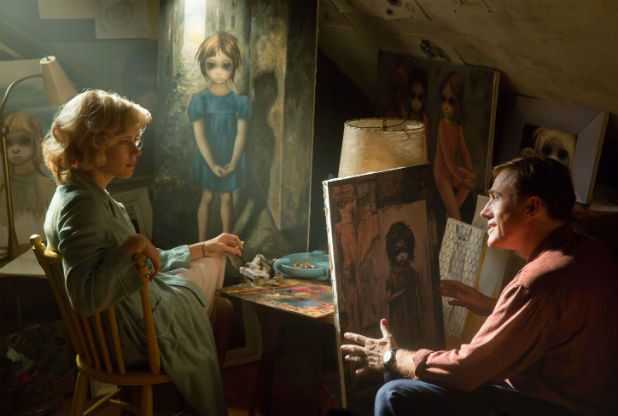
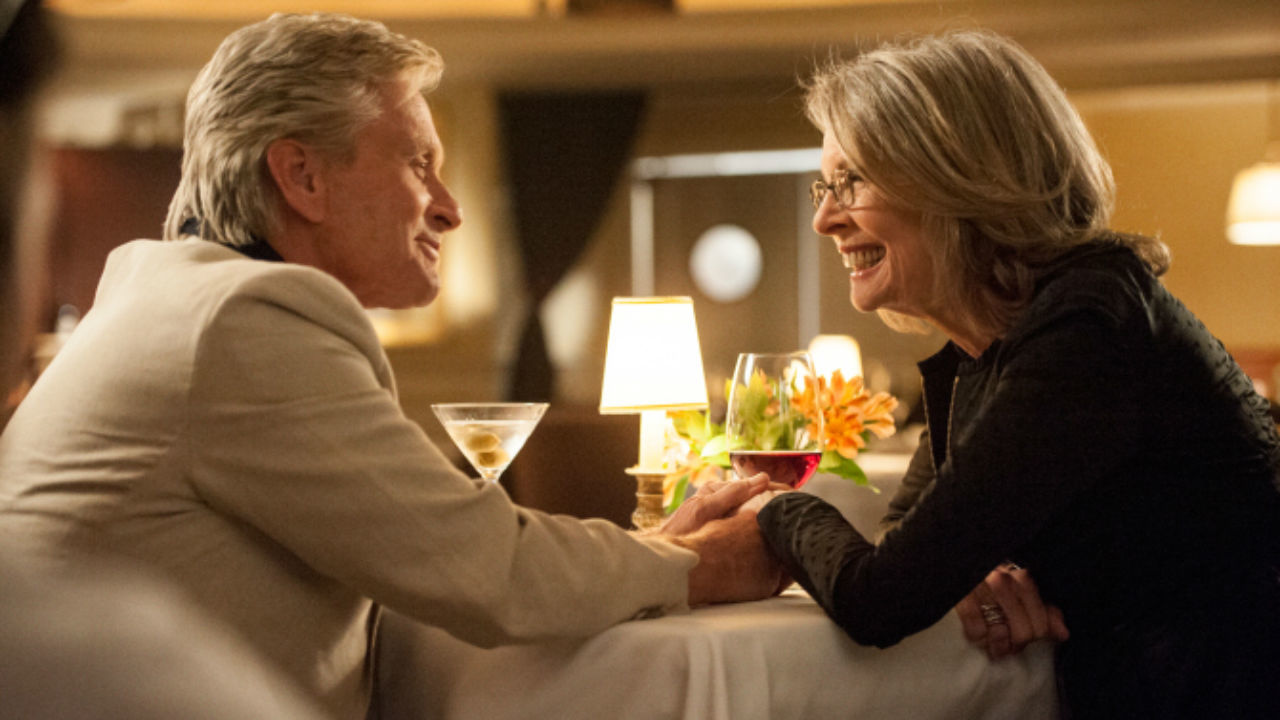
Big Eyes - scene

An odd combination of drama and low-key whimsy, Big Eyes takes the true story of Margaret and Walter Keane and their rapid rise to fame and fortune on the back of her talent for painting and his talent for promotion, and makes it a largely enjoyable – if occasionally unbelievable – tale of manipulation and deceit. Making his most straightforward movie yet, Burton dials back on his usual fantastical approach – except for one fantasy sequence set in a supermarket – and allows the script by Scott Alexander and Larry Karaszewski to unfold at a deliberately sedate pace that keeps the audience involved but proves repetitive in terms of how often Walter intimidates or bullies Margaret into continuing to paint her waifs.

It’s a problem the movie never properly overcomes. Margaret acts as an accomplice for too long for it to be credible, and if it wasn’t for the fact that this is a true story, her reticence and complicity would appear too unlikely for comfort. As it is, the script focuses instead on Walter’s gift for self-betterment, and shows just how easy it was for him to popularise Margaret’s work. Trapped in a relationship that she feels there’s no way out from, it’s not until she discovers that Walter can’t paint at all that she begins to find her footing, and her empowerment drives the movie’s last half hour.

It also leads to one of the most bizarrely staged court cases in movie history. It’s at this point that Burton loses control of Waltz’s performance, and the movie goes all out to provide as farcical a conclusion as you’re likely to see all year (or any other). Up til now Waltz has mugged and grinned his way through the movie in an effort to showcase Walter’s charm and public good nature. But it’s so off-putting the viewer becomes glad when he’s not on screen. It also makes the viewer wonder if anyone was ever paying attention to Waltz’s interpretation, so completely off the wall is it. Next to him, Adams opts for pained disappointment and resigned looks, and imbues Margaret with a vagueness of character that she never fully shrugs off or replaces.

The script for Big Eyes tries its best to make Margaret’s art more relevant than it actually is – only art critic John Canaday (Stamp) is allowed to offer a voice of reason – but this is about one woman’s decision to be recognised and not kept in the shadows by her domineering husband. As a result, some scenes lack focus, while others seem included as padding rather than as a way to bolster the narrative. Burton directs as if he hasn’t quite connected with the material (which is strange as he commissioned the real Margaret Keane to paint a portrait of his ex-wife Lisa Marie), and while the movie is boosted by some beautifully framed and lit camerawork by Bruno Delbonnel, it’s effectiveness is undercut by some choppy editing and a score by Danny Elfman that doesn’t quite enhance the drama.

Rating: 6/10 – a mixed bag of a movie with a memorable performance (for all the wrong reasons) by Waltz, Big Eyes takes a true story and downplays the seriousness of what was, basically, a massive fraud perpetrated on the American public; drily humorous in part, but also dramatically undercooked, this unusual tale would probably have worked better as a documentary.

The White Haired Witch of Lunar Kingdom (2014)

Tags

, , , , , , , , , , , , ,

White Haired Witch of Lunar Kingdom, The

Original title: Báifà mónǚ zhuàn zhī míngyuè tiānguó

D: Jacob Cheung Chi-Leung / 104m

Cast: Fan Bingbing, Huang Xiaoming, Vincent Zhao, Wang Xuebing, Ni Dahong, Tong Yao, Shera Lee, Cecilia Yip, Yan Yikuan

China, 1620. The Ming dynasty is drawing to a close and corruption is rife in the Imperial Palace. Zhuo Yihang (Xiaoming) is appointed leader of the Wudang clan and travels to the Imperial Palace to pay tribute to the Emperor and present him with two red pills as a sign of his fealty. On his way, he discovers a cave where he encounters a mysterious young woman without a name (Bingbing). He tells her that when next they meet he will have a name for her. At the same time, the Chuan-Shan army, led by General Jin (Zhao) are busy suppressing the peasants, most of whom are starving. When the Emperor dies, supposedly poisoned by the red pills, his heir is too young to rule, leaving his chief advisor, Wei Zhongxian (Dahong) in control.

Following the new Emperor’s coronation, a team of specially trained soldiers called the Secret Squad are sent to capture a notorious bandit called Jade Raksasha (Bingbing) who, with her gang, is based at a hilltop fortress called Fort Luna. The fortress is also the target of Huang Taiji (Yikuan) who knows its strategic importance; he needs to capture it before he can march on the Palace. At Chuan-Shan the Governor discovers that several dozen of his people have died from typhoid. Jade and her sister, Coral (Lee) attack the Governor (who also happens to be Yihang’s grandfather) and warn him not to continuing oppressing his people, but in the meleé, Jin takes adsvnatage of the situation and kills him, blaming it on Jade. Coral is captured though Jade rescues her with the help of Yihang. At Fort Luna, the typhoid takes hold but Yihang finds a cure. He also realises that Jade is the young woman he met in the cave;  true to his word he gives her a name: Lian Nishang (Silk Fairy).

With the aid of three masters from the Wudang clan, the Secret Squad infiltrate Fort Luna and demand Yihang returns with them to face charges of poisoning the previous Emperor. To avoid unnecessary bloodshed he agrees but not before he’s promised Lian that he’ll return one day, and that she need have no fear because she is his woman. At the Palace, Yihang is persuaded to help Zhongxian by taking the head of a rebel leader to his army as an example of what will happen if they side with Jin. The Wudang masters are outraged and refuse to acknowledge him any more. Word reaches Lian of what Yihang is doing, and that when he returns to the Palace he is to marry Zhongxian’s daughter Tingting (Yao). She goes to the Palace and confronts him but Yihang rebuffs her. The Palace guards try to capture her while she deals with the shock of Yihang’s betrayal and her hair turns white, but Tingting intervenes and she and Yihang are allowed to leave.

When they return to Fort Luna, Lian’s illness is such that she needs a special remedy from the Infernal Cave; Yihang makes the attempt to get it. He proves successful, but with Huang Taiji’s army fast approaching, a deal is made with General Jin’s forces, without anyone realising that Jin has already made a deal with Taiji and is set to betray them.

vlcsnap-00002

The fourth big screen adaptation for Liang Yusheng’s wuxia novel, Baifa Monü Zhuan – the previous three are Story of the White-haired Demon Girl (1959), White Hair Devil Lady (1980), and The Bride With White Hair (1993) – The White Haired Witch of Lunar Kingdom is a flat, mostly perfunctory retelling of the classic story, and a movie that struggles to make its central romance as compelling as it should be. Partly, the problem is that Bingbing and Xiaoming, while obviously a lovely couple, lack the kind of chemistry that would make their characters’ passion for each other so believable. As it is, they circle round each other like predators rather than ardent lovers, and their initial meeting in the cave appears redundant when placed next to Lian’s usual daily routine of rescuing abused peasants and beating up Chuan-Shan soldiers.

The convoluted politics of the time are another barrier to the average viewer’s enjoyment of the movie, with alliances and political bartering leading to various changes of allegiance and casually arranged alliances. It’s not a complicated set up, but it does feel forced at times, as if the makers felt they needed to add several twists and turns to keep things fresh (Yihang’s betrothal to Tingting is one such “twist”, and one that makes no sense at all). The fact that five screenwriters worked on the script isn’t exactly a good sign, and once the basic premise is set up, the movie’s middle section slows things down interminably as all the various elements are either sidelined in favour of the aforementioned underwhelming romance or are played out at a pace that promotes an unfortunate ennui in the viewer.

With the plot and storylines proving so dreary and lacklustre, Chi-Leung is unable to boost things to a level where continued interest is guaranteed, or the performances rise above the bland or uninspired level they operate at throughout. Bingbing and Xiaoming’s lack of chemistry aside, they deliver portrayals that lack consistency and depth, while Zhao as the villainous Jin is more of a double-dealing bureaucrat than a brutal general, and can’t even manage a decent condescending sneer when needed. Of the rest of the cast, perhaps the best performance comes from Yao as Tingting; she plays the part with just the right combination of apparent fragility and heartbreaking misfortune.

As for the action scenes they’re effectively choreographed, but rely too much on CGI and old-fashioned wire work to be truly spectacular. Some Western viewers may be upset by the treatment that a number of horses are subjected to in these scenes, and there are moments where the movie is unexpectedly gory (though there’s nothing that’s too disturbing). With the usual amount of panoramic vistas and sweeping camerawork mixed in with appropriately dust-blown peasant holdings, the look of the movie benefits from Lin Guohua’s often exquisite photography, and the overall recreation of 17th Century China is one of the few areas where the movie, thankfully, gets it right.

Rating: 5/10 – irritating and humdrum, The White Haired Witch of Lunar Kingdom is a movie where only “just enough” is done to keep the audience interested; somewhere between well-mounted and tedious, it aims for epic but achieves only a fraction of that, and never feels like it’s going to amount to much more than being an also-ran in the history of wuxia movies.

Whiplash (2014)

Tags

, , , , , , , , , , , , ,

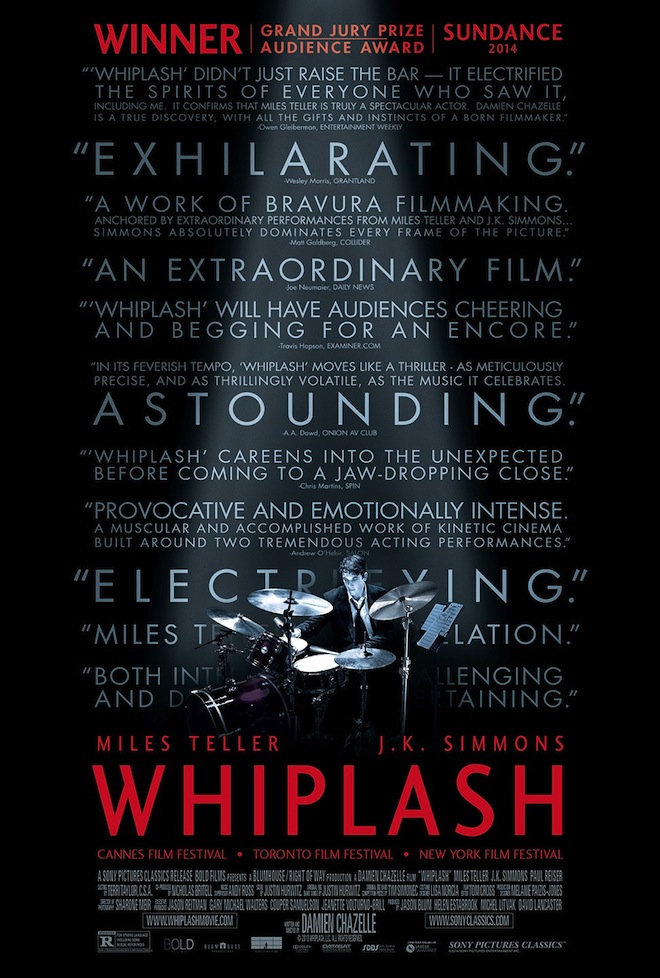
Whiplash

D: Damien Chazelle / 107m

Cast: Miles Teller, J.K. Simmons, Paul Reiser, Melissa Benoist, Austin Stowell, Nate Long, Chris Mulkey, Damon Gupton, Suanne Smoke

At the prestigious Shaffer Conservatory of Music, nineteen year old Andrew Neiman (Teller) is an aspiring jazz drummer who wants to be the best in the world, as good if not better than Buddy Rich, his idol. He attracts the attention of tyrannical conductor Terence Fletcher (Simmons) who is looking for a drum alternate for his band. At a concert where the band is performing, the core drummer loses his sheet music and is unable to play the next piece from memory. Andrew steps in and, to his mind, becomes the new core drummer as a result.

Andrew subsequently begins a relationship with Nicole (Benoist), but after a handful of dates he takes the view that their relationship won’t work because he has to dedicate all his time to perfecting his drumming, and she will eventually become resentful of this. He tells her this quite bluntly and they break up. Meanwhile, much to Andrew’s surprise, Fletcher replaces him with another drummer, Ryan (Stowell). A few days later, Fletcher becomes emotional in class when referring to an old pupil of his who has passed away. This display of emotion is unexpected, but Fletcher soon reverts to his usual aggressive ways when he introduces a new piece and neither Andrew, Ryan or the original band drummer can maintain the right tempo. Eventually, Andrew gets it right and retains his role as core drummer ahead of an upcoming concert.

On the day of the concert, Andrew is late to the rehearsal because his bus breaks down and he has to hire a rental car to get him there. He’s also left his drumsticks at the rental office; he retrieves them but on his way back his car is hit by a truck. Despite suffering a head injury and a broken left hand, he makes it to the concert in time to take part but is unable to play properly. Fletcher calls a halt and tells Andrew he’s done. In a fit of rage, Andrew attacks him in full view of everyone there.

A few weeks pass. Andrew has been expelled. He learns that the pupil who passed away actually killed himself, and his family are blaming Fletcher, saying that his abusive behaviour caused their son’s depression and subsequent suicide. Andrew agrees to anonymously testify for them and Fletcher is dismissed. Months later, Andrew runs into Fletcher at a bar. Fletcher explains his reasons for behaving the way he did and says it was because he wanted to help his students be the best. Before they part, Fletcher invites Andrew to sit in for the drummer in his band at a festival concert. Andrew agrees, but just before the concert begins and with Andrew sitting behind his drum kit, Fletcher tells him he knows Andrew testified, and Andrew realises the first song is one he doesn’t know and doesn’t have the sheet music for.

tn_gnp_et_1011_whiplash

Based on writer/director Chazelle’s own experiences in high school, Whiplash paints a compelling portrait of intense dedication and monstrous manipulation. It’s an elemental battle of wills, with neither Andrew nor Fletcher giving any quarter, nor expecting any. The irony of it all is that both characters are as “bad” in their own way as each other: arrogant, overly self-confident, uncompromising, narcissistic, unfeeling, and committed to pushing each other as far as they can. It’s a dance, one with domination as the ultimate achievement, and they spar and fight with undisguised aggression. (If this is what band practice is really like, then best take a stab jacket and helmet.)

If Andrew learns to behave like Fletcher then the potential has been there all along, and rather than retain a spark of humanity against the onslaught of Fletcher’s callous teaching methods, by the time of the second concert he’s become an even darker version of Fletcher, dismissive of his rivals’ talents and so arrogant that he believes no one else can match him. It’s all credit to Chazelle that at this point in the movie it’s Andrew who’s clearly the monster, and not Fletcher (the clues have been there from the beginning, from the way he treats his family and Nicole). Pulling such a switch is an audacious move on Chazelle’s part but it works magnificently; instead of being appalled at Fletcher’s angry reaction to Andrew’s being late, the viewer is appalled by the degree of Andrew’s arrogance.

From there, however, the movie has a problem it never really recovers from. With both men removed from the confines of the conservatory the movie bleeds tension with every passing minute, and the urgency and drama of the first hour are replaced with a less involving period where Andrew tries to move on with his life before he and Fletcher meet up again. Then it’s on to the crowd-pleasing finale that we’ve all been waiting for (and it is well worth the wait). Chazelle redeems himself here and with editor Tom Cross, assembles one of the most exciting and breathtaking musical sequences ever committed to film.

Much has already been made of the performances, and justly so. Teller displays a maturity and confidence that removes any idea that he’s only good for rom-coms, and nails the various turbulent emotions that Andrew experiences in his efforts to be the best. It’s a breakthrough performance, riveting and compelling, and Teller is nothing short of brilliant. The same is true of Simmons, making Fletcher repellent and vicious and uncaring and horrible, and sounding like the long-lost cousin of Gunnery Sergeant Hartman in Full Metal Jacket (1987). It’s a mesmerising performance, and Simmons inhabits the role with a reptilian intensity that is both shocking and dismayingly funny (“I can still fucking see you, Mini-Me!”). Both actors are at the top of their game, and Chazelle capitalises on their efforts to the full, knowing just when to keep the camera on either one of them, and showing a judicious use of close-ups.

The musical scenes are shot with a close attention to the physical detail of the performances, with each cymbal crash or high note or trombone thrust highlighted by the editing, making each song a visual experience as well as an aural one. Sharone Meir’s detail-rich photography is almost a character by itself, and captures every bead of sweat and drop of blood that Andrew loses. But in a movie where the music is such an integral part of the story and plot, it’s the two compositions, “Whiplash” by Hank Levy, and “Caravan” by Juan Tizol, that stand out, two perfect choices to show how much Teller achieved through practicing four hours a day for two months, and which are fantastic compositions all by themselves.

Rating: 8/10 – with both Andrew and Fletcher removed from the conservatory, Whiplash grinds to an unexpected halt and takes too long to recover (but when it does it’s as impressive as in its first hour); with two stunning central performances, and a visceral ferocity to the drumming sequences, this is a powerful, gripping movie that plays like a sports movie and displays just as much unfettered testosterone (and that’s a good thing).

The Whip and the Flesh (1963)

Tags

, , , , , , , , , , , ,

Whip and the Flesh, The

Original title: La frusta e il corpo

aka: Night Is the Phantom; What; The Whip and the Body

D: Mario Bava / 91m

Cast: Daliah Lavi, Christopher Lee, Tony Kendall, Ida Galli, Harriet Medin, Gustavo De Nardo, Luciano Pigozzi

Returning home after a period away due to his involvement in the death of a servant girl, Kurt Menliff (Lee) receives a less than warm welcome from his father, Count Menliff (De Nardo), his younger brother Cristiano (Kendall) and his wife Nevenka (Dali), nor from their servant Giorgia (Medin) whose daughter, Tania, was the servant girl who died. Despite this, Kurt intends to reclaim his title, as well as to rekindle the sadomasochistic relationship he had with Nevenka (they were originally to be married before the scandal with the servant girl forced Kurt to leave). One evening, while Nevenka takes a stroll on the beach, Kurt intercepts her. He whips her as a prelude to sex; afterwards, Nevenka realises she is still in love with him. When she doesn’t return from her walk on the beach, Cristiano instigates a search for her and she is found on the beach, but unconscious. Meanwhile, Kurt has returned to the castle unaware of what’s happening, but while in his room, is killed with the same dagger that Tania committed suicide with.

Following Kurt’s death, Nevenka begins to have visions of him. He visits her in her room and once more flogs her. She becomes ever more fearful, and ever more convinced that he’s alive. Then, the Count is found dead, killed by the same weapon as Kurt and Tania. Nevenka tells Cristiano that Kurt has come back from the dead and is seeking revenge on all of them. With the appearance of muddy footprints leading from Kurt’s tomb to inside the castle, and Nevenka’s increasingly unstable behaviour, the possibility that Kurt has returned from the grave becomes more certain, until Cristiano determines to open Kurt’s coffin.

Whip and the Flesh, The - scene

One of Bava’s most effective movies, The Whip and the Flesh has bags of atmosphere, a deceptively simple plot, great performances from all concerned (bearing in mind the melodrama inherent in the story), and a visual style that makes great use of half light and shadows. It’s also a deliberately paced movie that allows the horror to build to a crescendo, giving Bava the opportunity to create a fever dream that’s both delirious and oppressive.

Locating the action in and around a lonely castle on a cliff next to the sea, the script – by Ernesto Gastaldi, Ugo Guerra and Luciano Martino – adds a sense of isolation to proceedings that in turn makes each development in the story that much more forbidding and grim. It’s as if the characters were all trapped, doomed in a way to remain there until their fate is decided. Kurt’s death, so surprising both for how soon it occurs and because he’s played by Lee, the second lead, is unsettling because there is no human involvement in it (at least none that the audience sees). And even though his death is attributed to another character at the end, it makes better sense that this is another example of revenge from beyond the grave, and that Tania’s ghost is responsible. Unfortunately, the script doesn’t take this approach, but with Kurt’s death the movie does become a potent mix of ghost story, whodunnit and psychosexual drama.

Making Nevenka the focus of each strange event that follows gives Bava the chance to indulge in some creepy set pieces, such as Kurt’s first visit to Nevenka’s bedroom, a chilling, drawn out sequence that combines the sound of approaching footsteps, the ominous turn of a door handle, and the sight of muddy boots appearing out of the shadows. It’s a sequence that’s so moodily effective that it has the effect of putting the viewer on the edge of their seat, and just as anxious as Nevenka to see what’s going to happen next. What we see next is perhaps the movie’s most horrifying moment of all, as Kurt’s ghost stands by her bed, his figure in silhouette for a second or two before revealing he has a whip. On the page it may not sound so frightening, but in the movie it’s shocking, as much for the effect of seeing the whip revealed, but also for the implications that come with it. Just that sequence alone is a masterpiece of direction and editing.

With Bava so firmly in control of the material, it gives him the opportunity to coax some better than average performances from his cast. Lavi, an actress employed usually for her decorative appeal rather than her acting ability, here makes an indelible impression as a woman whose masochistic tendencies lead to fear and paranoia, and self-induced erotic imaginings. It’s a performance that’s more controlled than it appears, and anchors the movie to great effect. As the cold and sadistic Kurt, Lee imparts more in a look than some actors can convey in a five-minute monologue. Always an imposing presence, he commands attention in every scene he’s in, and though his appearance diminishes as the movie progresses, he leaves an indelible mark on the movie that adds to the cloying atmosphere of the movie’s final third (it’s sad that his lines, even in English, were dubbed by another actor). Kendall, making only his second movie, downplays the usual melodramatic heroics expected of his role, and makes Cristiano as wretched in his own way as all the other characters. And as his true love, Katia, Galli is not as vapid or as wishy-washy as virtuous love interests often prove to be, but makes the character sympathetic without being tiresome.

There are some flaws, though, with certain scenes feeling truncated or not fully developed. One such scene involves the discovery of the dagger in Katia’s room by Giorgia; it could have been a tense, dramatic moment that introduced an element of doubt about the character, but it’s over before it can go anywhere. And it’s never explained as to why the dagger is kept in a glass cage with Tania’s blood still on the blade. But these are minor caveats in a movie that makes great use of its castle setting, with its rooms and corridors proiving wonderfully creepy in the way that only old castles can be, and supported by a lush, romantic score courtesy of Carlo Rustichelli that shouldn’t complement the action but in a strange way, is entirely appropriate.

Rating: 8/10 – for many, Bava is a director who can do no wrong, and on this evidence they’re absolutely right; tense, unnerving and making no apologies in its depiction of what would have been ascribed as aberrant behaviour, The Whip and the Flesh is a stylish horror that remains as effective now as it was over fifty years ago.

Two Night Stand (2014)

Tags

, , , , , , , , , , ,

Two Night Stand

D: Max Nichols / 86m

Cast: Analeigh Tipton, Miles Teller, Jessica Szohr, Scott Mescudi, Leven Rambin

Megan (Tipton) is unemployed, single, and getting on her roommate’s nerves. She prevaricates over getting a job, and won’t go out and meet new people, preferring to stay in the flat and waste her time. Pushed to do something different she signs up to a dating website but doesn’t arrange to meet anyone. One night she’s finally convinced by Faiza (Szohr), her roommate, to come out with her and her boyfriend, Cedric (Mescudi). But the evening backfires when she sees her ex-boyfriend with his new partner. Upset and angry, she goes home and decides to “get her own back” by meeting one of the men on the dating website. She chooses Alec (Teller) and goes to his apartment where they have a one night stand.

The next morning, a few wrong words leads to an argument and Megan leaving the apartment – but not the building; overnight a blizzard has deposited three feet of snow against the door of the building, and Megan can’t get out. With little choice but to return to Alec’s apartment they slowly, but with some effort, begin to make the best of a bad situation, and get to know each other a bit better. They discuss their views on relationships, and sex, and decide to be brutally honest with each other about how they were during their one night stand. Over the next day, their relationship improves but stalls when Megan finds a closet full of women’s clothes and learns that Alec has a girlfriend, Daisy (Rambin). Alec explains that Daisy is away but the reason Megan is there is that he found a break-up note Daisy had written but not given him. To get back at her, he joined the dating website. Angry, and with the snow having abated enough, Megan leaves.

When Daisy returns home, she finds a note that Megan had written, while he reveals her note to him, and they split up. Later, on New Year’s Eve, Megan is arrested at a party for breaking and entering; while she and Alec were together they broke into his neighbour’s apartment to find a toilet plunger. Alec has planted Megan’s note there in a bizarre attempt at getting back in touch with her as he can’t stop thinking about her, but when he tries to bail her out she refuses to budge. It’s only when Faiza does that she is released, but Alec isn’t giving up…

Two Night Stand - scene

As an attempt to do something slightly different with the rom-com format, Two Night Stand is an awkward mix of the refreshing and the inevitable, as it plays around with an established formula to sometimes winning, but equally distracting effect. Playing Russian roulette with the concept of honesty in a relationship, the movie tries to show that while it’s a wonderful idea in principle, in practice it’s prone to so many pitfalls you might as well not bother.

In rom-coms we’re used to seeing characters hold back on their feelings, or mistrust their partner’s motives, or skirt uncomfortably around the heart of a particular matter, and Two Night Stand does its best to waive all that aside and focus on two people who try to be open and honest from the start rather than finding out the truth about each other much later on. It’s a neat spin on the traditional idea that new partners set out to impress each other at the beginning and present the best version of themselves (only to relax into their usual personalities when the relationship is established). Of course, that kind of grandstanding is essentially unavoidable, and both Megan and Alec still try to impress each other, fanning that spark of attraction that has brought them together in the first place. They’re a match for each other – not that they realise this so much, though – but they have to endure some trials and tribulations before they work this out (and as usual one of them has to be persuaded by the other). It’s standard fare, pleasingly done, but nothing we haven’t seen a thousand times before.

The performances are above average, with Tipton shrugging off her supporting actress mantle and grabbing a lead role with gusto. She’s a gauche, intuitive presence on screen, gangly but with her own peculiar physical grace, and she makes Megan an appealing person to spend time with, insecure, clumsy, self-reliant despite any apparent real experience of life, and despite her reluctance to commit to romance after breaking up with her ex. As she navigates the troubled waters of internet dating, and the Alec’s murkier motives for doing so as well, Tipton maintains an honesty that befits the character and makes her entirely credible. Teller keeps it real as well, investing Alec with a self-protective, evasive veneer that is at first off-putting, but which becomes entirely understandable once Daisy’s note is revealed. He portrays Alec like a man caught between doing what’s right and what’s wrong, and not caring either way. It’s a winning performance, light-hearted when it needs to be, earnest at other times, but always carefully balanced so that Alec’s never too obnoxious or too offhand.

Good as their performances are though, neither Tipton nor Teller can compensate for the narrative version of jumping through hoops that the movie indulges in in its final third. It’s almost as if the script – by Mark Hammer – doesn’t really know what to do with Megan and Alec once she leaves his building, and the manner in which they’re reunited is so contrived as to be incredible. Not even Nichols, making his feature debut, can compensate for the straight up absurdity of the situation, and the result is a movie that goes from mostly entertaining to full-on bizarre in a matter of minutes. Bereft of an organic conclusion, Two Night Stand trusts to the standard emotional outpouring by one of the characters, and the equally standard (blanket) acceptance of same by the recipient. Trust and early love are resumed, and everyone lives happily ever after… probably.

Rating: 6/10 – bright and breezy, with some tellingl insights into modern relationships peppered throughout its first hour, Two Night Stand benefits from two sterling performances and a largely theatrical presentation; heartfelt and amusing for the most part (if not entirely original), the movie runs aground in the final third and never recovers.

John Wick (2014)

Tags

, , , , , , , , , , , , ,

John Wick

D: Chad Stahelski, David Leitch / 101m

Cast: Keanu Reeves, Michael Nyqvist, Alfie Allen, Willem Dafoe, Dean Winters, Adrianne Palicki, Toby Leonard Moore, Daniel Bernhardt, Omer Barnea, Lance Reddick, Ian McShane, John Leguizamo, Bridget Moynahan

Having lost his wife, Helen (Moynahan), to an unexpected illness, retired assassin John Wick (Reeves) receives a posthumous gift from her: a puppy called Daisy. They begin to bond, and Wick takes her with him when he travels anywhere. At a gas station one day, Wick encounters a trio of Russian gang members; their leader, Iosef (Allen) asks to buy his car but Wick rebuffs him. Later that night, the trio break into Wick’s home, beat him up, kill Daisy, and make off with his car. While he recovers, Iosef takes the car to a chop shop run by Aurelio (Leguizamo) but he refuses to have anything to do with Iosef or the car. Wick visits Aurelio and learns that Iosef is the son of his former boss, Viggo Tarasov (Nyqvist). When Viggo finds out what his son has done, he’s less than happy; he tells Iosef that Wick was the best hitman in the business, not the boogeyman, but the man you sent to kill the boogeyman.

Viggo attempts to placate Wick but has no luck. He sends a hit squad to kill Wick at his home but Wick despatches them all. Viggo then puts out an open contract for $2 million on Wick, and approaches Marcus (Dafoe), Wick’s mentor, directly; Marcus agrees to take the job. Meanwhile, Wick checks in to the Continental, a hotel run by Winston (McShane) that caters to assassins. Wick learns that Iosef is being protected at a nightclub called Red Circle. He goes there but is stopped from killing Iosef by the intervention of Viggo’s enforcer Kirill (Bernhardt). Wounded, he returns to the hotel where he is attacked by fellow assassin Ms Perkins (Palicki). Overpowering her, he forces her to tell him where Viggo keeps both his private papers and the bulk of his personal cash.

The papers and cash are in a church vault; Wick burns it all. When Viggo arrives, Wick ambushes him and his men, but Kirill uses an SUV to knock Wick unconscious. Taken to an abandoned warehouse and tied up, Viggo remonstrates with Wick over his idea that he could ever lead a normal life. He leaves Wick to be killed by Kirill, but things don’t turn out as he expects.

John Wick - scene

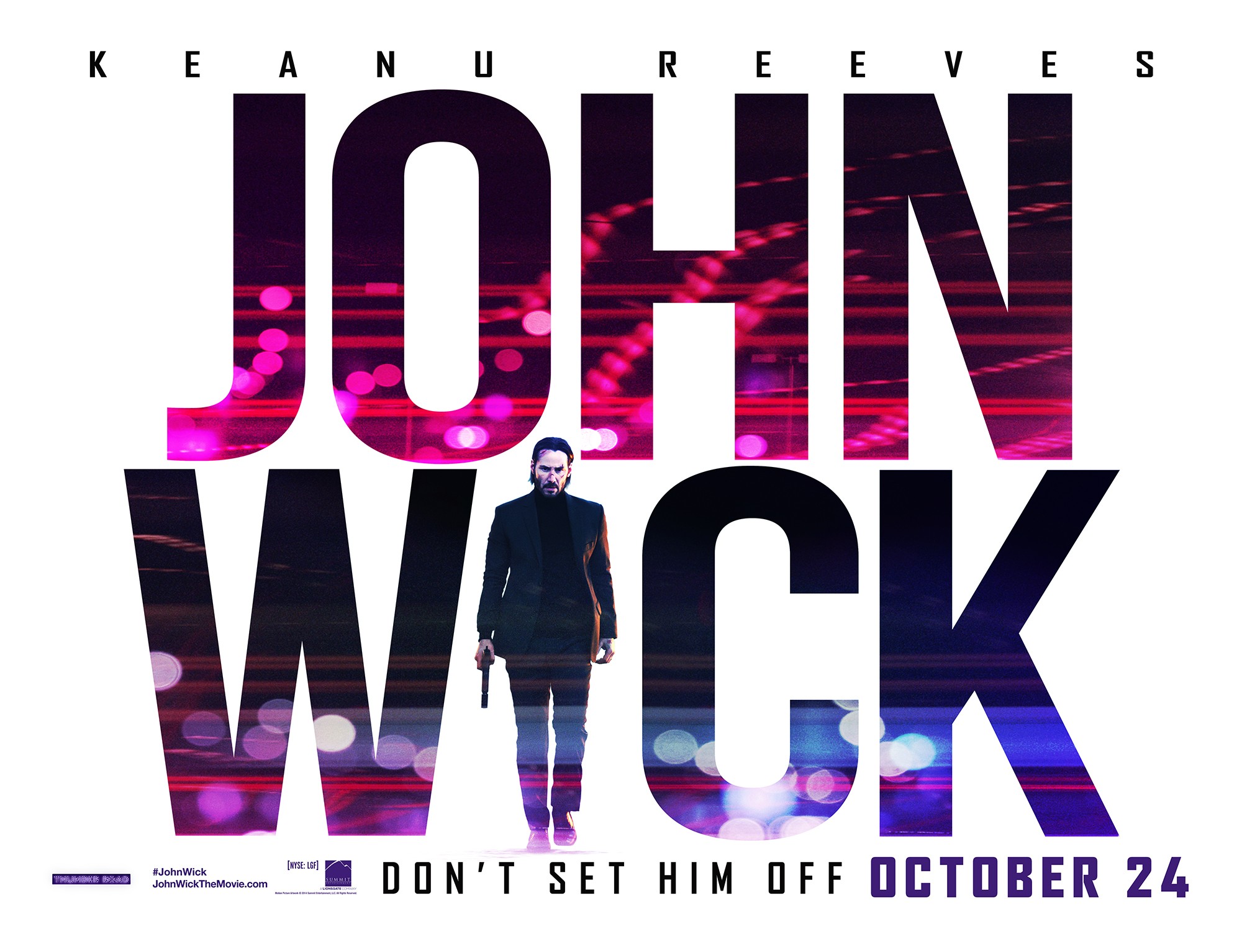
A revenge movie with a distinctive visual style, John Wick is a huge breath of fresh air in a genre that often feels stodgy and underwhelming, and which often relies on rapid cross-cutting and headache-inducing editing tricks to give energy to its action scenes. This definitely isn’t the case here, with directors Stahelski and Leitch’s background as stunt coordinators bringing an impressive edge to the fight sequences, as they bring a whole new meaning to the phrase “gun-fu”.

Even more impressive than the action is the world created by the directors and writer Derek Kolstad. It’s at such a remove from our own world that it seems to operate independently, with its own rules and hierarchies. The Continental is a case in point, an establishment that allows no “business” on its premises, and inflicts the severest of penalties if that rule is ignored. It’s a world where respect and a person’s reputation carry as much caché as money, and where John Wick has the most respect of anyone. It’s also a world that appears bleached of positive feeling, where people hide behind polite, expressionless façades but are quick to display fear, anger and mistrust. And it’s a criminal underworld that mixes old-fashioned codes of conduct with a modern disregard for them when necessary. Against this, Wick acts like an old time vigilante, dismantling Viggo’s business and men with grim determination and no shortage of inner rage. And even though he’s not as invulnerable as he once was, he’s still the ne plus ultra of assassins.

With the world he inhabits so clearly defined, Wick strides through it like a colossus, giving Reeves his most commanding role for years. After non-starters Generation Um… (2012), Man of Tai Chi (2013) and 47 Ronin (2013), it’s good to see Reeves back on form, playing Wick with a taciturn, single-minded demeanour that suits him perfectly as an actor. His brief scenes with Moynahan also show convincingly the other John Wick, the loving husband and all-round “normal” guy. It’s a great performance, and one that’s given more than adequate support by the likes of Nyqvist, Dafoe and Palicki, all relishing their roles and the wonderfully expressive dialogue Kolstad has provided them with. The cast are obviously having a great time with the material, and it’s not surprising that this helps boost the audience’s enjoyment as a result. The interplay between Wick and Viggo is particularly effective, operating on several levels at once, and imparting more emotion than would normally be expected.

As for the action scenes these are tremendously shot and edited, full of fluid tracking shots, and with Reeves in the thick of it all, punching, kicking and blasting away with vicious, yet detached intent, and shooting more people in the head than probably any other hitman in movie history. One extended sequence, at the Red Circle nightclub, is as inventive and as thrilling as any action sequence in recent memory. Using their experience as stunt co-ordinators, Stahelski and Leitch (who thanks to the Directors Guild of America isn’t credited on the movie), keep the fight scenes breathtaking and immersive, and there’s not one moment during any of them where the viewer isn’t fully aware of what’s happening and who’s doing what to whom (something that Taken 3, for example, avoids doing throughout its disheartening running time).

In keeping with the overall mise en scene, the production design by Dan Leigh helps to reinforce the idea of a separate world where all this takes place, and is gloriously lensed by Jonathan Sela. The action is complemented by a pulsing, propulsive score by Tyler Bates and Joel J. Richard, and at times feels like it could be another of Wick’s opponents.

Rating: 8/10 – a modern day noir thriller that doesn’t pull its punches and has an emotional core that resonates throughout, John Wick is a wonderful surprise; with not an ounce of fat on it, and one of the tightest scripts of recent years, this is an action movie that constantly surprises and rewards in equal measure.

Night at the Museum: Secret of the Tomb (2014)

Tags

, , , , , , , , , , , , , ,

Night at the Museum Secret of the Tomb

D: Shawn Levy / 98m

Cast: Ben Stiller, Robin Williams, Owen Wilson, Steve Coogan, Ricky Gervais, Dan Stevens, Rebel Wilson, Skyler Gisondo, Rami Malek, Patrick Gallagher, Mizuo Peck, Ben Kingsley, Dick Van Dyke, Mickey Rooney, Bill Cobbs

Egypt, 1938. A team of archaeologists discover the tomb of Akhmenrah (Malek). They also find a golden tablet, but are warned that “the end will come” if the tablet is removed.

New York, present day. The Museum of Natural History is having an evening gala. Night security guard Larry Daley (Stiller) has arranged for some of the exhibits, including Teddy Roosevelt (Williams), Attila the Hun (Gallagher), and Sacagawea (Peck), to take part. Aware that the golden tablet that brings them all to life is showing signs of corrosion, Larry is unprepared for how it affects the exhibits during the gala; they run amok and the event is a disaster. Larry learns that the prophecy, that “the end will come”, means an end to the magic that brings the exhibits to life, and that the only way to stop it is to take the tablet to the British Museum in London. The museum holds the bodies of Akhmenrah’s parents, and it’s his father, Merenkahre (Kingsley), who can stop the tablet from losing its magic.

Larry arranges for the tablet and Akhmenrah to be shipped to the British Museum and takes his son, Nick (Gisondo), along with him. When they reach the museum they find that Teddy, Attila and Sacagawea have stowed away on the journey, along with Dexter the monkey, Jedediah (Wilson), Octavius (Coogan), and Laa (Stiller), a neanderthal who looks like Larry. As the museum’s exhibits start to come to life, they head for the Egyptian exhibition, but find themselves attacked by the skeleton of a triceratops. Luckily, they’re saved by Sir Lancelot (Stevens) who agrees to help them. An encounter with a nine-headed Xiangliu statue provides some unwanted danger, but eventually they reach Akhmenrah’s parents, where Merenkahre reveals that the tablet needs to be exposed to moonlight to restore its powers. However, believing it to be the Holy Grail, Lancelot steals the tablet and flees the museum in search of Camelot. Larry et al chase after him, but the tablet is close to losing its power altogether.

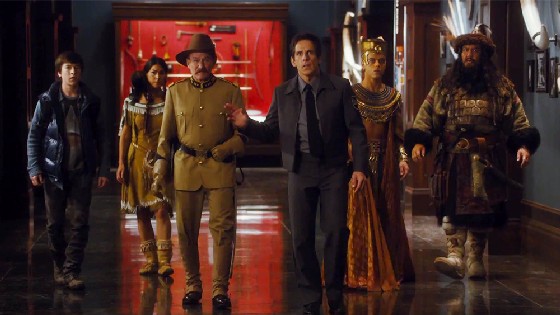
Night at the Museum Secret of the Tomb - scene

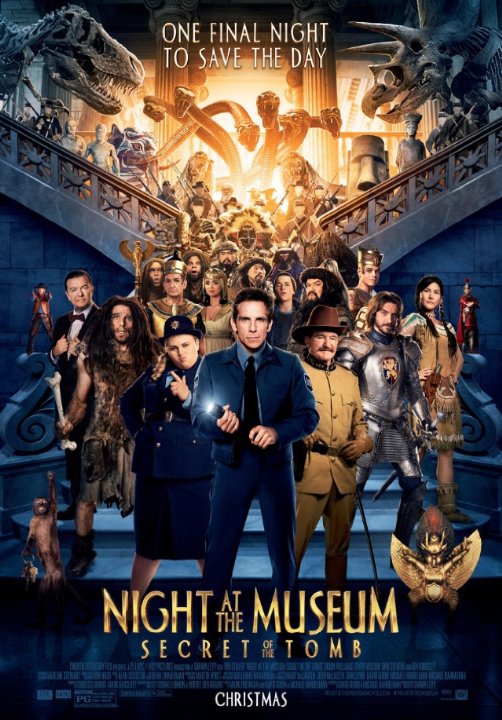
And so, the law of diminishing returns rears its predictable head and helps bury yet another fantasy franchise. While no one would say that the Night at the Museum movies are anything other than pleasantly diverting, what this second sequel lacks is the manic energy of the first two, and a script that makes the barest attempt at providing a credible storyline. Hardly any of it makes sense, from the idea that “the end will come” if the tablet is removed from the Akhmenrah family tomb in the first place, to the idea that Larry would take his son along with him to London (they’re having “issues”), to the conceit that the British Museum has only the one guard (who is stationed in a gatehouse and not inside the actual building), to the notion that Lancelot would mistake the tablet for the Holy Grail, to the judgment that everyone can get back to New York before the sun rises – from London… in the middle of the night… It’s like someone chucked a whole sticky mess of ideas at a wall and these were the ones that didn’t slip to the floor.

With the script having gone AWOL from the beginning, it’s left to director Shawn Levy to make the most of a bad set up, but for the most part he’s AWOL as well. The opening sequence in Egypt has a sub-Raiders of the Lost Ark feel that makes it the most interesting part of the movie, but it’s probably because it doesn’t take place inside a museum. Still, it has an intensity that’s missing from the rest of the movie, and Levy at least ensures a minimal sense of wonder at the tomb’s discovery. From then on it’s business as usual, with Gervais’ museum head acting all prissy, Coogan highlighting Octavius’s homosexual leanings, Dexter getting to urinate on someone (this time Jedediah and Octavius), Williams dispensing kind words and wisdom as if Roosevelt was the sagest exhibit of them all, the Easter Island head saying “dum-dum” as if that was still funny by itself, and a set of dinosaur bones that just want to play if given the right encouragement. It’s lazy with a capital L-A-Z-Y.

The same is true of the performances. It would be foolish to expect the cast of a second sequel to bring their ‘A’ game to things, but watching some of them going through the motions is not only dispiriting, but embarrassing as well. Stiller all but sleepwalks through his role as Larry, bringing not one new quirk or character trait to the table, and mugging for all he’s worth as Laa, the comedy neanderthal. In support it’s business as usual for all concerned, with Williams smiling from beneath his moustache at every opportunity, Gallagher playing Attila as a great big softie, Peck kept on the sidelines as Sacagawea, Wilson and Coogan reprising their “good buddy” relationship (and which sorely needs some antagonism added back into it), and Malek remaining as bland as ever. Even Crystal the Monkey is subdued this time around, as if even she can’t be bothered. Only Stevens rises above the paucity of the material, his preening, carefree Lancelot proving an unexpected treat. (As for Rebel Wilson’s in-all-ways frustrated security guard, well, the less said the better.)

A bittersweet farewell to Teddy Roosevelt aside – and would that even be true if it weren’t for the sad death of Robin Williams last year? – Night at the Museum: Secret of the Tomb scampers along like a young child wanting to be noticed but not really knowing how to go about it. Lacking in anything resembling a “wow” factor, even the special effects don’t have the same impact as before. But thanks to some splendid cinematography by Guillermo Navarro, the movie does look good, which is something at least.

Rating: 3/10 – poorly executed, and as devoid of life as the exhibits it animates, Night at the Museum: Secret of the Tomb is yet another unnecessary sequel that tries too hard to make up for its deficiencies; when the level of humour is to have an Egyptian pharaoh ask someone to “kiss my staff” then it’s time to let the golden tablet corrode for good.

Mini-Review: Taken 3 (2014)

Tags

, , , , , , , , , ,

Taken 3

D: Olivier Megaton / 109m

Cast: Liam Neeson, Forest Whitaker, Maggie Grace, Famke Janssen, Dougray Scott, Sam Spruell, Leland Orser, Jon Gries, David Warshofsky, Don Harvey, Dylan Bruno, Andrew Howard, Jonny Weston

When Bryan Mills (Neeson) receives a visit from his ex-wife Lenore, it’s because she wants to let him know she still has feelings for him, and that her marriage – to Stuart St John (Scott) – is on the rocks. Bryan tells her that they can’t be together while she’s still married. Stuart pays him visit as well and asks Bryan to stay away from Lenore while they try to sort out their marriage; Bryan tells him he will.

The next day, Lenore asks to meet Bryan at his place. When he gets there he finds she’s been murdered. The police arrive and try to arrest him but he escapes. He tells his daughter, Kim (Grace) what’s happened and vows to find Lenore’s killer. The police, led by Inspector Franck Dotzler (Whitaker), pursue Bryan while he tries to figure out the reason for Lenore’s death. He learns that Stuart has hired personal bodyguards and, fearing Kim is in danger from Lenore’s killer and Stuart is somehow involved, he abducts Stuart and learns that he owes a lot of money to a Russian gangster named Oleg Malankov (Spruell), and that Lenore’s death was probably to make Stuart pay up. With the help of his ex-CIA colleagues (Orser, Gries, Warshofsky), Bryan goes after Malankov, intending to kill him.

Taken 3 - scene

And so, the law of diminishing returns rears its predictable head and helps bury yet another action franchise. It shouldn’t really be a surprise, as this was a movie that wouldn’t have been made if 20th Century Fox hadn’t wanted it in the first place. With that decision made, and with Neeson unwilling to star unless no one was actually “taken”, you can see how the project was doomed from the start. As it is, no one could have been prepared for just how little effort was going to be put in by all concerned. From the lazy, credibility-free script by Luc Besson and Robert Mark Kamen, to the wayward, unfocused direction by Megaton, to the headache-inducing, rapid cross-cutting of the action scenes, to the (mobile) phoned-in performances from a cast that should know better.

Just how bad is it? Two examples: Lenore is killed by having her throat cut, but when Stuart has to identify her at the morgue she clearly has a scar where the cut should be. And despite being “trapped” in an underground car park full of police, Bryan escapes with ease by driving through them all and exiting the car park – which the police haven’t thought to cordon off or block. There are plenty of other moments where the unfortunate viewer will be shaking their head in disbelief, and plenty of other moments where they’ll be wondering if it can get any worse – the answer is yes, it can.

Rating: 3/10 – a sad conclusion to an otherwise entertaining if always far-fetched action franchise, Taken 3 is a spectacular misfire that often defies explanation; if there is to be a fourth movie – and Neeson appears to be keen on the idea – then maybe the tag line will be It Really Does End Here… Probably.

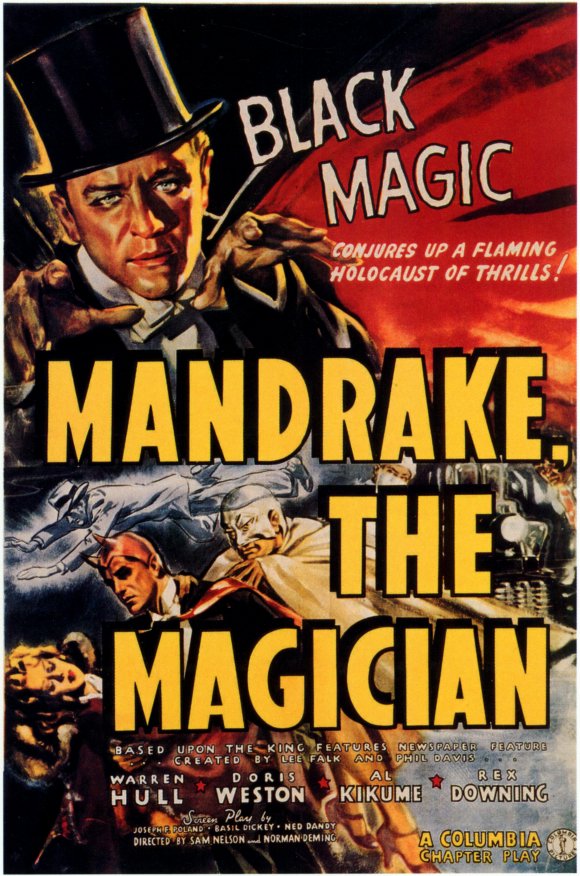
Mandrake, the Magician (1939) – Chapter 2: Trap of the Wasp

Tags

, , , , , , , , , , , , , , , ,

Mandrake, the Magician

D: Sam Nelson, Norman Deming / 20m

Cast: Warren Hull, Doris Weston, Al Kikume, Rex Downing, Edward Earle, Forbes Murray, Kenneth MacDonald, Don Beddoe

Fighting one of the Wasp’s henchmen at the home of Professor Houston, Mandrake narrowly escapes death when the radium machine ignites a hydrogen tank. As he recovers, the henchman makes off with the radium machine. He and Lothar go after them in their car but it breaks down, sabotaged by the Wasp’s men using part of a magician’s trick. Mandrake has the sale of such an item traced – by his friend Frank Raymond (Beddoe) – to an Egyptian-looking man, and learns his address. But the Wasp is aware of Mandrake’s progress and sets a trap for him.

At the Egyptian man’s home, Mandrake is ambushed but manages to escape using a tear gas bomb. The Wasp’s gang, knowing he’ll be heading back to the home of Professor Houston, try to listen in using the radio transmitter they’ve hidden there, but it’s not working. One of the gang is sent to fix it. Shortly after he arrives, and while hidden, Mandrake reveals he has a small amount of platinite that he plans to place in his private bank vault later that night. Knowing the Wasp’s man is there, he also gives details of the route he’ll take.

Expecting to be intercepted, Mandrake allows himself to be captured. Followed to a building in the city by Lothar and Professor Houston’s daughter, Betty, he’s tied up and held in the basement. He frees himself and a fight ensues, one that Lothar joins while Betty waits in the lift that has brought them down to the basement. As the fight continues, one of the gang tries to abduct Betty in the lift, but when a power board is damaged it sends the lift hurtling upwards out of control.

vlcsnap-00001

Chapter two in the series can be fairly accurately described as filler. With Professor Houston and his radium machine having been taken, Mandrake has the flimsiest of clues to follow and both encounters with the Wasp’s men leads to a fight – with all the usual flailing fists and poorly executed rough and tumble. It’s the first chapter where Kikume gets involved in the fisticuffs, or rather his very obvious stunt “double” does; it’s fun to see Lothar transform from portly middle-aged man to a youthful, slimmer version with more physical dexterity.

There’s a brief car chase that was obviously filmed on a deserted studio lot, and the Wasp continues to give his orders via a giant TV screen, relaying information that points suspiciously to his identity being one of three people involved in helping Mandrake. It’s already easy to guess who it is, but that’s part of the fun, and keeps things interesting, seeing how long it will be before the Wasp’s true identity will be revealed. What the casual viewer might also be waiting for is the point at which Betty and her brother Tommy show any real concern about their father’s abduction, instead of being blithely reassured by Mandrake that he’ll be all right.

Rating: 5/10 – while not advancing the storyline in any way, and dialling down the peril, Chapter 2: Trap of the Wasp still has plenty of energy and vigour; a stepping stone then to the next chapter, which from the advanced trail, looks much more exciting.

Into the Woods (2014)

Tags

, , , , , , , , , , , , , , , ,

Into the Woods

D: Rob Marshall / 125m

Cast: Meryl Streep, Emily Blunt, James Corden, Anna Kendrick, Chris Pine, Lilla Crawford, Daniel Huttlestone, Tracey Ullman, Johnny Depp, Christine Baranski, Tammy Blanchard, Lucy Punch, Mackenzie Mauzy, Billy Magnussen, Simon Russell Beale, Joanna Riding

In a fairy tale world, a baker (Corden) and his wife (Blunt) are longing for a child, while Cinderella (Kendrick) wishes she could find a way out of the endless drudgery that constitutes living with her wicked stepmother (Baranski) and her two horrible daughters, Florinda (Blanchard) and Lucinda (Punch). Nearby, Jack (Huttlestone) and his mother (Ullman) wish for their fortunes to improve, and Rapunzel (Mauzy) spends time with her prince (Magnussen) against the wishes of her “mother”. All these characters wish for better lives, and all of them find ways to achieve what they want – but not in the ways they expect.

The baker and his wife are informed by their neighbour, a witch (Streep), that she placed a curse on his family line after his father stole from her garden (including some beans). But if they can find a cow as white as milk, a cape as red as blood, hair as yellow as corn, and a slipper as pure as gold then the curse can be lifted in three nights’ time when there is a blue moon. They meet Jack who is on his way to market to sell his cow and buy it from him for a handful of beans the baker has found in his father’s coat. Meanwhile, Little Red Riding Hood (Crawford) encounters the Wolf (Depp) who takes her grandmother’s place. The baker saves her and as a reward, gives him her cape.

Jack returns home with the beans but his mother is angry with him and throws the beans on the ground. Cinderella attends the Festival at the castle of the Prince (Pine) and he becomes besotted by her. She leaves at midnight and meets the baker’s wife, but the baker’s wife doesn’t realise until too late about Cinderella’s golden shoes. The next day, a giant beanstalk has grown in Jack’s garden; he climbs it and returns with five gold coins that he uses to buy back his cow. But the baker’s wife has lost it in the woods. However, she overhears the two princes talking about the women they love and she learns about Rapunzel and her golden hair. She takes some of the hair and by chance she and her husband find the cow. That night she tries to wrest a shoe from Cinderella as she flees the castle again but fails. The next day, a giant descends the beanstalk after Jack steals a golden harp from him; Jack chops down the beanstalk and the giant falls to his death.

With just the one item to procure, the baker’s wife intercepts Cinderella on her return from the castle. She offers her a bean in return for a shoe but Cinderella declines the offer and the bean is discarded on the ground. Instead the baker’s wife offers her own shoes as trade, and Cinderella’s shoe is hers. With all four items collected, and after a couple of minor problems are solved, the witch removes the curse. The baker’s wife falls pregnant, and Cinderella and her Prince are finally united. But on the day of their marriage, their happy-ever-after future is shattered by the arrival of the giant’s wife who has travelled down the second beanstalk and means to destroy everything unless the person who killed her husband is handed over.

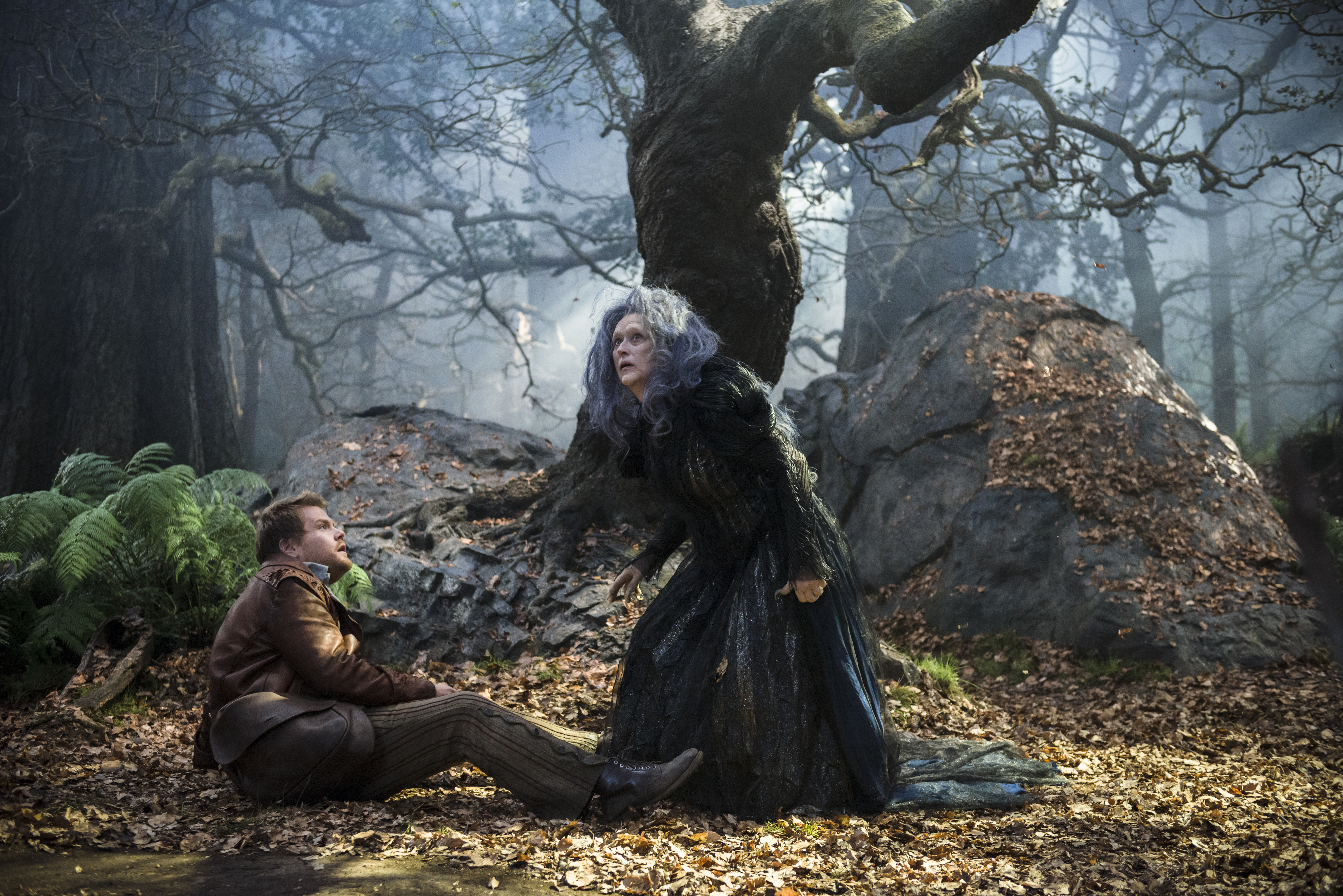
INTO THE WOODS

A conflation of well-known fairy tales blended together in a wraparound story that allows them to occur concurrently, Into the Woods is, superficially at least, a cleverly devised adaptation of Stephen Sondheim and James Lapine’s original musical. With a screenplay by Lapine, and with changes and song omissions fully sanctioned by Sondheim himself, you could be forgiven for thinking that the movie is in safe hands. It has a great cast – most of whom have a proven track record with musicals – an Oscar-winning director at the helm (along with an Oscar-winning cinematographer, costume designer, and production designer), and a high recognition factor to boot. It’s well-staged, has a great deal of charm, and is often knowingly funny. But with all that, Into the Woods is a disappointing adaptation that badly loses its way once the curse is lifted and Cinderella marries her prince.

The movie’s problems are threefold. The first is that it’s curiously uninvolving, with none of the characters really making much of an impact. The witch (played with gusto by Streep) is too sympathetic to be truly threatening or frightening, while the baker and his wife appear at odds with each other on too many occasions for the viewer to be convinced they’d make good parents in the first place (at least the baker realises this about himself). Cinderella keeps running away from her prince, but without the usual stipulation of her magical transformation expiring at midnight, she loses all credibility for her actions. Little Red Riding Hood is the kind of precocious brat you hope does get eaten by the Wolf, Jack doesn’t appear to have two brain cells to rub together (‘magic” beans for a cow – even in the original story, really?), the Wolf is more creepy uncle than woodland predator, and the Prince is shallower than a puddle (though he is self-aware: as he tells the baker’s wife, “I was made to be charming, not sincere”).

The second problem is that with so much to fit in, the movie becomes more and more congested and strangely repetitive at the same time. The baker and his wife have the same argument at least twice, as does the baker and Jack, as does Jack and his mother. The same encounters happen in the woods over and over, but mostly to drive the narrative forward to the next musical interlude or the acquisition of the next object. Nothing seems to happen organically; it’s like a fairy tale greatest hits movie with songs. As a result of all this cramming, some storylines and characters are given less screen time than others, particularly Rapunzel who’s only in the movie to provide one of the minor problems mentioned when the curse is lifted (and whose hair grows back remarkably quickly after the baker’s wife cuts it off).

And lastly there’s the whole structure and content of the movie’s second half, with the notion of “happily ever after” quashed completely. After a first half that was at least intriguing to see how all the stories would intertwine, Into the Woods becomes a different movie altogether as the implications of past decisions make themselves felt, and a huge helping of regret all round is the order of the day. It’s a darker half to be sure, and it shows some characters making some uncharacteristic decisions and acting on impulses that previously weren’t part of their make up. Whatever the reason for this darker, gloomier conclusion it doesn’t work, and the songs reflect this, becoming more introspective and melancholic. And what few attempts there are to leaven the gloom with humour, fall flat on their respective faces. It’s a struggle to get through, and any viewer who does should reward themselves at the end of it.

At the helm, Marshall shows a distinctly uncertain approach to the material, his usual sure-footedness missing here and leading to scenes that don’t have the impact they should have, and songs that lose their way in the staging. It’s a movie that struggles to find its own identity, and despite the obvious talent involved, rarely hits the mark. Of the cast, Streep and Crawford come off best, though Ullman runs them a close third (and seems to understand the requirements of the material better than most). Pine is miscast, while Corden seems to be taking part in another movie altogether, and Kendrick looks embarrassed throughout. Depp plays the Wolf like a character from a Tex Avery cartoon, Blunt is earnest and bland, and Huttlestone dashes about to little effect. It’s a cast that’s pulling in different directions and rarely meeting in the middle.

The look of the movie is heavily stylised, which leads to the forest scenes becoming an awkward mix of location photography and interiors, and the Prince’s castle looking like two thirds of it has been created (and with a cursory attention to detail) in a computer. And there’s an incredibly strange moment when Little Red Riding Hood, having been eaten by the Wolf, finds herself in his stomach, a stomach that is represented as a room overrun by drapes (even on the floor). Why? Who knows. But it sums up the movie completely: unfocused and with too many questions left unanswered.

Rating: 4/10 – a movie that proves that pedigree is no guarantee of excellence – or even mediocrity at times – Into the Woods is a mish-mash of familiar fairy tales and post-modern deconstruction that never gels; sporadically entertaining, marginally successful, it’s a movie that’s difficult to take seriously, especially when the characters end up being menaced by Miss Jones from Rising Damp.

The Imitation Game (2014)

Tags

, , , , , , , , , , , , , , ,

Imitation Game, The

D: Morten Tyldum / 114m

Cast: Benedict Cumberbatch, Keira Knightley, Matthew Goode, Rory Kinnear, Allen Leech, Matthew Beard, Charles Dance, Mark Strong, James Northcote, Tom Goodman-Hill, Steven Waddington, Alex Lawther, Jack Bannon, Tuppence Middleton

Manchester, 1951. A robbery at the home of maths professor Alan Turing (Cumberbatch) leads to the police, particularly Detective Robert Nock (Kinnear), having suspicions that he is hiding something.

1939. Turing arrives for a job interview at Bletchley Park. He is aloof, humourless, arrogant, and quickly stirs the ire of his interviewer, Naval Commander Denniston (Dance). On the verge of being thrown out because of his behaviour, Turing mentions Enigma, the “unbreakable” encryption device being used by the Germans; if it can be cracked, it will turn the tide of the war in Britain’s favour. Impressed, but still against his better judgment, Denniston hires Turing. He becomes part of a team that is headed by chess prodigy Hugh Alexander (Goode), and includes cryptographers John Cairncross (Leech) and Peter Hilton (Beard), though there is friction from the start as Turing prefers to work alone; instead of trying to decipher the hundreds of messages they intercept each day in the hope of breaking the code, Turing works at constructing a machine that will be able to analyse and decode the 159 million million million possible settings the Enigma machine uses.

Denied the funds to build his machine by Alexander, Turing approaches Denniston but is rebuffed. He gets a letter to Winston Churchill via MI6 overseer Stewart Menzies (Strong) and ends up in charge of the programme at Bletchley Park. He fires part of the team but then realises they need more staff. He has a difficult crossword puzzle published in the newspapers; anyone who solves it is asked to attend a further test/interview at Bletchley. Through this he meets Joan Clarke (Knightley), who proves to be a match for him intellectually, and despite some resistance from her parents, he arranges for her to work on the project.

1951. Nock gains a copy of Turing’s military file, only to find there’s nothing in it. He tells his superior, Superintendent Smith (Waddington) that he believes Turing could be a Communist spy. Smith allows Nock to investigate further.

1940. Turing arrives at the hut the team uses to find Denniston and some MPs going through his desk. Apparently there is a spy at Bletchley, but the search reveals nothing out of the ordinary, though Denniston makes it clear his suspicions lie firmly with Turing. Tensions between the group are heightened as Turing spends more and more time building his machine and isolating himself. Joan tells him he needs to be more friendly otherwise he won’t get the help he needs. He does so, and a little while later receives a suggestion from Alexander that is beneficial. A confrontation between Turing and Denniston leads to the rest of the team backing him and his machine (against the threat of being fired); Denniston tells them they have a month to prove it works.

With the month nearly up and no progress made with the machine (named Christopher after Turing’s schoolboy friend), Turing finds himself talking to Helen (Middleton), one of Joan’s friends, and someone who intercepts the German messages. She reveals that her German counterpart always uses the same phrase in their messages. It proves to be the breakthrough Turing and the team have needed. Now, instead of searching through all the possible settings, Christopher only has to search for ones that contain words that they know will be in the messages. They test their theory… and it works. But that isn’t the end of it, and a terrible decision has to be made. And in 1951, Nock discovers that what Turing is trying to hide isn’t that he’s a Communist spy, but that he’s a homosexual.

Imitation Game, The - scene1

There are two things that can be said about Alan Turing: that without him the Germans could well have won the war, and the circumstances of his post-war life led to a terrible tragedy. It’s to The Imitation Game‘s credit that it explores these aspects of his life with both candour and a lack of sentimentality. Exploring for the most part his work at Bletchley Park, the movie doesn’t ignore his formative years, nor the events that led to his untimely death in 1954, but its the way in which each part of his life is integrated that makes the movie so effective. The different periods dovetail with precision, Graham Moore’s intelligent, well-constructed screenplay – albeit one that contains a great deal of invention (the character of Nock and his investigation for example) – picking out the highs and lows of Turing’s life with exemplary attention to detail.

The importance of Turing’s work during the war can’t be stressed enough; historians have gauged that breaking the Enigma code shortened the war by at least two years. The size of the problem, the sheer enormity of it all, is given due importance, and the various setbacks add to the tension, but it’s the movie’s focus on Turing and his team that adds immeasurably to the drama. Turing is portrayed as an arrogant boor, dismissive of anyone less intelligent than himself (and that’s most people), and so single-minded in his pursuit of a solution to the Enigma code that his arrogance increases tenfold. His interaction with Alexander is initially antagonistic, but the growing respect they gain for each other is handled with care and sincerity, and brings Turing out of his shell. As well there’s his relationship with Joan, as unlikely a collaboration as could be imagined during the war, but as richly rewarding for each other as it is for the viewer (and beautifully played by Cumberbatch and Knightley).

Turing is brought to life by an amazing performance from Cumberbatch, immersing himself completely in the role and proving mesmerising to watch. Moore’s script allows for a lot of humour in the movie’s early scenes, mostly at the expense of Turing’s humourlessness (and Denniston’s apprehension at his behaviour). Both actors relish their sharp, witty dialogue, and while it all helps to make Turing more sympathetic than he would be otherwise, it also serves to introduce the Enigma project in such a way that the seriousness of the situation, when it becomes more pronounced, doesn’t leave the audience missing the humour. And the drama reaches a peak in a scene where the terrible consequences of cracking the code means a heart-rending decision has to be made that affects Hilton’s brother. It’s a chilling moment, with victory swiftly replaced by despair, and perfectly highlights some of the difficult decisions that have to be made during wartime.

In terms of biographical continuity, the movie flits between 1926, the war and 1951. Turing’s time at Sherborne School, where his friendship with Christopher Morcom leads to the first intimation of his homosexuality, is given weight by the later use of “Christopher” as the name of the code-breaking machine. It also paints a rather amiable picture of boarding school life and shows the younger Turing struggling to come to terms with his own emotions and the love he feels for his friend. These scenes are the equivalent of the kind of rosy childhood memories we all think we experienced but which in actuality were probably worse than we remember, but they serve as a way of showing how disappointment and regret have allowed the older Turing to become so haughty and withdrawn. The post-war sequences, almost entirely invented for the movie, give a passing hint at how Turing may have died but then states at the end that he committed suicide, which was the official cause of death at the time, but which has since been revealed to be not entirely conclusive.

It’s these distortions and fabrications of the historical period that, inevitably, do the most harm to the movie, and while a degree of dramatic licence is to be expected in a drama “based” on true events, the range and number of historical inaccuracies is worrying.  In truth, Turing was not as disliked as the movie shows, and he did have a recognised sense of humour. He didn’t lead the team at Bletchley Park, nor did he write a letter to Churchill asking for funds to build his machine (which in reality had already been designed in 1938 by Marian Rejewski, a Polish cryptographer). Clarke’s involvement was not as pronounced as shown in the movie, and Hilton had no brother, while the character of Helen is entirely fictional too. It’s understandable that these aspects of Moore’s script are there to enhance the drama, but when you have a true story of wartime heroics to tell, the need for such embellishments – or falsehoods if you will – seems unnecessary. And Turing’s homosexuality, while not overplayed, is treated somewhat like an unfortunate character trait, with everyone at Bletchley aware of it but ever so respectful at the same time – one wonders if that would really have been the case.
Imitation Game, The - scene3

Despite issues with the script, the cast are uniformly excellent. As mentioned above, Cumberbatch is mesmerising, portraying Turing’s strength of will and sense of purpose with such skill and confidence that the character’s quirks and odd physicality seem entirely natural. He dominates every scene he’s in, causing his co-stars to up their game considerably; as a result The Imitation Game contains a raft of performances that are so good it may well be the best acted movie of 2014. Knightley is appealing as Joan (even if she bears no resemblance to the real Joan Clarke), and plays her with a determination and inner strength that matches Turing’s irascibility and overcomes it. Goode, Leech and Beard, as Turing’s main collaborators, all get their chance to shine but it’s their group scenes and their interaction with each other that work best. Kinnear has an awkward role that he copes well with, as a detective representing our modern approach to the adversity that Turing suffered after the war; it’s the one role that doesn’t entirely convince and seems shoehorned into the movie to make the point about how badly Turing – a war hero – was treated after hostilities ceased. And Dance and Strong, as the twin faces of the Establishment, provide effortless support throughout (as you’d expect).

Fresh from his adaptation of Jo Nesbø’s Headhunters (2011), Tyldum displays an appreciation for recent British history, and handles the complexities of the story in such a way that nothing seems too intellectual to understand. He keeps the action very contained, focusing instead on the characters and their personalities, showing how people from often very different backgrounds could, and did, make such a vital difference in how the war was eventually won. The various periods of Turing’s are recreated with admirable authenticity (some wartime scenes were actually shot at Bletchley Park), and are lensed to very good effect by Oscar Faura. There’s also a subtly evocative score by Alexandre Desplat that enriches each scene it plays over or supports.

Rating: 9/10 – despite taking a huge number of historical liberties, The Imitation Game is gripping, thought-provoking, ambitious movie making, and one of the finest dramas of recent years; with stellar performances from all concerned – including Cumberbatch’s career-defining turn – this (mostly) true story scales new heights in the genre of historical drama, and can’t be recommended highly enough.

The Red Balloon (1956)

Tags

, , , , , , , , , , ,

Red Balloon, The

Original title: Le ballon rouge

D: Albert Lamorisse / 34m

Cast: Pascal Lamorisse, Georges Sellier, Wladimir Popov, Paul Perey, Sabine Lamorisse, Michel Pezin

On his way to school one morning, a little boy, Pascal (Lamorisse), finds a red balloon tied to a railing. He takes it with him to school where he asks the caretaker to look after it for him until classes are over. The boy then takes the balloon home with him, but his mother releases it out of the window. However, instead of floating away, the balloon (which seems to have a mind of its own) merely hovers outside the window where the boy can see it.

The next morning Pascal calls to the balloon and it follows him as he heads off to school. He makes several attempts to grab the balloon but it keeps itself just out of reach. At school the balloon manages to get into his classroom which causes an uproar and the principal locks Pascal in his office; the balloon meanwhile has floated off. Reunited at the end of the school day, Pascal and the balloon head home, and encounter a little girl (Sabine Lamorisse) who has a blue balloon. The blue balloon reacts in a similar way to the red one, and follows Pascal until he can elude it. But then he encounters a group of boys who, urged on by jealousy, chase Pascal and try to destroy the red balloon.

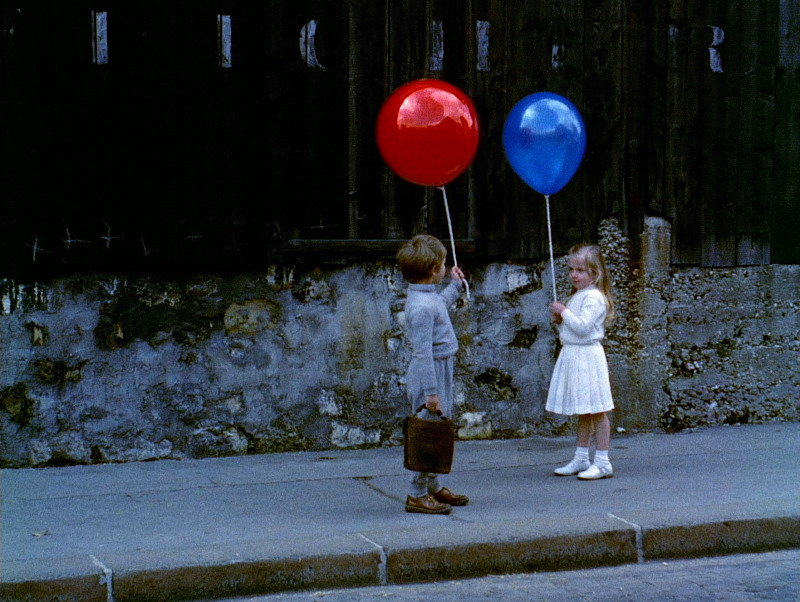
Red Balloon, The - scene

A simple yet wonderfully filmed piece of magical realism, The Red Balloon is a movie that appeals to the child in all of us. Made in the post-war Belleville area of Paris, the movie serves as a record of the area during the Fifties before it was torn down and redeveloped. As Pascal travels from home to school and back again, the often austere backgrounds serve to highlight the enchanting nature of the story and the unlikely possibility of a red balloon with a mind of its own. It’s a tribute to Lamorisse’s vision though, that the balloon doesn’t feel out of place, even when you can clearly see various Parisians reacting to it with amusement and surprise.

Whimsical it may be, but the movie is also a poignant reminder of the innocence of youth and the power of the imagination. Pascal represents the inner child we all cling on to as adults, his acceptance of the balloon as natural as breathing. Seeing him being followed by the balloon and stopping every now and then to try and catch it is like seeing two friends playing a game together. It’s carefree and irreproachable, a gentle yet effective expression of the simple joys childhood can bring when everything around us excites our curiosity. It’s also no surprise that Pascal’s headmaster doesn’t view it in the same way, punishing him for what he sees as insubordination instead of youthful exuberance. Lamorisse is saying – quite rightly – that we should hold on to as much of that youthful exuberance as we can as adults; otherwise, how terrible will our lives become?

With the introduction of the gang (which leads to the balloon’s ultimate fate), the tale darkens, but necessarily so. Lamorisse is clever enough to realise that the innocence of youth doesn’t always last, and that some children lose it sooner than others. The gang are youth corrupted, their mean-spirited actions and envious behaviour the flipside to Pascal’s purity of mind and heart. They want to destroy the red balloon out of malicious spite, to see Pascal as defrauded of his decency as much as they have been. It’s one of Life’s hard lessons, that not everyone is as nice as you’d like them to be. And for a child like Pascal it’s possibly the hardest lesson to learn.

Lamorisse isn’t prepared to leave Pascal downhearted and dejected, though. As if further proof were needed that there is indeed magic – real magic – in the world, Pascal is given succour in such a wonderful, compassionate way that the movie’s conclusion gives the viewer no option but to grin with shared happiness (and maybe shed a tear or two as well). It’s one of the most uplifting endings to a movie ever, and a perfect finale for a tale that is honest and affecting throughout.

The Red Balloon carries such an emotional charge in its short running time that at times it’s hard to reconcile its faux-documentary presentation with the lyricism it displays at every turn. It’s a fascinating mix, and a spectacular achievement by Lamorisse that is a potent now as it was when it was first released. Belleville is filmed with such a candid eye for the decay of its surroundings that the area is almost a secondary character in itself, and Edmond Séchan’s photography is striking and evocative in equal measure.

Red Balloon, The - scene2

But all this, finally, is underpinned by a sincere, genuine performance by Lamorisse’s son, Pascal. There’s a moment where he’s looking up at the balloon as it floats away from him. His gaze is querulous but unperturbed, as if he can’t quite work out why the balloon is behaving the way it is, but isn’t worried in the least that it won’t return to him. It’s like he’s trying to decipher the inner workings of the balloon’s “mind’ or the mechanics of the game they’re playing. It’s a peaceful moment of natural reflection that Pascal carries off as if he’s not even trying – he’s that good.

Rating: 9/10 – a sublime piece of movie making that warms the heart and reminds us what it is to be young and without a care in the world, The Red Balloon is a jewel to be treasured with every viewing; heartfelt, touching and inspirational, this is a bona fide classic that shouldn’t be missed.

10 Reasons to Remember Rod Taylor (1930-2015)

Tags

, , ,

An Australian actor with rugged good looks and a surfeit of roguish charm, Rod Taylor was an actor whose big screen outings displayed a raw energy, and a willingness to take risks, both in his choice of roles and (sometimes) in his choice of movies. He came to the US in the early Fifties and soon made a name for himself as a supporting actor in a variety of well-received movies – Hell on Frisco Bay (1955), The Catered Affair (1956), Giant (1956) and Raintree County (1957).

However, it was a science fiction adaptation of an H.G. Wells novel that brought him international stardom, and throughout the Sixties he made a number of highly regarded movies that helped maintain that stardom. If the Seventies saw him slowly drop out of the spotlight, Taylor still put in good performances even when the projects didn’t match his level of commitment (it would have been interesting to see how his career would have continued if he hadn’t lost the lead in Planet of the Apes (1968) to Charlton Heston). With an unexpected appearance as Winston Churchill in Tarantino’s Inglourious Basterds (2009) – he’d retired completely from acting at that point – to round off his career, Taylor has left us a raft of indelible performances that still have the power to entertain, and leaves behind a strength and an integrity few other actors of his generation could match.

Rod Taylor 1

1 – The Time Machine (1960)

2 – 101 Dalmatians (1961)

3 – The Birds (1963)

4 – Sunday in New York (1963)

5 – Young Cassidy (1965)

6 – The Glass Bottom Boat (1966)

7 – Hotel (1967)

8 – Zabriskie Point (1970)

9 – The Train Robbers (1973)

10 – The Picture Show Man (1977)

Rod Taylor 2

Big Hero 6 (2014)

Tags

, , , , , , , , , , , , , , ,

Big Hero 6

D: Don Hall, Chris Williams / 102m

Cast: Scott Adsit, Ryan Potter, Daniel Henney, T.J. Miller, Jamie Chung, Damon Wayans Jr, Genesis Rodriguez, James Cromwell, Alan Tudyk, Maya Rudolph

Hiro Hamada (Potter) is a fourteen year old orphan living with his brother Tadashi (Henney) and aunt Cass (Rudolph) in San Fransokyo. He’s a precocious teenager, a genius with robotics who takes part in underground robot fights (and gets himself into trouble). Tadashi believes Hiro is wasting his time and talents, and takes him to the robotics lab at the university he attends. Hiro meets his brother’s friends, Go Go (Chung), Wasabi (Wayans Jr), Honey Lemon (Rodriguez) and Fred (Miller). Tadashi also introduces him to his own special project, a robot called Baymax who provides personal healthcare. Seeing the inventive projects they are all working on, Hiro becomes committed to enrolling at the university.

Hiro works on a project that he can use to apply, and comes up with microbots, tiny robots that can be connected in any way possible via the use of a neural sensor (basically a headband that reads a person’s thoughts and communicates them to the microbots). The head of the robotics department, Professor Callaghan (Cromwell) is sufficiently impressed to offer Hiro a place at the university. Also interested in the microbots is businessman Alistair Krei (Tudyk), but at the urging of Professor Callaghan – who dislikes Krei intensely – Hiro declines his offer to buy the microbots and make a fortune. Later, a fire breaks out at the university; Callaghan is trapped inside and Tadashi rushes in to rescue him. Hiro can only stand by and watch as the building explodes, killing both his brother and Callaghan.

Hiro retreats from daily life. One day he accidentally injures himself. This causes Baymax to activate and try to help Hiro. At the same time, one of Hiro’s microbots comes to life; they soon realise it’s trying to unite with the other microbots, but they should all have been destroyed in the university fire. They follow the microbot to an abandoned warehouse where they discover that someone is mass producing the microbots. Confronted by a man in a kabuki mask who uses the microbots to attack them, Hiro and Baymax manage to escape but not before Hiro realises his project is going to be used for evil purposes.

Hiro upgrades Baymax to be able to fight and equips him with body armour. They track  the microbots to the docks where they encounter the masked man. Before Hiro can instruct Baymax to attack him, Tadashi’s friends all turn up; a chase ensues in which the masked man attempts to kill all of them. They manage to avoid being killed and head for Fred’s palatial home where Fred tells them he believes Krei is the man behind the mask and the theft of the microbots (and the deaths of Tadashi and Professor Callaghan). They use Baymax’s sensors to locate Krei and, kitted out in costumes that allow them to act as superheroes, head for an island off the coast where they discover an abandoned facility that contains the remains of a machine that they further learn was used as a teleportation device. And then the masked man appears, and attacks them all…

Big Hero 6 - scene

Watching Big Hero 6 – especially if you’re a Disney executive – is a reassuring experience. In the same year that Marvel took a chance on one of their lesser known titles (something called Guardians of the Galaxy), the House of Mouse also took a chance on releasing another Marvel adaptation, a comic book property that had an even lower profile than Star Lord and his pals. The result is a funny, exciting, refreshing, beautifully rendered, heartwarming tale that introduces audiences to one of the most lovable animated characters in recent memory: a rotund primary care robot called Baymax.

It’s a recognisably Disney movie. There’s the standard emphasis on family bonds and the importance of friendships, as well as doing the right thing, but it’s a Disney movie that’s been meshed with the standard tropes of a Marvel origin story, its action heroics and in-house maxim “with great power comes great responsibility” adding an extra layer to the emotional content that makes it more affecting than expected. Given free rein by Marvel to adapt Big Hero 6 in whatever way they saw fit, directors Hall and Williams and screenwriters Jordan Roberts, Dan Gerson and Robert L. Baird have created a movie that is a model of consistent, gratifying entertainment.

Of course, Big Hero 6 would be nothing without Baymax, an irresistibly charming, sweet-natured character who melts the heart and warms it at the same time. He’s a brilliant creation, a soft, cuddly vinyl-formed teddy bear whose personality chip is completely in the right place (where his heart would be – coincidence?). Voiced to perfection by Adsit, Baymax is the kind of friend we’d all love to have: solicitous, kindly, generous, selfless, supportive, and always there for us (it would be a hard heart indeed that didn’t fall in love with him at first sight).

With Baymax proving to be such a wonderful character it wouldn’t have been a surprise to find Hiro lacking in appeal by comparison, but thanks to the very cleverly assembled script, Hiro is as immediately likeable as Baymax is, his scamming at the opening robot fight proving to be a great introduction to a character the viewer can both identify and sympathise with throughout, even when his thirst for revenge for the death of Tadashi threatens to overwhelm his sense of right and wrong. And he’s not as self-centred as most fourteen year olds, having a refreshingly sincere relationship with both his brother and his aunt. And even more refreshingly, the script avoids any notion that Baymax is a replacement for Tadashi; the lovable lug, ultimately, is more than that, fulfilling the roles of brother, friend, and father.

What’s also refreshing is the fact that the villain actually has a good reason for stealing Hiro’s microbots and replicating them. When this reason is revealed it adds yet another emotional layer to the storyline, as well as an unexpected sadness that is amplified by highlighting how much the villain and Hiro have in common. It’s a neat twist on the usual hero-villain relationship, and allows Big Hero 6 to be comprised of more than just the customary bad-guy-out-to-take-over-the-world-and-stopped-by-errant-genius scenario we’re so used to seeing.

The supporting characters are all endearing in their own ways, with Miller’s Fred proving especially likeable (stay til after the end credits for a great “reveal” relating to his dad), and Wayans Jr’s Wasabi often very funny as the constantly risk assessing member of the group. The voice cast are all excellent, with special mention going to Potter and Henney who make their scenes together genuinely touching, and Adsit once more for making Baymax so appealing and irresistible.

Big Hero 6 - scene2

As for the animation, the use of new technology means that Big Hero 6 is possibly one of the most beautifully animated movies so far. There’s also a level of detail that is absolutely breathtaking, notably in the scenes that take place on the streets of San Fransokyo. The mix of Eastern and Western cultures is a joy to behold, and very cleverly assimilated, providing a rich visual palette that can be enjoyed time and time again. The character designs are also impressive, with a welcome reduction on the size of the eyes that has hampered the design of so many previous animated characters. And the use of a kabuki mask makes the villain truly intimidating and menacing, augmenting the threat he presents and making him look creepy as well.

With Hall and Williams showing an obvious command of the material, and choosing not to set this in another corner of the Marvel Cinematic Universe, the viewer is free to enjoy the movie for what it is and not where it might fit in to any future Marvel outings. With this potential aspect removed, Big Hero 6 is free to be delightful and entertaining on every level it aims for.

Rating: 9/10 – a winner, pure and simple, continually inventive and captivating in equal measure; Big Hero 6 is yet another triumph from Disney, and is – probably – one of the most visually ravishing, heartwarming animated movies you’re likely to see in this or any year.

Dumb and Dumber To (2014)

Tags

, , , , , , , , , , ,

Dumb and Dumber To

D: Bobby Farrelly, Peter Farrelly / 109m

Cast: Jim Carrey, Jeff Daniels, Rob Riggle, Laurie Holden, Rachel Melvin, Kathleen Turner, Steve Tom, Don Lake, Patricia French, Brady Bluhm, Tembi Locke

Ever since his failed romance with “Mary Samsonite”, Lloyd Christmas (Carrey) has been in a mental institution where he appears to be in a persistent vegetative state. Visited two or three times every week by his best friend, Harry Dunne (Daniels), Lloyd eventually reveals he’s okay and that he’s been playing an elaborate prank on Harry the whole time. Back at their old apartment, Harry tells Lloyd he needs a kidney transplant soon or he’ll die. They visit Harry’s parents in the hope one of them will be a donor, but Harry learns he was adopted. As they leave, Harry is given all the mail that’s been piling up since he moved out; amongst it all is a twenty-two year old postcard from Fraida Felcher (Turner) telling Harry she’s pregnant and to call her.

The duo track Fraida down and she reveals she had a daughter she named Fanny (Melvin) who she gave up for adoption. She also tells them she’s written to her but the letter was returned with a request not to try and contact Penny (her adopted name) ever again. Undeterred by this, Lloyd and Harry determine to find Penny and save Harry’s life. They travel to Maryland where Penny lives with her adoptive parents, famed scientist Bernard Pinchelow (Tom) and his wife Adele (Holden). Unfortunately, they just miss her, as Penny has gone to El Paso to represent her father at a KEN conference, but she’s forgotten to take a special gift for the conference’s organiser that Pinchelow says will be of major benefit to everyone worldwide.

Lloyd and Harry – accompanied by Travis (Riggle), the Pinchelow’s housekeeper – take the gift and head to El Paso. What they don’t know is that Travis is having an affair with Adele, and that they’re plotting to kill Pinchelow; they’re also looking to steal the gift and make millions from it. Along the way, Travis attempts to kill Lloyd and Harry but is thwarted by a freight train and killed. Harry and Lloyd continue on to El Paso, while Adele learns of Travis’s demise from his twin brother (Riggle); he agrees to help her with her plan.

At the conference, Harry is mistaken for Pinchelow and gains admittance, telling the organisers that Lloyd is a colleague. But when Lloyd lets slip that he’s attracted to Penny, Lloyd has him thrown out. Lloyd arranges a meeting with Penny and she reads the letter Fraida sent her; from it, Lloyd deduces that he is Penny’s father and not Lloyd. Penny leaves to get back to the convention, but Adele and Travis’s brother are there as well, and so is Fraida. It all leads to a showdown in a bathroom that sees Lloyd reappear having made the most generous gesture of his life.

Dumb and Dumber To - scene

How do you follow a cult favourite twenty years on? Do you keep to the same formula that made the first movie so successful, or do you try another approach with the same characters and hope it’s not too jarring for fans? Well, if you’re the Farrelly Brothers and you’ve got Jim Carrey and Jeff Daniels back on board, the weight of expectations can only lead to one answer: give ’em more of the same.

Dumb and Dumber To was always going to be a sequel that critics would have little time for, but the Farrellys, aided by their committed stars, have come up with a movie that honours the first one without entirely sullying its reputation. True, the plot is unsophisticated (not that the first movie’s was any more original or complex), and the humour is broad, puerile and often farcical, but this is a concept that lives or dies not by its content but its willingness to be as relentlessly silly as possible. And silly it is – unremittingly, gloriously, stupidly silly.

Leaving restraint at the door, the tone is set by Harry’s attempt to remove Lloyd’s catheter, an uncomfortably wrong moment that encapsulates the Farrellys approach to both Lloyd and Harry, and the movie as a whole – nothing is too out there. After almost twenty-five years of cinematic gross-out humour it’s got to be difficult to push that particular envelope but there are moments of inspiration that more than make up for the banality of the plot and the supporting cast’s perfunctory acting. The catheter joke gives way to a series of sight gags and one liners that are effortlessly sold by Carrey and Daniels, and it’s clear that the two actors are having a whale of a time, their efforts at raising laughs proving infectious. Carrey, an actor whose facial gurning was overplayed during the Nineties, brings that particular skill back to the big screen and reminds us just how talented he is when “silly” is a movie’s prime objective. But it’s Daniels who steals the show, his big rubbery face the perfect foil for Carrey’s sharp-edged contortions. Daniels is lovable in a way that Carrey can’t be because of the way the characters are written, and he takes full advantage, making Harry not only funnier to watch, but more endearing as well.

There are, inevitably, problems with the script – Lloyd’s selfless gesture involves a trip to Mexico he couldn’t possibly have made, references to the first movie are crammed in for no other reason than to have them there, the conference scenes are not as sharp as they could have been – but it’s the laughs that count, and the Farrellys deliver when it matters, including (for this reviewer) a brilliant moment when Lloyd and Harry think they’ve reached Penny’s home in Maryland (and if you ever end up in a situation where Lloyd is offering you goji berries, just don’t, okay?). The movie also runs around  ten minutes too long and some scenes could have done with some more judicious editing, but on the whole, this is much better than you might expect.

Rating: 7/10 – not the travesty some critics would have you believe, Dumb and Dumber To ends with an advert for Dumb and Dumber For (in 2034); if we do get to spend some more time with Lloyd and Harry, and it’s up to the standard of this outing, then 2034 can’t come round soon enough.

The Woman in Black: Angel of Death (2014)

Tags

, , , , , , , , , , , , , ,

Woman in Black Angel of Death, The

D: Tom Harper / 98m

Cast: Phoebe Fox, Jeremy Irvine, Helen McCrory, Oaklee Prendergast, Adrian Rawlins, Ned Dennehy, Amelia Crouch, Amelia Pidgeon, Casper Allpress, Pip Pearce, Leilah de Meza, Jude Wright, Alfie Simmons, Leanne Best

London, 1941. The Blitz has caused the evacuation of several schoolchildren along with their headmistress, Jean Hogg (McCrory) and their teacher, Eve Parkins (Fox). As they take the train to their destination of Crythin Gifford, Eve shares a compartment with RAF pilot Harry Burnstow who is on his way to a new posting at a nearby airfield. Met by local air raid warden Dr Rhodes (Rawlins), he takes them through the now deserted village where the bus has a puncture. While it’s repaired, Eve encounters a blind man, Jacob (Dennehy) who warns her that she and the children will never escape “her”.

At Eel Marsh House, the two women and their charges settle in. Eve has a bad dream that leads to her seeing a woman dressed all in black (Best). The figure vanishes, but the next day, one of the children, Edward (Prendergast), who has been mute since the death of his parents in an air raid, is locked in the nursery by two other children, and sees the woman in black. Afterwards, Edward carries a tattered doll around with him. That night, one of the boys who locked him in the nursery is led from the house by the woman in black; the next morning he’s found dead.

Another sighting of the woman in black in a graveyard leads Eve to discover her identity and the sad history of her child, Nathaniel. With Eve becoming even more convinced that they are all in danger, she battles to convince Jean that they should all leave as soon as possible. An air raid sees the woman in black claim another victim, and with the aid of Harry, they head for the airfield where he’s based. While they wait for the morning to come, Edward is spirited away back to Eel Marsh House. Eve refuses to leave him behind and makes her way back to rescue him.

Woman in Black Angel of Death, The - scene

Set forty years after the events of The Woman in Black (2012), this unnecessary sequel fails to match the quality and all-round scariness of its predecessor, and thanks to a badly constructed screenplay by Jon Croker, almost reduces its titular character to making little more than a cameo appearance.

The success of the original always meant there would be a sequel, and with the decision to set the new story during World War II it seemed as if the makers had come up with an idea that would avoid the usual horror sequel inanity that most follow ups suffer from. Alas, the wartime setting is the only good idea the makers have come up with, and the rest of the movie is as turgid and predictable and run-of-the-mill as any other horror sequel.

With the woman in black’s story told in the first movie, its resurrection here feels like padding in a movie that repeats various shots and sequences in an attempt to promote a sense of menace that never really pays off. Eve has the same nightmare over and over, and while it replays with different outcomes (including a bone-wearying appearance from you-know-who on one occasion), and serves to provide Eve with a back story of her own, the script’s intention for it to be as scary as what’s happening in Eel Marsh House never pans out. Likewise, the oft-repeated shot looking upward at the hole in the ceiling above Edward’s bed – will we glimpse the woman in black there? – is played over and over and becomes tiresome in the extreme.

That a potential franchise has run out of steam so soon may not be surprising to some, but the strength of the original in comparison to this outing is too evident for any other analysis. As a main character, Eve is too blandly presented to have much of an impact, and the viewer has a tough time sympathising with her or her predicament, even when mad, blind Jacob has her temporarily imprisoned. The same goes for the character of Jean, the rationalist who denies the supernatural until it’s literally staring her in the face (and then is all nice and apologetic). Both Fox and McCrory are more than capable actresses, but even with their talents they’re unable to raise their performances above the level of perfunctory. Worse still is Harry, a character so unimaginatively drawn that Irvine is unable to add any colour or flesh him out to an extent that would make him more interesting.
As for Jennet Humpfrye herself, the movie places her firmly in the background, giving her less exposure and as a result, making her less menacing. As a supposedly single-minded, revenge-oriented character she’s remarkably relaxed in her efforts to kill the children placed so conveniently in her home (especially after forty years). And with the change in actress – Best taking over from Liz White – the look and design of the woman in black has been altered somewhat, with Jennet looking younger and less intimidating behind her veil. It’s a sign that not all’s well, that the movie’s primary source of scares and shocks is not as effectively rendered as before (and perhaps this is why we see so little of her, the makers realising how tame her appearance looks in comparison).

To make matters worse the interiors of Eel Marsh House are gloomily lit and make it difficult to see what’s going on when the action takes place at night, while the exteriors are equally bleak and forlorn. It’s all done for the sake of atmosphere but makes the movie an unappealing viewing experience nevertheless. Orchestrating it all, Harper forgets to imbue the movie with a sense of credible peril, and one jump scare aside, defaults on the terror as well. It all leads to an ending that is rushed and dramatically unsatisfactory, and reinforces the feeling that the makers could have done a whole lot better.

Rating: 4/10 – a movie that plays at being scary but doesn’t deliver, The Woman in Black: Angel of Death aims high but succeeds only in being mediocre; a poor effort by all concerned, and one that (hopefully) will discourage a further movie from being made.

Mandrake, the Magician (1939) – Chapter 1: Shadow on the Wall

Tags

, , , , , , , , , , , , , , , ,

Mandrake, the Magician

D: Sam Nelson, Norman Deming / 30m

Cast: Warren Hull, Doris Weston, Al Kikume, Rex Downing, Edward Earle, Forbes Murray, Kenneth MacDonald, Don Beddoe

Travelling back from the Orient aboard the S.S. Mohawk, Mandrake the Magician (Hull) receives a telegram from the daughter of Professor Houston (Murray). She’s worried due to his work on a radium machine that will be a huge benefit to humanity but which also has the capacity to be used for evil. Mandrake has been in Nepal searching for a rare metal called platinite that Houston needs for his invention; during his act, an attempt is made on his life by two henchmen of the master criminal known as the Wasp.

Reaching the US, Mandrake travels to Professor Houston’s California home by single seater plane (and survives a further attempt on his life when it’s tampered with). He meets up with Betty (Weston), the professor’s daughter. Meanwhile, the professor receives a threat from the Wasp. A demonstration of the radium machine reveals its potential for mass destruction, but Houston is encouraged to continue with his work. At the request of a friend of Mandrake’s, Dr Andre Bennett (Earle), Houston agrees to demonstrate the machine to a group of Bennett’s fellow physicians. However, when the time comes, Houston is kidnapped by the Wasp’s henchmen, and one of them takes Houston’s place. Mandrake realises this and a fight ensues, one that leads to the magician being in the firing line of the radium machine.

Mandrake the Magician - scene1

As an example of the kind of cliffhanger serial that studios big and small churned out through the Thirties, Forties and Fifties, Mandrake, the Magician is a fun, efficiently presented melodrama that features peril at every turn, poorly choreographed fisticuffs, and the kind of dialogue that’s one part exposition to two parts repetition to three parts baloney. It’s all done with a knowing sense of its own ridiculousness, but in many ways it’s all the better for it. Putting Mandrake in danger at least three times in the first episode sets the tone for the serial, and allows writers Joseph F. Poland, Basil Dickey and Ned Dandy (great names all) to indulge in all manner of unbelievable  scenarios, including a magic act that features an extended cup and balls routine (this from the world’s greatest magician), and the sight of Professor Houston donning protective clothing to demonstrate his machine while Mandrake and others merely take a step back.

Performance-wise, Hull is as debonair as a man who wears a top hat can be, while Weston has little to do other than look decorative. Kikume is kept in the background, Earle appears too late in the episode to make much of an impression, while MacDonald, as electronics expert Webster, takes an early lead in the who-is-the-Wasp-really? sweepstakes. Nelson and Deming direct with a flair that makes the episode fly by, and the sheer gung-ho spirit of the narrative makes for an enjoyable, leave-your-brain-at-the-door outing that promises much more of the same in the remaining eleven chapters.

Rating: 5/10 – rickety sets and a villain who remains masked while wearing a hat give Mandrake, the Magician a hokey, old-time feel that provokes good-natured amusement instead of disappointment; stirring stuff, and a reminder of when movie making was a lot more innocent and a lot less complicated.

NOTE: In keeping with its original presentation in 1939, the remaining chapters will be reviewed each in turn over the next eleven weeks.

Still Alice (2014)

Tags

, , , , , , , , , , , ,

Still Alice

D: Richard Glatzer, Wash Westmoreland / 101m

Cast: Julianne Moore, Alec Baldwin, Kristen Stewart, Kate Bosworth, Hunter Parrish, Shane McRae, Stephen Kunken

Alice Howland (Moore) is a respected linguistics professor at Columbia University. She has a loving husband, John (Baldwin), and three grown up children, Anna (Bosworth), Tom (Parrish), and Lydia (Stewart). Shortly after her fiftieth birthday she gives a lecture and forgets the word ‘lexicon’. She brushes it off but when she’s out running one day she reaches the campus and for one disorientating moment she has no idea where she is. She begins to see a neurologist (Kunken) and undergoes various tests. When it comes, the diagnosis is a shock: she has early onset Alzheimers. Further tests also reveal that it’s familial, and her children are at risk of carrying the recessive gene that causes it.

As expected, the news is a blow to Alice’s family, but she is determined to fight the disease for as long as she can. Her children have different reactions: Anna is tested and is positive; she and her husband, Charlie (McRae), are trying for a baby via an infertility clinic and need to know. Tom tests negative, while Lydia, who is a budding actress living on the West Coast and a bit of a free spirit, decides not to find out. But they and their father all do their best to support Alice as she comes to terms with what her life will become.

But the illness is aggressive, and Alice’s initial coping mechanisms of using her mobile phone to record information, and setting herself little memory tests, lose their effectiveness, and she begins to forget even more. Her awareness of the speed at which her illness is affecting her, leads Alice to record a video message advising her future self to commit suicide by taking a bottle of pills. One day, while she and John are at their beach house, she forgets where the bathroom is and wets herself. As she begins to forget more and more, she receives an invitation to speak at an Alzheimers convention. There she gives a moving description of the ways in which the disease is affecting her but also the ways in which she deals with it.

Alice’s deteriorating mental abilities become more and more obvious. When Lydia performs at a local theatre, Alice forgets her name when they meet up afterwards. And she becomes anxious when John receives an offer to work at the Mayo Clinic, which will mean moving. And then Alice discovers the video message she made earlier…

Still Alice - scene

Adapted from the novel by Lisa Genova, Still Alice is a gloomy, yet also affecting look at the debilitating effects of Alzheimers on an intelligent, academically respected individual, and her immediate family. It’s a straightforward, no frills movie that aims to pull no punches regarding the debilitating aspects of the disease, but can’t quite stop itself from trying to salvage a degree of personal triumph out of Alice’s dilemma. In fact, Still Alice tries so hard to make Alice’s fight against Alzheimers laudatory that it almost misses the tragedy that goes with it hand in hand.

In telling Alice’s story, writer/directors Gratzer and Westmoreland have resorted to charting the gradual effects of the disease by signposting them with often clumsy simplicity. First Alice forgets a word in a lecture, next she forgets where she is, then she forgets someone’s name and their address in a test. As each lapse in memory and example of cognitive impairment is trotted out, their presence in the narrative seems to be crying out, “See? She’s getting worse!”, as if the viewer couldn’t work that out for themselves. And when she’s told that her form of Alzheimers, matched by her intelligence and mental acuity, means that the disease will have a more rapid effect on her, it’s almost like kicking someone when they’re down; not only is Alice already unlucky to be suffering at so young an age, but because she’s so smart it’s another point against her.

This kind of unnecessary melodrama hurts the middle third of the movie so much that it’s only thanks to Moore’s superb performance that it remains so affecting and watchable. Even when the script piles on the pain and anguish she remains utterly believable, painting a sincere, credible portrait of a woman losing her sense of herself, and portraying the terrible ramifications of having her personality destroyed from within. The scene where Alice can’t find the bathroom is a powerful example, as the camera stays with her at waist height as she rushes through the house. When she stops the camera focuses on her face and the evident torment she’s experiencing. The viewer knows exactly what’s happening, from the shame and distress Alice is feeling to the moment where the inevitable happens, and when the camera pans back to reveal the stain down the front of her jogging bottoms it’s nowhere near as effective as the acting masterclass that Moore has honoured us with. Simply put, Moore is astonishing, and when the disease has robbed Alice of nearly all cognisance of the world around her, and her eyes are dulled by incomprehension, it’s heartbreaking.

Sadly, Moore is the best thing in a movie that fails to paint convincing portraits of Alice’s family and resorts to their providing implausible levels of support throughout. Not once does any one of them lose their temper, or voice their own distress at what’s happening to her, or display any hesitation in doing what they can. Even when John is offered the job at the Mayo Clinic and Alice states her reluctance of doing so, the scene is set for the kind of antagonism that must surely happen in these situations. But instead, John swallows his disappointment in seconds and the moment passes. It’s an uncomfortable moment because it feels so false, and Baldwin doesn’t pull it off (for once though, we see another character looking as lost as Alice is). But Baldwin isn’t alone. Each of the supporting cast has their “uncomfortable moment”, Stewart early on when Alice and Lydia have one of those awkward mother-daughter conversations about careers that seems to have been cribbed from a thousand and one other similar mother-daughter conversations in the movies, and which leaves Stewart struggling to make her supposedly independent-minded character sound anything other than petulant. In contrast, Bosworth is the waspish eldest daughter, saddled with lines that are largely derogatory of others and with no obvious reason for her being that way. And Parrish is sidelined pretty much throughout as Alice’s son, allowed only a brief moment to shine (but not say much) at the Alzheimers convention.

With Moore’s formidable performance taken out of the equation, Still Alice skirts perilously close to formulaic disease-of-the-week TV movie status. It’s a movie that wants to say something profound about the way in which a disease as awful as Alzheimers can be managed – albeit in its early stages – and while Alice’s address to the conference is genuinely moving, it relies too heavily on her normal mental capability to be completely persuasive. With other dramatic flaws that weigh the movie down, Glatzer and Westmoreland’s efforts remain lumbering and inconsequential. The movie is also curiously bland to watch, with too many neutral colours in the background, and Alice aside, too many characters who evince emotion with restraint. There’s also a mawkish score by Ilan Eshkeri that only occasionally matches the action for poignancy.

Rating: 6/10 – gaining two points because of the sheer brilliance and sensitivity of Moore’s performance, Still Alice is gripping stuff when Moore is onscreen but turgid and lacking validity when she isn’t; if it wasn’t for her this would be one movie that could be so easily forgotten, and without any attendant grief.

To Kill a Man (2014)

Tags

, , , , , , , , , , ,

To Kill a Man

Original title: Matar a un hombre

D: Alejandro Fernández Almendras / 82m

Cast: Daniel Candia, Alejandra Yañez, Daniel Antivilo, Ariel Mateluna, Jennifer Salas, Don Willie, Paula Leoncini

Jorge (Candia) is a quiet family man who works as a caretaker at a forest research site. One night he’s mugged near to his home by a man called Kulale (Antivilo) and some of his gang; they steal his money and his insulin kit. He tells his wife, Marta (Yañez) and Jorgito (Mateluna). Jorgito knows who Kulale is and tells his father that he can get his insulin kit back for 5,000 pesos. Jorge demurs but later that night he realises his son has gone out. He goes to look for him and hears a gunshot from the nearby projects. He finds Jorgito has been shot. As he tends to him, Kulale appears and, weighing up the situation, shoots and wounds himself.

While Jorgito spends three months in hospital recovering, Kulale’s prosecution goes ahead. He contends Jorge and his son attacked and shot him first and he was defending himself when he shot Jorgito, but the court rules against him. To the family’s shock, however, his sentence is restricted to eighteen months due to a technicality. Following the trial, cracks begin to appear in Jorge and Marta’s marriage, and she blames him for Jorgito’s being shot.

Two years pass. Jorge and Marta are now divorced, though he visits his family often. One day at work he receives a call from Kulale who tells him he’s not finished with Jorge and his family and that they have a debt to settle. This proves to be the beginning of a campaign of harassment carried out by Kulale and his gang, which includes abusive phone calls, trapping Jorgito in the back of his truck, throwing rocks at the family home, and assaulting Jorge’s teenage daughter, Nicole (Salas). Each time, Jorge and his family report the incidents but the police and the prosecutor’s office seem unconcerned or unwilling to proceed without any witnesses.

Realising that the chances of anything being done to stop Kulale’s harassment and intimidation of his family are minimal, Jorge decides to take matters into his own hands. One night he lures Kulale out of his home and forces him at gunpoint into the back of Jorgito’s truck. It’s at this point that Jorge must decide if killing Kulale is the right course of action, and if it is, if he can go through with it.

To Kill a Man - scene

A sparse, quietly powerful movie, To Kill a Man is an intense, thought-provoking look at the way in which intimidation and bullying can lead even the most reserved of people to take the law into their own hands, and the subsequent ways in which their lives can be affected, both subtly and obviously. It’s a stark, poetic movie, one that carries a tremendous emotional wallop, and which portrays its central character as a simple man trying to lead a simple life, and struggling when that simplicity of existence is threatened.

The emotional turmoil suffered by Jorge and his family is soberly portrayed, and without recourse to melodrama. Their pain and anger is clearly felt and expressed both through their dealings with authority, and through the deteriorating relationship between Jorge and Marta. Even after they’ve divorced there’s a lingering sense of resentment and disapproval that undermines their ability to communicate with each other. Marta wants Jorge to be more assertive, but it’s not really in his nature; he’s a solitary man, even within his own family. Faced with the problem of Kalule and his aggressive behaviour, Jorge reacts as best he can but it’s not enough for Marta or Jorgito. He deflects their anger at the situation and appears weak in the process.

But all this turmoil is having an effect, and thanks to the combination of Almendras’ impressive script and Candia’s riveting portrayal, Jorge’s eventual decision to “deal” with the problem of Kalule displays an inner strength that abrogates any suggestion that he’s too reserved to cope with it all. Bolstered by an encounter on forest land with a man who pulls a knife on him, Jorge takes confidence from his dealing with that situation and commits to a course of action that tests both his sense of morality and his sense of himself as a man. For the viewer it’s a moment where the feeling of holding one’s breath gives way to a sense of relief at Jorge making such an important, difficult decision.

Candia gives a remarkable performance, Jorge’s withdrawn, taciturn nature given full articulation via the actor’s subtly expressive features. It’s a performance that proves unexpectedly gripping, and while the rest of the cast provide more than adequate support, Candia is the emphatic heart and soul of the movie. Even when he’s alone in a scene there’s little doubt as to how he’s feeling, or what he’s thinking. It’s gripping to watch, and a testament to Almendras’s decision to cast him.

As well as an examination of the morality of taking the law into your own hands, the movie also looks at the effects a shocking event can have the family involved, as well as its legacy. Even when they fight back against Kulale by going to the police there’s no real sense of a family united in their efforts, and Almendras rarely shows all four members spending time together. It’s beyond the movie’s scope but it would be interesting to see their reaction to Jorge’s abduction of Kulale and what happens as a consequence. The Chilean legal system comes in for some considerable criticism (though at present it is undergoing a radical change), and some aspects might seem a little far-fetched – the prosecutor’s home address being given out upon request, for example – but it’s all fuel for the predicament Jorge finds himself trying to cope with.

To Kill a Man - scene2

Visually, the movie is a dour experience in keeping with the material, but there are glimpses of the natural beauty in the forest area where Jorge works, plus some stunning coastal scenery. Almendras keeps things straightforward and direct, dispensing with any frills or unnecessary camera flourishes, and maintaining a tight focus on the characters and placing them in various cramped locations to highlight their sense of being hemmed in at all turns. There’s also an ominous score courtesy of Pablo Vergara that accentuates the drama and cleverly pre-empts the emotional result of Kulale’s abduction.

Rating: 9/10 – a striking, intelligently constructed exploration of one man’s alienation from his family and his attempt at redressing the wrongs done to him, To Kill a Man is a modest drama that succeeds by virtue of a strong central performance and a compelling narrative; apparently based on “real events”, Almendras’s third feature is a triumph of low-budget, independent movie making.

Housebound (2014)

Tags

, , , , , , , , , ,

HB POSTER FINAL_BLEED_3

D: Gerard Johnstone / 107m

Cast: Morgana O’Reilly, Rima Te Wiata, Glen-Paul Waru, Cameron Rhodes, Ross Harper, Ryan Lampp, Mick Innes

After an attempted robbery of an ATM goes wrong, Kylie Bucknell (O’Reilly) is sentenced to eight months house arrest and forced to move back in with her mother, Miriam (Te Wiata) and father Graeme (Harper). Not getting on with them in the first place, Kylie’s disdain is increased by Miriam’s insistence that the house is haunted. Dismissive of her mother’s claims, Kylie keeps to herself and refuses to help out, but soon she too begins to experience strange happenings.

One such happening leads to her ankle tag being activated and the involvement of security operative Amos (Waru). When he’s not being a security operative, Amos is a paranormal investigator. He begins an investigation but it’s an encounter with a stuffed toy bear that convinces Kylie something sinister might be taking place. While she comes to terms with the possibility that her mother has been right all along, she has to put up with visits from court appointed counsellor Dennis McRandle (Rhodes). But it’s the discovery of a box of personal effects belonging to a teenage girl that deepens the mystery of what’s happening in the house.

Kylie learns that the house was originally a halfway house, and that a young girl was murdered there sixteen years before. Her killer was never caught, and Kylie begins to suspect that her ghost is causing all the strange disturbances. During a visit, Dennis is attacked and injured, but the police believe Kylie is responsible and dismiss her claims of a malevolent spirit. She tries to run away but is stopped by Amos, who persuades her to return and get to the bottom of things.

Another strange occurrence leads to the discovery of a clue to the young girl’s murder: a denture left behind by the murderer. The evidence points toward their neighbour, Mr Kraglund (Innes). Kylie breaks into Kraglund’s home in an attempt to steal his current denture for comparison but her plan backfires. But when Amos returns by himself, Kraglund tells him a story that changes everything.

Housebound - scene

A horror-comedy-mystery-thriller from New Zealand, Housebound is a wonderfully barmy breath of fresh air that mixes its various components with skill and confidence. Making his feature debut, writer/director Johnstone has fashioned a movie that pleases on so many different levels that it works as an object lesson in how to balance several genres all at once.

Beginning with a botched attempt at stealing an ATM where Kylie’s accomplice is knocked out by his own sledgehammer, the humour in Housebound is laugh-out-loud funny and as sharp as a scalpel. Throughout the movie, Johnstone throws in hilarious one-liners – “He’s a cabbage in a polo fleece” – priceless visual gags – Amos taking the knife from the killer – and absurd props such as a three-quarter size Jesus. The humour complements perfectly the mystery elements and the increasing physical horror of the movie’s final third, providing an amusing tone that never tires and offers often clever distractions and highlights.

Johnstone’s script segues from sitcom to supernatural chiller with aplomb, and helps draw in the viewer, painting a picture of domestic disharmony with broad, effective strokes that introduce the characters and sets up the ensuing disturbances with both charm and a refreshing conviction. Kylie’s relationship with her mother is deftly handled, while the awkwardness of her relationship with her father is shown best in a basement scene where he tries to have a proper conversation with her.

The central mystery – who killed the young girl? – is another example of how cleverly Johnstone’s script is constructed, its introduction around the forty-minute mark providing a reason for the supernatural happenings and paving the way for the movie’s transition from ghost story to whodunnit. (The structure of the movie is such that it moves from one genre to another with polished ease, and does justice to each one, making the whole experience so enjoyable it’s difficult to separate one particular genre from the rest as being the best served.)

Once the mystery is solved and a highly relevant character is introduced, Housebound switches tone and genre once more to become a violent thriller, with peril introduced at every turn (but still shot through with enough comedy to off-set the often vicious nature of the violence). Johnstone handles this transition with invention and panache, and makes a virtue of what amounts to a home invasion approach to the material, using the house and its internal environs to good effect.

Johnstone is well served by his cast, with O’Reilly making a tremendous impression as the sulky, standoffish Kylie, her surly looks and waspish remarks wonderfully rendered; it’s a captivating performance, mordantly funny and surprisingly emotive. She’s matched by Te Wiata as Miriam, her blasé reactions and dotty demeanour dovetailing neatly with Kylie’s antipathy, creating a mother-daughter relationship that is entirely credible. Waru is similarly effective as the trusting Amos, his faith in the supernatural played so amusingly he provides most of the comic relief (he also gets the best line in the movie: in response to Kylie’s assertion that she’ll “smash” any hostile spirits “in the face”, he mutters plaintively, “You can’t punch ectoplasm”.)

Rating: 8/10 – funny, thrilling, violent and hugely enjoyable, Housebound is the kind of movie that comes along every once in a while, but rarely reaches a wider audience than genre fans and festival audiences; one of the best feature debuts of recent years and one that marks out Johnstone as a talent to keep an eye out for.

Mini-Review: Left Behind (2014)

Tags

, , , , , , , , , , , ,

Left Behind

D: Vic Armstrong / 110m

Cast: Nicolas Cage, Chad Michael Murray, Cassi Thomson, Nicky Whelan, Jordin Sparks, Lea Thompson, Martin Klebba, Gary Grubbs, Alec Rayme, Georgina Rawlings

Rayford Steele (Cage) is a transatlantic pilot planning an affair with stewardess Hattie Durham (Whelan) when they reach London. Caught off guard by his daughter, Chloe (Thomson), coming to see him at the airport, he sidesteps her suspicions while at the same time reassuring her that his relationship with Chloe’s mother, Irene (Thompson) is all okay, and despite her recently becoming a Christian believer. Chloe goes home but has a dispute with her mother over her Christian beliefs, and she takes her younger brother to the mall. While there, he vanishes into thin air, leaving only his clothing behind. At the same time, on Rayford’s flight, all the children and some of the adults – including his co-pilot – disappear in the same way.

It soon becomes apparent that this is a worldwide event. In the air, a collision with another flight leaves Rayford’s fuel line damaged. He makes the decision to turn back to New York but with the radio down he can’t alert anyone. Meanwhile, Chloe discovers her mother has disappeared also, and her local pastor can only tell her it’s God’s will. Believing her father to be dead as well, she decides to kill herself. With the help of a passenger, journalist Buck Williams (Murray), Rayford manages to call Chloe on her mobile phone; he tells her he’s running out of fuel and needs to land as an emergency… but the airport’s aren’t an option.

Left Behind - scene

Yes folks, it’s the Rapture again, all tricked out with the barest of explanations and tagged onto an airplane disaster scenario that even Airplane! (1980) couldn’t spoof as well as Left Behind does. It’s absurdist stuff, chock-full of crushingly awful dialogue, wooden performances, absentee direction from famed stunt coordinator Armstrong, special effects that are one step up from those in a SyFy movie, and further proof (if any were needed) that Cage will commit to anything these days, no matter how bad it is.

To be fair, the movie’s first half hour isn’t so bad, as each character is introduced, and the basic premise is set up. But once Cage and co are in the air, it’s full speed ahead to Disasterville. When Chloe’s brother, and others, disappear at the mall, looting starts up right away (obviously this is a natural response to hundreds of people just vanishing). On the flight, one woman whose daughter has disappeared, pulls out a GUN and accuses the other passengers of being in cahoots with her ex-husband, who’s obviously trying to snatch her. And Chloe decides to climb to the top of a suspension bridge to kill herself – but really so that Buck’s mobile call will reach her (the networks are predictably scrambled). There are other faux pas made by Paul Lalonde and Jerry Patus’s dreadful script, and no attempt is made to justify any of them.

Rating: 2/10 – appalling stuff, and incredibly insulting to Christians (its target audience), Left Behind is a travesty of Biblical proportions; inept on pretty much every level, the prospect of two further movies to come will make viewers pray that a real Rapture comes around before they do.

2014 – My Cinema Review

Tags

, , , , , ,

2014 montage

For me, 2014 was a distinctly average year, peppered with some great surprises – Guardians of the Galaxy, CITIZENFOUR – and some huge disappointments – Interstellar, Godzilla. I saw 76 movies in all (forty down on 2013) and while I tried to be more choosy, time and circumstance stopped me from seeing a variety of movies that (I suspect) would have made the following 10 Worst and 10 Best lists look a whole lot different. My apologies then to The Imitation Game, Jersey Boys, If I Stay, This Is Where I Leave You, Nightcrawler and Boyhood.

Perhaps the most dispiriting aspect of cinema going in 2014 was the box office returns of certain movies that, for me, show a complete disregard for their intended audience, and elevate the dumbest material to even dumber heights. The king of the worldwide box office for 2014 is Transformers: Age of Extinction, bringing in over a billion dollars and securing the eventual release of a fifth movie in the franchise (God help us). And even Teenage Mutant Ninja Turtles, possibly the most ill-considered and misbegotten movie of the year, still managed to amass nearly half a billion across the globe. As a triumph of marketing over content, the movie must be regarded as a success, but otherwise just shows that there are too many Turtles fans out there who don’t – or won’t – read reviews. So here are the top 10 movies at the box office for 2014:

1  Transformers: Age of Extinction – $1,087,404,499

2  Guardians of the Galaxy – $772,462,030

3  Maleficent – $757,752,378

4  X-Men: Days of Future Past – $746,045,700

5  Captain America: The Winter Soldier – $714,083,572

6  The Amazing Spider-Man 2 – $708,982,323

7  Dawn of the Planet of the Apes – $708,279,489

8  The Hunger Games: Mockingjay Part 1 – $669,719,406

9  Interstellar – $641,387,217

10  How to Train Your Dragon 2 – $618,909,935

Seeing Maleficent at number three is probably the biggest surprise on the list, and I suspect that, say, six months down the line, some of those positions will change – The Hobbit: The Battle of the Five Armies has yet to finish its theatrical runs, and the same goes for Interstellar and The Hunger Games: Mockingjay Part 1. Seeing so many superhero movies in the list isn’t such a surprise, but the fact that what was for many the most intelligent and thought-provoking sci-fi movie of 2014 – sorry, Mr Nolan – reached number seven.

Actually visiting the cinema remained an exciting/frustrating experience, exciting because of seeing a movie on the big screen (that stuff never gets old), and frustrating because there’s still too many people who visit the cinema and treat it like they’re still at home: talking, texting, and rustling sweet wrappers and slurping drinks as if they were all by themselves. When I saw Magic in the Moonlight a woman’s mobile phone rang. Unfazed (or bothered) she answered it, told the person at the other end she was at the cinema, that she was seeing “that new Woody Allen movie”, and “so far, it’s okay”. And she was offended when the gentleman behind her asked her to switch it off.

Compiling the 10 Worst and 10 Best lists below was harder than expected. Of the worst – the number one movie aside – it was difficult to judge how bad each movie was from each other. Most are the cinematic equivalent of a car crash, bad ideas given money in the hope that things will improve somehow. One movie, Serena, was so difficult to place I thought about giving it its own category: The Movie That Gets Worse Every Time I Think About It. And the list shows that even stars of the calibre of Johnny Depp and George Clooney aren’t immune from making real clunkers from time to time.

THE 10 WORST MOVIES OF 2014

10  47 Ronin

9  Need for Speed

8  The Monuments Men

7  The Face of an Angel

6  Serena

5  Sabotage

4  Ride Along

3  Transcendence

2  Let’s Be Cops

1  Devil’s Due

Devil's Due - scene2

The 10 Best list was even harder to judge and assemble. The number one movie was in place from the moment I saw it, and The Grand Budapest Hotel was always going to be in the top three, but looking back over 2014, the number of strong, superbly crafted movies came as a bit of a shock. I could have stretched the list to fifteen* (and I did consider it for a while), but in the end it seemed like cheating, or making my choices easier. This list’s Serena was Rosewater, a movie I saw at the London Film Festival, and which was one of several 9/10 movies I saw there. It’s place on the list was assured, but again, just where was a problem I couldn’t figure out when I looked at the other movies on my list. Even now I’m not completely happy with where it is, but the decision’s been made, so that’s that.

THE 10 BEST MOVIES OF 2014

10  Mr. Peabody & Sherman

9  The Hunger Games: Mockingjay Part 1

8  Dawn of the Planet of the Apes

7  Gone Girl

6  Guardians of the Galaxy

5  Rosewater

4  Philomena

3  The Hobbit: The Battle of the Five Armies

2  The Grand Budapest Hotel

1  CITIZENFOUR

Russia Snowden

*The movies that didn’t make the Top 10: A Little Chaos, Pride, Edge of Tomorrow, Phoenix, and The Boxtrolls.

One last thought: when I first started writing this particular piece, I had an idea that the number one movie wouldn’t actually be a movie, but a TV series (weird, huh?). For me, the absolute best thing I saw in 2014 was Fargo. If you haven’t seen it for fear it will tarnish your memory of the original movie, or that it can’t possibly match it for wit and invention then have no fear, it’s the most sublime “movie” (albeit in ten parts) you’re likely to see for some time to come. And to everyone who has seen it, I’ll bet, like me, you can’t wait for the second series to come around later this year – “for sure”.

Exodus: Gods and Kings (2014)

Tags

, , , , , , , , , , , , , , , ,

Exodus Gods and Kings

D: Ridley Scott / 150m

Cast: Christian Bale, Joel Edgerton, John Turturro, Aaron Paul, Ben Mendelsohn, María Valverde, Sigourney Weaver, Ben Kingsley, Hiam Abbass, Isaac Andrews, Ewen Bremner, Indira Varma, Golshifteh Farahani, Ghassan Massoud, Tara Fitzgerald

Ancient Egypt, 1300 BC. In the holy city of Memphis, Pharaoh Seti (Turturro) has learnt that the Hittite army is nearby. He sends his two sons, Ramses (Edgerton) and Moses (Bale) to rout them, which they do, but not before Moses saves Ramses’ life on the battlefield, thus fulfilling a prophecy that says one of them will be saved by the other who will become a leader. When they return, Seti orders Ramses to travel to Pithom in order to assess the slaves working there. Moses goes instead and meets the Viceroy, Hegep (Mendelsohn).

Hegep is crooked and treats the slaves poorly. During his visit, Moses meets a man called Nun (Kingsley) who tells him that he is a Hebrew and that the circumstances of his birth are not as he believes. Moses refutes this and returns to Memphis, but the story is overheard and reported to Hegep. Soon after, Seti dies and Ramses becomes Pharaoh. When Hegep comes to Memphis he tells Ramses of Moses’ history; this leads to Moses being sent into exile. He travels to Midian where he settles down as a shepherd and marries Zipporah; they have a son, Gershom. Meanwhile, Ramses marries Nefertari and they too have a son.

Nine years pass. During a storm, Moses pursues some stray lambs onto a nearby mountain. A rock slide renders him unconscious; when he comes to he finds himself confronted by a young boy, Malak (Andrews) who is God’s messenger. He gives Moses a task to do, one that brings him back to Memphis and a meeting with Ramses where he warns the Pharaoh to set the Hebrews free or there will be consequences. Moses prepares the Hebrews for conflict, while Ramses targets them in the hope that Moses will give himself up. But Malak appears to him again and warns him that Moses’ lack of progress means “something is coming”.

“Something” proves to be a series of plagues that wreak havoc on Memphis and the Egyptian people, culminating in a cull of all the Egyptian firstborns, including Ramses’ infant son. Ramses, in despair, tells Moses to take his people and leave. But once they’ve done so he takes four thousand men and pursues them all the way to the Red Sea, with the intention of slaughtering them all.

Exodus Gods and Kings - scene

It could be argued that the need for a re-telling of the Moses story isn’t exactly high on anyone’s agenda at the moment, but nevertheless here it is, and directed by one of the few directors able to orchestrate a movie on such an epic scale. However, while Exodus: Gods and Kings is as visually impressive as you might expect given that Darius Wolski is behind the camera and Ridley Scott is overseeing things, the movie as a whole is a leaden, passion-free exercise in big-budget movie making.

Considering both the material and the cast taking part, the movie struggles to engage the audience from the off, proving largely uninteresting and a frustratingly bland experience. As happens every so often with the projects Scott chooses – 1492: Conquest of Paradise (1992) and Hannibal (2001) are just two examples – Exodus: Gods and Kings is a) too long, and b) too tedious.

With the story of Moses, the ten plagues, and the crossing of the Red Sea being one of the most dramatic Biblical tales, the fact that this incarnation loses its way so quickly (and never recovers) is a little embarrassing. The criticism that Scott focuses too much on the design and look of a movie is upheld here by a range of performances that give new meaning to the word “undercooked”. Bale’s portrayal of Moses lacks the intensity of feeling that the part demands, and his discovery of his roots is reduced to a brief scene that gives way to an even briefer fight scene; it’s as if he’s more irritated than devastated. Edgerton plays Ramses as an indecisive, self-doubting pharaoh who looks like he needs a comforter (or his mommy). As the dramatic foil to Moses, Ramses’ character carries all the weight of a feather duster, and Bale and Edgerton’s scenes together quickly become repetitive in nature: Moses shows his annoyance/anger/disappointment in Ramses, Ramses does his best not to look as if he’s going to cry.

Thus any clash between the two is always going to be heavily weighted in Moses’ favour, but Bale never takes full advantage of the way the script orchestrates these encounters (he’s also able to get to Ramses without being detected, and to leave without being pursued). He and Egerton aren’t bad per se, but they don’t spark off each other. If it weren’t for the fact that both actors are clearly physically present in their scenes together, you could be forgiven for believing that they filmed them separately and were “united” in post-production.

As for the rest of the cast, their roles are generally too small for them to make much of an impression, with the notable exception of Mendelsohn, who takes Hegep and invests him with a surprising mixture of flippancy and menace. It’s the best performance in the whole movie, and when he’s on screen, the discrepancy between his approach and Bale’s (in particular) is all too apparent. In even minor roles, Weaver, Paul, Turturro, Kingsley and Farahani are there to make up the numbers, while Valverde is stranded by the script’s need to tick off the boxes in Moses’ life without providing any depth to it. It’s unfortunate, as well, that Valverde’s appearance is during the film’s middle section, where Moses strives to be a shepherd before his first meeting with Malak (there is a burning bush but with Malak acting as God’s mouthpiece, it just looks superfluous). This stretch of the movie has all the pace of a snail race, and thanks to the indolent editing – courtesy of Billy Rich – seems to go on for much longer than it actually does.

With so many scenes either dragging on or lacking in energy, Exodus: Gods and Kings regularly falls back on its special effects, but even here the spectacular appears commonplace, our familiarity with what CGI can achieve blunting the effect of seeing Memphis from the air, or giant crocodiles attacking ships on the Nile. It also leaves the crossing of the Red Sea, and its fast-approaching ten-storey wave, feeling less impressive and/or intimidating than it should be. Again, Scott and his cast and crew fail to heighten the drama and leave the viewer struggling to work out where everyone is in relation to a constantly changing topography (not to mention a wave that appears to be advancing from at least three directions at once).

Exodus Gods and Kings - scene2

Scott’s ardor seems to have waned recently, with his last two movies – The Counselor (2013) and Prometheus (2012) – showing clear signs of a director unable to spot, or deal with, or overcome, the faults in each movie’s screenplay, and sadly, the same is true here. The script – by Adam Cooper and Bill Collage, with assists from Jeffrey Caine and Steven Zaillian – aims for intimacy amid the spectacle but ends up skirting it instead, and any notions of leadership, duty, fraternal betrayal, faith or destiny, rather than being placed front and centre, are given a passing nod whenever the movie appears to need them.

Rating: 5/10 – visually stunning but dramatically redundant, Exodus: Gods and Kings is a disappointing, mediocre piece that fails to inject any fervour into the story of Moses and his efforts to free the Hebrews from the pharaohs’ tyranny; stilted and dull, this becomes as much an epic of endurance (for the audience) as it does for its characters.

Happy New Year!

Just to wish everyone who’s visited thedullwoodexperiment over the past year a very Happy New Year, and all the best in 2015. Thanks for visiting, and I hope you find even more reasons to drop by in the next twelve months.

Happy New Year - Minions

Trailer – Inside Out (2015)

This first trailer for Pixar’s Inside Out can be found practically everywhere else on the Internet, but it’s such a good trailer that reproducing it here isn’t a problem. If the rest of the movie is even half as good as this then we’re looking at a movie that looks set to re-establish the House of Luxo’s claim to the title of Kings of Animation.

Poster of the Week – The Rules of Attraction (2002)

Tags

, , , ,

Rules of Attraction, The

The Rules of Attraction (2002)

You’re adapting a novel by Bret Easton Ellis, you’ve got a cast that includes some of the hottest young actors around, and you want to make sure that the movie is advertised as effectively as possible – what do you do? Well, the answer’s obvious: you fill your poster with images of stuffed toys engaging in various sexual activities and positions.

This kind of exploitative approach is usually reserved for exploitation movies but The Rules of Attraction was a low-budget ($4m) indie movie that featured well-known stars, a director who helped Quentin Tarantino come up with the story for Pulp Fiction (1994), and was an adaptation of a novel that had already garnered a fair degree of notoriety. With all that going for it, the decision to have fourteen pairs of rutting toys on the poster must have seemed like one of the best, most transgressive, and cool, ideas ever.

And it is. It’s arguably one of the most arresting posters ever created, so much so in fact that it was banned in the US and replaced by the poster below.

Rules of Attraction, The2

Much better, eh? So this was the poster that US audiences saw at theatres, while Canada and the UK were deemed able to deal with the audacious nature of – gasp! – toys giving each other a good seeing to. (It’s always a strange thing that the US has such a hard time dealing with sex but seems okay with all kinds of violence.) And in its own way, the poster being banned worked a treat, giving the movie an added boost at the box office.

Of itself, the poster is a humorous mix of fluffy indiscretions in a range of bright colours against a pale green background that at first seems off-putting but actually works when it shouldn’t. And its tag line is more subtle than expected, reflecting both the toys’ antics and some of the character motivations in the movie. (It’s a shame about the quotes, though – definitely not reflections of the finished movie.)

Agree? Disagree? Feel free to let me know.

NOTE: This is the last Poster of the Week for a while, as it makes way for a new format that will begin next week. To everyone who has taken an interest in the various posters I’ve looked at over the last six months, thank you very much, and I look forward to renewing this strand later in 2015.

The Drop (2014)

Tags

, , , , , , , , , , , ,

Drop, The

D: Michaël R. Roskam / 106m

Cast: Tom Hardy, Noomi Rapace, James Gandolfini, Matthias Schoenaerts, John Ortiz, Elizabeth Rodriguez, Michael Aronov, Ann Dowd, James Frecheville, Tobias Segal

Cousin Marv’s is a bar managed by Marv (Gandolfini). It serves as a “drop bar” for money owed to the Chechen mob (who own the bar). Helping Marv is long-time friend Bob Saginowski (Hardy), a quiet, brooding man who appears somewhat slow-witted. While on his way home one day, Bob discovers an injured dog that’s been dumped in a trash can. As he rescues it, Nadia (Rapace), whose trash can it is, sees him and though wary of Bob at first, helps him with the dog.

The bar is robbed one night by two masked gunmen. They get away with just the money from the till, but it’s the Chechen mob’s money, and Marv will need to get it back. Meanwhile, a local hoodlum, Eric Deeds (Schoenaerts) begins following Bob around. Eventually he visits Bob at his home and tells him he’s the dog’s owner and can prove it, but he makes only veiled threats about going to the police if Bob causes any trouble over it. Deeds is suspected of killing a man named Richie Whelan ten years before, and has a reputation for being unpredictable and violent. It also turns out that he and Nadia (whom Bob is slowly getting closer to) were in a relationship once.

Later on, Bob and Marv find a trash bag that contains the severed arm of one of the gunmen and the money they stole. Bob disposes of the arm, cleans the money of the blood on it, and gives it to the Chechen mob’s enforcer Chovka (Aronov). In return, Chovka tells Bob and Marv that the bar will be the “drop bar” on the upcoming Super Bowl night.

Deeds tells Bob that he wants $10,000 or he’ll go to the police about the dog. He arranges to meet Bob at his home to collect the money but he doesn’t show. Instead he goes to Nadia’s house and tells her they’ll be going away together that night; Nadia is too intimidated to do otherwise. That night, the night of the Super Bowl, they go to the bar where it becomes clear to Bob that Eric is looking to steal the money being dropped off for the mob.

Drop, The - scene

Adapted by Dennis Lehane from his short story, Animal Rescue, The Drop is a quietly impressive, deliberately paced crime drama that features strong performances from its four leads, intelligent direction, and a slow build up in tension that benefits the movie greatly. There’s not a lot that’s new here, but The Drop is a movie where there’s just enough misdirection and plot-tweaking to keep the audience guessing at what’s going to happen next.

A big part of this is due to the character of Bob, as mentioned above, a quiet, brooding man who leads a simple life but lacks certain social skills (his budding romance with Nadia is awkward yet sweet, and proceeds at a hesitant pace that suits them both). As the movie progresses it’s revealed that he and Marv were part of a crew before the Chechens came along, and thanks to Lehane’s well-constructed screenplay and Hardy’s compelling performance, the viewer begins to get a sense that there’s more to Bob than meets the eye. In his dealings with Deeds, Bob is taciturn and compliant but there’s a definite hint of repressed menace there; part of the energy of these scenes is derived from waiting to see if Bob will respond with violence or not.

The threat of violence is palpable throughout, and when it does happen it has an almost cathartic effect, releasing the tension so effectively constructed by Lehane and director Roskam. This is a movie where so much is on the line, and so much is dependent on people doing what’s expected of them that it becomes unnerving when things come to a head. But through it all, Bob treats each new development in such a matter-of-fact way it’s like he’s just an observer. He’s the rock around which the movie is built, and in a role that would defeat a lot of actors, Hardy brings a subtlety and a quiet grace to the role.

In support, Gandolfini reminds us of just how gifted an actor he was, imbuing Marv with a melancholic bitterness that reflects his dismay at being ousted by the Chechens. He’s a man who hasn’t been able to move on, forced to live with his sister (Dowd), and always harking back to the days when he had respect in the neighbourhood. It’s an intense performance, full of the brio we’ve come to expect from Gandolfini, and as his last released movie, a fitting end to his career. As Nadia, Rapace is, somewhat predictably, reduced to playing the girlfriend who becomes a pawn in the game that Deeds plays with Bob. It’s a role that needs a bit more depth given to it in the screenplay, but Rapace uses her curious looks to good effect, and her scenes with Hardy are refreshingly appealing. It falls to Schoenaerts to provide the main thread of menace, and he does so by making Deeds unpleasant to watch at all times, his eyes showing a lack of amenity and concern for others that is often disturbing. It could have been a much showier performance, but Schoenaerts gets it just right, keeping the viewer on edge throughout.

All this is orchestrated with aplomb by director Roskam making his English language debut after the success of Bullhead (2011). He’s a director with a clear, precise style of movie making, and he frames his scenes with a refreshing lack of artifice, keeping things simple and without recourse to odd camera angles or visual trickery. He’s aided in this by DoP Nicholas Karakatsanis and editor Christopher Tellefsen; together the trio’s efforts make for a surprisingly low-key but effective viewing experience. Roskam also keeps the various sub-plots, particularly the one involving the murder of Richie Whelan, as relevant as they need to be, and as potent.

Rating: 8/10 – a riveting crime drama that sports four terrific performances, The Drop is a confident, compelling movie that offsets familiarity with attention to detail; a slow burn movie that yields a plethora of riches and features a killer pay-off line.

I Origins (2014)

Tags

, , , , , , , , , , ,

I Origins

D: Mike Cahill / 106m

Cast: Michael Pitt, Brit Marling, Astrid Bergès-Frisbey, Steven Yeun, Archie Panjabi, Kashish, Cara Seymour, William Mapother

A graduate student researching the evolution of the human eye, Ian Gray (Pitt) is determined that his findings will discredit the creationists. One Halloween he meets a young woman named Sofi (Bergès-Frisbey) at a party but she leaves before he can get her number; all he has is pictures of her eyes (Ian takes photographs of the eyes of the people he meets).

Some time later, Ian sees Sofi’s eyes on a billboard poster and uses it to track her down. They begin a tentative relationship and eventually plan to marry. On the day of their planned wedding, Ian’s lab partner Karen (Marling) calls him with momentous news: she’s identified a species of worm that is blind but which has the genetic capacity to develop an eye. This leads to an argument between them that reaches its peak when they find themselves in an elevator that breaks down between floors. Their attempt to get out results in Sofi’s death, and Ian retreats from his work and everyone around him. Eventually, Karen visits him and her support leads to Ian returning to his work and their relationship becoming more intimate.

Seven years pass. Ian and Karen are married and expecting their first child. Ian has published a book about his research, though it’s still ongoing. When their child, Tobias, is born his eyes are scanned into the hospital registry but at first another patient’s details show up on the monitor. Passed off as a glitch in the system, Ian and Karen think nothing more of it until a few months later they receive a call from a Dr Simmons (Seymour). She tells them routine blood work taken when Tobias was born shows he may be autistic and she would like him to be brought in for further tests. The tests prove unusual and lead Ian and Karen to become suspicious of Dr Simmons’ motives. When Ian delves deeper, he finds Simmons appears to be working on the hypothesis that iris patterns – normally unique to every individual – may be an indicator of reincarnation.

Ian’s old lab partner Kenny (Yuen) has created an iris database that is linked into iris scanners around the world. When they scan Sofi’s eyes into the database it brings up a hit – a scan made in Delhi three months before. Ian travels to Delhi and finds the centre where the scan was carried out but learns that the girl involved (Kashish) is an orphan and will be hard to find. If he does, he resolves to test her in the same way that Dr Simmons tested Tobias.

I Origins - scene

An intriguing premise that mixes science with a belief in the unexplained, I Origins is a thoughtful, engrossing, yet ultimately uneven sci-fi drama that ends up sitting on a very broad fence in its attempts to be fair to both the scientific community and those who promote faith over facts. It’s a clever movie, erudite and well conceived by writer/director Cahill, and puts across its central tenet with intelligence and verve. Even though the science rests firmly in the realms of fantasy, it’s presented so convincingly that the movie’s first half is a fascinating exercise in scientific research intercut with Ian and Sofi’s serious-minded love affair.

Once Sofi dies the science takes a back seat it never returns from, and the focus switches to the possibility that Dr Simmons’ research really does point to the possibility that reincarnation is real – and can be scientifically proven. Ian’s reaction isn’t typical: he travels to the place shown in photos used in Tobias’s test. It’s a weak moment that doesn’t fully convince; Ian makes an assumption about the photos’ providence and is on his way almost in the blink of an eye (no pun intended). And the whole notion of an iris database linked to scanners on an international level is never fully explained, the reason for its existence skimmed over, and its inclusion seems forced, more to drive the narrative forward than anything else.

Stretching the narrative in this way leads to a lessening of the drama and the quality of its effect on the viewer. Once in Delhi, Ian’s search for the little girl with Sofi’s eyes proves too easy and hints at Cahill’s screenplay needing to speed things up to reach its conclusion. It’s a decision that hurts the movie and undermines the credibility it’s built up in its first hour. However, it’s not quite enough to undermine the journey the movie takes the viewer on, and there’s still the mystery of how well the little girl will do when Ian tests her. This allows the movie to end on a note of goodwill, but one that is put in jeopardy by a post-credits sequence that shows the extent of Dr Simmons’ studies – it’s a logical extension of Sofi’s “reincarnation” but instead feels contrived rather than thought provoking, as was probably intended.

Pitt gives an impassioned performance that isn’t always sympathetic as Ian can be self-centred and blinkered around others. His scenes with Bergès-Frisbey carry a studied intensity though that is reminiscent of his performance in The Dreamers (2003). As the love of his life (even after he marries Karen, Ian still fantasises about Sofi and their time together), Bergès-Frisbey is aloof, mysterious, and proud, a free spirit who doesn’t like to be challenged. Rounding off the main characters, Marling is brittle and reflexive, studious and controlled, but hiding a passion for Ian because of his relationship with Sofi. It’s Bergès-Frisbey who gives the movie its passion, and Marling who gives it its intelligence; both actresses give high quality performances.

Cahill directs with a strong visual sense, and while not a flashy director, contributes – along with DoP Markus Förderer – a consistent tone that benefits the movie greatly. While its early, wintry theme seems a little overearing when viewed against the later warm brown hues of Delhi, Cahill nevertheless makes each scene captivating to watch, even if the thematic content is lacking, or the dialogue sounds occasionally like it’s been drawn from the well of verbosity. It’s a movie that takes a fair degree of risk in presenting its story to the viewer, but ultimately pays off despite its change of tack at the hour mark.

Rating: 7/10 – intelligent, well-considered sci-fi that manages to say something about identity and the quest for knowledge at the same time; I Origins – while appearing to say something about death and its attendant consequences – actually works best as a meditation on what it’s like to have your scientific view on life eroded by emotions and longing.

Jessabelle (2014)

Tags

, , , , , , , , , ,

Jessabelle

D: Kevin Greutert / 90m

Cast: Sarah Snook, Joelle Carter, Mark Webber, David Andrews, Ana de la Reguera, Amber Stevens, Chris Ellis

Following a car accident that kills her fiancé and leaves her paralysed from the waist down, Jessie (Snook) goes to recuperate at what was her parents’ house but is now just her dad’s, her mother (Carter) having died from cancer when Jessie was very young. She’s given her mother’s room, and settles in, but her dad (Andrews) is distant and not very supportive. One day, Jessie discovers a number of old video tapes in a box labelled “Jessabelle”. When she plays one she finds herself watching her mother playing with a deck of Tarot cards and talking to “Jessabelle”. Jessie thinks her mother means her, but some of what she says doesn’t relate to Jessie at all. When her dad finds out about the tape he gets angry and destroys it; he also throws her wheelchair into the nearby lake.

The next day he apologises and gives Jessie her mother’s old wheelchair so that she can still get about. When he goes out she watches another tape; on it her mother mentions a man named Moses. On the next day, Jessie is helped into a bath by a physiotherapist. She falls asleep, and the bath begins to fill with blood. When Jessie wakes she finds the ghost of a girl a few years younger than her in the bath with her. The ghost (Stevens) attacks Jessie but when she screams and her dad bursts in, the ghost disappears, as if it was all an hallucination. Her dad finds the other tape and tries to burn both of them but he gets locked in his shed and burns to death.

At her dad’s funeral, Jessie is reunited with an old flame, Preston (Webber). She confides in him about the tapes, and although he’s married he promises to help her as much as he can. Jessie later finds more tapes, one of which contains her mother telling “Jessabelle” that she’s already dead. Things take a strange turn when Jessie and Preston discover an infant’s grave in the bayou, an infant named Jessabelle. They alert the police and the remains are taken away to be examined. Jessie and Preston also discover a shrine to the man known as Moses but are warned away from it. Echoes of the past begin to reveal themselves, and soon Jessie learns the truth about Jessabelle and her parents, and a terrible crime that was committed before she was born.

JESSABELLE, Sarah Snook (right), 2014. ©Lions Gate/Courtesy Everett Collection

While Jessabelle attempts to bring something new to the sins of the past sub-genre of horror movies, regular viewers of this sort of thing will find it commendably low-key and sadly unambitious at the same time. The source of most viewers’ consternation will be Robert Ben Garant’s screenplay, his first proper outing in the horror field (he also wrote Hell Baby (2013) but that was more of a horror-comedy hybrid – and didn’t work in either department). Garant is better known as the writer/creator of the Night at the Museum movies, as well as being an actor, but on this occasion his enthusiasm for trying to tell a ghost story that isn’t as derivative as all the rest, is the one thing that actually gets him – and the movie – into trouble.

From the moment Jessie arrives at her childhood home it’s clear that her dad’s behaviour towards her is borne out of guilt over something he’s done in the past, and while this type of relationship isn’t exactly unusual in horror movies, here it’s more awkward than usual thanks to the script’s refusal to portray him as anything other than angry and scornful – which in light of what we discover he’s done, actually makes him appear self-deluded and cruel; it also makes the viewer wonder why Jessabelle’s vengeful spirit hasn’t killed him already. The mother’s appearance is problematic as well, her graduation from early video blogger to phantom presence in the movie’s final quarter being needed not to provide any unexpected scares but to explain the plot amid a welter of artless exposition.

The answer to the mystery of Jessabelle and the tapes Jessie’s mother recorded, when it comes, is as underwhelming as the relationship between Jessie and Preston, an attempt at romance that even stops the plot long enough for them to end up between the sheets. The clues that lead to the discovery of Jessabelle’s identity are so heavily signposted it’s like playing connect-the-dots (and there’s only three dots to be connected). Again, Garant’s script wants to appear more clever than it is, but lets itself down time after time with weak scares and even weaker plot developments (experienced viewers will have worked out what’s going on long before Jessabelle shows up in the bath).

Things aren’t helped by Greutert’s disinterested direction, nor Michael Fimognari’s pedestrian camerawork, reducing the beautiful North Carolina locations to gloomy backdrops. The performances aren’t that convincing either, with only Snook offering anything like a commitment to her character, making Jessie far more sympathetic than she has any right to be (she’s the most likeable character in a movie that makes it extra hard to root for anyone). And with an ending that is as predictable as it is entirely derivative, Jessabelle winds up disappointing far more than it entertains.

Rating: 3/10 – stupid is as stupid does – a phrase that applies to so many horror movies that it’s embarrassing, and Jessabelle does nothing to avoid being added to the list; despite Garant’s efforts this is dispiriting stuff indeed, and with only Snook’s performance to warrant a viewing, can be consigned to the so-bad-it’s-bad list of recent horror movies without a moment’s hesitation.

Mini-Review: 7500 (2014)

Tags

, , , , , , , , ,

7500

D: Takashi Shimizu / 97m

Cast: Leslie Bibb, Jamie Chung, Ryan Kwanten, Amy Smart, Jerry Ferrara, Scout Taylor-Compton, Nicky Whelan, Alex Frost, Christian Serratos, Rick Kelly, Johnathan Schaech

Vista Pacific Flight 7500 is an overnight flight from Los Angeles to Tokyo. While the take off is routine, a bout of severe turbulence leads to a passenger (Kelly) having a seizure; despite the best efforts of travelling paramedic Brad (Kwanten) and stewardesses Laura (Bibb) and Suzy (Chung), he dies. With no immediate reason to turn back, the flight continues on but the passengers and crew encounter ever stranger events, including a life-threatening cabin depressurisation, the disappearance of the dead passenger’s body, and the lack of radio contact with Tokyo air control. As a supernatural explanation for things seems to be the most likely, Brad, his wife Pia (Smart), Laura, Suzy, and newlyweds Rick (Ferrara) and Liz (Whelan), with occasional help from fellow passenger Jacinta (Taylor-Compton), come to believe it’s all connected to the dead man, and look through his belongings for an answer. But what they find is even stranger still…

7500 - scene

At first glance, this latest offering from the director of The Grudge movies (Japanese and American) has all the hallmarks of an intriguing mystery thriller, with its characters trapped in a confined space, supernatural elements, strange occurrences, and growing sense of menace. But as so often happens with this type of movie, the script is unable to support its own premise and soon gets bogged down in one unexplained phenomena after another, making several attempts to increase the tension and heighten the dread the passengers and crew are experiencing, but falling short each time.

Further problems arise from the characters themselves, with perfunctory back stories for all that resist any depth being added, and wallow in cliché: the stewardesses with relationship problems (are there any stewardesses in the movies that don’t have relationship problems?), the couple splitting up who re-commit through being put in peril, the “wild child” who just happens to have the explanation for what’s happening, and the new wife whose OCD traits are jettisoned at the first opportunity. With so little to work with, the more than capable cast are left adrift, with Shimizu opting to focus on poorly lit visuals and less than satisfying “scares”.

By the movie’s end, 7500 has descended into a collection of disjointed and there-for-the-sake-of-it scenes that fracture the narrative beyond any possibility of recovery, and it concludes with a scene so derivative and redundant it beggars belief. (It shouldn’t be surprising then that the movie was filmed back in 2012 and has only now found a release via home video.)

Rating: 3/10 – with its cast doing just enough to achieve lacklustre performances, and Shimizu matching them with his direction, 7500 soon plummets into mediocrity; this is definitely one flight that can be missed in favour of the next one.

The Hand That Rocks the Cradle (1992)

Tags

, , , , , , , , , , ,

Hand That Rocks the Cradle, The

D: Curtis Hanson / 110m

Cast: Annabella Sciorra, Rebecca De Mornay, Matt McCoy, Ernie Hudson, Madeline Zima, Julianne Moore, John de Lancie

Pregnant with her second child, Claire Bartel (Sciorra) attends a routine check up and finds she has a new obstetrician, Dr Mott (de Lancie). During the examination he sexually molests her; later she reports him to the police. Further women come forward and to avoid being brought to trial, Mott kills himself. His pregnant widow (De Mornay) loses her child as a result, and while she recuperates in hospital, she learns of Claire’s involvement in her husband’s problems.

Six months pass. Claire has given birth to a baby boy, Joey. With her husband, Michael (McCoy) and young daughter Emma (Zima) they make for a happy family, but it becomes clear that Claire can’t juggle the needs of looking after their home and children as well as the part-time work she does at a garden centre. They decide to hire a nanny, and soon after, Mott’s widow, posing as Peyton Flanders, gets the job. She moves in and soon begins to undermine the Bartels’ stability: she breast feeds Joey at odd hours so that he won’t feed from Claire; she persuades Emma to keep secrets from Claire; and she intimidates Solomon (Hudson), a mentally challenged man from a local charity home who does odd jobs around the Bartels’ garden.

Peyton does her best to make Claire seem like a bad mother, and tries to upset her relationship with Michael. When Peyton suggests to Michael that they organise a surprise party for Claire, and include their friend Marlene (Moore) in the planning of it, it leads to Claire believing that Michael and Marlene are having an affair. She accuses him on the evening of the party, unaware that Marlene and the rest of their guests are in the next room. Later, Claire tells Michael that she is beginning to have her suspicions about Peyton; this leads to Peyton booby-trapping Claire’s greenhouse in an attempt to kill her. However, the next day Claire goes out instead. Meanwhile, Marlene discovers Peyton’s true identity and rushes over to tell Claire what she’s found out, but Peyton tricks her into going into the greenhouse. The booby-trap works and Marlene is killed. When Claire finds her it triggers an asthma attack that sees her hospitalised.

When she returns home Claire decides to find out why Marlene was at the house that day. She discovers the same truth about Peyton that Marlene did, and tells Michael. They confront her and she leaves… but not for long.

Hand That Rocks the Cradle, The - scene

While there have been plenty of variations on the “home invasion/cuckoo in the nest” storyline prior to the release of The Hand That Rocks the CradlePacific Heights (1990) for example – and a whole shedload of further imitations and variations since its release – Trespass (2011) anyone? – the strength of this particular movie is in its confident direction courtesy of a debuting Hanson, a career best performance from De Mornay, and one of the most impressive (and crowd-pleasing) punches in cinema history.

The basic premise is as old as the hills, but in the hands of Hanson and screenwriter Amanda Silver, it receives a jolt in the arm that elevates the material beyond the type of hokey predictability we’re used to seeing nowadays. The “examination” Claire endures at the hands of Dr Mott is still one of the most uncomfortable scenes you’re ever likely to encounter in a mainstream thriller, a testament to the staging of the scene by Hanson and de Lancie’s disturbing performance. It’s matched by the moment when Peyton stands over Joey’s crib with a cushion in her hands, the viewer unsure if she’ll really smother him. And even though we all know it’s been planted there, the discovery by Claire of a pair of Emma’s panties in Solomon’s toolbox carries a frisson that is somehow all the more effective because of what it will mean for Solomon (though the script, conveniently, lets him off rather lightly considering the allusion being made).

There are other scenes that, while not carrying such dramatic weight, still manage to hook the audience and not let go. Peyton’s machinations are well-constructed and thought out, De Mornay’s icy beauty a perfect match for the character’s psychotic nature; even when she smiles it’s unnerving. Every time she sees an opportunity to further her plans for vengeance, Hanson ratchets up the tension and keeps it there until the inevitable payoff. As the Bartels continue to find their lives falling apart around them, it’s De Mornay who remains the focus, her unsettling malevolence waiting for yet another dastardly manoeuvre to present itself. She’s a hypnotic presence, alluring yet callous (to Solomon: “Are you a retard?”), outwardly supportive yet inwardly seething, and too dangerous to live. De Mornay is impressive from start to finish, playing Peyton as a calculating whirlwind of anger and violence whose path can lead to only one outcome.

As Peyton’s main protagonist, Claire, Sciorra matches De Mornay for intensity but faces an uphill struggle in trying to keep Claire entirely likeable. The script needs her to be too susceptible at times: Peyton only has to mention that she feels something is wrong and Claire will believe her, which, while it helps to drive the narrative forward, leaves the viewer wondering when she’ll stand back and see what’s really happening. Hampered by this too convenient character trait, Sciorra nevertheless succeeds in making Claire sympathetic, and when she unleashes that punch, any doubts the viewer has had about her will evaporate there and then.

With two such compelling performances from its female leads – plus an unsurprisingly strong supporting turn from Moore – it’s a shame then that the male characters suffer in comparison. Michael is a bit of a damp squib, easily sidelined by Peyton at the crunch, and played with a degree of reticence by McCoy, as if he’d realised the character’s shortcomings at an early script reading and decided to play the role accordingly. But it’s Solomon who really drags things down, a slow-witted simpleton intelligent enough to make jokes at the Bartels’ expense, but not so intelligent as to deny an accusation of inappropriate behaviour with a child. It’s not so much a terrible performance, but a terrible and unnecessary characterisation, and the kind that nowadays would be booed or jeered off the screen.

Played out against a background of white and brightly lit interiors, The Hand That Rocks the Cradle is buoyed up by a great original score by Graeme Revell, well-lit and sometimes unnerving photography by Robert Elswit, and in the last fifteen minutes, an effectively staged showdown that benefits greatly from the editing skills of John F. Link. But above it all, Hanson directs with all the skill and confidence of somebody making their tenth movie and not their first. Whether he’s using a Louma crane to follow Peyton from the house to the greenhouse, or employing a close up when she attacks Michael, Hanson makes the right choice of shot every time, and shows an economy of style that benefits the movie throughout.

8/10 – some minor issues aside – why don’t the Bartels check Peyton’s reference?, why isn’t anyone questioned about Marlene’s death? – The Hand That Rocks the Cradle is a classy, confidently crafted thriller that touches on themes of motherhood and sacrifice while rightly focusing on Peyton’s thirst for revenge; hard-edged and nail-biting in a way that has been watered down by repetition ever since, this is a thriller that deserves to be remembered for its transgressive moments as well as its formidable performance by De Mornay.

A Christmas Carol (1910)

Tags

, , , , , , , , , ,

Christmas Carol, A (1910)

D: J. Searle Dawley, Charles Kent, Ashley Miller / 11m

Cast: Marc McDermott, Charles Ogle, William Bechtel, Viola Dana, Carey Lee, Shirley Mason

Ebenezer Scrooge (McDermott) is a businessman with no time for pleasantries or charitable endeavours. He rebuffs three men looking for aid, and when paid a visit by his nephew Fred (Bechtel), spurns him also. Later, Scrooge arrives at his home and sees the face of his deceased partner, Jacob Marley, on the door knocker. Marley visits Scrooge in his bedroom, warning him of the arrival of a ghost who will show Scrooge the error of his ways.

The ghost appears and shows Scrooge scenes from his youth, including his time at boarding school, working at Fezzywig’s, and his relationship with a young woman whom he rejects. Then the ghost shows him a scene from the present, at the home of Scrooge’s assistant, Bob Cratchit (Ogle), where a party is under full swing and everyone is enjoying themselves.

Then the ghost shows him scenes from the future. Scrooge sees himself die, followed by his headstone, which reads, “Ebenezer Scrooge – he lived and died without a friend”. He also sees his nephew’s fianceé reject him for want of money. Scrooge attempts to help his nephew but of course it’s only a vision.

The next morning, Scrooge awakes to find himself alive and with sufficient motivation to put things right in his life. He makes a donation to the charity fund, makes Fred his partner (thus ensuring his future marriage), and visits the Cratchits accompanied by his nephew and his fianceé and a huge goose for their dinner.

Christmas Carol, A (1910) - scene

If the above synopsis seems a little too detailed given our familiarity with A Christmas Carol, it’s intended to show just how much of Dickens’ classic tale can be crammed into such a short running time – and still prove effective (even with a few minor adjustments). This version – there’s an earlier adaptation from 1901 but it’s no longer complete – is a marvel of economy, getting to the heart of the story with a minimum of fuss and a maximum of style.

Made by the quaintly named Edison Manufacturing Company, and one of dozens of literary adaptations they released around the time, A Christmas Carol is a great example of how silent cinema condensed often complex novels and plays into one-reel wonders. Using the audience’s awareness of the tale, A Christmas Carol dispenses with title cards and focuses instead on getting the story across by making the visual content as clear and precise as possible (a restored version from 2010 contains title cards but they add little to the movie other than to confirm what we already know). There’s never any doubt as to what’s happening, even when some aspects have been altered to suit the running time. A good example is Scrooge seeing himself die, a much better way of discovering his fate than learning of it by overhearing the conversations of others (and being more difficult to film).

With a variety of different sets, and quite a big cast, the movie appears to have benefited from a larger budget than usual, and under the auspices of Dawley (assisted by Kent and Miller) proves engrossing to watch. As the highlights of the story are ticked off one by one, the movie becomes more and more enjoyable to watch, its depictions of past, present and future presented with an artistry and a skill that even modern audiences can appreciate. As the mean-spirited old miser, McDermott – at the time only twenty-nine years old – plays Scrooge with a great deal of verve, making his transformation from pinchfist to philanthropist with sincerity and conviction. It’s a performance that tones down the usual elaborate theatrical flourishes of the time, and is more measured and realistic.

The special effects employed to show the various scenes from Scrooge’s life – double exposures for the most part – are well done, and the scene where Marley sits opposite Scrooge (prompting him to pass his hand through him) is one of the better examples, and may well have appeared astonishing at the time. Scrooge’s reactions to these images, and the timing of them, are also well realised, adding to the overall effectiveness of the movie, and reinforcing the effect these visions are having on Scrooge’s character.

It’s always interesting to look back and see how movie makers adapted novels in the early silent era, particularly in terms of what they leave out or add in. Here there’s no Tiny Tim and only one ghost to represent the usual three spirits, while the addition of Fred’s less than supportive fianceé is a subtle reflection on the loss of romance in Scrooge’s life. But again, with such a familiar story, these are minor changes that don’t detract in any way, and show Dawley and co working with a greater degree of finesse than might be expected. It all helps to make this version of A Christmas Carol a joy to watch, and a fine example of silent era, one-reel movie making.

Rating: 8/10 – far more subtle and expressive than some of its more expanded successors, A Christmas Carol is a well-conceived and executed version of a classic Christmas tale; “God bless us, everyone!” indeed for such a masterful adaptation.

The Fault in Our Stars (2014)

Tags

, , , , , , , , , , ,

Fault in Our Stars, The

D: Josh Boone / 126m

Cast: Shailene Woodley, Ansel Elgort, Laura Dern, Sam Trammell, Nat Wolff, Willem Dafoe, Lotte Verbeek, Ana Dela Cruz, Mike Birbiglia

Teenager Hazel Grace Lancaster (Woodley) is suffering from stage 4 thyroid cancer; she is on oxygen 24/7. While attending a support group she meets Augustus ‘Gus’ Waters (Elgort), who is in remission after losing his right leg to osteosarcoma. Gus and Hazel hit it off and soon they’re hanging out together and swapping life stories. At one point, Hazel tells Gus about her favourite book, “An Imperial Affliction”, a story about a young girl suffering from leukaemia. Gus reads it and is surprised to find the novel ends in mid-sentence; like Hazel he wants to know what happened next. Hazel tells him she’s written to the author on several occasions but he’s never replied to her.

A few days later, Gus announces he’s found the book’s author and has had an e-mail from him. Hazel is amazed and follows this up; she too receives a reply, one that includes an invitation to visit him in Amsterdam, where he lives. Hazel is overjoyed and tells her mother, Frannie (Dern), but the financial reality is that her parents aren’t able to afford the trip. Gus comes to the rescue when he arranges for the Genies (a make-a-wish organisation) to cover the costs. Hazel, Gus and Frannie travel to Amsterdam and the two teenagers meet the novel’s author, Peter Van Houten (Dafoe). However, their excitement is soon tempered by Van Houten’s behaviour towards them, which is boorish and rude. When they leave, Hazel is angry and upset, but they are followed by Van Houten’s personal assistant, Lidewij (Verbeek) who takes them to the Anne Frank museum. There, Gus and Hazel share their first kiss. With their relationship deepening, everything is looking positive, but before they return home, one of them has some bad news…

Fault in Our Stars, The - scene

A teen version of Love Story (1970), but with less angst and more of a sweet-natured approach, The Fault in Our Stars is a movie with so many good intentions it’s almost overwhelming. First there’s Gus’s unremitting refusal to be anything other than upbeat, a reasonable enough reaction given what he’s gone through personally, but there are times when you wonder if anyone would be like that. Then there’s Hazel’s determination to ignore the limitations her cancer is putting on her, as in the scene where she doggedly climbs to the top floor of Anne Frank’s house, her breathing getting more and more laboured as she ascends. These are two incredibly determined individuals, aware of their circumstances but doing their best (Gus, especially) not to let it interfere with their daily lives and their burgeoning relationship.

This leaves the movie feeling for the most part like a teen romance with “issues”, and ones that threaten to overwhelm the narrative at times. As cancer sufferers, both Hazel and Gus are plucky “survivors”, both of them putting on a brave face while unable to stop doubt and fear from eating away at them on the inside. While the issue of cancer is never very far away – Hazel wears a cannula in her nose for pretty much the entire movie – at the outset it’s treated more as an inconvenience than a life-threatening condition (which it is for both of them). This allows the movie to avoid being too heavy-handed or depressing, but leads to the suspicion that what we’re seeing is two young people who are so well adjusted to the vagaries of their respective diseases that the chance for real drama is going to be avoided as well.

That this doesn’t prove to be the case is, naturally, to be expected, but the movie takes a long time in getting there, and its continual positivity begins to wear as it progresses, with Hazel suffering the kind of occasional setback that happens, is shrugged off, and appears to have no toll associated with it at all. If this is a relatively true depiction of dealing with cancer, then full marks to those dealing with it on a daily basis, but in terms of the movie it’s like a tick-box exercise. Leaving notions of personal courage aside, what The Fault in Our Stars is telling us is, don’t let any disease stop you from living as full a life as possible.

While this is entirely commendable, what it isn’t is fodder for a movie that wants to be as “relevant” as The Fault in Our Stars wants (or tries) to be. If the movie is about anything it’s about the need for reassurance where very little can be given, and in circumstances where each day has be taken as it comes. Hazel and Gus’s meeting with Van Houten highlights this perfectly, his refusal to answer their questions or validate their concerns is the one moment in the movie where their attitudes around cancer are challenged. It’s an abrupt change in both pace and tone, and one that the movie badly needs as it staves off full saccharine overload. The repercussions from the meeting help the narrative immensely in the movie’s final third, and there’s a rewarding pay off at the end that would have seemed false otherwise.

As the embattled teens, Woodley and Elgort are a good match, clearly enjoying their roles and shading them more effectively than the script by Scott Neustadter and Michael H. Weber actually allows. Woodley is as good as you’d expect, investing Hazel with a strained insecurity that keeps her apart from others, including at times her parents. Elgort has the more outgoing role, and while he’s occasionally annoying he makes up for it by balancing Gus’s good nature with an underlying pathos. As Hazel’s mother, Dern does concerned and protective with ease, Wolff cements his reputation as a young actor to watch as fellow cancer victim Isaac, and Dafoe gives the movie a much needed shot in the arm as the truculent Van Houten.

Fault in Our Stars, The - scene2

The movie has humour aplenty in its opening scenes, and its gradual descent into full-fledged drama is handled with consistent surety by director Josh Boone, keeping a tight grip on the script’s more overly sentimental moments and grounding the emotional content without recourse to too much melodrama. The movie is lensed to good effect by Ben Richardson, and there’s a low-key score from Mike Mogis and Nate Walcott that underpins the various elements in an unfussy, often touching way.

Rating: 7/10 – bolstered by good performances and confident direction, The Fault in Our Stars avoids movie-of-the-week mediocrity by approaching John Green’s original novel with an appreciation for its attempt to do something a little different; funny and affecting in equal measure, fans of the book won’t be disappointed, while newcomers should be won over nevertheless.

The Hobbit: The Battle of the Five Armies (2014)

Tags

, , , , , , , , , , , , , , , , ,

Hobbit The Battle of the Five Armies, The

D: Peter Jackson / 144m

Cast: Ian McKellen, Martin Freeman, Richard Armitage, Orlando Bloom, Evangeline Lilly, Ken Stott, Lee Pace, Luke Evans, Aidan Turner, Dean O’Gorman, Graham McTavish, Cate Blanchett, Hugo Weaving, Christopher Lee, Sylvester McCoy, Stephen Fry, Ryan Gage, Billy Connolly, James Nesbitt, Ian Holm, John Bell, Mikael Persbrandt, Manu Bennett, John Tui, Benedict Cumberbatch

Angered by the attempt to kill him, Smaug (Cumberbatch) leaves the Lonely Mountain and the dwarf city of Erebor to wreak his vengeance on Laketown and its people. As he lays fiery waste to the doomed town, Bard the Bowman (Evans) seeks a way to defeat the dragon. With the aid of his son, Bain (Bell), Bard succeeds, but the town is in ruins. With winter fast approaching the inhabitants of Laketown look to Erebor and the promise made by Thorin (Armitage) when he was aided by Bard. But Thorin is in the grip of dragon sickness, his mind fixed on protecting the gold in the mountain, and he refuses to give the people of Laketown shelter; instead they are forced to take refuge in the ruined town of Dale.

Inside Erebor, Thorin’s madness worsens with the absence of the Arkenstone, the jewel that ensures his position as king of the dwarves. It transpires that Bilbo (Freeman) was able to take the jewel during his encounter with Smaug, but he fears giving it to Thorin. Meanwhile, the woodland elves, led by Thranduil (Pace), arrive in Dale with supplies for the humans and with the intention of reclaiming some jewels that are owed to him by Thorin’s forebears. Bard attempts to reason with Thorin but the dwarf leader refuses to yield. With an army of Orcs led by Azog the Defiler (Bennett) almost upon them, Gandalf (McKellen) arrives in time to provide support for the human-elf alliance.

Bilbo sneaks out of Erebor and gives the Arkenstone to Thranduil. One last attempt is made to avoid bloodshed but Thorin is adamant he will have war. With the arrival of a dwarf army led by Thorin’s cousin Dain (Connolly), a battle between the dwarves and the elves begins but is interrupted by the arrival of Azog’s forces. The dwarves and the elves and the humans all join forces against the orcs, while in Erebor, Thorin is on the brink of being completely subsumed by madness. And to make matters worse, Legolas (Bloom) and Tauriel (Lilly) discover that there is a second army of orcs heading for Erebor as well.

Hobbit The Battle of the Five Armies, The - scene

And so, in true George Lucas/Star Wars fashion, we come to the end of the journey – in the middle of it. Heralded as the “defining chapter” this is the movie that Jackson needed to get right above all the other Hobbit movies. Everything has been a prelude to this, the linking chapter in a six film series that has come to define fantasy movie-making on an epic, unprecedented scale, while always retaining a true sense of what’s most important: the characters. Whatever your thoughts on the idea that two movies would have been better than three, what can’t be disputed is the care and attention that Jackson and co-scripters Fran Walsh and Philippa Boyens (with additional input from Guillermo del Toro) have taken in their efforts to bring Tolkien’s short novel to the screen.

Dispensing with the traditional prologue that shows previous events, The Battle of the Five Armies picks up directly after The Desolation of Smaug and throws us into one of the trilogy’s most exciting action sequences, as the dragon vents its wrath on the unfortunate Laketown. It’s a bravura piece of movie making, each burst and eruption of flame so convincingly rendered it’s hard to believe that most of the action has been created in a computer. With Smaug’s death it’s full speed ahead to the climactic battle that involves dwarfs, men, elves, orcs and eagles. It’s a fast-paced, often relentless movie, tilting headlong from one skirmish to another, barely pausing for breath, and yet able to maintain an emotional intensity that other fantasy movies can’t even begin to come near. It also shows Jackson near the height of his directorial powers – that honour goes to The Lord of the Rings: The Return of the King (2003) – firmly in command of the material and assembling it all in a way that looks far too easy.

Jackson’s decision to make The Battle of the Five Armies the shortest of the Hobbit movies is a wise one, making it a more immediate, thrilling experience, but still with that depth of emotion that we’ve come to know and expect from each trip to Middle Earth. The relationship between Bilbo and Thorin is this movie’s finest flourish, so adroitly handled and acted by Freeman and Armitage that their scenes together are capable of making the viewer hold their breath. The added romance between Tauriel and Kili (Turner) is perhaps more perfunctory but is still touching enough to warrant its inclusion. In truth, the whole cast excel, with McKellen, Armitage and Evans the standouts in a movie with more than its fair share of superb performances. It’s been said before, but Jackson has created such a vivid world that even when he introduces creatures that very closely resemble the worms from Tremors (1990), they still feel a part of Middle Earth. This attention to detail, this “world building”, is what separates these movies from all the rest. And of course, there’s the action, inventive, compelling, and wonderfully choreographed for maximum effect. It’s impressive stuff – as you’d expect – and full of horror, humour, seamless CGI (unless, for some reason, it involves Radagast the Brown), and stirring feats of physicality (Legolas vs Bolg). But best of all, and after all has been said and done, and the battle is over, Jackson treats us to a wordless scene between Bilbo and Gandalf that is perfect in its simplicity.

With an ending that blends effortlessly with the beginning of The Lord of the Rings: The Fellowship of the Ring (2001), the movie also doesn’t outstay its welcome, but mostly because this isn’t the end of an era, but the opening chapter in a much grander tale. As such its shorter running time is to be applauded; though don’t be fooled, the movie packs so much in it’s a masterclass of concise plotting and scripting. Some fans may still complain about the treatment of certain characters – Beorn (Persbrandt) has even less to do here than before – and the similarities between the Battle of the Pelennor Fields and this one are self-apparent, but all in all, Jackson’s adaptation of The Hobbit has been a success. To those who say The Hobbit trilogy is less dramatic or satisfying than The Lord of the Rings trilogy, it should be mentioned that they are very different “beasts”, one originally intended as a children’s novel, its follow-up more for older audiences. What Jackson has done is to keep the essential ingredients of the novels and expanded the material around them to make one long story albeit in two sections and with sixty years between them. It’s still a staggering achievement and worthy of as much high praise as can be doled out.

The same can also be said for the movie’s crew, including director of photography Andrew Lesnie, production designer Dan Hennah, and composer Howard Shore (and not forgetting the sterling work of second unit director Andy Serkis). These and the thousands of other people who have worked on the movies deserve some kind of reward for their efforts.

Rating: 9/10 – a rip-roaring, spectacular action movie to wind up the trilogy, The Hobbit: The Battle of the Five Armies is guaranteed to put a smile on the face of fans, and reassure those doubters that Jackson had made a mistake by manipulating the novel into three movies; but take heart anyone who thinks they’ve seen the last of all things Middle Earth, there’s still an extended edition of the movie to come.

Poster of the Week – The Girl from 10th Avenue (1935)

Tags

, , ,

Girl from 10th Avenue, The

The Girl from 10th Avenue (1935)

The poster for this romantic drama from Warner Bros. is surprising in many ways. As a vehicle for Bette Davis, it’s appropriate for her to be front and centre in the design, but the way in which she’s depicted is a little offbeat. The early to mid-Thirties was a period when Davis was still a long way from being the forceful actress we all know today. A lot of her early roles were in movies such as this one, but this was the first time she was pictured as the type of hard-boiled, predatory character more suited to, say, Jean Harlow.

The image is also at odds with the character she plays, a shopgirl who marries a man on the rebound from a failed relationship. The challenging stare, the casual draping of the arm over the back of the chair, the cigarette caught between two fingers, the red gloves and hat (hints towards her being a “scarlet woman”), and the shapely legs so prominently displayed – all these point to a character who knows what she wants and how to get it. It’s an almost defiant image, daring the viewer to have an opinion about the character before seeing the movie.

The background is surprising as well, its heavy combination of black and brown almost swallowing the chair and Davis within it, only the well-chosen colours of Davis’s outfit keeping her from disappearing altogether. But then there’s the choice of yellow for the title, a bright distraction from the rest of the image, and making for a strangely effective contrast with the grey used for Davis’s name. With the other credits in orange on the opposite side, the overwhelming dourness of the design is undercut a little further, but all eyes will still be on the image of Davis, staring out at you with all the intensity of a woman from 10th Avenue, and not the girl she’s meant to portray.

Agree? Disagree? Feel free to let me know.

And So It Goes (2014)

Tags

, , , , , , , , , , ,

Print

D: Rob Reiner / 94m

Cast: Michael Douglas, Diane Keaton, Sterling Jerins, Frances Sternhagen, Annie Parisse, Austin Lysy, Scott Shepherd, Yaya Alafia, Andy Karl, Rob Reiner, Frankie Valli

Since the death of his wife, realtor Oren Little (Douglas) has become self-absorbed and   somewhat of a misanthrope. He’s trying to sell his house – for $8.6m and not a penny less – while living at a waterfront four-plex property he owns. His neighbour, Leah (Keaton) is also widowed, and is trying to make a go of being a lounge singer; she continually tries to be friendly to Oren but he always rebuffs her. Only his fellow realtor, Claire (Sternhagen), is allowed to challenge him, and only because of their long working association.

Oren’s life is turned upside down by the reappearance of his estranged son, Luke (Shepherd). Luke is due to go to prison and wants Oren to look after his nine year old daughter, Sarah (Jerins). Oren reluctantly agrees but palms his granddaughter off on Leah. Leah and Sarah quickly establish a close bond, but Oren is less enamoured, his continuing efforts to sell his home in order to fund his retirement taking up most of his time. His feelings begin to change one evening when Leah has a gig and Oren has to look after Sarah himself. He finds himself getting along with her, and when Leah comes home he feels a twinge of reluctance about Leah taking her back.

With Sarah acting as a common denominator, Oren and Leah begin to spend more time together, and Oren takes an interest in Leah’s singing career. He becomes her manager and gets her a booking at an up-market venue. At the same time they act as grandparents for Sarah and when her tenth birthday comes around, they both take her out for the day. Their relationship becomes closer and closer, and even though it has its ups and downs, they both realise how important they’ve become to each other. And then Oren finds he has a buyer for his home…

And So It Goes - scene

It’s incredible to think that thirty years ago, Rob Reiner made the seminal This Is Spinal Tap (1984), the first in a run of seven movies* that brought him both critical and commercial success. Back then, Reiner could do no wrong, but with the release of North in 1994, his career began to seem less sure-footed and more haphazard. And over the last twenty years, his reputation has increasingly foundered, to the point where movies such as The Story of Us (1999), Alex & Emma (2003) and Rumor Has It… (2005) have slowly but surely eroded his reputation. It would be wonderful to report that And So It Goes is a welcome return to form, but unfortunately, this is Reiner’s worst movie yet.

While the script by Mark Andrus is tired, predictable, corny and nowhere near as funny as it thinks it is (or wants to be), Reiner’s direction is the very definition of uninspired. Simply put, the movie is a lifeless, hapless mess chock full of tedious scenes, cumbersome plot developments, awkward dialogue, poorly drawn and motivated characters, and a central relationship that could only exist in the most perfunctory of romantic comedies. Oren’s granddaughter is unsurprisingly cute but not even manipulative enough to make much of an impact (the script could have had Oren looking after his son’s dog and it would have had the same resonance). Not content with making things as easy as possible for Oren and Leah and Sarah to become their own family unit, the one potential moment of real drama is over in two minutes flat: Sarah’s first meeting with her mother, a terrible instance of misguided gravitas that shows just how much Reiner’s ability behind the camera has waned. If ever a scene could be described as “just sitting there”, that’s the one.

It’s actually hard to describe just how bland and disappointing the movie truly is. With all the talent involved, both in front of and behind the camera, And So It Goes should have been a winner, but there’s a lethargy about it that thwarts any enjoyment the viewer might be expecting to experience. Scenes follow each other without any sense that they have any relation to each other, and there’s a complete lack of credibility in the relationships that make the movie almost unendurable. Oren is another in a (too) long line of cinematic curmudgeons who all have a hidden, kindly nature, and Leah is the earth mother who responds to children with consummate ease despite never having had any of her own. Everyone else is there for Oren to treat appallingly until he proves he’s just a misunderstood, unhappy guy with a real heart of gold – how else do you explain his being allowed to help one of his neighbour’s give birth without her being embarrassed/distressed/anything but insistent?

As Oren, Douglas vacillates between confused and embarrassed, as if even he can’t believe how he wound up in this mishmash of clichés, while Keaton reprises her role in Something’s Gotta Give (2003) to much lesser effect. Sternhagen swaps barbs with Douglas but looks bored throughout, Jerins fails to avoid from almost disappearing when she’s on screen, but the worst turn of all is from the director himself: as Artie, Leah’s badly-wigged pianist, he gives a cringeworthy performance that culminates in one of the worst pratfalls in cinema history. That one moment seems to sum up everything that’s wrong with the movie: when even the director can’t pull off his character’s “best” moment, you know it’s not going to get any better. And that’s the only way in which Reiner, and the movie, doesn’t disappoint.

Rating: 3/10 – complacency and insipidness abound in And So It Goes, making this a movie that audiences will struggle to get through; not even Douglas and Keaton can save this from becoming the latest nail in the coffin of Reiner’s directorial career.

*The other six movies: The Sure Thing (1985), Stand by Me (1986), The Princess Bride (1987), When Harry Met Sally… (1989), Misery (1990), and A Few Good Men (1992).

The Maze Runner (2014)

Tags

, , , , , , , , , , , ,

Maze Runner, The

D: Wes Ball / 113m

Cast: Dylan O’Brien, Aml Ameen, Ki Hong Lee, Blake Cooper, Thomas Brodie-Sangster, Will Poulter, Kaya Scodelario, Dexter Darden, Chris Sheffield, Patricia Clarkson

Thomas (O’Brien) wakes in a rapidly ascending elevator that deposits him in a glade inhabited by other boys of a similar age to himself. He has no idea why he’s there, and he can’t remember anything that happened before waking. Scared, he attempts to run but soon discovers the glade is surrounded on all sides by a huge wall. The group’s leader, Alby (Ameen) explains their situation: no one knows why they’re there, a new member arrives each month with supplies, and the wall opens each day to reveal a maze that may or may not provide a way out of the glade altogether.

Thomas is given a job to do like everyone else, but he keeps looking to the maze and has thoughts of escaping. He wants to be a maze runner, someone who goes into the maze each day and maps its twists and turns. When one of the group, Ben (Sheffield), is stung by a creature known as a Griever (and which lives in the maze), he becomes violent and attacks Thomas. With no cure available, he’s forced into the maze at sunset; in effect it’s a death sentence as no runner still in the maze when it closes at the end of the day has ever returned.

Alby decides to enter the maze the next day and find out what happened to Ben. He enters with lead runner Minho (Lee) but they don’t reappear until just as the wall closes, and Alby is injured, having been stung by a Griever. Thomas rushes in to help them and the wall closes behind him, leaving the three of them trapped. Night falls and they find themselves hunted by a Griever, a huge spider-like creature. Thomas succeeds in killing it, and they return to the glade. While Alby remains unconscious, the elevator returns. In it is a girl, Teresa (Scodelario); she carries a note that states “She’s the last one ever.”

Another glader, Gally (Poulter) calls for Thomas to be punished as he’s brought danger to the group. But Newt (Brodie-Sangster), Alby’s second-in-command sees merit in Thomas’s actions and makes him a runner. The next day Thomas, Minho and some of the other boys go into the maze where they discover the corpse of the Griever contains an electronic device with a display showing the number 7. Minho explains that the maze consists of different sections and when the Griever attacked them, number 7 was open. With this knowledge, Minho believes they can use the device to help them escape the maze. A further trip inside the maze reveals a sewer opening that leads to the outside but time runs out before it can be opened and they return to the glade where Teresa is now awake. She and Thomas share brief memories of their lives before the glade, and she reveals she has two syringes. They use one on Alby and he recovers. And then the wall opens and Grievers come spilling out…

THE MAZE RUNNER

Along with superhero movies, and Paranormal Activity-style shockers, the current trend for dystopian teen sci-fi seems unlikely to abate any time soon, and with The Maze Runner another (potentially) long-running movie series is born – a sequel, Maze Runner: Scorch Trials, will be with us in 2015, and as of 2016 there will be three further novels that could be adapted. On the one hand, Hollywood’s commitment to literary adaptations is to be applauded, but on the other, is yet another foray into a world where specially chosen teens are the central protagonists really what audiences are looking for?

Well, as it turns out, the answer is yes, and particularly in the case of The Maze Runner. Outperforming its two main rivals, Divergent and The Giver at this year’s box office, the movie has garnered a strong following allied with mostly positive reviews. With the future of the franchise seemingly secured, the question still remains: is this a story compelling enough to warrant our commitment over the next few years?

Predictably, the answer is yes and no. Where The Maze Runner scores highly is in its look and feel, a mix of the pastoral and the mechanical that keeps the movie visually interesting throughout. It’s a combination that works most effectively when the Grievers invade the glade, their rapacious presence exposing the frailty of the society the boys have built up. It’s also highly transgressive, the lurking threat made all too real, despite what the boys believe they know already. As a set piece, it’s incredibly effective, and solidifies the danger the boys face in trying to escape.

And the movie needs the Grievers because without them, this would be The Lord of the Flies without the angst or the grim brutality. There’s also problems with the basic set up, as the script asks us to accept that a group of teenage boys, stranded in a glade for up to three years, will all agree to cooperate with each other and create a benevolent social order. It’s an unlikely, and not entirely convincing conceit, and one that is compounded by the need for the wall to open at all. While there is a reason for the boys to have access to the maze, viewers may be wondering why that’s the case if the boys have established such a utopian existence. That something is going on outside the glade is obvious, but even when the why for everything is (partially) revealed at the movie’s end it still doesn’t make sense.

With the plot suffering from a case of constructus awkwardus, The Maze Runner also isn’t helped by its perfunctory characterisations – Thomas is the rebel, Alby the patrician leader, Gally the blinkered thug, Teresa the aloof female – and some trite dialogue (“Be careful. Don’t die.”). But the maze itself is an impressive creation, and the movie picks up every time the boys venture inside it, its crushing walls and huge metal plates that can trap and isolate working like a device dreamt up by a crazed Heath Robinson.

The cast provide serviceable performances, held back as they are by the lack of fully rounded characters, and even Poulter can’t do much with his role, leaving it difficult to root for anyone in particular. Clarkson pops up in a role that’s similar to those played elsewhere by the likes of Meryl Streep, Julianne Moore and Kate Winslet, but isn’t given enough to make more than a fleeting impact. Behind the camera, Ball directs competently enough but without displaying too much in the way of flair, and relies heavily on Enrique Chediak’s cinematography and Marc Fisichella’s production design.

Rating: 6/10 – unable to overcome the shortcomings of the source material (or in some cases, even address them), The Maze Runner falls short of reaching its full potential; uneven but visually arresting, it’s dystopian sci-fi with plenty of ideas but none that resonate too far beyond the movie’s own environs.

A Few Thoughts About The Interview

Tags

, , , , , , , , ,

It was a sad day for the movie world when on 17 December 2014, Sony announced that they were cancelling plans to release The Interview in any format.

Interview, The

On the face of it, it seems Sony has decided to give in to the bullying, threatening tactics used by the so-called ‘Guardians of Peace’, and their efforts to stop the movie’s release. While it certainly must have come as a bit of a shock to the execs at Sony to see internal e-mails, employment records, and financial information relating to the movie – such as the salaries of stars James Franco and Seth Rogen – being made public, this kind of cyber attack is hardly unheard of these days. Even when further information was leaked a couple of weeks later, was anyone really that worried by the hackers audacity?

The answer is obviously, yes. After the second release of information was made on 8 December, The Interview had its L.A. premiere on 11 December (and received mixed reviews). On 16 December, the hackers issued an ultimatum to movie theatres in the US and anyone planning to see the movie: “keep yourself distant from the places [cinemas] at that time. (If your house is nearby, you’d better leave.)” The reaction: Sony removed all mention of The Interview from its web site, Franco and Rogen both stopped doing publicity for the movie, and its planned theatrical release on 25 December was cancelled.

In effect, the so-called ‘Guardians of Peace’ made some vague threats and Sony threw in the towel before they’d even gotten in the ring.

Interview, The - scene

There are wider implications involved here that Sony hasn’t – apparently – considered, such as the precedent they’ve now made for every other production company, investor, studio, or organisation involved in the making and promoting and showing of movies, whether in the US or abroad. Which movie will be next? Putting aside the subject matter of The Interview itself – the planned assassination of North Korea’s Kim Jong-un – what’s to stop another hateful organisation like the so-called ‘Guardians of Peace’ from popping up and voicing their dislike of any other movie? And threatening violence if it’s shown?

With theatre chains in America such as AMC and Cineplex deciding to either drop the movie altogether or delay it until all the fuss has died down, Sony took the opportunity to withdraw the movie – and not release it at all (not even on VOD which would have allowed them to recoup some of the movie’s costs). Instead of standing up to what amounts to the worst kind of schoolyard bullying, the company used the cinema chains’ reluctance to see their premises and/or staff put at risk as an excuse to bow to the pressure placed on them. And they had the nerve to say in their statement: “We stand by our filmmakers and their right to free expression…” Is anyone really impressed, or convinced, by this assertion?

The role of Franco and Rogen in all this is disappointing as well. Their silence on the matter (and apparent willingness to stop promoting the movie) infers a lack of commitment to their movie that’s as worrying as the attacks on Sony’s computer systems. That too such vocal and usually forthright performers haven’t the cojones to stick up for their own movie, or voice any anger at the actions of the so-called ‘Guardians of Peace’, is baffling and regrettable. Don’t they have anything to say about what’s happened?

Whether they do or not though, the fact remains that Sony has done an incredible disservice to moviegoers everywhere – The Interview won’t even be released outside of the US. There’s a bigger, more important principle at stake here (and whether the movie is good or bad), and that’s free speech. For Sony to cave in under pressure so quickly and cravenly is disgraceful, and especially in light of the US Department of Homeland Security stating there is “no credible intelligence” of an active violent plot against cinemas. This makes their decision one of the most ill-considered, and – let’s say it – cowardly responses to a threat anyone’s heard in a long time.

Agree? Disagree? Feel free to let me know.

Taken (2008)

Tags

, , , , , , , , , , , ,

Taken

D: Pierre Morel / 93m

Cast: Liam Neeson, Maggie Grace, Famke Janssen, Olivier Rabourdin, Leland Orser, Jon Gries, David Warshofsky, Holly Valance, Katie Cassidy, Gérard Watkins, Xander Berkeley

Retired government agent (or “preventer”) Bryan Mills (Neeson) is divorced from his wife Lenore (Janssen) and struggling to re-connect with his daughter, Kim (Grace). He’s over-protective, which works against him, and never more so when, shortly after her eighteenth birthday, Kim tells him she’s been invited to stay in Paris during the summer. He’s against the idea at first, but eventually gives his permission for her to go. Travelling with her friend, Amanda (Cassidy), Kim arrives in Paris and they settle into the apartment where they’re staying. But on the first night, intruders break in to the apartment, and Kim, who’s on the phone to her father, watches as she sees them grab Amanda, and then come looking for her.

Bryan learns that her abductors are Albanians who specialise in human trafficking, kidnapping young female tourists to be sold as sex slaves to the highest bidder. He travels to Paris, and with the help of old friend, Jean-Claude (Rabourdin), devises a plan to find Kim and get her back. He learns about a construction site where there is a problem with “new merchandise”, but Kim isn’t there; instead he finds a woman who has Kim’s jacket. He leaves with her and holes up in a hotel room where she tells him about a house in the Rue de Paradis. The house proves to be where the Albanians have their base. Bryan kills all but one of them, whom he tortures for more information.

The Albanian tells Bryan about a man called Saint Clair (Watkins), who hosts parties that act as cover for the buying and selling of any kidnapped women. Brian sees Kim there, but before he can rescue her, he’s knocked unconscious. When he comes to, Saint Clair and his henchmen have Bryan tied up, and are about to kill him…

Taken - scene

Back in 2008, the idea of Liam Neeson playing a full-on action role was regarded as a bit unusual, partly because few of his previous roles had been in the action genre, and partly because of his age (he was fifty-six at the time). But despite the preposterous, gung-ho approach taken by writers Luc Besson and Robert Mark Kamen, Neeson’s über-serious portrayal of Mills somehow offset the movie’s cocksure silliness, and made Taken a huge success at the box office (the movie took around $225 million worldwide).

The idea of a man with “a special set of skills” running riot in Paris with a flagrant disregard for the law or due process, while not exactly new, benefits hugely from Neeson’s performance. His single-minded pursuit of his daughter’s kidnappers grounds the movie so effectively that even when Mills is directly in the line of fire of a man with a semi-automatic weapon and he doesn’t receive so much as a scratch, it’s almost like an entitlement; he’s a father, and what he’s doing is right (godammit).

This leads to a lot of indiscriminate killing, and in one sequence casual maiming, as Mills sense of justice borders on the psychopathic (he shoots one Albanian in the back, something our cinematic heroes are very rarely seen to do). This unapologetic violence is what gives the movie its edge, as Mills’ unfettered brutality keeps the audience wondering just how far he will go to rescue his daughter. Neeson is completely focused and convincing, and when you realise just how committed he is, you almost begin to feel sorry for the bad guys – they really don’t stand a chance (even with the nature of the script and the storyline, they really don’t stand a chance).

Away from the continual bloodshed, the earlier scenes where we first meet Bryan and Kim are more compulsory than enthralling, while the idea that Bryan sees his daughter as being younger than she is and in need of more “protection” is never fully developed (when he tells Lenore Kim’s been abducted you half expect him to say, “I told you so”). This is less a kind of over-developed fatherly concern and more of a deep-rooted paranoia, which might have had a more effective pay-off if Kim had been kidnapped because of something he did in the past. As it is, it still leaves Bryan Mills as one seriously screwed-up ex-government agent, and his morally dubious approach to “working” makes him more interesting than most armed avengers.

This extra-added depth to the main character, allied with Neeson’s compelling performance, makes Taken a bit of a guilty pleasure. Benson and Kamen’s script does its best to plug up any plot holes when they crop up, but it doesn’t always succeed – Bryan’s friend, Sam (Orser), identifies the kidnapper Bryan speaks to over the phone with only two words to go on (that’s some voice recognition software they’ve got there!) – and outside of Bryan, Kim and Lenore, characterisations are kept to a minimum, with broad brush strokes used throughout. As the bad guys, the Albanians could have been Russian or Croatian or any other Eastern European ethnic minority, and lack an identity as a result: they’re just there to be despatched as quickly as possible.

The fight scenes are cleverly constructed and choreographed to make Neeson look like he’s doing most of his own stunts (though when he’s not it’s a little too obvious), and it all looks appropriately bone-crunching and painful (the sound effects guys must have a field day on these kinds of movies). And as if to pour scorn on the idea that French stunt drivers aren’t the best in the world, there’s a short sequence involving Bryan chasing a boat that is as brazenly exciting and well edited as any in, say, The Transporter movies, or Ronin (1998). Having cut his teeth on The Transporter (2005), Morel directs with confidence and knows enough to let Neeson take the reins and do what he does best, while injecting a fierce intensity into the action scenes. Janssen and Grace provide adequate support (though Grace does overdo the squeals of delight when Kim gets something she wants), while a sub-plot involving a pop star (Valance) comes and goes so quickly that you wonder why it was included.

Rating: 8/10 – a thudding, crunching, pumped-up action movie shot mostly at night for maximum atmosphere, Taken is a supremely confident addition to the lone avenger sub-genre of action movies; with a commanding central performance by Neeson that re-energised his career, this should be filed under “Gratuitous Violence – for the enjoyment of”.

Trailer – The Walk (2015)

Tags

, , , , , ,

The latest from Robert Zemeckis tells the true story of Philippe Petit, the man who attempted to walk between the twin towers of the World Trade Center in August 1974. With an October 2015 release date, it’s still a long way off, but expect it to be hyped up for the Oscars in 2016.

Mini-Review: V/H/S Viral (2014)

Tags

, , , , , , , , , , , , , ,

V:H:S Viral

D: Marcel Sarmiento (Vicious Circles)/Gregg Bishop (Dante the Great)/Nacho Vigalondo (Parallel Monsters)/Justin Benson, Aaron Moorhead (Bonestorm)/ 82m

Cast: Justin Welborn, Emmy Argo, Gustavo Salmerón, Marian Álvarez, Nick Blanco, Chase Newton, Shane Bradey

The latest in the found footage horror series, V/H/S Viral strays further and further from the original concept, partly it seems to avoid accusations of “more of the same”, and partly in recognition that the VHS format is now too outdated to work effectively (either way, just how many empty houses full of old tapes can there be?).

Beginning with the wraparound story, Vicious Circles, where a guy ends up chasing the ice cream van that he believes holds his kidnapped girlfriend (and which is already being chased by police), the movie then tells the bizarre story of Dante the Great, a magician who comes into possession of a cloak (once owned by Houdini) that allows him to really do magic – but at a price. It’s a bit of dumb fun, more interested in showing off it’s gravity-defying stunt work than exploring the idea of possession by an object. In terms of found footage it’s also the most contrived, with camera placements in places where they’re really unlikely to be, and with too many used sources for the footage to have been put together in the way in which the segment is presented.

The middle tale, Parallel Monsters, concerns a scientist, Alfonso, who creates a doorway to an alternate universe – in his basement. He meets a replica of himself and the two explore each other’s houses, but while they seem identical, Alfonso soon discovers that not everything is the same in this other universe. It’s a mix of Cronenbergian body horror and sci-fi conventions that has an unintentionally hilarious bedside moment before reaching its predictable climax.

V:H:S Viral - scene

The last tale, Bonestorm, features a couple of skateboarders who travel down to Tijuana to skate at a remote storm drain only to find they’ve upset the local devil worshippers who try and kill them before the devil in the drain tries as well. Of the three stories this is the worst, mixing POV shots of the skaters offing dozens of extras dressed as devil worshippers with the kind of crass dialogue that makes you wish they’d die before they even get to Tijuana.

With the wraparound story proving too confusing to make sense, as well as having no connection to the three tales – a fourth tale, Gorgeous Vortex, was cut to provide a “smoother” running time (whatever that means) – V/H/S Viral is too far removed from the first two movies to be effective, and the material is weak throughout (it’s like watching Halloween (1978) and Halloween II (1981) and then wondering if Halloween III: Season of the Witch (1982) was really the best they could come up with).

Rating: 3/10 – a very poor sequel that can’t even be bothered to put its tales into any kind of context, V/H/S Viral is lacking in almost every department; tired, and horrible (as opposed to horrifying), this sequel is one that even fans will want to disown.

Poster of the Week – Megunica (2008)

Tags

, , ,

Megunica

Megunica (2008)

A documentary that follows the Italian artist Blu on a tour of South America, Megunica – the title is an amalgam of the countries visited: Mexico, Guatemala, Nicaragua, Costa Rica and Argentina – is represented by a poster that is literally a work of art. Designed and drawn by Blu, the fun here is in interpreting the image and what it might mean.

I say “fun” because this is a movie I haven’t seen, but the poster is so intriguing it’s already had me trying to locate a copy of Megunica so I can discover if the image is relevant to a sequence in the movie, or if it’s a stand alone piece that the makers felt would be fitting just for the poster. (This is what a really good poster should do: not be just part of a marketing exercise, but grab the attention and be fascinating enough to make someone want to see the movie it’s promoting, even – and especially – if it’s a movie they might not plan to see normally.)

When looking at the poster, two things spring to mind immediately. The first is the idea that the man we see painting a wall and covered in flies is somehow attempting to wipe the slate clean. With South America’s history of exploitation and corruption in mind, Blu’s painter could be trying to make the point that it’s time for change, a time to start over. If so, it’s a powerful statement, at once provocative and profound. The second possibility is that it’s a self-portrait, a representation of Blu himself, an artist known for his murals and graffiti work the world over. What better way to “introduce” him than as the focus of the poster, and doing what he does best?

Both ideas, of course, may be erroneous, but again, that’s part of the fun. The flies may be representative of the conditions where the movie was made, or a metaphor for  South American societies, or they could be “just” flies. But whichever notion is correct, or if they’re there for another reason entirely, the fact that this poster can prompt even this much debate is a triumph.

Agree? Disagree? Feel free to let me know (especially if you’ve seen the movie).

The Fantastic Four (1994)

Tags

, , , , , , , , , , , , , , , , ,

Fantastic Four, The

D: Oley Sassone / 90m

Cast: Alex Hyde-White, Jay Underwood, Rebecca Staab, Michael Bailey Smith, Joseph Culp, Ian Trigger, Kat Green, Carl Ciarfalio, George Gaynes

College friends Reed Richards (Hyde-White) and Victor Von Doom (Culp) have built a machine that they hope will harness the energy from a passing cosmic phenomenon, but their experiment backfires and Victor is horribly injured. Believed to have died from his injuries, Von Doom is spirited away to his home country by two of his followers.

Ten years later, the cosmic phenomenon has returned and Reed has built a spaceship to take him and a hand-picked team – his friends Ben Grimm (Smith), Sue Storm (Staab) and her brother Johnny (Underwood) – near enough to it that they can collect data about it. Reed acquires a large diamond that will allow them to harness the power of the phenomenon’s cosmic rays, but on the eve of the flight it’s stolen by a criminal called the Jeweler (Trigger) who replaces it with a fake. As a result, Reed’s ship is bombarded by cosmic rays and forced to crash land back on Earth. The four survive but discover the rays have altered them in different ways: Reed can stretch his body, Sue can turn invisible, Johnny can control fire, and Ben has been changed into an orange-skinned stone-like creature (Ciarfalio).

Picked up by Doom’s henchmen (posing as Marines), the four are held at Victor’s mountain hideout (where he is now known as Doctor Doom). They use their newfound powers to escape and head back to New York, where they try to work out what to do next. Ben leaves and ends up being inducted into the Jeweler’s gang. While there he learns that Doom needs the diamond for a laser cannon that he wants to use to destroy New York. When Doom subsequently steals the diamond, Ben alerts Reed. Together they all don costumes Sue has created and travel back to Doom’s mountain hideout, where they attempt to stop Victor from carrying out his plan.

Fantastic Four, The - scene

Famous for being the Marvel movie that’s never been released (but which can be seen on YouTube), The Fantastic Four makes for fascinating viewing. It’s as bad as bad can be – though there are worse movies out there – and plays like a Saturday morning serial, but without the tension of a cliffhanger moment. Its low budget, let’s-make-it-to-keep-the-rights approach stifles any creativity, and even though a lot of the origin material is taken directly from the comics, there’s a spark missing that keeps The Fantastic Four from being more than just a curiosity.

On the positive side, the movie does move at a good pace, and most scenes don’t outstay their welcome, but there’s very little energy within them. The dialogue is clunky and/or chock full of needless exposition, and the cast don’t always succeed in making it sound convincing. Some of the sets have that “one puff and they’ll fall down” look to them, and the photography by Mark Parry is often static and poorly framed, making some scenes so bland and uninteresting to watch that you end up pitying editor Glenn Garland (also an associate producer) for having so little effective coverage to play around with.

The whole sub-plot involving the Jeweler and his “dregs of society” underlings feels forced and his philosophical musings feel like they’ve been drafted in from an amateur Shakespeare production. Doom has two senior henchmen who do the bulk of his dirty work for him, but are about as threatening as day-old kittens, while Doom himself is too prone to posing and making fancy hand gestures to be menacing; he’s like the camp uncle who only gets to visit at Xmas. As for the Fantastic Four themselves, Reed’s elasticity is used at one point to trip some of Doom’s henchmen; Sue’s invisibility is sometimes only partial, leaving her head and/or upper body exposed as in the good old days of silent cinema; Johnny acts like a gosh-darn college student who wants to put on a show in the old barn; and Ben as the Thing gets to say, “It’s clobbering’ time!” on three separate, yet underwhelming occasions.

With all this it’s no surprise that the cast – apparently unaware that the movie wouldn’t be released – display all the vitality of actors attending a read-through. Hyde-White aims for gravitas but misses by a mile, making Reed seem out-of-touch instead (even when Sue is practically throwing herself at him). Staab matches him in terms of banality, and delivers her lines with a breathless urgency that befits an ingenue rather than an actress in her Thirties. Underwood has plenty of energy and enthusiasm but doesn’t know what to do with it, his wide-eyed mugging making Johnny look like an idiot. And Smith isn’t on screen long enough to make much of an impact (Ciarfalio does much better in the Thing suit, even without his own dialogue). With these four making very little impression, it’s left to Culp to provide the unintentional laughs, and once inside his Doctor Doom outfit, he does so with camp abandon.

Watching The Fantastic Four it’s hard to believe that even the Seventies’ Spider-Man movies that were made for TV are better viewing experiences – but they are. It’s also difficult to work out just what the $1 million budget was spent on, what with the shoddy sets, the below-par special effects – Johnny’s full-body Human Torch effect is rendered as animation rather than live action – and the “don’t touch too much” props (though, surprisingly, the costumes are not that bad). With Sassone unable to provide much in the way of capable direction, it’s amazing that the movie can be construed as anything even close to entertainment, but even with all its failings some fans may well be prepared to forgive much of what makes the movie so bad in the first place.

Rating: 2/10 – with its behind the scenes machinations finally revealed in Doomed! The Untold Story of Roger Corman’s “The Fantastic Four” (2014), the actual movie retains its standing as one of sci-fi’s greatest misfires; made for the sake of it, The Fantastic Four continually trumps each terrible scene with another – and that’s some feat in itself.

Begin Again (2013)

Tags

, , , , , , , , , , , ,

Begin Again

D: John Carney / 104m

Cast: Mark Ruffalo, Keira Knightley, Hailee Steinfeld, Adam Levine, James Corden, Yasiin Bey, Catherine Keener, CeeLo Green

Record label executive Dan Mulligan (Ruffalo) is struggling to keep up with the changing pace of the modern music industry. Separated from his wife Miriam (Keener) and estranged from his daughter Violet (Seinfeld), Dan’s partner in the record company he co-founded, Saul (Bey) fires him. He goes on a drinking binge that sees him end up in bar where English singer-songwriter Gretta James (Knightley) is persuaded to take to the stage by her friend, Steve (Corden). The song she sings captivates Dan and he approaches Gretta with the offer of signing her.

Gretta isn’t interested in Dan’s offer because she’s planning to return to England the next day. She’s in the US because she came over with her boyfriend, Dave Kohl (Levine), when he was signed to a record label. While on a promotional jaunt, he slept with a record label executive; unhappy and discouraged, Gretta just wants to leave and put her relationship with Dave behind her. The next morning, though, she takes up Dan on his offer. This forces him to come clean about his position, but he convinces her to go with him to see Saul; Dan is sure Saul will sign her, but without a demo to give him, he passes.

Undeterred, Dan comes up with a plan to make an album of Gretta’s songs by recording them all over the city: on rooftops, subway platforms, alleyways, wherever they can. Dan assembles a team of musicians that includes Steve, while Gretta, in an attempt to reunite him with his daughter, arranges for Violet to play guitar on one of the songs. With the album completed they see Saul again but leave without a deal having been reached (Gretta wants Dan to get his job back as well as a bigger cut of the profits).

Shortly after, Gretta sees Dave accepting an award on TV and believing him to have sold out, pours out her feelings in a song she sings and leaves on his voicemail. Dave gets in touch with her and asks to meet when he’s back in New York. Greta agrees but finds that her feelings for Dan are changing from professional to personal. Unsure of which way to turn, Gretta meets Dave in the hope that she’ll be able to decide which path to take.

Begin Again - scene

A fresh take on an age-old story, Begin Again belies its Svengali-like origins to give its audience a modern day interpretation that sidesteps many of its genre conventions with a knowing wink and a shrug of indifference. Working from his own script, director Carney fashions a story of two peoples’ separate roads to personal empowerment and redemption that neatly avoids the clichés inherent in such scenarios, and makes the movie feel like a breath of fresh air.

Playing around with the structure in the movie’s first half hour, Carney introduces the viewer to Dan and Gretta with a view to telling their back stories in such a way that by the time they begin to make the album they’re like old friends we’ve known for ages. We get to see Dan at his worst and Gretta at her most trusting. We see them come together and start to rely on each other as they begin to rebuild their lives. It’s in these opening scenes that Carney draws the audience in and sets up the dramatic elements that will pay off later on in the movie (but not in the way that you might expect). And he doesn’t fall into the usual traps, for example: despite the predictable nature of Gretta and Dave’s break up, it’s presented in the kind of “adult” way you rarely see in movies. It’s a relatively short scene but Carney packs it with an emotional punch that is frankly disarming (and he’s ably abetted by Knightley and Levine).

With Dan and Gretta’s relationship so well cemented the movie’s central section becomes a joyous evocation of making an album. This is Begin Again at its most winning and infectious, the sheer pleasure of making music in a live environment so evident you can’t help but tap your feet along with the songs. And thanks to the efforts of composer Gregg Alexander these are terrific songs indeed, catchy and effortlessly perceptive about life and love and the pitfalls of both. Knightley, who hadn’t sung before, is assured here, her soft, soulful voice a perfect match for the material.

Alas, the final third, with its need to wrap things up, undermines some of the good work Carney has put in. Gretta and Dan each arrive at a place that befits their individual struggles, but there’s a sense that they’ve been let down by Carney’s determination not to play it safe and to avoid the movie having a predictable ending. Even with this, his leads remain convincing throughout, handling their characters’ journeys from start to finish with skill, confidence and conviction. Ruffalo gives such an impressive performance it’s hard to take your eyes off him, while Knightley invests Gretta with a stubborn, earnest vulnerability that is mesmerising. When on screen together they spark off each other, each raising their game, each making the movie even richer. In support, Steinfeld, Keener and Corden all provide charming turns, while Levine (from Maroon 5) makes his feature debut and is very good indeed.

With its emotional content linked directly to, and expressively through, its songs, Begin Again is a musical drama that packs several unexpected punches, and if its near rags-to-riches feel has an unavoidable touch of whimsy wrapped around it, then it’s no bad thing. This is a feelgood movie, and unashamedly so.

Rating: 8/10 – guaranteed to put a smile on anyone’s face during its musical numbers, Begin Again is a lively, effervescent movie that is both delightful and poignant in equal measure; with assured turns from its two leads, it’s a movie that entertains and rewards far more than it should do given its bittersweet ending.

Tusk (2014)

Tags

, , , , , , , , , , , , , ,

Tusk

D: Kevin Smith / 102m

Cast: Michael Parks, Justin Long, Haley Joel Osment, Genesis Rodriguez, Guy Lapointe

Popular podcast hosts Wallace Bryton (Long) and Teddy Craft (Osment) have built up their following by finding videos of people doing stupid and/or humiliating things and re-broadcasting them. When they find a video of a young Canadian whose swordplay proves disastrous, Wallace determines to follow it up by meeting him. His girlfriend, Ally (Rodriguez), wants to go with him but he dissuades her. When Wallace arrives in Manitoba, though, he finds the story is a dead end. Later that night in a bar, he comes across a flyer from someone offering free lodging in return for listening to a lifetime of interesting stories. Intrigued, Wallace calls the man, Howard Howe (Parks) and arranges to meet him where he lives.

Their initial meeting goes well. Howe does indeed have some remarkable stories to tell, and Wallace is fascinated by them. Howe’s home is also full of mementoes and keepsakes from his travels. But as he begins to tell Wallace about the time he was stranded on a small Russian island with only a walrus for company, the podcaster begins to feel tired. Soon he passes out. When he comes to he finds himself in a wheelchair and very groggy. Howe explains that Wallace was bitten by a poisonous spider – which caused him to pass out – but he’s been seen by a doctor, though in order to stop the poison from spreading, Wallace’s left leg has been removed below the knee.

Wallace soon learns that the story of the spider is untrue, and that Howe has plans for Wallace that involve transforming him into a walrus. Wallace manages to call both Ally and Teddy but his calls go to voicemail. Howe finds out what he’s doing, and so speeds up his plan. The next morning, Ally and Teddy find Wallace’s calls and head for Manitoba. When they get there they find there is little evidence to go on, but the local police put them in touch with an ex-detective of the Sûreté du Québec, Guy Lapointe. Lapointe has been chasing a serial killer who’s been responsible for dismembering and mutilating young men for years, twenty-three in total. Together, he, Ally and Teddy trace Wallace’s journey from Manitoba to Howe’s home. But will they be in time to save Wallace from an awful fate?

Tusk - scene

The last few years have seen writer/director Kevin Smith broaden his cinematic horizons away from his New Jersey roots – and the dialogue heavy movies he made there – to incorporate ideas and places far removed from the kind of movies we’ve become used to. Cop Out (2010) was a serious misstep, working from someone else’s script and having no real feel for the material; in many ways it looked like a movie made by someone who didn’t give a toss (it also has one of the most embarrassing tag lines ever: “Rock out with your Glock out”). Red State (2011) was a better choice of material but was too unsure of what it wanted to be to be entirely successful. Now, with Tusk, Smith returns with a more focused, more accessible movie, but one which also has its fair share of needless longueurs.

Using Long and Osment as on screen versions of himself and long-time producer/friend Scott Mosier, Smith opens the movie with a podcast that recreates the vibe of his own podcasts: funny, irreverent, and with a healthy disdain for “holding back” (the video they show is both predictable and yet shocking at the same time). It sets up Wallace as a bit of a horrible jerk, something that is confirmed later on when we learn that he doesn’t want Ally to go on trips with him because it cuts down on his opportunities to get some “road head”. He’s not a likeable guy, but as he tells Ally, he’s the new Wallace, whereas the old, pre-podcast Wallace was a loser. It’s a neat trick on Smith’s part, that the object of a painful physical transformation has already undergone a mental one, and it’s this that will (hopefully) see him through his ordeal. Long makes Wallace objectionable and crass in his dealings with others, but this makes it difficult for the audience to fully sympathise with him when Howe’s plan swings into action. It’s a measure of Smith’s confidence as a director, and Long’s performance, that this hesitancy doesn’t undercut the movie’s effectiveness, and instead, adds to the tension.

However, with the introduction of Lapointe, Smith scuppers both the momentum he’s built up up to that point, and a large portion of the goodwill the movie needs to keep the audience with it (it’s a far-fetched tale requiring a healthy dose of acceptance, especially in the later stages). Lapointe is played by a very well known actor who is simply credited as Guy Lapointe, but it’s a mannered caricature of a performance that stops the movie cold and ruins the tone completely. Lapointe is in many ways the comic relief, but it’s an extended turn that doesn’t work and includes an awkward flashback that adds little to the movie other than the chance to see Parks play old and bordering on senile (as opposed to old and way past disturbed).

Parks is on fine form, his verbose dialogue made into polite expressions of personal experience in his opening scenes with Long, and then given a more florid, cod-Shakespearean approach once his plan is under way. It’s an operatic performance in many ways, and leans toward tragedy by the end, but Parks is quietly, authoritatively magnificent in a role that could so easily have descended into high farce (especially when Smith’s script skirts it quite often). In support, Osment has a subdued role that doesn’t allow him to stretch as an actor, while Rodriguez gets to emote to camera but with very little reason for her to be doing so.

Tusk is an odd little movie that will likely divide audiences, and in certain quarters will find itself the object of unintentional laughter, but the nature of the story is such that this is unavoidable. Like many of Smith’s movies it’s not the most visually compelling of projects to watch, and the score by Christopher Drake doesn’t highlight the drama as well as it could have done, often feeling perfunctory rather than part of the movie’s fabric. However, in the editor’s chair, Smith really shows his strengths – the sequence with Guy Lapointe in the diner aside – and he makes good use of long shots to evoke menace (Howe walking the length of the dining table to see to Wallace’s cries for help is a great example).

Rating: 7/10 – with often superb dialogue that any actor would relish delivering, and a sense of the truly macabre that most horror movies can’t even fake properly, Tusk sees Smith on fine form; this may well turn out to be a future cult movie, while its scenes of Cronenberg-style body horror are grim and uncompromising to watch.

Penguins of Madagascar (2014)

Tags

, , , , , , , , , , , , ,

Penguins of Madagascar

D: Eric Darnell, Simon J. Smith / 92m

Cast: Tom McGrath, Chris Miller, Christopher Knights, Conrad Vernon, John Malkovich, Benedict Cumberbatch, Ken Jeong, Annet Mahendru, Peter Stormare

Antarctica: three wilful penguins, Skipper (McGrath), Kowalski (Miller) and Rico (Vernon) rescue an egg from an abandoned ship full of leopard seals. The egg hatches to reveal a baby penguin they call Private (Knights). After seeing off the seals they find themselves adrift on a small patch of ice.

Ten years later – and following on from the events in Madagascar 3: Europe’s Most Wanted (2012) – the team decide to leave the circus. They break into Fort Knox so that they can celebrate Private’s birthday by treating him to some Cheezy Dibbles, a snack that has been discontinued but which can still be found in one of the Reserve’s vending machines. However, the vending machine proves to be a trap and the team are kidnapped by Dave (Malkovich), an octopus bent on revenge against all penguins thanks to his treatment in various zoos where they were the star attraction and not him.

The penguins escape his clutches and find themselves in Venice. Cornered by Dave’s squid “henchmen”, they find themselves rescued by members of the North Wind, a secret, undercover, inter-species task force dedicated to bringing animal villains to justice. Led by Agent Classified (Cumberbatch), they view Skipper and the gang as unreliable and refuse to team up with them; instead they have the gang transported to one of their remote bases (ironically, on Madagascar). But the gang escape and make their way to Shanghai where they manage to capture Dave. He escapes though, and manages to kidnap all the city zoo’s penguins, and Private as well. At his remote island base, Dave shows Private his plan to use a Medusa serum on all the world’s penguins, and which will turn them all into horrible, mutated creatures.

Meanwhile, the penguins and the North Wind argue about the best course of action. They do agree to attempt a rescue mission but are all captured. Private manages to free the North Wind but instead of freeing the penguins they depart for reinforcements. With Dave heading for New York City to release the Medusa-affected penguins on an unsuspecting public, it’s up to Private to find a way of saving his friends, and all the other penguins as well.

Penguins of Madagascar - scene

With Skipper, Kowalski, Rico and Private proving the most popular characters in the Madagascar franchise, it was inevitable that after several short movies and their own TV show, that a feature-length movie would happen eventually (in fact it’s been on the drawing board since 2005). Thankfully, all the well established quirks and traits of the characters have been retained, along with their Bond-style theatrics, and at the service of a half-decent plot that, while not entirely too imaginative, still makes for a lot of fun and keeps the movie entertaining as a whole.

There’s a lot going on in Penguins of Madagascar: it’s an origin story (not that it was really needed), a revenge tale, a spy caper, a personal empowerment yarn (Private feels like a lesser member of the team because he doesn’t have a specific skill), and a family saga. Mixing all these elements could have led to the movie having an identity crisis, but under the auspices of Darnell and Smith, the movie weaves these various strands to such good effect that each one plays out with to its full potential. It’s good to see so many elements in a movie given enough space to work effectively, and not feel under-developed. And even if these elements are entirely familiar or lack a degree of originality, there’s enough verve and vitality about them to offset any disappointment.

With a lot going on, there’s also a lot to enjoy, though some of it – such as the inclusion of several movie star names amongst Dave’s instructions to his squid squad, e.g. “Nicolas! Cage them!” – may require repeat viewings to fully appreciate or pick up on. (There’s been some criticism that with so much going on this leads to some of the humour being hit and miss, that if one joke fails it’s not a problem as there’ll be another one along in a minute. Not to be too obvious about it, but it’s a rare movie that has a 100% hit rate when it comes to jokes or visual humour.) But as with most big budget studio animation these days, it’s all part of the enjoyment to be had, with references for kids and adults alike, making the movie work on several levels, and providing entertainment for as broad an age range as possible.

Whatever your reaction to the material may be, Penguins of Madagascar is still a fast, funny, visually inventive movie that is a treat to watch. The glossy, vibrant animation is sharp and richly detailed, and has a spirited zest to it that makes watching the movie a complete pleasure. From the crisp whiteness of Antarctica, to the  bright, colourful showdown in New York City, this is animation that zings and pops off the screen with fizzy, glorious abandon. The various set pieces are handled with skill and imagination, and the characters are so cleverly drawn and animated that certain habits almost go unnoticed (Agent Classified can’t say “penguin”; instead he says “pengwings”). With so much going on visually, it’s fitting that the voice cast is able to match the animators with their performances. Cumberbatch and Malkovich are great choices, their vocal styles complementing their characters’ looks perfectly and adding a further layer of richness to the proceedings. As the titular team, McGrath (who created the characters), Miller, Knights and Vernon have been doing this for so long that they don’t put a flipper wrong throughout, and there’s solid support from the likes of Jeong and Stormare (and yes, the documentary filmmaker at the beginning is Werner Herzog; who knew he liked penguins so much?).

It looks like it’ll be a while before we see Skipper and the gang again – not until Madagascar 4 reaches us in 2018 – but for now this outing for the spy-centric birds acts as a wonderfully anarchic, hugely enjoyable showcase for their particular brand of well-meaning chaos. Heartwarming at times, highly silly at others, and with something for everyone packed into its ninety-two minute running time, this is an exuberant, rewarding di-version (or should that be div-ersion?) that succeeds admirably in expanding the world of four very individual penguins.

Rating: 8/10 – glorious fun throughout, Penguins of Madagascar is another sure-fire success from Dreamworks Animation; it may lack depth and play fast-and-loose with subtlety – “No one breaks the Wind” – but as an exercise in well-crafted lunacy, this fits the bill entirely.

Columbus Circle (2012)

Tags

, , , , , , , , , , , ,

Columbus Circle

D: George Gallo / 82m

Cast: Selma Blair, Amy Smart, Jason Lee, Beau Bridges, Kevin Pollak, Giovanni Ribisi, Jason Antoon, Robert Guillaume

Abigail Clayton (Blair) lives alone in her penthouse apartment overlooking Columbus Circle, and has done so for nearly twenty years. She communicates with only two people: in person with her physician and long-time family friend Raymond Fontaine (Bridges), and by note with concierge Klandermann (Pollak). Her quiet, ordered life is disrupted following the death of her neighbour. The investigating detective, Frank Giardello (Ribisi), isn’t convinced it’s the accidental death it looks like. He speaks to Abigail (much to her dislike); she in turn alerts Fontaine who reassures her that Giardello’s talking to her was just routine.

Abigail attempts to buy her neighbour’s apartment to further maintain her privacy but to her dismay a couple move in shortly afterward. Charles (Lee) and Lillian (Smart) seem like a young, prosperous, happy couple but one night, Abigail overhears an argument the couple have in the corridor. The argument becomes violent and Lillian is hit by her husband. Lillian’s cries for help prompt Abigail to do something she would never have thought possible: help the injured woman. Once inside Abigail’s apartment, Lillian makes excuses for Charles’s behaviour before she falls asleep. The next morning she thanks Abigail for her help and the beginnings of a friendship are established.

Meanwhile, Giardello’s investigation reveals a link between Abigail’s neighbour and Fontaine. When Giardello visits him, Fontaine lets slip that he knows Abigail as well. The detective begins to suspect that Abigail isn’t who she seems to be, and is probably wealthy heiress Justine Waters, who disappeared on her eighteenth birthday and hasn’t been seen since.

Abigail and Lillian grow closer, while Charles becomes more and more aggressive in his behaviour. One evening, he and Klandermann are in the elevator together when the concierge remarks that Charles is familiar to him but he can’t place where they might have met. Charles thinks it unlikely but Klandermann is convinced that he’ll remember. When he does, it brings to light a conspiracy that involves the search for a missing heiress…

Columbus Circle - scene

Making out like a Hitchcockian thriller, Columbus Circle has a basic plot that seems clever at the outset but which quickly abandons plausibility in favour of a more tired and derivative approach, and wraps things up so awkwardly that it makes you wonder if co-scripters Pollak and Gallo really had an ending in the first place. With any thriller there’s an accepted – indeed, expected – amount of suspension of disbelief, and Columbus Circle is no different in this respect, but sometimes it’s a matter of how many times that suspension is required that defeats everything. No matter how much good will a movie generates during its running time, sometimes it’s never enough. And so it proves here.

Abigail’s reclusive lifestyle is explained via a mix of flashbacks and exposition, and is used as the basis for her helping Lillian. So far, so good. But when we see Lillian playing amateur therapist and helping Abigail down the corridor in an attempt to conquer her fear of leaving her apartment, then things begin to tumble downhill with ever increasing speed. And even later still, when the movie requires Abigail to leave the safety of her apartment altogether, she does so without a backward glance. It’s moments like these that prompt the question, why make Abigail a recluse in the first place? For ultimately it doesn’t matter. Nor does the issue of whether or not she’s really a missing heiress (something the movie gives up quite early on). What Columbus Circle does, and with a clumsiness that does itself no favours, is to take a fairly run-of-the-mill scenario and then try to make it more intriguing by having its lead character driven by a deep-rooted phobia – which it then ignores/drops/abandons in order to provide the movie with a “satisfying” ending.

Long-time mystery fans will spot the mechanics of what’s happening from a mile off, while even newcomers shouldn’t have too many problems spotting the bad guys. It all leaves the movie appearing less effective than it should be given the calibre of the cast involved. Blair is a perfect choice for Abigail, her injured looks and awkward physicality providing more character development than her dialogue, but the rest of the cast struggle to make more of their characters than is on the page or the script allows. As a result, generic performances abound, particularly from Pollak who you’d be forgiven for thinking would have given himself a better role. Ribisi takes a secondary role and employs his trademark blank-faced stare to minimal effect, and Bridges (sadly) reminds us once again why his brother gets all the good roles. Worst of all, Lee and Smart fail to convince as Charles and Lillian, displaying a lack of chemistry that hurts the movie whenever they’re on screen together.

Organising it all, Gallo starts off strong but fumbles things almost from the moment Giardello talks to Abigail. Their encounter is stiff and unfriendly and it sets the tone for many of the scenes that follow, even amongst other characters. As the mystery unfolds and the movie heads into unashamed thriller territory, Gallo loses his grip completely, leading to a final fifteen minutes that defies the movie’s own logic and screams “convenience” at the top of its lungs. The movie also looks like it was made for TV, with Anastasia Michos’ photography battling against an incredibly bland lighting design. Add an equally bland score by Brian Tyler and you have a movie that seems content to settle for second best in its endeavours.

Rating: 4/10 – of passing interest only, Columbus Circle undermines itself by dispensing with its mystery elements early on, leaving any tension or drama feeling forced and artless; the only puzzle here is why Gallo and Pollak thought this would pass muster as either a mystery or a thriller.


//ws-eu.amazon-adsystem.com/widgets/q?ServiceVersion=20070822&OneJS=1&Operation=GetAdHtml&MarketPlace=GB&source=ss&ref=as_ss_li_til&ad_type=product_link&tracking_id=thedullwoodex-21&marketplace=amazon&region=GB&placement=B01N5OPW1E&asins=B01N5OPW1E&linkId=9aa194befe76589f95d1ee291eb5ad5e&show_border=true&link_opens_in_new_window=true

He Who Dares (2014)

Tags

, , , , , , , , ,

He Who Dares

D: Paul Tanter / 82m

Cast: Tom Benedict Knight, Simon Phillips, Christina Bellavia, Ewan Ross, Zara Phythian, Ben Loyd-Holmes, Kye Loren, Lorraine Stanley

A ruthless gang of terrorists led by Holt (Phillips) kidnap the British Prime Minister’s daughter, Alice (Bellavia) and some of her friends from a nightclub. At a nearby multi-storey car park they barricade themselves in and wait for the authorities to find them. When they do, the officer in charge, Detective Carpenter (Ross) advises caution but an SAS unit led by Christopher Lowe (Knight) goes in without orders. They find each level rigged with explosives. Meanwhile, Holt waits for his larger plan to come to fruition, and when he becomes aware of the SAS, exhorts his gang to kill them. A cat and mouse game ensues as the SAS make their way through each level, while on the outside Carpenter tries to figure out how the gang can possibly make their escape, or if they really are intending to blow up the car park and themselves with it.

He Who Dares - scene

With so many independent, low budget gangster/crime movies having been made in the UK over the last ten years – often by the same people – you could be forgiven for thinking that with all that experience the movies would get better over time. But you’d be wrong. And He Who Dares is a perfect example of a genre that has nothing left to say, and even less to offer in terms of entertainment. It’s a grim, depressing movie that ranks as amateurish drivel; its below-par heroics and poorly choreographed action scenes are so bad that it makes even Steven Seagal’s run of Made-in-Romania movies look good.

There’s really no excuse for the appalling dialogue, the ridiculous and unconvincing set up, the woeful plotting, the atrocious acting, the clumsy direction, the lacklustre photography, the unimaginative fight scenes, and worst of all, the over-indulgent use of freeze frames, superimpositions and distressed image effects that passes for editing. Put all these things together and you have an appalling mess of a movie that seemingly has no idea of how stupid it is.

We have Phillips to thank for the risible story, and director Tanter, along with James Crow, to thank for the terrible dialogue and plotting. Tanter and Phillips are frequent collaborators – the White Collar Hooligan movies, Shame the Devil (2013) – and really should be kept apart from each other if this is the kind of movie they’re likely to come up with. What defeats the imagination is the possibility that these two men, with all their (limited) experience, can’t see that the movies they’re producing are so bad as to be almost unendurable. It’s worrying that movie after movie goes by and there’s no improvement in quality.

Rating: 1/10 – with nothing to recommend it, He Who Dares is an embarrassing, unintentionally hilarious movie that exposes the limitations of its makers, and would have gained more kudos if it had been a student movie; with a sequel – He Who Dares: Downing Street Siege – already completed (and which sees Knight, Phillips and Bellavia reprising their roles), it seems there’s no likelihood of things improving any time soon.

The Mule (2014)

Tags

, , , , , , , , , , , , ,

Mule, The

D: Tony Mahony, Angus Sampson / 103m

Cast: Hugo Weaving, Angus Sampson, Leigh Whannell, Ewen Leslie, Geoff Morrell, Georgina Haig, Noni Hazlehurst, John Noble

Melbourne, 1983. Ray Jenkins (Sampson) is voted player of the year at his local football club, and is included in the team’s trip to Thailand as part of its end of season celebrations. With the trip funded largely by local businessman Pat Shepherd (Noble), the team’s vice captain, Gavin Ellis (Whannell) makes Ray an offer: while they’re in Bangkok they can pick up a kilo of heroin, and smuggle it back by putting it in condoms and then swallowing them. Ray reluctantly agrees, but when the time comes only he swallows any condoms.

Back in Australia, Ray behaves suspiciously at the airport and is detained by customs officials. They suspect him of carrying drugs but he refuses to be x-rayed or be given any laxatives (Ray has to give his consent for either to happen). Ray is handed over to the Australian Federal Police, led by Detectives Croft (Weaving) and Paris (Leslie). They take him to a nearby motel where they keep him under surveillance for seven days, and where they wait for one of two outcomes: either Ray confesses to being a drug mule, or he defecates twice. Ray makes the decision to keep quiet and resist going to the toilet for as long as he can.

Meanwhile, Gavin is avoiding Pat, for whom he was smuggling the heroin in the first place. However, Gavin was planning to double cross Pat and sell the heroin himself, but Ray’s detention has ruined things. With Pat after him, Gavin finds out where Ray is being held and books into a room in the same motel. On Ray’s second day he’s appointed a lawyer, Jasmine Griffiths (Haig). She advises him not to cooperate with the police and to hold on for as long as he can. As the week goes on, Ray finds himself being bullied by Croft and some of the other officers, while Pat learns of Ray’s involvement (Gavin was meant to be working alone). When Pat finally catches up with Gavin he gives him no alternative but to find a way into Ray’s motel room and silence him before he can tell the police anything. But when he does, what happens afterwards makes matters far more complicated than even he could have predicted.

Mule, The - scene

Based on a true story, and set against the backdrop of the 1983 America’s Cup competition, The Mule is the kind of slightly warped, slightly off-kilter drama that Australian cinema does so well. Taking the bare bones of an arrest in the early Eighties, co-writers Sampson and Whannell, along with Jaime Browne, have fashioned a tale of personal endurance and criminal conspiracy that is by turns tense and dramatic, while also maintaining a fair degree of black comedy in its approach (see the above still). It sets things up with an economy and confidence that makes Ray’s dilemma all the more agonising, as he seeks to make it through his detention at the motel without giving anything away – literally.

Ray is initially presented as a bit of a quiet, unassuming, and gullible character, but there is an intelligence working beneath the furrowed brow that proves more than a match for the likes of Croft and his bully-boy tactics, and there’s a degree of fun to be had in seeing him turn the tables on the police, especially later on in the movie when he discovers a way out of his predicament. Along the way though, Ray has to make some hard choices in between the stomach cramps and protracted bowel spasms, and thanks to Sampson’s natural, perceptive performance, the viewer is sympathetic to Ray’s predicament throughout; he’s an easy character to like, and to root for. (Though one scene may well have audiences reaching for their sick bags, as Ray finds a temporary solution to his problems.)

With Ray’s predicament taking centre stage, the supporting storylines prove less original, though they do bolster the basic man-in-a-room-for-a-week scenario, and give the audience a break from Ray’s protracted agony. There is a twist that arrives partway through, but anyone who’s seen even a handful of crime dramas will see what’s coming based purely on its location, and it seems geared to provide a more “thrilling” ending to the movie than is actually necessary. As well as the criminal plotting going on, there’s some domestic drama ladled into the mix as well, and some crude sexism on Croft’s part that seems reflective of the period rather than an unnecessary character trait.

The cast all have enough to get their teeth into, with Weaving clearly relishing his role at the atavistic Croft, all macho posturing and sneering disdain. As his partner (and in a sense the straight man in their relationship), Leslie has the unshowy role that contrasts with Croft’s boorishness. Both actors put in good performances, and are matched by Haig’s idealistic public defender, Morrell’s shady stepfather, and Hazlehurst’s strong-willed mother. Noble exudes a cruel menace as the crooked businessman with a grim way of chastising his employees, while Whannell does sweaty paranoia with aplomb as the in-over-his-head Gavin. But it’s Sampson’s movie, his portrayal of Ray entirely convincing even when the script requires him to up the IQ points in his efforts to outsmart the police. It’s an often gruelling performance to watch, but as realistic in all likelihood as you’d expect.

Along with Mahony, Sampson also proves adept behind the camera, directing matters with an assurance and boldness that pays off handsomely. He even makes the many scenes where Ray is writhing around in pain as agonising for the audience as it is for the character, and ensures that the humour, when it’s included, isn’t there just for the sake of it. Two moments stand out: the two customs agents deciding who’s going to do Ray’s cavity search, and the police officer returning to Ray’s room and spraying some air freshener – small moments of hilarity that are also timed to perfection. There are also some inventive camera shots to keep things interesting from a visual perspective, and the editing by Andy Canny ensures the pace is kept tight and that scenes don’t outstay their welcome. On the downside, having the main character kept in the same location for so long does restrict the narrative, and while outside events prove engaging overall, without them the movie would have struggled to maintain the audience’s interest. There’s also the small issue of the police always falling asleep at night when they’re supposed to be watching Ray for signs of any “movement”. It’s a clumsy plot device, and is the one really false note in the whole movie.

Rating: 8/10 – thanks to the efforts of Sampson and Whannell – if they look familiar it’s because they play Tucker and Specs in the Insidious movies – The Mule is a little gem of a movie that deserves as big an audience as it can achieve; uncompromising in places, wickedly funny in others, this is an unusual tale that walks a fine line between implausibility and credibility, and succeeds in walking that line admirably.

A Merry Friggin’ Christmas (2014)

Tags

, , , , , , , , , , , ,

Merry Friggin' Christmas, A

D: Tristram Shapeero / 88m

Cast: Joel McHale, Lauren Graham, Robin Williams, Candice Bergen, Clark Duke, Oliver Platt, Wendi McLendon-Covey, Tim Heidecker, Pierce Gagnon, Bebe Wood, Ryan Lee, Amara Miller, Mark Proksch, Amir Arison

As a child, Boyd Mitchler (McHale) had Christmas, and his belief in Santa, ruined for him by his alcoholic father, Virgil (Williams). As an adult with a family of his own – wife Luann (Graham), daughter Vera (Wood) and son Douglas (Gagnon) – Boyd is determined to make Christmas special for all of them, but especially for Douglas, who still believes in Santa. Boyd figures he can keep Douglas’s belief going for one more Yuletide before that particular layer of innocence is stripped away.

When his brother, Nelson (Duke) calls and says that he has a son, and the christening is on December 24th, and he wants Boyd to be a godfather, it means only one thing: Boyd and his family will need to spend Christmas with Boyd’s parents, including his father who he’s estranged from. Also there will be Boyd’s sister, Shauna (McLendon-Covey), and her family: husband Dave (Heidecker), son Rance (Lee), and daughter Pam (Miller). It isn’t long before Boyd and Virgil are butting heads and letting old animosities interfere with the festive cheer.

With the children all bedded down for the night, and Douglas reassured that Santa will still find him, even though he’s not at home, Boyd discovers that they’ve left Douglas’s presents back at home. Though it’s late, Boyd decides he can make it home, collect the presents, and be back in time for when the children wake up. He sets off, but he doesn’t get far before his car breaks down. Virgil comes to his rescue and together they head for Boyd’s home. Along the way both men begin to understand each other a little better, while back at Virgil’s, Luann and Boyd’s mother, Donna (Bergen), try to come up with some alternative presents in case Boyd doesn’t get back in time.

Merry Friggin' Christmas, A - scene

Of note for being the first of three projects to be released after Robin Williams’ death, A Merry Friggin’ Christmas looks, on paper, to be a sure-fire piece of Yuletide entertainment. It has all the ingredients needed: a dysfunctional family trying to get along, a great ensemble cast, a race against time, pratfalls, verbal insults, two kids you’d cross the road to avoid – even if they were your own, and a seasonal message of goodwill to all men (especially if they’re hobo Santas played by Oliver Platt).

Sadly, what the movie doesn’t have is a focused or funny script, or sharper direction. The script, by first-timer Michael Brown, provides a reasonable enough set up for what follows, but struggles to move things along or keep matters interesting, and loses what little momentum it has pretty quickly. By the time Boyd hits the road, any real drama has been sucked out of the movie, along with most of the humour, and it’s left to McHale, Williams and Duke to provide what little energy it retains. The antipathy between father and son is reduced to their calling each other “Sally”, and aside from one moment of unexpected pathos, is resolved so easily the viewer could be forgiven for wondering how they remained at odds for so long. Likewise the matter of Boyd and Luann’s increasingly celibate marriage, referred to twice but never properly dealt with (and just one of several loose ends the movie never ties up, like Boyd hating his job).

Just as unsatisfactory is the humour, or lack of it. When you have someone of the calibre of Robin Williams in your movie and it’s meant to be a comedy, the worst thing you can do is give him dialogue that he can’t do anything with, and restrict any chances of physical hilarity to zero. All Williams is required to do is snarl off some less than witty insults and comments, and then, later, act wounded and upset. It’s a waste of his talent, but it’s also a measure of the man himself that even though the viewer will realise quickly this is the case, they’ll keep watching in the hope Williams pulls something out of the bag and saves the day (or should that be “seizes the day”?).

The rest of the cast fare just as badly, with McHale looking miserable throughout (but then who wouldn’t be if your character comes across as a jerk for most of the movie?), Graham looking non-plussed, Bergen doing her best to make the material sound better than it is, and Duke doing his lovable schlub routine for what seems like the hundredth time in just this year alone. Platt is almost unrecognisable as a hobo Santa, while the one member of the cast who manages to make something of their role is Proksch, who rescues the movie whenever he’s on screen as a trooper who’s always around when Boyd is speeding.

Such a leaden endeavour isn’t all the fault of the script, though. Making his feature debut, TV veteran Shapeero drops the ball right at the beginning and never manages to retrieve it. Scenes play out with all of their vitality drained out of them, and there’s a noticeable lack of consistency in both the tone and the rhythm of the movie, making it seem disjointed and like a jigsaw puzzle with several of the pieces missing (there’s also the sense that he’s left the cast to interpret their roles without any input from him at all). There are also too many occasions where the camera’s focus is on the wrong person altogether.

Rating: 3/10 – ending up as more of a ho-hum dirge than a ho-ho-ho comedy, A Merry Friggin’ Christmas fails to deliver in almost every department, and should come with a warning that expectations need to be lowered before watching it; slow-going and less than engaging, this is a Christmas movie that doesn’t even provide any snow to add to the effect.