• 10 Reasons to Remember…
  • A Brief Word About…
  • About
  • For One Week Only
  • Happy Birthday
  • Monthly Roundup
  • Old-Time Crime
  • Other Posts
  • Poster of the Week
  • Question of the Week
  • Reviews
  • Trailers

thedullwoodexperiment

~ Viewing movies in a different light

thedullwoodexperiment

Tag Archives: Documentary

Michael Moore in TrumpLand (2016)

24 Monday Oct 2016

Posted by dullwood68 in Movies

≈ Leave a comment

Tags

American politics, Documentary, Donald Trump, Election, Hillary Clinton, Michael Moore, Review, Wilmington Ohio

michael-moore-in-trumpland

D: Michael Moore, Dana Calderwood / 71m

With: Michael Moore

Filmed in front of a live audience at the Murphy Theatre in Wilmington, Ohio, where the majority of people there have already indicated they will vote for Donald Trump in the upcoming US Presidential election on 8 November, Michael Moore in Trumpland is aptly named. (In an ironic twist on the value afforded free speech in America, Moore originally planned to perform his show at the Midland Theatre in Newark, Ohio, but the management nixed the idea.) Moore addresses the the relative virtues of both candidates, and asks the audience why it is that of the two, Hillary Clinton has been so stigmatised and attacked by her peers since her husband became President back in 1993.

In practice, Moore is reliably left-wing, but prefers to be thought of as a political activist, so this is an unsurprising move (and movie) from Moore. Releasing such a documentary with only weeks to go before the election, there’s little chance he’ll have any discernible effect on the way people vote come 8 November, but ever the optimist, Moore gives it his best shot. His audience, supposedly made up of confirmed Trump voters, seem more than willing to give Moore’s less than impassioned rhetoric a chance, and he regularly picks up laughs at both candidate’s expense (there’s even a moment where some audience members stand and applaud him). With the audience increasingly agreeing with him (especially the women), Moore basks in the rosy glow of the political commentator who appears deliberately partisan – at first – but who then reveals his own preference for President.

trumpland21f-3-web

What Moore does that is clever is not to vilify Donald Trump outright. Instead he highlights some of Trump’s more extreme views by having his Mexican and Muslim audience members segregated at the back of the theatre. The Mexicans, and one Guatemalan woman, are kept behind a representation of the wall Trump wants to build along the US-Mexico border. The Muslims are kept watch over by a drone, which at least isn’t armed. It’s broad, uncomfortable humour that is maintained throughout the show, and by picking on these particular ethnic communities, Moore ends up being just as objectionable in his approach as Trump is with his. The wall and the drone remain in place (apparently) throughout; did Moore need to be this heavyhanded?

With the Mexicans and the Muslims sidelined because of Trump’s dislike for them, Moore sidesteps around Trump entirely and focuses on the decline of the white American male. He reveals his theory that men are becoming increasingly unnecessary in a world where there are more women than men and the birth rate amongst males is declining. Anxiety about the male role – “there are more women in law schools than men” – is at the heart of the typical Trump voter, posits Moore, and he makes a convincing argument, even if it does require a bit of a leap of understanding. It’s an extended sequence that has many women in the audience nodding their heads in acknowledgment, and several of the men looking stony-faced and unhappy at their perceived masculinity being lampooned in such a way.

He moves on to further highlight the demographic that is likely to vote for Trump based on promises he’s made: the poor, disadvantaged person who doesn’t have a job, maybe not even a home or a family, but who does have a vote, that one precious right that will mean they’ll vote for Trump because he’s promised to make things right for them, and he’s promised to go after the institutions that have contributed to so many people becoming dispossessed. As Moore puts it, “Trump’s election is going to be the biggest ‘Fuck you’ ever recorded in human history”. It’s a powerful moment, and the audience is deathly quiet, hanging on Moore’s every word, because he makes the one salient point that everyone seems to be overlooking: voting for Trump will be voting for the wrong reason, because Trump has no intention on following through on his promises.

vlcsnap-00001

Moore follows this up with a mock TV news report that shows what the US will be like once Trump is elected and moves into the White House. It’s a clumsy, awkward device, and it sits uneasily against the convincing, well thought out oratory of the previous minutes. It’s often the way with Moore: he makes a passionate plea for change or understanding or the use of common sense, and then he bludgeons everyone with the same point, almost as if he thinks he’s dealing with people who couldn’t possibly work it out for themselves (which is ironic, as that’s what he’s hoping for).

And then it’s Hillary’s turn, in the movie’s final section, and the one where Moore wears his heart, almost literally, on his sleeve. He likes Hillary, once called her a “hot, shit-kicking feminist babe”, and he bemoans the treatment she’s received over the years. This leads to Moore bringing in Pope Francis because he thinks they have a lot in common (and yes, this is a bit of a stretch), and he asks the audience to say nice things about her (even the Republicans and Trump voters). It’s a heartfelt but naïve approach, as Moore makes the most of Hillary’s virtues, and he explains why everyone has a chance to atone for the way she was treated in the past, and is still treated now.

By the end, Moore has made his position clear: vote for Hillary because it’s the right thing to do for the country, for America. The audience seems to agree with him because he gets a standing ovation. But throughout there have been shots of those audience members who clearly don’t agree with him, and who remain unmoved, even when he appears to be remarking on Trump’s good points. As a result it all smacks of too little, too late, and Moore himself lacks the anger and the disgust seen in previous documentaries. He’s impassioned at times, but this is less a rallying call than a plea to be nice to Hillary.

94b0bf16c48e10edee649a143fa8e34b

It’s hard to believe that Moore, despite his research and friendly approach, thinks that this will have any impact on the hearts and minds of American voters in a few weeks’ time. Liberals and democrats will vote for Hillary, right-wingers and Republicans (mostly) will vote for Trump. And there’ll be a sizeable portion of the electorate that won’t decide until the day itself. All this is normal, and all this is entirely predictable. It’s easy to see why Moore has released this movie, but as an intelligent, well-reasoned, though one-sided “debate” there are too many longeuers and references to issues away from the Presidential race to make Moore’s latest documentary as effective as he may have hoped. It’s good that he’s tried to “clear the air”, but in taking a less aggressive tone than usual, Moore has let both candidates off the hook for their past misdeeds, and in doing so, has made his show too much about him, and not enough about them.

Rating: 7/10 – with Moore displaying less outrage than on previous outings – only his disgust at the lack of healthcare reforms leading to 50,000 deaths a year really gets him angry – Michael Moore in TrumpLand ends up looking and sounding more tepid than vital; as a vehicle for raising political awareness it also falls short, and as an examination of the candidates’ campaigns it doesn’t even get started, but this is very much a love letter to Hillary above all else, a decision that both overwhelms and undermines the movie at the very same time.

NOTE: There’s no trailer available for Michael Moore in TrumpLand.

Share this:

  • Click to share on X (Opens in new window) X
  • Click to share on Facebook (Opens in new window) Facebook
  • More
  • Click to print (Opens in new window) Print
  • Click to email a link to a friend (Opens in new window) Email
Like Loading...

Mini-Review: De Palma (2015)

25 Sunday Sep 2016

Posted by dullwood68 in Movies

≈ 1 Comment

Tags

Brian De Palma, Career, Documentary, Interview, Jake Paltrow, Noah Baumbach, Review

de-palma

D: Noah Baumbach, Jake Paltrow / 110m

With: Brian De Palma

It’s a great idea: take a movie maker whose career spans over fifty years, put him in front of a camera, and let him talk about that career in as much detail as he can. It’s a great idea, and it’s a simple one, and Brian De Palma is a perfect choice. He’s had a career with its fair share of ups and downs, critical and commercial successes and failures, and he’s not hesitant about defending some of the “poor choices” he’s made over the years. From his early days making student shorts such as Woton’s Wake (1962), De Palma is captivating and incisive about his work. He talks about each movie he’s made – some in more depth than others – but always with a view to explaining what he feels went right and what went wrong with each movie, and why. He talks about his disagreements with the studios, with screenwriters (De Palma is possibly the only director who worked with Robert Towne and thought he wasn’t doing a good enough job), and occasionally with actors (his remarks about Cliff Robertson are hilarious).

In terms of actual movie making, De Palma is a knowledgeable, avuncular storyteller, able to recall the reasons he made certain movies, the battles he had to fight to get some of them made, and why some weren’t as successful as others. His reasoning at times is a little self-serving (he still thinks The Bonfire of the Vanities (1990) holds up as a movie), and he’s dismissive of the critics and their views (unless that critic is Pauline Kael, who championed his work when few others would). He has some great anecdotes to tell about the likes of Robert De Niro and Sean Connery, and he’s not afraid to talk about the accusations of exploitation and Hitchcockian mimicry that have dogged his career.

de-palma-scene

There are well-chosen clips from each of De Palma’s movies, and most serve as visual references for his opinions and recollections. Here and there are revelations that many people won’t be aware of, or have seen, such as the alternative ending to Snake Eyes (1998), and his use of Michael Caine’s double in Dressed to Kill (1980). There’s a whole mineful of useful, interesting information being relayed here, and De Palma is an engaging, smart, occasionally witty interviewee; listening to him talk about the perils involved in getting a movie off the ground is like a masterclass in itself (and it’s happened to him way too often for comfort). But you also get a good sense of how tenacious he’s been in the past, and how determined he’s been to make the movies he’s wanted to make.

If there’s one issue that De Palma the movie is unable to address, it’s that De Palma the man goes unchallenged throughout. By giving De Palma a free pass, he’s allowed to make several remarks that would normally require further exploration (see The Bonfire of the Vanities). This leads, on occasion, to a number of moments where the viewer may be tempted to ask their own questions in the hope that De Palma somehow picks up on them. Someone once observed that “all directors are egomaniacs”, and while De Palma seems a little less egocentric than most, eagle-eyed viewers will notice that he rarely accepts any blame for those of his movies that didn’t work out so well. But then, De Palma is telling his story, not someone else’s, and like any artist who creates alternate realities for a living, sometimes the line between truth and reality can get blurred by self-interest.

Rating: 8/10 – fans of Brian De Palma will find his reminiscences and opinions of great interest, and even casual admirers will be drawn in by his winning (and occasionally) belligerent approach; as mentioned already, De Palma is a great idea, and one that could (and should) be used to capture the views and experiences of his contemporaries – so, calling Mr Spielberg, and Mr Scorsese, and Mr Coppola…

Share this:

  • Click to share on X (Opens in new window) X
  • Click to share on Facebook (Opens in new window) Facebook
  • More
  • Click to print (Opens in new window) Print
  • Click to email a link to a friend (Opens in new window) Email
Like Loading...

Alive Inside (2014)

26 Friday Aug 2016

Posted by dullwood68 in Movies

≈ Leave a comment

Tags

Alzheimers, Bobby McFerrin, Care homes, Dan Cohen, Documentary, Elder care, Gregory Petsko, iPod, Memory, Michael Rossato-Bennett, Music, Music & Memory, Oliver Sacks, Review, Samite Mulando

Alive Inside

aka Personal Song

D: Michael Rossato-Bennett / 78m

With: Dan Cohen, Oliver Sacks, Gregory Petsko, Samite Mulando, Bobby McFerrin, William Thomas, Michael Rossato-Bennett

It’s estimated that as many as 5.1 million Americans may have Alzheimer’s disease. If this figure is correct then the US healthcare system is in for a rocky ride in the decades to come, as that figure rises in line with a rapidly aging – and longer living – population, and the cost of medication to treat the condition rises right alongside it. But what if there was an alternative to the use of drugs such as NAMENDA XR®, or Aricept, an alternative that was also cheaper to implement?

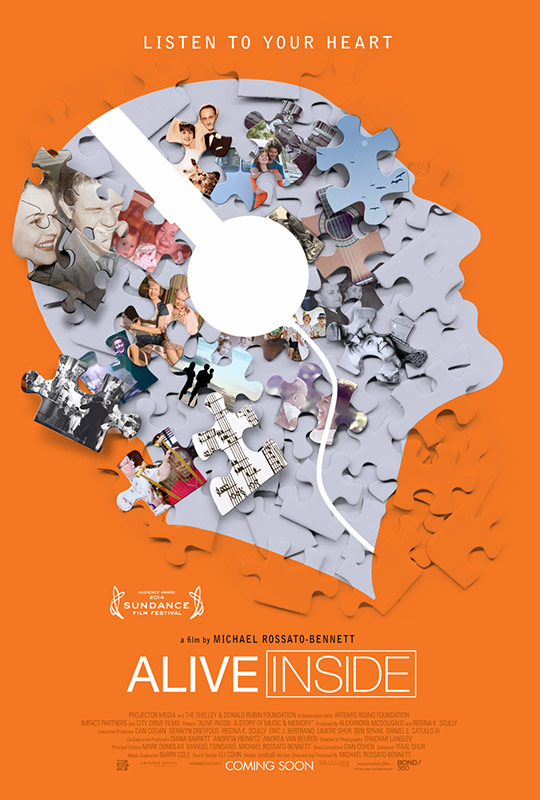
Step forward Dan Cohen, founder of Music & Memory, “a non-profit organization that brings personalized music into the lives of the elderly or infirm through digital music technology”. Michael Rossato-Bennett’s inspiring documentary introduces us to the former consultant/trainer for the U.S. Department of Education as he attempts to convince healthcare professionals and pretty much anyone who will take notice, of the beneficial effects of music on the memories and cognisance of Alzheimer’s sufferers. Originally, Rossato-Bennett was meant to follow Cohen around for one day only, filming his attendance at a care home and recording the effects – if any – on the residents there. Using iPods and music choices that reflected the eras when these people were young, Cohen was able to prove that music could “reawaken” Alzheimer’s sufferers, and retrieve memories long believed lost.

Alive Inside - scene2

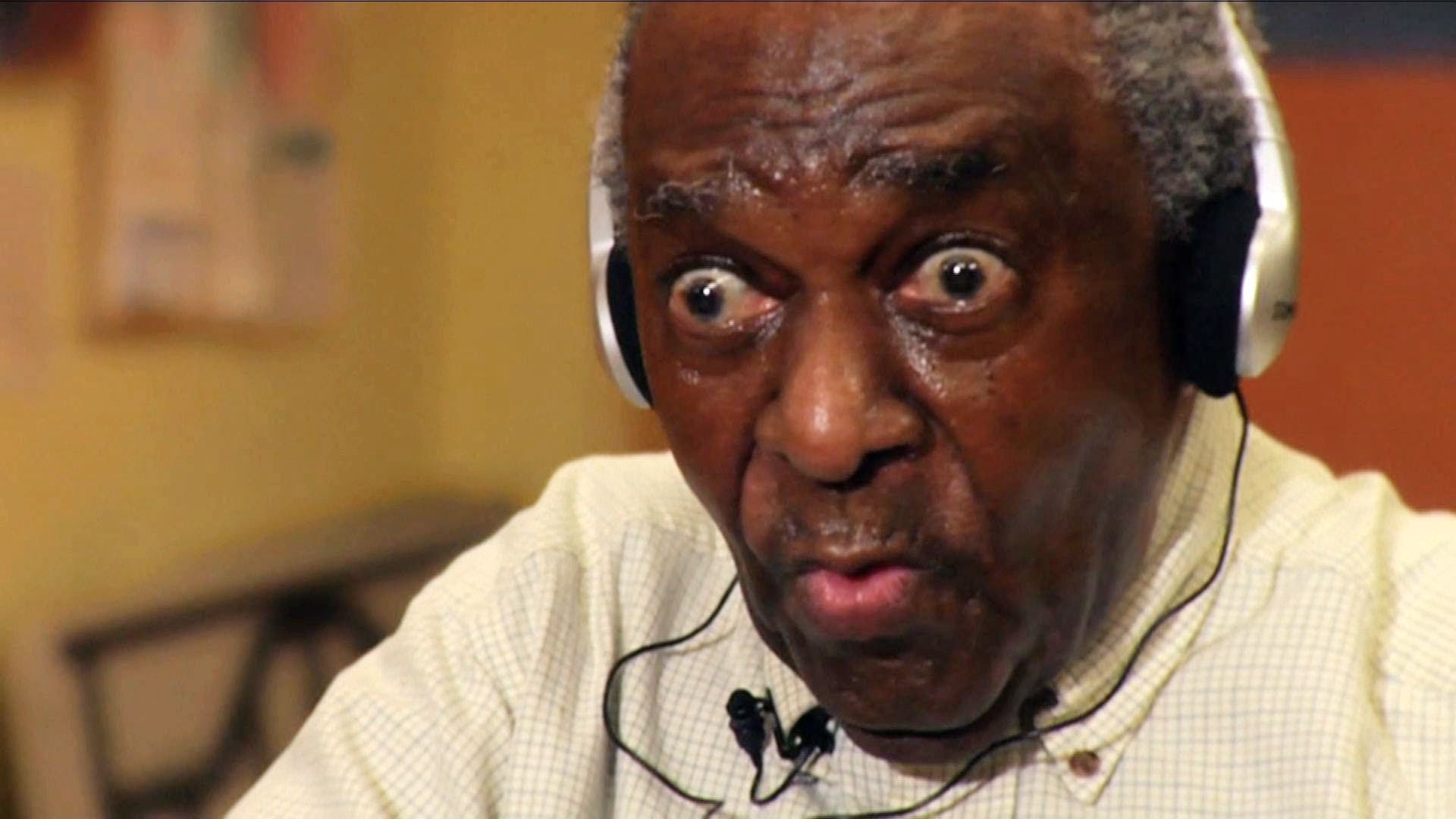
Cohen found a perfect example in Henry, a ninety-four year old who was withdrawn and barely able to speak. Within moments of Henry’s being fitted with headphones and music from his youth played for him, he reacted with spontaneous enthusiasm. Henry responded in a way that amazed everyone, and the longer he listened the more articulate he became. He was able to tell Cohen how the music made him feel, and soon he was able to sing independently of the iPod, revealing a deep melodic voice almost unaffected by the passing of the years. (At this point, Rossato-Bennett decided one day of filming Cohen wasn’t enough: he followed him for the next three years.)

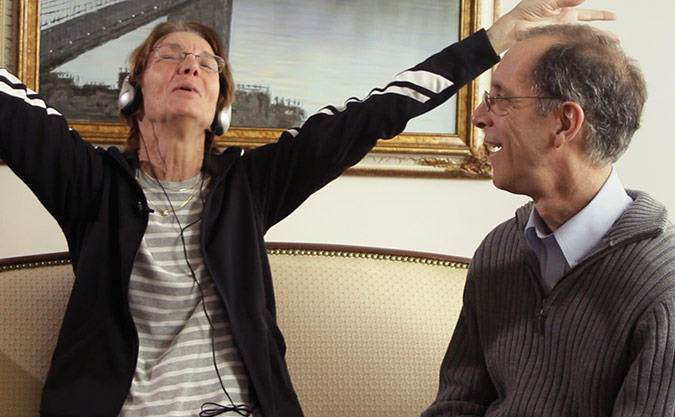
Other patients benefitted from Cohen’s approach to palliative care. While the drugs they were taking each day did little to alleviate their isolation, Cohen’s iPods brought people out of their lethargy. Families could reconnect with their loved ones again, and those sufferers who were still able to understand what the disease was doing to them were able to appreciate the renewed lease of life this music therapy afforded them. People like Denise, a bipolar schizophrenic who felt every emotion so intensely that her life was like being on an emotional rollercoaster. Cohen’s “intervention” saw her do away with the walking frame she’d been using constantly for the previous two years, and dance. And for the first time in a long time, she could honestly say she was happy.

Alive Inside - scene3

With such dramatic but telling effects on a range of Alzheimer’s sufferers, it would seem absurd for the US healthcare system to ignore Cohen’s work. But you’d be wrong (if unsurprised). As Gregory Petsko, Professor of Bio-Chemistry and Chemistry at Brandeis University puts it so tellingly, he could write a prescription for a thousand dollar drug and no one would bat an eyelid. But if he wanted to prescribe a forty dollar iPod, then questions would be asked. It’s at this point that Cohen begins to encounter all manner of excuses from doctors and care providers unwilling to adopt his unique methods. (It’s not mainstream enough for them.)

Cohen perseveres though, focusing on the US care home system, but he makes a limited amount of headway, despite continued, and incontrovertible, evidence that his idea works. When the uptake of iPods ends up being less than one per cent, an exasperated Cohen throws in the towel. But the story doesn’t end there. Some time later, footage of Henry is posted on Reddit, and it goes viral, and now Cohen is appearing on television and promoting his use of iPods…

There’s a great deal of joy to be had from Alive Inside. Joy at seeing Alzheimer’s sufferers regain a semblance of their old selves, joy at knowing that this particular form of therapy works independently of any drugs, joy at seeing the relief and happiness it brings to families and loved ones, and joy that Cohen’s efforts haven’t all been for nothing. There’s something incredibly powerful and uplifting in seeing someone who is withdrawn – mentally, emotionally and physically – emerge as if from a deep sleep and re-engage with their past and their present surroundings. There are several of these moments in the movie, and rather than become expected or commonplace, each is a moment to be thankful for, a transformation that reinstates identity and awareness.

Alive Inside - scene1

In between these powerful moments, Rossato-Bennett is astute enough to provide viewers with historical, social, medical and political contexts for the current state of care home facilities, particularly in light of the introduction in 1965 of Medicare and Medicaid. By treating Alzheimer’s sufferers as patients, the elder care programme has effectively mistreated millions of people in the forty-plus years since; they’ve been victims of a system that has failed to do anything other than make them physically comfortable for as long as possible. As one esteemed physician and researcher puts it, he’s worked in the field of dementia for thirty-eight years and he’s not been able to do anything as productive for dementia sufferers as Cohen has with his iPods. It’s admissions like these that add to the emotional impact of seeing the effect of music on so many people, especially when you have someone as authoritative as Oliver Sacks confirming that musical memories are able to withstand the ravages of Alzheimer’s far better than other kinds of memory. (If this is the case then why the hesitation in adopting Cohen’s idea?)

Cohen himself comes across as a committed, dedicated individual with a great deal of empathy for the people he meets, be they Alzheimer’s sufferers, care providers such as nurses, or the families struggling to come to terms with the premature “loss” of a loved one. As the movie follows him on his quest to improve the lives of so many “lost souls”, his approach and consideration of others serves as a reminder that we should cherish our time with our elders, and recognise their value as individuals, even if they are distant or unresponsive. It’s an important message, and one that shouldn’t be diluted or allowed to fade away. Thanks to Cohen and his efforts, and the reawakening of a man named Henry, that’s unlikely to happen anytime in the near future.

Rating: 8/10 – an impressive, solidly mounted documentary, Alive Inside skimps on statistics in its attempt to put across its feelgood story, but that’s a minor quibble when there’s so much that’s delightful to be had; Rossato-Bennett should be congratulated for his efforts, as his movie tells what could have been a remarkable if dour story with careful consideration and passion.

For further information about Dan Cohen and his work, visit http://musicandmemory.org

Share this:

  • Click to share on X (Opens in new window) X
  • Click to share on Facebook (Opens in new window) Facebook
  • More
  • Click to print (Opens in new window) Print
  • Click to email a link to a friend (Opens in new window) Email
Like Loading...

Monthly Roundup – May 2016

31 Tuesday May 2016

Posted by dullwood68 in Movies

≈ 2 Comments

Tags

Arkansas, Basil Dearden, Bedouin tribes, Biopic, Boaz Yakin, Carla Balenda, Cheerleaders, Chris White, Christine Nguyen, Crazy About Tiffany's, Crime, Damian Lewis, Documentary, Dog handler, Dominique Swain, Drama, Elliott Reid, Fantasy, Gertrude Bell, Googie Withers, History, Holly Golightly, Horror, Illegal arms, J.B. Priestley, James Franco, Jamie Brown, Jewellery, Jim Wynorski, John Clements, Jon Fabris, Josh Wiggins, Lauren Graham, Lawrence of Arabia, Matthew Miele, Max, Middle East, Mystery, Nicole Kidman, Prisoners, Queen of the Desert, Reviews, Robert Pattinson, Sharkansas Women's Prison Massacre, Stage play, Summer camp, The City, The Whip Hand, They Came to a City, Thomas Haden Church, Thriller, Tiffany's, Toxic waste, Traci Lords, True story, US Marines, Werner Herzog, William Cameron Menzies, Winnoga, Zombie Cheerleader Camp

Max (2015) / D: Boaz Yakin / 111m

Cast: Josh Wiggins, Thomas Haden Church, Lauren Graham, Luke Kleintank, Robbie Amell, Mia Xitlali, Dejon LaQuake, Jay Hernandez, Owen Harn

Max

Rating: 6/10 – after his handler is killed in Afghanistan, Max goes to stay with his handler’s family, and helps expose a plot to supply arms to a Mexican cartel; a feature that ticks every box in the “family movie” canon, Max is enjoyable enough but is also too lightweight to make much of a sustained impact, even though the cast enter wholly into the spirit of things.

They Came to a City (1944) / D: Basil Dearden / 78m

Cast: John Clements, Googie Withers, Raymond Huntley, Renee Gadd, A.E. Matthews, Mabel Terry-Lewis, Ada Reeve, Norman Shelley, Fanny Rowe, Ralph Michael, Brenda Bruce, J.B. Priestley

They Came to a City

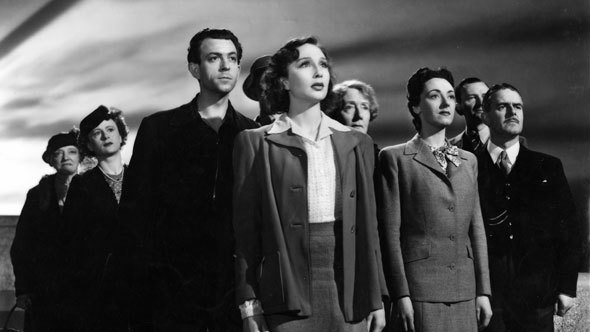
Rating: 6/10 – nine individuals find themselves in unfamiliar terrain and on the outskirts of a vast city – and have to decide if they’re going to stay there; J.B. Priestley’s play is as close to a socialist tract as you could have got during World War II, and while They Came to a City betrays its stage origins and is relentlessly polemical, it has a stark, overbearing visual style that is actually quite effective.

Crazy About Tiffany’s (2016) / D: Matthew Miele / 86m

With: Jessica Alba, Katie Couric, Amy Fine-Collins, Fran Lebowitz, Baz Luhrmann, Sam Taylor-Johnson, Jennifer Tilly, Andrew & Andrew

Crazy About Tiffany's

Rating: 6/10 – a documentary charting the rise and rise of Tiffany’s, the jewellery store made even more famous by Truman Capote and Audrey Hepburn (who he despised in the role of Holly Golightly); a tremendously indulgent puff-piece for the company, Crazy About Tiffany’s is redeemed by some fascinating anecdotes, and the faint whiff of pretentiousness given off by most of its customers.

Queen of the Desert (2015) / D: Werner Herzog / 128m

Cast: Nicole Kidman, James Franco, Damian Lewis, Robert Pattinson, Jay Abdo, David Calder, Jenny Agutter, Holly Earl, Mark Lewis Jones, Christopher Fulford

Queen of the Desert

Rating: 5/10 – a biopic of the explorer and writer, Gertrude Bell (Kidman), and how she  won the trust of numerous Middle Eastern tribes at a time when British colonialism was  looked upon with distrust and contempt by those very same tribes; not one of Herzog’s best (or Kidman’s), Queen of the Desert suffers from being treated as history-lite by the script, and never quite being as courageous in its efforts as Miss Bell was in hers (and not to mention a disastrous turn by Pattinson as Lawrence of Arabia).

Zombie Cheerleader Camp (2007) / D: Jon Fabris / 85m

Cast: Jamie Brown, Chris White, Nicole Lewis, Jason Greene, Brandy Blackmon, Daniel Check, Terry Chandeline Nicole Westfall, Micah Shane Ballinger

Zombie Cheerleader Camp

Rating: 2/10 – when cheerleaders attend a summer training camp, they’re unaware that a squirrel exposed to toxic waste will be the catalyst that turns them and a group of horny males into flesh-eating zombies; all you need to know is that Zombie Cheerleader Camp was made at the extreme low budget end of movie making and features camera work that’s so bad it’s almost a challenge to find a well-framed shot anywhere in the movie (and then there’s the “acting”…)

Sharkansas Women’s Prison Massacre (2015) / D: Jim Wynorski / 84m

Cast: Dominique Swain, Traci Lords, Christine Nguyen, Cindy Lucas, Amy Holt, John Callahan, Corey Landis, Skye McDonald, Chris De Christopher

Sharkansas Women's Prison Massacre

Rating: 3/10 – fracking causes the release of an unspecified number of prehistoric sharks into the Arkansas waterways, and this jeopardises the escape of several women prisoners from a work detail; yes, Sharkansas (actually filmed in Florida) Women’s Prison Massacre is as bad as it sounds, and yes it is as cheesy as you’d expect, but it’s also one of the tamest and most annoying of all the recent shark-related movies we’ve had foisted upon us, and not even the talents of low budget movie maestro Wynorski can rescue this from the bottom of the barrel.

The Whip Hand (1951) / D: William Cameron Menzies / 82m

Cast: Carla Balenda, Elliott Reid, Edgar Barrier, Raymond Burr, Otto Waldis, Michael Steele, Lurene Tuttle, Peter Brocco, Lewis Martin, Frank Darien

The Whip Hand

Rating: 6/10 – a journalist (Reid) on vacation stumbles across a mystery involving a lake where the fish have all died, and a nearby ghost town where the remaining locals aren’t too friendly, and he finds himself prevented from leaving; a well-paced but forgettable effort from master production designer Menzies, The Whip Hand starts off well but soon ties itself inside out in trying to be a confident thriller, an ambition it fails to achieve thanks to untidy plotting and thin characterisations.

Share this:

  • Click to share on X (Opens in new window) X
  • Click to share on Facebook (Opens in new window) Facebook
  • More
  • Click to print (Opens in new window) Print
  • Click to email a link to a friend (Opens in new window) Email
Like Loading...

The Nightmare (2015)

29 Sunday May 2016

Posted by dullwood68 in Movies

≈ Leave a comment

Tags

Documentary, Horror, Nightmares, Review, Rodney Ascher, Shadowman, Sleep paralysis

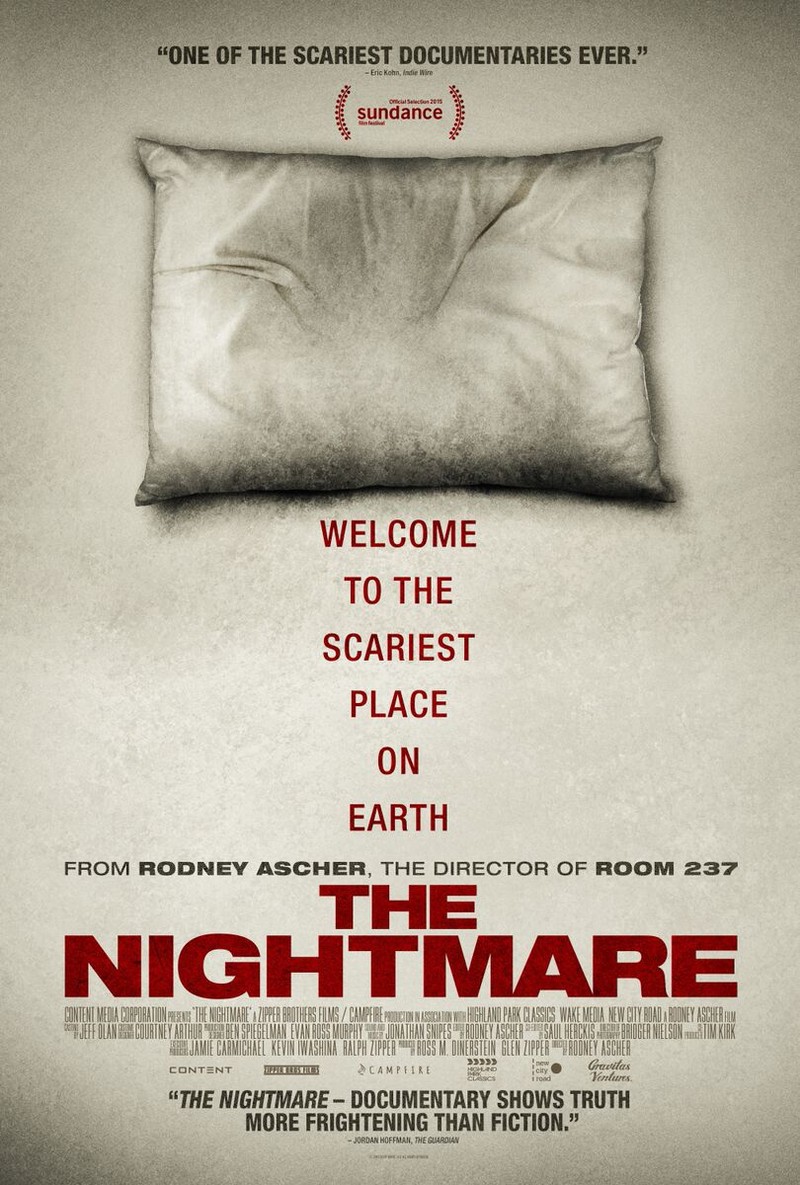
The Nightmare

D: Rodney Ascher / 91m

With: Kate Angus, Forrest Borie, Christopher Bleuze-Carolan, Ana Malagon, Stephen Paynter, Jeff Reed, Korinne Wilson, Connie Yom

For those who have never experienced it, sleep paralysis is truly the stuff of nightmares, a disturbing occurrence that can happen nightly to its sufferers, and which can lead them to hallucinating the appearance of strange “shadow men” who approach them menacingly. These “shadow men” aren’t real, but such is the strange reality that accompanies sleep paralysis, that while the sufferer is experiencing all this, they believe it all to be real, and these hallucinations can be terrifying.

Sleep paralysis is a recognised condition, and a fascinating subject, one that documentarian Rodney Ascher has decided to explore in his follow up to Room 237 (2012), his look at so-called hidden meanings in Stanley Kubrick’s The Shining (1980). Using the experiences of eight sufferers, Ascher adopts a combination of talking heads testimony, eerie recreations, and occasional medical research to examine a condition that affects roughly six per cent of people, and which could provide an explanation for such cultural memes as near death experiences and alien abduction.

The Nightmare - scene1

What soon becomes apparent from hearing each individual tale is how similar they all are, with their apparent waking paralysis, open bedroom doors, and shadowy shapes making their presence known while the “sleeper” can do nothing about it. It’s perhaps this inability to move coupled with the presence of a strange creature that can’t be fended off that makes it all the more terrifying. Most sufferers begin to experience these attacks while they’re a child, and for many they persist into adulthood. As these tales unfold, one thing becomes clear (as a title card declares): it’s a thing.

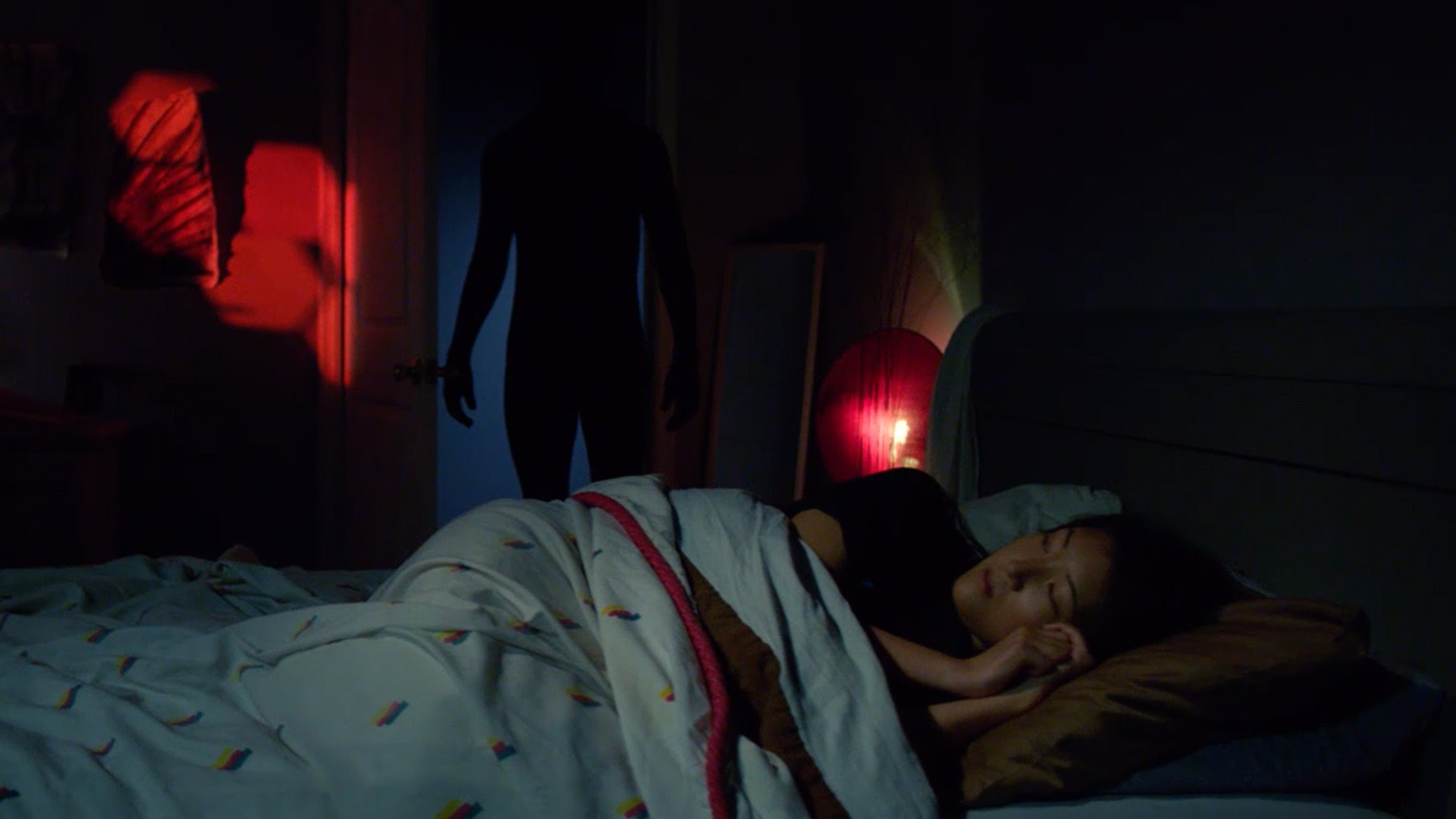
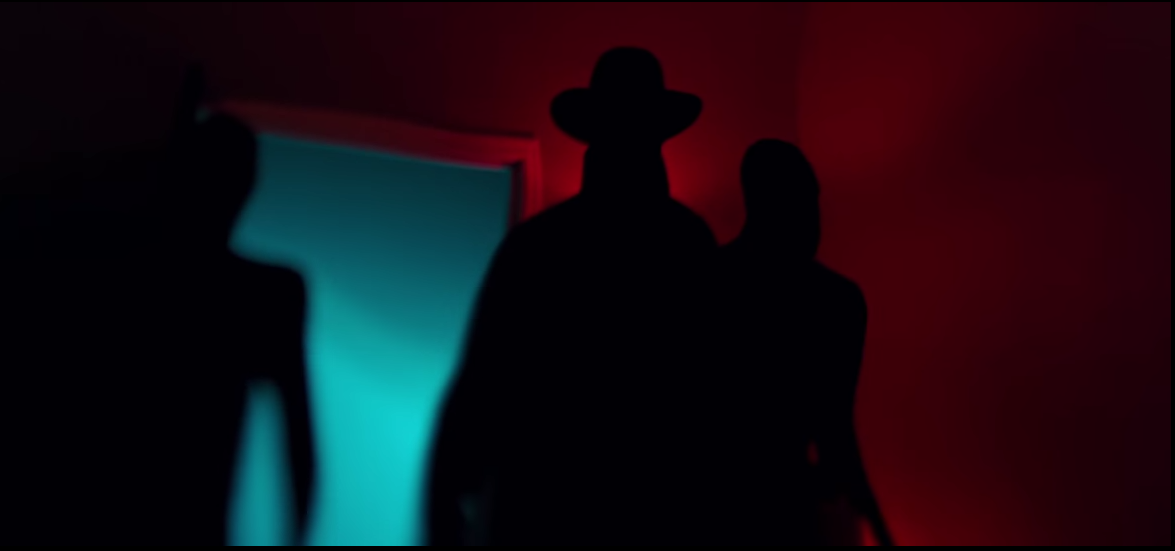
Of course, the reality of the person’s recollection is supported by Ascher’s decision to re-enact their nightmares, making the movie not just a documentary but a horror movie as well, a well-intentioned hybrid that works better in some cases than in others. Using darkness and light to surreal yet credible effect, Ascher takes each case on its own merit, and introduces the kind of horror iconography that we haven’t seen since the days of Freddy Krueger (who features at one point in the movie’s journey). The “shadowman” image is repeated throughout – with some details changing as and when necessary – and it’s this chilling imagery that seems to drive the nightmares, and prove consistent in its appearance across different cultures and time zones. As Ascher probes each sufferer’s experiences, the “shadowman” takes up ever greater importance, until by the movie’s end there’s no doubt that this figure is instrumental in how terrifying each nightmare becomes.

The Nightmare - scene2

But while Ascher’s decision to re-enact these nightmares gives the movie some bite, and stops it from being just a bunch of talking heads expounding on theories of good and evil and supernatural design, what it doesn’t do is answer the one question that should be on every viewer’s mind: why these people in particular? They’re all regular people, leading regular lives, but while there’s evidence to support the theory that it’s all down to genetic inheritance, Ascher seems more concerned with the nightmares themselves than if sleep paralysis can be overcome and a sufferer cured of their afflcition. With so many recreations clogging up the movie’s run-time, Ascher makes the mistake of assuming that every recreation will be interesting to the viewer.

Unfortuantely, it’s this repetition that bogs down the movie once all eight sufferers have introduced themselves to the viewer. With the similarities between nightmares established early on, and with little recourse but to keep repeating the same ideas that keep coming up, Ascher’s movie soon runs out of steam. Part of the problem is that a proven, workable cure hasn’t been discovered yet – one sufferer uses televisions as a means of putting off the inevitable – and another is that there’s no mystery here; as mentioned above and in the movie, it’s a thing. And while there are plenty of reasons why this happens to people, and plenty of theory work out there, The Nightmare isn’t interested in examining any of it too closely. This leads to one of the sufferers believing there to be a supernatural element to her nightmares, a belief that has no basis in fact, and which goes unchallenged by Ascher. In fact, Ascher makes very few attempts to challenge any of the assertions of his interviewees, and their concerns and interpretations of their dreams are generally accepted for what they are.

The Nightmare - scene3

But while Ascher the interviewer forgets to provide some balance, Ascher the canny director knows that his movie will stand or fall on the quality of the re-enactments, and here he gets it right most of the time, using a variety of visual techniques to illustrate the panic and fear that envelops each sufferer, and the causes of that panic and fear. There are some genuinely chilling moments, even one or two jump scares, as each tale is told, and while some of the imagery he adopts has been seen before in a variety of horror movies from the last ten years, Ascher still manages to invest them with the kind of frisson that jangles the nerves. But then he sabotages the effect of these scenes by showing how some of them are set up by his own crew, a device that takes the viewer out of the moment and unfairly reminds them that none of this is actually real, even if the eight subjects chosen really believe their experiences are real.

By the movie’s end, some viewers will be wondering if the topic of sleep paralysis could have been examined in a better way. Ascher appears to have set out to make a documentary that examines the condition in such a way that any conclusions are avoided, and the movie suffers as a result. By not probing enough into both the condition and its sufferers’ experiences, The Nightmare ends up skimming the surface of a very intriguing phenomenon.

Rating: 5/10 – uneven and lacking a cohesive approach, The Nightmare never really decides what kind of documentary it wants to be, and misses out entirely on being the go-to movie on the subject; some arresting imagery aside, Ascher’s take on sleep paralysis and what it means to be a sufferer gets lost amidst all the appearances by “shadow men” and the director’s decision to refrain from explaining anything in any depth.

Share this:

  • Click to share on X (Opens in new window) X
  • Click to share on Facebook (Opens in new window) Facebook
  • More
  • Click to print (Opens in new window) Print
  • Click to email a link to a friend (Opens in new window) Email
Like Loading...

Monthly Roundup – March 2016

31 Thursday Mar 2016

Posted by dullwood68 in Movies

≈ Leave a comment

Tags

Andy Mikita, Australia, Comedy, Cricket, Crime, Death of a Gentleman, Deathgasm, Devil worship, Disaster, Documentary, Drama, Ed Cowan, Edgar Ramirez, Ericson Core, Extreme Sports, FBI, Fred Durst, Horror, Ice Hockey, India, James Blake, Jarrod Kimber, Jason Bourque, Jeremy Sisto, Johnny Blank, Luke Bracey, Michael Shanks, Michelle MacLaren, Milo Cawthorne, Movies, Mr. Hockey: The Gordie Howe Story, Murder, Paul Johansson, Point Break (2015), Population / 436, Ray Winstone, Religion, Remake, Reviews, Robbery, Rockwell Falls, Sam Collins, Sci-fi, Sebastian Spence, Sports, Stonados, SyFy, Test match cricket, Twenty 20, Water spouts

Deathgasm (2015) / D: Jason Lei Howden / 86m

Cast: Milo Cawthorne, James Blake, Kimberley Crossman, Sam Berkley, Daniel Cresswell, Delaney Tabron, Stephen Ure, Andrew Laing, Colin Moy, Jodie Rimmer

Deathgasm

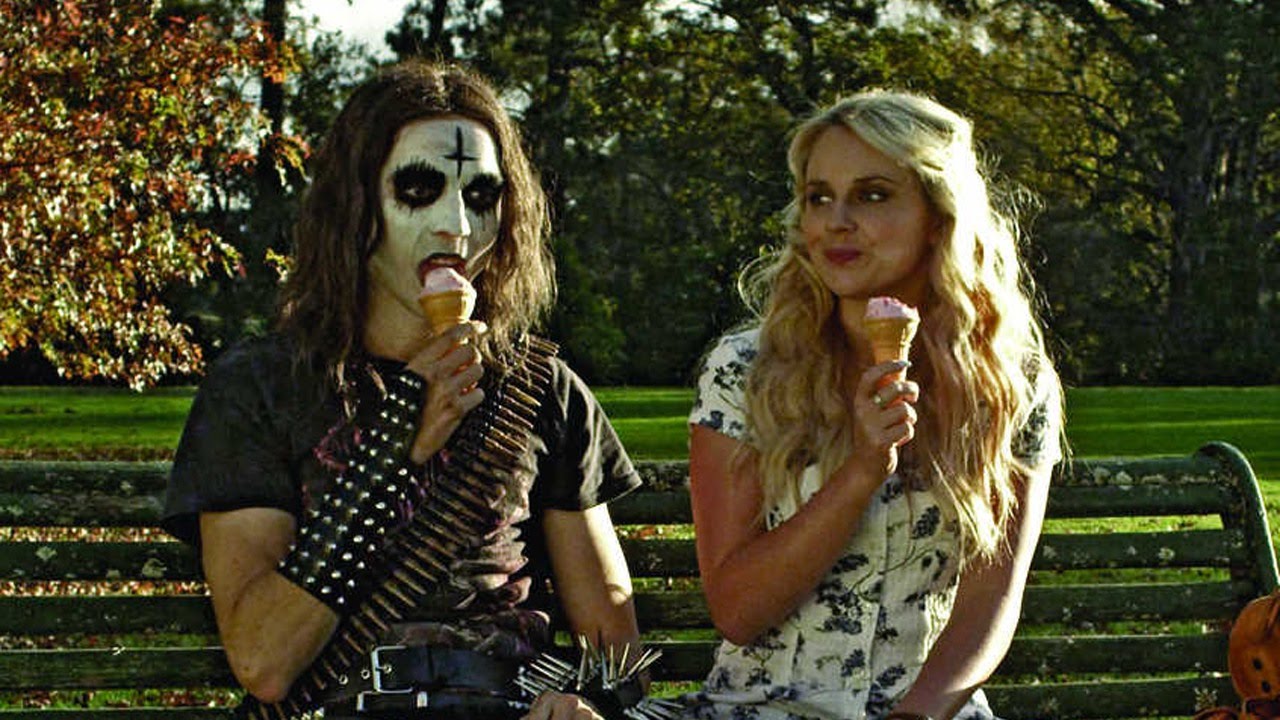
Rating: 7/10 – when a teenage wannabe death metal band come into possession of sheet music that, when played, summons a demon called the Blind One, it’s up to them to stop both a zombie outbreak and the Blind One from destroying the world; raucous, rough around the edges, and with a liberal approach to gore, Deathgasm is a good-natured horror comedy that stumbles on occasion but, luckily, never loses sight of its simple brief: to be loud, dumb and lots of fun.

Mr. Hockey: The Gordie Howe Story (2013) / D: Andy Mikita / 87m

Cast: Michael Shanks, Kathleen Robertson, Dylan Playfair, Andrew Herr, Emma Grabinsky, Martin Cummins, Andrew Kavadas, Teach Grant, Ali Tataryn, Lochlyn Munro, Tom Anniko, Donnelly Rhodes, Erik J. Berg

HANDOUT PHOTO; ONE TIME USE ONLY; NO ARCHIVES; NOTFORRESALE Actor Michael Shanks as Gordie Howe is shown in a scene from the film "Mr.Hockey:The Gordie Howe Story," airing on CBC-TV on Sunday. THE CANADIAN PRESS/HO -CBC-Allen Fraser

Rating: 6/10 – the true story of ice hockey legend Gordie Howe who, after retiring in 1971, came back two years later and played not only with his two sons but in a new league altogether – and maintained his winning ways; looking like a strange hybrid of TV movie and abandoned big screen project, Mr. Hockey: The Gordie Howe Story does its best to avoid being a formulaic biopic, but is let down by the episodic nature of the script and a tendency to raise issues but not always follow them through.

Point Break (2015) / D: Ericson Core / 114m

Cast: Edgar Ramirez, Luke Bracey, Ray Winstone, Teresa Palmer, Matias Varela, Clemens Schick, Tobias Santelmann, Delroy Lindo, Max Thieriot, Nikolai Kinski

Point Break

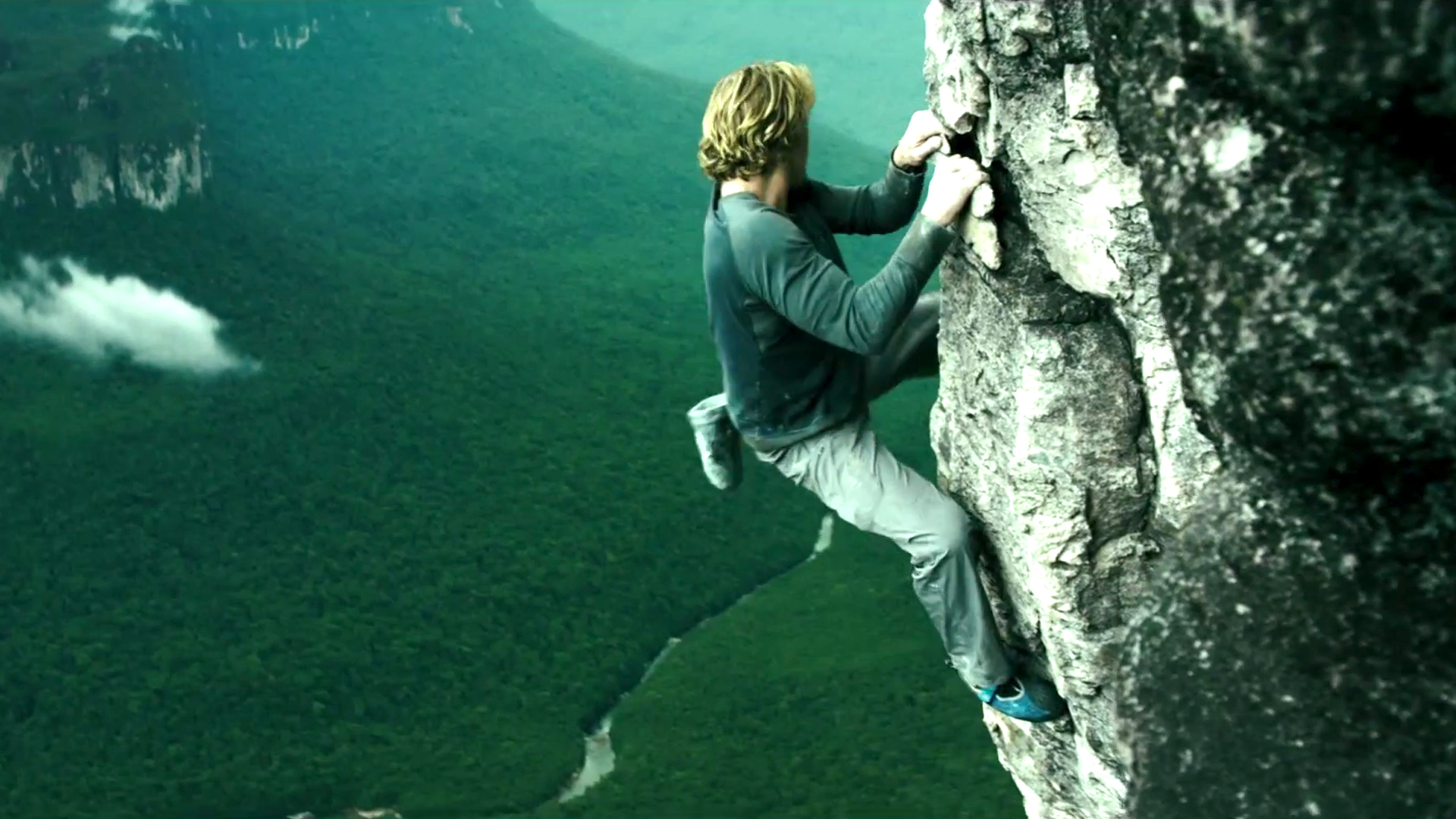
Rating: 4/10 – ex-extreme sportsman Johnny Utah joins the FBI and is given the opportunity to infiltrate a group of extreme sports fanatics who may or may not be responsible for a string of daring robberies; pretty to look at and featuring some great extreme sports sequences, Point Break is nonetheless a pointless remake with poor performances from all concerned, a woeful script, and lacks the edge Kathryn Bigelow brought to the original, leaving the viewer to wonder – yet again – why Hollywood insists on making so many dreadful remakes.

Stonados (2013) / D: Jason Bourque / 88m

Cast: Paul Johansson, Sebastian Spence, Miranda Frigon, Jessica McLeod, Dylan Schmid, William B. Davis, Grace Wolf, Thea Gill

Stonados

Rating: 3/10 – off the coast of Boston, freak water spouts appear and hurl large stone chunks in all directions, putting everyone in danger and hoping they don’t hit land and become… stonados!; made in the same year as Sharknado, this tries to take itself seriously, but without a sense of its own absurdity it stutters from one poorly staged “stonado” sequence to another while – ironically – being unable to shrug off a whole raft of ineffective, embarrassing performances.

Population / 436 (2006) / D: Michelle MacLaren / 88m

Cast: Jeremy Sisto, Fred Durst, Charlotte Sullivan, Peter Outerbridge, David Fox, Monica Parker, Frank Adamson, R.H. Thomson, Reva Timbers

Population 436

Rating: 6/10 – a census taker (Sisto) comes to the small town of Rockwell Falls and begins to suspect a terrible conspiracy, one that keeps the town’s population fixed at the same number; an uneasy, paranoid thriller with horror overtones, Population 436 features a good performance from Sisto and a well maintained sense of dread, but is held back from being entirely convincing by some awkward soap opera moments and a mangled reason for the town keeping its numbers to 436.

Death of a Gentleman (2015) / D: Sam Collins, Jarrod Kimber, Johnny Blank / 99m

With: Sam Collins, Jarrod Kimber, Ed Cowan, Giles Clarke, Narayanaswami Srinivasan, Lalit Modi, Gideon Haigh, Mark Nicholas, Chris Gayle

Death of a Gentleman

Rating: 8/10 – journalists Collins and Kimber set out to make a movie about their love of cricket and the challenges it faces, both commercially and culturally, and discover a scandal that threatens an end to test match cricket; not just for fans of “the gentleman’s game”, Death of a Gentleman is a quietly impressive documentary that sneaks up on the viewer and exposes the level of corruption at the very top of the game, revealing as it does the way in which the sport is being held to ransom by Srinivasan and a handful of others.

Share this:

  • Click to share on X (Opens in new window) X
  • Click to share on Facebook (Opens in new window) Facebook
  • More
  • Click to print (Opens in new window) Print
  • Click to email a link to a friend (Opens in new window) Email
Like Loading...

Trailers – Elstree 1976 (2015), The Nice Guys (2016) and Lights Out (2016)

30 Wednesday Mar 2016

Posted by dullwood68 in Movies

≈ Leave a comment

Tags

Action, Comedy, David F. Sandberg, Documentary, Elstree 1976, Horror, james Wan, Jon Spira, Lights Out, Previews, Russell Crowe, Ryan Gosling, Shane Black, Star Wars, The Nice Guys, Trailers

A big hit at the BFI London Film Festival last year, Elstree 1976 is a lovingly crafted ode to ten people who worked on a little movie called Star Wars, but who won’t necessarily be known to the wider public (well, Dave Prowse might argue about that). That none of them went on to find worldwide fame and fortune isn’t the point of Jon Spira’s documentary; rather it’s the communal joy that came out of working on a project that none of them could have known would have been so successful, and which has enriched their lives in ways they couldn’t have imagined (even if it didn’t feel like it at the time).


The latest movie from the mercurial mind of Shane Black, The Nice Guys is the kind of uproarious mismatched buddy movie that only Black can put together. The teaming of Russell Crowe and Ryan Gosling looks inspired, and the Seventies setting looks so vivid  it’s hard to believe it wasn’t filmed in 1978 and has been sitting on the shelf ever since. The plot concerns the apparent suicide of a fading porn star, but don’t be surprised if there are larger shenanigans afoot, along with lashings of stylised violence, visual gags galore, and whip-smart banter between the leads.


The latest chiller from producer James Wan, Lights Out takes writer/director David F. Sandberg’s short movie – just three minutes long – and expands it to feature length. Its tale of a supernatural entity stalking three generations of the same family may suffer from being extended from its original set up, but hopefully Sandberg has crafted a back story that will explain everything satisfactorily. Either way, expect plenty of scares, lots of spooky rooms for the scares to take place in, and an array of characters who keep turning the lights off when they know they really shouldn’t.

Share this:

  • Click to share on X (Opens in new window) X
  • Click to share on Facebook (Opens in new window) Facebook
  • More
  • Click to print (Opens in new window) Print
  • Click to email a link to a friend (Opens in new window) Email
Like Loading...

Trailers – Miss Peregrine’s Home for Peculiar Children (2016), A Hologram for the King (2016) and Trapped (2016)

15 Tuesday Mar 2016

Posted by dullwood68 in Movies

≈ Leave a comment

Tags

A Hologram for the King, Abortion, Documentary, Drama, Eva Green, Fantasy, Miss Peregrine's Home for Peculiar Children, Movies, Previews, Tim Burton, Tom Hanks, Tom Tykwer, Trailers, Trapped

If there was ever any doubt as to who would be the first choice to direct the movie version of Ransom Riggs’ best-selling novel, Miss Peregrine’s Home for Peculiar Children, then those doubts will have been allayed with the appointment of Tim Burton to the director’s chair. A perfect match of visionary and material? Perhaps. A great combination of visual flair and dramatic invention? Perhaps again. But if you’ve read the first of Riggs’s Peculiar Children trilogy then you’ll know that it’s a lot darker than what’s glimpsed in the trailer, which highlights the idyllic nature of the children’s existence. The script is by Jane Goldman – always a good sign – so this may be one fantasy adaptation that retains the source’s vitality and creative energy and sticks closely to the story, but if Burton is still finding it difficult to connect with the material, as seems to have been the case in recent outings, then we may be faced with a movie that only achieves a portion of what it sets out to do – and that would be a shame.

One of four Tom Hanks’ movies planned for release in 2016, A Hologram for the King sees the rubber-faced everyman on the cusp of a (late) mid-life crisis, and travelling to Saudi Arabia in the hopes of pulling off that one last deal that will help him regain his self-respect and solve all manner of other issues that he has. Aided by the likes of Ben Whishaw and Tom Skerritt, Hanks’s character, Alan Clay, is the traditional fish out of water, ignorant of the customs of the country he’s in, and out of his depth – at first -when it comes to making his comeback. With a romantic sub-plot involving the lovely Sarita Choudhury thrown in as well, this adaptation of Dave Eggers’ novel, written and directed by Tom Tykwer – Run Lola Run (1998), Cloud Atlas (2012) – looks and sounds great, and hopefully, will prove to be a rewarding alternative in amongst all the big budget superhero movies coming our way in 2016 (and it includes a fantastic Talking Heads parody).

A powerful documentary that won a Special Jury Award at this year’s Sundance Festival, Trapped looks at the increasing number of US states that are introducing so-called “trap” laws, or Targeted Regulation of Abortion Providers. As these states seek to take away a woman’s right to legalised abortion, and in doing so, put many women’s lives in danger, Dawn Porter’s unflinching look at the potential consequences that these decisions could have both in the short and long term is both frightening and appalling. By focusing on the lives of the men and women who are taking the fight to the lawmakers, and who refuse to back down in the face of so much blinkered, often Christian-centric prejudice, the movie becomes a rallying cry for anyone who still believes that the decision in Roe vs Wade still gives a woman the right to choose what happens to her body.

Share this:

  • Click to share on X (Opens in new window) X
  • Click to share on Facebook (Opens in new window) Facebook
  • More
  • Click to print (Opens in new window) Print
  • Click to email a link to a friend (Opens in new window) Email
Like Loading...

Trailers – The Brainwashing of My Dad (2015), Ghostbusters (2016), and The Meddler (2015)

03 Thursday Mar 2016

Posted by dullwood68 in Movies

≈ Leave a comment

Tags

Comedy, Documentary, Drama, Jen Senko, Kirsten Wiig, Melissa McCarthy, Previews, Susan Sarandon, Trailers

In The Brainwashing of My Dad, documentary movie maker Jen Senko asks the perfectly reasonable question: why did my father change from a life-long Democrat with no axe to grind against minorities, to a right-wing fanatic with no time for gays, blacks, or the very Democrats he was a part of? The answer lies in the rise of the right-wing media in the US, and shows just how pervasive it’s become – and with no clear way of redressing the balance. By using her father as a prime example of how persuasive the right-wing media phenomenon has become, Senko seeks to understand and explore the ways in which Americans are being drip-fed a steady diet of paranoia and xenophobia, and how the effect of this diet is both wide-ranging and a major reason for concern in the years ahead.


The reboot of Ghostbusters features four of today’s finest comediennes – Kirsten Wiig, Melissa McCarthy, Kate McKinnon, and Leslie Jones – and plonks them down in many of the situations that made the original so entertaining. So is there likely to be a fresh approach to Ivan Reitman’s Eighties classic, or will we find ourselves awash in the kind of romantic nostalgia that provided the basis for Star Wars: The Force Awakens (2015)? It’s hard to tell from this first trailer, which combines two iconic moments from the original in its first twenty seconds, and then seems content to rehash scenes from Ghostbusters II (1989). That might be prove to be a good thing, but right now the jury’s still out on just how effective Paul Feig’s gender-switch update will be, and how funny.


With the unlikely name of Marnie Minervini, Susan Sarandon’s interfering mother – or The Meddler, if you prefer – has all the hallmarks of a woman who lacks boundaries and treats her kids as extensions of her own personality. In Lorene Scafaria’s offbeat yet heartwarming comedy, Sarandon doesn’t lack for opportunities to show off her comedic skills, but you can be sure that in amongst all the indie hijinks and scatterings of inappropriate behaviour, there’s a simple story about mother-daughter differences that are overcome in the end. A feelgood story? Very probably. A movie that offers us something fresh, or new? Maybe, but at least it looks as if you’ll have fun finding out.

Share this:

  • Click to share on X (Opens in new window) X
  • Click to share on Facebook (Opens in new window) Facebook
  • More
  • Click to print (Opens in new window) Print
  • Click to email a link to a friend (Opens in new window) Email
Like Loading...

The Queen of Ireland (2015)

08 Monday Feb 2016

Posted by dullwood68 in Movies

≈ Leave a comment

Tags

Ballinrobe, Conor Horgan, Documentary, Drag queen, Homosexuality, Ireland, Marriage equality, Panti Bliss, Review, Rory O'Neill, RTE, True story

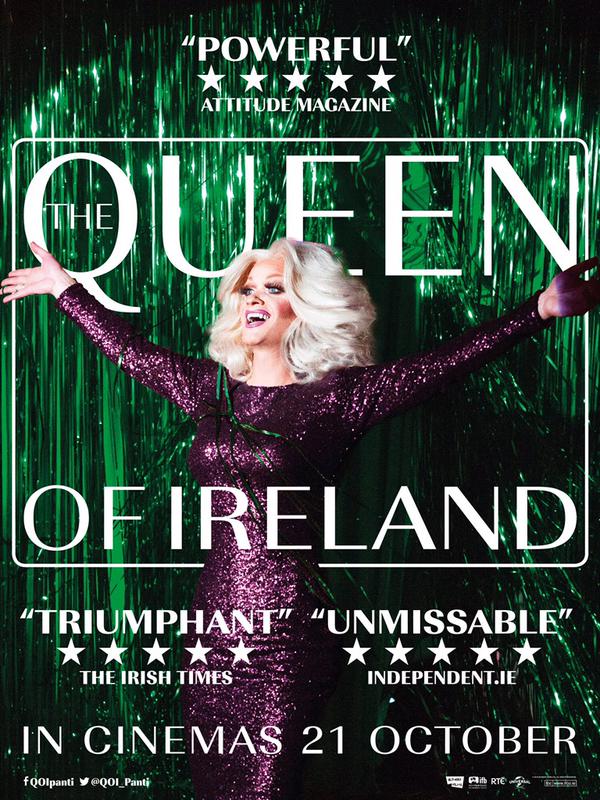
The Queen of Ireland

D: Conor Horgan / 82m

With: Rory O’Neill

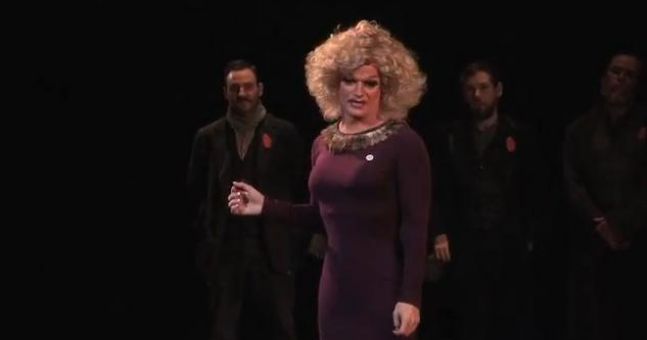
Unless you’re a part of the Irish LGBT community, or have been to one of her shows in a number of cities worldwide, it’s unlikely that you’ll have heard of Panti Bliss, the drag queen alter ego of Rory O’Neill. And you may think that a documentary about her would focus on O’Neill’s life and his experiences of being a gay man in a country where homosexuality was only legalised in 1993. But there’s a bigger story here, and one that the makers of The Queen of Ireland couldn’t have foreseen would happen when they first began filming.

In January 2014, O’Neill appeared (as himself) on RTÉ’s The Saturday Night Show. He and the presenter discussed homphobia in Ireland and as part of his comments, O’Neill alleged that some individuals in Irish journalism were homophobic. This resulted in the TV station being threatened with legal action, and in order to avoid being taken to court, RTÉ paid compensation amounting to €85,000. And then on 1 February 2014, Panti appeared onstage at Dublin’s Abbey Theatre and made a Noble Call speech in response to RTÉ’s actions and about his own personal feelings as a homosexual man living in Ireland. As a result of this, Irish gay rights began to be discussed more openly and more seriously in the Irish government, and in May 2015 the country held the first referendum on same-sex marriages.

TQOI - scene1

What begins as a heartfelt and very charming introduction to an instantly likeable personality, with plenty of input from O’Neill’s family, friends and associates, would have been entirely acceptable if the movie’s focus hadn’t strayed any further than that. O’Neill is an engaging screen presence by himself, confident, self-deprecating, politically and culturally aware, and quite witty in his approach to the way in which being Panti has made his life so rewarding. And Panti is genuinely good company to spend time with, her outrageous look (“a big cartoon woman”) and friendly, approachable demeanour doing a lot to mollify any notions of prejudice. She’s funny, vivacious, passionate, and more confident than O’Neill is likely to be without the wig and makeup. We see some of her earlier incarnations, and there’s a definite progression in terms of Panti developing her cabaret style, and her character as a whole. It’s informative, enjoyable stuff, and if there’s only one problem with it all, it’s that we don’t get to see Panti onstage in all her glory for any real length of time.

But then there’s that TV interview, and the whole tone of the movie changes, as it becomes a probing examination of LGBT rights in Ireland, and how homophobia, and its endemic nature, comes to be challenged at the highest level. The movie also steps up a gear, and the issue of homosexuality comes to the fore, as O’Neill and Panti find themselves at the forefront of a cause that will lead to a major change in the rights of LGBT people in Ireland. Panti becomes an icon, the unofficial face of change, and through it all we see O’Neill maintain a quiet demeanour that reflects his determination to remain humble and unaffected by his sudden increase in fame and public awareness. He’s also very astute, and very aware of what the referendum will mean if it’s successful, and what it will mean if it isn’t.

TQOI - scene2

The nature of homophobia is perhaps best revealed in two short passages: the speech Panti gives at the Abbey Theatre (perhaps the best description of homophobia and its effects that you’ll ever hear), and a speech given in the Irish legislature attacking the way in which RTÉ failed to uphold its duties as the national broadcaster. These two speeches are supplemented by shots of emotive posters put up by groups opposing the idea of same-sex marriages, and the movie, without resorting to impassioned hysterical outbursts or relating extreme homophobic rhetoric, makes its point in a much more effective way, allowing the viewer to feel that they’re not being led by the nose into supporting Panti without appreciating both sides of the argument (something that Panti does very cleverly).

Throughout all this though we never lose sight of Panti the entertainer, and O’Neill the individual behind the public persona. It comes as a bit of a shock when, without warning, O’Neill reveals he was diagnosed as HIV+ in 1995, and the awkward effect it’s had since on his dating – just when do you let the other person know, and how much do you really hope it won’t make a difference? But O’Neill is self-assured – and self-aware – enough to ensure that being HIV+ doesn’t define him, and watching him ten years on he looks the picture of health.

After the referendum, O’Neill returns to his home town of Ballinrobe to make a one-off appearance as Panti (also her first appearance there). There are several touching moments with his family, in particular when Panti is getting ready in her parents’ bedroom, where as a young boy she used to watch her mother getting ready and putting on her makeup. It’s an unexpectedly affecting moment, and yet another example of how O’Neill has managed to stay grounded as an individual throughout all the ups and downs of his life so far. And it’s gratifying to see that despite thousands of public appearances and shows, Panti can still be nervous when faced with an audience of people she’s known since childhood.

TQOI - scene3

What makes The Queen of Ireland so rewarding is the way in which its director has assembled the footage from the various stages of O’Neill’s life, and made each period as interesting and informative as all the others. There’s not a dull, uninteresting moment in the whole movie, and O’Neill is someone the viewer can warm to right from the start. Whatever your views on LGBT rights, or homosexuality in general, this is a movie that promotes an honest, healthy attitude to both sides of the argument, and is to be commended for doing so unreservedly.

Rating: 9/10 – humorous, poignant and candid, The Queen of Ireland treats its central character and the political discourse of recent years in Ireland with a refreshing lack of bias (though it would be very difficult to take a disliking to Panti on any level); without losing sight of the man behind the makeup, Panti’s story is an uplifting one that speaks for itself and is well worth taking a look at.

Share this:

  • Click to share on X (Opens in new window) X
  • Click to share on Facebook (Opens in new window) Facebook
  • More
  • Click to print (Opens in new window) Print
  • Click to email a link to a friend (Opens in new window) Email
Like Loading...

Monthly Roundup – January 2016

31 Sunday Jan 2016

Posted by dullwood68 in Movies

≈ Leave a comment

Tags

Acting, Affair, Antonia Scalari, BP, China, Cholera, Comedy, Documentary, Drama, Drugs, Edward Norton, Floodtide, Freebasing, Giulio Marchetti, Giuseppina, Gordon Jackson, Historical drama, Italy, Jack Lambert, James Hill, John Curran, John Laurie, Literary adaptation, Marina Zenovich, Naomi Watts, Oscar winner, Petrol station, Richard Pryor, Richard Pryor: Omit the Logic, Romance, Rona Anderson, Ship design, Shipyard, Short movie, Stand up comedy, The Clyde, W. Somerset Maugham

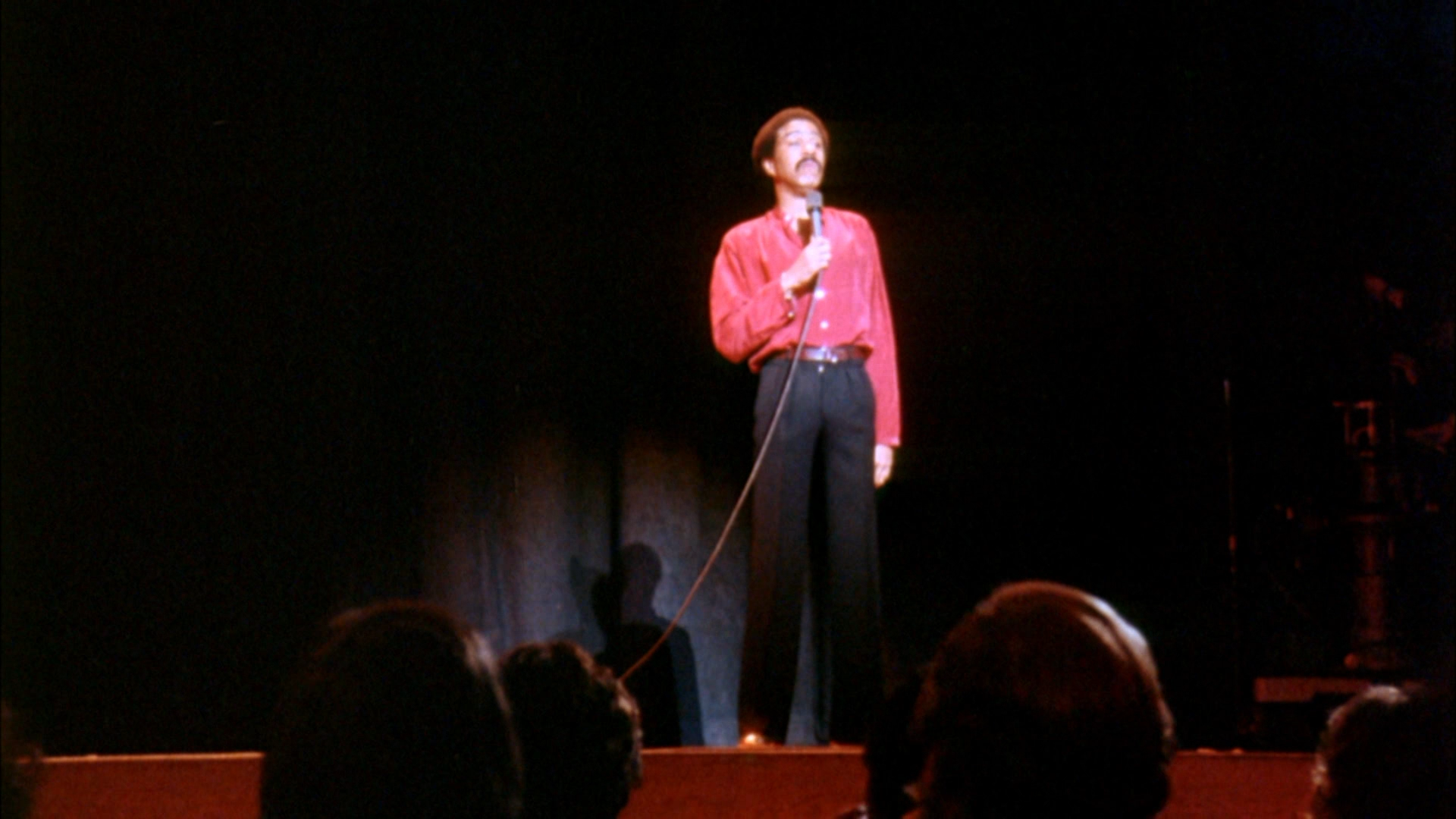
Richard Pryor: Omit the Logic (2013) / D: Marina Zenovich / 83m

With: Richard Pryor, Jennifer Lee, Rashon Khan, Thom Mount, Whoopi Goldberg, Bob Newhart, Patricia von Heitman, David Banks, Skip Brittenham, Paul Schrader, Stan Shaw, Robin Williams, David Steinberg, Rocco Urbisci, Lily Tomlin

Richard Pryor Omit the Logic

Rating: 6/10 – a look back over the life and career of Richard Pryor featuring comments from the people who lived and worked with him; if you’re familiar with Pryor and his work then Richard Pryor: Omit the Logic won’t provide you with anything new, but its concise, straightforward approach is effective enough, even if there’s an accompanying lack of depth to the way the material has been assembled.

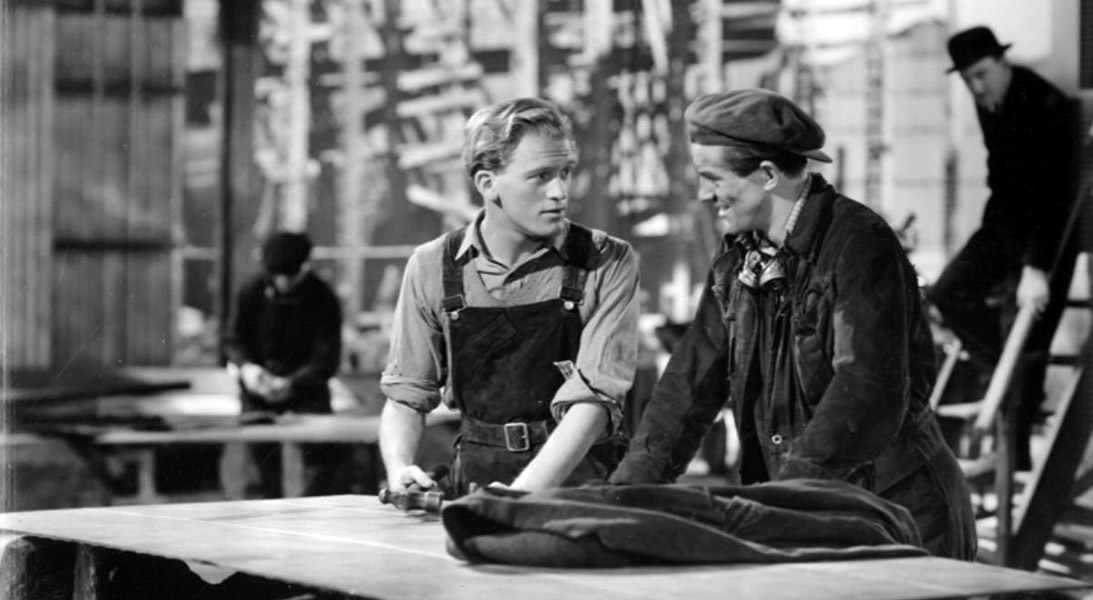
Floodtide (1949) / D: Frederick Wilson / 90m

Cast: Gordon Jackson, Rona Anderson, John Laurie, Jack Lambert, James Logan, Janet Brown, Elizabeth Sellars, Gordon McLeod, Ian McLean, Archie Duncan

Floodtide

Rating: 7/10 – an eager to succeed shipyard worker (Jackson) earns both the respect of the shipyard owner (Lambert) and the love of his daughter (Anderson, who Jackson married in real life), as he climbs the ladder from metal worker to ship designer; the kind of cottage industry movie that Britain made in abundance in the late Forties/early Fifties, Floodtide has a great deal of charm, and an easygoing approach to its slightly fairytale narrative.

Giuseppina (1960) / D: James Hill / 32m

Cast: Antonia Scalari, Giulio Marchetti

Giuseppina

Rating: 9/10 – on a slow, sunny day at an Italian roadside garage, young Giuseppina (Scalari) finds that life isn’t quite as boring as she thinks; an Oscar-winning short, Giuseppina is a total delight, with minimal dialogue, some beautifully observed caricatures for customers, and a simple, unaffected approach that pays enormous dividends, and makes for an entirely rewarding experience.

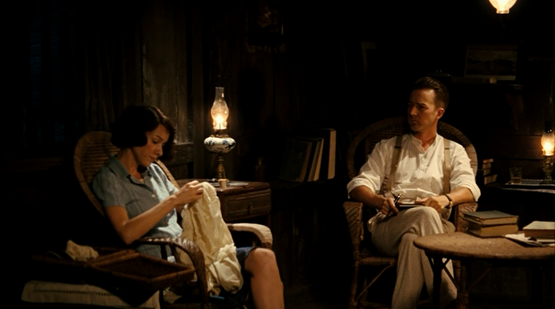
The Painted Veil (2006) / D: John Curran / 125m

Cast: Naomi Watts, Edward Norton, Liev Schreiber, Toby Jones, Diana Rigg, Anthony Chau-Sang Wong

The Painted Veil

Rating: 7/10 – bacteriologist Walter Fane (Norton) takes his wife Kitty (Watts) to China as punishment for an affair, but in combatting an outbreak of cholera, discovers that she has qualities he has overlooked; previously made in 1934 with Greta Garbo, The Painted Veil (adapted from the novel by W. Somerset Maugham) is a moderately absorbing, moderately effective romantic drama that never quite takes off, but does feature some beautiful location photography courtesy of Stuart Dryburgh.

Share this:

  • Click to share on X (Opens in new window) X
  • Click to share on Facebook (Opens in new window) Facebook
  • More
  • Click to print (Opens in new window) Print
  • Click to email a link to a friend (Opens in new window) Email
Like Loading...

Amy (2015)

24 Sunday Jan 2016

Posted by dullwood68 in Movies

≈ Leave a comment

Tags

Alcohol, Amy Winehouse, Archival footage, Asif Kapadia, Back to Black, Blake Fielder-Civil, Career, Documentary, Drugs, Frank, Grammy's, Mitch Winehouse, Review, Singer, Tony Bennett

Amy

D: Asif Kapadia / 128m

With: Amy Winehouse, Juliette Ashby, Nick Shymansky, Mitch Winehouse, Blake Fielder-Civil, Lauren Gilbert, Sam Beste, Raye Cosbert, Andrew Morris, Lucian Grainge, Tyler James, Yasiin Bey

One of the most talented singers of her generation, Amy Winehouse “arrived” on the music scene in 2003 with the release of her first album, Frank. Eight years later she was dead from alcohol poisoning. She was in the public eye so often, and so often for the wrong reasons, that a lot of people felt they knew her. Unable to deal with the fame and fortune she so justly deserved, she retreated into a life of alcohol and drug addiction and repeated, unsuccessful attempts to throw off the demons that plagued her. One of her idols, Tony Bennett, said of her, “she was the only singer that really sang what I call ‘the right way’ because she was a great jazz-pop singer”. But why did she die at the age of twenty-seven, alone and with only her bodyguard checking on her occasionally?

Sadly, Amy doesn’t provide any answers. Nor does it probe too deeply into why the singer had such an addictive personality, or why she had been bulimic for most of her life (a topic which is mentioned partway through then dropped as a point of fact that needs no further investigation). It also fails to explore the differences between Amy Winehouse the world-famous singer/celebrity, and Amy Winehouse the private person. While there are times when her friends and family comment on her behaviour, and there’s a large amount of regret that can be felt, no one seems to have really known what made Amy tick during those brief eight years when she was so well known and so highly regarded.

Amy - scene3

The reason that Amy fails to do this is partly due to the very cleverly constructed way in which it recounts Amy’s life, charting her teenage home life and early success with Frank, through to her increasing use of drugs and her alcohol dependency before the further success of Back to Black. From there the pressures associated with such an unexpected and meteoric rise were compounded by her poor choice of partner – step forward, Blake Fielder-Civil – and the lack of support gained from her family, in particular her father, Mitch, whose lack of empathy for his daughter is incredible to witness. All this led to repeated, and entirely predictable relapses following stays in various rehab clinics. With no one attempting to deal with her bulimia – or get her to – Amy’s health was so compromised by 2011 that those close enough to her knew that her drinking would eventually kill her.

But Amy is effectively reportage, a trawl through the singer’s life that relies on a great deal of archival footage of Amy and her friends, Amy and her working relationships, Amy on stage, Amy in the public eye, and the contributions of many of the people who knew her personally and worked with her professionally. And while some of the early, pre-Frank footage is beguiling to watch, and fascinating in a morbid way (knowing how she would look in later life), the later footage, once her demons have made themselves felt, leads the movie into darker, more disturbing territory. It’s at this point that Amy moves away from bittersweet reflection and becomes a rehash of the public and private life we all saw develop over those eight years. We see the public appearances where she seems overawed and/or overwhelmed, the sight of someone with the light in their eyes slowly dying out, and we gain the sad realisation that this person’s life can only end in tragedy.

Amy - scene2

Did we always know this? Certainly Amy’s friends knew this, and it’s likely that her colleagues in the music industry knew this, and the movie, while not pointing any fingers directly (or with any intention of doing so), does however make one thing clear: no one did enough to stop it. Her friends stepped away because they couldn’t bear to watch her destroy herself, and her record company wouldn’t work with her unless she was clean (reasonable in itself but for Amy an ultimatum she was never going to achieve, not in the long-term). In the end, that’s why Amy died alone and with only her bodyguard occasionally checking in on her: she had nobody she could rely on to protect her.

The sadness and the largely unavoidable tragedy of all this is brought out by Kapadia’s firm control over the movie’s content, and while some people, particularly Mitch Winehouse, have subsequently decried Amy as having produced “an inaccurate narrative of Amy’s story”, there’s little doubt that in the last three years of her life, when her problems became insurmountable, that she was desperately unhappy and struggling to find direction in her life. You can see this illustrated best when she’s seen recording a duet with Tony Bennett, one of her life-long idols. The confidence that has seen her give outstanding vocal performances time and time again has deserted her; she keeps apologising for getting things wrong. Bennett continually reassures her but you can see from her eyes that Amy isn’t convinced; when the session is done, you can see how relieved she is that she’s got through it all. It’s moments like these, when she clearly wants to be at her best, but her best is too far away for her to grasp, that prove the most disturbing and the most upsetting.

Amy - scene1

Could Amy Winehouse have conquered her demons and still be making great records today? We’ll never know, but one thing we can be sure of: her short career gave us many wonderful recordings, and it’s these lasting treasures by which we should remember her, not as the drunk, confrontational, tragically lost figure she was in her last few years. She was talented, incredibly so, and Amy reminds us of that constantly, even as it charts her downward spiral. She was always about the music, always about the irresistable pull of it, and thanks to Kapadia’s inclusion of several of her most iconic and meaningful songs, Amy is still a reminder of just how talented she was, and how much she will be missed.

Rating: 8/10 – a fascinating documentary that tells a fascinating story, even if we think we’ve seen it all before, Amy mixes archival footage of the singer along with candid commentaries from the people who knew and worked with her to create a devastatingly human story of tragedy borne out of success; that it doesn’t make judgments (except very cleverly) or arrive at any conclusions are the only things that stop this from being any better than it already is.

Share this:

  • Click to share on X (Opens in new window) X
  • Click to share on Facebook (Opens in new window) Facebook
  • More
  • Click to print (Opens in new window) Print
  • Click to email a link to a friend (Opens in new window) Email
Like Loading...

Trailer – Rolling Papers (2015)

02 Wednesday Dec 2015

Posted by dullwood68 in Movies

≈ Leave a comment

Tags

Documentary, Mitch Dickman, Preview, The Cannabist, The Denver Post, Trailer

It may seem strange, but on 1 January 2014 it became legal to buy marijuana in the US state of Colorado. That’s right, you could legally buy pot from a store and not get arrested. This groundbreaking event was obviously big local news and The Denver Post responded by creating the first section in a US newspaper, The Cannabist, devoted entirely to pot: its production, its sale, strain reviews, recipes, you name it. The newspaper appointed an editor to oversee the section, Ricardo Baca, who surrounded himself with freelance journalists and in-house staffers with, shall we say, an affinity for the project. All this is covered in Mitch Dickman’s entertaining, wickedly funny documentary that tells the story of what might be regarded as a desperate ploy to boost sales, or an extraordinarily relevant reaction to a new social phenomenon – you decide. But when you do, ask yourself this question first: are you high?

Share this:

  • Click to share on X (Opens in new window) X
  • Click to share on Facebook (Opens in new window) Facebook
  • More
  • Click to print (Opens in new window) Print
  • Click to email a link to a friend (Opens in new window) Email
Like Loading...

Short Movies Volume 1

27 Friday Nov 2015

Posted by dullwood68 in Movies

≈ Leave a comment

Tags

Aliens, Andrea Jensen, Animation, Blue Sky, Brian Dietzen, Camera, Casino, Christmas Scrat-tastrophe, Dave Calub, David Mead, Devon Avery, Documentary, Erinn Hayes, Galen Chu, Gambling, History, Horror, Invasion, Is This Free?, Jack Hawkins, Lauris Beinerts, Matthew Kalish, Megan Prescott, Mike Thurmeier, One-Minute Time Machine, Ransom Riggs, Reviews, Romance, Ryder Bach, Salton Sea, Scrat, Short movies, Spaceship, The Accidental Sea, The Plan (2008), Time travel, Turn Around When Possible

The short movie is an oft-neglected aspect of movie viewing these days, with fewer outlets available to the makers of short movies, and certainly little chance of their efforts being seen in our local multiplexes (the exceptions to these are the animated shorts made to accompany the likes of Pixar’s movies, the occasional cash-in from Disney such as Frozen Fever (2015), and Blue Sky’s Scrat movies (see below). Otherwise it’s an internet platform such as Vimeo, YouTube (a particularly good place to find short movies, including the ones in this post), or brief exposure at a film festival. Even on DVD or Blu-ray, there’s a dearth of short movies on offer. In an attempt to bring some of the gems that are out there to a wider audience, here is the first in an ongoing series of posts that will focus on short movies. Who knows? You might find one that becomes a firm favourite – if you do, please let me know.

One-Minute Time Machine (2014) / D: Devon Avery / 6m

Cast: Brian Dietzen, Erinn Hayes

One-Minute Time Machine

Rating: 9/10 – A comedy about a young man who invents a time machine in order to impress the girl of his dreams, this brief but inventive short is like a sci-fi version of Groundhog Day, but with a humorous sting in the tale. The two leads are well chosen, with Dietzen (NCIS‘s Jimmy Palmer) playing the lovelorn geek to perfection, and Hayes proving to be an equally effective sparring partner. It does make up its own rules about time travel but that’s no bad thing, and Avery makes a virtue of the way in which he cuts between his two characters. A rewarding little movie that is well worth watching.

Turn Around When Possible (2014) / D: Dave Calub, David Mead / 7m

Cast: Megan Prescott, Holly Hoyland

Turn Around When Possible

Rating: 7/10 – Two young women trust their sat-nav too much in this British short that sees them lost in the forest and at the mercy of something strange lurking in the undergrowth. Just what is lurking in the undergrowth is very reminiscent of a creature you shouldn’t get wet or feed after midnight, and the acting is a little amateurish, but this is still an atmospheric, well-shot movie that also manages to provide viewers with a surprisingly ambiguous ending.

Is This Free? (2011) / D: Lauris Beinerts / 8m

Is This Free?

Cast: Jack Hawkins, Tarryn Meaker, Abdiel LeRoy, Cornelia Baumann, Julian Lamoral-Roberts, David Cullinane, Chloe Massey, Katie Goldfinch, Véronique Sevegrand

Rating: 8/10 – Observational comedy is the focus here as Hawkins’ Luka illustrates the various responses he gives to people who ask if the seat next to him is free. Ranging from the risible – woman agrees to pay £2 to avoid someone else getting the seat – to the awkwardly humorous – Luka allows someone to sit next to him on a bench but tells them they’re being watched – Beinerts makes the most of his central idea, and it’s put together with a great deal of heart. And of course Luka doesn’t get it all his own way, which helps the movie avoid being too clever for its own good.

The Plan (2008) / D: Matthew Kalish / 4m

Cast: Ryder Bach, Andrea Jensen

Plan, The

Rating: 8/10 – Mitch (Bach) is unhappy with his life and decides to ditch his job, his girlfriend, and travel to Las Vegas to bet everything’s he’s got on red. Along the way he meets a young woman (Jensen) who steals his camera, but proves to be an augur of a better future. Shot in black and white, and with a Fifties feel to it that adds to the movie’s overall charm, this is both romantic and transformative at the same time, and despite Kalish’s predilection for unnecessary camera angles.

The Accidental Sea (2011) / D: Ransom Riggs / 6m

Accidental Sea, The

Rating: 8/10 – The writer of the Miss Peregrine’s Home for Peculiar Children‘s trilogy provides a potted history of California’s Salton Sea, from its origins as a major engineering mistake to its heyday as a holiday destination before the sea became too salty to sustain the surrounding infrastructure. Of particular interest thanks to Riggs’ modern day footage, where the area looks like the aftermath of the end of the world, the only fault is the sudden appearance of an old man who’s been making art out of the area’s refuse, and who isn’t on screen for nearly long enough. Haunting and wistful, this is a documentary short that is visually arresting and endlessly fascinating.

Christmas Scrat-tastrophe (2015) / D: Mike Thurmeier, Galen Chu / 5m

Cast: Ray Romano, John Leguizamo, Denis Leary, Chris Wedge

Christmas Scrat-tastrophe

Rating: 9/10 – Scrat’s back, and this time his obsession with keeping his nut all to himself leads to his being aboard the spaceship we glimpsed in the first Ice Age movie. From there, Scrat heads off into space to play havoc with the planets and go for a space walk, with predictably disastrous effects. Unabashedly entertaining (and with a complete disregard for physics and astrodynamics), this is top-notch stuff that, unfortunately, serves as a reminder that Scrat’s solo adventures are still far more entertaining than the full-length movies he has a supporting turn in.

Share this:

  • Click to share on X (Opens in new window) X
  • Click to share on Facebook (Opens in new window) Facebook
  • More
  • Click to print (Opens in new window) Print
  • Click to email a link to a friend (Opens in new window) Email
Like Loading...

Back in Time (2015)

13 Friday Nov 2015

Posted by dullwood68 in Movies

≈ Leave a comment

Tags

1955, 1985, 2015, Back to the Future, Back to the Future Part II, Back to the Future Part III, Backtothefuture.com, Bob Gale, Christopher Lloyd, Crispin Glover, DeLorean, Doc Brown, Documentary, Hoverboard, Lea Thompson, Marty McFly, Michael J. Fox, Princess Diana, Review, Robert Zemeckis, Thomas F. Wilson, Time travel

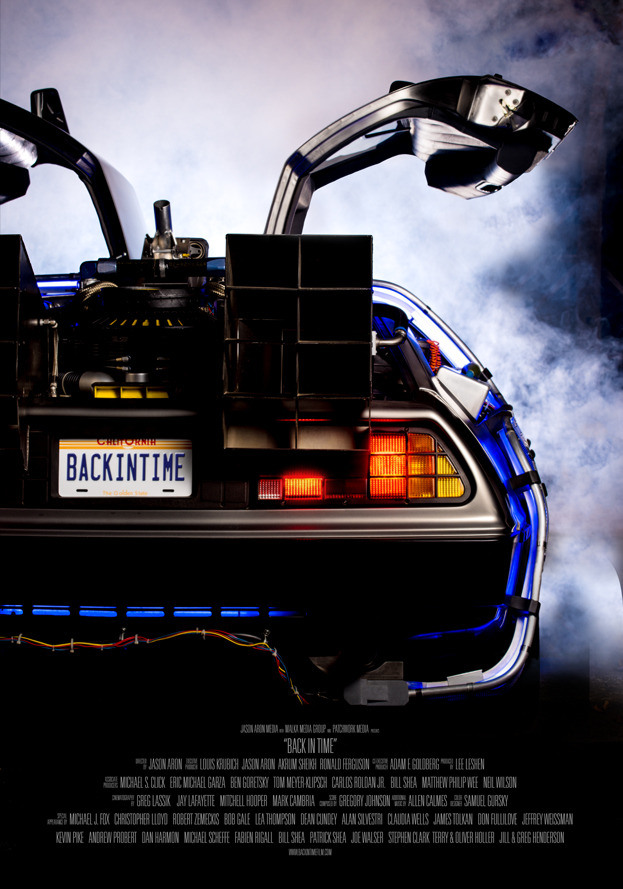
Back in Time

D: Jason Aron / 95m

With: Bob Gale, Robert Zemeckis, Michael J. Fox, Christopher Lloyd, Lea Thompson, Steven Spielberg, Frank Price, Donald Fullilove, Huey Lewis, Claudia Wells, James Tolkan, Alan Silvestri, Dean Cundey, Dan Harmon, Adam F. Goldberg, Jeffrey Weissman, Andrew Probert, Kevin Pike, Michael Scheffe

The enduring appeal of the Back to the Future trilogy is due to one inescapable fact: the scripts – by Bob Gale and Robert Zemeckis on Part I, and Gale alone on parts II and III – are some of the best screenplays ever written. Forget that these aren’t movies that explore in depth the meaning of life, or what it is to be human, or any other deep, meaningful topics. Remember instead that these movies, taken together, constitute one of the most enjoyable, most rewarding movie trilogies this side of the Toy Story series (and if you ignore animation altogether, then they win hands down – sorry anyone waving the Star Wars Original Trilogy at me; I have just one word for you: Ewoks).

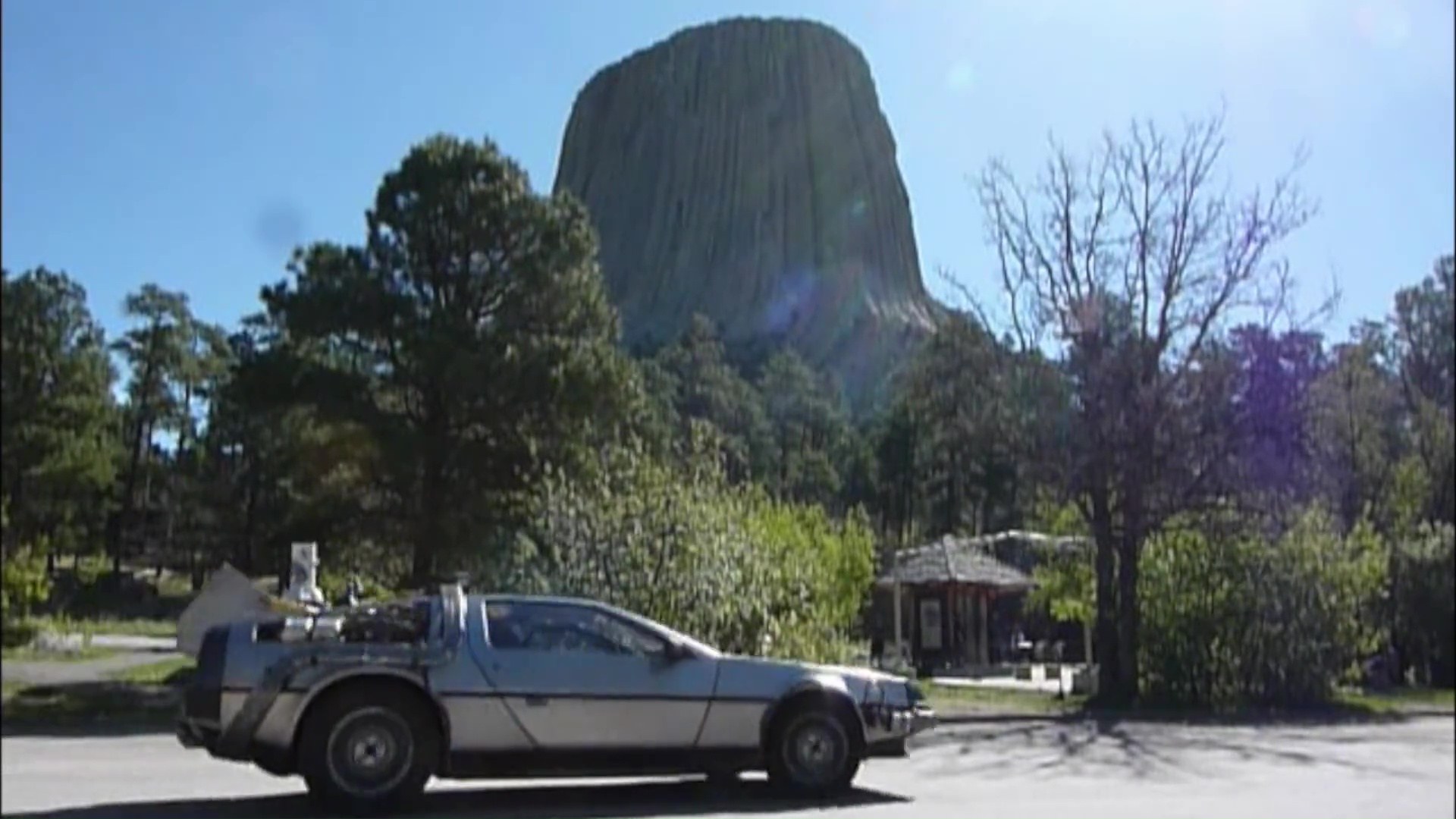
Jason Aron’s likeable, though fumbled, documentary looks at the story behind the making of the first movie, and then widens its scope to look at how it’s affected the lives of some of its fans, people like Stephen Clark, who became the Executive Director of Backtothefuture.com, the one-stop shop for anyone looking for information or merchandise relating to the series. Or Terry and Oliver Holler, who bought a DeLorean as a Bucket List idea when Oliver was diagnosed with cancer; now they travel around the US in their BttF-style DeLorean raising money for Michael J. Fox’s Parkinson’s charity. Or Greg and Jill Henderson, who through their company Arx Pax, have created a working hoverboard.

vlcsnap-00001

While these stories are interesting in and of themselves, and the people recounting them are engaging and refreshingly down-to-earth about their love for the movies and the work they do as a result of that love, it all comes at the expense of the movies themselves. If you’re a fan of Parts II and III, then this is not the movie for you if you’re looking for insights into the making of those movies, or any anecdotes relating to them. Part II gets a brief look, while Part III is practically ignored. The focus is squarely on Part I as the launching point for all the fan activity that followed in its wake.

So this leaves the movie feeling, initially, like it’s going to be about the making of all three movies. But it keeps veering away, jumping from personal recollections to detailed analyses of how several DeLoreans were transformed (by several different people) into copies of the cars used in the movies. There’s feedback from other entertainers/writers/directors, such as Dan Harmon, who created Community, and Adam F. Goldberg, the creator of The Goldbergs. And there are glimpses of conventions and public events, including the Secret Cinema presentation of Back to the Future from 2014. The movie covers a lot of ground, but in doing so, misses out on quite a lot also.

vlcsnap-00003

Part of the issue is, as mentioned above, the way in which Back in Time‘s structure reduces the amount of time we have to find out about one of the most respected and well-regarded cultural icons of the last thirty years. There are some great anecdotes about the making of the first movie, including Disney’s reaction to the script, and Gale is a great guide for the viewer, but without the contributions of Fox, Lloyd and Thompson in particular, this would be a rather dry examination of a wonderful movie (Zemeckis looks uncomfortable throughout, as if looking back on such a long-ago project detracts from the work he’s doing today).

There’s a flatness about the movie as well, a quality that makes it difficult for the viewer to become completely engaged with it. Whole stretches pass by in such a plain, matter-of-fact way that anyone watching from the comfort of their armchair might be inclined to skip ahead to the next section and see if it’s any more interesting. Aron also  keeps the shooting style pretty plain and simple, and the static talking head approach is rarely abandoned for anything different.

As for the cast and crew of Back to the Future, the absence of Thomas F. Wilson (any Tannen you care to mention), and Crispin Glover (George McFly in Part I) is disappointing even though it’s expected. Aside from voicing his characters on various video games over the years, Wilson hasn’t milked his association with the series in the way that, say, Wells and Fullilove have (just watch the movie to find out how), but it would have been interesting to hear what he recalls about making the movies*. Glover, of course, shot himself in the foot when negotiating his contract for Parts II and III, but again, his contribution to such a terrific movie would be great to hear about. (The same goes for Eric Stoltz, but that’s probably not going to happen either.)

vlcsnap-00002

With the movie not quite working at the level it needs to, and even though there are some priceless moments – Fox referring to Princess Diana as “smokin’ hot”; Greg Henderson saying if he could time travel he’d like to go back and “bitch slap” a couple of people – it’s perhaps fitting to end this review with an absolutely brilliant quote from Dan Harmon: “We actually use the same logic when we go to see movies as we do walking into a casino. We largely know we’re gonna get ripped off, but the chance is worth it. If it were any other industry, we would have long ago shut it down and sued everybody. Because if it was cans of tuna, the equivalent would be like every third can had a human finger in it. Movies are so bad now.” And amen to that.

Rating: 6/10 – imperfectly assembled and with too many distractions from the “main feature”, Back in Time is only occasionally successful in doing justice to the movie series it has such high regard for; a once only viewing experience that will only have viewers clamouring for more about the movies and not the fans – they should have been saved for another movie all their own.


*If you want to have some idea of how Thomas F. Wilson feels about his association with Back to the Future, check this out:

Share this:

  • Click to share on X (Opens in new window) X
  • Click to share on Facebook (Opens in new window) Facebook
  • More
  • Click to print (Opens in new window) Print
  • Click to email a link to a friend (Opens in new window) Email
Like Loading...

SuperBob (2015)

03 Tuesday Nov 2015

Posted by dullwood68 in Movies

≈ Leave a comment

Tags

Brett Goldstein, Catherine Tate, Comedy, Documentary, Jon Drever, Laura Haddock, Meteorite, Natalia Tena, Peckham, Review, Romance, Romantic comedy, Ruth Sheen, Short movie, Superhero, Superpowers, US Senator, WMD

SuperBob

D: Jon Drever / 82m

Cast: Brett Goldstein, Natalia Tena, Catherine Tate, Laura Haddock, Ruth Sheen, David Harewood, Ricky Grover, Christian Contreras, Martin McDougall

First brought to life in a three-minute short in 2009, SuperBob has been expanded to feature length movie proportions, and where some shorts should always remain as they are, here the team of writer/director Drever and writer/star Goldstein have spent the intervening years wisely avoiding the pitfalls of “going large”, and have crafted a low budget British superhero movie that is really a sweet-natured romantic comedy.

Bob (Goldstein) is a postman whose dull, ordinary life is changed forever when he’s struck by a meteorite in the middle of a park in Peckham. Quickly claimed by the British Ministry of Defence as their primary asset in emergency situations, and regarded by the jealous Americans as an uncontrollable weapon, Bob is given into the care of MoD bigwig Theresa (Tate), who manages his missions and oversees his private life as well. He has his own (completely unnecessary) security guard, Barry (Grover), and a cleaner, Dorris (Tena) who is from Colombia.

Six years on from being struck by the meteorite, Theresa decides it’s about time that the public see that Bob is actually pretty normal. She hires a documentary film crew to interview Bob and follow him around. Through this device we discover that Bob is a lonely, socially awkward man who has the support (of most) of his local community, but who is yearning to be loved. He is about to go on a date with local librarian June (Haddock) when Theresa hijacks him for a publicity shoot with US Senator Jackson (McDougall). Torn between wanting to go on his date and his sense of duty to the MoD, Bob’s hesitation is made harder to resolve by Dorris’s telling him he should say No more often.

Right about now viewers will probably be expecting SuperBob to become the tale of an affable, easily-swayed superhero who learns to stand up for himself and becomes his own man. And you’d be right. But it’s the way in which he achieves all this that makes the movie so charming and enjoyable. For instead of having Bob flex his muscles and take on hordes of special ops soldiers as they try to bring him back in line, Bob’s search for true love and someone “to shine his shoes with” (an unusual but lovely line retained from the short), takes centre stage.

SuperBob - scene

There’ll be no prizes for guessing just who it is that Bob realises he’s in love with, nor given that he’s inadvertently called her a whore earlier in the movie, that they’ll still end up together. But even though SuperBob follows the dictates of romantic comedies with enthusiasm, it does so with a freshness and a charm (yes, it’s that word again – it’s hard to avoid) that paints a wide grin on the viewer’s face and dares them to wipe it off. There’s a scene at the care home where Bob’s mother, Pat (Sheen), resides that is so simply and yet so effectively done that its very simplicity is to be applauded. Make no mistake, this may be a superhero movie on the surface, but underneath that enticing facade, this is a movie that is one of the most effortlessly romantic comedies of this or any other recent year.

It’s also deceptively and continuously funny, with Bob’s shy, awkward personality proving a winner in the Wildly Inappropriate Public Speaking category (his idea of congratulating a couple celebrating their 60th wedding anniversary is both cringeworthy and hilarious at the same time). And like all the best socially awkward people, Bob often gets things completely and utterly wrong, like the local gospel choir he joins each week; he’s so pleased when their rehearsal ends early, his crestfallen face when he hears them start up again – though entirely predictable – is still a cause for sadness and mirth in equal measure. It’s at moments like these, when Bob’s naturally optimistic disposition is dented that Goldstein is at his most effective, his smiling features slackening for a few seconds, his disappointment registering for just a moment until he regains a grip on that positive attitude. (And this is without mentioning some great visual gags.)

Drever orchestrates it all with a simplicity that matches the needs of the script, and he is very adept at ringing out the pathos of Bob’s situation without resorting to overstating it. He’s helped by a terrific performance by Goldstein that is best exemplified by the moment when Bob finds himself ordered away from the scene of a bad traffic accident (Theresa insists he only goes on MoD-sanctioned missions). It’s the movie’s most dramatic scene, and could have felt out-of-place, but Drever uses it to show the frustration that we would all feel in such circumstances, and the devastating effect it has on Bob.

SuperBob - scene2

Tate provides solid support in the role of overbearing beauracrat Theresa, relishing her tough-as-nails personality and commitment to keeping Bob as a British asset. Tena is abrasive and vulnerable as Dorris, while Haddock goes from playfully besotted to hopelessly obsessive in the space of a few minutes. Sheen portrays Bob’s embarrassing mother with a twinkle in her eye, and Harewood pops up throughout as a newscaster following the story of Bob’s (UN sanctioned) day off. And there’s a great little cameo from the comedian Joe Wilkinson who is probably the person least impressed by Bob’s powers.

The movie does have its flaws, but most of them are entirely forgivable, such as a few of Bob’s means-well utterances that are too contrived to work properly. The idea that Bob is being followed around by a documentary film crew soon becomes hit and miss due to the needs of the script, and the whole subplot involving US fears that Bob is uncontrollable seems shoehorned in to add some drama to the proceedings, but it’s not really needed. And the tight budget means that the visuals don’t always look as sharp as they need to. But again, these are minor problems in a movie that has so much going on that works, that it seems churlish to mention them.

Rating: 8/10 – an unabashed gem of a movie, SuperBob is a delight from start to finish, and features a great romantic thread that anchors the movie and its characters with formidable ease; a superhero movie with a tremendous difference then, and one that can be highly recommended as a refreshing antidote to the bloated offerings available elsewhere.

Share this:

  • Click to share on X (Opens in new window) X
  • Click to share on Facebook (Opens in new window) Facebook
  • More
  • Click to print (Opens in new window) Print
  • Click to email a link to a friend (Opens in new window) Email
Like Loading...

Lost for Life (2013) – Another Look

25 Sunday Oct 2015

Posted by dullwood68 in Movies

≈ 25 Comments

Tags

Abuse, Brian Lee Draper, Documentary, Jacob Ind, Joshua Rofé, Josiah Ivy, Life sentences, Murder, Review, Sean Taylor, Torey Adamczik, Update

Lost for Life

On 7 August 2014 I posted a review of the documentary, Lost for Life. It was a movie that I’d discovered by accident, but it looked interesting, and the subject matter – a look at five teen killers and whether they should be forgiven for their homicidal actions – was certainly compelling. I watched the movie and found it both horrific and uplifting in equal measure.

Over time, Lost for Life has become thedullwoodexperiment‘s most viewed post. It’s also the post I’ve had the most feedback about. A lot of that feedback has concerned Jacob Ind (see picture below), whose story makes up the second part of the movie. Along with his brother Charles, Jacob was regularly abused by his mother and stepfather, both physically and emotionally, and he had nursed ideas of killing them for two or three years before they were murdered. His defenders state that his actions were the result of the abuse he’d suffered, but what helps to muddy the waters for anyone paying even the slightest attention to Jacob’s case, is his decision to persuade a classmate, Gabrial Adams to kill his parents for him (and for $2,000 Jacob didn’t have). A loner, Adams botched the job, and Jacob took over from him, successfully shooting and killing Pamela and Kermode Jordan.

In my review, I said that there was “something not quite right about his responses and the moments when he closes his eyes – which happen quite a lot – it’s as if he’s reliving the memories of killing his mother and stepfather”. Having watched the movie again, I still have that same feeling, that Jacob is so divorced from the concepts of personal responsibility and guilt that it’s all a puzzle to him – and one he has no interest in trying to decipher. Looking further into all the surrounding arguments I found a quote made by Jacob after the killings: “I thought that when they were gone, my whole world was going to be better. I thought all the weight was going to be off my shoulders, all the misery would be gone. But it wasn’t, and I said, ‘Man, I screwed up.'” Reading this, it’s not hard to think that Jacob’s only regret is that he didn’t get away with it.

Jacob Ind

The person I most felt sorry for was Josiah Ivy (see picture below), an abused teenager whose level of disconnection from those around him prompted him to kill two strangers “just to see what it felt like”. Josiah suffered abuse as a child, but where Jacob Ind looks unfazed and unconcerned by his crime, Josiah looks adrift in his own mind, a victim of mental ill health who’ll never quite manage to acclimatise to society (even if by some miracle he’s ever allowed out). Josiah, like Jacob and co-murderers Brian Lee Draper and Torey Adamczik, has an awareness of the magnitude of what he’s done, but it seems so overwhelming to him he doesn’t know how to properly express himself.

Josiah Ivy

Of course, the question of individual responsibility is one the movie tackles throughout, and whether or not the teen killers in question were cognisant of what they were doing at the time. Some commentators argue that teenage minds aren’t as sharply defined in their thinking as an adult’s, but to me that’s a specious argument; everyone learns from an early age that it’s wrong to kill someone, but it’s an awareness that means nothing when placed up against a greater driver: that person’s level of self-interest. Aside from the final story involving ex-gang member Sean Taylor, whose random firing of a gun led to the death of a rival gang member, these are all stories of teens who deliberately set out to kill someone: random strangers, a friend, family members. You could argue that the victims were “convenient”, such was their murderers’ feelings about them at the time, and such was the brutality levelled at them. The question isn’t whether or not we should feel sorry for them – clearly the answer is No – nor is it whether they should be given a second chance as adults. The real question is how can we stop these types of killings from happening again.

Murder in any form is abhorrent, but what Joshua Rofé’s thought-provoking movie also does is to make the viewer doubt whether or not murder is ever so clear-cut. By focusing on three such horrific cases – Taylor’s story acts as a necessary rebuttal to the idea that rehabilitation is a waste of time – the movie broaches the possibility that murder can be understood and forgiven, even murders as heinous as the ones recorded here. This is true, but it’s down to the individual to decide, and is a brave choice to make with such an emotive issue. This is why the participation of Jennifer Bishop-Jenkins and Sharletta Evans is so important: without them (and Taylor) the movie would be unremittingly bleak, and wouldn’t fairly reflect the ways in which the human spirit can overcome the darkness that often blights people’s lives (it’s all about personal empowerment, but that’s a whole different movie).

At this moment in time, Draper, Adamczik, Ind and Ivy are all still in prison, and all still living out their very steep sentences. Ind’s accomplice, Gabrial Adams committed suicide in prison in March 2014, while the families of the victims still struggle to come to terms with what happened to their loved ones, and why. But again, the why is the easy bit: it’s because Draper, Adamczik, Ind and Ivy all wanted to do what they did. For the underlying reasons that drove them to murder, well, those are things we’re never likely to know for definite – but it would be fascinating if we did.

Brian Lee Draper

Share this:

  • Click to share on X (Opens in new window) X
  • Click to share on Facebook (Opens in new window) Facebook
  • More
  • Click to print (Opens in new window) Print
  • Click to email a link to a friend (Opens in new window) Email
Like Loading...

The Wolfpack (2015)

26 Wednesday Aug 2015

Posted by dullwood68 in Movies

≈ 2 Comments

Tags

Crystal Moselle, Documentary, Halloween mask, Movies, New York, Reservoir Dogs, Review, The Angulo family, The Dark Knight

Wolfpack, The

D: Crystal Moselle / 90m

With: Mukunda Angulo, Narayana Angulo, Govinda Angulo, Susanne Angulo, Oscar Angulo, Bhagavan Angulo, Krsna Angulo, Jagadesh Angulo, Visnu Angulo

If you were in Manhattan’s Lower East Side around 2010 and saw six siblings walking around looking like stand-ins for the cast of Reservoir Dogs, then chances are you were looking at the Angulo brothers. You might have been amused by the way they were dressed, but what you wouldn’t have known was that this was very likely the first time the brothers had been out of their 16th-storey four-bedroom apartment – by themselves. The brothers – Mukunda, twins Govinda and Narayana, Bhagavan, Krsna, and Jagadesh – had previously been confined to their home – along with their sister, Visnu – by their father, Oscar, and only allowed out with their mother, Susanne, for doctors’ appointments. Home-schooled by their mother, the children had grown up without friends or relatives to offset their confinement, but in a remarkable twist – given that Oscar’s reason for keeping them at home was to ensure they didn’t fall victim to the city’s dangers – was to provide them with movies, lots and lots of movies (at one point the brothers estimate they have around 5,000 VHS tapes and DVDs).

Access to these movies proved to be the children’s saving grace. With the kind of passion only children can bring to a situation, they began to make their own versions of their favourite movies, including the aforementioned Reservoir Dogs, and The Dark Knight. By painstakingly writing down each line in the movie and memorising them, and then creating their own props and costumes, the brothers recreated the look and feel of these movies, and in doing so created a world in which their confinement could be endured. One year they even made their own horror movie featuring Freddy Krueger and Michael Myers.

Their reclusive lifestyle began to crumble when, in 2010, Mukunda decided one day to leave the apartment by himself. Worried that he might be spotted by his father, he did what any concerned teenager would do in those circumstances: he wore a disguise. The only problem was the disguise he chose was a cardboard approximation of Michael Myers’ Halloween mask. The locals called the police and Mukunda ended up in a mental ward for the next two weeks before being allowed home. His “escape” proved to be the catalyst for several key events: the boys began going out together (which is how they met Moselle), Susanne contacted her mother for the first time after thirty years (something Oscar had insisted she not do), and in time, Mukunda found a job and moved out. With their father’s controlling approach to their lives broken, the brothers, and their mother, have now begun to spread their wings.

Wolfpack, The - scene

The Wolfpack is one of the most fascinating, and frustrating, documentaries of recent years. It’s fascinating because it looks at a family that has existed for nearly fifteen years under what amounts to house arrest, and frustrating because it raises many questions it doesn’t answer. In presenting the Angulo’s story, Moselle – who in 2010 was a graduate of New York’s School of Visual Arts – has chosen to rely on archive footage filmed by the Angulo brothers themselves to illustrate their back story, while using first person interviews and contemporary footage to provide context and further explanations of their unusual lifestyle. But as we don’t get to hear the questions that Moselle asks, some of the responses, while remarkably insightful, are strangely perfunctory; the brothers often sound like they’re reciting lines from the movies they’ve seen.

The relationship between the brothers and their parents doesn’t yield any better results. Oscar is controlling and suspicious of the outside world, but we never really get to know why (it’s possible he doesn’t know himself any more). He makes claims about his ability to influence people, but his appearance belies this, as does his refusal to work because it would make him “a slave to society”. However, Susanne has been so complicit in her husband’s willingness to “retire” from society that she has to bear an equal responsibility for their particular withdrawal from the wider world. But neither Moselle nor the brothers address this in any purposeful way, leaving the moment when she talks to her mother less affecting than it should be. Oscar is seen wandering the apartment from time to time, and makes vague justifications for his actions, and while it becomes clear that there is animosity between him and Mukunda, his interactions with the rest of his family are kept to a minimum. Whether or not this was a deliberate choice by Moselle, or because Oscar didn’t want to cooperate as much as his children, the original mindset that led to his decision needed further examination, and the movie suffers accordingly.

That the six brothers – sister Visnu suffers from Turner Syndrome and doesn’t feature as much as a result – have turned out to be as well-balanced as they have is ascribed to their learning about life through movies. Again, the movie doesn’t delve deeply enough into this idea to fully support or prove the matter conclusively, and so we have to take it on trust that Mukunda et al. have grown up to be so confident by a kind of cinematic osmosis. (Though it doesn’t help when Mukunda went outside in his Michael Myers mask; a regular teenager wouldn’t have done that at all, and the authorities response to send him to a mental ward speaks of a deeper problem that again isn’t addressed or mentioned.)

With so much left unanswered, The Wolfpack fortunately retains its fascination by virtue of the footage the children have filmed over the years, footage that shows a family apparently living like any other. Although their apartment could certainly do with a makeover, it’s clear that the money from Susanne’s stipend as a home-schooler meant that the children didn’t go without, and it’s this contradiction – the outside world is bad unless it’s assimilated into the apartment – that adds to the movie’s allure. And their own versions of the movies they’ve seen are fascinating in their own right, a small-scale triumph of ingenuity and opportunity (would they have made these movies if they had access to the outside world?). Their initial trips outside by themselves show them taking small steps – some get their long hair cut, they go to the cinema, they take a trip to Coney Island and paddle in the sea – but as a precursor to the things they now can do, it leaves the viewer wondering what will happen next to them all. Perhaps Moselle can stay in touch with them and in a few years, let us know.

Rating: 6/10 – lacking the focus needed to explore the Angulo children’s singular experience growing up, and the reasons for it, The Wolfpack relies heavily on the children themselves and the similar personalities they’ve developed during their early lives; thought-provoking to be sure, but in the sense that there’s a lot that’s been left unsaid, the movie is still a unique look at an upbringing that most of us couldn’t even begin to imagine.

Share this:

  • Click to share on X (Opens in new window) X
  • Click to share on Facebook (Opens in new window) Facebook
  • More
  • Click to print (Opens in new window) Print
  • Click to email a link to a friend (Opens in new window) Email
Like Loading...

Monthly Roundup – August 2015

23 Sunday Aug 2015

Posted by dullwood68 in Movies

≈ 1 Comment

Tags

A Capella, Action, Anna Kendrick, Arnold Schwarzenegger, Bank robbers, Barden Bellas, Bloody Mary 3D, Brighton Mob, Cathryn Michon, Charlie Vaughn, Christian J. Hearn, Comedy, Crime, David Arquette, David Siegel, Derek Jameson, Documentary, Elizabeth Banks, James Cameron, Jamie Lee Curtis, Jaqueline Siegel, Lauren Greenfield, Lavalantula, Literary adaptation, Los Angeles, Max Day, Mike Mendez, Movies, Muffin Top: A Love Story, Musical, Nia Peeples, Pitch Perfect 2, Ray James, Real estate, Rebel Wilson, Reviews, Sci-fi, Self esteem, Spiders, Steve Guttenberg, Terrorists, Thriller, Tom Arnold, True Lies, Undercover cop, Veronica Ricci, Versailles, Volcanoes, Weight loss

True Lies (1994) / D: James Cameron / 141m

Cast: Arnold Schwarzenegger, Jamie Lee Curtis, Tom Arnold, Tia Carrere, Bill Paxton, Art Malik, Eliza Dushku, Grant Heslov, Charlton Heston

Rating: 8/10 – spy Harry Tasker (Schwarzenegger) must track down and thwart the plans of jihadists to detonate nuclear bombs on US soil – and keep it all secret from his unsuspecting wife (Curtis); even now, True Lies remains tremendous fun, even if it does get bogged down by its middle act domestic dramatics, and Cameron directs with his usual attention to detail and aptitude for kinetic energy.

True Lies

The Queen of Versailles (2012) / D: Lauren Greenfield / 100m

With: Jaqueline Siegel, David Siegel, Richard Siegel, Marissa Gaspay, Victoria Siegel, Wendy Ponce

Rating: 7/10 – a look at the lives of self-made millionaire David Siegel and his wife Jaqueline, as their lives go from riches to rags thanks to the economic crisis in 2008; “how the other half lived” might be an appropriate subtitle for The Queen of Versailles, and the ways in which the Siegels try to deal with their reversal of fortune will bring a wry smile to viewers who aren’t millionaires, but ultimately this is a story about a couple for whom hardship means not being able to build their dream home: an enormous mansion that defies both taste and propriety.

Queen of Versailles, The

Brighton Mob (2015) / D: Christian J. Hearn / 79m

Cast: Ray James, Max Day, Philip Montelli Poole, Stephen Forrest, Nick Moon, George Webster, Reuben Liburd, Amy Maynard

Rating: 2/10 – an inexperienced young policeman (James) is given the job of infiltrating a gang suspected of carrying out bank robberies across the South of England; a low-budget, amateurish effort, Brighton Mob features dreadful dialogue, awful acting, and the kind of direction that seems to have been carried out by someone who’s not actually watching any of the dailies.

Brighton Mob

Muffin Top: A Love Story (2014) / D: Cathryn Michon / 97m

Cast: Cathryn Michon, Diedrich Bader, Melissa Peterman, David Arquette, Marissa Jaret Winokur, Haylie Duff, Marcia Wallace, Gary Anthony Williams

Rating: 7/10 – when Suzanne (Michon) learns that her husband (Bader) is having an affair and wants a divorce, she goes on a voyage of personal discovery; with several pertinent (if obvious) points to make about self-esteem and body image, Muffin Top: A Love Story is a gently comedic, engaging movie that features an endearing performance from Michon, and doesn’t overdo its theme of female empowerment.

Muffin Top A Love Story

Lavalantula (2015) / D: Mike Mendez / 80m

Cast: Steve Guttenberg, Nia Peeples, Patrick Renna, Noah Hunt, Michael Winslow, Marion Ramsey, Leslie Easterbrook, Ralph Garman, Diana Hopper, Zac Goodspeed, Danny Woodburn, Time Winters

Rating: 4/10 – when volcanic activity strikes Los Angeles, it brings with it giant fire-breathing spiders, and only action movie hero Colton West (Guttenberg) can save the day; taking its cue from the Sharknado series’ combination of low-budget special effects and broad self-referential humour, Lavalantula is enjoyable enough if you just go with it, and benefits from having Mendez – who gave us the superior Big Ass Spider! (2013) – in the director’s chair.

Lavalantula

Pitch Perfect 2 (2015) / D: Elizabeth Banks / 115m

Cast: Anna Kendrick, Rebel Wilson, Hailee Steinfeld, Brittany Snow, Skylar Astin, Adam DeVine, Katey Sagal, Anna Camp, Ben Platt, Alexis Knapp, Hana Mae Lee, Ester Dean, Chrissie Fit, Birgitte Hjort Sørensen, Flula Borg, John Michael Higgins, Elizabeth Banks

Rating: 6/10 – after a show goes disastrously, embarrassingly wrong, the Barden Bellas are banned from competing in the US, but it doesn’t stop them from taking part in the World A Capella Championships and going up against the dominating Das Sound Machine; a predictable sequel that offers nothing new (other than a great cameo by Snoop Dogg), Pitch Perfect 2 will satisfy fans of the original but newcomers might wonder what all the fuss is about.

Pitch Perfect 2

Bloody Mary 3D (2011) / D: Charlie Vaughn / 77m

Cast: Veronica Ricci, Derek Jameson, Alena Savostikova, Bear Badeaux, Shannon Bobo, Michael Simon, Natalie Pero, Ryan Barry McCarthy, Shawn C. Phillips, Shay Golden

Rating: 2/10 – the ghost of Mary Worth (Ricci) targets the makers of a music video when her name is invoked and she finds the reincarnation of the man who killed her is the video’s star; dire in the extreme, Bloody Mary 3D is the kind of low budget horror movie that gives low budget horror movies a bad name, and criminally, takes too much time out to showcase Jameson’s limited talents as a singer (and the 3D is awful as well).

Bloody Mary 3D

Share this:

  • Click to share on X (Opens in new window) X
  • Click to share on Facebook (Opens in new window) Facebook
  • More
  • Click to print (Opens in new window) Print
  • Click to email a link to a friend (Opens in new window) Email
Like Loading...

The Death of “Superman Lives”: What Happened? (2015)

17 Friday Jul 2015

Posted by dullwood68 in Movies

≈ Leave a comment

Tags

Costume change, Dan Gilroy, Documentary, Giant spider, Interviews, Jon Peters, Jon Schnepp, Kevin Smith, Nicolas Cage, Review, Superman, Test footage, The Death of Superman, Tim Burton, Warner Bros., Wesley Strick

Death of Superman Lives

D: Jon Schnepp / 104m

With: Tim Burton, Kevin Smith, Jon Peters, Lorenzo di Bonaventura, Colleen Atwood, Wesley Strick, Dan Gilroy, Steve Johnson, Rick Heinrichs, Derek Frey, Nicolas Cage (archive footage), Jon Schnepp

In 1993, producer Jon Peters purchased the rights to Superman from the Salkinds (makers of the Christopher Reeve Superman movies), and approached Warner Bros about making a new movie entitled Superman Reborn, from a script by Jonathan Lemkin. Lemkin’s script was later rewritten by Gregory Poirier, but although Warner Bros were happy with it, in 1996 Kevin Smith, creator of Clerks (1994), was asked by Peters to write a script for “the fans” – but with three provisos: Superman couldn’t be seen flying, he wasn’t to wear his usual outfit, and he had to battle with a giant spider in the final act. Smith agreed to Peters’ terms and produced a script he titled Superman Lives, and which was based on The Death of Superman comic book storyline.

Smith’s script was accepted and Tim Burton, Peters’ first choice as director, came on board. He immediately jettisoned Smith’s script and brought in Wesley Strick to rewrite it. Nicolas Cage signed on to play Clark Kent/Superman, while Peters sought Kevin Spacey for the part of Lex Luthor, Courteney Cox for Lois Lane, and Chris Rock for Jimmy Olsen. The movie went into pre-production in June 1997, with Rick Heinrichs brought in as production designer. While various artists were hired to provide drawings of alien beasts, Krypton, and the main characters, Cage attended a costume fitting that was overseen by Colleen Atwood and Burton, and which brought an entirely new look to the character of Superman.

Strick produced his rewrite, emphasising Burton and Cage’s idea of Superman as an outsider, making him more of an existentialist. However, the cost of making Strick’s script was prohibitive, and Warner Bros asked Dan Gilroy to contribute a further version that would reduce the cost. Gilroy did so, but by this time Warner Bros were having a less than successful time at the box office, with many of their movies failing to make their money back. By this time, April 1998 (two months before the movie’s original planned release), $30 million had been spent on the production without anything to show for it. Warner Bros decided to put the film on hold, and Burton left to make Sleepy Hollow (1999).

Peters continued to try and get the project resurrected and offered it to several directors, none of whom accepted the challenge. In 1999 another script was written by William Wisher Jr with input from Cage, but in June 2000, Cage withdrew from the project, and despite further efforts by Peters to get his Superman movie made, the whole idea was abandoned in favour of a new approach in 2002.

Death of Superman Lives - scene

The question in the title, The Death of “Superman Lives”: What Happened?, is surprisingly easy to answer: Peters and Warner Bros wanted to repeat the success of Batman (1989) and Batman Returns (1992) while at the same time abandoning the very special qualities that made Superman so unique a character. It was a movie doomed to fail from the beginning because, as Smith correctly asserts, it was being made by people who had no feel for Superman or his place in comic book history. By taking Superman, one of the most iconic superhero figures of all time, and removing most of the traits that made him so iconic, Peters et al were practically guaranteeing their movie’s failure.

Those of you who have seen Superman IV: The Quest for Peace (1987) will know just how bad a Superman movie can be, but under the auspices of Peters, a man who thinks giving Superman a makeover is an acceptable way forward, Superman Lives was always bound to founder. Hearing him talk about the movie it’s clear that whatever previous success Peters may have had in the past it’s of no relevance to the project at all. At one point he instructed Smith to include a scene at the Fortress of Solitude where Brainiac, the movie’s villain, would fight two polar bears. When Smith asked the reason for this, Peters’ response was, “They could be Superman’s guards” (Smith and Schnepp’s reaction to this is priceless).

Here, Smith is a vocal critic of Peters and the script he was asked to write (and he’s been equally critical elsewhere), and he makes several important points about the production’s inherent flaws. But nothing can prepare you for the sheer absurdity of Nicolas Cage’s costume fitting, where he and Burton try to make insightful remarks into the character but without ever finishing any of their thoughts or sentences. While Cage sports an awful shoulder-length wig as Superman, it’s actually nothing compared to the brief scene in which we see him as Clark Kent, dressed as if he’d just stepped out of a thrift store and looking like a beachcomber.

Atwood talks at length about the difficulties in coming up with a new costume for Superman, and the movie looks at this process in some depth, along with interviews with several of the concept design artists (many of whom did their work with little in the way of context to go by) that illuminates the ramshackle nature of the pre-production period. Burton, wearing his customary sunglasses, and still unable to finish a sentence that contains more than ten words, is a frustrating interviewee, vague on several points and misunderstanding several of Schnepp’s questions. Against this, everyone else, even the dreadfully misguided Peters, responds to Schnepp’s enquiries with candour and sincerity, all of which makes this examination of one of recent cinema’s most well-known follies an absorbing and fascinating watch.

Rating: 8/10 – there’s more to Peters’ doomed project than is covered here, but The Death of “Superman Lives”: What Happened? covers the salient points with admirable clarity; having Cage’s recollections as well would have rounded things off nicely but considering Burton’s reticence, it’s maybe not much of a surprise that he didn’t take part.

Share this:

  • Click to share on X (Opens in new window) X
  • Click to share on Facebook (Opens in new window) Facebook
  • More
  • Click to print (Opens in new window) Print
  • Click to email a link to a friend (Opens in new window) Email
Like Loading...

Trailer – The Wolfpack (2015)

11 Saturday Jul 2015

Posted by dullwood68 in Movies

≈ Leave a comment

Tags

Crystal Moselle, Documentary, Preview, The Angulo family, Trailer

A documentary about seven children – six brothers and one sister – who were home-schooled by their parents and rarely allowed out of their sixteenth-story, four-bedroom apartment except on strictly controlled trips, The Wolfpack is a startling look at the redeeming and transformative nature of movies, and how they enabled the Angulo children to overcome the limitations imposed upon them by their father. Despite the intriguing and fascinating subject matter, it’s likely that The Wolfpack won’t get the wide release it probably deserves, but it’s definitely one to watch.

Share this:

  • Click to share on X (Opens in new window) X
  • Click to share on Facebook (Opens in new window) Facebook
  • More
  • Click to print (Opens in new window) Print
  • Click to email a link to a friend (Opens in new window) Email
Like Loading...

Monthly Roundup – June 2015

30 Tuesday Jun 2015

Posted by dullwood68 in Movies

≈ 1 Comment

Tags

Action, Animation, Beyond the Reach, Black Samurai, Blood, Brian Cox, Bulldog Drummond Comes Back, Bulldog Drummond in Africa, Children of the Corn: Genesis, Chris Evans, Chyler Leigh, Crazy Sexy Cancer, Crime, Curse of the Witching Tree, Daphne, Documentary, Dolph Lundgren, Drama, Drunk Wedding, E.E. Clive, Echelon Conspiracy, Ed Burns, Espionage, Every Secret Thing, Faults, Forrest Tucker, Fred, Gambling, Green Dragon, Gunsmoke in Tucson, Horror, Human trafficking, Imogen Poots, Indie movie, Jennifer Aniston, Jeremy Irvine, John Barrymore, John Howard, Kris Carr, Leland Orser, Leticia Dolera, Louis King, Mark Stevens, Martin Sheen, Mary Elizabeth Winstead, Michael Douglas, Miguel Ferrer, Mojave Desert, Movies, Murder, Noboru Iguchi, Not Another Teen Movie, Owen Wilson, Pamela Springsteen, Paul Bethany, Peter Bogdanovich, Prague, Predator: Dark Ages, Reviews, Rhys Ifans, Riley Stearns, Scooby-Doo! and the Samurai Sword, Serial killer, Shaggy, Shane West, She's Funny That Way, Skin Trade, Sleepaway Camp 2: Unhappy Campers, Thailand, The Four-Faced Liar, The Night Flier, The Posthuman Project, The Reconstruction of William Zero, Thriller, Tony Jaa, uwantme2killhim?, Vampire, Velma, Ving Rhames, Witch's curse, Zombie Ass: The Toilet of the Dead, Zombies, [Rec]³ Génesis

This month, the roundup is bigger than usual thanks to spending three weeks in sunny France, in an area where the Internet was an occasional luxury rather than a constant presence. But in between drinking copious amounts of beer and wine, and sampling far too much cheese and local bread, there was quite a bit of movie watching going on. These are the movies I watched in a gite in the middle of the gorgeous Brittany countryside, almost all of them a reminder that when life is this good you can forgive quite a bit…

The Posthuman Project (2014) / D: Kyle Roberts / 93m

Cast: Kyle Whalen, Collin Place, Josh Bonzie, Lindsay Sawyer, Alexandra Harris, Jason Leyva, Rett Terrell, Will Schwab

Rating: 5/10 – a group of teens develop super powers thanks to a device created by the dastardly uncle of one of them, and must thwart his plan to use it for immoral profit; pretty much a low-budget, amateur version of The Fantastic Four, The Posthuman Project relies on its not inconsiderable charm to help the viewer get past its rough edges, but the acting and the dialogue leave an awful lot to be desired, sometimes too much so.

Posthuman Project, The

Predator: Dark Ages (2015) / D: James Bushe / 27m

Cast: Adrian Bouchet, Amed Hashimi, Sabine Crossen, Ben Loyd-Holmes, Jon Campling, Joe Egan, Philip Lane, Bryan Hands

Rating: 7/10 – a group of mercenaries led by Thomas (Bouchard) set off to hunt the mysterious creature killing people and animals in a nearby forest – and find something even more deadly than they expected; a fan-made short that adds a novel twist to the Predator saga, Predator: Dark Ages is a welcome distraction that confirms that, sometimes, the big studios don’t always have the right idea when it comes to their franchise characters.
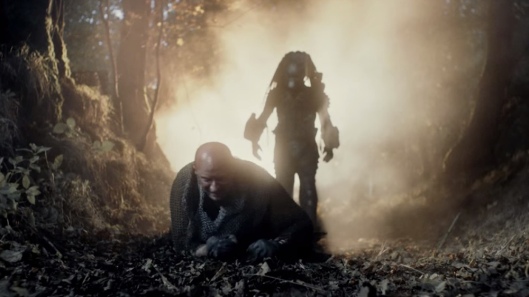
Predator Dark Ages

Drunk Wedding (2015) / D: Nick Weiss / 81m

Cast: Christian Cooke, Victoria Gold, Dan Gill, Anne Gregory, J.R. Ramirez, Nick P. Ross, Genevieve Jones, Diana Newton

Rating: 4/10 – when a couple decide to get married in Nicaragua, they and some of their friends are given hand-held cameras to film it all… with predictably awful, drunken, outrageous, and potentially life-altering effects; if your idea of comedy is seeing someone urinating on another person’s back, then Drunk Wedding is the movie for you, and despite its lowbrow modern day National Lampoon-style approach it still manages to hold the attention and is surprisingly enjoyable – if you don’t expect too much.
Drunk Wedding

Zombie Ass: The Toilet of the Dead (2011) / D: Noboru Iguchi / 85m

Original title: Zonbi asu

Cast: Arisa Nakamura, Mayu Sugano, Asana Mamoru, Yûki, Danny, Kentaro Kishi, Demo Tanaka

Rating: 5/10 – while on a trip to the woods, Megumi (Nakamura) and four older friends find themselves under attack from zombies who have emerged from the bowels of an outhouse – and only her martial arts skills can save them; a wild, wild ride from one of the masters of Japanese Shock Cinema, Zombie Ass: The Toilet of the Dead is equal parts raw, uncompromising, witless, and gross, but it’s also a movie that just can’t be taken at all seriously, and on that level it succeeds tremendously, providing enough WtF? moments to make it all worthwhile.
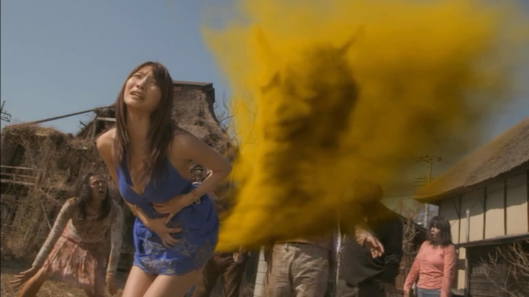
Zombie Ass

Faults (2014) / D: Riley Stearns / 89m

Cast: Leland Orser, Mary Elizabeth Winstead, Chris Ellis, Beth Grant, Jon Gries, Lance Reddick

Rating: 8/10 – down on his luck cult expert Ansel (Orser) sees a way out of debt and a chance to regain some self-respect when a couple (Ellis, Grant) ask him to abduct and de-programme their daughter (Winstead), but he soon finds himself out of his depth and facing up to some hard truths; a tour-de-force from the always excellent Orser – and with a solid supporting performance from Winstead – Faults is an unnerving look at a man on the verge of a nervous breakdown, and the ways in which his broken life have led him to a motel room where his own personal beliefs come under as much scrutiny as his captive’s.
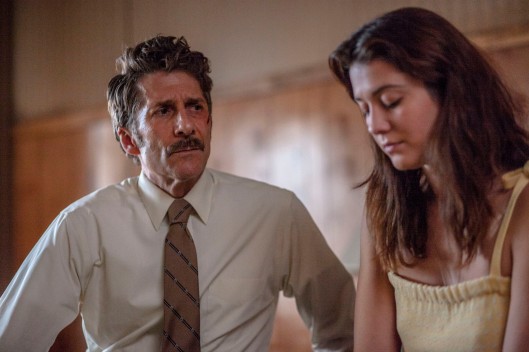
(l-r) Leland Orser and Mary Elizabeth Winstead stars in FAULTS. ©Snoot Entertainment. CR: Jack Zeman.

She’s Funny That Way (2014) / D: Peter Bogdanovich / 93m

Cast: Imogen Poots, Owen Wilson, Rhys Ifans, Jennifer Aniston, Will Forte, Kathryn Hahn, Illeana Douglas, Debi Mazar, Cybill Shepherd, Richard Lewis, Ahna O’Reilly, Joanna Lumley

Rating: 6/10 – theatre director Arnold Albertson has a secret: he gives prostitutes money in order that they can set up their own businesses, but when his latest “project”, aspiring actress Isabella Patterson (Poots) lands the starring role in his latest production, it all leads to the kind of deception and duplicity that will test the notion that the show must go on; a modern attempt at a screwball comedy, She’s Funny That Way doesn’t have the sheer energy that made movies such as His Girl Friday (1940) or  Bringing Up Baby (1938) so enjoyable, but Bogdanovich knows his stuff and keeps the movie entertaining for the most part, even if it doesn’t stay in the memory for too long afterwards.
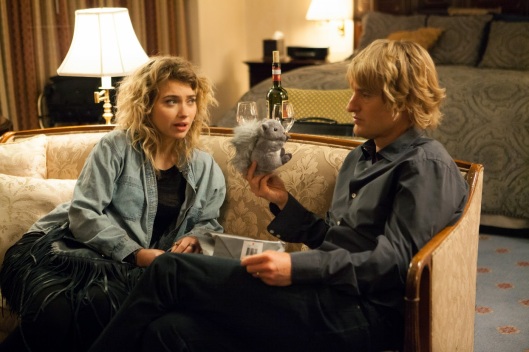
She's Funny That Way

Curse of the Witching Tree (2015) / D: James Crow / 102m

Cast: Sarah Rose Denton, Lucy Clarvis, Lawrence Weller, Jon Campling, Caroline Boulton, Danielle Bux

Rating: 2/10 – divorcée Amber Thorson (Denton) moves into an old house with her two children (Clarvis, Weller) only for strange phenomena to start happening that’s connected to a witch’s curse, and which leaves them all at risk of supernatural forces; woeful in the extreme, Curse of the Witching Tree is amateurish nonsense that is badly directed, poorly acted, contains defiantly stilted dialogue, suffers from below-par photography, is tension-free throughout, and stands as an object lesson in how not to make a low-budget British horror movie.
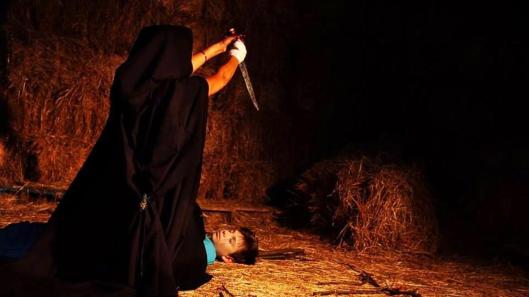
Curse of the Witching Tree

Bulldog Drummond Comes Back (1937) / D: Louis King / 64m

Cast: John Barrymore, John Howard, Louise Campbell, Reginald Denny, E.E. Clive, J. Carrol Naish, Helen Freeman

Rating: 5/10 – when dastardly villains Mikhail Valdin (Naish) and Irena Saldanis (Freeman) kidnap Phyllis Clavering (Campbell), the girlfriend of Captain Hugh Drummond (Howard), they send him on a merry chase where each clue he finds leads to another clue as to her whereabouts – but no nearer to finding her; the first of seven movies with Howard as the dashing sleuth created by H.C. “Sapper” McNeile, Bulldog Drummond Comes Back is as cheap and cheerful and antiquatedly entertaining as you might expect, and benefits enormously from a cast and crew who know exactly what they’re doing.
vlcsnap-00001

Every Secret Thing (2014) / D: Amy Berg / 93m

Cast: Diane Lane, Elizabeth Banks, Dakota Fanning, Danielle Macdonald, Nate Parker, Common

Rating: 7/10 – several years after two young girls are incarcerated for the murder of a younger child, their return to their hometown is marred by the disappearance of a little girl, and the belief that one or both of them is responsible; a stilted attempt at an indie film noir, Every Secret Thing features good performances – particularly from Macdonald – and focuses on the emotional effects a child abduction can have on everyone involved, but it never develops a sense of urgency, though its key revelation at the end carries a wallop that helps dismiss what will seem like a narrative impasse up until then.
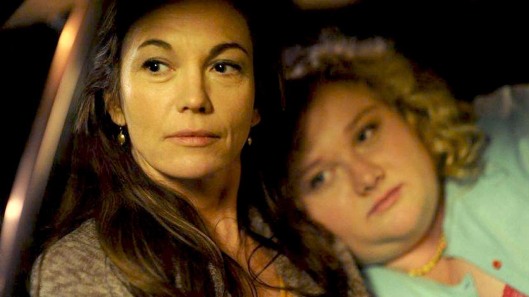
Every Secret Thing

Children of the Corn: Genesis (2011) / D: Joel Soisson / 80m

Cast: Kelen Coleman, Tim Rock, Billy Drago, Barbara Nedeljakova

Rating: 3/10 – a couple (Coleman, Rock) break down on a desert highway but manage to find shelter overnight with a old preacher (Drago) and his much younger, foreign bride (Nedeljakova), but soon find that what’s in the preacher’s barn is much more menacing than the old man himself; placing the action largely away from Gatlin, Nebraska may have seemed like a smart move but this tired, dreary, and just downright dull entry in the franchise shows just how bad things have gotten since the 1984 original, and just why Children of the Corn: Genesis should remain the last in the series to be made.

Children of the Corn Genesis

Skin Trade (2014) / D: Ekachai Uekrongtham / 96m

aka Battle Heat

Cast: Dolph Lundgren, Tony Jaa, Michael Jai White, Ron Perlman, Celina Jade, Peter Weller

Rating: 6/10 – when cop Nick Cassidy (Lundgren) is powerless to stop his wife and daughter being killed, he determines to go after the crime boss responsible, Viktor (Perlman), and destroy his human trafficking network, which means travelling to Thailand and teaming up with detective Tony Vitayakul (Jaa), who’s also out to put a stop to Viktor’s illegal behaviour; with its human trafficking backdrop giving it an unexpected depth, Skin Trade is not just a brainless, slam-bang action movie, but instead a very well-made (for its budget) revenge flick that features some great fight scenes – particularly one between Lundgren and Jaa – and uses its Thai locations to very good effect.
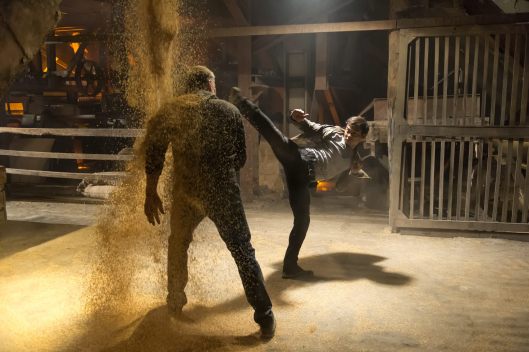
Skin Trade

The Reconstruction of William Zero (2014) / D: Dan Bush / 98m

Cast: Conal Byrne, Amy Seimetz, Scott Poythress, Lake Roberts, Melissa McBride, Tim Habeger

Rating: 6/10 – when the brother (Byrne) of a scientist (also Byrne) wakes from a coma, it’s not long before he begins to suspect that this identity may not be that of the scientist’s brother, and that he’s a pawn in a much bigger conspiracy, but the truth proves even stranger and more disturbing than he realised; a spare, almost antiseptic movie about notions of identity and individual consciousness, The Reconstruction of William Zero features terrific performances from Byrne, but lacks consistency of pace and sometimes feels as if Bush has taken his eye off the ball and taken a while to find it again, which leaves the movie often feeling flat and lifeless.
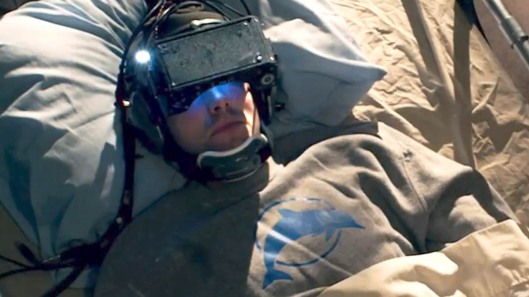
Reconstruction of William Zero, The

Not Another Teen Movie (2001) / D: Joel Gallen / 89m

aka Sex Academy

Cast: Chyler Leigh, Chris Evans, Jaime Pressly, Eric Christian Olsen, Randy Quaid, Mia Kirshner, Deon Richmond, Ed Lauter, Paul Gleason, Mr T, Molly Ringwald

Rating: 5/10 – at John Hughes High School, popular jock Jake Wyler (Evans) accepts a bet that he can’t take an ugly girl and transform her into the prom queen, but when he picks out Janey Briggs (Leigh), and begins to spend time with her, it makes him begin to question whether he should have made the bet in the first place; a predictably irreverent teen movie that parodies all those dreadful teen comedies from the Eighties, Not Another Teen Movie has more heart than most, and thanks to Mike Bender’s script contributions, is also quite funny in its knowing way, and gives viewers a chance to see the future Captain America back in the day when his skill as an actor wasn’t quite as honed as it is now.
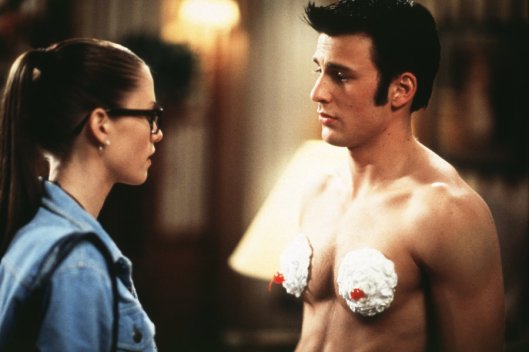
Not Another Teen Movie

Bloomington (2010) / D: Fernanda Cardoso / 83m

Cast: Allison McAtee, Sarah Stouffer, Katherine Ann McGregor, Ray Zupp, J. Blakemore, Erika Heidewald

Rating: 7/10 – former child actress Jackie (Stouffer) attends Bloomington college, and finds herself having an affair with one of the professors, Catherine (McAtee), until the offer of a comeback threatens to end their relationship before it’s fully begun; an intelligent, finely crafted romantic drama, Bloomington has two great central performances, and an emotional honesty that is only undermined by the clichéd nature of Jackie’s need to return to acting, and Cardoso’s over-reliance on silent longing as a sign of emotional upheaval.
Bloomington

Sleepaway Camp 2: Unhappy Campers (1988) / D: Michael A. Simpson / 80m

Cast: Pamela Springsteen, Renée Estevez, Tony Higgins, Valerie Hartman, Brian Patrick Clarke, Walter Gotell

Rating: 5/10 – Angela Baker (Springsteen), having decimated most of the staff and children at Camp Arawak, and now judged to be safe around others, begins sending unruly teenagers “home” from Camp Rolling Hills – which in reality means killing them for any and all perceived infractions that Angela takes a dislike to; a much better sequel than expected, Sleepaway Camp 2: Unhappy Campers gets by on Springsteen’s preppy performance, some not-too-gory deaths, and Simpson’s confident touch behind the camera, as well as that dreadful musical interlude: The Happy Camper Song.
Sleepaway Camp 2

Gunsmoke in Tucson (1958) / D: Thomas Carr / 80m

Cast: Mark Stevens, Forrest Tucker, Gale Robbins, Vaughn Taylor, John Ward, Kevin Hagen, William Henry, Richard Reeves, John Cliff, Gail Kobe

Rating: 6/10 – brothers Jedediah (Stevens) and John (Tucker) are on opposite sides of the law, but when Jedediah becomes involved in a land dispute between cattle ranchers and farmers, his sense of right and wrong is put to the test, and he has to choose sides in the upcoming fight for the choicest plot of land; a robust, earnest Western, Gunsmoke in Tucson is a staid, respectable movie that doesn’t stray too far from its basic plot, and skimps on any psychological undertones in favour of a straight ahead anti-hero vs. the bad guys scenario that makes for a pleasant diversion.
vlcsnap-00002

Beyond the Reach (2014) / D: Jean-Baptiste Léonetti / 91m

Cast: Michael Douglas, Jeremy Irvine, Ronny Cox, Hanna Mangan Lawrence

Rating: 6/10 – arrogant businessman Madec (Douglas) hires tracker Ben (Irvine) in order to bag some game out of season, but when he shoots and kills an old man by mistake, Madec refuses to accept responsibility for his actions and when Ben stands his ground over the issue, finds himself being hunted instead through the harsh Mojave Desert; an occasionally tense two hander that will do little for either actor’s career, Beyond the Reach ramps up the contrivance levels with each successive narrow escape that Ben makes, and with each missed shot that Madec makes, leading to the inevitable conclusion that this is one movie where credulity needs to be left at the door – an idea that is further enhanced by the movie’s risible conclusion.
Email sent from: "Barnard, Linda"  lbarnard@thestar.ca  Subject: Beyond the Reach Date: 9 April, 2015 4:30:15 PM EDT   Jeremy Irvine and Michael Douglas star in Beyond The Reach Linda Barnard Movie Writer The Toronto Star thestar.com 416-869-4290

Blood (2012) / Nick Murphy / 92m

Cast: Paul Bettany, Mark Strong, Stephen Graham, Brian Cox, Ben Crompton, Naomi Battrick, Zoë Tapper, Adrian Edmondson

Rating: 5/10 – when a young girl is found murdered, the police, led by Joe Fairburn (Bethany) immediately set their sights on local child molester Jason Buleigh (Crompton), but when their prime suspect has to be let go for lack of evidence, Joe and his brother Chrissie (Graham) decide to take the law into their own hands, with terrible results; grim, visually depressing, and with a script that has more holes in it than a string vest, Blood has only its performances to recommend it, particularly those of Bethany, Graham and Cox, as well as the sense to know that its tale of a proud man’s downfall is always more interesting when you don’t know just how far they’ll fall.
Blood

Echelon Conspiracy (2009) / D: Greg Marcks / 102m

aka The Conspiracy; The Gift

Cast: Shane West, Ed Burns, Ving Rhames, Martin Sheen, Tamara Feldman, Jonathan Pryce, Sergey Gubanov, Todd Jensen

Rating: 3/10 – computer security tech Max Peterson is given a mysterious phone that helps him gain a small fortune, but in doing so he finds himself embroiled in a plot to ensure that the NSA’s super computer, Echelon, gains the upgrade it needs in order to spy on everyone globally; so bad on so many levels, Echelon Conspiracy wastes its (mostly) talented cast, flirts with credibility before running away from it at high speed, offers laughs in places where they shouldn’t be, and is the cinematic equivalent of a car crash.
Echelon Conspiracy

Crazy Sexy Cancer (2007) / D: Kris Carr / 90m

With: Kris Carr, Jackie Farry, Melissa Gonzalez, Brian Fassett, Aura Carr, Kenneth Carr, Leslie Carr, Oni Faida Lampley, Bhavagan Das

Rating: 7/10 – when aspiring actress Kris Carr was diagnosed with cancer, she decided to make a visual record of the process of dealing with it, and the various ways in which other cancer sufferers have done so, and supported by the cameraman/editor who became her husband, as well as family and friends; an uplifting, positive message for anyone dealing with cancer, or who knows someone who is, Crazy Sexy Cancer is the kind of documentary that doesn’t attempt to overdo the physical and emotional strain of being in such a situation, but which does nevertheless offer plenty of poignant moments in amongst the hospital visits, and shows Carr to be a determined, aggressive would-be survivor.

Crazy Sexy Cancer

The Night Flier (1997) / D: Mark Pavia / 94m

Cast: Miguel Ferrer, Julie Entwisle, Dan Monahan, Michael H. Moss, John Bennes, Beverly Skinner, Rob Wilds, Richard K. Olsen, Elizabeth McCormick

Rating: 7/10 – hard-nosed, disreputable reporter Richard Dees investigates a series of murders carried out at small airstrips that appear to be the work of a vampire, but his initial scepticism gives way to reluctant belief as he talks to witnesses, and sees the injuries the victims have sustained; a well-crafted movie that betrays its low budget and scrappy production design, The Night Flier is still one of the better Stephen King adaptations thanks to Pavia’s confident handling of the material, Ferrer’s see-if-I-care performance, and some impressively nasty effects work courtesy of the KNB Group.
Night Flier, The

Killer by Nature (2010) / D: Douglas S. Younglove / 90m

Cast: Ron Perlman, Armand Assante, Zachary Ray Sherman, Lin Shaye, Haley Hudson, Richard Riehle, Richard Portnow, Svetlana Efremova, Jason Hildebrandt

Rating: 3/10 – troubled by nightmares of murder and sleepwalking, teen Owen (Sherman) undergoes therapy with Dr Julian (Perlman), a therapist who believes that a person’s essential nature is handed down through bloodlines – a theory originated by convicted murderer Eugene Branch (Assante), and who is connected to Owen in a way that causes Owen to believe he might be the perpetrator of a series of murders that mimic Branch’s modus operandi; a thriller that can’t decide if it’s tepid or overwrought, and then settles for both (sometimes in the same scene), Killer by Nature is a humdinger of a bad movie, and proof positive that sometimes the old saying that “if you can, it doesn’t mean you should” relates to far too many movies for comfort – especially this farrago of awful performances, pseudo-intellectual posturing, and deathless direction.
Killer by Nature

Scooby-Doo! and the Samurai Sword (2009) / D: Christopher Berkeley / 75m

Cast: Frank Welker, Casey Kasem, Mindy Cohn, Grey DeLisle, Kelly Hu, Kevin Michael Richardson, Sab Shimono, Keone Young, Gedde Watanabe, George Takei, Brian Cox

Rating: 6/10 – on a trip to Japan, Scooby-Doo and the gang become involved in the search for a mystical sword, while trying to thwart the efforts of the ghost of the Black Samurai to beat them to it; a middling entry in the series that at least provides a different backdrop than the standard old dark house (or mine, or hotel, or funfair…), and which allows Shaggy and Scooby to be the heroes we all know they really are deep down, while displaying a pleasing awareness of Japanese culture.
Scooby-Doo! and the Samurai Sword

[Rec]³ Génesis (2012) / D: Paco Plaza / 80m

Cast: Leticia Dolera, Diego Martín, Ismael Martínez, Àlex Monner, Sr. B, Emilio Mencheta, David Ramírez, Miguel Ángel González

Rating: 7/10 – a young couple’s wedding day is disrupted for good when one of the guests takes a bite out of another one, leading to a frenzied free-for-all among the guests and a fight for survival for those not affected by whatever’s causing people to become zombies – including the bride and groom, who have become separated in the mêlée; half found footage, half professionally filmed, [Rec]³ Génesis acts as a prequel to the events of the first two movies but is let down by both the change in location, and the absence of Claudia Silva, as well as a sense that by going backwards in terms of the outbreak and its possible cause, the makers are treading water until an idea as to how to carry the story forward from [Rec]2 (2009) comes along.
Rec3 Genesis

uwantme2killhim? (2013) / D: Andrew Douglas / 92m

Cast: Jamie Blackley, Toby Regbo, Joanne Froggatt, Jaime Winstone, Liz White, Mark Womack, Louise Delamere, Stephanie Leonidas, Mingus Johnston

Rating: 7/10 – popular schoolboy Mark (Blackley) leads a secret life on the Internet, where he invests his time and emotions in relationships with people he’s never met, but when of those people ask him to stop their younger brother, John (Regbo), from being bullied, what follows sets Mark on a dangerous path to murder; based on a true story, and told with a glum sense of foreboding throughout, uwantme2killhim? is an engrossing (though slightly frustrating) recounting of one of the strangest cases of the last fifteen years, and features two very good performances from Blackley and Regbo, though they have to fight against a script that favours repetition over clarity, but which still manages to flesh out what must have been a very strange relationship between the two boys.
JAMIE BLACKLEY (Mark) (L) & TOBY REGBO (John) (R) in UWANTME2KILLHIM? (c) 2011 U Want M2K Ltd. Photo by Mark Tillie

Bulldog Drummond in Africa (1938) / D: Louis King / 58m

Cast: John Howard, Heather Angel, H.B. Warner, J. Carrol Naish, Reginald Denny, E.E. Clive, Anthony Quinn

Rating: 7/10 – on the very day that Drummond (Howard) is finally due to marry his long-suffering girlfriend Phyllis (Angel) he becomes embroiled in the kidnapping of his old friend Colonel Nielsen (Warner), and finds himself travelling to Morocco – with Phyllis, butler Tenny (Clive) and old pal Algy (Denny) in tow – in order to rescue him; the fourth in the series is perhaps the funniest, with Howard allowed to spread his comedic wings, and even the villain (played again by Naish) given some splendidly dry remarks to make in amongst the threats of death by hungry lion, and a bomb on Drummond’s plane.
vlcsnap-00003

The Four-Faced Liar (2010) / D: Jacob Chase / 87m

Cast: Daniel Carlisle, Todd Kubrak, Emily Peck, Marja-Lewis Ryan, Liz Osborn

Rating: 8/10 – five friends – couples Greg (Carlisle) and Molly (Peck), Trip (Kubrak) and Chloe (Osborn), and single lesbian Bridget (Ryan) – experience various ups and downs in their relationships, especially when Trip has a one night stand, and Molly finds herself attracted to Bridget; a refreshingly honest look at what relationships mean to different individuals, and how they affect the people around them, The Four-Faced Liar is an effective, well-written drama that benefits from good performances all round, a soundtrack that supports the mood throughout, and Chase’s confident approach to Ryan’s script.
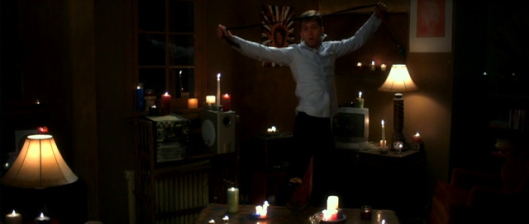
vlcsnap-00004

Share this:

  • Click to share on X (Opens in new window) X
  • Click to share on Facebook (Opens in new window) Facebook
  • More
  • Click to print (Opens in new window) Print
  • Click to email a link to a friend (Opens in new window) Email
Like Loading...

Araya (1959)

21 Tuesday Apr 2015

Posted by dullwood68 in Movies

≈ 2 Comments

Tags

Cannes Film Festival, Documentary, El Rincón, Fishermen, Fishing, Manicuare, Margot Benacerraf, Ortiz family, Pereda family, Review, Salazar family, Salineros, Salt marshes, Salt mining, Tone poem, Venezuela

Araya

D: Margot Benacerraf / 82m

Narrator: José Ignacio Cabrujas

In northeastern Venezuela there is a barren, largely inhospitable peninsula called Araya. Home to a vast salt deposit, the area is harsh and uninviting, but it’s also home to various families that work the salt flats or fish the nearby sea. From the villages of Manicuare and El Rincón, they make a life for themselves that revolves around the collection of salt and fish each and every day, the two items that provide the basis for their community and their reason for being there. It’s hard, labour intensive work that offers little in the way of reward, but has become a generational necessity: for these Venezuelans there’s simply nowhere else to go.

Araya follows three families through the course of an average day. The Salazar family are salineros – salt marsh workers. Their day begins at six in the morning as they take the salt that has been selected overnight and pile it up into huge pyramid-like piles. It’s punishing work that has to be done so early in the day because of how high the temperature rises later. Even so, it’s hot work and the salt crystals can be damaging to the workers’ skin, causing ulcers and open sores. By late morning their work is done and the Salazar family can return home, making the six mile journey to Manicuare on foot beneath the blazing sun. Once there they can tend to work needed to be done at home before going to sleep.

Further along the coastline, the Ortiz family come down to the shoreline to cast their nets out into the sea. Even their youngest, Carmen, has work to do: she collects coral and shells. Once the nets have been retrieved, the fish that has been caught is divided up and some of it is taken to El Rincón and Manicuare for sale to the villagers. The fish is the main ingredient in everyone’s diet, and is rarely passed up.

At night the men of the Pereda family toil in the salt marshes, selecting and cutting blocks of salt for the Salazars and the other salineros to process the next day. Again, it’s hard work as they push their boats through the shallow waters and haul the blocks of salt onto them. And each family repeats the same actions the next day, and the day after that… until industrialisation reaches them, and their skills – handed down from generation to generation – become superseded by machines.

Araya - scene

Although it has the look and feel of a documentary, Araya is intended to be viewed as a tone poem, Cabrujas’ narration deliberately written to evince a feeling not often associated with this type of “exposé” – an appreciation of the lyrical beauty that underpins the lives of the people who live in such a barren corner of the world. As such, and with the benefit of seeing the movie over sixty-five years since it was made, it’s fair to say that Araya works as both a tone poem and a documentary, and is successful whichever way it’s approached.

Part of the movie’s appeal, and one of its main strengths, is that while it celebrates the hard life these families lead, it also presents their lives in such a matter-of-fact way that there’s no room for pity or sentimentality; these people lead their lives in the way that’s portrayed, and they don’t complain about it. Benacerraf is also wise enough to avoid interviewing anyone, and by doing so, she gains more “mileage” out of being an observer than perhaps she would have done by asking a lot of pointed questions. The viewer can see all he or she needs to know about the inhabitants of Araya, as well as the obvious pride they take in the work that they do. As the movie shows more and more of the structured, unchanging lifestyle they lead, it shows how simple and uncomplicated that lifestyle is, and how suited they are to it.
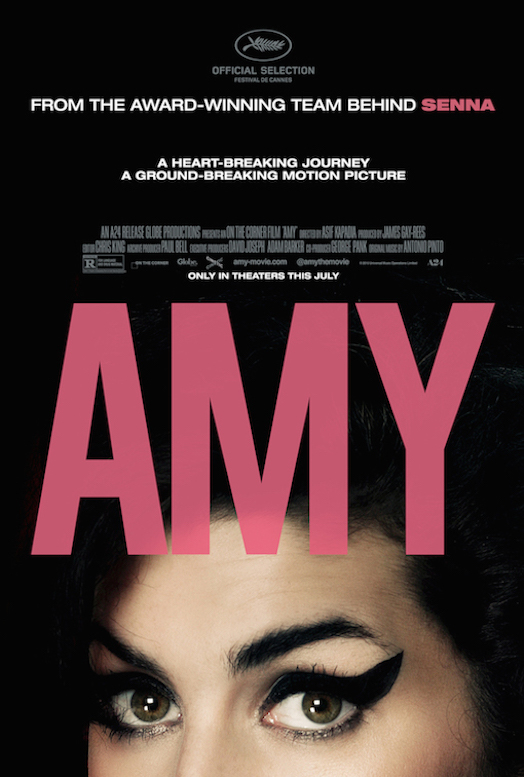


Benacerraf – an acclaimed feminist filmmaker and founder of Venezuela’s Cineteca Nacional, and Fundavisual Latina – also delves into the history of the area, revealing the existence of a 17th century fortress that overlooks the area (but which is now a ruin), and which was built to provide security for the various traders whose cargoes of salt were prey to pirates. It’s difficult to see now just how busy the peninsula must have been despite its unforgiving nature, especially when the viewer sees the nearby wood, where the trees are so denuded that their branches look like withered bones. It’s images such as these, beautifully filmed by Giuseppe Nisoli beneath the blazing, cloud-free canopy of the sky, that highlights the stark, natural beauty of the peninsula.
Whether the camera is following a salinero carrying a basket full of salt on his head, or a member of the Ortiz family sorting through the hundreds of fish that have been caught, or the arrival in El Rincón of the water truck – 1,850 gallons to be shared amongst sixty houses – or the member of the Salazar family, Luisa, who makes clay pots without the benefit of a wheel, Araya is a visual feast, fascinating and poignant and continually astonishing in the way in which the peninsula’s inhabitants have carved out a rewarding way of life for themselves.

When the movie was first shown at the Cannes Film Festival in 1959, it shared the Cannes International Critics Prize with Alain Resnais’s Hiroshima, mon amour. And yet it was never picked up for widespread or international distribution, an outcome that seems ludicrous now that Araya has been restored and can be seen for the breathtaking experience it actually is. That it took fifty years for the movie to be recognised for its tremendous accomplishments just goes to show how wrong the movie business can be sometimes. Thank the deity of your choice then that it’s been rescued from obscurity, and can take us back to a time and a place where life – hard, exacting, rewarding life – was lived each day by a group of Venezuelans who were probably unknown to the rest of their country.

Rating: 9/10 – hypnotic, engaging, rich in detail, affecting, beautifully shot, powerful in its simplicity – Araya is all these things and much more beside; with its poetic leanings enhancing the visuals, the movie works on several levels and succeeds on all of them.

Share this:

  • Click to share on X (Opens in new window) X
  • Click to share on Facebook (Opens in new window) Facebook
  • More
  • Click to print (Opens in new window) Print
  • Click to email a link to a friend (Opens in new window) Email
Like Loading...

American: The Bill Hicks Story (2009)

14 Saturday Mar 2015

Posted by dullwood68 in Movies

≈ 1 Comment

Tags

Alcohol, Bill Hicks, Biography, Cancer, Comedy, Documentary, Drugs, Dwight Slade, Matt Harlock, Paul Thomas, Review, Stand up comedy

American The Bill Hicks Story

D: Matt Harlock, Paul Thomas / 102m

Bill Hicks, Dwight Slade, Mary Hicks, Steve Hicks, Lynn Hicks, Kevin Booth, James Ladmirault, David Johndrow, John Farneti, Andy Huggins, Steve Epstein

From an early age growing up in Houston, Texas, it seems that Bill Hicks knew he wanted to be a comedian. At the age of thirteen he joined forces with his friend, Dwight Slade, and they started writing comedy material together. At fifteen, they snuck out of their homes to attend an open mic evening at the Comedy Workshop – and were a hit. But then Slade had to move away, leaving Hicks to build a career for himself.

He acquitted himself well on the comedy circuit, but early signs of alcohol abuse became more prevalent – and obvious – as Hicks used drinking in his act. While this allowed his true comic persona to show through, it lead to his addiction to cocaine, and a period in which his career virtually stalled. His initial promise, and fame, waned and it wasn’t until the late Eighties that he put his addictions behind him (though he continued to chain smoke throughout the rest of his life, even incorporating into his act). In 1990, Hicks’ career took an upturn when he appeared at the Montreal Just for Laughs festival. And later in the same year he appeared for the first time in the UK, where his brand of confrontational comedy caught on with audiences in a way that had never happened with US audiences; in short, they got him.

Hicks’ reputation increased off the back of his time in the UK, but even with such a boost he was still an acquired taste in the US. In 1993, he was scheduled to appear on Late Night with David Letterman, but his entire performance was cancelled from the show because the producers felt the content – which included references to the anti-abortion movement and religion – was unsuitable (the routine was finally aired on the show in 2009, and can be seen here). By this time, however, Hicks had been diagnosed with pancreatic cancer, which had also spread to his liver. He kept it quiet, but began joking that each performance he gave might be his last. He died in February 1994, aged just thirty-two, but he remains one of the most popular, and influential, comedians of the last twenty-five years.

American The Bill Hicks Story - scene

If you’ve never seen any of Bill Hicks’ stand up routines, or watched one of his live videos, then it’s difficult to understand just how good a comedian he was. He used his keen intelligence and acerbic wit to poke fun at US mainstream society and its relation to politics, religion, consumerism, and state controls. He was often vitriolic in his routines and unflaggingly dismissive of social apathy, refusing to accept that as one audience member once said, “We don’t come to comedy to think!” If you were in the audience at one of his gigs, you had to be ready to be challenged, and not in a softly, softly way either; Hicks was uncompromising.

In telling his story, from his early life growing up in Houston, through to his final gig in January 1994, American: The Bill Hicks Story picks out the highs and lows of Hicks’ life and career, and paints a portrait of a man who left behind an indelible body of work, and who was taken from us too soon. The movie benefits from the involvement of his family: mother Mary, sister Lynn, and brother Steve, all of whom speak candidly about Hicks and his various battles with addiction, as well as the effect these had on his career. Hicks also spoke about these issues in his routines (though he remained an advocate of LSD, psychedelic mushrooms and marijuana), and he did so candidly; it’s somehow reassuring to learn that his family are the same. With their honest, heartfelt contributions, the movie is able to acknowledge Hicks as a troubled individual, but also one who was able to deal with it all, and use it as a tool to inform and educate his audiences.

Co-directors Harlock and Thomas have done a great job in assembling the various interviews that pepper the movie and give it a great deal of balance throughout. There are dozens of clips of Hicks doing what he did best, and they’ve been chosen with obvious care – one montage of Hicks accepting or having a drink onstage shows just how bad his addiction was. There’s plenty of archival footage of Hicks growing up, and the makers have adopted a graphic animated style to the material that keeps things interesting away from Hicks’ routines, and often proves inventive. Using cut-outs and graphic overlays, the movie is visually engaging and compelling, and although some viewers may have trouble keeping up with who’s providing the voice over at any given time, it doesn’t detract from the overall effectiveness of the material.

Hicks, like Lenny Bruce before him, was unafraid to challenge the establishment, and his disillusion and anger towards the powers that be are given full expression, and allow the viewer to see the passion Hicks displayed on stage. Whether or not the movie is entirely successful in showing the man behind the comedian is open for debate, as Hicks’ private life is barely touched upon unless it involves his family (for example there’s no mention of a girlfriend, or indeed, any kind of significant other), or the friends he made on the comedy circuit in Texas. But the movie’s focus is clearly on Hicks the comedian rather than Hicks the private individual, and as such, works supremely well at providing a fitting eulogy for a man who once said, “Do I have a message? Yes, I do. Here’s my message: as scary as the world is – and it is – it is merely a ride…”

Rating: 8/10 – an enjoyable, affectionate look back over the life of one of America’s finest – if not fully appreciated – comedians, American: The Bill Hicks Story is a worthy endorsement of Hicks’ life and career; by turns funny, sad, poignant and moving, but above all funny, the movie is a celebration that is both imaginative and sincere.

Share this:

  • Click to share on X (Opens in new window) X
  • Click to share on Facebook (Opens in new window) Facebook
  • More
  • Click to print (Opens in new window) Print
  • Click to email a link to a friend (Opens in new window) Email
Like Loading...

Trailer – I Am Big Bird: The Caroll Spinney Story (2014)

11 Wednesday Mar 2015

Posted by dullwood68 in Movies

≈ Leave a comment

Tags

Big Bird, Caroll Spinney, Documentary, Preview, Sesame Street, Trailer

When Sesame Street debuted in 1969, it would have been regarded as a bit of a long shot that the same performer would still be playing the same role, and on such a regular basis, over forty-five years later. But in the case of Caroll Spinney (aka Big Bird and Oscar the Grouch), that’s exactly what’s happened. This documentary about the man in the orange and black striped leggings has all the hallmarks of a lovingly crafted appreciation of one of the show’s (largely) unsung heroes. As a trip down Memory Lane for many of us, it’s a reminder of just how good a performer he is – and if you’ve seen his recent spoof of Birdman or (the Unexpected Virtue of Ignorance), how good a performer he still is.

Share this:

  • Click to share on X (Opens in new window) X
  • Click to share on Facebook (Opens in new window) Facebook
  • More
  • Click to print (Opens in new window) Print
  • Click to email a link to a friend (Opens in new window) Email
Like Loading...

Trailer – Raiders! The Story of the Greatest Fan Film Ever Made (2015)

26 Thursday Feb 2015

Posted by dullwood68 in Movies

≈ Leave a comment

Tags

Documentary, Raiders of the Lost Ark, Remake

It’s an amazing story: two eleven year old kids, neither of whom really know what they’re doing, remake Raiders of the Lost Ark shot for shot – all bar one scene. This documentary shows how they made their movie and brings them back together to shoot that one remaining scene. It has all the hallmarks of a movie that will amuse and amaze in equal measure, and hopefully, will be as entertaining – in its own way – as the movie it’s based around.

Share this:

  • Click to share on X (Opens in new window) X
  • Click to share on Facebook (Opens in new window) Facebook
  • More
  • Click to print (Opens in new window) Print
  • Click to email a link to a friend (Opens in new window) Email
Like Loading...

To Be Takei (2014)

16 Monday Feb 2015

Posted by dullwood68 in Movies

≈ Leave a comment

Tags

Actor, Allegiance, Bill Weber, Brad Takei, Documentary, Facebook, Gay rights, George Takei, Internment, Jennifer M. Kroot, Politics, Review, Star Trek, Sulu, The Howard Stern Show

To Be Takei

D: Jennifer M. Kroot, Bill Weber / 94m

George Takei, Brad Takei, Howard Stern, Leonard Nimoy, William Shatner, Nichelle Nichols, Walter Koenig, Brad Savage, Lea Salonga, John Cho, B.D. Wong, Daniel Inouye

George Takei’s early life in Los Angeles was blighted by Executive Order 9066 which ordered the internment of all persons considered a threat to national security, particularly any Japanese-Americans living on the West Coast. Takei and his family were moved to the Rohwer War Relocation Center in Arkansas. After a year, the introduction of a “loyalty questionnaire” – which his father refused to sign – meant they were relocated to a camp in Tule Lake, California. At the end of the war they were allowed to return to Los Angeles.

Takei did well in school, and eventually enrolled in the University of California at Berkeley. He became interested in acting – though he admits he was a “performer” long before then – but it wasn’t until the late Fifties that he began to find work, initially doing voice over work on movies such as Rodan (1956). A couple of Jerry Lewis movies (albeit playing racially dubious roles) gave him a small degree of exposure, enough to be considered for the role of Sulu in Star Trek. As part of the multi-ethnic crew, Takei’s appearance was a tremendous boost for Asian-American actors, but in real terms his career continued at a steady pace, mostly in TV.

1973 saw the beginning of Takei’s political career. He ran for the City Council of Los Angeles, but narrowly lost out. However, Los Angeles Mayor Tom Bradley appointed him to the team responsible for the planning of the Los Angeles subway system. His political career came to a close in the early Eighties as the Star Trek movies became increasingly popular. Concentrating his efforts on acting, Takei saw in the Nineties by finally becoming Captain Sulu in Star Trek VI: The Undiscovered Country (1991). At around the same time he became involved in The Howard Stern Show, and is the show’s semi-regular announcer even now. The new century saw him as busy as ever but 2005 was a defining year: in October, Takei revealed that he was gay and had been in a relationship (with Brad Altman) for eighteen years. To many it wasn’t a shock as he’d been a supporter of LGBT organisations for some time, but it led to his becoming a more vocal supporter of gay rights and same-sex marriage; at present he’s a spokesperson for the Human Rights Act “Coming Out Project”.

In 2008, he and Brad married and together they tour the world giving speeches and making convention appearances and turning up on TV. Takei has embraced Facebook in a big way and currently has around eight million followers; his daily posts are funny and occasionally, controversial. And in 2012 he appeared in the stage musical Allegiance, a project he helped initiate and which is set in a Japanese internment camp in World War II.

To Be Takei - scene

If you sat down to write a book or a film script or a stage play, and you made your main character a somewhat diminutive Japanese-American homosexual who finds fame as an actor on a science fiction TV show, it’s a safe bet that publishers and backers would look at you funny and then laugh you out of the room for being so foolish. After all, who’s going to believe a story as far-fetched as that? And yet, George Takei is living proof that you can be all that and more.

Charting his life and experiences, To Be Takei is an amusing, warm-hearted look at a man who, over the last fifty years, has become a pop-culture icon. It’s a sweet-natured movie, much like the man himself, and is a wonderful introduction to a man who laughs at everything (unless you say being gay is a lifestyle – he’ll tell you in no uncertain terms it’s not, it’s an orientation). He has a great laugh too, a rich, soulful chuckle that punctuates his speech as if he can’t control it. Seeing him being so cheerful, and so much of the time, it’s plain to see he’s a man who’s lived not only a full life – he’s currently 77 – but is still doing so and with no intention of slowing down. His energy levels are prodigious. But it’s most likely his childhood at Rohwer that informs this, and the scenes where he discusses his time at the camps in Arkansas and California add a depth and a meaning to a life that, otherwise, seems to have been a model of fun and excitement. That it hasn’t left any permanent emotional scars is a testament to his resilience and his refusal not to let it affect him in any meaningful way. It’s these scenes that resonate the most, especially when they dovetail into those that show the development of Allegiance.

The movie follows Takei and Brad as they attend various functions and travel round the US. At one point they’re up in the mountains scattering Brad’s mother’s ashes. The wind proves to be blowing in the wrong direction and some of the ashes end up on their clothes. George’s pithy observation? “And I think your mom’s going to be at the cleaner’s too.” The relationship between George and Brad is the cornerstone of the movie, their devotion to each other so evident that when they’re taking the mickey out of each other, you’re laughing with them because it wouldn’t even occur to you to laugh at them. Even when Brad is in manager mode and bossing George around, there’s a deep-rooted affection there the whole time that makes it all the more marvellous to witness.

As well as his time in the internment camps there’s a fair amount of time devoted to his exploits in Star Trek, and the ongoing animosity between George and William Shatner – “Speaking of fat alcoholics… good evening, Bill.” – but it’s the contributions of Nimoy, Nichols and Koenig that add a poignancy to the proceedings, and reinforce just how much he’s loved by his old “comrades in space”. In fact, the movie is very good at providing just the right amount of time for each phase of his life and career, and for the current day activities he gets up to. Balancing out what really has been an incredibly varied and rewarding life, it’s to the movie’s credit – and Takei’s – that he remains as likeable as he’s always been. He’s so highly regarded and he’s so open and honest about things that by the movie’s end you feel you almost know him, such is the attention to detail and interest in him shown by Kroot and Weber. And with the honesty and commitment shown by Takei and Brad, the movie also paints a lovely portrait of two people who are still enamoured of each other after more than twenty-five years.

Rating: 8/10 – a documentary about a remarkable man presented in a fun, entertaining way, To Be Takei is a joy to watch, and made all the more so by Takei’s obvious enjoyment at being filmed; even if you only watch it to see his public service announcement regarding Tim Hardaway – “Oh my” indeed – you’ll find yourself wishing you could spend just a little bit more time in his company.

Share this:

  • Click to share on X (Opens in new window) X
  • Click to share on Facebook (Opens in new window) Facebook
  • More
  • Click to print (Opens in new window) Print
  • Click to email a link to a friend (Opens in new window) Email
Like Loading...

Mini-Review: Dinosaur 13 (2014)

04 Wednesday Feb 2015

Posted by dullwood68 in Movies

≈ Leave a comment

Tags

"Sue", Black Hills Institute, Court case, Documentary, FBI, Maurice Williams, Neal Larson, Paleontology, Peter Larson, Review, Susan Hendrickson, Terry Wentz, The Field Museum, Todd Douglas Miller, Tyrannosaurus Rex

Dinosaur 13

D: Todd Douglas Miller / 95m

Peter L. Larson, Neal L. Larson, Patrick Duffy, Kristin Donnan, Terry Wentz, Bob Farrar, Susan Hendrickson, Bill Harlan

In 1990, Susan Hendrickson, one of a team of workers searching for fossils at the Cheyenne River Indian Reservation in South Dakota, discovered the remains of a Tyrannosaurus Rex that proved to be eighty per cent complete. The dinosaur was named “Sue” after Hendrickson, and was purchased by the Black Hills Institute for $5,000 from the owner of the land it was found on, Maurice Williams. The remains were transported to the Institute where their cleaning and restoration was overseen by its president, Peter Larson.

In 1992, the Institute was raided by the FBI and Sue’s remains were confiscated. Larson and the Institute were accused of theft from Government land (as the property where Sue was found was held in trust). After a lengthy trial, Sue was deemed to be Williams’ property after all and her remains were returned to him. In the meantime, charges were brought against Larson, his brother Neal and other members of the Institute for financial misdeeds unrelated to Sue’s discovery. While Williams got Sotheby’s to sell Sue for the princely sum of $7.6 million, Peter Larson was jailed for two years. Sue is now on display at the Field Museum in Chicago, while Larson is still searching for and finding T. Rex skeletons.

Dinosaur 13 - scene

Dinosaur 13 is one of those documentaries that makes no bones (excuse the pun) about its partisanship, and does its best to highlight the absurdities of a situation that could have been easily avoided if only a little background research had been done in the first place, and before anyone went looking for bones in the South Dakota soil. The excitement generated by Sue’s discovery sees the folks at the Black Hills Institute all but fall over themselves to retain her remains, but their lack of diligence in knowing who the land belonged to is scary (as are some of the later misdemeanours the movie reveals). However, the Government’s reaction is clearly disproportionate to what Larson and the rest actually did, and as the draconian efforts employed to convict them become clearer, the movie morphs from being about one of the greatest dinosaur finds in living memory – if not the greatest – into a cautionary tale about the way in which U.S. law can be used to punish a group of individuals.

In amongst the terrible injustices meted out to the various members of the Black Hills Institute, there are moments of bitter irony: Hendrickson becomes a state witness even though she has nothing to tell them, and when Larson is imprisoned, his intake papers show the reason for his incarceration as “failing to fill out paperwork”. Miller uses a variety of techniques to highlight and clarify the various events that happened, from interviews with those concerned – Larson’s ex-wife, Kristin, is particularly eloquent – to archival footage and pertinent television footage, to explanatory captions that move the story forward. It’s an engrossing movie that’s intelligently assembled and grabs the attention from the get go; by the end, you’re aghast at the ways in which everything went sour so quickly.

Rating: 8/10 – while Dinosaur 13 is clearly on the side of the people at the Black Hills Institute, and decries their treatment by the Government, it’s far more objective than it seems at first glance; leaving the passionate arguments on both sides for the people involved to express, the movie (thankfully) maintains its true focus on Sue and her sixty-five million year journey from the South Dakota hills to the bright lights of Chicago’s Field Museum.

Share this:

  • Click to share on X (Opens in new window) X
  • Click to share on Facebook (Opens in new window) Facebook
  • More
  • Click to print (Opens in new window) Print
  • Click to email a link to a friend (Opens in new window) Email
Like Loading...

Memory of the Camps (1945/1984)

27 Tuesday Jan 2015

Posted by dullwood68 in Movies

≈ Leave a comment

Tags

Alfred Hitchcock, Atrocities, Auschwitz, Belsen-Bergen, Dachau, Documentary, Holocaust, Mass graves, Review, SHAEF, Sidney Bernstein, Trevor Howard, True story, World War II

Memory of the Camps

Original title: German Concentration Camps Factual Survey

No director / 58m

Narrator: Trevor Howard

Compiled from footage shot by combat and newsreel cameramen, Memory of the Camps was meant to be shown to German prisoners of war as a caustic reminder of the atrocities committed by the Nazis. Thanks to problems connected with post-war shortages and international cooperation, the movie’s assembly foundered and with two other, completed, documentaries released in the meantime – along with a change in policy that led to the authorities feeling such a project was now inappropriate – it’s only screening was in rough cut form in September 1945 (and without a working title).

Plans to revisit the movie in 1946 failed to happen and in 1952 the footage was “inherited” by London’s Imperial War Museum. It wasn’t until the early Eighties that anyone looked at the various reels and realised the importance of the material. As a result the five reel rough cut was shown at the 1984 Berlin Film Festival – with the added title Memory of the Camps – and then in 1985 on the PBS Network in the US with Howard’s narration added. (In 2015 an expanded, restored version with additional modern day footage titled Night Will Fall was shown as part of the Holocaust remembrance events surrounding 27 January, the date when Auschwitz was liberated by the Russians.)

The movie is a straightforward, no-holds-barred piece of cinema verité, unflinching in its depiction of the depravity carried out at fourteen locations (ten camps and four sites of atrocity) and beginning with Belsen-Bergen. The film that was shot then and the images that were recorded are heartbreaking, with hundreds of sick and emaciated internees struggling to comprehend the change in their fortunes or too far gone to understand it at all. Inevitably, there are the bodies, thousands of them everywhere, unattended, cadavers made of skin and bone, their faces like stretched parchment. The sheer scope and number of the deceased is difficult to comprehend, each pile of bodies looking like the worst example you’ll see… until the next one.

The Allies – mostly the British – are shown providing much-needed aid and comfort, but the bodies are the greater problem, their decomposition providing a fertile breeding ground for typhus and delaying the dispersal of the internees from the camps. In an ironic (and possibly contemptuous) turn of events, the Allies made the camp guards do most of the disposal work, getting them to handle the corpses and fill the mass graves with them. Shot so dispassionately at the time, this particular footage is harrowing to watch, as decomposing body after decomposing body is carried, or in some cases dragged along, to the pits that will be their final resting places.

Memory of the Camps - scene

The movie stays at Bergen-Belsen for some time, relaying the extent of the horror perpetrated there and the wretched conditions the inmates endured. It shows us the gas ovens, the infrastructure that made it all happen, and the survivors venting their anger on the guards and lackeys who had so recently tormented them. By the time the movie leaves Belsen-Bergen the viewer is so shell-shocked there’s a danger that footage from the rest of the camps – including Dachau, Buchenwald, Auschwitz and Majdanek – won’t be as distressing, but nothing could be further from the truth. Each camp throws up its own unique horrors, and each visit adds to the mounting, inescapable conclusion that the Nazis’ Final Solution should never be downplayed or allowed to fade from memory.

Overseen by producer Sidney Bernstein, Memory of the Camps was meant to be the movie to be shown to German POW’s after the war. It was a prestige production, with Bernstein calling on the likes of Alfred Hitchcock to assist on the project – Hitchcock gave advice on how the footage should be assembled – as well as future British cabinet minister Richard Crossman to work on the commentary. Despite the setbacks it suffered, and even in its rough cut form, the movie is still incredibly powerful even today, and carries a horrible weight that reinforces the importance of its content. There are dozens of close ups of the faces of the unknown dead, each one a sad reminder of the millions of people who not only lost their lives but who will never be remembered.

Howard’s narration is a masterpiece of studied melancholy, his normally rich tones subdued by the details he has to recite. There are moments where he pauses for a second or two, not so much for deliberate effect (the movie doesn’t need any help in that department) but more out of a recognition that what he’s saying is almost beyond belief. The movie also includes long stretches where Howard remains silent and the images speak for themselves. When these silent passages occur, leaving the viewer alone with the horrors on screen and their own thoughts, it’s almost a relief when Howard resumes his narrative.

Good as Howard’s voice over is however, it’s still the visuals that carry the most weight, acting like random gut punches and leaving the viewer overwhelmed by their barbarity and callousness. With more recent acts of genocide having appeared on our TV screens it’s disturbing that the shameful acts carried out by the Nazis can still have such an effect on people over seventy years on. But in a strange way, that’s a good thing…

Rating: 9/10 – even in its incomplete form, Memory of the Camps is a gruelling, crushing reminder of how callously and deliberately the Nazis exterminated an astonishing eighteen million people; traumatic to watch, but if it wasn’t then its message would be lost completely, and that would be as unacceptable as the camps themselves.

For all the nameless victims who should never be forgotten.

Share this:

  • Click to share on X (Opens in new window) X
  • Click to share on Facebook (Opens in new window) Facebook
  • More
  • Click to print (Opens in new window) Print
  • Click to email a link to a friend (Opens in new window) Email
Like Loading...

Super Duper Alice Cooper (2014)

21 Wednesday Jan 2015

Posted by dullwood68 in Movies

≈ Leave a comment

Tags

Alcohol addiction, Biography, Bob Ezrin, Dennis Dunaway, Documentary, Drug addiction, Glen Buxton, I'm Eighteen, Michael Bruce, Neal Smith, Reginald Harkema, Review, Rock music, Sam Dunn, School's Out, Scot McFadyen, The Earwigs, The Spiders

ENT-0040 SDAC 1SHT.indd

D: Reginald Harkema, Scot McFadyen, Sam Dunn / 98m

Alice Cooper, Shep Gordon, Dennis Dunaway, Bob Ezrin, Sheryl Cooper, Neal Smith, Bernie Taupin, Elton John, Dee Snider, Iggy Pop, John Lydon, Ella Furnier

Charting the life of Alice Cooper from his pre-teen days growing up in Detroit to his comeback gig on October 31st 1986 – after five years of dealing with drug and alcohol addictions – Super Duper Alice Cooper is a respectful, non-critical look back over the early successes and later disasters of a career spanning nearly fifty years (although the movie doesn’t venture beyond Alice’s comeback gig).

As a child, Cooper – then known by his real name of Vincent Furnier – suffered from asthma and often needed an inhaler. On his doctor’s advice, he and his family moved to Phoenix. (The change of scenery, though, didn’t prevent a bad case of appendicitis that nearly killed him.) In high school, Cooper met Dennis Dunaway; they had a shared interest in art, and soon became best friends. When their high school put on a talent show they decided to form a band called the Earwigs and play songs by the Beatles. They enlisted Glen Buxton to play guitar and they were a surprise success (even though Cooper and Dunaway didn’t really know what they were doing).

Landing a regular gig at a local “rock ‘n’ roll teenage dance club”, the band changed its name to the Spiders, and began expanding their repertoire to include songs by the Yardbirds and others (at one point they even opened for the Yardbirds). Moving to Los Angeles in 1967 in an attempt to make it big, the band fell in with the GTO’s, über-groupies who lived in the basement of a log cabin owned by Frank Zappa. Through the GTO’s, they created a new look for themselves and changed the band’s name to Alice Cooper. They enlisted Shep Gordon as their manager and Zappa produced what was to be their first album.

Unable to make much headway in L.A., the band landed a festival gig in Detroit that saw them finally find their audience. At another festival in Toronto a now infamous incident involving a chicken saw their stock rise that much higher. But without any hit records, they were unable to capitalise on their new-found fame, until Gordon met with, and persuaded, Bob Ezrin to work with them. Soon, they had a big hit with a song called I’m Eighteen, and the band was on its way to super-stardom. A string of hit albums and ever more outrageous stage shows followed, but with it came a dissatisfaction amongst the rest of the band that led to Cooper going solo in 1975.

At the same time, Cooper’s drinking was beginning to get out of hand. As he pursued his solo career, a spell in rehab led to a brief resurgence in his career – which wasn’t proving as successful as when Alice Cooper was a band – but he soon swapped alcohol for drugs. From the late Seventies through to the early Eighties, Cooper’s deteriorating health and appearance led to a series of albums that Cooper can’t even remember recording. Finally, he went back into rehab, and in 1986 made a successful return to the music scene with a new album, Constrictor, and a concert tour that reminded everyone of what a prodigious talent he was (and continues to be).

Super Duper Alice Cooper - scene

Flirting with hagiography at times, Super Duper Alice Cooper is a biography that has the full support of Alice Cooper and pretty much everyone he wants the viewer to hear from (except, of course, Michael Bruce). While Cooper is open about his drug and alcohol addictions, it shouldn’t come as a surprise as he’s gone on the record about them on several occasions – and in more ways than one: listen to From the Inside if you need to know more. What’s left is a collection of nostalgic reminiscences about the early days of Cooper’s career when he was still more Vincent Furnier than Alice Cooper.

The inevitable transformation from tee-total pastor’s son to booze-addled rock star is shown as an unavoidable side effect of rock and roll, and while we all might buy into that on some level, the movie’s real focus is on the good times had by all; even the infamous concert in Toronto when Alice threw a live chicken into the audience is treated like it was an awesome moment, though not one that was “healthy for the chicken”. The band’s on-stage antics, some of which look very bizarre and unrelated to the music being played, appear to have been thought up (or more likely improvised) more for effect than any real “let’s-put-on-a-show-and-wow-the-audience” approach. It does make the viewer wonder how on earth the band became such a success.

But while the very early days are treated with a detailed and cheerily nostalgic air, as the band becomes famous the movie moves away from anecdotes about the group and, as happened in real life back in the early Seventies, the focus becomes Cooper himself: his fame, his solo career, and his eventual bouts of alcohol and drug dependency. The break up of the band is glossed over for the most part, and while Dunaway gets to express his disappointment at the end of his friendship with Cooper, it’s a rare moment where criticism is allowed to be heard. Otherwise, unless it comes from Cooper himself – and even he isn’t that self-critical – there’s not a dissenting voice to be heard to provide some balance.

It’s a shame as Cooper’s career has always been varied, both professionally and personally, with as many ups as downs, but throughout there has been a commitment to the music that has kept him going. The movie touches on this on occasion, but seems determined to spend more time relaying as many showbiz anecdotes or celebrity encounters as it can possibly squeeze in.

The look of the movie is very stylised with an impressive amount of archival and contemporary footage mixed together with a great deal of pizzazz, along with attention-grabbing graphics, overlays and 3D effects. Images are tweaked and adjusted and manipulated in so many different ways it becomes distracting, and the decision to employ voice overs rather than talking heads is a mistake as it makes it difficult sometimes to work out who’s saying what. And then there’s the inclusion – the very repetitive and oversold inclusion – of scenes from Dr. Jekyll and Mr. Hyde (1920), which are there to highlight the fact that off-stage, Cooper is a million miles from the twisted, macabre dilettante he plays on-stage (after the umpteenth clip you’ll want to raise your fist and yell, “Enough already! I get it!”).

Rating: 5/10 – visually engaging, and with a predictably great soundtrack, Super Duper Alice Cooper peeks under the lid of Cooper’s career but only tells the viewer half of what it sees; there’s a lot more to Cooper’s career than is revealed here, and the lack of balance leaves it feeling more like a Cooper-sanctioned vanity project than the warts ‘n’ all documentary some viewers might be expecting.

Share this:

  • Click to share on X (Opens in new window) X
  • Click to share on Facebook (Opens in new window) Facebook
  • More
  • Click to print (Opens in new window) Print
  • Click to email a link to a friend (Opens in new window) Email
Like Loading...

Seduced and Abandoned (2013)

04 Thursday Dec 2014

Posted by dullwood68 in Movies

≈ Leave a comment

Tags

Alec Baldwin, Bernardo Bertolucci, Cannes Film Festival, Documentary, Financing, Francis Ford Coppola, Funding, James Toback, Last Tango in Tikrit, Martin Scorsese, Review, Ryan Gosling

Seduced and Abandoned

D: James Toback / 98m

Alec Baldwin, James Toback, Bernardo Bertolucci, Martin Scorsese, Francis Ford Coppola, Roman Polanski, Bérénice Bejo, Diane Kruger, Ryan Gosling, Jessica Chastain, Neve Campbell, James Caan, Mark Damon, Avi Lerner, Ashok Amritraj

Deciding to make a movie together, director James Toback and actor Alec Baldwin first work out the kind of movie they want to make – a Last Tango in Paris-style project set in Iraq – and who they want to co-star with Baldwin, namely, Neve Campbell. Then, they take their idea to the 2012 Cannes Film Festival in the hope of securing the financing needed to get the movie made. Along the way they speak to various people about the difficulties of getting movies made, the challenges in persuading potential investors to part with their money, and how easier/harder it was back in the Seventies to get a project off the ground.

The search for investors leads to meditations on money, fame, acting, glamour, even death, as Toback and Baldwin look at the wider aspects of movie making, and the constraints that stop some movies from being made as their makers intended. The movie also looks at the industry from both a creative and a financial standpoint, and features interviews with the likes of Martin Scorsese and Francis Ford Coppola, and their own experiences of funding and making movies.

Seduced and Abandoned - scene

Opening with a quote from Orson Welles – “I look back on my life and it’s 95% running around trying to raise money to make movies and 5% actually making them. It’s no way to live.” – Seduced and Abandoned is an often hilarious, witty and insightful look at contemporary movie making, made by a director whose own career has seen him struggle to get movies made, and an actor whose career resurgence since The Aviator (2004) has propelled him to the lower reaches of the ‘A’ List. Together, they take the viewer on a tour of the highs and lows of movie making, and even when they’re coming up against closed door after closed door, still manage to stay positive.

In fact, it’s sometimes difficult to discern if this apparent by-product documentary is the real movie or not, or just some idea they had on the back of trying to make their version of what Baldwin refers to as Last Tango in Tikrit. Although the pair are seen in several meetings pitching their ideas for the movie, they never seem entirely convincing that this is a legitimate project that they’re trying to get off the ground; they don’t even have a script yet, nor anything approaching a synopsis. (Asked point blank if she’d appear in the movie, Diane Kruger blanches and then falls back on the tried and trusted, “If I can see a script I’ll consider it” answer.) Matters aren’t helped by Baldwin’s continual references to the sex scenes the movie would include, making it seem like some weird, sexual fantasy of his own that he’s trying to get off the ground.

However unlikely the premise, though, we all know there are movies out there that have been made out of worse ideas – Teenage Mutant Ninja Turtles (2014), anyone? – but the reactions of veteran producers/distributors Avi Lerner and Ashok Amritraj provide a short, predatory lesson in how to get a movie made: always bear in mind the profits. Toback is told in no uncertain terms that with Campbell aboard he won’t get the $15-$20m he wants to make the movie; instead he’ll only get $4-$5m. Only in those circumstances will producers or investors feel comfortable that they’ll get their money back. It’s a harsh reality, and one that shouldn’t come as a surprise, but it’s so casually discussed that it’s like a slap in the face.

The case for Last Tango in Tikrit being entirely a fabrication is given further credence by Toback’s almost slavish reactions to suggestions for changes to the plot and the story, and the casting. He agrees to almost all of them, seemingly eager – maybe too eager – to please his potential investors in order to secure the financing he needs. In moments such as these, Toback seems uncomfortably close to abandoning the whole concept of the movie, just as long as he gets the money to make a movie, if not the one he’s there to try and get made. (It’s a shame no one asks him to replace Baldwin with a bigger name actor; it would have been interesting to see his reaction to that.)

With Toback and Baldwin being rebuffed at every turn, and to ensure that the movie runs for more than half an hour, there are plenty of interviews with industry notables such as Martin Scorsese, who recounts some of the issues that came up when he was making Mean Streets (1973); Bernardo Bertolucci, who talks about working with Brando on Last Tango in Paris (1972); Francis Ford Coppola, who conveys his dismay at making two Godfather movies and then not being able to get backing for a movie of his own; and Ryan Gosling, whose reaction to an airplane emergency isn’t quite what you’d expect.

Seduced and Abandoned - scene2

The movie’s sly wit and acerbic humour help to keep things interesting, and it’s a good thing as Seduced and Abandoned is a documentary that will remain largely of interest to movie buffs and/or anyone trying to get their own project off the ground. The movie does assume a degree of awareness of what goes on at Cannes, and there’s also an assumption that viewers will be up to speed on the way in which movies are financed, but the lay person may well struggle, or find it less than fascinating. And Toback doesn’t always maintain a linear focus, letting the movie wander from one meeting to another but without any clear context (and reinforcing the idea that the movie is the movie, whatever Toback and Baldwin might say).

Rating: 7/10 – with its two “leads” obviously having a whale of a time, Seduced and Abandoned comes across more as a bit of a jolly boys’ outing to Cannes rather than a properly realised documentary; as a result it lacks focus and doesn’t entirely convince, instead making it seem like a huge in-joke that Toback and Baldwin have concocted for their own amusement.

Share this:

  • Click to share on X (Opens in new window) X
  • Click to share on Facebook (Opens in new window) Facebook
  • More
  • Click to print (Opens in new window) Print
  • Click to email a link to a friend (Opens in new window) Email
Like Loading...

The Lady in No 6 (2014)

07 Friday Nov 2014

Posted by dullwood68 in Movies

≈ 1 Comment

Tags

Alice Herz-Sommer, Classical music, Documentary, Israel, Malcolm Clarke, Oscar winner, Piano, Prague, Raphael Sommer, Review, Theresienstadt, World War II

Lady in No 6, The

aka: The Lady in Number 6: Music Saved My Life

D: Malcolm Clarke / 39m

Alice Herz-Sommer

Born in Prague in 1903, Alice Herz grew up surrounded by the intelligentsia of the day, her parents’ cultural salon frequented by the likes of Franz Kafka (who would go for walks with Aiice and her twin sister, Mariana, and tell them stories) and Gustav Mahler. She learnt to play the piano at an early age and was encouraged to take it up as a career by another friend of the family, Artur Schnabel.  She studied at the prestigious Prague German Conservatory of Music (where she was the youngest pupil), and there drew the attention of cellist Leopold Sommer.  They married in 1931, and in 1937 had a son, Raphael.  Alice gave recitals and performed in concerts until the Nazis took control of Prague and Jewish involvement in performances was curtailed.  While several of her family members and friends fled to Israel, Alice remained in Prague to care for her mother who was very ill.

In July 1943, Alice was arrested and sent to Theresienstadt where her skills as a pianist were utilised in over one hundred concert performances, including those for the visiting Red Cross, as the Nazis strove to show that conditions were not as bad as the Allies suspected.  Billeted with Raphael, he and Alice were liberated in 1945 (sadly, Leopold died of typhus in Dachau six weeks before it too was liberated).  Rebuilding her life, she and Raphael emigrated to Israel in 1949 and were reunited with their family, including Mariana.  There, Alice worked as a teacher at the Jerusalem Academy of Music until she decided to emigrate to England in 1986.  In retirement she still played the piano for three hours every day, and remained an inspiration to everyone who knew her.  Remarkably, she was a hundred and ten when she died in February 2014.

Lady in No 6, The - scene

The key to Alice’s life, she always said, was optimism.  She unfailingly looked for the good in life, even during the terrible years when she and Raphael were incarcerated in Theresienstadt.  Like so many of her fellow concentration camp survivors – two of whom are featured in the movie – Alice’s positive attitude helped her to withstand the horror that surrounded her.  She saw “the beauty in life” in almost everything, but particularly in music.  For Alice, “music was magic”.  It could raise her spirits and bring happiness in even the most terrible of situations or circumstances.  With her unwavering memory for classical pieces, Alice could always retreat into her own mind, a place where even the Nazis couldn’t follow her.  It’s inspiring to think that, despite where she was, she was perhaps freer than anyone could imagine.

This remarkable woman is the focus of an equally remarkable documentary short.  The Lady in No 6 is a compelling, fascinating account of one woman’s lifelong love affair with music.  Alice is seen at 109, still mobile, still playing the piano with wonderful dexterity, and still enjoying life with a vitality and energy that would put most thirty-somethings to shame.  She’s always smiling and laughing, and her eyes – only slightly dulled by old age – twinkle with a mixture of mirth and sincerity that is surprisingly wistful when she sits in repose.  Alice’s upbeat nature and lack of pessimism is a joy to behold, and when she talks about her love of music you can see that she’s transported by it.  As she’s said in the past, “I am Jewish, but Beethoven is my religion”.

Wisely focusing on her passion for music for the most part – with an extended but emotive sidestep into World War II – Clarke deftly avoids any hint of sentimentality (as does Alice) and paints an engaging, winning portrait of a woman whose devotion to music has the effect of making the viewer wish they had even a tenth of Alice’s ability and commitment to her art.  Testimony from one of her neighbours provides an idea of how much her morning recitals are enjoyed, and a reminiscence of her time at Theresienstadt reveals the same approval from some of the guards.  It’s a wonderful affirmation of Alice and her dedication to her muse, that her playing has been able to cross social and ideological divides with such incredible efficacy.

Away from Alice and her contagious love affair with classical music, the movie paints a sobering yet hope-infused account of her time at Theresienstadt, with one of her friends recounting a particularly chilling account of an encounter with Josef Mengele.  The focus shifts to take into account the resilience of those inmates who could see no other outcome but their own survival, and while Alice takes a back seat during these moments, it still serves to highlight the tenacity she must have had to endure (and to be so well-balanced in the aftermath of it all).

Visually as well, The Lady in No 6 is a treat, with Clarke’s assembly of various archival materials proving both eye-catching and memorable, his blending of the historical and the modern throwing each element into sharp relief.  The post-production work is highly impressive, and so is the editing by co-writer Carl Freed, both of such a high standard that the movie has a precise, almost painterly feel to it, and the scenes of Alice in her flat feel entirely welcoming, not as if the audience is eavesdropping on her, but that she’s gladly invited everyone in… and couldn’t be more pleased for the intrusion.

Rating: 9/10 – a delightful and inspiring look at the life of an absolutely exceptional woman, The Lady in No 6 fully deserves its Oscar win and is one of the best documentary short movies of recent years; it’s a shame then that we get to spend such a short amount of time in Alice’s wonderful company.

Share this:

  • Click to share on X (Opens in new window) X
  • Click to share on Facebook (Opens in new window) Facebook
  • More
  • Click to print (Opens in new window) Print
  • Click to email a link to a friend (Opens in new window) Email
Like Loading...

CITIZENFOUR (2014)

18 Saturday Oct 2014

Posted by dullwood68 in Movies

≈ 3 Comments

Tags

Documentary, Edward Snowden, Espionage Act, Ewen MacAskill, GCHQ, Glenn Greenwald, Laura Poitras, NSA, The Guardian, Whistleblowing

CITIZENFOUR

D: Laura Poitras / 114m

Edward Snowden, Glenn Greenwald, William Binney, Ewen MacAskill, Jacob Appelbaum, Julian Assange, Jeremy Scahill, Ben Wizner

In January 2013, while preparing to make the third in a series of documentaries looking at the US government’s continued attempts to restrict freedom of information and human rights – the other two movies are My Country, My Country (2006) and The Oath (2010) – director Laura Poitras was contacted by someone using encrypted e-mails.  The sender, who called themselves CITIZENFOUR, was very cautious in their approach but said they had access to files that proved the National Security Agency (NSA) was deliberately collecting and storing the e-mails, telephone calls, mobile (cell) phone calls and texts of millions of Americans through back door links to service providers such as AT&T.  Realising the importance of this information, she and the (then) anonymous contact agreed to proceed slowly so as to gain each other’s trust, and to avoid any intervention by the NSA.

Eventually, in June 2013, they agreed to meet in a hotel in Hong Kong.  Poitras took her camera along and it was there that she met Edward Snowden, a twenty-nine year old “infrastructure analyst” working for the NSA who had become concerned about the way in which the NSA’s surveillance programmes were being used.  Over the course of eight days, during which Snowden was interviewed by online reporter Glenn Greenwald and Guardian journalist Ewen MacAskill, he revealed the extent of the NSA’s illegal activities, its joint operations with other countries such as the UK, and the ways in which it carried out these activities.  With Snowden’s approval, Greenwald and MacAskill began to publish copies of files that he provided, and on June 9, Snowden made his identity public.

Shortly after, Snowden’s passport was revoked by US officials, and while the world’s media began to learn of the extent of the NSA’s intrusion into not only the lives of every American but the lives of millions of foreign nationals as well, Snowden sought a country that would give him asylum.  Thanks to the efforts of WikiLeaks leader Julian Assange, Snowden was able to leave Hong Kong, and after a time spent in the “no man’s land” of the international lounge at Moscow’s Sheremetyevo airport, he was granted a year’s temporary asylum in Russia (which has been extended by another three years).  Meanwhile, the files he downloaded and made available to Glenn Greenwald and Ewen MacAskill continue to be published by the world’s media.

CITIZENFOUR - scene

The bulk of Laura Poitras’ fascinating and compelling documentary is taken up by the extended interview with Edward Snowden, in which he lays out the extent of the NSA’s “involvement” in the daily lives of every single American who uses a computer, a mobile phone,  and/or a telephone.  Even though we know the story by now – and even if we’re not aware of all the details – it’s still an intensely dramatic moment when Snowden reveals just how much of an intrusion is being carried out.  In a sense, the sheer size and scope of it all is mind-boggling, but it’s a tribute to Snowden’s casual intelligence that he presents the facts as concisely and eloquently as he does.  Anyone watching CITIZENFOUR will be left in no doubt that the NSA has been – and continues to – work illegally in the name of homeland security and the prevention of future terrorism on US soil.

Do the ends justify the means?  If it’s illegal in the first place, then clearly not.  But what CITIZENFOUR does so effectively is to show just how pervasive the NSA’s approach really is, how it liaises with other countries’ intelligence networks such as the  UK’s GCHQ, Australia’s ASD and Canada’s CSEC, and how even world leaders such as Germany’s Angela Merkel are not immune from being targeted.  With this in mind you have to question the reasoning behind the NSA’s practices and if anything will change in the long-term (most likely not) but as a document of record the movie is an important addition to the continuing struggle to retain our civil liberties wherever we are in the world.  It’s important for us to know what our leaders are doing, and it’s equally important that we don’t just accept their excuse that it’s “in the national interest”, especially when our basic right to privacy is being treated so dismissively.

Thanks to Poitras, Snowden’s whistleblowing carries greater weight by being captured at the point at which he had decided to come out of the shadows.  He’s a quietly spoken but still impassioned man who comes across as committed, focused, and fully aware of the potential downfalls of his actions.  As it becomes clear just how long he’s been wrestling with the idea of exposing the NSA and its practices, the enormity of his decision is made all the more impressive.  And when his ACLU lawyer, Ben Wizner, reveals that Snowden – if he returns to the US – would be charged under the Espionage Act, which recognises no mitigating circumstances or defence for any actions taken, it becomes even clearer just how much Snowden may have to give up in the future if, as it seems, that future is in another country.  Whatever your thoughts on whether he was right to do what he did or not, his personal integrity is something that can’t be doubted.

With such a huge gift dropped in her lap, Poitras has assembled a riveting, quietly authoritative documentary movie that explains very complex ideas in a simple, convincing manner and which never condescends or dumbs down the issues.  It’s an impressive piece that provokes astonishment, anger, sadness, disgust and horror in equal measure and which should be watched by anyone with an interest in the protection of civil liberties (in whichever country they live in).  With Snowden making it clear just how much these liberties have already been eroded, and with social media outlets such as Facebook and Twitter being targeted as well (this review could, in theory, lead to thedullwoodexperiment being added to some kind of watch list), CITIZENFOUR is a timely reminder that those in charge rarely have our best interests in mind when they go about defending us from others.

Rating: 9/10 – Snowden’s sincerity and self-deprecating position is the movie’s trump card, revealing a man with infinitely more integrity than those he worked for; one of the best documentaries of this or any year, CITIZENFOUR is extremely potent and a great example of political reportage.

Share this:

  • Click to share on X (Opens in new window) X
  • Click to share on Facebook (Opens in new window) Facebook
  • More
  • Click to print (Opens in new window) Print
  • Click to email a link to a friend (Opens in new window) Email
Like Loading...

Lost for Life (2013)

07 Thursday Aug 2014

Posted by dullwood68 in Movies

≈ 18 Comments

Tags

Brian Draper, Documentary, Jacob Ind, Joshua Rofé, Josiah Ivy, Juvenile killers, Life sentences, Murder, Review, Sean Taylor, teenkillers.org, Torey Adamcik

Lost for Life

D: Joshua Rofé / 75m

A candid, often unsettling look at juvenile killers, Lost for Life looks at four cases where teenagers have committed murder and are currently serving life sentences in US prisons.

The first case is that of Brian Draper and Torey Adamcik, a couple of sixteen year olds who convinced each other it would be a good idea to kill their classmate, Cassie Stoddart.  One night they went to her home and stabbed her to death.  The second case involves Jacob Ind, who at fifteen, killed his mother and stepfather by shooting them.  Third is the case of Josiah Ivy, who at sixteen killed two strangers, Stacy Dahl and Gary Alflen, at their home.  And lastly, there’s Sean Taylor, who at seventeen killed a rival gang member in a drive-by shooting.

Each case features the juvenile killers several years on from when they committed their crimes, and explores their reasons for killing and how they’ve dealt with the repercussions of their actions, and how  – or if – they’ve come to terms with what they did.  There’s also input from their families as well as some of the relatives of the victims, and the movie also takes in the recent Supreme Court decision relating to whether or not minors who commit murder should be sentenced to life without parole.

Lost for Life - scene

All four stories are potent in their own way, and initially it’s hard to understand just how any one of these murders could have come about, but thanks to the involvement of the perpetrators, it becomes clearer and clearer as the movie goes on that there’s never just one factor that sets things in motion, and that the reasons for these dreadful acts are often complex and unpredictable.  What makes these cases all the more interesting is the distance in time and attitude that these “teen killers” have travelled in their own efforts to recognise and grasp both the enormity of what they’ve down, and how their deeds have affected others.

Brian is perhaps the most balanced – if that word can be applied to someone who deliberately set out to kill a girl he was attracted to – of the group, and despite an intermittent stutter, is quite articulate as he talks about what he did and how he’s come to terms with his guilt and how “broken” he was as a teenager.  By contrast, his accomplice in the crime, Torey, is shown evincing an almost complete denial of his actions, and he’s supported by his parents who in one uncomfortable moment – both for Torey and the viewer – state his innocence as if it was the most obvious thing imaginable.  (And this in spite of the fact that the pair filmed themselves planning the murder, and then again after they’d committed it.)

Jacob is equally articulate but there’s something not quite right about his responses and the moments when he closes his eyes – which happen quite a lot – it’s as if he’s reliving the memories of killing his mother and stepfather.  It’s an unnerving possibility, and he’s almost casual about the effect killing them has had on him.  He’s aware of the wickedness of his crime, but it all comes across as if it had happened to someone else, and he talks dispassionately about the events that led up to the crime, including his persuasion of a friend to carry out the murders first of all, and his equally worrying admission that he shot both parents almost as if it was a fait accompli (his friend having failed to do the “job” properly).

The saddest case is that of Josiah, abused as a child and seen as a withdrawn adult, his emotions and his ability to talk about the random killings that will see him spend the rest of his life in prison so suppressed that his lawyer has to instruct him in how to respond from off camera.  To compensate, the movie spends more time with his sister Amber.  She proves to be an eloquent interviewee, but even she struggles to completely understand how her brother could have killed two complete strangers “just to see what it felt like”.  From this we meet Jennifer Bishop-Jenkins, who founded the website www.teenkillers.org following the deaths of her sister and brother-in-law and their unborn baby, and Sharletta Evans who has forgiven the killers of her three year old son and thinks other teen “lifers” should be given a “first chance”.  Seeing the two women together is inspiring – albeit for different reasons – and adds a layer of emotion that helps show the effect that these crimes have on the victims’ families.

Sean’s story shows how redemption can be achieved.  In prison he became interested in Islam and eventually became a Muslim, changing not only his religion but his approach to life, rejecting his gang background and lifestyle, and forging a new life for himself.  His moving account of his rehabilitation offers hope for all those teenagers who have killed without giving due consideration of the effect their actions will have on others, and the way in which self-respect can be regained.  Without him the movie would have been painfully pessimistic, but thanks to Rofé’s considered approach to the material and the careful assembly of the various interviews, Lost for Life is a captivating, intriguing, and necessarily thought-provoking documentary that wisely avoids looking for definitive answers as to why these terrible crimes happened, but asks if we can ever forgive the people who commit them.  It’s a difficult question, and as mentioned before, the candour the movie invokes goes some way to increasing the difficulty in deciding, but without this challenge, the movie would not be as rewarding or as stimulating as it is.

Rating: 8/10 – a tough subject given fair treatment, and very pertinent in terms of what’s happened recently in US law, Lost for Life paints a terrifying portrait of youth gone awry; by shying away from a more sensationalist approach, this is an impressive, often haunting documentary that is both horrific and uplifting.

Share this:

  • Click to share on X (Opens in new window) X
  • Click to share on Facebook (Opens in new window) Facebook
  • More
  • Click to print (Opens in new window) Print
  • Click to email a link to a friend (Opens in new window) Email
Like Loading...

I Am Divine (2013)

21 Monday Jul 2014

Posted by dullwood68 in Movies

≈ Leave a comment

Tags

Biopic, Cross-dressing, Disco, Divine, Documentary, Frances Milstead, Harris Glenn Milstead, Jeffrey Schwarz, John Waters, Movies, Pink Flamingos, Women Behind Bars

I Am Divine

D: Jeffrey Schwarz / 90m

Divine, John Waters, Frances Milstead, Mink Stole, Michael Musto, Greg Gorman, Holly Woodlawn, Jay Bennett, Helen Hanft, Tab Hunter, Belle Zwerdling, Rob Saduski, Ricki Lake

In most movie buffs’ lives, there is that moment when they become aware of a Baltimore-based writer/director called John Waters.  And unless that first exposure is one of the five movies he’s made post-1988, or 1977’s Desperate Living, then said movie buff will have also become aware of the extreme force of nature that was… Divine.  In a world where image is everything, and glamour is often very rigidly defined, Divine was the overweight, over-made up anti-hero who shocked everyone with her aggressive nature and perverse behaviour.  She was relentless in her efforts to unnerve and confound people’s expectations, and found fame (if not a fortune) in pursuing that same avenue of expression, and across a variety of entertainment formats.  She was a stage performer, a disco queen, a probable TV star, but most of all, she was – and will remain – a movie icon.

Of course, she was a he, Harris Glenn Milstead, a kid from Baltimore who grew up with a liking for women’s fashions, and a desire to be in movies.  Teased and bullied at school on a daily basis, Glenn was a compulsive eater who never stopped dreaming, despite his weight going up and up and his increasingly feminine tendencies.  An early relationship ended when Glenn discovered the gay scene in Baltimore, and that led to drugs – Waters talks of having LSD “early” in 1964 – and a lifelong use of pot.  But it was when he met Waters that Glenn’s life really changed, and his dreams of being a movie star began to be realised, starting off with an uncredited appearance in Waters’ second short movie, Roman Candles (1966).  It was Waters who saw the potential in the Divine character, and he tapped into Glen’s suppressed anger.  Writing specifically with this in mind, Waters created the first in a series of over-the-top cinematic monsters that would define Glen’s career, and make Divine notorious for her on-screen antics.

With Divine’s celluloid persona duly cemented in place over the course of four wildly degenerate movies – Mondo Trasho (1969), Multiple Maniacs (1970), Pink Flamingos (1972), and Female Trouble (1974) – she became instantly recognisable thanks to the roles Waters created for her, and also thanks to the look created for her by make up artist and costume designer Van Smith (Glenn’s hairline was shaved back to the top of his head because Smith thought there wasn’t enough room on his face for all the make up that Smith needed for Divine’s “look”).  As a “freak”, Divine took to performing in night clubs and theatres, touring America and spawning an even larger fan base, and leading to a secondary career as a disco star, as well as a stint in the play Women Behind Bars.  Reunited with Waters for two further movies, Polyester (1981) and Hairspray (1988), Divine’s acting ability became more featured, and she began receiving more and more positive reviews.  Sadly, a foray into TV with a guest appearance on the sitcom Married… with Children never materialised: the night before filming, Glenn died in his sleep from a heart attack, his weight and unhealthy diet putting an end to a remarkable life.

I Am Divine - scene

There are several moments in I Am Divine where Glenn talks about Divine as another person entirely, and it’s clear from these moments that Divine is indeed a character that Glenn played, an extension of his own personality (as devised by Waters), but separate from his daily life and expectations.  It’s perhaps the most surprising revelation the movie has to offer, reminding fans or anyone who didn’t take to the character’s outrageous exploits, that being Divine was a job, and one that, most days, Glenn couldn’t wait to put aside.  In various contemporary interviews, he comes across as unfailingly polite, thoughtful, self-effacing and kind-hearted, the complete antithesis of his drag queen alter-ego.  It’s a reminder (not that it should be needed) that the person we see on screen or on stage, is playing a role, and not themselves.

At the heart of the movie is Glenn’s relationship with his mother, Frances, a bit of a glamour girl in her day, but unable to deal with his choices as an adult.  They were estranged for a long time, and the pain of that separation shows clearly when Frances talks about Glenn, her obvious pride in his achievements offset by a regret that they weren’t reunited any sooner than a short while before he died.  Frances talks candidly about Glenn with undisguised affection, and it’s these moments when she’s on screen that give the movie an unexpected emotional intensity.  As his best friend, Waters guides the viewer through Divine’s development from Elizabeth Taylor wannabe to gun-toting mistress of filth, and provides a unique insight into what made Glenn tick.  (In a cinematic sense, they were the movies’ first real odd couple, a depraved Laurel and Hardy doing their best to upset the establishment.  That both men’s sensibilities moved more toward the mainstream and wider acceptance as they got older is strangely comforting; shock and outrage are definitely pastimes for the young.)

I Am Divine brings forward a lot of friends and colleagues and co-stars to talk about both the private man and the public icon, and there’s enough  here to reinforce the image of a man who was larger than life and refreshingly down to earth at the same time.  Some aspects of his later life – his feeling suicidal when he couldn’t find acting jobs, his continued ingestion of marijuana – are glossed over or ignored, but on the whole, the movie is a compassionate, non-judgmental appreciation of a star unlike any other, and who Tab Hunter said was “one of [his] finest leading ladies”.  Anyone looking for a warts n’ all exposé of a star with terrible personal problems that they hid from view will be disappointed, but for those fans who want to know a little bit more about their favourite trash goddess – and thanks to director Jeffrey Schwarz’s skilful handling of the wealth of archive material and contemporary interviews – they will be entertained and informed throughout.

Rating: 8/10 – I Am Divine provides the cross-dressing diva with a heartwarming tribute and, in doing so, heaps praise on the most unlikeliest of stars; once described as “a Miss Piggy for the blissfully depraved”, the man also known as Harris Glenn Milstead would have laughed his filthy laugh, and heartily approved of all the attention.

Share this:

  • Click to share on X (Opens in new window) X
  • Click to share on Facebook (Opens in new window) Facebook
  • More
  • Click to print (Opens in new window) Print
  • Click to email a link to a friend (Opens in new window) Email
Like Loading...

Lucky Them (2013)

02 Monday Jun 2014

Posted by dullwood68 in Movies

≈ 2 Comments

Tags

Disappearance, Documentary, Drama, Ex-boyfriend, Lost love, Megan Griffiths, Music journalist, Musician, Oliver Platt, Review, Road trip, Ryan Eggold, Stax magazine, Thomas Haden Church, Toni Collette

Lucky Them

D: Megan Griffiths / 97m

Cast: Toni Collette, Thomas Haden Church, Oliver Platt, Ryan Eggold, Nina Arianda, Ahna O’Reilly

Ellie Klug (Collette) is a music journalist working for Stax magazine.  Ten years before, her then boyfriend – and well-loved musician – Matthew Smith disappeared; his car was found abandoned and it was assumed he’d committed suicide, though his body was never found.  Ellie has never really recovered from Matthew’s disappearance, and has yet to put it behind her.  Her boss, Giles (Platt), challenges her to write a story about Matthew and how much his music means ten years on.  Ellie is hesitant but grudgingly accepts the assignment, though she’s unsure of just what she’s going to write.  Her friend, Dana (Arianda), asks the all-important question: doesn’t Ellie want to know, once and for all, what happened?

Ellie is still unsure.  While she works out the best way to approach the assignment she meets aspiring musician Lucas (Eggold).  They begin a tentative relationship, but Ellie isn’t sure about about committing to this either.  At a bar she bumps into Charlie (Church), an ex-boyfriend who decides it would be a great idea if he made a documentary about Ellie’s search for Matthew (as he’s just completed a documentary filmmaking course).  They embark on a road trip, visiting places that were important in the early days of Ellie and Matthew’s relationship, including his home.  They also have a lead on Matthew’s whereabouts, footage of a singer in a club who may or may not be the missing musician.  Although the man who says he shot the footage turns out to be a fraud, Ellie comes to believe the footage really is of Matthew.  Meanwhile her relationship with Lucas becomes more serious, and when Charlie announces his engagement to Charlotte (O’Reilly), Ellie and Lucas are happy to go as a couple.

With the story on hold, Ellie attends Charlie’s wedding by herself, Lucas having gone to L.A. for talks with a record company (though he promises he’ll be back in time).  When Lucas fails to turn up, Ellie winds up in bed with one of the other guests.  Lucas discovers them together; to make matters worse she insults Charlie as well.  Ellie hides away in her apartment, ignoring her calls and fixating on the supposed footage of Matthew.  It’s only when Dana shows up to jolt her out of her misery that Ellie realises she may know a way of finding Matthew after all.  She apologises to Charlie and they resume their road trip…

Lucky Them - scene

Lucky Them has several themes woven through its meandering script, though none of them are particularly original.  There’s lost love, perceived betrayal, irreconciled emotions, and they all lead to Ellie’s unwitting withdrawal from Life.  She’s a close approximation of the person she was ten years before, surrounded by reminders of the time she spent with Matthew, and tortured by not knowing why he disappeared (and if she’d only admit it, still in love with him).  Ellie hasn’t moved on from that time, hasn’t found a way to let go of the past.  She takes part in Life at a superficial level and derives no real enjoyment from it; she lacks passion, though it’s instructive that she becomes more expressive when talking about Matthew’s disappearance to a woman in a bar, almost defending him.  She’s also easily led, allowing Giles to dictate the nature of the assignment to her, allowing Lucas to pursue her and almost force their relationship into being, letting Charlie decide about the documentary and cajoling her to reveal more and more about herself during the filming.  Without the people around her, Ellie would be living her life completely in the past.

As Ellie, Collette has a tough time making the character sympathetic.  She’s a walking bundle of apathy and negativity, and while the reasons for her being so are clearly outlined, it doesn’t help draw the viewer in; there’s no point at which you’re hoping that she’ll turn everything around (though obviously she will).  With Ellie being so emotionally constipated, Collette doesn’t quite manage to make her a more interesting character, and settles for a kind of low-key cynicism in order to provide Ellie with a defining trait.  Charlie refers to relationships being unable to last if they can be summed up in a single sentence (e.g. “I was the exotic aesthete to her mid-Western homebody”).  For Ellie, the extrapolation would be, “A woman who refuses to see the good life going on around her”.  With this obstacle established from the beginning, Lucky Them struggles to give the viewer anyone to root for.

That said, it’s a relief that screenwriters Huck Botko and Emily Wachtel have come up with the character of Charlie, a socially awkward, dry-humoured man who doesn’t always appreciate the finer points of social interaction or etiquette.  In Church’s more-than-capable hands, Charlie is the movie’s saving grace, a direct, emotionally distant demi-pedagogue who’s funny throughout and the kind of true friend that Ellie really doesn’t deserve.  Church adopts an almost stentorian way of speaking that makes Charlie sound pompous at first until you realise just how awkward his manner is.  He’s also a bit of a bully, but in a caring, let’s-have-none-of-that-nonsense kind of way.  As the movie progresses, Ellie warms to him, and they bring each other out of their respective shells.  It’s these moments that have the greatest resonance in the movie, and as played by Collette and Church are also the most emotionally rewarding.

With Ellie proving such a poorly drawn character, and with her troubles being entirely self-inflicted, Lucky Them often goes off at a tangent in its efforts to hold its audience’s attention, and the search for Matthew often takes a back seat while Ellie continues to behave selfishly.  The answer to the question, is Matthew alive after all, is resolved in a satisfying manner, but without all the digressions could have been arrived at a lot sooner.  The subplot involving Lucas is both predictable and dull, while Giles is the kind of patrician mentor figure who seems out of place in today’s publishing world.  It’s not surprising then that the movie is directed in unspectacular fashion by Griffiths, and there’s little in the way of visual styling or flair, while the soundtrack is populated by a succession of indie tracks that only occasionally enhance what’s happening on screen (though fans of Rachael Yamagata will enjoy the end credits song she provides).

Rating: 5/10 – a disappointing exploration of how someone copes when the person they love most disappears suddenly without explanation, Lucky Them flounders for most of its running time and rarely convinces; saved (rescued even) by Church’s note-perfect performance, and best approached as a curious mix of emotional apathy and (very) low-key romanticism.

Share this:

  • Click to share on X (Opens in new window) X
  • Click to share on Facebook (Opens in new window) Facebook
  • More
  • Click to print (Opens in new window) Print
  • Click to email a link to a friend (Opens in new window) Email
Like Loading...

Mini-Review: Monsters Wanted (2013)

11 Tuesday Feb 2014

Posted by dullwood68 in Movies

≈ Leave a comment

Tags

Asylum Haunted Scream Park, Brian Cunningham, Chainsaw Pete, Documentary, Haunted House attraction, Joe Laughrey, Louisville, Monsters, Review, Scares, Shawna the Dead

Monsters Wanted

D: Brian Cunningham, Joe Laughrey / 89m

With: Richard Teachout, Janel Nash, Kenneth Schell, Dusty June

Engaging documentary about a scare theme park in Louisville, Kentucky that is put together every September/October and runs for a week at the end of October. Headed up by Teachout, Nash and Schell, the park in 2011 when this was filmed, is trying to add two new scare experiences to the two they have established already. Doubling the size of the park proves to be a logistical nightmare, from organising auditions for potential staff who’ll dress as zombies or other creatures, to building the new attractions – often by themselves which is sometimes the scariest thing of all – to dealing with bust ups between the crew, and all with the realisation that they’ve overspent on their budget.

Monsters Wanted - scene

What Monsters Wanted does really well is show the determination to get the show(s) up and running, and the hard work the “management” team themselves put in: even on opening night they’re all still rushing about setting things up and/or dealing with problems. And yet there’s a wonderful sense of brotherhood that infuses the movie. Everyone, whether tired or frustrated or facing the following year with little or no money, pulls together and shows clearly how much fun they’re having, from Chainsaw Pete (who always manages to inflict at least one minor injury on a co-worker with his chainsaw each year) to Shawna the Dead (who bangs nails into his nasal cavities), to the head trio. The love involved in the project is infectious. The attractions aren’t shown in that much detail, which is a shame as it would have been nice to have seen if all the trouble and effort had really been worth it, but it’s the only mis-step in an otherwise enjoyable movie.

Rating: 7/10 – giving a niche attraction an effective spotlight, Monsters Wanted has charm to spare, and is completely involving; a minor gem.

Share this:

  • Click to share on X (Opens in new window) X
  • Click to share on Facebook (Opens in new window) Facebook
  • More
  • Click to print (Opens in new window) Print
  • Click to email a link to a friend (Opens in new window) Email
Like Loading...
Newer posts →

Blog Stats

  • 486,732 hits

Recent Posts

  • 10 Reasons to Remember Bibi Andersson (1935-2019)
  • Fantasia (1940)
  • Dances With Wolves (1990) – The Special Edition
  • Kiss of the Spider Woman (1985)
  • The Three Musketeers (1973)

Top Posts & Pages

  • Lost for Life (2013) - Another Look
    Lost for Life (2013) - Another Look
  • Lost for Life (2013)
    Lost for Life (2013)
  • About
    About
  • Exposed (2016)
    Exposed (2016)
  • Cardboard Boxer (2016)
    Cardboard Boxer (2016)
  • A Brief Word About La La Land (2016)
    A Brief Word About La La Land (2016)
  • The Monuments Men (2014)
    The Monuments Men (2014)
  • BFI London Film Festival 2015
    BFI London Film Festival 2015
  • A Brief Word About Netflix Original Comedies
    A Brief Word About Netflix Original Comedies
  • Removal (2010)
    Removal (2010)
Follow thedullwoodexperiment on WordPress.com

Blogs I Follow

  • Rubbish Talk
  • Film 4 Fan
  • Fast Film Reviews
  • The Film Blog
  • All Things Movies UK
  • Interpreting the Stars
  • Let's Go To The Movies
  • Movie Reviews 101
  • TMI News
  • Dan the Man's Movie Reviews
  • Film History
  • Jordan and Eddie (The Movie Guys)

Archives

  • April 2019 (13)
  • March 2019 (28)
  • February 2019 (28)
  • January 2019 (32)
  • December 2018 (28)
  • November 2018 (30)
  • October 2018 (29)
  • September 2018 (29)
  • August 2018 (29)
  • July 2018 (30)
  • June 2018 (28)
  • May 2018 (24)
  • April 2018 (21)
  • March 2018 (31)
  • February 2018 (25)
  • January 2018 (30)
  • December 2017 (30)
  • November 2017 (27)
  • October 2017 (27)
  • September 2017 (26)
  • August 2017 (32)
  • July 2017 (32)
  • June 2017 (30)
  • May 2017 (29)
  • April 2017 (29)
  • March 2017 (30)
  • February 2017 (27)
  • January 2017 (32)
  • December 2016 (30)
  • November 2016 (28)
  • October 2016 (30)
  • September 2016 (27)
  • August 2016 (30)
  • July 2016 (30)
  • June 2016 (31)
  • May 2016 (34)
  • April 2016 (30)
  • March 2016 (30)
  • February 2016 (28)
  • January 2016 (35)
  • December 2015 (34)
  • November 2015 (31)
  • October 2015 (31)
  • September 2015 (34)
  • August 2015 (31)
  • July 2015 (33)
  • June 2015 (12)
  • May 2015 (31)
  • April 2015 (32)
  • March 2015 (30)
  • February 2015 (37)
  • January 2015 (39)
  • December 2014 (34)
  • November 2014 (34)
  • October 2014 (36)
  • September 2014 (25)
  • August 2014 (29)
  • July 2014 (29)
  • June 2014 (28)
  • May 2014 (23)
  • April 2014 (21)
  • March 2014 (42)
  • February 2014 (38)
  • January 2014 (29)
  • December 2013 (28)
  • November 2013 (34)
  • October 2013 (4)

Create a free website or blog at WordPress.com.

Rubbish Talk

Film 4 Fan

A Movie Blog

Fast Film Reviews

The Film Blog

The official blog of everything in film

All Things Movies UK

Movie Reviews and Original Articles

Interpreting the Stars

Dave Examines Movies

Let's Go To The Movies

Film and Theatre Lover!

Movie Reviews 101

Daily Movie Reviews

TMI News

Latest weather, crime and breaking news

Dan the Man's Movie Reviews

All my aimless thoughts, ideas, and ramblings, all packed into one site!

Film History

Telling the story of film

Jordan and Eddie (The Movie Guys)

Movie Reviews & Ramblings from an Australian Based Film Fan

Privacy & Cookies: This site uses cookies. By continuing to use this website, you agree to their use.
To find out more, including how to control cookies, see here: Cookie Policy
  • Subscribe Subscribed
    • thedullwoodexperiment
    • Join 481 other subscribers
    • Already have a WordPress.com account? Log in now.
    • thedullwoodexperiment
    • Subscribe Subscribed
    • Sign up
    • Log in
    • Report this content
    • View site in Reader
    • Manage subscriptions
    • Collapse this bar
 

Loading Comments...
 

    %d