• 10 Reasons to Remember…
  • A Brief Word About…
  • About
  • For One Week Only
  • Happy Birthday
  • Monthly Roundup
  • Old-Time Crime
  • Other Posts
  • Poster of the Week
  • Question of the Week
  • Reviews
  • Trailers

thedullwoodexperiment

~ Viewing movies in a different light

thedullwoodexperiment

Tag Archives: Drama

A Walk Among the Tombstones (2014)

06 Monday Oct 2014

Posted by dullwood68 in Movies

≈ Leave a comment

Tags

Crime, Dan Stevens, David Harbour, DEA, Drama, Kidnapping, Lawrence Block, Liam Neeson, Literary adaptation, Matt Scudder, Murder, Ransom, Review, Scott Frank, Thriller

Walk Among the Tombstones, A

D: Scott Frank / 114m

Cast: Liam Neeson, Dan Stevens, David Harbour, Boyd Holbrook, Brian ‘Astro’ Bradley, Ólafur Darri Ólafsson, Adam David Thompson, Mark Consuelos, Sebastian Roché

New York, 1991.  Matt Scudder (Neeson) is a cop with a drink problem.  When armed robbers hold up the bar he’s in, he chases them outside and shoots all three of them, fatally.

Eight years later, Scudder is an unlicensed private detective, still working in New York, and a recovering alcoholic.  When a fellow AA member, Peter (Holbrook) tells him his brother, Kenny (Stevens) wants to offer him a job, Scudder isn’t really interested at first, but he decides to see what the job is about.  Kenny offers him $20,000 to find the men who kidnapped and killed his wife.  Kenny’s reluctance to involve the police tips off Scudder that he’s a drug dealer, and he declines the offer.  When Scudder returns to his apartment later, he finds Kenny waiting for him.  Kenny tells him about the kidnapping, and how he was left to find his wife dismembered in the trunk of a car.  He also leaves a tape recording the kidnappers made of them torturing his wife.  Scudder decides to take the case.

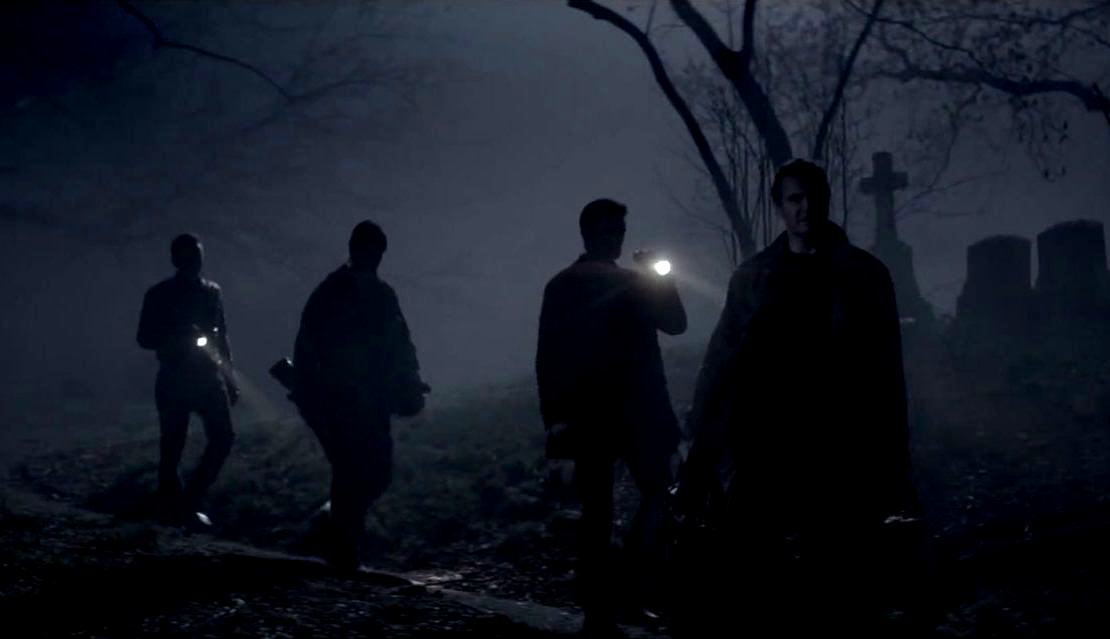
Sensing that Kenny’s wife may not have been the kidnappers first victim, Scudder visits the library to go through the newspaper records.  He strikes up a conversation with a young boy, TJ (Bradley), and together they discover two other murder victims where abduction and subsequent dismemberment have occurred.  Scudder visits the cemetery where the second victim’s body was discovered, and talks to one of the groundskeepers, Jonas (Ólafsson).  Jonas behaves suspiciously, and when he leaves work, Scudder follows him to his apartment.  While there he discovers that the partner of the second victim lives in the building opposite.  Beginning to see a connection, Scudder goes up onto the roof of Jonas’s building and finds a shed that contains evidence of Jonas’ involvement in her kidnapping and murder.  When Jonas returns, he gives Scudder a name – Ray – then jumps off the roof to his death.

Later, Scudder learns that the first victim was a DEA agent, and that the kidnappers may be rogue or ex-DEA agents themselves, as the second victim and Kenny’s wife were both linked to drug dealers.  When they kidnap a fourth victim, the daughter of a Russian drug dealer, Yuri (Roché), he calls on Kenny and Scudder’s help.  Scudder negotiates a ransom drop in the same cemetery where he met Jonas, but the drop goes badly, and the kidnappers get away… with TJ hiding in their van.

Walk Among the Tombstones, A - scene

Adapted from the tenth book in the series of Matt Scudder novels written by Lawrence Block, A Walk Among the Tombstones is a grim, atmospheric crime thriller that features a brooding, melancholy performance from Neeson, and suitably gloomy New York locations.  It’s a look at the darker, seedier side of Life that is impressively realised by writer/director Frank, and draws the viewer in from its opening shootout (which has tragic consequences), to its blood-soaked denouement in the basement of the kidnappers’ house.  Brief moments of levity do occur but they’re few and far between in a movie that anchors itself so effectively in the underbelly of criminal life that some viewers may be put off by its downbeat, distressing approach to the source material.

Carrying the movie like a well-worn overcoat is Neeson, his battered visage telling the audience all they need to know about Scudder and the kind of life he’s lived.  The scenes where he’s attending various AA meetings, while appearing as no more than standard character development, are instead chances for Neeson to show a more reflective, considered approach to the character.  These add subtly to the overall performance, grounding Scudder while the other characters aren’t quite so well fleshed out.  Neeson is a strong, credible actor, and when he’s the focus of a movie (as he is here), then the audience will follow him anywhere, even in something as nonsensical as Non-Stop (2014).

And it helps, because while A Walk Among the Tombstones is determinedly dour, this is a movie that does itself no favours when addressing its bad guys and what they do.  It’s dark, edgy stuff, and made all the more potent by the performances of Harbour and Thompson, who make Ray and his accomplice Albert two of the nastiest villains seen for a while, with the more garrulous Harbour making some truly horrifying dialogue sound even worse by virtue of Ray’s emotional and moral detachment.  These guys are evil, pure and simple, and as the black heart of the movie, are incredibly effective and completely justify Jonas’s decision to jump off the roof.

With a strong, capable hero and two loathsome villains in place, it’s disappointing that the remaining characters don’t quite resonate as much.  As Kenny, Stevens is oddly distant, his anger at his wife’s murder coming across as what’s expected of him rather than a real emotion (even after he’s gone through what happened).  TJ is the annoying would-be sidekick with a poignant back story that threatens to derail the movie – isn’t it enough that Scudder is looking to personally redeem himself, without the added responsibility of a homeless child as well (and one who, when hospitalised, isn’t handed over to social services)?  That said, Bradley does have a screen presence, and he makes the most of a potentially irritating character.

Morally complex it may be, and with drug dealers painted more sympathetically than usual, nevertheless the movie is a crime thriller, and as it ramps up the violence towards the end, the slow deliberate pace of the first half is ramped up as well, and gives the audience another chance to see Neeson in action hero mode (watch though for the table that breaks before it’s landed on).  There’s a satisfying conclusion, and if another Matt Scudder movie doesn’t get made, Frank’s polished, considered outing will stand on its own as an above average entry in the private eye genre.

Rating: 8/10 – stronger and more powerful than the average crime flick, this benefits from a committed turn by Neeson and has a funereal approach that works far better than perhaps it should; confident, absorbing and persuasive, A Walk Among the Tombstones is stirring stuff and shouldn’t be missed.


Share this:

  • Click to share on X (Opens in new window) X
  • Click to share on Facebook (Opens in new window) Facebook
  • More
  • Click to print (Opens in new window) Print
  • Click to email a link to a friend (Opens in new window) Email
Like Loading...

Maps to the Stars (2014)

05 Sunday Oct 2014

Posted by dullwood68 in Movies

≈ Leave a comment

Tags

Actress, Black comedy, Chauffeur, Child actor, David Cronenberg, Drama, Dysfunctional family, Evan Bird, Hollywood, John Cusack, Julianne Moore, Mia Wasikowska, Olivia Williams, P.A., Review, Robert Pattinson, Self-help guru

Maps to the Stars

D: David Cronenberg / 111m

Cast: Julianne Moore, Mia Wasikowska, John Cusack, Evan Bird, Olivia Williams, Robert Pattinson, Sarah Gadon, Kiara Glasco, Dawn Greenhalgh

Arriving in Los Angeles, Agatha (Wasikowska) is met by limo driver/aspiring actor Jerome (Pattinson).  On the way to where she’s staying she asks him to drive to a spot up in the hills near to the Hollywood sign, though when they get there there isn’t a house where Agatha expects it to be.  Meanwhile, child actor Benjie Weiss (Bird) is in the middle of negotiations to star in the sequel to the movie that has made him a star.  However, a recent bout of substance abuse has the studio insisting on his sobriety.  At the same time, well-known actress Havana Segrand (Moore) is doing all she can to land the part her mother played in a remake of a 60’s classic.  Through a lucky piece of networking, Agatha ends up working for Havana as her P.A.

Agatha has burns from a fire that happened when she was younger and it’s revealed that she’s spent the last seven years in a psychiatric hospital as she caused the fire.  Her reason for coming to L.A. is to make amends to her family, parents Stafford (Cusack) and Christina (Williams), and her brother, who it turns out is Benjie.  When they learn she’s back in town they have different reactions but she sees them each in turn with differing results.  As troubled as Agatha is, she’s unaware of the ghosts Benjie sees, ghosts that are pushing him toward a violent outburst.  And Havana is tormented by visions of her mother (Gadon) before she died, visions that feed into her insecurity about playing her mother’s role.  A relationship blossoms with Jerome but is eventually undermined by Havana, while one of Benjie’s hallucinations causes a tragedy he can’t run away from… except with Agatha.  With violence blighting both their lives, they decide on a solution to their problems that will give them both peace from the demons that haunt them.

Maps to the Stars - scene

The first movie that David Cronenberg has made – if only partially – in the US, Maps to the Stars is a biting satire that explores the various tensions within one of the most dysfunctional families in recent movie history.  The Weisses are so screwed up as a family it’s a wonder any of them can function normally on a day to day basis.  Dad Stafford is a self-help guru cum massage therapist whose sense of his own relevance is underlined by the famous people he’s met, like the Dalai Lama.  He’s distant from his wife and son, and is worried that any adverse publicity will expose the secret he and Christina have shared for years.  For her part, Christina acts as a kind of manager for her son’s career, advising him and attending meetings with the studio.  She gets little recognition for her efforts from him, and she too is afraid their secret will be revealed. Both characters are unhappy and edgy in their own skins, and there is a distance between them that has become enforced through necessity, but their dependence on each other is the only way they can express their love for each other.

Benjie is thirteen and the kind of spoilt-minded child actor who thinks it’s okay to disrespect people and be abusive and mean-minded.  There’s a certain amount of insecurity about him, but it’s smothered by his “fuck you” attitude, and his need to be in control of his own life, independent of his parents.  By contrast, Agatha is the child who wants to make amends, who wants to see her family reunited, but doesn’t realise – or expect – that her optimism is misguided.  Her troubled history (controlled by several different medications) is in danger of defining her as an individual, and her job with Havana, and her romance with Jerome, help boost her confidence in dealing with Benjie and her parents.  When they both go wrong, she discards her meds, and it’s only when she does that she’s truly able to deal with things, even if the way in which she does is far from appropriate.  Self-confidence aside, it’s her schizophrenia that keeps her strong.

All four actors – Cusack, Williams, Bird and Wasikowska – prove excellent choices for their roles, and each one holds the viewer’s attention with ease in each of their scenes; when some of them are together, it’s like an embarrassment of riches, and it’s good to see Cusack back on form after the likes of Drive Hard and The Prince (both 2014).  But this is Moore’s movie all the way, her portrayal of an actress on the verge of becoming irrelevant both tragic and horrifying in its naked neediness and self-serving hypocrisy.  Moore’s no stranger to tortured female characters (whether self-inflicted or not), and here she adds yet another to the list, making Havana pitiable, self-destructive and venal in equal measure.  It’s a bravura performance, with Moore displaying Havana’s emotional vulnerability and lack of empathy, particularly in the horrifying scene where she celebrates getting her mother’s role through tragic circumstances.  She’s hypnotic to watch, and by far the best part of seeing the movie.

Good as the performances are though (and they are very good), there isn’t any easy way to connect with the characters.  Agatha has most of the viewer’s sympathy, but that slowly changes as the movie progresses.  Benjie is virtually irredeemable, while Stafford and Christina are too wrapped up in themselves to care about anyone else.  This is also a movie made with a degree of distance between the characters and the audience, and this appears to be down to Cronenberg’s approach to both them and Bruce Wagner’s screenplay.  His direction is as inventive as ever, and he deposits the Weisses and Havana in various large, open spaces to highlight their isolation (particularly their own homes).  As a movie that shines a light on how dysfunction and self-destruction can both encourage and propel certain people toward terrible actions, it’s a triumph.  But as a movie that identifies root causes and solid motivations for those actions it’s not so successful, leaving the viewer to scratch their head at how the characters can be so self-destructive, and with no attempts to seek help (even from Stafford).

However, there is a degree of dark humour here that some audiences will recognise, as well as moments of soap opera absurdity that threaten to undermine the overall cleverness of the script.  These are also predictable moments, and while some are necessary for certain storylines to move forward, it’s a shame that they’ve been included, as they actually cause the movie’s flow to stutter when they occur.  Still, there’s more here that’s good than bad, and it’s compelling on several levels.

Rating: 8/10 – another winner from Cronenberg, Maps to the Stars has a few, minor faults, and will certainly divide audiences, but fans will lap it up, while newcomers to Cronenberg’s oeuvre may be non-plussed by the observational approach; with a raft of intriguing, well-constructed performances, the movie offers far more than is obvious at first glance.

Share this:

  • Click to share on X (Opens in new window) X
  • Click to share on Facebook (Opens in new window) Facebook
  • More
  • Click to print (Opens in new window) Print
  • Click to email a link to a friend (Opens in new window) Email
Like Loading...

Loom (2012)

02 Thursday Oct 2014

Posted by dullwood68 in Movies

≈ 1 Comment

Tags

4K, Cloning, Drama, Genetics, Giovanni Ribisi, Jellybean Howie, Luke Scott, Review, Sci-fi, Short film

Loom

D: Luke Scott / 21m

Cast: Giovanni Ribisi, Jellybean Howie, Jae Jung, Patrick Foy, Evelyn Edwards, Gino Aquino, Erica Piccininni

Tommi Galvin (Ribisi) is a technician in a protein growth factory, monitoring and manipulating meat products for the mass consumer market.  He’s quiet, fastidious, and apparently conscientious about his work: with colleagues he’s peremptory and quite curt.  What they don’t know is that Tommi is stealing growth hormones to help with a project that he’s working on at home.

His latest theft of the growth hormone appears to have the desired effect on his “experiment”, but the arrival of two law enforcement agents (Jung, Foy) leads to an unexpected, unfortunate reversal of fortune.

Loom - scene

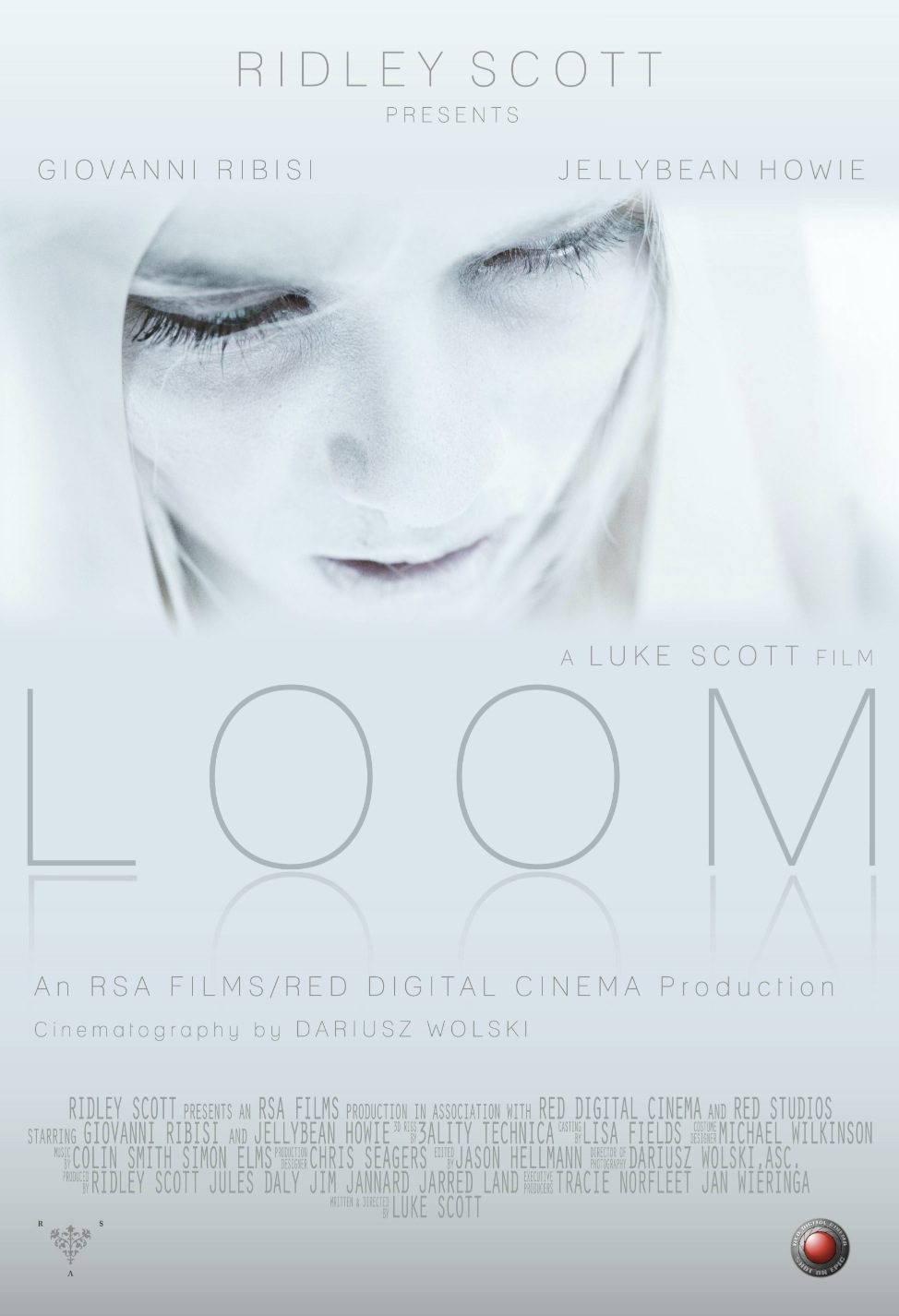
Made to showcase the new 4K camera technology, Loom is a bleak, dystopian piece of science fiction directed by Ridley Scott’s son, Luke.  The world of the future is presented as a bland, antiseptic place where Man interacts on a conservative, non-social level, and where the environment is regulated and controlled for the greater good.  It’s a largely sterile world, all neutral colours and impersonal living and work spaces.  The production design by Chris Seagers is crisp and precise and expands on current architecture to provide a convincing look at the future, and supports the storyline’s examination of how we connect with other people in the face of an a sterile, distant social order.

With the world around Galvin so well constructed, Loom focuses on the sense of alienation he feels; even when he’s spending time with his “partner”, Escha (Howie), there’s a disconnect that you can see he wants to overcome but is struggling with.  His agitation at the arrival of agents Seville and Walton gives rise to an emotional reaction to subsequent events that is reassuring for his continued humanity (though it’s likely he’ll be either on the run or in prison).  Galvin’s calm, measured demeanour is impressively played by Ribisi, his passive features hiding a personality that’s striving to make a difference, if only for himself.  As Escha, Howie has a difficult role that requires her to behave with a childlike detachment, though she’s scarily effective too when the agents turn up, and she and Galvin’s relationship is threatened.

In the director’s chair, Scott displays a confidence and control in the material that augurs well for future projects, and aided by cinematographer Darius Wolski, paints a picture of the future that feels eerily prescient.  The movie is often deceptively beautiful to look at, and the clarity of the image more than upholds the decision to use the 4K cameras.

Rating: 8/10 – intriguing – though not as thought-provoking as its set up might lead viewers to expect – Loom is an impressive debut from Scott, and features a surprisingly complex performance from Ribisi; well worth seeing, and a movie that leaves you wondering what happens next.

Share this:

  • Click to share on X (Opens in new window) X
  • Click to share on Facebook (Opens in new window) Facebook
  • More
  • Click to print (Opens in new window) Print
  • Click to email a link to a friend (Opens in new window) Email
Like Loading...

Sin City: A Dame to Kill For (2014)

01 Wednesday Oct 2014

Posted by dullwood68 in Movies

≈ Leave a comment

Tags

Action, Basin City, Corruption, Drama, Frank Miller, Guns, Jessica Alba, Joseph-Gordon-Levitt, Josh Brolin, Kadie's Bar, Marv, Mickey Rourke, Murder, Old Town, Review, Robert Rodriguez, Senator Roark, Sequel, Swords

Sin City A Dame to Kill For

D: Robert Rodriguez, Frank Miller / 102m

Cast: Mickey Rourke, Jessica Alba, Josh Brolin, Joseph Gordon-Levitt, Rosario Dawson, Bruce Willis, Eva Green, Powers Boothe, Dennis Haysbert, Ray Liotta, Christopher Meloni, Jeremy Piven, Christopher Lloyd, Jaime King, Juno Temple, Stacy Keach, Marton Csokas, Jude Ciccolella, Jamie Chung, Julia Garner

Basin City, night.  Marv (Rourke) is having trouble remembering what’s happened to him as he surveys the wreckage of two cars and the bodies of two young men lying in the road.  As the night’s events become clearer, he remembers an encounter with four young men, and being shot by one of them.  Heading for the Projects, two of the young men attempt to ambush Marv but they’re stopped by unseen assailants.  Marv kills them both and chases the other two down, bringing his memory full circle.

At Kadie’s Bar, a poker game in a back room is presided over by Senator Roark (Boothe).  Johnny (Gordon-Levitt), a drifter, invites himself into the game and wins big, earning the enmity of the Senator.  Later, Johnny has the fingers of his lucky hand broken by the Senator, and is shot in the leg as well.  Johnny swears revenge but Roark is dismissive of the threat, believing himself invincible because of the power he wields.

Elsewhere in Basin City, private eye Dwight (Brolin) receives a phone call from someone he’d hoped he’d never hear from again, old flame Ava (Green).  They meet, and she reveals she is in an abusive marriage, and is fearful for her life.  When she’s forced to leave by Manute (Haysbert), who works for her husband, Dwight decides to find out more.  He goes to Ava’s home but is caught by Manute and viciously beaten up.  Back at his apartment, Dwight receives another visit from Ava and they have sex, but again Manute arrives and takes her away.  Enlisting Marv’s help, Dwight returns to Ava’s home, where he kills her husband, Damien (Csokas), but soon realises he’s been set up by Ava who shoots him.  Marv (who’s blinded Manute in a vicious fight between the two) rescues Dwight and they get away to Old Town.  Helped by old friend Gail (Dawson), Dwight recovers and enlists her help in seeking revenge on Ava.  They return to Ava’s home to settle matters once and for all.

Johnny finds a doctor (Lloyd) to help him with his injuries and he returns to the poker game where once again he beats Roark.  His victory is short-lived as Roark turns the tables on him once more.  While Roark reclaims his standing, Nancy (Alba), a stripper at Kadie’s, plots to kill him in revenge for the death of Hartigan (Willis), a cop she cared about.  But Nancy drinks too much and hasn’t the courage to act on her anger.  In a fit of rage, she disfigures herself, which leads Marv to offer his help.  Together they make their way to Roark’s estate, where Nancy comes face to face with the Senator.

Sin City A Dame to Kill For - scene

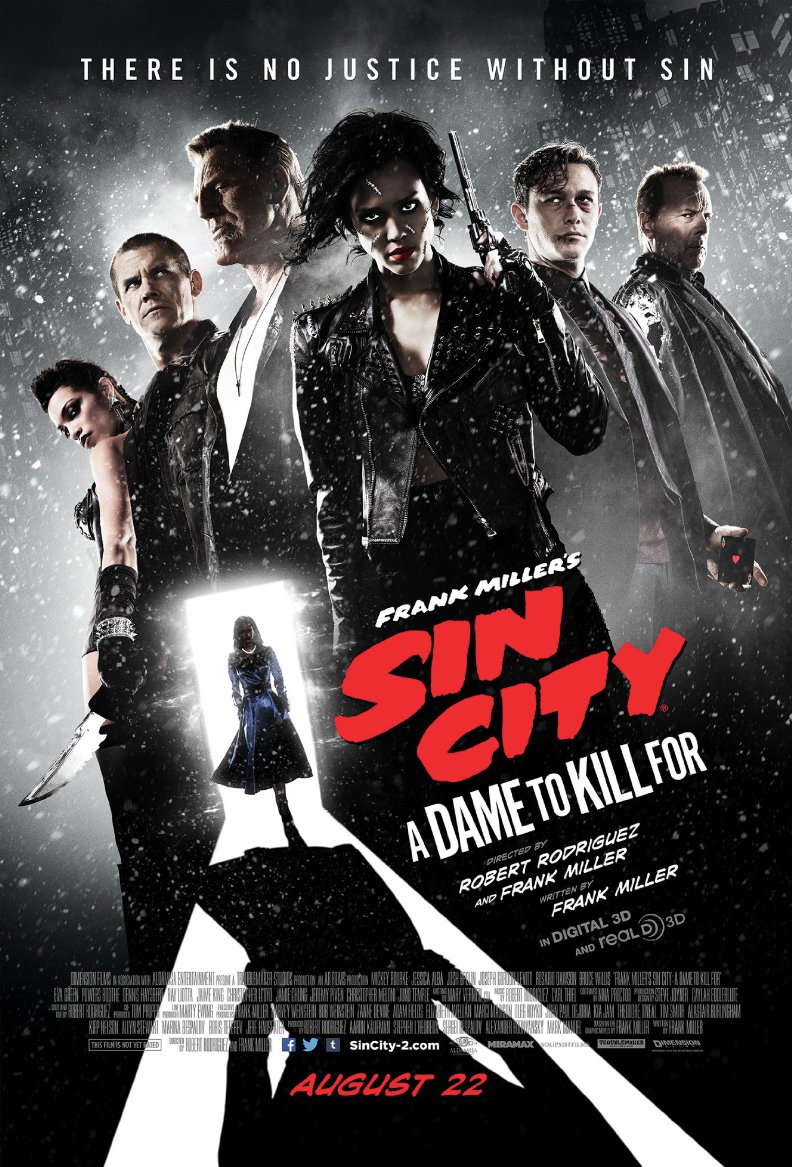
Arriving nine years after its predecessor, Sin City: A Dame to Kill For retains many of the earlier movie’s characters, the same visual approach, hard-boiled dialogue and non-linear storytelling, and extreme bouts of violence.  As a companion piece, the movie works well, but there’s something missing from the experience: anything new.

The first movie worked precisely because it was new.  The mixture of live action and CGI, allied to heavily stylised violence and Frank Miller’s nihilistic characters, was, in its own way, a refreshing change from other violent dramas (and thankfully proved hard to duplicate).  The problem here is that Miller and Rodriguez have stuck too closely to the original formula, leaving Sin City: A Dame to Kill For looking and feeling like a greatest hits version of the first movie, rather than a bona fide sequel.  It’s disquieting to realise as you watch the movie that everything’s the same, and with that realisation it also becomes clear that this outing is going to lack the verve and complexity of Miller and Rodriguez’s first collaboration.  The tone is the same and there’s no variation.

Worse still is the lack of investment in certain characters, notably Johnny who we don’t really care about, despite his opposition to Senator Roark, and Nancy, whose bitter reluctance to act against the Senator seems forced rather than natural.  Twice she has him in her sights while performing a routine, and both times she fails to pull the trigger.  Credible?  No; and nor is Marv appearing in each storyline, and helping out in the same fashion on two separate occasions (it’s also problematical that he died in the first movie – why is he in this one?)  Hartigan returns as a ghost but makes almost no impact on Nancy’s story, while Gail and her team of female assassins are treated like bystanders.

Even the cast can’t raise this one from its slumbers, though Green makes the biggest impression, making Ava one of the most deceitful and alluring femme fatales to be seen for some time (she’s naked quite a lot as well, and shot in a fetishistic fashion that is reserved only for her).  Brolin subs for Clive Owen, and Boothe steps out from behind Rutger Hauer to play the movie’s main villain with aggressive panache.

Ultimately, the stories aren’t strong enough, or interesting enough, to resonate beyond a first viewing, and by the end, even the violence has lost its charm, becoming repetitive and – sadly – unexciting.  What’s left is an uneven mix that doesn’t know how to straighten itself out or make itself more coherent.

Rating: 5/10 – below par in pretty much every department with just enough being done to make the movie look better than it actually is, Sin City: A Dame to Kill For is a sequel that tries hard to recreate the magic of its forerunner, but never really succeeds; if a further entry is planned, Messrs Miller and Rodriguez will need to spend more time at the drawing board before committing anything to film.

Share this:

  • Click to share on X (Opens in new window) X
  • Click to share on Facebook (Opens in new window) Facebook
  • More
  • Click to print (Opens in new window) Print
  • Click to email a link to a friend (Opens in new window) Email
Like Loading...

The Equalizer (2014)

30 Tuesday Sep 2014

Posted by dullwood68 in Movies

≈ Leave a comment

Tags

Action, Antoine Fuqua, Corrupt cops, Denzel Washington, Drama, Prostitute, Review, Robert McCall, Russian mob, Thriller, TV show

EQ_DOM_1SHT_RAIN.indd

D: Antoine Fuqua / 131m

Cast: Denzel Washington, Marton Csokas, Chloë Grace Moretz, David Harbour, Haley Bennett, Bill Pullman, Melissa Leo, David Meunier, Johnny Skourtis

Robert McCall (Washington) is a quiet, reserved man who works at a hardware store in Boston and is generally well liked by his colleagues.  At home he lives a somewhat monastic, ordered lifestyle, and the only time he appears to go out is when he goes to a local diner and reads his latest book.  As a regular he gets to know Terri (Moretz), a teen prostitute with ambitions to be a singer.  When McCall witnesses her being mistreated by her pimp, Slavi (Meunier), and then she ends up in the hospital, badly beaten up, he decides to do something about it.  He pays Slavi a visit, and when negotiations don’t go as he’d hoped, he kills Slavi and four of his men.

What McCall doesn’t know is that Slavi was part of the East Coast Russian mob, and he’s singlehandedly taken out the Boston hub of that organisation.  The mob sends a fixer, Teddy (Csokas), to find the person responsible, but it takes a while, during which time McCall gets on with helping others who are experiencing crime-related problems.  When Teddy finally tracks him down, McCall decides to turn the tables on him and become the hunter instead of the hunted.  Striking at the mob’s operation while staying one step ahead of Teddy’s efforts to find and kill him, McCall reveals further aspects of a past that no one knows about, and which he keeps hidden.

When Teddy discovers a potential weakness in McCall’s character, his friendships with the people he works with, he holds them hostage and gives McCall an ultimatum: either give himself up or they all die.  But McCall has other ideas…

Equalizer, The - scene

Adapted from the US TV show that ran from 1985-1989 and starred Edward Woodward, The Equalizer is a big screen reboot that trades that series’ subtlety and clever plotting for a more direct, impactful approach, despite its slow burn opening and attempts at deft character work.  It’s a long while before McCall’s visit to Slavi, and during that time we get to see him at home, at work, at the diner, leading a normal life of sorts, but obviously lonely rather than a loner.  We learn that he’s a widower, and that he’s working his way through a list of books his wife was aiming to read before she died.  He helps a co-worker, Ralphie (Skourtis), prepare for a security guard exam, jokes with other co-workers that he was once one of Gladys Knight’s Pips, and encourages Terri to change her life and follow her dream of being a singer.  He’s kind, attentive, supportive, fair, but still a bit of an enigma.

It’s all “good stuff” and gives Washington a chance to show off his acting chops (which are considerable), and serves to introduce McCall as just more than the violent avenger he’s soon to become.  But the drawback is that once McCall faces off against Slavi and his men, all that character build-up is jettisoned in favour of a more traditional action thriller style movie, and Washington stops being Mr Average and becomes an invincible righter of wrongs.  In many ways this is unavoidable, the nature of the story giving the director and his star little option but to revert to the tried and trusted approach of blowing shit up and killing a whole bunch of stuntmen.  But thankfully, and despite the increasingly derivative nature of the narrative, Fuqua’s distinctive visual style and Washington’s reliable acting skills hold the viewer’s attention, and offset some of the more ludicrous moments (McCall walks away from a series of huge, multiple explosions at such an insanely slow pace it’s less a case of a cool looking moment than a clue that Denzel can’t run that fast anymore).

In the end, The Equalizer reveals itself as an origin story, prepping the way for potential sequels (though Washington has yet to make one).  On this evidence, any further outings will need to address the issue of how much McCall’s character will be focused on, and whether or not aspects such as his borderline OCD is dealt with (it’s featured, but isn’t developed, the same as his use of a stopwatch to time certain moments and incidents).  The storylines will need to be a bit more impressive as well, and a more serious adversary to give a much needed sense of threat; Teddy is certainly psychotic but McCall outwits and dispatches him too easily, leaving any possibility of tension or doubt about the outcome so far behind it’s practically invisible.

As a vehicle for Washington, The Equalizer is a good fit, and he’s ably supported by Csokas, Moretz and Harbour, while Pullman and Leo appear as old friends of McCall who know his history.  Richard Wenk’s script works best when focusing on McCall as Mr Average, and his relationships with Terri and Ralphie are skilfully drawn.  The action scenes are expertly choreographed (though a fight between McCall and one of Teddy’s men is scrappily edited: blows are landed but who’s being hit is mostly a mystery), and Mauro Fiore’s cinematography adds a vitality that helps counter the familiarity that builds once Slavi bites the dust.

Rating: 7/10 – although it eventually proves an entertaining introduction to Robert McCall and his “set of skills”, The Equalizer is too formulaic to have much of a genuine impact; a good vehicle for Washington but not a movie to stay in the memory for too long despite the positives (that the movie then squanders).

Share this:

  • Click to share on X (Opens in new window) X
  • Click to share on Facebook (Opens in new window) Facebook
  • More
  • Click to print (Opens in new window) Print
  • Click to email a link to a friend (Opens in new window) Email
Like Loading...

The Guest (2014)

21 Sunday Sep 2014

Posted by dullwood68 in Movies

≈ Leave a comment

Tags

Adam Wingard, Brendan Meyer, Cuckoo in the nest, Dan Stevens, Dead son, Drama, Leland Orser, Maika Monroe, Military, Murder, Psychopath, Review, Sheila Kelley, Simon Barrett, Thriller

Guest, The

D: Adam Wingard / 99m

Cast: Dan Stevens, Maika Monroe, Brendan Meyer, Leland Orser, Sheila Kelley, Lance Reddick, Chase Williamson, Joel David Moore, Ethan Embry, Tabatha Shaun

Shortly after the death of her son Caleb while he was in Afghanistan, Laura Peterson (Kelley) receives an unexpected visit from a young man who served with Caleb and has come to honour a promise he made.  David (Stevens) is welcomed into the Peterson household and despite initially unsure reactions from dad Spencer (Orser), daughter Anna (Monroe) and younger son Luke (Meyer), he soon wins their trust.

But when strange incidents begin to happen around town – Spencer’s boss is killed in mysterious circumstances, Anna’s boyfriend is implicated in a murder – incidents that in some way benefit the Peterson family, Anna starts to wonder if David is everything that he says he is, even down to his having served with Caleb.  While Anna’s suspicions grow, Luke overhears David talking to a plastic surgeon on the phone (though he doesn’t tell anyone).  When Anna calls the military base that David said he was last stationed at before he was discharged, their response is to send an armed unit, led by Major Carver (Reddick) to apprehend him.

With David needing to move on sooner than he’d planned, it becomes clear that he has no intention of letting anyone he’s met in the last few days be left behind for the military (or anyone else) to talk to.  He sets about killing the Peterson’s and anyone else he feels is a liability.  With Carver in hot pursuit, David tracks Anna and Luke to their local high school, and an inevitable showdown.

Guest, The - scene

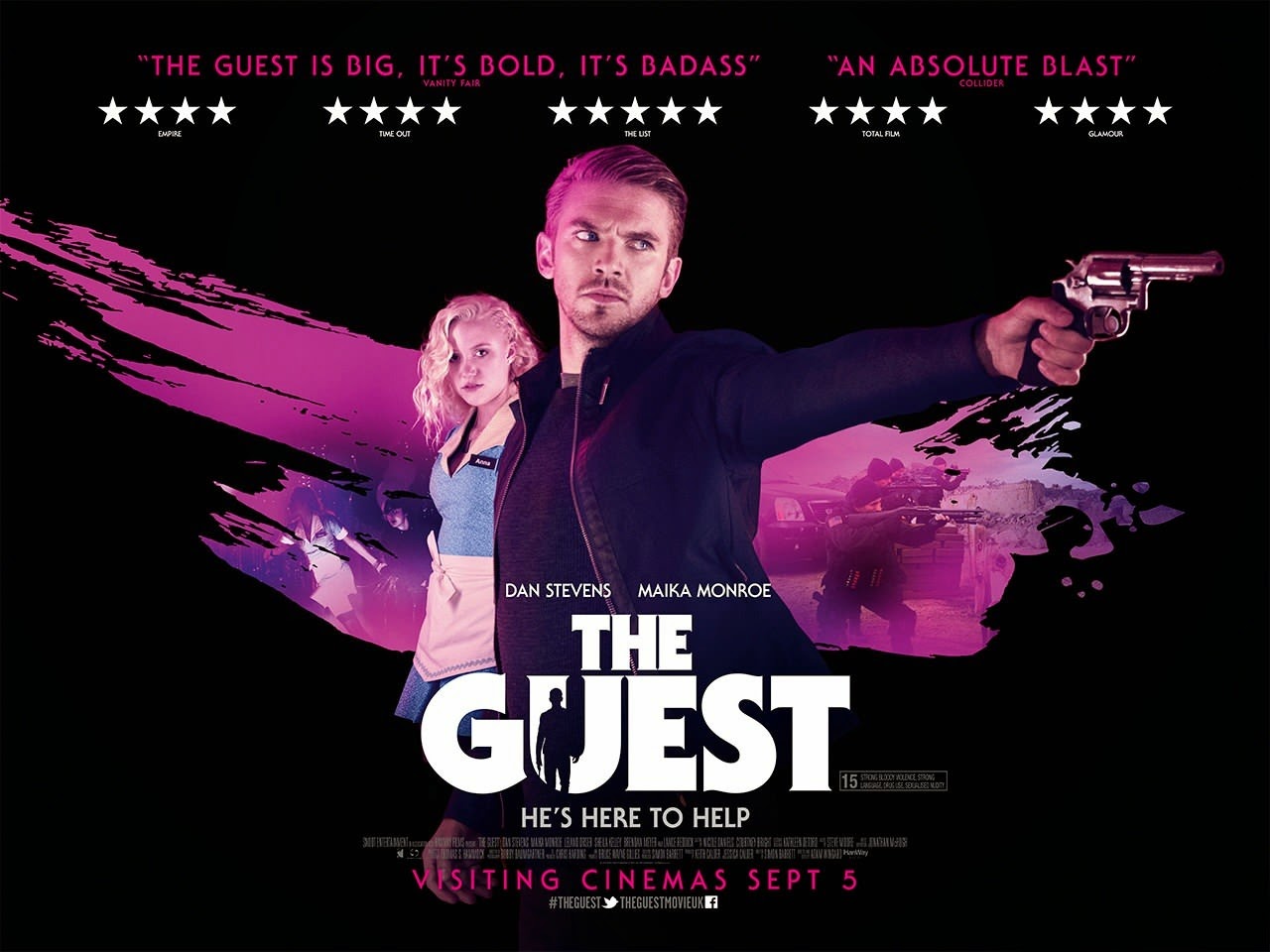
After the less than sophisticated home invasion story depicted in You’re Next (2011), director Wingard and writer Simon Barrett turn their attention to a more subtle variation on the same theme, with a cuckoo in the nest approach that reaps dividends thanks to a more controlled script, and strong performances from Stevens, Monroe, Kelley et al.

Thanks to Barrett’s more credible set up, The Guest draws the viewer in, allaying any initial fears the audience may have that this will turn out to be as predictable as, say, The Stepfather (1987).  But, while it’s a fair assumption to make – David is handsome, charming and polite, there are family tensions that mark out the Petersons as easily dividable – the way in which David’s more dubious undertakings are carried out have a disturbing frisson to them that obscures their obvious wrongdoing (and makes them partly acceptable for the audience).  Laura’s need for secondary contact with her son via David is understandable, and her vulnerability is well played by Kelley; there’s a quiet desperation to her scenes with Stevens that is often more touching than expected.

Spencer is a man at a standstill, attempting to make sense of his life through railing at what he sees as its inequalities, and yet, when he learns of his boss’s demise, and the promotion it means for him, his sense of place is so disturbed he can’t fathom how to react.  Orser (a much underrated actor) excels in what is an unsung role, and it’s great to see him in a movie where he’s not there to make up the numbers as in the Taken trilogy.

As their troubled offspring, Monroe and Meyer have larger roles but they’re a little too generic, with Anna’s doubtful behaviour and Luke’s need for an older brother substitute feeling more tired than dramatically necessary, and despite good performances from both, they can’t elevate their characters above the limitations set within the script.

With so much attention given to the Peterson family dynamic, it’s reassuring to find that David is much more complex than you might expect, and Stevens relishes the opportunity to take a trip to the dark side, making David attractive and dangerous at the same time, his military “training” having created a monster whose sense of morality is fleeting and impersonal.  That he chooses to help the Petersons in the way that he does is never fully explained (and is one of the ways in which the movie often feels more contrived than it needs to be).  Stevens is riveting as David, dispelling any memories of his role in TV’s Downton Abbey, and proving a superb choice in the title role, alternately charismatic and treacherous, and showing no contrition for his actions.

Beautifully filmed on location in New Mexico by Robby Baumgartner, The Guest benefits from a great cast and is smartly directed by Wingard who is improving with each movie he makes.  The movie’s midpoint sees some pacing issues and the Eighties style slasher finale at Anna and Luke’s high school is a little out of place – and makes the viewer wonder just what the school’s budget was to have created such a Halloween inspired maze/dancefloor/entrance etc.  And there’s a final shot that both echoes that Eighties conclusion and undermines it all at the same time.  It’s an understandable move by Wingard and Barrett but a bad one nevertheless, and is the cinematic version of leaving a sour taste in the mouth.

Rating: 7/10 – its unexpectedly derivative ending aside, The Guest is a welcome addition to the psycho thriller genre; gripping for most of its running time, it features a terrific performance from Stevens and shows no problem in being seductively cruel throughout.

Share this:

  • Click to share on X (Opens in new window) X
  • Click to share on Facebook (Opens in new window) Facebook
  • More
  • Click to print (Opens in new window) Print
  • Click to email a link to a friend (Opens in new window) Email
Like Loading...

Into the Storm (2014)

16 Tuesday Sep 2014

Posted by dullwood68 in Movies

≈ Leave a comment

Tags

Action, Disaster movie, Documentary filmmakers, Donk & Reevis, Drama, Eye of the storm, Matt Walsh, Review, Richard Armitage, Sarah Wayne Callies, Silverton, Steven Quale, Titus, Tornado Hunters, Tornados

Into the Storm

D: Steven Quale / 89m

Cast: Richard Armitage, Sarah Wayne Callies, Matt Walsh, Max Deacon, Nathan Kress, Alycia Debnam Carey, Arlen Escarpeta, Jeremy Sumpter, Lee Whittaker, Kyle Davis, Jon Reep

Documentary filmmaker Pete Moore (Walsh) is having a hard time finding tornados to film for his latest project, despite help from meteorologist, Allison Stone (Callies).  When a storm warning is given out near Silverton, Oklahoma, Pete and his team rush there only for the storm to peter out.  Meanwhile, at the high school, the senior class is having its graduation day.  Assistant principal Gary Fuller (Armitage) is worried about the impending weather spoiling the day and wants the ceremony postponed.  He’s overruled and it goes ahead; partway through, the storm hits and a tornado causes damage to the school buildings and grounds.  At the same time, Fuller’s eldest son, Donnie (Deacon), is several miles away with fellow student, Kaitlyn (Carey), filming a project at an abandoned paper mill.  When the tornado hits there, they find themselves trapped beneath the debris.

Moore and his team continue to chase the ever-increasing number of tornados that keep springing up, while Fuller, accompanied by his younger son, Trey (Kress) try to rescue Donnie and Kaitlyn.  Their paths cross and they team up to find the youngsters (though Moore is still more interested in getting footage for his documentary).  They find them, but realise that a tornado the size of which has never been seen before is heading for the high school, and only they can save the people taking shelter there.

Into the Storm - scene

Into the Storm invites obvious comparisons with Jan de Bont’s Twister (1996), and while the special effects certainly look more impressive, there’s a level of detail in the earlier movie that’s missing here, and though this movie’s super-tornado dwarfs anything seen before, its scale and ferocity keeps changing (it chucks 747s around like so much matchwood, but can’t lift Moore’s tank-like tornado chaser until the screenplay says so).  What’s also missing is a decent script, John Swetnam’s attempts at excitement falling flatter than a pancake, and his characters behaving and sounding exactly like the stereotypes they are (they even behave predictably: Moore is a boorish ass for three quarters of the movie then suddenly acts selflessly – as if).

The script isn’t helped by Quale’s flaccid direction and a cast who look as if they know just how poor the script is, and have decided to do just as much as is needed to get their lines out with a minimum of effort.  Armitage is stranded in his role as the tough widower trying to raise two wayward sons, while Callies keeps stopping to (try to) have unnecessary phone calls with her five year old daughter.  And then there’s the dumbest duo on the planet, Donk (Davis) and Reevis (Reep), the redneck comic relief, who put themselves in harm’s way in the hope of becoming famous on YouTube.

While the movie aims for incredible scenes of destruction in between the banal theatrics of its characters, Into the Storm ultimately fails because there’s no one to care about, and the tornado scenes are about as thrilling as watching ice cream melt.  But it is a short movie, and while the decision to shoot found footage-style adds a level of immediacy to the devastation, it’s not enough to rescue the movie from falling far short of where the cow ends up.

Rating: 3/10 – adequate special effects and a mercifully short running time can’t make amends for the paucity of imagination and delivery on show here; the only area in which Into the Storm succeeds is that it’s a step up from being a SyFy Channel release.

Share this:

  • Click to share on X (Opens in new window) X
  • Click to share on Facebook (Opens in new window) Facebook
  • More
  • Click to print (Opens in new window) Print
  • Click to email a link to a friend (Opens in new window) Email
Like Loading...

Kristy (2014)

11 Thursday Sep 2014

Posted by dullwood68 in Movies

≈ 3 Comments

Tags

Ashley Greene, College campus, Drama, Haley Bennett, Horror, Internet cult, Intruders, Murder, Olly Blackburn, Review, Thanksgiving, Thriller

Kristy

D: Olly Blackburn / 86m

Cast: Haley Bennett, Ashley Greene, Lucas Till, James Ransone, Chris Coy, Mike Seal, Lucius Falick, Mathew St Patrick, Erica Ash

Justine (Bennett) is a slightly nerdy college student who’s planning to spend Thanksgiving on campus as she can’t afford to get home for the holiday.  Her boyfriend, Aaron (Till), tries to persuade her to come with him to stay with his family but she won’t accept his kindness.  With only her friend, Nicole (Ash) and campus security guard Wayne (St Patrick) for company, Justine is looking forward to spending some time (largely) by herself.  However, Nicole heads home too, leaving Justine (nearly) all alone.

When she goes out to get some supplies at a local gas station, she encounters a young woman (Greene) whose strange attitude and challenging manner Justine attempts to placate in order to avoid an ugly encounter with the gas station attendant.  With her offer rebuffed, Justine voices her disappointment at not being able to just help someone.  The young woman rounds on her and tells her she’s the “Kristy”.  Later, on her way back to the campus, the young woman uses her car to block Justine’s, but Justine gets past her.  She tells Wayne what’s happened and although he’s sure nothing worse will happen, Justine isn’t so sure.

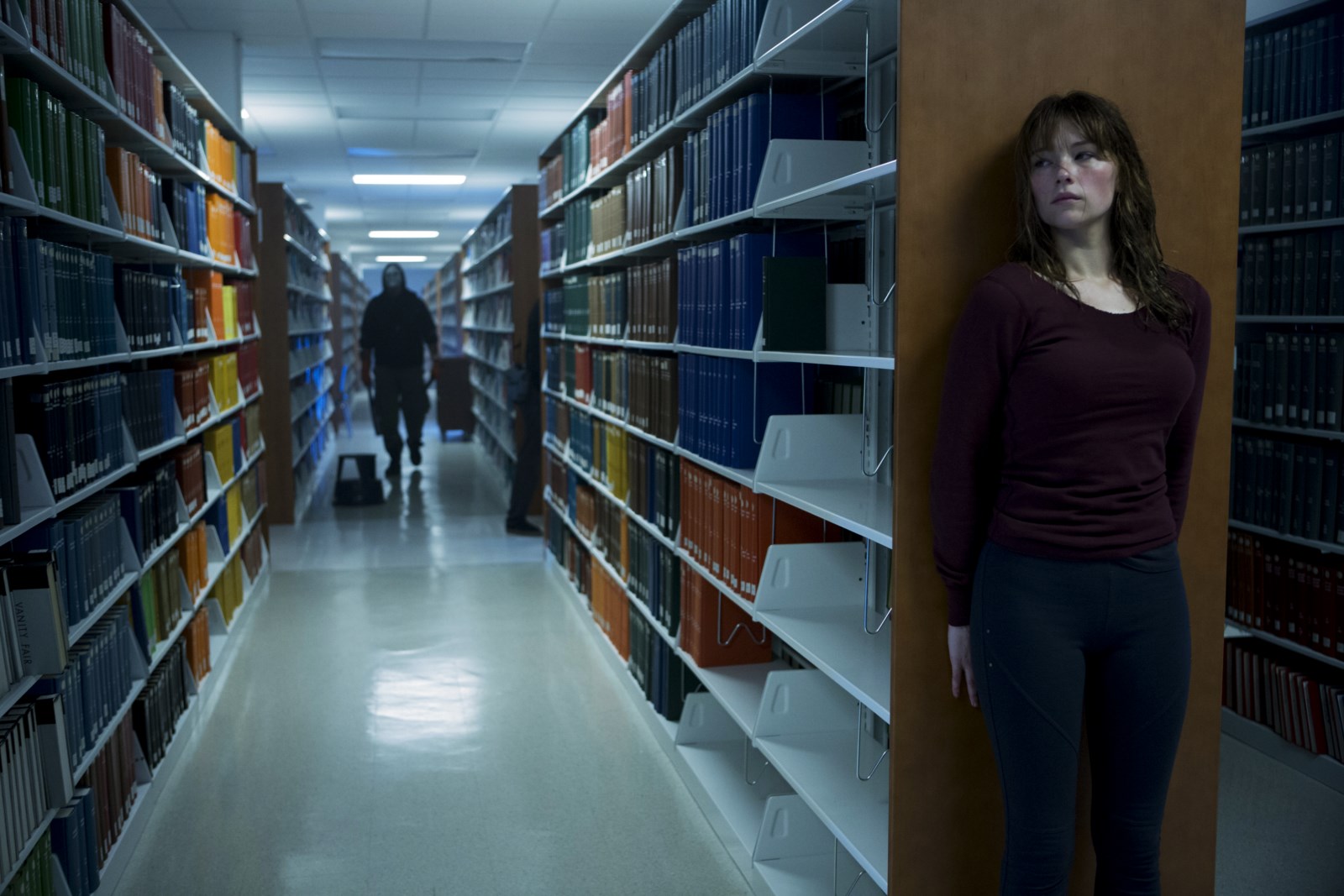
It isn’t long before she’s proven right.  The young woman appears in her room carrying  a knife.  Justine gets past her but soon learns the young woman isn’t alone: she has three male accomplices, all wearing tin foil masks and hoodies, and all carrying weapons.  A game of cat and mouse begins between Justine and the intruders.  Wayne is murdered and Justine is forced to run from building to building in an attempt to avoid being killed as well.  Even when she seeks help from the campus maintenance man, Scott (Ransone), who has a shotgun, the intruders outsmart him and Justine is left to fend for herself once again.  She must use every ounce of ingenuity she has to outwit the intruders and stay alive…

RANDOM

With its mix of Halloween (1978), The Shining (1980) and every school-based slasher movie ever released, Kristy could be accused of being derivative and unimaginative.  But in the hands of director Blackburn and writer Anthony Jaswinski, the movie is strong on atmosphere, as tense as barbed wire, and features some sterling, predatory camerawork thanks to DoP Crille Forsberg.  It’s an impressively mounted picture as well, the university environs – in particular, the swimming pool – put to very good use, the wide open spaces of the grounds proving just as claustrophobic as the interiors, Justine’s attempts at hiding or escape placed against a pitiless, unremarkable background of beiges and off-whites.

It’s a very measured, well-constructed mise-en-scene that benefits from Blackburn’s close attention to detail, validating his decision to combine tightly framed shots with wider, equally threatening compositions that add immeasurably to the sense of unease the movie displays from the first moment an overhead light begins to flicker in the dorm’s laundry room.  But while there’s a sure hand behind the camera, in front of it there’s a commanding performance from Bennett, her slightly geeky, girl-next-door looks and demeanour explored with effortless simplicity in the opening twenty minutes, from her interaction with Aaron to a deceptively effective montage of her activities once everyone’s left.  Justine is instantly likeable, the kind of young woman who makes you smile from the off.  Bennett invests her with a goofy charm, and while she spends the middle third running from the intruders, once Justine decides to take the hunt to them instead, she applies a calculating side of her character that comes across as entirely natural (it’s less the worm turning, more the worm realising she’s actually more than a match for her tormentors).

As the unreasoning, psychotic leader of a cell that’s part of a wider, Internet-based cult, Greene is hidden for the most part under a pink-tinged hoodie, only her facial piercings and chapped lips allowed any prominence.  She gives an angry, embittered performance, her coiled physicality threatening to erupt at any moment, making her the most unpredictable character of all; you watch her to see just what she’ll do next.  As her homicidal accomplices, Messrs Coy, Seal and Falick are hidden behind their masks but their presences are felt even when they’re off screen (Kristy is one of those movies where the viewer can’t quite be sure that one or more of them won’t just pop into view when it’s least expected).

There is violence throughout, from an opening montage of video clips of the cell’s other victims (which are posted on the Internet for other cult members to “enjoy”), to the outcome of Justine’s showdown with the young woman, but there is very little actual bloodshed, and Blackburn wisely avoids the kind of brutality that would have taken Kristy down the torture-porn route.  Instead, and aside from one crowd-pleasing contact blow that is entirely justified, each kill is rendered out-of-shot and with an emphasis on good old-fashioned sound effects.  In fact, the sound mix is one of the most effective aspects of the movie (take a bow, Michael B. Koff), particularly when the intruders are stalking Justine through the kitchens, their knives and weapons scraping against the fixtures and walls with hideous potency.

As mentioned above, the movie is indebted to several other horror outings, and while there will be those who won’t see beyond those influences, and will see deliberate moments taken from those movies – the fate of one character is lifted wholesale from Kubrick’s masterpiece – any naysayers will be missing the efficiency and verve that Blackburn et al. have employed to make these staple ingredients appear fresh and invigorated.  It’s very difficult these days to come up with something new in the horror arena, and while the thriller elements are pushed to the fore here, this variation on the home invasion sub-genre is refreshingly presented and, one unnecessary post-end credits sequence aside, belies its derivative nature to provide a riveting viewing experience.

Rating: 8/10 – unnerving, gripping and rewarding in equal measure, Kristy is a step up from other movies of a similar nature, and treats its audience accordingly; with clear intelligence at work both behind and in front of the camera this is one horror/thriller that really does deserve a wider audience.

Share this:

  • Click to share on X (Opens in new window) X
  • Click to share on Facebook (Opens in new window) Facebook
  • More
  • Click to print (Opens in new window) Print
  • Click to email a link to a friend (Opens in new window) Email
Like Loading...

Forgetting the Girl (2012)

07 Sunday Sep 2014

Posted by dullwood68 in Movies

≈ 1 Comment

Tags

Childhood trauma, Christopher Denham, Disappearance, Drama, Elizabeth Rice, Head shots, Lindsay Beamish, Nate Taylor, Photographer, Relationships, Review, Thriller

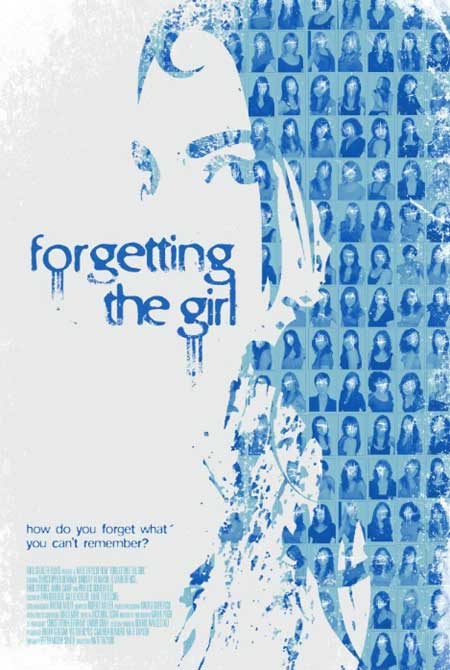
Forgetting the Girl

D: Nate Taylor / 85m

Cast: Christopher Denham, Lindsay Beamish, Elizabeth Rice, Paul Sparks, Anna Camp, Phyllis Somerville, Joel de la Fuente, Caitlin Carmichael, Holley Fain

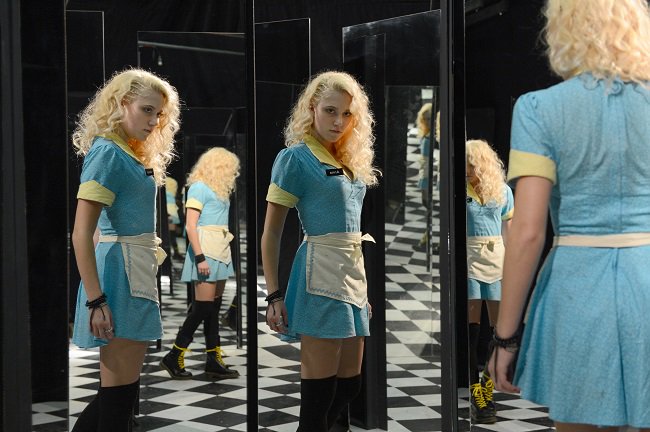
Head shot photographer Kevin Wolfe (Denham) has a small studio from which he runs his business, aided by make up assistant Jamie (Beamish).  Kevin is looking for the right girl to settle down with but he’s socially awkward, quick to assume a “connection” with the women he does date, and unable to deal with the emotional fallout when his mostly short-lived romances come to an end.  In order to deal with the negative feelings he experiences, he has developed a system of forgetting, a way in which he can erase the bad memories of that person from his mind.

Kevin is also trying to deal with the memory of the death of his sister, Nicole (Carmichael) as a young child.  He feels responsible as he was there when it happened but he can’t fully remember all the details.  He asks his grandmother (Somerville) about it but she’s as haunted by the event as he is, and resists his enquiries, leaving him to deal with this childhood trauma as best he can.  When Kevin asks out Adrienne (Camp), a client, his surprise at her agreeing to see him causes him – as usual – to make more of the relationship than is actually the case and he quickly ruins things between them.  He tries to make amends but Adrienne tells him in no uncertain terms that they can’t be a couple.

Kevin tries to forget Adrienne but some time later he receives a visit from her sister, Denise (Fain).  Adrienne is missing, and Kevin is one of the last people to have seen her.  Kevin is unable to help and throws himself into his work in an effort to further erase Adrienne from his memory.  One of his clients, Beth (Rice) agrees to go out with him.  They go to the theatre and later Beth invites Kevin into her apartment for a nightcap.  He tries to force himself on her, believing again that they have a “special connection”.  Beth is frightened and pushes him away; Kevin leaves, thinking he’s ruined everything.

Through all this, Jamie has been struggling with her feelings for Kevin, and her sense of self-worth which is pushing her toward suicide.  One night, she takes the plunge and reveals her feelings to Kevin.  At first he’s receptive, but he still has hopes of getting back with Beth.  Unable to deal with the mixed emotions he’s feeling, Kevin decides to resort to an extreme solution in order to resolve his growing problems.

Forgetting the Girl - scene

Shot and framed as a video diary, Forgetting the Girl is a fairly straightforward thriller tricked out with overt psychological trimmings.  It has that low-budget indie feel that relies on short scenes, mannered performances and sometimes oblique direction.  As an exercise in paranoid psychosis it’s not entirely convincing, but features a handful of facile performances, not the least of which is Denham’s as the eerily blank-faced Kevin, his emotions buried so far behind his eyes you have to wonder if he really feels anything at all.  His speech is often short, clipped almost, as if by saying too much he’ll lay himself open to people in ways he won’t be able to control (and yet he wants to be “normal”, to have that everyday interaction everyone else has).

With such a tightly-wound character as its focus, the movie only rarely strays away from Kevin, focusing more and more on Jamie only as the movie progresses towards its tragic conclusion (and as a necessity).  This broadening of the story is at odds with Kevin’s video diary confession – how can he know even half of what’s been happening with her? – but provides a much needed contrast from Kevin’s subdued susceptibilities.  They’re a couple waiting to implode together, and Peter Moore Smith’s screenplay, based on his own story, has a dreadful fascination about it as these two damaged individuals use each other to achieve (temporary) happiness.

Forgetting the Girl works well as an examination of one man’s attempt to control the emotional content of his life, but in true indie style, it pays little attention to the standard thriller elements that it presents, opting to downplay these elements in favour of more exacting expressions of personal angst.  It’s not until the final twenty minutes that the introspection and clever insights give way in favour of a denouement that demands a final twist (that, sadly, doesn’t come).  Adrienne’s disappearance is used to point suspicion at secondary character Tanner (Sparks), but this attempt comes across as a little too pat, and long-time thriller fans won’t be fooled at all.  And the truth about what happened to Nicole, though left unrevealed until late on, is a little too predictable to provide the resonance that’s needed later on.

Denham captures Kevin’s slow-burn detachment with precision, offering a performance that is by turns creepy and sympathetic.  As the desperately lonely Jamie, Beamish uses her character’s punk clothing and make up to point up the emotional defences she uses to stop herself from being hurt, and the supporting cast flesh out their characters appropriately.  But, ultimately, this is Denham’s movie from start to finish, ably encouraged and directed by Taylor, and at times, frighteningly realistic in his attempts to prove he can “connect”, when in truth he never will.

Rating: 7/10 – Denham’s superb central performance anchors the movie and is often unnerving to watch; with an unexpectedly powerful last act redeeming the more pedestrian aspects of the rest of the movie, Forgetting the Girl emerges as a small-scale winner deserving of a wider audience.


Share this:

  • Click to share on X (Opens in new window) X
  • Click to share on Facebook (Opens in new window) Facebook
  • More
  • Click to print (Opens in new window) Print
  • Click to email a link to a friend (Opens in new window) Email
Like Loading...

Before I Go to Sleep (2014)

05 Friday Sep 2014

Posted by dullwood68 in Movies

≈ Leave a comment

Tags

Amnesia, Assault, Colin Firth, Drama, Literary adaptation, Mark Strong, Nicole Kidman, Review, Rowan Joffe, S.J. Watson novel, Thriller

J2730_BeforeIGoToSleep_OneSheet_31F.indd

D: Rowan Joffe / 92m

Cast: Nicole Kidman, Colin Firth, Mark Strong, Anne-Marie Duff, Adam Levy, Dean-Charles Chapman

Christine Lucas (Kidman) wakes up each morning with no knowledge of who she is, and no memory of her life since her early Twenties.  Her husband, Ben (Firth), tells her she was in an accident ten years before and she is suffering from a form of retrograde amnesia: when she goes to sleep each night, her memory of that day is wiped clean and she remembers nothing about her situation.  To help her, Ben has put up pictures of their life together, and has left lists of items and instructions to help her get through the day while he’s at work.

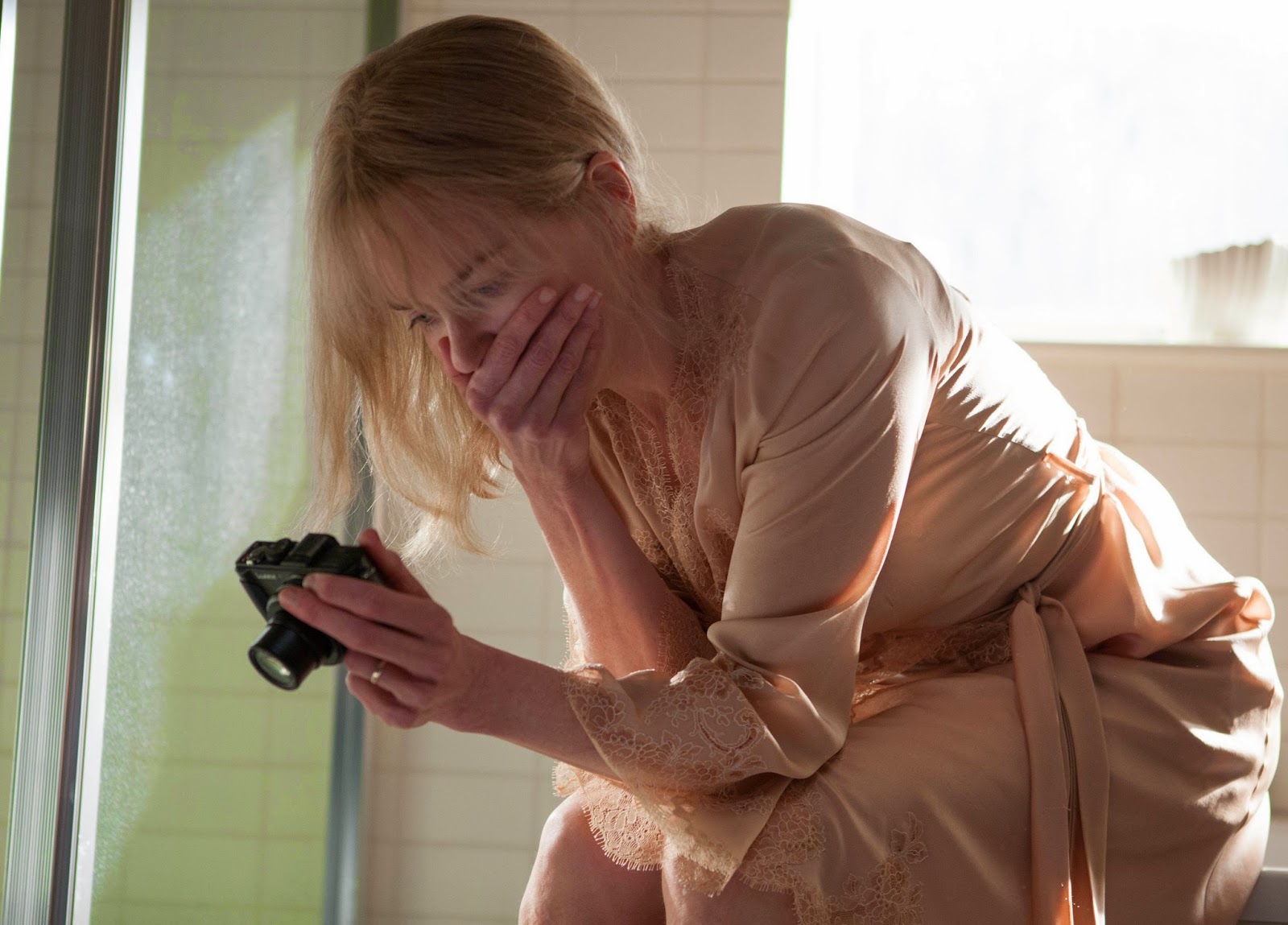
After Ben heads off, the phone rings.  A man at the other end identifies himself as Dr Nasch (Strong).  He tells Christine he’s been treating her for a while and that she should go and look for a camera hidden in a wardrobe in the bedroom.  Nasch has persuaded Christine to use the camera as a kind of video diary, an aide-memoire that she can use each day to help her remember things.  The last entry shows Christine looking visibly upset and cutting the recording short when Ben returns home.

Two weeks before: Dr Nasch begins treating Christine and gives her the camera, advising her not to tell Ben about it.  She begins to make daily recordings, and in the process she learns things that don’t make sense: her accident proves to be a near-fatal assault by an unknown attacker; she and Ben have a dead son; and a friend of hers called Claire (Duff) has been trying to get in contact with her (though Ben tells her he doesn’t recall anyone by that name).  As Christine begins to piece together the mystery of the assault and the past ten years, she begins to suspect that someone, either Ben or Dr Nasch, is hiding the truth from her, and that she may be in danger.

Before I Go to Sleep - scene

Adapted from the novel by S.J. Watson, Before I Go to Sleep is a hard movie to really like.  It’s competently directed by Joffe, ably performed by its cast, and wrong foots the audience on at least two occasions with considerable shrewdness.  But it lacks any real tension, and despite the best efforts of all concerned, has a too-familiar feel to it that robs the movie of any lasting effect.  Christine’s predicament and the limitations of her memory, while intriguing, are too easily overcome; it’s hard to believe that no one’s come up with the idea of a video camera before now.  And for the purposes of the plot, Dr Nasch’s insistence on keeping Ben in the dark, while highly suspicious by itself, seems more of a contrivance than something reasonably developed to aid in Christine’s treatment.

Once Christine begins to unravel the mystery of the assault, the clues come thick and fast, and while the movie as adapted by Joffe may think it’s being very clever, it only succeeds in making it easy for its heroine to learn the truth.  It also loses a large amount of credibility when Christine agrees to meet Claire at Greenwich, but is later revealed to not even know the address of where she lives.  It’s in the mid-section that Joffe trots out a series of twists and turns that threaten to sink the movie’s credibility, but he manages to hold it all together until the arrival of the more generic confrontation that, alas, soon descends from tense showdown to tiresome violent retread.

Later, as the plot begins to unravel further, and the truth about the assault becomes clearer, what has been a fitfully absorbing psychological thriller becomes yet another damsel in distress movie with Christine forced to face off against the man who assaulted her all those years ago.  With such a predictable denouement, the movie adds an extended coda that seeks to give full closure to everything Christine has discovered (it also provides an emotional resonance that’s lacking elsewhere), but while it’s an effective scene in and of itself, it comes too late to save matters overall.

There’s also the issue of the movie’s look.  Joffe, along with director of photography Ben Davis, has chosen to film in muted colours, and with the dimmest lighting design seen for some time.  As a consequence, the movie is drab and depressing to look at, its dour interiors sucking the life out of proceedings and proving an obstacle to the performances, the cast struggling to stand out against the morose and dreary surroundings.  Even when Christine meets Claire at Greenwich, the colour mix is toned down so that the natural greens and browns seem as subdued as the rest of the palette.  As a reflection of Christine’s mental state, it comes across as pretty heavy handed, while also keeping the audience at a distance from the action.

Kidman plays Christine as a fragile, easily disturbed, yet strangely trusting woman who shows only few signs of being the strong, confident person she was before the assault (it’s only her memory that’s affected, not her personality), and while she’s as capable as ever – only Julianne Moore can show dawning, horrified realisation as well as Kidman can – she’s hemmed in by the character’s limitations (even an actress of Kidman’s calibre can do shock and surprise only so many times in a movie without it becoming repetitive).  In support, Firth gets to play angry and resentful in between being supportive and creepy, while Strong does what he can with a character who, ultimately, is there for exposition purposes more than anything else.

There are obvious connections that viewers will associate with Memento (2000), but Before I Go to Sleep lacks that movie’s inventiveness and if they were programmed as a double bill, Joffe’s would definitely be the second feature.  With obvious nods to movies such as Groundhog Day (1993) and Shattered (1991), this tries hard to be a riveting thriller but ends up looking and sounding too mundane to make any lasting impression.

Rating: 5/10 – disappointing and routine for most of its running time, Before I Go to Sleep could have done with more pace and more intensity; with few surprises, and even fewer moments to make an audience gasp, this is one thriller that doesn’t fully live up to expectations.

Share this:

  • Click to share on X (Opens in new window) X
  • Click to share on Facebook (Opens in new window) Facebook
  • More
  • Click to print (Opens in new window) Print
  • Click to email a link to a friend (Opens in new window) Email
Like Loading...

Are You Here (2013)

02 Tuesday Sep 2014

Posted by dullwood68 in Movies

≈ Leave a comment

Tags

Amy Poehler, Comedy, Competency hearing, Drama, Inheritance, Laura Ramsey, Matthew Weiner, Owen Wilson, Review, Romance, Therapy, Weatherman, Zach Galifianakis

Are You Here

D: Matthew Weiner / 112m

Cast: Owen Wilson, Zach Galifianakis, Amy Poehler, Laura Ramsey, Joel Gretsch, Paul Schulze, Alana De La Garza, Edward Herrmann, Peter Bogdanovich, Jenna Fischer, David Selby

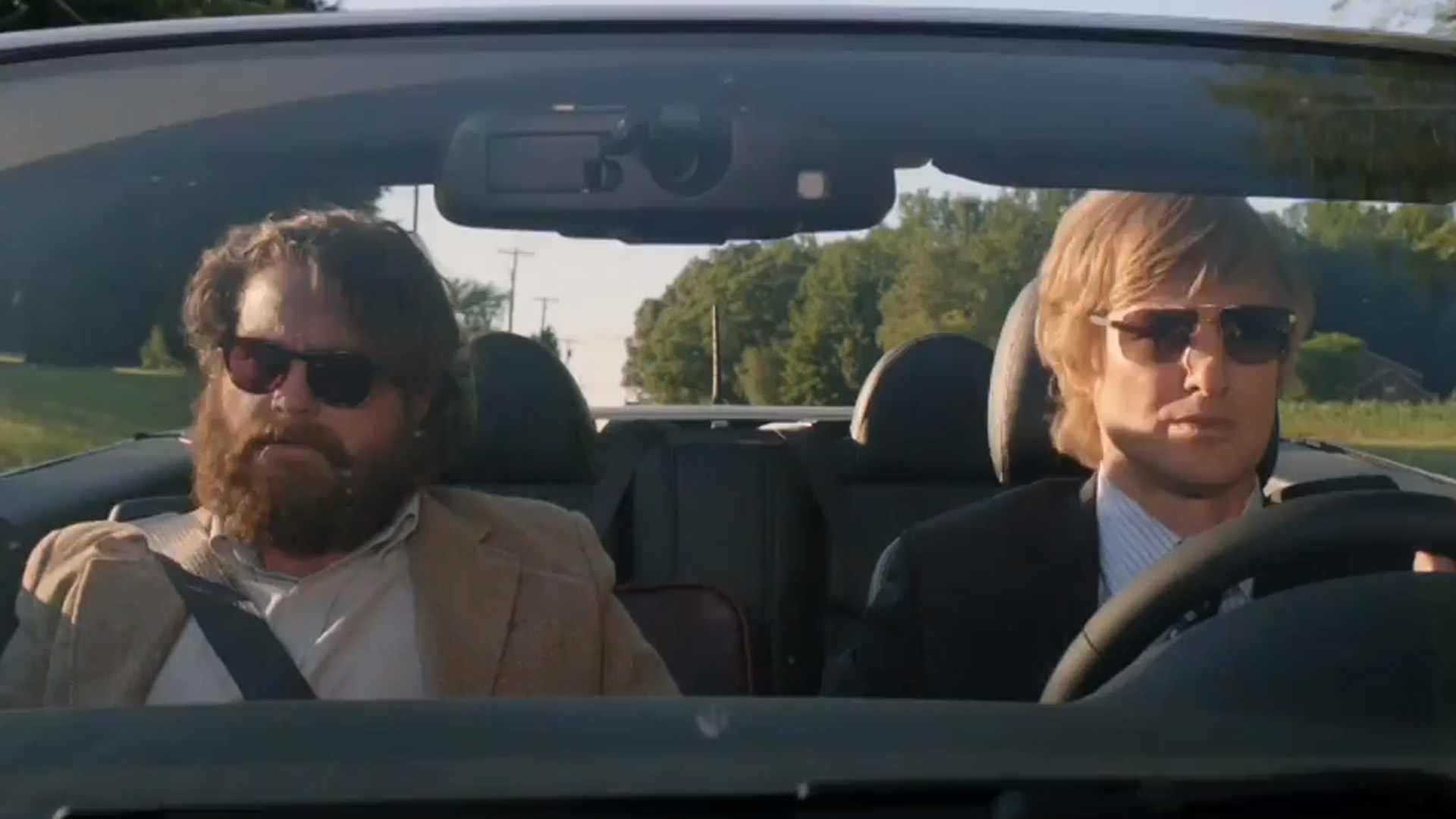
Steve Dallas (Wilson) is a weatherman whose easy-going, free-wheeling lifestyle is tempered by his long-time friendship with Ben Baker (Galifianakis).  Ben lives in a rundown trailer and has effectively turned his back on conventional society, preferring to live away from people and challenging most modern day conventions.  He also lacks certain social skills.  When Ben learns that his father has died, Steve agrees to take Ben back to the small town where they grew up for the funeral and to learn what, if any, inheritance Ben will receive.

To both friends’ surprise, and also Ben’s sister, Terri (Poehler), Ben inherits his father’s house and several acres of surrounding land, and his father’s store.  Terri is horrified, as she feels Ben is unable to deal with the responsibilities involved in running the store, and she’s even more horrified when Ben decides he wants to transfer the house and land over to Steve as a gift for all his years of support and friendship.  With the two siblings at loggerheads, there is also the issue of Angela (Ramsey), the young widow of Ben’s father.  Terri dislikes her (even though she clearly made the old man very happy), but Steve is besotted.  He tries to worm his way into her affections but she’s not easily swayed, and Steve, who usually rehearses his pick-up lines before talking to women, finds he has to rethink his approach.

While Ben and Terri fight over Ben’s plans to use the store as the site for a non-profit organisation, Steve returns to work but not before he asks Angela to keep an eye on Ben.  It’s not long, however, before Ben’s behaviour becomes more erratic, and when Steve returns he has to persuade him to see a counsellor (Herrmann) as Terri has insisted on a competency hearing to rule on Ben’s ability to manage his inheritance.  Steve continues to woo Angela and finds his efforts are beginning to pay off.  When the counsellor advises that Ben would need to take medication in order to meet the requirements of managing the store (however he sees fit), the meds prompt a change in Ben’s outlook.  It also brings Ben and Angela closer together, until one night they end up in bed together.  And then Steve finds out…

Are You Here - scene

Ostensibly a comedy-drama, Are You Here – on paper at least – looks like a shoo-in in terms of quality.  Written and directed by the creator of TV’s Mad Men, with two gifted comic actors headlining, and with a storyline ripe with comedic and dramatic potential, there shouldn’t be any reason why this doesn’t score points across the board.

And yet…

There are several problems here, and all of them serve to hold the movie back.  First and foremost is the relationship between Steve and Ben.  Steve is a shallow ladies man whose over-riding commitment in life is to himself, and he has very little time for the feelings of others; he treats his boss (Schulze) with disdain, and the women he meets as objects.  He’s a really selfish, unlikeable character, and while Wilson invests Steve with a certain amount of sympathy, it’s not enough to make him any more palatable as the movie goes on.  He’s supposed to change and become more self-aware as his relationship with Angela develops but the full extent of his selfishness is revealed when he confronts Ben and Angela over their sleeping together: he acts more like someone who’s had his favourite toy taken away from him than someone who’s truly aggrieved.  With this level of insularity, it’s amazing that he could be as selfless and supportive with Ben as he is.

With the central relationship proving unconvincing, the movie’s attempts at drama prove to be off-key and more than a little underwhelming.  Terri’s animosity towards Angela is trite and lacks any credibility, and her attacks soon become boring and gratuitous.  She’s meant to be the uptight older sister who means well but has a hard time showing it, but thanks to Weiner’s muddled script (and despite Poehler’s valiant efforts), Terri comes across as unnecessarily mean and thoughtless (a subplot involving her attempts to fall pregnant is meant to elicit some sympathy for her but it’s never developed fully enough to be effective).  Conversely, Angela is the wise-despite-her-age opposite of Terri, a loving, caring woman who is more accepting of others, and who seems settled in her own skin.  The problem here is that there’s nowhere for such a character to go to, and even though she’s attracted to Steve, the romance between them is so laid-back it barely registers as anything more than something for the characters to do while Ben gets his act together.

As character arcs go, Ben’s transformation from woolly-thinking anti-consumer to gifted businessman is the movie’s biggest stretch, given insufficient credence by his father’s belief that he “has it in him” to succeed.  It’s also a curious conceit that Ben achieves peace and the ability to properly move forward off the back of some mood altering drugs.  Whatever the message here is, it does make the audience wonder if Weiner is saying that success can be achieved through the use of controlled substances.  If he’s not then it’s just a way of forcing a change for the sake of the script and adding a bright bow tie in wrapping up one of the plot strands.  Galifianakis does his best, but falls back on the kind of comedic schtick we’re used to seeing from movies such as The Hangover (2009) and Due Date (2010).

The comedy elements dominate the first forty-or-so minutes, but are slowly discarded in favour of the rambling, sub-par dramatics of the rest of the movie, leaving the audience to wonder if it’s worth staying on til the end (in the vain hope that things will improve, or at least reach an acceptable conclusion – they don’t).  It’s a shame, because with a tighter, more focused script, this could have been an interesting slice of parochial disillusionment, or had something more pointed to say about consumerism, or presented the viewer with at least one character they could care about.  Instead, and thanks to Weiner’s equally undercooked attempts at direction, the movie gives up almost as soon as Steve and Ben reach their hometown.

Rating: 4/10 – for a movie with this much potential and talent (both behind and in front of the camera), Are You Here struggles to involve its audience, and is unlikely to linger in anyone’s memory for longer than an hour or so; somnolent and unrewarding, the answer to the titular question is likely to be, “Not really”.

Share this:

  • Click to share on X (Opens in new window) X
  • Click to share on Facebook (Opens in new window) Facebook
  • More
  • Click to print (Opens in new window) Print
  • Click to email a link to a friend (Opens in new window) Email
Like Loading...

Coherence (2013)

27 Wednesday Aug 2014

Posted by dullwood68 in Movies

≈ 2 Comments

Tags

Blackout, Comet, Dinner party, Drama, Emily Foxler, Hugo Armstrong, James Ward Byrkit, Maury Sterling, Review, Schrödinger's Cat, Sci-fi

Coherence

D: James Ward Byrkit / 89m

Cast: Emily Foxler, Maury Sterling, Nicholas Brendon, Elizabeth Gracen, Alex Manugian, Lauren Maher, Hugo Armstrong, Lorene Scafaria

Eight friends gather together for a dinner party on an evening when a comet is passing close to Earth.  Em (Foxler) is the first to arrive and just as she gets there the screen of her mobile phone cracks for no apparent reason.  The same thing happens to Hugh (Armstrong).  Passing it off as an unfortunate side effect of the comet’s passing, the group of friends continue with their meal.  There is some tension as one of them, Amir (Manugian), has brought his new girlfriend, Laurie (Maher) with him and she used to go out with Kevin (Sterling) who is there with Em.  As they talk about various issues, Em has a growing sense of unease.  When the lights go out suddenly, a look outside reveals the whole area is without electricity – except for another house a couple of blocks away.  With their mobile phones not working, and no landline, Hugh and Amir decide to go over to the other house to see if the people there have a phone they can use.

When they return, they have a box with them.  When they open the box they find a ping pong bat and pictures of themselves with numbers written on the back of each of the pictures.  What makes this discovery even more disturbing is that the photo of Amir has been taken that evening, there in the house.  As the group tries to work out what’s going on, personal rivalries and past betrayals come to the fore, and the secret of the house nearby begins to reveal itself.

Coherence - scene

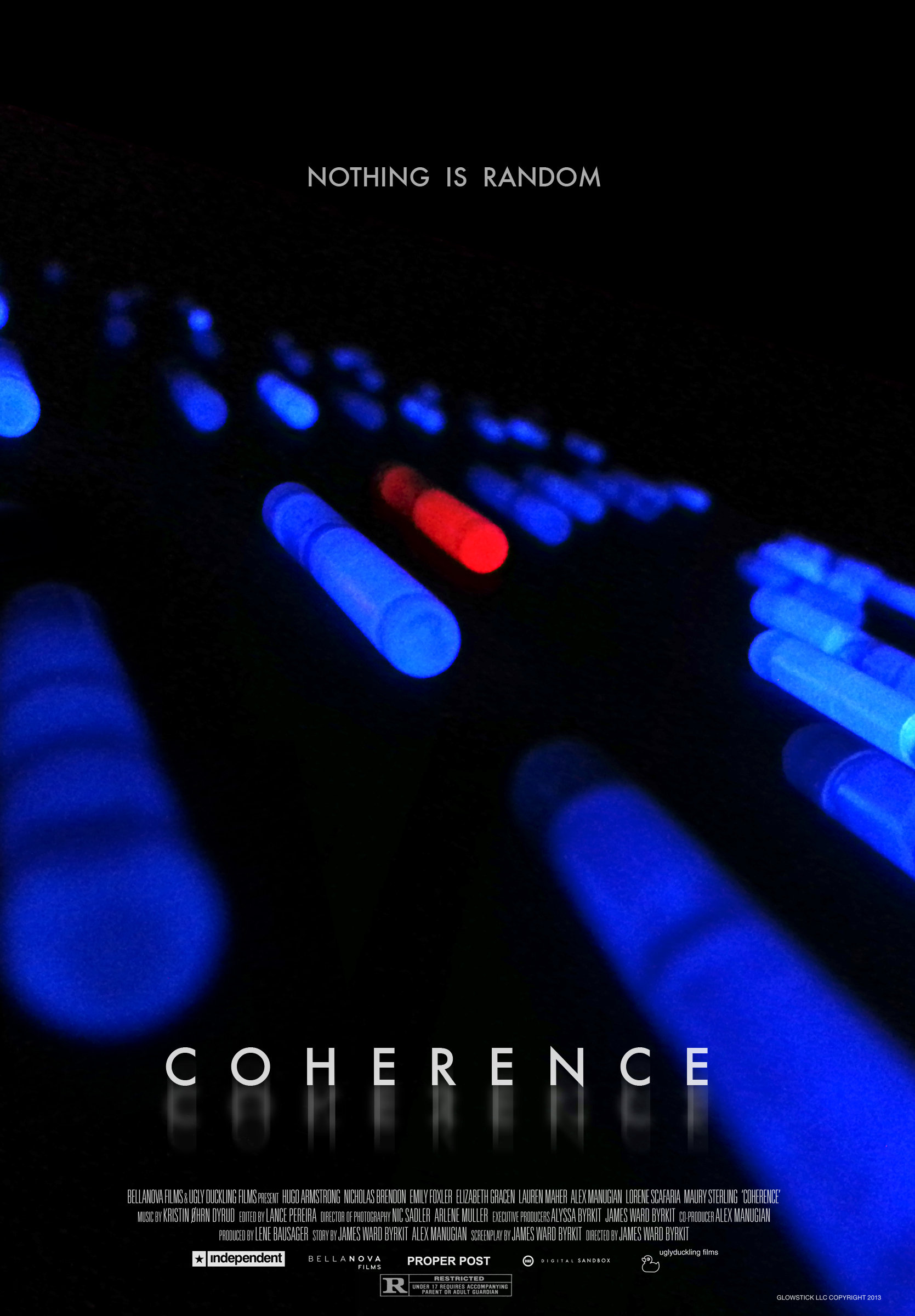
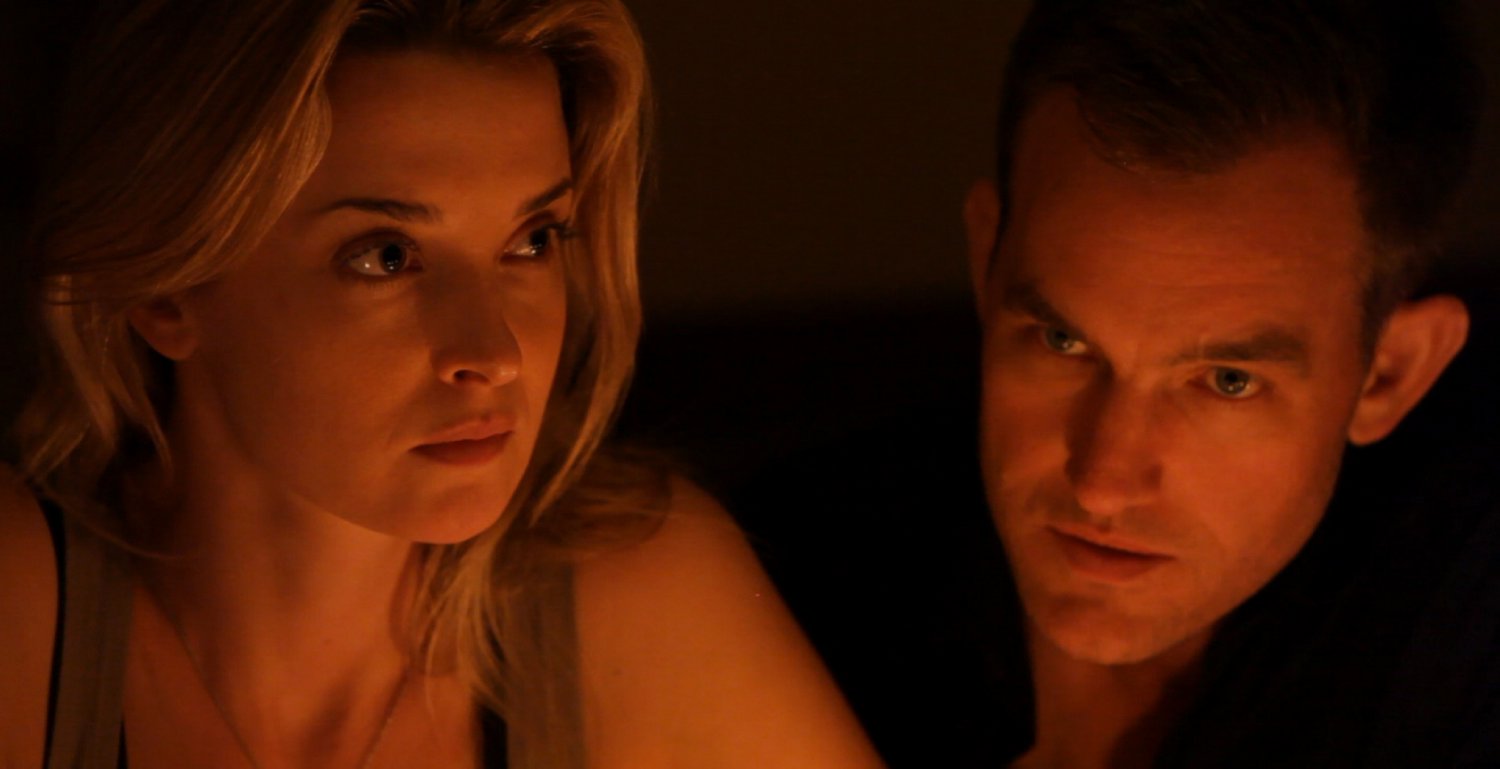
To reveal more about the structure and the nature of Coherence would be to do a disservice to both the movie and any potential viewers.  Suffice it to say, the movie is a clever, intriguing mix of science fiction and relationship drama, with more twists and turns than the average Agatha Christie adaptation.  The central premise is well executed, and the way in which the characters behave, and how they react to what is going on, is handled with careful attention to detail.  The mystery unfolds slowly at first, and deliberately, until the effects of the comet’s passing begin to snowball, with one revelation after another pulling the rug out from under each of the friends.

Be warned though: you will need to pay attention, and not just to what’s being said, but also to the visuals, where there are plenty of clues to be found.  Coherence demands a lot, but it’s worth the investment.  Thanks to the cleverly detailed script by writer/director Byrkit, the movie takes a recent development in quantum mechanics and uses it as the foundation for the strange events that take place.  As the movie gets “weirder”, Byrkit keeps track of the marginal changes that occur alongside the more obvious ones in a way that – mostly – keeps the viewer up to speed.  It’s often the more subtle clues that have the greater effect (keep an eye out for the band aid).  That said, the movie does trip itself up a couple of times in its efforts to make things even more complex than they already are, but for such a low-budget, and largely improvised production, these should be forgiven.

The cast do extremely well with the material, especially considering they were given only basic outlines of their characters and motivations, and the more major plot points.  To their collective credit, they all acquit themselves well, with special mention going to Foxler (better known as Emily Baldoni), Brendon (as host Mike), and Armstrong.  Considering the set up, and its potential for some unnecessary over-acting, it’s good to see a cast who are committed to the material in such a way that even the most dubious of reactions or decisions are acceptable, or made plausible by their conviction.  One revelation could have easily gone down the route of being played as soap opera, but instead it’s played with power and validity.

In the director’s chair, Byrkit orchestrates things with confidence and uses hand-held cameras to provide a sense of immediacy.  It’s a sometimes dizzying effect and can be annoying when anyone ventures outside the house and there’s a reliance on close ups (so as to avoid any evidence of non-blackout areas in the background), but by and large it adds to the growing sense of paranoia and disquiet.  The use of Byrkit’s own home as the principal setting allows for an increasingly claustrophobic atmosphere, and he uses the space to move his characters around like pieces on a chess board.

Anyone interested in science will (hopefully) find much to like – it’s a rare movie that takes time out to explain the concept behind Schrödinger’s Cat – and there’s enough here to attract the attention of fans of cerebral dramas also.  The movie does descend into thriller territory as one character searches for a way out of their predicament, and while this does seem forced, it also adds another layer to the quandary everyone’s facing, giving rise to the question, What would you do if it was you yourself that was threatening your place in the world?

Rating: 8/10 – some narrative stumbles aside, Coherence is a complex sci-fi thriller that is as much about notions of existence as it is about the nature of reality; intelligent and gripping, this is one movie that is rigorous, inventive and when it needs to be, effortlessly chilling.

Share this:

  • Click to share on X (Opens in new window) X
  • Click to share on Facebook (Opens in new window) Facebook
  • More
  • Click to print (Opens in new window) Print
  • Click to email a link to a friend (Opens in new window) Email
Like Loading...

Starred Up (2013)

24 Sunday Aug 2014

Posted by dullwood68 in Movies

≈ Leave a comment

Tags

Ben Mendelsohn, Criminals, David Mackenzie, Drama, Eric Love, Jack O'Connell, Prison, Review, Rupert Friend, Solitary confinement, Support group, Violence, Young offender

Starred Up

D: David Mackenzie / 106m

Cast: Jack O’Connell, Ben Mendelsohn, Rupert Friend, Sam Spruell, David Ajala, Peter Ferdinando, Anthony Welsh, David Avery, Mark Asante, Raphael Sowole, Ryan McKenna, Tommy McDonnell, Sian Breckin

Eric Love (O’Connell) is a young offender transferred to an adult prison.  With a huge chip on his shoulder and an uncompromising attitude, it’s not long before he’s antagonised one of the other inmates, Jago (Sowole), and earned the enmity of Deputy Governor Haynes (Spruell).  When a misunderstanding with a fellow inmate leads to violence, Eric is forcibly removed from D Wing and moved to solitary.  On the way he tries to avoid being beaten and finds an ally in voluntary therapist Oliver (Friend), who intervenes.  Against the advice of Haynes, and with the agreement that if Eric causes even one disturbance in his group he’s banned from any further attendance, the prison Governor (Breckin) agrees to let Oliver try and help Eric deal with his anger issues.

Matters are further complicated by the presence on the same wing of Eric’s father, Neville (Mendelsohn).  Neville is an enforcer for the wing’s top dog, Spencer (Ferdinando), and is instructed by him to make sure Eric doesn’t cause too many problems with his attitude.  Neville tells Eric to keep his nose clean and do what he’s told but he’s a poor role model, and soon becomes envious of the relationships Eric makes with Oliver and the other group members.  His resentment hinders Eric’s progress in the group; meanwhile Jago gets another inmate, O’Sullivan (McKenna) to try and kill Eric, but some of the therapy group intercede and the plan fails.  Later, when an altercation within the group happens, Haynes uses it as an excuse to have Eric removed under the terms of the agreement (even though Eric wasn’t directly involved).  O’Sullivan makes another attempt to kill Eric but is overpowered and he gives up Jago.  When Eric confronts Jago, he gives up Spencer.

This leads to Eric assaulting Spencer and Neville having mixed loyalties.  As he struggles to come to terms with being a true father for the first time, Neville discovers that Spencer has arranged for Eric to “commit suicide” while in solitary, and with Haynes’ cooperation.  With little time to lose, Neville must try and persuade Spencer to change his mind, but if he won’t, to stop his son from being killed.

Starred Up - scene

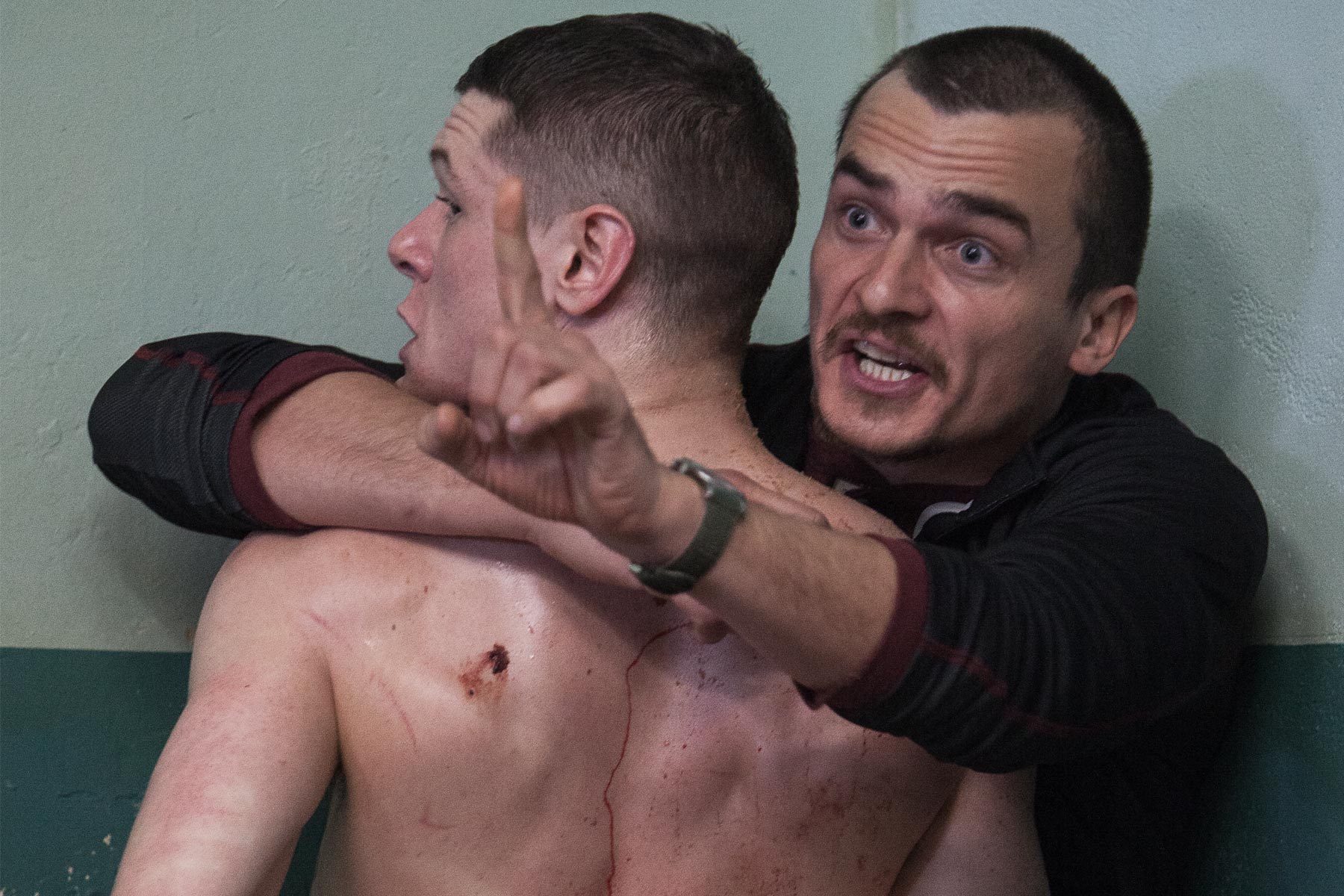
Based on screenwriter Jonathan Asser’s own experiences as a voluntary prison therapist, Starred Up is a brutal, compelling prison drama that is uncompromising, often savage, and disturbingly realistic in its portrayal of institutional abuse carried out both by prison staff and the prisoners themselves.  It’s a movie that makes no attempt to pull its punches, and it’s this determined approach that keeps the movie both gripping and horrific to watch in equal measure.

As a modern day descent into Hell, Starred Up – filmed mostly in Belfast’s notorious Crumlin Road gaol – is a harsh, merciless look at how violence begets violence and how macho posturing is as much a currency in prison as it is a state of mind.  Thanks to Asser’s impressive script, the movie is chilling in its matter-of-fact depictions of anger-fuelled bloodshed, as well as the mental cruelty prevalent (and on occasion, encouraged) within the prison system.  The worst part of it all is the complicity on both sides, with only Oliver and the inmates in his group willing to try and change things, if only for themselves.  Without this one ray of hope, the movie would be even more challenging to watch, its in-built nihilism being even more devastating to watch.

It’s a tribute both to Asser’s script and Mackenzie’s controlled, rigorous direction that the movie doesn’t descend entirely into loosely controlled anarchy, and that the relationships that develop, particularly between Eric and Neville, are as well-defined and credible as they are.  The father-son bond, so tenuous as to be almost invisible at first, slowly becomes more important to both characters, and there’s an unspoken need between them that inevitably leads to a violent confrontation.  But thanks to two remarkable performances from O’Connell and Mendelsohn, this confrontation acts as a cathartic breakthrough for both men, and allows them both to move on as the family they should be.

These two lead performances are nothing short of spectacular, O’Connell like a coiled spring, Eric’s barely suppressed anger almost threatening to consume him, but thanks to the group something he learns to control rather than be controlled by it.  It’s a breakthrough performance, an alarming, expressive, startling portrayal of a young man struggling to keep his anger and his reputation within the system from defining him.  And then there’s Mendelsohn, making Neville a chilling, rage-fuelled monster of a man, a berserker with little regard for others, a wellspring of bile, racism and thuggish behaviour who can barely contain the fury inside him.  It’s a masterful performance, and when Mendelsohn’s on screen, you can’t take your eyes off him; you just don’t know what he’s going to do next.

Ably supported by Friend as the therapist with as many issues as the men he’s trying to help, and Spruell, whose permanent sneer suggests a man who would be equally at home on either side of the fence, as well as group stand-outs Welsh and Ajala, Starred Up boasts a cast that doesn’t put a foot wrong throughout.  It’s such an accomplished ensemble that Mackenzie doesn’t seem to be directing them; instead it seems as if he’s just positioning the cameras and then sitting back (though that probably wasn’t the case).  And the camerawork is just as impressive, with several hand-held tracking shots as Eric roams around D Wing making the oppressive environment seem less confining, less restrictive.  It’s a gloomy set of interiors but the photography by Michael McDonough is richly detailed and on several occasions, beautifully framed despite the prison settings.  The editing by Nick Emerson and Jake Roberts is equally impressive: there’s not one scene that outstays its welcome, or where each element of a scene is given its due significance.

Rating: 9/10 – an effortlessly superior prison drama, Starred Up features a confident, uncompromising script, remarkable, assured direction, and a couple of lead performances that are nothing short of extraordinary; despite its grim backdrop, the movie succeeds in offering hope out of adversity and is complex, challenging viewing and all the better for it.

Share this:

  • Click to share on X (Opens in new window) X
  • Click to share on Facebook (Opens in new window) Facebook
  • More
  • Click to print (Opens in new window) Print
  • Click to email a link to a friend (Opens in new window) Email
Like Loading...

The Terminal (2004)

16 Saturday Aug 2014

Posted by dullwood68 in Movies

≈ 1 Comment

Tags

Airport, Catherine Zeta-Jones, Comedy, Drama, Krakozhia, Review, Romance, Stanley Tucci, Steven Spielberg, Tom Hanks, Unacceptable, Viktor Navorski, Zoe Saldana

Terminal, The

D: Steven Spielberg / 128m

Cast: Tom Hanks, Catherine Zeta-Jones, Stanley Tucci, Chi McBride, Diego Luna, Barry Shabaka Henley, Kumar Pallana, Zoe Saldana, Eddie Jones, Michael Nouri

Arriving at JFK International Airport, Viktor Navorski (Hanks) learns that while he was travelling from his home country of Krakozhia, a civil war has broken out and all travel permits and visas have been suspended; this means he can’t return home.  To make matters worse, the US government is refusing to recognise the revolutionary Krakozhian government, so won’t allow anyone from there to enter the US.  This makes Viktor “unacceptable”.  The only place he can stay is in the airport’s international terminal, something that Customs and Border Protection head Frank Dixon (Tucci) isn’t happy about but believes will be only temporary.

Viktor settles in at Gate 67 which is unfinished.  From there he ventures forth each day in the hope that the civil war has ended and he can either go home or go into New York as he’d originally planned (he has made a promise to do something for his father, who has recently died).  Through this he strikes up a friendship with Dolores (Saldana), a Customs officer who processes visa applications.  This in turn leads to a friendship with Enrique (Luna), an airport worker who has a crush on Dolores.  In return for food that hasn’t been used on flights, Viktor learns about Dolores’ likes and dislikes and relays this information back to Enrique.  During this time, Viktor also meets air stewardess Amelia (Zeta-Jones).  His attraction to her is tempered by her seeing a married man, Max (Nouri), but a relationship develops between them nevertheless.

As Viktor gets to know more of the airport staff – including Mulroy (McBride) and Gupta (Pallana) – Dixon becomes more and more irritated by his presence in the airport.  He tries to persuade Viktor to leave the airport but Viktor doesn’t take the bait.  With an important inspection coming up that will help towards an expected promotion, Dixon is anxious that nothing interfere with his plans, yet when a desperate Russian with undocumented drugs for his father arrives on the day of the inspection, Viktor interprets for him and resolves the situation with a lie, making Dixon furious with him. This makes Viktor very popular with the rest of the airport staff.

Viktor also continues to see Amelia when she flies in and when she tells him she’s stopped seeing Max, Viktor arranges a romantic dinner but it turns out Amelia has resumed the relationship (though this has an unexpected benefit later on).  When the war in Krakozhia ends, Dixon tells Viktor he has to return home and that he can’t go into New York; with the plane home ready to take off, Gupta stands on the tarmac and blocks it from moving, giving Viktor the chance to leave the airport and honour the promise he made to his father.

Terminal, The - scene

With a wonderful central performance from Hanks, The Terminal is glossy whimsy of the highest quality, a modern day fairy tale that features a princess in peril (Amelia), a wicked ogre (Dixon), three fairy godmothers (Enrique, Mulroy and Gupta), a maid (Dolores), and a handsome prince (Viktor – kind of).  It’s hugely enjoyable and is the type of movie that you can watch over and over again and still spot things you missed every other time (such as the head of the Statue of Liberty – keep an eye peeled, it’s there).  And like all good fairy tales it has a happy ending (though not the kind you might be thinking of).

Based around the true story of Mehran Karimi Nasseri, an Iranian refugee who spent eighteen years living in the departure lounge of Terminal One at Paris’s Charles de Gaulle airport, The Terminal downplays the drama inherent in such a predicament in favour of a heartwarming tale that is often hilarious, and which adds a romantic element that is both cute and bittersweet.  The script by Sacha Gervasi and Jeff Nathanson is structured much like a play, with act one concerning Viktor’s arrival at the airport, act two detailing his coming to terms with living in the airport, and act three showing his becoming a valued and respected member of the airport “staff”.  It’s a cleverly constructed script, with nods to wider issues such as immigration and racism, but included in such a way that they don’t intrude on the feelgood, aspirational  drive of the movie, or its message that tenacity and self-belief will always see you through.

It’s Viktor’s positive nature – so ably portrayed by Hanks – that is so affecting, his resourcefulness and persistence the very qualities we would like to think we’d have if we were in his position.  Hanks is nothing less than superb in a performance that is as richly nuanced as any other he’s given.  His choice of expressions alone offers a masterclass in acting; the scene in the men’s room when a traveller asks him, “Ever feel like you’re living in an airport?” is worth watching just for the stupefied look Viktor gives as a silent reply – and it’s made all the more impressive for being a reflection (and Hanks makes it all seem so effortless).

He has some great support too.  Zeta-Jones, still fresh from her Oscar-winning turn in Chicago (2002), makes Amelia appealing and sad at the same time, and in doing so makes the character more credible as Viktor’s possible love interest.  As the hard-nosed Customs and Borderland Protection administrator, Tucci is contained and hard to like but it’s a subtler performance than at first meets the eye, with echoes of a more sympathetic man showing through at odd moments.  And then there’s Pallana, whose deceptively expressive features are a joy to watch, his character’s unwavering paranoia amusing and wistful and, ultimately, well justified.  Luna plays Enrique as an adorable puppy, while McBride and Hensley are more stoic, and as Dolores, Saldana’s sunny approach to the character makes her more and more likeable as the movie goes on (it’s also fun to discover that Dolores is a Trekkie).

With all this favourable material allied to a raft of great performances, it comes as no surprise that Spielberg orchestrates everything with consummate ease, employing a lightness of touch that helps elevate Viktor’s plight from personal tragedy to unalloyed victory.  There’s more than a hint of Thirties screwball comedy in The Terminal, especially in Viktor’s confrontations with Dixon, and it’s to Spielberg’s credit that he augments such a contemporary story with such “old-fashioned” elements, and does it so seamlessly.  As with Hanks’ performance, this is one of Spielberg’s less appreciated movies, but one serious misstep aside – would Dixon really have been promoted after he grabbed Viktor by the neck and remonstrated with him? – he hits the movie out of the ballpark.

Rating: 8/10 – ripe for reassessment, The Terminal showcases an actor and a director working completely in synch, and providing their audience with a delightful slice of feelgood entertainment; richly detailed and with a clutch of stand-out moments, this is avowedly superior stuff.


Share this:

  • Click to share on X (Opens in new window) X
  • Click to share on Facebook (Opens in new window) Facebook
  • More
  • Click to print (Opens in new window) Print
  • Click to email a link to a friend (Opens in new window) Email
Like Loading...

I’ll Follow You Down (2013)

12 Tuesday Aug 2014

Posted by dullwood68 in Movies

≈ 1 Comment

Tags

1947, Albert Einstein, Disappearance, Drama, Gillian Anderson, Haley Joel Osment, Missing scientist, Review, Rufus Sewell, Sci-fi, Time machine, Time travel

I'll Follow You Down

D: Richie Mehta / 93m

Cast: Haley Joel Osment, Gillian Anderson, Rufus Sewell, Victor Garber, Susanna Fournier, John Paul Ruttan, Sherry Miller

When scientist Gabe Whyte (Sewell) flies off to New York for a convention, his wife Marika (Anderson) and young son Erol (Ruttan) have no idea that it’s the last time they’ll ever see him.  The mystery deepens when they discover that he never checked out of his hotel room, and he never attended the conference.  With the aid of her father, Sal (Garber), a physics professor, Marika discovers a basement laboratory that Gabe was using, along with his wallet and mobile phone, and crates of equipment.

Twelve years pass.  Erol is now attending university, while Marika is a successful artist though she has yet to come to terms with Gabe’s disappearance.  They have an uneasy relationship, both excelling in their relative fields but also going through the motions in many respects.  When Sal approaches Erol with details about Gabe’s work, details which indicate that Gabe was working on some kind of time travel device, Erol’s reaction is that it’s all a fantasy and he walks away from it.  He puts Sal’s revelation behind him, but when Marika takes an overdose it spurs him on to replicate his father’s work, and to try and find out if his father really did travel back to 1947 as his notebooks indicate, and if he met Albert Einstein as he’d planned.

But certain elements elude him and the project always fails.  Erol also learns that a man similar in description to his father was killed in 1947.  Now Erol has a twofold mission: to save his father, and to bring him back to the present in order that his family’s lives can resume from when his father was due back from New York.  In the meantime his relationship with his girlfriend Grace (Fournier) runs aground when she finds out what he’s trying to do; if Erol succeeds then the life they’ve built together from when they were children, and the child she is carrying, will disappear, leaving no guarantee that she and Erol will have the same life if his father goes back.  Undeterred, he redoubles his efforts and having solved the problem that had been eluding him, travels back to 1947 with a plan to make sure his father returns home.

I'll Follow You Down - scene

More of a family drama than a sci-fi movie, I’ll Follow You Down downplays the science in favour of a measured approach to its domestic tribulations.  Sadly, this decision makes for a somewhat dour, unattractive looking movie that relies heavily on its cast’s commitment to the material, but which never really springs to life, despite its intriguing premise.  Its low budget doesn’t help either, lending the movie the look of a TV drama of the week, with its drab lighting and flat photography exacerbating things from start to finish.

The performances are the best thing here: from Osment’s tortured son, to Anderson’s depressed wife and mother, to Fournier’s challenging girlfriend, the cast do wonders with a script that skirts banality with uncomfortable regularity.  As Erol, Osment has a tough time developing his character beyond that of the enfant terrible whose genius outshines his father’s, and while he’s convincing enough, when he reveals his solution for persuading his father to return to his own time, it’s hard to credit that Erol would do what he does, as sudden and unexpected as it is.  Before that, Erol is a young man adrift in the world, his father’s disappearance having caused an impediment to his emotional development.  In his scenes with his girlfriend, Grace (Fournier), his lack of understanding of her needs make him seem ungrateful rather than appreciative, and in these scenes his single-mindedness leaves a lingering aftertaste that undermines any sympathy the audience is supposed to feel for him.  But Osment makes Erol as fatally determined as his father, and this symmetry works in the movie’s favour.  It’s not a great performance, but it’s better than the character deserves.

As his overwhelmed mother, Anderson gives a persuasive portrayal of a woman as adrift as her son, but who struggles to lead a normal life after her husband vanishes.  It’s the mystery surrounding his disappearance – the unexplained nature of it – that swamps her and causes her to withdraw from so much of her “normal” life.  Thanks to Anderson, Marika draws the audience’s sympathy in ways that Erol isn’t even close to, and she does it with a minimum of fuss, eliciting the viewer’s support without them being aware of it.  The same can’t be said for Gabe, who in the opening scenes is seen as a doting father, loving husband and all-round good guy.  By the end, these aspects of his character seem more like a charade, as he is revealed to be self-centred and not as considerate of his family as you’d expect him to be.  Sewell has probably the most difficult job of all in trying to make Gabe as credible as he should be, but the script is against him, and never fully expands on his reasons for creating the time machine in the first place.

Garber and Fournier are fine in supporting roles, but again it’s the script – by writer/director Mehta – that lets things down, its plotting too contrived at times (and also, strangely predictable) to be entirely coherent (not to mention that it avoids any philosophical or metaphysical implications relating to the issue of time travel).  In addition, Mehta’s direction fails to add any tension to proceedings, and leaves the final confrontation between Erol and his father lacking in both drama and plausibility; it’s as if the movie needed to end as quickly as possible by this point, and this scene was the only thing Mehta could come up with to do so.  I’ll Follow You Down could have been a deeper, richer, more cinematic experience but instead it opts for a level tone that it rarely deviates from, and which ultimately stops it from being as absorbing and entirely worthwhile.

Rating: 5/10 – viewers expecting a sombre drama centred around the impact of a father’s disappearance on his family, will be disappointed, while sci-fi fans will find the haphazard focus on time travel quite annoying; a bit of a misfire, then, I’ll Follow You Down lacks both emotional substance and a fervent approach to the material, leading to a movie that hopes the viewer will engage with it, while it makes almost the least amount of effort.

Share this:

  • Click to share on X (Opens in new window) X
  • Click to share on Facebook (Opens in new window) Facebook
  • More
  • Click to print (Opens in new window) Print
  • Click to email a link to a friend (Opens in new window) Email
Like Loading...

Poster of the Week – The Best Years of Our Lives (1946)

11 Monday Aug 2014

Posted by dullwood68 in Movies

≈ Leave a comment

Tags

Drama, Movie poster, Poster of the week, Tag line

Best Years of Our Lives, The

The Best Years of Our Lives (1946)

One of the best – if not the best – post-World War II dramas was a triumph for all concerned, a seven-time Oscar winner that showed the difficulties of servicemen returning home and facing a range of difficulties in readjusting to “normal” life.  It’s a powerful movie, and thanks to an unusually subtle screenplay (for the time) by Robert Sherwood, matched by astute direction from William Wyler, has remained as impressive a movie experience today as it was then.  Not that you’d guess from the poster…

First off, it’s not the greatest of posters.  It’s fairly typical of the time the movie was made, and in some respects – the embracing couple, the bold assertion at the top – it’s content and approach aren’t dissimilar from many other posters.  Even the image of the “good-time girl” (representing Virginia Mayo’s character) isn’t unusual.  And then there’s the two quotes, from two of the most respected journalists and critics of the time, and which prove to be the only clues – albeit as vague as possible – as to the movie’s content (unless you’ve read MacKinlay Kantor’s novel).  But then there’s that tag line, that bold description of the movie’s merits, and if you’ve seen the movie you’ll know: “The screen’s greatest love story” is pushing it a bit too far.

In truth there are several love stories in The Best Years of Our Lives, and they are all “heart-warming” to one degree or another, but they’re not the movie’s focus, and nor are they the “engines” that drive the various storylines.  There’s much more going on than just a love story, and the movie’s various themes were more dramatic than audiences were used to – just the word ‘divorce’ caused a furore at the time – but again you wouldn’t guess that from the poster, which instead advertises what seems like a grand romantic experience.  It’s a lie, a deliberate falsehood designed to bring people in to see a movie that often reflected uncomfortably their own lives and their own problems in putting the war behind them.

Here then is an example of a movie poster that has a different agenda to the one the movie it’s promoting.  Here is a poster that undermines it’s own movie’s message: that  even the worst difficulties in Life can be overcome, and that life itself is something to be treasured above all.  It’s a shame then that RKO, the releasing studio, couldn’t see that, and create a poster that supported that ideal.  But if you think a movie might be a tough sell…

(For an intelligent, well thought out appraisal of The Best Years of Our Lives, by my fellow blogger Rachel T, please click here.)

Agree?  Disagree?  Feel free to let me know.


Share this:

  • Click to share on X (Opens in new window) X
  • Click to share on Facebook (Opens in new window) Facebook
  • More
  • Click to print (Opens in new window) Print
  • Click to email a link to a friend (Opens in new window) Email
Like Loading...

Poster of the Week – Schindler’s List (1993)

05 Tuesday Aug 2014

Posted by dullwood68 in Movies

≈ Leave a comment

Tags

Drama, Holocaust, Movie poster, Poster of the week, Steven Spielberg

Schindler's List

Schindler’s List (1993)

Sometimes the most effective posters are the simplest, the ones that offer the least amount of graphics, the least amount of text, and the least amount of information.  Often it’s a single image that will feature, something that is integral to the mood of the movie, or gives an impression of the subject matter.  At other times, it’s just the movie’s title, bold against a plain background, that is all that’s needed.  In many ways it’s this simplicity that is more effective than a poster that has lots of things “going on” in it, where the publicity department has decided sensory overload is the way to go.

But this poster for Steven Spielberg’s masterpiece is a perfect match for the movie’s solemn, haunting intensity.  With its uncompromising black background and sombre appearance the potential viewer is immediately alerted to the serious nature of the movie itself.  It’s a striking effect, that background, harsh and forbidding and so unlike the usual colourful or artistically driven posters that we’re more used to.

The background, while effective on its own, also serves to highlight the three components that make up the only respite from all that darkness.  There’s the legend “A Film by Steven Spielberg” tightly assembled above the movie’s title, the first of three complementary fonts used, but not overshadowing the title, its larger, more decorative appearance drawing the eye first and foremost.  And then the eye is drawn downward to the quote from the Talmud, the words slightly transparent towards the top of each letter, as if the very saying itself is in danger of disappearing, a subtle underlining of its importance to the story itself.

And then there’s the single image, a dying candle in its holder, a red flame representing fading hope but also endurance, its splash of colour both relevant to the image and reflective of the visual motif that appears in the movie itself.  It’s a quiet masterstroke, a beautiful touch that speaks volumes, affecting and dramatic and powerful all at the same time.

Agree?  Disagree?  Feel free to let me know.

Share this:

  • Click to share on X (Opens in new window) X
  • Click to share on Facebook (Opens in new window) Facebook
  • More
  • Click to print (Opens in new window) Print
  • Click to email a link to a friend (Opens in new window) Email
Like Loading...

The Selfish Giant (2013)

01 Friday Aug 2014

Posted by dullwood68 in Movies

≈ 1 Comment

Tags

Bradford, British movie, Clio Barnard, Conner Chapman, Drama, Horses, Oscar Wilde, Scrap, Shaun Thomas

Selfish Giant, The

D: Clio Barnard / 91m

Cast: Conner Chapman, Shaun Thomas, Sean Gilder, Rebecca Manley, Lorraine Ashbourne, Steve Evets, Siobhan Finneran, Ralph Ineson, Ian Burfield, Elliott Tittensor

Set in Bradford, two young friends, Arbor (Chapman) and Swifty (Thomas), are looking for ways to earn a bit of money to help their respective families.  Arbor and his older brother, Martin (Tittensor) live with just their mother, Michelle (Manley); she’s struggling to pay their bills, while in Swifty’s household, too many children and not enough income means his dad (Evets) is known as “Price-Drop” because he’ll always take a lower price when trying to sell something.  As they try and take on more adult roles, the duo get involved with a local scrap dealer, Kitten (Gilder).  Begrudgingly at first, he takes the scrap they find here and there, until their persistence pays off and they win his quiet approval.  A fight at school sees both boys excluded and they take the opportunity to collect as much as they can.  They also find that Kitten has a horse that, when it’s not harnessed to a cart to collect scrap, is entered in local horse-and-cart races.  When Kitten discovers that Swifty has a natural way with horses, he begins to favour him over Arbor.

This sours the boys’ friendship and leads to arguments between them.  It also leads Arbor to steal some valuable copper plating from Kitten and try and sell it to another scrap dealer in another town.  However, Arbor’s luck runs out when the men who sold Kitten the plating also arrive at the scrap dealer’s and take not only the plating but the other scrap Arbor has amassed and leave him with nothing.  Forced to make amends with Kitten, Arbor has to steal some underground cabling that’s part of the nearby power plant complex.  He persuades Swifty to help him, but their plan goes awry, and with serious consequences.

Selfish Giant, The - scene

From the outset, The Selfish Giant paints a grim picture of life in the North of England, with its run-down urban settings, permanently overcast skies and scrapheap metaphor.  This is a depressing, often angry, often frustrating slice-of-life movie that sets up its two main characters as good-hearted kids who are just trying to do what they can for their families – even if their methods are not exactly legitimate – and whose friendship is probably the only really good thing either has in their lives.  With Life proving a daily struggle in so many ways, it’s this attachment and commitment to each other that gives the movie its heart and provides a welcome respite from the harsh realities that hinder them from having a better life.  Their reliance on each other, quietly understated but the glue that binds their friendship, is the one positive that keeps them going when everything else around them is so transitory.

Given the gloomy backdrop, you could be forgiven for thinking that there isn’t any humour to be found in the movie, but thankfully there is, borne out of the two boys’ experiences and offering occasional relief from the somber drama.  Of the two of them, Arbor is the joker, the piss-taker who doesn’t realise he’s being tolerated rather than included, while Swifty’s softer, more approachable personality gives rise to the probability that of the two of them, he’s the one most likely to make something of his life (and maybe escape their grim surroundings).  Once Swifty becomes more involved with Kitten’s horse, it’s clear that Arbor is aware of this too, and the rift that develops between them becomes inevitable.  It doesn’t help that Arbor feels alienated from everyone else around him – even his family – and that his options for the future are dwindling fast; he’s only thirteen but already his potential seems exhausted.

It’s a terrible realisation, and under the auspices of many other directors, would leave most viewers feeling dismayed and hollow inside at the (perceived) injustice of it all.  But under the careful eye of award-winning documentary filmmaker Barnard – she made the hugely impressive The Arbor (2010) – The Selfish Giant is an absorbing, thoughtful, intelligent, heartfelt, and ultimately redemptive movie that pulls very few punches in its depiction of “slum” life, and has no time for sentimentality or anything even remotely maudlin (just as the characters don’t).  Barnard handles the material with a surety that draws in the viewer and makes them root for Arbor and Swifty all the way, and shows she has an instinctive appreciation for the trials and tribulations the characters experience.  She also has marvellous support from DoP Mike Eley and editor Nick Fenton, and elicits exemplary performances from her two leads (both making their acting debuts).

Inspired by Oscar Wilde’s short story of the same name (though it’s hard to find any real relation between them), the movie owes more to Of Mice and Men than anything else, but is as much its own thing as to make any real comparisons irrelevant.  What is clear is that Chapman and Thomas are both actors with very bright futures and Barnard’s move to feature filmmaking has been way too long in coming.

Rating: 8/10 – often tough to watch, and not afraid to leave its audience as battered and bruised as its two protagonists, The Selfish Giant is as far from a feel good movie as you’re likely to get, but an impressive achievement nevertheless; raw, ambitious and unexpectedly moving in places, this is a movie that continues to resonate long after it’s been seen.

Share this:

  • Click to share on X (Opens in new window) X
  • Click to share on Facebook (Opens in new window) Facebook
  • More
  • Click to print (Opens in new window) Print
  • Click to email a link to a friend (Opens in new window) Email
Like Loading...

Barefoot (2014)

16 Wednesday Jul 2014

Posted by dullwood68 in Movies

≈ Leave a comment

Tags

Andrew Fleming, Black sheep, Camper van, Drama, Evan Rachel Wood, Probation, Psychiatric hospital, Road trip, Romance, Scott Speedman, Wedding

Barefoot

D: Andrew Fleming / 90m

Cast: Evan Rachel Wood, Scott Speedman, Treat Williams, Kate Burton, J.K. Simmons, Ian Nelson, J. Omar Castro, David Jensen

Jay Wheeler (Speedman) is a man with problems.  He doesn’t have a job, he owes $37,000 to a bookie, and to make matters worse, he’s on probation.  When his next brush with the law sees him assigned to community service mopping floors at an L.A. psychiatric hospital, Jay uses his easy-going manner to charm the staff and patients alike – except for sceptical Dr Bertleman (Simmons) who thinks Jay will screw up there just as he has everywhere else.  One day a new patient, Daisy Kensington (Wood), arrives at the hospital.  Jay is immediately attracted to her, but he’s not allowed to have any contact with her.  One night, Jay rescues Daisy from the attentions of another patient; having hit him, Jay knows he’ll end up back in prison and attempts to leave – but not without Daisy who tags along with Jay despite his best efforts to dissuade her.

Having already agreed to attend his brother’s wedding in New Orleans, and having lied to his parents (Williams, Burton) about his work and that he has a girlfriend, Jay decides to let Daisy tag along and be part of “the plan” to hoodwink them.  Daisy, who has never been outside the apartment where she lived with her mother until her mother died recently, has very little social awareness, and is easily stressed.  At the wedding reception she comes under pressure from Jay’s father and has a panic attack.  With his parents realising something isn’t right about Daisy (and her relationship with Jay), a confrontation between them all leads to Jay and Daisy heading back to L.A. in his father’s prized camper van.

As they travel across country, Jay and Daisy’s relationship develops as they try and avoid the police – Jay has violated his probation by travelling outside California, and the hospital authorities view Daisy as potentially dangerous to others (they believe she killed her mother) – and their increasing love for each other prompts Jay to reevaluate his life and turn things around.  But first, he has to get Daisy back to the hospital…

Barefoot - scene

Ostensibly a romantic comedy – albeit a deceptively dry one – Barefoot is a remake of the German movie Barfuss (2005).  It moves at a measured pace that suits the material, and offers the viewer two equally measured performances from its leads.  It’s a movie that treads carefully around the possibility that Daisy may have actually killed her mother, and underplays the seriousness of the plight she and Jay find themselves in while travelling back to L.A. (at one point they’re chased by a police cruiser but make a successful getaway without any other police being involved).  Even Jay’s estrangement from his father, potentially a rich source of drama, is neatly dispensed with after having served its purpose at the wedding celebrations.  Barefoot only makes a real effort with the romance between Jay and Daisy (deliberately named after the characters from The Great Gatsby?).

Fortunately, this is the area in which the movie succeeds the most, and with simple efficiency and a great deal of charm.  As the couple who find they can’t live without each other (even if one of them may be a matricide), Wood and Speedman are a great match, her curious expressions, coupled with wide-eyed amusement at the world she’s only glimpsed via TV, highlighting the naiveté and lack of guile that makes Daisy such an engaging character.  It’s a quietly impressive performance, not too showy and yet not so insular that Daisy lacks depth or is unsympathetic.  Speedman’s performance complements Wood’s, making Jay a good-natured heel who, despite some bad choices, knows when to do the right thing, and knows the value of his relationship and what it’s loss will ultimately cost him.  Like Wood, Speedman keeps it low-key, hitting the emotional beats with quiet intensity, and in doing so, makes Jay’s blossoming sense of responsibility to others entirely credible.

Wood and Speedman are ably supported by Williams et al, and if the script by Stephen Zotnowski opts for secondary characters that often serve as functions of the plot, rather than as fully fledged individuals, then they’re still competently played (Simmons stands out as the doctor who tries to give Jay a second chance).  In the director’s chair, Fleming handles the material well, fashioning an at times offbeat romantic comedy and making a virtue of its lightness of touch.  Even though it’s a predictable journey that Jay and Daisy take together, Fleming still keeps it interesting and draws the audience in with ease.  There’s some beautiful location photography courtesy of DoP Alexander Gruszynski, and Michael Penn’s laid-back score is augmented by the inclusion of songs by the likes of Nick Drake.

Rating: 7/10 – overcoming its lightweight, predictable storyline thanks to two accomplished lead performances, Barefoot won’t get the wider audience it deserves, but those that do find it will be amply rewarded; a treat for fans of romantic movies, and moviegoers in general.

Share this:

  • Click to share on X (Opens in new window) X
  • Click to share on Facebook (Opens in new window) Facebook
  • More
  • Click to print (Opens in new window) Print
  • Click to email a link to a friend (Opens in new window) Email
Like Loading...

A Long Way Down (2014)

14 Monday Jul 2014

Posted by dullwood68 in Movies

≈ 1 Comment

Tags

Aaron Paul, Adaptation, Comedy, Drama, Imogen Poots, New Year's Eve, Nick Hornby, Pascal Chaumeil, Pierce Brosnan, Suicide, Toni Collette, Valentine's Day

Long Way Down, A

D: Pascal Chaumeil / 96m

Cast: Pierce Brosnan, Toni Collette, Imogen Poots, Aaron Paul, Sam Neill, Rosamund Pike, Tuppence Middleton, Joe Cole, Leo Bill, Josef Altin

On New Year’s Eve, four very different people find themselves on the roof of a London tower block, and all with the same idea: to commit suicide.  There’s disgraced TV celebrity Martin (Brosnan), shy, apologetic Maureen (Collette), politician’s daughter Jess (Poots), and pizza delivery guy JJ (Paul).  With all of them unable to go through with their plans (and each actively stopping the rest from jumping), the quartet decide to make a pact: that none of them will try to kill themselves until Valentine’s Day.  Later that night, Jess accidentally O.D.’s in a club; with the aid of Jess’s boyfriend, Chas (Cole), the others get her to hospital.  News of their attempted suicides reaches the press and they all become minor celebrities. Martin suggests they use the attention to make some money, and they take part in interviews, and talk shows.  When one talk show appearance goes wrong, the four decide to go away together on holiday.

The trip proves to be yet another disaster, with JJ unknowingly befriending a journalist (Middleton) and further tensions arise when he also reveals something about himself that only Jess knows (and has kept to herself).  The group return to London and go their separate ways (though each in their own way keeps tabs on the others, except for JJ).  As Valentine’s Day draws near, JJ vanishes.  On the day itself, the others find him back on the roof of the tower block, and ready to kill himself.

Long Way Down, A - scene

Adapted from the novel by Nick Hornby, A Long Way Down takes a serious subject and uses it as the springboard for a sporadically dramatic, essentially lightweight comedy that never quite fires on all cylinders, and has enough awkward moments for two movies, let alone one.  The problems lie in the characters themselves.  Martin’s back story includes time in prison for sleeping inadvertently with a fifteen year old girl, and this is treated largely as an excuse for amusement, with Brosnan mugging for all he’s worth when the subject is brought up.  Maureen has a severely disabled son, Matty (Altin) that she no longer feels she can support adequately, but it’s obvious that she has a really good support network around her so the dramatic elements of her situation never really ring true.  Jess is almost a caricature of every wild child and rebellious daughter of an establishment figure you’re ever likely to encounter, and her sadness over the disappearance of her sister is briefly explored and then forgotten.  As for JJ, his character is the most maddening of them all, with his failed musical background and resulting depression proving hard to sympathise with, or appreciate.

While the movie works hard to flesh out these characters, and make their individual problems worthy of our concern, it’s unable to do so by virtue of their predicament being too artificial for its own good.  At no time in the movie do you really feel that any one of these disparate people really, truly wants to kill themselves, and so any drama in the two rooftop sequences that bookend the movie is immediately eliminated.  And as mentioned above, their individual dilemmas, particularly Martin’s, don’t hold the attention as well, or as much, as they should.  This all leaves the movie lurching from one lacklustre scene to another, its attempts at humour proving occasionally successful, its dramatic approach having no bite, and its supporting characters – from Jess’s dad (Neill) to Pike’s deliberately insensitive talk show host – endorsing the view that the main four characters aren’t that interesting.

As a result, it’s fitting that the performances are as equally uninspired as the movie itself.  Brosnan plays Martin as a bit of a buffoon, good-natured but with an often spectacular misunderstanding of the people around him, his unfortunate “indiscretion” treated like a minor inconvenience blown out of all proportion.  Brosnan’s an accomplished actor but here he seems unable to get to grips with such a poorly crafted character.  Collette has the least showy role, and fares better than the rest, her understated performance as Maureen the nearest the movie gets to providing someone for the audience to relate to; her scenes with Altin are genuinely affecting, but belong in a different movie.  Poots plays Jess as a whirling dervish, snappy and borderline obnoxious, her quieter scenes more convincing than the ones where she’s supposed to be the challenging anti-establishment rebel.  Paul, meanwhile – the predictably token American in the cast – does his best with a role that becomes more and more important as the movie goes on, but he can’t overcome the clumsy way in which JJ is written.

There’s a better movie to be made here, and while it’s clear the material is a challenge, A Long Way Down doesn’t even attempt to play up the more darkly humorous aspects of the group’s situation or elevate the drama inherent in such a premise.  The movie seems determined not to make things too uncomfortable for the audience, to play things down to make them more palatable (and presumably, more box office friendly).  It’s an obvious decision on the part of the producers (unfortunately) but it doesn’t help the movie at all.

Rating: 5/10 – not as dramatic or as funny as it looks, A Long Way Down struggles to be as emotionally involving as it should be; with no one to connect with, the movie loses focus early on and never really recovers, leaving its characters to stumble on until the movie’s predictably feel good ending.


Share this:

  • Click to share on X (Opens in new window) X
  • Click to share on Facebook (Opens in new window) Facebook
  • More
  • Click to print (Opens in new window) Print
  • Click to email a link to a friend (Opens in new window) Email
Like Loading...

Cold Lunch (2008)

12 Saturday Jul 2014

Posted by dullwood68 in Movies

≈ 2 Comments

Tags

Aksel Hennie, Ane Dahl Torp, Chain reaction, Drama, Eva Sørhaug, Loneliness, Marital problems, Norway, Oslo, Pia Tjelta, Selfishness

Cold Lunch

Original title: Lønsj

D: Eva Sørhaug / 90m

Cast: Ane Dahl Torp, Pia Tjelta, Aksel Hennie, Bjørn Floberg, Nicolai Cleve Broch, Anneke von der Lippe, Kyrre Haugen Sydness, Birgitte Victoria Svendson, Ingar Helge Gimle, Jan Gunnar Røise

A Norwegian drama focusing on the lives of five people who all live and (mostly) work in the same small section of Oslo, Cold Lunch introduces us to Leni (Torp), a forty-something woman who has spent the majority of her life in an apartment with her father; Christer (Hennie), a young man who can’t pay his rent; Heidi (Tjelta), a young mother whose husband, Odd (Sydness) is controlling and abusive; Turid (Svendson), a fifty-something woman who does her best to live an active, fulfilling lifestyle; and Kildahl (Floberg), whose disabled wife hates and despises him.  When Christer leaves for work one morning and he gets bird poo on his clothes, the “accident” sets in motion a chain reaction that brings these characters into each other’s orbits.

Using the washing machine of the building next door to his, Christer realises his money is in the pocket of his waistcoat.  Unable to open the washing machine, he finds the fuse box and pulls out the main fuse.  As he retrieves his money, Kildahl appears and challenges Christer, who promptly leaves (without apologising for causing everyone in the building an inconvenience).  Upstairs, Leni’s father has been killed as he attempts to restore power to his flat using his own fuse box.  Leni sees his body but does nothing; eventually Kildahl and an electrician visit the flat and find the old man.  In another apartment, Heidi is looking after her infant son.  With the power having been cut off, some of her husband’s clothes aren’t washed or ironed; he gets angry and when Heidi pleads for his understanding, Odd slaps her across the face before leaving.  Nearby, Christer quits his job because the store owner he works for won’t lend him the money he needs to pay his rent.  Odd works for a property management company; he finds Leni at the flat and informs her that her father’s contract for the flat ended when he died, and she must leave within the next two days.  Later, Kildahl is having dinner with his wife; angry with him and her condition she urinates while sitting at the dinner table.

Over the next couple of days, their lives intersect and new bonds are forged, while others are strengthened (or made to endure), and one is curtailed almost as soon as it’s begun, and one more remains unchanged.  Leni learns how to cope in the outside world, Christer gets an offer to join a small crew taking a boat to the Caribbean, Heidi tries her best to become a better partner to Odd, and mother to their son (with terrible consequences), and Kildahl and Turid both take each day as it comes in the hope that their lives will improve in some way, however small.

Cold Lunch - scene

The writer and philosopher Henry David Thoreau once wrote, “The mass of men lead lives of quiet desperation”.  And so it is with Cold Lunch, its characters seeking ways out of their individual predicaments, and not knowing how to find them.  It’s a bleak, unforgiving kind of movie, intent on showing what can happen when we all have a bad day, and the repercussions that, often, we’re not even aware of.  Happiness, the movie seems to say, is fleeting, and by no means guaranteed, even if you work hard for it, or deserve it.  By chance, Leni finds a job but she is still all alone in the world – a scene in a cafe sees her nodding in acknowledgement to a woman at the next table.  When she does it again, the woman is unimpressed and turns away.  Unable to connect with the world around her on a meaningful level, Leni (who appears to be the movie’s one “success” story) will always turn inward for comfort and peace of mind.

Likewise, Christer and Heidi find it difficult to connect with others.  Christer is almost entirely dependent on the people around him but he has a fundamental distrust of everyone.  He has a moment of self-awareness that seems to bring about a kind of personal salvation, but how long it will last is uncertain.  Heidi’s life is even more wretched, her proclivity for self-denial dictating her behaviour at every turn.  She too has a moment of self-awareness (mixed with a burst of self-confidence), but it’s fleeting and she renounces any chance of changing her life almost straight away.  Her future is the bleakest, and has a grim inevitability.  The same can be said for Kildahl, his relationship with his wife entirely one-sided, his attitude toward her more as a parent with a disabled child than as a husband to his wife.  They are both locked in a loveless marriage of co-dependency, and as both are middle-aged, they will continue to make each other miserable for some time to come.  And Turid, whose life, at least, is governed by principles, doesn’t realise just how these principles will continue to keep her alone.

From all this it could be assumed that Cold Lunch is a dark, depressing movie, but despite its subject matter, it’s an oddly positive movie that makes you root for the characters even when you know there’s very little hope for them.  Per Schreiner’s script also has quirky moments of dry humour and unexpected levity amongst all the gloom.  There are good performances all round – Torp and Hennie are particularly effective – and the photography by John Andreas Andersen is understated while also emphasising the bright, airy rooms and outdoor spaces the characters inhabit (which reinforce how alone they are).  Making her feature debut, director Sørhaug shows sound judgment in her approach to the material and alleviates the doom and gloom with carefully constructed moments of hope, along with the aforementioned levity.  At times, she walks a bit of a tightrope in getting the balance right, and there are moments when the movie stumbles under the weight of its ambition – an homage to Hitchcock’s The Birds is clumsily done, and leads to an accident that no one responds to in anything resembling an appropriate manner – but all in all, Cold Lunch is quirky, and oddly affirmative despite its characters trials and tribulations.

Rating: 8/10 – darkly humorous at times, and in a way that only the Scandinavians can pull off, Cold Lunch is not for everyone; too downbeat for its own good at times, it’s nevertheless a movie well worth seeking out and rewards on closer inspection.

Share this:

  • Click to share on X (Opens in new window) X
  • Click to share on Facebook (Opens in new window) Facebook
  • More
  • Click to print (Opens in new window) Print
  • Click to email a link to a friend (Opens in new window) Email
Like Loading...

Enemy (2013)

11 Friday Jul 2014

Posted by dullwood68 in Movies

≈ 1 Comment

Tags

Actor, Denis Villeneuve, Double, Drama, History teacher, Jake Gyllenhaal, Mélanie Laurent, Mystery, Psychological thriller, Sarah Gadon, Toronto

Enemy

D: Denis Villeneuve / 90m

Cast: Jake Gyllenhaal, Mélanie Laurent, Sarah Gadon, Isabella Rossellini, Joshua Peace, Tim Post

Adam Bell (Gyllenhaal) is an associate professor of history, a little removed from his colleagues and students, but in a relationship with Mary (Laurent), though this has its ups and downs.  On the advice of a fellow teacher (Peace), Adam rents a movie called Where There’s a Will There’s a Way.  That night he watches the movie, but it’s only later that same night that he’s awoken by the realisation that one of the bellhops in the movie – played by Daniel Saint Claire (Gyllenhaal) – looks exactly like him.  Fascinated by his discovery, Adam decides to track down the actor; an online search reveals the talent agency that represents him.  Adam visits the building where the agency is based and is mistaken for Saint Claire.  He receives an envelope that contains a letter addressed to Anthony Claire (the actor’s real name) at his home.  Adam goes there but is too nervous to call at the man’s apartment.  Instead he telephones Claire but his wife Helen (Gadon) answers.

Adam calls again when Anthony is home but the actor tells him not to call again.  Later, he changes his mind and agrees to meet Adam at a hotel.  Meanwhile, Helen, suspecting Anthony is cheating on her, goes to where Adam teaches and briefly speaks to him (though she doesn’t tell him who she is).  Adam and Anthony meet and find they are entirely identical, even down to a scar they both have on their chest.  Scared by this, Adam flees.  Now it’s Anthony’s turn to be fascinated by Adam: he finds out where Adam lives and sees him with Mary.  Anthony becomes infatuated with Mary and manipulates Adam into letting him take Mary away overnight.  Adam goes to Anthony’s apartment and stays there until  Helen arrives home, and as the evening progresses, the two couples’ lives become inextricably entwined…

Enemy - scene

Right from the start, with its opening scene set in an underground sex club, Enemy lets its audience know that it’s not going to be the type of psychological drama/thriller where things are explained too easily.  That scene, with its ritualised stage show, serves as an introduction to the wider mystery that envelops Adam, and yet it remains frustratingly unexplored (though it is referred to later on in the movie).  For the casual viewer, frustration is the one constant the movie cleaves to, as scene after scene fails or refuses to give an explicit reason for what’s happening; very little can be accepted or relied upon at face value.  Enemy is a movie where inference and supposition will only get the viewer so far, and where the plot’s strange twists and turns only serve to make things more convoluted and disorienting.

And while some might find this counter-productive in terms of getting the most out of the movie, ultimately it enhances the experience, with director Villeneuve’s decision to make some scenes completely enigmatic while lacing others with complex misdirection, adding to the sense of unease that the movie builds up.  It’s an accomplished piece of deconstruction, removing key elements that most other movies would rush to include in order to make things easier for the audience.  Here Villeneuve avoids any attempt at clarity, and by doing so, creates a deceptively elegant, thought-provoking movie that rewards more and more with each repeat viewing.

He’s aided by an impressively layered script by Javier Gullón (adapted from the novel, The Double, by José Saramago), that makes a virtue of ambiguity and provokes as many questions as can be reasonably squeezed into ninety minutes.  It’s a delicate balancing act, providing just enough information to keep the viewer intrigued and baffled at the same time, while choosing to reveal very little through either characterisation or dialogue (unless you’re paying very close attention).  Between them, Gullón and Villeneuve have designed a movie that defies conventions and exceeds expectations with a great deal of audacity and artistic brio.

Of course, none of this would be possible without the participation of Gyllenhaal, who excels as Adam and Anthony, his performances so finely attuned to the material that he doesn’t put a foot wrong throughout, whether he’s required to play nervous and scared (Adam) or confident and predatory (Anthony).  It’s his finest role to date, and proof (if any were needed) that he is one of the best actors around today.  He’s ably supported by Laurent in a role that appears to be underwritten but which fits perfectly with the storyline, and Gadon (also seen in Belle), whose portrayal of Anthony’s loyal but emotionally scarred wife matches Gyllenhaal’s performance for intensity and poignancy.

The look of the movie (bearing in mind it’s set in Toronto) is suitably chilly, and the colour scheme – a mix of dark browns and greys – complements the often oppressive nature of the storyline, and the movie’s sense of impending doom.  There’s also a fantastic, unnerving score by Danny Bensi and Saunder Jauriaans that is both portentous and imposing at the same time, adding a dark undercurrent to proceedings that is strikingly effective.  Technically daring, Enemy succeeds by grounding its ambiguous, sometimes fantastical, storyline and plot in a world where the mystery surrounding Adam and Anthony can be perceived as both rational and weird… and it still works.

Rating: 9/10 – a modern classic, precisely assembled and without an ounce of cinematic fat to it, Enemy is a psychological thriller that mesmerises with ease and ends with a visual punch to the gut that you definitely won’t see coming; the first of (hopefully) many more remarkable collaborations between Villeneuve and Gyllenhaal, and deserving of a much wider audience.

Share this:

  • Click to share on X (Opens in new window) X
  • Click to share on Facebook (Opens in new window) Facebook
  • More
  • Click to print (Opens in new window) Print
  • Click to email a link to a friend (Opens in new window) Email
Like Loading...

Mini-Review: The Panther’s Claw (1942)

10 Thursday Jul 2014

Posted by dullwood68 in Movies

≈ Leave a comment

Tags

B-movie, Byron Foulger, Crime, Drama, Extortion, Murder, Mystery, Opera company, PRC, Producers Releasing Corporation, Sidney Blackmer, William Beaudine

Panther's Claw, The

D: William Beaudine / 70m

Cast: Sidney Blackmer, Rick Vallin, Byron Foulger, Herbert Rawlinson, Lynn Starr, Barry Bernard, Gerta Rozan, Joaquin Edwards, John Ince, Martin Ashe, Frank Darien, Billy Mitchell

When gauche wigmaker Everett P. Digberry (Foulger) is discovered leaving a cemetery at one in the morning, it’s not long before the extortion plot he’s mixed up in leads to murder.  Having been sent a letter demanding he leave $1000 in the cemetery, it transpires that similar letters have been received by members of the New York Opera Company (or Gotham Opera Company if you read the headlines); Digberry has a connection to the company in that he provides the wigs for their productions.  The case is taken up by the police commissioner, Thatcher Colt (Blackmer), but his search for an extortionist who signs his letters with the footprint of a panther points increasingly to Digberry being the culprit behind it all.  And then one of the members of the opera company is found dead, and it appears that Digberry is guilty of that crime as well.  Is Digberry a cunning criminal mastermind, or is he being set up?

Panther's Claw, The - scene

Another quickie from low-budget movie factory Producers Releasing Corporation – the third and last movie to feature Anthony Abbot’s fictional detective, Thatcher Colt – The Panther’s Claw is a convoluted tale, with twists and turns galore and a large dash of playful humour, held together by Foulger’s dazed, nervous performance and a confidence in the material that helps move things along swiftly.  Foulger is effectively the lead and is afforded a lot of screen time, leaving Blackmer to sit back and appear knowing and debonair at the same time.  There’s able support from the rest of the cast, including Rawlinson as an impatient District Attorney looking to convict Digberry because it’s an election year, and Edwards as the kind of hammy opera singer with a drink problem that’s almost a caricature by modern standards.

Beaudine’s direction is as briskly efficient as ever, and while the sets are of the usual “bare bones” quality and the camerawork as bland and uninspired as you might expect, the movie has an energy and a surprising sense of its own silliness (which it embraces).

Rating: 6/10 – an offbeat, entertaining production from PRC that is better than most of their output from the period; Blackmer is a great replacement for Adolphe Menjou, and the mystery elements add to the fun.


Share this:

  • Click to share on X (Opens in new window) X
  • Click to share on Facebook (Opens in new window) Facebook
  • More
  • Click to print (Opens in new window) Print
  • Click to email a link to a friend (Opens in new window) Email
Like Loading...

Endless Love (2014)

08 Tuesday Jul 2014

Posted by dullwood68 in Movies

≈ Leave a comment

Tags

Adaptation, Alex Pettyfer, Bruce Greenwood, Drama, Gabriella Wilde, High School, Remake, Romance, Scott Spencer novel, Shana Feste, Violent past

Endless Love (2014)

D: Shana Feste / 104m

Cast: Alex Pettyfer, Gabriella Wilde, Bruce Greenwood, Joely Richardson, Robert Patrick, Rhys Wakefield, Dayo Okeniyi, Emma Rigby, Anna Enger

Jade Butterfield (Wilde) is a quiet, studious teenager just graduated from high school.  She hasn’t made many friends, but she has caught the attention of David Elliot (Pettyfer).  He catches her eye at their graduation ceremony, and so begins a tentative romance made awkward by the difference in their social standing.  Jade’s father, Hugh (Greenwood) is an eminent surgeon; David’s father, Harry (Patrick) has an auto shop in town.  Jade is due to take up a medical internship in two weeks and follow in her father’s footsteps; David wants to follow in his father’s footsteps too – each has a sense of familial duty that’s important to them.  When Jade decides to hold a party for everyone in her year, it’s only David who turns up.  With help from his friend, Mace (Okeniyi), David manipulates their high school friends into attending.  Jade and David realise their attraction for each other, and Hugh becomes aware of this as well.  He’s not happy about it, though, and does his best to stop any relationship before it begins.

Despite his best efforts, Jade and David spend more and more time together.  They’re so passionate about each other that Jade decides not to leave to begin her internship, and instead opts to spend the rest of the summer with David.  When she tells her father this he reacts by forcing her to join him and the rest of the family – mum Anne (Richardson), brother Keith (Wakefield) and his girlfriend, Sabine (Enger) – on a trip to their lakeside summer home.  Jade retaliates by inviting David along.  Her father continues his enmity toward David and learns he has a history of violence.  When Jade and David run into Mace and David’s ex-girlfriend Jenny (Rigby), they’re persuaded to go with them to a zoo after it’s closed.  When Jenny (who still harbours hopes of winning David back) sees how Jade means to him, she calls the police and rats them all out.  When the police arrive, David draws them away from everyone else, but is arrested.

Jade expects her dad to help get David out of jail but he refuses and he tells her about David’s violent past.  Seeing how important David is to her, Hugh relents and gets David sprung from jail but they argue and David knocks Hugh to the ground.  When she confronts David about it, it leads to her being in a car accident.  Later, at the hospital, Hugh tells Harry he’s taken out a restraining order to keep David from coming within fifty feet of Jade.  With their relationship apparently over, Jade leaves for college and begins seeing a fellow student.  David meanwhile, stays at home, until a chance encounter with Anne leads to the realisation that, restraining order or not, he has to see Jade and win her back.

Endless Love - scene

The second adaptation of Scott Spencer’s novel, Endless Love is endlessly sappy, and endlessly derivative of just about every other teen romance you’ve ever seen (viewers unaware of the movie’s literary origin could be forgiven for thinking they’re watching another Nicholas Sparks adaptation).  David only has to glance in Jade’s direction and she’s instantly smitten, her years of social and personal reserve dumped by the wayside in a matter of seconds.  She also turns out to be quite the hussy, acting provocatively and kittenish around David until the night she decides it’s time they should take things to the “next level”.  Throughout this period of getting to know each other, it becomes clear that Jade is the subtly demanding modern princess, and David the noble savage she has ensnared.  It’s an interesting take on the standard roles you might expect from the scenario quoted above, but it’s abandoned as soon as the script requires Hugh to take centre stage and amp up the villainy needed to give the story some actual bite.

Of course, Hugh is meant to be a misunderstood, over-protective father (more so in the wake of the recent death of Jade’s other brother, Chris), but as Jade and David are staple characters in this kind of thing, so too is Hugh that other staple of the romantic drama, the man that David has to wrest Jade away from.  Sadly, the script tries to give Hugh some depth, and has him vacillate over whether to welcome David with open arms or closed fists.  With Greenwood required to leap both ways – often in the same scene – and on more than one occasion, Hugh becomes a bit of a distraction, but unfortunately a necessary one, as leading thesps Pettyfer and Wilde have their work cut out for them making their characters worth spending time with in the first place.  It’s not their fault, it’s just that Jade and David are about as exciting to watch as those airplane safety videos.  Once they’ve had sex, their story heads for their inevitable falling out with all the haste of a marathon runner intent on reaching the next water station.

If there’s anything about Endless Love that isn’t dispiriting it’s the performance of Richardson; she at least recognises the paucity of the drama on offer and adapts her depiction of Anne’s unhappiness accordingly.  Whenever she’s on screen the movie seems to improve just by having her there.  The same can’t be said of Pettyfer, who looks uncomfortable throughout, while Wilde seems intent on doing the bare minimum required to  make her dialogue sound just this side of reasonable.  Both actors are more than capable but here they seem unable to raise their game and defeat the shopworn elements that make up writer/director Feste’s lukewarm script.  Her direction is unfortunately quite pedestrian and the movie lacks a definitive visual style that might have lifted it up a little.  With a soundtrack that offers songs as indicators of the emotional content on screen (like Cliff notes, but with added harmonies), Endless Love has the feel of a movie that had better intentions than those that were actually delivered.

Rating: 4/10 – bland, and with plot developments that are signposted in bright neon lights, Endless Love is a remake that probably sounded like a good idea at the time; however, the finished product is a salient reminder that not every “good” idea should be acted upon.

Share this:

  • Click to share on X (Opens in new window) X
  • Click to share on Facebook (Opens in new window) Facebook
  • More
  • Click to print (Opens in new window) Print
  • Click to email a link to a friend (Opens in new window) Email
Like Loading...

The Angriest Man in Brooklyn (2014)

07 Monday Jul 2014

Posted by dullwood68 in Movies

≈ Leave a comment

Tags

90 Minutes, Brain aneurysm, Brooklyn bridge, Comedy, Drama, Hollywood remake, Melissa Leo, Mila Kunis, Peter Dinklage, Phil Alden Robinson, Reconciliation, Robin Williams

Angriest Man in Brooklyn, The

D: Phil Alden Robinson / 92m

Cast: Robin Williams, Mila Kunis, Peter Dinklage, Melissa Leo, Hamish Linklater, Chris Gethard, Bob Dishy, Isiah Whitlock Jr, James Earl Jones, Richard Kind, Daniel Raymont

Henry Altmann (Williams) is having a bad day.  He’s on his way to a doctor’s appointment when his car is hit by a taxi.  Being the angry man that he is, Henry antagonises the taxi driver (Raymont) who drives off.  Meanwhile, junior doctor Sharon Gill (Kunis) is on her way to work, and feeling sad over the death of her cat.  Sharon is standing in for Henry’s usual physician, Dr Fielding.  When Henry gets to his appointment and is then kept waiting for two hours, and Sharon walks in instead of Dr Fielding (an uncredited Louis C.K.), Henry blows a(nother) gasket.  Sharon does manage to tell Henry that the result of a recent test he’s had shows that he has a brain aneurysm and that his life expectancy is uncertain.  Unimpressed by this, Henry bullies Sharon into giving him a timescale.  Flustered, and just to get Henry off her back, Sharon tells him ninety minutes.

Henry leaves the hospital.  He decides to spend his ninety minutes trying to tell his family – brother Aaron (Dinklage), ex-wife Bette (Leo), and son Tommy (Linklater) – that he loves them, but this is easier thought of than done.  Henry’s anger has alienated him from everyone, so when he tries calling them they don’t take or return his calls.  Back at the hospital, Sharon tells a colleague, Dr Reed (Gethard), what happened with Henry.  He tells her she has to find him and put things right.  While Henry attempts to put things right himself, Sharon tries to track him down but keeps missing him, enlisting the help of Aaron and Bette in her efforts.  Having tried his best with his brother and ex-wife, Henry is now hell-bent on seeing Tommy, with whom he has unresolved issues over Tommy’s choice of career.

Angriest Man in Brooklyn, The - scene

A remake of the Israeli movie Mar Baum (1997), The Angriest Man in Brooklyn jettisons that movie’s religious overtones and more “racy” content, for a somewhat distant and unremarkable look at a man for whom no slight should be ignored without ranting about it first.  Henry is a man who shouts first and has no intention of asking questions later, a bully who thinks it’s okay to castigate people for ruining his day.  As the movie’s main protagonist Henry is a thoroughly dislikable character; when he’s told about the aneurysm, chances are the audience will be cheering, so objectionable is he.  But the movie can’t sustain such a premise, and as the story unfolds, Henry’s attempts to reconcile with his family show a softer, less antagonistic side to his nature.  But then the movie remembers what it’s called, and once more Henry vents his spleen in ways that are neither funny or understandable.  It’s a problem the movie never quite overcomes: should Henry remain a curmudgeon until the end, or should he see the error of his ways?

Ultimately, it doesn’t matter, because the script by Daniel Taplitz combines with Robinson’s leaden direction to create a movie where the actors are about as convincing as a cat conducting an orchestra.  The Angriest Man in Brooklyn is advertised as a comedy first and a drama second, but the humour is forced and the drama is undercooked, leaving the audience wondering if they were meant to root for Henry as some kind of underdog, or even Sharon, as she’s ostensibly a good person.  Sadly, neither is possible, as both characters are shallow to the point of being puddles, and possess all the fascination of navel lint.

It’s actually difficult to say just how bad this movie is.  There’s not one honest moment in the whole movie, not one moment that the viewer can relate to or empathise with, such is the ponderous, tired approach to the material.  Robinson, who gave us the sublime Field of Dreams (1989), seems to have no clue as to how to set up even the simplest of scenes, and some appear as if they’re filmed rehearsals rather than the finished item.  It’s also an incredibly cheap looking movie (highlighted by Henry’s walk across some girders on the Brooklyn bridge), and has all the visual appeal of a low-budget TV mystery of the week.

As mentioned above, the cast fail to bring anything remotely interesting to relieve the dullness of the enterprise.  Williams is a fine dramatic actor, but here he coasts along, investing Henry with the bare minimum of pathos, and never once making him sympathetic (even when the script tries to make him so).  Kunis is just as dilatory, endowing Sharon’s predicament with all the emotional resonance attendant on tracking down some kitty litter (hang on, no, she doesn’t need any, does she?).  Dinklage and Leo do just enough to avoid being tedious, while Linklater (Williams’ co-star in the short-lived TV show The Crazy Ones) sports the expression of someone whose just realised his career may be stalling before it’s even begun.

Rating: 3/10 – incredibly dull throughout, and unrewarding beyond measure, The Angriest Man in Brooklyn should be retitled The Man Whose Aneurysm Didn’t Kill Him Quickly Enough; a career low point for most everyone concerned (Williams still has Patch Adams (1998) and Bicentennial Man (1999) on his résumé), and not even worth a watch to see if it is as bad as it looks.

Share this:

  • Click to share on X (Opens in new window) X
  • Click to share on Facebook (Opens in new window) Facebook
  • More
  • Click to print (Opens in new window) Print
  • Click to email a link to a friend (Opens in new window) Email
Like Loading...

The End (2012)

03 Thursday Jul 2014

Posted by dullwood68 in Movies

≈ Leave a comment

Tags

Adaptation, Clara Lago, Daniel Grao, Drama, End of the world, Fin, Jorge Terregrossa, Maribel Verdú, Mountains, Sci-fi, Spain, The Prophet, Vanishing people

Fin

Original title: Fin

D: Jorge Terregrossa / 92m

Cast: Maribel Verdú, Daniel Grao, Clara Lago, Carmen Ruiz, Andrés Velencoso, Miquel Fernández, Blanca Romero, Antonio Garrido, Eugenio Mira, Sofía Herraiz

Six friends who haven’t gotten together in twenty years meet up at a cabin in the mountains for a reunion.  Félix (Grao) brings along his new girlfriend, Eva (Lago), while Hugo (Velencoso) brings his wife, Cova (Romero).  Sara (Ruiz), who contacted everyone, is single, as is Sergio (Fernández).  This leaves the two friends who have married each other, Maribel (Verdú) and Rafa (Garrido).  With everyone arrived, there’s only Ángel (Mira) to wait for.  Ángel isn’t well-liked by the men in the group, their behaviour toward him in the past leading to Ángel having a breakdown and spending most of the next twenty years in a mental institution; only Sara has kept in touch with him.  It’s not long before old feuds and animosities begin to be aired, and round a campfire that first night, various personal grievances are revealed as still being close to the surface.  And with Ángel still not having arrived, things get heated until there they all hear a strange sound that seems to tear apart the very air. Moments later, they realise that there is no electrical power, and that batteries won’t work either.

The next morning, the group learns that there is still no mains power, that the telephone doesn’t work, and that Rafa has disappeared.  Everyone hikes down to the nearest house but they find it deserted, though there is evidence that whoever lived there, they left in a hurry.  Deciding to carry on to the nearest town, the group takes a short cut through a gorge but along the way, a member of the group vanishes into thin air.  Frightened by all these strange events, and by the realisation that any one of them might be the next to disappear, they continue to head for the nearest town.  The next morning, someone else has disappeared but the remainder continue their journey; the scene of a car crash provides a startling discovery, and stopping at a pool later on, the group is reduced to four.  At one house they find themselves pursued by a pack of hungry dogs, and this leads to four becoming three.  These three reach the town, and there they encounter a little girl.  The girl runs from them but when they finally catch up with her, it’s only one of them who discovers exactly what’s happening…

End, The - scene

Adapted from the novel by David Monteagudo, The End is a somewhat languidly paced end-of-the-world drama that, wisely, never attempts to explain what’s happening or why, and keeps itself focused settled on the characters and how they cope with the mystery unfolding around them.  The early scenes, with the friends’ long-buried grievances quickly being disinterred, suggest that the movie’s title may well be a metaphor for the end of the group’s closeness and love for each other (though the inter-relationships do appear fragile from the outset).  But from the moment when Félix notices that Sirius is no longer visible in the night sky, the movie begins to shift into something more threatening and mysterious.  Practical considerations give way to a growing sense of unease as their journey sees their numbers dwindle, and hidden truths are revealed.  It’s a deliberately low-key approach, with the screenplay by Sergio G. Sánchez and Jorge Guerricaechevarría providing sparse character histories and yet making Ángel a key player despite his absence.

There’s much to like here but under the direction of Torregrossa there’s also a lack of heightened tension, with only one disappearance given its proper due, a beautifully awful moment that occurs in the aftermath of the remaining group being chased by dogs.  The rest of the journey fails to match up to that one moment and is more a matter of guessing which character will vanish next (and even that’s not too difficult to work out).  With such a limitation built in from the outset, The End risks underselling the gravity and enormity of its central conceit, and there are too many instances where the same observations are made over and over again, but thanks to some enthusiastic, resolute performances, the movie overcomes these obstacles with a large measure of understated confidence.  As one-time lovers, Verdú and Grao give the most appealing and solid performances, and there’s able support from Lago and newcomer Velencoso, but it’s Ruiz who captures the attention, her growing panic and fear realised with sweaty intensity.

The movie makes the most of its mountain locations and the sweeping vistas are breathtakingly filmed by cinematographer José David Montero (indeed, some shots wouldn’t have gone amiss in the Lord of the Rings trilogy).  There’s an interesting, relaxed score courtesy of Lucio Godoy that supports the emotional and dramatic currents that run throughout the movie, and despite the slow, deliberate pace, the whole thing is assiduously edited by Carolina Martínez Urbina.  Torregrossa handles the themes of betrayal, regret and redemption with assurance, and if not every plot strand is resolved or addressed it’s because the nature of the drama prevents it.  And the ending, despite all that’s gone before, ends on a hopeful note that stops the movie from being completely nihilistic.

Rating: 7/10 – a quietly atmospheric drama that unsettles its audience in small, unobtrusive ways, The End builds uncomfortably to an ending that is both tragic and promising; far more affecting than at first viewing, this is one movie that makes a virtue of being modest.

Share this:

  • Click to share on X (Opens in new window) X
  • Click to share on Facebook (Opens in new window) Facebook
  • More
  • Click to print (Opens in new window) Print
  • Click to email a link to a friend (Opens in new window) Email
Like Loading...

Best Man Down (2012)

25 Wednesday Jun 2014

Posted by dullwood68 in Movies

≈ Leave a comment

Tags

Addison Timlin, Best man, Comedy, Drama, Funeral, Honeymoon, Jess Weixler, Justin Long, Marital problems, Sudden death, Ted Koland, Tyler Labine, Wedding

Best Man Down

D: Ted Koland / 89m

Cast: Justin Long, Jess Weixler, Addison Timlin, Tyler Labine, Shelley Long, Frances O’Connor, Evan Jones, Michael Landes

When Scott (Long) gets married to Kristin (Weixler) in Phoenix, there’s only one choice for best man: his best friend Lumpy (Labine).  At the reception, Lumpy drinks too much and his behaviour becomes more and more unacceptable, until Scott is forced to intervene.  Back in his room, Lumpy continues drinking; he has a fall and cracks his head open before passing out.  While the reception continues, Lumpy comes to and stumbles outside of his hotel.  Unable to get back in he heads toward the party but collapses before he can get there.  His body is discovered the next morning.

The news of Lumpy’s death puts Scott and Kristin in a bit of a bind.  Hailing from Minneapolis, they’re unable to afford both their honeymoon and the cost of arranging for Lumpy’s body to be returned home for the funeral.  Deciding to put off their honeymoon, they go through Lumpy’s phone in order to let his friends know what’s happened.  One name that neither of them recognise is that of Ramsey (Timlin).  Tracking her down proves difficult at first but eventually they find out where she lives and travel there to let her know the news about Lumpy.

Ramsey, who is fifteen, lives with her mother, Jaime (O’Connor) and her mother’s boyfriend, Winston (Jones), who is a bully to both of them.  Having got into trouble before, Ramsey is also under the care of the local priest (Landes); he vouches for her when she gets into any further trouble.  When Scott and Kristin meet Ramsey, they begin to learn that they didn’t really know Lumpy at all, and his relationship with the youngster reveals problems that Lumpy was doing his best to deal with (and which go some way to explaining his behaviour at the reception).

Best Man Down - scene

Advertised as a comedy – and with the presence of Long, Labine and Long (who sound like a firm of comedy lawyers), who can blame the makers for doing so – Best Man Down is first and foremost a drama with comedic moments, and not the laugh-fest some viewers might be expecting.  It’s an often heartfelt movie with the central relationship between Lumpy and Ramsey having a depth and a persuasive quality that is at once unexpected and which has an initial awkwardness that is entirely plausible (even if the first scene in Lumpy’s hotel room stretches that same plausibility).  As the mismatched friends, Labine and Timlin shine in their scenes together, and it’s their commitment to the material that makes the characters’ relationship so feasible.

Alas, the movie is on weaker ground when focusing on Scott and Kristin, newlyweds who never seem to have really talked to each other before they got married.  They’ve also lied to each other about some of the financial aspects of their marriage.  They argue a lot; Scott announces out of the blue that he’s quit his job; Kristin denies her increasing reliance on over the counter drugs.  This is a couple whose heads you want to bash together, and not just to make them see sense, but because it would actually make you feel better.  Long wears his exasperated face for most of the movie, and while it suits his character’s story arc to be like that, for the viewer it quickly becomes monotonous.  And though Long plays glum for most of the movie, it’s still preferable to the kooky, wide-eyed mugging that Weixler opts for.

There are other problems inherent in the material: just where is Lumpy’s mother in all this (she doesn’t show up until the funeral)?  Why does the threat posed by Winston, even when he brandishes a gun, feel about as menacing as being pelted with marshmallows?  And why doesn’t Lumpy confide in Scott in the first place – just how close were they really?  (This last question, at least, the movie tries to answer, but in an overly dramatic way that feels designed to add some much needed angst.)  There’s a resolution to Scott’s unemployment that smacks of expediency, and Kristin goes cold turkey without a backward glance; the audience is meant to believe at the movie’s end that their relationship is now much stronger, but in real life, the jury would still be deliberating.

With the movie proving so uneven, it’s left to the cast to make the most of writer/director Koland’s wayward script.  As mentioned above, Labine and Timlin come off best, while Long and Weixler appear lacklustre by comparison.  In support, O’Connor takes a clichéd role and wrings some invention out of it, Jones mistakes pouting for intimidation, and Shelley Long is almost unrecognisable as Kristin’s mother (it’s only when she speaks that it becomes obvious it’s her).  Koland directs too carefully for the movie’s own good, and never quite knows where the camera would be best placed; it’s a very unadventurous movie to watch.  On the plus side there is some magnificent, wintry location photography, and a pleasant, understated score by Mateo Messina.

Rating: 5/10 – unable to overcome its in-built limitations, Best Man Down stumbles along like a punch-drunk fighter refusing to stay down; another movie with twin storylines, though with just the one that’s at all interesting.

Share this:

  • Click to share on X (Opens in new window) X
  • Click to share on Facebook (Opens in new window) Facebook
  • More
  • Click to print (Opens in new window) Print
  • Click to email a link to a friend (Opens in new window) Email
Like Loading...

The Young and Prodigious T.S. Spivet (2013)

21 Saturday Jun 2014

Posted by dullwood68 in Movies

≈ Leave a comment

Tags

Baird Award, Drama, Fantasy, Helena Bonham Carter, Jean-Pierre Jeunet, Judy Davis, Kyle Catlett, Perpetual motion machine, Reif Larsen, Smithsonian Institute

Young and Prodigious T.S. Spivet, The

D: Jean-Pierre Jeunet / 105m

Cast: Kyle Catwell, Helena Bonham Carter, Judy Davis, Callum Keith Rennie, Niamh Wilson, Jakob Davies, Dominique Pinon, Julian Richings

On a ranch in Montana, ten year old T.S. Spivet (Catwell) lives with his mother (Carter), father (Rennie) and sister Gracie (Wilson).  He used to have a twin brother, Layton (Davies), but his death from an accident involving a rifle has left the family fractured and each member spends most of their time absorbed in their own interests: his mother studies the morphology of beetles, his father dedicates himself to running the ranch, while his sister tries to promote the virtues of the Miss America pageant (as well as her desire to take part).  As for T.S., he has an aptitude for science that is way beyond his years, and he spends his time drawing maps and conducting experiments.  When he learns that no one has been able to come up with a perpetual motion machine, he takes it on as a personal challenge.  He sends his plans to the Smithsonian Institute in Washington D.C. and is surprised to learn that he has won the coveted Baird Award and is expected to travel there to collect his prize and give a speech.

T.S. decides to attend the award ceremony, and leaves home early one morning to travel alone by freight train.  His journey across the US is hampered by train guards and the police, but he is also helped along the way by kind-hearted strangers such as trucker Ricky (Richings).  When he arrives at the Smithsonian, he is taken under the wing of undersecretary G.H. Jibsen (Davis).  At the award ceremony, T.S. makes an emotive speech about the death of his brother, and reveals that he died during an experiment T.S. was trying to carry out.  The story, along with the perpetual motion machine makes T.S. an instant celebrity, and Jibsen arranges for him to take part in press interviews, and finally, a talk show.  With the addition of a surprise guest to the show, T.S.’s family begin to reconnect with each other.

Young and Prodigious T.S. Spivet, The - scene

Adapted from the novel by Reif Larsen, The Young and Prodigious T.S. Spivet is an appealing piece of movie-making from a director whose sensibilities and visual style are a perfect match for the material.  Jeunet, making only his second English language movie – let’s try to forget the giant misstep that was Alien: Resurrection (1997) – displays his fondness for odd camera angles, bold camerawork, and meticulous set design.  The movie is a visual triumph, ravishing in its depiction of Montana’s rugged landscapes, ingenious in its rendering of T.S.’s work and drawings (especially if viewed in 3D), and endlessly inventive on a technical level.  Even in relatively static scenes there’s always something to draw the attention.  Working with cinematographer Thomas Hardmeier, Jeunet has created a movie that is so wonderfully detailed in its look that the eye is seduced over and over again by what’s on screen.

Larsen’s novel – adapted by Jeunet and Guillaume Laurant – with its own visual style, is regarded by many as a modern classic, but the same problem the novel has, sadly, remains in the movie, and Jeunet’s faithfulness to his source ultimately undoes a lot of the good work that’s gone before.  The last third, following T.S.’s arrival in Washington D.C., feels flat and lifeless in comparison to the rest of the movie, and isn’t helped by Davis’s pantomime villain performance as Jibsen (she takes annoying to new levels).  With the addition of a talk show host who is more caricature than character, T.S.’s time in Washington is let down by the inclusion of their inanity and the movie suffers greatly (a pat resolution to all the family issues seems forced as well).  Only T.S.’s candid, and quietly emotional, description of the events surrounding Layton’s death has any impact during this section, and that’s due to Catlett’s artless delivery.

Of the cast, Catlett more than holds his own against his more experienced co-stars, and invests T.S. with a genuine sense of bafflement at most of the ways in which adults behave, or how the world works.  Carter adds another quirky performance to her résumé, and Davis mistakes exaggeration for character development, while Wilson looks so much like Chloë Grace Moretz that it becomes distracting.  Rennie has little to do other than look manly (he’s like a modern day Marlboro man), and Jeunet stalwart Pinon almost steals the movie as one of the strangers who help T.S. on his journey.

With the storyline grinding to a halt two thirds in, The Young and Prodigious T.S. Spivet falls short of achieving its full potential, and while some viewers may also have an issue with the whimsical nature of much of the movie, it’s more of a strength than a disadvantage.  If you buy into Jeunet’s vision then there’s much to enjoy, and there’s more subtlety lurking beneath the movie’s artistic sheen than you might expect.

Rating: 7/10 – entertaining and beautiful to look at, The Young and Prodigious T.S. Spivet may not be as fully realised as audiences would expect, but there’s still more than enough going on to still make this a (mostly) rewarding experience; an effectively grounded viewing pleasure despite its frequent flights of fancy.

Share this:

  • Click to share on X (Opens in new window) X
  • Click to share on Facebook (Opens in new window) Facebook
  • More
  • Click to print (Opens in new window) Print
  • Click to email a link to a friend (Opens in new window) Email
Like Loading...

Fruitvale Station (2013)

13 Friday Jun 2014

Posted by dullwood68 in Movies

≈ Leave a comment

Tags

BART, Bay Area, Drama, Ex-con, Fruitvale, Melonie Diaz, Michael B. Jordan, Octavia Spencer, Oscar Grant III, Review, Ryan Coogler, Shooting, Transit police, True story

Fruitvale Station

D: Ryan Coogler / 85m

Cast: Michael B. Jordan, Melonie Diaz, Octavia Spencer, Kevin Durand, Chad Michael Murray, Ahna O’Reilly, Ariana Neal, Keenan Coogler, Trestin George, Joey Oglesby, Michael James, Marjorie Crump-Shears

Oscar Grant III (Jordan) is a twenty-two year old resident of the Bay Area in San Francisco.  On New Year’s Eve 2008 he has a number of  problems he’s trying to deal with: he’s had a one night stand that his girlfriend Sophina (Diaz) hasn’t fully forgiven him for, he’s been unemployed for two weeks but hasn’t told Sophina, he’s holding drugs that he is expected to sell, the rent is due on January 1st and he doesn’t have the money, and to cap it all it’s his mother’s birthday (more of a welcome distraction than a problem, but still something to be added to the mix).  Oscar has done time and is trying to make a new life for himself, but all these problems seem to be holding him back.

As the day progresses we see him struggle with the demands of being a father – to his endearing daughter, Tatiana (Neal) – of being an ex-employee trying to get his job back, and how to put his drug-related past behind him.  He sees or speaks to friends and family, helps out a stranger in the supermarket where he used to work, antagonises his ex-boss, shows some kindness to a stray dog that gets run over, he gets rid of the drugs he’s holding, and he helps organise his mother’s birthday party.  After the party, Oscar, Sophina and some of their friends take the train to the Embarcadero to see in the New Year.  Returning home around two a.m., an altercation breaks out on the train as it arrives at the Fruitvale Station.  Transit cops at the station detain Oscar and three of his friends.  When one of them is handcuffed, Oscar protests enough for two of the cops – Officers Caruso (Durand) and Ingram (Murray) – to restrain him face down on the ground.  In the process of handcuffing Oscar, Ingram stands clear enough to draw his gun and shoot Oscar in the back…

Fruitvale Station - scene

By now, anyone watching Fruitvale Station will probably know that Oscar died from his wounds (though it does come as a bit of a shock to learn that had he lived, he would have done so minus his right lung).  In recreating the events leading up to and surrounding Oscar’s death, writer/director Coogler has created a fascinating and complex movie that doesn’t paint Oscar as a resolutely good man, but as a man beset by doubts and fears, and with a temper that can get the better of him – as best displayed in a flashback scene set on New Year’s Eve 2007, when Oscar was in prison (it also helps to explain why the altercation on the train came to happen).  He’s also a generous man, a devoted dad, and doing his best to get his life moving forward on a new track.  He has hopes and dreams, just like everyone else, and it’s this mix of good and bad that makes Oscar so credible as a person, and Jordan’s performance so convincing.

It’s a tribute to Coogler’s handling of the material that even though we know the eventual outcome of the movie, there’s little or no attempt to foreshadow the events that occurred on the platform at Fruitvale Station (the encounter with the stray dog comes close, highlighting as it does Oscar’s innate concern for others, a factor in what happened on the platform).  It’s not until his mother, Wanda (Spencer) persuades him to take the train that night, and not drive, that the often – in movies, at least – convenient hand of Fate steps in.  Once the fight breaks out on the train, the movie also speeds up, swapping its laid-back editing style (courtesy of Claudia Costello and Michael Shawver) for a brisker, faster-paced approach that lends an urgency to the inevitability of Oscar’s shooting.  And when the fatal shot is fired, the investment in Oscar that Coogler has built up, makes it all the more shocking.  It’s an unforgettable moment, and the suddenness of it is like a blow.

Being a true story there have been the usual claims and counter-claims about the movie’s authenticity, with various scenes coming under fire for not having happened at all (the scene with the dog), while Coogler has been accused of manipulating events to suit the needs of the movie.  It’s a very emotive issue, but any movie based on real events will always be “unfaithful” in some respects, and artistic licence will always play a part in how such a movie is put together.  And Fruitvale Station is no different.  But what it gets right is the everyday nuances of Oscar’s life, and the absolute injustice meted out to him by an officer who over-reacted in a situation he wasn’t fully in control of (it’s interesting that while Oscar and his family are known by their real names, the officers involved in Grant’s death have been renamed).  With these aspects so well constructed and identified, the movie gains a strength that is at once restrained and grimly moving.

Jordan (as mentioned above) is convincing throughout, and shows a range and quality to his performance that elevates his portrayal of Oscar, and he’s both sensitive and quietly eloquent.  It’s a bravura performance, as effective for its quiet moments as its dramatic ones.  The rest of the cast put in equally sensitive performances – Spencer’s turn as Oscar’s mother fully encapsulating the sadness she must have felt at the tragic result of persuading Oscar to take the train – though Durand is perhaps a little too heavy-handed as one of the cops that pin Oscar to the ground (he starts off as angry and unyielding and stays that way).

Rating: 8/10 – whatever your thoughts about the merits of adapting a true story for the screen, Fruitvale Station is one of the more honourable movies out there, and avoids any hint of sensationalism with ease; with a superb performance from Jordan, and inspired direction from Coogler, Oscar Grant’s final twenty-four hours are treated with both an admirable constraint and an unsuppressed sense of outrage.

Share this:

  • Click to share on X (Opens in new window) X
  • Click to share on Facebook (Opens in new window) Facebook
  • More
  • Click to print (Opens in new window) Print
  • Click to email a link to a friend (Opens in new window) Email
Like Loading...

Winter’s Tale (2014)

08 Sunday Jun 2014

Posted by dullwood68 in Movies

≈ 3 Comments

Tags

Akiva Goldsman, Colin Farrell, Drama, Fantasy, Good and evil, Jessica Brown Findlay, Mark Helprin, Miracles, Review, Romance, Russell Crowe, Stars, Terminal illness, White Horse, William Hurt

Winter's Tale

aka A New York Winter’s Tale

D: Akiva Goldsman / 118m

Cast: Colin Farrell, Russell Crowe, Jessica Brown Findlay, Jennifer Connelly, William Hurt, Graham Greene, Mckayla Twiggs, Eva Marie Saint, Ripley Sobo, Kevin Corrigan, Kevin Durand, Will Smith

1895.  A couple entering the US at Ellis Island are turned back because the man is terminally ill.  From the ship that is taking them back to their homeland, they set their infant child adrift in a model schooner in the hope that he will be found and given a better life.

1916.  The child is now a young man and a thief, Peter Lake (Farrell).  On the run from local gang boss Pearly Soames (Crowe), Peter is saved by a white horse that appears out of nowhere.  Using the horse both as transport and as an accomplice in his stealing, Peter finds himself outside the house of the Penn family.  Isaac Penn (Hurt) is the editor-in-chief of the New York Sun newspaper; he lives there with his two daughters, Beverly (Findlay) and Willa (Twiggs).  Thinking everyone has left on a trip, Peter breaks in but finds that Beverly has stayed behind.  She is unperturbed by finding a burglar in her home, and invites him to have tea with her.  While they talk, Peter learns she is terminally ill with consumption.

While Peter prepares to leave the city Soames is increasingly determined to track him down.  There proves to be a supernatural reason for Soames’ pursuit of Peter, a reason that involves the balance between good and evil.  Peter has a miracle to give to someone with red hair, and when Soames becomes aware of this, and Peter’s recent association with Beverly, he attempts to take her away from him.  Peter intervenes and they head for the Penns’ country home upstate.  There, their relationship deepens into love, but at a New Year’s Eve ball, Beverly’s drink is poisoned by one of Soames’ men, and she later dies.  Peter allows himself to be found by Soames and is pushed off a bridge into the river.

2014.  Peter is walking through a park one day when he meets a young girl, Abby (Sobo) and her mother, Virginia (Connelly).  He has no memory of who he is and later, attempting to follow up on a clue he’s found, he meets Virginia again at the offices of the New York Sun (where she works).  She helps him and they discover his association with the Penns; he also meets the adult Willa (Saint).  Soames, who is also still alive, becomes aware of Peter’s return and tracks him to Virginia and Abby’s apartment.  Abby wears a red bandanna that looks like she has red hair; she is also ill with cancer.  Realising that Peter’s miracle is for Abby and not Beverly, he tries to escape Soames and his men, and save Abby.

DSC_8310.dng

A pet project is not always the best idea for a first-time director, and it seems especially true if the director is also the screenwriter.  Sadly, with this adaptation of Mark Helprin’s novel, respected wordsmith Goldsman must be added to the list.  Helprin’s tale of magical realism is given a decidedly lacklustre retelling, and while some elements work better than others (as would be expected), those that do work are unable to compensate for those that don’t.  For example, the true nature of Soames – and later, that of the Judge (Smith) – is revealed in a shocking moment that is so unexpected it has the effect of destroying the mood the movie has spent quite some time establishing.  With that particular cat let out of the bag, the movie becomes quite different, and the tone darkens, but without lending the ensuing tragedy of Beverly’s death any real weight.  Coming as it does with around a third of the movie still to run, the audience is left wondering what on earth is going on, and their empathy for Peter and Beverly is wiped away as if it never happened.  And then Peter is killed…

Watching Winter’s Tale is like trying to watch two different movies at the same time.  There’s the syrupy, overly-sentimental movie that will attract fans of romantic dramas, and then there’s the dark supernatural movie that might attract fans of fantasy horror (if they’re aware the movie includes these aspects).  The combination of the two means they cancel each other out, so that neither is as effective or powerful as the other, and neither maintains its grip on the audience’s emotions.  The romance between Peter and Beverly is so cute as to be almost sickly, and their initial conversation – which includes deathless lines of dialogue such as, “What’s the best thing you’ve ever stolen?” “I’m beginning to think I haven’t stolen it yet.” – is so saccharine it’s almost stripping the enamel from the viewer’s teeth as the scene progresses (and there’s worse to come).

As for the fantasy elements, they serve only to confuse matters with their emphasis on souls as stars and the white horse as an agent for good, and Soames as a denizen of the underworld (or just this one – it’s hard to tell for sure).  As the movie reveals more and more of its miraculous background, Soames’ almost psychotic need to stop Peter from delivering his miracle becomes less and less credible by the minute, and Beverly’s innate understanding of the way in which the afterlife works is equally unexplained.  And there’s more dialogue to make a grown man cringe: “Look closely, for even time and distance are not what they appear to be.”

The dialogue, and its woeful attempts to be deep and meaningful throughout, is all the more perplexing given Goldsman’s acuity as a writer, but here he seems in thrall to the archness of the material.  It’s a testament to the acting prowess of Farrell et al. that a lot of it is made to sound more profound than it actually is.  Findlay is given the lion’s share of mystical pronouncements, and amazingly, makes incredibly light work of them, but is still unable to rescue them entirely from being torpid.  Of the acting, Farrell does floppy-fringed lovesick melancholia better than anyone for a long, long while, while Crowe chews the scenery as if it’s his last meal.  Findlay is simply mesmerising, and is sorely missed once Beverly is killed off, while Connelly is impeded from giving any kind of performance by having to accept Peter’s longevity in about two seconds flat.  Hurt essays his patrician role with dismissive ease, and Greene cameos as a friend of Peter who doubles as an agony aunt for him.

Goldsman directs with the finesse of a shovel to the back of the head, and fails to grasp that what may work on the page doesn’t always translate well to the screen.  With the movie being so uneven, and its characters serving as prosaic archetypes rather than fully-fledged people, Winter’s Tale stumbles and stutters its way to a conclusion that seems as rushed as it is unlikely (it also requires a character to make such a mind-bogglingly stupid decision it takes the breath away).  In fairness, though, it’s beautifully mounted with often luminous photography courtesy of Caleb Deschanel, and the movie’s production design is of such a high standard that it wouldn’t be too much of a stretch for it to be nominated come next year’s Oscars.

Rating: 4/10 – a poorly developed adaptation that takes magical realism and softens the edges of both, leaving a mawkish, haphazardly constructed movie to fend for itself; disappointing for fans of the novel, Winter’s Tale has none of the energy needed to make it compelling for newcomers.

Share this:

  • Click to share on X (Opens in new window) X
  • Click to share on Facebook (Opens in new window) Facebook
  • More
  • Click to print (Opens in new window) Print
  • Click to email a link to a friend (Opens in new window) Email
Like Loading...

Mini-Review: Hours (2013)

06 Friday Jun 2014

Posted by dullwood68 in Movies

≈ Leave a comment

Tags

Drama, Eric Heisserer, Genesis Rodriguez, Hospital, Hurricane Katrina, Looters, New Orleans, Paul Walker, Premature baby, Review, Ventilator

Hours

D: Eric Heisserer / 97m

Cast: Paul Walker, Genesis Rodriguez, Nancy Nave, Shane Jacobsen, Natalia Safran, TJ Hassan, Lena Clark, Yohance Myles, Kerry Cahill

Just before Hurricane Katrina makes land in New Orleans in August 2005, Nolan Hayes (Walker) and his pregnant wife, Abigail (Rodriguez), arrive at Saint Mary’s hospital.  Abigail has their baby prematurely but dies as a result.  The baby is put on a ventilator until she can breathe for herself.  Soon after, the hospital is evacuated.  Nolan stays behind with his daughter as the ventilator she’s in can’t be moved.  When the power fails, Nolan has to hook up the ventilator to a battery charger, but the ventilator battery is faulty and Nolan has to hand crank the charger every three minutes.  But as time goes by, the battery retains less and charge, and Nolan’s attempts to get help are hampered by having to return to the charger every couple of minutes or so.  And then he realises there are looters in the hospital…

Hours - scene

Hours, despite its disaster-of-the-week TV-movie trappings is a reasonably well produced human drama that acts as a showcase for the talents of the late Paul Walker.  Once the hospital is evacuated, the movie does its best to ramp up the tension but whatever happens, and wherever Hayes goes in the hospital (including at one point, the roof), he always makes it back in time to crank up the charger, even when he’s knocked unconscious trying to restart the hospital’s generator.  This hampers the movie and reduces Walker to running down the same corridor over and over, and being filmed using the crank over and over.  It makes for a frustrating watch, and writer/director Heisserer never overcomes this basic flaw in his script.  Also, Hayes isn’t really required to be too resourceful, and deals with each successive problem with relative ease.

With the tension never reaching a level that leaves the ending in any doubt, Hours is only occasionally compelling.  Walker puts in a good performance, and Rodriguez (seen mostly in flashback as Hayes tells his daughter how they met etc.) does well in support, while Heisserer directs capably enough but without any visual flair.

Rating: 5/10 – a lacklustre drama that never really puts its premature newborn in any real jeopardy, Hours coasts along for much of its running time; one for fans of Walker, but otherwise, of only passing interest.

Share this:

  • Click to share on X (Opens in new window) X
  • Click to share on Facebook (Opens in new window) Facebook
  • More
  • Click to print (Opens in new window) Print
  • Click to email a link to a friend (Opens in new window) Email
Like Loading...

Lucky Them (2013)

02 Monday Jun 2014

Posted by dullwood68 in Movies

≈ 2 Comments

Tags

Disappearance, Documentary, Drama, Ex-boyfriend, Lost love, Megan Griffiths, Music journalist, Musician, Oliver Platt, Review, Road trip, Ryan Eggold, Stax magazine, Thomas Haden Church, Toni Collette

Lucky Them

D: Megan Griffiths / 97m

Cast: Toni Collette, Thomas Haden Church, Oliver Platt, Ryan Eggold, Nina Arianda, Ahna O’Reilly

Ellie Klug (Collette) is a music journalist working for Stax magazine.  Ten years before, her then boyfriend – and well-loved musician – Matthew Smith disappeared; his car was found abandoned and it was assumed he’d committed suicide, though his body was never found.  Ellie has never really recovered from Matthew’s disappearance, and has yet to put it behind her.  Her boss, Giles (Platt), challenges her to write a story about Matthew and how much his music means ten years on.  Ellie is hesitant but grudgingly accepts the assignment, though she’s unsure of just what she’s going to write.  Her friend, Dana (Arianda), asks the all-important question: doesn’t Ellie want to know, once and for all, what happened?

Ellie is still unsure.  While she works out the best way to approach the assignment she meets aspiring musician Lucas (Eggold).  They begin a tentative relationship, but Ellie isn’t sure about about committing to this either.  At a bar she bumps into Charlie (Church), an ex-boyfriend who decides it would be a great idea if he made a documentary about Ellie’s search for Matthew (as he’s just completed a documentary filmmaking course).  They embark on a road trip, visiting places that were important in the early days of Ellie and Matthew’s relationship, including his home.  They also have a lead on Matthew’s whereabouts, footage of a singer in a club who may or may not be the missing musician.  Although the man who says he shot the footage turns out to be a fraud, Ellie comes to believe the footage really is of Matthew.  Meanwhile her relationship with Lucas becomes more serious, and when Charlie announces his engagement to Charlotte (O’Reilly), Ellie and Lucas are happy to go as a couple.

With the story on hold, Ellie attends Charlie’s wedding by herself, Lucas having gone to L.A. for talks with a record company (though he promises he’ll be back in time).  When Lucas fails to turn up, Ellie winds up in bed with one of the other guests.  Lucas discovers them together; to make matters worse she insults Charlie as well.  Ellie hides away in her apartment, ignoring her calls and fixating on the supposed footage of Matthew.  It’s only when Dana shows up to jolt her out of her misery that Ellie realises she may know a way of finding Matthew after all.  She apologises to Charlie and they resume their road trip…

Lucky Them - scene

Lucky Them has several themes woven through its meandering script, though none of them are particularly original.  There’s lost love, perceived betrayal, irreconciled emotions, and they all lead to Ellie’s unwitting withdrawal from Life.  She’s a close approximation of the person she was ten years before, surrounded by reminders of the time she spent with Matthew, and tortured by not knowing why he disappeared (and if she’d only admit it, still in love with him).  Ellie hasn’t moved on from that time, hasn’t found a way to let go of the past.  She takes part in Life at a superficial level and derives no real enjoyment from it; she lacks passion, though it’s instructive that she becomes more expressive when talking about Matthew’s disappearance to a woman in a bar, almost defending him.  She’s also easily led, allowing Giles to dictate the nature of the assignment to her, allowing Lucas to pursue her and almost force their relationship into being, letting Charlie decide about the documentary and cajoling her to reveal more and more about herself during the filming.  Without the people around her, Ellie would be living her life completely in the past.

As Ellie, Collette has a tough time making the character sympathetic.  She’s a walking bundle of apathy and negativity, and while the reasons for her being so are clearly outlined, it doesn’t help draw the viewer in; there’s no point at which you’re hoping that she’ll turn everything around (though obviously she will).  With Ellie being so emotionally constipated, Collette doesn’t quite manage to make her a more interesting character, and settles for a kind of low-key cynicism in order to provide Ellie with a defining trait.  Charlie refers to relationships being unable to last if they can be summed up in a single sentence (e.g. “I was the exotic aesthete to her mid-Western homebody”).  For Ellie, the extrapolation would be, “A woman who refuses to see the good life going on around her”.  With this obstacle established from the beginning, Lucky Them struggles to give the viewer anyone to root for.

That said, it’s a relief that screenwriters Huck Botko and Emily Wachtel have come up with the character of Charlie, a socially awkward, dry-humoured man who doesn’t always appreciate the finer points of social interaction or etiquette.  In Church’s more-than-capable hands, Charlie is the movie’s saving grace, a direct, emotionally distant demi-pedagogue who’s funny throughout and the kind of true friend that Ellie really doesn’t deserve.  Church adopts an almost stentorian way of speaking that makes Charlie sound pompous at first until you realise just how awkward his manner is.  He’s also a bit of a bully, but in a caring, let’s-have-none-of-that-nonsense kind of way.  As the movie progresses, Ellie warms to him, and they bring each other out of their respective shells.  It’s these moments that have the greatest resonance in the movie, and as played by Collette and Church are also the most emotionally rewarding.

With Ellie proving such a poorly drawn character, and with her troubles being entirely self-inflicted, Lucky Them often goes off at a tangent in its efforts to hold its audience’s attention, and the search for Matthew often takes a back seat while Ellie continues to behave selfishly.  The answer to the question, is Matthew alive after all, is resolved in a satisfying manner, but without all the digressions could have been arrived at a lot sooner.  The subplot involving Lucas is both predictable and dull, while Giles is the kind of patrician mentor figure who seems out of place in today’s publishing world.  It’s not surprising then that the movie is directed in unspectacular fashion by Griffiths, and there’s little in the way of visual styling or flair, while the soundtrack is populated by a succession of indie tracks that only occasionally enhance what’s happening on screen (though fans of Rachael Yamagata will enjoy the end credits song she provides).

Rating: 5/10 – a disappointing exploration of how someone copes when the person they love most disappears suddenly without explanation, Lucky Them flounders for most of its running time and rarely convinces; saved (rescued even) by Church’s note-perfect performance, and best approached as a curious mix of emotional apathy and (very) low-key romanticism.

Share this:

  • Click to share on X (Opens in new window) X
  • Click to share on Facebook (Opens in new window) Facebook
  • More
  • Click to print (Opens in new window) Print
  • Click to email a link to a friend (Opens in new window) Email
Like Loading...

Wicked Blood (2014)

28 Wednesday May 2014

Posted by dullwood68 in Movies

≈ Leave a comment

Tags

Abigail Breslin, Alexa Vega, Chess, Crime, Delivering drugs, Down South, Drama, Drugs, Jake Busey, James Purefoy, Lew Temple, Mark H. Young, Review, Sean Bean

Wicked Blood

aka Bad Blood

D: Mark H. Young / 92m

Cast: Abigail Breslin, Sean Bean, James Purefoy, Alexa Vega, Lew Temple, Jake Busey, Jody Quigley

Hannah Lee Baker (Breslin) and her sister Amber (Vega) live in a small Southern town. Both their parents are dead and they live with their uncle Donny (Temple). Hannah is something of a chess prodigy and views the world around her in terms of a tournament match, with the pieces on the board representing the people she interacts with. The king is her uncle Frank (Bean), the local crime boss. After receiving a threatening visit from the FBI about Frank, she hatches a plan to leave town and take her sister and Donny with her. She approaches Frank and asks for a job making drug deliveries at $20 a time. He agrees to the job but gives her only $10 a time. Picking up the drugs from the trailer where Donny cooks it, her first delivery is to biker Bill Owens (Purefoy), a meth dealer who acts as Frank’s distributor; unknown to Hannah, Bill has begun seeing Amber.

When some of the drugs Bill has been distributing prove to be cut with vitamins, he tells Frank about it and asks for compensation. When Frank refuses to pay, an argument breaks out between Bill’s buddy Jackson (Quigley) and Frank’s brother Bobby (Busey). Bobby is keen to hit back at Bill and Jackson for their being disrespectful but Frank needs Bill to continue distributing his meth. Nevertheless, Bobby kills Jackson and another of Bill’s associates, but Bill doesn’t retaliate. He tells Hannah (who he’s now befriended) that he doesn’t want a war. He’s also fallen in love with Amber and doesn’t want to jeopardise his relationship with her. Meanwhile, Hannah is trying to convince Donny to leave with her and Amber but he’s too afraid of what Frank will do if he does; he’s also addicted to the product he makes.

Things are brought to a head when Bobby, who has a crush on Amber, sees her with Bill. One night he goes to collect her at Frank’s request but she refuses to go. When he grabs her she fights back but Bobby overpowers her and beats her half to death before dumping her body outside town. When she wakes up in the hospital, Bobby pays her a visit and threatens to hurt Hannah if Amber says anything. But Hannah guesses the truth and seeks Bill’s help. He refuses though, leaving Hannah to seek revenge on her own, and set in motion a series of events that will either see her plan come to fruition, or find her dead at the hands of her uncle Frank.

Wicked Blood - scene

From its low-key opening, with Hannah playing chess against a little boy, to its downbeat ending at the trailer, Wicked Blood is a crime drama that aspires to be something more than just another tale of one person’s determination to break free from hometown ties. Hannah’s need to escape is highlighted by her serious demeanour: she finds it difficult to find any amusement in life, brushing off the attentions of a skateboarder with undisguised disdain, and being told by Donny that she doesn’t smile anymore. She relies on her plan, adapting it when necessary, refusing to let go of it, or come up with another one. The allusion to chess, that it’s not just a game, the same as Life, is firmly made, and Hannah’s focus is unwavering. It all adds up to a character who is entirely believable, despite her teenage years, and Hannah is ably brought to life by Breslin. It’s a strong performance, utterly credible and a clear indication that Breslin isn’t going to be one of those child actors that doesn’t make the transition to adult roles.

With such a strong central character it would be natural to expect a slight drop-off in the quality of the remaining individuals the movie is concerned with. But thanks to the quality of the script, courtesy of director Young, this isn’t the case. Frank is presented more as a businessman than a crime boss (though these days the two roles aren’t so dissimilar); for most of the movie he sits in a darkened office poring over balance sheets. It’s a given that he’s a hard man, but it’s a subtler performance from Bean than might be expected, and even when the expected outburst of violence occurs towards the movie’s end, it’s a tribute to Young’s script – and Bean as well – that Frank doesn’t just become a psycho with a gun. Equally memorable is Temple’s performance as drug-addled Donny, a man who recognises the dead end his life has become, and who clings to Hannah’s offer of a new life with a mixture of childish hope and diminished longing.

In comparison, Purefoy has the harder task of making Owens’ passivity credible, and it’s not until he makes an unexpected confession to Hannah that his reluctance to engage with Frank is fully understood. It’s a difficult role, and one of the few areas where the script doesn’t entirely convince, but Purefoy is such a good actor that he never quite loses the credibility the character needs. Amber is a secondary character, a little naive but with a good heart even if she and Hannah are at loggerheads like most sisters, and Vega brings a confidence to the role that makes Amber both level-headed and hopelessly romantic at the same time. As Bobby, Busey has the most generic role, that of slow-thinking muscle to Frank’s brains, but imbues the character with a kind of nervous puppy energy that makes Bobby scarily unpredictable.

The small-town milieu is well represented by a handful of recurring locations, and there’s an emotive score courtesy of Elia Cmiral. Young shows a liking for low-level camerawork which allows for several shots to stand out in terms of space and composition, and the violence, when it comes, is almost casually brutal yet effective. All in all, Wicked Blood is a well-paced drama whose only drawbacks are its predictability and its repeated use of chess as a metaphor for life, but thanks to Young’s assured handling of the material as a whole, it remains absorbing and potent throughout.

Rating: 7/10 – a well-worn idea given a spirited interpretation by Young, and bolstered by strong turns from its cast, Wicked Blood has a quiet, slow burn intensity that works well; easy to overlook considering how many other low-key crime dramas are out there, but definitely worth a look, and a rewarding one at that.

Share this:

  • Click to share on X (Opens in new window) X
  • Click to share on Facebook (Opens in new window) Facebook
  • More
  • Click to print (Opens in new window) Print
  • Click to email a link to a friend (Opens in new window) Email
Like Loading...

Hearts of Humanity (1932)

09 Friday May 2014

Posted by dullwood68 in Movies

≈ Leave a comment

Tags

Christy Cabanne, Claudia Dell, Drama, Immigrants, J. Farrell MacDonald, Jackie Searl, Jean Hersholt, New York, Orphan, Review, Shandy O'Hara, Stolen harp

Hearts of Humanity

D: Christy Cabanne / 65m

Cast: Jean Hersholt, Claudia Dell, Jackie Searl, Charles Delaney, J. Farrell MacDonald, Richard Wallace, Lucille La Verne, John Vosburgh, George Humbert, Tom McGuire, Betty Jane Graham

Based on the story by Olga Printzlau, Hearts of Humanity is set in a bustling neighbourhood in New York where one of the pillars of the community is genial Irish cop Tom O’Hara (MacDonald).  O’Hara’s wife and young son are travelling by ship from Ireland to be with him, something he has been waiting for (it seems) for quite some time.  O’Hara lives above a second hand shop owned by Sol Bloom (Hersholt), a kindly old widower whose son, Joey (Wallace) is always getting into trouble (though bunking school and stealing fruit from local merchant Tony (Humbert) seems to be the extent of his wilfulness).  A few days before his wife and son’s arrival, O’Hara receives a telegram informing him that his wife has died during the voyage and been buried at sea.  That night, Sol’s shop is broken into; when O’Hara attempts to apprehend the burglar he is shot and killed, but not before he extracts a promise from Sol that his son, Shandy (Searl) will be looked after.

Shandy is “adopted” by Sol (and calls himself Shandy O’Hara Bloom!), and the boy fits in well with the rest of the neighbourhood, including Ruth Sneider (Dell), whose mother (La Verne) runs a cleaning and dyeing store.  Ruth is seeing local ne’er-do-well Dave Haller (Vosburgh), whose dapper fashion sense and expensive car have turned her head, despite the attentions of beat cop Tom Varney (Delaney) who is in love with her.  When Shandy inadvertently uncovers the source of Haller’s “income” he brings the issue to a head; at the same time, his discovery that Joey has stolen a dollar from the till sets in motion a series of events that involve the threat of juvenile hall, a talent show, the theft of a violin that was given to Shandy by his mother, and a near-death inducing bout of pneumonia before everything is resolved satisfactorily.

With its melting pot background and portrait of an immigrant community coping with every day problems, Hearts of Humanity has a poignant approach – most typified by recurring shots of Hersholt smiling heavenward – that adds to the simplicity of the dramatic elements and elevates them appropriately.  The various story elements gel together naturally and the sense of a community committed to providing support for all its members is well-handled (and with a minimum of undue pathos).  It’s a tribute to the script by Edward T. Lowe Jr that these elements – already well on the way to becoming stereotypical – are moulded into such an entertaining whole, and that the characters, while instantly recognisable, are imbued with all-too understandable and relatable foibles and behaviours.  The dialogue is refreshingly naturalistic, without any of the archness that was present in so many movies from the early Thirties, and there’s an equally refreshing lack of artifice or contrivance (a good example of this is the fact that O’Hara’s killer is never caught).

The cast – all seasoned professionals at this point (with the exception of Wallace, making only his second screen appearance) – inhabit their roles with an easy conviction, and each gets a chance to shine.  Hersholt, already well established as an avuncular father figure following his success as a villain in the silent era (see von Stroheim’s Greed (1927) for a great example of this), comes close to being overly sentimental but manages to rein in the script’s occasional extravagance in this direction (though one scene with Wallace in particular might challenge a modern day audience’s view on the matter).  Searl, a child actor who was known as “The Kid Everybody Wants to Spank”, struggles with an awkward Irish accent that lapses almost as much as it’s actually put into play, but impresses in his scenes with Hersholt, and more than holds his own with the rest of the cast.  Dell, while given relatively little to do, invests Ruth with a steely vulnerability, and is complemented by Delaney’s dogged pursuit of her as the likeable Varney.  But if this is anyone’s movie in particular, then it’s MacDonald’s.  It’s a measure of the impact he has on the movie’s opening minutes that, when he’s killed, his presence is sorely missed from thereon.  The scene where he receives the news of his wife’s death is beautifully played, and quietly haunting.

In the director’s chair, Cabanne shows a sure hand, balancing and judging the disparate dramatic and comedic elements with aplomb, and making the whole experience a pleasing one that lingers in the memory, despite the movie’s short running time.  Ably supported by Charles J. Stumar in the cinematographer’s chair, Cabanne moves the camera around with surprising fluidity, and also has a keen eye for an effective close up.  Usually quite a workmanlike director (and once described by Kevin Brownlow as “one of the dullest directors of the silent film era”), here Cabanne ups his game quite a bit, and the result is appealing and engrossing in equal measure.  It’s no masterpiece, to be sure, but it is a lot of fun.

Rating: 7/10 – amusing and affecting in equal measure with confident performances throughout, Hearts of Humanity is a modest movie that, at the same time, has no intention of hiding its light under a bushel; in many ways a simple tale but told in such a persuasive style that the viewer can’t help but be absorbed by it.

Share this:

  • Click to share on X (Opens in new window) X
  • Click to share on Facebook (Opens in new window) Facebook
  • More
  • Click to print (Opens in new window) Print
  • Click to email a link to a friend (Opens in new window) Email
Like Loading...

Mini-Review: Bad Country (2014)

11 Friday Apr 2014

Posted by dullwood68 in Movies

≈ 1 Comment

Tags

Amy Smart, Baton Rouge, Chris Brinker, Crime, Crime drama, Drama, Hit list, Louisiana, Matt Dillon, Review, Tom Berenger, Willem Dafoe

Bad Country

D: Chris Brinker / 95m

Cast: Matt Dillon, Willem Dafoe, Neal McDonough, Amy Smart, Tom Berenger, Chris Marquette, Don Yesso, John Edward Lee, Alex Solowitz, Christopher Denham, Bill Duke

At times, Bad Country seems like an Eighties throwback, a Walking Tall-type movie that swaps Tennessee for Louisiana, and Buford Pusser for Willem Dafoe’s detective Bud Carter.  Its production design and filming style is reminiscent of other movies from that era, and while that’s no bad thing by itself, this grounding doesn’t add anything to the movie, or make it stand out.

With an opening statement that gives the impression the movie is based on a true story (but it’s not), Bad Country sees Carter bust a small-time gang of thieves.  Their arrest leads him to Jesse Weiland (Dillon).  Weiland is a safecracker-cum-enforcer for local syndicate kingpin Lutin Adams (Berenger); he also has a wife, Lynn (Smart) and baby son.  Adams is in Carter’s sights and he turns Jesse, aided by Jesse’s animosity towards Adams for having his brother killed, and his need to provide for Lynn and the baby (which will be difficult if he ends up in jail).  With the Feds, represented by rookie Fitch (Marquette), muscling in on Carter’s operation, the original plan is hijacked and things quickly go sour, with further loss of life on both sides.  When an attempt is made on Weiland’s life, he goes after Adams himself.

Bad Country - scene

There’s little that’s fresh or new here, and the movie trundles along in fits and starts and never really springs to life.  The plot is perfunctory and often banal, while Chris Brinker’s direction is drab and uninvolving.  The cast do their best – Dafoe gives his usual impassioned performance, despite the material – but Smart and McDonough are given short shrift, while Dillon often seems on auto-pilot.  The Baton Rouge locations are well-used but not enough to make them a feature, and there’s one too many scenes that fade to black, as if those scenes should have continued a bit longer but the script didn’t know how to manage it.  There’s plenty of gunfire, and a final shootout that lacks energy and focus when it should be thrilling.

Rating: 5/10 – more ho-hum than humdinger, Bad Country plods along without ever really getting going; set against other, more recent crime thrillers, it lacks more than most, and the Eighties setting ends up being of no benefit at all.

Share this:

  • Click to share on X (Opens in new window) X
  • Click to share on Facebook (Opens in new window) Facebook
  • More
  • Click to print (Opens in new window) Print
  • Click to email a link to a friend (Opens in new window) Email
Like Loading...

Mini-Review: Le Week-end (2013)

26 Wednesday Feb 2014

Posted by dullwood68 in Movies

≈ Leave a comment

Tags

Dinner party, Drama, Jeff Goldblum, Lindsay Duncan, Marital problems, Paris, Review, Roger Michell, Wedding anniversary

Le Week-end

D: Roger Michell / 93m

Cast: Jim Broadbent, Lindsay Duncan, Jeff Goldblum, Olly Alexander

Nick (Broadbent) and Meg (Duncan) are celebrating their 30th wedding anniversary with a weekend in Paris, returning to where they had their honeymoon. It soon becomes clear that all is not well with their marriage, and that their relationship is foundering: they’ve lost any intimacy they once had, and Nick has recently lost his job as a teacher. As well, there are accusations of adultery, emotional abuse and repeated examples of each other’s despair at how things have gone so wrong. Nick is physically needy, while Meg is emotionally needy; both characters seem unwilling or unable to see beyond their own misgivings or regrets and rekindle the love they once had. This makes for a chilly romance between the pair who can imitate the love they once felt for each other, but have no idea how to resolve the issues they have. A chance encounter with one of Nick’s old college pals (Goldblum) leads to a dinner party invite and the confrontation of feelings they have been avoiding for so long.

Le Week-end - scene

Working from a script by Hanif Kureishi, director Michell has fashioned a creaking treatise on faded love and what it means to be aware of that loss within a failing relationship. Broadbent and Duncan are saddled with some awful, trite dialogue that wants to be meaningful but falls far short of the mark. At the dinner party, Nick makes a dreadful speech outlining his feelings that is so out-of-place and awkward it would only appear in a movie where the characters’ main purpose is to navel gaze repeatedly. Why movie makers continue to believe the dinner party confession is still a viable set piece in this day and age is incredible. On the plus side, Paris is as lovely as expected (there’s a particularly impressive view of the Eiffel Tower from Nick and Meg’s hotel room balcony), and Goldblum is a welcome antidote to the verbal posturings inflicted on the audience by his senior co-stars. By the movie’s end – itself feeling truncated and leaving things unresolved – it’s hard to care if Nick and Meg manage to sort things out or not. Still, it’s good to see Broadbent and Duncan in action – however hampered they are by the script – and at a trim 93 minutes, the movie doesn’t outstay its welcome. What would be interesting however, is this movie given a Before Sunset/Sunrise/Midnight make over; what Richard Linklater, Ethan Hawke and Julie Delpy could make of this idea… now that would be interesting.

Rating: 5/10 – a sadly under-performing movie, Le Week-end strives to be profound in its own small way, but merely ends up sounding arch; growing old is bad enough without the possibility of ending up like Nick and Meg.

Share this:

  • Click to share on X (Opens in new window) X
  • Click to share on Facebook (Opens in new window) Facebook
  • More
  • Click to print (Opens in new window) Print
  • Click to email a link to a friend (Opens in new window) Email
Like Loading...

Under the Skin (2013)

25 Tuesday Feb 2014

Posted by dullwood68 in Movies

≈ Leave a comment

Tags

Alien, Drama, Jonathan Glazer, Michel Faber, Review, Scarlett Johansson, Sci-fi, Scotland

Under the Skin

D: Jonathan Glazer / 108m

Cast: Scarlett Johansson, Paul Brannigan, Michael Moreland, Scott Dymond, Jeremy McWilliams

Set in Scotland, Glazer’s third feature (after Sexy Beast and Birth) is a loose adaptation of Michel Faber’s novel, focusing on an alien, “Laura” (Johansson) who lures men to their deaths so that her species has a food supply.  The first half of the movie mostly sees “Laura” driving around in a white van asking various men for directions; it’s repetitive stuff and while there is some novelty in the fact that many of the men seen in the film didn’t know they were being filmed in the first place, it serves to keep the movie trudging along at a worryingly slow pace.  When she does pick a man to take back to the strange house she “lives” in, the men are mesmerised before being lured to their deaths. These instances are compelling and chilling at the same time, with the men’s uncomprehending gazes adding to the effectiveness of each occasion.

Things do pick up though as “Laura” begins to experience human feelings.  This leads to her going AWOL and the movie becomes more dramatic.  As she interacts with more and more people, her purpose becomes forgotten, leaving her struggling to come to terms with the emotions she experiences. A brief liaison with a man leads to “Laura” hitching a ride that ends in violence, and an unexpected revelation. All the while, she is being pursued by a mysterious man on a motorbike (who may or may not be a fellow alien).

Under the Skin - scene

Under the Skin is a bold, stylised movie that piles ambiguity on top of ambiguity, keeps things mysterious throughout, adds a discomforting off-kilter – yet effective – soundtrack to the mix, and is largely experimental in its construction.  The end result is a movie that challenges its audience and pushes dramatic expectations.

And yet all these positives add up to an underwhelming whole.  The pace is languid rather than measured, and Johansson is required to do little more than look confused or be annoyingly mute.  The men she lures to their deaths are character-less cyphers – even the one with acromegaly – and as such the audience is hard-pressed to work up any sympathy for them.  The cinematography is all wintry greys and bleached-out greens and browns, and the rural locations – which should be breathtaking, these are the Scottish highlands after all – are made drab and dreary.  The ending feels forced as well, almost as if Glazer and co-writer Walter Campbell couldn’t decide on a better outcome.

Glazer’s direction allows for little connection between “Laura” and the viewer, leaving the emotional arc she experiences one-sided and less than engaging. With a preference for long takes and static shots that add nothing to the mise-en-scène (but much to the running time), Glazer has created an empty, soulless movie that affects notions of humanity but fails to express any but the most basic emotions, and even then with only the most superficial of efforts.

There are other reasons why Under the Skin fails to convince: the absence of any momentum in the first half, its reliance on surrealist beats throughout that fail to add anything to the proceedings, and a script that seems afraid of saying anything literally.  Johansson is less than convincing at times, more so when she’s supposed to be confused about her burgeoning emotions; it’s an awkward performance, and while the character’s “evolution” should make for arresting (or at the least, intriguing) drama, Johansson doesn’t quite fulfil the role’s requirements.

Rating: 6/10 – an interesting failure that will no doubt do well with the “art” crowd, Under the Skin is well-intentioned but undermined by its approach; cold, elliptical and remote, it keeps the audience at too much of a remove.

Share this:

  • Click to share on X (Opens in new window) X
  • Click to share on Facebook (Opens in new window) Facebook
  • More
  • Click to print (Opens in new window) Print
  • Click to email a link to a friend (Opens in new window) Email
Like Loading...

Mini-Review: The Zero Theorem (2013)

22 Saturday Feb 2014

Posted by dullwood68 in Movies

≈ 1 Comment

Tags

Christoph Waltz, David Thewlis, Drama, Mathematical equations, Matt Damon, Review, Sci-fi, Terry Gilliam, Tilda Swinton

Zero Theorem, The

D: Terry Gilliam / 107m

Cast: Christoph Waltz, David Thewlis, Mélanie Thierry, Lucas Hedges, Matt Damon, Tilda Swinton

Another dystopian fable from the mind of Terry Gilliam, The Zero Theorem bears a strong relation to Brazil, but lacks that movie’s charm and deft characterisation. Here, Waltz plays Qohen (not Quinn) Leth, a company man who is asked by Management (Damon) to solve the Zero Theorem, a mathematical formula which posits that everything amounts to nothing, or zero. With the help – or is it hindrance? – of Bainsley (Thierry) and Management’s son, Bob (Hedges), Leth does his best to solve the puzzle.

Zero Theorem, The - scene

Made on a predictably small budget, the movie flirts more with ideas than it does engage with them, and there’s a delicate romance in there as well, but it’s all kept in check by the type of narrative ambiguities that make movies like this such a struggle to enjoy and connect with. Gilliam can do this kind of thing in his sleep now and while that’s not necessarily a bad thing, it does seem to limit him as a filmmaker; ultimately it’s the visuals that strike home rather than any emotional heft the story may contribute (one visual conceit is the black hole that represents Leth’s inner turmoil…or is it his soul?…or his demons? Who knows?). It’s a shame then that The Zero Theorem zips along at a good pace, and the laughs, when they come, are very good indeed. Waltz plays the baffled, slightly obsessive Leth with a keen eye for the absurdities his character has to endure, while Thierry makes for an appealing heroine. It’s Thewlis though who steals the movie, mugging throughout but with all the best lines to excuse him. With an ending that reinforces the similarities to Brazil, the movie leaves one thinking that maybe for his next project Gilliam should tackle something that doesn’t depend on weird props and special effects to get itself noticed.

Rating: 6/10 – disappointing and hollow, The Zero Theorem shows Gilliam’s imagination running riot once again, but at the plot’s expense; scattered with flashes of brilliance but too few to elevate the material.

Share this:

  • Click to share on X (Opens in new window) X
  • Click to share on Facebook (Opens in new window) Facebook
  • More
  • Click to print (Opens in new window) Print
  • Click to email a link to a friend (Opens in new window) Email
Like Loading...

Air Bud Series (1997-2003)

20 Thursday Feb 2014

Posted by dullwood68 in Movies

≈ Leave a comment

Tags

Air Bud, American Football, American Soccer, Andrea Framm, Baseball, Basketball, Beach Volleyball, Caitlin Wachs, Cynthia Stevenson, Disney, Drama, Family movies, Fernfield, Josh Framm, Katija Pevec, Kevin Zegers, Reviews

Air Bud Logo

Disney’s Air Bud series is a mostly entertaining quintet that is aimed squarely at a family audience, although parents might not be as enthralled as their children will be.  The first two movies received a theatrical release, while the rest were released direct-to-video.  After the last movie, Disney decided to shift the focus to Buddy’s offspring, and the Air Buddies franchise was created.  While that series continues to endure – the eighth in the series is due for release in 2015 – looking back over their predecessors reveals a series that for the most part tried to maintain a simple, unfussy approach to the stories, and kept Buddy’s sporting activities as credible as possible.

Air Bud (1997)
Air Bud

D: Charles Martin Smith / 98m

Cast: Michael Jeter, Kevin Zegers, Wendy Makkena, Bill Cobbs, Eric Christmas, Nicola Cavendish, Shayn Solberg, Brendan Fletcher, Norman Browning

Like a lot of low-budget Disney fare from the Nineties, Air Bud is a likeable tale of a young boy, Josh Framm (Zegers) coming to live in the small town of Fernfield and befriending an apparently stray dog.  The twist here is that the dog, a friendly golden retriever, is, like Josh, a whiz at playing basketball.

The dog is christened Buddy and after a few mishaps on the way to convincing his mother Jackie (Makkena) to keep him, Buddy helps Josh regain the confidence he lost when his father died the year before.  And when the school basketball team finds itself a player short, Josh repays Buddy’s help by getting him on the team.  Needless to say, Buddy proves to be a star player and it’s onward to the championship final, where… well, you can guess the rest.

But there is a fly in the ointment, in the form of Buddy’s real owner, Norm Snively (Jeter).  Norm is a clown, and at the movie’s beginning you see just how bad he is at it; only Buddy wins any applause from the children’s party they’re at.  Norm wants Buddy back and sues for custody.  Cue a courthouse sequence that is both funny and funnier still, largely due to loopy Judge Cranfield (Christmas).
Air Bud - scene

The cast as a whole is uniformly good, with Christmas being matched by the excellent Jeter.  Zegers – just thirteen but appearing in his eighth movie – gives an affecting performance even though he’s largely required to be moody and defensive for the first half of the movie.  The script avoids the usual syrupy sentimentality that so often mars Disney’s attempts at family fare, and Smith’s direction enables the cast to do just that bit more with characters that might otherwise have appeared as paper-thin stereotypes.

Of course, Air Bud was the first of five movies, and if you watch them back to back you’ll notice some interesting continuity issues that crop up as the series continues.  In this movie, keep a close eye on Makkena; this is her only appearance in the series, and it’s worth noting how the producers kept her replacements looking much the same.  Also, look out for the location of the town marker: there’s no prizes for guessing if it’s still in the same place in Air Bud: Golden Receiver.

Rating: 6/10 – a pleasing start to the franchise with winning performances and a slightly goofy nature; but shame on Disney for putting another dog altogether on the poster!

Air Bud: Golden Receiver (1998)
Air Bud Golden Receiver

D: Richard Martin / 90m

Cast: Kevin Zegers, Cynthia Stevenson, Gregory Harrison, Nora Dunn, Perry Anzilotti, Robert Costanzo, Shayn Solberg, Suzanne Ristic, Alyson MacLaren, Jaida Hay

Having excelled at basketball, this time around Josh tries out for the school football team after finding out he’s got a pretty good throwing arm.  When the team’s star quarterback is injured, guess who steps up to take his place?  You can’t?  Hmmm…  Buddy joins the team as well (the football powers-that-be seem to have the same lack of restrictions about players from a different species as the basketball powers-that-be have).  He’s a great catcher of the ball (naturally), and together they help the team reach… the championship final!

When it comes to the sports side of things, Air Bud: Golden Receiver is all very predictable, and it looks to have been a deliberate move on the producers’ part.  It’s only in Air Bud Spikes Back that the sport is the whole of the plot; here it’s secondary to Jackie (Stevenson) and her romance with new local vet Patrick (Harrison).  Josh isn’t sure about the relationship, and while he doesn’t go quite so far as to try and sabotage it – he does actually like Patrick – there are still enough wobbles along the way before everything works out as smoothly as expected.  There’s also a third storyline involving a couple of Russian circus owners who are stealing animals for their show, and want Buddy for their star attraction.  They make a couple of attempts to abduct him but fail so that Josh and Buddy can make it to the championship final – which is when Buddy finally gets dognapped.  Cue a frantic race against time to rescue Buddy and win the game.
Air Bud Golden Receiver - scene

While there was an element of slapstick in the first movie, it was legitimised by having the villain be a clown.  Here the two Russians, Natalya (Dunn) and Popov (Anzilotti) are so inept and so stupid they make a great case for involuntary euthanasia.  Why the producers decided to make them so stupid is a mystery as their inanity hurts the movie tremendously; rather than adding humour to the movie, they just leave the viewer wishing their scenes had been cut out altogether.  Where humour has been successfully added is at the championship game, where in an inspired move, Tim Conway and Dick Martin play two match commentators, foreshadowing the type of one’s barmy/one’s serious interaction seen in movies such as Best in Show (2000).

On the more serious side of things, the romance between Jackie and Patrick is handled well, and both Stevenson and Harrison keep it all grounded.  They both underplay the emotional aspect effectively, so much so that when Patrick has to decide whether or not to take up a job offer out of state, you’re never quite sure if he’s going to stay or not.

The script – Russians aside – is effective and expands on Air Bud while keeping the core elements that made that movie work so well.  Buddy and Josh still make for an attractive couple – there it’s been said! – and Martin’s direction keeps the action moving along nicely.

Back in Continuity Corner, Stevenson fits the mould created by Makkena, but now remember Harrison and see how his looks pan out with his successors in the rest of the series (and two of the Air Buddies movies).  And as for the town marker, isn’t it in a different place this time, a bit nearer to the centre of town, perhaps?  Hmmm…

Rating: 6/10 – an effective sequel let down by its simpleton villains; well-staged and amusing with good performances all round.

Air Bud: World Pup (2001)

Air Bud World Pup

D: Bill Bannerman / 83m

Cast: Kevin Zegers, Caitlin Wachs, Dale Midkiff, Chilton Crane, Brittany Paige Bouck, Miguel Sandoval, Shayn Solberg, Chantal Strand, Martin Ferrero, Don McMillan, Duncan Regehr, Patricia Idlette, Fred Keating

With the predictability of the Air Bud formula firmly entrenched from the outset – dog and master find they have a natural aptitude for ball-based sports and lead local team to a championship final with even further predictable results – the producers had begun to look at ways of focusing more on the characters rather than Buddy himself.  That said, with Air Bud: World Pup, Buddy has a larger role than in Air Bud: Golden Receiver, and the movie, while still as predictable as all the others in the series, is one of the more enjoyable entries.

Here, Buddy meets Molly and promptly falls head over paws in love.  Soon he’s sneaking out at night and returning the next morning.  Only Josh’s younger sister Andrea (Wachs) notices as he passes her window on his way out each night.  Could Buddy be spending some lurve time with Molly?

Meanwhile, Josh is beginning a fledgling relationship himself with Molly’s owner, Emma (Bouck).  She and her father (Regehr) have just moved to Fernfield from England and Emma is keen to try out for the school soccer team.  When the team proves to be a player short (and then another), guess who steps in to make up the numbers and take the team to the championship final?  (You can’t?  Really…?)

Air Bud World Pup - scene

There’s a lot to enjoy here.  Josh and Emma’s romance is handled well but stops short of their having any actual physical contact (not even a kiss, producers?  Come on!).  Zegers and Bouck are a good match and they have a relaxed chemistry together; their scenes are nicely played.  Wachs is good too as the now (much) older Andrea.  She and best friend Tammy (Strand) discover the reason for Buddy’s nocturnal excursions, and play a larger part in the general storyline.  All of which relegates Jackie (Crane, subbing for Cynthia Stevenson but given very little to do in comparison) and (now) stepdad Patrick (Midkiff) to the sidelines.  Sandoval is good as Coach Montoya, and this movie’s villains, Snerbert (Ferrero) and Webster (McMillan), are perhaps the least annoying in the series as a whole; McMillan at least displays an aptitude for comic timing.

There are various subplots: the team is temporarily suspended from the tournament because of Emma and Buddy’s participation; the villains’ plot to snatch Molly which prompts the standard race against time to get Josh, Emma and Buddy to the final in time; Josh’s friend Tom’s attempts to impress Emma; and Emma’s dad’s financial problems.

On the continuity front, Crane makes for a low-key Jackie, and only resembles Makkena and Stevenson in long shot; the movie opens with Jackie and Patrick getting married; Jay Brazeau reprises his role from the first two movies as a referee, while Frank C. Turner (a bailiff in Air Bud) reprises his role as a linesman in Air Bud: Golden Receiver; Andrea ages at least six years from the time of the previous movie; Midkiff looks completely unlike Gregory Harrison; the front of the Framm house has grown balconies; and that pesky town marker is now in the centre of town.

This was to be the last Air Bud movie where Josh would take centre stage.  It would also be the last Air Bud movie where there was as much focus on the characters, or any attempt to develop them further.  It’s a shame as, predictability aside, the series has been enjoyable and fun to watch.

Rating: 6/10 – perhaps the best entry in the series, though a little too reliant on the type of obvious humour that would scupper future instalments.

Air Bud: Seventh Inning Fetch (2002)

Air Bud Seventh Inning Fetch

D: Robert Vince / 93m

Cast: Caitlin Wachs, Cynthia Stevenson, Richard Karn, Molly Hagan, Patrick Cranshaw, Chantal Strand, Jay Brazeau, Frank C. Turner, Doug Funk, Kevin Zegers, Shayn Solberg

From this point on it’s easy to dismiss the Air Bud series as a series gone too far, and certainly this entry fails to add anything appreciably new to the format.  Instead it takes away a major character, Josh, and bumps his younger sister Andrea into the main role.  Josh is off to college, leaving Andrea feeling left out while Jackie (the returning Stevenson) and stepdad Patrick (Karn) concentrate on new addition to the Framm household, baby brother Noah.  Looking for something to occupy her time she lets best friend Tammy talk her into trying out for the school baseball team.  Unlike Josh, Andrea isn’t a natural and only makes it onto the team through Tammy’s intervention.  As the season progresses, she proves time and again how bad she is until Buddy helps her in the same way he did with Josh in the first movie.  Andrea improves her game, takes over from the injured Tammy – up tip now the team’s star player – and gets Buddy on the team as well.  They get all the way to the championship final and… well, you know the rest.

Air Bud Seventh Inning Fetch - scene

As usual there are villains that are up to no good, this time around in the form of Professor Siles (Brazeau) and his accomplice Carlton (Turner).  Siles is intent on kidnapping Buddy and his offspring in the hope of isolating the “super gene” that makes all of them so good at sports.  Then he can sell it to “professional athletes all round the world”.  One by one they abduct four of Buddy’s puppies – Shooter, Zack, Duke and Striker – and Buddy before being brought to justice by Sheriff Bob (Cranshaw) and Andrea and Tammy.

On the minus side, Brazeau and Turner’s constant mugging becomes tedious quite quickly, the proceedings are more predictable and more banal than usual, the performances stilted, and the baseball matches are filmed with an underwhelming approach that would only be topped by the approach in Air Bud: Spikes Back.  Producer Vince, making his debut as a series director (though he was previously responsible for the MVP: Most Valuable Primate movies), lets things drift along without any real pace, and Buddy is criminally underused.

However, there are some things to like.  The photography, by Glen Winter, is the best in the series, giving Fernfield and its environs a pleasing glow, while the inclusion of villain helper Rocky the Raccoon gives the movie a different “ahh” factor from Buddy and his crew.  Also, there is one short scene where Shooter’s owner reports him missing to Sheriff Bob that is as funny as anything in the whole series; the set up isn’t new but it is bulletproof.

On the continuity side, sharp-eyed viewers will be wondering what happened to the other two puppies seen in Air Bud: World Pup; third stepdad Karn bears no resemblance to previous stepdads Harrison and Midkiff; the front of the Framm house is back to its usual façade; and that darned town marker is back out on one of the roads into town, though now on the opposite side.

Rating: 5/10 – a poor sequel that badly needed some energy to raise it up; a muddled script and indifferent direction haven’t helped either.

Air Bud: Spikes Back (2003)
Air Bud Spikes Back

D: Mike Southon / 87m

Cast: Katija Pevec, Cynthia Stevenson, Edie McClurg, Tyler Boissonnault, Jake D. Smith, Patrick Cranshaw, Nicholas Harrison, Chantal Strand, Malcolm Scott

The last in the Air Bud series – before the Buddies took over – sees our erstwhile canine hero showing an aptitude for beach volleyball.  The movie also shows just how tired the series has become.

With Josh now out of the picture(s) altogether, the focus falls entirely on Andrea (Pevec) who’s devastated to learn that her best friend Tammy (Strand, the only cast member in all five movies) is moving to San Diego.  Andrea desperately wants to earn enough money to visit Tammy and so starts up a business as a dog sitter, with predictably disastrous results.  Then new neighbour Connor (Boissonnault) introduces her to the less-than-exciting world of beach volleyball, and wouldn’t you know it, the local team needs new players and are heading for the championship final, where the prize is… a trip to California!  Will Andrea and Buddy help win the championship, and will will Andrea get to visit best friend Tammy in San Diego?  Is Kevin Zegers lucky not to be in this movie?

There is also the inevitable subplot involving a couple of incompetent buffoons posing as villains.  Here it’s Gordon (Scott) and Justin (Bishop), a couple of would-be jewel thieves out to steal a large diamond on display at the Fernfield museum.  They can’t get past the lasers protecting the diamond but once they see Buddy winning an agility contest, they know he’ll be able to snatch the gem.  Of course, they put this move off continually until the day of the championship final, thus necessitating the ritual last-gasp chase and rescue sequence series’ die-hards have come to know and love.

There is a difference here in that Buddy rescues himself this time, and arranges for the villains to land themselves in the matchstick clutches of Sheriff Bob.  These two are still not the biggest idiots in the series – that honour still goes to Natalya and Popov from Air Bud: Golden Receiver – but they are painful to watch.

Air Bud Spikes Back - scene

And so is the rest of the movie.  This is by far the worst in the series, and there are several reasons, all emanating from the tired script.  The characters are mere cyphers now; whatever made them interesting or sympathetic in the previous movies has been systematically erased.  Pevec is bland and so too is Boissonnault; there’s supposed to be chemistry between them but they come across more as brother and sister than as a potential couple.  Mom Jackie and stepdad Patrick (Humphreys) are reduced to walk-on parts, being shipped off to a veterinary convention for most of the movie, and while the introduction of Gram Gram (McClurg) initially seems promising – she’s there to look after Andrea and Noah (Smith) while Jackie and Patrick are away – she’s given so little to do other than dote on her parrot and look sad when he disappears that it’s a waste of McClurg’s talent.  The direction by Southon (normally a DP) lacks focus and drains the movie of any energy it might have had, and the volleyball matches are repetitive and lifeless; the script can’t even keep track of the scoring properly.

Woeful as it is, Air Bud: Spikes Back still manages to raise the odd chuckle but by the movie’s end the level of fatigue on display, and affecting the viewer, is overwhelming.  On the continuity side, Humphreys is a much older Patrick; Pevec bears no resemblance to Wachs or even Alyson MacLaren; the puppies from the previous two instalments are nowhere to be seen (or even mentioned); Harrison moves up from being an umpire in Air Bud: Seventh Inning Fetch to being the team coach here; and the town marker… is nowhere to be seen.

Rating: 4/10 – saved from a lower score because of the production values and because the sight of Smith trying to bath a Great Dane is a minor moment of inspiration.

All reviews originally posted on thedullwoodexperiment website.

Share this:

  • Click to share on X (Opens in new window) X
  • Click to share on Facebook (Opens in new window) Facebook
  • More
  • Click to print (Opens in new window) Print
  • Click to email a link to a friend (Opens in new window) Email
Like Loading...

Mini-Review: Oldboy (2013)

19 Wednesday Feb 2014

Posted by dullwood68 in Movies

≈ 1 Comment

Tags

Drama, Elizabeth Olsen, Hollywood remake, Imprisonment, Josh Brolin, Revenge, Review, Samuel L. Jackson, Sharlto Copley, Spike Lee, Thriller

Oldboy (2013)

D: Spike Lee / 104m

Cast: Josh Brolin, Elizabeth Olsen, Sharlto Copley, Samuel L. Jackson, Michael Imperioli, Pom Klementieff, James Ransone, Max Casella, Linda Emond

There are times when you just know that the phrase “just because you can doesn’t mean you should” is going to apply to an upcoming remake or sequel, and that what will eventually hit cinemas – if the movie’s that lucky (or has enough money behind it) – is going to be as disappointing as sunbathing during an eclipse.  It’s a very rare remake indeed that comes out as well as the original, and that’s mostly because those originals are lightning-in-a-bottle moments.  From Gus Van Sant’s ill-advised and unexpectedly dull shot-for-shot remake of Psycho (1998) to the current vogue for remaking what seems like every horror movie from the Eighties, remakes are the lazy filmmaker’s way of keeping busy.  And so it proves with Oldboy, Spike Lee’s remake of Chan-wook Park’s modern classic.

Oldboy (2013) - scene

Even with Lee and writer Mark Protosevich saying they’ve gone back to the original manga that Park based his movie on, this version still fails on so many levels.  The main character, Joe Doucett (played with his usual intensity by Brolin) is unlikeable from the start, so any sympathy we might have for him is dispensed with before he’s even held captive.  There’s a cartoonish performance from Samuel L. Jackson as chief gaoler Chaney that comes complete with blond ponytail and which sits at odds with the rest of the performances, and the tone of the movie as a whole.  When Joe meets Marie (Olsen) she gives him her number almost straight away in case he needs any help; yes, she’s an aid worker but would she really do that (but then how would the rest of the movie develop if she didn’t)?

The villain of the piece is played with pantomime bravura by Copley, and the only thing that’s missing from his performance is a bit of moustache-twirling (his vocal styling is quite irritating too).  The sequence where Joe takes on Chaney’s goons with just a hammer now looks over-rehearsed and lacks any visceral quality.  And the revelation of why Joe has been released is given a mock-opera makeover that resists any emotional engagement by the viewer because, in the set up, it appears that Copley’s character is able to install surveillance equipment wherever Joe goes and in advance of his knowing he’s going there.

In short, the movie relies on contrivance after contrivance and gives the viewer nothing to connect with.  As a reinterpretation (which sounds more like prevarication than anything else), Oldboy ends up being like a mime interpreting a song: you wonder what was the point.

Rating: 5/10 – proficient on a technical level with excellent photography courtesy of Sean Bobbitt, Oldboy strips away the cultural depth of Chan’s version and gives us nothing in return; even judged on its own merits it’s still a movie that doesn’t work.

Share this:

  • Click to share on X (Opens in new window) X
  • Click to share on Facebook (Opens in new window) Facebook
  • More
  • Click to print (Opens in new window) Print
  • Click to email a link to a friend (Opens in new window) Email
Like Loading...

Mini-Review: Thanks for Sharing (2012)

18 Tuesday Feb 2014

Posted by dullwood68 in Movies

≈ 2 Comments

Tags

Addiction, Drama, Gwyneth Paltrow, Josh Gad, Mark Ruffalo, Patrick Fugit, Pink, Relationships, Review, Sex addiction, Stuart Blumberg, Therapy, Tim Robbins

Thanks for Sharing

D: Stuart Blumberg / 112m

Cast: Mark Ruffalo, Tim Robbins, Gwyneth Paltrow, Josh Gad, Joely Richardson, Patrick Fugit, Alecia Moore, Carol Kane, Emily Meade

Initial expectations or perceptions would peg this as a romantic comedy, but in actuality this is a low-key drama with comic highlights (mostly provided by Gad). Focusing on Adam (Ruffalo), five years sober as a sex addict, his sponsor Mike (Robbins), and newbie Neil (Gad), Thanks for Sharing follows each addict as he tries to rebuild a particular area of his life: Adam begins a new relationship with Phoebe (Paltrow), Mike has to deal with the return of his ex-junkie son Danny (Fugit), and Neil has to want to be honest with himself and others.

Thanks for Sharing - scene


The movie pitches its highs and lows effectively, even if there’s nothing particularly original on display here, and the different story lines are each given sufficient space to involve the audience and draw them in to each characters’ plight. Ultimately though, the movie lacks any appreciable depth, and what few dramatic moments there are have been done more persuasively elsewhere. That said, the script has some good one-liners and the cast does well with the material over all; Ruffalo and Paltrow have a definite chemistry together, and Moore (better known as the pop singer Pink) almost steals the movie. Blumberg’s direction is efficient without ever being spectacular, and the movie keeps the audience’s attention throughout thanks to the quality cast.

Rating: 6/10 – a pleasant enough way to spend a couple of hours but too lightweight to make more than a passing impression; a great cast let down by a script that needed more focus.

Share this:

  • Click to share on X (Opens in new window) X
  • Click to share on Facebook (Opens in new window) Facebook
  • More
  • Click to print (Opens in new window) Print
  • Click to email a link to a friend (Opens in new window) Email
Like Loading...

Death of a Superhero (2011)

18 Tuesday Feb 2014

Posted by dullwood68 in Movies

≈ Leave a comment

Tags

Aisling Loftus, Andy Serkis, Animated sequences, Cancer, Drama, Ian Fitzgibbon, Review, Suicide, The Glove, Therapy, Thomas Brodie-Sangster

Death of a Superhero

D: Ian Fitzgibbon / 97m

Cast: Thomas Brodie-Sangster, Andy Serkis, Aisling Loftus, Michael McElhatton, Sharon Horgan, Ronan Raftery, Ben Harding, Killian Coyle, Jessica Schwarz

Donald (Brodie-Sangster) is fifteen and suffering from cancer.  He’s also a talented artist and draws pictures of an unnamed superhero, but while this aspect of his life allows him to express his (mixed) feelings about his illness, it’s the opposite of how he deals with his parents (McElhatton, Horgan), his teachers, and the succession of psychiatrists they take him to see.  Angry a lot of the time, Donald struggles to make sense of his feelings and tries hard to regain control of his life.  He flirts with suicide, clashes with authority figures, and only begins to make sense of things when he meets new-girl-in-school Shelly (Loftus) and art therapist Adrian King (Serkis).

Death of a Superhero is a brave attempt to show us a teenage cancer protagonist who isn’t bravely coping with his illness, or making a supreme effort to live a “normal” life, or offering intuitive support to other sufferers his age.  Instead, Donald is angry and afraid and resistant to the good intentions of his parents and the people around him.  His artwork is appropriately dark and disturbing, and features a villain called The Glove who invades his dreams; and in one particularly effective scene, Donald’s body.  As he begins to come to terms with his illness, Donald also learns to take part in his own life again.

Death of a Superhero - scene

As played by Brodie-Sangster, Donald is a drifting soul, unsure of how to react to the people closest to him, or how to deal with his emotions.  Brodie-Sangster is entirely convincing, his demeanour perfectly expressing Donald’s feelings without any intrusive sentimentality.  As his unconventional therapist, Serkis is solid if a trifle too laid back, while Loftus impresses as the object of his burgeoning affections.  The rest of the cast offer equally solid support, and are ably marshalled by director Fitzgibbon.  The script – adapted by Anthony McCarten from his novel of the same name – is strangely unmoving, but given the less than humorous subject matter this doesn’t detract from the overall effect.  The characters are well-defined, and the drama is never allowed to descend into melodrama.

The animated sequences have a power all of their own but are used sparingly so as not to overwhelm the “human elements”, and they serve as indicators to Donald’s emotional moods.  (The Glove is a great villain though; it would have been good to see  more of him.)  The film’s focus does change towards the end as Donald’s friends try to ensure he loses his virginity, and while this lifts the movie out of the bleak territory it inhabits mostly, it’s at odds with the movie’s overall tone (even if it is a welcome shift).

Rating: 7/10 – an unsparing look at teenage mortality and the efforts of one young man to make sense of what’s happening to him; ultimately life-affirming and affecting, Death of a Superhero succeeds where many other movies have tried something similar and failed.

Originally posted on thedullwoodexperiment website.

Share this:

  • Click to share on X (Opens in new window) X
  • Click to share on Facebook (Opens in new window) Facebook
  • More
  • Click to print (Opens in new window) Print
  • Click to email a link to a friend (Opens in new window) Email
Like Loading...

Mini-Review: Filth (2013)

16 Sunday Feb 2014

Posted by dullwood68 in Movies

≈ Leave a comment

Tags

Black comedy, Drama, Drug addiction, Eddie Marsan, Homophobia, Irvine Welsh, James McAvoy, Jamie Bell, John Sessions, Jon S. Baird, Racism, Review, Sex addiction, Sexism

Filth

D: Jon S. Baird / 97m

Cast: James McAvoy, Jamie Bell, Eddie Marsan, Martin Compston, Imogen Poots, John Sessions, Shirley Henderson, Gary Lewis, Kate Dickie, Joanne Froggatt, Jim Broadbent, Emun Elliott

Freewheeling, offensive, scabrous adaptation of Irvine Welsh’s novel that pushes so many boundaries it’s hard to keep track of them all. No politically incorrect aspect is ignored: homophobia, sexism, racism, substance abuse – all indulged in to within an inch of the script’s life. McAvoy is Detective-Sergeant Bruce Robertson, angling for promotion to Detective-Inspector, but saddled with the small matter of the murder of a Japanese tourist to deal with first. Add to that the manoeuvrings of his fellow Detecive-Sergeants – Poots, Lewis, Bell and Elliott – as well as a subplot involving his wife (Shauna Macdonald), and the mystery of who is making obscene phone calls to fellow lodge member Bladesey’s wife (a panting Henderson), and Bruce has got his work cut out for him. It’s a shame then he has such a dependency for drugs, booze and illicit sex. As the pressure on him builds and he becomes ever more desperate to secure his promotion, Bruce’s world slowly but surely falls apart, and in the process, he starts to see things that aren’t there: from his younger brother Davey, killed in a childhood accident, to increasingly bizarre sequences involving his doctor (Broadbent).

Filth - scene

This is a potent adaptation, with plenty of energy and ‘they-didn’t-did-they?” moments of humour. McAvoy continues to cement his reputation as one of our finest young actors (okay, so he is 34), while amongst the supporting cast, both Marsan (as Bladesey) and Sessions (as Robertson’s boss) shine in their respective roles (it’s particularly good to see Sessions back on the big screen, and in a comic role as well). Baird directs with confidence and integrates the fantasy sequences with aplomb; he also manages the cast effectively and with a firm eye for avoiding caricature. There are times when the movie isn’t for the faint-hearted (“Have you started yet, baby cock?”), but anyone with a fondness for the novel or a penchant for politically incorrect humour will have a ball, especially when it comes to the photocopier game. Much better than you might expect and driven by a powerhouse performance by McAvoy, Filth is a breath of often rancid air that is all the better for not pulling its punches.

Rating: 8/10 – with a title that is far from ironic, Filth lives up to its name but is often searingly funny; a descent into one man’s nightmare that isn’t afraid to look into the abyss and then tell it to f**k off.

Share this:

  • Click to share on X (Opens in new window) X
  • Click to share on Facebook (Opens in new window) Facebook
  • More
  • Click to print (Opens in new window) Print
  • Click to email a link to a friend (Opens in new window) Email
Like Loading...

Jaws of Justice (1933)

16 Sunday Feb 2014

Posted by dullwood68 in Movies

≈ Leave a comment

Tags

Canine hero, Drama, Jack Perrin, Kazan the Wonder Dog, Lost gold, Murder, Review, Robert Walker, Ruth Sullivan, Spencer Gordon Bennet

Jaws of Justice

D: Spencer Gordon Bennet / 58m

Cast: Kazan the Wonder Dog, Jack Perrin, Robert Walker, Ruth Sullivan, Gene Toler, Lafe McKee, Lightnin’ Teddy

While the animal hero genre has taken a bit of a satirical bashing in recent years – “What’s that, Champion/Skippy/Lassie?  Little Timmy’s fallen down the well/mineshaft/stairs?” – this movie from a simpler, bygone era has a certain charm about it that makes it more enjoyable than you might expect (or believe).

The plot is straightforward enough: when old timer ‘Seeker’ Dean reveals he’s found the location of a “lost lode” that will make his fellow townspeople rich, his only proviso is that he won’t tell anyone where it is until he’s spoken to the Canadian government about it (it’s never made clear why he needs to do this).  However, he does tell semi-adopted youngster ‘Kickabout’ (Toler) where the lode is and swears him to secrecy (‘Kickabout’ is mute so this isn’t difficult for him).  Dean’s daughter, Judy (Sullivan) is being romanced by “writer” Boone Jackson (Walker); Jackson offers to drive Dean to his meeting with the government but on the way Dean discovers Jackson’s in the employ of some land-grabbers who want the lode for themselves.  A fight ensues and Dean is killed.  Questions follow.  Will Dean’s body be discovered, or will he still be regarded as missing, even though a year passes?  Will the location of the lode be revealed?  Will Jackson marry Judy, even though she’s really attracted to Mountie Sergeant Kinkaid (Perrin, billed as Richard Terry)?  Will ‘Kickabout’ ever stop trying to matchmake between Judy and Kinkaid?  And will Kazan do much more than jump in and out of – and through – windows during the course of the movie?

Jaws of Justice - scene

For such a short running time, Jaws of Justice packs a lot in, and while some of it is painful filler – shots of Kazan waiting for the next instruction from his off-screen handler, Kinkaid smiling gormlessly at Judy in apparent adoration over and over again – the plot ticks over with surprising efficiency, albeit in a clumsy, melodramatic way.  The fight between Dean and Jackson shows McKee to be a bit sprightly for his age, Perrin looks like he’s not been told this is a talkie, Sullivan sports one of the worst fringes this side of Lloyd from Dumb & Dumber (1994), and the two main interiors are the same set but with or without a huge fireplace.  Nevertheless, it’s still a fun piece, not least because of the below-par acting, or the stilted dialogue, but because like pretty much all b-movies from the period, they were cheaply made and the casts and crews were simply doing their best with the material(s) at hand.

But what about Kazan the Wonder Dog?  How does he fare in his first starring role (he made two more movies before retiring)?  Well, he’s no Rin Tin Tin, but he does have a certain screen presence, and he is prepared to launch himself onto the back of poor old Walker on a couple of occasions, as well as being flung through the air into a wall (I’m not sure if that was done by a stunt double or a dummy; probably a dummy).  There’s also the fantastic moment when he jumps through a window and the sound of breaking glass is added a second or so afterwards.  He gets shot too, which allows him to show off his crawling-on-his-belly-then-rolling-over routine.  It’s cute, and while it wouldn’t have won him an animal Oscar, the whimpering he does as well sells it convincingly.

Gentle mockery aside, Jaws of Justice is a passable way to spend an hour, and its stock characters and plot contrivances are predictable (and even banal), but it’s entertaining in the way that only this type of movie can be.  Bennet’s direction is serviceable, the outdoor locations are picturesque, and to cap it all, there’s an exciting climax that shows Kazan has asbestos paws.

Rating: 5/10 – enter into the spirit of things and Jaws of Justice will only disappoint when it ends too soon; still, it’s one for aficionados of this sort of thing, and anyone who believes animals are smarter than humans.

Share this:

  • Click to share on X (Opens in new window) X
  • Click to share on Facebook (Opens in new window) Facebook
  • More
  • Click to print (Opens in new window) Print
  • Click to email a link to a friend (Opens in new window) Email
Like Loading...

Dallas Buyers Club (2013)

15 Saturday Feb 2014

Posted by dullwood68 in Movies

≈ 2 Comments

Tags

AIDS, AZT, Craig Borten, Drama, FDA, HIV+, Jared Leto, Jean-Marc Vallée, Jennifer Garner, Matthew McConaughey, Review, Ron Woodroof, True story

Dallas Buyers Club

D: Jean-Marc Vallée / 117m

Cast: Matthew McConaughey, Jennifer Garner, Jared Leto, Denis O’Hare, Steve Zahn, Michael O’Neill, Dallas Roberts, Griffin Dunne, Kevin Rankin

It’s 1985. Rock Hudson has recently died from a new, mostly unheard of disease called AIDS. Quickly attributed as a “homosexual” disease, and with all the accumulated prejudice that goes with it, what would you do if you were told you were HIV+, that it was too far advanced, and you had only thirty days to live? Live on in denial? Put together a bucket list and work your way through it? Admit yourself into hospital and let the doctors do their best? Or would you do something completely unexpected?  Say, bribe a hospital employee to get you an experimental drug called AZT?  And if you did, what would you do if that drug was cut off from you?  Would you then travel to Mexico to get some more?  And all in the last two days of your predicted remaining lifespan?

Well, if you were Ron Woodroof you’d do all that, and more.  As played by Matthew McConaughey, Ron finds salvation (of sorts) in Mexico thanks to Dr Vass (Dunne).  Vass treats Ron with a combination of ddC and the protein peptide T, and lets him know that AZT isn’t effective if a patient has other health issues e.g. drug addiction.  With AZT being pushed by the US medical establishment, Ron decides to bring Vass’s drugs into the US – where they are unapproved but not illegal – and distribute them to fellow AIDS sufferers.  Back in Texas, he sets up the Dallas Buyers Club; for a monthly membership fee of $400, anyone who is HIV+ can get the same drugs that are keeping Ron alive, and for free.  However, it’s not long before the FDA begins to look into what Ron is up to, and tries to stop him from supplying the drugs, even though they are proven to be non-toxic and beneficial to both Ron and the people he provides them for.

Also during this time, Ron meets a transgender AIDS sufferer called Rayon (Leto).  Ron is initially guarded around Rayon but in time comes to view her as a friend as well as a partner in the club (Rayon’s contacts help boost the club’s membership).  With support from his former physician, Dr Saks (Garner), but antipathy from her boss, Dr Sevard (O’Hare), as well as FDA agent Barkley (O’Neill), Ron continues to find loophole after loophole to allow him to supply the drugs his members need.  It’s only when the FDA gets the law changed so that unapproved drugs are also illegal, that Ron faces an uphill struggle to keep the Dallas Buyers Club going.

Dallas Buyers Club - scene

Dallas Buyers Club does what a lot of really good movies do: it starts off slow, is a little bit predictable, and makes you wonder if all the hype isn’t unfounded; it’s good but it’s not that good.  The acting is good, the direction is more than proficient, the script is several notches above the usual level, and then… somehow, the movie just takes off like a rocket.  In cinematic terms this is what happens once Ron wakes up in Mexico and finds himself still alive after thirty days.  The movie not only moves up a gear, it maintains that level of excellence throughout the rest of its running time.  Make no mistake, Dallas Buyers Club is one of those movies that grabs your attention and then doesn’t let go.

High praise, indeed, and all thanks to screenwriter Craig Borten, who interviewed Woodroof for the purpose of writing a screenplay, and who had access to Woodroof’s personal journals.  As a result, the script is compelling, dramatic, humorous when necessary, sad, affecting, stirring, compassionate, aggressive, and at times, disturbing.  Co-written with Melisa Wallack, Borten’s script keeps the focus tightly on Ron and his constant struggle to stay alive, and the transformation he undergoes from being an opportunist selling drugs to fellow sufferers, to the modest philanthropist he becomes when providing the drugs becomes more important than making a profit.  It’s a gradual process, and because there’s no overnight road-to-Damascus epiphany involved, it makes it all the more credible.

Of course, none of the above would have been possible if not for the amazing performance given by McConaughey.  McConaughey just keeps getting better and better at the moment, and Dallas Buyers Club proves – if you weren’t already convinced by his work in Killer Joe (2011), Mud and Magic Mike (both 2012) – that his range and skills as an actor are broader and more focused than most people would have expected.  He dominates the screen, displaying a maturity and conviction that most actors wouldn’t even get within a thousand yards of.  His performance is awe-inspiring.  He doesn’t miss an emotional beat, never once takes a misstep in terms of how his character would behave or react, and is always believable.  It’s an acting tour-de-force, one of those times you forget there’s an actor playing a role.

He’s matched for commitment and credibility by Leto, who turns in a career best performance.  At first, he’s unrecognisable, such is the transformation he undergoes in the movie, but the commitment and the emotional vulnerability he brings to the role is staggering.  For a movie to have one such performance in it is amazing enough; when there’s two, it’s astounding.

There is a downside, however.  With McConaughey and Leto on such incredible form, it leaves their fellow cast members left way behind.  It’s not their fault, as the script keeps Ron at its centre, and he is the focus of almost every scene.  Against the pyrotechnics McConaughey brings to the role, actors such as Garner and O’Hare, and the underused Zahn, can’t help but seem a little less interesting or appear less worthy of our time.  Garner’s character, in particular, seems only there to allow us to get to know Ron a little bit better, as if we don’t know him well enough already, or as if we need to see his casual, more relaxed, more charming side, instead of the determined, tenacious side we see throughout the rest of the movie.

But while the performances and the script are first-class, what about the direction?  Well, Vallée does an impressive job here, his confidence in the material and his cast showing through in every scene.  He has a wonderful sense of space as well; watch the  scenes set in the motel rooms where the club is set up and see if the framing doesn’t allow for more to be going on than there should be.  It’s a delicate touch, and keeps the movie continually interesting from a visual perspective.  He also knows when to switch from one character to another in a scene – something some directors never get right – and when to place a reaction shot at just the right moment.  Vallée’s intuitive style works well here, and it’s hard to imagine another director getting it as right as he does.

Rating: 9/10 – If I’d seen this at the cinema in 2013, it would have been in my Top 10 for the year, and probably in my Top 5; a thought-provoking, emotionally draining drama that amuses, inspires, and educates in equal measure, and which – thankfully – doesn’t feel the need to descend into crowd-pleasing.

Share this:

  • Click to share on X (Opens in new window) X
  • Click to share on Facebook (Opens in new window) Facebook
  • More
  • Click to print (Opens in new window) Print
  • Click to email a link to a friend (Opens in new window) Email
Like Loading...

Mini-Review: Parkland (2013)

11 Tuesday Feb 2014

Posted by dullwood68 in Movies

≈ Leave a comment

Tags

Abraham Zapruder, Billy Bob Thornton, Dallas, Drama, Jacki Weaver, James Badge Dale, JFK, Lee Harvey Oswald, Parkland Hospital, Paul Giamatti, Peter Landesman, Review, True story, Zac Efron

Parkland

D: Peter Landesman / 93m

Cast: James Badge Dale, Zac Efron, Paul Giamatti, Jackie Earle Haley, Colin Hanks, David Harbour, Marcia Gay Harden, Ron Livingston, Jeremy Strong, Billy Bob Thornton, Jacki Weaver, Tom Welling

Covering events in Dallas, Texas from 22-25 November 1963, Parkland takes a behind-the-scenes look at the assassination of President John F. Kennedy, and the people who were involved both on the day and in the aftermath. From the opening showing Kennedy at Fort Worth before travelling to Dallas to the final scenes involving the burial of Lee Harvey Oswald (Strong), the movie paints an intimate portrait of the men and women who dealt with one of the most emotive events in American history, from the trainee doctors and nursing staff at Parkland hospital – where Kennedy and Oswald were both taken after they were shot – to the President’s Secret Service detail led by Forrest Sorrels (Thornton), to Oswald’s brother Robert (Dale) and mother Marguerite (a frightening Weaver), to the local FBI office who had Oswald there only a week before, and most effectively, to Abraham Zapruder (Giamatti), the man fated to film the death of a President.

Parkland - scene

All these stories coalesce to make Parkland an engrossing, gripping drama where some of the smaller details have the greatest effect: the sheer number of people who gather in the emergency room where Kennedy is worked on; Robert Oswald asking a member of the press to be a pallbearer; Zapruder asking a lab technician for three copies of the film, one for the Secret Service, one for the FBI, and one for himself; and Jackie Kennedy clutching something in her hand that proves to be a piece of her husband’s skull. First-time director Landesman juggles the various story lines with an ease that belies his lack of experience, and the cast raise their game accordingly; Giamatti in particular is a standout. A fine addition to that sub-genre of American history movies, the JFK era, Parkland impresses with its level of detail and its clearcut approach to what is still a very contentious event.

Rating: 8/10 – studious and compelling in equal measure, Landesman’s debut draws you in and never lets go.

Share this:

  • Click to share on X (Opens in new window) X
  • Click to share on Facebook (Opens in new window) Facebook
  • More
  • Click to print (Opens in new window) Print
  • Click to email a link to a friend (Opens in new window) Email
Like Loading...

Ender’s Game (2013)

10 Monday Feb 2014

Posted by dullwood68 in Movies

≈ 1 Comment

Tags

Abigail Breslin, Asa Butterfield, Ben Kingsley, Colonel Graff, Drama, Ender, Formics, Gavin Hood, Harrison Ford, International Force, Orson Scott Card, Review, Sci-fi

Ender's Game

D: Gavin Hood / 114m

Cast: Asa Butterfield, Harrison Ford, Hailee Steinfeld, Viola Davis, Ben Kingsley, Abigail Breslin, Nonso Anozie

Adapted from Orson Scott Card’s novel of the same name, Ender’s Game places us at a time in the future when Earth has been attacked by an alien race called the Formics. Having repelled them but with the threat of their return looming, an International Force has been formed to address the issue and prepare for the Formics return.  Believing that children with the best tactical minds will provide the best possible offence agains the Formics, a Battle School has been set up in orbit around Earth.  Taking part is Andrew “Ender” Wiggin (Butterfield).  Watched over by Colonel Graff (Ford), Ender shows promise but is weighed down by feelings of guilt and self-doubt brought on by being a “third”; his older brother and sister have both attended the training programme but failed to make the grade.  But Graff fast-tracks his progress, seeing in Ender’s tough, unwavering approach to dealing with combat situations the key to defeating the Formics.

At Command School, on the edge of the Formic territory, Ender confirms Graff’s opinion of his abilities and under the tutelage of war hero Mazer Rackham (Kingsley).  Ender takes part in several simulated attacks but doesn’t always come out on top.  With one last simulation left in which to prove himself, Ender has to use all his skills to defeat Rackham’s programme.

With Card’s novel having gained so much prestige over the years, and with Card himself regarding it as unfilmable for so long, his involvement in this production is baffling.  Under Hood’s guidance, Ender’s Game is something of a disappointment, dragged down as it is by flaccid pacing and a script that lacks tension throughout.  The opening sequence, with its Formic attack looking too much like an outtake from Independence Day (1996), lacks the level of excitement required to make the Formic threat a viable one for the audience.  It’s a short sequence and they’re defeated almost straight away, so where’s the threat that everyone’s so worried about?

Ender's Game - scene

The rest of the movie never really resolves this issue, or makes the Formics anything other than a glorified boogeyman, and while this later proves to be the point, the fact that there’s so little actual “threat” undermines the movie and takes away a lot of the intended drama.  As it is, we’re left with war simulations set in zero gravity, Graff insisting Ender is the “one” at every turn, a video game (with some worryingly Nineties graphics) that may or may not be reflecting Ender’s inner emotional turmoil, and an increasing sense that the movie is more padding than substance.  It all looks good, and the zero gravity sequences are well-staged but as there’s no doubt that Ender will triumph each time, even those sequences fail to excite as much as they should.

Hood’s adaptation ultimately undermines the cast and gives them little to do except spout clumsy lines of dialogue, or struggle to find an emotional through-line.  Ford, in particular, is saddled with a character so badly written he’s a hair’s-breadth away from being one-dimensional.  Secondary characters such as Viola Davis’s Major Anderson and Ender’s sister, Valentine (Breslin) fare even less well, given only limited screen time and even less opportunity to make an impression or a valuable contribution to the  plot.  But it’s Ender himself who comes off worst, portrayed by Butterfield as a martinet in short pants, a little Napoleon who has no empathy for anyone but Valentine, and whose attempts at concern for others comes off as stilted and unconvincing.  Faced with a leading character that the audience has trouble identifying with, Ender’s Game fails to engage on an emotional level, and the movie is reduced to a series of video game-style simulations and war games that are muddled in execution and less than thrilling.

Given that Card’s novel came under fire for its violence, and this adaptation strays away from any graphic depictions, there’s still the underlying theme of genocide propping up the plot.  Poorly handled at the movie’s conclusion, this theme would have added more depth to proceedings if it had been brought more to the fore, and much earlier on.  Instead, we have a movie that is more family-oriented and possessed of much less bite.
Rating: 4/10 – not a complete disaster but close enough as to make very little difference; adaptations of sci-fi classics rarely turn out well and Ender’s Game does nothing to disprove the theory.

Share this:

  • Click to share on X (Opens in new window) X
  • Click to share on Facebook (Opens in new window) Facebook
  • More
  • Click to print (Opens in new window) Print
  • Click to email a link to a friend (Opens in new window) Email
Like Loading...

My Top 10 Movies – Part Eight

10 Monday Feb 2014

Posted by dullwood68 in Movies

≈ Leave a comment

Tags

Algeria, Algerian War of Independence, Criterion collection, Decolonialization, Drama, France, Gillo Pontecorvo, History, Jean Martin, Review, The Battle of Algiers, True story

The Battle of Algiers (1966)

Battle of Algiers, The

Original title: La battaglia di Algeri

D: Gillo Pontecorvo / 121m

Cast: Brahim Hadjadj, Jean Martin, Yacef Saadi, Samia Kerbash, Ugo Paletti, Fusia El Kader

In the late Nineties, I became aware of the Criterion Collection.  If, like me, you have a broad liking for cinema, then the movies in the Criterion Collection will capture your interest from the moment you first set eyes on them.  I can’t remember now which Criterion DVD was my first purchase, but there were several I had my eye on, including Seven Samurai (1954) and The Seventh Seal (1957).  I built up my collection, and then in 2004 I was browsing through their listings and I saw the title The Battle of Algiers.  Knowing nothing about it, I did some research and found it was about the Algerian War of Independence which took place between 1954 and 1957.  It was a period of recent history I knew nothing about, but as I discovered just how highly regarded it was, the movie jumped to the top of my “must-have” list.

However, despite my initial enthusiasm, it was a while before I actually bought the movie’s Criterion edition, and even longer before I finally sat down to watch it.  It didn’t take long before I was berating myself for being so tardy; the movie was astonishing.  It was like watching a documentary, its shooting style almost like the audience was eavesdropping on events as they happened; it was mesmerising.  And it was incredibly instructive and informative.  By the movie’s end I had a much clearer understanding of the Algerian struggle for independence, and France’s response to it.  It was shocking in many ways, and deliberately so.  The movie left no room for doubt: both sides had been capable of carrying out atrocities in their efforts to achieve their ends.  It was this fairness in presenting events that caught my attention as well, Pontecorvo’s decision to not take sides but to pass judgment when necessary on both the Algerians and the French.

Battle of Algiers, The - scene

Afterwards, like the really best movies (and all the rest in my Top 10), the movie stayed with me.  I also watched all the supplemental material on the Criterion DVD, something I rarely did back then, or do even now.  And the more I thought about it, the more I found myself wanting to watch the movie a second time.  And so, a couple of weeks later, I did, and even though I’d seen The Battle of Algiers so recently, it was like watching it for the first time.  The amateur cast (albeit largely dubbed) were amazing to watch, their personal experiences infusing their performances, and offering a trenchant contrast with Martin’s professional interpretation of the composite character Colonel Mathieu.  The soundtrack made more of an impression also, with Pontecorvo’s decision to include the sounds of warfare as punctuation in certain scenes proving a master-stroke.

Watching the movie again reinforced my belief that cinema can both educate and inspire as well as entertain.  Even though The Battle of Algiers is not an easy watch, and there are scenes that push the level of barbarity both sides employed, it works best as a document of those tumultuous times and the efforts each side made to win the conflict.  The documentary-style approach serves as a framework for the political and personal stories the movie focuses on, and provides a structured point of access for the casual viewer.  There’s so much information provided that some of it will most likely be missed but Pontecorvo’s mastery of the material ensures that every action, reaction or decision is clearly explained along with its consequences.

It’s a bold, complicated movie that, for its time, pulls no punches and offers, by turns, a committed yet dispassionate view of terrible events.  It’s no surprise the movie came under fire when it was released, but it’s a measure of its power that various bans have failed to dilute its effect over the years.

For me, it makes my Top 10 by virtue of its unflinching approach and the way it draws the viewer into a world that most of us can’t imagine.  After watching it for a second time, the movie stayed with me for an even longer time, and although I’ve only seen it a third time since then, the impression it made on me has lasted for twenty years, and that’s definitely an achievement worth noting.

Rating: 9/10 – superb recreation of a terrible period in Algerian and French history that doesn’t pull any punches or treat events shown with anything less than intelligence; a masterpiece of filmmaking that remains effective and relevant even today.

Share this:

  • Click to share on X (Opens in new window) X
  • Click to share on Facebook (Opens in new window) Facebook
  • More
  • Click to print (Opens in new window) Print
  • Click to email a link to a friend (Opens in new window) Email
Like Loading...

Grudge Match (2013)

08 Saturday Feb 2014

Posted by dullwood68 in Movies

≈ Leave a comment

Tags

Alan Arkin, Billy 'The Kid' McDonnen, Boxing, Comedy, Drama, Henry 'Razor' Sharp, Jon Bernthal, Kevin Hart, Kim Basinger, Peter Segal, Raging Bull, Rematch, Review, Rivalry, Robert De Niro, Rocky, Sylvester Stallone

Grudge Match

D: Peter Segal / 113m

Cast: Robert De Niro, Sylvester Stallone, Alan Arkin, Kim Basinger, Kevin Hart, Jon Bernthal, Camden Grey, LL Cool J

Thirty years after they fought against each other, ageing boxers Henry “Razor” Sharp (Stallone) and Billy “The Kid” McDonnen (De Niro) are tempted back into the ring for one last bout to decide, once and for all, which of them is the better fighter. When they first fought, Billy won easily. In the rematch, it was Henry who won. A third, deciding fight was planned but Henry refused to fight and retired from the ring. Billy has always wanted a third fight to happen, and when the son of their old promoter, Dante Slate Jr (Hart) offers both men a chance to get back in the ring and settle the issue, it all hinges on getting Henry to say yes. Initially reluctant, but eventually persuaded by the size of the payout – which he needs to pay the nursing home bill of his former trainer Louis (Arkin) – Henry also has to contend with the reappearance of Sally (Basinger), an old flame of his who slept with Billy and as a result, had his child (and awkwardly called him BJ). With Sally attempting to win Henry back, and BJ (Bernthal) becoming a part of Billy’s life, both fighters have to deal with long buried personal as well as professional issues before they can step back into the ring.

As a piece of high concept matchmaking, the idea of bringing together Stallone and De Niro under the veiled banner of “Rocky vs Raging Bull” was probably too hard to resist (though why it’s taken so long for someone to come up with the idea is a little surprising). You can almost imagine the delight on the faces of the studio executives at Warner Bros when the pitch was made to them. You can also imagine that the script was the last thing they would have worried about. And while the whole idea has a whiff of Cocoon-style wish fulfilment about it, the basic plot is augmented with enough emotional and comedic incident to make Grudge Match watchable if not exactly unpredictable. The storyline involving Billy’s burgeoning relationship with BJ (it obviously stands for Butterscotch Jellies), is almost straight out of Screenwriting 101, but there’s enough there to make it affecting in a gentle, enjoyable fashion. Likewise the reawakening of Henry and Sally’s feelings for each other; again, nothing original and with the usual stumbling blocks along the way to true happiness, but done with enough feeling and conviction to keep the audience invested in the outcome.

Tim Dahlberg

With its ageing cast required to poke gentle fun at greater glories – Stallone wanting to punch a slab of beef during a training session and being soundly told off for it, De Niro getting heckled at a speaking engagement – Grudge Match never really aims to be as dramatic as the set up might imply.  Its notions of family ties and relationships aside, the boxing side of things is played mostly for laughs, particularly when both men agree to provide motion capture for a video game, or when pressed to make a public appearance together.  It’s only when the fight finally happens that the comedy is dropped altogether and the two men – both in remarkably good shape – batter each other over twelve rounds.  The rivalry, such a big part of the script and the plot, is allowed a proper resolution here, and it’s good to see a way in which both men can be seen to be winners.

This awkward mix of comedy and drama, both lightweight yet curiously satisfying, is saved by the sterling work of its cast.  Both Stallone and De Niro are fun to watch, and while neither is stretched (in or out of the ring), they acquit themselves well.  As the lost love who wants a second chance, Basinger fares well with an under-developed role, but it’s always good to see her, whatever she’s in.  Left with the bulk of the dramatic content, Bernthal is still a fresh enough screen presence that you’re never entirely sure what he’s going to do next, and this helps immensely in his scenes with De Niro.  The comedy then is left to Hart and Arkin, Hart edging it with a manic, ADHD-style performance that appears largely improvised and is often very funny, while Arkin replays his crotchety OAP from Little Miss Sunshine (2006) and almost steals the movie.

On the production side, the movie is well-mounted without being spectacular or too visually arresting, and the location work is suitably low-key and reflective of the two fighters’ backgrounds and current circumstances.  The movie flows thanks to Segal’s capable direction and William Kerr’s measured editing, and while the photography by Dean Semler is mostly subdued by the wintry colour scheme, it’s still sharp and carefully framed throughout, with good compositions and blocking.  Trevor Rabin’s score supports the action almost casually, and there’s fun to be had looking for background references to both Rocky and Raging Bull.

In the end, Grudge Match fails to live up to its potential by choosing to tread some very worn paths, and by failing to decide whether it should be a comedy with dramatic elements, or a drama with comedic moments.  The script by Tim Kelleher and Rodney Rothman could have been tightened a little, but it remains what it is: effective in a predictable, sometimes banal way, but falling short of making a solid impression.  A shame, then, as the basic premise is a good one.

Rating: 7/10 – not as bad as it could have been but equally not as good as it should have been, Grudge Match won’t win any awards (probably) but it’s a pleasant enough way to spend a couple of hours; a movie that, sadly, in boxing terms is “punching above its weight”.

Share this:

  • Click to share on X (Opens in new window) X
  • Click to share on Facebook (Opens in new window) Facebook
  • More
  • Click to print (Opens in new window) Print
  • Click to email a link to a friend (Opens in new window) Email
Like Loading...

Jack Ryan: Shadow Recruit (2014)

07 Friday Feb 2014

Posted by dullwood68 in Movies

≈ Leave a comment

Tags

Chris Pine, CIA analyst, Drama, Jack Ryan, Keira Knightley, Kenneth Branagh, Kevin Costner, Moscow, Review, Spy thriller, Terrorist attack, Tom Clancy

Jack Ryan Shadow Recruit

D: Kenneth Branagh / 105m

Cast: Chris Pine, Kevin Costner, Keira Knightley, Kenneth Branagh, Lenn Kudrjawizki, Alec Utgoff, Peter Andersson, Elena Velikanova, Nonso Anozie, Seth Ayott, Colm Feore, Gemma Chan

With franchise reboots seemingly the order of the day in Hollywood at the moment, we shouldn’t be too surprised to find Tom Clancy’s CIA analyst dusted down and given a new lease of life courtesy of parent company Paramount.  Twelve years on from the frankly underwhelming The Sum of All Fears, we find our hero not only younger but given the dubious benefit of an origin story.  It’s a slightly too comfortable move by Paramount, and while you can understand they might want to make a few more Jack Ryan movies in the future, this is quite a soft, predictable movie for a “first” outing.

We first meet Ryan at college in England on the day of 9/11.  The terrible events of that day prompt him to enlist in the Marines and we move on to events in Afghanistan that see Ryan badly injured and needing intense physical therapy so that he can walk again.  Here he meets two people who will be instrumental in getting him back on his feet: junior doctor Cathy Muller (Knightley), and shadowy spook Thomas Harper (Costner).  Fast forward ten more years and Ryan is working on Wall Street as an undercover analyst working for Harper and looking for financial dealings and transactions that might indicate terrorist funding.  He is living with Cathy who knows nothing of his double life.  When Ryan discovers Russian accounts that are being hidden from view, he travels to Moscow to investigate.  Surviving an attempt on his life, Ryan meets businessman Viktor Cheverin (Branagh) and discovers a plot to destabilise the US economy.  To make matters more complicated, there’s a terrorist attack being planned, and Ryan’s girlfriend turns up unexpectedly in Moscow.

Jack Ryan Shadow Recruit - scene

While the plotting and characterisations in Jack Ryan: Shadow Recruit are fairly simple and straightforward, there’s a disconnect between the high-tech gadgetry and versatility of the modern communications devices on display, against the feel and visual styling that Branagh brings to the fore throughout.  This is very much an Eighties spy thriller, with many of the Cold War frills that were prevalent then, and there’s a large debt owed to The Fourth Protocol (1987).  The script tries its best to avoid the usual clichés but remains a fairly sterile affair, devoid of any real tension and saddled with the kind of arch-villainy better suited to a Bond movie.  (Indeed, Branagh’s character and performance would have looked completely at home during Pierce Brosnan’s tenure.)  What elements the movie does pilfer from recent years gives it more of a Jason Bourne feel but without the angst.  When Cathy turns up in Moscow there’s a sense that hers and Ryan’s relationship – given such a strong focus in the first third of the movie – is going to continue in the same vein, but the script relegates her to the necessary damsel in distress; and once she’s saved she’s removed from the movie altogether until the inevitable coda (but not before she’s conveniently validated Ryan’s double life, previously a plot point that drove their relationship).
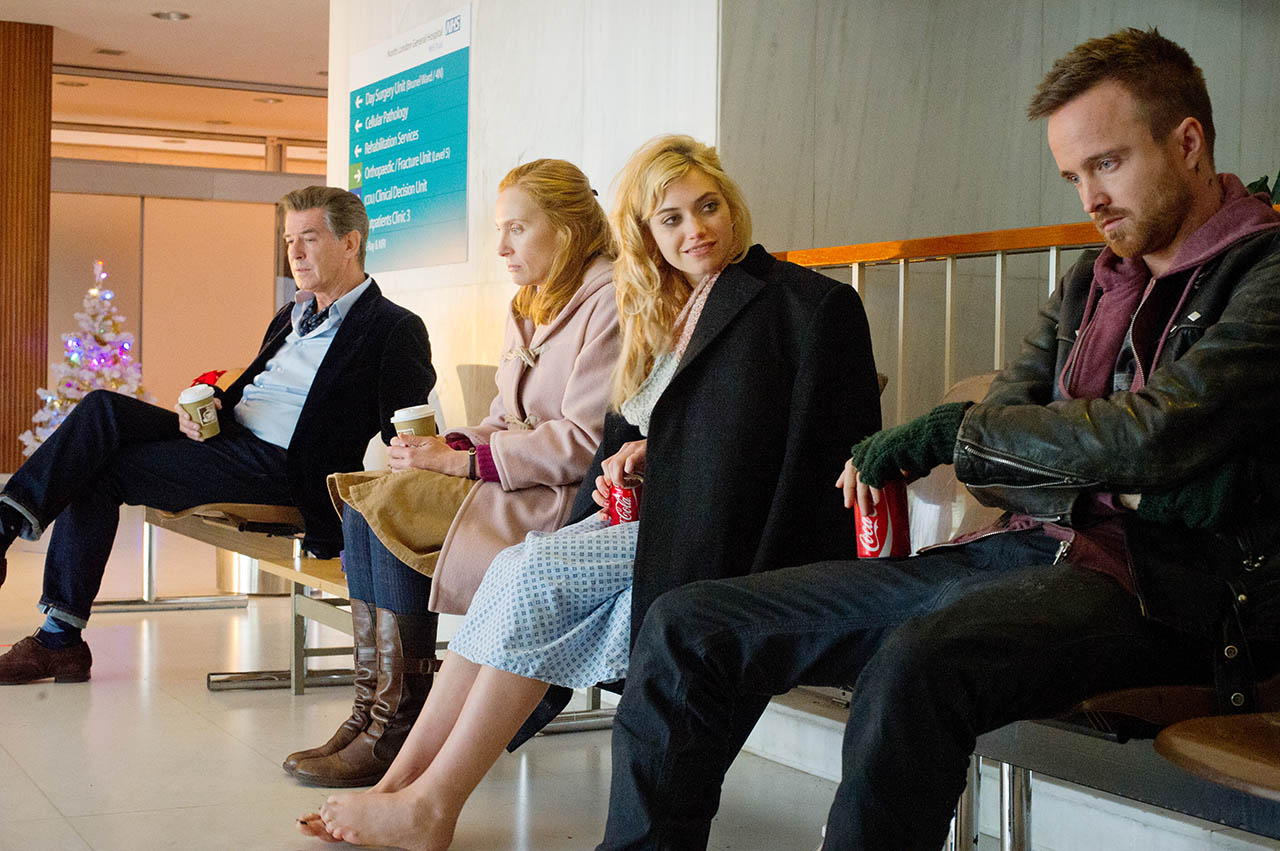
With Cheverin’s financial machinations lacking the flair or excitement that can only be offset by a series of (thankfully) non-CGI action sequences, the movie plays out its showdowns and action beats proficiently enough without giving us anything new or different.  (The last third, with its chases through Moscow and Manhattan, also seem to  provide a potential cure for back pain: Ryan’s injuries from Afghanistan, still causing him problems today, are forgotten about as he’s thrown around a lot in vehicle collisions and found hanging out the back of a truck.)  There’s a distinct lack of tension as well, and the short scene where Ryan determines both the location of the terrorist attack and the person who’ll carry it out, is laughably preposterous.  Branagh juggles the various elements to good effect but thanks to the script’s holding back, he can’t quite make things as exciting as they should be.

Pine is okay as the newest Ryan on the block, his youth and inexperience played to good effect until he’s required to don the mantle of action hero.  Knightley takes the generic girlfriend role and manages to make it interesting, though she’s hampered by the script’s reluctance to include her character as anything more than attractive window-dressing (it’ll be interesting to see if she returns for any sequels).  As the equally generic villain, Branagh fares better as the patriot willing to sacrifice anything to humble the West, but it’s Costner, experiencing a bit of a career revival at the moment, who fares the best.  He gives a quiet, unshowy performance that adds some much-needed gravitas to the proceedings, and he dominates each scene he appears in.
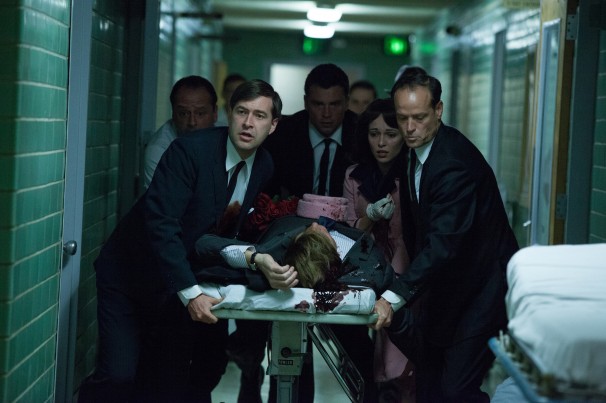
Rating: 7/10 – as a reboot, Jack Ryan: Shadow Recruit shows too much restraint on the action front, and has a plot that is too underwhelming for its own good (even if it does sound a credible threat); if there is a sequel it will need to take some bigger steps if it’s going to compete with the Bonds and the Bournes of this world.

Share this:

  • Click to share on X (Opens in new window) X
  • Click to share on Facebook (Opens in new window) Facebook
  • More
  • Click to print (Opens in new window) Print
  • Click to email a link to a friend (Opens in new window) Email
Like Loading...
← Older posts
Newer posts →

Blog Stats

  • 492,507 hits

Recent Posts

  • 10 Reasons to Remember Bibi Andersson (1935-2019)
  • Fantasia (1940)
  • Dances With Wolves (1990) – The Special Edition
  • Kiss of the Spider Woman (1985)
  • The Three Musketeers (1973)

Top Posts & Pages

  • Cardboard Boxer (2016)
    Cardboard Boxer (2016)
  • Death on the Nile (1978)
    Death on the Nile (1978)
  • Shame the Devil (2013)
    Shame the Devil (2013)
  • Art of Submission (2009)
    Art of Submission (2009)
  • Table 19 (2017)
    Table 19 (2017)
  • Frozen (2013)
    Frozen (2013)
  • For One Week Only
    For One Week Only
  • Bang Gang (A Modern Love Story) (2015)
    Bang Gang (A Modern Love Story) (2015)
  • Grosse Pointe Blank (1997)
    Grosse Pointe Blank (1997)
  • Dances With Wolves (1990) - The Special Edition
    Dances With Wolves (1990) - The Special Edition
Follow thedullwoodexperiment on WordPress.com

Blogs I Follow

  • Rubbish Talk
  • Film 4 Fan
  • Fast Film Reviews
  • The Film Blog
  • All Things Movies UK
  • Interpreting the Stars
  • Let's Go To The Movies
  • Movie Reviews 101
  • TMI News
  • Dan the Man's Movie Reviews
  • Film History
  • Jordan and Eddie (The Movie Guys)

Archives

  • April 2019 (13)
  • March 2019 (28)
  • February 2019 (28)
  • January 2019 (32)
  • December 2018 (28)
  • November 2018 (30)
  • October 2018 (29)
  • September 2018 (29)
  • August 2018 (29)
  • July 2018 (30)
  • June 2018 (28)
  • May 2018 (24)
  • April 2018 (21)
  • March 2018 (31)
  • February 2018 (25)
  • January 2018 (30)
  • December 2017 (30)
  • November 2017 (27)
  • October 2017 (27)
  • September 2017 (26)
  • August 2017 (32)
  • July 2017 (32)
  • June 2017 (30)
  • May 2017 (29)
  • April 2017 (29)
  • March 2017 (30)
  • February 2017 (27)
  • January 2017 (32)
  • December 2016 (30)
  • November 2016 (28)
  • October 2016 (30)
  • September 2016 (27)
  • August 2016 (30)
  • July 2016 (30)
  • June 2016 (31)
  • May 2016 (34)
  • April 2016 (30)
  • March 2016 (30)
  • February 2016 (28)
  • January 2016 (35)
  • December 2015 (34)
  • November 2015 (31)
  • October 2015 (31)
  • September 2015 (34)
  • August 2015 (31)
  • July 2015 (33)
  • June 2015 (12)
  • May 2015 (31)
  • April 2015 (32)
  • March 2015 (30)
  • February 2015 (37)
  • January 2015 (39)
  • December 2014 (34)
  • November 2014 (34)
  • October 2014 (36)
  • September 2014 (25)
  • August 2014 (29)
  • July 2014 (29)
  • June 2014 (28)
  • May 2014 (23)
  • April 2014 (21)
  • March 2014 (42)
  • February 2014 (38)
  • January 2014 (29)
  • December 2013 (28)
  • November 2013 (34)
  • October 2013 (4)

Blog at WordPress.com.

Rubbish Talk

Film 4 Fan

A Movie Blog

Fast Film Reviews

The Film Blog

The official blog of everything in film

All Things Movies UK

Movie Reviews and Original Articles

Interpreting the Stars

Dave Examines Movies

Let's Go To The Movies

Film and Theatre Lover!

Movie Reviews 101

Daily Movie Reviews

TMI News

Latest weather, crime and breaking news

Dan the Man's Movie Reviews

All my aimless thoughts, ideas, and ramblings, all packed into one site!

Film History

Telling the story of film

Jordan and Eddie (The Movie Guys)

Movie Reviews & Ramblings from an Australian Based Film Fan

Privacy & Cookies: This site uses cookies. By continuing to use this website, you agree to their use.
To find out more, including how to control cookies, see here: Cookie Policy
  • Subscribe Subscribed
    • thedullwoodexperiment
    • Join 481 other subscribers
    • Already have a WordPress.com account? Log in now.
    • thedullwoodexperiment
    • Subscribe Subscribed
    • Sign up
    • Log in
    • Report this content
    • View site in Reader
    • Manage subscriptions
    • Collapse this bar
 

Loading Comments...
 

    %d