• 10 Reasons to Remember…
  • A Brief Word About…
  • About
  • For One Week Only
  • Happy Birthday
  • Monthly Roundup
  • Old-Time Crime
  • Other Posts
  • Poster of the Week
  • Question of the Week
  • Reviews
  • Trailers

thedullwoodexperiment

~ Viewing movies in a different light

thedullwoodexperiment

Tag Archives: True story

Life of a King (2013)

14 Monday Dec 2015

Posted by dullwood68 in Movies

≈ Leave a comment

Tags

Big Chair Chess Club, Chess, Crime, Cuba Gooding Jr, Dennis Haysbert, Drama, Eugene Brown, High School, Jake Goldberger, Kevin Hendricks, Malcolm M. Mays, Review, True story, Washington D.C.

Life of a King

D: Jake Goldenberger / 98m

Cast: Cuba Gooding Jr, Malcolm M. Mays, Kevin Hendricks, Carlton Byrd, Rachae Thomas, LisaGay Hamilton, Richard T. Jones, Dennis Haysbert, Paula Jai Parker, Jordan Calloway, Blake Cooper Griffin

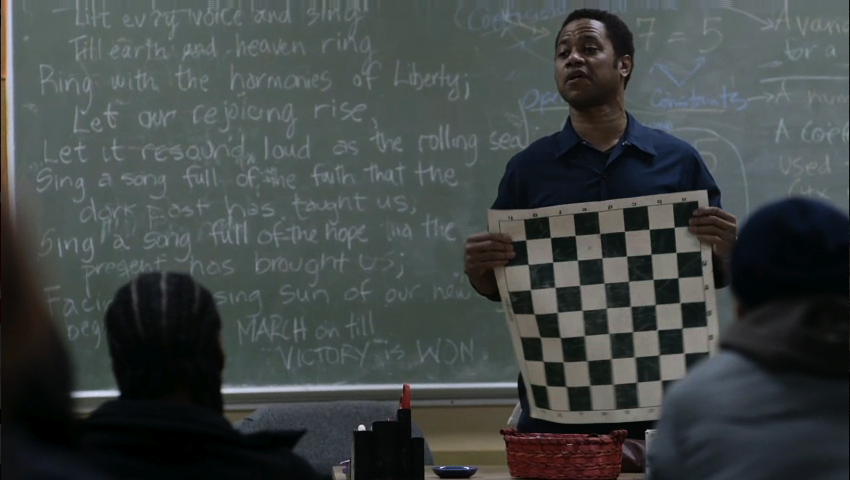
A true story involving troubled teens, inner city trials and tribulations, an ex-con with family issues, and the redemptive power of chess, Life of a King has good intentions, a lot of heart, and the slow, steady pace of an illness-of-the-week TV movie. It also has a relaxed, committed performance from Gooding Jr, and enough hokey moments to choke an elephant. But what it also has is that curious approach to a true story that often leads audiences to believe that a real person’s life is stuffed full of clichés and dramatic coincidence.

The movie tells the story of Eugene Brown (Gooding Jr), who served seventeen years in prison for armed robbery, and who, once he was released, took the opportunity with a group of inner city youths to set up a community chess club. Along the way he finds it difficult to find honest work by admitting he’s an ex-con; subsequently lies on an application form for janitor at his local high school; tries to reunite with his disaffected children, Katrina (Thomas) and Marcus (Calloway); avoids being dragged back into a life of crime by his old partner Perry (Jones); faces down the school hard nut, Clifton (Byrd); sees potential in another student, Tahime (Mays); is fired once his principal (Hamilton) finds out he’s lied on his application; rents a derelict house so the chess club can carry on; stands helplessly by as one of the other students, Peanut (Hendricks), is dragged into a dangerous situation with unfortunate results; begins to connect with his children through his efforts with the chess club; overcomes a setback involving the house; and looks ahead to his chess protegés entering and triumphing in a local tournament. And then…?

Life of a King - scene2

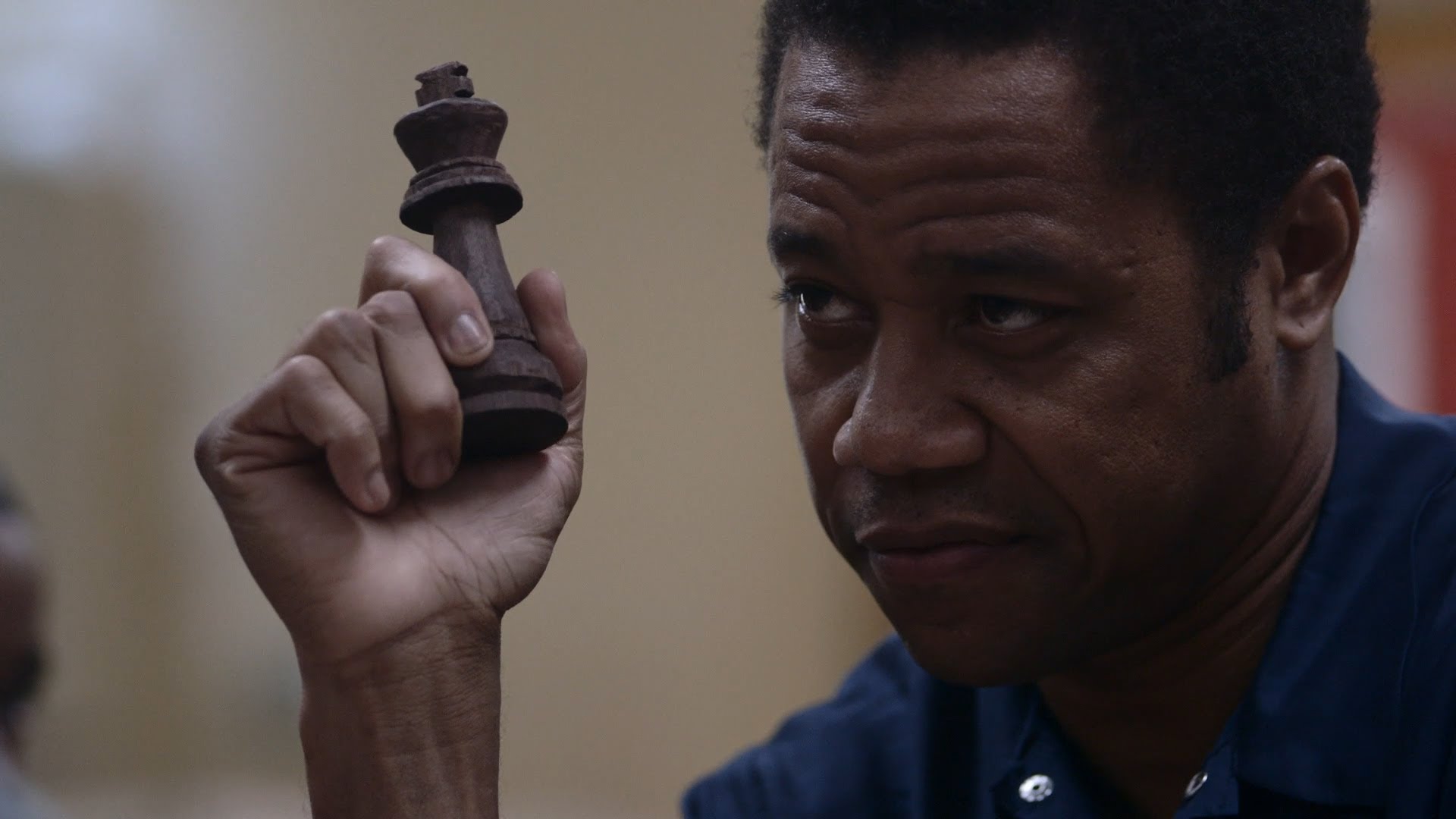
If any of this sounds incredibly or entirely predictable, then by and large it is. From Brown’s surrogate father relationship with The Chessman (Haysbert) while in gaol, to Tahime’s showdown against a chess prodigy (Griffin), Life of a King ticks every possible true story box in its retelling of Brown’s story. It’s an homogenised approach to an uplifting tale that deserves better, but thanks to Goldberger’s mostly leaden direction, there are precious few moments of real power and emotion. What moments there are, are also mostly down to Gooding Jr’s earnest, well-modulated performance. He’s suitably determined as Brown, and shows the man’s resourcefulness and drive with a good sense of the difficulties he must have faced and overcome.

But again, he’s fighting against the poor performance of Goldberger in the director’s chair (making only his second feature). Goldberger – working from the script he wrote with David Scott and Dan Wetzel – seems unable to rise above the clichéd nature of his own narrative, and on several occasions seems to be embracing each cliché wholeheartedly. Some scenes feel like they’ve been constructed from the DNA of several true story TV movies, and viewers familiar with those kind of movies will notice that some of the scenes have been shot in that very style (and some individual shots as well).

Life of a King - scene1

This all makes the movie watchable enough thanks to the familiarity with which it’s being presented, but a bit of a chore as well thanks to the very same familiarity. Some fun can be had from anticipating each cliché before it appears, and if you felt so inclined, you could devise a predictability curve that could be drawn as the movie progresses (though it might end up being just a straight line). It’s all a shame as Brown’s story is engaging in its own right, and his efforts are well worth celebrating, but a different format is definitely needed. There’s also the problem of the script’s occasional moralising, as it uses the metaphor of chess to represent Life as often as it can, as if the audience wouldn’t get it the first time.

Aside from Gooding Jr’s portrayal of Brown, the rest of the cast do their best to make some headway against the material, with Mays’ reticent Tahime and Hendricks’ eager beaver Peanut making more of an impression than expected. Byrd’s sneering Clifton is straight out of Stock Characters 101, and he’s matched by Jones’ preening drug lord and Calloway’s petulant son. It’s the female characters that come off best (though that’s not saying much), and Hamilton is strongest as the high school principal who’s sympathetic to Brown’s cause (and even helps out with the dishes at the chess house).

Life of a King - scene3

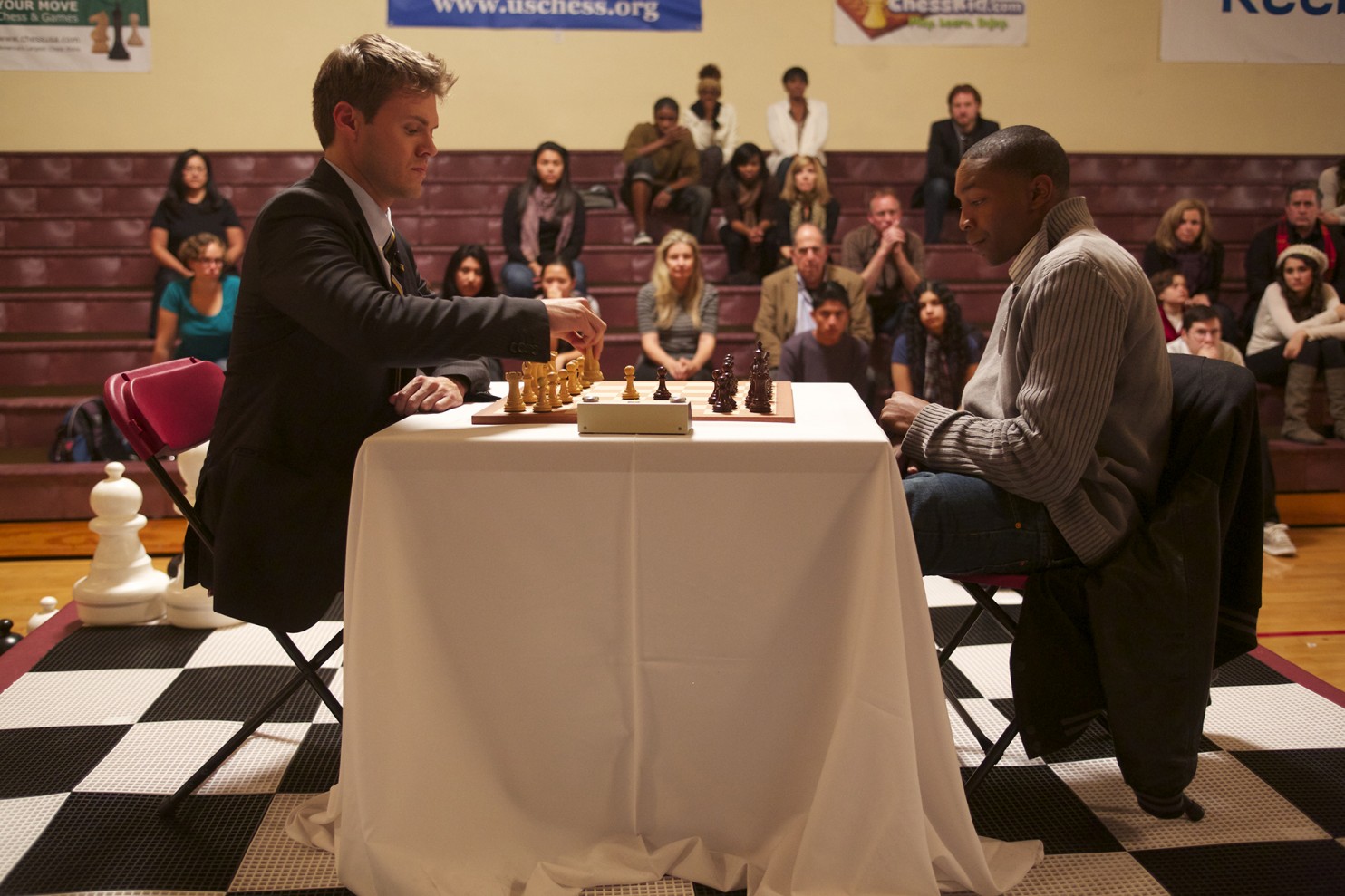
As mentioned above, the movie ends with Tahime taking on a chess genius in an open tournament, and in the final naturally. But what should be a gripping sequence is let down by Goldberger’s inability to shoot it all with any sense of urgency or tension. And he’s further let down by editor Julie Garces, whose decision to represent the game through a flurry of indistinguishable moves and clock-punching makes it all impossible to follow (though that was probably the idea). It’s a clunky end to a movie that’s been the definition of clunky from the very beginning.

Rating: 4/10 – slackly and lazily constructed, Life of a King doesn’t do its subject matter justice, and lets the audience down in the process; tired and ineffective, it’s a true life tale that’s been soaked in complacency and shows off its shortcomings as if they were unavoidable.

Share this:

  • Share on X (Opens in new window) X
  • Share on Facebook (Opens in new window) Facebook
  • More
  • Print (Opens in new window) Print
  • Email a link to a friend (Opens in new window) Email
Like Loading...

The 33 (2015)

29 Sunday Nov 2015

Posted by dullwood68 in Movies

≈ Leave a comment

Tags

2010 Copiapó mining accident, Antonio Banderas, Chile, Drama, Gabriel Byrne, Juliette Binoche, Lou Diamond Phillips, Patricia Riggen, Review, Rodrigo Santoro, San Jose mine, Thriller, True story

The 33

D: Patricia Riggen / 127m

Cast: Antonio Banderas, Rodrigo Santoro, Juliette Binoche, Lou Diamond Phillips, Gabriel Byrne, Mario Casas, Jacob Vargas, Juan Pablo Raba, Oscar Nuñez, Tenoch Huerta, Marco Treviño, Adriana Barraza, Kate del Castillo, Cote de Pablo, Naomi Scott, Bob Gunton, James Brolin

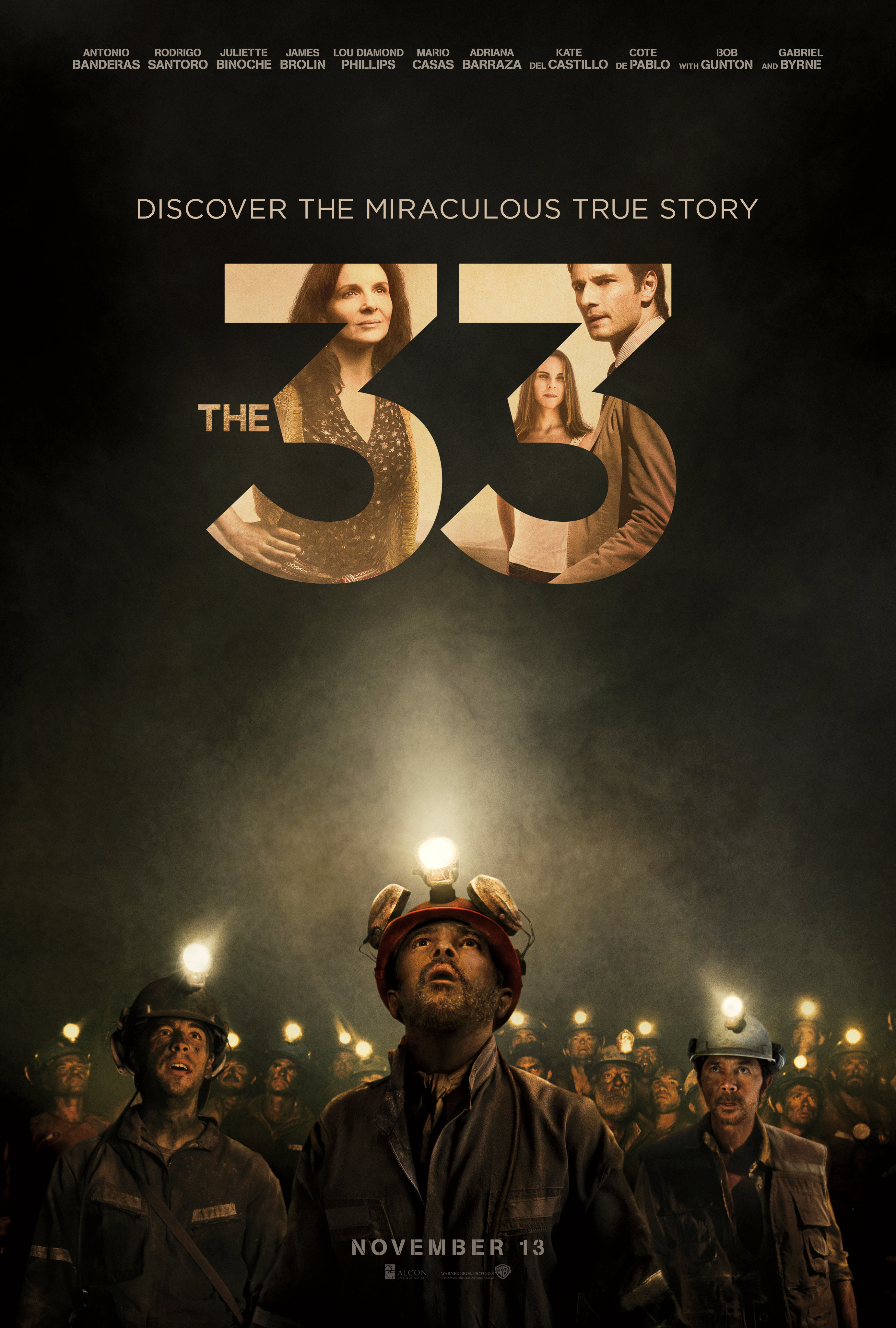
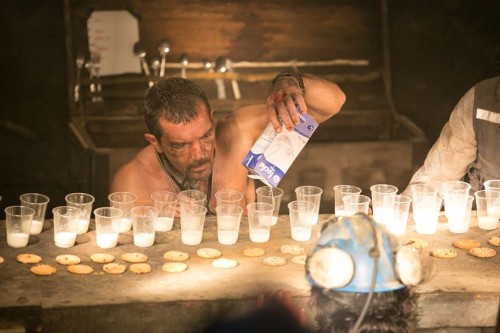
On 5 August 2010, thirty-three men working at the San José copper-gold mine in Chile’s Atacama Desert, found themselves trapped seven hundred metres underground when there was a major cave-in. What happened over the ensuing sixty-nine days captured the attention of the world, as the Chilean government overcame numerous obstacles in its attempts to rescue the men and restore them to their families. The men – thirty-two Chileans and one Bolivian – were a mix of mine workers and technical support workers, and they survived in an area called The Refuge, albeit with meagre rations that would only last them a few days unless strictly rationed. As an example of the human will to survive against incredible odds and adversity, there are fewer recent examples that can match the story of the 33.

With such an incredible story to tell, The 33 should have been a sure-fire winner, but somewhere along the way, the makers dropped the ball, leaving the movie lacking focus and tension throughout. We meet several of the miners on the day before their fateful shift, with Banderas’ Mario Sepúlveda and Phillips’ Luis ‘Don Lucho’ Urzúa strongly to the fore. With the quality of their home lives established, and how well they’re respected made clear, we move to the next day and meet some of the other men, such as alcoholic Darío Segovia (Raba), and husband caught between wife and mistress Yonni Barrios (Nuñez). And then there’s unlucky Bolivian Carlos Mamani (Huerta), starting his first day at the mine and completely unaware, like all the others, of what’s going to happen.

The 33 - scene4

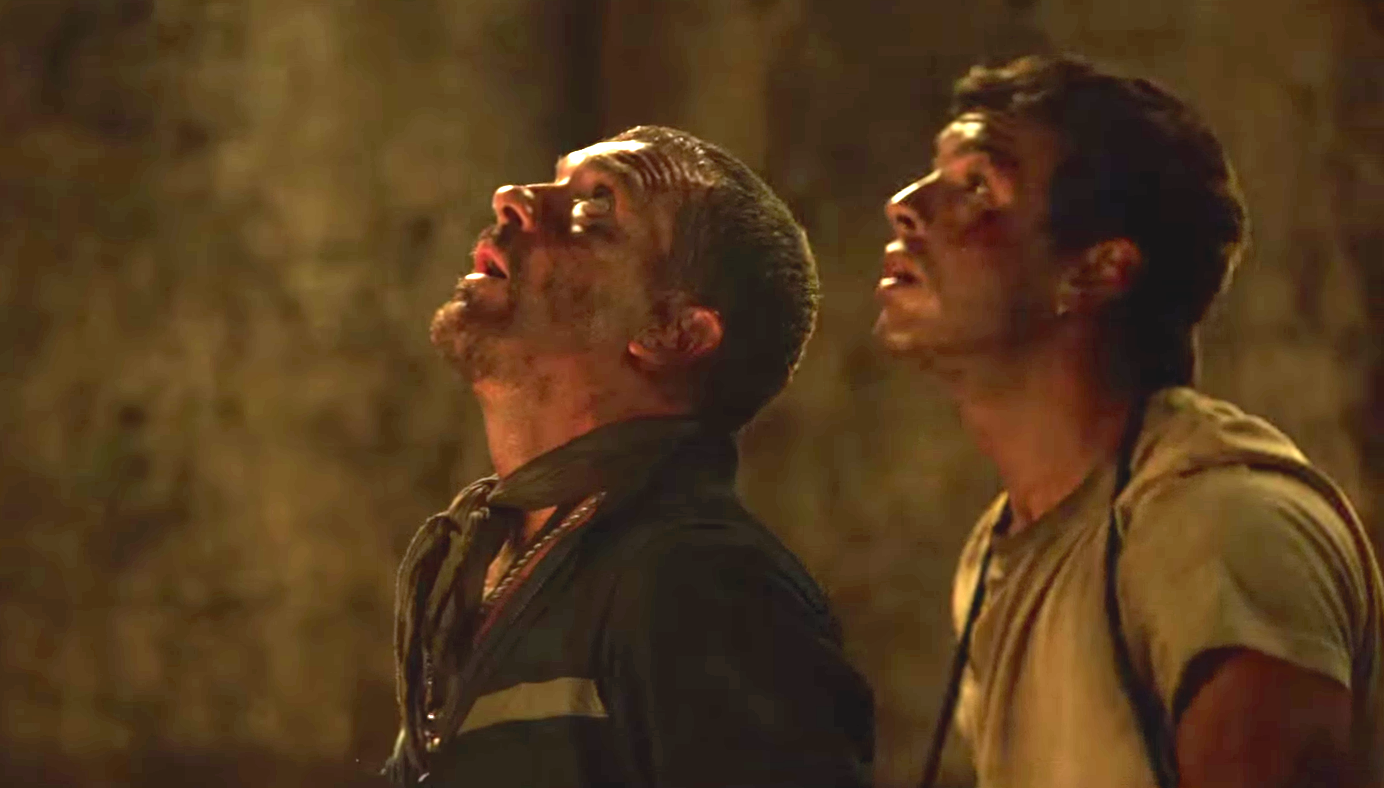
Once inside the mine, and its winding corridors that lead down and down into the bowels of a mountain, the men begin their work but soon realise that they’re in terrible danger. Here the movie becomes a disaster epic, as the mountain collapses around them in spectacular fashion and the lights go out. So far, so good. But once the disaster has happened, the movie loses its grip on the story, and the ensuing struggle for survival juggles for time and attention with the rescue mission going on above ground. This has the effect of lessening the drama of both strands and giving the movie a stately pace that undermines the movie’s effectiveness even further.

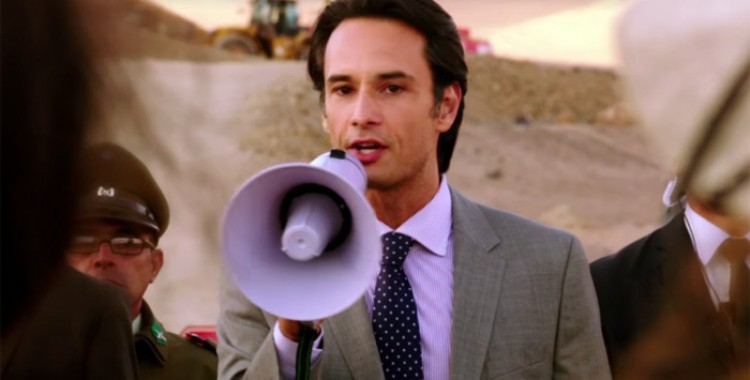
By trying to focus on both the survivors and the rescue attempt – spearheaded by Santoro’s Laurence Golborne, the Minister of Mining – the script by Mikko Alanne, Craig Borten and Michael Thomas becomes an uneasy mix of pedestrian thriller and soap operatics, as below ground, Sepúlveda becomes the unofficial leader, while on the surface, Binoche’s forceful María Segovia (Dario’s sister) cajoles and embarrasses the Chilean government into rescuing her brother and his colleagues. It becomes pretty formulaic stuff, even down to the moment when, with the rescue mission on the verge of being called off, María says something to Golborne that gives him the idea that saves the day. It’s an awkward, cheesy moment, and neither Binoche or Santoro can do much with it to make it sound convincing.

The 33 - scene3

By and large the plight of the men is downplayed, particularly once their rations run out. A big chunk of time goes by without any reference to how the men maintained their morale, or the general physical well-being that allowed them to survive for so long. Sepúlveda is kept at the forefront, while the majority of the other men are painted in broad brush strokes; only Dario’s going cold turkey has any impact, and even then it’s quite muted. Banderas is reliable enough as the de facto leader, but it’s Phillips as the guilt-ridden ‘Don Lucho’ who stands out from the crowd, delivering the movie’s best performance by a By the movie’s end, even the sense of relief that every man was rescued is less enervating than it should be, with even the celebrations of the families feeling perfunctory and blandly choreographed.

Leading the rescue team, Santoro is too fresh-faced to be a Minister of Mining (especially as he doesn’t know the first thing about it), while Byrne’s grizzled drilling expert is seen throwing in the towel too often for his credentials to be that impressive. Brolin appears towards the end when the drilling effort becomes an internationa one, but he has so few lines and makes so little impression that the only thing that’s impressive is that he gets fourth billing in the credits. Representing the families, Binoche’s mix of agitator and social conscience is saddled with the unlikely prospect of an attraction to Santoro that feels like a clumsy attempt to shoehorn a degree of (unnecessary) romance into the story.

The 33 - scene2

But above all, The 33 is a movie that plods along doing just enough to look like it knows what it’s doing, but thanks to Riggen’s by-the-numbers direction it never becomes as tense or dramatic as it should be given the situation and the lives at stake. At least Checco Varese’s cinematography isn’t as staid, with sun-drenched vistas on offer above ground, and claustrophobic shadows below ground. And there’s a fine, wistful score courtesy of the late James Horner that lifts the movie whenever it’s included. Good as these elements are, however, they still only work to prop up a movie that gets more things wrong than right.

Rating: 6/10 – disappointing and onerous, the story of one of the most amazing survival/rescue events in recent history is treated in such a lacklustre way that it feels as if the men are being let down a second time (they’ve never received any compensation for their ordeal); subsumed by too many disaster clichés, The 33 lacks a sense of real danger and makes a remarkable story feel merely ordinary in the telling.

Share this:

  • Share on X (Opens in new window) X
  • Share on Facebook (Opens in new window) Facebook
  • More
  • Print (Opens in new window) Print
  • Email a link to a friend (Opens in new window) Email
Like Loading...

A Royal Night Out (2015)

15 Sunday Nov 2015

Posted by dullwood68 in Movies

≈ Leave a comment

Tags

Airman, Bel Powley, British royalty, Comedy, Drama, Emily Watson, Jack Reynor, Julian Jarrold, King George VI, Military escort, Princess Elizabeth, Princess Margaret, Review, Rupert Everett, Sarah Gadon, True story, VE Day, World War II

A Royal Night Out

D: Julian Jarrold / 97m

Cast: Sarah Gadon, Bel Powley, Jack Reynor, Rupert Everett, Emily Watson, Jack Laskey, Jack Gordon, Roger Allam, Ruth Sheen

A Royal Night Out is based on real events: on V.E. Day, May 8 1945, Princess Elizabeth and Princess Margaret went out in a group that included their nanny, several friends, and a military detail as protection (one of whom was Group Captain Peter Townsend, who would later have a relationship with Margaret). They were charged by their father, King George VI, to be home by one a.m. – which they were. Nothing of any real significance happened, and the evening passed off without incident.

But in an attempt to overcome this disappointing outcome, A Royal Night Out chooses to paint an entirely different portrait of what happened that night, and in doing so, pushes the boundaries of credibility at every turn. It’s a movie that embraces the newspaper cry of “Print the Legend!”, and has no intention of worrying about just how far-fetched or unlikely it all is. And thanks to one of the most careless and poorly constructed screenplays of recent years – courtesy of Trevor De Silva and Kevin Hood – the movie limps from one unconvincing scene to another, and never once provides a moment’s plausibility.

From the moment that Gadon’s Elizabeth and Powley’s Margaret are introduced – responsible and carefree respectively – it’s clear that these characterisations aren’t going to change much as the movie progresses. Elizabeth is the thoughtful, considerate sister, always looking out for her younger, less mature sibling. Margaret is a pleasure-seeker, stifled by the conventions of royal life, and looking for a chance to express her more extrovert nature. Although there is some truth in both these approaches – Margaret definitely liked a good party – by reducing both young women to such paper-thin representations of their real counterparts, the movie avoids asking its audience to identify with them at all.

A Royal Night Out - scene1

What the movie does to compensate is to infuse the action with liberal dollops of comedy. Surprisingly, a lot of it works, even though it’s often corny, and relies on the idea that Elizabeth and Margaret are so far removed from “ordinary” folk that they’re unable to deal with the simplest of social interactions. The humour is also derived in part from a lazy interpretation of the social divide between the princesses and the people they meet. Margaret is far too trusting, while Elizabeth becomes acutely aware of how little she really knows about everyday people. It’s predictable stuff, and if it wasn’t for the jokes, the movie would be dangerously difficult to sit through.

As well as De Silva and Hood’s just-enough-done-to-get-by script, there’s Jarrold’s lacklustre direction to contend with. There are moments when it really seems as if he settled for the first take and had no interest in finding out if the actors had anything else to offer. Whole stretches of the movie play out at a sedated pace that deadens each scene it touches, and it makes the performances seem stilted and free from nuance. Jarrold, whose last theatrical feature was the similarly underwhelming Brideshead Revisited (2008), misses almost every opportunity to make the movie relevant to its time frame, and concentrates instead on various levels of slapstick and farce to push the narrative forward. It leaves the movie feeling disjointed and as unconcerned about itself as Margaret is when she goes off with a man she doesn’t know.

97-Girls Night Out-Photo Nick Wall.NEF

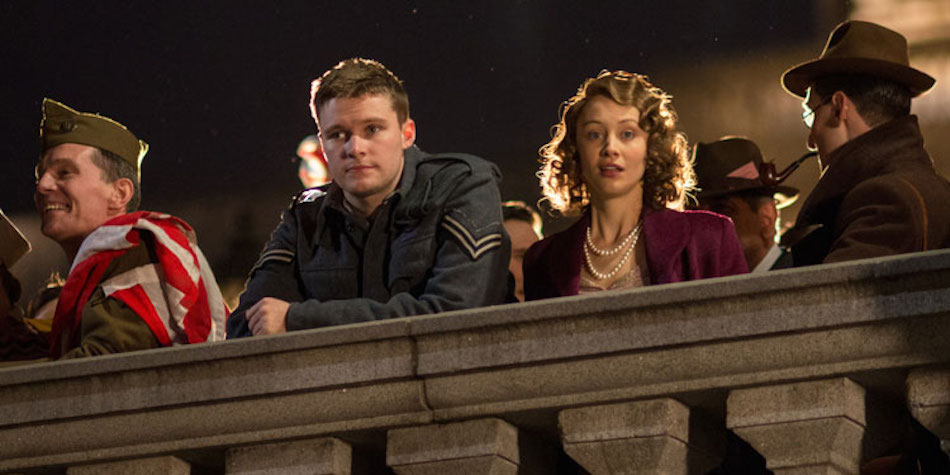
There are issues with the various relationships as well. Elizabeth meets AWOL airman Jack (Reynor) who helps her find Margaret after they’re separated. You can tell straight away that the script wants them to get together, but at the same time it wants to stay true to historical events, so what we’re left with is an attraction that can’t (and doesn’t) lead anywhere, and which is entirely redundant as a plot device. The same can be said for Jack’s AWOL status, a dramatic angle that is resolved with the neatness of a parcel tied up with string. (There really isn’t anything in the movie that the viewer won’t be able to guess the outcome of – and long before it happens.)

Elsewhere, Laskey and Gordon play their military detail roles as if they were auditioning for an X Factor comedy special, with Laskey mugging for all he’s worth, and Gordon’s Lieutenant Burridge behaving in such an inappropriate manner it’s ridiculous. Allam is introduced late on as a mix of low-rent pimp and black marketeer who Margaret calls Lord Stan, but it’s the fanciful way in which her royal status is exploited that raises a chuckle, as Stan uses her to get some of his working girls inside the Chelsea Barracks, and circulating amongst the guests at a party there. Again it’s this kind of non-threatening, breezy plotting that hampers the movie and stops it from having any kind of edge.

A Royal Night Out - scene3

The cast are left adrift to fend for themselves, with Watson coming off best by (ostensibly) directing herself, while the likes of Everett, Allam and Powley are stranded playing caricatures. Reynor can’t do anything with his establishment-baiting airman, and Gadon looks bewildered throughout, as if she can’t quite believe what she’s being asked to do (though, to be fair, her bewilderment could be down to the demands of the script).

Away from the uninspired direction and unimaginative script, A Royal Night Out struggles to rise above its TV movie look and feel, and some of the myriad night shots look like they were filmed during the day. And with the best will – or art direction – in the world, Hull is no substitute for London, leaving several scenes feeling incomplete in terms of the movie’s visual style. As a result, Christophe Beaucarne’s photography is choppy at best, though it suits the muddy compositions. And Luke Dunkley’s editing is so haphazard in its approach that a lot of scenes lack that all-important through line.

Rating: 4/10 – even though it’s an interpretation of what “might” have happened on the night of 8 May 1945, A Royal Night Out‘s script shows such a lack of imagination almost any other interpretation would be preferable; saved entirely by its sense of humour, and despite its being entirely nonsensical at times, the movie is one of those ideas that seemed like a good one at the time, but which should have been left well alone by all concerned.

Share this:

  • Share on X (Opens in new window) X
  • Share on Facebook (Opens in new window) Facebook
  • More
  • Print (Opens in new window) Print
  • Email a link to a friend (Opens in new window) Email
Like Loading...

The Walk (2015)

14 Wednesday Oct 2015

Posted by dullwood68 in Movies

≈ 1 Comment

Tags

Ben Kingsley, Charlotte Le Bon, Drama, High wire, James Badge Dale, Joseph-Gordon-Levitt, Literary adaptation, Philippe Petit, Review, Robert Zemeckis, Tightrope, True story, Twin Towers, World Trade Center

Walk, The

D: Robert Zemeckis / 123m

Cast: Joseph Gordon-Levitt, Ben Kingsley, Charlotte Le Bon, James Badge Dale, Clément Sibony, César Domboy, Steve Valentine, Ben Schwartz, Benedict Samuel

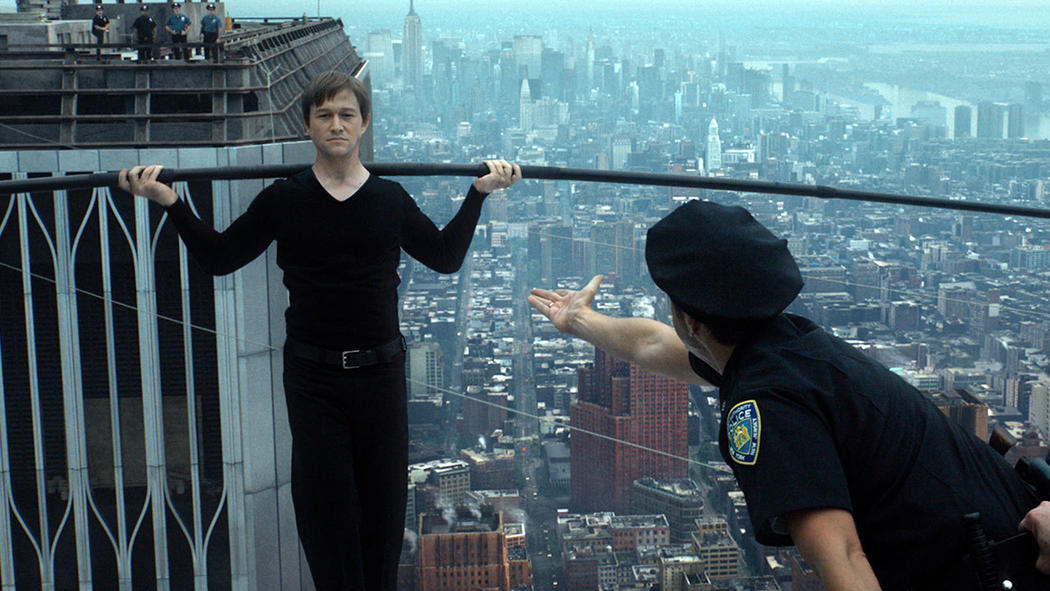
1973. Philippe Petit (Gordon-Levitt) is a street entertainer in Paris, France, who includes some wire work in his act, usually strung between two trees and without the benefit of having a permit. One day he accepts a gobstopper from a young girl in his audience, but when he bites into it, it causes a painful problem that he goes straight to the dentist with. While in the waiting-room he sees a magazine article on New York’s Twin Towers. Straightaway, Petit knows what he has to do: he has to learn the intricacies of high wire work, and from the acknowledged master, Papa Rudy (Kingsley), in order that he can fulfil his dream of walking between the Twin Towers on just a length of cable. Rudy agrees to teach him. Aided by his girlfriend, Annie (Le Bon), and mutual friend, Jean-Louis (Sibony), Petit determines to travel to New York and carry out his dream.

Once there, Petit enlists the aid of further “accomplices”, such as J.P. (Dale) and Barry Greenhouse (Valentine), who works in the South Tower. Several visits to the site are made in an effort to discover the best time for stringing the cable between the two buildings, and more importantly, when Petit should make the crossing. Petit, though, steps on a nail and injures his right foot, but won’t hear of cancelling or postponing the high wire walk (which has been set for 6 August 1974, and is called The Coup). Aided by Jean-Francois (aka Jeff) (Domboy) and two others recruited by J.P., Petit forges ahead with his plan and they manage to sneak all the relevant equipment into both buildings. But on the night of the 5th, with Petit planning to commence his walk across “the Void” at 6am, the presence of a night guard, and some unexpected problems with the cable and the lines used to stop it from wobbling, throw the endeavour off schedule. Eventually, with Jeff to help him, and Jean-Louis on the other tower, and with Annie, J.P. and Barry watching from the street, Petit takes his first steps out onto the wire…

Walk, The - scene

James Marsh’s documentary on Philippe Petit, Man on Wire (2008), won the Best Documentary Feature Oscar in 2009, as well as a whole raft of other awards from around the world. The one criticism that can be levelled against what is otherwise a very good examination of Petit’s particular brand of “artistic madness”, is that there’s no footage of Petit walking between the Twin Towers. In the hands of Robert Zemeckis, The Walk seeks to remedy this by putting the audience up there with Petit, and by showing just how dangerous it was. However, the key phrase here is “seeks to remedy”, as by and large, Zemeckis takes his cue from Petit himself and dismisses any attempt to instil any fear or heart-pounding terror into the walk itself. While it may well be true that Petit was confident of his abilities, and that the walk – or walks: he traversed the wire several times – was easier than he’d expected, but once he’s out there, the tension that Zemeckis and co-screenwriter Christopher Browne have so successfully created in the movie’s third act (of four) swiftly evaporates.

The movie takes an odd approach to the material, and feels schizophrenic as a result, with a first half that concentrates, in a very old-fashioned Hollywood way, on Petit as a young man just starting out as a street performer, before becoming inspired to walk between the towers. It has the look and feel of a regular biography, with key moments ticked off against a list, and with any potential spontaneity halted before it’s given a chance to start (there’s even a scene where Petit and Annie are getting to know each other by romantic candlelight). And if truth be told, these scenes aren’t even that interesting, delaying as they do the central focus of the movie, namely that walk. Petit shows off his arrogance, Annie melts under his charm too quickly, and things happen with a convenience and disregard for clarity that it’s easier just to go along with it all and wait for the movie to pick up by itself.

Which it does once Petit and friends start “casing the joint” and begin installing the equipment they need. This stretch of the movie contains the most tension and is easily the most compelling, as obstacles need to be overcome and the Coup becomes in danger of being cancelled indefinitely. As the fiercely determined Petit, Gordon-Levitt holds it all together, and if his accent slips from time to time, it’s not the end of the world. He channels Petit’s passion for high wire work with aplomb, even if the character – as written – isn’t as socially aloof or as difficult to work with as Man on Wire revealed. Gordon-Levitt also proves to be a proficient high wire walker, having spent time learning how to do it for real. It’s this level of commitment that helps the movie overcome the weakness inherent in the narrative, the one that doesn’t allow the other characters to be as fleshed out as Petit.

Annie (Charlotte Le Bon) and Philippe Petit (Joseph Gordon-Levitt) in TriStar Pictures' THE WALK.

While people like Le Bon, Valentine, and Dale left to stand on the sidewalk and stare at proceedings through binoculars, it’s left to Gordon-Levitt and Domboy to ratchet up the tension, especially Domboy, whose character Jeff, is terrified of heights. Kingsley floats in and out of the narrative and acts purely as a mine of information or encouraging mentor. But while the main performances, however truncated by the need to fit as much in as possible, are comfortably undemanding of the cast, don’t let them die.

Another issue is the unconvincing CGI work carried out once Petit and Jeff are on the roof of the South Tower. The backdrops are impressively detailed, but it’s not enough to allow them to look any better. They stand out against their surroundings, and unfortunately, it’s distracting, as well as a shock to see that an innovator like Zemeckis can’t overcome the lighting issues that have caused this effect. And even more unfortunately, when the camera swings or pans its way over and around Petit’s head when he’s on the wire, there’s no real sense of depth to the image, no sense that this is a very long way down (or somewhere very high up). Petit’s own storytelling image, the emphasis he puts on the danger, and the awkward position it puts him in with the authorities is nicely handled but it’s all too little, too late. And the decision to have Petit holding forth on his exploits from the top of the Statue of Liberty may have semed like a good idea at the time, but in actuality it’s off-putting and makes for dramatically turgid viewing.

The movie does benefit from a classy, contemporary score by the ever reliable Alan Silvestri, while the movie – on the ground, at least – offers some superb visuals courtesy of Dariusz Wolski. If the movie tries to include too much of Petit’s history for its own good, then the end result is a little uneven, and still very ragged in places, but overall the movie does have its charms, and some viewers may yet find themselves overcome by some of the aerial shots

Rating: 6/10 – too uneven and too much like a soap opera in the first half, The Walk treads the Hollywood line once too often to create a movie no one will be able to remember even when they’re buying it; a disappointment then (even in IMAX 3D), and not as gripping as it should have been, it’s still a much more attractive proposition than most movies that are out at the moment.

Share this:

  • Share on X (Opens in new window) X
  • Share on Facebook (Opens in new window) Facebook
  • More
  • Print (Opens in new window) Print
  • Email a link to a friend (Opens in new window) Email
Like Loading...

Monthly Roundup – September 2015

30 Wednesday Sep 2015

Posted by dullwood68 in Movies

≈ Leave a comment

Tags

12 Rounds 3: Lockdown, Abigail Breslin, Action, Airlock, Alexander and the Terrible Horrible No Good Very Bad Day, Arizona, Axe to Grind, Baseball, Beverly Tyler, Birthday, Brian McGinn, Brighton, Cancer charity, Cattle rustling, Corrupt cops, Crime, Dean Ambrose, Debbie Rochon, Drama, Earl Bellamy, Ferrell Takes the Field, George Montgomery, Georgie Henley, Horror, Insurance fraud, Jennifer Garner, Jim Davis, Jim O'Connolly, John Carson, Josh Gad, Judith Viorst, Keoni Waxman, Literary adaptation, Matt Zettell, Mercenary, Michael Matzur, Michael Steppe, Miguel Arteta, Mira Sorvino, Movie role, Murder, Perfect Sisters, Peter Vaughan, Rob Margolies, Roger R. Cross, Romantic comedy, Sci-fi, Screenwriter, She Wants Me, Short movie, Silver mines, Smokescreen, Stanley M. Brooks, Stephen Reynolds, Steve Carell, Steven Seagal, The Boss, The Toughest Gun in Tombstone, True story, Vacuity, Vinnie Jones, Western, Will Ferrell, Wish, WWE, Yvonne Romain

Smokescreen (1964) / D: Jim O’Connolly / 70m

Cast: Peter Vaughan, John Carson, Yvonne Romain, Gerald Flood, Glynn Edwards, John Glyn-Jones, Penny Morrell, Barbara Hicks, Sam Kydd, Deryck Guyler

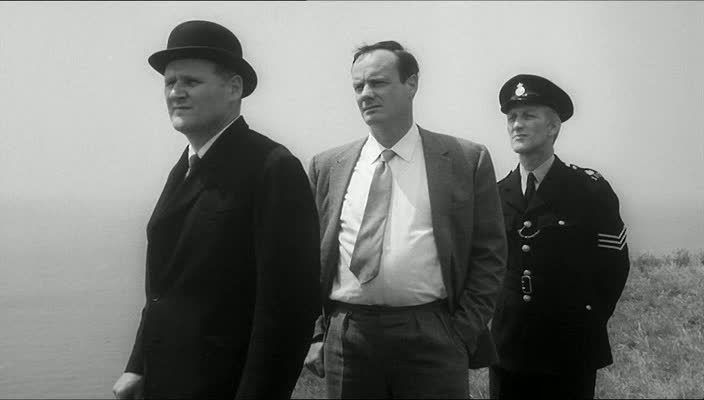
Rating: 7/10 – bowler-hatted insurance fraud investigator Roper (Vaughan) is called in to investigate when a heavily insured businessman’s car bursts into flames before going over a cliff – but was he in it?; a neat, unprepossessing British thriller, Smokescreen features an enjoyable performance from Vaughan, some stunning location photography, and a script that allows for plenty of ironic humour in amongst the drama.

Smokescreen

Alexander and the Terrible Horrible No Good Very Bad Day (2014) / D: Miguel Arteta / 81m

Cast: Steve Carell, Jennifer Garner, Ed Oxenbould, Dylan Minnette, Kerris Dorsey, Sidney Fullmer, Bella Thorne, Megan Mullally

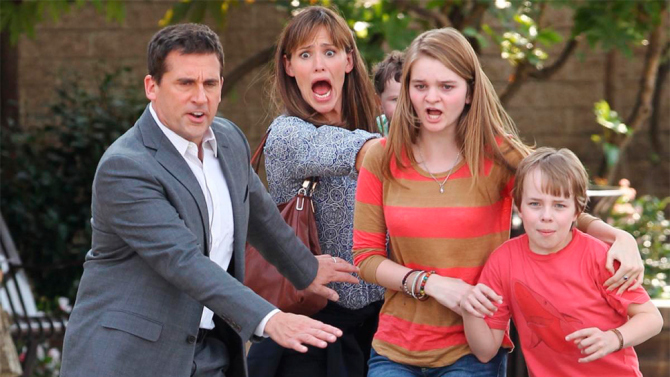
Rating: 7/10 – when overlooked youngest child Alexander (Oxenbould) has the worst day ever, he wishes that his family could experience just a little of what he has to deal with – but when they do, things quickly escalate beyond anything that Alexander has ever faced; Judith Viorst’s novel gets a fun-filled adaptation that is amusing, clever, and visually inventive, but which lacks bite, and has surprisingly few characters to root for (that is, none).

Alexander etc

She Wants Me (2012) / D: Rob Margolies / 85m

Cast: Josh Gad, Kristen Ruhlin, Johnny Messner, Aaron Yoo, Hilary Duff, Melonie Diaz, Wayne Knight, Charlie Sheen

Rating: 6/10 – an ambitious though neurotic writer (Gad) working on his first screenplay faces a dilemma when the role written for his girlfriend (Ruhlin) grabs the attention of an A-list actress (Duff); a romantic comedy with few ambitions that struggles to make good comedy out of anxious indecision, She Wants Me is innocuous stuff that passes by in amiable fashion without ever really involving its audience.

She Wants Me

12 Rounds 3: Lockdown (2015) / D: Stephen Reynolds / 90m

Cast: Dean Ambrose, Roger R. Cross, Daniel Cudmore, Lochlyn Munro, Ty Olsson, Sarah Smyth, Rebecca Marshall, Kirby Morrow

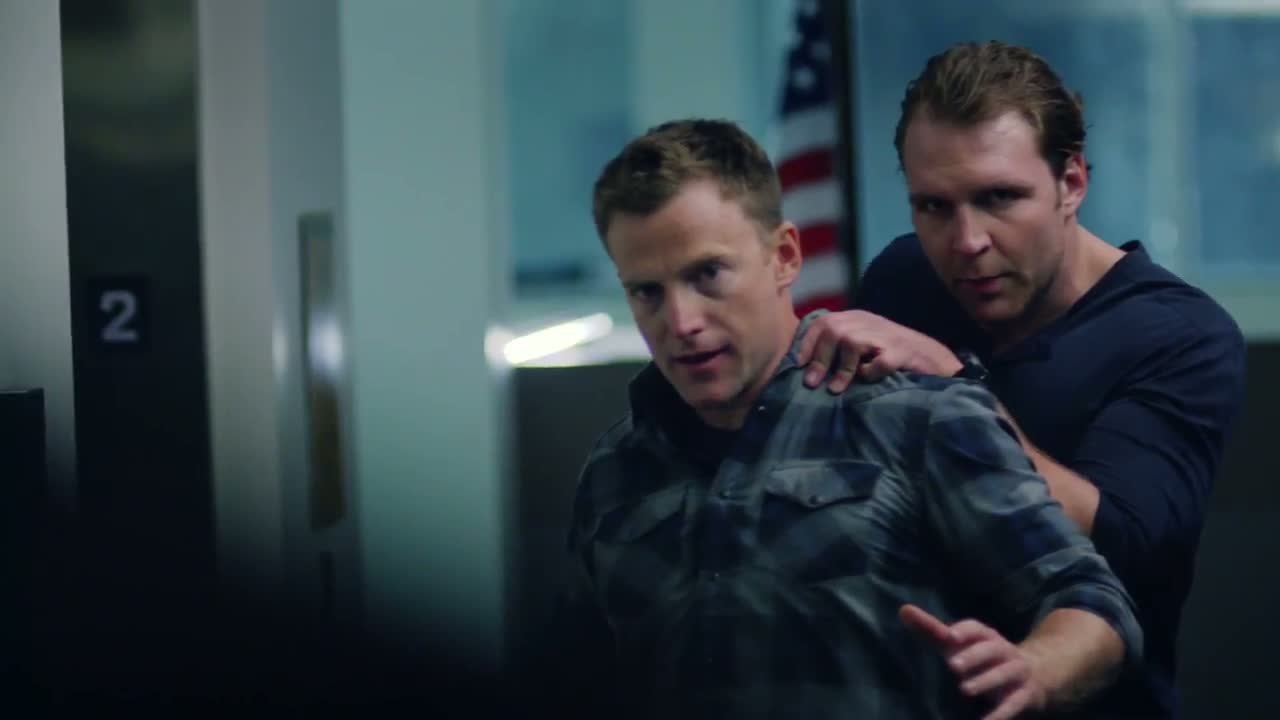
Rating: 3/10 – an honest cop (Ambrose) finds himself trapped in a station house and hunted by several of his corrupt colleagues when he comes into possession of evidence that will see them put away for the rest of their lives; another depressing WWE Films action movie, 12 Rounds 3: Lockdown dispenses with the set up of the first two movies, and does its best to be yet another Die Hard rip-off, albeit one stifled by inept plotting, terrible dialogue and a performance by Ambrose that never gets started.

12 Rounds 3 Lockdown

Perfect Sisters (2014) / D: Stanley M. Brooks / 100m

Cast: Abigail Breslin, Georgie Henley, Mira Sorvino, James Russo, Rusty Schwimmer, Zoë Belkin, Jeffrey Ballard, Zak Santiago

Rating: 5/10 – two sisters (Breslin, Henley), fed up with the antics of their alcoholic mother (Sorvino) and her poor choice in boyfriends, decide the only way of improving their lives is to kill her; if it wasn’t based on a true story, Perfect Sisters would be dismissed as absurd nonsense with no basis in reality, but as it is it’s an uneven, tonally awkward movie that features average performances from its leads, but which does seem completely committed to drawing the viewer’s attention to Breslin’s cleavage at every opportunity.

Perfect Sisters

Ferrell Takes the Field (2015) / D: Brian McGinn / 49m

With: Will Ferrell

Rating: 5/10 – in support of a friend’s cancer charity, Will Ferrell takes to the baseball field to play all nine positions for ten major league teams at five separate pre-season games, and all in one day; if the charity had been the Reassure Will Ferrell He’s Still Funny Charity, then this would have made more sense because Ferrell Takes the Field is a mercifully brief documentary that sees the comedian attempt to appear relevant in an arena where he has no real talent, and where, when he gets it wrong, he’s quite rightly booed by fans, leaving viewers to wonder why on earth this idea was commissioned in the first place.

Ferrell Takes the Field

Axe to Grind (2015) / D: Matt Zettell / 81m

Cast: Debbie Rochon, Guy Torry, Matthew James Gulbranson, Paula Labaredas, Michelle Tomlinson, Dani Thompson, Adrian Quihuis, Tony von Halle

Rating: 2/10 – when the producer of her latest film tells aging actress Debbie Wilkins (Rochon) that her role has gone to another, younger actress, it sets her on a killing spree that sees her despatch the cast and crew, and anyone else who gets in her way; low-budget horror always runs the risk of being offensively stupid, and Axe to Grind is no exception, as it treats its audience with disdain while failing to appear as clever and entertaining as it thinks it is.

Axe to Grind

The Toughest Gun in Tombstone (1958) / D: Earl Bellamy / 72m

Cast: George Montgomery, Jim Davis, Beverly Tyler, Gerald Milton, Don Beddoe, Scotty Morrow, Harry Lauter

Rating: 6/10 – with outlaws running most of the nascent state of Arizona, the Governor assigns Matt Sloane (Montgomery) and a team of undercover officers to apprehend the gang involved with cattle rustling and silver thefts; a modest Western that tells its simple story plainly and with few frills, The Toughest Gun in Tombstone is acceptable fare that doesn’t exert itself too much, but is enjoyable nonetheless.

Toughest Gun in Tombstone, The

Absolution (2015) / D: Keoni Waxman / 91m

aka The Mercenary: Absolution

Cast: Steven Seagal, Byron Mann, Adina Stetcu, Vinnie Jones, Howard Dell, Josh Barnett, Maria Bata, Dominte Cosmin

Rating: 4/10 – mercenary John Alexander (Seagal) and his colleague Chi (Mann) find themselves battling both a criminal syndicate and their own corrupt boss when a contract killing proves to have larger ramifications; another mumbling, stand-in heavy performance from Seagal detracts from what is – for him – a better outing than of late, and thanks to Mann’s athleticism and Jones’ snarling villain, any scenes where Seagal doesn’t take part are actually halfway enjoyable.

Absolution

Vacuity (2012) / D: Michael Matzur / 14m

Cast: Michael Steppe

Rating: 6/10 – an astronaut, Alan Brahm (Steppe), stranded in an airlock while the space station he’s on begins to fall apart has a choice: either save his crew by jettisoning the airlock (but dooming himself), or save himself and get back to Earth (and dooming the crew) – which choice will he take?; as moral dilemmas go, the one facing Alan Brahm in Vacuity is, on the face of it, fairly cut and dried, but thanks to Matzur’s script and Steppe’s performance you’re never quite sure how things will play out, or even if either choice will be taken away from him, making this short movie a model of concisely focused drama.

Vacuity

Share this:

  • Share on X (Opens in new window) X
  • Share on Facebook (Opens in new window) Facebook
  • More
  • Print (Opens in new window) Print
  • Email a link to a friend (Opens in new window) Email
Like Loading...

The Gamechangers (2015)

25 Friday Sep 2015

Posted by dullwood68 in Movies

≈ Leave a comment

Tags

Bill Paxton, Daniel Radcliffe, Devin Moore, Drama, Grand Theft Auto San Andreas, GTA, Jack Thompson, Joe Dempsie, Murders, Owen Harris, Review, Rockstar, Sam Houser, Sex scene, True story, Video games

Gamechangers, The

D: Owen Harris / 90m

Cast: Daniel Radcliffe, Bill Paxton, Joe Dempsie, Mark Weinman, Ian Keir Attard, Fiona Ramsay, Shannon Esra, Garion Dowds, Thabo Rametsi, Gideon Lombard

Following the release of Grand Theft Auto: Vice City, eighteen-year-old Devin Moore (Rametsi) is arrested for stealing a car. At the police station, he disarms an officer and shoots him dead. He kills two more officers before escaping in a police car. When he’s apprehended, a link emerges between his actions and Vice City: Moore has copied one of the scenarios in the game. This claims the attention of Florida lawyer Jack Thompson (Paxton), a fiercely moralistic man who feels that the makers of the game are complicit in Moore’s crimes. He travels to Alabama in order to represent the victims’ families in a civil suit against the makers, Rockstar Games.

Meanwhile, Sam Houser (Radcliffe), the British-born co-founder and president of Rockstar Games, has decided that their next release will be bigger, better and more realistic. Always looking to improve both the content and the format of their games, Houser pushes for a sex scene to be included in their next Grand Theft Auto release, even though his closest colleagues, including his brother Dan (Attard), and fixer Jamie King (Dempsie), aren’t convinced it’s a good idea. When Houser learns of Thompson’s civil suit he rails against the notion that Rockstar is any way responsible for Moore’s actions. While Thompson looks for evidence to support his assertion that violent video games can influence people into behaving violently themselves, Rockstar hires a firm of corporate lawyers to represent them. But Thompson’s enthusiasm for the case proves to be its downfall, and the judge throws it out.

Rockstar press ahead with the release of their next instalment, Grand Theft Auto: San Andreas, but the inclusion of the sex scene proves problematical: if it’s included it will seriously effect the game’s potential sales. Houser bows to pressure from his close colleagues and orders the scene removed. The game is released and is a huge success, but a short time after, a modder (a person who modifies existing software or hardware) in Holland, Patrick Wildenborg (Lombard), finds the code for the sex scene hidden within the game. He renders the code into rudimentary animation and posts it on YouTube. When the post goes viral, and Rockstar are charged with misleading both their customers and the body that regulates the video game industry, it leads to a federal investigation, and gives Thompson a second chance to make Rockstar and other video game makers accountable for the content of their games.

WARNING: Embargoed for publication until 00:00:01 on 08/09/2015 - Programme Name: The Gamechangers - TX: n/a - Episode: n/a (No. 1) - Picture Shows: Terry Donovan (MARK WEINMAN), Sam Houser (DANIEL RADCLIFFE) - (C) BBC Scotland © 2015; Moonlighting NNN Productions (Pty) Limited: African Photographic C.C. - Photographer: Joe Alblas

Made for TV by the BBC, The Gamechangers sets out its stall right from the outset by stating that while it’s based on real events, scenes have been altered for dramatic effect. But while this seems entirely laudable, what it actually does is to make the viewer unsure if what they’re seeing is either next door to the truth or living in the next town. Certainly, Rockstar has disavowed the movie for containing a number of inaccuracies, and there are several moments where the likelihood of James Wood’s script being as factual as it should be are easily questioned, but what hurts the movie more than all this is the unfortunate way in which it takes the idea of violent video games causing impressionable game players to act out those violent fantasies, and does nothing with it.

What we’re left with is Thompson’s principled railings against the “filth” he sees in the games tempered with Houser’s insistence that they’re in no way to blame for Moore’s behaviour, and these confident outbursts are repeated over and over, as if the viewer would be unable to work out either hypothesis for themselves. Add a number of scenes designed to show both men’s commitment to their individual causes, and how their single-mindedness affects the people around them, the movie becomes less about issues of violence and more about what drives both Thompson and Houser to be so committed in their respective arenas. Alas, this isn’t as interesting or engaging as the movie thinks it is, and gives both Radcliffe and Paxton little room to provide well-rounded portrayals, or make much of the repetitive dialogue.

With the movie lacking focus, any drama feels either overdone or forced, particularly in the relationship between Houser and King, which becomes increasingly adversarial as the movie progresses, but seems based purely around King’s lack of time off. Harris seems unable to overcome these problems, and many scenes seem designed to pad out the running time, whether it’s another example of Houser’s dismissive attitude towards his staff, or Thompson’s unresolved anger at not being able to find the justice he’s seeking. By the time the viewer learns how the federal investigation pans out, and the result of an investigation into Thompson’s competence as a lawyer is revealed, the flatness of the drama is too apparent to make it compelling.

As a result, the performances range from the pedestrian to the merely satisfactory, with Radcliffe and Paxton both stranded by the script, and the supporting cast left to fend for themselves. Only Rametsi impresses, making Moore a blank-faced killer with no real conception of whether he’s living in the real world or the confines of a video game (Moore is still on Death Row awaiting execution by lethal injection). And despite occasional attempts to make the visuals more interesting, Gustav Danielsson’s cinematography is mostly perfunctory and uninspired, leaving no room for the movie to impress in other areas. There’s a decent movie to be made out of the events that followed Moore’s kill-spree, but this isn’t it.

Rating: 4/10 – an opportunity that’s been missed by a very wide margin indeed, The Gamechangers challenges the audience’s patience throughout, and never settles on which story it really wants to tell, Houser’s or Thompson’s; blandly made, and with an awkwardness that never resolves itself, potential viewers should lower their expectations before they start watching.

Share this:

  • Share on X (Opens in new window) X
  • Share on Facebook (Opens in new window) Facebook
  • More
  • Print (Opens in new window) Print
  • Email a link to a friend (Opens in new window) Email
Like Loading...

Legend (2015)

18 Friday Sep 2015

Posted by dullwood68 in Movies

≈ 2 Comments

Tags

"Nipper" Read, Brian Helgeland, Christopher Eccleston, Crime, David Thewlis, Drama, Emily Browning, Gangsters, London's East End, Murder, Protection, Reggie Kray, Review, Ronnie Kray, The Kray Twins, Tom Hardy, True story, Violence

Legend

D: Brian Helgeland / 131m

Cast: Tom Hardy, Emily Browning, David Thewlis, Christopher Eccleston, Paul Anderson, Taron Egerton, Colin Morgan, Tara Fitzgerald, Sam Spruell, John Sessions, Chazz Palminteri, Paul Bettany, Kevin McNally, Shane Attwooll, Jane Wood

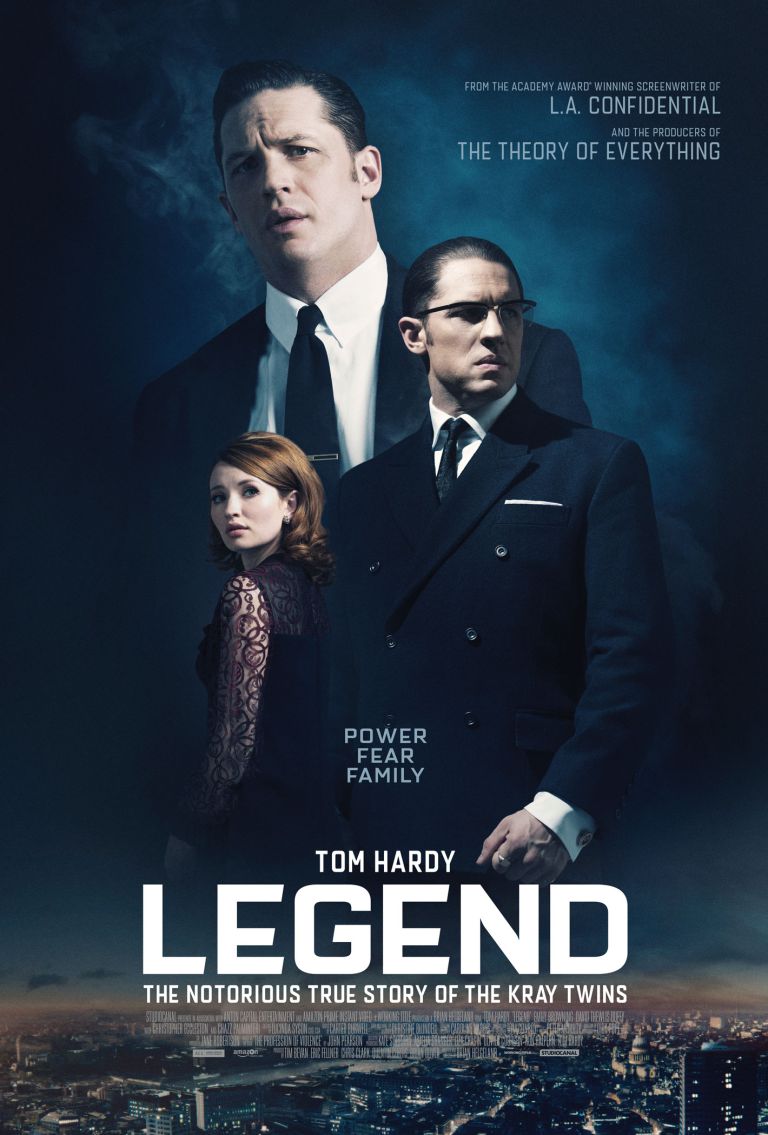
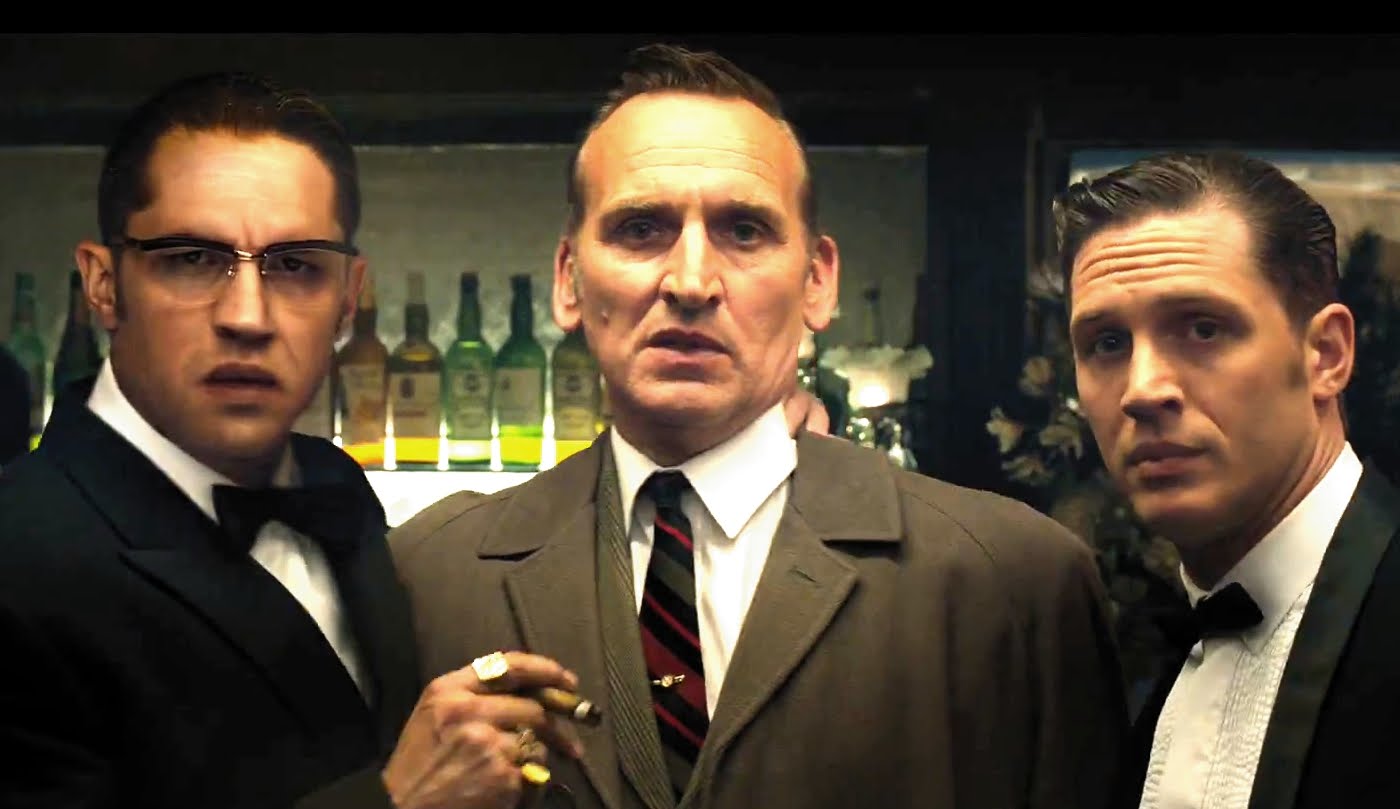
London, the 1960’s. The East End is home to two brothers, the confident, ambitious Reggie Kray (Hardy), and his psychotic twin Ronnie (Hardy). Together they run a criminal network based around providing protection to local businesses, while Reggie owns a club that attracts celebrities and politicians who like to mingle with London’s criminal element. The pair are well-liked in their local neighbourhood, and are both feared and respected. Reggie is continually followed by Detective Superintendent “Nipper” Read (Eccleston) who has been given the task of bringing the twins to justice. But they’re always one step ahead of him.

One morning, Reggie’s regular driver, Frankie Shea (Morgan) hasn’t shown up. Reggie goes to his house; the door is opened by Frankie’s sister, Frances (Browning). He’s immediately attracted to her and he asks her out. She agrees to go out with him, despite her mother’s misgivings, and despite Reggie’s reputation. Meanwhile, one of the Krays’ gang has been caught “working” on the south side of the river, an area run by the Richardson family. This infraction leads to a meeting between the Krays and the Richardsons on neutral ground, but the Richardsons send some of their men instead to get rid of Reggie and Ronnie once and for all. But the twins prove too much for the men, and are all viciously beaten up.

With no other serious rivals, the Krays’ criminal empire spreads further afield. With the aid and advice of their accountant, Leslie Payne (Thewlis) – whom Ronnie dislikes and is suspicious of – they take over a casino in an attempt to earn some legitimate money (while still maintaining their regular criminal activities). An old warrant sees Reggie spend six months in prison, during which time he and Frances grow closer, though she seeks reassurances that he’ll be more honest when he gets out. But it doesn’t happen, and even with her hopes dashed, Reggie and Frances get married. Ronnie is welcoming at first, but their marriage leads him to think that Reggie is trying to move on without him. At the same time, Read’s investigation is sidelined when he allows himself to be photographed with the Krays in their casino.

Frances finds herself isolated, and begins to rely more and more on medication to ease her growing sense of anguish. Reggie is oblivious, and has more urgent matters to attend to when Ronnie kills one of the Richardsons’ men, George Cornell (Attwooll) in a pub in front of witnesses. In order to protect his brother, Reggie must intimidate the witnesses, which he does, but when Ronnie hatches another plan to eliminate a perceived enemy, and hires Jack “The Hat” McVitie (Spruell) to do the job, it leads to the end of their criminal careers and the empire they’ve built up.

Legend - scene

Adapted from the book The Profession of Violence: The Rise and Fall of the Kray Twins by John Pearson (who was once an assistant to Ian Fleming), Legend is a curious movie in that it takes the two most notorious criminals known in Britain in the last sixty years, and tells their story in such a way that, on the whole, they don’t seem that bad. Sure they use intimidation and violence as a way of getting what they want from people, but we don’t see any of this, so the viewer has to take it for granted that they were as nasty as their “legend” would have it. Instead, writer/director Helgeland shows us the Kray twins as entrepreneurs, buying into legitimate businesses and making inroads into so-called polite society, including the patronage of Lord Boothby (Sessions), a predatory homosexual whose relationship with Ronnie leads to the Krays being acquitted at trial for fear of a government scandal. What’s given scant attention is their youth and how they got to where they were in the mid-Sixties, and how they actually attained the powerful position they enjoyed.

Then there’s the relationship between Reggie and Frances, which at first follows an almost predictable girl-meets-bad-boy scenario before settling down into something much darker and terrible. It’s hard to pick out just why Frances stays with Reggie for so long, because Helgeland doesn’t provide very many clues to help explain it all, and it’s equally unclear why Reggie wants Frances. It’s all very superficial, and though it’s based on real events etc., it doesn’t quite gel on screen, leaving the viewer with the feeling that whatever the truth about their marriage – and the movie makes some strong claims – there’s more to it than meets the eye (or is included in Helgeland’s script).

The same is true of the movie as a whole, with the sense that Helgeland’s adaptation isn’t concerned with providing any depth or subtext, leaving the poor viewer (again) suspecting that they just have to go along with everything and accept it all for what it is. It makes for a frustrating viewing experience as the characters – and there are a lot of them – all appear to lack an inner life (with the possible exception of Ronnie, whose inner life seems entirely weird and deranged). The movie also lacks a sense of time, its events and occurrences sometimes feeling like they’re happening in the absence of any  recognisable timescale, or have been cherry-picked from Pearson’s book at random (one example: Frances meets Reggie when she’s sixteen but doesn’t marry him until she’s twenty-two). And that’s without mentioning that as a retelling of the Krays’ activities and lives, it’s not very faithful or accurate.

The period of the Krays’ infamy is, however, extremely well-realised, with the East End of London looking as foreboding and shadowy as it did back in the Sixties, and with the period detail proving impressive. In terms of the time and the place, Tom Conroy’s incredibly detailed production design is enhanced by Dick Pope’s sharply focused cinematography, and further augmented by Carter Burwell’s appropriately Sixties-style score. The costumes are also a plus, with the fashions of the time recreated in fine style by Caroline Harris, an underrated costume designer who has provided equally fine work on movies as varied as An Ideal Husband (1999), A Knight’s Tale (2001), and And When Did You Last See Your Father? (2007).

Legend - scene2

As to the performances, it’s either a one-man or a two-man show, depending on how you look at it. Hardy is magnificent in roles that it would be difficult now to imagine any other actor attempting. As the charming, urbane-sounding Reggie, Hardy does more with a glance than some actors can manage with a long speech and an unwavering close up. He’s magnetic in most of his scenes, grabbing the attention as firmly as if he had the viewer in a headlock, and making it difficult to look away from him. And as Ronnie it’s like watching a human shark, his dark eyes staring out from behind the character’s glasses with vicious intent, just waiting for the chance to explode, and speaking with the delusional belief that his ideas are as sane as he thinks they sound (at one point he comes out with a plan to protect the homeless children of Nigeria). In both cases, Hardy is superb, even if he’s let down by the material, but he’s such a good actor that he overcomes Helgeland’s negligence and commands the audience’s attention throughout.

In support, Browning is captivating and sincere as Frances, and finds layers in the role that aren’t so evident from the script, while Thewlis gives one of his best recent performances as Payne, the accountant who earns Ronnie’s enmity. Anderson is quietly effective as Reggie’s right-hand man Alby, Fitzgerald is a scornful Mrs Shea (she wears black to her daughter’s wedding), Sessions is suitably slimy as Lord Boothby, and Palminteri, as the Mafia representative who wants the Krays to run London as part of a criminal franchise overseen by Meyer Lansky, exudes a rough Italian charm that hides a more dangerous persona. Alas, Eccleston is given little to do beyond looking exasperated, and Spruell’s McVitie is required to “grow a pair” just when the script needs him to; up ’til then he’s the very definition of compliant.

Ultimately, Helgeland the writer undermines Helgeland the director, focusing on Reggie to the detriment of Ronnie, and trying to make this about Reggie’s loyalty to his brother, rather than the exploits that made them infamous (which are almost incidental here). Some scenes lack the intensity they deserve, as if Helgeland didn’t have the nerve to show some things as they actually occurred (McVitie’s murder was much more vicious than what is shown in the movie), and though the emphasis is quite rightly on the Krays, more time with some of the other characters would have added some richness to the material and kept it from feeling (on occasion) somewhat uninspired. Perhaps there’s a longer cut waiting to be released on DVD/Blu ray, and it fills in a lot of the gaps, but at this length, Helgeland’s scattershot approach to the Krays’ lives is too much of a hindrance to make it anything more than just okay.

Rating: 6/10 – missing the vital spark that would have elevated it into the realm of the truly great gangster movies, Legend instead squanders its chance and remains a mostly pedestrian account of the lives of two men who meant to rule London’s criminal underworld with four iron fists; not as violent as you might expect, but with two standout performances from Hardy to help compensate, this is one “real life” movie that feels like it could have, and should have, been a whole lot better.

Share this:

  • Share on X (Opens in new window) X
  • Share on Facebook (Opens in new window) Facebook
  • More
  • Print (Opens in new window) Print
  • Email a link to a friend (Opens in new window) Email
Like Loading...

Everest (2015)

14 Monday Sep 2015

Posted by dullwood68 in Movies

≈ 1 Comment

Tags

Adventure Consultants, Baltasar Kormákur, Climbing, Drama, Emily Watson, Himalayas, Jason Clarke, John Hawkes, Josh Brolin, Keira Knightley, May 1996, Mountain Madness, Review, Rob Hall, Scott Fischer, Storm, True story

Everest

D: Baltasar Kormákur / 121m

Cast: Jason Clarke, Josh Brolin, John Hawkes, Emily Watson, Robin Wright, Keira Knightley, Jake Gyllenhaal, Sam Worthington, Michael Kelly, Martin Henderson, Thomas M. Wright, Ingvar Eggert Sigurðsson, Naoko Mori, Elizabeth Debicki

The brainchild of New Zealand mountaineer Rob Hall (Clarke), Adventure Consultants is a company that takes people to the summit of Mount Everest. In April 1996, Rob and his team, led by base camp manager Helen Wilton (Watson), plan to take eight clients to the summit. Among them are Texan climber Beck Weathers (Brolin) and Doug Hansen (Hawkes), a postman seeking to inspire the pupils at an elementary school where he lives, and Jon Krakauer (Kelly), a journalist from Outside magazine that Hall has persuaded to write an article about them in return for a gratis trip. When they arrive at base camp, Hall regales them with the necessary rules and warns them all of the dangers of ascending to a height where their bodies will literally begin to die.

The group make three acclimatisation climbs before starting off for the summit on the morning of May 10. They are joined by a group led by Scott Fischer (Gyllenhaal) of the rival company Mountain Madness. Together they aid each other in climbing the mountain, making it to each Camp in good time. The camaraderie between the climbers helps them to keep going the further up they climb, but after they leave Camp IV, they begin to encounter problems. Fischer becomes unwell and starts to struggle, while Weathers develops an eyesight problem that causes him to remain on the side of the mountain until the other climbers come back down. As they near the summit, they reach the Balcony and find there are no fixed ropes; and again when they reach the Hillary Step. With time being eaten away by these delays the strain of the climb begins to tell on more and more of the climbers, including Hansen who lags behind everyone else.

The two groups persevere though and the first person to reach the summit – from Fischer’s group – gets there around 1pm. With everyone needing to start back down by 2pm in order to make it back to Camp IV, Hall finds himself ignoring his own rules and helping Hansen reach the summit. Now over an hour late in leaving, and with Hansen getting weaker and weaker due to a lack of oxygen, Hall is faced with an even worse problem: a terrible storm rushing in from the southwest. With the blizzard making the effort to descend even harder, Hall and Hansen make it back to the Hillary Step, while Fischer’s group and the rest of Hall’s group find themselves battling the blizzard and struggling to stay alive. With no help available from the base camp, all anyone can do is hope that the storm abates soon, and gives them all a chance to get back down.

Everest - scene

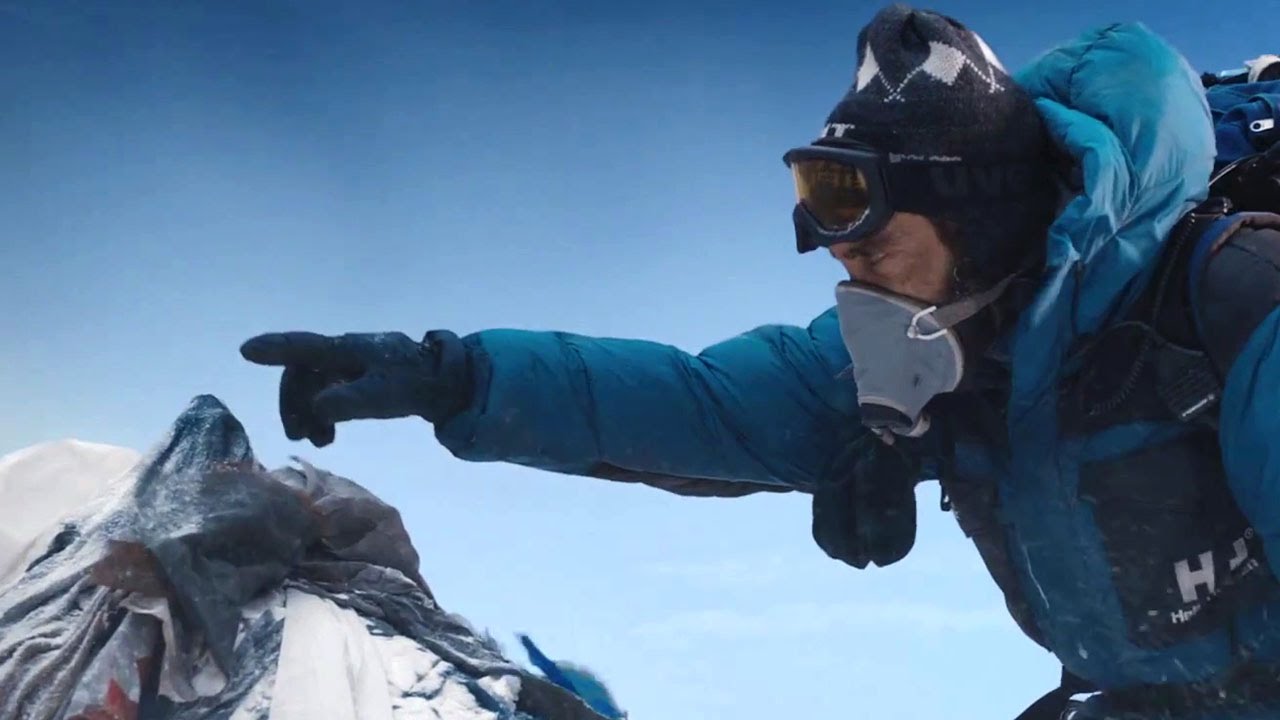
Based on a true story, and with a script by William Nicholson and Simon Beaufoy that’s been collated from various sources, Everest is a disaster movie that highlights the natural beauty of the Himalayas, and the ever-present danger that lies hidden and waiting for the unwary (or even the experienced). It’s an intelligent, cleverly constructed and judiciously maintained tale of unexpected tragedy that is also unexpectedly moving. And thanks to the decision to film as much of the movie on location as possible, it allows the viewer to become embroiled in the effort to reach the summit and then to stay alive against the odds.

Much will be made of Everest‘s stunning vistas and gasp-inducing scenery, and while this is entirely appropriate, they’re still the backdrop for a tragic endeavour that was doomed from the moment that the groups found that there were no fixed ropes in two sections where they were needed. With the climb having gone so well up til then, this presentiment of doom adds a chill to events that augments the sub-zero temperatures, and makes the rest of the movie dreadful and fascinating to watch at the same time.

As the resulting tragedy unfolds, it becomes an agonising experience as the various climbers we’ve come to know and empathise with, face terrible hardships brought on by the brutal weather, and find the limits of their endurance pushed beyond measure. The inclusion of Hall’s partner, Jan (Knightley), and Beck’s wife, Peach (Wright), both removed from the action but still linked to their men by tremendous love and commitment, allows the movie to show how the events on Everest had a wider consequence. Jan is pregnant with hers and Rob’s first child, while Peach moves heaven and earth to ensure her husband has a chance of returning home. Their fears and concerns add an extra layer of tragic drama to proceedings, and in the capable hands of Knightley and Wright, both women show fear, strength, determination and sadness with admirable clarity. And they’re matched by Watson, who puts in yet another faultless performance.

Amongst the men, Clarke plays Hall as an altruistic, methodical leader whose love of climbing defines him the most. When Hall decides to help Hansen reach the summit, his thoughts are writ clearly on his face: it’s the wrong decision, and Clarke shows Hall’s understanding of this with such resignation that it heightens the impending tragedy, and makes their twin fates all the more affecting. Hawkes gives another low-key yet determined performance as the most unlikely climber in the group, while Brolin’s cocky, bullish attitude soon reveals a deeper layer of insecurity that Weathers would rather keep hidden. Gyllenhaal and Worthington have minor roles in comparison and we don’t get to know their characters as well, but with so many to keep track of, it would be unfair for the script to try and focus on too many at one time.

Making his most complete and effective movie to date, Kormákur ratchets up the tension as the storm hits and survival becomes everything. But he never loses sight of the human will to overcome and conquer adversity, and as the treacherous descent is begun, most viewers are likely to have at least one character they’ll want to see reach Camp IV. Whether they do or not is another matter, and it would be fair to say that billing is no guarantee of survival, but again Kormákur keeps the viewer on the edge of their seat as to just who will make it and who won’t, and each death carries with it its own devastating emotional “punch”.

The production is handsomely mounted and is supported by Salvatore Totino’s superb photography, Dario Marianelli’s subtle, non-intrusive score, and Mick Audsley’s fine-tuned editing. With only a few dodgy green screen shots to break the illusion, and some confusion as to what’s happening to whom once the blizzard hits, Everest remains a compelling, gripping account of an unfortunate, avoidable tragedy.

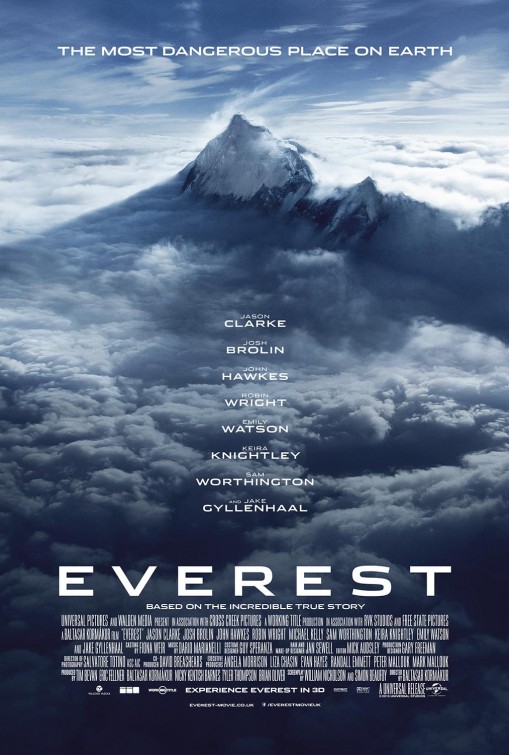
Rating: 8/10 – whatever your views on the mistakes made on May 10 1996, there’s no doubting the courage shown by all those on the mountain that day, and Everest is a tribute to all those who perished, and the survivors as well; with an emotional core that steals up on the viewer, it’s a movie that reaffirms the risks of climbing “the most dangerous place on Earth”, and the sense of profound achievement that it provides.

Share this:

  • Share on X (Opens in new window) X
  • Share on Facebook (Opens in new window) Facebook
  • More
  • Print (Opens in new window) Print
  • Email a link to a friend (Opens in new window) Email
Like Loading...

True Story (2015)

05 Saturday Sep 2015

Posted by dullwood68 in Movies

≈ Leave a comment

Tags

Christian Longo, Drama, Felicity Jones, James Franco, Jonah Hill, Literary adaptation, Mike Finkel, Murder, New York Times, Review, Rupert Goold, Trial, True story

True Story

D: Rupert Goold / 99m

Cast: Jonah Hill, James Franco, Felicity Jones, Robert John Burke, Ethan Suplee, Gretchen Mol, Maria Dizzia, Byron Jennings

A journalist with the New York Times, Mike Finkel (Hill) hands in an assignment that looks at the African slave trade. It becomes the cover story for the New York Times Magazine, but later it’s discovered that Finkel hasn’t been entirely honest about his research and has created a composite character for the story’s focus. Finkel is subsequently fired and returns to his home in Montana where he lives with his wife Jill (Jones). At around the same time, the discovered bodies of a woman and her three children has led authorities to Mexico where they arrest a man who claims to be Mike Finkel. His real name, though, is Christian Longo (Franco), and he’s accused of having killed his family.

When Finkel becomes aware that Longo claimed to be him, he becomes intrigued. He begins to look into the case, and travels to see Longo in prison. At their first meeting, Longo tells Finkel he’s admired his writing for a long time. They also strike a bargain: in return for Longo’s story, Finkel will teach him to write and he won’t discuss what they talk about until after Longo’s trial. Soon after, Finkel receives a lengthy letter in which Longo describes the events that led up to his wife and children’s murders – but it stops short of going further.

Over the next few months as the two men continue to meet, Longo intimates that he didn’t kill his family, and Finkel begins to believe he may be innocent, even though Longo avoids giving any definitive statement on the matter, and refers to a mysterious “someone” he needs to protect. He tells Finkel he’ll plead Not Guilty at his arraignment, and the journalist begins to believe that there must be another answer to the question of who murdered Longo’s wife and children. But at the arraignment, Longo pleads Not Guilty to the murders of two of his children, and Guilty to the murder of his wife and other child. Feeling betrayed, Finkel confronts him, but Longo hides behind the idea that he’s protecting someone.

As the trial approaches, Finkel – who has been busy turning his and Longo’s correspondence into a book – now begins to doubt the veracity of Longo’s claims, but though he’s approached by one of the detectives who arrested Longo, Greg Ganley (Burke) and asked to provide evidence for the prosecution, he refuses. The trial takes place and the prosecution puts forward a convincing case for Longo’s guilt. But then the defence begins its case, and Longo is called to the stand…

True Story - scene

At one point in True Story, Christian Longo tells Mike Finkel that “sometimes the truth isn’t believable. But that doesn’t mean that it’s not true.” It’s a fine idea, and the movie trades on Longo’s assertion for most of its running time, leading the audience down various dead ends and blind alleys in an attempt to keep the mystery of what really happened to Longo’s family from being revealed too soon. There’s always a degree of fun to be had from a character who is deliberately elliptical, or who hides behind a wall of half-clues and misdirection, but while Franco’s cold-eyed, hooded expressions suit the character’s manipulative nature, the movie isn’t so convincing that anyone would think Finkel could be easily duped. In fact, the way in which their scenes are set up and choreographed, it should have been obvious that Longo was trying to influence Finkel’s thinking, and by doing so, gain an acquittal at his trial.

But as many people say, hindsight is a wonderful thing, but it is something that the movie can’t quite avoid dealing with. As a fairly straightforward retelling of a relationship between two narcissistic, prideful individuals, the movie wisely avoids coming down on the side of one character over the other, but at the same time, Finkel’s credulity is incredibly worrying; he is a seasoned journalist after all, even if he has made an almighty, career-shredding error of judgment. Hill plays him as a kind of eager puppy dog, wanting to be liked and willing to believe in anything that will help him get back on top. He also shows the desperation Finkel feels when the book deal is jeopardised, or when he begins to suspect that Longo is probably guilty – he needs Longo to be innocent so that he won’t look like he’s been fooled.

As the potential murderer of his entire family, Franco keeps Longo self-contained and aloof, meeting Finkel partway but never revealing anything of real substance. He uses a blank expression to convey all the audience needs to know about him, and acts with his eyes for the most part, conveying hurt and innocence and sadness, but failing to show any regret for his family’s demise, or anger at being arrested. (Again, it’s worrying that Finkel never picked up on any of this.) Both actors play well against each other, with Hill slightly edging it by virtue of his being more emotive. As Jill, Jones – in a somewhat underwritten role – is given a remarkable scene in which she’s able to confront Longo and show her contempt for him, but it smacks too much of writer’s licence, and as a result, interrupts the movie’s flow. Elsewhere she’s required to look concerned and irritable by turns, and her participation becomes yet another example of a very talented actress being shamefully underused.

Making his feature debut, Goold steps up from directing British TV dramas to make a solid, if restrained movie that tries its best to examine issues of trust and falsehood, as well as public perception, but ultimately it shies away from looking at them in any depth. Goold is better with his cast, even when his screenplay – co-written with David Kajganich – has them repeating conversations and scenes, and emphasising over and over the “mystery” that Longo implies has happened. There’s also an attempt at some basic psychology that doesn’t come off too well, and it’s a humourless piece for the most part, with only a few ironic statements to leaven the drama.

Rating: 7/10 – absorbing for the most part, True Story tries to be direct and complex at the same time, but the two approaches don’t mix, leaving the audience with a story that leaks vitality and energy as it progresses; Hill and Franco are good value, and Longo’s testimony is a highlight, but there are too many questions left unanswered for it to be entirely successful.

Share this:

  • Share on X (Opens in new window) X
  • Share on Facebook (Opens in new window) Facebook
  • More
  • Print (Opens in new window) Print
  • Email a link to a friend (Opens in new window) Email
Like Loading...

For One Week Only: Australian Cinema – Part IV

23 Sunday Aug 2015

Posted by dullwood68 in Movies

≈ Leave a comment

Tags

"Crocodile" Dundee, Aborigines, Australian cinema, Australian New Wave, Fred Schepisi, Jimmy Governor, John Gorton, Literary adaptation, Outback gothic, Ozploitation, The Chant of Jimmie Blacksmith, Tommy Lewis, True story

Australian Cinema Part IV – 1971-1990

With Australian cinema firmly in the doldrums, it took John Gorton, the Prime Minister from 1968-1971 to come to its rescue. He implemented a raft of government sponsored schemes designed to support cinema and the arts, and this was continued by his successor, Gough Whitlam. With funding and training now widely available, Australian movies began to appear in ever greater numbers, and two distinct forms of movie making emerged in the Seventies, the Australian New Wave and Ozploitation.

The New Wave (also known as the Australian Film Revival, Australian Film Renaissance, or New Australian Cinema) introduced a more direct, volatile approach to movie making, with themes of violence and sexuality brought more to the fore than they had previously. New Wave directors often made movies that were tough and uncompromising, with the Australian landscape featuring as an integral part of contemporary features. The era saw the start of several impressive careers, both behind the camera – directors Peter Weir, Bruce Beresford, George Miller, John Duigan, and DoP John Seale – and in front of it – Judy Davis, Jack Thompson, Bryan Brown, Sam Neill, Nicole Kidman.

Australian movies began to be regarded highly abroad as well as at home. Walkabout (1971) premiered at the Cannes Film Festival. The Adventures of Barry McKenzie (1972) was the first movie to achieve over A$1,000,000 at the Australian box office. Production was booming suddenly, and some movies proved bulletproof; such was the scarcity of homegrown content in the Sixties that this resurgence also brought back audiences in droves. The New Wave revitalised and democratised the industry, leading to startling, indisputably Australian movies being made such as The Cars That Ate Paris (1974) and Sunday Too Far Away (1975). The so-called Ozploitation movement also saw highly individual movies being released, movies such as Alvin Purple (1973) and Inn of the Damned (1975). And there was a further sub-genre of Australian movies dubbed “outback gothic”, where survival in harsh situations or locations were a vital element of the plot or story. And Australia’s first animated movie was released: Marco Polo Jr. Versus the Red Dragon (1972). It seemed at last that there was something for everyone, both at home and abroad.

Australian movie makers also began looking to their own history and began to make forays into the darker moments of its colonial past. Though it wasn’t based on a true story (though it certainly felt like it), Picnic at Hanging Rock (1975) explored class and social distinctions of the era it depicted through the prism of a girls’ school. Eliza Fraser (1976), though ostensibly a bawdy romp, still had some pertinent things to say about early colonialism and the hardships involved. But one of the most powerful movies to be made during the Seventies, and one that explored themes of Aboriginal exploitation, was the industry’s first determined effort to fully address the issue of the country’s indigenous racism.

The Chant of Jimmie Blacksmith Quad

The Chant of Jimmie Blacksmith (1978) / D: Fred Schepisi / 120m

Cast: Tommy Lewis, Freddy Reynolds, Ray Barrett, Jack Thompson, Angela Punch McGregor, Steve Dodd, Peter Carroll, Ruth Cracknell, Don Crosby, Tim Robertson, Elizabeth Alexander, Peter Sumner

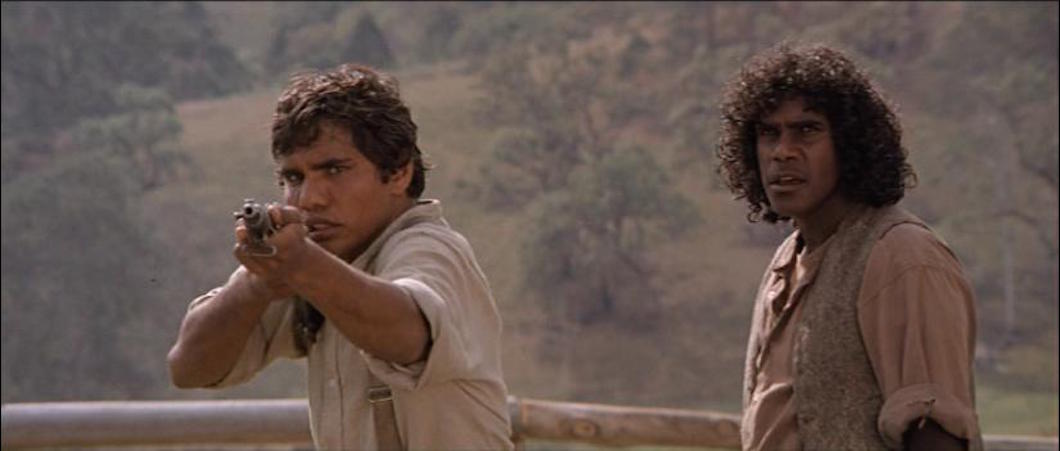
Half-white, half-Australian Jimmie Blacksmith (Lewis) is raised by a benevolent minister, Reverend Neville (Thompson) and his wife. Neville’s belief is that he can foster positive social ambitions in Jimmie by teaching him Christian values and by providing him with an entry into the wider, white society. Jimmie is a hard worker, conscientious and respectful, but this is due to his upbringing with the Nevilles. At the first job he takes on, building fences on a farm, the owner fails to pay Jimmie and his Aboriginal half-brother Mort (Reynolds) the agreed wage, and when Jimmie challenges this he’s then sacked. The same happens to him at the next farm he works at. By this point, Jimmie is beginning to understand that not all whites are like the Nevilles.

Jimmie finds work as a policeman. He accepts the role of law enforcer with equanimity, and has no trouble administering the law when it comes to Aboriginals. But matters change when he witnesses a flagrant abuse of the law he believes in, an abuse that shows him there will always be one rule for whites and no rules for others. Appalled, he leaves the police force and eventually finds work on a sheep ranch owned by a Mr Newby (Crosby). Here he sends for Gilda (McGregor), a woman he met at one of the farms and who has agreed to marry him. When she arrives she is heavily pregnant, but when the baby is born it’s obvious that Jimmie isn’t the father. Newby’s family are less than sympathetic, and take every opportunity to make snide remarks about “his child”. Jimmie makes the best of it, but when a well-meaning acquaintance of the Newby’s suggests that Gilda should take her baby and leave Jimmie, and he’s let go without any pay, the steady tide of oppression that he’s encountered since leaving the Nevilles leads to a shocking, violent outburst that leaves Jimmie, Mort, his uncle Tabidgi (Dodd), and Gilda on the run from the police.

Chant of Jimmie Blacksmith, The - scene

Adapted from the novel by Thomas Keneally, itself based on the true story of Jimmy Governor, The Chant of Jimmie Blacksmith is like an unexpected slap across the face, a shocking moment that is made all the worse by the surprise factor. The same can be said about the movie, one that the viewer goes into thinking they know what to expect, but then finds themselves reeling from the ferocity of emotion, violent or otherwise, that they experience. It’s an impressive, extraordinary movie that can still do that nearly forty years after it was first released, and a testament to the vision of Schepisi, and the lead performance of Lewis.

Watching the movie today its bleak and uncompromising nature really is that startling for modern viewers unused to having outrage displayed in such frank and brutal terms, from the casual verbal racism of the whites to the inverse scorn of the Aborigines who feel Jimmie is losing his heritage by associating too closely with whites. In a brave but necessary move, writer/director Schepisi paints a portrait of a time and a society where sympathy and consideration for Australia’s indigenous people was considered anathema, but offers no judgement on either sides feelings or beliefs. With Jimmie’s increasing disillusionment and anger at the attitude of his white employers and the larger, endemic disdain for his race, Schepisi’s uncompromising treatment of the material leaves the audience facing a dilemma: are Jimmie’s actions defensible given his treatment by the whites, or are they too extreme for extenuating circumstances to be taken into consideration or provide mitigation? Whatever your opinion, Schepisi doesn’t make it easy, and nor should he.

It’s refreshing too that the movie doesn’t try to be relevant to the Seventies, or invite the viewer to search for a subtext. This is entirely about the times, and the hardship of life in Australia in the early twentieth century if you weren’t white: it doesn’t need to be about anything else. And Jimmie, as a character, is refreshingly free from the type of psychological interpretation that would no doubt be employed if the movie were to be made today. Lewis is completely convincing in the title role, Jimmie’s sense of belonging to two cultures but without knowing which he should commit to, rendered with such detail and commitment that it’s hard to believe that Lewis had never acted before. It’s an amazing achievement, and with Schepisi, he reinforces the idea that Jimmie can be sympathised with or detested in equal measure.

With the movie proving so intense, it definitely can’t be regarded as entertainment, but it is thought-provoking, consistently tough-minded and hard-hearted, and avoids any undue sentimentality, settling for a discomforting nihilism that suits the mood of the times, and underpins Jimmie’s struggle to fit in. Schepisi left Australia for Hollywood after this, citing the struggles he had to endure to get the movie made, but he’s yet to make another movie on a par with this one. Lewis continued to make movies, but he never played a lead role again. Perhaps it’s fitting for both men as it’s hard to see how either could top The Chant of Jimmie Blacksmith for sheer gritty realism and power.

The movie also benefits from measured performances from Thompson, Barrett and McGregor, while there are minor roles for Bryan Brown, John Jarratt, and Arthur Dignam, and surprisingly, Lauren Hutton. It’s shot in a dour, unflattering way by Ian Baker that enhances and embraces the material, but still leaves room to showcase Australia’s natural beauty. And the score by Bruce Smeaton is similarly enriching, adding an emotive layer to the proceedings that complements the bleak narrative.

Rating: 9/10 – desolate and austere in its approach but all the more potent for it, The Chant of Jimmie Blacksmith is the kind of tough, relentlessly savage movie that is rarely this confident or emotionally draining; all credit to Schepisi for refusing to water down the febrile nature of the story, or the tragic consequences that arise from one man’s refusal to be treated so arrogantly.


The late Seventies and early Eighties saw a rise in the number of movies that looked at classical stories from Australian literature and history, movies such as My Brilliant Career (1979) and Breaker Morant (1980). International acclaim had been building steadily across the Seventies, with Peter Finch becoming the first Australian actor to win an Oscar (albeit posthumously) for Network (1976), and the Eighties saw Australian movies consolidate and expand on that success. The focus was more on dramatic stories rather than comedies, and several prestige movies garnered awards from around the world. At home, The Man from Snowy River (1982) proved to be such a well-received movie that it was regarded as the best Australian movie of all time (though not for long).

In 1986, a movie arrived that was a comedy, that had been cleverly constructed for international audiences, contained adventure and romance, told a delightful fish out of water story, and made an international star out of its creator, Paul Hogan. The movie was “Crocodile” Dundee, and when it was released in the US (in September ’86), it achieved the distinction of being the second highest grossing movie of the year (losing out to Top Gun). At the time, Hogan stated that he was “planning for it to be Australia’s first proper movie… a real, general public, successful, entertaining movie”. Some may have felt that Hogan was being unfair, but the movie’s success did lead to a sea change in the way that Australian movie makers approached those stories that were essentially Australian in terms of subject matter and cultural reference. As the Eighties drew to a close, and with the industry still enjoying its renaissance, “Crocodile” Dundee‘s example would lead to an even richer period of Australian movie making, and an even stronger presence abroad.

Share this:

  • Share on X (Opens in new window) X
  • Share on Facebook (Opens in new window) Facebook
  • More
  • Print (Opens in new window) Print
  • Email a link to a friend (Opens in new window) Email
Like Loading...

For One Week Only: Australian Cinema – Part III

21 Friday Aug 2015

Posted by dullwood68 in Movies

≈ Leave a comment

Tags

1941-1970, Australian cinema, Australian Film Awards, Australian Film Institute, Cattle drove, Charles Chauvel, Chips Rafferty, Cinesound Productions, Daphne Campbell, Ealing, Jedda, Kokoda Front Line!, Michael Powell, Northern Territory, The Overlanders, They're a Weird Mob, True story, World War II

Australian Cinema Part III – 1941-1970

With Australia’s entry into the Second World War in 1939, movie production dwindled in support of the war effort. Movies continued to be made but they were few and far between, and were dependent on their producers’ confidence in claiming enough of the domestic and international markets to be worthwhile in making. Cinesound Productions, though they’d stopped making feature length movies, were still making newsreels, and in 1942 they won the Oscar for Best Documentary for their full-length edition of the Cinesound Review entitled Kokoda Front Line! Other, fictional, propaganda movies were made (in keeping with similar efforts made in other countries at war); these included Forty Thousand Horsemen (1940), and The Rats of Tobruk (1944). (Both movies were directed by Charles Chauvel, and ever since 1992, the Brisbane International Film Festival has awarded a Chauvel Award for distinguished contributions to Australian cinema.) But once the war was over, any expected upturn in production failed to materialise, as can be seen by the release of just one movie in 1948, Always Another Dawn.

The Forties did see the emergence of homegrown stars who would go on to have international careers, actors such as Peter Finch (actually born in England) and Chips Rafferty. Rafferty was the star of one of Australia’s finest movies of the Forties, a saga of drovers transporting a large herd of cattle across 1600 miles of inhospitable outback. Produced by Ealing, it was very, very successful at the box office, with an estimated 350,000 Australians having seen it by February 1947, six months after its release.
Overlanders, The

The Overlanders (1946) / D: Harry Watt / 91m

Cast: Chips Rafferty, John Nugent Hayward, Daphne Campbell, Jean Blue, Helen Grieve, John Fernside, Peter Pagan, Frank Ransome, Stan Tolhurst, Clyde Combo, Henry Murdoch

1942. With the threat of invasion by Japanese forces, many Australians feel it’s only a matter of time before they’re overrun. People in the north of the country begin evacuating their homes to head south and burning them in a kind of “scorched earth” policy. One such family are the Parsons: Bill (Hayward), his wife (Blue), and their two daughters, Mary (Campbell) and Helen (Grieve).

Meanwhile, in the Kimberley District of Western Australia, a meat export centre has been directed to pack up its operation and for its men to head south. When the manager (Tolhurst) tells cattle man Dan McAlpine (Rafferty) that the cattle will need to be shot, Dan comes up with an alternative: to drive the cattle – all 958 of them – overland to Queensland, a distance of 1500 miles. He manages to enlist some of his co-workers to help him, including a sailor, Sinbad (Pagan) a couple of aborigines, Jacky (Combo) and Nipper (Murdoch), and generally work-shy Corky (Fernside). As they make plans to set out, the Parsons’ join them.

At first, the drove is slow going. A couple of months pass of fairly easy travel before they reach the North-South Road, but a week later they encounter the first obstacle to reaching the East Coast, a crocodile-infested river that they need to cross. The crossing goes well with no loss of cattle, but on the other side the drove finds its second obstacle, scrubland that gives the cattle little to feed on; this also slows them down to making only five miles a day instead of an average ten or twelve. A little while later, a tragedy leaves them short of horses, but salvation proves to be at hand (and close by) in the form of a group of brumbies (wild horses). They trap and break enough of them to allow the drove to continue on, and soon they arrive at an outpost, Anthony’s Lagoon where they get fresh supplies.

The next leg of the drove proves even harder, with no surface water or much feed for the cattle, but all goes well though tempers are frayed due to the conditions. When they reach the Queensland border they have to stop so that the cattle can be inoculated. While this is done, Corky reveals his plans following the war to set up a company for the exploitation of land and mineral rights in the Northern Territory, a plan Dan is none too happy to hear about. That same night, Sinbad and Mary reveal their feelings for each other, and the cattle are spooked, causing a stampede. In the attempt to halt them, Sinbad is badly injured; Mary tries to alert the inoculation team who are leaving on the plane that brought them there, but they take off before she can reach them.

With no other option open to them, Sinbad is put on the back of the supply wagon and Mrs Parsons and Helen leave the drove to take him to the nearest place with a wireless that can summon the flying doctor. The drove then faces another setback at the next watering hole which is dry. Needing to water the cattle in the next two days or face losing them all, Dan must take a risk in taking them over a range of rocky hills along a track more suited for goats than cattle.
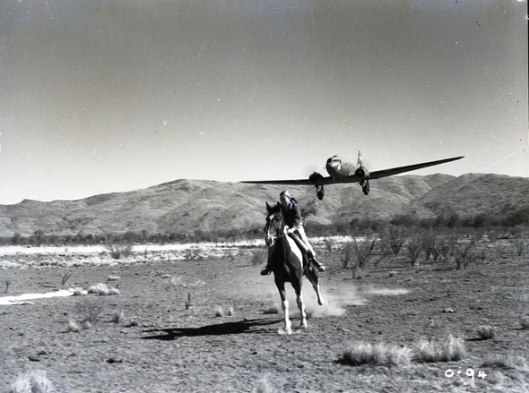
Overlanders, The - scene

Though shot in black and white, The Overlanders was the first Australian movie to be filmed almost entirely outdoors. This allowed the makers to shoot some of the most rugged and breathtaking scenery in the country’s northern states, as well as providing audiences with a realistic look at a cattle drove and the problems it might face. It was based on an actual event that occurred in 1942 where 100,000 cattle were driven 2,000 miles to avoid the (expected) Japanese invasion. Although the movie had to scale back those numbers out of necessity – though 958 is quoted as the number of cattle on the drove, Ealing only used 500 – it’s still an impressive looking sight, especially when the drove is seen from a distance.

The sheer physical effort involved in bringing the movie to the screen is impressive, with the river crossing a particular highlight. The cast look the part too (though Pagan’s hairstyle marks him out as the matinee idol in the making), with Rafferty looking so at home in the saddle, and giving such a natural performance it’s no surprise that Ealing signed him to a long-term contract before the movie was even released. He’s possibly the quintessential pre-1970’s Australian actor, honest, as rugged as the country around him, and refreshingly no-nonsense in his approach to the art of acting. He’s an actor for whom a false note would be impossible, and here his condemnation of the plan to exploit the Northern Territory’s resources shows an impassioned side that is as plainly felt as it is expressed.

With the movie’s verisimilitude firmly in place and the location photography adding to the effectiveness of the overall drama, writer/director Watt’s decision to spend around eighteen months preparing the movie paid off handsomely (he even spent 1944 following the route of the original drove). His script is one of the most succinct and straightforward of the period, and is so lean it feels effortless in its construction. His original ending was more cynical than the one used but it wouldn’t have felt out of place; underneath all the belated pro-Australian war effort propaganda, there’s an undeniable sense that the country was on the cusp of some profound and far-reaching changes.

The movie does start out a little slowly, but sets out its stall with a minimum of fuss, and while the first hour sees everything go well, the inevitable setbacks and life-threatening situations make the movie more gripping, although in a matter-of-fact way that, weirdly, is entirely apposite. It speaks to the Aussie mentality of “let’s just get it done”, and shows the characters almost welcoming the adversity as a way of proving either their manhood (if male) or their unspoken capability (if female). Mary is congratulated on heading off the stampede, but she shrugs it off as no more appropriate than if she’d made dinner for everyone, so confident is she in her own abilities. It’s a small, neat touch that says everything you need to know about the characters’ inner strengths, and not just Mary’s, as they’re all so attuned to what they’re doing (and even if Corky is looking much further ahead than the others).

There’s a rousing score by English composer John Ireland that manages to be evocative at the same time, and the photography, so ravishing to look at, comes courtesy of Osmond Borradaile, a Canadian whose experience in shooting location footage more than justified Watt’s decision to hire him. And though Watt was unhappy with the way Inman Hunter edited the movie and brought in Leslie Norman to take over, whatever the final percentage of each man’s work, the movie is seamless and the decision doesn’t show in the finished product. And you have to admire a movie that includes the line, “bullocks are more important than bullets”.

Rating: 9/10 – an engrossing, simply told tale that highlights the strengths of the Australian movie industry at the time, The Overlanders is a tribute to both the men and women who lived through the threat of Japanese occupation and did their best to live outside the shadow of that dreadful possibility; with the Australian outback looking both daunting and alluring, it’s a movie that celebrates the country and its people’s apparently unflagging fortitude, and does so in such a skilful way that it stays in the memory long after it’s seen.
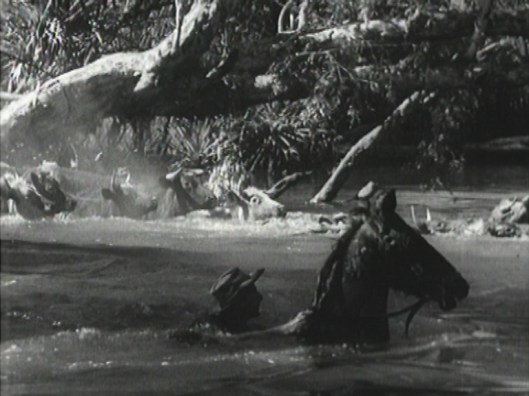
Overlanders, The - scene 2

In the Fifties, Australia became the place to make movies if you were a foreign production company (such as Ealing). But there was a degree of irony attached to this development, as movie makers from around the world came to Australia to make movies that depicted Australian life and culture, or were adaptations of Australian stories or literature. Chief amongst these were the likes of A Town Like Alice (1956) and The Shiralee (1957), but while they were made in Australia, they weren’t Australian movies; they were made by British or American companies and so were British or American movies. One movie made in the Fifties that was wholeheartedly Australian, funding and all, was Jedda (1955), notable for being the first Australian movie shot in colour, and for its casting of two Aboriginal actors – Ngarla Kunoth and Robert Tudawali – in the lead roles (it was also the last movie to be directed by Charles Chauvel).

Elsewhere though, indigenous movie making was struggling to make any kind of an impact. Robbery Under Arms (1957) was an exception, but otherwise there were few production companies that were willing or able to make movies that would have bolstered the industry’s standing, or made any headway at the box office. In 1958, the Australian Film Institute was founded, its mission to promote the industry both at home and abroad. The Institute also set up the annual AFI Awards which were designed in part to “improve the impoverished state of Australian cinema”. That first year there were seven categories: Documentary, Educational, Advertising, Experimental Film, Public Relations, and an Open category for any movie that didn’t fit any of the other criteria. Such was the parlous state of the industry at the time – and on into the Sixties – that it wasn’t until 1969 and Jack and Jill: A Postscript that a feature movie was given an award.

The Sixties began with a rare fillip for the industry in the form of Fred Zinnemann’s The Sundowners (1960), but it was a US/UK/Australian production, and without Zinnemann’s passion for the project, unlikely to have been made under other circumstances. The situation worsened as the decade continued. Clay (1965) was entered for the Palm Award at the Cannes Film Festival, but again this was a rare event that provided a momentary boost for an otherwise moribund industry. Even They’re a Weird Mob (1966), directed by Michael Powell, and featuring familiar faces such as Chips Rafferty, Ed Devereaux, John Meillon and Clare Dunne, couldn’t do much to stem the tide of inertia (though some say it was an inspiration to the generation of movie makers who would follow in the Seventies). (Look closely and you can see Jeanie Drynan and Jacki Weaver in early roles.)

Powell would return to Australia to make Age of Consent (1969) but as the decade drew to an end there was no sign that the movie industry was going anywhere but as steadily downhill as it had been since the late Forties.

Share this:

  • Share on X (Opens in new window) X
  • Share on Facebook (Opens in new window) Facebook
  • More
  • Print (Opens in new window) Print
  • Email a link to a friend (Opens in new window) Email
Like Loading...

Danny Collins (2015)

15 Saturday Aug 2015

Posted by dullwood68 in Movies

≈ Leave a comment

Tags

Al Pacino, Annette Bening, Baby Doll, Bobby Cannavale, Chime magazine, Christopher Plummer, Comedy, Dan Fogelman, Drama, Jennifer Garner, John Lennon, Letter, Review, Romance, Singer, Steve Tilston, True story

Danny Collins

D: Dan Fogelman / 106m

Cast: Al Pacino, Annette Bening, Jennifer Garner, Bobby Cannavale, Christopher Plummer, Katarina Cas, Giselle Eisenberg, Melissa Benoist, Josh Peck, Nick Offerman

In 1971, young folk singer Danny Collins is on the verge of stardom. His first album, featuring songs he’s written himself, is about to be released, and he’s about to give an interview for Chime magazine that will attract the attention of one of rock music’s most well-known performers (and one of Danny’s idols).

Fast forward to 2014 and Danny is touring in support of his third greatest hits album. He no longer sings his own material, and hasn’t written a song since he made his first album. His signature song is a track called Baby Doll, and his fans want him to sing it before anything else. With his audience aging as much as he is, Danny relies heavily on cocaine and booze to get him through his day, and he has a young girlfriend, Sophie (Cas), he’s thinking of making his fourth wife. When his birthday comes round, his manager and long-time friend Frank Grubman (Plummer) hands him a special present: a letter written to him by John Lennon in response to the Chime interview. In it, Lennon offers the young Danny help in avoiding the pitfalls of being famous in the music business, and even includes his phone number.

Danny is shell-shocked by the idea that Lennon could have changed the course of his career. Feeling that he’s wasted the last forty-plus years, he decides it’s time to make some changes. He catches Sophie with another, younger man, but isn’t angry; instead he tells her he’s going away for a while and to enjoy their home for a little longer (though he makes it clear their relationship is over). He travels to New Jersey and stays at a Hilton hotel with the intention of going to see his son who lives nearby but with whom he’s had no contact. He also begins writing a new song, while attempting to woo the hotel manager, Mary Sinclair (Bening). And when Frank comes to visit him, Danny tells him he doesn’t want to continue with the tour either.

Danny visits his son’s home, and meets his daughter-in-law Samantha (Garner) and his granddaughter Hope (Eisenberg). When his son Tom (Cannavale) arrives home he makes it clear he doesn’t want anything to do with Danny. But Danny perseveres, both with his new song, wooing Mary, and by arranging for Tom and Samantha to have an interview for a special school that will deal with Hope’s ADHD. As he begins to make headway with his new life, Danny learns that he’s not as financially secure as he thought, and going back on tour is his best option. But then Mary challenges him to play his new song at his next gig…

Danny Collins - scene

The idea of Al Pacino playing an aging singer trying to reconnect with his lost youth and aspirations seems like the perfect excuse for a stark, emotionally compelling drama, but writer/director Dan Fogelman has other ideas. Instead of dark and challenging, he’s gone for wistful and comic, with a side order of restrained sentimentality. Add in slices of romance, personal regret, misdirected anger, and selflessness, and you have a comedy that pokes fun at Danny’s lifestyle and sense of himself – “No, I’m sharp!” – but does so without laughing at him.

When we first meet him in 1971, Danny is anxious, mildly confident, but absolutely terrified of the thought he might be famous. When we see him again he’s a tired, unhappy man going through the motions of being famous, and his terror has given way to a weary resignation; this is his life, for better or worse. When he’s given the letter by Lennon, it opens his eyes both to the life he’s living, and the life he could have had. Pacino effortlessly portrays the sad realisation that Danny has in that moment, and the viewer can feel the sense of self-betrayal coast off of him in waves. It’s the movie’s most effecting moment, and Pacino is flawless. And from that, Danny regains a sense of purpose, a drive he’s not had in years, and the new Danny is funny, immensely likeable, supportive of others to a fault, and willing to own up to his mistakes. It’s a sea change that could have appeared unlikely or unconvincing, but Pacino, ably supported by Fogelman, brushes aside any apprehensions the viewer might have, and strides on imperiously like a rejuvenated force of nature.

With Pacino giving one of his best performances in recent years, Danny Collins is a pleasure to watch from start to finish, with equally impressive supporting turns from the always dependable Bening (perhaps too dowdily attired and coiffed to really attract a major singing star), Garner and Cannavale, and the sublime Plummer, who gets some of the movie’s best lines, and who is drily memorable throughout. It’s a movie that is very easy to watch as a result, as the cast go about their business with the surety of veteran performers, but it’s Fogelman who’s the real star here, effortlessly poking a stick at the ridiculous nature of celebrity, and imbuing the movie with a heart and a warmth that reaches out to the viewer and envelops them in its heartfelt embrace. Thankfully, this is one screenplay – based on the true story involving folk singer Steve Tilston – that he’s judged exceptionally well, and the confidence he and the cast have in the material is evident in the finished product (Fogelman has had a somewhat schizophrenic career as a screenwriter: for every Crazy, Stupid, Love. (2011), there’s been a Fred Claus (2007) to balance things out).

Shot with a preference for bright, sharply delineated colours by Steve Yedlin, and with a score by Ryan Adams and Theodore Shapiro that is overwhelmed by the inclusion of several of John Lennon’s solo works (some of which feel more intrusive than complementary), Danny Collins is a romantic comedy drama that is a great deal of fun, and well worth your time, even though it’s sadly apparent that Pacino, great actor though he is, is no great shakes as a singer.

Rating: 8/10 – surprisingly good and with the kind of warm-hearted approach that puts a smile on the viewer’s face throughout, Danny Collins is bolstered by a great performance from Pacino, and a very astute script from Fogelman; with as many visual gags as verbal ones (though none can beat Plummer’s offloading of a Steinway piano), it’s a movie that is continually entertaining, and definitely one to watch with a group of likeminded friends.

Share this:

  • Share on X (Opens in new window) X
  • Share on Facebook (Opens in new window) Facebook
  • More
  • Print (Opens in new window) Print
  • Email a link to a friend (Opens in new window) Email
Like Loading...

Honeytrap (2014)

06 Thursday Aug 2015

Posted by dullwood68 in Movies

≈ 3 Comments

Tags

Brixton, Drama, Jessica Sula, Love, Lucien Laviscount, Naomi Ryan, Ntonga Mwanza, Rapper, Rebecca Johnson, Relationships, Review, Romance, Trinidad, True story

Honeytrap

D: Rebecca Johnson / 93m

Cast: Jessica Sula, Lucien Leviscount, Ntonga Mwanza, Naomi Ryan, Danielle Vitalis, Lauren Johns

Fifteen year old Layla (Sula) has had to move from Trinidad to Brixton to live with her mother, Shiree (Ryan). Neither of them is happy about the arrangement: Shiree makes it clear that Layla isn’t going to change her routine to help her fit in, while Layla makes it equally clear that she doesn’t want to be in the UK. They come to an uneasy arrangement, and Layla begins attending school. At first she finds it hard to fit in, but she eventually makes friends with a group of girls that includes Tonisha (Vitalis) and Jade (Johns). They take her under their wing but at the same time keep a distance from her, and encourage Layla to shoplift. Not wanting to remain an outsider, Layla goes along with whatever they do, including taking part in a music video being made by local rapper Troy (Leviscount).

Troy takes a close interest in Layla and gives her the impression that he really likes her. Layla is smitten and starts spending time with him, believing she’s his new girlfriend. When Troy’s attention begins to wane, and her friends become less interested in her because of the way she’s apparently snared Troy, whom they’re attracted to as well. With Troy losing interest, Layla goes to his flat where she is confronted by his real girlfriend. The visit ends badly, while at home, Shiree’s new boyfriend notices Layla and makes things awkward between mother and daughter.

At school, and with Troy no longer making any attempt to see Layla, she begins to spend time with Shaun (Mwanza). She regards Shaun as a friend while he hopes they can be closer. When he’s seen with Layla once too often, Troy hears about it and is angered by what he sees as an unacceptable relationship (Shaun has an effeminate air about him that Troy is disgusted by). Using Tonisha and Jade’s influence on Layla, Troy gets them to convince Layla to bring Shaun to a particular spot where Troy and some of his friends will be lying in wait for him With her loyalties torn between her friendship for Shaun and her need to fit in, Layla has to make a decision that will prove to be life changing.

Jessica Sula in Honeytrap

Based on a true story, Honeytrap is a sparse, naturalistic drama that highlights issues of race, acceptance, self-respect, jealousy, bullying, love, and manipulation amongst teenagers. It’s a powerfully direct movie capped by a terrific performance from Sula, and consistently thought-provoking. In the hands of writer/director Johnson, Layla’s struggle to fit in and be valued is given a fresh, pragmatic approach that helps the movie overcome some very clichéd moments as it recounts a tale that most viewers will already be familiar with from other, fictional dramatisations.

Where the story’s familiarity may appear to be a hindrance, the opposite is true. As Layla becomes more and more aware of the role she must play in order to be accepted, we see the decisions she makes and the effect they have on her, and the efforts she goes to in order to live with them. Some are easy (shoplifting clothes), others are more difficult (bonding with Shiree), but Layla approaches them all with a tremulous optimism that everything will work out for the best, even though she clearly has her doubts that this will be the case. Johnson and Sula make Layla’s insecurity and  need for acceptance so keenly felt that the viewer can almost forgive her for the fate that eventually awaits Shaun; it’s certainly understandable.

By making Shaun and Layla victims of their own desires, Johnson creates a milieu where the simplest act of affection or friendship can be misconstrued, and with terrible consequences. This would be bad enough if the characters depicted were adults, but Johnson is good at making the tragedy of teenage self-consciousness that much more stark and (seemingly) unavoidable. When Layla makes known her feelings for Troy, it’s with that desperate, needy wish to be noticed that most teenagers go through at some point, and it’s heartbreaking to see someone heading down a path that will ultimately see them place themselves, and others, in jeopardy.

In the main role of Layla, Sula is outstanding, bringing spirit, poignancy and a tempered ambivalence to the role that elevates Layla’s insecurities to a level that further underlines her initial timidity. As she gains in confidence, Johnson cleverly skewers that confidence by having Layla stumble and make mistakes, so that by the time she’s coerced into walking Shaun to an uncertain fate, her complicity in what follows becomes more credible and affecting. Sula is persuasive throughout, giving a polished, intuitive performance that anchors the movie and gives it an additional emotional grounding that becomes more necessary as the movie progresses.

In support, Leviscount is arrogant and charming as Troy, showing the attractive side of his art before revealing the seedier, more misogynistic values he really adheres to. In comparison to Layla, Troy is more of a stereotype, though one can see a hint of the “good guy” he’d like people to believe he can be, or is. Mwanza is diffident and restrained as Shaun, keeping his feelings for Layla bottled up and settling for being with her as an acceptable substitute for being “with” her. And as Shiree, Ryan is on top form as the mother whose idea of parental responsibility is to pretend (for the most part) that she’s not really a mother; her scenes with Sula are subtle and potent all at once.

Filmed on the streets and in the houses of Brixton, Honeytrap is a straightforward though dramatically authoritative movie that tells its melancholy story with a great deal of empathy for its characters, and with a telling sense of its own worth as a (fictional) record of a terrible tragedy.

Rating: 8/10 – not an uplifting or redemptive movie by any stretch, Honeytrap is nevertheless a moody, compelling examination of teenage social exclusion that builds to a dread-filled climax; unapologetically bleak in places, it’s still one of the finest British dramas of recent years and deserving of a much wider audience than it’s received so far.

Share this:

  • Share on X (Opens in new window) X
  • Share on Facebook (Opens in new window) Facebook
  • More
  • Print (Opens in new window) Print
  • Email a link to a friend (Opens in new window) Email
Like Loading...

Trailer – Spotlight (2015)

30 Thursday Jul 2015

Posted by dullwood68 in Movies

≈ Leave a comment

Tags

Boston, Child abuse, Movie, Preview, Spotlight, Trailer, True story

A powerful story of systematic, uncontrolled child abuse committed by the Catholic clergy across decades, and the journalistic investigation that exposed it, Spotlight has all the hallmarks of a real life thriller built in, and a cast that all look to be on top form. The scandal, and the extent of it, can still be felt today, but in telling this true story centred on abuse that happened in Boston, the movie has the potential to act as a microcosm of how and why these things happened – and continue to in other parts of the globe. It’s sure to be fascinating, gripping stuff, and come awards time, in the running for multiple awards.

Share this:

  • Share on X (Opens in new window) X
  • Share on Facebook (Opens in new window) Facebook
  • More
  • Print (Opens in new window) Print
  • Email a link to a friend (Opens in new window) Email
Like Loading...

Trailer – The Revenant (2015)

18 Saturday Jul 2015

Posted by dullwood68 in Movies

≈ Leave a comment

Tags

1820's, Alejandro González Iñárritu, Leonardo DiCaprio, Preview, Tom Hardy, Trailer, True story

After his audacious, Oscar-winning Birdman: or (the Unexpected Virtue of Ignorance), Alejandro González Iñárritu turns his attention to a story – based on real events – that takes place in America’s uncharted wilderness in the 1820’s. Leonardo DiCaprio is the frontiersman betrayed and left for dead by his best friend (played by Tom Hardy), and whose fight for survival following a bear attack looks to be as harsh and as gripping as conditions at the time would have merited. The supporting cast includes Domhnall Gleeson, Will Poulter and Lukas Haas, and the spectacular visuals are courtesy of Iñárritu’s long-time cinematographer Emmanuel Lubezki. All in all, it makes The Revenant look like a must-see (and a shoo-in for a slew of awards).

Share this:

  • Share on X (Opens in new window) X
  • Share on Facebook (Opens in new window) Facebook
  • More
  • Print (Opens in new window) Print
  • Email a link to a friend (Opens in new window) Email
Like Loading...

Woman in Gold (2015)

15 Wednesday Jul 2015

Posted by dullwood68 in Movies

≈ 1 Comment

Tags

Art theft, Austria, Drama, E. Randol Schoenberg, Gustav Klimt, Helen Mirren, History, Maria Altmann, Nazis, Portrait of Adele Bloch-Bauer 1, Review, Ryan Reynolds, Simon Curtis, True story, World War II

Woman in Gold

D: Simon Curtis / 109m

Cast: Helen Mirren, Ryan Reynolds, Daniel Brühl, Katie Holmes, Tatiana Maslany, Max Irons, Charles Dance, Antje Traue, Elizabeth McGovern, Jonathan Pryce, Frances Fisher, Moritz Bleibtreu, Tom Schilling, Allan Corduner, Henry Goodman, Nina Kunzendorf, Justus von Dohnányi

Following the death of her sister, Maria Altmann (Mirren), who fled from Austria before the war and now resides in Los Angeles, finds letters that relate to an attempt to recover artwork that her family owned before it was stolen by the Nazis, and in particular, the famous Klimt painting, Woman in Gold (who in reality was Maria’s aunt Adele). This painting and several other items are on display in a gallery in Vienna, Maria’s birthplace. Wanting to get them back, she enlists the help of a friend’s son, lawyer E. Randol Schoenberg (Reynolds).

They travel to Vienna – against Maria’s initial wishes – but find that the country’s minister and art director are unwilling to hear her case. The Klimt painting is regarded as a national treasure, and Maria is told that it was given to the gallery in Adele’s will. Schoenberg, aided by Austrian journalist Hubertus Czernin (Brühl), discovers that it wasn’t Adele’s property in the first place, but even though this evidence is presented to the Austrian officials, and a hearing takes place, Maria’s claim is denied. Unable to challenge the ruling because the cost is too prohibitive, Maria and Schoenberg return to the US.

Some time later, Schoenberg is browsing in a bookstore when he sees an art book with the Woman in Gold on the cover. It gives him an idea but Maria is against pursuing the claim any further. He manages to persuade her to move forward, and using precedents relating to retroactive art restitution claims, begins the process of suing the Austrian government for the return of the artwork. The case goes all the way to the Supreme Court, where the case is ruled in Maria’s favour. But it still means she and Schoenberg need to return to Vienna to resolve the claim completely. Maria refuses to go, and Schoenberg goes by himself. There he pleads their case to the art restitution board, a panel of three who are the last hurdle in the attempt to get the artwork returned.

Woman in Gold - scene

If you’re already aware of the case of the Woman in Gold, then you’ll know how the movie ends, but in many ways the outcome – which most people could accurately predict – isn’t the focus here, but the way in which notions of family and heritage are portrayed via the flashbacks to Maria’s youth, and the resonance they have in the present day.

The modern day scenes, while adequately presented and lensed in a way that adds a sheen to events, are moderately effective and benefit greatly from the performances of Mirren and Reynolds. But they’re also largely perfunctory, a predictable set of events and occasions that tick all the appropriate boxes: investigation, doubts, bureaucratic indolence, setback, regrouping, pushing forward to a final resolution. It’s all handled with intelligence and precision but this actually robs the modern day scenes of any emotion. Despite Mirren’s semi-anguished, semi-determined portrayal, and Reynolds’ naïve yet stubborn lawyer, the movie seems too generic in these moments, as if it were following some kind of true story template.

Where the movie improves is in its recreation of the younger Maria’s family life, the relationship she has with her parents, and the myriad relatives and friends that populate their apartment. Here there’s life aplenty, and a sense of an age when life wasn’t about looking back. In contrast to the older Maria’s attempts to reclaim what’s rightfully hers, the scenes from her youth are redolent of ownership of both the times and the place they live in. It’s a microcosm to be sure, but one that you feel would have been replicated in many other homes as well. When that ownership turns to loss, and Maria and her husband Fritz make plans to leave Austria for the US, and in doing so leave their families to an uncertain fate, the emotional strain is clearly and effectively shown, giving those scenes the resonance the modern day story lacks.

That said, in the hands of Mirren and Reynolds, the quest to win back the Woman in Gold is more compelling than it seems from the basic qualities of Alexi Kaye Campbell’s script. Aside from some legal technicalities, it’s a straightforward, plainly told endeavour that would have seemed even blander without their participation. The rest of the cast are used to a much lesser extent, often to the point of appearing in what are mostly cameo roles (McGovern, Pryce, Dance) or in supporting roles that add little to the overall story (Holmes, Irons). But again its the cast who appear in the pre-war scenes (Corduner, Goodman, Traue, Kunzendorf) who come off best, and in particular Maslany as the younger Maria, who exudes a fortitude and an honesty that Mirren reflects with ease.

In the end, as a drama, Woman in Gold isn’t quite as effective as it wants to be, and in places is far too turgid to work properly. As an exploration of one woman’s desire to be repatriated with her family’s possessions it’s moderately engaging, and while the viewer will no doubt sympathise with her plight, this is a David vs Goliath tale that lacks an emotional core to keep the viewer on the edge of the seat, or railing against the impropriety of the Austrian officials. Much of this is due to Curtis’s matter-of-fact directing style, which is unfussy and lacks a level of sophistication that would have improved things immeasurably.

Rating: 6/10 – with two stories intertwined, Woman in Gold suffers from only one of them – and not the main one – being interesting; with a cast that appear to have been encouraged to play down their roles to augment the two leads, this is a movie that stutters to the finish line, and unconvincingly at that.

Share this:

  • Share on X (Opens in new window) X
  • Share on Facebook (Opens in new window) Facebook
  • More
  • Print (Opens in new window) Print
  • Email a link to a friend (Opens in new window) Email
Like Loading...

Trailer – The Finest Hours (2016)

14 Tuesday Jul 2015

Posted by dullwood68 in Movies

≈ Leave a comment

Tags

1952, Casey Affleck, Chris Pine, Craig Gillespie, Literary adaptation, Preview, SS Mercer, SS Pendleton, Trailer, True story

The Finest Hours is based on a true story, and is set in 1952, when a nor’easter off the New England coast tore two oil tankers – the SS Mercer and the SS Pendleton – in half. The ensuing rescue mission took place in some of the most extreme sea weather ever experienced, and was fraught with danger. The cast includes Casey Affleck, Chris Pine, Eric Bana, Ben Foster, and fresh from The Riot Club (2014), Holliday Grainger, and the cinematographer is Javier Aguirresarobe, whose work on movies such as The Road (2009), A Better Life (2011) and Blue Jasmine (2013), is a strong indication that this may well be one of the most strikingly shot dramas of 2016. But what is clear from the trailer is that this is one movie that might just eclipse The Perfect Storm (2000) for storm-drenched action.

Share this:

  • Share on X (Opens in new window) X
  • Share on Facebook (Opens in new window) Facebook
  • More
  • Print (Opens in new window) Print
  • Email a link to a friend (Opens in new window) Email
Like Loading...

The Prize Winner of Defiance, Ohio (2005)

07 Thursday May 2015

Posted by dullwood68 in Movies

≈ 1 Comment

Tags

1950's, Affadaisies, Comedy, Contests, Drama, Jane Anderson, Julianne Moore, Laura Dern, Literary adaptation, Prizes, Review, Terry "Tuff" Ryan, True story, Woody Harrelson

Prize Winner of Defiance, Ohio, The

D: Jane Anderson / 95m

Cast: Julianne Moore, Woody Harrelson, Trevor Morgan, Ellary Porterfield, Laura Dern, Simon Reynolds, Martin Doyle, David Gardner

In the Fifties, hard-working mother of twelve, Evelyn Ryan (Moore) is a champion contester, winning prizes ranging from a couple of dollars to bicycles to washing machines, and sometimes, larger cash prizes. But with her husband Kelly (Harrelson) drinking away his wages, these prizes often serve as ways to prevent or avoid financial hardship from overwhelming the family entirely.

Raising ten kids, Evelyn often has to find creative ways of managing their finances, and while some of her wins help keep things going, she finds Kelly’s self-loathing and violent outbursts always stop them from having to stave off creditors such as the milkman, Ray (Reynolds) and the bank. Their family life is a mix of minor crises – one of her sons is arrested for theft, their car breaks down when Evelyn and daughter Tuff (Porterfield) take a trip – and major ones – Kelly remortgages their home without telling anyone, Evelyn suffers a fall and cuts her wrists on broken glass.

As the children grow up and begin to leave home, in the Sixties, Evelyn is contacted by Dortha Schaefer (Dern), a fellow contester who invites her to join a select group of women called the Affadaisies. All are contest winners several times over and all live similar lives of domestic drudgery enlivened by their successes. Her first trip to meet the group (where the car breaks down), leads to her being late home, and scares Kelly into thinking that Evelyn has left him. The ensuing confrontation sees Evelyn standing her ground for the first time.

But when she discovers that Kelly hasn’t repaid the mortgage he took out without her knowing, Evelyn has to fall back on winning a major contest sponsored by Dr Pepper. If she can win, then it will mean their being able to keep their home, and the family, together.

Prize Winner of Defiance, Ohio, The - scene

An adaptation of the memoir by Terry “Tuff” Ryan, and with a screenplay by her, The Prize Winner of Defiance, Ohio is an overly saccharine but enjoyable distraction from the usual dramatics of real life stories, and features yet another effortless performance from Moore. On the surface, Evelyn is a recognisable fixture of the Fifties: the outwardly downtrodden housewife who’s a lot more clued-in than people think. Moore had already portrayed a more dramatic version of the role in Todd Haynes’ Far from Heaven (2002), but here she accentuates the nicer, more even-tempered qualities of her character, while retaining an inner steeliness that is more than a match for the violent paroxysms displayed by Harrelson’s Kelly.

As befitting an actress of Moore’s stature and skill, Evelyn Ryan isn’t just a perma-grinned caricature of a Fifties housewife, and nor is she written that way, but Anderson’s only-just-dialled-down-from-day-glo approach to the material often gets in the way, making Evelyn seem impossibly irrepressible despite endless provocation. But Moore shows the character’s strength and determination to keep her family together, and the willingness to make sacrifices to achieve that aim, in such a way that the viewer can only admire Evelyn and the efforts she goes to to ensure everyone is cared for and supported. She’s selfless beyond the call of duty, and Moore inhabits the role in such a way that you never question her motives or her view of the world around her.

Against this, Harrelson has his work cut out for him, as Kelly does appear – initially at least – to be the very embodiment of an emasculated man, his deep-rooted anger at the way his life has turned out eating him from within and spilling out in booze-fuelled rages. But Harrelson shows how hard Kelly is trying to be better, even if he can’t quite achieve it with any consistency, and the scene where Evelyn returns home from visiting the Affadaisies, and Kelly is mad with panic, shows a man who is terrified of being left alone with his demons. In a separate scene we learn the reason for his frustration and anger, and when it’s revealed, the level of Harrelson’s empathy for the character becomes apparent. Always hovering in the background, afraid and uncertain as to how to engage with his children, Kelly is the alcoholic elephant in the room, and Harrelson imbues him with a desperate, overwhelming neediness that makes him surprisingly sympathetic.

Covering over ten years, the movie does tend towards the repetitive in terms of its depiction of Evelyn’s success with contests, presenting as it does a parade of problems that are resolved by the acquisition of an appropriately helpful item (and culminating in the Dr Pepper contest), but there’s enough incident in-between times to make up for the feeling that it’s all been done before, and will be again. The sexual politics of the time are held up for scrutiny, with Doyle’s oily bank manager downplaying Evelyn’s role in financial matters, and Gardner’s blatantly unhelpful priest who exhorts her to “try a little harder” in her marriage.

Away from the performances, it’s the recreation of the Fifties and the early Sixties (in many ways a simpler time for the average American family) that most impresses, with Edward T. McAvoy’s production design, matched by Clive Thomasson’s set decoration, providing the movie with a look and a sheen that DoP Jonathan Freeman exploits at every opportunity. And Terry Ryan’s script is often at its most enjoyable when reprising Evelyn’s abilities at coming up with winning slogans and rhymes, their hokey cleverness a perfect summation of Evelyn’s own outlook on life: cheery, slightly folksy, and always optimistic.

Rating: 8/10 – some may find Evelyn Ryan’s unremittingly cheerful attitude to life a little too much to stomach, but to do so would be to miss the point of Moore’s performance and Terry Ryan’s reminiscences of her mother: that she viewed life as an adventure, whatever the circumstances; as such, The Prize Winner of Defiance, Ohio scores heavily and brightly as a tribute to a woman whose unwavering attitude can – and should be – looked upon as inspiration for us all.

Share this:

  • Share on X (Opens in new window) X
  • Share on Facebook (Opens in new window) Facebook
  • More
  • Print (Opens in new window) Print
  • Email a link to a friend (Opens in new window) Email
Like Loading...

Mini-Review: Get on Up (2014)

28 Saturday Mar 2015

Posted by dullwood68 in Movies

≈ Leave a comment

Tags

Biography, Chadwick Boseman, Dan Aykroyd, Drama, Funk, Godfather of Soul, James Brown, Nelsan Ellis, Review, Soul music, Tate Taylor, The Famous Flames, True story, Viola Davis

Get on Up

D: Tate Taylor / 139m

Cast: Chadwick Boseman, Nelsan Ellis, Dan Aykroyd, Viola Davis, Lennie James, Fred Melamed, Craig Robinson, Jill Scott, Octavia Spencer, Josh Hopkins, Brandon Smith, Tika Sumpter, Aunjanue Ellis

Get on Up recounts the life and career of James Brown (Boseman), but does so in a painfully non-linear way that sometimes makes it difficult to work out just when a scene is meant to be taking place; often it’s only Brown’s hairstyle that gives the viewer a clue. Opening with a scene set in 1988 where Brown accidentally fired a shotgun in a business property he owned and which lead to his arrest (shown much later in the movie), the script by Jez and John-Henry Butterworth skips back and forth in Brown’s life, from his abandonment by his mother (Davis) and then also his father (James), to his early start in the music business as part of the Famous Flames alongside Bobby Byrd (Ellis). With still further flashbacks and changes in direction, his rise to fame is examined, as well as the lengths he went to to maintain that fame.

What arises from all this is the notion that Brown was an intensely driven man who expected unwavering loyalty from the people around him, and whose talent hid an angry narcissism. He regularly treats people with disdain, particularly supposed best friend Byrd, and seems only to have had a “relationship of equals” with his manager, Ben Bart (Ackroyd), while preferring to be called Mr Brown rather than James by everyone else. It’s a trait that’s returned to again and again throughout the movie, and seems to be the only aspect of Brown’s character and personality that Get on Up is concerned about. And with the continual chopping and changing of the narrative, we learn little else about the man, or what motivates him; this has the effect of leaving the viewer adrift for much of the running time, as the movie veers away from exploring his personality in greater depth or detail.

Get on Up - scene

What does work, thankfully, is Boseman’s towering performance as Brown. The actor captures Brown’s sheer physicality and presence superbly, and although efforts to make him look like the singer in his later years don’t quite work, it’s still an amazing portrayal, fuelled by an energy that fizzes off the screen. On stage, recreating Brown’s movements, Boseman captures perfectly every crazy dance step and pirouette with ease. And he carries that intensity with him away from the stage or studio, giving as complete a performance as he can manage, even when the script isn’t completely supporting him. The same can be said for the likes of Davis, Ackroyd and Ellis, who all make more of their roles than you might expect.

Taylor focuses more on the musical numbers, recreating Brown’s live performances at every opportunity and using these sequences to inject some much needed zing into the movie, and to keep it from stalling. They are the best things in the movie, and the pace picks up every time one comes along. Otherwise, Taylor gives us a somewhat bland retelling of Brown’s life and one that, despite the lengthy running time, still feels rushed. The movie also has too many scenes lacking any resonance or connection to the other scenes around them (one moment of domestic abuse comes out of nowhere and feels included just for the sake of it). With this lack of focus, the movie proves only fitfully rewarding.

Rating: 6/10 – vibrant and alive when it “plays the hits!”, Get on Up falters when it tries to show Brown’s life away from the limelight; with Boseman’s astounding performance rescuing things time after time, it’s a movie that only does partial justice to the life and times of the self-proclaimed Godfather of Soul.

Share this:

  • Share on X (Opens in new window) X
  • Share on Facebook (Opens in new window) Facebook
  • More
  • Print (Opens in new window) Print
  • Email a link to a friend (Opens in new window) Email
Like Loading...

The Better Angels (2014)

16 Monday Mar 2015

Posted by dullwood68 in Movies

≈ 4 Comments

Tags

A.J. Edwards, Abraham Lincoln, Biography, Braydon Denney, Brit Marling, Diane Kruger, Drama, History, Indiana, Jason Clarke, Review, True story, Wes Bentley

Better Angels, The

D: A.J. Edwards / 95m

Cast: Jason Clarke, Diane Kruger, Braydon Denney, Brit Marling, Wes Bentley, Cameron  Mitchell Williams, McKenzie Blankenship

Indiana, 1817. Eight year old Abe Lincoln (Denney) lives with his father Tom (Clarke), mother Nancy (Marling), and younger sister Sarah (Blankenship) in an area of “unbroken forest”. They are joined by Nancy’s orphaned cousin, Dennis Hanks (Williams) who becomes an older brother to Abe. Abe’s father works as a farmer and a carpenter; he’s a taciturn man who doesn’t drink alcohol, gamble or curse, but he is a harsh disciplinarian, and Abe often finds himself being punished for some misbehaviour or minor infraction.

Abe has a better relationship with his mother, who is kind-hearted and supportive of his attempts to educate himself. She is a nurturing influence, one he thrives under, and the time he spends with her helps offset the onerous chores he has to do on the farm. But Abe is left adrift when Nancy contracts milk sickness and dies. His father tries to carry on but it doesn’t last long. He leaves Abe, Sarah and Dennis to manage the farm while he goes off to find another wife. When his father returns, it is with a new bride, Sarah “Sally” Bush Johnston (Kruger), a widow from Kentucky who has three children of her own. In her own way she proves as supportive and nurturing of Abe as Nancy was, and despite some initial reservations, Abe warms to her.

As their relationship deepens and strengthens, Abe’s relationship with his father remains the same, with an added emphasis on Abe’s “toughening up”. It’s around this time that Abe’s honesty becomes more noticeable (even if it leads to his being caned by his father), and his education receives a boost from the attention of local schoolteacher Mr Crawford (Bentley). Crawford seeks Tom’s permission to provide Abe with extra tutoring; as he tells Sally, Abe won’t be a backwoodsman for very much longer. Tom agrees, and Abe is set on the path to securing his future.

Better Angels, The - scene

An idyllic looking reminiscence on the early life of Abraham Lincoln, The Better Angels is a deliberately slow-paced meditation on the influences that helped the young Lincoln grow up to be the man he became. Taking as its focus the period of his life when he lost and gained a mother, the movie is a studied, thoughtful examination of the trials and joys of growing up in a wooded wilderness.

Shot in glorious, lustrous black and white, the movie paints a compelling portrait of a time and a place where life was certainly difficult, and sometimes harsh: the family’s cows get sick and die from eating poisonous weeds, and Nancy dies as a result of drinking their infected milk. When Tom Lincoln goes off to find a wife, it seems uncaring and thoughtless to leave his children and Dennis to cope until he returns, but this was part and parcel of life in America during that period, where a normal childhood had to be grabbed whenever possible. It’s to Edwards’ credit that he’s able to show that the young Lincoln was able to be a child as well as a farm labourer, and that he was able to find beauty in his surroundings, both in his two mothers and via the ever-changing natural habitat he was a part of.

Abe’s relationships with Nancy and Sarah are the heart and soul of the movie, delicate and affectionate and heartfelt, with both Marling and Kruger providing very different, yet very intuitive performances. Marling behaves almost like a wood nymph, her love of nature and the way in which she embraces it allowing Abe’s mind to embrace it too. Kruger is equally effective, imbuing Sarah with a quiet determination that Abe will realise his full potential, and unsupportive of her new husband’s strict approach to parenting. (It could be argued that without these two women in his life at such a formative time, then Abraham Lincoln’s future would have been entirely different.) As his stern, reticent father, Clarke is a stoic figure seemingly bereft of feeling and only able to connect with his son when correcting him. Indeed, the nearest he gets to showing any tenderness is when he’s teaching Abe how to wrestle, but it’s an awkward tenderness and borders on uncomfortable – for both of them.

The young Abe is played with quiet composure and assurance by Denney (making his movie debut), and he’s a great find, matching his adult co-stars for sincerity and skill. He has a natural ability that allows the viewer to engage and understand Abe instantly. Nancy mentions at one point that Abe is asking her questions she can’t answer; looking at Denney you can believe it. He’s also effective in scenes where he and his mothers bond through learning and their mutual appreciation of nature, his expressions of curiosity and understanding perfectly shaped and naturalistic. It’s a tremendous performance, and anchors the movie superbly.

With a quartet of understated yet superb performances at its centre, The Better Angels‘ glowing black and white cinematography emphasises the poetry and the beauty of the seasons, and is exhilarating to experience. Edwards’ use of shade and light, executed with tremendous precision by DoP Matthew J. Lloyd, is hugely impressive, immersing the viewer in shots of extraordinary seductiveness. Rarely has unspoilt countryside looked so alluring or captivating, and rarely has it looked so beautiful as it does here, in black and white. With every scene captured with breathtaking attention to period detail and highlighted by some of the most exquisite framing and composition seen in recent years, the movie is a visual treat par excellence.

Rating: 9/10 – some viewers may bemoan the slow pace and emphasis on recurring shots of natural beauty, but The Better Angels presents a fully realised world that is immersive and often deeply profound; with Edwards in full control of both the script and the world he’s recreating, this is a movie that resonates long after it’s been seen.

Share this:

  • Share on X (Opens in new window) X
  • Share on Facebook (Opens in new window) Facebook
  • More
  • Print (Opens in new window) Print
  • Email a link to a friend (Opens in new window) Email
Like Loading...

Trailer – The Lady in the Van (2015)

04 Wednesday Mar 2015

Posted by dullwood68 in Movies

≈ Leave a comment

Tags

Alan Bennett, Comedy, Dominic Cooper, Drama, James Corden, Maggie Smith, Preview, Trailer, True story

Promising yet another spirited, and occasionally vulgar performance from the ever-reliable Maggie Smith, The Lady in the Van looks and feels like another British movie that will tug on the heartstrings while also having its audience laughing at the more absurd elements of this true story. With a script by Alan Bennett taken from his own experiences, and featuring a supporting cast that includes James Corden, Dominic Cooper and Jim Broadbent, this may not set the box office alight, but it should find a place in several moviegoers’ hearts when it hits our screens.

Share this:

  • Share on X (Opens in new window) X
  • Share on Facebook (Opens in new window) Facebook
  • More
  • Print (Opens in new window) Print
  • Email a link to a friend (Opens in new window) Email
Like Loading...

Summer of Sam (1999)

01 Sunday Mar 2015

Posted by dullwood68 in Movies

≈ Leave a comment

Tags

1977, Adrien Brody, Ben Gazzara, CBGB's, David Berkowitz, Disco, Drama, Drugs, Homosexuality, Jennifer Esposito, John Leguizamo, Mira Sorvino, Punk, Relationships, Serial killings, Sex, Son of Sam, Spike Lee, True story

Summer of Sam

D: Spike Lee / 142m

Cast: John Leguizamo, Adrien Brody, Mira Sorvino, Jennifer Esposito, Michael Rispoli, Saverio Guerra, Brian Tarantina, Al Palagonia, Ken Garito, Bebe Neuwirth, Patti LuPone, Mike Starr, Anthony LaPaglia, Roger Guenveur Smith, Ben Gazzara, John Savage, Michael Badalucco, Spike Lee, Jimmy Breslin

New York City, 1977. The serial killer known as Son of Sam (Badalucco) is terrorising the city, randomly shooting people. He sends taunting messages to the police who are no nearer to catching him after seven murders than they were after the first. Against this backdrop, a group of friends try to make sense of what’s happening as well as trying to deal with their own problems. Vinny (Leguizamo) is a hairdresser working in the Bronx. He’s married to Dionna (Sorvino) but cheats on her every chance he gets. His best friend, Ritchie (Brody) has adopted a punk lifestyle, complete with spiked hair and punk clothing. It bothers Vinny and the rest of their friends, but proves attractive to Ruby (Esposito), who’s treated poorly by everyone else because she’s perceived as “easy”.

With the police struggling to make any headway in the Son of Sam case, the lead detective, Petrocelli (LaPaglia) approaches local crime boss, Luigi (Gazzara) for help in catching him. His men begin compiling a list of suspects, an idea that spreads throughout the neighbourhood and which is taken up by Vinny’s friends, led by Joey T (Rispoli). Suspicious of Ritchie’s new lifestyle, they add him to their list. Meanwhile, Vinny and Dionna’s marriage is unravelling. Vinny is still seeing other women – including his boss, Gloria (Neuwirth) – and he’s flirting more and more with drugs. He and Dionna are invited to a gig that Ritchie’s band is playing at CBGB’s but Dionna refuses to go inside. Vinny suggests they go to Studio 54 instead but they’re not able to get in. A photographer (Savage) who’s coming out of Studio 54 takes a liking to Vinny and they go with him to Plato’s Retreat, a swingers club. There, Dionna and Vinny have sex with other people, but on the way home Vinny becomes resentful and accuses Dionna of being a “lesbian freak”. Outraged by his accusation (and his double standards) she reveals she knows about his affairs and leaves him stranded at the side of the road.

Ritchie’s relationship with Ruby, however, is going from strength to strength, even though he dances at a gay club and prostitutes himself with the clientele. When Brian (Garito), one of Vinny’s friends, discovers this and tells Joey, it serves to make Ritchie more suspicious in everyone’s eyes, and when an artist’s impression of Son of Sam is published in the newspapers it looks enough like Ritchie for Joey to believe he is the killer. With Dionna having ended things with Vinny, and his reliance on drugs taking over his life, he’s persuaded by Joey to lure Ritchie out into the street where he can be attacked by his “friends”. But what none of them realise is that the police have made a breakthrough in the case, and that a terrible injustice is about to be carried out.

Summer of Sam - scene

Filmed in and around the actual areas where David Berkowitz killed six people and wounded seven others between July 1976 and July 1977, Summer of Sam is a jarring, hedonistic movie that paints an hallucinatory portrait of the time, and which acts like a fever dream of desire and mistrust. It’s a scurrilous, profane movie, sometimes scabrous and full of bile, as its characters deal with their own personal hells, all potent counterpoints to the madness experienced by Berkowitz. It deals with themes of betrayal and promiscuity, xenophobia and suspicion, and is unforgiving in its attempts to shine an unforgiving light on the social mores of the time.

The time period is recreated with verve and attention to detail (though it does get quite a few of the punk-related details wrong), and Ellen Kuras’ cinematography captures the vibrancy of the era, as disco battled with punk, and misogynism and distrust maintained a firm stronghold in Italian neighbourhoods. The lighting often makes scenes, and especially interiors, look grimy and slightly soiled, a trenchant reflection of the characters and their rude approach to life and each other. Lee explores and exploits the late Seventies with gusto, ramping up the intensity of the emotions and the spirit of the times, and encouraging a handful of career-best performances from his cast. The movie benefits enormously from its depiction of the fear and terror people felt in the wake of Berkowitz’s murderous activities, and the closed-minded vigilantism that grew out of them.

The movie generates such a speed and a momentum that it propels the viewer toward its denouement with alacrity, and through the machinations of Vinny and his friends, with undisguised relish. All this leads to a movie that operates at such a pitch that there’s little room for subtlety or tenderness. However, Lee’s confident handling of the narrative more than compensates for any rough handling or delirious imagery. When the heatwave of the time results in a power outage which in turn leads to rioting and vandalism, it’s depicted with a torrid matter-of-fact quality that it fits in completely with Lee and co-scripters Victor Colicchio and Michael Imperioli’s aggressive, no holds barred approach to the various storylines.

Lee is incredibly well served by his cast, who enter into things with complete commitment. Leguizamo, one of the most prolific and versatile actors working today – he currently has five movies in various stages of post-production – puts in a career best performance, expertly displaying the narcissistic selfishness of a man who projects strength but who is battling his fear of commitment every day. It’s a riveting portrayal, and even when he’s not the focus of a scene the viewer’s eye is drawn to him, as if at any moment he’s going to demand their attention again. He’s matched by Sorvino, whose quiet, unassuming portrayal of Dionna in the movie’s early stages gives way to a gutsy, impassioned performance that matches Leguizamo’s for emotional ferocity. Like her co-star, it’s a career best outing, and it’s a shame that post-Summer of Sam she’s not appeared in any movies that have allowed her to shine as she does here.

Brody offers strong support though he’s given less and less to do as the movie progresses, while Esposito suffers the same fate. Badalucco is an imposing presence as Berkowitz, and sharp-eared viewers will recognise John Turturro’s voice as Harvey the Dog (who tells Berkowitz to “kill”). LaPaglia’s detective flits in and out of the narrative (and is nowhere to be seen when Berkowitz is arrested), Gazzara coasts as the local mob boss, and Savage is on screen for all of a minute. The soundtrack consists of a great mix of contemporary songs alongside Terence Blanchard’s driving score, and there’s terrific use of The Who’s Baba O’Riley two thirds of the way in to accompany a brilliant montage (another song by The Who, Won’t Get Fooled Again, is used near the end for another very dramatic sequence, but it’s not as effective).

Rating: 9/10 – Summer of Sam won’t be to everyone’s taste, but it is one of Lee’s most daring, uncompromising movies, and has a charge that few other movie makers could achieve or maintain over such a long running time; demanding and uncompromising, it’s a movie that doesn’t pull any punches and is all the better for it.

Share this:

  • Share on X (Opens in new window) X
  • Share on Facebook (Opens in new window) Facebook
  • More
  • Print (Opens in new window) Print
  • Email a link to a friend (Opens in new window) Email
Like Loading...

Selma (2014)

10 Tuesday Feb 2015

Posted by dullwood68 in Movies

≈ 2 Comments

Tags

Alabama, André Holland, Ava DuVernay, Carmen Ejogo, David Oyelowo, Drama, Edmund Pettus Bridge, Lyndon B. Johnson, Martin Luther King Jr, Racial equality, Review, Tim Roth, Tom Wilkinson, True story, Violence, Voting rights

Selma

D: Ava DuVernay / 128m

Cast: David Oyelowo, Tom Wilkinson, Carmen Ejogo, André Holland, Stephan James, Common, Lorraine Toussaint, Giovanni Ribisi, Tim Roth, Wendell Pierce, Alessandro Nivola, Stephen Root, Oprah Winfrey, Dylan Baker, Cuba Gooding Jr, Martin Sheen

1964. Martin Luther King Jr (Oyelowo) receives the Nobel Peace Prize, mere weeks after the deaths of four children in an explosion at the 16th Street Baptist Church in Birmingham, Alabama. Also in Alabama, Annie Lee Cooper (Winfrey) tries to register to vote but has her application denied. King visits President Lyndon B. Johnson (Wilkinson) at the White House to ask for federal legislation that will allow black citizens to register without being impeded. Johnson tells him that, while he agrees with  King about the issue, it’s not one that he’ll be focusing on any time soon. Having already decided to march on the courthouse in Selma, Alabama if the President refuses to help, King sets things in motion.

Joined by members of the Southern Christian Leadership Conference (SCLC) and the Student Nonviolent Coordinating Committee (SNCC), King and his followers march on the courthouse where they’re confronted by the town sheriff and his men. A brawl ensues during which Clark is assaulted by Annie Lee Cooper and King and several others are jailed. Alabama’s governor, George Wallace (Roth) is angered by the protest, and when a night march in Marion is planned, he takes steps to have it dispersed. The march ends in violence and leads to the death of a young protester, shot while trying to avoid trouble in a restaurant. Following this, King receives criticism for his beliefs but he continues to insist that people should be fighting for their rights.

Another march is planned, this time from Selma to the state capital, Montgomery, a distance of fifty miles. Leaving Selma, the march crosses the Edmund Pettus Bridge where it is met by state troopers who instruct everyone to disperse. When they don’t, the troopers put on gas masks and start hurling tear gas into the crowd; they also attack the march using clubs and other weapons, as well as riding people down. It’s all witnessed by TV news crews and broadcast live across the nation, leaving Johnson angry at Wallace’s actions. He sends John Doar (Nivola), the Assistant Attorney General for Civil Rights to try and persuade King to call off the next attempt at marching to Montgomery, while he personally attempts to coerce Wallace into resolving the issue of registration and the use of state troopers if the march goes ahead.

White Americans who support King’s cause and civil rights in general, arrive to take part in the march. Again they cross the bridge, but this time King is leading. When they see the state troopers, they’re surprised to see them step aside. King kneels and prays for a few minutes, then heads back into Selma, effectively cancelling the march. More political manoeuvrings go on, including Johnson asking Congress for the quick passing of a bill to eliminate restrictions on registering, and the march to Montgomery finally goes ahead.

Selma - scene

For America, the Sixties were a turbulent decade, one that saw a variety of freedoms and rights enshrined in law, and the beginning of a transition from the kind of post-War conservatism that saw danger in any type of change, to a more free-minded liberalism that challenged the old order on almost every front. Racial issues were high on the agenda, if not for the politicians, then certainly for black people, and not just in the South. It was a time when people from all walks of life began to stand up and say, “enough is enough” (or to paraphrase Howard Beale in Network (1976): “We’re mad as hell, and we’re not going to take it anymore!”). But as ever, the battle was an uphill one, and there were plenty of people, equally, who were prepared to see it fail.

The determination and the will to succeed that existed in Martin Luther King Jr is shown here as forceful and impassioned, but there’s a measure of self-doubt as well, and it’s this rounding of the man that helps make the movie as commanding as it is. Avoiding any attempts at mythologising King, Selma gives us a portrait of a man fully aware of his mission in life and confident enough to second-guess himself when needed. It’s a balance that could have been lost on several occasions during the course of the movie, not least in its depiction of his troubled marriage, where the script so neatly sidesteps any possibility of descending into soap opera that it makes for a refreshing change. And the complexities of the organisations involved and how they all interact with King, are also well handled, showing the figurehead but not the leader. The movie shows King making decisions based both on his own ideas and those of others, and if his opponents – such as Wallace – appear too one-dimensional in comparison, well, maybe that’s because they just were.

King is played with tremendous gravitas and skill by Oyelowo, imbuing King with a pride and a sensitivity that never seem at odds with each other. It’s an impressive achievement, sharply detailed, perfectly pitched, and one of the finest acting performances you’re likely to see in a long while. It helps that he has a passing resemblance to King, but it’s the voice that he captures so well, that distinctive, low cadence that could rise to a crescendo so effortlessly in the middle of a sentence. It’s not far from the truth to say that Oyelowo inhabits the man rather than impersonates or mimics him (listen to the speech the real King made when the march reached Montgomery, and then listen to Oyelowo’s version and see how close he is), and he’s just as effective in the movie’s more pensive moments as he is when called upon to be the fiery orator.

Good as Oyelowo’s performance – and it is very good – he wouldn’t have been anywhere near as imposing if it weren’t for an extremely well-structured and heavily nuanced script, courtesy of Paul Webb (his first). He makes the politics easy to understand, the characters easy to empathise with or condemn (as necessary), and he doesn’t rein in on the complexities of the issues concerned. It’s a great screenplay, and the rest of the cast, aided and abetted by DuVernay’s strong, sanguine direction, relish every scene and line at their disposal. (If there is one area, though, where Webb fails to convince, it’s in Johnson’s refusal to address the issue of voting registration; his arguments are spurious at best, though they may have been so at the time – it’s hard to tell.)

DuVernay, making only her third feature, emphasises the various relationships that develop between the different factions, and never loses sight of the human factor in amongst all the politicking. She uses the camera with aplomb, particularly with medium shots, imparting a level of detail some more experienced directors fail to achieve ever. And there’s a richness about the movie that speaks of carefully considered choices made ahead of filming, of everyone involved knowing exactly what’s required and everyone involved having the conviction to carry it off. The mood of the times, and the look of the times, are tellingly rendered, and the atmosphere surrounding the planning of each march is palpable, taking the movie – unwittingly perhaps – into thriller territory. But the drama remains throughout, and by the movie’s end, the audience is rejoicing almost as much as the characters are.

Rating: 9/10 – a rewarding look at a particular place and time in American history, Selma takes a flashpoint that resonates far beyond its happening, and makes it as compelling and vital as if it were happening today; a triumph for all concerned and buoyed by Oyelowo’s superb performance, DuVernay’s apposite approach to the material, and Webb’s rewarding screenplay.

Share this:

  • Share on X (Opens in new window) X
  • Share on Facebook (Opens in new window) Facebook
  • More
  • Print (Opens in new window) Print
  • Email a link to a friend (Opens in new window) Email
Like Loading...

The Theory of Everything (2014)

05 Thursday Feb 2015

Posted by dullwood68 in Movies

≈ 1 Comment

Tags

A Brief History of Time, Biography, David Thewlis, Drama, Eddie Redmayne, Felicity Jones, James Marsh, Jane Hawking, Literary adaptation, Motor neurone disease, Physics, Review, Stephen Hawking, Time, True story

Theory of Everything, The

D: James Marsh / 123m

Cast: Eddie Redmayne, Felicity Jones, Charlie Cox, Simon McBurney, Emily Watson, David Thewlis, Maxine Peake, Harry Lloyd

Cambridge, 1963. Stephen Hawking (Redmayne) is an astrophysics student with a brilliant mind and a bright future. At a party he meets Jane Wilde (Jones), who is studying Spanish Romantic poetry. As their romance blossoms so too does Stephen’s clumsiness and lack of coordination. A bad fall leads to a diagnosis of motor neurone disease and a prognosis that gives him only two more years to live. Stephen hides himself away, even from Jane, but she refuses to give up on him. Despite reservations from both their families, the pair marry and soon have their first child.

Stephen achieves his doctorate but his illness is progressing rapidly. He becomes reliant on a wheelchair for getting about and his speech deteriorates. He and Jane have a second child, and the burden on her becomes plain, but her sense of loyalty and commitment stop her from seeking help. At her mother’s suggestion she joins a local choir. Jane and the choir master, Jonathan (Cox) become friends and he begins to help her at home, looking after the children and Stephen as well. Their relationship becomes more serious; when Stephen and Jane have a third child, Jane’s mother asks if the baby is Jonathan’s. He overhears this and while he admits he has feelings for her – and she for him – he decides to stay away for a while. Stephen, however, persuades him to continue helping his family.

An invitation for Stephen to attend a concert in Bordeaux allows Jane and Jonathan to take the children camping there as well. While at the concert, Stephen becomes unwell and is taken to hospital. There a doctor advises Jane that Stephen will need a tracheotomy and that, as a result he’ll never speak again; she tells them to go ahead. Before they return to England, she and Jonathan agree not to see each other any more. Back home, Jane hires a helper, Elaine (Peake), who works with Stephen as a personal assistant. He also receives a computer which has a built-in voice synthesizer that allows him to communicate with people. It also spurs him to write a book, A Brief History of Time. When he’s invited to America to accept an award he tells Jane that he’ll be taking Elaine with him, and not her. Their marriage effectively over, Jane and Jonathan reconnect, while Stephen’s worldwide fame increases, culminating in his meeting the Queen.

Theory of Everything, The - scene2

Anyone preparing to see The Theory of Everything and expecting to be overwhelmed by long stretches involving discussions related to quantum physics and black hole information paradoxes will be both relieved and pleasantly surprised. For this isn’t a biography of Stephen Hawking the noted physicist, but Stephen Hawking the individual. Eschewing his work in favour of his home life, the movie shows how his illness proved unable to diminish his spirit. As the disease that threatens his life leaves him more and more cut off from the world around him, Stephen’s determination and will to survive rises to the fore. It’s gladdening to see his personality and character still able to shine through, the spark of his mental state undimmed. Once he’s overcome his initial bout of self-pity and he marries Jane, there’s not one moment where he even comes close to contemplating giving in. And when his relationship with Elaine leads to the dissolution of his marriage, the emotion and the regret are all there in his eyes.

Stephen’s courage by itself would make for an uplifting, inspirational story, but what makes the movie even more effective is its detailing of the struggles undertaken – willingly it must be said – by his wife, Jane. As Stephen becomes increasingly disabled, the strain she feels grows and grows, and while her devotion to him is admirable, it’s clear that her need for a normal life is becoming more and more important to her. She snatches brief moments of happiness with Jonathan, a widower looking for someone to ease his own sense of loss; they’re kindred spirits, but Jane’s sense of propriety keeps them apart. This is the other tragedy the movie portrays so well: the emotional despair that comes with realising you have no more left to give, and that it’s only a solemn commitment to someone you once loved that keeps you from leaving.

Based on Jane Wilde Hawking’s memoir Travelling to Infinity: My Life with Stephen, the movie is an emotional roller coaster ride, charting the rise and fall of their relationship over thirty years. It’s a movie that’s expertly crafted by Marsh and features an incisive, sharply defined script by Anthony McCarten. Together, they’ve created a movie that throws a spotlight onto one of the most poignant and touching of relationships and shows how mutual affection and reliance aren’t always enough. Using a surprising lightness of touch that complements the underlying humour displayed by Stephen throughout, Marsh directs with passion and perspicacity, getting to the heart of each scene with ease and coaxing tremendous performances from his two leads. It’s also a tremendous movie to look at, with Benoît Delhomme’s photography proving almost sumptuous at times, beautifully lit and offering compositions that are lush and redolent of the time in which they’re set.

But of course the main draw – or draws, if you prefer – are the performances by Redmayne and Jones. Redmayne is nothing short of excellent as Stephen, whether portraying the gauche young man with a bright future ahead of him, or the crippled, contorted genius his illness failed to stop him becoming. Redmayne’s performance is all the more impressive for having been shot out of sequence, challenging the actor to keep track of Stephen’s physical decline and adapt it to the production schedule. Even toward the end of the movie, when he’s unable to communicate except with his eyes, Redmayne ensures every feeling and every emotion is clearly written in his gaze. It’s a towering achievement, impressive both physically and for its humanity.

But in many ways, this is Jones’s movie, the actress proving mesmerising to watch, her performance one of such singular intensity and skill that it’s almost impossible to believe she’s acting, so completely does she inhabit Jane’s character and personality. Her scenes with Cox are a masterclass of understated longing and repressed emotion – when Jane declares she has feelings for Jonathan it’s such a heartbreaking moment and so powerfully realised that the viewer can only marvel at the depths being plumbed to realise such a moment in so compelling a fashion. But what Jones does best is to externalise each little instant where Jane’s love for Stephen is eroded just that little bit more, and just a little bit more, until she’s forced to admit that she did love him once. The audience can see that moment coming, and the inevitability of it, but when it does come, Jones makes it almost unbearable to watch.

Theory of Everything, The - scene3

There’s more than able support from the likes of Thewlis as Stephen’s college professor, McBurney as his father, and Watson as Jane’s mother, while Cox’s diffident manner as Jonathan is so appealing it’s no wonder Jane falls in love with him (they’re still together today). The Cambridge locations are well chosen and there’s a tremendously evocative score by Jóhann Jóhannsson that is like a musical equation (if such a thing exists). And if anyone’s not sure, yes that is the real Stephen Hawking’s synthesised voice used in the final half hour, relied upon as the makers couldn’t reproduce its unique sound.

Rating: 9/10 – a superb biography of two people in a marriage where nothing is assured except the slow deterioration of their love for each other, The Theory of Everything is one of the most remarkable movies of 2014; with two justly lauded performances at its forefront, it’s a movie that dispenses its main protagonist’s passion for science in bite-size pieces and keeps the focus rightly on his successes and failures as “just another” fallible human being.

Share this:

  • Share on X (Opens in new window) X
  • Share on Facebook (Opens in new window) Facebook
  • More
  • Print (Opens in new window) Print
  • Email a link to a friend (Opens in new window) Email
Like Loading...

Memory of the Camps (1945/1984)

27 Tuesday Jan 2015

Posted by dullwood68 in Movies

≈ Leave a comment

Tags

Alfred Hitchcock, Atrocities, Auschwitz, Belsen-Bergen, Dachau, Documentary, Holocaust, Mass graves, Review, SHAEF, Sidney Bernstein, Trevor Howard, True story, World War II

Memory of the Camps

Original title: German Concentration Camps Factual Survey

No director / 58m

Narrator: Trevor Howard

Compiled from footage shot by combat and newsreel cameramen, Memory of the Camps was meant to be shown to German prisoners of war as a caustic reminder of the atrocities committed by the Nazis. Thanks to problems connected with post-war shortages and international cooperation, the movie’s assembly foundered and with two other, completed, documentaries released in the meantime – along with a change in policy that led to the authorities feeling such a project was now inappropriate – it’s only screening was in rough cut form in September 1945 (and without a working title).

Plans to revisit the movie in 1946 failed to happen and in 1952 the footage was “inherited” by London’s Imperial War Museum. It wasn’t until the early Eighties that anyone looked at the various reels and realised the importance of the material. As a result the five reel rough cut was shown at the 1984 Berlin Film Festival – with the added title Memory of the Camps – and then in 1985 on the PBS Network in the US with Howard’s narration added. (In 2015 an expanded, restored version with additional modern day footage titled Night Will Fall was shown as part of the Holocaust remembrance events surrounding 27 January, the date when Auschwitz was liberated by the Russians.)

The movie is a straightforward, no-holds-barred piece of cinema verité, unflinching in its depiction of the depravity carried out at fourteen locations (ten camps and four sites of atrocity) and beginning with Belsen-Bergen. The film that was shot then and the images that were recorded are heartbreaking, with hundreds of sick and emaciated internees struggling to comprehend the change in their fortunes or too far gone to understand it at all. Inevitably, there are the bodies, thousands of them everywhere, unattended, cadavers made of skin and bone, their faces like stretched parchment. The sheer scope and number of the deceased is difficult to comprehend, each pile of bodies looking like the worst example you’ll see… until the next one.

The Allies – mostly the British – are shown providing much-needed aid and comfort, but the bodies are the greater problem, their decomposition providing a fertile breeding ground for typhus and delaying the dispersal of the internees from the camps. In an ironic (and possibly contemptuous) turn of events, the Allies made the camp guards do most of the disposal work, getting them to handle the corpses and fill the mass graves with them. Shot so dispassionately at the time, this particular footage is harrowing to watch, as decomposing body after decomposing body is carried, or in some cases dragged along, to the pits that will be their final resting places.

Memory of the Camps - scene

The movie stays at Bergen-Belsen for some time, relaying the extent of the horror perpetrated there and the wretched conditions the inmates endured. It shows us the gas ovens, the infrastructure that made it all happen, and the survivors venting their anger on the guards and lackeys who had so recently tormented them. By the time the movie leaves Belsen-Bergen the viewer is so shell-shocked there’s a danger that footage from the rest of the camps – including Dachau, Buchenwald, Auschwitz and Majdanek – won’t be as distressing, but nothing could be further from the truth. Each camp throws up its own unique horrors, and each visit adds to the mounting, inescapable conclusion that the Nazis’ Final Solution should never be downplayed or allowed to fade from memory.

Overseen by producer Sidney Bernstein, Memory of the Camps was meant to be the movie to be shown to German POW’s after the war. It was a prestige production, with Bernstein calling on the likes of Alfred Hitchcock to assist on the project – Hitchcock gave advice on how the footage should be assembled – as well as future British cabinet minister Richard Crossman to work on the commentary. Despite the setbacks it suffered, and even in its rough cut form, the movie is still incredibly powerful even today, and carries a horrible weight that reinforces the importance of its content. There are dozens of close ups of the faces of the unknown dead, each one a sad reminder of the millions of people who not only lost their lives but who will never be remembered.

Howard’s narration is a masterpiece of studied melancholy, his normally rich tones subdued by the details he has to recite. There are moments where he pauses for a second or two, not so much for deliberate effect (the movie doesn’t need any help in that department) but more out of a recognition that what he’s saying is almost beyond belief. The movie also includes long stretches where Howard remains silent and the images speak for themselves. When these silent passages occur, leaving the viewer alone with the horrors on screen and their own thoughts, it’s almost a relief when Howard resumes his narrative.

Good as Howard’s voice over is however, it’s still the visuals that carry the most weight, acting like random gut punches and leaving the viewer overwhelmed by their barbarity and callousness. With more recent acts of genocide having appeared on our TV screens it’s disturbing that the shameful acts carried out by the Nazis can still have such an effect on people over seventy years on. But in a strange way, that’s a good thing…

Rating: 9/10 – even in its incomplete form, Memory of the Camps is a gruelling, crushing reminder of how callously and deliberately the Nazis exterminated an astonishing eighteen million people; traumatic to watch, but if it wasn’t then its message would be lost completely, and that would be as unacceptable as the camps themselves.

For all the nameless victims who should never be forgotten.

Share this:

  • Share on X (Opens in new window) X
  • Share on Facebook (Opens in new window) Facebook
  • More
  • Print (Opens in new window) Print
  • Email a link to a friend (Opens in new window) Email
Like Loading...

Wild (2014)

22 Thursday Jan 2015

Posted by dullwood68 in Movies

≈ 1 Comment

Tags

1100 miles, Cheryl Strayed, Drama, Hiking, Jean-Marc Vallée, Laura Dern, Literary adaptation, Pacific Crest Trail, Reese Witherspoon, Review, True story

Wild

D: Jean-Marc Vallée / 115m

Cast: Reese Witherspoon, Laura Dern, Thomas Sadoski, Keene McRae, Michiel Huisman, W. Earl Brown, Gaby Hoffmann, Kevin Rankin, Brian Van Holt, Cliff De Young, Mo McRae

While resting at the top of a hill and seeing to an injured toe, Cheryl Strayed (Witherspoon) sees one of her boots tumble to the bottom of the hill. Angry at this unfortunate event, she picks up her other boot and throws it after the first one. From there we flashback to her arrival at a motel and her preparations for the beginning of the 1,100 mile walk that is the Pacific Crest Trail. Setting out alone as a way of healing herself following the end of her marriage to Paul (Sadoski), the death of her mother, Bobbi (Dern), and years of promiscuous, drug-related behaviour, Cheryl’s pack is too heavy, and she needs a ride to the start of the trail, which she finds at a gas station. Once on the trail she begins to relive memories of her childhood, her mother, and her adult life, all jumbled together in a way that confuses her or makes her sad.

Along the trail she meets a variety of people, all of whom help her in some way, either by passing on good advice – fellow hiker Greg (Rankin) – by helping to lighten her pack – Ed (De Young) – or by giving her food – Frank (Brown) and Annette (Hoag). As she tries to make sense of her memories, and the events that have led her to walking the trail, Cheryl becomes more and more proficient at hiking, and more and more aware of how much her life has seemed to lack control. She remembers precious times with her mother, a free spirit who remained positive despite an abusive marriage. And she begins to remember the illness that caused her mother’s death and the effects it had on her, and her brother, Leif (Keene McRae).

The hike throws up some obstacles and encounters that Cheryl has to overcome. A detour due to heavy snowfall proves to be just as awkward as the actual trail, while an encounter with two hunters leads to an uncomfortably tense confrontation with one of them, and the loss of her boots leads to her walking fifty miles in sandals wrapped in duct tape. The hike also throws up emotional problems surrounding the period after her mother’s death, and her marriage, as well as the events that led to her deciding to walk the trail in the hope of putting her life back together.

Wild - scene

At first glance, Wild is a collection of disjointed, disconnected, randomly assembled scenes that fail to resonate with each other, and which appear to have been put together by someone whose idea of editing is to chuck each scene up in the air, see where they all land, and then connect them by virtue of which one is closest to another. But to presume that is to miss out on the virtues of one the best edited movies of 2014 – or any year – and which creates its own rhythm, a steady rise and fall that takes each stretch of the trail and cleverly complements Cheryl’s progress on the journey with the progress she makes in dealing with the issues that have brought her there.

It’s a breathtaking accomplishment, with Cheryl the touchstone connecting it all, as her initially frayed and jumbled thoughts gradually straighten themselves out and she – along with the audience – begins to understand the motives and emotions that saw her life crumble and shatter and become self-destructive. As she comes to terms with all the emotional baggage she’s carrying with her (and on top of her “monster” of a rucksack), Cheryl gains an inner strength she’s never had before, and an inner resolve that will ensure she reaches the end of the trail, and a new beginning. In the hands of screenwriter Nick Hornby, this is powerful stuff, with few punches pulled and fewer trite explanations given for Cheryl’s behaviour after Bobbi’s death.

Witherspoon is on fine form here, portraying Cheryl in a way that’s moving and sensitive throughout, imbuing pre- and post-hike Cheryl with two distinct personalities, the first of which is best summed up as unwittingly hostile in her scenes with Bobbi, and self-deprecating in her scenes with Jonathan (Huisman), who she has a one night stand with at the end of the trail (it’s almost like she’s giving herself a reward). As well as an impressive emotional performance, Witherspoon also puts in a tremendous physical performance, making it seem as if she really has walked 1,100 miles in search of the answers to Cheryl’s problems. Witherspoon is a seriously underrated actress, despite her Oscar win for Walk the Line (2004), but here she shows just how effective she can be, juggling grief, sorrow, pain, frustration, regret and anger with a studied intelligence that is quite remarkable.

Making Wild after the success of Dallas Buyers Club (2013), Vallée takes the linear narrative rulebook and throws it out of the window, creating a rich, evocative tapestry of scenes that dovetail and flex around each other with a precision and accuracy that few other directors would attempt, let alone succeed in pulling off. It’s virtuoso stuff, ambitious and bold in its construction, and it makes watching the movie like putting together a jigsaw puzzle: at times frustrating because some of the pieces won’t fit, but when they finally do, everything is that much clearer and precise. Vallée also draws a superb performance from Dern, another actress who has become underrated in recent years, but who plays Bobbi with passion, subtlety and a sound understanding of her failings as a wife and a mother.

The Pacific Coast Trail itself is beautifully filmed by Yves Bélanger, the California, Oregon and Washington locations providing a vivid background to Cheryl Strayed’s trek, and as mentioned before, the whole thing is edited with incredible exactitude by John Mac McMurphy and Martin Pensa. Vallée orchestrates everything with skill, and a visual dexterity that makes Cheryl’s journey so mesmerising to watch.

Rating: 8/10 – Witherspoon and Dern are superb, and the construction of the movie, and its visual splendour, make Wild a fantastic achievement; heartfelt, and demanding of the viewer’s close attention, it’s a movie that weaves its hypnotic spell in scene after scene and proves completely rewarding.

Share this:

  • Share on X (Opens in new window) X
  • Share on Facebook (Opens in new window) Facebook
  • More
  • Print (Opens in new window) Print
  • Email a link to a friend (Opens in new window) Email
Like Loading...

Foxcatcher (2014)

19 Monday Jan 2015

Posted by dullwood68 in Movies

≈ Leave a comment

Tags

1984 Olympics, 1988 Olympics, Bennett Miller, Channing Tatum, Dave Schultz, Drama, Foxcatcher Farm, John E. du Pont, Mark Ruffalo, Mark Schultz, Review, Steve Carell, True story, Wrestling

Foxcatcher

D: Bennett Miller / 130m

Cast: Steve Carell, Channing Tatum, Mark Ruffalo, Sienna Miller, Vanessa Redgrave, Anthony Michael Hall, Guy Boyd

Brothers Mark and Dave Schultz (Tatum, Ruffalo) are both wrestlers who have won gold at the 1984 Olympics. Despite his achievements, Mark lives in the shadow of his brother, and also lives alone while Dave has a wife (Miller) and two children. When Mark is approached by John E. du Pont (Carell), heir to the du Pont family fortune, and offered the opportunity to train at du Pont’s estate as part of a wrestling team called “Team Foxcatcher” (after the estate’s name), he accepts. Du Pont urges Mark to enlist his brother as well, but Dave declines the offer, wanting to keep his family where they are.

Mark begins his training, and in the process he and du Pont become friends. At the 1987 World Wrestling Championships, Mark wins gold. Shortly afterwards, du Pont coaxes Mark into taking cocaine. As Mark begins to take it more and more, du Pont becomes more open about his relationship with his mother (Redgrave), which is adversarial; she believes that wrestling is a “low” sport and doesn’t want him involved with it. But with this new openness comes a gradual change in du Pont’s attitude towards Mark, and when Mark and the team take a morning off from training to watch MMA (Mixed Martial Arts), du Pont is hostile and tells Mark that he’ll enlist Dave any way he can.

Du Pont succeeds and Dave and his family move onto the estate. Mark takes it badly and keeps to himself, pushing everyone away. At the preliminaries for the 1988 Olympics, Mark fares badly and loses his first match. He reacts by trashing his hotel room and going on an eating binge. Dave finds him and gets Mark exercising frantically to remove the excess weight; du Pont tries to help but Dave doesn’t let him. Mark manages to make the Olympic team but by then du Pont has left, having learnt that his mother has died. When Mark returns to du Pont’s estate after finishing in sixth place at the Olympics, he makes the decision to leave. Dave and his family remain, however, Mark’s brother having negotiated a deal with du Pont that allows him to train and still enter competitions.

Eight years pass. Mark becomes a teacher, while Dave continues to live on du Pont’s estate. Du Pont watches an old promotional video he had made that includes a glowing endorsement from Mark. He decides to pay Dave a visit, but what happens when he gets there proves to be as shocking as it is unexpected.

FOXCATCHER

There are several moments in Foxcatcher where the viewer sees John E. du Pont sitting – usually in profile so as to show off the impressive prosthetic nose Carell sports – staring at nothing we can see with his heavy-lidded gaze, and giving the impression of a man wrestling with his own problems. These are metaphorical moments that prove to be literal, and taken as grim foreshadowings of what happened in 1996, are all the more effective. But these moments are also indicative of the problems that beset Foxcatcher‘s script – by E. Max Frye and Dan Futterman – from the outset: how do you link someone’s behaviour from one time period to another (even if the gap is less than ten years), and how do you show a causal link between the two?

If the movie never really resolves the issue then it’s not through want of trying. The story of the Schultz brothers and their involvement with John E. du Pont is like a modern day fairy tale, with Mark Schultz as an unwitting Little Red Riding Hood and du Pont in granny clothing as the Wolf. Mark is shown as a little backward, certainly aloof, and so clearly in need of approbation that his decision to accept du Pont’s offer is a foregone conclusion. He’s a man who sees a new comfort zone open up to him, but is so enamoured he doesn’t see the potential downfall of such an arrangement. His trust in du Pont’s philanthropic nature is touching but naive, and by accepting his hospitality he’ll lose what little sense of himself he has. It isn’t even about being impressed; it’s about being acknowledged.

Tatum, in his most challenging role to date, plays Mark like a wounded child, somehow bereft of feeling but yearning to be better at his life. It’s a role you might not consider him as being the first choice for, and while he does come perilously close to Lenny from Of Mice and Men territory at times, he reins in that impulse to provide a carefully considered and subtle portrayal of a man struggling to deal with newfound impulses and a relationship that deforms from friendship into abuse. His hurt features, like those of a child told off for something but not knowing what it is he’s actually done, are often heart-rending because of how confused Mark is feeling.

As du Pont, Carell is excellent, portraying him with a detachment that makes his attempts at friendship doomed to failure at every turn. He can impress, and he can persuade, and he can maintain a polite façade, but inside he’s empty, unable to connect to other people in a way that’s meaningful or rewarding. He’s on the outside looking in, but with no clear desire to go inside; it’s as if he purposely keeps himself apart from people so as not to have to deal with such messy problems as feelings and emotions. Carell holds all that in but you can see it in his eyes, the inability to empathise with other people, even his mother, and most importantly, the pain it causes him (even if he would never admit it). It’s a virtuoso performance, restrained, drained of surface emotion and terrifying.

There is equally fine work from Ruffalo as Dave. He’s the normal guy, the guy with a wife and two kids and a steady job. It’s not surprising that du Pont doesn’t understand him, or that he can’t reconcile his feelings about him. Ruffalo, sporting a receding hairline that surprisingly suits him, is the movie’s most relatable character, and he uses Dave’s quietness and good sense as a counterweight to the instability shown by Mark and du Pont. It’s a confident, almost effortless performance, and one that acts as a touchstone for the audience; he’s a welcome relief from the psychodrama going on elsewhere.

It’s a good thing that the performances are so good, because otherwise Foxcatcher would play out at a pace even more stately than it does already. At times it’s a painfully slow movie to watch, with Miller adopting a painstaking, but also despair-inducing approach to scenes that numbs the mind and has the viewer wishing he’d get a move on. The more measured the scene, the more likely it is to feel twice as long as it really is, and with the script barely moving out of first gear on most occasions, Miller seems unable to inject any sense of urgency into things (with the exception of Mark’s need to rapidly lose weight at the preliminaries – then it’s practically a thriller by comparison with the rest of the movie). It may well be a deliberate choice on Miller’s part, but it hurts the movie in ways that will leave some viewers cold.

Rating: 8/10 – a rewarding movie ultimately, Foxcatcher risks a lot in its (true) tale of a multimillionaire and a wrestler and their unlikely relationship; hard-going, but with a trio of knockout performances, the movie serves as a timely reminder that gift horses are not always what they seem.

Share this:

  • Share on X (Opens in new window) X
  • Share on Facebook (Opens in new window) Facebook
  • More
  • Print (Opens in new window) Print
  • Email a link to a friend (Opens in new window) Email
Like Loading...

Big Eyes (2014)

18 Sunday Jan 2015

Posted by dullwood68 in Movies

≈ 2 Comments

Tags

Amy Adams, Art, Christoph Waltz, Drama, Keane, Margaret Keane, Paintings, Review, The Waifs, Tim Burton, True story, Walter Keane

Big Eyes

D: Tim Burton / 106m

Cast: Amy Adams, Christoph Waltz, Danny Huston, Krysten Ritter, Jon Polito, Jason Schwartzman, Terence Stamp, Delaney Raye, Madeleine Arthur

In 1958, Margaret Ulbrich (Adams) leaves her husband and moves to San Francisco with her nine year old daughter, Jane (Raye). She is an artist, and paints portraits of young children with enlarged eyes; her work is original but not successful. She has a stand at a street market for artists, and it’s there that she meets fellow artist Walter Keane (Waltz). Walter paints street scenes set in Paris but is as unsuccessful as she is. They begin seeing each other and Margaret discovers that Walter is actually a realtor and not a full-time artist. When Margaret’s ex-husband tries to sue for custody of Jane by arguing that Margaret is unable to support her properly, Walter suggests they get married. Grateful, but already falling in love with him, Margaret agrees.

With Margaret still painting her waifs (as she calls them) and Walter trying to sell his own paintings, neither is making any headway until Walter hits on the idea of renting some wall space at a jazz club owned by Enrico Banducci (Polito). When a woman shows an interest in one of Margaret’s paintings instead of one of his own, Walter accepts an offer for it. A fight with Banducci over being situated by the toilets makes the papers and leads to increased demand for Margaret’s waifs. Soon, sales are soaring, but Walter takes credit for Margaret’s work, telling her “lady art” doesn’t sell and that people already think he painted the waifs anyway (because he’s not tried to clarify matters).

Margaret goes along with Walter’s fraudulent selling of her paintings, and they become richer and richer, eventually opening their own gallery. When sales slow, Walter hits on the idea of mass printing the paintings as posters, and their fortune increases even more. But Margaret becomes increasingly uneasy about the deception she’s a part of, and the ease with which Walter seems able to hoodwink everyone. Even when she changes her style and paints new pieces, Walter insists she carry on painting the waifs, but with the proviso that she never tells anyone that he’s not the artist; even Jane isn’t to know. Again, she goes along with Walter’s wishes.

In 1964, an altercation with a drunken Walter results in Margaret leaving him and taking Jane (now played by Arthur) to Hawaii. She begins to rebuild her life, and becomes a Jehovah’s Witness. Through their teachings she reviews her life with Walter and determines to finally tell the truth about her paintings and Walter’s role in their success. She reveals everything on a radio show, and when Walter finds out he opts to hit back via the press, arguing that Margaret is of unsound mind. Margaret sues him for slander and takes him to court, where Walter ends up having to defend himself. At stake is credit once and for all for her artwork.

Big Eyes - scene

An odd combination of drama and low-key whimsy, Big Eyes takes the true story of Margaret and Walter Keane and their rapid rise to fame and fortune on the back of her talent for painting and his talent for promotion, and makes it a largely enjoyable – if occasionally unbelievable – tale of manipulation and deceit. Making his most straightforward movie yet, Burton dials back on his usual fantastical approach – except for one fantasy sequence set in a supermarket – and allows the script by Scott Alexander and Larry Karaszewski to unfold at a deliberately sedate pace that keeps the audience involved but proves repetitive in terms of how often Walter intimidates or bullies Margaret into continuing to paint her waifs.

It’s a problem the movie never properly overcomes. Margaret acts as an accomplice for too long for it to be credible, and if it wasn’t for the fact that this is a true story, her reticence and complicity would appear too unlikely for comfort. As it is, the script focuses instead on Walter’s gift for self-betterment, and shows just how easy it was for him to popularise Margaret’s work. Trapped in a relationship that she feels there’s no way out from, it’s not until she discovers that Walter can’t paint at all that she begins to find her footing, and her empowerment drives the movie’s last half hour.

It also leads to one of the most bizarrely staged court cases in movie history. It’s at this point that Burton loses control of Waltz’s performance, and the movie goes all out to provide as farcical a conclusion as you’re likely to see all year (or any other). Up til now Waltz has mugged and grinned his way through the movie in an effort to showcase Walter’s charm and public good nature. But it’s so off-putting the viewer becomes glad when he’s not on screen. It also makes the viewer wonder if anyone was ever paying attention to Waltz’s interpretation, so completely off the wall is it. Next to him, Adams opts for pained disappointment and resigned looks, and imbues Margaret with a vagueness of character that she never fully shrugs off or replaces.

The script for Big Eyes tries its best to make Margaret’s art more relevant than it actually is – only art critic John Canaday (Stamp) is allowed to offer a voice of reason – but this is about one woman’s decision to be recognised and not kept in the shadows by her domineering husband. As a result, some scenes lack focus, while others seem included as padding rather than as a way to bolster the narrative. Burton directs as if he hasn’t quite connected with the material (which is strange as he commissioned the real Margaret Keane to paint a portrait of his ex-wife Lisa Marie), and while the movie is boosted by some beautifully framed and lit camerawork by Bruno Delbonnel, it’s effectiveness is undercut by some choppy editing and a score by Danny Elfman that doesn’t quite enhance the drama.

Rating: 6/10 – a mixed bag of a movie with a memorable performance (for all the wrong reasons) by Waltz, Big Eyes takes a true story and downplays the seriousness of what was, basically, a massive fraud perpetrated on the American public; drily humorous in part, but also dramatically undercooked, this unusual tale would probably have worked better as a documentary.

Share this:

  • Share on X (Opens in new window) X
  • Share on Facebook (Opens in new window) Facebook
  • More
  • Print (Opens in new window) Print
  • Email a link to a friend (Opens in new window) Email
Like Loading...

The Imitation Game (2014)

11 Sunday Jan 2015

Posted by dullwood68 in Movies

≈ 1 Comment

Tags

Alan Turing, Benedict Cumberbatch, Bletchley Park, Christopher, Code breaking, Drama, Enigma, History, Homosexuality, Joan Clarke, Keira Knightley, Matthew Goode, Morten Tyldum, Review, True story, World War II

Imitation Game, The

D: Morten Tyldum / 114m

Cast: Benedict Cumberbatch, Keira Knightley, Matthew Goode, Rory Kinnear, Allen Leech, Matthew Beard, Charles Dance, Mark Strong, James Northcote, Tom Goodman-Hill, Steven Waddington, Alex Lawther, Jack Bannon, Tuppence Middleton

Manchester, 1951. A robbery at the home of maths professor Alan Turing (Cumberbatch) leads to the police, particularly Detective Robert Nock (Kinnear), having suspicions that he is hiding something.

1939. Turing arrives for a job interview at Bletchley Park. He is aloof, humourless, arrogant, and quickly stirs the ire of his interviewer, Naval Commander Denniston (Dance). On the verge of being thrown out because of his behaviour, Turing mentions Enigma, the “unbreakable” encryption device being used by the Germans; if it can be cracked, it will turn the tide of the war in Britain’s favour. Impressed, but still against his better judgment, Denniston hires Turing. He becomes part of a team that is headed by chess prodigy Hugh Alexander (Goode), and includes cryptographers John Cairncross (Leech) and Peter Hilton (Beard), though there is friction from the start as Turing prefers to work alone; instead of trying to decipher the hundreds of messages they intercept each day in the hope of breaking the code, Turing works at constructing a machine that will be able to analyse and decode the 159 million million million possible settings the Enigma machine uses.

Denied the funds to build his machine by Alexander, Turing approaches Denniston but is rebuffed. He gets a letter to Winston Churchill via MI6 overseer Stewart Menzies (Strong) and ends up in charge of the programme at Bletchley Park. He fires part of the team but then realises they need more staff. He has a difficult crossword puzzle published in the newspapers; anyone who solves it is asked to attend a further test/interview at Bletchley. Through this he meets Joan Clarke (Knightley), who proves to be a match for him intellectually, and despite some resistance from her parents, he arranges for her to work on the project.

1951. Nock gains a copy of Turing’s military file, only to find there’s nothing in it. He tells his superior, Superintendent Smith (Waddington) that he believes Turing could be a Communist spy. Smith allows Nock to investigate further.

1940. Turing arrives at the hut the team uses to find Denniston and some MPs going through his desk. Apparently there is a spy at Bletchley, but the search reveals nothing out of the ordinary, though Denniston makes it clear his suspicions lie firmly with Turing. Tensions between the group are heightened as Turing spends more and more time building his machine and isolating himself. Joan tells him he needs to be more friendly otherwise he won’t get the help he needs. He does so, and a little while later receives a suggestion from Alexander that is beneficial. A confrontation between Turing and Denniston leads to the rest of the team backing him and his machine (against the threat of being fired); Denniston tells them they have a month to prove it works.

With the month nearly up and no progress made with the machine (named Christopher after Turing’s schoolboy friend), Turing finds himself talking to Helen (Middleton), one of Joan’s friends, and someone who intercepts the German messages. She reveals that her German counterpart always uses the same phrase in their messages. It proves to be the breakthrough Turing and the team have needed. Now, instead of searching through all the possible settings, Christopher only has to search for ones that contain words that they know will be in the messages. They test their theory… and it works. But that isn’t the end of it, and a terrible decision has to be made. And in 1951, Nock discovers that what Turing is trying to hide isn’t that he’s a Communist spy, but that he’s a homosexual.

Imitation Game, The - scene1

There are two things that can be said about Alan Turing: that without him the Germans could well have won the war, and the circumstances of his post-war life led to a terrible tragedy. It’s to The Imitation Game‘s credit that it explores these aspects of his life with both candour and a lack of sentimentality. Exploring for the most part his work at Bletchley Park, the movie doesn’t ignore his formative years, nor the events that led to his untimely death in 1954, but its the way in which each part of his life is integrated that makes the movie so effective. The different periods dovetail with precision, Graham Moore’s intelligent, well-constructed screenplay – albeit one that contains a great deal of invention (the character of Nock and his investigation for example) – picking out the highs and lows of Turing’s life with exemplary attention to detail.

The importance of Turing’s work during the war can’t be stressed enough; historians have gauged that breaking the Enigma code shortened the war by at least two years. The size of the problem, the sheer enormity of it all, is given due importance, and the various setbacks add to the tension, but it’s the movie’s focus on Turing and his team that adds immeasurably to the drama. Turing is portrayed as an arrogant boor, dismissive of anyone less intelligent than himself (and that’s most people), and so single-minded in his pursuit of a solution to the Enigma code that his arrogance increases tenfold. His interaction with Alexander is initially antagonistic, but the growing respect they gain for each other is handled with care and sincerity, and brings Turing out of his shell. As well there’s his relationship with Joan, as unlikely a collaboration as could be imagined during the war, but as richly rewarding for each other as it is for the viewer (and beautifully played by Cumberbatch and Knightley).

Turing is brought to life by an amazing performance from Cumberbatch, immersing himself completely in the role and proving mesmerising to watch. Moore’s script allows for a lot of humour in the movie’s early scenes, mostly at the expense of Turing’s humourlessness (and Denniston’s apprehension at his behaviour). Both actors relish their sharp, witty dialogue, and while it all helps to make Turing more sympathetic than he would be otherwise, it also serves to introduce the Enigma project in such a way that the seriousness of the situation, when it becomes more pronounced, doesn’t leave the audience missing the humour. And the drama reaches a peak in a scene where the terrible consequences of cracking the code means a heart-rending decision has to be made that affects Hilton’s brother. It’s a chilling moment, with victory swiftly replaced by despair, and perfectly highlights some of the difficult decisions that have to be made during wartime.

In terms of biographical continuity, the movie flits between 1926, the war and 1951. Turing’s time at Sherborne School, where his friendship with Christopher Morcom leads to the first intimation of his homosexuality, is given weight by the later use of “Christopher” as the name of the code-breaking machine. It also paints a rather amiable picture of boarding school life and shows the younger Turing struggling to come to terms with his own emotions and the love he feels for his friend. These scenes are the equivalent of the kind of rosy childhood memories we all think we experienced but which in actuality were probably worse than we remember, but they serve as a way of showing how disappointment and regret have allowed the older Turing to become so haughty and withdrawn. The post-war sequences, almost entirely invented for the movie, give a passing hint at how Turing may have died but then states at the end that he committed suicide, which was the official cause of death at the time, but which has since been revealed to be not entirely conclusive.

It’s these distortions and fabrications of the historical period that, inevitably, do the most harm to the movie, and while a degree of dramatic licence is to be expected in a drama “based” on true events, the range and number of historical inaccuracies is worrying.  In truth, Turing was not as disliked as the movie shows, and he did have a recognised sense of humour. He didn’t lead the team at Bletchley Park, nor did he write a letter to Churchill asking for funds to build his machine (which in reality had already been designed in 1938 by Marian Rejewski, a Polish cryptographer). Clarke’s involvement was not as pronounced as shown in the movie, and Hilton had no brother, while the character of Helen is entirely fictional too. It’s understandable that these aspects of Moore’s script are there to enhance the drama, but when you have a true story of wartime heroics to tell, the need for such embellishments – or falsehoods if you will – seems unnecessary. And Turing’s homosexuality, while not overplayed, is treated somewhat like an unfortunate character trait, with everyone at Bletchley aware of it but ever so respectful at the same time – one wonders if that would really have been the case.

Imitation Game, The - scene3

Despite issues with the script, the cast are uniformly excellent. As mentioned above, Cumberbatch is mesmerising, portraying Turing’s strength of will and sense of purpose with such skill and confidence that the character’s quirks and odd physicality seem entirely natural. He dominates every scene he’s in, causing his co-stars to up their game considerably; as a result The Imitation Game contains a raft of performances that are so good it may well be the best acted movie of 2014. Knightley is appealing as Joan (even if she bears no resemblance to the real Joan Clarke), and plays her with a determination and inner strength that matches Turing’s irascibility and overcomes it. Goode, Leech and Beard, as Turing’s main collaborators, all get their chance to shine but it’s their group scenes and their interaction with each other that work best. Kinnear has an awkward role that he copes well with, as a detective representing our modern approach to the adversity that Turing suffered after the war; it’s the one role that doesn’t entirely convince and seems shoehorned into the movie to make the point about how badly Turing – a war hero – was treated after hostilities ceased. And Dance and Strong, as the twin faces of the Establishment, provide effortless support throughout (as you’d expect).

Fresh from his adaptation of Jo Nesbø’s Headhunters (2011), Tyldum displays an appreciation for recent British history, and handles the complexities of the story in such a way that nothing seems too intellectual to understand. He keeps the action very contained, focusing instead on the characters and their personalities, showing how people from often very different backgrounds could, and did, make such a vital difference in how the war was eventually won. The various periods of Turing’s are recreated with admirable authenticity (some wartime scenes were actually shot at Bletchley Park), and are lensed to very good effect by Oscar Faura. There’s also a subtly evocative score by Alexandre Desplat that enriches each scene it plays over or supports.

Rating: 9/10 – despite taking a huge number of historical liberties, The Imitation Game is gripping, thought-provoking, ambitious movie making, and one of the finest dramas of recent years; with stellar performances from all concerned – including Cumberbatch’s career-defining turn – this (mostly) true story scales new heights in the genre of historical drama, and can’t be recommended highly enough.

Share this:

  • Share on X (Opens in new window) X
  • Share on Facebook (Opens in new window) Facebook
  • More
  • Print (Opens in new window) Print
  • Email a link to a friend (Opens in new window) Email
Like Loading...

To Kill a Man (2014)

04 Sunday Jan 2015

Posted by dullwood68 in Movies

≈ 2 Comments

Tags

Alejandra Yañez, Alejandro Fernández Almendras, Chile, Daniel Antivilo, Daniel Candia, Drama, Harassment, Murder, Revenge, Review, Shooting, True story

To Kill a Man

Original title: Matar a un hombre

D: Alejandro Fernández Almendras / 82m

Cast: Daniel Candia, Alejandra Yañez, Daniel Antivilo, Ariel Mateluna, Jennifer Salas, Don Willie, Paula Leoncini

Jorge (Candia) is a quiet family man who works as a caretaker at a forest research site. One night he’s mugged near to his home by a man called Kulale (Antivilo) and some of his gang; they steal his money and his insulin kit. He tells his wife, Marta (Yañez) and Jorgito (Mateluna). Jorgito knows who Kulale is and tells his father that he can get his insulin kit back for 5,000 pesos. Jorge demurs but later that night he realises his son has gone out. He goes to look for him and hears a gunshot from the nearby projects. He finds Jorgito has been shot. As he tends to him, Kulale appears and, weighing up the situation, shoots and wounds himself.

While Jorgito spends three months in hospital recovering, Kulale’s prosecution goes ahead. He contends Jorge and his son attacked and shot him first and he was defending himself when he shot Jorgito, but the court rules against him. To the family’s shock, however, his sentence is restricted to eighteen months due to a technicality. Following the trial, cracks begin to appear in Jorge and Marta’s marriage, and she blames him for Jorgito’s being shot.

Two years pass. Jorge and Marta are now divorced, though he visits his family often. One day at work he receives a call from Kulale who tells him he’s not finished with Jorge and his family and that they have a debt to settle. This proves to be the beginning of a campaign of harassment carried out by Kulale and his gang, which includes abusive phone calls, trapping Jorgito in the back of his truck, throwing rocks at the family home, and assaulting Jorge’s teenage daughter, Nicole (Salas). Each time, Jorge and his family report the incidents but the police and the prosecutor’s office seem unconcerned or unwilling to proceed without any witnesses.

Realising that the chances of anything being done to stop Kulale’s harassment and intimidation of his family are minimal, Jorge decides to take matters into his own hands. One night he lures Kulale out of his home and forces him at gunpoint into the back of Jorgito’s truck. It’s at this point that Jorge must decide if killing Kulale is the right course of action, and if it is, if he can go through with it.

To Kill a Man - scene

A sparse, quietly powerful movie, To Kill a Man is an intense, thought-provoking look at the way in which intimidation and bullying can lead even the most reserved of people to take the law into their own hands, and the subsequent ways in which their lives can be affected, both subtly and obviously. It’s a stark, poetic movie, one that carries a tremendous emotional wallop, and which portrays its central character as a simple man trying to lead a simple life, and struggling when that simplicity of existence is threatened.

The emotional turmoil suffered by Jorge and his family is soberly portrayed, and without recourse to melodrama. Their pain and anger is clearly felt and expressed both through their dealings with authority, and through the deteriorating relationship between Jorge and Marta. Even after they’ve divorced there’s a lingering sense of resentment and disapproval that undermines their ability to communicate with each other. Marta wants Jorge to be more assertive, but it’s not really in his nature; he’s a solitary man, even within his own family. Faced with the problem of Kalule and his aggressive behaviour, Jorge reacts as best he can but it’s not enough for Marta or Jorgito. He deflects their anger at the situation and appears weak in the process.

But all this turmoil is having an effect, and thanks to the combination of Almendras’ impressive script and Candia’s riveting portrayal, Jorge’s eventual decision to “deal” with the problem of Kalule displays an inner strength that abrogates any suggestion that he’s too reserved to cope with it all. Bolstered by an encounter on forest land with a man who pulls a knife on him, Jorge takes confidence from his dealing with that situation and commits to a course of action that tests both his sense of morality and his sense of himself as a man. For the viewer it’s a moment where the feeling of holding one’s breath gives way to a sense of relief at Jorge making such an important, difficult decision.

Candia gives a remarkable performance, Jorge’s withdrawn, taciturn nature given full articulation via the actor’s subtly expressive features. It’s a performance that proves unexpectedly gripping, and while the rest of the cast provide more than adequate support, Candia is the emphatic heart and soul of the movie. Even when he’s alone in a scene there’s little doubt as to how he’s feeling, or what he’s thinking. It’s gripping to watch, and a testament to Almendras’s decision to cast him.

As well as an examination of the morality of taking the law into your own hands, the movie also looks at the effects a shocking event can have the family involved, as well as its legacy. Even when they fight back against Kulale by going to the police there’s no real sense of a family united in their efforts, and Almendras rarely shows all four members spending time together. It’s beyond the movie’s scope but it would be interesting to see their reaction to Jorge’s abduction of Kulale and what happens as a consequence. The Chilean legal system comes in for some considerable criticism (though at present it is undergoing a radical change), and some aspects might seem a little far-fetched – the prosecutor’s home address being given out upon request, for example – but it’s all fuel for the predicament Jorge finds himself trying to cope with.

To Kill a Man - scene2

Visually, the movie is a dour experience in keeping with the material, but there are glimpses of the natural beauty in the forest area where Jorge works, plus some stunning coastal scenery. Almendras keeps things straightforward and direct, dispensing with any frills or unnecessary camera flourishes, and maintaining a tight focus on the characters and placing them in various cramped locations to highlight their sense of being hemmed in at all turns. There’s also an ominous score courtesy of Pablo Vergara that accentuates the drama and cleverly pre-empts the emotional result of Kulale’s abduction.

Rating: 9/10 – a striking, intelligently constructed exploration of one man’s alienation from his family and his attempt at redressing the wrongs done to him, To Kill a Man is a modest drama that succeeds by virtue of a strong central performance and a compelling narrative; apparently based on “real events”, Almendras’s third feature is a triumph of low-budget, independent movie making.

Share this:

  • Share on X (Opens in new window) X
  • Share on Facebook (Opens in new window) Facebook
  • More
  • Print (Opens in new window) Print
  • Email a link to a friend (Opens in new window) Email
Like Loading...

The Mule (2014)

09 Tuesday Dec 2014

Posted by dullwood68 in Movies

≈ 1 Comment

Tags

Angus Sampson, Australia, Crime, Crooked businessman, Drama, Drugs smuggling, Ewen Leslie, Federal Police, Hugo Weaving, John Noble, Leigh Whannell, Review, Thailand, True story

Mule, The

D: Tony Mahony, Angus Sampson / 103m

Cast: Hugo Weaving, Angus Sampson, Leigh Whannell, Ewen Leslie, Geoff Morrell, Georgina Haig, Noni Hazlehurst, John Noble

Melbourne, 1983. Ray Jenkins (Sampson) is voted player of the year at his local football club, and is included in the team’s trip to Thailand as part of its end of season celebrations. With the trip funded largely by local businessman Pat Shepherd (Noble), the team’s vice captain, Gavin Ellis (Whannell) makes Ray an offer: while they’re in Bangkok they can pick up a kilo of heroin, and smuggle it back by putting it in condoms and then swallowing them. Ray reluctantly agrees, but when the time comes only he swallows any condoms.

Back in Australia, Ray behaves suspiciously at the airport and is detained by customs officials. They suspect him of carrying drugs but he refuses to be x-rayed or be given any laxatives (Ray has to give his consent for either to happen). Ray is handed over to the Australian Federal Police, led by Detectives Croft (Weaving) and Paris (Leslie). They take him to a nearby motel where they keep him under surveillance for seven days, and where they wait for one of two outcomes: either Ray confesses to being a drug mule, or he defecates twice. Ray makes the decision to keep quiet and resist going to the toilet for as long as he can.

Meanwhile, Gavin is avoiding Pat, for whom he was smuggling the heroin in the first place. However, Gavin was planning to double cross Pat and sell the heroin himself, but Ray’s detention has ruined things. With Pat after him, Gavin finds out where Ray is being held and books into a room in the same motel. On Ray’s second day he’s appointed a lawyer, Jasmine Griffiths (Haig). She advises him not to cooperate with the police and to hold on for as long as he can. As the week goes on, Ray finds himself being bullied by Croft and some of the other officers, while Pat learns of Ray’s involvement (Gavin was meant to be working alone). When Pat finally catches up with Gavin he gives him no alternative but to find a way into Ray’s motel room and silence him before he can tell the police anything. But when he does, what happens afterwards makes matters far more complicated than even he could have predicted.

Mule, The - scene

Based on a true story, and set against the backdrop of the 1983 America’s Cup competition, The Mule is the kind of slightly warped, slightly off-kilter drama that Australian cinema does so well. Taking the bare bones of an arrest in the early Eighties, co-writers Sampson and Whannell, along with Jaime Browne, have fashioned a tale of personal endurance and criminal conspiracy that is by turns tense and dramatic, while also maintaining a fair degree of black comedy in its approach (see the above still). It sets things up with an economy and confidence that makes Ray’s dilemma all the more agonising, as he seeks to make it through his detention at the motel without giving anything away – literally.

Ray is initially presented as a bit of a quiet, unassuming, and gullible character, but there is an intelligence working beneath the furrowed brow that proves more than a match for the likes of Croft and his bully-boy tactics, and there’s a degree of fun to be had in seeing him turn the tables on the police, especially later on in the movie when he discovers a way out of his predicament. Along the way though, Ray has to make some hard choices in between the stomach cramps and protracted bowel spasms, and thanks to Sampson’s natural, perceptive performance, the viewer is sympathetic to Ray’s predicament throughout; he’s an easy character to like, and to root for. (Though one scene may well have audiences reaching for their sick bags, as Ray finds a temporary solution to his problems.)

With Ray’s predicament taking centre stage, the supporting storylines prove less original, though they do bolster the basic man-in-a-room-for-a-week scenario, and give the audience a break from Ray’s protracted agony. There is a twist that arrives partway through, but anyone who’s seen even a handful of crime dramas will see what’s coming based purely on its location, and it seems geared to provide a more “thrilling” ending to the movie than is actually necessary. As well as the criminal plotting going on, there’s some domestic drama ladled into the mix as well, and some crude sexism on Croft’s part that seems reflective of the period rather than an unnecessary character trait.

The cast all have enough to get their teeth into, with Weaving clearly relishing his role at the atavistic Croft, all macho posturing and sneering disdain. As his partner (and in a sense the straight man in their relationship), Leslie has the unshowy role that contrasts with Croft’s boorishness. Both actors put in good performances, and are matched by Haig’s idealistic public defender, Morrell’s shady stepfather, and Hazlehurst’s strong-willed mother. Noble exudes a cruel menace as the crooked businessman with a grim way of chastising his employees, while Whannell does sweaty paranoia with aplomb as the in-over-his-head Gavin. But it’s Sampson’s movie, his portrayal of Ray entirely convincing even when the script requires him to up the IQ points in his efforts to outsmart the police. It’s an often gruelling performance to watch, but as realistic in all likelihood as you’d expect.

Along with Mahony, Sampson also proves adept behind the camera, directing matters with an assurance and boldness that pays off handsomely. He even makes the many scenes where Ray is writhing around in pain as agonising for the audience as it is for the character, and ensures that the humour, when it’s included, isn’t there just for the sake of it. Two moments stand out: the two customs agents deciding who’s going to do Ray’s cavity search, and the police officer returning to Ray’s room and spraying some air freshener – small moments of hilarity that are also timed to perfection. There are also some inventive camera shots to keep things interesting from a visual perspective, and the editing by Andy Canny ensures the pace is kept tight and that scenes don’t outstay their welcome. On the downside, having the main character kept in the same location for so long does restrict the narrative, and while outside events prove engaging overall, without them the movie would have struggled to maintain the audience’s interest. There’s also the small issue of the police always falling asleep at night when they’re supposed to be watching Ray for signs of any “movement”. It’s a clumsy plot device, and is the one really false note in the whole movie.

Rating: 8/10 – thanks to the efforts of Sampson and Whannell – if they look familiar it’s because they play Tucker and Specs in the Insidious movies – The Mule is a little gem of a movie that deserves as big an audience as it can achieve; uncompromising in places, wickedly funny in others, this is an unusual tale that walks a fine line between implausibility and credibility, and succeeds in walking that line admirably.

Share this:

  • Share on X (Opens in new window) X
  • Share on Facebook (Opens in new window) Facebook
  • More
  • Print (Opens in new window) Print
  • Email a link to a friend (Opens in new window) Email
Like Loading...

The Town That Dreaded Sundown (2014)

17 Monday Nov 2014

Posted by dullwood68 in Movies

≈ Leave a comment

Tags

1946, Addison Timlin, Charles B. Pierce, Gary Cole, Horror, Murders, Review, Sequel, Texarkana, The Phantom Killer, Thriller, True story, Veronica Cartwright

Town That Dreaded Sundown, The (2014)

D: Alfonso Gomez-Rejon / 86m

Cast: Addison Timlin, Veronica Cartwright, Gary Cole, Edward Herrmann, Travis Tope, Joshua Leonard, Anthony Anderson, Ed Lauter, Denis O’Hare, Spencer Treat Clark

Texarkana, October 2013. At an outdoor screening of The Town That Dreaded Sundown, the movie made in 1976 about the murders that took place in the town during the spring of 1946, Corey (Clark) realises that his girlfriend Jami (Timlin) isn’t enjoying the movie. They leave, and find somewhere else to park up. They soon find they’re not alone: a man with a burlap sack over his head and eyeholes cut out is standing in front of their car with a gun in his hand. He forces them out of the car. The man makes Corey lie face down on the ground before killing him with a knife. Jami escapes but not before the man tells her that he’s doing this for “Mary, and so that the town won’t forget her”.

In the days that follow, Jami tries to discover what the killer meant about “Mary”, and goes to the town’s newspaper archives to learn more about the murders in 1946. She meets Nick (Tope) who helps her find the material she’s looking for. She finds a suspect at the time whose son might be responsible for the new crimes and takes her findings to the police. Led by Texas Ranger, Captain J.D. Morales (Anderson), the investigating team – which also includes Chief Deputy Tillman (Cole), Sheriff Underwood (Lauter), and Deputy Foster (Leonard) – allow Jami to explain her theory but reveal that they’ve already explored that avenue and it leads to a dead end.

A double murder occurs and it becomes clear that the killer is replicating the original murders. Jami continues her own investigation and discovers that there was a death in 1946 that was considered to be a suicide but which may have been the Phantom Killer’s final victim. When she also discovers that the man’s wife was called Mary, she begins to piece together enough evidence to suggest that the man’s grandson is very likely the killer. Meanwhile, the murders continue, and Jami finds herself targeted once again, as she and Nick edge ever nearer to revealing the killer’s identity.

Town That Dreaded Sundown, The (2014) - scene

Less a remake of the original movie than a belated sequel – though it has elements of the former – The Town That Dreaded Sundown is an initially interesting, apparently well constructed movie that riffs on the events of 1946 while adding a modern day twist to proceedings that appears cleverer than it actually is.

The movie begins with a voiceover reminiscent of the 1976 movie, and offers a recap of the Phantom Killer’s exploits. It then states that the following events happened in Texarkana in 2013. With such an unnecessary claim made right from the start, the movie’s attempts at creating a companion piece to Charles B. Pierce’s cult classic are seriously hindered, as the credibility needed to make the movie work on the same level is quickly abandoned. It’s a shame, as the meta-movie that was intended shines through from time to time, dispelling the fug of contemporary horror movie clichés that the movie trots out with wearying persistence.

As a result the killings are less intense, eschewing the febrile pitch of the original for a more blood-soaked approach; it’s as if the makers didn’t trust their audience to remain interested unless they threw in a gory moment or two every ten minutes. This leads to unnecessarily silly moments such as when a woman jumps out of a motel room window and breaks her leg (you get a close-up shot of the bone sticking out) – and then makes it to a car and tries to get it started. To make matters worse, when the killer catches up with her and stabs her to death in the car, the windows are treated to the kind of blood spray that looks like it was achieved by ejecting it from a cannon.

Where the movie does score points for originality is when Jami and Nick focus on the original movie and the idea that, in putting his movie together, Charles B. Pierce may have come across evidence that he wasn’t able to either incorporate into his movie, or prove was relevant to the murders. With Pierce having passed away in 2010, they turn their attention to his son – also Charles – who still lives in Texarkana. Alas, this twist in the story is ruined by having Pierce Jr behave like an obsessive backwoods loon, rather than someone who’s just interested in what is a very beguiling mystery (he’s played by Denis O’Hare, but the real Pierce can be seen in the background of the bar where Tillman meets up with a local prostitute).

With the script by Roberto Aguirre-Sacasa proving so uneven despite a plethora of good intentions, and with Gomez-Rejon unable to raise the material above the level of a slasher movie, this dispenses with character development early on – Anderson’s laid-back Morales remains that way whatever happens – and reveals the killer’s identity in such a WTF? moment (as well as being lifted from another horror franchise) that the viewer will probably be picking their jaw up off the floor. The cast add little to the proceedings, with Timlin unable to dial down Jami’s insipid nature, or provide any energy in a role that the likes of Jamie Lee Curtis would have made their own in the first couple of scenes. Cole is wasted, as is Leonard and Cartwright (as Jami’s grandmother), while Lauter gets the odd line here and there, and Herrmann has a puzzling role as the local clergyman who’s dispensed with – by the plot, at least – halfway through.

As noted above, there are plenty of good intentions here but almost none of them are organised into a coherent, plausible whole. The accent on gore is a misstep, the whole revenge plot is never given the depth or sense of injustice it needs, and the whole scene at the gas station throws what little credibility the movie has managed to retain to the four winds and beyond. As a belated sequel it barely works, but as an example of a potentially clever remake it fails completely.

Rating: 4/10 – a clever premise undermined by sloppy plotting, weak characters and a lack of directorial control, The Town That Dreaded Sundown is one of the less appealing horror movies of 2014; if watched on a double bill with the original, this should definitely be viewed first.

Share this:

  • Share on X (Opens in new window) X
  • Share on Facebook (Opens in new window) Facebook
  • More
  • Print (Opens in new window) Print
  • Email a link to a friend (Opens in new window) Email
Like Loading...

The Town That Dreaded Sundown (1976)

17 Monday Nov 2014

Posted by dullwood68 in Movies

≈ 1 Comment

Tags

1946, Andrew Prine, Ben Johnson, Charles B. Pierce, Drama, Horror, Murders, Review, Texarkana, The Phantom Killer, Thriller, True story

Town That Dreaded Sundown, The (1976)

D: Charles B. Pierce / 89m

Cast: Ben Johnson, Andrew Prine, Dawn Wells, Jimmy Clem, Jim Citty, Charles B. Pierce, Robert Aquino, Cindy Butler, Christine Ellsworth, Earl E. Smith, Bud Davis

Texarkana, February 1946. As the inhabitants of the town continue to put the war behind them, a couple park up along the local lovers’ lane. They hear a noise outside the car and find themselves confronted by a man wearing a burlap sack over his head with eyeholes cut out (Davis). He rips out some of the engine wiring before shattering the driver’s window and dragging the man out of the car. He batters the man before turning his attention to the woman whom he assaults before leaving both of them for dead. They survive the attack but with so little to go on the police – led by Chief Sullivan (Citty) – are unable to make any headway in the case.

Three weeks later, another couple are attacked in their car. This time, their attacker shoots the man dead and assaults the woman before killing her too. A police officer, Deputy Ramsey (Prine), almost catches the killer but he makes good his escape. Yet again the police have no clues to help them catch the man, and with the citizens of Texarkana becoming ever more fearful, they call in the help of the Texas Rangers. Led by legendary Ranger Captain J.D. Morales (Johnson), the investigation falls under his purview and he arranges for more police cars to patrol the streets, a curfew after dark, and a news blackout.

However, following a junior and high schools prom, a young couple park up in one of the town’s parks but nod off. When they wake they’re attacked by the man now known as the Phantom Killer. The man is shot and killed, while the woman (a trombonist in the high school band) is tied to a tree and murdered when the killer ties his knife to the end of her trombone and repeatedly stabs her as he “plays” it. With still no clues or evidence to reveal the killer’s identity, Morales becomes less sure they’ll catch him. When he kills a man by shooting him in the head through a window and tries to kill the man’s wife (who succeeds in getting to safety), it seems as if the trail will run cold yet again. However, a car fitting the description of the one that Ramsey saw the night of the first murders is reported abandoned. Morales and Ramsey follow a nearby path to an old quarry, and there they find the Phantom Killer…

Town That Dreaded Sundown, The (1976) - scene

Based on real events that took place in Texarkana between February and May 1946, and dubbed the Moonlight Murders, The Town That Dreaded Sundown owes much to the drive-in features of the late Fifties and the Sixties, its independent, low budget feel so reminiscent of the movies from – and for – that period that it’s comforting to revisit such a lively era. With its ominous, scene-setting narration, effective recreation of post-war Texarkana, and silent killer, the movie has a quiet power in its killing scenes that makes them quite uncomfortable to watch. The sequence involving the trombone is the best example: in other hands, this could have been unintentionally funny, but Pierce focuses on the horror of the situation and keeps the Phantom Killer’s murderous intent at the forefront of things, his muffled breathing acting as a chilling counterpoint to the pleas of his victim.

All the attacks have an intensity about them that is hard to forget, and these often prolonged sequences are the movie’s strong suit; the movie also makes each successive event as terrifying as the one before. The decision to keep the killer from speaking is a wise one, and with his eyes staring out from his hood, the Phantom Killer’s implacable nature is never in doubt. He’s an early boogeyman, a proto-Michael Myers without the supernatural background. Never caught in real life, the movie posits its own (fictional) account of what might have happened, but it’s as credible as the idea that the police force would employ an officer as inept as patrolman Benson (Pierce).

For while The Town That Dreaded Sundown is incredibly gripping when the Phantom Killer is on screen, when he’s not we’re left with too many unsubtle, almost slapstick encounters with Benson and his inability to follow even the simplest of orders (and which leads to a Dukes of Hazzard-style car accident that feels like it was air-lifted in specially from the series). The character is very much a throwback to the type of comic relief that was prevalent in drive-in movies only a decade before, the kind of witless nincompoop who screws up continually but somehow retains his job and the goodwill of the people around him. Pierce is actually pretty good in the role, but it’s a jarring, unnecessary character, and while Benson may be there to lessen the horror of the murders, he’s on screen too often to be anything other than annoying.

Johnson is his usual gruff self, Morales’ increasing frustration at not being able to catch the killer tempered by his experience. It’s a great performance from Johnson, relaxed and yet coiled like a spring at the same time. The same, alas, can’t be said for Prine, who acts with all the stiffness of several planks of wood, and manages one or two decent line readings late on in the movie (just wait for any exchange over the police radio to see just how bad he is). The supporting cast are all fine without distinguishing themselves, though special mention should go to Davis, whose imposing presence precludes any hint of mercy that the killer may be susceptible to.

Pierce, a native of Texarkana, assembles the material with a fine eye for detail and as mentioned above, makes each attack so intense even the casual viewer will be transfixed. The script, by Earl E. Smith (who also appears as Dr Kress, the shrink who attempts to explain the killer’s motives), is mostly faithful to events as they happened, but anyone familiar with what really happened back then will be able to spot the necessary artistic licence used by Smith to tell the story in such a short running time. There’s some eerily atmospheric photography, especially at night, courtesy of James W. Roberson, and a robust score by Jaime Mendoza-Nava that underscores events with surprising panache. And anyone worried that the movie might be excessively gory will be pleasantly surprised as Pierce keeps the bloodletting to an onscreen minimum, choosing instead to focus on the fear and terror of the victims.

Rating: 7/10 – rough and uneven, but with a clear sense of the horror involved in the attacks/murders, The Town That Dreaded Sundown has a ferocity that acts like a slap to the viewer’s face; a minor true crime classic, and since 2003, shown in Texarkana each year as part of a “Movies in the Park” mini-festival.

Share this:

  • Share on X (Opens in new window) X
  • Share on Facebook (Opens in new window) Facebook
  • More
  • Print (Opens in new window) Print
  • Email a link to a friend (Opens in new window) Email
Like Loading...

Mini-Review: Million Dollar Arm (2014)

24 Friday Oct 2014

Posted by dullwood68 in Movies

≈ Leave a comment

Tags

Aasif Mandvi, Baseball, Craig Gillespie, Drama, India, Jon Hamm, Lake Bell, Review, Sports agent, True story, TV show

Million Dollar Arm

D: Craig Gillespie / 124m

Cast: Jon Hamm, Aasif Mandvi, Lake Bell, Alan Arkin, Bill Paxton, Suraj Sharma, Madhur Mittal, Pitobash, Tzi Ma

Sports agent J.B. Bernstein (Hamm) is struggling to sign that one sports superstar that will make his agency a success, but when his best chance falls through, he’s on the verge of giving up.  Then inspiration strikes from two unlikely sources: Susan Boyle’s appearance on Britain’s Got Talent and televised cricket.  Creating the concept of a TV show that searches for potential baseball talent in India, particularly pitchers, J.B. eventually discovers Rinku Singh (Sharma) and Dinesh Patel (Mittal), two young men with no experience or understanding at all of baseball.

J.B. brings them to the US, where as part of winning the show they undergo training for a year under the auspices of veteran coaches Ray Poitevint (Arkin) and Tom House (Paxton), but things don’t go as smoothly as J.B. had hoped, and Rinku and Dinesh struggle to come to terms with playing baseball and adjusting to their new way of life. With their prospects of being signed to a major league baseball team slipping away from them, and J.B.’s business under threat too, it all hinges on a try-out designed to show just what Rinku and Dinesh can do.

Million Dollar Arm - scene

Another true story of unlikely triumph over predictable adversity, Million Dollar Arm  – the name of the show J.B. creates – takes one of the most surprising rags to riches stories of the last ten years and gives it a bland makeover that robs it of any appreciable drama while promoting the aspirational aspects at every opportunity.  In short the movie is heavily Disney-fied, a by-the-numbers tale that treats the material with reverence but at the expense of any real emotion.  It’s a shame as Rinku and Dinesh’s story has the scope and range to allow the exploration of several wider issues, not the least of which is racism, a subject that Million Dollar Arm engages with fitfully and with obvious reluctance.

Thankfully, the cast are on hand to guide the audience through, providing assured performances – Bell, as J.B.’s lodger and love interest, steals every scene she’s in – and in the director’s chair, Gillespie musters things with enthusiasm despite the restrictions inherent in the script.  The movie is brightly lit and often gorgeous to look at – thanks to DoP Gyula Pados – and A.R. Rahman’s score is infectiously rousing and uplifting.

Rating: 5/10 – entertaining enough, though on a deliberately vapid level, Million Dollar Arm is an undemanding movie that sticks to a very rigid formula (and never lets the viewer forget it); with the outcome never in doubt, it’s left to the more than capable cast to raise this out of the doldrums it otherwise seems happy to inhabit.

Share this:

  • Share on X (Opens in new window) X
  • Share on Facebook (Opens in new window) Facebook
  • More
  • Print (Opens in new window) Print
  • Email a link to a friend (Opens in new window) Email
Like Loading...

Rosewater (2014)

17 Friday Oct 2014

Posted by dullwood68 in Movies

≈ 1 Comment

Tags

2009 Election, Drama, Gael García Bernal, Imprisonment, Iran, Jon Stewart, Kim Bodnia, Maziar Bahari, Mir-Hossein Mousavi, President Ahmadinejad, Review, Tehran, Then They Came for Me, True story

Rosewater

D: Jon Stewart / 103m

Cast: Gael García Bernal, Kim Bodnia, Shohreh Aghdashloo, Haluk Bilginer, Golshifteh Farahani, Claire Foy, Dimitri Leonidas, Nasser Faris, Jason Jones

An Iranian-born journalist, Maziar Bahari (Bernal), travels to Tehran in June 2009 to cover the Presidential election for Newsweek.  In the run up he speaks to supporters of both President Ahmadinejad and his main rival Mir-Hossein Mousavi, and while his own opinions favour Mousavi, he remains outwardly neutral in his reporting, even when on the day of the election he finds himself barred from an open polling station at the same time that news is being broadcast that Ahmadinejad has won.

In the days that follow, Bahari films on the streets as the Iranian people protest against what they feel have been rigged elections.  During one such protest, Bahari films a crowd outside a military barracks that come under fire from the militia in the building.  He arranges for the footage to be seen outside Iran.  On June 21, while staying with his mother, Moloojoon (Aghdashloo), Bahari is arrested and taken to Evin prison where he is charged with being a spy.

Kept in solitary confinement, Bahari is regularly taken to a room where he is made to sit facing a wall but with a blindfold on.  Here his interrogator (Bodnia) keeps asking him who he is spying for, and is it with the aim of trying to undermine and/or overthrow the Iranian government.  Bahari rejects the idea, and does his best to convince his interrogator that he is just a journalist but the interrogator, in turn, rejects his assertions.  Days pass in this way as various forms of psychological and physical torture are used to break Bahari and get him to confess.  Eventually, after several weeks he makes a televised confession that he is a spy.

Despite being what the Iranian authorities have wanted all along, the confession serves only to highlight Bahari’s plight on an international level, and helps his pregnant wife, Paola (Foy), with her campaign to get him released.  Back in the prison, the interrogations continue but now Bahari begins to regain some level footing by making up stories about his travels, stories that his interrogator believes wholeheartedly.  And then, on October 20, after a hundred and eighteen days, Bahari is offered a chance at freedom: agree to be a spy for the Iranian government and he will be released.

Rosewater - scene

Based on the memoir, Then They Came for Me, that Bahari co-wrote with Aimee Molloy, Rosewater is a compelling, occasionally provocative drama that benefits from solid performances, a clever script courtesy of first-time writer/director Stewart, and a skilful re-creation of the events that led up to Bahari’s confinement.  The movie begins with Bahari’s arrest, a tense scene that carries an uncomfortable hint of menace towards his mother.  From there we flash back to Bahari preparing to leave London for Tehran; the audience gets to see how confidently Stewart is able to set up the story, explaining concisely the basic political situation in Iran, and the importance for the people of the election.

The concise nature of the opening scenes allows the audience to spend more time with Bahari in Evin prison, and it’s here that the movie explores the surprising nature of captivity and its effect on the individual.  Bahari is never conventionally tortured.  There are no beatings, no physical restraints put in place (other than the blindfold), and only one attempt at violence that is conducted more out of frustration on the interrogator’s part than from any premeditated action.  But it has a profound psychological effect on Bahari, and Stewart – aided greatly by Bernal – shows how he did his best to survive by creating interior dialogues with his deceased father and sister.  These scenes are among the most effective in the movie as, for the most part, despite it seeming that Bahari is able to come up with a constructive way of dealing with his captors, by and large he’s unable to do so.  These dialogues allow him to feel and be strong in his own mind, but not in the interrogation room.  It’s a subtle acknowledgment – that often, our strength is something we can only convince ourselves of – but one that Stewart pulls off with deliberately muted style.

With much of the prison scenes allowing little of the outside world to creep in, Bahari’s loneliness and isolation is powerfully presented, though as time goes on and he becomes almost inured to the passage of time, Stewart gradually opens up the movie to show us what’s been going on in the meantime.  Again, it’s a clever move, and adds to the sense that time is passing slowly (which, for Bahari, it must have done).  It’s not until a guard refers to him as “Mr Hillary Clinton” that we – and he – begin to realise that he’s not been quite as alone as it’s seemed.  From there the movie begins to gain pace as the prospect of Bahari’s release becomes more likely, and Stewart allows the tension to unwind.  It’s a slightly counter-intuitive approach but it works in the movie’s favour.

Rosewater - scene2

With Stewart so firmly in control of the material it’s good to see he’s also firmly in control of the performances.  Bernal is an actor who continually impresses, and here he inhabits Bahari with ease, displaying his nervousness and fear and desperation with conviction (though perhaps his best moment is when he dances around his cell to a song only he can hear).  It’s a measured, contemplative performance, one that brings a greater depth to Bahari as a man than audiences might expect.  As his nemesis, and user of the titular liquid, Bodnia is also on fine form, a more traditional style of interrogator who would usually favour a more physical approach, but who finds himself increasingly out of his comfort zone.  When Bahari talks about his “obsession” with sexual massages, his willingness to believe these stories is both comic and pathetic.  The two actors spar around each other with skill, and both are equally mesmerising in their scenes together.

The rest of the cast haven’t quite as much to do in comparison, though Leonidas stands out as Bahari’s “driver”, Davood, and Faris plays the interrogator’s boss with patronising detachment.  Aghdashloo and Bilginer are persuasive as always as Maziar’s parents, though as his sister, Farahani has too little screen time to make any real impression.  This being a Jon Stewart movie there’s also plenty of humour to be had in amongst all the drama, and one scene will have audiences laughing out loud thanks to Bernal and Bodnia’s skill as actors.  The photography is sharply detailed and the movie is brightly lit throughout, at odds with the more gloomy aspects of events.  There’s also an effective score courtesy of Howard Shore that adds weight to the emotional content, but doesn’t overwhelm it.  A couple of gripes aside – Bahari’s hair and beard remain the same throughout the entire hundred and eighteen days he’s imprisoned, the interrogator seems a little too out of his depth to be kept on board the whole time – this is riveting, engrossing stuff, and a triumph for all concerned.

Rating: 9/10 – Rosewater takes a tale of imprisonment and loss of personal freedom but somehow makes it completely accessible and not in the least claustrophobic, while still reinforcing the seriousness of the situation; a great debut for Stewart and one that  succeeds with apparent ease.

Share this:

  • Share on X (Opens in new window) X
  • Share on Facebook (Opens in new window) Facebook
  • More
  • Print (Opens in new window) Print
  • Email a link to a friend (Opens in new window) Email
Like Loading...

Phil Spector (2013)

17 Thursday Jul 2014

Posted by dullwood68 in Movies

≈ Leave a comment

Tags

Al Pacino, Ballistics, David Mamet, Defence, Helen Mirren, Lana Clarkson, Linda Kenney Baden, Murder trial, Music, Record producer, Suicide, True story

Phil Spector

D: David Mamet / 92m

Cast: Al Pacino, Helen Mirren, Jeffrey Tambor, Chiwetel Ejiofor, Rebecca Pidgeon, John Pirruccello, James Tolkan, David Aaron Baker, Matt Malloy

In the aftermath of the death of actress Lana Clarkson at the home of legendary music producer Phil Spector (Pacino), his defence attorney, Bruce Cutler (Tambor) persuades Linda Kenney Baden (Mirren), another attorney, to help with the case and the upcoming trial.  Baden is convinced at first that Spector is guilty and that the case can’t be won.  Her opinion begins to change when she meets Spector for the first time at his home.  Spector’s rambling, paranoid arguments in support of his innocence leave their mark on Baden, and she endeavours to find a way of combating the public’s view of Spector as a “freak”.  She dismisses attacking the victim, or any of the other women who have come forward to claim that the producer also threatened them with a gun at his home.  Instead, she focuses on the discrepancies that she finds in the ballistics report: principally that if Spector did shoot Clarkson by putting a gun in her mouth and pulling the trigger, why wasn’t he covered in her blood?

As Baden persists in her efforts to have simulations of the gunshot entered as evidence at the trial, Spector becomes impressed by her tenacity and places his trust in her and her instincts.  Meanwhile, disturbing evidence continues to be uncovered that points to Spector’s unhealthy interest in guns and his volatile anger.  Baden perseveres with the ballistics evidence but finds that the only way she can introduce it into the trial is by putting Spector on the stand.  To prepare him, she puts him through a mock cross-examination, but Spector reacts badly when shown videotaped accusations of abuse by his ex-wife.  The next day, Spector’s arrival at the trial causes a stir that leads Baden to question whether her decision to let him testify was too hasty…

Phil Spector - scene

Opening with the disclaimer that Phil Spector is a work of fiction based around the true events of the record producer’s trial for murder in 2007, the movie charts what may have happened behind the scenes both with the man himself and his defence team.  It’s a bold, heavily stylised approach, and one that allows for a great deal of conjecture to be indulged in.  Spector’s guilt or innocence is debated but the script by David Mamet never comes down on one side or the other (even if it seems to be saying that he couldn’t have done it because of the lack of blood spatter); instead it presents the evidence that was available at the time, and backs it up with references to the trial itself and how it was conducted.  From this it’s up to the viewer to decide if Spector was guilty or not.

Taking such dramatic licence, the movie could easily be accused of being pure fabrication but it has input from the real Linda Kenney Baden, and so its authenticity is more credibly established.  The nuts and bolts of the defence team’s efforts to find a way of getting Spector acquitted are often quietly intense, and are offset against the more sensational reporting of the trial itself (seen through both contemporary footage and scenes set outside the courthouse).  And then there’s Spector himself, a vain, arrogant, irrational, and lonely figure (as presented here) who may or may not be the real victim.  Mamet’s script allows the man several chances to express his views on the world, and the press, and fame, and his own self-importance, and it’s in these moments that the movie most draws in the viewer, as the apparent depth of Spector’s dissociation from “normal” society is revealed, and the script paints him as too egotistical to fully understand just how his behaviour and demeanour are detrimental to his defence.

It’s a powerhouse performance from Pacino, mesmerising and enthralling, his distinctive vocalising fitting a character who declaims as much as he discusses.  Looking out from under a succession of wigs – including the “tribute to Jimi Hendrix” wig he wore on the day he was due to testify – Spector is portrayed as a man with serious psychological issues allied to an unhealthy disregard for those around him; he only takes to Baden because she believes in his innocence.  Pacino chews the scenery as much as he ever does, but here it suits the larger than life personality that Spector forged for himself, and the actor applies himself to Mamet’s florid dialogue with undisguised glee.  As the quieter, but no less passionate Baden, Mirren puts in an award-winning performance that serves as the perfect balance to Pacino’s more grandiose approach, and in doing so, is so impressive that she steals the limelight from Pacino with ease.  Her no-nonsense attitude and glowering disposition speaks volumes throughout, and Baden’s patience with Spector, and her ability to “manage” him, highlights the sound judgment Bruce Cutler made by hiring her in the first place.  When the two are together on screen it’s nothing short of hypnotic to watch.

The supporting cast flesh out their roles with aplomb, and the recreation of events surrounding the trial is skilfully done – though the lighting is gloomy throughout the whole movie, as if the subject matter is ultimately too depressing to deal with.  Mamet directs his script in a deliberate, TV-movie-of-the-week style that actually seems appropriate to the material, and he cleverly manages to blur the distinctions between what actually happened the night Clarkson died, and what may have happened.  It’s a neat trick, and it makes the movie a more intriguing watch than you might expect.

Rating: 8/10 – an absorbing and unexpectedly gripping account of the downfall of a music industry legend, Phil Spector is sharp, intelligent, and features two hugely impressive performances from its lead actors; at its heart, a powerful insight into how one man’s insularity and overwhelming self-belief can lead to their eventual downfall.

Share this:

  • Share on X (Opens in new window) X
  • Share on Facebook (Opens in new window) Facebook
  • More
  • Print (Opens in new window) Print
  • Email a link to a friend (Opens in new window) Email
Like Loading...

Jimmy’s Hall (2014)

22 Sunday Jun 2014

Posted by dullwood68 in Movies

≈ Leave a comment

Tags

Barry Ward, Catholic Church, Community hall, County Leitrim, Deportation, History, Ireland, Jimmy Gralton, Ken Loach, Paul Laverty, Simone Kirby, True story

Jimmy's Hall

D: Ken Loach / 109m

Cast: Barry Ward, Simone Kirby, Jim Norton, Francis Magee, Brían F. O’Byrne, Aisling Franciosi, Martin Lucey, Aileen Henry, Andrew Scott

Returning home to Ireland in 1932 after ten years living in New York, communist sympathiser Jimmy Gralton (Ward) finds himself welcomed by his mother and the rest of the local community.  He’s looked upon as a hero by both his own generation and the younger generation who’ve grown up on tales of his standing up to the church when he ran the local hall.  Jimmy fled then to avoid being arrested, and the hall has fallen into disrepair in the years since.  The church, represented by Father Sheridan (Norton), viewed the hall as promoting wickedness, with its dance classes and social events.  When the news of Jimmy’s return reaches him, Sheridan does his best to coerce the locals, and Jimmy himself, to leave the hall as it is, and makes it clear that if the hall does reopen, it will mean trouble for everyone.

Encouraged by the support of the local community, and undaunted by Father Sheridan’s threats, Jimmy decides to reopen the hall.  In doing so, he rekindles a romance he had with Oonagh (Kirby), even though she married while he was gone, and has had two children.  On the opening night, the hall is packed, much to Father Sheridan’s displeasure, and despite his taking the names of the people who attend.  Things begin to get out of hand when Marie (Franciosi) is beaten by her father (O’Byrne) for being there, and threats are made against Jimmy and the hall.  Soon, Father Sheridan is using Jimmy’s radicalism as a reason for having the hall closed, and with the local landowners – who stood with the church ten years before – accuses Jimmy of trying to introduce communist ideology into the community via the open door policy at the hall.  The state becomes involved, and it’s not long before there’s a warrant issued for his arrest.

Jimmy's Hall - scene

Purportedly Loach’s farewell to moviemaking, Jimmy’s Hall, at times, plays like a movie that someone attempting to imitate Ken Loach might make.  It’s got his political and religious points of view, it celebrates the underdog, it has a real sense of the community it’s presenting, and it takes melodrama and makes it appear matter-of-fact.  There’s the expected camaraderie amongst Jimmy and his friends and neighbours, the hissable villain representing repressive authority, outbursts of unjustifiable violence, a clearly defined historical perspective, and naturalistic acting from its cast.  (In one sense, it’s like a “greatest hits” package.)

And yet this is also very much Loach-lite, as it were.  It doesn’t have the impact needed to elevate the material beyond its basic structure and set up, and it lacks the passion that the people at the time must have felt about the issue.  Watching Jimmy’s Hall is like hearing someone describe something really terrible but in a completely even tone of voice.  And even though it’s based on a true story, there’s little here that merits a whole movie’s worth of attention.  Gralton, as played by Ward, is a sincere man, thoughtful, considerate, politically astute, romantic, but even with all that in his favour, he’s a bit colourless at the same time.  Long stretches of the movie go by without his being on screen at all, and when he is on screen, he’s often the secondary focus or part of the crowd, leaving the audience to wonder just what it is about the man that has warranted so much attention.  Aside from a scene where he shows off his dance moves, and a showdown with Father Sheridan (that changes nothing), Gralton is almost a bystander in his own story.  (There is his affair with Oonagh but that feels like it’s there to add further tragedy to events that are already fairly tragic on their own.)

The movie firmly supports Gralton and the villagers in their aims regarding the hall – poetry and dance classes, social events etc. – and the importance of the hall in their lives is portrayed effortlessly and with approval, Loach emphasising the need for it in broad but efficient brush strokes.  With the cause given such attention, the opponents are given less consideration, and appear needlessly narrow minded.  Sheridan is blinkered in his approach to Gralton and the hall, and with Paul Laverty’s script demonising the man at every turn, it quickly becomes draining watching him refute the good the hall engenders, and all because of some misguided notion that it will encourage lewd behaviour.  It’s a measure of Norton’s abilities as an actor that Sheridan isn’t completely free of introspection, and a scene with Father Seamus (Scott) and a phonograph gives more insight into the man but arrives too late in the movie to do any good.  And then there’s Marie’s father, the opponents’ blunt instrument, a character whose sole purpose in the movie is to show brute, unreasoning force was used against the villagers and by doing so, elicit more sympathy for them (as if we might not have enough already).

This simplistic approach stops Loach from captivating his audience, and while his usual polemical outlook is well established, the actual slightness of the material as well stops the movie from achieving anything more meaningful.  That said, the assembled cast are well chosen and there’s not a false note to be found in their performances (even if their character appears underwritten).  Magee and Franciosi, in particular, deserve a mention.  The movie is also beautiful to look at, Robbie Ryan’s cinematography bringing out the best of the County Leitrim locations (where the original events took place), and there’s a fine score courtesy of regular contributor George Fenton that mixes Irish music with jazz and blues to often moving effect.  Loach’s direction is as effortless as ever, and while the material may be modest in its ambition and scope, he’s still able to place often quietly moving moments and some subtle humour in amongst the political diatribes.

Rating: 7/10 – not as sharp or poignant as expected, Jimmy’s Hall has more to say about what makes a community than it does the political landscape of the times; however, a Ken Loach movie is always worth seeing, and despite reservations, this is no different.

Share this:

  • Share on X (Opens in new window) X
  • Share on Facebook (Opens in new window) Facebook
  • More
  • Print (Opens in new window) Print
  • Email a link to a friend (Opens in new window) Email
Like Loading...

Belle (2013)

20 Friday Jun 2014

Posted by dullwood68 in Movies

≈ 3 Comments

Tags

Amma Asante, British history, Captain John Lindsay, Dido Elizabeth Belle, Emily Watson, Gugu Mbatha-Raw, Lord Chief Justice, Lord Mansfield, Racism, Review, Slavery, Tom Wilkinson, True story, Zong

Belle

D: Amma Asante / 104m

Cast: Gugu Mbatha-Raw, Tom Wilkinson, Emily Watson, Sam Reid, Sarah Gadon, Penelope Wilton, Miranda Richardson, James Norton, Tom Felton, Matthew Goode

The illegitimate offspring of Royal Navy captain John Lindsay (Goode) and an African slave woman named Maria Bell, young Dido Elizabeth Belle is sent to live with his uncle, Lord Mansfield (Wilkinson) and his wife (Watson) at Kenwood House.  Despite her mixed race heritage, Dido is brought up as one of the family though some social – or possibly, household – conventions are upheld: Dido is unable to take part in dinner parties but is allowed to take coffee with guests afterwards.  She grows up in the company of her cousin, Elizabeth, who is also a ward of Lord Mansfield.  When both girls become of age, Dido (Mbatha-Raw) and Elizabeth (Gadon) expect to “come out” and find a husband.  However, Lord Mansfield has other ideas: with Dido having received a substantial inheritance upon the death of her father, he feels that her financial independence would only frighten off any potential suitors; he wants her to stay on at Kenwood and run the household.

While Elizabeth attracts the attention of James Ashford (Felton), it is his brother, Oliver (Norton) who finds himself drawn to Dido.  Unfortunately for Oliver, Dido has affections for John Davinier (Reid), a headstrong young lawyer-in-training who Lord Mansfield takes under his wing.  When the two men fall out over a ruling Lord Mansfield has to give – he’s the Lord Chief Justice – on the matter of the Zong slave ship (where slaves were cast deliberately overboard to drown), Dido endeavours to help Davinier as much as she can.  While the Mansfield household resides in London in their efforts to secure a husband for Elizabeth, Dido secretly meets with Davinier and his pro-abolitionist comrades and supplies them with as much information as she can about the case.  As the time approaches for Lord Mansfield to give his ruling, Dido’s involvement is revealed and Oliver Ashford proposes marriage.  With her future happiness hanging in the balance, Dido must decide if the life she requires will be dictated to her by social expectations or by her own desires.

Gugu Mbatha-Raw Sarah Gadon

Based – very, very, very loosely – on a true story, Belle is a handsomely mounted, beautifully lensed movie that tackles its subject matter with intelligence and a keen eye for the vagaries of the social hierarchy of Britain in the late 1700s.  The ingrained racism of the times is depicted far more subtly than expected, and is best expressed in the actions and thoughts of Lord Mansfield as he displays public disgust over the concept and practice of slavery, but in the privacy of his own home, represses Dido with his notions of correct social etiquette (and that’s without mentioning the implicit sexism of his position as well).  With the crusading Davinier to root for, and his “colour blindness”, the movie gives the viewer someone to help navigate the maze of 18th century politics, and just as Dido herself has an awakening in this matter, it’s one of the strengths of Misan Sagay’s heartfelt screenplay that matters become as clear as they do.

With the racism and the politics and the social niceties of the period so well rendered, it’s disappointing that the romantic aspects of the movie aren’t as strongly defined or developed.  Elizabeth is the trusting young hopeful, an almost stock character of the period whose lack of experience with men is redeemed by her telling Dido, “We are but their property”.  Against this, Dido is necessarily more confident and aware of the pitfalls of relationships though her confidence is established too easily, and there are times when the movie’s need for her to be a support for Elizabeth becomes irritating (Elizabeth isn’t exactly vapid but she is unremittingly naive).  Davinier’s ardent pursuit of Dido is too avid at times, and his passion for both the cause of abolition and Dido’s freedom from social strictures, as written, leaves the character looking almost (but not quite) insufferable.

In the title role, Mbatha-Raw gives a perceptive, masterful performance that is both emotionally honest and fiercely intelligent, and she is skilfully supported by Wilkinson and Watson, the former imbuing a cleverly written and yet difficult character with sincerity and charm.  Reid is earnest and declamatory (thanks to the script), and Gadon’s coquettish take on Elizabeth is occasionally affecting but she too is hindered by the restrictions of the script.  Wilton, Richardson and Norton flesh out their roles to good effect but Felton is stifled by a character who is never allowed to be anything more than the stock villain (not only is he an outspoken racist but he assaults Dido as well, as if his odiousness was in some way in doubt).

In the director’s chair, Asante shows an assured and substantial understanding of the issues being examined, and is particularly impressive when exploring the curious anomalies of Dido’s life at Kenwood House.  Under her committed and often powerful guidance, Belle overcomes its romantic Georgian soap opera elements to become a potent, articulate condemnation of a period in British history when endemic racism and the commerce of slavery was beginning to be challenged both socially and in law.

Rating: 8/10 – the aforementioned romantic elements and Rachel Portman’s often intrusive score aside, Belle is a vivid, impassioned look at the often complex life of a woman whose social position meant she was too low to eat with her family and at the same time, too high to eat with servants; a powerful, accomplished movie from a powerful, accomplished director.

Share this:

  • Share on X (Opens in new window) X
  • Share on Facebook (Opens in new window) Facebook
  • More
  • Print (Opens in new window) Print
  • Email a link to a friend (Opens in new window) Email
Like Loading...

Fruitvale Station (2013)

13 Friday Jun 2014

Posted by dullwood68 in Movies

≈ Leave a comment

Tags

BART, Bay Area, Drama, Ex-con, Fruitvale, Melonie Diaz, Michael B. Jordan, Octavia Spencer, Oscar Grant III, Review, Ryan Coogler, Shooting, Transit police, True story

Fruitvale Station

D: Ryan Coogler / 85m

Cast: Michael B. Jordan, Melonie Diaz, Octavia Spencer, Kevin Durand, Chad Michael Murray, Ahna O’Reilly, Ariana Neal, Keenan Coogler, Trestin George, Joey Oglesby, Michael James, Marjorie Crump-Shears

Oscar Grant III (Jordan) is a twenty-two year old resident of the Bay Area in San Francisco.  On New Year’s Eve 2008 he has a number of  problems he’s trying to deal with: he’s had a one night stand that his girlfriend Sophina (Diaz) hasn’t fully forgiven him for, he’s been unemployed for two weeks but hasn’t told Sophina, he’s holding drugs that he is expected to sell, the rent is due on January 1st and he doesn’t have the money, and to cap it all it’s his mother’s birthday (more of a welcome distraction than a problem, but still something to be added to the mix).  Oscar has done time and is trying to make a new life for himself, but all these problems seem to be holding him back.

As the day progresses we see him struggle with the demands of being a father – to his endearing daughter, Tatiana (Neal) – of being an ex-employee trying to get his job back, and how to put his drug-related past behind him.  He sees or speaks to friends and family, helps out a stranger in the supermarket where he used to work, antagonises his ex-boss, shows some kindness to a stray dog that gets run over, he gets rid of the drugs he’s holding, and he helps organise his mother’s birthday party.  After the party, Oscar, Sophina and some of their friends take the train to the Embarcadero to see in the New Year.  Returning home around two a.m., an altercation breaks out on the train as it arrives at the Fruitvale Station.  Transit cops at the station detain Oscar and three of his friends.  When one of them is handcuffed, Oscar protests enough for two of the cops – Officers Caruso (Durand) and Ingram (Murray) – to restrain him face down on the ground.  In the process of handcuffing Oscar, Ingram stands clear enough to draw his gun and shoot Oscar in the back…

Fruitvale Station - scene

By now, anyone watching Fruitvale Station will probably know that Oscar died from his wounds (though it does come as a bit of a shock to learn that had he lived, he would have done so minus his right lung).  In recreating the events leading up to and surrounding Oscar’s death, writer/director Coogler has created a fascinating and complex movie that doesn’t paint Oscar as a resolutely good man, but as a man beset by doubts and fears, and with a temper that can get the better of him – as best displayed in a flashback scene set on New Year’s Eve 2007, when Oscar was in prison (it also helps to explain why the altercation on the train came to happen).  He’s also a generous man, a devoted dad, and doing his best to get his life moving forward on a new track.  He has hopes and dreams, just like everyone else, and it’s this mix of good and bad that makes Oscar so credible as a person, and Jordan’s performance so convincing.

It’s a tribute to Coogler’s handling of the material that even though we know the eventual outcome of the movie, there’s little or no attempt to foreshadow the events that occurred on the platform at Fruitvale Station (the encounter with the stray dog comes close, highlighting as it does Oscar’s innate concern for others, a factor in what happened on the platform).  It’s not until his mother, Wanda (Spencer) persuades him to take the train that night, and not drive, that the often – in movies, at least – convenient hand of Fate steps in.  Once the fight breaks out on the train, the movie also speeds up, swapping its laid-back editing style (courtesy of Claudia Costello and Michael Shawver) for a brisker, faster-paced approach that lends an urgency to the inevitability of Oscar’s shooting.  And when the fatal shot is fired, the investment in Oscar that Coogler has built up, makes it all the more shocking.  It’s an unforgettable moment, and the suddenness of it is like a blow.

Being a true story there have been the usual claims and counter-claims about the movie’s authenticity, with various scenes coming under fire for not having happened at all (the scene with the dog), while Coogler has been accused of manipulating events to suit the needs of the movie.  It’s a very emotive issue, but any movie based on real events will always be “unfaithful” in some respects, and artistic licence will always play a part in how such a movie is put together.  And Fruitvale Station is no different.  But what it gets right is the everyday nuances of Oscar’s life, and the absolute injustice meted out to him by an officer who over-reacted in a situation he wasn’t fully in control of (it’s interesting that while Oscar and his family are known by their real names, the officers involved in Grant’s death have been renamed).  With these aspects so well constructed and identified, the movie gains a strength that is at once restrained and grimly moving.

Jordan (as mentioned above) is convincing throughout, and shows a range and quality to his performance that elevates his portrayal of Oscar, and he’s both sensitive and quietly eloquent.  It’s a bravura performance, as effective for its quiet moments as its dramatic ones.  The rest of the cast put in equally sensitive performances – Spencer’s turn as Oscar’s mother fully encapsulating the sadness she must have felt at the tragic result of persuading Oscar to take the train – though Durand is perhaps a little too heavy-handed as one of the cops that pin Oscar to the ground (he starts off as angry and unyielding and stays that way).

Rating: 8/10 – whatever your thoughts about the merits of adapting a true story for the screen, Fruitvale Station is one of the more honourable movies out there, and avoids any hint of sensationalism with ease; with a superb performance from Jordan, and inspired direction from Coogler, Oscar Grant’s final twenty-four hours are treated with both an admirable constraint and an unsuppressed sense of outrage.

Share this:

  • Share on X (Opens in new window) X
  • Share on Facebook (Opens in new window) Facebook
  • More
  • Print (Opens in new window) Print
  • Email a link to a friend (Opens in new window) Email
Like Loading...

Mini-Review: Captain Phillips (2013)

12 Wednesday Mar 2014

Posted by dullwood68 in Movies

≈ 2 Comments

Tags

Barkhad Abdi, Billy Ray, Hijacking, Maersk Alabama, Paul Greengrass, Review, Somali pirates, Tom Hanks, True story

Captain Phillips

D: Paul Greengrass / 134m

Cast: Tom Hanks, Barkhad Abdi, Barkhad Abdirahman, Faysal Ahmed, Mahat M. Ali, Michael Chernus, Catherine Keener, David Warshofsky, Corey Johnson, Chris Mulkey

Based on the attempted hijacking of the freighter ship Maersk Alabama in 2009 by Somali pirates, Captain Phillips is a heart-stopping, adrenaline-charged powerhouse of a movie that grabs hold of its audience from the moment two ominous blips are seen on the Alabama’s radar screen, and doesn’t let go until nearly two hours later. The first time the Somalis attack they are unsuccessful, but the ship’s crew know they’ll be back; it’s just a question of how long. When they do, and they manage to board the ship, so begins a game of cat and mouse between the titular Captain Phillips (Hanks) and the Somali leader Muse (Abdi), a game that escalates when Phillips, Muse and Muse’s three compatriots, end up in the Alabama’s lifeboat heading for Somalia. The navy is called in – will they be able to rescue Phillips unscathed, or will the Somalis reach their home shores instead?

Captain Phillips - scene

The answer to both questions is not exactly, and maybe. This is high drama played out at such a pitch that it keeps the audience on the edge of its seat not daring to breathe. Through each twist and turn of the narrative, Greengrass keeps a tight hold on proceedings, ratcheting up the tension until it’s almost unbearable. He’s aided immeasurably by incredible performances by Hanks and Abdi, both equally mesmerising, and both deserving of every accolade they receive. Hanks’ final scene is incredible to watch, a wrenching, pitiless depiction of a man who has gone through so much he’s fighting to remain on top of things and not succeeding; while Abdi convinces as a Somali fisherman who is complex and threatening and naive and proud all at the same time. Of course, all this is down to Billy Ray’s incredible script, by turns thrilling, emotional, nerve-wracking and detailed. The photography by Barry Ackroyd and editing by Christopher Rouse are superb, but this is Greengrass’s towering achievement: his best film yet and easily the most kinetic, charged movie of 2013 – never has the word “execute” been the trigger for an audience to be able to release so much pent-up emotion.

Rating: 9/10 – my movie of the year for 2013 and easily the most exciting thriller of recent years; a powerful experience that lingers long in the memory.

Share this:

  • Share on X (Opens in new window) X
  • Share on Facebook (Opens in new window) Facebook
  • More
  • Print (Opens in new window) Print
  • Email a link to a friend (Opens in new window) Email
Like Loading...

Philomena (2013)

07 Friday Mar 2014

Posted by dullwood68 in Movies

≈ 1 Comment

Tags

Abuse, Adoption, Catholic Church, Judi Dench, Martin Sixsmith, Michael Hess, Nuns, Philomena Lee, Review, Roscrea, Sean Ross Abbey, Stephen Frears, Steve Coogan, True story

Philomena

D: Stephen Frears / 98m

Cast: Judi Dench, Steve Coogan, Michelle Fairley, Sophie Kennedy Clark, Mare Winningham, Barbara Jefford, Ruth McCabe, Peter Hermann, Sean Mahon, Anna Maxwell Martin

In 2004, and finding himself at a bit of a loss as to what to do after losing his job as a Labour government advisor, ex-journalist Martin Sixsmith (Coogan) is approached by the daughter of Philomena Lee (Dench) who suggests he writes a story about her.  Fifty years before, Philomena was forced to give up her baby boy, Anthony, by the nuns she was staying with at Sean Ross Abbey in Roscrea.  She has been trying to find him ever since but the nuns have always said they are unable to provide any information as to his whereabouts.

Intrigued, Sixsmith agrees to pursue the story after he meets Philomena, and they travel to Roscrea to see if they can find out anything further.  Advised by Mother Barbara (McCabe) that the records relating to Philomena were lost in a fire, they later discover that the records were destroyed by the nuns in a bonfire.  They also learn that the nuns were selling the children under their care, and mostly to Americans.

Martin and Philomena follow Anthony’s trail to the US.  Through Martin’s contacts, he discovers that Anthony was adopted by Doc and Marge Hess, and that they renamed him Michael; they also adopted another child, Mary, the daughter of one of Philomena’s friends at the abbey.  Michael grew up to be a lawyer and senior official in both the Reagan and Bush administrations, but sadly, he died in 1995.  Philomena decides she wants to meet some of the people who knew Michael, including his adopted sister, Mary (Winningham).  This leads to revelations about Michael’s life, and his death, that lead Philomena and Martin back to Roscrea.

_D3S1363.NEF

With such an emotive subject, the script by Coogan and Jeff Pope, combines drama and humour and outrage in (nearly) equal measure.  The early scenes, showing some of the experiences the young Philomena (Clark) endured at the abbey are quite disturbing, and while we’ve seen a more systematic, and horrifying, appraisal of this type of religious “care” in Peter Mullen’s The Magdalene Sisters, they’re still distressing enough to get across the unfeeling and harsh approach of the nuns to the young women’s “sin of fornication”.  As their attempts to find out what happened to Anthony are blocked by the nuns, the movie deftly sidesteps the wider issue of Church-sanctioned neglect, and focuses on Philomena’s story instead.  It’s a wise move, and allows the movie to progress almost as a mystery, with discoveries made that add to the depth of the nuns’ deception.

Once in the US, the script adds elements of Philomena’s naïveté, at the same time as revealing she knows more about certain subjects than might be expected.  While there’s a certain amount of gentle mockery in these moments – she refers to several people as being “one in a million” – they’re offset by Philomena’s certainty in her own behaviour and outlook.  As played by Dench, Philomena is by turns, sad, angry, resourceful, determined, resigned, grieving, and ultimately, quite heroic.  There are several moments where Dench, in close-up, displays a range of emotions, and the viewer is left in no doubt as to what those emotions are, thanks to Dench’s skill as an actress.  There’s not one false note in her whole performance.

Thankfully, she’s matched by Coogan, whose performance begins more as a comic turn but soon develops into a dramatic one, his character finding his way into the story more and more and becoming as determined to discover the truth as Philomena.  As depicted here, Sixsmith is a bit ill-mannered, very dismissive of religion, and at times, manipulative.  His attitude compliments the more open and receptive nature that Philomena displays, and as a “team” their respective strengths make them both resourceful and disarming.  As they discover more and more about Michael, their reactions compliment each other as well.

Philomena is also buoyed up by confident, often impressive direction courtesy of Stephen Frears.  Frears is one of the most consistently thought-provoking directors working today, and he’s particularly good at taking complex material and making it accessible to audiences.  He’s helped here by the script, and by the wonderful performances, and orchestrates the various developments with great skill, making Philomena a particular pleasure to watch.  In many ways, it’s British filmmaking at its best: thoughtful, intelligent, humorous, well-mounted and inspiring.

Rating: 9/10 – aside from some deviations to the actual course of events, Philomena is a poignant, uplifting tale that can raise a tear as often as a smile; a triumph for all concerned and entirely deserving of the awards it’s won so far.

Share this:

  • Share on X (Opens in new window) X
  • Share on Facebook (Opens in new window) Facebook
  • More
  • Print (Opens in new window) Print
  • Email a link to a friend (Opens in new window) Email
Like Loading...

Mini-Review: Tracks (2013)

02 Sunday Mar 2014

Posted by dullwood68 in Movies

≈ 2 Comments

Tags

1700 Miles, Aboriginal lands, Adam Driver, Australia, Camels, Emma Booth, John Curran, Mia Wasikowska, Outback, Review, Robyn Davidson, True story

Tracks

D: John Curran / 110m

Cast: Mia Wasikowski, Adam Driver, Emma Booth, Jessica Tovey, Rainer Bock, Robert Coleby, Roly Mintuma

An adaptation of Robyn Davidson’s account of her 1977 trek across 1700 miles of Australian countryside, from the interior to the Indian ocean, accompanied by four camels and her faithful dog, John Curran’s film is a beautiful, life-affirming odyssey that shows the highs and the lows of Davidson’s trip, and doesn’t shrink from showing her as naive, stubborn and arrogant alongside being focused, resourceful and kind-hearted. Helped by sponsorship from National Geographic magazine and “assisted” by NG photographer Rick Smolan (Driver), Davidson (Wasikowska) sets off on a journey that few people think she will finish. Along the way she meets and receives help from a variety of sources, including Mr Eddie (Mintuma), who helps guide her across sacred Aboriginal land. She faces hardship and heartbreak, and retains a dogged determination throughout.

Tracks - scene

By the journey’s end, you’re almost as pleased to see the ocean as she is. Wasikowska – who wasn’t even born when this project was first mooted – captures Davidson’s spirit and tenacity perfectly, and convinces in a number of subtly demanding scenes. Her fresh-faced appearance suits the role, and she is ably supported by Driver and the rest of the cast. Curran’s direction is unfussy and the journey unfolds at a measured pace that matches the time it took Davidson to travel those 1700 miles. As you’d expect, the scenery is stunning, and Mandy Walker’s cinematography shows off every vista and open landscape to beautiful effect. If there is anything that lets down the movie it’s the relative lack of incident – over 1700 miles there are only two events that, after viewing the film, will stay in the memory. Still, Tracks is an absorbing, impressive feature, and as you might expect, the camels steal every scene they’re in.

Rating: 8/10 – a true-life adventure given a respectful but intelligent approach; with vast swathes of the Australian outback on view, this is also breathtaking to watch.

Share this:

  • Share on X (Opens in new window) X
  • Share on Facebook (Opens in new window) Facebook
  • More
  • Print (Opens in new window) Print
  • Email a link to a friend (Opens in new window) Email
Like Loading...

Mandela: Long Walk to Freedom (2013)

02 Sunday Mar 2014

Posted by dullwood68 in Movies

≈ Leave a comment

Tags

ANC, Apartheid, Idris Elba, Justin Chadwick, Long trousers, Naomie Harris, Nelson Mandela, President de Klerk, Prisoner, Review, Robben Island, South Africa, True story, Winnie Mandela

Mandela Long Walk to Freedom

D: Justin Chadwick / 141m

Cast: Idris Elba, Naomie Harris, Tony Kgoroge, Riaad Moosa, Zolani Mkiva, Simo Mogwaza, Fana Mokoena, Thapelo Mokoena

Since its publication in 1995, Nelson Mandela’s autobiography, Long Walk to Freedom has been one of those books that was always going to be adapted for the big screen; Mandela’s life was just too extraordinary to be ignored.  And now, thanks to producer Anant Singh, overseer of the project since the book’s publication, we now have fifty years of Mandela’s life condensed down into two hours and twenty one minutes.  Is it enough?  Perhaps…

The movie opens in 1942.  Mandela is a lawyer along with Oliver Tambo.  He works within the courts system and in his spare time, boxes.  He marries and has two children.  He is aware of the political injustice prevalent in South Africa, but has yet to become politicised.  When, in 1950, he witnesses a demonstration that advocates boycotting the buses – because the fares have increased unfairly – it triggers something inside him that makes him join the African National Congress.  Now a revolutionary, he supports non-violent means of attacking the system, but when the massacre at Sharpeville occurs in 1960, he realises that violence is a necessary tool against the Afrikaaners.  During this period, he also meets and takes as his second wife Winnie Madikizela (Harris), his first marriage having ended when he became radicalised.  Arrested in 1962 (according to the movie), Mandela is tried and sentenced to life imprisonment.  Along with seven other ANC members he is transported to Robben Island.  During his internment he remains an important figure within the ANC, but while he learns to approach the problem of apartheid by promoting peace, violent demonstrations and clashes with the police continue to occur across South Africa.  When the government comes calling with the promise of his being released if he helps quell the violence – by renouncing it – Mandela is faced with opposition from both Winnie and right-wing factions within the ANC.  He gains his release, begins to put into place his vision for a united South Africa, and this is where the movie ends, with Mandela having become president.

Mandela Long Walk to Freedom - scene

Adapting such a complex book was always going to be a challenge, and in the hands of William Nicholson, the screenplay does its best to cover the key moments in Mandela’s life without seeming like a hagiography.  However, this leads to many events being given a brief amount of screen time, and it becomes difficult on occasion to judge the importance of some of those events – for example, when Mandela and his fellow ANC members arrive at Robben Island, only one of them is given long trousers to wear, the rest, including Mandela, have to wear shorts.  Mandela campaigns to have long trousers for everyone, but his persistence – as well as the script’s – is free from explanation.  Elsewhere, Winnie’s own imprisonment – sixteen months in solitary confinement at one point – is referred to only when she gets out.  And therein lies another problem: the script shies away from making anything too unpalatable for the viewer.  Robben Island was an awful place, with cells that were too small, and living conditions that were designed to sap the will.  And yet, Mandela seems to get on okay there; you could argue that he even flourishes.  Winnie’s change from supportive wife and mother to violence advocating activist is presented in broad brush strokes, and while Harris convinces in an otherwise underwritten role, there’s too little character development for her, or the viewer, to latch onto.  (It doesn’t help that, due to the need to focus on Mandela, Winnie appears only here and there in the narrative, and in the end, she becomes the violent “face” of the ANC, a political boogeyman that Mandela is forced to distance himself from.)

With too many years to cover and too many incidents and events to fit in, Mandela: Long Walk to Freedom suffers in the long run, and ends up like a potted history of one man’s turbulent life.  There’s also a semi-reverential tone that stops the movie from being too emotive, even when the characters are suffering or events such as the Sharpeville massacre take centre stage (this tragedy, where children were killed as well as adults, is over in a matter of minutes; there’s no time to fully appreciate the horror of the impending situation nor its aftermath, and not in the way that, say, Richard Attenborough addressed the massacre at Amritsar in Gandhi).  With the movie thus appearing flat and with no appreciable highs and lows, it’s like being told about someone’s life but by someone who can’t quite connect with, or understand, the events they’re relating.

As Mandela, Elba gives a superb, measured performance that, thankfully, makes up for  a lot of the movie’s inefficiencies (good luck to anyone trying to work out who’s who in the ANC and on Robben Island; they may have names in the credits but they’re certainly not identified in the movie).  Elba dominates the movie, nailing the husky cadences of Mandela’s speech, and projecting an authoritative aura in the movie’s later stages when dealing with the government’s representatives and the political liability that Winnie has become.  He is never less than convincing throughout, and it’s a tribute to Elba that he manages to imbue Mandela with a spiritual quality that the script downplays and which might otherwise have been missed.  In support, Harris matches Elba for commitment and avoids demonising Winnie for her beliefs.  It’s a far more subtle performance than it first appears.

Hampered by the script, director Chadwick nevertheless manages to keep the movie interesting and rightly trains the camera on Elba as much as he can.  There’s a fine score courtesy of Alex Heffes, as well as crisp, warm cinematography from Lol Crawley.  With glorious location work, and good performances  all round, Mandela: Long Walk to Freedom doesn’t fly as high as you’d hope, but it does offer a fairly straightforward account of Mandela’s life over fifty years and the struggles he – and his country – endured during that period.

Rating: 7/10 – solid if unspectacular production raised up a notch or two by Elba’s excellent performance; worthy, yes, but also dull in places, and lacking in verve.

Share this:

  • Share on X (Opens in new window) X
  • Share on Facebook (Opens in new window) Facebook
  • More
  • Print (Opens in new window) Print
  • Email a link to a friend (Opens in new window) Email
Like Loading...

The Monuments Men (2014)

21 Friday Feb 2014

Posted by dullwood68 in Movies

≈ 7 Comments

Tags

Bill Murray, Bob Balaban, Cate Blanchett, George Clooney, Ghent Altarpiece, Hidden treasures, Hugh Bonneville, Jean Dujardin, John Goodman, Madonna of Bruges, Matt Damon, Nazis, Review, Stolen art, True story, World War II

Monuments Men, The

D: George Clooney / 118m

Cast: George Clooney, Matt Damon, Bill Murray, Cate Blanchett, John Goodman, Jean Dujardin, Hugh Bonneville, Bob Balaban, Dimitri Leonidas, Justus von Dohnányi, Holger Handtke

When you see the phrase “Based on a true story” at the beginning of a movie, there’s an expectation that what you’re about to see really happened, and in the way that it’s portrayed.  But the key word is “based”.  The word serves as a get-out clause for filmmakers the world over, so that when anyone criticises a movie for its accuracy they can say it’s not meant to be taken as a de facto retelling of events but as an interpretation.

With The Monuments Men, actor/director and co-scripter Clooney has taken a relatively unknown tale from World War II and – forgive the clumsy analogy – used broad brush strokes to bring it to the screen.  Playing Frank Stokes, we first see him in 1943 canvassing President Roosevelt about the importance of finding and safeguarding the huge amount of art that the Nazis are plundering across Europe, as well as asking for the military’s cooperation in avoiding unnecessary damage to important historical buildings and monuments.  Asked by Roosevelt how many men he needs, Stokes tells him six.

The six men are Americans James Granger (Damon), Richard Campbell (Miurray), Walter Garfield (Goodman), and Preston Savitz (Balaban), plus Brit Donald Jeffries (Bonneville), and Frenchman Jean Claude Clermont (Dujardin).  All six have the skills and the experience Stokes needs to identify, trace and recover the stolen art, and two pieces in particular: Michelangelo’s Madonna of Bruges and Jan van Eyck’s Ghent Altarpiece.  Splitting up to cover as much ground as possible the men set about tracing various treasures and seeking the cooperation necessary to avoid the continued ruinous bombing of buildings such as Monte Cassino.  In this respect, and despite clear orders from Roosevelt, they find themselves rebuffed at every turn.  They have better luck tracing the routes the Nazis are using to hide everything, but they still always seem to be one step behind.

In Paris, Granger is put in touch with Claire Simone (Blanchett).  She has a detailed list of all the artwork and treasures that were stolen by the Nazis in Paris, as well as who they belonged to and where they were to be taken.  Using this list, Stokes and co are able to discover the locations the Nazis chose to hide everything.  With the war now drawing to a close they face a race against time to reach the treasures before the approaching Russians.

Monuments Men, The - scene

The story of the Monuments Men and their achievements makes for a thrilling read but on screen it’s a different matter.  Clooney and co-scripter (and long-time collaborator) Grant Heslov have fashioned a story from the facts that has all the hallmarks of a rush job.  Character development is perfunctory and relies on the actors to fill in the gaps by using established traits: Dujardin flashes the winning smile seen in The Artist, Murray rehashes his bucolic approach to Lost in Translation, and Goodman continues to play the same role he’s played for the last ten years.  In a way it’s a clever approach, a kind of cinematic shorthand to help introduce the characters quickly and then get on with things, but other than the fact that these men all knew (or knew of) each other before coming together, we don’t really get to know them.  As Stokes, Clooney takes a back seat, giving himself a couple of rousing, authoritative speeches, and generally directing traffic – that’s not a criticism, there is an awful lot of poring over maps and working out which direction to take.  Damon and Blanchett struggle to make her initial distrust of Granger credible, while Bonneville’s turn as the plucky Brit using the mission to overcome his drink problem, though one of the (slightly) better performances, is undermined when you realise his drink problem isn’t going to reoccur and jeopardise things.

The movie also jumps about quite a bit as it attempts to cover both time and distance.  The events shown take place between 1943 and the end of the war.  Some scenes, particularly Garfield and Clermont’s encounter with a sniper, seem included for no other reason than they might prove exciting, but this rarely works out.  Clooney tries to instil a sense of urgency, but the timescale defeats him every time.  Even towards the end with the Russians right around the corner and the Madonna of Bruges to be rescued, there’s just no excitement to be had.  And when the team are put in harm’s way, it’s hard to be concerned because a) you don’t care enough them (see previous paragraph) and Clooney’s direction doesn’t stretch itself enough to provide any tension.

What you have then is a strangely flat movie that never really takes off but which, thanks to both the art and Phedon Papamichael’s wonderful photography, looks good and is handsomely mounted.  Clooney does have a good eye for composition, and he uses the camera to good effect throughout but by the end it’s not enough to distract from the disappointment that will have already been felt.  There’s also some misguided humour, along with a few too many one-liners (there are times when the movie skirts perilously close to coming across as a kind of Ocean’s Seven).  One moment, though, that does deserve a mention: Campbell, having received a recording from his daughter, hears it played over the camp tannoy system while in the shower.  As his tears mingle with the water from the shower, it’s an instance of emotional beauty in amongst all that glorious art.

Rating: 6/10 – a missed opportunity, too lacking in focus and without a cohesive script; a great story that will hopefully be revisited at a later date.

Share this:

  • Share on X (Opens in new window) X
  • Share on Facebook (Opens in new window) Facebook
  • More
  • Print (Opens in new window) Print
  • Email a link to a friend (Opens in new window) Email
Like Loading...

Dallas Buyers Club (2013)

15 Saturday Feb 2014

Posted by dullwood68 in Movies

≈ 2 Comments

Tags

AIDS, AZT, Craig Borten, Drama, FDA, HIV+, Jared Leto, Jean-Marc Vallée, Jennifer Garner, Matthew McConaughey, Review, Ron Woodroof, True story

Dallas Buyers Club

D: Jean-Marc Vallée / 117m

Cast: Matthew McConaughey, Jennifer Garner, Jared Leto, Denis O’Hare, Steve Zahn, Michael O’Neill, Dallas Roberts, Griffin Dunne, Kevin Rankin

It’s 1985. Rock Hudson has recently died from a new, mostly unheard of disease called AIDS. Quickly attributed as a “homosexual” disease, and with all the accumulated prejudice that goes with it, what would you do if you were told you were HIV+, that it was too far advanced, and you had only thirty days to live? Live on in denial? Put together a bucket list and work your way through it? Admit yourself into hospital and let the doctors do their best? Or would you do something completely unexpected?  Say, bribe a hospital employee to get you an experimental drug called AZT?  And if you did, what would you do if that drug was cut off from you?  Would you then travel to Mexico to get some more?  And all in the last two days of your predicted remaining lifespan?

Well, if you were Ron Woodroof you’d do all that, and more.  As played by Matthew McConaughey, Ron finds salvation (of sorts) in Mexico thanks to Dr Vass (Dunne).  Vass treats Ron with a combination of ddC and the protein peptide T, and lets him know that AZT isn’t effective if a patient has other health issues e.g. drug addiction.  With AZT being pushed by the US medical establishment, Ron decides to bring Vass’s drugs into the US – where they are unapproved but not illegal – and distribute them to fellow AIDS sufferers.  Back in Texas, he sets up the Dallas Buyers Club; for a monthly membership fee of $400, anyone who is HIV+ can get the same drugs that are keeping Ron alive, and for free.  However, it’s not long before the FDA begins to look into what Ron is up to, and tries to stop him from supplying the drugs, even though they are proven to be non-toxic and beneficial to both Ron and the people he provides them for.

Also during this time, Ron meets a transgender AIDS sufferer called Rayon (Leto).  Ron is initially guarded around Rayon but in time comes to view her as a friend as well as a partner in the club (Rayon’s contacts help boost the club’s membership).  With support from his former physician, Dr Saks (Garner), but antipathy from her boss, Dr Sevard (O’Hare), as well as FDA agent Barkley (O’Neill), Ron continues to find loophole after loophole to allow him to supply the drugs his members need.  It’s only when the FDA gets the law changed so that unapproved drugs are also illegal, that Ron faces an uphill struggle to keep the Dallas Buyers Club going.

Dallas Buyers Club - scene

Dallas Buyers Club does what a lot of really good movies do: it starts off slow, is a little bit predictable, and makes you wonder if all the hype isn’t unfounded; it’s good but it’s not that good.  The acting is good, the direction is more than proficient, the script is several notches above the usual level, and then… somehow, the movie just takes off like a rocket.  In cinematic terms this is what happens once Ron wakes up in Mexico and finds himself still alive after thirty days.  The movie not only moves up a gear, it maintains that level of excellence throughout the rest of its running time.  Make no mistake, Dallas Buyers Club is one of those movies that grabs your attention and then doesn’t let go.

High praise, indeed, and all thanks to screenwriter Craig Borten, who interviewed Woodroof for the purpose of writing a screenplay, and who had access to Woodroof’s personal journals.  As a result, the script is compelling, dramatic, humorous when necessary, sad, affecting, stirring, compassionate, aggressive, and at times, disturbing.  Co-written with Melisa Wallack, Borten’s script keeps the focus tightly on Ron and his constant struggle to stay alive, and the transformation he undergoes from being an opportunist selling drugs to fellow sufferers, to the modest philanthropist he becomes when providing the drugs becomes more important than making a profit.  It’s a gradual process, and because there’s no overnight road-to-Damascus epiphany involved, it makes it all the more credible.

Of course, none of the above would have been possible if not for the amazing performance given by McConaughey.  McConaughey just keeps getting better and better at the moment, and Dallas Buyers Club proves – if you weren’t already convinced by his work in Killer Joe (2011), Mud and Magic Mike (both 2012) – that his range and skills as an actor are broader and more focused than most people would have expected.  He dominates the screen, displaying a maturity and conviction that most actors wouldn’t even get within a thousand yards of.  His performance is awe-inspiring.  He doesn’t miss an emotional beat, never once takes a misstep in terms of how his character would behave or react, and is always believable.  It’s an acting tour-de-force, one of those times you forget there’s an actor playing a role.

He’s matched for commitment and credibility by Leto, who turns in a career best performance.  At first, he’s unrecognisable, such is the transformation he undergoes in the movie, but the commitment and the emotional vulnerability he brings to the role is staggering.  For a movie to have one such performance in it is amazing enough; when there’s two, it’s astounding.

There is a downside, however.  With McConaughey and Leto on such incredible form, it leaves their fellow cast members left way behind.  It’s not their fault, as the script keeps Ron at its centre, and he is the focus of almost every scene.  Against the pyrotechnics McConaughey brings to the role, actors such as Garner and O’Hare, and the underused Zahn, can’t help but seem a little less interesting or appear less worthy of our time.  Garner’s character, in particular, seems only there to allow us to get to know Ron a little bit better, as if we don’t know him well enough already, or as if we need to see his casual, more relaxed, more charming side, instead of the determined, tenacious side we see throughout the rest of the movie.

But while the performances and the script are first-class, what about the direction?  Well, Vallée does an impressive job here, his confidence in the material and his cast showing through in every scene.  He has a wonderful sense of space as well; watch the  scenes set in the motel rooms where the club is set up and see if the framing doesn’t allow for more to be going on than there should be.  It’s a delicate touch, and keeps the movie continually interesting from a visual perspective.  He also knows when to switch from one character to another in a scene – something some directors never get right – and when to place a reaction shot at just the right moment.  Vallée’s intuitive style works well here, and it’s hard to imagine another director getting it as right as he does.

Rating: 9/10 – If I’d seen this at the cinema in 2013, it would have been in my Top 10 for the year, and probably in my Top 5; a thought-provoking, emotionally draining drama that amuses, inspires, and educates in equal measure, and which – thankfully – doesn’t feel the need to descend into crowd-pleasing.

Share this:

  • Share on X (Opens in new window) X
  • Share on Facebook (Opens in new window) Facebook
  • More
  • Print (Opens in new window) Print
  • Email a link to a friend (Opens in new window) Email
Like Loading...

Mini-Review: Parkland (2013)

11 Tuesday Feb 2014

Posted by dullwood68 in Movies

≈ Leave a comment

Tags

Abraham Zapruder, Billy Bob Thornton, Dallas, Drama, Jacki Weaver, James Badge Dale, JFK, Lee Harvey Oswald, Parkland Hospital, Paul Giamatti, Peter Landesman, Review, True story, Zac Efron

Parkland

D: Peter Landesman / 93m

Cast: James Badge Dale, Zac Efron, Paul Giamatti, Jackie Earle Haley, Colin Hanks, David Harbour, Marcia Gay Harden, Ron Livingston, Jeremy Strong, Billy Bob Thornton, Jacki Weaver, Tom Welling

Covering events in Dallas, Texas from 22-25 November 1963, Parkland takes a behind-the-scenes look at the assassination of President John F. Kennedy, and the people who were involved both on the day and in the aftermath. From the opening showing Kennedy at Fort Worth before travelling to Dallas to the final scenes involving the burial of Lee Harvey Oswald (Strong), the movie paints an intimate portrait of the men and women who dealt with one of the most emotive events in American history, from the trainee doctors and nursing staff at Parkland hospital – where Kennedy and Oswald were both taken after they were shot – to the President’s Secret Service detail led by Forrest Sorrels (Thornton), to Oswald’s brother Robert (Dale) and mother Marguerite (a frightening Weaver), to the local FBI office who had Oswald there only a week before, and most effectively, to Abraham Zapruder (Giamatti), the man fated to film the death of a President.

Parkland - scene

All these stories coalesce to make Parkland an engrossing, gripping drama where some of the smaller details have the greatest effect: the sheer number of people who gather in the emergency room where Kennedy is worked on; Robert Oswald asking a member of the press to be a pallbearer; Zapruder asking a lab technician for three copies of the film, one for the Secret Service, one for the FBI, and one for himself; and Jackie Kennedy clutching something in her hand that proves to be a piece of her husband’s skull. First-time director Landesman juggles the various story lines with an ease that belies his lack of experience, and the cast raise their game accordingly; Giamatti in particular is a standout. A fine addition to that sub-genre of American history movies, the JFK era, Parkland impresses with its level of detail and its clearcut approach to what is still a very contentious event.

Rating: 8/10 – studious and compelling in equal measure, Landesman’s debut draws you in and never lets go.

Share this:

  • Share on X (Opens in new window) X
  • Share on Facebook (Opens in new window) Facebook
  • More
  • Print (Opens in new window) Print
  • Email a link to a friend (Opens in new window) Email
Like Loading...

My Top 10 Movies – Part Eight

10 Monday Feb 2014

Posted by dullwood68 in Movies

≈ Leave a comment

Tags

Algeria, Algerian War of Independence, Criterion collection, Decolonialization, Drama, France, Gillo Pontecorvo, History, Jean Martin, Review, The Battle of Algiers, True story

The Battle of Algiers (1966)

Battle of Algiers, The

Original title: La battaglia di Algeri

D: Gillo Pontecorvo / 121m

Cast: Brahim Hadjadj, Jean Martin, Yacef Saadi, Samia Kerbash, Ugo Paletti, Fusia El Kader

In the late Nineties, I became aware of the Criterion Collection.  If, like me, you have a broad liking for cinema, then the movies in the Criterion Collection will capture your interest from the moment you first set eyes on them.  I can’t remember now which Criterion DVD was my first purchase, but there were several I had my eye on, including Seven Samurai (1954) and The Seventh Seal (1957).  I built up my collection, and then in 2004 I was browsing through their listings and I saw the title The Battle of Algiers.  Knowing nothing about it, I did some research and found it was about the Algerian War of Independence which took place between 1954 and 1957.  It was a period of recent history I knew nothing about, but as I discovered just how highly regarded it was, the movie jumped to the top of my “must-have” list.

However, despite my initial enthusiasm, it was a while before I actually bought the movie’s Criterion edition, and even longer before I finally sat down to watch it.  It didn’t take long before I was berating myself for being so tardy; the movie was astonishing.  It was like watching a documentary, its shooting style almost like the audience was eavesdropping on events as they happened; it was mesmerising.  And it was incredibly instructive and informative.  By the movie’s end I had a much clearer understanding of the Algerian struggle for independence, and France’s response to it.  It was shocking in many ways, and deliberately so.  The movie left no room for doubt: both sides had been capable of carrying out atrocities in their efforts to achieve their ends.  It was this fairness in presenting events that caught my attention as well, Pontecorvo’s decision to not take sides but to pass judgment when necessary on both the Algerians and the French.

Battle of Algiers, The - scene

Afterwards, like the really best movies (and all the rest in my Top 10), the movie stayed with me.  I also watched all the supplemental material on the Criterion DVD, something I rarely did back then, or do even now.  And the more I thought about it, the more I found myself wanting to watch the movie a second time.  And so, a couple of weeks later, I did, and even though I’d seen The Battle of Algiers so recently, it was like watching it for the first time.  The amateur cast (albeit largely dubbed) were amazing to watch, their personal experiences infusing their performances, and offering a trenchant contrast with Martin’s professional interpretation of the composite character Colonel Mathieu.  The soundtrack made more of an impression also, with Pontecorvo’s decision to include the sounds of warfare as punctuation in certain scenes proving a master-stroke.

Watching the movie again reinforced my belief that cinema can both educate and inspire as well as entertain.  Even though The Battle of Algiers is not an easy watch, and there are scenes that push the level of barbarity both sides employed, it works best as a document of those tumultuous times and the efforts each side made to win the conflict.  The documentary-style approach serves as a framework for the political and personal stories the movie focuses on, and provides a structured point of access for the casual viewer.  There’s so much information provided that some of it will most likely be missed but Pontecorvo’s mastery of the material ensures that every action, reaction or decision is clearly explained along with its consequences.

It’s a bold, complicated movie that, for its time, pulls no punches and offers, by turns, a committed yet dispassionate view of terrible events.  It’s no surprise the movie came under fire when it was released, but it’s a measure of its power that various bans have failed to dilute its effect over the years.

For me, it makes my Top 10 by virtue of its unflinching approach and the way it draws the viewer into a world that most of us can’t imagine.  After watching it for a second time, the movie stayed with me for an even longer time, and although I’ve only seen it a third time since then, the impression it made on me has lasted for twenty years, and that’s definitely an achievement worth noting.

Rating: 9/10 – superb recreation of a terrible period in Algerian and French history that doesn’t pull any punches or treat events shown with anything less than intelligence; a masterpiece of filmmaking that remains effective and relevant even today.

Share this:

  • Share on X (Opens in new window) X
  • Share on Facebook (Opens in new window) Facebook
  • More
  • Print (Opens in new window) Print
  • Email a link to a friend (Opens in new window) Email
Like Loading...

The Wolf of Wall Street (2013)

02 Sunday Feb 2014

Posted by dullwood68 in Movies

≈ Leave a comment

Tags

Drama, FBI, Insider trading, Investment fraud, Jean Dujardin, Joanna Lumley, Jonah Hill, Jordan Belfort, Leonardo DiCaprio, Margot Robbie, Martin Scorsese, Matthew McConaughey, Penny stocks, Review, Stratton Oakmont, True story

Wolf of Wall Street, The

D: Martin Scorsese / 180m

Cast: Leonardo DiCaprio, Jonah Hill, Margot Robbie, Kyle Chandler, Matthew McConaughey, Rob Reiner, Jon Bernthal, Jon Favreau, Jean Dujardin, Joanna Lumley, Cristin Milioti, Shea Whigham, P.J. Byrne, Kenneth Choi, Brian Sacca, Henry Zebrowski, Ethan Suplee

Already the basis for the movie Boiler Room (2000), and adapted from the life and experiences of Jordan Belfort (DiCaprio), an investment broker who started his career on Wall Street in the late Eighties, and went on to become the head of his own company, selling penny stocks to gullible investors before moving into the big leagues, The Wolf of Wall Street is a modern day cautionary tale about greed, corruption and the pursuit of money.

Having become a licensed stock broker, Belfort begins work on the worst day possible, 19 October 1987, Black Monday. With his company ruined by the fallout, Belfort is forced to start again at the bottom, working for a small investment company that sells penny shares to small-time investors. Seeing the potential in a part of the investment industry that offers a fifty per cent commission on any sales, Belfort starts up his own investment company, Stratton Oakmont. Taking some of the staff from the investment company, he shows them how to persuade reluctant investors into parting with their money, and more importantly, ensuring they never take their money out again, thereby keeping up the exorbitant profits Belfort and his staff are raking in. He meets Donnie Azoff (Hill) who comes to work for him; together they build up the company until they’re at a point where they can compete with some of the bigger Wall Street firms. Their selling tactics and methods bring them to the attention of the FBI’s Agent Denham (Chandler) who begins an investigation into their fraudulent business practices. In the meantime, Belfort’s first marriage collapses; he becomes addicted to drugs, booze and sex; the FBI’s investigation prompts him to spirit his money away to Switzerland; he remarries, this time to Naomi (Robbie), and has two children with her; risks his life getting to Switzerland when it looks as if he’ll lose all his money; sees one of his friends, Brad (Bernthal), go to jail thanks to Azoff’s stupidity; and excess dominates his life completely. When a deal to take a shoe company public on the stock market (and illegally arrange to be the major stockholder) begins to unravel, and his marriage falls apart, Belfort finds himself helping the FBI incriminate his colleagues in order to avoid a long prison sentence.

With occasional breaks to camera, Belfort relates his life of excess with a relish that reflects both his character and, you suspect, a love for the times that hasn’t quite dissipated. Starting as a typically naive young man with bold aspirations, Belfort appears easily swayed when Azoff coaxes him into taking drugs, and he seems equally unconcerned by the ease with which he can swindle unsuspecting investors. While this aspect isn’t properly addressed, it’s not so much where Belfort has come from as what he does once he’s there that the movie is concerned with. The Wolf of Wall Street focuses on the excess of both the characters and the times they were active, a period in recent history (the Nineties) where affluence by any means was a mantra to live by, and if you weren’t rich then you were a nobody.

Wolf of Wall Street, The - scene

Working with his usual technical mastery, Scorsese recreates that period with remarkable skill and the level of incidental detail is impressive. The look of the movie is always arresting, and there’s never a moment when the camera doesn’t pick out an impressive detail or something visually interesting. Scorsese also knows when to keep the camera moving, or when to choose an odd camera angle to highlight the mood or emotion of a scene. There are moments when it’s like watching a cinematic masterclass, so sure is Scorsese of his filmmaking prowess and intuition.

Arresting as it is visually, The Wolf of Wall Street stumbles a bit when it comes to the structure of the movie and its content. There are too many extended pep talks that Belfort gives to his staff, too many scenes of drug-fuelled debauchery (we get it – that was the lifestyle), and too many occasions where the core of a scene is repeated but with some variation (Belfort reassuring first wife Teresa (Milioti) that everything will be okay; Azoff and Belfort congratulating themselves on the amount of money they’ve made).  There are moments that lead nowhere: Belfort’s butler saying he’s seen Azoff at a gay club; sudden changes in tone: Belfort attacks Naomi when she threatens to leave him and take their children with her; and awkward moments that should be more meaningful: Belfort confessing his addictions to Naomi’s Aunt Emma (Lumley).

Terence Winter’s script, adapted from Belfort’s own memoir, does contain some good scenes, hits a patchy stretch around the two hour mark, and relegates the FBI investigation to a handful of scenes where Denham stares at info-laden whiteboards.  Thankfully there are more than enough individual scenes that work – and work brilliantly – to offset the missteps.  There’s Belfort’s lunch with first boss Mark Hanna (McConaughey), a mini-classic where Hanna explains the attitude needed to succeed as a stockbroker; McConaughey almost steals the movie with that one scene alone.  There’s the scene where Azoff meets Belfort and quits his job upon seeing proof of the amount of Belfort’s earnings; Belfort waking up at the end of a flight to Switzerland and having Azoff explain why he’s restrained in his seat; Belfort’s veiled attempt to bribe Denham during a meeting on Belfort’s yacht – and Denham’s amused response; and best of all, Belfort’s attempts to leave a country club after succumbing to the effects of several out-of-date Quaaludes – it’s the funniest sequence of 2013 and shows that DiCaprio has a surprising aptitude for physical comedy.

As Belfort, DiCaprio puts in one of his best performances, imbuing the man with a vain pride that proves his downfall.  It’s no one-dimensional characterisation, and DiCaprio nails the insecurities and the insanity of Belfort’s lifestyle: regarding money as “fun vouchers”; thinking he can seduce Aunt Emma; the aforementioned trip to Switzerland that results in the sinking of his yacht.  It’s a raging, tornado-like performance, with DiCaprio towering above his co-stars, eclipsing everyone around him.  As Belfort’s loyal “partner in excess” Azoff, Hill sports prominent false teeth and exudes charmless unreliability from every pore.  Robbie, fresh from playing the girl who got away in Richard Curtis’ About Time, is superb as Naomi, a simple girl from New Jersey who falls for Belfort but resists the darker aspects of the dream life he builds for them.  In minor supporting roles, Dujardin – as a slimy Swiss banker – and Lumley stand out from the crowd, and in the role of Belfort’s father, Reiner provides a calm at the eye of the storm that helps offset the wanton debauchery.

Ultimately, the success of The Wolf of Wall Street depends on whether or not the rise and inevitable downfall of a self-confessed drug addict and convicted fraudster is worth three hours of anyone’s time.  The movie is entertaining and convincingly portrays the hedonistic, shallow lifestyle Belfort and his cronies enjoyed, and it’s shot through with humorous moments, and yet the movie appears to revel in the hedonism itself.  With a cameo from the real Belfort, as well as only a passing nod towards the thousands of investors who were defrauded, The Wolf of Wall Street could be seen to be saying that Belfort et al were just greedy and selfish, and not so deserving of our approbation.  The operative words here, though, are “could be”.  Without those occasional darker elements, our sympathy for Belfort would be complete.

Rating: 7/10 – a better collaboration for Scorsese and DiCaprio than the lamentable Shutter Island (2010), The Wolf of Wall Street is striking, beautifully filmed and too eager to have its coke and snort it; less a character study than a valediction of the times, and saved by a handful of smart, knowing performances.

Share this:

  • Share on X (Opens in new window) X
  • Share on Facebook (Opens in new window) Facebook
  • More
  • Print (Opens in new window) Print
  • Email a link to a friend (Opens in new window) Email
Like Loading...

American Hustle (2013)

20 Monday Jan 2014

Posted by dullwood68 in Movies

≈ 1 Comment

Tags

AMSCAM, Amy Adams, Bradley Cooper, Christian Bale, David O. Russell, Drama, FBI, Investment scam, Jennifer Lawrence, Jeremy Renner, Review, Seventies crime, True story

American Hustle

D: David O. Russell / 138m

Cast: Christian Bale, Bradley Cooper, Amy Adams, Jeremy Renner, Jennifer Lawrence, Louis C.K., Jack Huston, Michael Peña, Shea Whigham, Alessandro Nivola, Elisabeth Röhm

Small-time hustlers Irving Rosenfeld (Bale) and Sydney Prosser (Adams) have made a success out of an investment scam that involves Sydney posing as an English aristocrat with British banking connections.  They become so successful that they soon attract the attention of ambitious FBI agent Richie DiMaso.  DiMaso gives them a choice: either be prosecuted or help him go after local mayor Carmine Polito (Renner) who he suspects of being corrupt.  Not really having a choice, Irving and Sydney go along with DiMaso’s plan, only to find the plan mutating beyond the scope of exposing Polito’s possible corruption.  Soon the Mob is involved and DiMaso’s ambitions are jeopardising both the scam he’s set up, and their lives.  With Irving’s wife, Rosalyn (Lawrence) causing unexpected complications as well, it’s up to Irving and Sydney to come up with one more scam to save their necks.

Apparently based on the ABSCAM scandal from the late Seventies – where the FBI attempted to expose corrupt politicians and senators by dressing up as Arab sheikhs and offering them bribes for a wide range of illegal requests – American Hustle is a weird movie in many ways.  It celebrates Irving and Sydney’s love for each other while at the same time eulogising Irving’s faithfulness to his wife and adopted child.  The movie also presents their investment scam as essentially victimless.  This sets up DiMaso as the movie’s villain-in-residence, and encourages us to root for Irving and Sydney from the very beginning, and while pretty much every movie under the sun has a protagonist that the audience is supposed to identify or empathise with, the fact that Russell so blatantly overlooks their criminal tendencies – other than as necessary for the plot – is immediately disarming: we’re actively complicit in their criminal behaviour.  Where’s the moral ambiguity?

Christian Bale;Amy Adams;Bradley Cooper

While Irving and Sydney are clearly “nice” criminals, Richie is the “bad” cop: manipulative, self-aggrandising, violent, and arrogant.  He attempts to come between Irving and Sydney, shows his impatience at every turn, and due to his eagerness to get ahead, rarely makes the right move when part of the scam is in progress.  So bad is he, it’s almost funny, as if he’s an unfortunate composite of every bumbling FBI agent ever portrayed on the big screen.  Rosalyn, initially dim-witted and somewhat agoraphobic, develops into a player overnight, eventually “showing” Irving the way out of their shared predicament.  She’s a brash, outspoken character who never once rings true except when lambasting Irving for getting involved with Sydney.  And then there’s Carmine, a well-meaning politician whose naïveté gets him into so much trouble, and so quickly, you wonder how he ever managed to become mayor in the first place.  These are the main characters that Russell has admitted he cared more about than the story.

With such a focus, it’s a relief then that the performances by all concerned are uniformly excellent.  Bale, sporting a hideous comb-over and a beer gut, gives one of his best performances as the love-struck, hen-pecked, slightly less clever than he thinks Irving.  With each scene he peels back another layer of a man who at first seems one-dimensional and hollow, but who is actually heartfelt and loyal to those he cares about.  It’s a carefully structured performance and reminds anyone who might have forgotten that Bale is as adept at playing ordinary characters as he is damaged or vengeful ones.  Adams offers equally good support – and a decent British accent – as the emotionally torn Sydney, battling her burgeoning feelings for Richie before realising he’s using her as much as she’s used her marks in the past.  As the wildly out of control Richie, Cooper excels, adding to the kudos he gained from The Place Beyond the Pines with a controlled yet seething reading of a man with too much ambition for his own good, and a frightening lack of empathy or understanding of the people around him.  Renner has the least showy role, but manages to breathe life into a character who, at first, lacks any depth.  As the movie progresses, his need to help the people is shown as a personal crusade and his inevitable downfall a sad indictment of the collateral damage that can occur in these situations.  And lastly, there’s Lawrence, possibly the finest actress of her generation, imbuing Rosalyn with a vulnerability and tenacity that more than make up for the deficiencies in the characterisation.  She’s nothing short of miraculous.

With such a concentration on the characters, rather than the story or indeed the script – there’s a great deal of improvisation throughout – American Hustle ultimately falls short of its potential.  The story and plot are predictable, with any quirks that may have been part of the real-life scam ironed out in favour of more time with Irving and Sydney and Rosalyn and Richie and Carmine.  Russell directs with his usual flair, and while his focus may have been misguided, the look and feel of the Seventies is recreated effectively – those clothes! – and the structure of the movie is almost flawless.  Danny Elfman’s music, along with a carefully selected soundtrack, helps heighten the mood of the period and complements Linus Sandgren’s warm-toned cinematography, while Judy Becker’s production design provides a subtler evocation of time and place than most “period” pieces.

In essence, this isn’t the polished gem that most would have it but more of a rough diamond.  Russell is incapable of making a dull movie, but he nearly pulls it off here.  This is a character piece, not the crime drama the trailers and the advertising make it out to be, and while there’s always room for a character piece, with this movie’s background, more attention to those aspects would have made the movie a stronger, more interesting watch.

Rating: 8/10 – with a great cast – and one notable cameo – keeping things from being too dull, American Hustle doesn’t quite make the grade as a modern classic; absorbing and awkward to watch in equal measure, there’s another movie in there somewhere but not the one that Russell wants us to see.

Share this:

  • Share on X (Opens in new window) X
  • Share on Facebook (Opens in new window) Facebook
  • More
  • Print (Opens in new window) Print
  • Email a link to a friend (Opens in new window) Email
Like Loading...

My Top 10 Movies – Part Five

13 Monday Jan 2014

Posted by dullwood68 in Movies

≈ 1 Comment

Tags

4k restoration, Alec Guinness, Anthony Quinn, Aqaba, Cinematography, David Lean, Drama, London Film Festival 2012, Omar Sharif, Peter O'Toole, Review, T.E. Lawrence, True story

Lawrence of Arabia (1962)

Lawrence of Arabia

D: David Lean / 222m

Cast: Peter O’Toole, Alec Guinness, Anthony Quinn, Jack Hawkins, Omar Sharif, José Ferrer, Anthony Quayle, Claude Rains, Arthur Kennedy, Donald Wolfit, I.S. Johar

We’re at the halfway stage and so far I think I’ve got some pretty good choices for my Top 5: all are classics, all have stood (and continue to stand) the test of time, and all of them have had a profound effect on me as an individual and not just as a film buff.

I first saw Lawrence of Arabia on TV in the late Eighties.  It was one of those movies I’d lifted from my trusty Halliwell’s Film Guide as a must-see, and while I’d seen a few other epics up ’til then – Ben-Hur (1959), Spartacus (1960), and Lean’s own Doctor Zhivago (1965) – what really impressed me as the movie unfolded was the sheer size and scale of everything; even on a tiny portable TV in my bedroom this movie was astonishing in its scope (and it was a panned and scanned version as well – how terrible is that?).  There was so much to marvel at: the desert landscapes that seemed to stretch away into infinity, the shot of the attack on Aqaba with the tribesmen hurtling towards the city defences in that long panning shot that took in so much visual information it almost seemed impossible, the sense of mountains so tall and imposing that the characters appeared like ants in relation, and towering over it all, a performance that stands as one of the greatest in cinema history: Peter O’Toole as T.E. Lawrence.
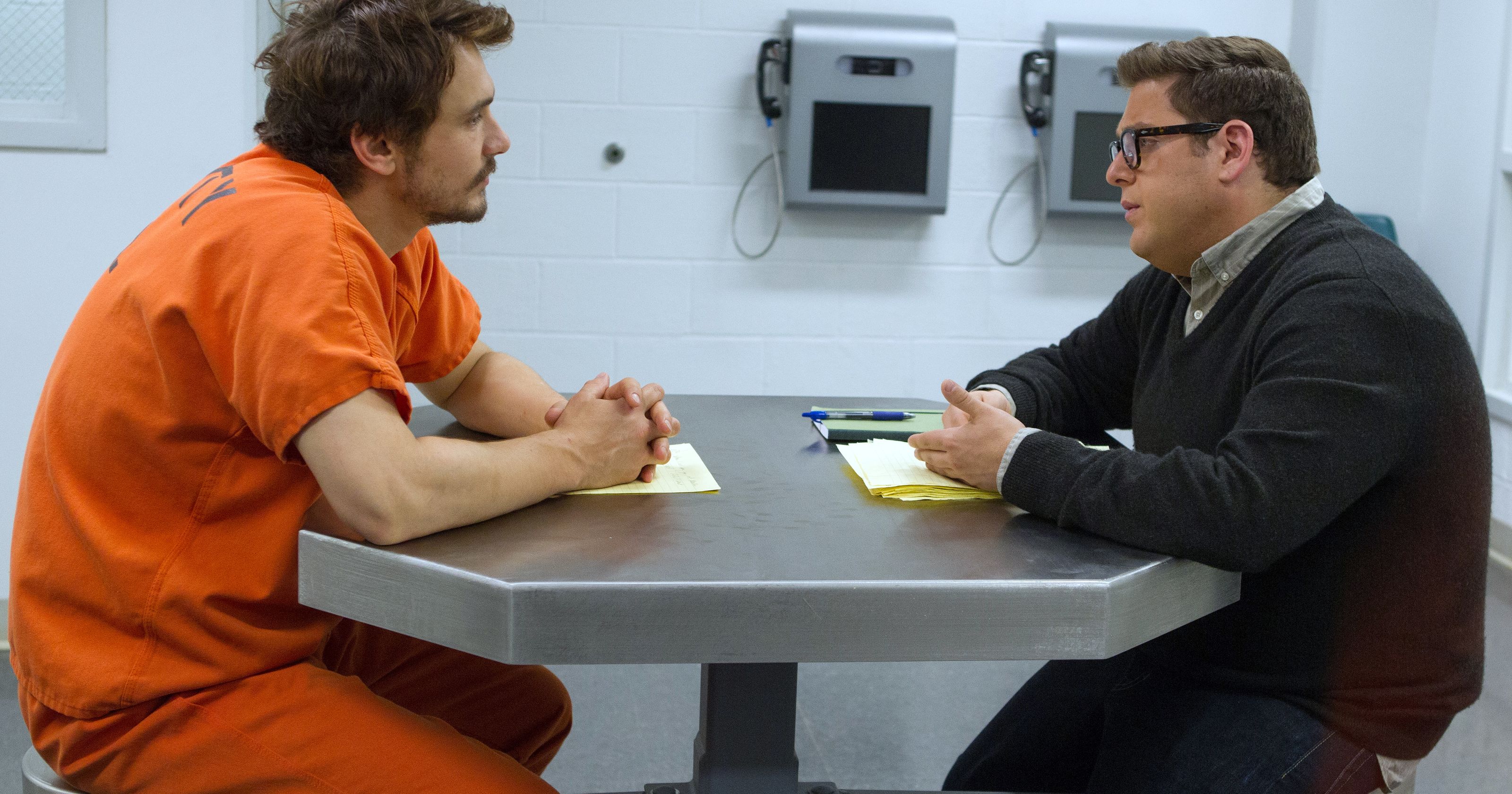
I was familiar with O’Toole, had seen him in a few films, including The Lion in Winter (1968) and The Night of the Generals (1967), and while I’d thought him a good actor, very intense in his approach, I hadn’t marked him out as an actor to follow (unlike his co-stars Alec Guinness and Claude Rains).  Seeing him as Lawrence I began to realise I was watching something special, something beyond normal screen acting; here was a performance that not only made you forget there was an actor in front of you, but – and I know this is supremely silly – gave the impression that they’d somehow found the real Lawrence and plonked him down in the movie and asked him to recreate those scenes from his life being filmed.  O’Toole wasn’t just astonishing, he was breathtaking.  When he was on screen he was hypnotic, I couldn’t take my eyes off him.  If the camera cut away to another character, I wanted it to come back to Lawrence as quickly as possible.  If he wasn’t in a scene at all, I wanted that scene to end as quickly as possible so I could see him again.  (It sounds a bit creepy, I know, but this was a revelation to me, that an actor could be this good; I’m not even sure I’ve seen another performance as good since.)

Lawrence of Arabia - scene

As with Stanley Kubrick and Abel Gance and Marcel Carné (sorry, Terry Jones!), here also was a director with complete mastery and control over the material.  Lean did things in terms of composition and lighting I’d never seen before, things I’d never even considered could be done.  His use of natural light alone was impressive.  Watching Lawrence of Arabia now, over fifty years on from its release, there are shots that have never been replicated by other directors and/or cinematographers.  Lean was truly a cinematic painter, an artist concerned as much with light and shade as character and emotion and motivation; he could fuse these elements together to make an organic, complete representation of the subject at hand, and their environment.  In Lawrence of Arabia this makes for filmmaking of breathtaking beauty and accomplishment.

When I first saw the movie, and as I usually did, I raved about it to friends, even though I knew the subject matter and the movie’s length would put them off.  But one friend did see it (though some time later), and reported that they’d really enjoyed it but was surprised that the movie ended with the attack on Aqaba; he’d really wanted to find out what happened next.  I tried to keep my laughter to a minimum as I explained he’d only seen the first part of the movie.

I’ve seen the movie now around a dozen times, and each time it captivates me and mesmerises me in equal measure.  The last time I saw it was at the London Film Festival in 2012.  It was the first time the recent 4k restoration of the movie had been screened in the UK, and as a surprise, the festival organisers had arranged for two people connected with the movie to say a few words before the showing started.  Those two people turned out to be Anne V. Coates, the movie’s editor, and none other than Omar Sharif.  From where I was sitting I was only about six feet away from them both, and while Sharif spoke about his experiences making the film, several times he looked directly at me as he spoke.  (To say I walked out of that screening on cloud nine would be an understatement.)  And the movie looked tremendous, ravishing and beautiful in a way I’d never seen before, having never seen it at the cinema, only on home video or DVD.  It took me back to that first showing on TV, as I saw a movie I thought I was familiar with, but realised I hadn’t seen really properly in all this time.

For me, Lawrence of Arabia is the epic to end all epics, the grandest piece of filmmaking ever committed to celluloid.  Like the other movies I’ve discussed so far, it opened my eyes to what was possible in cinema, and its lustre hasn’t dimmed after all these years.  It’s also the most beautiful movie I’ve ever seen.

Rating: 9/10 – a movie that mixes the epic with quieter, more intimate moments, and  with skill and considerable brio; Lean’s masterpiece and O’Toole’s finest hour.

Share this:

  • Share on X (Opens in new window) X
  • Share on Facebook (Opens in new window) Facebook
  • More
  • Print (Opens in new window) Print
  • Email a link to a friend (Opens in new window) Email
Like Loading...
← Older posts
Newer posts →

Blog Stats

  • 495,221 hits

Recent Posts

  • 10 Reasons to Remember Bibi Andersson (1935-2019)
  • Fantasia (1940)
  • Dances With Wolves (1990) – The Special Edition
  • Kiss of the Spider Woman (1985)
  • The Three Musketeers (1973)

Top Posts & Pages

  • The Red Balloon (1956)
    The Red Balloon (1956)
  • The White Orchid (2018)
    The White Orchid (2018)
  • Cardboard Boxer (2016)
    Cardboard Boxer (2016)
  • I Can't Think Straight (2008)
    I Can't Think Straight (2008)
  • 10 Reasons to Remember Bruno Ganz (1941-2019)
    10 Reasons to Remember Bruno Ganz (1941-2019)
  • Don Jon (2013)
    Don Jon (2013)
  • Predestination (2014)
    Predestination (2014)
  • Sand Storm (2016)
    Sand Storm (2016)
  • Sorry to Bother You (2018)
    Sorry to Bother You (2018)
  • 10 Reasons to Remember Arthur Hiller (1923-2016)
    10 Reasons to Remember Arthur Hiller (1923-2016)
Follow thedullwoodexperiment on WordPress.com

Blogs I Follow

  • Rubbish Talk
  • Film 4 Fan
  • Fast Film Reviews
  • The Film Blog
  • All Things Movies UK
  • Interpreting the Stars
  • Let's Go To The Movies
  • Movie Reviews 101
  • TMI News
  • Dan the Man's Movie Reviews
  • Film History
  • Jordan and Eddie (The Movie Guys)

Archives

  • April 2019 (13)
  • March 2019 (28)
  • February 2019 (28)
  • January 2019 (32)
  • December 2018 (28)
  • November 2018 (30)
  • October 2018 (29)
  • September 2018 (29)
  • August 2018 (29)
  • July 2018 (30)
  • June 2018 (28)
  • May 2018 (24)
  • April 2018 (21)
  • March 2018 (31)
  • February 2018 (25)
  • January 2018 (30)
  • December 2017 (30)
  • November 2017 (27)
  • October 2017 (27)
  • September 2017 (26)
  • August 2017 (32)
  • July 2017 (32)
  • June 2017 (30)
  • May 2017 (29)
  • April 2017 (29)
  • March 2017 (30)
  • February 2017 (27)
  • January 2017 (32)
  • December 2016 (30)
  • November 2016 (28)
  • October 2016 (30)
  • September 2016 (27)
  • August 2016 (30)
  • July 2016 (30)
  • June 2016 (31)
  • May 2016 (34)
  • April 2016 (30)
  • March 2016 (30)
  • February 2016 (28)
  • January 2016 (35)
  • December 2015 (34)
  • November 2015 (31)
  • October 2015 (31)
  • September 2015 (34)
  • August 2015 (31)
  • July 2015 (33)
  • June 2015 (12)
  • May 2015 (31)
  • April 2015 (32)
  • March 2015 (30)
  • February 2015 (37)
  • January 2015 (39)
  • December 2014 (34)
  • November 2014 (34)
  • October 2014 (36)
  • September 2014 (25)
  • August 2014 (29)
  • July 2014 (29)
  • June 2014 (28)
  • May 2014 (23)
  • April 2014 (21)
  • March 2014 (42)
  • February 2014 (38)
  • January 2014 (29)
  • December 2013 (28)
  • November 2013 (34)
  • October 2013 (4)

Blog at WordPress.com.

Rubbish Talk

Film 4 Fan

A Movie Blog

Fast Film Reviews

The Film Blog

The official blog of everything in film

All Things Movies UK

Movie Reviews and Original Articles

Interpreting the Stars

Dave Examines Movies

Let's Go To The Movies

Film and Theatre Lover!

Movie Reviews 101

Daily Movie Reviews

TMI News

Latest weather, crime and breaking news

Dan the Man's Movie Reviews

All my aimless thoughts, ideas, and ramblings, all packed into one site!

Film History

Telling the story of film

Jordan and Eddie (The Movie Guys)

Movie Reviews & Ramblings from an Australian Based Film Fan

Privacy & Cookies: This site uses cookies. By continuing to use this website, you agree to their use.
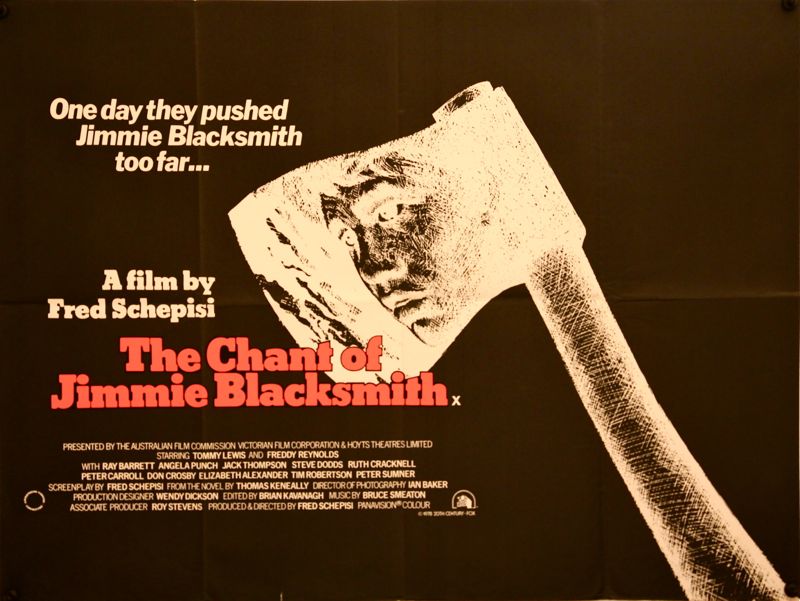
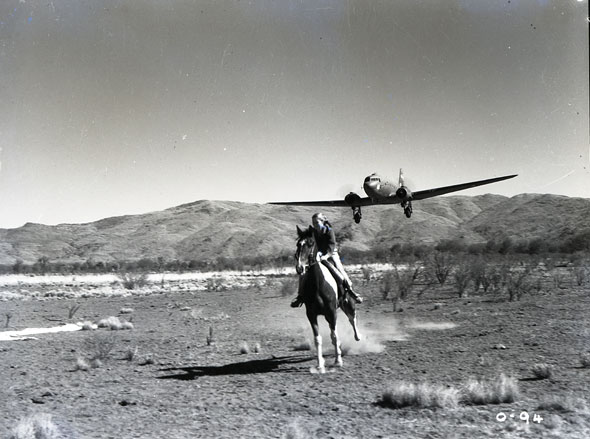
To find out more, including how to control cookies, see here: Cookie Policy
  • Subscribe Subscribed
    • thedullwoodexperiment
    • Join 481 other subscribers
    • Already have a WordPress.com account? Log in now.
    • thedullwoodexperiment
    • Subscribe Subscribed
    • Sign up
    • Log in
    • Report this content
    • View site in Reader
    • Manage subscriptions
    • Collapse this bar
 

Loading Comments...
 

    %d