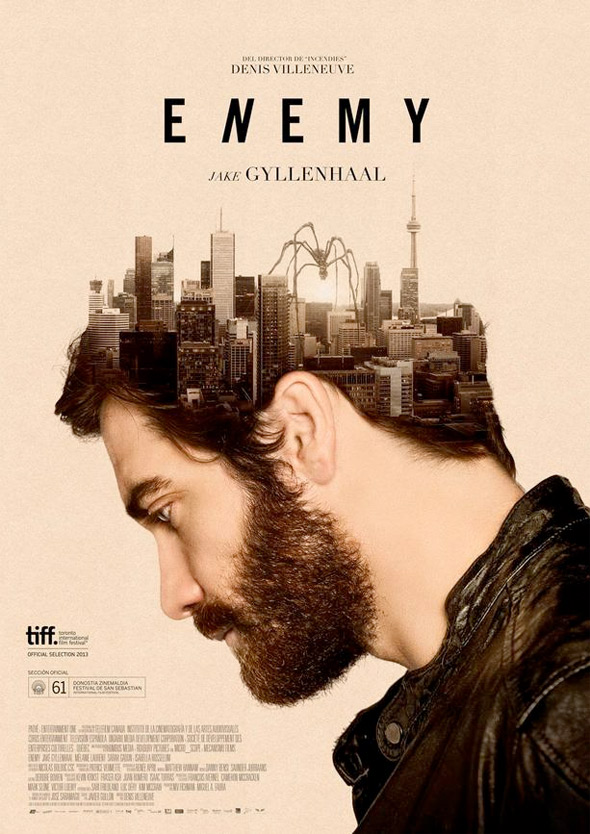
Enemy (2013)

Tags

, , , , , , , , , ,

Enemy

D: Denis Villeneuve / 90m

Cast: Jake Gyllenhaal, Mélanie Laurent, Sarah Gadon, Isabella Rossellini, Joshua Peace, Tim Post

Adam Bell (Gyllenhaal) is an associate professor of history, a little removed from his colleagues and students, but in a relationship with Mary (Laurent), though this has its ups and downs.  On the advice of a fellow teacher (Peace), Adam rents a movie called Where There’s a Will There’s a Way.  That night he watches the movie, but it’s only later that same night that he’s awoken by the realisation that one of the bellhops in the movie – played by Daniel Saint Claire (Gyllenhaal) – looks exactly like him.  Fascinated by his discovery, Adam decides to track down the actor; an online search reveals the talent agency that represents him.  Adam visits the building where the agency is based and is mistaken for Saint Claire.  He receives an envelope that contains a letter addressed to Anthony Claire (the actor’s real name) at his home.  Adam goes there but is too nervous to call at the man’s apartment.  Instead he telephones Claire but his wife Helen (Gadon) answers.

Adam calls again when Anthony is home but the actor tells him not to call again.  Later, he changes his mind and agrees to meet Adam at a hotel.  Meanwhile, Helen, suspecting Anthony is cheating on her, goes to where Adam teaches and briefly speaks to him (though she doesn’t tell him who she is).  Adam and Anthony meet and find they are entirely identical, even down to a scar they both have on their chest.  Scared by this, Adam flees.  Now it’s Anthony’s turn to be fascinated by Adam: he finds out where Adam lives and sees him with Mary.  Anthony becomes infatuated with Mary and manipulates Adam into letting him take Mary away overnight.  Adam goes to Anthony’s apartment and stays there until  Helen arrives home, and as the evening progresses, the two couples’ lives become inextricably entwined…

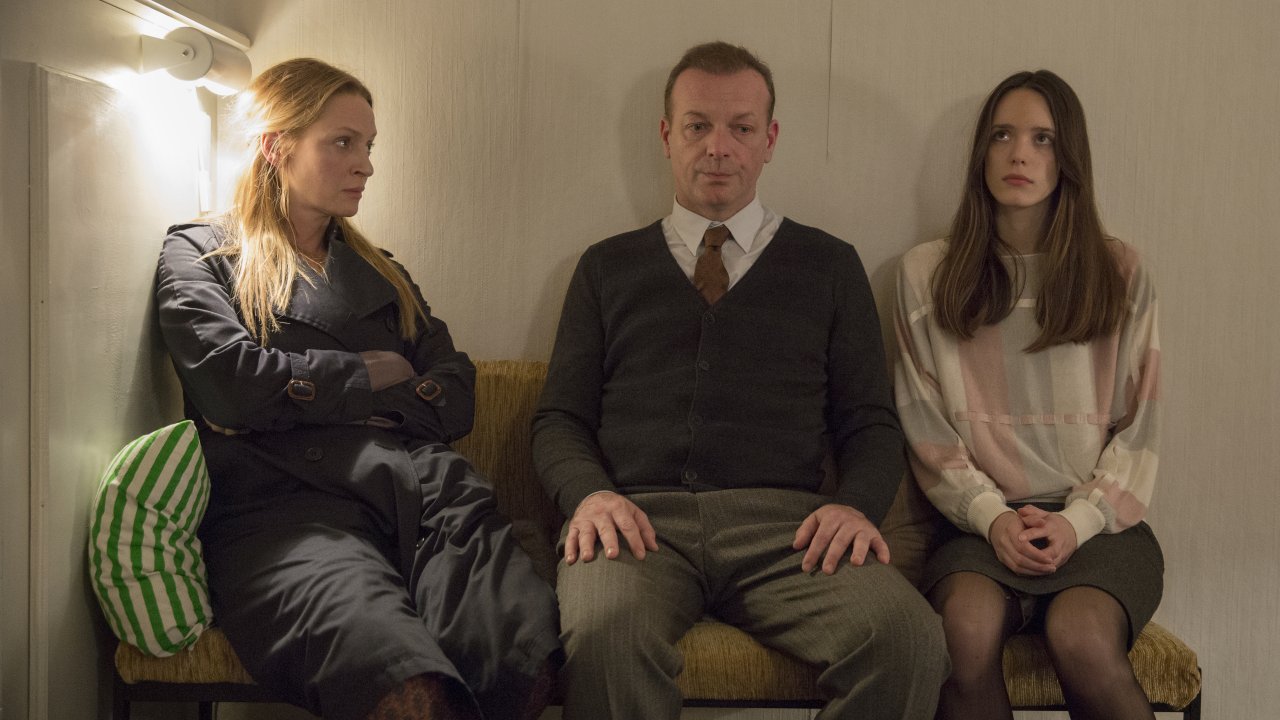
Enemy - scene

Right from the start, with its opening scene set in an underground sex club, Enemy lets its audience know that it’s not going to be the type of psychological drama/thriller where things are explained too easily.  That scene, with its ritualised stage show, serves as an introduction to the wider mystery that envelops Adam, and yet it remains frustratingly unexplored (though it is referred to later on in the movie).  For the casual viewer, frustration is the one constant the movie cleaves to, as scene after scene fails or refuses to give an explicit reason for what’s happening; very little can be accepted or relied upon at face value.  Enemy is a movie where inference and supposition will only get the viewer so far, and where the plot’s strange twists and turns only serve to make things more convoluted and disorienting.

And while some might find this counter-productive in terms of getting the most out of the movie, ultimately it enhances the experience, with director Villeneuve’s decision to make some scenes completely enigmatic while lacing others with complex misdirection, adding to the sense of unease that the movie builds up.  It’s an accomplished piece of deconstruction, removing key elements that most other movies would rush to include in order to make things easier for the audience.  Here Villeneuve avoids any attempt at clarity, and by doing so, creates a deceptively elegant, thought-provoking movie that rewards more and more with each repeat viewing.

He’s aided by an impressively layered script by Javier Gullón (adapted from the novel, The Double, by José Saramago), that makes a virtue of ambiguity and provokes as many questions as can be reasonably squeezed into ninety minutes.  It’s a delicate balancing act, providing just enough information to keep the viewer intrigued and baffled at the same time, while choosing to reveal very little through either characterisation or dialogue (unless you’re paying very close attention).  Between them, Gullón and Villeneuve have designed a movie that defies conventions and exceeds expectations with a great deal of audacity and artistic brio.

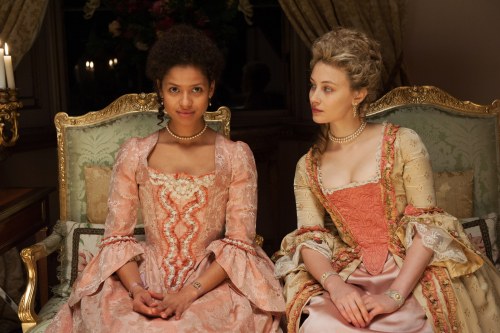
Of course, none of this would be possible without the participation of Gyllenhaal, who excels as Adam and Anthony, his performances so finely attuned to the material that he doesn’t put a foot wrong throughout, whether he’s required to play nervous and scared (Adam) or confident and predatory (Anthony).  It’s his finest role to date, and proof (if any were needed) that he is one of the best actors around today.  He’s ably supported by Laurent in a role that appears to be underwritten but which fits perfectly with the storyline, and Gadon (also seen in Belle), whose portrayal of Anthony’s loyal but emotionally scarred wife matches Gyllenhaal’s performance for intensity and poignancy.

The look of the movie (bearing in mind it’s set in Toronto) is suitably chilly, and the colour scheme – a mix of dark browns and greys – complements the often oppressive nature of the storyline, and the movie’s sense of impending doom.  There’s also a fantastic, unnerving score by Danny Bensi and Saunder Jauriaans that is both portentous and imposing at the same time, adding a dark undercurrent to proceedings that is strikingly effective.  Technically daring, Enemy succeeds by grounding its ambiguous, sometimes fantastical, storyline and plot in a world where the mystery surrounding Adam and Anthony can be perceived as both rational and weird… and it still works.

Rating: 9/10 – a modern classic, precisely assembled and without an ounce of cinematic fat to it, Enemy is a psychological thriller that mesmerises with ease and ends with a visual punch to the gut that you definitely won’t see coming; the first of (hopefully) many more remarkable collaborations between Villeneuve and Gyllenhaal, and deserving of a much wider audience.

Mini-Review: The Panther’s Claw (1942)

Tags

, , , , , , , , , , ,

Panther's Claw, The

D: William Beaudine / 70m

Cast: Sidney Blackmer, Rick Vallin, Byron Foulger, Herbert Rawlinson, Lynn Starr, Barry Bernard, Gerta Rozan, Joaquin Edwards, John Ince, Martin Ashe, Frank Darien, Billy Mitchell

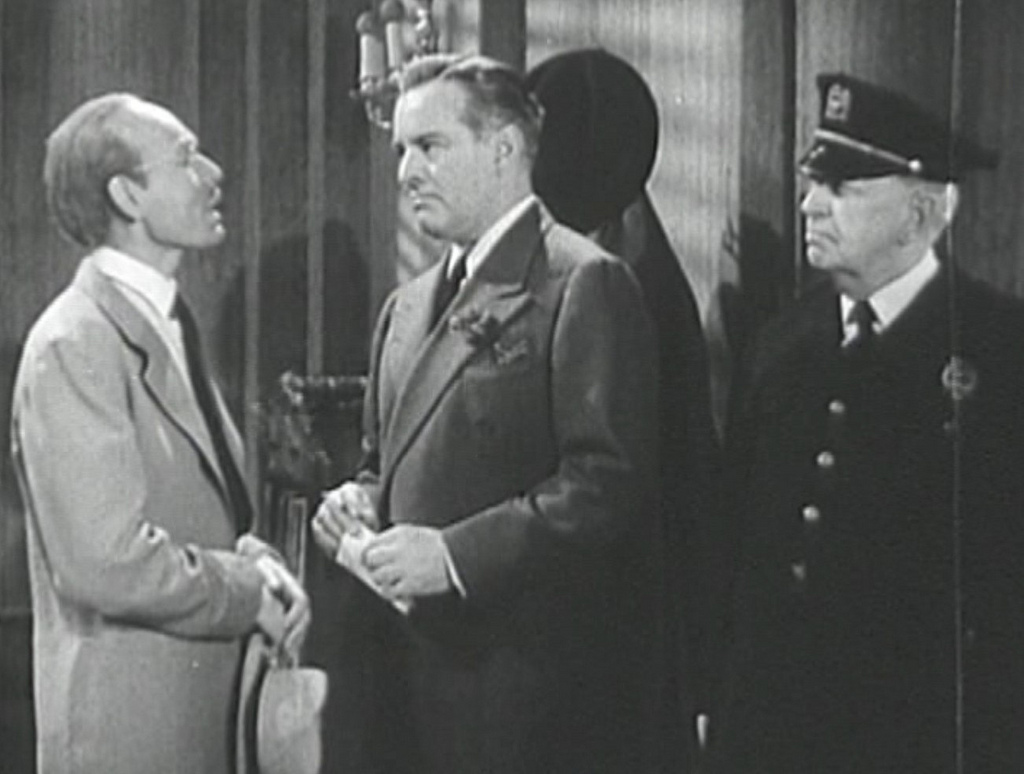
When gauche wigmaker Everett P. Digberry (Foulger) is discovered leaving a cemetery at one in the morning, it’s not long before the extortion plot he’s mixed up in leads to murder.  Having been sent a letter demanding he leave $1000 in the cemetery, it transpires that similar letters have been received by members of the New York Opera Company (or Gotham Opera Company if you read the headlines); Digberry has a connection to the company in that he provides the wigs for their productions.  The case is taken up by the police commissioner, Thatcher Colt (Blackmer), but his search for an extortionist who signs his letters with the footprint of a panther points increasingly to Digberry being the culprit behind it all.  And then one of the members of the opera company is found dead, and it appears that Digberry is guilty of that crime as well.  Is Digberry a cunning criminal mastermind, or is he being set up?

Panther's Claw, The - scene

Another quickie from low-budget movie factory Producers Releasing Corporation – the third and last movie to feature Anthony Abbot’s fictional detective, Thatcher Colt – The Panther’s Claw is a convoluted tale, with twists and turns galore and a large dash of playful humour, held together by Foulger’s dazed, nervous performance and a confidence in the material that helps move things along swiftly.  Foulger is effectively the lead and is afforded a lot of screen time, leaving Blackmer to sit back and appear knowing and debonair at the same time.  There’s able support from the rest of the cast, including Rawlinson as an impatient District Attorney looking to convict Digberry because it’s an election year, and Edwards as the kind of hammy opera singer with a drink problem that’s almost a caricature by modern standards.

Beaudine’s direction is as briskly efficient as ever, and while the sets are of the usual “bare bones” quality and the camerawork as bland and uninspired as you might expect, the movie has an energy and a surprising sense of its own silliness (which it embraces).

Rating: 6/10 – an offbeat, entertaining production from PRC that is better than most of their output from the period; Blackmer is a great replacement for Adolphe Menjou, and the mystery elements add to the fun.


Endless Love (2014)

Tags

, , , , , , , , , ,

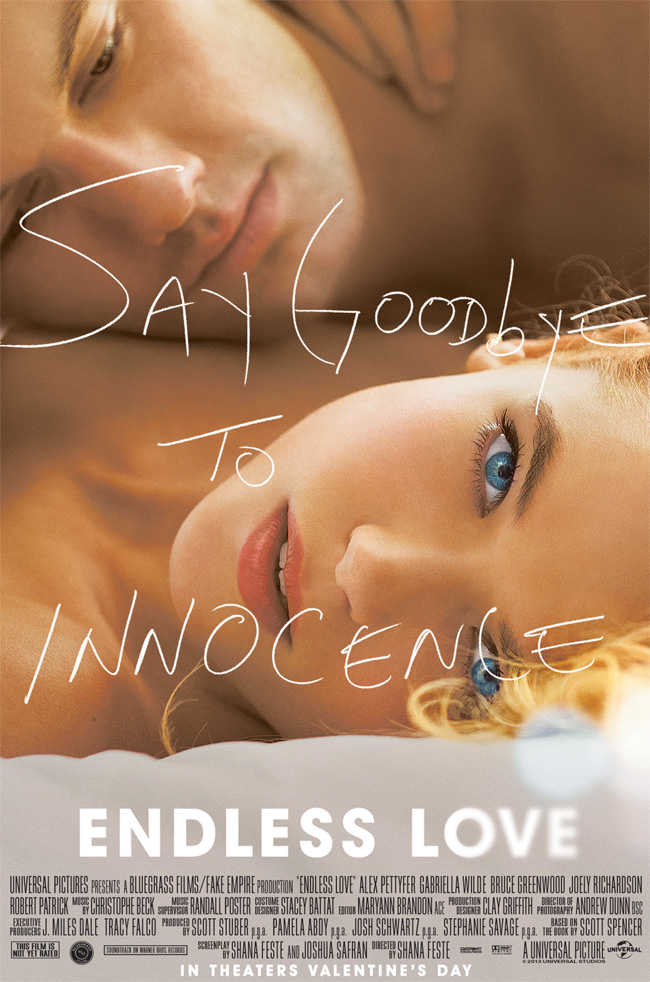
Endless Love (2014)

D: Shana Feste / 104m

Cast: Alex Pettyfer, Gabriella Wilde, Bruce Greenwood, Joely Richardson, Robert Patrick, Rhys Wakefield, Dayo Okeniyi, Emma Rigby, Anna Enger

Jade Butterfield (Wilde) is a quiet, studious teenager just graduated from high school.  She hasn’t made many friends, but she has caught the attention of David Elliot (Pettyfer).  He catches her eye at their graduation ceremony, and so begins a tentative romance made awkward by the difference in their social standing.  Jade’s father, Hugh (Greenwood) is an eminent surgeon; David’s father, Harry (Patrick) has an auto shop in town.  Jade is due to take up a medical internship in two weeks and follow in her father’s footsteps; David wants to follow in his father’s footsteps too – each has a sense of familial duty that’s important to them.  When Jade decides to hold a party for everyone in her year, it’s only David who turns up.  With help from his friend, Mace (Okeniyi), David manipulates their high school friends into attending.  Jade and David realise their attraction for each other, and Hugh becomes aware of this as well.  He’s not happy about it, though, and does his best to stop any relationship before it begins.

Despite his best efforts, Jade and David spend more and more time together.  They’re so passionate about each other that Jade decides not to leave to begin her internship, and instead opts to spend the rest of the summer with David.  When she tells her father this he reacts by forcing her to join him and the rest of the family – mum Anne (Richardson), brother Keith (Wakefield) and his girlfriend, Sabine (Enger) – on a trip to their lakeside summer home.  Jade retaliates by inviting David along.  Her father continues his enmity toward David and learns he has a history of violence.  When Jade and David run into Mace and David’s ex-girlfriend Jenny (Rigby), they’re persuaded to go with them to a zoo after it’s closed.  When Jenny (who still harbours hopes of winning David back) sees how Jade means to him, she calls the police and rats them all out.  When the police arrive, David draws them away from everyone else, but is arrested.

Jade expects her dad to help get David out of jail but he refuses and he tells her about David’s violent past.  Seeing how important David is to her, Hugh relents and gets David sprung from jail but they argue and David knocks Hugh to the ground.  When she confronts David about it, it leads to her being in a car accident.  Later, at the hospital, Hugh tells Harry he’s taken out a restraining order to keep David from coming within fifty feet of Jade.  With their relationship apparently over, Jade leaves for college and begins seeing a fellow student.  David meanwhile, stays at home, until a chance encounter with Anne leads to the realisation that, restraining order or not, he has to see Jade and win her back.

Endless Love - scene

The second adaptation of Scott Spencer’s novel, Endless Love is endlessly sappy, and endlessly derivative of just about every other teen romance you’ve ever seen (viewers unaware of the movie’s literary origin could be forgiven for thinking they’re watching another Nicholas Sparks adaptation).  David only has to glance in Jade’s direction and she’s instantly smitten, her years of social and personal reserve dumped by the wayside in a matter of seconds.  She also turns out to be quite the hussy, acting provocatively and kittenish around David until the night she decides it’s time they should take things to the “next level”.  Throughout this period of getting to know each other, it becomes clear that Jade is the subtly demanding modern princess, and David the noble savage she has ensnared.  It’s an interesting take on the standard roles you might expect from the scenario quoted above, but it’s abandoned as soon as the script requires Hugh to take centre stage and amp up the villainy needed to give the story some actual bite.

Of course, Hugh is meant to be a misunderstood, over-protective father (more so in the wake of the recent death of Jade’s other brother, Chris), but as Jade and David are staple characters in this kind of thing, so too is Hugh that other staple of the romantic drama, the man that David has to wrest Jade away from.  Sadly, the script tries to give Hugh some depth, and has him vacillate over whether to welcome David with open arms or closed fists.  With Greenwood required to leap both ways – often in the same scene – and on more than one occasion, Hugh becomes a bit of a distraction, but unfortunately a necessary one, as leading thesps Pettyfer and Wilde have their work cut out for them making their characters worth spending time with in the first place.  It’s not their fault, it’s just that Jade and David are about as exciting to watch as those airplane safety videos.  Once they’ve had sex, their story heads for their inevitable falling out with all the haste of a marathon runner intent on reaching the next water station.

If there’s anything about Endless Love that isn’t dispiriting it’s the performance of Richardson; she at least recognises the paucity of the drama on offer and adapts her depiction of Anne’s unhappiness accordingly.  Whenever she’s on screen the movie seems to improve just by having her there.  The same can’t be said of Pettyfer, who looks uncomfortable throughout, while Wilde seems intent on doing the bare minimum required to  make her dialogue sound just this side of reasonable.  Both actors are more than capable but here they seem unable to raise their game and defeat the shopworn elements that make up writer/director Feste’s lukewarm script.  Her direction is unfortunately quite pedestrian and the movie lacks a definitive visual style that might have lifted it up a little.  With a soundtrack that offers songs as indicators of the emotional content on screen (like Cliff notes, but with added harmonies), Endless Love has the feel of a movie that had better intentions than those that were actually delivered.

Rating: 4/10 – bland, and with plot developments that are signposted in bright neon lights, Endless Love is a remake that probably sounded like a good idea at the time; however, the finished product is a salient reminder that not every “good” idea should be acted upon.

Poster of the Week – The Titfield Thunderbolt (1953)

Tags

, , , , , ,

Titfield Thunderbolt, The

The Titfield Thunderbolt (1953)

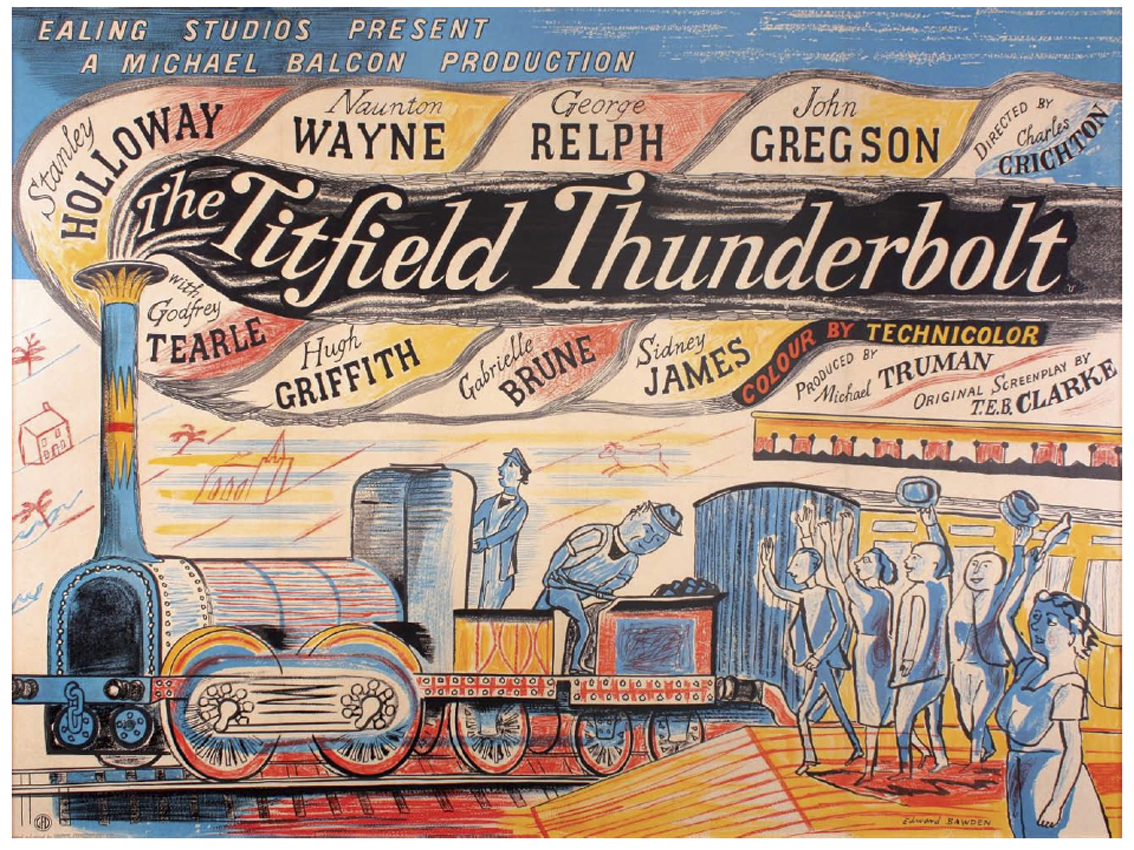
There have been many memorable Ealing film posters over the years, and to pick just one of them for appraisal might seem foolish or a little mad, but the poster for The Titfield Thunderbolt has a distinction that marks it out from the rest: this poster was the work of English artist Edward Bawden (1903-1989) (you can see his name near the bottom right hand corner).  It’s a wonderfully colourful, vibrant work, full of marvelous detail that’s been done in an almost offhand, cavalier way, its broad brush strokes complimenting the more finely worked details.  The mix of the main colours – blue, red, orange, yellow – creates a warm, inviting glow that seems able to spread beyond the confines of the poster itself, giving the illusion that the train could actually move out from the station.

The graphics are eye-catching as well, issuing from the smoke like messages, giving pride of place to the title, then surrounding it with the names of the principal cast (and if you were a moviegoer in the early Fifties, wouldn’t you want to go and see a movie with that cast in it?).  It’s funny too, to observe the creative minds behind the movie being practically squeezed in at the end of the smoke trail, director Charles Crichton, producer Michael Truman, and screenwriter T.E.B. Clarke added in but with their names reduced in size compared to the (much more important) stars.

But it’s still the imagery that draws the attention, from the clever little details – the dog collars on the train driver and stoker, the towing chain at the front of the train, the Xmas cracker style of the smokestack – to the rudimentary background elements (dog, church etc.), to the happy, waving people on the platform, their sense of pride in the train clearly evident.  And the train itself is a terrific representation, a product of a bygone age given a new lease of life in the movie, and in the poster, shown as the principal character, a vital, much-loved piece of living machinery that will transport the viewer to wherever they want to go.

The Angriest Man in Brooklyn (2014)

Tags

, , , , , , , , , , ,

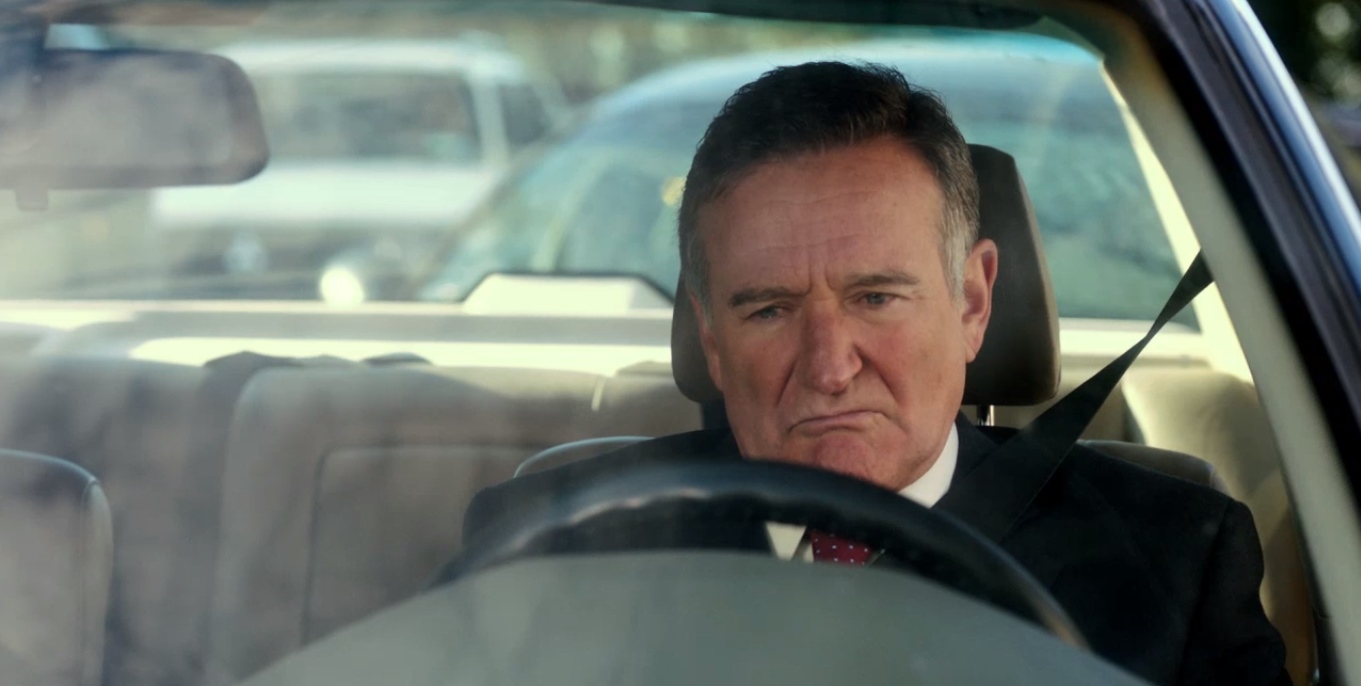
Angriest Man in Brooklyn, The

D: Phil Alden Robinson / 92m

Cast: Robin Williams, Mila Kunis, Peter Dinklage, Melissa Leo, Hamish Linklater, Chris Gethard, Bob Dishy, Isiah Whitlock Jr, James Earl Jones, Richard Kind, Daniel Raymont

Henry Altmann (Williams) is having a bad day.  He’s on his way to a doctor’s appointment when his car is hit by a taxi.  Being the angry man that he is, Henry antagonises the taxi driver (Raymont) who drives off.  Meanwhile, junior doctor Sharon Gill (Kunis) is on her way to work, and feeling sad over the death of her cat.  Sharon is standing in for Henry’s usual physician, Dr Fielding.  When Henry gets to his appointment and is then kept waiting for two hours, and Sharon walks in instead of Dr Fielding (an uncredited Louis C.K.), Henry blows a(nother) gasket.  Sharon does manage to tell Henry that the result of a recent test he’s had shows that he has a brain aneurysm and that his life expectancy is uncertain.  Unimpressed by this, Henry bullies Sharon into giving him a timescale.  Flustered, and just to get Henry off her back, Sharon tells him ninety minutes.

Henry leaves the hospital.  He decides to spend his ninety minutes trying to tell his family – brother Aaron (Dinklage), ex-wife Bette (Leo), and son Tommy (Linklater) – that he loves them, but this is easier thought of than done.  Henry’s anger has alienated him from everyone, so when he tries calling them they don’t take or return his calls.  Back at the hospital, Sharon tells a colleague, Dr Reed (Gethard), what happened with Henry.  He tells her she has to find him and put things right.  While Henry attempts to put things right himself, Sharon tries to track him down but keeps missing him, enlisting the help of Aaron and Bette in her efforts.  Having tried his best with his brother and ex-wife, Henry is now hell-bent on seeing Tommy, with whom he has unresolved issues over Tommy’s choice of career.

Angriest Man in Brooklyn, The - scene

A remake of the Israeli movie Mar Baum (1997), The Angriest Man in Brooklyn jettisons that movie’s religious overtones and more “racy” content, for a somewhat distant and unremarkable look at a man for whom no slight should be ignored without ranting about it first.  Henry is a man who shouts first and has no intention of asking questions later, a bully who thinks it’s okay to castigate people for ruining his day.  As the movie’s main protagonist Henry is a thoroughly dislikable character; when he’s told about the aneurysm, chances are the audience will be cheering, so objectionable is he.  But the movie can’t sustain such a premise, and as the story unfolds, Henry’s attempts to reconcile with his family show a softer, less antagonistic side to his nature.  But then the movie remembers what it’s called, and once more Henry vents his spleen in ways that are neither funny or understandable.  It’s a problem the movie never quite overcomes: should Henry remain a curmudgeon until the end, or should he see the error of his ways?

Ultimately, it doesn’t matter, because the script by Daniel Taplitz combines with Robinson’s leaden direction to create a movie where the actors are about as convincing as a cat conducting an orchestra.  The Angriest Man in Brooklyn is advertised as a comedy first and a drama second, but the humour is forced and the drama is undercooked, leaving the audience wondering if they were meant to root for Henry as some kind of underdog, or even Sharon, as she’s ostensibly a good person.  Sadly, neither is possible, as both characters are shallow to the point of being puddles, and possess all the fascination of navel lint.

It’s actually difficult to say just how bad this movie is.  There’s not one honest moment in the whole movie, not one moment that the viewer can relate to or empathise with, such is the ponderous, tired approach to the material.  Robinson, who gave us the sublime Field of Dreams (1989), seems to have no clue as to how to set up even the simplest of scenes, and some appear as if they’re filmed rehearsals rather than the finished item.  It’s also an incredibly cheap looking movie (highlighted by Henry’s walk across some girders on the Brooklyn bridge), and has all the visual appeal of a low-budget TV mystery of the week.

As mentioned above, the cast fail to bring anything remotely interesting to relieve the dullness of the enterprise.  Williams is a fine dramatic actor, but here he coasts along, investing Henry with the bare minimum of pathos, and never once making him sympathetic (even when the script tries to make him so).  Kunis is just as dilatory, endowing Sharon’s predicament with all the emotional resonance attendant on tracking down some kitty litter (hang on, no, she doesn’t need any, does she?).  Dinklage and Leo do just enough to avoid being tedious, while Linklater (Williams’ co-star in the short-lived TV show The Crazy Ones) sports the expression of someone whose just realised his career may be stalling before it’s even begun.

Rating: 3/10 – incredibly dull throughout, and unrewarding beyond measure, The Angriest Man in Brooklyn should be retitled The Man Whose Aneurysm Didn’t Kill Him Quickly Enough; a career low point for most everyone concerned (Williams still has Patch Adams (1998) and Bicentennial Man (1999) on his résumé), and not even worth a watch to see if it is as bad as it looks.

They Came Together (2014)

Tags

, , , , , , , , , ,

They Came Together

D: David Wain / 83m

Cast: Paul Rudd, Amy Poehler, Cobie Smulders, Christopher Meloni, Bill Hader, Ellie Kemper, Max Greenfield, Ed Helms, Jason Mantzoukas, Melanie Lynskey, Michael Ian Black, Teyonah Parris, Lynn Cohen

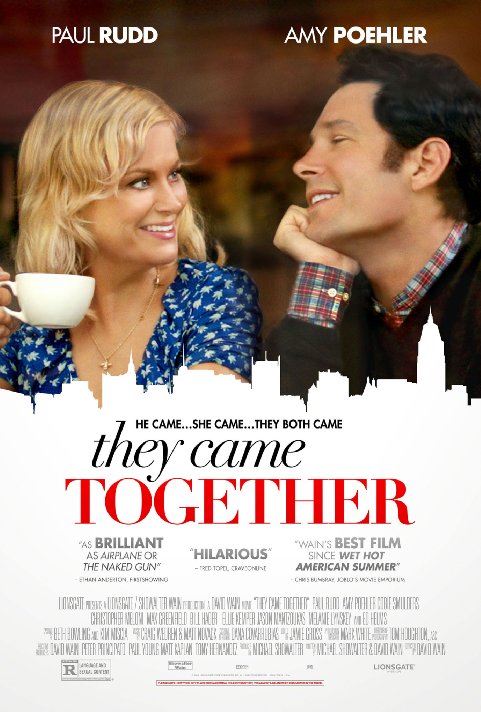
At a restaurant one evening, two couples – Joel and Molly (Rudd, Poehler), and Kyle and Karen (Hader, Kemper) – get to talking about how Joel and Molly got together.  Their answer: that it was like “a corny, romantic comedy kind of story”.  Molly was getting over the break up of a relationship, while Joel had just found out his long-time girlfriend Tiffany (Smulders) was cheating on him with a work rival (Black).  Cajoled into going to a Halloween costume party by friends, Joel and Molly literally bump into each other on the way, and an instant antipathy is born.  They bicker throughout the party, and Joel is unkind about Molly who overhears what he says; she walks out.  Some time later, they see each other again in a bookstore, and their mutual love of fiction brings them together.

They go for coffee, Molly introduces Joel to her son, Tucker (Skylar Gaertner), and both discover they have a (kind of) mutual connection through their work: Molly has an independent candy store, while Joel works for Candy Systems & Research, a candy store mega-company that is looking to put Molly out of business by building one of their stores directly opposite hers.  They fall in love but things don’t work out between them, and they split up.  Joel takes back Tiffany, while Molly begins dating Eggbert (Helms), her accountant.  Time passes.  Joel realises he doesn’t want to be with Tiffany and dumps her; at the same time Molly is all set to marry Eggbert.  Joel races to the stop the wedding but he’s too late: Molly has left Eggbert standing at the altar.  Joel tracks her down and declares his love for her.  Molly and Joel are reunited, and this brings their story full circle with Kyle and Karen… albeit with a twist in the tale.

They Came Together - scene

From the outset, They Came Together is not your typical romantic comedy.  It takes the standard format of the genre – boy meets girl, boy loses girl due to silly row/misunderstanding/mistake, boy gets girl back again, they both live happily ever after – and messes with that formula to its heart’s content.  In many ways, the movie plays like a straightforward rom-com but director Wain and his co-writer Michael Showalter are far more interested in playing fast and loose with the format to let a little thing like fidelity get in the way.  Indeed, the movie lets the audience know  from the start that this will be a story told with a knowing wink and a nod, and it gleefully tramples all over all kinds of genre conventions: Molly’s parents prove to be white supremacists; Tiffany’s return is predicated on her not being able to be faithful to Joel – and telling him; and Joel and Molly’s first night together sees them fall into bed kissing for all they’re worth, only for them to be shown the next morning fast asleep and fully clothed but with their lips still locked together.

In its efforts to be both clever and outrageous, They Came Together – unsurprisingly – is very much a hit-and-miss affair.  There’s a fair degree of subtlety as well, but it’s often lost amongst the more uncomfortable, gross-out moments (Joel’s sudden attraction for his grandmother (Cohen) is a case in point, though it does go somewhere that’s completely unexpected).  When it sticks to poking fun at the often sappy nature of romantic comedies (and some romantic dramas for that matter), the movie is funny, charming, and pitch perfect.  When it’s out to claim ground from movies such as American Pie (1999) or Bachelorette (2012), it doesn’t fare as well.  It’s a shame because when it is gently skewering those staple ingredients, They Came Together is relentlessly inventive and downright hilarious.

Wain movie regular Rudd, along with Poehler, are a great choice as the cute couple, sparking off each other’s performances and expertly grounding the more extreme aspects of the script.  Rudd is an old hand at this kind of material, and while Poehler’s big screen outings consist largely of voice work, here she invests Molly with a kooky warmth that complements Joel’s often confused naiveté.  In support, Meloni as Joel’s boss Roland demonstrates what not to do when needing a crap and wearing a superhero costume with an unreachable zip, Smulders plays Tiffany as a self-aware bimbo who isn’t all she seems (which leads to the movie’s most unexpected, and brilliantly surreal, moment), and Helms is both unctuous and creepy as Eggfart (sorry, Eggbert).  There are a number of cameos in the movie’s last twenty minutes – one of which leads to a wickedly hysterical (and unfortunate) encounter with a policeman – and there’s a musical interlude featuring Norah Jones that breaks so many “fourth walls” it’s frightening and ingenious at the same time.

Overall, They Came Together is an enjoyable, wacky deconstruction of the romantic comedy genre, blackly humorous in places, dubiously amusing in others, but always entertaining.  Wain and Showalter’s story may run out of steam two thirds in, but they rescue things for a flat out funny finale that encapsulates almost every rom-com cliché you can think of (including one stupendously silly sight gag).  And things are left wide open for a potential sequel: They Came Together Again anyone?

Rating: 7/10 – when it’s funny it’s a riot, but They Came Together stumbles too often to be completely successful; even so, it’s joke to laughter ratio is pretty high, and with this much effort involved, the movie qualifies as a guilty pleasure anyone can be proud to admit to.

New Tale of Zatoichi (1963)

Tags

, , , , , , , , ,

New Tale of Zatoichi

Original title: Shin Zatôichi monogatari

D: Tokuzô Tanaka / 91m

Cast: Shintarô Katsu, Mikiko Tsubouchi, Seizaburô Kawazu, Fujio Suga, Yutaka Nakamura, Mieko Kondô, Tatsuo Endô, Kanae Kobayashi

Following on from the events of The Tale of Zatoichi Continues (1962), New Tale of Zatoichi sees the blind masseur returning to his home village, there to find some peace after the showdown with his brother, Yoshiro.  Zatoichi (Katsu) is in a melancholy mood, and as reluctant to fight as ever, but it’s not long before he’s challenged by Yasuhiko (Suga), the brother of Boss Kanbei, who Zatoichi killed in the previous movie.  They fight, but it’s interrupted by the appearance of Zatoichi’s sensei, Master Banno (Kawazu).  Banno makes Zatoichi a guest at his training school, and introduces him to his younger sister Yayoi (Tsubouchi); she is meant to marry a samurai called Mooroke but has no love for him.  Her brother, meanwhile, is conspiring with a band of thieves called the Mito Tengo.  They plan to kidnap the son of a local businessman and hold him to ransom.

A bond develops between Zatoichi and Yayoi, one that leads to her falling in love with him.  She asks that he marry her and after confessing his past sins to her, and being forgiven for them, Zatoichi agrees and tells her he will renounce his old ways, including his sword fighting, in order that they might have a peaceful life together.  At that moment, Yasuhiko calls on Zatoichi to finish their duel.  He begs for mercy, leading Yasuhiko to devise an alternative plan for settling the issue between them: a throw of the dice – if Yasuhiko wins, Zatoichi will lose his right arm.  Zatoichi does lose, but Yasuhiko takes pity on the couple and lies about the result.  Later, Yayoi tells Banno of her love for the blind masseur, but her brother rejects her entreaties and tells Zatoichi to leave.

The kidnapping goes ahead as planned but Zatoichi becomes aware of Banno’s involvement, as does Yayoi.  He saves the businessman’s son, and faces off against the Mito Tengo.  He must then face Banno, knowing all the while that it will mean the end of his relationship with Yayoi.

New Tale of Zatoichi - scene

The third entry in the series, New Tale of Zatoichi retains the usual themes of betrayal and redemption, and adds the prospect of a romantic, settled future for our wandering hero.  If this had been the last in the series, such an ending might have been entirely appropriate, but the increasingly rootless nature of Zatoichi’s existence precludes such a conclusion (that and the success of the series so far).  He’s a tragic figure, always seeking a peaceful existence but doomed to a life of violence.  He’s also increasingly unlucky, both in love, and with his closest male relationships: first his brother betrays him, then his sensei.  With Fate proving so ineluctable, Zatoichi can only struggle on, hoping that his continued loneliness will eventually come to an end (though his love for Yayoi appears to be the closest he’ll come to achieving that).  It’s the kind of depth you don’t often find in a long-running series, and the fact that the makers have strived to maintain these themes throughout the series so far, is refreshing to watch.

Of course, such a wonderful character needs a wonderful actor, and once again Katsu puts in an incredible performance, his tender, compassionate nature seemingly at odds with his more aggressive abilities, but combining to paint a portrait of a man whose dual nature makes him so fascinating to watch.  It’s a beautifully modulated achievement, the quiet power of his scenes with Tsubouchi holding the audience’s attention like a vice, their characters’ mutual desire for happiness – against all the odds – breathtaking in both its painful longing and its simplicity.  That a movie which is essentially known for its fight scenes and good versus bad scenario can take the time to focus on its main character’s attempts to find joy, and make those scenes even more gripping than the rest, is truly impressive.

The first in the series to be filmed in colour, New Tale of Zatoichi doesn’t opt for a bright, colourful palette but settles instead for a dark-hued colour scheme that befits the subdued, sober approach to the material.  (In comparison with the first two movies, which were shot in dazzling black and white, this entry doesn’t look half as good.)  Behind the camera, director Tanaka retains many of the visual motifs used before, and encourages good performances from all concerned, especially Tsubouchi as Banno’s tender-hearted sister, the scene where she declares her love for Zatoichi demonstrating her skill at portraying someone whose yearning for happiness means everything.  Suga too gives a good portrayal of a vengeful samurai out-manoeuvred by love.  And there’s a terrific score by Akira Ifukube that complements both the emotional and the dramatic scenes, and is consistently rewarding.

Rating: 8/10 – another beautifully realised entry in the series, and one that reconfirms the care and attention that goes into each movie; more emotionally powerful than the first two movies, New Tale of Zatoichi takes its time with its characters, and this care pays off in dividends making the movie that rare beast: a second sequel that is as good as its predecessors.

Clowne (2014)

Tags

, , , , , , , , , , ,

Clowne

D: Jarand Breian Herdal / 34m

Cast: Henrik Plau, Ina Maria Brekke, Philip Bøckmann, Eirik Risholm Velle, Ruben Løfgren, Nicholas Rowley, Aksel Kolstad, Morten Müller

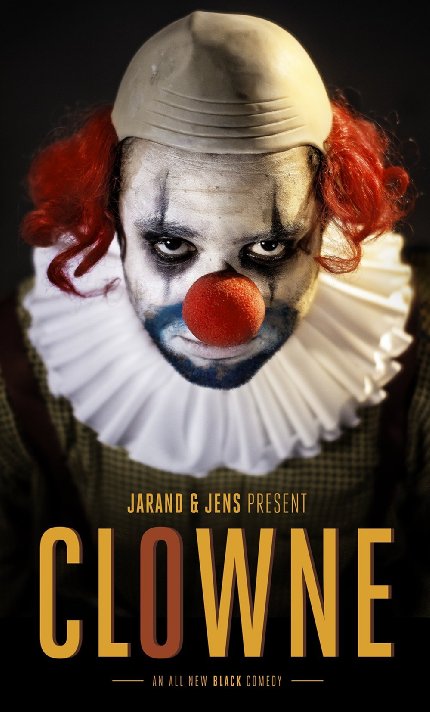
Having completed a two-year stretch in prison, Gary Clowne (Plau) is released, but there’s a catch: he must spend the rest of his sentence – three years – doing community service (he’s also tagged for his troubles).  Once on the outside, Gary’s belief that he’ll be sweeping streets or cleaning toilets is cruelly dashed when his new employer, Vitaly (Løfgren) tells Gary he’s going to be a clown.  Cue a selection of “gigs” (including a funeral) before Gary winds up at a hospital for patients with mental health issues.  There he meets Jen Fliers (Brekke), one of the doctors; he’s immediately infatuated with her.  To Gary’s surprise, Jen has sex with him in a supply cupboard almost immediately after he introduces himself.  Finding themselves locked in, Jen calls on her boyfriend, Richard (Velle) to get them out.  They leave the hospital together but get no further than Richard’s car; once inside they start having sex.  Gary heads for home on foot, feeling sad and dejected.

A passing motorist warns Gary that there are lots of monkeys in the area.  Baffled by the man’s comment, Gary continues walking until he finds himself in an alley, convinced someone is following him.  He’s not wrong.  A man in a monkey suit (and carrying a flick-knife) tries to attack Gary but he manages to run away.  The man in the monkey suit chases after him.  Gary finds himself back at the hospital car park where Jen and Richard are still parked up (and still having sex).  The three of them manage to get away from the man in the monkey suit but not before he’s fired a gun at them.  Later, at the flat Gary shares with his pothead friend, Tim (Bøckmann), Gary allows himself to be persuaded to feel better by smoking a joint, despite his initial resistance (his jail term was drugs related).  The next morning, Gary wakes up to find that Tim has taken a heroin overdose, and is close to death.  With the flat full of incriminating, drug-related paraphernalia, Gary can’t call the emergency services.  So…what can a tagged felon who happens to be dressed as a clown do to get himself out of such a predicament?

Clowne - scene

If you’ve seen Everywhen (2013), Herdal and moviemaking partner Jens Peder Hertzberg’s debut feature, then you may have wondered what they’d do next.  Well, wonder no more.  Clowne is the entirely unexpected answer, a short feature designed as a pilot for a potential television series.  It’s a bold move by the young filmmakers, and shows a growing confidence in their abilities.  As a director, Herdal displays a keen eye for composition and has an instinctive knowledge of where to put the camera, and with co-creator and director of photography Hertzberg, often chooses odd angles to heighten a scene or, on occasion, keep the viewer wrong-footed (a great example is the shot of a man in a bus shelter looking at a timetable, and then the camera pans left to reveal Gary with his clown face pressed against the glass).  Between them, Herdal and Hertzberg have come up with an offbeat visual style, and level of creativity, that belies their ages.

The script, also by Herdal, is inventive and irreverent in equal measure, the humour often laugh-out-loud funny, with a good mix of one-liners (“Jen, focus, I might get rabies here”), visual gags (Richard’s underpants, Tim’s new girlfriend), and the kind of crazy situations that only one of Life’s real unfortunates could find themselves in.  The characters, from poor put-upon Gary to conspiracy theorist Vitaly to Müller’s gay police officer, are clearly defined and, though sometimes prone to exaggerated personal traits, suit the material well.  Plau is great as Gary, his hangdog expression beneath the clown make up all the viewer needs to understand how he’s feeling.  He’s also more than adept at showing Gary’s more vulnerable, nice guy qualities (which go some way to explaining just how he ended up in jail in the first place).  It’s an assured performance, and Gary is all the more likeable because of it.  As Jen, Brekke proves more flaky than some of her patients, and Bøckmann invests Tim with the kind of naive tunnel vision that so many weed fiends exhibit.  Velle is a hoot as the passive-aggressive Richard, always apologising in a slightly whiny way, while Løfgren (in a role that would have been tailor-made for Alexei Sayle in his heyday), does paranoia with enough nervous energy to light several apartment blocks – and confirms what many of us have suspected about the Jonas Brothers for some time.

Inevitably, given that this is a pilot after all, none of the various plot strands are resolved, but as a self-contained short, Clowne succeeds in introducing us to a most unlikely “hero”.  At this stage the prospect of a series is one to look forward to, though a full-length feature might be the better option, but judged on its own merits, Clowne is an entertaining, often hilarious, black comedy that confirms the promise Herdal and Hertzberg showed with Everywhen.  There are some continuity issues: Gary’s red nose vanishes and reappears at will, often from shot to shot, and Tim’s car trails a vast amount of smoke when he’s the only one with a joint (it’s an easy visual gag, true, but still…).  And on the trivia front, fans of that movie may notice that its star, Harald Evjan Furuholmen, has moved behind the camera to serve as production designer and set decorator; perhaps he’s the one responsible for there being a 1931 Dracula poster in the supply cupboard.

Rating: 8/10 – an equally impressive follow-up to Everywhen, Clowne is a likeable, surreal treat of a movie; all that remains is for Herdal and Hertzberg to channel their considerable talents into making a spin off movie for Hunch Backed Man (Kolstad) – now that would be welcome.

The End (2012)

Tags

, , , , , , , , , , , ,

Fin

Original title: Fin

D: Jorge Terregrossa / 92m

Cast: Maribel Verdú, Daniel Grao, Clara Lago, Carmen Ruiz, Andrés Velencoso, Miquel Fernández, Blanca Romero, Antonio Garrido, Eugenio Mira, Sofía Herraiz

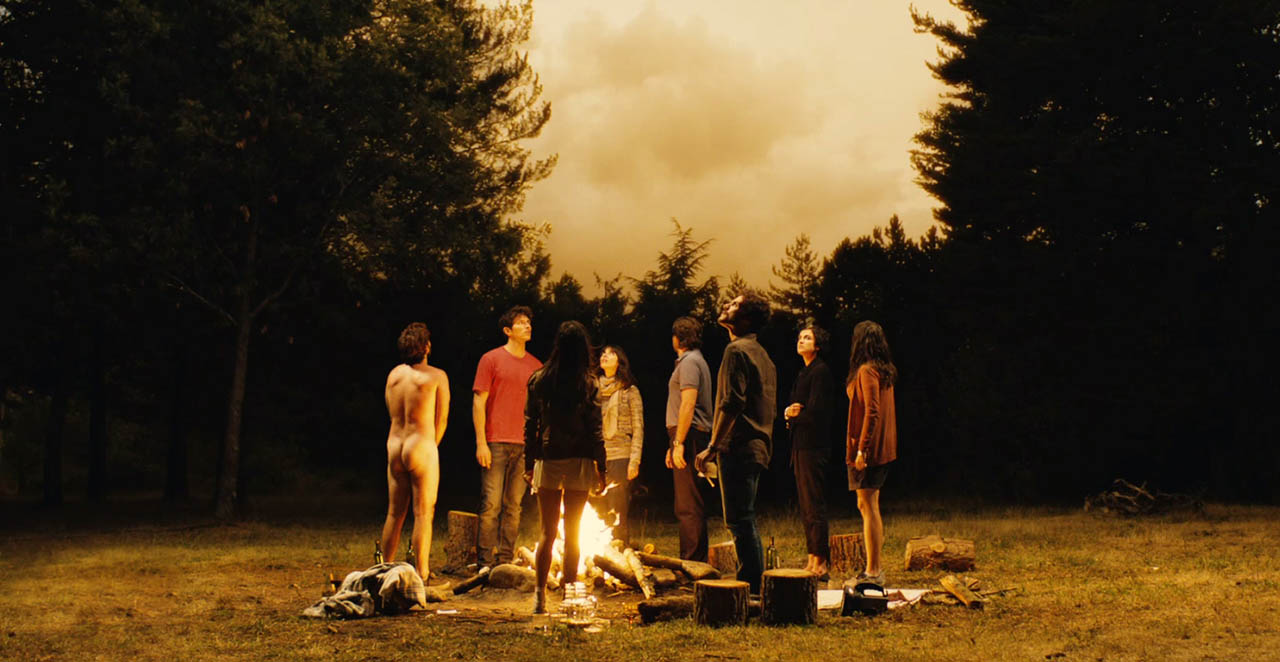
Six friends who haven’t gotten together in twenty years meet up at a cabin in the mountains for a reunion.  Félix (Grao) brings along his new girlfriend, Eva (Lago), while Hugo (Velencoso) brings his wife, Cova (Romero).  Sara (Ruiz), who contacted everyone, is single, as is Sergio (Fernández).  This leaves the two friends who have married each other, Maribel (Verdú) and Rafa (Garrido).  With everyone arrived, there’s only Ángel (Mira) to wait for.  Ángel isn’t well-liked by the men in the group, their behaviour toward him in the past leading to Ángel having a breakdown and spending most of the next twenty years in a mental institution; only Sara has kept in touch with him.  It’s not long before old feuds and animosities begin to be aired, and round a campfire that first night, various personal grievances are revealed as still being close to the surface.  And with Ángel still not having arrived, things get heated until there they all hear a strange sound that seems to tear apart the very air. Moments later, they realise that there is no electrical power, and that batteries won’t work either.

The next morning, the group learns that there is still no mains power, that the telephone doesn’t work, and that Rafa has disappeared.  Everyone hikes down to the nearest house but they find it deserted, though there is evidence that whoever lived there, they left in a hurry.  Deciding to carry on to the nearest town, the group takes a short cut through a gorge but along the way, a member of the group vanishes into thin air.  Frightened by all these strange events, and by the realisation that any one of them might be the next to disappear, they continue to head for the nearest town.  The next morning, someone else has disappeared but the remainder continue their journey; the scene of a car crash provides a startling discovery, and stopping at a pool later on, the group is reduced to four.  At one house they find themselves pursued by a pack of hungry dogs, and this leads to four becoming three.  These three reach the town, and there they encounter a little girl.  The girl runs from them but when they finally catch up with her, it’s only one of them who discovers exactly what’s happening…

End, The - scene

Adapted from the novel by David Monteagudo, The End is a somewhat languidly paced end-of-the-world drama that, wisely, never attempts to explain what’s happening or why, and keeps itself focused settled on the characters and how they cope with the mystery unfolding around them.  The early scenes, with the friends’ long-buried grievances quickly being disinterred, suggest that the movie’s title may well be a metaphor for the end of the group’s closeness and love for each other (though the inter-relationships do appear fragile from the outset).  But from the moment when Félix notices that Sirius is no longer visible in the night sky, the movie begins to shift into something more threatening and mysterious.  Practical considerations give way to a growing sense of unease as their journey sees their numbers dwindle, and hidden truths are revealed.  It’s a deliberately low-key approach, with the screenplay by Sergio G. Sánchez and Jorge Guerricaechevarría providing sparse character histories and yet making Ángel a key player despite his absence.

There’s much to like here but under the direction of Torregrossa there’s also a lack of heightened tension, with only one disappearance given its proper due, a beautifully awful moment that occurs in the aftermath of the remaining group being chased by dogs.  The rest of the journey fails to match up to that one moment and is more a matter of guessing which character will vanish next (and even that’s not too difficult to work out).  With such a limitation built in from the outset, The End risks underselling the gravity and enormity of its central conceit, and there are too many instances where the same observations are made over and over again, but thanks to some enthusiastic, resolute performances, the movie overcomes these obstacles with a large measure of understated confidence.  As one-time lovers, Verdú and Grao give the most appealing and solid performances, and there’s able support from Lago and newcomer Velencoso, but it’s Ruiz who captures the attention, her growing panic and fear realised with sweaty intensity.

The movie makes the most of its mountain locations and the sweeping vistas are breathtakingly filmed by cinematographer José David Montero (indeed, some shots wouldn’t have gone amiss in the Lord of the Rings trilogy).  There’s an interesting, relaxed score courtesy of Lucio Godoy that supports the emotional and dramatic currents that run throughout the movie, and despite the slow, deliberate pace, the whole thing is assiduously edited by Carolina Martínez Urbina.  Torregrossa handles the themes of betrayal, regret and redemption with assurance, and if not every plot strand is resolved or addressed it’s because the nature of the drama prevents it.  And the ending, despite all that’s gone before, ends on a hopeful note that stops the movie from being completely nihilistic.

Rating: 7/10 – a quietly atmospheric drama that unsettles its audience in small, unobtrusive ways, The End builds uncomfortably to an ending that is both tragic and promising; far more affecting than at first viewing, this is one movie that makes a virtue of being modest.

Chef (2014)

Tags

, , , , , , , , , , , , ,


Chef

D: Jon Favreau / 114m

Cast: Jon Favreau, John Leguizamo, Sofía Vergara, Emjay Anthony, Scarlett Johansson, Bobby Cannavale, Oliver Platt, Dustin Hoffman, Amy Sedaris, Robert Downey Jr

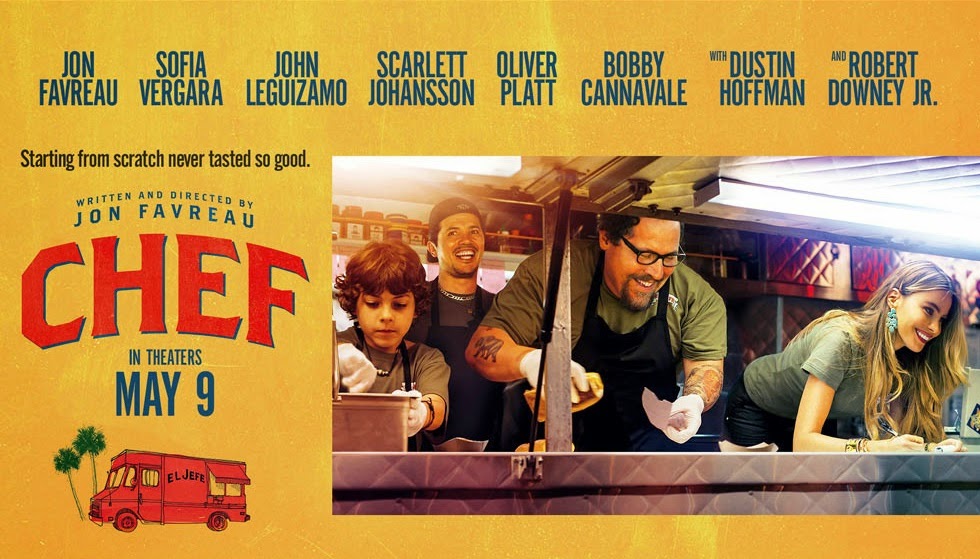
Chef Carl Casper (Favreau) has been working at the same restaurant for ten years.  The food he cooks is well liked but when the movie opens he’s been cooking the same menu for the last five years, so when word gets out that influential food blogger Ramsey Michel (Platt) has booked a table, Carl wants to do something different to impress him.  However, Carl’s boss, Riva (Hoffman) wants him to stick to the existing menu and give Michel what Carl is famous for.  Carl reluctantly agrees.  In his review, Michel slams Carl’s efforts and wonders what happened to the culinary genius he first encountered ten years before.  The next day, with Michel’s review trending on Twitter, Carl – with the help of his son, Percy (Anthony) – sends Michel an angry tweet that he doesn’t realise will be seen by everyone.  A brief war of words leads to a challenge: if Michel comes back to the restaurant, he’ll cook food that will make Michel eat his words (excuse the pun).

This time, with the restaurant fully booked (thanks to Twitter), and with Riva even more concerned that Carl’s attempts to do something different will backfire on the restaurant’s reputation, he forces Carl to make a choice: either cook the established menu or leave.  Carl leaves.  Michel is bemused by receiving the same food again and assumes Carl has backed down on the challenge.  Carl reads Michel’s tweet and heads back to the restaurant where he lambasts the critic in front of everyone; unfortunately a customer films Carl’s rant and the video goes viral.  While all this has been going on, Carl has been trying to maintain an amicable relationship with his ex-wife, Inez (Vergara), and spend time with Percy, but his work has always gotten in the way.  Now out of a job, Inez suggests he start afresh with a food truck, making the food he wants to make, and being his own boss.  Carl isn’t keen on the idea, but with getting another job at a restaurant proving more and more unlikely, and while on a trip to Miami with Inez and Percy, he eventually agrees.  Given the truck by Inez’ other ex-husband, Marvin (Downey Jr), and helped by Percy and his friend and colleague from the restaurant, Martin (Leguizamo), Carl gets it up and running and the three of them embark on a cross country journey selling food that reinspires Carl’s love for his work, and goes a long way to improving his relationship with Percy.

Chef - scene

Each year, there’s always one movie that serves as an antidote or an alternative to the usual fare of summer blockbusters, a modestly budgeted, small-scale movie that entertains, moves, and delights audiences, and leaves them feeling that they’ve actually experienced something.  Last year that movie was Before Midnight, this year it’s Chef.  It’s one of those movies that inspires audiences to go home and take up whatever it is the central character does, and here it’s to make food that looks so mouth-wateringly delicious you want to jump into the screen and devour it (even the fried breakfast Carl makes Percy at one point looks heavenly).  Carl’s passion for food is his life, and while other parts of his life don’t fare so well, it’s his faith in food that keeps him going, even when his professional life goes into meltdown.  As played by Favreau, Carl is an outwardly positive man apparently in a good place in his life, but inwardly he’s stifled and lacking the drive to take his career to a new level.  Losing his job turns out to be the best thing that could have happened to him, and it sees him reconnect with the other important parts of his life.

In particular, this means his son Percy.  Carl is oblivious to Percy’s need for a proper relationship with him, and he doesn’t see his son’s unhappiness each time he lets him down.  Even when they do spend time together, such as when Percy shows Carl how to use Twitter, Carl can’t wait to get back to cooking.  The road trip from Miami back to California, where Carl teaches Percy how to cook, and father and son bond more effectively, helps Carl focus outside of being a chef, and brings him back to being the young(ish) tyro he was ten years before.  It’s these scenes that give the movie it’s heart, and a couple of minor lapses aside, make for often touching viewing.  There’s plenty of humour here too, with Favreau’s script hitting the funny bone with impressive ease.  There’s a pleasing mix of situational comedy, quirky one-liners (“Come here, amuse-douche”), and visual gags, all seamlessly integrated into the whole, and the cast judge their performances accordingly, the obvious fun they’re having with the material easily transferring itself to the audience; it’s just infectious.

There are some minor quibbles – Johansson’s character is jettisoned halfway through without a backward glance, Carl behaves stupidly towards his son until his behaviour appears stupid for the sake of it, Riva is unnecessarily antagonistic towards Carl (especially the second time) – but for the most part Favreau gets it just right, balancing the comedy and the light drama with aplomb, engaging the audience from the outset with likeable characters and familiar situations that leave the viewer smiling in affectionate recognition.  He’s also an unselfish director, knowing when to let his cast take the lead in a scene, and giving a largely unshowy performance himself.  Leguizamo and Cannavale make a great double act in the restaurant kitchen, Vergara adds just the right amount of sophisticated glamour, and Downey Jr almost steals the movie with his portrayal of an entrepreneur with cleanliness issues.

It would be easy to dismiss Chef as a feel good movie that never really makes Carl’s situation too dramatic, and there’s certainly large swathes of the movie that are both predictable and overly familiar, but again, it’s Favreau’s adept handling of the material that makes Chef so enjoyable, so much so that any reservations are swiftly cancelled (excuse the pun).

Rating: 8/10 – to borrow a title from Queens of the Stone Age, Chef is “the feel good hit of the summer”, a warmly funny celebration of food and its overriding importance in one man’s life; a treat indeed and one that should be returned to as often as possible.

Hypocrites (1915)

Tags

, , , , , , , ,

Hypocrites

D: Lois Weber / 54m

Cast: Courtenay Foote, Myrtle Stedman, Herbert Standing, Adele Farrington, Margaret Edwards

The present day: the Reverend Gabriel (Foote) is preaching a sermon on hypocrisy to a congregation who are by turns, disinterested, bored, or unable to see that his sermon has any relevance to themselves.  Even one of his own assistants is seen reading a Sunday newspaper.  Seeing this, Gabriel rounds on everyone there and focuses the message of the sermon on them.  With the service concluded, several of the congregation gather outside the church and plot to have Gabriel removed.  Back inside, one of his female assistants (Stedman), clearly enamoured of the cleric, attempts to speak with him but he is so lost in thought she that she passes up the opportunity.  When everyone is gone, Gabriel slumps in a chair, the offending newspaper in hand, his thoughts continuing to reach out to God.

He falls into a reverie.  In it he finds himself dressed in medieval robes, ascending a steep hill.  His parishioners pass by on the road below; some see Gabriel and others climbing the trail, but fail to follow him for various selfish or thoughtless reasons.  Two women make the climb with him (including the woman who is fond of him), but they fall by the wayside, leaving Gabriel at the summit, alone and beseeching God for a better understanding of his flock’s lack of moral probity.

The past: Gabriel is a monk living in a monastery where the other monks are shown having what looks like a feast.  Gabriel is working on a statue, a gift for the monastery and the people of the town where it’s located.  He works in secrecy until the day his work is ready to be shown.  The monks arrange a celebration to go with the unveiling, but when the statue is uncovered there is shock and uproar: the statue is of a naked woman, whom Gabriel calls Truth.  Gabriel is seized by a mob and killed.  Back in the present day, his body is found by his parishioners, the newspaper still in his hand; a later headline reveals their shock at his being found in such circumstances.

Hypocrites - scene

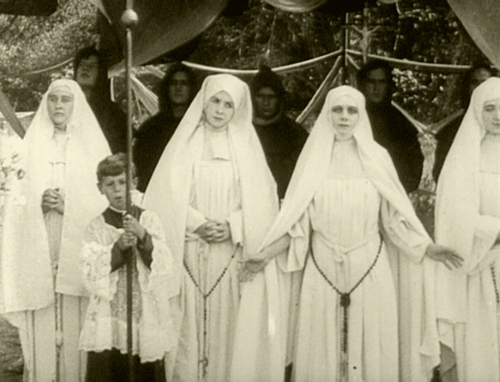
Hypocrites is a movie that has gained quite a good reputation over the years, and it’s easy to see why.  Though its moralising is a little heavy-handed by today’s standards, it’s still an effective piece, the use of the same actors in both time periods serving to highlight how little Man has changed over the centuries, his selfish, irreligious behaviour leading him further and further away from the path to true enlightenment and happiness.  Viewed like this it’s no surprise that the modern day congregation reacts in the way it does, seeking to oust someone who holds a mirror up to their vain, self-serving posturing.  This is further explored in an extended sequence where Truth (Edwards) – depicted as a naked young woman – shows Gabriel various examples of the hypocrisy his congregation indulges in, e.g. the politician whose banner reads “My platform is honesty” but who is then seen taking bribes (businessmen, lovers by convenience, and the clergy also come under fire).

The decision to portray Truth as a naked woman caused a degree of uproar at the time of the movie’s release, despite being passed by the National Board of Censorship.  Hypocrites was banned in Ohio, there were riots in New York (strange to think now that a movie could provoke that violent a reaction), and reputedly the mayor of Boston wanted each frame including Truth to be hand-painted to cover her nakedness.  In the movie itself, the depiction of Truth is achieved via the use of double exposure, thus curtailing the level of detail that can be seen (and Edwards holds an arm across her breasts for the most part), and her appearance is in no way salacious.  That the movie received such an unfavourable welcome in places must have been the best thing the filmmakers could have wished for.

As a piece of propaganda for the morality brigade, the movie is expertly handled by Weber whose background before entering the film industry was as a street-corner evangelist.  In this sense, her mastery of the material is to be expected, and she offers convincing portraits of moral backsliding, the cast of familiar (if uncredited) faces cranking back on the declamatory style of acting usually found in movies of the period (though Foote more than makes up for any shortfall).  Indeed, it’s refreshing to see a wealth of what audiences today would call more naturalistic performances.  Weber also displays a technical mastery of the medium, her use of the camera and location photography combining to bring an absorbing, fresh approach at a time when movies were still largely set bound and with the camera employed as a fixed observer.  The pace of the movie is well maintained also, and each scene is constructed to accommodate and/or support the fullest expression of the moral laxity it’s presenting.  It all makes for an impressive feat of moviemaking.

Rating: 9/10 – as relevant now as it was in 1915, Hypocrites depicts Man at his most shamelessly self-interested and duplicitous; a classic of silent cinema and clear evidence that Lois Weber was as talented – if not more so – than many of her peers.

Poster of the Week – Stoker (2013)

Tags

, , , , , , ,

Stoker

Stoker (2013)

If you’ve seen Stoker, then you’ll know that it has an often surreal, slightly macabre air to it, and this poster beautifully captures the mood and spirit of the movie.  The various items that make up the cornucopia on display are all relevant to the story in one way or another, but their individual placements give no hint as to their importance or even if they’ll feature prominently or not.  Some, like the sneakers, seem to have no importance at all, and yet, the level of mystery the poster affords belies their prominence or pertinence.  Others, such as the skull, seem too apposite, as if their inclusion were entirely to be expected given the movie’s subject matter.  And then there is the coffin, the focal point of everything, its occupant’s demise the reason for everything that takes place.

With such an effective illustration dominating the poster, it’s easy to overlook the effect of having still pictures of Nicole Kidman and Mia Wasikowska almost growing out of the image.  Kidman’s veil and downcast visage indicates a grieving widow, while Wasikowska’s accusatory look in Kidman’s direction seems to say that not everything about Kidman’s demeanour can be trusted.  These portraits imply an animosity between the two characters that is both intriguing and compelling: just what can be so wrong for Wasikowska’s character to look that way?

Having so many provocative elements, the poster needs only to add its principal cast members and its title to round things off, but even then there’s a further, arresting aspect: the distressed green and white of the title’s letters.  It’s a slightly unnerving combination of colours, bold and eye-catching, and reinforces the sense of disquiet the rest of the poster generates.  All in all, the poster more than adequately reflects the movie’s rising turmoil and does so with a quiet effectiveness that creeps up stealthily and silently.

Agree? Disagree? Let me know.

Tokarev (2014)

Tags

, , , , , , , , , , ,

Tokarev

aka Rage

D: Paco Cabezas / 98m

Cast: Nicolas Cage, Rachel Nichols, Danny Glover, Max Ryan, Michael McGrady, Peter Stormare, Pasha D. Lychnikoff, Max Fowler, Aubrey Peeples, Jack Falahee, Ron Goleman

Paul Maguire (Cage) is a successful property developer with a beautiful wife, Vanessa (Nichols), and a precocious teenage daughter, Caitlin (Peeples).  One evening, while Paul and Vanessa are out to dinner with the mayor, and Caitlin is at home with two friends, they’re interrupted by Detective St. John (Glover), who tells them that Caitlin has been kidnapped.  Her two friends, Mike (Fowler) and Evan (Falahee) tell Paul and the police that three armed men broke into the house and took Caitlin; the men were brutal, efficient and said nothing.  St. John warns Paul to let the police do their job and not use the skills he has to track the men down (it turns out Paul was part of a criminal gang but got out and has been straight ever since).  Paul pays lip service to St. John’s advice and enlists the help of old friends Kane (Ryan) and Doherty (McGrady) in searching for his daughter.

Their own enquiries reveal nothing; no one knows who is behind the kidnapping.  Then, after a few days, Caitlin’s body is found in a nearby river; she’s been shot in the head.  At her funeral, Paul is stopped by his ex-boss, Francis O’Connell (Stormare), who warns him not to stir up any more trouble than already exists between O’Connell’s gang, and that of the Russians, led by Chernov (Lychnikoff).  The warning brings back memories of a heist Paul and his two friends carried out nearly twenty years before, and which ended with them killing Chernov’s younger brother.  Having kept their involvement a secret all these years, Paul wonders if someone now knows, and Caitlin’s death is a form of payback.  Convinced this is the case, Paul, Kane and Doherty begin to target the Russians’ drug business, shutting down distribution houses and killing anyone that gets in their way.

Soon enough, Chernov begins to retaliate.  He abducts Kane and tortures him, while at the same time, Paul begins to suspect that Doherty has told someone what they did to Chernov’s brother.  With St. John doing his best to keep Paul out of trouble, and Chernov getting ever closer to finding out what happened to his brother, a sudden realisation leads Paul to the truth about Caitlin’s kidnapping and murder.

Tokarev - scene

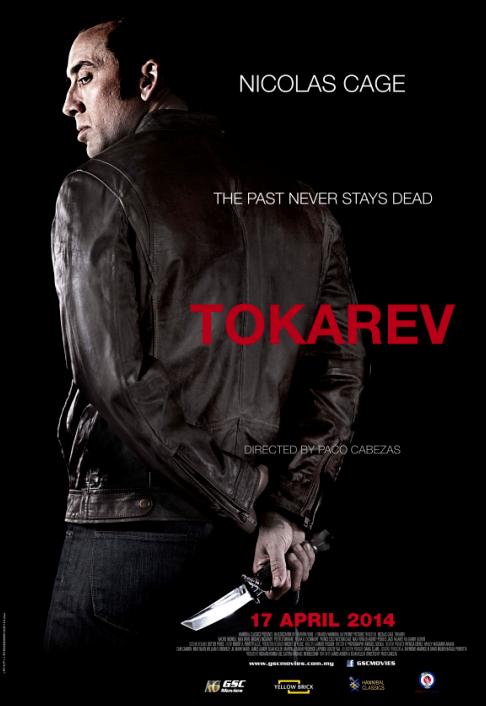
Tokarev, with its slipshod script and lacklustre mise-en-scène, re-confirms the downward spiral that seems to be Nicolas Cage’s career.  Since World Trade Center (2006), Cage has appeared in twenty-one movies before this one, and the number of genuinely good movies he’s made can be counted on the fingers of one hand*.  It’s also hard to believe Cage is an Oscar winner, such is the decline in quality of the movies he’s made since then (only Cuba Gooding Jr’s post-Oscar career contains more poor choices).  Either Cage has some serious bills to pay, or his critical faculties are all burnt out, but either way, Tokarev is an out-and-out turkey.

None of it makes any sense, from Paul’s having been able to walk away clean from his criminal past, to the hackneyed “secret-no-one-knows” subplot, to St John’s leniency in the face of Paul’s flagrant vigilante behaviour, to O’Connell’s warning to Paul to let it go.  Expediency is piled on top of artifice which is then topped off with preposterousness, and it all comes complete with a large side order of implausibility.  The truth behind Caitlin’s abduction and murder is so unlikely even Cage can’t make it work (not that he’s trying very hard; his performance isn’t so much phoned in as faxed in from a different decade).  It’s all so much nonsense it’s almost insulting, the script by Jim Agnew and Sean Keller adding up to a series of barely connected scenes and events that operate separately from each other, and sometimes, in complete isolation (the two or three scenes where Paul tries to persuade Vanessa to find somewhere safe to be while he does the things she’s asked him to do but really doesn’t want to know about).

Adding to the disappointment doled out by the script is the leaden direction courtesy of Cabezas, an amazing combination of apathy towards the material and disinterest in the characters, leaving the cast adrift and having to fend for themselves.  What acting there is in the movie is mostly unexpected, as Cage et al. deliver their dialogue with all the capability of people for whom English is a second language.  Doherty, in particular, seems unable to say anything without mangling the content, and even when he does manage a clean delivery, there’s no emotion or heart there; he’s like a robot who’s stuck in neutral.  Nichols plays the upset second wife and stepmother as if she’s grateful to be there, while Stormare (in a glorified cameo) attempts an Irish accent with all the purpose of a man who knows he’s probably not going to be called back for redubbing.  As for Glover, he’s hamstrung by a character so vapid and ineffectual (as a policeman) that he might as well be invisible.

It doesn’t help that the movie is also drab to look at, with uninspired lighting and camera movements, and pacing that kills the movie stone dead just minutes in (editor Robert A. Ferretti has the same problem as the script writers: he doesn’t know what to focus on or for how long).  Scenes that should be powerful and dramatic are regularly stopped from doing so, and thanks to Cabezas, any potential interest in the story is quickly abandoned, leaving the viewer to count the minutes until the movie ends.

Rating: 3/10 – with the action sequences providing a bare minimum of excitement, Tokarev – the make of gun that kills both Chernov’s brother and Caitlin – has little to recommend it; fans of Nicolas Cage might give it a go, but otherwise this is one quasi-revenge movie that should be avoided completely.

*Those genuinely good movies: Kick-Ass (2010), The Croods (2013), and Joe (2013).

Bad Words (2013)

Tags

, , , , , , , ,

Bad Words

D: Jason Bateman / 89m

Cast: Jason Bateman, Kathryn Hahn, Rohan Chand, Philip Baker Hall, Allison Janney, Ben Falcone, Steve Witting

At a regional spelling bee competition, forty year old Guy Trilby (Bateman) takes advantage of a loophole in the rules in order to take part and win the competition.  This allows him to take part in the national tournament, which he attends accompanied by a representative, Jenny Widgeon (Hahn), of his sponsor, online newspaper The Click and Scroll.  Travelling to the tournament by plane Guy meets fellow competitor Chaitanya (nicknamed Chai) (Chand).  Chai tries to strike up a friendship with Guy but is rudely rebuffed.  At the tournament, Guy and Jenny are met by the director of the Golden Quill National Spelling Bee Championship, Bernice Deagan (Janney).  She makes it clear that she thinks Guy’s presence and tactics so far are despicable, and that he shouldn’t be there.  Guy is dismissive of her (as he is with most people) and heads for his hotel where he finds his room is a supply cupboard.  That night he and Jenny have sex in his “room” and she leaves her panties behind.  When there’s a knock at his door shortly after, he thinks it’s Jenny come back to get them but instead it’s Chai; they end up spending the rest of the evening together.

On the first day of the tournament, Guy uses Jenny’s panties to help psych out one of the favourites, giving them to the kid in question and asking him to give them back to his mother.  The kid gets his word wrong and is eliminated.  Guy and Chai both advance to the next round. With pressure mounting from the parents of the other finalists, Deagan attempts to manipulate the outcome of the second day so that Guy gets the most difficult words she can find.  That night, he and Chai go out and have fun together, their antics forging a bond between them.  On the second day, Guy again psychs out one of the other contestants, while dealing easily with words such as antidisestablishmentarianism and floccinaucinihilipilification.  He and Chai advance to the final day, while Deagan’s plan is discovered by the moderator (Witting) and she is forced to resign.  That evening, Jenny tries to talk to Guy about something she’s found out, but he avoids her.  He heads to Chai’s room only to overhear the boy and his father discussing Guy and their strategy for dealing with him in the contest.  He bursts in on them and tells Chaitanya that he wants nothing more to do with him.

On the final day, Jenny finally reveals to Guy what she’s discovered, and he in turn reveals his reasons for taking part in the contest.  Still confident of winning, Guy sees the tournament come down to just him and Chai.  He spells his word wrongly, but so too does Chai, who wants to prove to Guy that he is still his friend, despite his father’s plotting.  With neither of them spelling their words correctly, the final turns into a farce, one that Golden Quill president Bill Bowman (Hall) cannot countenance.  But even after he intervenes, the two continue to try and let the other one win until…

Jason Bateman

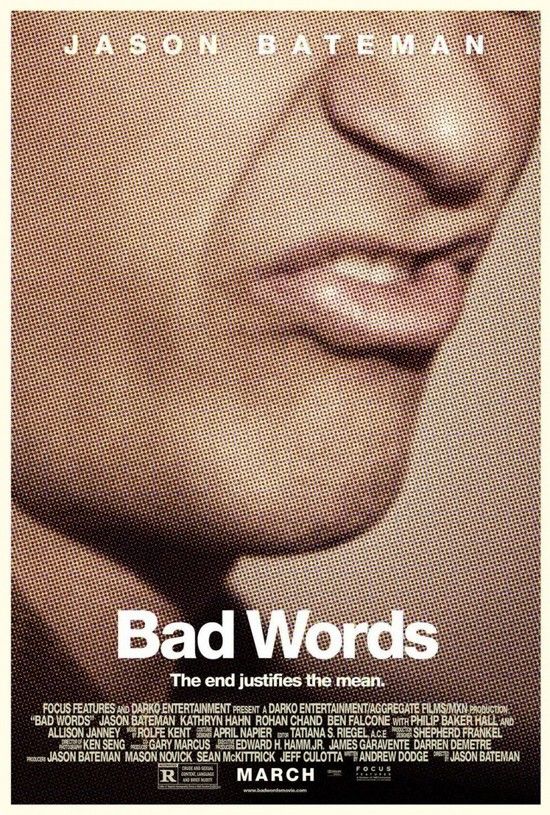
From the outset, Bad Words is unafraid to show its main character in a bad light; in fact, it revels in it.  Guy Trilby is one of the most obnoxious, caustic, disagreeable, and rude people you’re ever likely to encounter in a movie, and has a putdown for pretty much everybody he comes into contact with – his response to the mother (Rachael Harris) of one of the national competitors when she tells him what he’s doing is disgraceful, is one of the movie’s highlights.  Guy has so little regard for other people’s feelings he’s like a whirlwind of bile, abusive and profane in equal measure.  As created by screenwriter Andrew Dodge, Guy is the acid-tongued, cruelly manipulative, don’t-give-a-shit person we’d all like to be sometimes (but keep locked away for fear of being punched).  He’s a wonderfully nasty creation, and while, yes, of course he has a softer side, it’s still on his own terms.

It’s a wonderful role for an actor and Bateman rightly plays it deadpan, as if Guy’s worked out that his disdain for other people should preclude any physical effort; only a stony-faced expression is employed, one that perfectly illustrates his contempt.  Bateman is clearly enjoying himself, and there are several moments when Guy’s behaviour strays toward being cartoonish, but the actor keeps this from happening, his largely quiet performance grounding both the movie and the character.  When the reason for his being at the tournament is revealed, it’s another quiet moment in a movie that has a stillness about it that offsets Guy’s conduct (and the same is true when that reason is confronted).  This approach to the material is a refreshing change from the usual heavy-handed, ultra-kinetic style of so many comedies made today, and bodes well for any further movies Bateman may decide to direct (and let’s hope the scripts are as good as this one).

In support, Hahn is the internet reporter who is fascinated by, and attracted to Guy in equal measure, her feelings for him keeping her alongside him even though there’s no chance of a long-term relationship.  As Guy’s main competitor and potential friend Chai, Chand is appealingly winsome and, surprisingly, plays his age with little of the pretentious introspection that some child actors bring to their roles – hello, Elle and Dakota Fanning!  Janney plays Deagan with a snide supercilious attitude that fits the character perfectly; it would have been nice to see her trade off against Guy a few more times but the movie has too many other targets for Guy to skewer.  And as the Golden Quill president, Hall adds a level of formality to proceedings that is hilariously undermined by Guy at every opportunity.

Aside from some of Guy’s aggressive turns of phrase, there are several uncomfortable moments where Guy’s interaction with Chai is so inappropriate you’d be calling social services in a heartbeat, but these moments are made palatable – just – by virtue of being very, very funny (check out the lobster in the toilet, and a lady called Marzipan).  And we don’t learn nearly enough about Guy to find out why he behaves the way he does, leaving his motivation for being so awful to people an unexplained character trait and not much more.  And in the director’s chair, Bateman opts for some strange camera placements and angles during the tournament scenes that often interrupt the visual flow.  But these are minor complaints, and bring no lasting detriment to the movie at all.

Rating: 8/10 – not a movie for everyone, but if you like letting out your inner malcontent from time to time, then Bad Words easily fits the bill; a great directorial debut from Bateman and when Guy vents his spleen, so funny and outrageous it’ll make your sides hurt.

Nymph()maniac Vol. II (2013)

Tags

, , , , , , , , ,

Nymphomaniac Vol. II

D: Lars von Trier / 123m

Cast: Charlotte Gainsbourg, Stellan Skarsgård, Stacy Martin, Shia LaBeouf, Jamie Bell, Mia Goth, Willem Dafoe, Michael Pas, Jean-Marc Barr, Kate Ashfield, Christian Slater, Udo Kier, Caroline Goodall, Sophie Kennedy Clark, Ananya Berg

Now living with Jerôme but still unable to achieve orgasm, Joe falls pregnant; she has a son, Marcel, but her maternal instincts are dulled by her efforts to reclaim her ability to orgasm.  Her sexual demands begin to alienate Jerôme, who suggests she takes other lovers as it’s clear he can’t give her what she wants.  She does so but it triggers a jealous reaction in Jerôme and proves unsatisfactory as well.  Joe then learns about K (Bell), a sadist, and visits him in the hope that by exploring this aspect of sexuality it might help her.  Her visits require the services of a babysitter while she is gone, and one afternoon the sitter fails to show up; Joe leaves to see K anyway, leaving Marcel alone in their apartment.  When she returns, Marcel is safe but Jerôme is aware of her desertion, and eventually he challenges her: be a better mother or he will leave with Marcel, and Joe will never see them again.  Unable to stop seeing K, Joe visits him again; when she returns home, Jerôme and Marcel are gone.

Having stopped seeing K, Joe reverts to having sex with any man she wants, particularly at work.  Told by her boss that her behaviour is unacceptable, Joe is pressured into attending a therapy group for sex addicts.  The counsellor (Goodall) tells Joe that in order to control her sexual addiction she must first remove anything that might provoke a sexual response; this will make controlled abstinence that much easier.  This proves impossible and Joe realises she is denying her true nature.  When she next attends the group, she rails against them before leaving for good.

The next part of Joe’s story sees her working for a man called L (Dafoe).  She works for him as a debt collector, using her knowledge of the darker aspects of men’s natures to get them to pay up.  Joe is successful in her work, but as the years go by, L suggests she takes on and train a successor.  L has a candidate for her, a fifteen year old girl called P (Goth) who comes from a family of hardened criminals and who is lonely and shy.  Unconvinced at first, Joe takes P under her wing.  Their relationship deepens over the years until, when P is of age, Joe reveals the work she does and P’s planned part in it.  P isn’t put off and begins to take a more active role in Joe’s work, though when she pulls out a gun and threatens to shoot a debtor, Joe is angry with her.  This leads to an estrangement between the two that leads to disaster when P is given her first solo assignment.  The debtor proves to be Jerôme (Pas).  Unbeknownst to Joe, they begin a relationship, seeing each other whenever P has to collect a payment for the debt Jerôme owes.  On the night of the last collection, Joe follows P to Jerôme’s house and sees them together.  She is unsure at first at what to do, but decides to kill Jerôme and is making her way through the alleyway where Seligman found her when she hears Jerôme’s voice.  He is with P.  Joe tries to shoot him but the gun doesn’t work and he beats her up, thus bringing the story full circle.

Nymphomaniac Vol. II - scene

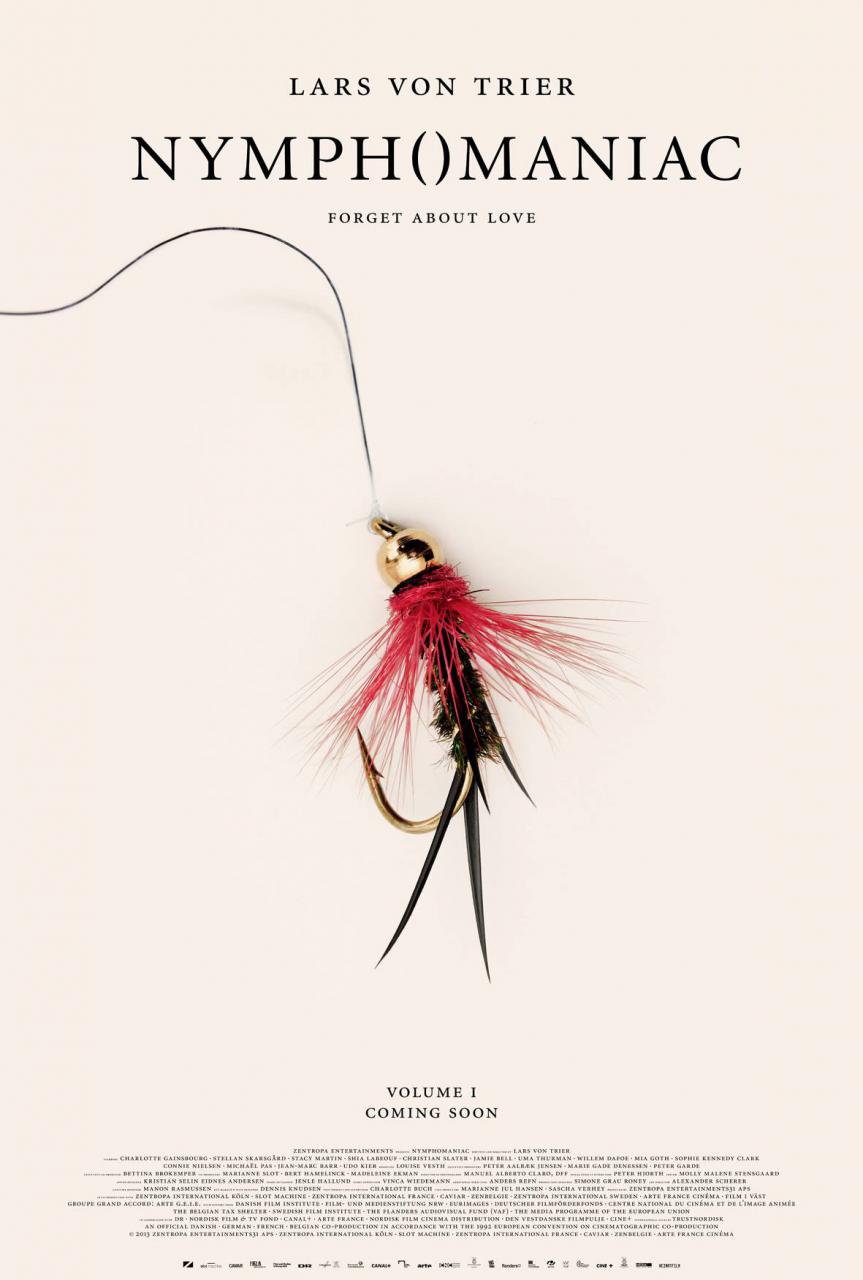
With the playfulness and abundant humour of Vol. I toned down from the outset, Nymph()maniac Vol. II is a different movie altogether, darker, more austere, less spirited (there is still humour to be found, though).  Joe’s quest to reclaim her orgasm makes her more sexually adventurous, but it also makes her more vulnerable, and her brief foray into motherhood shows how self-destructive she really is, placing her physical needs over the needs of her child.  The correlation between drug addict and sex addict is also given its strongest expression through her visits to K, as Joe desperately seeks a solution to her predicament.  In the same way that a drug addict will take stronger and stronger drugs in an effort to boost their being high, so too does Joe seek more extreme sexual experiences in her attempt to feel again.  (There’s an argument that Joe is also punishing herself during this period but as she finds release by manipulating the mode of K’s sadism, it doesn’t really hold true.)

If Joe’s addiction leads her into more and more “dangerous” territory, it also leads her to the re-confirmed belief that her sexual appetite is validated by her refusal to love.  But, in truth, it’s a defence mechanism, and shows just how scared Joe is of commitment; her inability to feel anything is brought about through Jerôme’s return and their relationship becoming more meaningful.  By reinforcing Joe’s avoidance of her emotions, von Trier shows the loneliness that she tries to hide, and how it distances her from the people around her.  Having her become a debt collector makes a certain kind of sense, as her neutrality in the face of others’ fear or pain makes her a perfect enforcer.

But as with all the best melodramas – and ultimately this is exactly that – Joe falls in love again, unexpectedly, with P.  But it’s a brief, not too convincing affair, with Joe seemingly ambushed by P’s feelings for her.  As P begins to assert her own identity, it becomes inevitable that Joe will not survive the encounter emotionally, and P’s betrayal of her with Jerôme sees her become an avenging angel, determined to destroy forever whatever fragile happiness she’s ever had.  It’s inevitable though that Joe’s plan will backfire because she’s only ever had control over her own body, and her distance from others precludes any influence she thinks she might have (except when she’s backed up by two heavies collecting money).

In the end, the viewer will find Joe’s emotional detachment either difficult to appreciate – it makes her hard to like, particularly in Vol. II – or a necessary conceit without which the movie would struggle to maintain any sense of coherence.  Either way, her selfish attitude to those around her, and her efforts to control them, make Joe a bold but regrettably galling human being to spend four hours with.  Some of her assertions during her badinage with Seligman are so pompous as to defy von Trier’s obvious intelligence: anyone who knows even the slightest bit about organised religion will know that the statement, “the Western church is the church of suffering and the Eastern church is the church of happiness” is so far from the truth to be almost (in its own way) heretical.  With quotes like these weighing things down, Joe’s assertions serve only to highlight just how remote she is from the rest of society, and even though von Trier champions her need to be true to herself, her lack of real introspection makes her appear, by the movie’s end (or beginning), shallow and intransigent.

There have been complaints that Vol. II, by being darker etc., is less of a movie than Vol. I.  But Joe’s story is one that follows a natural progression and the decision to split the movie in two appears to be more of a commercial decision than a creative one.  It is better to see both volumes in succession so as to retain the natural flow of what was always meant to be one four-hour movie, but, ultimately, von Trier’s decision to split the narrative makes no difference to the effect of the overall story.

On the performance side, Gainsbourg’s fearless approach to the material benefits the movie enormously and there’s rarely a moment where her conviction is in doubt.  She does her best to make Joe a sympathetic character but is equally unafraid to show her in a less than pleasant light, her commitment to the role going some way to mitigating the missteps in von Trier’s script.  As the outwardly concerned Seligman, Skarsgård maintains his inquisitive, supportive stance in the light of Joe’s revelations, but is given an horrendous final scene that destroys everything the character has come to stand for.  Martin’s presence, despite Gainsbourg’s proficiency, is not as missed as might be expected, while LaBeouf remains as hard to watch as in Vol. I.  The newcomers to the tale – Dafoe, Goth, Bell – acquit themselves well (Bell in particular is unexpectedly creepy as K), and it’s nice to see Slater and Berg (ten year old Joe) in flashback.

As before, von Trier’s technical control over the material remains in place, though some of the aforementioned missteps make it difficult to give him the benefit of the doubt when some scenes appear included merely for effect (the restaurant scene involving a number of spoons is a case in point, but it redeems itself by being very, very funny).  He’s on less firmer ground with the philosophical digressions that occupy Joe’s time with Seligman, and they become more and more contrived as the movie develops.  And the photography by Manuel Alberto Claro is as beautiful and decorous as in the first movie (which shouldn’t be a surprise).

Rating: 7/10 – no better or worse than Vol. I, Nymph()maniac Vol. II concludes Joe’s story in semi-triumphant style but maintains the faults found in the first movie; archly effective in places, and dismaying in others, von Trier’s conclusion to his Trilogy of Depression shows the wily old fox of arthouse cinema still as infuriating and entertaining (in equal measure) as he’s always been.

Nymph()maniac Vol. I (2013)

Tags

, , , , , , , , , , ,

Nymphomaniac Vol. I

D: Lars von Trier / 118m

Cast: Charlotte Gainsbourg, Stellan Skarsgård, Stacy Martin, Shia LaBeouf, Christian Slater, Uma Thurman, Sophie Kennedy Clark, Hugo Speer, Connie Nielsen, Ananya Berg, Jesper Christensen, Nicolas Bro

In a secluded alleyway, a man called Seligman (Skarsgård) finds a woman (Gainsbourg) lying unconscious on the ground; she’s been attacked.  He takes her back to his home, where she tells him the story of her life, and how she came to be in the alleyway where he found her.  The woman’s name is Joe, and she tells Seligman that from a very young age she was aware of her vagina and the pleasure it could give her.  She relates a number of instances from her childhood, and mentions her father, a doctor (Slater) whom she loved very much.  As a teenager (Martin) she chooses a boy, Jerôme (LaBeouf), to take her virginity, and so, begins a relationship with him that will continue off and on for the rest of her life.

Joe relates her time having sex with strangers on trains as a game she played with her friend B (Clark), and the club they subsequently form where members are not allowed to have sex more than once with the same person.  However, B falls in love and Joe ends their friendship in disgust.  Some time later, Joe applies for a job at a printing house, and despite having no skills or experience, is taken on.  This proves to be because her boss is the same Jerôme who took her virginity.  Jerôme wants to have sex with her but she refuses his advances, while at the same time she has sex with all the other men in the office.  But her willingness to see Jerôme suffer has a different effect and Joe stops having sex altogether; like B she too has fallen in love.  She builds up the courage to tell him but takes too long: when she arrives at work one day prepared to tell Jerôme how she feels about him, she finds he’s now married and travelling abroad.

Joe’s reaction is to have sex with as many men as possible, and to keep a string of lovers.  She tells of one man, H (Speer), who she tried to break up with by telling him he’ll never leave his wife and family, but this is exactly what he does, and it leads to an uncomfortable visit by his wife (Thurman) and their children.  But Joe admits the whole thing left her unmoved.  It’s only when her father dies in hospital that Joe is moved at all.  Continuing to juggle both work and several lovers, Joe finds herself feeling sad at times and while walking in a park one day, she is reunited with Jerôme.  He tells her his marriage isn’t working, and they go back to Joe’s place and have sex, but partway through she realises that she can’t feel anything physically.

Nymphomaniac Vol. I - scene

With all the hype surrounding von Trier’s Nymph()maniac duology (particularly the explicit sex scenes – always guaranteed to draw people’s attention), the casual viewer might be put off by a movie that revels in its bad taste highlights and caustic humour, but with Vol. I that would be a mistake.  After the dreary, depressing Antichrist (2009) and the mock-opera bombast of Melancholia (2011), the wily old fox of arthouse cinema has decided to make a comedy about sex, and not just about sex itself, but a vast array of preconceptions about sex, and its relationship with pain, betrayal, neglect, lust, sacrifice, and perhaps worst of all, love.

As a young child, Joe is presented as thoughtful, intelligent, acquisitive and precocious.  Her relationship with her father appears to hold the key to her future behaviour – Joe seeks what her father can’t give her – and on a basic psychological level it’s obvious why Joe behaves in the way she does.  But Joe isn’t interested in the emotional mechanics of sex but in the overriding physical need that pushes her to seek out so many men and so many sexual experiences.  Joe wants to be true to herself – to her vagina – but what she learns, and resolutely pushes to one side, is that emotion can enhance her encounters.  And yet, as her relationship with Jerôme shows, feelings and emotions can augment her experiences and enrich them.  It’s her refusal to admit this, or even trust it, that makes Joe such a sad figure: she’ll never find true happiness unless she allows herself to love.

In telling her story, Joe and Seligman indulge in some philosophical game-playing as Joe keeps referring to herself as sinful, while Seligman refutes her assertions at every turn. These interludes often find von Trier at his most mischievous as Joe seeks to justify her behaviour where clearly she has no need to.  Alluding to various topics, such as fly fishing and Fibonacci numbers, Seligman acts as the audience’s representative, taking Joe’s revelations in his stride and remaining unaffected throughout.  Some of the connections von Trier comes up with hail from the wrong side of contrivance, but despite this they have a certain élan to them that keeps them amusing even if they do sound pretentious.

Again, it’s the humour that counts, whether it’s Joe and B trying to be sophisticated while seducing men on the train, or Joe and Seligman arguing over the attributes of a cake fork, or even LaBeouf’s horrendous English accent (even worse than Dick Van Dyke’s Cockney horror in Mary Poppins).  Joe’s bed-hopping behaviour has its own in-built jocosity, appearing in stark contrast to the laboured protestations of guilt that the older Joe regales Seligman with.  It’s fun to see her treat men in the same way that men often treat women – as objects there to provide pleasure and little else – and even the tirade offered up by Mrs H. is entertaining with its desperate, cloying sarcasm projected as barely disguised venom.  There’s also a nice line in visual humour – Jerôme stopping an elevator in order to seduce Joe and finding out when he’s rebuffed that it’s stopped between floors; Seligman envisioning Joe’s somewhat different approach to “education”; the penis montage – although the equivalent verbal humour isn’t quite as prominent.

On the dramatic side, Joe’s encounter with Mrs H is the movie’s highlight, while Joe’s (one-sided) romance with Jerôme appears more of a plot device to keep Joe shagging lots of men than a real development for either character.  That she meets up with him again at the end isn’t much of a surprise – there’s unfinished business to be dealt with, after all – but the movie’s cliffhanger ending successfully pulls the rug out from under the audience’s feet with aplomb.  Her relationship with her father is honest and straightforward, and the scenes where he’s in hospital are genuinely moving (thanks largely to the playing of Messrs Slater and Martin).

As the younger Joe, Martin gives a stand-out performance, Joe’s initial enjoyment of sex before it becomes more and more of an addiction is so well depicted that it comes as a bit of a shock that this is her first movie.  But even when things begin to get darker, Martin keeps her focus and keeps the audience watching: it’s a bravura turn and easily award-worthy.  As the older Joe, Gainsbourg is mesmerising, her care-worn face telling of hardships that not even she can adequately talk about.  She dominates her scenes with Skarsgård, his nervous, twitchy style of acting at odds with her confident, self-assured determinism.  Skarsgård makes the most of Seligman’s “learned” naiveté, while there’s sterling support from Slater, Thurman and Clark.  Sadly, the same can’t be said for LaBeouf, who provides the worst performance in the movie, his attempts at creating a realistic character continually being undermined by his limitations as an actor.

Von Trier’s direction, as you might expect, is controlled and tightly focused, and he uses a variety of shots – often in the same scene – to show the fractured nature of Joe’s unique view of the world.  He’s on less solid ground with his script, with Joe’s often brittle approach to other people and her own feelings going some way to making her a little less sympathetic than expected.  Having said that, there are plenty of clever touches, and von Trier has a sure knack of cutting away from a scene at the right moment.  His cinematographer, Manuel Alberto Claro, gives the movie an appropriately clinical look that reflects the sense of detachment that Joe feels with regard to her life and history.

Rating: 7/10 – brimming with ideas (not all of which are effectively rendered), Nymph()maniac Vol. I is a cinematic confection dressed up in serious attire; an intriguing movie for the most part, but hampered by its unnecessary lack of an ending.


In the Blood (2014)

Tags

, , , , , , , , , , ,

In the Blood

D: John Stockwell / 108m

Cast: Gina Carano, Cam Gigandet, Ismael Cruz Cordova, Luis Guzmán, Amaury Nolasco, Treat Williams, Stephen Lang, Danny Trejo, Eloise Mumford

Newlyweds Ava (Carano) and Derek (Gigandet) are on their honeymoon in Costa Rica.  One night at a bar they meet Manny (Cordova), a good-natured hustler who persuades the happy couple to go to a club he knows, and on the next day, to “the Caribbean’s longest zip line”.  At the club, Ava draws the attention of Big Biz (Trejo).  When he tries to proposition her, Derek steps in but gets knocked to the ground.  The next thing anyone knows, Ava has beaten up around a dozen or so of Big Biz’s men.  Ava, Derek and Manny leave the club and as planned, the next day they visit the zip line.  Manny and Ava make it across without incident but when Derek travels across, one of the straps splits and he plummets to the forest floor below.  Miraculously he survives, and an ambulance is called.  Unable to travel with Derek, Ava is forced to follow the ambulance to the hospital, only to find when she gets there that Derek never arrived.

With her husband missing, Ava enlists the help of local police chief Garza (Guzmán).  When his investigation stalls at the first hurdle – the zip line operator denies Ava was there – Ava begins her own investigation.  With Manny’s help she learns that the ambulance was a fraud, that local gangster Lugo (Nolasco) is behind Derek’s abduction, and Garza knows all about it.  She rescues Derek but Lugo and his men come after them…

In the Blood - scene

Quite clearly a movie where logic and credibility were not on-set watchwords, In the Blood is like watching an updated Eighties action movie, the kind of action flick Arnold Schwarzenegger might have made on his way to super-stardom.  It has an exotic location, the close friend or family member in peril/needing to be found, the semi-amusing sidekick picked up along the way who provides all the clues, the nasty villain who can shrug off bullet wounds (literally – Lugo walks it off in minutes), a corrupt cop, and as a bonus the family member, Derek’s father, Robert (Williams), who thinks Ava’s bumped him off for his inheritance.  With so much familiar material, the movie drags in places, leaving the viewer waiting for each signposted plot development to go by so the next action sequence can begin.

Having Carano in the lead role helps, her physicality and MMA background making her involvement in the fight scenes entirely believable (and making those scenes possibly the only parts of the movie that are credible).  She takes some punishment along the way, but in a bizarre back story, we see her as a teenager (Paloma Louvat) being raised by her father (Lang) to be strong and overcome pain in a way that makes Big Daddy’s training of Hit Girl in Kick-Ass (2010) look sedate by comparison.  It’s akin to torture, and sits uncomfortably with the rest of the movie, begging the question, just what were screenwriters James Robert Johnston and Bennett Yellin thinking of when they came up with this idea?  Filmed in a dark, nightmarish way, these scenes seem to have been drafted in from another script entirely.

With the fight scenes choreographed to good effect, the movie at least has some things going for it, but otherwise is brutally inefficient in most other areas.  The performances range from amateurish (Carano – but she is still learning), to phoned in (Williams – “has my cheque cleared yet?”), to embarrassing (Trejo – like here, there are some roles he should just say “No” to).  Gigandet is sidelined for the bulk of the movie so has little chance to make an impact, while Guzmán plays the sweaty, deceptive police chief as if it’s a favour to the director.  Nolasco is about as menacing as an irritated tour guide, and Cordova underplays his role to the point of blandness.  It’s only Lang that convinces, his psycho father turn standing out from the crowd and putting a chill on an otherwise sunny movie.

In the director’s chair, Stockwell re-confirms his journeyman status, and as a result the movie never really gets out of third gear.  The script stutters and starts, and the reason for Derek’s abduction is as contrived, barmy and far-fetched as they come, while the relationship between Ava and Derek is painted in such broad strokes as to make it seem that Ava would do the same thing for anyone: brother, cousin, old high school classmate, neighbour six blocks over etc.  And Derek’s family turn up for a day and then head back home as if they were just passing through.  Other scenes are just plain ridiculous and/or embarrassing, but if there’s one scene that stands out as the most incredibly witless moment in the whole movie it’s when Ava stands by and lets the bad guys jam a huge needle into Derek’s spine.

Rating: 4/10 – with very little effort made by the filmmakers, In the Blood sinks under the weight of its own absurdity; with only its fight scenes to recommend it, this is a movie that should be watched with one finger hovering over the fast forward button.

Best Man Down (2012)

Tags

, , , , , , , , , , , ,

Best Man Down

D: Ted Koland / 89m

Cast: Justin Long, Jess Weixler, Addison Timlin, Tyler Labine, Shelley Long, Frances O’Connor, Evan Jones, Michael Landes

When Scott (Long) gets married to Kristin (Weixler) in Phoenix, there’s only one choice for best man: his best friend Lumpy (Labine).  At the reception, Lumpy drinks too much and his behaviour becomes more and more unacceptable, until Scott is forced to intervene.  Back in his room, Lumpy continues drinking; he has a fall and cracks his head open before passing out.  While the reception continues, Lumpy comes to and stumbles outside of his hotel.  Unable to get back in he heads toward the party but collapses before he can get there.  His body is discovered the next morning.

The news of Lumpy’s death puts Scott and Kristin in a bit of a bind.  Hailing from Minneapolis, they’re unable to afford both their honeymoon and the cost of arranging for Lumpy’s body to be returned home for the funeral.  Deciding to put off their honeymoon, they go through Lumpy’s phone in order to let his friends know what’s happened.  One name that neither of them recognise is that of Ramsey (Timlin).  Tracking her down proves difficult at first but eventually they find out where she lives and travel there to let her know the news about Lumpy.

Ramsey, who is fifteen, lives with her mother, Jaime (O’Connor) and her mother’s boyfriend, Winston (Jones), who is a bully to both of them.  Having got into trouble before, Ramsey is also under the care of the local priest (Landes); he vouches for her when she gets into any further trouble.  When Scott and Kristin meet Ramsey, they begin to learn that they didn’t really know Lumpy at all, and his relationship with the youngster reveals problems that Lumpy was doing his best to deal with (and which go some way to explaining his behaviour at the reception).

Best Man Down - scene

Advertised as a comedy – and with the presence of Long, Labine and Long (who sound like a firm of comedy lawyers), who can blame the makers for doing so – Best Man Down is first and foremost a drama with comedic moments, and not the laugh-fest some viewers might be expecting.  It’s an often heartfelt movie with the central relationship between Lumpy and Ramsey having a depth and a persuasive quality that is at once unexpected and which has an initial awkwardness that is entirely plausible (even if the first scene in Lumpy’s hotel room stretches that same plausibility).  As the mismatched friends, Labine and Timlin shine in their scenes together, and it’s their commitment to the material that makes the characters’ relationship so feasible.

Alas, the movie is on weaker ground when focusing on Scott and Kristin, newlyweds who never seem to have really talked to each other before they got married.  They’ve also lied to each other about some of the financial aspects of their marriage.  They argue a lot; Scott announces out of the blue that he’s quit his job; Kristin denies her increasing reliance on over the counter drugs.  This is a couple whose heads you want to bash together, and not just to make them see sense, but because it would actually make you feel better.  Long wears his exasperated face for most of the movie, and while it suits his character’s story arc to be like that, for the viewer it quickly becomes monotonous.  And though Long plays glum for most of the movie, it’s still preferable to the kooky, wide-eyed mugging that Weixler opts for.

There are other problems inherent in the material: just where is Lumpy’s mother in all this (she doesn’t show up until the funeral)?  Why does the threat posed by Winston, even when he brandishes a gun, feel about as menacing as being pelted with marshmallows?  And why doesn’t Lumpy confide in Scott in the first place – just how close were they really?  (This last question, at least, the movie tries to answer, but in an overly dramatic way that feels designed to add some much needed angst.)  There’s a resolution to Scott’s unemployment that smacks of expediency, and Kristin goes cold turkey without a backward glance; the audience is meant to believe at the movie’s end that their relationship is now much stronger, but in real life, the jury would still be deliberating.

With the movie proving so uneven, it’s left to the cast to make the most of writer/director Koland’s wayward script.  As mentioned above, Labine and Timlin come off best, while Long and Weixler appear lacklustre by comparison.  In support, O’Connor takes a clichéd role and wrings some invention out of it, Jones mistakes pouting for intimidation, and Shelley Long is almost unrecognisable as Kristin’s mother (it’s only when she speaks that it becomes obvious it’s her).  Koland directs too carefully for the movie’s own good, and never quite knows where the camera would be best placed; it’s a very unadventurous movie to watch.  On the plus side there is some magnificent, wintry location photography, and a pleasant, understated score by Mateo Messina.

Rating: 5/10 – unable to overcome its in-built limitations, Best Man Down stumbles along like a punch-drunk fighter refusing to stay down; another movie with twin storylines, though with just the one that’s at all interesting.

Poster of the Week – Casablanca (1942)

Tags

, , , , , , ,

Casablanca

Casablanca (1942)

What I like most about this poster is its simplicity.  It tells you as little as possible.  There’s the three main stars, the name of the film company, the title, the supporting players, the director, and the producer.  From this, the potential viewer doesn’t have a clue as to what the movie’s about, or where it’s set, or if it’s a period piece, or more contemporary, or if it’s a drama – though with that cast it’s unlikely to be a comedy – or if it’s even the latest “screen sensation!”

Even the main image, of Bogart and Bergman huddled together, doesn’t give anyone a clue.  He looks pensive and sad, but as to why, well, it could be anything.  And she is looking off into the distance, apprehensive, worried perhaps, at what she sees.  Together they’re a couple who could be facing any number of problems, but until you see the movie you’ll never know what they are, or how much those problems will affect them.

In many ways, the poster is a bit of a gamble, using the stars’ brand-name recognition to entice an audience into seeing a movie that they don’t know anything about.  And the title could mean anything: the place where the movie is set, a character’s name perhaps, or even a code name (that’s a bit of stretch, admittedly, but from the perspective of ignorance, it could even be the name of a company or a product).  And back in the days when there was generally one poster created per movie, the deceptive brilliance of this particular poster has got to be admired.  It’s lack of artifice seems to be saying, “Bogart, Bergman, Henreid, Casablanca – what else do you need to know?”  (Well, nothing – obviously.)  And to cap it all off, it’s clear that, in this instance, the movie’s title is also it’s tag line.  Just genius, sheer genius.

Agree?  Disagree?  Let me know.


Jimmy’s Hall (2014)

Tags

, , , , , , , , , , ,

Jimmy's Hall

D: Ken Loach / 109m

Cast: Barry Ward, Simone Kirby, Jim Norton, Francis Magee, Brían F. O’Byrne, Aisling Franciosi, Martin Lucey, Aileen Henry, Andrew Scott

Returning home to Ireland in 1932 after ten years living in New York, communist sympathiser Jimmy Gralton (Ward) finds himself welcomed by his mother and the rest of the local community.  He’s looked upon as a hero by both his own generation and the younger generation who’ve grown up on tales of his standing up to the church when he ran the local hall.  Jimmy fled then to avoid being arrested, and the hall has fallen into disrepair in the years since.  The church, represented by Father Sheridan (Norton), viewed the hall as promoting wickedness, with its dance classes and social events.  When the news of Jimmy’s return reaches him, Sheridan does his best to coerce the locals, and Jimmy himself, to leave the hall as it is, and makes it clear that if the hall does reopen, it will mean trouble for everyone.

Encouraged by the support of the local community, and undaunted by Father Sheridan’s threats, Jimmy decides to reopen the hall.  In doing so, he rekindles a romance he had with Oonagh (Kirby), even though she married while he was gone, and has had two children.  On the opening night, the hall is packed, much to Father Sheridan’s displeasure, and despite his taking the names of the people who attend.  Things begin to get out of hand when Marie (Franciosi) is beaten by her father (O’Byrne) for being there, and threats are made against Jimmy and the hall.  Soon, Father Sheridan is using Jimmy’s radicalism as a reason for having the hall closed, and with the local landowners – who stood with the church ten years before – accuses Jimmy of trying to introduce communist ideology into the community via the open door policy at the hall.  The state becomes involved, and it’s not long before there’s a warrant issued for his arrest.

Jimmy's Hall - scene

Purportedly Loach’s farewell to moviemaking, Jimmy’s Hall, at times, plays like a movie that someone attempting to imitate Ken Loach might make.  It’s got his political and religious points of view, it celebrates the underdog, it has a real sense of the community it’s presenting, and it takes melodrama and makes it appear matter-of-fact.  There’s the expected camaraderie amongst Jimmy and his friends and neighbours, the hissable villain representing repressive authority, outbursts of unjustifiable violence, a clearly defined historical perspective, and naturalistic acting from its cast.  (In one sense, it’s like a “greatest hits” package.)

And yet this is also very much Loach-lite, as it were.  It doesn’t have the impact needed to elevate the material beyond its basic structure and set up, and it lacks the passion that the people at the time must have felt about the issue.  Watching Jimmy’s Hall is like hearing someone describe something really terrible but in a completely even tone of voice.  And even though it’s based on a true story, there’s little here that merits a whole movie’s worth of attention.  Gralton, as played by Ward, is a sincere man, thoughtful, considerate, politically astute, romantic, but even with all that in his favour, he’s a bit colourless at the same time.  Long stretches of the movie go by without his being on screen at all, and when he is on screen, he’s often the secondary focus or part of the crowd, leaving the audience to wonder just what it is about the man that has warranted so much attention.  Aside from a scene where he shows off his dance moves, and a showdown with Father Sheridan (that changes nothing), Gralton is almost a bystander in his own story.  (There is his affair with Oonagh but that feels like it’s there to add further tragedy to events that are already fairly tragic on their own.)

The movie firmly supports Gralton and the villagers in their aims regarding the hall – poetry and dance classes, social events etc. – and the importance of the hall in their lives is portrayed effortlessly and with approval, Loach emphasising the need for it in broad but efficient brush strokes.  With the cause given such attention, the opponents are given less consideration, and appear needlessly narrow minded.  Sheridan is blinkered in his approach to Gralton and the hall, and with Paul Laverty’s script demonising the man at every turn, it quickly becomes draining watching him refute the good the hall engenders, and all because of some misguided notion that it will encourage lewd behaviour.  It’s a measure of Norton’s abilities as an actor that Sheridan isn’t completely free of introspection, and a scene with Father Seamus (Scott) and a phonograph gives more insight into the man but arrives too late in the movie to do any good.  And then there’s Marie’s father, the opponents’ blunt instrument, a character whose sole purpose in the movie is to show brute, unreasoning force was used against the villagers and by doing so, elicit more sympathy for them (as if we might not have enough already).

This simplistic approach stops Loach from captivating his audience, and while his usual polemical outlook is well established, the actual slightness of the material as well stops the movie from achieving anything more meaningful.  That said, the assembled cast are well chosen and there’s not a false note to be found in their performances (even if their character appears underwritten).  Magee and Franciosi, in particular, deserve a mention.  The movie is also beautiful to look at, Robbie Ryan’s cinematography bringing out the best of the County Leitrim locations (where the original events took place), and there’s a fine score courtesy of regular contributor George Fenton that mixes Irish music with jazz and blues to often moving effect.  Loach’s direction is as effortless as ever, and while the material may be modest in its ambition and scope, he’s still able to place often quietly moving moments and some subtle humour in amongst the political diatribes.

Rating: 7/10 – not as sharp or poignant as expected, Jimmy’s Hall has more to say about what makes a community than it does the political landscape of the times; however, a Ken Loach movie is always worth seeing, and despite reservations, this is no different.

Mini-Review: Chinese Zodiac (2012)

Tags

, , , , , , , , , , ,

Chinese Zodiac

Original title: Sap ji sang ciu

D: Jackie Chan / 109m

Cast: Jackie Chan, Xingtong Yao, Qi Shu, Oliver Platt, Fan Liao, Laura Weissbecker, Rosario Amedeo, Qingxiang Wang, Stephen Chang, Sang-woo Kwon, Alaa Safi, Caitlin Dechelle, Ken Lo

JC (Chan) and his team of mercenary treasure hunters are tasked with finding the twelve bronze heads that the animals of the Chinese Zodiac are made up of.  Originally plundered from the Summer Palace, the whereabouts of some of the heads are already known.  JC’s boss, Lawrence Morgan (Platt), wants him to locate and/or steal each one.  JC and his team travel from Hong Kong to France to Australia to Vanuatu in their efforts to find the heads; along the way they’re joined by antiquities expert Coco (Yao) and Parisian heiress Catherine (Weissbecker).  Unaware that Morgan has an ulterior motive for collecting the heads, JC finds each head in turn and then discovers he’s been tricked.  With time against him, JC has to save the last remaining head from being dropped into a live volcano.

kinopoisk.ru

If that last bit sounds a bit over the top, then you’d be right.  But then this is an action comedy devised, written, directed by and starring Jackie Chan, and made first and foremost for a Hong Kong Chinese audience.  Platt’s presence aside, this makes no concessions to international viewers, and is the usual mix of injury-defying stunts, intricate fight sequences, slapstick comedy, desperate mugging, chaste romancing, and has a storyline that barely serves as a hook for the action scenes; there’s even the standard outtakes included in the end credits (as well as a recap of Chan’s career).  If you like this sort of thing you’ll find plenty to keep you engrossed, and to be fair, Chan delivers the action goods even at 58.  With everyone involved clearly having fun, Chinese Zodiac is only interested in giving its audience a good time, and its far-fetched approach merely adds to that fun.  Chan has a steady hand on the tiller, the action is expertly choreographed, shot and edited, and the whole thing has a welcome, Saturday morning matinee feel to it.

Rating: 7/10 – an exhilarating thrill ride of a movie, Chinese Zodiac will attract fans of this type of thing probably more so than newbies; Chan is still an amazing physical performer, though, and thankfully, the positives easily outweigh the negatives.

The Young and Prodigious T.S. Spivet (2013)

Tags

, , , , , , , , ,

Young and Prodigious T.S. Spivet, The

D: Jean-Pierre Jeunet / 105m

Cast: Kyle Catwell, Helena Bonham Carter, Judy Davis, Callum Keith Rennie, Niamh Wilson, Jakob Davies, Dominique Pinon, Julian Richings

On a ranch in Montana, ten year old T.S. Spivet (Catwell) lives with his mother (Carter), father (Rennie) and sister Gracie (Wilson).  He used to have a twin brother, Layton (Davies), but his death from an accident involving a rifle has left the family fractured and each member spends most of their time absorbed in their own interests: his mother studies the morphology of beetles, his father dedicates himself to running the ranch, while his sister tries to promote the virtues of the Miss America pageant (as well as her desire to take part).  As for T.S., he has an aptitude for science that is way beyond his years, and he spends his time drawing maps and conducting experiments.  When he learns that no one has been able to come up with a perpetual motion machine, he takes it on as a personal challenge.  He sends his plans to the Smithsonian Institute in Washington D.C. and is surprised to learn that he has won the coveted Baird Award and is expected to travel there to collect his prize and give a speech.

T.S. decides to attend the award ceremony, and leaves home early one morning to travel alone by freight train.  His journey across the US is hampered by train guards and the police, but he is also helped along the way by kind-hearted strangers such as trucker Ricky (Richings).  When he arrives at the Smithsonian, he is taken under the wing of undersecretary G.H. Jibsen (Davis).  At the award ceremony, T.S. makes an emotive speech about the death of his brother, and reveals that he died during an experiment T.S. was trying to carry out.  The story, along with the perpetual motion machine makes T.S. an instant celebrity, and Jibsen arranges for him to take part in press interviews, and finally, a talk show.  With the addition of a surprise guest to the show, T.S.’s family begin to reconnect with each other.

Young and Prodigious T.S. Spivet, The - scene

Adapted from the novel by Reif Larsen, The Young and Prodigious T.S. Spivet is an appealing piece of movie-making from a director whose sensibilities and visual style are a perfect match for the material.  Jeunet, making only his second English language movie – let’s try to forget the giant misstep that was Alien: Resurrection (1997) – displays his fondness for odd camera angles, bold camerawork, and meticulous set design.  The movie is a visual triumph, ravishing in its depiction of Montana’s rugged landscapes, ingenious in its rendering of T.S.’s work and drawings (especially if viewed in 3D), and endlessly inventive on a technical level.  Even in relatively static scenes there’s always something to draw the attention.  Working with cinematographer Thomas Hardmeier, Jeunet has created a movie that is so wonderfully detailed in its look that the eye is seduced over and over again by what’s on screen.

Larsen’s novel – adapted by Jeunet and Guillaume Laurant – with its own visual style, is regarded by many as a modern classic, but the same problem the novel has, sadly, remains in the movie, and Jeunet’s faithfulness to his source ultimately undoes a lot of the good work that’s gone before.  The last third, following T.S.’s arrival in Washington D.C., feels flat and lifeless in comparison to the rest of the movie, and isn’t helped by Davis’s pantomime villain performance as Jibsen (she takes annoying to new levels).  With the addition of a talk show host who is more caricature than character, T.S.’s time in Washington is let down by the inclusion of their inanity and the movie suffers greatly (a pat resolution to all the family issues seems forced as well).  Only T.S.’s candid, and quietly emotional, description of the events surrounding Layton’s death has any impact during this section, and that’s due to Catlett’s artless delivery.

Of the cast, Catlett more than holds his own against his more experienced co-stars, and invests T.S. with a genuine sense of bafflement at most of the ways in which adults behave, or how the world works.  Carter adds another quirky performance to her résumé, and Davis mistakes exaggeration for character development, while Wilson looks so much like Chloë Grace Moretz that it becomes distracting.  Rennie has little to do other than look manly (he’s like a modern day Marlboro man), and Jeunet stalwart Pinon almost steals the movie as one of the strangers who help T.S. on his journey.

With the storyline grinding to a halt two thirds in, The Young and Prodigious T.S. Spivet falls short of achieving its full potential, and while some viewers may also have an issue with the whimsical nature of much of the movie, it’s more of a strength than a disadvantage.  If you buy into Jeunet’s vision then there’s much to enjoy, and there’s more subtlety lurking beneath the movie’s artistic sheen than you might expect.

Rating: 7/10 – entertaining and beautiful to look at, The Young and Prodigious T.S. Spivet may not be as fully realised as audiences would expect, but there’s still more than enough going on to still make this a (mostly) rewarding experience; an effectively grounded viewing pleasure despite its frequent flights of fancy.

Belle (2013)

Tags

, , , , , , , , , , , , ,

Belle

D: Amma Asante / 104m

Cast: Gugu Mbatha-Raw, Tom Wilkinson, Emily Watson, Sam Reid, Sarah Gadon, Penelope Wilton, Miranda Richardson, James Norton, Tom Felton, Matthew Goode

The illegitimate offspring of Royal Navy captain John Lindsay (Goode) and an African slave woman named Maria Bell, young Dido Elizabeth Belle is sent to live with his uncle, Lord Mansfield (Wilkinson) and his wife (Watson) at Kenwood House.  Despite her mixed race heritage, Dido is brought up as one of the family though some social – or possibly, household – conventions are upheld: Dido is unable to take part in dinner parties but is allowed to take coffee with guests afterwards.  She grows up in the company of her cousin, Elizabeth, who is also a ward of Lord Mansfield.  When both girls become of age, Dido (Mbatha-Raw) and Elizabeth (Gadon) expect to “come out” and find a husband.  However, Lord Mansfield has other ideas: with Dido having received a substantial inheritance upon the death of her father, he feels that her financial independence would only frighten off any potential suitors; he wants her to stay on at Kenwood and run the household.

While Elizabeth attracts the attention of James Ashford (Felton), it is his brother, Oliver (Norton) who finds himself drawn to Dido.  Unfortunately for Oliver, Dido has affections for John Davinier (Reid), a headstrong young lawyer-in-training who Lord Mansfield takes under his wing.  When the two men fall out over a ruling Lord Mansfield has to give – he’s the Lord Chief Justice – on the matter of the Zong slave ship (where slaves were cast deliberately overboard to drown), Dido endeavours to help Davinier as much as she can.  While the Mansfield household resides in London in their efforts to secure a husband for Elizabeth, Dido secretly meets with Davinier and his pro-abolitionist comrades and supplies them with as much information as she can about the case.  As the time approaches for Lord Mansfield to give his ruling, Dido’s involvement is revealed and Oliver Ashford proposes marriage.  With her future happiness hanging in the balance, Dido must decide if the life she requires will be dictated to her by social expectations or by her own desires.

Gugu Mbatha-Raw Sarah Gadon

Based – very, very, very loosely – on a true story, Belle is a handsomely mounted, beautifully lensed movie that tackles its subject matter with intelligence and a keen eye for the vagaries of the social hierarchy of Britain in the late 1700s.  The ingrained racism of the times is depicted far more subtly than expected, and is best expressed in the actions and thoughts of Lord Mansfield as he displays public disgust over the concept and practice of slavery, but in the privacy of his own home, represses Dido with his notions of correct social etiquette (and that’s without mentioning the implicit sexism of his position as well).  With the crusading Davinier to root for, and his “colour blindness”, the movie gives the viewer someone to help navigate the maze of 18th century politics, and just as Dido herself has an awakening in this matter, it’s one of the strengths of Misan Sagay’s heartfelt screenplay that matters become as clear as they do.

With the racism and the politics and the social niceties of the period so well rendered, it’s disappointing that the romantic aspects of the movie aren’t as strongly defined or developed.  Elizabeth is the trusting young hopeful, an almost stock character of the period whose lack of experience with men is redeemed by her telling Dido, “We are but their property”.  Against this, Dido is necessarily more confident and aware of the pitfalls of relationships though her confidence is established too easily, and there are times when the movie’s need for her to be a support for Elizabeth becomes irritating (Elizabeth isn’t exactly vapid but she is unremittingly naive).  Davinier’s ardent pursuit of Dido is too avid at times, and his passion for both the cause of abolition and Dido’s freedom from social strictures, as written, leaves the character looking almost (but not quite) insufferable.

In the title role, Mbatha-Raw gives a perceptive, masterful performance that is both emotionally honest and fiercely intelligent, and she is skilfully supported by Wilkinson and Watson, the former imbuing a cleverly written and yet difficult character with sincerity and charm.  Reid is earnest and declamatory (thanks to the script), and Gadon’s coquettish take on Elizabeth is occasionally affecting but she too is hindered by the restrictions of the script.  Wilton, Richardson and Norton flesh out their roles to good effect but Felton is stifled by a character who is never allowed to be anything more than the stock villain (not only is he an outspoken racist but he assaults Dido as well, as if his odiousness was in some way in doubt).

In the director’s chair, Asante shows an assured and substantial understanding of the issues being examined, and is particularly impressive when exploring the curious anomalies of Dido’s life at Kenwood House.  Under her committed and often powerful guidance, Belle overcomes its romantic Georgian soap opera elements to become a potent, articulate condemnation of a period in British history when endemic racism and the commerce of slavery was beginning to be challenged both socially and in law.

Rating: 8/10 – the aforementioned romantic elements and Rachel Portman’s often intrusive score aside, Belle is a vivid, impassioned look at the often complex life of a woman whose social position meant she was too low to eat with her family and at the same time, too high to eat with servants; a powerful, accomplished movie from a powerful, accomplished director.

Oculus (2013)

Tags

, , , , , , , , , ,

Oculus

D: Mike Flanagan / 104m

Cast: Karen Gillan, Brenton Thwaites, Katee Sackhoff, Rory Cochrane, Annalise Basso, Garrett Ryan, James Lafferty, Miguel Sandoval

Upon his release from a psychiatric hospital, Tim Russell (Thwaites) is met by his sister, Kaylie (Gillan) and reminded of a promise he made when they were children: to destroy the mirror she believes was responsible for the deaths of their parents eleven years before.  Tim has done his best to overcome the trauma of that event, and has no wish to relive it.  But Kaylie has become obsessed with destroying the mirror, and since its time in their childhood home, she has kept track of it and has managed to get it put up for sale at the auction house where she works.  On the pretext of having it checked for any necessary repairs before sending it off to the buyer, Kaylie takes it to their old home; there she has set up cameras and various recording devices in an attempt to prove that the mirror is possessed of an evil force.  Tim is less than convinced, despite the number of bizarre deaths that have happened to the mirror’s owners over the years.  As the plan progresses, Tim begins to remember more and more about the past, and the events that led up to the deaths of their mother, Marie (Sackhoff), and father, Alan (Cochrane).  With the mirror increasingly able to manipulate their minds into seeing what it wants them to see, Tim and Kaylie fight to stay one step ahead in their efforts to destroy it.

Oculus - scene

At first glance, Oculus looks and feels like a throwback to early Seventies horror, with its slow build up and emphasis on tension and suspense.  The early scenes, where Kaylie and Tim are introduced both as adults and as children (Basso, Ryan) are well constructed and as the movie unfolds, they show clearly how Kaylie and Tim have become the people they are now.  Young Kaylie is headstrong and a little rebellious; adult Kaylie is forceful and determined.  Young Tim lacks confidence and is easily scared; adult Tim is reticent and emotionally withdrawn.  The conflict between the two siblings is well handled and credible – even if what they’re attempting to deal with is incredible – and the dynamic of their relationship as children is echoed in their behaviour as adults.  It’s a smart move on the part of co-writer and director Flanagan, and helps keep things grounded when the tension and suspense is dropped in favour of a more violent and gory approach.

The structure employed here is unusual too.  Both storylines are allowed to run side by side, and in doing so, the movie keeps Kaylie and Tim in peril in two different time frames.  Although we know their parents died all those years ago, the how is still a mystery, and as the two strands are allowed to dovetail closer and closer together, so events become inter-related, with scenes cutting from then to now, allowing us to see, for example, adult Kaylie running into a room and then young Kaylie facing what awaited her there in the past.  It’s a clever approach and serves to keep the audience on the back foot for most of the last thirty minutes, but sadly, becomes too clever for its own good.  A more linear retelling would expose some lapses in the movie’s internal logic, and its reliance on all the cross-cutting to hide some further inconsistencies in continuity (though the one big problem with the movie is never adequately addressed: why not just destroy the mirror in the first place, why go to all the trouble of setting up cameras etc.).

With the two storylines allowed almost equal running time, it also becomes clear that the events of the past, though occasionally sacrificing coherence for effect (Alan’s recurring fingernail problem, Marie’s apparent possession), are the more engrossing and thrilling, while there’s too much arguing amongst the adults (as it were) for those sequences to be completely effective.  And with the present’s dependence on its scientific hardware and Kaylie’s unwavering belief in its effectiveness, the ease with which she and Tim are regularly outmanoeuvred becomes wearing and just a little too predictable.  In contrast, the past has more of a “kids-trapped-in-a-house-with-a-psycho-killer” approach, and their fight for survival is played out more effectively.

It’s no surprise, then, that the younger actors provide the more compelling performances, and are ably supported by Sackhoff and Cochrane.  Gillan overdoes the older Kaylie’s obsession with the mirror to the point where it becomes uncomfortable to watch, while Thwaites is stuck with playing the older Tim as little more than a bystander.  There’s a couple of suitably nasty moments – older Kaylie making the wrong choice between an apple and a light bulb; Alan removing a plaster from over his fingernail (it’s worse than it sounds) – and there are undeniably creepy moments involving one of the mirror’s previous victims that add to the dread-fuelled atmosphere.  Flanagan, who made the even creepier Absentia (2011), is definitely one to watch and as a calling card for the big leagues, Oculus should secure his future.

Rating: 7/10 – a horror film that attempts to mix an original storyline with its sequel, Oculus is brim-full of ideas, most of which work with unexpected panache; it’s a shame then that the sequel strand lets the movie down by being so derivative and predictable.

Poster of the Week – The Incredible Shrinking Man (1957)

Tags

, , , , , ,

The first in a (hopefully) regular series, Poster of the Week is an idea borne out of my searching for movie posters to add to each of my reviews.  I often try and root out some of the more unusual versions that are out there, and often I see other posters that look great but which I’ve never seen before.  So… I thought I’d share some of those posters with everyone.  Feel free to make requests, and I’ll endeavour to include them as often as I can.

Incredible Shrinking Man, The

The Incredible Shrinking Man (1957)

I like this poster for many reasons.  First there’s the comic strip approach that, while giving away most of the story, also piques the interest quite a bit: if all this is in the movie just how well is it going to be done?  (And who wouldn’t want to see a little man fight a giant spider?)  And then there’s the couple in the bottom left hand corner who seem to be looking up at the comic strip in amazement – one of them has to be saying, “Honey, we’ve gotta go see this movie!”  The type face in the top left corner is great too, with the words getting smaller and smaller at first and then getting bigger to show how exciting it’s going to be.  In these days of simple tag lines that often need to be clever at the same time – e.g. There Is No Plan B, The A-Team (2010) – it’s good to see a poster that’s really trying to sell the movie rather than just make you smile.  And then there’s the colour scheme, a selection of muted pastel colours that shouldn’t work, especially the blue, but somehow does, and it doesn’t “hurt” the eye to look at it.

Most movie posters these days have a single image with the ubiquitous tag line added, so it’s nice to see a poster that tries to cram as much in as possible.  I like these old posters, they always try to make the movie sound like a major event, even if it’s a studio ‘B’ movie.  They’re a bit of a lost art now, though, which I think is sad.  True, times have moved on, and we may like to think that movie posters are more sophisticated now, but for me there’s a special attraction in a poster that gives you so much to look at and take in.

Agree?  Disagree?  Let me know.

The Borderlands (2013)

Tags

, , , , , , , , , ,

Borderlands, The

D: Elliot Goldner / 89m

Cast: Gordon Kennedy, Robin Hill, Aidan McArdle, Luke Neal, Patrick Godfrey

Following reports of paranormal activity at a church in Devon, a small team of investigators is sent by the Vatican to look into the matter.  The team consists of Deacon (Kennedy), an investigator with many years’ experience; Gray (Hill) an IT specialist who has been drafted in to set up and monitor various cameras and recording devices; and Mark (McArdle), a priest who is in charge.  Deacon and Gray meet with the church’s incumbent, Father Crellick (Neal) who shows them video footage from a christening where items on the altar are seen to move (apparently) by themselves.  Deacon is unconvinced there is any paranormal involvement, while Father Crellick believes his church may be the site of a miracle.  Gray is also sceptical but he and Deacon go ahead with the installation of several cameras within the church.

Strange phenomena continues to be seen and heard in and around the church, and Father Crellick begins to behave oddly.  As the possibility of a hoax being played out becomes increasingly unlikely, Deacon looks further into the church’s history, discovering a diary written by a priest in the 1880’s.  In it there are disturbing references to a nearby orphanage that was open at the time, and hints that the children were abused, all of which is somehow linked to the church.  Exploring the church itself more thoroughly, Deacon discovers a concealed doorway and steps that lead down under the building.  He also hears sounds and then a voice that references one of Deacon’s previous investigations.  Fearing they may be dealing with something far more serious than they’d originally imagined, Deacon calls on the services of Father Calvino (Godfrey), an expert on matters relating to pagan deities.  The four men make their way to the church to perform a cleansing ritual, but things don’t go as they planned…

Borderlands, The - scene

The Borderlands – as you may have guessed – is a found footage horror movie, and while that particular sub-genre has been filmed to death over the last seven to eight years, there are several things that make this movie stand out from the crowd, and help make it a more rewarding experience than say, Grave Encounters (2011) or Devil’s Due (2014).  First and foremost are the characters, which are drawn quite broadly but with enough detail to make them credible as individuals, and their motivations and approach to events at the church remain consistent throughout.  Deacon is the world-weary pragmatist faced with something he can’t explain, while Gray has an initial happy-go-lucky approach that you know won’t last.  Mark is the uptight cleric whose faith only extends to the teachings of Jesus, and Father Crellick is the young priest who may or may not be looking for some publicity to bolster the attendance at his services.  There’s a good feel to their interaction with each other, and the dynamic of the team is quickly and easily established.

The Borderlands also boasts a very creepy vibe from the outset, and while there are the standard camera shots where nothing happens, the movie’s use of head cams makes for a steadier and surprisingly unsettling perspective than the standard shaky cam, and allows for each character’s reactions to events to be seen there and then.  The church – unused in real life for worship since 1981 – has an unsettling feel to it, and the scenes inside it, for the most part, achieve an unnerving quality that is quite unexpected.  Also, the pagan backdrop is used sparingly but to good effect, and the inclusion of allegations of historical child abuse has a resonance (thanks to the inclusion of a character called Mandeville – British viewers may pick up on this) that is given a distinctly uncomfortable payoff.

The denouement has Lovecraftian overtones, and there are some neat touches for those eagle-eyed viewers watching the background and not the foreground – look out for the headstone Gray stands near to at one point.  Goldner, directing from his own script, assembles the various elements to very good effect, and creates a palpable, nightmarish atmosphere.  There are a few narrative stumbles – an episode involving a sheep doesn’t lead anywhere, Crellick’s behaviour is odd from the word go, and Father Calvino arrives (at short notice) with information about the church that hints of the Vatican’s prior awareness of the site – but on the whole the movie successfully rises above the slough of other found footage movies and does so by virtue of working hard on the characters.  Kennedy gives an unusually layered performance, while Hill adds depth to a character who seems to be there just for comic relief but who actually serves as the viewer’s way in to the movie.  In support, McArdle and Neal have less to do but acquit themselves well playing secondary characters, and Godfrey arrives too late to make much of an impact but handles his exposition-heavy dialogue with aplomb.

Rating: 7/10 – With some comic moments early on that stem from the characters and their situation, and don’t feel shoehorned in to provide relief from the growing unease the movie is creating, The Borderlands is an effective little chiller; with good location work and a screenplay that subverts audience expectations, this is one found footage movie that can easily be viewed more than once.


Fruitvale Station (2013)

Tags

, , , , , , , , , , , , ,

Fruitvale Station

D: Ryan Coogler / 85m

Cast: Michael B. Jordan, Melonie Diaz, Octavia Spencer, Kevin Durand, Chad Michael Murray, Ahna O’Reilly, Ariana Neal, Keenan Coogler, Trestin George, Joey Oglesby, Michael James, Marjorie Crump-Shears

Oscar Grant III (Jordan) is a twenty-two year old resident of the Bay Area in San Francisco.  On New Year’s Eve 2008 he has a number of  problems he’s trying to deal with: he’s had a one night stand that his girlfriend Sophina (Diaz) hasn’t fully forgiven him for, he’s been unemployed for two weeks but hasn’t told Sophina, he’s holding drugs that he is expected to sell, the rent is due on January 1st and he doesn’t have the money, and to cap it all it’s his mother’s birthday (more of a welcome distraction than a problem, but still something to be added to the mix).  Oscar has done time and is trying to make a new life for himself, but all these problems seem to be holding him back.

As the day progresses we see him struggle with the demands of being a father – to his endearing daughter, Tatiana (Neal) – of being an ex-employee trying to get his job back, and how to put his drug-related past behind him.  He sees or speaks to friends and family, helps out a stranger in the supermarket where he used to work, antagonises his ex-boss, shows some kindness to a stray dog that gets run over, he gets rid of the drugs he’s holding, and he helps organise his mother’s birthday party.  After the party, Oscar, Sophina and some of their friends take the train to the Embarcadero to see in the New Year.  Returning home around two a.m., an altercation breaks out on the train as it arrives at the Fruitvale Station.  Transit cops at the station detain Oscar and three of his friends.  When one of them is handcuffed, Oscar protests enough for two of the cops – Officers Caruso (Durand) and Ingram (Murray) – to restrain him face down on the ground.  In the process of handcuffing Oscar, Ingram stands clear enough to draw his gun and shoot Oscar in the back…

Fruitvale Station - scene

By now, anyone watching Fruitvale Station will probably know that Oscar died from his wounds (though it does come as a bit of a shock to learn that had he lived, he would have done so minus his right lung).  In recreating the events leading up to and surrounding Oscar’s death, writer/director Coogler has created a fascinating and complex movie that doesn’t paint Oscar as a resolutely good man, but as a man beset by doubts and fears, and with a temper that can get the better of him – as best displayed in a flashback scene set on New Year’s Eve 2007, when Oscar was in prison (it also helps to explain why the altercation on the train came to happen).  He’s also a generous man, a devoted dad, and doing his best to get his life moving forward on a new track.  He has hopes and dreams, just like everyone else, and it’s this mix of good and bad that makes Oscar so credible as a person, and Jordan’s performance so convincing.

It’s a tribute to Coogler’s handling of the material that even though we know the eventual outcome of the movie, there’s little or no attempt to foreshadow the events that occurred on the platform at Fruitvale Station (the encounter with the stray dog comes close, highlighting as it does Oscar’s innate concern for others, a factor in what happened on the platform).  It’s not until his mother, Wanda (Spencer) persuades him to take the train that night, and not drive, that the often – in movies, at least – convenient hand of Fate steps in.  Once the fight breaks out on the train, the movie also speeds up, swapping its laid-back editing style (courtesy of Claudia Costello and Michael Shawver) for a brisker, faster-paced approach that lends an urgency to the inevitability of Oscar’s shooting.  And when the fatal shot is fired, the investment in Oscar that Coogler has built up, makes it all the more shocking.  It’s an unforgettable moment, and the suddenness of it is like a blow.

Being a true story there have been the usual claims and counter-claims about the movie’s authenticity, with various scenes coming under fire for not having happened at all (the scene with the dog), while Coogler has been accused of manipulating events to suit the needs of the movie.  It’s a very emotive issue, but any movie based on real events will always be “unfaithful” in some respects, and artistic licence will always play a part in how such a movie is put together.  And Fruitvale Station is no different.  But what it gets right is the everyday nuances of Oscar’s life, and the absolute injustice meted out to him by an officer who over-reacted in a situation he wasn’t fully in control of (it’s interesting that while Oscar and his family are known by their real names, the officers involved in Grant’s death have been renamed).  With these aspects so well constructed and identified, the movie gains a strength that is at once restrained and grimly moving.

Jordan (as mentioned above) is convincing throughout, and shows a range and quality to his performance that elevates his portrayal of Oscar, and he’s both sensitive and quietly eloquent.  It’s a bravura performance, as effective for its quiet moments as its dramatic ones.  The rest of the cast put in equally sensitive performances – Spencer’s turn as Oscar’s mother fully encapsulating the sadness she must have felt at the tragic result of persuading Oscar to take the train – though Durand is perhaps a little too heavy-handed as one of the cops that pin Oscar to the ground (he starts off as angry and unyielding and stays that way).

Rating: 8/10 – whatever your thoughts about the merits of adapting a true story for the screen, Fruitvale Station is one of the more honourable movies out there, and avoids any hint of sensationalism with ease; with a superb performance from Jordan, and inspired direction from Coogler, Oscar Grant’s final twenty-four hours are treated with both an admirable constraint and an unsuppressed sense of outrage.

The Look of Love (2013)

Tags

, , , , , , , , , , , , , ,

Look of Love, The

D: Michael Winterbottom / 100m

Cast: Steve Coogan, Anna Friel, Imogen Poots, Tamsin Egerton, Chris Addison, James Lance, Shirley Henderson, David Walliams

Presented as a series of flashbacks as Paul Raymond (Coogan) reflects on his life in the wake of his daughter Debbie’s death, The Look of Love takes us back to his early years as part of a mind-reading act, his early attempts at providing a show including static nudes, and the founding in 1958 of the infamous Revue Bar strip club in London’s Soho.  From there he ventures into publishing, though it isn’t until 1971 that the publication of Men Only brings him success in that field.  With pornography proving such a lucrative business, he stages risqué plays, and in the early Seventies branches out into real estate, mostly in Soho (there’s a scene early on in the movie where Raymond and his granddaughter Fawn are being driven through London and she has to pick out the properties he owns; later the scene is repeated but with a young Debbie).

Raymond is a somewhat mercurial man, adept at persuading those around him to follow in his wake, though his more personal relationships don’t fare so well.  As he builds his empire his marriage to Jean (Friel) begins to show signs of falling apart, his affairs with other women proving too much for her (it’s a sign of the times that is cleverly subverted, this was the Swinging Sixties after all).  His time with Fiona Richmond (Egerton) shows him at possibly his happiest, even when it leads to his taking drugs, but it’s a relationship that is doomed to failure, especially when her fame begins to outstrip his.  And his daughter Debbie (Poots), who he hopes will take over his empire, has dreams of being a performer but she lacks enough talent, and he has to close the show he’s set her up in.  From there, Debbie’s insecurities take hold and Raymond’s inability to support her leads us back to the movie’s beginning.

Look of Love, The - scene

The Look of Love takes a conventional approach to the biopic format, and charts Raymond’s life with obvious respect, but in many ways it feels as if there’s too much of a distance between the movie and its audience for it to be completely effective.  Despite the often challenging subject matter, and Raymond’s role in what was as much a cultural revolution as a sexual one, the movie is often like watching a mildly interested TV documentary, one that wants to say something about its subject but never quite manages it.  Under the auspices of its very talented director, The Look of Love is still an intriguing viewing experience, and its success in recreating the Sixties and Seventies and the vibe that was around during those times helps bolster the sense of a period when society was changing (though for better or worse is another matter).

Winterbottom is aided by a clutch of great performances.  Coogan, not a naturally gifted actor, works hard at presenting the various aspects of Raymond’s often contradictory nature, and – bad wigs aside – does an impressive, if at times awkward, job.  Raymond is still a character (albeit one that really lived), and Coogan displays a remarkable intuition at times that offsets any doubts about the man’s behaviour.  But there are also too many occasions when he affects a range of comic expressions that come across less as character detail and more as Coogan falling back on tried and tested habits.  The actor is clearly having fun in the role, but perhaps a little too much fun.

As his long-suffering wife, Jean, Friel manages to avoid being pushed to the sidelines, and imbues her with a no-nonsense determination that makes the poignancy of her (later) photo-shoot all the more effective.  Jean’s relationship with Raymond was mostly one-sided and her pragmatism in the face of so much “meaningless adultery” highlights the fortitude she had, and Friel brings these traits to the fore with an unshowy display that grounds her character completely.  As porn icon Fiona Richmond, Egerton expertly navigates the character’s transition from eager free spirit to self-publicising brand name with persuasive ease.  Her early scenes, as Raymond becomes more and more besotted with her, show both the carefree willingness to push boundaries alongside the more measured awareness of the benefits of doing so.  It’s a much more subtle performance than it appears, and Egerton never puts a foot wrong throughout.  As the emotionally wayward Debbie, Poots delivers an assured combination of vulnerability and self-destructive neediness, and her scenes with Coogan show the depth of their emotional co-dependency.  It’s an assured performance, and Poots displays a maturity and depth that belies her years.

There’s the requisite amount of nudity throughout, though nothing that would embarrass anyone – this isn’t 9 Songs (2004) – and the casual sexism of the times is adequately reflected in the attitude of Raymond’s advertising associate Tony Power (Addison).  The awkwardness and the inappropriate relationship between Raymond and Debbie is shown by their taking cocaine together, and there’s a perfectly judged moment at Debbie’s funeral where Jean accuses Raymond of failing their daughter by wanting her to be like him.  The emotional fallout from all this leaves Raymond adrift, and although the movie doesn’t cover his final years, he spent most of them as a recluse.

Rating: 7/10 – an absorbing look at the life of Paul Raymond, The Look of Love recreates the times of his rise to fame in an earnest yet thoughtful manner, yet doesn’t quite manage to be impassioned about its subject; the supporting characters prove to be more interesting, and there’s a great deal of misguided humour that only serves to undermine the tragicomic atmosphere.


Drive Hard (2014)

Tags

, , , , , , , , ,

Drive Hard

D: Brian Trenchard-Smith / 92m

Cast: John Cusack, Thomas Jane, Zoe Ventoura, Christopher Morris, Yesse Spence, Damien Garvey

Former race car driver Peter Roberts (Jane) runs a driving school but continues to dream of race car glory.  His wife, Tessa (Spence) and daughter Rebecca are not entirely supportive of him, and he’s very much stuck in a rut.  When a driving lesson with visiting American, Keller (Cusack) begins uncomfortably – Keller seems to know an awful lot about Peter, his family, and his past – Peter decides to end the lesson.  Keller persuades him to make a stop at a bank; when Keller comes out it’s clear he’s just committed a robbery, and Peter is now his getaway driver.  They evade the police and swap Peter’s clunky driving school car for a souped-up GT before heading further up the coast to where Keller can leave the country.

Of course, Keller hasn’t just committed any old bank robbery, he’s stolen $9 million in bearer bonds from a bank that acts as a front for the crime syndicate that left him high and dry after a job he did for them (Keller is a thief and spent five years in jail).  With the bank’s “security” staff after them, as well as the local police (who are on the bank’s payroll), and the Federal police, Peter and Keller have to try and keep a low profile on their journey, something that proves easier said than done.  And as their relationship develops, Keller shows Peter that his life isn’t as rosy as he thinks it is.  It all leads to a showdown at a marina that sees Peter and Keller working together to get both of them out of danger.

Drive Hard - scene

Drive Hard is best summed up in four words: it’s just plain awful.  This is movie-making of such depressing witlessness that it makes you wonder how on earth anyone could have thought they were doing a good enough job in the first place.  Watching actors of the calibre of Cusack and Jane trying to make any of it interesting or entertaining is like watching two ageing boxers trying to land punches but missing every time.  Jane is simply embarrassing; it’s like he’s decided that making his character seem credible just isn’t relevant or necessary.  It’s possibly the worst performance he’s ever given on screen.  And Cusack is only marginally better, again ditching a credible characterisation in favour of mangled line readings.  If there was ever a performance that shouted, “paying the mortgage here!” then this is the one.

At the reins, and failing to bring anything remotely interesting or new to proceedings is veteran director (and co-screenwriter) Trenchard-Smith, a cult figure quite well-regarded but on this outing, clearly going through the motions.  For a movie with a title like Drive Hard, it’s equally clear that the title came first, and the story and plot came along a very distant second and third.  Even the chase sequences – strictly speaking, one chase sequence split into two sections – are dull and uninspired, and you know things are bad when the budget isn’t big enough to come up with at least one decent collision or car wreck.  Otherwise there are plenty of shots of Peter and Keller driving through the (admittedly) beautiful Gold Coast countryside on their not very fast trip to the marina, and an encounter with a group of bikers that should provide some much-needed tension but which is resolved with a minimum of fuss and/or bother (basically these bikers are about as scary as a bunch of leather-clad Teletubbies).

There are other encounters along the way – a gas station attendant tries to steal the bonds but ends up like Marvin in Pulp Fiction (1994), an elderly woman at the site of a wedding reception goes gun crazy when she realises who Peter and Keller are – but these (very minor) highlights are still badly paced and edited.  The subplot involving the corrupt cops and the Feds is allowed to trundle on in such a contrived manner it makes its resolution all the more welcome, even if it is entirely implausible, and the main bad guy, Rossi (Morris) is so colourless he might as well be see-through.  Peter’s relationship with Tessa feels like it was adapted from an agony aunt column, and the solution to their problems proves to be unashamedly sexist.

The worst aspect of this absolute mess of a movie is without doubt the dialogue, with enough clunkers per minute to warrant some kind of award.  Cusack seems saddled with most of them, and his attempts to justify his actions are both lame and ludicrous at the same time.  Jane blusters his way through his lines with all the enthusiasm of someone who can’t wait to get them over and done with, and Rossi’s attempts to sound threatening are about as impressive as someone trying to intimidate a snail.  And as if things couldn’t get any worse, the end credits fail to list the young actress who plays Rebecca, but does list Cusack’s personal chef twice.

Rating: 3/10 – abysmal, and a low point for pretty much everyone concerned, Drive Hard disappoints on almost every level; leaden, tension-free and careless, this is filmmaking for the sake of it and as entertaining as watching your toenails grow.

22 Jump Street (2014)

Tags

, , , , , , , , , , , , , ,

22 Jump Street

D: Phil Lord, Chris Miller / 112m

Cast: Jonah Hill, Channing Tatum, Ice Cube, Peter Stormare, Wyatt Russell, Amber Stevens, Jillian Bell, Kenny Lucas, Keith Lucas, Nick Offerman, Jimmy Tatro, Caroline Aaron

Having saved the day in 21 Jump Street – and to everyone’s surprise – rookie cops Schmidt (Hill) and Jenko (Tatum) are given another assignment, but this time instead of going undercover at a high school, they’re off to college instead.  With the church at 21 Jump Street having been bought back by the Koreans, the pair are assigned to the Vietnamese church across the road at 22 Jump Street.  Still under the command of the ever-cussing Captain Dickson (Cube), Schmidt and Jenko have to find who’s dealing a new drug on campus called WhyPhy (pronounced Wi-Fi), and who the supplier is as well.

College life proves to be divisive for the duo, with Jenko being welcomed into a jock fraternity headed by Zook (Russell), while Schmidt finds himself welcome amongst the geeks, in particular, art major Maya (Stevens).  When Zook is revealed to have an incriminating tattoo, Jenko refuses to accept he might be the dealer; so strong is his new attachment to the fraternity life he decides he and Schmidt should go their own way.  When the college counsellor is arrested and the case officially closed, neither Schmidt nor Jenko is convinced he’s the dealer.  They resume their investigation and discover the supplier is a criminal known as the Ghost (Stormare).  They also find out he plans to distribute the new drug at the upcoming spring break celebrations at Puerto Mexico.  With the dealer’s identity still a mystery, Schmidt and Jenko travel there in a bid to apprehend him and stop the drug spreading nationwide.

22 Jump Street - scene

The surprise success of 21 Jump Street meant that a sequel was inevitable, and returning writers/directors Lord and Miller have a great time subverting the pitfalls of such an endeavour, most notably in an extended sequence featuring the hangdog Deputy Chief Hardy (Offerman) where his instructions to Schmidt and Jenko to “keep things the same because they seemed to work the first time” are carried to their logical extreme (and then beyond).  There’s even a reference to the increased budget for the movie – $70m as opposed to the original’s $42m – when Hardy says the top brass have given 22 Jump Street more money to help them with their investigation.  It’s one of the funniest scenes in the movie, and played to perfection by messrs Offerman, Tatum and Hill.

As it turns out, the investigation is of secondary (hell, even tertiary) importance, as the movie focuses on the break-up of Schmidt and Jenko’s professional and personal relationships, with Jenko’s bromance with Zook taking up a great deal of screen time (as if we didn’t get how important it is to him), leaving Schmidt to act possessive and look broken hearted, even with his budding romance with Maya taking off at the same time.  This jealousy angle, somewhat signposted from the beginning, is given far more emphasis than it needs, and there’s very little room for the actual investigation, other than a few half-hearted attempts at surveillance and a trip to the counsellor’s office that ends up mocking every couples therapy session you’ve ever seen.  But, despite these scenes being very well played by Tatum and Hill, they often outstay their welcome, and could do with some judicious editing.

With plenty of scenes that could have been excised or shortened, 22 Jump Street is a movie sequel where the saying “Less is more” is definitely not adhered to.  It’s as if Lord and Miller, by embracing the tropes and conventions that contribute to most sequels, felt that being self-referential was all they had to do, and that it would get them off the hook when things didn’t quite work out.  But by following the template of the first movie so closely, what little originality there is on display is overwhelmed by so much that is familiar.  It’s a tightrope walk, and one where not everyone manages to stay on.  That said, the jokes about the stars’ age and looks come thick and fast and are very funny, with Hill in particular being given a roasting on more than one occasion.

Hill and Tatum still make for a great double act, though it’s Tatum who edges it here, his physicality and willingness to look foolish having more appeal than Hill’s strident comic style.  Cube is, well, Cube playing every other foul-mouthed, aggressive character he’s ever played (he’s in danger of becoming his own caricature now), while the rest of the supporting cast deal well with a range of underwritten characters.  There are cameos from Rob Riggle and Dave Franco, and the usual attempts to make it difficult to work out who the dealer is (not easy but not difficult either), and there’s a great moment when Jenko uses a girl on the beach to see off two of the Ghost’s thugs (who appear out of nowhere).

Enjoyable for the most part, with one absolutely standout moment about halfway through – watch for Jenko’s reaction when he finds out something about Schmidt’s love life – 22 Jump Street coasts along for much of its running time, riffing off the previous movie and doing just enough for the most part to avoid being looked on as a “contractual obligation”.  There are laughs to be had, but the action scenes are low-key and not very exciting, and there’s an incredibly indulgent end credits sequence that is amusing to begin with but soon runs out of both steam and imagination.

Rating: 5/10 – too long, and too uninterested in its drugs-related storyline, 22 Jump Street will nevertheless please fans of the original; if there is a 23 Jump Street (as seems likely) then a tighter, less self-reverential storyline will be required.

Silent House (2011)

Tags

, , , , , , , , , , , ,

Silent House

D: Chris Kentis, Laura Lau / 86m

Cast: Elizabeth Olsen, Adam Trese, Eric Sheffer Stevens, Julia Taylor Ross, Adam Barnett, Haley Murphy

While renovating the summer home her family hasn’t visited or used for some time, Sarah (Olsen) begins to experience strange phenomena that may mean the house is haunted.  She is particularly attuned to the strange goings on, and finds herself becoming more and more aware that not everything is as it should be.  A visit from childhood friend, Sophia (Ross), whom she clearly doesn’t remember, adds to the sense of unease Sarah feels.  When her uncle Peter (Stevens) leaves after a dispute with her father John (Trese), Sarah starts to hear weird noises coming from one of the rooms upstairs.  She gets her dad to investigate but at first they don’t find anything (though John does find some photographs that he quickly hides away).  When her father is attacked and injured, Sarah tries to flee the house but finds herself locked in and unable to get out.  With someone else in the house, stalking her, Sarah becomes increasingly terrified; she finds a key to the padlock on the storm cellar door and escapes.

Outside, she has a vision of a young girl (Murphy), and runs into her returning uncle.  She tells him about her father and they head back to the house.  Peter goes inside; while Sarah waits in the car she becomes convinced someone has gotten in there with her.  She runs back into the house and locks the front door behind her.  Peter can’t find her father’s body (though he does find some photographs that he quickly hides away).  They search for John but Peter is attacked and knocked unconscious by the unknown intruder (Barnett).  Sarah’s visions of the young girl become more frequent, and the intruder looks more and more like a reanimated corpse.  Once again, Sarah tries to flee the house…and runs into Sophia who begins to challenge her memories of the past.  With her visions of the young girl proving more and more revealing of a past tragedy that happened at the house, Sarah is forced to confront some horrible truths surrounding her childhood.

Silent House - scene

A remake of the Uruguayan movie La casa muda (2010), Silent House starts off well, its remote lakeside location just wintry enough to make things feel eerie from the start.  The house is a bit of a labyrinth and seems to contain more rooms than seems feasible when looking at it from the outside, and the basement seems twice as large again.  The lack of working electricity adds to the atmosphere and the battery lamps used throughout throw out just enough light to keep things hidden in the shadows, further adding to the sense of foreboding, while Olsen’s wide-eyed moon face reflects the building tension with unexpected authority.

With all this in place, it’s a surprise then that the movie doesn’t work as well as it should.  The main problem lies in the approach to the material. What begins as a haunted house movie mutates part way through into a psychological thriller with lingering supernatural overtones, and ends as an uncomfortable revenge drama.  Wearing and shedding so many identities leaves Silent House feeling as if the writer (co-director Lau) couldn’t decide which approach was the most effective.  This also leaves the movie feeling disjointed and incohesive, and there are too many moments when the requirements of the script make for forced (non-)activity on screen – is it unreasonable to assume that Sarah wouldn’t be seen hiding under the kitchen table by the intruder?  There’s also the issue of what’s real and what’s not real – there’s a good argument to be made for Sophia not being real throughout, but this isn’t confirmed one way or the other – and it’s unclear if what Sarah is seeing is happening at all, but in the hands of Kentis and Lau the ending is inconclusive (but maybe deliberately so).

While the directors try and decide what kind of a movie they’re making, it’s left to Olsen to shoulder the burden of selling the movie and its twists and turns.  Fortunately she’s up to the task, and even if she can’t quite make the final scenes ring true, it’s still a strong performance, Sarah’s increasing hysteria tempered by an overriding obduracy.  Trese and Stevens are fine, if underused, and Ross is realistically creepy in her manner; when Sophia gives Sarah a hug it’s so awkward as to be cringe-inducing.  When she returns towards the movie’s end, her appearance is a powerful boost to proceedings (even if it doesn’t make complete sense for her to be there).

Rating: 6/10 – it needs a better ending, but on the whole Silent House works well within its (for the most part) interior location; a great performance from Olsen anchors the more outlandish moments and there’s a degree of fun to be had in trying to work out what’s happening and why, but sadly the movie stumbles far too often for it to be completely successful.

Winter’s Tale (2014)

Tags

, , , , , , , , , , , , , ,

Winter's Tale

aka A New York Winter’s Tale

D: Akiva Goldsman / 118m

Cast: Colin Farrell, Russell Crowe, Jessica Brown Findlay, Jennifer Connelly, William Hurt, Graham Greene, Mckayla Twiggs, Eva Marie Saint, Ripley Sobo, Kevin Corrigan, Kevin Durand, Will Smith

1895.  A couple entering the US at Ellis Island are turned back because the man is terminally ill.  From the ship that is taking them back to their homeland, they set their infant child adrift in a model schooner in the hope that he will be found and given a better life.

1916.  The child is now a young man and a thief, Peter Lake (Farrell).  On the run from local gang boss Pearly Soames (Crowe), Peter is saved by a white horse that appears out of nowhere.  Using the horse both as transport and as an accomplice in his stealing, Peter finds himself outside the house of the Penn family.  Isaac Penn (Hurt) is the editor-in-chief of the New York Sun newspaper; he lives there with his two daughters, Beverly (Findlay) and Willa (Twiggs).  Thinking everyone has left on a trip, Peter breaks in but finds that Beverly has stayed behind.  She is unperturbed by finding a burglar in her home, and invites him to have tea with her.  While they talk, Peter learns she is terminally ill with consumption.

While Peter prepares to leave the city Soames is increasingly determined to track him down.  There proves to be a supernatural reason for Soames’ pursuit of Peter, a reason that involves the balance between good and evil.  Peter has a miracle to give to someone with red hair, and when Soames becomes aware of this, and Peter’s recent association with Beverly, he attempts to take her away from him.  Peter intervenes and they head for the Penns’ country home upstate.  There, their relationship deepens into love, but at a New Year’s Eve ball, Beverly’s drink is poisoned by one of Soames’ men, and she later dies.  Peter allows himself to be found by Soames and is pushed off a bridge into the river.

2014.  Peter is walking through a park one day when he meets a young girl, Abby (Sobo) and her mother, Virginia (Connelly).  He has no memory of who he is and later, attempting to follow up on a clue he’s found, he meets Virginia again at the offices of the New York Sun (where she works).  She helps him and they discover his association with the Penns; he also meets the adult Willa (Saint).  Soames, who is also still alive, becomes aware of Peter’s return and tracks him to Virginia and Abby’s apartment.  Abby wears a red bandanna that looks like she has red hair; she is also ill with cancer.  Realising that Peter’s miracle is for Abby and not Beverly, he tries to escape Soames and his men, and save Abby.

DSC_8310.dng

A pet project is not always the best idea for a first-time director, and it seems especially true if the director is also the screenwriter.  Sadly, with this adaptation of Mark Helprin’s novel, respected wordsmith Goldsman must be added to the list.  Helprin’s tale of magical realism is given a decidedly lacklustre retelling, and while some elements work better than others (as would be expected), those that do work are unable to compensate for those that don’t.  For example, the true nature of Soames – and later, that of the Judge (Smith) – is revealed in a shocking moment that is so unexpected it has the effect of destroying the mood the movie has spent quite some time establishing.  With that particular cat let out of the bag, the movie becomes quite different, and the tone darkens, but without lending the ensuing tragedy of Beverly’s death any real weight.  Coming as it does with around a third of the movie still to run, the audience is left wondering what on earth is going on, and their empathy for Peter and Beverly is wiped away as if it never happened.  And then Peter is killed…

Watching Winter’s Tale is like trying to watch two different movies at the same time.  There’s the syrupy, overly-sentimental movie that will attract fans of romantic dramas, and then there’s the dark supernatural movie that might attract fans of fantasy horror (if they’re aware the movie includes these aspects).  The combination of the two means they cancel each other out, so that neither is as effective or powerful as the other, and neither maintains its grip on the audience’s emotions.  The romance between Peter and Beverly is so cute as to be almost sickly, and their initial conversation – which includes deathless lines of dialogue such as, “What’s the best thing you’ve ever stolen?” “I’m beginning to think I haven’t stolen it yet.” – is so saccharine it’s almost stripping the enamel from the viewer’s teeth as the scene progresses (and there’s worse to come).

As for the fantasy elements, they serve only to confuse matters with their emphasis on souls as stars and the white horse as an agent for good, and Soames as a denizen of the underworld (or just this one – it’s hard to tell for sure).  As the movie reveals more and more of its miraculous background, Soames’ almost psychotic need to stop Peter from delivering his miracle becomes less and less credible by the minute, and Beverly’s innate understanding of the way in which the afterlife works is equally unexplained.  And there’s more dialogue to make a grown man cringe: “Look closely, for even time and distance are not what they appear to be.”

The dialogue, and its woeful attempts to be deep and meaningful throughout, is all the more perplexing given Goldsman’s acuity as a writer, but here he seems in thrall to the archness of the material.  It’s a testament to the acting prowess of Farrell et al. that a lot of it is made to sound more profound than it actually is.  Findlay is given the lion’s share of mystical pronouncements, and amazingly, makes incredibly light work of them, but is still unable to rescue them entirely from being torpid.  Of the acting, Farrell does floppy-fringed lovesick melancholia better than anyone for a long, long while, while Crowe chews the scenery as if it’s his last meal.  Findlay is simply mesmerising, and is sorely missed once Beverly is killed off, while Connelly is impeded from giving any kind of performance by having to accept Peter’s longevity in about two seconds flat.  Hurt essays his patrician role with dismissive ease, and Greene cameos as a friend of Peter who doubles as an agony aunt for him.

Goldsman directs with the finesse of a shovel to the back of the head, and fails to grasp that what may work on the page doesn’t always translate well to the screen.  With the movie being so uneven, and its characters serving as prosaic archetypes rather than fully-fledged people, Winter’s Tale stumbles and stutters its way to a conclusion that seems as rushed as it is unlikely (it also requires a character to make such a mind-bogglingly stupid decision it takes the breath away).  In fairness, though, it’s beautifully mounted with often luminous photography courtesy of Caleb Deschanel, and the movie’s production design is of such a high standard that it wouldn’t be too much of a stretch for it to be nominated come next year’s Oscars.

Rating: 4/10 – a poorly developed adaptation that takes magical realism and softens the edges of both, leaving a mawkish, haphazardly constructed movie to fend for itself; disappointing for fans of the novel, Winter’s Tale has none of the energy needed to make it compelling for newcomers.

D. W. Griffith Triple Bill: The Sealed Room (1909) / The Golden Louis (1909) / Politician’s Love Story (1909)

Tags

, , , , , , , , , , , , , ,

NOTE: All three movies were viewed courtesy of http://www.archive.org – go check it out!

The Sealed Room (1909)

Sealed Room, The

D: D.W. Griffith / 11m

Cast: Arhur V. Johnson, Marion Leonard, Henry B. Walthall

Based on “The Cask of Amontillado” by Edgar Allan Poe, The Sealed Room is a period piece involving a count (Johnson), his wife (Leonard), and her minstrel lover (Walthall).  The count is madly in love with his wife, and while she returns his affections in public, in private she has eyes only for the lute-playing minstrel.  When the count arranges for a room in his apartments to be sealed – apart from one of the doors – so that only he and his wife can have access to it, he doesn’t envisage his wife and the minstrel using it themselves for some “alone” time.  He discovers them in mid-tryst, and in a fit of rage, has the remaining doorway blocked up, sealing them inside.

Using just two adjoining sets, Griffith populates the outer room with as many people as he can while foregrounding the main characters.  It’s here that his background in the theatre is most obvious, with his attention to blocking and everyone having something to do (Walthall’s facial expressions, combined with his lute playing while the count and his wife hug and kiss, are an unexpected viewing bonus.)  The cod-theatrical acting style, all declamatory arm-waving and brash physical posturing, is all present and correct, and while Griffith does very little to rein in the hysterics, he still manages to elicit good performances from his leading actors (bearing in mind the acting style of the times).

There are some lapses – the lovers fail to hear the doorway being sealed up, and when it’s done the count is clearly enjoying listening to their cries of horror – but The Sealed Room is an entertaining, if overly dramatic, movie that makes the most of its two-camera set up and basic structure.

Rating: 7/10 – straightforward adaptation of the Poe tale and told with plenty of enthusiasm; a lively endeavour with Griffith’s direction providing much of the movie’s flair.

The Golden Louis (1909)

Golden Louis, The

D: D.W. Griffith / 6m

Cast: Adele DeGarde, Charles Inslee, Owen Moore, Anita Hendrie

A young girl (DeGarde) is begging in the snow-covered streets but she is so frail and underfed she only manages to make it as far as some nearby steps before collapsing.  While she sleeps a passing stranger (Moore) sees her and, taking pity on her plight, places a gold coin in the shoe she’s been using as a collection plate.  Nearby, a gambler (Inslee) is having bad luck at the tables.  Leaving the gambling den he spies the coin and, convinced his finding it is providential, takes it and returns to the gambling den.  There the coin does indeed prove a godsend, and he wins a lot of money.

While the gambler congratulates himself, the young girl wakes.  She returns to where she first began begging.  Meanwhile, the gambler, wanting to repay the young girl for her unwitting kindness, returns to the steps and finds her missing.  He looks for her, while the girl, still having no luck with her begging, retraces her steps and collapses again on the steps.  The gambler eventually finds her and takes her up in his arms (thereby, presumably saving her).

The Golden Louis shows Griffith working again in a studio, but using the usual static camera placements in such a way that there’s a sense of space and depth to the images throughout.  As usual, Griffith’s compositional skills are highly effective, and the set dressing makes it look convincingly cold.  The acting is less histrionic than usual, and the editing complements the action more judiciously than many of Griffith’s other works from the same year.  There’s even room for some social commentary in the plight of the young girl, a theme that Griffith would return to often in his career.  On the downside, the girl’s waking and wandering off, while adding an element of tension to the story, is undermined by her returning to the very same spot (and by the gambler searching in the same circular manner).

Rating: 8/10 – some contrivance at the end aside, The Golden Louis entertains throughout and shows Griffith making better use of the physical aspects of the production; ultimately redemptive, the movie succeeds on more than one level, and is a must-see for silent movie fans.

Politician’s Love Story (1909)

Politician's Love Story

D: D.W. Griffith / 6m

Cast: Mack Sennett, Marion Leonard, Herbert Prior, Arthur V. Johnson

When crooked politician Boss Crogan (Sennett) is shown a satirical caricature of himself in the newspaper, his outrage is such that he grabs a gun and races to the newspaper’s offices to shoot the cartoonist, called Peter.  After threatening what seems like half the newsroom he is directed to Peter’s Corner, only to find the cartoonist is a woman (Leonard).  Shocked by this unexpected turn of events, Crogan refrains from shooting her, and instead becomes besotted by her.  He tries to get her to go out with him but she refuses his offer.

Crogan returns home but finds himself restless.  This time leaving his gun behind he goes back out, and ends up at a nearby park.  He sits down on a bench and looking lost and forlorn, watches as a succession of loving couples walk past.  In time he gets up and is leaving the park when he spies “Peter”.  As he approaches, “Peter” is stopped by another man.  Crogan warns the man off, and finds “Peter” grateful for his intervention.  They walk back into the park, and the previously rebuffed politician gets a kiss.

Half filmed in the studio and half on location, Politician’s Love Story sees Griffith try his hand at an early romantic comedy, with mixed results.  The comic elements – which consist largely of Sennett waving a gun around the newsroom and having the staff all duck down repeatedly – are heavy-handed and suffer from the repetition.  The romantic elements are too fleeting, and the parade of lovestruck couples in the park serves only to pad out the running time; it’s clear Crogan is a sad figure at this point (it also gives Griffith a chance to appear on screen as well – he and Dorothy West are the first couple to pass Crogan).  “Peter”‘s change of heart is a little too sudden also.

That said, the wintry location photography, credited to regulars Billy Bitzer and Arthur Marvin, is a bonus, and gives Griffith a chance to spread his wings beyond the confines of the studio.  His positioning of the camera in these shots though is slightly tentative, and as expected there’s no attempt to break away from the standard medium shot that characterised Griffith – and many other silent film directors’ – approach during this period.  But as a possible experiment, the movie retains some interest.

Rating: 4/10 – minor Griffith, and indicative of the perils associated with making one hundred and forty-nine short films in the same year; one for completists only.

Mini-Review: Hours (2013)

Tags

, , , , , , , , , ,

Hours

D: Eric Heisserer / 97m

Cast: Paul Walker, Genesis Rodriguez, Nancy Nave, Shane Jacobsen, Natalia Safran, TJ Hassan, Lena Clark, Yohance Myles, Kerry Cahill

Just before Hurricane Katrina makes land in New Orleans in August 2005, Nolan Hayes (Walker) and his pregnant wife, Abigail (Rodriguez), arrive at Saint Mary’s hospital.  Abigail has their baby prematurely but dies as a result.  The baby is put on a ventilator until she can breathe for herself.  Soon after, the hospital is evacuated.  Nolan stays behind with his daughter as the ventilator she’s in can’t be moved.  When the power fails, Nolan has to hook up the ventilator to a battery charger, but the ventilator battery is faulty and Nolan has to hand crank the charger every three minutes.  But as time goes by, the battery retains less and charge, and Nolan’s attempts to get help are hampered by having to return to the charger every couple of minutes or so.  And then he realises there are looters in the hospital…

Hours - scene

Hours, despite its disaster-of-the-week TV-movie trappings is a reasonably well produced human drama that acts as a showcase for the talents of the late Paul Walker.  Once the hospital is evacuated, the movie does its best to ramp up the tension but whatever happens, and wherever Hayes goes in the hospital (including at one point, the roof), he always makes it back in time to crank up the charger, even when he’s knocked unconscious trying to restart the hospital’s generator.  This hampers the movie and reduces Walker to running down the same corridor over and over, and being filmed using the crank over and over.  It makes for a frustrating watch, and writer/director Heisserer never overcomes this basic flaw in his script.  Also, Hayes isn’t really required to be too resourceful, and deals with each successive problem with relative ease.

With the tension never reaching a level that leaves the ending in any doubt, Hours is only occasionally compelling.  Walker puts in a good performance, and Rodriguez (seen mostly in flashback as Hayes tells his daughter how they met etc.) does well in support, while Heisserer directs capably enough but without any visual flair.

Rating: 5/10 – a lacklustre drama that never really puts its premature newborn in any real jeopardy, Hours coasts along for much of its running time; one for fans of Walker, but otherwise, of only passing interest.

Willow Creek (2013)

Tags

, , , , , , , , , ,

Willow Creek

D: Bobcat Goldthwait / 80m Cast: Alexie Gilmore, Bryce Johnson, Laura Montagna, Bucky Sinister, Tom Yamarone, Troy Andrews

Riffing on the legend of Bigfoot, Willow Creek is yet another entry in the overstuffed found footage genre.  Jim (Johnson) and his girlfriend Kelly (Gilmore) are making a trip to the spot where the famous Patterson-Gimlin footage of a sasquatch-type creature was shot in 1967.  Other than the fact that Jim is a big fan of the hairy biped, there seems no real reason for them to make the journey, as Kelly is a non-believer, and there are signs that their relationship isn’t as strong as it might be (though it’s intimated that Jim hopes to find the creature and film it as well).  Making a variety of stops along the way, Jim and Kelly head further and further into Bigfoot country, and despite an angry warning from one of the locals, head for the trail that will be the start of their trek to Bluff Creek.

As they approach the trail, another local stops them and tells them to turn around; intimidated but still determined, Jim takes another route to the trail.  He and Kelly begin to head into the forest.  By nightfall they still haven’t reached the creek and so make camp.  During the night they are woken by strange sounds coming from the forest.  They also hear what sounds like a woman crying.  Soon they hear footsteps outside their tent, and the tent is shaken by whatever is there.  The next morning they head back to the head of the trail but become lost.  With nightfall quickly approaching, they find themselves at the mercy of whatever it is that inhabits the forest.

Willow Creek - scene

Willow Creek makes a valiant effort to return to the halcyon days of the found footage genre, when The Blair Witch Project (1999) made such an impact, but in simplifying both its story and its presentation, the end result is largely unremarkable.  Jim and Kelly as a couple are likeable enough, though Jim – in the grand tradition of this kind of movie – behaves like an unfeeling idiot far too many times, and as the movie ventures further into the wilderness, writer/director Goldthwait throws in a left field moment that undermines their relationship even further.  It’s certainly a first for the genre but lacks sincerity, and will have viewers wondering if there was a point to even including it.

Frustratingly, the movie spends so much time getting Jim and Kelly into harm’s way that when they finally are, it’s almost a relief.  It seems that the couple visit every Bigfoot-related tourist trap and “expert” in the entire Orleans, California area (including the very real Tom Yamarone; his song, “Roger and Bob (Rode Out That Day)” is the movie’s unexpected highlight).  It’s also here that Goldthwait makes a grievous error in judgment and signals way in advance just what Jim and Kelly are going to encounter once they get to the forest.  Even if you’ve seen just a handful of similar movies, you’ll be able to work it out, and being put “in the know” so far in advance has the effect of robbing the movie of any subsequent tension; you’ll just be waiting for your suspicions to be proved correct – and they will be.

There’s an impressive eighteen-minute scene that is comprised solely of a medium shot of Jim and Kelly in their tent on the first night.  As the noises outside grow more and more unnerving and frightening, Goldthwait’s decision to hold the camera on them for so long pays off (though Jim seems not to be too bothered by what’s happening).  It’s a bravura scene, and Goldthwait milks it for all it’s worth.  Afterwards though, the movie hurries towards its conclusion, and the entirely predictable ending feels rushed and a concession to the budget.

Light on real scares, and low on atmosphere, Willow Creek is a laudable effort to return to genre basics, but achieves its remit at the expense of characters you can care about, and any distinct threat.  Goldthwait directs with a clear affection for, and knowledge of, the genre but is let down by the weaknesses in his own script.  With average performances from Gilmore and Johnson, Willow Creek is only fitfully engaging and will leave you wondering what all the fuss is about.

Rating: 5/10 – with its first half entrenched firmly in “warning” territory, Willow Creek doesn’t follow through with the scares it needs to ensure it stands out from the crowd; not bad, but not great either.

A Million Ways to Die in the West (2014)

Tags

, , , , , , , , , , , , ,

Million Ways to Die in the West, A

D: Seth MacFarlane / 116m

Cast: Seth MacFarlane, Charlize Theron, Amanda Seyfried, Liam Neeson, Giovanni Ribisi, Neil Patrick Harris, Sarah Silverman, Christopher Hagen, Wes Studi, Matt Clark, John Aylward, Evan Jones

It’s 1882, and on the edge of the wild frontier is the town of Old Stump, a place that epitomises the daily fight for survival, where “everything that isn’t you, wants to kill you”.  So believes Albert Stark (MacFarlane), a sheep farmer with low self esteem and a girlfriend, Louise (Seyfried) who dumps him after he chickens out of a gunfight.  Hurt, angry and depressed, Albert hides away at his farm until his best friend, Edward (Ribisi) persuades him to come back into town and try and win back Louise.  It soon becomes clear though that Louise has moved on, and she’s now seeing smarmy moustache salesman Foy (Harris).  Meanwhile, vicious outlaw Clinch Leatherwood (Neeson), riding nearby on his way to rob a stagecoach with his gang, decides to keep his wife, Anna (Theron) out of harm’s way and tells her to hide out in Old Stump until he can come back for her.

When a fight breaks out in Old Stump’s saloon, Albert saves Anna from being injured and a friendship develops between them.  He tells her about Louise and Anna agrees to help Albert win her back.  At the County Fair, Albert’s attempts to make Louise jealous by pretending Anna is his new girlfriend backfires when he ends up challenging Foy to a gunfight in a week’s time.  Albert has never fired a gun before and proves to be the worst shot in the world, but with Anna teaching him he slowly improves.  As the week progresses, Albert grows in confidence, and he and Anna begin to fall in love.  When Clinch comes to Old Stump he learns that Anna has been seen kissing another man, and he makes it clear that unless the man in question meets him at high noon the next day, he’ll keep killing the townspeople until he does.

Anna is forced to reveal Albert’s identity to Clinch.  She gets away from him and warns Albert who runs away.  An encounter with Cochise (Studi) and some serious peyote reveals Albert’s true courage and he returns to town to face Clinch and go through with the gunfight.

A Million Ways to Die in the West

As you’d expect from a movie starring, and written and directed by, Seth MacFarlane, A Million Ways to Die in the West does its best to raise big laughs, and there are plenty of laugh out loud moments that are either inspired or just plain funny (the movie’s best gag is also its most contentious, the Runaway Slave Shooting Gallery).  But there are also too many occasions when the humour falls flat, though to be fair it’s the attempts at injecting modern, gross-out gags into the mix that generally don’t work (except for one priceless combination of sound effect and line of dialogue that sounds like an outtake from Family Guy).  Albert’s claim that the West is a horrible place to live in is reinforced by some great sight gags, and Foy’s need for a hat at one point is a joy to watch.  And then there’s Edward’s girlfriend Ruth (Silverman), a prostitute who believes they shouldn’t have sex until they’re married, but who sleeps with around ten men each day (when things are slow).  All these aspects help to make A Million Ways to Die in the West one of the most entertaining comedies of recent years (though your appreciation for MacFarlane’s line in humour will go some way to determining that).

What does come as a surprise is MacFarlane’s handling of some of the other elements.  The romance between Albert and Anna is well thought out and handled with care, making it quite affecting, and MacFarlane ups his game during these scenes, matching Theron for soulfulness and charm.  Their romance is the heart of the movie and MacFarlane takes more care with these scenes than he does with most of the comedy, and proves himself a better director here than elsewhere.  He’s matched by Theron – who’s clearly enjoying herself – and even though the movie slows down a bit to accommodate this particular subplot, there’s no harm done.  There’s also some beautiful location photography, with the glories of Monument Valley on display throughout, and the score encapsulates nods to all the great Western musical themes without descending entirely into pastiche.  MacFarlane obviously has a love of the genre, and even though he spends as much time spoofing it as he does celebrating it, that appreciation shines through and provides the soul of the movie.

He’s helped by a great cast.  Theron, as noted above, has a whale of a time.  She hasn’t made a comedy since Waking Up in Reno (2002) – though the uncharitable of you out there might opt for Æon Flux (2005) – but on this evidence casting directors need to be looking at her anew.  She has a lightness of touch that makes her comic timing quite subtle.  Seyfried, unfortunately, is given very little to do except hang on Harris’s arm, though the sight of Louise giving head to Foy’s moustache is definitely an image not to be forgotten.  Harris is an appropriately hissable secondary villain, while Neeson plays it straight as the dastardly Clinch.  As the “virginal” lovers, Edward and Ruth, Ribisi and Silverman are given plenty of opportunities to shine as all good sidekicks should be, and there’s a number of cameos that add to the overall feel good vibe that MacFarlane engenders from start to finish (one in particular, featuring a character from another movie series altogether, is an unexpected delight).

On the minus side, and despite all the positives, MacFarlane’s script is in need of some judicious pruning, and as a result the movie is uneven and the various elements don’t always gel.  Scenes overrun, while others feel in need of further development, as if MacFarlane has thought of a great idea but isn’t sure where to take it; the end result is an addition to the movie that doesn’t feel right (the hallucination sequence toward the end is a good case in point).  Again, there are too many jokes that don’t work, or seem forced, and while the cast all acquit themselves well, there are too many occasions when they’re foundering trying to make a joke work.  Also, the last third plays much as if MacFarlane hadn’t quite worked out the ending, and there’s an air of settlement about the whole thing, as if it was the best conclusion he could think of.  Considering the attention given to the build-up, it’s a major disappointment (and to make matters worse, MacFarlane adds an unnecessary explanation into the mix as well).

Rating: 7/10 – there’s more to like here than not, but a lot will depend on your tolerance for MacFarlane’s sense of humour; not quite the edgy, smut-filled laugh-fest you might be expecting, and with a bigger heart as well, and topped off by a great cast clearly entering into the spirit of things (and we need more Westerns anyway).


Maleficent (2014)

Tags

, , , , , , , , , , , , ,

Maleficent

D: Robert Stromberg / 97m

Cast: Angelina Jolie, Elle Fanning, Sharlto Copley, Lesley Manville, Imelda Staunton, Juno Temple, Sam Riley, Brenton Thwaites, Kenneth Cranham, Hannah New

A revisionist version of the Sleeping Beauty story, Maleficent begins long before the traditional tale begins, and tells of two neighbouring lands, one human, one fairy, that exist with animosity simmering between them.  As a young child, Maleficent (Isobelle Molloy) is curious about humans but doesn’t venture any further than the boundary of the fairy lands (known as the Moors).  One day a young boy, Stefan (Michael Higgins) is found stealing in the Moors.  Maleficent saves him from the forest guards and a friendship is born.  Stefan returns to the Moors from time to time and friendship blossoms into romance.  When Maleficent is sixteen, Stefan gives her a “true love’s” kiss, but he never returns after that day.

Years pass.  Now an adult, Maleficent (Jolie) is the de facto queen of the Moors.  When King Henry (Cranham) tries to invade the fairy lands she repels his army and the King is injured.  With no natural heir to succeed him, he offers the throne to whomever kills Maleficent.  Stefan (Copley) is a courtier but uses his relationship with Maleficent to get close to her.  Unable to kill her outright, instead he cuts off her wings; he brings them back to Henry and becomes King when Henry dies; he also marries Henry’s daughter, Leila (New).  Maleficent, meanwhile, saves a raven from being captured by a human and transforms him into a man who tells her his name is Diaval (Riley).  Diaval agrees to be Maleficent’s spy in the human lands, and brings news when Stefan and Leila have a daughter, Aurora.

Maleficent attends the christening and bestows a gift on the child, a curse that on her sixteenth birthday Aurora will prick her finger on the spindle of a spinning wheel and fall asleep for the rest of eternity; the only thing that can lift the curse is a “true love’s” kiss.  Stefan orders all the spinning wheels in the kingdom broken up and burned and sends Aurora away under the charge of three pixies, Knotgrass (Staunton), Flittle (Manville) and Thistlewit (Temple), to live in a cottage deep in the nearby woods; she is to live there until the day after her sixteenth birthday.

As she approaches that fateful date, Aurora (Fanning) becomes increasingly fascinated with the Moors.  Maleficent puts her under a spell and brings her into the Moors.  Aurora is enchanted by what she sees and she becomes determined to stay there (she has no idea of her background or history).  At the same time her relationship with Maleficent develops into a strong bond, and Maleficent softens in her attitude toward her.  On her way to tell the pixies of her decision, she meets Prince Philip (Thwaites) with whom there is an instant mutual attraction.  When she reaches the cottage, Knotgrass inadvertently mentions her father, whom Aurora has been told died long ago.  The pixies reveal the truth about her heritage and Aurora confronts Maleficent.  Distraught, Aurora returns to the castle on her sixteenth birthday, where Stefan is preparing for what he believes will be  Maleficent’s imminent arrival.  That night, Aurora escapes from her room but ends up in the basement where all the broken up and charred spinning wheels are.  As the curse decrees, Aurora pricks her finger on a spindle and falls into eternal sleep…

Maleficent - scene

With the look and feel of both Tim Burton’s Alice in Wonderland (2010) and Sam Raimi’s Oz the Great and Powerful (2013) – and it’s no surprise, as director Stromberg was the production designer on both movies – Maleficent is a feast for the eyes and looks beautiful throughout.  The Moors has an air of whimsy about it and the various pastel shades employed to bring it to life are cleverly overlapped to create a ravishing whole.  Once Maleficent is betrayed, the colours are muted and the Moors is not quite as vividly rendered, but it’s still a wonderful place for a young girl to grow up in.

It’s a shame then that as much effort wasn’t put into the human kingdom, its stone walls and bland woodwork acting as a dreary counterpoint to the Moors.  It’s also a good reference point when discussing the characters.  Maleficent herself is a wonderful creation, given depth and pathos by Jolie, and graced with the sharpest cheekbones you’re ever likely to see on screen.  It’s a magnificent performance, and a reminder that Jolie, last seen in the less than wonderful The Tourist (2010), is an accomplished actress, but here she’s the sole focus in a movie that short changes its other characters, leaving the rest of the cast to fend for themselves while Jolie gets the lion’s share of the screen time and any character development.  Ultimately, this single-mindedness hurts the movie tremendously, and wastes the talents of Fanning, Copley, Staunton et al.  Copley, despite a minimal attempt to endow Stefan with a degree of guilt for his actions, is hamstrung by the lack of range his character is imbued with, and by the movie’s end he’s so close to providing a one-note performance as to make no difference (it doesn’t help that his accent wavers all over the place in his early scenes).

With Linda Woolverton’s script providing less meat than required, Maleficent suffers in other areas as well.  For such a handsomely mounted, cleverly revisionist tale, it’s also curiously flat throughout.  The early scenes – pre-adult Maleficent – seem in a hurry to get to the main bulk of the movie, and the remainder doesn’t excite or captivate in the way that it should.  Scene follows scene but not in any organic way; instead it’s as if the movie is more concerned with hitting each plot development in turn but not with how it gets there.  This leaves some scenes feeling redundant, often before the scene has ended.  And too much happens purely because the script needs it to: Stefan’s preparations for Maleficent’s return to the castle, for example, planned so far in advance of her actually needing to go there that it doesn’t make sense; and Maleficent’s wings, unmoving and apparently lifeless when Stefan removes them, but animated and responsive after more than sixteen years (and just when Maleficent needs them).

Story and plot problems notwithstanding, Maleficent lacks the zest and energy needed to fully bring it’s reworking of Sleeping Beauty (1959) to life.  There’s also the issue of whether or not Maleficent is really the villainous character she is in Disney’s animated version of the story.  Here, she’s clearly a character who’s been tragically wronged, and despite attempts to make her “evil”, they’re never convincing, and Jolie’s approach to the character highlights the theme of female empowerment that permeates the movie throughout.  This leaves Stefan as the movie’s one true villain, and far more “evil” than Maleficent could ever be, even with the maniacal chuckling that Jolie strives for during the christening.  (It’s a shame as it would definitely have made the movie more interesting, but with the emphasis on rehabilitating the character for a modern audience – as if we really needed it – a completely evil Maleficent was never on the cards.)

Stromberg is not a strong director, either, and his lack of experience contributes to the overall shortcomings of the movie.  The action sequences lack the excitement expected from them, and the editing by Chris Lebenzon and Richard Pearson often contributes to the sense that there’s a more structured, deliberate movie back in the cutting room (a longer version might be interesting to watch).  In the end, this is Jolie’s triumph, not anyone else’s, but by herself she’s not able to rescue the movie from the doldrums it repeatedly finds itself in.

Rating: 5/10 – not entirely the success its makers would have hoped for, but not entirely a dud either, just a maddeningly disappointing movie that never takes off (as Maleficent herself does); plagued by too many bad decisions affecting its presentation, Maleficent keeps the viewer at arm’s length for long periods, and only occasionally tries to bring them any closer.

Lucky Them (2013)

Tags

, , , , , , , , , , , , , ,

Lucky Them

D: Megan Griffiths / 97m

Cast: Toni Collette, Thomas Haden Church, Oliver Platt, Ryan Eggold, Nina Arianda, Ahna O’Reilly

Ellie Klug (Collette) is a music journalist working for Stax magazine.  Ten years before, her then boyfriend – and well-loved musician – Matthew Smith disappeared; his car was found abandoned and it was assumed he’d committed suicide, though his body was never found.  Ellie has never really recovered from Matthew’s disappearance, and has yet to put it behind her.  Her boss, Giles (Platt), challenges her to write a story about Matthew and how much his music means ten years on.  Ellie is hesitant but grudgingly accepts the assignment, though she’s unsure of just what she’s going to write.  Her friend, Dana (Arianda), asks the all-important question: doesn’t Ellie want to know, once and for all, what happened?

Ellie is still unsure.  While she works out the best way to approach the assignment she meets aspiring musician Lucas (Eggold).  They begin a tentative relationship, but Ellie isn’t sure about about committing to this either.  At a bar she bumps into Charlie (Church), an ex-boyfriend who decides it would be a great idea if he made a documentary about Ellie’s search for Matthew (as he’s just completed a documentary filmmaking course).  They embark on a road trip, visiting places that were important in the early days of Ellie and Matthew’s relationship, including his home.  They also have a lead on Matthew’s whereabouts, footage of a singer in a club who may or may not be the missing musician.  Although the man who says he shot the footage turns out to be a fraud, Ellie comes to believe the footage really is of Matthew.  Meanwhile her relationship with Lucas becomes more serious, and when Charlie announces his engagement to Charlotte (O’Reilly), Ellie and Lucas are happy to go as a couple.

With the story on hold, Ellie attends Charlie’s wedding by herself, Lucas having gone to L.A. for talks with a record company (though he promises he’ll be back in time).  When Lucas fails to turn up, Ellie winds up in bed with one of the other guests.  Lucas discovers them together; to make matters worse she insults Charlie as well.  Ellie hides away in her apartment, ignoring her calls and fixating on the supposed footage of Matthew.  It’s only when Dana shows up to jolt her out of her misery that Ellie realises she may know a way of finding Matthew after all.  She apologises to Charlie and they resume their road trip…

Lucky Them - scene

Lucky Them has several themes woven through its meandering script, though none of them are particularly original.  There’s lost love, perceived betrayal, irreconciled emotions, and they all lead to Ellie’s unwitting withdrawal from Life.  She’s a close approximation of the person she was ten years before, surrounded by reminders of the time she spent with Matthew, and tortured by not knowing why he disappeared (and if she’d only admit it, still in love with him).  Ellie hasn’t moved on from that time, hasn’t found a way to let go of the past.  She takes part in Life at a superficial level and derives no real enjoyment from it; she lacks passion, though it’s instructive that she becomes more expressive when talking about Matthew’s disappearance to a woman in a bar, almost defending him.  She’s also easily led, allowing Giles to dictate the nature of the assignment to her, allowing Lucas to pursue her and almost force their relationship into being, letting Charlie decide about the documentary and cajoling her to reveal more and more about herself during the filming.  Without the people around her, Ellie would be living her life completely in the past.

As Ellie, Collette has a tough time making the character sympathetic.  She’s a walking bundle of apathy and negativity, and while the reasons for her being so are clearly outlined, it doesn’t help draw the viewer in; there’s no point at which you’re hoping that she’ll turn everything around (though obviously she will).  With Ellie being so emotionally constipated, Collette doesn’t quite manage to make her a more interesting character, and settles for a kind of low-key cynicism in order to provide Ellie with a defining trait.  Charlie refers to relationships being unable to last if they can be summed up in a single sentence (e.g. “I was the exotic aesthete to her mid-Western homebody”).  For Ellie, the extrapolation would be, “A woman who refuses to see the good life going on around her”.  With this obstacle established from the beginning, Lucky Them struggles to give the viewer anyone to root for.

That said, it’s a relief that screenwriters Huck Botko and Emily Wachtel have come up with the character of Charlie, a socially awkward, dry-humoured man who doesn’t always appreciate the finer points of social interaction or etiquette.  In Church’s more-than-capable hands, Charlie is the movie’s saving grace, a direct, emotionally distant demi-pedagogue who’s funny throughout and the kind of true friend that Ellie really doesn’t deserve.  Church adopts an almost stentorian way of speaking that makes Charlie sound pompous at first until you realise just how awkward his manner is.  He’s also a bit of a bully, but in a caring, let’s-have-none-of-that-nonsense kind of way.  As the movie progresses, Ellie warms to him, and they bring each other out of their respective shells.  It’s these moments that have the greatest resonance in the movie, and as played by Collette and Church are also the most emotionally rewarding.

With Ellie proving such a poorly drawn character, and with her troubles being entirely self-inflicted, Lucky Them often goes off at a tangent in its efforts to hold its audience’s attention, and the search for Matthew often takes a back seat while Ellie continues to behave selfishly.  The answer to the question, is Matthew alive after all, is resolved in a satisfying manner, but without all the digressions could have been arrived at a lot sooner.  The subplot involving Lucas is both predictable and dull, while Giles is the kind of patrician mentor figure who seems out of place in today’s publishing world.  It’s not surprising then that the movie is directed in unspectacular fashion by Griffiths, and there’s little in the way of visual styling or flair, while the soundtrack is populated by a succession of indie tracks that only occasionally enhance what’s happening on screen (though fans of Rachael Yamagata will enjoy the end credits song she provides).

Rating: 5/10 – a disappointing exploration of how someone copes when the person they love most disappears suddenly without explanation, Lucky Them flounders for most of its running time and rarely convinces; saved (rescued even) by Church’s note-perfect performance, and best approached as a curious mix of emotional apathy and (very) low-key romanticism.

Edge of Tomorrow (2014)

Tags

, , , , , , , , , , , ,

Edge of Tomorrow

D: Doug Liman / 113m

Cast: Tom Cruise, Emily Blunt, Brendan Gleeson, Bill Paxton, Noah Taylor, Kick Gurry, Jonas Armstrong, Charlotte Riley, Tony Way, Franz Drameh, Dragomir Mrsic, Masayoshi Haneda

Sometime in the near future, a meteor crashes to earth in Europe, bringing with it an alien race called Mimics.  The Mimics set about taking over the planet, swiftly conquering Europe, with the UK next in line.  Military forces under the command of General Brigham (Gleeson) are preparing for a full-scale counter attack on French soil.  When Lt. Col. Bill Cage (Cruise) arrives in London to continue the PR drive he’s orchestrated from the US, he’s shocked to find he’s expected to do so from the Front and will be going in with the first wave of the attack.  His attempts to avoid this end up with him being busted down to private and made to join J Squad, under the auspices of Master Sergeant Farell (Paxton).  With no combat training or experience, Cage has a crash course in using the exo-skeletons the military provides and finds himself in a troop carrier the very next morning.  The attack is ambushed by the Mimics; Cage survives for a few minutes before he’s confronted by an Alpha Mimic.  He manages to kill the Alpha, getting the alien’s blood on him in the process.  Instead of dying as well, Cage wakes up back at the base in the UK on the day before the attack and has to relive the exact same experience all over again.

Despite still getting killed again and again, Cage does learn to anticipate events on the battlefield.  When he saves the life of Sergeant Rita Vrataski, the military’s poster girl and with more Mimic kills than any other soldier, Vrataski is obviously shocked and tells him to find her when he wakes up.  When he does, Cage learns that what is happening to him happened to Vrataski but she lost the ability after receiving a blood transfusion.  He also learns that the reason the Mimics have been so successful in conquering Europe is due to their ability to reset time; they are a hive race controlled by what is described as an Omega creature, like a queen.  Thanks to the Alpha’s blood, Cage is linked to the aliens, and Vrataski sees a chance for them to be defeated, using their ability to reset time to anticipate their actions and change the outcome of the attack.  But Cage’s continuous efforts prove fruitless; no matter how hard he trains with Vrataski or memorises the details of what happens during the attack, he still dies.

When Dr Carter (Taylor) tells Cage and Vrataski they need to find and eliminate the Omega alien, they realise they have to get away from the battle and track it down.  This proves harder than expected, but eventually they trace the Omega to the sub-cellars of the Louvre.  With the aid of J Squad, Cage and Vrataski mount an attack on the alien hideout.

Edge of Tomorrow - scene

A mash-up of Groundhog Day (1993), D-Day the Sixth of June (1956) and Starship Troopers (1997), Edge of Tomorrow is by no means an original concept, but thanks to a whip-smart script by Christopher McQuarrie and Jez and John-Henry Butterworth, it’s easily one of the more enjoyable sci-fi movies of recent years.  There are some inconsistencies – it’s never made clear exactly why Cage is reliving the same day over and over again when the Omega appears to reset time only when necessary – but this is such a gung-ho ride that it doesn’t matter.  From the moment Cage tries to blackmail Brigham into getting out of going with the first wave (with Cruise’s cowardly efforts proving no match for Gleeson’s blank-faced indifference), Edge of Tomorrow sweeps up the viewer and doesn’t let them down until the movie’s satisfying, if slightly corny, ending.

A lot of this is down to Cruise and Blunt, who make a great team.  Cruise is in his element, all cocky charm and mega-wattage smile at the beginning, then increasingly serious as the movie progresses, his physicality predominant in the action scenes, and his generosity as an actor evident in his scenes with Blunt and the rest of the cast.  (Cruise may have his detractors but even they should find little to confirm their doubts about him here.)  It’s a well-rounded performance, giving Cruise a chance to display a variety of moods and emotions, some that rarely get a look in during big budget sci-fi spectaculars.  There are a couple of quiet moments where it’s just him and Blunt, and the warmth of those scenes makes their characters’ relationship all the more credible, and shows two actors elevating what could have been just a couple of moments where the movie slows down to take a breather.  Blunt is just as good, taking a straightforward, no-nonsense soldier and giving her an emotional strength that strikes a necessary balance with her obvious physical strength (and she must have had fun killing Cruise over and over again).  In addition, Blunt may not be everyone’s idea of a bad ass, but she’s very convincing, and if the casting director on the upcoming female Expendables movie is still looking for some cast members, well, they need to sign up Blunt right away.

As marshalled by a reinvigorated Liman – after the twin disappointments of Jumper (2008) and Fair Game (2010) – the production is handsomely mounted with some of the most effective use of London locations this side of 28 Days Later… (2002) (and those of us in the UK will know just how much was filmed on Saturday and Sunday mornings, as well as how under-developed Heathrow is).  The hardware is a credible mix of low-tech – the exo-skeletons still shoot live rounds – and high-tech – the troop carriers – while communications in London are still carried out largely by telephone (a nice touch), and the colour scheme is a steely blue/grey mix that suits the mood entirely.  The Mimics are mostly a rapid blur and all the more scary for it, and the replayed scenes are given enough of a visual spin – different camera angles, close ups etc. – that they never become tiresome.  There’s plenty of wry humour to be had, as well as a couple of laugh-out-loud moments on the battlefield that should feel incongruous but aren’t, and Cruise displays a knack for comic timing that might surprise some people.  The action sequences are inventive and  well-staged, and the special effects are impressive throughout.

What makes Edge of Tomorrow so effective in the long run though is its ability to take elements from various other movies and sources and meld them into an action-packed, exhilarating fun ride of a movie that is as broadly entertaining as any other big budget mainstream movie, and adds a generous dash of heart and soul to the mix as well.  It’s an accomplished piece of movie-making and an early highlight in a (so far) largely disappointing year.

Rating: 8/10 – a must-see on the big screen (and even better in IMAX 3D), Edge of Tomorrow has all the ingredients of a smart, self-aware movie designed to entertain at maximum levels; a couple of dodgy plot twists aside, this is exhilarating stuff and an almost perfect way to spend a couple of hours.


Bad Asses (2014)

Tags

, , , , , , , , , , ,

bad-asses_9f0f4187

aka Bad Ass 2: Bad Asses

D: Craig Moss / 91m

Cast: Danny Trejo, Danny Glover, Andrew Divoff, Jacqueline Obradors, Ignacio Serricchio, Melany Ochoa, Patrick Fabian, Jeremy Ray Valdez, Jonathan Lipnicki, Leon Thomas III

Three years on from the events of Bad Ass (2012), Frank Vega (Trejo) is mentoring young boxers at a community centre.  One of his young proteges, Manny Parkes (Valdez), is poised to turn professional but has gotten mixed up with a drug dealer called Adolfo (Serricchio).  Manny steals from Adolfo and is killed in retaliation.  At first Frank leaves it to the police to investigate Manny’s murder, but when Manny’s mother, Rosaria (Obradors) asks him to look into it the obligation he feels convinces him.  Suspecting another of the young boxers at his gym must know something, he trails them to an apartment block where the young boxer, Tucson (Thomas III), collects a packet of drugs from one of the rooms.  Frank busts down the door, beats up the muscle, and burns the drugs.

Frank lives next door to a convenience store run by Bernie Pope (Glover), a grumpy old man with a serious liver problem that has left him with around six months to live.  When Frank is ambushed by some of Adolfo’s goons, Bernie comes to his aid.  Frank tortures one of the goons and learns about Adolfo’s involvement; hearing about Manny, Bernie offers to help.  Despite warnings from Officer Malark (Fabian), Frank and Bernie track down a lead that takes them to a frat house and another of Adolfo’s street dealers, Hammer (Lipnicki).  Hammer, encouraged by having a fan pressed against a tender part of his anatomy, tells Frank where Adolfo lives.  Frank goes there and confronts Adolfo who ends up with an ice pick in his right eye; he also tells Frank that it was his father, an Argentinian diplomat called Leandro (Divoff) who ordered the hit on Manny.  Frank and Bernie carry out a citizen’s arrest on Leandro but his diplomatic immunity means he’s released the same day.

Following Leandro’s release, Frank and Bernie trail him to a meat packing plant where they find out how the drugs are being smuggled into the country.  They are captured, and Leandro tells Frank that he’s going to retaliate for Adolfo’s losing an eye by taking Rosario and her daughter, Julia (Ochoa), away from him.  Frank and Bernie escape but are too late to stop Adolfo from kidnapping Rosario…

Bad Asses - scene

As a low budget follow-up to an equally low budget original, Bad Asses retains the first movie’s sense of its own absurdity and refuses to take itself seriously, eliciting groans throughout and an equal measure of affection.  Both movies are cut from the same template, with an Eighties action vibe that is reflected in the fight sequences and the way in which the script connects scenes with only the merest nod to logical continuity.  It’s easy to criticise a movie like Bad Asses but it’s mostly a pastiche of the kinds of movies that starred Chuck Norris or Michael Dudikoff, unrepentant in its paper-thin characterisations and their flimsy motivations, the meagre plotting, the dreadful picture car filming, the perfunctory nod to a romantic angle for the main character, and a villain who is both suave and slimy at the same time.  And all wrapped up with a knowing, almost winking at the camera kind of humour that offsets the predictable nature of the script and stops the movie from being completely ridiculous.

Thanks to returning director Moss and his star, Bad Asses works for the most part and is genuinely entertaining.  Watching Trejo and Glover riffing off each other is great fun, and even if they are “too old for this shit” their obvious enjoyment at working together boosts the movie immeasurably.  The retooling of the plot of Lethal Weapon 2 isn’t as off-putting as it might seem, and while some moments seem misguided or out of place – Bernie chatting up a young girl who’s only wearing her underwear, Adolfo surviving having the ice pick go through his eye and into his brain, Frank taking out a helicopter with a grenade flung from a moving car – the good will the rest of the movie engenders allows these moments the equivalent of a free pass.  (Even so, it’s inevitable the movie will have its naysayers but they won’t be picking up on the clear love of the genre the filmmakers have, and the necessity of embracing its faults as well as its good points.)

Rating: 6/10 – with Bad Ass 3 already in the can (and reuniting Moss, Trejo and Glover), Bad Asses is an unexpectedly enjoyable second outing for the vigilante pensioner; funny, derivative, good-natured, improbable, knowing, problematic – the movie is all these and more, and proof that some movies can be all the better for being uneven… but only when that was the intention.

Dr. Jekyll and His Women (1981)

Tags

, , , , , , , , , , , , , ,

Dr. Jekyll and His Women

Original title: Docteur Jekyll et les femmes

aka: Bloodbath of Doctor Jekyll; The Blood of Dr. Jekyll; The Strange Case of Dr. Jekyll and Miss Osbourne

D: Walerian Borowczyk / 92m

Cast: Udo Kier, Marina Pierro, Patrick Magee, Gérard Zalcberg, Howard Vernon, Clément Harari, Gisèle Préville

A rarely seen outing from late in Borwoczyk’s oeuvre, Dr. Jekyll and His Women, an adaptation of Robert Louis Stevenson’s novella The Strange Case of Dr Jekyll and Mr Hyde, is in many ways a typical Borowczyk movie, heavy on the production design and shot using an array of filters, with a loud soundtrack punctuated throughout by repetitive shouts and screams, and brief forays into the kind of erotica that now looks merely quaint instead of shocking.

Centred around a dinner party to announce the engagement of Henry Jekyll (Kier) to Fanny Osbourne (Pierro), the various guests – including a general (Magee) and his daughter, a doctor, Lanyon (Vernon), and the reverend Regan (Harari) – and staff, find themselves at the mercy of a sadistic maniac who calls himself Edward Hyde (Zalcberg). Hyde is the result of Jekyll’s immersion in a chemical bath; this allows the mild-mannered doctor to express the darker, more rapacious side of his nature. With the guests being attacked and/or abused by Hyde – in one scene he bends the general’s daughter over a gramophone and rapes her, displaying one of Borowczyk’s trademark large phalluses – a state of siege is soon in place, with Dr Lanyon attempting to take charge. When Hyde sodomises another guest, a young man, it becomes clear he really has no qualms about his behaviour, and the remaining guests redouble their efforts to stop him.

Of course, Jekyll is absent throughout all this, but when the effects of the chemical bath wear off, he returns to his guests to find one of the staff has been killed etc., but instead of helping he returns to his laboratory to immerse himself yet again in the chemical bath. However, Fanny, who has been looking for him, sees Henry transform into Hyde. She tries to convince Henry that he can overcome his baser instincts, but Hyde shoots her with an arrow, wounding her.Hyde kills the general and his daughter before being held at gunpoint by Dr Lanyon.  Hyde avoids being killed by convincing the doctor to give him a medicine called Sokilor. He takes the medicine and reverts back to Henry Jekyll. When Henry gets back to the laboratory he finds the wounded Fanny. She attempts to get into the chemical bath but Henry is too weak to stop her, despite her injury. Revitalised, she entreats Henry to join her in casting off their inhibitions once and for all.

Dr. Jekyll and His Women - scene

Borowczyk would only make three more movies after this one – including the execrable Emmanuelle V (1987), which he disowned – but this is generally regarded as the last flourish of a director whose ability to create a dreamlike world not so far removed from our own was a testament to his ingenuity as a director and his beginnings as a painter. No matter what else you might say about Borowczyk’s movies, they always looked good, and Dr. Jekyll and His Women is no exception, its darkened rooms and authentic-looking Victorian set design adding to the tense atmosphere created by Hyde’s attacks. When Jekyll’s alter ego vents his anger on inanimate objects, often smashing them repeatedly, Borowczyk keeps the camera on the objects for longer than necessary, highlighting the mundane and the banal ephemera of Jekyll’s life, and showing Hyde’s disdain for it all. It’s another form of transformation, and entirely in keeping with Hyde’s hatred of the world he finds himself in.

Focusing the events of Stevenson’s novella into a period of one night obviously means that much is overlooked in the adaptation, but there’s enough here to lay claim to a greater fidelity than some other cinematic versions of the story. The idea of the chemical bath is neither a plus or a minus in terms of the rest of the movie (and watching Kier and Pierro writhe around in the water is more amusing than chilling), but Hyde’s murderous impulses are effectively portrayed by the eyebrow-less Zalcberg, making Borowczyk’s decision to cast separate actors in the two main roles an inspired one. Kier brings a nervous intensity to the role of Jekyll, while Pierro, a Borowczyk regular, gives one of her best performances. Sadly, Magee looks drunk throughout, though B-movie veteran Vernon is as capable as ever, lending his customary commitment to the kind of role that has ‘generic’ written all over it.

Borowczyk exploits the vagaries of his own script – Jekyll’s house seems impossibly huge, Jekyll’s mother (Préville) is forced to play the piano by Hyde but continues to do so after he’s left the room – to add to the sense of increasing dread, and he’s aided by a formidable score by Bernard Parmeggiani that effortlessly complements the horror that’s unfolding. However, the movie isn’t as carefully assembled as it should be, and Khadicha Bariha’s editing often stifles the flow of a scene, leaving the viewer adrift in a sea of disconnected images and shots, and undermining the sterling work of cinematographer Noël Véry. And the so-called sleaze – so tame now by today’s standards – is a minor distraction at best, although the sight of the general flogging his daughter’s bare behind is still unsettling on so many levels.

Rating: 7/10 – much better than it appears to be on face value, Dr. Jekyll and His Women is a hybrid horror/romantic drama with occasional sexual and comedic overtones; that it works so well is due to Borowczyk’s unique style and a commitment to the material that makes for an invigorating, often jarring version of Stevenson’s classic tale.

Wicked Blood (2014)

Tags

, , , , , , , , , , , , ,

Wicked Blood

aka Bad Blood

D: Mark H. Young / 92m

Cast: Abigail Breslin, Sean Bean, James Purefoy, Alexa Vega, Lew Temple, Jake Busey, Jody Quigley

Hannah Lee Baker (Breslin) and her sister Amber (Vega) live in a small Southern town. Both their parents are dead and they live with their uncle Donny (Temple). Hannah is something of a chess prodigy and views the world around her in terms of a tournament match, with the pieces on the board representing the people she interacts with. The king is her uncle Frank (Bean), the local crime boss. After receiving a threatening visit from the FBI about Frank, she hatches a plan to leave town and take her sister and Donny with her. She approaches Frank and asks for a job making drug deliveries at $20 a time. He agrees to the job but gives her only $10 a time. Picking up the drugs from the trailer where Donny cooks it, her first delivery is to biker Bill Owens (Purefoy), a meth dealer who acts as Frank’s distributor; unknown to Hannah, Bill has begun seeing Amber.

When some of the drugs Bill has been distributing prove to be cut with vitamins, he tells Frank about it and asks for compensation. When Frank refuses to pay, an argument breaks out between Bill’s buddy Jackson (Quigley) and Frank’s brother Bobby (Busey). Bobby is keen to hit back at Bill and Jackson for their being disrespectful but Frank needs Bill to continue distributing his meth. Nevertheless, Bobby kills Jackson and another of Bill’s associates, but Bill doesn’t retaliate. He tells Hannah (who he’s now befriended) that he doesn’t want a war. He’s also fallen in love with Amber and doesn’t want to jeopardise his relationship with her. Meanwhile, Hannah is trying to convince Donny to leave with her and Amber but he’s too afraid of what Frank will do if he does; he’s also addicted to the product he makes.

Things are brought to a head when Bobby, who has a crush on Amber, sees her with Bill. One night he goes to collect her at Frank’s request but she refuses to go. When he grabs her she fights back but Bobby overpowers her and beats her half to death before dumping her body outside town. When she wakes up in the hospital, Bobby pays her a visit and threatens to hurt Hannah if Amber says anything. But Hannah guesses the truth and seeks Bill’s help. He refuses though, leaving Hannah to seek revenge on her own, and set in motion a series of events that will either see her plan come to fruition, or find her dead at the hands of her uncle Frank.

Wicked Blood - scene

From its low-key opening, with Hannah playing chess against a little boy, to its downbeat ending at the trailer, Wicked Blood is a crime drama that aspires to be something more than just another tale of one person’s determination to break free from hometown ties. Hannah’s need to escape is highlighted by her serious demeanour: she finds it difficult to find any amusement in life, brushing off the attentions of a skateboarder with undisguised disdain, and being told by Donny that she doesn’t smile anymore. She relies on her plan, adapting it when necessary, refusing to let go of it, or come up with another one. The allusion to chess, that it’s not just a game, the same as Life, is firmly made, and Hannah’s focus is unwavering. It all adds up to a character who is entirely believable, despite her teenage years, and Hannah is ably brought to life by Breslin. It’s a strong performance, utterly credible and a clear indication that Breslin isn’t going to be one of those child actors that doesn’t make the transition to adult roles.

With such a strong central character it would be natural to expect a slight drop-off in the quality of the remaining individuals the movie is concerned with. But thanks to the quality of the script, courtesy of director Young, this isn’t the case. Frank is presented more as a businessman than a crime boss (though these days the two roles aren’t so dissimilar); for most of the movie he sits in a darkened office poring over balance sheets. It’s a given that he’s a hard man, but it’s a subtler performance from Bean than might be expected, and even when the expected outburst of violence occurs towards the movie’s end, it’s a tribute to Young’s script – and Bean as well – that Frank doesn’t just become a psycho with a gun. Equally memorable is Temple’s performance as drug-addled Donny, a man who recognises the dead end his life has become, and who clings to Hannah’s offer of a new life with a mixture of childish hope and diminished longing.

In comparison, Purefoy has the harder task of making Owens’ passivity credible, and it’s not until he makes an unexpected confession to Hannah that his reluctance to engage with Frank is fully understood. It’s a difficult role, and one of the few areas where the script doesn’t entirely convince, but Purefoy is such a good actor that he never quite loses the credibility the character needs. Amber is a secondary character, a little naive but with a good heart even if she and Hannah are at loggerheads like most sisters, and Vega brings a confidence to the role that makes Amber both level-headed and hopelessly romantic at the same time. As Bobby, Busey has the most generic role, that of slow-thinking muscle to Frank’s brains, but imbues the character with a kind of nervous puppy energy that makes Bobby scarily unpredictable.

The small-town milieu is well represented by a handful of recurring locations, and there’s an emotive score courtesy of Elia Cmiral. Young shows a liking for low-level camerawork which allows for several shots to stand out in terms of space and composition, and the violence, when it comes, is almost casually brutal yet effective. All in all, Wicked Blood is a well-paced drama whose only drawbacks are its predictability and its repeated use of chess as a metaphor for life, but thanks to Young’s assured handling of the material as a whole, it remains absorbing and potent throughout.

Rating: 7/10 – a well-worn idea given a spirited interpretation by Young, and bolstered by strong turns from its cast, Wicked Blood has a quiet, slow burn intensity that works well; easy to overlook considering how many other low-key crime dramas are out there, but definitely worth a look, and a rewarding one at that.

Knights of Badassdom (2013)

Tags

, , , , , , , , , , , ,

Knights of Badassdom

D: Joe Lynch / 86m

Cast: Steve Zahn, Ryan Kwanten, Summer Glau, Peter Dinklage, Margarita Levieva, Jimmie Simpson, Brett Gipson, Danny Pudi

When heavy metal loving Joe (Kwanten) is dumped by his girlfriend, Beth (Levieva), his best friends Eric (Zahn) and Hung (Dinklage) try to cheer him up by taking him on a larping weekend.  Larping is short for Live Action Role Playing, the province of fantasy game players who want to act out their roles for “real” as well as doing so online.  Eric is an enchanter, and has obtained a copy of a rare book said to have been written by Dr John Dee as an attempt to conjure angels but which was subsequently hidden when Dee found he was conjuring demons instead (though Eric thinks it’s just a prop he got off the Internet).  Challenged by games organiser Ronny (Simpson) to come up with a casting spell that will allow Eric, Joe and Hung – accompanied by Lando (Pudi), Gwen (Glau) and Gunther (Gipson) – to progress to the games’ next level, they use an incantation from Dee’s book.

Unaware at first that in doing so they’ve raised a succubus – and that it’s taken on the form of Joe’s ex-girlfriend – the three friends and their new companions continue with the games.  As the succubus begins killing stray larpers, it’s only when Hung, Ronny and Lando encounter her later that night that anyone becomes aware of what’s happening.  She kills Hung and Lando but Ronny runs away; while he tries to find his way back to where the gamers are camped overnight, Joe and Gwen find Hung’s body and are joined by Eric and Gunther.  They too try to get back to the campground but they run into the succubus; Eric recites another incantation to try and send it back to hell and the succubus runs off, apparently hurt.  When Ronny sees the book he recognises it straight away and is horrified to learn what’s happened, and lambasts Eric for his stupidity, telling him that if he spoke Enochian (the book’s language) he would have known that the incantation wasn’t for sending the succubus back to hell, but for transforming it.  Now the succubus is a demon, Abominog, and it’s down to the remaining group to stop it from feeding on the souls of anyone it encounters, and to destroy it.

KNIGHTS OF BADASSDOM

Originally filmed in 2010, Knights of Badassdom has had a chequered history.  A cut of the movie was shown at 2011’s Comic-Con but was held back from distribution by producers IndieVest Pictures (IVP).  Rumours that IVP were cutting the movie without Lynch’s involvement were rife, and it seemed that the movie might end up being released in a bowdlerised version, one that didn’t match Lynch’s vision.  Eventually a cut of the movie was screened in March 2013 and it was picked up by distributors Entertainment One.  How the movie would have turned out without all that having happened we’ll probably never know, but even if Lynch did have a different approach to the one we’re presented with, it’s unlikely it would have saved the movie from being so bad.

The problem, mainly, is the movie’s tone.  It wants to be a hip, clever horror comedy in the vein of Evil Dead II (1987), but where that movie was successful in its combination of extravagant, gory horror with laugh-out-loud sardonic humour, Knights of Badassdom is a crude misfire in comparison, providing lame jokes, gags that are shouted for emphasis by its cast, and which relies on Zahn’s intimidated baby face reactions to criticism as a humorous device.  There’s also an over-reliance on having the cast speak in mock-Shakespearean English before relapsing back into modern-day slang or swearing; what the movie’s makers have failed to realise is that it’s not even funny once, let alone the numerous times it’s trotted out over eighty-six laborious minutes.

There’s a woeful lack of characterisation as well, with Joe turning out to be one of the blandest heroes to reach our screens, and the rest of the characters are given little to do but run around and shout a lot.  Zahn does a watered-down version of his usual comedy schtick, Glau looks pretty but loses out to Levieva as the woman to watch (she gets far more to do as the bloodthirsty succubus), and Kwanten defaults to looking perplexed throughout (as well he might be).  Only Dinklage makes an impression, embracing the intrinsic absurdity of getting dressed up and running around in the woods playing fantasy games, and having as much fun as possible; when his character is killed off, his presence is sorely missed.

With an emphasis on the gore that overwhelms the comedy (such as it is), Knights of Badassdom further demonstrates its inability to strike a balance between the two, leaving the viewer to wonder if Kevin Dreyfuss and Matt Wall’s screenplay really was this artless to begin with, or if the rumoured tampering is to blame.  Either way, the movie fails on so many levels that by the time Abominog is despatched in a blaze of ill-conceived coloured lighting, the viewer can only heave a sigh of relief that it’s finally over (and for once there’s no hint of a possible sequel).

Rating: 3/10 – pleasingly old school gore effects aside, Knights of Badassdom has so little to recommend it that the viewer could well end up rooting for Abominog in its efforts to feast on the characters; dreadful and dire in equal measure and a warning to anyone trying to make a modern-day horror comedy.


Sabotage (2014)

Tags

, , , , , , , , , , ,

sabotage_c82f99af

D: David Ayer / 109m

Cast: Arnold Schwarzenegger, Sam Worthington, Olivia Williams, Terrence Howard, Mireille Enos, Joe Manganiello, Harold Perrineau, Josh Holloway, Max Martini, Kevin Vance, Martin Donovan

When a DEA task force led by veteran John “Breacher” Wharton takes down a house used by a Mexican drugs cartel, it becomes clear they have a more primary mission their superiors know nothing about: to steal $10 million of the cartel’s money.  Hiding the money in the sewers to be collected later, “Breacher” and his team – “Monster” (Worthington), “Grinder” (Manganiello), “Sugar” (Howard), “Neck” (Holloway), “Pyro” (Martini), “Tripod” (Vance), and Lizzy (Enos) – are soon under investigation by Internal Affairs on suspicion of stealing the money, but when they go to collect it, they find it’s gone.  Six months later, and with IA having found no evidence to prove they took the money, “Breacher” and his team are reinstated.

Shortly after, one of the team is killed when his trailer is hit by a train (it was moved onto the tracks while he was unconscious).  The death is investigated by Detective Caroline Brentwood (Williams) and her partner Darius Jackson (Perrineau).  Attempting to interview the team proves fruitless, and Brentwood enlists “Breacher”‘s help in talking to them.  They visit one of the team, only to find he’s been killed as well, and in a way that suggests the Mexican drugs cartel is targeting them in retaliation for stealing the money.  They find a third member of the team murdered also, along with clear evidence that he was killed by the cartel, one of whom they find dead nearby.  Jackson traces the dead man’s mobile phone to an apartment block; he and Brentwood take a squad there to arrest them but “Breacher” and the remainder of his team get there first and kill the men they find there, only to discover they aren’t the cartel’s hit squad.  When the bodies of the cartel hit squad are found a short time after, and it becomes clear they couldn’t have committed the first two murders, “Breacher” realises it’s one of his team that is picking them off one by one.

Things quickly unravel.  One of the team tells Brentwood about the money, and is subsequently murdered while talking to her and “Breacher”.  With no other possibilities as to the murderer’s identity, “Breacher” agrees to a meeting with them.  In the ensuing showdown, the whereabouts of the money is revealed and the motive for its theft becomes clear.

Sabotage (2014) - scene

Aiming for the kind of contemporary, gritty, urgent, down and dirty feel achieved in two of Ayer’s other outings as a writer – Training Day (2001) and End of Watch (2012) – Sabotage starts promisingly enough with a well-staged assault on the cartel house but then stumbles badly with its decision to delay the ensuing action for six months.  It doesn’t make sense that the cartel would wait that long to make their reprisals, nor that the killer within the team – especially when their motive is revealed – would also wait so long to target their teammates.  There’s also the matter of the back story involving “Breacher” that is revealed halfway through, which, once out in the open, muddies the waters even further.  With three separate ways of approaching the murders, and the reasons for them, Ayer’s script does its best to keep things as straightforward as possible, but there are too many times when narrative complexity is abandoned for moving the story along quickly to the next action sequence.  This leads to some lapses in logic that also weaken proceedings, such as Brentwood jumping into bed with “Breacher” at the drop of a hat, and “Breacher” allowing one of his team to have a drug problem, and there’s an air of convenience throughout.
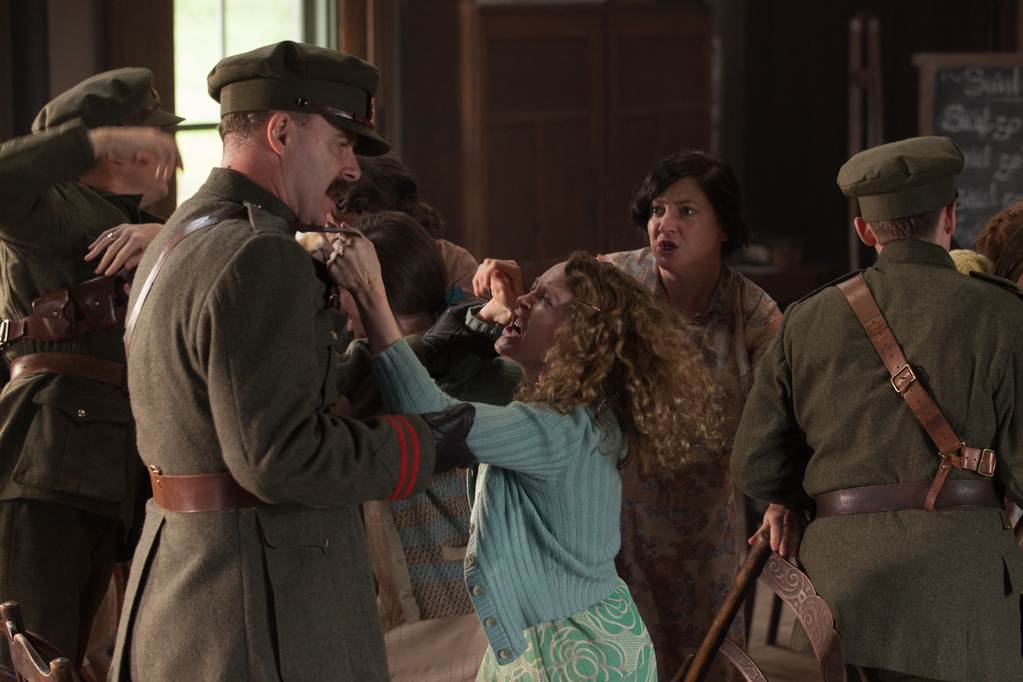
Continuing his return to the big screen, Schwarzenegger puts in a grizzled performance that still relies on his trademark squint and square-jawed impassivity.  He’s the rock that anchors the movie but he doesn’t bring anything new to the table, and coasts on his physical presence, leaving the emoting to the rest of the cast (it’s still good to have him back though).  The casting of Williams is an interesting choice but she’s hampered by having to provide “Breacher” with a potential love interest, as well as trying to be a bad-ass detective.  From the team, Worthington and Enos fare best, while Holloway, whose career post-Lost seems to consist of uninspiring cameo turns, is forgettable in a role that appears written as one-dimensional.  Howard is sidelined for much of the movie, and Perrineau is the kind of peppy partner who’s so annoying you wonder why Brentwood hasn’t already shot him for the peace and quiet.

What hampers the movie most, though, is the curiously flat feel it has.  Everything happens at the same pitch, with little or no attempt to make even the action scenes tense or exciting, and the drama is disappointing for being so casually handled.  With Ayer’s direction largely AWOL, his and Skip Woods’ script is left to fend for itself, and its limitations are cruelly highlighted as a result.  By the time we get to the movie’s epilogue – a long time coming in and of itself – the viewer is left wondering what was the point.

Rating: 5/10 – not quite as terrible as it looks, Sabotage is nevertheless a serious letdown given the talent involved; one for fans of Ah-nold, and best viewed as an undemanding Saturday night/beer and a takeaway movie.

X-Men: Days of Future Past (2014)

Tags

, , , , , , , , , , , , , , , , , ,

x-men-days-of-future-past_04aaf850

D: Bryan Singer / 131m

Cast: Hugh Jackman, James McAvoy, Michael Fassbender, Jennifer Lawrence, Nicholas Hoult, Patrick Stewart, Ian McKellen, Ellen Page, Peter Dinklage, Halle Berry, Shawn Ashmore, Evan Peters, Omar Sy, Josh Helman, Mark Camacho

With X-Men: The Last Stand (2006) leaving a sour taste in the mouth after the glories of the first two X-Men movies, and with two subsequent Wolverine adventures proving that even a massive fan favourite doesn’t mean an automatically good movie, the future of the X-Men franchise was looking a little doubtful.  With both Patrick Stewart and Ian McKellen “getting on a bit”, the decision to revisit Charles Xavier and Eric Lehnsherr in their younger days in X-Men: First Class (2011) was a positive boon for the franchise and one that revitalised what was otherwise a moribund series.  Now, with the equivalent of a spring in its step, we have a movie that both acknowledges its predecessors and forges a whole new path for its mutant protagonists.

Opening in the near future, with mutants and mankind alike being targeted for extinction by Sentinels, the world is a wasteland.  With the Sentinels able to assimilate whatever mutant powers are pitched against them, a band of mutants including Kitty Pryde (Page), Bishop (Sy) and Iceman (Ashmore) fight a rearguard action against them that sees Professor X’s pupils evade certain death through Kitty’s ability to send a person’s consciousness back in time; this allows the remaining mutants to anticipate a Sentinel attack and flee before it can happen, thus erasing that particular timeline.  With the arrival of Professor X (Stewart), Magneto (McKellen), Logan aka Wolverine (Jackman) and Storm (Berry), a last, desperate decision is made to send Wolverine’s consciousness back into his body in 1973, the year the Sentinels were created by industrialist Bolivar Trask (Dinklage).  Back then, Trask was assassinated by Raven aka Mystique (Lawrence), which led to her capture and the advancement of the Sentinel programme using her DNA (this enables the Sentinels to assimilate other mutants’ powers).  Logan’s mission: to unite the estranged Charles and Erik, track down Raven, and stop her from killing Trask.

Of course, it’s not easy.  Since the events of X-Men: First Class, Charles has taken to wallowing in self-pity at the loss of Raven, and has lost his powers thanks to a serum created by Hank McCoy aka Beast (Hoult) that allows him to walk.  He agrees to help for Mystique’s sake, though he is unhappy about needing Erik’s help.  With the aid of Quicksilver (Peters), they free Erik from a cell beneath the Pentagon and travel to Paris (where Raven is due to kill Trask at a conference).  Imitating a Vietnamese officer, Raven infiltrates the conference room where Trask plans to sell his Sentinel technology to the highest bidder.  He reveals a hand-held mutant detector that is triggered by Raven’s presence.  Hastily despatching the other attendees – including a young William Stryker (Helman) – Raven is stopped from shooting Trask by the arrival of Logan et al.  Erik disarms her and then turns the gun on her; aware that her DNA will make the Sentinels an unstoppable force he believes it is better for her to die than to let them become so strong.  Raven makes her escape but is wounded in the attempt.  Erik tries to follow her but is stopped by Hank who has morphed into his Beast persona.  All three are caught on film and the “mutant menace” espoused by Trask is taken up by President Nixon (Camacho) who gives the go ahead to the Sentinel programme.
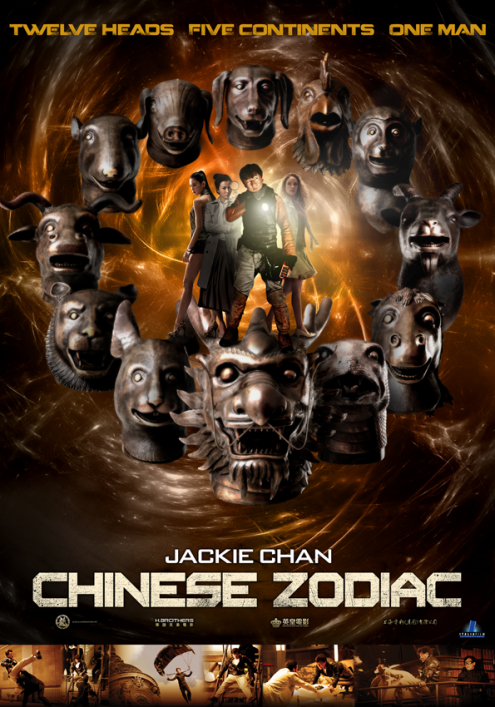
At a press conference in the grounds of the White House set up to reveal the existence of the Sentinels and their purpose, Raven impersonates a Secret Service agent in order to get to Trask.  Now on his own, Erik steals back the helmet that magnifies his powers and uses them to levitate a baseball stadium; he transports it to the press conference and drops it around the White House, effectively sealing it off from the police and everyone else.  Charles is trapped under a piece of fallen scaffolding, while Logan and Hank do battle with one of the Sentinels (which are now under Erik’s control).  In the future, the Sentinels attack the mutant hideout; casualties mount up as Professor X and Magneto wonder if Logan’s mission will be successful in time.  As the future becomes ever bleaker, Erik castigates the President and his staff for their animosity towards mutants, and threatens them with a new world order, with mutants in control.  With Logan and Hank unable to stop the Sentinel, and Raven still intent on killing Trask, and Erik about to dispose of Nixon and his staff, in the future the Sentinels breach the mutant hideout and target Magneto and Professor X…

X-Men Days of Future Past - scene

Even at this late stage in the game there’s still more to the story than you’d expect.  X-Men: Days of Future Past is a triumph for all concerned, an exciting, often unpredictable addition to the X-Men saga that more than lives up to expectations but also deepens and enriches the story begun in X-Men: First Class.  With the stakes upped considerably, and the inclusion of more mutants than have been seen since The Last Stand, the movie seems, at first glance, to be overdoing it, adding too much to the mix for it to be as satisfying or rewarding as it should be (by necessity as much as expediency, some characters have more screen time than others).  But thanks to Simon Kinberg’s measured script, the movie glides smoothly along, gaining momentum, adding layer upon layer of meaning, and providing an emotional depth that is missing from most – if not all – other superhero movies.

Largely this is due to the stellar cast, led by McAvoy and Fassbender, two actors who have made their roles their own.  Their adversarial friendship is expanded upon here, both characters’ sense of having been betrayed by the other adding a dangerous edge to their scenes together, adding to the tension that develops as the world heads towards oblivion.  Both actors give tremendous performances (McAvoy is superb in his opening scenes with Jackman), and the support they receive, notably from Hoult and Jackman, is equally impressive, while Dinklage (sporting a wig and a half) invests Trask with an eerie messianic quality that elevates the character from perfunctory villain to unwavering fear monger.  And then there’s Lawrence, endowing Raven/Mystique with a mix of rage, sadness and longed-for redemption that makes her the most intriguing character of all, her dual nature at odds with itself even when fiercely determined to walk her own path.  The real surprise, though, is the inclusion of Quicksilver.  Peters turns in a funny, smart, freewheeling performance that is as charming as it is a real comedic shot in the arm.  His sardonic smile and deadpan glances are perfectly pitched, and his appearance leaves you wanting more (which we’ll get in X-Men: Apocalypse).

Returning to the director’s chair following the departure of Matthew Vaughn, Singer shows a firm grasp of the material and an even firmer grasp on ensuring the human/mutant element isn’t lost amongst all the special effects and impressively mounted carnage.  Even a small scene, such as the one between Professor X and Magneto towards the end of the movie, is more affecting than you might expect, and there are numerous occasions where Singer’s pleasure at being back in the director’s chair couldn’t be more evident if he’d stopped the movie mid-scene and held up a sign saying “I loved making this movie”.  Singer is an expressive director, always willing to try something new, and his staging of the showdown at the White House shows a clear intention to avoid the usual action motifs, making the sequence that much more impressive (it’s also a clever move to reduce Logan’s involvement in the action, especially as he doesn’t have his adamantium skeleton for Erik to play around with).

The early Seventies are recreated with a fine eye for the details of the time, and there’s an astute tweaking on contemporary fashions (though it might have been fun to see Wolverine in bell bottoms), while the inclusion of footage shot as if it were news reports from the time is a clever conceit and works particularly well during Raven’s escape from the conference.  The Sentinels are appropriately scary (and make Terminator 2’s T-1000 look like a skinny prototype), there’s the by-now obligatory post-credits sequence that sets up the next instalment, and there are a number of cameos that will have fans cheering in their seats (two cameos are very welcome indeed).
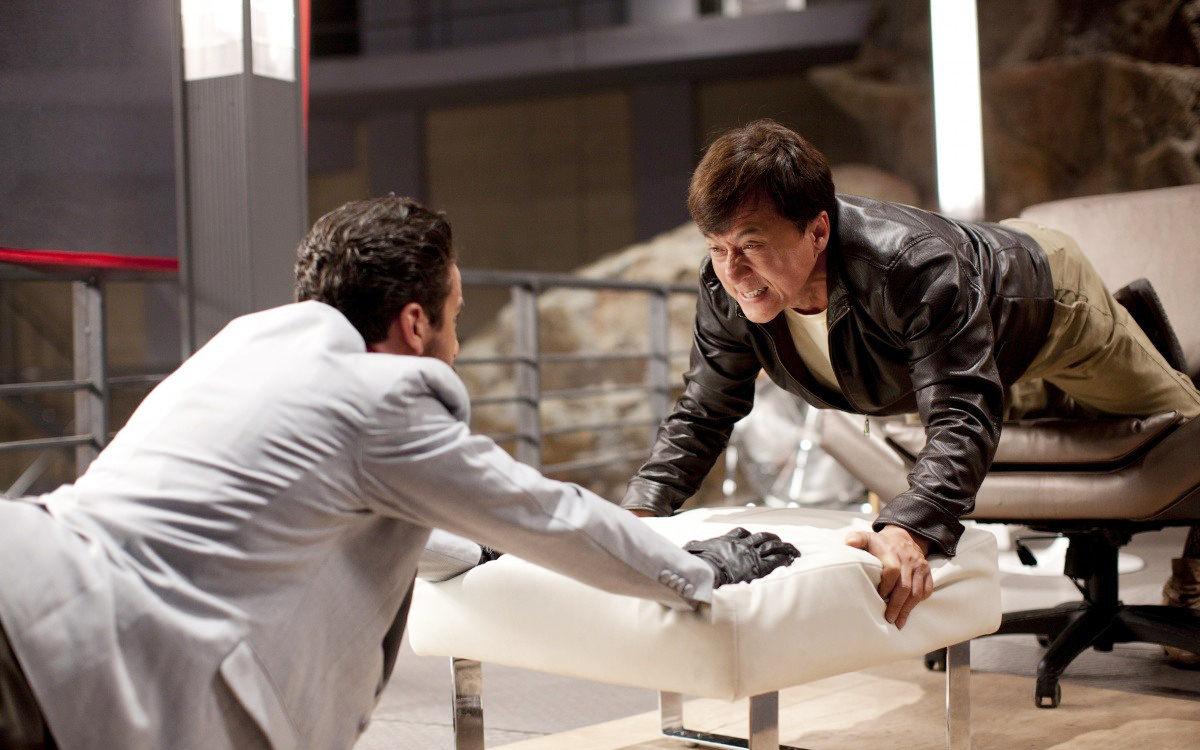
There are some stumbles.  The opening ten to fifteen minutes, where the plot is established and some new characters introduced, is a bit clunky and muddled, and as mentioned before some of the cast don’t fare as well as others.  Page does little more than sit with her fingers poised either side of Jackman’s temples for most of the movie, while McKellen gets to add the odd line here and there, but it’s Berry who’s almost completely sidelined, so much so that one of the cameo turns has more lines than her.  (And on the subject of screen time, someone should give Anna Paquin’s agent a gold star; she appears for approximately ten dialogue-free seconds but is seventh billed; now that’s impressive.)  Trask’s hand-held mutant detector is a clumsy contrivance that feels like it was added at the last minute, and the movie’s coda owes a little too much to another recent sci-fi franchise reboot (but it’s a welcome development nevertheless).  All in all, though, the movie is too well constructed and executed for any of these (very minor) problems to spoil the overall presentation.

Rating: 8/10 – back on top as the best of the superhero movie franchises thanks to Singer’s return and an intelligent approach to the story (one of the comics’ most well-respected outings), X-Men: Days of Future Past is a treat for fans and non-fans alike; audacious, skilful, thought-provoking and often dazzling, the movie helps erase the debacle that was X-Men: The Last Stand, and is a better alternative universe for it.

Mini-Review: Closed Circuit (2013)

Tags

, , , , , , , , ,

closed-circuit_8547532a

D: John Crowley / 96m

Cast: Eric Bana, Rebecca Hall, Ciarán Hinds, Jim Broadbent, Riz Ahmed, Anne-Marie Duff, Julia Stiles, Kenneth Cranham, Denis Moschitto

When a bomb goes off at a London market, the investigation leads to the arrest of Farroukh Erdogan (Moschitto). Government evidence that might support his case must be deliberated in closed court before an open trial can be conducted. Following the death of Erdogan’s lawyer, Martin Rose (Bana) is asked by the Attorney General (Broadbent) to represent the suspect at the open trial, while Claudia Simmons-Howe (Hall) is chosen to represent Erdogan at the closed hearings. Neither can be in contact with each other once the government evidence is submitted, but as both become aware they’re being followed, they begin to realise there’s more to the case than meets the eye.

Martin discovers that Erdogan is an MI5 agent who was working within the terrorist cell that carried out the bombing. With Erdogan refusing to confirm or deny anything, it’s unclear if he has double-crossed MI5, or the cell has set him up instead. Meanwhile, Claudia learns that Farroukh’s family are more involved than anyone thought. Claudia and Martin choose to work together – in spite of the risk of being disbarred – and endeavour to find out if MI5 had any further, more damaging involvement in the bombing.
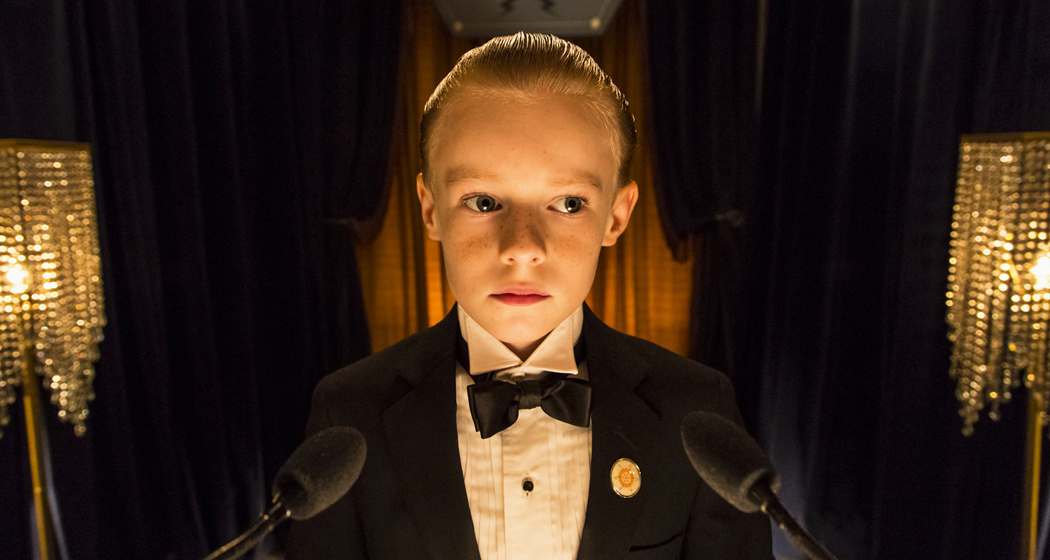
Closed

Closed Circuit wants to be topical and thought-provoking but is too predictable – and cynical – to be entirely effective. Government involvement in terrorist matters is hardly news, and the idea that a cover up might be taking place is clear from the outset. The cat-and-mouse game that follows ticks all the relevant boxes – murder made to look like suicide, an MI5 overseer (Ahmed) who makes veiled threats, the revelation of a colleague working against Martin and Claudia – and there’s a subplot around Martin and Claudia’s having had an affair in the past that is dramatically redundant, but on the whole, the movie is a well-crafted, if obvious thriller that never quite takes off. Bana and Hall don’t quite gel as a couple, Crowley’s direction is efficient if indistinctive, and the script by Steven Knight isn’t as sharp as it needs to be.

Rating: 6/10 – as a paranoid conspiracy thriller, Closed Circuit is neither exciting nor provocative enough to succeed fully; with its idea of a government cover up, it’s also thirty years too late to provide much of a surprise.


Sleepaway Camp (1983)

Tags

, , , , , , , , ,

Sleepaway Camp

D: Robert Hiltzik / 88m

Cast: Felissa Rose, Jonathan Tiersten, Karen Fields, Christopher Collet, Mike Kellin, Katherine Kamhi, Paul DeAngelo, Desiree Gould, Owen Hughes, Robert Earl Jones

Eight years after the death of her father and brother in a boating accident, Angela Baker (Rose) is heading off to Camp Arawak for the summer with her cousin Ricky (Tiersten).  Angela is withdrawn, says hardly anything to anyone, rarely joins in the camp’s activities, and soon becomes the target of bully Judy (Fields), as well as some of the boys.  She finds an ally in Ricky’s friend, Paul (Collet).  He shows an interest in her, and they begin a tentative relationship.  Meanwhile, a killer has struck twice, attempting the death of kitchen worker Artie (Hughes), and drowning one of the boys who tormented Angela earlier.  Camp owner Mel (Kellin) refuses to close the camp, though, and as Angela continues to be bullied by Judy and camp counsellor Meg (Kamhi), the body count rises.

The Eighties were a tough time for some horror movies.  The templates established by Halloween (1978) and Friday the 13th (1980) dictated a serial killer with supernatural abilities, not the least of which was the ability to suffer all manner of physical punishment and still keep on killing.  To be noticed in this particular sub-genre there had to be something different about either the setting (The Funhouse, 1981), or the killer (Curse of the Cannibal Confederates, 1982 – actually zombies).  By the time Sleepaway Camp appeared in 1983, there were already too many weird and wonderful slicers and dicers out there, and too many appearing against the backdrop of a very low budget (and even less imagination).

On face value, Sleepaway Camp had two things working against it from the start: the summer camp setting appropriated by the Friday the 13th series, and an eponymous mystery killer with a grudge against, well, pretty much everyone.  But somehow, and despite some very obvious disadvantages – the acting, the $350,000 budget, the relative inexperience of both cast and crew – the movie struck a nerve with audiences (and went on to make a very tidy profit).  The “shocking” twist ending had a lot to do with the movie’s success – it’s still one of the most unnerving final shots/close ups in horror movie history – but even without this, Sleepaway Camp has an unexpected, and goofy, charm that more than makes up for its faults.

Sleepaway Camp - scene

The familiar location, the typical teenage bickering and peer pressure, the now-awful fashions (did men really wear shorts that short back then?), all these aspects add to the tremendous sense of goodwill the movie engenders, and it’s a measure of writer/director Hiltzik’s confidence in his own material that Sleepaway Camp works so well.  With its slightly askew framing style, and scenes that often run just a beat or two longer than they need to, the movie has a disquieting feel about it from the start; it also throws in a few close ups when the audience least expects it, and this all adds to the disconcerting atmosphere the movie creates from its opening credits sequence showing the camp abandoned and in disrepair. It’s rare that a slasher movie is also creepy, but Sleepaway Camp is creepy without even having to try too hard.

The murders are carried out with gusto, although with an emphasis on not showing too much actual gore, that’s saved for the discovery of the body later on when the special make up effects come into their own (though it’s perhaps a good thing that the aftermath of one character’s death by hair straightener isn’t shown).  There’s the usual moments when you wonder just how one killer could have apparently been in more than one place at a time, and the average viewer could be forgiven for thinking the killer must be on steroids, but this is one time where the logistics of a killing spree can be safely ignored; the escalation has a kooky inventiveness that just works (even though it shouldn’t).  And the killer’s identity, when revealed, is still a moment of genius that has never been imitated since.

As mentioned before, the acting does hamper things, and some of the performances are practically raw (Fields doesn’t appear to be able to deliver a line without pouting at the same time), and some of the dialogue comes out sounding as if English isn’t the actor’s first language.  There’s also the sense that the actors aren’t listening to each other so much as just waiting for each other to finish talking so they can get their own lines out.  Again though, it all adds to the movie’s charm (though you have to see Gould’s performance to get a real idea of just how many “different” acting styles are on display here).

Rating: 7/10 – a superior slasher (and cult favourite) that still impresses over thirty years on; unintentionally funny to be sure (from the perspective of so many years having gone by, at least) but still an effective shocker with a killer twist ending that lodges itself in the memory and stays there.

Worst Movie Remakes…Ever!

Tags

, , , , ,

In the light of the recent, hugely disappointing remake of Godzilla, I’ve been thinking about other remakes that have been less than a) wonderful, b) acceptable, and c) wanted, remakes such as any of the recent horror mishaps – A Nightmare on Elm Street (2010) etc. – or modern reworkings of classic oldies such as The Postman Always Rings Twice (1981). I’ve compiled a list of my Top 10 Worst Remakes…Ever!, but before I reveal them to the world, I wanted to find out which movies other people think are terrible remakes. So… I’ve set up a survey for people to vote for their favourite worst remakes (or even worst favourite remakes). No more than three choices, though (so I can more easily tally up the totals), and if you want to express your reasons for a movie’s inclusion, please feel free.

To give everyone an idea of where I’m coming from, here’s the movie that just missed out on my Top 10 and currently resides at No 11:

Disturbia (2007) – D: D.J. Caruso / 105m

Cast: Shia LaBeouf, Sarah Roemer, Carrie-Anne Moss, David Morse, Aaron Yoo, Viola Davis

A remake of Rear Window (1954) that did away with all the original’s subtlety, suspense and wit, and cast a sadly lacking LaBeouf in the James Stewart role. With no tension, and dubious attempts at making Morse’s character glamorous, the movie limps along like a bad graze looking for a plaster to make it feel better.

Disturbia

Happy Voting!

http://dullwood68.polldaddy.com/s/what-are-worst-movie-remakes-ever


Godzilla (2014)

Tags

, , , , , , , , , , , , ,

godzilla_485dca15

D: Gareth Edwards / 123m

Cast: Aaron Taylor-Johnson, Ken Watanabe, Elizabeth Olsen, Bryan Cranston, Sally Hawkins, David Strathairn, Victor Rasuk, Carson Bolde, Juliette Binoche

Opening with a montage of grainy black and white footage from the Fifties that reveals the real reason for all those atomic bomb detonations in the Pacific – Bikini Atoll et al – the movie fast forwards to 1999 and the discovery in The Philippines of a massive skeleton and two egg sacs, one of which bears the signs of a recent hatching. At the same time, the Janjira nuclear plant in Japan is experiencing a series of seismic anomalies that has plant supervisor Joe Brody (Cranston) worried that these anomalies may cause damage to the plant. While his wife Sandra (Binoche) investigates below ground, there is a reactor breach and the plant is destroyed.

Fifteen years on, the site of the Janjira plant is still a quarantine area.  Joe’s son Ford (Taylor-Johnson), now living in San Francisco with wife Elle (Olsen) and young son Sam (Bolde), receives a call telling him that Joe has been arrested for trespassing in the quarantined area. Ford travels to Japan to find out what his father is up to. They go back to the Janjira plant and are promptly arrested. They are taken to a secret facility within the plant where a chrysalis containing the creature that destroyed the plant is being studied by scientists Ishiro Serizawa (Watanabe) and Vivienne Graham (Hawkins). The chrysalis hatches, releasing a massive winged monster that devastates the facility before flying off. Ford, Serizawa and Graham join an American-led mission to track the monster, which is heading for Hawaii.

In Hawaii, the creature – known as a MUTO (Massive Unidentified Terrestrial Organism) – is discovered feeding on the reactor of a Russian submarine. The military attack the MUTO but it proves too much for them. Godzilla arrives to battle the MUTO but it flees. Serizawa sees the creature is headed toward the US and realises it’s trying to reach its mate, the inhabitant of the other egg sac from The Philippines, and which has been housed in a secure nuclear waste repository in Nevada. This MUTO, the female, hatches and begins heading towards the coast (but not before laying waste to Las Vegas). Serizawa is afraid the two MUTOs are making their way to each other with the intention of breeding… and if his calculations are correct, they’ll meet in San Francisco.

The military comes up with a plan to destroy the MUTOs using a more-powerful-than-usual nuclear weapon (basically two nuclear warheads strapped together). Ford goes along with the team assigned to getting it offshore far enough that it will destroy the creatures but cause minimal damage to the coastal region, but the female MUTO wrecks the train it’s being transported on and eats one of the warheads. The other is saved and flown to San Francisco. The two MUTOs meet there and capture the remaining warhead, which the female uses to build a nest for her offspring. Godzilla arrives to battle the MUTOs. While they’re distracted, Ford destroys the nest and regains the warhead, but it’s damaged and he can’t disarm it. He gets it to a boat and heads out to sea in the hope of getting far enough before it explodes. Meanwhile, Godzilla battles the MUTOs…

Godzilla (2014) - scene

One of the most eagerly awaited movies of 2014, Godzilla arrives trailing a ton of hype and pre-release fervour, but sad to say this is a major disappointment. The story is nonsensical and at almost every turn throws up a WTF? moment. There are inconsistencies galore, some of the worst dialogue so far this year, a sad waste of a more than capable cast, an incredible lack of tension or threat throughout, and the usual reliance on mass destruction to provide any thrills.  Here are just ten reasons why Godzilla doesn’t work:

1 – The characters are paper-thin and serve no purpose other than to mouth expository dialogue of the “This must mean…” variety.

2 – The cast are required to do little more than gawp and gasp at the destruction going on around them. Seriously, why employ actors such as Juliette Binoche (who had to be persuaded to take part), Sally Hawkins and David Strathairn if you’re going to give them so little to do?

3 – Inconsistency No. 1: Godzilla’s arrival in Hawaii causes a tsunami, but not when he arrives in San Francisco (perhaps the budget didn’t stretch to two such sequences).

4 – Ford has a son who isn’t put in jeopardy once; instead the writers have Ford save some random Asian-American kid when the train they’re on is attacked by one of the MUTOs (plus having Ford save his own son would have added some much needed emotional resonance to the drama).

5 – Elle is seen escaping from the destruction of San Francisco, but at no point is she in any peril; in fact she survives unscathed. What was the point of showing this (other than to give Elizabeth Olsen something more to do than make phone calls and look worried a lot)?

6 – Ford is introduced as an adult as an explosive ordnance disposal officer (and a lieutenant at that), but this skill is never utilised (it’s his relationship with his dad and his dad’s data that keeps him along for the ride).

7 – The MUTOs, even though they are supposed to be MASSIVE, seem able to appear and disappear at will.

8 – The MUTOs are attracted by nuclear radiation but the male MUTO, the one that hatches at Janjira, doesn’t stop to munch on the rest of Japan’s nuclear plants (there’s nearly fifty of them). Is MUTO love really that strong a call?

9 – How many times do the same buildings have to be destroyed in San Francisco before anyone is supposed to notice?

10 – Inconsistency No. 2: Why, if the MUTOs are supposed to have migrated towards the earth’s core for their radiation fix, is one found so close to the surface in The Philippines (and what has sustained the egg sacs)?

11 – And why was the Russian nuclear submarine found perched in the trees (on a mountainside) in Hawaii when it was earlier reported as missing at sea?

Yes, that was eleven reasons instead of ten but that just goes to show how lazy the screenwriters – all five of them! – were in assembling this narrative mess. It’s sad when a project that’s been in development for as long as this one has, falls at the first hurdle because the filmmakers couldn’t spot the problems inherent in the script (though with five writers having worked on it, maybe they did). And while this is a Godzilla movie, and what we’re looking for is some outstanding monster-on-monster action, does the rest of the movie have to be so bad? Well, the answer seems to be yes. And because the filmmakers have opted for a slow-build, let’s-keep-Godzilla-hidden approach, the effect of all this underwhelming drama is that the audience are soon praying for things to hurry up so they can get to the big showdown without lapsing into complete slack-jawed lethargy.

Once all three monsters reach San Francisco the movie does pick up, and the battle between them goes a long way toward redeeming things, though there’s still far too much cutting away to see what the human characters are up to (as if we care by now). There’s also a slightly corny moment where Ford and Godzilla share a look, but it’s the one misstep in a section where the filmmakers do get it right. And we get to witness Godzilla’s famous nuclear breath, something that will have fans cheering in their seats.

So, it’s not all bad, and the visuals (as expected) are often stunning to behold. The much-touted HALO drop is still eerily effective despite the long-term exposure given it in the trailers and the movie’s print ads, and the scenes of devastation are effectively rendered (as expected). The MUTOs have a realistic-looking solidity about them (even if they look like second cousins to the kaiju from Pacific Rim), and Godzilla himself is a leaner, meaner looking version of himself (though the problem of scale is still an issue – he’s taller in some scenes and shorter in others depending on the background). Monster-wrangling for the second time, director Gareth Edwards shows his obvious empathy for the material and despite its limitations, rescues large chunks of it from the mangler. He has a visual style and flair that is reminiscent of early Spielberg, and he has a firm grasp on how to stage the final showdown, paying special attention to the framing and using the most effective camera angles. There’s a kinetic energy to these scenes that is lacking in the rest of the movie, but it does add up to a more satisfying conclusion.

Rating: 4/10 – woeful for the most part, and just plain horrible to sit through at others, Godzilla lurches on to the big screen like the big, lumbering beast he was in the Fifties and Sixties (though minus the saggy underbelly); embarrassing to watch at times, and with no clear idea of what to do for the first ninety minutes, the movie is only slightly better than Roland Emmerich’s 1998 version, and is saved by the panache of its final showdown.


We 3 (2011)

Tags

, , , , , , , , , ,

We 3

Original title: Os 3

D: Nando Olival / 80m

Cast: Juliana Schalch, Victor Mendes, Gabriel Godoy, Sophia Reis, Rafael Maia, Alceu Nunes, Henrique Taubaté, Cecília Homem de Mello

Three university students – Camila (Schalch), Rafael (Mendes), and Cazé (Godoy) – all meet at a party shortly after arriving in Sao Paulo to begin their studies.  Both Rafael and Cazé are attracted to Camila, and she in turn is attracted to them.  When they agree to move in together at Cazé’s apartment, Camila insists that they be friends only, and that neither Rafael nor Cazé should try to sleep with her.  Rafael abides by the rule, but it soon becomes apparent that Camila and Cazé are sleeping together.  When he realises this, Rafael wants to leave but he persuades himself to stay, his feelings for Camila keeping him there despite the pain of seeing her with Cazé.

Time passes and the three friends complete a university project together, a proposal for a TV show where the actors and actresses use featured products that can be bought via a website connected to the show.  The trio are approached by marketing executive Guilherme (Maia).  He wants to make their idea a reality by creating a show exactly as they describe, but with them as the “stars”.  When they ask how they should behave, Guilherme tells them to be themselves.  They agree, and cameras are installed in the apartment.

The show gets off to a disastrous start, with the trio’s activities failing to win viewers (and more importantly, consumers).  To combat this, the trio decide to highlight their lives more effectively by playing on the notion of their living in a ménage à trois.  Creating scenarios to keep the viewers guessing and intrigued, they become increasingly adept at convincing themselves that what they’re doing isn’t having an effect on their relationships away from the cameras.  As Rafael finds it more and more difficult to carry on with the deception, the introduction of Barbara (Reis), Camila’s cousin, threatens to break the trio’s friendship, and cause Camila to reassess her feelings for Rafael and Cazé.

We3 - scene

A low-key production with an air of improvisation around some of its scenes, We 3 is an unpretentious look at the ways in which love, passion, lust and friendship (words highlighted at the movie’s beginning) can affect people who try to manipulate those feelings without seeing the potential consequences.  There’s a sense of denial about the characters and the way they behave toward each other, as if the lives they’ve chosen to lead, and with each other, were more a matter of expediency than desire (though it does appear initially that Cazé has got what he’s wanted from the start).  As the show becomes more and more popular, and the trio come up with ever more revelatory exploits, denial gives way to understated desperation in their attempts to maintain the fiction of their own lives, both on camera and behind the scenes.  It’s this duality that gives the movie its bite, as the viewer attempts to work out if the three friends are playing to the audience or themselves.

Olival’s script, co-written with Thiago Dottori, has plenty of intriguing things to say about modern day consumerism, but it’s the façade that Camila, Rafael and Cazé commit to that commands the most attention.  Despite all the technical trappings of the show, it’s the human element that holds the attention and thanks to some clever cutting between “reality” footage and what’s “really” happening, Olival is able to highlight the increasing distance the show is creating between the three friends.  That the three of them have managed to live together for four years without the arrangement imploding is a little credulous, and Cazé comes across as too emotionally insecure to be Camila’s choice of partner, but these are minor quibbles, and the movie’s heaping of pretence on top of pretence to protect an already fragile pretence is absorbing enough to offset any reservations the viewer might pick up along the way.

The cast are uniformly excellent, and the three young leads display a maturity in their approach to the characters that augurs well for future performances.  Schalch in particular is a captivating presence, and there’s fine support from Reis as the annoying, always aspiring Barbara.  The apartment is a great physical space that is used to good effect, its various sections adding to the definition of the trio’s inter-relationship.  The cinematography by Ricardo Della Rosa is adroit and purposeful, while the movie is cleverly constructed by editor Daniel Rezende.

Rating: 8/10 – with good location work and the sense of a larger world waiting for the trio to discover outside the confines of the apartment, We 3 is an understated gem of a movie with a real emotional core; heartfelt if occasionally hard on its lead characters, the movie is a welcome addition to South American cinema.