• 10 Reasons to Remember…
  • A Brief Word About…
  • About
  • For One Week Only
  • Happy Birthday
  • Monthly Roundup
  • Old-Time Crime
  • Other Posts
  • Poster of the Week
  • Question of the Week
  • Reviews
  • Trailers

thedullwoodexperiment

~ Viewing movies in a different light

thedullwoodexperiment

Tag Archives: Drama

The Meddler (2015)

17 Saturday Sep 2016

Posted by dullwood68 in Movies

≈ Leave a comment

Tags

Bereavement, Comedy, Drama, J.K. Simmons, Lorene Scafaria, Mother/daughter relationship, Relationships, Review, Romance, Rose Byrne, Susan Sarandon, Widow

the-meddler

D: Lorene Scafaria / 103m

Cast: Susan Sarandon, Rose Byrne, J.K. Simmons, Jerrod Carmichael, Cecily Strong, Lucy Punch, Michael McKean, Jason Ritter, Jo Jordan

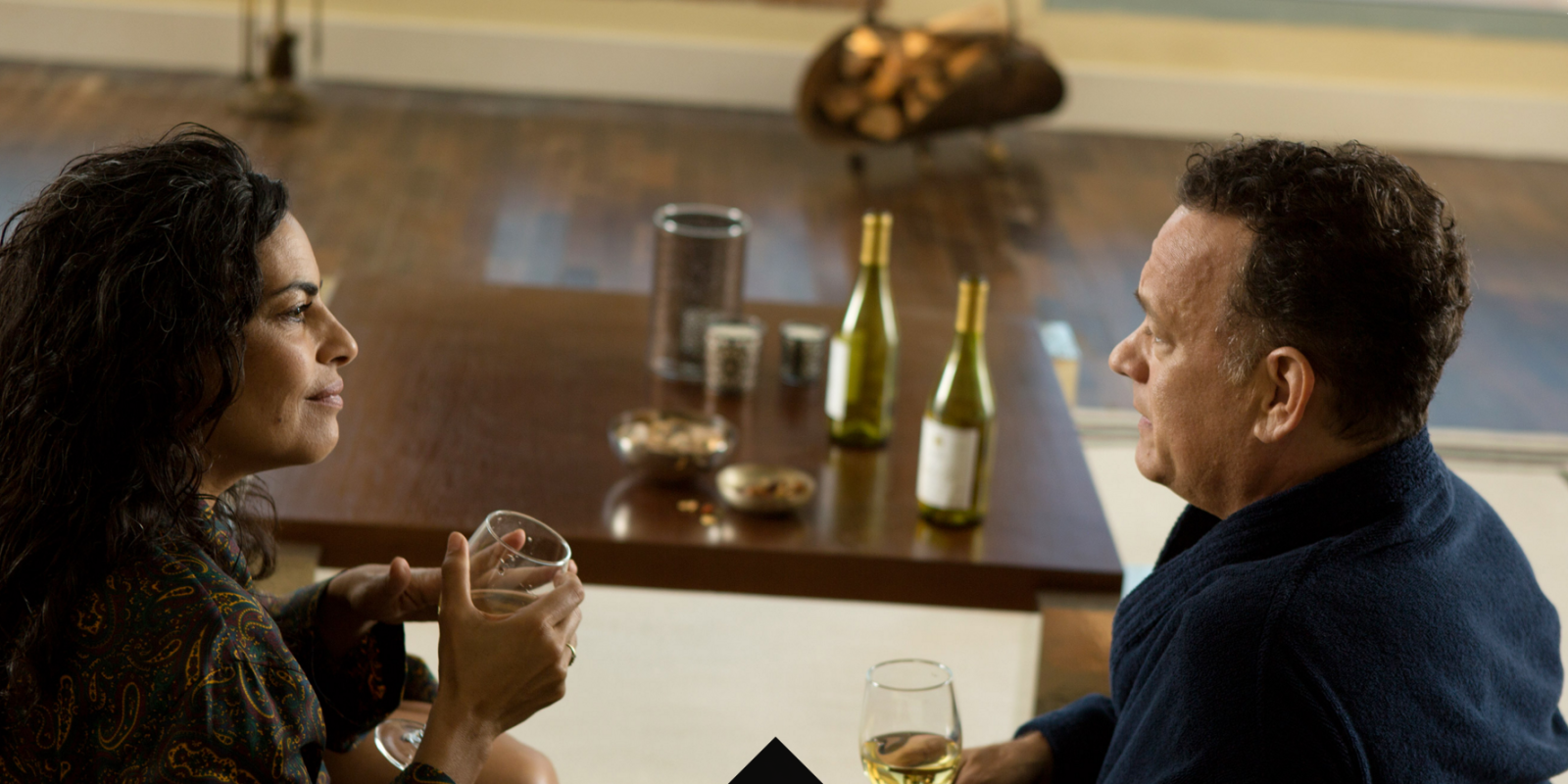
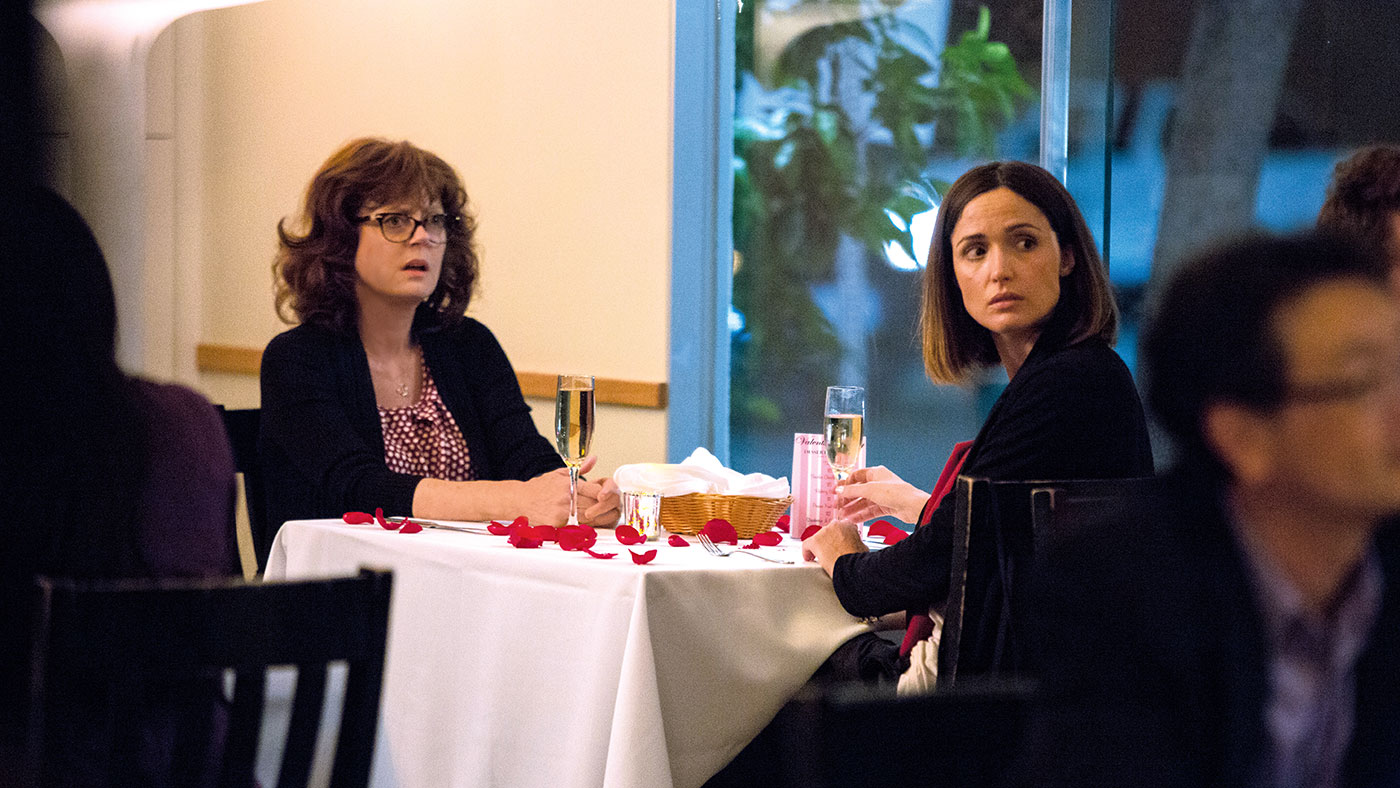
Marnie Minervini (Sarandon) is recently widowed. She has a daughter, Lori (Byrne), who lives and works in Los Angeles in the TV industry. At a loss as to what to do with her time, and despite being financially comfortable thanks to her late husband Joe’s foresight, Marnie chooses to focus her attention on Lori. But Marnie has no idea that her attentions are overbearing, and she ignores Lori’s protests that she’s trying too hard to involve herself in her daughter’s life. When Lori gets an plus-one invitation to a friend’s baby shower, Marnie invites herself along. Lori doesn’t show but Marnie is a hit with her daughter’s friends, and soon she’s spending more and more time with them, particularly Jillian (Strong), who reveals her wish to be married but who can’t afford it.

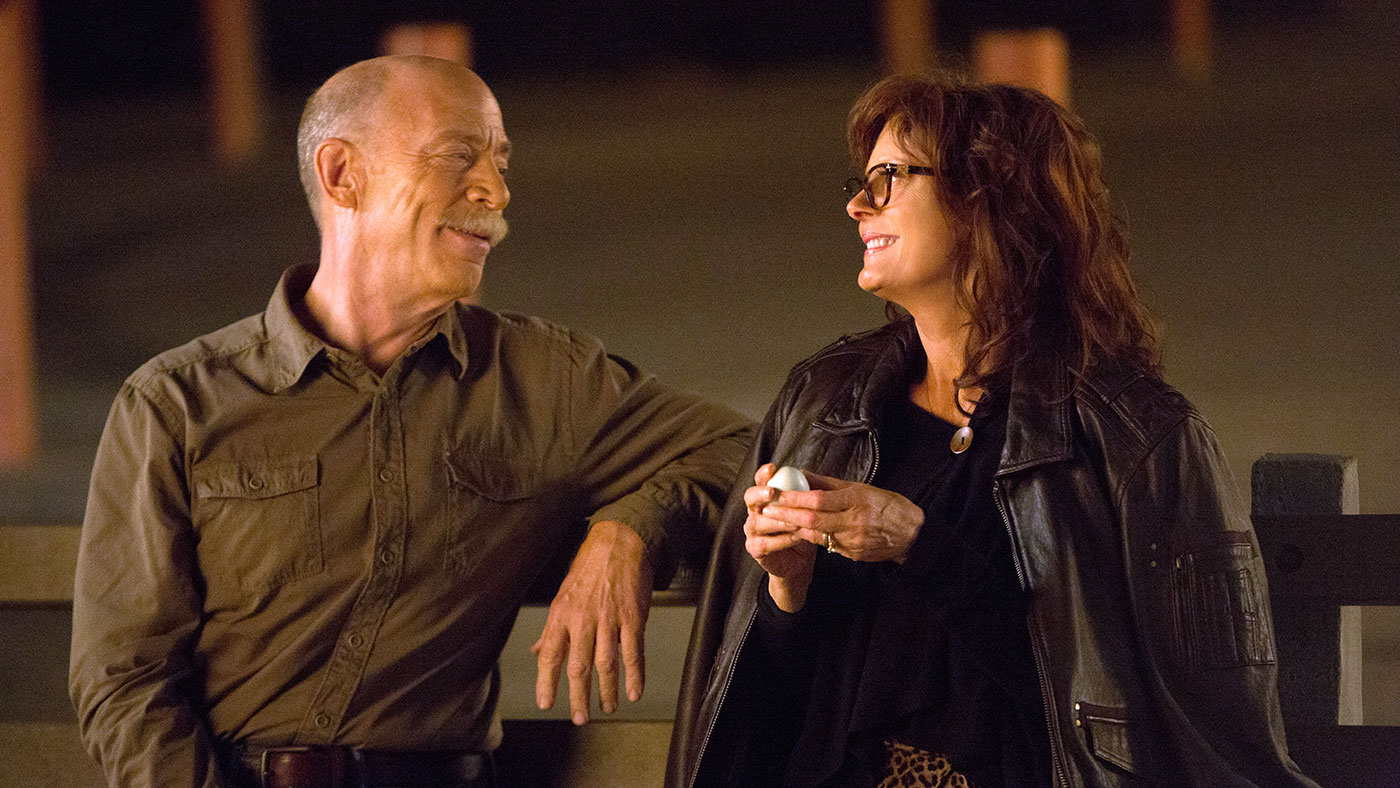
Marnie persuades Jillian to let her pay for the wedding, and soon she and Jillian’s friends (and Lori’s) are planning all the details, including the bridal outfit. Meanwhile, Lori announces that she’s going to New York for a while. The pilot she’s working on is being filmed there, and it makes sense for her to be there if any problems arise. Marnie throws herself into helping others, from the Genius at an Apple store, Freddy (Carmichael), to an elderly lady (Jordan) at the hospital where she volunteers. She even meets a retired policeman called Zipper (Simmons) when she inadvertently wanders into the background of a movie that’s being shot, and is mistaken for an extra.
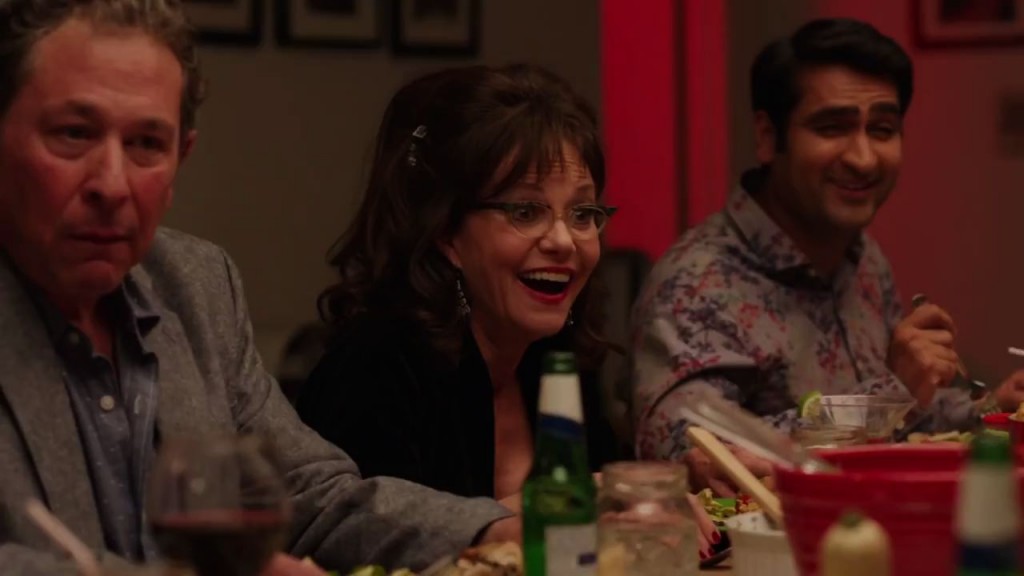
the-meddler-scene1

A trip to New York to visit Lori and Joe’s family goes awry, and Marnie returns to Los Angeles chastened and beginning to realise just how much her grief has been channelled into helping others at the expense of herself. She spends more time with Zipper, and comes to Lori’s aid when she has an emergency. Jillian’s wedding goes off without a hitch, and Marnie is given a special mention for her help in organising it all. But Marnie still has to make a decision about whether or not she wants to continue as she is – constantly occupied yet unhappy – or begin a new stage in her life, one that will see her still helping others but not out of personal necessity.

While it’s an apt description of Marnie’s character (for the most part), The Meddler is only so apt when it applies to Marnie’s relationship with her daughter. Away from this, it’s not quite so appropriate, as Marnie’s actions are more altruistic than interfering. This leads to a curious fracturing of the narrative, as the scenes where Marnie uses her financial good fortune, and in the case of the old lady in the hospital her compassion, carry a less distinctive dramatic weight than in those where she spars with Lori for her daughter’s attention. It’s hard to determine if writer/director Scafaria, here following up her feature debut Seeking a Friend for the End of the World (2012), intended it this way, or if it was something that was decided on in post-production.

the-meddler-scene3

What emerges is a movie that is able to examine an aging woman’s experience of grief and the twofold way in which she assimilates and deals with it. On the one hand, her relationship with Lori suffers because Marnie isn’t able to tell her daughter just how much she’s still hurting from the loss of the man who was so important to both of them. Instead she tries to protect and control Lori’s life to the extent that she’ll be kept perfectly safe – and Marnie won’t need to worry about losing her as well. That her actions are having precisely that very effect is the irony that compounds the situation, and stops things from being resolved between them. Scafaria makes a clever decision in their early scenes by playing up the humour inherent in the idea of an overbearing mother (at one point Lori suggests her mother take up a hobby; Marnie’s reply? “Maybe you could be my hobby!”). But the humour is gradually eroded and left behind in favour of exchanges that highlight the pain both women are suffering, and the additional pain their discord is causing each other.

Scafaria has created an emotionally complex, unfailingly brave character in Marnie Minervini, and she’s been blessed with the involvement of Sarandon in the role. The actress inhabits the part so completely, and with such ease, that it becomes a quiet masterclass in screen acting. Sarandon’s performance is so subtle, and so shaded, that often it seems she isn’t doing anything at all. And yet, every expression, every gaze, and every physical movement is in service to the character’s emotions, and her struggle to make sense of her continuing grief. To some degree we’re used to Sarandon giving impressive performances, but here she excels in a role that isn’t flashy, isn’t contrived, and isn’t weighted down by unnecessary layers. Sarandon doesn’t even attempt to make Marnie sympathetic beyond the fact of her being a widow; any sympathy Marnie receives from the viewer is earned through Sarandon’s careful attention to the character and the lessons she learns along the way.
the-meddler-scene2

If there’s one criticism that could be levelled at the movie, it’s that Sarandon’s performance is so good that it eclipses those of the rest of the cast. By comparison, Byrne and Simmons et al fall just that little bit short of impressing as much. It’s not their fault, nor is it Scafaria’s – Sarandon is just that good – but it does make the movie feel a little uneven, as if the secondary characters, while important to the overall story, lack the necessary colour to make them stand out. In any other movie it probably wouldn’t be a problem, but here it detracts from the effectiveness of the various relationships.

Elsewhere there’s still much to admire, from the storyline involving the old lady in the hospital who keeps using a hand to make circles in the air, and which is given a poignant resolution; to the brief scene with Joe’s relatives where a very important clue as to the depth of Marnie’s grief is revealed; and Zipper’s owning chickens, which leads to the line, “Turns out, for the optimal combination of happiness and productivity… All roads lead to Dolly [Parton].” These are all minor moments in the overall fabric of the movie, but their understated nature is perfectly in tune with the gentle, good-natured approach Scafaria brings to the material. It’s a simple story, told simply and well, and at no point is the viewer left on the outside looking in. The humour is there, the drama is there, and the pathos is there, and it’s all impeccably put together by its writer/director in conjunction with its editor, Kayla Emter.

Rating: 8/10 – movies like The Meddler come along maybe once or twice a year, and often go overlooked, which is a shame, as Scafaria’s heartfelt tale of unaddressed grief is moving, life-affirming and overwhelmingly positive in its outlook; Sarandon is magnificent, Scafaria directs her own script with skill and clarity, and the movie offers a slew of rewards for anyone lucky enough to see it.
Share this:

  • Click to share on X (Opens in new window) X
  • Click to share on Facebook (Opens in new window) Facebook
  • More
  • Click to print (Opens in new window) Print
  • Click to email a link to a friend (Opens in new window) Email
Like Loading...

Skiptrace (2016)

16 Friday Sep 2016

Posted by dullwood68 in Movies

≈ 1 Comment

Tags

Action, Bingbing Fan, China, Comedy, Con man, Crime, Drama, Drugs, Eric Tsang, Eve Torres, Hong Kong, Jackie Chan, Johnny Knoxville, Macau, Mongolia, Renny Harlin, Russia, The Matador, Thriller

skiptrace

Original title: Jue di tao wang

D: Renny Harlin / 107m

Cast: Jackie Chan, Johnny Knoxville, Bingbing Fan, Eric Tsang, Eve Torres, Winston Chao, Youn Junghoon, Shi Shi, Michael Wong, Kuo Pin Chao

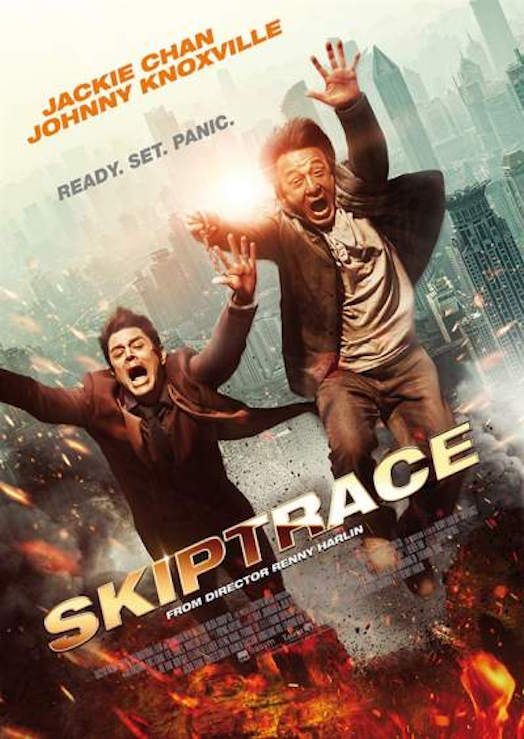
Here’s a question for you: when did you last enjoy – really enjoy – a Jackie Chan movie? Was it Dragon Blade (2015)? Or Chinese Zodiac (2012) perhaps. Or was it even further back? The Karate Kid (2010) maybe. If it’s been even further back, don’t worry, it’s likely you’re not on your own.

Back in 2012, Chan told reporters at the Cannes Film Festival that Chinese Zodiac was going to be his last action movie. He was getting too old, and he felt the world was “too violent”. And for a whole year it seemed that Chan was sticking to his word… and then he went and made Police Story: Lockdown (2013). So much for that, then. And now he’s back again with another action movie, Skiptrace, and this time, it’s… practically dead on arrival.

Let’s try another question: when did you last enjoy – really enjoy – a Renny Harlin movie? Was it The Legend of Hercules (2014) Or Devil’s Pass (2013)? Or something from the time when his name on a picture was reason enough to see it, say back in the Nineties. Unlike Chan, Harlin has never announced his “retirement” from action movies, and now he’s back with Skiptrace, and this time… well, you get the picture.

skiptrace-scene2

There are many, many, many movies that are made because somebody somewhere thought they would be a good idea. Movies like Skiptrace, which are made both for a domestic market (in this case, China and Hong Kong) and a wider, international market, show up each and every year. Some succeed in gaining that wider, international success the makers hope for – the Internal Affairs trilogy, for example – while the majority barely make an impact. In between are movies such as Skiptrace, with its bankable, internationally famous star; less bankable but still well-known co-star; even less bankable but still fairly well-known director-for-hire; country-hopping locations; uninspired action set-pieces; and a patience-testing script that has no intention of making any kind of sense at any point in the movie.

The plot, such as it is, has Chan’s dogged cop, Bennie Chan, still trying to avenge the death of his partner (Tsang) at the hands of criminal mastermind the Matador. Nine years have passed since that terrible event, and Bennie has spent the years since in trying to prove that high-profile businessman and philanthropist Victor Wong (Chao) is the Matador. Of course he’s been unsuccessful, and his latest attempt leads to the kind of property destruction that warrants his being told to take a month’s leave of absence. In the meantime, his deceased partner’s daughter, Samantha (Fan), has infiltrated Wong’s organisation in an attempt to find some evidence against him… but she’s drawn a blank too. It’s not until con man and gambler Connor Watts (Knoxville) turns up at a casino run by Wong and witnesses a murder that Bennie has a solid chance of bringing Wong to justice.

skiptrace-scene1

So far, so straightforward. But the script, already over-complicating things by having Bennie as Samantha’s guardian, introduces us to Connor by putting him in jeopardy in Russia thanks to an ill-advised relationship with a mobster’s daughter. A series of non-linear flashbacks to the previous twenty-four hours reveals Connor’s actions at the casino (including winning a large amount of money), his meeting Samantha, trying to avoid the Russian mobster’s goons (out to bring him back to Russia so he can be put in jeopardy), witnessing a murder in the process, and coming into possession of a mobile phone that will reveal the identity of the Matador. Too much already? Don’t worry, there’s more – much more.

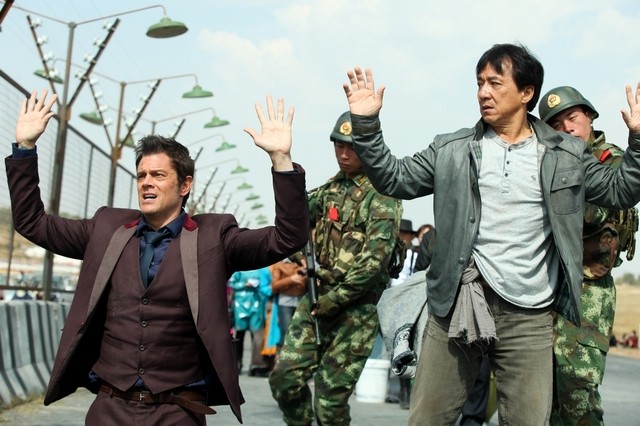
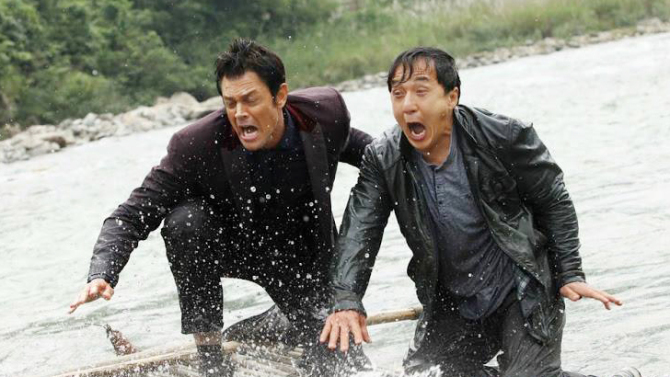
What follows is a tortuous road movie that sees Bennie and Connor eventually learn to respect and admire each other, and which takes in such locations/developments as the Russian bowling alley where Connor finds himself in peril, a train that both men jump from as soon as they hear the ticket inspector approaching, buying the slowest vehicle in Mongolia without ensuring it has enough petrol to get them anywhere, an encounter with a group of Mongolian tribespeople (more of which later), a game of bluff and double bluff at the Chinese border that sees them arrested, their opportune “rescue” by the Russian mobster’s goons, a whitewater raft ride, and eventually, a zipline escape from Wong’s men.

There’s more still, but it’s all too tiring, a series of desperate attempts by the screenplay – step forward writers Jay Longino and BenDavid Grabinski, whose first collaboration this is – to keep viewers from nodding off or asking themselves why they’re still watching after the first half an hour. If the events listed in the previous paragraph sound exciting, don’t be fooled: even handled by Harlin, not exactly a slouch when it comes to action movies, those sequences lack energy and are shot through with the kind of slapstick humour that Chan’s movies are famous for. And it needs to be said: Chan is getting on. His decision to “retire” back in 2012 should have been followed through, because in Skiptrace you can see just how slow he’s become. The speed and intricacy of his past fight scenes are absent here, with blows and parries signposted well in advance and Chan being given more than enough time to get into position for each.

skiptrace-scene3

And then there’s the encounter with the Mongolian tribespeople. It’s a standard sequence to begin with, a misunderstanding leading to Connor and then Bennie squaring up against the tribe’s best fighters. The misunderstanding is resolved and the tribespeople take to the pair as if they were long-lost relatives. A feast ensues, and after a few too many drinks, Bennie begins to sing a song. A young woman joins him, and soon everyone is singing along as well, word perfect and in perfect harmony. The song is Adele’s Rolling in the Deep, and it’s possibly the most bizarre moment you’ll ever see, and hear, in a Jackie Chan movie. It’s also the best example of how haphazardly the script has been assembled, with sequences obviously arrived at and decided on before a plot was actually dreamt up.

Like so many of these productions, the editing is the worst aspect of all, leaving the movie looking like a cinematic patchwork, with shots truncated and poorly framed, and the performances (such as they are) suffering as a consequence. Chan is his usual amiable self, unstretched by the material, while Knoxville’s comic relief portrayal of Connor serves as a reminder that when a script is this bad the actor doesn’t have a way of countering it. Elsewhere, the supporting cast do what they can with their underwritten roles, with only ex-WWE wrestler Torres standing out thanks to her impressive physicality. Harlin is a bland presence in the director’s chair, his regular visual flair absent from the mix. It’s hard to believe that this is the same man who directed Die Hard 2 (1990) and The Long Kiss Goodnight (1996). But then, it’s hard to think of anyone who could have made something even halfway decent from the material on offer.

Rating: 3/10 – not the finest moment in Chan’s career, Skiptrace is hard to sit through and barely acceptable as entertainment; with all the vitality of a contractual obligation, the movie crams in a surfeit of incidents that, ordinarily, would keep at least another two movies happy – but ultimately, it doesn’t have any idea of what to do with them.

Share this:

  • Click to share on X (Opens in new window) X
  • Click to share on Facebook (Opens in new window) Facebook
  • More
  • Click to print (Opens in new window) Print
  • Click to email a link to a friend (Opens in new window) Email
Like Loading...

Trailers – Christine (2016), Nocturnal Animals (2016) and Annabelle 2 (2017)

15 Thursday Sep 2016

Posted by dullwood68 in Movies

≈ Leave a comment

Tags

Amy Adams, Annabelle 2, Antonio Campos, Christine, David F. Sandberg, Drama, Horror, Jake Gyllenhaal, Literary adaptation, Miranda Otto, Previews, Rebecca Hall, Suicide, Tom Ford, Trailers, True story, TV reporter

Thankfully, Christine is not an unwanted, unexpected remake of the 1983 John Carpenter movie about a haunted car, but instead the true life tale of a haunted woman, Christine Chubbuck. Chubbuck was a US TV news reporter working in Florida during the late Sixties, early Seventies. She battled depression and suicidal thoughts before killing herself live on TV in July 1974. In telling her story, director Antonio Campos and screenwriter Craig Shilowich have created a compelling, richly detailed account of Chubbuck’s life and struggle with her personal demons, and the movie features what many critics are already describing as a “career-best” performance from Rebecca Hall. From the trailer we can see that the era when Chubbuck was alive has been painstakingly recreated, and that the cinematography by Joe Anderson is an integral part of what makes the movie look and feel so fresh and nostalgic at the same time. A tragic tale, to be sure, but Christine seems keen to be true to Chubbuck’s awkward yet painfully endearing persona, and which also doesn’t appear to shrink from exploring the “issues” that led to her untimely death at the age of just twenty-nine.


Based on the novel Tony and Susan by Austin Wright, Nocturnal Animals is Tom Ford’s first movie since A Single Man (2009). A movie that features a narrative full of twists and turns, it sees Amy Adams’ art gallery owner apparently threatened by the existence of a novel written by her ex-husband (played by Jake Gyllenhaal). The novel reads like a revenge tale, a way of his getting back at her for something she did to him that was really terrible. She recognises herself in the story, and comes to believe that he’s written it deliberately to make her afraid that the story will come true. Adams, after her disappointing turns in the likes of Big Eyes (2014) and the less than stellar DC outings involving Superman, here gets to grip with a meaty, dramatic role that better suits her abilities than having to play second fiddle to a green screen. But it’s still, first and foremost, a Tom Ford movie: stylish, elliptical in places, and beautifully lensed by Seamus McGarvey, making it a feast for the senses as well as the intellect.


The inclusion here of the first, teaser trailer for a sequel to a spin-off movie that nobody really wanted, is, on the face of it, a little strange in itself (the original didn’t even merit inclusion in the Monthly Roundup it should have been a part of; yes, it’s that bad). But three things warrant giving the trailer for Annabelle 2 the equivalent of a hall pass: one, that’s Miranda Otto holding the cross, an actress who rarely makes bad movies; two, its director is David F. Sandberg, fresh from his success as the main creative force behind Lights Out (2016); and three, it keeps things commendably brief and doesn’t rely on a manufactured jump scare to get you, well… jumping out of your seat. These may not be enough to stop the movie from being as bad as its predecessor, but for the moment, this is one teaser trailer which understands that, when it comes to horror, less really is more.

Share this:

  • Click to share on X (Opens in new window) X
  • Click to share on Facebook (Opens in new window) Facebook
  • More
  • Click to print (Opens in new window) Print
  • Click to email a link to a friend (Opens in new window) Email
Like Loading...

Mini-Review: Café Society (2016)

14 Wednesday Sep 2016

Posted by dullwood68 in Movies

≈ 1 Comment

Tags

Blake Lively, Comedy, Crime, Drama, Hollywood, Jesse Eisenberg, Kristen Stewart, Love, New York, Review, Romance, Steve Carell, The Thirties, Woody Allen

cafe-society

D: Woody Allen / 96m

Cast: Jesse Eisenberg, Kristen Stewart, Steve Carell, Blake Lively, Jeannie Berlin, Ken Stott, Corey Stoll, Sari Lennick, Stephen Kunken, Parker Posey, Paul Schneider, Anna Camp, Sheryl Lee

In the Thirties, naïve young Bobby Dorfman (Eisenberg) leaves the safety of his parents’ (Berlin, Stott) home in the Bronx to move to Hollywood and start a new life. Taken under the wing of his uncle, super-agent Phil Stern (Carell), Bobby is shown around town by Stern’s secretary, Vonnie (Stewart). He quickly falls in love with her, despite her having a boyfriend, and they spend a lot of time together. But when the man in Vonnie’s life reneges on a promise to leave his wife for her, she allows herself to be wooed by Bobby, and in time he asks her to marry him and go with him to New York (he’s bored by the shallowness of Hollywood and its denizens).

But Vonnie’s “boyfriend” finally leaves his wife and she chooses to marry him instead of Bobby. Heartbroken, and hardened by the experience, Bobby returns to New York where he goes to work with his older brother, Ben (Stoll), running a nightclub called Le Tropical. Ben has criminal ties, but keeps Bobby clear of any involvement. Eventually, Bobby meets and marries a recent divorceé, Veronica (Lively). They have a child, and the club becomes a focal point for the famous, the infamous, and everyone in between. Now settled firmly into the roles of husband, father and successful businessman, Bobby’s world is turned upside down when Vonnie pays a visit to Le Tropical with her husband, and it becomes clear that they still have feelings for each other.

cafe-society-scene

Woody Allen’s latest, annual, offering is an outwardly frivolous affair that touches on many of the tropes that have kept his movie career going for nearly fifty years. There’s the relationship between an older man and a (much) younger woman; love denied; philosophical enquiries into the natures of life, love and art; class merits and social acceptance; ambition; and all wrapped up in a slightly more jaundiced approach than is usual. Beneath the glamour and the glitzy lifestyles on display in both Hollywood and New York, Allen makes it clear that happiness is much harder to find than it appears. It also appears to be much more of a commodity, as Bobby’s offer of a romantic life in New York is spurned for a superficial one in Hollywood.

Allen once again assembles a great cast with Eisenberg as yet another on-screen substitute for The Man Himself, and Stewart putting in her best performance in quite some time as the (not really) conflicted Vonnie. But it’s the supporting characters who steal the show, in particular Bobby’s aunt Evelyn (Lennick) and her pacifist husband, Leonard (Kunken). Their problem with an abusive neighbour provides a much needed break from the predictable nature of the central romance, while Stoll’s droll gangster is worthy of a movie of his own. It’s this imbalance that hurts the movie at times, as the romance between Vonnie and Bobby, though given due emphasis by Allen’s screenplay, isn’t as compelling as you’d expect. It’s the distractions from the main storyline that work better as a result, and while Allen peppers things with his trademark wit (“First a murderer, and now a Christian!”), it’s not enough to offset the familiarity of a romance seen too often before.

Rating: 7/10 – Vittorio Storaro’s gorgeous cinematography is Café Society‘s biggest draw, along with its cast, but this is ultimately a Woody Allen movie that sees him revisiting familiar ground to sporadically good effect; enjoyable enough then, but there’s a sense that Allen’s once-a-year workload is still providing similar returns with each new movie.

Share this:

  • Click to share on X (Opens in new window) X
  • Click to share on Facebook (Opens in new window) Facebook
  • More
  • Click to print (Opens in new window) Print
  • Click to email a link to a friend (Opens in new window) Email
Like Loading...

I Am Not a Serial Killer (2016)

12 Monday Sep 2016

Posted by dullwood68 in Movies

≈ Leave a comment

Tags

Billy O'Brien, Christopher Lloyd, Clayton, Dan Wells, Drama, Funeral home, Horror, Laura Fraser, Literary adaptation, Max Records, Murders, Review, Serial killer, Sociopath

i-am-not-a-serial-killer

D: Billy O’Brien / 103m

Cast: Max Records, Christopher Lloyd, Laura Fraser, Christina Baldwin, Karl Geary, Dee Noah, Lucile Lawton, Anna Sundberg, Raymond Brandstrom, Michael Paul Levin

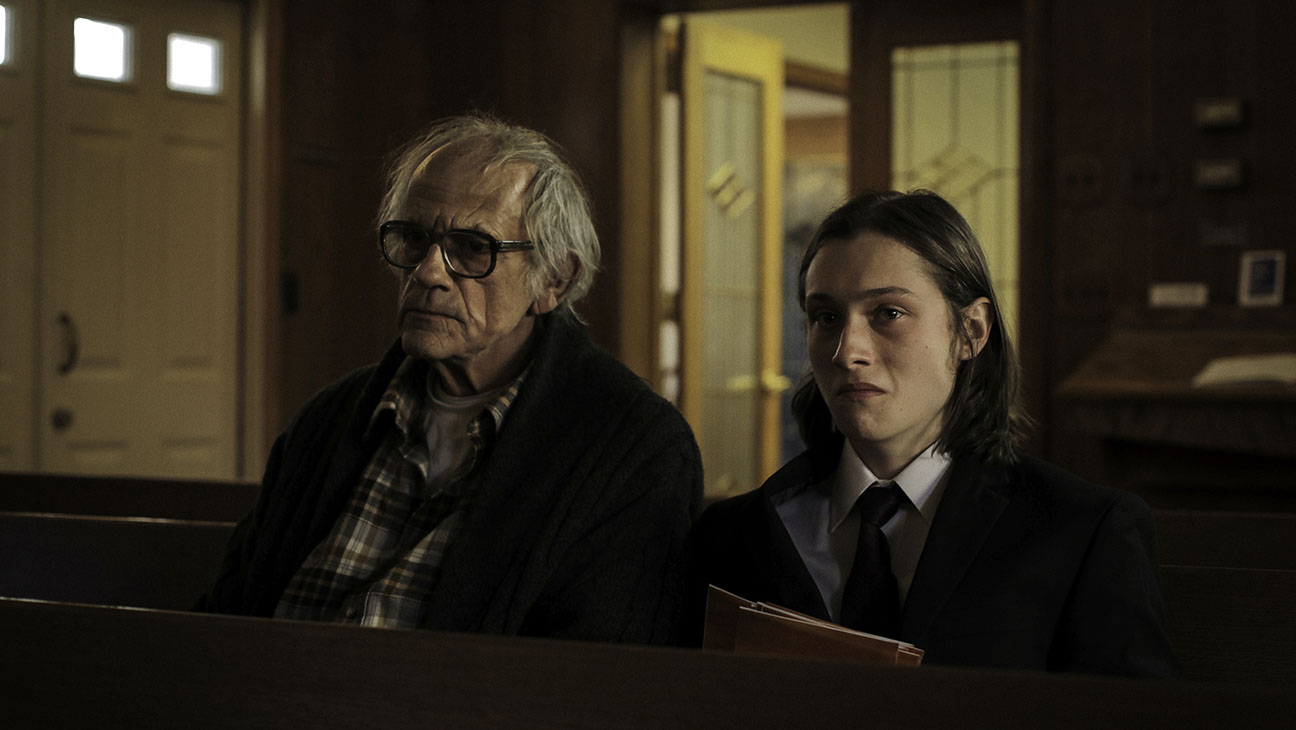
Welcome to the small US town of Clayton where the mutilated remains of one of the townsfolk ends up at the Cleaver-run funeral home. It’s actually the second such corpse to end up there, but the owner, April Cleaver (Fraser), isn’t too happy about the boost in business – given the circumstances. The same can’t be said for her son, John (Records), who views (literally) the bodies with a kind of excitement. Which isn’t surprising, as John has been recently diagnosed as a sociopath.

John ticks all the boxes for incipient sociopathy: bedwetting, pyromania and animal cruelty, but he’s self-aware and has a set of rules that he follows in order that he doesn’t act out on his violent impulses. He has a friend, Max (Brandstrom), that he hangs out with and does “normal” stuff, and he has a liking for a girl who lives across the road, Brooke (Lawton) (though he doesn’t know how to approach her, or talk to her even when she speaks to him). Aside from his mother, his aunt Margaret (Baldwin), and older sister Lauren (Sundberg), the only other people he interacts with are his therapist, Dr Neblin (Geary), and the elderly couple across the street, the Crowleys (Lloyd, Noah).

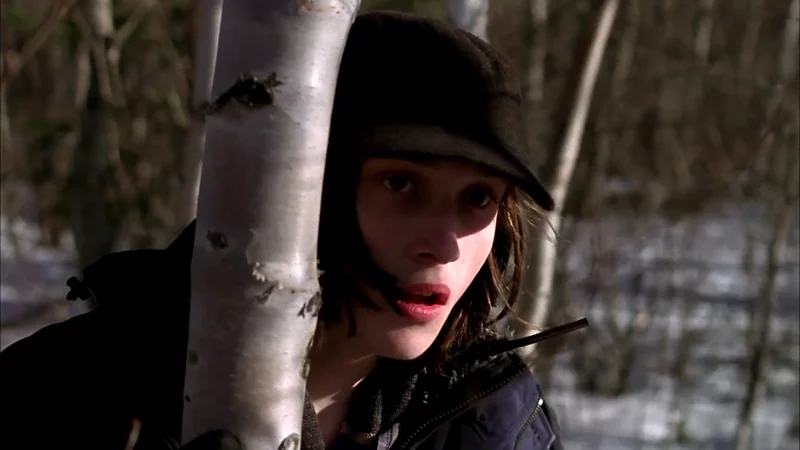
After the discovery of the second body, John starts to notice a mysterious man wandering around town and acting suspiciously. One day he follows the man, who bumps into Mr Crowley. Crowley is going ice fishing and the stranger invites himself along. John follows them out to a lake and watches as the stranger makes to stab the old man in the back. But John is astonished to see Crowley whirl round and using some kind of black, stick-like growth that shoots from his hand, kill the man instead. And then it gets weirder still…

ianask-scene3

What John sees causes him no end of confusion and indecision. But he’s also fascinated, impressed even on one level, and says nothing to anyone about what he’s seen. He begins to follow Crowley around town, until one afternoon the old man visits a barber’s. Once the other customers are gone, and the barber is distracted, Crowley locks the door and puts the Closed sign in the window. While he proceeds to kill the barber, John sets off the security alarm. Two policemen arrive, but when one of them discovers the barber’s body, Crowley kills both of them as well. Shocked, but also scared of putting anyone else in harm’s way, John decides that it’s down to him to do something about Crowley’s killing spree. But can he do it without betraying his own set of rules, and without giving in to the urges he manages to suppress?

Adapted from the novel of the same name by Dan Wells, I Am Not a Serial Killer is a dark comedy/drama that manages to work on several levels, and with a good deal of style and panache. Visually it’s a very dour, moody piece, even when Clayton is buried under a couple of feet of snow. Robbie Ryan’s cinematography is an obvious asset, whether it’s capturing the look and feel of a small town teetering on the edge of hysteria, or reflecting on the dark emotions that drive both John and Mr Crowley. (It’s a banner year for Ryan, with Ken Loach’s I, Daniel Blake and Andrea Arnold’s American Honey also lensed by him and due out.) As the movie progresses and the streets of Clayton become emptier and emptier, Ryan’s camerawork helps increase the sense of isolation experienced by the characters, and heightens the drama. For a relatively low budget movie, Ryan’s work is exemplary and helps elevate the somewhat uneven material.

ianask-scene2

This unevenness is due to the twists and turns of the story, some of which work perfectly – Crowley’s first on-screen kill – and some of which don’t – John’s mother being put in harm’s way near the end. In adapting Wells’s novel, O’Brien and co-screenwriter Christopher Hyde have rightly emphasised the struggle John has in keeping his impulses in check, but they’re less successful in examining and relating the reasons why he keeps Crowley’s secret to himself. He’s clearly appalled by both the fact of Crowley’s being a serial killer, and the manner in which he carries out his kills, and also that he’s been doing it for a very long time (there’s a nod to Lloyd’s role in the Back to the Future trilogy, as one of Crowley’s younger identities is called Emmett). This is at odds with his sociopathy, which is played with and included as and when the script requires it. Other emotional outbursts are also at odds with Dr Neblin’s diagnosis, and there’s even room for a last-minute joke to further call his condition into question.

Notions of sociopathy aside, John is a wholly sympathetic character that, strangely enough, audiences should be able to identify with. As a teenager, he has trouble fitting in, and as a protagonist he’s pro-active in ways that we’d like to think that we would be in a similar situation. As he and Crowley play their game of cat and mouse, it’s easy to root for him because even when he appears to have killed someone – a definite no-no according to the rules – John’s reaction is one of horror rather than indifference. What’s also very clever (and very cleverly handled) is the way in which Crowley is allowed to go from homicidal maniac to a character every bit as sympathetic as John, and with a compelling motive for his actions as well.

I Am Not A Serial Killer

Threaded throughout the story are moments of rich, dark humour – John’s way of dealing with a bully, Max’s father being interviewed on TV while he’s part of an angry mob – and John’s family background is given its fair share of screen time, revealing greater depths to the characters than is usual. As the fractured family, Fraser is under-used as John’s mother, while Baldwin is the strong-willed yet fair aunt, and Sundberg pops in and out of the narrative to remind viewers that John isn’t the only one trying to figure out their place in life. As John, Records gives an intuitive, carefully modulated performance that matches the character’s feelings of paranoia, while Lloyd provides a perfect mix of pathos and menace as the neighbourly serial killer with an even darker secret.

O’Brien ensures the movie is never less than intriguing, and directs at an unhurried, deliberate pace which suits the material and gives the narrative room to breathe. He’s also able to ensure that when things get really weird, the viewer isn’t put off by these developments or left stranded in open disbelief (a likely occurrence if this was in the hands of a less confident director). And the denouement, when it arrives, is unexpectedly touching, a surprise that is pulled off with aplomb, and which makes the movie a much more rewarding experience than usual.

Rating: 8/10 – there’s much to admire about I Am Not a Serial Killer, from its familiar small town vibe to its potent murder scenes, and the many ways in which it manages to subvert those small town vibes in order to heighten the drama; Records and Lloyd make for great adversaries, the special effects in the movie are used sparingly and to good effect, and the whole thing is far more entertaining and enjoyable than its semi-morbid title would have you believe.

Share this:

  • Click to share on X (Opens in new window) X
  • Click to share on Facebook (Opens in new window) Facebook
  • More
  • Click to print (Opens in new window) Print
  • Click to email a link to a friend (Opens in new window) Email
Like Loading...

Zoom (2015)

11 Sunday Sep 2016

Posted by dullwood68 in Movies

≈ 1 Comment

Tags

Alison Pill, Animation, Brazil, Breast enlargement, Canada, Comedy, Drama, Drugs, Gael García Bernal, Love dolls, Mariana Ximenes, Movie director, Pedro Morelli, Review, Sex, Tyler Labine, Writing

zoom

D: Pedro Morelli / 93m

Cast: Gael García Bernal, Alison Pill, Mariana Ximenes, Tyler Labine, Don McKellar, Claudia Ohana, Michael Eklund, Jennifer Irwin, Jason Priestley, Clé Bennett

A worker in a factory that produces state of the art love dolls. A movie director trying to make an artistic masterpiece. A model who discovers she has a talent for writing. Three people who aren’t connected. Or are they?

That’s the question you’ll be asking yourself if you watch Zoom, a freewheeling, energetic look at three lives that may or may not be intertwined, and one of which is presented in the same rotoscopic animation style as A Scanner Darkly (2006). Unafraid to take chances with its narrative, the movie invites the viewer along on a cleverly structured, and constructed, meta-ride that rewards them over and over again as the movie progresses. It’s a likeable, good-natured movie that appears to veer off in unlikely directions in an effort to be “different”. But this veering off is a major part of the movie’s charm, and while some twists and turns may seem frivolous, they all add to the huge amount of fun that can be had from Matt Hansen’s lively screenplay.

zoom-scene3

It certainly begins in an unexpected fashion, with two workers at a love doll factory, Emma (Pill) and Bob (Labine), having sex surrounded by the fruits of their labours. It’s both funny and disconcerting to see Emma and Bob being “watched” while they copulate, but it’s done in such a matter-of-fact way that the disconcerting aspect soon goes away (even if the love dolls’ voyeuristic perspective doesn’t). Alas, Bob’s post-coital attempts at conversation soon fall flat and he makes unflattering comments about the size of Emma’s breasts. An aspiring comic book artist, Emma has drawn a picture of herself as a voluptuous warrior princess; using this and Bob’s attitude as a spur for doing so, she goes ahead and has a breast enlargement.

Emma has also been chronicling the story of a movie director, Edward (Bernal), as he nears completion of his latest feature. Edward is known for making popular action movies but wants to make an artistic statement this time round, a fact he’s trying desperately hard to hide from studio head Marissa (Irwin). Meanwhile he lives a hedonistic lifestyle, often bedding two women at the same time. When Emma decides to put an end to this behaviour by severely reducing the size of his penis, Edward’s resulting loss of confidence begins to affect his ability in making his movie. And when Marissa finally sees a rough cut that ends too abruptly for her liking, Edward is persuaded to oversee further shooting that will add an action climax much like the ones he’s famous for.

Edward’s movie is about a Brazilian model, Michelle (Ximenes), whose career is far from fulfilling. An encounter with a publisher leads her to turn her back on modelling in order to write a novel. She leaves behind her less than supportive boyfriend, Dale (Priestley), and heads for a beach town in Brazil where she continues to write her story about a young woman who works in a love doll factory and wants bigger breasts. As Zoom continues, each story, already inextricably linked, reveals different facets of the wider story being told, and challenges our notions of what’s real and what’s fantasy.

zoom-scene2

Morelli juggles the various storylines and multiple perspectives with a confidence that draws out the subtle nuances and refinements of the script. Visual clues and riffs abound throughout, and there are a number of verbal references that serve to enhance the quick-witted nature of the narrative, and it all helps to take the viewer on a multi-stranded journey of discovery that never skimps on invention. Emma and Bob find themselves in possession of a large quantity of cocaine, the sale of which will help pay for the breast reduction she now wants. Michelle finds herself on the verge of a relationship with local bar owner, Alice (Ohana). Edward goes to ever-increasing lengths (no pun intended) to reassert his masculinity, even as his control over his movie defaults to his scheming colleague, Horowitz (McKellar). Each story grows closer and more connected to each other, until Hansen and Morelli manage to pull off something of a magic trick: three narratives become one and they all fit seamlessly together.

A tremendous amount of thought has been put into Zoom, and though a handful of scenes have the feel of having been added during shooting, the movie as a whole has a gleefully anarchic approach that is helped immeasurably by the commitment of its cast. Bernal, his performance augmented by the comic book style animation his storyline is presented in, plays Edward as a combination of preening pleasure seeker and tortured artist, and does so without making his character seem at odds with himself. Ximenes has arguably the most dramatic role, but acquits herself well, portraying Michelle’s determination and vulnerability with a poise and conviction that feels entirely natural. Labine provides his usual slacker screen persona (which isn’t a bad thing; he hasn’t worn out his welcome in the way that Seth Rogen has, for example), Michael Eklund adds another oddball role to his CV as a love doll customer with an uncomfortable demeanour, and McKellar is suitably venal and crafty as Edward’s “successor”.

zoom-scene1

But it’s Pill who most impresses. As the outwardly mousy Emma, Pill delivers a pitch perfect portrayal of a woman with bigger (pun intended) plans than anyone can imagine. Always undervalued and unappreciated for herself, Emma has a better focus on her life and what she wants than anyone else, and Pill is the movie’s consistent source of emotional honesty. Her open, expressive features (even when hidden behind some very large frames) have the ability to convey so many different feelings and emotions that watching her is always a pleasure. Just watch her in the scene where she tries to insist that her breast enlargement be reversed; the combination of her countenance and her vocal delivery is expressed with such delicacy that it’s a shame when the scene ends.

Zoom premiered a year ago today at the 2015 Toronto International Film Festival, but has since been released in only a handful of countries. This is a shame as it’s an imaginative, skilfully handled tale that wears its quirkiness on its sleeve with pride, and offers anyone lucky enough to see it a very good time indeed. Morelli, Hansen, the cast, and everyone else involved in the movie should all be congratulated for achieving something that doesn’t conform to the moribund excesses of current Hollywood movie making.

Rating: 8/10 – an extremely pleasing mix of animation and standard photography, Zoom establishes each of its three storylines with speed and efficiency, and never relaxes in its efforts to surprise and entertain the viewer; a small-scale gem that deserves a wider audience – like so many other indie movies out there – it’s diverting and rewarding in equal measure and well worth checking out.

Share this:

  • Click to share on X (Opens in new window) X
  • Click to share on Facebook (Opens in new window) Facebook
  • More
  • Click to print (Opens in new window) Print
  • Click to email a link to a friend (Opens in new window) Email
Like Loading...

Black Tar Road (2016)

09 Friday Sep 2016

Posted by dullwood68 in Movies

≈ 2 Comments

Tags

A Junkie Love Story, Abovo Films, Amber Dawn Lee, Drama, Drugs, Love, Noelle Messier, Prostitution, Review, Truck stop

black-tar-road

D: Amber Dawn Lee / 85m

Cast: Amber Dawn Lee, Noelle Messier, James Black, Darin Cooper, Jeff Chassler, Ron Allen, Eugenia Care, Leif Gantvoort

You’re an aspiring actress who wants to be known for more than roles as The Hottie in short The Bigfoot Hunters (2013), or as Hippie Barfly in lame horror Butterfly (2010). So what do you do? Simple: start your own production company and put your other talents as a writer and a producer and a director to the fore. Amber Dawn Lee did exactly that in 2010 when she formed Abovo Films. Six years on and we have the first feature made by Lee through her own production company, the abrasive romantic drama, Black Tar Road.

Originally titled A Junkie Love Story before its release, Black Tar Road is a bleak, occasionally disturbing look at love amongst the ruins of two women’s lives as they come together and find a semblance of happiness while nothing around them changes. Heather (Messier) is a hooker who finds her customers at a local truck stop. She’s tall, skinny, and by her own admission, not the prettiest woman to look at. But she has nowhere else to go, and no real ambitions to better herself other than to travel west to Pasadena. But even then she has no idea what she’ll do when she gets there. Charlie (Lee) is a trucker, working off a debt to a criminal gang by transporting illegal items around the American southwest. She’s a drug addict, too, injecting heroin at an often alarming rate but somehow managing to function. Beyond clearing her debt she too has no ambitions or plans; the only difference between her and Heather is that she at least has travelled, even if it is behind the wheel of a truck.

btr-scene2

Their relationship begins in an offhand, casual way, in a bar. There’s an attraction on Charlie’s part that happens straight away, but Heather is looking for a friend to help make her life more bearable. She’s not looking for love as she doesn’t think it’s real anymore. Charlie thinks along similar lines, but the ease with which they come together as friends makes it inevitable that they’ll fall in love. As both director and writer, Lee doesn’t shy away from how broken these two women are, nor how much they want to feel normal (whatever that means for them). As their friendship develops and becomes sexual as well as more emotional, Lee’s script allows them a respite from the pain and disappointment of their regular lives. Together, they can block out all the bad stuff and ignore it for a while, but thanks to their own failings and their own individual problems, all that stuff is still going to be there to trip them up.

As Heather and Charlie become closer and more committed to each other, as well as the idea of their being a couple, there’s the likelihood that we’ll get to know more about them. Up til now, Lee has provided very little back story for either character, and while this doesn’t hinder our understanding of the two women, it does create a distance between them and the viewer that restricts the amount of sympathy we feel for them. Heather was popular in high school, and is reminded of this from time to time, but we don’t know the circumstances that have led her into prostitution. Likewise, Charlie’s addiction to heroin is presented as an integral, and important, part of her lifestyle and character. Lee refrains from exploring each character’s unwillingness to change (or at least try to); instead she makes their determination not to change a kind of feminist badge of honour, as both women try to convince each other, and the audience, that this is who they are and they don’t need to be any different.

btr-scene3

Lee paints a pretty miserable picture of both women’s lives from the outset, and the first half an hour may test the patience of viewers who don’t like their movies to be quite so grim, but once Heather and Charlie begin their relationship in earnest, then Lee allows the movie to breathe a little. She lets the two women experience joy and hope in equal measure, and changes the parameters by which they relate to the world. Lee shoots several scenes in black and white to highlight the difference that their romance means to them, how simple their lives have become in these moments of intimacy and love. These are affecting moments, driven by the closeness and the bond between Heather and Charlie, and by Lee’s careful, though obvious, signposting of the way in which things might change for the worst.

As the beleaguered women, both Lee and Messier are on fine form. Lee plays Charlie as a more internalised role, a mostly quiet(er) counterpoint to Messier’s garrulous Heather. Charlie’s drug habit leaves her looking haggard and on the verge of death a lot of the time, and Lee isn’t afraid to look suitably ghastly. Heather has a nervous laugh that animates her face in a way that shows off her insecurity around other people; like Lee, Messier isn’t afraid to look worn-down or exhausted. Both actresses express a degree of fearlessness in their roles that adds texture and a coarse vitality to their roles, but they’re equally adept at showing the vulnerability and the tenderness that Heather and Charlie are able to show each other, and no one else.

btr-scene1

For all its positive qualities though, Black Tar Road does founder at times, and Lee makes some narrative decisions that don’t make a lot of sense. Charlie does something that should see her pursued by the police, but once it’s done and she’s panicked a bit over it, it’s forgotten and never mentioned again. It’s a very unlikely outcome, and some viewers may well continue watching the movie waiting for this “something” to come back and bite Charlie in the ass. That it doesn’t is unfortunate, and the sequence in which it occurs ends up feeling like an unnecessary addition to Charlie’s storyline. Heather, meanwhile, looks after her grandmother, who is borderline catatonic. This never amounts to anything significant, unless it’s to show that Charlie and Heather aren’t entirely self-centred; if that’s the case, then it’s a very clumsy way of telling viewers something they’ll already have guessed for themselves. There’s also way too many scenes of Charlie shooting up and then waking up – often in the street – some time later; each time, she comes to, she gets up, and carries on as if it’s never happened.

At times unremittingly bleak – Heather contributes a voice over in the opening ten minutes that will have some viewers convinced this is going to be a suicide tale – Black Tar Road uses a framing device to provide a degree of optimism as to the movie’s eventual outcome. But said optimism is ultimately in short supply, and while this is in keeping with the not-so-cautionary tale that Lee is telling, any viewer approaching this movie expecting a happy ending, may be better off looking elsewhere.

Rating: 7/10 – a gritty drama that doesn’t send its main characters on a search for personal redemption – and is all the better for it – Black Tar Road overcomes some narrative fumbles along the way to become a low-key, bittersweet tale of love against the odds; at times earnest and impassioned, and buoyed by two impressive performances from Lee and Messier, the movie may appear too dour for its own good, but it’s a look on the dark sides of hope and personal need that succeeds more often than it fails.

Share this:

  • Click to share on X (Opens in new window) X
  • Click to share on Facebook (Opens in new window) Facebook
  • More
  • Click to print (Opens in new window) Print
  • Click to email a link to a friend (Opens in new window) Email
Like Loading...

Bastille Day (2016)

05 Monday Sep 2016

Posted by dullwood68 in Movies

≈ 5 Comments

Tags

Action, Bombing, Charlotte Le Bon, CIA, Crime, Drama, Idris Elba, James Watkins, José Garcia, Kelly Reilly, Paris, RAPID, Review, Richard Madden, Thriller

Bastille Day

D: James Watkins / 92m

Cast: Idris Elba, Richard Madden, Charlotte Le Bon, Kelly Reilly, José Garcia, Thierry Godard, Anatol Yusef

Meh (see also Mechanic: Resurrection).

Rating: 3/10 – uninspired, heavy-handed, preposterous, and as dead on arrival as the four victims of its fictional bombing, Bastille Day limps along from one turgid, barely credible scene to another with all the panache and style of a boxer who’s on the ropes and seeing double of everything; not even Elba’s stoic presence can save this Euro-mess of a movie, an action thriller that insults its audience at every turn, plays fast and loose with its own narrative, and which flags up every single plot development with all the subtlety of a punch in the face.

Share this:

  • Click to share on X (Opens in new window) X
  • Click to share on Facebook (Opens in new window) Facebook
  • More
  • Click to print (Opens in new window) Print
  • Click to email a link to a friend (Opens in new window) Email
Like Loading...

Monthly Roundup – August 2016

03 Saturday Sep 2016

Posted by dullwood68 in Movies

≈ Leave a comment

Tags

A Perfect Day, Aid workers, Animation, Benicio Del Toro, Blue Sky, Curt Siodmak, Denis Leary, Drama, Espionage, EVP, Fedja Stukan, Fernando León de Aranoa, Galen T. Chu, Harrison Gilbertson, Haunt, Haunted house, Horror, Ice Age: Collision Course, Ione Skye, Jacki Weaver, Jean Byron, John Leguizamo, Ken Hughes, King Donovan, Liana Liberato, Little Red Monkey, Mac Carter, Mélanie Thierry, Meteorite, Mike Thurmeier, Morello Curse, Murder, Nuclear scientists, Olga Kurylenko, Queen Latifah, Ray Romano, Review, Richard Carlson, Richard Conte, Rona Anderson, Russell Napier, Sci-fi, Scrat, Simon Pegg, Spaceship, Sylva Langova, The Balkans, The Fifties, The Magnetic Monster, Thriller, Tim Robbins

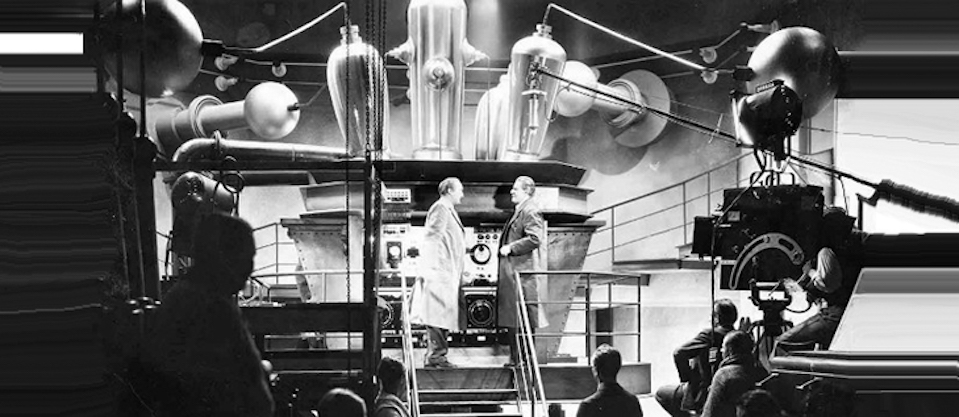
The Magnetic Monster (1953) / D: Curt Siodmak / 76m

Cast: Richard Carlson, King Donovan, Jean Byron, Harry Ellerbe, Leo Britt, Leonard Mudie, Byron Foulger, Michael Fox

The Magnetic Monster

Rating: 6/10 – a sample of selenium, bombarded with alpha waves, becomes a lethal danger to mankind as it develops exponentially – and only the A-Men from the Office of Scientific Investigation can stop it; an exposition heavy sci-fi thriller that takes time out for (stranger) domestic interludes involving Carlson and Bryan, The Magnetic Monster packs a lot in to its relatively short running time and is unexpectedly entertaining for all its techno-speak and overly serious demeanour.

Haunt (2014) / D: Mac Carter / 86m

Cast: Harrison Gilbertson, Liana Liberato, Ione Skye, Jacki Weaver, Brian Wimmer, Danielle Chuchran, Ella Harris, Carl Hadra

Haunt

Rating: 3/10 – a family move into a house where tragedy struck the previous owners, and the son (Gilbertson), along with abused neighbour Sam (Liberato), discovers that the place is haunted by a vengeful spectre; muddled, confused and scare-free, Haunt aims for unsettling and frightening but misses by a mile thanks to weak plotting, a jumbled storyline, stock characters, absentee direction, and an overbearing score (and that’s without mentioning the performances, particularly Weaver’s – which is dreadful).

Ice Age: Collision Course (2016) / D: Mike Thurmeier, Galen T. Chu / 94m

Cast: Ray Romano, John Leguizamo, Denis Leary, Queen Latifah, Simon Pegg, Keke Palmer, Adam Devine, Wanda Sykes, Seann William Scott, Josh Peck, Jennifer Lopez, Jesse Tyler Ferguson, Jessie J, Nick Offerman, Chris Wedge

Ice Age Collision Course

Rating: 5/10 – while Scrat does his best to keep his acorn safe aboard a spaceship, his actions lead to a massive meteorite heading for Earth, which in turn leads to Manny (Romano) and the usual gang having to formulate a plan to avoid the extinction of them all; while the series can still manage to sprinkle a handful of inspired visual gags throughout each entry (and this is no different), the law of diminishing returns is having a savage effect on the storylines, with this outing proving less than inspired, and leaving the characters teetering on the edge of becoming their own caricatures.

Little Red Monkey (1955) / D: Ken Hughes / 71m

aka The Case of the Red Monkey

Cast: Richard Conte, Rona Anderson, Russell Napier, Sylva Langova, Colin Gordon, Donald Bisset, John King-Kelly, Bernard Rebel, Arnold Marlé, John Horsley

Little Red Monkey

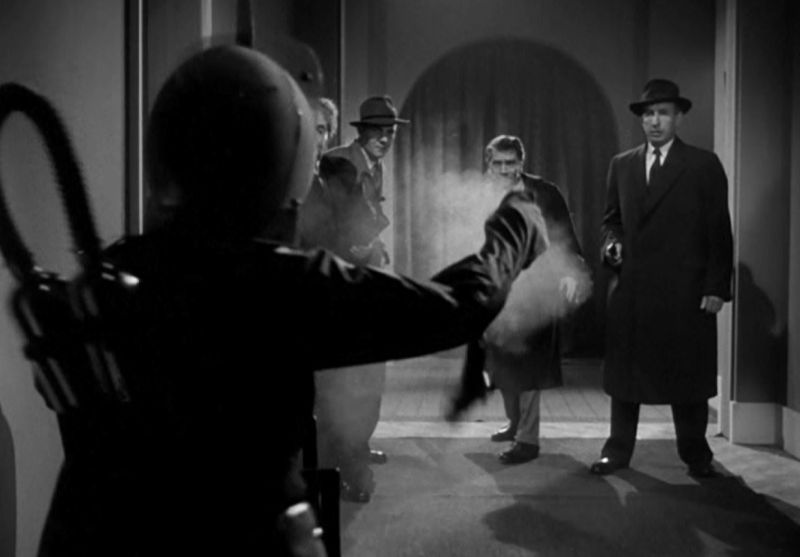
Rating: 7/10 – when several nuclear scientists are murdered, and the culprit appears to be a little red monkey, Scotland Yard and a visiting US State Department agent have to make sure that defecting Professor Leon Dushenko (Marlé) doesn’t end up dead as well; an agreeable, fast-paced thriller, Little Red Monkey mixes international espionage, early Cold War paranoia, romance, and intrigue to good effect, and thanks to the script by Hughes and James Eastwood, has a discreet Hitchcockian vibe that benefits it tremendously.

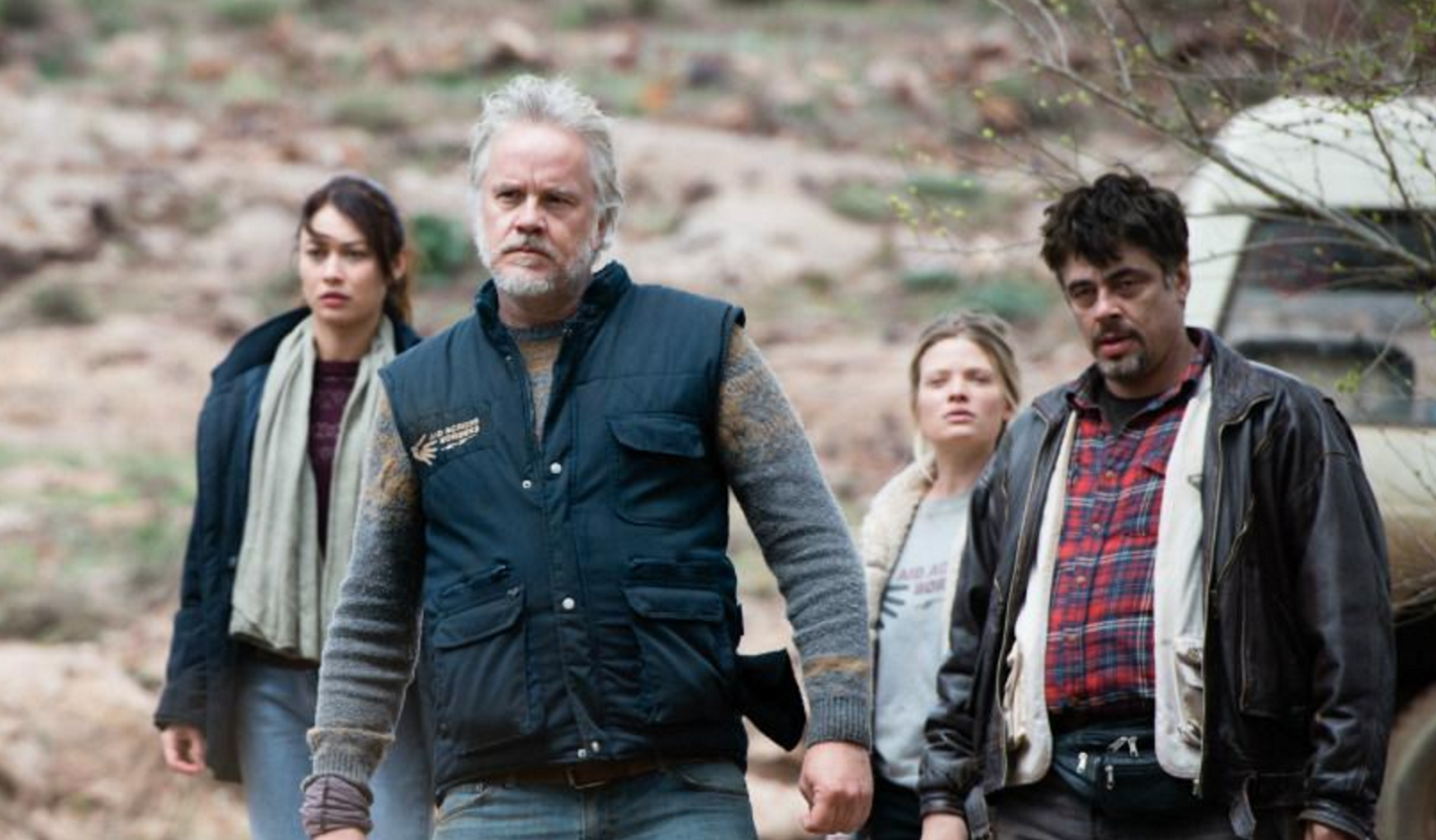
A Perfect Day (2015) / D: Fernando León de Aranoa / 106m

Cast: Benicio Del Toro, Tim Robbins, Olga Kurylenko, Mélanie Thierry, Fedja Stukan, Eldar Residovic, Sergi López

A Perfect Day

Rating: 7/10 – a group of aid workers in the war-torn Balkans try to have a dead body removed from a well that provides drinking water, and are met by every type of obstruction possible – bureaucratic, cultural, and just plain bizarre; A Perfect Day‘s very good cast can’t mitigate against the episodic nature of the story, or de Aranoa’s offhand treatment of some of the minor characters, but otherwise this is a pointed, unsentimental look at the quieter horrors that war can throw up, and when it wants to be, uses black humour as a trenchant counterpoint to all the tragedy.

Share this:

  • Click to share on X (Opens in new window) X
  • Click to share on Facebook (Opens in new window) Facebook
  • More
  • Click to print (Opens in new window) Print
  • Click to email a link to a friend (Opens in new window) Email
Like Loading...

Mechanic: Resurrection (2016)

31 Wednesday Aug 2016

Posted by dullwood68 in Movies

≈ 4 Comments

Tags

Action, Arms dealers, Australia, Crime, Dennis Gansel, Drama, Hitman, Jason Statham, Jessica Alba, Malaysia, Michelle Yeoh, Review, Sequel, Thailand, Thriller, Tommy Lee Jones

Mechanic Resurrection

D: Dennis Gansel / 99m

Cast: Jason Statham, Jessica Alba, Tommy Lee Jones, Michelle Yeoh, Sam Hazeldine, John Cenatiempo, Toby Eddington, Femi Elufowoju Jr, Anteo Quintavalle

Meh.

Rating: 3/10 – a terrible sequel that lies dead on the screen, Mechanic: Resurrection features some of the worst green screen work ever (the opening fight in Buenos Aires), a plot that makes absolutely no sense at all, and performances from all concerned that border almost on perfunctory – if only they could have made that much effort; action movies don’t have to tie up every loose end or narrative loophole, but this has a script that just doesn’t know when to give up and go home, making it one of the worst experiences you’re likely to have at the cinema all year.

Share this:

  • Click to share on X (Opens in new window) X
  • Click to share on Facebook (Opens in new window) Facebook
  • More
  • Click to print (Opens in new window) Print
  • Click to email a link to a friend (Opens in new window) Email
Like Loading...

Blood Father (2016)

28 Sunday Aug 2016

Posted by dullwood68 in Movies

≈ Leave a comment

Tags

Action, Crime, Diego Luna, Drama, Erin Moriarty, Ex-con, Jean-François Richet, Literary adaptation, Mel Gibson, Michael Parks, New Mexico, Peter Craig, Thriller, William H. Macy

Blood Father

D: Jean-François Richet / 88m

Cast: Mel Gibson, Erin Moriarty, Diego Luna, Michael Parks, William H. Macy, Miguel Sandoval, Dale Dickey, Thomas Mann, Richard Cabral, Daniel Moncada, Ryan Dorsey, Raoul Trujillo

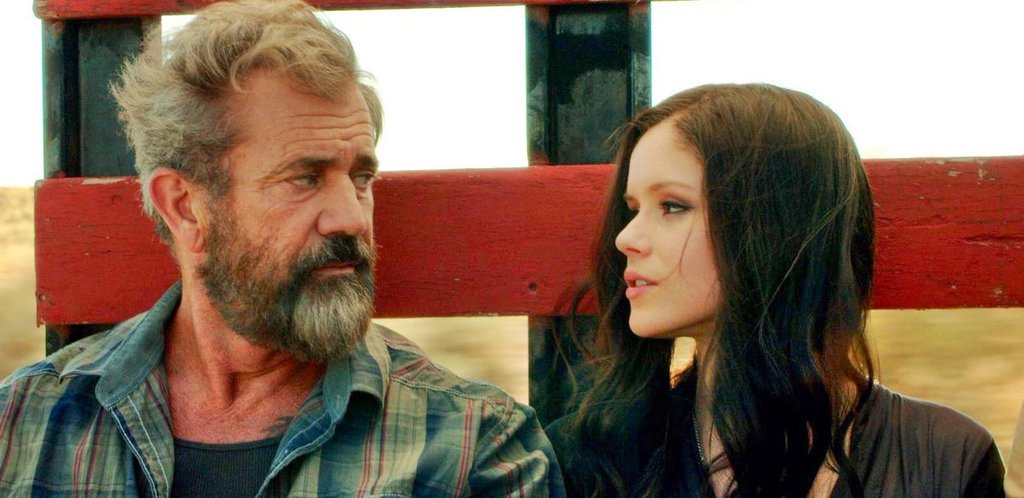
The recent career of Mel Gibson has seen him appear in one movie per year since 2010 (with the exception of 2015). While personal troubles have dogged him over the last ten years, and caused him no end of embarrassment – and given Ricky Gervais the opportunity to make one of the best jokes about an actor, ever – Gibson has tended to stick to the action genre that has stood him in such good stead in the past. Aside from his role in The Beaver (2011), Gibson’s choice of roles has seen him engage fitfully with the material on offer, and he’s been the villain in two action sequels that should have been much, much better: Machete Kills (2013) and The Expendables 3 (2014).

But now, with Blood Father, Gibson finally has a role he can really sink his teeth into, and the result is a performance that serves as a (much-needed) reminder of just how good an actor he really is. An adaptation of the novel by Peter Craig, and co-written by Craig and Andrea Berloff, the blood father of the title is an ex-con by the name of John Link. He’s been out of the joint for a year, and sober for two. He lives in a trailer outside a small town in New Mexico, and is a tattooist by trade. He’s also divorced, and has a seventeen year old daughter, Lydia (Moriarty). But Lydia has been missing for the last three years, ever since she ran away from the home she shared with her mother and her mother’s third husband. John has hopes of finding her one day, but without any clues as to her whereabouts, it’s unlikely he will.

Blood Father - scene3

It’s Lydia who finds him. Having gotten involved with a junior member of a Mexican cartel, Jonah Pincerna (Luna), Lydia finds herself in very deep trouble when Jonah raids the home of someone who’s been stealing from him. As a test of her loyalty he asks her to kill the woman there; Lydia ends up shooting Jonah instead. On the run, and with no one else she can call, Lydia contacts John and he arranges to meet her. He takes Lydia back to his trailer, but it’s not long before Jonah’s crew turn up looking for her. The ensuing gunfight prompts John to leave and take Lydia with him, and to find out more about Jonah and his connections. After a lucky escape from the police, John discovers that the cartel have sent a hitman (Trujillo) to kill Lydia.

A reunion with an old army buddy, Preacher (Parks), goes awry when he attempts to claim the missing persons reward money put up when Lydia ran away. She and John manage to get away, and at a motel they change their appearances, John shedding his beard and Lydia dyeing her hair blonde. While John travels to a nearby penitentiary to visit an old friend, Arturo Rios (Sandoval), who has concrete information about Jonah, Lydia is persuaded to take herself to a public place by John’s sponsor, Kirby (Macy), and trust no one. But it’s a set up, and Lydia is abducted. Her abductors contact John, and a rendezvous in the desert is arranged, but it’s a rendezvous that is likely to end in both of them being dead…

Blood Father - scene2

Fans of Mel Gibson the actor will be glad to see that his performance in Blood Father is very definitely a return to form. Ostracised and pilloried for the racist remarks he’s made in the past, Gibson seemed to be getting by on the goodwill of others – Jodie Foster, Robert Rodriguez, Sylvester Stallone etc. – and while he’s still a highly watchable actor in his own right, there was always a feeling over the last few years that Gibson wasn’t trying too hard, that the work he was taking on couldn’t have been challenging for him, and so he wouldn’t rise to the challenge. Here, though, Gibson has found a role that is not only challenging, but inspiring, rewarding, and above all, one of the best fits for his skills as an actor.

Inevitably, there’s more than a smidgeon of Martin Riggs lurking inside the character’s DNA. Witness John’s response to the arrival of Jonah’s henchmen and the gunfight that follows: he’s dismissive of them, and once they open fire and he has to deal with them he gives angry voice to the variety of ways that their appearance will lead to his breaking parole. He’s pissed off, he’s mostly unconcerned by their firepower, and he can’t wait around for the police – the sensible thing to do – because he’s convinced they won’t believe a word he says. Playing John with a fatalism that speaks volumes for the character’s mindset, Gibson gives one of the best performances of his entire career, and proves as mesmeric an actor as he was back in the late Eighties, early Nineties. As he scowls and growls his way through the movie, Gibson also imbues John with a subtle vulnerability that adds depth to the character and makes his need to reconnect with Lydia entirely credible.

Blood Father - scene1

Thanks to the combination of Gibson’s performance, Craig and Berloff’s astringent screenplay, and Richet’s sharp, purposeful direction, Blood Father is more than just a standard action drama punctuated by brief, kinetic bursts of violence. It has an off-centre sense of humour, is sure-footed enough to keep John and Lydia’s relationship free from sentiment, makes very good use indeed of its stunning New Mexico locations (beautifully lensed by DoP Robert Gantz), and above all, maintains a level of tension that many other so-called thrillers fail to achieve for even a fraction of the movie’s running time. As a return to form, Gibson couldn’t have picked a better vehicle or character, and the movie is proof positive that he’s still as mercurial an actor as ever, and that when the right role comes along, he’s nigh-on untouchable.

Rating: 8/10 – with deft supporting turns from the likes of Sandoval and Macy allied to Moriarty’s low-key, sympathetic portrayal of Lydia, Blood Father is more than just a vigorous action thriller; despite its awkward title, the movie explores themes of loss and regret, hope and sacrifice, that elevate the narrative beyond its basic, conventional set-up and make it one of the more astute “relationship dramas” out there.

Share this:

  • Click to share on X (Opens in new window) X
  • Click to share on Facebook (Opens in new window) Facebook
  • More
  • Click to print (Opens in new window) Print
  • Click to email a link to a friend (Opens in new window) Email
Like Loading...

Now You See Me 2 (2016)

27 Saturday Aug 2016

Posted by dullwood68 in Movies

≈ 1 Comment

Tags

Daniel Radcliffe, Dave Franco, Drama, FBI, Jesse Eisenberg, Jon M. Chu, Lizzy Caplan, London, Macau, Magic, Magicians, Mark Ruffalo, Michael Caine, Morgan Freeman, New York, The Eye, The Horsemen, Thriller, Woody Harrelson

Now You See Me 2

D: Jon M. Chu / 129m

Cast: Jesse Eisenberg, Mark Ruffalo, Woody Harrelson, Dave Franco, Daniel Radcliffe, Lizzy Caplan, Morgan Freeman, Jay Chou, Sanaa Lathan, Michael Caine, David Warshofsky, Tsai Chin

Ten questions you need to ask yourself while watching Now You See Me 2:

  1. Why would prison authorities allow convicted criminal Thaddeus Bradley (Freeman) access to computer equipment that would enable him to make threats against the Four Horsemen (“You will get what’s coming to you. In ways you can’t expect.”)?
  2. Pigeons? (Yes, pigeons.)
  3. How does Lula (Caplan) know so much about the Four Horsemen, including the reason why Henley Reeves (Isla Fisher’s character from the first movie) isn’t around any longer?
  4. Why is Dylan Rhodes’ (Ruffalo) attendance at a Four Horsemen “event” more suspicious to his FBI colleagues than his talking into his sleeve?
  5. How convenient is it that Bradley has just the form Rhodes needs to get Bradley out of jail?
  6. Chase McKinney (Harrelson) – unfortunate stereotype or unfortunate stereotype?
  7. How likely is it, in a sequence that lasts nearly four and a half minutes, that not one of the security guards notice the playing card as it’s whipped, zipped and slipped from one Horseman to another?
  8. How do lines such as, “But I don’t agree that we have a sackful of nada, ’cause we’re all here. That’s a sackful of something” get past the first draft stage?
  9. When did the FBI’s remit extend outside of the US?
  10. Could the screenplay by Ed Solomon have ended on a more absurd, ridiculous note than the surprise reveals made by Bradley?

Now You See Me 2 - scene

Rating: 4/10 – another poorly constructed sequel that plays fast and loose with logic, Now You See Me 2 wants the audience to like it as much as the mass London crowds go crazy for the Horsemen; slickly made but soulless, only Caplan makes an impact, and the magic tricks lack the first movie’s sense of fun, leaving the movie to rattle on for two hours without anyone having to care what happens to the characters (which is both a bonus and a relief).

Share this:

  • Click to share on X (Opens in new window) X
  • Click to share on Facebook (Opens in new window) Facebook
  • More
  • Click to print (Opens in new window) Print
  • Click to email a link to a friend (Opens in new window) Email
Like Loading...

Oh! the Horror? – Cryptic (2014) and Visions (2015)

25 Thursday Aug 2016

Posted by dullwood68 in Movies

≈ Leave a comment

Tags

Anson Mount, Bart Ruspoli, Coffin, Crypt, Cryptic, Dan Feuerriegel, Drama, Ed Stoppard, Freddie Hutton-Mills, Gillian Jacobs, Horror, Isla Fisher, Jim Parsons, Joanna Cassidy, Kevin Greutert, Philip Barantini, Pregnancy, Ray Panthaki, Reviews, Thriller, Vampire, Vineyard, Visions

These days it’s easy to make a horror movie, and these days it’s even easier to be taken in by movie makers who promote their product as being one thing when it’s actually another. Here are two movies that, on the surface, look like horror movies and even have a basic horror movie set-up. Closer attention though reveals two movies that in reality are closer to thrillers with horror overtones than out and out scarefests.

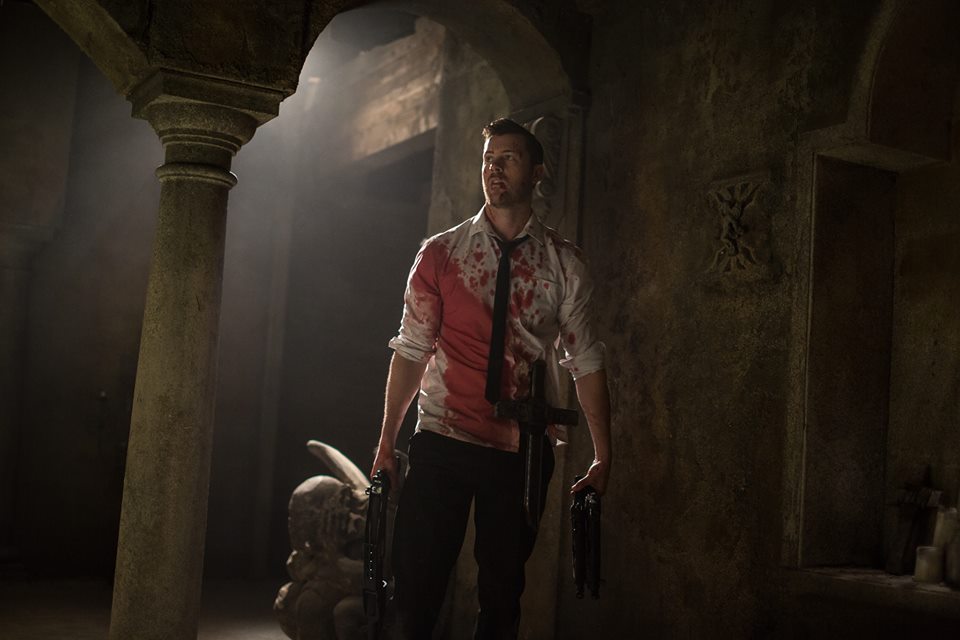
Cryptic

Cryptic (2014) / D: Bart Ruspoli, Freddie Hutton-Mills / 93m

Cast: Ed Stoppard, Dan Feuerriegel, Ray Panthaki, Philip Barantini, Vas Blackwood, Ben Shafik, Sally Leonard, Robert Glenister

Five gangsters, their banker, their lawyer (and a random drug addict), find themselves in a crypt containing a strange metal coffin – and have strict instructions not to open it until their boss arrives later that night. With wild stories about a vampire killing off their fellow gangsters, it’s not long before the group begins to wonder if their boss has captured the creature in the metal coffin, and they’re all there to exact revenge on it when their boss turns up with the key. Tensions arise, however, with the idea that one of them might be the vampire instead, and accusations abound. With guns and knives all too ready to be employed, the group’s initial solidarity begins to disintegrate, and when one of them is found dead with wounds that could have been made by a vampire, suspicion and paranoia are the order of the night.

As the group struggles to reconcile their boss’s orders with the possibility of being locked in with a real “live” vampire, they become obsessed with the contents of the metal coffin. Now believing it contains weapons that could kill the creature – if it is one of them – they argue over whether or not to try and open it. Some, like banker Steve Stevens (Stoppard), are all for leaving the coffin alone and waiting for their boss. Others, such as loose cannons the Jonas brothers (Feuerriegel, Barantini), are all for opening it and using whatever’s inside to defend themselves (even though there’s no guarantee weapons are inside it). With an uneasy truce between the two sides looking unlikely to last, another death makes it impossible, and things quickly escalate…

Cryptic - scene1

A very low-budget British independent project, Cryptic is a rough diamond of a movie that mixes often corny humour with outbursts of blood-soaked violence and an East End vibe that works surprisingly well given its single location set-up and coolly bizarre scenario. That writers/directors Bart Ruspoli and Freddie Hutton-Mills have managed to stretch their very basic plot over ninety-three minutes and kept it entertaining is a tribute to their inventiveness, and the obvious fun they had in putting it all together. Even if the narrative does get bent out of shape now and again thanks to some fervent story ideas, and the need to keep its oh-so-important subplot ticking along in the background, Cryptic still manages to hold the attention and reward the viewer’s time.

Ruspoli and Hutton-Mills are aided by a more-than-game cast who invest their characters with recognisable traits and motivations, even when the action descends into unbridled psychopathy. Stoppard leads the pack as the suave, acerbic banker who refuses to let himself be rattled by the notion of a vampire in their midst, while Feurriegel and Barantini sidestep the script’s occasional need to caricature their characters by highlighting their solidarity as brothers even when they’re violently at odds with each other. And Blackwood is a delight as Meat, possibly the dumbest gangster ever, who buys his weapons on the Internet. They and the rest of the cast are hugely responsible for just how good the movie is, and it’s to Ruspoli and Hutton-Mills’ credit that they chose their cast so effectively and so well. By buying into the absurdity of the situation, their efforts make the movie a treat to watch.

Rating: 7/10 – an unexpected gem amongst the plethora of low-budget tosh the British Film Industry has released in recent years, Cryptic is deserving of a wider audience, and all because it’s clearly a movie that its creators have spent more than five minutes putting together; with a wicked streak of humour running through it from start to finish, and an edge that is only employed when necessary, this is proof that East End gangster movies don’t all have to be pony and trap.


Visions

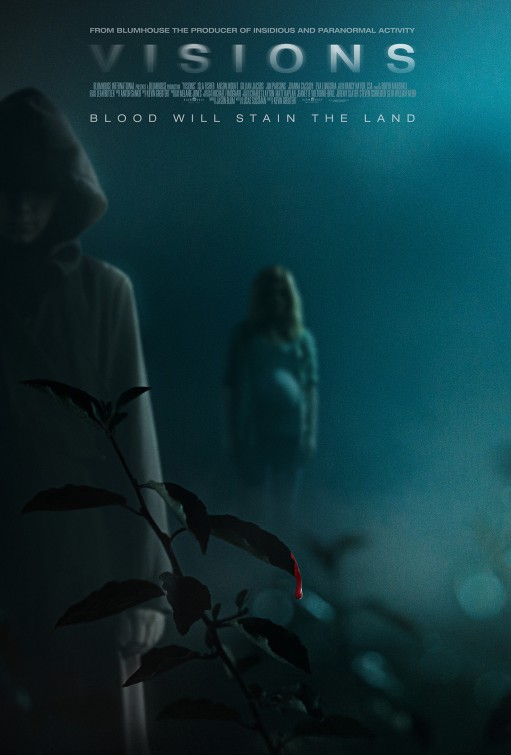
Visions (2015) / D: Kevin Greutert / 82m

Cast: Isla Fisher, Anson Mount, Gillian Jacobs, Jim Parsons, Joanna Cassidy, Eva Longoria, Bryce Johnson, John de Lancie

Moving to Paso Robles to reopen a vineyard they’ve purchased, Eveleigh and David Maddox (Fisher, Mount) are expecting their first child. Having been on anti-depressants following a car accident a year earlier, Eveleigh has come off them thanks to her pregnancy, but is beginning to experience strange visions that lead her to believe that there are supernatural forces at work in their home. David isn’t so convinced, especially when their realtor confirms that the property doesn’t have a bad history. At the insistence of her OB/GYN doctor (Parsons), Eveleigh resumes taking anti-depressants and the visions cease.

Some months later, Eveleigh is persuaded to come off her anti-depressants by her friend, Sadie (Jacobs). But the visions return, and Eveleigh’s paranoia surrounding them leads her to believe that David is somehow involved. She delves further into the vineyard’s history, and discovers that a century earlier, paranormal activity prompted the then owner to burn it down. And Eveleigh’s research reveals pictures drawn by a medium who tried to contact spirits in the house; the pictures show Eveleigh and David. When her doctor and some of their friends mount an intervention, Eveleigh is forced to realise that her visions are not as she first thought, and are even more frightening for what they really mean.

Visions - scene1

There’s a twist in Visions that, all things considered, comes too late to save the movie from its determination to be bland and unremarkable. Despite a plot that requires Fisher to be put in jeopardy from the beginning, Lucas Sussman’s convoluted screenplay throws in everything bar the kitchen sink in its efforts to distinguish itself from every other “haunted house” movie. The result is a movie that promises much but delivers very little, from Fisher’s anguished mother-to-be, to Mount’s too-good-to-be-completely-true husband, and all the way to the “surprise” villains that audiences should have spotted a mile off. Greutert’s last movie was Jessabelle (2014), a movie that gave new meaning to the phrase, “so-bad-it’s-bad”, but here he’s on firmer ground, even if that ground contains the occasional narrative quicksand.

But the central mystery isn’t as gripping as it needs to be, and Fisher is often left stranded by the sudden twists and turns that her character’s visions propagate. Mount is left stranded by the script’s decision to involve him only occasionally, while supporting characters come and go without making any impact (including Parsons’ doctor, a role that does nothing to allay any suspicions that the actor can only play The Big Bang Theory‘s Sheldon Cooper). As the fitful tension begins to escalate, the movie – also edited by Greutert – at least makes an attempt at providing real thrills, even if they’re of the cheap and nasty kind. But all this pales beside the notion that the sins of the future are as dark and disturbing as the sins of the past; they’re not.

Rating: 4/10 – an unremarkable “chiller”, Visions tells its dull story with a modicum of creativity, but sadly, remains an underwhelming experience; Fisher is given the enviable task of not only being pregnant but “possessed” as well, but isn’t given enough support by the script to make some (or all) of her possessions come to her.

Share this:

  • Click to share on X (Opens in new window) X
  • Click to share on Facebook (Opens in new window) Facebook
  • More
  • Click to print (Opens in new window) Print
  • Click to email a link to a friend (Opens in new window) Email
Like Loading...

Spaceman (2016)

23 Tuesday Aug 2016

Posted by dullwood68 in Movies

≈ Leave a comment

Tags

Baseball, Bill Lee, Brett Rapkin, Canada, Drama, Drugs, Ernie Hudson, Josh Duhamel, Literary adaptation, Pitcher, Review, Sport, True story, W. Earl Brown, Winter Ave Zoli

Spaceman

D: Brett Rapkin / 90m

Cast: Josh Duhamel, W. Earl Brown, Winter Ave Zoli, Ernie Hudson, Carlos Leal, Caroline Aaron, Claude Duhamel, Stefan Rollins, Wallace Langham

If you’ve heard of Bill Lee, one-time pitcher (and a left-handed pitcher at that) for the Boston Red Sox and the Montreal Expos, then chances are you also know about his drug-related background, his independence and need to challenge authority, plus his support for Maoist China, Greenpeace and school busing in Boston (amongst others). He was a well-known counterculture figure who appeared in an issue of the pro-marijuana magazine, High Times, and who once threatened to bite off the ear of an umpire in a 1975 World Series game. In later life, while still involved with baseball on a variety of levels, he was also asked to run for President of the United States on behalf of the Rhinoceros Party (his slogan: “No guns, no butter. Both can kill.”) If nothing else, Bill Lee has led an extraordinarily rich and eventful life.

Which makes Spaceman all the more confusing for focusing on the period that immediately follows the end of his professional career. Fired for one challenge to authority too many (walking out before a game in protest at the release of a fellow player), Lee (Duhamel) expects to get right back in the game, so confident is he that his unique skills as a pitcher will be more than enough to offset his off-the-pitch behaviour. But when the offers don’t come rolling in, Lee finds himself at a loss. His agent (and friend), Dick Dennis (Brown), keeps getting the runaround when he tries to contact the big league teams, and soon the message gets through: nobody wants him because everyone is tired of his shenanigans. He’s also thirty-six, and time isn’t on his side.

vlcsnap-00001

Lee’s also trying to do right by his three kids. He’s separated from his wife (Zoli) and can only have them over by arrangement. He’s as unorthodox a parent as he is a baseball player, but his relationships with his children are one of the few aspects of his life that he gets right. Otherwise, Lee smokes a lot of weed, drinks a lot of booze, and dreams of making it back into the Big Leagues. But the offers don’t come, his eventual divorce sees him deprived of any visitation rights, and to cap it all he receives an invitation to play for a Canadian seniors team. Intrigued and offended at the same time, Lee attends one of their matches, and helps them win. His need to play keeps him with the team for a while, until Dennis swings him a tryout for San Fran at their training facility in Phoenix. Lee motors all the way down there, only for the head coach (Langham) to dismiss him, and for Lee to learn that he won’t ever be taken back into the Big Leagues. A coaching offer comes along too, but the lure of playing sees him contemplating returning to Canada and resuming playing in the Seniors’ league.

Director Brett Rapkin has been here before. In 2003, he and fellow movie maker Josh Dixon joined Lee on a trip he was making to Cuba. The resulting footage made up the bulk of the documentary Spaceman: A Baseball Odyssey (2006). Ten years on and Rapkin’s decision to revisit Lee’s life (or at least a part of it) has led to his making a movie that starts off strong with Lee’s determination to stand up for his teammate, but then it settles into an amiable groove that is pleasant to watch but eventually becomes so placid that not even the scene where he loses his visitation rights scores any dramatic depth.

vlcsnap-00002

By focusing on a period when Lee wasn’t playing baseball, it seems that Rapkin (who also wrote the screenplay) has chosen to explore the nature of the man behind the legend. But when the man is the legend, there’s little room for any real exploration, and so we have several moments where Lee informs anyone who’ll listen that he needs to play baseball, several scenes where Lee mooches around at home in his Y-fronts, and even more scenes set in a bar where he squanders his time in playing the wounded, unappreciated hero. With the introduction of the Canadian seniors team, the movie does find something more interesting to focus on, but even then it continues to be more amiable than sharply detailed.

As the Spaceman, Duhamel makes up for his appearance in the dreadful Misconduct (2016) by infusing Lee with a great deal of charm and affability. The employment of a scruffy beard adds to the character, while his scenes with Zoli reveal the pain Lee is suffering at the collapse of his marriage (something that didn’t happen in real life). But on the whole, Duhamel has little to work with, and while he’s able to give a warm, occasionally disarming performance, he’s too confined by the conventional nature of the material and the flatly handled narrative. The supporting cast have even less to hang a performance on, with only Zoli making any kind of impression, playing Lee’s wife with a brittle dismay that seems all too appropriate.

vlcsnap-00003

While the movie as a whole is affectionate in its view of Lee and his anti-establishment outbursts, and his self-aggrandising, it does make an effort to remind viewers that for all his grandstanding he was an exceptional pitcher. At the San Fran tryouts, and before he’s sent on his way, Lee’s gift with a baseball is used to outclass an arrogant batsman, a scene that trades on an overly familiar scenario in sports movies while doing so with a valid sincerity (look closely at any shots of Lee pitching though and you’ll see that the shot has been reversed; Duhamel isn’t a leftie). Sadly, there are too few scenes of Lee doing what he did best, but thankfully, when there are they lift the movie out of the doldrums.

Rating: 5/10 – not a bad movie per se, but one that never aspires to be anything more than good-natured, Spaceman struggles to find any dramatic traction that might keep an audience from losing interest; ultimately, Rapkin’s debut feature shows him working at a purposely even keel and forgetting to add some highs and lows to give texture to his otherwise genial look at a baseball hero and his fall from the Big Leagues.

Share this:

  • Click to share on X (Opens in new window) X
  • Click to share on Facebook (Opens in new window) Facebook
  • More
  • Click to print (Opens in new window) Print
  • Click to email a link to a friend (Opens in new window) Email
Like Loading...

Suicide Squad (2016)

21 Sunday Aug 2016

Posted by dullwood68 in Movies

≈ 5 Comments

Tags

Action, Adewale Akinnuoye-Agbaje, Amanda Waller, Arkham Asylum, Belle Reve, Captain Boomerang, David Ayer, DC Universe, Deadshot, Drama, El Diablo, Enchantress, Harley Quinn, Jai Courtney, Jared Leto, Jay Hernandez, Joel Kinnaman, Killer Croc, Margot Robbie, Midway City, Review, Rick Flag, Task Force X, The Joker, Villains, Viola Davis, Warner Bros., Will Smith

Suicide Squad

D: David Ayer / 123m

Cast: Will Smith, Jared Leto, Margot Robbie, Joel Kinnaman, Viola Davis, Jai Courtney, Jay Hernandez, Adewale Akinnuoye-Agbaje, Cara Delevingne, Karen Fukuhara, Scott Eastwood, Adam Beach, Ike Barinholtz, David Harbour, Common, Alain Chanoine, Ben Affleck, Ezra Miller

At the beginning of 2016, DC Comics fans had two movies to look forward to in the coming year: Batman v Superman: Dawn of Justice, and Suicide Squad. Anticipation for both these movies was almost stratospherically high. But Batman v Superman proved to be a messy affair that lacked coherence and couldn’t even give audiences a rousing showdown between the Caped Crusader and the Man of Steel. Critically pounded, and causing a division between fans that in some quarters got way too heated, the movie fell short of making a billion dollars at the box office, and was judged a disappointment. Earlier this month, an extended cut of the film was released on home video, and though the extra footage tidied up a few things left adrift in the theatrical cut, the general consensus was that the additional thirty minutes didn’t make it a better movie.

Fans quickly turned their attention to Suicide Squad to save the day, and the hype began all over again. In development since 2009, the movie arrives now with all the fanfare of a Second Coming. Promoted and advertised and pushed for all it’s worth (IMAX screenings feature a new, Suicide Squad-inspired countdown that’s a nice but unnecessary gimmick), this was Warner Bros.’ chance to prove that they were listening when critics and fans alike said Batman v Superman was too dark and sombre. Director David Ayer promised there would be humour, and the tone would be lighter. Has he delivered? Predictably, the answer is yes and no.

Suicide Squad - scene1

Suicide Squad is, first and foremost, just as messy as it’s DC Extended Universe predecessor. Its plotting is murky and frustratingly lacking in detail, character motivations vary wildly (sometimes in the same scene), there’s the usual over-reliance on a surfeit of destruction-porn, and no one to root for or care about, even though the script does try its best to make Deadshot (Smith) and El Diablo (Hernandez) at least halfway sympathetic. What fun there is to be had can be found in the opening twenty minutes as we’re introduced to each member of the squad, from the assassin who never misses with a gun, Deadshot, to meta-humans such as Killer Croc (Akinnuoye-Agbaje) and El Diablo, wicked witch Enchantress (Delevingne) and her human host June Moone (also Delevingne), thief extraordinaire Captain Boomerang (Courtney), and brain-fried Daddy’s Lil Monster, Harley Quinn (Robbie). Watching these characters interact with and defy authority at every turn gives hope to the direction the movie is heading in, but that hope is short-lived.

Assembled by government spook Amanda Waller (Davis), the squad is a fail-safe option if someone were to come along with Superman’s abilities and use them for evil. With explosive devices implanted in their necks to stop them absconding, the squad, led by Colonel Rick Flag (Kinnaman), are tasked with a mission in Midway City when Enchantress and her brother Incubus (Chanoine) begin building a machine that will destroy all other weapons on the planet and – well, this is one of those plot points that sounds great but is actually quite lame and badly thought out. With Flag and the squad further augmented by expert swordswoman Katana (Fukuhara), escape specialist Slipknot (Beach), and two teams of soldiers, they venture into the randomly destroyed city in search of a High Value Target to rescue. But Waller and Flag have been less than honest about the mission, and the squad must decide if working together is a more appropriate way forward than going their own ways.

Suicide Squad - scene2

It’s clear from the start that Suicide Squad wants to be edgy and smart, caustic and irreverent, and provide a great time for its audience. But as the movie progresses, and once the introductions are over, it soon becomes clear that these so-called supervillains are going to be trapped by the demands of a script that wants to show that, deep down, they’re all really good guys at heart. As a result, this leads to a watering down of the original concept – Worst.Heroes.Ever. – that should be revised to read Best.Antiheroes.Ever. Yes, they’re largely antisocial, and yes they have their issues with authority, and yes they haven’t got a problem with killing people (mostly), but by the end they’ve all bonded and are like one big happy dysfunctional family. It’s enough to tug at the heart strings.

And then there’s the Joker (Leto). Much has been made of Leto’s insistence on staying in character for the duration of the shoot – Smith has quipped that he didn’t meet Leto until after filming was completed – and the Joker’s heavily tattooed look. But it’s all immaterial as Leto is on screen for around fifteen to twenty minutes in total, in a subplot that sees him try to rescue Harley Quinn from being part of the squad. With the Joker reduced to a supporting role it’s hard to qualify Leto’s performance. Yes it’s mannered, heavily so, and completely different from any previous interpretations, but the script depicts him as a lunatic gangster figure rather than the Clown Prince of Chaos. The character has room for development, then, but right now his need to rescue Quinn keeps him working to a standard plotline and any antic diversions seem forced.

Suicide Squad - scene3

In what is fast becoming the one area in which Warner Bros. seems unable to act on the recommendations of others, Suicide Squad ramps up the destruction on offer, with endless gunfights and property devastation the order of the day. It’s all accompanied by one of recent cinema’s more overwhelming and intrusive scores (courtesy of Steven Price), a blaring cacophony of dramatic musical cues and declamatory passages that reinforce just how much the movie is like being hit repeatedly over the head (and by Harley Quinn’s mallet at that). Ayer can’t stop things from getting too overwrought in the movie’s final half hour, and inevitably any subtlety is made to hide in the shadows where it can’t interfere with anything.

Against all this the cast do their best, with Smith atoning for some recent poor choices by making Deadshot likeable and charismatic. Robbie has the most fun, and is the most fun to watch, but after a while the chirpy attitude and cheesy wisecracks begin to grate, and Ayer does away with any development the character has made as if it never happened, leaving her no different from how she was at the start. Davis essays the real villain of the piece, but once that particular “surprise” is established the character stops being interesting, as does her motivation, and she’s wisely sidelined. Kinnaman does stolid with ease but fails to make Flag memorable, while Hernandez makes El Diablo a surprisingly well-rounded character, less of a supervillain, and more Hulk-like in terms of his anger issues.

The movie is further hampered by Ayer’s insistence on giving the movie a noir feel instead of a comic book feel, and John Gilroy’s haphazard, wayward approach to the editing. Other odd moments/decisions stand out: Deadshot looking like a pimp when he’s out with his daughter; Enchantress swaying like a woman trying to keep up an invisible hula hoop; several flashbacks that slow the movie’s rhythm; a scene where El Diablo reveals a tragic consequence to his ability that feels out of place; and an origin story for Quinn that involves falling into a chemical vat for the sake of it.

Rating: 5/10 – slightly better than Batman v Superman: Dawn of Justice (but only slightly), Suicide Squad still has enough problems to stop it from becoming the first DC Extended Universe movie to overcome the series’ usual pitfalls; shedding its claim to being edgy and different with every minute that passes, the movie is further proof that Warner Bros. and DC need to work harder on their game plan, and that copying Marvel isn’t necessarily the right idea.

Share this:

  • Click to share on X (Opens in new window) X
  • Click to share on Facebook (Opens in new window) Facebook
  • More
  • Click to print (Opens in new window) Print
  • Click to email a link to a friend (Opens in new window) Email
Like Loading...

Jason Bourne (2016)

20 Saturday Aug 2016

Posted by dullwood68 in Movies

≈ 1 Comment

Tags

Action, Alicia Vikander, Asset, Athens, Berlin, Black ops, CIA, Drama, Iron Hand, Las Vegas, London, Matt Damon, Paul Greengrass, Review, Sequel, Thriller, Tommy Lee Jones, Vincent Cassel

Jason Bourne

D: Paul Greengrass / 123m

Cast: Matt Damon, Tommy Lee Jones, Alicia Vikander, Vincent Cassel, Julia Stiles, Riz Ahmed, Ato Essandoh, Scott Shepherd, Bill Camp, Vinzenz Kiefer, Stephen Kunken, Gregg Henry

The original Bourne movie trilogy was smart, inventive, thrilling, and a massive boost for the ailing spy genre. It made an action hero of Matt Damon, featured action sequences that were fresh and exciting, and had an emotionally complex through-line that bolstered the already intense plotting. At the end of The Bourne Ultimatum, David Webb had gained the answers to questions that had plagued him ever since he’d been saved from a watery grave by the crew of a fishing boat.

Except… he hasn’t, not really. The closing lines from The Bourne Ultimatum – “I remember. I remember everything.” – are repeated here at the movie’s beginning, and are followed by a montage of scenes from the original trilogy (as far as this movie is concerned, The Bourne Legacy (2012) never happened). But in amongst these memories are flashes of scenes we haven’t seen before. And when Jason Bourne snaps out of his reverie, we find him in the back of a truck and heading for an illegal fight ground in Greece. Clearly the years since he took down Treadstone and Blackbriar haven’t been good to him: despite his fighting prowess he still looks lost. And the bad dreams, or reveries, he’s experiencing aren’t helping. For someone who “remembers everything”, he’s having some of the most spectacularly disturbing and disorienting dreams ever. And he can’t make sense of them, especially the ones that involve his father, Richard Webb (Henry).

Jason Bourne - scene1

Help comes in the familiar but unexpected form of ex-CIA analyst Nicky Parsons (Stiles). Having hacked into the CIA mainframe, she’s done so with the aim of helping Bourne learn more about his past, and has discovered that his father had a greater role in the Treadstone programme than Bourne has been led to believe. But in hacking the CIA, Nicky has become a target and her contacting Bourne in Athens leads to his getting “back in the game”. With CIA operatives on their trail, as well as an Asset (Cassel), Bourne gains access to the information Nicky hacked, and once he becomes aware of his father’s involvement, he finds his enrolment in the Treadstone program wasn’t as clear cut as he thought. But as before, his reappearance has senior members of the CIA, including Director Robert Dewey (Jones), unwilling to let Bourne expose their Black Ops programs. Using a combination of the Asset and the head of the Cyber Crimes Division, Heather Lee (Vikander), to track down Bourne and eliminate him once and for all, Dewey plots to keep the CIA’s secrets as hidden as ever.

Fans of the Bourne Trilogy are generally dismissive of The Bourne Legacy, the Jeremy Renner starring addition to the series that failed to add anything new to the mix, and which felt like an uninspired retread of everything that had gone before. Matt Damon famously turned down the chance to cameo in Legacy, and made it clear that he wouldn’t return to the franchise unless Paul Greengrass was back on board as well. Well, Damon got his wish, and Greengrass is back as the movie’s director. But perhaps Damon should have made another stipulation: that Greengrass didn’t write the script.

Jason Bourne has many of the same attributes that The Bourne Supremacy and The Bourne Ultimatum share. There’s the generous use of “shaky cam”, Christopher Rouse’s exemplary editing, excellent location work, and a series of intense and very well-staged action sequences (one of the series major strengths). But there’s one aspect that’s missing this time round, and aside from Greengrass’s muscular directorial style, it’s perhaps the series’ most important component: the contribution of Tony Gilroy. As screenwriter of the first two movies, and co-screenwriter of the third (though his input was drastically reduced), as well as Legacy‘s writer/director, Gilroy helped guide the series from its inauspicious beginnings to a position of critical and commercial success worldwide. His scripts had intelligence, depth and subtlety, and his villains were drawn with a vividness and care that made them worthy adversaries.

Jason Bourne - scene3

But without Gilroy (no doubt a casualty of The Bourne Legacy‘s poor reception), Jason Bourne proves just as disappointing as its unacknowledged predecessor. Nearly ten years on from the events of Ultimatum, Bourne is still an emotional mess, haunted by memory fragments that cause him pain and regret. He looks awful, and Damon plays him like a man besieged. For a man who found all the answers he needed, Bourne looks even more tormented than when he was in the dark. The movie never really attempts to explain why this is the case, preferring instead to give audiences a tortured Bourne without expanding on his back story. As a result, his decision to jump back in, prompted by some spurious nonsense involving his father, seems perfunctory instead of necessary.

With Bourne himself treated in such a cavalier fashion – he’s really just a one-man wrecking crew here – the other characters fare just as badly. Dewey is a stock villain, one step removed from twirling an invisible moustache and muttering “mwah-ha-ha!” whenever the script has him do something nefarious. Jones has no chance with the role, and there are times when his awareness of this comes through loud and clear; just watch his scenes with Vikander, and ask yourself if he looks committed. Cassel’s Asset is fuelled by revenge for the torture he suffered through Bourne’s exposure of the Blackbriar program, but as the character spends an inordinate amount of time running around chasing Bourne without actually catching him, his anger (and his back story) gets shoved to the side. And then there’s Heather Lee, the Cyber Crimes head who acts as this movie’s Pamela Landy. There’s supposed to be some mystery as to which side she’s on (she helps Bourne in various ways while pushing a separate CIA agenda), but thanks to Greengrass’s less than subtle direction, Vikander never looks anything other than extremely distrustful.

Film Title: Jason Bourne

And then there’s the small but important matter of how Bourne gets about. From Greece he travels to Berlin, then to London. He does so on his own, without any help from anyone, and manages to elude detection at every turn (a facet of the series that was usually, and very cleverly explained away – but not here). And yet when he travels from London to Las Vegas he does so by commercial aircraft, and though he receives assistance from Lee in getting through US Customs, it still begs the question how UK Customs didn’t flag him up in the first place. (Also, it seems that outside of Athens and Las Vegas there’s not the CCTV infrastructure to allow the CIA to track Bourne efficiently anywhere else.) And stop and think about this: in Las Vegas, at an expo for a communications platform that Dewey wants to appropriate – don’t ask – Bourne picks up various conveniently placed bugging devices that he uses to get to Dewey, all of which begs the question, what plan did he have originally (as he couldn’t have known they were there beforehand)?

Gaping plot holes like these only add to the realisation that Jason Bourne is a less than rewarding, less than necessary sequel to four previous movies (three of which had already told the story effectively and with impressive style), that throws in a handful of rousing action sequences, makes Bourne indestructible, has a subplot involving a communications platform – actually, still don’t ask – and features some of the blandest characters in the whole series. Greengrass is a mercurial director, with a great visual style, but he’s not as good a screenwriter as he might think, and along with Rouse, he makes things too simplistic for the movie’s own good. The end result? A movie that only takes off when it’s throwing punches or chasing SWAT vehicles.

Rating: 5/10 – a missed opportunity to enhance and expand on the series, Jason Bourne trades on nostalgia instead of bringing something new to the franchise; Bourne looks tired throughout, as does Jones, and by the movie’s end the viewer will feel exactly the same way.

Share this:

  • Click to share on X (Opens in new window) X
  • Click to share on Facebook (Opens in new window) Facebook
  • More
  • Click to print (Opens in new window) Print
  • Click to email a link to a friend (Opens in new window) Email
Like Loading...

600 Miles (2015)

16 Tuesday Aug 2016

Posted by dullwood68 in Movies

≈ Leave a comment

Tags

ATF, Crime, Drama, Gabriel Ripstein, Gun running, Hostage, Kristyan Ferrer, Mexican cartel, Mexico, Review, Thriller, Tim Roth

600 Miles

Original title: 600 Millas

D: Gabriel Ripstein / 84m

Cast: Tim Roth, Kristyan Ferrer, Noé Hernández, Harrison Thomas, Armando Hernández, Mónica Del Carmen, Orlando Moguel, Gilberto Barraza, Harris Kendall, Ángel Sosa

Trading on long static shots and a stately pace in which to anchor its two leading characters, first-time writer/director Gabriel Ripstein has made a movie that takes an interesting (if not original) idea and transforms it into a movie that moves bluntly from scene to scene, and rarely seeks to engage with its audience. It’s a crime drama where the crime is incidental, a road trip movie where the journey is nothing more than a journey, and a buddy movie which lacks any real sense that its two main protagonists have really bonded (this is particularly thrown into sharp relief thanks to the movie’s final two scenes, the second of which has a real sting in the tale).

It also takes a long while to bring its two central characters together. Arnulfo (Ferrer), along with his bully of a friend, Carson (Thomas), smuggles guns into Mexico for a cartel. He’s a young man who lacks self-confidence, and he wants to impress his bosses, but he’s awkward and unsure of himself when he’s around them. Several runs go without incident, and Arnulfo begins to feel more confident. He meets a girl he likes and begins a (very) tentative romance.

600 Miles - scene3

What Arnulfo is unaware of is that his activities are being monitored by ATF agent Hank Harris (Roth). Every time he and Carson buy guns to take into Mexico, Harris is right there to collect the details of their purchases. When he finally has enough evidence to arrest them, Harris approaches Arnulfo’s truck while he waits outside a gunsmith’s for Carson to come out. Carson manages to overpower Harris before leaving Arnulfo with the problem of what to do with him. Panicked by the whole thing, Arnulfo puts Harris in the back of the truck, and not knowing what else to do, decides to drive the six hundred miles to the cartel’s base. He believes that the cartel will be able to use Harris for information.

But six hundred miles is a long way, and though Harris is stuck in a hidden section of the truck until they cross the Mexican border, once in Mexico, Arnulfo lets him ride up front, albeit tied up. And so begins a long, drawn-out section of the movie where Harris and Arnulfo get to know each other a bit better – but not in such a way that they can call themselves newfound friends. In fact, if anything, their relationship (such as it is) has the feel of a fait accompli, a way for Ripstein to pass the time until he can get to the inevitable showdown at cartel HQ. (There’s also an attempt at emotional confliction due to the fact that one of the cartel bosses is Arnulfo’s uncle.)

600 Miles - scene1

Alas, for all of Ripstein’s efforts, 600 Miles is as arid as the Mexican desert vistas we see in the movie. By taking an almost documentary approach to the material, and by stripping back the narrative to almost bare minimum levels, Ripstein has ensured that the movie looks good but is scarce on incident, and his characters seem to be devoid of an inner life. As a result, it’s difficult to care what happens to Harris and Arnulfo, and it’s even harder to imagine their journey together as being anything other than a chore for both to get through. Even though Arnulfo is trying to do “the right thing” as he sees it, his naïve decision has potential consequences that even he should be able to foresee. That he doesn’t is too ingenuous for the movie’s own good, and there are further instances where Ripstein’s dramatic needs – such as they are – mean that Arnulfo undergoes too many emotional transformations for them to work effectively.

As the troubled young man, Ferrer adopts a shy, deferential demeanour that fits well with the character’s insecurity and lack of worldly experience. By contrast, Roth is all silent stares and dishevelled authority. He’s a weary man in a weary job, as inured by ennui as Arnulfo is by immaturity. He’s not even very good at his job, pointing a gun at Arnulfo and not announcing his ATF status, and allowing himself to be kidnapped in broad daylight. Roth is good at playing understated characters, but he has so little to work with, not even a basic character arc, that even he can’t give the kind of magnetic, internalised performance the movie needs from the role.

600 Miles - scene2

What the viewer is left with is a movie that promises much in the way of well-judged characterisations, clever insights into the male psyche, and occasional outbursts of violence, but which fails to engage except on a superficial level. It’s a symptom of low budget, arthouse fare that we get interminable scenes of people staring out of or through windows, or lapsing into prolonged silence as if the mere fact of their being silent was evidence enough of some inner turmoil or struggle. In most cases this muted behaviour feels more like padding than incisive direction, and Ripstein’s efforts to convince us that these two characters are more than what we see never ring true.

Sadly, the movie is also let down (though not quite as badly) by Ripstein’s involvement in the editing, along with Santiago Pérez Rocha León. Between them, both men have shaped the style and rhythm of the movie in such a way that instead of feeling languid and somewhat pastoral in nature (which would have helped), it instead feels sluggish and lacking in passion. Certain scenes end abruptly, while others go on beyond their natural lifespan; it’s hard to know which way each scene will go. What is undeniably a plus for the production is Alain Marcoen’s simple yet highly effective cinematography, a great example of how to make a movie look dazzling even when using natural or low-level lighting.

Rating: 4/10 – audiences may well feel that 600 Miles is a triumph of style over substance, and while they might have a case, it’s Ripstein’s lack of directorial experience that hampers the movie and stops it from fulfilling its potential; Roth and Ferrer do their best to elevate the material, but they have so little to work with that ultimately, their efforts are in vain.

Share this:

  • Click to share on X (Opens in new window) X
  • Click to share on Facebook (Opens in new window) Facebook
  • More
  • Click to print (Opens in new window) Print
  • Click to email a link to a friend (Opens in new window) Email
Like Loading...

Before I Wake (2016)

14 Sunday Aug 2016

Posted by dullwood68 in Movies

≈ 4 Comments

Tags

Canker Man, Drama, Dreams, Foster parents, Horror, Jacob Tremblay, Kate Bosworth, Mike Flanagan, Nightmares, Review, Thomas Jane, Thriller

Before I Wake

D: Mike Flanagan / 97m

Cast: Kate Bosworth, Thomas Jane, Jacob Tremblay, Annabeth Gish, Dash Mihok, Antonio Evan Romero

Made in 2014 but only released now thanks to its US distributor, Relativity Media, filing for bankruptcy last year – which explains the credit “and introducing Jacob Tremblay” – Before I Wake is a horror thriller that takes the idea of dreams (and nightmares) that are able to come to life, and have a lasting physical effect on the “real” world. The focus is on a young boy, Cody (Tremblay), who has the ability to, literally, make dreams come true. After a string of foster placements break down because of this ability, Cody is placed with Jessie and Mark (Bosworth, Jane), a couple who have decided to foster following the death of their young son, Sean (Romero).

Kate Bosworth and Thomas Jane star in Relativity Media's "Before I Wake". Photo: Courtesy of Relativity Media Copyright: © 2014 QNO, LLC

Cody settles in and at first all is well, despite his unwillingness to get a good night’s sleep. Instead he uses caffeinated drinks to stay awake, all so he can ensure that he doesn’t have a nightmare and summon the Canker Man, a force for evil that devours its victims. Cody believes the Canker Man killed his mother, and is responsible for the disappearance of some of his previous foster carers. But while he may have nightmares that bring the Canker Man to life, Cody also has regular dreams, and ones that give life to Cody’s chief interest: butterflies. Soon, Jessie and Mark are revelling in the appearance of dozens of these magnificent creatures; at least, until Cody wakes up – then they disappear in a puff of smoke.

Cody’s interest in Sean leads to his appearing one night, and as real as when he was alive. Jessie is quicker to associate Sean’s “return” with Cody’s dreams than Mark is, and she soon takes advantage of the situation, ensuring Cody sleeps so that she can spend more time with Sean. Once Mark becomes aware of what she’s doing, and highlights how inappropriate her behaviour is, it proves to be too late. Cody has a nightmare, and the couple have their first experience of the Canker Man, a terrifying creature that threatens them both. Following on from this, Jessie decides to find out more about Cody’s life before she and Mark began fostering him, and to see if his past holds any clues that will help deal with the threat of the Canker Man.

BIW - scene3

There are lots of horror movies that take place in a dream world, or in the realm of waking dreams, but very few where dreams are allowed to manifest themselves outside of these arenas. The beauty of Before I Wake – at least in its first thirty to forty minutes – is that it patiently sets up the rules of its scenario and does its best to adhere to them. During this period we see a particular cause and effect to Cody’s dreams that shows writer/director Mike Flanagan, and co-writer Jeff Howard, have thought their movie through, and have done their best to ground it from the start. However… once Jessie begins looking into Cody’s past, all that patient build up and attention to detail is abandoned, and the movie loses its identity to become yet another generic horror thriller (Flanagan refutes the idea that this is a horror movie, preferring the term “supernatural drama”; he has a point but it only goes so far).

This leaves the movie feeling dramatically rich and engaging in its first half, tackling as it does issues of grief, dependency, overwhelming sadness, and the deliberate exploitation of a child. Jessie may well be grieving still for Sean (the movie takes place six months after his death), but the way in which she so readily accepts Cody’s gift and uses it for her own needs, is in many ways more horrifying than the Canker Man himself. Mark calls it abuse, and he’s right. It’s such a breach of trust that the script runs the risk of making Jessie unlikeable as well as selfish, but thanks to Bosworth’s sympathetic performance, this is avoided. There are moments, though, when it looks as if the Canker Man is going to have a run for his money in the villain stakes. (And what a different movie it would have been if Jessie’s motivation had remained the same throughout; how would the audience have felt about her then?)

Kate Bosworth stars in Relativity Media's "Before I Wake". Photo: Courtesy of Relativity Media Copyright: © 2014 QNO, LLC

But as already mentioned, the script hives off from this approach into much more familiar, and prevalent, territory as Jessie delves into Cody’s past. This involves the easy theft of his social services file (complete with the location of the children’s home he’s sent to once things have escalated beyond the point where Jessie and Mark can deal with everything themselves), a visit to a mental institution to talk to a previous foster parent, Whelan (Mihok), and a confrontation at the children’s home where all the staff appear to have gone home for the night. Again, the credibility built up until now is left to drift off by itself, discarded in favour of a showdown between Jessie and the Canker Man that is thankfully brief, and true to the nature of, and reason for, Cody’s dreams.

Flanagan is a talented rising star, and while Before I Wake has its problems, he’s still able to show a confidence in the material, as well as the visual design, that bode well for any future endeavours. He’s also able to coax a good performance from the criminally under-used Bosworth, and shepherds Tremblay through his first lead role in fine style (even if his sing-song voice can be a bit grating at times). Sadly, Jane gets sidelined by the script too many times for comfort, but at least he’s in good company, with Gish (as a harried social worker) and Mihok allowed just enough time to move things forward when necessary. Some viewers may find themselves struggling to connect the dots once Jessie relates Cody’s unfortunate history, and some may even feel that it’s all too contrived, but at least Flanagan doesn’t pitch a special effects laden  climax at his audience. There are a few scares along the way, but none that will trouble anyone who’s seen any recent scary movies, and no last minute idea for a sequel (hallelujah!).

Rating: 6/10 – a bunch of narrative inconsistencies and moments where the movie goes “off reservation” aside, Before I Wake is a hybrid horror/thriller that provides enough tension in its first half to help overlook the failings of the second; Bosworth is good value as always, and there are genuine moments of beauty thanks to Flanagan’s use of a kaleidoscope of butterflies as a potent indicator of Cody’s dream state.


//ws-eu.amazon-adsystem.com/widgets/q?ServiceVersion=20070822&OneJS=1&Operation=GetAdHtml&MarketPlace=GB&source=ss&ref=as_ss_li_til&ad_type=product_link&tracking_id=thedullwoodex-21&marketplace=amazon&region=GB&placement=B01M9I55OE&asins=B01M9I55OE&linkId=6a0e4e136852b9fd9468616f5391c5c9&show_border=true&link_opens_in_new_window=true

Share this:

  • Click to share on X (Opens in new window) X
  • Click to share on Facebook (Opens in new window) Facebook
  • More
  • Click to print (Opens in new window) Print
  • Click to email a link to a friend (Opens in new window) Email
Like Loading...

I Am Wrath (2016)

12 Friday Aug 2016

Posted by dullwood68 in Movies

≈ Leave a comment

Tags

Action, Amanda Schull, Christopher Meloni, Chuck Russell, Corruption, Crime, Drama, John Travolta, Murder, Rebecca De Mornay, Revenge, Review, Sam Trammell, Thriller

I Am Wrath

D: Chuck Russell / 91m

Cast: John Travolta, Christopher Meloni, Amanda Schull, Sam Trammell, Patrick St. Esprit, Rebecca De Mornay, Asante Jones, Paul Sloan, Luis Da Silva Jr, Robert Forte Shannon III, James Logan

You’re an ex-Black Ops veteran turned law-abiding car engineer about to work for Honda (probably). You come home from a job interview and meet up with your wife who’s working on an independent review of a proposed water pipeline that’s being backed by the state governor. Both of you are approached by a shady looking guy who wants help paying his parking ticket. You warn him off but he gets offended. The next thing you know, you’ve been hit over the head and are on the floor, then the shady looking guy pulls out a gun and shoots your wife. She dies instantly. Thanks to your knowledge of cars, you recognise the sound of the car engine the shady looking guy and his two accomplices drive off in. Later, at the police station, the detectives assigned to your wife’s murder are sympathetic and helpful. Even later, those same detectives tell you they’ve got someone who may have been involved. At a line-up, you pick out the shady looking guy thanks to the distinctive fly tattoo he has near his right eye. And right then and there, the rug gets pulled out from under you: the detectives don’t have enough evidence to arrest him. The shady looking guy goes free. Now what do you do?

IAW - scene1

Well, if you’re John Travolta, and the movie you’re starring in is called I Am Wrath, then you tool up and go after the man who killed your wife, and his two accomplices. But what is it that prompts you to do this? Is it a profound sense of justice needing to be done? Is it anger and a need for revenge? Is it because you’re fed up with leading a “normal” life and you want to get back to killing bad guys? Or is it because a Bible the priest at your wife’s funeral gave you, lands open at a particular place (Jeremiah 6:11 to be precise) after you’ve thrown it to the floor? And is it because the phrase “But I am full of the wrath of the LORD, and I cannot hold it in” is featured there, and it seems like God’s giving you permission to go out and kill some people? Well, praise the Lord. Seems he doesn’t mind people committing murder after all.

This is exactly how Travolta’s character, called Stanley Hill (and since when did Travolta ever look like a Stanley?), comes to make the momentous decision to take the law into his own hands and seek vengeance on shady looking guy and his pals. If you’re in any doubt as to how good or bad this movie is at this point, then rest assured the scene with the Bible is as far from cinematic gold as it’s possible to get. Travolta hurls the good book to the floor. It lands cover side down and open at the aforementioned passage. Travolta looks over at it. He gets up, a look of consternation on his face. As he approaches the Bible he begins to look as if he already knows what he’s going to read when he picks it up. And once he does, there’s no doubt: it’s a sign! And he knew it was a sign! Stanley has been given a sign from God (even though he’s not a praying man)! Say Hallelujah everyone!

IAW - scene3

Unfortunately for I Am Wrath, any further religious overtones or connotations are abandoned with undue haste. Save an artless confessional scene much later on, the script and direction steer well clear of any religious undertones and concentrate on Travolta – aided by Meloni as his pal from their Black Ops days – and his mission to avenge his wife’s death. Along the way he discovers a conspiracy that involves the police, a local crime lord, and – shock! horror! – the state governor. What could have been an intriguing, finely balanced exercise in the nature of faith versus morality, instead becomes yet another tired actioner where one man and his friend take on a whole bunch of bad guys, break every law going in the process, and are cheered as heroes for “taking out the trash” (quite literally at one point).

First optioned as a vehicle for Nicolas Cage back in 2012, and with William Friedkin set to direct, the project derailed six months later. Watching this finished result, it’s hard not to see why, as it’s difficult to tell if Paul Sloan’s script – he also plays crime lord Lemi – is the same now as it was then, free from any revisions or amendments. It’s a screenplay that signposts everything so far in advance, that even the most naïve or inexperienced of viewers would have no trouble predicting each step or move made by the characters before they happen. From Travolta reassuring his daughter (Schull) that the drive-by shooting that nearly killed her will be the only time she’s put in danger (yeah, right!), to the police (Trammell, Jones) being in the pocket of both the crime lord and the governor, to the epilogue that apparently sees Travolta at the mercy of a “surprise” (not really) gunman, I Am Wrath diligently avoids doing anything that might be construed as original or different.

IAW - scene2

Those with fond memories of The Blob (1988), or The Mask (1994), might be encouraged by the presence of Chuck Russell in the director’s chair, but any hopes that  the fourteen year hiatus since The Scorpion King (2002) has left him pumped and raring to go should be abandoned from the start. It’s clear that Russell is just a director for hire, and his bland, uninspired approach to the material reflects this idea all too well. He’s unable to motivate his cast either, with Travolta going through the motions, Meloni playing the sidekick with a (much needed) sense of humour, Schull reduced to creating a character out of whatever reaction she’s required to have from scene to scene, St. Esprit oozing venom like it’s expected of him whatever the circumstances, Trammell and Jones playing detectives who don’t have an ounce of depth between them, and Sloan snarling away at everyone in lieu of providing a proper characterisation. It’s all as bad as it looks, dispiriting too, and without even a sense of its own absurdity to redeem matters.

Rating: 3/10 – another nail in the coffin of Travolta’s career, I Am Wrath is disjointed, mediocre, passionless, and calamitous in equal measure, with lacklustre direction, a weak script, perfunctory performances, and woeful continuity (look for Travolta’s disappearing/reappearing forehead contusions); when movies look and sound this stale, you have to wonder what could possibly have motivated everyone to have taken part, the answer to which would probably make for a better movie than this one could ever be.

Share this:

  • Click to share on X (Opens in new window) X
  • Click to share on Facebook (Opens in new window) Facebook
  • More
  • Click to print (Opens in new window) Print
  • Click to email a link to a friend (Opens in new window) Email
Like Loading...

Money Monster (2016)

10 Wednesday Aug 2016

Posted by dullwood68 in Movies

≈ 1 Comment

Tags

Algorithms, Caitriona Balfe, Dominic West, Drama, FNN, Fraud, George Clooney, Hostage, IBIS Clear Capital, Jack O'Connell, Jodie Foster, Julia Roberts, Review, Shares, Thriller, TV show

Money Monster

D: Jodie Foster / 98m

Cast: George Clooney, Julia Roberts, Jack O’Connell, Dominic West, Caitriona Balfe, Giancarlo Esposito, Christopher Denham, Lenny Venito, Chris Bauer, Dennis Boutsikaris, Emily Meade, Condola Rashad, Aaron Yoo

Lee Gates (Clooney) is the host of TV show, Money Monster. Gates acts as an advisor for anyone looking to invest their money in stocks and shares, but he does so in a hyped-up, devil-may-care fashion that makes him seem sharp and ahead of the game. From the opening dance routines to his frequently ad hoc approach to any scripted segments, Gates talks and behaves as if he can’t ever be wrong. As he gears up to present the latest edition of the show, Gates is expecting to interview Walt Camby (West), the CEO of IBIS Clear Capital, an investment company whose main trading algorithm has developed a glitch and “lost” $800 million, leaving some of their investors high and dry. But Camby is off the grid, and his chief communications officer, Diane Lester (Balfe), is left to field Gates’s questions.

Once on air, the show is interrupted by a delivery man (O’Connell) who appears on set and reveals he has a gun. He forces Gates to put on a vest that’s crammed with C4, and threatens to detonate the explosives unless he gets some answers as to why IBIS’ algorithm went so badly wrong. The delivery man, whose name is Kyle Budwell, is appalled that Gates, and everyone else, is just accepting Camby’s line that it was all just a glitch. Why, he asks, isn’t anyone asking how it could have happened, and why is everyone not as angry as he is, especially as Gates, on a previous edition of the show, told his viewers that investing in IBIS was safer than investing in savings bonds.

MM - scene2

The police are quick to arrive, and the show is allowed to carry on broadcasting live. Gates’s producer, Patty Fenn (Roberts), is stuck in the unenviable position of having to keep both Gates and Kyle calm, and to keep the on-set camera and sound team from being hurt as well. Soon the police – and Gates – learn that Kyle inherited $60,000 when his mother died and he invested it all in IBIS shares; now he has virtually nothing except a job that pays fourteen dollars an hour and a pregnant girlfriend, Molly (Meade). Meanwhile, Diane begins to suspect that all isn’t as it seems at IBIS when her senior colleagues prove less than helpful as she tries to piece together what happened to make the company lose so much money in one hit. And as she begins to work out what happened, so too does Patty and Gates. As the mounting evidence points to fraud on a massive scale, Camby resurfaces, and he and Gates and Kyle find themselves on a collision course to reveal the truth.

If you’re thinking that Money Monster sounds like a fast-paced financial thriller where Wall Street is the bad guy, and Clooney portrays a champion for the little guy who exposes fraud and corruption wherever they rear their ugly heads, then you’re going to be disappointed. It is a financial thriller, that much is true, but the pacing is a little haphazard, and any tension inherent in the material is worn down by director Jodie Foster’s unwillingness to have the movie edited appropriately (and it’s not as if her editor, Matt Chessé, hasn’t any experience in this area – he’s worked on both World War Z (2013) and Quantum of Solace (2008) before now). This is best expressed in a horribly lengthy sequence that sees Gates and Kyle walk from the TV studios to Federal Hall, surrounded by armed police and baying crowds. With precious little happening apart from Clooney looking anxious and O’Connell looking like he can’t work out what’s going on, the sequence comes to a contrived end long after you’ve begun hoping that they’ll get there already.

MM - scene1

With the movie’s thriller elements lacking energy or defined purpose, there’s the small matter of the McGuffin, the $800 million. Such is the muddled approach to the story as a whole, that the script – by Jamie Linden, Alan DiFiore and Jim Rouf – never really decides if it’s important or not. That Camby is behind its disappearance is never in doubt, but Kyle’s motivations for challenging its public perception as a glitch manage to change from scene to scene. One minute he wants the money back so all the investors who’ve lost out can be remunerated, the next he wants an explanation as to how the money could have vanished in the first place, and then he’s looking for an admission of guilt. With the script unable to decide what Kyle wants, it leaves O’Connell adrift and having to do the best he can with a character who keeps telling Gates he’s not stupid, but who is then outed by his girlfriend as being exactly that (and when she does, it’s harsh).

Clooney is left stranded a lot of the time, especially in the twenty minutes or so after Kyle’s arrival on set. But when Gates is given stuff to do – argue about the state of his life against Kyle’s, plead with the public to buy IBIS shares in order to save his life – he’s stuck with dialogue that feels and sounds clunky and unconvincing. Clooney is a very good actor, but not even he can do anything with lines such as, “We take care of each other. It’s in our DNA. Not because an equation tells you to do it, but because it’s the right thing to do.” Roberts is likewise hampered by a role that requires her to be too many things at once: TV producer, hostage negotiator, amateur detective, and grudging friend (to Gates). She does her best but in the end has to coast along with the vagaries of the script like everyone else.

MM - scene3

The script tries to make the apparent complacency of ordinary investors as much to blame for financial disasters as it does the banks, the investment companies and the government, an argument that sounds edgy but is quickly shelved once Camby’s apparent perfidy is placed front and centre, and there are some Gosh No! moments when Kyle trots out a few financial conspiracy theories, but on the whole this is a movie with a script that doesn’t know exactly what it wants to say, and sadly, a director who doesn’t quite know how to get it into better shape. There are stretches where Money Monster is quite listless, content to cruise along in neutral and wait until the next plot development hoves into view. What that means for the viewer though, is a movie that never grips as it should, and never engages consistently with its audience.

Rating: 5/10 – only moderately rewarding, Money Monster lacks discernible energy and stumbles around trying too hard to be an efficient thriller (without quite knowing how to be one); a disappointment then given the talent involved, this could have been a lot more interesting, and a lot more entertaining, if it hadn’t been so rambling in its approach and its execution.


Share this:

  • Click to share on X (Opens in new window) X
  • Click to share on Facebook (Opens in new window) Facebook
  • More
  • Click to print (Opens in new window) Print
  • Click to email a link to a friend (Opens in new window) Email
Like Loading...

Stranger on Horseback (1955)

09 Tuesday Aug 2016

Posted by dullwood68 in Movies

≈ Leave a comment

Tags

Action, Bannerman, Circuit judge, Drama, Jacques Tourneur, Joel McCrea, John Carradine, John McIntire, Kevin McCarthy, Literary adaptation, Louis L'Amour, Miroslava, Murder, Review, Romance, Trial, Western

Stranger on Horseback

D: Jacques Tourneur / 66m

Cast: Joel McCrea, Miroslava, John McIntire, John Carradine, Kevin McCarthy, Nancy Gates, Emile Meyer, Robert Cornthwaite, Jaclynne Greene, Walter Baldwin, Emmett Lynn, Roy Roberts

Like each decade before it, the Fifties saw Hollywood and the independent studios make low budget Western after low budget Western. Trying to wade through them now is like trying to read a library of books that have no title pages: it’s difficult to tell if any one Western is better or worse than any other. But Stranger on Horseback (a title that’s not entirely accurate), is one low budget Western that deserves a closer look, and perhaps, over sixty years after it was made, a reassessment.

Adapted from the story by Louis L’Amour, the Stranger in question is actually circuit judge Richard Thorne (McCrea). Arriving in a small town on a routine visit, he soon learns that there has been a murder recently, but that the man responsible hasn’t been arrested. When he asks why, he discovers that the town is owned and run by Josiah Bannerman (McIntire), and that the man who committed the killing is Bannerman’s son, Tom (McCarthy). Despite several warnings from the town sheriff, Nat Bell (Meyer), and Bannerman’s legal counsel, Colonel Buck Streeter (Carradine), that Josiah won’t allow it, Thorne voices his determination to ensure that Tom Bannerman is arrested and committed for trial.

SOH - scene1

News of this development reaches Josiah, and he charges Tom with persuading Thorne to accept his hospitality. Tom’s presence in town leads, unsurprisingly, to his arrest, with Thorne being aided by Bell. With Streeter manoeuvring himself into place as the trial prosecutor, and less than veiled threats made by Josiah’s men as to the likelihood of a trial taking place, an uneasy stalemate exists while Tom languishes in jail. In the meantime, Thorne begins to piece together the events surrounding the murder, while also making an impact on Tom’s cousin, Amy Lee (Miroslava). Her attentions lead to Thorne meeting Josiah, and the last chance of a peaceful outcome in regard to Tom going to trial. Realising that there’s no chance of a trial – fair or otherwise – taking place in town, Thorne decides to spirit Tom away during the night and make for the nearest town, Cottonwood. But his ruse is quickly discovered, and Josiah and his men rush to head them off before Thorne and Bell can get Tom, along with two witnesses to the shooting, to the safety of the nearby town.

For a low budget Western that runs a somewhat paltry sixty-six minutes, Stranger on Horseback is definitely deserving of a much better level of recognition amongst modern day audiences. Directed by the hugely talented Tourneur, this was one of a number of Westerns he made in the Forties and Fifties, and his second with McCrea as the lead. One of Tourneur’s strengths as a director was his ability to draw out strong performances from his casts, and then ally them to a palpable sense of mood. In doing so he made his movies stand out by virtue of their credibility and an often surprising emotional depth. Stranger on Horseback is no exception, with McCrea perfectly cast as the tough, no-nonsense judge whose reputation means he doesn’t have to carry a gun unless absolutely necessary. McCrea made a lot of Westerns in the Fifties, but this is easily one of his best, his performance far more subtle and measured than the material might seem to deserve. In tandem with Tourneur’s assured direction, McCrea makes Thorne the kind of hero whose integrity and law-abiding nature is never in question.

SOH - scene2

But it’s not just McCrea who puts in a great performance. This is a movie with a glut of them. As Thorne’s love interest, Amy Lee, Miroslava gives an insightful portrayal of a woman torn between loyalty to her family and the chance of freedom that an unexpected romance gives her (a subplot involving Amy Lee’s impending marriage to the town banker (Cornthwaite) is handled with a sobering disinterest on her part and a tired resignation on his). (Sadly, this was Miroslava’s penultimate movie before she committed suicide aged just thirty, and from her role here it seems certain that her skills as an actress, her ability to find a sympathetic core to the characters she played, would have led to even better performances over time.)

As the proud land baron Josiah Bannerman, McIntire is a terrific adversary for McCrea, his egoism a perfect counterpoint for Thorne’s rectitude. McIntire was a great character actor, often quietly giving memorable performances in the background of bigger movies, and although his presence here requires a degree of repetition in terms of relaying the same threats over and over, he nevertheless imbues Josiah with a sincerity of intent and action that overcomes an awkward last-minute reversal of purpose. And then there’s the wonderful John Carradine, cadaverously charming as ever as the smooth-tongued, lizard-like Colonel Streeter. His scenes with McCrea are a testament to his talent as an actor, his delivery and equanimity in the part a perfect example of what can be done with a supporting role if you have the skill and the encouragement of your director. It’s also a performance that foreshadows his role as Major Cassius Starbuckle in The Man Who Shot Liberty Valance (1962); both portrayals are hugely enjoyable, and both highlight just how good Carradine was when given a halfway decent script to work from.

SOH - scene3

Further down the cast list, McCarthy is appropriately callow as Tom Bannerman, while there’s a beautifully judged performance from Meyer as the sheriff who finds newfound courage thanks to Thorne’s arrival (Meyer is one of those actors whose face is so familiar, you’d swear you’ve seen him in more movies than he’s actually appeared in). Tourneur brings out the best in everyone, and in doing so, elevates the very basic plot and storylines in Herb Meadow and Dan Martin’s screenplay, making it a richer and more rewarding experience than anyone could have predicted.

While the movie is a great, unsung example of low budget Western movie making, unfortunately there is one issue it can’t presently overcome. Existing copies of the movie have become so degraded that the gorgeous Arizona locations – filmed in Ansco-color – are now a riot of over-exposed colours and blurred details. It’s so bad that when we first see McCrea riding into town it looks as if he doesn’t have a face. This is a movie in desperate need of restoration. Let’s hope a pristine copy surfaces at some point, and the movie can be seen as it was meant to be.

Rating: 8/10 – a superior Western thanks to the involvement of Tourneur, Stranger on Horseback is a richly rewarding movie with some outstanding performances to further add to its stature; with only a rushed conclusion to keep it from being a complete and utter classic, this is still a prime example of a low budget Western that shouldn’t be dismissed or ignored purely because of its provenance.

Share this:

  • Click to share on X (Opens in new window) X
  • Click to share on Facebook (Opens in new window) Facebook
  • More
  • Click to print (Opens in new window) Print
  • Click to email a link to a friend (Opens in new window) Email
Like Loading...

Edge of Winter (2016)

08 Monday Aug 2016

Posted by dullwood68 in Movies

≈ Leave a comment

Tags

Action, Drama, Father/son relationships, Joel Kinnaman, Percy Hynes White, Rachelle Lefevre, Review, Rob Connolly, Thriller, Tom Holland

Edge of Winter

D: Rob Connolly / 89m

Cast: Joel Kinnaman, Percy Hynes White, Tom Holland, Rachelle Lefevre, Rossif Sutherland, Shiloh Fernandez, Shaun Benson

Set in the (very) snowy Canadian wilderness, Edge of Winter begins with an awkward meeting between Elliot Baker (Kinnaman), his ex-wife, Karen (Lefevre), their two sons, Bradley (Holland) and Caleb (White), and Karen’s new husband, Ted (Benson). The reason for the meeting is due to Karen and Ted heading off on a cruise holiday and needing Elliot to look after the boys. Everyone looks and feels uncomfortable, and it’s clear from Karen’s behaviour that Elliot isn’t exactly her first choice, but he is the boys’ father.

We never learn the reason why Elliot and Karen’s marriage ended, other than that the boys were “more mature” than their father. But his nervous attitude and eagerness for their visit to go well serves as a signal that all is not well with Elliot himself, and that it’s unlikely he’ll get his wish. Of the boys, Bradley is the more withdrawn and unhappy at having to spend time with his father. He’s a teenager and probably remembers more about the breakup of his parents’ marriage than he’d like (though how long they’ve been divorced is something else we never learn). On the other hand, Caleb, who is a few years younger, is more open to the idea.

EOW - scene1

The boys’ discovery of Elliot’s hunting rifle should be the opportunity for him to lay down some boundaries, but instead he offers to take them where they can learn to shoot. On the trip, Elliot lets his sons know just how important their visit is to him, and even goes so far as to confiscate Bradley’s mobile phone so that it doesn’t become a hindrance to their all getting on. When they arrive at the place where they can learn to shoot, Bradley’s first experience of firing a rifle concludes with his being embarrassed and refusing to carry on. Caleb is more enthusiastic, and he does well. When it comes time to leave, Elliot lets Bradley drive, but an argument between the brothers leads to their car skidding off the road and into a ditch. Unable to get the car free, the trio are forced to spend the night there. And while they wait, Elliot learns something that has a tremendous effect on him.

The next morning, and with Elliot claiming that it’s too far for them to walk back to the highway, they head off to reach a cabin by a lake that Elliot says is near enough for them to get to. When they get there, both Bradley and Caleb begin to wonder just how long their father is planning to stay there before trying to get home. Elliot himself is less than forthcoming, and the sudden arrival of two fishermen leads to the realisation that their father may not even want to get back home, and that maybe what he really wants is for the three of them to stay at the cabin indefinitely…

EOW - scene2

From the very first moment we see Elliot – dealing with a debt problem on the telephone – we know that all is not well with him. He looks pale and uncertain about things, anxious and agitated in a way that speaks volumes about his character right from the off. Whether this is the way the script describes him, or a decision made by Kinnaman in terms of his portrayal, or the way that first-time feature director Connolly advised the actor to portray Elliot, his agitated state works as a clumsy kind of cinematic shorthand: this is a man on the edge. But aside from having money problems, we never learn very much about Elliot, or the reasons for his being so anxious. Instead we’re left with a poorly constructed portrait of a man trying to connect with his sons who doesn’t understand the difference between appropriate and inappropriate, and who has no cognisance of the harm he’s doing in trying to bond with them.

As a result, Elliot’s behaviour stretches the viewer’s patience. With little or no back story to fill in the gaps, he becomes the movie’s weakest link, called upon to propel the narrative forward by virtue of some equally weak plotting. The arrival of the fishermen inevitably leads the movie into confirmed thriller territory, but it’s at the expense of what little credibility has been achieved so far. Elliot’s determination to keep his sons with him becomes increasingly preposterous (just how deluded is he to believe that hiding out at the cabin indefinitely is a good idea?), and his efforts to “keep them safe” are as equally preposterous on both a dramatic and a conceivable level.

EOW - scene3

The movie isn’t helped by the pedestrian pace adopted throughout. Connolly, along with editor Greg Ng, fails to realise that this isn’t an indie character study (even though there are elements of this buried in the script), but a slowburn thriller that should be highlighting the horror inherent in its basic storyline: that the biggest threat to the two boys’ safety is their own father. Instead it downplays any terror in favour of clumsy interactions between the characters, developments in the plot that defy rational explanation (the burning of the cabin, for one), and a reveal that begs the question, how could Elliot have done this without anyone else knowing? There’s no sense of urgency to help make the final twenty minutes more exciting than the rest of the movie, and no sense that the boys are in any real danger. Instead, the script (by Connolly and Kyle Mann) lumbers through an unconvincing series of confrontations and encounters until ending on a whimper rather than a bang.

Rating: 4/10 – with its cast able to provide only adequate performances thanks to the under-developed script, Edge of Winter is a disappointing and unrewarding experience; not even the beautiful Canadian locations can compensate for a movie that consistently avoids meeting its audience’s expectations, and which wastes too much time in achieving very little of merit.

Share this:

  • Click to share on X (Opens in new window) X
  • Click to share on Facebook (Opens in new window) Facebook
  • More
  • Click to print (Opens in new window) Print
  • Click to email a link to a friend (Opens in new window) Email
Like Loading...

Sharknado: The 4th Awakens (2016)

07 Sunday Aug 2016

Posted by dullwood68 in Movies

≈ Leave a comment

Tags

Action, Anthony C. Ferrante, Astro X, David Hasselhoff, Drama, Ian Ziering, Masiela Lusha, Niagara Falls, Nukenado, Review, Sequel, Sharks, SyFy, Tara Reid, The Asylum, Thriller, Tommy Davidson, Tornados

Sharknado 4

D: Anthony C. Ferrante / 85m

Cast: Ian Ziering, Tara Reid, Masiela Lusha, Tommy Davidson, Cody Linley, Ryan Newman, Imani Hakim, David Hasselhoff, Cheryl Tiegs, Gary Busey, Christopher Shone, Nicholas Shone

The title says it all. In fact, it says too much, because in hitching their bandwagon to that of Star Wars, and unleashing a torrent – a veritable Forcenado, if you like – of bad in-jokes and awkwardly added references to their own franchise, the producers of the Sharknado series have pretty much indicated that their confidence isn’t as high as it was this time last year, when Sharknado 3: Oh Hell No! proved surprisingly enjoyable. Judging by the look of the movie, there was a much smaller budget available this time, despite the series’ growing success, and the calibre of familiar faces making cameo appearances couldn’t be maintained either.

But Star Wars isn’t the only movie to be given the subtlety-free tribute treatment. There’s also Pirates of the Caribbean, The Texas Chain Saw Massacre, and Twister (“It’s a cownado!”) to name but a few. This leaves the already fragmented plot, what there is of it, feeling like it was made up as filming went along, with returning screenwriter Thunder Levin handing out new script pages each day. As the series’ put-upon hero, Fin Shepard (Ziering), aided by the same core group as in number three, is called upon to battle a variety of shark-infested tornados when a high-tech defense system designed to stop them from forming in the first place, goes wrong. Cue a trio of sharknados, all of which mutate thanks to whatever blatantly ridiculous idea Levin had that day. As a result we have a sandnado, an oilnado, a firenado, a bouldernado, a lightningnado, the aforementioned cownado, a hailnado (a hailmarynado might have been more appropriate), a lavanado, and to top them all, a nukenado.

SHARKNADO: THE 4TH AWAKENS -- Pictured: (l-r) Ian Ziering as Fin Shepard, Masiela Lusha as Gemini -- (Photo by: Tyler Golden/Syfy)

Part of the series’ appeal – at least until now – has been its self-awareness, and the audience’s knowledge that the makers aren’t taking any of it seriously at all. The series’ humour has been an asset in this respect, but here it’s so tired, and conveyed with such a lack of energy that the one-liners which would previously have raised at least a smile, now induce groans instead. To paraphrase the tagline from Alien, In Sharknado: The 4th Awakens, no one can hear you sigh. Even the celebrity cameos, usually the source of much of the series’ merriment, aren’t able to raise the stakes, and there’s precious little fun to be had when the likes of Alexandra Paul and Gena Lee Nolin are drafted in (for a Baywatch-themed skit with Hasselhoff), only for them to be summarily eaten moments later (now if they’d managed to get Donald Trump…).

For many though, the main source of amusement will come from the so-bad-they’re-terrible special effects. Sharknado: The 4th Awakens reaches new heights (or should that be lows) in low-budget special effects, with some of the worst CGI ever committed to the small screen. The tornados themselves give new meaning to the word “appalling”, while any attempt at combining two separate film elements always looks like the worst kind of cut and splice effect, with backgrounds looking a different colour to what’s intended, and any of the cast unlucky enough to be in the foreground often highlighted by a soft white outline. While none of the Sharknado movies will ever be known for their use of cutting edge computer wizardry, the lack of attention to detail, and a “that’ll do” attitude harm the movie even more than usual.

ST4A - scene2

And if the movie’s less than half-hearted approach to special effects hurts it, spare a thought for the acting – if it can be called that. Out of everyone, Ziering can be considered lucky: he’s got the most physical role, he has no choice but to play it seriously, and even though he knows it’s all as daft as a box of frogs, all he has to do is keep a straight face when he says his lines. As Fin’s supposedly dead wife, April, Reid also keeps a straight face throughout but instead of making the best of things she looks like she’s wondering when her character is really going to be killed off and she can get out of making these movies each year (it doesn’t help that Reid isn’t the best of actresses and uses the same expression for any and all feelings or emotions).

Further down the cast list we have Lusha as Gemini, a character that’s new to the series but who helps Fin in his endeavours (though exactly what her relationship is to Fin is never explained). She’s a replacement for the part of Nova, played in previous instalments by Cassie Scerbo, and while she attacks the role with relish, she’s too intent on making everything she does overly dramatic; as a result she offers a one-note performance that does her no favours. As Fin’s kids, Linley, Newman and the Shone twins are adequate but have little to do; Hakim’s character, though the latest member of the Shepard family (son Matt’s wife), also has little to do but run around after everyone else; Hasselhoff is in the same boat; Davidson tries to inject some much needed energy into his role as the tycoon behind the high-tech defense system, and succeeds largely because he makes more of an effort than anyone else; and then there’s Gary Busey, on board as April’s father and a mad scientist-type, who literally recites the majority of his lines standing up behind a table. It looks like he did all his work in under thirty minutes, or possibly twenty.

SHARKNADO: THE 4TH AWAKENS -- Pictured: Ian Ziering as Fin Shepard -- (Photo by: Tyler Golden/Syfy)

In charge once again is Ferrante, directing with all the flair and excitement of a man who can see any chance of a better career ebbing away with every entry in the series (and the movie ends on a set up for Part 5 – lucky guy). In conjunction with returning DoP Laura Beth Love, Ferrante drops any pretence at knowing how to frame a shot or a scene, or how to give direction to a cast who can only muster the enthusiasm to pick up their paycheck. It makes for an often embarrassing collection of stitched together moments that barely add up to a fully-fledged movie.

Rating: 2/10 – for a series that was improving – however gradually – with each successive entry, Sharknado: The 4th Awakens is a massive backward step, and easily the worst entry to date; shoddy in almost every department, with just Chris Ridenhour and Christopher Cano’s driving score to recommend it, the makers have got to go a long way to justify any further adventures for the unlucky Fin and his family.

Share this:

  • Click to share on X (Opens in new window) X
  • Click to share on Facebook (Opens in new window) Facebook
  • More
  • Click to print (Opens in new window) Print
  • Click to email a link to a friend (Opens in new window) Email
Like Loading...

Love & Friendship (2016)

06 Saturday Aug 2016

Posted by dullwood68 in Movies

≈ 2 Comments

Tags

Chloë Sevigny, Comedy, Drama, Jane Austen, Kate Beckinsale, Lady Susan, Literary adaptation, Marriage, Review, Romance, Whit Stillman, Xavier Samuel

Love and Friendship

D: Whit Stillman / 93m

Cast: Kate Beckinsale, Chloë Sevigny, Xavier Samuel, Emma Greenwell, Justin Edwards, Morfydd Clark, Tom Bennett, Jemma Redgrave, James Fleet, Jenn Murray, Stephen Fry

It may seem like an odd corollary, but Whit Stillman’s adaptation of Jane Austen’s posthumously published Lady Susan, and a certain Monty Python sketch involving the Piranha Brothers (Doug and Dinsdale) have something in common. In the Python sketch, Michael Palin as low-level criminal Luigi Vercotti talks about Doug as being the more vicious of the two gang leaders:

“Everyone was terrified of Doug. I’ve seen grown men pull their own heads off rather than see Doug. Even Dinsdale was frightened of Doug.”

“What did he do?”

“He used… sarcasm. He knew all the tricks, dramatic irony, metaphor, pathos, puns, parody, litotes and… satire. He was vicious.”

LAF - scene3

You could add mieosis to the list, or rhetoric, or even polemics – they’re all there in Stillman’s screenplay, all in service to one of the year’s funniest movies, and proof (as if it were truly needed) that Jane Austen had a wicked sense of humour, and enjoyed attacking the social mores of her time; no one was safe, high- or lowborn. In transferring Lady Susan to the screen, Stillman has retained the epistolary nature of the novella, allowing the audience to be swept along with the recent widow’s attempts to secure advantageous marriages for both herself and her daughter, Frederica (Clark)… while also brokering an affair between herself and the married Lord Manwaring. In the process, barbs are dispensed with precision, honeyed slanders voiced with mannered simplicity, and insults hurled with joyous abandon. There’s no turn left unstoned by the movie’s end, and nobody who doesn’t find themselves somehow injured by an unkind remark (even if they don’t know they’ve been injured – some remarks pass by so quickly the characters don’t even realise it’s happened).

This is the overwhelming joy of Love & Friendship: the ease with which the characters are disarmed by unexpected, cutting remarks, and the way in which their reactions are to stare in disbelief like rabbits caught in the headlights, trying to fathom just what to say in return – and then the moment is gone and they’re left there, still staring in shock. Stillman includes so many of these moments there’s a danger of his overdoing it, but the range of insults is so varied that everyone’s a winner, and every moment is assured a smile from the viewer. As Lady Susan (Beckinsale) weaves her tangled web of intrigue, she does so with a shrewd cunning that’s completely impressive. She’s the predatory shark in petticoats who cares for no one but herself and her assured future (or her daughter’s assured future, as that will lead to hers as well).

LAF - scene1

Watching the movie is like indulging in a massive bowl of whipped cream and citrus lemon sauce, a confection that’s rich and rewarding and a bit of a guilty pleasure. But it shouldn’t be, as Stillman elicits superb performances from his cast, with Beckinsale on particularly fine form as Lady Susan, revelling in her machinations and throwing out carefree lines such as “Facts are horrid things” with an amused detachment that fits the character perfectly. It’s good to see Beckinsale – along with Sevigny, reunited with Stillman after eighteen years – being given such a juicy role after so many bland fantasy outings. Maintaining an equilibrium and a sense of purpose while treating everyone around her – bar her good friend, Mrs Johnson (Sevigny) – with utter contempt, Beckinsale as Lady Susan is a poisonous delight, cunning, devious, and wholeheartedly shameless in her efforts to get what she wants. But there’s also grace and subtlety in her performance, a measured approach to the character and the material that reaps dividends when she’s called upon to be deceitful or just outright lying.

But it’s not just Beckinsale who puts in a fabulous performance. As Lady Susan’s confidant, Mrs Johnson, Sevigny has what looks to be the thankless role of best friend who’s there just so the main character has someone to show off to. But Stillman is too good a director, and Sevigny too good an actress, to let this happen, and even in her scenes with Beckinsale, Sevigny’s quiet attention and marvelling at the deplorable behaviour of Lady Susan’s relatives is too good to be ignored or undervalued. And she’s on even better form when the contents of a letter causes problems both for her and for Lady Susan.

LAF - scene2

On the spear side of things, there’s a pitch perfect exercise in buffoonery from Bennett as the idiotic Sir James Martin, whose halting, almost stream of consciousness dialogue is matched by the actor’s use of physical tics and surprised facial expressions; he’s like a child for whom everything is new and endlessly fascinating (he finds peas to be an amazing discovery). There’s a scene where he turns up unexpectedly at the home of Lady Susan’s brother-in-law (Edwards), and spends approximately two minutes waffling horrendously about almost nothing at all, and its one of the funniest things you’ll see this year, a perfect match of physical discomfort and mental truancy.

As befits an adaptation of a novella, the story is very slight, and does boil down to very little at all, but Stillman wisely concentrates on the characters and their idiosyncracies rather than the plot, and there’s reward enough in seeing them adrift – often – in a sea of their own making. It’s a romantic comedy, and a recalcitrant comedy of manners, and a comedy of hilarious misdirection that bubbles with energy and glee at providing so much mischief. Stillman doesn’t make very many movies these days, which is a shame, but let’s hope Love & Friendship is the beginning of a more prolific period in his career because it would be a shame if he spent another five years (the time since his last movie, Damsels in Distress) away from our screens.

Rating: 9/10 – a perfect mix of period drama (with sterling work by costume designer Eimer Ni Mhaoldomhnaigh and production designer Anna Rackard), and pin-sharp levity, Love & Friendship is perfectly designed to ensure a good time will be had by all; Stillman interprets Austen with authority, Beckinsale has a great time as the unprincipled Lady Susan, and the viewer is treated to one of the few comedies released this year that doesn’t rely on crass jokes or gross-out humour – and is all the more impressive for it.

Share this:

  • Click to share on X (Opens in new window) X
  • Click to share on Facebook (Opens in new window) Facebook
  • More
  • Click to print (Opens in new window) Print
  • Click to email a link to a friend (Opens in new window) Email
Like Loading...

Ghost of the China Sea (1958)

03 Wednesday Aug 2016

Posted by dullwood68 in Movies

≈ Leave a comment

Tags

Action, Charles B. Griffith, David Brian, Drama, Fred F. Sears, Ilima, Invasion, Japanese army, Jonathan Haze, Lynette Bernay, Norman Wright, Plantation, Review, The Philippines, USS Frankenstein, War, World War II

Ghost of the China Sea

D: Fred F. Sears / 79m

Cast: David Brian, Lynette Bernay, Jonathan Haze, Norman Wright, Harry Chang, Gene Bergman, Mel Prestidge

Set in the Philippines during World War II, Ghost of the China Sea is an amiable, if mostly forgettable drama about a group of civilians trying to escape the clutches of the approaching Japanese army. Trapped on an island that has begun to be invaded, and led by rough, tough ex-military man Martin French (Brian), the group – plantation owner Justine (Bernay), pacifist Reverend Darby Edwards (Wright), and plantation bookkeeper Himo Matsumo (Chang) – head for the nearby coast in the hope of finding a boat they can use to find safety on one of the other, numerous islands that make up the Philippines. Along the way they encounter Larry Peters (Haze), a seaman who has become lost on the island, but who saves them when they’re captured by the Japanese.

They help him find his ship, the Ilima, a broken-down vessel that barely qualifies as a navy ship, and which Peters refers to as the “USS Frankenstein”. They set off but soon need supplies, and discover that the Americans are being overrun and destroying any fuel and ammo dumps before moving on. Managing to get what they need, and still being pursued by the Japanese, French and co add a trio of Filipino resistance fighters to their group, and make way again. Along the way, French is challenged by Justine over his dismissive, arrogant attitude towards the others, and as the group is whittled down over time, French comes to realise that he can’t do everything by himself.

GOTCS - scene

Produced and scripted by Charles B. Griffith – better known as the screenwriter of such B-movie classics as Attack of the Crab Monsters (1957), The Little Shop of Horrors (1960), and Death Race 2000 (1975) – and shot in Hawaii, Ghost of the China Sea is as ordinary and unremarkable a wartime drama as you’re ever likely to see. Like many similarly themed movies made in the Fifties, it tells a simple story, populates it with stock characters from the period – the stoic hero, the independent-minded heroine who still needs protecting and/or saving, the comic relief – and puts them all into situations where nothing too unexpected or exciting happens. Griffith himself was unhappy with how the movie turned out, but even so, and despite several reservations that could be mentioned about the movie, it’s still worth watching if you’re interested.

A lot of what makes it worth watching is due to the efforts of its director. This was Sears’ final movie, and the last of five movies to be released following his death in November 1957 (as you can imagine, he had a very busy career). What Sears does best here is to focus on the characters and what few internal struggles they have to contend with. French is all about getting the job done, but has decided that in order to do that he has to shut off from those around him. This makes him practically unlikeable, but thanks to Sears (and Brian), French’s slow reveal as a man of hidden feeling is both believable and a relief. Also, Sears takes Wright’s pacifist reverend and makes his dilemma more heartfelt than perfunctory, and while it’s tempting to view the moment when he has to make a choice (personal integrity vs necessity) as entirely predictable, it’s an affecting moment nevertheless.

Rating: 5/10 – not as corny or pedestrian as it might seem at first glance, Ghost of the China Sea is mildly diverting stuff that benefits greatly from Sears’ direction; unloved perhaps by its writer/producer, it’s a movie that deserves a little better attention than it’s received over the years.

NOTE: Sadly, there’s no trailer available.

Share this:

  • Click to share on X (Opens in new window) X
  • Click to share on Facebook (Opens in new window) Facebook
  • More
  • Click to print (Opens in new window) Print
  • Click to email a link to a friend (Opens in new window) Email
Like Loading...

Star Trek Beyond (2016)

02 Tuesday Aug 2016

Posted by dullwood68 in Movies

≈ 4 Comments

Tags

Action, Bones McCoy, Chris Pine, Drama, Federation, Idris Elba, James T. Kirk, Justin Lin, Karl Urban, Krall, Review, Sci-fi, Scotty, Sequel, Simon Pegg, Spock, Uhura, USS Enterprise, USS Franklin, Yorktown, Zachary Quinto, Zoe Saldana

Star Trek Beyond

D: Justin Lin / 122m

Cast: Chris Pine, Zachary Quinto, Karl Urban, Zoe Saldana, Simon Pegg, John Cho, Anton Yelchin, Idris Elba, Sofia Boutella, Joe Taslim, Lydia Wilson, Deep Roy, Shohreh Aghdashloo

It’s unfortunate, given the response to Star Trek: Into Darkness (2013), that the latest instalment in the JJ Abrams’ revamped movie franchise opens with über-Captain James T. Kirk (Pine) lamenting his time in space as part of the Enterprise’s five year mission. After nine hundred and sixty-six days, Kirk is, frankly, bored, and as he puts it, “wondering what it is we are trying to accomplish”. It’s like a listening to a man who’s treading water in the ocean, far from land, and hoping a shark comes along to break the monotony. Harking after further adventure, Kirk sounds petulant rather than unhappy. But if it’s a challenge he’s after, then he need wait no further, because once the Enterprise has docked at the Federation’s new super-duper starbase, the Yorktown (a nod to the Enterprise’s original name in the original series’ pilot), an alien craft seeking help arrives and propels Kirk and his long-suffering crew into just the kind of adventure that he craves.

Told that an alien menace headed by someone called Krall (Elba) is responsible for the abduction and imprisonment of her crew, Kalara (Wilson), leads Kirk and co to the planet where her crew are being held. Orbiting the planet, the Enterprise suffers a devastating attack, and the main saucer is forced into a crash landing – but not before Krall and his men have invaded the starship and made it clear they’re after an artifact – the Abronath – that is on board, and not before the crew have been either captured by Krall or gotten away by means of the Enterprise’s escape pods. Spock and Bones escape together, as do Kirk and Chekov, while Scotty gets clear by himself. Down on the planet, Scotty meets Jaylah (Boutella), a scavenger whose people were captured and imprisoned by Krall in the past. She takes him to what she calls her ship, and Scotty is amazed to find it’s the remains of the USS Franklin, a ship long considered to have been lost.

STB - scene2

Meanwhile, Spock has been injured, and Bones is doing his best to keep him alive. Sulu and Uhura have been captured, and Kirk and Chekov head for the downed Enterprise to see if they can make it operational again. Krall appears to be one step ahead of everyone, and his motive for gaining the Abronath is revealed to be part of a plan of revenge on the Federation. Aided by Jaylah, the crew of the Enterprise come together to fight back against Krall’s homicidal intentions, and in the process, find some very unique ways of taking the fight to him.

When Paramount announced that they were rebooting the original Star Trek franchise and had given the project to JJ Abrams, it seemed like a risky proposition, what with William Shatner et al having become so completely associated with the roles of Kirk and Spock and Bones etc, that it was hard to imagine anyone else portraying them. But Abrams was more than up to the task, and even managed to come up with a plot device that allowed his “new crew” to have their own adventures independently of the original movie series’ timeline. Quinto was a great choice for Spock, Pine had the cocksure audacity of a younger Kirk down pat, and Urban was possibly a better (if underused) Bones than DeForest Kelley. Only the lack of a convincing villain stopped Star Trek (2009) from being a complete triumph. And then Star Trek: Into Darkness tried to be too clever for its own good with its “He’s not Khan/Okay, he is Khan” shenanigans, and overwrought plotting.

STB - scene1

Perhaps realising that going “darker” on the first sequel works only on other sci-fi franchises, the producers have decided with this third outing to go lighter and make Star Trek Beyond more like an episode of the original series; or to be more accurate (or cynical – you decide) a retread of Star Trek: Generations (1994). The script, by Simon Pegg and Doug Jung (who appears briefly as Sulu’s husband, a gender acknowledgment that carries no weight whatsoever in the grand scheme of things), coasts along for the most part, and does what the original series always did so well: focuses on the relationships between Kirk, Spock and Bones, gives Scotty a chance to shine when something needs fixing (which happened pretty much every week), adds an alien collaborator to help the crew overcome the villain, throws in said villain and ensures they have a grudge against everyone else, and sidelines Uhura at every opportunity (though she is involved, by reference, in one of the movie’s funniest scenes). A tried and tested formula, to be sure, and one that on this occasion makes for an enjoyable if underwhelming experience.

But while enjoyable is good – and in a loud, dumb, fun kind of way the movie is enjoyable – there’s something missing that stops it from becoming a Star Trek movie that makes you want to go back and view it again because you had such a great experience watching it the first time. Partly because Krall is yet another weak villain, partly because there are too many occasions when the solution to a problem is to “couple the doohickey to the whatchamacallit and transverse the first number you thought of” (and who knew Kirk was so familiar with the properties of FM radio frequencies?), and partly because any plot development that relies on the presence of a fully functioning motor bike on the bridge of a downed starship, is stretching credibility to snapping point. (There are other moments where the viewer’s jaw is in danger of hitting the floor, but to reveal them all would take too long.)

STB - scene3

In the director’s chair, Fast & Furious alumni Lin makes a decent enough fist of things but doesn’t manage to provide audiences with anything really memorable to go away with. It’s a turbo-charged experience, to be sure, and Lin, along with his editing team (Greg D’Auria, Dylan Highsmith, Kelly Matsumoto and Steven Sprung) ensures that the movie zips along at an exciting pace. The visuals are as crisp and vibrant as you would expect, and even though there’s an over-reliance on CGI, this is to be expected: it’s a science fiction movie, for Pete’s sake; how else is it going to look? The cast enter into the spirit of things, though Elba struggles with his dialogue thanks to the kind of alien mask that looks great but probably isn’t that functional; and there’s a touching moment where Spock looks at a picture from the past (that he can’t possibly have).

All in all, Star Trek Beyond is a movie that falls under the heading of “honourable mention”. It’s not going to be at the top of anyone’s list of all-time favourite Star Trek movies, but it won’t be anywhere near the bottom, like Star Trek V: The Final Frontier (1989). It zips along like a young child eager to show off the neat-looking toy it’s just found, but as any parent will tell you, even neat-looking toys can lose their attraction quickly and without warning.

Rating: 6/10 – a middling, superficially diverting entry in the Star Trek canon, Star Trek Beyond is nothing new or special, and only occasionally rises to meet the demands of franchise (and genre) expectations; more a case of “boldly going where everyone has been before” than anything else, the movie is yet another reminder that the odd-numbered entries in the series are the ones that don’t always work.

Share this:

  • Click to share on X (Opens in new window) X
  • Click to share on Facebook (Opens in new window) Facebook
  • More
  • Click to print (Opens in new window) Print
  • Click to email a link to a friend (Opens in new window) Email
Like Loading...

Batman: The Killing Joke (2016)

02 Tuesday Aug 2016

Posted by dullwood68 in Movies

≈ Leave a comment

Tags

Action, Alan Moore, Animation, Barbara Gordon, Batgirl, Batman, Brian Bolland, Bruce Wayne, Commissioner Gordon, Crime, DC Universe, Drama, Graphic novel, Kevin Conroy, Mark Hamill, Ray Wise, Review, Tara Strong, The Joker, The Killing Joke, Thriller, Warner Bros.

Batman The Killing Joke

D: Sam Liu / 76m

Cast: Kevin Conroy, Mark Hamill, Tara Strong, Ray Wise, John DiMaggio, Robin Atkin Downes, Maury Sterling, Anna Vocino

The latest in Warner Bros. series of direct-to-video animated movies to feature the Caped Crusader, Batman: The Killing Joke is a movie Harvey Dent would appreciate as it compromises two separate stories that are welded together to make a full-length feature. Fans will have their own feelings about which one of the two stories is the more effective, but taken on its own merits, the movie does have some distinctive moments that warrant more than a cursory acknowledgment.

The first “half” concerns Barbara Gordon, aka Batgirl (Strong). As an occasional “partner” to Batman, Batgirl still feels the need to prove herself. The opportunity arises when she helps Batman in stopping a group of criminals led by Paris Franz (Sterling), escaping after a robbery. Franz gets away, but in the process he becomes obsessed with Batgirl, and when his plans to take over his father’s criminal empire begin to come to fruition, he drags her into it. This leads to Batgirl putting herself increasingly at risk, a situation that Batman is unhappy about. He tells her not to continue her involvement, but instead she rounds on him. Matters take an unexpected turn, and their relationship becomes even more strained. Later, Batman is lured into a trap by Franz, prompting Batgirl to go to his aid, and in doing so, she learns a valuable lesson – one that leads to her making a life-changing decision.

BTKJ - scene2

This storyline is more reminiscent of previous Batman outings, both tonally and visually, with compact, multi-angled scenes that remind viewers of Batman’s comic book origins, and which serve as dramatic enhancements of the narrative. The animation here is a key component, serving to reassure returning viewers to the series, and maintaining a style that Warner Bros. have made their own. But the storyline itself isn’t as impressive, or as well thought out. Batgirl is made to look too dependent on Batman’s sanctioning her actions, and there’s a hint of a daughter seeking approval from her father that is terribly at odds with the “unexpected turn” that alters their relationship (this moment in the movie has been widely reported and talked about elsewhere, and caused a fair degree of controversy). It’s a brave move on  Warner Bros.’ part, but while there is some justification for it happening, it’s the way in which the movie fails to properly address it afterwards that spoils things, preferring instead to finish on an action sequence.

But as one door closes – as they say – another door opens, and the meat of the movie is thrust front and centre. The Killing Joke is a justly celebrated graphic novel by Alan Moore and Brian Bolland that was first published in 1988. An adaptation has been anticipated ever since Mark Hamill announced his willingness to play the Joker in a movie of The Killing Joke back in 2011. Now that it’s here, fans can relax somewhat, but not entirely, as there are elements in this “half” that don’t work as well as they should.

It begins with Batman being called to a crime scene that could only have been the work of the Joker. But the Joker is being held at Arkham Asylum – or at least, that’s what everybody thinks. When Batman pays his arch-enemy a visit, he discovers that the Joker has escaped and left a decoy in his place. Meanwhile, the Joker has bought an old, rundown amusement park as part of his plan to hurt Batman and those he cares about. To this end, he shoots Barbara Gordon and abducts her father (Wise). Invited to the amusement park’s reopening, Batman rescues Commissioner Gordon and goes after the Joker – but not before Gordon insists that Batman brings him in “by the book”.

BTKJ - scene3

The Killing Joke is primarily about the Joker, his origin and the psychology that he shares with Batman. But while the movie embraces this idea, and does its best to reflect the graphic novel’s content, it’s not as successful in exploring the notion of Batman and the Joker being two sides of the same coin, or brothers cut from the same emotionally disturbed cloth. Aside from a surprise musical interlude sung by the Joker (I’m Looney), the emphasis rests firmly on setting up the inevitable confrontation between the Dark Knight and the Clown Prince of Crime. In between all this, we get to see the Joker’s origin story, a tale designed to provide the character with a degree of built-in sympathy, and which leads to the conclusion that we’re all “only one bad day away from being him”. It’s a neat idea, but fatally at odds with the fact that Batman has chosen to fight crime, while the Joker actively embraces it. Yes, both characters are psychologically disturbed, but in ways that are more different than similar.

With the psychological content failing to make as much of an impact as it needed to, there’s also the matter of what happens to Barbara Gordon. Again, much has been made of this elsewhere, and there is an implication that the Joker is responsible for much more than just shooting her, but it’s at odds with the character and his history, and while this is an animated Batman movie that is trying hard to be more adult in its themes and approach, it’s unlikely that the producers would have allowed this interpretation to be included deliberately (and producer Bruce Timm has confirmed this). Clumsy writing seems to be the culprit here, rather than an attempt at pushing any boundaries.

BTKJ - scene1

And then there’s the animation. While it’s a perfect fit for the first “half” and the preceeding entries in the series, here it fails to recreate Brian Bolland’s intense artistic vision with anything approaching the effect he conceived. There are enough iconic images retained from the source to keep fans happy but overall it would have been better to have made The Killing Joke as a true stand-alone movie, with maybe a bigger budget, and a visual style that reflects the graphic novel. There are too many moments where the Joker looks cartoonish rather than scary, and too many moments where the sparse visual details on offer leave the viewer with too little to look at. In the end, it all helps to devalue the impact of the story, and makes the movie look a little under-developed.

But there are still plenty of good things to be savoured, from the re-casting of Conroy and Hamill, to the energy expressed in the action sequences (which are all expertly designed and choreographed), the decision to explore darker and more disturbing material (even if it doesn’t always work out), and returning director Sam Liu’s confident direction. Fans of the series will be delighted to see the references to this story made in Batman: Under the Red Hood (2010) expanded on here, and the future of Batgirl is foreshadowed in an epilogue that, again, should please fans of the character.

Rating: 6/10 – too many bad decisions at a creative level scupper what could have been – potentially – the best animated Batman movie ever, but unfortunately Batman: The Killing Joke remains a slightly above average entry in the series; it’s great to have Hamill back in the fold, though, and his usual exemplary work as the Joker is highlighted by an impressively told joke at the movie’s end, a moment of class that the movie is sometimes sorely in need of elsewhere.

Share this:

  • Click to share on X (Opens in new window) X
  • Click to share on Facebook (Opens in new window) Facebook
  • More
  • Click to print (Opens in new window) Print
  • Click to email a link to a friend (Opens in new window) Email
Like Loading...

Monthly Roundup – July 2016

31 Sunday Jul 2016

Posted by dullwood68 in Movies

≈ Leave a comment

Tags

Action, Apache War Smoke, Apaches, Australia, Bank robbers, Banshee Chapter, Ben Whishaw, Benjamin Walker, Blair Erickson, Brendan Gleeson, Cambodia, Chris Hemsworth, Cillian Murphy, Crawl, Daniel Zirilli, Drama, Gena Rowlands, George Shevtsov, Georgina Haig, Gilbert Roland, Glenda Farrell, Harold F. Kress, Herman Melville, Historical drama, Hitman, Home invasion, Horror, In the Heart of the Sea, James Garner, Katia Winter, Literary adaptation, Moby Dick, Nantucket, Nicholas Sparks, Nick Cassavetes, Numbers stations, Offshore Grounds, Online journalist, Paul China, Paul Holmes, Project MK Ultra, Rachel McAdams, Reviews, Robert Horton, Romance, Ron Howard, Ryan Gosling, Steven Seagal, Ted Levine, Thailand, The Asian Connection, The Essex, The Notebook, Thriller, Tom Holland, Tonto Valley Station, True love, True story, Wells Fargo, Western, Whales

Crawl (2011) / D: Paul China / 80m

Cast: George Shevtsov, Georgina Haig, Paul Holmes, Lauren Dillon, Catherine Miller, Bob Newman, Andy Barclay, Lynda Stoner

Crawl

Rating: 7/10 – a hitman (Shevtsov) hired by an unscrupulous bar owner (Holmes) winds up injured while trying to leave town, and ends up playing a deadly game of cat-and-mouse with a waitress (Haig) when he seeks refuge in her home; a slow-burn thriller that takes its time and relies on tension and atmosphere to keep the viewer hooked, Crawl often belies its low budget, and features terrific performances from Shevtsov (in a role written expressly for him) and Haig, but stops short of being completely effective thanks to some awkward narrative choices and first-timer China’s lack of experience as a director.

The Asian Connection (2016) / D: Daniel Zirilli / 91m

Cast: John Edward Lee, Pim Bubear, Steven Seagal, Sahajak Boonthanakit, Byron Gibson, Byron Bishop, Eoin O’Brien, Michael Jai White

The Asian Connection

Rating: 3/10 – career criminal Jack Elwell (Lee) meets the love of his life, Avalon (Bubear), and decides that robbing a bank is the way to a financially stable relationship, but unfortunately the money he steals belongs to crime boss Gan Sirankiri (Seagal), and soon Jack is being coerced into robbing more of Sirankiri’s banks when one of his men (Boonthanakit) threatens to expose him; what could have been a moderately entertaining action thriller is let down by some atrocious acting (and not just from Seagal), some equally atrocious camerawork, editing that looks like it was done with a hatchet, and the kind of direction that gives “point and shoot” a bad name, all of which leaves The Asian Connection looking like something to be avoided at all costs.

Banshee Chapter (2013) / D: Blair Erickson / 87m

Cast: Katia Winter, Ted Levine, Michael McMillian, Corey Moosa, Monique Candelaria, Jenny Gabrielle, Vivian Nesbitt, Chad Brummett, William Sterchi

Banshee Chapter

Rating: 3/10 – a journalist (Winter) looks into the disappearance of a friend, and discovers a secret world of government experiments that are linked to strange radio broadcasts and the discredited MK Ultra program from the Sixties; a paranoid thriller with supernatural overtones, Banshee Chapter tries extra hard to be unsettling and creepy – much of it takes place at night and has been shot using low light – but fails to make its story of any interest to anyone watching, which means that Winter and Levine put a lot of effort into their roles but are let down by the tortuous script and Erickson’s wayward direction.

In the Heart of the Sea (2015) / D: Ron Howard / 122m

Cast: Chris Hemsworth, Benjamin Walker, Cillian Murphy, Tom Holland, Ben Whishaw, Brendan Gleeson, Michelle Fairley, Paul Anderson, Frank Dillane, Joseph Mawle, Charlotte Riley

In the Heart of the Sea

Rating: 5/10 – the writer, Herman Melville (Whishaw), convinces retired sailor Tom Nickerson (Gleeson) to talk about his experiences as a young boy at sea, and in particular his time aboard the Essex, a whaling ship that encountered a creature Melville will call Moby Dick; based on the true story of the Essex, and the voyage that saw it sunk by an enormous whale, In the Heart of the Sea is technically well made but lacks anyone to care about, avoids providing a true sense of the enormity of what happened, sees Ron Howard directing on auto-pilot, and leaves Hemsworth and Walker struggling to make amends for characters who are paper-thin to the point of being caricatures (or worse still, carbon copies of Fletcher Christian and William Bligh from Mutiny on the Bounty).

The Notebook (2004) / D: Nick Cassavetes / 123m

Cast: Ryan Gosling, Rachel McAdams, James Garner, Gena Rowlands, Sam Shepard, David Thornton, Joan Allen, James Marsden

The Notebook

Rating: 7/10 – in the late Thirties, a young man, Noah (Gosling), sets his cap for the girl of his dreams, Allie (McAdams), and though they fall in love, social conventions keep them apart, while in the modern day their story is told by an old man (Garner) to a woman with dementia (Rowlands); handsomely mounted and told with a genuine feel for the central characters and their travails, Nicholas Sparks’ The Notebook is an old-fashioned romantic drama that could have been made in the time period it covers, and which is bolstered by the performances of its four stars, as well as Cassavetes’ (son of Rowlands) sure-footed direction, glorious cinematography by Robert Fraisse, and a sense of inevitable tragedy that permeates the narrative to very good effect indeed.

Apache War Smoke (1952) / D: Harold F. Kress / 67m

Cast: Gilbert Roland, Glenda Farrell, Robert Horton, Barbara Ruick, Gene Lockhart, Harry Morgan, Patricia Tiernan, Hank Worden, Myron Healey

Apache War Smoke

Rating: 6/10 – a stagecoach station finds itself under attack from angry Apaches after a white man kills several of their tribe – and the evidence points to the station agent’s father, a wanted outlaw (Roland), as the killer; a compact, fast-paced Western, Apache War Smoke zips by in low-budget style thanks to the efforts of two-time Oscar winner Kress – editing awards for How the West Was Won (1962) and The Towering Inferno (1974) – and a cast who enter willingly into the spirit of things, making this studio-made Western set in Tonto Valley Station(!) a surprising treat.

Share this:

  • Click to share on X (Opens in new window) X
  • Click to share on Facebook (Opens in new window) Facebook
  • More
  • Click to print (Opens in new window) Print
  • Click to email a link to a friend (Opens in new window) Email
Like Loading...

Mini-Review: The Legend of Barney Thomson (2015)

29 Friday Jul 2016

Posted by dullwood68 in Movies

≈ Leave a comment

Tags

Barber, Black comedy, David Lindsay, Drama, Emma Thompson, Literary adaptation, Police, Ray Winstone, Review, Robert Carlyle, Scotland, Serial killer, The Long Midnight of Barney Thomson, Tom Courtenay

The Legend of Barney Thomson

aka Barney Thomson

D: Robert Carlyle / 92m

Cast: Robert Carlyle, Emma Thompson, Ray Winstone, Ashley Jensen, Martin Compston, Tom Courtenay, James Cosmo, Brian Pettifer, Kevin Guthrie, Stephen McCole

Barney Thomson (Carlyle) lives a sad, awkward life as a Glaswegian barber who doesn’t talk to his customers (or even likes them), has few friends, and lives on his own in a drab flat; in short, he leads a life of quiet desperation. With his attitude at work causing too many problems, his boss, Wullie (McCole), gives him a month’s notice. Barney isn’t too good at accepting this, and pleads with Wullie to keep him on. But Wullie won’t change his mind. Barney’s bad luck gets worse: while trying to convince him, Barney causes Wullie’s death. Panicked, Barney endeavours to get rid of the body, but ends up confessing his “crime” to his mother, Cemolina (Thompson). To Barney’s surprise, his mother helps him by cutting up the body and, at first, putting the pieces in her freezer.

At the same time, the Glasgow police are trying to track down a serial killer who posts body parts to his victims’ families. In charge of the investigation is relocated London policeman, Detective Holdall (Winstone). He’s also tasked with looking into Wullie’s “disappearance”, which brings him into contact with Barney. To offset Barney’s paranoid suspicion that Holdall thinks he’s responsible for Wullie’s “disappearance”, Barney attempts to pin the blame on his colleague, Chris (Compston). But Barney’s plan takes an unexpected turn, and soon matters become even more complicated, leading him to have to count on his mother once more – but in a way that he couldn’t possibly have foreseen.

TLOBT - scene

Robert Carlyle’s first venture into big screen directing – he previously directed an episode of SGU Stargate Universe in 2010 – The Legend of Barney Thomson is an enjoyable if sometimes over-reaching movie that works best as farce, but less so as a straightforward black comedy. Adapted from the novel The Long Midnight of Barney Thomson by David Lindsay, the movie paints a vivid world of meandering lives, muddled relationships and the aforementioned quiet desperation. Barney is the eternal loser, always taking second place in his own life, and too reliant on others to make any serious decisions that would change his life for the better. Carlyle is terrific as Barney: put upon, afraid, going through the motions, and then on edge, anxious and terrified. He’s matched by Thompson, who makes Cemolina a cruel figure in Barney’s life, and whose brassy, couldn’t-care-less behaviour is the antithesis of Barney and his constant worrying. (Winstone and Jensen are less successful, their continual haranguing of each other feeling like it’s been drafted in from another, weaker movie.)

There’s humour aplenty, but too much of it is signposted in advance, and as a result it lacks the kind of impact to have audiences laughing out loud very often. Despite this, the movie moves at a good pace, and Carlyle directs with confidence, even though the material could have been straightened out here and there, and the ending a little less contrived. The Bridgend, Glasgow locations add flavour to the storyline, and there’s solid, suitably dour cinematography courtesy of Fabian Wagner that adds to the often astringent feel of the movie as a whole.

Rating: 6/10 – though not entirely successful, The Legend of Barney Thomson has much to recommend it, from Thompson’s harridan of a mother, to Winstone’s transplanted copper moaning about living and working in Scotland; it’s not a movie that will linger long in the memory after you’ve seen it, but it’s definitely worth watching, and does have an instant classic in the line (directed at Barney), “You look like a haunted tree.”

Share this:

  • Click to share on X (Opens in new window) X
  • Click to share on Facebook (Opens in new window) Facebook
  • More
  • Click to print (Opens in new window) Print
  • Click to email a link to a friend (Opens in new window) Email
Like Loading...

A Hologram for the King (2016)

28 Thursday Jul 2016

Posted by dullwood68 in Movies

≈ Leave a comment

Tags

Alexander Berner, Alexander Black, Business deal, Comedy, Dave Eggers, Drama, Frank Griebe, Literary adaptation, Review, Salesman, Sarita Choudhury, Saudi Arabia, Telecommunications, Tom Hanks, Tom Tykwer

A Hologram for the King

D: Tom Tykwer / 98m

Cast: Tom Hanks, Alexander Black, Sarita Choudhury, Sidse Babett Knudsen, Tracey Fairaway, Jane Perry, Tom Skerritt, Ben Whishaw, David Menkin, Christy Meyer, Megan Maczko, Eric Meyers, Khalid Laith

Early on in A Hologram for the King – and after a wonderfully staged, and ironic, interpretation of Talking Heads’ Once in a Lifetime – Tom Hanks’ character, Alan Clay, is sitting across a desk from his boss, Eric Randall (Meyers). They’re talking about a deal to be made in Saudi Arabia, and about Clay’s ability to clinch the deal. Randall is making it clear that Clay has to make the deal, while Clay is being equivocal (and not exactly inspiring his boss with confidence). It’s also clear that this is a very important deal for their company, and that Clay has to clinch it or his career – which is already suffering thanks to his recent divorce – will be over. All of which begs the question: if you have potentially the biggest, most important deal in your company’s history about to happen, would you really put it in the hands of a man whose life seems to be falling apart around him?

It’s a question this adaptation of the novel by Dave Eggers never quite manages to address, let alone answer, and it’s indicative of the problems with the movie as a whole. Clay’s mission – to deliver a contract-winning presentation to the King of Saudi Arabia on the merits of holographic telecommunications – should be a simple one, but right from the start nothing seems to be going according to plan. Jet lag means he misses the hotel shuttle to the site where the presentation will be conducted, and has to avail himself of the services of a driver, Yousef (Black). At the King’s Metropolis of Economy and Trade, Clay finds his small team (Menkin, Meyer, Maczko) sequestered in a tent away from the main building where all the other companies making presentations are based, and without benefit of consistent wi-fi, air conditioning or food. And no one knows when the King will actually be visiting the site for the presentation to be made.

AHFTK - scene1

Unable to make any headway against the seemingly carefree approach to business that the Saudis appear to be indulging in, Clay finds his health deteriorating. A large growth appears on his back; when he attempts to “investigate” it with a heated steak knife he’s not entirely successful in his efforts. This leads to his visiting a clinic and being seen by a female doctor, Zahra (Choudhury). She reassures him that the growth is a cyst and should be removed. Meanwhile, a combination of persistent delays, angry phone calls from Randall, and memories of his time with Schwinn and a deal he was involved in that went badly wrong, conspire to bring on an anxiety attack. When he wakes he finds Zahra at his bedside, and the beginning of an unlikely relationship is forged.

As unlikely this relationship is – and Yousef points out just how unlikely it is given that there are so few female doctors in Saudi Arabia – it’s as unlikely as any other relationship Clay has. From the adversarial conversation with Randall at the movie’s start, to the spiteful divorce-signing barbs of his ex-wife (Perry), and his e-mail based discourses with his daughter, Kit (Fairaway), Clay is always struggling to connect with the people either closest to him, or those he’s dependent on. Ordinarily this would be scope for an ironic commentary on the nature of modern communications and the way in which traditional methods are being usurped and/or replaced. But A Hologram for the King pitches itself firmly as a fish-out-of-water tale (or camel-out-of-the-desert tale, if you will), and in doing so avoids doing anything fresh or surprising. Even his relationship with Yousef, the source of much of the movie’s humour, is dependent on a connection that feels forced into place by the demands of the script.

AHFTK - scene2

Watching the movie you begin to wonder how it was that Dave Eggers’ source novel managed to be a finalist for the 2012 National Book Award. In the hands of writer/director Tom Tykwer, the movie stutters and flails about trying to make itself relevant in any way possible, and succeeds only in wasting the viewer’s time. There’s such a lack of clarity and focus that scenes pass without making any impact – even when Clay probes the growth on his back it’s handled in such a matter of fact way he might as well be probing a potato on a plate. Tykwer mishandles so many scenes in this way that after a while the viewer has no choice but to just go along with the jumbled narrative and hope for the best. Add an abbreviated ending to everything that hints at production problems, and you have a movie that disappoints on too many levels to count.

Against the odds though, it’s not all bad. Hanks is too accomplished and intelligent an actor to allow a ragged script to get the better of him, and while Tykwer’s direction is erratic and lacks consistency from scene to scene, the actor at least makes Clay a sympathetic (if somewhat bewildered) everyman, and has the viewer hoping that despite all the chaos around him, he’ll come good in the end. In the hands of (probably) any other actor, Clay wouldn’t have been as rounded as he is here, and certainly despite the laissez-faire nature of Tykwer’s approach to the character. And Choudhury, an actress who, like Hanks, rarely if ever puts in a bad performance, is on equally fine form as a kindred spirit of Clay’s who provides him with a degree of stability he can’t find otherwise.

AHFTK - scene3

Filmed largely in Morocco, the desert locations are given a lustrous sheen by Tykwer’s DoP of choice, Frank Griebe, and there are plenty of diverting compositions to take the heat off the wayward narrative, not least the beautifully shot underwater scenes that appear towards the end. And again, despite Tykwer’s involvement, the movie has a natural, organic rhythm courtesy of underrated editor Alexander Berner (he’s one of the few people able to come away from Jupiter Ascending (2015) with their reputation intact).

Rating: 4/10 – muddled and frustrating, A Hologram for the King never engages with its intended audience, and gets by thanks to the efforts of Hanks and Choudhury; Tykwer has talent but with two disappointing literary adaptations in a row now, perhaps it’s time he turned his attention to more original material.

Share this:

  • Click to share on X (Opens in new window) X
  • Click to share on Facebook (Opens in new window) Facebook
  • More
  • Click to print (Opens in new window) Print
  • Click to email a link to a friend (Opens in new window) Email
Like Loading...

Disorder (2015)

26 Tuesday Jul 2016

Posted by dullwood68 in Movies

≈ 2 Comments

Tags

Alice Winocour, Bodyguard, Diane Kruger, Drama, French Riviera, Home invasion, Maryland, Matthias Schoenaerts, PTSD, Review, Thriller

Disorder

Original title: Maryland

D: Alice Winocour / 98m

Cast: Matthias Schoenaerts, Diane Kruger, Paul Hamy, Zaïd Errougui-Demonsant, Percy Kemp

Vincent (Schoenaerts) is a soldier suffering from post traumatic stress disorder following a tour in Afghanistan. A medical reveals a variety of associated problems, all of which mean he’s unable to remain in the army. Given a medical discharge, he goes back home but struggles to make sense out of being there. Soon, though, he accepts a job from his friend and ex-comrade, Denis (Hamy). Working as part of a security detail at a party held at a villa called Maryland on the French Riviera, Vincent’s suspicions about the host, Imad Whalid (Kemp), and at least one of his guests – allied with an interest in the host’s wife, Jessie (Kruger) – lead nowhere (albeit initially). It’s a surprise then that the next day, Denis advises Vincent that he’s been chosen to play bodyguard to Whalid’s wife and child, Ali (Errougui-Demonsant), while Whalid is away on business for a couple of days.

Vincent takes his new assignment seriously but finds Jessie barely acknowledges that he’s there. Ali seems more intrigued by Vincent’s presence but is a shy child who doesn’t say much. A trip to the beach passes without incident until the trio begin to make their way back to Maryland. Their car is rammed and masked men attempt to abduct Jessie. Vincent fights them off, killing one and wounding another before they take flight. Afterwards, at a police station, he and Jessie are both interviewed about the attack but Vincent is convinced by their line of questioning that the police are more interested in Whalid than they are in the attempted abduction. Back at the villa, he and Jessie find it’s been ransacked and the staff are no longer there.

Disorder - scene2

Matters are made more complicated by the news that Whalid has been arrested. His lawyer advises Jessie to stay at the villa, but Vincent believes they should go somewhere else. Jessie overrules him, and even though the police have arranged for officers to keep watch outside the front gates, Vincent decides to call Denis and get him to come over. Feeling more confident with his old army buddy there, Vincent is still sure that the house will come under attack before long. And then the police detail is removed, and Vincent’s worst fears begin to come true…

Alice Winocour’s first (and previous) movie was the erotically charged Augustine (2012), based on the relationship between a pioneering 19th Century French neurologist and his star patient, a partially paralyzed kitchen maid. If bets had been taken as to the content of her follow-up feature, it’s unlikely anyone would have chosen this dour contemplation on the effects of PTSD on an already withdrawn ex-soldier. But thanks to a committed and largely internalised performance from Schoenaerts, the character of Vincent is dependable instead of unreliable, and focused on keeping his charges safe. Winocour and co-screenwriter Jean-Stéphane Bron have taken what seems to be an odd tack at first, using Vincent’s PTSD to define the character and set up audience expectations.

Disorder - scene1

But Winocour doesn’t allow Vincent to tread an obvious path in terms of how the narrative develops. As it becomes clear that he and Jessie, Ali and Denis are going to come under siege, Vincent’s paranoid suspicions prove all too real, enabling him to deal with the situation effectively and, at one point, quite brutally. That one moment of brutality aside, Vincent acts swiftly and purposefully, leading the viewer to realise that his PTSD is what is going to keep them all alive, and that without it he may not be as resolute as he needs to be. It’s an interesting approach to what is essentially a mental illness, and though both Winocour and Schoenaerts downplay this aspect of the material – and certainly it’s jettisoned once the police detail is called off – there are enough echoes and quietly realised moments to remind the viewer that Vincent is always going to be just that little bit “damaged”.

Ultimately, Disorder is a mix of European arthouse character study and recognisably French thriller tropes. As you might expect, Winocour employs lots of close ups to help establish Vincent’s thoughts and feelings, and Schoenaerts’ often blank expression is betrayed by what’s going on with his eyes. He’s the movie’s focus, and we learn everything we need to know from an assortment of frowns and glances. The camera records them all, and soon we have a visual lexicon to refer to, as Vincent reveals more and more of himself (and possibly without his being aware he’s doing so). It’s in these moments that Schoenaerts excels, combining his imposing physical presence with a complex, sympathetic portrait of a man struggling, and finding, a reason not to be defined by his illness.

Disorder - scene3

Opposite Schoenaerts, Kruger has much less to do, but this is due mainly to the script’s decision to focus on Vincent at the expense of the other characters. Jessie is a woman who turns a blind eye to her husband’s business activities, content to look after their child and reap the obvious benefits. When Vincent confronts her with the reality of Whalid’s occupation, her reaction is hardly any reaction at all, and Vincent’s distaste washes over her with little effect. Kruger handles this convenient apathy with ease, but still manages to retain the audience’s sympathy for the situation she finds herself in. The actress has made some great choices in recent years – her performance in The Better Angels (2014) is a good example – and this is another quietly impressive portrayal from someone who could so easily have remained typecast because of her looks.

It’s also good to report that the thriller elements of Disorder are also well executed, particularly the attack on the car, which is filmed for the most part from within the car and which has an immediacy and an urgency that a lot of so-called out-and-out thrillers fail to achieve. While Vincent, Jessie, Ali and Denis wait in the villa for something to happen, the script allows them a brief interlude for laughter, but even then there’s a sense of foreboding, a certainty that the home invasion we all know is coming could happen right then and there. Again, Winocour shows a confidence in the material that for once doesn’t rely heavily on the same old tired thriller elements (even though she can’t resist having one of the intruders pass by in the background at one point), and there’s an understated tension to the final half an hour that’s maintained with a great deal of patience and aplomb.

Rating: 8/10 – part character study, part taut thriller, Disorder manages to unite both elements to impressive effect, and features a superb, well-modulated performance from Schoenaerts; a little slow to start with, but full of clever touches that enhance the material, the movie is both conventional and surprisingly unconventional at the same time, a rare feat these days and a very welcome one at that.

Share this:

  • Click to share on X (Opens in new window) X
  • Click to share on Facebook (Opens in new window) Facebook
  • More
  • Click to print (Opens in new window) Print
  • Click to email a link to a friend (Opens in new window) Email
Like Loading...

Oh! the Horror! – Scare Campaign (2016) and Emelie (2015)

25 Monday Jul 2016

Posted by dullwood68 in Movies

≈ Leave a comment

Tags

Babysitter, Cameron Cairnes, Colin Cairnes, Drama, Emelie, Horror, Ian Meadows, Joshua Rush, Masked Freaks, Meegan Warner, Michael Thelin, Olivia DeJonge, Review, Sarah Bolger, Scare Campaign, Threat, TV show

Scare Campaign

Scare Campaign (2016) / D: Colin Cairnes, Cameron Cairnes / 80m

Cast: Meegan Warner, Ian Meadows, Olivia DeJonge, Josh Quong Tart, Patrick Harvey, Cassandra Magrath, Steve Mouzakis, Jason Geary, John Brumpton, Sigrid Thornton

Scare Campaign is a TV show that loves to prank unsuspecting members of the public by putting them in creepy situations and then scaring the life out of them. Approaching the end of its fifth season, the latest show has to be rescued after the stooge reacts to a “reanimated” corpse by producing a gun. Warned by their boss (Thornton) at the network, Marcus (Meadows) and his team are tasked with making their season finale more contemporary and more dramatic, particularly in light of the exploits of a rival “reality” TV show called Masked Freaks, which appears to show snuff footage.

Taking over an abandoned mental hospital, Marcus and his team – including ex-girlfriend and lead actress, Emma (Warner), aspiring newcomer Abby (DeJonge), and make up supremo JD (Harvey) – get ready to prank their latest stooge by making it look as if the place is haunted by the ghosts of former patients. Enter Rohan (Tart), the stooge, who reveals an unexpected connection to the hospital, and who soon goes on a rampage killing the Scared Campaign team. Emma finds herself being chased by Rohan, and along the way, discovers cameras that aren’t linked to the production…

Scare Campaign - scene

There’s a degree of fun to be had from Scare Campaign, the latest feature from Australians Colin and Cameron Cairnes, and horror fans in general will be happy with the level of inventive gore on display, but the movie falls into the same traps as many other low-budget horror movies, from the perfunctory character development – does it really matter if Emma and Marcus once had a relationship? – to the uninspired use of the low-budget horror movie maker’s location of choice, the abandoned medical facility.

Where the movie does score highly is in its use of humour, offering up some genuinely funny moments when you least expect it, as when one of the team reveals that they do their research. Co-writers and directors Colin and Cameron Cairnes inject enough rude energy to keep viewers watching once the central conceit is revealed, but by the movie’s awkward and credibility-lite conclusion, some viewers may well have become exasperated by some of the narrative decisions. That said, Warner and Tart provide good performances, and the relatively short running time means the movie doesn’t outstay its welcome.

Rating: 5/10 – though not as effective as it would like to be, Scare Campaign is still a reasonably likeable shocker, even if it does come across as too derivative for comfort; the Cairnes brothers have talent, but coming after their more impressive first feature 100 Bloody Acres (2012), this looks and feels like a backward step.


Emelie

Emelie (2015) / D: Michael Thelin / 80m

Cast: Sarah Bolger, Joshua Rush, Carly Adams, Thomas Bair, Chris Beetem, Susan Pourfar, Elizabeth Jayne, Dante Hoagland

Stressed out and needing an evening together without their kids, frazzled parents Dan and Joyce (Beetem, Pourfar) don’t stop to think that it’s strange that the babysitter who shows up isn’t the one they were expecting. Instead they head off without checking to see if Anna (Bolger) really is who she says she is, and leave their three children – Jacob (Rush), Sally (Adams), and Christopher (Bair) – in the care of a young woman who soon begins behaving oddly. She plays inappropriate games with them, and soon earns the suspicion of eldest child Jacob, who begins to realise that Anna may not be the replacement babysitter she’s supposed to be.

While their parents remain oblivious to what’s going on at home, Anna’s behaviour becomes increasingly alarming, and Jacob, Sally and Christopher find themselves being menaced by her. When the reason for her being there is revealed, Jacob does his best to keep his siblings safe, but Anna (now revealed as Emelie), always manages to keep one step ahead, even when the original babysitter’s friend, Maggie (Jayne), calls to say hi. Matters escalate, and by the time Dan and Joyce try to ring home and get no answer – prompting their swift return home – Emelie has almost achieved her aim in being there.

Emelie - scene

Michael Thelin’s first feature opens with an abduction, a predatory incident that takes place in broad daylight, and which is scary because it happens so easily. And a few uneasy moments aside, it’s also easily Emelie‘s most effective sequence. For despite many good intentions, and a handful of scenes that veer off in directions that aren’t immediately obvious, the movie struggles to maintain the sense of eerie disquietude that that opening provides. It’s a shame, as the uneven narrative needs more than just a few incongruous and unsettling moments to be as potent as it should be.

As the titular villain, Bolger gives a compelling performance, and manages to maintain a sense of repressed violence that adds greatly to her portrayal of a young woman pushing herself into a very dark expression of parental need. It’s also good to report that all three child actors cope well with the demands of the script, and Thelin directs them with due care and consideration. Once a cat-and-mouse situation develops, Thelin can’t resist adopting a more melodramatic approach, and there’s a subplot involving Emelie’s “partner” that seems superfluous until it’s used (clumsily) to link the parents and their belief that something is wrong at home. And to rounds things off, Thelin also can’t resist the possibility of a sequel, something that anyone watching this will not be clamouring for.

Rating: 4/10 – clunky and annoying for the most part, Emelie takes every parent’s fear – that of their children being at the mercy of a stranger who means to do them harm – and tries too hard to be different, resulting in a movie that is only fitfully tense and only occasionally alarming; with any menace reduced as a result, the movie can only pander to genre tropes in the hope that no one will notice just how ineffectual it is, and how poorly developed is Rich Herbeck’s screenplay.

Share this:

  • Click to share on X (Opens in new window) X
  • Click to share on Facebook (Opens in new window) Facebook
  • More
  • Click to print (Opens in new window) Print
  • Click to email a link to a friend (Opens in new window) Email
Like Loading...

Angel of Death (2009)

25 Monday Jul 2016

Posted by dullwood68 in Movies

≈ Leave a comment

Tags

Action, Assassin, Brain injury, Crime, Drama, Jake Abel, Justin Huen, Lucy Lawless, Paul Etheredge, Review, Stuntwoman, Thriller, Vail Bloom, Web series, Zoë Bell

Angel of Death

D: Paul Etheredge / 77m

Cast:  Zoë Bell, Jake Abel, Vail Bloom, Justin Huen, Doug Jones, Lucy Lawless, Brian Poth, Ingrid Rogers, John Serge, Lucy Lawless

The career of Zoë Bell is one you could charitably and fairly say is all due to the influence and intervention of one Quentin Tarantino. If he hadn’t picked her to a) be Uma Thurman’s stunt double in both Kill Bill movies, and b) to do the “ship’s mast” stunt in Death Proof (2007), then it’s unlikely she would have the acting career that has followed in the wake of those movies (prior to Death Proof, her only big screen appearance – believe it or not – was in Billy Elliot (2000). A short stint on Lost (2008) followed, but Angel of Death was the first movie to put Bell front and centre.

Except that Angel of Death was originally a web series, ten episodes that aired on Crackle in March 2009 and which ran eight to ten minutes per episode. The series had limited success (a second season was considered but has yet to be made), but it provided Bell with a showcase for her obvious physical talents, while at the same time highlighting her limitations with dialogue and characterisation. For every kick-ass moment where she punches and kicks people in the face, there’s another that sees her mangle her lines as if the effort of disguising her New Zealand accent is too difficult when combined with speaking like an American.

AOD - scene2

However distracting Bell’s limitations may be though, Angel of Death provides the stuntwoman-turned-actress with a platform on which she can showcase her tremendous physical presence. Bell plays Eve, an assassin working for shadowy fixer Graham (Poth). The pair are partners in both their professional and private lives, and there’s an edge to their relationship that has more to do with Eve’s unwillingness to be treated like an employee rather than an equal. A straightforward hit is initially successful, but goes wrong when Eve finds herself facing two unexpected bodyguards and their charge, the target’s teenage daughter. Eve dispatches all three, but not before one of the bodyguards manages to stab her in the head (leaving the blade in her skull).

How you react to the sight of Bell with a knife sticking out of her head will set the tone for the rest of the movie. Keep a straight face, and you’ll find yourself accepting the movie’s more perverse developments with an ease that will probably surprise you. Laugh, and you’ll find yourself deriding those selfsame developments with the same amount of ease. And if that image isn’t enough to sway matters one way or the other, then the later image of Doug Jones’ mob-related Dr Rankin pulling it out without benefit of anaesthetic or proper surgical procedure, will decide things once and for all (clue: your ribs should be aching).

AOD - scene3

But to paraphrase Peter Parker’s Uncle Ben: with great cranial relief, comes great responsibility, because Eve begins to have disturbing visions of the teenage girl she killed. Worse yet, these visions have the effect of causing her to go after the people involved in hiring her. This leads her to Arthur Max (Serge), an underworld fixer in the same vein as Graham but with less of a conscience. Eve takes the first of several beatings before she manages to kill him. This brings her to the attention of Max’s boss, the young but suitably psychopathic Cameron Downes (Abel). Downes is the son of an ailing crime boss, and has designs on inheriting the business sooner than his father may have planned. He’s a nasty piece of work whose weapon of choice is a cutthroat razor.

With Eve trusting no one, everyone is out to find her, including Graham, Cameron, the FBI, and a former colleague, Franklin (Huen), who winds up working for Cameron’s duplicitous sister, Regina (Bloom). With Eve’s hallucinations having an increasingly deleterious effect, she soon finds herself face-to-face with a bloodthirsty Cameron, but with the odds stacked massively against her. (You can guess the outcome, especially given a second season was mooted.)

Amongst all the bone-cracking fight scenes, the script by Ed Brubaker makes random attempts to give Eve and Graham’s relationship a sense of poignancy, and gives Huen a chance to humanise his character – even though he’s supposed to be a hitman (who instead comes across as a bit of a whinger). Etheredge directs things with an eye for making Eve’s world a low-budget film noir (the action seems to take place in and around the seedy tenement building in which Eve lives), but beyond the visual look of the movie he has no control over the actors or the vagaries of Brubaker’s credibility-lite screenplay.

AOD - scene1

But this is an action movie first and foremost, and Etheredge does know where to put the camera during the numerous fight sequences. Alas, and despite Bell being her own stuntwoman for these sequences, these scenes are perfunctory and Ron Yuan’s fight choreography isn’t particularly thrilling, leaving them looking and feeling brutal, but without the emotional connection to Eve that would have you willing her on when things aren’t going her way. The episodic nature of the material doesn’t help either, or the way in which Eve recovers from each bout as if it’s never happened (really, she has powers of recovery that would embarrass the Wolverine).

But in the end, none of this is Bell’s fault. Brubaker’s script is a mess, Etheredge’s direction is cumbersome at best and lazy at worst, and the cast go about their performances as if each of them were appearing in a completely different movie. There’s a short, filmed-in-a-day performance by Lawless that is meant to provide some comic relief, but by the time she appears, there’s been too much comedy elsewhere for her ex-hooker character to register as anything more than a cameo for Bell’s benefit (Bell was Lawless’ stunt double on Xena – Warrior Princess). Bell does her best, and she’s surprisingly watchable, but only seems comfortable when she’s kicking ass, and not trying to approximate the kind of PTSD her character is suffering from.

Rating: 4/10 – Bell is the star attraction here, but like so many low-budget action thrillers, Angel of Death is strong on mood but weak on plausibiity; there’s some unnecessary comic strip transitions between episodes, some equally unnecessary attempts at providing depth, and a nagging sense that no one really felt there would be a second season.

Share this:

  • Click to share on X (Opens in new window) X
  • Click to share on Facebook (Opens in new window) Facebook
  • More
  • Click to print (Opens in new window) Print
  • Click to email a link to a friend (Opens in new window) Email
Like Loading...

The Automatic Hate (2015)

23 Saturday Jul 2016

Posted by dullwood68 in Movies

≈ Leave a comment

Tags

Adelaide Clemens, Brothers, Cousins, Deborah Ann Woll, Drama, Dysfunctional family, Joseph Cross, Justin Lerner, Mystery, Relationships, Review, Richard Schiff, Ricky Jay

The Automatic Hate

D: Justin Lerner / 97m

Cast: Joseph Cross, Adelaide Clemens, Deborah Ann Woll, Richard Schiff, Ricky Jay, Yvonne Zima, Vanessa Zima, Catherine Carlen, Caitlin O’Connell

What do you do when someone you’ve never met before – or more appropriately, never knew existed – suddenly appears and tells you they’re related to you, that you’re cousins? That’s the situation that Davis Green (Cross) faces at the beginning of The Automatic Hate, an indie drama that asks the question, should family secrets stay secret for the good of everyone involved?

When Davis’s cousin Alexis (Clemens) comes calling out of the blue, his relationship with Cassie (Woll) is going through a rough patch. Cassie is distant yet emotional, and conversation between the two is awkward. When Alexis reveals that she is the daughter of his uncle Josh (Jay), Davis is understandably confused because up until that moment he didn’t know he had an uncle. And when he tackles his father, Ronald (Schiff), over this surprising news, all he gets in return is, “We never talk about him”. As you might expect, Davis isn’t exactly satisfied with his father’s response, but can’t get any further answers.

THA - scene2

Partly to find out why there’s such a hatred and division between his father and his uncle, and partly to give himself some space from Cassie, Davis decides to seek out his extended family and to try and discover why such a serious rift began in the first place. He travels to upstate New York and learns that he has two other cousins, Annie (Yvonne Zima) and Amanda (Vanessa Zima), and in turn meets his uncle. Josh at first believes Davis has been sent by Ronald to spy on him, and insists Davis should leave. But the mystery of the rift, and Alexis’s increasingly romantic attentions keep him there; he finds himself responding to Alexis’s almost desperate attraction to him, and he stops responding to Cassie’s texts and calls.

The discovery of some old home movies by Davis and Alexis shows the two brothers as much younger men, and in the company of a young woman. One scene shows Josh and the young woman holding hands. Davis deduces that the rift is the result of a romantic triangle, and that Josh stole Ronald’s girlfriend from him. But this development has to be put on hold due to the death of Davis’s grandfather (and the brothers’ father). Despite the differences between the two men, Davis convinces Josh to attend the funeral, which is to be held near to a summer house owned by the family. The family unites at last, but tensions are high, and matters are made more difficult for Davis by his relationship with Alexis and the unexpected presence of Cassie. And then the mystery of what happened all those years ago is revealed…

THA - scene1

Fans of indie dramas will be pleased with the nature of Justin Lerner’s latest feature, and in particular with the way in which he sets up the main storyline, which isn’t the mystery at the heart of things, but the relationship between Davis and Alexis. From the moment they meet there’s a clear attraction between the two, but Lerner keeps them apart for quite a while, with Davis’s loyalty and commitment to Cassie as his reason for not acting on his newfound feelings. It’s during this period that the movie moves in parallel with events from the past, and there are tonal and emotional references that infuse both past and present. Lerner, along with co-writer Katharine O’Brien, keeps things low-key, but with hints of the greater drama to come, and the opening forty minutes sees the movie establish a setting and a mood that is very effective.

But then the family comes together, and the movie feels obliged to step up a gear. The ensuing drama, heightened as it is by the revealing of family secrets and the kind of dinner table confrontations – physical and verbal – that have a habit of destroying any attempt at familial accord, is an uncomfortable change of approach and the movie suffers as a result. Alexis’s behaviour in particular is a cause for concern, as the script allows her full rein to express her feelings for Davis. But she does so in such a way that most viewers will be thinking, “Uh oh, watch out Davis!” And how their relationship develops from then on also weakens the movie, leaving the final scenes to limp unconvincingly to the end credits, undoing so much of the good work that’s gone before.

THA - scene3

But while the final twenty minutes prove disappointing due to the script’s need to provide viewers with an unequivocal ending to the problem of Davis and Alexis’s relationship (and the decision it makes regarding their relationship), there are still plenty of things to recommend the movie. Along with Lerner’s confident handling of the material, there’s a clutch of effective, carefully modulated performances with Clemens and Jay stealing the honours from everyone else. Clemens – yet another Australian actress making the successful transition to US movie making – is vulnerable and disturbing in equal measure as Alexis, and exudes an unspoken menace at times that gives her character an edgy, dangerous quality that is both attractive and unnerving at the same time. Jay is equally good as the estranged uncle, resigned, implacable, and dignified in the face of Schiff’s angry brother. He’s an actor you can always rely on, and here he gives one of his best performances, allowing the enmity Josh feels to be expressed in dismissive looks and carefully loaded comments.

And of course, there’s the mystery itself, the movie’s McGuffin. Lerner is canny enough to provide clues that point in one direction while also maintaining the sense that nothing is quite what it seems (the home movie footage, if watched closely, is both explanation and red herring). When it is revealed it packs a punch that doesn’t dissipate easily, but it’s not allowed to overwhelm what follows. Lerner switches focus quickly, and the movie becomes oppressive for how it prompts reactions amongst the characters, and some bitter outpourings. Again, it’s not an entirely successful transition but one of the movie’s strengths is that it doesn’t always do what the audience may be expecting it to.

Rating: 7/10 – with much to recommend it, The Automatic Hate is a worthy indie drama with good performances, a (mostly) well constructed script, and a director firmly in control of the material if not the narrative; tense on occasion, with flashes of mordaunt humour to offset the latter half’s overwrought drama, the movie is on firmer ground as a study of the ties that bind family members, and is especially effective at exposing just how fragile those ties can be.

Share this:

  • Click to share on X (Opens in new window) X
  • Click to share on Facebook (Opens in new window) Facebook
  • More
  • Click to print (Opens in new window) Print
  • Click to email a link to a friend (Opens in new window) Email
Like Loading...

A Conspiracy of Faith (2016)

16 Saturday Jul 2016

Posted by dullwood68 in Movies

≈ Leave a comment

Tags

Abduction, Children, Crime, Department Q, Drama, Fares Fares, Hans Petter Moland, Jakob Ulrik Lohmann, Jehovah's Witnesses, Jussi Adler-Olsen, Literary adaptation, Message in a bottle, Murder, Nikolaj Lie Kaas, Pål Sverre Hagen, Review, Thriller

A Conspiracy of Faith

Original title: Flaskepost fra P

D: Hans Petter Moland / 112m

Cast: Nikolaj Lie Kaas, Fares Fares, Pål Sverre Hagen, Jakob Ulrik Lohmann, Amanda Collin, Johanne Louise Schmidt, Jakob Oftebro, Signe Anastassia Mannov, Søren Pilmark, Olivia Terpet Gammelgaard, Jasper Møller Friis

The third in the series of Department Q adaptations – from the novels of Jussi Adler-Olsen – sees the discovery of, literally, a message in a bottle being forwarded to said department in the hope that they can deduce if it’s some kind of prank or if the message is for real. With the head of Department Q, Carl Mørck (Kaas), still on sick leave following the events of the previous instalment, The Absent One (2014), his partner, Assad (Fares), and their assistant, Rose (Schmidt), begin to tease out the puzzle of the message, faded and corrupted as it is after being in the water for eight years. When Mørck does return to work he makes an important point: that there have been only two children reported missing in Sweden in the last ten years.

A name in the message – Poul – leads the team to looking at schools in the general area where the message was washed ashore. They discover that around seven years ago a boy named Poul and his brother Trygve were removed from a school by their parents, and were apparently sent to live with a relative. But when Mørck and Assad manage to track down Trygve he eventually tells them an entirely different story: that of being abducted by a man who ransomed the two boys, and who killed Poul. What also becomes clear is that the man who has done this was known to Trygve’s parents, and they said nothing at the time. Meanwhile, the man in question, known as Johannes (Hagen) and posing as a minister, meets with a couple, Elias (Lohmann) and Rakel (Collin), and their two children, Magdalena (Gammelgaard) and Samuel (Friis). Later, Johannes abducts the two children but is spotted doing so. Mørck and Assad are informed by a local police officer, Lisa (Mannov), and the three of them visit Elias and Rakel.

ACOF - scene3

At first, Elias is defiant, and doesn’t want their help, but when Johannes demands Elias bring him the ransom, Mørck insists the police mount a large-scale operation designed to catch Johannes when he collects the money. With Elias tasked with taking a train until being given further instructions, when those instructions involve throwing the money off the train at a certain point, the anxious father does something no one could have expected: he jumps from the train. But in doing so, his attempt at confronting Johannes himself goes awry, and the hunted soon becomes the hunter as he learns of Mørck’s involvement, and decides to target the detective – and anyone who gets in his way.

Three movies in and this adaptation of Jussi Adler-Olsen’s novel is still uniquely Scandinavian, and is still as gripping as its predecessors. This is a series that trades on the bleakness at the heart of its central character’s soul, so it’s fitting that A Conspiracy of Faith should challenge Mørck’s insistence that having faith in any kind of deity is “stupid” – even Assad is derided by his partner’s intransigence on the matter. But as anyone who’s been following the series since it began with The Keeper of Lost Causes (2013) can attest, Mørck does have faith, it’s just that it’s been damaged by the terrible things that have happened to him over the years. He’s out of touch with people and his surroundings – at the beginning of the movie, Assad finds Mørck dressed and ready to return to work but sitting motionless in his apartment as if he’s waiting for something to give him purpose. The message does this, but the nature of the case, and the realisation that the parents of previously abducted children kept quiet about what had happened and made up lies about it, merely serves to reinforce his view that religion has no place in the real world.

ACOF - scene2

By the movie’s end, Mørck may have had a revelation of his own, and he may have discovered a way to accept a degree of faith for himself, but the viewer will have to make up their own mind about that. Returning screenwriter Nikolaj Arcel is too clever to make such a consequence of Mørck’s involvement in the case so literal, but the clues are there, and it will be interesting to see where this takes the character in the next, and final, movie. With Mørck being so adamant about religion and worship, it’s good to see Assad take him to task over his own faith, and the way in which Mørck is disrespectful of him. Again, three movies in and Assad is a far cry from the slightly under-developed character he was in the first movie. Here his intelligence and leaps of, well – faith, help propel the investigation, and for much of the movie he’s the one in charge, not Mørck. It’s good to see that Assad has become such an integral part of the series, and not just the average sidekick who might get the odd moment to shine if the script allows it.

Both Kaas and Fares know their roles so well by now that they pick up where they left off without missing a beat. Returning minor characters Rose and Marcus Jacobsen (Pilmark) provide further links with the previous movies and are welcome aspects of the series’ continuity, while the various newcomers all do extremely well, from Lohmann’s prideful father, to Oftebro’s pretty boy police officer, and all the way to Hagen’s impressive turn as the murderous Johannes. Hagen is perhaps the series’ best adversary for Mørck and Assad, his passive face and physical stillness providing a keen counterpoint to the urgency that they bring to their roles, as inevitably, they encounter a race against time.

ACOF - scene1

The story does skim over the motivations of characters such as Elias, and the central sequence involving the train and the ransom drop looks too much like it’s been visually inspired by the climax of Mission: Impossible (1996) – without the helicopter in a tunnel, naturally – but these are minor issues in a movie that has a solid emotional base beneath all the thriller elements, and a movie that further confirms the producers decision to make four movies altogether was the right one (though they could adapt the other three Department Q novels Adler-Olsen has written – if they wanted to). Stepping into the director’s chair for the first time, Moland has made a fine job of seamlessly integrating this movie into the series as a whole, and along with DoP John Andreas Andersen and editors Olivier Bugge Coutté and Nicolaj Monberg, has retained the series’ beautifully dour visual style and narrative rhythms. With one more movie to go, let’s hope the producers can maintain the quality of the series so far, and bow out on a continuing high.

Rating: 8/10 – there’s much to admire (and enjoy) here, from some truly mordaunt humour to the creepy behavioural tics that Hagen brings to his role, but overall this is another fine instalment from a series that really, really needs a wider audience; by maintaining its focus on its lead character, and the problems that plague him, A Conspiracy of Faith avoids comparisons with any other crime thrillers out there, and confirms its place in modern cinema as a second sequel that works equally as well as the original.

Share this:

  • Click to share on X (Opens in new window) X
  • Click to share on Facebook (Opens in new window) Facebook
  • More
  • Click to print (Opens in new window) Print
  • Click to email a link to a friend (Opens in new window) Email
Like Loading...

Punching the Clown (2009)

15 Friday Jul 2016

Posted by dullwood68 in Movies

≈ Leave a comment

Tags

Audrey Siegel, Captain Chaotic, Comedy, Drama, Ellen Ratner, Espresso Yourself, Gregori Viens, Henry Phillips, Los Angeles, Matthew Walker, Musician, Review, Singer/songwriter, Songs, Wade Kelley

Punching the Clown

D: Gregori Viens / 90m

Cast: Henry Phillips, Ellen Ratner, Wade Kelley, Matthew Walker, Audrey Siegel, Guilford Adams, Mik Scriba, Evan Arnold, Mark Cohen

Movies about comedians and how they struggle to get noticed or challenge their audiences are few and far between. Dustin Hoffman portrayed Lenny Bruce in the succinctly titled Lenny (1974), Tom Hanks played a fictional comedian in Punchline (1988), and Robert De Niro’s role as Rupert Pupkin in The King of Comedy (1982) is still a benchmark performance in terms of the darkness that (reputedly) lies within the heart of each and every comedian. There’s always a toll to be endured, and whether it’s rejection, disappointment, or outright failure, success – true success – is rarely found at the end of the comedian’s journey.

And so it goes with Punching the Clown (which is a line from one of Henry Phillips’s songs, and refers to something other than actually punching a clown). Having toiled long and hard travelling across America, and taken on gigs at places as diverse as coffee shops and bowling alleys, singer/songwriter Phillips lands a spot at a pizza restaurant. But his performance doesn’t go down so well, particularly with the Christian fund raisers in the audience, and he’s not even paid fully. Deciding it’s time he tried his luck in L.A., he goes to stay with his brother Matt (Walker). Matt is a struggling actor reduced to dressing up as Batman at children’s parties, but he puts Henry in touch with an agent, Ellen Pinsky (Ratner). Ellen takes a shine to Henry but needs to see his act. At a local coffee bar, Espresso Yourself, Henry takes to the stage on an open mic night, and promptly wins over the audience with his songs, which are a mix of droll observational comedy and trenchant psychopathy.

PTC - scene1

Ellen gets Henry an invite to a party being held by a record company executive but his attempt at performing backfires. However, a chance encounter with one of the guests there the next day, along with an overheard comment that is misconstrued, leads Henry to being wooed by a record company with the offer of a recording contract. While he makes up his mind, Henry continues playing at the coffee bar, and begins a very tentative relationship with one of the barmaids, Becca (Siegel). But just as Henry’s star begins to wax brightly, a further misunderstanding over the provenance of some bagels leads to accusations that he’s anti-semitic. As this misunderstanding gathers more and more acceptance, Henry finds himself losing his grip not only on the recording contract, but also his relationship with Becca, and his now regular spot at the coffee bar. As things begin to spiral out of control, Henry has to decide if staying in L.A. is still as good an idea as it seemed when he first arrived.

If you haven’t heard of Henry Phillips, don’t worry. Unless you’re familiar with the YouTube series Henry’s Kitchen, then chances are you have no more idea of who he is than you do in knowing who your partner’s seeing behind your back (this is the kind of humour Phillips brings out in his songs; nobody is saying your partner’s seeing anyone behind your back). In songs such as Gotta Get a Girlfriend and Hello Michelle, Phillips spins twisted yarn after twisted yarn as he cuts through the niceties of modern relationships and gets right to the heart of what we’re all really thinking about when it comes to love, sex, and all the selfish motivations that go with them. He’s caustic, witty, keeps just on the right side of being offensive, and has a winning stage presence that’s enhanced by his self-deprecating approach.

PTC - scene2

Punching the Clown was a labour of love for Phillips – it took around a decade to get made – and the inclusion of so much material he’d already honed by the time of the movie’s release has the effect of making his stage performances the undisputed highlights of a feature that otherwise lacks the bite needed to make Henry’s odyssey as engaging. As noted above, Phillips has a winning presence on stage, but off it he takes too much of a back seat in his own story, adopting the role of the persistent loser who never gets the respect or acknowledgment he deserves (throughout the movie his act is unfairly compared to that of another singer, Stupid Joe (Cohen), whose clarion call to audiences is, “Are you ready to get guitarded?”). It makes him an entirely sympathetic character, and someone you can root for with ease, but at the same time undercuts the drama when Henry’s “anti-semitism” begins to ruin his newfound success.

That said, there are some quite trenchant comments made about the difficult road to stardom, and the party at the record company executive’s house features a deliciously malicious sequence where each guest rebuffs another guest and is then rebuffed themselves, often with unnecessary cruelty. And when Henry finally gets to begin recording an album, he’s tasked with singing his funniest song, and then a song that’s funny from the very first line, a situation that highlights the common notion that in La La Land, taste is a concept misunderstood by many. Henry’s relationship with his agent is a sweet-natured one, and if it has a whiff of wishful thinking about it, it’s to Phillips’ credit that it’s still affecting (and benefits from a wonderful performance from Ratner, who, it should be noted, is also a White House correspondent when she’s not acting).

PTC - scene3

The movie is structured around a radio interview that Henry gives to DJ Captain Chaotic (Kelley), and while some of the scenes in the studio cause an unnecessary disruption to the narrative, Kelley’s portrayal is acerbic, disarming and damn funny. Henry’s relationship with Becca avoids some of the more predictable pitfalls but is set up to fail in such an obvious manner that it’s a little dispiriting (but Phillips makes up for this later). In the director’s chair, Viens holds it all together with a great deal of panache, the movie’s unsurprisingly low budget stretched to good use, and in conjunction with DoP Ian Campbell provides proceedings with a suitably cinema verité look that anchors the “action”. It’s all rounded off by Phillips’ songs, the true heart of the movie, and what makes it work as well as it does.

Rating: 8/10 – some narrative stumbles aside, Punching the Clown is still hugely enjoyable, though if you’re expecting it to be a laugh-a-minute comedy, you’ll be sorely disappointed; far more subtle than it may look, the movie acts as a clever, knowing, well-constructed introduction to the weird and wonderful world of Phillips’ stage persona, and on that basis, is entirely successful.

Share this:

  • Click to share on X (Opens in new window) X
  • Click to share on Facebook (Opens in new window) Facebook
  • More
  • Click to print (Opens in new window) Print
  • Click to email a link to a friend (Opens in new window) Email
Like Loading...

Trailers – The Hollars (2016), La La Land (2016) and A Monster Calls (2016)

14 Thursday Jul 2016

Posted by dullwood68 in Movies

≈ Leave a comment

Tags

A Monster Calls, Comedy, Damien Chazelle, Drama, Emma Stone, Fantasy, J.A. Bayona, John Krasinski, La La Land, Musical, Patrick Ness, Previews, Romance, Ryan Gosling, The Hollars, Trailers

Movies about dysfunctional families are almost a sub-genre all their own, and this latest, written by Jim Strouse – Grace Is Gone (2007), People Places Things (2015) – and directed by actor John Krasinski, features a great cast (which includes the fabulous Margo Martindale), the kind of serio-comic situations that hide a variety of truths beneath the humour, and no doubt, a few life lessons along the way. The trailer focuses, unsurprisingly, on the more comedic elements of the script, but under Krasinski’s stewardship, this should still be a movie that touches the heart as well as the funny bone. Any movie that examines what it is to be part of a family should have a head start on our attention – we’ve all been there, right? – but The Hollars looks a little more smart in its approach, and that makes it a movie worth watching out for.


In the latest movie from Whiplash director Damien Chazelle, Ryan Gosling and Emma Stone play Sebastian, a jazz pianist, and Mia, an aspiring actress, who meet and fall in love against a backdrop of ambition and mounting success that threatens to tear their hard-fought-for relationship apart. The trailer acts as a mood piece, allowing us glimpses of the characters and the environments they work in, and tantalising peeks at the various genre elements – comedy, drama, romance,musicals – that Chazelle has utilised in order to tell their story. There are moments of visual wonder as well, with several beautifully framed and lit shots that are simply breathtaking. La La Land is likely to be a strong contender come awards season, but however it turns out, this is definitely one movie that at this stage, warrants an awful lot of anticipation.


A Monster Calls may appear to be a children’s tale, but Patrick Ness’s powerful novel, on which this is based (and which has been adapted by him), is a much darker fantasy than you’d expect, and it’s to the movie’s credit that the trailer doesn’t downplay this. Focusing on a young boy, Connor (played by newcomer Lewis MacDougall), who struggles with issues surrounding bullying, deep-rooted anger, and his mother’s battle with terminal cancer, this is as far from lighthearted stuff. Help though comes in the unexpected form of a monster (voiced by Liam Neeson) who like to tell stories – stories that help Connor deal with the problems he’s experiencing. Director J.A. Bayona has previously given us The Orphanage (2007) and The Impossible (2012), two movies with a strong visual style, and an equally strong focus on children overcoming difficult situations, so his involvement here is a good sign that one of the most impressive pieces of low fantasy fiction of recent years will be just as impressive on the big screen.

Share this:

  • Click to share on X (Opens in new window) X
  • Click to share on Facebook (Opens in new window) Facebook
  • More
  • Click to print (Opens in new window) Print
  • Click to email a link to a friend (Opens in new window) Email
Like Loading...

Criminal (2016)

12 Tuesday Jul 2016

Posted by dullwood68 in Movies

≈ 1 Comment

Tags

Action, Ariel Vroman, CIA, Drama, Gal Gadot, Gary Oldman, Jordi Mollà, Kevin Costner, Memory transplant, Review, Ryan Reynolds, Sci-fi, Sociopath, The Dutchman, Thriller, Tommy Lee Jones, Wormhole program

Criminal

D: Ariel Vromen / 108m

Cast: Kevin Costner, Gary Oldman, Tommy Lee Jones, Gal Gadot, Ryan Reynolds, Alice Eve, Michael Pitt, Jordi Mollà, Antje Traue, Amaury Nolasco, Scott Adkins, Lara Decaro

Emotionless career criminal and sociopath Jericho Stewart (Costner) has a motto: “You hurt me… I hurt you worse.” It’s tempting to rephrase said motto so that it reflects Criminal‘s effect on its audience: “You trust the movie… and it gets worse.” For the movie is an unappealing mix of action movie, paranoid thriller and sentimental drama, and it tries to be all these things at once, with varied results.

It begins with London-based CIA agent Bill Pope (Reynolds) being followed by a bunch of bad guys led by Elsa Mueller (Traue). He has a holdall full of money, but he manages to hide it. When he’s tricked into making an “escape” to a cement works, he finds himself under fire and eventually captured by terrorist nutjob Xavier Heimdahl (Mollà). Heimdahl (he’s Spanish but his Scandinavian surname elicits no comment from anyone) wants a flash drive that’s also in the holdall; on it is a wormhole program that will give him complete access and control over the US’s weapons and defence system. But Bill keeps schtum and is beaten to death.

But this is the movies and being dead doesn’t always mean being dead. In Criminal, the twist is that Bill’s memories can be accessed and transferred into the mind of another person; in theory, that is. Pioneer scientist Dr Mahal Franks (Jones) has been trying to get permission for human trial for five years, but with the CIA’s London overseer, Quaker Wells (Oldman), desperate to find the program’s creator, a hacker called Jan Stroop aka The Dutchman (Pitt) before he can sell it to the highest bidder (which was Bill before he was killed), he sees no option but to allow Franks to test his theory that transference of memories is possible in humans. But there’s a catch (isn’t there always?).

Criminal - scene2

Franks’ best candidate to receive Bill’s memories is the aforementioned emotionless career criminal and sociopath Jericho Stewart. Currently in prison, he’s dragged from his cell in the US and shoved on a plane to the UK where Franks operates on him. When he comes to, Wells conveniently fills him in on what’s at stake and his part in it all, but Jericho pretends he doesn’t have any of Bill’s memories. Thinking he’s of no further use, Wells instructs two of his men to take Jericho out into the British countryside somewhere and kill him. But Jericho has other ideas, ideas that centre around a holdall full of money…

Criminal is a movie that offers three storylines for the price of one, and while each one would have made a respectable enough impact as a single movie, Douglas Cook and David Weisberg’s script gets so carried away with itself that the storylines tend to trip each other up and get entangled. Storyline one is a standard world-in-peril scenario that gives Gary Oldman the chance to run around and shout a lot about how much peril the world is in, while storyline two concerns Jericho Stewart’s coming to terms with having Bill’s feelings and emotions, two things he’s had no previous use for. And then there’s storyline three, the (very) unlikely relationship that develops between Jericho and Bill’s wife, Jill (Gadot).

Criminal - scene3

It’s this last storyline that’s the most problematic, and not just because on their first meeting, Jericho uses duct tape to tie Jill to her bed before making off with her jewellery. No, it’s the alacrity with which she lets him stay the night when he returns the next time, albeit wounded and showing clear signs that her husband is in his head somewhere. And while Jan Stroop demonstrates his control over the US’s weapons and defence system by firing a nuclear warhead from a submarine in the atlantic, Jericho and Jill (now there’s a name for a spin-off TV series) share chicken and waffles with her daughter, Emma (Decaro). This is the point in the movie where storylines two and three ride roughshod over storyline one – it literally grinds to a halt – and any pretense of Criminal being an action thriller is forgotten.

The movie rights itself, though – thankfully – and Jericho is soon back to letting out his inner rage, and on one singular occasion, in a way that’s uncomfortably, misogynistically non-PC (and he gloats about it too). Unfortunately it’s a moment that not even Costner can rescue, which is a shame as he’s just about the only consistently good thing in the whole movie. From his first appearance as a fuzzy-wigged prisoner in chains, all animal instincts and snarling antagonism – when he’s shot with a tranquiliser dart he merely grunts and says, “You’re gonna need another one” – Costner gives a terrific performance that holds the movie together; when he’s on screen you can’t take your eyes off him, and when he isn’t, you can’t wait until he’s back. As Jericho begins to deal with the onslaught of Bill’s memories and feelings, Costner articulates the pain he feels with conviction and sincerity – and this despite having to deal with some truly lame dialogue.

Criminal - scene1

Elsewhere, Oldman and Jones pop up at various points to push along the basic plot to its unsurprising conclusion, Reynolds contributes what amounts to an extended cameo that anyone could have played, Eve is completely wasted in a role that amounts to approximately five minutes of screen time and a handful of lines, Mollà never gets a grip on his character’s motivations, Pitt has the same problem, Adkins has a supporting role that doesn’t require him to go up against anyone (not even Costner), and Gadot struggles with a role that most actresses would have had trouble with.

Doing his best to make all this fit together in a halfway credible sense is Vromen, whose last movie was the gripping character study The Iceman (2013). He does his best, and the action sequences, despite offering little in the way of original thrills and spills, have a kinetic energy to them that ensures they stand out from the often plodding nature of the rest of the movie… but it’s the generic nature of the thriller elements that defeats him. Danny Rafic’s editing tries to make the movie feel more vigorous than it actually is, and there’s an appropriately dramatic score by Keith Power and Brian Tyler that provides a degree of ad hoc excitement but like so much of the movie, never fully encapsulates the sense of imminent peril Oldman continually shouts about.

Rating: 5/10 – another high-concept idea gets a lukewarm treatment, leaving Criminal feeling undercooked and dragging its heels when it should be embracing its race against time plotting; fans of Costner won’t be disappointed but otherwise this is an action/thriller/sci-fi/drama hybrid that lets its cast, and the audience, down way too often for its own good.

Share this:

  • Click to share on X (Opens in new window) X
  • Click to share on Facebook (Opens in new window) Facebook
  • More
  • Click to print (Opens in new window) Print
  • Click to email a link to a friend (Opens in new window) Email
Like Loading...

Elvis & Nixon (2016)

11 Monday Jul 2016

Posted by dullwood68 in Movies

≈ Leave a comment

Tags

21 December 1970, Alex Pettyfer, Colin Hanks, Comedy, Drama, Elvis Presley, Evan Peters, Federal Agent at Large, Johnny Knoxville, Kevin Spacey, Liza Johnson, Meeting, Michael Shannon, Review, Richard Nixon, The Oval Office, The White House, True story

Elvis & Nixon

D: Liza Johnson / 86m

Cast: Michael Shannon, Kevin Spacey, Alex Pettyfer, Johnny Knoxville, Colin Hanks, Evan Peters, Sky Ferreira, Tracy Letts, Tate Donovan, Ashley Benson

It’s one of those tales that has to be filed under Believe-It-Or-Not: when Richard Nixon (Spacey) met Elvis Presley (Shannon) in the White House on 21 December 1970. There’s no doubt that the meeting took place – one of the photographs taken that day is the most requested item in the US National Archives – but even so, if a conspiracy theorist came up to you and said Elvis met Nixon because he wanted to go undercover as an agent for the Bureau of Narcotics and Dangerous Drugs, you’d brush them off with a “Yeah, right,” and promptly move on with your life. But that is exactly what happened, and Liza Johnson’s bright and breezy movie looks at what might have occurred, and what might have been said, during that unexpected meeting (alas, Nixon didn’t start recording conversations in the Oval Office until some months after he met Elvis).

The Elvis Presley we meet at the movie’s beginning is an odd, troubled figure, unamused and made fearful by the revolution being played out on American streets by the youth of the day. To Elvis they’re all being misled, and to him, it’s the drugs that are leading them astray. What better way, thinks Elvis, to help his country and avoid a dire future, than to go to Washington and plead his case to become a Federal Agent at Large, an undercover role that would allow him to infiltrate the various organisations leading the so-called revolution. (And just in case you’re thinking, undercover? Is he mad?, then the answer is, probably. Or at least, very deluded. Very, very deluded.) And what better justification for his going undercover, than the fact that he already has various honorary law enforcement badges which have been given to him over the years (and which he seems to think is all the I.D. he needs wherever he goes – even the White House).

EAN - scene2

Elvis writes a letter to Nixon that he hand delivers to the North Gate of the White House. The letter reaches one of Nixon’s aides, Dwight Chapin (Peters), who in turn shows it to senior aide Egil “Bud” Krogh (Hanks). At first, Krogh is dismissive, until he realises the benefit to Nixon’s image that a meeting with Elvis might have; but Nixon is dismissive of the idea. It’s only when Elvis’s personal assistant, Jerry Schilling (Pettyfer), suggests that Krogh “let slip” to Nixon’s daughters that their father might be meeting Elvis, that Nixon is emotionally blackmailed into letting the meeting go ahead. And so, the stage is set for one of the most unlikely get-togethers in the history of US politics and entertainment.

With the movie firmly deciding that Elvis was acting like a fruitcake at the time, and with Shannon playing him like a man who thinks everybody else around him is on the same wavelength – even though it’s doubtful there is a wavelength in the first place – his odd mannerisms and apparent lack of social awareness make for an amusing yet also deeply sad interpretation of the man and his misguided sense of commitment. That he really felt he could go undercover is the clearest guide to how barmy his idea was, but Shannon makes it all seem plausible – to Elvis if no one else. And that so many other people went along with it makes it even more bizarre. But amidst all the extraordinary behaviour, Shannon wisely adds a sense of almost child-like innocence to his portayal of Elvis that helps offset the surface notion that The King has lost his marbles. However you view his “ambition”, what Shannon consolidates in his offbeat, whimsical performance is that Elvis believed in everything he said – completely and without equivocation.

EAN - scene3

Shannon is probably not everyone’s idea of Elvis Presley, and it’s true that even with a wig, sideburns, and Elvis’s trademark sunglasses the actor still looks nothing like him. But the same is true of Spacey, whose portrayal of the President stops short of being a caricature of the man, and even with the aid of a terrific make-up job, the actor is still recognisable as himself first and foremost. In the end though, it doesn’t matter because the performances of both men are so very good indeed. Separately – and the movie keeps them apart for nearly an hour – they bring to life their real-life characters with a mixture of vocal impersonation, physical posturing, and attention to detail. But when they finally meet, and Nixon’s obduracy gives way to an unforeseen liking for Elvis and his right-wing political views, the apparent differences between the two men fall away, and both actors enjoy the kind of verbal sparring that helps lift the movie over and above its slightly pedestrian beginnings.

Ultimately, Elvis & Nixon only works fully once Elvis actually meets Nixon, and the script by Joey Sagal (who has a memorable cameo as an Elvis impersonator), Hanala Sagal and Cary Elwes (yes, Westley himself) springs into life in a way that makes up for the meandering, inopportune approach taken up until then. Make no mistake, the movie is a lightweight, engaging, yet deliberately frothy concoction, and it’s made in such a way that it’s not meant to be taken too seriously. But there’s an awful lot of running around for no good reason as the movie makes this momentous meeting happen. A subplot involving Schilling’s need to fly home to meet his girlfriend’s father is entirely superfluous, which makes Pettyfer’s presence entirely superfluous as well, while Knoxville’s presence is pared to the minimum. Hanks and Peters fare better, portraying Krogh and Chapin as two guys just trying to do their best, and getting quite a lot of the laughs as a result (however, there’s a sting in the tail when a pre-post credits sequence informs the viewer that both men were jailed for their involvement in the Watergate scandal).

EAN - scene1

Whatever was discussed between Nixon and Elvis on that December day is unlikely to ever be revealed. And even if this particular version has it all wrong, it is reassuring to know that it doesn’t matter. This is a movie where you could almost apply the old adage, “Print the legend!”, and it wouldn’t make any difference. Johnson’s direction is assured if not outstanding but she does coax outstanding performances from her two leads, and if it weren’t for them, the movie wouldn’t be as enjoyable as it is.

Rating: 7/10 – taken with a very large pinch of salt, Elvis & Nixon can be enjoyed for the sugar-coated treat it is, and not as anything more serious; with good performances all round (and not just from Shannon and Spacey), and a pleasing sense of its own silliness, the movie may not linger in the memory once you’ve seen it, but it will delight and impress you while you watch it.
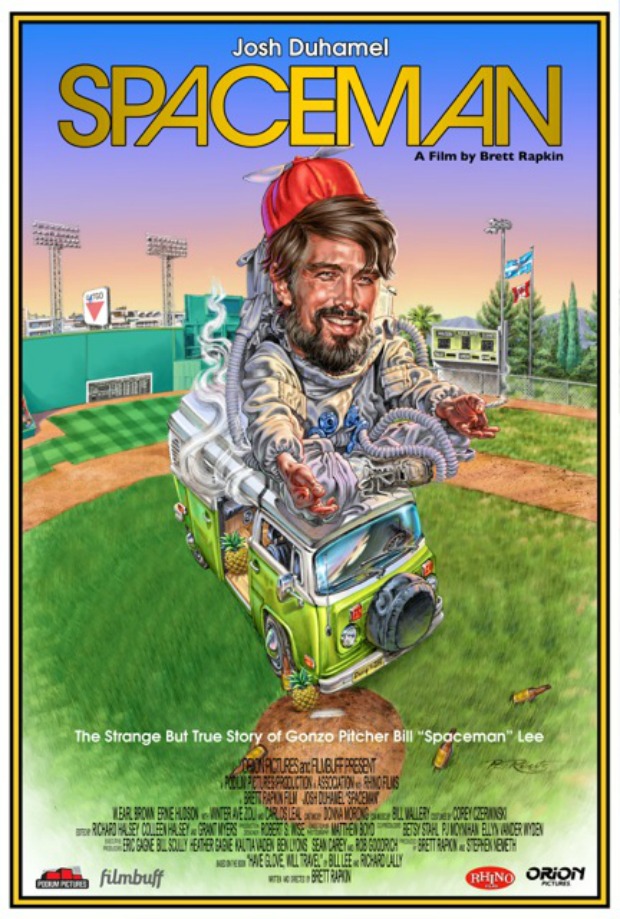
Share this:

  • Click to share on X (Opens in new window) X
  • Click to share on Facebook (Opens in new window) Facebook
  • More
  • Click to print (Opens in new window) Print
  • Click to email a link to a friend (Opens in new window) Email
Like Loading...

Hello, My Name Is Doris (2015)

09 Saturday Jul 2016

Posted by dullwood68 in Movies

≈ Leave a comment

Tags

Comedy, Drama, Facebook, Hoarding, Max Greenfield, Michael Showalter, Relationships, Review, Romance, Sally Field, Self-help, Staten Island, Stephen Root, Tyne Daly

Hello, My Name Is Doris

D: Michael Showalter / 96m

Cast: Sally Field, Max Greenfield, Tyne Daly, Stephen Root, Wendi McLendon-Covey, Beth Behrs, Natasha Lyonne, Kumail Nanjiani, Rich Sommer, Isabella Acres, Caroline Aaron, Elizabeth Reaser, Peter Gallagher

A romantic comedy with a difference, Hello, My Name Is Doris begins with a funeral. Not necessarily the best place for a romantic comedy to start from, but it introduces us to Doris Miller (Field), a sixty-something spinster who works in the accounting department of a trendy, up-market firm. Never married and having spent a considerable amount of her life looking after her ailing mother (who has just died), Doris is adrift in her own life and the home she shared with her mother on Staten Island. But when new art director John Fremont compliments her on his first day on the job, Doris reacts like a teenager and straight away develops a crush on him. And when she attends a self-help seminar hosted by “new you” guru Willy Williams (Gallagher), Doris takes his advice and persuades herself that she can have a relationship with John that can be more than professional.

Ignoring the concerns and the advice of her best friend, Roz (Daly), Doris makes attempt after clumsy attempt to engage John in conversation at the office but she’s too nervous to make much of an impact. It’s not until she mentions her interest in John within earshot of Roz’s teenage daughter, Vivian (Acres), that Doris discovers there’s a way into John’s world that might make all the difference. With John having a Facebook page, Vivian sets up Doris with a fake account and gets John to accept her as a friend. His site reveals various interests, one of which is a band called Baby Goya and the Nuclear Winters. They prove to be an electronic band – not Doris’s cup of tea – but when John finds out she’s a “fan”, and she then learns they’re playing a gig nearby, the stage is set for a “chance” meeting that sees the pair begin to get to know each other… and eventually become friends.

HMNID - scene1

But John has a girlfriend, Brooklyn (Behrs), and Doris has to find a way of dealing with this development, as well as the increasing concerns of Roz, and the fact that her friendship with John is based on deception. Doris ends up doing something petty and malicious that provides her with an opportunity to tell John how she feels about him. But while Doris is (mostly) having the time of her life, her brother Todd (Root) and his wife Cynthia (McLendon-Covey) are pressuring her to sell her home. They also insist she see a therapist dealing in hoarding issues, as the house is a mess of unneeded junk. Trying to balance these things with her newfound enthusiasm for John and the potential for romance with him, Doris has to try and keep a clear head in the run-up to telling him how she feels about him. But will he feel the same way…?

Hands up anyone who remembers the last time Sally Field had the lead role in a movie… Anyone? Well, if you came up with Two Weeks (2006) then give yourself a big pat on the back. Nine (now ten) years on, and Field is finally back on our screens in a role that not only reflects her age – she’ll be seventy in November – but which also serves as a reminder of just how good an actress she is. Forget the movie’s raison d’etre – which some viewers may find uncomfortable or just plain excruciating – this is a chance to see Field playing both drama and comedy with equal skill and navigating her way through the choppy waters of Laura Terruso and Michael Showalter’s broadly effective screenplay, itself based on Terruso’s short, Doris & the Intern (2011).

HMNID - scene2

What could well have proven to be a cringeworthy tale of an old(er) woman lusting after a younger man is headed off at the pass by Field’s perfectly judged, and empowering performance. As the socially removed (and then newly improved) Doris, Field shows the character’s vulnerability and desperate need for acceptance – not just by John but by his peers as well – at all times, reminding the viewer that there’s a lot more to Doris than predatory instincts and a late-blooming libido. That the script is sympathetic towards Doris is a given, but it’s Field’s instinctive and assiduous portrayal that stops that sympathy from becoming too cloying or saccharine. While the first half of the movie is content to wring out some offbeat and occasionally embarrassing comedy, the second half gives way to the necessary drama the movie needs to wrap things up. Field’s performance is the glue that holds the movie together, and it’s a pleasure to see her in a role that allows her to show off her range.

Again, the notion of a May-December relationship where the woman is way past the cougar stage may well put off some viewers, but a couple of dream sequences aside, this is a splendidly old-fashioned movie that doesn’t seek to offend anyone, and carries enough modern-day smarts to keep viewers hooked. There’s a smattering of jokes that are very funny thanks to their popping up out of nowhere – at a backstage party, Doris talks to a woman who tells her she’s “a teacher at a gay pre-school” – and Doris’s outfits are a mad jumble of colours and designs that make you wonder if she’s colour blind or has reached a point in her life where she just doesn’t care anymore (either could be true but the movie doesn’t reveal the reason for her sartorial mash-ups). And when things get serious, Field ensures that the poignancy and heartache surrounding Doris aren’t downplayed by the script’s need to be realistic about her relationship with John.

HMNID - scene3

With Field being on top form, it’s hard for the rest of the cast to look as good, and only Daly manages to stand out from the crowd. Otherwise, there are too many minor roles jostling for attention, and Max Greenfield’s John is too vanilla to make much of an impact (a problem that lies with the script rather than Greenfield’s portrayal). The likes of Lyonne, Reaser and Gallagher appear here and there when needed, while Root and McLendon-Covey play good cop/bad cop as Doris’s brother and sister-in-law, but the movie can’t decide if their characters work better as dramatic foils or comic relief. One area where the movie lacks insight is in its hoarding subplot, with Doris agreeing to see a therapist too readily, and subsequent attempts to show her dealing with this issue feeling shallow and poorly thought out (the therapist is shown to have no interest in Doris’s newfound happiness as John’s friend).

Showalter is a competent director and he has an economy of style that fits well with the material. This isn’t a flashy, unappealing movie – not by a long shot – and this approach suits the material, but it does lead on occasion to a few bland stretches where it appears the script is ticking over until the next big laugh or dramatic scene arrives. Thankfully there’s a terrific soundtrack to occupy the viewer during these stretches, and Brian H. Kim’s score adds immeasurably to the emotional atmosphere of several key scenes.

Rating: 7/10 – worth seeing just for Field’s exemplary performance, Hello, My Name Is Doris is nevertheless well worth seeking out, even if it does feel a little lightweight at times; a touching, undemanding movie for the most part, but one that can raise a smile a lot of the time, and do so without undermining the inherent drama.

Share this:

  • Click to share on X (Opens in new window) X
  • Click to share on Facebook (Opens in new window) Facebook
  • More
  • Click to print (Opens in new window) Print
  • Click to email a link to a friend (Opens in new window) Email
Like Loading...

Perfect Strangers (2016)

08 Friday Jul 2016

Posted by dullwood68 in Movies

≈ 1 Comment

Tags

Affairs, Alba Rohrwacher, Anna Foglietta, Comedy, Dinner party, Drama, Edoardo Leo, Friends, Giuseppe Battiston, Kasia Smutniak, Marco Giallini, Mobile phones, Paolo Genovese, Relationships, Review, Secrets, Texts, Valerio Mastandrea

Perfetti sconosciuti

Original title: Perfetti sconosciuti

D: Paolo Genovese / 96m

Cast: Giuseppe Battiston, Anna Foglietta, Marco Giallini, Edoardo Leo, Valerio Mastandrea, Alba Rohrwacher, Kasia Smutniak, Benedetta Porcaroli

Seven friends gather together for a dinner party, held at the home of cosmetic surgeon Rocco (Giallini) and his wife, therapist Eva (Smutniak). Joining them are newlyweds Cosimo (Leo) and Bianca (Rohrwacher), who have decided to try for a baby; distant married couple Lele (Mastandrea) and Carlotta (Foglietta); and single friend Peppe (Battiston), who should be bringing his new girlfriend for everyone to meet, but who turns up alone as she’s fallen ill. Before the dinner party gets under way, we’re treated to telling glimpses of the three couples’ relationships, and in particular, the fractious way in which Rocco and Eva deal with their daughter, Sofia (Porcaroli).

With an eclipse of the sun due to occur that evening, the friends muse on that and various other topics before a phone call to one of them raises the question of whether or not any of them know each other as well as they think. With the call used as an instigator, Eva suggests they all play a game: each has to place their mobile phone on the table and if they receive a phone call during the evening they have to let everyone else hear what the caller is saying, or if they receive a text or e-mail they have to read it out and show someone else to prove what they’re saying is correct. Rocco isn’t too keen to play the game but he’s in the minority, and so he goes along with it. Eva is keen to see if anyone has any secrets they want to hide, but everyone denies the likelihood that she’ll be proven right.
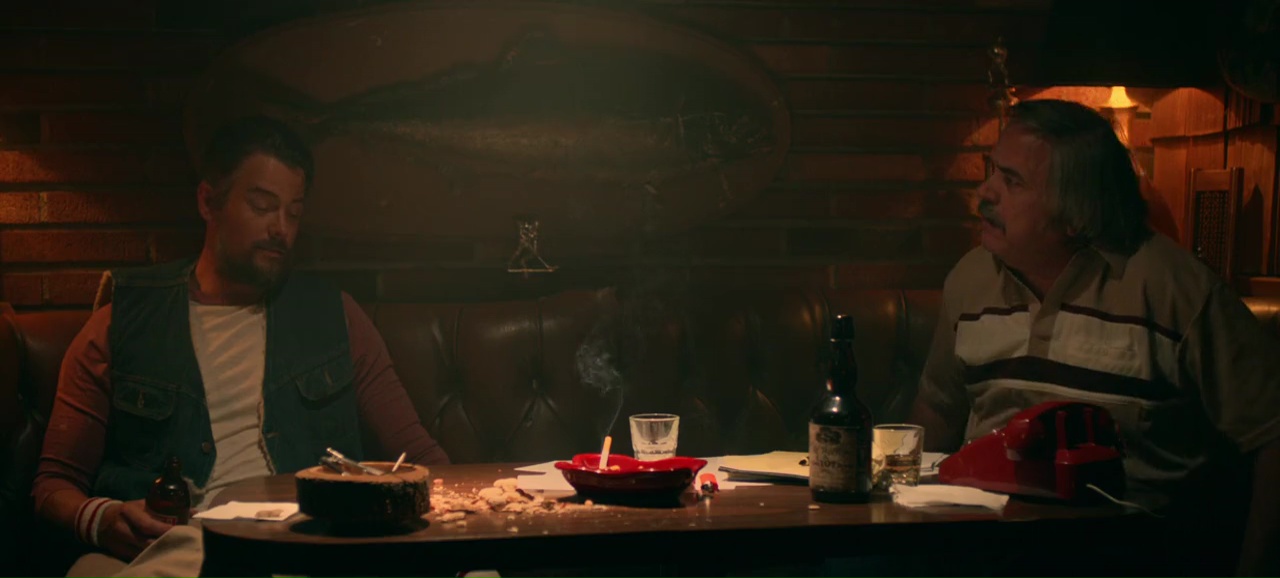
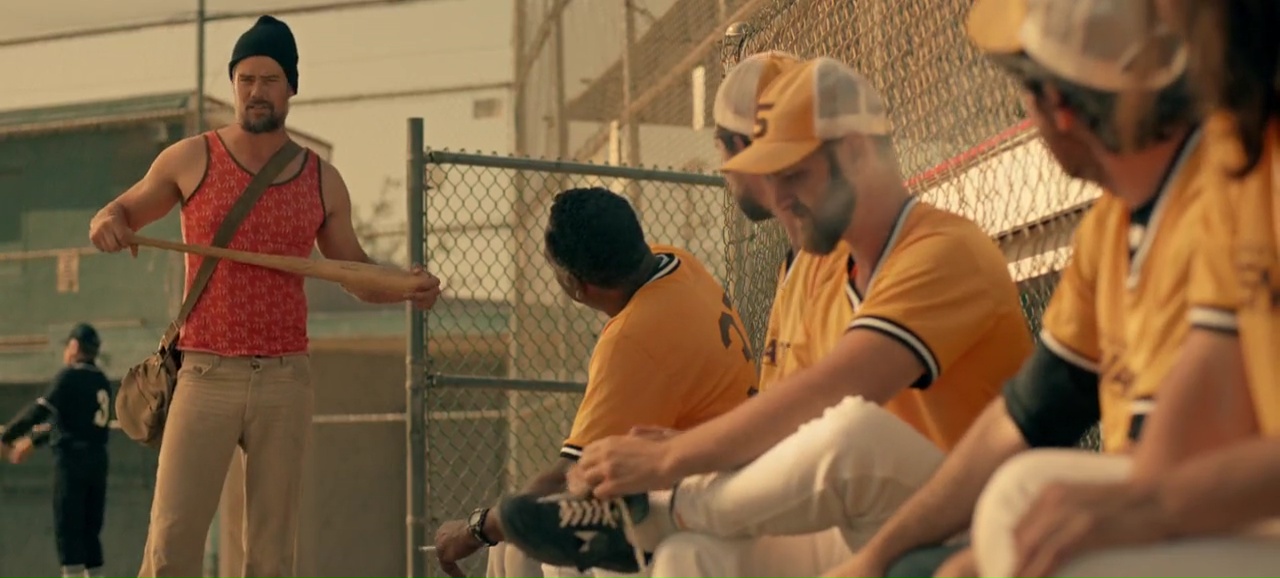
As the evening progresses, certain calls and texts lead to certain revelations: that at least three of the friends are having affairs, one is on the verge of doing so, two are living a lie, and one has been betrayed from the very beginning of their relationship with their partner. Emotions run high, accusations are made, confrontations are endured, and relationships are smashed apart with only the barest possibility of reconciliations occurring in the future. And still more secrets go unrevealed…
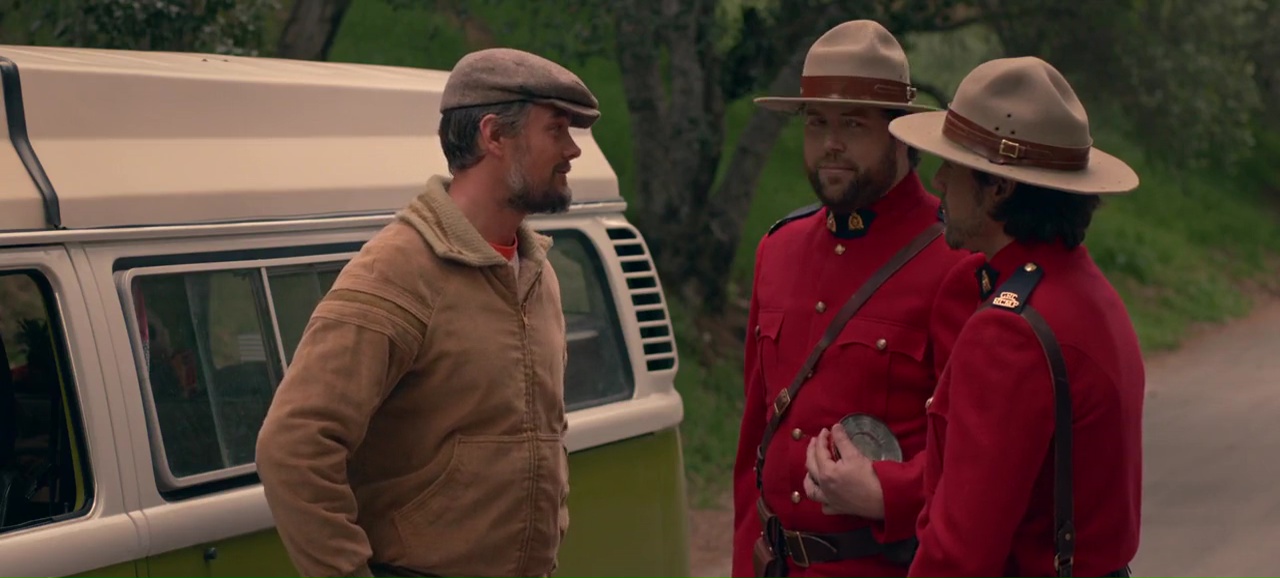
PS - scene2

Before the invention of the telephone, the letter was the pre-eminent way for lovers, especially those conducting their affairs under cover of secrecy, to communicate their feelings for each other (when they weren’t able to snatch some time together). The telephone made communication easier and more immediate – no more waiting for a letter that might be intercepted or not even arrive – but with the explosion in telecommunications over the last twenty years it’s become easier to conduct our secret affairs in private, and to keep our unwitting partners in the dark, our misdeeds hidden behind a barrage of passcodes and biometric security.

Against this, it’s hard to imagine anyone agreeing to reveal the nature of the calls and messages they receive on their mobile phones, especially if their partners are there with them at the time, so Rocco’s objection seems correct. Like everyone else he has a secret, but in relation to subsequent revelations it’s on the trivial side (though it does speak volumes for the state of his relationship with Eva). But because everyone else, despite some minor objections, agrees to go along with Eva’s “game”, Perfect Strangers avoids discussing either our over-reliance on modern technology, or the ways in which it can allow us to lead hidden, secretive lives. Instead, and after a suitably languorous period where suspicions go unraised and calls/texts are easily explained away, the movie starts to unravel the lives of its characters and the façades they adopt in everyday life. As the poster puts it, each of us has three lives: a public one, a private one, and a secret one.

PS - scene3

Once these façades are exposed for what they are – the masks we wear to prove that our deceit is necessary and/or acceptable, at least to ourselves – the script by director Genovese, Filippo Bologna, Paolo Costella, Paola Mammini and Rolando Ravello piles on the anguish and the shame and does its best to up the ante with each new secret that’s revealed. With some of the secrets proving inter-connected, and in ways that stretch the narrative’s carefully established plausibility – these are friends you can believe have known each other for years, and are comfortable with each other – the movie becomes overheated, its characters behaving as if the betrayals they’ve discovered are worse than any betrayal they’ve committed themselves. There’s a stark, angry moment when the provenance of a pair of earrings reveals an unexpected connection between two of the characters; it’s a brief scene that arrives out of the blue and is all the better for it. Otherwise, the script opts for extended, unlikely conversations that feel too articulate for the emotions everyone’s supposed to be feeling.

That said, this is the type of movie that feels as if it could have been adapted from a stage play (or could be adapted into one). Rocco and Eva’s apartment, an assortment of rooms dominated not by the dining room (which always feels cramped, adding to the notion of a pressure cooker environment) but by their vast kitchen, is the kind of set where a camera can prowl around characters with impunity and a keen eye for deceitful behaviour or motivations. Genovese frames his characters carefully, always showing the emotional distance between them (as well as the physical distance) while they’re at the dinner table, and the further distance they put between themselves when they’re away from it. As the movie progresses, and small rifts of insecurity become gaping chasms of duplicity, it reinforces the idea that we never really know anyone, even someone we live with or have known for a long time.

PS - scene1

At the movie’s end, and with the guests departing in various degrees of haste, Genovese and his co-screenwriters throw audiences a curveball that allows for a different, perhaps more mournful ending than expected. It’s awkwardly done, and as curveballs go, isn’t signposted too well; some audiences may be confused by what they’re seeing, but in relation to what’s happened throughout the evening it does allow the individual viewer to make their own mind up as to whether or not “honesty is the best policy”.

The cast all get their moments to shine, with Battiston delivering Peppe’s verdict on his friends’ behaviour with a sad resignation that’s entirely appropriate. Foglietta is on fine form as the wife who yearns for something more from her marriage but can’t find the wherewithal to find it and keep it, and Rohrwacher gives a touching performance as Bianca, the naïve young newcomer to the group whose aspirations as a wife and willing friend are cruelly dashed. Mastandrea has the most difficult role, but thanks to some poorly crafted dialogue, isn’t allowed to make Lele’s secret as affecting or believable as it needs to be. Genovese directs them all with aplomb, allowing each character to grow and develop, but again there are too many moments where, in the wake of a revelation, the movie struggles to maintain momentum thanks to the recurring decision to have a character express their feelings at length, and with too much hesitation.

Rating: 7/10 – a fascinating, though contrived drama, Perfect Strangers takes a dinner party game and uses it as a way of exposing the deceptions and dishonesty that can lie at the heart of modern relationships; too astute for its own good at times, the movie is occasionally uncomfortable to watch, but it features a wealth of good performances, some effective and unexpectedly poignant moments, and doesn’t – not once – allow the audience to feel superior to any of its characters.


http://amzn.to/2js0gWd

Share this:

  • Click to share on X (Opens in new window) X
  • Click to share on Facebook (Opens in new window) Facebook
  • More
  • Click to print (Opens in new window) Print
  • Click to email a link to a friend (Opens in new window) Email
Like Loading...

Code of Honor (2016)

07 Thursday Jul 2016

Posted by dullwood68 in Movies

≈ Leave a comment

Tags

Action, Craig Sheffer, Drama, Gangs, Helena Mattsson, Louis Mandylor, Michael Winnick, Steven Seagal, Stripper, Thriller, Vigilante

Code of Honor

D: Michael Winnick / 107m

Cast: Steven Seagal, Craig Sheffer, Louis Mandylor, Helena Mattsson, Griff Furst, James Russo, Michael Flynn, Rafael Petardi, R.D. Call

You can say what you like about Steven Seagal – good or bad – but it doesn’t really matter. He’ll continue to make movies like Code of Honor, he’ll continue to wave his hands in the air in a vaguely threatening manner during fight scenes, and he’ll absolutely positively not change the way he mangles the few lines of dialogue he gets to spout from movie to movie. After forty-seven features (yes, forty-seven!), one short and one TV series, the slowest moving action hero in movie history has become the very embodiment of cinematic mediocrity. And yet… and yet… there’s something about him that keeps audiences coming back for more. Is it the possibility that he’ll surprise us all with a measured, affecting performance amidst all the gunplay and martial arts? Maybe. Or is it simply to see if he can put in an even worse performance than the last movie? Again, maybe.

There’s a third possibility: what if Seagal hasn’t found his “groove” yet? What if there’s a role out there that will allow the sixty-four old to impress us all, and erase the memories of the dozens of leaden performances he’s given since debuting in Above the Law (1988)? And what if that’s what draws in audiences time after time? An unrequited hope in the man himself? Well, if that is the case, then Code of Honor isn’t the movie to change anything. The guilty pleasures inherent in a Seagal movie are all here: those flapping hands, the poorly edited fight scenes that always fail to make him look good (and only halfway competent, despite his real-life prowess), the squinting, the drawn-out, laconic line delivery, and of course, the laidback hands clasped together  and looking bored approach to every character since Chef Casey Ryback.

COH - scene1

The plot is only slightly unusual this time. Seagal is a vigilante ex-US Army Colonel cutting a swathe through the criminal gangs in Salt Lake City after his wife and child are killed in a gang-related shooting. While the local cops, headed up by Mandylor’s frustrated homicide detective, mill about like extras getting in the way, rogue fed Sheffer goes after Seagal and does an equally good job of offing loads of bad guys along the way – and with katana knives at that; who knew they were standard issue FBI weapons these days? Add a pretty stripper (Mattsson) to the mix as a witness who hasn’t actually witnessed anything, and a bonkers twist that doesn’t make sense at all, and you have a movie that wants to be different but doesn’t have the wherewithal to make it happen.

Seagal is as bad as ever, but Sheffer matches him, giving the kind of dreadful performance that begs the label “career-killer”; A River Runs Through It (1992) seems like it was an eternity ago now. To make matters worse, the pair are coerced into a scene that rips off the confrontation between De Niro and Pacino in Heat (1995). (It’s a bold if unforgivable move, and Mann fans would be well within their rights for fast forwarding that particular moment.) Writer/director Winnick flirts with the idea of making a fast-paced, gritty thriller, but lets himself down by coming up with a script that flails about in search of credibility at every turn. With an abundance of, and over-reliance on, CGI blood splatter, and Robert A. Ferretti’s editing proving more distracting than fluid, Code of Honor wastes what few ideas it does have by surrendering to the inevitable: it’s a Steven Seagal movie, and if he’s not making any effort, why should anyone else?

Rating: 3/10 – good intentions aside, this is very much a generic Seagal movie, with little to say for itself, or the means in which to do so; plodding and cruelly exposed by the absurdities of Winnick’s script (and direction), Code of Honor can’t even be called another nail in the coffin of Seagal’s career – because by now there must be very little left of the actual coffin with all the other nails in it.
Share this:

  • Click to share on X (Opens in new window) X
  • Click to share on Facebook (Opens in new window) Facebook
  • More
  • Click to print (Opens in new window) Print
  • Click to email a link to a friend (Opens in new window) Email
Like Loading...
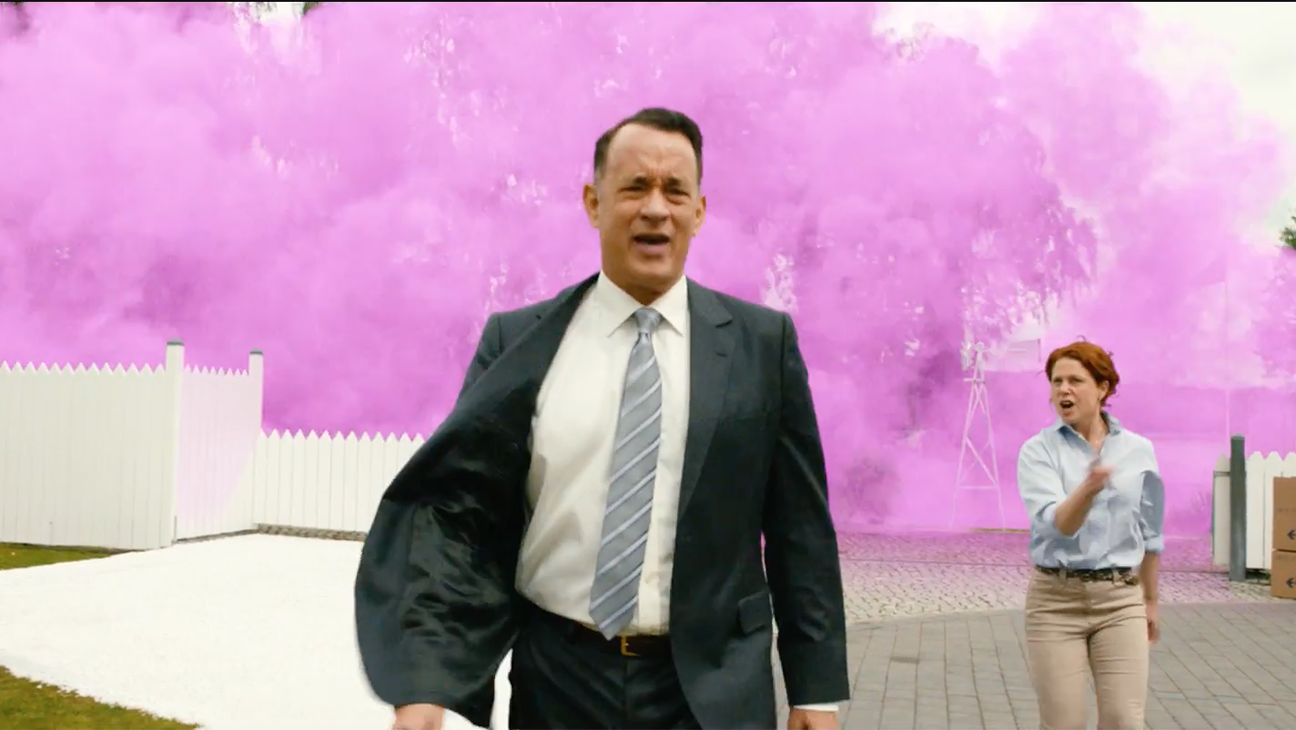
Independence Day: Resurgence (2016)

04 Monday Jul 2016

Posted by dullwood68 in Movies

≈ 2 Comments

Tags

Action, Aliens, Bill Pullman, Drama, Invasion, Jeff Goldblum, Jessie T. Usher, Judd Hirsch, Liam Hemsworth, Maika Monroe, Review, Roland Emmerich, Sela Ward, Sequel, Spaceships, Thriller, Twenty years, William Fichtner

Independence Day Resurgence

D: Roland Emmerich / 120m

Cast: Liam Hemsworth, Jeff Goldblum, Jessie T. Usher, Bill Pullman, Maika Monroe, Sela Ward, William Fichtner, Judd Hirsch, Brent Spiner, Travis Tope, Charlotte Gainsbourg, Angelababy, Deobia Oparei, Nicolas Wright, Patrick St. Esprit, Chin Han, Vivica A. Fox

The tagline says it all: “We had twenty years to prepare.” And after all the waiting, this is the sequel we get, a bloated, lumbering, obscenely stupid movie that takes its predecessor’s legacy and repeatedly takes a dump on it. It’s a movie that insults the audience’s intelligence, and patience, at almost every turn in its efforts to tell the kind of half-baked story that should have been abandoned at the earliest stage possible. It took five people to pen the screenplay, two of them Emmerich and his long-time producing partner Dean Devlin, and it shows in the way that no two scenes run together seamlessly or with any sense of on-going purpose. Make no mistake about it: Independence Day: Resurgence is not worth your time.

The signs are there early on. Ex-President Whitmore (Pullman) is having dreams that anticipate the aliens returning. Once awake he’s plagued by a vision of an image he takes to be another of the aliens’ spaceships. Meanwhile, in Africa, a tribal warlord Dikembe Umbutu (Oparei), is visited by David Levinson (Goldblum), but there’s no reason given for Levinson’s being there. When Umbutu takes him to the site of a crashed alien spaceship they discover that it’s been sending out a distress call. Uh oh, we all know what that means!

IDR - scene1

Cue the Moon-based planetary defence systems coming under apparent attack from a giant sphere that appears out of some kind of black hole. Taking the approach that it’s safer to shoot first then ask questions later, current US President Lanford (Ward) orders its destruction. Maverick pilot Jake Morrison (Hemsworth), though grounded for saving a weapon from destroying the moon base (don’t ask), “borrows” a spaceship and heads for Africa to pick up Levinson so that he can take a look at the wreckage of the sphere (again, don’t ask). Umbutu tags along, as does Dr Catherine Marceaux (Gainsbourg), Umbutu’s shrink-cum-alien researcher, and a cowardly auditor, Floyd Rosenberg (Wright), who’s followng Levinson around for no other reason than the script has put him there. (Is it bizarre enough yet?)

Other characters are added to the mix. There’s ex-President Whitmore’s daughter, Patricia (Monroe), an ex-fighter pilot now working as part of President Lanford’s entourage. There’s Dylan Hiller (Usher), the son of Steven Hiller, the hero of the first movie who has died in a training exercise; he’s in a relationship with Patricia. Then there’s Dr Brakish Okun (Spiner). He’s been in a coma for the last twenty years since his “close encounter” with one of the aliens. Once the distress call goes out, he wakes up, older certainly, but suffering none of the side effects of being in a coma for such a long time (there’s certainly no muscle atrophy). Falling into line are General Adams (Fichtner), the military leader of the US forces, Dylan’s mother, Jasmine (Fox), who works in a hospital, and Jake’s co-pilot/gunner Charlie Miller (Tope), who acts as a comic alternative to Jake’s more serious demeanour. Oh, and let’s not forget Julius Levinson (Hirsch), David’s father, another character from the first movie who’s shoehorned into this one to add even more familiarity to the proceedings (and who miraculously survives what should be the world’s most destructive tsunami). (And that’s all without even mentioning the giant sphere that proves to have the personality of a stuffy doctor’s receptionist – still not bizarre enough?)

IDR - scene2

All these characters flit in and out of the narrative, adding little beyond their required presence at various points, and only occasionally making an impact. Even Levinson is sidelined by events, while Whitmore fills the role of this movie’s Russell Casse, and President Lanford proves expendable in a sequence that comes and goes without making audiences feel anything other than apathy. Even the movie’s principal hero, Jake, is cruelly underwritten, leaving Hemsworth in the unenviable position of playing a role that highlights his shortcomings as an actor. With the likes of Monroe, Usher and Fichtner reduced to the status of bit part players, the movie ignores its cast for the most part and concentrates on providing more spectacle than you can shake a giant spaceship at.

It’s while Emmerich piles on the destruction that the tagline for Gareth Edwards’ reboot of Godzilla (2014) springs to mind: “Size does matter.” For as the director gets carried away crashing an enormous spaceship into the North Atlantic, and displacing Singapore only as long as it takes to float it halfway around the world and drop it on London, the message comes across loud and clear, that this movie is better because it’s bigger, both in scope and special effects. But it’s all soulless and uninvolving, populated by whizz-bang dogfights and lacklustre retreads of moments from Indepedence Day that only serve to remind viewers just how enjoyable that movie was, and still is.

IDR - scene3

And where Independence Day kept its laughs to a minimum, its bloated but thankfully shorter sequel adds humour and silliness by the bucket load, largely whenever Okun or Floyd is on screen, and in the plethora of one-liners sprinkled throughout the script. This may have seemed like a good idea at the time but this reliance on making the audience laugh undercuts the seriousness of the situation, leaving the movie feeling uneven and, sometimes, crass in its efforts to entertain instead of having us on the edge of our seats. The world is about to end, but that’s okay, here comes Brent Spiner with another less-than-pithy wisecrack.

That this is so woeful proves the old adage, penned by William Goldman, that in Hollywood, “nobody knows anything”. If they did, then Messrs Emmerich and Devlin wouldn’t have transferred such a dreadful script to the screen and attempted to pass it off as a worthy successor to the movie that made both their names. Where Amy Schumer appeared in a movie called Trainwreck (2015), it wouldn’t be inappropriate for this farrago to be re-titled Spaceshipwreck – it’s a far more apt description.

Rating: 3/10 – without a doubt the worst – so far – of this year’s summer blockbusters, Independence Day: Resurgence lacks apppreciable thrills, appreciable drama, appreciable tension or emotion, and any clear idea of the story it wants to tell; frustrating on so many levels, it’s a movie that consistently defies belief, and does the one thing the viewer will be praying it won’t do: set things up for another sequel.

Share this:

  • Click to share on X (Opens in new window) X
  • Click to share on Facebook (Opens in new window) Facebook
  • More
  • Click to print (Opens in new window) Print
  • Click to email a link to a friend (Opens in new window) Email
Like Loading...

Whiskey Tango Foxtrot (2016)

03 Sunday Jul 2016

Posted by dullwood68 in Movies

≈ Leave a comment

Tags

Afghanistan, Alfred Molina, Billy Bob Thornton, Comedy, Drama, Glenn Ficarra, John Requa, Journalist, Kabul, Kim Barker, Literary adaptation, Margot Robbie, Martin Freeman, Review, Taliban, Tina Fey, True story, War

Whiskey Tango Foxtrot

D: Glenn Ficarra, John Requa / 112m

Cast: Tina Fey, Margot Robbie, Martin Freeman, Alfred Molina, Christopher Abbott, Billy Bob Thornton, Nicholas Braun, Stephen Peacocke, Sheila Vand, Evan Jonigkeit, Fahim Anwar, Josh Charles, Cherry Jones

If you’re a fan of Tina Fey, and have been waiting to see Whiskey Tango Foxtrot with some anticipation after seeing the trailer, be warned! This isn’t the out and out comedy with occasional dramatic moments that the trailer makes it out to be. Instead it’s the opposite, a drama with occasional comedic moments that fit awkwardly for the most part with the movie’s main focus, the true story of one woman journalist’s stay in Afghanistan and the experiences she had there.

Fey plays Kim Baker, the fictionalised version of Kim Barker (why the slight name change?). In 2004 and dissatisfied with the way her career in television news is going, she takes up the offer of an assignment reporting from Afghanistan. Taking a huge chance – she doesn’t know the language or the customs, and has never reported from a war zone before – Baker is assigned a driver/interpreter, Fahim (Abbott), and a personal bodyguard, Nic (Peacocke). She’s also grateful to find another female journalist there in the form of Tanya Vanderpoel (Robbie).

WTF - scene3

At first, Kim’s inexperience doesn’t do her any favours but she soon begins to gauge the lie of the land and the feelings of the US soldiers stationed there. Her status as a woman helps her gain access to news stories that other (male) journalists and reporters are unable to gather, and as time goes by, she earns the respect of her fellow journalists, Fahim, and even General Hollanek (Thornton), the head of the US forces. She also takes risks when she feels it necessary, such as leaving an armoured vehicle when the convoy she’s in is attacked and capturing the event on video. The only downside of her experience thus far is when she catches her boyfriend (Charles) with another woman during an unscheduled video call.

Her sudden availability has its upside, though. It allows her to manipulate local Afghan minister Ali Massoud Sadiq (Molina), into providing her with background intelligence, though Fahim warns her that she is becoming like the drug addicts he used to treat before the war: willing to do anything to get a story. She also develops a relationship with Scottish journalist Iain MacKelpie (Freeman); at first it’s only serious on his side, but Kim becomes attached to him, and their relationship deepens. As the two get to know each other, Iain tells her of an opportunity to interview a local warlord. The only drawback is his location: on the other side of a mountain pass that is closed due to heavy snow. While they wait for the snows to clear, Kim finds herself having to justify her continuing presence in Afghanistan, and travels to New York to state her case in person. There she discovers an unexpected rival for her “spot”, and also learns that Iain has been abducted for ransom…

WTF - scene1

Barker’s story – recounted in her book The Taliban Shuffle: Strange Days in Afghanistan and Pakistan – is remarkable for how “Pakistan and Afghanistan would ultimately become more all-consuming than any relationship [she] had ever had.” Sadly, Robert Carlock’s screenplay only manages to skirt round this attachment, preferring instead to imply an unrequited attraction between Kim and Fahim that can never be consummated, and an actual relationship with Iain that sees Fey look uncomfortable whenever she and Freeman end up in a clinch. This is one of many components that the movie never finds a satisfactory place for, and the result is an uneven, sporadically effecive piece that does occasional justice to Barker’s story, and Fey’s skills as an actress.

As with so many true stories adapted for the screen, the movie changes a lot, and in the process loses sight of what works best. Kim’s back story is predictably sketchy – why is she so miserable about her job?; how did she get to a point where the idea of covering a war in a far-off country became her best option? – and it’s jettisoned just as predictably once she arrives in Kabul. The movie continues in the same vein, offering brief soundbites in lieu of solid characterisations, and making only intermittent attempts to provide motivations for the actions of its principals (when it can be bothered to go beyond the superficial). By failing to provide any of its characters with any depth – Thornton’s General is so lightweight he’s practically gossamer-thin – it becomes hard to care about anyone, even Kim. Aside from a sincere yet unnecessary subplot involving a wounded soldier (Jonigkeit), Whiskey Tango Foxtrot rarely gives the viewer a reason to believe that any of Barker’s memoir has been adapted with a view to making it appear earnest or artless.

WTF - scene2

Fey’s obvious forté is comedy, and when the movie needs her to be, she’s very funny indeed. But she’s not quite so confident in the dramatic stretches, and it’s these moments that help undermine the movie further. Fey only comes across as comfortable in these situations if she can put a comedic spin on things, and the script lets her do this far too often for the audience to be comfortable as well. In support, Freeman puts in a good enough performance but isn’t given enough to do that’s memorable or fresh, while Robbie flits in and out of the narrative just enough for viewers to remember she’s there, and to remind Fey as Kim that in Afghanistan she’s gone from a solid six to a nine (so much for female solidarity in a male-dominated society). As for Molina, he plays Sadiq as a lecherous horny goat, a character two steps removed from a Carry On movie racial stereotype; it’s not quite a completely offensive portrayal, but both Molina and directors Ficarra and Requa should have known better.

Despite all this, the movie is amiable enough, and under Ficarra and Requa’s stewardship makes for an undemanding viewing experience. Like Fey they seem more at home when dealing with the more humorous aspects of Barker’s time in Afghanistan (Pakistan is left out of the equation entirely), though they redeem themselves in terms of the movie’s look. Along with DoP Xavier Grobet, the directing duo give the movie a rich visual style that offers crisp compositions at almost every turn, and a warm colour palette that refutes the idea of Afghanistan as a ravaged, war-blighted country lacking in beauty. At least they got that right.

Rating: 5/10 – an awkward mix of drama and comedy where neither comes out on top and where each ends up countering the other, Whiskey Tango Foxtrot isn’t as bad as it may seem, but it’s also not as good as it could have been; fans of Fey may be satisfied by her performance here, and she’s to be applauded for trying something outside her comfort zone, but there’s too many times when she doesn’t do the (admittedly) thin material any justice.

Share this:

  • Click to share on X (Opens in new window) X
  • Click to share on Facebook (Opens in new window) Facebook
  • More
  • Click to print (Opens in new window) Print
  • Click to email a link to a friend (Opens in new window) Email
Like Loading...

Monthly Roundup – June 2016

30 Thursday Jun 2016

Posted by dullwood68 in Movies

≈ Leave a comment

Tags

A Certain Justice, A Place to Go, Action, Al Pacino, Ann Sheridan, Anne Heywood, Antoine Bardou-Jacquet, Bascom Affair, Baseball, Basil Dearden, Bernard Lee, Bethnal Green, Cecil Parker, Cochise, Crime, Cung Le, D. Ross Lederman, David Gordon Green, Dennis O'Keefe, Dolph Lundgren, Drama, Ethan Hawke, Freddie Francis, Frieda Inescort, George Sherman, Giorgio Serafini, Heather Angel, Holly Hunter, Jack Elam, James Coyne, Jay Silverheels, Jeff Chandler, John Lund, Johnny Simmons, Literary adaptation, Manglehorn, Mike Sarne, Monument Valley, Moon landing, Moonwalkers, Mystery, Noah Buschel, Norman Foster, Paul Cavanagh, Paul Giamatti, Peter van Eyck, Relationships, Reviews, Rita Tushingham, Robbery, Robert Keith, Ron Perlman, Rupert Grint, Sci-fi, Shadows on the Stairs, Susan Cabot, The Battle at Apache Pass, The Brain, The Phenom, Thriller, Vinnie Jones, Western, Whodunnit, Woman on the Run

Manglehorn (2014) / D: David Gordon Green / 97m

Cast: Al Pacino, Holly Hunter, Harmony Korine, Chris Messina, Skylar Gasper

Manglehorn

Rating: 5/10 – in the wake of a failed romance that has left him heartbroken, locksmith A.J. Manglehorn (Pacino) decides to try again with bank teller Dawn (Hunter), but his personality puts obstacles in his way; despite the obvious talent involved, Manglehorn is a chore to sit through, as the character himself – as Dawn discovers – isn’t someone you want to spend too much time with.

The Brain (1962) / D: Freddie Francis / 83m

Cast: Anne Heywood, Peter van Eyck, Cecil Parker, Bernard Lee, Jeremy Spenser, Maxine Audley, Ellen Schwiers, Siegfried Lowitz, Hans Nielsen, Jack MacGowran, Miles Malleson, George A. Cooper

The Brain

Rating: 5/10 – a fatal plane crash sees a millionaire businessman’s brain kept alive by pioneering scientists, one of whom (van Eyck) finds himself searching for the person who caused the plane crash when the businessman’s brain communicates with him; an erratic sci-fi thriller that gets bogged down whenever it concentrates on the murder suspects, this adaptation of Curt Siodmak’s novel Donovan’s Brain has a great cast and a terrific premise, but is let down by Francis’ pedestrian direction and a style that wants to evoke film noir but can’t because the script hasn’t been written that way.

A Certain Justice (2014) / D: James Coyne, Giorgio Serafini / 96m

aka Puncture Wounds

Cast: Cung Le, Dolph Lundgren, Vinnie Jones, Briana Evigan, Gianni Capaldi, James C. Burns, Robert LaSardo, Jonathan Kowalsky, Sean O’Bryan, Eddie Rouse

A Certain Justice

Rating: 4/10 – Iraq veteran John Nguyen (Le) returns home and becomes embroiled in a fight against big-time drug dealer Hollis (Lundgren) when he saves a hooker (Evigan) from the violent attentions of Hollis’ men; as a showcase for Le, A Certain Justice works well enough, but this is still a muddled actioner that cuts narrative corners more often than it doesn’t, and sees Lundgren adopting a wig and ponytail that makes him look like an aging hippie instead of a menacing crime boss.

Woman on the Run (1950) / D: Norman Foster / 77m

Cast: Ann Sheridan, Dennis O’Keefe, Robert Keith, John Qualen, Frank Jenks, Ross Elliott, J. Farrell MacDonald, Victor Sen Yung, Steven Geray

Woman on the Run.jpg

Rating: 7/10 – when store window designer Frank Johnson (Elliott) witnesses a gangland execution he goes on the run, leaving his estranged wife (Sheridan), the police, and a persistent reporter (O’Keefe) trying to track him down before the killer does; a cleverly written film noir based on Sylvia Tate’s original story, Woman on the Run may have a misleading title but it features hard-boiled dialogue, bruised relationships, and atmospheric location work, all of which means the movie is an under-rated gem and deserves a wider audience.

The Battle at Apache Pass (1952) / D: George Sherman / 82m

Cast: John Lund, Jeff Chandler, Susan Cabot, Bruce Cowling, Beverly Tyler, Richard Egan, Jay Silverheels, John Hudson, Jack Elam, Regis Toomey

The Battle at Apache Pass

Rating: 6/10 – peace on the frontier with the Apache nation is threatened by the divisive tactics of Indian Affairs agent Neil Baylor (Cowling) and unsanctioned raids by Geronimo (Silverheels); based around two historical events – the Bascom Affair in 1861, and the title encounter in 1862 – The Battle at Apache Pass is an enjoyable Western featuring good location work in Monument Valley, beautiful photography, and Chandler (as Cochise) and Silverheels reprising their roles from Broken Arrow (1950).

The Phenom (2016) / D: Noah Buschel / 88m

Cast: Johnny Simmons, Ethan Hawke, Paul Giamatti, Sophie Kennedy Clark, Yul Vazquez, Louisa Krause, Paul Adelstein, Elizabeth Marvel, Marin Ireland

The Phenom

Rating: 5/10 – Hopper Gibson (Simmons) is a talented pitcher who has a shot at the big leagues but suffers a crisis of confidence, one that threatens his future; well acted but dour and uninviting, The Phenom plods along in such a low-key manner that some viewers may well decide they don’t care enough if Hopper overcomes his slump, and may also decide to watch something else instead.

A Place to Go (1964) / D: Basil Dearden / 86m

Cast: Rita Tushingham, Mike Sarne, Bernard Lee, Doris Hare, Barbara Ferris, John Slater, David Andrews, William Marlowe, Michael Wynne, Roy Kinnear

A Place to Go

Rating: 5/10 – an ambitious young man who wants to get away from Bethnal Green gets involved with a local racketeer (Slater) and a young woman (Tushingham) at the same time, and much to the consternation of his parents (Lee, Hare); a slice of life, East London style, this kitchen sink drama is enjoyable enough but is hampered by a dreadful performance by Sarne and some weak plotting, but still has enough to recommend it, particularly the (deliberately) sad sight of Lee’s character trying to impress as an escapologist.

Shadows on the Stairs (1941) / D: D. Ross Lederman / 64m

Cast: Frieda Inescort, Paul Cavanagh, Heather Angel, Bruce Lester, Miles Mander, Lumsden Hare, Turhan Bey, Charles Irwin, Phyllis Barry, Mary Field

Shadows on the Stairs

Rating: 4/10 – a killer strikes in a boarding house where everyone comes under suspicion; a leaden whodunnit shot in a pedestrian style, Shadows on the Stairs is typical of the period with its mix of drama, comic relief in the form of Hare and Irwin as bumbling policemen, romantic triangles, and occasional flashes of social comment, but it all adds up to a movie that betrays its stage origins at every turn.

Moonwalkers (2015) / D: Antoine Bardou-Jacquet / 107m

Cast: Rupert Grint, Ron Perlman, Robert Sheehan, Stephen Campbell-Moore, Tom Audenaert, Jay Benedict, James Cosmo, Eric Lampaert, Kevin Bishop, Erika Sainte

Moonwalkers

Rating: 4/10 – in 1969, the US military sends unstable CIA agent Kidman (Perlman) to London to contact Stanley Kubrick with an offer to film a mock moon landing (in case the real mission goes wrong) – but he ends up working with a would-be rock band manager (Grint) instead; uneven and often groan-inducing, Moonwalkers takes a great idea and tramples all over it with a mix of psychedelia, undercooked comedy and inappropriate violence, leaving just a few knowing nods and winks in relation to the period to provide anything of interest.

Share this:

  • Click to share on X (Opens in new window) X
  • Click to share on Facebook (Opens in new window) Facebook
  • More
  • Click to print (Opens in new window) Print
  • Click to email a link to a friend (Opens in new window) Email
Like Loading...

Trailers – American Pastoral (2016), The 9th Life of Louis Drax (2016) and Keeping Up With the Joneses (2016)

30 Thursday Jun 2016

Posted by dullwood68 in Movies

≈ Leave a comment

Tags

Aaron Paul, Action, Alexandre Aja, Comedy, Drama, Ewan McGregor, Gal Gadot, Greg Mottola, Isla Fisher, Jamie Dornan, Jennifer Connelly, Jon Hamm, Literary adaptation, Liz Jensen, Mystery, Philip Roth, Previews, Sarah Gadon, Supernatural, Thriller, Trailers, Zach Galifianakis

For his feature debut as a director, Ewan McGregor could have (probably) chosen any project he wanted, but not one to shirk a challenge, the actor has decided to film Philip Roth’s Pulitzer Prize-winning novel (it’s been in development for over a decade, and Jennifer Connelly is the only person still on board from back then). So, no pressure there, then. But the trailer reveals, albeit in a disjointed fashion, that McGregor appears to have found a way of coherently presenting the various social and political upheavals of the period (the Sixties), and without sacrificing any of the personal or emotional effects these events have on the characters involved. With David Strathairn cast as Roth’s alter ego Nathan Zuckerman, and a supporting cast that also includes Molly Parker and Peter Riegert, McGregor has found himself in very good company indeed, and if his direction, allied with John Romano’s screenplay, is as good as it looks (and thanks to DoP Martin Ruhe it looks beautiful indeed), then this could be a strong Oscar contender come next February.


In The 9th Life of Louis Drax (it’s never Johnny Smith anymore, is it?), a young boy’s fall from a cliff and subsequent coma opens up a mystery that will involve his parents (Sarah Gadon, Aaron Paul) and his doctor (Jamie Dornan). Liz Jensen’s 2004 novel was due to be adapted by Anthony Minghella before his untimely death in 2008, but now it’s been adapted for the screen by his son Max, and with the formidable talent of Alexandre Aja in the director’s chair. The trailer is sufficiently twist-y enough for clues to Louis’s “condition” to be given in one second and then overturned in another, and the movie’s success is likely to depend on how well the mystery is maintained before answers have to be revealed. The cast also features the likes of Oliver Platt, the ubiquitous Molly Parker, and Barbara Hershey, and seems to have got a firm hold on the supernatural thriller aspects of the story, so this should be as satisfying – hopefully – as it looks.


Whatever you want to say or think about Keeping Up With the Joneses, there’s little doubt that this mix of action and comedy about a suburban couple (Zach Galifianakis, Isla Fisher) who discover that their new neighbours (Jon Hamm, Gal Gadot) are international spies, is exactly the kind of moderately high concept idea that the Hollywood studios love to put their money behind. The trailer offers perhaps too many laughs (and hopefully not all the best ones), while downplaying the inevitable action sequences, but whatever the finished product gives us, let’s hope that director Greg Mottola’s quirky sense of humour is front and centre, and the chemistry between each couple adds to the fun to be had. If not we’ll just have to chalk it up to a good idea gone bad, or to put it another way, a movie that you switch off from once it’s started.

Share this:

  • Click to share on X (Opens in new window) X
  • Click to share on Facebook (Opens in new window) Facebook
  • More
  • Click to print (Opens in new window) Print
  • Click to email a link to a friend (Opens in new window) Email
Like Loading...

Life on the Line (2015)

29 Wednesday Jun 2016

Posted by dullwood68 in Movies

≈ 1 Comment

Tags

Danger, David Hackl, Devon Sawa, Drama, John Travolta, Kate Bosworth, Linemen, Review, Sharon Stone, Storm, Thriller

Life on the Line

D: David Hackl / 93m

Cast: John Travolta, Kate Bosworth, Devon Sawa, Gil Bellows, Julie Benz, Ryan Robbins, Ty Olsson, Sharon Stone

The life of a lineman – in Texas at least – is one that is continually fraught with danger and the prospect of death. This is the message that Life on the Line reminds us of throughout its (brief enough) running time, and especially when said linemen make mistake after mistake as they go about their daily work (the movie will have health and safety experts choking on their popcorn; real linemen will either be laughing at the many, many inaccuracies the movie exhibits or shaking their heads in prolonged disbelief). But, hey, this is still the fourth most dangerous job in the world.

We’re given an example of this right at the start when the actions of cocky lineman Beau Ginner (Travolta) lead to the death of his brother, who’s also his crew boss. Circumstances lead also to the death of his brother’s wife; this leaves Beau’s neice, Bailey, in his care (what the authorities were thinking is a question the movie avoids asking altogether). Fast forward ten years and Bailey (Bosworth) is on the verge of going to college, while Beau has become Mr Safety, and a well respected crew boss like his brother. The complete overhaul and replacement of thousands of miles of electrical lines throughout Texas has Beau’s crew working flat out to meet the utility company’s deadline.

vlcsnap-00001

Two new workers – Bailey’s ex-boyfriend Duncan (Sawa), and new neighbour Eugene (Robbins) – bring their own problems to the mix, with Duncan treating Bailey in an unexplained, dismissive manner, and Eugene having trouble with PTSD since returning from Iraq. He’s distant to his wife, Carline (Benz), and is away a lot due to his work. Meanwhile, Bailey is trying to reconnect with Duncan because she has something important to tell him, while also fending off the unwanted attentions of ex-con Danny (Olsson). And Beau is coming under increasing pressure from the utility company, even to the point of being asked to “take risks” if it will get the job done sooner rather than later.

By now it’s clear that all these separate storylines are likely to converge, and the movie makes it clear that this will be the case as it keeps counting down the days to a great storm. Until then the movie busies itself with some low-key soap opera dramatics mixed with random scenes such as Beau talking down an angry biker in a bar. Bailey reveals her secret to Duncan, and to Beau; Danny’s unwanted attentions escalate to the point where he targets Carline; Eugene’s paranoia leads him to climb an electrical pylon with the intention of killing himself; and a trainwreck causes Beau no end of problems, including one of his crew being injured. As the storm rages around them all, matters of life and death arise, and Beau has to make a terrible choice.

vlcsnap-00003

Whatever you may think about John Travolta and his recent run of movies, he’s still an actor to watch, even if his performances border on the perfunctory these days. Life on the Line is no different to any other movie he’s made in the last few years, and here he does the bare mimimum in terms of characterisation and emoting, a situation his fans will be overly familiar with. There’s no spark or energy in his portrayal, no attempt to overcome the many implausibilities of the script, or the diffidence with which screenwriters Primo Brown, Peter I. Horton, Marvin Peart and Dylan Scott have created the part of Beau. Instead he goes through the motions, and in some scenes, comes close to looking bored (when Beau harangues his crew about safety and shows them pictures of electrical burn injuries, Travolta’s delivery lacks the edge such a scene needs to show Beau’s doing this because he cares about his crew).

But Travolta’s paycheck-grabbing performance is the least of the movie’s worries. The aforementioned script is quite a stinker, cobbled together and assembled on screen by Hackl and his production team with all the finesse of pre-school children being asked to build a rocket ship: you can give them all the directions and tools they’ll ever need, but they won’t know what to do with them. It’s much the same here, with Travolta and his fellow cast members continually left high and dry by the vagaries of the script and the vague intentions of Hackl, DoP Brian Pearson, and editor Jamie Alain. All three share an inability of purpose that ruins the movie from the word go. And some of the dialogue – straight from the Holy Land of Cliché – is so dire that no one can rescue it and make it sound even halfway credible.

vlcsnap-00002

The narrative doesn’t hold up under close scrutiny, the subplots scream “Filler!”, and the denouement is so laughable and corny and hackneyed and clichéd and just plain stupid that you won’t believe your eyes and ears. As a drama, Life on the Line is the equivalent of a DOA, and should be approached as warily, as if you were, say, taking a hot dish out of the oven without the benefit of oven mitts. This is bad on a level that only low-budget movies can achieve, and while the production has attracted a reasonably talented cast, it struggles to be both interesting and dramatic, and succeeds only in giving new meaning to the word ‘risible’.

Rating: 3/10 – “no one here gets out alive,” said The Doors, and Life on the Line is a perfect example of a movie that fits that kind of doom-laden vibe; blandly executed and overly reliant on plot rehashes we’ve seen a million times before, the movie stumbles along in search of someone to steer it out of the murky backwaters of its own making, and along the way, makes you wonder if anyone associated with it could ever be happy with the way it’s turned out.

Share this:

  • Click to share on X (Opens in new window) X
  • Click to share on Facebook (Opens in new window) Facebook
  • More
  • Click to print (Opens in new window) Print
  • Click to email a link to a friend (Opens in new window) Email
Like Loading...

Demolition (2015)

28 Tuesday Jun 2016

Posted by dullwood68 in Movies

≈ Leave a comment

Tags

Bereavement, Car accident, Champion Vending Company, Chris Cooper, Drama, Grief, Jake Gyllenhaal, Jean-Marc Vallée, Judah Lewis, Mother/son relationship, Naomi Watts, Review, Vending machine

Demolition

D: Jean-Marc Vallée / 102m

Cast: Jake Gyllenhaal, Naomi Watts, Chris Cooper, Judah Lewis, C.J. Wilson, Polly Draper, Heather Lind

There’s a scene early on in Demolition, the latest feature from the director of Wild (2014) and Dallas Buyers Club (2013), where Jake Gyllenhaal’s character, an investment banker named Davis Mitchell, attempts to get some M&M’s from a hospital vending machine, but the M&M’s don’t drop down. He hits it a couple of times, then asks one of the hospital staff if they can open it; the answer is no, because it’s not owned by the hospital. This prompts Davis to write a letter of complaint to the Champion Vending Company, which begins, “Dear Champion Vending Company: I put five quarters in your machine and proceeded to push B2, which should have given me peanut M&M’s. Regrettably, it did not. I found this upsetting, as I was very hungry, and also my wife had died ten minutes earlier.”

Now, on the face of it, this is a great way in which to begin exploring the mindset of a recently bereaved husband, but Bryan Sipe’s unconvincing screenplay hasn’t told us enough about Davis so far for the audience to make a judgment as to whether or not this is funny, sad, poignant, or revealing. Instead, it invites the viewer into Davis’s world by getting him to expand on his relationship and marriage with his recently deceased wife, Julia (Lind), but through the medium of letters to the vending company. It’s an awkward plot device because we don’t know if this is a legitimate way for Davis to deal – initially – with his grief at losing his wife in a tragic car accident. It’s awkward because, outside of these letters, Davis acts like he’s okay and he’s dealing with it all pretty well.

Demolition - scene1

At first, at least. Something his father-in-law, and boss, Phil (Cooper), says to him sends Davis off on another tack, that of dismantling things to see what they’re made of, and how they work. To this end he dismantles light fixtures and bathroom stalls at his place of work, along with his computer, and at home, a coffee machine. He takes these things apart, lines the various component parts in neat groups, and then leaves them where they are. At work it all leads to Davis being told to take some time off, while at home it leaves him restless and unfocused. When he receives a late night call from a woman called Karen Moreno (Watts), the vending company’s customer service manager and someone who has read and connected with his letters, Davis is intrigued enough by her call to want to learn more about her.

Again, though, Sipe’s screenplay – and Vallée’s direction – doesn’t make it clear just why Karen connects with Davis, and vice versa. It’s true that Davis is behaving oddly, and it’s true that Karen is a needy single mother who has the ability to behave in an equally odd manner (she stalks him until he talks to her on a train), but just why these two people find support and a degree of comfort in each other is left floating in the wind. You could argue that the script requires them to, and that would be a reasonable enough answer, but the script doesn’t legitimise their relationship, even as it develops, and especially with the introduction of Karen’s fifteen year old son, Chris (Lewis). Here, Davis is pared away from Karen and inxplicably, takes on the role of father figure to Chris.

Demolition - scene2

It’s another decision made by the movie that takes Davis further and further away from the grief and (implied) despair he’s meant to be feeling following Julia’s death, and into an area where he becomes an unofficial member of Karen and Chris’s disjointed family. Meanwhile, Phil decides to use Julia’s memory to start a foundation and needs Davis to sign off on it. But Davis drags his heels, and again, the script doesn’t provide any ready answers as to why. By the two thirds mark, most viewers would be forgiven for wondering if any of Davis’s decisions have a point to them or are based on any recognisable emotions. This is because the movie is a frustrating exercise in character development and emotional withdrawal that coasts along with little regard for cause and effect, or the demands of a cohesive narrative.

It will come as no surprise that Demolition ends with everything wrapped up neatly (and with a pretty bow on top), and viewers who do manage to make it this far will be asking themselves what all the fuss was about in terms of the storyline and a handful of subplots that pop up every so often but don’t add anything to the overall narrative (a revelation regarding Julia comes out of nowhere and goes back there pretty quickly without having any real effect whatsoever). It’s hard to engage with any of the characters except on a superficial level, and the quality of the characterisations is such that even Gyllenhaal and Watts – two extremely capable actors – can only do so much with them before repetition sets in and their efforts fail to have any impact.

Demolition - scene3

Vallée’s direction is also a problem. While there’s a kernel of a great idea here – widower tries to make sense of his own grief by rebuilding his life from the ground up – Vallée doesn’t have any answers to the problems that are inherent in the script. This leaves the movie plodding along for several stretches (particularly when Davis enlists Chris in the demolition of his home), and any emotional high points lacking punch or dramatic intensity. It’s a visually well-constructed movie, however, with Vallée proving once again that he has an eye for composition and filling a frame with relevant information in support of the story, and he’s ably supported by his regular DoP Yves Bélanger. But it’s not enough to hide the ways in which Sipe and his wayward screenplay fails to explore Davis’s grief and Karen’s lack of confidence.

Rating: 5/10 – given Vallée’s previous movies (and their success), his work on Demolition and partnership with Gyllenhaal seems like a guarantee of quality, but there are too many problems with the script for even this combination to improve things; the movie aims for a kind of heightened realism at times, and while this is an admirable ambition, the fact that it doesn’t even come near is a good indication of how difficult it’s been to translate Sipe’s undercooked screenplay for the screen.

Share this:

  • Click to share on X (Opens in new window) X
  • Click to share on Facebook (Opens in new window) Facebook
  • More
  • Click to print (Opens in new window) Print
  • Click to email a link to a friend (Opens in new window) Email
Like Loading...

Mini-Review: Urge (2016)

27 Monday Jun 2016

Posted by dullwood68 in Movies

≈ Leave a comment

Tags

Aaron Kaufman, Ashley Greene, Danny Masterson, Designer drug, Drama, Eastman Island, Justin Chatwin, Pierce Brosnan, Review, The Red Bastard, Thriller

Urge

D: Aaron Kaufman / 90m

Cast: Justin Chatwin, Danny Masterson, Ashley Greene, Pierce Brosnan, Nick Thune, Alexis Knapp, Chris Geere, Bar Paly, Eric Davis, Jeff Fahey, Kevin Corrigan

In Urge, there is only One Rule: you can only take said designer drug once. It’s new, much more addictive than any other drug available, and can only be found at a nightclub on Eastman Island, off the coast of New York. When arrogant businessman Neil (Masterson) takes his p.a. Theresa (Greene), and friends Joey (Knapp), Danny (Thune), Vick (Geere), and Denise (Paly) to his home there for the weekend, they find another (uninvited) friend, Jason (Chatwin) already there. The group head for the island’s only nightclub, where they find the guests rapidly shedding their inhibitions and having the time of their lives. Jason is invited to meet the club’s owner (Brosnan), who supplies him with Urge, a new drug that promises to surpass anything Jason and his friends have tried before… and so it proves, except for Jason who is unaffected by it.

Despite the One Rule, Neil and friends go back the next night to score some more Urge. Later, Jason awakes back at Neil’s house where a party is in full swing, and Urge is being taken repeatedly by everyone there. But instead of providing everyone with a good time, darker aspects of their personalities and hidden desires are being drawn out by the drug. Sex and violence abound, and try as he might, Jason can’t get any one of his friends to listen to him when he tells them something is wrong. With the violent behaviour increasing, he attempts to get them to leave but only Joey is able to go with him. But once they do they discover that things are worse all over the island, and Jason learns that the mysterious club owner has a much darker plan for Urge than anyone could have imagined.

Urge - scene1

Showing the effects of a drug high on screen is often an excuse for directors to go overboard in the editing suite by stitching together static shots with jump cuts featuring bursts of colour and/or flashing images (and not always in a way that makes any sense). Urge takes this option but doesn’t overdo it, choosing instead to have its cast behave in angry, declamatory ways that are meant to be dramatic but are often absurd and laughable; you could be forgiven for thinking that getting high means acting in an over the top manner and shouting a lot (which is pretty much Masterson’s entire performance). This all leads to various comeuppances and violent confrontations that, alas, add little to the main narrative, and are largely contrived.

What doesn’t help is the movie’s determination to be a tortured religious allegory, with Brosnan’s character (all tired verbiage and inappropriate laughing) put forward as a vengeful God, and Urge being used as one of the Four Horsemen of the Apocalypse. None of it makes any real dramatic sense, and when Jerry Stahl’s script isn’t trying to make Urge seem like an edgy thriller, it stops the movie short and lets Brosnan’s mysterious club owner pontificate on the failings of the human race (dialogue that not even Brosnan can make credible). There’s an attempt at making the spread of the drug an example of the drawbacks relating to free will, but it’s awkward and ill-conceived in its execution.

Rating: 3/10 – with an unwieldy narrative that rarely makes sense and has a nodding acquaintance with plausibility, Urge wants to be a tense, disturbing thriller, but ends up  falling short on both fronts; Chatwin and co. struggle with their underwritten characters, and director Kaufman (making his feature debut) shows an aptitude-lite approach to the material that hampers it even further.

Share this:

  • Click to share on X (Opens in new window) X
  • Click to share on Facebook (Opens in new window) Facebook
  • More
  • Click to print (Opens in new window) Print
  • Click to email a link to a friend (Opens in new window) Email
Like Loading...

The Nice Guys (2016)

26 Sunday Jun 2016

Posted by dullwood68 in Movies

≈ 1 Comment

Tags

Action, Angourie Rice, Car industry, Comedy, Drama, Kim Basinger, Murder, Porn movie, Porn star, Review, Russell Crowe, Ryan Gosling, Shane Black, The Seventies, Thriller

The Nice Guys

D: Shane Black / 116m

Cast: Russell Crowe, Ryan Gosling, Angourie Rice, Matt Bomer, Margaret Qualley, Yaya DaCosta, Keith David, Beau Knapp, Lois Smith, Murielle Telio, Gil Gerard, Daisy Tahan, Kim Basinger

Amidst all the super-hype surrounding the likes of Batman v Superman: Dawn of Justice and Captain America: Civil War, one movie stood out as a becaon of hope amongst all the spandex and super-destruction on offer in 2016. That movie was… Finding Dory. But after Pixar’s latest, there was another movie that looked like it could rescue the average movie goer from having to endure even more superhero shenanigans. And that movie was… Everybody Wants Some!! And then, after Richard Linklater’s latest, there was yet another movie that had the potential to offer a respite from the Marvel and DC Universes. (Drum roll please.) The Nice Guys!

Audiences needed this movie. Audiences needed it because it promised to be hyper-violent, occasionally crass (perhaps even borderline obscene), blackly funny, unapologetically profane (and profanely unapologetic), a twisted caper, beautifully acted, and fantastically written and directed by its creator, Shane Black. It was the anti-superhero movie that would remind us all that you could have a two-hour movie that didn’t rely on mega-destruction and angsty men in tights. And Shane Black, the genius who wrote Lethal Weapon (1987), The Last Boy Scout (1991), and Kiss Kiss Bang Bang (2005), he would be our saviour.

But…

TNG - scene3

Somewhere along the line, somewhere during the movie’s production, and at some point when someone really should have been paying attention, Black fumbled the ball. Not in a horrible, dying-seconds-of-the-match, the-other-team-scores-and-wins-as-a-result kind of way, but with the story, the movie’s reason for being, the set up if you will. Because the movie has a ton of promise. It has all the ingredients: it’s set in the Seventies, a decade that’s almost over-ripe for satirizing; it co-stars Russell freaking Crowe and Ryan freaking Gosling as two opposing private eyes who work together when they realise their cases are linked; it has action and stunts aplenty; it’s unfalteringly funny, with wisecracks, one-liners and visual gags sprinkled liberally through the script; and it “introduces” Kim Basinger. (Which is interesting/distracting. If you remember, Basinger played a prostitute “cut” to look like Veronica Lake in L.A. Confidential (1994). Here she looks like she’s been “cut” to look like her younger self.)

But what it doesn’t have is a coherent, or interesting plot. Somehow, Black has managed to take two of the biggest industries in America during the Seventies, the porn industry and the automobile industry, and contrive to mix them together so that neither one is interesting anymore. And then he throws in some unnecessary political scandal-mongering, and you realise it won’t get any better. (You could argue that that’s an achievement all by itself, but you’d be missing the point.) So contrived is the plot that every time Crowe and Gosling stumble over another clue and head off to make things worse, it doesn’t make any difference: anyone watching is just being carried along for the ride – and you don’t care where they (and you) end up.

TNG - scene2

So, The Nice Guys isn’t quite the triumph we were hoping for. It also makes you think of Kiss Kiss Bang Bang more than once as it drags itself along looking for an interesting enough plot to hook itself up to. Gosling is the new Robert Downey Jr, while Crowe is the new Val Kilmer (minus the gay characterisation). There are parties to attend, villains stalking the heroes, and a female character who appears to be dead but might not be. Black changes much more than he repeats, but the echoes are there, and they’re enough to make you wonder if The Nice Guys was conceived as a companion piece to Kiss Kiss Bang Bang, or if Black was thinking, “Well, it worked last time…”

However, the movie does have Crowe and Gosling as its trump card(s). Whoever thought that they’d make a great double act should be given the keys to Tinsel Town, because it is an inspired piece of casting. Crowe’s gruff, no-nonsense character we’ve seen before, but here he distills it down to its pure essence and then adds a thin layer of impish humour to boost it back up. He’s ostensibly the straight man, but thanks to Black, Crowe gets to deliver some of the movie’s drier, more acid-tinged humour, and sometimes with just a look. It’s been a while since Crowe had a role he could do real justice to, but Jackson Healy is it, and he grabs the opportunity with both hands (he looks more relaxed than we’ve seen him for a long while, as well).

TNG - scene1

If Crowe is the straight man then Gosling is definitely the funny man. He’s not known for his comedy roles, but as the cowardly, avaricious Holland March, Gosling judges his performance perfectly, squealing and flinching at the drop of a hat, and generally embarrassing his young daughter, Holly (a terrific performance by Rice). Watching him react to the several physical liberties that March is prone to during the movie is immensely rewarding, and again, thanks to Black’s way with clever dialogue, makes March’s innate stupidity more endearing than annoying (he refers to Hitler at one point as a “munich” because he had one ball). Like Crowe, Gosling looks entirely comfortable in his role, and the enjoyment both are having transfers itself to the viewer.

1977 is recreated with a great sense of fun – watch out for the billboards advertising that year’s Jaws 2 and Airport ’77 – and the movie opens with a reminder that the Hollywood sign didn’t always look so good back then; it also serves as an indication of the level of corruption that our “nice guys” will be getting involved with. The movie is given a level of off-kilter glamour thanks to the prowess of DoP Philippe Rousselot, and alongside John Ottman and David Buckley’s original score there’s a veritable hit parade of Seventies music to get down and groove to. Now, what was it all about again…?

Rating: 7/10 – despite letting itself down plot-wise, The Nice Guys should still be seen by anyone with an interest in clever storytelling and finely crafted dialogue; Black is still an inventive, ingenious writer/director, and there’s still much to enjoy from start to finish, but this is one movie that tries hard – sometimes too hard – to make itself more intriguing and engrossing than it actually is.

Share this:

  • Click to share on X (Opens in new window) X
  • Click to share on Facebook (Opens in new window) Facebook
  • More
  • Click to print (Opens in new window) Print
  • Click to email a link to a friend (Opens in new window) Email
Like Loading...
← Older posts
Newer posts →

Blog Stats

  • 492,290 hits

Recent Posts

  • 10 Reasons to Remember Bibi Andersson (1935-2019)
  • Fantasia (1940)
  • Dances With Wolves (1990) – The Special Edition
  • Kiss of the Spider Woman (1985)
  • The Three Musketeers (1973)

Top Posts & Pages

  • "Science or no science, a girl's got to get her hair done" - 10 Female-centric Sci-fi Quotes from the 1950's
    "Science or no science, a girl's got to get her hair done" - 10 Female-centric Sci-fi Quotes from the 1950's
  • Lost for Life (2013)
    Lost for Life (2013)
  • Cardboard Boxer (2016)
    Cardboard Boxer (2016)
  • Carrie (2013)
    Carrie (2013)
  • Poster of the Week - Werewolf of London (1935)
    Poster of the Week - Werewolf of London (1935)
  • Mini-Review: Kill Your Darlings (2013)
    Mini-Review: Kill Your Darlings (2013)
  • Stray Bullet (2010)
    Stray Bullet (2010)
  • For One (Stretched) Week Only: Australian Cinema - Part V
    For One (Stretched) Week Only: Australian Cinema - Part V
  • Table 19 (2017)
    Table 19 (2017)
  • For One Week Only
    For One Week Only
Follow thedullwoodexperiment on WordPress.com

Blogs I Follow

  • Rubbish Talk
  • Film 4 Fan
  • Fast Film Reviews
  • The Film Blog
  • All Things Movies UK
  • Interpreting the Stars
  • Let's Go To The Movies
  • Movie Reviews 101
  • TMI News
  • Dan the Man's Movie Reviews
  • Film History
  • Jordan and Eddie (The Movie Guys)

Archives

  • April 2019 (13)
  • March 2019 (28)
  • February 2019 (28)
  • January 2019 (32)
  • December 2018 (28)
  • November 2018 (30)
  • October 2018 (29)
  • September 2018 (29)
  • August 2018 (29)
  • July 2018 (30)
  • June 2018 (28)
  • May 2018 (24)
  • April 2018 (21)
  • March 2018 (31)
  • February 2018 (25)
  • January 2018 (30)
  • December 2017 (30)
  • November 2017 (27)
  • October 2017 (27)
  • September 2017 (26)
  • August 2017 (32)
  • July 2017 (32)
  • June 2017 (30)
  • May 2017 (29)
  • April 2017 (29)
  • March 2017 (30)
  • February 2017 (27)
  • January 2017 (32)
  • December 2016 (30)
  • November 2016 (28)
  • October 2016 (30)
  • September 2016 (27)
  • August 2016 (30)
  • July 2016 (30)
  • June 2016 (31)
  • May 2016 (34)
  • April 2016 (30)
  • March 2016 (30)
  • February 2016 (28)
  • January 2016 (35)
  • December 2015 (34)
  • November 2015 (31)
  • October 2015 (31)
  • September 2015 (34)
  • August 2015 (31)
  • July 2015 (33)
  • June 2015 (12)
  • May 2015 (31)
  • April 2015 (32)
  • March 2015 (30)
  • February 2015 (37)
  • January 2015 (39)
  • December 2014 (34)
  • November 2014 (34)
  • October 2014 (36)
  • September 2014 (25)
  • August 2014 (29)
  • July 2014 (29)
  • June 2014 (28)
  • May 2014 (23)
  • April 2014 (21)
  • March 2014 (42)
  • February 2014 (38)
  • January 2014 (29)
  • December 2013 (28)
  • November 2013 (34)
  • October 2013 (4)

Blog at WordPress.com.

Rubbish Talk

Film 4 Fan

A Movie Blog

Fast Film Reviews

The Film Blog

The official blog of everything in film

All Things Movies UK

Movie Reviews and Original Articles

Interpreting the Stars

Dave Examines Movies

Let's Go To The Movies

Film and Theatre Lover!

Movie Reviews 101

Daily Movie Reviews

TMI News

Latest weather, crime and breaking news

Dan the Man's Movie Reviews

All my aimless thoughts, ideas, and ramblings, all packed into one site!

Film History

Telling the story of film

Jordan and Eddie (The Movie Guys)

Movie Reviews & Ramblings from an Australian Based Film Fan

Privacy & Cookies: This site uses cookies. By continuing to use this website, you agree to their use.
To find out more, including how to control cookies, see here: Cookie Policy
  • Subscribe Subscribed
    • thedullwoodexperiment
    • Join 481 other subscribers
    • Already have a WordPress.com account? Log in now.
    • thedullwoodexperiment
    • Subscribe Subscribed
    • Sign up
    • Log in
    • Report this content
    • View site in Reader
    • Manage subscriptions
    • Collapse this bar
 

Loading Comments...
 

    %d