• 10 Reasons to Remember…
  • A Brief Word About…
  • About
  • For One Week Only
  • Happy Birthday
  • Monthly Roundup
  • Old-Time Crime
  • Other Posts
  • Poster of the Week
  • Question of the Week
  • Reviews
  • Trailers

thedullwoodexperiment

~ Viewing movies in a different light

thedullwoodexperiment

Tag Archives: Review

Insidious Chapter 3 (2015)

28 Sunday Jun 2015

Posted by dullwood68 in Movies

≈ Leave a comment

Tags

Angus Sampson, Dermot Mulroney, Drama, Elise Rainier, Horror, Leigh Whannell, Lin Shaye, Prequel, Review, Specs, Stefanie Scott, Supernatural, The Further, Thriller, Tucker

Insidious Chapter 3

D: Leigh Whannell / 97m

Cast: Lin Shaye, Dermot Mulroney, Stefanie Scott, Angus Sampson, Leigh Whannell, Michael Reid MacKay, Phyllis Applegate, Ele Keats

When single father Sean Brenner (Mulroney) and his teenage daughter, Quinn (Scott), move into a new apartment following the death of Quinn’s mother (Keats), the teenager’s desire to contact her mother leads her to visit retired medium Elise Rainier (Shaye). Reluctant to use her gift since becoming aware that each time she does she leaves herself open to attack from a murderous spirit – the bride in black – Elise agrees to try and contact Quinn’s mother, but another presence makes itself felt, one that scares Elise into warning Quinn to be careful about contacting her mother in the future.

Quinn begins to experience strange phenomena within the apartment, including knocking and loud footsteps from the apartment above. Cracks appear in the ceiling and walls of her room. Sean checks the upstairs apartment but it’s been empty for a while. Further disturbances occur, and Quinn is attacked, leading to both her legs being broken. Later, another attack witnessed by her father leads to her neck being injured. At this point, Sean reluctantly contacts Elise, who equally reluctantly agrees to try and help. Elise comes to the apartment and tries to contact the spirit persecuting Quinn – an entity who died in the building and is dubbed the Man Who Can’t Breathe – but is attacked by the bride in black instead. Shocked by this, Elise leaves, saying she can no longer help them.

As Quinn becomes more and more frightened by what’s happening to her, she persuades her father to contact a couple of paranormal investigators, Tucker (Sampson) and Specs (Whannell). They set up their equipment but are unprepared for the supernatural events that follow; as they pack up, Elise returns, having been reassured by a friend as to the strength of her gift. With Tucker and Specs in support, Elise travels back into the Further where she discovers Quinn, but in a faceless, limbless state: the half of Quinn’s soul that the entity has control of. Back in the apartment, Elise reveals that the battle for Quinn’s soul is down to Quinn herself. But Quinn is losing the battle, until Elise becomes aware of a presence that could tip the balance in the young girl’s favour…
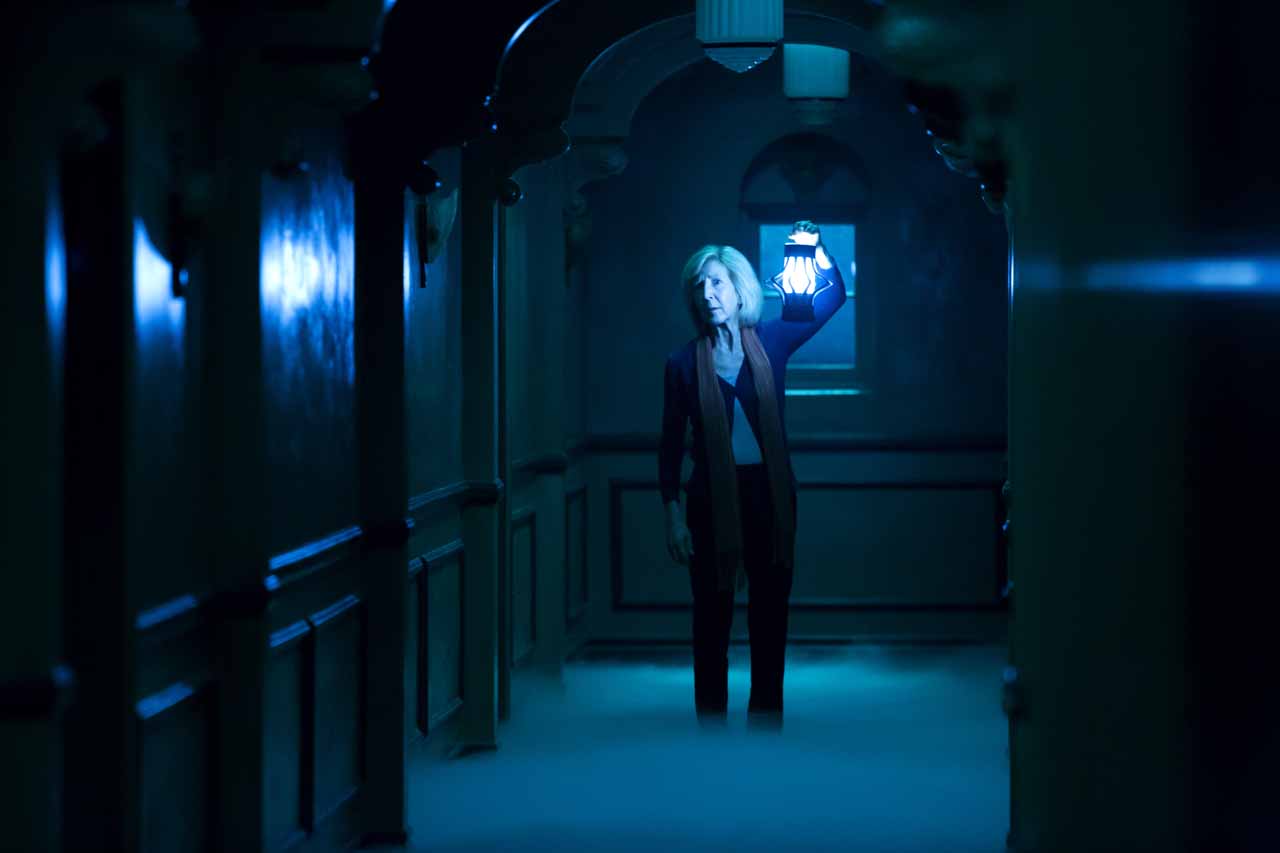
3S7C3792.CR2

As any horror movie afficionado will tell you, three is rarely the charm when it comes to horror movie franchises. And Insidious Chapter 3 is no different in that respect, coming as it does after two previous entries that explored the effects of prolonged supernatural distress on the same family, the unlucky Lamberts. The decision here to make a prequel to those movies seems, at first look, to be a solid idea given the chance it takes to bring back Lin Shaye’s popular psychic. But as with any third entry, familiarity undercuts any chance of effective suspense or scares, a problem that Leigh Whannell’s script never overcomes.

The main problem is that we’ve all been here before, and though Whannell – taking over from James Wan in the director’s chair – is well-versed in the particular universe he and Wan have created, is still unable to bring anything new to the table (or the realm of the Further) that provides the required thrills and chills. The Man Who Can’t Breathe is an admittedly unsettling presence – at first – but then makes too many appearances to remain entirely scary. The appearance of the bride in black also lacks the fear factor of the previous instalments (as we know she can’t actually harm Elise), and she’s seen too much in close up to be truly startling. And the Further, once the realm of the scarily unexpected, is now the realm of the mildly alarming. But it’s the movie’s final shot that shows just how much the movie is its own insidious mix of narrative set up (for parts one and two) and self-reflexive homage, as a moment from the first movie is rehashed with a lot less style or potency.

But at least it’s not as dubiously shambolic as some prequels/sequels/later entries in a horror movie franchise. Whannell and co are really trying to scare their audience, and while any originality in doing so is quickly exhausted, at least there’s an effort involved here that most Part Threes never manage. The plot is fairly simple, a hook on which to hang a few uneasy moments that, unfortunately, never fully realise their potential, and though most viewers will see what few twists the narrative provides from a whole other dimension away, there’s enough serious intent here to offset any shortcomings. This doesn’t mean that the movie works per se, just that it doesn’t work as badly as may be expected.

Where the movie does do well is with the performances. Mulroney, making his horror debut – though a case could be made for Stoker (2013) – is surprisingly good as the beleaguered father who’s way out of his depth, but determined to save his daughter no matter what. Returning as the equally out of their depth paranormal investigators Tucker and Specs, Sampson and Whannell replay their enjoyable double act but as in the previous movies, without making them seem too much like complete buffoons. The one weak link is Scott, who never quite convinces as a teen in peril, and whose reactions to the events going on around her always feel like they’ve been lifted from the performance of another actress in a similar role. But it’s Shaye’s movie throughout, her portrayal of Elise given added depth thanks to the inclusion of nods to her deceased husband, and her ability to get across just how scary the Further really is (even if the time spent there in the movie doesn’t support her contention). She also gets a moment straight out of the Sigourney Weaver/Ripley School of Confrontational One-Liners, aimed at the bride in black and guaranteed to raise a smile.

If there is to be a fourth in the series then it’s difficult to see where the makers could go next. As the movie which brings together Elise and Tucker and Specs, Insidious Chapter 3 does its job with a certain amount of gusto and charm. But if the series is to move forward rather than, say, further back, or sideways, then a whole new approach is going to be required. Whether it will restore the intensity and the scares of the first movie, though, is another matter entirely.

Rating: 6/10 – with the scare quotient dialled down in favour of connecting to the previous (subsequent?) entries in the series, Insidious Chapter 3 is only occasionally scary, and only occasionally enthralling; helped greatly by the commitment of its cast and crew, this is one horror movie prequel that tries hard to avoid the pitfalls of its place in the franchise.
Share this:

  • Share on X (Opens in new window) X
  • Share on Facebook (Opens in new window) Facebook
  • More
  • Print (Opens in new window) Print
  • Email a link to a friend (Opens in new window) Email
Like Loading...

Mini-Review: Survivor (2015)

27 Saturday Jun 2015

Posted by dullwood68 in Movies

≈ Leave a comment

Tags

Action, American Embassy, Bombing, Conspiracy, Drama, Dylan McDermott, James McTeigue, London, Milla Jovovich, Pierce Brosnan, Review, Robert Forster, Thriller, Times Square

Survivor

D: James McTeigue / 96m

Cast: Milla Jovovich, Pierce Brosnan, Dylan McDermott, Angela Bassett, James D’Arcy, Robert Forster, Frances de la Tour, Roger Rees, Benno Fürmann, Genevieve O’Reilly, Corey Johnson

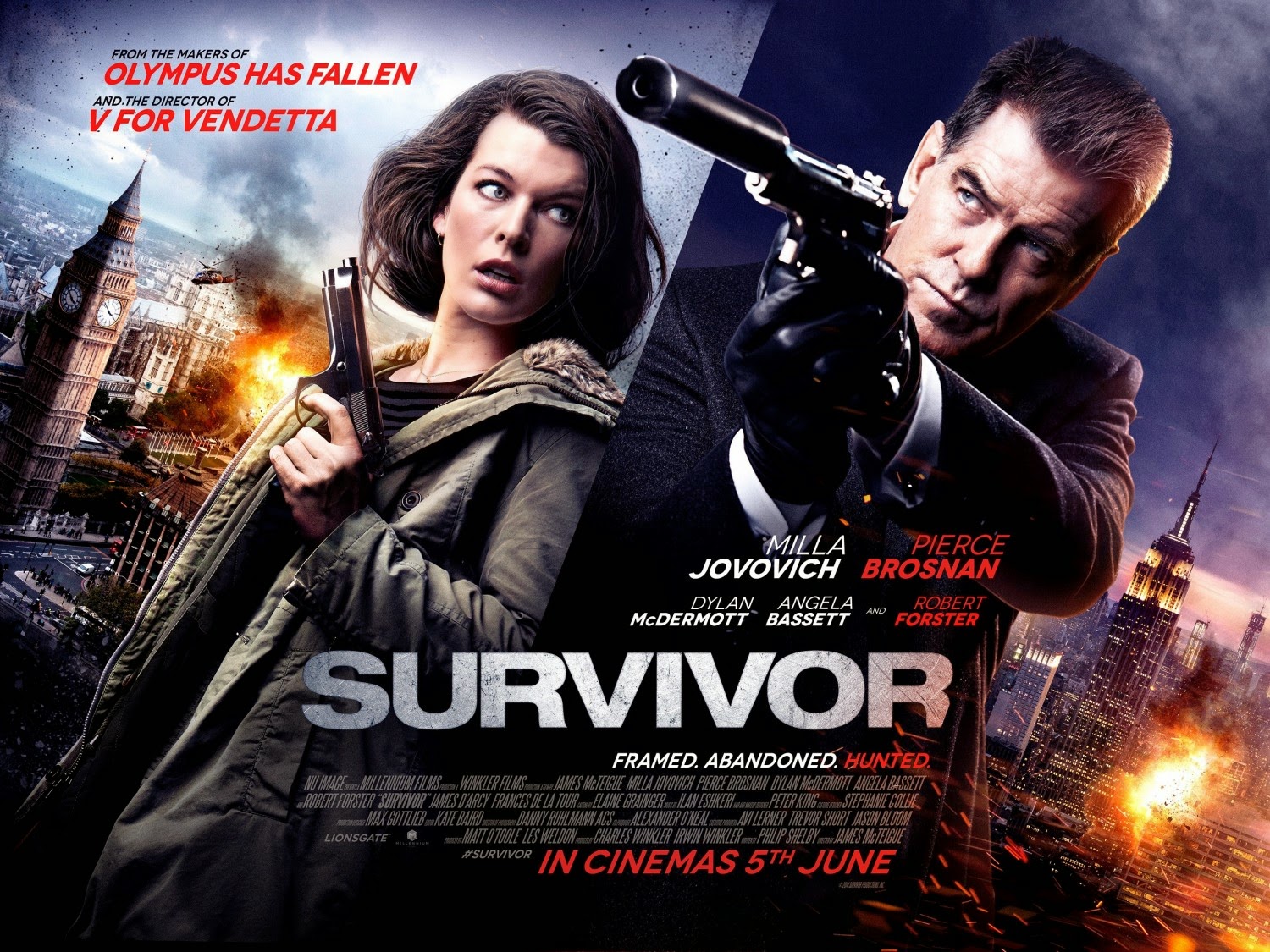
Kate Abbott (Jovovich) has transferred to the American Embassy in London. She oversees visa applications to the US by foreign nationals travelling through the UK. When she suspects that gas expert Dr Balan (Rees) isn’t all that he seems, it leads to her being hunted by assassin the Watchmaker (Brosnan). With only her colleague, Sam Parker (McDermott), believing she’s had nothing to do with the deaths of other colleagues in a bomb blast, or that of her immediate boss, Bill Talbot (Forster), Kate is forced to go on the run in an attempt to get to the bottom of the conspiracy she’s found herself entangled in.

Narrowly escaping several attempts on her life by the Watchmaker, Kate realises she has to get back into the embassy in order to find the proof she needs to expose the conspiracy. Helped by Sam and another colleague, Sally (de la Tour), Kate discovers enough information to send her off to New York on New Year’s Eve. Followed by the Watchmaker, Kate has only a few hours to foil a terrorist attack planned for midnight in Times Square, and which is backed by the pharmaceutical company that Balan works for.

Survivor - scene

Take a director whose previous output includes V for Vendetta (2005) and the underrated Ninja Assassin (2009), add two principal stars who are no strangers to the action genre, a supporting cast of more than capable (and proven) actors, and good location work in both London and New York – and what do you get? A terrible piece of nonsense that doesn’t even bother to try and hide how preposterous it all is. This is largely thanks to Philip Shelby’s overly-simplistic, corner-cutting script, a melange of action movie clichés and inane dialogue lumped in amongst an unconvincing plot and the kind of one-dimensional characterisations that leave the viewer shaking their head in disbelief.

There’s no point at which Survivor is even remotely credible, and while there’s a small degree of amusement to be had at each nutty development in the script, McTeigue fails to maintain any degree of confidence behind the camera. As a result, the movie plods from one uninspired set piece to the next without pausing for breath or an injection of self-belief. Jovovich runs around a lot looking frazzled and confused (as well she might), while Brosnan sleepwalks through his role with the look of an actor wondering where his career went to. By the end, with its inevitable showdown between Kate and the Watchmaker, the movie has given up trying to be exciting or different, and renders itself completely unremarkable.

Rating: 3/10 – why movies like these continue to be made is anybody’s guess, but Survivor is an object lesson in how not to make a modern day thriller with Cold War overtones; lacking credibility is one thing, but lacking suspense as well makes for a poorly judged and ill-considered movie that viewers can only help will end sooner than it does.

Share this:

  • Share on X (Opens in new window) X
  • Share on Facebook (Opens in new window) Facebook
  • More
  • Print (Opens in new window) Print
  • Email a link to a friend (Opens in new window) Email
Like Loading...

The Lazarus Effect (2015)

05 Friday Jun 2015

Posted by dullwood68 in Movies

≈ Leave a comment

Tags

David Gelb, Donald Glover, Drama, Evan Peters, Horror, Mark Duplass, Olivia Wilde, Reanimation, Review, Sarah Bolger, Science, Thriller

Lazarus Effect, The

D: David Gelb / 83m

Cast: Mark Duplass, Olivia Wilde, Evan Peters, Sarah Bolger, Donald Glover, Amy Aquino, Ray Wise

10 Reasons Why The Lazarus Effect Will Disappoint You:

1) It’s a Frankenstein variation that swaps injected chemicals for lightning bolts (not nearly as visually exciting).

2) Mark Duplass’ character, Frank, is supposed to be driven but instead comes across as petulant – Duplass is good at petulant but not at being a scientist.

3) Ray Wise pops in for a cameo as a corporate douchebag and takes all their research notes and computer drives – but it doesn’t stop them replicating their experiment.

4) They first revive a dog who turns out to have an aggression problem, but they don’t do anything about it, and still keep him around the lab.

5) Olivia Wilde is a fine actress with a great filmography, but she does herself no favours here with a performance that wishes it could be merely inadequate.

6) Aside from Frankenstein, it also borrows heavily from Carrie (1976) and Lucy (2014) but not in a good way, and not with any fresh ideas grafted on.

7) The reason for Zoe coming back with one hell of a mean streak is never explained, and no one even attempts to explain it.

8) What few “scares” there are in the movie are repetitively set up around the lights going out and then coming on again (boo!).

9) The script – by Luke Dawson and Jeremy Slater – wants the viewer to believe that Frank et al can work undetected in a lab overnight until it becomes convenient for the script to say that, actually, they have been watched the whole time… and Ray Wise’s corporate douchebag doesn’t show up.

10) You don’t care when Zoe starts killing off her colleagues; in fact, you feel a little bit envious that they’re out of the movie, but you’re still watching it.

And lastly, a message to studio executives everywhere: if a screenwriter can’t plug the many holes in his or her plot or storyline, then send them away until they can. And if they’re touting a horror script, don’t believe that any kind of weird shit will be scary when it’s translated to the big screen. It isn’t. And one last thing: don’t ever green light a sequel to this movie – ever.

Rating: 3/10 – once again an example of how worryingly bad some studio backed horror movies can be; The Lazarus Effect is silly, stupid, a waste of a good cast, and directed by Gelb in a way that screams “coincidence” given that his first (short) movie was called Lethargy (2002).

Share this:

  • Share on X (Opens in new window) X
  • Share on Facebook (Opens in new window) Facebook
  • More
  • Print (Opens in new window) Print
  • Email a link to a friend (Opens in new window) Email
Like Loading...

San Andreas (2015)

04 Thursday Jun 2015

Posted by dullwood68 in Movies

≈ 2 Comments

Tags

Action, Alexandra Daddario, Brad Peyton, Carla Gugino, Disaster movie, Drama, Dwayne Johnson, Earthquakes, Hoover Dam, Ioan Gruffudd, Paul Giamatti, Review, San Andreas Fault, San Francisco, Tsunami

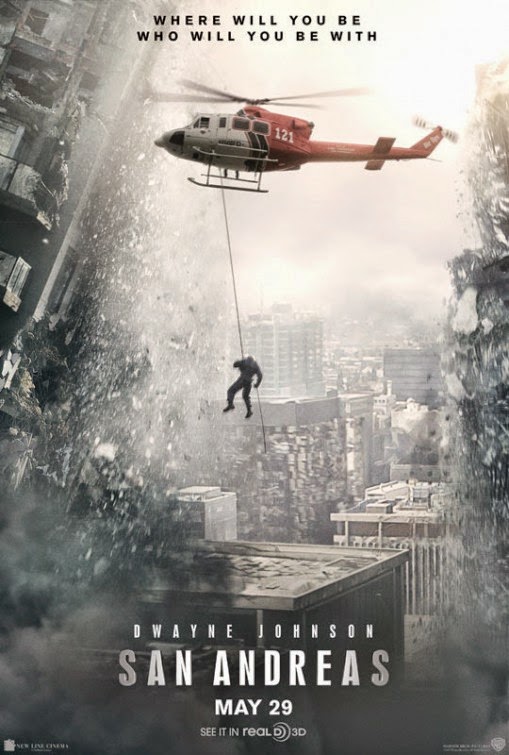
San Andreas

D: Brad Peyton / 114m

Cast: Dwayne Johnson, Carla Gugino, Alexandra Daddario, Paul Giamatti, Ioan Gruffudd, Archie Panjabi, Hugo Johnstone-Burt, Art Parkinson, Will Yun Lee, Kylie Minogue

Ray Gaines (Johnson) is a helicopter rescue pilot with the Los Angeles Fire Department, separated from his wife Emma (Gugino), but on very good terms with his daughter, Blake (Daddario). He plans to take a few days off to spend some time with her in San Francisco, but he has to shelve those plans when an earthquake destroys the Hoover Dam, and he’s called back to work. In apologising to Blake, he learns that Emma is planning to live with her new boyfriend, property developer Daniel Riddick (Gruffudd). Daniel suggests taking Blake to San Francisco himself and they leave soon after.

While Ray takes part in various rescue missions, seismologist Lawrence Hayes (Giamatti) – who was at the dam when it broke – is becoming increasingly worried that that earthquake was just a precursor to a series of much bigger, much more devastating ones. When one such earthquake strikes Los Angeles, Emma finds herself in a high rise building having lunch with Daniel’s sister, Susan (Minogue). As the quake hits she’s talking to Ray on the phone; he tells her to get to the roof and he’ll come and rescue her. Further quakes strike towns and cities up and down the California coast, including San Francisco. With Emma safe on board his helicopter, Ray receives a call from Blake: she’s trapped in a car in the basement of Daniel’s office building and it’s about to collapse.

Ray and Emma decide they have to try and rescue Blake, but the helicopter they’re in develops a fault and they crash land in Bakersfield. Managing to commandeer a plane, they continue on to San Francisco. Meanwhile, Blake has been rescued by a British engineer she met earlier at Daniel’s offices. Ben (Johnstone-Burt) and his younger brother Ollie (Parkinson) stay with Blake as she works out a way to let Ray know she’s okay. When she does he tells her to meet him in a particular place that has a special meaning to both of them. But it’s not possible for her to get there, so she heads for Daniel’s latest high rise development instead. Ray and Emma parachute out of the plane and land in San Francisco; when they realise Blake can’t get to the rendezvous site, they also discover that a tsunami is coming that will swamp the city. And when it does, Blake, Ben and Ollie find themselves trapped in Daniel’s building with the waters steadily rising, and Ray and Emma having no idea of where they are…

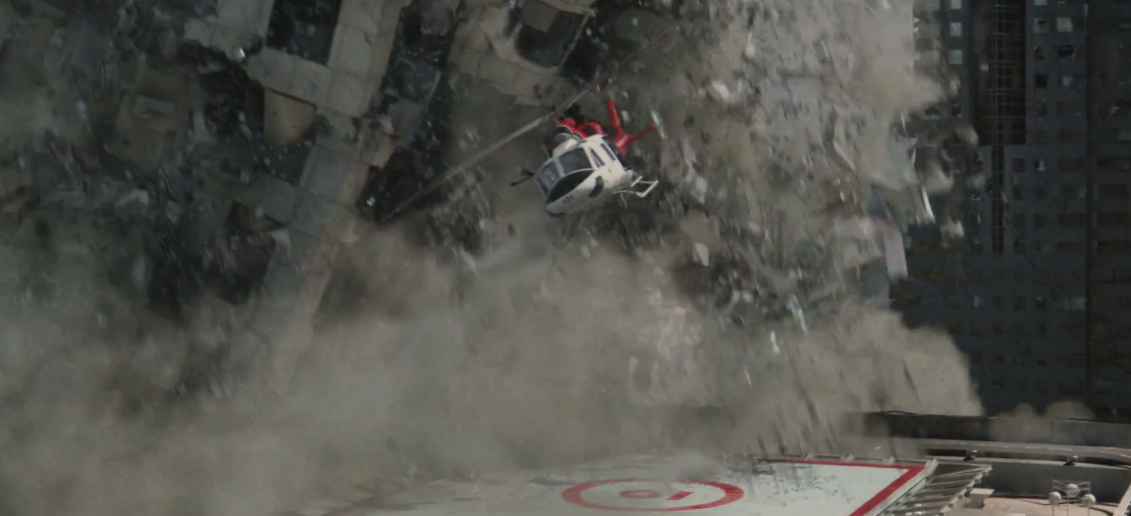
San Andreas - scene

A disaster movie – the moviegoer’s guilty pleasure – should always favour spectacular destruction over coherent plot, story or characterisation. It should feature enough devastation to leave the viewer slack-jawed in admiration at what the special effects wizards can achieve. It should cater to that part of us that slows down to look when we pass a road accident. And above all, it should show us something that we might all experience some day, regardless of how safe we might feel in our own little corner of the world.
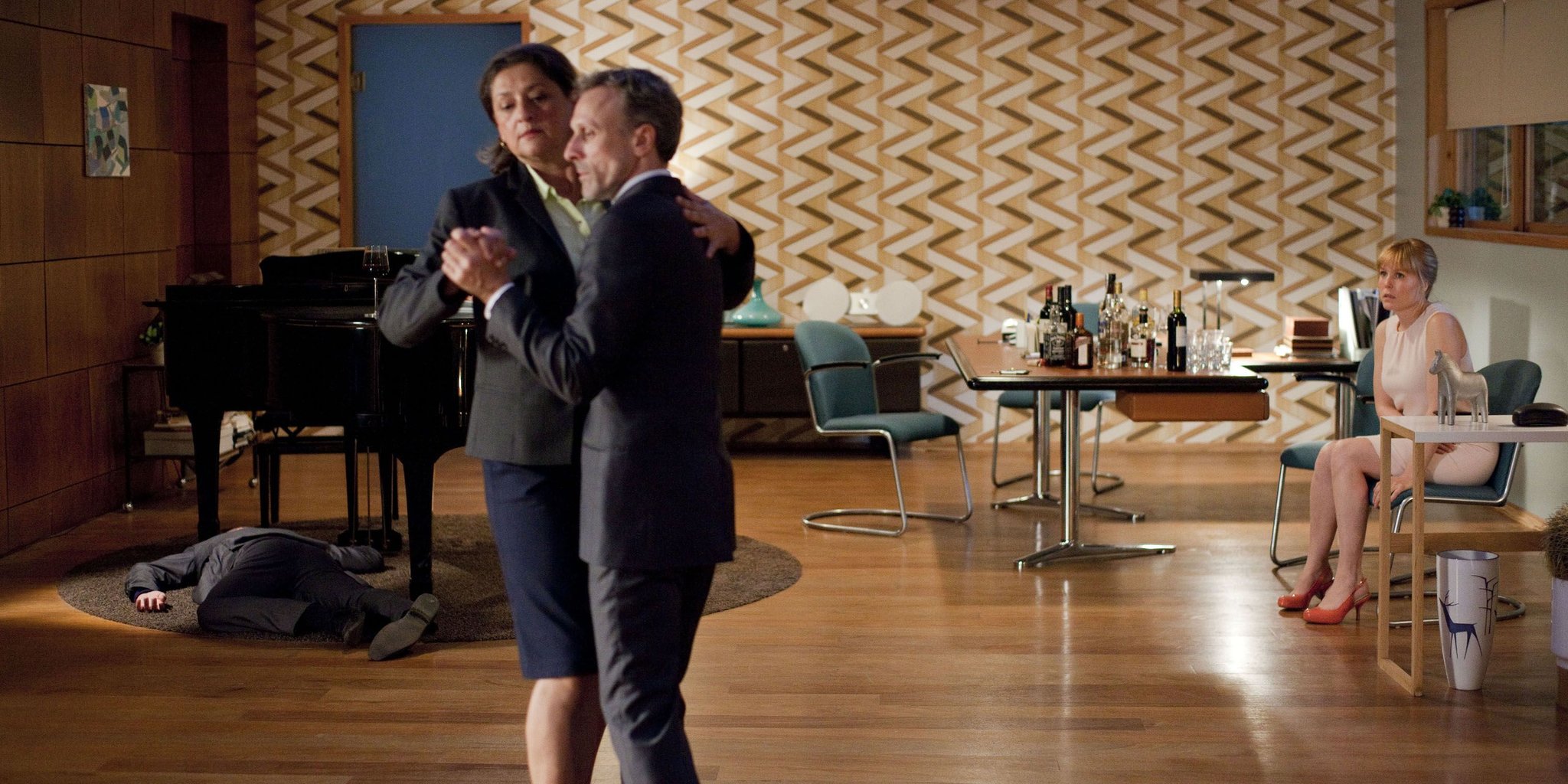
San Andreas should give us all that and more. But instead it’s a curiously bloodless affair, full of moments where the cast look awestruck at some fresh new aspect of the disaster around them, and where Hayes’ doom-laden dialogue hypes the destruction to near-apocalyptic levels. There are some impressive shots it’s true, but some – such as the awkward destruction of the Golden Gate Bridge – seem too absurd to appear feasible, or are rendered in such a way that the wow factor plays second fiddle to any plausibility. This might not be too much of a concern though if what we’re witnessing is something new, but the devastation wrought in the movie, while impressively mounted, has been done elsewhere already, and San Andreas, while promising the mother of all earthquakes from very early on – one that will be felt “on the East Coast” – actually falls short of doing so.

Instead, what we have is a tale of a family’s determination to survive against all the odds, and in Ray’s case, without regard for the job he does. Once the earthquake hits Los Angeles and all points Californian, Ray becomes a solo pilot, where before he’s been part of a four-man team. He rescues Emma and then jettisons any notion of helping others with a quick “we have to find our daughter” (not that anyone’s trying to contact him with any instructions or requests for help). He’s reckless as well, putting himself and Emma in harm’s way time after time: let’s crash the helicopter in a clothing store, let’s parachute out of a plane, let’s head into the swell of an oncoming tsunami – the more dangerous the action, the more determined he seems to tackle it. In a different kind of movie, Ray would be an adrenaline junkie with a death wish; here, he’s a big-hearted father who’s doing the best he can (gosh darn it!).

It’s a good thing then that Johnson is more than capable of helping the viewer ignore or forget these contradictions, putting in an emotive performance that sees him remind everyone why he’s the go-to guy for this kind of big-budget nonsense. Whether he’s ripping car doors off their hinges, or holding his breath underwater for minutes at a time, Johnson’s amiable muscularity fits the needs of the script admirably, even when Ray is called upon to relive a past tragedy. As a chip off the old block, Daddario provides an earnest counterpoint to Johnson’s grim-faced determination, while Giamatti bleeds sincerity as the tormented seismologist who saw it all coming. Spare a thought however, for Gugino – along for the ride and little else – and Gruffudd – asked to become a prick in the space of a nano-second. Both actors are ill-served by Carlton Cuse’s ill-focused screenplay, as is Johnstone-Burt, who’s called upon to play the kind of stereotypical good-natured bumbling Brit who sounds like minor royalty.
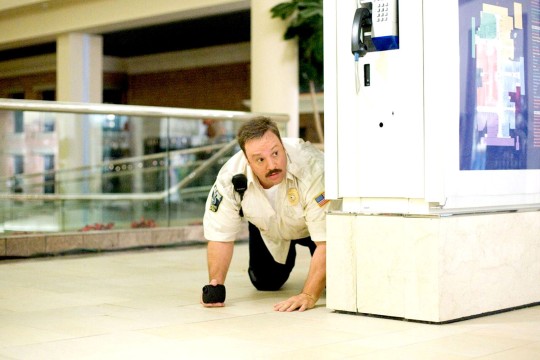
Behind the camera, Peyton orchestrates all the mayhem with a good eye for packing the frame with as much incident as possible, and there’s an effective score from Andrew Lockington that supports the action without overwhelming it. Fans of the disaster genre will particularly approve of the many building falling into/against/onto other building shots, and the refreshingly practical effects work used to show that a movie of this sort doesn’t have to be all digital. Others, though, may look at all the devastation and wonder, why does a lot of it have problems with scale?

Rating: 6/10 – while it’s enjoyable in a big dumb leave-your-brain-at-the-door kind of way, San Andreas has a script that features enough fault lines to warrant a warning sign all its own; a movie where the spectacle never quite inspires the awe or wonder it needs to, it fits neatly into the category of guilty pleasure but without really doing too much to earn its place there.

Share this:

  • Share on X (Opens in new window) X
  • Share on Facebook (Opens in new window) Facebook
  • More
  • Print (Opens in new window) Print
  • Email a link to a friend (Opens in new window) Email
Like Loading...
Mini-Review: Poltergeist (2015)

03 Wednesday Jun 2015

Posted by dullwood68 in Movies

≈ Leave a comment

Tags

Cemetery, Clowns, Drama, Gil Kenan, Horror, Jared Harris, Kyle Catlett, Paranormal activity, Remake, Review, Rosemarie DeWitt, Sam Rockwell

Poltergeist

D: Gil Kenan / 93m

Cast: Sam Rockwell, Rosemarie DeWitt, Jared Harris, Jane Adams, Kyle Catlett, Saxon Sharbino, Kennedi Clements, Susan Heyward, Nicholas Braun

The Bowens – recently laid-off Eric (Rockwell), aspiring writer Amy (DeWitt), teenage daughter Kendra (Sharbino), young son Griffin (Catlett), and youngest daughter Madison (Clements) – move into their new home on a quiet estate. It’s a new start for all of them, but Griffin, who’s a nervous child at the best of times, senses that there’s something “off” about the house. When he finds Madison talking to someone in her room – who isn’t there – it adds to his unease. Later that night he finds a box full of clown toys that makes him even more anxious, as it seems one of them just might be alive.

The next day sees even more strange phenomena happen throughout the house, phenomena that escalates once Eric and Amy have gone out for the evening to a dinner party. Kendra is attacked in the basement, Griffin is grabbed by the tree in their front yard, and Madison disappears through a portal that opens up in the back of her wardrobe. Eric and Amy arrive home in time to save Griffin but when they can’t find Madison – who can now only speak to them through the TV – they turn to a group of paranormal investigators led by Dr Brooke Powell (Adams) to help get their daughter back. When events escalate even further, and it becomes clear that there are spirits trying to use Madison to free themselves from their earthly prison, Powell asks for help from an unlikely source: her ex-husband and TV ghost hunter Carrigan Burke (Harris). With time running out, a rescue mission is attempted to try and bring back Madison before it’s too late, but while Carrigan, Eric and Amy argue about who should go, Griffin beats them to it…

Poltergeist - scene

Another week, another unwanted horror movie remake. As with all the other horror remakes we’ve been “treated” to in the past five or six years, Poltergeist fails to hit the mark it’s aiming for, and is about as scary as a loaf of bread. This version also can’t decide if it wants to be a straight-up remake, or a completely new reimagining, and because it can’t decide it ends up being an unwieldy, awkward mix of the two. And despite the more than capable cast, you don’t care about any of the characters, not even Madison. Part of the problem here is that in trying to be respectful of the original movie but not slavish to it, the makers have missed the whole reason why Tobe Hooper’s version was, partly, so good: it was fresh and we hadn’t seen anything like it before. This version is tired from the moment that Griffin walks in the door and starts looking around suspiciously. Uh-oh! Something’s up!

There’s no tension this time round either. When the tree outside Griffin’s room is first seen we know it’s supposed to be spooky and creepy and eerie and menacing, but in the hands of the usually talented Kenan – working from David Lindsay-Abaire’s by the numbers script – it’s just a tree blowing in the wind, again and again. It’s yet another example of how familiarity breeds disappointment. To make matters worse, the performances range from unexceptional (Sharbino, Adams) to disappointing (Rockwell, DeWitt) to annoying (Harris), and each attempt to add depth to the characters or story is left high and dry by not being followed through. All in all it’s a movie where just enough was done to get by.

Rating: 4/10 – good production values save this from being a complete dud, but as a horror movie that doesn’t provide any real scares it’s a far cry from effective; when there are movies of the calibre of It Follows (2014) out there showing how it should be done, it makes this Poltergeist look very redundant indeed.

Share this:

  • Share on X (Opens in new window) X
  • Share on Facebook (Opens in new window) Facebook
  • More
  • Print (Opens in new window) Print
  • Email a link to a friend (Opens in new window) Email
Like Loading...

Spy (2015)

02 Tuesday Jun 2015

Posted by dullwood68 in Movies

≈ 2 Comments

Tags

Action, Budapest, CIA, Comedy, Drama, Jason Statham, Jude Law, Melissa McCarthy, Miranda Hart, Nuclear weapon, Paris, Paul Feig, Review, Rome, Rose Byrne, Spies, Thriller, Undercover

Spy

D: Paul Feig / 120m

Cast: Melissa McCarthy, Jason Statham, Rose Byrne, Miranda Hart, Allison Janney, Bobby Cannavale, Peter Serafinowicz, Morena Baccarin, Richard Brake, Nargis Fakhri, 50 Cent, Jude Law

CIA operatives Bradley Fine (Law) and Susan Cooper (McCarthy) are the best team in the organisation: Fine out in the field, Susan back at HQ guiding and protecting him on his missions. After Fine misses out on the chance to find the whereabouts of a nuclear weapon that’s up for sale – by accidentally shooting the seller – the CIA soon learns that the seller’s daughter, Rayna Boyanov (Byrne), has taken over the sale and through corrupt businessman Sergio De Luca (Cannavale) is offering it to terrorist Solsa Dudaev (Brake).

Fine infiltrates Rayna’s home but discovers it’s a trap; Susan has to watch as Rayna kills him. When it becomes clear that Rayna knows the identities of all of the CIA’s top agents, including gung-ho hothead Rick Ford (Statham), Susan volunteers to travel to Paris where De Luca has an office, and to report back any activity. Followed there by Ford, who thinks she’ll compromise the mission, Susan discovers that De Luca is now in Rome. Once there, she switches her dowdy undercover identity for a more upmarket one, and trails De Luca to a casino. She witnesses a man spike a drink at the bar; when the drink is delivered to none other than Rayna, Susan sees her chance to get close to Fine’s killer and find out the location of the nuclear weapon.

Gaining Rayna’s confidence, the pair fly to Budapest. During the flight one of the pilot tries to kill Rayna but Susan overpowers him and lands the plane instead. In the process she reveals her skills as an agent, and Rayna becomes convinced she works for the CIA. Susan manages to convince her that her father employed Susan to look after her. Rayna believes her story, but when they arrive in Budapest, matters are complicated by the arrival of Susan’s best friend and co-worker, Nancy (Hart) who has been sent to check on her. Pretending Nancy works for her, Susan foils another bid to kill Rayna, but in doing so finds herself at Rayna’s mercy, and with the sale of the nuclear weapon a matter of hours away.

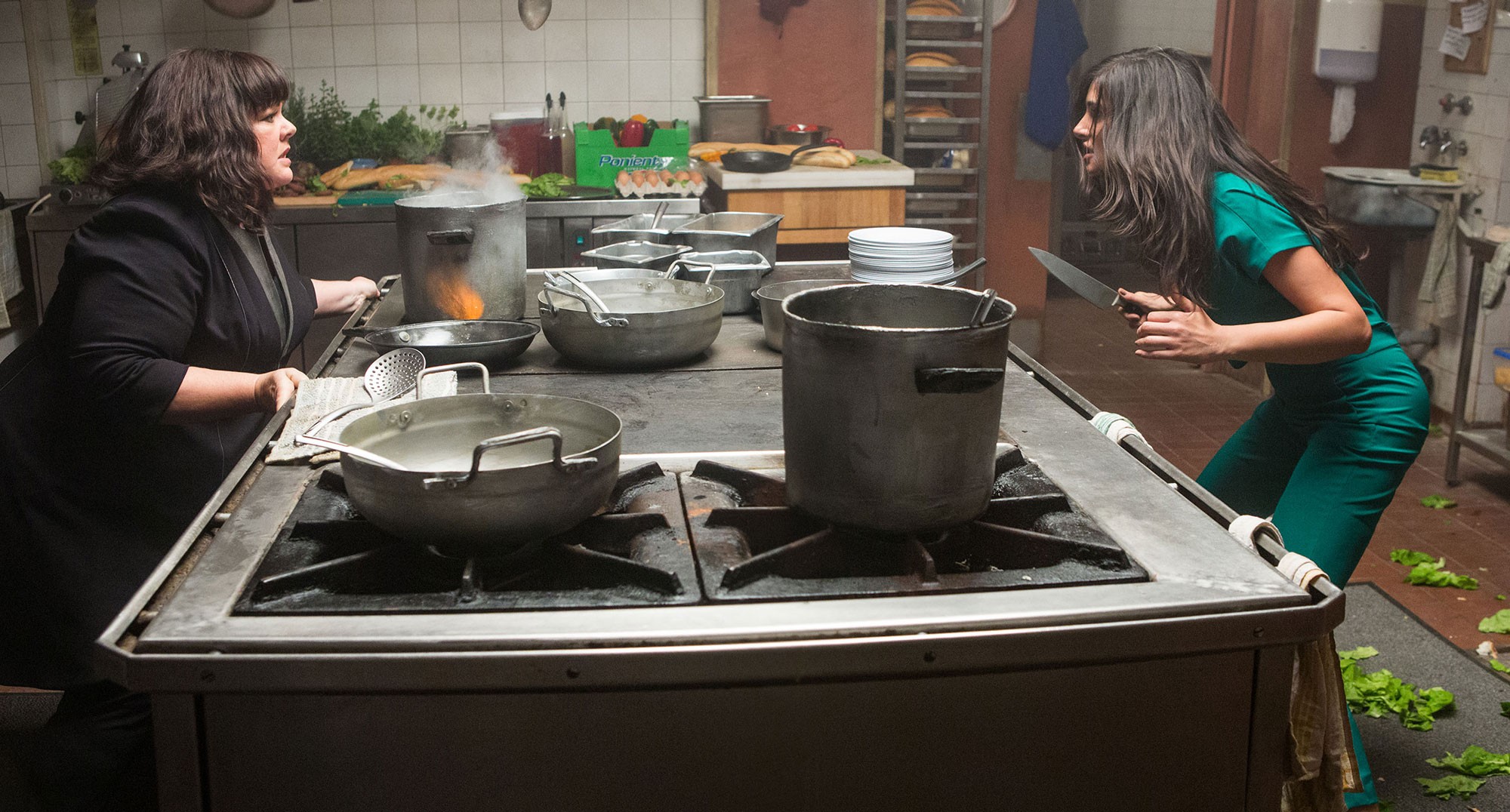
Spy - scene

It’s been four short years since Melissa McCarthy shot to fame by defecating into a sink in the movie Bridesmaids (2011). In that time she’s continued with her role in the TV show Mike & Molly, had a minor role in This Is 40 (2012), given supporting turns in The Hangover Part III (2013) and St. Vincent (2014), co-starred with Sandra Bullock in The Heat (2013), and headlined two movies of her own, Identity Thief (2013) and Tammy (2014). If the last two movies didn’t exactly set critical pulses racing, both took over $100,000,000 worldwide, proving that audiences enjoyed watching slight variations on the character she first played in director Paul Feig’s earlier movie.

But it was a character that had a limited shelf life, and with Spy, McCarthy and Feig have wisely broadened their horizons, and in so doing, have given the actress her best role yet. As the ten years desk bound CIA agent who dreams of some excitement in her life, McCarthy delivers a performance that is at once more controlled and less wayward. In creating Susan Cooper, McCarthy shows that she has much more to offer than pratfalls and foul-mouthed schtick (even though there’s room for both here, just not as much as usual), and is more than capable of playing a fully rounded character. It’s good to see her owning the material as well and riffing on it to such good effect, making Susan possibly her most endearing, and appealing role to date, and entirely worthy of the movie itself.

For the best thing about Spy is that it’s consistently funny, whether it’s subverting genre conventions by thrusting the backroom girls into the spotlight, making Fine a preening douche, Ford a ridiculous blowhard, or giving Susan some of the worst makeovers in history for her undercover identities, the movie has great fun in spoofing the spy/action movie while maintaining a more serious subplot about Susan’s gaining enough self-confidence to fulfil her potential as an agent. That Feig’s script has the confidence to attempt both, and then succeed with seeming ease, adds to the movie’s lustre, and makes it all the more enjoyable.

As already noted, McCarthy delivers her best role to date, and she’s matched by the surprise – and inspired – casting of Statham as the kind of agent who can’t pass up an opportunity for a bit of self-aggrandisement. On this evidence, Statham should do more comedy, as here he’s hilarious, shouting and swearing like a man on the brink of a psychotic break, and making the kinds of boasts that are so absurd he doesn’t know how idiotic he sounds. But where Ford’s boasting is a highlight, he’s still outdone by the insults traded between Susan and Rayna, some of which are the funniest putdowns heard in recent years (and particularly when it comes to Rayna’s hairdo). Byrne and McCarthy have a great time deadpanning their lines at each other, and so does the audience as each insult escalates their dislike of each other’s character.

In support, Serafinowicz is irrepressible as Susan’s Italian contact, Aldo, for whom large bosoms are the key to happiness; Law is debonair, charming and an unfeeling arse; Janney is the CIA chief who sees promise in Susan’s wish to work in the field; Cannavale doesn’t really feature until the last twenty minutes; 50 Cent plays himself; and in a role that doesn’t see her stretch too far from her British TV persona, Hart racks up enough laughs as Nancy to have done her US career no harm at all. In short, it’s a great cast, and they all deliver as required.

The European locations are filmed by Robert D. Yeoman with that travelogue sheen that enhances even the most attractive of regions or cities, and as a result the movie is attractive to look at throughout. The music by Theodore Shapiro is occasionally overbearing, but this is due to its prominence in the sound mix rather than any compositional issues, and McCarthy’s wardrobe, courtesy of Christine Bieselin Clark, fluctuates from plain and functional to horrendous to glamorous (though her final look in the movie makes her appear too much like Dawn French for comfort). And the action scenes are splendidly realised, including a terrific fight between McCarthy and  Fakhri that wouldn’t look out of place in a… well, in a Jason Statham movie.

Rating: 8/10 – consistently entertaining, Spy is a treat for fans of McCarthy and spy spoofs in general; with a script that knows when to be serious and when to be gloriously silly, it’s a movie that is infectious in its desire to please its audience, something it does with no small amount of style and wit.

Share this:

  • Share on X (Opens in new window) X
  • Share on Facebook (Opens in new window) Facebook
  • More
  • Print (Opens in new window) Print
  • Email a link to a friend (Opens in new window) Email
Like Loading...

Teacher of the Year (2014)

01 Monday Jun 2015

Posted by dullwood68 in Movies

≈ 2 Comments

Tags

Comedy, Drama, Jason Strouse, Job offer, Keegan-Michael Key, Matt Letscher, Mockumentary, NISA, Review, Students, Sunny Mabrey, Teaching, Truman High School

Teacher of the Year

D: Jason Strouse / 80m

Cast: Matt Letscher, Keegan-Michael Key, Sunny Mabrey, Larry Joe Campbell, Jamie Kaler, Jason Sklar, Randy Sklar, Tamlyn Tomita, Brenda Strong, Caitlin Carmichael, Chris Conner, Eden Riegel, Shari Belafonte, Karl T. Wright, Richard Keith, Lahna Turner, Gabriel Chavarria, Jonathan Goldstein, Olivia Crocicchia

At the relatively new Truman High School in Los Angeles – opened in 2007 – English teacher Mitch Carter (Letscher) has recently won the state teacher of the year award. With his stock in the teaching community riding high, he’s approached by a representative (Goldstein) of the National Independent School Association to become a lobbyist for them. The job entails appearing at symposiums, making speeches on behalf of the Association, a hefty increase in salary, and moving himself and his family – wife Kate (Mabrey) and young daughter Sierra (Carmichael) – to Washington D.C. But though the offer is tempting, Mitch needs time to think about it.

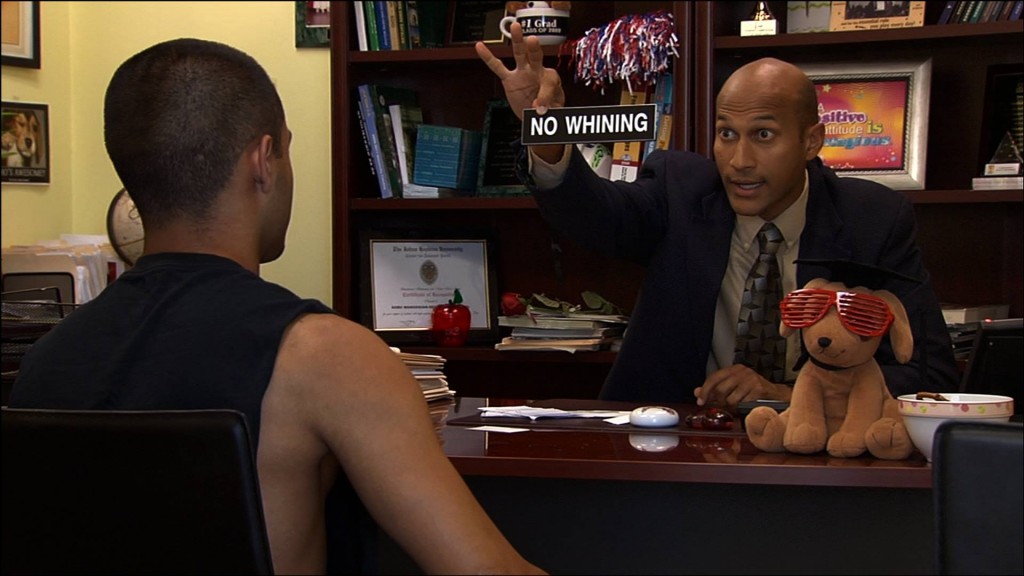
While he does, Mitch is also part of a documentary being made about him and the rest of the faculty, and the students, at Truman High. The principal is Ronald Douche (pronounced Dow-shay, “the same spelling, but the Dutch pronunciation”) (Key), an uptight, trying-too-hard-to-be-liked bureaucrat who garners little respect from either the teachers or the students. While he promotes the school’s achievements, the documentary crew go behind the scenes to discover just how much of what he says is true. What they find is a group of teachers who are all just a little bit weird, or just plain strange, like Brian Campbell (Conner), who uses a glove puppet in his maths class.

Mitch is interviewed for the role with NISA and realises to his surprise that it’s a job he’ll be good at, but the work he does with his students gives him pause. Still unable to make a decision, his own problems have to be put on the back burner when Brian is accused of molesting a student (Crocicchia) and suspended. With Douche intending to fire Brian and thereby keep the whole situation away from the press, a meeting is set up with the girl and her mother. With Kate newly pregnant and working too hard at an unrewarding job, Mitch is given an ultimatum by NISA: decide one way or the other, but just decide. In the end, it’s the outcome of the meeting to decide Brian’s fate that pushes Mitch to make his mind up. But will he stay, or will he go?

Teacher of the Year - scene

A pure joy from start to finish, Teacher of the Year is one of the funniest comedies of 2014, an inspired, laugh-out-loud, intelligently handled movie that adds drama and sentiment to the mix with undisguised aplomb. Writer/director Strouse has fashioned the kind of movie that can be enjoyed on so many different levels it’s like being given the keys to the candy store. There’s not one false note or misstep in the whole of its eighty minute running time.

As well as one of the most effective, carefully constructed mise en scenes of recent years, Strouse has created a raft of characters that are so beautifully realised by his cast that spending so little time with them seems like a crime. Aside from Brian and his glove puppet, there’s robotics teacher Steven Queeg (Kaler) who has issues over Mitch’s winning teacher of the year and who tells his students that the robots will take over the world in the future. There’s ineffectual history teacher Ian Donovan (Keith) whose inability to control his class leads to his offering to pay them to pay attention; vice principal Marv Collins (Campbell) who’s forever giving out detention slips for the smallest of infractions; Ursula Featherstone (Turner), whose musical summing up of The Miracle Worker and The Diary of Anne Frank is a definite highlight; and tenured Eric Sanders (Wright) who would give back half his salary if he could “punch a parent once a year”. Add two counsellors (Sklar, Sklar) who regularly give the worst advice you’re ever likely to hear – “Stay away from Nevada. You can go. But you’re gonna kill a hooker.” – and you have such a marvellous collection of misfits and malcontents that, again, you’ll want to spend as much time with them as possible.

But while the movie correctly focuses on the comedy, it doesn’t downplay or undermine the dramatic elements. Brian’s dilemma is handled with a greater depth of feeling than expected, as is Mitch’s relationship with his students (it’s a tribute to Strouse’s script that if Mitch was a real teacher you’d want him teaching at your kids’ school). The trials and tribulations of being a suburban school teacher are handled with an adroitness that adds credibility to each character, and Mitch’s home life is ably rendered as well, his marriage refreshingly free of unnecessary drama, and with its attendant dynamics kept equally low-key. The movie is shot through with unanticipated poignancy, and has several moments where it displays a warm-hearted centre that enhances both the drama and the comedy, and leaves the viewer smiling at the sheer pleasure watching the movie is providing.

Mitch is the smiling, genial core of the movie, an everyman with a heart of gold and a passion for teaching that comes across as entirely genuine, and Letscher is first class in the role, imbuing the part with a sincerity that never feels false. He’s ably supported  by a cast that milks every nuance and subtlety from Strouse’s script, and who do it with an obvious eagerness. It’s hard to single out any one particular cast member, but Kaler and Wright flesh out their characters so effectively, they make it really difficult to forget them in a hurry.

Strouse is to be congratulated for coming up with such a wonderfully astute and shaded script, and for directing it with such perception and skill. He’s aided immensely by DoP/editor Matthew Skala, whose aptitude at cutting together his own footage gives the movie a rhythm and a flow that suits it perfectly. And with a score containing songs by The Chicharones, the movie is as uplifting to listen to as it is to watch.

Rating: 9/10 – a sheer delight throughout, Teacher of the Year deserves to be seen by as many people as possible, its good-natured charm and winning formula an absolute joy to behold; whatever Strouse turns his hand to next, let’s hope it’s as richly satisfying as this one is.

Share this:

  • Share on X (Opens in new window) X
  • Share on Facebook (Opens in new window) Facebook
  • More
  • Print (Opens in new window) Print
  • Email a link to a friend (Opens in new window) Email
Like Loading...

Monthly Roundup – May 2015

31 Sunday May 2015

Posted by dullwood68 in Movies

≈ Leave a comment

Tags

Antonio Banderas, Art heist, Artificial intelligence, Ballard Berkeley, Bat Masterson, Berlin, Boston, Bullying, Burger Beard, Chappie, Christopher Plummer, Clancy Brown, Comet, Conrad Phillips, Crime, Dave Franco, Dead body, Drama, Emmy Rossum, Eric Stonestreet, Father/son relationship, Frank R. Strayer, Gay bar, George Pastell, Glory holes, Hugh Jackman, Impact, Irene Ware, James Marsden, Joel McCrea, John Miljan, John Travolta, Joseph M. Newman, Julie Adams, Justin Long, Karl Urban, Ken Scott, Krabby Patty formula, Matthias Schoenaerts, Monthly roundup, Murder at Glen Athol, Murder mystery, Neill Blomkamp, Peter Maxwell, Philip Martin, Plankton, Review, Romance, Sam Esmail, Sharlto Copley, Sienna Miller, SpongeBob Squarepants, Swarf, The Duke, The Forger, The Gunfight at Dodge City, The Loft, The Spongebob Movie: Sponge Out of Water, Thriller, Tom Denny, Tom Wilkinson, Tye Sheridan, Unfinished Business, Vince Vaughn, Wentworth Miller, Western

There’s a phrase that everyone will be familiar with: “Too many [insert item here], too little time”. When it comes to the number of movies that I watch in any given month, that phrase is apt in relation to the ones that get reviewed here on thedullwoodexperiment. I would love to have the time to post reviews of all the movies I see, but it’s just not practical; and besides which, some movies just don’t merit the attention (Annabelle (2014), for instance). Sometimes it’s a case of choosing one movie over another, sometimes Life gets in the way of blogging and a movie falls by the wayside. To combat this, and to give these “other” movies their due, I’ve decided to present, at the end of each month, a brief “review” of all the other movies I’ve seen. There won’t be any synopsis, or proper full-length analysis, just the title, director, running time, cast, and then the traditional two sentence ratings summation. So, let’s see which movies didn’t quite make the cut in May 2015.

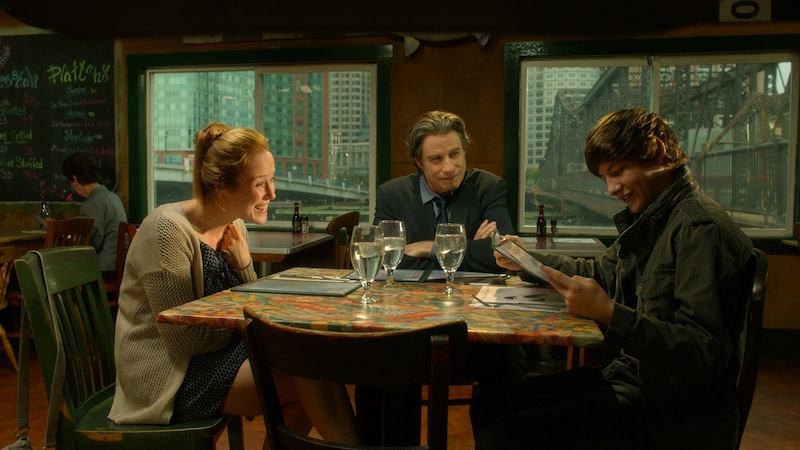
The Forger (2014) / D: Philip Martin / 96m

Cast: John Travolta, Christopher Plummer, Tye Sheridan, Abigail Spencer, Anson Mount, Marcus Thomas, Jennifer Ehle, Travis Aaron Wade

Rating: 5/10 – Travolta’s art forger comes out of prison to spend time with his dying son (Sheridan) and pull off an audacious robbery; a derivative, occasionally unappealing crime drama that tries to do something different with its dying child angle, The Forger is nevertheless a movie whose “one last heist” scenario has been done to death elsewhere, and with far better results.

Forger, The - scene

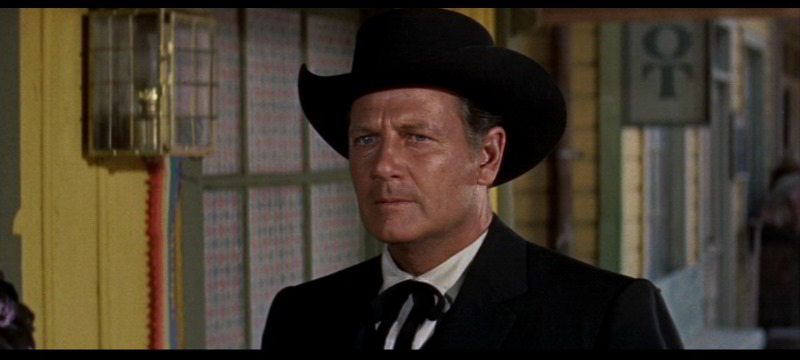
The Gunfight at Dodge City (1959) / D: Joseph M. Newman / 81m

Cast: Joel McCrea, Julie Adams, John McIntire, Nancy Gates, Richard Anderson, James Westerfield, Walter Coy, Don Haggerty, Wright King, Harry Lauter

Rating: 6/10 – Western legend Bat Masterson (McCrea) tackles corruption supported by Haggerty’s devious sheriff in Dodge City and faces romantic problems as well from minister’s daughter Adams and saloon owner Gates; a middling, mildly diverting Western, The Gunfight at Dodge City benefits from McCrea’s solid, no-nonsense performance and Newman’s underrated abilities behind the camera.

Gunfight at Dodge City, The - scene

Comet (2014) / D: Sam Esmail / 91m

Cast: Justin Long, Emmy Rossum

Rating: 7/10 – Long and Rossum are the soulmates whose on-again-off-again relationship is examined over the course of six years; with the narrative continually fractured and reassembled, Comet is replete with the kind of “serious” romantic musings that sound alternately pretentious and profound, but the two leads have a definite chemistry and this helps immensely in making the movie as enjoyable as it (largely) is.

Comet - scene

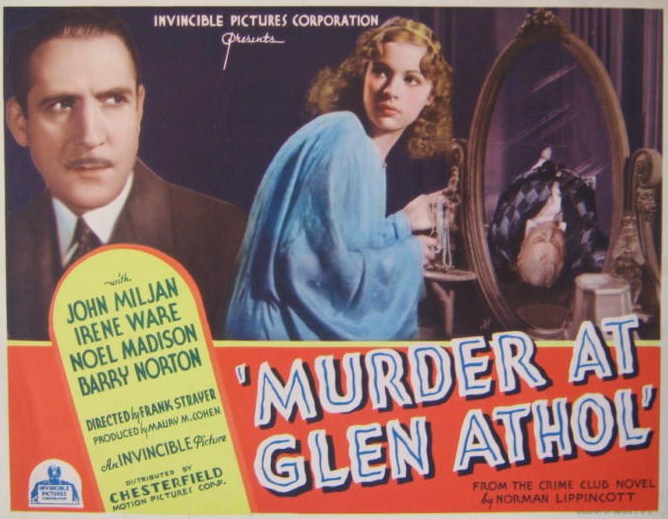
Murder at Glen Athol (1936) / D: Frank R. Strayer / 67m

Cast: John Miljan, Irene Ware, Iris Adrian, Noel Madison, Oscar Apfel, Barry Norton, Harry Holman, Betty Blythe, James P. Burtis

Rating: 5/10 – two murders and a dying confession confuse matters for a detective (Miljan) who’s just trying to take a vacation – next door to where the murders have taken place; packed full of seemingly endless exposition and no shortage of suspects, Murder at Glen Athol is a sprightly murder mystery that packs a lot in but not always to its best advantage.

Murder at Glen Athol

The SpongeBob Movie: Sponge Out of Water (2015) / D: Paul Tibbitt / 92m

Cast: Antonio Banderas, Tom Kenny, Clancy Brown, Bill Fagerbakke, Rodger Bumpass, Mr. Lawrence, Carolyn Lawrence

Rating: 7/10 – when the formula for Krabby Patty is stolen by the notorious Burger Beard (Banderas), SpongeBob (Kenny) is forced to team up with Plankton (Mr. Lawrence) to get it back… and venture above the surface; freewheeling fun with the denizens of Bikini Bottom that features lots of gags and the usual bright visuals, but takes an awfully long time in getting to the “sponge out of water” part.

SpongeBob Movie, The

Chappie (2015) / D: Neill Blomkamp / 120m

Cast: Sharlto Copley, Dev Patel, Hugh Jackman, Ninja, Yo-Landi Visser, Jose Pablo Cantillo, Sigourney Weaver, Brandon Auret, Johnny Selema

Rating: 6/10 – with a robot police force firmly established in Johannesburg, the introduction of artificial intelligence leads to one robot, named Chappie, learning what it’s like to be human; disappointing outing from Blomkamp that never quite gels or seems sure of what it’s trying to do or say, but does feature an excellent performance from Copley.

Chappie

Impact (1963) / D: Peter Maxwell / 61m

Cast: Conrad Phillips, George Pastell, Ballard Berkeley, Linda Marlowe, Richard Klee, Anita West, John Rees

Rating: 5/10 – when newspaper reporter Jack Moir (Phillips) is framed for robbery by arch-nemesis “The Duke” (Pastell), he swears to get even when he gets out of jail; a low-key crime drama that seems busier than it is and which gets bogged down in the mechanics of Moir’s revenge plot, Impact does allow for a welcome appearance by Berkeley aka Fawlty Towers‘ Major, and an above average performance by Pastell.

Impact

The Loft (2014) / D: Erik Van Looy / 103m

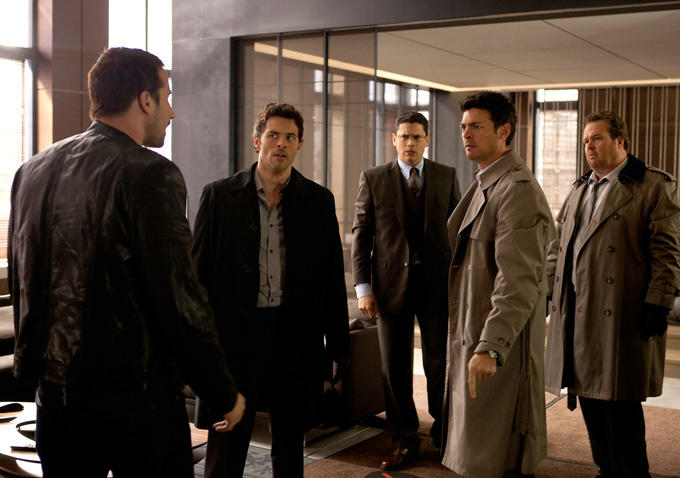
Cast: Karl Urban, James Marsden, Wentworth Miller, Eric Stonestreet, Matthias Schoenaerts, Isabel Lucas, Rachael Taylor, Rhona Mitra, Valerie Cruz, Kali Rocha, Elaine Cassidy, Margarita Levieva, Kristin Lehman, Robert Wisdom

Rating: 6/10 – the discovery of a woman’s dead body in the loft apartment shared by five married men for their secret liaisons prompts them to suspect each other of the crime; alternately gripping and implausible, The Loft is a modern day cautionary tale that loses credibility with its solution then recovers with a great twist, but still has the air of a thriller that its writer never quite got to grips with.

Loft, The

Unfinished Business (2015) / D: Ken Scott / 91m

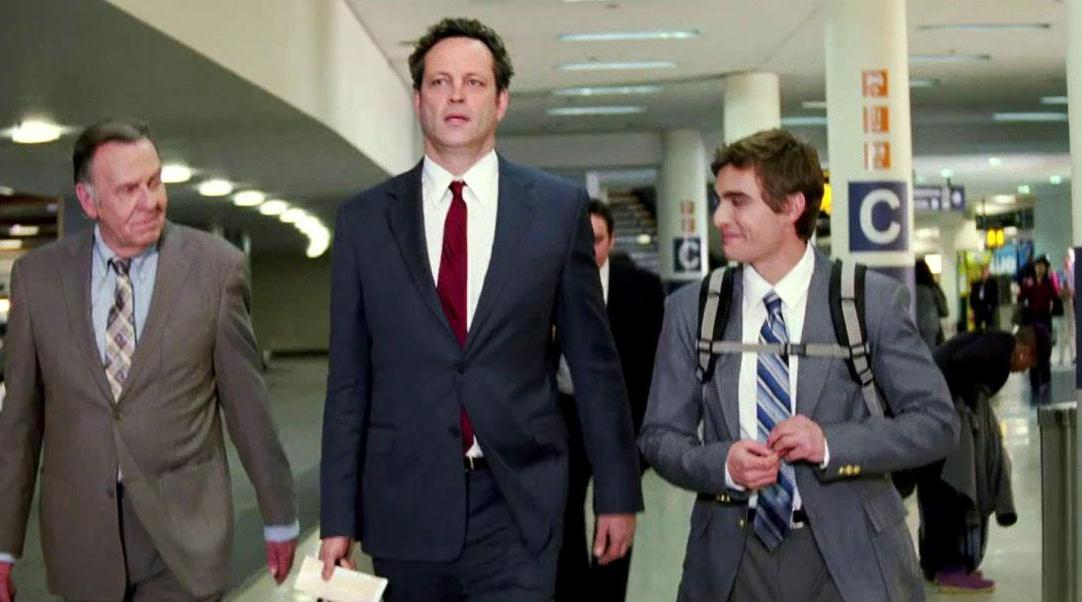
Cast: Vince Vaughn, Tom Wilkinson, Dave Franco, Sienna Miller, Nick Frost, James Marsden, June Diane Raphael, Britton Sear, Ella Anderson, Uwe Ochsenknecht

Rating: 5/10 – Swarf salesman Dan Trunkman (Vaughn) has to overcome all sorts of obstacles to land the contract that will save his fledgling company from going under, including a visit to a Berlin gay bar; a bit of a strange fish, Unfinished Business suffers from being two separate movies joined at the hip: one a raucous comedy, the other a thoughtful study of bullying, but together they don’t make for a cohesive whole, and it’s yet another movie where Vaughn coasts along on former glories.

Unfinished Business

Share this:

  • Share on X (Opens in new window) X
  • Share on Facebook (Opens in new window) Facebook
  • More
  • Print (Opens in new window) Print
  • Email a link to a friend (Opens in new window) Email
Like Loading...

Barely Lethal (2015)

31 Sunday May 2015

Posted by dullwood68 in Movies

≈ Leave a comment

Tags

Agent 83, Drama, Foreign exchange student, Hailee Steinfeld, High School, Homecoming, Jessica Alba, Kyle Newman, Prescott, Review, Romance, Samuel L. Jackson, Teen assassin, Thriller

Barely Lethal

D: Kyle Newman / 96m

Cast: Hailee Steinfeld, Samuel L. Jackson, Sophie Turner, Jessica Alba, Dove Cameron, Toby Sebastian, Thomas Mann, Rachael Harris, Jaime King, Dan Fogler, Steve-O, Gabriel Basso, Rob Huebel, Jason Ian Drucker

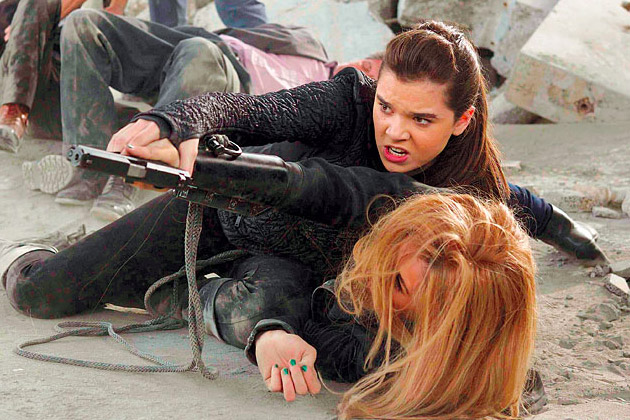
Sixteen year old Agent 83 (Steinfeld) works for a top secret organisation called Prescott that adopts orphaned girls and trains them to be assassins. But she yearns for a more ordinary, regular life, glimpses of which she gets when on her missions. When a plan to capture wanted terrorist Victoria Knox (Alba) leaves Agent 83 missing presumed dead, she takes the opportunity to live a normal life. She changes her name to Megan Walsh, invents a back story for herself and enrols herself in a foreign student exchange programme that sees her living with the Larsons – mum (Harris), daughter Liz (Cameron), and son Parker (Drucker) – and attending high school.

Fitting in, though, proves harder than she’d imagined. Despite doing her research, Megan finds average life more demanding, and confusing, than anything she’s encountered before. With Liz wanting nothing to do with her, and her faux-Canadian background doing her no favours, it’s not until the intervention of high school heart-throb and teen singing sensation Cash Fenton (Sebastian) that Megan begins to be accepted. Megan develops an immediate crush on Cash, but she already has an admirer in tech-geek Roger Marcus (Mann). Having been tricked into applying for the role of football team mascot – and getting it – Megan gains true acceptance when she takes out three would-be kidnappers of the team mascot, a traditional prank foiled by Megan’s “special set of skills”.

The resulting video goes viral and leads to her being found by her instructor at Prescott, Hardman (Jackson). Along with fellow Prescott agent Pedro (Steve-O), Hardman interrogates Megan, believing she’s working for someone else. But when it becomes clear she just wants to lead a normal life, Hardman tells her she only has time to wrap things up before coming back to Prescott. Later, at a party where she’s looking forward to hooking up with Cash, she finds Agent 84 (Turner), aka Heather, in attendance. Annoyed that Hardman would use Heather to keep an eye on her, Megan is further annoyed when Heather makes a play for Cash.

Another meeting with Hardman reveals that Knox has escaped and will no doubt be looking to catch up with Megan and kill her. Despite his offer of protection if she comes back to Prescott, Megan refuses to leave her new home, and begins to take steps to ensure that the Larsons remain safe. And at the upcoming Homecoming dance, she hopes to finally land Cash as her boyfriend, though she has begun to have conflicting feelings for Roger. With all this going on, Megan has to fall back on her training in order to get through it all, and maintain her new lifestyle.

Barely Lethal - scene

The idea of a teen assassin dealing with the pitfalls of high school is one that could have given new meaning to the phrase “mean girls”, but here it’s the starting point for an extremely lightweight, by-the-numbers movie that is pleasantly assembled, but astoundingly hollow at the same time. By bringing in such a talented cast, Barely Lethal (not the best pun for a movie, either), may give the interested viewer the impression that the movie is going to be better than it actually is. But in the hands of director Newman (whose previous feature, Fanboys (2009), was a surprise pleasure) and writer John D’Arco, the movie is one that struggles to maintain an even tone, and squanders many of its chances to layer its basic premise with appropriate levels of irony.

The movie makes no effort to avoid or subvert the standard tropes of high school movies, and instead embraces them wholeheartedly without doing anything new with them. This leaves the movie looking and feeling like any other generic high school movie and even the introduction of Megan and her special skill set doesn’t hamper or redefine it. This level of familiarity works against the movie and though Steinfeld et al. waltz through it all with confidence, for them it must have been like the acting equivalent of treading water. Even Jackson and Alba can’t do much with characters that scream “simple movie stereotype”. With every character and situation proving lacklustre as a result, the movie never really manages to take off and become as enjoyable as it should be.

The humour in the movie is also quite forced, from the youngest Prescott recruits being called “grandma” when their driving skills don’t come up to scratch, to Megan’s first day outfit, to creepy teacher Mr Drumm (Fogler) and his stalking of Cash, to Roger’s even creepier father (Huebel) whose conversation is almost entirely inappropriate – none of it is as funny as it probably seemed at the time of filming, and even with the best efforts of the cast. Newman’s direction doesn’t help either, as each development in the script is allowed to play out with little emphasis on the drama involved, or what reaction it provokes in the characters, and the humour doesn’t leaven things either.

As the girl who’s more comfortable deciphering weapons schematics than the pitfalls of high school life, Steinfeld is an engaging presence but settles for doing just enough to satisfy the demands of the script. The same is true of Turner, who pouts her way through the movie as Megan’s chief rival, and Alba, playing an impression of a caricature of a stereotype as the villainous Knox. Mann emerges relatively unscathed by the experience, and Jackson is predictably hard-nosed (but with a heart of gold), but by and large the performances are as blandly likeable as the material. And the whole thing is rounded off by the kind of soundtrack selections that attempt to mirror the on screen action for emotion but lack any real nuance.

Rating: 4/10 – a missed opportunity, Barely Lethal is so humdrum it should be called Barely Lethargic; with a lack of flair behind the camera allied to a below-par script, the movie sinks under the weight of its own low expectations and despite an opening sequence that passes muster, never amounts to much more than being acceptable.

Share this:

  • Share on X (Opens in new window) X
  • Share on Facebook (Opens in new window) Facebook
  • More
  • Print (Opens in new window) Print
  • Email a link to a friend (Opens in new window) Email
Like Loading...

Mini-Review: Good Kill (2014)

28 Thursday May 2015

Posted by dullwood68 in Movies

≈ 4 Comments

Tags

Air Force, Andrew Niccol, Bruce Greenwood, Drama, Drones, Ethan Hawke, January Jones, Langley, Pilot, Review, Taliban, Terrorism, Thriller, Yemen, Zoë Kravitz

Good Kill

D: Andrew Niccol / 102m

Cast: Ethan Hawke, Bruce Greenwood, Zoë Kravitz, January Jones, Jake Abel, Dylan Kenin, Peter Coyote

With pilots no longer needed to fly as many missions thanks to the US Air Force’s reliance on drones, Major Thomas Egan (Hawke) is stuck in a dead-end post as a drone pilot at a base outside Las Vegas. Under the command of Lt. Colonel Jack Johns (Greenwood), Egan is disillusioned with his new role and wants to get back to real flying. His frustration begins to affect his marriage to Molly (Jones), and he doesn’t socialise much with his colleagues, newbie Airman Vera Suarez (Kravitz), M.I.C. Joseph Zimmer (Abel), and Capt. Ed Christie (Kenin). Targeting confirmed terrorists and Taliban members, Egan kills by remote control, and feels equally as remote from what’s happening thousands of miles away.

His role takes an unexpected turn when his unit is asked to work with the CIA in targeting and killing suspected terrorists and/or sympathisers, or anyone regarded as a potential threat to US security – but in Yemen, a country that the US isn’t at war with. When several drone strikes result in a “double tap” – the subsequent targeting and killing of anyone who goes to the aid of those injured in the first bombing – Egan, appalled by this development, begins to question the Air Force’s role in working with the CIA, and the ethics involved. Unable to influence the CIA’s thinking he attempts to thwart their plans by sabotaging the drone strikes, but when he’s found out it puts his whole future, including his marriage, in jeopardy.

Good Kill - scene

Set in 2010, at the height of the US’s use of drones in Afghanistan and neighbouring countries, Good Kill is another thought-provoking drama from writer/director Niccol. An astute observation of the ways in which technology is making modern warfare a matter of distance rather than engagement, the movie paints a chilling portrait of the callous approach to collateral damage that appears endemic in US thinking. By making Egan an unwitting – and unwilling – victim of abhorrent government policies, the movie concisely and intelligently shows the appalling effect such a responsibility can have on an individual.

Hawke gives one of his best performances outside of the Before… movies, his haunted features capturing the conflict going on inside him with studied precision. As he wrestles with his need to follow orders and his growing sense of outrage and shame at what he’s required to do, Hawke’s portrayal of Egan grounds the movie even further than the verisimilitude achieved by Niccol’s artful script. With great supporting turns from Greenwood and Kravitz, Good Kill tells its story with a great deal of subtlety and understanding of the issues involved. The Las Vegas backdrop serves to heighten the insanity of bombing people based on limited intelligence information, and the movie is immaculately shot by Amir Mokri. Niccol makes only two missteps: the character of Molly Egan, a more casually written role that Jones has trouble fleshing out, and the ending, which is too pat, but these aspects aside, the movie is a solid, engrossing thriller that shines a revealing light on yet another part of US foreign policy that ignores due process.

Rating: 8/10 – yet another contemporary, relevant drama from Niccol, Good Kill shows an unflinching, and uncompromising, approach to the material; with Hawke on top form, the human element is given a better focus than usual, and the movie persuasively challenges the idea that remote killing is less distasteful than killing someone in person.

Share this:

  • Share on X (Opens in new window) X
  • Share on Facebook (Opens in new window) Facebook
  • More
  • Print (Opens in new window) Print
  • Email a link to a friend (Opens in new window) Email
Like Loading...

Like Sunday, Like Rain (2014)

27 Wednesday May 2015

Posted by dullwood68 in Movies

≈ Leave a comment

Tags

Billie Joe Armstrong, Cello player, Child prodigy, Debra Messing, Drama, Frank Whaley, Julian Shatkin, Leighton Meester, Music, Relationships, Review

Like Sunday Like Rain

D: Frank Whaley / 104m

Cast: Leighton Meester, Julian Shatkin, Billie Joe Armstrong, Debra Messing, Olga Merediz, J. Smith-Cameron, James McCaffrey, Sammy Pignalosa

Eleanor (Meester) is a twenty-three year old waitress whose relationship with aspiring musician Dennis (Armstrong) comes to an end when he fails yet again to return home one night from a gig. Reggie (Shatkin) is a twelve year old child prodigy whose advanced intellect keeps him remote from everyone around him. When an argument with Dennis at her place of work leads to Eleanor losing her job, a friend of hers recommends signing up with an agency. When she does she’s told about a job as a nanny that requires a same day start. Interviewed and hired by Reggie’s mother, Barbara (Messing), the job involves making sure Reggie gets to and from school and that he eats while Barbara is away for the next two months.

Eleanor soon finds that Reggie has his own unique way of looking at the world, and her expectations are swept aside as Reggie refuses to go to camp as planned and she begins to get to know someone who believes that “art as a language is dead”. Reggie and Eleanor spend time in the park, watching movies, and eating out, and as time goes by, the two grow closer, while Dennis refuses to accept that his relationship with Eleanor is over. One night though, Eleanor receives a call from her uncle Dale (McCaffrey) telling her that her father is seriously ill in hospital. She tells Reggie that she has to leave for a couple of days, but rather than be left in the care of someone he doesn’t know, Reggie offers to go with her.

They travel to Eleanor’s home town where they receive a less than hospitable welcome from Eleanor’s mother (Smith-Cameron). They switch to a motel where Eleanor reveals that she too has a musical talent (Reggie is a gifted cellist and composer), and that she once got into Juilliard but they couldn’t give her a full scholarship. Reggie decides that he’ll include a part of the cornet (Eleanor’s instrument) in the composition he’s written called Like Sunday, Like Rain. At the hospital, Eleanor learns that no one has been in to see her father; when she goes back home it leads to a row that has her vowing never to return. With her job looking after Reggie coming to an end, and with her bridges burnt at home, Eleanor now has to plan for her immediate future, a future that means leaving Reggie behind…

Like Sunday Like Rain - scene

The fourth feature from writer/director/actor Whaley, Like Sunday, Like Rain is a movie in which not a lot happens in terms of plot or even in dramatic terms, but which explores the dynamics of its central characters’ relationship with a great deal of charm and skill. As Eleanor and Reggie get to know each other – and we get to know them – the emotional differences between them become blurred, and various connections become apparent. It’s a delicate movie in many ways, with Whaley taking the time to explore Eleanor and Reggie’s personalities in deceptively fine detail, and in the process, allowing their eventual bond to become entirely believable.

As a result of ending her relationship with Dennis, Eleanor is both jobless and homeless, and at a crossroads in her life. Thanks to Meester’s intuitive, adept portrayal, Eleanor’s predicament is given a realistically poignant feel further enhanced by the combined expressions of resignation and frustration she evinces. It’s a subtler performance than it seems at first, and Meester shines throughout, building layer upon layer of resilience and determination and allowing Eleanor the opportunity to move forward with her life.

But this is Shatkin’s movie pure and simple, his performance another of those given by a child actor that is so perfectly gauged and delivered it puts most adult actors and actresses to shame (it’s a good job that Meester is a match for him). It’s a showy role – just watch Reggie’s response to his friend Raj’s crossword clue – but Shatkin is more than up to the task, and steals almost every scene he’s in, whether it’s questioning the maid, Esa (Merediz), as to the content of his meals, or quoting the sad fate of the artist Modigliani. Reggie’s over-confidence and child prodigy status hides a deep-rooted vulnerability, and Shatkin is excellent at showing the emotionally scared young boy hidden beneath the academic outer shell. His expression when Eleanor announces she has to leave to visit her father is a perfect display of need and understanding at war with each other.

Alas, where Whaley puts so much time and effort into making Eleanor and Reggie as credible as characters as he possibly can, the same can’t be said for Barbara and Dennis. Barbara is the stereotypical socialite so wrapped up in her own world she can’t be bothered to remember Eleanor’s name two minutes after she’s heard it. It’s a mannered, brittle performance by Messing, and amounts to barely ten minutes of screen time as she’s shuffled off to China to make way for Eleanor and Reggie to begin bonding. As Dennis, a musician with delusions of adequacy, Armstrong is a better singer than he is an actor, and Whaley doesn’t really do anything with the character other than to make him consistently whiny and annoying. Faced with such a limited characterisation, Armstrong doesn’t have the experience to make any more of the role, and consequently he’s the weakest link in the movie.

By concentrating on the subtle and meaningful ways in which two people, despite the gap in their ages and experiences of life, can develop a friendship that’s mutually beneficial and rewarding, Whaley makes Like Sunday, Like Rain a pleasure to watch despite its more dramatic turn when Eleanor goes home. This section of the movie feels a little rushed, as Eleanor’s differences with her family are brought to the fore in what are very broad strokes. But the ending restores the tone and the simplicity of what’s gone before, and the movie, already a pleasure to be a part of, concludes on a perfect note of synchronicity.

Rating: 8/10 – a slow-moving, leisurely paced movie that draws in the viewer and makes them care about its two central characters, Like Sunday, Like Rain is a small-scale movie that can be treasured time and time again; with terrific performances from Meester and Shatkin, and a nuanced script from Whaley, it’s a winning combination that rewards throughout.

Share this:

  • Share on X (Opens in new window) X
  • Share on Facebook (Opens in new window) Facebook
  • More
  • Print (Opens in new window) Print
  • Email a link to a friend (Opens in new window) Email
Like Loading...

Oh! the Horror! – Evangeline (2013) and The Black Dahlia Haunting (2012)

26 Tuesday May 2015

Posted by dullwood68 in Movies

≈ Leave a comment

Tags

1947, Brandon Slagle, Britt Griffith, Devanny Pinn, Drama, Elizabeth Short, Horror, Karen Lam, Kat de Lieva, Los Angeles, Mayumi Yoshida, Murder, Noah Dahl, Possession, Review, Richard Harmon, Serial killer, The Black Dahlia, True crime

Evangeline

D: Karen Lam / 83m

Cast: Kat de Lieva, Richard Harmon, Mayumi Yoshida, David Lewis, Kelvin Redvers, John Shaw, Nelson Leis, Dejan Loyola, Madison Smith, Anthony Shim

College student Evangeline Pullman (de Lieva) – known as Eva – shares a dorm room with fellow student Shannon (Yoshida). When they and another college friend attend a frat party, Eva comes to the attention of frat leader Michael Konner (Harmon). Meanwhile, Mr K (Lewis), a teacher at another school is abducting and murdering teenage girls and dumping their bodies in the nearby forest. One weekend, Eva finds herself alone at the college and runs into Konner. He takes her to his dad’s hunting lodge, where he drugs her. When she wakes, she ends up being chased by Konner and two of his friends (Loyola, Smith). They catch her and after savagely beating her, Eva is strangled and left for dead.

Eva is found by a couple of vagrants living in the forest, Billy (Redvers) and Jim (Shaw). They nurse her back to health, unaware that she is becoming possessed by a forest demon. When she’s threatened by Dee (Leis), another vagrant, she runs off and is picked up by Mr K. He takes her back into the forest, but his attempt to kill Eva leads to the demon taking full control of her and setting her on a course of revenge against Konner and his cronies.

Evangeline - scene

While Evangeline has a few good ideas dotted amongst its more risible moments, and Lam shows a certain amount of visual flair, this particular demonic revenge outing is hamstrung by gaping plot holes, trite dialogue, shallow characterisations, and amongst the supporting cast, some very poor performances. Viewers who are familiar with this type of horror movie will be frustrated by Lam’s decisions as a writer, and further dismayed by the way in which the scenes of Eva’s revenge are marred by a myriad of bizarre editing choices.

There’s an Eighties feel to the movie that leaves the viewer thinking of other, better movies from the period, and the obvious budgetary restraints make it seem as if the bulk of the movie was filmed in a variety of basement rooms. With no one – not even Eva – to sympathise with, the movie has less to offer than most and never really succeeds in getting across the horror of its main character’s troubles. There’s a curiously dispassionate tone used throughout, as if everything is being viewed from a safe distance, even when Eva is in peril or taking her revenge.

Rating: 3/10 – a few inspired moments aside, Evangeline fails to capitalise on its basic premise and takes too many narrative shortcuts in telling its story; with a hint of Japanese folklore to give credibility to the idea of a forest demon, the movie doesn’t make much of this approach either.

Black Dahlia Haunting, The

D: Brandon Slagle / 80m

Cast: Devanny Pinn, Britt Griffith, Noah Dahl, Alexis Iacono, Cleve Hall, Brandon Slagle, Jessica Cameron

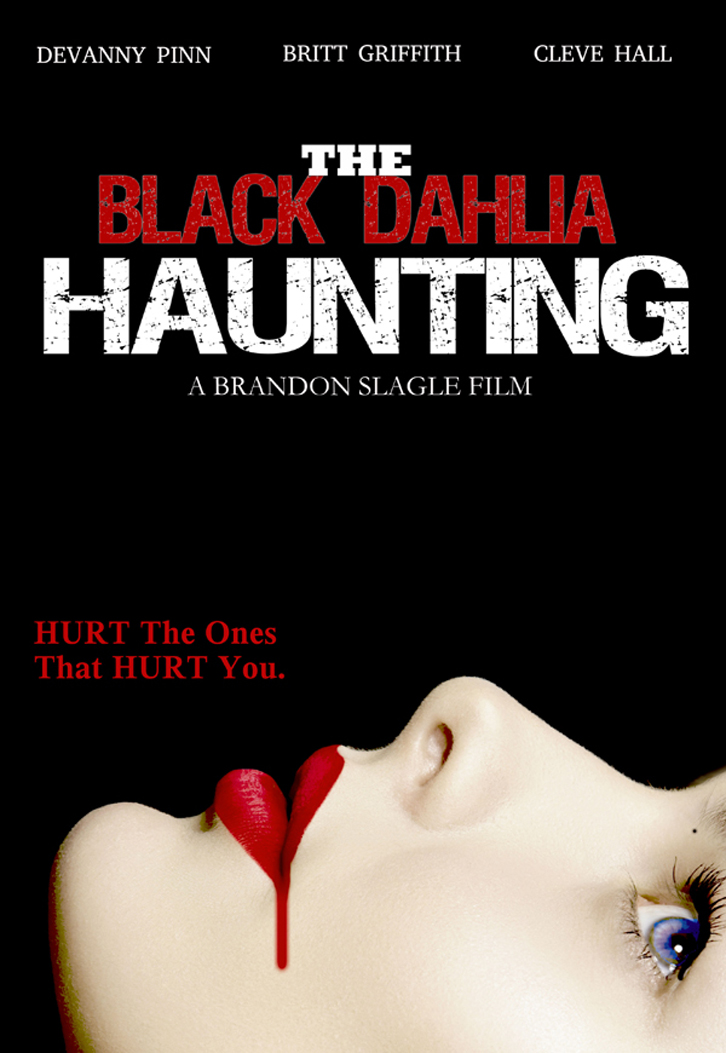
Holly Jenson (Pinn) travels to Los Angeles in the wake of her step-brother, Tyler (Dahl), having killed their father and his mother. What makes the case unusual is that Tyler is blind. Currently under the care and supervision of Dr Brian Owen (Griffith), Tyler also draws pictures of a mysterious woman who Dr Owen recognises as Elizabeth Short, the Black Dahlia murder victim from 1947. Holly has to wait for the DA’s office to allow her to see Tyler, and while she does she finds herself wandering around LA until she loses her way. She asks a woman for directions, but the woman (Iacono) talks inaudibly to herself.

Tyler proves uncooperative and tells Holly to go. At her hotel room she takes a shower and is possessed by the spirit of Elizabeth Short (the woman she saw on the street). Holly is forced to visit a cave in the desert where Elizabeth’s killer (Hall) disposed of her clothes, her blood and the knives he used. Then she visits the home of Dr Owen and waits for him to arrive, now aware – as Tyler is as well – of the connection between the doctor and the Black Dahlia murder over sixty years before.

Black Dahlia Haunting, The - scene

By taking the real life murder of Elizabeth Short as the basis for its plot, The Black Dahlia Haunting makes a poor fist of squeezing out a revenge story, using muddled coincidences and ill thought out connections to shepherd the idea of Short reaching out from beyond the grave and gaining retribution through the murderous actions of two half-siblings. It’s a poor movie that proceeds at a pedestrian pace, features several scenes that don’t advance the plot or add depth to the characters, and feels like a short movie stretched beyond its limits.

It doesn’t help that the performances seem to have been crafted without the benefit of rehearsals, and that some lines of dialogue sound mannered and/or mis-emphasised. Pinn makes Holly unlikeable from the start, while Griffith is such a dull presence it seems as if the scenes he’s in go on far longer than any of the ones he isn’t in. As the vengeful spirit of Elizabeth Short, Iacono has the more varied role, and can be seen in flashbacks to 1947 talking with a young Norma Jean Baker (Cameron), or being tortured by her killer. But ultimately, these don’t add anything to the story, and merely pad out the already short running time. Writer/director Slagle – who gives himself a secondary role as a young man who finds one of the knives the killer used – strives for relevance but misses by a mile, and never overcomes the sheer implausibility of his screenplay.

Rating: 3/10 – a neat premise wasted by poor execution, The Black Dahlia Haunting has little to recommend it beyond its real life basis; anyone with a keen interest in Elizabeth Short and her tragic murder would do well to avoid this completely.

Share this:

  • Share on X (Opens in new window) X
  • Share on Facebook (Opens in new window) Facebook
  • More
  • Print (Opens in new window) Print
  • Email a link to a friend (Opens in new window) Email
Like Loading...

Hartenstraat (2014)

25 Monday May 2015

Posted by dullwood68 in Movies

≈ Leave a comment

Tags

Amsterdam, Bracha van Doesburgh, Comedy, Drama, Father/daughter relationship, Holland, Internet dating, Marwan Kenzari, Relationship Planet, Review, Romance, Sanne Vogel, Swans

Hartenstraat

aka Heart Street

D: Sanne Vogel / 86m

Cast: Marwan Kenzari, Bracha van Doesburgh, Nadia Koetje, Benja Bruijning, Tygo Gernandt, Egbert-Jan Weeber, Sieger Sloot, Susan Visser, Kitty Courbois, Frits Lambrechts, Georgina Verbaan, Gigi Ravelli, Terence Schreurs, Jan Koolijman, Stacey Rookhuizen

Daan (Kenzari) owns a delicatessen in Amsterdam’s Hartenstraat, where he lives with his eight year old daughter, Saar (Koetje). He and Saar’s mother, Inge (Rookhuizen), are divorced, and Saar wishes that Daan could find someone else to marry and be happy again. But Daan is too busy looking after Saar and his business to have time for dating – or so he tells himself. Meanwhile, two doors along, a new fashion shop is opened by Katje (van Doesburgh), a no-nonsense designer who doesn’t suffer fools gladly. When she and Daan first meet it’s not a happy encounter for either of them, and a mutual dislike is born.

To get Daan back into the dating arena, his friend Bas (Gernandt) sets him up on an Internet dating website called Relationship Planet. Soon, Daan is corresponding with several interested women and setting up dates so he can meet them. His luck, however, appears to desert him with every date, as each woman he meets proves undesirable for one reason or another, until he meets Mara (Verbaan). But Mara has her own issues: a lack of anger management, and an overly aggressive approach to sex. When Daan doesn’t want to see her again she makes a scene in the street that is witnessed by Katje.

On the evening of the opening of Katje’s shop she’s surprised to see Daan providing the catering. They spar for the entire evening, but when she learns that he’s using Relationship Planet it sparks her interest. She pretends to be someone else and starts an online relationship with him. At first it’s meant as a joke, a way of amusing herself at Daan’s (unknowing) expense. But as they get to know each other, both begin to fall for the other. And while they continue to have an uneasy relationship offline, Saar has a part in easing the animosity they share when Katje designs a swan dress for her to wear at a national schools talk competition.

Eventually, Katje’s online alter ego plucks up the courage to agree to meet Daan, but when he learns she is the woman he has fallen in love with, he is angry at her duplicity and wants nothing further to do with her. Even when she later apologises to him, he refuses to forgive her. And then Saar goes missing on the morning of the competition…

Hartenstraat - scene

Hartenstraat is a movie that’s all about relationships: broken ones – Daan and Inge; prospective ones – Daan and Mara; unfulfilling ones – Katje and self-absorbed boyfriend Thomas (Bruijning); established ones – gay coffee shop owners Jacob (Sloot) and Rein (Weeber); burgeoning ones – Katje’s mother, Bep (Courbois) and Daan’s elderly friend Aart (Lambrechts); ambivalent ones – Daan and Katje; and anonymous ones – Daan and Katje’s online alter ego. Even Saar has her problems, telling her father she can’t choose between two boys at school. With all these varied relationships taking up so much of the movie’s running time, you could be forgiven that Hartenstraat would be a somewhat overly dramatic feature with maybe some acerbic things to say about the nature of love. But you’d be wrong.

Instead, the movie is an enjoyable, light-hearted look at the trials and tribulations, expectations and disappointments, hopes and fears, associated with contemporary relationships. It makes its points with a great deal of charm and steers away from the kind of plot contrivances that mar many other romantic comedies (even if the outcome is completely predictable from the start). It doesn’t have an axe to grind, it doesn’t outstay its welcome, and it features a clutch of winning performances that are ably directed by Vogel from Judith Goudsmit’s quirky screenplay.

But with all the attendant relationships given sufficient emphasis and focus, it’s still the connection between Daan and Katje that provides the most satisfaction. As played by Kenzari and van Doesburgh, the ways in which the pair spark off each other are delivered with such a sense of mutual fun that it’s hard not to be won over by them both (it helps that there’s a definite chemistry between them). Kenzari is the kind of actor whose soulful expression can speak volumes, while van Doesburgh has a subtle screen presence that the camera picks up on in every scene she’s in. As Daan and Katje circle round their feelings for each other, both actors take the opportunity to make the relationship entirely believable.

They’re supported by a talented cast of character actors led by Gernandt as the borderline obnoxious ladies’ man Bas (aka the Choker), and Verbaan as the hilariously psychotic Mara (who tells Daan at one point he needs “destroying”). Koetje is appropriately winsome as Saar; Weeber and Sloot flesh out Jacob and Rein to the extent that they’re not the stereotypical gay couple they first seem to be; and as Katje’s less than intellectual assistants, Schreurs and Ravelli make for an appealingly funny double act.

Indeed, the movie’s sense of humour is one of its plusses, a lot of it arising from the characters themselves and their personalities, while the dialogue is dotted with moments of genuine wit and some glorious put-downs. Vogel – who also appears as Daan’s first date, Annabel – keeps things from getting too dramatic (which is to the movie’s advantage) and uses this to seduce the viewer into becoming invested in the various relationships and their outcomes. She’s aided by Ezra Reverda’s sterling camerawork, and a clever opening title sequence by Derk Elshof, Benno Nieuwstraten and Sietse van den Broek that features cast and crew names as part of the street’s window displays.

Rating: 8/10 – although there are times when Hartenstraat seems impossibly lightweight and seems to invite ridicule for its approach to its own storyline, nevertheless it’s a carefree, hugely enjoyable piece of “fluff”; full to the brim with moments that bring a smile to the viewer’s face, it’s the very epitome of a pleasant distraction.

Share this:

  • Share on X (Opens in new window) X
  • Share on Facebook (Opens in new window) Facebook
  • More
  • Print (Opens in new window) Print
  • Email a link to a friend (Opens in new window) Email
Like Loading...

The Age of Adaline (2015)

24 Sunday May 2015

Posted by dullwood68 in Movies

≈ Leave a comment

Tags

29 years old, Adaline Bowman, Aging, Blake Lively, Drama, Fantasy, Harrison Ford, History, Lee Toland Krieger, Lightning, Michiel Huisman, Review, Romance, Romantic drama, Snowstorm

Age of Adaline, The

D: Lee Toland Krieger / 107m

Cast: Blake Lively, Michiel Huisman, Harrison Ford, Ellen Burstyn, Kathy Baker, Amanda Crew, Linda Boyd, Hugh Ross, Anthony Ingruber

On New Year’s Eve 2014, Jennifer Larson (Lively) purchases a set of fake I.D.’s before heading off to work at a library’s archive office. There she’s given a collection of old newsreels that need to be digitised. She begins viewing them, and as the footage unfolds, Jennifer remembers her life, one that began on New Year’s Day 1908 when she was born Adaline Bowman. She remembers getting married and having a child, and then her husband dying. And she remembers the fateful trip that saw her spin off the road during a freak snowstorm and plunge into a freezing river – where she died – and the lightning strike that struck her and revived her, causing her to remain twenty-nine from that day onward.

That night she attends a New Year’s Eve party, where she attracts the attention of a handsome man called Ellis (Huisman), who shares an elevator ride with her; she rebuffs his advances. But she is surprised to find him turn off at her office the next day in the guise of a generous benefactor. He asks her out on a date, which she refuses. In retaliation Ellis tells her he’ll withdraw his donation if she doesn’t. This time she agrees and he manages to convince her to see him again; when she does she stays over at his apartment. Afterwards, and despite Ellis’s best intentions, she avoids his calls and is cold to him when they meet in the street.

Eventually, Jennifer relents and agrees to see him again. When they do he asks her to come with him for the weekend to help celebrate his parents’ fortieth wedding anniversary. When they arrive, Ellis’s father, William (Ford) is shocked by her resemblance to a woman he met in England in the Sixties, a woman he knew as Adaline Bowman. Jennifer pretends that Adaline was her mother. William is unable to get over how much she looks like the woman he knew, but everyone else accepts the coincidence. The next day, Jennifer and William are talking when he notices a scar on her left hand that matches one Adaline had, and which was caused while they were hiking together. He confronts her, but even though he does his best to reassure her, she leaves as quickly as she can. A lifetime of hiding her real identity has left Adaline constantly fearful of exposure, and so she aims to disappear yet again, using the fake I.D.’s she’s recently purchased. But as she heads back to her home, and with Ellis chasing after her, another freak bout of snow starts to fall…

Age of Adaline, The - scene

At the New Year’s Eve party, a young man tries out an old pick-up line on Adaline. When he realises she’s heard it before, she confirms it by saying “Just once, from a Bing Crosby … type.” It’s one of those offhand, slightly clever moments you’d expect from a movie that features a character who’s been around for over a century, but thankfully it’s the only example the movie trots out, settling instead for Adaline being incredibly knowledgeable about world events (and picking up the odd extra language). It’s a restrained approach to material that could have focused more on past events than the modern day romance that rightly takes centre stage.

With Adaline’s past consigned to occasional, yet relevant, flashbacks, and with a narrator (Ross) to act as our guide at equally relevant moments, The Age of Adaline is a romantic drama that grounds its fantasy elements in the everyday and the banal: Adaline keeps a succession of King Charles Spaniels; she works in a library; she worries about her daughter, Flemming (Burstyn), now an old woman considering moving into a retirement community. It’s the attempts Adaline makes to live a normal, ordinary life that makes the movie so easy to believe in, and with Lively’s wonderful performance to back it all up, her predicament so credible.

Which makes the central romance all the more disappointing, as Huisman’s so-good-he-can’t-be-real Ellis is such a perfect partner that aside from Adaline’s initial reservations about seeing him, there’s no drama involved at all. It takes Adaline’s past coming back to haunt her to provide any real drama and that doesn’t arrive until over an hour has passed. Until then it’s all build up, and a fairly pedestrian, nearly superficial build up at that. Thank goodness for Lively, who elevates the material by emphasising the tragedy of Adaline’s life, often just by looking pensive and lonely. There’s a depth of feeling in Lively’s eyes during these moments that helps immensely, and leaves Huisman’s easy smile and carefree physicality looking as if the actor is barely trying. It’s Lively’s movie from start to finish, and the actress takes every opportunity to stamp her authority on the role.

She’s matched by Ford who turns in his best performance in years, the moments when William is remembering Adaline and the time they spent together, showing the character’s vulnerability and emotional honesty in a way that is entirely realistic. The scene where William confronts Adaline is a small master class in screen acting. In support, Burstyn does well as Adaline’s daughter but is required to be too wise on too many occasions for comfort, and Baker is left with the unenviable task of making William’s wife (also Kathy) more than an add-on.

But while the supporting characters pale against the attention given to Adaline, the script by J. Mills Goodloe and Salvador Paskowitz, is never less than absorbing, and keeps the viewer interested, even during those repetitive early scenes where Adaline keeps rejecting Ellis over and over. It scores highly when examining themes of love and loss and sacrifice, and maintains an impassioned tone throughout. Krieger directs with a confidence and a firm control of the material that benefits the more fantastical elements, and evokes a strong sense of time and place in the flashback scenes. He’s aided by often evocative cinematography by David Lanzenberg, laudable costume designs for Adaline through the decades by Angus Strathie, and fluid, assured editing by Melissa Kent. All go together to make the movie a rich, rewarding experience, and one of the finest romantic dramas of recent years.

Rating: 8/10 – an intriguing premise given a stronger outing than expected, The Age of Adaline is a worthy throwback to the “women’s pictures” of the Thirties and Forties but with an appropriately modern sheen; with a superb performance from Lively, this is a movie that, thankfully, has more to it than meets the eye.

Share this:

  • Share on X (Opens in new window) X
  • Share on Facebook (Opens in new window) Facebook
  • More
  • Print (Opens in new window) Print
  • Email a link to a friend (Opens in new window) Email
Like Loading...

Tomorrowland: A World Beyond (2015)

23 Saturday May 2015

Posted by dullwood68 in Movies

≈ 1 Comment

Tags

1964 World's Fair, Brad Bird, Britt Robertson, Drama, End of the world, Fantasy, George Clooney, Hugh Laurie, Jet pack, Pin, Raffey Cassidy, Review, Sci-fi, Tomorrowland

Tomorrowland

aka Tomorrowland

D: Brad Bird / 130m

Cast: George Clooney, Hugh Laurie, Britt Robertson, Raffey Cassidy, Tim McGraw, Kathryn Hahn, Keegan-Michael Key, Thomas Robinson, Pierce Gagnon, Matthew MacCaull

At the 1964 World’s Fair, a boy named Frank Walker (Robinson) takes his latest invention, a jet pack, to the science tent in the hopes of winning a $50 prize. But as his jet pack doesn’t actually work properly, the presiding judge, David Nix (Laurie), tells him to come back when it does. As he leaves he’s approached by a young girl called Athena (Cassidy), who gives him a pin with a bright blue T on it, and tells him to follow her when she gets on one of the rides. When he does he finds himself transported to a strange futuristic world where there are tall, shining buildings, trains and vehicles that travel on air, and a launch site for spaceships. There, his jet pack is adjusted to work properly and he’s accepted as a member of Tomorrowland, a world where the brightest and the best – the geniuses of Earth – have gone to create a utopian world devoid of war, social inequality, famine, natural disasters and greed.

Fifty years later, teenager Casey Newton (Robertson) lives near Cape Canaveral with her dad, Eddie (McGraw), and younger brother Nate (Gagnon). Eddie is an engineer working for NASA, and helping to dismantle the nearby Apollo launch site. Casey “knows how things work”, but is using her skills to delay the site’s demolition. When she’s caught and arrested, she finds a pin with a bright blue T on it in amongst her belongings when she’s released. She touches it and is immediately transported to a wheat field where, in the distance, is a city of tall gleaming spires. She drops the pin and is back in her own world. Unable to convince her father that the pin is special, she looks for information about it online, and learns that there is a store in Texas that will buy them.

She travels there but the store owners, Ursula (Hahn) and Hugo (Key), try to take the pin from her by force. Casey is rescued by Athena, who doesn’t look a day older than when she met Frank. Athena explains a little about Tomorrowland but not enough to fully satisfy Casey’s questions. They travel to a remote farmhouse where Casey is left to meet the owner, a now older Frank Walker (Clooney). When agents from Tomorrowland arrive and try to abduct Casey, Frank and Casey manage to escape, and both are reunited with Athena. From there they head for Paris and the Eiffel Tower, which, aside from being a national monument, is also the launch site for a hidden rocket ship. The ship takes them to Tomorrowland, but when they arrive, the trio find it in ruins, and Nix in charge of everything. And it becomes very clear that our world is on the brink of complete destruction, unless Casey can “fix” it, something that Nix doesn’t want her to do…

Disney's TOMORROWLAND..Casey (Britt Robertson) ..Ph: Film Frame..©Disney 2015

The movie that Bird passed on directing Star Wars Episode VII for, Tomorrowland: A World Beyond arrives with no small amount of hype attached to it, and an appropriately high level of anticipation. And up until we meet Casey it’s exactly the movie we’ve been expecting: a richly detailed, nostalgic look back at a time when the future seemed brighter than ever, and technological miracles were being produced that were poised to make our lives all the better. There’s a wistfulness about these early scenes, and a joy in the discovery of Tomorrowland that is infectious and intoxicating, and Bird and his co-writer Damon Lindelof give us an unforgettable introduction to the unforgettable world they’ve created.

And then it all goes horribly wrong. In placing our world in peril, but with the solution located in Tomorrowland, Bird and Lindelof have managed to come up with one of the murkiest, most unconvincing – or clearly explained – storylines in recent years. So much happens that doesn’t make sense, and so much happens that isn’t followed through, that the movie becomes unwieldy and bogged down by too many scenes that fail to advance the plot or deepen the characters. It’s like being given a box of assorted chocolates, only to find that they all have the same centre. For a movie that touches on so many different aspects and themes – nostalgia, individualism, collectivism, fate, unfulfilled love, the benefits of technology, looking to the future, nihilism, hope, manifest destiny – it develops not into a thrilling adventure that matches the joie de vivre of its opening section, but a tired, downbeat, dystopian odyssey that squeezes the life out of its characters and its plot.

What this leads to is an impending worldwide catastrophe that you just can’t care about, and if filmmakers of the calibre of Bird and Clooney can’t make an audience care about the end of the world then there’s definitely something wrong (although, ironically, the idea fits neatly with Nix’s disparaging remarks about everyone else on Earth). It’s as if the initial idea was settled on, but fleshing it out proved too difficult, so any way the story could be continued was seized upon and no further development took place. There’s no tension, an abstract sense of impending doom, and too much reliance on Athena to bail out Frank and Casey when they get in trouble.

The cast struggle gamely with characters who lack shading and depth, though Cassidy is a minor revelation as Athena, her poise and command of her dialogue helping her performance immeasurably (and showing the others how it should be done). Hahn and Key provide some much needed respite (though too early on) from the drudgery, and Robinson is so cute he shouldn’t be allowed. But it’s still not enough to offset the awkward miscalculations made by Messrs. Bird and Lindelof, and the strangely disaffected tone the movie adopts when it returns to Tomorrowland. However, the movie does have a wonderful sheen to it, Claudio Miranda’s cinematography proving an exquisite treat, his mix of light and colour at the World’s Fair being particularly gratifying. If only as much attention had gone into the script.

Rating: 5/10 – with just enough on display to keep it from being a complete disappointment, Tomorrowland: A World Beyond starts out fresh and engaging and ends like a lame athlete finally crossing the finishing line; Bird directs as if he were absent from the set, and it all has the air of a movie that “will just do for now”.

Share this:

  • Share on X (Opens in new window) X
  • Share on Facebook (Opens in new window) Facebook
  • More
  • Print (Opens in new window) Print
  • Email a link to a friend (Opens in new window) Email
Like Loading...

Home (2015)

22 Friday May 2015

Posted by dullwood68 in Movies

≈ Leave a comment

Tags

Adam Rex, Animation, Boov, Comedy, Drama, Dreamworks, Gorg, Invasion, Jennifer Lopez, Jim Parsons, Literary adaptation, Review, Rihanna, Sci-fi, Steve Martin, The True Meaning of Smekday, Tim Johnson

Home

D: Tim Johnson / 94m

Cast: Jim Parsons, Rihanna, Steve Martin, Jennifer Lopez, Matt Jones, Brian Stepanek

Fleeing from their sworn enemy the Gorg, the Boov race – led by Captain Smek (Martin) – arrive on Earth and begin to colonise it, sequestering the human population in various locations around the globe. The Boov are otherwise a peaceful race, and believe they are doing Earth a favour by inhabiting it. One of them, Oh (Parsons), decides to invite everyone to a party at his apartment, but when he sends out his electronic invitation he doesn’t realise that it will be picked up by the Gorg as well. When Captain Smek learns of this, Oh is forced to go on the run.

In a convenience store, Oh runs into Tip (Rihanna) and her cat Pig. Tip is on her own after her mother, Lucy (Lopez), was taken away. She hates the Boov, but when Oh transforms her mother’s car into one that can fly, and he agrees to help her find her mother, she lets him come with her. They fly to Paris to the Boov Command Centre where they learn that Lucy is in Australia. Evading the Boov, they then find themselves under attack from a Gorg ship. They manage to bring it down but their car is damaged in the process. The Gorg ship proves to be a drone, and Oh is able to use a chip from it to get their car going again.

Once in Australia, Tip and Oh discover that the Boov are evacuating to their mothership. Tip wants to find her mother but Oh insists they leave with the rest of the Boov before the Gorg destroy them all. Tip refuses and continues her search for Lucy, while Oh begins to realise that he has to do something to stop the Gorg from killing everyone, Boov and human alike. On the Boov mothership he uses the chip from the drone to place their mothership at a distance from the newly arrived Gorg mothership. This leads to Captain Smek being dismissed from his position as Boov leader, and the honour is given to Oh.

Tip and Lucy are finally reunited, but there’s still the problem of the Gorg mothership which has entered Earth’s atmosphere and is preparing to land outside the Australian camp. Oh has only a short time to find a solution that will save them all, but he finds the answer in the most unlikeliest of places…

Home - scene

Now fully committed to making computer animated movies – their last traditional animated movie was Sinbad: Legend of the Seven Seas (2003) – Dreamworks now finds itself, perhaps like Pixar, in a very strange position. Each animated movie it releases comes under a great deal of scrutiny, and Home is no different, with the movie being accused of failing to live up to the standards set by the likes of How to Train Your Dragon (2010) or Kung Fu Panda (2008). It’s an invidious position to be in, and in the case of Home, more than a little unfair.

Certainly, the movie’s message that we’re all the same under the skin (even if it is purple) is a well-worn theme in cinema, but here it’s not as hammered home as some other movies, and it’s approach to racial diversity – Tip is the first non-Caucasian lead in an animated movie – as well as its integration of the Boov, who adopt most human lifestyles, is all cleverly done. If it all seems predictable and safe, then that’s because it is. There’s nothing inherently wrong with that though, because the movie does it all with a tremendous amount of verve and eye-popping visual splendour, and is consistently funny throughout, thanks to Tom J. Astle and Matt Ember’s astute adaptation of Adam Rex’s kid-lit novel The True Meaning of Smekday.

Fizzing with a day-glo colour scheme that makes almost every scene glisten and zing, Home creates one of the sweetest on screen relationships seen for some time, as Oh and Tip become friends and realise how strong their bond is. Parsons is excellent as Oh, his vocal tics and mannerisms – some lifted, admittedly, from The Big Bang Theory – a perfect match for the continually puzzled yet curious little Boov, and Rihanna is just as effective as Tip, matching her co-star for emotional expression and displaying a range that may come as a surprise to some viewers. Martin almost steals the show with his turn as the cowardly Captain Smek, the character’s pompous vanity perfectly expressed in every scene he’s in, and while it may not be the most layered performance, it doesn’t have to be. With less screen time, Lopez doesn’t quite register as strongly as Lucy, but again, the relationship between Tip and Oh is the main focus, and not Tip and her mother.

Ably directed by Johnson, Home sets out its stall quickly and efficiently and provides enough entertainment for adults and kids alike. It isn’t a serious movie by any standard, and relies on the charm of its lead characters for most of its running time, but Oh and Tip are delightfully animated and voiced, and make for a great screen partnership. The Boov are a delight as well, the way their bodies change shade or colour depending on how they feel being one of the movie’s small pleasures. The movie doesn’t try too hard and does a lot with its small-scale story and plot, and proves endlessly visually inventive. It’s a fun, popcorn movie, the kind of animated distraction we could all use from time to time… and what’s wrong with that?

Rating: 8/10 – with a bucket load of charm and a refreshingly straightforward approach to its storyline, Home is a movie that rewards the viewer from start to finish; fun with a capital F and proof it were needed that Dreamworks is still making good choices when it comes to its animated movies.

Share this:

  • Share on X (Opens in new window) X
  • Share on Facebook (Opens in new window) Facebook
  • More
  • Print (Opens in new window) Print
  • Email a link to a friend (Opens in new window) Email
Like Loading...

Pound of Flesh (2015)

21 Thursday May 2015

Posted by dullwood68 in Movies

≈ Leave a comment

Tags

Action, Aki Aleong, Charlotte Peters, Darren Shahlevi, Drama, Ernie Barbarash, Jean-Claude Van Damme, John Ralston, Kidney transplant, Manila, Philippines, Review, Stolen kidney, Thriller

Pound of Flesh

D: Ernie Barbarash / 105m

Cast: Jean-Claude Van Damme, John Ralston, Aki Aleong (as Leonard Gonzales), Charlotte Peters, Darren Shahlevi, David P. Booth, Adele Baughan

While visiting Manila, kidnap and rescue expert Deacon Lyle (Van Damme) wakes up in his hotel room in a bath full of ice water and his right kidney missing. From hazy memories of the night before, Deacon remembers rescuing a woman (Peters) from her abusive boyfriend (Shahlevi) and her coming back to his room. He calls an old friend, Kung (Aleong) for help, and though Kung brings morphine, he also brings a warning: for Deacon to let it go. But he can’t, and the reason is made clear with the arrival of his brother, George (Ralston); George’s daughter needs a kidney transplant and in two days Deacon was going to be the donor.

Deacon goes to the bar where he and the woman went for a drink. A barmaid there reveals that the woman’s name is Ana Riley and the man who was abusing her is called Drake, and that they can be found at Gratis, an underground fight club. Using his contacts, Kung finds out where the club is being held that night. There Deacon finds Ana. She tells him that Drake paid her to be with Deacon and that it was a one time deal. Drake arrives and there is a shootout, but Drake gets away. Regrouping, Deacon, George, Ana and Kung go to George’s summer home. There it’s revealed that Deacon is really the father of George’s daughter; they also work out that whoever wants Deacon’s kidney must be on the donor register.

With the help of one of George’s ex-students, they discover the intended recipient is an Englishman, Simon Rants (Booth), with ties to an organisation that provides security via contracted mercenaries. Deacon decides to launch a one-man assault on Rants’s home. When his plan begins to backfire, George goes in as well, but what they eventually find changes all their preconceptions.

Pound of Flesh - scene

As a member of that illustrious group, the Lesser-Spotted Eighties Action Stars, Jean-Claude Van Damme is still busy churning out low-budget action flicks that bypass cinemas and head straight for DVD. Devised to be filmed in far-flung corners of the globe, and with minimal attempts at providing either a decent plot or characterisation, these movies focus on the requisite number of action or fight scenes and build to a predictable showdown between the hero and the villain. In some ways they’re the action movie equivalent of comfort food.

But sometimes comfort food isn’t enough by itself, and so it proves with Pound of Flesh, an action movie that tries to include concepts of fatalism, guilt, and religious ambivalence in an attempt to beef up the rather pedestrian plot. As an attempt at adding depth to an otherwise solidly underwhelming script it’s not such a bad idea, it’s just that it’s all handled so badly. You know these concepts are only there to fill in the downtime between fight scenes when one of the characters abandons his up-til-then deeply held beliefs, as George does here, going from guilt-ridden pacifist to gun-toting vigilante at the drop of a hat. (It doesn’t help that Ralston can’t quite carry it off.)

The script, by Joshua James, lets itself down in other ways. The most obvious is in the way it asks the viewer to suspend all disbelief as Deacon takes part in fight after fight so soon after losing his kidney. Deacon gets punched, kicked, thrown about, flash-bombed, stabbed, and aside from the odd look of discomfort, shrugs it off with the pithy comment, “I crossed the Afghan desert on two broken legs. So, this is nothing.” It’s the kind of witless macho posturing that should be ironic now, but instead it’s laughable, and the high point of the movie’s few attempts at humour (though it probably wasn’t meant that way). The script also asks us to accept that Drake (and we have to assume this) would go to all the trouble of going to George’s summer home and rigging the fridge with a grenade, so that whoever opens it next gets blown up. As that could be anyone, at any time, it’s an incredibly stupid “surprise” moment, and reinforces the idea that scripts for low budget action movies rarely reach a second draft.

Doing his best to make it work, Van Damme plays it straight but it all requires too much work, even for him, to bring it up to par. It’s a shame that his career seems to have stalled again in the direct-to-DVD arena after his “breakout” turn as himself in JCVD (2008). That movie showed a multi-faceted Van Damme, and a level of acting ability we hadn’t seen before, but he doesn’t seem to have capitalised on that at all. So now we still have him making the same moves he always makes: the high kicks, the splits, etc. And he looks so tired. He’ll be fifty-five this year, but he looks much older, much more worn down, and while this fits the character quite well given that he’s had a kidney removed, it does give rise to the possibility that Van Damme is tired himself of always being the action hero (maybe).

The rest of the cast provide varying turns, with Ralston overdoing the whole “God is good” angle, while Peters – who from certain angles resembles a thinner Rachel Weisz – makes her feature debut and seems to keep herself at a distance, as if she’s realised early on that this isn’t going to be the springboard for her career she was hoping for. Aleong is underused, and when he is on screen, is either asking for money, or bemoaning his character’s lack of influence, but always as the wise Oriental who meditates on the vagaries of life. As the main villain of the piece, Shahlavi – who sadly passed away in January this year – is as memorable as any other of Van Damme’s adversaries over the years, but does look fetching in mercenary black.

Barbarash is an old hand at this, having worked with Van Damme twice before, but he doesn’t bring anything new to the table, and several of the fight scenes suffer from having the camera in the wrong place, as well as being poorly cut together. China stands in for Manila (obvious from all the street signs), and overall, the whole thing has the air of a contractual obligation.

Rating: 3/10 – another depressing entry in Van Damme’s filmography, Pound of Flesh has all the hallmarks of a leftover script dusted off to meet its star’s requirements; with only a minimum of effort all round, it could almost be the cinematic description of “lacklustre”.

Share this:

  • Share on X (Opens in new window) X
  • Share on Facebook (Opens in new window) Facebook
  • More
  • Print (Opens in new window) Print
  • Email a link to a friend (Opens in new window) Email
Like Loading...

Welcome to Me (2014)

19 Tuesday May 2015

Posted by dullwood68 in Movies

≈ 1 Comment

Tags

$86m, Borderline Personality Disorder, Comedy, Drama, James Marsden, Joan Cusack, Kristen Wiig, Linda Cardellini, Lottery win, Mental health, Review, Shira Piven, Swan boat, Tim Robbins, TV show, Wes Bentley

Welcome to Me

D: Shira Piven / 105m

Cast: Kristen Wiig, Wes Bentley, Linda Cardellini, Joan Cusack, Loretta Devine, Jennifer Jason Leigh, Thomas Mann, James Marsden, Tim Robbins, Alan Tudyk

Alice Klieg (Wiig) suffers from borderline personality disorder and lives off of benefits. She doesn’t have a job, but she is on medication and she sees a psychiatrist, Dr Daryl Moffet (Robbins). She plays the California state lottery each week; when she wins $86 million, Alice decides she wants to regain the life she had before she was diagnosed. She stops taking her medication and tells Dr Moffet that she no longer wishes to see him. She also moves out of her apartment and goes to stay in a casino hotel.

An avid TV watcher, Alice becomes enamoured of a show hosted by Gabe Ruskin (Bentley). She is in the audience one day when a volunteer is needed; Alice rushes to the stage. What follows attracts the attention of Gabe’s brother, Rich (Marsden), his producer and with Gabe co-owner of the production company that airs the show. Alice takes the opportunity to request a show of her own that she wants to call Welcome to Me. When she pays for a hundred two-hour shows upfront, Rich agrees to her suggestion – though the rest of the production team aren’t so sold on the idea. The first show airs and is a disaster, but instead of being put off, Alice invests more money into the show, thus making it look more professional.

She and Gabe begin a relationship, and the show slowly gains in popularity thanks to Alice’s confessional approach to the show’s content, and re-enactments of key scenes from her past. However, as she becomes more and more fixated on the show, her family and her closest friend, Gina (Cardellini) are largely forgotten about. She has a brief fling with a college reporter (Mann); when Gabe learns about it on one of Alice’s shows he’s visibly upset and angry. And when Alice accidentally spills hot chili on herself, burning her chest and upper arms, he reassessment of what the show needs leads to her carrying out live neutering of dogs and cats.

Things come to a head when Gabe quits and Rich learns that, thanks to Alice’s slanderous statements about people on her show, the company is facing a number of lawsuits. Rich confronts Alice live on air and tells her she needs to change her ideas about the show and fast. This causes Alice to halt the show and return to the casino hotel where in the days that follow she suffers a nervous breakdown. While she’s in hospital – and back on her medication – Alice begins to think of a way in which she can make it up to all the people she’s let down.

Welcome to Me - scene

Treading a very fine line between being sympathetic (mostly) and exploitative (occasionally), Welcome to Me is an odd movie that appears to go to some lengths to make its audience uncomfortable while watching it. We’ve had movies that feature characters with mental health problems many, many, many times before, but none that have placed them in a world where their private fantasies have been given such a free rein, and so easily.

The problem with the movie’s treatment of Alice is that it wants you to believe that she has a plan when in fact she really doesn’t. It also wants you to believe that a television production company would let Alice on the air without first vetting her and putting any relevant checks and balances in place. This isn’t public service broadcasting, and the speed and the convenience of Alice’s show hitting the airwaves (and making it onto the ratings) makes for an unconvincing development. And it’s during these segments that it becomes clear the script – by Eliot Laurence – doesn’t really know what to do with Alice, or how to explore the traumatic experiences that have triggered Alice’s disorder.

It’s a shame as it takes the edge off of Wiig’s inspired performance – possibly her best to date – and saddles the movie with several tiresome stretches that fail to engage as effectively as when the action happens away from the studio. Laurence and director Piven (sister of Jeremy, and wife of co-producer Adam McKay) invest a lot of time and effort in making Alice such a credible, fully believable character, and then place her in a milieu that doesn’t even bother to reflect on the vagaries of being a celebrity with mental health problems. It does touch on the way in which fame can isolate celebrities from the “normal” people around them, but in Alice’s case she’s already isolated, so where is the drama? And it doesn’t help that the characters surrounding Alice aren’t as sufficiently well drawn as she is, leaving cast members such as Marsden and Bentley struggling to make much of an impact (Marsden is particularly ill-served).

With all the focus and attention going on Alice, it’s to Wiig’s credit that she inhabits the role so completely and confidently that she carries the movie effortlessly, making up for the shortfall elsewhere. In fact, it’s such a strong, emotive performance that the movie loses its footing on the rare occasions she’s not on screen. Emotionally adrift yet  bound up in her own unresolved feelings of anger and rejection, Alice is a role that suits Wiig’s ability to “blank face” to a tee; you can see Alice looking out at you and seeing right through you at the same time.

Elsewhere, Clayton Hartley’s production design (reflecting the chaotic nature of Alice’s mind at home and in the studio), and David Robbins’ score (providing clever emotional cues for Alice’s behaviour) work to the movie’s advantage, while the script’s attempts at quirky, indie sensibility humour work with more of a success rate than the drama does.

Rating: 6/10 – a decent idea but lacking a through follow through, Welcome to Me ultimately has little to say about mental illness or the perils of being a modern day celebrity; relenting when it should be biting, this is saved (constantly) by Wiig’s ambitious and exhilarating performance.

Share this:

  • Share on X (Opens in new window) X
  • Share on Facebook (Opens in new window) Facebook
  • More
  • Print (Opens in new window) Print
  • Email a link to a friend (Opens in new window) Email
Like Loading...

Mini-Review: Mad Max: Fury Road (2015)

18 Monday May 2015

Posted by dullwood68 in Movies

≈ 2 Comments

Tags

Action, Australia, Charlize Theron, Chase, Drama, George Miller, Hugh Keays-Byrne, Immortan Joe, Imperator Furiosa, Max Rockatansky, Nicholas Hoult, Nux, Review, Sequel, Thriller, Tom Hardy, Water

Mad Max Fury Road

D: George Miller / 120m

Cast: Tom Hardy, Charlize Theron, Nicholas Hoult, Hugh Keays-Byrne, Josh Helman, Nathan Jones, Zoë Kravitz, Rosie Huntington-Whiteley, Riley Keough, Abbey Lee, Courtney Eaton, John Howard, Richard Carter

Captured by men under the command of Outback warlord Immortan Joe (Keays-Byrne), Max Rockatansky (Hardy) is held prisoner in the Citadel, Joe’s fortress hideout. When one of Joe’s lieutenants, Imperator Furiosa (Theron), helps five of Joe’s “brides” escape, Joe sends everyone after her, including Nux (Hoult), a war boy with little experience and who’s been given Max as a “blood bag”. Forced to take Max with him in the pursuit, Nux catches up to Furiosa, who is driving a large petrol tanker. He and some of the other war boys attempt to stop Furiosa, but are unsuccessful. And in the melee, Max – who was chained to the front of Nux’s vehicle – frees himself and joins the fleeing women.

Quickly earning their trust, and still being pursued by Immortan Joe, Max learns that they are heading for the “Green Place”, where Furiosa was born; there they will be safe and able to live freely. Joe succeeds in catching up to them and in their efforts to elude him, one of the brides is killed. They manage to get away from him and further along the way, they meet up with a band of women called the Vuvalini. The women plan to carry on across a vast salt flat but with no guarantee that they’ll reach the other side alive. Instead, Max convinces them to go back the way they came, through Joe’s forces, and take the Citadel from him while it’s undefended.

Mad Max Fury Road - scene

Let’s get the superlatives out of the way, shall we? Thrilling, exciting, stirring, incredible, jaw-dropping, amazing, breathtaking, magnificent, gripping, mind-blowing, superb… the list goes on and on. Thirty years on from the frankly disappointing Mad Max: Beyond Thunderdome (1985), George Miller has returned to the barren future world inhabited by Max Rockatansky, and he’s come up with one of the best action movies you’ll see for some time to come. Mad Max: Fury Road is simply stunning, from John Seale’s exquisite cinematography, to Jason Ballantine and Margaret Sixel’s impressive editing techniques, to Jenny Beavan’s wonderfully expressive costume design, the movie has all this and more going for it, and in a year with so many action thrillers coming our way, will prove very hard to beat.

It’s a major triumph for Miller, hewing to a simple formula: don’t let up on the pace and don’t let up on the mayhem. There are some astonishing stunts performed in this movie, and they leave the viewer open mouthed in admiration for the various stunt teams who put all this together, and also for the sensational vehicles that have been designed and created (and endlessly destroyed). The cast are impressive as well, and if Theron steals the movie it’s mainly because Miller has amped up Max’s taciturn nature and made him more of a physical presence than an intellectual one. But everyone’s a winner, not least the audience, and this is one movie that deserves every plaudit coming its way.

Rating: 9/10 – with not an animated penguin in sight, George Miller returns to doing what he’s always done best: providing the kind of over-the-top, automobile anarchy that has the viewer watching with undisguised awe; filmed with undeniable passion – and with a lovely nod to Peter Weir’s The Cars That Ate Paris (1974) – Mad Max: Fury Road is a cause for joy and exultation, and is possibly the only time a fourth movie in a franchise has proven to be the best of the series.

Share this:

  • Share on X (Opens in new window) X
  • Share on Facebook (Opens in new window) Facebook
  • More
  • Print (Opens in new window) Print
  • Email a link to a friend (Opens in new window) Email
Like Loading...

Slow West (2015)

17 Sunday May 2015

Posted by dullwood68 in Movies

≈ Leave a comment

Tags

Action, American Mid-West, Ben Mendelsohn, Bounty hunters, Drama, John Maclean, Kodi Smit-McPhee, Michael Fassbender, Review, Reward, Western

Slow West

D: John Maclean / 84m

Cast: Kodi Smit-McPhee, Michael Fassbender, Ben Mendelsohn, Caren Pistorius, Rory McCann, Andrew Robertt

In the 1870’s, a young Scotsman by the name of Jay Cavendish (Smit-McPhee) is travelling alone across the American Mid-West in search of his true love, Rose Ross (Pistorius). Rose has fled to America with her father (McCann) after he accidentally killed a Scottish nobleman. As he passes through a burnt-out Indian settlement he meets Silas Selleck (Fassbinder), a loner who knows the territory and is willing to act as Jay’s escort and keep him safe until he finds Rose – for a price.

Jay has romantic notions that he and Rose will be able to resume the relationship they had back in Scotland, but what he doesn’t know is that her father’s crime has followed them across the Atlantic, and there is a bounty on their heads of $2,000, dead or alive. He’s also unaware that Silas is using Jay to find Rose and her father so he can collect the reward. And he’s further unaware that the gang Silas used to be a member of, led by Payne (Mendelsohn), are tracking them both in hopes of getting the bounty as well.

Along the way they stop at a trading post but a young couple try to rob the place. It leads to Jay shooting the woman, the first time he’s ever used a gun. When he and Silas leave, Jay discovers the couple’s two young children outside; he gives them the supplies he’s carried out by way of recompense. Jay later becomes distrustful of Silas and early one morning, leaves their camp and sets off alone again. On a barren plain he meets Werner (Robertt) who is hospitable and glad of the company, but when Jay wakes the next morning, Werner is gone and so are all of Jay’s possessions. Heading on in what he thinks is the right direction he’s eventually rejoined by Silas, who has everything that Werner stole.

As they find themselves getting nearer to where Rose and her father are living, they receive a visit from Payne who brings absinthe. The three men proceed to get drunk, yet when Jay goes off to relieve himself, Payne confronts Silas over his plans to claim the bounty. The next day, and with Payne and his gang close behind them, Jay and Silas set off on the last leg of their trek. But when they reach their destination, it’s not only Payne they have to worry about, but another bounty hunter, one who has got there before them.

Slow West - scene

A sombre, often downbeat Western, Slow West is nevertheless an engrossing, visually striking movie that tells a very simple tale with a great deal of panache. It’s a coming of age tale and a rite of passage movie as well as a journey of discovery, and is superbly acted by its talented cast.

It works best by focusing on the dreams and hopes of fish-out-of-water Jay, and how he matures over the course of his travels. In the hands of Smit-McPhee, and writer/director Maclean, Jay is one of the most fully rounded and believable characters of recent years (and any genre). His fervent belief that he and Rose are fated to be together is so compellingly drawn that what happens when they finally meet is like a punch to the heart. Jay is so focused on finding Rose that it colours his recollections of their time together in Scotland, and Maclean inserts flashbacks to those days at key moments in the narrative. As well as filling in Jay’s back story, these flashbacks serve to show how Jay’s romantic idealism has reached the point where he has travelled all the way from Scotland to find Rose – and that there’s every possibility that she won’t be as excited to see him as he hopes. It’s a feeling that develops as the movie progresses, and makes Jay’s naïve nature all the more credible, and all the more endearing.

Jay’s potentially misplaced confidence acts as a catalyst for Silas’s reassessment of his own life and needs. It’s a subtle transformation, handled expertly by Fassbender, and shows that it’s not just Jay who is on a journey of discovery, however unexpected it might be for Silas, or ultimately advantageous. His taciturn, withdrawn nature is slowly eroded by Jay’s determination, and in the end he behaves unselfishly and with a newfound purpose, and not just for Jay but for Rose as well, someone he doesn’t even know. Though this change of heart is rushed to make way for the traditional final third shootout – which is skilfully choreographed and assembled by Maclean and editors Roland Gallois and Jon Gregory – it’s still a sign of Maclean’s bold approach to his own script that it never feels like a contrivance but more of a well constructed fait accompli.

With both lead actors on such impressive form, it’s possibly one of the few movies where Mendelsohn is overshadowed, but he does play a secondary role and has far less screen time. As Jay’s romantic ideal, Pistorius plays Rose as an intelligent young woman who is more than aware of her place in the world, and Jay’s as well. Her scenes with Smit-McPhee have a charming quality to them that helps the viewer understand just what drives Jay to find Rose.

The movie’s strong, deceptively detailed script is enhanced by Robbie Ryan’s often stunning photography, its New Zealand locations (while not quite standing in for the Mid-West that convincingly) so beautifully depicted it’s hard not to stare in awe at the mountains that can be seen rising majestically in various backgrounds, or the clear, achingly blue skies above them. Aa a result, Maclean’s visual compositions range from dazzling to spectacular, and the landscapes that Jay and Silas travel through can be seen as characters in their own right (the ashen atmosphere surrounding the Indian settlement is a case in point). Add an evocative, mood-sensitive score from Jed Kurzel and you have a rare Western that speaks from the heart as well as from the mind.

Rating: 9/10 – one of the (so far) must-see movies of 2015, Slow West could have been another fifteen or twenty minutes longer, but that’s a very minor quibble; hugely impressive all round, this is a bona fide modern classic.

Share this:

  • Share on X (Opens in new window) X
  • Share on Facebook (Opens in new window) Facebook
  • More
  • Print (Opens in new window) Print
  • Email a link to a friend (Opens in new window) Email
Like Loading...

Dirty Girl (2010)

16 Saturday May 2015

Posted by dullwood68 in Movies

≈ Leave a comment

Tags

Abe Sylvia, Absent father, Drama, Dwight Yoakam, Fresno, Homosexuality, Jeremy Dozier, Juno Temple, Mary Steenburgen, Milla Jovovich, Oklahoma, Review, Road trip, William H. Macy

Dirty Girl

D: Abe Sylvia / 89m

Cast: Juno Temple, Jeremy Dozier, Milla Jovovich, Mary Steenburgen, Dwight Yoakam, William H. Macy, Nicholas D’Agosto, Tim McGraw

It’s 1987 in Oklahoma, and Danielle Edmondston (Temple) is constantly pushing the boundaries at her high school, being vulgar in class and unapologetically promiscuous. As a result of her behaviour, the principal transfers her out of regular classes into what is called The Challengers, a class Danielle regards as being for kids with special needs. At her first lesson she’s paired with Clarke Walters (Dozier), and they’re tasked with looking after a pretend baby (in this case a bag of flour) and keeping a diary of its daily life.

Danielle is less than impressed by the assignment but Clarke persuades her to go along with it. They begin to spend more time together, and to get to know each other. Danielle tells Clarke about her absent father, who bailed before she was born, while Clarke talks about his father, Joseph (Yoakam) and how he hates gays (Clarke is 35% gay according to a doctor he’s seen, but he’s keen to make it past 50%). When Danielle reveals that she has photos of her mother and father from before she was born, a check of the high school yearbook from when they were together reveals her father to be the assistant football coach at the time, Danny Briggs (McGraw). They find an address for him but when they go there, they learn that he’s moved to Fresno, California.

With her mother, Sue-Ann (Jovovich), planning to marry a Mormon named Ray (Macy), whom she detests, Danielle decides it’s time to go and meet her real father. She asks Clarke to go with her but he’s too afraid of what his father will do if they use his dad’s car (Ray has confiscated the keys to Danielle’s car). But when he gets home and discovers that his father knows about the gay porn he’s kept in his room, Clarke makes his escape in his dad’s car and picks up Danielle. Along the way they pick up a hitchhiker, Joel (D’Agosto), a stripper heading for Las Vegas. Clarke is attracted to Joel and when they make an overnight stop, Danielle leaves the two of them alone. The next morning, however, Joel is gone.

Meanwhile, Joseph has gone to Danielle’s house and broken in in an attempt to find out where the two friends have gone. But with nobody home, he’s arrested and put in jail. His long-suffering wife, Peggy (Steenburgen), arrives at the jail but refuses to take him home. Instead she leaves him there and decides she’ll look for Clarke and Danielle herself. She calls on Sue-Ann and together they fly to Fresno so they can warn Danielle’s father that she’s coming. But Joseph’s car breaks down, leaving enough time to go by for Joseph to be released and catch up with them. When he does, Clarke confronts his father and gives Danielle the chance to get away and still get to Fresno.

Dirty Girl - scene

The phrase, “Nobody likes a dirty girl” is uttered twice in Dirty Girl, first by the principal as a pointed reminder that Danielle’s behaviour will only get her so far, and then by Danielle herself as an ironic statement reflecting how she’s developed over the course of the movie. In both cases it’s a badge of pride for Danielle, one that defines her within the milieu of her high school (but not in the wider world, where she is just another teenager with “issues”). Basing his script on his own experiences growing up in the Eighties, writer/director Sylvia has fashioned a tale that shows what can happen when self-assurance gives way to longing, and how that longing can prompt a change in attitude in even the most rebellious and uncompromising of teenagers.

However, the reason for Danielle’s behaviour is never properly explained. Sure, she’s never known her father, but it’s a fragile hook to hang such an unhappy personality on, and the role of Sue-Ann in Danielle’s life is too vague for comfort (one scene aside, Jovovich plays Sue-Ann as if she’s reacting to everything a few seconds too late, leaving the character looking somewhat adrift from the action). Danielle picks out her future conquests then drops them just as quickly, but if you were to ask why, the movie hasn’t got an answer. Nor does it try to explain why Danielle would hook up with a shy, overweight homosexual (other than that if they didn’t, the movie would be a lot shorter). As odd couples go, they’re not that odd either, just a couple of lonely individuals who learn to support each other, and where haven’t we seen that before?

With the script prompting more questions than it can answer, and with too many scenes bumping awkwardly against each other, Dirty Girl tries for an emotional honesty that doesn’t quite come off, leaving some moments feeling preachy and tired. As the aggressive, troubled Danielle, Temple proves yet again what an intuitive young actress she is, and it’s easy to see the neediness behind her flirtatious image and attitude. Likewise, Dozier – making his feature debut – portrays Clarke’s goofy, endearing personality as if it’s the only thing about him that’s any good. Browbeaten by his father, Clarke lives that life of “quiet desperation” so beloved of screenwriters everywhere, but here it’s less pointed and apparently more manageable, thus limiting the drama. Dozier is very good in the role but he has to work extra hard sometimes to make Clarke less compliant.

With a great supporting cast doing their best with a script that doesn’t give them an awful lot to play with, Sylvia does his best to make Danielle and Clarke’s journey a rewarding one both for them and for the viewer, but he doesn’t quite manage it (though he does manage to offset the drama with some well-judged pockets of humour). While Dirty Girl isn’t a bad movie per se, what it is is a movie that you can engage with on a straightforward level and not be disappointed. But when you start to look at it more closely, it’s a movie that lacks the depth necessary to carry off the narrative. There are plenty of teen dramas out there, but this one misses out on being truly memorable.

Rating: 5/10 – lacking the necessary freshness needed to make this stand out from the crowd, Dirty Girl is forced to rely on two quality performances from its leads; a sharper script would have helped, but based on its own merits it’s only occasionally diverting and less satisfying than its premise might imply.

Share this:

  • Share on X (Opens in new window) X
  • Share on Facebook (Opens in new window) Facebook
  • More
  • Print (Opens in new window) Print
  • Email a link to a friend (Opens in new window) Email
Like Loading...

See You in Valhalla (2015)

15 Friday May 2015

Posted by dullwood68 in Movies

≈ Leave a comment

Tags

Bret Harrison, Drama, Dysfunctional family, Family, Funeral, Jarret Tarnol, Michael Weston, Relationships, Review, Sarah Hyland, Steve Howey, Unexpected death, Vikings

See You in Valhalla

D: Jarret Tarnol / 82m

Cast: Sarah Hyland, Michael Weston, Bret Harrison, Steve Howey, Conor O’Farrell, Alex Frost, Emma Bell, Odeya Rush, Beau Mirchoff, Allie Gonino, Jake McDorman

Following the unexpected (and quite bizarre) death of their brother Max (McDorman), remaining siblings Johana (Hyland), Don (Weston), and Barry (Harrison) all return to their estranged father’s home for the funeral. With all his children having left the family home after their mother’s death some years before, Woody (O’Farrell) sees this as an opportunity to reconcile with them, and to reunite as a family.

Johana brings along Peter (Frost), whom she’s just started dating. Don brings his daughter, Ashley, while Barry brings his boyfriend, Makewi (Howey). They find their father has a live-in nurse, Faye (Bell), who is very much into a new age lifestyle, and who seems to have made Woody’s life more bearable (he walks with a cane and is in generally poor health). But tensions run high from the first day they’re all together, and long-held resentments begin to make themselves felt. Johana has unfinished business with an old flame, Johnny (Mirchoff), and is tortured by regrets over the abortion she had when she was much younger. Don blames his father for not being there for all of them when their mother died, and refuses to let go of the anger he feels about it. Barry has lost a lot of weight and works as a therapist; Makewi was a patient of his. Woody does his best but his children fight amongst themselves and show no sign of putting their differences behind them.

Johana’s budding relationship with Peter is put in jeopardy by her conflicted need to see Johnny. When she finally does he seems ready to rekindle their old romance, but an unpleasant discovery forces Johana to reassess her feelings both for Johnny and for Peter. Meanwhile, a play fight between Don and Barry turns nasty and leads to Don making a homophobic remark. Threatened by Makewi if he says the same thing again, and intending to leave there and then, Don is confronted by Woody, who tries to settle things between them once and for all. But all it does is bring on a stroke. In the hospital, all three of Woody’s children begin to realise just how much they’re in danger of losing by remaining at odds with each other. And then, Makewi has an idea for Max’s funeral that finally unites them as a family…

See You in Valhalla - scene

Watching See You in Valhalla, it’s hard to work out if the Tarnol brothers – director Jarret and scripter Brent – have made their characters deliberately unlikeable or not. All three are so weighed down by the various slights and disappointments of their earlier lives, that these slights and disappointments have come to define them as individuals. Johana is haunted by the decision she made at sixteen and seeks some form of closure by seeing Johnny. Don has allowed his anger to turn him into a hurtful malcontent, foisting his own unhappiness on others, and turning his daughter into a carbon copy of himself. Barry’s feelings of inadequacy from the bullying he endured at school due to being overweight have never really left him, and he’s sensitive to criticism of his work and the provenance of his relationship with Makewi. And Max is shown finding a way out from his addictions through love (and a passion for Vikings), but falling back into old habits when his girlfriend suddenly dies.

But while a knee-jerk reaction to all this angst might be to say, “Oh for God’s sake, just get over yourselves!”, it’s thanks to some astute performances that the viewer is dissuaded from doing so (though it has to be said there are some moments where that temptation is really strong). We’ve seen this type of movie too many times before for the whole dysfunctional-family-learning-to-get-along scenario to appear fresh and engaging, and yet even though Brent Tarpol’s script strays too often into areas of predictability and familiarity, there’s just enough going on to keep the viewer interested in seeing where the movie goes next. The obvious antecedent here is The Big Chill (1983), but where that looked at its characters’ lives and relationships in depth, See You in Valhalla makes only a cursory attempt at making Johanna et al interesting or sympathetic, leaving the viewer largely unconcerned as to whether or not they’ll overcome their differences.

And yet, while the script lurches from one underwhelming emotional confrontation to another, the cast continually pick up the slack and keep things moving forward, doing their best to weed out nuances and thoughtful assertions about their characters and their past histories. Hyland is terrific as a young woman beset by inner demons, eschewing an easy vulnerability for a raw sense of personal transgression. The scene where Johana confesses to Peter her reasons for leaving home is skilfully played by Hyland, and her indecisiveness over Johnny will speak to anyone who’s had regrets over a past relationship and what might have happened if things had been different. Weston does equally as well as Don, taking a stereotypically angry character and showing the need for acknowledgment beneath the irate behaviour. Elsewhere, Howey steals the movie with his flamboyant turn as Makewi, adding some much needed humour to the mix and giving the movie a bump just when it needs it.

If Jarret Tarnol had been stricter with the vagaries of his brother’s script then See You in Valhalla might have been a more polished and engrossing movie. As it is, it suffers from moments of contrivance that threaten to overturn the movie completely in its first half, but the script rallies in the second half and there’s a greater sense that these characters can put aside their differences in order to support their father, and each other. With this in place, the movie ends on a satisfying note that looked doubtful at the beginning. Again, it’s thanks to a cast that takes the material and works wonders with it, giving a sometimes fresh but knowing spin on such tried and tested tropes.

Rating: 6/10 – bolstered by an infectious indie score (mostly) by 10K Dragons, See You in Valhalla takes too long to become effective, but when it does it’s truly rewarding viewing; rescued from the doldrums by its cast, the movie works best when allowing its quirkier characters free rein, and by allowing much of the movie to be filmed in an unfussy, observational style.

Share this:

  • Share on X (Opens in new window) X
  • Share on Facebook (Opens in new window) Facebook
  • More
  • Print (Opens in new window) Print
  • Email a link to a friend (Opens in new window) Email
Like Loading...

Spooks: The Greater Good (2015)

14 Thursday May 2015

Posted by dullwood68 in Movies

≈ Leave a comment

Tags

Bharat Nalluri, Bombing, Drama, Espionage, Harry Pearce, Jennifer Ehle, Kit Harington, MI5, Peter Firth, Review, Spies, Terrorism, Thriller, TV series

Spooks The Greater Good

D: Bharat Nalluri / 104m

Cast: Peter Firth, Kit Harington, Jennifer Ehle, Elyes Gabel, Tim McInnerny, David Harewood, Lara Pulver, Eleanor Matsuura, Elliot Levey

While being taken across London under armed guard, MI5 lose the US’s most wanted terrorist, Adem Qasim (Elyes), in a rescue bid by his followers. It’s clear to the officer in charge of the operation, Harry Pearce (Firth), that Qasim’s escape was helped along by someone on the inside. However, he’s not short of suspects, from his own boss, Oliver Mace (McInnerney), to MI5 bigwig Geraldine Maltby (Ehle), US liaison Emerson (Levey), and British politician Francis Warrender (Harewood). Any of them could have been responsible; with MI5’s standing in the international community at an all-time low, it’s the perfect opportunity for the US to subsume MI5 within its own intelligence organisation.

To weed out the mole in MI5, Harry enlists ex-field operative Will Holloway (Harington), but not before he’s tracked down Qasim and made a deal with him: in exchange for arranging for Qasim’s wife to be released from a Russian prison, Harry will be given a phone number that will reveal the mole’s identity. Trusting no one else, Harry disappears, leaving Will to track down the mole from inside MI5. With his superiors uncertain if Harry has changed sides, or is working from his own agenda, he becomes as much of a target as Qasim. Aided by one of the officers, Erin Watts (Pulver) who was on the guard detail when Qasim escaped, Will learns that an order was given that requests for aerial support were to be ignored, and for the security teams not to engage with Qasim’s men.

Meanwhile, Qasim presses on with his plans to plant bombs across London. He uses a suicide bomber to set off an explosion in London’s West End, at an event attended by Warrender, who is killed. With another bombing planned to happen soon, Harry discovers that Qasim’s wife is dead. In a race to stop the bombing and still find out who the mole is in MI5, Harry must join with Will in trying to find a way to convince Qasim that his wife is still alive, and to get hold of the phone number he needs to ferret them out. Enlisting the help of communications analyst Hannah Santo (Matsuura) to impersonate Qasim’s wife, a meeting is arranged to take place on Waterloo Bridge. But when it all goes wrong, Harry sets in motion a sequence of events that could potentially bring down MI5 and make a terrorist hero of Qasim.

Spooks The Greater Good - scene

Last seen in its incarnation as a TV series back in 2011, Spooks: The Greater Good, the long-mooted movie version, finally makes it to cinemas, and proves that, yet again, big screen adaptations of small screen successes are often pale imitations of their predecessors. As it is here, with a story that tries its hardest to be hard-boiled and suitably dour, but which comes across as dull and overly complicated.

Part of the problem is that the script – by returning writers Jonathan Brackley and Sam Vincent – makes things incredibly easy for Harry (the speed with which he tracks down Qasim after his escape) and incredibly difficult for Will (he’s arrested and faces extraordinary rendition at one point). Also, the script doesn’t clarify how MI5 can know Harry’s whereabouts in, say, Berlin, but never come close to arresting him – until he needs them to, that is. (There’s a laughably awful scene where Harry and Will are lured into a trap by someone who’s supposedly on their side, the dynamics of which are so badly set up, most viewers will be scratching their heads and saying, “Was it this bad as a TV series?”)

Whether it was or not – and critical consensus states it wasn’t – this movie outing is likely to tarnish the series’ reputation, replete as it is with espionage thriller clichés (is that a piece of conveniently incriminating evidence that’s been found in the waste basket?), and by-the-numbers performances (McInnerny makes a character he’s played before sound like nothing more than the world’s most obnoxious, clueless boss ever). The movie also seems reluctant to make Qasim really villainous. This leads to a twist in the narrative that induces more head scratching, and further leads to the movie’s big showdown, in which we learn that any perimeter breach of MI5’s HQ won’t be detected until the intruders have made it quite a way inside. It’s moments like these that undermine the movie’s good intentions and spoil the series’ reputation for intelligence and provocative storytelling.

Reprising his character from the series’, Firth is annoyingly enigmatic in the kind of role that can be boiled down to the phrase, “I know something you don’t know”. He flits in and out of the story, prompting angry outbursts from the other characters, and as mentioned above, moving around with impunity. Firth does what he can, but you can tell he’s not feeling it, and by the movie’s end he looks as tired as a man would be if he were waiting for a better, less banal line of dialogue to finish off with. Cynics might argue that Harington has been brought in to do all the physical stuff that Firth can’t manage anymore, but those who are even more cynical will recognise that he’s the international draw meant to attract foreign – sorry, American – audiences. He’s not given much to do other than run around a lot and look puzzled/upset/betrayed as each scene demands, but he acquits himself well enough, and seems aware of just what his role is in the overall production. As for the rest of the cast, Ehle is as cool and mysterious as her character requires her to be, while as Qasim, Elyes looks as if he’s just taken time off from shooting 2016’s Most Hunkiest Terrorists Calendar.

Another stalwart from the series’, Nalluri fails to inject any urgency into proceedings, and leaves the movie feeling run-of-the-mill and retaining a TV vibe that doesn’t suit the movie at all. Once again, London is insufficiently used as a backdrop (overhead establishing shots abound to little effect) and the use of Waterloo Bridge and the National Theatre building soon palls once the viewer realises that nothing too exciting is going to happen in either location. With its dull, gritty colour scheme as well, it’s not a visually interesting movie to watch either, and even though Hubert Taczanowski’s photography reflects the darker recesses of espionage work and its human casualties, there are too many occasions where the foregrounds merge into the backgrounds, giving the movie a sense that it lacks depth in both its visuals and its characters.

Rating: 5/10 – while a good idea on paper, Spooks: The Greater Good proves to be a turgid, uninspired affair that skimps on thrills in favour of too many scenes where characters’ question each other’s loyalties; with a pedestrian feel about it that stops the viewer from engaging with it properly, the movie fails to exploit the drama inherent in the world it explores, and remains a missed opportunity.

Share this:

  • Share on X (Opens in new window) X
  • Share on Facebook (Opens in new window) Facebook
  • More
  • Print (Opens in new window) Print
  • Email a link to a friend (Opens in new window) Email
Like Loading...

Big Game (2014)

13 Wednesday May 2015

Posted by dullwood68 in Movies

≈ Leave a comment

Tags

Action, Air Force One, Drama, Finland, Hunting, Jalmari Helander, Manhunt, Onni Tommila, President, Ray Stevenson, Review, Rite of passage, Samuel L. Jackson, Thriller

Big Game

D: Jalmari Helander / 90m

Cast: Samuel L. Jackson, Onni Tommila, Ray Stevenson, Victor Garber, Jim Broadbent, Mehmet Kurtulus, Ted Levine, Felicity Huffman, Jorma Tommila

On the eve of his thirteenth birthday, and following the tradition of his Finnish community, Oskari (Onni Tommila) must go alone into the mountains and hunt down and kill a wild animal such as a deer. If he succeeds, as his father (Jorma Tommila) did, he will be regarded as a man. But when Oskari chooses a bow as his weapon of choice, he proves less than capable with it, and he heads off uncertain as to how well he will do. Meanwhile, the President of the United States, William Moore (Jackson), is aboard Air Force One heading for a conference in Helsinki. Travelling with him is his senior security officer, Morris (Stevenson), who once took a bullet intended for the President. When the plane is targeted by mercenaries led by Hazar (Kurtulus), Morris gets Moore into an escape pod and jettisons it. As he parachutes to safety, missiles strike the plane and it explodes. Below, Oskari is tracking through the forest when Air Force One careens through the trees above him and crashes. Oscar discovers the escape pod and releases Moore.

At the Pentagon, the Vice President (Garber), along with General Underwood (Levine) and the director of the CIA (Huffman), are made aware of the situation. Using satellite feeds they begin to track the President’s whereabouts, and are aided by terrorism expert Herbert (Broadbent). He correctly identifies Hazar as the culprit responsible for the attack on Air Force One, though the mercenary’s true reason for doing so, to hunt the President for sport, remains a mystery to them. In time, they also learn that Morris  is working with Hazar and his job is to deliver the President so that Hazar can hunt him.

While Hazar and his men begin to track the President, Oskari tells Moore about the rite of passage he’s on. They make camp for the night and the next morning press on with Oskari’s hunt. It’s not long, however, before Hazar finds them both and takes the President hostage, though only temporarily, as Oskari rescues him (though not in the most conventional of manners). In the process they discover that Air Force One has come to rest in a lake, and that their best hope for survival lies within it. But once they’re aboard they find themselves trapped, and with a bomb that is quickly counting down…

Big Game - scene

The most expensive movie yet produced in Finland, Big Game is a throwback to those action thrillers from the Eighties and Nineties where one lone hero took on a whole slew of bad guys and offed them in various inventive ways. Here the twist is that the lone hero is a thirteen year old boy, and the location – while reminiscent of Cliffhanger (1993) – is the stunning Bavarian Alps (that’s right, it’s not Finland). Though he naturally has top billing, Jackson is actually a supporting player in a movie that keeps its focus firmly on the path to manhood being taken by Oskari.

This allows the movie to rise – briefly – above the usual run-of-the-mill heroics expected of this sort of thing, but at the same time, to minimise the amount of risk or danger both Oskari and Moore find themselves in. At one point they find themselves in a fridge hurtling down the side of a mountain and then plunging into a river. But Hazar and his men make only a token effort to chase them, and they both emerge from the fridge with minor abrasions. It’s meant to be a man hunt (and the title is a pretty big clue as well), but it’s more like a polite ramble with the occasional burst of distracting gunfire. And it ends with a gloriously explosive finale that feels rushed, even if it is immensely satisfying. There’s a specific target audience here – aside from Hollywood producers – and it’s early teenage boys. It’s a boys’ own adventure, but devoid of real threats or real pain.

But despite the long-winded beginning, and the lack of any appreciable tension, Big Game is still straightforward, enjoyable stuff that ticks a variety of boxes while sidestepping some others. Jackson’s slightly pompous President is soon taken down a peg and learns a lot from his young rescuer; Stevenson’s loyal agent has a secret agenda and an Achilles heel of a health condition; Hazar is a predictably urbane psychopath; the location photography is often breathtaking; the Pentagon seems to be staffed by only ten people; and Levine and Huffman’s characters seem so inept it’s a wonder they’re in the positions they’ve reached. Add to all that a performance from Broadbent that feels like it should be in another movie entirely, and you have a movie that falls back on some tried and (not to be) trusted plot devices and stereotypical characterisations.

However, Helander – adapting an original story by himself and producer Petri Jokiranta – does invest the movie with a sharp line in humour (Oskari doesn’t recognise Moore at all; Hazar tells a helicopter pilot his best chance is to run as the mercenary doesn’t have a gun yet), and even allows Jackson to get in a carefully edited “motherf-“. It’s good to see the star of so many low-grade thrillers in recent years play against type (Moore gets beaten up twice), and even better to see that he’s enjoying himself. But it’s Onni Tommila who steals the show, his narrow gaze and determined features giving perfect expression to a boy who won’t give up, despite the odds against him (and the fact that he’s terrible with a bow and arrow). With Helander adding some family issues to the mix as well, and making Oskari resourceful but not impossibly so, the movie retains a core focus that serves it immeasurably.

Rating: 7/10 – while not as violent as audiences might expect (or want it to be), Big Game is still an enjoyable, though lightweight, piece of high concept entertainment; Jackson and Onni Tommila make a great team, and if, as it seems, the way is left open for some kind of sequel, then that’s not such a bad thing either.

Share this:

  • Share on X (Opens in new window) X
  • Share on Facebook (Opens in new window) Facebook
  • More
  • Print (Opens in new window) Print
  • Email a link to a friend (Opens in new window) Email
Like Loading...

Cut Bank (2014)

12 Tuesday May 2015

Posted by dullwood68 in Movies

≈ Leave a comment

Tags

Billy Bob Thornton, Bruce Dern, Crime, Drama, John Malkovich, Liam Hemsworth, Matt Shakman, Michael Stuhlbarg, Miss Cut Bank pageant, Montana, Movie reviews, Murder, Postman, Review, Reward money, Teresa Palmer, Thriller

Cut Bank

D: Matt Shakman / 93m

Cast: Liam Hemsworth, Teresa Palmer, John Malkovich, Billy Bob Thornton, Bruce Dern, Michael Stuhlbarg, Oliver Platt, Sonya Salomaa, David Burke, Denis O’Hare

In the small town of Cut Bank, Montana, car mechanic Dwayne McLaren (Hemsworth) dreams of leaving town with his girlfriend Cassandra (Palmer), but he hasn’t got any money and he has to look after his disabled father (O’Hare). While spending time together on the outskirts of town, Dwayne inadvertently films the murder of local postman Georgie Witts (Dern). He takes the footage to Cassandra’s father, car dealer Big Stan Steeley (Thornton), who calls in the sheriff, Roland Vogel (Malkovich). The sheriff watches the footage and declares it’s the town’s first murder.

With the community in shock over Georgie’s death and the disappearance of the mail van he was driving, Vogel begins his investigation. At the same time, a loner with a strong interest in taxidermy named Derby Milton (Stuhlbarg) comes looking for a parcel he was expecting (and which was in the mail van). Where Vogel looks for a vehicle with a particular set of tyres, Milton looks for a boot with a particular sole. He finds out that a Native American named Match (Burke) bought a pair a few months before.

Meanwhile, Dwayne applies for a reward due for evidence relating to the death of a member of the postal service. The reward – $100,000 – will allow Dwayne to find alternative care for his father, and give him and Cassandra the chance to start a new life together in California. But when the Postal Inspector (Platt) arrives to confirm the reward, there’s only one snag: he needs to see the body, which so far hasn’t been found as it was taken with the mail van.

Matters escalate when Big Stan makes a discovery at his spare parts yard, a discovery that sees him brutally attacked. However, Milton – still looking for his parcel and unwilling to forget about it – makes the same discovery, but with a different outcome, one that implicates Dwayne. With the reward money not being paid out for a few months, it’s down to Cassandra to win the upcoming Miss Cut Bank pageant and its first prize of $5,000, and thereby give them enough money to leave town for good. But Milton has other ideas, and the sheriff is beginning to put all the pieces together surrounding Georgie’s death…

Cut Bank - scene

Watching Cut Bank, the obvious comparison is with Fargo (1996), but while that movie is still highly regarded as a classic nearly twenty years on, it’s hard to believe that Cut Bank will be looked on in the same way, or remembered at all. While it does its best to look and feel as moody as many other small-town crime dramas, it’s the quality of the story that lets it down. There are too many occasions where the story is driven forward by the messiest of contrivances, or characters behave in ways that contradict their previous attitudes. For the viewer it means a suspension of disbelief that is needed on several occasions, and for which the movie makes no apologies, as it just carries on digging a bigger and bigger hole for itself.

Indeed, it’s the script by Roberto Patino, and as directed by Shakman, that proves the movie’s downfall, causing as it does a loss of faith almost from the beginning. It plods through its twists and turns with all the authority of a movie that doesn’t know where it’s going or why – and which winds things up with one of the worst, most nonsensical outcomes that anyone could possibly imagine (except Patino). To say that it defies belief would be to suggest that the viewer might actually have some by this point. And as for some of the dialogue, the script aims for clever and insightful, but succeeds in being arch and unimportant. Only the running gag, “I thought you were dead” works as well as it should, and at one point it receives a great pay-off, but it’s the only aspect of the script that really hits home.

With the script being so derivative and uneven, the movie suffers and so too does its more than talented cast. Hemsworth proves once more that he’s the blandest of the Hemsworth brothers, and still has trouble being convincing as any character in any movie, while Palmer has an embarrassing pageant song to sing and dance to but very little else. Thornton portrays Big Stan as the same kind of no-nonsense bully he’s played so often before, and Malkovich gives possibly the best performance as the sheriff who looks to be so out of his depth that he can’t see the bottom. Of the rest of the cast, Dern is great but not well-used, and Stuhlbarg is given a monologue that attempts to explain his behaviour but which actually proves too confusing to be much of an explanation. And Platt breezes through his scenes with all the bluster that he’s employed elsewhere, but here, it’s all to no effect, and his character adds nothing to the mix.

Shakman orchestrates the various plot strands and characters with the confidence of a director who doesn’t quite know what to do with the material – which is strange as he directed two episodes of the TV version of Fargo (2014) – but again it’s the quality of the material that hampers him. He does display an appreciation for widescreen composition, but he never seems comfortable presenting any close ups, and appears content to work with medium or long-range shots instead. This creates a distancing effect between the audience and the characters, and before long, the viewer has lost all interest in what’s happening, or how important it might all be. This applies particularly to Milton’s basement “secret”, which, when it’s revealed, is never adequately explained (though an attempt is made with Milton’s monologue). It’s the movie’s one true moment where it pulls something out of the bag that’s different and entirely unexpected.

In failing to live up to its potential, and by wasting the talents of its cast, Cut Bank stalls and stutters so often, and finds it so difficult to maintain a convincing approach that in the end it becomes too frustrating to watch, and is so undermined by its cavalier attitude to law enforcement and guilt, that it never recovers. The plot lacks originality, and the characters lack any appreciable depth, often doing things without any clear motivation. That said, there’s supportive and beautiful cinematography by Ben Richardson, and while some scenes appear to run on too long, the editing by Carol Littleton is sharp and keeps things moving (when they should be stalling).

Rating: 4/10 – with a script that tries to be clever and ingenious, but falls short on both counts, Cut Bank is left to founder in almost every area; one to avoid unless the idea of a murder mystery that leaves out the mystery is an attractive one that you can’t pass up.

NOTE: The trailer contains a few spoilers that aren’t included in the above synopsis, so if you watch it, please bear this in mind.

Share this:

  • Share on X (Opens in new window) X
  • Share on Facebook (Opens in new window) Facebook
  • More
  • Print (Opens in new window) Print
  • Email a link to a friend (Opens in new window) Email
Like Loading...

Stretch (2014)

11 Monday May 2015

Posted by dullwood68 in Movies

≈ Leave a comment

Tags

Chris Pine, Comedy, Crime, Drama, Ed Helms, FBI, Gambling debt, James Badge Dale, Jessica Alba, Joe Carnahan, Limo driver, Patrick Wilson, Review

Stretch

D: Joe Carnahan / 94m

Cast: Patrick Wilson, Chris Pine, Ed Helms, James Badge Dale, Brooklyn Decker, Jessica Alba, Shaun Toub, Randy Couture, Matthew Willig, Ben Bray, David Hasselhoff, Ray Liotta, Norman Reedus

Following the unexpected break up of his relationship with the love of his life, Candace (Decker), would-be actor and ex-cocaine and gambling addict Stretch (Wilson) turns to limo driving to make ends meet. With his life coasting along in neutral, it comes as a shock when one day a gambling debt he thought had lapsed, is taken over by Ignacio (Bray), who wants payment by midnight of the same day. With little chance of coming up with the $6,000 he owes, Stretch convinces one of his co-workers, Charlie (Alba), to steer any high-paying customers his way during the evening, in the hope that he’ll earn enough in tips to pay off Ignacio.

With his boss Naseem (Toub) worried about a rival limo company run by the mysterious Jovi (Couture), Stretch sees his first pick-up, David Hasselhoff, persuaded to go with the Jovi. In an attempt at getting his own back, Stretch gets to the Jovi’s next client, Ray Liotta, first. Picking him up from a movie set, Liotta leaves with a prop gun and fake police I.D., but insists that Stretch return them to the studio. Before he can do so, Charlie sets him up with another client, an eccentric businessman called Roger Karos (Pine). Knowing that he’s a renowned big tipper, Stretch tells Karos about his gambling debt; Karos agrees to tip Stretch that amount if he takes him wherever he wants to go.

“Wherever” turns out to be a secret sex club. When they get there, Karos gives Stretch a task: to visit another club, see a Frenchman called Laurent (Dale) and obtain a specific briefcase, plus locate a supply of cocaine, and all within one hundred minutes – without fail. But Laurent is expecting Karos to hand over some ledgers in exchange for the briefcase (which contains a lot of money). Using Ray Liotta’s fake police I.D., Stretch bluffs his way out of the club with the briefcase, and by chance runs into Candace. Without batting an eyelid he tells her he’s doing really well and when she shows a renewed interest in him, Stretch turns her down flat.

He gets hold of some cocaine but the limo gets stolen. With the briefcase hidden inside it, he tracks it down, only for it to be towed by the Jovi’s brother, Boris (Willig). Stretch manages to get the limo back and returns to pick up Karos. But Karos reneges on his deal to pay Stretch the $6,000, saying he was a minute late in returning to collect him. So when Ignacio calls demanding the money, Stretch tells him to meet him where Karos wants to go next. But when they all meet up, Stretch’s plans go awry when the Jovi appears and Karos hands Stretch over to him.

Stretch - scene

You know, a funny thing happened on the way to the box office…

Stretch was originally scheduled for release in March 2014, but with two months to go, Universal scrapped the release and allowed producer Jason Blum to offer the movie to other distributors. But no one picked it up, and it came back to Universal. Eventually the movie was released on iTunes and Amazon.com, and VOD, in October 2014. Which begs the question, if Universal were so eager to disown it, then just how bad a movie is it?

The answer is: not that bad. It is rough and ready though, and often threatens to disappear up its own backside by trying to be edgy and complicated, but on the whole Joe Carnahan’s blackly comic limo ride is a bit of a guilty pleasure. He’s helped immensely by the casting of Wilson in the title role, his resigned, long-suffering features put to excellent use throughout as Stretch manoeuvres his way through the kind of night that only happens to characters in the movies. It’s Scorsese’s After Hours (1985) given a more modern sensibility and with a higher absurdity quotient.

It does, however, take an age to get going. It’s not until Ray Liotta’s dropped off at his hotel that the movie begins to move up a gear, and Stretch’s evening really starts to fall apart. Up until then we’re treated to too many scenes that show just how much his life sucks, and how everything he tries never quite works out how he needs it to. By the third or fourth example we get the idea, but Carnahan isn’t finished, and Stretch’s humiliation continues, right up until the moment he cons the briefcase from Laurent. From then on he begins to fight back – against Naseem, the Jovi and Boris, Ignacio, and Karos. It’s great to see this particular worm turning, and Wilson’s unprotesting features change to reflect the smug satisfaction Stretch begins to experience as he turns the tables on everyone. It’s a winning performance, and one that makes the viewer root for Stretch at every turn.

Wilson is the calm centre at the midst of what is an otherwise wild and wacky tale of male empowerment gone AWOL, but more than holds his own when up against the feverish performance given by an uncredited Pine. Sporting a bushy hairstyle and beard, and making his appearance semi-naked in a parachute, Pine gives such a larger than life performance it’s almost as if he’s been given carte blanche by Carnahan to do and say whatever he wants (such as setting fire to the inside of the limo, or punching himself in the face for “clarity”). Luckily, he’s not so over-the-top that he proves too much of a distraction, but when he isn’t on screen, his absence is palpable; full marks to Carnahan then for not over-relying on him, or letting the character take over.

But while Wilson and Pine have fun with their roles, fun that translates as unwavering commitment in front of the camera, spare a thought for poor Ed Helms, saddled with playing Karl, the ghost of an ex-limo driver. The script requires him to pop up at odd moments and either point out Stretch’s failings, or pass comment on the action. He’s meant to be a source of humour, and Helms plays him that way, but alas nobody thought to tell Carnahan, who provides him with some of the most awkward dialogue this side of a later entry in the Saw series. To compensate, though, the cameos – from Hasselhoff, Liotta, Shaun White, and Norman Reedus – are all hilarious (especially Reedus’s).

Stretch - scene2

With the movie pushing credibility further and further under the wheels of absurdity, Stretch often comes perilously close to derailing, but at each crazy turn Carnahan reins it in and finds some plausibility – however weak – from somewhere, and the movie carries on regardless. It’s a movie that comes self-contained and relies on its own twisted logic to work, and  for the most part, that’s exactly what happens: it works. There’s a romantic sub-plot involving Stretch and a woman he’s met online, plus the whole running-scared-of-the-Jovi-and-his-brother routine, and they add nicely to the mix, adding some small amount of depth to the story and providing some secondary amusement.

If its’ all a little too far-fetched then it’s to be expected. And though being a little far-fetched doesn’t necessarily hurt the movie, it does raise that question again: just what bee had gotten into Universal’s bonnet? Because from here, Carnahan’s crazy thrill ride has a lot to offer once that shaky start has passed.

Rating: 7/10 – with a very slow start leading eventually to all sorts of comic encounters and dialogue – “I’m sorry, I didn’t see the light.” “Well, don’t go towards it now.” – Stretch is an imperfect but still hugely enjoyable comedy-thriller; best viewed with any expectations dialled down so that it can (again eventually) surprise you and make you glad you watched it.

Share this:

  • Share on X (Opens in new window) X
  • Share on Facebook (Opens in new window) Facebook
  • More
  • Print (Opens in new window) Print
  • Email a link to a friend (Opens in new window) Email
Like Loading...

Mini-Review: Mortdecai (2015)

11 Monday May 2015

Posted by dullwood68 in Movies

≈ Leave a comment

Tags

Action, Art heist, Comedy, Crime, David Koepp, Ewan McGregor, Gwyneth Paltrow, Johnny Depp, Literary adaptation, Moustache, Murder, Paul Bettany, Review

Mortdecai

D: David Koepp / 107m

Cast: Johnny Depp, Gwyneth Paltrow, Ewan McGregor, Paul Bettany, Olivia Munn, Jonny Pasvolsky, Michael Culkin, Ulrich Thomsen, Jeff Goldblum, Michael Byrne, Paul Whitehouse

When an art restorer is killed and the painting she was working on stolen, Inspector Alistair Martland (McGregor) is put in charge of the investigation. He brings on board crooked art dealer Charlie Mortdecai (Depp) to help recover the painting which is a Goya. Mortdecai has potentially ruinous debts, and though agreeing to help, he plans to sell the painting when he finds it. While he begins the search, his wife Johanna (Paltrow) decides to look for it herself. She visits a duke (Byrne) who tells her it was stolen by a friend of his during the war, and that on the back of the painting are codes that will lead to a hidden stash of Nazi gold.

With criminal Emil Strago (Pasvolsky) also after the painting to help fund his terrorist activities, and the involvement of Russian mobster Romanov (Thomsen), Mortdecai, aided by his faithful manservant Jock Strapp (Bettany), eventually discovers the location of the painting and attempts to steal it back from the man who has it, American dealer Milton Krampf (Goldblum). Strago, in cahoots with Cramp’s daughter Georgina (Munn), manages to get the painting himself, but when he tries to find the codes, he inadvertently destroys it. But Johanna reveals that the painting was a fake, and that she knows the location of the real one.

Mortdecai - scene

Recent movies starring Johnny Depp have proved to be mostly disappointing, and Mortdecai continues that streak, lacking cohesion, credible characters, and worst of all, sufficient laughs to offset the movie’s other faults, such as Depp’s own performance. For anyone with even a passing knowledge of British comedy from the Fifties and Sixties, Mortdecai will be the movie where Depp does his best Terry-Thomas impersonation, even down to the gap in his upper teeth. It’s hard to say if Depp is being affectionate or paying tribute, but either way his overly mannered performance is so distracting it ultimately becomes off-putting (not to mention annoying).

Thanks to Eric Aronson’s trying-too-hard screenplay (adapted from the novel by Kyril Bonfiglioli), the movie struggles on almost every level except for cinematography and costume design, and makes a hash of its absurdist situations, refusing to acknowledge that less is more and that caper movies should be fun and not a trial to sit through. Koepp is a better writer than he is a director, and he plays around with the pace of the movie throughout, making some stretches play out inordinately while letting his cast direct themselves. The twists and turns of the plot are too predictable for anyone to care about, and the action scenes too pedestrian. With running gags the order of the day, the humour soon becomes tiresome as well. There’s a decent movie to be made from Bonfiglioli’s Mortdecai novels, but sadly, this isn’t it.

Rating: 3/10 – not as clever or funny as its makers will have intended, Mortdecai is yet another movie where no one realised early on just how many mistakes were being made; lacking subtlety, wit or charm, the movie is like a smörgåsbord of bad ideas all pulled together in the wrong place at the wrong time and in the wrong way.

Share this:

  • Share on X (Opens in new window) X
  • Share on Facebook (Opens in new window) Facebook
  • More
  • Print (Opens in new window) Print
  • Email a link to a friend (Opens in new window) Email
Like Loading...

Maggie (2015)

09 Saturday May 2015

Posted by dullwood68 in Movies

≈ 3 Comments

Tags

Abigail Breslin, Arnold Schwarzenegger, Drama, Father/daughter relationship, Henry Hobson, Horror, Infection, Joely Richardson, Quarantine, Review, Zombie

Maggie

D: Henry Hobson / 95m

Cast: Arnold Schwarzenegger, Abigail Breslin, Joely Richardson, Douglas M. Griffin, J.D. Evermore, Rachel Whitman Groves, Jodie Moore, Bryce Romero, Raeden Greer

In the near future, a virulent disease has arisen that eventually turns its victims into zombies. When farmer Wade Vogel (Schwarzenegger) tracks down his runaway daughter, Maggie (Breslin), he finds her in a big city hospital where she’s been treated for a bite wound inflicted by one of the infected. At this point the rules are clear: in six to eight weeks, depending on how fast the infection spreads through Maggie’s body, she should be taken to a quarantine facility.

Wade takes her home, where Maggie finds that her stepmother, Caroline (Richardson), is preparing to send Maggie’s stepbrother and -sister off to stay with their aunt. Caroline is nervous around Maggie and is fearful as to how things will play out. Her fears begin to come true when Maggie has an accident and breaks a finger; Maggie’s reaction is to cut it off. With Wade doing his best to keep Maggie safe and protected, an encounter with two neighbours who have “turned” leads to the local police becoming aware of Maggie’s condition. When they remind Wade of his obligation to take her to a quarantine facility, Wade is blunt: if he doesn’t, he’ll resist any attempts they make to take her themselves.

A visit to the local doctor, Vern Kaplan (Moore), reveals the infection is spreading faster than expected, and that Maggie could “turn” at any time. She gets a visit from her friend, Allie (Greer), who convinces her to meet up with her old friends, including Trenton (Romero), who is also infected and waiting to be quarantined. They spend some time by themselves, and Maggie experiences a degree of happiness she hasn’t felt since being bitten. But when she traps and feeds on a fox, it proves too much for Caroline and she leaves. Wade stays with Maggie as she continues to get worse, though another visit from the police highlights just how little time they have left together. With Maggie struggling to fight against her new “craving”, Wade has to decide which decision to make: either take her to quarantine, or carry out a mercy killing.

Maggie - scene

While Maggie will no doubt arouse some curiosity due to the presence of Arnold Schwarzenegger in a horror movie – let’s not count End of Days (1999), which was more of an action thriller with supernatural overtones – it would be a mistake to so casually describe what is actually an effective, emotionally-charged drama as simply a horror movie. This isn’t George A. Romero country, where limbs are ripped off and entrails pulled out of stomachs, but rather a poignant, understated examination of parental devotion in a time of despair.

As the beleaguered father, Schwarzenegger displays a range of emotions and a sense of pathos that shows just how far he’s come as an actor, and his presence here soon becomes more than a piece of stunt casting designed to give the movie a better chance at the box office. He’s very, very good in a role that allows him to be both imposing and vulnerable at the same time, and in a way where those aspects aren’t contradictory. Here, Schwarzenegger exudes a weary resignation as a father trying to hold on to a few more precious days with his daughter, and praying for the best. He uses his features – normally so passive – to great effect, giving clear expression to Wade’s doubts and apprehensions throughout, and there are moments where you genuinely feel for the character and what he’s going through.

Breslin is equally as good as the affected Maggie, struggling with trying to remain normal, and holding on to memories of her mother and her pre-infection past. She portrays the character’s anguish and terror at what’s happened – and is happening – to her with such conviction that the tragedy of Maggie’s physical deterioration and path to “turning” is all too horrible to watch. There’s a scene toward the end of the movie where Wade has fallen asleep in a chair and Maggie kisses his head – and then lingers for an uncomfortably long time. Thanks to John Scott 3’s measured, insightful script and Breslin’s astute performance the viewer can’t be sure if Maggie’s kiss will lead to something more terrible, or will remain just a kiss.

The tone of the movie, with its slow, deliberate pace and desaturated visuals, reflects the grim nature of the narrative, and it’s sensitively handled by first-time director Hobson. He steers clear of making Maggie’s plight too melodramatic, or imbuing her relationship with her father with any unnecessary or forced sentimentality. The wider world around them is painted with a harsh realism, with its ruined city and fields of burning crops propelling clouds of smoke into the grey skies. With a sense of impending doom present from the outset, it would be easy to assume that Maggie is a gloomy, depressing experience, but again, Hobson avoids such a pitfall by obtaining two pitch perfect performances from his two leads, and by leavening the drama with flashes of humour and never losing sight of the fierce love Wade has for his daughter.

By making this the focal point of the movie, Maggie transcends its initial appearance as yet another zombie movie in a genre that’s been done to death in recent years, and proves rewarding for holding back on all the gore. Aside from the consequences of Maggie’s gradual physical decay, the make up effects are used sparingly and to greater effect, and help keep the spotlight on the emotional devastation wrought by Maggie’s condition.

Rating: 8/10 – there’s much to admire here, not the least of which is Schwarzenegger’s quietly authoritative performance and an overall approach that aims for realism (in a fantasy genre) and succeeds in its ambitions; while it may not be to all tastes, and its dour, sombre mood may put some people off, this is still well worth seeking out, and has a subtlety and power that most movies in the genre can only dream of.

Share this:

  • Share on X (Opens in new window) X
  • Share on Facebook (Opens in new window) Facebook
  • More
  • Print (Opens in new window) Print
  • Email a link to a friend (Opens in new window) Email
Like Loading...

Last Knights (2015)

08 Friday May 2015

Posted by dullwood68 in Movies

≈ Leave a comment

Tags

Action, Aksel Hennie, Cliff Curtis, Clive Owen, Corruption, Drama, Geza Mott, Kazuaki Kiriya, Knights, Morgan Freeman, Raiden, Revenge, Review

Last Knights

D: Kazuaki Kiriya / 115m

Cast: Clive Owen, Morgan Freeman, Cliff Curtis, Aksel Hennie, Ayelet Zurer, Tsuyoshi Ihara, Peyman Moaadi, Noah Silver, Shohreh Aghdashloo, Sung-kee Ahn, Daniel Adegboyega, Si-Yeon Park, Dave Legeno

In an unnamed medieval land, Raiden (Owen) is the leader of an order of knights called the Seventh Rank. He also acts as a retainer to Lord Bartok (Freeman), who took him in when he was younger and gave him a purpose. Bound by honour and his loyalty to his master, Raiden is disturbed to learn that Bartok has been summoned by Geza Mott (Hennie), a minister of the Emperor (Moaadi). Being nothing more than an attempt to extort money from him, Bartok makes the trip knowing full well that he will incur Mott’s enmity by not paying the fealty Mott expects. Mott confronts Bartok and there is a fight during which Mott is injured. The Emperor sides with his minister in the matter and condemns Bartok to death. When Raiden protests, matters are made worse by the Emperor’s insistence that Raiden be his master’s executioner.

With Bartok gone, his lands are dispersed and Raiden and his fellow knights are disavowed. They go their separate ways, with Raiden descending into alcoholism and losing all faith and honour. A year passes. While Raiden continues to be lost to drink and is distant to his wife, Naomi (Zurer), some of his men, led by Lt. Cortez (Curtis), are planning to break into the Emperor’s palace and kill Mott in revenge for their master’s death. But Mott has been paranoid about such a thing happening, and along with tasking his retainer, Ito (Ihara) with keeping watch on Raiden and his men, has fortified the palace to make it as impenetrable as possible.

With their plans in place, Cortez and the rest of the knights begin their infiltration of the Emperor’s palace, but instead of getting inside without being detected, they run into a group of guards. Now they have to battle through the Emperor’s entire garrison before they can reach Mott and take their revenge.

Kast Night Movie Film Trailers Reviews

It’s hard to know where to start with a movie like Last Knights. Do you wonder at the involvement of actors of the calibre of Owen, Freeman and Hennie, or how bad their performances are? Do you look to the script by Michael Konyves and Dove Sussman and wonder why did it have to be so derivative of every other medieval actioner, or so full of clunky dialogue? Or do you look to the uninspired, gloomy visuals and wonder why DoP Antonio Riestra mistook “natural lighting” for “atmosphere”? Or do you look at the movie as a whole and pin the blame entirely at the door of Kiriya, who seems to have left the heady promise of Casshern (2004) far behind him?

In truth, you could task everyone concerned with how bad the movie is, and you wouldn’t be far off the mark. There’s not a moment in Last Knights that doesn’t remind the viewer of better movies, better performances, or better all-round experiences. With the look and feel of a low budget Nineties Euro pudding but without the rural location work, Kiriya’s ode to the kind of honour-bound warrior caste that can be traced back to The Adventures of Robin Hood (1938) (and probably beyond) is a misfire from start to finish. It’s so full of cliché and deadly longueurs that it chokes on its good intentions from the moment that Freeman begins to expound the tortured premise that marks out Mott’s villainy. With a line of political intrigue that stops dead with the Emperor’s complicit awareness of Mott’s scheming, and the kind of daring, suicidal attack on a heavily fortified building that is supposed to create tension – but here only generates ennui – the movie doesn’t even attempt to capitalise on the potential of its basic idea.

Owen, no stranger to playing moody characters who don’t say much, looks bored for much of the running time; it’s one of the few times where it looks as if an actor can’t wait for a scene to be over so he can get back to his trailer and do something more challenging. Freeman at least attempts to engage with the po-faced solemnity of it all, but he’s undermined by the sheer dreariness of the dialogue, and falls back on looking autocratically passive as a defining character trait. Hennie goes the opposite way, hamming it up with fierce disregard for credibility and swamped in the kind of costumes that wouldn’t look amiss on Fu Manchu. The rest of the cast also struggle with the demands of the script and Kiriya’s lacklustre direction, though there are odd moments when it seems as if a performance might raise its head above the level of mediocrity (if only briefly).

There’s a bloated middle section that’s like wading through glue as it follows Raiden and his men as they adjust to their new lives and plot their revenge. And the assault on the palace, when it finally arrives, features the kind of poorly choreographed combat where the knights only have to wave their swords around for an adversary to fall down dead. But by the time the viewer – if they’re still watching – gets to this point, the attack proves only fitfully exciting, and it becomes another impediment to the movie’s finally ending (and even then there’s an extended coda that tries to be poignant and speak to the nature of honour – unsuccessfully of course).

Rating: 3/10 – as much of a chore to sit through as it must have been to film, Last Knights never gets off the ground and appears content to keep itself mired in apathy-inducing banality; tired – and tiring – it’s a movie that all concerned must have committed to, and then decided never to mention it again.

Share this:

  • Share on X (Opens in new window) X
  • Share on Facebook (Opens in new window) Facebook
  • More
  • Print (Opens in new window) Print
  • Email a link to a friend (Opens in new window) Email
Like Loading...

The Prize Winner of Defiance, Ohio (2005)

07 Thursday May 2015

Posted by dullwood68 in Movies

≈ 1 Comment

Tags

1950's, Affadaisies, Comedy, Contests, Drama, Jane Anderson, Julianne Moore, Laura Dern, Literary adaptation, Prizes, Review, Terry "Tuff" Ryan, True story, Woody Harrelson

Prize Winner of Defiance, Ohio, The

D: Jane Anderson / 95m

Cast: Julianne Moore, Woody Harrelson, Trevor Morgan, Ellary Porterfield, Laura Dern, Simon Reynolds, Martin Doyle, David Gardner

In the Fifties, hard-working mother of twelve, Evelyn Ryan (Moore) is a champion contester, winning prizes ranging from a couple of dollars to bicycles to washing machines, and sometimes, larger cash prizes. But with her husband Kelly (Harrelson) drinking away his wages, these prizes often serve as ways to prevent or avoid financial hardship from overwhelming the family entirely.

Raising ten kids, Evelyn often has to find creative ways of managing their finances, and while some of her wins help keep things going, she finds Kelly’s self-loathing and violent outbursts always stop them from having to stave off creditors such as the milkman, Ray (Reynolds) and the bank. Their family life is a mix of minor crises – one of her sons is arrested for theft, their car breaks down when Evelyn and daughter Tuff (Porterfield) take a trip – and major ones – Kelly remortgages their home without telling anyone, Evelyn suffers a fall and cuts her wrists on broken glass.

As the children grow up and begin to leave home, in the Sixties, Evelyn is contacted by Dortha Schaefer (Dern), a fellow contester who invites her to join a select group of women called the Affadaisies. All are contest winners several times over and all live similar lives of domestic drudgery enlivened by their successes. Her first trip to meet the group (where the car breaks down), leads to her being late home, and scares Kelly into thinking that Evelyn has left him. The ensuing confrontation sees Evelyn standing her ground for the first time.

But when she discovers that Kelly hasn’t repaid the mortgage he took out without her knowing, Evelyn has to fall back on winning a major contest sponsored by Dr Pepper. If she can win, then it will mean their being able to keep their home, and the family, together.

Prize Winner of Defiance, Ohio, The - scene

An adaptation of the memoir by Terry “Tuff” Ryan, and with a screenplay by her, The Prize Winner of Defiance, Ohio is an overly saccharine but enjoyable distraction from the usual dramatics of real life stories, and features yet another effortless performance from Moore. On the surface, Evelyn is a recognisable fixture of the Fifties: the outwardly downtrodden housewife who’s a lot more clued-in than people think. Moore had already portrayed a more dramatic version of the role in Todd Haynes’ Far from Heaven (2002), but here she accentuates the nicer, more even-tempered qualities of her character, while retaining an inner steeliness that is more than a match for the violent paroxysms displayed by Harrelson’s Kelly.

As befitting an actress of Moore’s stature and skill, Evelyn Ryan isn’t just a perma-grinned caricature of a Fifties housewife, and nor is she written that way, but Anderson’s only-just-dialled-down-from-day-glo approach to the material often gets in the way, making Evelyn seem impossibly irrepressible despite endless provocation. But Moore shows the character’s strength and determination to keep her family together, and the willingness to make sacrifices to achieve that aim, in such a way that the viewer can only admire Evelyn and the efforts she goes to to ensure everyone is cared for and supported. She’s selfless beyond the call of duty, and Moore inhabits the role in such a way that you never question her motives or her view of the world around her.

Against this, Harrelson has his work cut out for him, as Kelly does appear – initially at least – to be the very embodiment of an emasculated man, his deep-rooted anger at the way his life has turned out eating him from within and spilling out in booze-fuelled rages. But Harrelson shows how hard Kelly is trying to be better, even if he can’t quite achieve it with any consistency, and the scene where Evelyn returns home from visiting the Affadaisies, and Kelly is mad with panic, shows a man who is terrified of being left alone with his demons. In a separate scene we learn the reason for his frustration and anger, and when it’s revealed, the level of Harrelson’s empathy for the character becomes apparent. Always hovering in the background, afraid and uncertain as to how to engage with his children, Kelly is the alcoholic elephant in the room, and Harrelson imbues him with a desperate, overwhelming neediness that makes him surprisingly sympathetic.

Covering over ten years, the movie does tend towards the repetitive in terms of its depiction of Evelyn’s success with contests, presenting as it does a parade of problems that are resolved by the acquisition of an appropriately helpful item (and culminating in the Dr Pepper contest), but there’s enough incident in-between times to make up for the feeling that it’s all been done before, and will be again. The sexual politics of the time are held up for scrutiny, with Doyle’s oily bank manager downplaying Evelyn’s role in financial matters, and Gardner’s blatantly unhelpful priest who exhorts her to “try a little harder” in her marriage.

Away from the performances, it’s the recreation of the Fifties and the early Sixties (in many ways a simpler time for the average American family) that most impresses, with Edward T. McAvoy’s production design, matched by Clive Thomasson’s set decoration, providing the movie with a look and a sheen that DoP Jonathan Freeman exploits at every opportunity. And Terry Ryan’s script is often at its most enjoyable when reprising Evelyn’s abilities at coming up with winning slogans and rhymes, their hokey cleverness a perfect summation of Evelyn’s own outlook on life: cheery, slightly folksy, and always optimistic.

Rating: 8/10 – some may find Evelyn Ryan’s unremittingly cheerful attitude to life a little too much to stomach, but to do so would be to miss the point of Moore’s performance and Terry Ryan’s reminiscences of her mother: that she viewed life as an adventure, whatever the circumstances; as such, The Prize Winner of Defiance, Ohio scores heavily and brightly as a tribute to a woman whose unwavering attitude can – and should be – looked upon as inspiration for us all.

Share this:

  • Share on X (Opens in new window) X
  • Share on Facebook (Opens in new window) Facebook
  • More
  • Print (Opens in new window) Print
  • Email a link to a friend (Opens in new window) Email
Like Loading...

Child 44 (2015)

04 Monday May 2015

Posted by dullwood68 in Movies

≈ Leave a comment

Tags

Daniel Espinosa, Drama, Gary Oldman, Joel Kinnaman, Leo Demidov, Literary adaptation, Moscow, Murder, Noomi Rapace, Review, Rostov, Serial killer, Soviet Union, Thriller, Tom Hardy, Tom Rob Smith

Child 44

D: Daniel Espinosa / 137m

Cast: Tom Hardy, Noomi Rapace, Gary Oldman, Joel Kinnaman, Paddy Considine, Fares Fares, Vincent Cassel, Jason Clarke, Nikolaj Lie Kaas, Tara Fitzgerald, Sam Spruell, Charles Dance

In post-war Soviet Russia, Leo Demidov (Hardy) is a respected officer in the Secret Police. Along with wartime comrades Vasili Nikitin (Kinnaman) and Alexei Andreyev (Fares) he investigates crimes against the state. When a suspect, Anatoly Brodsky (Clarke) goes on the run, their pursuit takes them to a farm where Brodsky has taken refuge. Against Leo’s wishes, Vasili kills the farmer’s wife and his young son; this drives a wedge between the two men.

A short while later, Andreyev’s young son is found dead by some railroad tracks. Though it’s clear that he has been murdered, thanks to Stalin’s edict that there shall be “no murder in paradise”, Leo is commanded by his superior, Major Kuzmin (Cassel), to tell Andreyev that the death was accidental. The idea doesn’t sit well with Leo but he goes ahead with it. When another child is murdered, Leo learns that there have been even more, similar cases. At the same time, he is tasked with investigating another suspected enemy of the state: his wife, Raisa (Rapace). She works in a school, and is friendly with one of the teachers, Ivan Sukov (Kaas). When his investigation reveals nothing incriminating about Raisa, his report is used as an excuse to strip Leo of his job and his home.

Leo is sent to Rostov to work under the command of General Mikhail Nesterov (Oldman). There, the discovery of another child’s body leads Leo to believe that the killer is responsible for over forty murders and is using the railway line between Rostov and Moscow as a means of hiding his crimes. Convincing Nesterov of his theory, Leo, aided by Raisa, returns to Moscow to seek help from Andreyev and gain access to files that will provide further information. But Vasili, who has been promoted to Leo’s old post, learns of his being in Moscow and tries to track him down and arrest him. Leo and Raisa manage to get out of Moscow and make their way back to Rostov. Now knowing that this is where the killer lives and works, Leo tries to find him on his own, but he has to work completely outside the law to do so.

Child 44 - scene

Based on the novel by Tom Rob Smith, Child 44 looks, on the surface, to be the kind of quality literary adaptation that offers outstanding performances, first-rate direction, a gripping script, and all of it culminating in a rewarding cinematic experience. Alas, this isn’t that kind of movie.

Instead, Child 44 is one of the most lethargic, dullest thrillers in recent years. It’s hard to say just what is right about the movie, cloaked as it is in a thick layer of cod-Russian accents and the kind of amateur thesping expected from a movie with a much smaller budget.

That such a talented cast appears so ill-at-ease is thanks largely to a script by Richard Price that leaves them high and dry in terms of conviction, and rarely links two scenes with any sense that they’re connected. The movie opens with two scenes that show Leo and Vasili growing up and during the war. Anyone who’s read the novel will know the importance of this, but thanks to Price it has as much relevance later on as its clichéd outcome requires (which isn’t much). There are other moments and aspects of the novel that are included and then ignored, such as Raisa’s initial fear of Leo when they first met, and these go some way to making the movie feel uncoordinated and ill-considered.

And the movie feels rushed once Leo has to look into Raisa’s activities, as if the strain of adapting so much wieldy material became too much and Price had to jettison any subtlety in favour of just ploughing ahead with the thriller side of things. The end result is a movie that plods along avoiding any attempt to re-engage with its audience. As such, it becomes a chore, and the average viewer will be regretting the lengthy running time.

As mentioned above, the cast can do little with what they’re given. Hardy – usually a reliably  hard-working actor – here fails to get to grips with the character of Leo, and gives a drab, uninspired performance that runs out of steam before even a quarter of the movie is over. Raoace, who really should be picking her roles with more perspicacity, is left on the sidelines too much and only ever registers when taking part in a fight scene. Oldman appears halfway through, has a handful of scenes and then disappears until the end; Kinnaman plays Vasili as a one-note sociopath (and looks increasingly like a young Keith Carradine); and Considine is saddled with the role of the killer, but never looks comfortable when trying to make him seem pitiable.

Perhaps it’s as much Espinosa’s fault as the script’s, as the director never seems to have s firm grip on the material, and shoots several scenes with a peculiarly uninvolved approach that makes them seem as if they’ve been included for the sake of it. Under his wing, the movie lacks any real thrills, and the race to track down the killer is hampered by too many longeuers to be entirely effective. And when you have a cast of this quality, not getting the best out of them is practically criminal.

Rating: 4/10 – with its superficial recreation of Soviet Russia, and cruelly dispassionate approach to the material, Child 44 never convinces; when a movie adaptation is this disappointing it’s a sure sign that everyone was having a very long off day.

Share this:

  • Share on X (Opens in new window) X
  • Share on Facebook (Opens in new window) Facebook
  • More
  • Print (Opens in new window) Print
  • Email a link to a friend (Opens in new window) Email
Like Loading...

The Sisterhood of Night (2014)

02 Saturday May 2015

Posted by dullwood68 in Movies

≈ 1 Comment

Tags

Caryn Waechter, Cult, Drama, Georgie Henley, Guidance counsellor, High School, Kal Penn, Kara Hayward, Kingston, Laura Fraser, Literary adaptation, Review, Secret society, Sisterhood, Steven Millhauser

Sisterhood of Night, The

D: Caryn Waechter / 103m

Cast: Georgie Henley, Kara Hayward, Kal Penn, Laura Fraser, Olivia DeJonge, Willa Cuthrell, Jessica Hecht, Gary Wilmes, Louis Changchien, Morgan Turner, Evan Kuzma

Following a feud between teenage classmates Mary Warren (Henley) and Emily Parris (Hayward) that lands both of them in the office of guidance counsellor Gordy Gambhir (Penn), Mary – whose private texts have been published online via Emily’s blog – decides to go offline and take a vow of virtual silence. She also decides to create a sisterhood, a group that girls can join that doesn’t rely on sharing things online but with each other. Her first recruits are Catherine (Cuthrell) and Lavinia (DeJonge). At night, they sneak out to the woods and have their meetings. Above all, they swear to maintain the secrecy of what they’re doing.

As time passes, awareness of the sisterhood grows and membership becomes an ambition for many of Mary’s peers, but only she chooses who to invite into the group. One person left out is Emily, who becomes jealous of Mary’s influence on her friends, and who struggles to fit in at school. One night she follows a new member into the woods and witnesses one of the meetings. Later that night, Emily posts an update on her blog telling everyone that the girls in the sisterhood chanted dirty words, undressed and touched each other, and cut Emily’s hand before doing the same to her. With the sisterhood refusing to reveal the nature of their meetings, Emily’s claims are allowed to go unchallenged, and soon her blog becomes very popular on the Internet, attracting hundreds of followers. It also attracts other schoolmates who claim they have been abused by the sisterhood as well.

As more and more claims are made about the sisterhood, the girls’ parents become more and more aware of what’s going on, and so too does the media. The press has a field day speculating on whether or not the sisterhood is a cult, or if it brainwashes its members, or if it worships the devil, but Mary and the rest hold fast and keep to their vow of silence. Emily’s blog continues to grow in stature, and becomes a place where people who have been abused can talk about what’s happened to them. At the same time, Emily and two of her friends decide to target Lavinia, believing that put under enough pressure she will reveal the secrets of the sisterhood. Meanwhile, Mary’s budding relationship with Jeff (Kuzma) founders over her silence, and upset by this she ends up one night at Gambhir’s; matters are made worse by their being seen by Emily’s mother (Hecht). As tensions mount in the community, Mary comes under pressure from Catherine and Lavinia to come clean, while Emily has second thoughts about the plan to make Lavinia reveal the sisterhood’s secrets.

Sisterhood of Night, The - scene

There’s a moment in The Sisterhood of Night where approachable guidance counsellor Gordy, tasked with trying to find out what the sisterhood is all about, attempts to talk to Mary in his office. She’s unresponsive, so he gets up and goes to talk to the school principal (Gilmes), who just happens to be outside. Also outside – conveniently – is Emily. Mary remarks that Emily’s hand must hurt where she slipped on some rocks; Emily responds by recounting what she saw up until the point where a) the script doesn’t want to go because it wants to retain the mystery of what did happen, or b) the point at which Emily will have to make things up to appear credible. It’s a fine line that the script – by Marilyn Fu, and adapted from a short story by Steven Millhauser – comes close to crossing time and again, but the audience knows that Emily is lying about what she saw, despite all this prevarication. In the same way that we know (without being told explicitly) that the sisterhood aren’t devil worshippers or cult members, we know that there is a solid reason for Mary’s starting the group (though what that is remains a secret until the end).

In making a movie about secrets that prompt lies and deception, Fu and first-time feature director Waechter have fashioned a modern-day version of the Salem witch trials, with accusations flying thick and fast and hysteria gripping hold of the Kingston community. But there’s a fly in the ointment, and it’s a big one: the paucity of adult involvement. While Mary and Emily and their mutual supporters are given much of the screen time, the adults fare so badly it’s almost as if they and their motivations were an after thought. Lavinia’s mother, Rose (Fraser), acts distraught and unable to cope from the moment she learns of her daughter’s involvement in the sisterhood. Gordy allows himself to be put in an inappropriate situation when Mary stays the night, but makes only one phone call to let anyone know (and thus cover himself). Emily’s mother is the small-town Christian busybody who accuses first and doesn’t even bother to ask questions later, and who behaves like a less shrill version of Veronica Cartwright’s character in The Witches of Eastwick (1987). And the police barely get a look in, despite the nature of the accusations being made by the press and everyone else. This approach makes the movie appear lopsided in its focus, and it never manages it right itself.

This is also a movie where the kids run rings round everyone else, and while this might make for an intriguing reflection on modern society and the nuclear family, and the teenagers who believe they can reject any notion of personal responsibility, it makes for an awkward, uncomfortable movie that is rescued by a clutch of intuitive, resonant performances. Leaving behind – way behind – her best-known role as Lucy Pevensie in the Narnia movies, Henley is authoritative and deceptively alluring. She makes Mary the provocative, intimidating centre of the movie, beguiling and caustic, and never lets the character become too affected or pretentious. It’s a strong, effortless portrayal, and she holds the audience’s attention throughout. As her primary adversary, Hayward makes Emily a more three-dimensional character than expected, fleshing out the awkward adolescent feelings Emily is trying to deal with, and making her more sympathetic than she appears at the movie’s start. With equally strong support from Cuthrell and DeJonge, the movie benefits from all four young actresses’ approach to the material, and they help guide the movie through some of its more overly melodramatic moments.

While the movie is largely uneven, and strains credibility at times, it does have a sense of small-town paranoia that is effectively rendered, and the casually cruel behaviour of teenage girls is adequately presented (if not delved into too deeply). Waechter displays a knack for making the meetings in the woods as creepy as rumour and gossip would have them, and she’s equally adept at teasing odd nuances out of the characters’ behaviour, especially when Emily attends a radio station and comes face to face with some of the victims of real abuse who’ve responded to her blog. Zak Mulligan’s photography unfortunately paints a drab portrait of Kingston and its surroundings, while some scenes feel truncated thanks to Aaron Yanes’ assembly of the material. There’s also a voice over provided by a minor character that comes and goes without any consistency.

Rating: 6/10 – without sufficient depth or clarity applied to the story and characters, The Sisterhood of Night comes across as being a mystery about something the audience won’t ultimately care about; when the reason comes though, it’s beautifully told, and more than makes up for some of the vicissitudes that have gone before.

Share this:

  • Share on X (Opens in new window) X
  • Share on Facebook (Opens in new window) Facebook
  • More
  • Print (Opens in new window) Print
  • Email a link to a friend (Opens in new window) Email
Like Loading...

Panic (1970)

30 Thursday Apr 2015

Posted by dullwood68 in Movies

≈ Leave a comment

Tags

Affair, Aldo Monti, Alma Delia Fuentes, Ana Martín, Anaesthetic, Anthology, Drama, Horror, Joaquín Cordero, José Gálvez, Julián Soler, Mexico, Review, Yellow fever

Panico

Original title: Pánico

D: Julián Soler / 85m

Cast: Ana Martín, Ofelia Guilmáin, Joaquín Cordero, José Gálvez, Susana Salvat, Alma Delia Fuentes, Aldo Monti, Carlos Ancira, Pilar Sen

In Panic, a young woman (Martín) flees from another woman (Guilmáin) who is dressed in pink and carrying a knife. At first, the young woman manages to avoid her by escaping into the woods, but the woman in pink pursues her. At one point the young woman thinks she’s evaded her but the woman in pink reappears. In between periods of running through the woods, the young woman has flashbacks to an earlier time when she was brutally attacked by five men. With three men trying to block her escape, the young woman is eventually caught up with by the woman in pink, and a struggle to the death ensues.

In Soledad, two men, Carlos (Cordero) and Abel (Gálvez) are in a village that has fallen victim to an outbreak of yellow fever. Having buried the last victim – who proves to be Abel’s wife (Salvat) – they get in their boat and head down river and away from the plague zone. When their boat capsizes and they find themselves stranded in the swamp, Carlos is unable to deal with the idea that they’ll most likely perish there. He begins to go mad, and in the process, reveals that he was having an affair with Abel’s wife. Distraught at what he’s done, and for betraying his friend’s trust, Carlos implores Abel to kill him. They fight, but in the struggle, Carlos stabs Abel, killing him instantly. Carlos buries his friend in a shallow grave, and as the loneliness and despair take over, he discovers that Abel isn’t as dead and buried as he should be… and that he wants revenge.

In Anguish, scientist and inventor Tiberius Hansen (Monti) has perfected a narcotic that can double as a powerful anaesthetic. Just a few drops will render a patient motionless and unable to feel pain for five hours, but they will be aware of everything that’s happening to them during that time. When an accident leads to his drinking some of his new discovery, Tiberius collapses. His wife, Melody (Fuentes) discovers him apparently dead in his laboratory; the doctor (Ancira) she calls examines Tiberius, and not finding a heartbeat or any other signs of life, pronounces him dead. With Tiberius having made it clear he didn’t want a wake, Melody and the doctor press ahead with the funeral, aiming to have Tiberius buried as soon as possible…

Panico - scene

The availability of Mexican horror anthologies is notoriously bad, with many gems of the genre proving as rare as the proverbial hen’s teeth, but Panic – available on DVD and via YouTube – has managed to buck the trend, and is well worth watching. Like many of its European counterparts, it’s a a mix of the weird, the unexpectedly poetic, and the bizarre.

This applies in the main to the first segment where the young woman is seen to have problems distinguishing fantasy from reality, both before and after she’s chased through the woods by the woman in pink and her murderous intentions. The young woman (who’s name we never learn) is seen cradling a doll before the woman in pink arrives on the scene, and the maternal way in which she’s so carefully holding the doll hints at the young woman’s “problems”. Several chase sequences later, the two women fight it out, and even though one emerges the winner, there’s a twist in the tale that is both unanticipated and satisfying. There’s a lot of cutting away to shots of the trees, a pool of brackish water that acts as a birthing metaphor, and a heavy reliance on Martín’s ability to look panicked like an animal caught in a car’s headlights. It’s a very straightforward segment, but powerfully shot, with no dialogue until the very end, and then in a scene reminiscent of the ending of Psycho (1960).

The longest of the three tales, and also the one most requiring its audience’s patience, Soledad is an entry that wouldn’t have gone amiss in a Tales from the Crypt-style portmanteau. With its two men trapped by circumstance, Abel’s frequent returns from the dead are handled superbly, but it’s the long, very slow build-up as they travel along the river that’s likely to sap the viewer’s will and have them reaching for the fast forward button. The tradition of very tight close ups is in operation here, with both men’s eyes so near to the camera you can almost count their eyelashes. These shots herald flashbacks to the two men kissing Abel’s wife, albeit with vastly differing results. Once they’re stranded, Cordero’s descent into madness is handled with the era’s usual dismissal of restraint, while Gálvez’ determined looks are put to good use – better use, perhaps – when he rises from the grave. Both men keep matters credible and there’s a fight (again in a pool of dirty water) that is a testament to Cordero’s commitment to the role as he’s dunked time and again. Here, Soler loses his grip on the pace from time to time, and Cordero’s performance borders on the annoying, but ultimately it’s worth it for Gálvez’ effortless turn as a man betrayed by his best friend.

In the last segment, Anguish, the protagonist’s desire to do good backfires on him with potentially life-threatening consequences as his family and his doctor do their best to speed up his funeral. This is the segment that finally introduces some consistent dark humour into proceedings, with its flashes of occasional wit and honesty. Hansen is a hoot as the man doomed to be buried alive unless either his wife can respond to his telepathic instructions, or the anaesthetic will wear off in time. Monti, reduced to providing a voice over for the most part, plays it straight, even when he’s railing against the unfairness of his situation. Fuentes matches him for sincerity, her pale features adequately representing the features of a woman who’s lost the love of her life (whatever the doctor intends). Mostly setbound, this segment is the most fully realised of the three, and remains the most entertaining, rounding off the movie in no small style, and with one last joke to tell.

Overall, Soler directs with a view to making the horror more subtle than usual, although the first tale is infused with weird imagery and close ups of a screaming Guilmáin. It’s a proto-slasher tale, and its rural, woodland setting is well shot and lit by DoP Gabriel Torres. The same can be said for the second tale, with its outdoor locations hinting at various menaces at every turn, and some impressive nightmare imagery. The last tale proceeds as expected, and Soler makes the most of scripter Ramón Obón’s layering of the humour, making Tiberius’s dilemma more amusing than horrific – not necessarily a good thing in a horror anthology – but the acting and the pace suit the story and that last joke should definitely raise a laugh.

Rating: 7/10 – with its over-extended middle segment, and low budget origins proving a handicap in certain scenes, Panic is still an enjoyable horror compilation; with a good sense of its limitations and strengths, the movie evokes ideas of loneliness, despair and resignation, adding some unexpected depth to each tale, and making them slightly above par for this sort of thing.

NOTE: There isn’t a trailer available for Panic.

Share this:

  • Share on X (Opens in new window) X
  • Share on Facebook (Opens in new window) Facebook
  • More
  • Print (Opens in new window) Print
  • Email a link to a friend (Opens in new window) Email
Like Loading...

The Blossoming of Maximo Oliveros (2005)

29 Wednesday Apr 2015

Posted by dullwood68 in Movies

≈ Leave a comment

Tags

Auraeus Solito, Crime, Drama, Homosexuality, J.R. Valentin, Manila, Murder, Nathan Lopez, Neil Ryan Sese, Philippines, Ping Medina, Police officer, Review, Soliman Cruz

Blossoming of Maximo Oliveros, The

Original title: Ang pagdadalaga ni Maximo Oliveros

D: Auraeus Solito / 100m

Cast: Nathan Lopez, Soliman Cruz, J.R. Valentin, Neil Ryan Sese, Ping Medina, Bodjie Pascua, Elmo Redrico

Twelve-year-old Maximo Oliveros (Lopez) lives with his father Paco (Cruz), and his two older brothers, Boy (Sese) and Bogs (Medina). In the absence of his mother who has passed away, Maximo cooks and cleans and generally takes care of everyone. But where his brothers and father are all tough, macho men, Maximo is the opposite: he’s effeminate, sashays when he walks, and he likes dressing up in women’s clothes and wearing make up. He has a few friends who have similar interests, and most of the time they watch romantic movies in a local DVD shop.

The arrival of a new police officer in the district, Victor Perez (Valentin), has Maximo wondering if what he’s seen in the movies could happen in real life. Despite the difference in their ages, Maximo develops a crush on Victor and determines to get to know him better. His attraction deepens when Victor interrupts two youths who assault Maximo and remove his clothes. Victor takes Maximo home, but earns Paco’s suspicion when he refuses to accept money as thanks. Later, the two youths are found naked and unconscious on a rubbish heap; one of them subsequently dies. At the same time, Maximo finds Boy cleaning blood from a T-shirt that belongs to Bogs.

With Victor proving to be a cop who doesn’t take bribes, Paco, who steals cell phones and sells them on, begins to become concerned over Maximo’s liking for him. Maximo cooks for him and begins to neglect his family. When Victor quizzes him over the murder of the youth, it leads to Paco, Boy and Bogs ambushing him one night and giving him a severe beating. Maximo finds him and taking him to Victor’s home, nurses him until he falls asleep. The next morning, Victor is hesitant towards Maximo, despite what he’s done, but they do share a wistful moment together that gives Maximo renewed hope that they will remain friends at least.

The arrival of a new police chief, Dominguez (Pascua), however, means promotion for Victor and a crackdown on local criminal activity. Maximo’s home is raided but the police don’t find anything. With Maximo still hoping that his relationship with Victor can be saved, Paco has other ideas: he decides he’s going to kill Victor, but when he confronts him, Paco comes face-to-face with an enemy from the past, an enemy as willing to step outside the law as Paco.

Blossoming of Maximo Oliveros, The - scene

A movie that begins brightly, almost in a carefree manner before slowly darkening until tragedy is the order of the day, The Blossoming of Maximo Oliveros is a heartfelt, uplifting movie when it comes to Maximo’s lifestyle and subsequent infatuation with Victor, but plays it safe with its more dramatic, criminal elements.

When we first meet Maximo he’s on his way home and swinging his hips as if he’s parading along a catwalk rather than the grimy backstreets of Manila. He’s unashamed, confident, and more importantly, he’s not harassed in any way. In his local community, Maximo is well-known and much liked. His family treat him no differently than they would anyone else, and are openly affectionate toward him. In short, his obviously gay mannerisms and outlook aren’t a problem – until he meets Victor. The difference in age, the social divide created by Victor’s job and Paco’s “business”, the moral and spiritual implications (Victor is a practising Catholic), all conspire to keep Maximo and Victor apart, but it’s Maximo’s naïve yearning that gives him hope.

It’s Maximo’s continued hope in spite of everything that the script by Michiko Yamamoto plays with most effectively. It’s a delicate balancing act, but Yamamoto, aided by intuitive direction from Solito and razor-sharp performances from Lopez and Valentin, succeeds in adequately capturing the heady infatuation of first love alongside that love’s inevitable disintegration. It’s handled with a great deal of charm and discretion and scenes that might have bordered on being uncomfortable aren’t allowed to become so thanks to the script’s awareness of where the boundaries are. Even when Maximo gives Victor a peck on the cheek it’s done with an emphasis on the sweetness of the gesture rather than anything more sexual.

With the Maximo’s one-sided “romance” so confidently dealt with, it’s a pleasure to see the Oliveros’ family dynamic treated with equal confidence, their close-knit inter-dependence one of the movie’s many plusses. The tenderness shown toward Maximo by his father and brothers is heartwarming and sincere, and even though their criminal activities threaten all their futures, including Maximo’s, the movie’s message is clear: this family will do whatever it can to stay together. Played with artless integrity by Cruz, Sese and Medina, this is a nuclear family (sans the mother) that has learned the hard way that family matters above all else. So when Maximo begins to place Victor ahead of his family, the threat to that solidarity is all the more disconcerting for them; it’s no wonder Paco makes the choice he does.

But while the rest of the cast play their roles with a strong sense of authenticity and purpose – with the exception of Valentin who retains a hulking presence but little else – the movie remains a showcase for the remarkable talent shown by Lopez. Making his feature debut, Lopez inhabits the role of Maximo with so much assurance and poise that it doesn’t seem as if he’s acting at all. From his first appearance making that catwalk strut to the scene where Victor tests his loyalty to his brothers, to the final scene where he employs an altogether different walk from that first one, Lopez’s performance is never less than authoritative and genuine. He’s not fazed by the emotional requirements of the script and handles each development in the story with an ease you can imagine some other actors would kill for.

But while the movie has several strong components going for it, one of them isn’t the descent into turgid melodrama it takes in the final half hour, as notions of honour and revenge take a back seat to the carefully constructed storyline that’s gone before. With no other possible ending for Maximo and Victor’s relationship than the one that occurs, the movie was always likely to end quietly, but Yamamoto’s script turns its focus away from its main protagonist and leaves him on the sidelines while his future is decided on without him. Somehow, given Maximo’s intelligence and acceptance of the world he lives in, it seems a shame to marginalise him in this way. And a quick mention for the music, mostly guitar-based, but which is, at times, incredibly intrusive.

Rating: 8/10 – a compelling drama about the consequences of one young boy’s first love, The Blossoming of Maximo Oliveros makes no judgment about his love, but does tread a very fine line in displaying it; with a mesmerising performance from Lopez it’s genuinely affecting and rewarding.

Share this:

  • Share on X (Opens in new window) X
  • Share on Facebook (Opens in new window) Facebook
  • More
  • Print (Opens in new window) Print
  • Email a link to a friend (Opens in new window) Email
Like Loading...

A Song of Lisbon (1933)

28 Tuesday Apr 2015

Posted by dullwood68 in Movies

≈ Leave a comment

Tags

Beatriz Costa, Comedy, Fado, José Cottinelli Telmo, Lisbon, Manoel de Oliveira, Medical student, Miss Seamstress, Musical, Portugal, Review, Romance, Vasco Santana

A Song for Lisbon

Original title: A Canção de Lisboa

D: José Cottinelli Telmo / 91m

Cast: Vasco Santana, Beatriz Costa, António Silva, Teresa Gomes, Sofía Santos, Alfredo Silva, Ana María, Manoel de Oliveira, Eduardo Fernandes

Vasco Leitão (Santana) is a medical student with two adoring aunts (Gomes, Santos) who have funded his studies, but who are unaware that their nephew has squandered their money on wine, women and song. To make matters worse, he’s told them he’s passed his exams, has an impressive office, and is doing really well. So when they write to him and tell him they plan to visit him, and see how successful he’s become, Vasco doesn’t know what to do.

He confides in his girlfriend, Alice (Costa), with whom he has a relationship fraught with animosity (she can’t stand his flirting with other women, he can’t stand her jealousy). When he tells her of the generous inheritance he stands to gain from his aunts, she in turn tells her father, Caetano (Silva) as a means to persuading him to accept Vasco as a future son-in-law. Caetano sees the light and welcomes Vasco into his home, but Vasco’s landlord (Alfredo Silva) muscles in on Caetano’s plans to appropriate the aunts’ money.

This leads to Vasco being made homeless on the same day as his aunts’ arrival. With the aid of his friends from medical school he manages to distract them both, while Caetano promises to impress them with tales of how Vasco has saved his life. In the process he and Alice have a falling out that ends their relationship. Inevitably his aunts discover the truth and disinherit him (even as they become enamoured of Caetano and Vasco’s now ex-landlord). With no money, no home, no job and no girlfriend, Vasco is at a loss as to what to do next.

A chance encounter with his friend Carlos (de Oliveira) leads to Vasco being asked to sing Fado at a restaurant with a stage area. Unfortunately, by the time he takes to the stage he’s had a little too much to drink and his “performance” sees the audience throw food at him and call for him to leave the stage. Chased off, Vasco ponders on the way in which things have turned out, and as a result he begins to turn his life around, beginning with singing Fado more professionally.

A Song for Lisbon - scene

Of interest for being the first Portuguese sound movie to have been produced entirely in Portugal, A Song for Lisbon is also only the second sound movie made in the Portuguese language, after A Severa (1931). Made during a period now regarded by many as Portugal’s Golden Era, the movie is a gleeful mix of comedy, romance and music, a sparkling piece of cinematic confectionery that plays to its strengths: a cast at the top of their game, a storyline that keeps it simple and straightforward, and direction that combines the two effortlessly.

The main draw here, of course, is Santana, already an accomplished stage performer and reminiscent of Roscoe ‘Fatty’ Arbuckle in his prime. This was his first starring role in a full-length movie, and there’s not a trace of nerves or hesitancy in his performance whatsoever. With his cheerful grin and impish sense of humour, allied to various bits of stage work that he manages to include in amongst the comedic goings-on, Santana is never less than fun to watch. His drunken Fado audition is a great example, as he uses a guitar like a tennis racket to fend off the fruit that’s hurtling in his direction – it’s a vaudeville moment, pure and simple, and all the more effective for being so. He’s a star turn, so confident that you wouldn’t be surprised if he turned and winked at the camera every now and then.

Under Telmo’s assured direction, Santana and the rest of the cast revel in the carefree mise-en-scene, with Costa’s angry yet besotted girlfriend proving a great foil for Santana’s mischievousness (their food fight is a highlight). As the devious Caetano, Silva manages to avoid twirling his moustache in the manner of a silent movie villain, but otherwise it’s a similar performance, perfectly executed and with just the right amount of self-awareness amidst all the pomposity. The sequence where he oversees the crowning of Miss Seamstress (unsurprisingly it’s Alice), is a masterclass in suppressed humility and blatant favouritism. Further down the list of course is de Oliveira, making his first credited appearance as an actor (he wouldn’t do so again until 1963). He doesn’t have a big part, nor does he stand out particularly, but in some strange way it’s fun to see him in the prime of life, and not as the centenarian director he became famous for.

The movie also works in various Lisbon locations, but its opening credits sequence aside, manages to avoid becoming a kind of travelogue for the city, and instead uses it as a beautiful backdrop, and thereby enhancing the story. The musical numbers include a melancholy song of love sung by Costa that is as touching now as it was then, and a sweetly ridiculous number called The Thimble and the Needle (also sung by Costa). It all adds up to a glorious piece of entertainment that gallops along while barely pausing for breath, and which sets out to entertain its audience thoroughly, and thoroughly succeeds.

Rating: 9/10 – a perfect example of how to transfer an energetic, entertaining script to the screen and make it sing, A Song of Lisbon is both delightful and delicious; a triumph for all concerned and in comparison with some of the musicals being produced by Hollywood at the time, absolutely streets ahead.

NOTE: There’s no trailer available for A Song of Lisbon, but the following clip gives a good example of the humour involved:

Share this:

  • Share on X (Opens in new window) X
  • Share on Facebook (Opens in new window) Facebook
  • More
  • Print (Opens in new window) Print
  • Email a link to a friend (Opens in new window) Email
Like Loading...

A Small September Affair (2014)

27 Monday Apr 2015

Posted by dullwood68 in Movies

≈ 1 Comment

Tags

Amnesia, Bozcaada, Car crash, Ceren Moray, Drama, Engin Akyürek, Farah Zeynep Abdullah, Kerem Deren, Love affair, Review, Romance, Turkey

Small September Affair, A

Original title: Bi Küçük Eylül Meselesi

D: Kerem Deren / 102m

Cast: Farah Zeynep Abdullah, Engin Akyürek, Ceren Moray, Onur Tuna, Serra Keskin

TV production associate Eylül (Abdullah) has a dream career, a handsome actor boyfriend, Atil (Tuna), and is living life to the full. But when a car crash causes her to lose her memory of the month immediately before the accident, it also causes her to wonder just why she can’t remember that time, and why she is getting sudden flashes of being on an island. Pressuring her best friend Berrak (Moray) into telling her where she was, Eylül learns that she and Berrak and Atil took a break to the island of Bozcaada a month before the accident.

Eylül insists on returning there, and reluctantly, Berrak goes with her. With her friend clearly hiding something, Eylül separates from her and encounters a young man, Tekin (Akyürek), who recognises her. But she doesn’t recognise him, however, he manages to persuade her to meet him at a nearby restaurant. There, he begins to tell her of the way in which they met, and their first “date”. But when Berrak calls her and warns her to get away, Eylül becomes frightened and runs away. Tekin follows her; when he catches up to her he shares another memory of their time together. When Berrak finds her, Eylül is even more confused by what her emerging memories are telling her, and Berrak’s insistence that they should leave and that everything is all right.

She continues to see Tekin, and he tells her how she decided to stay on the island instead of returning home with Berrak and Atil. He tells her how they visited various places on the island, and how she taught him to swim. Coming to understand that she and Tekin were falling in love, Eylül is still confused as to why Berrak is so worried by her being on the island, even after Tekin tells her about her visit to his home and she came to learn that he is the man she’s always sworn she’ll marry, an artist who provides caricatures for the newspapers. But Eylül remembers more: she remembers the morning after she and Tekin had first made love, and seeing herself in the mirror and not being able to recognise herself from the ambitious, fun-filled young woman she’d always aspired to be.

Atil arrives on the island and he and Berrak make her confront this memory, and the consequence of it, a consequence which she remembers, and which she discovers, brings her back full circle to the car crash and her loss of memory.

Small September Affair, A - scene

The first feature from the co-writer of the highly regarded Turkish TV drama Ezel (2009-2011), A Small September Affair is a small-scale winner that creates enough mystery out of Eylül’s missing month to keep the viewer intrigued and second guessing things throughout. It plays with notions of memory and imagination and longing with a lightness of touch that is both engaging and confident, and it deliberately avoids straying too far into more dramatic territory, despite an undercurrent that threatens to pull it that way on occasion.

The tone of the movie is all-important, as Deren constantly strives to undermine the audience’s expectations of what will happen next. By making Eylül’s memories potentially unreliable (each time she remembers something, Berrak comes along to question it), the movie makes each new revelation about her relationship with Tekin that much more important to her. This allows Eylül’s journey to balance precariously on the knife edge of fantasy, as each new “truth” shows her behaving in ways that don’t match up with someone who views themselves as “too joyful to fall in love”. As a result, the final revelation carries an emotional weight that acts like a hammer blow, and turns the whole need for Eylül to travel to Bozcaada completely on its head (as well as explaining Berrak’s behaviour).

The central romance between Eylül and Tekin is handled with a great deal of whimsy but it’s also well sustained by Deren and his two leads. Abdullah, with her blonde hair and depthless eyes, shines, both as the fun-seeking Eylül and her disconcerted, amnesiac future self. She’s an attractive screen presence, sprightly and high-spirited, allowing the audience to empathise with Eylül’s predicament and urge her onwards in her search for the “truth”. As her paramour Tekin, Akyürek employs a winning, puppy dog look that screams younger Ashton Kutcher lookalike, but it proves a strangely apt fit for a character who admits to being scared of everything, and who is joyful in ways that Eylül can only dream of. Together they play out a romantic game of charades that allows both actors to give completely endearing performances.

As might be expected, though, there are a couple of flaws in Deren’s script. Berrak’s behaviour, while explained at the end, is still too aggressive to be entirely acceptable in someone who is supposed to be Eylül’s best friend; and it’s hard to work out why Eylül herself is so suddenly convinced of her need to leave Tekin and Bozcaada behind, given that she’s acclimated to the island lifestyle so quickly and with such fervour (it’s that predictable moment in a romantic drama where an obstacle to everlasting love rears its ugly head and spoils things).

The movie benefits tremendously from its sun-drenched Bozcaada locations, lovingly lensed by DoP Gökhan Tiryaki, and makes a virtue of the relaxed, easy-going lifestyle its inhabitants enjoy. There’s also a fitting score by Toygar Isikli that matches the casual rhythms of island life and the touching romance between Eylül and Tekin, as well as the apt inclusion of Cyndi Lauper’s Girls Just Want to Have Fun in a party scene.

Rating: 8/10 – an emotionally sincere romantic drama that has its own fair share of deft, comedic moments, A Small September Affair lifts the spirits with efficiency and ease; with its central mystery adding depth to an otherwise standard love affair, the movie works on more than one level – and successfully throughout.

NOTE: The following trailer doesn’t have any English subtitles, but it’s still worth a look.

Share this:

  • Share on X (Opens in new window) X
  • Share on Facebook (Opens in new window) Facebook
  • More
  • Print (Opens in new window) Print
  • Email a link to a friend (Opens in new window) Email
Like Loading...

Hamilton: In the Interest of the Nation (2012)

26 Sunday Apr 2015

Posted by dullwood68 in Movies

≈ Leave a comment

Tags

Action, Arms, Assassination, Drama, Guided missiles, Horn of Africa, Jan Guillou, Jason Flemyng, Kathrine Windfeld, Literary adaptation, Mikael Persbrandt, Pernilla August, Review, Saba Mubarak, Sectragon, Sweden, Thriller

Hamilton

Original title: Hamilton: I nationens intresse

D: Kathrine Windfeld / 109m

Cast: Mikael Persbrandt, Saba Mubarak, Pernilla August, Jason Flemyng, Lennart Hjulström, Aleksandr Nosik, Ray Fearon, Peter Andersson, Gustaf Hammarsten, Dan Ekborg, David Dencik, Leo Gregory, Fanny Risberg, Liv Mjönes, Kevin McNally

Posing as a member of a Russian mafia gang, Swedish intelligence officer Carl Hamilton (Persbrandt) is present at an arms deal between the Russian gang and a group of terrorists; the arms in question are Swedish guided missiles. Before the deal can be completed, both sides are ambushed by another group, who make off with the missiles. Making it to safety, Hamilton returns to Stockholm. There he resumes his relationship with a doctor, Maria (Risberg). He wants to settle down with her but an accident happens which prevents them from doing so.

In the meantime, in Ethiopia, a contractor, Martin Lagerbäck (Hammarsten) working for the Swedish company North Fors is kidnapped by fellow employee Benjamin Lee (Fearon). Lee’s reason for doing so is because Lagerbäck is the key to a conspiracy involving North Fors, their security company Sectragon, and the planned assassination of several African politicians using the guided missiles. When the Swedish government learns of Lagerbäck’s abduction, the Prime Minister (August) tasks Sectragon with his and Lee’s retrieval, and elects Hamilton to go along as an observer.

Though both men are rescued, Hamilton becomes suspicious of the intentions of Sectragon’s security chief, Hart (Flemyng). He decides to hijack an incoming helicopter and takes both men with him. Returning to Sweden via Amman in Jordan, and with the help of local PLO operative, Mouna (Mubarak), Hamilton thwarts Hart’s plans to recapture Lee and Lagerbäck. Back in Sweden it soon transpires that North Fors has a mole inside the government and that they are planning to assassinate a visiting Ethiopian politician, along with the Prime Minister. Lee is abducted by Hart, giving Hamilton very little time in which to track them both down and stop North Fors from carrying out their plan to foment war in the Horn of Africa.

Hamilton - scene

Not particularly well known for producing spy thrillers, Sweden is nevertheless very good at producing flawed heroes who are weighed down by angst and debilitating introspection. The same is true here of Carl Hamilton, the creation of author Jan Guillou and the subject of eleven novels so far (this is adapted from the third in the series). With his melancholy features and acerbic outlook, Hamilton is as far removed from James Bond – an obvious comparison to make – as Bond is from, say, Derek Flint. Persbrandt is a good choice, his imposing physique and steely gaze making him ideal for the role, and he’s as adept at the close quarter fighting as he is when either romancing Risberg or being quietly compassionate with Mubarak.

With the character arriving fully formed from the outset – a refreshing change from the usual approach taken at the beginning of a potential franchise (an oddly titled sequel, Agent Hamilton: But Not If It Concerns Your Daughter was also released in 2012) – the movie throws the viewer into the thick of things and only occasionally pauses to give them time to work out what’s going on. Alas, when the viewer is granted pause for reflection, they may well wonder what is going on a little too often for comfort. There are several moments when belief isn’t so much suspended as overlooked. Lee’s abduction of Lagerbäck refuses to make sense however you look at it, and why Hamilton has to keep making trips to the Middle East is never explained either. It’s either a case of lazy plotting, or perhaps worse, a script that’s been bowdlerised during production. Either way, this is a movie where a lot happens… because.

That’s not to say that it isn’t entertaining, because for the most part, it is. The globe-trotting aspects keep the movie looking fresh, and the location work, particularly in Jordan, is often spectacular. Orchestrating it all, Windfeld (who sadly passed away in February of this year) injects an energy into the action scenes that gives the movie a boost whenever they happen, and she shows a confidence that helps paper over the cracks created by the script. She’s good too with her cast, eliciting strong performances from Mubarak and August (you can believe in her world-weary prime minister implicitly), and even reining in most of Flemyng’s idiosyncrasies as an actor. The mix of English and Swedish actors proves fruitful, though McNally’s scenes as the head of Sectragon look to have been filmed in a day, and not by Windfeld; they stand out like a sore thumb: poorly shot and with McNally doing a tired impression of a corporate sleaze bag.

There’s little subtlety involved in the political machinations as well, with Dencik’s slimy government mole proving not too dissimilar to his role in Serena (2014). The subplot involving Hamilton’s girlfriend Maria is played out in the background, and proves more interesting in the end than the main plot itself, as a journalist (Mjönes) gets involved and Hamilton’s career is put in greater jeopardy than it is from Hart. The resolution to this subplot, however, is given short shrift in terms of dramatics, and its effect on Hamilton goes largely by the by, aside from a predictably angst-ridden conversation between Hamilton and his boss, DG (Hjulström). It’s another reminder that Hamilton, while very good at his job, just wants to get out and lead a “normal” life with Maria. But as with all spies who are too good at their job, it’s never going to happen, and Hamilton soon heads back to cracking skulls and saving the world.

Rating: 7/10 – doing just enough to win over its audience, and providing a pleasant enough diversion, Hamilton: In the Interest of the Nation is an often over-cautious attempt at making a spy thriller; with a good central performance from Persbrandt and decisive direction from Windfeld, though, it’s an interesting take on a genre that’s been reinventing itself in recent years, and well worth a look.

Share this:

  • Share on X (Opens in new window) X
  • Share on Facebook (Opens in new window) Facebook
  • More
  • Print (Opens in new window) Print
  • Email a link to a friend (Opens in new window) Email
Like Loading...

Izulu lamí (2008)

25 Saturday Apr 2015

Posted by dullwood68 in Movies

≈ Leave a comment

Tags

Chili-Bite, Drama, Durban, Khwezi, Madoda Ncayiyana, Mat, Priest, Review, Sibonelo Malinga, Sobahle Mhkabase, South Africa, Street kids, Thembi, Tshepang Mohlomi

Izulu lami

aka My Secret Sky

D: Madoda Ncayiyana / 96m

Cast: Sobahle Mhkabase, Sibonelo Malinga, Tshepang Mohlomi, Sanele Ndawo, Sizwe Xaba, Slindile Nodangala, Michael Gritten, Peter Gardner

When their mother dies, Thembi (Mhkabase) and Khwezi (Malinga) are at first looked after by their aunt Juba (Nodangala). But when it transpires that she’s only there to take what she can from their mother’s belongings, and a particular mat that their mother made is missing, their aunt soon leaves. With no money or food to get by with, and with no other family to turn to, Thembi – who has kept her mother’s mat hidden – and Khwezi decide to travel from their village to the city to sell the mat to the priest who bought others in the past.

Despite not knowing where he lives, or where his church is located, the siblings set out on foot, eventually hitching a ride on a train that takes them into the city. After wandering around for a while, they meet a young boy called Chili-Bite (Mohlomi) who is part of a gang of children living on the streets. He takes them under his wing and gives them a place of stay. Thembi tells him about the priest, and Chili-Bite assures her that he’ll help find him. When they see him talking to a white man, Tony (Gritten), Chili-Bite tells Thembi and Khwezi that this man knows the priest and will take them to him the next day.

When the time comes, the man takes Thembi and Khwezi to the home of a black man who is looking for a child bride. When he tries to confirm her virginity, she fights him off with Khwezi’s help and they manage to escape. Realising that Chili-Bite knew what was meant to happen, she confronts him before leaving. But she doesn’t go far and the next day Chili-Bite reveals he can take her and Khwezi to the priest – but when he tries he can’t find the church. Thembi challenges him but he walks off. When she then tells Khwezi they need to return to their village, he refuses to go with her and blames their mother’s mat for all the trouble they’ve been through.

Khwezi follows Chili-Bite while Thembi assumes he’s behind her. When she realises he isn’t she stops in the street until two nuns pass by. She follows them to a church and there finds the priest. He remembers her mother and is keen to see the mat. But when she returns to Chili-Bite’s hideout she finds that Khwezi has done something that will test their relationship – and both their futures.

Izulu lami - scene

A movie that has the feel of a modern-day Dickens novel, Izulu lamí is a charming look at the perils of big city life as seen through the eyes of two innocents abroad. With its trio of first-time performances – and in Mhkabase and Malinga’s case their only performances – Ncayiyana’s ode to childhood hope and perseverance is an uneven yet enjoyable movie that occasionally tries to punch above its weight, but is all the more admirable for trying.

Though juxtaposing the quieter, simpler village life Thembi and Khwezi are used to, with the noise and bustle of the city of Durban, Ncayiyana maintains a measured approach to his and co-producer Julie Frederikse’s script that, ultimately, drains the movie of any tension or drama. Even when Khwezi’s actions threaten his relationship with Thembi, it’s portrayed with such objectivity that he could have done something far less terrible, and her reaction would have been the same – and so would have the framing, camerawork and direction. It’s indicative of the movie’s main problem throughout: the less than involved presence of its director.

From this, the casual viewer may well be put off from seeing the movie through to the end, believing that they’ve seen all they need to by the halfway mark (or possibly sooner, once they arrive in Durban in fact). For the early scenes before Thembi and Khwezi get on the train are more interesting than what follows. The brief scenes of mock parental persecution by Aunt Juba, though expected, are well played by Nodangala and the two children, and have that grim inevitably that is familiar in these situations. But while the movie looks as if it’s going to be a battle of wills between the aunt and her niece and nephew, the script has them heading off to find their future in the big city instead, and while this is handled with a fair degree of persuasiveness, it’s the nature of what happens to them that brings things to a dramatic standstill on too many occasions.

While it’s clear that Chili-Bite is “interested” in Thembi, his decision to put her in harm’s way via Tony is at odds with the character’s innate humanity (yes, he’s a street urchin, and yes he’s out to get whatever he can, but the script makes Chili-Bite too likeable for him to be a bad guy; plus he has too much of the Artful Dodger about him). And the tone, quite light-hearted and occasionally whimsical for the most part, is shredded by the attack on Thembi by the man Tony takes her to. It’s a dark, moderately uncomfortable sequence that doesn’t fit with the rest of the script, and seems included because otherwise there would be very little dramatic incident in the movie at all. And the ending, though expectedly upbeat, leaves the trio of Thembi, Khwezi, and Chili-Bite exactly as they were when they met. For a movie that shows two young children on a (not quite so) dangerous journey, there’s no arc for them to follow as individuals.

Thankfully, Mhkabase and Malinga prove enchanting to watch, even if they do stumble over the occasional line of dialogue, and their fresh, natural performances give the movie a much needed boost to offset the paucity of ideas that permeates throughout the rest of the movie. Mhkabase is so assured it’s a shame she hasn’t made any more movies, while Malinga has the best pout of any child actor in recent memory. They’re also credible as brother and sister, their arguments with each other brought to life effortlessly and with conviction. When they share a scene together it’s often hard to decide which one to watch more closely. As the conniving Chili-Bite, Mohlomi is the more relaxed and he gives an appropriately brash performance, and just this side of broad caricature (watch him as he walks along with his gang). Together, all three evince a mutual respect and reliance for each other that is both touching and heartfelt.

Rating: 5/10 – overall a disappointing viewing experience, and with too many coincidences driving the narrative forward, Izulu lamí lacks a strong enough storyline to be entirely effective; with good performances allied to some poetic imagery and a degree of spirituality attached to the children’s quest, there’s still enough to warrant a more than cursory look.

Share this:

  • Share on X (Opens in new window) X
  • Share on Facebook (Opens in new window) Facebook
  • More
  • Print (Opens in new window) Print
  • Email a link to a friend (Opens in new window) Email
Like Loading...

Nh10 (2015)

24 Friday Apr 2015

Posted by dullwood68 in Movies

≈ Leave a comment

Tags

Action, Anushka Sharma, Caste system, Drama, Honour killing, India, Navdeep Singh, Neil Bhoopalam, Review, Thriller

Nh10

aka NH10

D: Navdeep Singh / 106m

Cast: Anushka Sharma, Neil Bhoopalam, Darshan Kumaar, Jaswant Singh, Yogendra Singh, Ravi Jhankal, Ravi Beniwal, Deepti Naval, Tanya Purohit, Kanchan Sharma, Tushar Grover

Meera (Sharma) and her husband Arjun (Bhoopalam) are attending a party that Meera doesn’t really want to go to. When she gets an emergency call from her work, she leaves by herself. While driving she is almost forced off the road by thugs attempting to rob her. She escapes but is left so traumatised by the experience that, when an otherwise unhelpful police officer suggests she buy a gun, that’s exactly what she does. To make amends for not being with her, Arjun suggests they get away for Meera’s upcoming birthday. He books a private villa and they set off on the long journey along National Highway 10.

But along the way, Arjun decides to take a short cut, a bypass road that will shorten their journey considerably. They stop at a roadside Dhaba for something to eat, only to witness the abduction of a young couple by a group of men. Arjun attempts to intervene but the leader of the men, Satbir (Kumaar) strikes him; they then head off. Meera and Arjun continue on their journey but Arjun spies the men’s vehicle on a spur road and angry at the way he was treated, decides to follow them. The couple find the men’s vehicle and Arjun goes after them – with Meera’s gun. He finds them but is horrified to see them beating and kicking both the woman, Pinky (K. Sharma) and her partner, Mukesh (Grover). It becomes clear that Satbir and his comrades are about to commit an honour killing: Pinky is Satbir’s sister and she has married outside her caste.

Back in their car, Meera encounters Chhote (Beniwal), a simpleton who is with the group of men. She goes in search of Arjun who has witnessed Satbir pouring poison into Pinky’s mouth. But they are both captured, and are forced to watch as Pinky is killed by Satbir using Meera’ gun; Mukesh is then bludgeoned to death. During this, Chhote picks up the gun and Meera and Arjun manage to get it from him, but in doing so, the gun goes off and Chhote is killed. They run away but are pursued by Satbir and his friends, one of whom, Omi (Singh), is Chhote’s older brother. One of the gang catches up with them, but before Meera can intervene with the gun, Arjun is badly injured. Leaving him in a railway underpass, Meera goes in search of help. But when she finds the nearest police station, she also finds that things are about to get a whole lot worse.

Nh10 - scene

With its standard plot of urban couple versus rural gang, Nh10 contains – and relies on – several key elements from earlier movies such as Straw Dogs (1971) and Eden Lake (2008) (to name but two), but its unfamiliar setting and unwavering performance from Anushka Sharma stops it from becoming too derivative or banal.

It begins promisingly too, with the dynamics of Meera and Arjun’s marriage quickly and concisely outlined. Meera is the more successful of the two, and Arjun finds it hard to put aside, or hide, his dissatisfaction. When the police question his allowing Meera to travel by herself at night when she was attacked, his already wounded pride leads to the acquisition of the gun, but it’s as much to show that he can protect her as for her own peace of mind. And when he pursues the gang, against Meera’s increasingly anxious wishes, his later assertion that he was trying to do the right thing seems horribly disingenuous. By making Arjun the weaker, less confident half of the relationship, the script by Sudip Sharma sets up the movie’s second half and Meera’s resourcefulness with a confidence and an ease that belies the waywardness that is to come.

For once Meera makes the decision to leave Arjun and go for help, the tone of the movie – and its dramatic potential – becomes locked in service to the revenge motif that Chhote’s death has set in motion. As Meera encounters further danger at every turn, and finds herself trapped in a nightmare world where Indian law ends at the site of the last mall in the town where she and Arjun came from, the movie ratchets up the tension, but does so by piling coincidence on top of contrivance, and at the expense of its own credibility. In doing so, and despite Singh’s expertise in directing, there’s an inevitability about things that lets the movie down badly, and the movie struggles to maintain any sense of danger as Meera escapes the gang time after time.

As the movie drains of tension and excitement on its way to what feels like it should be a hard-hitting nihilistic conclusion, Nh10 provides enough revenge to satisfy the average viewer, and is defiantly graphic about it. These scenes benefit from – as mentioned above – an uncompromising performance by Sharma that at least adds some depth to events as they unfold, and which counteracts the descent into conformity that ensues. Sharma’s cold, dead-eyed stare in the movie’s final ten minutes is completely unnerving to watch and shows exactly how far Meera has come in such a short space of time.

The villains prove all too disposable by the time Meera makes her stand, and the introduction of a chief villain towards the end – who conveniently provides Meera with an excuse for what she feels compelled to do – lacks the kind of impact the script is aiming for. Singh makes the final showdown as exciting and horrifying as he can but with Meera’s invincibility already pre-determined, the outcome isn’t as rewarding as expected.

Rating: 6/10 – a good first half is squandered by the requirements of the second, leaving Nh10 feeling like it’s left itself high and dry; with a commanding performance by Sharma that compensates for most of the movie’s shortcomings, the movie ultimately lacks true audacity and cohesion.

Share this:

  • Share on X (Opens in new window) X
  • Share on Facebook (Opens in new window) Facebook
  • More
  • Print (Opens in new window) Print
  • Email a link to a friend (Opens in new window) Email
Like Loading...

A Girl Walks Home Alone at Night (2014)

23 Thursday Apr 2015

Posted by dullwood68 in Movies

≈ 2 Comments

Tags

Ana Lily Amirpour, Arash Marandi, Bad City, Drama, Drug addict, Drug dealer, Father/son relationship, Horror, Iran, Marshall Manesh, Review, Romance, Sheila Vand, Vampire

A Girl Walks Home Alone at Night

D: Ana Lily Amirpour / 101m

Cast: Sheila Vand, Arash Marandi, Marshall Manesh, Mozhan Marnò, Dominic Rains, Rome Shadanloo, Milad Eghbali

In the fictional Iranian town of Bad City, Arash (Marandi) lives with his cat and junkie father Hossein (Manesh). His most treasured possession is his car, but when his father’s dealer, Saeed (Rains) claims payment for some of the money owed him, Arash is forced to hand over the keys to his car. Saeed shows off the car to a local prostitute, Atti (Marnò), but is spooked by a cloaked figure he sees in the rear view mirror. Later that evening he meets a girl (Vand) on the street and takes her back to his apartment. When he makes his move, what happens next comes as quite a shock: she sprouts fangs and attacks him, biting him in the neck and killing him.

Outside, Arash has come to get his car back. The girl passes him as she leaves, and for a moment, there’s a connection. Arash goes up to Saeed’s apartment and finds his body. He takes Saeed’s stash of drugs and his money, and leaves. The next night, the girl menaces Hossein and a small boy (Eghbali) on the street but spares them both. Later that same night, Arash dresses up as Dracula to attend a party. There he runs into Shaydah, a young woman whose family he works for as a gardener. Wanting to make an impression he lets her have some drugs for free; in return she persuades to take a pill himself.

When it comes to making it back home, Arash finds it more difficult than he expected. While standing staring at a lamp-post, he’s spotted by the girl. They begin a conversation. When Arash takes her hand and realises how cold it is, he gives her a hug in a clumsy attempt at warming her up. Surprised by this unexpected show of kindness and sympathy, the girl takes Arash back to her apartment. They discover a shared love of music, and bond further. When Hossein questions Arash about his being out all night, he’s less than impressed when Arash can’t even tell his father the girl’s name.

The girl spends some time with Atti, then at Arash’s request, meets him at the nearby power plant. She tries to warn him off, telling him she’s done some very bad things, but Arash is dismissive of her claims. She walks off, leaving Arash confused and frustrated. When Hossein’s withdrawal symptoms cause an argument the next day, Arash snaps and throws him – and the cat – out and gives him some of Saeed’s drugs and money to get by with. Hossein visits Atti and makes her take heroin. The girl arrives and in a fit of rage, attacks Hossein, the consequences of which will lead Arash to make the toughest decision of his life.

A Girl Walks Home Alone at Night - scene

Shot in glorious black and white by Lyle Vincent, and with the town of Taft, California standing in (very effectively) for Iran, A Girl Walks Home Alone at Night is a small, almost perfectly formed horror movie that avoids genre clichés and provides its story with a rich visual backdrop. In making what could be described as the first Iranian vampire western (with Mexicali tinges), writer/director Amirpour has come up with a spellbinding tale of reluctant desire that resonates far strongly than it perhaps has a right to.

Bad City is the archetypal place where bad things happen to good people, but even worse things happen to bad people. The worst thing in Bad City is the girl, a pale music-loving, wide-eyed monster who preys on the people of Bad City with seeming impunity – with all the bodies that have been dumped in a ravine on the outskirts of town it seems she’s been pretty busy, and for a long while. Used to being alone, and reliant on music for access to long-buried emotions and feelings, the girl feeds when necessary, but has no compunction about doing it. When Arash’s attentions take her by surprise, the girl regains something she hasn’t had for such a long time: hope. Distrusting it at first she tries to sabotage her relationship with Arash before it’s properly begun. But his persistence renews and encourages that hope, and before long she too has to make a decision that will be the toughest she’s ever had to make.

Vand – despite having precious little dialogue to work with – gives a tremendous performance, her sallow features and piercing stare perfectly expressing her curiosity about, and yearning for, a normal life. She makes the girl’s need for Arash so completely understandable – even if there are some obvious obstacles that will prove difficult, if not impossible, to overcome. But while the girl’s wistful longing is touching to witness, Amirpour and Vand ensure that the character’s darker habits aren’t glossed over: the scene where she threatens the little boy with taking his eyes out of his skull is chilling for its raw viciousness.

Marandi plays Arash as a brooding though needy soul, his good looks and cool car no solution for the emptiness he feels eating away inside him. With his good looks and easy-going charm, Arash should have no problem dating women, but there’s something off about him, and they realise this. Marandi expresses Arash’s confusion and inner turmoil over this with quiet persuasion, and makes Arash as desperate for some form of human connection as the girl is. The scene they share at the power plant is one of the most affecting, most awkwardly romantic scenes of recent memory.

Amirpour – making her feature debut – lifts motifs and inspiration from a variety of disparate sources but melds them into one confidently assembled whole. The tone of the movie stumbles on occasion – a scene that sees Atti dancing with a balloon feels like it belongs in another movie entirely – but for each misstep, Amirpour redeems herself with a moment of striking imagery, such as the sight of the girl, her chador billowing out behind her like bat wings, riding a skateboard toward the camera. She also shows a confident use of form and content, framing her characters against often overwhelming and impersonal backgrounds, emphasising their emotional discomfort and the difficulty of breaking free of the chains that bind them. With an equally adept use of light against shadow, and a creative sense of when to glamourise the black and white images, Amirpour displays a skill that easily bodes well for any future endeavours.

Rating: 8/10 – with lush visuals and one of the best scores and soundtrack of recent years, A Girl Walks Home Alone at Night is a refreshingly original take on the vampire story; with a captivating performance from Vand and self-assured direction from Amirpour, it’s a movie that lingers in the memory long after its final image has faded from the screen.

Share this:

  • Share on X (Opens in new window) X
  • Share on Facebook (Opens in new window) Facebook
  • More
  • Print (Opens in new window) Print
  • Email a link to a friend (Opens in new window) Email
Like Loading...

Rebels of the Neon God (1992)

22 Wednesday Apr 2015

Posted by dullwood68 in Movies

≈ Leave a comment

Tags

Arcades, Chen Chao-jung, Drama, Lee Kang-sheng, Relationships, Review, Taipei, Taiwan, Tsai Ming-liang, Wang Yu-Wen

Rebels of the Neon God

Original title: Qing shao nian nuo zha 

D: Tsai Ming-liang / 106m

Cast: Chen Chao-jung, Lee Kang-sheng, Wang Yu-Wen, Lu Yi-Ching, Tien Miao, Jen Chang-bin

Ah-tse (Chen) lives in a flat where the drain in the kitchen has backed up and water covers the floor. He’s not too concerned about it; instead he’s more interested in stealing money from telephone booths with his friend Ah-ping (Jen). He has a relationship with Ah-kuei (Wang) that he’s not fully committed to, and no sense of purpose. Elsewhere, student Hsiao-kang (Lee) is bored with his studies and with his life in general. His relationship with his mother (Lu) and father (Tien) is strained and he spends most of his time in his room.

Hsiao-kang’s father is a taxi driver. When he sees his son out of school one morning he elects to take him there. At a junction, his father is held up by Ah-tse, who is on his motor bike (with Ah-kuei on the back). Ah-tse’s anger at being scolded by a taxi driver prompts him to smash the taxi’s side mirror. Later that night, Ah-tse and Ah-ping meet up with Ah-kuei and they go out. Ah-kuei gets drunk and the two friends take her to a hotel where they leave her to sleep it off. The next day, Hsiao-kang drops out of the tutorial school he’s attending and collects the refund that’s due. He buys a cap gun and heads to a nearby arcade, which is where he sees Ah-tse and Ah-kuei. Recognising them, he decides to watch them. They meet up with Ah-ping at a restaurant then they head back to the arcade; at closing time they hide in the toilets until it’s locked up. Hsiao-kang hides too and sees them pry open several of the arcade machines and remove the motherboards.

The next day, Hsiao-kang’s father discovers he’s no longer enrolled at the tutorial school. Meanwhile, Hsiao-kang has found out that Ah-kuei works at a skating rink. When she meets Ah-tse after her shift is over, they end up at a hotel where they spend the night. While they’re there, Hsiao-kang takes the opportunity to vandalise Ah-tse’s motorbike, rendering it unrideable. He goes home but is refused entry by his father. The next morning, when Ah-tse finds his motor bike, the cost of its repair is more than he can afford, unless he sells the motherboards. But when he and Ah-ping take them to the owner of another arcade, his hopes for a quick sale don’t go as planned…

Rebels of the Neon God - scene

There’s a moment towards the end of Rebels of the Neon God when Ah-kuei suggests that she and Ah-tse “leave this place”. Ah-tse responds by asking where she wants to go, but Ah-kuei is unable to answer him. It’s a moment that perfectly encapsulates the message behind writer/director Tsai’s foray into the lives of Taiwanese youth: that disaffection and ennui are powerful motivators toward isolation. None of the three main characters has a place in the world that gives them purpose. Ah-tse appears to be the more focused of the three, his petty larcenies and casual insolence informing his personality and making him seem as if he knows what he’s doing. Ah-kuei has little identity beyond that given to her by being with Ah-tse and Ah-ping; otherwise she’s alone and struggling to connect with others. Hsiao-kang is the most alienated, his intolerance and disdain for others a reaction to his parents’ expectations of him.

As the lives of all three intersect and criss-cross, Tsai focuses on the ways in which they fail to connect emotionally with themselves, each other, and the world around them. Ah-tse uses the people around him, Ah-ping as his willing accomplice in crime, and Ah-kuei as an accessory he’s barely concerned about. When the three of them are together he acts as an unelected leader, deciding what they’ll do and where they’ll go. He looks for power in whichever way he can find it, all to make him feel superior. But it’s a hollow superiority, as shown when his plan to sell the motherboards backfires, and his sense of place in the world is rudely undermined. With his bravado severely compromised and his self-belief in tatters, Ah-kuei’s increasing need to understand the parameters of their relationship forces him to consider someone else for the first time. It’s a transitive moment and allows their relationship a moment of hope.

Hsiao-kang though is completely lost, unable to connect to anyone except in the most basic way and even when it would be of benefit to him; at one point he visits a phone dating service but can’t pick up the phone when someone is calling. His feelings are compromised so badly he can’t even react when he’s thrown out of his own home. His attack on Ah-tse’s motor bike is less of a chance at payback for his father and more of an expression of self-loathing.

Tsai positions his characters against a neon-lit, brightly dramatic background, as Taipei’s nightlife throbs and pivots and vibrates around them. It helps highlight the level of dissociation the characters exhibit, and serves as a dispassionate character all its own. It’s an added layer in a movie that examines the connections and disparities our emotions can lead us into, and which leaves it all open-ended as to where its characters will end up and how withdrawn they’ll continue to be. The cast handle their roles well, though Wang’s character is given little development beyond her need for physical approbation. Lee is moody and recalcitrant as Hsiao-kang, capturing the character’s deep-rooted antagonism with quiet skill. And Chen displays the cocksure bluster that Ah-tse uses to make himself feel important.

With it’s attempts at lyricism amidst the garish neon wasteland of Taipei’s arcade district, offset with the colder austerity of its daytime appearance, and the poorly maintained rooms that Ah-tse uses, the movie paints a vivid portrait of a society and a generation unable to come to terms with its lack of direction.

Rating: 8/10 – with a poster of James Dean from Rebel Without a Cause (1955) as its guide, Rebels of the Neon God is an effective, thought-provoking look at teenage alienation; with a script that provides no easy solutions for its characters, it’s a sombre piece and with an unexpectedly emotional core.

Share this:

  • Share on X (Opens in new window) X
  • Share on Facebook (Opens in new window) Facebook
  • More
  • Print (Opens in new window) Print
  • Email a link to a friend (Opens in new window) Email
Like Loading...

Araya (1959)

21 Tuesday Apr 2015

Posted by dullwood68 in Movies

≈ 2 Comments

Tags

Cannes Film Festival, Documentary, El Rincón, Fishermen, Fishing, Manicuare, Margot Benacerraf, Ortiz family, Pereda family, Review, Salazar family, Salineros, Salt marshes, Salt mining, Tone poem, Venezuela

Araya

D: Margot Benacerraf / 82m

Narrator: José Ignacio Cabrujas

In northeastern Venezuela there is a barren, largely inhospitable peninsula called Araya. Home to a vast salt deposit, the area is harsh and uninviting, but it’s also home to various families that work the salt flats or fish the nearby sea. From the villages of Manicuare and El Rincón, they make a life for themselves that revolves around the collection of salt and fish each and every day, the two items that provide the basis for their community and their reason for being there. It’s hard, labour intensive work that offers little in the way of reward, but has become a generational necessity: for these Venezuelans there’s simply nowhere else to go.

Araya follows three families through the course of an average day. The Salazar family are salineros – salt marsh workers. Their day begins at six in the morning as they take the salt that has been selected overnight and pile it up into huge pyramid-like piles. It’s punishing work that has to be done so early in the day because of how high the temperature rises later. Even so, it’s hot work and the salt crystals can be damaging to the workers’ skin, causing ulcers and open sores. By late morning their work is done and the Salazar family can return home, making the six mile journey to Manicuare on foot beneath the blazing sun. Once there they can tend to work needed to be done at home before going to sleep.

Further along the coastline, the Ortiz family come down to the shoreline to cast their nets out into the sea. Even their youngest, Carmen, has work to do: she collects coral and shells. Once the nets have been retrieved, the fish that has been caught is divided up and some of it is taken to El Rincón and Manicuare for sale to the villagers. The fish is the main ingredient in everyone’s diet, and is rarely passed up.

At night the men of the Pereda family toil in the salt marshes, selecting and cutting blocks of salt for the Salazars and the other salineros to process the next day. Again, it’s hard work as they push their boats through the shallow waters and haul the blocks of salt onto them. And each family repeats the same actions the next day, and the day after that… until industrialisation reaches them, and their skills – handed down from generation to generation – become superseded by machines.

Araya - scene

Although it has the look and feel of a documentary, Araya is intended to be viewed as a tone poem, Cabrujas’ narration deliberately written to evince a feeling not often associated with this type of “exposé” – an appreciation of the lyrical beauty that underpins the lives of the people who live in such a barren corner of the world. As such, and with the benefit of seeing the movie over sixty-five years since it was made, it’s fair to say that Araya works as both a tone poem and a documentary, and is successful whichever way it’s approached.

Part of the movie’s appeal, and one of its main strengths, is that while it celebrates the hard life these families lead, it also presents their lives in such a matter-of-fact way that there’s no room for pity or sentimentality; these people lead their lives in the way that’s portrayed, and they don’t complain about it. Benacerraf is also wise enough to avoid interviewing anyone, and by doing so, she gains more “mileage” out of being an observer than perhaps she would have done by asking a lot of pointed questions. The viewer can see all he or she needs to know about the inhabitants of Araya, as well as the obvious pride they take in the work that they do. As the movie shows more and more of the structured, unchanging lifestyle they lead, it shows how simple and uncomplicated that lifestyle is, and how suited they are to it.

Benacerraf – an acclaimed feminist filmmaker and founder of Venezuela’s Cineteca Nacional, and Fundavisual Latina – also delves into the history of the area, revealing the existence of a 17th century fortress that overlooks the area (but which is now a ruin), and which was built to provide security for the various traders whose cargoes of salt were prey to pirates. It’s difficult to see now just how busy the peninsula must have been despite its unforgiving nature, especially when the viewer sees the nearby wood, where the trees are so denuded that their branches look like withered bones. It’s images such as these, beautifully filmed by Giuseppe Nisoli beneath the blazing, cloud-free canopy of the sky, that highlights the stark, natural beauty of the peninsula.

Whether the camera is following a salinero carrying a basket full of salt on his head, or a member of the Ortiz family sorting through the hundreds of fish that have been caught, or the arrival in El Rincón of the water truck – 1,850 gallons to be shared amongst sixty houses – or the member of the Salazar family, Luisa, who makes clay pots without the benefit of a wheel, Araya is a visual feast, fascinating and poignant and continually astonishing in the way in which the peninsula’s inhabitants have carved out a rewarding way of life for themselves.

When the movie was first shown at the Cannes Film Festival in 1959, it shared the Cannes International Critics Prize with Alain Resnais’s Hiroshima, mon amour. And yet it was never picked up for widespread or international distribution, an outcome that seems ludicrous now that Araya has been restored and can be seen for the breathtaking experience it actually is. That it took fifty years for the movie to be recognised for its tremendous accomplishments just goes to show how wrong the movie business can be sometimes. Thank the deity of your choice then that it’s been rescued from obscurity, and can take us back to a time and a place where life – hard, exacting, rewarding life – was lived each day by a group of Venezuelans who were probably unknown to the rest of their country.

Rating: 9/10 – hypnotic, engaging, rich in detail, affecting, beautifully shot, powerful in its simplicity – Araya is all these things and much more beside; with its poetic leanings enhancing the visuals, the movie works on several levels and succeeds on all of them.

Share this:

  • Share on X (Opens in new window) X
  • Share on Facebook (Opens in new window) Facebook
  • More
  • Print (Opens in new window) Print
  • Email a link to a friend (Opens in new window) Email
Like Loading...

The Place Promised in Our Early Days (2004)

20 Monday Apr 2015

Posted by dullwood68 in Movies

≈ Leave a comment

Tags

Airplane, Animation, Anime, Drama, Hidetaka Yoshioka, Japan, Makoto Shinkai, Masato Hagiwara, Parallel worlds, Review, Sci-fi, The Tower, The Union, Thriller, War, Yuka Nanri

Place Promised in Our Early Days, The

Original title: Kumo no mukô, yakusoku no basho

D: Makoto Shinkai / 90m

Cast: Hidetaka Yoshioka, Masato Hagiwara, Yuka Nanri, Unshô Ishizuka, Kazuhiko Inoue, Risa Mizuno

In an alternate reality, Japan is a divided nation. The northern half, Hokkaido, is ruled by the Union, while Honshu and everything else to the south is overseen by the US. At some point after the division, a tower that stretches up and beyond the clouds was built on Hokkaido, but the reason for its having been built is unknown.

One summer, two young friends, Hiroki (Yoshioka) and Takuya (Hagiwara), decide to build a plane that will enable them to fly to the top of the Tower (and maybe find out what it does). They spend all their spare time finding parts for the plane and assembling it, and are aided by their employer during school breaks, Mr Okabe (Ishizuka). One day, Takuya finds himself talking to a girl both friends know called Sayuri (Nanri). He tells her about the plane and she tags along when he next goes to the abandoned train station where they’re building it. Despite, Hiromi’s doubts about her being included in their plans, her enthusiasm for the project wins him over.

As they grow older, and the plane nears completion, Sayuri begins to have strange dreams that are connected to the Tower. One such dream sees the Tower exploding and causing tremendous destruction. Shortly after, Sayuri falls ill and is taken to Tokyo for treatment. Three years pass, during which Hiroki and Takuya stop work on the plane and go their separate ways. The political situation worsens between the Union and the US, and war is imminent. Sayuri has been asleep for the last three years, but she has been studied during this time, as her dream activity is reflected in the activity of the Tower. When Sayuri dreams, the Tower produces sufficient energy to overlay a separate reality on the area immediately around it. The scientists studying the Tower and Sayuri believe that if she were to wake up, the Tower would replace the existing reality with another, completely different one.

With Takuya being a part of the research team investigating the Tower, he learns of the connection to Sayuri and determines to free her from the hospital where she’s being kept. He enlists Hiroki’s aid in completing the plane and together they aim to fly it, with Sayuri aboard, close enough to wake her, and then to destroy the Tower with a missile. But they choose to do this just as the war breaks out, and the likelihood of their being successful is drastically reduced.

Place Promised in Our Early Days, The - scene

If your experience of Japanese anime has been restricted to the movies produced by Studio Ghibli, you could be forgiven for thinking that movies such as Howl’s Moving Castle (2004) and Arrietty (2010) are the pinnacle of that particular genre. But there are so many other fine examples out there that it’s sometimes worth the reminder that Studio Ghibli isn’t the only purveyor of tremendous Japanese anime.

Because such is the case with The Place Promised in Our Early Days. Starting out as a coming of age tale that is both affecting, and quietly and unobtrusively observed, the movie introduces its three main characters with a winning amiability. Hiroki and Takuya’s friendship is warm, committed and unselfish; they’re a good match too in terms of their intelligence and skills. And Sayuri is the girl who binds their relationship even tighter, making it stronger and more deep-rooted. The script, by director Shinkai from his own story, resists the temptation to introduce a love triangle, and the movie benefits immeasurably from this, the viewer unencumbered with having to worry as to which one of Hiroki and Takuya will be chosen over the other. Instead, two close friends become three, and each share in each other’s ambitions and concerns.

When the story changes focus in the second half and becomes more of a thriller, Shinkai retains the trio’s connections and shows how time and distance has failed to erode their bond. This allows for an emotional follow-through that adds to the increased pace and race-against-time urgency of the last twenty minutes. Takuya’s determination is easily understood, as is Hiroki’s initial reluctance to become involved in the plane and their original plan. And through it all there’s Saruyi’s consciousness, putting together the clues from her childhood, and from her time with her two friends, in order to work out the mystery of the Tower. Shinkai juggles the expanding storylines of the movie’s second half with ease, while darkening the tone and still managing to retain some of the lyricism of the first half.

The plot and storylines are served greatly by some stunning animation, with the rural location where Hiroki and Takuya build their plane offering vistas of dazzling beauty. Shinkai – again – leads the movie’s animators in creating a world that is similar and different to ours at the same time, and includes all manner of small touches that illustrate the differences (check out the advertisement for “Popsi”). The blue skies and green fields, even the greys of the town, are all shot – again by Shinkai – with a view to making it all look richly alluring, a feast for the eyes that provides ravishing image after ravishing image. Even when the tone darkens, the movie is still striking to watch and rewards the eye continuously.

On the minus side, Saruyi’s eyes have that enlarged look favoured by animators the world over, the urgency in rescuing her from the hospital is forced on the plot without any build-up, and some of the political manoeuvring of the second half is glossed over or given just a passing nod – everyone talks about the war being inevitable and no one tries to stop it. And the finale strays too close to being confusing to provide the emotional dividends that the viewer has every right to expect.

Rating: 8/10 – breathtaking and beautiful to watch for most of its running time, The Place Promised in Our Early Days is a minor masterpiece from Makoto Shinkai and shows that Japanese anime has more to offer than talking animals and creatures from Japanese folklore; a more emotional tale than usual but this is easily the movie’s strength, and it’s backed up (not overwhelmed) by some superb animation.

Share this:

  • Share on X (Opens in new window) X
  • Share on Facebook (Opens in new window) Facebook
  • More
  • Print (Opens in new window) Print
  • Email a link to a friend (Opens in new window) Email
Like Loading...

Riders of Pylos (2011)

19 Sunday Apr 2015

Posted by dullwood68 in Movies

≈ Leave a comment

Tags

Actor, Comedy, Democracy, Drama, Greece, Horse sanctuary, Ioulia Kalogridi, Messinia, Nikos Kalogeropoulos, Polypylon, Review, Romance, Telemachus

Riders of Pylos

D: Nikos Kalogeropoulos / 92m

Cast: Nikos Kalogeropoulos, Ioulia Kalogridi, Ilias Logothetis, Giorgos Kimoulis, Antonis Kafetzopoulos, Antonis Theodorakopoulos, Takis Spiridakis, Vanna Barba, Dimitris Kaberidis, Vasilis Tsimbidis, Maria Kalagbor

Aging and once distinguished actor Telemachus (Kalogeropoulos) owes so much money to his creditors that he has to flee the theatre he’s playing at early one morning, taking as many of his props and costumes as he can in the back of a truck. He’s also had a recent health scare, brought on by too much smoking and drinking. He arrives in historic Messinia and the rundown castle of Polypylon, site of a horse sanctuary, where he’s greeted by Euhemerus (Kaberidis) and his brother Myron (Logothetis).

Telemachus spends an uneasy first night at the castle, and the next morning is reacquainted with an old actor friend, Voikalis (Kimoulis). But Voikalis is suffering from Alzheimer’s and doesn’t recognise him; he’s there to perform for the two horses he has at the sanctuary. Telemachus later decides to go for a ride in the surrounding countryside. He meets a woman named Haido (Barba) who invites him to have lunch with her, but he carries on with his journey, telling her he’ll come back later. He also meets an old man (also Kalogeropoulos) carrying a large wooden cross and pretending to be Jesus. They talk for a while before the old man moves on. Later, Telemachus’ horse runs away from him, leaving him stranded. He goes in search of it, but while the horse finds its way to Ephemeris’ estranged daughter, Democracy (Kalogridi), Telemachus finds himself getting even more lost than he was to begin with.

Haido waits for him to return but Telemachus eventually finds his way to where Democracy and his horse are waiting with a team of ecologists called the Riders of Pylos. Riding the horse again, he returns to Haido where she provides food and wine for him, and eventually, despite his attempts to resist her, they have sex. The next morning he returns to Polypylon, where he gives Myron and Euhemerus invitations to a celebration being organised by the Riders of Pylos, and where Telemachus and Democracy meet again and discover a mutual attraction.

Riders of Pylos - scene

A light and frothy concoction by the multi-talented Kalogeropolous, Riders of Pylos is sufficiently entertaining to avoid any notions of whimsicality or waspishness, and comes with such a sense of freedom that it makes the viewer wish for the kind of (seemingly) rootless existence that Telemachus experiences once he’s fled from his creditors. His is a blundering presence, presumptuous at times, dramatic at others, but always with a flair that, financial pressures aside, never seems to desert him. He’s like a mini-cyclone, unaware of the damage or chaos he’s creating, a force of nature surrounded by a greater force of nature that he seems oblivious to.

That he beguiles and bewitches two of the women he encounters could be said to be very fortunate indeed, but Telemachus is, despite his odd features and wrinkled appearance, an attractive, sensitive man, a man who views romance as an essential part of living. His brief connection with Haido shows his sense of pride slowly being eroded by her determination to bed him, until he reaches a point where, for him, it all becomes irrelevant and he might as well go through with it. He’s a man after all, with a man’s sense of personal, unavoidable destiny, and Haido is left overwhelmed by the experience; once committed, Telemachus is unable to give a terrible “performance”.

As the wandering actor, Kalogeropoulos is a delight to watch, his clumsy physicality and brash demeanour in the role developed over the course of the movie with an almost effortless disregard for the character’s pretensions and woes. It’s a performance where the actor goes out of his way to make his character a little too self-absorbed and out of his depth to be anything other than entirely sympathetic. Telemachus is a terrific creation, and Kalogeropoulos broadens his portrayal with occasional moments where Telemachus has moments of self-reflection that prove liberating for him. With his distinguished career on hold for the foreseeable future, Telemachus’ growing enthusiasm for this “new world” around him is delightful and charming.

It’s a good thing too, as the storyline is overall, a slight one, and with very little depth to it other than what’s created through the use of philosophical and historical quotes, some of which are daubed onto the walls of Polypylon itself. These are enough to make the characters seem more learned and intelligent than they actually are, but they lack the cleverness needed to elevate the characters’ posturing. Also, there are too many scenes, particularly involving Myron, that fail to advance what little story there is, and hold the movie back from fulfilling its potential. Telemachus’ journey of self-discovery is the main focus but getting lost and being forcefully cajoled into having sex aren’t exactly life changing experiences, and Kalogeropoulos’ script never quite knows what to do next with the character.

What the movie does know what to do with is its location at Polypylon, a wonderfully rundown castle in the hills that is a character all by itself, and which provides a splendid backdrop for several scenes in the movie. Either shown at a distance to show its full size, or lit up at night, Polypylon is a fantastic setting for Kalogeropoulos’s tale, a theatrical “venue” used to good effect throughout, and brimming with colour. So too is the surrounding countryside with its hills and waterfalls and boulders and pools, shot with precision and fidelity by DoP Yannis Drakoularakos. There are moments of breathtaking beauty to be had in Riders of Pylos, and each one is to be savoured.

Writer/director/star/composer Kalogeropoulos has fashioned an appealing, seductive tale that should bewitch audiences everywhere. Earthy, occasionally profane, and entrancing, the movie is a testament to its creator’s abilities and his knowledge of Greek values through the ages. A small, but hugely enjoyable blend of rural drama and contemporary romantic mores, this is well worth seeking out and capable of delivering the kind of warm feeling few movies even aspire to. Rating: 8/10 – refreshing for being entirely carefree with its portrayal of romantic ideals, Riders of Pylos is light and jovial, and all the better for it; with a sterling central performance, it’s a movie that wants its audience to have as good a time as possible, and on that level, it succeeds admirably.

NOTE: The following trailer doesn’t have any English subtitles but is still worth a look:

Share this:

  • Share on X (Opens in new window) X
  • Share on Facebook (Opens in new window) Facebook
  • More
  • Print (Opens in new window) Print
  • Email a link to a friend (Opens in new window) Email
Like Loading...

Borgman (2013)

18 Saturday Apr 2015

Posted by dullwood68 in Movies

≈ Leave a comment

Tags

Alex van Warmerdam, Angels, Civil rights, Demons, Drama, Hadewych Minis, Holland, Incubus, Jan Bijvoet, Jeroen Perceval, Murder, Psychological thriller, Review, Thriller

Borgman

D: Alex van Warmerdam / 108m

Cast: Jan Bijvoet, Hadewych Minis, Jeroen Perceval, Sara Hjort Ditlevsen, Tom Dewispelaere, Alex van Warmerdam, Eva van de Wijdeven, Annet Malherbe, Elve Lijbaart, Dirkje van der Pijl, Pieter-Bas de Waard, Mike Weerts

In a forest, three men (including a priest) hunt for a man (Bijvoet) who lives in an underground hideout. The man escapes and alerts two others, Pascal (Dewispalaere), and Ludwig (van Warmerdam), to the presence of the three men. The man heads into a nearby town where he tries to find somewhere to have a bath and clean up. At the home of the van Schendel’s he’s rebuffed by the husband, Richard (Perceval), until he says that he knows his wife, Marina (Minis). Although she denies this, Richard becomes angry and attacks the man, knocking him to the ground. Later, after Richard has gone to work, Marina finds the man, who is called Camiel Borgman, hiding in their summer house. She lets him have a bath and some food and he persuades her to let him stay in the summer house for a few days, though Marina makes it clear he has to avoid being seen.

However, Borgman is soon finding reasons to be in the house, and is seen by her three children and their nanny, Stine (Ditlevsen). As problems in their marriage become apparent, Marina begins to lean towards Borgman for support and he stays for longer than planned. Borgman asks if their gardener is a friend or someone they’re close to; Marina says no. The next day, the gardener is shot with a poisoned dart by Borgman who takes him to his home and where he arranges for two of his associates, Olinka (van de Wijdeven) and Brenda (Malherbe) to meet him. The three of them kill the gardener and his wife and later dispose of the bodies.

Marina and Richard’s relationship continues to deteriorate, and when Borgman applies for the job of replacement gardener, Richard doesn’t recognise him, and he’s hired straight away. His friends Pascal and Ludwig arrive to help with the work needed to be done. Suffering from nightmares in which Richard is violent towards her, Marina grows ever more distant toward him and closer – at least on her part – to Borgman. With the children and Stine beginning to act strangely, and Marina becoming more and more desperate to be with Borgman, she asks him if there is something he can do about Richard. He can, and events converge on the night of a dinner party that includes Marina’s family, Borgman and his two friends, and Stine and her boyfriend, Arthur (Weerts).

Borgman - scene

The first Dutch movie in thirty-eight years to be selected for the Cannes Film Festival, Borgman is a dark, psychological thriller that comes replete with supernatural overtones. It’s a strange movie, uneven in places, disconcerting in others, and too much of its narrative feels arbitrary, or is left unexplained, for it to work fully. The mystery of Camiel Borgman and his associates is never completely revealed (though there are clues sprinkled throughout the movie), and the relationship between Marina and Richard lacks sufficient exploration to be completely convincing. And yet the movie is deceptively fascinating despite all this, taking hold from the start and keeping the viewer’s attention until the very (disappointing) end.

What stops the movie from being as rewarding or effective as it could be is the curious motivations behind Borgman’s activities and those of his associates. With writer/director van Warmerdam appearing unsure of which side of the coin he wants to come down on – are they angels or demons? – the resulting uncertainty is reflected in the tone and the imagery of the movie. There’s a repeated visual reference to Henry Fuseli’s The Nightmare, where an incubus sits atop a sleeping woman (several times Borgman is seen astride Marina while she sleeps), but there’s also a scar on Borgman’s back that may represent the absence of wings. This causes a fair degree of confusion about the character’s motives and his reasons for choosing the van Schenkels as his targets (at first it seems as if they’ve been chosen at random but as the movie continues it seems more appropriate to think of them as having been picked out deliberately). It also leads to an unsatisfactory conclusion that is as puzzling as it is abrupt.

With the movie proving inconsistent – even though it’s absorbing at the same time – it’s left to the cast to help maintain any semblance of continuity. Bijvoet is mesmerising as the title character, his remote gaze and dispassionate regard for the people around him so exactingly portrayed it makes his performance completely unnerving; you just never know what he’s thinking. There’s a degree of urbanity about him that’s contrasted by his manipulative behaviour, but Bijvoet handles the various differences in the character of Borgman with ease. As the troubled, frustrated Marina, Minis is equally as good, and equally as mesmerising as Bijvoet, and she helps ground the more elaborate, metaphysical aspects of the script. Alas, Perceval isn’t given enough leeway to make Richard anything more than a bully and a probable victim of Borgman’s scheme to see the pair fall into his trap. With the remaining characters used to widen the narrative, but often to very little effect, the movie remains essentially a two-hander.

But again, Borgman is consistently absorbing and intriguing, and van Warmerdam works hard to stop the movie from becoming too abstruse, creating a tone that combines mystery, very dark humour, and psychological suspense to impressive effect. He’s aided by Tom Erisman’s clinical photography and Job ter Burg’s ascetic editing style, each adding to the somewhat distant effect used by van Warmerdam to highlight the dysfunction of the characters and their actions. There’s also some clever lighting effects used when necessary, and the score by Vincent van Warmerdam is cleverly suited and adapted to the material’s even pace and disturbing moments.

Rating: 6/10 – with the resolution of its central mystery proving so unsatisfying, Borgman wastes a lot of time setting things up only to forget to follow through; Bijvoet and Minis make for superb protagonists but can’t prop up van Warmerdam’s unwieldy script enough to save it completely.

Share this:

  • Share on X (Opens in new window) X
  • Share on Facebook (Opens in new window) Facebook
  • More
  • Print (Opens in new window) Print
  • Email a link to a friend (Opens in new window) Email
Like Loading...

Paul Blart: Mall Cop 2 (2015)

17 Friday Apr 2015

Posted by dullwood68 in Movies

≈ Leave a comment

Tags

Action, Andy Fickman, Comedy, Convention, Father/daughter relationship, Kevin James, Las Vegas, Neal McDonough, Raini Rodriguez, Review, Robbery, Sequel

Paul Blart Mall Cop 2

D: Andy Fickman / 94m

Cast: Kevin James, Raini Rodriguez, Neal McDonough, Eduardo Verástegui, Daniella Alonso, David Henrie, D.B. Woodside, Nicholas Turturro, Gary Valentine, Ana Gasteyer, Loni Love, Shelley Desai, Shirley Knight

INTERIOR. DAY. THE OFFICE OF MICHAEL LYNTON, CHAIRMAN & CEO OF SONY PICTURES ENTERTAINMENT. THE OFFICE DOOR OPENS. HIS SECRETARY COMES IN.

LYNTON: Yes?

SECRETARY: You’ve just had a call from Kevin James.

LYNTON: Okay. What was it about?

SECRETARY: He said he had a great idea for Paul Blart: Mall Cop 3.

LYNTON: Have you seen Paul Blart: Mall Cop 2?

SECRETARY: No, I haven’t.

LYNTON: Well, pray you never have to. And after we pass on number three, pray no other studio picks it up instead.

SECRETARY: Is 2 that bad?

LYNTON: Bad? It makes Zookeeper look like it should have won Best Film at the Oscars.

SECRETARY: Okay, that is bad. What shall I say if he calls back?

LYNTON: (thinks for a moment) Tell him I’ve died – No, that won’t stop him. No, tell him we’re only making horror movies from now on. And pray he doesn’t come up with an idea for one of those instead.

SECRETARY: Got it. Will do.

LYNTON: Hell, I wish he would.

THE SECRETARY LEAVES. LYNTON GETS UP FROM HIS DESK AND WALKS TO THE WINDOW. HE LOOKS OUT AND SHAKES HIS HEAD REPEATEDLY IN A WEARY, RESIGNED MANNER.

FADE OUT.

Paul Blart Mall Cop 2 - scene

Rating: 3/10 – so bad you wish you could forget it the moment you see it, Paul Blart: Mall Cop 2 is an appalling, unfunny mess that mistakes pratfalls for the height of humour, and makes continually desperate attempts to inject real mirth into proceedings; an early front runner for Worst Sequel of 2015.

Share this:

  • Share on X (Opens in new window) X
  • Share on Facebook (Opens in new window) Facebook
  • More
  • Print (Opens in new window) Print
  • Email a link to a friend (Opens in new window) Email
Like Loading...

Unit 7 (2012)

17 Friday Apr 2015

Posted by dullwood68 in Movies

≈ Leave a comment

Tags

1992 World Expo, Alberto Rodríguez, Antonio de la Torre, Corruption, Crime, Drama, Drugs, Joaquín Núñez, José Manuel Poga, Mario Casas, Police, Review, Seville, Spain, Thriller, Violence

Grupo 7

Original title: Grupo 7

D: Alberto Rodríguez / 95m

Cast: Antonio de la Torre, Mario Casas, Joaquín Núñez, José Manuel Poga, Inma Cuesta, Lucía Guerrero, Estefanía de los Santos, Alfonso Sánchez, Julián Villagrán, Carlos Olalla

Seville, 1987. With five years to go before the city plays host to the 1992 World Expo, the authorities are determined to root out any and all crime in the city, and particularly the drugs trade. Spearheading this attempt is Unit 7, made up of four officers: tough, uncompromising Rafael (de la Torre), young, ambitious Ángel (Casas), jovial, emotional Mateo (Núñez), and vain, homophobic Miguel (Poga). Using informants such as Joaquín (Villagrán) the team begins dismantling the various dealers and suppliers that threaten the Expo’s success. But their initial busts don’t amount to very much. It’s only when they find a substantial amount of heroin at the apartment of a prostitute known as Mahogany (de los Santos), Ángel takes some of it, and the team agrees to use it to create more informants, and thereby catch more dealers and suppliers.

Over the next four years their plan comes to fruition, and to such an extent that the team are responsible for fifty per cent of all arrests made by the Seville police. But tensions arise within the group as Rafael, nominally the group’s leader, is challenged more and more by an increasingly erratic and unpredictable Ángel. Ángel becomes more and more intolerant of the drug dealers and the junkies, and often violently assaults them in the way that Rafael used to. But where Ángel becomes more inured to the violence, and emotionally closed off – and which affects his marriage to Elena (Cuesta) – Rafael becomes more relaxed and indifferent, due to his relationship with a young junkie, Lucía (Guerrero).

The team’s high arrest rate also begins to attract the attention of Internal Affairs, and the team find themselves being followed. With an increasing media spotlight on them as well, a misguided raid on a home in the suburbs causes them to lose some of their credibility (and sense of invincibility). And when Ángel becomes the target of someone who knows why the team are so successful, and is prepared to use terror tactics to undermine them, their efficiency continues to falter. When they’re ambushed and humiliated in a similar fashion that they used to intimidate some junkies once before, and the identity of their tormentor is revealed, it leads to Ángel and Rafael going back to deal with their tormentor once and for all.

Grupo 7 - scene

Incorporating contemporary footage of the World Expo site being developed and built over the years between 1987 and 1992, Unit 7 provides a social, political and historical perspective to its story that adds some degree of depth to the material, and while this is to be applauded, the episodic nature of the story ultimately works against it, leaving the viewer wanting to know more about the characters and their motivations, and with the feeling that there’s a lot more going on behind the scenes than we ever get to see or know about.

The trickiest (and not entirely convincing) aspect of all is the character of Ángel, set up as the rookie of the group and suitably naïve when the movie begins. An unfortunate encounter with a drug dealer leaves his lack of experience exposed, and his attempts to gain promotion are hampered by his diabetes – a plot device which is used in such a haphazard manner it might as well not be mentioned. But from the moment he picks up the pack of heroin and hides it he becomes a different man: arrogant for the most part and acting more like a vigilante than a cop. It’s a swift, unexpected change in direction, and while it helps set up the rest of the movie, appears too much out of the blue for comfort.

In contrast, Rafael’s turn to the “softer” side is given more room to develop, and while his relationship with Lucía provides more of an emotional component for the movie than it has anywhere else, the whole thing ultimately doesn’t go anywhere and leaves Rafael just as embittered and alone as he was at the beginning. With Mateo equalling comedy relief and Miguel placed firmly in the background, screenwriter Rafael Cobos’ more random approach to characterisation has the effect of distancing the viewer from the team, even though strong efforts are made to show their camaraderie and their combined sense of purpose. Certainly the cast, all well chosen for their roles, put in strong, confident portrayals – with de la Torre and de los Santos proving especially convincing – and make more of their roles than the script allows for.

Thankfully, Cobos’ script does work extremely well in its attempts to portray the effort made to break up various drugs rings and the kind of intimidation and violence that goes with it. The team regularly use excessive force, and while it’s probably not a misrepresentation of the times or the police attitude towards criminals, the savagery of their actions is remarkably one-sided – even when their tormentor reveals himself he doesn’t treat them as harshly as he was by them. This difference again has the effect of distancing the viewer from the group, and their subsequent actions, plus their ultimate fate come 1992, lacks the resonance it should have had.

That said, the action scenes are well-mounted, and Rodríguez shows a flair for unusual camera angles that makes – in particular – the opening rooftop chase such a visceral and propulsive experience to watch. With so many movies like this being made across the world (and too many in the US), Rodríguez’ visual acuity helps lift the movie above many of its competitors, and while this is his first attempt at making a película policial, bodes well enough if he should decide to make another. Aided by regular collaborators DoP Alex Catalán and composer Julio de la Rosa, Rodríguez has fashioned a hard-hitting, if emotionally distant crime drama that, fortunately, scores more often than it misses.

Rating: 7/10 – though struggling to offer a connection for the viewer on an emotional level, Unit 7 does provide a solid, impactful ride for most of its running time; with a firm sense of place and time, and an often impressive look and feel to it, this movie is still worth tracking down.

Share this:

  • Share on X (Opens in new window) X
  • Share on Facebook (Opens in new window) Facebook
  • More
  • Print (Opens in new window) Print
  • Email a link to a friend (Opens in new window) Email
Like Loading...

Mini-Review: Get Hard (2015)

15 Wednesday Apr 2015

Posted by dullwood68 in Movies

≈ Leave a comment

Tags

Alison Brie, Comedy, Craig T. Nelson, Embezzlement, Etan Cohen, Fraud, Kevin Hart, Mayo, Prison, Review, Will Ferrell

Get Hard

D: Etan Cohen / 100m

Cast: Will Ferrell, Kevin Hart, Craig T. Nelson, Alison Brie, T.I. “Tip” Harris, Edwina Findlay, Ariana Neal, Paul Ben-Victor, John Mayer, Greg Germann, Ron Funchkes

Hedge fund manager James King (Ferrell) has it all: a beautiful home, a beautiful fiancee (Brie), a recent promotion to partner in his future father-in-law Martin’s firm, and all the money he needs for a dream lifestyle. But it all comes crashing down when he’s arrested for embezzlement. In court, the judge sentences him to ten years in San Quentin, but allows him thirty days to get his affairs in order. In the wake of this, Alissa dumps him, Martin vows to find the person really responsible for the embezzlement, and James faces the prospect of prison by trying to run away to Mexico. But when he bumps into Darnell Lewis, who runs the car wash business at his place of work, he makes the assumption that Darnell has been in prison because he’s black. Asking for Darnell’s help in surviving on the inside, Darnell agrees to help him for $30,000.

Darnell does his best to toughen up James and prepare him for prison life, but James proves a less than able pupil. In the end Darnell decides James needs to be protected on the inside and hooks him up with his cousin, Russell (Harris), who has his own gang, the Crenshaw Kings. James makes a good impression on Russell but Russell decides he needs protection from a white gang instead and sends him to see the Allegiance of Whites gang, but the meeting ends in disaster, and both he and Darnell barely escape with their lives. At this point, Darnell realises that James really is innocent, and together they look for the real crook. But finding and keeping the evidence to convict that person proves to be another matter entirely.

Get Hard - scene

Whatever your feeling about mismatched buddy comedies, or indeed any movie starring Will Ferrell or Kevin Hart, chances are that this will appeal to a broad audience base, and entertain accordingly. If the movie lapses too often into the kind of farcical schtick that seems to underpin this particular comedy sub-genre, then it shouldn’t be a surprise that it lacks even the requisite number of belly laughs. This isn’t to say that Get Hard isn’t funny – it definitely has its moments – but what holds it back is that it doesn’t try hard enough to make its intended audience really laugh out loud (though a couple of one-liners come close). What it does is present situation after situation that allows Ferrell to trot out his idiot man-child persona one more time, and with little or no variation from any other comedy he’s made in the last ten years. James is a role tailor-made for him, but the problem is that it doesn’t stretch Ferrell as an actor, and for large stretches he coasts along in the role, hitting his mark but without any appreciable effort.

It’s the same for Hart, giving us the same manic portrayal he’s given us in Ride Along (2014), The Wedding Ringer (2015) and others. With nothing to shake up the performance, it looks tired already. Add to that an increasingly bizarre series of situations where James has to “man up” – including giving a blow job to a stranger, easily the movie’s most uncomfortably plotted moment – and a criminal plot that has all the originality of of a photocopy, Get Hard is lazy, opportunistic and, at times, unbelievably crass.

Rating: 4/10 – not the absolute worst way to spend ninety-four minutes of your time, but certainly not the best either, Get Hard wastes the talents of its two stars, and plays it all by numbers; save your money and wait for it to become available for free in whichever way you can access it.

Share this:

  • Share on X (Opens in new window) X
  • Share on Facebook (Opens in new window) Facebook
  • More
  • Print (Opens in new window) Print
  • Email a link to a friend (Opens in new window) Email
Like Loading...

The Human Resources Manager (2010)

14 Tuesday Apr 2015

Posted by dullwood68 in Movies

≈ Leave a comment

Tags

A Woman in Jerusalem, Burial, Drama, Eran Riklis, Guri Alfi, Immigrant, Industrial bakery, Israel, Literary adaptation, Mark Ivanir, Noah Silver, Review, Romania, The Weasel, Yulia Petracke

Human Resources Manager, The

D: Eran Riklis / 99m

Cast: Mark Ivanir, Guri Alfi, Noah Silver, Rosina Kambus, Julian Negulesco, Bogdan E. Stanoevitch, Irina Petrescu, Gila Almagor, Reymonde Amsallem, Roni Karen, Papil Panduru

When an employee at a prestigious bakery in Jerusalem is killed, and her body goes unclaimed for some weeks, it leads to a public relations crisis for the company. With a newspaper article being prepared that will criticise the bakery, its owner, known as the Widow (Almagor), gives the job of defusing the matter to the human resources manager (Ivanir). He discovers that the employee was a Romanian immigrant called Yulia who had been living in Jerusalem for some time, but whose family is back in her home country. He also learns that she had been let go a month before by her supervisor, and believes that this absolves the bakery of any blame for her body going unclaimed.

However, the journalist writing the article, known as the Weasel (Alfi), publishes the article anyway. And instead of fighting any claim of negligence, the Widow decides to admit blame and pay compensation to the family; she also gives the job of escorting the body back to Romania and representing the company at the funeral to the HR manager. With his home life proving difficult to negotiate – he’s divorced and has a young daughter (Karen) he doesn’t spend enough time with – the prospect of being away for a few days isn’t ideal, but he doesn’t have a choice.

At the Widow’s request, the Weasel goes with him, which adds to his problems. And once he gets to Romania, the HR manager finds that bureaucracy and local customs place further obstacles in the way of arranging the funeral. First, Yulia’s ex-husband (Stanoevitch) can’t sign the burial form because he’s no longer family. A search for their son (Silver) reveals a wild child at odds with everyone, but who is too young to sign the form either. This leaves his grandmother (Petrescu), but she lives in a remote village that is a couple of days’ journey away. Borrowing the van used by the Israeli consul (Kambus), the HR Manager, accompanied by the Weasel, the Vice Consul (Negulesco), the son, and a driver (Panduru), make their way to the grandmother’s village. But the onset of a storm forces them to take shelter in a military barracks, where both the van breaks down, and the HR manager becomes ill…

Human Resources Manager, The - scene

A downbeat, yet curiously, almost accidentally uplifting adaptation of A.B. Yehoshua’s novel A Woman in Jerusalem, The Human Resources Manager is a strange beast, part black comedy, part tortuous road trip, and part voyage of discovery. These elements, fused together as they are here, work in ways that often come as a surprise, and it makes for rewarding viewing, as the HR manager finds a new lease of life from taking care of the dead.

As the HR manager learns to loosen up and out his own troubles behind him – a previous posting that went horribly wrong, his divorce, the Widow’s lack of confidence in him – he also learns how to deal with the problems of others, particularly the son, whom he eventually bonds with. It’s all done gradually and with a great deal of sympathy and warmth toward the character of the HR manager, and avoids any grand emotional gestures, preferring to keep things on an even level and without a great deal of show. This approach doesn’t undermine the characters’ experiences on their travels, but serves to keep matters realistic, and is remarkably naturalistic as well.

The movie has its quirks. No one is called by name, only by description: the son, the Vice Consul, the grandmother etc., and it makes for an everyman feel. The only person who has a name is the dead woman, Yulia. And while this may point to some notion of the movie playing with stereotypes, such is not the case. Yes, it makes for a kind of shorthand when characters are introduced, but the absence of names never becomes an issue. The same is true of Romania, obviously the country the HR manager travels to, but never named in the movie. It adds to the idea that this is a story that could happen to anyone, anywhere.

In the title role, Ivanir is a great choice, his stoic features and resigned looks fitting the character perfectly. His early frustration at being given such a job is played with just the right degree of self-absorption and rancour. As the movie develops and the HR manager becomes more involved with Yulia’s family, Ivanir portrays his new-found determination and purpose with credibility and a refreshing lack of artifice. By letting go of his life back in Israel, or at least the things he believes are important to him, and by learning that he tries to exercise too much control, he frees himself from the yoke he’s placed around his own neck. It’s an impressive, consistent performance that anchors the movie and gives the viewer someone to connect with (and root for).

The supporting characters are all fleshed out to good effect, with Silver as the angry, petulant, aggressive son, and Kambus as the waspish Consul standing out from the crowd. There’s often stunning location photography courtesy of DoP Rainer Klausmann, and the movie is edited with precision by Tova Asher. In the director’s chair, Riklis organises and orchestrates the script by Noah Stollman in such a way that each scene adds something more to the story, and enriches it as a whole. He’s also good at bringing out the less obvious emotions in a scene and rendering them accordingly, letting the story unfold in a way that keeps the viewer guessing what’s going to happen next. It all adds up to a movie that is as poignant as it is efficiently dramatic.

Rating: 8/10 – with a terrific central performance by Ivanir, The Human Resources Manager takes its time and tells its story with honesty and subdued passion; not as morbid as it may seem, this carries a warmth and a heart that makes it a lot more enjoyable than you’d imagine.

Share this:

  • Share on X (Opens in new window) X
  • Share on Facebook (Opens in new window) Facebook
  • More
  • Print (Opens in new window) Print
  • Email a link to a friend (Opens in new window) Email
Like Loading...

Virginity (1937)

13 Monday Apr 2015

Posted by dullwood68 in Movies

≈ 1 Comment

Tags

Buffet, Composer, Czechoslovakia, Dowry, Drama, Illness, Ladislav Bohác, Lída Baarová, Literary adaptation, Marie Majerová, Otakar Vávra, Review, Romance, The Counsel, Zdenek Stepánek

Virginity

Original title: Panenství

D: Otakar Vávra / 82m

Cast: Lída Baarová, Ladislav Bohác, Zdenek Stepánek, Jaroslav Prucha, Adina Mandlová, Bozena Sustrová, Bedřich Veverka, Jaroslava Skorkovská, Frantisek Kreuzmann

Hana (Baarová) lives with her parents (Skorkovská, Kreuzmann) and helps out in their grocery store. Her mother is hard-working while her father is a drunkard. One day, he tries to kiss Hana; her mother walks in on them and sees what’s happening, but instead of berating her husband, she tells Hana to get out. Luckily, Hana finds work at a café run by Josef Nevostrý (Stepánek). He’s attracted to her and finds ways to promote her; this causes some animosity amongst the other female staff but otherwise she gets on well with everybody. One day she meets a regular customer called Paul (Bohác), a composer; there’s an instant attraction between the two of them.

Soon, Hana comes to the attention of another regular customer, the Counsel (Prucha). An old man, he entices her with gifts, first a ring, which Hana accepts, and then a bracelet. But her relationship with Paul has grown stronger, and Hana refuses the Counsel’s offer of the bracelet. Undeterred, he tells Hana she can collect it from his apartment at any time. Meanwhile, Paul, who is sick, is determined to finish his latest classical work, but the effort takes too much of a toll. He becomes too ill, and is advised that he should spend time recuperating in the mountains. However, the cost of such a trip is expensive, and not even his doctor (Veverka) can afford to lend him the money to go.

Fearing that Paul will get worse, or even die, Hana goes to the Counsel’s apartment, but she can’t go through with her plan to allow the old man to seduce her and then get the money she needs for Paul. There is a scuffle and the old man suffers a stroke. Hana flees the building. Later, Paul comes to the café and tells Hana that his doctor has lent him the money to go to the mountains. Knowing this to be untrue, Hana makes a fateful decision: to marry Nevostrý and use the dowry to pay for Paul’s trip…

Virginity - scene

Adapted from the novel by Czech writer Marie Majerová (and with a screenplay co-written by her, Frantisek Cáp, A.J. Urban and the director), Virginity is a sombre yet engrossing tale of one woman’s refusal to be used, or taken advantage of, by the predatory men that surround her. Thanks to a great performance by Baarová, and sympathetic direction by Vávra, the movie avoids any sense that it’s an early soap opera by making each of the characters more fully rounded than usual, and by doing its best not to appear predictable – which it is for the most part (though not when it matters).

By making Hana a young woman whose awareness of the world, and what goes on in it, makes her less naïve than usual also makes for an interesting central character who seems to side-step problems with ease, but who doesn’t quite have the complete confidence that should come with that ability. Some things, like her successive promotions at the café, orchestrated by her quietly lovesick boss, she takes quick and decisive advantage of while remaining oblivious to his attentions. Even though her female colleagues are less than enamoured of her rise through the ranks, Hana’s mix of sincerity and good intentions stops her from being disliked, and there’s a strong sense of the female solidarity that keeps all the women from being exploited, either at work or in their love lives. With the female characters refusing to be objectified, or to let the men around them feel they can be bought with trinkets, the movie has a proto-feminist feel that few movies of the Thirties – wherever they were made – can boast.

Issues of feminism aside, it’s the seedy backdrop that draws the attention. The Counsel is an old-style lecher, leering and manipulative, his intentions as clear as if he’d written them on the café window. Prucha plays him as a sly old fox, certain of his “charm” and even more certain that his gifts will bring him what he wants. Despite his soft-spoken manner and patrician bearing, he’s the worst type of predator: the one who knows his ploy will work… in time. In contrast, Nevostrý is motivated by passion and love, but his own attentions toward Hana are equally as disturbing as the Counsel’s. His approach is to reward her and make her grateful to him, to make her feel obliged when he finally reveals his feelings for her (though his scheme is undermined by Hana’s need for the dowry). It’s a clever conceit, that the man who professes love for Hana is the most conniving in pursuing her.

As her true love, however, Bohác’s agonised composer is a less than desirable mate, his wild stares and manic grinning proving too distracting from the moment he appears. (In truth his portrayal is reminiscent of any Twenties performance by Conrad Veldt, and distractingly so.) It’s to Baarovás credit that she makes Hana’s love for Paul so convincing, her early infatuation played with such sweet earnestness that the viewer is swept along by the budding romance in the same way the character is. As Paul’s condition worsens, Baarová shows Hana’s fear and apprehension with such a degree of sympathy that when she makes the journey to the Counsel’s apartment and begins to have second thoughts as she climbs the stairs, it’s the most dramatic moment in the movie. And when she is preparing to be married to Nevostrý, with her workmates fussing around her, the look on her face tells you all you need to know about how Hana is feeling at that moment. It’s an impressive performance, and all the more so for the risqué – for 1937 – scene where Hana expresses her frustration at being parted from Paul: she stands in front of a mirror in her room and runs her hands down over her breasts, her arousal so plainly written in her features that it’s almost embarrassing to watch. (Interesting Historical Footnote: when she made this movie Baarová was living in Berlin, and was the mistress of Josef Goebbels. Yes, that Josef Goebbels.)

Director Vávra does a fine job of keeping things from becoming too sensational, or mawkish, and handles the social and sexual politics of the time and the story with understated finesse. He draws out fine performances from his cast – Bohác aside – and gets to the heart of a scene with a minimum of fuss or any attempt to draw attention to himself as the director. As a result, the movie has a fresh, unhurried feel to it that makes it entirely believable from start to finish.

Rating: 8/10 – a minor classic from Czechoslovakia that boasts a handful of terrific performances and clever direction, Virginity never lets it characters – or the audience – down; Baarová is a pleasure to watch, so good in the role of Hana that this is one of those occasions where it’s hard to imagine anyone else in the role.

NOTE: No trailer available.

Share this:

  • Share on X (Opens in new window) X
  • Share on Facebook (Opens in new window) Facebook
  • More
  • Print (Opens in new window) Print
  • Email a link to a friend (Opens in new window) Email
Like Loading...
← Older posts
Newer posts →

Blog Stats

  • 500,740 hits

Recent Posts

  • 10 Reasons to Remember Bibi Andersson (1935-2019)
  • Fantasia (1940)
  • Dances With Wolves (1990) – The Special Edition
  • Kiss of the Spider Woman (1985)
  • The Three Musketeers (1973)

Top Posts & Pages

  • The White Orchid (2018)
    The White Orchid (2018)
  • Mary Queen of Scots (2018)
    Mary Queen of Scots (2018)
  • Maine (2018)
    Maine (2018)
  • About
    About
  • I Can't Think Straight (2008)
    I Can't Think Straight (2008)
  • Porco Rosso (1992)
    Porco Rosso (1992)
  • Broken Gardenias (2014)
    Broken Gardenias (2014)
  • The End (2012)
    The End (2012)
  • Black Tar Road (2016)
    Black Tar Road (2016)
  • The Courageous Dr. Christian (1940)
    The Courageous Dr. Christian (1940)
Follow thedullwoodexperiment on WordPress.com

Blogs I Follow

  • Rubbish Talk
  • Film 4 Fan
  • Fast Film Reviews
  • The Film Blog
  • All Things Movies UK
  • Interpreting the Stars
  • Let's Go To The Movies
  • Movie Reviews 101
  • TMI News
  • Dan the Man's Movie Reviews
  • Film History
  • Jordan and Eddie (The Movie Guys)

Archives

  • April 2019 (13)
  • March 2019 (28)
  • February 2019 (28)
  • January 2019 (32)
  • December 2018 (28)
  • November 2018 (30)
  • October 2018 (29)
  • September 2018 (29)
  • August 2018 (29)
  • July 2018 (30)
  • June 2018 (28)
  • May 2018 (24)
  • April 2018 (21)
  • March 2018 (31)
  • February 2018 (25)
  • January 2018 (30)
  • December 2017 (30)
  • November 2017 (27)
  • October 2017 (27)
  • September 2017 (26)
  • August 2017 (32)
  • July 2017 (32)
  • June 2017 (30)
  • May 2017 (29)
  • April 2017 (29)
  • March 2017 (30)
  • February 2017 (27)
  • January 2017 (32)
  • December 2016 (30)
  • November 2016 (28)
  • October 2016 (30)
  • September 2016 (27)
  • August 2016 (30)
  • July 2016 (30)
  • June 2016 (31)
  • May 2016 (34)
  • April 2016 (30)
  • March 2016 (30)
  • February 2016 (28)
  • January 2016 (35)
  • December 2015 (34)
  • November 2015 (31)
  • October 2015 (31)
  • September 2015 (34)
  • August 2015 (31)
  • July 2015 (33)
  • June 2015 (12)
  • May 2015 (31)
  • April 2015 (32)
  • March 2015 (30)
  • February 2015 (37)
  • January 2015 (39)
  • December 2014 (34)
  • November 2014 (34)
  • October 2014 (36)
  • September 2014 (25)
  • August 2014 (29)
  • July 2014 (29)
  • June 2014 (28)
  • May 2014 (23)
  • April 2014 (21)
  • March 2014 (42)
  • February 2014 (38)
  • January 2014 (29)
  • December 2013 (28)
  • November 2013 (34)
  • October 2013 (4)

Create a free website or blog at WordPress.com.

Rubbish Talk

Film 4 Fan

A Movie Blog

Fast Film Reviews

The Film Blog

The official blog of everything in film

All Things Movies UK

Movie Reviews and Original Articles

Interpreting the Stars

Dave Examines Movies

Let's Go To The Movies

Film and Theatre Lover!

Movie Reviews 101

Daily Movie Reviews

TMI News

Latest weather, crime and breaking news

Dan the Man's Movie Reviews

All my aimless thoughts, ideas, and ramblings, all packed into one site!

Film History

Telling the story of film

Jordan and Eddie (The Movie Guys)

Movie Reviews & Ramblings from an Australian Based Film Fan

Privacy & Cookies: This site uses cookies. By continuing to use this website, you agree to their use.
To find out more, including how to control cookies, see here: Cookie Policy
  • Subscribe Subscribed
    • thedullwoodexperiment
    • Join 481 other subscribers
    • Already have a WordPress.com account? Log in now.
    • thedullwoodexperiment
    • Subscribe Subscribed
    • Sign up
    • Log in
    • Report this content
    • View site in Reader
    • Manage subscriptions
    • Collapse this bar
 

Loading Comments...
 

    %d