• 10 Reasons to Remember…
  • A Brief Word About…
  • About
  • For One Week Only
  • Happy Birthday
  • Monthly Roundup
  • Old-Time Crime
  • Other Posts
  • Poster of the Week
  • Question of the Week
  • Reviews
  • Trailers

thedullwoodexperiment

~ Viewing movies in a different light

thedullwoodexperiment

Tag Archives: Literary adaptation

A United Kingdom (2016)

28 Tuesday Mar 2017

Posted by dullwood68 in Movies

≈ Leave a comment

Tags

Amma Asante, Bamangwato tribe, Bechuanaland, David Oyelowo, Drama, Historical drama, Jack Davenport, Literary adaptation, Marriage, Politics, Review, Romance, Rosamund Pike, Ruth Williams, Seretse Khama, Tom Felton, True story

D: Amma Asante / 111m

Cast: David Oyelowo, Rosamund Pike, Jack Davenport, Tom Felton, Laura Carmichael, Terry Pheto, Jessica Oyelowo, Vusi Kunene, Nicholas Lyndhurst, Arnold Oceng, Anastasia Hille, Charlotte Hope, Theo Landey, Abena Ayivor, Jack Lowden, Anton Lesser

In 1947, Prince Seretse Khama of Bechuanaland (Oyelowo) was studying law in England when he met and fell in love with Ruth Williams (Pike), a clerk at a London-based law firm. Poised to inherit the position of King, Seretse’s relationship with a white woman caused concern among both the British government (who ruled over Bechuanaland as a proctectorate), and Seretse’s uncle, Tshekedi (Kunene), who was ruling as regent until Seretse was ready to ascend the throne. Faced with opposition on all sides – Ruth’s father effectively disowned her – the couple ignored warnings and approbation and eventually married in September 1948.

A political maelstrom ensued, and all intended to ensure that Seretse never became King. The British government, in the form of Alistair Canning (Davenport), their representative in South Africa, attempted to bully Seretse into renouncing his claim, but he stood firm, and both he and Ruth travelled to Bechuanaland (now modern day Botswana) to begin their life together. They received a muted welcome, with Ruth being treated with hostility by Seretse’s family, and Seretse’s uncle refusing to accept the marriage, or Seretse’s wish for them to work together to solve their country’s problems. With the people of Bechuanaland supporting Seretse’s claim to the throne (and his marriage), the British government tricked him into travelling to Britain, where in 1951, he was promptly informed that he and Ruth were being exiled from his home country for a period of five years (fortunately, Ruth stayed behind).

Back in Bechuanaland, Ruth discovered that she was pregnant. Her predicament proved beneficial in that it brought her closer to Seretse’s family, particularly his sister, Naledi (Pheto). With the women of Bechuanaland beginning to support her as well, Ruth did her best to support Seretse from afar, but with the British government proving intransigent in their attitude toward him, the would-be King was hindered at every turn. Eventually he found backing and support from members of the Labour Party, including Tony Benn (Lowden), and pressure was brought to bear. With the people of Britain voicing their dismay at the way in which Seretse and Ruth were being treated, a solution seemed on the horizon when Winston Churchill, ahead of the next General Election, announced he would rescind Seretse’s exile if the Conservatives won. They did win, but Seretse’s exile became even more of a political hot potato…

The story of Seretse Khama and Ruth Williams has been filmed before, as a TV drama in 1990 called A Marriage of Inconvenience. But where that version ran to an hour and focused more on their romance than the political upheaval that surrounded them, Amma Asante’s follow up to Belle (2013) aims to be a more comprehensive look at the trials and tribulations that affected both Seretse and Ruth, and an entire country. But as with so many historical dramas that have been made in recent years – The Birth of a Nation (2016), J. Edgar (2011), The Monuments Men (2014) – getting the balance right between historical accuracy and telling a compelling story is often the biggest problem of all. And so it proves with A United Kingdom, a movie that sets out to tell a fascinating tale wherein true love really does conquer all, but which somehow manages to fall short of making the impact it that should.

It begins well, placing the audience firmly in heritage picture-land, with convincing depictions of post-war London: its foggy streets, stoic populace, and rationing-led austerity. Seretse and Ruth’s courtship is depicted with a great deal of charm and it’s easy to see why these two fell in love with each other so easily and so readily, and despite the obvious social disapproval they would encounter (and on both sides of the racial divide, a theme that continues in Bechuanaland). Oyelowo and Pike have an easy-going chemistry, and it’s a delight to see them bring Seretse and Ruth together. Even the introduction of Davenport’s sneering, arrogant government representative can’t derail or diminish their love for each other. But this isn’t just a love story, it’s also a political drama, and once the movie switches from the gloomy back streets of London to the colourful plains of Bechuanaland, the movie changes tone and emphasis, and in doing so, loses sight of what has, up until now, made it so effective.

The trouble is that Seretse and Ruth’s relationship actually ceases being as relevant as it was before their arrival in Bechuanaland. Once there, the movie has to deal more directly with tribal politics, colonial do’s and don’t’s, government machinations, and the consequences of exile. Against all this and as a couple, Seretse and Ruth are required to take a back seat, as the wider world becomes more and more involved in their plight. Canning’s ruses and double dealings keep them marginalised, while the key to all their worries, Seretse’s uncle, disappears from the movie for around an hour. It’s left to British politicians to make the difference that’s needed, while Seretse lets himself become a figurehead for national change in Bechuanaland. And Ruth doesn’t fare any better, becoming a mother and gaining tribal respect. While this is important for the character, it has less impact than Guy Hibbert’s screenplay may have intended, and Pike is too often called upon to smile hopefully and talk in short, clichéd bursts.

Playing yet another important black historical figure after Dr Martin Luther King Jr in Selma (2014), Oyelowo is earnest, forthright, passionate in his dealings with Seretse’s people, and as the movie progresses, just a little on the dull side. It’s not Oyelowo’s fault; rather it seems that, by the time Seretse has been exiled, we’ve seen all there is to him. It’s a disconcerting thing to realise, and makes the movie’s second half more than a little disappointing as both central characters take an effective back seat in their own lives. Dramatically this is somewhat necessary – after all, they couldn’t be involved in all the background political manoeuvrings that occurred – but the downside is that the movie’s philosophical tagline, “No man is free who is not master of himself”, doesn’t feel quite as affirmative as it sounds.

Asante at least makes all those political manoeuvrings more interesting than expected (and easy to follow), and there’s some degree of humour to be derived from the way in which Canning and the rest of the British establishment receive their deserved come-uppance, but the movie ends on a triumphalist note that is a tad more simplistic than necessary (though it will send audiences away in a happy frame of mind). She also makes good use of the Botswanan locations, shooting in Seretse and Ruth’s real home at the time, and in the hospital where Ruth gave birth to their first child. Sam McCurdy’s cinematography is suitably drab and claustrophobic when in London, and beautifully airy when in Bechuanaland, making the movie hugely attractive to watch, and highlighting the impressive efforts of production designer Simon Bowles and costume designers Jenny Beavan and Anushia Nieradzik.

Rating: 7/10 – despite some prolonged stretches where the narrative either maintains the same tone from scene to scene, or it repeats itself (any scene between Seretse and Canning), A United Kingdom is still a movie that holds the attention and treats its real-life characters with respect and admiration; though not as powerful as it could have been, it’s still a movie that has the undeniable charm of a well-mounted heritage picture, and more besides.

Share this:

  • Share on X (Opens in new window) X
  • Share on Facebook (Opens in new window) Facebook
  • More
  • Print (Opens in new window) Print
  • Email a link to a friend (Opens in new window) Email
Like Loading...

T2 Trainspotting (2017)

19 Sunday Mar 2017

Posted by dullwood68 in Movies

≈ 1 Comment

Tags

Danny Boyle, Drama, Drugs, Edinburgh, Ewan McGregor, Ewen Bremner, Irvine Welsh, Jonny Lee Miller, Literary adaptation, Porno, Review, Robert Carlyle, Sequel

t2-trainspotting-uk-poster

D: Danny Boyle / 117m

Cast: Ewen McGregor, Ewen Bremner, Robert Carlyle, Jonny Lee Miller, Anjela Nedyalkova, Kelly Macdonald, James Cosmo, Shirley Henderson, Pauline Turner, Scot Greenan, Kyle Fitzpatrick, Gordon Kennedy, Irvine Welsh

Choose life, choose four characters who have led miserable lives for the past twenty years and can’t overcome their failings. Choose redemption if only because it sounds good and it might make you feel better. Choose old friends, however much they might hate you, because making new ones is too difficult. Choose Scotland. Choose to make amends. Choose the past over the future because it’s safer. Choose remorse. Choose anger at seeing your dreams go unfulfilled, and try to make new dreams to stop yourself from feeling angry. Choose revenge if remorse won’t work. Choose life over a slow, drawn-out, painful trudge towards non-existence. Choose drugs to soothe or melt away the pain of choosing life. And choose the path of least resistence so that choices become easy. Choose football, music, sex, anything to make the emptiness inside you feel less overwhelming. But above all, choose life, and live it with everything you’ve got, even when you feel that you don’t have anything to offer, and if you did, that no one would want it.

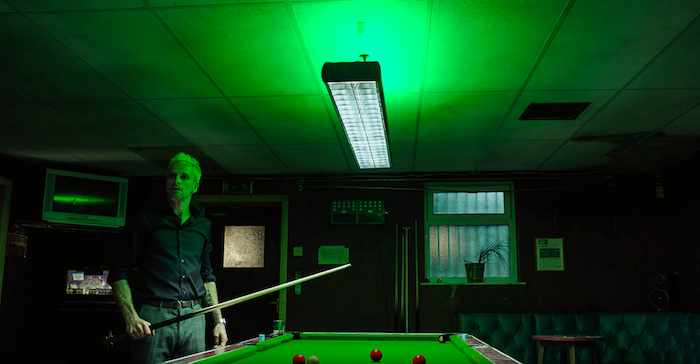
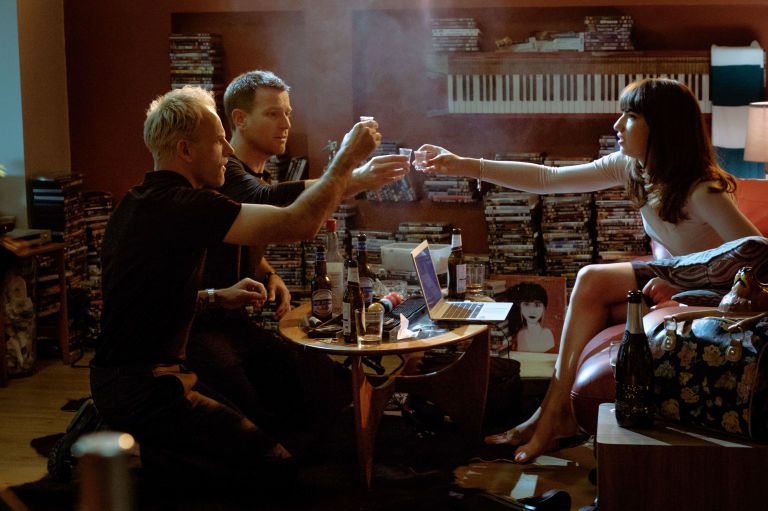
Twenty-one years on from the events depicted in Trainspotting (1996), we finally have the sequel that’s been mooted for so long (Danny Boyle first voiced the idea back in January 2009). Back then, the original movie ended with Renton (McGregor) stealing the proceeds of a drug deal – £16,000 – from his friends, Simon aka Sick Boy (Miller), Spud (Bremner) and Begbie (Carlyle), and heading off to live a normal life. But that “normal” life, which included living in Amsterdam and being married, has fallen apart, and now Renton is back in Edinburgh. His mother has died, he’s staying with his dad (Cosmo), and looking to hook up with his old friends – if they’ll let him. He visits Spud first, only to find him trying to asphyxiate himself with a plastic bag. Saving an initially ungrateful Spud, Renton learns that Begbie is in jail serving a twenty-five year sentence, Simon is the landlord of a rundown pub that an aunt has left him, and Spud himself is a drug addict.

Renton reconnects with Simon, but Simon holds too much enmity towards his old friend because of the money from the drug deal. Along with his business partner, Veronika (Nedyalkova), Simon offers Renton the chance to become part of a scam to acquire European development funds that Simon can use to open a “leisure” club above the pub. Renton agrees, and ropes in Spud to help design the club and oversee its construction once the funds are awarded. Meanwhile, Begbie finds a way out of prison and back home to his wife, June (Turner), and teenage son, Frank Jr (Greenan). Begbie takes his son with him when he burgles properties, but is sidetracked from his endeavours when he learns from Simon that Renton is back in Edinburgh. Begbie’s thirst for revenge is exploited by Simon, and a chance encounter at a nightclub between the AWOL gaolbird and Renton leads to a showdown above the pub, and the chance to settle old scores the hard way.

If you enjoyed Trainspotting, then T2 Trainspotting is likely to make you feel all warm and fuzzy inside. Laced with affectionate nostalgia and perceptive notions of what it is to be middle-aged and treading water, this looked-for sequel isn’t as iconic as its predecessor – and to be fair, it was never likely to be – but it does have an erstwhile melancholy feel to it that accurately reflects the regrets of its four main characters. Like everyone else, Renton is the architect of his own downfall: drug-free but without any purpose in life, he’s come home because he’s not been able to make a go of it in Amsterdam; he’s adrift in his own life, and lacking ambition. Conversely, Simon has nothing but ambition, a drive to better himself financially, but he lacks foresight and cohesive thinking; his plans always backfire as a result. Spud is an addict who wants to swap his drug habit for something more meaningful, another addiction preferably, but one that has a positive effect on his life; writing down stories from twenty years ago helps him on this path. And Begbie – well, Begbie’s only regret is that he’s only just now got out of prison.

With the characters locked in place, John Hodge’s screenplay is free to explore themes of personal responsibility, misplaced nostalgia, revenge, deceit, and compromised friendships. It looks back further than Trainspotting itself, to when all four friends were much younger, pre-teens with the whole world ahead of them, and all the promise that entailed. It provides flashbacks to the first movie, and reintroduces other characters from twenty years before, such as Renton’s girlfriend, Diane (Macdonald), now a successful solicitor. And it shows how stagnant each of the main characters’ lives have become, how mired in mediocrity they are thanks to emotional malaise and impulsive behaviour. There’s little in the way of meaningful progress for any of them, just a desire to lead brighter, better lives that is slipping away from them with every passing year.

This gloomy, regret-laden approach could have made the movie too depressing or downbeat for audiences unfamiliar with the original (which was itself a frank, unapologetic examination of the joys and horrors inherent in taking drugs), but there’s too much mordaunt humour and scabrous comedy on display, and Hodge and returning director Danny Boyle have made a movie that connects on various, different levels, and which does so with Boyle’s trademark visual stylings. This is still a movie that fizzes with invention, from its seemingly scattershot, haphazard camera angles, complex yet rewarding editing rhythms, exceptionally well chosen soundtrack, and emphatic performances, and all the way down to the integration of “old’ footage with new, including a recreation of that classic moment from the original where Renton is almost knocked down by a car – and then stops to revel in the moment.

It’s a Danny Boyle movie through and through, with several moments where the semi-linear narrative seems unlikely to knit together into a satisfying whole, until by the end, everything has been explained and the various strands all neatly tied up. And there are fitting outcomes for all the characters, with all bar one back on the road to self-respect and potential absolution. In bringing back the original cast, and at a point where their own ages reflect the passing of time more effectively than if it had been achieved through make up, the movie offers a kind of shorthand for new viewers, introducing each character they play with an economy of purpose that’s admirable and effective. McGregor still retains some of that boyish charm that made the younger Renton so attractive to watch, while Miller takes glowering to new heights, his features displaying the frustration of Simon’s life with an icy conviction. Carlyle is still effortlessly frightening as Begbie, a man who may not be as comfortable in his own skin as we thought, but who can still inject menace and venom into the most unremarkable line of dialogue.

But if there’s one performance that stands out from the rest, and unexpectedly so, it’s that of Bremner as Spud. Spud is the eternal fuck-up, the addict with the unenviable ability to still feel deeply and profoundly despite the mental numbing he endures, and Bremner is simply superb in the role. Spud is the only character that the viewer can sympathise with, as his motives are selfless, and focused (as best he can) on providing for his partner, Gail (Henderson), and son, Fergus (Fitzpatrick). There’s an innate bravery about Spud that Bremner underplays with skill, making the moment where his writing skills are acknowledged by Veronika, a touching and heartfelt one. Through Veronika’s eyes we see Spud as more than just an addict, and unlike his friends, he can be cheered on with affectionate glee. But friendship is still the key ingredient in what makes these four people tick, even if they’re at odds with each other over past indiscretions. And some bonds, however stretched or damaged they may have become, will, as the movie tells us, withstand much more besides, and still prove beneficial to everyone concerned, no matter how much life has battered them.

Rating: 8/10 – an invigorating if pensive look at middle-aged bitterness wrapped up in a blanket of repentance, T2 Trainspotting doesn’t match the heights of its predecessor, but in fairness, it never actually tries; as much a product of its time as the first movie, there’s a heartache about this movie that is genuinely affecting, and which allows new viewers to see Renton et al as far more than cyphers in a movie about trying not to let the past inform and dictate the future.

Share this:

  • Share on X (Opens in new window) X
  • Share on Facebook (Opens in new window) Facebook
  • More
  • Print (Opens in new window) Print
  • Email a link to a friend (Opens in new window) Email
Like Loading...

Billy Lynn’s Long Halftime Walk (2016)

15 Wednesday Mar 2017

Posted by dullwood68 in Movies

≈ 3 Comments

Tags

120fps, Ang Lee, Bravo Squad, Chris Tucker, Dallas Cowboys, Drama, Garrett Hedlund, Iraq, Joe Alwyn, Literary adaptation, Review, Steve Martin, Vin Diesel

D: Ang Lee / 113m

Cast: Joe Alwyn, Kristen Stewart, Garrett Hedlund, Chris Tucker, Steve Martin, Vin Diesel, Makenzie Leigh, Arturo Castro, Mason Lee, Brian ‘Astro’ Bradley, Beau Knapp, Ismael Cruz Cordova, Barney Harris, Ben Platt, Tim Blake Nelson

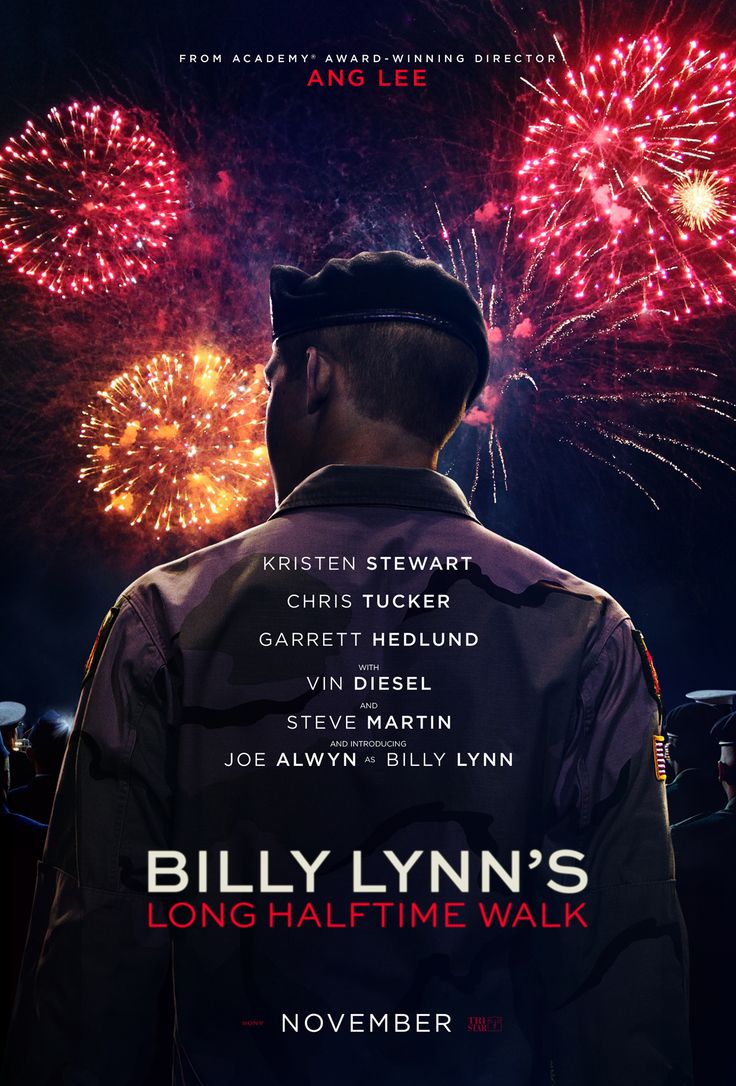
When Billy Lynn’s Long Halftime Walk went into production back in April 2015, there was much talk about Ang Lee’s decision to shoot the movie at a projection frame rate of 120fps in 3D and at 4K resolution. The previous highest frame rate was 48fps for The Hobbit: An Unexpected Journey (2012), but that experience didn’t prove as successful as hoped for. Lee’s idea was to make the movie as immersive as possible, and shooting at 120fps would have achieved the visual effect he was looking for. It’s a measure of Lee’s standing that his idea was supported by the various production companies who put up the money for the movie to be made. Lee’s idea was revolutionary, but also meant that there would only six cinemas worldwide that would be able to show it as Lee intended. So – artistic idealism or financial folly?

In the end, and inevitably, it’s a bit of both. Lee has taken the novel by Ben Fountain and given it the kind of loving attention to detail that is rare in mainstream movie making these days, but in doing so, has somehow managed to lose focus on the “bigger” picture. It’s a valiant effort, and one that deserves greater attention, but the movie itself proves too wayward in its execution for any distinct meaning to be attributed to the title character’s feelings about the public’s perception of him as a hero. Billy (Alwyn) is meant to be torn between two options: following the advice of his sister, Kathryn (Stewart), and leaving the army after an appearance at a Dallas Cowboys Thanksgiving home game, or returning to Iraq for another tour of duty (which is what his squad is supposed to be doing).

Billy and the rest of his squad, led by Sergeant Dime (Hedlund), are on the last leg of a nationwide victory tour. The group of soldiers, misnamed Bravo Squad by the media, are there because Billy was caught on camera in heroic fashion as he tried to save another wounded sergeant, Virgil “Shroom” Breem (Diesel), during a firefight. Back home for the tour, Billy has had time to visit his home, where his sister Kathryn has voiced her fears for his continued safety, and her worries that he’s suffering from Post Traumatic Stress Disorder. Billy is undecided, unsure if he should commit to his sister’s  proposal, or reaffirm his commitment to his squad. Making a decision is made more difficult both by the attention he’s getting, and the lack of understanding from the public. Nobody seems to be able to grasp what it’s like fighting in a war, and when he tries to explain how it is, he’s either unable to express himself clearly enough, or the other person doesn’t want to hear it.

This is the crux of the matter, and the script – by Jean-Christophe Castelli – spends an awful lot of time examining this aspect of what it’s like to be a soldier. At one point, the squad are approached by a businessman (Nelson) who tries to flatter them into endorsing his fracking operation, but his obvious lack of empathy leads to an overly sarcastic response from Sgt Dime that highlights the distance between them. It’s the kind of well-rehearsed comeback that happens only in the movies, but along with a shorter retort made by Billy in response to Dallas Cowboys’ owner Norm Oglesby’s (Martin) understanding of Billy’s public status, it does make clear just how distant a soldier’s experience is from what the public supposes; and how difficult it is for each side to meet in the middle. Billy connects with one of the Dallas Cowboys cheerleaders, Faison (Leigh), and tells her “It’s sort of weird, being honored for the worst day of your life”. She’s sympathetic, but doesn’t really understand what he’s telling her.

Around all this, the movie explores notions of fate, camaraderie, personal philosophies, determinism, what it means to be a hero, and the broader effects of violence, and the script and the movie are on firmer ground when these are being examined. There are moments where PTSD is shown to be a problem for some of the squad, particularly when a disrespectful Dallas Cowboy fan is choked into unconsciousness. And during flashbacks, Sgt Breem makes it clear to Lynn that there’s no point worrying about being killed; as he puts it, if that’s the way Billy is destined to die then “the bullet’s already been fired”. Breem’s philosophical bent makes sense to Billy, and he does his best to embrace his sergeant’s more thoughtful approach to the war and being a soldier. But he’s also firmly behind the assault on the fan, deeming the inappropriate use of force as acceptable. These contradictions add to the dichotomy inherent in Billy’s thinking, and provide a better understanding of why he’s so torn between leaving and staying. They’re also a much better way of explaining why there will always be a distance between the soldiers and the public.

Billy’s relationships with Kathryn and Faison act as a counterpoint to the macho solidarity he has with the rest of the squad, but they don’t occupy enough screen time to make as much of an impact as may have been intended. Along with movie producer Albert Brown (Tucker), there trying to clinch a deal for a movie version of the squad’s endeavours in Iraq, Dallas Cowboys gofer, Josh (Platt), and his boss, Norm, there are few other characters who are given much prominence. Fortunately, Billy’s story is absorbing enough to compensate for all this, and newcomer Alwyn proves to be a great choice in the role, having got the part just two days after leaving drama school. His ability to express the doubts and fears and troubled feelings of the character are exemplary, and it’s a performance of remarkable maturity for someone who at the time of shooting was only twenty-four (also, his American accent was so convincing, that at first Steve Martin didn’t even realise he was British).

Alwyn is given a lot of room by Lee to explore Billy’s relationship with his comrades and his return to life back home, and this freedom pays off extremely well, with Billy becoming a fully rounded character who’s entirely sympathetic thanks to the dilemma he has to face. Elsewhere, Hedlund is on equally good form as the acerbic, straight-talking Dime, Stewart looks unfortunately as if Kathryn has a drug problem, Martin is unctuous and insincere as Oglesby, Leigh is refreshing as a cheerleader with Christian beliefs, and Diesel shows that there’s far more to his acting abilities than driving muscle cars and propping up other, unsuccessful franchises.

With the performances offsetting some of the more troublesome aspects of the script, Lee’s decision to shoot the movie at 120fps does pay off, even in lower frame rate versions. Billy Lynn’s Long Halftime Walk is possibly the most beautiful, most visually arresting movie of 2016. Images are crystal clear and possessed of a sharpness and depth that is amazing to watch, so much so that when Lee opts for a close-up (cue shots of Martin and Tucker late on in the movie) it’s a little unnerving; it’s as if the actors are really “in your face”. Lee’s aim to make the movie as immersive as possible has been achieved with no small amount of style and panache, and as a gamble it’s paid off far more effectively than with The Hobbit: An Unexpected Journey. He’s also chosen one of the best cinematographers working today, John Toll, to help make the movie so astounding to watch. It’s a shame then that the material on screen doesn’t quite match up to the efforts made off screen.

Rating: 7/10 – with its muddled exploration of the soldier’s lot, and a lack of clarity in terms of explaining said lot to a wider public (namely the audience), Billy Lynn’s Long Halftime Walk doesn’t quite manage to reach the heights it was aiming for; technically superb but not as gripping or insightful as it could have been, it’s still a movie that has plenty of things to recommend it, though expectations should be reined in ahead of seeing it.

Share this:

  • Share on X (Opens in new window) X
  • Share on Facebook (Opens in new window) Facebook
  • More
  • Print (Opens in new window) Print
  • Email a link to a friend (Opens in new window) Email
Like Loading...

A Kind of Murder (2016)

05 Sunday Mar 2017

Posted by dullwood68 in Movies

≈ Leave a comment

Tags

Andy Goddard, Crime, Drama, Eddie Marsan, Jessica Biel, Literary adaptation, Murder, Patricia Highsmith, Patrick Wilson, Review, The Blunderer, Thriller, Vincent Kartheiser

kind_of_murder

D: Andy Goddard / 95m

Cast: Patrick Wilson, Jessica Biel, Vincent Kartheiser, Haley Bennett, Eddie Marsan, Radek Lord, Jon Osbeck, Christine Dye

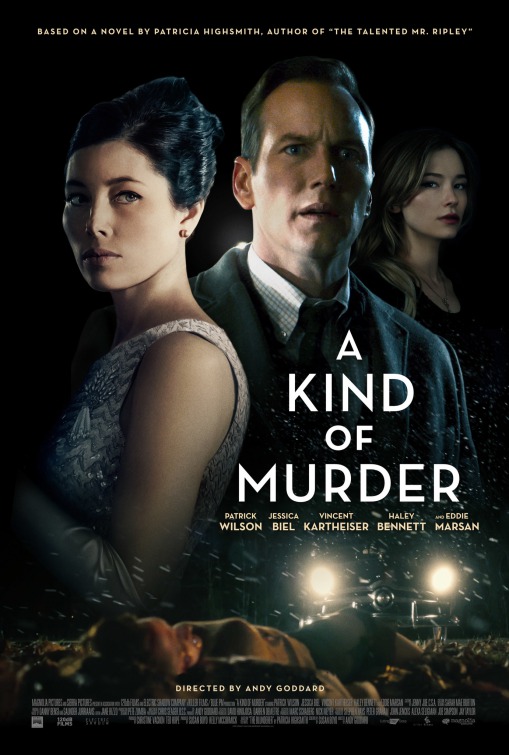
New York City, the Sixties. Walter Stackhouse (Wilson) is a successful architect with a beautiful home and a beautiful wife, Clara (Biel). In his free time he writes short stories about crime and murder. On the outside he’s living the perfect life, but his marriage is strained. Clara has a history of mental instability, and is remote from him. At the same time, though, she’s jealous and possessive, accusing him of having an affair with a young woman, Ellie (Bennett), who attended a party they gave. When Clara is like this, Walter usually ends up in a local bar. It’s on one such occasion that he reads an article in a newspaper about the unsolved murder of a woman outside of New York at a rest stop called Harry’s Rainbow Grill.

Suspicion seems to rest on the woman’s husband, a bookstore owner called Kimmel, but he has an alibi. This isn’t enough for the detective investigating the case, Corby (Kartheiser), who is convinced Kimmel is the killer. While he tries to intimidate Kimmel into confessing, Walter becomes more and more fascinated with the murder, and like Corby, becomes convinced that Kimmel is guilty. He even goes so far to visit Kimmel at his bookstore. But at home, his marriage goes from bad to worse. Clara takes an overdose and ends up in hospital. When she comes home, her jealousy remains firmly in place, and she remains convinced that Walter is having an affair with Ellie. When she’s proved right, Walter tells her he’s going to divorce her; Clara retaliates by saying she’ll definitely kill herself if he does.

a-kind-of-murder-2016-1

Undeterred, Walter continues with his relationship with Ellie, but when Clara leaves suddenly to visit her sick mother upstate, he follows the bus she takes until it reaches Harry’s Rainbow Grill. But though she gets off the bus, Walter doesn’t see her, and he heads back to New York City. Later, Walter receives terrible news, news that causes Corby to link him to the murder of Kimmel’s wife, his relationship with Ellie to falter, and his business partnership to founder. With his honesty and integrity on the line, as well as his freedom, Walter must find a way of extricating himself from a situation that grows worse every day, and that could ultimately cost him his life.

An adaptation of Patricia Highsmith’s novel The Blunderer, A Kind of Murder is a good-looking movie in search of a leading character for the audience to identify and sympathise with. Walter’s plight should be one that has the viewer on the edge of their seat, but thanks to both the script and Wilson’s performance, he’s vanilla bland from start to finish, and the movie never really knows how to make his predicament more intriguing or exciting. Walter becomes interested in the murder of Kimmel’s wife because he’s beginning to have thoughts about killing Clara. As he believes Kimmel killed his wife, Walter is supposed to feel some kind of kinship with the bookstore owner, but it’s all psychologically unconvincing. Walter channels his feelings about Clara into his writing, something we see on more than one occasion, and so any idea that he and Kimmel are similar can be disregarded from the start.

BRR 11-29-14-5392.dng

What this leaves us with is a contrived relationship that never develops beyond an uneasy semi-alliance against Corby’s invasive and confrontational detective work. And there’s never any doubt as to whether or not Kimmel killed his wife, or if Walter’s situation will lead to his livelihood being compromised. As the movie progresses from potential whodunnit to unabashed thriller, Susan Boyd’s first-time script forgets to instil proceedings with any tension, as Walter’s predicament never sees him fully in jeopardy, or at risk of having his comfortable world taken away from him. And in conjunction with Boyd’s script, Wilson delivers what may well be one of his least successful performances ever. For an actor who can genre-hop with ease, and who at least doesn’t look out of place in a period drama, Wilson never connects with Walter and gives a wayward portrayal of a man whose calm, outward manner belies a compulsive, selfish individual hidden away on the inside.

It’s this duality that the movie tries hard to promote, with Walter and Kimmel meant to be two sides of the same coin, and Clara and Ellie both representing the best and worst of Walter’s relationships with women. But again, there’s nothing for the audience to connect with. Even when Clara spells out her intention to kill herself if Walter goes ahead with the divorce, and tells him everyone will blame him for not doing enough to help her, there’s nothing there to back up that claim. It carries the weight of an empty paper bag, and as such, loses any validity, so that when Walter receives his terrible news, it doesn’t have the impact that it should have. And this is the moment when the viewer should find themselves completely on Walter’s side… but probably won’t.

akindofmurder_clipdeath

As a thriller, A Kind of Murder stumbles along trying to match Highsmith’s elegant turn of phrase to its early Sixties setting, and only doing so on very rare occasions. It also dispenses with any attempt at providing back stories for any of the characters, leaving us in a void when it comes to understanding their current motivations. Clara is clearly mentally ill, and she’s clearly difficult to live with, so why Walter stays with her is a bit of a mystery (and a better one than if Kimmel killed his wife or not). And why Corby becomes so obsessed with Kimmel and bringing him to justice isn’t explained either. In the end, these are characters operating in a vacuum, occasionally bumping into each other but failing to make a proper connection.

And so it goes for the length of the movie. Wilson’s disappointing turn is matched by Biel’s monotone performance, Kartheiser’s unncessarily angry cop, and Bennett’s subdued turn as Walter’s girlfriend. Only Eddie Marsan deserves any praise, giving the kind of unexpected, yet nuanced performance that this kind of movie needs to be anywhere near successful. His brooding, snake-like approach to Kimmel is a master-class in big screen malevolence. Tying all this together is Goddard, known mostly for his TV work, but not stretching his abilities too far in bringing this tale to the big screen. However, he’s on firmer ground with the movie’s recreation of Sixties New York, with its colourful vibrancy and Mad Men-style glamour of the period, and all despite (or in spite of) the wintry backdrop. But for anyone expecting more substance with their style, this isn’t the place to be looking for it.

Rating: 5/10 – lacklustre in too many ways to even count, A Kind of Murder flatlines for most of its running time, and forgets to make itself interesting for the viewer; with so-so performances and a dull script, this is one thriller that can be given a wide berth unless you’re a fan of Marsan’s, or in an undemanding mood when it comes to choosing something to watch.

Share this:

  • Share on X (Opens in new window) X
  • Share on Facebook (Opens in new window) Facebook
  • More
  • Print (Opens in new window) Print
  • Email a link to a friend (Opens in new window) Email
Like Loading...

Monthly Roundup – February 2017

01 Wednesday Mar 2017

Posted by dullwood68 in Movies

≈ Leave a comment

Tags

Alexis Wajsbrot, Alycia Debnam-Carey, Barbara Hale, Bill Douglas, Black mirror, Boys' school, Bryce Dallas Howard, Comedy, Damien Macé, David Lowery, Disney, Don't Hang Up, Drama, Edwin L. Marin, Fantasy, Friend Request, Gambling, Garrett Clayton, Gregg Sulkin, Horror, Insomnia, Internet, Joanna David, Lady Luck, Lawrence Huntington, Life on the Road, Literary adaptation, Marius Goring, Mr. Perrin and Mr. Traill, Oakes Fegley, Pete's Dragon, Prank calls, Remake, Reviews, Ricky Gervais, Robert Young, Romance, Saxon Logan, Simon Verhoeven, Sleepwalker

Life on the Road (2016) / D: Ricky Gervais / 96m

aka David Brent: Life on the Road

Cast: Ricky Gervais, Ben Bailey Smith, Tom Basden, Jo Hartley, Tom Bennett, Mandeep Dhillon, Andrew Brooke, Andy Burrows, Steve Clarke, Michael Clarke, Stuart Wilkinson

gallery-1460024286-david-brent-life-on-the-road

Rating: 5/10 – post-Wernham Hogg, David Brent (Gervais) is now a salesman with dreams of becoming famous by putting together a band, Foregone Conclusion, and going on tour; the gulf between Life on the Road and The Office (2001-03) can be gauged within the first ten minutes as Gervais treats his most enduring (and sympathetic) character with a complete disregard for Brent’s development, and by being unnecessarily cruel to everyone else, making this a chore to sit through, and only slightly more enjoyable than Special Correspondents (2016).

Pete’s Dragon (2016) / D: David Lowery / 103m

Cast: Bryce Dallas Howard, Oakes Fegley, Wes Bentley, Karl Urban, Oona Laurence, Robert Redford, Isiah Whitlock Jr

nekjooahknoxop_1_a

Rating: 7/10 – following a car crash that kills his parents and leaves him lost in the woods, a young boy called Pete is “adopted” and cared for by Elliot, who just happens to be a dragon, a situation that continues until civilisation comes calling in the form of a logging operation; a good-natured remake of the 1977, Pete’s Dragon original offers good performances all round, beautiful New Zealand backdrops, a lovable dragon, and keeps it all light and airy, all of which compensates for a script that wavers too often in its attempts to put Elliot in any real danger from Urban and his men.

Mr. Perrin and Mr. Traill (1948) / D: Lawrence Huntington / 92m

Cast: Marius Goring, David Farrar, Greta Gynt, Raymond Huntley, Edward Chapman, Mary Jerrold, Ralph Truman

de23013771395642cc6946f7ec5881e3-1000x563

Rating: 8/10 – when a new teacher at an all-boys’ school, Mr Traill (Farrar), proves more popular with the pupils, and the school nurse (Gynt), than the older Mr Perrin (Goring), personal and professional jealousies lead to an unexpected tragedy; an adaptation of the novel by Hugh Walpole, Mr. Perrin and Mr. Traill expertly creates a hothouse environment for its title characters, but never comes down fully on the side of either, making this a surprisingly jaundiced view of male rivalry, and a movie that features an exemplary performance from Goring.

Don’t Hang Up (2016) / D: Alexis Wajsbrot, Damien Macé / 83m

Cast: Gregg Sulkin, Garrett Clayton, Bella Dayne, Jack Brett Anderson, Parker Sawyers, Sienna Guillory

dont-hang-up-3

Rating: 5/10 – two phone pranksters, Sam (Sulkin) and Brady (Clayton), find themselves on the receiving end of a psycho(?) who’s willing to play their own game against them, with increasingly disturbing and violent results; basically the first ten minutes of Scream (1996) stretched to breaking point, Don’t Hang Up will soon have you rooting for the psycho as Sam and Brady behave as stupidly as you might expect, even to the point of continually picking up the phone, or answering their mobiles, just so the story can advance a bit further.

Lady Luck (1946) / D: Edwin L. Marin / 97m

Cast: Robert Young, Barbara Hale, Frank Morgan, James Gleason, Don Rice, Harry Davenport, Lloyd Corrigan

6770-2

Rating: 7/10 – Mary (Hale), who’s staunchly anti-gambling marries Scott (Young), who does his best to reform, but a trip to Las Vegas – on their honeymoon, no less – soon puts their marriage in jeopardy; a lightweight romantic comedy featuring smooth performances and a pleasing sense of its own absurdity, Lady Luck is carefree, populist piece of entertainment that hits a few dramatic potholes along the way to its final scene, but is nevertheless an enjoyable way to spend ninety-seven minutes.

Friend Request (2016) / D: Simon Verhoeven / 92m

Cast: Alycia Debnam-Carey, William Moseley, Connor Paolo, Brit Morgan, Brooke Markham, Sean Marquette, Liesl Ahlers, Shashawnee Hall, Nicholas Pauling

friend-request

Rating: 4/10 – the suicide of one of her classmates leads Laura to regret unfriending her on social media, a decision that has dire consequences for her and her friends, as her classmate’s ghost seeks revenge from beyond the grave; in amongst the horror motifs and distressed editing techniques that are now a depressing norm of the genre, Friend Request does have some pertinent things to say about popularity and the perils of social media, but it’s done in such a ham-fisted, unconvincing way that all that effort goes to waste very quickly.

Sleepwalker (1984) / D: Saxon Logan / 50m

Cast: Joanna David, Bill Douglas, Nickolas Grace, Heather Page, Fulton Mackay, Michael Medwin, Raymond Huntley

sleepwalker-sleepwalking

Rating: 7/10 – two couples at an isolated farmhouse share an evening deriding each other’s class and social values, unaware that the sleepwalking tendencies of one of them will lead to blood being spilt; part curdled Abigail’s Party and part baroque thriller, Sleepwalker has much to say about middle class angst, the antagonism inherent in middle class relationships of the time, and sets it all against the backdrop of a social evening from hell.

Share this:

  • Share on X (Opens in new window) X
  • Share on Facebook (Opens in new window) Facebook
  • More
  • Print (Opens in new window) Print
  • Email a link to a friend (Opens in new window) Email
Like Loading...

Mini-Review: Blackway (2015)

28 Tuesday Feb 2017

Posted by dullwood68 in Movies

≈ Leave a comment

Tags

Alexander Ludwig, Anthony Hopkins, Crime, Daniel Alfredson, Drama, Enderby, Go With It, Julia Stiles, Literary adaptation, Ray Liotta, Review, Thriller

a4eb9f17e1a6a3cd39eedca150b5e57a

Original title: Go With Me

D: Daniel Alfredson / 90m

Cast: Anthony Hopkins, Julia Stiles, Alexander Ludwig, Ray Liotta, Steve Bacic, Lochlyn Munro, Hal Holbrook, Dale Wilson

Enderby, British Columbia. Lillian (Stiles) has returned to her hometown following the death of her mother. Working as a waitress in a bar she attracts the unwanted attention of Richard Blackway (Liotta), an ex-police constable turned local crime lord. One night he turns up at her house and frightens her so much that she goes to the local sheriff (Wilson). When he learns that Blackway is involved, the sheriff becomes uninterested in helping her, and tells Lillian to seek out a man named Scotty at one of the lumber companies. Instead of finding Scotty, Lillian is offered help by an old man called Lester (Hopkins), and a young man called Nate (Ludwig). Together they try and track down Blackway, beginning with a man Lester thinks will help them, Fitzgerald (Bacic).

But Fitzgerald is just as afraid of Blackway as the rest of the town. He does give them a lead on Blackway’s whereabouts, and the trio find themselves driving from place to place, either just missing him, or on one occasion, finding him but not where he’s alone. Along the way Nate has a fight with Blackway’s accountant, Murdoch (Munro), an incident at a hotel Blackway runs as a brothel leads to its being set on fire, and the trio reach a point of no return, travelling up into the mountains to an old logging camp where Blackway hides out when he needs to. But will they remain the hunters, or will Blackway turn the tables on them instead?

go-with-me-recensione

Post-Lisbeth Salander, Daniel Alfredson’s career hasn’t been as consistent as he perhaps would have liked. Work on the small screen took him back to his roots until Echoes of the Dead (2013) came along, but that movie couldn’t maintain its initial premise and made some questionable decisions before reaching its conclusion. In the same year as Blackway, Alfredson teamed up with Hopkins for Kidnapping Mr. Heineken, a lacklustre account of the true story that must have convinced the pair to work together again. And so we have Blackway, an austere thriller-cum-unspoken revenge drama that has more going for it than first meets the eye. The movie has a gloomy, penetrating atmosphere that perfectly suits the mood of the piece. Everyone in Enderby looks beaten down, defeated, all but Blackway, whose violent, malevolent nature leaves him as the only person in town enjoying himself.

Liotta revels in his evil nature, and he adds another psycho character to his resumé, infusing the title villain with all the rage and sadism he can muster. There’s a scene where Blackway has his hand around the neck of Fitzgerald’s daughter, squeezing it, and Liotta plays it as if he were playing with a doll. It’s disquieting, and uncomfortable to watch, and tells you everything you need to know about him. Against this we have Stiles’s heroine, unwilling to leave town, and at first, emotional and angry at being treated so horribly. But as the movie progresses, she too appears beaten down, saying less and less, until words become superfluous, until it becomes apparent where tracking down Blackway is going to take her; and her newfound allies. Hopkins is taciturn and determined, and gives one of his better performances of recent years, a proud man looking to redeem himself for something we can guess at, but which we never see confirmed. And there’s a lot that’s left unsaid in Blackway, adding to the austerity and the stripped back nature of the material, and making it far more absorbing and intriguing than it looks.

Rating: 6/10 – once you get past some of the more awkward elements in the script – Blackway never sends his men out to find Lester and co, their search for him seems just a little too easy at times – there’s much to admire about Blackway, and Alfredson keeps it agreeably low-key throughout; a mood piece as much as a thriller, it’s a movie that doesn’t deserve to be dismissed as just another DtV backwoods drama.

Share this:

  • Share on X (Opens in new window) X
  • Share on Facebook (Opens in new window) Facebook
  • More
  • Print (Opens in new window) Print
  • Email a link to a friend (Opens in new window) Email
Like Loading...

Lion (2016)

19 Sunday Feb 2017

Posted by dullwood68 in Movies

≈ 3 Comments

Tags

Adoption, Australia, Biography, Dev Patel, Drama, Garth Davis, Google Earth, India, Literary adaptation, Nicole Kidman, Review, Rooney Mara, Saroo Brierley, True story

lion-movie-poster-01-1594x2362

D: Garth Davis / 115m

Cast: Dev Patel, Rooney Mara, Nicole Kidman, David Wenham, Sunny Pawar, Abhishek Bharate, Priyanka Bose, Divian Ladwa, Deepti Naval, Tannishtha Chatterjee, Nawazuddin Siddiqui

If you watch enough movies you soon learn that the world is full of inspiring true life stories where people from all walks of life overcome seemingly insurmountable odds in order to achieve a particular personal or professional goal. In 2016, movies based on true stories included the likes of Hacksaw Ridge, The Finest Hours, The Infiltrator, and Sully. And then there’s Lion, the story of a young Indian boy, Saroo (Pawar), who finds himself lost and alone in a part of India he doesn’t know, and who ends up being adopted by an Australian couple, the Brierleys (Kidman, Wenham). Twenty years later, Saroo (Patel) decides to go in search of his birth family: his older brother Guddu, his mother Kamla, and younger sister Shekila.

As expected, Lion is a movie of two halves. In the first we meet Saroo and Guddu (Bharate), brothers who steal coal from trains that they then sell on so as to be able to afford groceries. On one such mission they travel to a train station, where they end up separated. Saroo boards a train in the hope of finding Guddu, but he falls asleep. When he wakes the train is moving and he’s unable to get off until it arrives at its destination: Calcutta. Though he’s taken in by a kindly young woman, Noor (Chatterjee), Saroo flees from her home when a man she knows, Rama (Siddiqui), appears set on selling Saroo into the sex trade. Eventually, he finds himself in the care of the authorities and lodging in a children’s home. Some time later, Mrs Sood (Naval), from the Indian Society for Sponsorship and Adoption, tells him that an Australian couple want to adopt him. Saroo travels to Hobart, Tasmania, where he meets his adoptive parents, John and Sue Brierley. He settles in, and the Brierleys also adopt another orphaned Indian boy, Mantosh.

https-blueprint-api-production-s3-amazonaws-com-uploads-card-image-281971-sunny_pawar

This first half is compelling stuff, due largely to Pawar’s winning presence, and the sympathy his plight elicits. From the moment Saroo falls asleep on a platform bench, and despite his brother’s instruction to stay there, it’s obvious that it’s all going to go wrong (there wouldn’t be much of a movie otherwise). But this awareness in the viewer is what makes it work so well. Watching Saroo calling for his brother – and knowing he won’t appear or answer – adds to the sense of isolation that Saroo will soon begin to feel, and it’s one of those situations we can all appreciate. And when he falls asleep on the train that will take him far away from home, it’s especially heartbreaking. As the young Saroo, Pawar’s performance is pitch perfect, his natural way in front of the camera making it easy to identify with Saroo and hope that he doesn’t come to any harm. Pawar plays him as a cheeky, happy-go-lucky child at first, but when things become more serious, he’s more than able to display the sadness and dismay inherent in Saroo’s situation.

In the second half, Saroo is now studying hotel management in Melbourne, and begins a relationship with fellow student, Lucy (Mara). At a party with friends, Saroo experiences a flashback to his childhood, and it proves to be the first of many. Lucy and his friends suggest he uses Google Earth to try and find his hometown in India. But the town name he remembers doesn’t exist, and the only memory he has of the station where he last saw Guddu is that there was a rain tower there, something not uncommon at Indian railway stations. As his search continues, and with less and less luck or progress as time goes by, Saroo’s relationship with Lucy begins to suffer. Eventually, Saroo finds a clue on Google Earth that points him in the right direction, and brings the prospect of finding his Indian family even closer.

lion3

With the movie’s first half proving so compelling and so emotionally effective, it becomes something of a surprise when the second half appears to be doing its best to undo all the good work of the first. As an adult, Saroo’s floppy-haired, well-liked personality soon gives way to miserable, semi-tortured whinger as his efforts to find his birth family fail to provide the results he wants, and his disappointment causes him to treat Lucy like a stranger, and his adopted brother Mantosh (Ladwa) with callous disregard. It’s this transition that doesn’t make sense dramatically, and it’s an issue that Luke Davies’ otherwise exemplary script never addresses satisfactorily. The why of Saroo’s change in behaviour may well be due to accrued frustration, but why he should deliberately jeopardise his relationships with those closest to him remains a mystery, one greater than if he’ll succeed in his search. Not even Patel, normally a perceptive and thoughtful actor, can’t make anything of this turnaround, and for a long stretch any sympathy for the character that the viewer has, is in danger of being lost for good.

The second half is also where the script trots out too many subplots that don’t always add up to a coherent whole. Mantosh is seen as having issues surrounding his role in the Brierley family, but the reasons for these are never explained, while the reason for the Brierleys having adopted two Indian boys instead of having their own children is given at a point where Sue’s health is precarious. Sue’s health issues, though, are left hanging so that Saroo can head off to India with her encouragement and blessing, but not with anything resembling a backward glance. The whole pace of the second half is off as a result of these narrative fumbles, and some scenes feel as if they should have been excised in favour of a shorter, yet more dramatically sound approach. When you lose interest in the main character’s search or journey because of how he behaves, then you know the movie’s doing something wrong.

maxresdefault

Making his feature debut, Garth Davis makes the most of the Indian settings, painting a portrait of life as seen through the eyes of the young Saroo – a world full of wonder (a kaleidoscope of butterflies, the taste of a cold fizzy drink), and a world full of danger (predatory sex traffickers). Davis is on solid ground here, depicting Saroo’s journey with heart and compassion, and making it clear just how lucky Saroo was to be adopted. Many of the scenes in Calcutta show Saroo surrounded quite literally by the rush and press of its populace, but Davis is quick to show just how isolated he is at the same time. And he follows through with this idea with the adult Saroo, but instead of Saroo becoming isolated through the vagaries of Fate, this time he becomes isolated because of what he does. It reinforces the idea of Saroo not being settled in terms of his heritage and the connection he has with his past; he doesn’t want to continue being adrift.

Visually, Lion is often impressive to watch, alternating between the brooding, teeming city life of Calcutta, and the bright open spaces of Melbourne. Greig Fraser’s cinematography catches the mood precisely, his use of close ups in particular adding to the resonance of the story. Of course, those close ups wouldn’t be entirely as effective if it weren’t for the quality of the acting. As mentioned above, Patel has problems making Saroo credible in terms of his behaviour, but does a good job nevertheless. Mara makes a minimal impression because, one scene aside, her character is the standard girlfriend seen in too many other movies. As the Brierleys, Wenham is sidelined in favour of Kidman’s sterling performance, one that sees her regain some of the critical favour she’s lost in recent years. But if the movie “belongs” to anyone in the cast, it’s young Pawar, whose sweet, angelic features are difficult to resist, and even harder to ignore. Without him, Lion would not be as powerful as it is, or as rewarding.

Rating: 7/10 – let down by a second half that isn’t as focused as its first, Lion is still worth watching, but not as much as its various awards nominations – and wins – would have you believe; a true story that at least doesn’t preach to its audience, its tale is a remarkable one but in this version, not one that will necessarily linger too long in the memory.

Share this:

  • Share on X (Opens in new window) X
  • Share on Facebook (Opens in new window) Facebook
  • More
  • Print (Opens in new window) Print
  • Email a link to a friend (Opens in new window) Email
Like Loading...

Mini-Review: The 9th Life of Louis Drax (2016)

11 Saturday Feb 2017

Posted by dullwood68 in Movies

≈ Leave a comment

Tags

Aaron Paul, Aiden Longworth, Alexandre Aja, Coma, Drama, Jamie Dornan, Literary adaptation, Mystery, Oliver Platt, Review, Sarah Gadon, Therapy, Thriller

ninth_life_of_louis_drax

D: Alexandre Aja / 108m

Cast: Jamie Dornan, Aiden Longworth, Sarah Gadon, Aaron Paul, Oliver Platt, Molly Parker, Terry Chen, Julian Wadham, Barbara Hershey

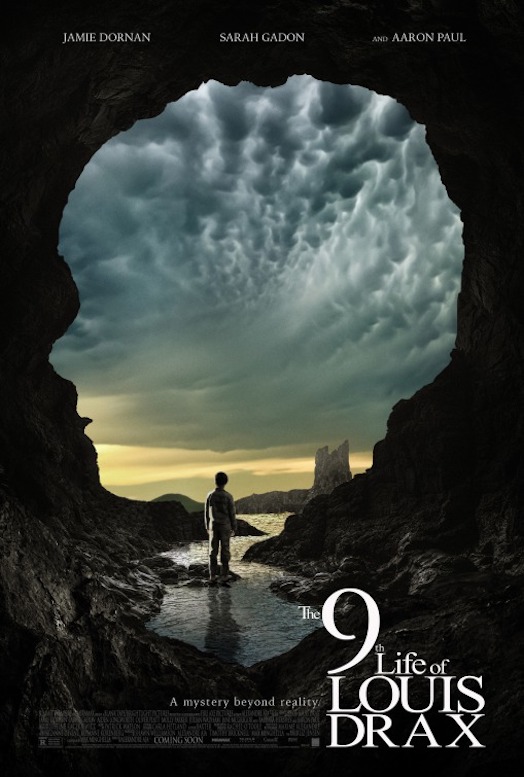
Narrated by the title character, The 9th Life of Louis Drax introduces us to a nine year old boy who is always having near-fatal accidents. His ninth involves a cliff-top fall into the sea while on a picnic with his parents, Natalie (Gadon) and Peter (Paul). While Louis (Longworth) is rescued but trapped in a coma, mystery surrounds his father, who is missing, and his mother, who may or may not be telling the truth about what happened. While the police (Parker, Chen) investigate, Louis’s care falls under the remit of pediatric coma specialist Dr Allan Pascal (Dornan). He believes that Louis can recover in time, even though there are no signs to support this, Louis having been diagnosed as being in a persistent vegetative state.

Over time, Pascal finds himself growing closer to Natalie, while also delving into Louis’s past medical history, including his visits to a psychiatrist, Dr Perez (Platt). It soon becomes clear that there is a mystery surrounding Louis’s accidents, and letters begin appearing that seem to have been written by Louis – which is impossible. Meanwhile, in his coma, Louis is discovering truths about his life that he has been aware of but has suppressed. As the mystery begins to unravel, both Pascal and Louis come to realise that strange forces are at work, and that neither will remain unaffected by them.

9thlife1x

If you know nothing about The 9th Life of Louis Drax before settling down to watch it, then the direction that it takes in telling its story may baffle you or seem inexplicably weird. This will be due to the dreamlike fantasy world that Louis inhabits inside his coma, a place where a gravel-voiced sea creature acts as a guide in allowing Louis to understand his past, and what it means for the present. It’s these scenes which are both fascinating and frustrating in equal measure, though, as Max Minghella’s adaptation of the novel by Liz Jensen uses these scenes to explain – at length – what has been going on, and why. While they are necessary in terms of the plot, their presence does, however, make the movie a more sluggish beast (much like the sea creature itself) than it needs to be.

Indeed, the pacing is a problem throughout, with a rapid compendium of Louis’s previous eight “lives” given a Jeunet-esque run-through, before the movie settles down to tell a (mostly) more conventional story. But it only ever really convinces in terms of the relationship between Louis and Peter, while Pascal’s attraction to Natalie feels very much like a tired, hoary old plot device that’s never going to go anywhere (and despite a last-minute reveal that will either have you groaning or grinning – or both). Likewise, Louis is another of those precocious pre-teens whose grasp of human dynamics and adult language only occurs in the movies. The performances are adequate – Gadon’s Natalie though, looks culpable right from the start – but the movie itself is a pedestrian affair that lacks pace and energy, and struggles to make you care about Louis or the people around him.

Rating: 5/10 – some arresting visuals aside, The 9th Life of Louis Drax is a slow, unengaging movie that tries to present its story as a puzzle-box mystery, but fails to make it anything more than a run-of-the-mill thriller; with Aja seemingly unable to elevate the material to the level it needs to reach to be effective, this has to go down as a missed opportunity, and yet another movie that doesn’t do its source material any justice.

Share this:

  • Share on X (Opens in new window) X
  • Share on Facebook (Opens in new window) Facebook
  • More
  • Print (Opens in new window) Print
  • Email a link to a friend (Opens in new window) Email
Like Loading...

The Infiltrator (2016)

04 Saturday Feb 2017

Posted by dullwood68 in Movies

≈ 3 Comments

Tags

Benjamin Bratt, Brad Furman, Bryan Cranston, Diane Kruger, Drama, Drug cartel, John Leguizamo, Literary adaptation, Money laundering, Review, Robert Mazur, Thriller, True story

infiltrator

D: Brad Furman / 127m

Cast: Bryan Cranston, Diane Kruger, John Leguizamo, Benjamin Bratt, Juliet Aubrey, Yul Vazquez, Elena Anaya, Rubén Ochandiano, Simón Andreu, Joseph Gilgun, Juan Cely, Art Malik, Saïd Taghmaoui, Amy Ryan, Jason Isaacs, Olympia Dukakis, Michael Paré

Number four hundred and twenty-nine in what feels like 2016’s never-ending list of true stories – or movies based on true stories – The Infiltrator is a throwback to the kind of crime dramas made in the Seventies, with the main character going undercover  and putting their life on the line in order to expose the mob boss/cartel leader/fiendish criminal mastermind who has so far remained untouchable. Here the main character is Robert ‘Bobby’ Mazur, a veteran US Customs special agent nearing retirement, but who takes on one more undercover case when another agent, Emir Abreu (Leguizamo), asks for his help. Abreu’s case involves an informant (Cely) with ties to a Colombian drug cartel, and the aim, at first, is to follow the drug trail from America back to Colombia and catch the cartel leaders red-handed. But Mazur has a better idea: instead of following the drugs, why not follow the money?

Assuming an alias, Bob Musella, Mazur poses as a businessman who can launder the cartel’s money through the companies he owns, effectively making it clean and untraceable. He and Abreu are put in contact with a couple of the cartel’s men (Ochandiano, Andreu), who in turn introduce them to Javier Espina (Vazquez), a high-level enforcer whose job it is is to assess whether or not Musella can be trusted, and his claims for the cartel’s money are true. Reassured that they are, Espina gives the go ahead for Musella to start laundering the cartel’s money, but when Mazur is put in a compromising situation with a lap dancer – he’s happily married with two children – he invents a fiancée to get himself out of it. Mazur’s boss, Bonni Tischler (Ryan), is less than happy with this, but arranges for a female agent, Kathy Ertz (Kruger), to step into the role.

infiltrator-2

With his “credentials” proving satisfactory, Mazur cites a problem with the way the cartel currently moves its money as an excuse for meeting with the person who runs it all. This leads him to both the Bank of Credit and Commerce International, which will help him launder larger quantities of the cartel’s money than he can make look legal, and the acquaintance of Roberto Alcaino (Bratt), whose role is to facilitate both the movement of the cartel’s money and the distribution of its drug shipments through an entry point in Miami. Alcaino welcomes Mazur and Ertz into his home, and they become friendly with both him and his wife, Gloria (Anaya). Using a tape recorder hidden in a briefcase, Mazur is able to gain evidence on all the parties concerned, but needs just one more thing to happen before he can have everyone arrested: the release of funds belonging to Pablo Escobar which the US government has frozen. Without these funds, Escobar, who is the head of the cartel, will not commit to using Mazur exclusively, and the undercover work he’s done will only cause so much damage.

In the hands of director Brad Furman and screenwriter Ellen Sue Brown (Furman’s wife), Robert Mazur’s tale of deception and intrigue becomes a tale of patience and deferment for the audience, as any likely tension or nail-biting moments are kept to a minimum, and Mazur’s scam on the cartel moves along slowly and relentlessly to its expected denouement. Along the way, there are lots of scenes where Mazur as Musella insists on doing things his way and the cartel almost meekly agrees. His cover remains intact throughout, as does Ertz’s, and only Espina suspects they’re not who they say they are. At this point, the viewer will be grateful for something going wrong, as up til now it’s all gone along too smoothly (it may well have been this way, but it doesn’t make for compelling viewing). But not for long; Espina’s potential threat is removed before it’s even had time to get going, and the viewer is left wondering if anything is ever going to upset Mazur’s carefully balanced apple cart.

mv5bnjrjmde0odytzwm1zs00n2e0lwi2otatzjizmgi0y2m5yjkwxkeyxkfqcgdeqxvynjuwnzk3ndc-_v1_

The movie also struggles to maintain a consistent focus, with subplots that come and go without advancing the main narrative, and scenes surrounding Mazur’s home life that feel tacked on and derivative. His wife, Evelyn (Aubrey), is supportive of his work even though she wishes he’d retired when he could have, but is inexplicably jealous of Ertz and their fake relationship (she even asks Ertz if she’s sleeping with him). Elsewhere, Mazur is followed by someone who turns out to be a CIA agent, but you have to be paying attention to the end credits to learn why. And both Mazur and Ertz appear to bond with Alcaino and his wife to the point where they feel sympathy for them. These and other aspects of what should be a fairly straightforward storyline may well be meant to add depth and complexity to proceedings, but instead they only show just how bland that storyline really is.

As for the performances, Cranston plays Mazur with a great deal of charm (and a quite impressive wig), but we never really get to know him as a person. He’s good at his job, but we don’t know what motivates him to be so good, or what makes him so effective as an undercover agent. Kruger comes on board halfway through and her character’s (quickly ignored) inexperience proves a good foil for Cranston’s taciturn dedication, though viewers may well be surprised by the number of times they hug. Leguizamo offers good value for the viewer’s time (as always), portraying Abreu as a thrill-hungry agent with an attitude to match; whenever he’s on screen the movie livens up a little. As a second tier kingpin, Bratt exudes a glossy menace that is much more effective for being delivered with a reluctance born out of long experience of the life he leads, while from the supporting cast, Dukakis has a ball as Mazur’s aunt, Vazquez is unnerving as the camp yet deadly Espina, and Aubrey expresses more in a look than seems entirely feasible.

infiltrator-3

With its slow but steady pacing and attention to period detail, the movie doesn’t lack for sincerity, but it doesn’t quite know how to pick up the pace when it’s needed. Furman concentrates on explaining how the cartel’s money can be laundered, but it’s exposition that only needs confirming once, whereas it’s explained on at least four separate occasions. There are twists and turns here and there, some entirely predictable, others less so but lacking in impact. And there’s one scene, in a restaurant involving an unlucky waiter and an anniversary – no, birthday – cake that appears out of nowhere (and context) and tries to make Mazur something he’s not: a hardass.

With so many angles to cover, and not all of them as effective as needed, The Infiltrator relies more and more on Cranston to pull it through the weeds, but it’s an uphill struggle even for him. With Leguizamo given less and less to do thanks to Kruger’s involvement, and her role almost entirely (and deliberately) superficial at times, it’s only Bratt’s urbane take on Alcaino that keeps the final third interesting. It’s all given a rosy patina of sophistication by DoP Joshua Reis, though, and the movie benefits greatly from the way in which Furman uses composition to establish mood. But this particular tale eschews mood too often for it to work as a tense, engaging thriller, and in doing so, manages to downplay the enormity of Mazur’s achievement. And when it comes, it comes at a wedding that looks like it’s been put together for a reality TV show rather than a Customs Office sting operation.

Rating: 6/10 – moderately absorbing, yet banal in execution, The Infiltrator suffers from being too much on an even keel, and not loosening up in its approach at telling Robert Mazur’s amazing story; Cranston is a pleasure to watch, even if you think Mazur was inordinately lucky in what he did, and he keeps things from disintegrating too quickly, leaving a movie that wants to be topical (despite being set in the late Eighties), but lacks the modern day relevance that could be assigned to it.

Share this:

  • Share on X (Opens in new window) X
  • Share on Facebook (Opens in new window) Facebook
  • More
  • Print (Opens in new window) Print
  • Email a link to a friend (Opens in new window) Email
Like Loading...

A Monster Calls (2016)

23 Monday Jan 2017

Posted by dullwood68 in Movies

≈ 2 Comments

Tags

Cancer, Drama, Fantasy, Felicity Jones, Grief, J.A. Bayona, Lewis MacDougall, Liam Neeson, Literary adaptation, Patrick Ness, Sigourney Weaver, Stories, Toby Kebbell, Yew tree

monster_calls_ver2

D: J.A. Bayona / 108m

Cast: Lewis MacDougall, Liam Neeson, Sigourney Weaver, Felicity Jones, Toby Kebbell, James Melville, Geraldine Chaplin

Thirteen year old Conor O’Malley (MacDougall) is experiencing nightmares. In them, the church near his home collapses when the ground around it splits open, and Conor has to try and save his mother (Jones) who is in danger of disappearing into one of the fissures this devastation has wrought. When he wakes from these nightmares each night it is always 12:06. But the nightmares aren’t the only problem Conor has to deal with. His mother is suffering from cancer, and she’s not responding well to her treatment. His grandmother (Weaver) keeps mentioning that at some point, Conor will have to come and stay with her, but he doesn’t want to leave his mother; he still clings to the hope that she’ll get better. His father (Kebbell) lives in the US and is generally unsupportive, using the physical distance between them as an excuse. And at school, he’s the victim of bullying by one of the other boys in his class, Harry (Melville).

One night, at 12:07, Conor is drawing a picture of the view from his bedroom window when the large yew tree that is situated in the nearby graveyard transforms into a monster (Neeson) made from the tree’s trunk and branches. It approaches the house and after grabbing Conor from his bedroom, tells him that he’ll receive further visits from the monster, and that the monster will tell him three stories, after which Conor will then tell a fourth story, the truth behind his nightmares, which only he can tell. The monster is true to his word. On the first visit, he tells Conor the story of an old king who marries a young woman who many regard as a witch. When he dies she rules as regent until his grandson comes of age. She rules fairly but doesn’t want to relinquish her position, intending to marry the grandson instead. But the murder of the grandson’s true love leads to her being convicted of the crime, and she is only saved by the monster at the last moment.

1200

The second story concerns an apothecary whose livelihood is condemned by the local parson. When a terrible sickness breaks out, the parson’s two daughters fall ill, and he begs for the apothecary”s help, and swears he will do anything in order for his daughters to live, but the apothecary refuses, and the girls die. The monster appears and demolishes the parson’s house as a further punishment for his lack of faith. The third story concerns a man who feels himself to be invisible because no one ever takes notice of him, but when the monster aids him in this, it doesn’t solve things, merely adds further problems for him to deal with. These stories help Conor to deal with the various emotions he’s struggling with, and to make sense of them, leading inevitably, as the monster predicted, to his telling the fourth story, the truth about his nightmares…

At its heart, A Monster Calls is about impending loss and the grief that comes with it, both before and after. Adapted by Patrick Ness from his own novel, the movie is a dark, compelling, visually innovative tale of personal redemption in the face of overwhelming emotional distress. It’s a children’s tale about adult themes and how they can affect someone who is “too old to be a kid, too young to be a man”. By making Conor and his struggle to manage the full implications of his mother’s illness – her terminal illness – the focus of the story, Ness and director J.A. Bayona allow the movie to express the kind of feelings and emotions that we forget children can and do experience in these kinds of circumstances. It’s an obvious lesson, but presented in such a clear, immediate manner that Conor’s plight is readily acceptable, and convincingly played out.

maxresdefault

There may be some who will query why Conor’s road to the acceptance of his mother’s impending demise needs the presence of a fantasy giant made out of a yew tree. But allegory has always been a pertinent and effective way of dealing with, and expressing, the kinds of emotions that we keep buried inside us because of how painful they are. Conor’s emotions spill out through his nightmares, and in his search for an answer he calls on the monster, albeit unwittingly. When they first meet, Conor makes it clear he’s not scared, and nor should he be; after all, the monster is a creation formed from Conor’s own subconscious. But the stories the monster tells are far more than stories – they’re explanations of the various emotions and feelings that Conor is struggling with. And they pave the way for the truth, the real hurdle he must overcome in order to move forward. All this is relayed in such a plausible, non-sensationalist, and poignant fashion that any doubts as to the efficacy of such an approach is dismissed moments after the movie has begun.

The look of the movie is very important too, and here Bayona mixes a variety of styles to potent effect. There’s an almost documentary feel to the scenes where Conor is at school, as if the camera is eavesdropping on him. Then there are the scenes at home, the modest environment that looks like an inviting update on homes from the Seventies, what with Eugenio Caballero’s production design making everything look that just a little bit lived in, and Pilar Revuelta’s sterling set decoration as well. And then there are the animated interludes, the stories themselves, rendered in a mixture of styles, and each one enhancing the story it portrays. The movie is at its most confident in these sequences, taking the viewer away from the grim real world, and painting portraits of worlds where life is even harsher and less likely to offer the kind of solace Conor needs – at first glance, that is. It’s a brave decision, but one that pays off handsomely, as each sequence is captivating in its own right.

amonstercalls_trailer

The look of the monster is endlessly fascinating as well, with Neeson’s mo-capped features and physique a perfect fit for such an iconic creature. Despite not being “real”, the monster’s presence in the movie serves as a reminder that fantasy doesn’t have to mean an absence of credibility, and thanks to Ness’s tightly developed screenplay, this isn’t an issue the movie has to deal with at all. As the monster, Neeson delivers a perfectly modulated vocal performance, one replete with emotional nuances and textures that support the drama and justify his role in the production. As the two mothers connected by their shared love for each other, Weaver and Jones both give heartfelt performances that avoid unnecessary sentimentality, while Kebbell’s role calls for him to be affectionate yet callow, sympathetic yet distant, and emotionally obtuse. But it’s MacDougall’s performance that stands out, a complex, yet honest portrayal of a young boy’s struggle to acknowledge his own deep-rooted and frightening feelings about his mother, and what those feelings might do to him if he faces up to them. It’s a quietly bravura performance, generously encouraged by Bayona and the rest of the cast, and is as good as any performance by an adult actor in 2016.

There will be accusations that A Monster Calls is unremittingly bleak, and that its subject matter is not best suited to the so-called Young Adult market that many people will believe this is aimed at. Though Ness wrote the novel with that particular audience in mind, this version transcends notions of age and worldly experience by making Conor’s feelings universal, and for children and adults alike. Yes, it is bleak at times, and yes, it’s not an openly optimistic movie, but it is an uplifting, inspiring movie that celebrates maternal love, the sacrifices adults sometimes have to make to ensure that children remain children for just that little bit longer, and the resilience that we often forget children have when it comes to dealing with the darker aspects of growing up. This is a movie that does something completely unexpected: it challenges us to look at ourselves and ask, if we were in Conor’s shoes, would we beahve any differently? We might not call upon a monster to help us, but then, would it be such a bad idea?

Rating: 9/10 – an impressively mounted exploration of identity, hidden grief, and growing emotional despair, A Monster Calls is a crushingly honest look at how it feels to be losing someone you’re incredibly close to, and how those feelings can affect everything else around you; brilliantly realised, and with a tremendous performance from MacDougall, this is exceptional stuff indeed, and proof that intelligent, thought-provoking movies can also be beautiful and moving at the same time.

Share this:

  • Share on X (Opens in new window) X
  • Share on Facebook (Opens in new window) Facebook
  • More
  • Print (Opens in new window) Print
  • Email a link to a friend (Opens in new window) Email
Like Loading...

Patriots Day (2016)

22 Sunday Jan 2017

Posted by dullwood68 in Movies

≈ 2 Comments

Tags

Bombing, Boston Marathon, Boston Strong, Drama, J.K. Simmons, John Goodman, Kevin Bacon, Literary adaptation, Manhunt, Mark Wahlberg, Michelle Monaghan, Peter Berg, Review, Thriller, True story

328338id1_patriots-day_27x40_1sht-revise

D: Peter Berg / 133m

Cast: Mark Wahlberg, Kevin Bacon, John Goodman, J.K. Simmons, Michelle Monaghan, Alex Wolff, Themo Melikidze, James Colby, Michael Beach, Rachel Brosnahan, Christopher O’Shea, Jake Picking, Jimmy O. Yang, Vincent Curatola, Melissa Benoist, Khandi Alexander, Adam Trese, Dustin Tucker

At 2:48pm on 15 April 2013, the 117th annual Boston Marathon was taking place, and was proceeding as smoothly as in previous years. It was already nearly three hours since the winner had crossed the finish line, and the remainder of the runners – some 5,700 – were still to complete the course. A minute later, at 2:49pm, a bomb exploded in the crowd of onlookers near the finish line; approximately thirteen seconds after, a second bomb exploded one block further away. Between them, the blasts claimed the lives of three people, and injured hundreds of others, including sixteen people who lost limbs. It was a terrorist attack that no one saw coming, and such was the confusion at the time of the blasts that runners still crossed the finish line for another eight minutes.

This is the core event of Patriots Day, a recreation of the bombings that occurred that fateful day, and the subsequent manhunt that took place over the next four days. It begins with Boston Police Department Sergeant Tommy Saunders (Wahlberg) and moves on to introduce a variety of individuals whose lives will be affected by the bombing and subsequent events. These include Tommy’s wife, Carol (Monaghan), Boston Police Commissioner Ed Davis (Goodman), young couple Jessica Kensky (Brosnahan) and Patrick Downes (O’Shea), Chinese student Dun Meng (Yang), MIT police officer Sean Collier (Picking), district of Watertown police Sergeant Jeffrey Pugliese (Simmons), Boston Police Superintendent Billy Evans (Colby), naturalised U.S. citizen Dzhokhar Tsarnaev (Wolff), his brother Tamerlan (Melikidze), and Tamerlan’s American-born wife, Katherine (Benoist).

film-patriots-day_bece

By the time the race starts we know that Tamerlan and Dzhokhar will be the people who place the bombs. And as the race begins, and we see them moving amongst the crowds, what has been a fairly straightforward, and somewhat leisurely approach to the events of 15 April 2013 begins to become something altogether more focused, and darker. When the bombs do go off – and we know they will – the explosions, and the devastation they cause, are still shocking. And it’s as this point that Patriots Day, which could have so easily been a tale of jingoistic heroism sprinkled with Hollywood-ised action beats, becomes something even richer and more surprising: a movie based on true events that incorporates an incredible level of detail, and better still, includes actual footage from the time. It’s this aspect of the movie, the mixture of real and realised that impresses the most, as it makes the verisimilitude that much more potent.

In adapting the book, Boston Strong by Casey Sherman and Dave Wedge, director Peter Berg has made his most accomplished and impactful movie to date. Reuniting with Mark Wahlberg for the third time after Lone Survivor (2013) and Deepwater Horizon (2016) – also true stories – Berg has finally crafted a movie that resonates on more than one level, and which doesn’t rely on the jingoistic heroism mentioned above. It does celebrate the way in which the residents of Boston came together in the wake of a terrorist attack, but Sergeant Pugliese’s incredibly brave confrontation with Tamerlan Tsarnaev aside, there aren’t any moments of gung ho courage, just an acknowledgment of how determined everyone – law enforcement and public alike – were in making sure the bombers were captured. It’s not often that a movie gives you a true sense of a community coming together in such a way, but this is definitely one of them, and it does so powerfully and succinctly.

040616_PATRIOTSDAY_KB_462.CR2

The various storylines are cleverly interwoven as well, with each character given a relevant amount of screen time, and their lives, even Wahlberg’s composite policeman, explored with a tremendous surety of touch. Admittedly, some of the investigators – Bacon’s overly experienced FBI agent Richard DesLauriers, Goodman’s shocked and angry Police Commissioner – fare less well in this respect due to the nature of their involvement, but otherwise, people such as Downes and Kensky, who had reached the finish line when the first bomb went off, are afforded due recognition because of what happened to them not only then but subsequently. The same is true of Steve Woolfenden (Tucker), who was injured and separated from his young son, Leo. Away from the injured, the fates of people such as Dun Meng and MIT police officer Sean Collier are played out with sincerity and a lack of sensationalism, or the kind of made-for-TV banality that offsets any strived-for veracity.

Once the manhunt is under way and an initial identification of the suspects has been made (one of the movie’s cleverest moments), the movie steps up a gear, and becomes intensely exciting. The scenes involving Dun and the Tsarnaevs are mini-masterclasses in how to keep an audience on the edge of their seat, and all this is achieved by precision editing (courtesy of Gabriel Fleming and Colby Parker Jr) and an emotional undercurrent that permeates the movie as a whole. Berg makes you care about the people in this movie, these people who experienced so much and came out the other side so much stronger (albeit not all of them). The same can be said of the shootout on Watertown’s Laurel Street, a literally explosive confrontation between the police and the Tsarnaevs that stands head and shoulders above most movie shootouts, and which again, thanks to Fleming and Parker Jr, leaves the viewer gasping at how insane it all was, and how frightening it must have been to be a part of it all.

1479137092479

Berg’s commitment to telling this story as honestly and passionately as possible, while not sensationalising it in any way, is the reason why it works so well, and why it deserves every possible accolade. He’s helped tremendously by a cast so committed to meeting his vision of the story that there’s not one performance that’s out of place or not operating in service of the material. Wahlberg, who always seems to feel more comfortable playing blue collar workers, puts in his best work since The Fighter (2010), while the likes of Goodman, Bacon, Monaghan and Simmons all deliver solid, credible supporting performances that enhance the narrative whenever they’re on screen. As the Tsarnaevs, Wolff and Melikidze are an impressive teaming, establishing both the bonds and the boundaries between the two brothers with almost nonchalant ease; it’s an adversarial relationship in many ways (as with so many brothers), but you never once question their commitment to their cause and each other. But if there has to be one actor or actress who stands out for any reason, then that is unquestionably Melissa Benoist, TV’s current Supergirl. Watch the scene where Katherine is interrogated by a nameless “spook”: it’s an exemplary display of a character’s doubt, fear, loathing, and blinkered self-assurance, and is as surprising for its conclusion as it is for the iciness of the scene as a whole.

The movie ends as most movies attempting to tell a true story often do: with an update on some of the people whose lives were affected on that terrible day in April 2013. And then it goes one step further, and you hear the voice of the real Patrick Downes, and then you see both him and Jessica Kensky as they talk about that day and what it’s meant to them since. You see officials such as Ed Davis and Richard DesLauriers, and as they talk about the notion of Boston Strong, the unifying concept that sprang up in the wake of the bombings, the idea that Boston and its people would not be intimidated by acts of terrorism – listening to them you understand just why Berg and his team were so determined not to make this an exercise in hyperbole or the cinematic equivalent of yellow journalism. Because if they had, then the movie’s final image – its message if you like – would have meant nothing. It would have lacked context, and it would have lacked the emotional jolt that the movie leaves you with. And what was that image? Ah, now that would be telling…

Rating: 9/10 – a superb retelling of the Boston Marathon bombings and the manhunt that followed over the next one hundred and five hours, Patriots Day is a movie devoid of frills, unnecessary plot devices, or political finger-pointing; a tribute to all those who survived the bombings, and the extraordinary levels of cooperation between a city and its law enforcement – a de facto curfew was in place following the shootout in Watertown – the movie focuses on telling its story matter-of-factly and audaciously, and by concentrating on the people who were caught up in it all, an approach that many other movies “based on real events” should try adopting as well.

Share this:

  • Share on X (Opens in new window) X
  • Share on Facebook (Opens in new window) Facebook
  • More
  • Print (Opens in new window) Print
  • Email a link to a friend (Opens in new window) Email
Like Loading...

Hidden Figures (2016)

21 Saturday Jan 2017

Posted by dullwood68 in Movies

≈ 3 Comments

Tags

1961, Drama, Friendship 7, Janelle Monáe, Jim Parsons, Kevin Costner, Kirsten Dunst, Literary adaptation, NASA, Octavia Spencer, Racism, Review, Taraji P. Henson, Theodore Melfi, True story

hidden_figures_ver2

D: Theodore Melfi / 126m

Cast: Taraji P. Henson, Octavia Spencer, Janelle Monáe, Kevin Costner, Kirsten Dunst, Jim Parsons, Mahershala Ali, Aldis Hodge, Glen Powell, Kimberly Quinn, Olek Krupa

In 1961, the USA and the USSR were in a race to put a man into space. The Russians had managed to send up a mannequin and a dog on separate missions, while the Americans were struggling to stop their unmanned rockets from blowing up shortly after take-off. The team responsible for this string of non-fatal disasters was based at the NASA complex in Langley, Virginia. In fact, there were several teams working there, including a coloured section overseen by Vivian Mitchell (Dunst). Of the women that worked there, three were best friends: Katherine Goble (Henson), Dorothy Vaughan (Spencer), and Mary Jackson (Monáe). Each had their own specialty: Katherine was a maths genius, Dorothy was a more than competent supervisor (and latent programmer), while Mary was an engineer.

Despite their obvious capabilities, the institutionalised racism of the time ensures that each of them remains in a pool of temps to be drawn on as and when required. Dorothy is the de facto supervisor of the group, but isn’t officially recognised as such. Mary’s desire to be an engineer is hampered by her needing to take a specific engineering course – which is taught only at a non-segregated school. And Katherine’s intuitive knowledge of advanced mathematics is under-utilised on a regular basis. Things begin to change though, when Katherine is seconded to the Space Task Group, the team responsible for calculating the launch and landing coordinates for each rocket mission.

hf-gallery-04-gallery-image

Led by Al Harrison (Costner), the team is as inherently racist as an all-white male environment could be. Only Harrison seems able to look past the colour of Katherine’s skin, but he has too much on his plate to ensure that everyone else does. With her work constantly undermined by Harrison’s second-in-command, Paul Stafford (Parsons), and having to spend too much time checking other people’s calculations, Katherine struggles to make any headway in having her talents recognised. When the USSR succeeds in sending Yuri Gagarin into space (and bringing him back), the pressure is on to do the same with a US astronaut. With the arrival of an IBM mainframe computer that will process mathematical formulae and calculations much quicker than Harrison’s team of “computers”, Katherine faces an even bigger challenge: how to retain a human element amongst all the mathematics, and how to ensure that any future manned space flights remain as safe as humanly possible. It all leads to the first manned orbital flight, and making sure that astronaut John Glenn (Powell) returns home in one piece.

Those with a good memory for last year’s Oscars will remember the outcry over the Academy appearing to be racially biased against black and ethnic movie makers. Stars such as Will Smith boycotted the Oscar ceremony, while contention reigned over the nominations the Academy had made in the first place. A year later, and we have Hidden Figures, a movie almost designed to address the issue, and which should see itself gain a slew of nominations. However, the movie is the victim of felicitous timing, having gone into production a full year before last year’s Oscars. Nevertheless, it’s the kind of feelgood, inspiring, let’s-throw-a-light-on-a-little-known-aspect-of-recent-US-history movie that charms audiences and critics alike. And it doesn’t hurt that co-writer/director Theodore Melfi has assembled a great cast to do justice to his and Allison Schroeder’s screenplay, itself adapted from the book by Margot Lee Shetterley.

hidden-figures1

While Hidden Figures doesn’t necessarily stand or fall on its performances, having such a (mostly) seasoned cast pays off tremendously. Henson is terrific as Katherine, the unsung hero of the Friendship 7 mission who is more than just a maths genius, while Spencer and Monáe provide equal measures of grit and determination as Dorothy and Mary, guiding their real-life characters through the many professional, personal, and racial pitfalls the two women experienced at the time, and their inspirational, dedicated responses to each potential setback. Both actresses are equally as terrific as Henson, even if they have a little less to do in comparison, but as a trio they prove to be inspired casting. The same can be said for Costner, playing yet another (fictional) fair-minded, no-nonsense authority figure, but doing so with a great deal of charm and delivering his lines with the necessary amount of gravitas and persuasion. The only character who sticks out as unnecessarily stereotypical is Parsons as Katherine’s racist, jealous colleague, who constantly feels threatened by her presence and her abilities. Reduced to giving her glowering looks and blocking her attempts at personal recognition, Parsons’ performance does the actor no favours and will have many viewers thinking, “he’s just playing an evil version of Sheldon Cooper”.

As Mrs Mitchell, Dunst at least gets to see the error of her ways by the movie’s end, while there’s solid support from Ali and Hodge as Katherine’s love interest and Mary’s husband respectively. And there’s a mischievous turn from Powell as John Glenn, who won’t take off unless Katherine has checked the numbers. With so many enjoyable, and finely-tuned performances, the movie is free to explore the ways in which Johnson et al became so integral to the success of the Friendship 7 mission after so many failures. There’s subterfuge (on Dorothy’s part), legal wrangling (by Mary), and pure dogged persistence by Katherine. While it’s true that all three were in the right place at the right time, it’s still equally true that they took advantage of the chances given them, and made the most of those opportunities. In doing so, they forged a path for women (and not just black women) that is still being benefitted from today, and the movie is eager to highlight their achievements – which is as it should be.

DF-04856_R2 - Katherine G. Johnson (Taraji P. Henson), flanked by fellow mathematicians Dorothy Vaughan (Octavia Spencer) and Mary Jackson (Janelle Monáe) meet the man they helped send into orbit, John Glenn (Glen Powell), in HIDDEN FIGURES. Photo Credit: Hopper Stone.

But though these achievements are rightly recognised and celebrated, and the tensions inherent in the efforts to put Glenn into orbit are confidently addressed and shown, it’s when the movie steps away from the base at Langley and tries to paint a wider picture of the period that it proves to be less successful in its efforts. There are references to the growing civil unrest in the country, and we get to spend time with the trio’s family and friends on various occasions, but Katherine’s romance with Colonel Jim Johnson (Ali) aside, much of these scenes and sequences feel like filler, particularly the political discussions between Mary and her husband, which seem like they’re prodding the movie in another direction, but which ultimately amount to nothing.

Otherwise though, Hidden Figures is a lovingly rendered tribute to three women who smashed through not one but two glass ceilings and contributed greatly to the US winning the space race and eventually landing on the Moon. That their contributions have taken so long to be recognised and honoured by the wider public is a travesty that the movie addresses with no small amount of style and grace. Melfi is to be congratulated for taking such an inspiring, untold tale and doing it full justice, and in the process, making one of the most enjoyable, inspiring and rewarding movies of recent years.

Rating: 8/10 – shining a light on an overlooked story from the early Sixties, Hidden Figures is a generous, captivating movie that plays equally well as both an historical drama and a comedy of manners; with a trio of memorable performances, and richly textured direction from Melfi, this is an object lesson in bringing history alive and making it completely accessible.

Share this:

  • Share on X (Opens in new window) X
  • Share on Facebook (Opens in new window) Facebook
  • More
  • Print (Opens in new window) Print
  • Email a link to a friend (Opens in new window) Email
Like Loading...

Goat (2016)

21 Saturday Jan 2017

Posted by dullwood68 in Movies

≈ Leave a comment

Tags

Andrew Neel, Ben Schnetzer, Brad Land, Brothers, Danny Flaherty, Drama, Fraternity, Gus Halper, Hell Week, Literary adaptation, Nick Jonas, Phi Sigma Mu, Pledges, Review

goat-2016-movie-poster

D: Andrew Neel / 102m

Cast: Ben Schnetzer, Nick Jonas, Gus Halper, Danny Flaherty, Virginia Gardner, Jake Picking, Brock Yurich, Will Pullen, Austin Lyon, Eric Staves, James Franco

Across America there are hundreds if not thousands of colleges. And these colleges have what are called fraternities, male-only “clubs” whose membership is often highly sought after, and which confers a certain level of social acceptance on the member. If you’re a student who doesn’t belong to a fraternity, the inference is that you’re somehow not worthy, or an outsider and to be avoided. But if you are a student and you do want to fit in, then the price of membership is called Hell Week. During this period, the students who head up the fraternities will play practical jokes on potential members (called pledges), get them to perform painful or humiliating tasks, keep the pledges at the fraternity’s beck and call, and generally make their lives – appropriately – hell. The idea, officially, is to weed out the weak from the strong, and only allow in those who meet whatever criteria the fraternity is looking for. Unofficially, it’s an opportunity for existing members to bully and humiliate pledges, and all in the name of accepted tradition.

It’s this period of time in a college student’s life that is explored in Goat, an adaptation of the autobiographical book by Brad Land. Land (Schnetzer) is on the brink of going to the same college where his older brother Brett (Jonas) is studying, but he’s having second thoughts. However, an ill-fated decision to give two strangers a ride home late one night leads to Brad being robbed and assaulted, and his attackers disappearing. Stricken by guilt and self-reproach over not fighting back, Brad makes the decision to attend college, and though it means leaving behind his friends, and the one girl he likes (and who seems to like him), for Brad it’s akin to making a fresh start. Brett is happy that they’ll be on campus together, and so is Brad, who is soon getting to know his roommate, Will (Flaherty). It isn’t long before Brett’s fraternity comes calling, and he’s asked to join, along with Will.

goat-redband-screen2

Hell Week begins and the various tasks Brad and the other pledges are required to endure at first are largely alcohol-related. But as the week continues, and the tasks become more aggressive and humiliating in nature, Brett begins to believe that Brad shouldn’t be a pledge at all. But Brad is insistent that he’ll see it through, whatever happens to him. And see it through he does, but he and the others, including Will, have another month of hazing to endure before they become full-fledged fraternity members. During this period, a wedge is driven between the two brothers, the police contact Brad with news that they may have apprehended one of his attackers, and a tragedy threatens the existence of the fraternity and Brad’s continued attendance at the college…

True stories about horrific experiences, or periods in a person’s life, can often be a trial to sit through as well, and Goat, despite the best of intentions, is one such movie. Despite everything that happens to Brad in the course of Goat, one thing remains truer than any of the events of Hell Week, or even the carjacking-cum-assault and battery he suffers at the beginning, and it’s the one thing that lets the movie down throughout: we never get to know him. We learn some basics about him, but there’s too much that remains a mystery. We never get to know why he’s reluctant to go to college in the first place. We never learn why he decides not to stay in contact with the girl he likes. We never learn what his aspirations are, or why he’s at college to begin with (at one point he states he doesn’t know what he’ll major in). And most bewildering of all, we never learn why he wants to be a member of Phi Sigma Mu (other than that his brother is already). With the movie keeping Brad’s motivations in the dark, and by making him a less than self-reflexive character, Goat struggles to make his experiences ones that the viewer can sympathise with, or indeed, relate to. For anyone who has never taken part in a Hell Week, or the subsequent hazing period, why anyone would want to go through such a demeaning experience just to join a fraternity is completely baffling.

goat-15853-large

With the viewer asked to just accept this notion wholesale, the movie focuses on an unwelcome series of ritualised pranking and so-called character-building “exercises” that take up too much of the running time, and which proves futile in creating any tension, or dramatic traction. Scenes that should appal and horrify for their content are instead frustratingly matter-of-fact, and whatever happens to the pledges goes unchallenged in terms of bullying or deliberate mistreatment. It’s only when there’s a tragedy that the screenplay – by David Gordon Green, director Neel, and Mike Roberts – begins to question the morality of Hell Week, and even then it’s to set up a clumsy confrontation between Brett and fraternity bigwig Chance (Halper).

As the beleaguered Brad, Schnetzer is earnest or glum, depending on the scene, and has trouble portraying the range of emotions his character goes through, mainly because the script lacks consistency in determining them. Jonas is kept on the sidelines for the most part, and seems there only to deliver the occasional brotherly pep-talk, Halper oozes insincerity as the leader of Phi Sigma Mu, Picking is the principal bully-boy with few other recognisable characteristics, and Flaherty is the obvious “runt” who’ll suffer more than the others. There’s also a cameo from Franco as the owner of the fraternity house, an ex-fraternity member who still craves his old life even though he’s married and has a child. Sadly, his appearance makes no impact on the overall story, and his character is forgotten about after five minutes.

goat-redband-screen1

Whatever the truth of Land’s experiences in college, and even if the content of his Hell Week is accurate, thanks to an injudicious script and muddled direction by Neel, Goat remains a lost opportunity to examine the psychology of both the pledges and the fraternity members who torment them so willingly. Though you could argue that Brad takes part as a way of punishing himself for not fighting back against his attackers, it’s a theory that the movie fails to confirm or deny, and in holding back, it makes Brad’s journey even less appealing. In the end, the movie ends back where Brad was attacked, but even there it prompts more questions, and leaves the viewer still wondering what it was all for.

Rating: 5/10 – as a straightforward piece of movie making, Goat is a blunt, what-you-see-is-what-you-get feature that never gets inside the head of its main protagonist, and lacks the interest to do so; flatly directed by Neel with performances to match, the movie feels as if it’s about to “reveal all” on several occasions, but instead it remains vague and under-developed, and does its best not to let the audience in on why everything is happening.

Share this:

  • Share on X (Opens in new window) X
  • Share on Facebook (Opens in new window) Facebook
  • More
  • Print (Opens in new window) Print
  • Email a link to a friend (Opens in new window) Email
Like Loading...

Mini-Review: Live by Night (2016)

21 Saturday Jan 2017

Posted by dullwood68 in Movies

≈ Leave a comment

Tags

Ben Affleck, Brendan Gleeson, Crime, Dennis Lehane, Drama, Elle Fanning, Gangsters, Ku Klux Klan, Literary adaptation, Prohibition, Review, Sienna Miller, Thriller, Ybor City, Zoe Saldana

live-by-night-poster

D: Ben Affleck / 128m

Cast: Ben Affleck, Elle Fanning, Remo Girone, Brendan Gleeson, Chris Messina, Matthew Maher, Sienna Miller, Zoe Saldana, Robert Glenister, Chris Cooper, Miguel J. Pimentel, Titus Welliver, Max Casella

Undermined by a leaden script, Live by Night is writer/director/actor Ben Affleck’s third movie as a multi-hyphenate, but after the successes of Argo (2012) and The Town (2010), his latest project is a plodding affair that looks good thanks to Robert Richardson’s usual exemplary cinematography, but otherwise remains remote and uninvolving. The tale of a small-time Boston crook, Joe Coughlin (Affleck), who finds himself at odds with Irish gangster Albert White (Glenister) through his relationship with White’s girlfriend, Emma Gould (Miller), this adaptation of the novel by Dennis Lehane starts off well but soon gets bogged down by messy plotting and too many characters who randomly come and go.

Coughlin’s romance with Emma ends badly, leading him to offer his “services” to White’s rival, Maso Pescatore (Girone). Pescatore sends Coughlin down to Florida, to Ybor City, with instructions to take control of his rum-running operation and ensure that White’s activities in the area are curtailed. Once there, Coughlin, aided by trusted friend Dion (Messina), soon streamlines Pescatore’s operation and squeezes out all the competition. In the process he establishes a business relationship with a Cuban family, and begins an affair with the sister, Graciela (Saldana). Things run smoothly until Coughlin’s working with the Cubans as well as a group of local Negroes, attracts the ire of the Ku Klux Klan. Coughlin tries to come to an amicable arrangement with them, but the Klan’s leader, RD Pruitt (Maher) refuses to play ball, leading Coughlin to make an arrangement with Pruitt’s brother-in-law, Chief Figgis (Cooper) that has unforeseen consequences.

610279809

The Chief’s daughter, Loretta (Fanning), begins making evangelical protests against a casino that Coughlin is building in anticipation of Prohibition being repealed. Her protests lead to the project stalling, which makes Pescatore angry enough to forget all the money Coughlin has made for him, and travel down to Florida to oversee matters for himself, a development that leaves Coughlin vulnerable, and his future in doubt.

For all the convincing period detail and the impressive production design, Live by Night is let down by Affleck’s inability to craft a cohesive screenplay from Lehane’s novel. While Coughlin’s story is told against a backdrop of violence and betrayal, the movie remains a staid, pedestrian affair that moves at a steady pace despite Affleck’s best efforts to inject some energy and verve into proceedings. Part of the problem is the number of characters that appear for a short time then disappear or pop up again for another short period. Despite the cast’s best efforts, they’re let down by Affleck’s script, which uses each character to advance the narrative, but without investing in them to any great degree. This leaves actors of the calibre of Gleeson, Saldana and Glenister stranded for the most part, with only Miller and Fanning making much of an impression. It doesn’t help that Affleck’s portrayal of Coughlin also lacks range or depth, leaving the viewer hoping that things will improve over time, and that a way in to the material with eventually arise, something that, unfortunately, never happens.

Rating: 6/10 – curiously turgid and flat, Live by Night has clear aspirations to be a crime drama with operatic overtones, but instead, remains resolutely commonplace; with too many strands that make for a stop-start narrative, and characters that aren’t allowed to make much of an impact, the movie keeps its audience at a distance, and never looks as if it will close the gap at any point throughout.

Share this:

  • Share on X (Opens in new window) X
  • Share on Facebook (Opens in new window) Facebook
  • More
  • Print (Opens in new window) Print
  • Email a link to a friend (Opens in new window) Email
Like Loading...

Elle (2016)

10 Tuesday Jan 2017

Posted by dullwood68 in Movies

≈ 2 Comments

Tags

Anne Consigny, Charles Berling, Drama, Isabelle Huppert, Laurent Lafitte, Literary adaptation, Paul Verhoeven, Philippe Djian, Rape, Revenge, Review, Thriller, Video games

elle-2016-poster

D: Paul Verhoeven / 131m

Cast: Isabelle Huppert, Laurent Lafitte, Anne Consigny, Charles Berling, Virginie Efira, Judith Magre, Christian Berkel, Jonas Bloquet, Alice Isaaz, Vimala Pons, Raphaël Lenglet, Arthur Mazet, Lucas Prisor

“She” of the title is Michèle Leblanc (Huppert). Michèle is divorced – from Richard (Berling) – has one adult son, Vincent (Bloquet), runs a video games company with her best friend, Anna (Consigny), is having an affair with Anna’s husband, Robert (Beckel), and lives alone with her cat. She is independent, self-assured, and a little reserved around others. And then, one day, a masked intruder breaks into her home and rapes her. But Michèle’s response to this isn’t typical. She cleans up the mess made during the attack, and carries on with her life as if – outwardly at least – nothing has happened.

Inwardly, though, Michèle begins to wonder if her attacker is someone she knows. At first she thinks it might be one of the designers at the company, some of whom don’t like her for her abrasive, no-nonsense attitude. She buys some pepper spray, and a small axe that she takes to sleeping with. But all the while she tells no one what’s happened, not even her mother, Iréne (Magre). She and her mother, though, have other issues. Iréne wants Michèle to visit her father, who is prison for mass murder, but Michèle wants nothing to do with him. The murders occurred when she was ten, and afterwards, her father involved her in the aftermath, something she has never forgiven him for.

elle_06_rgb-0-2000-0-1125-crop

Because of this, Michèle refuses to involve the police, as it will also stir up memories of the past and she will again be the subject of press attention. When it becomes clear that her attacker isn’t one of her male employees, it seems as if it could be anyone. But when she is attacked again by the same masked intruder, she is able to defend herself and pull off his mask. Her attacker proves to be someone she knows, but again, she doesn’t report it to the police, and she resumes her life, again as if nothing has happened. Instead, she develops a closer relationship with the man, gaining his trust and encouraging him and his sexual desires. Believing her to be something of a kindred spirit, he also believes their relationship will continue, but Michèle has another plan entirely…

It’s entirely likely that, if you’re a feminist, you’re not going to like Elle. It’s main character is raped, but doesn’t report it; in fact, she gets on with her life as if nothing has happened. And later, when she knows the identity of her attacker, she begins a complicit relationship with him where his raping her gives him sexual satisfaction (while she doesn’t even get any masochistic pleasure out of it). And when she does admit to her friends that she’s been raped, she’s so matter-of-fact about it, and so dismissive of their concerns, she might as well not have told them for all the difference it makes. In short, she’s not reacting in the way that a woman who’s been raped should react; she’s not behaving in the way that she should behave.

elle-movie-1024x568

At Cannes last year, where the movie was first shown, Elle was branded a “rape comedy”, an invidious term that was trying to be clever but which does have some relation to Elle’s complex, unflinching narrative. While the rape itself is sufficiently horrible (even when it’s only heard at the movie’s beginning, it’s still disturbing), it’s not the whole movie. As we begin to learn more about Michèle, humour begins to creep into the material, and largely from the way in which she interacts with her family and friends and colleagues. She’s caustic when she feels it’s necessary, and this leads to us smiling at her behaviour, and appreciating her all the more. She’s not letting being raped define her, or hold any power over her; and when she suspects one of her staff, she takes charge and does her best to find out who it could be. Like it or not, Michèle is being proactive, but in a way that we don’t often see in movies, even in so-called rape-revenge flicks.

Of course, there’s a strong psychological element to all this that drives the movie forward, with Michèle’s past informing and determining her present, and the feelings that she’s not quite in touch with. Part of the strength of the movie is the way in which it refuses to confirm or deny just what Michèle is doing, or how she’s feeling. It’s left to the viewer to decide for themselves what her mindset is – but be warned, for the most part you’re likely to get it wrong. This is also due to an absolutely magnificent performance by Huppert that is a masterpiece in delicate emotional shading. Verhoeven has praised Huppert for bringing things to the character of Michèle that he would never have thought of, and the actress – as ever – is fearless in the role, and endlessly inventive. It’s an hypnotic portrayal, fascinating and complex, and she doesn’t miss one single emotional beat throughout the entire movie. If there really is such a thing as “being true to the character”, then Huppert achieves that, and does it with consummate skill.

xu5sks2yamtwccqcffcz65z5ab

But while Huppert gives a stunning, tour-de-force performance, she’s matched in directorial terms by Verhoeven, here making what many regard as his best movie. (Away from his fantasy and sci-fi movies they’re right; otherwise an equal number of people will say that RoboCop (1987) is his best movie.) The Dutch director effortlessly weaves together the main storyline and its various subplots with the same consummate skill that Huppert brings to the role of Michèle. Thanks to Verhoeven’s sureness of touch, Elle remains endlessly provocative as a psychological drama, and equally riveting as a daring thriller. He also treads a fine line between the aforesaid drama and the movie’s humour, expertly blending the two elements into an unforgettable whole. As the story unfolds, and Michèle’s actions become clearer, the veteran director still manages to use the material at hand to wrongfoot the audience and keep them guessing – a neat trick in this day and age of Internet transparency.

There will be some who will write this off as just another revenge movie, but that isn’t the movie’s raison d’etre. Instead it’s about a woman taking a courageous and difficult route to self-empowerment; and she does it all on her own terms. This is to be applauded, whatever the circumstances, and in the hands of the masterful Huppert and the on-form Verhoeven, Elle paints a vivid portrait of how one woman strives for and maintains her own unique place in both a grossly misogynist workplace, and in the wider world at large. It’s often uncomfortable to watch – after Michèle is raped she has a bath, and blood rises to the water line, a terrible indication of just how violent the attack was – and it offers no easy answers, either in terms of whether or not Michèle’s reaction to being raped is the right one (whatever that is), or whether her search for her attacker is motivated by revenge or curiosity or a mixture of both. It’s a movie that is likely to provoke intense debate for some time to come, but even if it does, one thing is for sure: this is a movie that won’t be forgotten too easily by anyone who sees it.

Rating: 9/10 – a superb thriller unjustly snubbed by the Academy of Motion Picture Arts and Sciences as an entry for the Best Foreign Language Film at this year’s Oscars, Elle is a brilliant, elaborate movie that doesn’t pull any of its punches, and makes a virtue out of being uncompromising; with a daring, exceptional performance by Huppert, and Verhoeven fully in command of the material, the movie deserves every bit of praise it’s received so far, and should be on many people’s Top 10 lists come the end of the year.

Share this:

  • Share on X (Opens in new window) X
  • Share on Facebook (Opens in new window) Facebook
  • More
  • Print (Opens in new window) Print
  • Email a link to a friend (Opens in new window) Email
Like Loading...

Indignation (2016)

03 Tuesday Jan 2017

Posted by dullwood68 in Movies

≈ Leave a comment

Tags

Drama, James Schamus, Korean War, Literary adaptation, Logan Lerman, Philip Roth, Religion, Review, Romance, Sarah Gadon, Tracy Letts, Winesburg

indignation

D: James Schamus / 111m

Cast: Logan Lerman, Sarah Gadon, Tracy Letts, Linda Emond, Danny Burstein, Philip Ettinger, Ben Rosenfield, Pico Alexander, Noah Robbins

In New Jersey in the early Fifties, Marcus Messner (Lerman), the son of a local butcher, has been awarded a scholarship to attend Winesburg College in Ohio. His father (Burstein) is over-protective and fearful that something will happen to Marcus when he’s there, but Marcus is having none of it; he can’t wait to get away. At Winesburg he finds himself boarding with two other Jewish students, Ron Foxman (Ettinger) and Bertram Flusser (Rosenfield). He throws himself into his studies, takes on a job at the college library, and generally keeps himself to himself. He doesn’t socialise, and when he’s offered a chance to join a largely Jewish fraternity, he refuses.

Marcus is drawn out of his self-contained world by the presence of Olivia Hutton (Gadon), an elegant fellow student he’s immediately attracted to. He plucks up the courage to ask her out on a date; at the evening’s end, Olivia surprises him by doing something so unexpected that he doesn’t know what to think of Olivia, or how to assimilate what happened within his limited experience of girls. He decides to avoid Olivia while he comes to a decision about how he feels, but this has the consequence of Olivia believing he doesn’t like her. Simmering tensions with his roommates come to a head in the meantime, and his decision to find alternative lodging within the college brings him to the attention of the dean, Hawes D. Caudwell (Letts). During a meeting between them, the conversation becomes heated, with Marcus decrying some of Winesburg’s traditions, including the mandatory attendance of chapel each week, especially as Marcus regards himself as an atheist. As he attempts to leave, he collapses and ends up in hospital thanks to a ruptured appendix.

41333076-jpg

Olivia makes several visits, and their relationship develops further. She reveals a secret about herself, one that complicates matters when he receives a visit from his mother (Emond) as well. The two women are introduced to each other, which makes an initially nervous Marcus quite happy. But his mother warns him that he should have nothing further to do with Olivia, a piece of advice that he ignores once he’s allowed out of the hospital. But his pursuit of Olivia, and his making a foolish decision in relation to attending chapel, leads to another encounter with the Dean, one that will have far-reaching consequences.

Adaptations of novels by Philip Roth have proven a mixed bunch in recent years, with the likes of Elegy (2008) and The Humbling (2014) receiving a lukewarm welcome with critics and audiences alike. And at first, Indignation seems as if it’s going to buck the trend of its predecessors. It opens with a sequence set during the Korean War, with Korean soldiers attempting to kill a US soldier. The soldier appears to avoid being killed, and we’re then transported to Newark and the funeral of a young Jewish soldier. We meet Marcus, fresh-faced, and anxious to get away from the stifling attention of his father. He’s well-liked in the neighbourhood, obviously bright, and will be the first Messner to attend college. It’s a neat, concise set up, and writer-director Schamus introduces us to the Messners and their milieu with a minimum of effort and a maximum of probity.

rs-indignation-e4f64d10-c97c-4acc-94a4-3dce010ece85

Once at Winesburg, though, and Schamus’s efforts begin to unravel. Marcus becomes a withdrawn, mirthless individual, and not without a degree of arrogance about his manner. This change of character is disturbing, as it challenges the viewer’s ability to feel sympathy for Marcus as the movie unfolds. His interaction with his fellow roommates borders on petulant, while he pursues Olivia with an eagerness that borders on obsession (he’s won over by the sight of her bare leg dangling over the arm of a chair). Only his inexperience with girls and obvious social naïvete spares him from being regarded as a jerk, but it’s a close run thing. His dismay at Olivia’s behaviour only adds to the impression of Marcus as a bemused but intolerant, shallow young man, and Schamus doesn’t do enough to offset that belief with anything more convincing or conclusive.

The encounter between Marcus and Dean Caudwell is the movie’s highlight, a near-fifteen minute masterclass in screen acting and writing that eclipses everything that comes before and after it. It’s somewhat of a shame that the scene is that good, because it exposes Marcus’s contempt for the college, and his disaffection with everything around him. This is where the “indignation” of the title is supposed to be revealed, from Marcus being made to do things that he doesn’t like or want to do (like join a fraternity), and railing against them. But Marcus’s indignation is misplaced and misappropriated; he’s an angry young man fighting for what he believes is just and right, but based on too little experience of life and the demands it can make on a person. He’s the classic angry young man/anti-authority figure, cocksure and heading for a fall.

indig_c0-10-3000-1759_s885x516

And so it plays out, with Schamus guiding Marcus – and the viewer – to an inevitable downfall, one where Roth, via Schamus, reveals the truth behind Marcus’s animosity: that he’s the victim of his own poor choices, and has no one else to blame but himself. There’s a wider argument: that when we make decisions we do so mostly without giving those decisions proper consideration, and Marcus’s story is a perfect example. But in adapting Roth’s novel, Schamus – known as a screenwriter and making his directorial debut here – pares back the drama so that there are long stretches where Marcus’s search for recognition (of his needs in others) occupies too much screen time. The tentative romance between Marcus and Olivia is also an issue, as Olivia’s dialogue is almost entirely given over to evasive, tissue-thin comments about relationships, and sidestepping questions about herself. And there’s a grim inevitability to it all that Schamus isn’t able to hide or exploit, despite the tragedy that surrounds her.

Thankfully, Schamus is well-served by his cast. Lerman, who despite appearances in movies such as Noah (2014) and Fury (2014), still carries the aura of being Percy Jackson with him, here embraces Marcus’s faults and growing cynicism with such confidence that it’s perhaps his most intuitive and perceptive performance to date. He’s not able to engender too much sympathy as Marcus, but perhaps that’s the point, that Marcus shouldn’t be too likeable, because if he was, his attitude and displeasure with college life (and much else) wouldn’t be as strident. In support, Gadon is radiant, her blonde hair, marbled skin and ruby red lips – such perfection – covering a damaged soul whose emotional needs are unlikely to ever be met. And then there’s Letts, his stern yet worryingly blank features proving the perfect foil for Lerman’s anguished expressions in their mid-movie encounter, his stillness and slightly menacing approach to his dialogue adding unexpected layers to the performance.

While Indignation does touch on elements and notions of anti-semitism, sexual mores, and the wider political and social worries of the time, including the shadow of the Korean War, at its heart it’s the story of a broken romance. Marcus and Olivia are a good match, one of them with too little experience of the world, one with too much; one of them has yet to make any real, life-changing decisions in their life, the other has made one too many. Again, as Roth says, it all comes down to choices, and when we make them, how we respond when they don’t work out. The consequence for Marcus can be seen at the movie’s end, and if there’s a degree of justice in that consequence, then should we be surprised?

Rating: 7/10 – with too many of its source novel’s subtleties and nuances jettisoned in favour of a more straightforward retelling, Indignation doesn’t have the impact that it should, and as a result, it only delivers emotionally and/or dramatically on a few, isolated occasions; bolstered by a trio of very good performances, and a feel for the period that helps ground the narrative, the movie struggles to make you care about Marcus or his “indignation”, and is only gripping when Marcus and the Dean go toe to toe.

Share this:

  • Share on X (Opens in new window) X
  • Share on Facebook (Opens in new window) Facebook
  • More
  • Print (Opens in new window) Print
  • Email a link to a friend (Opens in new window) Email
Like Loading...

Silence (2016)

02 Monday Jan 2017

Posted by dullwood68 in Movies

≈ 4 Comments

Tags

Adam Driver, Andrew Garfield, Buddhism, Christianity, Drama, Historical drama, Issei Ogata, Japan, Liam Neeson, Literary adaptation, Martin Scorsese, Religion, Remake, Review, Shûsaku Endô, Tadanobu Asano

silence-poster

D: Martin Scorsese / 161m

Cast: Andrew Garfield, Adam Driver, Tadanobu Asano, Issei Ogata, Liam Neeson, Shin’ya Tsukamoto, Yoshi Oiza, Yôsuke Kubozuka, Ciarán Hinds

Seventeenth century Portugal: news has reached the Jesuit ministry that a missionary to Japan, Father Ferreira (Neeson), has renounced his faith and embraced not only the Japanese way of life, but their Buddhist teachings as well. Two of his pupils, Father Rodrigues (Garfield) and Father Garrpe (Driver), believing the news to be unsubstantiated rumour, are tasked with travelling to Japan and learning for themselves if the news is true. Needing a guide to help keep them safe once in Japan – the Japanese are persecuting anyone who promotes or follows the Christian faith – the two priests enlist the aid of Kichijiro (Kubozuka), a man whose contact with Christianity in his homeland has left him with a variety of personal demons.

Once in Japan, Rodrigues and Garupe soon discover how dangerous it is to be associated with Christianity. They witness the torture and murder of several villagers who have taken up the Christian faith, and are kept in hiding so that they don’t fall victim as well. They decide it will be safer for both of them if they split up, and make it easier to continue their search for Father Ferreira. But Rodrigues is soon captured. He’s assigned an interpreter (Asano), and is kept under the watchful eye of the local Inquisitor, Inoue-sama (Ogata). It soon transpires that Inoue wants Rodrigues to apostatize (renounce his belief in God) by stepping on an image of Christ. By this token, any Japanese who have been practicing Christianity will be allowed to live, and so will Rodrigues. Despite witnessing more atrocities, Rodrigues holds firm in his belief, even though his prayers remain frustratingly unanswered.

liam-neeson-explains-frail-appearance-says-he-lost-20-pounds-for-scorseses-silence

Rodrigues’ faith is tested time and again, and Inoue continually informs him of the obstacles that Christianity will always face in becoming established in Japan. Despair begins to set in when Garrpe is also found and his fate determined by an act of valour. For Rodrigues it’s the first of several turning points, all designed to bring him to the point of apostatizing, but when he finally comes face to face with Father Ferreira, instead of the encounter reaffirming his faith and his weakening determination to stand firm against the violence perpetrated by his captors, the priest finds himself even more stranded, both in terms of his faith and his emotions. With Inoue’s tactics beginning to finally wear him down, Rodrigues finds himself having to decide which is more important: his life and the lives of others, or his faith.

An adaptation of the novel by Shûsaku Endô (and previously made in 1971 by Masahiro Shinoda), Silence has been a project that Martin Scorsese has been looking to make for around thirty years. Passion projects don’t always turn out so well for their makers, their closeness to the material producing a kind of tunnel vision that filters out any flaws, but with this, Scorsese has made a riveting movie about faith, religious idealism, and agonising self-doubt. It’s a measured, deliberately paced movie that is unlikely to satisfy everyone who sees it, but if you give yourself over to it, then it’s a movie that will reward you over and over again.

It opens with a blank screen and a cacophony of natural sounds including insects that builds to a crescendo before we see the title displayed briefly, and then the picture cuts to a medium shot of two severed heads resting on a piece of wood. It’s an arresting opening, and what follows isn’t for the faint hearted as Christian converts are tortured and left to die, with Neeson’s anguished priest looking on. This is the backdrop the movie keeps returning to, the resolute dispassion with which the Japanese treat all Christians in their country unless they apostatize themselves. And this is the very cauldron of hate that Fathers Rodrigues and Garrpe throw themselves into thanks to their naivete and, it must be acknowledged, no small degree of religious arrogance. And it’s not long before they, and the viewer, realise that they’re out of their depth.

SILENCE

A major part of the narrative is taken up with the argument that Christianity has no place in the Japan of the seventeenth century, that the country’s Buddhist principles, although sharing many similar facets and ideas with the Christian faith, will never be superseded. Scorsese and co-writer Jay Cocks make much of this battle for hearts and minds, and the script is often eloquent on the subject, highlighting not the differences between Christianity and Buddhism, but their similarities. And the Japanese argument for religious isolationism has its merits when stood up against the arrogant assumption that the Japanese need Christianity to make their lives better. But while all this makes the argument sound quite a simple one, Scorsese and Cocks are also aware that faith – which can apparently move mountains – can also be stubbornly resistant to notions of change. Thus, Rodrigues endures physical torture and mental anguish, and has to be broken psychologically by Inoue (aided by the interpreter’s cruel barbs).

It’s always a difficult matter showing religious faith on screen without the characters seeming like zealots. Thanks to Scorsese’s meticulous direction, and Garfield’s magnificent central performance, Silence isn’t burdened by any notions of extreme religious belief, and nor is it hampered by too much exposition. Rodrigues’ and Garrpe’s mission is, on the face of it, a simple one, but as strangers in a strange land they underestimate their ability to make a difference. All they have is their belief in God, and it strengthens them. But when Rodrigues begins to doubt that God is even listening to his prayers, then it’s only a matter of time before that belief will be tested, and how strong that belief really is. Scorsese keeps the viewer on the edge of their seat, piling on the pressure, but in such a way that you don’t know which way Rodrigues will fall: back into renewed faith, or forward into religious exclusion.

silence-2016-scorsese

With the religious and cultural backdrops firmly established throughout, Scorsese refrains from adding the political upheaval Japan was experiencing at the time, and which played such a heavy part in the country’s rejection of the Christian faith. It’s a wise move, as the narrative isn’t about politics per se, but Inoue makes an important point at one stage, likening Spain, Portugal, Holland and England to the four courtesans of a king who wisely sends them away to guarantee himself a quiet life. The question is, why should Japan open its borders to other countries and see its lifestyle and traditions trampled upon? Again, Scorsese keeps the material focused on the battle for the hearts and minds of the Japanese people, and the audacity of the Jesuits for believing they could, and should, undermine a foreign culture.

Away from ideas of faith and religious fundamentalism, Silence is also a quietly beautiful movie to watch, with almost painting-like vistas and compositions delicately brought to the screen by the extraordinary combination of Rodrigo Pietro’s exquisite cinematography, Thelma Schoonmaker’s matchless editing skills, and Dante Ferretti’s outstanding production and costume designs. This is organic movie making at its best, a never-ending feast for the senses that’s rounded off by a lilting, elegant score courtesy of Kathryn and Kim Allen Kluge. And then there’s the performances. Garfield – maybe not everyone’s first choice for the lead role – impresses at every step, giving a passionate, despairing portrayal of a man facing a seemingly impossible choice: renounce God (and himself), or be complicit in the deaths of potentially thousands of people. Garfield is growing in stature as an actor, and with this and Hacksaw Ridge (2016) under his belt, is heading for the A-list at a rate of knots. He’s ably supported by Driver (though he doesn’t have a lot of screen time), a slyly vindictive turn from Asano, and Ogata’s distinctive, hypnotic, somewhat casual portrayal of a man who uses physical and psychological torture to ensure his country’s religious status quo. As for Neeson, his presence is necessarily limited, but when he is on screen, his appearance serves as a reminder that, outside out of certain recent movies he’s appeared in, he’s more than capable of giving a nuanced and intuitive performance.

As mentioned above, and at 161 minutes, Silence and its subject matter will no doubt put off some potential viewers, and it’s likely that many who do see it will not be swayed by its content, or Scorsese’s approach to the material. But this really is the work of a director operating at a very high level indeed, and his confidence and expertise is there in every scene and every shot. It’s a rare movie that examines religious morality and personal faith with such authority and poise, but Scorsese has pulled it off, and with no small measure of style.

Rating: 9/10 – superb on just about every level (only Garfield’s wandering accent is any cause for annoyance or concern), Silence is a demanding yet rewarding watch made by a director whose engagement with the material is masterful; a devastating movie about ideas that is intelligent and precise in its meanings, this is a very (very) early contender for Movie of the Year.

Share this:

  • Share on X (Opens in new window) X
  • Share on Facebook (Opens in new window) Facebook
  • More
  • Print (Opens in new window) Print
  • Email a link to a friend (Opens in new window) Email
Like Loading...

Monthly Roundup – December 2016

31 Saturday Dec 2016

Posted by dullwood68 in Movies

≈ 2 Comments

Tags

50's sci-fi movie, A Perfect Man, Action, Alice Through the Looking Glass, Ana Girardot, Barry Sonnenfeld, Cameron Mitchell, Cat, Cell, Chandler Riggs, Christopher Walken, Comedy, David Tomlinson, Devil's Crag, Diana Dors, Drama, Edward Kemmer, Eliminators (2016), Flight to Mars, Frances O'Connor, Giant from the Unknown, Hard Target 2, Horror, Hostile takeover, Is Your Honeymoon Really Necessary, James Bobin, James Nunn, Jennifer Garner, John Cusack, Johnny Depp, Kevin Spacey, Lesley Selander, Literary adaptation, Marguerite Chapman, Mars, Maurice Elvey, Mercy (2014), Mia Wasikowska, Murder, Myanmar, Nine Lives, Peter Cornwell, Pierre Niney, Reviews, Rhona Mitra, Richard E. Cunha, Robert Knepper, Roel Reiné, Sally Fraser, Samuel L. Jackson, Scott Adkins, Sequel, Shirley Knight, Stephen King, The Mad Hatter, The Red Queen, Thriller, Tod Williams, Vargas, Wade Barrett, Wonderland, WWE Films, Yann Gozlan

Cell (2016) / D: Tod Williams / 98m

Cast: John Cusack, Samuel L. Jackson, Isabelle Fuhrman, Clark Sarullo, Ethan Andrew Casto, Owen Teague, Stacy Keach, Joshua Mikel

cell_2

Rating: 4/10 – a mysterious cell phone signal turns people into crazed, zombie-like creatures, but one man (Cusack) is determined to find his son while society disintegrates around him; a Stephen King adaptation (and co-scripted by him), Cell is another reminder that his work rarely translates well to the screen, and this is no exception, being dramatically incoherent, a waste of its talented cast, and lumbered with an ending that makes absolutely no sense at all.

A Perfect Man (2015) / D: Yann Gozlan / 104m

Original title: Un homme idéal

Cast: Pierre Niney, Ana Girardot, André Marcon, Valéria Cavalli, Thibault Vinçon, Marc Barbé, Sacha Mijovic

a_perfect_man_still

Rating: 7/10 – aspiring author Mathieu Vasseur (Niney) isn’t getting anywhere until he finds an unpublished novel and claims it as his own, a move that leads to fame, fortune, blackmail, and ultimately, murder; a clever, twisty thriller that benefits from a splendidly nervous, anxious performance from Niney, A Perfect Man may have many familiar elements, but it’s a movie with a great deal of style, and it holds the attention in such a way that there are times when you won’t realise you’re holding your breath.

Is Your Honeymoon Really Necessary (1953) / D: Maurice Elvey / 80m

Cast: David Tomlinson, Diana Dors, Bonar Colleano, Sidney James, Diana Decker, Audrey Freeman, MacDonald Parke

aa56833cc4842c8ff89eb399e9116e7d

Rating: 5/10 – returning to the UK with his new bride (Decker), US soldier Laurie Vining (Colleano) is horrified to learn that he may still be married to his first wife, glamour girl Candy (Dors), a situation that leads to his desperately trying to avoid his new bride – or anyone else – from finding out; a bedroom farce based on a successful stage play, Is Your Honeymoon Really Necessary has dated somewhat, but for fans of the cast and this type of Fifties UK comedy, there’s much to enjoy, from the frantic mugging of Colleano and Tomlinson, Elvey’s efficient direction, and a surprisingly nuanced performance from Dors.

Eliminators (2016) / D: James Nunn / 94m

Cast: Scott Adkins, Wade Barrett, Daniel Caltagirone, James Cosmo, Ty Glaser, Olivia Mace, Lily Ann Stubbs

eliminators-2016-movie-free-download-720p-bluray-4

Rating: 3/10 – when a home invasion means his Witness Protection identity is compromised, ex-Federal Agent Martin Parker (Adkins) finds himself the target of a hitman (Barrett) and forced to go on the run; a WWE Films production shot on location in and around London, Eliminators is a bog-standard actioner that stretches credulity, invites disbelief, and warrants avoidance as it does its best to cram in as many dull action scenes as it can in ninety minutes, and serves as yet another reminder that being a WWE superstar doesn’t mean you can act.

Giant from the Unknown (1958) / D: Richard E. Cunha / 77m

aka The Diablo Giant; Giant from Devil’s Crag; Giant from Diablo Point

Cast: Edward Kemmer, Sally Fraser, Bob Steele, Morris Ankrum, Buddy Baer, Jolene Brand, Gary Crutcher, Billy Dix

giantfromtheunknown-throw-jpg-html

Rating: 4/10 – animal mutilations and murder plague a small town – and that’s before a giant Spanish conquistador is released from suspended animation by a lightning bolt, and threatens both the town’s inhabitants and the research team trying to ascertain if the legend about him is true; not the best example of a Fifties “creature feature”, Giant from the Unknown takes so long to get going that it’s nearly over before it’s begun, features a raft of irritating performances, and is so flatly directed by Cunha that once the Giant is awakened, you can’t help but pray that he’s the first victim.

Alice Through the Looking Glass (2016) / D: James Bobin / 113m

Cast: Mia Wasikowska, Johnny Depp, Anne Hathaway, Helena Bonham Carter, Sacha Baron Cohen, Rhys Ifans, Matt Lucas, Lindsay Duncan, Leo Bill, Ed Speelers, Geraldine James, Andrew Scott, Alan Rickman, Stephen Fry, Michael Sheen, Barbara Windsor, Timothy Spall, Matt Vogel, Paul Whitehouse

alice-through-the-looking-glass-tv-spot

Rating: 5/10 – Alice (Wasikowska) returns to Wonderland to save the Mad Hatter (Depp) from suicidal depression(!) and the attentions of Time (Cohen) and the Red Queen (Carter) who are working in tandem and holding the Hatter’s family hostage for no convincing reason you can think of; another sequel no one asked for (and nowhere near as successful as its predecessor), Alice Through the Looking Glass is ravishing to look at, boasts some fine visual effects, and a great performance by Cohen, but everything else is a mess: bloated, derivative, witless, and with yet another wasteful performance from Depp (who clearly can’t be bothered).

Hard Target 2 (2016) / D: Roel Reiné / 104m

Cast: Scott Adkins, Robert Knepper, Rhona Mitra, Temuera Morrison, Ann Truong, Adam Saunders, Jamie Timony, Peter Hardy

hrdtrgt_8

Rating: 4/10 – ex-MMA fighter Wes Baylor (Adkins) finds himself in Myanmar with one simple objective: reach the Thai border while he’s pursued by a motley group of “hunters” who are out to kill him; a movie that definitely comes under the heading of “another sequel no one asked for”, Hard Target 2 is betrayed by its low budget origins, a script that lurches from one unmemorable action scene to another, and Knepper’s one-note portrayal of the villain.

Nine Lives (2016) / D: Barry Sonnenfeld / 87m

Cast: Kevin Spacey, Jennifer Garner, Christopher Walken, Robbie Amell, Malina Weissman, Cheryl Hines, Mark Consuelos, Talitha Bateman

nine-lives-film-kevin-spacey

Rating: 3/10 – businessman Tom Brand (Spacey) has no time for his wife (Garner) and daughter (Weissman), so what better way for him to learn the value of family (and some humility in the process) than by stranding his mind in the body of a cat?; the kind of inane, superficial comedy that Hollywood churns out with mindless regularity, Nine Lives gives Garfield 2 (2006) a run for its money in the stupid stakes, and hammers another nail into the coffin of Barry Sonnenfeld’s once-glorious career.

Flight to Mars (1951) / D: Lesley Selander / 72m

Cast: Marguerite Chapman, Cameron Mitchell, Arthur Franz, Virginia Huston, John Litel, Morris Ankrum, Richard Gaines, Lucille Barkley, Robert Barrat

alita-flight-to-mars-1951-_129993-fli_1363015116

Rating: 5/10 – the first manned flight to Mars gets there safely only to learn that the planet is inhabited, and by a human-like race that may or may not have an ulterior motive for helping them return to Earth; early-Fifties sci-fi hokum that throws in a tepid romance and some very, very short skirts for the female cast, Flight to Mars retains an odd charm – perhaps because of its naïve approach – that helps alleviate some of the more daffy moments the script insists on doling out.

Mercy (2014) / D: Peter Cornwell / 79m

Cast: Frances O’Connor, Shirley Knight, Chandler Riggs, Joel Courtney, Mark Duplass, Dylan McDermott, Amanda Walsh, Hana Hayes, Pepper Binkley

mercy-horror-movie-news-3

Rating: 4/10 – after a spell in a nursing home, Grandma Mercy (Knight) comes home to be looked after by her family – daughter Rebecca (O’Connor) and grandsons George (Riggs) and Buddy (Courtney) – but soon exhibits strange behaviour, behaviour that includes warning George that a supernatural force is coming to get him; adapted from the short story Gramma by Stephen King (yes, him again), Mercy aims for creepy and menacing, yet succeeds instead in being confused and uninspired, and with laboured direction and performances, a situation that devotees of King adaptations will appreciate, having been there many times before.

Share this:

  • Share on X (Opens in new window) X
  • Share on Facebook (Opens in new window) Facebook
  • More
  • Print (Opens in new window) Print
  • Email a link to a friend (Opens in new window) Email
Like Loading...

Xmas Classics – A Christmas Carol (1914)

23 Friday Dec 2016

Posted by dullwood68 in Movies

≈ Leave a comment

Tags

Bob Cratchit, Charles Dickens, Charles Rock, Drama, Ebenezer Scrooge, George Bellamy, Harold M. Shaw, Jacob Marley, Literary adaptation, Review, Silent Era, Three Ghosts, Xmas

screen-shot-2016-12-23-at-23-55-01

D: Harold M. Shaw / 23m

Cast: Charles Rock, George Bellamy, Mary Brough, Edna Flugrath, Franklyn Bellamy, Edward O’Neill, Arthur M. Cullin, Wyndham Guise, H. Ashton Tonge

The third movie adaptation of Charles Dickens’ classic tale – after versions released in 1908 and 1910 – Harold M. Shaw’s masterful retelling remains a must-see for fans of the original story, and for fans of silent cinema as well. Shaw’s interpretation retains most of the key elements and scenes from Dickens’ novella, and thanks to a roster of good performances, brings them to life with a minimum of frenzied arm waving or histrionic face-pulling.

The story begins as ever in the counting house of Ebenezer Scrooge (Rock). His lowly clerk, Bob Cratchit (G. Bellamy), makes the mistake of lighting a piece of coal in the fireplace in an effort to keep warm. Enter Scrooge, aghast at Cratchit’s nerve, removing the coal, and throwing a couple of sprigs of holly down onto the floor for good measure. Not even a visit from his nephew, Fred (F. Bellamy) and his niece, Belle (Flugrath) with an invitation to join them at Xmas, can overcome his mean-spirited mood. And as if that wasn’t enough, he has to contend with a visit from two charity workers looking for donations. What’s a miser to do with all these demands on his time and his money?

promo230919576_2-1000x563

The answer is make no changes whatsoever. At the end of the day, Scrooge visits a local tavern; even there his attitude spoils the evening for the other patrons. Meanwhile, Cratchit has returned home to the bosom of his family, and with his wife (Brough) and children – including poor old Tiny Tim – is able to be happy and carefree. Scrooge arrives home, but is startled to see the face of his old business partner, Jacob Marley (O’Neill), appear in place of the door-knocker. Scrooge, rattled by this, retires to bed but is soon visited by Marley’s ghost, who warns the old skinflint that he’ll be visited in turn by three ghosts.

The first, the Ghost of Christmas Past (Cullin), is a jolly, holly-bedecked phantom who takes Scrooge firmly by the wrist and drags him away back into Scrooge’s childhood, back when he was a much happier person than he is now. Reminded of better times makes Scrooge upset. The Ghost of Christmas Present (Guise) shows him how he’s regarded by others, from Bob Cratchit and his family, and his nephew Fred’s family and friends, and he learns that his manner has alienated him from them. The third ghost, that of Christmas Yet to Come (Tonge), shows Scrooge his tombstone, the blunt summation of his life. Returned to his bedroom, Scrooge wakes the next morning, determined to make amends…

screen-shot-2014-12-13-at-08-00-03

This is a fine, straightforward adaptation that tells a very familiar story with a great deal of invention and, on occasion, wit. That it’s very faithful to its source is another aspect that helps the movie provide an entertaining experience, and Shaw handles the various scenes where Scrooge behaves atrociously with a restraint and a purpose that rescinds any idea that he wants to make an out-and-out melodrama. With his cast restricted from making too many broad, sweeping gestures with their arms – a staple of early movie making – or wild, gurning faces, Shaw ensures that, by playing it as naturally as possible, the audience reaps the reward of seeing more genuine feelings and emotions than would have been the norm back in 1914. Of course, there’s still the odd moment where this still happens, but they don’t detract from the overall effect.

Another plus is the decision to make Scrooge’s experiences with Marley and the three Ghosts a matter of his viewing things and events as seemingly a ghost himself. Using the simple technique of super-imposition, Shaw has Scrooge appearing as transparent as the Ghosts are themselves, a trick that reinforces the lack of control Scrooge has over these ghostly ministrations, and makes for some interesting scene transitions. If you look carefully as the Ghost of Christmas Past takes Scrooge away from the “safety” of his bedroom, you’ll see the old miser begin to dematerialise slowly as they leave the room. It’s not a flashy effect, by any means, but it is a neat little touch that adds greatly to the effectiveness of the scene.

hqdefault

Again, Shaw is helped greatly by his cast, who all portray their roles with a credibility that anchors the story, and stops it from becoming just another costume drama, albeit one derived from a much-loved classic of literature. Rock is a convincing miser, but is most effective when realising the error of his ways, his despair and dismay written plainly on his face; when Scrooge is confronted with his tombstone, a moment that could have provoked an excessive amount of gesticulating and wild expressions, Rock conveys his character’s shock and horror with a minimum of fuss, and still manages to convey the utter terror that has been instilled in him.

As Bob Cratchit, George Bellamy provides a more mirthful performance, his wide-eyed surprise at his employer’s behaviour always a pleasure to witness lurking in the background, and balanced by the mournful look he gives when he donates what little money he has to the charity workers. It’s a moment that perfectly encapsulates the difference between the two characters, and also the reason why Cratchit has no qualms about drinking a toast to Scrooge at Xmas-time: he’s too good at heart not to. Elsewhere, O’Neill is a suitably mournful Jacob Marley, Brough is an amiable presence as Mrs Cratchit, and each of the Ghosts is presented (mostly) in the way that Dickens originally conceived them (seeing Tonge’s face does let the side down, though).

Rating: 8/10 – an atmospheric, sensitively handled version of Dickens’ classic tale, A Christmas Carol proves that silent era movies weren’t all about the “grand gesture” but could be considered, thoughtful, and emotionally astute; it’s all too easy to overlook silent movies that adapt literary successes, but when one is as successful at condensing the material as well as this movie does, then it shows that anything is possible – just like a committed miser having a change of heart.

NOTE: Unsurprisingly, there is no trailer for this movie.

Share this:

  • Share on X (Opens in new window) X
  • Share on Facebook (Opens in new window) Facebook
  • More
  • Print (Opens in new window) Print
  • Email a link to a friend (Opens in new window) Email
Like Loading...

Monthly Roundup – November 2016

01 Thursday Dec 2016

Posted by dullwood68 in Movies

≈ 1 Comment

Tags

Action, Adam Schindler, All'ultimo sangue, Andrew Stanton, Animation, Annalise Basso, Attack of the Lederhosen Zombies, Beth Riesgraf, Bury Them Deep, Colin Firth, Comedy, Craig Hill, Dominik Hartl, Drama, Elizabeth Reaser, Ellen DeGeneres, Ettore Manni, Felicity Jones, Finding Dory, Fort Osage, Gabriela Marcinková, Home invasion, Horror, Inferno (2016), Laurie Calvert, Lesley Selander, Literary adaptation, Mike Flanagan, Ouija: Origin of Evil, Paolo Moffa, Patrick Dempsey, Plague virus, Prequel, Renée Zellweger, Rod Cameron, Romance, Romantic comedy, Ron Howard, Rory Culkin, Sequel, Sharon Maguire, Shut In, Ski-ing, Thriller, Tom Hanks, Western

Bury Them Deep (1968) / D: Paolo Moffa (as John Byrd) / 109m

Original title: All’ultimo sangue

Cast: Craig Hill, Ettore Manni, Giovanni Cianfriglia (as Ken Wood), José Greci, Francesco Santovetti, Luciano Doria, Pino Patti (as Giuseppe Sorrentino), Ruggero Salvadori

4807-2

Rating: 5/10 – when an Army payroll is stolen by notorious outlaw Billy Gun (Cianfriglia), expert tracker Clive Norton (Hill) is hired to get it back, but in the process he finds himself up against a variety of obstacles, not the least of which is Billy’s brother, El Chaleco (Manni); an average Spaghetti Western given a much needed dose of energy thanks to Manni’s muscular, spirited performance as the conniving El Chaleco, Bury Them Deep rarely rises above its perfunctory level, and despite cramming in several lengthy action sequences.

Ouija: Origin of Evil (2016) / D: Mike Flanagan / 99m

Cast: Elizabeth Reaser, Annalise Basso, Lulu Wilson, Henry Thomas, Parker Mack

ouija-origin-of-evil

Rating: 6/10 – it’s 1965, and the Zander family – single mother Alice (Reaser) and her two daughters, Lina (Basso) and Doris (Wilson) – become imperilled by an evil spirit thanks to the misguided use of a ouija board; a prequel to the events seen in Ouija (2014), this does nothing new in terms of scares and special effects, but thanks to the involvement of Flanagan, at least gives you characters you can actually relate to and care about, and which is a rare and valuable thing indeed.

Finding Dory (2016) / D: Andrew Stanton, Angus MacLane / 97m

Cast: Ellen DeGeneres, Albert Brooks, Ed O’Neill, Kaitlin Olson, Hayden Rolence, Ty Burrell, Diane Keaton, Eugene Levy, Sloane Murray, Idris Elba, Dominic West, Bob Peterson, Kate McKinnon, Bill Hader, Sigourney Weaver

3083866-dory

Rating: 7/10 – Dory the blue tang fish (DeGeneres) starts having flashbacks to when she was younger and lived with her parents, and these in turn prompt her to try and find them, much to the continuing consternation of clown fish Marlin (Brooks) and his more positive son Nemo (Rolence); a sequel to one of Pixar’s most cherished movies, and one of this year’s most anticipated releases, Finding Dory lacks the original movie’s winning charm, and settles instead for being a guilty pleasure retread of Finding Nemo, while being saved from a lower score thanks to DeGeneres wonderful, and still inspired, vocal performance.

Bridget Jones’s Baby (2016) / D: Sharon Maguire / 123m

Cast: Renée Zellweger, Colin Firth, Patrick Dempsey, Sarah Solemani, Gemma Jones, Jim Broadbent, Emma Thompson, Neil Pearson, Joanna Scanlan, Kate O’Flynn, Celia Imrie, Ed Sheeran

160628142149-bridget-jones-baby-large-169

Rating: 7/10 – at the dreadfully old age of forty-three, Bridget (Zellweger) feels like love is passing her by, until two one night stands – with old flame Mark Darcy (Firth) and new beau Jack Qwant (Dempsey) – lead to her being pregnant but unsure as to which one of them is the father; a welcome return for Bridget, and with much of the pizzazz and feelgood humour of the first movie, but the whole “who’s the father?” storyline is a poor conceit to hang a whole movie on, and it shows, leaving standout moments such as Bridget miming to House of Pain’s Jump Around, as a much better reason for splurging on this latest installment.

Shut In (2015) / D: Adam Schindler / 90m

aka Deadly Home; Intruders

Cast: Beth Riesgraf, Rory Culkin, Martin Starr, Jack Kesy, Joshua Mikel, Leticia Jiminez, Timothy T. McKinney

shut-in

Rating: 5/10 – when Anna (Riesgraf), who’s agoraphobic, doesn’t attend her recently deceased brother’s funeral, the three men who arrive at her home to rob her soon find that Anna has a dark secret that will endanger them all; a brave attempt to do something different in the home invasion genre, Shut In nevertheless remains an intriguing idea that never coalesces into a completely successful whole, but does feature a terrific performance from Riesgraf.

Inferno (2016) / D: Ron Howard / 121m

Cast: Tom Hanks, Felicity Jones, Omar Sy, Irrfan Khan, Sidse Babett Knudsen, Ben Foster, Ana Ularu, Ida Darvish

inferno-teaser-trailer-tom-hanks-felicity-jones

Rating: 6/10 – despite suffering from short term memory loss, symbologist Robert Langdon must endure a race against time in order to stop the release of a deadly toxin that will wipe out billions of people; another year, another Dan Brown adaptation, but this time it’s an adaptation that’s at least bearable, thanks to Tom Elkins’ and Daniel P. Hanley’s editing skills, an enjoyable, knowing performance from Khan, and a script that doesn’t hang around getting bogged down by endless exposition, which, considering Brown’s reliance on it in his novels, is a massive step forward should The Lost Symbol or any further novels be adapted for the screen.

Attack of the Lederhosen Zombies (2016) / D: Dominik Hartl / 77m

Cast: Laurie Calvert, Gabriela Marcinková, Oscar Dyekjær Giese, Margarete Tiesel, Karl Fischer, Patricia Aulitzky, Kari Rakkola

attack-of-the-lederhosen-zombies-patient-zero

Rating: 5/10 – a formula for producing snow proves extremely harmful if ingested, and soon the guests at a remote mountain top ski resort are knee deep in zombies, both human and animal; similar in tone to the Dead Snow movies, Attack of the Lederhosen Zombies combines daft humour with gross-out gore and flying body parts a-plenty, but as usual with this type of movie, it pays lip service to cohesive plotting, or credible characters, and focuses instead on providing a series of inventive zombie kills – which is pretty much the only aspect it gets right.

Fort Osage (1952) / D: Lesley Selander / 72m

Cast: Rod Cameron, Jane Nigh, Morris Ankrum, Douglas Kennedy, John Ridgely

movie-photo-original-8x10fort-osage-1951-rod-cameron-2

Rating: 6/10 – homesteaders looking to head west through Indian country are exploited by a crooked businessman (Ankrum) and have their lives put at risk by his decision to cheat said Indians out of the rewards of a peace treaty, leaving would-be wagonmaster Tom Clay (Cameron) to get the bottom of all the corruption; an enjoyable way to spend seventy-two minutes thanks to Selander’s typically intuitive direction, Cameron’s no-nonsense approach to dialogue, and the joy of watching so many standard Western tropes being trotted out and given such a good airing.

Share this:

  • Share on X (Opens in new window) X
  • Share on Facebook (Opens in new window) Facebook
  • More
  • Print (Opens in new window) Print
  • Email a link to a friend (Opens in new window) Email
Like Loading...

The Dressmaker (2015)

28 Monday Nov 2016

Posted by dullwood68 in Movies

≈ Leave a comment

Tags

1951, Australia, Comedy, Drama, Dressmaking, Dungatar, Hugo Weaving, Jocelyn Moorhouse, Judy Davis, Kate Winslet, Literary adaptation, Mystery, Revenge, Review, Sarah Snook

dressmaker

D: Jocelyn Moorhouse / 119m

Cast: Kate Winslet, Judy Davis, Liam Hemsworth, Hugo Weaving, Sarah Snook, Kerry Fox, Shane Bourne, Alison Whyte, Caroline Goodall, James Mackay, Sacha Horler, Gyton Grantley, Julia Blake, Barry Otto, Rory Potter

It’s Australia, and it’s 1951. The tiny rural town of Dungatar sees the return of Myrtle “Tilly” Dunnage (Winslet) after having been sent away as a child twenty-five years before for the suspected murder of Stewart Pettyman (Potter), the son of town councillor Evan Pettyman (Bourne). She’s back for two reasons: to look after her mother, Molly (Davis), who is suffering from dementia, and to discover the truth about what happened twenty-five years ago (Tilly doesn’t remember). The townsfolk aren’t exactly pleased to see her, with only Sergeant Farrat (Weaving) treating her fairly. Unconcerned, Tilly goes about caring for her mother, while also stirring things up around town, appearing in sexy, haute couture gowns and turning the heads of all the eligible and not-so-eligible men, and in particular, Teddy McSwiney (Hemsworth).

With the townsfolk treating her with suspicion and disrespect, she lets them know that she can make any of them bespoke dresses or outfits. Her first customer is young bride-to-be Gertrude Pratt (Snook). Going against her mother’s wishes, Gertrude is over the moon with the dress Tilly makes for her, and it’s not long before most of the women in town have followed suit. Pettyman employs the services of another dressmaker, Una Pleasance (Horler), but her efforts aren’t anywhere near as successful. Meanwhile, Tilly begins a tentative relationship with Teddy, while her mother’s memory improves, and her investigation into what happened to Stewart Pettyman starts to gather momentum.

maxresdefault

Along the way, town secrets are exposed, simmering animosities boil over, and Tilly’s skills as a dressmaker serve as a way of exacting revenge for the way she was treated as a child. Answers are revealed, lives are changed irrevocably, a tragedy ensues, and Dungatar’s entry into a local Eisteddfod affords Tilly the opportunity to carry out her ultimate revenge.

An adaptation of the novel by Rosalie Ham, The Dressmaker is a mixed bag indeed. Combining drama, comedy and romance, and mashing them all together (sometimes in the same scene), it’s a movie that is likely to divide audiences into two camps: those who prefer to have their revenge dramas played entirely straight throughout, and those who prefer to have their comedies unspoiled by dramatic stretches that restrict the belly laughs found elsewhere. Your tolerance for this mash-up will depend very much on going with the movie’s very particular flow, as Moorhouse and her co-screenwriter, husband P.J. Hogan, have embraced both the jaundiced drama and the wicked comedy inherent in Ham’s novel.

The result is a movie that’s tonally uneven and switches focus from comedy to drama and back again with unrestrained abandon. Moorhouse concentrates on the humour during the first hour, and gifts Davis with some great lines, some of them throwaways that make you wish the actress had made more comedies before this. When Tilly tells Gertrude the cost of the dress she wants made, Gertrude remarks that the cost is “outrageous”. Quick as a flash, Molly says, “So’s your bum.” Davis’ timing is simply brilliant. There are other moments that are equally as funny, and the cast can be seen to be enjoying themselves tremendously during these scenes. But all good things must come to an end, and the movie’s second half slowly sheds the comedy in order to concentrate more fully, and with more necessity, on the drama.

article-lead-wide1001981650gker0aimage-related-articleleadwide-729x410-gkjxzm-png1446177715341-jpg-620x349

But as well as shedding the humour, the script also sheds the shading and carefully orchestrated character beats, and leaves the viewer overwhelmed by increasing levels of melodrama. As well as the tragedy already alluded to, there is madness, murder, and extended bouts of retribution. There’s so much in fact, that Moorhouse struggles to find a way of making it all feel organic, with most scenes feeling forced by the need for resolution of the various subplots involving the townsfolk. By the time Tilly leaves Dungatar behind, the viewer may well be heaving a sigh of relief before laughing in gratitude at her final line of dialogue.

Thankfully, the movie’s flaws are more than compensated for by the performances. Davis steals the movie as the raddled, alcoholic, dementia-suffering Molly. It’s possibly the least glamorous role you’re likely to see for some time, but Davis is superb in it, caustic and sharp despite the dementia, and effortlessly dominating the scenes she’s in. Alongside her, Winslet gives another impressive performance, expressing Tilly’s determination and anger at how she was treated as a child, and yet also displaying an uncertainty and a mistrust surrounding her memories of her childhood. There are moments where Winslet is called upon to point up the character’s emotional fragility, and she does so in such an honest way that it’s entirely credible.

mgid-ao-image-mtv-com-209255

In support, Weaving is a delight as the crossdressing Sergeant Farrat, fey on the one hand, sturdy on the other, and a hoot as Rudolph Valentino. Hemsworth does enough to avoid giving an entirely wooden performance, but against Winslet still looks like a complete amateur. Further down the list there are good roles for, and good performances from, the likes of Kerry Fox as the acid-tongued schoolteacher, Bourne as the philandering town councillor, Blake as the ailing wife of the town’s doctor (Otto), Snook as the initially vapid but later viperish Gertrude, and Grantley as Teddy’s brother, Barney, who holds the key to what happened to Stewart Pettyman.

As befits a movie concerned with dressmaking, the costumes, designed by Marion Boyce and Margot Wilson, are fantastic, beautiful creations that flatter and enhance the female cast they were made for in exactly the way they were meant to flatter and enhance the characters. Winslet gets to show off her curves in a variety of figure hugging outfits, and there’s one scene where the dress she wears is – in terms of the time in which the movie is set – a precursor to the one worn by Anita Ekberg in La Dolce Vita (1960). And the overall look of the movie is like that of a Western, with Tilly “riding” back into town as an avenging angel á la Clint Eastwood in Hang ‘Em High (1968) or Pale Rider (1985). There are other references to other movies, some quite easy to spot, and some more subtly placed, but these don’t detract from the movie at all, but do add to the fun that can be had (in the first hour).

Rating: 7/10 – on balance, The Dressmaker‘s imbalance in terms of its storyline and tone should make this at least an awkward or unfulfilling watch, but somehow it’s a movie where it works more often than it doesn’t; with a standout turn from Davis, ravishing costumes, and a spare visual sense that suits the material, this is one of those movies where it’s unlikely for two different viewers to come to a consensus – but strangely, that’s one of its strengths.

Share this:

  • Share on X (Opens in new window) X
  • Share on Facebook (Opens in new window) Facebook
  • More
  • Print (Opens in new window) Print
  • Email a link to a friend (Opens in new window) Email
Like Loading...

Nocturnal Animals (2016)

16 Wednesday Nov 2016

Posted by dullwood68 in Movies

≈ 4 Comments

Tags

Aaron Taylor-Johnson, Amy Adams, Art gallery, Drama, Ex-husband, Isla Fisher, Jake Gyllenhaal, Literary adaptation, Michael Shannon, Murder, Novel, Review, Thriller, Tom Ford

nocturnal-animals-new-poster

D: Tom Ford / 117m

Cast: Amy Adams, Jake Gyllenhaal, Michael Shannon, Aaron Taylor-Johnson, Isla Fisher, Ellie Bamber, Armie Hammer, Karl Glusman, Robert Aramayo, Laura Linney, Andrea Riseborough, Michael Sheen, India Menuez, Graham Beckel, Jena Malone

Back in 2009, Tom Ford, once the creative director at Gucci between 1994 and 2004, made a movie called A Single Man. He produced it, he wrote it, and he directed it. In the process, he ensured Colin Firth received his first Oscar nomination as the single man of the title, a grief-stricken English professor who finds it difficult to deal with the death of his partner. It won a shedload of awards, and Ford was heralded as an exciting new voice in contemporary cinema. But even in amongst the sterling notices, reviewers and critics were largely in agreement: Firth’s performance saved the movie from being an empty exercise in style over content. Now, seven years later, he’s back with another adaptation, this time swapping Christopher Isherwood’s work for that of Austin Wright, and his novel, Tony and Susan. Should be good, eh?

Well, actually, no. This is a movie that can be admired for several reasons. For instance, there’s Seamus McGarvey’s often exquisite cinematography, whether he’s using the lens to amplify the sterile environments lead character Susan (Adams) spends her life inhabiting, or the tactile desert locations where the novel within the movie takes place. And then there’s Abel Korzeniowski’s string-driven score, which adds a delicious sense of impending doom to both storylines. But despite these solid, unassailable elements, what Ford attempts with the twin narratives doesn’t pan out quite as well.

nocturnal-animals

With its performance art opening sequence, Nocturnal Animals wants to keep the viewer wrong-footed, and it wants to keep its secrets all to itself. As you’re confronted by several large, ultra-wobbly ladies who are gyrating in the nude, Ford has already placed the viewer on the back foot. What you’re seeing, he seems to be saying, will be explained; just not right away. And this is how the tone of the movie is set from the beginning: you’ll see a lot of things that won’t immediately make sense, but in time they will… except for the things Ford has no intention of making clear. So, the naked ladies are part of an art exhibition at the gallery Susan owns. But Susan doesn’t seem to be too impressed by this particular exhibit. She appears to be elsewhere, caught up in her own thoughts. But again – already – Ford isn’t about to tell you what those thoughts are, or what they’ll mean (if anything) going forward.

We soon learn that Susan is on her second marriage, to a diffident, disconnected lump of a man called Hutton (Hammer). It’s obvious he doesn’t love her anymore, and he’s likely having an affair, but Susan doesn’t seem interested either way. She makes an effort toward they’re going away together but Hutton is too busy, and Susan is too lethargic to insist or get him to clarify the dates they can go. And while the viewer wonders if this is going to be yet another mannered, “arthouse” examination of a marriage break up with plenty of wistful stares into the distance by the wife, while the husband is unable to talk in meaningful sentences, Ford changes tack and introduces Susan’s ex-husband, Edward (Gyllenhaal).

But not in person. No, instead, Edward is introduced to us through a novel he’s written, and one that he’s dedicated to Susan. Surprised – but more importantly so that the movie can proceed in a viable fashion, intrigued – Susan begins to read it. It’s not what she expects, though. But let’s think about that. What was she expecting? And why? Because, as we later discover, Susan had no faith in Edward’s abilities as a writer. So why does she even read it? Curiosity? To reinforce her opinion about his talent (or lack of it)? Because she’s bored? (At home, Susan doesn’t appear to do very much apart from drink the occasional glass of wine.) Actually, it doesn’t matter, as it’s one of the things Ford isn’t going to take the time to explain.

noct

The story is a brutal one. Tony Hastings (Gyllenhaal) is travelling through the desert with his wife, Laura (Fisher), and daughter India (Bamber). Run off the road by a trio of men led by the would-be charming Ray (Taylor-Johnson), the family is threatened and verbally abused until chance sees Ray and one of his cohorts take the Hastings’ car – with Laura and India in it – and drive off, leaving Tony at the mercy of remaining “drunk baby” Lou (Glasman). Tony is made to drive after them, but it soon becomes obvious that Lou is just stringing him along, and Lou eventually makes Tony stop the car and get out; and then he drives off. Ray makes it back to the highway and hitches a ride to the nearest town. There he meets Detective Bobby Andes (Shannon) who agrees to go back out into the desert and check for the whereabouts of Tony’s family. They find them, both dead, but no sign of Ray and his buddies.

At this point, viewers should notice one of two things: that the character of Bobby Andes is at once more interesting and vital than anyone else in the movie (even Taylor-Johnson, who’s menacing and feral in equal measure), and secondly, that Edward’s novel, while intended to act as an emotional counterpoint to Susan’s life up until then, does get less involving and more straightforward as it continues. This allows two other, distinct things to happen: one) for Susan to begin to rethink her tidily tucked away feelings toward Edward, and two) for Ford to indulge in the kind of macho Western-style movie making once epitomised by the likes of Nicholas Ray and Budd Boetticher. But by then it’s all too late. Tony’s story can only have one outcome (which it does in such a contrived way you can hardly credit Ford the director agreeing with Ford the writer that it’s even partway acceptable dramatically), and the resolution to Susan’s immediate tale hints at a new beginning that she won’t be able to grasp.

nocturnal-animals-2016-michael-shannon-aaron-taylor-johnson-jake-gyllenhaal2

Throughout, Ford places great stock on having Adams stare off into space and think deep thoughts about her past with Edward and her present with Hutton, but it’s largely to little or no effect. Part of the problem is that Susan isn’t particularly likeable. In her time with Edward we witness what a horrible person she is beneath the surface veneer of respectability that she’s gained by being a gallery owner. This leaves her storyline feeling (and looking) like a succession of still-life paintings waiting to be given three-dimensional expression. But this isn’t on Ford’s agenda; more shots of Adams staring into space most definitely are though. Adams is a fine actress – see Arrival (2016) if you’re not sure – but here she’s wasted in a role that requires her to internalise her character’s feelings… and then leave them there. The actress is called upon to make so little of her role it’s almost insulting; why hire someone who’s capable of doing so much more than you’ll let them?

Fortunately, Shannon and Taylor-Johnson are on hand to breathe distinct and recognisable life into their respective roles, elevating the material through sheer force of skill, and making it difficult to look away from either of them, even if they’re in a scene together. Gyllenhaal, though, is a cypher, playing two roles and being made to appear as more of a supporting actor than someone given second billing and the responsibility of portraying two important characters. There are times when Gyllenhaal can only shine when the material challenges him in such a way that he has no choice but to commit himself wholly to the part. Movies such as Enemy (2013) and Nightcrawler (2014) show this, but here Ford makes the character of Tony a bystander in his own story, while Edward’s contribution to Susan’s tale is limited by the decision to focus on that particular story from Susan’s entirely subjective point of view (you can’t trust her memories).

Ultimately, Ford makes the mistake of believing that his adaptation carries the necessary weight and complexity to make each narrative work both against and for each other. And this leads to the viewer being unable to connect with any of the characters, or feel able to show any sympathy towards them (only Shannon’s ailing cop elicits any credible feeling in the audience). It’s as if Ford has decided he wants to make a movie where the idea of leading a self-contained life (Susan’s) is preferable to one where hazards and risks (Tony’s) are more likely to happen. Either way, the one-time Gucci guru has made something that plays to its strengths as the new Tom Ford movie, but which lacks a clear identity all of its own.

Rating: 5/10 – too much smoke and too many mirrors means Nocturnal Animals isn’t as effective as its writer/director would like you to believe – or as persuasive; it goes without saying that the movie has a tremendous visual sense, but it’s a shame that a similar level of effort wasn’t afforded the script or the characters.

Share this:

  • Share on X (Opens in new window) X
  • Share on Facebook (Opens in new window) Facebook
  • More
  • Print (Opens in new window) Print
  • Email a link to a friend (Opens in new window) Email
Like Loading...

Arrival (2016)

10 Thursday Nov 2016

Posted by dullwood68 in Movies

≈ 4 Comments

Tags

Aliens, Amy Adams, China, Denis Villeneuve, Drama, Forest Whitaker, Jeremy Renner, Literary adaptation, Michael Stuhlbarg, Montana, Mystery, Review, Sci-fi, Shells, Thriller, Translation

arrival_ver4

D: Denis Villeneuve / 116m

Cast: Amy Adams, Jeremy Renner, Forest Whitaker, Michael Stuhlbarg, Mark O’Brien, Tzi Ma

Louise Banks (Adams) is a linguistics professor whose private life has recently been shattered by the break up of her marriage and the death of her daughter from cancer. Getting by but still grieving, Louise is as unprepared as the rest of the world when twelve huge spaceships suddenly appear one day in different locations around the globe. Soon, though, she is approached by the US military – in the form of Colonel G.T. Weber (Whitaker) – to aid in communicating with the aliens on board the ship that hovers over American soil in Montana. The best in her field in terms of linguistics and translations, Louise joins Weber’s team along with mathematician and scientist Ian Donnelly (Renner).

In Montana, Louise and Ian are advised that the most important question is, What do they want? Later, they ascend into the ship – called a “shell” by the military – and have their first encounter with the aliens. A symbol is written on the screen that separates the aliens in their atmosphere from Louise and Ian et al in theirs. Using it as the basis of the aliens’ language, Louise soon deduces that the symbol doesn’t just translate into one word, but into many. From then on she is able to determine much more of how the aliens communicate. Meanwhile, at the other arrival sites, particularly in China, suspicion and distrust of the aliens’ intensions are leading to veiled threats of attack on the shells, while violent unrest occurs around the globe.

arrival-teaser-trailer

Louise begins to have visions of a little girl, who in various ways helps her to understand more of what the aliens are communicating. When she translates a symbol and the meaning is “Offer weapon”, it causes the CIA agent in charge of the whole operation in Montana, Halpern (Stuhlbarg), to order an evacuation. But Louise insists they should stay, to keep faith with the aliens, and to complete the mission to find out why they are here. She returns to the shell by herself, and by coming into direct contact with the aliens, Louise learns why they have arrived, and why she’s having visions of the little girl, a revelation that has a profound effect not just on her, but on her understanding of her marriage and also, her daughter’s death.

There’s a dearth of good, old-fashioned, serious sci-fi in the movies right now – in fact, it’s been that way for some time – but Arrival is here to redress the balance. Playing with notions of time and memory and the nature of happiness, the movie is a thought-provoking treatise on what it is to mourn a life while discovering at the same time that that life has much more to offer even though the person has passed away. It’s a bit of a mindbender at times, but Villeneuve confidently handles the narrative twists and turns of Eric Heisserer’s script – itself an adaptation of the short story Story of Your Life by Ted Chiang and heavily reworked by Villeneuve himself – so that the viewer can still grasp the subtleties of what’s happening and why.

arrival-movie-4-e1471529984165

Along the way, said viewer is treated to an intelligent story and plot that packs an unexpectedly emotional wallop towards the end, as the various strands of Louise’s life are brought into sharp relief, and the aliens’ reason for visiting Earth is revealed. Louise herself is brought to life by Adams in a performance that acts as a reminder that, away from the DC Extended Universe, she is still one of today’s finest actresses. As the emotionally distant Louise, Adams shows just how removed she is from everything going on around her – at first. But as Louise slowly begins to unravel the complex patterns of the aliens’ language, she begins to reconnect with herself and everyone around her; and particularly Ian. Adams is the movie’s chief ingredient for success, her succinct, subtle portrayal of Louise proving layered and intuitive, and deeply moving come the movie’s end.

But while Adams’ performance is the bedrock upon which the movie supports itself, there’s so much more to recommend it. Though she plays the central character, and the rest of the cast have essentially supporting roles, the likes of Renner and Whitaker still manage to contribute well-rounded and credible characters that are necessary to the plot, while even Stuhlbarg’s paranoid (and potentially one-note) CIA agent fits in to the overall set up without feeling extraneous or unnecessarily villainous. Villeneuve also allows each character to display their own fears and concerns, and a corresponding sense of wonder, at being in such close proximity to the aliens and their craft.

Visually, the movie is a gloomy-looking, though consistently well-thought out viewing experience, with Villeneuve choosing to dial down on any bright colours and in doing so, adding texture to the narrative. The aliens operate in a cloudy grey environment and “write” using appendages that produce a black inky substance that is surprisingly vibrant, while at the military base, the various comms rooms and private quarters also lack for vivid colours, with only computer screens providing any brightness to offset the gloom. Villeneuve is making a conscious choice here: the bleak, low-lit hive of activity reflecting the interior of the aliens’ ship, as if to insinuate that there is a greater level of connection between “us” and “them” than is immediately apparent.

maxresdefault

The visuals are more than ably supported by a distinctive sound design that unnerves far more than it reassures, and which also includes a suitably eerie and mournful score by Jóhann Jóhannsson, Villeneuve’s go-to composer. Keeping the viewer on edge as Louise deconstructs the alien message, the visuals and the sound design combine to create a haunting, other-worldly feel that is not only entirely appropriate given the nature of the story, but also serves to highlight the idea that if we aren’t alone in the universe, then ideas of melody and tone may still hold but are likely to be interpreted in completely different ways.

Ultimately though, it’s Villeneuve’s confident handling of the material that impresses the most. He’s not afraid to take his time in telling the story, and doesn’t drip-feed all the relevant information at regular points in the narrative. Instead he lets the story unfold at its own pace, revealing key plot points quietly and without the usual fanfare required in other sci-fi movies, and the result is a measured, affecting tale that contains a major twist, one that perhaps for the first time, is allowed to play out over much of the movie’s running time, rather than just suddenly and without warning, and which in its simplicity and emotional effectiveness, elevates Arrival over and above any other sci-fi movie you’re likely to see this year (and probably for some time to come).

Rating: 9/10 – a beautifully constructed movie with a clever, intelligent script, superb cinematography from Bradford Young, an intense soundtrack, heartfelt performances and all held together by a director at the top of his game, Arrival is a must-see movie that is less about why the aliens are here, and more about why we are here; quite simply, one of this year’s best movies.

Share this:

  • Share on X (Opens in new window) X
  • Share on Facebook (Opens in new window) Facebook
  • More
  • Print (Opens in new window) Print
  • Email a link to a friend (Opens in new window) Email
Like Loading...

Despite the Falling Snow (2016)

08 Tuesday Nov 2016

Posted by dullwood68 in Movies

≈ Leave a comment

Tags

Antje Traue, Charles Dance, Cold War, Defection, Drama, Espionage, Literary adaptation, Moscow, Rebecca Ferguson, Review, Romance, Russia, Sam Reid, Shamim Sarif, Spying

despite-the-falling-snow-poster

D: Shamim Sarif / 93m

Cast: Rebecca Ferguson, Sam Reid, Charles Dance, Antje Traue, Oliver Jackson-Cohen, Thure Lindhardt, Anthony Head

One of the things that never happened in the Golden Age of Cinema was an author being given the opportunity to make a movie of one of their novels or stories. Some were employed to adapt their novels and stories, but none were ever allowed to step behind the camera as well and actually direct the movie. Nowadays, this isn’t so unusual, but it’s also still not very prevalent. So step forward Shamim Sarif, author and movie maker, who has been making movies from her novels from the very beginning. She is possibly unique in this way, and has gained a very good reputation from working on both sides of the creative arena. Despite the Falling Snow is the third movie she’s made from one of her novels, and while she may be well regarded in some quarters as the perfect person to adapt her work – after all, who knows it better than she? – the finished product here isn’t quite the testament to her talents as a director.

The movie begins in New York in 1961 with the defection of a Russian government official called Sasha (Reid). As he’s helped to escape from his Russian handlers, he asks about his wife, Katya (Ferguson). She’s back in Moscow, but his new, US handlers have no idea where she is or what has happened to her. Fast forward thirty years and Sasha (Dance) is a successful restaurateur who has a niece, Lauren (also Ferguson) who is the spitting image of Katya, and who wants to travel to Moscow to try and find out what happened to her aunt. Sasha refuses to go with her, though, so Lauren, who’s lucky enough to be an artist who’s been asked to mount an exhibition in Moscow, heads off by herself.

day-17-2-881x588

While Lauren’s story plays out in 1991, Katya’s story plays out in tandem from 1959 to 1961. Katya is a teaching assistant who’s also helping her friend and government official Misha (Jackson-Cohen) steal secrets and pass them on to the Americans. At a party she meets Sasha but is unimpressed by him. It’s only when Misha persuades her to get close to Sasha because of his position in the Kremlin that she finds herself falling in love with him. Meanwhile, in 1991, Lauren meets and befriends a journalist called Marina (Traue) who helps her in finding out about Katya. Marina learns that Misha (Head) is still alive, and they make plans to visit him. When they do they find he’s become an embittered, angry old man who wants nothing to do with them.

Back in 1961, Katya and Sasha wed, but she agonises over whether she should tell him she’s a spy. In 1991, Marina’s behaviour becomes suspicious, and the unexpected arrival of Sasha in Moscow prompts a revelation. Katya’s decision to tell Sasha leads to his agreeing to defect, but thirty years on only Misha holds the key to what happened to her.

mv5bmtq1ndu0mjmyov5bml5banbnxkftztgwnzqxotkznje-_v1_sx640_sy720_

A romantic drama set – partly – during a period of intense political and social upheaval, namely the early Sixties, Despite the Falling Snow has such a generic feel to it that it could have been made about any couple in any country at any time, and still have made the same kind of impact. This is thanks to Sarif’s uninspired, pedestrian direction, and a visual style that never rises above formulaic. It’s as if Sarif has forgotten to add the drama needed to make the narrative more than just a succession of events and scenes that show how two people came together and then were separated by fate in the form of expediency. Even when suspicion falls on the officials in the Kremlin, including Sasha and Misha, it’s a moment where real terror at being found out translates instead as a mild concern. Misha is almost fatalistic about the whole thing, a reaction that not even the talented Jackson-Cohen can make convincing; this man should be even more scared than he’s been already.

But if the steady stream of narrative downplaying that infuses the scenes in early Sixties Russia also makes those scenes feel awkward and inconsistent, then spare a thought for those set in 1991. Sarif makes reference to the Berlin Wall having come down two years earlier, but her new Moscow is an uneasy mix of contemporary US stylings and Russian forebearance, as evidenced by Marina’s designer clothing and old Misha’s tower block abode. The juxtaposition jars, and adds to the overall feeling that Sarif wants her characters to look glamorous against the concrete backdrop of post-Stalinist Russia (Katya seems never to be without her red lipstick). The visual conceit is highlighted by Sarif’s decision to have Katya and Sasha, and Lauren and Marina, walk along the same snow-laden stretch of riverside pavement at different times, but instead of creating an echo of past events, it appears to be more of a budgetary deference than a creative decision.

despite_the_falling_snow-15

Elsewhere, narrative developments that appear out of nowhere are treated as if they are absolutely necessary to the overall plot, and that includes a left-field decision to have Lauren and Marina begin a sexual relationship. Old Sasha’s willingness to stay home out of harm’s way is overturned by the contents of a fax, while Old Misha’s decision to spill the beans about what happened to Katya is spurred on by feelings of guilt, and that old chestnut, a terminal illness. And when the viewer does find out what happened to Katya, Sarif handles it in such a hamfisted way that any emotional weight the scene might – or should – have engendered with said viewer, is lost before the scene’s even begun.

A lacklustre movie then, one that doesn’t even aim particularly high, but which does feature another of Charles Dance’s supporting roles (is he semi-retired now, is that what’s going on?) and a level of political naïvete that further dilutes the drama that isn’t really there. On the performance side, Ferguson is unable to make much of either role, as Sarif never allows the viewer to engage with them as anything other than under-developed non-characters. Reid is earnest but treading in a pool so shallow it’s practically evaporated, while Traue is allowed to look moody and resentful in equal measure even when she’s kissing Ferguson. Dance and Head bring a degree of old-time gravitas to the proceedings, but even they can’t avoid the pitfalls that are inherent in the script. On this showing, Sarif needs some more time to clarify her goals in making such a movie, and maybe next time, getting someone else to direct.

Rating: 4/10 – Sixties Moscow never looked cleaner, quieter, or more family friendly than it does in this movie, and that’s despite several efforts to make it look as if it’s not brand new; as a drama it never gets started, despite the best efforts of its cast, and by the end you’ll only want to know what happened to Katya just so that you can move on in (roughly) the same way everyone else does: without too much fuss.

Share this:

  • Share on X (Opens in new window) X
  • Share on Facebook (Opens in new window) Facebook
  • More
  • Print (Opens in new window) Print
  • Email a link to a friend (Opens in new window) Email
Like Loading...

The Girl on the Train (2016)

07 Monday Nov 2016

Posted by dullwood68 in Movies

≈ 1 Comment

Tags

Alcoholism, Drama, Emily Blunt, Haley Bennett, Justin Theroux, Literary adaptation, Luke Evans, Murder, Paula Hawkins, Rebecca Ferguson, Review, Tate Taylor, Thriller

girl_on_the_train_ver3

D:Tate Taylor / 112m

Cast: Emily Blunt, Haley Bennett, Rebecca Ferguson, Justin Theroux, Luke Evans, Edgar Ramírez, Laura Prepon, Allison Janney, Darren Goldstein, Lisa Kudrow

Whenever a novel becomes an unexpectedly massive success – such as Paula Hawkins’ The Girl on the Train did in 2015 – then a movie adaptation is sure to follow. But what happens when the source material isn’t strong enough to support a movie version? What do the makers of such a movie do to combat this? The answer, when you watch the movie version of The Girl on the Train, becomes obvious quite quickly: they don’t do anything, they merely transcribe events and characters to the screen and do nothing to circumvent the problems in the novel. Oh – and they do so in the hope that no one will notice.

From the beginning of The Girl on the Train we have a clumsy voice over that introduces us to Rachel Watson, a thirty-two year old woman who rides the train to and from work every day, and who seems to have created a fantasy world built around another woman (Bennett) that she sees most days from the train. The woman in question piques Rachel’s interest, as she lives a few doors away from where Rachel’s ex-husband Tom (Theroux) lives with his new wife, Anna (Ferguson), and their baby daughter, Evie. Believing this woman to have a perfect marriage (but having no real reason to believe this at all), Rachel is shocked one morning to see her kissing a man who isn’t her husband.

e51d4c20-6bb1-0134-cdc5-0aec1efe63a9

Rachel is so disturbed by this that she decides to confront the woman. But Rachel is an alcoholic, and though she makes the attempt, she suffers a blackout and wakes the next morning with cuts and bruises and blood on her clothes – but no memory of how any of it happened. Things get worse when a detective (Janney) visits Rachel and asks her if she knows the woman, whose name is Megan. Megan has gone missing, and because Rachel was spotted in the area where Megan was last seen, the detective wonders if Rachel is involved in Megan’s disappearance in some way. Able to stall the detective’s questions, Rachel then makes a fateful decision.

Anyone who has read the book will know that Rachel’s decision is to involve herself in the life of Megan’s husband, Scott (Evans). And the movie follows this route as well – how could it not? – but as with the novel, the movie has the same problem: her decision makes no sense at all. It’s obvious from Rachel’s behaviour – when she’s not fantasizing about a complete stranger, she’s stalking her ex-husband – that she’s got what you’d politely call “issues”, but the only reason the movie has for this behaviour is the fact that Rachel is an alcoholic. It was a contributing factor in her divorce from Tom, and it leads to a couple of minor revelations later on, but it ends up being a catch-all for anything she does that seems a bit manic or ill-advised. The novel tries to make her appear vulnerable; here she just seems desperate.

But as her involvement with Scott is passed off as trying to help (and punish Megan if she stops being missing), Rachel abandons all sense of decency and respect for the ordeal Scott is going through, and pushes her own agenda, which is to find Megan’s abductor or killer – and hope that it isn’t her. This leads to a couple of major revelations, and a final denouement that will have female audiences cheering, and male audiences shaking their heads at the reverse misogyny on display. In essence, the problems in the novel have become the problems in the movie.

girlontrainhaleybennett650

The main problem audiences will have is a lack of someone to even remotely care about. Despite a powerful and from time to time, deeply moving performance by Blunt, The Girl on the Train operates in an emotional vacuum. The trials and tribulations of the various characters are often on display, but it’s like watching a trio of strong-minded women who’ve all decided to give up on being independent, and who can only define themselves through their relationships with men. Rachel is the ex-wife who can’t deal with the fact that her marriage is over, Megan is the wife who needs affairs to feel some kind of connection with herself, and Anna is the ex-lover turned second wife whose chief function is being the mother of Tom’s child. Viewers may find themselves put off by the relentless undermining these characters experience, and the various ways the movie reinforces the ways in which said characters were undermined in the novel.

But beyond all the ersatz feminism, there remains the problem of the central mystery. Megan’s disappearance becomes a murder enquiry when her body is discovered in some nearby woods. But though Rachel wonders if she did kill Megan during her blackout, the likelihood of that actually having happened is so small it’s on a virtually sub-atomic level. So that leaves Anna, a character so gloriously one-dimensional that Ferguson’s talents as an actress are wasted; her husband Tom, whose outward calm and sincerity masks a need to control his environment; and tortured husband Scott, whose wild, angry outbursts could be a smokescreen for something much darker. And those are the only suspects, as the man Megan is seen kissing is her shrink, Dr Kamal Abdic (Ramírez), and despite the screenplay’s ham-fisted attempt to put him in the frame, he’s the classic red herring. This then makes it easy to work out who killed Megan, and also why.

gallery4-5717c33a14c70-1

For a thriller based on the novel “that shocked the world” – really? – The Girl on the Train is a bit of a damp squib, only showing signs of life when focusing on Blunt’s portrayal of Rachel. Blunt brings some much needed craft to her performance, ensuring that while everyone around her aims for competent, she’s proving capable of giving a layered, compassionate performance that elevates the material whenever her alcoholism is mentioned, or she’s on screen. In contrast, Taylor, who failed to find the motivation to make The Help (2011) as compelling as it should have been, leaves the viewer with the feeling he’s only semi-engaged with the project, and as a result, none of it resonates in the way that it should. It all leaves the movie looking and sounding like an uninspired echo of the original novel – and a less than engaging one at that.

Rating: 5/10 – slickly, professionally made, but as hollow as an Easter egg, The Girl on the Train delivers low rent thrills and annoying plot developments as it unfolds the mystery of Megan Hipwell’s disappearance; the non-linear approach of the novel is retained, and used to good effect, but this is still one literary adaptation that should have been more enticing and rewarding than it actually is.

Share this:

  • Share on X (Opens in new window) X
  • Share on Facebook (Opens in new window) Facebook
  • More
  • Print (Opens in new window) Print
  • Email a link to a friend (Opens in new window) Email
Like Loading...

Mini-Review: Jack Reacher: Never Go Back (2016)

06 Sunday Nov 2016

Posted by dullwood68 in Movies

≈ 1 Comment

Tags

Action, Cobie Smulders, Conspiracy, Danika Yarosh, Drama, Edward Zwick, Father/daughter relationship, Lee Child, Literary adaptation, Murder, New Orleans, Sequel, Thriller, Tom Cruise, US Military

cqlurvqumaatri2

D: Edward Zwick / 118m

Cast: Tom Cruise, Cobie Smulders, Aldis Hodge, Danika Yarosh, Patrick Heusinger, Holt McCallany, Austin Hébert, Robert Knepper, Madalyn Horcher, Robert Catrini

After helping the US Military apprehend a crooked sheriff – it doesn’t matter why – Jack Reacher (Cruise) begins flirting by telephone with his contact, Major Susan Turner (Smulders). When he arrives back at his old military HQ to meet her for the first time, Reacher finds she’s been arrested on suspicion of treason. It’s all to do with an investigation she was overseeing in Afghanistan, and which involves the murder of two soldiers out there. Reacher is instantly suspicious himself, but when Turner’s attorney winds up murdered, he finds himself framed for the killing, and with only one option going forward: break Turner and himself out of military prison and go on the run while also trying to solve the conspiracy surrounding Turner’s arrest.

While all this is going on, Reacher also learns that he may have a daughter. Her name is Samantha (Yarosh), she’s fifteen years old, and she becomes involved when the mercenary assassin (Heusinger) charged with tracking down Reacher and Turner links her to her possible father. With the guilty party looking like defence contractor, Parasource, the trio travel to New Orleans and try to find the company’s middle man in Afghanistan, Daniel Prudhomme (Hébert). Frightened and in hiding, Prudhomme is eventually found, and what he tells them reveals a puzzling conspiracy involving the illegal smuggling of weaponry owned by Parasource itself, the rewards of which are outweighed by the potential worth of government contracts.

1774

Jack Reacher (2012) made just enough money (if $218,340,595 can be considered “just enough”) to allow Jack Reacher: Never Go Back to be made. Making this only the second time that Cruise has reprised a character role, the movie again dispenses with any intention of following the sequence of Lee Child’s novels, and plumps for a more recent effort. Given that it provides Reacher with a potential daughter, you can see why Never Go Back was so attractive to the producers, including Cruise himself: let’s show the action man can be a big softie as well (though, actually, not too much of a big softie). But in the end, all this means is that the viewer is subjected to dozens of close ups of Cruise manipulating his facial expressions as if with strings, and a handful of awkward father-daughter moments that are played by rote. You can guess the outcome of this particular “mystery” from a mile away, but the movie goes through the motions with it, and never once makes it seem that Reacher and Samantha could achieve a really meaningful relationship.

This leaves the conspiracy story to lead the rest of the movie, but sadly, the movie never springs to life with it, leaving everything feeling flat and unnecessarily bland. Part of the problem is that you don’t really care what happens to anyone, even Samantha, and the mechanics of the villain’s deadly plot never catch on in the way that the writers and producers and Edward Zwick would like. None of it seems relevant, and all of it is coated with a thin layer of effort. Cruise looks determined, but often it’s difficult to work out if he’s in character or just trying to get through the filming stage. Smulders at least tries to inject some passion into things, but she’s held back by a script that actively ignores her character’s role in the military whenever it can, and at one point sidelines her as a babysitter to Samantha. It all makes the viewer “glad” that sexism can rear its ugly head in a movie, and if it’s supported by Tom Cruise then it’s all the better, and perhaps, even acceptable.

Rating: 5/10 – a sequel that lacks the bite of its predecessor, Jack Reacher: Never Go Back could also be called Jack Reacher: Never Knowingly Exciting; professionally done but a little too generic in its approach and presentation, it’s a movie that never strays out of its comfort zone, not even by accident.

Share this:

  • Share on X (Opens in new window) X
  • Share on Facebook (Opens in new window) Facebook
  • More
  • Print (Opens in new window) Print
  • Email a link to a friend (Opens in new window) Email
Like Loading...

The Library Suicides (2016)

01 Tuesday Nov 2016

Posted by dullwood68 in Movies

≈ Leave a comment

Tags

Catrin Stewart, Drama, Dyfan Dwyfor, Euros Lyn, Fflur Dafydd, Literary adaptation, Murder, National Library of Wales, Review, Ryland Teifi, Suicide, Thriller, Twins, Wales, Y Llyfrgell

the-library-suicides-poster

Original title: Y Llyfrgell

D: Euros Lyn / 87m

Cast: Catrin Stewart, Dyfan Dwyfor, Ryland Teifi, Sharon Morgan, Carwyn Glyn

Twins Ana and Nan (Stewart) both work in the archive section of the National Library of Wales in Aberystwyth. Their mother, Elena (Morgan), is a famous author who has raised her daughters by herself. Ana is the creative, more outgoing twin, while Nan is the dependable, more introverted one. Their lives are orderly, well-managed and maintained, and their work appears to be all they have outside of their relationship with their mother. But all that changes when Elena commits suicide by jumping from a second story window at their home. With Ana and Nan both present in her dying moments, Elena says that “it was Eben”.

Eben (Teifi) was once a student of Elena’s who in the time since her death, has been granted access to her papers, and is intending to write her biography. The papers are kept at the National Library, in a vault room below ground. Late one afternoon he arrives at the Library to begin work on the biography. He’s shown in by security guard Dan (Dwyfor). Soon the Library closes, and once all the other visitors have left, Ana and Nan begin to carry out a plan they’ve hatched to kill Eben for causing the death of their mother.

screen-shot-2016-11-01-at-13-16-31

Along with Dan, there’s another guard called Glyn (Glyn). The twins offer them both coffee laced with crushed sleeping tablets. Glyn succumbs, but Dan rejects the offer. Ana tempts him with alcohol (also laced with crushed sleeping tablets) but he only drinks enough to pass out for a short while. While both men are “out of action”, the twins confront Eben in the vault room. They pull guns on him, tie his hands together, put a noose around his neck, and make him stand on a chair. But as they pull away the chair, Dan – who has woken up and has seen what’s happening on a security monitor – cuts the power to the building. The lights go out, there’s a crash followed by a gunshot, and in the moments that follow, both Ana and Nan become aware that their plan for revenge isn’t going to go as well as they’d planned…

The Library Suicides is a bit of a rarity. It’s a Welsh thriller where the entire cast speak Welsh throughout (there’s the odd English phrase or word, but it still leaves the cast speaking Welsh for ninety-nine percent of the running time), and it’s largely set in the actual National Library of Wales in Aberystwyth. There’s also something of a mystery to be solved, as the circumstances surrounding Elena’s death aren’t as clear-cut as they seem, and in particular, Eben’s involvement – if any – in what happened that day. As Ana and Nan put their plan into action, Eben’s behaviour, allied with some unexpected interventions by Dan, ensure that Ana and Nan have to improvise quite a bit, and in doing so, learn more about their mother than they suspected could be true.

screen-shot-2016-11-01-at-13-20-19

Adapted from the novel by Fflur Dafydd (who also provides the screenplay), The Library Suicides is a smart, intriguing psychological thriller that makes good use of its unique location – it’s like a maze in there – and manages to keep the viewer guessing for most of its relatively short running time before it conforms to thriller conventions and reveals all. Before then, though, it throws in a few deft twists and turns, and keeps its focus firmly on Ana and Nan as they try to contain the fallout from Dan’s cutting off the power, and also contain their own feelings as they both learn about and reveal things about their mother.

In the hands of experienced director Euros Lyn – better known for his TV work on shows such as Daredevil, Broadchurch and Doctor Who – The Library Suicides is a dour but imaginative thriller that features a terrific dual performance from Stewart (who is herself a twin in real life), an ominous score courtesy of Dru Masters, and sterling cinematography from Dan Stafford Clark that captures the chilly atmosphere of the Library and the claustrophobic nature of the material as the characters become more and more trapped by the decisions they’re forced to make. One of the main reasons for how good the movie is lies at the door of Stewart, who at first makes it very difficult for the viewer to tell Ana from Nan and vice versa, but as the movie progresses, slowly but surely, she expertly defines both twins’ individual psychology, and in the process, gives two awards-worthy performances.

screen-shot-2016-11-01-at-13-19-03

The mystery surrounding Elena’s death, and the meaning behind the phrase, “it was Eben”, is slowly but surely revealed as the movie progresses, and the deep, dark secret lurking behind it all (while it will be obvious to some viewers) is handled with care throughout. Lyn resists the temptation to make more out of it than there is, making it all more low-key than a lot of other movies would feel comfortable with. By doing so, Lyn ensures the viewer is more attentive and more invested than in a lot of other, similar thrillers out there, and he sprinkles some misdirection here and there to keep audiences on their toes.

This being a modern day thriller, there’s blood to be spilled, and though the physical demands of the production are entirely evident on the screen, it’s often the movie’s subtext that has the advantage of making more of an impact as the movie progresses. The movie is as much about redacted memory and the suppression of feelings than it is about revenge for an undisclosed crime, and Dafydd’s script keeps sight of all this even when said blood is being spilled. In particular it’s what the twins remember that carries emotional and dramatic weight, and again, both Lyn and Stewart are more than up to the challenge of revealing just enough to keep viewers enthralled and wanting to see what happens next. In the end it’s only a last-minute reveal that proves unnecessary, and while it may be clever in the context of what’s gone before, it does the narrative no favours and seems tacked on for effect – which it doesn’t need to do.

Rating: 8/10 – deliberately paced, and with the look and feel of a “Nordic noir”, The Library Suicides is a movie that gives its characters solid reasons for what they do, and never short changes them or the audience as a result; Stewart’s performances are compelling, and Lyn’s direction expertly juggles the visual demands of those performances, while also negotiating the spaces within the National Library with vigour and aplomb, making this one night shift that’s hard to forget.

Share this:

  • Share on X (Opens in new window) X
  • Share on Facebook (Opens in new window) Facebook
  • More
  • Print (Opens in new window) Print
  • Email a link to a friend (Opens in new window) Email
Like Loading...

Mini-Review: The Late Bloomer (2016)

28 Friday Oct 2016

Posted by dullwood68 in Movies

≈ Leave a comment

Tags

Brittany Snow, Comedy, J.K. Simmons, Johnny Simmons, Kevin Pollak, Literary adaptation, Maria Bello, Puberty, Review, Romance, Sex, True story

the-late-bloomer-poster-2

D: Kevin Pollak / 94m

Cast: Johnny Simmons, Brittany Snow, Maria Bello, J.K. Simmons, Kumail Nanjiani, Beck Bennett, Paul Wesley, Blake Cooper, Jane Lynch, Sam Robards

Peter Newmans (Simmons) is essentially a sex therapist, but one with a difference: his job is to convince sexaholics that they should channel their sexual energy into other avenues, such a hobby or work. In essence he’s encouraging his patients to be as celibate as he is. Yes, that’s right, Peter is celibate, and has reached the age of thirty without ever having sex, or even a girlfriend. He’s attracted to his neighbour, would-be chef Michelle (Snow), but she’s already in a relationship, and anyway, he wouldn’t know what to say or do even if she wasn’t. Luckily, Fate steps in when Peter collapses and is rushed to hospital. There he’s told that he has a tumour that has been pressing on his pituitary gland, and this has been the cause of his asexuality. But once the tumour is removed, puberty is going to hit him like a ton of bricks.

And so it proves. Initial attempts by his friends, Rich (Nanjiani) and Luke (Bennett), to get Peter laid don’t work, and it’s not until he wakes up one morning with an erection that Peter finally gets to experience the pleasures of, to begin with, excessive masturbation. It also changes the way he views his work, and he begins to encourage his patients to fully embrace their sexual desires, a change that causes concern for his boss, Caroline (Lynch), who has Peter booked on several publicity spots (he’s written a book on how to avoid “unnecessary” sex). But when Michelle becomes single, Peter’s continued inability to properly express his feelings for it – now thanks to the hormones raging inside him – leads him to alienate her, and also Rich. With only his long-suffering parents (Bello, J.K. Simmons) to turn to, Peter has to find a way of becoming the responsible adult – the man – he would have become if he’d gone through puberty at the right time.

nebrrlpciijgfh_1_b

A comedy that wants to be raunchy and sweet at the same time, The Late Bloomer is based on the book, Man-Made: A Memoir of My Body by Ken Baker. So, in essence it’s a true story (Baker did suffer from the same kind of tumour that Peter does), but this is a movie where the approach and the way the material has been handled, will inevitably lead the viewer to wonder if Baker’s experiences have been fairly or even halfway accurately transferred to the screen. Because this is a movie that wavers throughout in its efforts to tell a coherent story. It wants to be a raunchy comedy for the most part, and there are laughs to be had, but this is at odds with the romantic aspects of the material, and the non-existent sympathy for Peter and his situation.

With the movie lacking a clear focus, scenes come and go without any connection to each other, and Simmons is left looking and sounding like a complete doofus. As the movie progresses it becomes clear that the screenplay (assembled by five – count ’em – five screenwriters) and the director are not in sync, and despite several efforts by the cast, are never likely to gel no matter how hard they try. This leaves the movie looking disjointed and poorly assembled. There’s a funny, rewarding, and charming movie to be made out of Baker’s memoir, but this isn’t it.

Rating: 4/10 – a movie that strives to be liked but stumbles at almost every turn in its efforts to do so, The Late Bloomer wastes a ton of potentially humorous situations by ditching subtlety at every opportunity; Pollak’s feature debut as a director, he might be better off choosing any future projects by making sure they have a more polished script, and a better sense of where they’re going (and how to get there).

Share this:

  • Share on X (Opens in new window) X
  • Share on Facebook (Opens in new window) Facebook
  • More
  • Print (Opens in new window) Print
  • Email a link to a friend (Opens in new window) Email
Like Loading...

Queen of Katwe (2016)

26 Wednesday Oct 2016

Posted by dullwood68 in Movies

≈ Leave a comment

Tags

Chess, David Oyelowo, Grandmaster, Katwe, Literary adaptation, Lupita Nyong'o, Madina Nalwanga, Mira Nair, Phiona Mutesi, True story, Uganda

qok

D: Mira Nair / 124m

Cast: Madina Nalwanga, David Oyelowo, Lupita Nyong’o, Martin Kabanza, Taryn Kyaze, Ronald Ssemaganda, Ethan Nazario Lubega, Nikita Waligwa, Edgar Kanyike, Esther Tebandeke

It may not be obvious at first glance but Disney like to make true stories into movies. Even better is if it’s an inspirational true story. Which is why their production of the true story of Phiona Mutesi isn’t as odd a project as it might seem at first glance. Based on the book, The Queen of Katwe: A Story of Life, Chess, and One Extraordinary Girl’s Dream of Becoming a Grandmaster by Tim Crothers, Mira Nair’s latest movie holds steady to the usual tenets stipulated by Disney when they make a true story into a movie, and the result is a polished but depth-free look at one young girl’s rise from the slums of Uganda to prominence within the world of African chess players.

Phiona (Nalwanga) lives with her mother, Harriet (Nyong’o), her older sister Night (Kyaze), and her two younger brothers, Brian (Kabanza) and Richard. They make a living from selling maize and sweetcorn on the streets of Katwe, one of eight slums in Kampala, Uganda. Early on, Night leaves home to live with her affluent boyfriend. As if her leaving wasn’t enough, Phiona realises that Brian isn’t spending much time selling maize and sweetcorn; instead he’s heading off to do something else. One day, Phiona follows him, and finds that he’s going to a project run by the Sports Outreach Institute, a Christian sports mission. Run by Robert Katende (Oyelowo), the children there are learning how to play chess. Phiona joins the group and it soon becomes obvious that she has a natural aptitude for the game.

queen-of-katwe-1

Robert encourages her, and when a local tournament is held, he enters some of the children, including Phiona and Brian. Phiona wins the tournament and she finds she has a degree of fame back in Katwe. Robert wants her to improve her game, but Harriet is suspicious of both chess and Robert’s assertion that Phiona can succeed as a future grandmaster. Initially reluctant to let Phiona follow her destiny, she eventually becomes supportive and proud of her youngest daughter. But Phiona’s increasing confidence leads to complacency and she loses another competition. What follows is a crisis of confidence that sees Phiona believe that the future within her grasp is no longer hers to achieve.

Queen of Katwe has several things going for it. One is the relative unfamiliarity of its location and its characters. Another is the quality of the performances. There’s also Nair’s attentive, confident direction. And there’s Sean Bobbitt’s rich, detailed, vibrant cinematography. All these elements come together and enhance the movie in ways that are entirely felicitous and sometimes unexpectedly profound. As Phiona’s story unfolds, the hardships and the setbacks she faces, while not exactly as grim-looking or -sounding as they probably were in real life, are given enough emphasis that when she and her family are evicted, the audience is likely to be concerned as to what they’ll do next, and where they will go. Their journey has become the viewer’s journey.

null

But Nair’s admirable direction, Nalwanga’s easy-going, likeable performance (allied to the more polished performances of Oyelowo and Nyong’o), the beautiful but desperate locations, and Bobbitt’s tremendous depictions of them, all of these wonderful components somehow lack the ability to offset the one major problem the movie has at its core: an over-reliance on predictability. Each development in the story is signposted with almost clockwork regularity, from Phiona’s first tournament loss, to Harriet’s eventual unconditional support for her daughter, to Robert’s decision in relation to a much longed for job opportunity. It’s as if the movie can’t help itself: it has to stick to formula, and it can’t be too imaginative.

What this leaves the viewer with is a further problem: how to adequately qualify their feelings about Phiona’s story, and how much of it is kept from being even more effective (and affecting) by this decision to keep things static. Whole scenes go by where their importance is tenuous to what follows, or indeed, to what’s gone before. It’s even more difficult to lay this weird displacement at the door of the screenwriter, William Wheeler. Wheeler has done a good job in making Phiona’s story both appealing and inspiring, but even when he strays too close to cliché and melodrama he’s still not strayed close enough for those two “bad guys” to have the kind of impact that slows a movie down or makes it seem like too much effort is required.

queen-katwe-movie-2016-reviews

In real terms, Queen of Katwe is a story we’ve seen too many times before, and because of this, it’s told in a way that is, at best, a comfortable one for the viewer, but also a desultory one for the movie. Phiona’s family dynamic offers nothing new, and nor does the way in which her story unfolds, from the unexpected success on the lower rungs of the Angolan chess ladder to the here-again-gone-again antics of Night. Even the section where Phiona doubts herself and becomes (somewhat) depressed is approached with a kind of bland decisiveness that adds little or no drama to what’s unfolding. Instead of feeling undue and unnecessary pressure, all it takes is a pep talk from Robert and she’s okay again – and the viewer will know in advance that this will be all she will need to start playing again.

There are many more moments like that one, and the movie is so reliant on them, it’s as if the makers decided to include as much movie shorthand as possible during Queen of Katwe‘s filming, and then they imbedded the idea even further during the editing process. It doesn’t make the movie unwatchable, or a bad movie that could have been better; rather it’s a movie that won’t surprise anyone, and it’s a movie that hits each emotional highpoint with all the skill and precision of someone pushing a dart into a bullseye from a foot away. It’s movie making by rote, and sadly, it lessens the impact of Phiona’s story, and her achievements – which can’t be right, can it?

Rating: 7/10 – a good movie that rescues outright victory from the jaws of averageness too often for its own good, Queen of Katwe has a lot that works but only in the context of its lack of narrative ambition; an odd movie then, one that can be liked and disliked in equal measure, and which will leave many viewers wondering if it’s as good as they think it is.

Share this:

  • Share on X (Opens in new window) X
  • Share on Facebook (Opens in new window) Facebook
  • More
  • Print (Opens in new window) Print
  • Email a link to a friend (Opens in new window) Email
Like Loading...

Sacrifice (2016)

09 Sunday Oct 2016

Posted by dullwood68 in Movies

≈ Leave a comment

Tags

David Robb, Drama, Joanne Crawford, Literary adaptation, Peter A. Dowling, Radha Mitchell, Review, Rupert Graves, Sharon Bolton, Shetland Islands, Thriller

sacrifice

D: Peter A. Dowling / 91m

Cast: Radha Mitchell, Rupert Graves, David Robb, Joanne Crawford, Ian McElhinney, Liam Carney, Peter Vollebregt, Conor Mullen, Declan Conlon, Deirdre Monaghan

Consultant surgeon Tora Hamilton (Mitchell) wants to have a baby. After four miscarriages – and with no real reason why they should be happening – Tora and her husband, Duncan (Graves) relocate to his hometown in the Shetland Islands from New York. She starts afresh in the local hospital, while he works on an industrial project elsewhere on the island. She’s welcomed by one and all, especially by Duncan’s parents, Richard and Elspeth (Robb, Monaghan), who have arranged both their jobs, the house they live in, and the hassle-free adoption of a baby eight months from then via a specialised clinic on a neighbouring island. Everything is perfect.

But then Tora discovers the body of a young woman buried in the peat at the rear of the house, and everything stops being so perfect. The woman had died as her heart was cut from her body, and strange runes have been carved into her back. Tora also notices tell-tale signs that the woman had given birth a week or two before her death. The later discovery of a ring bearing the initials of a local councillor’s wife makes Tora believe she’s identified the young woman’s body, but she’s dismayed to learn that the woman in question died several years before. Unconvinced that she could be wrong in her belief about the woman’s identity, she challenges the local police, led by D.I. McKie (McElhinney), along with Sgt. Dana Tulloch (Crawford), to look into the matter further. She begins her own parallel investigation, one that touches on a local legend involving male firstborns.

sacrifice-scene1

She also finds herself becoming suspicious of Duncan, as well as several of the more important men on the island, all of whom have a single male child that was the result of a pregnancy with their first wives; what makes it all so strange is that these women all died soon after their pregnancies, and some from a stage four cancer that precludes their being pregnant in the first place. She and Sgt. Tulloch find linking evidence of a fraudulent use of charity funds, as well as a connection with the adoption clinic. But when Tulloch is killed, her death leads to the confession of the local solicitor; he admits to killing the woman found by Tora, and more besides. Everything is resolved – or, at least it seems to be – until eight months later, when Tora and Duncan are on the verge of completing their adoption of an unwanted baby.

The Denver Post had this to say about the novel on which Sacrifice is based: “The page turner of the summer… Extraordinary”. High praise indeed, but the same can’t be said for Peter A. Dowling’s muddled, plodding adaptation, which struggles to maintain a coherent or consistent tone, and which steadfastly refuses to explain its fractured storyline in any great depth or detail. So much goes unexplained that after a while, the viewer has no choice but to either go with the movie and hope for the best, or stage a King Canute-like attempt to stem the tide of narrative short cuts and poorly handled plot developments that make up large parts of Dowling’s untidy screenplay.

sacrifice-scene3

Thrillers like Sacrifice often require more of a commitment to suspended disbelief than usual. The quiet, seemingly idyllic island community, the hint of magical fantasy that informs local beliefs and behaviours, the sense of a long-term mystery needing to be solved, the plucky heroine going up against a shadowy menace that will protect itself at any cost – all these elements, if mishandled, can undermine the overall mood that the movie is attempting to create. And so it proves here, with Bolton’s well-received novel churned over repeatedly and reduced to a mass of warmed-over clichés. It’s almost as if Dowling couldn’t be bothered to make any of it even halfway plausible, from Tora’s opening miscarriage (which takes place while she ministers to a woman about to give birth – oh, the irony!), to the scene where a conveniently placed cleaner allows her access to the dental wing of the hospital, and all the way to the end and the moment where the chief villain hands Tora a sacrificial dagger and then stands directly behind her (what could possibly happen next?).

These and other moments will have even the most casual of viewers scratching their heads in disbelief, and faced with such ill-advised decisions, the cast have no choice but to keep a straight face and do their best against all the odds. Mitchell, an actress who just doesn’t seem to get the right breaks career-wise (seriously, 2016 has seen her in this, London Has Fallen, and The Darkness – time to rethink her representation perhaps?), and while she’s often been the brightest thing in some truly mediocre movies, not even she can rescue a movie that doesn’t allow its central character to grow or develop in any way. Likewise, Graves is saddled with the kind of secondary role that requires him to pop up from time to time, act shady on occasion to attract suspicion, and then pull action hero duty against a secondary villain in a vain attempt to inject some excitement into a movie that’s been determinedly second-rate up until then. It’s a thankless role, and Graves looks increasingly put out by the role’s lack of, well, everything, as the movie progresses.

sacrifice-scene2

Dowling also fumbles the use of local folklore, neither explaining it fully or giving the viewer any clue as to why its practices would be maintained in a more contemporary setting (though, on the plus side, this does mean the chief villain doesn’t get to monologue his way through the inevitable cliff-top showdown). And the whole thing is so unnecessarily convoluted it’s a wonder any of the participants can keep track of what they’re doing and why – just like the audience. Ultimately, Sacrifice is a movie that doesn’t try hard enough to be anything other than just about acceptable as a time waster.

Rating: 3/10 – another low-budget, poorly made thriller that at least acknowledges it doesn’t have pretensions, Sacrifice is so bad that at times you wonder if it wouldn’t have been improved by the introduction of some humour to leaven things out; a “meh” movie then, and one that cuts corners both narratively and through the erratic editing process, leaving the unsuspecting viewer to wish that they too had been killed and left in a peat bog, thus ending their misery at watching a movie that wants to be like The Wicker Man (1973) but ends up being more like The Wicker Tree (2011).

Share this:

  • Share on X (Opens in new window) X
  • Share on Facebook (Opens in new window) Facebook
  • More
  • Print (Opens in new window) Print
  • Email a link to a friend (Opens in new window) Email
Like Loading...

Hunt for the Wilderpeople (2016)

06 Thursday Oct 2016

Posted by dullwood68 in Movies

≈ 3 Comments

Tags

Barry Crump, Child services, Comedy, Drama, Julian Dennison, Literary adaptation, New Zealand, Rachel House, Review, Rima Te Wiata, Sam Neill, Taika Waititi, The Bush, Wild Pork and Watercress

hunt-for-the-wilderpeople

D: Taika Waititi / 101m

Cast: Sam Neill, Julian Dennison, Rima Te Wiata, Rachel House, Tioreore Ngatai-Melbourne, Oscar Kightley, Stan Walker, Mike Minogue, Cohen Holloway, Rhys Darby

Ricky Baker (Dennison) is a problem child. He’s in the care system, and has a reputation for disobedience, stealing, spitting, running away, throwing rocks, kicking stuff, defacing stuff, burning stuff, loitering, and graffiti-ing (and that’s just the stuff Child Services knows about). In short, he’s a real bad egg. But he’s been given one last chance: to be looked after by Bella Faulkner (Te Wiata) and her grouchy husband Hec (Neill) on their farm. Bella is endlessly upbeat despite a tendency for inappropriate comments (“Whoo! You’re a big fella. Who ate the guy who ate all the pies, eh?”), but her heart’s in the right place and she more than compensates for Hec’s less than welcoming behaviour. Ricky runs away the first night, but doesn’t get very far, and soon he’s running away each night – but he’s always back in time for breakfast.

Responding to Bella’s ministrations, Ricky soon settles in and begins to take an interest in the farm and Hec’s role. Hec teaches Ricky to shoot, and they begin to form a bond. When Ricky’s birthday comes around, the Faulkners get him a dog, which he names Tupac. But tragedy strikes, and Ricky is required to go back into the care system. Refusing to go he heads off into the Bush, and determines to remain in hiding. Hec soon finds him, and they begin the return journey home when Hec breaks his ankle. Forced to stay in the Bush while his ankle heals, six weeks pass, during which Child Services, in the form of would-be Agatha Trunchbull, Paula Hall (House), and the police, search for the missing pair. An encounter at a lodge with a trio of hunters who are looking for Ricky and Hec leads to Hec being regarded as a pervert, and Ricky having been kidnapped.

hftw-scene1

Ricky and Hec go on the run, and decide to hole up in the Bush until the search for them peters out. They survive by catching or foraging for food, use the “Knack” – a kind of semi-mystical knowledge that allows them to avoid being found and to survive in the wilderness – and slowly and surely learn to trust and respect and depend on each other. But the search for them continues unabated, thanks to Paula Hall’s determination that “no child is left behind”, and the occasional help afforded them by strangers such as young girl Kahu (Ngatai-Melbourne), and raving conspiracy theorist Psycho Sam (Darby). But inevitably the pair are tracked down and it only remains to be seen if they go out with a bang or a whimper.

An adaptation of the novel Wild Pork and Watercress by Barry Crump, Hunt for the Wilderpeople is one of the most enjoyable and endearing movies you’re likely to see all year. It has charm by the bucket load, an irresistible central character in Ricky Baker, is peppered with some of the funniest dialogue heard in a very loooong time, and features some absolutely stunning New Zealand scenery. And because it all takes place in New Zealand there’s a fantastic Lord of the Rings joke to round things off. It’s a movie that, thanks to the efforts of writer/director Taika Waititi, provides enough comic indulgence for two movies.

hftw-scene3

It features a quartet of wonderfully bizarre and idiosyncratic performances as well, from Neill’s wonderfully arch turn as a man with all the parental skills of a confirmed malcontent, to Te Wiata’s brief but heartfelt portrayal of a woman for whom the act of caring compensates greatly for the one regret she’s ever had in life, to House’s grotesque Child Services agent, a loud, over-earnest, bullying monster of a woman who won’t be beaten by Ricky at any cost, as evidenced by this brilliant exchange:

Ricky Baker: I’ll never stop running!
Paula: Yeah, and I’ll never stop chasing you – I’m relentless, I’m like the Terminator.
Ricky Baker: I’m more like the Terminator than you!
Paula: I said it first, you’re more like Sarah Connor, and in the first movie too, before she could do chinups.

But when all’s said and done, this is Dennison’s movie. He owns the role of Ricky Baker as if he’s played it all his life, from the constant gangsta/thug life referrals, all the way to the petulant disregard for others he uses as a shield against getting hurt. Dennison is nothing short of superb here, soaking up Waititi’s fluid direction and relaying with disarming simplicity the problems of being in a care system that doesn’t actually care about him. He’s also a great physical comedian, using his size in unexpected ways to draw out several moments of equally unexpected humour. And his timing isn’t too bad, either. Witness the scene where he tries to cajole Hec into looking for a Russian bride online: when Hec looks at him with disdain, Ricky’s deadpan “Too soon?” is served up to perfection.

hftw-scene2

In amongst the humour, Waititi is wise enough to keep the sermonising about the importance of family ties, and just what makes a family, to a minimum, and the demonisation of Child Services via the character of Paula is kept from becoming too silly or ridiculous thanks to Waititi’s assured handling of his own script, and House’s confident awareness of the character’s narrative limitations. She’s a cartoon figure in many respects, and in some ways the Yosemite Sam to Ricky’s Bugs Bunny, but not drawn or portrayed too broadly to be completely obnoxious or hateful. (There’s a sad back story there, no doubt, and one that would be good to know more about.) The relationship between Ricky and Hec is allowed to develop naturally, and is helped by the passage of time. Neill and Dennison work very well together, and the early scenes where they clash adds poignancy later on when it becomes clear to both of them just how much they need each other.

As mentioned before, the whole thing plays out against the backdrop of some spectacular New Zealand scenery – the opening credits sequence as the camera skims the treetops of the Bush sets the tone for the movie’s overall look and feel – and DoP Lachlan Milne captures the rugged beauty of the Bush itself and the surrounding terrain with clarity and precision; it’s a visually splendid movie to watch. And to cap it all off, the soundtrack, with its mix of original compositions and well-chosen songs – Nina Simone’s version of Sinnerman is put to particularly good use – adds an extra layer of finesse to a movie that already has more than enough finesse already.

Rating: 9/10 – a feel-good movie that doesn’t even have to try too hard to make its audience laugh or cry, Hunt for the Wilderpeople is beautifully observed, beautifully constructed, and effortlessly satisfying; Waititi is to be congratulated for taking material that could have been treated with far less care than is shown here and making it feel special, and for making a movie about a fat kid and his grumpy “uncle” that is nothing short of “majestical”.

Share this:

  • Share on X (Opens in new window) X
  • Share on Facebook (Opens in new window) Facebook
  • More
  • Print (Opens in new window) Print
  • Email a link to a friend (Opens in new window) Email
Like Loading...

Me Before You (2016)

29 Thursday Sep 2016

Posted by dullwood68 in Movies

≈ Leave a comment

Tags

Charles Dance, Comedy, Drama, Emilia Clarke, Euthanasia, Janet McTeer, Jojo Moyes, Literary adaptation, Quadriplegia, Review, Romance, Sam Claflin, Thea Sharrock

me-before-you

D: Thea Sharrock / 110m

Cast: Emilia Clarke, Sam Claflin, Janet McTeer, Charles Dance, Matthew Lewis, Brendan Coyle, Samantha Spiro, Jenna Coleman, Stephen Peacocke, Vanessa Kirby, Ben Lloyd-Hughes, Joanna Lumley

Will Traynor (Claflin) is young, smart, successful, and thanks to an accident involving a motorbike, a quadriplegic. Louisa Clark (Clarke) is also young, but while she’s smart enough and able bodied, she’s reached her mid-twenties without having travelled or worked anywhere except in the local cafe. Will is financially well off and can afford the best care available; he also has doting parents (McTeer, Dance) who don’t want him to limit himself because of his disability. Louisa, nicknamed Lou by everyone who knows her, lacks ambition, and has a fitness-obsessed boyfriend, Patrick (Lewis), who treats her like a member of his (non-existent) fan club. Will wants to die, and has agreed to give his parents six months before he does. Lou wants a life but doesn’t know how to go about claiming one.

Lou loses her job at the cafe. Will needs a live-in carer. Lou applies for the job despite having no previous experience. Will’s mother hires her anyway, surmising that Lou’s madcap personality can bring Will out of his bitter moods. At first it doesn’t work. But as time goes on, Lou and Will establish a friendship that sees both of them venture out of their shells, and begin to engage/re-engage with the wider world. Lou introduces Will to her family. They go on outings together. Patrick suspects that Lou has stronger feelings for Will than she’ll readily admit. Patrick is right. After Will suffers a recurring bout of pneumonia, Lou persuades Will to take a holiday to Mauritius. She goes with him, as does Will’s personal care-giver, Nathan (Peacocke). The night before they’re due to return, Lou tells Will she loves him. But Will has devastating news for her…

mby-scene3

On the surface, Me Before You – adapted by Jojo Moyes from her novel of the same name – is a brisk romantic drama with comedic elements that is designed to tug at the heartstrings of viewers susceptible to this kind of thing, and leave them blubbing into their Kleenex by the movie’s end. And on a superficial level, the movie does this very well indeed, and is quite charming as it does so. But there’s a lot more going on in Me Before You than meets the eye; a lot more. The only question to ask is: how much of it is deliberate?

First there’s Lou, a bubbly, positive bundle of energy who pulls faces a lot when she’s nervous, and whose eyebrows appear to have (literally) wandered in from a documentary on endangered insects. She also has the worst fashion sense this side of anyone in either Zoolander movie. But she’s cute and she’s lovable, and she’s like an adorable puppy; she just wants to be liked sooooo much. But it’s not until she rounds on Will for being rude to her (for the umpteenth time) that their relationship truly begins. He stops behaving like an arse, she starts to like him. And romance begins to make itself felt, even if it’s only one-sided at first.

And secondly, there’s Will, a once-energetic, care-free young man who had the world at his feet, the admiration of his friends and colleagues, and a beautiful girlfriend (Kirby). He loses all that, and more besides. He loses the will to live, and he shuts himself away. He does his best to alienate the people around him, while refusing to show anyone just how much pain he’s in. When Lou chastises him for his behaviour it makes him rethink his approach, and the way he feels.

mby-scene1

But that’s the wicked attitude that sits at the heart of the movie. Moyes, aided by director Sharrock and the twin efforts of Clarke and Claflin, brings these two lonely characters together and gives them an unrealistic chance at happiness. We’re told at the beginning that Will’s condition is irreversible, and we’re told his intentions soon after. And through Lou’s efforts at bringing Will out of his shell, the audience is persuaded to believe that there is hope – for Will, for Lou, for both of them as a couple. But it’s a false hope, and one that the movie focuses on for a large part of its running time. As each shared experience brings Lou and Will closer and closer to each other, the audience is encouraged to believe that there will be a glorious Happy Ever After.

But anyone who has been paying attention will know that true love doesn’t conquer all, and that in the real world, fairy tale romances have a nasty habit of folding under the pressure of expectations (it doesn’t help that Moyes has also written a sequel, helpfully entitled Me After You). And so it proves here, as the kind of wonderful romance that only happens in the movies is derailed by narrative considerations it cannot avoid. It’s like a kick in the teeth, and the average viewer could be forgiven for thinking that the movie has stopped being a positive message about overcoming the restrictions of a truncated lifestyle, and has become a glowing advert for euthanasia.

mby-scene2

But strangely, such narrative concerns do little to hinder the movie’s charm and likeability. Despite the darkness at the heart of the story, Lou and Will’s burgeoning love affair is one that tugs at the heartstrings and proves impossible not to root for. Moyes is clever enough to make their relationship credible enough amid all of Lou’s self-doubt and Will’s hatred of his condition, and she and first-time director Sharrock are aided immensely by the performances of Clarke and Claflin. Both actors have the measure of both their characters and the drama that underlies the surface fluffiness of their romance. Clarke’s surprisingly malleable features express joy and sadness and confusion and worry with undeniable charm, while Claflin expresses more with a look than some actors manage with their whole body and a lengthy monologue.

Me Before You isn’t a perfect rom-dram – or rom-com – though it has the best elements of both, and it sometimes goes out of its way to paint an idealised picture of Will’s condition that is at odds with its own narrative agenda, but for all that it’s a warm-hearted, often very funny movie that is engaging, affecting and hugely enjoyable despite the last-minute change into movie-of-the-week melodramatics. And if it all looks a little too sleek and shiny in terms of its overall look, then chalk that one up to DoP Remi Adefarasin – he makes it all look like the fairy tale it so nearly is.

Rating: 8/10 – amiable and smart enough to overcome the necessity of its downbeat ending, Me Before You is entertaining, and full of light, lovely touches that should bring a smile to lovers of this type of movie; Clarke and Claflin are well-cast, and there’s good support from veterans McTeer and Dance, but it’s Moyes who earns the plaudits by retaining the structure and difficult denouement of her novel.

Share this:

  • Share on X (Opens in new window) X
  • Share on Facebook (Opens in new window) Facebook
  • More
  • Print (Opens in new window) Print
  • Email a link to a friend (Opens in new window) Email
Like Loading...

The Girl With All the Gifts (2016)

28 Wednesday Sep 2016

Posted by dullwood68 in Movies

≈ Leave a comment

Tags

Colm McCarthy, Drama, Fungal infection, Gemma Arterton, Glenn Close, Horror, Hungries, Literary adaptation, M.R. Carey, Paddy Considine, Review, Sennia Nanua, Thriller

the-girl-with-all-the-gifts

D: Colm McCarthy / 111m

Cast: Sennia Nanua, Gemma Arterton, Paddy Considine, Glenn Close, Anamaria Marinca, Fisayo Akinade, Anthony Welsh, Dominique Tipper

In the future, humanity has been infected by a variety of fungus known as Ophiocordyceps unilateralis. Victims lose the power to think and reason, and the basic need to eat living flesh becomes paramount. For this reason, the victims are called Hungries. But they won’t eat each other, only those who aren’t infected, and with the infection being passed on through blood and saliva, it’s even more important not to get bitten. Civilisation is in ruins, and what few survivors there are, are holed up in places like the army base located somewhere outside London. It’s here that the army, apparently under the command of Sgt. Parks (Considine), is working with a scientific team led by Dr Caroline Caldwell (Close), in an effort to find a cure for the fungal infection. Their best hope? Synthesizing an antidote from the brains and spinal columns of children who are second generation Hungries.
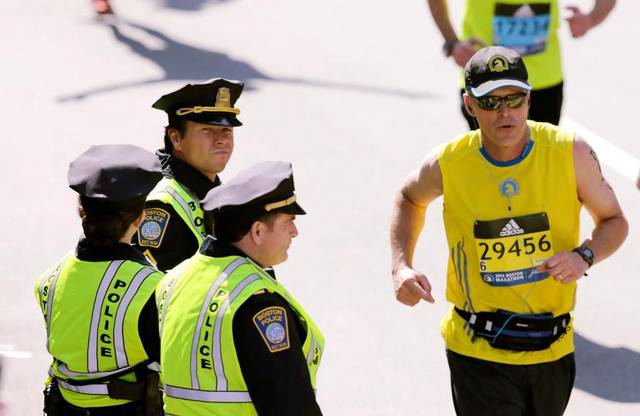
Second generation Hungries – children born with the infection – are able to think and reason but still hunger for flesh. There’s around twenty of them at the base, all kept in cells, and all kept in restraints when they attend their “schooling”. Their teacher, Helen Justineau (Arterton), is well-liked but naïve. She has a “class” favourite, Melanie (Nanua). Melanie is ten years old and very intelligent, even though she has no experience of the outside world, and she dotes on Helen as a surrogate mother. Meanwhile, Dr Caldwell is working her way through the children, using them (and then disposing of them) in her efforts to find a cure.
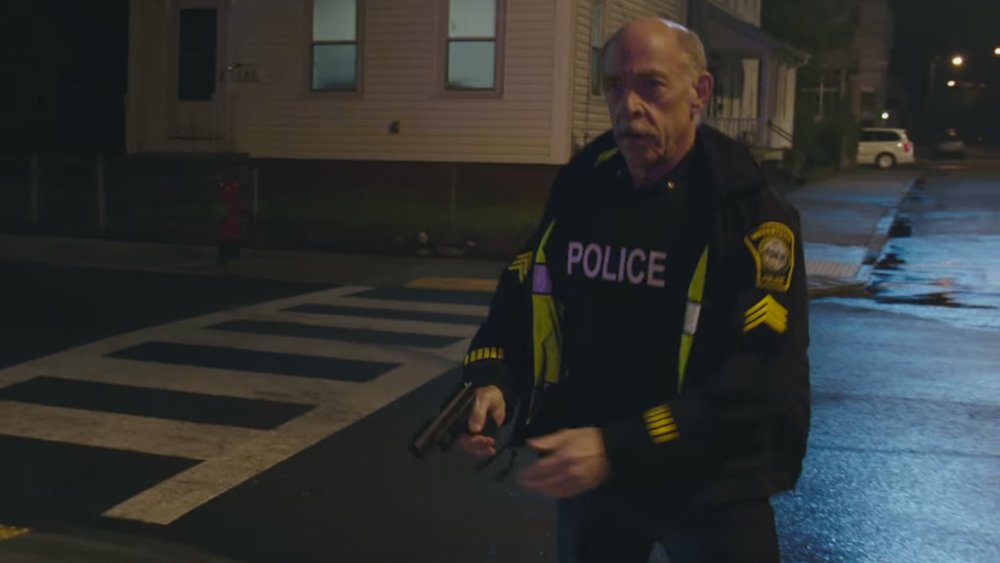
tgwatg-scene2

Inevitably, the base is overrun. In the melee that follows, Melanie saves Helen from being attacked, and they in turn are saved, unwittingly, by Sgt. Parks in an armoured vehicle. They, along with Dr Caldwell and two privates, Dillon (Welsh) and Gallagher (Akinade), escape into the nearby countryside. Their aim is to get to another base called the Beacon, but in order to do so, they find themselves having to travel through a Hungry-infested London, and having to rely on Melanie to help get them through…

At no point in The Girl With All the Gifts is the word zombie used or referred to. But this is clearly a movie featuring zombies, and there’s a significant amount of zombie carnage going on, but M.R. Carey’s adaptation of his novel of the same name isn’t really interested in all that. It’s an important part of the narrative, certainly, but the focus here is on watching Melanie become self-aware, and what that will ultimately mean for the non-Hungries she’s travelling with. As she learns more and more about the world she’s a part of, Carey’s best trick is to let Caldwell – so intent on doing good and saving the world – provide the impetus for the irrevocable choice that Melanie makes at the end of the movie (you’ll have to see the movie to find out what that is).

tgwatg-scene3

Along the way, Melanie’s interactions with Parks and Helen – her default step-parents, if you like – allows her to become more emotionally aware as well. Her initial doting on Helen, a young child’s needy infatuation, becomes more intense and more meaningful. Likewise, Parks’ simmering mistrust of Melanie and her motives gives way to mutual respect and trust, and Melanie learns from this as well. And when Gallagher is in danger from a group of feral Hungry children, it’s Melanie’s liking for him as an older brother that prompts her to insist they rescue him. All Melanie wants is to have a family around her, and even Caldwell fits into the mix as a grandmother figure. And thanks to the clarity and consideration found in Carey’s script, this need is defined without coming across as too laboured or too obvious.

It’s the personal relationships that anchor the movie, along with McCarthy’s strong, confident direction (all the more impressive for this being only his second feature), Kristian Milsted’s bleak yet arresting production design, and an eerie, unsettling score courtesy of Cristobal Tapia de Veer. With zombie movies virtually ten a penny these days, and with most looking to stand out from the crowd by virtue of any gimmicky concept they can come up with e.g. Zoombies (2016), The Girl With All the Gifts avoids such narrative and structural conceits by playing it completely straight and by applying studious attention to the details (though that’s not to say the script gets it right all the time; there are a handful of decisions made by the characters that don’t always add up).

tgwatg-scene4

The performances too are a major plus. Arterton, an actress whose career has never really taken off in the way that may have been expected, plays Helen with a quiet, sincere focus that gives the character a surprising depth. Considine is on equally fine form, Parks’ initial animosity toward Melanie giving way to the already mentioned respect, and the actor revealing an emotional quality to the character that could so easily have been overlooked. Close has the toughest role, as Caldwell’s single-minded pursuit of a cure creates more problems than it does answers, and leaves the character perilously near to being one-dimensional. But Close avoids this by imbuing Caldwell with an awareness of the cost to herself from her actions.

But this is Nanua’s movie. She gives such a finely nuanced performance that it’s hard to believe that this is her feature debut. As Melanie develops both emotionally and in terms of her relationships with the adults around her, Nanua displays a maturity that is quite impressive for her age, and her understanding of Melanie’s needs and desires is often very affecting. She tempers this with a no-nonsense, direct approach that matches the mood of the movie, and which allows her to dominate the scenes she’s in, making her more than a match for her more experienced co-stars. Wherever her career takes her, Nanua is off to a very good start, and her portrayal here is award worthy.

Rating: 8/10 – a post-apocalyptic thriller that boasts a clutch of very good performances and a tremendous sense of time and place, The Girl With All the Gifts is a surprisingly effective, and affecting, movie that breathes new life into a mostly moribund genre; it may not be the prettiest movie to watch, and it doesn’t shy away from being uncompromising when needed, but this is a genuinely rewarding movie that shouldn’t be missed.

Share this:

  • Share on X (Opens in new window) X
  • Share on Facebook (Opens in new window) Facebook
  • More
  • Print (Opens in new window) Print
  • Email a link to a friend (Opens in new window) Email
Like Loading...

Trailers – Christine (2016), Nocturnal Animals (2016) and Annabelle 2 (2017)

15 Thursday Sep 2016

Posted by dullwood68 in Movies

≈ Leave a comment

Tags

Amy Adams, Annabelle 2, Antonio Campos, Christine, David F. Sandberg, Drama, Horror, Jake Gyllenhaal, Literary adaptation, Miranda Otto, Previews, Rebecca Hall, Suicide, Tom Ford, Trailers, True story, TV reporter

Thankfully, Christine is not an unwanted, unexpected remake of the 1983 John Carpenter movie about a haunted car, but instead the true life tale of a haunted woman, Christine Chubbuck. Chubbuck was a US TV news reporter working in Florida during the late Sixties, early Seventies. She battled depression and suicidal thoughts before killing herself live on TV in July 1974. In telling her story, director Antonio Campos and screenwriter Craig Shilowich have created a compelling, richly detailed account of Chubbuck’s life and struggle with her personal demons, and the movie features what many critics are already describing as a “career-best” performance from Rebecca Hall. From the trailer we can see that the era when Chubbuck was alive has been painstakingly recreated, and that the cinematography by Joe Anderson is an integral part of what makes the movie look and feel so fresh and nostalgic at the same time. A tragic tale, to be sure, but Christine seems keen to be true to Chubbuck’s awkward yet painfully endearing persona, and which also doesn’t appear to shrink from exploring the “issues” that led to her untimely death at the age of just twenty-nine.


Based on the novel Tony and Susan by Austin Wright, Nocturnal Animals is Tom Ford’s first movie since A Single Man (2009). A movie that features a narrative full of twists and turns, it sees Amy Adams’ art gallery owner apparently threatened by the existence of a novel written by her ex-husband (played by Jake Gyllenhaal). The novel reads like a revenge tale, a way of his getting back at her for something she did to him that was really terrible. She recognises herself in the story, and comes to believe that he’s written it deliberately to make her afraid that the story will come true. Adams, after her disappointing turns in the likes of Big Eyes (2014) and the less than stellar DC outings involving Superman, here gets to grip with a meaty, dramatic role that better suits her abilities than having to play second fiddle to a green screen. But it’s still, first and foremost, a Tom Ford movie: stylish, elliptical in places, and beautifully lensed by Seamus McGarvey, making it a feast for the senses as well as the intellect.


The inclusion here of the first, teaser trailer for a sequel to a spin-off movie that nobody really wanted, is, on the face of it, a little strange in itself (the original didn’t even merit inclusion in the Monthly Roundup it should have been a part of; yes, it’s that bad). But three things warrant giving the trailer for Annabelle 2 the equivalent of a hall pass: one, that’s Miranda Otto holding the cross, an actress who rarely makes bad movies; two, its director is David F. Sandberg, fresh from his success as the main creative force behind Lights Out (2016); and three, it keeps things commendably brief and doesn’t rely on a manufactured jump scare to get you, well… jumping out of your seat. These may not be enough to stop the movie from being as bad as its predecessor, but for the moment, this is one teaser trailer which understands that, when it comes to horror, less really is more.

Share this:

  • Share on X (Opens in new window) X
  • Share on Facebook (Opens in new window) Facebook
  • More
  • Print (Opens in new window) Print
  • Email a link to a friend (Opens in new window) Email
Like Loading...

I Am Not a Serial Killer (2016)

12 Monday Sep 2016

Posted by dullwood68 in Movies

≈ Leave a comment

Tags

Billy O'Brien, Christopher Lloyd, Clayton, Dan Wells, Drama, Funeral home, Horror, Laura Fraser, Literary adaptation, Max Records, Murders, Review, Serial killer, Sociopath

i-am-not-a-serial-killer

D: Billy O’Brien / 103m

Cast: Max Records, Christopher Lloyd, Laura Fraser, Christina Baldwin, Karl Geary, Dee Noah, Lucile Lawton, Anna Sundberg, Raymond Brandstrom, Michael Paul Levin

Welcome to the small US town of Clayton where the mutilated remains of one of the townsfolk ends up at the Cleaver-run funeral home. It’s actually the second such corpse to end up there, but the owner, April Cleaver (Fraser), isn’t too happy about the boost in business – given the circumstances. The same can’t be said for her son, John (Records), who views (literally) the bodies with a kind of excitement. Which isn’t surprising, as John has been recently diagnosed as a sociopath.
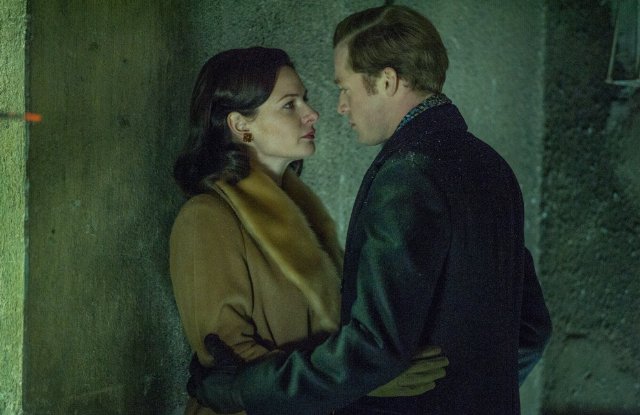
John ticks all the boxes for incipient sociopathy: bedwetting, pyromania and animal cruelty, but he’s self-aware and has a set of rules that he follows in order that he doesn’t act out on his violent impulses. He has a friend, Max (Brandstrom), that he hangs out with and does “normal” stuff, and he has a liking for a girl who lives across the road, Brooke (Lawton) (though he doesn’t know how to approach her, or talk to her even when she speaks to him). Aside from his mother, his aunt Margaret (Baldwin), and older sister Lauren (Sundberg), the only other people he interacts with are his therapist, Dr Neblin (Geary), and the elderly couple across the street, the Crowleys (Lloyd, Noah).

After the discovery of the second body, John starts to notice a mysterious man wandering around town and acting suspiciously. One day he follows the man, who bumps into Mr Crowley. Crowley is going ice fishing and the stranger invites himself along. John follows them out to a lake and watches as the stranger makes to stab the old man in the back. But John is astonished to see Crowley whirl round and using some kind of black, stick-like growth that shoots from his hand, kill the man instead. And then it gets weirder still…

ianask-scene3

What John sees causes him no end of confusion and indecision. But he’s also fascinated, impressed even on one level, and says nothing to anyone about what he’s seen. He begins to follow Crowley around town, until one afternoon the old man visits a barber’s. Once the other customers are gone, and the barber is distracted, Crowley locks the door and puts the Closed sign in the window. While he proceeds to kill the barber, John sets off the security alarm. Two policemen arrive, but when one of them discovers the barber’s body, Crowley kills both of them as well. Shocked, but also scared of putting anyone else in harm’s way, John decides that it’s down to him to do something about Crowley’s killing spree. But can he do it without betraying his own set of rules, and without giving in to the urges he manages to suppress?

Adapted from the novel of the same name by Dan Wells, I Am Not a Serial Killer is a dark comedy/drama that manages to work on several levels, and with a good deal of style and panache. Visually it’s a very dour, moody piece, even when Clayton is buried under a couple of feet of snow. Robbie Ryan’s cinematography is an obvious asset, whether it’s capturing the look and feel of a small town teetering on the edge of hysteria, or reflecting on the dark emotions that drive both John and Mr Crowley. (It’s a banner year for Ryan, with Ken Loach’s I, Daniel Blake and Andrea Arnold’s American Honey also lensed by him and due out.) As the movie progresses and the streets of Clayton become emptier and emptier, Ryan’s camerawork helps increase the sense of isolation experienced by the characters, and heightens the drama. For a relatively low budget movie, Ryan’s work is exemplary and helps elevate the somewhat uneven material.

ianask-scene2

This unevenness is due to the twists and turns of the story, some of which work perfectly – Crowley’s first on-screen kill – and some of which don’t – John’s mother being put in harm’s way near the end. In adapting Wells’s novel, O’Brien and co-screenwriter Christopher Hyde have rightly emphasised the struggle John has in keeping his impulses in check, but they’re less successful in examining and relating the reasons why he keeps Crowley’s secret to himself. He’s clearly appalled by both the fact of Crowley’s being a serial killer, and the manner in which he carries out his kills, and also that he’s been doing it for a very long time (there’s a nod to Lloyd’s role in the Back to the Future trilogy, as one of Crowley’s younger identities is called Emmett). This is at odds with his sociopathy, which is played with and included as and when the script requires it. Other emotional outbursts are also at odds with Dr Neblin’s diagnosis, and there’s even room for a last-minute joke to further call his condition into question.

Notions of sociopathy aside, John is a wholly sympathetic character that, strangely enough, audiences should be able to identify with. As a teenager, he has trouble fitting in, and as a protagonist he’s pro-active in ways that we’d like to think that we would be in a similar situation. As he and Crowley play their game of cat and mouse, it’s easy to root for him because even when he appears to have killed someone – a definite no-no according to the rules – John’s reaction is one of horror rather than indifference. What’s also very clever (and very cleverly handled) is the way in which Crowley is allowed to go from homicidal maniac to a character every bit as sympathetic as John, and with a compelling motive for his actions as well.

I Am Not A Serial Killer

Threaded throughout the story are moments of rich, dark humour – John’s way of dealing with a bully, Max’s father being interviewed on TV while he’s part of an angry mob – and John’s family background is given its fair share of screen time, revealing greater depths to the characters than is usual. As the fractured family, Fraser is under-used as John’s mother, while Baldwin is the strong-willed yet fair aunt, and Sundberg pops in and out of the narrative to remind viewers that John isn’t the only one trying to figure out their place in life. As John, Records gives an intuitive, carefully modulated performance that matches the character’s feelings of paranoia, while Lloyd provides a perfect mix of pathos and menace as the neighbourly serial killer with an even darker secret.

O’Brien ensures the movie is never less than intriguing, and directs at an unhurried, deliberate pace which suits the material and gives the narrative room to breathe. He’s also able to ensure that when things get really weird, the viewer isn’t put off by these developments or left stranded in open disbelief (a likely occurrence if this was in the hands of a less confident director). And the denouement, when it arrives, is unexpectedly touching, a surprise that is pulled off with aplomb, and which makes the movie a much more rewarding experience than usual.

Rating: 8/10 – there’s much to admire about I Am Not a Serial Killer, from its familiar small town vibe to its potent murder scenes, and the many ways in which it manages to subvert those small town vibes in order to heighten the drama; Records and Lloyd make for great adversaries, the special effects in the movie are used sparingly and to good effect, and the whole thing is far more entertaining and enjoyable than its semi-morbid title would have you believe.

Share this:

  • Share on X (Opens in new window) X
  • Share on Facebook (Opens in new window) Facebook
  • More
  • Print (Opens in new window) Print
  • Email a link to a friend (Opens in new window) Email
Like Loading...

Blood Father (2016)

28 Sunday Aug 2016

Posted by dullwood68 in Movies

≈ Leave a comment

Tags

Action, Crime, Diego Luna, Drama, Erin Moriarty, Ex-con, Jean-François Richet, Literary adaptation, Mel Gibson, Michael Parks, New Mexico, Peter Craig, Thriller, William H. Macy

Blood Father

D: Jean-François Richet / 88m

Cast: Mel Gibson, Erin Moriarty, Diego Luna, Michael Parks, William H. Macy, Miguel Sandoval, Dale Dickey, Thomas Mann, Richard Cabral, Daniel Moncada, Ryan Dorsey, Raoul Trujillo

The recent career of Mel Gibson has seen him appear in one movie per year since 2010 (with the exception of 2015). While personal troubles have dogged him over the last ten years, and caused him no end of embarrassment – and given Ricky Gervais the opportunity to make one of the best jokes about an actor, ever – Gibson has tended to stick to the action genre that has stood him in such good stead in the past. Aside from his role in The Beaver (2011), Gibson’s choice of roles has seen him engage fitfully with the material on offer, and he’s been the villain in two action sequels that should have been much, much better: Machete Kills (2013) and The Expendables 3 (2014).

But now, with Blood Father, Gibson finally has a role he can really sink his teeth into, and the result is a performance that serves as a (much-needed) reminder of just how good an actor he really is. An adaptation of the novel by Peter Craig, and co-written by Craig and Andrea Berloff, the blood father of the title is an ex-con by the name of John Link. He’s been out of the joint for a year, and sober for two. He lives in a trailer outside a small town in New Mexico, and is a tattooist by trade. He’s also divorced, and has a seventeen year old daughter, Lydia (Moriarty). But Lydia has been missing for the last three years, ever since she ran away from the home she shared with her mother and her mother’s third husband. John has hopes of finding her one day, but without any clues as to her whereabouts, it’s unlikely he will.

Blood Father - scene3

It’s Lydia who finds him. Having gotten involved with a junior member of a Mexican cartel, Jonah Pincerna (Luna), Lydia finds herself in very deep trouble when Jonah raids the home of someone who’s been stealing from him. As a test of her loyalty he asks her to kill the woman there; Lydia ends up shooting Jonah instead. On the run, and with no one else she can call, Lydia contacts John and he arranges to meet her. He takes Lydia back to his trailer, but it’s not long before Jonah’s crew turn up looking for her. The ensuing gunfight prompts John to leave and take Lydia with him, and to find out more about Jonah and his connections. After a lucky escape from the police, John discovers that the cartel have sent a hitman (Trujillo) to kill Lydia.

A reunion with an old army buddy, Preacher (Parks), goes awry when he attempts to claim the missing persons reward money put up when Lydia ran away. She and John manage to get away, and at a motel they change their appearances, John shedding his beard and Lydia dyeing her hair blonde. While John travels to a nearby penitentiary to visit an old friend, Arturo Rios (Sandoval), who has concrete information about Jonah, Lydia is persuaded to take herself to a public place by John’s sponsor, Kirby (Macy), and trust no one. But it’s a set up, and Lydia is abducted. Her abductors contact John, and a rendezvous in the desert is arranged, but it’s a rendezvous that is likely to end in both of them being dead…

Blood Father - scene2

Fans of Mel Gibson the actor will be glad to see that his performance in Blood Father is very definitely a return to form. Ostracised and pilloried for the racist remarks he’s made in the past, Gibson seemed to be getting by on the goodwill of others – Jodie Foster, Robert Rodriguez, Sylvester Stallone etc. – and while he’s still a highly watchable actor in his own right, there was always a feeling over the last few years that Gibson wasn’t trying too hard, that the work he was taking on couldn’t have been challenging for him, and so he wouldn’t rise to the challenge. Here, though, Gibson has found a role that is not only challenging, but inspiring, rewarding, and above all, one of the best fits for his skills as an actor.

Inevitably, there’s more than a smidgeon of Martin Riggs lurking inside the character’s DNA. Witness John’s response to the arrival of Jonah’s henchmen and the gunfight that follows: he’s dismissive of them, and once they open fire and he has to deal with them he gives angry voice to the variety of ways that their appearance will lead to his breaking parole. He’s pissed off, he’s mostly unconcerned by their firepower, and he can’t wait around for the police – the sensible thing to do – because he’s convinced they won’t believe a word he says. Playing John with a fatalism that speaks volumes for the character’s mindset, Gibson gives one of the best performances of his entire career, and proves as mesmeric an actor as he was back in the late Eighties, early Nineties. As he scowls and growls his way through the movie, Gibson also imbues John with a subtle vulnerability that adds depth to the character and makes his need to reconnect with Lydia entirely credible.

Blood Father - scene1

Thanks to the combination of Gibson’s performance, Craig and Berloff’s astringent screenplay, and Richet’s sharp, purposeful direction, Blood Father is more than just a standard action drama punctuated by brief, kinetic bursts of violence. It has an off-centre sense of humour, is sure-footed enough to keep John and Lydia’s relationship free from sentiment, makes very good use indeed of its stunning New Mexico locations (beautifully lensed by DoP Robert Gantz), and above all, maintains a level of tension that many other so-called thrillers fail to achieve for even a fraction of the movie’s running time. As a return to form, Gibson couldn’t have picked a better vehicle or character, and the movie is proof positive that he’s still as mercurial an actor as ever, and that when the right role comes along, he’s nigh-on untouchable.

Rating: 8/10 – with deft supporting turns from the likes of Sandoval and Macy allied to Moriarty’s low-key, sympathetic portrayal of Lydia, Blood Father is more than just a vigorous action thriller; despite its awkward title, the movie explores themes of loss and regret, hope and sacrifice, that elevate the narrative beyond its basic, conventional set-up and make it one of the more astute “relationship dramas” out there.

Share this:

  • Share on X (Opens in new window) X
  • Share on Facebook (Opens in new window) Facebook
  • More
  • Print (Opens in new window) Print
  • Email a link to a friend (Opens in new window) Email
Like Loading...

Spaceman (2016)

23 Tuesday Aug 2016

Posted by dullwood68 in Movies

≈ Leave a comment

Tags

Baseball, Bill Lee, Brett Rapkin, Canada, Drama, Drugs, Ernie Hudson, Josh Duhamel, Literary adaptation, Pitcher, Review, Sport, True story, W. Earl Brown, Winter Ave Zoli

Spaceman

D: Brett Rapkin / 90m

Cast: Josh Duhamel, W. Earl Brown, Winter Ave Zoli, Ernie Hudson, Carlos Leal, Caroline Aaron, Claude Duhamel, Stefan Rollins, Wallace Langham

If you’ve heard of Bill Lee, one-time pitcher (and a left-handed pitcher at that) for the Boston Red Sox and the Montreal Expos, then chances are you also know about his drug-related background, his independence and need to challenge authority, plus his support for Maoist China, Greenpeace and school busing in Boston (amongst others). He was a well-known counterculture figure who appeared in an issue of the pro-marijuana magazine, High Times, and who once threatened to bite off the ear of an umpire in a 1975 World Series game. In later life, while still involved with baseball on a variety of levels, he was also asked to run for President of the United States on behalf of the Rhinoceros Party (his slogan: “No guns, no butter. Both can kill.”) If nothing else, Bill Lee has led an extraordinarily rich and eventful life.

Which makes Spaceman all the more confusing for focusing on the period that immediately follows the end of his professional career. Fired for one challenge to authority too many (walking out before a game in protest at the release of a fellow player), Lee (Duhamel) expects to get right back in the game, so confident is he that his unique skills as a pitcher will be more than enough to offset his off-the-pitch behaviour. But when the offers don’t come rolling in, Lee finds himself at a loss. His agent (and friend), Dick Dennis (Brown), keeps getting the runaround when he tries to contact the big league teams, and soon the message gets through: nobody wants him because everyone is tired of his shenanigans. He’s also thirty-six, and time isn’t on his side.

vlcsnap-00001

Lee’s also trying to do right by his three kids. He’s separated from his wife (Zoli) and can only have them over by arrangement. He’s as unorthodox a parent as he is a baseball player, but his relationships with his children are one of the few aspects of his life that he gets right. Otherwise, Lee smokes a lot of weed, drinks a lot of booze, and dreams of making it back into the Big Leagues. But the offers don’t come, his eventual divorce sees him deprived of any visitation rights, and to cap it all he receives an invitation to play for a Canadian seniors team. Intrigued and offended at the same time, Lee attends one of their matches, and helps them win. His need to play keeps him with the team for a while, until Dennis swings him a tryout for San Fran at their training facility in Phoenix. Lee motors all the way down there, only for the head coach (Langham) to dismiss him, and for Lee to learn that he won’t ever be taken back into the Big Leagues. A coaching offer comes along too, but the lure of playing sees him contemplating returning to Canada and resuming playing in the Seniors’ league.

Director Brett Rapkin has been here before. In 2003, he and fellow movie maker Josh Dixon joined Lee on a trip he was making to Cuba. The resulting footage made up the bulk of the documentary Spaceman: A Baseball Odyssey (2006). Ten years on and Rapkin’s decision to revisit Lee’s life (or at least a part of it) has led to his making a movie that starts off strong with Lee’s determination to stand up for his teammate, but then it settles into an amiable groove that is pleasant to watch but eventually becomes so placid that not even the scene where he loses his visitation rights scores any dramatic depth.

vlcsnap-00002

By focusing on a period when Lee wasn’t playing baseball, it seems that Rapkin (who also wrote the screenplay) has chosen to explore the nature of the man behind the legend. But when the man is the legend, there’s little room for any real exploration, and so we have several moments where Lee informs anyone who’ll listen that he needs to play baseball, several scenes where Lee mooches around at home in his Y-fronts, and even more scenes set in a bar where he squanders his time in playing the wounded, unappreciated hero. With the introduction of the Canadian seniors team, the movie does find something more interesting to focus on, but even then it continues to be more amiable than sharply detailed.

As the Spaceman, Duhamel makes up for his appearance in the dreadful Misconduct (2016) by infusing Lee with a great deal of charm and affability. The employment of a scruffy beard adds to the character, while his scenes with Zoli reveal the pain Lee is suffering at the collapse of his marriage (something that didn’t happen in real life). But on the whole, Duhamel has little to work with, and while he’s able to give a warm, occasionally disarming performance, he’s too confined by the conventional nature of the material and the flatly handled narrative. The supporting cast have even less to hang a performance on, with only Zoli making any kind of impression, playing Lee’s wife with a brittle dismay that seems all too appropriate.

vlcsnap-00003

While the movie as a whole is affectionate in its view of Lee and his anti-establishment outbursts, and his self-aggrandising, it does make an effort to remind viewers that for all his grandstanding he was an exceptional pitcher. At the San Fran tryouts, and before he’s sent on his way, Lee’s gift with a baseball is used to outclass an arrogant batsman, a scene that trades on an overly familiar scenario in sports movies while doing so with a valid sincerity (look closely at any shots of Lee pitching though and you’ll see that the shot has been reversed; Duhamel isn’t a leftie). Sadly, there are too few scenes of Lee doing what he did best, but thankfully, when there are they lift the movie out of the doldrums.

Rating: 5/10 – not a bad movie per se, but one that never aspires to be anything more than good-natured, Spaceman struggles to find any dramatic traction that might keep an audience from losing interest; ultimately, Rapkin’s debut feature shows him working at a purposely even keel and forgetting to add some highs and lows to give texture to his otherwise genial look at a baseball hero and his fall from the Big Leagues.

Share this:

  • Share on X (Opens in new window) X
  • Share on Facebook (Opens in new window) Facebook
  • More
  • Print (Opens in new window) Print
  • Email a link to a friend (Opens in new window) Email
Like Loading...

Stranger on Horseback (1955)

09 Tuesday Aug 2016

Posted by dullwood68 in Movies

≈ Leave a comment

Tags

Action, Bannerman, Circuit judge, Drama, Jacques Tourneur, Joel McCrea, John Carradine, John McIntire, Kevin McCarthy, Literary adaptation, Louis L'Amour, Miroslava, Murder, Review, Romance, Trial, Western

Stranger on Horseback

D: Jacques Tourneur / 66m

Cast: Joel McCrea, Miroslava, John McIntire, John Carradine, Kevin McCarthy, Nancy Gates, Emile Meyer, Robert Cornthwaite, Jaclynne Greene, Walter Baldwin, Emmett Lynn, Roy Roberts

Like each decade before it, the Fifties saw Hollywood and the independent studios make low budget Western after low budget Western. Trying to wade through them now is like trying to read a library of books that have no title pages: it’s difficult to tell if any one Western is better or worse than any other. But Stranger on Horseback (a title that’s not entirely accurate), is one low budget Western that deserves a closer look, and perhaps, over sixty years after it was made, a reassessment.

Adapted from the story by Louis L’Amour, the Stranger in question is actually circuit judge Richard Thorne (McCrea). Arriving in a small town on a routine visit, he soon learns that there has been a murder recently, but that the man responsible hasn’t been arrested. When he asks why, he discovers that the town is owned and run by Josiah Bannerman (McIntire), and that the man who committed the killing is Bannerman’s son, Tom (McCarthy). Despite several warnings from the town sheriff, Nat Bell (Meyer), and Bannerman’s legal counsel, Colonel Buck Streeter (Carradine), that Josiah won’t allow it, Thorne voices his determination to ensure that Tom Bannerman is arrested and committed for trial.

SOH - scene1

News of this development reaches Josiah, and he charges Tom with persuading Thorne to accept his hospitality. Tom’s presence in town leads, unsurprisingly, to his arrest, with Thorne being aided by Bell. With Streeter manoeuvring himself into place as the trial prosecutor, and less than veiled threats made by Josiah’s men as to the likelihood of a trial taking place, an uneasy stalemate exists while Tom languishes in jail. In the meantime, Thorne begins to piece together the events surrounding the murder, while also making an impact on Tom’s cousin, Amy Lee (Miroslava). Her attentions lead to Thorne meeting Josiah, and the last chance of a peaceful outcome in regard to Tom going to trial. Realising that there’s no chance of a trial – fair or otherwise – taking place in town, Thorne decides to spirit Tom away during the night and make for the nearest town, Cottonwood. But his ruse is quickly discovered, and Josiah and his men rush to head them off before Thorne and Bell can get Tom, along with two witnesses to the shooting, to the safety of the nearby town.

For a low budget Western that runs a somewhat paltry sixty-six minutes, Stranger on Horseback is definitely deserving of a much better level of recognition amongst modern day audiences. Directed by the hugely talented Tourneur, this was one of a number of Westerns he made in the Forties and Fifties, and his second with McCrea as the lead. One of Tourneur’s strengths as a director was his ability to draw out strong performances from his casts, and then ally them to a palpable sense of mood. In doing so he made his movies stand out by virtue of their credibility and an often surprising emotional depth. Stranger on Horseback is no exception, with McCrea perfectly cast as the tough, no-nonsense judge whose reputation means he doesn’t have to carry a gun unless absolutely necessary. McCrea made a lot of Westerns in the Fifties, but this is easily one of his best, his performance far more subtle and measured than the material might seem to deserve. In tandem with Tourneur’s assured direction, McCrea makes Thorne the kind of hero whose integrity and law-abiding nature is never in question.

SOH - scene2

But it’s not just McCrea who puts in a great performance. This is a movie with a glut of them. As Thorne’s love interest, Amy Lee, Miroslava gives an insightful portrayal of a woman torn between loyalty to her family and the chance of freedom that an unexpected romance gives her (a subplot involving Amy Lee’s impending marriage to the town banker (Cornthwaite) is handled with a sobering disinterest on her part and a tired resignation on his). (Sadly, this was Miroslava’s penultimate movie before she committed suicide aged just thirty, and from her role here it seems certain that her skills as an actress, her ability to find a sympathetic core to the characters she played, would have led to even better performances over time.)

As the proud land baron Josiah Bannerman, McIntire is a terrific adversary for McCrea, his egoism a perfect counterpoint for Thorne’s rectitude. McIntire was a great character actor, often quietly giving memorable performances in the background of bigger movies, and although his presence here requires a degree of repetition in terms of relaying the same threats over and over, he nevertheless imbues Josiah with a sincerity of intent and action that overcomes an awkward last-minute reversal of purpose. And then there’s the wonderful John Carradine, cadaverously charming as ever as the smooth-tongued, lizard-like Colonel Streeter. His scenes with McCrea are a testament to his talent as an actor, his delivery and equanimity in the part a perfect example of what can be done with a supporting role if you have the skill and the encouragement of your director. It’s also a performance that foreshadows his role as Major Cassius Starbuckle in The Man Who Shot Liberty Valance (1962); both portrayals are hugely enjoyable, and both highlight just how good Carradine was when given a halfway decent script to work from.

SOH - scene3

Further down the cast list, McCarthy is appropriately callow as Tom Bannerman, while there’s a beautifully judged performance from Meyer as the sheriff who finds newfound courage thanks to Thorne’s arrival (Meyer is one of those actors whose face is so familiar, you’d swear you’ve seen him in more movies than he’s actually appeared in). Tourneur brings out the best in everyone, and in doing so, elevates the very basic plot and storylines in Herb Meadow and Dan Martin’s screenplay, making it a richer and more rewarding experience than anyone could have predicted.

While the movie is a great, unsung example of low budget Western movie making, unfortunately there is one issue it can’t presently overcome. Existing copies of the movie have become so degraded that the gorgeous Arizona locations – filmed in Ansco-color – are now a riot of over-exposed colours and blurred details. It’s so bad that when we first see McCrea riding into town it looks as if he doesn’t have a face. This is a movie in desperate need of restoration. Let’s hope a pristine copy surfaces at some point, and the movie can be seen as it was meant to be.

Rating: 8/10 – a superior Western thanks to the involvement of Tourneur, Stranger on Horseback is a richly rewarding movie with some outstanding performances to further add to its stature; with only a rushed conclusion to keep it from being a complete and utter classic, this is still a prime example of a low budget Western that shouldn’t be dismissed or ignored purely because of its provenance.

Share this:

  • Share on X (Opens in new window) X
  • Share on Facebook (Opens in new window) Facebook
  • More
  • Print (Opens in new window) Print
  • Email a link to a friend (Opens in new window) Email
Like Loading...

Love & Friendship (2016)

06 Saturday Aug 2016

Posted by dullwood68 in Movies

≈ 2 Comments

Tags

Chloë Sevigny, Comedy, Drama, Jane Austen, Kate Beckinsale, Lady Susan, Literary adaptation, Marriage, Review, Romance, Whit Stillman, Xavier Samuel

Love and Friendship

D: Whit Stillman / 93m

Cast: Kate Beckinsale, Chloë Sevigny, Xavier Samuel, Emma Greenwell, Justin Edwards, Morfydd Clark, Tom Bennett, Jemma Redgrave, James Fleet, Jenn Murray, Stephen Fry

It may seem like an odd corollary, but Whit Stillman’s adaptation of Jane Austen’s posthumously published Lady Susan, and a certain Monty Python sketch involving the Piranha Brothers (Doug and Dinsdale) have something in common. In the Python sketch, Michael Palin as low-level criminal Luigi Vercotti talks about Doug as being the more vicious of the two gang leaders:

“Everyone was terrified of Doug. I’ve seen grown men pull their own heads off rather than see Doug. Even Dinsdale was frightened of Doug.”

“What did he do?”

“He used… sarcasm. He knew all the tricks, dramatic irony, metaphor, pathos, puns, parody, litotes and… satire. He was vicious.”

LAF - scene3

You could add mieosis to the list, or rhetoric, or even polemics – they’re all there in Stillman’s screenplay, all in service to one of the year’s funniest movies, and proof (as if it were truly needed) that Jane Austen had a wicked sense of humour, and enjoyed attacking the social mores of her time; no one was safe, high- or lowborn. In transferring Lady Susan to the screen, Stillman has retained the epistolary nature of the novella, allowing the audience to be swept along with the recent widow’s attempts to secure advantageous marriages for both herself and her daughter, Frederica (Clark)… while also brokering an affair between herself and the married Lord Manwaring. In the process, barbs are dispensed with precision, honeyed slanders voiced with mannered simplicity, and insults hurled with joyous abandon. There’s no turn left unstoned by the movie’s end, and nobody who doesn’t find themselves somehow injured by an unkind remark (even if they don’t know they’ve been injured – some remarks pass by so quickly the characters don’t even realise it’s happened).

This is the overwhelming joy of Love & Friendship: the ease with which the characters are disarmed by unexpected, cutting remarks, and the way in which their reactions are to stare in disbelief like rabbits caught in the headlights, trying to fathom just what to say in return – and then the moment is gone and they’re left there, still staring in shock. Stillman includes so many of these moments there’s a danger of his overdoing it, but the range of insults is so varied that everyone’s a winner, and every moment is assured a smile from the viewer. As Lady Susan (Beckinsale) weaves her tangled web of intrigue, she does so with a shrewd cunning that’s completely impressive. She’s the predatory shark in petticoats who cares for no one but herself and her assured future (or her daughter’s assured future, as that will lead to hers as well).

LAF - scene1

Watching the movie is like indulging in a massive bowl of whipped cream and citrus lemon sauce, a confection that’s rich and rewarding and a bit of a guilty pleasure. But it shouldn’t be, as Stillman elicits superb performances from his cast, with Beckinsale on particularly fine form as Lady Susan, revelling in her machinations and throwing out carefree lines such as “Facts are horrid things” with an amused detachment that fits the character perfectly. It’s good to see Beckinsale – along with Sevigny, reunited with Stillman after eighteen years – being given such a juicy role after so many bland fantasy outings. Maintaining an equilibrium and a sense of purpose while treating everyone around her – bar her good friend, Mrs Johnson (Sevigny) – with utter contempt, Beckinsale as Lady Susan is a poisonous delight, cunning, devious, and wholeheartedly shameless in her efforts to get what she wants. But there’s also grace and subtlety in her performance, a measured approach to the character and the material that reaps dividends when she’s called upon to be deceitful or just outright lying.

But it’s not just Beckinsale who puts in a fabulous performance. As Lady Susan’s confidant, Mrs Johnson, Sevigny has what looks to be the thankless role of best friend who’s there just so the main character has someone to show off to. But Stillman is too good a director, and Sevigny too good an actress, to let this happen, and even in her scenes with Beckinsale, Sevigny’s quiet attention and marvelling at the deplorable behaviour of Lady Susan’s relatives is too good to be ignored or undervalued. And she’s on even better form when the contents of a letter causes problems both for her and for Lady Susan.

LAF - scene2

On the spear side of things, there’s a pitch perfect exercise in buffoonery from Bennett as the idiotic Sir James Martin, whose halting, almost stream of consciousness dialogue is matched by the actor’s use of physical tics and surprised facial expressions; he’s like a child for whom everything is new and endlessly fascinating (he finds peas to be an amazing discovery). There’s a scene where he turns up unexpectedly at the home of Lady Susan’s brother-in-law (Edwards), and spends approximately two minutes waffling horrendously about almost nothing at all, and its one of the funniest things you’ll see this year, a perfect match of physical discomfort and mental truancy.

As befits an adaptation of a novella, the story is very slight, and does boil down to very little at all, but Stillman wisely concentrates on the characters and their idiosyncracies rather than the plot, and there’s reward enough in seeing them adrift – often – in a sea of their own making. It’s a romantic comedy, and a recalcitrant comedy of manners, and a comedy of hilarious misdirection that bubbles with energy and glee at providing so much mischief. Stillman doesn’t make very many movies these days, which is a shame, but let’s hope Love & Friendship is the beginning of a more prolific period in his career because it would be a shame if he spent another five years (the time since his last movie, Damsels in Distress) away from our screens.

Rating: 9/10 – a perfect mix of period drama (with sterling work by costume designer Eimer Ni Mhaoldomhnaigh and production designer Anna Rackard), and pin-sharp levity, Love & Friendship is perfectly designed to ensure a good time will be had by all; Stillman interprets Austen with authority, Beckinsale has a great time as the unprincipled Lady Susan, and the viewer is treated to one of the few comedies released this year that doesn’t rely on crass jokes or gross-out humour – and is all the more impressive for it.

Share this:

  • Share on X (Opens in new window) X
  • Share on Facebook (Opens in new window) Facebook
  • More
  • Print (Opens in new window) Print
  • Email a link to a friend (Opens in new window) Email
Like Loading...

Monthly Roundup – July 2016

31 Sunday Jul 2016

Posted by dullwood68 in Movies

≈ Leave a comment

Tags

Action, Apache War Smoke, Apaches, Australia, Bank robbers, Banshee Chapter, Ben Whishaw, Benjamin Walker, Blair Erickson, Brendan Gleeson, Cambodia, Chris Hemsworth, Cillian Murphy, Crawl, Daniel Zirilli, Drama, Gena Rowlands, George Shevtsov, Georgina Haig, Gilbert Roland, Glenda Farrell, Harold F. Kress, Herman Melville, Historical drama, Hitman, Home invasion, Horror, In the Heart of the Sea, James Garner, Katia Winter, Literary adaptation, Moby Dick, Nantucket, Nicholas Sparks, Nick Cassavetes, Numbers stations, Offshore Grounds, Online journalist, Paul China, Paul Holmes, Project MK Ultra, Rachel McAdams, Reviews, Robert Horton, Romance, Ron Howard, Ryan Gosling, Steven Seagal, Ted Levine, Thailand, The Asian Connection, The Essex, The Notebook, Thriller, Tom Holland, Tonto Valley Station, True love, True story, Wells Fargo, Western, Whales

Crawl (2011) / D: Paul China / 80m

Cast: George Shevtsov, Georgina Haig, Paul Holmes, Lauren Dillon, Catherine Miller, Bob Newman, Andy Barclay, Lynda Stoner

Crawl

Rating: 7/10 – a hitman (Shevtsov) hired by an unscrupulous bar owner (Holmes) winds up injured while trying to leave town, and ends up playing a deadly game of cat-and-mouse with a waitress (Haig) when he seeks refuge in her home; a slow-burn thriller that takes its time and relies on tension and atmosphere to keep the viewer hooked, Crawl often belies its low budget, and features terrific performances from Shevtsov (in a role written expressly for him) and Haig, but stops short of being completely effective thanks to some awkward narrative choices and first-timer China’s lack of experience as a director.

The Asian Connection (2016) / D: Daniel Zirilli / 91m

Cast: John Edward Lee, Pim Bubear, Steven Seagal, Sahajak Boonthanakit, Byron Gibson, Byron Bishop, Eoin O’Brien, Michael Jai White

The Asian Connection

Rating: 3/10 – career criminal Jack Elwell (Lee) meets the love of his life, Avalon (Bubear), and decides that robbing a bank is the way to a financially stable relationship, but unfortunately the money he steals belongs to crime boss Gan Sirankiri (Seagal), and soon Jack is being coerced into robbing more of Sirankiri’s banks when one of his men (Boonthanakit) threatens to expose him; what could have been a moderately entertaining action thriller is let down by some atrocious acting (and not just from Seagal), some equally atrocious camerawork, editing that looks like it was done with a hatchet, and the kind of direction that gives “point and shoot” a bad name, all of which leaves The Asian Connection looking like something to be avoided at all costs.

Banshee Chapter (2013) / D: Blair Erickson / 87m

Cast: Katia Winter, Ted Levine, Michael McMillian, Corey Moosa, Monique Candelaria, Jenny Gabrielle, Vivian Nesbitt, Chad Brummett, William Sterchi

Banshee Chapter

Rating: 3/10 – a journalist (Winter) looks into the disappearance of a friend, and discovers a secret world of government experiments that are linked to strange radio broadcasts and the discredited MK Ultra program from the Sixties; a paranoid thriller with supernatural overtones, Banshee Chapter tries extra hard to be unsettling and creepy – much of it takes place at night and has been shot using low light – but fails to make its story of any interest to anyone watching, which means that Winter and Levine put a lot of effort into their roles but are let down by the tortuous script and Erickson’s wayward direction.

In the Heart of the Sea (2015) / D: Ron Howard / 122m

Cast: Chris Hemsworth, Benjamin Walker, Cillian Murphy, Tom Holland, Ben Whishaw, Brendan Gleeson, Michelle Fairley, Paul Anderson, Frank Dillane, Joseph Mawle, Charlotte Riley

In the Heart of the Sea

Rating: 5/10 – the writer, Herman Melville (Whishaw), convinces retired sailor Tom Nickerson (Gleeson) to talk about his experiences as a young boy at sea, and in particular his time aboard the Essex, a whaling ship that encountered a creature Melville will call Moby Dick; based on the true story of the Essex, and the voyage that saw it sunk by an enormous whale, In the Heart of the Sea is technically well made but lacks anyone to care about, avoids providing a true sense of the enormity of what happened, sees Ron Howard directing on auto-pilot, and leaves Hemsworth and Walker struggling to make amends for characters who are paper-thin to the point of being caricatures (or worse still, carbon copies of Fletcher Christian and William Bligh from Mutiny on the Bounty).

The Notebook (2004) / D: Nick Cassavetes / 123m

Cast: Ryan Gosling, Rachel McAdams, James Garner, Gena Rowlands, Sam Shepard, David Thornton, Joan Allen, James Marsden

The Notebook

Rating: 7/10 – in the late Thirties, a young man, Noah (Gosling), sets his cap for the girl of his dreams, Allie (McAdams), and though they fall in love, social conventions keep them apart, while in the modern day their story is told by an old man (Garner) to a woman with dementia (Rowlands); handsomely mounted and told with a genuine feel for the central characters and their travails, Nicholas Sparks’ The Notebook is an old-fashioned romantic drama that could have been made in the time period it covers, and which is bolstered by the performances of its four stars, as well as Cassavetes’ (son of Rowlands) sure-footed direction, glorious cinematography by Robert Fraisse, and a sense of inevitable tragedy that permeates the narrative to very good effect indeed.

Apache War Smoke (1952) / D: Harold F. Kress / 67m

Cast: Gilbert Roland, Glenda Farrell, Robert Horton, Barbara Ruick, Gene Lockhart, Harry Morgan, Patricia Tiernan, Hank Worden, Myron Healey

Apache War Smoke

Rating: 6/10 – a stagecoach station finds itself under attack from angry Apaches after a white man kills several of their tribe – and the evidence points to the station agent’s father, a wanted outlaw (Roland), as the killer; a compact, fast-paced Western, Apache War Smoke zips by in low-budget style thanks to the efforts of two-time Oscar winner Kress – editing awards for How the West Was Won (1962) and The Towering Inferno (1974) – and a cast who enter willingly into the spirit of things, making this studio-made Western set in Tonto Valley Station(!) a surprising treat.

Share this:

  • Share on X (Opens in new window) X
  • Share on Facebook (Opens in new window) Facebook
  • More
  • Print (Opens in new window) Print
  • Email a link to a friend (Opens in new window) Email
Like Loading...

Mini-Review: The Legend of Barney Thomson (2015)

29 Friday Jul 2016

Posted by dullwood68 in Movies

≈ Leave a comment

Tags

Barber, Black comedy, David Lindsay, Drama, Emma Thompson, Literary adaptation, Police, Ray Winstone, Review, Robert Carlyle, Scotland, Serial killer, The Long Midnight of Barney Thomson, Tom Courtenay

The Legend of Barney Thomson

aka Barney Thomson

D: Robert Carlyle / 92m

Cast: Robert Carlyle, Emma Thompson, Ray Winstone, Ashley Jensen, Martin Compston, Tom Courtenay, James Cosmo, Brian Pettifer, Kevin Guthrie, Stephen McCole

Barney Thomson (Carlyle) lives a sad, awkward life as a Glaswegian barber who doesn’t talk to his customers (or even likes them), has few friends, and lives on his own in a drab flat; in short, he leads a life of quiet desperation. With his attitude at work causing too many problems, his boss, Wullie (McCole), gives him a month’s notice. Barney isn’t too good at accepting this, and pleads with Wullie to keep him on. But Wullie won’t change his mind. Barney’s bad luck gets worse: while trying to convince him, Barney causes Wullie’s death. Panicked, Barney endeavours to get rid of the body, but ends up confessing his “crime” to his mother, Cemolina (Thompson). To Barney’s surprise, his mother helps him by cutting up the body and, at first, putting the pieces in her freezer.

At the same time, the Glasgow police are trying to track down a serial killer who posts body parts to his victims’ families. In charge of the investigation is relocated London policeman, Detective Holdall (Winstone). He’s also tasked with looking into Wullie’s “disappearance”, which brings him into contact with Barney. To offset Barney’s paranoid suspicion that Holdall thinks he’s responsible for Wullie’s “disappearance”, Barney attempts to pin the blame on his colleague, Chris (Compston). But Barney’s plan takes an unexpected turn, and soon matters become even more complicated, leading him to have to count on his mother once more – but in a way that he couldn’t possibly have foreseen.

TLOBT - scene

Robert Carlyle’s first venture into big screen directing – he previously directed an episode of SGU Stargate Universe in 2010 – The Legend of Barney Thomson is an enjoyable if sometimes over-reaching movie that works best as farce, but less so as a straightforward black comedy. Adapted from the novel The Long Midnight of Barney Thomson by David Lindsay, the movie paints a vivid world of meandering lives, muddled relationships and the aforementioned quiet desperation. Barney is the eternal loser, always taking second place in his own life, and too reliant on others to make any serious decisions that would change his life for the better. Carlyle is terrific as Barney: put upon, afraid, going through the motions, and then on edge, anxious and terrified. He’s matched by Thompson, who makes Cemolina a cruel figure in Barney’s life, and whose brassy, couldn’t-care-less behaviour is the antithesis of Barney and his constant worrying. (Winstone and Jensen are less successful, their continual haranguing of each other feeling like it’s been drafted in from another, weaker movie.)

There’s humour aplenty, but too much of it is signposted in advance, and as a result it lacks the kind of impact to have audiences laughing out loud very often. Despite this, the movie moves at a good pace, and Carlyle directs with confidence, even though the material could have been straightened out here and there, and the ending a little less contrived. The Bridgend, Glasgow locations add flavour to the storyline, and there’s solid, suitably dour cinematography courtesy of Fabian Wagner that adds to the often astringent feel of the movie as a whole.

Rating: 6/10 – though not entirely successful, The Legend of Barney Thomson has much to recommend it, from Thompson’s harridan of a mother, to Winstone’s transplanted copper moaning about living and working in Scotland; it’s not a movie that will linger long in the memory after you’ve seen it, but it’s definitely worth watching, and does have an instant classic in the line (directed at Barney), “You look like a haunted tree.”

Share this:

  • Share on X (Opens in new window) X
  • Share on Facebook (Opens in new window) Facebook
  • More
  • Print (Opens in new window) Print
  • Email a link to a friend (Opens in new window) Email
Like Loading...

A Hologram for the King (2016)

28 Thursday Jul 2016

Posted by dullwood68 in Movies

≈ Leave a comment

Tags

Alexander Berner, Alexander Black, Business deal, Comedy, Dave Eggers, Drama, Frank Griebe, Literary adaptation, Review, Salesman, Sarita Choudhury, Saudi Arabia, Telecommunications, Tom Hanks, Tom Tykwer

A Hologram for the King

D: Tom Tykwer / 98m

Cast: Tom Hanks, Alexander Black, Sarita Choudhury, Sidse Babett Knudsen, Tracey Fairaway, Jane Perry, Tom Skerritt, Ben Whishaw, David Menkin, Christy Meyer, Megan Maczko, Eric Meyers, Khalid Laith

Early on in A Hologram for the King – and after a wonderfully staged, and ironic, interpretation of Talking Heads’ Once in a Lifetime – Tom Hanks’ character, Alan Clay, is sitting across a desk from his boss, Eric Randall (Meyers). They’re talking about a deal to be made in Saudi Arabia, and about Clay’s ability to clinch the deal. Randall is making it clear that Clay has to make the deal, while Clay is being equivocal (and not exactly inspiring his boss with confidence). It’s also clear that this is a very important deal for their company, and that Clay has to clinch it or his career – which is already suffering thanks to his recent divorce – will be over. All of which begs the question: if you have potentially the biggest, most important deal in your company’s history about to happen, would you really put it in the hands of a man whose life seems to be falling apart around him?

It’s a question this adaptation of the novel by Dave Eggers never quite manages to address, let alone answer, and it’s indicative of the problems with the movie as a whole. Clay’s mission – to deliver a contract-winning presentation to the King of Saudi Arabia on the merits of holographic telecommunications – should be a simple one, but right from the start nothing seems to be going according to plan. Jet lag means he misses the hotel shuttle to the site where the presentation will be conducted, and has to avail himself of the services of a driver, Yousef (Black). At the King’s Metropolis of Economy and Trade, Clay finds his small team (Menkin, Meyer, Maczko) sequestered in a tent away from the main building where all the other companies making presentations are based, and without benefit of consistent wi-fi, air conditioning or food. And no one knows when the King will actually be visiting the site for the presentation to be made.

AHFTK - scene1

Unable to make any headway against the seemingly carefree approach to business that the Saudis appear to be indulging in, Clay finds his health deteriorating. A large growth appears on his back; when he attempts to “investigate” it with a heated steak knife he’s not entirely successful in his efforts. This leads to his visiting a clinic and being seen by a female doctor, Zahra (Choudhury). She reassures him that the growth is a cyst and should be removed. Meanwhile, a combination of persistent delays, angry phone calls from Randall, and memories of his time with Schwinn and a deal he was involved in that went badly wrong, conspire to bring on an anxiety attack. When he wakes he finds Zahra at his bedside, and the beginning of an unlikely relationship is forged.

As unlikely this relationship is – and Yousef points out just how unlikely it is given that there are so few female doctors in Saudi Arabia – it’s as unlikely as any other relationship Clay has. From the adversarial conversation with Randall at the movie’s start, to the spiteful divorce-signing barbs of his ex-wife (Perry), and his e-mail based discourses with his daughter, Kit (Fairaway), Clay is always struggling to connect with the people either closest to him, or those he’s dependent on. Ordinarily this would be scope for an ironic commentary on the nature of modern communications and the way in which traditional methods are being usurped and/or replaced. But A Hologram for the King pitches itself firmly as a fish-out-of-water tale (or camel-out-of-the-desert tale, if you will), and in doing so avoids doing anything fresh or surprising. Even his relationship with Yousef, the source of much of the movie’s humour, is dependent on a connection that feels forced into place by the demands of the script.

AHFTK - scene2

Watching the movie you begin to wonder how it was that Dave Eggers’ source novel managed to be a finalist for the 2012 National Book Award. In the hands of writer/director Tom Tykwer, the movie stutters and flails about trying to make itself relevant in any way possible, and succeeds only in wasting the viewer’s time. There’s such a lack of clarity and focus that scenes pass without making any impact – even when Clay probes the growth on his back it’s handled in such a matter of fact way he might as well be probing a potato on a plate. Tykwer mishandles so many scenes in this way that after a while the viewer has no choice but to just go along with the jumbled narrative and hope for the best. Add an abbreviated ending to everything that hints at production problems, and you have a movie that disappoints on too many levels to count.

Against the odds though, it’s not all bad. Hanks is too accomplished and intelligent an actor to allow a ragged script to get the better of him, and while Tykwer’s direction is erratic and lacks consistency from scene to scene, the actor at least makes Clay a sympathetic (if somewhat bewildered) everyman, and has the viewer hoping that despite all the chaos around him, he’ll come good in the end. In the hands of (probably) any other actor, Clay wouldn’t have been as rounded as he is here, and certainly despite the laissez-faire nature of Tykwer’s approach to the character. And Choudhury, an actress who, like Hanks, rarely if ever puts in a bad performance, is on equally fine form as a kindred spirit of Clay’s who provides him with a degree of stability he can’t find otherwise.

AHFTK - scene3

Filmed largely in Morocco, the desert locations are given a lustrous sheen by Tykwer’s DoP of choice, Frank Griebe, and there are plenty of diverting compositions to take the heat off the wayward narrative, not least the beautifully shot underwater scenes that appear towards the end. And again, despite Tykwer’s involvement, the movie has a natural, organic rhythm courtesy of underrated editor Alexander Berner (he’s one of the few people able to come away from Jupiter Ascending (2015) with their reputation intact).

Rating: 4/10 – muddled and frustrating, A Hologram for the King never engages with its intended audience, and gets by thanks to the efforts of Hanks and Choudhury; Tykwer has talent but with two disappointing literary adaptations in a row now, perhaps it’s time he turned his attention to more original material.

Share this:

  • Share on X (Opens in new window) X
  • Share on Facebook (Opens in new window) Facebook
  • More
  • Print (Opens in new window) Print
  • Email a link to a friend (Opens in new window) Email
Like Loading...

A Conspiracy of Faith (2016)

16 Saturday Jul 2016

Posted by dullwood68 in Movies

≈ Leave a comment

Tags

Abduction, Children, Crime, Department Q, Drama, Fares Fares, Hans Petter Moland, Jakob Ulrik Lohmann, Jehovah's Witnesses, Jussi Adler-Olsen, Literary adaptation, Message in a bottle, Murder, Nikolaj Lie Kaas, Pål Sverre Hagen, Review, Thriller

A Conspiracy of Faith

Original title: Flaskepost fra P

D: Hans Petter Moland / 112m

Cast: Nikolaj Lie Kaas, Fares Fares, Pål Sverre Hagen, Jakob Ulrik Lohmann, Amanda Collin, Johanne Louise Schmidt, Jakob Oftebro, Signe Anastassia Mannov, Søren Pilmark, Olivia Terpet Gammelgaard, Jasper Møller Friis

The third in the series of Department Q adaptations – from the novels of Jussi Adler-Olsen – sees the discovery of, literally, a message in a bottle being forwarded to said department in the hope that they can deduce if it’s some kind of prank or if the message is for real. With the head of Department Q, Carl Mørck (Kaas), still on sick leave following the events of the previous instalment, The Absent One (2014), his partner, Assad (Fares), and their assistant, Rose (Schmidt), begin to tease out the puzzle of the message, faded and corrupted as it is after being in the water for eight years. When Mørck does return to work he makes an important point: that there have been only two children reported missing in Sweden in the last ten years.

A name in the message – Poul – leads the team to looking at schools in the general area where the message was washed ashore. They discover that around seven years ago a boy named Poul and his brother Trygve were removed from a school by their parents, and were apparently sent to live with a relative. But when Mørck and Assad manage to track down Trygve he eventually tells them an entirely different story: that of being abducted by a man who ransomed the two boys, and who killed Poul. What also becomes clear is that the man who has done this was known to Trygve’s parents, and they said nothing at the time. Meanwhile, the man in question, known as Johannes (Hagen) and posing as a minister, meets with a couple, Elias (Lohmann) and Rakel (Collin), and their two children, Magdalena (Gammelgaard) and Samuel (Friis). Later, Johannes abducts the two children but is spotted doing so. Mørck and Assad are informed by a local police officer, Lisa (Mannov), and the three of them visit Elias and Rakel.

ACOF - scene3

At first, Elias is defiant, and doesn’t want their help, but when Johannes demands Elias bring him the ransom, Mørck insists the police mount a large-scale operation designed to catch Johannes when he collects the money. With Elias tasked with taking a train until being given further instructions, when those instructions involve throwing the money off the train at a certain point, the anxious father does something no one could have expected: he jumps from the train. But in doing so, his attempt at confronting Johannes himself goes awry, and the hunted soon becomes the hunter as he learns of Mørck’s involvement, and decides to target the detective – and anyone who gets in his way.

Three movies in and this adaptation of Jussi Adler-Olsen’s novel is still uniquely Scandinavian, and is still as gripping as its predecessors. This is a series that trades on the bleakness at the heart of its central character’s soul, so it’s fitting that A Conspiracy of Faith should challenge Mørck’s insistence that having faith in any kind of deity is “stupid” – even Assad is derided by his partner’s intransigence on the matter. But as anyone who’s been following the series since it began with The Keeper of Lost Causes (2013) can attest, Mørck does have faith, it’s just that it’s been damaged by the terrible things that have happened to him over the years. He’s out of touch with people and his surroundings – at the beginning of the movie, Assad finds Mørck dressed and ready to return to work but sitting motionless in his apartment as if he’s waiting for something to give him purpose. The message does this, but the nature of the case, and the realisation that the parents of previously abducted children kept quiet about what had happened and made up lies about it, merely serves to reinforce his view that religion has no place in the real world.

ACOF - scene2

By the movie’s end, Mørck may have had a revelation of his own, and he may have discovered a way to accept a degree of faith for himself, but the viewer will have to make up their own mind about that. Returning screenwriter Nikolaj Arcel is too clever to make such a consequence of Mørck’s involvement in the case so literal, but the clues are there, and it will be interesting to see where this takes the character in the next, and final, movie. With Mørck being so adamant about religion and worship, it’s good to see Assad take him to task over his own faith, and the way in which Mørck is disrespectful of him. Again, three movies in and Assad is a far cry from the slightly under-developed character he was in the first movie. Here his intelligence and leaps of, well – faith, help propel the investigation, and for much of the movie he’s the one in charge, not Mørck. It’s good to see that Assad has become such an integral part of the series, and not just the average sidekick who might get the odd moment to shine if the script allows it.

Both Kaas and Fares know their roles so well by now that they pick up where they left off without missing a beat. Returning minor characters Rose and Marcus Jacobsen (Pilmark) provide further links with the previous movies and are welcome aspects of the series’ continuity, while the various newcomers all do extremely well, from Lohmann’s prideful father, to Oftebro’s pretty boy police officer, and all the way to Hagen’s impressive turn as the murderous Johannes. Hagen is perhaps the series’ best adversary for Mørck and Assad, his passive face and physical stillness providing a keen counterpoint to the urgency that they bring to their roles, as inevitably, they encounter a race against time.

ACOF - scene1

The story does skim over the motivations of characters such as Elias, and the central sequence involving the train and the ransom drop looks too much like it’s been visually inspired by the climax of Mission: Impossible (1996) – without the helicopter in a tunnel, naturally – but these are minor issues in a movie that has a solid emotional base beneath all the thriller elements, and a movie that further confirms the producers decision to make four movies altogether was the right one (though they could adapt the other three Department Q novels Adler-Olsen has written – if they wanted to). Stepping into the director’s chair for the first time, Moland has made a fine job of seamlessly integrating this movie into the series as a whole, and along with DoP John Andreas Andersen and editors Olivier Bugge Coutté and Nicolaj Monberg, has retained the series’ beautifully dour visual style and narrative rhythms. With one more movie to go, let’s hope the producers can maintain the quality of the series so far, and bow out on a continuing high.

Rating: 8/10 – there’s much to admire (and enjoy) here, from some truly mordaunt humour to the creepy behavioural tics that Hagen brings to his role, but overall this is another fine instalment from a series that really, really needs a wider audience; by maintaining its focus on its lead character, and the problems that plague him, A Conspiracy of Faith avoids comparisons with any other crime thrillers out there, and confirms its place in modern cinema as a second sequel that works equally as well as the original.

Share this:

  • Share on X (Opens in new window) X
  • Share on Facebook (Opens in new window) Facebook
  • More
  • Print (Opens in new window) Print
  • Email a link to a friend (Opens in new window) Email
Like Loading...

Whiskey Tango Foxtrot (2016)

03 Sunday Jul 2016

Posted by dullwood68 in Movies

≈ Leave a comment

Tags

Afghanistan, Alfred Molina, Billy Bob Thornton, Comedy, Drama, Glenn Ficarra, John Requa, Journalist, Kabul, Kim Barker, Literary adaptation, Margot Robbie, Martin Freeman, Review, Taliban, Tina Fey, True story, War

Whiskey Tango Foxtrot

D: Glenn Ficarra, John Requa / 112m

Cast: Tina Fey, Margot Robbie, Martin Freeman, Alfred Molina, Christopher Abbott, Billy Bob Thornton, Nicholas Braun, Stephen Peacocke, Sheila Vand, Evan Jonigkeit, Fahim Anwar, Josh Charles, Cherry Jones

If you’re a fan of Tina Fey, and have been waiting to see Whiskey Tango Foxtrot with some anticipation after seeing the trailer, be warned! This isn’t the out and out comedy with occasional dramatic moments that the trailer makes it out to be. Instead it’s the opposite, a drama with occasional comedic moments that fit awkwardly for the most part with the movie’s main focus, the true story of one woman journalist’s stay in Afghanistan and the experiences she had there.

Fey plays Kim Baker, the fictionalised version of Kim Barker (why the slight name change?). In 2004 and dissatisfied with the way her career in television news is going, she takes up the offer of an assignment reporting from Afghanistan. Taking a huge chance – she doesn’t know the language or the customs, and has never reported from a war zone before – Baker is assigned a driver/interpreter, Fahim (Abbott), and a personal bodyguard, Nic (Peacocke). She’s also grateful to find another female journalist there in the form of Tanya Vanderpoel (Robbie).

WTF - scene3

At first, Kim’s inexperience doesn’t do her any favours but she soon begins to gauge the lie of the land and the feelings of the US soldiers stationed there. Her status as a woman helps her gain access to news stories that other (male) journalists and reporters are unable to gather, and as time goes by, she earns the respect of her fellow journalists, Fahim, and even General Hollanek (Thornton), the head of the US forces. She also takes risks when she feels it necessary, such as leaving an armoured vehicle when the convoy she’s in is attacked and capturing the event on video. The only downside of her experience thus far is when she catches her boyfriend (Charles) with another woman during an unscheduled video call.

Her sudden availability has its upside, though. It allows her to manipulate local Afghan minister Ali Massoud Sadiq (Molina), into providing her with background intelligence, though Fahim warns her that she is becoming like the drug addicts he used to treat before the war: willing to do anything to get a story. She also develops a relationship with Scottish journalist Iain MacKelpie (Freeman); at first it’s only serious on his side, but Kim becomes attached to him, and their relationship deepens. As the two get to know each other, Iain tells her of an opportunity to interview a local warlord. The only drawback is his location: on the other side of a mountain pass that is closed due to heavy snow. While they wait for the snows to clear, Kim finds herself having to justify her continuing presence in Afghanistan, and travels to New York to state her case in person. There she discovers an unexpected rival for her “spot”, and also learns that Iain has been abducted for ransom…

WTF - scene1

Barker’s story – recounted in her book The Taliban Shuffle: Strange Days in Afghanistan and Pakistan – is remarkable for how “Pakistan and Afghanistan would ultimately become more all-consuming than any relationship [she] had ever had.” Sadly, Robert Carlock’s screenplay only manages to skirt round this attachment, preferring instead to imply an unrequited attraction between Kim and Fahim that can never be consummated, and an actual relationship with Iain that sees Fey look uncomfortable whenever she and Freeman end up in a clinch. This is one of many components that the movie never finds a satisfactory place for, and the result is an uneven, sporadically effecive piece that does occasional justice to Barker’s story, and Fey’s skills as an actress.

As with so many true stories adapted for the screen, the movie changes a lot, and in the process loses sight of what works best. Kim’s back story is predictably sketchy – why is she so miserable about her job?; how did she get to a point where the idea of covering a war in a far-off country became her best option? – and it’s jettisoned just as predictably once she arrives in Kabul. The movie continues in the same vein, offering brief soundbites in lieu of solid characterisations, and making only intermittent attempts to provide motivations for the actions of its principals (when it can be bothered to go beyond the superficial). By failing to provide any of its characters with any depth – Thornton’s General is so lightweight he’s practically gossamer-thin – it becomes hard to care about anyone, even Kim. Aside from a sincere yet unnecessary subplot involving a wounded soldier (Jonigkeit), Whiskey Tango Foxtrot rarely gives the viewer a reason to believe that any of Barker’s memoir has been adapted with a view to making it appear earnest or artless.

WTF - scene2

Fey’s obvious forté is comedy, and when the movie needs her to be, she’s very funny indeed. But she’s not quite so confident in the dramatic stretches, and it’s these moments that help undermine the movie further. Fey only comes across as comfortable in these situations if she can put a comedic spin on things, and the script lets her do this far too often for the audience to be comfortable as well. In support, Freeman puts in a good enough performance but isn’t given enough to do that’s memorable or fresh, while Robbie flits in and out of the narrative just enough for viewers to remember she’s there, and to remind Fey as Kim that in Afghanistan she’s gone from a solid six to a nine (so much for female solidarity in a male-dominated society). As for Molina, he plays Sadiq as a lecherous horny goat, a character two steps removed from a Carry On movie racial stereotype; it’s not quite a completely offensive portrayal, but both Molina and directors Ficarra and Requa should have known better.

Despite all this, the movie is amiable enough, and under Ficarra and Requa’s stewardship makes for an undemanding viewing experience. Like Fey they seem more at home when dealing with the more humorous aspects of Barker’s time in Afghanistan (Pakistan is left out of the equation entirely), though they redeem themselves in terms of the movie’s look. Along with DoP Xavier Grobet, the directing duo give the movie a rich visual style that offers crisp compositions at almost every turn, and a warm colour palette that refutes the idea of Afghanistan as a ravaged, war-blighted country lacking in beauty. At least they got that right.

Rating: 5/10 – an awkward mix of drama and comedy where neither comes out on top and where each ends up countering the other, Whiskey Tango Foxtrot isn’t as bad as it may seem, but it’s also not as good as it could have been; fans of Fey may be satisfied by her performance here, and she’s to be applauded for trying something outside her comfort zone, but there’s too many times when she doesn’t do the (admittedly) thin material any justice.

Share this:

  • Share on X (Opens in new window) X
  • Share on Facebook (Opens in new window) Facebook
  • More
  • Print (Opens in new window) Print
  • Email a link to a friend (Opens in new window) Email
Like Loading...

Monthly Roundup – June 2016

30 Thursday Jun 2016

Posted by dullwood68 in Movies

≈ Leave a comment

Tags

A Certain Justice, A Place to Go, Action, Al Pacino, Ann Sheridan, Anne Heywood, Antoine Bardou-Jacquet, Bascom Affair, Baseball, Basil Dearden, Bernard Lee, Bethnal Green, Cecil Parker, Cochise, Crime, Cung Le, D. Ross Lederman, David Gordon Green, Dennis O'Keefe, Dolph Lundgren, Drama, Ethan Hawke, Freddie Francis, Frieda Inescort, George Sherman, Giorgio Serafini, Heather Angel, Holly Hunter, Jack Elam, James Coyne, Jay Silverheels, Jeff Chandler, John Lund, Johnny Simmons, Literary adaptation, Manglehorn, Mike Sarne, Monument Valley, Moon landing, Moonwalkers, Mystery, Noah Buschel, Norman Foster, Paul Cavanagh, Paul Giamatti, Peter van Eyck, Relationships, Reviews, Rita Tushingham, Robbery, Robert Keith, Ron Perlman, Rupert Grint, Sci-fi, Shadows on the Stairs, Susan Cabot, The Battle at Apache Pass, The Brain, The Phenom, Thriller, Vinnie Jones, Western, Whodunnit, Woman on the Run

Manglehorn (2014) / D: David Gordon Green / 97m

Cast: Al Pacino, Holly Hunter, Harmony Korine, Chris Messina, Skylar Gasper

Manglehorn

Rating: 5/10 – in the wake of a failed romance that has left him heartbroken, locksmith A.J. Manglehorn (Pacino) decides to try again with bank teller Dawn (Hunter), but his personality puts obstacles in his way; despite the obvious talent involved, Manglehorn is a chore to sit through, as the character himself – as Dawn discovers – isn’t someone you want to spend too much time with.

The Brain (1962) / D: Freddie Francis / 83m

Cast: Anne Heywood, Peter van Eyck, Cecil Parker, Bernard Lee, Jeremy Spenser, Maxine Audley, Ellen Schwiers, Siegfried Lowitz, Hans Nielsen, Jack MacGowran, Miles Malleson, George A. Cooper

The Brain

Rating: 5/10 – a fatal plane crash sees a millionaire businessman’s brain kept alive by pioneering scientists, one of whom (van Eyck) finds himself searching for the person who caused the plane crash when the businessman’s brain communicates with him; an erratic sci-fi thriller that gets bogged down whenever it concentrates on the murder suspects, this adaptation of Curt Siodmak’s novel Donovan’s Brain has a great cast and a terrific premise, but is let down by Francis’ pedestrian direction and a style that wants to evoke film noir but can’t because the script hasn’t been written that way.

A Certain Justice (2014) / D: James Coyne, Giorgio Serafini / 96m

aka Puncture Wounds

Cast: Cung Le, Dolph Lundgren, Vinnie Jones, Briana Evigan, Gianni Capaldi, James C. Burns, Robert LaSardo, Jonathan Kowalsky, Sean O’Bryan, Eddie Rouse

A Certain Justice

Rating: 4/10 – Iraq veteran John Nguyen (Le) returns home and becomes embroiled in a fight against big-time drug dealer Hollis (Lundgren) when he saves a hooker (Evigan) from the violent attentions of Hollis’ men; as a showcase for Le, A Certain Justice works well enough, but this is still a muddled actioner that cuts narrative corners more often than it doesn’t, and sees Lundgren adopting a wig and ponytail that makes him look like an aging hippie instead of a menacing crime boss.

Woman on the Run (1950) / D: Norman Foster / 77m

Cast: Ann Sheridan, Dennis O’Keefe, Robert Keith, John Qualen, Frank Jenks, Ross Elliott, J. Farrell MacDonald, Victor Sen Yung, Steven Geray

Woman on the Run.jpg

Rating: 7/10 – when store window designer Frank Johnson (Elliott) witnesses a gangland execution he goes on the run, leaving his estranged wife (Sheridan), the police, and a persistent reporter (O’Keefe) trying to track him down before the killer does; a cleverly written film noir based on Sylvia Tate’s original story, Woman on the Run may have a misleading title but it features hard-boiled dialogue, bruised relationships, and atmospheric location work, all of which means the movie is an under-rated gem and deserves a wider audience.

The Battle at Apache Pass (1952) / D: George Sherman / 82m

Cast: John Lund, Jeff Chandler, Susan Cabot, Bruce Cowling, Beverly Tyler, Richard Egan, Jay Silverheels, John Hudson, Jack Elam, Regis Toomey

The Battle at Apache Pass

Rating: 6/10 – peace on the frontier with the Apache nation is threatened by the divisive tactics of Indian Affairs agent Neil Baylor (Cowling) and unsanctioned raids by Geronimo (Silverheels); based around two historical events – the Bascom Affair in 1861, and the title encounter in 1862 – The Battle at Apache Pass is an enjoyable Western featuring good location work in Monument Valley, beautiful photography, and Chandler (as Cochise) and Silverheels reprising their roles from Broken Arrow (1950).

The Phenom (2016) / D: Noah Buschel / 88m

Cast: Johnny Simmons, Ethan Hawke, Paul Giamatti, Sophie Kennedy Clark, Yul Vazquez, Louisa Krause, Paul Adelstein, Elizabeth Marvel, Marin Ireland

The Phenom

Rating: 5/10 – Hopper Gibson (Simmons) is a talented pitcher who has a shot at the big leagues but suffers a crisis of confidence, one that threatens his future; well acted but dour and uninviting, The Phenom plods along in such a low-key manner that some viewers may well decide they don’t care enough if Hopper overcomes his slump, and may also decide to watch something else instead.

A Place to Go (1964) / D: Basil Dearden / 86m

Cast: Rita Tushingham, Mike Sarne, Bernard Lee, Doris Hare, Barbara Ferris, John Slater, David Andrews, William Marlowe, Michael Wynne, Roy Kinnear

A Place to Go

Rating: 5/10 – an ambitious young man who wants to get away from Bethnal Green gets involved with a local racketeer (Slater) and a young woman (Tushingham) at the same time, and much to the consternation of his parents (Lee, Hare); a slice of life, East London style, this kitchen sink drama is enjoyable enough but is hampered by a dreadful performance by Sarne and some weak plotting, but still has enough to recommend it, particularly the (deliberately) sad sight of Lee’s character trying to impress as an escapologist.

Shadows on the Stairs (1941) / D: D. Ross Lederman / 64m

Cast: Frieda Inescort, Paul Cavanagh, Heather Angel, Bruce Lester, Miles Mander, Lumsden Hare, Turhan Bey, Charles Irwin, Phyllis Barry, Mary Field

Shadows on the Stairs

Rating: 4/10 – a killer strikes in a boarding house where everyone comes under suspicion; a leaden whodunnit shot in a pedestrian style, Shadows on the Stairs is typical of the period with its mix of drama, comic relief in the form of Hare and Irwin as bumbling policemen, romantic triangles, and occasional flashes of social comment, but it all adds up to a movie that betrays its stage origins at every turn.

Moonwalkers (2015) / D: Antoine Bardou-Jacquet / 107m

Cast: Rupert Grint, Ron Perlman, Robert Sheehan, Stephen Campbell-Moore, Tom Audenaert, Jay Benedict, James Cosmo, Eric Lampaert, Kevin Bishop, Erika Sainte

Moonwalkers

Rating: 4/10 – in 1969, the US military sends unstable CIA agent Kidman (Perlman) to London to contact Stanley Kubrick with an offer to film a mock moon landing (in case the real mission goes wrong) – but he ends up working with a would-be rock band manager (Grint) instead; uneven and often groan-inducing, Moonwalkers takes a great idea and tramples all over it with a mix of psychedelia, undercooked comedy and inappropriate violence, leaving just a few knowing nods and winks in relation to the period to provide anything of interest.

Share this:

  • Share on X (Opens in new window) X
  • Share on Facebook (Opens in new window) Facebook
  • More
  • Print (Opens in new window) Print
  • Email a link to a friend (Opens in new window) Email
Like Loading...

Trailers – American Pastoral (2016), The 9th Life of Louis Drax (2016) and Keeping Up With the Joneses (2016)

30 Thursday Jun 2016

Posted by dullwood68 in Movies

≈ Leave a comment

Tags

Aaron Paul, Action, Alexandre Aja, Comedy, Drama, Ewan McGregor, Gal Gadot, Greg Mottola, Isla Fisher, Jamie Dornan, Jennifer Connelly, Jon Hamm, Literary adaptation, Liz Jensen, Mystery, Philip Roth, Previews, Sarah Gadon, Supernatural, Thriller, Trailers, Zach Galifianakis

For his feature debut as a director, Ewan McGregor could have (probably) chosen any project he wanted, but not one to shirk a challenge, the actor has decided to film Philip Roth’s Pulitzer Prize-winning novel (it’s been in development for over a decade, and Jennifer Connelly is the only person still on board from back then). So, no pressure there, then. But the trailer reveals, albeit in a disjointed fashion, that McGregor appears to have found a way of coherently presenting the various social and political upheavals of the period (the Sixties), and without sacrificing any of the personal or emotional effects these events have on the characters involved. With David Strathairn cast as Roth’s alter ego Nathan Zuckerman, and a supporting cast that also includes Molly Parker and Peter Riegert, McGregor has found himself in very good company indeed, and if his direction, allied with John Romano’s screenplay, is as good as it looks (and thanks to DoP Martin Ruhe it looks beautiful indeed), then this could be a strong Oscar contender come next February.


In The 9th Life of Louis Drax (it’s never Johnny Smith anymore, is it?), a young boy’s fall from a cliff and subsequent coma opens up a mystery that will involve his parents (Sarah Gadon, Aaron Paul) and his doctor (Jamie Dornan). Liz Jensen’s 2004 novel was due to be adapted by Anthony Minghella before his untimely death in 2008, but now it’s been adapted for the screen by his son Max, and with the formidable talent of Alexandre Aja in the director’s chair. The trailer is sufficiently twist-y enough for clues to Louis’s “condition” to be given in one second and then overturned in another, and the movie’s success is likely to depend on how well the mystery is maintained before answers have to be revealed. The cast also features the likes of Oliver Platt, the ubiquitous Molly Parker, and Barbara Hershey, and seems to have got a firm hold on the supernatural thriller aspects of the story, so this should be as satisfying – hopefully – as it looks.


Whatever you want to say or think about Keeping Up With the Joneses, there’s little doubt that this mix of action and comedy about a suburban couple (Zach Galifianakis, Isla Fisher) who discover that their new neighbours (Jon Hamm, Gal Gadot) are international spies, is exactly the kind of moderately high concept idea that the Hollywood studios love to put their money behind. The trailer offers perhaps too many laughs (and hopefully not all the best ones), while downplaying the inevitable action sequences, but whatever the finished product gives us, let’s hope that director Greg Mottola’s quirky sense of humour is front and centre, and the chemistry between each couple adds to the fun to be had. If not we’ll just have to chalk it up to a good idea gone bad, or to put it another way, a movie that you switch off from once it’s started.

Share this:

  • Share on X (Opens in new window) X
  • Share on Facebook (Opens in new window) Facebook
  • More
  • Print (Opens in new window) Print
  • Email a link to a friend (Opens in new window) Email
Like Loading...

The Family Fang (2015)

21 Tuesday Jun 2016

Posted by dullwood68 in Movies

≈ Leave a comment

Tags

Christopher Walken, Comedy, Drama, Dysfunctional family, Family feud, Jason Bateman, Kathryn Hahn, Literary adaptation, Maryann Plunkett, Nicole Kidman, Performance art, Relationships

The Family Fang

D: Jason Bateman / 106m

Cast: Nicole Kidman, Jason Bateman, Christopher Walken, Maryann Plunkett, Jason Butler Harner, Kathryn Hahn, Harris Yulin, Linda Emond, Marin Ireland, Mackenzie Brooke Smith, Taylor Rose, Jack McCarthy, Kyle Donnery, Michael Chernus, Josh Pais

Annie and Baxter Fang (Kidman, Bateman) are the children of performance artists Caleb (Walken, Harner) and Camille Fang (Plunkett, Hahn). While growing up they took part in their parents’ various performances, which were often carried out in public places and without the people around them being aware they were taking part in a performance. Caleb and Camille have always used these “artistic moments” to highlight their idea that true art is only present in the moment it happens (they don’t acknowledge that they might be manipulating “art” in these circumstances rather than allowing it to be spontaneous).

As adults, Annie is an actress whose participation in a series of movies is under threat because she is no longer regarded as essential to the productions; she’s further challenged by a requirement to appear topless that she hadn’t previously agreed to. Baxter is a novelist whose last novel wasn’t well received. While he works on his latest book, he writes articles. On an assignment, he ends up shot in the head by a spud gun, and winds up in hospital. While he’s being treated, and much to Baxter’s consternation, the hospital staff contact Caleb and Camille, who agree to come and take him home. Not having seen his parents in years, Baxter contacts Annie and implores her to come and help him deal with them. Reluctantly, she agrees.

TFF - scene3

Back at the Fang family residence, old animosities surrounding the way Annie and Baxter were treated as children, and their involvement with their parents’ art, leads to their being involved yet again in one of Caleb’s schemes. But it backfires, and Caleb and Camille announce they’re heading off for a break. A while later, the local sheriff informs Annie and Baxter that their parents’ car has been found at a rest stop. The pair are missing, and there’s blood all over the inside of the car; foul play is suspected. Annie is adamant that it’s yet another of their parents’ performances, and that they’ll turn up safe and sound somewhere sometime later. Baxter isn’t quite as certain, and harbours some doubts. Annie challenges him to help her look for them in order to prove she’s right, but their efforts go unrewarded, until a song from their past provides them with a lead, one that finds them learning some uncomfortable truths about their parents, and the reasons for their disappearance.

The Family Fang is Jason Bateman’s second directorial feature – after Bad Words (2013) – and while it’s the kind of indie project you might expect Bateman to be attracted to, it’s not as good a fit as it seems. From the trailer the movie looks like a comedy but while there are some great comedic moments, this is a drama that examines notions of parental responsibility, the function of art in everyday life, sibling dependency and rivalry, fame, and personal fulfillment. But while the movie examines these notions, what it doesn’t do as successfully, is reach any conclusions or provide any answers to the questions it raises.

TFF - scene1

What it also fails to provide the audience with is anyone to connect with. For all of Annie’s complaining about her childhood, she’s actually broken away from her parents when we meet her. Any issues she has as an adult she relates back to when she was a child, but the movie – and in particular, David Lindsay-Abaire’s adaptation of Kevin Wilson’s novel – doesn’t make a convincing connection between the two. Likewise, Baxter’s inability to stand up for himself when confronted with Caleb and Camille in the flesh. There are flashbacks to instances where Annie and Baxter’s involvement with their parents’ “art” can be construed as inappropriate, but these don’t adequately explain the animosity they display. Without that connection it’s hard to see Annie (specifically) and Baxter (occasionally) as anything but whinging ingrates.

Unfortunately for the viewer, Caleb and Camille don’t come off any better. The movie never reconciles their unwavering dedication to their art with the selfishness that goes with it, and it never attempts to explain or rationalise Caleb’s anger when the public doesn’t recognise or understand what he’s trying to say. And Camille is so much the uncomplaining follower that when it’s revealed she had a promising career ahead of her before she met Caleb, and that she gave it all up to be with him, her reasons for doing so sound insubstantial and contrived.

TFF - scene4

As the feuding family, Kidman’s insecure and wailing Annie hogs most of the screen time, while Bateman takes a (largely) back seat as the lacking in confidence Baxter. Walken gives another of his semi-engaged performances, doing just enough to make it look like he’s interested, and is easily outgunned by Plunkett, who at least makes Camille a figure of sympathy even if she has only herself to blame for her predicament. As the younger Caleb and Camille, Harner and Hahn inject some much needed energy into proceedings, while Yulin contributes a pleasant enough cameo as Caleb’s mentor.

Watching The Family Fang, there are too many scenes where it feels that Bateman hasn’t gained a sufficient enough grip on things to make them entirely effective. Also, the pace of the movie works against it, as Bateman directs with a stubborn determination to make each scene work in the same way as all the others and with as much emotional impact (which is mostly diluted). The end result is a potentially intriguing movie that never finds its feet or a direction for it go in. And this despite some sterling camera work by Ken Seng and another wistful, deceptively emotive score by Carter Burwell.

Rating: 5/10 – a movie lacking in focus and drive, The Family Fang never rallies its constituent parts into a unified, satisfying whole; with no one to care about, the movie becomes a stilted, unconvincing piece that is only occasionally interesting, and some well judged moments of comedy aside, isn’t as sharp, or knowing, as it should be.

Share this:

  • Share on X (Opens in new window) X
  • Share on Facebook (Opens in new window) Facebook
  • More
  • Print (Opens in new window) Print
  • Email a link to a friend (Opens in new window) Email
Like Loading...

High-Rise (2015)

09 Thursday Jun 2016

Posted by dullwood68 in Movies

≈ 4 Comments

Tags

Ben Wheatley, Drama, J.G. Ballard, Jeremy Irons, Literary adaptation, Luke Evans, Review, Sienna Miller, Thriller, Tom Hiddleston, Tower block, Violence

High-Rise

D: Ben Wheatley / 119m

Cast: Tom Hiddleston, Jeremy Irons, Sienna Miller, Luke Evans, Elisabeth Moss, James Purefoy, Keeley Hawes, Peter Ferdinando, Sienna Guillory, Reece Shearsmith, Louis Suc, Enzo Cilenti, Augustus Prew, Dan Renton Skinner, Stacy Martin, Bill Paterson

First published in 1975, J.G. Ballard’s novel, High-Rise, was originally meant to be made in the late Seventies by director Nicolas Roeg from a script by Paul Mayersberg. That particular project fell through, and for a while afterwards Vincenzo Natali was attached along with Richard Stanley as screenwriter, but that fell through as well. Fast forward to 2014 and writer/director Ben Wheatley – along with his wife, screenwriter Amy Jump – develops the movie along with long-term attached producer Jeremy Thomas, and the result is an edgy, claustrophobic thriller that never quite achieves the goals it sets for itself.

We meet the movie’s central protagonist, Dr Robert Laing (Hiddleston), at a time when anarchy and violence have overtaken the residents of the tower block in which he lives. Holed up in the apartment he bought several months before, Laing is surviving against the odds, surrounded by the debris of his previously ordered and carefully maintained lifestyle. Pragmatic and sanguine about his future, the first thing to understand about Laing is that he’s showing no sign of leaving the tower block he lives in. The question that follows is a simple one: what could possibly have happened to bring Laing to this point?

HR - scene1

The movie takes us back three months and Laing’s arrival at the tower block designed by architect Anthony Royal (Irons), an experiment in social living that houses the lower classes on the lower floors, and the upper classes on the upper floors (and Royal and his wife in the penthouse suite). Laing’s apartment is somewhere in the middle, an unwelcoming collection of drably painted rooms that he makes no attempt to improve upon or make his own. He’s an aloof man, a little socially awkward, but he does attract the attention of his upstairs neighbour, Charlotte (Miller), and her son, Toby (Suc). She invites him to a party where Laing is introduced to some of the other residents, including documentary movie maker Richard Wilder (Evans) and his heavily pregnant wife, Helen (Moss).

Laing also attracts the attention of Royal, and the two meet privately, though Laing’s aloof nature keeps him at a distance from the disappointments voiced by Royal in relation to the social engineering that isn’t going as well as he’d hoped. There’s also the problem of his wife, Ann (Hawes), and her unhappiness at being cooped up in the penthouse suite, while her husband tries to perfect his plans for the tower block and the others being built nearby. With the power to the building frequently out for long periods, and the divisions between the affluent and the less well off growing wider and wider with each passing day, Laing finds himself caught between both camps in his efforts to blend in anonymously.

HR - scene2

Wilder, and his distrust and disapproval for those more privileged than himself, proves to be the catalyst for the kind of hostile rule breaking that makes the more well off residents angry and afraid that their ordered existence is in jeopardy. A party gets out of hand, and sees the beginning of the end of order within the tower block, as residents band together in various groups to impose their own versions of order on each other, but with the upper classes holding the upper hand – and crowing about it. But even their confidence proves short-lived, and Royal’s attempts to calm things aside, no one knows how to restore order to everyone’s satisfaction. It’s not long before mutual hatred leads to violence and murder, and the breakdown of civilised behaviour amongst the tower block’s denizens.

In adapting J.G. Ballard’s highly regarded novel, Wheatley has retained the Seventies period setting – all browns and oranges in the colour scheme, many of the male characters sporting excessive facial hair – and has created an isolated (and isolating) sense of space in the tower block designed by the well-meaning yet naïve Royal. With the building’s harsh lines and overwhelming size offering a sense of foreboding that’s hard to ignore, the movie’s visual design is at once disconcerting and strangely inviting, an uneasy mix of large, empty spaces and claustrophobic interiors that draws in the viewer and keeps them as unsettled as the residents of the lower floors. It’s an impressive achievement, the tower block’s dark shadows and labyrinthine feel a potent mix that is hard to shake off.

HR - scene3

Class divisions are at the core of the movie though, as Ballard’s clinical dissection of suburban mores and failings is given a thorough, if overbearing, once-over by Jump’s screenplay. Prejudice and bias, arrogance and denial, contempt and xenophobia, malice and psychosis – the script piles it all on with darkly comic attention to detail, and yet in such a fashion that none of it is as effective as the script, and Wheatley’s often fevered direction, would like. All these elements are combined in such a way that each of the characters experiences them to some degree or other, but not in a way that enhances the descent into self-induced madness and chaos they endure, or even the emotional fallout that results. The residents all behave appallingly, but in the same way that they find themselves trapped within the building, so too does the script trap them in a web of limited motivation, unexplained choices, and hasty reversals. The result is a movie where everyone behaves as if they’ve lost control of their ability to reason, while at the same time, behaving with a single-minded purpose: to destroy their lives and the lives of those around them.

If the bulk of the cast and characters are all required to behave in a fashion that suggests mass-induced paranoia, then it could be said that Jump and Wheatley are creating a world where this is inevitable when such class divisions are thrown together into a huge melting pot. Animosity will prevail, both seem to be saying, and it doesn’t matter how cultured or couth you may be, you’ll lower yourself accordingly in order to survive. Which leaves us with Laing, a character who starts off as being intriguing but soon becomes a cypher, a man it’s hard to identify with or even root for. As the tower block begins to disintegrate around him, he retreats from the carnage going on outside the door to his apartment, and gives in to emotional and physical lethargy, avoiding the world he’s now a part of, and retreating into himself. The movie loses its protagonist, and descends into an extended series of scenes where the focus becomes muddled due to the decision to explore various forms of maladroit behaviour in a mannered, and compromising way. The narrative, ostensibly about Laing and his reaction to the events going on around him, loses steam and becomes weighed down by stylistic excess and a repetitive disregard for its own narrative.

At least the performances, though mannered and harking back to the period in which the movie is set, are uniformly enjoyable, even if they’re often required to spout clichés and banal justifications in support of their actions. Hiddleston does extremely well as the odd man out, the outsider blessed with the ability to see beyond the tower block and the state of disillusion everyone is feeling, but who nevertheless finds himself embroiled in the angry wishes of the mob. Irons is astute and nowhere near all-seeing as Royal thinks he is, which adds to the character’s tragedy. Miller is fine as the object of several men’s lust, while Evans adds another powerful role to his career CV as the man whose anger makes him more dangerous than anyone else.

Rating: 6/10 – a movie that lacks recognisable depths in its characters, and avoids giving them appreciable feelings in the process, High-Rise takes its setting’s microcosm-in-sharp-relief and expands on it without fully exploring the consequences of anyone’s actions (even Charlotte’s); maddening for how good it could have been with a sharper attention to relevant emotional details, it’s still a thought-provoking movie, albeit one that loses its audience by letting its characters flail about unnecessarily and to little benefit.

Share this:

  • Share on X (Opens in new window) X
  • Share on Facebook (Opens in new window) Facebook
  • More
  • Print (Opens in new window) Print
  • Email a link to a friend (Opens in new window) Email
Like Loading...

The Scorch Trials (2015)

04 Saturday Jun 2016

Posted by dullwood68 in Movies

≈ Leave a comment

Tags

Action, Cranks, Drama, Dylan O'Brien, Gladers, Immunes, James Dashner, Kaya Scodelario, Literary adaptation, Patricia Clarkson, Review, Sci-fi, Sequel, The Flare, The Right Arm, The Scorch, Thriller, WCKD, Wes Ball

The Scorch Trials

D: Wes Ball / 132m

Cast: Dylan O’Brien, Kaya Scodelario, Ki Hong Lee, Thomas Brodie-Sangster, Dexter Darden, Alexander Flores, Jacob Lofland, Rosa Salazar, Giancarlo Esposito, Aiden Gillen, Patricia Clarkson, Barry Pepper, Lili Taylor, Alan Tudyk

Following on immediately from the events of The Maze Runner (2014), The Scorch Trials begins with Thomas (O’Brien) and his fellow Gladers – Teresa (Scodelario), Minho (Lee), Newt (Brodie-Sangster), Frypan (Darden), and Winston (Flores) – having escaped the maze and finding sanctuary in a facility run by Mr Janson (Gillen). All seems to be well, and Janson refutes any connection to WCKD, the organisation that’s behind the maze and the reason for its existence. But strange things are going on in the facility; each night selected Immunes from other mazes are chosen to be taken to a place of safety, far away from WCKD’s clutches. And Teresa is separated from the group. When Thomas tries to see her he’s prevented from doing so.

Help comes in the form of Aris, one of the first survivors to be brought to the facility. He shows Thomas proof that Janson is lying about the Immunes being safe, and that he works for WCKD. Rescuing Teresa from some kind of medical procedure, Thomas and the rest of the Gladers, and Aris, escape from the facility and find themselves in the hostile environment of the Scorch. There they encounter Cranks, people infected by the Flare, the disease that has brought worldwide destruction to the planet. Thomas and the rest head north to a range of nearby mountains where they hope to meet up with a resistance group called The Right Arm.

TST - scene3

Circumstances find them taking shelter from a thunderstorm, where they meet Brenda (Salazar) and her surrogate father, Jorge (Esposito). Their hideout is discovered by WCKD forces led by Janson. In the resulting firefight, Thomas and Brenda find themselves separated from everyone else, but they manage to escape. At a nearby night club run by the duplicitous Marcus (Tudyk), the pair fall foul of a powerful narcotic but are saved by Jorge and the others. Marcus is forced to reveal the location of The Right Arm’s location in the mountains, and the group travels there quickly. But when they reach the Right Arm’s camp – led by Vince (Pepper) – Thomas is dismayed to discover that one of his friends has contacted WCKD, and more of their forces are on their way.

Where The Maze Runner was a surprising, tightly structured introduction to the world of the Flare and the young people known as Immunes, The Scorch Trials alas suffers very definitely from Middle Movie Syndrome. It tries hard to be as dramatic and as intense as its predecessor but the narrative is against it from the start. This is a movie that gives sporadic clues as to the larger back story, and even seems on the cusp of revealing some really important information about Thomas and his time working for WCKD, but ultimately it holds back from doing so, leaving any revelations for the final movie, The Death Cure, now due in January 2018 thanks to Dylan O’Brien’s on-set injuries suffered back in March of this year.

TST - scene1

With the plot put largely on hold until then, The Scorch Trials becomes one long chase movie, with Thomas once again acting as unofficial leader of the Immunes, and Clarkson returning as WCKD head Dr Ava Paige. Character development is also put on hold, and the introduction of new antagonists such as Janson and Brenda is done in such a perfunctory way that it becomes impressive that both Gillen and Salazar are able to inject anything of note into their performances. And with Thomas front and centre throughout, O’Brien’s co-stars are left wth little to do but stand around while he agonises over his past, and monopolises the action scenes.

But where the plot struggles to make itself felt, the movie does impress with said action scenes, and several of the encounters with the Cranks are filmed with a sweat-inducing energy that makes what are essentially zombie attacks that much more inventive. It’s difficult enough to come up with a new look for any flesh-eaters, but the makeup and visual effects departments have done a great job here, and those that Thomas et al encounter in a ruined shopping mall are a terrific addition to the canon. It’s worth bearing in mind that this is still an adaptation of a YA novel, and the movie should be congratulated for keeping the darkness that is inherent in James Dashner’s novel (even if certain changes have been made in terms of the story).

TST - scene2

More troublesome is the night club sequence which slows down the movie in its attempt to remind viewers that Thomas has a shared past with WCKD (it also seems to have been included to further remind viewers that when it comes to narcotics they should Just Say No). T.S. Nowlin’s script hits an awkward stretch at this point, almost as if it couldn’t find a way forward unless Thomas found himself in even more jeopardy than before. And the subsequent “interrogation” of Marcus by Jorge sees the kind of strong-arm tactics used that doesn’t sit well with the idea that this is being carried out by one of the “good” guys (there’s only a token objection made to Jorge’s methods of information gathering).

Away from troubling notions of the means justifying the ends, the movie lacks a suitable hook for the audience to cling on to. With the movie’s raison d’etre being to set up the final movie (no two-parter, thankfully), returning director Wes Ball can do little except keep things ticking over until next time. That he does this with a certain amount of conviction is evident enough, but it doesn’t help with a number of scenes that prove listless and ineffective, and there’s too much repetition as the characters move from one new introduction to yet another. This also leaves new cast members such as Pepper and Lili Taylor failing to make an impact, an oversight that points once more to the problems of trying to cram so much into a movie that runs for over two hours and lacks an overall focus.

Rating: 6/10 – although it moves (for the most part) with alacrity, The Scorch Trials isn’t as rewarding as The Maze Runner, and tries its best to make up for this by putting all its efforts into making its action scenes as thrilling as possible; in between times though, some viewers may be wondering why so much has been included and why so very little of it builds upon what’s gone before.

Share this:

  • Share on X (Opens in new window) X
  • Share on Facebook (Opens in new window) Facebook
  • More
  • Print (Opens in new window) Print
  • Email a link to a friend (Opens in new window) Email
Like Loading...

Trailers – The Accountant (2016), Billy Lynn’s Long Halftime Walk (2016) and The Light Between Oceans (2016)

13 Friday May 2016

Posted by dullwood68 in Movies

≈ Leave a comment

Tags

120fps, Alicia Vikander, Ang Lee, Assassin, Ben Affleck, Derek Cianfrance, Drama, Forensic accountant, Gavin O'Connor, Joe Alwyn, Literary adaptation, Michael Fassbender, Movies, Parenthood, Previews, Rachel Weisz, Thriller, Trailers, Vin Diesel, Warfare, Western Australia

NOTE: The current For One Week Only is taking a well-deserved break after its Disney sequel marathon yesterday; it’ll be back tomorrow.

Once he’s reprised his role as Batman in Suicide Squad, Ben Affleck will next be seen in this odd thriller about a maths savant who works as a forensic accountant by day and is a hired assassin by night (of course). Working for the bad guys works out okay, but when Affleck’s character, Christian Wolff, takes on a legitimate client, things take a more deadly turn. It doesn’t help that Christian is also being pursued by the Treasury Department (led by J.K. Simmons). Whether or not this will be any good is open to conjecture, but Warner Bros. have put back its original release date from 29 January to 14 October, suggesting that there’s not the complete confidence in it that you might expect. It does have a great cast, with Anna Kendrick, Jon Bernthal and John Lithgow in support, and director Gavin O’Connor did a good job in taking over on Jane Got a Gun (2015), so this does have bags of promise at least. Perhaps a bit of finger-crossing is in order, then.


An adaptation of the novel by Ben Fountain, Billy Lynn’s Long Halftime Walk has a lot to recommend it. It’s the first feature from Ang Lee since Life of Pi (2012), it has a supporting turn from Vin Diesel which should remind people that away from muscle cars and a certain genetically-enhanced murderer he’s a much better actor than he’s given credit for, and has been filmed in 4K, 3D and 120fps. Early footage shown at the National Association of Broadcasters show in Las Vegas last month was greeted with the kind of superlatives that make this a shoo-in at next year’s round of awards ceremonies. Away from the technical side though, this looks to be an emotional and compelling look at the differences between the realities of war and perceptions reached at home, and features a break-out performance from newcomer Joe Alwyn as Billy Lynn.


Another literary adaptation, this time from the novel by M.L. Stedman, The Light Between Oceans is the latest from director Derek Cianfrance, who gave us Blue Valentine (2010) and The Place Beyond the Pines (2012). It’s a heartfelt tale of impassioned romance, parental loss, uncontrollable grief, and a gift from the sea that brings with it a painful moral dilemma. Michael Fassbender and Alicia Vikander are the couple making a difficult choice in the midst of overwhelming grief, while Rachel Weisz is the widow whose recent loss threatens their regained happiness. The movie looks beautiful thanks to Justin Kurzel’s go-to cinematographer Adam Arkapaw (he also shot the first series of True Detective), and the period settings – post-World War I Western Australia – appear to have been lovingly recreated. If everything turns out as hoped, then this too will be sparring for awards come the beginning of 2017.

Share this:

  • Share on X (Opens in new window) X
  • Share on Facebook (Opens in new window) Facebook
  • More
  • Print (Opens in new window) Print
  • Email a link to a friend (Opens in new window) Email
Like Loading...
← Older posts
Newer posts →

Blog Stats

  • 495,435 hits

Recent Posts

  • 10 Reasons to Remember Bibi Andersson (1935-2019)
  • Fantasia (1940)
  • Dances With Wolves (1990) – The Special Edition
  • Kiss of the Spider Woman (1985)
  • The Three Musketeers (1973)

Top Posts & Pages

  • The White Orchid (2018)
    The White Orchid (2018)
  • Cold Lunch (2008)
    Cold Lunch (2008)
  • Speak (2004)
    Speak (2004)
  • Mr. Peabody & Sherman (2014)
    Mr. Peabody & Sherman (2014)
  • The Rewrite (2014)
    The Rewrite (2014)
  • Oculus (2013)
    Oculus (2013)
  • George and the Dragon (2004)
    George and the Dragon (2004)
  • Wild Card (2015)
    Wild Card (2015)
  • About
    About
  • Assault on Wall Street (2013)
    Assault on Wall Street (2013)
Follow thedullwoodexperiment on WordPress.com

Blogs I Follow

  • Rubbish Talk
  • Film 4 Fan
  • Fast Film Reviews
  • The Film Blog
  • All Things Movies UK
  • Interpreting the Stars
  • Let's Go To The Movies
  • Movie Reviews 101
  • TMI News
  • Dan the Man's Movie Reviews
  • Film History
  • Jordan and Eddie (The Movie Guys)

Archives

  • April 2019 (13)
  • March 2019 (28)
  • February 2019 (28)
  • January 2019 (32)
  • December 2018 (28)
  • November 2018 (30)
  • October 2018 (29)
  • September 2018 (29)
  • August 2018 (29)
  • July 2018 (30)
  • June 2018 (28)
  • May 2018 (24)
  • April 2018 (21)
  • March 2018 (31)
  • February 2018 (25)
  • January 2018 (30)
  • December 2017 (30)
  • November 2017 (27)
  • October 2017 (27)
  • September 2017 (26)
  • August 2017 (32)
  • July 2017 (32)
  • June 2017 (30)
  • May 2017 (29)
  • April 2017 (29)
  • March 2017 (30)
  • February 2017 (27)
  • January 2017 (32)
  • December 2016 (30)
  • November 2016 (28)
  • October 2016 (30)
  • September 2016 (27)
  • August 2016 (30)
  • July 2016 (30)
  • June 2016 (31)
  • May 2016 (34)
  • April 2016 (30)
  • March 2016 (30)
  • February 2016 (28)
  • January 2016 (35)
  • December 2015 (34)
  • November 2015 (31)
  • October 2015 (31)
  • September 2015 (34)
  • August 2015 (31)
  • July 2015 (33)
  • June 2015 (12)
  • May 2015 (31)
  • April 2015 (32)
  • March 2015 (30)
  • February 2015 (37)
  • January 2015 (39)
  • December 2014 (34)
  • November 2014 (34)
  • October 2014 (36)
  • September 2014 (25)
  • August 2014 (29)
  • July 2014 (29)
  • June 2014 (28)
  • May 2014 (23)
  • April 2014 (21)
  • March 2014 (42)
  • February 2014 (38)
  • January 2014 (29)
  • December 2013 (28)
  • November 2013 (34)
  • October 2013 (4)

Create a free website or blog at WordPress.com.

Rubbish Talk

Film 4 Fan

A Movie Blog

Fast Film Reviews

The Film Blog

The official blog of everything in film

All Things Movies UK

Movie Reviews and Original Articles

Interpreting the Stars

Dave Examines Movies

Let's Go To The Movies

Film and Theatre Lover!

Movie Reviews 101

Daily Movie Reviews

TMI News

Latest weather, crime and breaking news

Dan the Man's Movie Reviews

All my aimless thoughts, ideas, and ramblings, all packed into one site!

Film History

Telling the story of film

Jordan and Eddie (The Movie Guys)

Movie Reviews & Ramblings from an Australian Based Film Fan

Privacy & Cookies: This site uses cookies. By continuing to use this website, you agree to their use.
To find out more, including how to control cookies, see here: Cookie Policy
  • Subscribe Subscribed
    • thedullwoodexperiment
    • Join 481 other subscribers
    • Already have a WordPress.com account? Log in now.
    • thedullwoodexperiment
    • Subscribe Subscribed
    • Sign up
    • Log in
    • Report this content
    • View site in Reader
    • Manage subscriptions
    • Collapse this bar
 

Loading Comments...
 

    %d