• 10 Reasons to Remember…
  • A Brief Word About…
  • About
  • For One Week Only
  • Happy Birthday
  • Monthly Roundup
  • Old-Time Crime
  • Other Posts
  • Poster of the Week
  • Question of the Week
  • Reviews
  • Trailers

thedullwoodexperiment

~ Viewing movies in a different light

thedullwoodexperiment

Tag Archives: Romance

Xmas Classics – The Shop Around the Corner (1940)

14 Wednesday Dec 2016

Posted by dullwood68 in Movies

≈ Leave a comment

Tags

Budapest, Comedy, Drama, Ernst Lubitsch, Frank Morgan, James Stewart, Margaret Sullavan, Matuschek's, Review, Romance, Xmas Classics

5f63facf48265363ed61ccfe114eb954

D: Ernst Lubitsch / 99m

Cast: Margaret Sullavan, James Stewart, Frank Morgan, Joseph Schildkraut, Sara Haden, Felix Bressart, William Tracy, Inez Courtney, Charles Smith

The first thing to know about The Shop Around the Corner, is that, for roughly the first nineteen minutes, it’s set during the summer. There’s not a snowflake or jingle bell in sight. There’s just Matuschek’s gift store, and the people who work there, waiting for the owner, Mr Matuschek (Morgan), to open up the store for another day. There’s Pepi (Tracy) the errand boy, Alfred Kralik (Stewart), the senior sales clerk, and the other sales clerks: Mr Vadas (Schildkraut), Mr Pirovitch (Bressart), Flora (Haden), and Ilona (Courtney). Later, Kralik is approached by Matuschek with the idea of selling a musical cigarette box; Kralik dismisses the idea for a number of reasons, and Matuschek reluctantly acquiesces.

But Kralik hasn’t heard or seen the last of the musical cigarette boxes. When Klara Novak (Sullavan) comes to the store looking for work, it’s her impromptu sale of one of the boxes that gets her a job, Matuschek’s respect, and Kralik’s reluctant admiration. But a mutual animosity soon takes over, and Klara and Kralik bicker with each other over almost everything. By the time Xmas is just a couple of days away, nothing has changed between them, but the relationship between Kralik and Matuschek has. The store owner no longer takes Kralik’s advice, or delegates important work to him. A row over who should stay on after work on the window displays leads to Matuschek firing Kralik, and much to the dismay of everyone else.

shoparound05

Kralik leaves, dejected. The only positive thing he has going for him is a first date with a girl he’s been penpals with since before the summer. Their correspondence has led to this first meeting, but Kralik isn’t sure he should go, partly because he’s nervous, and partly because he’s feeling down. He takes Mr Pirovitch with him to the cafe where they’re supposed to meet, and gets him to see what his penpal looks like. Surprise, surprise, it’s Klara. Kralik goes in and acts as if he’s there by chance, and soon learns that Klara’s romantic idealisation of her penpal is so complete that he is regarded as far inferior in comparison.

Meanwhile, a major development involving Matuschek and the real reason for Kralik’s dismissal leads to the store needing a stand-in manager. Kralik takes on the role, much to everyone’s surprise (and relief), though Mr Vadas’ position has become untenable. With Xmas Eve upon them, Klara has arranged another meeting with her penpal, though she’s still unaware that the man of her dreams is also her boss. The only thing Kralik is unsure of is how she’ll react when she learns about his deception.

Well, we all know the answer to that one, don’t we?
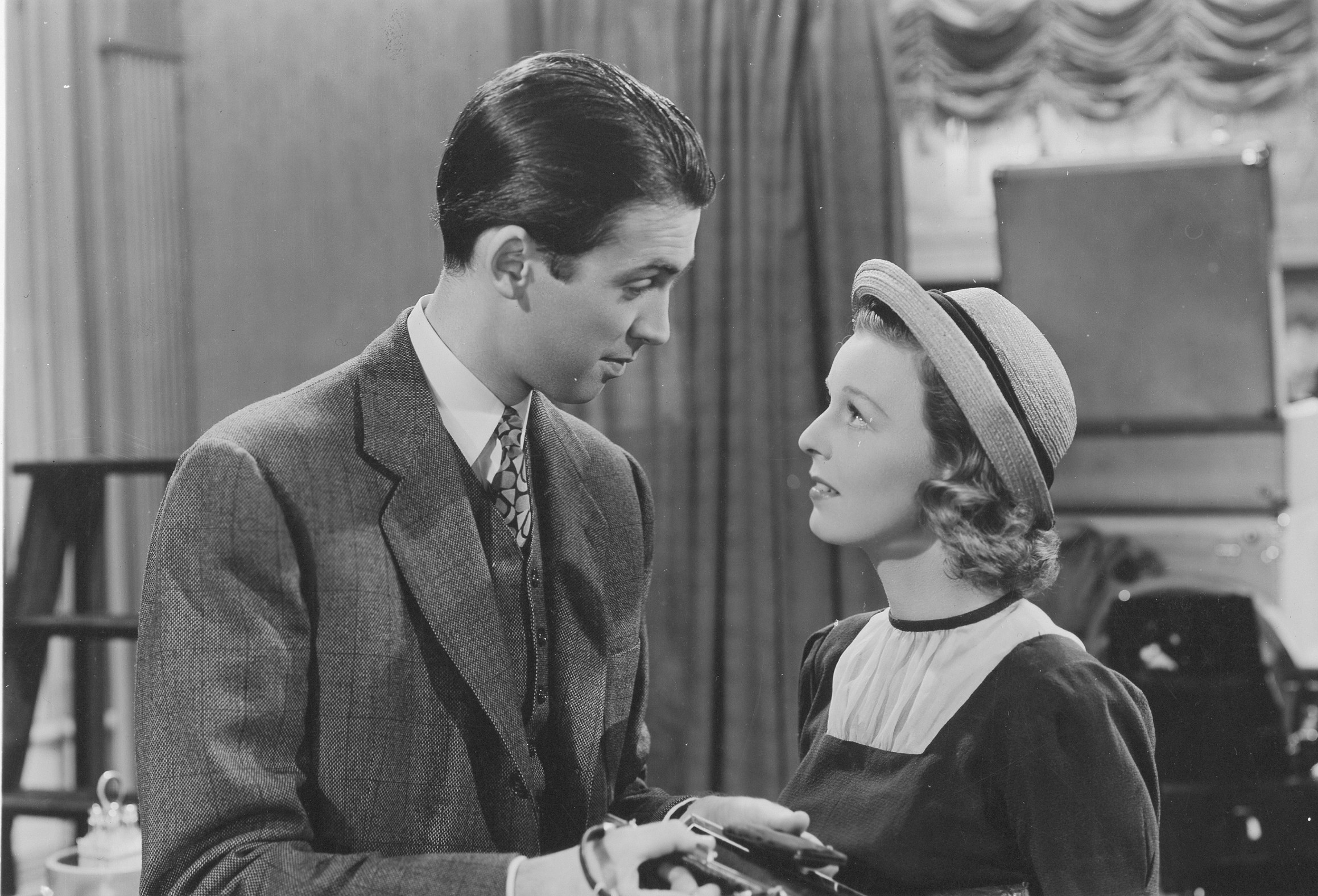
role-of-love-in-human-freedom

The Shop Around the Corner, adapted from a stage play by Miklós László and scripted by Samson Raphaelson, is a sheer delight from start to finish, another feather in the cap of Ernst Lubitsch’s career that is as entertaining today as it was seventy-six years ago. From the opening scene where the staff at Matuschek’s gather outside the store, the viewer is treated to a mini-masterclass in characterisation, a narrative and acting shorthand that obviates the need for long stretches of dialogue. Each character is recognisable instantly, and with their individual quirks acknowledged from the start, from Mr Pirovitch’s amiable passivity to Ilona’s youthful, fun-loving exuberance, to Mr Vadas’s irritating peacock-like strutting. Stock characters, perhaps, but already the kind of characters the viewer knows they’re going to enjoy spending the next hour and forty minutes with.

And so it proves. With the further introduction of Mr Matuschek – gruffly pompous – and Klara – sweet yet determined – the roster of characters is complete, and the small matter of the central romance is instigated. Around this, Raphaelson’s superb script adds layer upon layer of throwaway moments, from Pirovitch’s disappearing every time Matuschek wants someone’s “honest opinion”, to Pepi’s impersonation of Flora on the telephone (to avoid carrying out an errand for Mrs Matuschek). There’s a wealth of little moments like this, all designed to add extra merriment to a romantic comedy that fizzes and sparks when its central characters are sparring (but not sparing) with each other. Sullavan and Stewart play their roles to perfection, she disparaging everything he does, while he tries to find a way of evening the score. Both actors are a pleasure to watch, never missing a beat – either comedic or dramatic – and Sullavan’s breezy demeanour is complimented by Stewart’s often bemused, distracted presence.

shop-around-the-corner_2

They’re matched by Morgan’s ebullient turn as Matuschek, his story arc taking a darker turn as the movie progresses. There’s a moment where Matuschek realises that he’s made a huge, dreadful mistake, and the actor’s mournful, disconsolate expression speaks volumes as to the depth of his misjudgment. What follows is the movie’s most dramatic, and most affecting moment. Lubitsch imbues this scene with a quiet power that allows it to linger in the memory long after the movie has concluded, and it’s a mark of his skill as a director that it in no way disrupts the otherwise sparkling dialogue and engaging narrative. The German émigré displays a tongue-in-cheek approach to the material and a stylish wit throughout (the so-called “Lubitsch touch”), and he finds nuances in Raphaelson’s screenplay that add further lustre to a movie that is funny, sad, uproarious, charming, elegant in its construction, and unrelentingly appealing.

Rating: 9/10 – a perennial favourite amongst fans of Xmas-based movies, The Shop Around the Corner is a movie that effortlessly raises the spirits and puts a lingering smile on the viewer’s face; undeniably entertaining, it’s like an old friend you haven’t seen in years but who also holds a very dear place in your heart, and once you’ve seen them, you can’t wait until you see them again.


Share this:

  • Click to share on X (Opens in new window) X
  • Click to share on Facebook (Opens in new window) Facebook
  • More
  • Click to print (Opens in new window) Print
  • Click to email a link to a friend (Opens in new window) Email
Like Loading...

Southside With You (2016)

12 Monday Dec 2016

Posted by dullwood68 in Movies

≈ Leave a comment

Tags

Barack Obama, Do the Right Thing, Drama, Ernie Barnes, First date, Michelle Robinson, Parker Sawyers, Review, Richard Tanne, Romance, Tika Sumpter, True story

ckeh-dquyaaakue

D: Richard Tanne / 84m

Cast: Tika Sumpter, Parker Sawyers, Vanessa Bell Calloway, Phillip Edward Van Lear, Tom McElroy, Stephanie Monday

It’s 1989, and Michelle Robinson (Sumpter), a young lawyer with a firm in Chicago, is preparing to spend the afternoon with an associate who she’s mentoring. The young associate’s name is Barack Obama (Sawyers), and while Michelle’s parents (Calloway, Van Lear) tease her about it, she insists she’s not going on a date. When Barack arrives to pick her up, he’s late, there’s a hole in the passenger footwell of his car, and it’s clear that he smokes (which Michelle isn’t too keen on). And she learns that the community meeting he’s invited her to attend with him, isn’t until much later. Taking a further stand with Barack, she tells him they’re not on a date. He agrees (reluctantly), but adds that it won’t be a date until Michelle says so.

With time to kill, the pair attend an exhibition at a local arts centre. As they look at and voice their feelings about the artwork on display – by the artist Ernie Barnes – slowly but surely they begin to learn about each other. Michelle warms to Barack (though not too quickly), while he is obviously attracted to her. They talk about their backgrounds, make snap judgments about each other, and generally discover they have a liking for each other that Michelle, at least, is surprised by. From the arts centre, they go for a walk in the park, talk some more about their families, and in particular, Barack’s relationship with his mother and father.

southside-with-you-trailer-video-1

At the community meeting, Michelle witnesses Barack take on the role of confident, impassioned orator, as he takes up an issue that’s causing the community to feel disparaged. He encourages them to look at things from a different perspective. Afterwards, Michelle tells Barack how impressed she was – even if it did seem like a set up, what with her being there. Barack admits he may have hoped for such an outcome, but instead of taking him to task – as she would have done earlier in the day – Michelle appears to be okay with his minor subterfuge.

The two have dinner, and learn more about each other’s religious leanings, before attending a screening of Spike Lee’s Do the Right Thing. As they leave, Michelle is temporarily by herself, and she meets one of the partners at her law firm, Avery Goodman (McElroy), and his wife (Monday). When he asks her why one of the characters in the movie acted in the way that he did, she’s lost for an answer. When Barack reappears, he has an answer for Avery’s question. Avery is impressed, and suggests to Michelle that she ensure Barack’s time at the firm is beneficial. When they’re by themselves again, Michelle rounds on Barack and tells him why this should never have been a date: because of how it would look at the firm. Chastened, Barack takes Michelle home, but not before he makes one last stop…

southside-with-you-art-institute-scene-ernie-barnes-painting

It’s such an obvious conceit – show the first date between two famous people (and before they were famous) – that it’s somewhat surprising that it hasn’t been done before. A project begun by writer/director Richard Tanne back in 2007, Southside With You is a warm, big-hearted piece of romantic conjecture: what would that first date between Barack Obama and Michelle Robinson have been like? Would they have hit it off straight away, or would they have discovered a common enmity, a hurdle too big to overcome at the first attempt? The latter seems to be the case early on, what with Michelle’s refusing to classify their going out together as a “date”, while Barack’s oh-so-puppy-dog approach doesn’t appear to be gaining any traction either.

One of the things that makes this imagining of real life events so charming is its refusal to litter the script with presentiments of the future, those moments when (usually) dialogue hints at greater things to come. Even the one time that Michelle suggests Barack try his hand at politics, it’s all said and done with in a matter of seconds. The movie remains firmly in the here and now of 1989, never deviating from its carefully constructed sense of time and place, and keeping its two main characters anchored to their lives as they were then. This leads to a raft of information about the movie’s prospective lovebirds that most people won’t be aware of, such as Barack’s father dying at the relatively young age of forty-six, or that Michelle was living at home to help with her father, who has MS.

southside-with-you

Their verbal sparring, an often witty joust between two fiercely intelligent people certain (for the most part) about their place in the world, informs most of the movie’s running time, and makes for some spirited exchanges between the two. It’s here that the performances sparkle and come into their own, with Sumpter’s slightly waspish turn as Michelle slowly softening as the movie progresses. As she lowers her guard thanks to Barack’s easy-going presence, Michelle becomes more relaxed – and more likeable. It’s an impressive performance, subtly shaded for the most part, and hopefully will allow Sumpter the opportunity to take on more high profile roles in the future. But good as she is, it’s Sawyers’ performance as Barack “O-what-a” that holds the attention. Looking a good deal like the real Barack Obama, and sounding exactly like him, inflections and all, Sawyers inhabits the role with ease, avoiding any possible accusations of mimicry and providing viewers with a fully-rounded portrayal of a young man hoping to convince his “date” that that’s exactly what she is.

Tanne takes full advantage of his lead actors’ skill in their roles, and lets them do all the “hard” work, while he orchestrates things with deceptive ease. The time he’s spent writing and refining Southside With You has clearly paid off, and the simplicity of it all adds immeasurably to the movie’s charm and appeal. With a warmth to its cinematography – courtesy of Patrick Scola – and a winsome, winning score by Stephen James Taylor, the movie is a pleasure to watch from start to finish. The only question that remains is what Barack and Michelle think of the movie. They do have a copy…

Rating: 9/10 – with two standout performances from Sumpter and Sawyers, and a precision-tooled script, Southside With You entrances and beguiles in equal measure; a romantic drama with heart and soul, as well as humour, it’s the kind of low budget indie movie that wins heaps of praise, but is seen by very few – and in this case, that’s a crime, pure and simple.

Share this:

  • Click to share on X (Opens in new window) X
  • Click to share on Facebook (Opens in new window) Facebook
  • More
  • Click to print (Opens in new window) Print
  • Click to email a link to a friend (Opens in new window) Email
Like Loading...

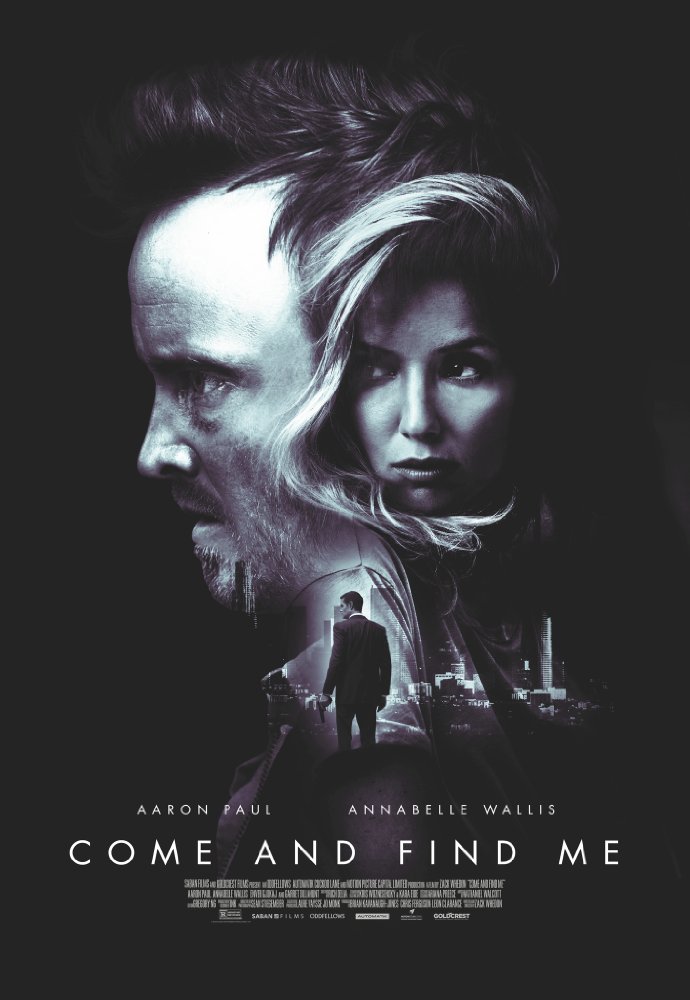
Come and Find Me (2016)

02 Friday Dec 2016

Posted by dullwood68 in Movies

≈ 2 Comments

Tags

Aaron Paul, Annabelle Wallis, Disappearance, Drama, Garret Dillahunt, Mystery, Review, Romance, Thriller, Zack Whedon

come-and-find-me-2016-movie-free-download-720p-bluray-1

D: Zack Whedon / 112m

Cast: Aaron Paul, Annabelle Wallis, Garret Dillahunt, Dean Redman, Zachary Knighton, Enver Gjokaj, Terry Chen, Michael Kopsa

The Black List is an annual survey of the “most liked” motion picture screenplays not yet produced. 2012 was a pretty good year, with screenplays for the likes of Arrival, John Wick, Me and Earl and the Dying Girl, and Hell or High Water all making the list. But so did the screenplay for Come and Find Me, which just goes to show that the Black List doesn’t always get it right.

Written by Zack Whedon (brother of Josh), the script aims for being several things at once: a romantic drama, a thriller, and a mystery. In addition, it seeks to include meditations on what it is to really know someone, and the permanence of love. It’s an ambitious script, and one that has clear intentions to be more than just another run-of-the-mill why-has-my-girlfriend-suddenly-disappeared-when-we-were-so-happy-together? style of movie. Signs of these intentions can be seen throughout Come and Find Me’s drawn-out running time, but however effective these elements may have been on the page, it’s Whedon the director who sabotages any chances they had of being just as effective on the screen.

come-and-find-me

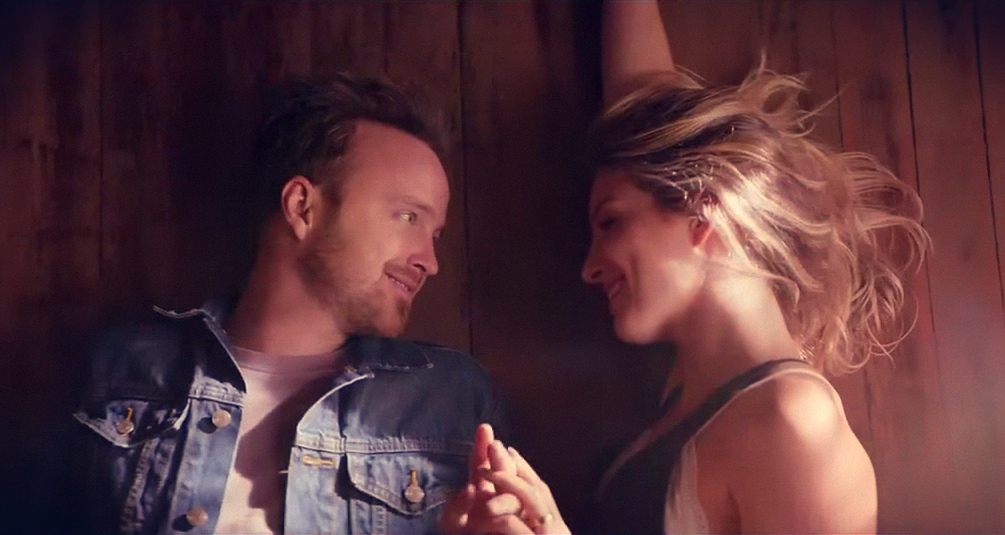
At the beginning, Aaron Paul’s graphic web designer, David, gets on a bus where he spots an attractive blonde (Wallis). When she gets off the bus, so does he. He follows her. Eventually she turns and asks him bluntly if he’s following her. David looks appalled, says no, and carries on past her. Soon, she is following him until they reach a house that they both claim is where they live. David opens the door, the woman goes in without being invited. Inside they find a photograph that shows they know each other… Now, at this point, viewers who have seen way too many movies will know exactly what happens next. But for anyone who hasn’t seen way too many movies, this is an exciting start: how can two people live in the same house and apparently not know each other? Is this going to be some kind of variation on The Lake House (2006)?

Well, no, it isn’t. If Whedon had written a mystery drama that evolved from this opening sequence, and had kept the mystery unfolding piece by tantalising piece then Come and Find Me would have been an entertaining, enjoyable movie. But instead, he explains away this early “mystery” and goes in a different direction altogether – but one we’ve seen in the movies, and on television, and in books and plays, time and time again. And he doesn’t bring anything new to the table, or find a way of presenting his tale with any kind of visual flair or panache.

aaron

After watching Come and Find Me for a while – say, twenty minutes – the average viewer will be wondering if the bland shooting style, with its dour lighting scheme and flat imagery, is going to continue throughout. Well, it does. Whedon’s framing is a major letdown (which makes you wonder if DoP Sean Steigemeier had any say in the matter), and he constantly shoots from a low angle, as if this will add to the drama unfolding on screen. But all it does is prove annoying and distracting, and make the average viewer wonder if Steigemeier’s back was okay, what with all this low level camera work. With its drab interior design adding to the movie’s visual problems, even when it heads out into the countryside, Whedon and his crew do their best to downplay any of Nature’s beauty. A shot from the top of a hillside looking toward a row of other hills should be a jaw-dropper; instead it’s literally, just a backdrop.

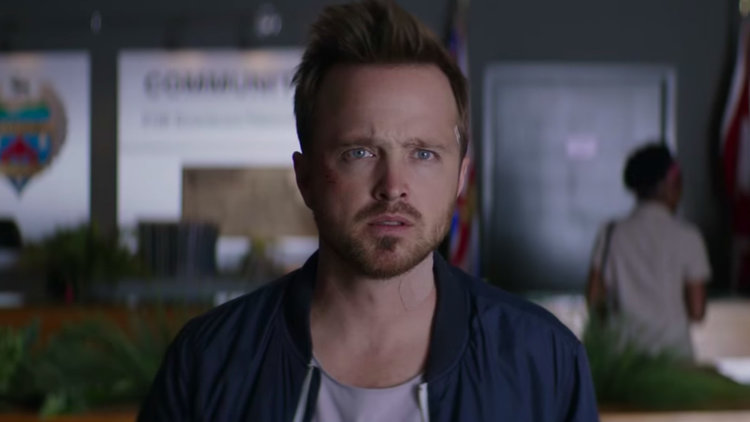
But even that isn’t the worst of the movie’s problems under Whedon’s stewardship. The central mystery, once it’s explained, proves to be underwhelming, but there’s still a long way to go as David engages in a less-than-riveting series of bluff and counter-bluff in his efforts to bring the bad guys to… to… well, actually, we never know if he’s looking for justice, revenge, a combination of the two, or something else entirely, as Whedon doesn’t think to tell us. Throughout, David has one motivation: to find out what happened to his girlfriend, Claire. But he does so in such a ham-fisted, you-won’t-believe-he-did-that kind of way that it’s a wonder he gets as far as he does. He’s a passive-aggressive victim who’s never as ahead of the game as he thinks he is, and as a result, and despite Paul’s best efforts, he remains unsympathetic throughout.

come_and_find_me_-_aaron_paul_annabelle_wallis_-_still_-_h_-_2016

Paul is a good choice for the character of David, but like so much of the movie, is undermined by Whedon’s inexperience in the director’s chair. Everyone else is a supporting character, and though the likes of Dillahunt and Gjokaj do their best with less than challenging material, there’s no chance than anyone is going to stand out from the crowd. Even Wallis, whose role is largely seen through a variety of flashbacks, gets to be less than a fully fledged character and more of a cypher; or more awkwardly, a McGuffin.

When it comes to first-time writer/directors, Whedon is another in a long line of movie makers who believe they can get it right on their maiden attempt, but often the opposite is true. Such is the case with Come and Find Me. Perhaps there should be a moratorium on first-time writer/directors. Perhaps directors shouldn’t make their own scripts until they’ve been directing for a while, and have worked on other writers’ scripts. Perhaps then they’ll have a better understanding of how to assemble a movie without undermining it at the very same time. Who knows? It might lead to them making better movies.

Rating: 4/10 – leaden, and with an ending that will leave most viewers slack-jawed through disbelief, Come and Find Me is a misfire on almost every level; lacking a clear purpose, or any depth or subtext, the movie plods along, then stumbles along, then plods along again etc. in its quest to be an absorbing mystery thriller, when it’s plain to see that it’s so far from that ambition as to be in a different universe altogether.

Share this:

  • Click to share on X (Opens in new window) X
  • Click to share on Facebook (Opens in new window) Facebook
  • More
  • Click to print (Opens in new window) Print
  • Click to email a link to a friend (Opens in new window) Email
Like Loading...

Monthly Roundup – November 2016

01 Thursday Dec 2016

Posted by dullwood68 in Movies

≈ 1 Comment

Tags

Action, Adam Schindler, All'ultimo sangue, Andrew Stanton, Animation, Annalise Basso, Attack of the Lederhosen Zombies, Beth Riesgraf, Bury Them Deep, Colin Firth, Comedy, Craig Hill, Dominik Hartl, Drama, Elizabeth Reaser, Ellen DeGeneres, Ettore Manni, Felicity Jones, Finding Dory, Fort Osage, Gabriela Marcinková, Home invasion, Horror, Inferno (2016), Laurie Calvert, Lesley Selander, Literary adaptation, Mike Flanagan, Ouija: Origin of Evil, Paolo Moffa, Patrick Dempsey, Plague virus, Prequel, Renée Zellweger, Rod Cameron, Romance, Romantic comedy, Ron Howard, Rory Culkin, Sequel, Sharon Maguire, Shut In, Ski-ing, Thriller, Tom Hanks, Western

Bury Them Deep (1968) / D: Paolo Moffa (as John Byrd) / 109m

Original title: All’ultimo sangue

Cast: Craig Hill, Ettore Manni, Giovanni Cianfriglia (as Ken Wood), José Greci, Francesco Santovetti, Luciano Doria, Pino Patti (as Giuseppe Sorrentino), Ruggero Salvadori

4807-2

Rating: 5/10 – when an Army payroll is stolen by notorious outlaw Billy Gun (Cianfriglia), expert tracker Clive Norton (Hill) is hired to get it back, but in the process he finds himself up against a variety of obstacles, not the least of which is Billy’s brother, El Chaleco (Manni); an average Spaghetti Western given a much needed dose of energy thanks to Manni’s muscular, spirited performance as the conniving El Chaleco, Bury Them Deep rarely rises above its perfunctory level, and despite cramming in several lengthy action sequences.

Ouija: Origin of Evil (2016) / D: Mike Flanagan / 99m

Cast: Elizabeth Reaser, Annalise Basso, Lulu Wilson, Henry Thomas, Parker Mack

ouija-origin-of-evil

Rating: 6/10 – it’s 1965, and the Zander family – single mother Alice (Reaser) and her two daughters, Lina (Basso) and Doris (Wilson) – become imperilled by an evil spirit thanks to the misguided use of a ouija board; a prequel to the events seen in Ouija (2014), this does nothing new in terms of scares and special effects, but thanks to the involvement of Flanagan, at least gives you characters you can actually relate to and care about, and which is a rare and valuable thing indeed.

Finding Dory (2016) / D: Andrew Stanton, Angus MacLane / 97m

Cast: Ellen DeGeneres, Albert Brooks, Ed O’Neill, Kaitlin Olson, Hayden Rolence, Ty Burrell, Diane Keaton, Eugene Levy, Sloane Murray, Idris Elba, Dominic West, Bob Peterson, Kate McKinnon, Bill Hader, Sigourney Weaver

3083866-dory

Rating: 7/10 – Dory the blue tang fish (DeGeneres) starts having flashbacks to when she was younger and lived with her parents, and these in turn prompt her to try and find them, much to the continuing consternation of clown fish Marlin (Brooks) and his more positive son Nemo (Rolence); a sequel to one of Pixar’s most cherished movies, and one of this year’s most anticipated releases, Finding Dory lacks the original movie’s winning charm, and settles instead for being a guilty pleasure retread of Finding Nemo, while being saved from a lower score thanks to DeGeneres wonderful, and still inspired, vocal performance.

Bridget Jones’s Baby (2016) / D: Sharon Maguire / 123m

Cast: Renée Zellweger, Colin Firth, Patrick Dempsey, Sarah Solemani, Gemma Jones, Jim Broadbent, Emma Thompson, Neil Pearson, Joanna Scanlan, Kate O’Flynn, Celia Imrie, Ed Sheeran

160628142149-bridget-jones-baby-large-169

Rating: 7/10 – at the dreadfully old age of forty-three, Bridget (Zellweger) feels like love is passing her by, until two one night stands – with old flame Mark Darcy (Firth) and new beau Jack Qwant (Dempsey) – lead to her being pregnant but unsure as to which one of them is the father; a welcome return for Bridget, and with much of the pizzazz and feelgood humour of the first movie, but the whole “who’s the father?” storyline is a poor conceit to hang a whole movie on, and it shows, leaving standout moments such as Bridget miming to House of Pain’s Jump Around, as a much better reason for splurging on this latest installment.

Shut In (2015) / D: Adam Schindler / 90m

aka Deadly Home; Intruders

Cast: Beth Riesgraf, Rory Culkin, Martin Starr, Jack Kesy, Joshua Mikel, Leticia Jiminez, Timothy T. McKinney

shut-in

Rating: 5/10 – when Anna (Riesgraf), who’s agoraphobic, doesn’t attend her recently deceased brother’s funeral, the three men who arrive at her home to rob her soon find that Anna has a dark secret that will endanger them all; a brave attempt to do something different in the home invasion genre, Shut In nevertheless remains an intriguing idea that never coalesces into a completely successful whole, but does feature a terrific performance from Riesgraf.

Inferno (2016) / D: Ron Howard / 121m

Cast: Tom Hanks, Felicity Jones, Omar Sy, Irrfan Khan, Sidse Babett Knudsen, Ben Foster, Ana Ularu, Ida Darvish

inferno-teaser-trailer-tom-hanks-felicity-jones

Rating: 6/10 – despite suffering from short term memory loss, symbologist Robert Langdon must endure a race against time in order to stop the release of a deadly toxin that will wipe out billions of people; another year, another Dan Brown adaptation, but this time it’s an adaptation that’s at least bearable, thanks to Tom Elkins’ and Daniel P. Hanley’s editing skills, an enjoyable, knowing performance from Khan, and a script that doesn’t hang around getting bogged down by endless exposition, which, considering Brown’s reliance on it in his novels, is a massive step forward should The Lost Symbol or any further novels be adapted for the screen.

Attack of the Lederhosen Zombies (2016) / D: Dominik Hartl / 77m

Cast: Laurie Calvert, Gabriela Marcinková, Oscar Dyekjær Giese, Margarete Tiesel, Karl Fischer, Patricia Aulitzky, Kari Rakkola

attack-of-the-lederhosen-zombies-patient-zero

Rating: 5/10 – a formula for producing snow proves extremely harmful if ingested, and soon the guests at a remote mountain top ski resort are knee deep in zombies, both human and animal; similar in tone to the Dead Snow movies, Attack of the Lederhosen Zombies combines daft humour with gross-out gore and flying body parts a-plenty, but as usual with this type of movie, it pays lip service to cohesive plotting, or credible characters, and focuses instead on providing a series of inventive zombie kills – which is pretty much the only aspect it gets right.

Fort Osage (1952) / D: Lesley Selander / 72m

Cast: Rod Cameron, Jane Nigh, Morris Ankrum, Douglas Kennedy, John Ridgely

movie-photo-original-8x10fort-osage-1951-rod-cameron-2

Rating: 6/10 – homesteaders looking to head west through Indian country are exploited by a crooked businessman (Ankrum) and have their lives put at risk by his decision to cheat said Indians out of the rewards of a peace treaty, leaving would-be wagonmaster Tom Clay (Cameron) to get the bottom of all the corruption; an enjoyable way to spend seventy-two minutes thanks to Selander’s typically intuitive direction, Cameron’s no-nonsense approach to dialogue, and the joy of watching so many standard Western tropes being trotted out and given such a good airing.

Share this:

  • Click to share on X (Opens in new window) X
  • Click to share on Facebook (Opens in new window) Facebook
  • More
  • Click to print (Opens in new window) Print
  • Click to email a link to a friend (Opens in new window) Email
Like Loading...

Despite the Falling Snow (2016)

08 Tuesday Nov 2016

Posted by dullwood68 in Movies

≈ Leave a comment

Tags

Antje Traue, Charles Dance, Cold War, Defection, Drama, Espionage, Literary adaptation, Moscow, Rebecca Ferguson, Review, Romance, Russia, Sam Reid, Shamim Sarif, Spying

despite-the-falling-snow-poster

D: Shamim Sarif / 93m

Cast: Rebecca Ferguson, Sam Reid, Charles Dance, Antje Traue, Oliver Jackson-Cohen, Thure Lindhardt, Anthony Head

One of the things that never happened in the Golden Age of Cinema was an author being given the opportunity to make a movie of one of their novels or stories. Some were employed to adapt their novels and stories, but none were ever allowed to step behind the camera as well and actually direct the movie. Nowadays, this isn’t so unusual, but it’s also still not very prevalent. So step forward Shamim Sarif, author and movie maker, who has been making movies from her novels from the very beginning. She is possibly unique in this way, and has gained a very good reputation from working on both sides of the creative arena. Despite the Falling Snow is the third movie she’s made from one of her novels, and while she may be well regarded in some quarters as the perfect person to adapt her work – after all, who knows it better than she? – the finished product here isn’t quite the testament to her talents as a director.

The movie begins in New York in 1961 with the defection of a Russian government official called Sasha (Reid). As he’s helped to escape from his Russian handlers, he asks about his wife, Katya (Ferguson). She’s back in Moscow, but his new, US handlers have no idea where she is or what has happened to her. Fast forward thirty years and Sasha (Dance) is a successful restaurateur who has a niece, Lauren (also Ferguson) who is the spitting image of Katya, and who wants to travel to Moscow to try and find out what happened to her aunt. Sasha refuses to go with her, though, so Lauren, who’s lucky enough to be an artist who’s been asked to mount an exhibition in Moscow, heads off by herself.

day-17-2-881x588

While Lauren’s story plays out in 1991, Katya’s story plays out in tandem from 1959 to 1961. Katya is a teaching assistant who’s also helping her friend and government official Misha (Jackson-Cohen) steal secrets and pass them on to the Americans. At a party she meets Sasha but is unimpressed by him. It’s only when Misha persuades her to get close to Sasha because of his position in the Kremlin that she finds herself falling in love with him. Meanwhile, in 1991, Lauren meets and befriends a journalist called Marina (Traue) who helps her in finding out about Katya. Marina learns that Misha (Head) is still alive, and they make plans to visit him. When they do they find he’s become an embittered, angry old man who wants nothing to do with them.

Back in 1961, Katya and Sasha wed, but she agonises over whether she should tell him she’s a spy. In 1991, Marina’s behaviour becomes suspicious, and the unexpected arrival of Sasha in Moscow prompts a revelation. Katya’s decision to tell Sasha leads to his agreeing to defect, but thirty years on only Misha holds the key to what happened to her.

mv5bmtq1ndu0mjmyov5bml5banbnxkftztgwnzqxotkznje-_v1_sx640_sy720_

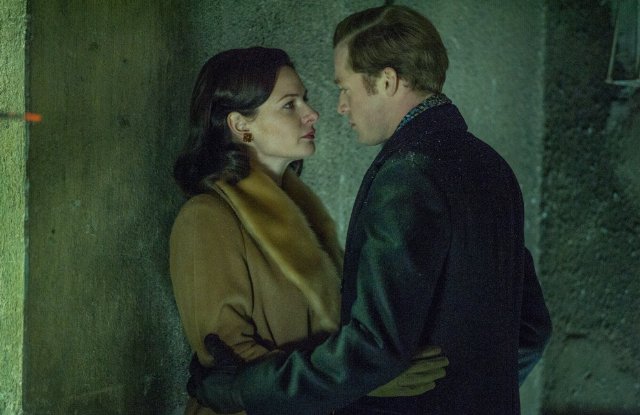
A romantic drama set – partly – during a period of intense political and social upheaval, namely the early Sixties, Despite the Falling Snow has such a generic feel to it that it could have been made about any couple in any country at any time, and still have made the same kind of impact. This is thanks to Sarif’s uninspired, pedestrian direction, and a visual style that never rises above formulaic. It’s as if Sarif has forgotten to add the drama needed to make the narrative more than just a succession of events and scenes that show how two people came together and then were separated by fate in the form of expediency. Even when suspicion falls on the officials in the Kremlin, including Sasha and Misha, it’s a moment where real terror at being found out translates instead as a mild concern. Misha is almost fatalistic about the whole thing, a reaction that not even the talented Jackson-Cohen can make convincing; this man should be even more scared than he’s been already.

But if the steady stream of narrative downplaying that infuses the scenes in early Sixties Russia also makes those scenes feel awkward and inconsistent, then spare a thought for those set in 1991. Sarif makes reference to the Berlin Wall having come down two years earlier, but her new Moscow is an uneasy mix of contemporary US stylings and Russian forebearance, as evidenced by Marina’s designer clothing and old Misha’s tower block abode. The juxtaposition jars, and adds to the overall feeling that Sarif wants her characters to look glamorous against the concrete backdrop of post-Stalinist Russia (Katya seems never to be without her red lipstick). The visual conceit is highlighted by Sarif’s decision to have Katya and Sasha, and Lauren and Marina, walk along the same snow-laden stretch of riverside pavement at different times, but instead of creating an echo of past events, it appears to be more of a budgetary deference than a creative decision.

despite_the_falling_snow-15

Elsewhere, narrative developments that appear out of nowhere are treated as if they are absolutely necessary to the overall plot, and that includes a left-field decision to have Lauren and Marina begin a sexual relationship. Old Sasha’s willingness to stay home out of harm’s way is overturned by the contents of a fax, while Old Misha’s decision to spill the beans about what happened to Katya is spurred on by feelings of guilt, and that old chestnut, a terminal illness. And when the viewer does find out what happened to Katya, Sarif handles it in such a hamfisted way that any emotional weight the scene might – or should – have engendered with said viewer, is lost before the scene’s even begun.

A lacklustre movie then, one that doesn’t even aim particularly high, but which does feature another of Charles Dance’s supporting roles (is he semi-retired now, is that what’s going on?) and a level of political naïvete that further dilutes the drama that isn’t really there. On the performance side, Ferguson is unable to make much of either role, as Sarif never allows the viewer to engage with them as anything other than under-developed non-characters. Reid is earnest but treading in a pool so shallow it’s practically evaporated, while Traue is allowed to look moody and resentful in equal measure even when she’s kissing Ferguson. Dance and Head bring a degree of old-time gravitas to the proceedings, but even they can’t avoid the pitfalls that are inherent in the script. On this showing, Sarif needs some more time to clarify her goals in making such a movie, and maybe next time, getting someone else to direct.

Rating: 4/10 – Sixties Moscow never looked cleaner, quieter, or more family friendly than it does in this movie, and that’s despite several efforts to make it look as if it’s not brand new; as a drama it never gets started, despite the best efforts of its cast, and by the end you’ll only want to know what happened to Katya just so that you can move on in (roughly) the same way everyone else does: without too much fuss.

Share this:

  • Click to share on X (Opens in new window) X
  • Click to share on Facebook (Opens in new window) Facebook
  • More
  • Click to print (Opens in new window) Print
  • Click to email a link to a friend (Opens in new window) Email
Like Loading...

Mini-Review: The Late Bloomer (2016)

28 Friday Oct 2016

Posted by dullwood68 in Movies

≈ Leave a comment

Tags

Brittany Snow, Comedy, J.K. Simmons, Johnny Simmons, Kevin Pollak, Literary adaptation, Maria Bello, Puberty, Review, Romance, Sex, True story

the-late-bloomer-poster-2

D: Kevin Pollak / 94m

Cast: Johnny Simmons, Brittany Snow, Maria Bello, J.K. Simmons, Kumail Nanjiani, Beck Bennett, Paul Wesley, Blake Cooper, Jane Lynch, Sam Robards

Peter Newmans (Simmons) is essentially a sex therapist, but one with a difference: his job is to convince sexaholics that they should channel their sexual energy into other avenues, such a hobby or work. In essence he’s encouraging his patients to be as celibate as he is. Yes, that’s right, Peter is celibate, and has reached the age of thirty without ever having sex, or even a girlfriend. He’s attracted to his neighbour, would-be chef Michelle (Snow), but she’s already in a relationship, and anyway, he wouldn’t know what to say or do even if she wasn’t. Luckily, Fate steps in when Peter collapses and is rushed to hospital. There he’s told that he has a tumour that has been pressing on his pituitary gland, and this has been the cause of his asexuality. But once the tumour is removed, puberty is going to hit him like a ton of bricks.

And so it proves. Initial attempts by his friends, Rich (Nanjiani) and Luke (Bennett), to get Peter laid don’t work, and it’s not until he wakes up one morning with an erection that Peter finally gets to experience the pleasures of, to begin with, excessive masturbation. It also changes the way he views his work, and he begins to encourage his patients to fully embrace their sexual desires, a change that causes concern for his boss, Caroline (Lynch), who has Peter booked on several publicity spots (he’s written a book on how to avoid “unnecessary” sex). But when Michelle becomes single, Peter’s continued inability to properly express his feelings for it – now thanks to the hormones raging inside him – leads him to alienate her, and also Rich. With only his long-suffering parents (Bello, J.K. Simmons) to turn to, Peter has to find a way of becoming the responsible adult – the man – he would have become if he’d gone through puberty at the right time.

nebrrlpciijgfh_1_b

A comedy that wants to be raunchy and sweet at the same time, The Late Bloomer is based on the book, Man-Made: A Memoir of My Body by Ken Baker. So, in essence it’s a true story (Baker did suffer from the same kind of tumour that Peter does), but this is a movie where the approach and the way the material has been handled, will inevitably lead the viewer to wonder if Baker’s experiences have been fairly or even halfway accurately transferred to the screen. Because this is a movie that wavers throughout in its efforts to tell a coherent story. It wants to be a raunchy comedy for the most part, and there are laughs to be had, but this is at odds with the romantic aspects of the material, and the non-existent sympathy for Peter and his situation.

With the movie lacking a clear focus, scenes come and go without any connection to each other, and Simmons is left looking and sounding like a complete doofus. As the movie progresses it becomes clear that the screenplay (assembled by five – count ’em – five screenwriters) and the director are not in sync, and despite several efforts by the cast, are never likely to gel no matter how hard they try. This leaves the movie looking disjointed and poorly assembled. There’s a funny, rewarding, and charming movie to be made out of Baker’s memoir, but this isn’t it.

Rating: 4/10 – a movie that strives to be liked but stumbles at almost every turn in its efforts to do so, The Late Bloomer wastes a ton of potentially humorous situations by ditching subtlety at every opportunity; Pollak’s feature debut as a director, he might be better off choosing any future projects by making sure they have a more polished script, and a better sense of where they’re going (and how to get there).

Share this:

  • Click to share on X (Opens in new window) X
  • Click to share on Facebook (Opens in new window) Facebook
  • More
  • Click to print (Opens in new window) Print
  • Click to email a link to a friend (Opens in new window) Email
Like Loading...

The Lunchbox (2013)

02 Sunday Oct 2016

Posted by dullwood68 in Movies

≈ 1 Comment

Tags

Comedy, Dabba, Dabbawala, Drama, Irrfan Khan, Mumbai, Nawazuddin Siddiqui, Nimrat Kaur, Review, Ritesh Batra, Romance

the-lunchbox

Original title: Dabba

D: Ritesh Batra / 104m

Cast: Irrfan Khan, Nimrat Kaur, Nawazuddin Siddiqui, Lillete Dubey, Nakul Vaid, Bharti Achrekar, Yashvi Puneet Nagar, Denzil Smith, Shruti Bapna

In Mumbai, a dabbawala is literally “one who carries a box”. A dabbawala is part of a delivery system that allows workers who don’t want to eat at a food stand or a restaurant, to have hot, home-cooked food for lunch. The lunchboxes are collected from the worker’s home in the morning, delivered in time for their lunch break, and then returned to the worker’s home by the evening. This service first started in 1890, and has grown to the point where anywhere between 175,000 and 200,000 lunchboxes are delivered every day, and incredibly, it’s estimated that dabbawalas make less than one mistake in every six million deliveries.

It’s this amazing service that forms the backdrop and set up for The Lunchbox, a wonderfully complex, and still very simple, May-December romance that develops between soon-to-retire claims actuary Saajan Fernandes (Khan) and housewife Ila (Kaur). Saajan is a widower, well-regarded in the workplace but somewhat withdrawn from his colleagues. He doesn’t socialise outside of work, and he appears to be resigned to remaining alone. Ila has a husband, Rajeev (Vaid) who is distant from her, and from their young child, Yashvi (Nagar). Ila wants Rajeev to play more of an active part in their marriage; some nights he comes home and doesn’t say a word. Ila’s aunty (Achrekar), who lives in the flat above them, suggests that Ila make delicious lunches for Rajeev, in order to help rekindle the romance they used to have.

the-lunchbox-scene2

But instead of Rajeev receiving the first of these lunches, it’s Saajan who gets to discover just how good a cook Ila is. When she realises that her husband hasn’t been receiving the lunches, she leaves a note in the next one, advising the person who is getting them, about the mistake. Saajan is amused by this, but he’s even more enamoured by the quality of Ila’s cooking. He replies to her note, and so begins a correspondence that both keep to themselves, and which enables both of them to feel that there is more to life than the boundaries that seem to keep them hemmed in. As their relationship begins to deepen, Saajan has to cope with the irritating interruptions and attention of his successor, Shaikh (Siddiqui), while Ila has to cope with her father’s long-term illness, and the effect it’s having on her mother (Dubey), and the realisation that Rajeev is having an affair.

The first, and so far, only feature from Mumbai-born Ritesh Batra, The Lunchbox is so deceptively simple, and so elegantly complex, that it’s difficult to work out which of these two aspects is the more effective. Ostensibly a romantic drama with comedic overtones, the movie resists the temptation to be acceptably superficial, and instead, lays the groundwork for perceptive ruminations on growing old in modern India, and what it means to accept the role in life you believe you’ve been given. Through Saajan’s listless acceptance of his fate as a widower with no future in retirement, the movie casts an observant eye over what it is to become inured to a certain way of life, and to regard change as unobtainable. Saajan believes his fate is unavoidable, and in believing so, can do nothing about it.

Ila wants her husband back from wherever it is that his mind is taking him. She at least believes she can change things back to how they were, and has yet to resign herself to a stale marriage of convenience. But Rajeev’s continued indifference, and Ila’s eventual discovery of his infidelity, both serve to leave her feeling trapped and unable to make a better life for herself and Yashvi. Thankfully, Saajan’s enjoyment of her food, and his willingness to engage with her via the notes they send each other, allows her to feel that there is hope for the future, whether she leaves Rajeev and goes to live in Bhutan with Yashvi and Saajan (as he suggests at one point), or even if it’s just her and her daughter.

the-lunchbox-scene1

For Saajan, things are made more complicated by his age and his position in the workplace. After thirty-five exemplary years in the same job, he’s retiring out of some sense of commitment to the memory of his late wife. Closed off from everyone, including himself from time to time, Saajan has resigned himself to a life of anonymity and seclusion, and in a place, Nashik, for which he has little actual enthusiasm. It’s only through the persistence of his successor, the garrulous and irritating Shaikh, and Ila’s notes, that Saajan begins to come out of his shell. He becomes more outgoing, less gloomy, and he tolerates Shaikh’s ebullient behaviour, even when he joins Saajan for lunch and the older man finds himself sharing with the younger man – and is surprised to find he’s happy to do so.

Saajan and Ila’s relationship develops to the point where the audience is practically praying that they’ll meet and properly fall in love, and not rely on the kind of epistolary romance that suits a novel but not necessarily a movie (unless that movie is Whit Stillman’s Love & Friendship). But the course of true love is never known to run smoothly, and despite their obvious need for each other, Saajan’s awareness of the age difference between them leads him to snatch defeat from the jaws of victory. An arranged meeting doesn’t go as planned, and their romance suffers as a result, leaving both parties to decide if what they had was even tangible. Decisions are made, and though they seem immutable, Batra’s clever script allows for optimism in the face of dramatic certainty.

the-lunchbox-scene3

Batra is helped immensely by his two leads. Khan is a perceptive, dignified actor, and he brings those qualities to bear on a role that requires him to reveal more and more about Saajan as the movie progresses. With his gaze registering bemused astonishment with every mouthful and smell of Ila’s cooking, Khan is a delight to watch, and he handles the disappointments and self-imposed barriers to living that Saajan endures with an emotional clarity that is an acting masterclass all by itself. Kaur is equally impressive. Whether Ila is trading quips or recipe tips with her aunty, or whether she’s coming to terms with the likelihood of a loveless marriage for years to come, the actress displays a range and an understanding of her character’s situation that is breathtaking to watch. Both actors are superb here, so much so that it’s very difficult to envisage anyone else in either role.

With Batra proving to be as good a screenwriter as he is a director, The Lunchbox is in very good hands throughout. He makes a background character out of the city of Mumbai, and the hustle and bustle of its streets and trains and buses – all constant reminders that life goes on around us, vibrant and compulsive, even if we choose to step back from it – is used to potent effect, as Saajan in particular experiences its highs and lows. Batra is aided by sterling work from DoP Michael Simmonds, and the movie’s slow, lyrical pace is courtesy of editor John F. Lyons. Scenes play out sometimes at such a stately pace that it’s hard to believe it’s all been agreed in advance, and that so many quiet moments could have such a cumulative, and remarkable effect. But the pace and the tone of the movie are aspects that have been achieved with a great deal of skill, and they serve the material with undisguised aplomb.

Rating: 9/10 – a beautifully observed, beautifully constructed movie that takes two trapped souls and sets them free by virtue of their finding in each other a kindred spirit, The Lunchbox is touching, affecting, stylish, and endlessly gracious in its delivery; a sparkling romantic drama that pays dividends from the very start, and which never short changes either its characters or its audience, it’s a movie that delights with ease, and lingers in the memory long after it’s over.

Share this:

  • Click to share on X (Opens in new window) X
  • Click to share on Facebook (Opens in new window) Facebook
  • More
  • Click to print (Opens in new window) Print
  • Click to email a link to a friend (Opens in new window) Email
Like Loading...

Me Before You (2016)

29 Thursday Sep 2016

Posted by dullwood68 in Movies

≈ Leave a comment

Tags

Charles Dance, Comedy, Drama, Emilia Clarke, Euthanasia, Janet McTeer, Jojo Moyes, Literary adaptation, Quadriplegia, Review, Romance, Sam Claflin, Thea Sharrock

me-before-you

D: Thea Sharrock / 110m

Cast: Emilia Clarke, Sam Claflin, Janet McTeer, Charles Dance, Matthew Lewis, Brendan Coyle, Samantha Spiro, Jenna Coleman, Stephen Peacocke, Vanessa Kirby, Ben Lloyd-Hughes, Joanna Lumley

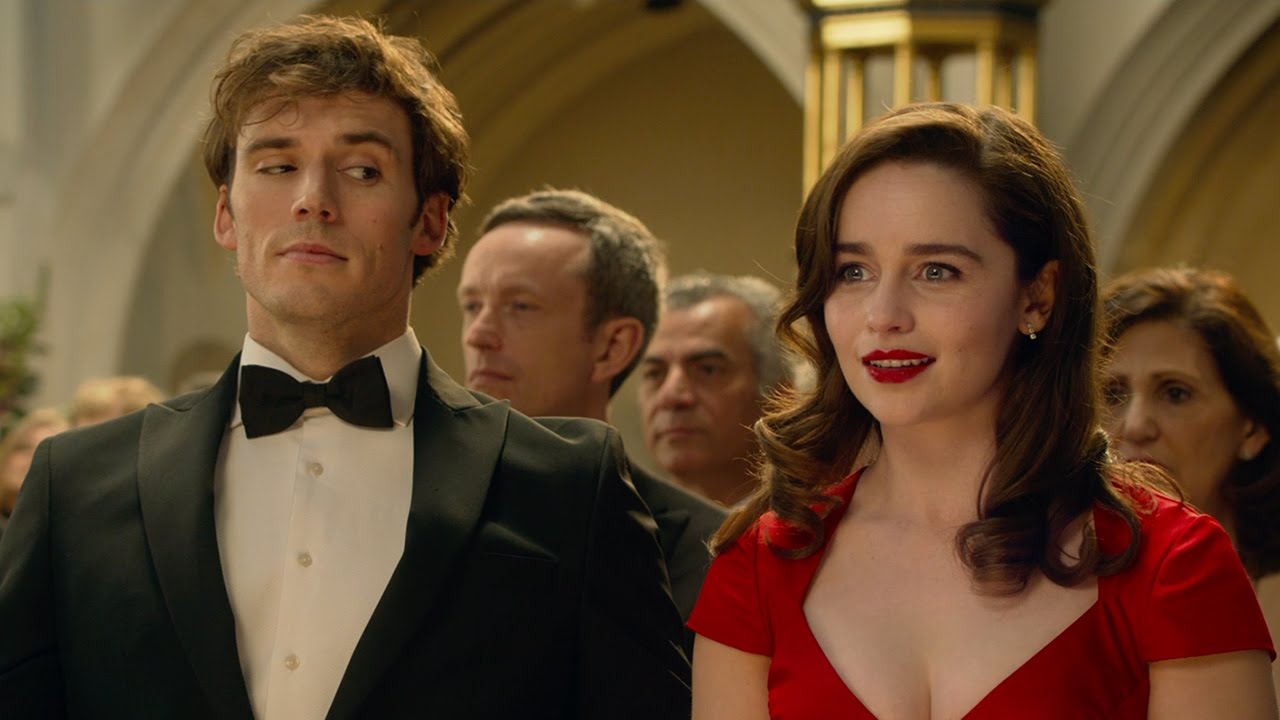
Will Traynor (Claflin) is young, smart, successful, and thanks to an accident involving a motorbike, a quadriplegic. Louisa Clark (Clarke) is also young, but while she’s smart enough and able bodied, she’s reached her mid-twenties without having travelled or worked anywhere except in the local cafe. Will is financially well off and can afford the best care available; he also has doting parents (McTeer, Dance) who don’t want him to limit himself because of his disability. Louisa, nicknamed Lou by everyone who knows her, lacks ambition, and has a fitness-obsessed boyfriend, Patrick (Lewis), who treats her like a member of his (non-existent) fan club. Will wants to die, and has agreed to give his parents six months before he does. Lou wants a life but doesn’t know how to go about claiming one.

Lou loses her job at the cafe. Will needs a live-in carer. Lou applies for the job despite having no previous experience. Will’s mother hires her anyway, surmising that Lou’s madcap personality can bring Will out of his bitter moods. At first it doesn’t work. But as time goes on, Lou and Will establish a friendship that sees both of them venture out of their shells, and begin to engage/re-engage with the wider world. Lou introduces Will to her family. They go on outings together. Patrick suspects that Lou has stronger feelings for Will than she’ll readily admit. Patrick is right. After Will suffers a recurring bout of pneumonia, Lou persuades Will to take a holiday to Mauritius. She goes with him, as does Will’s personal care-giver, Nathan (Peacocke). The night before they’re due to return, Lou tells Will she loves him. But Will has devastating news for her…

mby-scene3

On the surface, Me Before You – adapted by Jojo Moyes from her novel of the same name – is a brisk romantic drama with comedic elements that is designed to tug at the heartstrings of viewers susceptible to this kind of thing, and leave them blubbing into their Kleenex by the movie’s end. And on a superficial level, the movie does this very well indeed, and is quite charming as it does so. But there’s a lot more going on in Me Before You than meets the eye; a lot more. The only question to ask is: how much of it is deliberate?

First there’s Lou, a bubbly, positive bundle of energy who pulls faces a lot when she’s nervous, and whose eyebrows appear to have (literally) wandered in from a documentary on endangered insects. She also has the worst fashion sense this side of anyone in either Zoolander movie. But she’s cute and she’s lovable, and she’s like an adorable puppy; she just wants to be liked sooooo much. But it’s not until she rounds on Will for being rude to her (for the umpteenth time) that their relationship truly begins. He stops behaving like an arse, she starts to like him. And romance begins to make itself felt, even if it’s only one-sided at first.

And secondly, there’s Will, a once-energetic, care-free young man who had the world at his feet, the admiration of his friends and colleagues, and a beautiful girlfriend (Kirby). He loses all that, and more besides. He loses the will to live, and he shuts himself away. He does his best to alienate the people around him, while refusing to show anyone just how much pain he’s in. When Lou chastises him for his behaviour it makes him rethink his approach, and the way he feels.

mby-scene1

But that’s the wicked attitude that sits at the heart of the movie. Moyes, aided by director Sharrock and the twin efforts of Clarke and Claflin, brings these two lonely characters together and gives them an unrealistic chance at happiness. We’re told at the beginning that Will’s condition is irreversible, and we’re told his intentions soon after. And through Lou’s efforts at bringing Will out of his shell, the audience is persuaded to believe that there is hope – for Will, for Lou, for both of them as a couple. But it’s a false hope, and one that the movie focuses on for a large part of its running time. As each shared experience brings Lou and Will closer and closer to each other, the audience is encouraged to believe that there will be a glorious Happy Ever After.

But anyone who has been paying attention will know that true love doesn’t conquer all, and that in the real world, fairy tale romances have a nasty habit of folding under the pressure of expectations (it doesn’t help that Moyes has also written a sequel, helpfully entitled Me After You). And so it proves here, as the kind of wonderful romance that only happens in the movies is derailed by narrative considerations it cannot avoid. It’s like a kick in the teeth, and the average viewer could be forgiven for thinking that the movie has stopped being a positive message about overcoming the restrictions of a truncated lifestyle, and has become a glowing advert for euthanasia.

mby-scene2

But strangely, such narrative concerns do little to hinder the movie’s charm and likeability. Despite the darkness at the heart of the story, Lou and Will’s burgeoning love affair is one that tugs at the heartstrings and proves impossible not to root for. Moyes is clever enough to make their relationship credible enough amid all of Lou’s self-doubt and Will’s hatred of his condition, and she and first-time director Sharrock are aided immensely by the performances of Clarke and Claflin. Both actors have the measure of both their characters and the drama that underlies the surface fluffiness of their romance. Clarke’s surprisingly malleable features express joy and sadness and confusion and worry with undeniable charm, while Claflin expresses more with a look than some actors manage with their whole body and a lengthy monologue.

Me Before You isn’t a perfect rom-dram – or rom-com – though it has the best elements of both, and it sometimes goes out of its way to paint an idealised picture of Will’s condition that is at odds with its own narrative agenda, but for all that it’s a warm-hearted, often very funny movie that is engaging, affecting and hugely enjoyable despite the last-minute change into movie-of-the-week melodramatics. And if it all looks a little too sleek and shiny in terms of its overall look, then chalk that one up to DoP Remi Adefarasin – he makes it all look like the fairy tale it so nearly is.

Rating: 8/10 – amiable and smart enough to overcome the necessity of its downbeat ending, Me Before You is entertaining, and full of light, lovely touches that should bring a smile to lovers of this type of movie; Clarke and Claflin are well-cast, and there’s good support from veterans McTeer and Dance, but it’s Moyes who earns the plaudits by retaining the structure and difficult denouement of her novel.

Share this:

  • Click to share on X (Opens in new window) X
  • Click to share on Facebook (Opens in new window) Facebook
  • More
  • Click to print (Opens in new window) Print
  • Click to email a link to a friend (Opens in new window) Email
Like Loading...

The Meddler (2015)

17 Saturday Sep 2016

Posted by dullwood68 in Movies

≈ Leave a comment

Tags

Bereavement, Comedy, Drama, J.K. Simmons, Lorene Scafaria, Mother/daughter relationship, Relationships, Review, Romance, Rose Byrne, Susan Sarandon, Widow

the-meddler

D: Lorene Scafaria / 103m

Cast: Susan Sarandon, Rose Byrne, J.K. Simmons, Jerrod Carmichael, Cecily Strong, Lucy Punch, Michael McKean, Jason Ritter, Jo Jordan

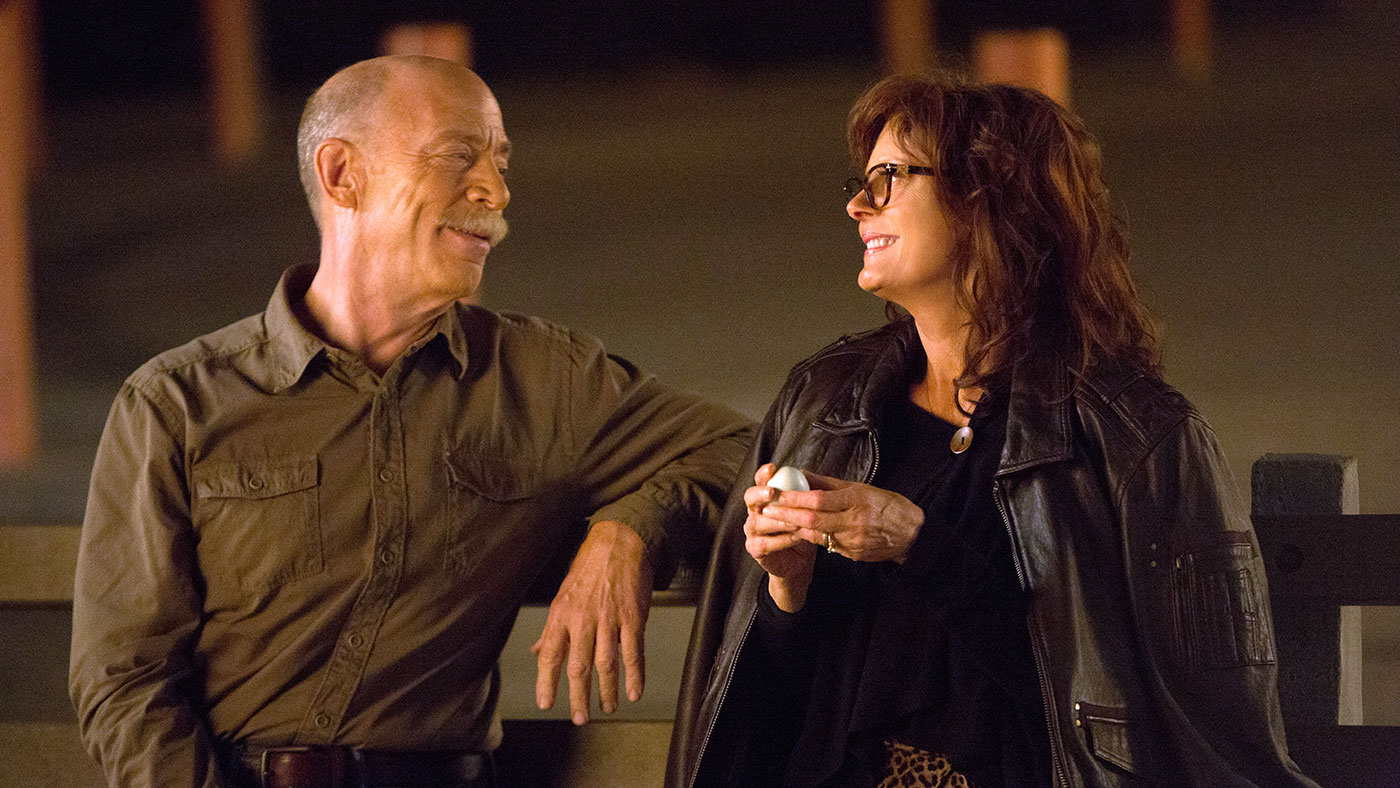
Marnie Minervini (Sarandon) is recently widowed. She has a daughter, Lori (Byrne), who lives and works in Los Angeles in the TV industry. At a loss as to what to do with her time, and despite being financially comfortable thanks to her late husband Joe’s foresight, Marnie chooses to focus her attention on Lori. But Marnie has no idea that her attentions are overbearing, and she ignores Lori’s protests that she’s trying too hard to involve herself in her daughter’s life. When Lori gets an plus-one invitation to a friend’s baby shower, Marnie invites herself along. Lori doesn’t show but Marnie is a hit with her daughter’s friends, and soon she’s spending more and more time with them, particularly Jillian (Strong), who reveals her wish to be married but who can’t afford it.

Marnie persuades Jillian to let her pay for the wedding, and soon she and Jillian’s friends (and Lori’s) are planning all the details, including the bridal outfit. Meanwhile, Lori announces that she’s going to New York for a while. The pilot she’s working on is being filmed there, and it makes sense for her to be there if any problems arise. Marnie throws herself into helping others, from the Genius at an Apple store, Freddy (Carmichael), to an elderly lady (Jordan) at the hospital where she volunteers. She even meets a retired policeman called Zipper (Simmons) when she inadvertently wanders into the background of a movie that’s being shot, and is mistaken for an extra.

the-meddler-scene1

A trip to New York to visit Lori and Joe’s family goes awry, and Marnie returns to Los Angeles chastened and beginning to realise just how much her grief has been channelled into helping others at the expense of herself. She spends more time with Zipper, and comes to Lori’s aid when she has an emergency. Jillian’s wedding goes off without a hitch, and Marnie is given a special mention for her help in organising it all. But Marnie still has to make a decision about whether or not she wants to continue as she is – constantly occupied yet unhappy – or begin a new stage in her life, one that will see her still helping others but not out of personal necessity.

While it’s an apt description of Marnie’s character (for the most part), The Meddler is only so apt when it applies to Marnie’s relationship with her daughter. Away from this, it’s not quite so appropriate, as Marnie’s actions are more altruistic than interfering. This leads to a curious fracturing of the narrative, as the scenes where Marnie uses her financial good fortune, and in the case of the old lady in the hospital her compassion, carry a less distinctive dramatic weight than in those where she spars with Lori for her daughter’s attention. It’s hard to determine if writer/director Scafaria, here following up her feature debut Seeking a Friend for the End of the World (2012), intended it this way, or if it was something that was decided on in post-production.

the-meddler-scene3

What emerges is a movie that is able to examine an aging woman’s experience of grief and the twofold way in which she assimilates and deals with it. On the one hand, her relationship with Lori suffers because Marnie isn’t able to tell her daughter just how much she’s still hurting from the loss of the man who was so important to both of them. Instead she tries to protect and control Lori’s life to the extent that she’ll be kept perfectly safe – and Marnie won’t need to worry about losing her as well. That her actions are having precisely that very effect is the irony that compounds the situation, and stops things from being resolved between them. Scafaria makes a clever decision in their early scenes by playing up the humour inherent in the idea of an overbearing mother (at one point Lori suggests her mother take up a hobby; Marnie’s reply? “Maybe you could be my hobby!”). But the humour is gradually eroded and left behind in favour of exchanges that highlight the pain both women are suffering, and the additional pain their discord is causing each other.

Scafaria has created an emotionally complex, unfailingly brave character in Marnie Minervini, and she’s been blessed with the involvement of Sarandon in the role. The actress inhabits the part so completely, and with such ease, that it becomes a quiet masterclass in screen acting. Sarandon’s performance is so subtle, and so shaded, that often it seems she isn’t doing anything at all. And yet, every expression, every gaze, and every physical movement is in service to the character’s emotions, and her struggle to make sense of her continuing grief. To some degree we’re used to Sarandon giving impressive performances, but here she excels in a role that isn’t flashy, isn’t contrived, and isn’t weighted down by unnecessary layers. Sarandon doesn’t even attempt to make Marnie sympathetic beyond the fact of her being a widow; any sympathy Marnie receives from the viewer is earned through Sarandon’s careful attention to the character and the lessons she learns along the way.

the-meddler-scene2

If there’s one criticism that could be levelled at the movie, it’s that Sarandon’s performance is so good that it eclipses those of the rest of the cast. By comparison, Byrne and Simmons et al fall just that little bit short of impressing as much. It’s not their fault, nor is it Scafaria’s – Sarandon is just that good – but it does make the movie feel a little uneven, as if the secondary characters, while important to the overall story, lack the necessary colour to make them stand out. In any other movie it probably wouldn’t be a problem, but here it detracts from the effectiveness of the various relationships.

Elsewhere there’s still much to admire, from the storyline involving the old lady in the hospital who keeps using a hand to make circles in the air, and which is given a poignant resolution; to the brief scene with Joe’s relatives where a very important clue as to the depth of Marnie’s grief is revealed; and Zipper’s owning chickens, which leads to the line, “Turns out, for the optimal combination of happiness and productivity… All roads lead to Dolly [Parton].” These are all minor moments in the overall fabric of the movie, but their understated nature is perfectly in tune with the gentle, good-natured approach Scafaria brings to the material. It’s a simple story, told simply and well, and at no point is the viewer left on the outside looking in. The humour is there, the drama is there, and the pathos is there, and it’s all impeccably put together by its writer/director in conjunction with its editor, Kayla Emter.

Rating: 8/10 – movies like The Meddler come along maybe once or twice a year, and often go overlooked, which is a shame, as Scafaria’s heartfelt tale of unaddressed grief is moving, life-affirming and overwhelmingly positive in its outlook; Sarandon is magnificent, Scafaria directs her own script with skill and clarity, and the movie offers a slew of rewards for anyone lucky enough to see it.

Share this:

  • Click to share on X (Opens in new window) X
  • Click to share on Facebook (Opens in new window) Facebook
  • More
  • Click to print (Opens in new window) Print
  • Click to email a link to a friend (Opens in new window) Email
Like Loading...

Mini-Review: Café Society (2016)

14 Wednesday Sep 2016

Posted by dullwood68 in Movies

≈ 1 Comment

Tags

Blake Lively, Comedy, Crime, Drama, Hollywood, Jesse Eisenberg, Kristen Stewart, Love, New York, Review, Romance, Steve Carell, The Thirties, Woody Allen

cafe-society

D: Woody Allen / 96m

Cast: Jesse Eisenberg, Kristen Stewart, Steve Carell, Blake Lively, Jeannie Berlin, Ken Stott, Corey Stoll, Sari Lennick, Stephen Kunken, Parker Posey, Paul Schneider, Anna Camp, Sheryl Lee

In the Thirties, naïve young Bobby Dorfman (Eisenberg) leaves the safety of his parents’ (Berlin, Stott) home in the Bronx to move to Hollywood and start a new life. Taken under the wing of his uncle, super-agent Phil Stern (Carell), Bobby is shown around town by Stern’s secretary, Vonnie (Stewart). He quickly falls in love with her, despite her having a boyfriend, and they spend a lot of time together. But when the man in Vonnie’s life reneges on a promise to leave his wife for her, she allows herself to be wooed by Bobby, and in time he asks her to marry him and go with him to New York (he’s bored by the shallowness of Hollywood and its denizens).

But Vonnie’s “boyfriend” finally leaves his wife and she chooses to marry him instead of Bobby. Heartbroken, and hardened by the experience, Bobby returns to New York where he goes to work with his older brother, Ben (Stoll), running a nightclub called Le Tropical. Ben has criminal ties, but keeps Bobby clear of any involvement. Eventually, Bobby meets and marries a recent divorceé, Veronica (Lively). They have a child, and the club becomes a focal point for the famous, the infamous, and everyone in between. Now settled firmly into the roles of husband, father and successful businessman, Bobby’s world is turned upside down when Vonnie pays a visit to Le Tropical with her husband, and it becomes clear that they still have feelings for each other.

cafe-society-scene

Woody Allen’s latest, annual, offering is an outwardly frivolous affair that touches on many of the tropes that have kept his movie career going for nearly fifty years. There’s the relationship between an older man and a (much) younger woman; love denied; philosophical enquiries into the natures of life, love and art; class merits and social acceptance; ambition; and all wrapped up in a slightly more jaundiced approach than is usual. Beneath the glamour and the glitzy lifestyles on display in both Hollywood and New York, Allen makes it clear that happiness is much harder to find than it appears. It also appears to be much more of a commodity, as Bobby’s offer of a romantic life in New York is spurned for a superficial one in Hollywood.

Allen once again assembles a great cast with Eisenberg as yet another on-screen substitute for The Man Himself, and Stewart putting in her best performance in quite some time as the (not really) conflicted Vonnie. But it’s the supporting characters who steal the show, in particular Bobby’s aunt Evelyn (Lennick) and her pacifist husband, Leonard (Kunken). Their problem with an abusive neighbour provides a much needed break from the predictable nature of the central romance, while Stoll’s droll gangster is worthy of a movie of his own. It’s this imbalance that hurts the movie at times, as the romance between Vonnie and Bobby, though given due emphasis by Allen’s screenplay, isn’t as compelling as you’d expect. It’s the distractions from the main storyline that work better as a result, and while Allen peppers things with his trademark wit (“First a murderer, and now a Christian!”), it’s not enough to offset the familiarity of a romance seen too often before.

Rating: 7/10 – Vittorio Storaro’s gorgeous cinematography is Café Society‘s biggest draw, along with its cast, but this is ultimately a Woody Allen movie that sees him revisiting familiar ground to sporadically good effect; enjoyable enough then, but there’s a sense that Allen’s once-a-year workload is still providing similar returns with each new movie.

Share this:

  • Click to share on X (Opens in new window) X
  • Click to share on Facebook (Opens in new window) Facebook
  • More
  • Click to print (Opens in new window) Print
  • Click to email a link to a friend (Opens in new window) Email
Like Loading...

Stranger on Horseback (1955)

09 Tuesday Aug 2016

Posted by dullwood68 in Movies

≈ Leave a comment

Tags

Action, Bannerman, Circuit judge, Drama, Jacques Tourneur, Joel McCrea, John Carradine, John McIntire, Kevin McCarthy, Literary adaptation, Louis L'Amour, Miroslava, Murder, Review, Romance, Trial, Western

Stranger on Horseback

D: Jacques Tourneur / 66m

Cast: Joel McCrea, Miroslava, John McIntire, John Carradine, Kevin McCarthy, Nancy Gates, Emile Meyer, Robert Cornthwaite, Jaclynne Greene, Walter Baldwin, Emmett Lynn, Roy Roberts

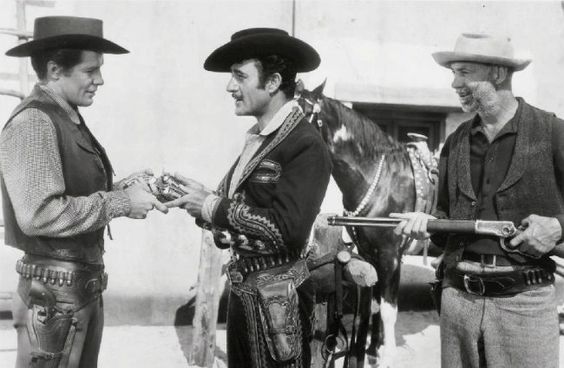
Like each decade before it, the Fifties saw Hollywood and the independent studios make low budget Western after low budget Western. Trying to wade through them now is like trying to read a library of books that have no title pages: it’s difficult to tell if any one Western is better or worse than any other. But Stranger on Horseback (a title that’s not entirely accurate), is one low budget Western that deserves a closer look, and perhaps, over sixty years after it was made, a reassessment.

Adapted from the story by Louis L’Amour, the Stranger in question is actually circuit judge Richard Thorne (McCrea). Arriving in a small town on a routine visit, he soon learns that there has been a murder recently, but that the man responsible hasn’t been arrested. When he asks why, he discovers that the town is owned and run by Josiah Bannerman (McIntire), and that the man who committed the killing is Bannerman’s son, Tom (McCarthy). Despite several warnings from the town sheriff, Nat Bell (Meyer), and Bannerman’s legal counsel, Colonel Buck Streeter (Carradine), that Josiah won’t allow it, Thorne voices his determination to ensure that Tom Bannerman is arrested and committed for trial.

SOH - scene1

News of this development reaches Josiah, and he charges Tom with persuading Thorne to accept his hospitality. Tom’s presence in town leads, unsurprisingly, to his arrest, with Thorne being aided by Bell. With Streeter manoeuvring himself into place as the trial prosecutor, and less than veiled threats made by Josiah’s men as to the likelihood of a trial taking place, an uneasy stalemate exists while Tom languishes in jail. In the meantime, Thorne begins to piece together the events surrounding the murder, while also making an impact on Tom’s cousin, Amy Lee (Miroslava). Her attentions lead to Thorne meeting Josiah, and the last chance of a peaceful outcome in regard to Tom going to trial. Realising that there’s no chance of a trial – fair or otherwise – taking place in town, Thorne decides to spirit Tom away during the night and make for the nearest town, Cottonwood. But his ruse is quickly discovered, and Josiah and his men rush to head them off before Thorne and Bell can get Tom, along with two witnesses to the shooting, to the safety of the nearby town.

For a low budget Western that runs a somewhat paltry sixty-six minutes, Stranger on Horseback is definitely deserving of a much better level of recognition amongst modern day audiences. Directed by the hugely talented Tourneur, this was one of a number of Westerns he made in the Forties and Fifties, and his second with McCrea as the lead. One of Tourneur’s strengths as a director was his ability to draw out strong performances from his casts, and then ally them to a palpable sense of mood. In doing so he made his movies stand out by virtue of their credibility and an often surprising emotional depth. Stranger on Horseback is no exception, with McCrea perfectly cast as the tough, no-nonsense judge whose reputation means he doesn’t have to carry a gun unless absolutely necessary. McCrea made a lot of Westerns in the Fifties, but this is easily one of his best, his performance far more subtle and measured than the material might seem to deserve. In tandem with Tourneur’s assured direction, McCrea makes Thorne the kind of hero whose integrity and law-abiding nature is never in question.

SOH - scene2

But it’s not just McCrea who puts in a great performance. This is a movie with a glut of them. As Thorne’s love interest, Amy Lee, Miroslava gives an insightful portrayal of a woman torn between loyalty to her family and the chance of freedom that an unexpected romance gives her (a subplot involving Amy Lee’s impending marriage to the town banker (Cornthwaite) is handled with a sobering disinterest on her part and a tired resignation on his). (Sadly, this was Miroslava’s penultimate movie before she committed suicide aged just thirty, and from her role here it seems certain that her skills as an actress, her ability to find a sympathetic core to the characters she played, would have led to even better performances over time.)

As the proud land baron Josiah Bannerman, McIntire is a terrific adversary for McCrea, his egoism a perfect counterpoint for Thorne’s rectitude. McIntire was a great character actor, often quietly giving memorable performances in the background of bigger movies, and although his presence here requires a degree of repetition in terms of relaying the same threats over and over, he nevertheless imbues Josiah with a sincerity of intent and action that overcomes an awkward last-minute reversal of purpose. And then there’s the wonderful John Carradine, cadaverously charming as ever as the smooth-tongued, lizard-like Colonel Streeter. His scenes with McCrea are a testament to his talent as an actor, his delivery and equanimity in the part a perfect example of what can be done with a supporting role if you have the skill and the encouragement of your director. It’s also a performance that foreshadows his role as Major Cassius Starbuckle in The Man Who Shot Liberty Valance (1962); both portrayals are hugely enjoyable, and both highlight just how good Carradine was when given a halfway decent script to work from.

SOH - scene3

Further down the cast list, McCarthy is appropriately callow as Tom Bannerman, while there’s a beautifully judged performance from Meyer as the sheriff who finds newfound courage thanks to Thorne’s arrival (Meyer is one of those actors whose face is so familiar, you’d swear you’ve seen him in more movies than he’s actually appeared in). Tourneur brings out the best in everyone, and in doing so, elevates the very basic plot and storylines in Herb Meadow and Dan Martin’s screenplay, making it a richer and more rewarding experience than anyone could have predicted.

While the movie is a great, unsung example of low budget Western movie making, unfortunately there is one issue it can’t presently overcome. Existing copies of the movie have become so degraded that the gorgeous Arizona locations – filmed in Ansco-color – are now a riot of over-exposed colours and blurred details. It’s so bad that when we first see McCrea riding into town it looks as if he doesn’t have a face. This is a movie in desperate need of restoration. Let’s hope a pristine copy surfaces at some point, and the movie can be seen as it was meant to be.

Rating: 8/10 – a superior Western thanks to the involvement of Tourneur, Stranger on Horseback is a richly rewarding movie with some outstanding performances to further add to its stature; with only a rushed conclusion to keep it from being a complete and utter classic, this is still a prime example of a low budget Western that shouldn’t be dismissed or ignored purely because of its provenance.

Share this:

  • Click to share on X (Opens in new window) X
  • Click to share on Facebook (Opens in new window) Facebook
  • More
  • Click to print (Opens in new window) Print
  • Click to email a link to a friend (Opens in new window) Email
Like Loading...

Love & Friendship (2016)

06 Saturday Aug 2016

Posted by dullwood68 in Movies

≈ 2 Comments

Tags

Chloë Sevigny, Comedy, Drama, Jane Austen, Kate Beckinsale, Lady Susan, Literary adaptation, Marriage, Review, Romance, Whit Stillman, Xavier Samuel

Love and Friendship

D: Whit Stillman / 93m

Cast: Kate Beckinsale, Chloë Sevigny, Xavier Samuel, Emma Greenwell, Justin Edwards, Morfydd Clark, Tom Bennett, Jemma Redgrave, James Fleet, Jenn Murray, Stephen Fry

It may seem like an odd corollary, but Whit Stillman’s adaptation of Jane Austen’s posthumously published Lady Susan, and a certain Monty Python sketch involving the Piranha Brothers (Doug and Dinsdale) have something in common. In the Python sketch, Michael Palin as low-level criminal Luigi Vercotti talks about Doug as being the more vicious of the two gang leaders:

“Everyone was terrified of Doug. I’ve seen grown men pull their own heads off rather than see Doug. Even Dinsdale was frightened of Doug.”

“What did he do?”

“He used… sarcasm. He knew all the tricks, dramatic irony, metaphor, pathos, puns, parody, litotes and… satire. He was vicious.”

LAF - scene3

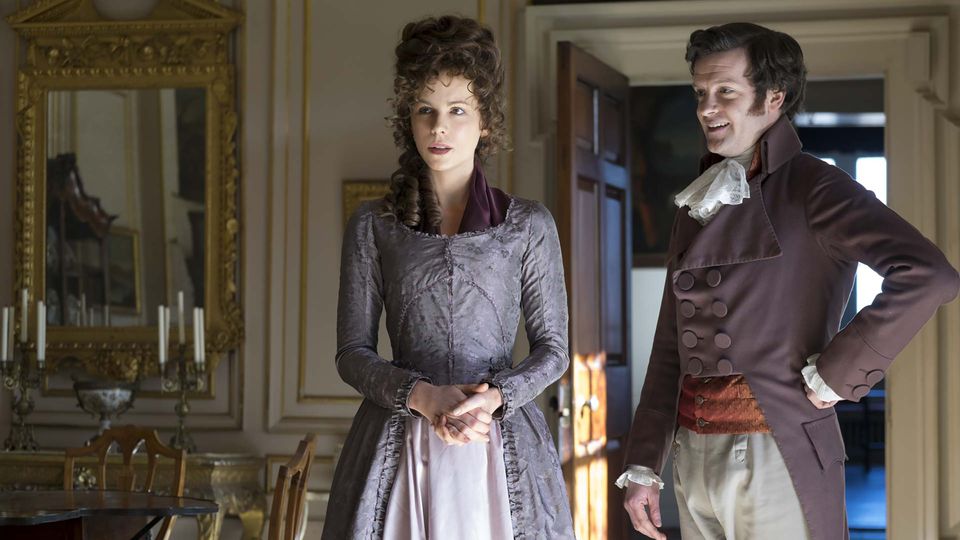
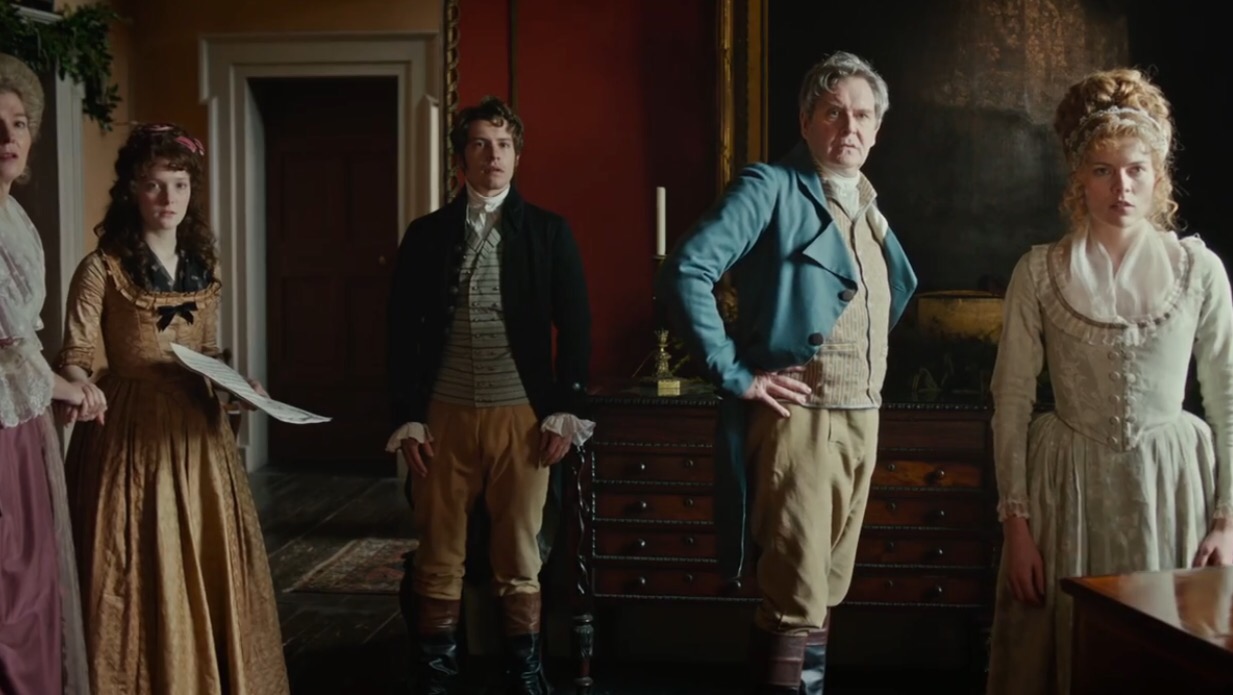
You could add mieosis to the list, or rhetoric, or even polemics – they’re all there in Stillman’s screenplay, all in service to one of the year’s funniest movies, and proof (as if it were truly needed) that Jane Austen had a wicked sense of humour, and enjoyed attacking the social mores of her time; no one was safe, high- or lowborn. In transferring Lady Susan to the screen, Stillman has retained the epistolary nature of the novella, allowing the audience to be swept along with the recent widow’s attempts to secure advantageous marriages for both herself and her daughter, Frederica (Clark)… while also brokering an affair between herself and the married Lord Manwaring. In the process, barbs are dispensed with precision, honeyed slanders voiced with mannered simplicity, and insults hurled with joyous abandon. There’s no turn left unstoned by the movie’s end, and nobody who doesn’t find themselves somehow injured by an unkind remark (even if they don’t know they’ve been injured – some remarks pass by so quickly the characters don’t even realise it’s happened).

This is the overwhelming joy of Love & Friendship: the ease with which the characters are disarmed by unexpected, cutting remarks, and the way in which their reactions are to stare in disbelief like rabbits caught in the headlights, trying to fathom just what to say in return – and then the moment is gone and they’re left there, still staring in shock. Stillman includes so many of these moments there’s a danger of his overdoing it, but the range of insults is so varied that everyone’s a winner, and every moment is assured a smile from the viewer. As Lady Susan (Beckinsale) weaves her tangled web of intrigue, she does so with a shrewd cunning that’s completely impressive. She’s the predatory shark in petticoats who cares for no one but herself and her assured future (or her daughter’s assured future, as that will lead to hers as well).

LAF - scene1

Watching the movie is like indulging in a massive bowl of whipped cream and citrus lemon sauce, a confection that’s rich and rewarding and a bit of a guilty pleasure. But it shouldn’t be, as Stillman elicits superb performances from his cast, with Beckinsale on particularly fine form as Lady Susan, revelling in her machinations and throwing out carefree lines such as “Facts are horrid things” with an amused detachment that fits the character perfectly. It’s good to see Beckinsale – along with Sevigny, reunited with Stillman after eighteen years – being given such a juicy role after so many bland fantasy outings. Maintaining an equilibrium and a sense of purpose while treating everyone around her – bar her good friend, Mrs Johnson (Sevigny) – with utter contempt, Beckinsale as Lady Susan is a poisonous delight, cunning, devious, and wholeheartedly shameless in her efforts to get what she wants. But there’s also grace and subtlety in her performance, a measured approach to the character and the material that reaps dividends when she’s called upon to be deceitful or just outright lying.

But it’s not just Beckinsale who puts in a fabulous performance. As Lady Susan’s confidant, Mrs Johnson, Sevigny has what looks to be the thankless role of best friend who’s there just so the main character has someone to show off to. But Stillman is too good a director, and Sevigny too good an actress, to let this happen, and even in her scenes with Beckinsale, Sevigny’s quiet attention and marvelling at the deplorable behaviour of Lady Susan’s relatives is too good to be ignored or undervalued. And she’s on even better form when the contents of a letter causes problems both for her and for Lady Susan.

LAF - scene2

On the spear side of things, there’s a pitch perfect exercise in buffoonery from Bennett as the idiotic Sir James Martin, whose halting, almost stream of consciousness dialogue is matched by the actor’s use of physical tics and surprised facial expressions; he’s like a child for whom everything is new and endlessly fascinating (he finds peas to be an amazing discovery). There’s a scene where he turns up unexpectedly at the home of Lady Susan’s brother-in-law (Edwards), and spends approximately two minutes waffling horrendously about almost nothing at all, and its one of the funniest things you’ll see this year, a perfect match of physical discomfort and mental truancy.

As befits an adaptation of a novella, the story is very slight, and does boil down to very little at all, but Stillman wisely concentrates on the characters and their idiosyncracies rather than the plot, and there’s reward enough in seeing them adrift – often – in a sea of their own making. It’s a romantic comedy, and a recalcitrant comedy of manners, and a comedy of hilarious misdirection that bubbles with energy and glee at providing so much mischief. Stillman doesn’t make very many movies these days, which is a shame, but let’s hope Love & Friendship is the beginning of a more prolific period in his career because it would be a shame if he spent another five years (the time since his last movie, Damsels in Distress) away from our screens.

Rating: 9/10 – a perfect mix of period drama (with sterling work by costume designer Eimer Ni Mhaoldomhnaigh and production designer Anna Rackard), and pin-sharp levity, Love & Friendship is perfectly designed to ensure a good time will be had by all; Stillman interprets Austen with authority, Beckinsale has a great time as the unprincipled Lady Susan, and the viewer is treated to one of the few comedies released this year that doesn’t rely on crass jokes or gross-out humour – and is all the more impressive for it.

Share this:

  • Click to share on X (Opens in new window) X
  • Click to share on Facebook (Opens in new window) Facebook
  • More
  • Click to print (Opens in new window) Print
  • Click to email a link to a friend (Opens in new window) Email
Like Loading...

Monthly Roundup – July 2016

31 Sunday Jul 2016

Posted by dullwood68 in Movies

≈ Leave a comment

Tags

Action, Apache War Smoke, Apaches, Australia, Bank robbers, Banshee Chapter, Ben Whishaw, Benjamin Walker, Blair Erickson, Brendan Gleeson, Cambodia, Chris Hemsworth, Cillian Murphy, Crawl, Daniel Zirilli, Drama, Gena Rowlands, George Shevtsov, Georgina Haig, Gilbert Roland, Glenda Farrell, Harold F. Kress, Herman Melville, Historical drama, Hitman, Home invasion, Horror, In the Heart of the Sea, James Garner, Katia Winter, Literary adaptation, Moby Dick, Nantucket, Nicholas Sparks, Nick Cassavetes, Numbers stations, Offshore Grounds, Online journalist, Paul China, Paul Holmes, Project MK Ultra, Rachel McAdams, Reviews, Robert Horton, Romance, Ron Howard, Ryan Gosling, Steven Seagal, Ted Levine, Thailand, The Asian Connection, The Essex, The Notebook, Thriller, Tom Holland, Tonto Valley Station, True love, True story, Wells Fargo, Western, Whales

Crawl (2011) / D: Paul China / 80m

Cast: George Shevtsov, Georgina Haig, Paul Holmes, Lauren Dillon, Catherine Miller, Bob Newman, Andy Barclay, Lynda Stoner

Crawl

Rating: 7/10 – a hitman (Shevtsov) hired by an unscrupulous bar owner (Holmes) winds up injured while trying to leave town, and ends up playing a deadly game of cat-and-mouse with a waitress (Haig) when he seeks refuge in her home; a slow-burn thriller that takes its time and relies on tension and atmosphere to keep the viewer hooked, Crawl often belies its low budget, and features terrific performances from Shevtsov (in a role written expressly for him) and Haig, but stops short of being completely effective thanks to some awkward narrative choices and first-timer China’s lack of experience as a director.

The Asian Connection (2016) / D: Daniel Zirilli / 91m

Cast: John Edward Lee, Pim Bubear, Steven Seagal, Sahajak Boonthanakit, Byron Gibson, Byron Bishop, Eoin O’Brien, Michael Jai White

The Asian Connection

Rating: 3/10 – career criminal Jack Elwell (Lee) meets the love of his life, Avalon (Bubear), and decides that robbing a bank is the way to a financially stable relationship, but unfortunately the money he steals belongs to crime boss Gan Sirankiri (Seagal), and soon Jack is being coerced into robbing more of Sirankiri’s banks when one of his men (Boonthanakit) threatens to expose him; what could have been a moderately entertaining action thriller is let down by some atrocious acting (and not just from Seagal), some equally atrocious camerawork, editing that looks like it was done with a hatchet, and the kind of direction that gives “point and shoot” a bad name, all of which leaves The Asian Connection looking like something to be avoided at all costs.

Banshee Chapter (2013) / D: Blair Erickson / 87m

Cast: Katia Winter, Ted Levine, Michael McMillian, Corey Moosa, Monique Candelaria, Jenny Gabrielle, Vivian Nesbitt, Chad Brummett, William Sterchi

Banshee Chapter

Rating: 3/10 – a journalist (Winter) looks into the disappearance of a friend, and discovers a secret world of government experiments that are linked to strange radio broadcasts and the discredited MK Ultra program from the Sixties; a paranoid thriller with supernatural overtones, Banshee Chapter tries extra hard to be unsettling and creepy – much of it takes place at night and has been shot using low light – but fails to make its story of any interest to anyone watching, which means that Winter and Levine put a lot of effort into their roles but are let down by the tortuous script and Erickson’s wayward direction.

In the Heart of the Sea (2015) / D: Ron Howard / 122m

Cast: Chris Hemsworth, Benjamin Walker, Cillian Murphy, Tom Holland, Ben Whishaw, Brendan Gleeson, Michelle Fairley, Paul Anderson, Frank Dillane, Joseph Mawle, Charlotte Riley

In the Heart of the Sea

Rating: 5/10 – the writer, Herman Melville (Whishaw), convinces retired sailor Tom Nickerson (Gleeson) to talk about his experiences as a young boy at sea, and in particular his time aboard the Essex, a whaling ship that encountered a creature Melville will call Moby Dick; based on the true story of the Essex, and the voyage that saw it sunk by an enormous whale, In the Heart of the Sea is technically well made but lacks anyone to care about, avoids providing a true sense of the enormity of what happened, sees Ron Howard directing on auto-pilot, and leaves Hemsworth and Walker struggling to make amends for characters who are paper-thin to the point of being caricatures (or worse still, carbon copies of Fletcher Christian and William Bligh from Mutiny on the Bounty).

The Notebook (2004) / D: Nick Cassavetes / 123m

Cast: Ryan Gosling, Rachel McAdams, James Garner, Gena Rowlands, Sam Shepard, David Thornton, Joan Allen, James Marsden

The Notebook

Rating: 7/10 – in the late Thirties, a young man, Noah (Gosling), sets his cap for the girl of his dreams, Allie (McAdams), and though they fall in love, social conventions keep them apart, while in the modern day their story is told by an old man (Garner) to a woman with dementia (Rowlands); handsomely mounted and told with a genuine feel for the central characters and their travails, Nicholas Sparks’ The Notebook is an old-fashioned romantic drama that could have been made in the time period it covers, and which is bolstered by the performances of its four stars, as well as Cassavetes’ (son of Rowlands) sure-footed direction, glorious cinematography by Robert Fraisse, and a sense of inevitable tragedy that permeates the narrative to very good effect indeed.

Apache War Smoke (1952) / D: Harold F. Kress / 67m

Cast: Gilbert Roland, Glenda Farrell, Robert Horton, Barbara Ruick, Gene Lockhart, Harry Morgan, Patricia Tiernan, Hank Worden, Myron Healey

Apache War Smoke

Rating: 6/10 – a stagecoach station finds itself under attack from angry Apaches after a white man kills several of their tribe – and the evidence points to the station agent’s father, a wanted outlaw (Roland), as the killer; a compact, fast-paced Western, Apache War Smoke zips by in low-budget style thanks to the efforts of two-time Oscar winner Kress – editing awards for How the West Was Won (1962) and The Towering Inferno (1974) – and a cast who enter willingly into the spirit of things, making this studio-made Western set in Tonto Valley Station(!) a surprising treat.

Share this:

  • Click to share on X (Opens in new window) X
  • Click to share on Facebook (Opens in new window) Facebook
  • More
  • Click to print (Opens in new window) Print
  • Click to email a link to a friend (Opens in new window) Email
Like Loading...

Trailers – The Hollars (2016), La La Land (2016) and A Monster Calls (2016)

14 Thursday Jul 2016

Posted by dullwood68 in Movies

≈ Leave a comment

Tags

A Monster Calls, Comedy, Damien Chazelle, Drama, Emma Stone, Fantasy, J.A. Bayona, John Krasinski, La La Land, Musical, Patrick Ness, Previews, Romance, Ryan Gosling, The Hollars, Trailers

Movies about dysfunctional families are almost a sub-genre all their own, and this latest, written by Jim Strouse – Grace Is Gone (2007), People Places Things (2015) – and directed by actor John Krasinski, features a great cast (which includes the fabulous Margo Martindale), the kind of serio-comic situations that hide a variety of truths beneath the humour, and no doubt, a few life lessons along the way. The trailer focuses, unsurprisingly, on the more comedic elements of the script, but under Krasinski’s stewardship, this should still be a movie that touches the heart as well as the funny bone. Any movie that examines what it is to be part of a family should have a head start on our attention – we’ve all been there, right? – but The Hollars looks a little more smart in its approach, and that makes it a movie worth watching out for.


In the latest movie from Whiplash director Damien Chazelle, Ryan Gosling and Emma Stone play Sebastian, a jazz pianist, and Mia, an aspiring actress, who meet and fall in love against a backdrop of ambition and mounting success that threatens to tear their hard-fought-for relationship apart. The trailer acts as a mood piece, allowing us glimpses of the characters and the environments they work in, and tantalising peeks at the various genre elements – comedy, drama, romance,musicals – that Chazelle has utilised in order to tell their story. There are moments of visual wonder as well, with several beautifully framed and lit shots that are simply breathtaking. La La Land is likely to be a strong contender come awards season, but however it turns out, this is definitely one movie that at this stage, warrants an awful lot of anticipation.


A Monster Calls may appear to be a children’s tale, but Patrick Ness’s powerful novel, on which this is based (and which has been adapted by him), is a much darker fantasy than you’d expect, and it’s to the movie’s credit that the trailer doesn’t downplay this. Focusing on a young boy, Connor (played by newcomer Lewis MacDougall), who struggles with issues surrounding bullying, deep-rooted anger, and his mother’s battle with terminal cancer, this is as far from lighthearted stuff. Help though comes in the unexpected form of a monster (voiced by Liam Neeson) who like to tell stories – stories that help Connor deal with the problems he’s experiencing. Director J.A. Bayona has previously given us The Orphanage (2007) and The Impossible (2012), two movies with a strong visual style, and an equally strong focus on children overcoming difficult situations, so his involvement here is a good sign that one of the most impressive pieces of low fantasy fiction of recent years will be just as impressive on the big screen.

Share this:

  • Click to share on X (Opens in new window) X
  • Click to share on Facebook (Opens in new window) Facebook
  • More
  • Click to print (Opens in new window) Print
  • Click to email a link to a friend (Opens in new window) Email
Like Loading...

Hello, My Name Is Doris (2015)

09 Saturday Jul 2016

Posted by dullwood68 in Movies

≈ Leave a comment

Tags

Comedy, Drama, Facebook, Hoarding, Max Greenfield, Michael Showalter, Relationships, Review, Romance, Sally Field, Self-help, Staten Island, Stephen Root, Tyne Daly

Hello, My Name Is Doris

D: Michael Showalter / 96m

Cast: Sally Field, Max Greenfield, Tyne Daly, Stephen Root, Wendi McLendon-Covey, Beth Behrs, Natasha Lyonne, Kumail Nanjiani, Rich Sommer, Isabella Acres, Caroline Aaron, Elizabeth Reaser, Peter Gallagher

A romantic comedy with a difference, Hello, My Name Is Doris begins with a funeral. Not necessarily the best place for a romantic comedy to start from, but it introduces us to Doris Miller (Field), a sixty-something spinster who works in the accounting department of a trendy, up-market firm. Never married and having spent a considerable amount of her life looking after her ailing mother (who has just died), Doris is adrift in her own life and the home she shared with her mother on Staten Island. But when new art director John Fremont compliments her on his first day on the job, Doris reacts like a teenager and straight away develops a crush on him. And when she attends a self-help seminar hosted by “new you” guru Willy Williams (Gallagher), Doris takes his advice and persuades herself that she can have a relationship with John that can be more than professional.

Ignoring the concerns and the advice of her best friend, Roz (Daly), Doris makes attempt after clumsy attempt to engage John in conversation at the office but she’s too nervous to make much of an impact. It’s not until she mentions her interest in John within earshot of Roz’s teenage daughter, Vivian (Acres), that Doris discovers there’s a way into John’s world that might make all the difference. With John having a Facebook page, Vivian sets up Doris with a fake account and gets John to accept her as a friend. His site reveals various interests, one of which is a band called Baby Goya and the Nuclear Winters. They prove to be an electronic band – not Doris’s cup of tea – but when John finds out she’s a “fan”, and she then learns they’re playing a gig nearby, the stage is set for a “chance” meeting that sees the pair begin to get to know each other… and eventually become friends.

HMNID - scene1

But John has a girlfriend, Brooklyn (Behrs), and Doris has to find a way of dealing with this development, as well as the increasing concerns of Roz, and the fact that her friendship with John is based on deception. Doris ends up doing something petty and malicious that provides her with an opportunity to tell John how she feels about him. But while Doris is (mostly) having the time of her life, her brother Todd (Root) and his wife Cynthia (McLendon-Covey) are pressuring her to sell her home. They also insist she see a therapist dealing in hoarding issues, as the house is a mess of unneeded junk. Trying to balance these things with her newfound enthusiasm for John and the potential for romance with him, Doris has to try and keep a clear head in the run-up to telling him how she feels about him. But will he feel the same way…?

Hands up anyone who remembers the last time Sally Field had the lead role in a movie… Anyone? Well, if you came up with Two Weeks (2006) then give yourself a big pat on the back. Nine (now ten) years on, and Field is finally back on our screens in a role that not only reflects her age – she’ll be seventy in November – but which also serves as a reminder of just how good an actress she is. Forget the movie’s raison d’etre – which some viewers may find uncomfortable or just plain excruciating – this is a chance to see Field playing both drama and comedy with equal skill and navigating her way through the choppy waters of Laura Terruso and Michael Showalter’s broadly effective screenplay, itself based on Terruso’s short, Doris & the Intern (2011).

HMNID - scene2

What could well have proven to be a cringeworthy tale of an old(er) woman lusting after a younger man is headed off at the pass by Field’s perfectly judged, and empowering performance. As the socially removed (and then newly improved) Doris, Field shows the character’s vulnerability and desperate need for acceptance – not just by John but by his peers as well – at all times, reminding the viewer that there’s a lot more to Doris than predatory instincts and a late-blooming libido. That the script is sympathetic towards Doris is a given, but it’s Field’s instinctive and assiduous portrayal that stops that sympathy from becoming too cloying or saccharine. While the first half of the movie is content to wring out some offbeat and occasionally embarrassing comedy, the second half gives way to the necessary drama the movie needs to wrap things up. Field’s performance is the glue that holds the movie together, and it’s a pleasure to see her in a role that allows her to show off her range.

Again, the notion of a May-December relationship where the woman is way past the cougar stage may well put off some viewers, but a couple of dream sequences aside, this is a splendidly old-fashioned movie that doesn’t seek to offend anyone, and carries enough modern-day smarts to keep viewers hooked. There’s a smattering of jokes that are very funny thanks to their popping up out of nowhere – at a backstage party, Doris talks to a woman who tells her she’s “a teacher at a gay pre-school” – and Doris’s outfits are a mad jumble of colours and designs that make you wonder if she’s colour blind or has reached a point in her life where she just doesn’t care anymore (either could be true but the movie doesn’t reveal the reason for her sartorial mash-ups). And when things get serious, Field ensures that the poignancy and heartache surrounding Doris aren’t downplayed by the script’s need to be realistic about her relationship with John.

HMNID - scene3

With Field being on top form, it’s hard for the rest of the cast to look as good, and only Daly manages to stand out from the crowd. Otherwise, there are too many minor roles jostling for attention, and Max Greenfield’s John is too vanilla to make much of an impact (a problem that lies with the script rather than Greenfield’s portrayal). The likes of Lyonne, Reaser and Gallagher appear here and there when needed, while Root and McLendon-Covey play good cop/bad cop as Doris’s brother and sister-in-law, but the movie can’t decide if their characters work better as dramatic foils or comic relief. One area where the movie lacks insight is in its hoarding subplot, with Doris agreeing to see a therapist too readily, and subsequent attempts to show her dealing with this issue feeling shallow and poorly thought out (the therapist is shown to have no interest in Doris’s newfound happiness as John’s friend).

Showalter is a competent director and he has an economy of style that fits well with the material. This isn’t a flashy, unappealing movie – not by a long shot – and this approach suits the material, but it does lead on occasion to a few bland stretches where it appears the script is ticking over until the next big laugh or dramatic scene arrives. Thankfully there’s a terrific soundtrack to occupy the viewer during these stretches, and Brian H. Kim’s score adds immeasurably to the emotional atmosphere of several key scenes.

Rating: 7/10 – worth seeing just for Field’s exemplary performance, Hello, My Name Is Doris is nevertheless well worth seeking out, even if it does feel a little lightweight at times; a touching, undemanding movie for the most part, but one that can raise a smile a lot of the time, and do so without undermining the inherent drama.

Share this:

  • Click to share on X (Opens in new window) X
  • Click to share on Facebook (Opens in new window) Facebook
  • More
  • Click to print (Opens in new window) Print
  • Click to email a link to a friend (Opens in new window) Email
Like Loading...

Mermaid (2016)

03 Friday Jun 2016

Posted by dullwood68 in Movies

≈ Leave a comment

Tags

China, Comedy, Conservation, Deng Chao, Drama, Fantasy, Green Gulf, Lin Yun, Mermaids, Octopus, Review, Romance, Stephen Chow, Zhang Yuqi

Mermaid

Original title: Mei ren yu

D: Stephen Chow / 94m

Cast: Deng Chao, Lin Yun, Zhang Yuqi, Show Luo, Hark Tsui, Kris Wu, Zhang Wen

Already the highest grossing Chinese movie ever at the international box office – over half a billion dollars and counting – Stephen Chow’s Mermaid is a sweet-natured fantasy, with strong romantic overtones, and enough comic moments to make it one of the funniest movies of the year. It’s a movie that deserves its success, and despite a limited release in the US and most other territories back in February, should be seen by as many people as possible.

It’s a movie with an environmental message as well. Beginning with scenes that could put off some viewers, especially those who love animals, Chow’s latest sees playboy industrialist and developer Liu Xuan (Deng) acquire a wildlife reserve called Green Gulf with a view to using the area as a sea reclamation project. In partnership with Ruolan (Zhang Yuqi), Liu Xuan plans to use sonar devices to scare off the marine wildlife and use the project to make even more obscene amounts of money than he’s already got. What he doesn’t realise is that his plan will affect not only the local marine wildlife, but has already affected a group of mermaids (and an octopus) that live in the bowels of a shipwrecked tanker in the gulf. Aware of his plan, the merpeople have decided to send an emissary to get to know him and then kill him.

Mermaid - scene1

Their emissary is Sham (Lin), a young mermaid who has discovered a love of chicken, and music and dancing in her brief time out of water. She manages to meet Liu Xuan but he doesn’t pay her much attention, and it’s not until some time later that he calls her wanting to meet up. When he does and Sham finally gets to be alone with him, she finds herself beginning to like Liu Xuan, so much so that she’s unable to go through with the plan to kill him. The next day, Liu Xuan takes her out and asks her to marry him; he’s fallen in love with Sham’s appealing nature, and the fact that she’s not interested in his wealth. But when Sham says no, Liu Xuan goes to her home to get her to change her mind and finds himself captured by the merpeople, who tell him about the real effects that his sonar devices are having. Just as Octopus (Luo) is about to kill Liu Xuan, Sham helps him escape.

Coming to terms with the fact that the love of his life is half-human, half-fish, and that his sonar devices will cause her and the rest of the merpeople harm, Liu Xuan has the devices turned off. He tells Ruolan the reason why, and is shocked to learn that she has known about their existence all along – and wants to hunt them down. Outmanoeuvred by his business partner, Liu Xuan has no choice but to try and reach Sham and the merpeople, and warn them before it’s too late…

Mermaid - scene2

One thing to know in advance about Mermaid is that it’s a fairy tale, a fabulous concoction that features all the basic elements of a fairy tale, and which has the traditional fairy tale ending where good (in this case a reformed Liu Xuan) triumphs over evil (his money and power-obsessed partner, Ruolan). It’s a feelgood movie, entertaining and satisfying for the way in which it blends its environmental message into a narrative that is both fantastical and determinedly romantic, while also providing some huge laughs. Chow, whose previous credits include Shaolin Soccer (2001) and Kung Fu Hustle (2004), has fashioned the kind of family-friendly movie that can be enjoyed by all ages and he’s done so using a great deal of infectious charm.

It’s also unapologetically a Chinese movie, which means that some of the humour may seem a little juvenile, or off, at times – one scene, where Octopus has to submit to having his tenatacles turned into sushi is likely to have Western audiences questioning whether or not such submissive mutilation is truly a source for laughter – but if you go with it there’s lots to enjoy, a goofy, carefree sense of mischief that’s hard to ignore. The movie’s funniest scene comes after Liu Xuan escapes from the tanker and tries to report what’s happened to the local police. Mermaid is worth seeing purely for the various mermaid drawings one of the officers comes up with.

Mermaid - scene3

Set against this is the kind of heightened, bordering on ridiculously saccharine romance that only the Chinese can do so well, with Liu Xuan’s and Sham’s relationship encountering the type of unforeseen obstacles that would cause most couples to call it a day, but which here serve only to strengthen their feelings for each other. From the scene where they serenade each other with Liu Xuan’s favourite song, to the moment where Sham saves his life, their relationship is peppered with the type of challenges that only true love was designed to overcome. Both Deng and Lin have enormous fun with their roles, and this translates to the screen, making their scenes together a joy to watch (and even more so when you consider that Lin, who’d never acted before, won her role through taking part in a talent contest-cum-audition).

There are faults, however. Chow changes the tone too many times to make the movie feel like a cohesive whole, and viewers may find themselves confused by some of Chow’s decisions both as co-screenwriter (with seven others!) and director. And while the visual effects are by and large very successful indeed, some of them are decidedly second-rate as well, and often in a scene where they’ve already been hugely impressive. But these aren’t enough to detract from the overall enjoyment the movie provides, and the often childlike sense of wonder it manages to instill.

Rating: 8/10 – a wonderful surprise for anyone who takes the time to watch it, Mermaid has heart and soul and charm by the bucket load; with terrific performances from its two leads, and a knowing sense of its own absurdity, it’s a movie that rewards the viewer over and over again without even trying too hard.

Share this:

  • Click to share on X (Opens in new window) X
  • Click to share on Facebook (Opens in new window) Facebook
  • More
  • Click to print (Opens in new window) Print
  • Click to email a link to a friend (Opens in new window) Email
Like Loading...

Mini-Review: Learning to Drive (2014)

25 Wednesday May 2016

Posted by dullwood68 in Movies

≈ Leave a comment

Tags

Ben Kingsley, Comedy, Divorce, Drama, Driving lessons, Grace Gummer, Isabel Coixet, Jake Weber, Marriage, Patricia Clarkson, Queens, Relationships, Review, Romance, Sarita Choudhury, Sikh

Learning to Drive

D: Isabel Coixet / 90m

Cast: Patricia Clarkson, Ben Kingsley, Jake Weber, Sarita Choudhury, Grace Gummer, Avi Nash, Samantha Bee, Matt Salinger

When literary critic Wendy Shields (Clarkson) learns that her twenty year-plus marriage to husband Ted is over, and he’s leaving her for someone else, she does so in the back of a cab being driven by Indian Sikh Darwan Singh Tur (Kingsley). In the wake of such a disastrous journey, Wendy receives a visit from her daughter, Tasha (Gummer), who is away working on a farm. Tasha wants her mother to come visit her but Wendy doesn’t know how to drive (and doesn’t want to learn). But when Darwan returns an envelope she left in his cab, she discovers he’s also a driving instructor. Plucking up her courage she begins to take lessons, and in doing so, finds that she’s able to deal with the new challenges in her life.

Meanwhile, Darwan is looking out for his nephew, Preet (Nash), who is in the country illegally. He’s also dealing with calls from his sister back in India who’s busy arranging a bride for him. When she arrives, Jasleen (Choudhury) isnt quite what Darwan expected; they have little in common, she’s afraid to leave their home, and Darwan is beginning to have feelings for Wendy. As their friendship develops, both Wendy and Darwan are faced with a similar problem: in facing the future, how can they use what they’ve learned from each other and be happy.

Learning to Drive - scene1

The second collaboration between Coixet, Clarkson and Kingsley after Elegy (2008), Learning to Drive is a less dramatic affair but still has some poignant things to say about relationships and the effects of loneliness when they’re taken away. Darwan has come to the US and found citizenship through seeking political asylum; he shares a basement property with several other Sikhs, most of whom are there illegally like his nephew. When they are arrested, and Preet goes to live with his girlfriend, Darwan sees his new bride as a way of avoiding being alone. Wendy, however, realises that she’s been alone for some time, even while married, but doesn’t realise at first just how used to that she’s become. As she and Darwan learn more about each other, so they learn to use the strength that believing in each other brings to both of them.

Clarkson and Kingsley have a great on-screen chemistry, and both give exemplary performances, displaying ranges of emotion both below and above the surface that leaves the viewer in no doubt as to the sincerity of their portrayals. The movie allows for humour as well, with Wendy’s blind date, Peter (Salinger), offering the kind of second date arrangement that won’t be heard in any other movie. Coixet directs with the knowledge that Sarah Kernochan’s script – itself based on a New Yorker article by Katha Pollitt – is a little lightweight in places, but this doesn’t stop her from focusing on the characters and their predicaments with a sympathetic eye. In the end, it’s a movie that stands or falls on the quality of its two leads’ performances, and thankfully, that isn’t something Learning to Drive has to worry about.

Rating: 7/10 – sometimes bittersweet, occasionally genuinely moving, Learning to Drive isn’t about learning to drive but rather about learning to reconnect, something that Wendy and Darwan have forgotten how to do; a simple pleasure then, but one that can be revisited from time to time and still be found rewarding.

Share this:

  • Click to share on X (Opens in new window) X
  • Click to share on Facebook (Opens in new window) Facebook
  • More
  • Click to print (Opens in new window) Print
  • Click to email a link to a friend (Opens in new window) Email
Like Loading...

Sing Street (2016)

24 Tuesday May 2016

Posted by dullwood68 in Movies

≈ Leave a comment

Tags

Aiden Gillen, Band, Catholic Boys School, Comedy, Drama, Drive It Like You Stole It, Dublin, Ferdia Walsh-Peelo, Jack Reynor, John Carney, Lucy Boynton, Review, Romance, School disco, Semi-autobiographical, Songs, Synge Street, The Riddle of the Model

Sing Street

D: John Carney / 106m

Cast: Ferdia Walsh-Peelo, Lucy Boynton, Jack Reynor, Aiden Gillen, Maria Doyle Kennedy, Kelly Thornton, Mark McKenna, Ben Carolan, Percy Chamburuka, Conor Hamilton, Karl Rice, Ian Kenny, Don Wycherley

A semi-autobiographical account of writer/director John Carney’s upbringing in Dublin in the mid-Eighties, Sing Street may well be the most enjoyable romantic drama (with extra added music and comedy) of 2016. The creator of Once (2007) and Begin Again (2013) has fashioned a delightful, appealing movie that offers very few surprises, but does so with a great deal of affection and charm. It’s a movie that leaves you with a smile on your face and wondering what happens to all the characters once the movie’s ended (at this point, a sequel featuring the same characters wouldn’t go amiss).

Carney’s on-screen incarnation is Conor Lalor (Walsh-Peelo). Conor is fifteen and part of a family that is on the verge of falling apart. His mother (Kennedy) and father (Gillen) are constantly arguing, his older brother, Brendan (Reynor), is unemployed and hasn’t left the house in ages, while his sister, Ann (Thornton), is wrapped up in her schoolwork and upcoming exams. For Conor, life has been so far uneventful, but a change in the family fortunes means his transferring from a Jesuit school to a nearby Catholic school run by the Christian Brothers.

Sing Street - scene2

Conor has a middling interest in music and gets most of his knowledge from Brendan. While trying to fit in at his news school, Synge Street CBS, Conor falls foul of the resident bully, Barry (Kenny), but is befriended by Darren (Carolan) who offers his services should Conor ever need them. Conor finds a use for Darren almost straight away; as they loiter at the school gates, Conor spots a girl across the street who, according to Darren, is unapproachable. Conor crosses the street and asks the girl – whose name is Raphina (Boynton) – if she wants to be in a video his band is making. Raphina is skeptical but agrees to take part in the shoot. All Conor has to do is put together a band (with Darren as their manager), and his efforts to woo Raphina can be put into operation.

Conor’s plan gets off to a good start when Darren introduces him to Eamon (McKenna) who’s a multi-instrumentalist. From there they recruit a keyboard player, Ngig (Chamburuka), a bass player, Garry (Rice), and a drummer, Larry (Hamilton). They call themselves Sing Street after their school and record a demo version of Duran Duran’s Rio. They shoot their video, and Raphina takes part. Conor is happy with the way things are going but Brendan is less than supportive. Challenging Conor to write his own songs for the band, and to adopt their own visual image, Brendan makes it clear that being a covers band will get them nowhere. Suitably encouraged, Conor trusts in his own abilities and the songs he creates with Eamon go a long way to improving both the band’s repertoire and their performances.

Conor and Raphina grow closer but the shadow of her planned move to London hovers over their relationship like a black cloud. And while the band become more proficient, and score their first public performance at the upcoming school disco, Conor believes he’s made enough of an impression on Raphina that she won’t leave, but when she doesn’t turn up for a video shoot, Conor learns that the life of a budding pop star isn’t as easy or as fulfilling as he’d hoped.

Sing Street - scene3

A breath of fresh air amidst a period when so many other movies are proving to be disappointments for a myriad of reasons, Sing Street is a welcome reminder that you don’t have to have a mega-budget or a host of household names (or be a sequel) to connect with an audience and become a success (if only a modest one). From its opening scene where Conor learns he’s moving schools, and which features the first of several very funny lines from Brendan, Carney’s look back at the highs and lows experienced by a lovestruck teen is simply yet expressively told, and features a clutch of winning performances from its mostly inexperienced cast.

It’s a richly satisfying movie, exploring the trials of young love, the naïve expectations of forming a band, and grounding it all in the relationships, particularly that between Conor and Brendan. Carney has created the older brother we’d all like to have, the wise-beyond-his-years confidant and source of encouragement we can all look up to, and Reynor comes close to stealing the movie out from under his younger co-stars. But Carney’s insistence on choosing a largely non-professional cast has paid off handsomely. Walsh-Peelo is excellent as Conor, his shy, diffident nature giving way to the kind of self-confidence so few of us attain at that age. As he woos Raphina through the lyrics of his songs, the depth and tenderness of Conor’s feelings are expressed in such a poignant, heartfelt way that the viewer can’t help but root for him. (It’s also great to see the young actor adopt the various hairstyles of the pop stars he seeks to emulate; no doubt viewers of a certain age will wince in recognition of their own tonsorial decisions.)

Sing Street - scene1

While the temptation is to label Sing Street as a musical, and while there are enough musical interludes to maintain that temptation throughout the movie’s running time, this is really about a romance borne out of happenstance and unexpected need. As such it succeeds admirably in portraying that first early flush of attraction and the disjointed emotions that often come with it. Conor’s motives are clear and unerring: he wants the girl. But in the grand tradition of all romantic endeavours, the course of true love is not allowed to run smoothly, and Raphina’s own dreams intrude on and interfere with Conor’s. It’s all handled with a seductive precision and an eye for the undisclosed feeling that makes Conor and Raphina’s relationship all the more credible, even if it is predictable in its outcome.

With the central relationships all being handled with a deftness of touch that shows just how far Carney has come as a director since November Afternoon (1996), the movie is free to concentrate on the music. Like all the best musicals, Carney, in collaboration with Gary Clark, has composed a handful of songs that both advance the story and reveal Conor’s developing feelings for Raphina. It’s helpful too that they’re all very well-written, and two songs in particular, The Riddle of the Model and Drive It Like You Stole It, have the potential to find a life for themselves outside the confines of the movie. Make no mistake – and one very poignant ballad aside – these are lively, enjoyable, sing-along tunes that have an infectious glee about them, as if both Carney and his talented cast had decided from the start that melancholy tales of woe and unrequited love weren’t needed at all. And you know, they were right.

Rating: 8/10 – some elements are too familiar from too many other movies to go unnoticed, but Carney imbues these elements with a wistfulness and an enticement that makes Sing Street very hard to resist; with toe-tapping musical numbers and several appealing performances courtesy of its young cast, it’s a movie that deserves a wider audience than it will probably get, and any movie that features a great joke at the expense of Phil Collins can’t be all bad.

Share this:

  • Click to share on X (Opens in new window) X
  • Click to share on Facebook (Opens in new window) Facebook
  • More
  • Click to print (Opens in new window) Print
  • Click to email a link to a friend (Opens in new window) Email
Like Loading...

For One Week Only: Unnecessary Sequels – 5. Dirty Dancing: Havana Nights (2004)

14 Saturday May 2016

Posted by dullwood68 in Movies

≈ Leave a comment

Tags

Cuba, Cuban Revolution, Dance, Dance competition, Diego Luna, Drama, For One Week Only, Guy Ferland, Havana, John Slattery, Music, Patrick Swayze, Review, Romance, Romola Garai, Sela Ward, Sequel

Introduction

There are dozens of sequels that turn up uninvited, years after their predecessor was first released. Some arrive without any kind of fanfare, while others appear with all the promotional backing available under the sun. Beware of those that arrive under the latter circumstances – sometimes the hype is designed to grab as much at the box office as the movie can manage before word of mouth kicks in and people begin to realise the movie is one to avoid. When the movie in question is a belated sequel to a much-loved original, any abundance of hype is perhaps the biggest clue that the sequel should be avoided. Here is one such example, a movie that came along seventeen years after the original, and still begs the question, why? (Read on for the answer.)

Dirty Dancing: Havana Nights (2004) / D: Guy Ferland / 86m

DDHN

Cast: Diego Luna, Romola Garai, Sela Ward, John Slattery, Jonathan Jackson, Mika Boorem, January Jones, René Lavan, Patrick Swayze, Mya

If you watch the opening credits of Dirty Dancing: Havana Nights closely, you’ll find that one of the producers is called JoAnn Fregalette Jansen (she also has a small, non-speaking role in the movie itself). Jansen lived in Cuba, aged fifteen, during the period the movie is set in, 1958. Playwright Peter Sagal wrote a screenplay based on Jansen’s experiences of the Cuban Revolution, and her relationship with a Cuban revolutionary. The screenplay was titled Cuba Mine and was a serious examination of the events that occurred in Cuba at the time, and how the country’s political idealism became polluted by the Communist ideology that replaced the more liberal regime that existed in the Fifties.

The script was commissioned by Lawrence Bender in 1992. Bender was fresh from the success of producing Reservoir Dogs (1992), but the script went unproduced until Bender revisited it again ten years later. However, Sagal’s script was only used as the basis of a completely new script by Boaz Yakin and Victoria Arch. The end result? A disastrous attempt to recreate the magic of Dirty Dancing (1987).

DDHN - scene1

With the original having proved so successful, and having gained a place within the cultural zeitgeist (“Nobody puts Baby in a corner”), a sequel was always likely to appear eventually, but this is a movie that spends its thankfully short running time replicating the original’s storyline instead of coming up with something new. It’s the eternal problem facing sequels everywhere: how to combine enough DNA from the original movie with newer, fresher elements to make a satisfying whole. Sadly, Dirty Dancing: Havana Nights is a sequel that can’t even assemble enough DNA from its predecessor to make much of a difference. It’s perfunctory, lazy, and lacks impact.

It also has a hard time doing the one thing that it should get right above all else, namely the dance routines. Thanks to the movie’s Cuban setting, the music and dance numbers are meant to be energetic, effortlessly fluid, and somewhat mildly erotic, but thanks to the movie’s determined efforts to edit the dance sequences into bite-sized shots that often don’t match the moves on show immediately before and after each shot, the very elements that are meant to draw in an audience are undermined from the word go. Now this could be a conscious, artisitic decision made by director Guy Ferland and his editors, Luis Colina and Scott Richter, in which case the trio have no idea of how to put together a dance sequence; or it could be that Luna and Garai’s moves weren’t quite as impressive as everyone hoped and they needed a little “help” in looking so accomplished (you decide).

DDHN - scene2

Elsewhere the movie is equally determined to rely on cinematic and cultural clichés in order to tell its story. If the movie was even remotely realistic, it would be easy to believe that, before the revolution, all Cubans were happy-go-lucky souls who never tired of singing and dancing on pretty much every street corner. There are moments of casual racism that don’t amount to anything in terms of the drama, as well as cursory references to the political struggle happening at the time. Luna’s hotel waiter, Javier, evinces his distrust of Americans only until Garai’s preppy Katey waves the lure of competition prize money under his nose, while Katey’s family hang around in the background waiting to be given something to do.

The performances are average, with Luna and Garai developing an uneasy chemistry that seems more convincing on the dance floor than anywhere else, while Ward and Slattery get to play good cop/bad cop once Katey’s relationship with Javier is revealed (the scene in question is notable for playing like an outtake from a TV soap opera). Spare a thought though for poor old Patrick Swayze, co-opted into the script as a dance class instructor who gets to show Katey some moves before being reduced to providing reaction shots during the dance competition. Swayze looks uncomfortable in his scenes, as if he’s having second thoughts about being in the movie but also realising it’s too late to back out.

DDHN - scene3

The movie is a sloppy mess, shot through with an earnest quality that wants to be taken for drama. But like so much on display it’s often involuntary, as if the various elements of the screenplay were put together in a blender rather than a word processor. Ferland directs it all with little or no attention to the emotions of the characters – Garai spends quite a bit of time looking upset but gets over it all just as quickly as it’s started – but at least he manages to make the Puerto Rican locations look suitably beautiful, throwing in wondrous sunsets and sunrises with giddy, artistic abandon.

Rating: 3/10 – unimaginative, even in its dance routines, Dirty Dancing: Havana Nights lacks a compelling storyline and characters to care about; with so many aspects not working to their full potential, the movie proves to be inferior in almost every way to its predecessor – and no one should be surprised.

Share this:

  • Click to share on X (Opens in new window) X
  • Click to share on Facebook (Opens in new window) Facebook
  • More
  • Click to print (Opens in new window) Print
  • Click to email a link to a friend (Opens in new window) Email
Like Loading...

Monthly Roundup – April 2016

30 Saturday Apr 2016

Posted by dullwood68 in Movies

≈ Leave a comment

Tags

Action, Adam Pally, Alison Brie, Amy Adams, Anneke Wills, Claire Forlani, Claude Alexander, Clive Donner, Comedy, Countdown (2016), Crime, Cruel Intentions 2, David Hemmings, Dolph Ziggler, Dougray Scott, Drama, Duke of Edinburgh scheme, George Archainbaud, Gig Young, Horror, Hunt the Man Down, Jo Maryman, Katharine Isabelle, Kenneth More, Larry Buchanan, Libby Hall, Love's Kitchen, Luchenboch Witch, Lynne Roberts, Manchester Prep, Mary Anderson, Mexico, Murder, Musical, Nudity, Public defender, Ray Brooks, Review, Robert Short, Robin Dunne, Romance, Romantic comedy, Scot Armstrong, Search Party, Seven witnesses, Sex, Some People, T.J. Miller, Texas, The Boot, The Naked Witch, Thomas Middleditch, Thriller, Wedding day, Willard Parker

Cruel Intentions 2 (2000) / D: Roger Kumble / 87m

Cast: Robin Dunne, Amy Adams, Sarah Thompson, Keri Lynn Pratt, Barry Flatman, Mimi Rogers, David McIlwraith, Clement von Franckenstein, Jonathan Potts

Cruel Intentions 2

Rating: 5/10 – a young Sebastian Valmont (Dunne) transfers to a new school and encounters the Machiavellian Kathryn Merteuil (Adams), leading to a rivalry that will last the rest of their lives; a prequel to Kumble’s PYT version of Dangerous Liaisons, Cruel Intentions 2 is enjoyable on a guilty pleasure level, and is full of moments where the viewer will ask themselves, Did they just do/say that?, but it’s still not enough to hide the cracks in the narrative or the paucity of some of the performances.

Countdown (2016) / D: John Stockwell / 90m

Cast: Dolph Ziggler, Glenn “Kane” Jacobs, Katharine Isabelle, Josh Blacker, Alexander Kalugin, Michael Kopsa, Alan O’Silva

Countdown

Rating: 3/10 – when a disaffected Ukrainian straps a bomb to a young boy and then dies before revealing the boy’s whereabouts, it’s up to maverick cop Ray Fitzpatrick (Ziggler) to save the day – and whether his bosses like it or not; another WWE DTV movie that abandons crdibility from the word go – watch out for Fitzpatrick’s one-man storming of a Russian consulate – Countdown is hard-going rubbish that only has Cliff Hokanson’s crisp cinematography to recommend it.

Love’s Kitchen (2011) / D: James Hacking / 93m

Cast: Claire Forlani, Dougray Scott, Lee Boardman, Peter Bowles, Michelle Ryan, Matthew Clancy, Holly Gibbs, Simon Callow, Seretta Wilson, Cherie Lunghi, Caroline Langrishe, Gordon Ramsay

Love's Kitchen

Rating: 4/10 – following the tragic death of his wife, top chef Rob (Scott) loses his way until he takes over a small village pub, and with the help of food critic Kate (Forlani), attempts to regain the flair and the passion that made him such a good chef; a lightweight romantic comedy that breezes through its own running time as nonchalantly as possible, Love’s Kitchen is, in cooking terms, like a soufflé that hasn’t risen: still edible but nowhere near as enjoyable if it had turned out as planned.

The Naked Witch (1964) / D: Larry Buchanan, Claude Alexander / 59m

Cast: Jo Maryman, Robert Short, Libby Hall

The Naked Witch

Rating: 2/10 – a student (Short) of German folklore arrives in a small Texas town and unwittingly awakens the ghost of a witch (Hall) bent on revenge on the descendants of those who put her death three hundred years before; Buchanan’s first low-budget exploitation movie is low on incident and big on padding – check out the ten-minute prologue – but does earn a point for a strange, hypnotic vibe that develops once the witch is resurrected.

Hunt the Man Down (1950) / D: George Archainbaud / 69m

aka Seven Witnesses

Cast: Gig Young, Lynne Roberts, Mary Anderson, Willard Parker, Carla Balenda, Gerald Mohr, James Anderson, John Kellogg, Harry Shannon, Cleo Moore, Christy Palmer

Hunt the Man Down

Rating: 6/10 – when a man (Anderson) is caught after twelve years on the run from a murder trial, his public defender (Young) investigates the original crime, and learns enough to believe that the man is probably innocent; a minor noir, Hunt the Man Down has plenty of double dealings in a plot that doesn’t always make sense but is enjoyable enough on its own terms.

Some People (1962) / D: Clive Donner / 93m

Cast: Kenneth More, Ray Brooks, Anneke Wills, David Andrews, Angela Douglas, David Hemmings, Timothy Nightingale, Frankie Dymon

Some People

Rating: 7/10 – a group of teenagers aiming to start a band find an ally in a local choir master (More), but along the way have to contend with internal rivalries and the problems inherent in growing up; as much an historical record of the times – Bristol, England in the early Sixties – Some People features a slew of raw performances but is only occasionally as dramatic as the story requires, leaving the viewer to wonder what all the fuss is about.

Search Party (2014) / D: Scot Armstrong / 93m

Cast: Adam Pally, T.J. Miller, Thomas Middleditch, Shannon Woodward, Alison Brie, J.B. Smoove, Octavio Gómez Berríos, Maurice Compte, Lance Reddick, Krysten Ritter, Jason Mantzoukas, Rosa Salazar, Jon Glaser

Search Party

Rating: 5/10 – when one of his best friends, Evan (Miller), ruins his wedding day, Nardo (Middleditch), follows his fianceé to Mexico in order to win her back, while Evan and his other best friend, Jason (Pally), end up heading across the border as well to help him out after he’s carjacked; a passable comedy that tries too hard one moment and then hits the comedic nail on the head the next, Search Party isn’t particularly memorable but if you’re in the mood for an easy watch, this will definitely do the trick.

Share this:

  • Click to share on X (Opens in new window) X
  • Click to share on Facebook (Opens in new window) Facebook
  • More
  • Click to print (Opens in new window) Print
  • Click to email a link to a friend (Opens in new window) Email
Like Loading...

Mr. Right (2015)

29 Friday Apr 2016

Posted by dullwood68 in Movies

≈ 2 Comments

Tags

Action, Anna Kendrick, Clown nose, Comedy, Crime mystery, Drama, Hitman, James Ransone, Murder, Paco Cabezas, Romance, Sam Rockwell, Thriller, Tim Roth

Mr Right

D: Paco Cabezas / 95m

Cast: Sam Rockwell, Anna Kendrick, Tim Roth, James Ransone, Anson Mount, Dennis Eklund, RZA, Katie Nehra

There were two movies released in 2015 with the title Mr. Right… and this isn’t the other one (which, to clarify, stars Columbus Short and Erica Tazel, and doesn’t have a screenplay by Max Landis). This one is definitely the wackier of the two, a broad mix of comedy, action and romance that exists in the same universe as American Ultra (2015), and which allows Sam Rockwell to do what he does best and ooze more charm than any leading man has a right to.

The set up is a simple one. Martha (Kendrick) dumps her boyfriend when she finds out he’s seeing someone else. Depressed and turning to alcohol for comfort she lacks the confidence to believe that she’ll ever find that elusive Mr. Right. But a chance encounter in a convenience store leads to her going on an impulsive date with a guy (Rockwell) whose name she doesn’t even find out (and not until much later). Their relationship soon blossoms into a romance that is surprising to both of them, even when the guy makes apparently flippant remarks about killing people. It’s only when Martha actually sees him kill someone that she returns to believing there isn’t one man on the planet who’s right for her.

Mr Right - scene2

Now the guy is a hitman (as you may have suspected). But he’s kind of reformed. He still kills people, but in a neat moral turnaround, he kills the ones who hire him (and tells them that murder is wrong before he does). Martha’s guy is also being tracked by his former mentor, Hopper (Roth), who is pretending to be an FBI agent. Hopper’s bosses want Martha’s guy dead, but they may have to wait in line, as the man Martha sees him kill is connected to a Mafia family, and they now want him dead as well. With her new beau being shot at and attacked by what appears to be all-comers, Martha has a decision to make: does she walk away and settle for someone half as interesting and special, or does she take a chance on love?

(Well, we all know the answer to that one, don’t we?)

There are two reasons to watch Mr. Right, and they’re the script by Max Landis, and the performance by Sam Rockwell. Landis is making quite the reputation for himself, and with scripts for this, American Ultra, Chronicle (2012) and errr… Victor Frankenstein (2015) under his belt, he’s certainly a writer to watch, and while the basic conceit of a hitman who kills the people who hire him is a novel one, where Landis scores highly is with the romantic portions of the movie. As Rockwell’s off-centre hitman and Kendrick’s semi-doofus pet store worker get to know each other and fall hopelessly in love, Landis provides both actors with the kind of snappy, winning dialogue that makes each scene they share a pleasure to watch. Where else are you going to find lines such as, “That’s a lot of condoms. You’ve got enough to choke a goat”, or “And Martha Agatha, it’s just a double menopause punch in the… it’s brutal”?

Mr Right - scene1

With Landis making the most of the romantic aspect of the movie, and creating such a winning relationship, it’s almost a shame that the murderous actions of Roth’s determined ex-colleague and Ransone’s duplicitous Mafia scion, Von, have to take over for the obligatory action-packed second half. It’s a stroke of genius then that Landis introduces the character of Steve (RZA), ostensibly a disposable gun for hire who proves to be a match for Mr. Right and earns his respect. It’s a funny, unexpected role, and RZA plays it perfectly. But this is Rockwell’s movie, and as the titular anti-hero he brings his A game, infusing his character with a joie de vivre that is both infectious and  charming in equal measure. He brings so much to the role of Mr. Right that it’s almost impossible to keep up with everything he’s doing in any given scene. It’s the kind of portrayal that won’t win any awards but is breathtaking in its effortless simplicity – and completely makes up for his sleepwalking turn in Poltergeist (2015).

With Rockwell firing on all cylinders and fully engaged with the material, it’s good to see Kendrick having fun as well as Martha. It’s not a role that’s any kind of a stretch for her, but she’s funny and adorable, and a great foil for Rockwell (and despite the obvious difference in their ages). Roth shows off his comic chops as well, imbuing Hopper with a studied insouciance that pays dividends throughout (look out for an early scene as he accurately predicts the fates of a group of guns for hire as they try to take down Mr. Right in a hotel). Less satisfactory however are the performances of Ransone and Eklund as the Mafia heavyweights who pick the wrong assassin to off their in-charge brother (Mount). Whenever they’re on screen, caricature and enforced stupidity aren’t far away, and their characters are almost cartoon-like. It’s hard to tell if the root cause is Landis’s screenplay, Cabezas’ direction, or the actors’ performances. Maybe it’s a combination of all three, but whatever the reason, they’re the movie’s only real disappointment.

Mr Right - scene3

In the end, Mr. Right is lightweight, enjoyable stuff that doesn’t require too much thought but still manages to entertain consistently and with a fair degree of brio. Cabezas’ last outing was the less than stellar Rage (2014) with Nicolas Cage, and like Rockwell with Poltergeist, he’s on better form here, showing a confidence in his handling of what is effectively a genre mash-up that yields sterling results, and stops the movie from straying in any one direction at the expense of the others. He’s ably supported by DoP Daniel Aranyó, who finds some unusual angles to make the action sequences more invigorating, and an exuberant score by Aaron Zigman.

Rating: 8/10 – there’s so much to enjoy in Mr. Right that it’s tempting to watch it again straight after seeing it for the first time; with an on-form turn from Rockwell and a great script by Landis, the movie is a minor outing that rewards above its weight and will keep you smiling throughout, even when it’s being patently absurd.

Share this:

  • Click to share on X (Opens in new window) X
  • Click to share on Facebook (Opens in new window) Facebook
  • More
  • Click to print (Opens in new window) Print
  • Click to email a link to a friend (Opens in new window) Email
Like Loading...

Irrational Man (2015)

20 Sunday Mar 2016

Posted by dullwood68 in Movies

≈ 5 Comments

Tags

Comedy, Drama, Emma Stone, Existentialism, Joaquin Phoenix, Murder, Philosophy, Relationships, Review, Romance, Romantic comedy, Woody Allen

Irrational Man

D: Woody Allen / 95m

Cast: Joaquin Phoenix, Emma Stone, Parker Posey, Jamie Blackley, Betsy Aidem, Ethan Phillips, Sophie von Haselberg, Kate McGonigle, Tom Kemp

In the Seventies, Eighties and Nineties, Woody Allen’s annual offering to a grateful movie-going public was something to look forward to. With the turn of the century though, the cracks began to show, and the triple threat of Match Point (2005), Scoop (2006) and Cassandra’s Dream (2007) seemed to indicate that Allen had lost his story telling mojo. Since then he’s managed to regain some of that mojo but the last decade has been patchy at best. When he’s on top form, as with Blue Jasmine (2013), there’s no one who can touch him. But he’s just as likely to release something as oddly unrewarding as You Will Meet a Tall Dark Stranger (2010).

Irrational Man, Allen’s latest, is a movie that at first glance looks to be one of his on-form releases. A romantic comedy of philosophical manners, Allen introduces us to Abe Lucas (Phoenix), a philosophy professor who comes to teach at Braylin College in Rhode Island. Abe is a troubled soul, weighed down by despair and the kind of melancholy that won’t let him be happy or find joy in the world. He also has a reputation as a womaniser and an alcoholic, but these are overlooked because of the high regard in which he’s held and the caché the college gains by having him there.

IM - scene1

Despite his depressed airs and less than sunny disposition, Abe still manages to attract the attention of two very different women: fellow professor, Rita Richards (Posey), who is unhappy in her marriage and looking for a lover, and philosophy student Jill Pollard (Stone), who is attracted to Abe’s intellect and wants to help him out of the existential crisis he’s experiencing. At first, Abe resists both women’s approaches, and continues to live a bland, unfulfilling existence, refuting their beliefs that they can help him and refusing to accept that there is an answer to his particular personal crisis.

Both women persist in their attentions, with Jill having the better fortune. She begins spending more and more time with Abe, listening to his pessimistic outlook on life and love, and refusing to believe that he’s entirely right. But she’s still not able to gain any real headway… until the day they overhear a woman in a coffee shop complaining about the judge (Kemp) who’s unfairly dealing with her custody battle. Abe is suddenly galvanised into helping the woman with her predicament. His solution: to kill the judge in question. Once the decision is made, Abe finds his whole attitude has changed. He enjoys life again, appears happy and relaxed, and sleeps with Rita. With Jill agreeing in principle that the judge is too mean to live, he sets about concocting the perfect murder.

IM - scene3

Boosted by this newfound purpose, his relationship with Jill deepens, so much so that she splits from her boyfriend, Roy (Blackley). Caught up in Abe’s more positive outlook, she comes to believe that she loves him, and does her best to persuade him that he loves her. As they grow closer, Abe’s scheme to murder the judge is successful, and he and Jill celebrate the man’s demise (though Jill retains her initial discomfort about doing so). But when Jill begins to suspect that Abe really has committed murder, her suspicions, as well as the police arresting an innocent man, lead her to make a fateful decision.

Taking Irrational Man at face value, Allen appears to have constructed a romantic comedy that has a few telling things to say about the nature of free will and moral choices. But beneath the movie’s attractive sheen – the Rhode Island locations are given added lustre thanks to DoP Darius Khondji – Allen’s philosophical insights prove less than convincing, and the justification Abe gives for his actions come across as self-serving rather than fully thought out reasons made from the moral high ground. Along with such telling remarks as “So much of philosophy is just verbal masturbation”, and “Anxiety is the dizziness of freedom”, the movie looks and sounds like it knows what it’s saying, but when Jill challenges Abe’s assertions later on, the hollow nature of his reasoning becomes clear and the viewer is faced with the idea that Allen may not be as en point as he himself would like.

As a result, concerns over Abe’s philosophical stance remain throughout the movie, and Allen never really addresses the contradictions that arise through the narrative’s insistence on making murder into some kind of aphrodisiac for the soul and mind. But while this is problematical at best, the movie suffers even more thanks to the tired mechanics employed to bring Abe and Jill together. Their relationship has the feel of an intellectual exercise rather than the organic outcome of their proximity in the classroom. Jill’s upbeat demeanour and determination to make Abe “happier” borders on obsession, while her change of heart later on is as abrupt as it is convenient for the narrative. Stone does her best but she’s continually hampered by Allen’s insistence on making Jill a paragon of positivity, a decision that doesn’t give the actress much room for manoeuvring.

IM - scene2

Phoenix fares slightly better by virtue of having the lion’s share of the screen time, but like Jill, Abe is the kind of character who only exists in the movies and as such is more annoying than sympathetic. Allen doesn’t even allow the character (or Phoenix) to display any self-doubt once he decices to kill the judge, and as with Jill’s change of heart, Abe’s road-to-Damascus moment seems forced. Phoenix also appears to be having more fun as the depressed Abe than he is as the energised Abe, something that seems counter-intuitive but on occasion does at least allow the material to feel more natural.

With Allen preferring to show how witty he can be at the expense of various philosophers’, the romance between Abe and Jill takes a back seat, and the other characters, Posey’s desperately lovelorn Rita aside, fade into the background (and often during a scene). A subplot involving Jill’s boyfriend proves distracting and underdeveloped, and a further subplot addressing Rita’s dissatisfaction with her marriage seems included to give the character some measure of depth (or Posey something more to do than look bored and/or frustrated). Ultimately it’s hard to care for anyone in Irrational Man, and that includes Abe and Jill, a couple who look and sound too much like an approximation of a couple than the real thing. All in all, the movie struggles to address the issues it raises and lacks the finesse Allen has brought to other, more successful projects.

Rating: 5/10 – mildly diverting, and superficially amusing, Irrational Man should be filed under Minor Allen; while not entirely unrewarding, the movie isn’t particularly inviting either, and anyone thinking of watching it should do so only if they’re Allen completists or fans of Phoenix or Stone.

Share this:

  • Click to share on X (Opens in new window) X
  • Click to share on Facebook (Opens in new window) Facebook
  • More
  • Click to print (Opens in new window) Print
  • Click to email a link to a friend (Opens in new window) Email
Like Loading...

Sisters (2015)

06 Sunday Mar 2016

Posted by dullwood68 in Movies

≈ Leave a comment

Tags

Amy Poehler, Booze, Childhood home, Comedy, Drugs, Ellis Island, Jason Moore, John Cena, John Leguizamo, Maya Rudolph, Mother/daughter relationship, Parents, Party, Review, Romance, Tina Fey

Sisters

D: Jason Moore / 118m

Cast: Amy Poehler, Tina Fey, Maya Rudolph, Ike Barinholtz, James Brolin, Dianne Weist, John Cena, John Leguizamo, Bobby Moynihan, Greta Lee, Madison Davenport, Rachel Dratch

Making the transition from TV to movies can be tough. For every Mike Myers or Johnny Depp, there are dozens more actors and actresses who make the leap only to find their particular schtick isn’t as popular with cinema audiences. Often it’s down to their choice of material, sometimes they make the mistake of doing exactly the same thing as they do on their TV show, and sometimes there’s just no explaining why their movie doesn’t click with audiences. Many persevere, trying time and again to make it work and be successful, and just as many fail.

Welcome then to Sisters, the latest attempt by Amy Poehler and Tina Fey to translate their TV personas into box office success. It’s a mix of teen party with adults, sibling dependency, and awkward romance, and it struggles to make any of these aspects even remotely entertaining. The teen party with adults is the worst of Sisters’ many creative decisions. Maura and Kate Ellis (Poehler, Fey) are middle-aged sisters. Maura is a nurse whose need to help others can be suffocating, and who hasn’t been in a relationship for some time. Kate is a nail technician who has a teenage daughter, Haley (Davenport), but no man, and has trouble keeping it together. When she loses her job it coincides with an invitation from their parents (Brolin, Weist) to come visit their childhood home before it’s sold.

Sisters - scene4

Maura and Kate are horrified by this, especially as the invite has really been about them coming to clear out their room. Left to get on with it, Maura and Kate decide instead to have one last party in the house, and set about inviting all their old schoolfriends – with the exception of realtor Brinda (Rudolph) – along with a neighbour, James (Barinholtz), that Maura has the hots for. Everyone turns up as expected but as everyone is as middle-aged as the sisters are, the party isn’t as exciting as they’d hoped for. The intervention of local drug dealer, Pazuzu (Cena), leads to a much wilder, much more enjoyable party, and inevitably, the house suffering some extreme wear and tear. And then Kate learns that she and Maura stand to benefit from the sale of the house. But by now it’s too late to put a halt to all the damage that’s been done, and matters are made even worse by the efforts of Brinda to crash the party, and the imminent arrival of Maura and Kate’s parents.

There’s no denying that Poehler and Fey are two very fine comediennes – on TV. With Parks and Recreation, and 30 Rock respectively, both women have carved out hugely successful careers for themselves, and earned a sackload of respect and admiration in the process. But on the big screen the results haven’t exactly been that impressive. Fey’s attempts have included Date Night (2010), Admission (2013) and This Is Where I Leave You (2014), while Poehler, who admittedly has been trying for longer, has struck out with the likes of Spring Breakdown (2009), Freak Dance (2010), and A.C.O.D. (2013). The idea of them appearing together as sisters sounds like a great idea on paper (and the roles of Maura and Kate were written specifically for them), but it’s the movie itself that stops them from making much of an impact.

There’s plenty of scope to be had from making Maura and Kate as different as chalk and cheese – Maura is the dependable, slightly strait-laced sister, Kate is the carefree, mainly irresponsible free spirit – but without any friction between them until very late on, most scenes they appear in until then tend to focus on highlighting those differences to the point where even someone whose not even watching the movie will be aware of them. But still they’re no cause for disagreement or arguments or any kind of falling out. As a result, the movie plods along, content to find humour in the behaviour of secondary characters such as grinning hound dog Dave (Leguizamo), and mildly depressed Kelly (Dratch). But even then the laughter is thin on the ground, and has to be propped up by some actually quite funny verbal barbs courtesy of Kate.

Sisters - scene2

And once the party gets really started, and several chocolate brownies have allowed the guests to loosen up, the movie encounters another problem. It wants to be a raucous comedy at this point, a la American Pie (1999), but as that series discovered when it arrived at American Reunion (2012), the idea of adults behaving like teenagers isn’t inherently funny, and something that audiences don’t really want to see. So the behaviour in Sisters is toned down to such an extent that whatever shenanigans or hijinks do happen, they’re about as funny as watching Amy and Tina trying on party dresses while a shop assistant drones that their outfits suit them (when of course they don’t).

Another part of the problem with Paula Pell’s script – and by extension Jason Moore’s direction – is that early on, scenes drag on past their proper length, partly in an effort to provide both actresses with equal screen time, and partly in an effort to wring out some extra laughs from situations and scenes that don’t support many laughs in the first place. That’s not to say that the movie isn’t funny it places, because it is, it’s just that it’s not funny consistently. It also tries too hard, and to the point where it tries to provoke a laugh from Weist using the C-word. When your comedy movie can’t manufacture enough laughs to maintain interest over nearly two hours, then you’ve got a problem.

Sisters - scene3

As the sisters, Poehler and Fey are likeable enough, but even they can’t do much with a script that lacks substance as well as sustained humour. Rudolph pulls a lot of faces to make up for the one-note character she’s been given, Brolin and Weist have to settle for being constantly annoyed by their daughters’ behaviour, Leguizamo is wasted in the kind of minor supporting role he takes on every now and then, and Moynihan, tasked with playing the kind of too loud funny man whose jokes are always awful, is saddled with mimicking Al Pacino in Scarface (1983) in a charades scene that feels like it’s never going to end. Only Cena as the taciturn drug dealer (whose safe word is “keep going”) avoids being hampered by the material, and the movie picks up whenever he’s on screen.

Sisters would be a better movie if it was twenty minutes shorter and if Pell’s screenplay had concentrated on laughs rather than giving its two main characters “life lessons” to learn. Viewers looking for a great time in the company of two very talented comediennes would do better to try their respective TV series’, while anyone unfamiliar with their TV work, but thinking of giving the movie a try on the off chance that a movie featuring Poehler and Fey must be good (right?), should take a hasty step back and save themselves from being disappointed.

Rating: 5/10 – sporadic laughs do not a comedy make, and Sisters struggles repeatedly to get the mix of visual and verbal humour to work effectively, leaving it feeling and looking dull and uninspired for long stretches; best viewed as a valiant attempt to give Poehler and Fey their big screen breakthrough, but otherwise a movie that fails to deliver both for them and for the audience.

Share this:

  • Click to share on X (Opens in new window) X
  • Click to share on Facebook (Opens in new window) Facebook
  • More
  • Click to print (Opens in new window) Print
  • Click to email a link to a friend (Opens in new window) Email
Like Loading...

Man Up (2015)

06 Sunday Mar 2016

Posted by dullwood68 in Movies

≈ Leave a comment

Tags

Ben Palmer, Blind date, Bowling, Comedy, Lake Bell, Olivia Williams, Review, Romance, Romantic comedy, Rory Kinnear, Simon Pegg, Six Billion People and You, Waterloo Station

Man Up

D: Ben Palmer / 88m

Cast: Simon Pegg, Lake Bell, Rory Kinnear, Sharon Horgan, Ken Stott, Harriet Walter, Ophelia Lovibond, Olivia Williams, Stephen Campbell Moore, Paul Thornley

Outside of his collaborations with Nick Frost and Edgar Wright, and his work on the Mission: Impossible and Star Trek franchises, Simon Pegg hasn’t had the kind of success on his own that you might have expected. Which is odd as Pegg has an agreeable, friendly persona that is instantly likeable. Perhaps the issue has been the choices he’s made over the years: a few mildly amusing comedies that haven’t really stretched his talents as a comic actor, or even been that funny. Movies such as Run, Fatboy, Run (2007) and A Fantastic Fear of Everything (2012). Otherwise there’s been a lot of voice overs, a couple of dramas, several shorts, and a role in Star Wars: The Force Awakens (2015).

Thankfully though, Pegg made a very good choice when he decided to take on the role of recently divorced Jack in Man Up. It’s a smart (and more importantly) funny romantic comedy that focuses on Nancy (Bell), a thirty-plus woman whose track record with the opposite sex has been less than stellar. Continually pushed to meet a man and settle down before it’s too late by her sister, Elaine (Horgan), Nancy isn’t so sure that she’ll ever meet Mr Right, and probably not even Mr Not-Quite-Right-But-Near-Enough. But things are about to change. On a train to London – travelling to make her parents’ fortieth wedding anniversary celebrations – Nancy meets Jessica (Lovibond), an ambitious young woman who is on her way to meet a blind date. Jessica swears by a self-help book called Six Billion People and You, and believes Nancy could benefit from its advice. By the journey’s end Nancy has fallen asleep, the train has arrived at Waterloo, Jessica is nowhere to be seen, and she’s left her copy of the book behind.

Man Up - scene3

Nancy gets off the train, taking the book with her, and soon finds herself talking to Jack (who believes he’s talking to Jessica). With her sister’s pleas to “take a chance” popping up in her head, Nancy pretends to be Jessica, and so she and Jack embark on “their” date. And thanks to Tess Morris’s deft screenplay, what follows is engaging, funny and credible as Jack and Nancy get to know each other and find they have quite a lot in common, even down to an affection for the same pop culture references. But there’s a fly in the ointment, in the form of Sean (Kinnear), who works in the bowling alley they go to, and who has maintained a stalker-type crush on Nancy since they were at school. When he overhears her being referred to as Jessica he sees his chance to worm his away into her affections.

Nancy manages to avoid being exposed, but only just. Jack’s suspicions taken care of they find themselves in a bar where his ex, Hilary (Williams) and her new husband, Ed (Moore), turn up. The four share a table and soon each couple is trying to outdo the other in terms of how happy they are. Nancy and Jack agree to pretend to have been together for longer, and they soon make Hilary and Ed feel uncomfortable. Having exorcised some of his demons, Jack and Nancy agree that they should see each other again, but Nancy’s decision to be honest about her deception proves to be a deal breaker, and back where they started at Waterloo Station, their potential love story comes to a halt. Or does it…?

Man Up - scene1

Long-time fans of romantic comedies will know the answer to that one. And what follows does tread a predictable path, but it’s the way in which Morris’s script allows Jack and Nancy to get to know each other that is the movie’s main strength. As mentioned above, as a couple they’re engaging, funny together and the chemistry they develop is entirely credible. So much effort seems to have gone into making their liking for each other so believable, that watching them spark and riff off each other becomes immensely rewarding. A big part of this, of course, is down to the playing of Pegg and Bell, both of whom take to their roles with undisguised glee and enthusiasm. As a result, their efforts make spending time with Jack and Nancy as infectiously enjoyable as it must have been to portray them. They’re exactly the kind of characters you’d want to spend time with in real life.

The supporting characters are generously drawn and brought to life, but with the exception of Sean, whose inappropriate comments and references are given life by Kinnear’s adoption of manic mannerisms and wild-eyed mugging. It’s an over-the-top performance in a movie that otherwise takes good care to ground its other characters and make them believable. If Kinnear is playing Sean as he’s written then it’s the script and the movie’s most obvious failing; if he’s not then someone should have taken Kinnear aside and pointed him in the right direction.

Man Up - scene2

Palmer, whose experience is largely in TV, and whose previous big screen outing was The Inbetweeners Movie (2011), directs with an understanding that, despite Pegg’s top billing, this is Bell’s movie. Nancy is the main character and we see almost everything from her perspective. And Bell is terrific throughout: vulnerable, appealing, funny, exuberant, and self-aware. You can see the character grow in confidence as the movie progresses, and by the end you can’t help but want Nancy and Jack to be together; nothing else would be appropriate or meaningful enough. Pegg is equally impressive, and supports Bell all the way, and together the duo are generous with each other in their scenes, allowing each other to shine and giving themselves the space to do so. In these days of risqué, gross-out gag-ridden romantic comedies that constantly refrain from doing anything as challenging as just putting two people together and seeing how their relationship develops, Man Up is a pleasing, enjoyable antidote to all the cynicism that can be found pretty much everywhere else.

Rating: 8/10 – a wonderful romantic comedy that wears its heart on its sleeve, Man Up is a consistently amusing, and lively romantic comedy that features good performances from (almost) all concerned, and a script that never loses sight of what’s credible; one to watch on a rainy Sunday afternoon, or with the one you love curled up on the sofa, this is a movie that rewards time after time after time.

Share this:

  • Click to share on X (Opens in new window) X
  • Click to share on Facebook (Opens in new window) Facebook
  • More
  • Click to print (Opens in new window) Print
  • Click to email a link to a friend (Opens in new window) Email
Like Loading...

Trailer – Mr. Right (2015)

17 Wednesday Feb 2016

Posted by dullwood68 in Movies

≈ Leave a comment

Tags

Action, Anna Kendrick, Comedy, Hitman, Preview, Romance, Sam Rockwell, Tim Roth, Trailer

The kind of “edgy” romantic comedy that we all know is going to be both mushy and appealingly sentimental at heart, Mr. Right is the latest from the pen of Max Landis – Chronicle (2012), American Ultra (2015), and, uh, Victor Frankenstein (2015) – and brings together Sam Rockwell (the title character) and Anna Kendrick in a tale that promises lots of comedy and some well-choreographed fight scenes. Rockwell is the hitman who’s developed a moral code (he kills the people who hire him instead of the intended victims) and who meets Kendrick’s Martha, a young woman whose last relationship ended badly. Their romance is hopefully the heart of the movie, but there’s bound to be plenty of action as Mr. Right finds himself being hunted down by his employers. With a supporting cast that includes Tim Roth, RZA, James Ransone and Michael Eklund, the only concern is the director, Paco Cabezas, whose last movie was the less than inspiring Rage (2014) starring Nicolas Cage. But festival audiences have taken to the movie so perhaps this will prove as entertaining and endearing as its makers intended.

Share this:

  • Click to share on X (Opens in new window) X
  • Click to share on Facebook (Opens in new window) Facebook
  • More
  • Click to print (Opens in new window) Print
  • Click to email a link to a friend (Opens in new window) Email
Like Loading...

Short Movies Volume 2

15 Monday Feb 2016

Posted by dullwood68 in Movies

≈ Leave a comment

Tags

Anton Sheptooha, Australia, Benjamin De Bandt, Comedy, Drama, Fabio Gradassi, France, I Miss You, Impuissance, Italy, Mech: Human Trials, Mihalis Monemvasiotis, Nick L'Barrow, Patrick Kalyn, Red Wine, Reviews, Romance, Sci-fi, Thriller, Una di troppo

The short movie is an oft-neglected aspect of movie viewing these days, with fewer outlets available to the makers of short movies, and certainly little chance of their efforts being seen in our local multiplexes (the exceptions to these are the animated shorts made to accompany the likes of Pixar’s movies, the occasional cash-in from Disney such as Frozen Fever (2015), and Blue Sky’s Scrat movies. Otherwise it’s an internet platform such as Vimeo, YouTube (a particularly good place to find short movies, including the ones in this post), or brief exposure at a film festival. Even on DVD or Blu-ray, there’s a dearth of short movies on offer. In an attempt to bring some of the gems that are out there to a wider audience, here is the second in an ongoing series of posts that will focus on short movies. Who knows? You might find one that becomes a firm favourite – if you do, please let me know.

I Miss You (2014) / D: Anton Sheptooha, Nick L’Barrow / 7m

Cast: Alex Fitzalan, Steph Howe

I MIss You

Rating: 8/10 – A touching, heartfelt little movie that charts the course of a romance between an unnamed young man and woman in a succession of scenes that show the rise, and eventual collapse, of their relationship. All the while the young man narrates his feelings of loss at not having his girlfriend in his life anymore. Subtly and succinctly made, with a voiceover that convincingly displays sadness and regret (even if the character says he doesn’t have any regrets), this Aussie charmer is one of those rare shorts that you wish was just that little bit longer.

Una di troppo (2015) / D: Fabio Gradassi / 4m

aka One Too Many

Cast: Arianna Ceravone, Marco Stefano Speziali

Una di troppo

Rating: 8/10 – It’s the morning after the night before and Marco is congratulating himself on yet another sexual conquest, a friend of his flatmate’s called Gianna. But there’s more to his apparent good fortune than he suspects, a fact that becomes all too clear when he asks to see Gianna again. A quickfire assault in the Italian battle of the sexes is handled with deft humour as Gradassi has fun with Marco’s pompous self-belief and Gianna’s no-nonsense intentions. The “twist” is perhaps a little too obvious but it’s handled with aplomb by the two stars, which makes Una di troppo a small but very delicious treat.

Impuissance (2015) / D: Cleaudya Deschamps, Ludovic Julia, Chloé Prendleloup, Júlia Tomàs Pagès, Benjamin De Bandt / 8m

aka Powerless

Cast: Benjamin De Bandt, Sylvie Morizot

Impuissance

Rating: 7/10 – A young boy tries to cope with feelings of pain and despair in the wake of his mother’s unexpected death. If you search out short movies on the Internet then you’re bound to come across some that are the results of school projects, such as this moody, slightly eerie French endeavour, that features an impassive performance from De Bandt, and a visual approach that favours bleak, existential compositions spliced into the boy’s humdrum daily routine. It has a gradual effect on the viewer, but one question will probably remain uppermost in most viewer’s thoughts: where is the father in all this?

Mech: Human Trials (2014) / D: Patrick Kalyn / 6m

Cast: Steve Baran, Rowland Pidlubny, Douglas Chapman, Pete Gasbarro

Mech Human Trials

Rating: 7/10 – Following an accident, a man retreats into the world of designer drugs, only to find their effect on him isn’t quite what he was expecting… and that he’s not alone. Along with school projects, there are an awful lot of short movies that are made to show what a movie maker can do, a) on a limited budget, b) with a lot of imagination, and c) as a calling card to the various studios out there. This sci-fi thriller, with its Terminator overtones, is high on moody shots of its star, and does well with its depiction of the drug’s physical effects, but also makes the mistake of repeating its one standout moment – and for a six-minute movie that’s not always a good thing.

Red Wine (2013) / D: Mihalis Monemvasiotis / 6m

Cast: Peter Greenall, Aggy Kukawka

Red Wine

Rating: 9/10 – Having cooked dinner and poured two glasses of red wine, a man waits for his wife to come home and join him. When she does, her being late leads to accusations of sexual impropriety, and an uncomfortable confrontation that speaks of domestic violence to come – or does it? With a bigger budget and a longer running time, it’s unlikely that Red Wine would work as well as it does. By keeping it tight and memorably disturbing, and even more so when the nature of the action becomes clear, Monemvasiotis manages to draw the viewer in and keep their attention fixed as events spiral seemingly out of control. Tense and hypnotic, Red Wine is one short that is astute enough to not “let off” its audience by providing a cosy ending.

Share this:

  • Click to share on X (Opens in new window) X
  • Click to share on Facebook (Opens in new window) Facebook
  • More
  • Click to print (Opens in new window) Print
  • Click to email a link to a friend (Opens in new window) Email
Like Loading...

Love the Coopers (2015)

04 Thursday Feb 2016

Posted by dullwood68 in Movies

≈ Leave a comment

Tags

Alan Arkin, Christmas, Comedy, Diane Keaton, Drama, Dysfunctional family, Ed Helms, Family ties, Jessie Nelson, John Goodman, Olivia Wilde, Relationships, Review, Romance, Steve Martin

Love the Coopers

aka Christmas With the Coopers

D: Jessie Nelson / 107m

Cast: Diane Keaton, John Goodman, Alan Arkin, Olivia Wilde, Ed Helms, Marisa Tomei, Amanda Seyfried, June Squibb, Jake Lacy, Anthony Mackie, Alex Borstein, Timothée Chalamet, Maxwell Simkins, Blake Baumgartner, Steve Martin

It’s February, so what better time to watch a movie set at Xmas? Coming to Love the Coopers a couple of months or so after what would be deemed the best time to watch it, the first thing that comes to mind about the movie is that it didn’t have to be set at Xmas at all. As several branches of the same extended family all prepare to get together over the Yuletide period, it’s easy to see how this could have been set at Thanksgiving, or on an anniversary, or in the run up to a wedding (or even a funeral). The backdrop is just that: a backdrop, serviceable enough, but aside from the introduction of mistletoe to encourage some very sloppy kissing, there’s nothing about Love the Coopers that required it to be set at Xmas.

Love the Coopers - scene2

With that out of the way, the viewer can now sit back and enjoy the highly amusing interactions between the various members of the Cooper family, from acerbic patriarch Bucky (Arkin), to his uptight daughter Charlotte (Keaton) and her nearly estranged husband Sam (Goodman), and on down to their wayward daughter Eleanor (Wilde) who meets a soldier, Joe (Lacy), in an airport bar and persuades him to pose as her boyfriend. Then there’s Charlotte’s brother, Hank (Helms), who’s recently lost his job as an in-store photographer, and their sister, Emma (Tomei), who resorts to shoplifting as a way of getting Charlotte a present she’ll have to pretend to like. Oh, and then there’s diner waitress Ruby (Seyfried), whose friendship with Bucky might mean more to both of them than they’ll admit.

Wait, there was mention of “highly amusing interactions”. Well, that was probably the intention, but sadly, Steven Rogers’ screenplay forgot to include any appreciable laughs beyond the aforementioned sloppy kissing, and the tried and trusted use of inappropriate comments from a senior citizen with dementia, Sam’s Aunt Fishy (Squibb). Matters are made worse by the decision to include a narrator (Martin) who provides a running commentary on what’s happening, and what the characters are thinking, and who at the end, is revealed to be – well, let’s just say the narrator’s identity is meant to be whimsical and in some ways, cute, but it just goes to show how poorly constructed and thought out the whole thing is.

Love the Coopers - scene3

With the humour left somewhere behind in an earlier draft perhaps, the movie tries to make the most of a series of underwhelming dramatic scenarios, from the impending break up of Charlotte and Sam, to Hank’s inability to get a new job while keeping his recent unemployment a secret from everyone else, to Eleanor’s confusion over what sort of life she wants and whether or not she believes in love (yawn). Thanks again to Rogers’ screenplay though, the viewer will find these trials and tribulations having a minimal impact, and will most likely be checking their watch to see how much longer all these banal travails have got to continue.

Taking advantage of a Xmas metaphor, the movie is the equivalent of the Xmas roast that’s not been cooked properly. It’s dramatically turgid, unconvincing, and despite the incredibly talented cast (who are clearly wasted – and not in an alcoholic way; that might have been more interesting), never takes flight in the way that its makers probably intended. Quite why it was made is hard to work out, and it’s definitely a movie that you’ll only endure once, but if there’s one thing about it that can be used as a positive, it’s that – no, actually, there isn’t anything.

Love the Coopers - scene1

Rating: 3/10 – the dysfunctional American family coming together to feud and fuss with each other is a staple of US movie making, but Love the Coopers brings absolutely nothing new to the (Xmas) table; poor in every department, and one that its cast will probably want to forget, this is a movie that defies anyone to gain any kind of reward from it.

Share this:

  • Click to share on X (Opens in new window) X
  • Click to share on Facebook (Opens in new window) Facebook
  • More
  • Click to print (Opens in new window) Print
  • Click to email a link to a friend (Opens in new window) Email
Like Loading...

Monthly Roundup – January 2016

31 Sunday Jan 2016

Posted by dullwood68 in Movies

≈ Leave a comment

Tags

Acting, Affair, Antonia Scalari, BP, China, Cholera, Comedy, Documentary, Drama, Drugs, Edward Norton, Floodtide, Freebasing, Giulio Marchetti, Giuseppina, Gordon Jackson, Historical drama, Italy, Jack Lambert, James Hill, John Curran, John Laurie, Literary adaptation, Marina Zenovich, Naomi Watts, Oscar winner, Petrol station, Richard Pryor, Richard Pryor: Omit the Logic, Romance, Rona Anderson, Ship design, Shipyard, Short movie, Stand up comedy, The Clyde, W. Somerset Maugham

Richard Pryor: Omit the Logic (2013) / D: Marina Zenovich / 83m

With: Richard Pryor, Jennifer Lee, Rashon Khan, Thom Mount, Whoopi Goldberg, Bob Newhart, Patricia von Heitman, David Banks, Skip Brittenham, Paul Schrader, Stan Shaw, Robin Williams, David Steinberg, Rocco Urbisci, Lily Tomlin

Richard Pryor Omit the Logic

Rating: 6/10 – a look back over the life and career of Richard Pryor featuring comments from the people who lived and worked with him; if you’re familiar with Pryor and his work then Richard Pryor: Omit the Logic won’t provide you with anything new, but its concise, straightforward approach is effective enough, even if there’s an accompanying lack of depth to the way the material has been assembled.

Floodtide (1949) / D: Frederick Wilson / 90m

Cast: Gordon Jackson, Rona Anderson, John Laurie, Jack Lambert, James Logan, Janet Brown, Elizabeth Sellars, Gordon McLeod, Ian McLean, Archie Duncan

Floodtide

Rating: 7/10 – an eager to succeed shipyard worker (Jackson) earns both the respect of the shipyard owner (Lambert) and the love of his daughter (Anderson, who Jackson married in real life), as he climbs the ladder from metal worker to ship designer; the kind of cottage industry movie that Britain made in abundance in the late Forties/early Fifties, Floodtide has a great deal of charm, and an easygoing approach to its slightly fairytale narrative.

Giuseppina (1960) / D: James Hill / 32m

Cast: Antonia Scalari, Giulio Marchetti

Giuseppina

Rating: 9/10 – on a slow, sunny day at an Italian roadside garage, young Giuseppina (Scalari) finds that life isn’t quite as boring as she thinks; an Oscar-winning short, Giuseppina is a total delight, with minimal dialogue, some beautifully observed caricatures for customers, and a simple, unaffected approach that pays enormous dividends, and makes for an entirely rewarding experience.

The Painted Veil (2006) / D: John Curran / 125m

Cast: Naomi Watts, Edward Norton, Liev Schreiber, Toby Jones, Diana Rigg, Anthony Chau-Sang Wong

The Painted Veil

Rating: 7/10 – bacteriologist Walter Fane (Norton) takes his wife Kitty (Watts) to China as punishment for an affair, but in combatting an outbreak of cholera, discovers that she has qualities he has overlooked; previously made in 1934 with Greta Garbo, The Painted Veil (adapted from the novel by W. Somerset Maugham) is a moderately absorbing, moderately effective romantic drama that never quite takes off, but does feature some beautiful location photography courtesy of Stuart Dryburgh.

Share this:

  • Click to share on X (Opens in new window) X
  • Click to share on Facebook (Opens in new window) Facebook
  • More
  • Click to print (Opens in new window) Print
  • Click to email a link to a friend (Opens in new window) Email
Like Loading...

Brooklyn (2015)

18 Monday Jan 2016

Posted by dullwood68 in Movies

≈ Leave a comment

Tags

1952, Colm Tóibín, Domhnall Gleeson, Drama, Emory Cohen, Enniscorthy, Ireland, John Crowley, Julie Walters, Literary adaptation, New York, Review, Romance, Saoirse Ronan, The Fifties

Brooklyn

D: John Crowley / 111m

Cast: Saoirse Ronan, Emory Cohen, Domhnall Gleeson, Jim Broadbent, Julie Walters, Jane Brennan, Brid Brennan, Jessica Paré, Fiona Glascott, Emily Bett Rickards, Eve Macklin, Nora-Jane Noone, Michael Zegen, Eva Birthistle, Eileen O’Higgins

Adapted from the novel by Colm Tóibín, Brooklyn is the tale of a young Irish girl, Eilis (pronounced A-lish) (Ronan) who, in 1952, travels from the small town where she’s lived all her life, to the Big Apple, and specifically the borough of Brooklyn. It’s a chance for her to make a future for herself, to escape the narrow confines of rural Irish life. She’s supported by the local Catholic diocese, in the form of Father Flood (Broadbent), and goes to live in a boardinghouse run by God-fearing, opinionated Mrs Keogh (Walters). With a job in a department store lined up for her as well, Eilis has all she needs to do well.

But she misses home, and her widowed mother (Jane Brennan) and well-liked sister, Rose (Glascott). She writes to Rose a lot to try and combat her feelings of homesickness, and at first, finds it hard to fit in with the other young women at Mrs Keogh’s. As she struggles to find her place in this overwhelming new world, she meets a young Italian boy, Tony Fiorello (Cohen), at a dance. He’s sweet, good-natured, and has a winning smile. Eilis likes him straight away, and they begin seeing each other. He meets her when she gets out of her evening bookkeeping course; they go to the movies together and to other dances; and they go to Coney Island where Eilis learns the tricky etiquette behind wearing a bathing suit.

Saoirse Ronan in Brooklyn

Their relationship makes Eilis more confident and self-assured. She helps out at the local shelter at Xmas time, providing food for the homeless Irish. She gains the respect and approval of her supervisor (Paré) at the department store, and she sails through her first year at night school, earning Father Flood’s admiration. And then Tony tells her he loves her. At first she doesn’t know how to respond to this, and Tony believes she doesn’t love him back, but Eilis overcomes her fears and admits she loves him too (though she’s still a little uncomfortable about it). Unexpected, tragic news comes from home, and Eilis feels compelled to go back. Tony urges her to marry him before she goes, afraid that if they don’t have such a strong tie to bind them, Eilis will never come back. They tie the knot and Eilis returns to her home town of Enniscorthy.

Though she agrees to stay until after the wedding of her close friend, Nancy (O’Higgins), Eilis’s return is viewed by many in the town as a permanent one. She lands a job at a local firm doing their books for them, and attracts the attention of Jim Farrell (Gleeson), a young man who’s regarded as a bit of a catch. Eilis and Jim begin spending time with each other, and she begins to feel conflicted over her marriage to Tony; she leaves his letters to unopened in a drawer in her room. With the weight of local expectations pressing down on her, will Eilis stay in Enniscorthy, or will she return to Brooklyn and her husband?

If you’ve already seen Brooklyn, then you’ll already know that the summary above covers most of the main points in the movie, and that Eilis’s journey from smalltown girl to big city woman isn’t without its fair share of ups and downs. But you’ll also be aware – hopefully – that these ups and downs lack a certain dramatic impact. It’s not that Eilis’s story is short of incident, far from it, but what incidents there are just don’t have any weight behind them, making the movie feel under-developed. Despite being adapted from Tóibín’s novel by Nick Hornby, this is one screenplay that doesn’t do the source material justice.

Brooklyn - scene2

Having said that, it’s likely any subsequent adaptation would have the same problem that Hornby had: much of what transpires is only moderately dramatic, and it’s very difficult to see how the material could be strengthened without harming the observant nature of the narrative. In essence, we’re invited to watch how Eilis Lacey deals with the various problems and positives that come along in her life, but we’re not really asked to participate in them, or to become involved with her. It’s like hearing about someone from someone else: you only get the flavour of a person and their life, and not the detail.

Part of the problem is that nothing really happens, certainly not enough for Eilis to feel as emotionally burdened as she does for a lot of the time. And the script never really puts Eilis in a place where she has to make any really important decisions. Yes, she agrees to marry Tony, yes, she has to make a choice between staying in Enniscorthy or going back to Brooklyn, but that’s it. Even the notion that she might fall for Jim Farrell and stay becomes unlikely as soon as the viewer realises that all they do is go for walks on the beach together, and Eilis isn’t showing the slightest romantic interest in him. Iin a movie lasting nearly two hours, there should be more drama than that, and as romantic love triangles go it’s bland and unconvincing.

Despite all this, the movie still has plenty of things going for it, not the least of which is Ronan’s performance as Eilis. Ronan is a gifted actress, and while she’s not given too much heavy lifting to do, she still impresses as the awkward young girl who grows to adulthood in a foreign land. Her oval features are used to good effect as Eilis becomes more self-assured, and her faltering grasp on love allows Ronan to display a guarded excitement that is entirely appropriate to the character. She’s ably supported by Cohen and Gleeson as the men in her life, though Gleeson has a hard time making Farrell seem more than just a puppy dog waiting for Eilis to play with him. Walters provides a good deal of the comedy, and Broadbent is a capable substitute figure for Eilis’s father.

Brooklyn - scene1

Behind the camera, Crowley, who has yet to make a movie that fully realises its potential – his last was Closed Circuit (2013) – does a great job in recreating the period, and with DoP Yves Bélanger, keeps the camera focused on Ronan’s face, all the better to catch her slowly dawning self-awareness and confidence. Bélanger also keeps the movie looking rich and inviting while Eilis is in Brooklyn, and naturally beautiful when she’s in Ireland. But with the material lacking bite, there’s only so much he and Crowley can do to keep the audience involved and following along in Eilis’s wake. Things aren’t helped either by an intrusive score by Michael Brook that doesn’t so much amplify what little drama there is, as try and become it.

Rating: 7/10 – though it tells its story plainly and with few attempts made to elevate the drama, Brooklyn is the kind of movie that would suit on a wintry Sunday afternoon in front of the fire; that it never really achieves any great dramatic heights is a shame, but it’s nevertheless an enjoyable watch if you don’t expect too much from it.

Share this:

  • Click to share on X (Opens in new window) X
  • Click to share on Facebook (Opens in new window) Facebook
  • More
  • Click to print (Opens in new window) Print
  • Click to email a link to a friend (Opens in new window) Email
Like Loading...

Goodbye to All That (2014)

02 Saturday Jan 2016

Posted by dullwood68 in Movies

≈ Leave a comment

Tags

Angus MacLachlan, Anna Camp, Ashley Hinshaw, Audrey Scott, Comedy, Drama, Heather Graham, Heather Lawless, High school reunion, Marital break-up, Marriage, Melanie Lynskey, Paul Schneider, Relationships, Review, Romance

Goodbye to All That

D: Angus MacLachlan / 87m

Cast: Paul Schneider, Melanie Lynskey, Audrey Scott, Anna Camp, Ashley Hinshaw, Heather Lawless, Heather Graham, Michael Chernus, Amy Sedaris, Celia Weston

For Otto Wall (Schneider), life appears to be ticking along quite nicely. He has a wife, Annie (Lynskey) and a pre-teen daughter, Edie (Scott), a good job, and he wins local running competitions. He’s also quite accident prone, and one day he breaks his foot. One day during his recovery, Annie asks him to meet her at her therapist’s. Unaware of what’s about to happen, he learns that Annie wants a divorce (though the reason why is less than forthcoming). Shocked and confused, Otto struggles with the need to find a new place, and telling the people around him. The only positive is that he can still see Edie, and have her stay over at his new place.

Otto soon learns that Annie has been having an affair. This prompts him to consider dating again. He hooks up with an old girlfriend, Stephanie (Graham), when she contacts him via Facebook, and they have a one night stand that leaves Otto even more confused than before. Using a dating sight he meets Mildred (Hinshaw), who will willingly have sex with Otto, but doesn’t want a relationship. When Edie expresses an interest in going to church, he meets Debbie Spangler (Camp), a young single woman he takes to a cabin for the weekend. They too have sex, but the next morning she freaks out and tells Otto they shouldn’t have done what they did (which makes the journey home a little fraught).

Goodbye to All That - scene2

Otto still sees Annie occasionally, but their meetings are brittle moments of cordiality. When Edie begins to show signs that she doesn’t want to stay over any more, following a break-in, Otto begins to feel as if his life is now in complete freefall. It’s only his high school’s 20th anniversary reunion party that offers any relief: there he sees the girl who got away, Lara (Lawless). They spend time together briefly before she announces she has to leave. Otto gets her number though, and later calls her. He’s delighted to learn that she’s divorced, but surprised to learn that she’s heading to Costa Rica to teach scuba diving. It all leaves Otto with a big decision to make: whether to go with Lara, or stay and be near to Edie.

A gentle comedy of sexual manners married to a relationship drama that lacks depth, Goodbye to All That is a movie that most viewers will watch with the idea that at some point it’ll reveal what it wants to say. But unfortunately, MacLachlan, who wrote and directed the movie, never does reveal what the movie wants to say, or what it’s all about. On the surface – a very cloudy surface, admittedly – it’s about a man coming to terms with being single again after a lengthy time being married, and having no clue as to what to do next. Otto is possibly one of the most aimless, laidback characters seen in recent years, his oblivious manner and clueless expressions the marks of a man with little or no understanding of the people and places around him; it’s like he’s sleepwalked through his entire life so far.

His sexual liaisons with Stephanie, Mildred and Debbie should allow Otto the room and the experience to grow as both a father and an individual, but he’s much the same at the end as he was at the beginning, just less of a man with a puppy dog’s approach to life. Faced with women who are more emotionally and sexually complex than he is, Otto can only marvel at the ways in which relationships have evolved since he started dating Annie. As an observation on life in general, it’s pretty shallow, and as an observation of the female characters in the movie, it’s shallower still. Stephanie is all about self-gratification, Mildred is all about boundaries, and Debbie is all about unrestrained excess (with a side order of post-sexual guilt). Put them all together and they’re still not a complete woman. Instead they’re stereotypes, created to allow Otto to express his confusion about women’s needs.

Goodbye to All That - scene1

It’s this confused state that Otto wanders around in the whole time that makes the movie less than engaging. He doesn’t learn from any of his experiences, and doesn’t realise at any point that his laidback, “everything’s okay, I don’t have to try anymore” attitude is what has prompted Annie to push for a divorce. He can’t connect properly with her, or with the women he sleeps with, and even though he has an epiphany of sorts near the end, by then it’s too late, and the viewer is no longer interested.

What writer/director MacLachlan forgets to include is a scene where Otto behaves sympathetically to any of the women he knows. If he did we might have a degree of sympathy for Otto himself, but his relationship with Edie aside, it’s all about Otto. Schneider plays him as a well-meaning doofus, but it’s a portrayal that wears thin as the movie progresses, and by the end you’re hoping that Lara will bring him down to earth with some well-chosen observations about his behaviour, but instead the script has her supporting him unreservedly. It makes you wonder – still – what on earth the movie’s all about.

Goodbye to All That - scene3

Despite some serious pitfalls and and a less than cohesive story, Goodbye to All That does feature some good performances, with Lynskey and Camp making the biggest impressions. Lynskey is an underrated actress and should be given bigger and better roles, and here she takes what could be the shrew’s role and makes it much more rounded and emotional. Camp has a ball as the sexually expressive Debbie, playing demure one moment and bawdily kittenish the next. Both actresses hold the attention when they’re on screen, and both do more with their characters than the script would necessarily allow. And Scott is a winning screen presence, a moppet with a firm grasp on the mixed emotions Edie feels in the wake of her parents’ splitting up.

In contrast, MacLachlan’s direction is solid but unremarkable, though he does show an enthusiasm for shooting the sex scenes that makes all the other scenes appear like afterthoughts, and he can’t quite stop Otto from looking baffled in each and every scene once Annie (or rather, her therapist) tells him it’s over. Corey Walter’s cinematography is a definite plus, with the autumnal North Carolina locations given an extra lustre, and praise too to editor Jennifer Lilly for making a number of scenes feel more potent than the script did (the scene in the therapist’s, Otto and Mildred’s first time together to name but two).

Rating: 5/10 – uneven, sporadically amusing (for a comedy), lacking in focus, but somehow better than a lot of other, similar movies, Goodbye to All That is perfect for a wet Sunday afternoon after a big lunch; if you can ignore Otto’s unfortunate misogyny then you might be able to reap some enjoyment from the movie, but otherwise it’s a romantic comedy-drama that doesn’t know which one it is at any given moment.

Share this:

  • Click to share on X (Opens in new window) X
  • Click to share on Facebook (Opens in new window) Facebook
  • More
  • Click to print (Opens in new window) Print
  • Click to email a link to a friend (Opens in new window) Email
Like Loading...

Burnt (2015)

01 Friday Jan 2016

Posted by dullwood68 in Movies

≈ Leave a comment

Tags

Bradley Cooper, Chef, Clean and sober, Cuisine, Daniel Brühl, Drama, Emma Thompson, Food, John Wells, Kitchen, London, Michelin Guide, Restaurant, Review, Romance, Sienna Miller, Steven Knight, Three stars

Burnt

D: John Wells / 101m

Cast: Bradley Cooper, Sienna Miller, Daniel Brühl, Riccardo Scamarcio, Omar Sy, Sam Keeley, Henry Goodman, Matthew Rhys, Stephen Campbell Moore, Emma Thompson, Uma Thurman, Lexie Benbow-Hart, Alicia Vikander, Sarah Greene

Adam Jones (Cooper) is a bit of a cause célèbre in the culinary world, having crashed and burned at the Paris restaurant where he worked thanks to his diva-like behaviour and propensity for drugs and booze. Now clean for two years, he turns up in London at the restaurant run by his friend and colleague from his time in Paris, Tony (Brühl). Adam tells an unimpressed and disbelieving Tony that he’s there to make up for Paris, run the kitchen in a top restaurant, and gain three Michelin stars. Naturally, Tony refuses to help him, but Adam isn’t about to give up. He bullies his way into Tony’s restaurant, shows Tony (and his clientele) what he can do, and eyes up the sous chef, Helene (Miller), with a view to poaching her for his own place.

Which, of course, he does, but not before Helene puts up a (semi-)spirited defence, and Tony has to be dragged away from his own job as a maître d’. Having assembled his kitchen staff, Adam’s opening night doesn’t go as smoothly or successfully as he’d hoped, and the abrasive side of his personality comes out, leading to a tirade of abuse directed at his staff and Helene walking out. But Tony persuades her to come back, and soon she and Adam are starting out on the rocky road to a relationship – of sorts. Back in the kitchen, the apparent arrival of two Michelin Guide inspectors sees Adam go all out to get his three stars, but an unforeseen setback destroys his dream.

Burnt - scene1

Adam goes off the deep end (albeit for one night) and winds up at the restaurant of a rival chef, Reece (Rhys). There he learns a couple of valuable lessons, reconnects with Tony and Helene, is given a second chance at gaining the three Michelin stars, and begins – again – to put his life back together.

Burnt features a screenplay by Steven Knight, a British screenwriter who’s also responsible for Eastern Promises (2007) and Locke (2013). But he’s also written the likes of Hummingbird (2013) and Seventh Son (2014), so his track record is a little uneven… and Burnt falls firmly into the latter category. There’s very little here that makes sense, and a lot of it happens for no particular reason at all, leaving the drama feeling undercooked and the romance warmed over. For example, we don’t know why Adam chooses London to make his return. It’s never explained how he manages to stay clean without attending any meetings (“I’m not good in groups,” he keeps saying). And his backers have insisted he have weekly blood tests to ensure he’s not using again; if he does they’ll withdraw their backing. (This is where Emma Thompson comes in, as the therapist who takes his blood. Why not the hospital or a doctors’ surgery? It’s a strange arrangement, and one that just sits there like a fait accompli.)

Elsewhere there are subplots and other subplots that have their own subplots, like the money Adam owes to some unsavoury types in Paris, and who have traced him to London (having failed to learn he was in the US for two years while getting and staying sober). On the back of that we’re introduced – very briefly – to an old flame (played by Vikander) who drifts in and out of the movie and provides no threat whatsoever to the relationship Adam has with Helene (it might have been predictable but it would also have raised the movie out of the dramatic doldrums it rolls around in for an hour and a half).

Burnt - scene2

And when the script decides to throw in the notion that Tony is in love with Adam, it comes literally out of nowhere and then is left hanging there to dwindle away to nothing. Maybe these moments are meant to add depth or meaning to the various relationships in the movie, but all they do is confirm the notion that Knight hasn’t really got to grips with what the movie is meant to be saying. Adam rants unconvincingly at his staff, and thanks to the movie’s PG-13 approach, sounds less like Gordon Ramsay and more like someone having a good whinge. There’s the awkward use of his rival, Reece, as well. One minute Reece is disparaging of Adam’s talent and attempt at redemption, the next he’s stuck with lines like “You’re better than me. But the rest of us need you to lead us to places we wouldn’t otherwise go.” (Really?)

There’s more, too much more, and things aren’t helped by Wells’ direction, which remains staunchly flavourless throughout, and a cast who struggle continually to do their best but remain hamstrung by Knight’s script. Cooper, normally a very capable actor, doesn’t seem to know what to do with his character, and goes with the flow of each individual scene, so that he’s angry one moment, happy the next, confused after that, and then determined, but it’s like he’s acted in each scene with no intention of linking them with any other scenes, or the picture as a whole.

Burnt - scene3

Miller is poorly used – again – and the other female roles don’t even amount to a whole one. Thompson does just enough, Vikander isn’t allowed to do even that, and Thurman pops up as a food critic who can’t even do bitchy properly (honestly, Anton Ego from Ratatouille (2007) was more caustic). On the male side, Sy is kept firmly in the background until the script needs him (only twice), Brühl struggles with a character who gives new meaning to the word “bland”, and Scamarcio is virtually a passer-by as one of the two French thugs. The Doors once sang, “No one here gets out alive”, but in terms of Burnt, the line should be “No one here gets to act alive”.

Rating: 4/10 – with the food on display looking bright and vibrant and good enough to eat, a plate is the only place you’ll find anything that’s vibrant in Burnt; tedious, muddled and poorly constructed, this is a movie that should be sent back for being completely inedible.

Share this:

  • Click to share on X (Opens in new window) X
  • Click to share on Facebook (Opens in new window) Facebook
  • More
  • Click to print (Opens in new window) Print
  • Click to email a link to a friend (Opens in new window) Email
Like Loading...

Short Movies Volume 1

27 Friday Nov 2015

Posted by dullwood68 in Movies

≈ Leave a comment

Tags

Aliens, Andrea Jensen, Animation, Blue Sky, Brian Dietzen, Camera, Casino, Christmas Scrat-tastrophe, Dave Calub, David Mead, Devon Avery, Documentary, Erinn Hayes, Galen Chu, Gambling, History, Horror, Invasion, Is This Free?, Jack Hawkins, Lauris Beinerts, Matthew Kalish, Megan Prescott, Mike Thurmeier, One-Minute Time Machine, Ransom Riggs, Reviews, Romance, Ryder Bach, Salton Sea, Scrat, Short movies, Spaceship, The Accidental Sea, The Plan (2008), Time travel, Turn Around When Possible

The short movie is an oft-neglected aspect of movie viewing these days, with fewer outlets available to the makers of short movies, and certainly little chance of their efforts being seen in our local multiplexes (the exceptions to these are the animated shorts made to accompany the likes of Pixar’s movies, the occasional cash-in from Disney such as Frozen Fever (2015), and Blue Sky’s Scrat movies (see below). Otherwise it’s an internet platform such as Vimeo, YouTube (a particularly good place to find short movies, including the ones in this post), or brief exposure at a film festival. Even on DVD or Blu-ray, there’s a dearth of short movies on offer. In an attempt to bring some of the gems that are out there to a wider audience, here is the first in an ongoing series of posts that will focus on short movies. Who knows? You might find one that becomes a firm favourite – if you do, please let me know.

One-Minute Time Machine (2014) / D: Devon Avery / 6m

Cast: Brian Dietzen, Erinn Hayes

One-Minute Time Machine

Rating: 9/10 – A comedy about a young man who invents a time machine in order to impress the girl of his dreams, this brief but inventive short is like a sci-fi version of Groundhog Day, but with a humorous sting in the tale. The two leads are well chosen, with Dietzen (NCIS‘s Jimmy Palmer) playing the lovelorn geek to perfection, and Hayes proving to be an equally effective sparring partner. It does make up its own rules about time travel but that’s no bad thing, and Avery makes a virtue of the way in which he cuts between his two characters. A rewarding little movie that is well worth watching.

Turn Around When Possible (2014) / D: Dave Calub, David Mead / 7m

Cast: Megan Prescott, Holly Hoyland

Turn Around When Possible

Rating: 7/10 – Two young women trust their sat-nav too much in this British short that sees them lost in the forest and at the mercy of something strange lurking in the undergrowth. Just what is lurking in the undergrowth is very reminiscent of a creature you shouldn’t get wet or feed after midnight, and the acting is a little amateurish, but this is still an atmospheric, well-shot movie that also manages to provide viewers with a surprisingly ambiguous ending.

Is This Free? (2011) / D: Lauris Beinerts / 8m

Is This Free?

Cast: Jack Hawkins, Tarryn Meaker, Abdiel LeRoy, Cornelia Baumann, Julian Lamoral-Roberts, David Cullinane, Chloe Massey, Katie Goldfinch, Véronique Sevegrand

Rating: 8/10 – Observational comedy is the focus here as Hawkins’ Luka illustrates the various responses he gives to people who ask if the seat next to him is free. Ranging from the risible – woman agrees to pay £2 to avoid someone else getting the seat – to the awkwardly humorous – Luka allows someone to sit next to him on a bench but tells them they’re being watched – Beinerts makes the most of his central idea, and it’s put together with a great deal of heart. And of course Luka doesn’t get it all his own way, which helps the movie avoid being too clever for its own good.

The Plan (2008) / D: Matthew Kalish / 4m

Cast: Ryder Bach, Andrea Jensen

Plan, The

Rating: 8/10 – Mitch (Bach) is unhappy with his life and decides to ditch his job, his girlfriend, and travel to Las Vegas to bet everything’s he’s got on red. Along the way he meets a young woman (Jensen) who steals his camera, but proves to be an augur of a better future. Shot in black and white, and with a Fifties feel to it that adds to the movie’s overall charm, this is both romantic and transformative at the same time, and despite Kalish’s predilection for unnecessary camera angles.

The Accidental Sea (2011) / D: Ransom Riggs / 6m

Accidental Sea, The

Rating: 8/10 – The writer of the Miss Peregrine’s Home for Peculiar Children‘s trilogy provides a potted history of California’s Salton Sea, from its origins as a major engineering mistake to its heyday as a holiday destination before the sea became too salty to sustain the surrounding infrastructure. Of particular interest thanks to Riggs’ modern day footage, where the area looks like the aftermath of the end of the world, the only fault is the sudden appearance of an old man who’s been making art out of the area’s refuse, and who isn’t on screen for nearly long enough. Haunting and wistful, this is a documentary short that is visually arresting and endlessly fascinating.

Christmas Scrat-tastrophe (2015) / D: Mike Thurmeier, Galen Chu / 5m

Cast: Ray Romano, John Leguizamo, Denis Leary, Chris Wedge

Christmas Scrat-tastrophe

Rating: 9/10 – Scrat’s back, and this time his obsession with keeping his nut all to himself leads to his being aboard the spaceship we glimpsed in the first Ice Age movie. From there, Scrat heads off into space to play havoc with the planets and go for a space walk, with predictably disastrous effects. Unabashedly entertaining (and with a complete disregard for physics and astrodynamics), this is top-notch stuff that, unfortunately, serves as a reminder that Scrat’s solo adventures are still far more entertaining than the full-length movies he has a supporting turn in.

Share this:

  • Click to share on X (Opens in new window) X
  • Click to share on Facebook (Opens in new window) Facebook
  • More
  • Click to print (Opens in new window) Print
  • Click to email a link to a friend (Opens in new window) Email
Like Loading...

People Places Things (2015)

22 Sunday Nov 2015

Posted by dullwood68 in Movies

≈ 3 Comments

Tags

Comedy, Comic books, Graphic novels, Gray Williams, Jemaine Clement, Jessica Williams, Jim Strouse, Regina Hall, Review, Romance, Teaching

People Places Things

D: Jim Strouse / 87m

Cast: Jemaine Clement, Regina Hall, Stephanie Allynne, Jessica Williams, Aundrea Gadsby, Gia Gadsby, Michael Chernus

Will Henry (Clement) is a graphic novelist and teacher of same who, on the day of his twin girls’ fifth birthday, discovers that his wife, Charlie (Allynne), is having an affair. Charlie feels unfulfilled and wants a change to her life, but she appears confused as to exactly what she wants. Nevertheless she and Will split up and she takes their children with her. Fast forward a year and several things happen within the space of a few days: the twins celebrate their sixth birthday, Charlie announces she’s pregnant and getting married to her lover, Gary (Chernus), and one of his students, Kat (Williams), invites Will home to meet her mother, Diane (Hall).

Through all this, Will moves like a man in a bad dream, baffled by most of what’s happening around him, and unable to gain any traction. His meeting with Diane is undermined by her telling him she’s already seeing someone. He does get Charlie to agree to his having the twins more often, but this brings with it further problems. They converge one morning when their school is closed unexpectedly and the only place he can find to leave them while he teaches is at Kat’s. When Will goes to collect them, it’s late, Diane is there, and the kids are asleep. Diane refuses to let him wake them and take them home, so he stays the night, and their relationship starts to become more serious.

People Places Things - scene1

Matters are further complicated when Charlie voices doubts about marrying Gary and she and Will kiss. Believing that Charlie wants to try again, Will reluctantly informs Diane that he can’t see her anymore. To his surprise, Charlie denies any confusion on her part and maintains that she’s marrying Gary. Will retreats to his apartment, but Kat intrudes on his despair, and using some artwork he’s shown her, gets him to think about what he really wants, and what he needs to do next.

If you only see one romantic comedy about a graphic artist having to decide which one of two women he should be involved with, then make sure its People Places Things. It’s a wonderfully smart, sharply scripted movie – by the director – and packs in more laughs than the likes of Vacation (2015) or Get Hard (2015) combined. And though they might not be huge belly laughs, they’re the kind that leave a residual smile on the viewer’s face long after the scene they’re in has ended. The script makes a virtue of awkward dialogue, making Will sound prickly and insulting without thinking, responding to some comments with such disdain that you can’t believe he doesn’t get slapped more often than the one time in the movie when he does.

People Places Things - scene2

But it’s likely that Strouse’s acid-tinged script wouldn’t have been as effective if it weren’t for the casting of Clement as Will. His deadpan, slightly nasal delivery of his lines, along with several variations of open-mouthed dismay, makes Will a hugely enjoyable character to spend time with, as he stumbles his way through the various ups and downs of being a part-time father and apparent ex-husband (apparent because the script never makes it clear that he and Charlie have actually divorced). You can’t help but feel sorry for Will as he does his best to work out why everyone around him is doing their best to confuse him. (For fans of the UK TV show The IT Crowd, Clement’s performance may be a little off-putting as it’s very reminiscent of Richard Ayoade’s character, Maurice; he even wears trousers that are too short at one point.)

Strouse also scores strongly by making Charlie as confused as Will. Their scenes together are wonderfully plaintive, as each tries to state their own case for being miserable and wanting to be happy. Allynne makes Charlie’s struggle for happiness something to admire, and when she starts to have doubts about marrying Gary, the character’s sense of bewilderment is so beautifully played that you can’t help but feel sorry for her – even if it does screw things up for Will and Diane. As Diane, Hall is more direct and more certain about what she wants, and she challenges Will in ways that Charlie never did during their marriage. There’s a meeting of minds that Strouse makes deliberately fractious at first, and their dinner together is a mini-masterclass in how two people can be attracted to each other and still take umbrage at nearly everything each other says.

People Places Things - scene3

With the cast having a field day with the script, Strouse is free to take his somewhat lightweight plotting – and that’s not a negative, by any means – and add some depth to the movie by relating Will’s plight to the way in which graphic novels are constructed, and how they can be more expressive in a single panel than people can be their whole lives. This allows us to see Will for the implacably lonely man that he is, and gives us a better insight into why he struggles to understand Charlie’s motivaions, and often his own. Strouse also makes the point about how so much can happen in the space between panels and how this is similar to the way in which so much in our own lives happens without us even realising it.

Strouse also uses tight close ups to focus our attention on the emotions of a scene, and with DoP Chris Teague he keeps the action weighted in the ordinary and mundane, with only the various graphic realisations offering any visual relief. These images are provided by the artist Gray Williams and are witty, incisive and clever, and also mirror Will’s feelings throughout. They add strong support to the sincerity of Strouse’s script and are amusing all by themselves. And there’s a distinctive and well-chosen soundtrack that also adds to the simplicity of Strouse’s tale.

Rating: 9/10 – completely charming and free from all the “cuteness” of many recent romantic comedies, People Places Things has enough heart and quirky humour for a dozen similar movies; deceptively ambitious and a pleasure to watch, Strouse’s third feature as a director – after Grace Is Gone (2007) and The Winning Season (2009) – is a sure-fire crowd-pleaser and easily one of the best movies of 2015.

Share this:

  • Click to share on X (Opens in new window) X
  • Click to share on Facebook (Opens in new window) Facebook
  • More
  • Click to print (Opens in new window) Print
  • Click to email a link to a friend (Opens in new window) Email
Like Loading...

SuperBob (2015)

03 Tuesday Nov 2015

Posted by dullwood68 in Movies

≈ Leave a comment

Tags

Brett Goldstein, Catherine Tate, Comedy, Documentary, Jon Drever, Laura Haddock, Meteorite, Natalia Tena, Peckham, Review, Romance, Romantic comedy, Ruth Sheen, Short movie, Superhero, Superpowers, US Senator, WMD

SuperBob

D: Jon Drever / 82m

Cast: Brett Goldstein, Natalia Tena, Catherine Tate, Laura Haddock, Ruth Sheen, David Harewood, Ricky Grover, Christian Contreras, Martin McDougall

First brought to life in a three-minute short in 2009, SuperBob has been expanded to feature length movie proportions, and where some shorts should always remain as they are, here the team of writer/director Drever and writer/star Goldstein have spent the intervening years wisely avoiding the pitfalls of “going large”, and have crafted a low budget British superhero movie that is really a sweet-natured romantic comedy.

Bob (Goldstein) is a postman whose dull, ordinary life is changed forever when he’s struck by a meteorite in the middle of a park in Peckham. Quickly claimed by the British Ministry of Defence as their primary asset in emergency situations, and regarded by the jealous Americans as an uncontrollable weapon, Bob is given into the care of MoD bigwig Theresa (Tate), who manages his missions and oversees his private life as well. He has his own (completely unnecessary) security guard, Barry (Grover), and a cleaner, Dorris (Tena) who is from Colombia.

Six years on from being struck by the meteorite, Theresa decides it’s about time that the public see that Bob is actually pretty normal. She hires a documentary film crew to interview Bob and follow him around. Through this device we discover that Bob is a lonely, socially awkward man who has the support (of most) of his local community, but who is yearning to be loved. He is about to go on a date with local librarian June (Haddock) when Theresa hijacks him for a publicity shoot with US Senator Jackson (McDougall). Torn between wanting to go on his date and his sense of duty to the MoD, Bob’s hesitation is made harder to resolve by Dorris’s telling him he should say No more often.

Right about now viewers will probably be expecting SuperBob to become the tale of an affable, easily-swayed superhero who learns to stand up for himself and becomes his own man. And you’d be right. But it’s the way in which he achieves all this that makes the movie so charming and enjoyable. For instead of having Bob flex his muscles and take on hordes of special ops soldiers as they try to bring him back in line, Bob’s search for true love and someone “to shine his shoes with” (an unusual but lovely line retained from the short), takes centre stage.

SuperBob - scene

There’ll be no prizes for guessing just who it is that Bob realises he’s in love with, nor given that he’s inadvertently called her a whore earlier in the movie, that they’ll still end up together. But even though SuperBob follows the dictates of romantic comedies with enthusiasm, it does so with a freshness and a charm (yes, it’s that word again – it’s hard to avoid) that paints a wide grin on the viewer’s face and dares them to wipe it off. There’s a scene at the care home where Bob’s mother, Pat (Sheen), resides that is so simply and yet so effectively done that its very simplicity is to be applauded. Make no mistake, this may be a superhero movie on the surface, but underneath that enticing facade, this is a movie that is one of the most effortlessly romantic comedies of this or any other recent year.

It’s also deceptively and continuously funny, with Bob’s shy, awkward personality proving a winner in the Wildly Inappropriate Public Speaking category (his idea of congratulating a couple celebrating their 60th wedding anniversary is both cringeworthy and hilarious at the same time). And like all the best socially awkward people, Bob often gets things completely and utterly wrong, like the local gospel choir he joins each week; he’s so pleased when their rehearsal ends early, his crestfallen face when he hears them start up again – though entirely predictable – is still a cause for sadness and mirth in equal measure. It’s at moments like these, when Bob’s naturally optimistic disposition is dented that Goldstein is at his most effective, his smiling features slackening for a few seconds, his disappointment registering for just a moment until he regains a grip on that positive attitude. (And this is without mentioning some great visual gags.)

Drever orchestrates it all with a simplicity that matches the needs of the script, and he is very adept at ringing out the pathos of Bob’s situation without resorting to overstating it. He’s helped by a terrific performance by Goldstein that is best exemplified by the moment when Bob finds himself ordered away from the scene of a bad traffic accident (Theresa insists he only goes on MoD-sanctioned missions). It’s the movie’s most dramatic scene, and could have felt out-of-place, but Drever uses it to show the frustration that we would all feel in such circumstances, and the devastating effect it has on Bob.

SuperBob - scene2

Tate provides solid support in the role of overbearing beauracrat Theresa, relishing her tough-as-nails personality and commitment to keeping Bob as a British asset. Tena is abrasive and vulnerable as Dorris, while Haddock goes from playfully besotted to hopelessly obsessive in the space of a few minutes. Sheen portrays Bob’s embarrassing mother with a twinkle in her eye, and Harewood pops up throughout as a newscaster following the story of Bob’s (UN sanctioned) day off. And there’s a great little cameo from the comedian Joe Wilkinson who is probably the person least impressed by Bob’s powers.

The movie does have its flaws, but most of them are entirely forgivable, such as a few of Bob’s means-well utterances that are too contrived to work properly. The idea that Bob is being followed around by a documentary film crew soon becomes hit and miss due to the needs of the script, and the whole subplot involving US fears that Bob is uncontrollable seems shoehorned in to add some drama to the proceedings, but it’s not really needed. And the tight budget means that the visuals don’t always look as sharp as they need to. But again, these are minor problems in a movie that has so much going on that works, that it seems churlish to mention them.

Rating: 8/10 – an unabashed gem of a movie, SuperBob is a delight from start to finish, and features a great romantic thread that anchors the movie and its characters with formidable ease; a superhero movie with a tremendous difference then, and one that can be highly recommended as a refreshing antidote to the bloated offerings available elsewhere.

Share this:

  • Click to share on X (Opens in new window) X
  • Click to share on Facebook (Opens in new window) Facebook
  • More
  • Click to print (Opens in new window) Print
  • Click to email a link to a friend (Opens in new window) Email
Like Loading...

Paper Towns (2015)

09 Friday Oct 2015

Posted by dullwood68 in Movies

≈ Leave a comment

Tags

Agloe, Austin Abrams, Cara Delevingne, Disappearance, Drama, Jake Schreier, John Green, Justice Smith, Literary adaptation, Mystery, Nat Wolff, Orlando, Prom, Review, Road trip, Romance, Teenagers

Paper Towns

D: Jake Schreier / 109m

Cast: Nat Wolff, Cara Delevingne, Austin Abrams, Justice Smith, Halston Sage, Jaz Sinclair, Cara Buono

Ever since Margo Roth Spiegelman (Delevingne) moved in across the street from Quentin “Q” Jacobsen (Wolff) when they were kids, Quentin has looked on her as his one true love. But even though they grew up together as friends, and spent a great deal of time together, they’ve drifted apart and no longer even acknowledge each other in high school. All that changes however when, one night, Margo comes in through Q’s bedroom window and asks to borrow a car. She tells him that she has nine things she needs to do that night (some of which are illegal), and she needs his help. Reluctant at first, Q agrees to help her, and they take his mother’s car and head to the nearest Costco.

There they pick up various supplies including duct tape, a lot of Saran wrap, and a raw catfish. Margo explains that she’s out to get revenge on her boyfriend and her close friends; her boyfriend has been cheating on her with one of her friends, and at least one more friend knew it was happening and didn’t say anything. As the night progresses, and they play prank after prank, it becomes more and more like the times they spent together as kids, and Q finds his attraction for Margo rekindled. The next day though there’s no sign of Margo; a few more days pass before it becomes clear that Margo has disappeared.

Q is certain that Margo has left for a reason and that she wants to be found. He bribes her younger sister to look for clues in her bedroom. A Walt Whitman quote leads Q to finding a note with an address on it. With his friends Radar (Smith) and Ben (Abrams), he goes there and finds an abandoned store but they don’t find another clue. The next day, Q is approached by Lacey (Sage), one of Margo’s friends who is concerned about what’s happened to her. When the boys go back to the abandoned store she follows them there, and the four of them discover an atlas with a page torn out, a page that indicates Margo has gone to a small town in upstate New York called Agloe.

Q decides to throw caution to the wind and travel to Agloe. His friends, and Lacey, all agree to go with him, but only as long as they can get back in time for the upcoming prom. Radar’s girlfriend, Angela (Sinclair), comes along with them. Along the way they have a near-miss with a cow that sees their car spin off the road. Stranded for the night, Ben and Lacey develop a fondness for each other, while Radar and Angela pre-empt the plans they have for after the prom. The next day, with the car repaired, they finally make it to Agloe, but what they find there isn’t exactly what Q expected…

Paper Towns - scene

A teen romance where the romance is potentially illusory, and a teen drama where the drama is assembled through the filter of a mystery, Paper Towns is a heartfelt ode to teenage longing and seizing the moment. It features several moments where it seems the narrative is being forced along by contrivance and crude coincidence, but the movie has the presence of mind to excuse itself by a trick of the very same narrative. This is to do with the clues Margo has left behind, and the way in which Q responds to them, but as they are the crux of the matter – even more so than Q and Margo’s relationship – it’s hard to imagine the movie working out in any other way, faithful as it is to the structure and tone of John Green’s novel.

However, what is difficult to pin down successfully in the novel is also difficult to pin down in the movie. Q’s commitment/devotion/attachment to Margo is never quite believable, despite Wolff’s compelling performance, and hinges on that one night of prankdom that in itself seems unlikely. Some viewers might not be too concerned by Margo’s appearance in Q’s room after so long, but it’s hard to believe that after so long “apart” that she would rekindle their friendship, and then make it so memorable for Q before disappearing. And Q’s disappointment only lasts until it becomes clear that Margo has run away, but instead of feeling taken advantage of, he becomes certain she wants him to find her. All of which begs the question, is Q just lovesick, or a stalker in training?

Michael H. Weber and Scott Neustadter’s adaptation does its best to portray Q’s search for Margo as the grand romantic gesture it appears to be, but the script never manages to make his obsession credible or based on anything but an intellectual challenge (can he find her from the clues she’s left behind?). As a result, and again despite Wolff’s engaging portrayal, Q comes across as a loyal puppy dog willing to do whatever he believes his mistress wants him to do. So wedded to the idea of his being with Margo does Q become that a more appropriate liaison with Lacey is quickly nipped in the bud by pairing her off with Ben, a relationship that would be more credible in a Revenge of the Nerds movie.

In the end the movie’s central concept is that we – or more particularly Q – should live for the moment, and create our own dreams instead of following someone else’s, and while this is a tenet that’s worth taking to heart, here it follows in the footsteps of too many other teen dramas to be either relevant or anything other than jaded. But thanks to its gifted cast, and a sense of fun that is more appealing than the drama that occupies centre stage, the movie is by no means a chore to watch, and features warm, soothing cinematography by David Lanzenberg, and a charming score by Son Lux. Schreier’s direction is unobtrusive for the most part, and with the help of Wolff and Delevingne he imbues the scenes between Q and Margo with a sense of unspoken yet mutual affection that is entirely touching.

Rating: 7/10 – in many respects a missed opportunity, Paper Towns has a superficial fascination that draws in the viewer but will leave them feeling less than fully satisfied by the movie’s end; competently made but missing that vital spark needed to make the material sing, it has another delightful performance from Wolff, and gives Delevingne the chance to shine in what is the movie’s most important, and unexpectedly fascinating, supporting role.

Share this:

  • Click to share on X (Opens in new window) X
  • Click to share on Facebook (Opens in new window) Facebook
  • More
  • Click to print (Opens in new window) Print
  • Click to email a link to a friend (Opens in new window) Email
Like Loading...

Laggies (2014)

13 Sunday Sep 2015

Posted by dullwood68 in Movies

≈ 1 Comment

Tags

Chloë Grace Moretz, Drama, Elopement, Engagement, Keira Knightley, Lynn Shelton, Mark Webber, Relationships, Review, Romance, Sam Rockwell, Single father

Laggies

aka Say When

D: Lynn Shelton / 99m

Cast: Keira Knightley, Chloë Grace Moretz, Sam Rockwell, Mark Webber, Jeff Garlin, Ellie Kemper, Sara Coates, Kirsten deLohr Helland, Kaitlyn Dever, Daniel Zovatto, Dylan Arnold, Gretchen Mol

At twenty-six, Megan (Knightley) still doesn’t know what she wants to do with her life. She helps out her dad (Garlin) with his store, but otherwise does little beyond spend time with her friends, or her boyfriend, Anthony (Webber). When her friend Allison (Kemper) gets married, the day of the wedding proves traumatic when Anthony proposes to her unexpectedly and Megan sees her father fooling around with another woman. Unable to deal with the two events, she leaves the reception and drives around until she stops at a convenience store. There she’s stopped by a young girl, Annika (Moretz) and asked if she’ll buy alcohol for her and her friends. Megan agrees, and ends up spending the next few hours with them.

When she eventually gets back home, Anthony reveals that he thinks they should forgo a big wedding and elope to Las Vegas. Megan agrees that they should, but she still has qualms about getting married, and uses a trip to a planned careers advice seminar to delay their marriage for a week. Her idea is to give herself the space and time to decide if she wants to spend the rest of her life with Anthony. As she leaves Seattle, Megan receives a phone call from Annika asking if she can pose as her mother for a meeting with a school guidance counsellor. Megan does so, and asks Annika if, in return, she can stay with her for the upcoming week.

Annika is fine with the idea but knows her father, Craig (Rockwell), will be less enthusiastic about it, but Annika’s attempt to sneak Megan into the house fails, and Megan ends up being questioned by Craig – who’s a lawyer – about why she’s there. Megan lies and tells him she’s between apartments due to lease problems, and just needs somewhere to stay temporarily. Craig lets her stay, and as the week progresses he begins to trust her. So does Annika, so much so that she asks Megan to go with her to see her estranged mother, Bethany (Mol).

Craig and Megan spend an evening together at a bar and on their way home begin kissing. They have sex when they get home; next morning Craig offers to let Megan stay longer, but she reluctantly tells him she has to leave. They kiss again and this time Annika sees them. She later tells Megan that she doesn’t have a problem if they got together, but when they go shopping for a prom dress for Annika, Annika discovers Megan’s engagement ring. Forced to admit the truth, Megan’s deception proves to have lasting consequences…

Laggies - scene

After the disappointment of her previous movie, Touchy Feely (2013), hopes were high that Lynn Shelton’s next project would be an improvement, and re-cement her position as one of today’s more intriguing and perceptive directors. Working from a script by first-time screenwriter Andrea Siegel, Laggies – the phrase refers to people who are always late or lagging behind in some way – Shelton has certainly made a better feature than her last, but it’s still a movie that suffers from a lack of conviction.

Part of the problem is the central character of Megan, a young woman apparently experiencing a “quarter-life crisis”. While it’s not improbable for anyone to find themselves in their mid-twenties and without a clear idea of where their life is heading, where Megan is concerned it’s very clear that she’s an intelligent, independently-minded young woman, but someone who is unable to deal with the larger, more important aspects of becoming an adult. She avoids responsibility and appears emotionally shallow, but somehow manages to retain the affection and support of everyone around her. How she’s arrived at this point is never explained, and the movie never explores fully the implications of such an arrested lifestyle, preferring instead to have Megan float through her own life waiting for the answers to come to her rather than working them out for herself.

With Megan having little in the way of self-awareness (or even pride), it’s difficult to fully sympathise with her, especially when she falls for Craig so easily, a plot development that couldn’t have been signposted better if it had been written in fiery letters in the sky. It’s this conventional romantic approach that anchors the movie’s second half and leads to the kind of unsurprising resolution that’s been seen a million times before. That Shelton manages to keep the viewer interested despite all this is a tribute to her skills as a director, and the performance of Knightley, who adopts not only a convincing American accent, but also fleshes out the character of Megan against all the odds. There’s a scene after Megan has slept with Craig where she talks with her father; unable to judge him anymore, Megan’s lack of ambivalence over her own actions further hurts the scene, and it’s only rescued by Knightley’s decision to play it with a sense of newly discovered regret at the way she’s acted towards him.

Moretz is sidelined by the script’s insistence on her being a constant reminder of the simpler life Megan is looking for, while Rockwell brings his usual quirky schtick to a character who really needs to be more conservative, and not an older, wiser version of Megan. Spare a thought for Webber, though, playing a character so wet and puppy like you can only think Megan’s with him out of a sense of obligation, or worse, pity. With its four main characters either stretching credulity or in place to meet the wider needs of the storyline, the movie feels and sounds like an examination of a particularly callow way of living, and one that most of us would have little time for.

On the plus side, Shelton does make more of the material than it deserves, and she invests the movie with a rhythm that helps the viewer get through some of the more unlikely moments. Knightley dials down most of her usual mannerisms to give a polished portrayal of a lost soul who’d prefer to remain that way, and Mol deserves a mention for making Annika’s mother something more than the standard embittered ex-wife. Nat Sanders’ editing is another plus, especially when called upon to enhance a character’s emotional reaction in a scene, and there’s an often delightfully apt score by Benjamin Gibbard that subtly reflects Megan’s confusion.

Rating: 6/10 – while the movie’s structure is fairly sound, and Shelton shows an awareness of the script’s faults that compensates greatly, Laggies still feels undercooked, and as a result, falls short of what it’s aiming for; while it’s refreshing to see a woman in her mid-twenties having a life crisis, it’s also a shame to find said crisis left mostly unexplored.

Share this:

  • Click to share on X (Opens in new window) X
  • Click to share on Facebook (Opens in new window) Facebook
  • More
  • Click to print (Opens in new window) Print
  • Click to email a link to a friend (Opens in new window) Email
Like Loading...

Ask Me Anything (2014)

06 Sunday Sep 2015

Posted by dullwood68 in Movies

≈ 2 Comments

Tags

Allison Burnett, Blogging, Britt Robertson, Christian Slater, Drama, Gap year, Justin Long, Literary adaptation, Martin Sheen, Relationships, Review, Robert Patrick, Romance, Sex, Undiscovered Gyrl

Ask Me Anything

D: Allison Burnett / 99m

Cast: Britt Robertson, Christian Slater, Molly Hagan, Justin Long, Robert Patrick, Martin Sheen, Kimberly Williams-Paisley, Andy Buckley, Max Carver, Zuleikha Robinson, Sharon Omi, Gina Mantegna, Max Hoffman

When Katie Kampenfelt (Robertson) decides to take a gap year before attending college, her high school careers advisor (Omi) suggests she starts to keep a diary or a blog. Katie chooses to write a blog detailing her life and sexual experiences, but more importantly, to tell the truth (though in order to do this she changes her name and the names and places of everyone and everywhere else that she describes). In it she talks about her life, and in particular her relationship with an older man, Dan Gallo (Long). She sees Dan as often as she can but no one knows about him, not her mother, Caroline (Hagan), stepfather Mark (Buckley), or her father Doug (Patrick), and especially not her boyfriend Rory (Carver) (or Dan’s girlfriend, Martine).

But when Dan moves nearer to his work it makes it more difficult for them to see each other, and their relationship begins to unravel. Katie finds a job in a bookstore run by Glen Warburg (Sheen) and continues to try and contact Dan, but to no avail. She spends time with her best friend, Jade (Mantegna), and finds her blog is developing a loyal following. But just as things seem to be going well – Dan’s reticence aside – Mark reveals that Glen has an unsavoury past, and Katie is forced to quit her job. A week or so later, though, she receives a call from Paul Spooner (Slater), a local hedge fund manager looking for a nanny for his newborn son. Katie meets his wife, Maggie (Williams-Paisley), and is hired on the spot.

Soon after, Katie manages to contact Dan and persuades him to see her. She meets him at his new home, but her happiness at seeing him again is ruined by her realising that their in Martine’s home, and Dan has moved in with her; he also tells her that he and Martine are engaged. Furious, she leaves. When she gets home, Rory is there wanting to know where she’s been. He’s angry with her and challenges her assertion she was at the cinema, and when she tells him she was with Dan, Rory assaults her before being thrown out. With Rory out of the picture, she begins to develop an attraction for Paul, and they end up having sex. But like Dan he has no intention of making their affair more permanent, and Katie begins to face the probability that she will always be let down by the men she’s attracted to. And then she finds out she’s pregnant…

Ask Me Anything - scene

On the surface, Ask Me Anything is yet another coming-of-age teen drama that sees its central character encounter all sorts of emotional and social obstacles on the way to becoming a more grounded (and rounded) individual. It’s a scenario we’ve seen countless times before, and while this movie steers close to many of the genre’s staple ingredients, there’s a subtler, more mysterious thread running beneath Katie’s exploits that creates a completely different vibe than is present in other, similar movies.

In adapting his novel Undiscovered Gyrl, Burnett has fashioned an unexpectedly compelling tale that begins as brightly and humorously as you’d expect, but as the narrative progresses, it takes on a darker hue, and cracks begin to appear, and not just in Katie’s various romantic relationships, but in her story as well. Central to this is her relationship with her father, and the way in which she chooses older men for sexual partners as a way of pleasing an idea of him that she’s had since childhood. Once a sports writer but now an angry alcoholic – he refers to Caroline as “the witch” – Doug reminds Katie at one point that he was her hero when she was younger. Tellingly, Katie doesn’t remember this, and can’t work out why. Astute viewers at this point will be thinking that Katie was abused by her father (she has flashbacks to her childhood, but only when she’s on the point of orgasm), but Burnett is canny enough to sow seeds of doubt, and the viewer is never quite sure until late on what really happened.

Katie has only one positive relationship with a male in the movie, and it’s with manic depressive Joel Seidler (Hoffman), who she knew in school and who contacts her out of the blue. Joel becomes her confidant, but because he’s near to her own age, she feels safe with him, and while he offers her good advice throughout, Katie continues to continue down the self-destructive path she’s chosen for herself. As her problems increase and she finds herself struggling to cope, Burnett has Katie floundering so much that the viewer can see just how easy it’s been for her to end up like this, but at the same time he restricts the amount of sympathy the audience can feel for her: like many teens who think they have a handle on the world, Katie’s problems are a result of Katie’s ill-informed choices and decisions.

With so much that’s hidden from plain view, the audience is taken on a journey where what they learn about Katie and her life increasingly comes to be tainted by a sense that all is not what it seems. It’s a very clever trick by Burnett, and the movie’s coda serves as a beautiful payoff of what’s gone before (there’s a big clue near the beginning, but you’ll need to be sharp to spot it). And it’s here that the movie’s true message comes through, with an indelible flourish that is as audacious as it is sincere.

Burnett is blessed with a cast that ably skewers the conventions of the genre while maintaining them at the same time. Robertson confirms the promise shown in The Family Tree (2011) and in TV’s Under the Dome, and provides a confident performance that easily encompasses Katie’s contradictions and insecurities. As the men in Katie’s sex life, Long and Carver are given interesting character arcs, but Slater is hamstrung by Paul’s being a stereotypical middle-aged seducer. Hagan and Patrick are solid in support, while Sheen is the kindly grandfather figure who’s straight out of wish fulfilment central.

Rating: 8/10 – deceptive and quietly affecting, Ask Me Anything steals up on its unsuspecting audience and delivers one hell of a sucker punch at the end, but it’s one that will have you saying “Bravo!” rather than “What the hell?”; clever, intelligent, and rewarding, Burnett’s movie is an underrated gem that deserves a wider audience.

Share this:

  • Click to share on X (Opens in new window) X
  • Click to share on Facebook (Opens in new window) Facebook
  • More
  • Click to print (Opens in new window) Print
  • Click to email a link to a friend (Opens in new window) Email
Like Loading...

Zombie Mash-ups

01 Tuesday Sep 2015

Posted by dullwood68 in Movies

≈ Leave a comment

Tags

Animation, Comedy, Drama, Historical drama, Musical, Romance, Spoofs, War, Zombies

Ah, the zombie. Poor, pitiful, flesh-rotting, animated corpse searching for one thing and one thing only: food (preferably of the screaming human kind). Like many horror sub-genres, there’s always been the temptation to combine these marauding munch-aholics with other genres, or take them places you might not expect them to be a part of, like the upcoming Pride and Prejudice and Zombies (2016). Zombie Strippers! (2008) is another example, or you could have Pro Wrestlers vs Zombies (2014 – actually, maybe not). But while Zombie Fight Club (2014) or Zombie Hamlet (2012) might sound fun in terms of their crossover appeal, the fact remains that there are plenty of movies that could be reworked to include zombies, and still retain the values that made them the great movies we all know and love. Here then are ten examples of movies that might have benefitted from a more undead approach.

Arsenic and Old Zombies (1944)

Frantic comedy starring Cary Grant as a nephew to two spinster aunts who have been mercy killing their lodgers and burying them in the basement. As he tries to work out what to do about it, and keep it all a secret from his girlfriend, things are made even more complicated when the murdered lodgers rise from the dead and try to take their revenge.

Arsenic and Old Lace

A Zombie in Winter (1968)

King Henry II of England has a dilemma: having been bitten by a zombie he needs to ensure his successor is a) worthy of the crown, and b) not eaten by Henry before it can be arranged. With time running out, Henry must negotiate the treacherous waters of palace intrigue, and avoid questions about the mounting number of servants in his household who are being found partially devoured.

The Dirty Dozen Zombies (1967)

Desperate times call for desperate measures and with the outcome of World War II finely balanced on a knife edge, it’s up to tough Army major Lee Marvin to recruit a suicide squad for a dangerous mission. Going behind enemy lines to steal vital plans, Marvin’s pick of dead soldiers brought back to life with the promise of full restoration, get the job done with a minimum loss of limbs and a maximum amount of gnawing.

Mr. Zombie Goes to Washington (1939)

It’s politics gone mad as a newly appointed senator (James Stewart) bucks the system and endemic corruption when a bill that fosters land graft is bulldozed through the Senate, and the planned development disturbs a cemetery full of zombies. Using a long-unused statute to protect their rights to eternal peace, the senator takes to the floor of the Senate to overturn the decision and expose the corrupt officials behind the bill.

Father of the Zombie (1950)

Spencer Tracy is the unlucky father whose daughter’s impending wedding is thrown into doubt when she comes home with a strange bite on her arm and begins to show signs of cannibalism. Even when she attacks and takes a chunk out of the groom’s mother, Tracy manages to keep the wedding on track (and his daughter from eating the guests).

Father of the Bride

Snow White and the Seven Zombies (1937)

Early Walt Disney classic sees Snow White fleeing the dastardly intentions of the Queen and finding sanctuary in the forest with seven zombies. When she eats a poisoned apple and falls into a deep sleep they struggle to stop themselves from gorging themselves on her, but find it helps to frequently sing “Hi ho, hi ho, it’s off for lunch we go”.

A Connecticut Zombie in King Arthur’s Court (1949)

Danny Kaye is the unfortunate zombie cast back in time to Arthurian England and pressed into helping Arthur defeat Merlin’s plan to take over the kingdom, while trying to hide his condition and the hunger that comes over him at jousting tournaments when he sees the knights who are, to him, food in a can.

Who’s Afraid of Virginia Zombie? (1966)

Pain and humiliation are the order of the day as Elizabeth Taylor and Richard Burton play a married zombie couple who’ve lost sight of how much they used to chase down and devour young couples who remind them of their pre-zombie existence. Filled with angst and an existential dread of remaining undead forever, Taylor and Burton are terrific as the couple who’d rather flay each other than their unsuspecting dinner guests.

Zombie on a Hot Tin Roof (1958)

It’s high drama in the Deep South as long-held family secrets are brought out into the open, including the love that dare not speak its name: that of a human for a zombie. Paul Newman is excellent as the confused human whose willingness to be a buffet for his “close” zombie friend puts his marriage at risk, his inheritance, and in a scene heavily censored at the time, his chances of having a child.

The Fabulous Zombie Boys (1989)

Two brothers, professional musicians, play small clubs and make enough to get by, but when they take on a singer (Michelle Pfeiffer) and both are subsequently bitten in a zombie attack, their attraction for her leads to jealousy, wounded pride, bitterness, and no small amount of mutual munching. Notable for the scene where Pfeiffer is forced to slide around the top of a piano to avoid the brothers’ attempts to turn her into a mid-show snack.

Fabulous Baker Boys, The

Share this:

  • Click to share on X (Opens in new window) X
  • Click to share on Facebook (Opens in new window) Facebook
  • More
  • Click to print (Opens in new window) Print
  • Click to email a link to a friend (Opens in new window) Email
Like Loading...

Aloha (2015)

31 Monday Aug 2015

Posted by dullwood68 in Movies

≈ 1 Comment

Tags

Bill Murray, Bradley Cooper, Cameron Crowe, Drama, Emma Stone, Gate blessing, Hawaii, Military, Nation of Hawaii, Private contractor, Rachel McAdams, Review, Romance, Satellites

Aloha

D: Cameron Crowe / 105m

Cast: Bradley Cooper, Emma Stone, Rachel McAdams, Bill Murray, John Krasinski, Danny McBride, Alec Baldwin, Bill Camp, Jaeden Lieberher, Danielle Rose Russell

After being injured in Afghanistan, Brian Gilcrest (Cooper) is invalided out of the Army and goes to work as a private defence contractor for billionaire Carson Welch (Murray). Welch is looking to consolidate two army posts in Hawaii and launch a telecoms satellite at the same time, having made a deal with the military. As his representative, Brian is tasked with seeking permission from the leader of the Nation of Hawaii for a blessing to be carried out on the site of the combined army bases’ new gate. Given a military liaison in the form of Allison Ng (Stone), Brian also has to contend with the presence of his ex-girlfriend, Tracy Woodside (McAdams). She has two children, twelve year old Grace (Russell) and younger son Mitch (Lieberher), and is married to pilot “Woody” Woodside (Krasinski).

Brian and Allison meet with the Hawaiian Nation’s leader and they reach an agreement about the blessing, but it’s as much to do with Allison’s presence as it is Brian’s. He begins to reassess her opinion of her, while fending off Tracy’s attempts to get him to talk about the reasons they broke up thirteen years ago. With the blessing assured, Welch lets Brian in on the details of the satellite launch, but when he accesses the USB stick he’s been given he finds the satellite has an extra payload that nobody has mentioned: a missile system. Brian is aware that what Welch is doing is illegal, but he feels a sense of obligation to him and keeps the information to himself, also knowing that he’s promised the Nation of Hawaii that the skies above their land won’t be populated with weaponry.

His relationship with Allison deepens, and they spend much of his remaining time together. But her quarter-Hawaiian heritage and belief in the myths and legends of the islands begins to play on his conscience. On the day of the launch however, Welch calls Brian urgently to the launch centre to deal with an attempt by Chinese hackers to access the satellite. With Allison next to him he sets about protecting the satellite, while also being aware that this is his only opportunity to stop Welch’s plans for the payload.

Aloha - scene

Cameron Crowe’s career has had its fair share of setbacks in recent years, with his movies failing to capture fully the early promise shown by Say Anything… (1989) and Singles (1992). Jerry Maguire (1996) was perhaps his most fully realised project, and Almost Famous perhaps the one he was most passionate about. But then he changed tack with the remake of Vanilla Sky (2001), a movie that defied even his and Tom Cruise’s talents to make interesting. Four years later he returned with Elizabethtown (2005), a movie that seemed to play to his strengths as a writer/director, but which was so unsure of itself that it ended up collapsing in on itself (and featured an awkward performance from Orlando Bloom). It was even longer before he directed another feature, the based-on-a-true-story tale We Bought a Zoo (2011), but it lacked that certain spark that would have elevated it above its TV movie of the week feel.

And so, after another break, Crowe is back with Aloha, another movie in which the main character is redeemed by the love of a good woman, while coming to terms with the mistakes of his past. It’s a simple movie, told in a straightforward style, with few stylistic flourishes, and features cosmetically interesting performances from Cooper and Stone. It’s a movie that doesn’t aim very high, and as a result feels tired and worn out from the start. It also features a raft of characters that are hard to care about – Brian, Tracy, “Woody” – or serve no useful purpose other than to give certain actors – McBride, Baldwin, Camp – another role to add to their CV’s. Only Stone and Murray make anything of the material, but that shouldn’t be regarded as anything other than a major achievement in the face of a script that Crowe appears not to have worked on beyond the first draft.

Crowe’s script is so uneven and rife with so many coincidences that after a while the viewer has no choice but to just go with the movie, knowing exactly where it’s going and with no sense that anything will be a surprise. There’s a subplot involving Tracy’s daughter that is signposted so clumsily that even a blind person could spot it, and Crowe doesn’t even try and throw some mystery onto the subject; it also leads to the most cringeworthy scene in the whole movie. But that’s not as bad as when Brian discovers the weapons payload on the satellite, another clumsy moment that smacks of Crowe’s desperate need to beef up the drama and give himself a final act (as if Brian dealing with Allison and Tracy wasn’t enough). And everything’s all wrapped up neatly by the end – only a bow is missing to complete the effect.

It’s sad to see a writer/director of Crowe’s talent waste his time on something so unexceptional and bland. That he still has a certain caché is good, but the anticipation for Aloha that was garnered by the trailer has been soundly trampled on, leaving only Baldwin’s description of Cooper as “Mr Sexy Pants” as one of the few things to look forward to. Perhaps next time, Crowe will direct someone else’s script, or work with someone who’ll be able to strengthen his ideas and material. Either way, if he’s in the same two seats again as writer and director, then the anticipation might not be as great as it was on this occasion.

Rating: 4/10 – dull, uninspired, and lacking any degree of charm to help offset the tedium of the narrative, Aloha arrives looking like a new, shiny dollar, but leaves looking like a battered nickel; Crowe misjudges almost everything, and only the technical credits warrant any merit, making the movie inviting to look at, but sadly hollow upon closer inspection.

Share this:

  • Click to share on X (Opens in new window) X
  • Click to share on Facebook (Opens in new window) Facebook
  • More
  • Click to print (Opens in new window) Print
  • Click to email a link to a friend (Opens in new window) Email
Like Loading...

Far from the Madding Crowd (2015)

30 Sunday Aug 2015

Posted by dullwood68 in Movies

≈ Leave a comment

Tags

1870, Carey Mulligan, Dorset, Drama, Historical drama, Literary adaptation, Matthias Schoenaerts, Michael Sheen, Review, Romance, Thomas Hardy, Thomas Vinterberg, Tom Sturridge, Weatherbury

Far from the Madding Crowd

D: Thomas Vinterberg / 119m

Cast: Carey Mulligan, Matthias Schoenaerts, Michael Sheen, Tom Sturridge, Juno Temple, Jessica Barden, Hilton McRae, Bradley Hall

1870. Bathsheba Everdene (Mulligan) shelling out on her aunt’s farm in Dorset. Her aunt’s neighbour, Gabriel Oak (Schoenaerts), is a shepherd with a hundred acres and two hundred sheep. One day he proposes marriage to Bathsheba but she rejects his offer, telling him that she is too independent for him and he would never be able to tame her. Soon after, Gabriel’s sheep are all killed when his sheepdog herds them over a cliff; unable to keep his farm going he is forced to sell up and move on. Bathsheba is sorry to see him go, but her sadness is by the news that she has inherited her uncle’s estate in Weatherbury.

Determined to run the estate herself, Bathsheba brooks no nonsense from her staff. Now a wandering worker for hire, Gabriel learns of a position as shepherd on the estate. When he arrives there he and Bathsheba are both pleased to see each other again, but she insists on the proper formalities now that she is his employer. When her efforts attract the attention of her neighbour, William Boldwood (Sheen), he too proposes marriage as Gabriel did. Bathsheba turns him down as well, and when she and Gabriel discuss the matter, his dislike for the way she treated Boldwood leads to her telling him to leave. But a problem with the sheep gives her no choice but to rehire him.

Some time later, Bathsheba is walking the grounds of her estate one night when she unexpectedly meets ex-soldier Francis Troy (Sturridge). He tells her she’s beautiful, but although she’s pleasantly surprised she tells him to leave. When she finds Troy helping with the harvest the next morning, she again tells him to leave, but before he does he manages to persuade her to meet him the next day. When she does, he proposes to her, and this time she accepts. They marry – against Gabriel’s advice – and Troy’s rapacious nature reveals itself. He milks the estate for money and treats Bathsheba like she’s his property. But his past comes back to haunt him in the form of Fanny Robbin (Temple), a young woman he was betrothed to but who went to the wrong church on their wedding day. She tells him she’s carrying his child; he agrees to meet her the next day but she doesn’t show up. Later, her discovered corpse is taken to Weatherbury (because she was a servant there). When Troy sees the body he tells Bathsheba she is nothing to him, and he leaves. He swims out to sea and Bathsheba is informed of his drowning. With the estate’s fortunes in jeopardy because of Troy’s gambling, Bathsheba is once more offered support from William Boldwood…

Carey Mulligan as "Bathsheba" and Matthias Schoenaerts as "Gabriel" in FAR FROM THE MADDING CROWD. Photos by Alex Bailey.  © 2014 Twentieth Century Fox Film Corporation All Rights Reserved

Leaving aside any comparison with John Schlesinger’s 1967 version, Far from the Madding Crowd is a hard movie to enjoy, determined as it is to play down the passion inherent in Thomas Hardy’s novel, and the social proprieties of the period. Thanks to the adaptation and screenplay by David Nicholls, and Thomas Vinterberg’s pedestrian direction, the movie fails to ignite at any point, preferring instead to tread safely along, ticking off the novel’s high points like a classroom exercise. This leaves the unlucky viewer wondering if and when the pace will pick up, or the buttoned-down emotions will ever be released in a way that can be recognised or acknowledged.

For this is a movie that trades on lingering looks and silent expressions. Bathsheba and Gabriel do little else but show their attraction for each other by looking pointedly and often at each other (God forbid anyone should display their feelings – William Boldwood excepted). So much is left unspoken there are moments that wouldn’t feel out of place in a silent movie. No doubt this is to allow Mulligan and Schoenaerts to “act” but instead it drags the movie along, and leaves both of them somewhat stranded, as the audience waits patiently for their expected romance to finally come to fruition (once Troy and Boldwood are dispensed with).

There’s also the sense that somewhere along the way – the editing stage, probably – the decision was taken to fit the movie to a two-hour running time, because this is a movie that feels hurried and disjointed at the same time. Some scenes feel truncated, while others feel as if they’re missing the one that should have come before. It’s an odd feeling, and never really goes away, even though the movie becomes more interesting once Bathsheba is married and it holds the attention a little better. Presented in this fashion, though, leads to the movie feeling like the edited version of a mini-series. (If there’s a Director’s Cut on the horizon, then a three-hour version wouldn’t come as a surprise.)

Against this, the performances are solid if unspectacular, though Sheen is a standout as the troubled yet hopeful Boldwood, the scene where he reveals his feelings about Bathsheba to Gabriel a small masterclass in making more from stilted dialogue than would seem possible. Mulligan convinces as a free spirit (though not as a woman instantly lovestruck by the romantic attentions of a soldier), while Schoenaerts gives such a laid-back performance it’s tempting to have his pulse checked from time to time. As the dashing Troy, Sturridge acts with his top lip to the fore, and delivers his lines as if he was reading from The Young Rogue’s Guide to Eligible Damsels. And Temple is wasted as Fanny, reduced to a few scenes and given little more to do than pop in and out of the narrative as required.

What saves the movie is Charlotte Bruus Christensen’s luminous landscape photography, allied to some richly detailed interiors, and a recreation of the period that feels exactly as it would have been. Beyond that, Craig Armstrong’s score is used sparingly and with surprising acuity, the few emotional scenes left free of music so as to focus the viewer’s attention on the scene itself, and not manipulate them into feeling the “correct” emotion. It’s a rare feat, but it works well here (unlike the scenes themselves).

Rating: 5/10 – sluggish and only fleetingly engaging, Far from the Madding Crowd looks and feels like a movie that deserves a better, more considered approach; while hitting its mark sporadically may account for some of the kinder reviews out there, this is still a major disappointment from Vinterberg, and if you’re a fan of Hardy, a letdown as well.

Share this:

  • Click to share on X (Opens in new window) X
  • Click to share on Facebook (Opens in new window) Facebook
  • More
  • Click to print (Opens in new window) Print
  • Click to email a link to a friend (Opens in new window) Email
Like Loading...

For One Week Only: Australian Cinema – Part II

18 Tuesday Aug 2015

Posted by dullwood68 in Movies

≈ Leave a comment

Tags

1921-1940, American movies, Australian cinema, Beaumont Smith, Convicts, Eva Novak, For One Week Only, For the Term of His Natural Life, George Fisher, Historical drama, Literary adaptation, Marcus Clarke, Murder, Norman Dawn, Raymond Longford, Review, Romance

Australian Cinema Part II – 1921-1940

At the beginning of the 1920’s, the Australian movie industry was facing new challenges following the aftermath of World War I. Back in 1912, production companies had merged to form the Australasian Films and Union Theaters, a body which effectively controlled which movies were shown and where. However, it soon became apparent to distributors that there was a decreasing market for Australian movies, a belief that was exacerbated by the relatively cheap cost of importing, say, American movies that had already recouped their budgets in their home market. With local movies being passed over in favour of these imports, the industry began to dwindle. By 1923 this meant that 94% of all movies shown in Australia were American imports.

Movies did continue to be made though, and directors such as Raymond Longford and Beaumont Smith maintained their own standards against the influx of American product. Longford made several well-received movies during the early Twenties, including The Blue Mountains Mystery (1921) and The Dinkum Bloke (1923), but with the death of Lottie Lyell in 1925 his career began to flounder and he never regained the status he’d had in the 1910’s. Beaumont Smith made comedies, quickly and cheaply produced, and this practice earned him the nickname “One Shot Beau”. He too made several movies during the early Twenties, including While the Billy Boils (1921) and The Digger Earl (1924), but like Longford his career began to flounder and he retired officially in 1925 thanks to dwindling profits.

With the US continuing to dominate the market, especially in terms of the emerging “talkies”, Australian movie production maintained a reasonable level but not every movie was as successfully received as they had been in the past. New movie makers arrived on the scene, writer/directors such as Norman Dawn and Paulette McDonagh, and though they too faced an uphill battle to make an impact (or a profit) with their movies, nevertheless they succeeded. Dawn made one of the most impressive Australian movies of the late Twenties, the historical drama For the Term of His Natural Life (1927), yet another movie that showed Australia was just as capable as Hollywood of producing intelligent and compelling movies.

For the Term of His Natural Life

For the Term of His Natural Life (1927) / D: Norman Dawn / 102m

Cast: George Fisher, Eva Novak, Dunstan Webb, Jessica Harcourt, Arthur McLaglen, Katherine Dawn, Gerald Kay Souper, Marion Marcus Clarke, Arthur Tauchert, Mayne Lynton, Compton Coutts

1827, England. A row between Sir Richard Devine and his wife Ellinor (Clarke) leads to the revelation that their son, also Richard (Fisher), is illegitimate and the result of a brief affair with Lord Bellasis. Sir Richard banishes his son, while at the same time Lord Bellasis has an argument with his son, known as John Rex (also Fisher) that leads to John killing his father. Richard chances upon the body but is discovered by some of Lord Bellasis’s men. Accused of his murder, but thinking that Sir Richard has committed it, he remains silent (and helps to keep his mother’s shame from being exposed as well). He gives his name as Rufus Dawes and allows himself to be tried and sentenced to life imprisonment in a penal colony in Australia.

On the voyage a mutiny is organised by none other than John Rex, with the aid of his fiancée, Sarah Purfoy (Harcourt). Purfoy is travelling as nurse to the daughter of the new governor, Major Vickers (Souper) and his wife (Dawn). Rufus overhears the plans for the mutiny and alerts the crew. The mutiny is foiled but the mutineers guess that Rufus informed on them, and they have their revenge by claiming he was the leader. When the ship reaches Macquarie Harbour, Rufus is left in isolation on a nearby island.

Six years pass. The governor’s daughter, Sylvia (Novak) has grown into a beautiful young woman, and has attracted the attention of Captain Frere (Webb). Frere was in command of the penal ship that brought them all to Australia; his distrust of the convicts has made him cruel and merciless. His arrival at the harbour is to inform Major Vickers that he is to decamp to Port Arthur, along with all the convicts. This coincides with Rufus’s decision to end his life by jumping off a high cliff on his island; however, he survives. Meanwhile, Vickers travels with the prisoners on one ship while his wife and daughter, accompanied by Frere, travel on a second ship. This ship is hijacked by Rex and the trio are left on a beach, witjhout supplies, to fend for themselves. Rufus is washed ashore and sets about trying to return them all to the governor. He builds a makeshift boat and they set off, but not before Sylvia’s mother succumbs to a fever. It’s all too much for the young woman, and by the time they’re rescued, Sylvia also has a fever, but one that robs her of the memories of what has happened. Frere takes advantage of this and has Rufus re-imprisoned, and takes the credit for their being alive.

Years pass. Frere and Sylvia are due to be married, while Rex has been apprehended and is to be tried and expected to hang. Purfoy reappears and blackmails Frere into getting his sentence reduced. At the trial Rufus is called to testify, but when it becomes clear that Sylvia doesn’t recognise him, his accusations against Frere go unheeded. With his life spared, Rex plans another escape and asks Rufus to go with him. Rufus declines the offer but asks Rex to take a letter home to his mother. The escape plan is a success, and with Purefoy’s help, Rex gets to Sydney, whereupon he reads Rufus’s letter and discover the truth about their relationship. Realising that this is the reason why they look so much alike, Rex determines to go to England and impersonate Rufus and live his life in the way he’s always wanted…

For the Term of His Natural Life - scene

Based on the novel by Marcus Clarke, and previously adapted for the screen in 1908 and 1911, For the Term of His Natural Life is the most expensive Australian silent movie ever made, and also one of the most gripping. Its tale of doppelgängers, murder, mutinies, dangerous convicts, a scheming captain, a young woman in peril, the twin burdens of shame and regret – all combine to make a movie that grips from beginning to end, and it’s a movie that’s so well filmed for the time that it makes some modern day movies look amateurish in comparison.

The budget aside, Dawn’s adaptation aims high and rarely falls short, capturing the agony and despair of the convicts’ lives and the conditions they’re forced to live in. In this sense the movie doesn’t pull any punches, and as a record of the period it’s remarkably faithful, with the makers’ decision to film in the actual locations depicted adding to the credibility of the outdoor scenes (the Inca, an old sailing ship, was renovated and used for the scenes in Sydney harbour). With such an effort made to make the background as realistic as possible, and with exact copies of contemporary clothing made as well, Dawn’s grounding of the narrative pays off in dividends. It’s like looking through a window into the past.

Dawn is aided immeasurably by his cast, with Fisher a standout as the anguished Rufus and the malicious Rex. The viewer is never in any doubt as to which character is on screen, and even though there are few scenes where the two characters interact, it’s a testament to the efforts of DoP’s Len Roos, John William Trerise and Bert Cross that when they do it’s as seamlessly as possible. Of the two characters, Rufus is the more sympathetic (as you’d expect), but Fisher makes sure Rex’s dastardly behaviour isn’t entirely objectionable. It’s a delicate process, but you only have to look to the scene where his relationship to Rufus is revealed to see the desperate need to be accepted that has driven Rex onwards.

Novak is exquisitely lovely as Sylvia, and displays her character’s amnesia with aplomb, keeping her expressions natural and free from hysteria (or the declamatory style of acting that still afflicted some silent movies of the era). As the cowardly, villainous Frere, Webb is eminently hissable, while Harcourt, formerly a fashion model, is entirely convincing as Purfoy, using her feminine wiles to good effect as she charms and entices a variety of the male characters into doing what she wants. In smaller roles, The Sentimental Bloke‘s Tauchert pops up as a prison warden, while Dawn’s wife, Katherine has a touching death scene as Sylvia’s mother (she was also the movie’s editor).

There’s enough here to make a mini-series, but Dawn apportions the appropriate time needed for each scene and development of the storyline, so that no scene outstays its welcome or feels truncated. There’s a natural rhythm and flow to the narrative, and Dawn handles the crises and lulls with equal attention and commitment. In fact, so confident is he with the material that, when it’s over, you don’t realise just how quickly it’s all happened… and how rewarding it’s all been.

Rating: 9/10 – some very minor quibbles aside – such as Coutts eyeball-rolling performance, or an unnecessary reference to a secondary character’s claims of cannibalism – For the Term of His Natural Life is an exciting, character-driven historical drama that succeeds by virtue of its cast and crew’s commitment to the overall tale; one to be seen both for its confident, considered approach and its exacting take on both the material and the period evoked.

Movies such as For the Term of His Natural Life weren’t common however, and as the Twenties drew to a close, movie production resumed a more familiar pattern of homegrown comedies such as the Dad and Dave series along with turgid dramas such as Tiger Island (1930). It was in 1930 that exhibitor F.W. Thring established Efftee Studios in Melbourne, a production company that made the first Australian talkies, movies such as Diggers (1931), The Haunted Barn (1931), and the generally well received remake of The Sentimental Bloke (1932). But with the Australian government refusing to implement quotas for Australian movies it was difficult for any studio or production company to make a profit, and in 1935 Thring was forced to cease making movies; it was estimated he lost A$75,000 of his own money.

Another movie company, Cinesound Productions was more successful, making seventeen features between 1932 and 1940. Cinesound based their productions on the American model and promoted them well enough that each feature either broke even or made a profit. But while other movies continued to be made independently – e.g. In the Wake of the Bounty (1933), which introduced the world to Errol Flynn – the decline that had begun in the Twenties continued unabated. As fewer movies were made each year, and were less and less profitable, the Australian movie industry was dealt a further blow when the UK decided that Australian movies would no longer be included in the local movie quota, thus causing the loss of a previously guaranteed market.

In the Wake of the Bounty

As the Thirties drew to a close with World War II looming on the horizon, the industry began to implement a kind of self-imposed shutdown, recognising that feature length movies would prove too costly to make in the new economic climate. But the future was already uncertain, and though the War did have an impact on movie production, a break was perhaps just what the industry needed.

Share this:

  • Click to share on X (Opens in new window) X
  • Click to share on Facebook (Opens in new window) Facebook
  • More
  • Click to print (Opens in new window) Print
  • Click to email a link to a friend (Opens in new window) Email
Like Loading...

For One Week Only: Australian Cinema – Part I

17 Monday Aug 2015

Posted by dullwood68 in Movies

≈ Leave a comment

Tags

1896-1920, Albert Roche, Arthur Tauchert, Athanaeum Hall, Australian cinema, C.J. Dennis, Drama, For One Week Only, Gilbert Emery, John Gavin, Lottie Lyell, National Film and Sound Archive, Raymond Longford, Restoration, Review, Romance, The Limelight Department, The Sentimental Bloke, The Songs of a Sentimental Bloke

Australian Cinema Part I – 1896-1920

The first cinema presentation in Australia happened in October 1896 at the Athanaeum Hall in Melbourne. It was a short movie (of course), but while Australia and other movie producing countries around the world continued to make and show short movies, it was Australia that would produce the first full-length feature: The Story of the Kelly Gang (1906). Running for approximately sixty minutes, it was directed by Charles Tait, a concert, movie and theatrical entrepreneur, and featured several of his family in key roles. It was a major success, and was shown in New Zealand, Ireland and the UK (alas, only seventeen minutes of footage still survives).

Story of the Kelly Gang, The - scene

While the Athanaeum Hall continued to show movies, Melbourne was also the home of one of the world’s first movie studios, the Limelight Department, which was in use between 1897 and 1910 (and was overseen by the Salvation Army). It made a variety of movies of varying lengths, some three hundred in all, and was, for its time, the biggest producer of movies worldwide. It was responsible for a number of firsts: first feature length documentary, Inauguration of the Commonwealth (1901); first bushranging drama, Bushranging in North Queensland (1904); and first movie combining moving images, glass slides, oratory and music, Soldiers of the Cross (1900). As the Australian movie industry took off, the ensuing boom years of the 1910’s saw the industry flourish, with directors such as John Gavin, Alfred Roche, E.I. Cole and W.J. Lincoln leading the way (and even though some of their efforts may not have been as good as they’d hoped).

In 1911, first-time director Raymond Longford made The Fatal Wedding, a melodrama that proved to be a huge success and which was well received critically. It was also the first Australian movie to claim two particular innovations: that it was the first to use interior sets, and that it featured the first ever close-up. Whether or not this is actually true, it reinforces the view that Australia – despite its distance from the rest of the world’s movie-making community – was forging ahead with new ideas and was creating a robust, popular industry that was the equal of the US, Italy and the UK in terms of movie production and exhibition.

As the decade wore on, more and more movies were made and released, including The Sundowner (1911), Transported (1913), The Martyrdom of Nurse Cavell (1916), Australia’s Peril (1917), and the interestingly titled Does the Jazz Lead to Destruction (1919), but most titles are now considered lost. One movie that has survived, and was the subject of a restoration project in the early 2000’s, is Raymond Longford’s The Sentimental Bloke (1919), viewed as one of the best Australian movies of all time, and based on the poem The Songs of a Sentimental Bloke by C.J. Dennis. Here is a testament to the impressive development of the Australian movie industry, and an example of how advanced this island continent had become.

Sentimental Bloke, The

The Sentimental Bloke (1919) / D: Raymond Longford / 68m

Cast: Arthur Tauchert, Lottie Lyell, Gilbert Emery, Stanley Robinson, Harry Young, Margaret Reid, Charles Keegan, William Coulter, Helen Fergus, C.J. Dennis

Bill (Tauchert) is a larrikin, an uncultivated, mischievous man who behaves as if social conventions don’t apply to him. He drinks – usually with his best friend, Ginger Mick (Emery), and he gambles as well. When he’s caught in a raid on a gambling den, he’s sentenced to six months in gaol. When he gets out he vows to himself that he’ll give up his old life and walk the straight and narrow. He finds work at a market and avoids his old friends. One day he spies a young woman (Lyell) and is instantly smitten with her. But when he approaches her, and uses his usual slang terms to impress her, she rebuffs him. Chastened, and aware that he needs to improve his manners, Bill determines that if she should meet her again he will behave more responsibly.

He learns that the young woman is called Doreen and that she works in a pickle factory, putting labels on the bottles. Through a friend who works there also, Bill arranges a meeting with her, and putting aside his usual way of talking, he shows her that he’s not as bad as she thought previously. They begin seeing each other, but when another man Bill calls the Stror ‘at Coot (Young) starts to pay attention to Doreen as well, his natural belligerence and anger cause him to warn the man off. However, the Stror ‘at Coot persists in seeing Doreen until Bill gets violent with him, a situation that Doreen is unhappy about.

Knowing he’s skating on thin ice, but confused that defending his true love appears to be wrong, Bill assures Doreen that he will try harder. Eventually, after Bill has satisfied the concerns of Doreen’s mother (Reid), they marry and settle down together in their own home. But a chance encounter one night with Ginger Mick leads to Bill lapsing back into his old ways. He gambles away his money, and when he finally gets home in the early hours of the morning, he expects to be chastised for his foolishness. But the next morning brings a surprise, one that allows the couple to move on with their lives and in the fullness of time, to find peace and happiness.

Sentimental Bloke, The - scene

A huge success on its release, The Sentimental Bloke plays like a cross between Charles Dickens and an early Australian soap opera. It’s a charming, easily likeable movie, with a good central performance from Tauchert (who’d only made a couple of short movies before this), and tells its story in a direct, no frills way that makes it all the more enjoyable. In adapting Dennis’s work, Longford and his real life partner Lyell have kept the heart and soul of the poet’s work and translated it to the screen with surprising ease, even to the point of using Dennis’s prose for the intertitles (though some viewers may be put off by the use of colloquialisms and Aussie slang terms).

There’s much to admire, from Tauchert’s naturalistic interpretation of Bill, to Lyell’s considered portrayal of Doreen. Their scenes together reflect Longford’s decision to eschew the usual melodramatic excesses of silent movie acting, and opt for a more realistic approach, leaving Bill and Doreen resembling people that audiences could actually identify with. Tauchert has a wonderfully expressive face (especially when Bill is showing confusion), and Lyell matches him with several moments of pained acceptance, as Doreen’s love for Bill wins out over her reservations about his behaviour. (Sadly, Lyell, who was very very talented, and regarded as Australia’s first movie star, died in 1925 from tuberculosis.) Elsewhere, Emery and Reid provide solid support, but Longford keeps the focus on Bill and Doreen, and rightly so. Their relationship, with its ups and downs and unwavering commitment to each other, is shown without the need for undue or unnecessary emphasis, and is all the more effective for it.

What arises from all this is a great deal of humour to offset the pathos and muted drama. A highlight is a visit to the theatre to see a production of Romeo and Juliet (not something that Bill is too keen on at first). As the couple become wrapped up in the tragedy of Shakespeare’s young lovers, each twist and turn of the story sees them more and more emotionally invested, until the moment when Romeo slays Tybalt and Bill shouts out “Put in the boot!” The movie is stuffed with winning moments like that one, and each adds to the richness of the material.

The movie is also beautifully shot by Arthur Higgins. He was the DoP on The Fatal Wedding, and would work on this movie’s sequel, Ginger Mick (1920). He shows a firm grasp of lighting and composition, and the outdoor sequences have a freshness and vitality about them that few other cinematographers of the period could manage to achieve. It’s a shame that so many of the other movies he shot have since been lost – on this evidence he was exceptionally talented and deserves to be more widely known.

Following its release, The Sentimental Bloke was a success in the UK and Ireland, but not in the US because Dennis’s prose was found to be too difficult to understand. Despite the movie being recut and the intertitles changed, and being called The Story of a Tough Guy, it was quickly withdrawn from distribution. In the Fifties, a fire at a Melbourne movie library resulted in the destruction of all but two boxes of movie negatives. Fortunately, The Sentimental Bloke was saved, and following a transfer of the 35mm nitrate positive to 16mm acetate stock, it was shown to great acclaim at the 1955 Sydney Film Festival (ironically, Longford wasn’t invited to attend as the organisers were unaware he was still alive; he died in 1959).

But that wasn’t the end of the movie’s journey. In 1973 an original 35mm negative was discovered at a Film Archive in Rochester, New York. Even though it was a copy of the American version, the quality was better than any Australian copies (it had also been mislabelled The Sentimental Blonde). And in 2000, Australia’s National Film and Sound Archive embarked on a restoration project that included restoring the original colour tinting as much as possible. The results were shown at the 2004 Sydney Film Festival to further acclaim, proving that Longford and Lyell’s efforts all those years ago will continue to be appreciated – and rightly so.

Rating: 9/10 – a bona fide classic that still stands the test of time, The Sentimental Bloke is Australian silent cinema at its finest: dramatic, funny, emotionally earnest, and heartwarming; as one of the few movies to survive (relatively) intact from the period, it should be required viewing for anyone interested in silent cinema, or just because it’s a beautiful story beautifully told.

Share this:

  • Click to share on X (Opens in new window) X
  • Click to share on Facebook (Opens in new window) Facebook
  • More
  • Click to print (Opens in new window) Print
  • Click to email a link to a friend (Opens in new window) Email
Like Loading...

Danny Collins (2015)

15 Saturday Aug 2015

Posted by dullwood68 in Movies

≈ Leave a comment

Tags

Al Pacino, Annette Bening, Baby Doll, Bobby Cannavale, Chime magazine, Christopher Plummer, Comedy, Dan Fogelman, Drama, Jennifer Garner, John Lennon, Letter, Review, Romance, Singer, Steve Tilston, True story

Danny Collins

D: Dan Fogelman / 106m

Cast: Al Pacino, Annette Bening, Jennifer Garner, Bobby Cannavale, Christopher Plummer, Katarina Cas, Giselle Eisenberg, Melissa Benoist, Josh Peck, Nick Offerman

In 1971, young folk singer Danny Collins is on the verge of stardom. His first album, featuring songs he’s written himself, is about to be released, and he’s about to give an interview for Chime magazine that will attract the attention of one of rock music’s most well-known performers (and one of Danny’s idols).

Fast forward to 2014 and Danny is touring in support of his third greatest hits album. He no longer sings his own material, and hasn’t written a song since he made his first album. His signature song is a track called Baby Doll, and his fans want him to sing it before anything else. With his audience aging as much as he is, Danny relies heavily on cocaine and booze to get him through his day, and he has a young girlfriend, Sophie (Cas), he’s thinking of making his fourth wife. When his birthday comes round, his manager and long-time friend Frank Grubman (Plummer) hands him a special present: a letter written to him by John Lennon in response to the Chime interview. In it, Lennon offers the young Danny help in avoiding the pitfalls of being famous in the music business, and even includes his phone number.

Danny is shell-shocked by the idea that Lennon could have changed the course of his career. Feeling that he’s wasted the last forty-plus years, he decides it’s time to make some changes. He catches Sophie with another, younger man, but isn’t angry; instead he tells her he’s going away for a while and to enjoy their home for a little longer (though he makes it clear their relationship is over). He travels to New Jersey and stays at a Hilton hotel with the intention of going to see his son who lives nearby but with whom he’s had no contact. He also begins writing a new song, while attempting to woo the hotel manager, Mary Sinclair (Bening). And when Frank comes to visit him, Danny tells him he doesn’t want to continue with the tour either.

Danny visits his son’s home, and meets his daughter-in-law Samantha (Garner) and his granddaughter Hope (Eisenberg). When his son Tom (Cannavale) arrives home he makes it clear he doesn’t want anything to do with Danny. But Danny perseveres, both with his new song, wooing Mary, and by arranging for Tom and Samantha to have an interview for a special school that will deal with Hope’s ADHD. As he begins to make headway with his new life, Danny learns that he’s not as financially secure as he thought, and going back on tour is his best option. But then Mary challenges him to play his new song at his next gig…

Danny Collins - scene

The idea of Al Pacino playing an aging singer trying to reconnect with his lost youth and aspirations seems like the perfect excuse for a stark, emotionally compelling drama, but writer/director Dan Fogelman has other ideas. Instead of dark and challenging, he’s gone for wistful and comic, with a side order of restrained sentimentality. Add in slices of romance, personal regret, misdirected anger, and selflessness, and you have a comedy that pokes fun at Danny’s lifestyle and sense of himself – “No, I’m sharp!” – but does so without laughing at him.

When we first meet him in 1971, Danny is anxious, mildly confident, but absolutely terrified of the thought he might be famous. When we see him again he’s a tired, unhappy man going through the motions of being famous, and his terror has given way to a weary resignation; this is his life, for better or worse. When he’s given the letter by Lennon, it opens his eyes both to the life he’s living, and the life he could have had. Pacino effortlessly portrays the sad realisation that Danny has in that moment, and the viewer can feel the sense of self-betrayal coast off of him in waves. It’s the movie’s most effecting moment, and Pacino is flawless. And from that, Danny regains a sense of purpose, a drive he’s not had in years, and the new Danny is funny, immensely likeable, supportive of others to a fault, and willing to own up to his mistakes. It’s a sea change that could have appeared unlikely or unconvincing, but Pacino, ably supported by Fogelman, brushes aside any apprehensions the viewer might have, and strides on imperiously like a rejuvenated force of nature.

With Pacino giving one of his best performances in recent years, Danny Collins is a pleasure to watch from start to finish, with equally impressive supporting turns from the always dependable Bening (perhaps too dowdily attired and coiffed to really attract a major singing star), Garner and Cannavale, and the sublime Plummer, who gets some of the movie’s best lines, and who is drily memorable throughout. It’s a movie that is very easy to watch as a result, as the cast go about their business with the surety of veteran performers, but it’s Fogelman who’s the real star here, effortlessly poking a stick at the ridiculous nature of celebrity, and imbuing the movie with a heart and a warmth that reaches out to the viewer and envelops them in its heartfelt embrace. Thankfully, this is one screenplay – based on the true story involving folk singer Steve Tilston – that he’s judged exceptionally well, and the confidence he and the cast have in the material is evident in the finished product (Fogelman has had a somewhat schizophrenic career as a screenwriter: for every Crazy, Stupid, Love. (2011), there’s been a Fred Claus (2007) to balance things out).

Shot with a preference for bright, sharply delineated colours by Steve Yedlin, and with a score by Ryan Adams and Theodore Shapiro that is overwhelmed by the inclusion of several of John Lennon’s solo works (some of which feel more intrusive than complementary), Danny Collins is a romantic comedy drama that is a great deal of fun, and well worth your time, even though it’s sadly apparent that Pacino, great actor though he is, is no great shakes as a singer.

Rating: 8/10 – surprisingly good and with the kind of warm-hearted approach that puts a smile on the viewer’s face throughout, Danny Collins is bolstered by a great performance from Pacino, and a very astute script from Fogelman; with as many visual gags as verbal ones (though none can beat Plummer’s offloading of a Steinway piano), it’s a movie that is continually entertaining, and definitely one to watch with a group of likeminded friends.

Share this:

  • Click to share on X (Opens in new window) X
  • Click to share on Facebook (Opens in new window) Facebook
  • More
  • Click to print (Opens in new window) Print
  • Click to email a link to a friend (Opens in new window) Email
Like Loading...

The To Do List (2013)

14 Friday Aug 2015

Posted by dullwood68 in Movies

≈ 1 Comment

Tags

Aubrey Plaza, Big Bun, Bill Hader, Comedy, Johnny Simmons, Lifeguard, Maggie Carey, Relationships, Review, Romance, Sex, Swimming pool, Virgin

To Do List, The

D: Maggie Carey / 104m

Cast: Aubrey Plaza, Johnny Simmons, Bill Hader, Alia Shawkat, Sarah Steele, Scott Porter, Rachel Bilson, Connie Britton, Clark Gregg, Christopher Mintz-Plasse, Andy Samberg, Donald Glover

High school valedictorian Brandy Klark (Plaza) is a straight-A student who’s looking forward to going off to college. She’s fiercely intelligent, studious and focused, but when her two best friends, Fiona (Shawkat) and Wendy (Steele) coerce her into attending a party, the sight of blonde beefcake Rusty (Porter) awakens feelings in her that she’s never experienced before. That night she gets drunk for the first time, and when Rusty comes into the room where she’s trying to sleep it off, he mistakes her for someone else. They start making out, but Brandy’s reaction stops Rusty short. He apologises and leaves. Confused by her newfound feelings, Brandy seeks advice from her older sister, Amber (Bilson). Astonished that Brandy has no sexual experience at all, Amber tells her that she needs to address the issue before she gets to college. In order to do so, Brandy compiles a list of sexual acts to experience over the course of the summer.

While she begins to put her plan into action, Brandy works at an outdoor swimming pool. On her first day she finds that Rusty works there too, as well as her friend Cameron (Simmons). Cameron wants to be her boyfriend but he’s too shy to ask her out. Brandy also meets their boss, Willy (Hader), who it transpires, is homeless and lives on site. Brandy flirts with Rusty who appears bemused by the attention, while at the same time she begins her voyage of sexual exploration, co-opting a willing Cameron into the process, and giving him the impression that she has feelings for him. But for Brandy, becoming sexually experienced is treated like a school project, and she approaches each sex act with an air of detachment. As she ticks off each item on her list, she begins to discover that sex can cause a lot of problems she wouldn’t previously have considered.

Soon, word gets round about her list. One of Cameron’s friends, Duffy (Mintz-Plasse) takes advantage of Brandy’s curiosity, as does her co-worker Derrick (Glover). She also hooks up with a rock singer called Van (Samberg) at the pool, but though she’s able to tick off one more sexual practice, she’s interrupted by Willy, who’s horrified by Brandy and her friends’ behaviour. And when Cameron discovers what’s been going on he refuses to have anything further to do with her. When Fiona tells Brandy that she’d like to date Cameron, Brandy’s confusion over her feelings leads to a breakdown in her relationship with Fiona and Wendy. Undeterred though, Brandy forges ahead with her plan, and finally plucks up the courage to ask Rusty on a date, a date where she plans to tick off one experience in particular: losing her virginity.

To Do List, The - scene

Anchored by a fearless performance from Aubrey Plaza – watch the masturbation scene to see just how fearless – The To Do List is a raucous, raunchy, pull-no-punches look at female sexual instruction and empowerment. Maggie Carey’s screenplay often finds itself very near the knuckle (though it does depend on where that knuckle is at the time), and paints a uniquely female perspective on the ups and downs of early sexual experiences. Through the character of Brandy, Carey’s script skewers some probable misconceptions about female sexuality, and provides an object lesson in the differences between the sexes. It’s scabrously funny at times, with much of the humour arising from Brandy’s unfamiliarity with certain sexual techniques (“What’s a rim job? Guess I’ll have to ask at the library”), and the posturing that teenagers adopt in order to look and feel more adult.

If you’re one of those teenagers then this movie is going to feel a lot like a documentary, but there’s enough staple rom-com ingredients to help allay any fears that this is going to end up abandoning subtlety at the side of the road and being cruder than a turd in a swimming pool – oh, hang on, there is one (and Brandy takes a bite out of it). And yet, while the movie appears to be a distaff relation to the American Pie series, it retains a sweet, harmless core that makes some of the more questionable moments easier to accept and deal with. Again, this is largely due to Carey’s clever, balanced script, and the familiarity of seeing teenagers pretending to be adults while getting it completely wrong.

In the lead role, Plaza shows once again why she’s one of the best young(-ish) actresses around – it’s hard to believe but she was twenty-nine when The To Do List was released. She takes great care in making Brandy as credibly naïve as possible, even to the point that she’s never had any amorous feelings until she sets eyes on Rusty (what have she and her friends been talking about all this time?). With that battle won, her studious, almost lab-based approach to discovering sex is presented in such a witty and laugh out loud way that it’s no surprise that the viewer ends up rooting for her, even when things start to go wrong through her own intransigence.

The rest of the cast take turns in sharing the glory of Plaza’s performance, with Hader (in real life, Carey’s husband) coming off best as the slightly seedy, sometimes cruel Willy, unaverse to making fun of Brandy’s boobs (or lack of them), and yet paternal and supportive when confronting her over her “experiment” with Van. While there isn’t one horrible person in the whole movie, Willy comes closest thanks to the scene where he encourages boob jokes at Brandy’s expense, and it’s the one scene in the whole movie that feels out of place. Elsewhere, Brandy’s verbal battles with Amber are ambitiously aggressive, and Plaza and Bilson are clearly revelling in spitting out so much bile at each other. Porter exudes surf dude manliness with ease, Simmons does awkward adolescent with aplomb, Mintz-Plasse does would-be Lothario with gusto, and Gregg is terrific as Brandy’s dad, a judge for whom any talk of sex is embarrassing and unnerving.

Some viewers, inevitably, will take issue with some of the more ruder content, but this is less about sex and more about finding oneself through sex, and becoming a more rounded person. As Cameron says towards the end, “sometimes sex is just sex”, and as a judicious summing up of what’s gone before, it’s entirely accurate. And the beauty of this movie is that it knows it as surely as finger-banging is really known as finger-blasting… or is it finger-bombing…?

Rating: 8/10 – a delight from start to finish and one that doesn’t patronise either its characters or its audience, The To Do List is one of the more honest movies about sex you’re ever likely to see; funny, compassionate, disarming, and defiantly rude, it’s some of the best fun you can have with your clothes on.

Share this:

  • Click to share on X (Opens in new window) X
  • Click to share on Facebook (Opens in new window) Facebook
  • More
  • Click to print (Opens in new window) Print
  • Click to email a link to a friend (Opens in new window) Email
Like Loading...

Honeytrap (2014)

06 Thursday Aug 2015

Posted by dullwood68 in Movies

≈ 3 Comments

Tags

Brixton, Drama, Jessica Sula, Love, Lucien Laviscount, Naomi Ryan, Ntonga Mwanza, Rapper, Rebecca Johnson, Relationships, Review, Romance, Trinidad, True story

Honeytrap

D: Rebecca Johnson / 93m

Cast: Jessica Sula, Lucien Leviscount, Ntonga Mwanza, Naomi Ryan, Danielle Vitalis, Lauren Johns

Fifteen year old Layla (Sula) has had to move from Trinidad to Brixton to live with her mother, Shiree (Ryan). Neither of them is happy about the arrangement: Shiree makes it clear that Layla isn’t going to change her routine to help her fit in, while Layla makes it equally clear that she doesn’t want to be in the UK. They come to an uneasy arrangement, and Layla begins attending school. At first she finds it hard to fit in, but she eventually makes friends with a group of girls that includes Tonisha (Vitalis) and Jade (Johns). They take her under their wing but at the same time keep a distance from her, and encourage Layla to shoplift. Not wanting to remain an outsider, Layla goes along with whatever they do, including taking part in a music video being made by local rapper Troy (Leviscount).

Troy takes a close interest in Layla and gives her the impression that he really likes her. Layla is smitten and starts spending time with him, believing she’s his new girlfriend. When Troy’s attention begins to wane, and her friends become less interested in her because of the way she’s apparently snared Troy, whom they’re attracted to as well. With Troy losing interest, Layla goes to his flat where she is confronted by his real girlfriend. The visit ends badly, while at home, Shiree’s new boyfriend notices Layla and makes things awkward between mother and daughter.

At school, and with Troy no longer making any attempt to see Layla, she begins to spend time with Shaun (Mwanza). She regards Shaun as a friend while he hopes they can be closer. When he’s seen with Layla once too often, Troy hears about it and is angered by what he sees as an unacceptable relationship (Shaun has an effeminate air about him that Troy is disgusted by). Using Tonisha and Jade’s influence on Layla, Troy gets them to convince Layla to bring Shaun to a particular spot where Troy and some of his friends will be lying in wait for him With her loyalties torn between her friendship for Shaun and her need to fit in, Layla has to make a decision that will prove to be life changing.

Jessica Sula in Honeytrap

Based on a true story, Honeytrap is a sparse, naturalistic drama that highlights issues of race, acceptance, self-respect, jealousy, bullying, love, and manipulation amongst teenagers. It’s a powerfully direct movie capped by a terrific performance from Sula, and consistently thought-provoking. In the hands of writer/director Johnson, Layla’s struggle to fit in and be valued is given a fresh, pragmatic approach that helps the movie overcome some very clichéd moments as it recounts a tale that most viewers will already be familiar with from other, fictional dramatisations.

Where the story’s familiarity may appear to be a hindrance, the opposite is true. As Layla becomes more and more aware of the role she must play in order to be accepted, we see the decisions she makes and the effect they have on her, and the efforts she goes to in order to live with them. Some are easy (shoplifting clothes), others are more difficult (bonding with Shiree), but Layla approaches them all with a tremulous optimism that everything will work out for the best, even though she clearly has her doubts that this will be the case. Johnson and Sula make Layla’s insecurity and  need for acceptance so keenly felt that the viewer can almost forgive her for the fate that eventually awaits Shaun; it’s certainly understandable.

By making Shaun and Layla victims of their own desires, Johnson creates a milieu where the simplest act of affection or friendship can be misconstrued, and with terrible consequences. This would be bad enough if the characters depicted were adults, but Johnson is good at making the tragedy of teenage self-consciousness that much more stark and (seemingly) unavoidable. When Layla makes known her feelings for Troy, it’s with that desperate, needy wish to be noticed that most teenagers go through at some point, and it’s heartbreaking to see someone heading down a path that will ultimately see them place themselves, and others, in jeopardy.

In the main role of Layla, Sula is outstanding, bringing spirit, poignancy and a tempered ambivalence to the role that elevates Layla’s insecurities to a level that further underlines her initial timidity. As she gains in confidence, Johnson cleverly skewers that confidence by having Layla stumble and make mistakes, so that by the time she’s coerced into walking Shaun to an uncertain fate, her complicity in what follows becomes more credible and affecting. Sula is persuasive throughout, giving a polished, intuitive performance that anchors the movie and gives it an additional emotional grounding that becomes more necessary as the movie progresses.

In support, Leviscount is arrogant and charming as Troy, showing the attractive side of his art before revealing the seedier, more misogynistic values he really adheres to. In comparison to Layla, Troy is more of a stereotype, though one can see a hint of the “good guy” he’d like people to believe he can be, or is. Mwanza is diffident and restrained as Shaun, keeping his feelings for Layla bottled up and settling for being with her as an acceptable substitute for being “with” her. And as Shiree, Ryan is on top form as the mother whose idea of parental responsibility is to pretend (for the most part) that she’s not really a mother; her scenes with Sula are subtle and potent all at once.

Filmed on the streets and in the houses of Brixton, Honeytrap is a straightforward though dramatically authoritative movie that tells its melancholy story with a great deal of empathy for its characters, and with a telling sense of its own worth as a (fictional) record of a terrible tragedy.

Rating: 8/10 – not an uplifting or redemptive movie by any stretch, Honeytrap is nevertheless a moody, compelling examination of teenage social exclusion that builds to a dread-filled climax; unapologetically bleak in places, it’s still one of the finest British dramas of recent years and deserving of a much wider audience than it’s received so far.

Share this:

  • Click to share on X (Opens in new window) X
  • Click to share on Facebook (Opens in new window) Facebook
  • More
  • Click to print (Opens in new window) Print
  • Click to email a link to a friend (Opens in new window) Email
Like Loading...

Trainwreck (2015)

01 Saturday Aug 2015

Posted by dullwood68 in Movies

≈ 4 Comments

Tags

Amy Schumer, Bill Hader, Brie Larson, Comedy, Drama, John Cena, Judd Apatow, LeBron James, One-night stands, Review, Romance, S'nuff, Sports doctor, Sports stars, The Dogwalker, Tilda Swinton

Trainwreck

D: Judd Apatow / 125m

Cast: Amy Schumer, Bill Hader, Brie Larson, Tilda Swinton, Colin Quinn, John Cena, Vanessa Bayer, Ezra Miller, Mike Birbiglia, Evan Brinkman, LeBron James, Amar’e Stoudemire, Daniel Radcliffe, Marisa Tomei

Amy Townsend (Schumer) is a magazine journalist whose idea of a relationship is to sleep with a guy on the first date and then wave goodbye to them in the morning (or sooner if she’s able to). She works for a men’s magazine called S’nuff that publishes articles such as “You’re Not Gay, She’s Boring”; when her editor, Dianna (Swinton) assigns her to write a profile on sports doctor Aaron Conners (Hader), she balks because she knows nothing about sports and thinks it’s all too silly.

At the same time as all this is going on, Amy and her sister Kim (Larson) are trying to get their father, Gordon (Quinn), who’s suffering from multiple sclerosis, into a nursing home. He’s a bit of a curmudgeon and is always antagonising or upsetting people. He also cheated on their mother and Kim resents him for it, though Amy is more forgiving. When she meets Aaron he quickly guesses that she knows nothing about sports, but there’s an attraction between them, and she plans to meet up with him again. In the meantime an evening with her on/off boyfriend Steven (Cena) goes horribly wrong when he learns about all the other men she’s been seeing.
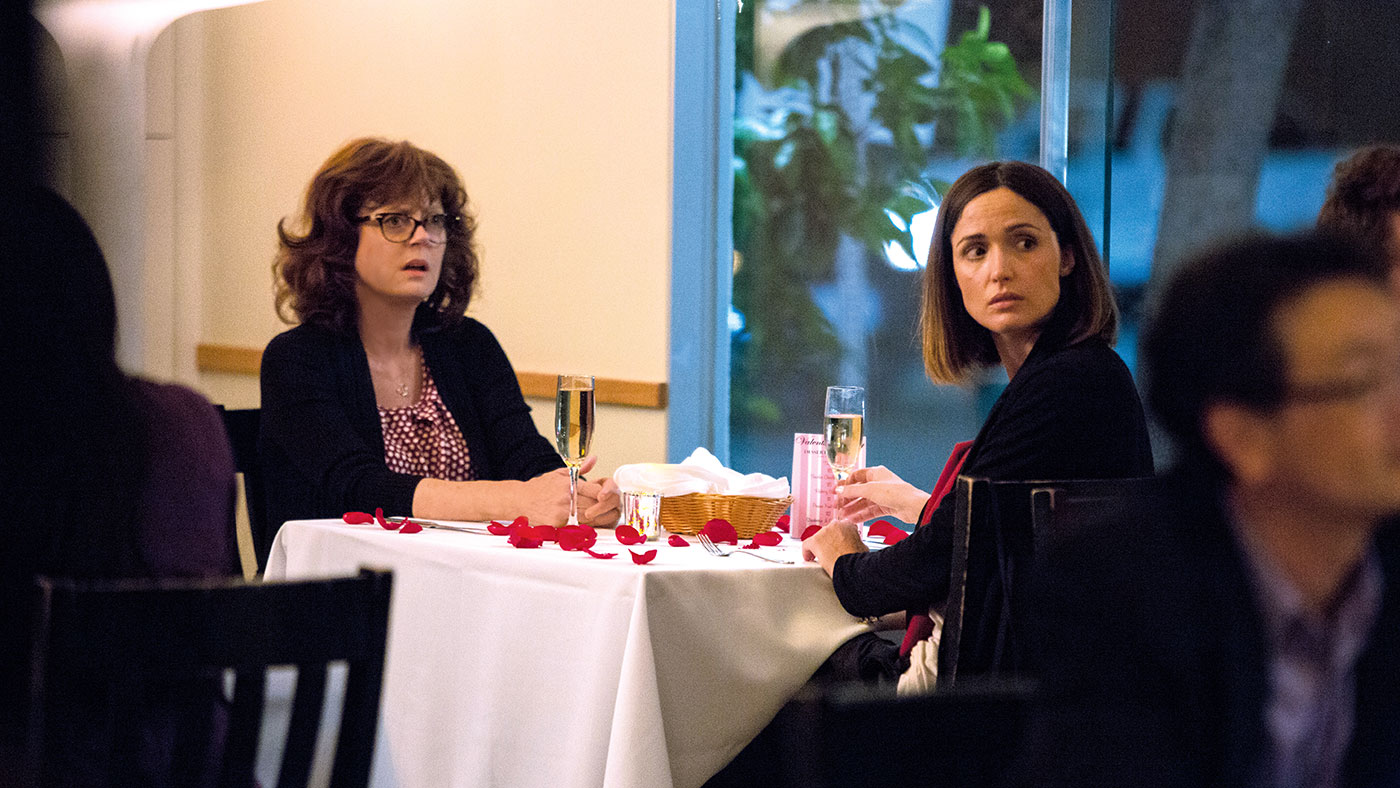
Kim, who’s married to Tom (Birbiglia) and is stepmother to his son Allister (Brinkman), reveals she’s pregnant, but when she tells Gordon his attitude leads to her and Amy falling out. Amy meets Aaron again and after the interview they go back to his place and have sex; Amy breaks her own rule and stays the night. Panicked by this unexpected turn of events, Amy decides she must end things but Aaron calls wanting to see her again. At the next interview she intends to tell him but her dad has a fall and she and Aaron go to him, and Aaron stitches his head wound.

Amy and Aaron begin dating in earnest but she’s worried she’ll screw it up. At a baby shower for her sister, Amy upsets everyone with tales of her sexual escapades, but when she tries to apologise to Kim a couple of days later, Kim has some bad news that brings them back together. Later though they have another falling out, and she and Aaron argue as well. When she attends a function where Aaron is to receive an award she gets a call from Dianna and leaves the room while he makes his speech. When he catches up with her outside they have a fight which carries on back at his apartment. The next morning Aaron is unable to go ahead with an operation because of how tired he is. When he confronts Amy and says they should take a break, she takes him to mean permanently. Aware that this is one argument he’s not going to win, he leaves, which prompts Amy to return to her old ways… but this gets her into more trouble than she ever expected…

Trainwreck - scene

Best known for her TV appearances in the likes of A Different Spin with Mark Hoppus (2010), Delocated (2012) and her own show, Inside Amy Schumer (2013-15), the writer and star of Trainwreck is perhaps an unlikely choice to drive a relationship dramedy directed by Judd Apatow, but surprisingly enough, Schumer does extremely well in both departments. She’s not the world’s greatest actress, and her script skirts perilously close at times to being needlessly crude, but with the aid of Apatow, Hader and a strong supporting cast, Schumer has come up with a story that covers a lot of emotional ground and manages to avoid short-changing its characters.

And while her script isn’t exactly the most original concoction out there – too much happens that makes it look as if Schumer followed a pre-existing blueprint – what makes it work as well as it does is Apatow’s handling of the various relationships and the way in which he gives his cast the room to flesh out their characters beyond the story’s conventions, and pays close attention to the serious undertones that are present throughout. These are key to the movie’s overall effectiveness, and shows that Schumer the writer is able to be poignant and touching, as well as funny and caustic. There’s a brief scene between Amy and Allister that is as touching as anything you’ll see in a more dramatic movie, and the moment when Steven reveals his true feelings for Amy is superbly written, acted and directed.

Of course, this is primarily a comedy, but though it is incredibly funny in places – Amy’s attempt at a slam dunk is the movie’s comedy highlight – there are also times where the script tries too hard, notably in a sex scene involving Schumer and Cena that undermines the idea of Amy and Steven being together and includes Cena talking dirty in Chinese (but not really). Elsewhere there are some great one-liners (Aaron calling LeBron James his bitch), instances of situational comedy that brighten things immensely (Amy’s aforementioned speech about her sexual escapades), and some great visual gags too (co-worker Nikki’s smile). All in all the comedy and the drama are well balanced and neither detracts from the other.

The cast enter into the spirit of things with enthusiasm, and aside from the inclusion of some real life athletes (James is particularly awkward), there are some really great performances, notably from Larson as the sensible but resentful sister, and Cena as the boyfriend whose inappropriate responses to another cinema goer’s complaints is another of the movie’s highlights. Schumer proves herself to be a better actress than you might expect, and Hader shows a sensitivity as Aaron that grounds the character and makes him entirely sympathetic. And there are brilliant cameos from Daniel Radcliffe and Marisa Tomei in the movie Amy and Steven go to see called The Dogwalker, a small masterpiece of Sixties existential canine distress appropriately shot in black and white and which is such a glorious pastiche it leaves you wanting more.

Trainwreck is a little slow to get off the ground, and Amy’s behaviour may put off some viewers, but this is a movie that tugs at the heartstrings just as much as it tickles the funny bone. With Apatow using his directorial prowess to enhance Schumer’s script, and a cast prepared to give it their all, Schumer’s first attempt at a polished, nuanced movie is mostly successful, though what missteps it does make aren’t enough to hurt it.

Rating: 8/10 – an unexpected treat (even with the talent involved), Trainwreck is a small triumph, both laugh out loud funny and tearfully serious; all credit to Schumer for coming up with such an intelligent script and not trying to make every scene full of unnecessary jokes.

Share this:

  • Click to share on X (Opens in new window) X
  • Click to share on Facebook (Opens in new window) Facebook
  • More
  • Click to print (Opens in new window) Print
  • Click to email a link to a friend (Opens in new window) Email
Like Loading...

Mini-Review: A Little Chaos (2014)

27 Monday Jul 2015

Posted by dullwood68 in Movies

≈ Leave a comment

Tags

Alan Rickman, Drama, France, Helen McCrory, History, Horticulture, Kate Winslet, Landscape gardening, Louis XIV, Matthias Schoenaerts, Period movie, Review, Romance, Stanley Tucci, Versailles

Little Chaos, A

D: Alan Rickman / 116m

Cast: Kate Winslet, Matthias Schoenaerts, Alan Rickman, Helen McCrory, Stanley Tucci,  Steven Waddington, Jennifer Ehle, Paula Paul, Danny Webb

France, 1682. At the behest of King Louis XIV (Rickman), landscape garden designers are invited to submit their designs for the planned new gardens at the Palace of Versailles. Sabine De Barra (Winslet), a widow who has a keen eye for the disruptive yet beguiling influence that disorder can have on a garden, meets with the King’s renowned landscape architect, André Le Notre (Schoenaerts). He is concerned by her attitude and lack of formal training, but he nevertheless hires her to build one of the main gardens at Versailles, the Rockwork Grove.

Sabine begins her work in earnest but is initially hampered in her efforts by the other, male, designers. Le Notre intervenes for her, and as her design begins to take shape, he finds himself increasingly attracted to Sabine, despite his being married. He takes to spending more time with her, something which his wife (McCrory) notices. While Le Notre wrestles with his sense of honour and marital duty, Sabine unwittingly earns the respect of the King, and also his brother, Philippe (Tucci). As the project nears completion, Sabine is invited to attend the King’s court, where her honesty and subtle persuasiveness earns her many friends among the ladies in waiting – all except one, who decides to sabotage Sabine’s design…

Little Chaos, A - scene

An old-fashioned heritage picture, A Little Chaos – Rickman’s second directorial feature after The Winter Guest (1997) – is a movie that will sit well with anyone who’s seen similar movies from the Thirties, replete as it is with a woman battling against the preconceptions of her gender and the sexism of the times, a romance where convention says the couple should remain apart, and a minimal amount of political intrigue at the King’s court. It’s a pleasant movie to watch, not least because of Winslet’s emotive yet (mostly) carefully detailed performance, and shows Rickman is adept at staging scenes for their maximum emotional effect as well as their visual splendour.

And yet, while the movie has plenty of positives about it, it’s let down by the romantic storyline, with Le Notre and Sabine’s ardour for each other feeling watered down and sounding less than enthusiastically entered into. Schoenaerts never looks entirely comfortable in these scenes, and Winslet too seems unsure of how to play the drama of their situation. In contrast, the scene where Sabine and the King exchange views on gardening and various flowers, is laden with subtext and deliberate innuendo, leaving the viewer with no doubt that, in a different life, the romance would be between them and not Sabine and Le Notre.
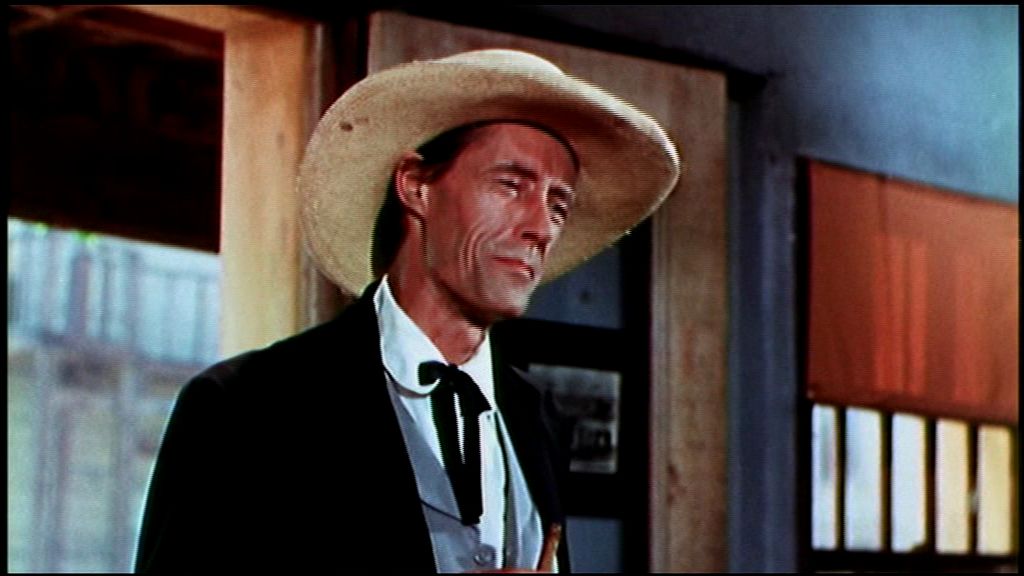
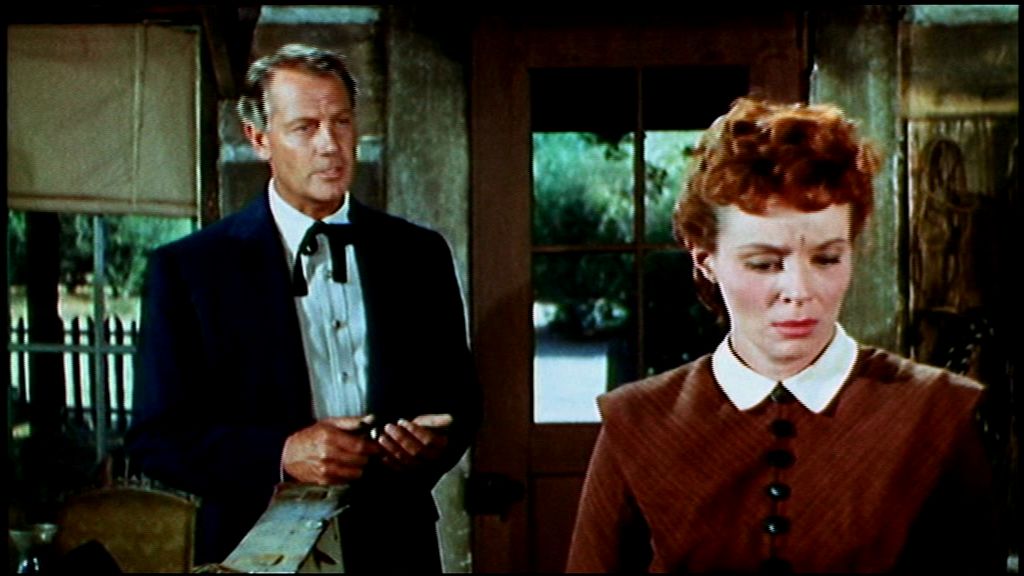
Rickman is a generous director when it comes to his cast, and he finds a willing aide in Ellen Kuras’ often stunning cinematography, for the movie is beautiful to look at. And as historical romantic dramas go there’s a degree of humour that helps leaven the seriousness of the story, while Tucci’s flamboyant Philippe gives the movie a much needed boost just as it was starting to sag. And there’s a wonderful, non-intrusive score courtesy of Peter Gregson.

Rating: 7/10 – enjoyable if lacking in any appreciable depth, A Little Chaos is gentle, harmless, and a pleasant diversion from this year’s slew of mega-blockbusters; with Winslet, Rickman and McCrory winning the acting plaudits, this trip back to 17th Century France is an undemanding one but worth seeing nevertheless.

Share this:

  • Click to share on X (Opens in new window) X
  • Click to share on Facebook (Opens in new window) Facebook
  • More
  • Click to print (Opens in new window) Print
  • Click to email a link to a friend (Opens in new window) Email
Like Loading...

No Way Jose (2015)

09 Thursday Jul 2015

Posted by dullwood68 in Movies

≈ Leave a comment

Tags

Adam Goldberg, Ahna O'Reilly, Anna Belknap, Children's parties, Comedy, Drama, Eric Siegel, Gillian Jacobs, Indie movie, Mexico, Musician, Pat Healy, Relationships, Review, Romance, The Borges

MrsMiracle_DVD_Sleeve

D: Adam Goldberg / 98m

Cast: Adam Goldberg, Ahna O’Reilly, Eric Siegel, Anna Belknap, Pat Healy, Greg Pritikin, Gillian Jacobs, Emily Osment, Brendan Hines

Musician Jose Stern (Goldberg) is fast approaching forty and is reduced to playing children’s parties with his band, the Borges. He’s also engaged to Dusty (O’Reilly), and though they haven’t set a date, they have decided on where to go for their honeymoon: Mexico (as you can’t drive to Hawaii). When best friends Gabe and Kate (Siegel, Belknap) suggest that they hold a joint birthday party for Jose and their young daughter Violet, Jose is initially ambivalent, but thanks to Dusty’s urging, agrees to the idea. Later that night in their new apartment, Dusty downloads an app to her phone that brings to light something about Jose that she doesn’t know. For Dusty it proves to be a deal breaker, despite Jose’s explanation of what she’s learnt.

Their relationship over, Jose crashes on Gabe and Kate’s couch. Kate goes out to work while Gabe stays at home to look after Violet and their infant son, Fred, and provide piano lessons to children. They row a lot, but in-between times, Jose manages to get them to give their opinions on what to do next. Their answer (based on having two impressionable children in the home): frog Dusty and move on. But Jose can’t quite do that, even though he won’t contact her. Instead he hooks up with an old girlfriend, Penny (Jacobs), when she calls him out of the blue, but the evening they spend together proves disappointing.

With his friends, Lawrence (Healy) and Mickey (Pritikin), Jose begins to put Dusty behind him (though he still feels strongly about her). When he learns that Dusty has decided to cash in their honeymoon tickets and go by herself, Jose – who doesn’t fly – follows her there in a last ditch effort to win her back. But when he gets there, he gets a surprise, one that’s exacerbated by Dusty telling him something unexpected…

No Way Jose - scene

Adam Goldberg’s fourth directorial feature since 1998 (the last one, I Love Your Work, was released in 2003), No Way Jose is an acerbic, drily witty look at the pitfalls of modern relationships. Co-written with Sarah Kate Levy, Goldberg’s take on the middle-aged man-child coming to terms with commitment has a couple of comedic set pieces – Jose struggling to talk to Dusty while strung out on Ativan; Kate coming home and yelling coarsely at someone on the phone – but is mostly a sedate, considered drama that  features some great performances while never quite saying anything too profound about the differences between men and women.

From the outset it’s clear that Jose is out of his depth, somehow having reached the age of forty without getting married or having children. His musical career is in the doldrums, and while his relationship with Dusty seems like a dream come true (you know she’s far too good for him), his cavalier attitude and need for approbation marks him out as an outsider, jogging along but without much purpose or direction. Faced with having to grow up and find some meaning in his life, Jose’s reaction is to cling even tighter to his sense of freedom, even though losing Dusty has made him begin (without realising) to reassess what he wants from Life.

Goldberg is a quirky, unpredictable actor, but here he tones down his usual schtick to give us a character who’s more unsure than confident, and who’s only a few steps away from being a complete loser. As such it’s hard to sympathise with him completely as a lot of his problems are caused by a lack of consideration of others; he’s his own worst enemy. By making Jose so insecure, and with so little ambition, Goldberg has painted himself into a bit of a corner. It doesn’t take long to realise that Jose’s coasting along is robbing the movie of a good deal of drama, and with that realisation, most viewers may find themselves less interested in how things play out. It doesn’t help either that Dusty is sidelined once their relationship is over, and disappears until the movie’s end, when she’s required to respond to Jose’s lovelorn melancholy in a way that will be familiar to anyone who’s seen more than a few romantic dramas.

With Jose being less than completely interesting, it falls to the supporting cast to provide most of the entertainment. It’s here that Goldberg and Levy have done the movie a favour, investing the supporting characters with enough humorous foibles to offset the moodiness of the central storyline. Siegel and Belknap are terrific as a warring couple continually trying to score points off each other and offloading their parental responsibilities on each other at every opportunity (the phrase “Violet’s done a bad thing” will linger in the memory). Healy and Pritikin also provide sterling performances, their characters’ idiosyncrasies played to the fore and fully recognisable as the kind of friends most of us have despite our best wishes or intentions.

On the distaff side, O’Reilly is a pleasure to watch as Jose’s engaging other half, and she makes enough of an impact that her enforced departure from the story feels calamitous. As the “coconut water” drinking Penny, Jacobs soon turns into the ex we’d all like to forget, but instead of enhancing the drama by having Jose sleep with her (or just be seen with her by Dusty), Goldberg elects to have Jose refuse her overtures and not go through with anything, reaffirming his inability to take chances.

Where Goldberg does get things right is in his choice of music to support the emotional beats within the movie – the songs that play in Jose’s car shortly after Dusty dumps him, including One Is the Loneliest Number, are inspired – and his choice of cinematographer, Mark Putnam, his go-to guy when making features. Putnam is great at coming up with shots that provide maximum effect, and guided by Goldberg, keeps things continually interesting within the frame. It all serves to make the visual aspect of the movie more compelling than expected.

Rating: 7/10 – flawed but still mostly enjoyable, No Way Jose is an indie drama with comedic overtones that tells its simple story without much embellishment or pretentiousness; alas this makes for a movie that feels somewhat underdeveloped, and while there are good performances throughout, there’s too little of substance going on to improve things.

Share this:

  • Click to share on X (Opens in new window) X
  • Click to share on Facebook (Opens in new window) Facebook
  • More
  • Click to print (Opens in new window) Print
  • Click to email a link to a friend (Opens in new window) Email
Like Loading...

Monthly Roundup – May 2015

31 Sunday May 2015

Posted by dullwood68 in Movies

≈ Leave a comment

Tags

Antonio Banderas, Art heist, Artificial intelligence, Ballard Berkeley, Bat Masterson, Berlin, Boston, Bullying, Burger Beard, Chappie, Christopher Plummer, Clancy Brown, Comet, Conrad Phillips, Crime, Dave Franco, Dead body, Drama, Emmy Rossum, Eric Stonestreet, Father/son relationship, Frank R. Strayer, Gay bar, George Pastell, Glory holes, Hugh Jackman, Impact, Irene Ware, James Marsden, Joel McCrea, John Miljan, John Travolta, Joseph M. Newman, Julie Adams, Justin Long, Karl Urban, Ken Scott, Krabby Patty formula, Matthias Schoenaerts, Monthly roundup, Murder at Glen Athol, Murder mystery, Neill Blomkamp, Peter Maxwell, Philip Martin, Plankton, Review, Romance, Sam Esmail, Sharlto Copley, Sienna Miller, SpongeBob Squarepants, Swarf, The Duke, The Forger, The Gunfight at Dodge City, The Loft, The Spongebob Movie: Sponge Out of Water, Thriller, Tom Denny, Tom Wilkinson, Tye Sheridan, Unfinished Business, Vince Vaughn, Wentworth Miller, Western

There’s a phrase that everyone will be familiar with: “Too many [insert item here], too little time”. When it comes to the number of movies that I watch in any given month, that phrase is apt in relation to the ones that get reviewed here on thedullwoodexperiment. I would love to have the time to post reviews of all the movies I see, but it’s just not practical; and besides which, some movies just don’t merit the attention (Annabelle (2014), for instance). Sometimes it’s a case of choosing one movie over another, sometimes Life gets in the way of blogging and a movie falls by the wayside. To combat this, and to give these “other” movies their due, I’ve decided to present, at the end of each month, a brief “review” of all the other movies I’ve seen. There won’t be any synopsis, or proper full-length analysis, just the title, director, running time, cast, and then the traditional two sentence ratings summation. So, let’s see which movies didn’t quite make the cut in May 2015.

The Forger (2014) / D: Philip Martin / 96m

Cast: John Travolta, Christopher Plummer, Tye Sheridan, Abigail Spencer, Anson Mount, Marcus Thomas, Jennifer Ehle, Travis Aaron Wade

Rating: 5/10 – Travolta’s art forger comes out of prison to spend time with his dying son (Sheridan) and pull off an audacious robbery; a derivative, occasionally unappealing crime drama that tries to do something different with its dying child angle, The Forger is nevertheless a movie whose “one last heist” scenario has been done to death elsewhere, and with far better results.

Forger, The - scene

The Gunfight at Dodge City (1959) / D: Joseph M. Newman / 81m

Cast: Joel McCrea, Julie Adams, John McIntire, Nancy Gates, Richard Anderson, James Westerfield, Walter Coy, Don Haggerty, Wright King, Harry Lauter

Rating: 6/10 – Western legend Bat Masterson (McCrea) tackles corruption supported by Haggerty’s devious sheriff in Dodge City and faces romantic problems as well from minister’s daughter Adams and saloon owner Gates; a middling, mildly diverting Western, The Gunfight at Dodge City benefits from McCrea’s solid, no-nonsense performance and Newman’s underrated abilities behind the camera.

Gunfight at Dodge City, The - scene

Comet (2014) / D: Sam Esmail / 91m

Cast: Justin Long, Emmy Rossum

Rating: 7/10 – Long and Rossum are the soulmates whose on-again-off-again relationship is examined over the course of six years; with the narrative continually fractured and reassembled, Comet is replete with the kind of “serious” romantic musings that sound alternately pretentious and profound, but the two leads have a definite chemistry and this helps immensely in making the movie as enjoyable as it (largely) is.

Comet - scene

Murder at Glen Athol (1936) / D: Frank R. Strayer / 67m

Cast: John Miljan, Irene Ware, Iris Adrian, Noel Madison, Oscar Apfel, Barry Norton, Harry Holman, Betty Blythe, James P. Burtis

Rating: 5/10 – two murders and a dying confession confuse matters for a detective (Miljan) who’s just trying to take a vacation – next door to where the murders have taken place; packed full of seemingly endless exposition and no shortage of suspects, Murder at Glen Athol is a sprightly murder mystery that packs a lot in but not always to its best advantage.

Murder at Glen Athol

The SpongeBob Movie: Sponge Out of Water (2015) / D: Paul Tibbitt / 92m

Cast: Antonio Banderas, Tom Kenny, Clancy Brown, Bill Fagerbakke, Rodger Bumpass, Mr. Lawrence, Carolyn Lawrence

Rating: 7/10 – when the formula for Krabby Patty is stolen by the notorious Burger Beard (Banderas), SpongeBob (Kenny) is forced to team up with Plankton (Mr. Lawrence) to get it back… and venture above the surface; freewheeling fun with the denizens of Bikini Bottom that features lots of gags and the usual bright visuals, but takes an awfully long time in getting to the “sponge out of water” part.

SpongeBob Movie, The

Chappie (2015) / D: Neill Blomkamp / 120m

Cast: Sharlto Copley, Dev Patel, Hugh Jackman, Ninja, Yo-Landi Visser, Jose Pablo Cantillo, Sigourney Weaver, Brandon Auret, Johnny Selema

Rating: 6/10 – with a robot police force firmly established in Johannesburg, the introduction of artificial intelligence leads to one robot, named Chappie, learning what it’s like to be human; disappointing outing from Blomkamp that never quite gels or seems sure of what it’s trying to do or say, but does feature an excellent performance from Copley.

Chappie

Impact (1963) / D: Peter Maxwell / 61m

Cast: Conrad Phillips, George Pastell, Ballard Berkeley, Linda Marlowe, Richard Klee, Anita West, John Rees

Rating: 5/10 – when newspaper reporter Jack Moir (Phillips) is framed for robbery by arch-nemesis “The Duke” (Pastell), he swears to get even when he gets out of jail; a low-key crime drama that seems busier than it is and which gets bogged down in the mechanics of Moir’s revenge plot, Impact does allow for a welcome appearance by Berkeley aka Fawlty Towers‘ Major, and an above average performance by Pastell.

Impact

The Loft (2014) / D: Erik Van Looy / 103m

Cast: Karl Urban, James Marsden, Wentworth Miller, Eric Stonestreet, Matthias Schoenaerts, Isabel Lucas, Rachael Taylor, Rhona Mitra, Valerie Cruz, Kali Rocha, Elaine Cassidy, Margarita Levieva, Kristin Lehman, Robert Wisdom

Rating: 6/10 – the discovery of a woman’s dead body in the loft apartment shared by five married men for their secret liaisons prompts them to suspect each other of the crime; alternately gripping and implausible, The Loft is a modern day cautionary tale that loses credibility with its solution then recovers with a great twist, but still has the air of a thriller that its writer never quite got to grips with.

Loft, The

Unfinished Business (2015) / D: Ken Scott / 91m

Cast: Vince Vaughn, Tom Wilkinson, Dave Franco, Sienna Miller, Nick Frost, James Marsden, June Diane Raphael, Britton Sear, Ella Anderson, Uwe Ochsenknecht

Rating: 5/10 – Swarf salesman Dan Trunkman (Vaughn) has to overcome all sorts of obstacles to land the contract that will save his fledgling company from going under, including a visit to a Berlin gay bar; a bit of a strange fish, Unfinished Business suffers from being two separate movies joined at the hip: one a raucous comedy, the other a thoughtful study of bullying, but together they don’t make for a cohesive whole, and it’s yet another movie where Vaughn coasts along on former glories.

Unfinished Business

Share this:

  • Click to share on X (Opens in new window) X
  • Click to share on Facebook (Opens in new window) Facebook
  • More
  • Click to print (Opens in new window) Print
  • Click to email a link to a friend (Opens in new window) Email
Like Loading...

Barely Lethal (2015)

31 Sunday May 2015

Posted by dullwood68 in Movies

≈ Leave a comment

Tags

Agent 83, Drama, Foreign exchange student, Hailee Steinfeld, High School, Homecoming, Jessica Alba, Kyle Newman, Prescott, Review, Romance, Samuel L. Jackson, Teen assassin, Thriller

Barely Lethal

D: Kyle Newman / 96m

Cast: Hailee Steinfeld, Samuel L. Jackson, Sophie Turner, Jessica Alba, Dove Cameron, Toby Sebastian, Thomas Mann, Rachael Harris, Jaime King, Dan Fogler, Steve-O, Gabriel Basso, Rob Huebel, Jason Ian Drucker

Sixteen year old Agent 83 (Steinfeld) works for a top secret organisation called Prescott that adopts orphaned girls and trains them to be assassins. But she yearns for a more ordinary, regular life, glimpses of which she gets when on her missions. When a plan to capture wanted terrorist Victoria Knox (Alba) leaves Agent 83 missing presumed dead, she takes the opportunity to live a normal life. She changes her name to Megan Walsh, invents a back story for herself and enrols herself in a foreign student exchange programme that sees her living with the Larsons – mum (Harris), daughter Liz (Cameron), and son Parker (Drucker) – and attending high school.

Fitting in, though, proves harder than she’d imagined. Despite doing her research, Megan finds average life more demanding, and confusing, than anything she’s encountered before. With Liz wanting nothing to do with her, and her faux-Canadian background doing her no favours, it’s not until the intervention of high school heart-throb and teen singing sensation Cash Fenton (Sebastian) that Megan begins to be accepted. Megan develops an immediate crush on Cash, but she already has an admirer in tech-geek Roger Marcus (Mann). Having been tricked into applying for the role of football team mascot – and getting it – Megan gains true acceptance when she takes out three would-be kidnappers of the team mascot, a traditional prank foiled by Megan’s “special set of skills”.

The resulting video goes viral and leads to her being found by her instructor at Prescott, Hardman (Jackson). Along with fellow Prescott agent Pedro (Steve-O), Hardman interrogates Megan, believing she’s working for someone else. But when it becomes clear she just wants to lead a normal life, Hardman tells her she only has time to wrap things up before coming back to Prescott. Later, at a party where she’s looking forward to hooking up with Cash, she finds Agent 84 (Turner), aka Heather, in attendance. Annoyed that Hardman would use Heather to keep an eye on her, Megan is further annoyed when Heather makes a play for Cash.

Another meeting with Hardman reveals that Knox has escaped and will no doubt be looking to catch up with Megan and kill her. Despite his offer of protection if she comes back to Prescott, Megan refuses to leave her new home, and begins to take steps to ensure that the Larsons remain safe. And at the upcoming Homecoming dance, she hopes to finally land Cash as her boyfriend, though she has begun to have conflicting feelings for Roger. With all this going on, Megan has to fall back on her training in order to get through it all, and maintain her new lifestyle.

Barely Lethal - scene

The idea of a teen assassin dealing with the pitfalls of high school is one that could have given new meaning to the phrase “mean girls”, but here it’s the starting point for an extremely lightweight, by-the-numbers movie that is pleasantly assembled, but astoundingly hollow at the same time. By bringing in such a talented cast, Barely Lethal (not the best pun for a movie, either), may give the interested viewer the impression that the movie is going to be better than it actually is. But in the hands of director Newman (whose previous feature, Fanboys (2009), was a surprise pleasure) and writer John D’Arco, the movie is one that struggles to maintain an even tone, and squanders many of its chances to layer its basic premise with appropriate levels of irony.

The movie makes no effort to avoid or subvert the standard tropes of high school movies, and instead embraces them wholeheartedly without doing anything new with them. This leaves the movie looking and feeling like any other generic high school movie and even the introduction of Megan and her special skill set doesn’t hamper or redefine it. This level of familiarity works against the movie and though Steinfeld et al. waltz through it all with confidence, for them it must have been like the acting equivalent of treading water. Even Jackson and Alba can’t do much with characters that scream “simple movie stereotype”. With every character and situation proving lacklustre as a result, the movie never really manages to take off and become as enjoyable as it should be.

The humour in the movie is also quite forced, from the youngest Prescott recruits being called “grandma” when their driving skills don’t come up to scratch, to Megan’s first day outfit, to creepy teacher Mr Drumm (Fogler) and his stalking of Cash, to Roger’s even creepier father (Huebel) whose conversation is almost entirely inappropriate – none of it is as funny as it probably seemed at the time of filming, and even with the best efforts of the cast. Newman’s direction doesn’t help either, as each development in the script is allowed to play out with little emphasis on the drama involved, or what reaction it provokes in the characters, and the humour doesn’t leaven things either.

As the girl who’s more comfortable deciphering weapons schematics than the pitfalls of high school life, Steinfeld is an engaging presence but settles for doing just enough to satisfy the demands of the script. The same is true of Turner, who pouts her way through the movie as Megan’s chief rival, and Alba, playing an impression of a caricature of a stereotype as the villainous Knox. Mann emerges relatively unscathed by the experience, and Jackson is predictably hard-nosed (but with a heart of gold), but by and large the performances are as blandly likeable as the material. And the whole thing is rounded off by the kind of soundtrack selections that attempt to mirror the on screen action for emotion but lack any real nuance.

Rating: 4/10 – a missed opportunity, Barely Lethal is so humdrum it should be called Barely Lethargic; with a lack of flair behind the camera allied to a below-par script, the movie sinks under the weight of its own low expectations and despite an opening sequence that passes muster, never amounts to much more than being acceptable.

Share this:

  • Click to share on X (Opens in new window) X
  • Click to share on Facebook (Opens in new window) Facebook
  • More
  • Click to print (Opens in new window) Print
  • Click to email a link to a friend (Opens in new window) Email
Like Loading...
← Older posts
Newer posts →

Blog Stats

  • 491,821 hits

Recent Posts

  • 10 Reasons to Remember Bibi Andersson (1935-2019)
  • Fantasia (1940)
  • Dances With Wolves (1990) – The Special Edition
  • Kiss of the Spider Woman (1985)
  • The Three Musketeers (1973)

Top Posts & Pages

  • The Tip of the Iceberg (2016)
    The Tip of the Iceberg (2016)
  • Cardboard Boxer (2016)
    Cardboard Boxer (2016)
  • The Black Panther (1977)
    The Black Panther (1977)
  • Lost for Life (2013)
    Lost for Life (2013)
  • The Corpse of Anna Fritz (2015)
    The Corpse of Anna Fritz (2015)
  • Death in High Heels (1947)
    Death in High Heels (1947)
  • Groundhog Day (1993)
    Groundhog Day (1993)
  • Happy Birthday - Jamie Lee Curtis
    Happy Birthday - Jamie Lee Curtis
  • Cake (2014)
    Cake (2014)
  • Dawn of the Planet of the Apes (2014)
    Dawn of the Planet of the Apes (2014)
Follow thedullwoodexperiment on WordPress.com

Blogs I Follow

  • Rubbish Talk
  • Film 4 Fan
  • Fast Film Reviews
  • The Film Blog
  • All Things Movies UK
  • Interpreting the Stars
  • Let's Go To The Movies
  • Movie Reviews 101
  • TMI News
  • Dan the Man's Movie Reviews
  • Film History
  • Jordan and Eddie (The Movie Guys)

Archives

  • April 2019 (13)
  • March 2019 (28)
  • February 2019 (28)
  • January 2019 (32)
  • December 2018 (28)
  • November 2018 (30)
  • October 2018 (29)
  • September 2018 (29)
  • August 2018 (29)
  • July 2018 (30)
  • June 2018 (28)
  • May 2018 (24)
  • April 2018 (21)
  • March 2018 (31)
  • February 2018 (25)
  • January 2018 (30)
  • December 2017 (30)
  • November 2017 (27)
  • October 2017 (27)
  • September 2017 (26)
  • August 2017 (32)
  • July 2017 (32)
  • June 2017 (30)
  • May 2017 (29)
  • April 2017 (29)
  • March 2017 (30)
  • February 2017 (27)
  • January 2017 (32)
  • December 2016 (30)
  • November 2016 (28)
  • October 2016 (30)
  • September 2016 (27)
  • August 2016 (30)
  • July 2016 (30)
  • June 2016 (31)
  • May 2016 (34)
  • April 2016 (30)
  • March 2016 (30)
  • February 2016 (28)
  • January 2016 (35)
  • December 2015 (34)
  • November 2015 (31)
  • October 2015 (31)
  • September 2015 (34)
  • August 2015 (31)
  • July 2015 (33)
  • June 2015 (12)
  • May 2015 (31)
  • April 2015 (32)
  • March 2015 (30)
  • February 2015 (37)
  • January 2015 (39)
  • December 2014 (34)
  • November 2014 (34)
  • October 2014 (36)
  • September 2014 (25)
  • August 2014 (29)
  • July 2014 (29)
  • June 2014 (28)
  • May 2014 (23)
  • April 2014 (21)
  • March 2014 (42)
  • February 2014 (38)
  • January 2014 (29)
  • December 2013 (28)
  • November 2013 (34)
  • October 2013 (4)

Blog at WordPress.com.

Rubbish Talk

Film 4 Fan

A Movie Blog

Fast Film Reviews

The Film Blog

The official blog of everything in film

All Things Movies UK

Movie Reviews and Original Articles

Interpreting the Stars

Dave Examines Movies

Let's Go To The Movies

Film and Theatre Lover!

Movie Reviews 101

Daily Movie Reviews

TMI News

Latest weather, crime and breaking news

Dan the Man's Movie Reviews

All my aimless thoughts, ideas, and ramblings, all packed into one site!

Film History

Telling the story of film

Jordan and Eddie (The Movie Guys)

Movie Reviews & Ramblings from an Australian Based Film Fan

Privacy & Cookies: This site uses cookies. By continuing to use this website, you agree to their use.
To find out more, including how to control cookies, see here: Cookie Policy
  • Subscribe Subscribed
    • thedullwoodexperiment
    • Join 481 other subscribers
    • Already have a WordPress.com account? Log in now.
    • thedullwoodexperiment
    • Subscribe Subscribed
    • Sign up
    • Log in
    • Report this content
    • View site in Reader
    • Manage subscriptions
    • Collapse this bar
 

Loading Comments...
 

    %d