• 10 Reasons to Remember…
  • A Brief Word About…
  • About
  • For One Week Only
  • Happy Birthday
  • Monthly Roundup
  • Old-Time Crime
  • Other Posts
  • Poster of the Week
  • Question of the Week
  • Reviews
  • Trailers

thedullwoodexperiment

~ Viewing movies in a different light

thedullwoodexperiment

Tag Archives: Drama

The Martian (2015)

14 Wednesday Oct 2015

Posted by dullwood68 in Movies

≈ 1 Comment

Tags

Andy Weir, Ares III, Chiwetel Ejiofor, Drama, Hermes, Jeff Daniels, Jessica Chastain, Kristen Wiig, Literary adaptation, Mark Watney, Mars, Matt Damon, NASA, Pathfinder, Potato crop, Review, Ridley Scott, Sci-fi, Thriller

Martian, The

D: Ridley Scott / 144m

Cast: Matt Damon, Chiwetel Ejiofor, Jessica Chastain, Jeff Daniels, Kristen Wiig, Michael Peña, Sean Bean, Kate Mara, Sebastian Stan, Aksel Hennie, Benedict Wong, Mackenzie Davis, Donald Glover

On Mars to explore the terrain and collect samples, the crew of the spaceship Hermes, headed by Commander Melissa Lewis (Chastain), have established a habitat station (the Hab) that allows them to check their samples before sending the results back to NASA. It’s also a living space for them. When a fierce storm approaches more quickly than expected, and some of the team are caught outside, botanist Mark Watney (Damon) is struck by debris and catapulted out of sight. With little option but to abandon the habitat centre and return to the Hermes, Lewis makes the decision to leave Mars even though she wants to find Watney. When NASA learns what’s happened, its director, Teddy Sanders (Daniels), holds a press conference that details the mission’s current status, and Watney’s unfortunate death.

But Sanders’ declaration proves to be wrong. Watney is still alive, though when he wakes after the storm has passed, he has a piece of antenna sticking out of his torso. He makes it back to the habitat station where he removes the antenna and staples shut the wound. He then starts to work out how long he can survive on the rations left in the Hab, but quickly realises that he doesn’t anywhere near enough to sustain him until a rescue mission can reach him. Drawing on his knowledge as a botanist, Watney decides to use the Hab’s resources (including his and the crew’s waste), and the Martian soil to grow potatoes. Meanwhile, back at NASA, mission director Vincent Kapoor (Ejiofor) is alerted to the fact that there is unexpected movement occurring on Mars, and soon it becomes apparent to everyone that Watney is alive.

Watney travels to where the Pathfinder probe lies abandoned and manages to get it to transmit images back to Earth. He and NASA come up with a means of communicating with each other (even if it is a bit slow due to the distance between them), and soon Watney is able to establish a more stable comms link. With NASA determined to rescue Watney, they finally decide to tell his crewmates that he’s alive. They’re all pleased but angry as well for being left out of the loop. But disaster strikes, when an airlock decompression at the Hab destroys the potato crop, leaving Watney with only enough rations for around 200 days, and a rocket supply drop arranged by NASA malfunctions and blows up before it even leaves Earth’s atmosphere. With time running out, NASA must find a way of getting to Watney before his food runs out, and he has to find a way of making his food last as long as possible.

Martian, The - scene

An adaptation of the bestseller by Andy Weir, The Martian is something of a return to form for Ridley Scott, with the septuagenarian director making his most accessible and expertly constructed movie for some time. This is largely due to Drew Goddard’s assured, though not entirely flawless screenplay, which juggles successfully not only the hard science that keeps Watney alive (and making it relatable to the average viewer), but a myriad cast of characters, all of whom had the potential to become stereotypes. But Scott keeps all this in check and presents us with a sci-fi thriller that feels fresher than most recent outings (despite some obvious antecedents), and which features an impressive central performance from Matt Damon that helps ground the movie immeasurably.

So good, in fact, is Damon as the embattled astronaut of the title, that sometimes the events happening on Earth come as a bit of an intrusion. Yes, it’s good to see the effort being put in to rescue one man (even though you could argue that the cost of doing so would be too prohibitive for even the most caring of space agencies to consider), but these scenes too often feel like second cousins to those in Apollo 13 (1995), and Ejiofor’s character also feels like a close relative to his character from 2012 (2009). With this element of the narrative ticking several expected boxes, even down to the plucky, rule-bending astrodynamicist (Glover) who comes up with a plan to save Watney that no one else has thought of, it’s thanks to Goddard’s understanding of the necessity for these scenes, and Scott’s accomplished direction, they’re intrusion becomes less worrisome, and as Watney’s continued survival comes closer and closer to connecting with his rescue, the viewer can root for both camps.

But with so much happening back on Earth (and with such a large ensemble cast to cater to), the script doesn’t put Watney in as much jeopardy as Weir’s novel does. Part of the fun of reading the novel was that Weir consistently came up with ways to put Watney in danger, and he consistently made it seem as if Mars itself was conspiring to make Watney pay for being there. But here the suspense is lessened in favour of Watney’s unflagging determination to survive, which is admirable in itself, but there needs to be more in the way of peril, even if we can all guess the outcome. Harking back to Apollo 13, it was the way in which problems continued to mount on that mission that heightened the drama, and the way in which each problem was overcome that made it all the more engrossing and exciting. Here, Watney’s methodical, never-say-die attitude ensures that each setback is dealt with matter-of-factly and in double-quick time (and usually by virtue of a montage). By taking some of the natural tension of the situation away, the gravity of Watney’s dilemma is lessened when it should have had us on the edge of our seats.

But Damon holds it all together, making Watney a pleasure to spend time with, and be sympathetic of. The little dance and shouts of joy he makes when he discovers he can talk to NASA is a small moment of inspiration, especially when he looks round to check if anyone has seen him. And Damon is equally good at expressing the character’s somewhat arrogant sense of humour and keeping the viewer on his side, even with lines such as “They say once you grow crops somewhere, you have officially colonised it. So technically, I colonised Mars. In your face, Neil Armstrong!” There are few actors audiences would want to spend an entire movie with, alone, but Damon is one of them, and he keeps the viewer focused on what is essentially one man’s battle for survival against (almost) impossible odds.

Martian, The - scene2

He’s supported by a great ensemble cast headed up by the ever reliable Ejiofor, with Wiig playing serious for once, and Daniels giving Sanders a sardonic air that fits well with his job as director of NASA. Chastain and Peña grab most of the limelight from Mara, Stan and Hennie as Watney’s fellow astronauts, and The Martian marks one of the few occasions when Sean Bean’s character in a movie doesn’t get killed (he’s also part of a great joke involving The Lord of the Rings). As you’d expect from a movie directed by Ridley Scott, it all looks incredible, with Jordan standing in for Mars, Arthur Max’s expressive production design, and very impressive cinematography from Dariusz Wolski (Scott’s go-to DoP for his last few movies). And on the music front, anyone expecting to hear David Bowie’s Life on Mars? at some point will find that Scott has gone for Starman instead, and there’s the completely unexpected use of ABBA’s Dancing Queen, which should feel out of place but is surprisingly apt for the point at which it’s used.

Rating: 8/10 – good sci-fi these days is rare (as anyone who’s seen Prometheus (2012) should know – sorry, Ridley), but The Martian is that rare beast, and is intelligent enough overall to overcome a few narrative concerns; with Damon in commanding form, and the drama of the situation sufficiently gripping, being stranded on another planet has never seemed so tempting.

Share this:

  • Click to share on X (Opens in new window) X
  • Click to share on Facebook (Opens in new window) Facebook
  • More
  • Click to print (Opens in new window) Print
  • Click to email a link to a friend (Opens in new window) Email
Like Loading...

The Walk (2015)

14 Wednesday Oct 2015

Posted by dullwood68 in Movies

≈ 1 Comment

Tags

Ben Kingsley, Charlotte Le Bon, Drama, High wire, James Badge Dale, Joseph-Gordon-Levitt, Literary adaptation, Philippe Petit, Review, Robert Zemeckis, Tightrope, True story, Twin Towers, World Trade Center

Walk, The

D: Robert Zemeckis / 123m

Cast: Joseph Gordon-Levitt, Ben Kingsley, Charlotte Le Bon, James Badge Dale, Clément Sibony, César Domboy, Steve Valentine, Ben Schwartz, Benedict Samuel

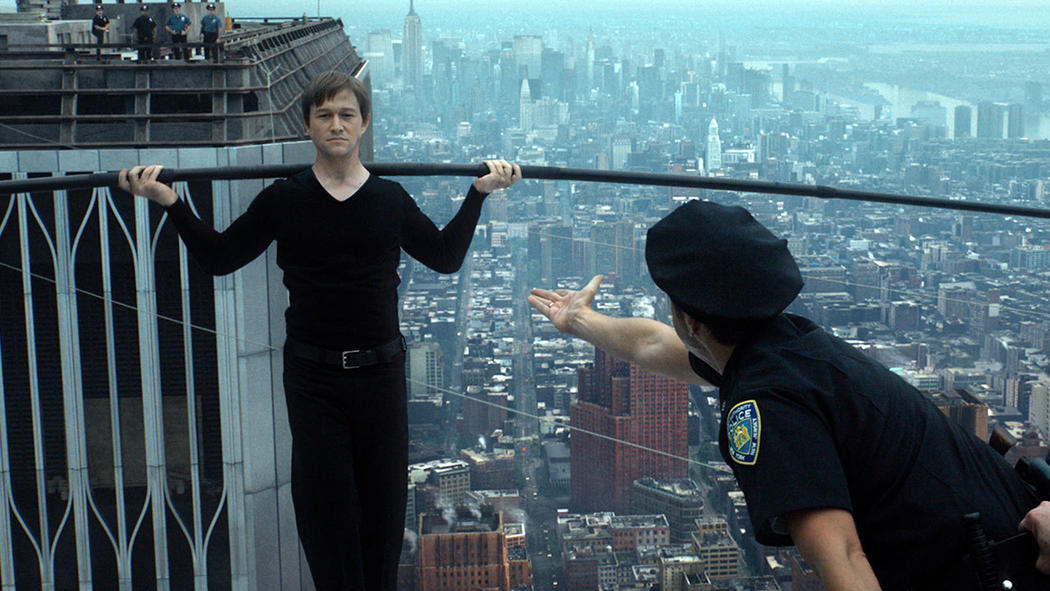
1973. Philippe Petit (Gordon-Levitt) is a street entertainer in Paris, France, who includes some wire work in his act, usually strung between two trees and without the benefit of having a permit. One day he accepts a gobstopper from a young girl in his audience, but when he bites into it, it causes a painful problem that he goes straight to the dentist with. While in the waiting-room he sees a magazine article on New York’s Twin Towers. Straightaway, Petit knows what he has to do: he has to learn the intricacies of high wire work, and from the acknowledged master, Papa Rudy (Kingsley), in order that he can fulfil his dream of walking between the Twin Towers on just a length of cable. Rudy agrees to teach him. Aided by his girlfriend, Annie (Le Bon), and mutual friend, Jean-Louis (Sibony), Petit determines to travel to New York and carry out his dream.

Once there, Petit enlists the aid of further “accomplices”, such as J.P. (Dale) and Barry Greenhouse (Valentine), who works in the South Tower. Several visits to the site are made in an effort to discover the best time for stringing the cable between the two buildings, and more importantly, when Petit should make the crossing. Petit, though, steps on a nail and injures his right foot, but won’t hear of cancelling or postponing the high wire walk (which has been set for 6 August 1974, and is called The Coup). Aided by Jean-Francois (aka Jeff) (Domboy) and two others recruited by J.P., Petit forges ahead with his plan and they manage to sneak all the relevant equipment into both buildings. But on the night of the 5th, with Petit planning to commence his walk across “the Void” at 6am, the presence of a night guard, and some unexpected problems with the cable and the lines used to stop it from wobbling, throw the endeavour off schedule. Eventually, with Jeff to help him, and Jean-Louis on the other tower, and with Annie, J.P. and Barry watching from the street, Petit takes his first steps out onto the wire…

Walk, The - scene

James Marsh’s documentary on Philippe Petit, Man on Wire (2008), won the Best Documentary Feature Oscar in 2009, as well as a whole raft of other awards from around the world. The one criticism that can be levelled against what is otherwise a very good examination of Petit’s particular brand of “artistic madness”, is that there’s no footage of Petit walking between the Twin Towers. In the hands of Robert Zemeckis, The Walk seeks to remedy this by putting the audience up there with Petit, and by showing just how dangerous it was. However, the key phrase here is “seeks to remedy”, as by and large, Zemeckis takes his cue from Petit himself and dismisses any attempt to instil any fear or heart-pounding terror into the walk itself. While it may well be true that Petit was confident of his abilities, and that the walk – or walks: he traversed the wire several times – was easier than he’d expected, but once he’s out there, the tension that Zemeckis and co-screenwriter Christopher Browne have so successfully created in the movie’s third act (of four) swiftly evaporates.

The movie takes an odd approach to the material, and feels schizophrenic as a result, with a first half that concentrates, in a very old-fashioned Hollywood way, on Petit as a young man just starting out as a street performer, before becoming inspired to walk between the towers. It has the look and feel of a regular biography, with key moments ticked off against a list, and with any potential spontaneity halted before it’s given a chance to start (there’s even a scene where Petit and Annie are getting to know each other by romantic candlelight). And if truth be told, these scenes aren’t even that interesting, delaying as they do the central focus of the movie, namely that walk. Petit shows off his arrogance, Annie melts under his charm too quickly, and things happen with a convenience and disregard for clarity that it’s easier just to go along with it all and wait for the movie to pick up by itself.

Which it does once Petit and friends start “casing the joint” and begin installing the equipment they need. This stretch of the movie contains the most tension and is easily the most compelling, as obstacles need to be overcome and the Coup becomes in danger of being cancelled indefinitely. As the fiercely determined Petit, Gordon-Levitt holds it all together, and if his accent slips from time to time, it’s not the end of the world. He channels Petit’s passion for high wire work with aplomb, even if the character – as written – isn’t as socially aloof or as difficult to work with as Man on Wire revealed. Gordon-Levitt also proves to be a proficient high wire walker, having spent time learning how to do it for real. It’s this level of commitment that helps the movie overcome the weakness inherent in the narrative, the one that doesn’t allow the other characters to be as fleshed out as Petit.

Annie (Charlotte Le Bon) and Philippe Petit (Joseph Gordon-Levitt) in TriStar Pictures' THE WALK.

While people like Le Bon, Valentine, and Dale left to stand on the sidewalk and stare at proceedings through binoculars, it’s left to Gordon-Levitt and Domboy to ratchet up the tension, especially Domboy, whose character Jeff, is terrified of heights. Kingsley floats in and out of the narrative and acts purely as a mine of information or encouraging mentor. But while the main performances, however truncated by the need to fit as much in as possible, are comfortably undemanding of the cast, don’t let them die.

Another issue is the unconvincing CGI work carried out once Petit and Jeff are on the roof of the South Tower. The backdrops are impressively detailed, but it’s not enough to allow them to look any better. They stand out against their surroundings, and unfortunately, it’s distracting, as well as a shock to see that an innovator like Zemeckis can’t overcome the lighting issues that have caused this effect. And even more unfortunately, when the camera swings or pans its way over and around Petit’s head when he’s on the wire, there’s no real sense of depth to the image, no sense that this is a very long way down (or somewhere very high up). Petit’s own storytelling image, the emphasis he puts on the danger, and the awkward position it puts him in with the authorities is nicely handled but it’s all too little, too late. And the decision to have Petit holding forth on his exploits from the top of the Statue of Liberty may have semed like a good idea at the time, but in actuality it’s off-putting and makes for dramatically turgid viewing.

The movie does benefit from a classy, contemporary score by the ever reliable Alan Silvestri, while the movie – on the ground, at least – offers some superb visuals courtesy of Dariusz Wolski. If the movie tries to include too much of Petit’s history for its own good, then the end result is a little uneven, and still very ragged in places, but overall the movie does have its charms, and some viewers may yet find themselves overcome by some of the aerial shots

Rating: 6/10 – too uneven and too much like a soap opera in the first half, The Walk treads the Hollywood line once too often to create a movie no one will be able to remember even when they’re buying it; a disappointment then (even in IMAX 3D), and not as gripping as it should have been, it’s still a much more attractive proposition than most movies that are out at the moment.

Share this:

  • Click to share on X (Opens in new window) X
  • Click to share on Facebook (Opens in new window) Facebook
  • More
  • Click to print (Opens in new window) Print
  • Click to email a link to a friend (Opens in new window) Email
Like Loading...

Bone Tomahawk (2015)

12 Monday Oct 2015

Posted by dullwood68 in Movies

≈ 9 Comments

Tags

Broken leg, Cannibals, Drama, Horror, Humour, Kurt Russell, Matthew Fox, Opium, Patrick Wilson, Review, Richard Jenkins, S. Craig Zahler, Thriller, Troglodytes, Western

Bone Tomahawk

D: S. Craig Zahler / 132m

Cast: Kurt Russell, Patrick Wilson, Matthew Fox, Richard Jenkins, Lili Simmons, David Arquette, Kathryn Morris, Fred Melamed, Sean Young, Sid Haig, Evan Jonigkeit

The quiet town of Bright Hope finds itself host to thief and murderer Purvis (Arquette). With his behaviour proving suspicious to town deputy, Chicory (Jenkins), Purvis’s attempt to resist arrest by the sheriff, Franklin Hunt (Russell) leads to his being shot in the leg and put in jail. Later the same night, while being tended by the town’s medic, Samantha O”Dwyer (Simmons), and guarded by young deputy Nick (Jonigkeit), the jail is attacked and the trio are abducted.

When this is discovered the next morning, Hunt seeks advice from a local Indian scout as to who could have done such a thing, as a peculiarly shaped arrow was found at the scene. The scout is quick to tell Hunt that it’s the work of troglodytes, a flesh-eating “clan” that live in the nearby hills; he also tells Hunt he won’t go with him as any attempt to rescue the missing will be guaranteed to fail, and anyone who goes will die. Hunt has no choice but to go, as does Samantha’s husband, Arthur (Wilson), even though he recently broke his right leg and it’s still in a splint. John Brooder (Fox), the man who introduced the O’Dwyer’s to each other, feels obliged to go, and despite Hunt’s objections, Chicory insists on going as well.

The four set out alone into the nearby hills. They encounter a couple of Mexicans who prove to be scouts for a larger group of bandits. When the bandits attack one night, Brooder is injured, and O’Dwyer’s broken leg is further damaged. With no choice but to reset his leg, and leave him to recover – and if able to, follow them later – Hunt, Brooder and Chicory continue on. As they get nearer to the hills where the troglodytes are supposed to live, the trio begin to hear strange unearthly noises. Hunt is convinced these are warnings; the discovery of human and animal skulls near to a gulley serves as a further caution. When they’re ambushed by a group of troglodytes, Brooder suffers a more serious injury, while Hunt’s left arm is hit by an arrow, and Chicory recieves a nasty head wound. With Brooder too injured to continue, Hunt and Chicory make their way nearer to the cave that appears to be the troglodytes home. But they’re ambushed again and this time they’re captured and taken to the troglodytes’ cave. Meanwhile, O’Dwyer regains consciousness, and sets out to follow the others and  rescue his wife…

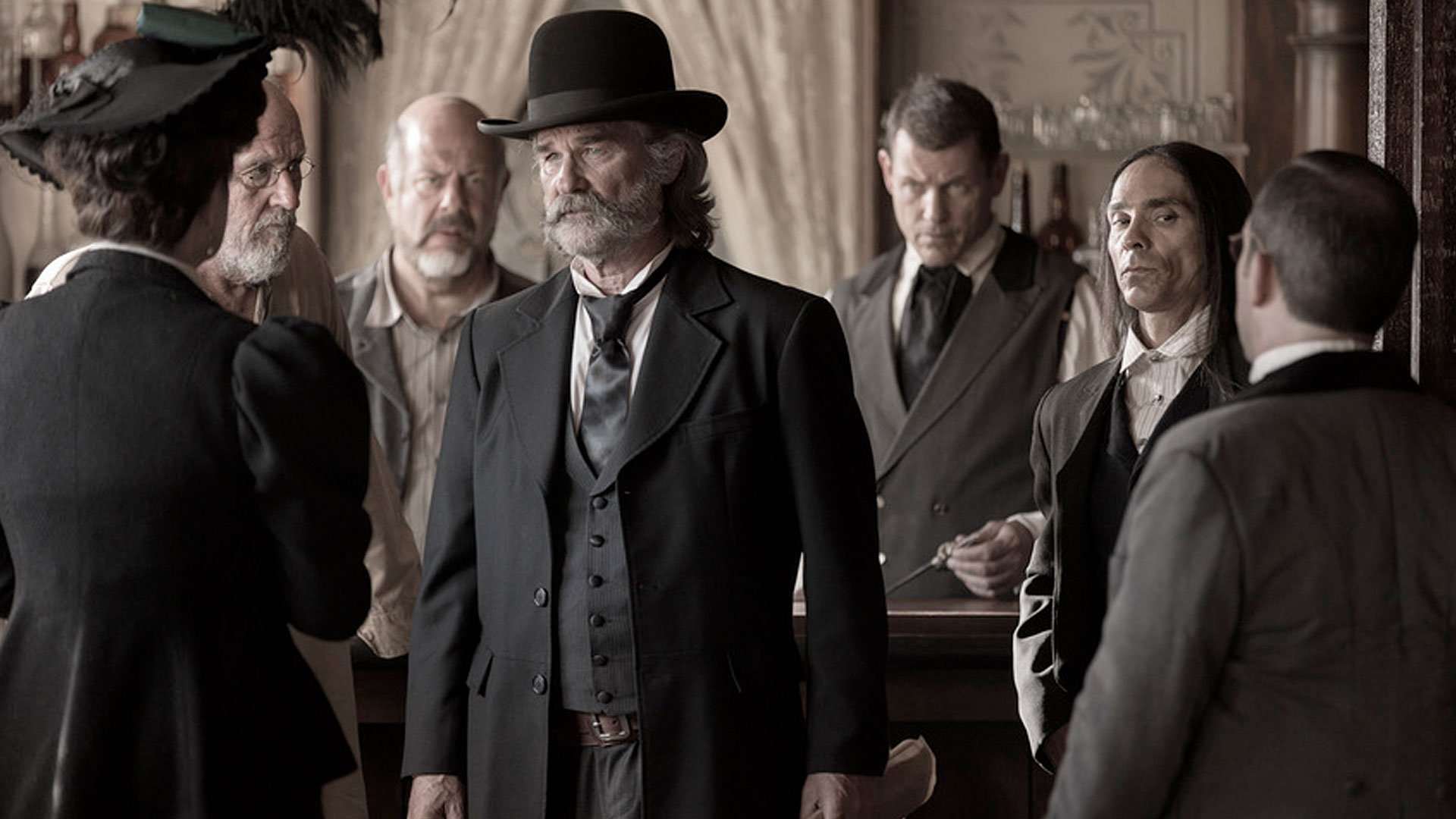
Bone Tomahawk - scene

A strange, mercurial hybrid of Western and Horror, Bone Tomahawk is a movie that consistently outdoes its low budget in terms of originality, unexpected twists and turns in the narrative, and a recurring sense of humour that often threatens to undermine the seriousness of the drama, but which actually works as an escape valve for the tension that first-time director Zahler seems able to pull together at will. At times, this isn’t a movie for the faint-hearted or the squeamish – Nick’s fate is particularly gruesome – but in amongst the sometimes extreme violence and the matter-of-fact tone that accompanies it, Zahler manages to explore themes of masculinity, comradeship, loss, self-sacrifice, and most surprisingly of all, manifest destiny.

From the outset, this is a Western that isn’t interested in telling a typical Western story, and although it bears a (very) basic resemblance to John Ford’s The Searchers (1956), it soon abandons any pretense at wanting to emulate that classic movie by taking a no-nonsense approach to the times, and the events that unfold. It also steers away from traditional Western motifs by having its quartet of lawful avengers put at a disadvantage right from the start, with O’Dwyer’s broken leg proving exactly the type of hindrance that’s likely to get them all killed. When they’re forced to leave him behind, not only does the size of their task increase, but also the likelihood of their ending up as buffet for the troglodytes increases too; they soldier on because they want to for each other, not because they have to for the abductees, which was how they set out.

By changing this kind of stance along the way, and by making their opponents so animalistic as to be unreasonable, Zahler avoids any sentimentality that might occur in a regular Western, and isn’t afraid to put his characters through the wringer, so much so that there are times when the viewer isn’t sure if any of the quartet will survive, or if they do, how intact they’ll be. With a rugged, inhospitable looking backdrop to the action (expertly rendered by DoP Benji Bakshi), the main characters’ confidence is slowly eroded by their surroundings and the troglodytes’ uncompromising ferocity, and this is where Zahler’s ability to ratchet up the tension is most prevalent – how are they going to get out of this alive? It’s an interesting question, as by the movie’s end it’s not about the survival of the fittest, but survival at any cost.

With so many weighty themes to incorporate, and with the violence and escalating tension proving so effective, it’s left to Jenkins’ daft, lovably clueless deputy to provide some much needed humour. There’s a lovely moment when he insists a travelling flea circus was operated by real live fleas, and he continually misunderstands things that have been said or done. Jenkins strikes just the right note of encroaching senility mixed with amiable foolishness and is a joy to watch as a result. Elsewhere, Russell’s flinty portrayal of Hunt will remind viewers of his turn as Wyatt Earp in Tombstone (1993), and his whiskers should by rights be given a movie of their own. It’s good to see him play a character who makes so many mistakes, and if he maintains a degree of unshakeable tenacity throughout, then the movie is all the better for it (even if it’s cruelly undermined by the troglodyte leader’s treatment of him).

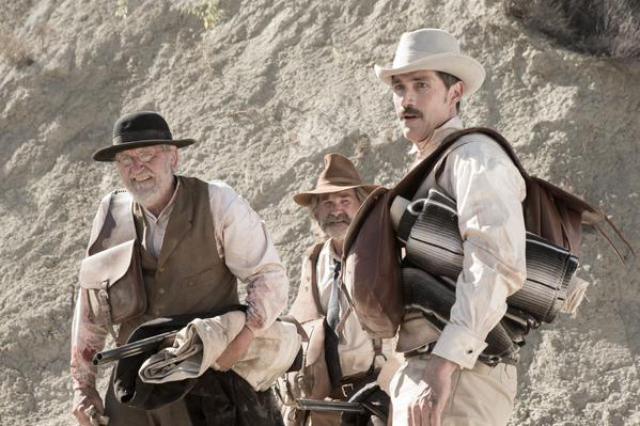
Bone Tomahawk - scene2

As the equally tenacious O’Dwyer, Wilson is headstrong, determined and completely focused on the task ahead, even though O’Dwyer will suffer for it. As his captive wife, Simmons is appealing and vulnerable, and more resigned to her fate than anyone would surmise. Both give credible performances and are matched by Fox’s belligerent martinet Brooder, a man as out of place in the quartet as he is oddly appealing. With Arquette and Morris (as Hunt’s wife) offering strong support, the movie benefits from having assembled a fine cast who are all committed to telling the tale at hand, and their are fine turns from the likes of Haig and Melamed in minor roles that add to the richness of the characters.

With a low budget fixed in place, Zahler is forced to resort to some necessary sleight of hand in telling his story. The troglodytes’ cave is reduced to one static location that features little in the way of set dressing, and there’s a sense that the exterior scenes were all shot in the same place but from different angles to hide the repetition. There’s also a problem with the pace, as some scenes – notably those where Hunt et al travel to the hills – are flat and in need of tightening up. Otherwise, Zahler’s debut is a taut, gripping endeavour that breathes new life into a (mostly) moribund genre, and is a great way of announcing there’s a new director in town who’s definitely worth watching out for.

Rating: 8/10 – a surprise on so many levels, Bone Tomahawk is an uncompromising,  unapologetic movie that revels in its ability to subvert the Western genre, and gives us a tribe of inbred cannibals that easily surpasses the cartoon equivalents in the Wrong Turn series; with a great cast clearly relishing their roles, and assured writing and direction from Zahler, this is meaty stuff indeed, and a rare treat.

Share this:

  • Click to share on X (Opens in new window) X
  • Click to share on Facebook (Opens in new window) Facebook
  • More
  • Click to print (Opens in new window) Print
  • Click to email a link to a friend (Opens in new window) Email
Like Loading...

Mini-Review: Knock Knock (2015)

10 Saturday Oct 2015

Posted by dullwood68 in Movies

≈ 5 Comments

Tags

Adultery, Ana de Armas, Bel, Drama, Eli Roth, Genesis, Home invasion, Keanu Reeves, Lorenza Izzo, Paedophile, Remake, Review, Threesome, Thriller

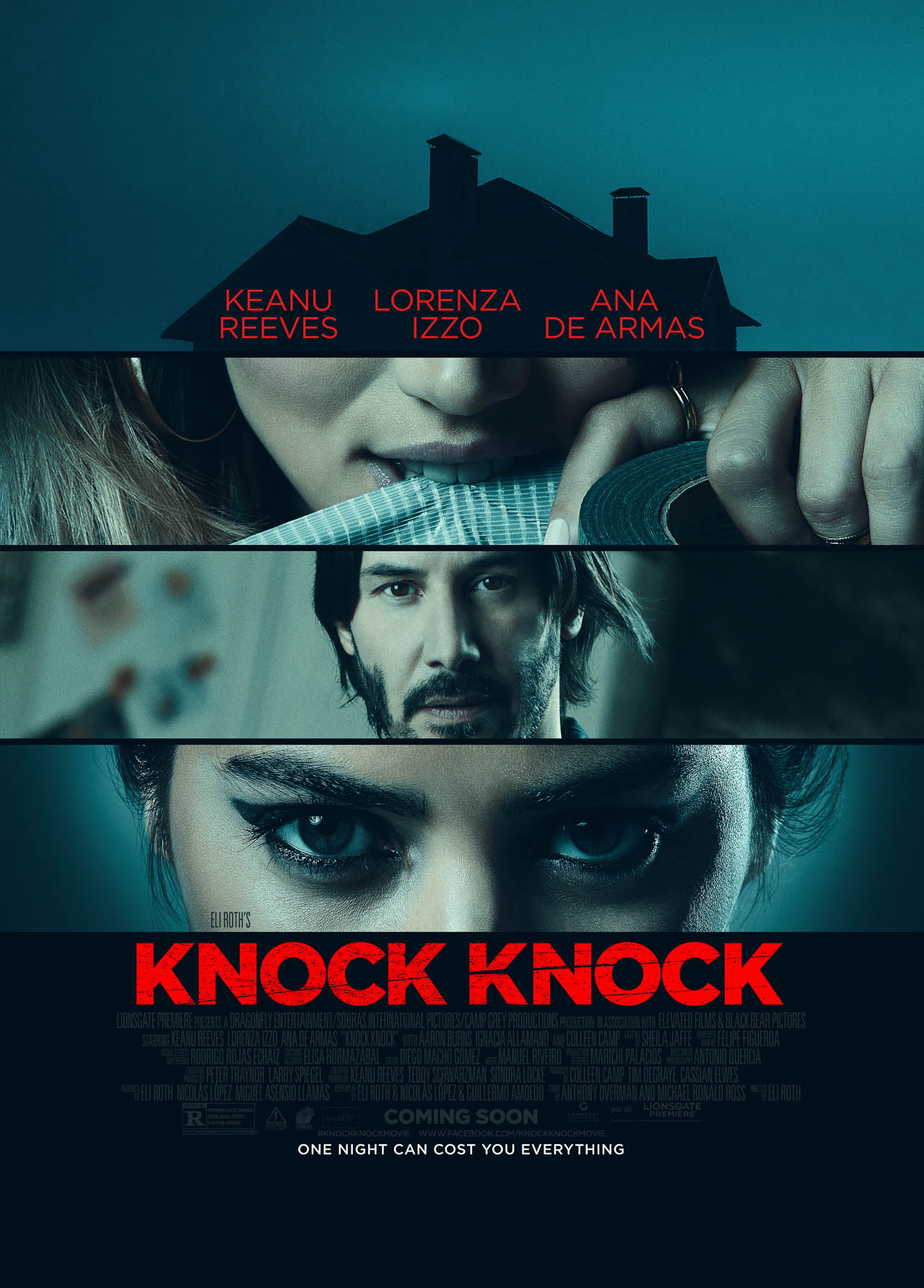
Knock Knock

D: Eli Roth / 100m

Cast: Keanu Reeves, Lorenza Izzo, Ana de Armas, Aaron Burns, Ignacia Allamand, Colleen Camp

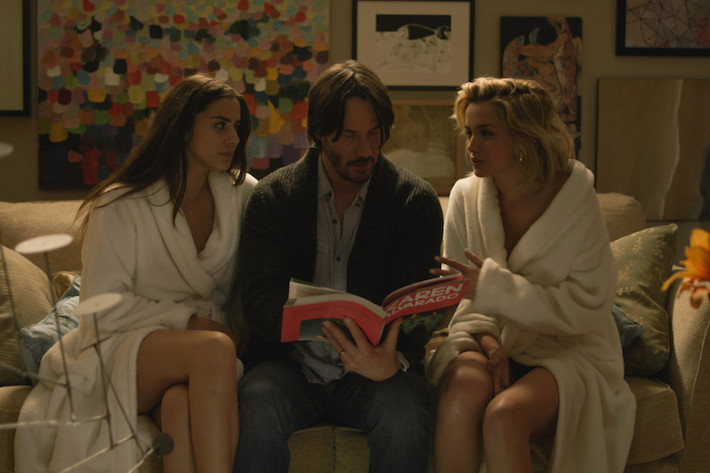
Architect and committed family man Evan Webber (Reeves) is forced to stay home for the weekend due to work commitments, while his artist wife, Karen (Allamand), and their two children go to the beach. On the first night he’s hard at work when he hears a knock at the front door. Not expecting anyone, he’s surprised to find two young women – Bel (de Armas) and Genesis (Izzo) – trying to find the location of a party they’re going to, and who are soaked through thanks to the rain. He lets them in to wait for another taxi, and gives them robes to wear while their clothes are put in the drier. He’s hospitable and friendly, but as the two women begin to flirt with him, Evan becomes uncomfortable. When the taxi finally arrives and he tries to give the girls back their clothes, he finds them in the bathroom, naked, and wanting very much to have sex with him.

Evan succumbs to their advances and they end up having a threesome. The next morning, he wakes to find Genesis and Bel have no intention of leaving. When they vandalise one of his wife’s sculptures, he threatens to call the police, but they call his bluff by saying they’d have an interesting story to tell the police, what with their being underage. Evan is shocked, and backs down, and the young women continue to disregard his pleas not to interfere or damage anything. Eventually he gets so mad he starts to call the police to report a break-in, and the women agree to leave. He drops them off where they’re supposed to live, and back home, cleans up all the mess they’ve created. Later that night, Evan is working again when he hears a noise. He goes to investigate and is knocked unconscious by Genesis. When he comes to he finds himself tied to the bed, and that both Genesis and Bel are determined to make him suffer for his actions of the night before.

Knock Knock - scene

“Knock knock.

Who’s there?

A pretty awful movie by Eli Roth.

Sorry, we’re out.”

A remake of Death Game (1977), which starred one of this movie’s producers, Sondra Locke, and cast member Colleen Camp, Knock Knock has all the tension and edge-of-your-seat suspense of an episode of The Simpsons. It’s stupid, ridiculous, annoying, derivative, farcical, erratic, ludicrous, woeful, preposterous, idiotic, and just plain dumb. It’s a psychological thriller that forgets all about the “logical” and plumps for the “psycho” side of things with a passion that will leave most viewers shaking their heads in disbelief. This is a home invasion movie where you can’t feel sympathy for Reeves’ character, or the barmy antics of Genesis and Bel, or even the unlucky Louis (Burns), Karen’s assistant, who proves that an asthmatic can still play piggy-in-the-middle long after they should have collapsed fighting for their breath.

The script, co-written by Roth, Nicolás López and Guillermo Amoedo, is a lumpen mess that judders from one unconvincing scene to another, and resolutely avoids giving Evan the chance to gain the upper hand, keeping him the shouting, sweating victim throughout, while making Bel and Genesis the equivalent of avenging angels (though why they do what they do is obscured by their commitment to behaving like five year olds on a sugar high). Reeves is also lumbered with some of the most awful dialogue written in recent years, and it shows up his deficiencies as an actor (it doesn’t help that for most of the movie’s second half, and one rant aside, his general reaction to what’s happening to him is to repeat the F-word). And Roth, whose caché as a director is becoming increasingly devalued, directs each scene as if it’s completely independent of the ones before and after it, and shows no interest in making it exciting or dramatic for the viewer.

Rating: 3/10 – a wince-inducing thriller that remains a huge waste of time, and confirms Evan’s question part way through of “What’s the point?” with every subsequent scene; more knock-off than remake, Knock Knock plays around with a decent clutch of ideas but ultimately hasn’t got a clue what to do with any of them.

Share this:

  • Click to share on X (Opens in new window) X
  • Click to share on Facebook (Opens in new window) Facebook
  • More
  • Click to print (Opens in new window) Print
  • Click to email a link to a friend (Opens in new window) Email
Like Loading...

Paper Towns (2015)

09 Friday Oct 2015

Posted by dullwood68 in Movies

≈ Leave a comment

Tags

Agloe, Austin Abrams, Cara Delevingne, Disappearance, Drama, Jake Schreier, John Green, Justice Smith, Literary adaptation, Mystery, Nat Wolff, Orlando, Prom, Review, Road trip, Romance, Teenagers

Paper Towns

D: Jake Schreier / 109m

Cast: Nat Wolff, Cara Delevingne, Austin Abrams, Justice Smith, Halston Sage, Jaz Sinclair, Cara Buono

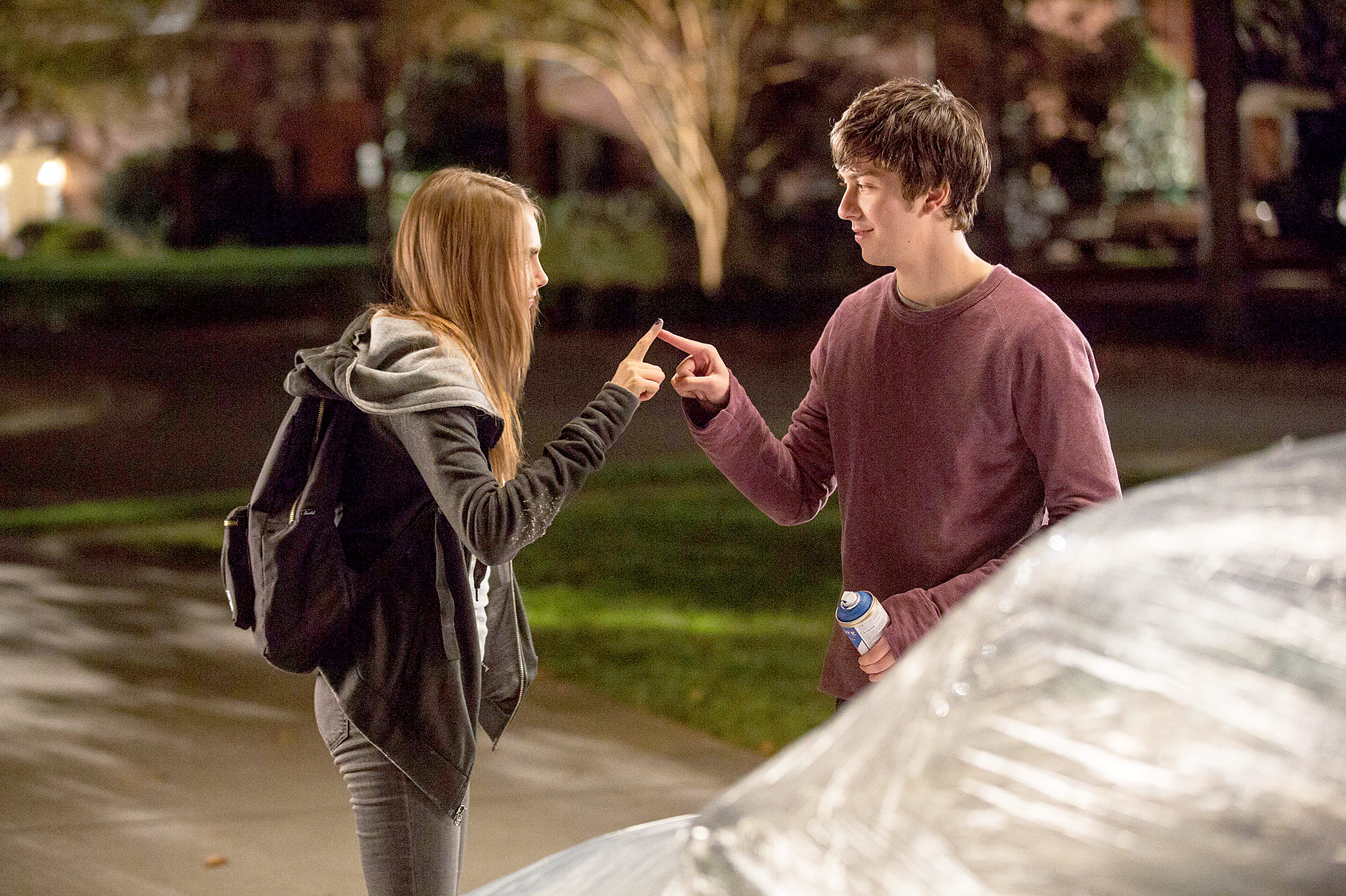
Ever since Margo Roth Spiegelman (Delevingne) moved in across the street from Quentin “Q” Jacobsen (Wolff) when they were kids, Quentin has looked on her as his one true love. But even though they grew up together as friends, and spent a great deal of time together, they’ve drifted apart and no longer even acknowledge each other in high school. All that changes however when, one night, Margo comes in through Q’s bedroom window and asks to borrow a car. She tells him that she has nine things she needs to do that night (some of which are illegal), and she needs his help. Reluctant at first, Q agrees to help her, and they take his mother’s car and head to the nearest Costco.

There they pick up various supplies including duct tape, a lot of Saran wrap, and a raw catfish. Margo explains that she’s out to get revenge on her boyfriend and her close friends; her boyfriend has been cheating on her with one of her friends, and at least one more friend knew it was happening and didn’t say anything. As the night progresses, and they play prank after prank, it becomes more and more like the times they spent together as kids, and Q finds his attraction for Margo rekindled. The next day though there’s no sign of Margo; a few more days pass before it becomes clear that Margo has disappeared.

Q is certain that Margo has left for a reason and that she wants to be found. He bribes her younger sister to look for clues in her bedroom. A Walt Whitman quote leads Q to finding a note with an address on it. With his friends Radar (Smith) and Ben (Abrams), he goes there and finds an abandoned store but they don’t find another clue. The next day, Q is approached by Lacey (Sage), one of Margo’s friends who is concerned about what’s happened to her. When the boys go back to the abandoned store she follows them there, and the four of them discover an atlas with a page torn out, a page that indicates Margo has gone to a small town in upstate New York called Agloe.

Q decides to throw caution to the wind and travel to Agloe. His friends, and Lacey, all agree to go with him, but only as long as they can get back in time for the upcoming prom. Radar’s girlfriend, Angela (Sinclair), comes along with them. Along the way they have a near-miss with a cow that sees their car spin off the road. Stranded for the night, Ben and Lacey develop a fondness for each other, while Radar and Angela pre-empt the plans they have for after the prom. The next day, with the car repaired, they finally make it to Agloe, but what they find there isn’t exactly what Q expected…

Paper Towns - scene

A teen romance where the romance is potentially illusory, and a teen drama where the drama is assembled through the filter of a mystery, Paper Towns is a heartfelt ode to teenage longing and seizing the moment. It features several moments where it seems the narrative is being forced along by contrivance and crude coincidence, but the movie has the presence of mind to excuse itself by a trick of the very same narrative. This is to do with the clues Margo has left behind, and the way in which Q responds to them, but as they are the crux of the matter – even more so than Q and Margo’s relationship – it’s hard to imagine the movie working out in any other way, faithful as it is to the structure and tone of John Green’s novel.

However, what is difficult to pin down successfully in the novel is also difficult to pin down in the movie. Q’s commitment/devotion/attachment to Margo is never quite believable, despite Wolff’s compelling performance, and hinges on that one night of prankdom that in itself seems unlikely. Some viewers might not be too concerned by Margo’s appearance in Q’s room after so long, but it’s hard to believe that after so long “apart” that she would rekindle their friendship, and then make it so memorable for Q before disappearing. And Q’s disappointment only lasts until it becomes clear that Margo has run away, but instead of feeling taken advantage of, he becomes certain she wants him to find her. All of which begs the question, is Q just lovesick, or a stalker in training?

Michael H. Weber and Scott Neustadter’s adaptation does its best to portray Q’s search for Margo as the grand romantic gesture it appears to be, but the script never manages to make his obsession credible or based on anything but an intellectual challenge (can he find her from the clues she’s left behind?). As a result, and again despite Wolff’s engaging portrayal, Q comes across as a loyal puppy dog willing to do whatever he believes his mistress wants him to do. So wedded to the idea of his being with Margo does Q become that a more appropriate liaison with Lacey is quickly nipped in the bud by pairing her off with Ben, a relationship that would be more credible in a Revenge of the Nerds movie.

In the end the movie’s central concept is that we – or more particularly Q – should live for the moment, and create our own dreams instead of following someone else’s, and while this is a tenet that’s worth taking to heart, here it follows in the footsteps of too many other teen dramas to be either relevant or anything other than jaded. But thanks to its gifted cast, and a sense of fun that is more appealing than the drama that occupies centre stage, the movie is by no means a chore to watch, and features warm, soothing cinematography by David Lanzenberg, and a charming score by Son Lux. Schreier’s direction is unobtrusive for the most part, and with the help of Wolff and Delevingne he imbues the scenes between Q and Margo with a sense of unspoken yet mutual affection that is entirely touching.

Rating: 7/10 – in many respects a missed opportunity, Paper Towns has a superficial fascination that draws in the viewer but will leave them feeling less than fully satisfied by the movie’s end; competently made but missing that vital spark needed to make the material sing, it has another delightful performance from Wolff, and gives Delevingne the chance to shine in what is the movie’s most important, and unexpectedly fascinating, supporting role.

Share this:

  • Click to share on X (Opens in new window) X
  • Click to share on Facebook (Opens in new window) Facebook
  • More
  • Click to print (Opens in new window) Print
  • Click to email a link to a friend (Opens in new window) Email
Like Loading...

Hellions (2015)

08 Thursday Oct 2015

Posted by dullwood68 in Movies

≈ Leave a comment

Tags

Bruce McDonald, Children, Chloe Rose, Demons, Drama, Halloween, Home invasion, Horror, Pregnancy, Review, Robert Patrick, Rossif Sutherland, Thriller

Beauty, Power and Grace

D: Bruce McDonald / 82m

Cast: Chloe Rose, Robert Patrick, Rossif Sutherland, Rachel Wilson, Luke Bilyk, Peter DaCunha, Emir Hirad Mokhtarieh, Joe Silvaggio, Sydney Cross

Dora Vogel (Rose), is a seventeen-year-old who lives with her mother, Kate (Wilson), and younger brother Remi (DaCunha). She has a boyfriend, Jace (Bilyk), who she’s intending to go to a Halloween dance with, but the news that she’s four weeks’ pregnant gives her pause. Afraid to tell her mother who has high hopes for her, Dora decides to stay at home and not go to the dance, but she doesn’t tell Jace. When her mother and brother go out trick or treating, Dora discovers that being home alone isn’t as comforting as she’d hoped, not least because of the oddly costumed child that calls at her door. Deciding she will go to the dance, she gets dressed up but now two children call, and this time one of them places their hand on her stomach leaving a bloody handprint. Shortly after, Dora begins to experience painful stomach cramps and calls her physician, Doctor Gabe Henry (Sutherland), to come over.

The cramps subside but when they do there’s a further knock at the door. Angry, Dora throws the remainder of the candy into the children’s sack – and sees something else there that shocks and petrifies her. She calls the police and while she’s on the line to the police dispatcher the house is seemingly possessed by a violent storm that sees various items hurled around by a powerful wind. The line goes dead and in time the storm subsides, but now Dora can see that there are more and more children outside, all wearing odd costumes. The arrival of an injured Doctor Henry sees the nature of what is now a siege intensify, and he and Dora lock themselves in the basement. But the children show tenancity and find their way in; Dora escapes through the laundry chute but the doctor isn’t so lucky. Dora tries to escape the house, and in the kitchen she comes face to face with one of the children. In her efforts to escape, Dora throws whatever comes to hand at the child, with no effect, until a salt shaker hits the child and the salt causes it to dissolve.

Now outside, Dora finds the sky transformed thanks to a bloody full moon that saturates everything in an eerie reddish-pink colour. She hides in an outhouse where the voice of one of the children speaks to her in her mind. It tells her they want her baby, the baby that is now growing at an advanced rate. Scared and horrified, Dora is found by Officer Corman (Patrick). They prepare to leave but hear Doctor Henry’s voice calling to them from the house. They go in, but Henry’s survival proves to be a cruel joke, but it’s one that allows Corman to realise what’s happening, and just how much danger Dora is in…

Hellions - scene

In 2008, Bruce McDonald gave us one of the most cleverly assembled zombie movies of the last ten years in the deliciously quirky Pontypool. Since then he’s laboured mostly in television, with the occasional feature thrown in (his last, The Husband (2013), is well worth checking out). Returing to the horror genre, McDonald has done his best to make a movie that combines a creepy, single-location setting with a broader supernatural raison d’etre (the children are demons looking to swell their ranks with Dora’s unborn child). In bringing Pascal Trottier’s script to life, however, McDonald is unable to overcome the deficiencies of the script, and as the movie breasts the hour mark and descends into fever dream territory, the tightness of the script up til that point drifts off into a soup of elliptical imagery and random occurrences that seem designed to pad out the remainder of the movie instead of bringing it to a satisfactory conclusion.

The set up is simple and effective, and the children – decked out in sackcloth hoods, unnerving masks, and surprisingly sinister metalware – are menacing, freakish and nightmarish to look at. Part of their effectiveness lies in their costumes, corrupted versions of children’s characters such as Raggedy Ann and Pinocchio; there’s nothing innocent about these kids, or what they want. McDonald highlights this horror at every opportunity, and even the kid wearing a tin bucket on his head (the leader, appropriately named Buckethead in the credits) is uncomfortably menacing. The children are the movie’s best asset, and whenever they appear the horror of Dora’s situation is more apparent and more terrifying.

What is less successful is the lame attempt to explain that this isn’t the first time they’ve done this, as Patrick’s dogged officer recalls the same thing happening to his wife, and the legacy of Carrie (1976) is resurrected in a superfluous final “scare” that fans of the genre will see coming a mile off. Elsewhere, Halloween is used as a backdrop for the supernatural shenanigans, but there’s no clear connection between the occasion and the children’s actions, and the field of exploding pumpkins is a triumph of unconvincing CGI. As a home invasion movie, Hellions is on firmer ground, and Rose’s performance is the glue that knits all the disparate elements together, from her shocked gaze at learning she’s pregnant, to her annoyance with the first child to knock (“Good luck with puberty”), to the moment when her realisation that salt can kill the children offers her a brief respite from being scared out of her wits.

Although the script’s unevenness hurts the movie overall, there’s more than enough to keep the viewer interested, even if it does go off the rails in the last twenty minutes. Dora is a sympathetic heroine, and it’s not hard to root for her, even if at one point she’s incapable of navigating her way through several hanging bedsheets. The various violent encounters are well handled, and the movie is refreshingly free of the post-modern irony and self-awareness that’s blighted so many horror movies in recent years. And the movie may be the first of its kind to make the colour pink seem ominous and sickly at the same time.

Rating: 6/10 – making a virtue of its restricted setting and an intelligent performance from Rose, Hellions is an above average horror/thriller that features some truly scary demon children and intuitive direction from McDonald; spoiled by a dilution of the threat towards the end, and a lack of focus the longer it goes on, it’s still a movie worth catching up with, and another example of what its director can do on a limited budget.

Share this:

  • Click to share on X (Opens in new window) X
  • Click to share on Facebook (Opens in new window) Facebook
  • More
  • Click to print (Opens in new window) Print
  • Click to email a link to a friend (Opens in new window) Email
Like Loading...

Just Before I Go (2014)

08 Thursday Oct 2015

Posted by dullwood68 in Movies

≈ 1 Comment

Tags

Bullying, Comedy, Courteney Cox, Drama, Garret Dillahunt, Homosexuality, Kate Walsh, Olivia Thirlby, Review, Rob Riggle, Seann William Scott, Sleep masturbation, Suicide

Just Before I Go

D: Courteney Cox / 95m

Cast: Seann William Scott, Olivia Thirlby, Garret Dillahunt, Kate Walsh, Kyle Gallner, Mackenzie Marsh, Evan Ross, Rob Riggle, Connie Stevens, David Arquette, Diane Ladd, Missi Pyle, Clancy Brown, Beth Grant, Griffin Gluck, Elisha Cuthbert

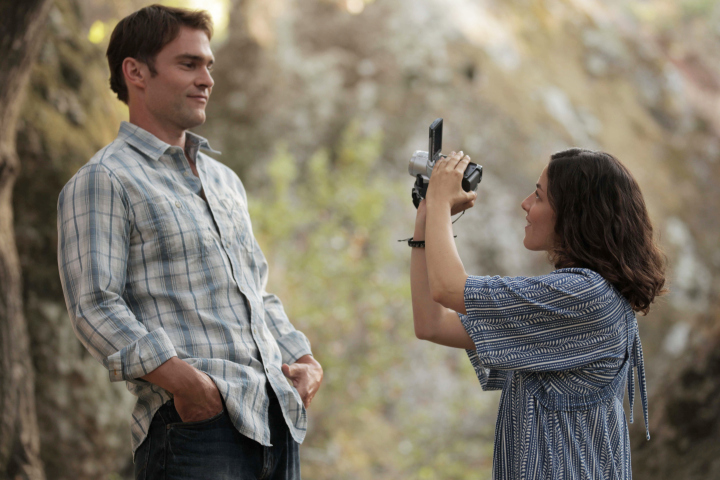
When his marriage falls apart, Ted Morgan (Scott) finds himself reassessing his life. He doesn’t like what he sees and this leads to him making the decision to return to his hometown and right the wrongs in his childhood that he feels have contributed to where he is now – and then he’ll kill himself. He moves in with his older brother, Lucky (Dillahunt), and his family: wife Kathleen (Walsh), and sons Zeke (Gallner) and Randy (Gluck). Ted’s first mission is to confront one of his teachers, Mrs Lawrence (Grant), who treated him harshly and undermined his confidence. He finds her in a home but his confrontation doesn’t go as planned, though he does meet Greta (Thirlby), his teacher’s granddaughter. When he tells her why he was there, and about his plan to kill himself, Greta threatens to tell Lucky (who’s also the town sheriff) unless Ted lets her tag along and film everything in lieu of his having to leave a suicide note.

Ted next visits the man who bullied him mercilessly at school, Rowley Stansfield (Riggle), but Ted’s plan to beat him up is ruined when Rowley apologises straight away for his terrible behaviour. With his expectations being dashed at every turn – a meeting with the one girl in school who treated him kindly, Vickie (Marsh), leads to a one night stand – Ted finds himself taken into his nephew’s confidence over the issue of Zeke’s confused sexuality. He also finds himself recognising that not everything is okay with his brother’s marriage (Kathleen spits in Lucky’s coffee and “sleep masturbates” in front of Ted each night). Still intending to kill himself despite how much he finds people like him, a secret from Greta’s past threatens to put an end to their burgeoning relationship, and an incident at school leads to Zeke disappearing. Faced with being involved with everyone else’s problems, Ted has to lend what aid he can before going through with his own “self-help” plan.

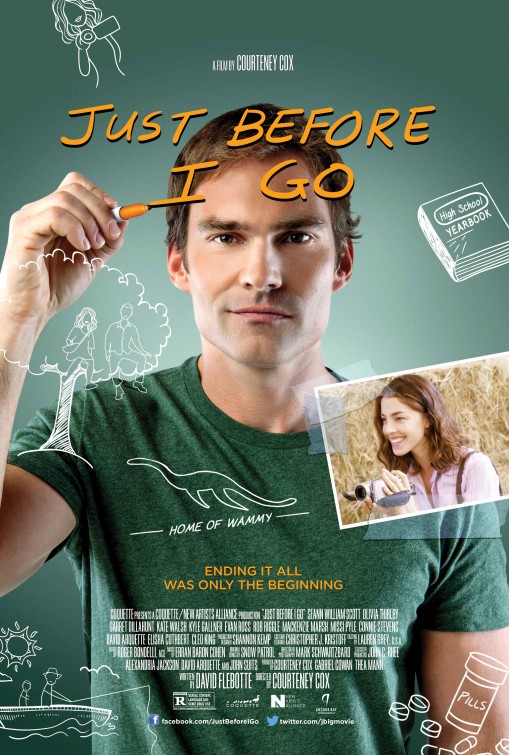
JUST BEFORE I GO

For a movie that deals with themes of suicide, childhood bullying, homophobia, teen peer pressure, sexism, marital disharmony, and adds a dash of casual racism to the mix for good measure, Just Before I Go could have been one of the dourest, most depressing movies of 2014 or any other given year. And while it contains a layer of seriousness that befits all those themes, Courteney Cox’s feature debut opts instead to throw in all manner of comic additions to the material, from the aforementioned sight of Kathleen “auditioning the finger puppets” (thankfully not in close-up) to a totally unexpected moment when Lucky sports an early morning hard-on that he does nothing to hide. It’s moments like these when it seems that David Flebotte’s script has lost any confidence it had in its own effectiveness and goes for the cheap laugh as a way of maintaing the audience’s interest.

What this means for the movie is that the humour, misjudged and awkwardly shoehorned into the narrative as it is, leaves the undercooked drama somewhat isolated and struggling to make the required impact. Take away the humour and you have a movie that, while it still struggles to be insightful, is at least broadly entertaining, with a quiet, understated performance from Scott, and an awareness that the issues it’s dealing with aren’t being tackled with any real depth but with enough energy to keep the audience involved (if only to see how many tonal switches the movie can make in ninety-five minutes). Cox apparently had advice from David Fincher and Gus Van Sant, but it’s hard to see where, or if, their advice was taken up, and she has trouble focusing on the emotions needed in any given scene, which adds to the disappointment of seeing a pretty good ensemble cast given very little to sink their teeth into. That it’s all wrapped up so neatly as well, merely reinforces the soap opera dramatics that do the movie such a disservice.

Rating: 4/10 – there’s already a movie called Trainwreck (2015), but this comes close to being the celluloid equivalent, as crass humour collides with sentimental drama to very poor effect; saved by a handful of well-judged if directorially unsupported performances, Just Before I Go is a badly constructed mess that stretches the patience and often betrays itself, let alone the viewer.

Share this:

  • Click to share on X (Opens in new window) X
  • Click to share on Facebook (Opens in new window) Facebook
  • More
  • Click to print (Opens in new window) Print
  • Click to email a link to a friend (Opens in new window) Email
Like Loading...

Macbeth (2015)

06 Tuesday Oct 2015

Posted by dullwood68 in Movies

≈ 1 Comment

Tags

Banquo, Drama, Elizabeth Debicki, Justin Kurzel, Lady Macbeth, Literary adaptation, Macduff, Madness, Marion Cotillard, Michael Fassbender, Murder, Paddy Considine, Prophecy, Regicide, Review, Scotland, Sean Harris, Shakespeare, Three Witches

Macbeth

D: Justin Kurzel / 113m

Cast: Michael Fassbender, Marion Cotillard, Paddy Considine, Sean Harris, David Thewlis, Jack Reynor, Elizabeth Debicki

With Scotland ruled by King Duncan (Thewlis), his throne comes under threat from a Scottish lord seeking to overthrow him. Duncan’s depleted army is led by Macbeth (Fassbender), the Thane of Glamis, and thanks to his savagery and skill on the battlefield, Duncan’s forces win the fight and rout the opposition. On the fringes of the battle, Macbeth sees three women who stand watching him. When he approaches them, along with his trusted servant Banquo (Considine), they prophesy his rise to become Thane of Cawdor as well as Glamis, and his future role as King. They also tell Banquo that his offspring will provide a line of kings to come.

Soon after, Macbeth receives word that Duncan has awarded him the title of Thane of Cawdor (as predicted), and that the King wishes to spend the night at Macbeth’s home. News sent by Macbeth to his wife (Cotillard) of the day’s strange events prompts her to plot Duncan’s death so that her husband can ascend to the throne, though Macbeth is in need of her persuasion to even consider the idea. But when Duncan proclaims his successor will be Malcolm (Reynor), Macbeth sees no option but to go ahead with his wife’s plan. He kills Duncan, but Malcolm flees for his life, allowing Macbeth to blame him for Duncan’s death.

Macbeth is crowned king but he frets over the prophecy’s assertion that Banquo is the head of a line of future kings. Unwilling to see his reign usurped by Banquo’s inheritors, he charges two men to kill him and his son. Banquo is killed but his son escapes. At a feast later that night, Macbeth sees the murdered Banquo amongst the guests, and becomes maddened by the sight of him. Lady Macbeth does her best to calm him, but the actions of Macduff (Harris), who leaves in disgust at the new king’s erratic behaviour, lead Macbeth to have his family – his wife (Debicki) and three children – apprehended and put to death. Macduff has already left for England, and when he hears of his family’s fate, determines to have his revenge on Macbeth, and joins the army Malcolm has assembled to take back the crown. But while they plan their assault, Macbeth relies on his belief that “no man of woman born” can ever harm him, and is invincible. Lady Macbeth, though, seeing how much her husband’s mind has deteriorated begins to see that their futures have become heavily fore-shortened.

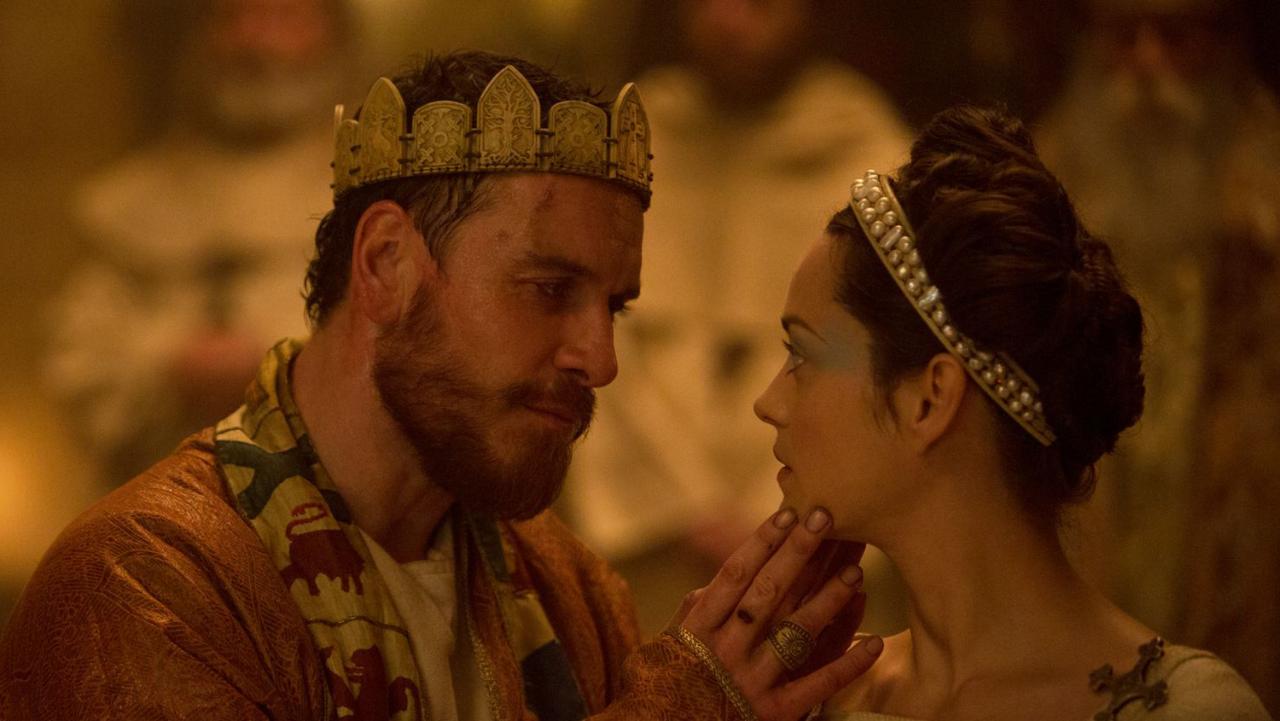
Macbeth - scene

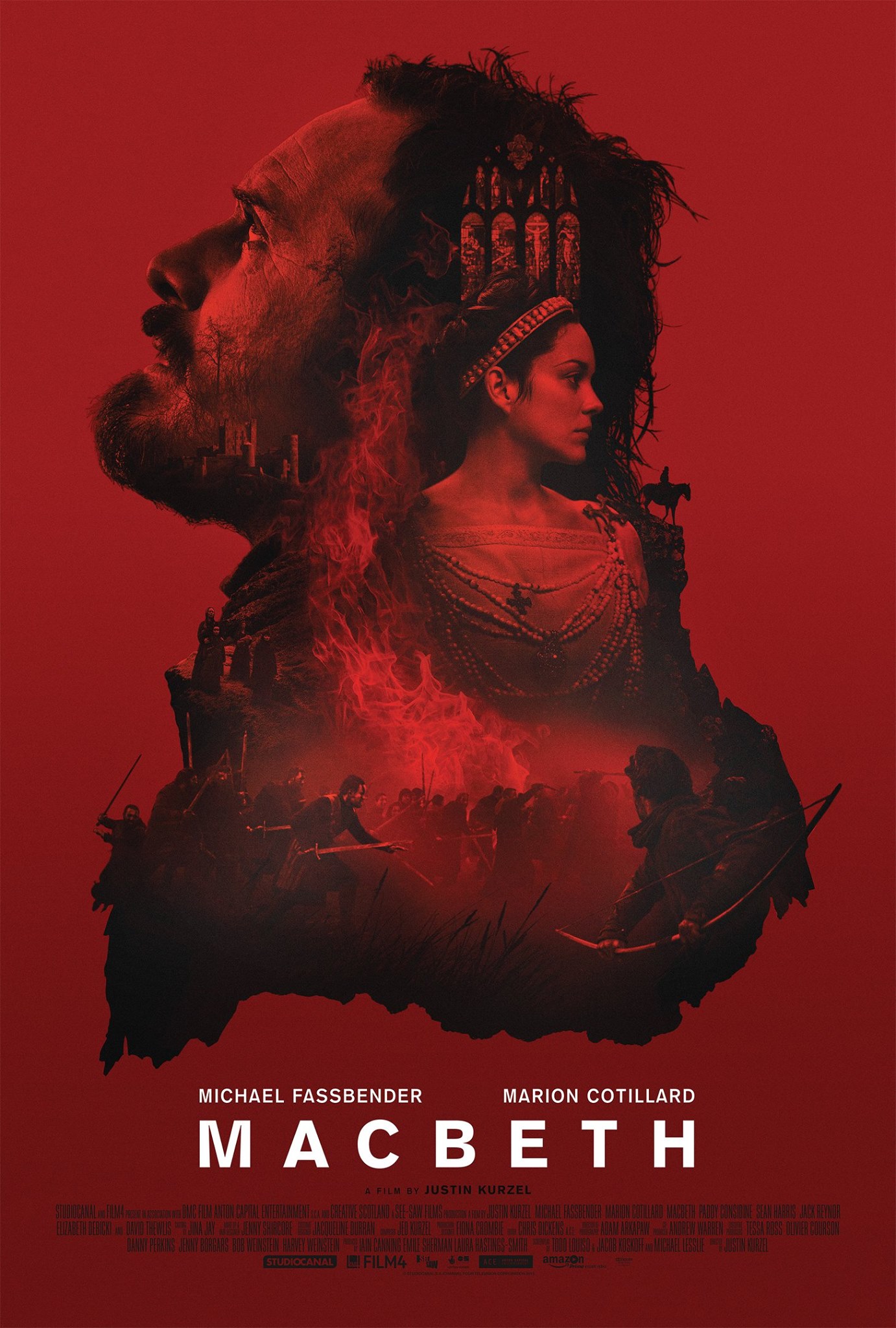
In a year that has seen any number of disappointing big-budget, action-stuffed, plot-lite, spectacle-driven adventure movies, it’s a pleasure to finally watch a movie that is the whole package – the real deal, if you like – and doesn’t pander in any way to any one particular audience demographic; in short, Macbeth is simply stunning. Thanks to a concise, yet exacting adaptation of Shakespeare’s play by Todd Louiso, Jacob Koskoff and Michael Lesslie, and Justin Kurzel’s robust, instinctive direction, this is a movie that sizzles with energy and fire and passion, and grips from its opening, dreamlike battle, shot and edited to perfection as Macbeth becomes aware of the three witches watching from the battle’s edge and the fighting rages around him. It’s a virtuoso sequence, visually arresting and exotically violent, and gives the audience a firm idea of the approach that Kurzel is taking with the material.

Indelible image follows indelible image as the wilds of Scotland are photographed to highlight both their inherent beauty and the eeriness that can be sensed within them, while the interiors, hemming in the passions that motivate Macbeth and his manipulative wife, act as a melting pot for the murderous intentions and descent into madness that erodes the new king’s grip on his throne. Rarely has a movie used its locations to such striking effect, with mist-shrouded hills and candle-strewn rooms becoming just as fervid and foreboding as each other. Kurzel’s eye for a powerful, arresting image is maintained throughout, whether it’s a church emerging from out of the highland mist, or the overhead shot of the King’s throne (almost lost in the emptiness of the great hall it resides in). Kurzel’s innovative style reaches its zenith in the way he presents the moment when “Birnam Wood doth come to Dunsinane”, a blazing wall of flame that reflects the ferocity of the attack and the intensity of Macduff’s thirst for revenge.

But while the movie is often a thing of beauty (and cruelly so), it’s the depth and richness of the performances that stands out most. Fassbender is a tightly coiled Macbeth, his conscience unravelling with ever increasing speed as his attempts to thwart the prophecy drive him to ever more desperate measures. Fassbender plays him at first as a reluctant conspirator, reliant on his wife to persuade him that killing Duncan is the “right” thing to do, but once he becomes King his sense of regal propriety gives way to paranoia and madness and prideful arrogance. These are aspects of Macbeth’s character that could easily be overplayed by the wrong actor but Fassbender is more than up to the challenge; when he tells Lady Macbeth his mind is full of scorpions, the smile he offers her is chilling in its murderous intent, and all the more effective for being fleeting and unexpected.

Matching Fassbender for intensity and the intelligence of their portrayal is Cotillard. The French actress is superb here, her cold-hearted determination and rejection of moral rectitude as unnerving as it is coolly self-justified. The scene where she realises she’s lost control of Macbeth and can do nothing to prevent his madness consuming him (and her) is magnificently handled, the character’s sudden awareness that everything is about to crumble around her, and that she’s misjudged her husband’s actions, is affecting and credibly realised. And later, Cotillard provides what is perhaps the movie’s best scene, as she delivers the “Out, damned spot” soliloquy with such an emotional wallop that it’s almost uncomfortable to watch (it’s also possibly the best single scene in any movie this year).

Macbeth - scene2

Of the rest of the cast, Considine is quietly commanding as Banquo, his taciturn visage used to best effect when placed among the unsuspecting guests at the feast, and Harris’s Macduff swirls with uncontrolled hostility, as maddened in his own way as Macbeth. Thewlis is an avuncular Duncan, Debicki and Reynor minor presences due to the adaptation’s focus on the key characters, and there are smaller roles for the likes of Maurice Roëves and David Hayman. The violence is stylised, though not as bloody as you might expect, and the make up team have done a great job adding various scars and cuts where needed (and excel themselves with Macduff’s broken nose). The costumes are functional rather than ornate – though Duncan sports what looks like a scarf made by a favoured child – and it’s photographed with rigorous style and impressive use of filters by Adam Arkapaw, Kurzel’s cinematographer on Snowtown (2011). There’s also a terrifically mournful, plaintive score supplied by Jed Kurzel that acts as a character in its own right, and underscores the tragedy of events with such conviction that it’s ultimately haunting.

Rating: 9/10 – easily the best Shakespeare adaptation in a very long time, Macbeth is a triumph of casting, directing, scripting, filming, and every other aspect required to make this one of the films of the year; an oft-told tale given a new lease of life through its presentation of the title character enduring a semi-lucid fever dream of grandeur, madness and inevitable tragedy, this is a tour-de-force of modern movie making and not to be missed.

Share this:

  • Click to share on X (Opens in new window) X
  • Click to share on Facebook (Opens in new window) Facebook
  • More
  • Click to print (Opens in new window) Print
  • Click to email a link to a friend (Opens in new window) Email
Like Loading...

Olivia Twist (2014)

04 Sunday Oct 2015

Posted by dullwood68 in Movies

≈ Leave a comment

Tags

Adoption, Arno Hazebroek, British Youth Film Academy, Charles Dickens, Drama, Ellie Mahyoub, Fagin, James Francis, Literary adaptation, Oliver Twist, Review, Robbery, Stealing, Stoke-on-Trent

Olivia Twist

D: Arno Hazebroek / 74m

Cast: Ellie Mahyoub, James Francis, Martin Alcock, Junior Daws, Angela Fleming, Teague Davis, Kimberley Windsor, Matthew Mellalieu, Darren Smallridge, Chris Salisbury, Rachel Grainger, Armani Katija

A young, heavily pregnant woman collapses outside her house. She later dies in childbirth, but her child, a daughter, survives. The daughter is adopted by the Twists, and is raised by them in Stoke-on-Trent. The marriage is cut short by Mrs Twist’s death and Olivia is left in the care of her father, Barry (Smallridge), but their relationship has become a distant one. At school it’s little better, though she does have a close friend, Dick (Davis) and they support each other against a group of bullies. When Olivia punches one of them for saying nasty things about her mother, she is meant to see the headmistress, Miss Corney (Windsor), but she ducks out of school and heads home instead. There, an unexpected discovery makes her leave home for good.

She wanders aimlessly and spends the night in a barn. The next day she comes across a group of youths who are mugging an old man (Salisbury). The police arrive and Olivia runs off; when the coast is clear she encounters a young man who introduces himself as Jack Dawkins (Francis). He takes her under his wing and tells her there’s a place she can go where she’ll be looked after, run by a man called Fagin (Alcock) who looks after waifs and strays. At Fagin’s it soon becomes clear that the other teenagers there are part of a gang of pickpockets and thieves, and that Fagin runs things. In return for looking after her, Olivia is expected to become a part of the gang but she’s resistant to the idea. When a criminal acquaintance of Fagin’s, Bill Sykes (Daws), is looking for a small child to help rob a house, Olivia’s slight frame makes her the ideal candidate. But when she gets inside the house, she’s knocked unconsciousness before she can let Sykes in.

Much later, Olivia wakes to find herself in a nice bed and still at the house, which is owned by Mrs Maylie (Grainger). With the aid of an Afghani girl called Aziza (Katija), Mrs Maylie explains that Olivia is safe there for as long as she wants to be. Meanwhile, Sykes is worried that Olivia may have talked about his and Fagin’s “business dealings”; they hatch a plan to get her back in their clutches. They get a message to her that’s apparently from Jack, and she agrees to meet “him”. With a riot going on in the city, Fagin and Sykes reckon the police will be too busy to worry about them, but when the pub that Fagin operates out of is raided, Olivia is given a chance to escape her captors for good.

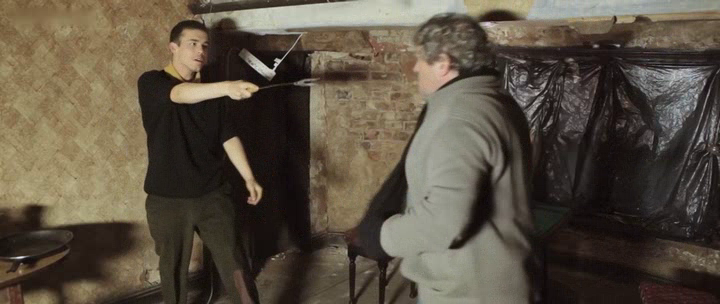
Olivia Twist - scene

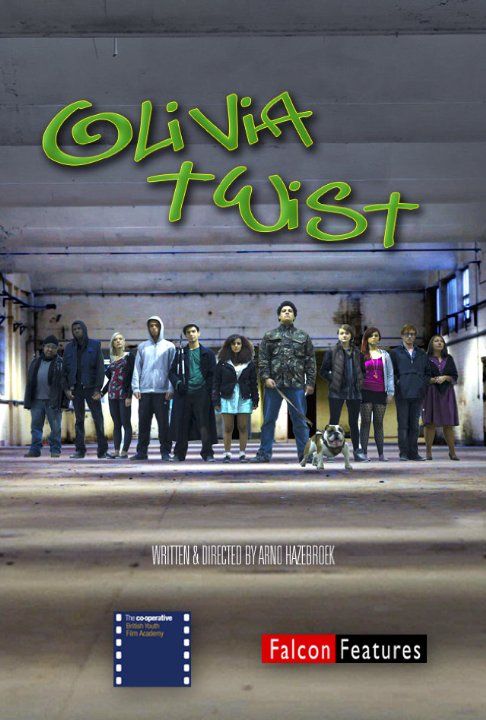
Since 2006, the British Youth Film Academy has allowed students to work on (and appear in) some seventeen movies and two television series, and in the process gain the experience necessary for these students to go on and work in the industry. It’s a great initiative, and t’s equally good to see that there’s a structured, sustainable annual programme where budding movie makers can learn skills in a variety of departments, decide on which area they want to concentrate on, and build a career for themselves. In the past, the BYFA has made quite a few movies based on the works of a certain William Shakespeare, but this is their first attempt at adapting Charles Dickens, and while the attempt is to be applauded, the final result is less heartening.

By updating Dickens’ tale to the modern day, and playing it against a background of social and industrial unrest, Olivia Twist seeks to ground itself, and make it sound and feel more relevant to contemporary audiences. On the face of it, it’s a solid idea, and rich with possibilities, but thanks to budgetary constraints and the random nature of director/writer Arno Hazebroek’s screenplay, the movie never really feels relevant or too up-to-date. At one point, Jack Dawkins uses a huge dollop of irony to praise the less-than-attractive area of Stoke-on-Trent that he and Olivia find themselves in, but this is less a comment on the grim functionality of industrial buildings than a clumsy reminder that this is a movie about fateful circumstances and where they can lead you. Stoke-on-Trent is clearly meant to be as much a character as any of the human ones, but a couple of references like Jack’s isn’t enough to elevate the decaying environment to better effect.

The dialogue is another, huge, problem. It’s a curiously uneven, patchwork combination of prose from Dickens’ novel, less obviously archaic forms of speech, and odd snatches of modern day vernacular. This leads to various members of the cast having difficulty sounding confident about what they’re saying, and the meaning of some lines is lost altogether as they sprint through them (and finish with a sense of relief). Unfortunately, this also leads to the drama inherent in the story often losing traction, and there’s an air of some scenes having been included purely to connect one scene to the next as a formality rather than in any organic way.

As a consequence the performances vary wildly in quality, with Mahyoub given the unenviable task of looking worried/perturbed/annoyed/miserable/scared depending on what scene she’s in, and the awkward requirement of reciting the novel’s most famous line at an entirely unconvincing moment in the school cafeteria. Francis fares better than most, and injects a much needed sense of humour into his portrayal of the Artful Dodger figure, while Alcock plays Fagin as an avuncular gang leader who doesn’t quite seem to have the smarts necessary to run such an outfit. Of the rest of the cast, Fleming is perhaps the only member who navigates her role and the dialogue without sounding arch or false. It’s noticeable that other members of the cast look decidedly uncomfortable throughout, and the attendant awkwardness borne out of Hazebroek’s approach to the material only confirms that this is a movie that would have benefitted from more time, more money, and more attention to detail.

Olivia Twist - scene2

It’s a dour movie as well, with a depressing visual style that is no doubt meant to highlight/complement the idea that Olivia’s journey and circumstances are less than desirable. The drabness of the locations used doesn’t help either, though the daytime interiors have a brightness to them that feels like the lighting was designed to compensate for the exteriors (and yet this in its way proves distracting). And yet, with all this detracting from the overall experience, and proving frustrating to watch, the movie does have a certain appeal, and one that allows the viewer to keep watching even though they might be wondering why. The relationship between Olivia and Jack is unexpectedly sweet and believable, and there’s a wonderful transformation at the end that sees Fagin in a jail cell morph from human being to Victorian illustration. It’s moments and flourishes like these that show just how good the movie could have been, and bodes well for future adaptations, but only if more care and attention is made in the process.

Rating: 4/10 – disappointing on so many levels but with an obvious intention to be as good as possible with limited resources, Olivia Twist stumbles and falls far more often than it runs unimpeded; however, it’s still a movie that shouldn’t be overlooked or disparaged too much as this is a first-time effort for most of the crew and within the constraints imposed upon them, they’ve not disgraced themselves.

Share this:

  • Click to share on X (Opens in new window) X
  • Click to share on Facebook (Opens in new window) Facebook
  • More
  • Click to print (Opens in new window) Print
  • Click to email a link to a friend (Opens in new window) Email
Like Loading...

The Secret Bride (1934)

02 Friday Oct 2015

Posted by dullwood68 in Movies

≈ Leave a comment

Tags

Barbara Stanwyck, Bribery, Corruption, Crime, District attorney, Drama, Glenda Farrell, Governor, Grant Mitchell, Marriage, Murder, Review, Thriller, Warren William, William Dieterle

Secret Bride, The

aka Concealment

D: William Dieterle / 64m

Cast: Barbara Stanwyck, Warren William, Glenda Farrell, Grant Mitchell, Arthur Byron, Henry O’Neill, Douglass Dumbrille, Russell Hicks

Ambitious state Attorney General Robert Sheldon (William) and Ruth Vincent (Stanwyck), the daughter of the state governor (Byron), are head over heels in love and decide to get married without telling anyone. But before they can announce it, an investigator working out of Sheldon’s office, Breeden (Dumbrille), discovers evidence that implicates the Governor in a potential bribery scandal. Breeden’s evidence comes courtesy of Willis Martin (Mitchell), the private secretary to J.F. Holdstock (Hicks) who deposited money from his boss into the Governor’s private bank account. With no credible business reason for these deposits to have been made, it looks very much as if the Governor was accepting money from Holdstock, a convicted embezzler, whom he’d pardoned.

Sheldon is obliged to investigate this claim and bring it before a legislative body. He tells Ruth about it and they decide to keep their marriage a secret for fear of Sheldon being accused of having a conflict of interest. Their first course of action is to speak to Holdstock but they learn he’s committed suicide, and later they find an incriminating letter amongst Holdstock’s papers. That night, Breeden visits Martin’s apartment, and it becomes clear that the investigator is working his own angle. Later, at Sheldon’s offices, his secretary, Hazel Normandie (Farrell), leaves to meet Breeden outside the building. As he comes toward her, he is shot and killed. Ruth has seen everything from Sheldon’s inner office, and knows Hazel wasn’t the shooter, but keeps quiet to protect her marriage and Sheldon’s enquiries.

Hazel is arrested and charged with Breeden’s murder. Meanwhile, the legislature is becoming suspicious of the Governor and Sheldon, believing them to be withholding evidence surrounding Holdstock’s death from them. With Hazel’s trial for murder fast approaching, Ruth takes a desperate chance and visits Martin in his apartment. She learns that Holdstock’s death wasn’t suicide, and that her father’s main political supporter, Jim Lansdale (O’Neill), is more involved than even she, or her father, suspects.

Secret Bride, The - scene

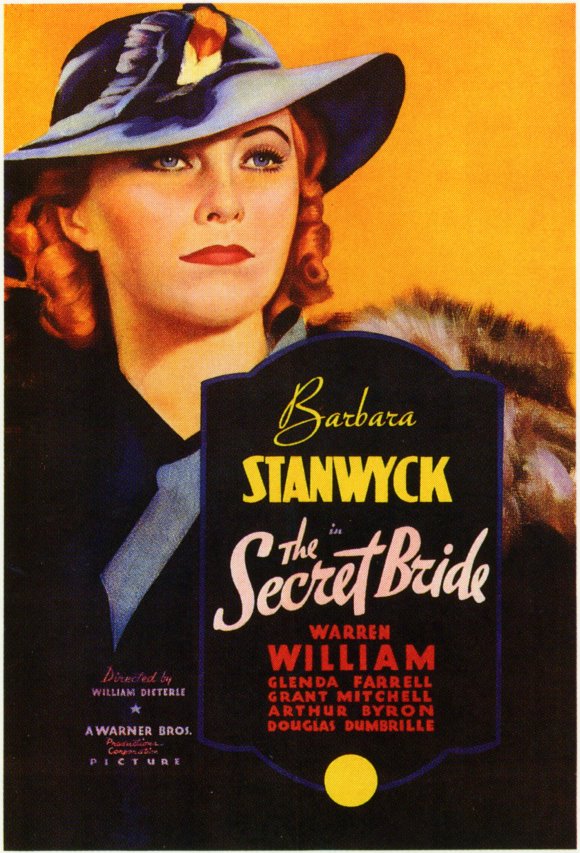
Based on the play by Leonard Ide, The Secret Bride is, on face value, the kind of mystery thriller that Warner Bros. seemed to churn out on a weekly basis throughout the early Thirties, but a closer look reveals a movie with more going on than meets the  eye. Its construction will be familiar to anyone who’s seen similar movies from the era, and the playing is as heartfelt and melodramatic as the script demands, but it’s a movie that plays well on a number of different levels, and uses its bribery and corruption storyline to make several cogent and pertinent observations on the politics of the time.

That it does so is a testament to the professionalism of the cast and crew, and in particular, Dieterle and Stanwyck. Dieterle made the movie because he was contractually obliged to; in addition he thought the script – by Tom Buckingham, F. Hugh Herbert and Mary McCall Jr – was weak. Stanwyck was in a similar position, and wanted out of her contract as soon as possible; after this she made just one more movie for Warner Bros. before returning to the studio in 1941 for Frank Capra’s Meet John Doe. With its director and star both less than enamoured of the project, it still remains an object lesson in how to mount a tightly-focused and entertaining little drama, and make it a better feature than expected. That it only played in a small number of theatres when it was released is discouraging, and perhaps reflects Warner Bros. own concerns over its commercial viability.

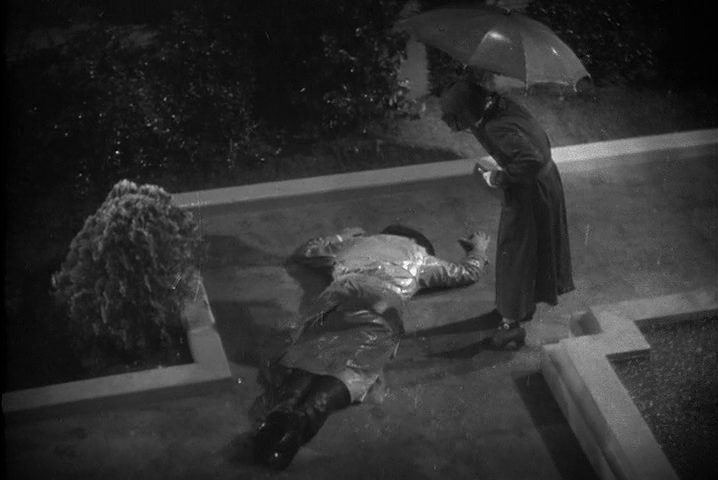
But it is a great little movie, with several directorial flourishes that make up for some of the more (deliberately) pedestrian scenes (Breeden’s death is a perfect case in point, shot from a high vantage point with rain falling and the horrified presence of Hazel Normandie to give it an emotional impact). Dieterle’s preference for low camera angles is a feature of the movie’s look, as is the way in which the camera is allowed to move in close when characters are panicked or anguished or frightened. A lot of this is also due to the presence of the great Ernest Haller behind the camera, and he even manages to make the movie’s static set-ups visually interesting, while Owen Marks’ assured cutting and editing provides the movie with its fast-paced rhythm.

Along with Stanwyck, William and the rest of the cast, Dieterle also teases out some of the script’s obvious subtexts, and explores them thoroughly. While the absence of trust in politics is pushed to the fore, the notion that such an absence is sometimes necessary is also given expression in the Governor’s resignation to his probable fate, as if his treatment by the press and his colleagues is to be accepted as par for the course. Sheldon and Ruth’s keeping quiet about their marriage is cleverly shown as a way of protecting themselves from associated harm and their selfish actions (while allowed to be put aside later on in the movie) go unpunished, adding to the idea that deception and falsity in politics is okay, whether it’s for the “greater good” or not.

As the embattled and battling couple, Stanwyck and William make a great team, sparking off each other in their scenes together. Stanwyck could always be called upon to be glamorous and alluring, but here she’s a muted heroine, her wardrobe reflecting Ruth’s single-mindedness and inner fortitude. William, often the charming rogue, is equally restrained, drawing the viewer in by showing the doubts Sheldon has as the mystery surrounding Holdstock’s death and his father-in-law’s involvement becomes less and less clear-cut. And they’re provided with efficient and formidable support from the likes of Dumbrille (unprincipled co-worker), Farrell (wise-cracking but vulnerable secretary), O’Neill (smoothly objectionable political fixer), Mitchell (devious and scared private secretary), and Byron (principled but naïve career politician). It’s an enviable cast, and everyone is on fine form, creating solid performances and characterisations, and adding to the pleasure to be had from watching the movie in the first place.

Secret Bride, The - scene2

It’s true that the scenario is unremarkable, and the outcome entirely predictable, but then what movie from the period was ever any different? What makes this movie stand out is the attention paid to the characters, and the way in which Dieterle – against his better judgement perhaps – took what he believed to be an unpromising script, and made it as absorbing and compelling (and more so) than many other movies made in the same vein. And that’s to be rightly applauded.

Rating: 8/10 – an unappreciated gem deserving of critical reappraisal, The Secret Bride overcomes its potboiler preconceptions to provide a hour and four minutes of substantial entertainment; Stanwyck and William are on great form, and the whole mystery of the Governor’s innocence is played out with such a convincing touch of ambivalence that it helps the material immensely, and leaves the viewer wondering for quite some time, if he really is as guilty as it seems.

Share this:

  • Click to share on X (Opens in new window) X
  • Click to share on Facebook (Opens in new window) Facebook
  • More
  • Click to print (Opens in new window) Print
  • Click to email a link to a friend (Opens in new window) Email
Like Loading...

Monthly Roundup – September 2015

30 Wednesday Sep 2015

Posted by dullwood68 in Movies

≈ Leave a comment

Tags

12 Rounds 3: Lockdown, Abigail Breslin, Action, Airlock, Alexander and the Terrible Horrible No Good Very Bad Day, Arizona, Axe to Grind, Baseball, Beverly Tyler, Birthday, Brian McGinn, Brighton, Cancer charity, Cattle rustling, Corrupt cops, Crime, Dean Ambrose, Debbie Rochon, Drama, Earl Bellamy, Ferrell Takes the Field, George Montgomery, Georgie Henley, Horror, Insurance fraud, Jennifer Garner, Jim Davis, Jim O'Connolly, John Carson, Josh Gad, Judith Viorst, Keoni Waxman, Literary adaptation, Matt Zettell, Mercenary, Michael Matzur, Michael Steppe, Miguel Arteta, Mira Sorvino, Movie role, Murder, Perfect Sisters, Peter Vaughan, Rob Margolies, Roger R. Cross, Romantic comedy, Sci-fi, Screenwriter, She Wants Me, Short movie, Silver mines, Smokescreen, Stanley M. Brooks, Stephen Reynolds, Steve Carell, Steven Seagal, The Boss, The Toughest Gun in Tombstone, True story, Vacuity, Vinnie Jones, Western, Will Ferrell, Wish, WWE, Yvonne Romain

Smokescreen (1964) / D: Jim O’Connolly / 70m

Cast: Peter Vaughan, John Carson, Yvonne Romain, Gerald Flood, Glynn Edwards, John Glyn-Jones, Penny Morrell, Barbara Hicks, Sam Kydd, Deryck Guyler

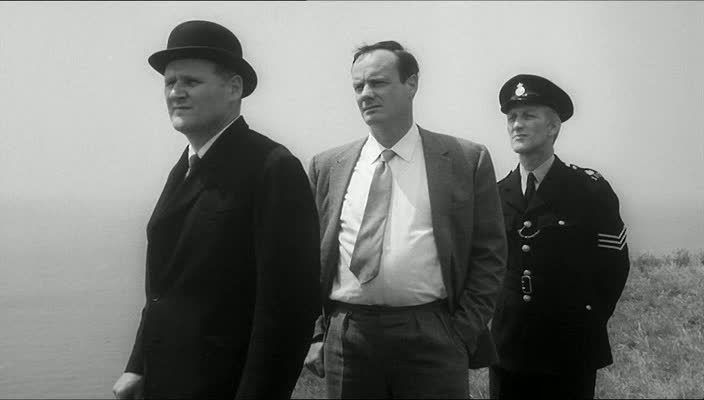
Rating: 7/10 – bowler-hatted insurance fraud investigator Roper (Vaughan) is called in to investigate when a heavily insured businessman’s car bursts into flames before going over a cliff – but was he in it?; a neat, unprepossessing British thriller, Smokescreen features an enjoyable performance from Vaughan, some stunning location photography, and a script that allows for plenty of ironic humour in amongst the drama.

Smokescreen

Alexander and the Terrible Horrible No Good Very Bad Day (2014) / D: Miguel Arteta / 81m

Cast: Steve Carell, Jennifer Garner, Ed Oxenbould, Dylan Minnette, Kerris Dorsey, Sidney Fullmer, Bella Thorne, Megan Mullally

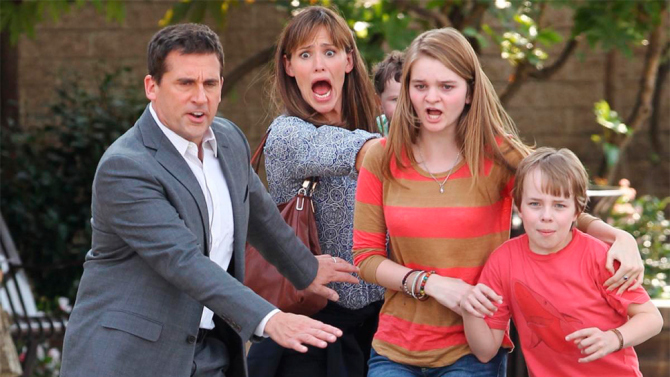
Rating: 7/10 – when overlooked youngest child Alexander (Oxenbould) has the worst day ever, he wishes that his family could experience just a little of what he has to deal with – but when they do, things quickly escalate beyond anything that Alexander has ever faced; Judith Viorst’s novel gets a fun-filled adaptation that is amusing, clever, and visually inventive, but which lacks bite, and has surprisingly few characters to root for (that is, none).

Alexander etc

She Wants Me (2012) / D: Rob Margolies / 85m

Cast: Josh Gad, Kristen Ruhlin, Johnny Messner, Aaron Yoo, Hilary Duff, Melonie Diaz, Wayne Knight, Charlie Sheen

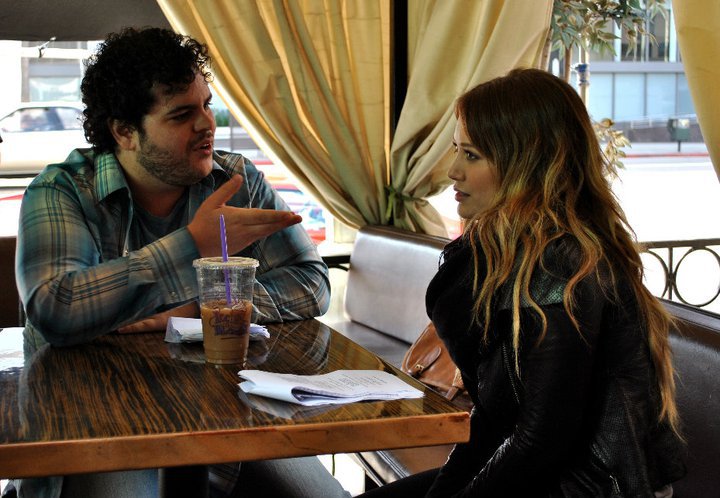
Rating: 6/10 – an ambitious though neurotic writer (Gad) working on his first screenplay faces a dilemma when the role written for his girlfriend (Ruhlin) grabs the attention of an A-list actress (Duff); a romantic comedy with few ambitions that struggles to make good comedy out of anxious indecision, She Wants Me is innocuous stuff that passes by in amiable fashion without ever really involving its audience.

She Wants Me

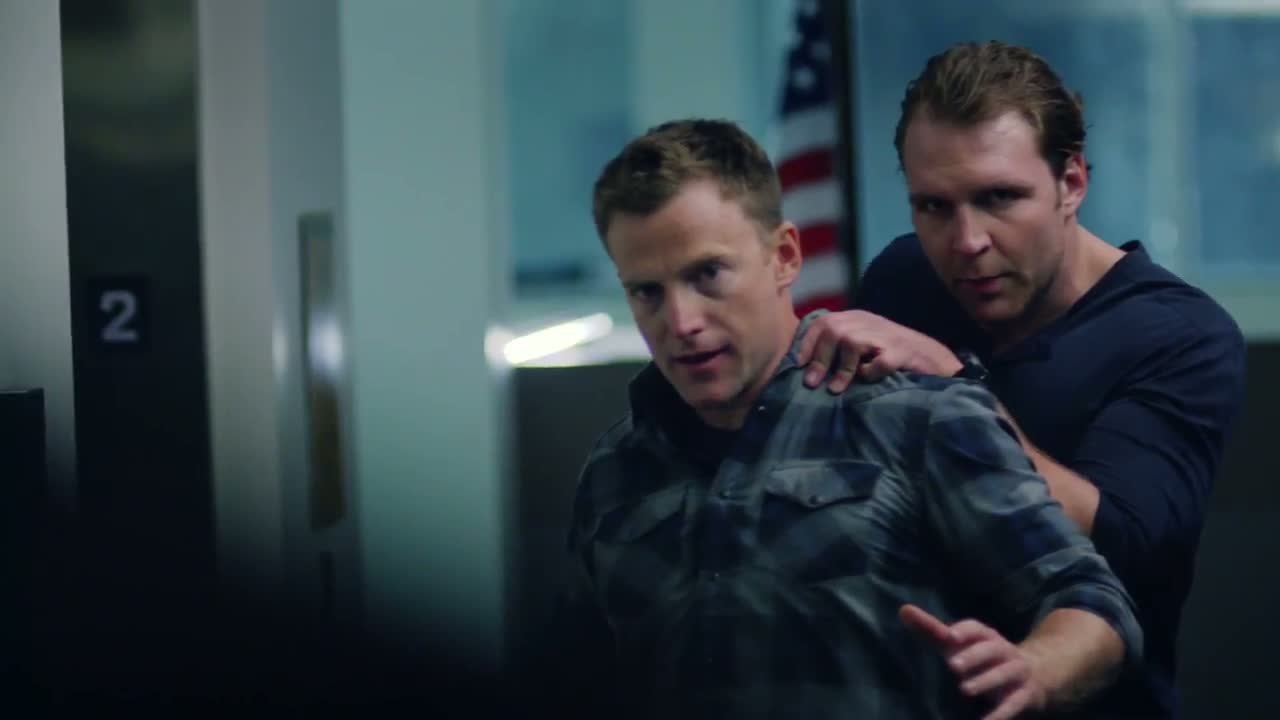
12 Rounds 3: Lockdown (2015) / D: Stephen Reynolds / 90m

Cast: Dean Ambrose, Roger R. Cross, Daniel Cudmore, Lochlyn Munro, Ty Olsson, Sarah Smyth, Rebecca Marshall, Kirby Morrow

Rating: 3/10 – an honest cop (Ambrose) finds himself trapped in a station house and hunted by several of his corrupt colleagues when he comes into possession of evidence that will see them put away for the rest of their lives; another depressing WWE Films action movie, 12 Rounds 3: Lockdown dispenses with the set up of the first two movies, and does its best to be yet another Die Hard rip-off, albeit one stifled by inept plotting, terrible dialogue and a performance by Ambrose that never gets started.

12 Rounds 3 Lockdown

Perfect Sisters (2014) / D: Stanley M. Brooks / 100m

Cast: Abigail Breslin, Georgie Henley, Mira Sorvino, James Russo, Rusty Schwimmer, Zoë Belkin, Jeffrey Ballard, Zak Santiago

Rating: 5/10 – two sisters (Breslin, Henley), fed up with the antics of their alcoholic mother (Sorvino) and her poor choice in boyfriends, decide the only way of improving their lives is to kill her; if it wasn’t based on a true story, Perfect Sisters would be dismissed as absurd nonsense with no basis in reality, but as it is it’s an uneven, tonally awkward movie that features average performances from its leads, but which does seem completely committed to drawing the viewer’s attention to Breslin’s cleavage at every opportunity.

Perfect Sisters

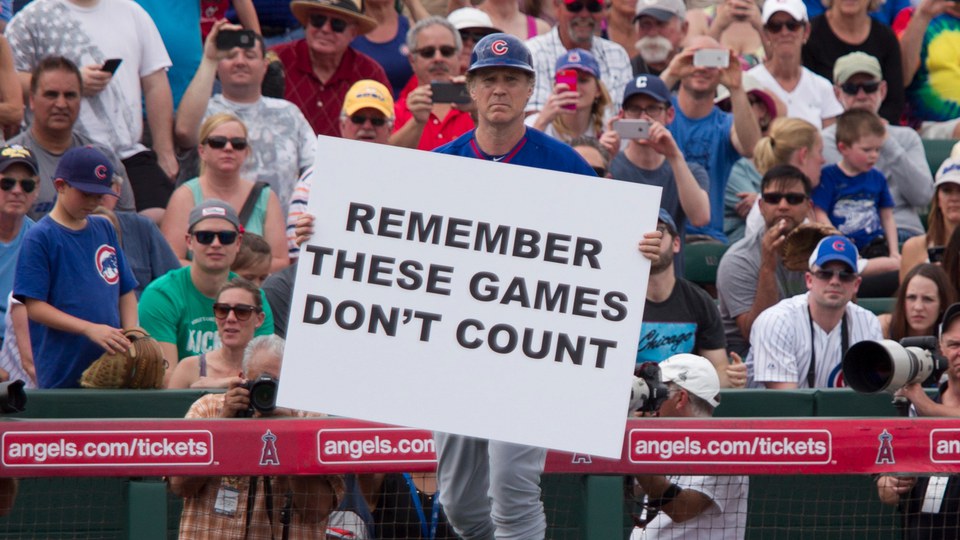
Ferrell Takes the Field (2015) / D: Brian McGinn / 49m

With: Will Ferrell

Rating: 5/10 – in support of a friend’s cancer charity, Will Ferrell takes to the baseball field to play all nine positions for ten major league teams at five separate pre-season games, and all in one day; if the charity had been the Reassure Will Ferrell He’s Still Funny Charity, then this would have made more sense because Ferrell Takes the Field is a mercifully brief documentary that sees the comedian attempt to appear relevant in an arena where he has no real talent, and where, when he gets it wrong, he’s quite rightly booed by fans, leaving viewers to wonder why on earth this idea was commissioned in the first place.

Ferrell Takes the Field

Axe to Grind (2015) / D: Matt Zettell / 81m

Cast: Debbie Rochon, Guy Torry, Matthew James Gulbranson, Paula Labaredas, Michelle Tomlinson, Dani Thompson, Adrian Quihuis, Tony von Halle

Rating: 2/10 – when the producer of her latest film tells aging actress Debbie Wilkins (Rochon) that her role has gone to another, younger actress, it sets her on a killing spree that sees her despatch the cast and crew, and anyone else who gets in her way; low-budget horror always runs the risk of being offensively stupid, and Axe to Grind is no exception, as it treats its audience with disdain while failing to appear as clever and entertaining as it thinks it is.

Axe to Grind

The Toughest Gun in Tombstone (1958) / D: Earl Bellamy / 72m

Cast: George Montgomery, Jim Davis, Beverly Tyler, Gerald Milton, Don Beddoe, Scotty Morrow, Harry Lauter

Rating: 6/10 – with outlaws running most of the nascent state of Arizona, the Governor assigns Matt Sloane (Montgomery) and a team of undercover officers to apprehend the gang involved with cattle rustling and silver thefts; a modest Western that tells its simple story plainly and with few frills, The Toughest Gun in Tombstone is acceptable fare that doesn’t exert itself too much, but is enjoyable nonetheless.

Toughest Gun in Tombstone, The

Absolution (2015) / D: Keoni Waxman / 91m

aka The Mercenary: Absolution

Cast: Steven Seagal, Byron Mann, Adina Stetcu, Vinnie Jones, Howard Dell, Josh Barnett, Maria Bata, Dominte Cosmin

Rating: 4/10 – mercenary John Alexander (Seagal) and his colleague Chi (Mann) find themselves battling both a criminal syndicate and their own corrupt boss when a contract killing proves to have larger ramifications; another mumbling, stand-in heavy performance from Seagal detracts from what is – for him – a better outing than of late, and thanks to Mann’s athleticism and Jones’ snarling villain, any scenes where Seagal doesn’t take part are actually halfway enjoyable.

Absolution

Vacuity (2012) / D: Michael Matzur / 14m

Cast: Michael Steppe

Rating: 6/10 – an astronaut, Alan Brahm (Steppe), stranded in an airlock while the space station he’s on begins to fall apart has a choice: either save his crew by jettisoning the airlock (but dooming himself), or save himself and get back to Earth (and dooming the crew) – which choice will he take?; as moral dilemmas go, the one facing Alan Brahm in Vacuity is, on the face of it, fairly cut and dried, but thanks to Matzur’s script and Steppe’s performance you’re never quite sure how things will play out, or even if either choice will be taken away from him, making this short movie a model of concisely focused drama.

Vacuity

Share this:

  • Click to share on X (Opens in new window) X
  • Click to share on Facebook (Opens in new window) Facebook
  • More
  • Click to print (Opens in new window) Print
  • Click to email a link to a friend (Opens in new window) Email
Like Loading...

Mini-Review: Final Girl (2015)

30 Wednesday Sep 2015

Posted by dullwood68 in Movies

≈ Leave a comment

Tags

Abigail Breslin, Alexander Ludwig, Drama, Hunt, Murders, Review, Thriller, Tyler Shields, Wes Bentley, Woods

Final Girl

D: Tyler Shields / 84m

Cast: Abigail Breslin, Wes Bentley, Alexander Ludwig, Logan Huffman, Cameron Bright, Reece Thompson, Emma Paetz

Following the death of her parents at a young age, Veronica (Breslin) grows up in the care of William (Bentley), who trains her to become an assassin. Years later as a teenager, she’s told about a group of four young men whose idea of fun is to take young women out into the woods and hunt them before killing them. The group is led by Jameson (Ludwig); at the diner where the four meet, Veronica attracts his attention and he insists she meet him there the following Saturday night. Before he meets her he picks up his friends, Shane (Bright), Nelson (Thompson) and Danny (Huffman).

The group take Veronica out to the woods where at first they play a game of truth or dare. When she mentions the name of their last victim, they start to become suspicious, and it leads to a dare called Die. Jameson explains that Veronica will be given a five-minute head start, and then she’ll be hunted down and killed. As she heads off into the woods they’re unaware that the tables will soon be turned on them, and the kind of prey you’re used to hunting will prove to be more than a match for all of them.

Final Girl - scene

With so much unexplained or explored, Final Girl could well be the most frustrating movie of 2015. A degree of mystery is fine in any movie, but here it’s taken to extremes, with motivations, actions and the reasons for certain decisions left out altogether; all any viewer can hope for is that it all makes sense in the end. Sadly, thanks to Adam Prince’s poorly constructed screenplay, it doesn’t, and ends with a scene that adds preposterousness to an already ridiculous mix (the inclusion of some hallucinations doesn’t help either). We never learn why William takes Veronica under his wing, or why he trains her to be an assassin, or why the group do what they do, or how they’ve managed to kill twenty blonde young women and gotten away with it for so long in what appears to be a very small town.

The movie isn’t helped by a visual style that relies on spot lighting to make the woods look like a fairground (at night), and a wintry aesthetic that adds to the movie’s unappealing plot. With its Red Riding Hood overtones and cod-indie dialogue allied to a  hunt sequence that is anything but a hunt sequence, the movie becomes buried under the weight of its ill-conceived storyline(s) and never manages to dig its way out. Breslin is miscast, while Bentley’s efforts to be taciturn and remote seem more of a reflection of his wondering why he agreed to take part, and Ludwig doesn’t even try to make his character anything more than cruelly manipulative (which only goes so far). Shields, making his first feature, is out of his depth, and unable to make more of the script’s shortcomings, leaving the viewer stranded with no lifeline to cling onto. By the movie’s end, all you can hope for is that there won’t be any more of Veronica’s “assignments” in the future.

Rating: 3/10 – to paraphrase a popular saying, “awful is as awful does”, and Final Girl is pretty awful; seriously underwritten, and with the barest connection to credibility, the movie tries to be a psychological thriller without having the remotest idea of how to combine the two elements and make them work.

Share this:

  • Click to share on X (Opens in new window) X
  • Click to share on Facebook (Opens in new window) Facebook
  • More
  • Click to print (Opens in new window) Print
  • Click to email a link to a friend (Opens in new window) Email
Like Loading...

The Overnight (2015)

29 Tuesday Sep 2015

Posted by dullwood68 in Movies

≈ Leave a comment

Tags

Adam Scott, Comedy, Drama, Jason Schwartzman, Judith Godrèche, Love, Marriage, Patrick Brice, Relationships, Review, Sex, Taylor Schilling

Overnight, The

D: Patrick Brice / 79m

Cast: Adam Scott, Jason Schwartzman, Taylor Schilling, Judith Godrèche, R.J. Hermes, Max Moritt

Newly moved to Los Angeles, Alex (Scott) and Emily (Schilling) are both unsure just how successful their move will prove to be. They have a young son, RJ (Hermes), but no friends or family that live nearby; starting afresh is both challenging and scary. Emily goes out to work while Alex stays at home to look after their son. Their sex life is perfunctory and predictable, but they support each other and both are happy with their relationship.

One day at a local park, their son begins to make friends with another boy, Max (Moritt), who is of a similar age. This leads to their being approached by the other boy’s father, Kurt (Schwartzman). He gives them some good advice about getting RJ into a good school, and the three of them find themselves hitting it off, so much so that Kurt invites Alex and Emily to come over for dinner; they can even bring RJ with them. They accept, but when they’re getting ready that evening, their worries about not enjoying the dinner leads to them deciding to leave at the earliest opportunity.

Kurt’s home proves to be spacious and impressive. Alex and Emily are introduced to his wife, Charlotte (Godrèche), who is French, and they all start to get to know each other. Kurt is very artistic: he renovated the house himself, likes to paint (though the recurring theme of his paintings is surprising), and even makes short movies that feature Charlotte (and the content of these movies is also surprising). Despite Alex and Emily becoming more and more uncomfortable with the way the evening is going, they also find themselves fascinated by what might happen next. They’re persuaded to stay longer than they planned, and RJ and Max are put to bed, leaving the adults to continue learning about each other.

It isn’t long before the conversation becomes more personal, though Alex finds his own hang-ups alleviated by what’s said, while Emily becomes even more uncomfortable. When Kurt suggests they all go skinny-dipping in the pool it proves to be a major turning point for both the way the evening is going, and for Alex personally as he confronts one of his major demons. And Emily finds herself going on a trip with Charlotte that results in an experience that she could never have predicted at the beginning of the evening, but which leaves her uncomfortable and confused. It all leads to a moment of confession that reveals a hidden truth about Kurt and Charlotte and their enviable lifestyle, and which also reveals unspoken truths about Alex and Emily.

Overnight, The - scene

The second feature from writer/director/actor Patrick Brice is a complete about face from his first movie, the horror thriller Creep (2014). The Overnight is a comedy about sexual attraction, relationships, hidden desires, emotional and physical honesty, and to a lesser degree, self-loathing. It’s smart, clever, funny, surprisingly wistful, and features four wonderful performances, particularly from Schwartzman, whose impish portrayal of Kurt mines the character for extra layers of depth and is as fully rounded a performance as you’re likely to see all year.

It’s an enjoyable movie that some viewers may find predictable as it picks its way through the minefield of modern marriage, but Brice’s main trick is to keep the dialogue sparkling and fresh, so that by the time Kurt falls back naked into the pool it’s a moment that is both surprising and unnerving – surprising for Schwartzman being completely nude, and unnerving because the viewer is suddenly unsure of just where this movie is going (there’s more than a hint of a swinging motive at play here, but Brice isn’t that obvious). As Alex embraces each twist and turn the evening throws at him, and Emily holds back in her perceived role of the voice of reason, the cracks in their relationship begin to show, and their conservatism is shown to be a mask of self-deception.

Brice cleverly dissects the threads of attraction that exist in all marriages, both internal and external, but isn’t judgmental at all, and he doesn’t encourage his audience to be either. It makes for an intelligent look at the secret fantasies couples keep from each other, and how such fantasies can be harmful if not given proper expression (though it does depend on the fantasy). As the couple who think they’re reading from the same page, Scott and Schilling are both terrific, his nervy apprehensive nature perfectly complementing her outwardly confident demeanour, while in reality these traits are what the other really feels on the inside. Alex has the greater character arc, and his relationship with Kurt is carefully written so as to show the emerging similarities between the two of them, while Charlotte’s French sensibilities and lack of patience with Alex and Emily’s reluctance to be honest with themselves about what they want helps propel the story to its conclusion.

It’s a lively, very humorous tale constructed with a view to hoodwinking the audience at various points. That Brice succeeds in his intentions so easily is partly due to the way in which he makes each revelation about Kurt and Charlotte’s relationship a part of a larger puzzle for the viewer to solve, and the way he structures each revelation around the bemusement that Alex and Emily feel; they’re fish out of water and they flounder accordingly for much of the movie.

Overnight, The - scene2

There are minor quibbles: in comparison to Kurt and Alex, Emily and Charlotte are afforded less screen time and attention; a particular “visual effect” looks unconvincing (as well as uncomfortable); and the emotional boldness on display throughout is undermined by the timidity of the movie’s penultimate scene. That said, Brice is firmly in control in the director’s chair, and the movie is adroitly assembled by editor Christopher Donlon. There’s also some subtly observant camera work courtesy of John Guleserian that keeps things focused and visually interesting, and the whole movie has an enviable pace that maintains the audience’s interest throughout.

Rating: 8/10 – smart, funny, intelligent, honest – The Overnight is all these things and more, and a rare example of a movie that isn’t afraid to explore the secret motives and desires of married couples; with its quartet of candid performances and Brice’s assured direction it’s a movie with so many nuances it bears a second, equally rewarding, viewing.

Share this:

  • Click to share on X (Opens in new window) X
  • Click to share on Facebook (Opens in new window) Facebook
  • More
  • Click to print (Opens in new window) Print
  • Click to email a link to a friend (Opens in new window) Email
Like Loading...

Tremors 5: Bloodlines (2015)

28 Monday Sep 2015

Posted by dullwood68 in Movies

≈ 2 Comments

Tags

Ass Blasters, Burt Gummer, Cradle of Humankind, Don Michael Paul, Drama, Graboids, Horror, Jamie Kennedy, Michael Gross, Pearl Thusi, Review, Sequel, South Africa, Thriller, Wildlife reserve

Tremors 5 Bloodlines

D: Don Michael Paul / 99m

Cast: Michael Gross, Jamie Kennedy, Pearl Thusi, Daniel Janks, Ian Roberts, Zak Hendrikx, Nolitha Zulu, Rea Rangaka, Brandon Auret, Sello Sebotsane

After successfully hunting down and restricting Graboid outbreaks to the south-western United States, Burt Gummer (Gross) is restyling himself as a survivalist. He films his treks into the wilderness with the aid of a cameraman, but when his regular cameraman is replaced by bike-riding, smart-talking Travis Welker (Kennedy), Burt isn’t too pleased by his attitude or his suddenly showing up out of the blue. While Travis tries to tell Burt how he can improve his profile, they’re interrupted by the arrival of a South African called Erich Van Wyck (Janks). Van Wyck tells Burt there is a problem with Graboids in a wildlife reserve, and he wants him to travel there to help solve the problem. Naturally, Burt agrees, and Travis goes with him to document everything.

At the wildlife reserve, Van Wyck introduces them to their guide, Johan (Auret), and the facility’s doctor, Nandi Montabu (Thusi). An attack on an archaeological dig reveals the existence of a different form of Graboid, and while Burt tries to figure out how these particular creatures have come to exist and why they don’t behave in the same way as their American counterparts, the attacks become more frequent and claim more lives. The discovery of an egg leads to the realisation that somewhere there’s a nest, and if they’re allowed to hatch then the area will be overrun. But Burt’s plan to eradicate them is foiled by Van Wyck who reveals a different plan for the Graboids – one that has the potential to put a lot more people in danger, and not just in South Africa.

Tremors 5 Bloodlines - scene

Eleven years after we last saw Michael Gross as a member of the Gummer family, in the wonderfully left-field Tremors 4: The Legend Begins (2004) (where he played Burt’s ancestor, Hiram), the trigger-happy, gun-loving “survivalist” is back, and though as expected this fourth sequel to the 1990 original is severely let down by a lazy, focus-lite script, it’s good to see the man back again, and doing what he does best: blasting Graboids, because he can. It’s a good thing too, because without him the movie would be a complete disaster, with only some unexpectedly impressive creature designs to save the day. (Forget about the rest of the cast, who range from perpetually annoying – Kennedy, Auret – to mildly embarrassing – Thusi, Janks – to just plain woeful – the couple at the archaeological dig.)

Any film with a 5 in the title is always going to be a bit suspect when it comes to quality, but here, with the participation of series’ creators Brent Maddock and S.S. Wilson reduced to providing the storyline only, the finished script by Woodrow Truesmith, M.A. Deuce, and John Whelpley is a hodgepodge of dreary dialogue, lazy character motivation, clumsy nods to the other movies in the franchise, a blatant steal from Jurassic Park (1993), and a couple of moments of casual racism. It’s all put together in unconvincing style by Paul, who’s made a career (of sorts) out of directing rubbish sequels such as Lake Placid: The Final Chapter (2012), Jarhead 2: Field of Fire (2014), and the upcoming – God help us all – Kindergarten Cop 2 (2016). Between Paul and DoP Michael Swan, the movie looks like it was shot by someone with very bad Parkinson’s, and Vanick Moradian’s editing is so uneven it looks as if the footage used in the final cut was chosen at random.

It’s a shame, as the Tremors series has, by and large, been a source of surprising thrills and sometimes wicked humour, as well as introducing us to a monster that exists with a clear set of boundaries as to its behaviour. This movie abandons that idea, but in trying to expand the threat – flying Graboids anyone? – it merely reinforces how lazy it all is. And even though Gross is the icing on the cake in the previous movies, here he’s the icing, the cake, and the cake stand as well.

Rating: 3/10 – bottom of the barrel stuff that “ass blasts” over the series’ legacy, and doesn’t even have the courtesy to pretend to care, Tremors 5: Bloodlines is far and away the worst instalment yet, and should remain the last; dead in the water from the word go, this gets by on Gross’s professionalism and little else, while every frame serves as a reminder of just how good the original movie was.

Share this:

  • Click to share on X (Opens in new window) X
  • Click to share on Facebook (Opens in new window) Facebook
  • More
  • Click to print (Opens in new window) Print
  • Click to email a link to a friend (Opens in new window) Email
Like Loading...

Ashby (2015)

27 Sunday Sep 2015

Posted by dullwood68 in Movies

≈ Leave a comment

Tags

Assassin, CIA, Drama, Emma Roberts, Football, High School, Mickey Rourke, MRI scanner, Nat Wolff, Old people, Review, Sarah Silverman, Tony McNamara, Wide receiver

Ashby

D: Tony McNamara / 103m

Cast: Mickey Rourke, Nat Wolff, Emma Roberts, Sarah Silverman, Kevin Dunn, Zachary Knighton, Michael Lerner, John Enos III

Seventeen year old Ed Wallis (Wolff) and his mother, June (Silverman), have moved into a new neighbourhood following June’s divorce from Ed’s father. Ed is a self-contained, quietly determined, well-read teenager who is struggling to make sense of his life and where it’s going. When his English teacher instructs Ed’s class to write a report about an “old person” – one they actually have to talk to – Ed decides to write his report about his neighbour, Ashby Holt (Rourke).

Unknown to Ed, Ashby has a brain tumour that has left him with only three months left to live. When Ed knocks on his door, Ashby tales advantage of the situation, and in return for talking to Ed about his life, gets him to drive Ashby around. On their first trip, Ashby tells Ed he was a napkin salesman, but later, when Ed helps Ashby through a potential seizure, he discovers that this particular “napkin salesman” has a small arsenal of weapons in his basement and a clutch of passports in different names. Despite Ed’s attempts to cover his tracks, Ashby knows what’s happened, and the next day he and Ed go for a drive where he reveals that he was actually a CIA assassin, and has killed over ninety people. When Ed asks him if he has any regrets or doubts about what he did, Ashby’s response isn’t as unequivocal as Ashby himself would have liked.

Back in high school, Ed attracts the attention of Eloise (Roberts), a student whose class project involves her studying the effect of violent collisions on the brains of the football team. Ed wants to be a part of the team, but his slight frame and nerd-like appearance doesn’t inspire much confidence, but when he reveals his talent as a wide receiver, he wins his place. Meanwhile, Ashby becomes concerned that one of the people he killed wasn’t as deserving as he believed at the time. When he looks into the man’s life and career, Ashby discovers that his bosses lied to him, and he determines to make amends before he dies, even if it means their deaths. While Ashby searches for redemption, Ed tries his best to deal with his mother’s habitual dating (and inferred one night stands), his father continually failing to visit him, his fear of being hit during a football match, and navigating the tricky waters of his relationship with Eloise. And then he learns about Ashby’s latest “mission”…

Ashby - scene

A coming-of-age tale that features a handful of winning performances, and an uneven but engaging storyline, Ashby is an independent feature that just about works thanks to the spirited commitment of its cast and the relative originality and quirkiness of the script by director McNamara, who also made the wonderful The Rage of Placid Lake (2003).

As a coming-of-age tale the movie relies heavily on making Ed a bit of a coward, and he’s whiny too, justifying his reluctant behaviour at every turn and always making excuses for the people around him, such as his father, whom he always speaks well of, even when they don’t deserve it. Ed is continually defending these people, even the jock who assaults him; he spends so much time understanding why people treat him so badly, this very “understanding” marks him out as one of Life’s perennial victims. He also complains too much when things don’t work out as he’d like them to, which leads to Ashby telling him he’s got to stop “bitchin’ like a sheep on crystal meth”. With all this, it’s a tribute to Wolff’s performance that the viewer doesn’t dislike Ed on principle, and it’s a further tribute that when things do start to go right for him, the viewer is completely on his side and urging him on.

But while Ed’s journey is paved with good intentions rarely achieved, Ashby’s is more soulful and melancholic. As he helps Ed manoeuvre the minefield that is becoming an adult, Ashby looks to put his affairs in order before he’s reunited with his wife and daughter in the afterlife (even though he knows there’s no guarantee he will be). There’s a sombre, religious and philosophical consideration here that doesn’t quite fit in with Ashby’s character as a whole, and there’s a scene where he visits the local priest (Knighton) for absolution that holds up the movie and feels out of place, mostly because this takes place during the period he’s looking to “take care” of his old bosses. That said, Rourke is on terrific form as Ashby, his usual mannered approach to a role here left off and replaced with a restrained, careful take on a character that could so easily have been a caricature if it weren’t for the combination of Rourke’s portrayal and McNamara’s writing (and for once, it looks like Rourke is really enjoying himself).

Where McNamara does stumble though is in his treatment of the secondary characters, with Roberts’ Eloise possessing the kind of confidence and self-awareness that only teenage females in the movies have, while Silverman’s love-hungry June openly admits to Ed that she likes sex in a scene that again, is only likely to happen in the movies. The writer/director also has trouble judging the length of a scene, leaving some to run on (the locker room scenes), while others feel truncated (the early scenes between Ed and his mother). But even though these problems intrude from time to time and break the movie’s rhythm, they’re not enough to ruin the mood of the piece as a whole, which finds clever ways to celebrate both the beginning of one adult life and the end of another.

First and foremost a drama, Ashby finds room for some much-needed and relishable humour, from some terrific one-liners to occasional visual gags that are as unexpected as they are hilarious, and McNamara is often on surer ground in these instances. But it’s Rourke and Wolff who make this work so well, their scenes together displaying a keen sense of timing with both actors sparking off each other to great effect. Aided by some very crisp, stylish photography from Christopher Baffa, and a succinct, gently supportive score by Alec Puro, the movie overcomes many of its failings to become a heartfelt, meditative examination of an unlikely but mutually rewarding friendship.

Rating: 7/10 – some viewers may feel that Ashby is too good-natured or lightweight to be entirely successful, but it has a likeable, winning nature that’s hard to ignore, and what it has to say it says without too much prevarication or pontificating; with Rourke giving one of his best performances for quite some time, and Wolff reminding audiences just why he’s one of the best young actors working today, the movie is a small-scale treat that would have benefitted from some judicious script editing and a more streamlined storyline, but still retains a charm all its own.

Share this:

  • Click to share on X (Opens in new window) X
  • Click to share on Facebook (Opens in new window) Facebook
  • More
  • Click to print (Opens in new window) Print
  • Click to email a link to a friend (Opens in new window) Email
Like Loading...

Fantastic Four (2015)

26 Saturday Sep 2015

Posted by dullwood68 in Movies

≈ 1 Comment

Tags

Drama, Jamie Bell, Josh Trank, Kate Mara, Marvel, Michael B. Jordan, Miles Teller, Mr Fantastic, Origin story, Reboot, Review, Sci-fi, Stan Lee, Superheroes, The Human Torch, The Invisible Woman, The Thing, Tim Blake Nelson, Toby Kebbell, Victor Von Doom

Fantastic Four

D: Josh Trank / 100m

Cast: Miles Teller, Michael B. Jordan, Kate Mara, Jamie Bell, Toby Kebbell, Reg E. Cathey, Tim Blake Nelson

Telephone call from Fantastic Four director Josh Trank to Marvel head Stan Lee:

Trank: Hi, is that Stan Lee?

Lee: Yes. Who’s this?

Trank: Hi, it’s Josh Trank, I’m directing the new Fantastic Four movie.

Lee: How’s it going?

Trank: It’s going very well, very well indeed. I think you’re going to be pleasantly surprised.

Lee: That’s good. I hear you’ve made some interesting casting choices.

Trank: That’s true, but I think Toby Kebbell will be the definitive Victor Von Doom.

Lee: Ah, that wasn’t what I meant… Anyway, what can I do for you?

Trank: Well, I was calling to find out when you can come out to Louisiana to film your cameo role.

Lee: I’ll need to get back to you on that. I’m really snowed under at the moment. By the way, can you let me see any footage if you have some?

Trank: Sure, we’ve got some great early footage of Reed and Ben as grade school kids, and then seven years later when they’re played by Miles Teller and Jamie Bell.

Lee: Seven years? Okay… Well, if you could let me see it, that would be great.

Trank: Okay, I’ll get it sent to you.

Lee: Great. And I’ll let you know about the cameo.

Trank: Terrific. Well it was great talking to you. You take care now.

Lee: You too. Bye.

Trank: Bye.

Fantastic Four - scene

E-mail sent from Stan Lee to Josh Trank six days later:

Dear Josh – Thanks for sending the early footage, it was… illuminating. I don’t think I’ll be able to find the time to film a cameo, though.

Rating: 3/10 – when your superhero team only works together as a team out of narrative necessity, and the actors portraying that team appear to have all the chemistry of fire and water, then you know you’re in trouble – unless you’re Josh Trank, writers Jeremy Slater, Simon Kinberg (and Trank), and the executives at Twentieth Century Fox, in which case you plough on hoping that no one will notice just how bad the reboot you’re making really is; an appalling mess that features a badly rendered Human Torch to add insult to injury, Fantastic Four is enough to make viewers pine for the 2005 and 2007 movies that should now be reassessed in the light of this movie’s failure to provide anything other than an incoherent plot, dreadful dialogue, even worse characterisations, and one of the all-time worst superhero movies ever (seriously, even Roger Corman’s 1994 version is more enjoyable than this farrago).


Share this:

  • Click to share on X (Opens in new window) X
  • Click to share on Facebook (Opens in new window) Facebook
  • More
  • Click to print (Opens in new window) Print
  • Click to email a link to a friend (Opens in new window) Email
Like Loading...

The Gamechangers (2015)

25 Friday Sep 2015

Posted by dullwood68 in Movies

≈ Leave a comment

Tags

Bill Paxton, Daniel Radcliffe, Devin Moore, Drama, Grand Theft Auto San Andreas, GTA, Jack Thompson, Joe Dempsie, Murders, Owen Harris, Review, Rockstar, Sam Houser, Sex scene, True story, Video games

Gamechangers, The

D: Owen Harris / 90m

Cast: Daniel Radcliffe, Bill Paxton, Joe Dempsie, Mark Weinman, Ian Keir Attard, Fiona Ramsay, Shannon Esra, Garion Dowds, Thabo Rametsi, Gideon Lombard

Following the release of Grand Theft Auto: Vice City, eighteen-year-old Devin Moore (Rametsi) is arrested for stealing a car. At the police station, he disarms an officer and shoots him dead. He kills two more officers before escaping in a police car. When he’s apprehended, a link emerges between his actions and Vice City: Moore has copied one of the scenarios in the game. This claims the attention of Florida lawyer Jack Thompson (Paxton), a fiercely moralistic man who feels that the makers of the game are complicit in Moore’s crimes. He travels to Alabama in order to represent the victims’ families in a civil suit against the makers, Rockstar Games.

Meanwhile, Sam Houser (Radcliffe), the British-born co-founder and president of Rockstar Games, has decided that their next release will be bigger, better and more realistic. Always looking to improve both the content and the format of their games, Houser pushes for a sex scene to be included in their next Grand Theft Auto release, even though his closest colleagues, including his brother Dan (Attard), and fixer Jamie King (Dempsie), aren’t convinced it’s a good idea. When Houser learns of Thompson’s civil suit he rails against the notion that Rockstar is any way responsible for Moore’s actions. While Thompson looks for evidence to support his assertion that violent video games can influence people into behaving violently themselves, Rockstar hires a firm of corporate lawyers to represent them. But Thompson’s enthusiasm for the case proves to be its downfall, and the judge throws it out.

Rockstar press ahead with the release of their next instalment, Grand Theft Auto: San Andreas, but the inclusion of the sex scene proves problematical: if it’s included it will seriously effect the game’s potential sales. Houser bows to pressure from his close colleagues and orders the scene removed. The game is released and is a huge success, but a short time after, a modder (a person who modifies existing software or hardware) in Holland, Patrick Wildenborg (Lombard), finds the code for the sex scene hidden within the game. He renders the code into rudimentary animation and posts it on YouTube. When the post goes viral, and Rockstar are charged with misleading both their customers and the body that regulates the video game industry, it leads to a federal investigation, and gives Thompson a second chance to make Rockstar and other video game makers accountable for the content of their games.

WARNING: Embargoed for publication until 00:00:01 on 08/09/2015 - Programme Name: The Gamechangers - TX: n/a - Episode: n/a (No. 1) - Picture Shows: Terry Donovan (MARK WEINMAN), Sam Houser (DANIEL RADCLIFFE) - (C) BBC Scotland © 2015; Moonlighting NNN Productions (Pty) Limited: African Photographic C.C. - Photographer: Joe Alblas

Made for TV by the BBC, The Gamechangers sets out its stall right from the outset by stating that while it’s based on real events, scenes have been altered for dramatic effect. But while this seems entirely laudable, what it actually does is to make the viewer unsure if what they’re seeing is either next door to the truth or living in the next town. Certainly, Rockstar has disavowed the movie for containing a number of inaccuracies, and there are several moments where the likelihood of James Wood’s script being as factual as it should be are easily questioned, but what hurts the movie more than all this is the unfortunate way in which it takes the idea of violent video games causing impressionable game players to act out those violent fantasies, and does nothing with it.

What we’re left with is Thompson’s principled railings against the “filth” he sees in the games tempered with Houser’s insistence that they’re in no way to blame for Moore’s behaviour, and these confident outbursts are repeated over and over, as if the viewer would be unable to work out either hypothesis for themselves. Add a number of scenes designed to show both men’s commitment to their individual causes, and how their single-mindedness affects the people around them, the movie becomes less about issues of violence and more about what drives both Thompson and Houser to be so committed in their respective arenas. Alas, this isn’t as interesting or engaging as the movie thinks it is, and gives both Radcliffe and Paxton little room to provide well-rounded portrayals, or make much of the repetitive dialogue.

With the movie lacking focus, any drama feels either overdone or forced, particularly in the relationship between Houser and King, which becomes increasingly adversarial as the movie progresses, but seems based purely around King’s lack of time off. Harris seems unable to overcome these problems, and many scenes seem designed to pad out the running time, whether it’s another example of Houser’s dismissive attitude towards his staff, or Thompson’s unresolved anger at not being able to find the justice he’s seeking. By the time the viewer learns how the federal investigation pans out, and the result of an investigation into Thompson’s competence as a lawyer is revealed, the flatness of the drama is too apparent to make it compelling.

As a result, the performances range from the pedestrian to the merely satisfactory, with Radcliffe and Paxton both stranded by the script, and the supporting cast left to fend for themselves. Only Rametsi impresses, making Moore a blank-faced killer with no real conception of whether he’s living in the real world or the confines of a video game (Moore is still on Death Row awaiting execution by lethal injection). And despite occasional attempts to make the visuals more interesting, Gustav Danielsson’s cinematography is mostly perfunctory and uninspired, leaving no room for the movie to impress in other areas. There’s a decent movie to be made out of the events that followed Moore’s kill-spree, but this isn’t it.

Rating: 4/10 – an opportunity that’s been missed by a very wide margin indeed, The Gamechangers challenges the audience’s patience throughout, and never settles on which story it really wants to tell, Houser’s or Thompson’s; blandly made, and with an awkwardness that never resolves itself, potential viewers should lower their expectations before they start watching.

Share this:

  • Click to share on X (Opens in new window) X
  • Click to share on Facebook (Opens in new window) Facebook
  • More
  • Click to print (Opens in new window) Print
  • Click to email a link to a friend (Opens in new window) Email
Like Loading...

D.W. Griffith Double Bill – The House of Darkness (1913) and The Mothering Heart (1913)

24 Thursday Sep 2015

Posted by dullwood68 in Movies

≈ Leave a comment

Tags

Affair, Asylum, Charles Hill Mailes, Claire McDowell, D.W. Griffith, Drama, Lillian Gish, Lionel Barrymore, Marriage, Mental illness, Review, Silent movies, Walter Miller

House of Darkness, The

The House of Darkness (1913)

D: D.W. Griffith / 17m

Cast: Lionel Barrymore, Claire McDowell, Charles Hill Mailes, Lillian Gish, Christy Cabanne, Robert Harron, William Elmer

In an asylum for people with “disordered minds”, a young nurse (McDowell) is wooed by one of the doctors (Barrymore). Their courtship leads to marriage, and a happy one at that. Meanwhile, one of the inmates, an older man (Mailes) who has clearly seen better times, wanders around quite calmly and with a dazed expression that speaks of his confusion. But when he suddenly turns violent, and for no apparent reason, he has to be physically restrained. As he struggles against the orderlies restraining him, the sound of a piano being played nearby by one of the other nurses (Gish), proves successful in calming down the old man, and returning him to his former docile state.

The hospital staff make a note of this, and the nurse is encouraged to play the piano whenever the man shows signs of aggression. However, it isn’t long before the man has another psychotic episode; in the process he escapes from the grounds of the asylum. He attacks two men in a park, and manages to wrest a gun from one of them. With orderlies and the police in pursuit, he flees the park and eventually finds himself outside the home of the recently married nurse and doctor. He breaks in, and discovers the nurse there by herself…

House of Darkness, The - scene

An interesting, well-made movie that shines an unexpectedly sympathetic spotlight on the mentally ill, Griffith’s even-paced, non-melodramatic portrayal of the “insane” (only once is the old man referred to as a lunatic), The House of Darkness is a perfect metaphor for the mind of a man with mental health problems. Without a strait-jacketed or gibbering madman in sight, this is still a powerful cry for a better understanding of those whose minds have betrayed them, and is remarkably “modern” in the way in which the old man’s mania is dealt with (even if it is based on the idea that “music hath charms to soothe the savage breast”).

With Barrymore and McDowell reduced to supporting players once their marriage is established it falls to Mailes to be the focus of the movie, and he gives a poignant, affecting performance that belies his usual role as a patrician elder, and also serves as a reminder that silent movie acting wasn’t always all declamatory hand gestures and facial gurning. Mailes has the viewer’s sympathy from the start, and even when he goes berserk, there’s always the sense that he can’t help what he’s doing and that he still deserves our understanding. Griffith, by now such an assured presence behind the camera that every shot and every camera placement provides information for the viewer to react to, keeps things from being too dramatic, and lets the story unfold with a grim fatalism that is thankfully derailed in the movie’s climax.

With the script having been written by the appropriately named Jere F. Looney (or unfortunately named, depending on your point of view), The House of Darkness is a solid, unspectacular yet moving account of madness and the burden it bestows on those affected by it. And in its own way, it’s as much an affecting drama as it is a gripping thriller.

Rating: 8/10 – a good example of Griffith subverting his audience’s expectations in terms of the movie’s approach to the subject matter, and bolstered by a great performance by Mailes, The House of Darkness is both illuminating and inspiring; a small-scale triumph and as relevant now as it was back then.

Mothering Heart, The

The Mothering Heart (1913)

D: D.W. Griffith / 29m

Cast: Walter Miller, Lillian Gish, Kate Bruce, Viola Barry, Charles West

A young woman (Gish), romantically involved with a young man called Joe (Miller), allows herself to be persuaded to marry him. They move into their new home but money is tight, and Joe is weighed down by his lack of success at work. His new bride earns extra money taking in ironing, and she’s pleased to do so, believing that it will only be a matter of time before her husband begins to earn better money. After a period where he returns home each night feeling more melancholy than the last, he finally has some good news: a welcome bonus. Joe wants to celebrate, and he tells his wife to get dressed to go out, but what she has to wear is neither new nor fashionable.

They go to a nightclub where Joe attracts the attention of a woman (Barry) sitting at the next table. His wife becomes aware of this and insists they leave, but a chance encounter with the woman leads to Joe neglecting his wife and spending more and more time with her, and in the same nightclub. When she finds out what he’s doing, she resolves to leave him. When she does, Joe is only momentarily upset, and continues to spend time with his new flame. His wife, meanwhile, goes back to living with her mother (Bruce), and without telling her husband that she’s expecting their child…

Mothering Heart, The - scene

By the time of The Mothering Heart, Griffith was looking ahead to making feature length movies, but this didn’t mean that he was restless or putting any less of an effort into his short features. Here he pulls no punches in highlighting the pitiful surroundings of the young married couple, and contrasting them with the gaudy excesses of the nightclub, with its ornate furnishings and impeccably attired clientele. Through this juxtaposition he shows just how easy it is for young men to forget what’s really important in their lives, and how it can just as easily drain the love of a young bride for her husband. It’s a simple tale, and while Griffith’s approach is simple as well, he also makes Joe’s deception and its consequences tremendously emotive.

Of course, he’s aided immeasurably by Gish. It’s a little hard to credit, but at the time the movie was made, Gish was still only twenty, but in the scene where she first suspects her husband is deceiving her, she finds a glove in his coat pocket. At first she’s glad to find it, thinking it’s a present from him, but when she realises there’s only one, her expression begins to change from happiness to disappointment, all there for the audience to see as she stares into the camera. It’s a bravura moment, and beautifully crafted, as her faith in her husband is taken from her in a matter of seconds.

For all its passion and heartfelt melancholy, The Mothering Heart is also quite a restrained movie in terms of its look and the way in which Griffith uses fixed camera set ups throughout. This is a movie that is content to observe its characters and their actions, and its no frills approach adds beautifully to the carefully constructed mise en scene, the simple story allowed to be the focus and with little in the way of any distractions or irrelevancies (except for the nightclub dancers, that is).

Rating: 8/10 – with a tremendous performance by Gish, and assured, impressive direction from Griffith, The Mothering Heart is one of the very best of his American Biograph movies; powerful and moving, and visually striking, it’s a movie that rewards on far more levels than you’d expect, and paints a sobering portrait of young love undone.

Share this:

  • Click to share on X (Opens in new window) X
  • Click to share on Facebook (Opens in new window) Facebook
  • More
  • Click to print (Opens in new window) Print
  • Click to email a link to a friend (Opens in new window) Email
Like Loading...

Trailer – Meadowland (2015)

23 Wednesday Sep 2015

Posted by dullwood68 in Movies

≈ Leave a comment

Tags

Drama, Luke Wilson, Olivia Wilde, Preview, Reed Morano, Trailer

The first feature from cinematographer Reed Morano – Kill Your Darlings (2013), The Skeleton Twins (2014) – is a searing portrait of a couple desperately trying to cope in the aftermath of a terrible tragedy. Uncompromising and unflinching, it stars Olivia Wilde and Luke Wilson as the rapidly unravelling couple, and features a strong supporting cast that includes Giovanni Ribisi, Juno Temple and John Leguizamo. Not for all tastes, certainly, but for those who like their dramas to be bold and emotionally devastating, this looks like it will fit the bill completely.

Share this:

  • Click to share on X (Opens in new window) X
  • Click to share on Facebook (Opens in new window) Facebook
  • More
  • Click to print (Opens in new window) Print
  • Click to email a link to a friend (Opens in new window) Email
Like Loading...

Cooties (2014)

22 Tuesday Sep 2015

Posted by dullwood68 in Movies

≈ 1 Comment

Tags

4th grade, Alison Pill, Cary Murnion, Comedy, Drama, Elijah Wood, Fort Chicken, Horror, Infected meat, Jonathan Milott, Leigh Whannell, Pupils, Rainn Wilson, Review, Teachers, Virus, Zombies

Cooties

D: Jonathan Milott, Cary Murnion / 88m

Cast: Elijah Wood, Rainn Wilson, Alison Pill, Jack McBrayer, Leigh Whannell, Nasim Predad, Ian Brennan, Jorge Garcia, Cooper Roth, Miles Elliot, Morgan Lily, Sunny May Allison, Armani Jackson, Peter Kwong

Clint Hadson (Wood) is a would-be writer who finds himself back in his home town of Fort Chicken and making ends meet as a substitute teacher at the same elementary school he attended fifteen years ago. On his first day he finds the teachers are an odd mix, while the pupils in his class, particularly Patriot (Roth), are an unruly bunch who give him a hard time. Another of the pupils in his class, Shelly (Allison), is being bullied by Patriot but when he tugs at a ponytail and it comes off in his hand leaving a raw open wound where it was attached only seconds before, he finds himself being attacked by Shelly and having a chunk taken out of his cheek. Shelly runs off after the attack, while Clint takes Patriot to the nurse’s station.

Talking about it afterwards in the teachers’ lounge with Lucy McCormick (Pill), who was at school with Clint at the same time, they are oblivious to the situation that’s developing outside in the playground, as Shelly infects Patriot’s friend, Dink (Elliot), and he in turn begins infecting the other children. As the children’s behaviour turns savage, some of the teachers try to intervene but they’re quickly overwhelmed… and eaten. At the same time, PE teacher Wade Johnson (Wilson) – who’s shooting hoops in a corner of the playground – and the rest of the staff who are watching from the teachers’ lounge, begin to realise that what they’re seeing is an outbreak of zombie children.

Wade makes it back inside the school building, but the now ravenous pupils soon find their way in, and the remaining teaching staff hole up in the music room for safety; along the way they find Calvin (Jackson) who is unaffected. Wade is all for making a dash for his truck, while Clint thinks they should try and get help from the outside. But Lucy has a better idea: they should wait until 3pm when the parents arrive to pick up their children, and signal to them from the roof. But when the time comes only one parent arrives and she’s despatched as quickly as she arrived. Clint and the rest now head down to the hall where they find another unaffected child, Tamra (Lily). And when the hall is overrun, it’s the janitor, Mr Hatachi (Kwong), who comes to their rescue. Now barricaded in the basement, and with no choice but to find a way out, Clint and Wade come up with an idea between them that, if all goes well, will see them free of the school and its murderous pupils.

Cooties - scene

These days, zombie movies are a dime a dozen, and most are instantly forgettable, so any movie using them as the central protagonists really needs to bring something new and/or different to the table. And thanks to Leigh Whannell, creator of the Saw and Insidious franchises, Cooties certainly fits the bill, taking the (accepted) innocence of youth and destroying it with unrestrained malice. The idea of feral kids isn’t a new one, but here it’s taken to the extreme, with teachers being torn limb from limb, and entrails spread about with gory abandon. It’s a bloody exercise that’s reminiscent of the inmates taking over the asylum, but done here with a layer of crass humour to offset the blood spatters.

Be warned though: the movie isn’t as polished, or as funny as the trailer makes out, thanks largely to the script’s decision to keep the teachers moving from one breachable room to another, and by some poor choices when it comes to some of the characters’ quirks and foibles (Pedrad’s angry feminist practically accuses Clint of being a potential rapist without being properly introduced, while Tracy (McBrayer) talks about his partner’s lovely balls – his tennis partner that is). When the movie attempts to subvert the genre it’s on firmer ground, as when Whannell’s scientifically knowledgeable Doug announces he’s discovered the cause of the outbreak to be a virus, and has done so by rooting around in Clint’s vomit and “anal leakage”; when the rest of the staff voice their disgust he rebukes them by saying he wore gloves – and holds up his hands which are clearly glove-free.

Making children into zombies turns out to be a whole lot of fun by itself, and the young cast are clearly having fun with it all, especially Roth and Allison who are the Adam and Eve of the zombie outbreak. The kids aren’t funny at all (which is a relief), and their ferocity is well-gauged, leaving the humour to the adults, and in particular to Wilson, whose bullish PE teacher is ill-equipped to deal with the finer emotions such as love and trust, and who finds it impossible to say “dual rear wheels” (one of the movie’s funnier moments). There’s a great deal of physical humour too – Lucy whacking one of the kids with a plastic umbrella, Wade constructing a weapon out of a tennis ball launcher – as well as a couple of inspired visual gags. It all works intermittently, but still has enough energy and verve to see it through, despite the obvious low budget and presumably short shooting period.

The performances are engaging, with Wood evincing wide-eyed surprise at the sudden, horrific turn of events, while Wilson plays Wade as a stubborn jackass who comes good in the end, and Pill does perky and bubbly before having a Rambo moment that leaves Wilson, for once, upstaged and put in his place. Garcia is the pot-smoking school guard who can’t believe what he’s seeing from the safety of his van, and Kwong is the fierce Oriental janitor who wants to tell the story of the caterpillar and the frog (you have to wait until after the end credits to hear the end of the story). In the directors’ chairs, Milott and Murnion keep things moving but don’t always get the rhythm right, and some scenes are shot with a flatness of style that hurts the movie by virtue of standing out so easily.

Rating: 6/10 – enjoyable hokum that fans of the comedy-horror genre will lap up, Cooties still struggles to maintain a clear focus, and rarely feels as confident as it should do; that said, it is good fun, and has a winning approach that does let some level of disappointment to be overlooked, but in the end, the chase elements are wearying, and there’s not enough balance in the way the differing components are assembled.

Share this:

  • Click to share on X (Opens in new window) X
  • Click to share on Facebook (Opens in new window) Facebook
  • More
  • Click to print (Opens in new window) Print
  • Click to email a link to a friend (Opens in new window) Email
Like Loading...

Pay the Ghost (2015)

19 Saturday Sep 2015

Posted by dullwood68 in Movies

≈ Leave a comment

Tags

Child abduction, Children, Curse, Drama, Halloween, Literary adaptation, Nicolas Cage, Review, Sarah Wayne Callies, Supernatural, Thriller, Uli Edel

Pay the Ghost

D: Uli Edel / 94m

Cast: Nicolas Cage, Sarah Wayne Callies, Lyriq Bent, Jack Fulton, Veronica Ferres, Susannah Hoffmann, Lauren Beatty, Stephen McHattie

It’s Halloween, and newly tenured professor Mike Lawford (Cage) arrives home just in time to take his young son Charlie (Fulton) to a nearby Halloween carnival. Charlie is a little nervous as the night before he saw something outside his bedroom window, and at the carnival he sees a large vulture circling overhead, though Mike doesn’t. When they queue up to get ice cream, Charlie asks his dad if they can “pay the ghost”, and in seconds he’s disappeared. Mike searches frantically for him but there’s no trace of Charlie, only the pirate hat he was wearing as part of his Halloween costume. The police are called, and the lead detective, Reynolds (Bent) assures Mike that these things usually resolve themselves within twenty-four hours.

A year later, with three days to go before Halloween, Mike and his wife Kristen (Callies) have separated, and Charlie is still missing. Mike pesters Detective Reynolds, accusing him of not trying hard enough, while also putting up flyers detailing Charlie’s disappearance. When he begins to hear Charlie’s voice, he initially doubts his senses, but when he sees him on a bus and chases after it, it leads him to an abandoned warehouse that’s become home to a group of vagrants. On the outside of the building the phrase “pay the ghost” has been painted. Mike asks if anyone knows what it means, and a blind man (McHattie) shows him a wall covered with the phrase; however he has little more to offer.

Mike tries to convince Kristen that Charlie might be trying to communicate with them from wherever he’s been taken. He discovers that a child who went missing on the Halloween before Charlie’s disappearance also said the same thing to her father. Kristen refuses to believe him until she has her own supernatural encounter. Together, Charlie’s parents begin to look into the number of child disappearances that have occurred on Halloween; a disturbing pattern emerges, one that leads them to believe that this has been happening for a very long time. They dig deeper, and find that the abductions are related to a tragedy that happened over three hundred years before.

Pay the Ghost - scene

For fans of Nicolas Cage, it’s been a rough few years since his lauded turn in Kick-Ass (2010). Since then, only Joe (2013) has shown audiences what Cage can do when he’s fully engaged with a project. Otherwise, the movies he’s chosen to star in have been so lacking in quality they could only have been taken on as a way of paying off his mortgage. Anyone who’s sat through the likes of Seeking Justice (2011), Rage (2014), and/or Left Behind (2014) will have wondered what’s happened to an actor who won an Oscar for one of the most powerful portrayals of an alcoholic ever committed to celluloid. With each new movie, his loyal fans must hope that this will be the one to change his dwindling fortunes and prove he still has what it takes.

Alas, Pay the Ghost isn’t the one. Here Cage doesn’t so much phone in his performance as fax it over an intermittent connection. Trying to maintain a semblance of commitment to the material, Cage goes through the motions with all the intensity of someone who can’t wait to move on to the next project. At one point, after Kristen has made it clear she blames Mike for losing Charlie, Cage is required to fall to the floor and begin crying. It should be an uncomfortable moment of parental grief, but instead it’s uncomfortable because Cage can’t sell the emotion (or any tears). In comparison with Callies, who at least makes an effort to be traumatised by Charlie’s disappearance, Cage sleepwalks through their scenes together, only showing any passion when called upon to share his growing suspicions about Charlie’s abduction.

To be fair to Cage, he isn’t helped by the material, a hodgepodge of supernatural thriller clichés stitched together by screenwriter Dan Gay and adapted from the novella by Tim Lebbon. Fans of the genre will have fun spotting the references to other, similar movies, while the makers of the Insidious franchise will have good cause to wonder if Edel and co. haven’t made an unofficial companion movie to that particular series (Hoffmann’s medium is certainly no match for Lin Shaye’s Elise Rainier). You know a movie hasn’t got a clue when the supernatural entity at the heart of everything is able to organise all kinds of mischief at the drop of a hat – including killing someone by spontaneous combustion – but fails to put Cage off his stride at any point (yes, he’s the hero, but really, shouldn’t he be put in danger at least once during the movie?).

Further incongruities occur throughout, with Bent’s credulous detective used to poor effect and removed from the movie once he experiences his own supernatural awakening. Fulton spends most of the movie in a pirate costume, and sporting an eye patch applied with black make up that makes him look like a reject from a KISS audition. The evil entity has evolved from a curse made centuries before but its modern day raison d’être is arbitrary and convenient at the same time, reinforcing the idea that the makers have adopted a kitchen sink approach to its behaviour (just why Charlie has been chosen is one of the many questions the movie fails to even ask let alone explain).

In charge of all this, Edel never shows he has a grip on the material, and several scenes seem under-rehearsed or sloppily staged. Even the de rigeuer scares are heavily signposted and too reminiscent of similar ones from the Insidious series, while the final showdown between Mike and the entity takes place on a gantry that’s surrounded by some of the worst visual effects seen for some time. It’s almost as if everyone concerned just wanted to do enough to get the movie made and then move on.

Rating: 3/10 – Cage has made few worse movies, but Pay the Ghost comes pretty close to being at the top of the list; derivative, uninspired, dull, laughable, ridiculous, awful – it’s all these things and more, and serves as yet another unfortunate nail in the coffin of Cage’s career.

Share this:

  • Click to share on X (Opens in new window) X
  • Click to share on Facebook (Opens in new window) Facebook
  • More
  • Click to print (Opens in new window) Print
  • Click to email a link to a friend (Opens in new window) Email
Like Loading...

The Curse of Downers Grove (2015)

19 Saturday Sep 2015

Posted by dullwood68 in Movies

≈ Leave a comment

Tags

Bella Heathcote, Bret Easton Ellis, Curse, Derick Martini, Downers Grove, Drama, Graduation, Kevin Zegers, Literary adaptation, Lucas Till, Review, Thriller

Curse of Downers Grove, The

D: Derick Martini / 89m

Cast: Bella Heathcote, Lucas Till, Kevin Zegers, Penelope Mitchell, Martin Spanjers, Mark L. Young, Zane Holtz, Helen Slater, Tom Arnold

In the small town of Downers Grove, an annual series of deaths involving high school seniors has led to the belief that there is a curse on the town, though no one can explain why it’s happening. Each death has a rational explanation but the fact that it’s always a senior and it always happens in the week before graduation has entrenched the belief even further.

Chrissie Swanson (Heathcote) is a senior who doesn’t believe in the curse, though her best friend Tracy (Mitchell) does. As graduation approaches, Chrissie’s single mother Diane (Slater) goes away on a trip with her new boyfriend, leaving Chrissie and her younger brother, David (Spanjers) to their own devices. Tracy keeps wondering who will be this year’s victim, even suggesting it might be Chrissie. When they get invited to a party by local college quarterback Chuck (Zegers), his obvious attraction to Chrissie leads to his assaulting her, and in her efforts to get away from him she gouges out his right eye.

With his future as a star quarterback in ruins, Chuck begins to harass and intimidate Chrissie, letting her know how much he plans to make her life a misery. Chrissie begins seeing a mechanic called Bobby (Till), while unbeknownst to her, Tracy and David have invited pretty much everyone to the house for a party. As Chuck’s harassment begins to escalate, Chrissie goes to the police but when they learn that Chuck’s father (Arnold) is an ex-cop they close ranks and refuse to help her. David is beaten up and has his right hand badly broken. Bobby confronts Chuck and his cronies but he too is beaten up.

On the day of the party, Chrissie decides that she can no longer try to deal with Chuck on a normal level, and his insistence on their being together (even though she blinded him) isn’t going to be deterred by her obvious dislike of him. And when Chuck and his cronies invade the party, firing guns and scaring off everyone, Chrissie, David, and Bobby all make a stand to end things once and for all.

Curse of Downers Grove, The - scene

With its misleading title, and the involvement of author Bret Easton Ellis as co-screenwriter (with director Martini), The Curse of Downers Grove looks to all intents and purposes to be a small town horror movie with mystery elements. However, it’s really a small town thriller with one of the most ridiculous plots yet devised for the screen. In fact, as each development unfolds it becomes clear that the more absurd the idea, the more determined Ellis and Martini are to forge ahead with it. This is likely to leave the viewer scratching or shaking their head in disbelief for much of its running time.

There are so many things wrong with the plot and basic storyline that it’s hard to know where to start. The curse – introduced at the beginning in a gory black and white flashback – is practically abandoned as soon as we meet Chrissie and Tracy, and as the movie stumbles on, it becomes less and less important, until it’s rudely shoehorned back into the movie at the end in a vain attempt to provide some kind of shocking conclusion (which it isn’t). Occasional references are used to remind the viewer that what’s happening could all be leading up to the curse taking effect, but the focus is clearly on Chuck’s war of attrition and psychotic tendencies, and the script makes no attempt to connect the two.

Worse still is the issue of Chuck’s right eye. He doesn’t go to hospital, he just goes home and tries to patch things up himself. And then his dad comes in and instead of being shocked or concerned or sympathetic, is angry at his son for what happened and for ruining his future career in football, and attempts to beat him. The police aren’t called (remember, Chuck’s dad is an ex-cop), Chrissie isn’t arrested or questioned, and everyone gets on with their lives as if it had happened to somebody else in another town. Until Chuck goes all psycho…

From then on, the movie spirals downhill out of control and appears unconcerned as to how stupid or ridiculous it’s becoming. It’s the kind of movie where characters suddenly announce that their father taught them how to shoot when they were younger, and maybe it’s time they get out his old rifle, just before the inevitable showdown. It’s a movie where Chrissie’s creepy neighbour and childhood friend, Ian (Young), behaves even more alarmingly than Chuck does but somehow manages to avoid any suspicion that he might be up to no good. And it’s a movie where Chuck suddenly starts walking around with a bandage taped over his right eye and no one bats an eyelid (pun very much intended).

The lack of attention in the script leaves the cast high and dry. Heathcote has an alarming lack of facial expressions, making it difficult to work out what she’s feeling unless she says it out loud, and Till adds another showroom dummy role to his resumé. Zegers offers a one-note performance that struggles to be credible on any level, Mitchell pouts a lot to little effect, Spanjers is an unconvincing teenager (he was twenty-six when the movie was made), Slater plays the lovestruck middle-aged mom to surprisingly good effect before being written out for the rest of the movie, and Arnold is completely and totally wasted as Chuck’s dad (whose angry motivation is as nonsensical as his son’s psychopathy).

In all, it’s a disaster of a movie that could have been a lot more effective, and potentially creepy, than it is here. Martini – whose first feature, Lymelife (2008), is a well-polished gem of a movie, and well worth seeing – makes such a bad fist of things you begin to wonder if his heart was really in it. Scenes take place that are so desultory that again, it makes the viewer wonder if the cast were looking at their watches to see if the day’s shoot was almost over. Add to this the fact that the movie was shot nearly two and a half years ago, and is only now getting a release, and you have all the hallmarks of a movie that’s dead in the water but doesn’t know it.

Rating: 3/10 – one step up from being abysmal, but only just, The Curse of Downers Grove is an object lesson in how not to make a scary thriller; tedious, muddled, and disappointing throughout, this should be avoided like a bad case of the runs.

Share this:

  • Click to share on X (Opens in new window) X
  • Click to share on Facebook (Opens in new window) Facebook
  • More
  • Click to print (Opens in new window) Print
  • Click to email a link to a friend (Opens in new window) Email
Like Loading...

Legend (2015)

18 Friday Sep 2015

Posted by dullwood68 in Movies

≈ 2 Comments

Tags

"Nipper" Read, Brian Helgeland, Christopher Eccleston, Crime, David Thewlis, Drama, Emily Browning, Gangsters, London's East End, Murder, Protection, Reggie Kray, Review, Ronnie Kray, The Kray Twins, Tom Hardy, True story, Violence

Legend

D: Brian Helgeland / 131m

Cast: Tom Hardy, Emily Browning, David Thewlis, Christopher Eccleston, Paul Anderson, Taron Egerton, Colin Morgan, Tara Fitzgerald, Sam Spruell, John Sessions, Chazz Palminteri, Paul Bettany, Kevin McNally, Shane Attwooll, Jane Wood

London, the 1960’s. The East End is home to two brothers, the confident, ambitious Reggie Kray (Hardy), and his psychotic twin Ronnie (Hardy). Together they run a criminal network based around providing protection to local businesses, while Reggie owns a club that attracts celebrities and politicians who like to mingle with London’s criminal element. The pair are well-liked in their local neighbourhood, and are both feared and respected. Reggie is continually followed by Detective Superintendent “Nipper” Read (Eccleston) who has been given the task of bringing the twins to justice. But they’re always one step ahead of him.

One morning, Reggie’s regular driver, Frankie Shea (Morgan) hasn’t shown up. Reggie goes to his house; the door is opened by Frankie’s sister, Frances (Browning). He’s immediately attracted to her and he asks her out. She agrees to go out with him, despite her mother’s misgivings, and despite Reggie’s reputation. Meanwhile, one of the Krays’ gang has been caught “working” on the south side of the river, an area run by the Richardson family. This infraction leads to a meeting between the Krays and the Richardsons on neutral ground, but the Richardsons send some of their men instead to get rid of Reggie and Ronnie once and for all. But the twins prove too much for the men, and are all viciously beaten up.

With no other serious rivals, the Krays’ criminal empire spreads further afield. With the aid and advice of their accountant, Leslie Payne (Thewlis) – whom Ronnie dislikes and is suspicious of – they take over a casino in an attempt to earn some legitimate money (while still maintaining their regular criminal activities). An old warrant sees Reggie spend six months in prison, during which time he and Frances grow closer, though she seeks reassurances that he’ll be more honest when he gets out. But it doesn’t happen, and even with her hopes dashed, Reggie and Frances get married. Ronnie is welcoming at first, but their marriage leads him to think that Reggie is trying to move on without him. At the same time, Read’s investigation is sidelined when he allows himself to be photographed with the Krays in their casino.

Frances finds herself isolated, and begins to rely more and more on medication to ease her growing sense of anguish. Reggie is oblivious, and has more urgent matters to attend to when Ronnie kills one of the Richardsons’ men, George Cornell (Attwooll) in a pub in front of witnesses. In order to protect his brother, Reggie must intimidate the witnesses, which he does, but when Ronnie hatches another plan to eliminate a perceived enemy, and hires Jack “The Hat” McVitie (Spruell) to do the job, it leads to the end of their criminal careers and the empire they’ve built up.

Legend - scene

Adapted from the book The Profession of Violence: The Rise and Fall of the Kray Twins by John Pearson (who was once an assistant to Ian Fleming), Legend is a curious movie in that it takes the two most notorious criminals known in Britain in the last sixty years, and tells their story in such a way that, on the whole, they don’t seem that bad. Sure they use intimidation and violence as a way of getting what they want from people, but we don’t see any of this, so the viewer has to take it for granted that they were as nasty as their “legend” would have it. Instead, writer/director Helgeland shows us the Kray twins as entrepreneurs, buying into legitimate businesses and making inroads into so-called polite society, including the patronage of Lord Boothby (Sessions), a predatory homosexual whose relationship with Ronnie leads to the Krays being acquitted at trial for fear of a government scandal. What’s given scant attention is their youth and how they got to where they were in the mid-Sixties, and how they actually attained the powerful position they enjoyed.

Then there’s the relationship between Reggie and Frances, which at first follows an almost predictable girl-meets-bad-boy scenario before settling down into something much darker and terrible. It’s hard to pick out just why Frances stays with Reggie for so long, because Helgeland doesn’t provide very many clues to help explain it all, and it’s equally unclear why Reggie wants Frances. It’s all very superficial, and though it’s based on real events etc., it doesn’t quite gel on screen, leaving the viewer with the feeling that whatever the truth about their marriage – and the movie makes some strong claims – there’s more to it than meets the eye (or is included in Helgeland’s script).

The same is true of the movie as a whole, with the sense that Helgeland’s adaptation isn’t concerned with providing any depth or subtext, leaving the poor viewer (again) suspecting that they just have to go along with everything and accept it all for what it is. It makes for a frustrating viewing experience as the characters – and there are a lot of them – all appear to lack an inner life (with the possible exception of Ronnie, whose inner life seems entirely weird and deranged). The movie also lacks a sense of time, its events and occurrences sometimes feeling like they’re happening in the absence of any  recognisable timescale, or have been cherry-picked from Pearson’s book at random (one example: Frances meets Reggie when she’s sixteen but doesn’t marry him until she’s twenty-two). And that’s without mentioning that as a retelling of the Krays’ activities and lives, it’s not very faithful or accurate.

The period of the Krays’ infamy is, however, extremely well-realised, with the East End of London looking as foreboding and shadowy as it did back in the Sixties, and with the period detail proving impressive. In terms of the time and the place, Tom Conroy’s incredibly detailed production design is enhanced by Dick Pope’s sharply focused cinematography, and further augmented by Carter Burwell’s appropriately Sixties-style score. The costumes are also a plus, with the fashions of the time recreated in fine style by Caroline Harris, an underrated costume designer who has provided equally fine work on movies as varied as An Ideal Husband (1999), A Knight’s Tale (2001), and And When Did You Last See Your Father? (2007).

Legend - scene2

As to the performances, it’s either a one-man or a two-man show, depending on how you look at it. Hardy is magnificent in roles that it would be difficult now to imagine any other actor attempting. As the charming, urbane-sounding Reggie, Hardy does more with a glance than some actors can manage with a long speech and an unwavering close up. He’s magnetic in most of his scenes, grabbing the attention as firmly as if he had the viewer in a headlock, and making it difficult to look away from him. And as Ronnie it’s like watching a human shark, his dark eyes staring out from behind the character’s glasses with vicious intent, just waiting for the chance to explode, and speaking with the delusional belief that his ideas are as sane as he thinks they sound (at one point he comes out with a plan to protect the homeless children of Nigeria). In both cases, Hardy is superb, even if he’s let down by the material, but he’s such a good actor that he overcomes Helgeland’s negligence and commands the audience’s attention throughout.
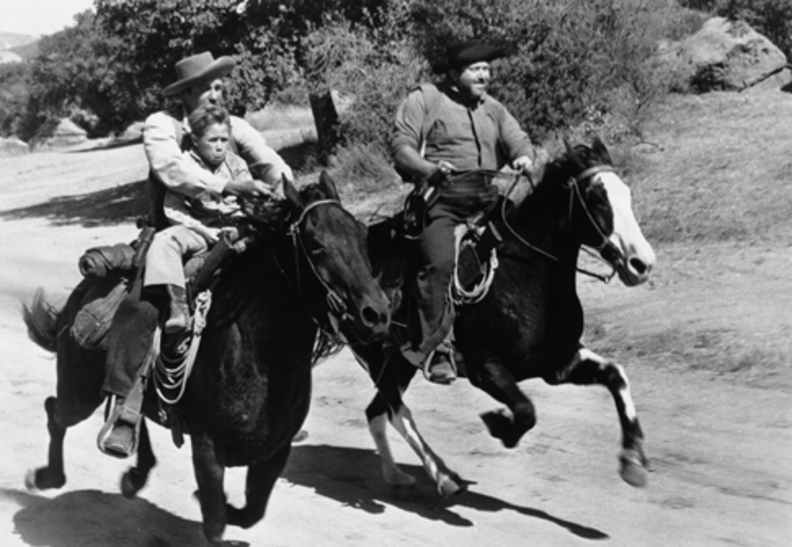
In support, Browning is captivating and sincere as Frances, and finds layers in the role that aren’t so evident from the script, while Thewlis gives one of his best recent performances as Payne, the accountant who earns Ronnie’s enmity. Anderson is quietly effective as Reggie’s right-hand man Alby, Fitzgerald is a scornful Mrs Shea (she wears black to her daughter’s wedding), Sessions is suitably slimy as Lord Boothby, and Palminteri, as the Mafia representative who wants the Krays to run London as part of a criminal franchise overseen by Meyer Lansky, exudes a rough Italian charm that hides a more dangerous persona. Alas, Eccleston is given little to do beyond looking exasperated, and Spruell’s McVitie is required to “grow a pair” just when the script needs him to; up ’til then he’s the very definition of compliant.

Ultimately, Helgeland the writer undermines Helgeland the director, focusing on Reggie to the detriment of Ronnie, and trying to make this about Reggie’s loyalty to his brother, rather than the exploits that made them infamous (which are almost incidental here). Some scenes lack the intensity they deserve, as if Helgeland didn’t have the nerve to show some things as they actually occurred (McVitie’s murder was much more vicious than what is shown in the movie), and though the emphasis is quite rightly on the Krays, more time with some of the other characters would have added some richness to the material and kept it from feeling (on occasion) somewhat uninspired. Perhaps there’s a longer cut waiting to be released on DVD/Blu ray, and it fills in a lot of the gaps, but at this length, Helgeland’s scattershot approach to the Krays’ lives is too much of a hindrance to make it anything more than just okay.

Rating: 6/10 – missing the vital spark that would have elevated it into the realm of the truly great gangster movies, Legend instead squanders its chance and remains a mostly pedestrian account of the lives of two men who meant to rule London’s criminal underworld with four iron fists; not as violent as you might expect, but with two standout performances from Hardy to help compensate, this is one “real life” movie that feels like it could have, and should have, been a whole lot better.

Share this:

  • Click to share on X (Opens in new window) X
  • Click to share on Facebook (Opens in new window) Facebook
  • More
  • Click to print (Opens in new window) Print
  • Click to email a link to a friend (Opens in new window) Email
Like Loading...

Mini-Review: Break Point (2014)

16 Wednesday Sep 2015

Posted by dullwood68 in Movies

≈ Leave a comment

Tags

Amy Smart, Brothers, Comedy, David Walton, Drama, Grand Slam tournament, J.K. Simmons, Jay Karas, Jeremy Sisto, Review, Tennis

Break Point

D: Jay Karas / 90m

Cast: Jeremy Sisto, David Walton, Amy Smart, J.K. Simmons, Joshua Rush, Adam DeVine, Chris Parnell, Vincent Ventresca, Jenny Wade, Cy Admundson

Jimmy Price (Sisto) is a pro tennis player who’s successfully alienated every doubles partner he’s ever played with. When his latest partner walks out on him, Jimmy tries to find a new one but his past behaviour catches up with him, and he’s turned down by everyone he contacts. Knowing that he has one last chance at taking part in a grand slam tournament, he has no option but to ask his brother, Darren (Walton), who is a substitute teacher, to be his partner. Darren is less than enthusiastic, as when they were younger Jimmy dumped him for another player during a tournament.

Darren eventually comes around to the idea, and he and Jimmy begin to practice together. They’re joined by one of Darren’s pupils, a precocious eleven year old called Barry (Rush) who has attached himself to Darren for the summer break. Supported and encouraged by their veterinarian father, Jack (Simmons), and his assistant Heather (Smart), they get through a qualifying tournament despite Jimmy’s confrontational antics. With one more qualifying match to play, a meet and greet sees Jimmy talking to several of the other pro players, leading Darren to suspect that history is about to repeat itself.

Break Point - scene

A broad mix of lightweight drama and affable comedy, Break Point is easy-going fare for those times when thinking about a movie isn’t required. It’s amiable and it pretty much does what it says on the tin, leading the viewer through a predictable yet enjoyable story that avoids any lows but equally doesn’t hit the heights either. A bit of a pet project for Sisto – as well as being its star, he’s the co-writer and one of the producers – the movie allows him to give another man-child performance that’s flecked with occasional moments of introspection. Sisto is good in the role but like all the characters, Jimmy is a step up from being one-dimensional, and nothing he does or says will come as a surprise to anyone.

With Sisto getting to play the “fun guy”, it falls to Walton to be the straight man, and while he’s more than up to the task, he has little to do beyond acting peevish or doubtful about his brother’s motives. With the exception of Rush as the cute but borderline annoying Barry, the rest of the cast are sidelined for much of the movie, with Simmons wasted as the brothers’ dad, and Smart roped in for the last third as a romantic partner for Darren. Karas directs ably but routinely, and even the tennis matches remain formulaic in both the way they’re shot and edited, with little in the way of any real excitement. All in all it’s a sweet movie, but not one you’re likely to remember for long.

Rating: 5/10 – while not a bad movie, Break Point is too laid-back for its own good, and it never really gets off the ground; a pleasant enough experience but it’s likely that the average viewer will be left wanting a whole lot more in order to feel rewarded for their time.

Share this:

  • Click to share on X (Opens in new window) X
  • Click to share on Facebook (Opens in new window) Facebook
  • More
  • Click to print (Opens in new window) Print
  • Click to email a link to a friend (Opens in new window) Email
Like Loading...

Everest (2015)

14 Monday Sep 2015

Posted by dullwood68 in Movies

≈ 1 Comment

Tags

Adventure Consultants, Baltasar Kormákur, Climbing, Drama, Emily Watson, Himalayas, Jason Clarke, John Hawkes, Josh Brolin, Keira Knightley, May 1996, Mountain Madness, Review, Rob Hall, Scott Fischer, Storm, True story

Everest

D: Baltasar Kormákur / 121m

Cast: Jason Clarke, Josh Brolin, John Hawkes, Emily Watson, Robin Wright, Keira Knightley, Jake Gyllenhaal, Sam Worthington, Michael Kelly, Martin Henderson, Thomas M. Wright, Ingvar Eggert Sigurðsson, Naoko Mori, Elizabeth Debicki

The brainchild of New Zealand mountaineer Rob Hall (Clarke), Adventure Consultants is a company that takes people to the summit of Mount Everest. In April 1996, Rob and his team, led by base camp manager Helen Wilton (Watson), plan to take eight clients to the summit. Among them are Texan climber Beck Weathers (Brolin) and Doug Hansen (Hawkes), a postman seeking to inspire the pupils at an elementary school where he lives, and Jon Krakauer (Kelly), a journalist from Outside magazine that Hall has persuaded to write an article about them in return for a gratis trip. When they arrive at base camp, Hall regales them with the necessary rules and warns them all of the dangers of ascending to a height where their bodies will literally begin to die.

The group make three acclimatisation climbs before starting off for the summit on the morning of May 10. They are joined by a group led by Scott Fischer (Gyllenhaal) of the rival company Mountain Madness. Together they aid each other in climbing the mountain, making it to each Camp in good time. The camaraderie between the climbers helps them to keep going the further up they climb, but after they leave Camp IV, they begin to encounter problems. Fischer becomes unwell and starts to struggle, while Weathers develops an eyesight problem that causes him to remain on the side of the mountain until the other climbers come back down. As they near the summit, they reach the Balcony and find there are no fixed ropes; and again when they reach the Hillary Step. With time being eaten away by these delays the strain of the climb begins to tell on more and more of the climbers, including Hansen who lags behind everyone else.

The two groups persevere though and the first person to reach the summit – from Fischer’s group – gets there around 1pm. With everyone needing to start back down by 2pm in order to make it back to Camp IV, Hall finds himself ignoring his own rules and helping Hansen reach the summit. Now over an hour late in leaving, and with Hansen getting weaker and weaker due to a lack of oxygen, Hall is faced with an even worse problem: a terrible storm rushing in from the southwest. With the blizzard making the effort to descend even harder, Hall and Hansen make it back to the Hillary Step, while Fischer’s group and the rest of Hall’s group find themselves battling the blizzard and struggling to stay alive. With no help available from the base camp, all anyone can do is hope that the storm abates soon, and gives them all a chance to get back down.

Everest - scene

Based on a true story, and with a script by William Nicholson and Simon Beaufoy that’s been collated from various sources, Everest is a disaster movie that highlights the natural beauty of the Himalayas, and the ever-present danger that lies hidden and waiting for the unwary (or even the experienced). It’s an intelligent, cleverly constructed and judiciously maintained tale of unexpected tragedy that is also unexpectedly moving. And thanks to the decision to film as much of the movie on location as possible, it allows the viewer to become embroiled in the effort to reach the summit and then to stay alive against the odds.

Much will be made of Everest‘s stunning vistas and gasp-inducing scenery, and while this is entirely appropriate, they’re still the backdrop for a tragic endeavour that was doomed from the moment that the groups found that there were no fixed ropes in two sections where they were needed. With the climb having gone so well up til then, this presentiment of doom adds a chill to events that augments the sub-zero temperatures, and makes the rest of the movie dreadful and fascinating to watch at the same time.

As the resulting tragedy unfolds, it becomes an agonising experience as the various climbers we’ve come to know and empathise with, face terrible hardships brought on by the brutal weather, and find the limits of their endurance pushed beyond measure. The inclusion of Hall’s partner, Jan (Knightley), and Beck’s wife, Peach (Wright), both removed from the action but still linked to their men by tremendous love and commitment, allows the movie to show how the events on Everest had a wider consequence. Jan is pregnant with hers and Rob’s first child, while Peach moves heaven and earth to ensure her husband has a chance of returning home. Their fears and concerns add an extra layer of tragic drama to proceedings, and in the capable hands of Knightley and Wright, both women show fear, strength, determination and sadness with admirable clarity. And they’re matched by Watson, who puts in yet another faultless performance.

Amongst the men, Clarke plays Hall as an altruistic, methodical leader whose love of climbing defines him the most. When Hall decides to help Hansen reach the summit, his thoughts are writ clearly on his face: it’s the wrong decision, and Clarke shows Hall’s understanding of this with such resignation that it heightens the impending tragedy, and makes their twin fates all the more affecting. Hawkes gives another low-key yet determined performance as the most unlikely climber in the group, while Brolin’s cocky, bullish attitude soon reveals a deeper layer of insecurity that Weathers would rather keep hidden. Gyllenhaal and Worthington have minor roles in comparison and we don’t get to know their characters as well, but with so many to keep track of, it would be unfair for the script to try and focus on too many at one time.

Making his most complete and effective movie to date, Kormákur ratchets up the tension as the storm hits and survival becomes everything. But he never loses sight of the human will to overcome and conquer adversity, and as the treacherous descent is begun, most viewers are likely to have at least one character they’ll want to see reach Camp IV. Whether they do or not is another matter, and it would be fair to say that billing is no guarantee of survival, but again Kormákur keeps the viewer on the edge of their seat as to just who will make it and who won’t, and each death carries with it its own devastating emotional “punch”.

The production is handsomely mounted and is supported by Salvatore Totino’s superb photography, Dario Marianelli’s subtle, non-intrusive score, and Mick Audsley’s fine-tuned editing. With only a few dodgy green screen shots to break the illusion, and some confusion as to what’s happening to whom once the blizzard hits, Everest remains a compelling, gripping account of an unfortunate, avoidable tragedy.

Rating: 8/10 – whatever your views on the mistakes made on May 10 1996, there’s no doubting the courage shown by all those on the mountain that day, and Everest is a tribute to all those who perished, and the survivors as well; with an emotional core that steals up on the viewer, it’s a movie that reaffirms the risks of climbing “the most dangerous place on Earth”, and the sense of profound achievement that it provides.

Share this:

  • Click to share on X (Opens in new window) X
  • Click to share on Facebook (Opens in new window) Facebook
  • More
  • Click to print (Opens in new window) Print
  • Click to email a link to a friend (Opens in new window) Email
Like Loading...

Laggies (2014)

13 Sunday Sep 2015

Posted by dullwood68 in Movies

≈ 1 Comment

Tags

Chloë Grace Moretz, Drama, Elopement, Engagement, Keira Knightley, Lynn Shelton, Mark Webber, Relationships, Review, Romance, Sam Rockwell, Single father

Laggies

aka Say When

D: Lynn Shelton / 99m

Cast: Keira Knightley, Chloë Grace Moretz, Sam Rockwell, Mark Webber, Jeff Garlin, Ellie Kemper, Sara Coates, Kirsten deLohr Helland, Kaitlyn Dever, Daniel Zovatto, Dylan Arnold, Gretchen Mol

At twenty-six, Megan (Knightley) still doesn’t know what she wants to do with her life. She helps out her dad (Garlin) with his store, but otherwise does little beyond spend time with her friends, or her boyfriend, Anthony (Webber). When her friend Allison (Kemper) gets married, the day of the wedding proves traumatic when Anthony proposes to her unexpectedly and Megan sees her father fooling around with another woman. Unable to deal with the two events, she leaves the reception and drives around until she stops at a convenience store. There she’s stopped by a young girl, Annika (Moretz) and asked if she’ll buy alcohol for her and her friends. Megan agrees, and ends up spending the next few hours with them.

When she eventually gets back home, Anthony reveals that he thinks they should forgo a big wedding and elope to Las Vegas. Megan agrees that they should, but she still has qualms about getting married, and uses a trip to a planned careers advice seminar to delay their marriage for a week. Her idea is to give herself the space and time to decide if she wants to spend the rest of her life with Anthony. As she leaves Seattle, Megan receives a phone call from Annika asking if she can pose as her mother for a meeting with a school guidance counsellor. Megan does so, and asks Annika if, in return, she can stay with her for the upcoming week.

Annika is fine with the idea but knows her father, Craig (Rockwell), will be less enthusiastic about it, but Annika’s attempt to sneak Megan into the house fails, and Megan ends up being questioned by Craig – who’s a lawyer – about why she’s there. Megan lies and tells him she’s between apartments due to lease problems, and just needs somewhere to stay temporarily. Craig lets her stay, and as the week progresses he begins to trust her. So does Annika, so much so that she asks Megan to go with her to see her estranged mother, Bethany (Mol).

Craig and Megan spend an evening together at a bar and on their way home begin kissing. They have sex when they get home; next morning Craig offers to let Megan stay longer, but she reluctantly tells him she has to leave. They kiss again and this time Annika sees them. She later tells Megan that she doesn’t have a problem if they got together, but when they go shopping for a prom dress for Annika, Annika discovers Megan’s engagement ring. Forced to admit the truth, Megan’s deception proves to have lasting consequences…
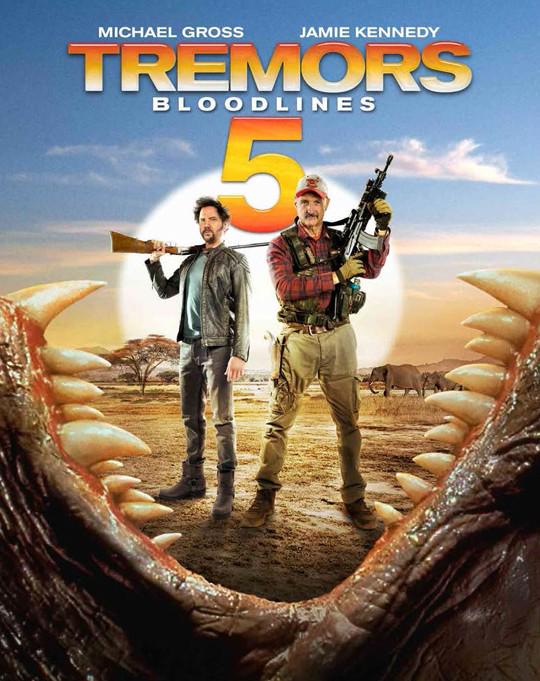
Laggies - scene

After the disappointment of her previous movie, Touchy Feely (2013), hopes were high that Lynn Shelton’s next project would be an improvement, and re-cement her position as one of today’s more intriguing and perceptive directors. Working from a script by first-time screenwriter Andrea Siegel, Laggies – the phrase refers to people who are always late or lagging behind in some way – Shelton has certainly made a better feature than her last, but it’s still a movie that suffers from a lack of conviction.

Part of the problem is the central character of Megan, a young woman apparently experiencing a “quarter-life crisis”. While it’s not improbable for anyone to find themselves in their mid-twenties and without a clear idea of where their life is heading, where Megan is concerned it’s very clear that she’s an intelligent, independently-minded young woman, but someone who is unable to deal with the larger, more important aspects of becoming an adult. She avoids responsibility and appears emotionally shallow, but somehow manages to retain the affection and support of everyone around her. How she’s arrived at this point is never explained, and the movie never explores fully the implications of such an arrested lifestyle, preferring instead to have Megan float through her own life waiting for the answers to come to her rather than working them out for herself.

With Megan having little in the way of self-awareness (or even pride), it’s difficult to fully sympathise with her, especially when she falls for Craig so easily, a plot development that couldn’t have been signposted better if it had been written in fiery letters in the sky. It’s this conventional romantic approach that anchors the movie’s second half and leads to the kind of unsurprising resolution that’s been seen a million times before. That Shelton manages to keep the viewer interested despite all this is a tribute to her skills as a director, and the performance of Knightley, who adopts not only a convincing American accent, but also fleshes out the character of Megan against all the odds. There’s a scene after Megan has slept with Craig where she talks with her father; unable to judge him anymore, Megan’s lack of ambivalence over her own actions further hurts the scene, and it’s only rescued by Knightley’s decision to play it with a sense of newly discovered regret at the way she’s acted towards him.

Moretz is sidelined by the script’s insistence on her being a constant reminder of the simpler life Megan is looking for, while Rockwell brings his usual quirky schtick to a character who really needs to be more conservative, and not an older, wiser version of Megan. Spare a thought for Webber, though, playing a character so wet and puppy like you can only think Megan’s with him out of a sense of obligation, or worse, pity. With its four main characters either stretching credulity or in place to meet the wider needs of the storyline, the movie feels and sounds like an examination of a particularly callow way of living, and one that most of us would have little time for.

On the plus side, Shelton does make more of the material than it deserves, and she invests the movie with a rhythm that helps the viewer get through some of the more unlikely moments. Knightley dials down most of her usual mannerisms to give a polished portrayal of a lost soul who’d prefer to remain that way, and Mol deserves a mention for making Annika’s mother something more than the standard embittered ex-wife. Nat Sanders’ editing is another plus, especially when called upon to enhance a character’s emotional reaction in a scene, and there’s an often delightfully apt score by Benjamin Gibbard that subtly reflects Megan’s confusion.

Rating: 6/10 – while the movie’s structure is fairly sound, and Shelton shows an awareness of the script’s faults that compensates greatly, Laggies still feels undercooked, and as a result, falls short of what it’s aiming for; while it’s refreshing to see a woman in her mid-twenties having a life crisis, it’s also a shame to find said crisis left mostly unexplored.

Share this:

  • Click to share on X (Opens in new window) X
  • Click to share on Facebook (Opens in new window) Facebook
  • More
  • Click to print (Opens in new window) Print
  • Click to email a link to a friend (Opens in new window) Email
Like Loading...

Trailer – I Smile Back (2015)

11 Friday Sep 2015

Posted by dullwood68 in Movies

≈ Leave a comment

Tags

Addiction, Drama, I Smile Back, Preview, Sarah Silverman, Trailer

One critic calls Sarah Silverman’s performance in I Smile Back a “career changer”, and from what can be seen in the trailer, they’re not far wrong. Known primarily for her stand up persona, and appearances in screen comedies, Silverman has taken on the most challenging role of her career as Laney, a wife and mother whose drug and alcohol addictions and self-destructive tendencies are pushing her to the point where she’s about to lose everything. It promises to be both an eye opener in terms of the performance, and the role that changes audience perceptions of her as an actress. If she’s also in the running come the awards season then it won’t necessarily be a surprise, but if she is looking to take on further dramatic roles, then this will have been a great first choice.

Share this:

  • Click to share on X (Opens in new window) X
  • Click to share on Facebook (Opens in new window) Facebook
  • More
  • Click to print (Opens in new window) Print
  • Click to email a link to a friend (Opens in new window) Email
Like Loading...

Mini-Review: The Falling (2014)

09 Wednesday Sep 2015

Posted by dullwood68 in Movies

≈ 6 Comments

Tags

1969, Carol Morley, Drama, Fainting, Florence Pugh, Girls' school, Greta Scacchi, Maisie Williams, Mass hysteria, Maxine Peake, Mystery, Review

Falling, The

D: Carol Morley / 102m

Cast: Maisie Williams, Maxine Peake, Greta Scacchi, Florence Pugh, Anna Burnett, Joe Cole, Rose Caton, Lauren McCrostie, Katie Ann Knight, Evie Hooton, Morfydd Clark, Monica Dolan, Mathew Baynton

At a British girls’ school in 1969, Abbie Mortimer (Pugh) is liked and admired by all, especially her best friend, Lydia Lamont (Williams). Abbie though, has a rebellious streak, and is the first of the girls to have sex. But this leads to her falling pregnant and a subsequent series of fainting spells that lead to her unexpected death. Stunned by this sudden turn of events, Lydia begins to feel unwell herself, and soon she too is fainting, both at school, and at home where her mother Eileen (Peake) hides herself away from the world.

Lydia now assumes the role Abbie had in the school, and much to the vexation of teacher Miss Mantel (Scacchi) and school head Miss Alvaro (Dolan), more and more of the other girls begin to show similar signs of illness, and start fainting as well. At first, Miss Alvaro refuses to believe that anything is wrong, and is certain that Lydia and the rest are faking their attacks. But when it also affects one of the other teachers, Miss Charron (Clark), at an assembly, the school is faced with no option but to send the girls to hospital for tests to see if the pupils are guilty of deception, or if there’s a real medical reason for what’s happening.

Falling, The - scene

Despite the crispness of Agnès Godard’s often exquisite photography, and an insistent but strangely apt soundtrack involving original music by Tracey Thorn, The Falling is not as mysterious or dramatic as it seems, relying heavily on visual motifs and too many shots that are meant to increase the sense of foreboding, but which only go to show that trees used as a metaphor actually remain just trees. The same goes for the repetitive nature of the faintings – instead of instilling any sense of dread they happen so regularly that by the time we see a group of schoolgirls hyperventilating in a hospital corridor, it’s more a cause for laughter than concern.

Morley leaves a lot of questions unanswered (not the least of which is the cause of Abbie’s death), and avoids taking one or two subplots down roads that would have made for more dramatic results (Lydia’s growing attraction for her brother, Kenny (Cole), for example), while the cast do their best with poorly motivated characters and the kind of dialogue that only teenagers in the movies come out with (Lydia even yells “Kill the system!” at one point). It’s all meant to be a fervent hotbed of paranoid mass hysteria, and while it’s a situation that obviously goes too far, there are few consequences for the characters involved, and by the end we’re back where we started. There’s a decent idea here, but there’s also too much that’s elliptical or left hanging, leaving the movie only occasionally successful in what it’s trying to do, and only occasionally rewarding for the viewer.

Rating: 5/10 – dramatically unsound and lacking in any clear focus as to what it’s trying to say (other than that teenage girls are incredibly susceptible to hysteria), The Falling is a psychological mystery overlaid with an arthouse approach that doesn’t suit the material; obtuse and trying to be profound, the movie stumbles along revealing little about its characters beyond the obvious, and does its best to keep them at a distance.

Share this:

  • Click to share on X (Opens in new window) X
  • Click to share on Facebook (Opens in new window) Facebook
  • More
  • Click to print (Opens in new window) Print
  • Click to email a link to a friend (Opens in new window) Email
Like Loading...

Me and Earl and the Dying Girl (2015)

07 Monday Sep 2015

Posted by dullwood68 in Movies

≈ Leave a comment

Tags

Alfonso Gomez-Rejon, Comedy, Drama, Friendship, Gabriel Mann, Home movies, Hospice, Jesse Andrews, Leukaemia, Literary adaptation, Olivia Cooke, Relationships, Review, RJ Cyler

Me and Earl and the Dying Girl

D: Alfonso Gomez-Rejon / 105m

Cast: Gabriel Mann, Olivia Cooke, RJ Cyler, Connie Britton, Nick Offerman, Molly Shannon, Jon Bernthal, Katherine C. Hughes

Aloof and self-conscious, Greg Gaines (Mann) is a senior at Pittsburgh’s Schenley High School. He keeps himself to himself and avoids the standard drawbacks of high school life by belonging to all the various cliques rather than just the one; for Greg this means no one gets on his case, and his life remains unblemished by involvement with anyone other than his best friend, Earl (Cyler). Together, they make home movies based on the pictures they like, but they give them all alternative titles, such as Sockwork Orange and My Dinner With Andre the Giant.

Greg’s carefree, reclusive life is thrown into turmoil when his mother (Britton) announces that a fellow student of his, Rachel Kushner (Cooke) has been diagnosed with leukaemia, and his mother wants him to spend time with her, and be her friend. Greg visits Rachel and he confesses the reason why he’s there, and asks her to go along with his mother’s idea so that he won’t need to bother her after this one visit. But Greg’s quirky, unorthodox way of looking at things amuses Rachel, and they agree to keep meeting up.

Earl convinces Greg to show Rachel the movies they’ve made, and she finds them entertaining. As Rachel’s condition worsens, so Greg finds himself spending more time with her, and supporting her through her illness. When he and Earl are found making another movie by Madison (Hughes), the girl Greg has a crush on, she tells them they should make a movie for Rachel. Meanwhile, Rachel convinces Greg to apply for a local college; he gets accepted but his grades begin to suffer because of all the time he spends with Rachel. But when she decides to stop having chemotherapy, her decision causes Greg to become angry with her; they argue, and unable to vent his anger on Rachel, he takes out his frustration on Earl, which leads to their friendship ending. And to make matters worse, his failing grades mean he loses his college place.

Some time later, Madison informs Greg that Rachel has been admitted to a hospice. She also asks him to be her date for the upcoming prom. Greg agrees, but on the night, he gets his limo driver to take him somewhere else instead…

Me and Earl and the Dying Girl - scene

A hit at this year’s Sundance Film Festival, where it won both the Grand Jury Prize and the Audience Award, Me and Earl and the Dying Girl arrives at cinemas trailing a heap of advance praise, and with raised expectations. An adaptation from his own novel by Jesse Andrews, it’s a bittersweet coming-of-age/disease-of-the-week movie that is intelligently crafted, beautifully acted, and put together so effectively that it constantly surprises and entertains in equal measure.

Where many teen-related movies trade in clichés and broad stereotypes, Me and Earl and the Dying Girl avoids such drawbacks by keeping them far enough in the background that they register, but not with any cause for concern that they’ll ever undermine the good work Andrews’ script has built up. There’s a recognisable milieu here, to be sure, but it’s one that’s skewed and twisted through the unhappy state of Greg’s perception. He doesn’t want to get involved with Rachel and her illness, but to his surprise he finds that she likes him, and this emboldens him to turn away from his usual selfish, rootless behaviour. Blossoming from the attention that Rachel gives him, Greg comes to depend on her approval, and he has the idea that this is reciprocated. But when Rachel stops taking her meds, and he falls out with Earl, he learns a valuable lesson: that friendship is more complicated than he’s ever considered.

As Greg navigates his way through the choppy waters of teen angst and self-imposed reclusivity, Rachel’s bravery in facing her mortality is used in sharp contrast to highlight Greg’s lack of empathy. He finds a purpose in befriending Rachel but it’s at the expense of his carefully arranged lifestyle, and her determination has the effect of threatening to eliminate the new emotions and feelings he’s begun to experience. Torn between his need for these feelings, and the safety provided by his usual reticence, Greg has to face up to the uncomfortable fact that, in Rachel, he’s found someone he cares about as much, if not more so, than himself. This leads to him being noticed in school, something he’s studiously avoided, but by being forced out into the open he benefits in ways he would never have imagined, and especially when Madison asks him to be her prom date.

That Greg slowly matures over the course of the movie is a given, but thanks to Andrews’ confident, eloquent script, his journey is less one of self-discovery than selfless acceptance that some friendships or relationships will cause pain more often than not, but it doesn’t mean they’re not worth it. Rachel learns to accept her fate, and in the end she embraces it with a fierce disregard for the fear she has about dying. She’s almost heroic in a way that teenagers can’t generally manage, and it’s a tribute to the script and Cooke’s performance that even when Rachel is sad and afraid it’s heart-wrenching to see someone finding hidden sources of courage that will also weaken her further.

Me and Earl and the Dying Girl - scene2

If Greg and Rachel’s friendship forms the core of the movie’s focus, then Greg’s friendship with Earl is its foundation, their relationship bordering on the kind of geeky mutual reliance that allows two outsiders to bond without any formal acknowledgment of their dependence on each other. Mann and Cyler have an ease about them that translates well in their scenes together, and the way they covertly emphasise the regard they have for each other is touching. Both young actors are excellent, teasing out the subtle nuances of their characters and looking entirely credible throughout.

With all three leads on superb form, they’re more than ably supported by the likes of Offerman and Britton, and there’s a great, unexpected cameo from Hugh Jackman that highlights the offbeat nature of the humour – Greg’s penchant for pillows, for instance. But while there are plenty of funny moments, this is still first and foremost a drama, and Gomez-Rejon’s self-assured direction teases out themes of alienation and personal courage, self-pity and despair with precision and skill, guiding the characters through their travails with a fondness for them that is evidenced by the clarity with which their thoughts and feelings are portrayed.

It’s a movie that’s also been wonderfully shot, with Chung-hoon Chung’s photography framed to perfection and lit with such confidence that every scene has the look and feel of a still shot. The movie further benefits from a cleverly muted score by Brian Eno that plays along in the background for the most part, and acts as an indirect reflection of the movie’s moods, accentuating some and downplaying others, its quirky nature almost like a character in itself. The movie is stylish, thoughtful, acutely aware of the message it wants to impart, and effortlessly affecting.
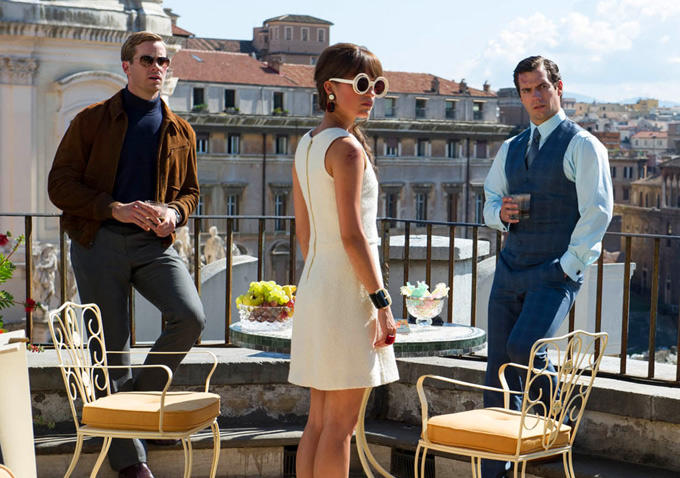
Rating: 9/10 – this year’s indie movie to beat, Me and Earl and the Dying Girl is the kind of multi-layered drama that rewards the viewer in so many ways it’s like taking part in a feast; imaginative and delightful, it’s a movie that actually has something to say, and does it eloquently and with commanding ease.

Share this:

  • Click to share on X (Opens in new window) X
  • Click to share on Facebook (Opens in new window) Facebook
  • More
  • Click to print (Opens in new window) Print
  • Click to email a link to a friend (Opens in new window) Email
Like Loading...

Ask Me Anything (2014)

06 Sunday Sep 2015

Posted by dullwood68 in Movies

≈ 2 Comments

Tags

Allison Burnett, Blogging, Britt Robertson, Christian Slater, Drama, Gap year, Justin Long, Literary adaptation, Martin Sheen, Relationships, Review, Robert Patrick, Romance, Sex, Undiscovered Gyrl

Ask Me Anything

D: Allison Burnett / 99m

Cast: Britt Robertson, Christian Slater, Molly Hagan, Justin Long, Robert Patrick, Martin Sheen, Kimberly Williams-Paisley, Andy Buckley, Max Carver, Zuleikha Robinson, Sharon Omi, Gina Mantegna, Max Hoffman

When Katie Kampenfelt (Robertson) decides to take a gap year before attending college, her high school careers advisor (Omi) suggests she starts to keep a diary or a blog. Katie chooses to write a blog detailing her life and sexual experiences, but more importantly, to tell the truth (though in order to do this she changes her name and the names and places of everyone and everywhere else that she describes). In it she talks about her life, and in particular her relationship with an older man, Dan Gallo (Long). She sees Dan as often as she can but no one knows about him, not her mother, Caroline (Hagan), stepfather Mark (Buckley), or her father Doug (Patrick), and especially not her boyfriend Rory (Carver) (or Dan’s girlfriend, Martine).

But when Dan moves nearer to his work it makes it more difficult for them to see each other, and their relationship begins to unravel. Katie finds a job in a bookstore run by Glen Warburg (Sheen) and continues to try and contact Dan, but to no avail. She spends time with her best friend, Jade (Mantegna), and finds her blog is developing a loyal following. But just as things seem to be going well – Dan’s reticence aside – Mark reveals that Glen has an unsavoury past, and Katie is forced to quit her job. A week or so later, though, she receives a call from Paul Spooner (Slater), a local hedge fund manager looking for a nanny for his newborn son. Katie meets his wife, Maggie (Williams-Paisley), and is hired on the spot.
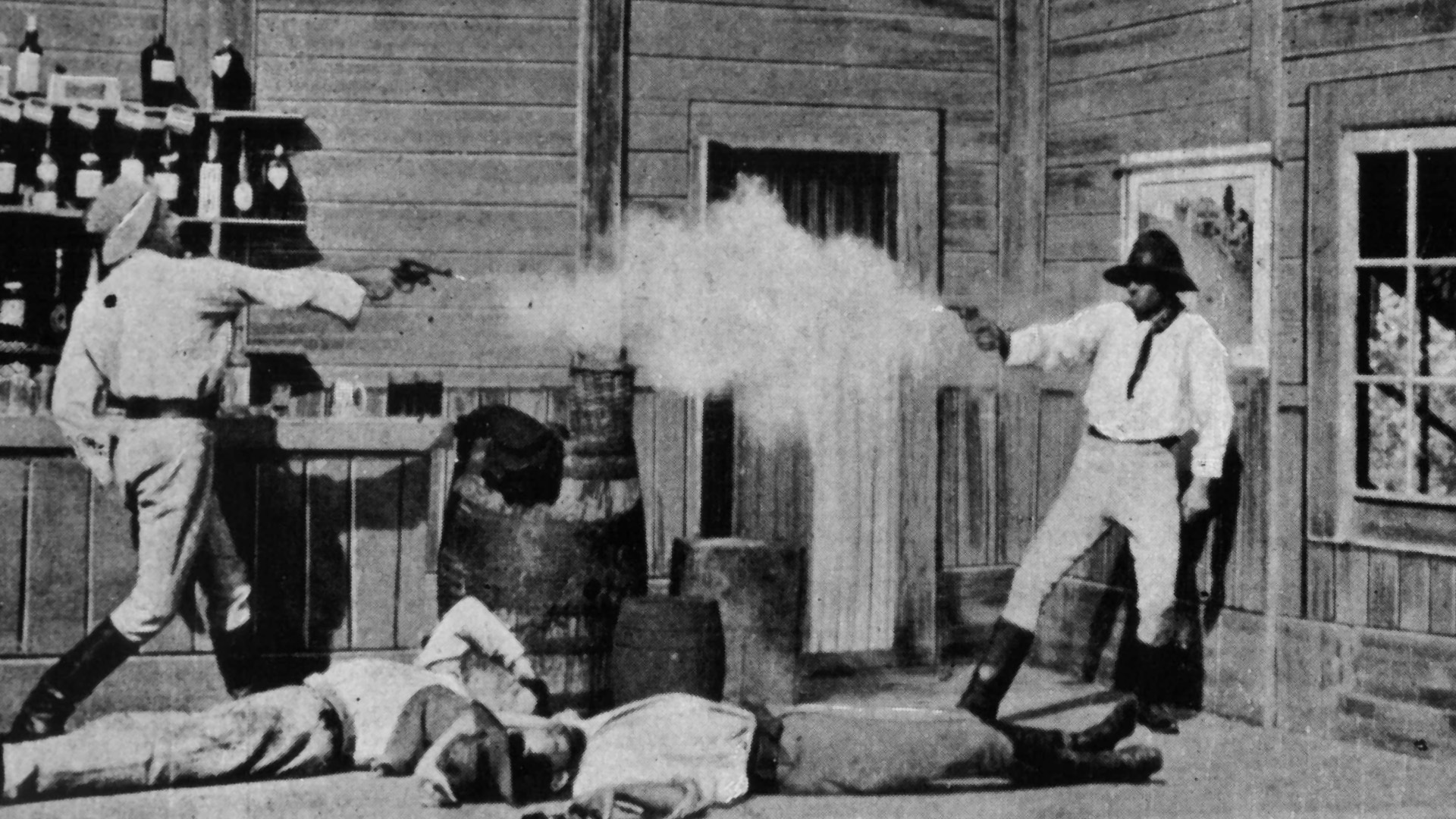
Soon after, Katie manages to contact Dan and persuades him to see her. She meets him at his new home, but her happiness at seeing him again is ruined by her realising that their in Martine’s home, and Dan has moved in with her; he also tells her that he and Martine are engaged. Furious, she leaves. When she gets home, Rory is there wanting to know where she’s been. He’s angry with her and challenges her assertion she was at the cinema, and when she tells him she was with Dan, Rory assaults her before being thrown out. With Rory out of the picture, she begins to develop an attraction for Paul, and they end up having sex. But like Dan he has no intention of making their affair more permanent, and Katie begins to face the probability that she will always be let down by the men she’s attracted to. And then she finds out she’s pregnant…

Ask Me Anything - scene

On the surface, Ask Me Anything is yet another coming-of-age teen drama that sees its central character encounter all sorts of emotional and social obstacles on the way to becoming a more grounded (and rounded) individual. It’s a scenario we’ve seen countless times before, and while this movie steers close to many of the genre’s staple ingredients, there’s a subtler, more mysterious thread running beneath Katie’s exploits that creates a completely different vibe than is present in other, similar movies.

In adapting his novel Undiscovered Gyrl, Burnett has fashioned an unexpectedly compelling tale that begins as brightly and humorously as you’d expect, but as the narrative progresses, it takes on a darker hue, and cracks begin to appear, and not just in Katie’s various romantic relationships, but in her story as well. Central to this is her relationship with her father, and the way in which she chooses older men for sexual partners as a way of pleasing an idea of him that she’s had since childhood. Once a sports writer but now an angry alcoholic – he refers to Caroline as “the witch” – Doug reminds Katie at one point that he was her hero when she was younger. Tellingly, Katie doesn’t remember this, and can’t work out why. Astute viewers at this point will be thinking that Katie was abused by her father (she has flashbacks to her childhood, but only when she’s on the point of orgasm), but Burnett is canny enough to sow seeds of doubt, and the viewer is never quite sure until late on what really happened.

Katie has only one positive relationship with a male in the movie, and it’s with manic depressive Joel Seidler (Hoffman), who she knew in school and who contacts her out of the blue. Joel becomes her confidant, but because he’s near to her own age, she feels safe with him, and while he offers her good advice throughout, Katie continues to continue down the self-destructive path she’s chosen for herself. As her problems increase and she finds herself struggling to cope, Burnett has Katie floundering so much that the viewer can see just how easy it’s been for her to end up like this, but at the same time he restricts the amount of sympathy the audience can feel for her: like many teens who think they have a handle on the world, Katie’s problems are a result of Katie’s ill-informed choices and decisions.

With so much that’s hidden from plain view, the audience is taken on a journey where what they learn about Katie and her life increasingly comes to be tainted by a sense that all is not what it seems. It’s a very clever trick by Burnett, and the movie’s coda serves as a beautiful payoff of what’s gone before (there’s a big clue near the beginning, but you’ll need to be sharp to spot it). And it’s here that the movie’s true message comes through, with an indelible flourish that is as audacious as it is sincere.

Burnett is blessed with a cast that ably skewers the conventions of the genre while maintaining them at the same time. Robertson confirms the promise shown in The Family Tree (2011) and in TV’s Under the Dome, and provides a confident performance that easily encompasses Katie’s contradictions and insecurities. As the men in Katie’s sex life, Long and Carver are given interesting character arcs, but Slater is hamstrung by Paul’s being a stereotypical middle-aged seducer. Hagan and Patrick are solid in support, while Sheen is the kindly grandfather figure who’s straight out of wish fulfilment central.

Rating: 8/10 – deceptive and quietly affecting, Ask Me Anything steals up on its unsuspecting audience and delivers one hell of a sucker punch at the end, but it’s one that will have you saying “Bravo!” rather than “What the hell?”; clever, intelligent, and rewarding, Burnett’s movie is an underrated gem that deserves a wider audience.

Share this:

  • Click to share on X (Opens in new window) X
  • Click to share on Facebook (Opens in new window) Facebook
  • More
  • Click to print (Opens in new window) Print
  • Click to email a link to a friend (Opens in new window) Email
Like Loading...

True Story (2015)

05 Saturday Sep 2015

Posted by dullwood68 in Movies

≈ Leave a comment

Tags

Christian Longo, Drama, Felicity Jones, James Franco, Jonah Hill, Literary adaptation, Mike Finkel, Murder, New York Times, Review, Rupert Goold, Trial, True story

True Story

D: Rupert Goold / 99m

Cast: Jonah Hill, James Franco, Felicity Jones, Robert John Burke, Ethan Suplee, Gretchen Mol, Maria Dizzia, Byron Jennings

A journalist with the New York Times, Mike Finkel (Hill) hands in an assignment that looks at the African slave trade. It becomes the cover story for the New York Times Magazine, but later it’s discovered that Finkel hasn’t been entirely honest about his research and has created a composite character for the story’s focus. Finkel is subsequently fired and returns to his home in Montana where he lives with his wife Jill (Jones). At around the same time, the discovered bodies of a woman and her three children has led authorities to Mexico where they arrest a man who claims to be Mike Finkel. His real name, though, is Christian Longo (Franco), and he’s accused of having killed his family.

When Finkel becomes aware that Longo claimed to be him, he becomes intrigued. He begins to look into the case, and travels to see Longo in prison. At their first meeting, Longo tells Finkel he’s admired his writing for a long time. They also strike a bargain: in return for Longo’s story, Finkel will teach him to write and he won’t discuss what they talk about until after Longo’s trial. Soon after, Finkel receives a lengthy letter in which Longo describes the events that led up to his wife and children’s murders – but it stops short of going further.

Over the next few months as the two men continue to meet, Longo intimates that he didn’t kill his family, and Finkel begins to believe he may be innocent, even though Longo avoids giving any definitive statement on the matter, and refers to a mysterious “someone” he needs to protect. He tells Finkel he’ll plead Not Guilty at his arraignment, and the journalist begins to believe that there must be another answer to the question of who murdered Longo’s wife and children. But at the arraignment, Longo pleads Not Guilty to the murders of two of his children, and Guilty to the murder of his wife and other child. Feeling betrayed, Finkel confronts him, but Longo hides behind the idea that he’s protecting someone.

As the trial approaches, Finkel – who has been busy turning his and Longo’s correspondence into a book – now begins to doubt the veracity of Longo’s claims, but though he’s approached by one of the detectives who arrested Longo, Greg Ganley (Burke) and asked to provide evidence for the prosecution, he refuses. The trial takes place and the prosecution puts forward a convincing case for Longo’s guilt. But then the defence begins its case, and Longo is called to the stand…

True Story - scene

At one point in True Story, Christian Longo tells Mike Finkel that “sometimes the truth isn’t believable. But that doesn’t mean that it’s not true.” It’s a fine idea, and the movie trades on Longo’s assertion for most of its running time, leading the audience down various dead ends and blind alleys in an attempt to keep the mystery of what really happened to Longo’s family from being revealed too soon. There’s always a degree of fun to be had from a character who is deliberately elliptical, or who hides behind a wall of half-clues and misdirection, but while Franco’s cold-eyed, hooded expressions suit the character’s manipulative nature, the movie isn’t so convincing that anyone would think Finkel could be easily duped. In fact, the way in which their scenes are set up and choreographed, it should have been obvious that Longo was trying to influence Finkel’s thinking, and by doing so, gain an acquittal at his trial.

But as many people say, hindsight is a wonderful thing, but it is something that the movie can’t quite avoid dealing with. As a fairly straightforward retelling of a relationship between two narcissistic, prideful individuals, the movie wisely avoids coming down on the side of one character over the other, but at the same time, Finkel’s credulity is incredibly worrying; he is a seasoned journalist after all, even if he has made an almighty, career-shredding error of judgment. Hill plays him as a kind of eager puppy dog, wanting to be liked and willing to believe in anything that will help him get back on top. He also shows the desperation Finkel feels when the book deal is jeopardised, or when he begins to suspect that Longo is probably guilty – he needs Longo to be innocent so that he won’t look like he’s been fooled.

As the potential murderer of his entire family, Franco keeps Longo self-contained and aloof, meeting Finkel partway but never revealing anything of real substance. He uses a blank expression to convey all the audience needs to know about him, and acts with his eyes for the most part, conveying hurt and innocence and sadness, but failing to show any regret for his family’s demise, or anger at being arrested. (Again, it’s worrying that Finkel never picked up on any of this.) Both actors play well against each other, with Hill slightly edging it by virtue of his being more emotive. As Jill, Jones – in a somewhat underwritten role – is given a remarkable scene in which she’s able to confront Longo and show her contempt for him, but it smacks too much of writer’s licence, and as a result, interrupts the movie’s flow. Elsewhere she’s required to look concerned and irritable by turns, and her participation becomes yet another example of a very talented actress being shamefully underused.

Making his feature debut, Goold steps up from directing British TV dramas to make a solid, if restrained movie that tries its best to examine issues of trust and falsehood, as well as public perception, but ultimately it shies away from looking at them in any depth. Goold is better with his cast, even when his screenplay – co-written with David Kajganich – has them repeating conversations and scenes, and emphasising over and over the “mystery” that Longo implies has happened. There’s also an attempt at some basic psychology that doesn’t come off too well, and it’s a humourless piece for the most part, with only a few ironic statements to leaven the drama.

Rating: 7/10 – absorbing for the most part, True Story tries to be direct and complex at the same time, but the two approaches don’t mix, leaving the audience with a story that leaks vitality and energy as it progresses; Hill and Franco are good value, and Longo’s testimony is a highlight, but there are too many questions left unanswered for it to be entirely successful.

Share this:

  • Click to share on X (Opens in new window) X
  • Click to share on Facebook (Opens in new window) Facebook
  • More
  • Click to print (Opens in new window) Print
  • Click to email a link to a friend (Opens in new window) Email
Like Loading...

To Sir, With Love (1967)

04 Friday Sep 2015

Posted by dullwood68 in Movies

≈ 1 Comment

Tags

Christian Roberts, Drama, E.R. Braithwaite, East End, James Clavell, Judy Geeson, Literary adaptation, London, Lulu, Music, North Quay Secondary School, Review, Sidney Poitier, Teaching

To Sir, With Love

D: James Clavell / 105m

Cast: Sidney Poitier, Christian Roberts, Judy Geeson, Suzy Kendall, Lulu, Faith Brook, Patricia Routledge, Geoffrey Bayldon, Chris Chittell, Adrienne Posta, Edward Burnham, Anthony Villaroel, Rita Webb, Ann Bell

Having qualified as an engineer, British Guyana-born Mark Thackeray (Poitier) finds himself getting nowhere with job applications in his chosen field. Needing to make ends meet while he continues to look for an engineering post, he takes a position as a teacher at North Quay Secondary School in London’s tough East End. On his first day he’s warned that the children in his class will be unruly and will challenge his authority, and that their behaviour caused their previous teacher to resign. Further advised that they’re pupils that other schools have given up on, Thackeray begins to realise the task ahead of him.

The other teachers prove to be right. Led by Bert Denham (Roberts) and Pamela Dare (Geeson), the pupils in Thackeray’s class show a lack of interest, swear constantly, and are openly hostile and disrespectful. He retains a calm composure, however, and despite the pupils’ best efforts, manages to keep an uneasy control over them… until one morning when he arrives to discover that they’ve put a sanitary towel in the classroom grate and set it alight. Disgusted by this he tells the boys to get out and then rounds on the girls, lambasting them for their “sluttish” behaviour. Later, in the staff room, he rebukes himself for losing his temper, and for being so easily provoked by a bunch of “kids”. It’s then that he realises where he’s been going wrong.
He returns to the class and informs them that as they are all leaving school at the end of the term, and are going out into the world, he will now treat them as adults, and expect them to behave accordingly. The pupils, particularly the girls, are soon won over by this, and it’s not long before the boys are too; only Denham resists. He arranges an outing for them to the British History Museum and finds them all well-dressed and looking clean and tidy. The trip is a success, but things take a more serious turn when one of the class is bullied during a gym lesson. He suffers an injury and the rest of the boys round on the teacher; Potter (Chittell) picks up a piece of wood and threatens him with it. Thackeray is called to intervene, and manages to defuse the situation, but when he tells Potter that he should apologise for his actions, he begins to lose the respect he’s worked so hard to establish, and things begin to how they were when he first arrived.

To Sir, With Love - scene

Adapted by Clavell from E.R. Braithwaite’s semi-autobiographical 1959 novel, To Sir, With Love opens with Thackeray journeying to his new teaching post through London’s East End. These brief establishing shots plus a comic bus ride are used to show the kind of area he’s venturing into, a tough, run down borough where post-War renovations have yet to happen on the scale required. It’s a trenchant observation, and serves to illustrate the movie’s central message, one that will be more explicitly referred to later on. It could even be said that Thackeray is akin to Daniel entering the lion’s den, and such is the welcome from his fellow teachers, especially the cynical Weston (Bayldon), that his time at North Quay may turn out to be even less favourable.

And so we meet the pupils, and their rowdiness and lack of respect is explained away by virtue of their coming from broken or abusive homes (or both), and by the way in which they feel they’ve been let down by the adults around them. As they search for their own identities and place in the world, they make the same mistake that every confused or angry teenager makes: that soon they too will be adults and will have to face the same challenges every other adult has to deal with. It’s an obvious point, and the movie makes it very succinctly in a scene where Thackeray insists they all treat each other with respect. For the pupils to be treated this way is a revelation to them, and they begin to see advantages to their new behaviour, advantages that help them deal with each other and make sense of what’s expected of them. In essence, they can be whomever they want, and do whatever they want; all they have to do is believe in themselves (and this is the message our first sight of Thackeray travelling through the East End sets up for us: here’s a man of determination who has made something of himself).

By concentrating on Thackeray’s empowerment of his pupils, the social aspects of Braithwaite’s story are pushed to the background, and receive only occasional mentions – the girl who can’t come to school because her mother has just given birth and needs help at home, the boy whose mother dies but whose bi-racial background means the other pupils can’t be seen to take some flowers to his home – and this leaves the drama of the piece feeling slightly muted, as if Clavell has recognised the importance of including such issues but doesn’t feel comfortable in criticising them too loudly. The same is true of Pamela Dare’s obvious attraction for Thackeray, a strand that leads nowhere in dramatic terms but which does lead to a scene at the end where racial and social concerns, and awkward convention, are ignored in favour of a feelgood moment that doesn’t feel realistic at all.

To Sir, With Love - scene2

One area where the movie is successful is in its musical interludes, which give Lulu (making her movie debut) the kind of promotional boost that’s worth its weight in gold – her rendition of the title song stayed at Number 1 in the US pop charts for five weeks. As well as the songs there’s the inevitable moving and grooving that, viewed nearly fifty years later, looks embarrassing, but which also retains a charming naïvete. And it’s this naïvete that, ultimately, makes the movie work as well as it does, and has allowed it to remain such a firm favourite after all these years. It sets itself up as a searing indictment of the British class and education systems, but then changes tack as soon as it can to become an inspirational tract for the young and disaffected. From then on there are no problems that can’t be overcome, and no situations that won’t turn out for the best. It’s not real life, it’s a cannily produced and played wish fulfilment tale that steals up on its audience and leaves a warm, enjoyable glow in its wake.

Of course, the movie relies heavily on the presence of Poitier, his every feeling and emotion writ large on his surprisingly expressive face, and he’s quickly embedded as the movie’s heart and soul, leading the audience from scene to scene and showdown to showdown with such good nature and patience that his outburst over the burning sanitary towel is a welcome relief. Roberts is a sneering, dismissive Denham, all squared shoulders and challenging smirk. Geeson manages the impressive feat of being knowingly attractive and yet sexually reticent at the same time, as the script effectively neuters her to avoid any unpleasant complaints that it’s encouraging or supporting miscegenation. And there’s a raft of familiar British character actors in smaller roles that adds to the movie’s cosy, reassuring nature.

Clavell, an Australian who made his name writing big fat bestselling novels such as Tai-Pan and Shogun, directs with a firm understanding of what he wants from his own script, and doesn’t stray too far from its remit. He plays down the humour that arises in the classroom, making it seem more natural and less rehearsed, and wisely shoots Poitier in close up as often as he can. But he does dampen down the drama a little too often, leaving some scenes feeling under-developed, while others are focused on to the point where their importance feels forced. Thankfully, he’s aided by crisp, well-framed photography courtesy of Paul Beeson, and a fine, unintrusive score by Ron Grainer (who also composed the theme tune for Doctor Who).

Rating: 7/10 – well-loved and optimistic, To Sir, With Love has stood the test of time thanks to its effective performances and inherent charm; as a snapshot of a bygone era it’s not quite the social document it appears to be, but it has a freshness that hasn’t faded, and a winning feel to it that offsets the lack of depth.

The following trailer is from America, and is a priceless example of the way in which British movies were marketed at the time, and features a voice over that has to be heard to be believed.

Share this:

  • Click to share on X (Opens in new window) X
  • Click to share on Facebook (Opens in new window) Facebook
  • More
  • Click to print (Opens in new window) Print
  • Click to email a link to a friend (Opens in new window) Email
Like Loading...

Hitman: Agent 47 (2015)

03 Thursday Sep 2015

Posted by dullwood68 in Movies

≈ Leave a comment

Tags

20th Century Fox, Action, Agents, Aleksander Bach, Assassin, Drama, Hannah Ware, Jim Gianopulos, Memo, Review, Rupert Friend, Stacey Snyder, Tattoo, Thriller, Zachary Quinto

Hitman Agent 47

D: Aleksander Bach / 96m

Cast: Rupert Friend, Hannah Ware, Zachary Quinto, Ciarán Hinds, Thomas Kretschmann, Angelababy, Dan Bakkedahl, Jürgen Prochnow

Excerpted text from a memo sent by 20th Century Fox co-chairman Stacey Snyder to CEO Jim Gianopulos:

… and now that the dust has settled, it might be time to reboot Hitman, which we made and released in 2007. I think enough time has gone by that people will have forgotten just how bad/disappointing/clumsy the original was, and how we nearly sabotaged Timothy Olyphant’s career. I would suggest we get the original writer back on board, Skip Woods, and get him to fashion a Hitman movie that combines an original story with references and elements from the video games. I know he penned the original script, and I’m further aware that it wasn’t the best received script we’ve ever produced, but I believe that even in Hollywood, everyone deserves a second chance (don’t they?).

Perhaps we can entice a more well-known actor to the main role, Paul Walker for instance, or Vin Diesel (either of those Fast and Furious guys) as Olyphant has made it clear he doesn’t want to return to the role as “his house is fully paid for now”. Other casting will depend on Woods’ script and the availability of non-A list stars for the secondary roles, while it might be best to hire a British actress with little experience to fill any lead female role.

In terms of hiring a director, and in order to keep costs’ down, I would advise we give the job to someone with a background in commercials, and who hasn’t actually directed a movie before. This will allow us to bring a (hopefully) fresh approach to Woods’ script, and a visual look to the movie that will remind people of movies such as Equilibrium (2002) and the Resident Evil series. In terms of budget, and again in order to reduce costs, we should film abroad – Singapore, maybe – and keep the budget to between $30 and $40 million dollars. That way, and allowing for foreign distribution rights, DVD and Blu-ray sales, and any further revenue, the movie should be a financial success even if it is slated by the critics.

That’s all for now. Let me know how you want to proceed with these particular projects, and once things are in place, I’ll get back to you.

Hitman Agent 47 - scene

Excerpt from a memo sent by 20th Century Fox CEO Jim Gianopulos to co-chairman Stacey Snyder:

We made Hitman?!

Rating: 4/10 – professionally made tosh, Hitman: Agent 47 retains a modicum of credibility but only because it exists in a parallel world where the police don’t get involved in any gunplay, and where someone can be said to have subdural body armour – and no one blinks an eye; Friend is efficient though too remote, and Ware is blatantly awkward, leaving no one to carry the film on a human level, and allowing it to get by on badly edited action sequences that would have been even worse if they hadn’t been orchestrated by John Wick (2014) directors David Leitch and Chad Stahelski.

Share this:

  • Click to share on X (Opens in new window) X
  • Click to share on Facebook (Opens in new window) Facebook
  • More
  • Click to print (Opens in new window) Print
  • Click to email a link to a friend (Opens in new window) Email
Like Loading...

Dark Was the Night (2014)

03 Thursday Sep 2015

Posted by dullwood68 in Movies

≈ Leave a comment

Tags

Bianca Kajlich, Creature, Drama, Hollywood Black List, Horror, Jack Heller, Kevin Durand, Lukas Haas, Maiden Woods, Review, Sheriff, The Trees, Thriller, Tyler Hisel, Wendigo

Dark Was the Night

D: Jack Heller / 98m

Cast: Kevin Durand, Lukas Haas, Bianca Kajlich, Nick Damici, Heath Freeman, Ethan Khusidman, Sabina Gadecki, Billy Paterson

The small town of Maiden Woods is a quiet, peaceful place where everyone knows everyone else, and whose sheriff is a man named Paul Shields (Durand). Grieving the loss of his young son Tim, Paul has split from his wife Susan (Kajlich) and their older son Adam (Khusidman) through his feelings of guilt (he was looking after Tim when he died). Estranged and lacking faith in himself, he’s called out to a farm by the owner, Ron (Paterson), who’s missing one of his horses. Certain that there’s nothing suspicious going on, he puts it down to Ron leaving a gate open. Back in town, Susan tries to get Paul to confront his feelings but he doesn’t want to, but he does agree to look after Adam for the night. While they have dinner, Adam sees something outside, but when Paul investigates he doesn’t find anything.
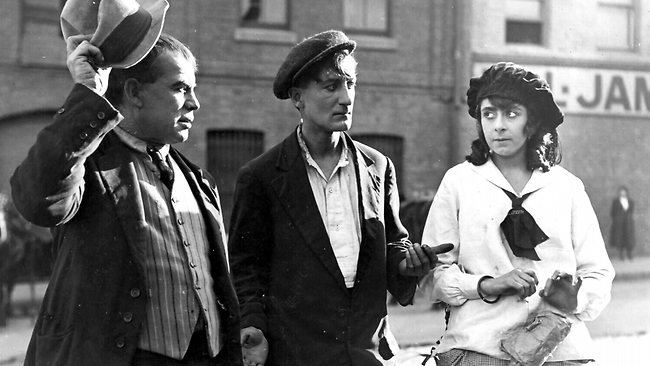
The next morning, Paul’s deputy, Donny Saunders (Haas) calls at Paul’s home and asks him if he’s been outside yet. Paul follows him out and finds a line of muddy hoof prints that circle his house and then head further into town, and then out into the woods where they disappear abruptly. The puzzling thing about them is that whatever animal made them, it was walking on two legs. While Paul starts to look into the matter, and does his best to reassure the worried townspeople, Donny hears about the local legend of a creature that lives in the nearby woods, and how it hunts by using the upper branches of trees as cover.
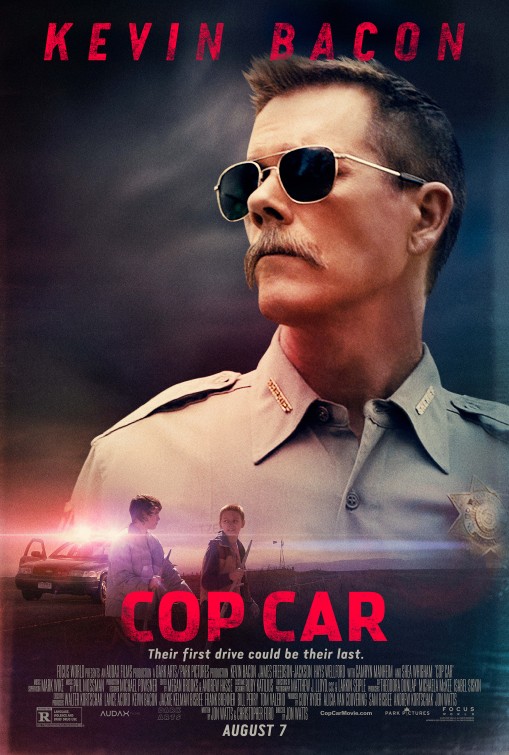
Paul has an encounter one night on the road with a dead deer. He hears something in amongst the trees, and rattled, gets back in his car only to find the deer has disappeared. He checks with the sheriff of a neighbouring county to see if there have been any animal attacks there recently. He learns that a logging crew were found dead not too long ago, and there have been a number of animal killings. Between them, Paul and Donny come to the conclusion that the logging company’s efforts have forced the legendary creature of the woods out of its natural habitat and it’s now trying to take over a new territory for itself, namely, Maiden Woods.

When a fierce snowstorm cuts off the town and the few remaining inhabitants who haven’t already evacuated, Paul decides to get everyone holed up in the church and to wait it out until morning when the storm has passed; then they can get help. But the creature proves unwilling to wait and launches an assault on the church and the fearful townsfolk inside…

Dark Was the Night - scene

Back in 2009, Tyler Hisel’s script The Trees was included in the annual Hollywood Black List, the list of the 100 best unproduced screenplays. Based loosely on real-life events that occurred in 1855 in Topsham, England, when the inhabitants woke to find freshly fallen snow and biped hoof prints tracing the landscape, Hisel’s script was eventually picked up for production in 2012, and though filming was completed in the same year, it remained unseen until a showing at the Screamfest Horror Film Festival in 2014. Such a delayed release usually speaks of either production problems or a lack of confidence in the final product. But either way, potential viewers who might be put off by such a delay would be doing themselves a disservice, because said final product is one of the better creature features out there and well worth seeing.

Part of the movie’s appeal is the performance by Durand, an actor usually employed to play bad guys. Here he gets a chance at playing the hero plagued both by self-doubt and being out of his depth. His reactions to the increasing weirdness in his town are flecked with small moments of subdued panic, and it’s this considered approach to both the character and the material that raises what would normally be a stock role into something much more subtle and much richer. Even when the narrative requires Paul to play the action hero, his taking charge plays better as a result of the work Durand has already put in, and instead of it feeling clichéd or forced, Paul’s heroism becomes a natural consequence of his dealing with his guilty feelings.

Having such a degree of depth in its main character, the movie has a grounding that makes the fantasy and horror elements feel more credible, even if the creature, when it’s finally revealed, is not as scary or convincing as it needs to be. It’s a shame as up until then the movie does a very good job of keeping it out of the spotlight, and the brief glimpses we do see of it are carefully chosen to good effect (and to meet the demands of the budget). The creature has its roots in Native American myths and legends, including that of the wendigo, and the concept of its being disturbed from its natural habitat is another of Hisel’s ideas that carries some extra weight (and adds some subtext about endangered species).

Thanks to Heller – who also directed the under-rated Enter Nowhere (2011) – the plot unfolds at a measured pace, with equal time given to the mystery of what’s happening in and around Maiden Woods, and the emotional problems that Paul is trying to deal with. As both storylines converge, Heller increases the tension through judicious use of close ups and sound effects, and manages the unenviable task of having his two leads come to the conclusion that there might be a supernatural answer to what’s happening by emphasising their own doubts and disbelief, even though everything tells them otherwise. It makes for one of the more convincing “it-must-be-a-monster” moments in creature feature history, and is one more example of the care and attention taken by Heller, his cast and crew.

Rating: 7/10 – much better than most other movies of the same ilk, Dark Was the Night is a minor gem that shouldn’t be missed; thanks to the efforts of all concerned this is a much more meticulous and rewarding experience than could be gleaned from at first glance, and proof that low budget horror doesn’t have to be witless or exploitative.

Share this:

  • Click to share on X (Opens in new window) X
  • Click to share on Facebook (Opens in new window) Facebook
  • More
  • Click to print (Opens in new window) Print
  • Click to email a link to a friend (Opens in new window) Email
Like Loading...

Zombie Mash-ups

01 Tuesday Sep 2015

Posted by dullwood68 in Movies

≈ Leave a comment

Tags

Animation, Comedy, Drama, Historical drama, Musical, Romance, Spoofs, War, Zombies

Ah, the zombie. Poor, pitiful, flesh-rotting, animated corpse searching for one thing and one thing only: food (preferably of the screaming human kind). Like many horror sub-genres, there’s always been the temptation to combine these marauding munch-aholics with other genres, or take them places you might not expect them to be a part of, like the upcoming Pride and Prejudice and Zombies (2016). Zombie Strippers! (2008) is another example, or you could have Pro Wrestlers vs Zombies (2014 – actually, maybe not). But while Zombie Fight Club (2014) or Zombie Hamlet (2012) might sound fun in terms of their crossover appeal, the fact remains that there are plenty of movies that could be reworked to include zombies, and still retain the values that made them the great movies we all know and love. Here then are ten examples of movies that might have benefitted from a more undead approach.

Arsenic and Old Zombies (1944)

Frantic comedy starring Cary Grant as a nephew to two spinster aunts who have been mercy killing their lodgers and burying them in the basement. As he tries to work out what to do about it, and keep it all a secret from his girlfriend, things are made even more complicated when the murdered lodgers rise from the dead and try to take their revenge.

Arsenic and Old Lace

A Zombie in Winter (1968)

King Henry II of England has a dilemma: having been bitten by a zombie he needs to ensure his successor is a) worthy of the crown, and b) not eaten by Henry before it can be arranged. With time running out, Henry must negotiate the treacherous waters of palace intrigue, and avoid questions about the mounting number of servants in his household who are being found partially devoured.

The Dirty Dozen Zombies (1967)

Desperate times call for desperate measures and with the outcome of World War II finely balanced on a knife edge, it’s up to tough Army major Lee Marvin to recruit a suicide squad for a dangerous mission. Going behind enemy lines to steal vital plans, Marvin’s pick of dead soldiers brought back to life with the promise of full restoration, get the job done with a minimum loss of limbs and a maximum amount of gnawing.

Mr. Zombie Goes to Washington (1939)

It’s politics gone mad as a newly appointed senator (James Stewart) bucks the system and endemic corruption when a bill that fosters land graft is bulldozed through the Senate, and the planned development disturbs a cemetery full of zombies. Using a long-unused statute to protect their rights to eternal peace, the senator takes to the floor of the Senate to overturn the decision and expose the corrupt officials behind the bill.

Father of the Zombie (1950)

Spencer Tracy is the unlucky father whose daughter’s impending wedding is thrown into doubt when she comes home with a strange bite on her arm and begins to show signs of cannibalism. Even when she attacks and takes a chunk out of the groom’s mother, Tracy manages to keep the wedding on track (and his daughter from eating the guests).

Father of the Bride

Snow White and the Seven Zombies (1937)

Early Walt Disney classic sees Snow White fleeing the dastardly intentions of the Queen and finding sanctuary in the forest with seven zombies. When she eats a poisoned apple and falls into a deep sleep they struggle to stop themselves from gorging themselves on her, but find it helps to frequently sing “Hi ho, hi ho, it’s off for lunch we go”.

A Connecticut Zombie in King Arthur’s Court (1949)

Danny Kaye is the unfortunate zombie cast back in time to Arthurian England and pressed into helping Arthur defeat Merlin’s plan to take over the kingdom, while trying to hide his condition and the hunger that comes over him at jousting tournaments when he sees the knights who are, to him, food in a can.

Who’s Afraid of Virginia Zombie? (1966)

Pain and humiliation are the order of the day as Elizabeth Taylor and Richard Burton play a married zombie couple who’ve lost sight of how much they used to chase down and devour young couples who remind them of their pre-zombie existence. Filled with angst and an existential dread of remaining undead forever, Taylor and Burton are terrific as the couple who’d rather flay each other than their unsuspecting dinner guests.

Zombie on a Hot Tin Roof (1958)

It’s high drama in the Deep South as long-held family secrets are brought out into the open, including the love that dare not speak its name: that of a human for a zombie. Paul Newman is excellent as the confused human whose willingness to be a buffet for his “close” zombie friend puts his marriage at risk, his inheritance, and in a scene heavily censored at the time, his chances of having a child.

The Fabulous Zombie Boys (1989)

Two brothers, professional musicians, play small clubs and make enough to get by, but when they take on a singer (Michelle Pfeiffer) and both are subsequently bitten in a zombie attack, their attraction for her leads to jealousy, wounded pride, bitterness, and no small amount of mutual munching. Notable for the scene where Pfeiffer is forced to slide around the top of a piano to avoid the brothers’ attempts to turn her into a mid-show snack.

Fabulous Baker Boys, The

Share this:

  • Click to share on X (Opens in new window) X
  • Click to share on Facebook (Opens in new window) Facebook
  • More
  • Click to print (Opens in new window) Print
  • Click to email a link to a friend (Opens in new window) Email
Like Loading...

Aloha (2015)

31 Monday Aug 2015

Posted by dullwood68 in Movies

≈ 1 Comment

Tags

Bill Murray, Bradley Cooper, Cameron Crowe, Drama, Emma Stone, Gate blessing, Hawaii, Military, Nation of Hawaii, Private contractor, Rachel McAdams, Review, Romance, Satellites

Aloha

D: Cameron Crowe / 105m

Cast: Bradley Cooper, Emma Stone, Rachel McAdams, Bill Murray, John Krasinski, Danny McBride, Alec Baldwin, Bill Camp, Jaeden Lieberher, Danielle Rose Russell

After being injured in Afghanistan, Brian Gilcrest (Cooper) is invalided out of the Army and goes to work as a private defence contractor for billionaire Carson Welch (Murray). Welch is looking to consolidate two army posts in Hawaii and launch a telecoms satellite at the same time, having made a deal with the military. As his representative, Brian is tasked with seeking permission from the leader of the Nation of Hawaii for a blessing to be carried out on the site of the combined army bases’ new gate. Given a military liaison in the form of Allison Ng (Stone), Brian also has to contend with the presence of his ex-girlfriend, Tracy Woodside (McAdams). She has two children, twelve year old Grace (Russell) and younger son Mitch (Lieberher), and is married to pilot “Woody” Woodside (Krasinski).

Brian and Allison meet with the Hawaiian Nation’s leader and they reach an agreement about the blessing, but it’s as much to do with Allison’s presence as it is Brian’s. He begins to reassess her opinion of her, while fending off Tracy’s attempts to get him to talk about the reasons they broke up thirteen years ago. With the blessing assured, Welch lets Brian in on the details of the satellite launch, but when he accesses the USB stick he’s been given he finds the satellite has an extra payload that nobody has mentioned: a missile system. Brian is aware that what Welch is doing is illegal, but he feels a sense of obligation to him and keeps the information to himself, also knowing that he’s promised the Nation of Hawaii that the skies above their land won’t be populated with weaponry.

His relationship with Allison deepens, and they spend much of his remaining time together. But her quarter-Hawaiian heritage and belief in the myths and legends of the islands begins to play on his conscience. On the day of the launch however, Welch calls Brian urgently to the launch centre to deal with an attempt by Chinese hackers to access the satellite. With Allison next to him he sets about protecting the satellite, while also being aware that this is his only opportunity to stop Welch’s plans for the payload.

Aloha - scene

Cameron Crowe’s career has had its fair share of setbacks in recent years, with his movies failing to capture fully the early promise shown by Say Anything… (1989) and Singles (1992). Jerry Maguire (1996) was perhaps his most fully realised project, and Almost Famous perhaps the one he was most passionate about. But then he changed tack with the remake of Vanilla Sky (2001), a movie that defied even his and Tom Cruise’s talents to make interesting. Four years later he returned with Elizabethtown (2005), a movie that seemed to play to his strengths as a writer/director, but which was so unsure of itself that it ended up collapsing in on itself (and featured an awkward performance from Orlando Bloom). It was even longer before he directed another feature, the based-on-a-true-story tale We Bought a Zoo (2011), but it lacked that certain spark that would have elevated it above its TV movie of the week feel.

And so, after another break, Crowe is back with Aloha, another movie in which the main character is redeemed by the love of a good woman, while coming to terms with the mistakes of his past. It’s a simple movie, told in a straightforward style, with few stylistic flourishes, and features cosmetically interesting performances from Cooper and Stone. It’s a movie that doesn’t aim very high, and as a result feels tired and worn out from the start. It also features a raft of characters that are hard to care about – Brian, Tracy, “Woody” – or serve no useful purpose other than to give certain actors – McBride, Baldwin, Camp – another role to add to their CV’s. Only Stone and Murray make anything of the material, but that shouldn’t be regarded as anything other than a major achievement in the face of a script that Crowe appears not to have worked on beyond the first draft.

Crowe’s script is so uneven and rife with so many coincidences that after a while the viewer has no choice but to just go with the movie, knowing exactly where it’s going and with no sense that anything will be a surprise. There’s a subplot involving Tracy’s daughter that is signposted so clumsily that even a blind person could spot it, and Crowe doesn’t even try and throw some mystery onto the subject; it also leads to the most cringeworthy scene in the whole movie. But that’s not as bad as when Brian discovers the weapons payload on the satellite, another clumsy moment that smacks of Crowe’s desperate need to beef up the drama and give himself a final act (as if Brian dealing with Allison and Tracy wasn’t enough). And everything’s all wrapped up neatly by the end – only a bow is missing to complete the effect.

It’s sad to see a writer/director of Crowe’s talent waste his time on something so unexceptional and bland. That he still has a certain caché is good, but the anticipation for Aloha that was garnered by the trailer has been soundly trampled on, leaving only Baldwin’s description of Cooper as “Mr Sexy Pants” as one of the few things to look forward to. Perhaps next time, Crowe will direct someone else’s script, or work with someone who’ll be able to strengthen his ideas and material. Either way, if he’s in the same two seats again as writer and director, then the anticipation might not be as great as it was on this occasion.

Rating: 4/10 – dull, uninspired, and lacking any degree of charm to help offset the tedium of the narrative, Aloha arrives looking like a new, shiny dollar, but leaves looking like a battered nickel; Crowe misjudges almost everything, and only the technical credits warrant any merit, making the movie inviting to look at, but sadly hollow upon closer inspection.

Share this:

  • Click to share on X (Opens in new window) X
  • Click to share on Facebook (Opens in new window) Facebook
  • More
  • Click to print (Opens in new window) Print
  • Click to email a link to a friend (Opens in new window) Email
Like Loading...

Far from the Madding Crowd (2015)

30 Sunday Aug 2015

Posted by dullwood68 in Movies

≈ Leave a comment

Tags

1870, Carey Mulligan, Dorset, Drama, Historical drama, Literary adaptation, Matthias Schoenaerts, Michael Sheen, Review, Romance, Thomas Hardy, Thomas Vinterberg, Tom Sturridge, Weatherbury

Far from the Madding Crowd

D: Thomas Vinterberg / 119m

Cast: Carey Mulligan, Matthias Schoenaerts, Michael Sheen, Tom Sturridge, Juno Temple, Jessica Barden, Hilton McRae, Bradley Hall

1870. Bathsheba Everdene (Mulligan) shelling out on her aunt’s farm in Dorset. Her aunt’s neighbour, Gabriel Oak (Schoenaerts), is a shepherd with a hundred acres and two hundred sheep. One day he proposes marriage to Bathsheba but she rejects his offer, telling him that she is too independent for him and he would never be able to tame her. Soon after, Gabriel’s sheep are all killed when his sheepdog herds them over a cliff; unable to keep his farm going he is forced to sell up and move on. Bathsheba is sorry to see him go, but her sadness is by the news that she has inherited her uncle’s estate in Weatherbury.

Determined to run the estate herself, Bathsheba brooks no nonsense from her staff. Now a wandering worker for hire, Gabriel learns of a position as shepherd on the estate. When he arrives there he and Bathsheba are both pleased to see each other again, but she insists on the proper formalities now that she is his employer. When her efforts attract the attention of her neighbour, William Boldwood (Sheen), he too proposes marriage as Gabriel did. Bathsheba turns him down as well, and when she and Gabriel discuss the matter, his dislike for the way she treated Boldwood leads to her telling him to leave. But a problem with the sheep gives her no choice but to rehire him.

Some time later, Bathsheba is walking the grounds of her estate one night when she unexpectedly meets ex-soldier Francis Troy (Sturridge). He tells her she’s beautiful, but although she’s pleasantly surprised she tells him to leave. When she finds Troy helping with the harvest the next morning, she again tells him to leave, but before he does he manages to persuade her to meet him the next day. When she does, he proposes to her, and this time she accepts. They marry – against Gabriel’s advice – and Troy’s rapacious nature reveals itself. He milks the estate for money and treats Bathsheba like she’s his property. But his past comes back to haunt him in the form of Fanny Robbin (Temple), a young woman he was betrothed to but who went to the wrong church on their wedding day. She tells him she’s carrying his child; he agrees to meet her the next day but she doesn’t show up. Later, her discovered corpse is taken to Weatherbury (because she was a servant there). When Troy sees the body he tells Bathsheba she is nothing to him, and he leaves. He swims out to sea and Bathsheba is informed of his drowning. With the estate’s fortunes in jeopardy because of Troy’s gambling, Bathsheba is once more offered support from William Boldwood…

Carey Mulligan as "Bathsheba" and Matthias Schoenaerts as "Gabriel" in FAR FROM THE MADDING CROWD. Photos by Alex Bailey.  © 2014 Twentieth Century Fox Film Corporation All Rights Reserved

Leaving aside any comparison with John Schlesinger’s 1967 version, Far from the Madding Crowd is a hard movie to enjoy, determined as it is to play down the passion inherent in Thomas Hardy’s novel, and the social proprieties of the period. Thanks to the adaptation and screenplay by David Nicholls, and Thomas Vinterberg’s pedestrian direction, the movie fails to ignite at any point, preferring instead to tread safely along, ticking off the novel’s high points like a classroom exercise. This leaves the unlucky viewer wondering if and when the pace will pick up, or the buttoned-down emotions will ever be released in a way that can be recognised or acknowledged.

For this is a movie that trades on lingering looks and silent expressions. Bathsheba and Gabriel do little else but show their attraction for each other by looking pointedly and often at each other (God forbid anyone should display their feelings – William Boldwood excepted). So much is left unspoken there are moments that wouldn’t feel out of place in a silent movie. No doubt this is to allow Mulligan and Schoenaerts to “act” but instead it drags the movie along, and leaves both of them somewhat stranded, as the audience waits patiently for their expected romance to finally come to fruition (once Troy and Boldwood are dispensed with).

There’s also the sense that somewhere along the way – the editing stage, probably – the decision was taken to fit the movie to a two-hour running time, because this is a movie that feels hurried and disjointed at the same time. Some scenes feel truncated, while others feel as if they’re missing the one that should have come before. It’s an odd feeling, and never really goes away, even though the movie becomes more interesting once Bathsheba is married and it holds the attention a little better. Presented in this fashion, though, leads to the movie feeling like the edited version of a mini-series. (If there’s a Director’s Cut on the horizon, then a three-hour version wouldn’t come as a surprise.)

Against this, the performances are solid if unspectacular, though Sheen is a standout as the troubled yet hopeful Boldwood, the scene where he reveals his feelings about Bathsheba to Gabriel a small masterclass in making more from stilted dialogue than would seem possible. Mulligan convinces as a free spirit (though not as a woman instantly lovestruck by the romantic attentions of a soldier), while Schoenaerts gives such a laid-back performance it’s tempting to have his pulse checked from time to time. As the dashing Troy, Sturridge acts with his top lip to the fore, and delivers his lines as if he was reading from The Young Rogue’s Guide to Eligible Damsels. And Temple is wasted as Fanny, reduced to a few scenes and given little more to do than pop in and out of the narrative as required.

What saves the movie is Charlotte Bruus Christensen’s luminous landscape photography, allied to some richly detailed interiors, and a recreation of the period that feels exactly as it would have been. Beyond that, Craig Armstrong’s score is used sparingly and with surprising acuity, the few emotional scenes left free of music so as to focus the viewer’s attention on the scene itself, and not manipulate them into feeling the “correct” emotion. It’s a rare feat, but it works well here (unlike the scenes themselves).

Rating: 5/10 – sluggish and only fleetingly engaging, Far from the Madding Crowd looks and feels like a movie that deserves a better, more considered approach; while hitting its mark sporadically may account for some of the kinder reviews out there, this is still a major disappointment from Vinterberg, and if you’re a fan of Hardy, a letdown as well.

Share this:

  • Click to share on X (Opens in new window) X
  • Click to share on Facebook (Opens in new window) Facebook
  • More
  • Click to print (Opens in new window) Print
  • Click to email a link to a friend (Opens in new window) Email
Like Loading...

Mini-Review: Lila and Eve (2015)

27 Thursday Aug 2015

Posted by dullwood68 in Movies

≈ 1 Comment

Tags

Charles Stone III, Drama, Drive-by shooting, Drug dealers, Jennifer Lopez, Julius Tennon, Murder, Revenge, Review, Shea Whigham, Support group, Thriller, Viola Davis

Lila and Eve

D: Charles Stone III / 94m

Cast: Viola Davis, Jennifer Lopez, Shea Whigham, Julius Tennon, Aml Ameen, Ron Caldwell, Andre Royo, Chris Chalk, Michole Briana White, Yolonda Ross

Following the death of her eldest son Stephon (Ameen) in a drive-by shooting, single mother Lila (Davis) finds herself at a loss as to how to continue with her life. She puts on a brave front for her youngest son Justin (Caldwell), and struggles with the lack of progress the police are making in finding her son’s killer. When she attends a local support group she meets Eve (Lopez), who lost her nine year old daughter. Eve persuades Lila to look into Stephon’s death herself, and they start by looking into why the intended victim of the drive-by shooting was the target. They learn that the victim was dealing drugs where he shouldn’t have been and his death was just a matter of “business”. In the process of learning this, Eve shoots and kills the drug dealer who gives them the information, but not before he’s given them the names of the men who supplied him.

The detectives investigating Stephon’s death, Holliston (Whigham) and Skaketti (Royo), are assigned to this new shooting. While it looks like another gang hit, Holliston isn’t so sure. Lila, meanwhile, having been shocked by Eve’s actions, tries to put it behind her. A burgeoning romance with her neighbour, Ben (Tennon), keeps her occupied until Eve pressures her into finding the men who supplied the dead dealer. They follow them to the roof of a car park; once there, Lila pulls a gun on them and when they try to resist she shoots and wounds one and kills another (as well as another dealer). This time the wounded man gives them the name of the man who carried out the shooting, Alonzo (Chalk), then Lila kills him. Holliston begins to piece together what’s happening and becomes suspicious of Lila. And then she and Eve find Alonzo, and Lila prepares to take her revenge…

Lila and Eve - scene

A female-driven murder/revenge movie that features a bravura performance from Viola Davis, Lila and Eve has a fatalistic 70’s feel to it that suits the mood and the tone of the narrative, and keeps its tale of hate-filled revenge refreshingly simple and straightforward. It does stretch credulity at times in terms of how easily Lila and Eve find out who’s responsible for Stephon’s death, and how inept it makes the otherwise quite astute Holliston look in comparison, but this corner-cutting by screenwriter Patrick Gilfillan keeps the movie from meandering, and allows the pace to aid in keeping the audience involved.

It helps that the viewer also remains involved thanks to Davis’s emotive, fearless portrayal of Lila, a woman pushed to the edge by the sense of injustice she feels regarding her son’s death, and who finds the strength within herself to navigate the moral maze revenge throws up in her path. For a movie that looks to have been made on a fairly low budget, and which aims for a gritty realism (which it achieves for the most part), Davis’s presence elevates the material and makes the movie much more than a simple revenge drama. As her friend and confederate in revenge, Lopez is much more effective here than she was in The Boy Next Door (2015), bringing a coiled, steely energy to her role that fits comfortably with Lila’s hesitant, uncertain belief in what they’re doing. Whigham is equally good as the detective who cites Columbo as a role model for cops, and Tennon (Davis’s real life husband) adds a layer of humility and gentleness that provides the movie with some necessary breathing room.

Rating: 7/10 – directed with confidence and unassuming flair by Stone III, Lila and Eve is a spirited, enjoyable crime drama that isn’t afraid to show the human consequences of random violence; a pleasant surprise amongst all the other crime dramas out there and well worth watching for the performances alone (even Royo’s, whose character is written as an idiot, and is subsequently played like one).

Share this:

  • Click to share on X (Opens in new window) X
  • Click to share on Facebook (Opens in new window) Facebook
  • More
  • Click to print (Opens in new window) Print
  • Click to email a link to a friend (Opens in new window) Email
Like Loading...

The D Train (2015)

22 Saturday Aug 2015

Posted by dullwood68 in Movies

≈ Leave a comment

Tags

Andrew Mogel, Banana Boat, Comedy, Commercial, Drama, High School, Jack Black, James Marsden, Jarrad Paul, Jeffrey Tambor, Kathryn Hahn, Reunion, Review

D Train, The

D: Jarrad Paul, Andrew Mogel / 101m

Cast: Jack Black, James Marsden, Kathryn Hahn, Jeffrey Tambor, Russell Posner, Mike White, Henry Zebrowski, Kyle Bornheimer

Dan Landsman (Black) is the self-styled chairman of his high school reunion committee. He enjoys what limited prestige comes with the position (which isn’t much), but can’t get the respect from his fellow committee members that he thinks he deserves. This is due to his overbearing, self-important approach to organising the reunion, and the fact that he was never popular in high school. As he and the rest of the committee call up their peers and are continually let down, Dan finds a solution in the unlikeliest of places: a Banana Boat commercial. The “star” of the commercial is none other than Oliver Lawless (Marsden), the most popular guy in high school. Dan reasons that if he can get Oliver to attend the reunion, everyone will.

Dan determines that a face-to-face approach is needed, but Oliver lives in L.A., while he lives in Pittsburgh. Under the pretence of going there for an important business meeting, Dan books a flight and gets ready to go. But his boss, Mr Schurmer (Tambor), insists on coming with him to help facilitate the deal that Dan has supposedly set up. Unable to persuade his boss to stay in Pittsburgh, he has no choice but to make it seem as if the deal has fallen through. Dan tracks down Oliver and they spend the night on the town, going from club to club and bar to bar and getting drunk and high. Dan goes back to his hotel room but in the early hours, Oliver, feeling down, pays him a visit. Dan reveals the true reason for his visit, and even tells Oliver about the so-called business deal; Oliver agrees to attend the reunion.

The next morning, Oliver poses as the businessman Dan has been dealing with, but instead of killing the deal as Dan needs him to, he tells Schurmer that it’s a go. Oliver apologises, but tells Dan he can easily put a stop to things when he’s back in Pittsburgh. That night they go out on the town again, but this time they end up back at Oliver’s apartment. To Dan’s surprise, Oliver makes a pass at him. What happens next leaves Dan bewildered and confused. Back home he finds his boss spending lots of money on the business in expectation of the deal going through, his fourteen year old son Zach (Posner) experiencing problems of the heart, and his wife Stacey (Hahn) pleased for him for landing the deal and Oliver’s attendance at the reunion.

But when Oliver arrives for the reunion and stays at Dan’s home, Dan begins behaving erratically, and he starts to alienate his wife and son, and the members of the committee (who don’t like him that much anyway). As the reunion draws nearer, he tries his best to behave normally but the events in L.A. have had a greater impact on him than even he’s aware of. And it’s at the reunion itself that Dan’s behaviour causes the greatest upset as he and Oliver confront each other over what happened, and Dan is left feeling isolated and alone, and wondering what he can do to make things right with the people he cares about.

THE D TRAIN - 2015 FILM STILL - Jack Black (Dan Landsman) and James Marsden (Oliver Lawless) - Photo Credit: Hilary Bronwyn Gayle. An IFC Films release.

Having previously worked on the script for Yes Man (2008), writers/directors Jarrad Paul and Andrew Mogel have upped their game somewhat for The D Train, and the result is a clever, sometimes very funny comedy drama that gives Black his best role since Bernie (2011) (though to be fair he has only made two other movies in that time). It’s also smart, knowing and occasionally tragic in its look at its main character’s constant need for respect and approbation, and the lengths he’ll go to in order to be acknowledged.

The social misfit is perhaps Black’s niche role (it can only be a matter of time before he plays a serial killer), and as in Bernie he’s uncomfortably comfortable in the role of a man whose social standing is based on his lack of popularity in high school (when we see him calling his fellow alumni not one of them appears to remember him without the benefit of some heavy prompting). Away from the reunion committee he’s in a respected position at work, with his boss happy to defer to Dan’s judgement on matters, while his home life appears secure as well. But it’s his lack of social presence that bothers him, and why he’s never fit in. Meeting Oliver in L.A. reminds him he can be a fun guy, that he can be good company, and more importantly, that those traits have always been inside him; it’s just needed someone of Oliver’s carefree nature to bring them out of him.

But with freedom comes (no, not great responsibility) a complete misunderstanding of the nature of friendship and many of the unspoken rules that go with it. Back in Pittsburgh, Dan displays all the signs of someone who’s been abandoned or had their favourite toy taken away from them; he just doesn’t know how to deal with all the raw feelings he’s experiencing. He overcompensates in the bedroom (not that Stacey minds), but then rudely ignores Zach when he needs some fatherly advice. The situation at work becomes unmanageable, and when Oliver shows himself to be a better father figure, Dan over-reacts and tells him to leave. It’s in these moments when Dan’s insecurities and jealousy of Oliver’s “cool” attitude shows him for the desperately needy person that he is.

Black is superb in the role, and he’s matched by Marsden who portrays Oliver’s shallow lifestyle with a thread of sadness lurking beneath the rampant hedonism. Hahn, who goes from strength to strength with each movie she makes, delivers a polished if largely restrained performance that makes for an effective counterpoint to Black’s anguished social walrus. And Tambor is terrific as Dan’s boss, a confirmed Luddite whose puppy-dog adoption of computers and the Internet contributes to Dan’s downfall.

But while the performances are all above average, and while the basic premise is a sound one given enough room for considered examination, the movie does have its faults, and in the same way that Paul and Mogel’s script is on solid ground when dissecting Dan’s motives and behaviour, it’s less so when it introduces moments and scenes of crass humour. One scene in particular stands out, when Oliver gives Zach advice on how to manage in a threesome. Despite the obvious humour to be had from such a scene, it’s still at odds with the tone of the rest of the movie, and there’s nothing the directors can do to offset the awkwardness of having a man in his late Thirties giving sex advice to a fourteen year old (it’s also strange that the script thinks it’s entirely likely that Zach would ask his dad about such a subject while at the dinner table). And at the reunion, Dan snorts cocaine in the bathroom before being discovered by Jerry (White), one of the committee members. Dan rambles on and Jerry’s surprise at Dan’s behaviour evaporates as quickly as it occurs. And Mr Schurmer’s subdued reaction to the potential loss of his company is meant to be quietly tragic but seems instead to be a case of the script not wanting to follow that particular plot thread any further (the same goes for Stacey’s reaction to the revelation of what happened in L.A.).

D Train, The - scene 2

With the characters routinely involved in scenes that don’t always have a logical follow-on, or betray the emotion of a scene (e.g. when Oliver leaves for L.A. and says goodbye to two of the committee members), the movie tries for hard-edged adult humour too often at the expense of the more important dramatic aspects. While the humour is mostly very funny indeed, a lot of it feels shoe-horned in, as if they were added to the script somewhere in the pre-production phase. As a result the movie feels disjointed at times, and lacks the overall focus afforded the drama, leaving audiences to wonder if the humour is there to provide some relief from the themes of social inequality, self respect, alienation, and personal inadequacy. If it is, then unfortunately the way in which it’s been done lacks authority.

Rating: 7/10 – deficiencies in the script leave The D Train feeling like it’s falling short of its original intentions; Black is on terrific form however, keeping the movie afloat through some of its more unlikely moments, and perfectly judging the pathos needed to avoid Dan being completely unlikeable.

Share this:

  • Click to share on X (Opens in new window) X
  • Click to share on Facebook (Opens in new window) Facebook
  • More
  • Click to print (Opens in new window) Print
  • Click to email a link to a friend (Opens in new window) Email
Like Loading...

Mini-Review: The Man from U.N.C.L.E. (2015)

19 Wednesday Aug 2015

Posted by dullwood68 in Movies

≈ 1 Comment

Tags

Action, Alicia Vikander, Armie Hammer, Atom bomb, CIA, Cold War, Drama, Elizabeth Debicki, Guy Ritchie, Henry Cavill, Hugh Grant, Ilya Kuryakin, KGB, Napoleon Solo, Review, Spies, The Sixties, Thriller, U.N.C.L.E.

Man from U.N.C.L.E., The

D: Guy Ritchie / 116m

Cast: Henry Cavill, Armie Hammer, Alicia Vikander, Elizabeth Debicki, Luca Calvani, Sylvester Groth, Hugh Grant, Jared Harris, Christian Berkel, Misha Kuznetsov

Following his rescue of a scientist’s daughter, Gaby Teller (Vikander) from East Berlin, CIA agent Napoleon Solo (Cavill) is told by his boss (Harris) that he has a new partner: the KGB agent who tried to stop him, Ilya Kuryakin (Hammer). Gaby’s father, Udo (Berkel), is building an atom bomb that’s intended for a hidden Nazi group. Her Uncle Rudi (Groth) is suspected of knowing where he is. Solo and Kuryakin must take Gaby to Rome where evidence points to the involvement of the Alexanders (Calvani, Debicki). While Solo poses as an antiquities dealer, Kuryakin poses as Gaby’s fiancé. Solo and Kuryakin attend a party given by Victoria Alexander where they discover evidence that the atom bomb (and Udo) must be nearby. That night they both break in to the Alexanders’ factory where they find further evidence of Udo’s work.

Solo meets with Victoria but she drugs his drink. When he wakes he finds himself strapped to a chair and about to be tortured by Uncle Rudi who turns out to be an evil Nazi scientist. With Kuryakin’s aid he escapes, while Gaby is taken to an island where her father is putting the finishing touches to the bomb. It’s at this point that Solo and Kuryakin are introduced to Commander Waverly (Grant), a member of British intelligence. He fills them in on some information that’s been held back from them, and reveals a plan to infiltrate the island, seize the atom bomb, and rescue Gaby and her father. But the Alexanders have an ace up their sleeve…

Man from U.N.C.L.E., The - scene

The Man from U.N.C.L.E. (on the big screen at least) has been a long time coming. But up until the recent involvement of Ritchie and his producing partner Lionel Wigram, every attempt to make a movie version of the classic 60’s TV show has stalled, often before it’s even cleared the gate. Coming off two very successful Sherlock Holmes movies, Ritchie has clearly been given as much leeway as he needs in order to bring this movie to audiences, and while he uses many of the stylistic shooting techniques he used on the Holmes movies, what he’s failed to do is come up with a story that is either exciting or engrossing. It’s a shame as the potential is there for another successful franchise, but aside from a splendidly retro feel for the era, the movie lacks the kind of impact that would lift it out of the bin marked “ordinary”.

Things aren’t helped by the casting of Cavill and Hammer, two averagely effective actors who lack the subtlety required to make Solo and Kuryakin anything more than grudging partners. Sure it’s an origin story so the animosity is understandable, but they’re also highly skilled professionals, the best at what they do; so why make Solo a preening plank, or Kuryakin a headstrong liability? It’s a curious decision, to make your two leading men so unrelatable, but Ritchie’s gone with it completely, and the movie suffers appropriately. Thankfully, the same can’t be said of Vikander and Debicki, who save the movie from being too much of a debacle, and the involvement of Grant, who seems to be having the most fun he’s had in years. If there is to be a sequel – and at the moment the movie’s performance at the box office seems to indicate there won’t be – then a serious rethink is in order.

Rating: 5/10 – not as bad as it could have been, but also not as good as it should have been, The Man from U.N.C.L.E. lacks energy and limps uneasily from scene to scene in search of a consistently entertaining tone that it doesn’t find; a pleasant enough diversion if you’re in the mood, but definitely not a movie to expect too much from.

Share this:

  • Click to share on X (Opens in new window) X
  • Click to share on Facebook (Opens in new window) Facebook
  • More
  • Click to print (Opens in new window) Print
  • Click to email a link to a friend (Opens in new window) Email
Like Loading...

For One Week Only: Australian Cinema – Part I

17 Monday Aug 2015

Posted by dullwood68 in Movies

≈ Leave a comment

Tags

1896-1920, Albert Roche, Arthur Tauchert, Athanaeum Hall, Australian cinema, C.J. Dennis, Drama, For One Week Only, Gilbert Emery, John Gavin, Lottie Lyell, National Film and Sound Archive, Raymond Longford, Restoration, Review, Romance, The Limelight Department, The Sentimental Bloke, The Songs of a Sentimental Bloke

Australian Cinema Part I – 1896-1920

The first cinema presentation in Australia happened in October 1896 at the Athanaeum Hall in Melbourne. It was a short movie (of course), but while Australia and other movie producing countries around the world continued to make and show short movies, it was Australia that would produce the first full-length feature: The Story of the Kelly Gang (1906). Running for approximately sixty minutes, it was directed by Charles Tait, a concert, movie and theatrical entrepreneur, and featured several of his family in key roles. It was a major success, and was shown in New Zealand, Ireland and the UK (alas, only seventeen minutes of footage still survives).

Story of the Kelly Gang, The - scene

While the Athanaeum Hall continued to show movies, Melbourne was also the home of one of the world’s first movie studios, the Limelight Department, which was in use between 1897 and 1910 (and was overseen by the Salvation Army). It made a variety of movies of varying lengths, some three hundred in all, and was, for its time, the biggest producer of movies worldwide. It was responsible for a number of firsts: first feature length documentary, Inauguration of the Commonwealth (1901); first bushranging drama, Bushranging in North Queensland (1904); and first movie combining moving images, glass slides, oratory and music, Soldiers of the Cross (1900). As the Australian movie industry took off, the ensuing boom years of the 1910’s saw the industry flourish, with directors such as John Gavin, Alfred Roche, E.I. Cole and W.J. Lincoln leading the way (and even though some of their efforts may not have been as good as they’d hoped).

In 1911, first-time director Raymond Longford made The Fatal Wedding, a melodrama that proved to be a huge success and which was well received critically. It was also the first Australian movie to claim two particular innovations: that it was the first to use interior sets, and that it featured the first ever close-up. Whether or not this is actually true, it reinforces the view that Australia – despite its distance from the rest of the world’s movie-making community – was forging ahead with new ideas and was creating a robust, popular industry that was the equal of the US, Italy and the UK in terms of movie production and exhibition.

As the decade wore on, more and more movies were made and released, including The Sundowner (1911), Transported (1913), The Martyrdom of Nurse Cavell (1916), Australia’s Peril (1917), and the interestingly titled Does the Jazz Lead to Destruction (1919), but most titles are now considered lost. One movie that has survived, and was the subject of a restoration project in the early 2000’s, is Raymond Longford’s The Sentimental Bloke (1919), viewed as one of the best Australian movies of all time, and based on the poem The Songs of a Sentimental Bloke by C.J. Dennis. Here is a testament to the impressive development of the Australian movie industry, and an example of how advanced this island continent had become.

Sentimental Bloke, The

The Sentimental Bloke (1919) / D: Raymond Longford / 68m

Cast: Arthur Tauchert, Lottie Lyell, Gilbert Emery, Stanley Robinson, Harry Young, Margaret Reid, Charles Keegan, William Coulter, Helen Fergus, C.J. Dennis

Bill (Tauchert) is a larrikin, an uncultivated, mischievous man who behaves as if social conventions don’t apply to him. He drinks – usually with his best friend, Ginger Mick (Emery), and he gambles as well. When he’s caught in a raid on a gambling den, he’s sentenced to six months in gaol. When he gets out he vows to himself that he’ll give up his old life and walk the straight and narrow. He finds work at a market and avoids his old friends. One day he spies a young woman (Lyell) and is instantly smitten with her. But when he approaches her, and uses his usual slang terms to impress her, she rebuffs him. Chastened, and aware that he needs to improve his manners, Bill determines that if she should meet her again he will behave more responsibly.

He learns that the young woman is called Doreen and that she works in a pickle factory, putting labels on the bottles. Through a friend who works there also, Bill arranges a meeting with her, and putting aside his usual way of talking, he shows her that he’s not as bad as she thought previously. They begin seeing each other, but when another man Bill calls the Stror ‘at Coot (Young) starts to pay attention to Doreen as well, his natural belligerence and anger cause him to warn the man off. However, the Stror ‘at Coot persists in seeing Doreen until Bill gets violent with him, a situation that Doreen is unhappy about.

Knowing he’s skating on thin ice, but confused that defending his true love appears to be wrong, Bill assures Doreen that he will try harder. Eventually, after Bill has satisfied the concerns of Doreen’s mother (Reid), they marry and settle down together in their own home. But a chance encounter one night with Ginger Mick leads to Bill lapsing back into his old ways. He gambles away his money, and when he finally gets home in the early hours of the morning, he expects to be chastised for his foolishness. But the next morning brings a surprise, one that allows the couple to move on with their lives and in the fullness of time, to find peace and happiness.

Sentimental Bloke, The - scene

A huge success on its release, The Sentimental Bloke plays like a cross between Charles Dickens and an early Australian soap opera. It’s a charming, easily likeable movie, with a good central performance from Tauchert (who’d only made a couple of short movies before this), and tells its story in a direct, no frills way that makes it all the more enjoyable. In adapting Dennis’s work, Longford and his real life partner Lyell have kept the heart and soul of the poet’s work and translated it to the screen with surprising ease, even to the point of using Dennis’s prose for the intertitles (though some viewers may be put off by the use of colloquialisms and Aussie slang terms).

There’s much to admire, from Tauchert’s naturalistic interpretation of Bill, to Lyell’s considered portrayal of Doreen. Their scenes together reflect Longford’s decision to eschew the usual melodramatic excesses of silent movie acting, and opt for a more realistic approach, leaving Bill and Doreen resembling people that audiences could actually identify with. Tauchert has a wonderfully expressive face (especially when Bill is showing confusion), and Lyell matches him with several moments of pained acceptance, as Doreen’s love for Bill wins out over her reservations about his behaviour. (Sadly, Lyell, who was very very talented, and regarded as Australia’s first movie star, died in 1925 from tuberculosis.) Elsewhere, Emery and Reid provide solid support, but Longford keeps the focus on Bill and Doreen, and rightly so. Their relationship, with its ups and downs and unwavering commitment to each other, is shown without the need for undue or unnecessary emphasis, and is all the more effective for it.

What arises from all this is a great deal of humour to offset the pathos and muted drama. A highlight is a visit to the theatre to see a production of Romeo and Juliet (not something that Bill is too keen on at first). As the couple become wrapped up in the tragedy of Shakespeare’s young lovers, each twist and turn of the story sees them more and more emotionally invested, until the moment when Romeo slays Tybalt and Bill shouts out “Put in the boot!” The movie is stuffed with winning moments like that one, and each adds to the richness of the material.

The movie is also beautifully shot by Arthur Higgins. He was the DoP on The Fatal Wedding, and would work on this movie’s sequel, Ginger Mick (1920). He shows a firm grasp of lighting and composition, and the outdoor sequences have a freshness and vitality about them that few other cinematographers of the period could manage to achieve. It’s a shame that so many of the other movies he shot have since been lost – on this evidence he was exceptionally talented and deserves to be more widely known.

Following its release, The Sentimental Bloke was a success in the UK and Ireland, but not in the US because Dennis’s prose was found to be too difficult to understand. Despite the movie being recut and the intertitles changed, and being called The Story of a Tough Guy, it was quickly withdrawn from distribution. In the Fifties, a fire at a Melbourne movie library resulted in the destruction of all but two boxes of movie negatives. Fortunately, The Sentimental Bloke was saved, and following a transfer of the 35mm nitrate positive to 16mm acetate stock, it was shown to great acclaim at the 1955 Sydney Film Festival (ironically, Longford wasn’t invited to attend as the organisers were unaware he was still alive; he died in 1959).

But that wasn’t the end of the movie’s journey. In 1973 an original 35mm negative was discovered at a Film Archive in Rochester, New York. Even though it was a copy of the American version, the quality was better than any Australian copies (it had also been mislabelled The Sentimental Blonde). And in 2000, Australia’s National Film and Sound Archive embarked on a restoration project that included restoring the original colour tinting as much as possible. The results were shown at the 2004 Sydney Film Festival to further acclaim, proving that Longford and Lyell’s efforts all those years ago will continue to be appreciated – and rightly so.

Rating: 9/10 – a bona fide classic that still stands the test of time, The Sentimental Bloke is Australian silent cinema at its finest: dramatic, funny, emotionally earnest, and heartwarming; as one of the few movies to survive (relatively) intact from the period, it should be required viewing for anyone interested in silent cinema, or just because it’s a beautiful story beautifully told.

Share this:

  • Click to share on X (Opens in new window) X
  • Click to share on Facebook (Opens in new window) Facebook
  • More
  • Click to print (Opens in new window) Print
  • Click to email a link to a friend (Opens in new window) Email
Like Loading...

Cop Car (2015)

16 Sunday Aug 2015

Posted by dullwood68 in Movies

≈ Leave a comment

Tags

Crime, Drama, Drugs, Hays Wellford, James Freedson-Jackson, Jon Watts, Kevin Bacon, Murder, Review, Shea Whigham, Sheriff, Stolen car, Thriller

Cop Car

D: Jon Watts / 86m

Cast: Kevin Bacon, James Freedson-Jackson, Hays Wellford, Shea Whigham, Camryn Manheim

Two boys, Travis (Freedson-Jackson) and Harrison (Wellford) have run away from their respective homes, and are travelling across country when they stumble upon a police cruiser in a small wooded area. Nervous about being discovered and taken home, they approach the vehicle with caution but soon realise that whoever it belongs to isn’t anywhere nearby. They get in and pretend to be driving it when Travis finds the keys. Caught up in the excitement of finding the car, they drive off, eventually reaching a main road where they almost collide with a woman driver (Manheim).

Meanwhile, Sheriff Kretzer (Bacon), whose cruiser it is, is busy disposing of a body he had in the trunk. When he returns to the car to dispose of a second body, he of course finds it’s gone. Confused, he uses his mobile phone to call Dispatch and ask the operator if she’s heard anything unusual over the radio. Kretzer is relieved when she says no, but knows that it could be just a matter of time before his car is seen or stopped. He begins to run across country until he comes to a trailer park. There he steals a car, and uses it to head home where he can regroup. When another call to Dispatch reveals reports of a stolen cop car, he dismisses the idea and arranges for all the local units to switch to another channel.

That done, he uses the radio in his truck to try and contact whoever’s stolen his cruiser. The boys don’t hear him at first, but they do hear a noise from the trunk. When they open it they discover a badly beaten man (Whigham) who is also tied up. He implores them to free him, saying the sheriff is a bad man and his life is still in danger. But when Travis and Harrison do free him, he overpowers them, and when Kretzer calls through again, the man forces Harrison to give him their location. While Kretzer heads to meet them, the man takes the sheriff’s assault rifle and hides nearby with the intention of killing him when he arrives. But when the sheriff does arrive, he senses something’s wrong, and so begins a game of cat-and-mouse that sees the two friends trapped in the back of the cruiser, and at the mercy of both the man and the sheriff.

Cop Car - scene

Cop Car‘s basic premise is a simple one: boys steal a sheriff’s cruiser, sheriff tries to get cruiser back, things get messy and complicated very quickly. In fact, it’s such a simple premise that it doesn’t need much more embellishment than a woman driver who can’t believe what’s she seen (two boys driving a sheriff’s car). And director/co-writer (along with Christopher J. Ford) Watts knows it, paring down the action and the drama to the point where only the most essential requirements are needed or used. It makes a refreshing change to see a thriller that’s pared down in such an effective way, and it’s all credit to Watts and Ford that they maintain such a tightly focused narrative throughout.

Of course, they’re helped enormously by the presence of Bacon (sporting a moustache that could qualify as either a special effect or a character in its own right). As the cocksure sheriff whose crooked endeavours are brought to heel by the intervention of two unsuspecting ten year olds, Bacon is a mix of sweaty terror and ambivalent menace; there’s a moral compass in there, but thanks to the script and Bacon’s interpretation of the character the viewer can’t be sure which way he’ll turn when it comes to dealing with the two boys (as opposed to Whigham’s unequivocally bad guy, who in the movie’s most cruelly effective scene, tells the boys just what he’ll do if they try and double cross him).

With Bacon on such fine form, it’s a good job that Freedson-Jackson and Wellford are able to match him for credibility, their easy-going camaraderie and childish naïvete another of the movie’s wealth of positives. In this day and age of computer whizz-kids and their seemingly inevitable rush to adulthood, it’s good to see a couple of kids who aren’t tech savvy, don’t know about safety catches on guns, and believe that someone they find bound and bloodied in the trunk of a car isn’t on the wrong side of the law (their ease in driving does raise a few questions however). Travis is the more confident of the two, and Freedson-Jackson – making his feature debut – shows how vulnerable he really is beneath all the bravado. By contrast, Harrison is the more cautious and reserved of the two, and Wellford portrays his gradual toughening up with a skill that belies his age and experience.

There’s very little in the way of subplot either, with Kretzer’s pursuit of his car, and the man’s determination to kill him providing all the required tension and drama. By putting the two boys square in the middle of the two men’s determination to kill each other, Watts adds a layer of vulnerability to a story that would otherwise be a straightforward slab of testosterone set in wide open spaces. And what wide open spaces they are, the Colorado locations beautifully lensed by Matthew J. Lloyd and Larkin Seiple, the rolling grasslands often overwhelmed by some impressively glowering skies. The locations give the movie a sense of place and dimension, making even Kretzer’s run across country seem entirely possible, despite the seemingly endless vistas he has to travel through.

For all Watts’ and Ford’s careful attention to detail and the way in which they’ve carefully structured their story, there are still a few problems. The scene where Kretzer persuades the woman driver to look for his keys isn’t as clever or convincing as it needs to be, and leaves the viewer feeling a little disappointed at the way in which the movie is heading towards its conclusion. And the outcome of the sheriff’s showdown with the man feels forced, while what follows seems hopelessly contrived, as if the movie needed to be a certain length and this was the best way they could come up with to meet that need. It undermines all the good work that’s gone before, but not so much to negate it entirely, though some viewers will probably be left shaking their heads in dismay.

Rating: 7/10 – let down by a final quarter hour that flouts the carefully constructed narrative that’s gone before, Cop Car is still a great little thriller that is much better than you’d expect; eschewing cynicism (in a genre that can’t help itself sometimes), and focusing on the situation the boys find themselves in, it has a knowing depth that rewards on closer examination.

Share this:

  • Click to share on X (Opens in new window) X
  • Click to share on Facebook (Opens in new window) Facebook
  • More
  • Click to print (Opens in new window) Print
  • Click to email a link to a friend (Opens in new window) Email
Like Loading...

Danny Collins (2015)

15 Saturday Aug 2015

Posted by dullwood68 in Movies

≈ Leave a comment

Tags

Al Pacino, Annette Bening, Baby Doll, Bobby Cannavale, Chime magazine, Christopher Plummer, Comedy, Dan Fogelman, Drama, Jennifer Garner, John Lennon, Letter, Review, Romance, Singer, Steve Tilston, True story

Danny Collins

D: Dan Fogelman / 106m

Cast: Al Pacino, Annette Bening, Jennifer Garner, Bobby Cannavale, Christopher Plummer, Katarina Cas, Giselle Eisenberg, Melissa Benoist, Josh Peck, Nick Offerman

In 1971, young folk singer Danny Collins is on the verge of stardom. His first album, featuring songs he’s written himself, is about to be released, and he’s about to give an interview for Chime magazine that will attract the attention of one of rock music’s most well-known performers (and one of Danny’s idols).

Fast forward to 2014 and Danny is touring in support of his third greatest hits album. He no longer sings his own material, and hasn’t written a song since he made his first album. His signature song is a track called Baby Doll, and his fans want him to sing it before anything else. With his audience aging as much as he is, Danny relies heavily on cocaine and booze to get him through his day, and he has a young girlfriend, Sophie (Cas), he’s thinking of making his fourth wife. When his birthday comes round, his manager and long-time friend Frank Grubman (Plummer) hands him a special present: a letter written to him by John Lennon in response to the Chime interview. In it, Lennon offers the young Danny help in avoiding the pitfalls of being famous in the music business, and even includes his phone number.

Danny is shell-shocked by the idea that Lennon could have changed the course of his career. Feeling that he’s wasted the last forty-plus years, he decides it’s time to make some changes. He catches Sophie with another, younger man, but isn’t angry; instead he tells her he’s going away for a while and to enjoy their home for a little longer (though he makes it clear their relationship is over). He travels to New Jersey and stays at a Hilton hotel with the intention of going to see his son who lives nearby but with whom he’s had no contact. He also begins writing a new song, while attempting to woo the hotel manager, Mary Sinclair (Bening). And when Frank comes to visit him, Danny tells him he doesn’t want to continue with the tour either.

Danny visits his son’s home, and meets his daughter-in-law Samantha (Garner) and his granddaughter Hope (Eisenberg). When his son Tom (Cannavale) arrives home he makes it clear he doesn’t want anything to do with Danny. But Danny perseveres, both with his new song, wooing Mary, and by arranging for Tom and Samantha to have an interview for a special school that will deal with Hope’s ADHD. As he begins to make headway with his new life, Danny learns that he’s not as financially secure as he thought, and going back on tour is his best option. But then Mary challenges him to play his new song at his next gig…

Danny Collins - scene

The idea of Al Pacino playing an aging singer trying to reconnect with his lost youth and aspirations seems like the perfect excuse for a stark, emotionally compelling drama, but writer/director Dan Fogelman has other ideas. Instead of dark and challenging, he’s gone for wistful and comic, with a side order of restrained sentimentality. Add in slices of romance, personal regret, misdirected anger, and selflessness, and you have a comedy that pokes fun at Danny’s lifestyle and sense of himself – “No, I’m sharp!” – but does so without laughing at him.

When we first meet him in 1971, Danny is anxious, mildly confident, but absolutely terrified of the thought he might be famous. When we see him again he’s a tired, unhappy man going through the motions of being famous, and his terror has given way to a weary resignation; this is his life, for better or worse. When he’s given the letter by Lennon, it opens his eyes both to the life he’s living, and the life he could have had. Pacino effortlessly portrays the sad realisation that Danny has in that moment, and the viewer can feel the sense of self-betrayal coast off of him in waves. It’s the movie’s most effecting moment, and Pacino is flawless. And from that, Danny regains a sense of purpose, a drive he’s not had in years, and the new Danny is funny, immensely likeable, supportive of others to a fault, and willing to own up to his mistakes. It’s a sea change that could have appeared unlikely or unconvincing, but Pacino, ably supported by Fogelman, brushes aside any apprehensions the viewer might have, and strides on imperiously like a rejuvenated force of nature.

With Pacino giving one of his best performances in recent years, Danny Collins is a pleasure to watch from start to finish, with equally impressive supporting turns from the always dependable Bening (perhaps too dowdily attired and coiffed to really attract a major singing star), Garner and Cannavale, and the sublime Plummer, who gets some of the movie’s best lines, and who is drily memorable throughout. It’s a movie that is very easy to watch as a result, as the cast go about their business with the surety of veteran performers, but it’s Fogelman who’s the real star here, effortlessly poking a stick at the ridiculous nature of celebrity, and imbuing the movie with a heart and a warmth that reaches out to the viewer and envelops them in its heartfelt embrace. Thankfully, this is one screenplay – based on the true story involving folk singer Steve Tilston – that he’s judged exceptionally well, and the confidence he and the cast have in the material is evident in the finished product (Fogelman has had a somewhat schizophrenic career as a screenwriter: for every Crazy, Stupid, Love. (2011), there’s been a Fred Claus (2007) to balance things out).

Shot with a preference for bright, sharply delineated colours by Steve Yedlin, and with a score by Ryan Adams and Theodore Shapiro that is overwhelmed by the inclusion of several of John Lennon’s solo works (some of which feel more intrusive than complementary), Danny Collins is a romantic comedy drama that is a great deal of fun, and well worth your time, even though it’s sadly apparent that Pacino, great actor though he is, is no great shakes as a singer.

Rating: 8/10 – surprisingly good and with the kind of warm-hearted approach that puts a smile on the viewer’s face throughout, Danny Collins is bolstered by a great performance from Pacino, and a very astute script from Fogelman; with as many visual gags as verbal ones (though none can beat Plummer’s offloading of a Steinway piano), it’s a movie that is continually entertaining, and definitely one to watch with a group of likeminded friends.

Share this:

  • Click to share on X (Opens in new window) X
  • Click to share on Facebook (Opens in new window) Facebook
  • More
  • Click to print (Opens in new window) Print
  • Click to email a link to a friend (Opens in new window) Email
Like Loading...

Mini-Review: The Boy Next Door (2015)

14 Friday Aug 2015

Posted by dullwood68 in Movies

≈ 1 Comment

Tags

Affair, Drama, Jennifer Lopez, John Corbett, Murder, Neighbour, One night stand, Review, Rob Cohen, Ryan Guzman, Stalker, Stalking, Thriller

Boy Next Door, The

D: Rob Cohen / 91m

Cast: Jennifer Lopez, Ryan Guzman, John Corbett, Ian Nelson, Kristin Chenoweth, Lexi Atkins, Hill Harper, Jack Wallace

Claire Peterson (Lopez) teaches classic literature at her local high school. She’s separated from her husband, Garrett (Corbett), due to his having had an affair, and lives with their son, Kevin (Nelson). When high school senior Noah Sandborn (Guzman) moves in to look after his ailing uncle (Wallace) next door, his good looks and chiseled physique prove distracting to Claire, and she finds herself becoming attracted to him. With Garrett making every effort to win back Claire’s trust, he and Kevin go off fishing for the weekend. Noah creates an excuse for Claire to come and see him, and when she does, he seizes his chance and they have sex.

The next morning, Claire realises she shouldn’t have slept with Noah and tells him it was a mistake. Noah becomes angry, and his behaviour reveals a darker, more sinister side, one that sees Claire at risk of losing her family, her job, and possibly, her life. As she tries desperately to keep their one night stand a secret, Noah insists they should be together, and warns Claire that if she doesn’t agree to be with him, he’ll let Kevin or Garrett watch the video he made of them having sex. But when the brakes on Garrett’s car fail while he and Kevin are in it, Claire realises that Noah will stop at nothing in his attempts to have her, and that she needs to do something to protect both her and her family.

Boy Next Door, The - scene

It’s hard to say which is the worst thing about The Boy Next Door: it’s either Rob Cohen’s tired, uninspired direction, or the unappealing, highly derivative script by Barbara Curry, or even the various below-par performances. There’s nothing here to recommend the movie to an audience, and very, very little that warrants the kind of attention lavished on it by the producers (who include Lopez herself), so amateurish in execution is the final product. This isn’t even a movie-by-the-numbers; instead it’s just an absurd, lazy, painfully bad B-movie given spurious credibility by the involvement of Lopez, and the inclusion of a sex scene that is about as erotic as peeling potatoes.

Why this movie was made will remain a mystery that not even Scooby-Doo could solve, but given the talent involved, it should have had at least a thin veneer of respectability to help make it more palatable, but it’s clear that no one thought that this was relevant or necessary. Lopez looks embarrassed throughout, Guzman is there to get his shirt off as often as possible, while everyone else waits for their scenes to be over so they can go and do something more challenging (it’s a career low point for everyone concerned). If any proper evidence was needed as to the movie’s ridiculous attempts at drama, it would be the aftermath of a scene where Noah beats up a bully, and fractures his skull in the process: the police are never involved, and he further threatens the school’s vice principal without any reprisals there either. Like Noah, the movie is mad, bad, and dangerous to know.

Rating: 2/10 – so bad it’s truly difficult to watch without wondering if something this terrible shouldn’t have a laughter track, The Boy Next Door might be aspiring to trash movie status, but it’s hard to tell thanks to how terrible it is; a daunting prospect even at ninety-one minutes, only Randy Edelman and Nathan Barr’s cliché-lite score makes any real impression, but even then you’ll have forgotten it within a couple of hours.

Share this:

  • Click to share on X (Opens in new window) X
  • Click to share on Facebook (Opens in new window) Facebook
  • More
  • Click to print (Opens in new window) Print
  • Click to email a link to a friend (Opens in new window) Email
Like Loading...

Honeytrap (2014)

06 Thursday Aug 2015

Posted by dullwood68 in Movies

≈ 3 Comments

Tags

Brixton, Drama, Jessica Sula, Love, Lucien Laviscount, Naomi Ryan, Ntonga Mwanza, Rapper, Rebecca Johnson, Relationships, Review, Romance, Trinidad, True story

Honeytrap

D: Rebecca Johnson / 93m

Cast: Jessica Sula, Lucien Leviscount, Ntonga Mwanza, Naomi Ryan, Danielle Vitalis, Lauren Johns

Fifteen year old Layla (Sula) has had to move from Trinidad to Brixton to live with her mother, Shiree (Ryan). Neither of them is happy about the arrangement: Shiree makes it clear that Layla isn’t going to change her routine to help her fit in, while Layla makes it equally clear that she doesn’t want to be in the UK. They come to an uneasy arrangement, and Layla begins attending school. At first she finds it hard to fit in, but she eventually makes friends with a group of girls that includes Tonisha (Vitalis) and Jade (Johns). They take her under their wing but at the same time keep a distance from her, and encourage Layla to shoplift. Not wanting to remain an outsider, Layla goes along with whatever they do, including taking part in a music video being made by local rapper Troy (Leviscount).

Troy takes a close interest in Layla and gives her the impression that he really likes her. Layla is smitten and starts spending time with him, believing she’s his new girlfriend. When Troy’s attention begins to wane, and her friends become less interested in her because of the way she’s apparently snared Troy, whom they’re attracted to as well. With Troy losing interest, Layla goes to his flat where she is confronted by his real girlfriend. The visit ends badly, while at home, Shiree’s new boyfriend notices Layla and makes things awkward between mother and daughter.

At school, and with Troy no longer making any attempt to see Layla, she begins to spend time with Shaun (Mwanza). She regards Shaun as a friend while he hopes they can be closer. When he’s seen with Layla once too often, Troy hears about it and is angered by what he sees as an unacceptable relationship (Shaun has an effeminate air about him that Troy is disgusted by). Using Tonisha and Jade’s influence on Layla, Troy gets them to convince Layla to bring Shaun to a particular spot where Troy and some of his friends will be lying in wait for him With her loyalties torn between her friendship for Shaun and her need to fit in, Layla has to make a decision that will prove to be life changing.

Jessica Sula in Honeytrap

Based on a true story, Honeytrap is a sparse, naturalistic drama that highlights issues of race, acceptance, self-respect, jealousy, bullying, love, and manipulation amongst teenagers. It’s a powerfully direct movie capped by a terrific performance from Sula, and consistently thought-provoking. In the hands of writer/director Johnson, Layla’s struggle to fit in and be valued is given a fresh, pragmatic approach that helps the movie overcome some very clichéd moments as it recounts a tale that most viewers will already be familiar with from other, fictional dramatisations.

Where the story’s familiarity may appear to be a hindrance, the opposite is true. As Layla becomes more and more aware of the role she must play in order to be accepted, we see the decisions she makes and the effect they have on her, and the efforts she goes to in order to live with them. Some are easy (shoplifting clothes), others are more difficult (bonding with Shiree), but Layla approaches them all with a tremulous optimism that everything will work out for the best, even though she clearly has her doubts that this will be the case. Johnson and Sula make Layla’s insecurity and  need for acceptance so keenly felt that the viewer can almost forgive her for the fate that eventually awaits Shaun; it’s certainly understandable.

By making Shaun and Layla victims of their own desires, Johnson creates a milieu where the simplest act of affection or friendship can be misconstrued, and with terrible consequences. This would be bad enough if the characters depicted were adults, but Johnson is good at making the tragedy of teenage self-consciousness that much more stark and (seemingly) unavoidable. When Layla makes known her feelings for Troy, it’s with that desperate, needy wish to be noticed that most teenagers go through at some point, and it’s heartbreaking to see someone heading down a path that will ultimately see them place themselves, and others, in jeopardy.

In the main role of Layla, Sula is outstanding, bringing spirit, poignancy and a tempered ambivalence to the role that elevates Layla’s insecurities to a level that further underlines her initial timidity. As she gains in confidence, Johnson cleverly skewers that confidence by having Layla stumble and make mistakes, so that by the time she’s coerced into walking Shaun to an uncertain fate, her complicity in what follows becomes more credible and affecting. Sula is persuasive throughout, giving a polished, intuitive performance that anchors the movie and gives it an additional emotional grounding that becomes more necessary as the movie progresses.

In support, Leviscount is arrogant and charming as Troy, showing the attractive side of his art before revealing the seedier, more misogynistic values he really adheres to. In comparison to Layla, Troy is more of a stereotype, though one can see a hint of the “good guy” he’d like people to believe he can be, or is. Mwanza is diffident and restrained as Shaun, keeping his feelings for Layla bottled up and settling for being with her as an acceptable substitute for being “with” her. And as Shiree, Ryan is on top form as the mother whose idea of parental responsibility is to pretend (for the most part) that she’s not really a mother; her scenes with Sula are subtle and potent all at once.

Filmed on the streets and in the houses of Brixton, Honeytrap is a straightforward though dramatically authoritative movie that tells its melancholy story with a great deal of empathy for its characters, and with a telling sense of its own worth as a (fictional) record of a terrible tragedy.

Rating: 8/10 – not an uplifting or redemptive movie by any stretch, Honeytrap is nevertheless a moody, compelling examination of teenage social exclusion that builds to a dread-filled climax; unapologetically bleak in places, it’s still one of the finest British dramas of recent years and deserving of a much wider audience than it’s received so far.

Share this:

  • Click to share on X (Opens in new window) X
  • Click to share on Facebook (Opens in new window) Facebook
  • More
  • Click to print (Opens in new window) Print
  • Click to email a link to a friend (Opens in new window) Email
Like Loading...

Mini-Review: Southpaw (2015)

04 Tuesday Aug 2015

Posted by dullwood68 in Movies

≈ Leave a comment

Tags

Antoine Fuqua, Billy Hope, Boxing, Curtis '50 Cent' Jackson, Drama, Forest Whitaker, Jake Gyllenhaal, Legal custody, Light heavyweight, Naomie Harris, Oona Laurence, Rachel McAdams, Review, Shooting, Wills' Gym, World Champion

Southpaw

D: Antoine Fuqua / 124m

Cast: Jake Gyllenhaal, Forest Whitaker, Rachel McAdams, Oona Laurence, Curtis ’50 Cent’ Jackson, Naomie Harris, Skylan Brooks, Victor Ortiz, Beau Knapp, Miguel Gomez

Billy ‘The Great’ Hope (Gyllenhaal) is both the light heavyweight boxing champion of the world and undefeated in forty-three professional fights. Defending his title against the latest challenger, Billy’s lack of defence causes the fight to last longer and take more of a toll. His wife, Maureen (McAdams) feels he should take some time off to fully recover, while his manager, Jordan Mains (Jackson), wants him to sign a lucrative contract with a TV network for three further fights. And another boxer, young and cocky Miguel ‘Magic’ Escobar (Gomez), is trying to goad Billy into letting him challenge for the title.

At a charity event, a brawl between Billy and Miguel ends in tragedy when one of Miguel’s entourage accidentally shoots and kills Maureen. Devastated, Billy retreats from his daughter, Leila (Laurence), and embarks on a self-destructive path that sees him accept the TV network offer but lose the first fight in embarrassing fashion when he punches the referee, lose his licence to box professionally, be let go by Mains, lose his home and property through mounting debts, and when he tries to kill himself, he loses custody of Leila as well. Charged by the court to straighten himself out, Billy turns to boxing coach Tate Wills (Whitaker) to help him get back in the ring and in turn, regain custody of Leila. When it’s clear he’s back in shape and boxing better than ever, Mains reappears and offers him a fight he can’t refuse: against Miguel, now the light heavyweight champion of the world.

Southpaw - scene

On paper at least, Southpaw should have been a sure-fire winner (or in boxing parlance, a knockout). With a director known for his visual flair and aptitude for strong male characters, a lead actor who – Accidental Love (2015) aside – is on one of the hottest streaks of recent years, and the screenwriter who created Sons of Anarchy, this tale of riches to rags to redemption should have been a gripping examination of one man’s descent into despair, and his journey back to a more stable life.

But alas, Southpaw is a movie that consistently disappoints the viewer and sticks to such a precisely engineered, formulaic script that when there is a moment of unexpected originality, it sticks out like a sore thumb. And all this despite another physically demanding performance from Gyllenhaal, but one that is strangely lacking in  the kind of passion that would have made Billy a lot more sympathetic. As it is, he’s a sullen presence throughout, and not very likeable either. McAdams and Whitaker fare better, taking the flimsiness of their characters and making them appear to have more depth than they actually have. But in the acting stakes it’s Laurence who steals the show (and somebody needed to), giving yet another outstanding child performance. Behind the lens, Fuqua doesn’t seem to have the energy to vary the tempo, leaving some scenes feeling flatter than others, while the estimable Mauro Fiore’s photography is reduced to showcase scenes that are so underlit that it makes you wonder if the production couldn’t afford lighting rigs or spots.

Rating: 6/10 – too predictable and too bland despite the punishing boxing matches and the various attempts at emotionally manipulating its audience, Southpaw falls short of being a great boxing movie; it ticks all the boxes marked cliché, and never once tries to lift itself up off the canvas and land a killer blow.

Share this:

  • Click to share on X (Opens in new window) X
  • Click to share on Facebook (Opens in new window) Facebook
  • More
  • Click to print (Opens in new window) Print
  • Click to email a link to a friend (Opens in new window) Email
Like Loading...

Dark Places (2015)

02 Sunday Aug 2015

Posted by dullwood68 in Movies

≈ Leave a comment

Tags

1985, Charlize Theron, Chloë Grace Moretz, Christina Hendricks, Corey Stoll, Crime, Drama, Gilles Paquet-Brenner, Gillian Flynn, Kansas, Literary adaptation, Murder, Nicholas Hoult, Review, Satanism, The Kill Club

Dark Places

D: Gilles Paquet-Brenner / 113m

Cast: Charlize Theron, Nicholas Hoult, Christina Hendricks, Tye Sheridan, Chloë Grace Moretz, Corey Stoll, Sterling Jerins, Sean Bridgers, Andrea Roth, Shannon Kook, Drea de Matteo

In 1985, in a small rural community in Kansas, a single mother and two of her daughters are all killed one night at their farmhouse; later, the surviving daughter, Libby (Jerins), tells the police her brother Ben (Sheridan) did it. After his arrest and during his trial, Ben offers no defence and he’s sent to prison for the rest of his life.

In 2015, the adult Libby (Theron) is down on her luck and counting on her minor celebrity status to keep her afloat. When she’s contacted by Lyle Wirth (Hoult) with the offer of $500 for a speaking engagement, she arranges to meet with him first. Lyle tells her he belongs to a group called The Kill Club, an organisation of volunteers who look into old unsolved murders, or cases where they believe an innocent person has been put in jail. She attends one of their meetings and finds that several members believe Ben didn’t commit the murders, and Libby finds herself challenged over her version of events that night. Angry at first, Libby agrees to help the group look into the  case, and begins her own investigation alongside theirs.

Lyle convinces her to visit her brother, something she’s never done. Ben (Stoll) is happy to see her, but Libby’s resentment of him means the visit goes badly. Back in her hometown she tries to find her father, Runner (Bridgers), who abandoned them when she was much younger. She also looks into the possibility of Ben having been part of a Satanic cult at the time, and why a young girl named Krissi Cates is relevant to what happened. As she learns more and more, she discovers Ben had a girlfriend called Diondra (Moretz). With Lyle’s help, Libby begins to put all the pieces together, and finds that what she believed happened all those years ago is far more complicated than she could ever imagined – and the repercussions of those events are still being played out in the present.

Dark Places - scene

Adapted from the novel by Gillian Flynn, author of Gone Girl, Dark Places is a murder mystery where what appears to be a simple, unexplainable crime proves to be something a lot more complicated and strange, and with a bewildering set of coincidences that make up the solution to the murders. Paquet-Brenner’s adaptation keeps the narrative skipping backwards and forwards between 1985 and 2015, showing us the events that led to the murders in 1985, and linking these scenes to the discoveries Libby makes in the present. As the story gradually unfolds, and we see the drama that played out in the past, we gain a greater understanding of the whys and hows that govern the actions of Libby and those people who were involved.

It’s a delicate balancing act at times, with the structure dictating that there be some degree of repetition throughout, as what we see in the past is explained in the future. Thankfully, Paquet-Brenner avoids such a hazard by making each new discovery as confusing as the last, and by throwing in so many suspects it almost seems as if the entire community could have done it. As Libby’s investigation leads to some unsavoury truths and revelations, the director makes it clear that her memories of that night have always been tainted, but to what degree she and the audience have to find out for themselves.

The dark places of the title are the ones we go to in our minds when we contemplate issues of murder and perceived guilt. The movie explores these avenues via the adult Libby’s increasingly fractured certainty that Ben killed his mother and sisters. And while the script plants a very big clue early on as to what really happened, it’s more concerned with the various ways in which we, through Libby, justify our actions and sense of culpability. Libby is tormented by having not been able to do anything to stop Ben, but as his innocence becomes more and more likely, her own assertions (the ones that have carried her through all these years) begin to crumble and she’s faced with the daunting prospect that her testimony condemned her brother to prison for the rest of his life.

But it proves not to be so simple. Ben has his own reasons for staying quiet, and so we, like Libby, have to seek answers in those dark places mentioned already. Thanks to a tight, focused script, and a clutch of telling performances, the movie shifts and turns with every passing minute, making it more and more difficult to work out what actually happened. Theron is impressive as the outwardly angry but internally uncomfortable Libby, her strained features and abrasive attitude in keeping with a survivor who only has her celebrity to keep her going; without it she’d be aimless (another reason why she agrees to help the Kill Club). As Lyle, Hoult brings a determined optimism to the role that offsets and complements Libby’s antagonistic approach, while Hendricks stands out as the harried mother struggling to keep her home and family together in the face of impending financial ruin. With more than able support from the likes of Sheridan, Moretz and de Matteo as the older Krissi, Dark Places succeeds in making each character credible, even when they’re sometimes asked to behave in ways that don’t make sense until the final reveal.

To add to the effectiveness of the script, the acting and Paquet-Brenner’s solid, unshowy direction, the movie is filmed in a gloomy, downlit style by DoP Barry Ackroyd, his compositions and framing illustrating proceedings with confidence and giving scenes an eerie quality that makes it seem that there’s other, stranger stuff we should know about happening just out of frame. With a running time that allows more than sufficient time to detailing events in both time periods, and a score by Gregory Tripi that subtly adds a level of foreboding to the material, Dark Places is an intelligent thriller that holds the attention and makes for avid viewing.

Rating: 8/10 – riveting in a sombre, calculated way, Dark Places maintains its gloomy, oppressive mise en scene to good effect throughout, and makes its audience work hard to solve the mystery; a better than average adaptation that showcases another fine performance from Theron, and flits between the past and the present with assured clarity and focus.

Share this:

  • Click to share on X (Opens in new window) X
  • Click to share on Facebook (Opens in new window) Facebook
  • More
  • Click to print (Opens in new window) Print
  • Click to email a link to a friend (Opens in new window) Email
Like Loading...

Trainwreck (2015)

01 Saturday Aug 2015

Posted by dullwood68 in Movies

≈ 4 Comments

Tags

Amy Schumer, Bill Hader, Brie Larson, Comedy, Drama, John Cena, Judd Apatow, LeBron James, One-night stands, Review, Romance, S'nuff, Sports doctor, Sports stars, The Dogwalker, Tilda Swinton

Trainwreck

D: Judd Apatow / 125m

Cast: Amy Schumer, Bill Hader, Brie Larson, Tilda Swinton, Colin Quinn, John Cena, Vanessa Bayer, Ezra Miller, Mike Birbiglia, Evan Brinkman, LeBron James, Amar’e Stoudemire, Daniel Radcliffe, Marisa Tomei

Amy Townsend (Schumer) is a magazine journalist whose idea of a relationship is to sleep with a guy on the first date and then wave goodbye to them in the morning (or sooner if she’s able to). She works for a men’s magazine called S’nuff that publishes articles such as “You’re Not Gay, She’s Boring”; when her editor, Dianna (Swinton) assigns her to write a profile on sports doctor Aaron Conners (Hader), she balks because she knows nothing about sports and thinks it’s all too silly.

At the same time as all this is going on, Amy and her sister Kim (Larson) are trying to get their father, Gordon (Quinn), who’s suffering from multiple sclerosis, into a nursing home. He’s a bit of a curmudgeon and is always antagonising or upsetting people. He also cheated on their mother and Kim resents him for it, though Amy is more forgiving. When she meets Aaron he quickly guesses that she knows nothing about sports, but there’s an attraction between them, and she plans to meet up with him again. In the meantime an evening with her on/off boyfriend Steven (Cena) goes horribly wrong when he learns about all the other men she’s been seeing.

Kim, who’s married to Tom (Birbiglia) and is stepmother to his son Allister (Brinkman), reveals she’s pregnant, but when she tells Gordon his attitude leads to her and Amy falling out. Amy meets Aaron again and after the interview they go back to his place and have sex; Amy breaks her own rule and stays the night. Panicked by this unexpected turn of events, Amy decides she must end things but Aaron calls wanting to see her again. At the next interview she intends to tell him but her dad has a fall and she and Aaron go to him, and Aaron stitches his head wound.

Amy and Aaron begin dating in earnest but she’s worried she’ll screw it up. At a baby shower for her sister, Amy upsets everyone with tales of her sexual escapades, but when she tries to apologise to Kim a couple of days later, Kim has some bad news that brings them back together. Later though they have another falling out, and she and Aaron argue as well. When she attends a function where Aaron is to receive an award she gets a call from Dianna and leaves the room while he makes his speech. When he catches up with her outside they have a fight which carries on back at his apartment. The next morning Aaron is unable to go ahead with an operation because of how tired he is. When he confronts Amy and says they should take a break, she takes him to mean permanently. Aware that this is one argument he’s not going to win, he leaves, which prompts Amy to return to her old ways… but this gets her into more trouble than she ever expected…

Trainwreck - scene

Best known for her TV appearances in the likes of A Different Spin with Mark Hoppus (2010), Delocated (2012) and her own show, Inside Amy Schumer (2013-15), the writer and star of Trainwreck is perhaps an unlikely choice to drive a relationship dramedy directed by Judd Apatow, but surprisingly enough, Schumer does extremely well in both departments. She’s not the world’s greatest actress, and her script skirts perilously close at times to being needlessly crude, but with the aid of Apatow, Hader and a strong supporting cast, Schumer has come up with a story that covers a lot of emotional ground and manages to avoid short-changing its characters.

And while her script isn’t exactly the most original concoction out there – too much happens that makes it look as if Schumer followed a pre-existing blueprint – what makes it work as well as it does is Apatow’s handling of the various relationships and the way in which he gives his cast the room to flesh out their characters beyond the story’s conventions, and pays close attention to the serious undertones that are present throughout. These are key to the movie’s overall effectiveness, and shows that Schumer the writer is able to be poignant and touching, as well as funny and caustic. There’s a brief scene between Amy and Allister that is as touching as anything you’ll see in a more dramatic movie, and the moment when Steven reveals his true feelings for Amy is superbly written, acted and directed.

Of course, this is primarily a comedy, but though it is incredibly funny in places – Amy’s attempt at a slam dunk is the movie’s comedy highlight – there are also times where the script tries too hard, notably in a sex scene involving Schumer and Cena that undermines the idea of Amy and Steven being together and includes Cena talking dirty in Chinese (but not really). Elsewhere there are some great one-liners (Aaron calling LeBron James his bitch), instances of situational comedy that brighten things immensely (Amy’s aforementioned speech about her sexual escapades), and some great visual gags too (co-worker Nikki’s smile). All in all the comedy and the drama are well balanced and neither detracts from the other.

The cast enter into the spirit of things with enthusiasm, and aside from the inclusion of some real life athletes (James is particularly awkward), there are some really great performances, notably from Larson as the sensible but resentful sister, and Cena as the boyfriend whose inappropriate responses to another cinema goer’s complaints is another of the movie’s highlights. Schumer proves herself to be a better actress than you might expect, and Hader shows a sensitivity as Aaron that grounds the character and makes him entirely sympathetic. And there are brilliant cameos from Daniel Radcliffe and Marisa Tomei in the movie Amy and Steven go to see called The Dogwalker, a small masterpiece of Sixties existential canine distress appropriately shot in black and white and which is such a glorious pastiche it leaves you wanting more.

Trainwreck is a little slow to get off the ground, and Amy’s behaviour may put off some viewers, but this is a movie that tugs at the heartstrings just as much as it tickles the funny bone. With Apatow using his directorial prowess to enhance Schumer’s script, and a cast prepared to give it their all, Schumer’s first attempt at a polished, nuanced movie is mostly successful, though what missteps it does make aren’t enough to hurt it.

Rating: 8/10 – an unexpected treat (even with the talent involved), Trainwreck is a small triumph, both laugh out loud funny and tearfully serious; all credit to Schumer for coming up with such an intelligent script and not trying to make every scene full of unnecessary jokes.

Share this:

  • Click to share on X (Opens in new window) X
  • Click to share on Facebook (Opens in new window) Facebook
  • More
  • Click to print (Opens in new window) Print
  • Click to email a link to a friend (Opens in new window) Email
Like Loading...

Monthly Roundup – July 2015

31 Friday Jul 2015

Posted by dullwood68 in Movies

≈ 1 Comment

Tags

1968, Adoption, Amanda Seyfried, Animation, Ari Sandel, Behind Office Doors, Bianca Rusu, Comedy, Daphne, Deportation, Designated Ugly Fat Friend, Drama, Fashion, Fred, Horror, KISS, KISS World, Kyle Balda, London, Mae Whitman, Mark Wahlberg, Mary Astor, Minions, Morocco, Paris á tout prix, Pierre Coffin, Reem Kherici, Reviews, Robbie Amell, Robert Ames, Rodrigo Gudiño, Romantic drama, Sandra Bullock, Scarlet Witch, Scarlett Overkill, Scooby-Doo! and KISS: Rock and Roll Mystery, Seth MacFarlane, Shaggy, Ted 2, The Demonology of Desire, The DUFF, The Mystery Gang, Thunderbuddies, Velma

Behind Office Doors (1931) / D: Melville W. Brown / 82m

Cast: Mary Astor, Robert Ames, Ricardo Cortez, Catherine Dale Owen, Kitty Kelly, Edna Murphy, Charles Sellon, William Morris

Rating: 6/10 – at a paper supply company, personal assistant Mary Linden (Astor) is in love with rising young salesman Jim Duneen (Ames), but has to watch from the sidelines as he  plans to marry a socialite (Owen), completely unaware of how she feels about him; a broadly entertaining drama that was probably as predictable to watch in 1931 as it is today, Behind Office Doors benefits from a good performance from the always watchable Astor, and a breezy approach to social affairs that – pre-Hays code – allows Astor to kiss Cortez without being introduced first.

Behind Office Doors

Minions (2015) / D: Pierre Coffin, Kyle Balda / 91m

Cast: Sandra Bullock, Jon Hamm, Michael Keaton, Allison Janney, Steve Coogan, Jennifer Saunders, Geoffrey Rush, Steve Carell, Pierre Coffin

Rating: 8/10 – the origin of the Minions takes us all the way back to the first stirrings of life on earth and then catapults the viewer to 1968 and the efforts of three intrepid Minions – Kevin, Stuart and Bob – to find a new evil master; as absurdist and mayhem-filled as the Despicable Me movies, Minions promotes the little yellow sidekicks to centre stage, and has all sorts of fun riffing on the Sixties, even though some of the voice talents are far from recognisable (Hamm, Keaton, Janney).

Minions

Paris á tout prix (2013) / D: Reem Kherici / 93m

aka Paris or Perish

Cast: Reem Kherici, Cécile Cassel, Tarek Boudali, Philippe Lacheau, Shirley Bousquet, Salim Kechiouche, Stéphane Rousseau

Rating: 7/10 – Moroccan-born fashion designer Maya (Kherici) finds herself in the running for a promotion but is deported back to Morocco when it’s discovered her visa has expired, leaving her with no choice but to pretend she’s off sick until she can find a way back to Paris and win her promotion; Kherici’s likeable, frothy comedy has its poignant moments too, and takes an affectionate stab at the fashion industry, but in the end, Paris á tout prix suffers by being too predictable and slow to get off the ground while using very broad brush strokes on the secondary characters.

Paris a tout prix

Ted 2 (2015) / D: Seth MacFarlane / 115m

Cast: Mark Wahlberg, Seth MacFarlane, Amanda Seyfried, Jessica Barth, Giovanni Ribisi, Morgan Freeman, Sam J. Jones, Patrick Warburton, Michael Dorn, John Slattery, John Carroll Lynch

Rating: 6/10 – when Ted (MacFarlane) marries his sweetheart Tami-Lynn (Barth) and they want to have children, their adoption application leads to Ted being declared to be property rather than a person, and his only chance of reversing the decision is to employ the services of eminent lawyer Patrick Meighan (Freeman); a sequel was always in the works and to his credit MacFarlane hasn’t strayed too far from the first movie’s formula, but it also makes Ted 2 seem more like a rehash than a genuine sequel, and while some of it is as outrageous as expected, there’s a little too much unnecessary plotting getting in the way of the jokes.

Ted 2

Scooby-Doo! and KISS: Rock and Roll Mystery (2015) / D: Spike Brandt, Tony Cervone / 79m

Cast: Frank Welker, Mindy Cohn, Grey Griffin, Matthew Lillard, Gene Simmons, Paul Stanley, Eric Singer, Tommy Thayer, Jennifer Carpenter, Garry Marshall, Penny Marshall, Doc McGhee, Jason Mewes, Pauley Perrette, Rachel Ramras, Darius Rucker, Kevin Smith

Rating: 5/10 – at the KISS World amusement park, the appearance of the Scarlet Witch and her search for a legendary rock leads to the Mystery Gang and KISS teaming up to unmask the Witch and save the park from closing; not the best of Scooby-Doo’s recent outings, Scooby-Doo! and KISS: Rock and Roll Mystery is overlong – an extended fantasy sequence soon becomes tedious – and doesn’t play to either group’s strengths, while the actual mystery is sadly, quite weak, all of which leaves the movie both disappointing and unrewarding (unless you’re a die hard KISS fan, in which case you’ll probably love it).

Scooby-Doo! and KISS

The Demonology of Desire (2007) / D: Rodrigo Gudiño / 22m

Cast: Bianca Rusu, Tudor Plopeanu, Jewelia Fisico

Rating: 6/10 – a teenage girl (Rusu) torments a younger boy (Plopeanu) who professes his love for her, and leads him into a nightmare of death and madness; regarded as art-core, The Demonology of Desire is less art and more waspish commentary on the futility of young love, but it does feature some strong visuals and a performance from Rusu that makes a virtue of some very poor line readings.

Demonology of Desire, The

The DUFF (2015) / D: Ari Sandel / 101m

Cast: Mae Whitman, Robbie Amell, Bella Thorne, Bianca A. Santos, Skyler Samuels, Romany Malco, Nick Eversman, Chris Wylde, Ken Jeong, Allison Janney

Rating: 5/10 – ordinary-looking Bianca (Whitman) discovers she’s her two best (attractive) friends’ DUFF (Designated Ugly Fat Friend), but finds her way through the necessary social adjustments thanks to best friend Wesley (Amell); pleasant enough, though featuring too many stretches where the audience is likely to lose interest, The DUFF is yet another Cinderella makeover movie that adds little to its old-time scenario.

DUFF, The

Share this:

  • Click to share on X (Opens in new window) X
  • Click to share on Facebook (Opens in new window) Facebook
  • More
  • Click to print (Opens in new window) Print
  • Click to email a link to a friend (Opens in new window) Email
Like Loading...

Murder of a Cat (2014)

29 Wednesday Jul 2015

Posted by dullwood68 in Movies

≈ Leave a comment

Tags

Blythe Danner, Drama, Ford's Megastore, Fran Kranz, Gillian Greene, Greg Kinn, J.K. Simmons, Mouser, Murder, Nikki Reed, Review, Theft, Thriller

Murder of a Cat

D: Gillian Greene / 101m

Cast: Fran Kranz, Nikki Reed, J.K. Simmons, Greg Kinnear, Blythe Danner, Leo Nam, Brian Turk, Aidan Andrews

Clinton Moisey (Kranz) is still smarting after the closure of his comic book store, thanks to the arrival of a large supermarket called Ford’s. He lives with his mother, Edie (Danner) and his pet cat Mouser. Recently, Mouser has been disappearing for long periods and doesn’t seem his old self. When Clinton takes Mouser to the vet’s, it’s all put down to his advanced age. Clinton isn’t so sure, but things take a darker turn the next morning when he wakes to find Mouser lying dead in the road outside his home, and with a bolt from a crossbow sticking out of him.

Clinton calls the police. Sheriff Hoyle (Simmons) arrives but decides there’s not much he can do except file a report and hope for the best. Clinton is outraged by this, and decides to find out who killed Mouser by himself. A local boy (Andrews) tells him that he saw Mouser just after he was hit by the bolt, and it wasn’t outside Clinton’s home. When the boy shows him the spot where he saw Mouser, Clinton is shocked to see a lost pet poster that shows a picture of Mouser, but under another name, and with an address on it. He finds the address and encounters Greta (Reed). It transpires that her home was where Mouser was disappearing off to. After some initial suspicion about each other’s motives, she and Clinton agree to try and find out who killed Mouser.

Greta recognises the bolt as one that would have been sold at Ford’s. She used to work there until recently, but doesn’t say why she left. At Ford’s they discover that the brand of crossbow used is only sold in that one store, but when the store’s owner, Al Ford (Kinnear), refuses to show them details of any purchases, Clinton causes a scene and is thrown out. Later, he sneaks into the store’s warehouse and finds that the shelf where the crossbows are kept is empty; he also learns that one of the employees, Yi Kim (Nam) is using the crossbow boxes to remove computer equipment from the store and sell it to a fence.

Things become further complicated when Clinton misreads Greta’s growing interest in him, and Sheriff Hoyle is revealed to be dating his mother. When he tells the sheriff about Yi Kim’s activities, he manages to persuade Hoyle to go to Kim’s house and search it. They don’t find anything, but Clinton swipes Yi’s phone. On it he finds several photos that prove what Yi is doing, but when he takes this evidence to Al Ford, he finds the store owner depressed over his impending divorce, and certain that the fence Yi is selling to is actually Greta…

Murder of a Cat - scene

On the face of it, Murder of a Cat is a quirky, noir-tinged murder mystery with an unlikely victim, and an even more unlikely “detective”. Clinton Moisey is an adolescent trapped in an adult’s body, an older, less hyper Fred Figglehorn perhaps, but with the same selfish, socially awkward behaviour and lack of empathy towards others. When he implores Sheriff Hoyle to find Mouser’s murder, his outrage at Hoyle’s disinterest is evident but also a little unnerving. It’s the intensity that makes Clinton seem like a crazy person, and while the movie spends quite a lot of time supporting his search for justice, where the narrative takes him actually robs his cause of any emotional investment made by the viewer. As the thefts from Ford’s take priority over the murder investigation, so Clinton becomes less intense (if still determined), and his shaggy mop top gives way to a more coiffured hairstyle, changing both his look and his attitude.

By providing Clinton with a makeover, the movie ultimately robs him of the demanding, aggressive, petulant behaviour that makes him stand out in the first place. In short, he mellows, and while this may have seemed like a great idea for a character arc, it actually means the opposite: Clinton becomes less interesting as the movie goes on, and other characters – Ford, in particular – take over. It’s a strange process to watch, as a movie’s main character, though still driving the narrative forward, ends up being a bit of a bystander in his own story. Thanks to the script by Robert Snow and Christian Magalhaes, the movie never overcomes this approach and often stalls as Clinton struggles to make the next connection in the mystery. It’s as if they didn’t trust his dogged determination – a trait all the great detectives share – to fully engage the audience, and were uncertain if his way of behaving would invoke any sympathy.

The movie is further undone by some trite and unconvincing dialogue, some of which sounds so awkward that the cast do well in dealing with it all. Kinnear is saddled with some of the stiffest lines in recent memory – “I am a phony, kid. You were right about that. My whole life’s been an act” is one of the more memorable challenges he has to overcome, but there are plenty more where that came from, and though as mentioned above the cast do their best, it’s still too noticeable for comfort.

Of the cast, Kranz is a committed Clinton, absurdly childish and arrogant but lacking the support from the script and from Greene to make Clinton more likeable. Reed is efficient but used mostly to fill in the blanks in the story (she has a lot of exposition to deal with), while Simmons and Danner tread water with characters who come perilously close to being stereotypes. It’s Kinnear who makes the most impact though, taking an unevenly detailed character and making Ford the most interesting role by the movie’s end. It’s a small triumph that boosts Murder of a Cat in its last half hour, and without it, would have made the movie end on a whimper.

This is Greene’s first feature, but even though she’s the wife of Sam Raimi, it’s clear she hasn’t learnt too much from him, directing the majority of scenes with a flat, often bland approach that hurts the movie tonally and waters down both the drama and the often haphazard comedy elements, making some parts of the movie feel undeveloped. It’s a shame as there is the germ of a really good idea here, but sadly, it could – and should – have been a whole lot better.

Rating: 5/10 – a missed opportunity for everyone concerned, and the kind of movie that proves endlessly frustrating to watch, Murder of a Cat loses ground quickly and never recovers; it aims for quirky and bizarre but in reality is actually tedious and too rudimentary to work effectively throughout.

Share this:

  • Click to share on X (Opens in new window) X
  • Click to share on Facebook (Opens in new window) Facebook
  • More
  • Click to print (Opens in new window) Print
  • Click to email a link to a friend (Opens in new window) Email
Like Loading...
← Older posts
Newer posts →

Blog Stats

  • 492,347 hits

Recent Posts

  • 10 Reasons to Remember Bibi Andersson (1935-2019)
  • Fantasia (1940)
  • Dances With Wolves (1990) – The Special Edition
  • Kiss of the Spider Woman (1985)
  • The Three Musketeers (1973)

Top Posts & Pages

  • "Science or no science, a girl's got to get her hair done" - 10 Female-centric Sci-fi Quotes from the 1950's
    "Science or no science, a girl's got to get her hair done" - 10 Female-centric Sci-fi Quotes from the 1950's
  • Lost for Life (2013)
    Lost for Life (2013)
  • For One (Stretched) Week Only: Australian Cinema - Part V
    For One (Stretched) Week Only: Australian Cinema - Part V
  • Cardboard Boxer (2016)
    Cardboard Boxer (2016)
  • Mini-Review: Kill Your Darlings (2013)
    Mini-Review: Kill Your Darlings (2013)
  • Stray Bullet (2010)
    Stray Bullet (2010)
  • Table 19 (2017)
    Table 19 (2017)
  • Carrie (2013)
    Carrie (2013)
  • Poster of the Week - Werewolf of London (1935)
    Poster of the Week - Werewolf of London (1935)
  • The Human Centipede (First Sequence) (2009)
    The Human Centipede (First Sequence) (2009)
Follow thedullwoodexperiment on WordPress.com

Blogs I Follow

  • Rubbish Talk
  • Film 4 Fan
  • Fast Film Reviews
  • The Film Blog
  • All Things Movies UK
  • Interpreting the Stars
  • Let's Go To The Movies
  • Movie Reviews 101
  • TMI News
  • Dan the Man's Movie Reviews
  • Film History
  • Jordan and Eddie (The Movie Guys)

Archives

  • April 2019 (13)
  • March 2019 (28)
  • February 2019 (28)
  • January 2019 (32)
  • December 2018 (28)
  • November 2018 (30)
  • October 2018 (29)
  • September 2018 (29)
  • August 2018 (29)
  • July 2018 (30)
  • June 2018 (28)
  • May 2018 (24)
  • April 2018 (21)
  • March 2018 (31)
  • February 2018 (25)
  • January 2018 (30)
  • December 2017 (30)
  • November 2017 (27)
  • October 2017 (27)
  • September 2017 (26)
  • August 2017 (32)
  • July 2017 (32)
  • June 2017 (30)
  • May 2017 (29)
  • April 2017 (29)
  • March 2017 (30)
  • February 2017 (27)
  • January 2017 (32)
  • December 2016 (30)
  • November 2016 (28)
  • October 2016 (30)
  • September 2016 (27)
  • August 2016 (30)
  • July 2016 (30)
  • June 2016 (31)
  • May 2016 (34)
  • April 2016 (30)
  • March 2016 (30)
  • February 2016 (28)
  • January 2016 (35)
  • December 2015 (34)
  • November 2015 (31)
  • October 2015 (31)
  • September 2015 (34)
  • August 2015 (31)
  • July 2015 (33)
  • June 2015 (12)
  • May 2015 (31)
  • April 2015 (32)
  • March 2015 (30)
  • February 2015 (37)
  • January 2015 (39)
  • December 2014 (34)
  • November 2014 (34)
  • October 2014 (36)
  • September 2014 (25)
  • August 2014 (29)
  • July 2014 (29)
  • June 2014 (28)
  • May 2014 (23)
  • April 2014 (21)
  • March 2014 (42)
  • February 2014 (38)
  • January 2014 (29)
  • December 2013 (28)
  • November 2013 (34)
  • October 2013 (4)

Blog at WordPress.com.

Rubbish Talk

Film 4 Fan

A Movie Blog

Fast Film Reviews

The Film Blog

The official blog of everything in film

All Things Movies UK

Movie Reviews and Original Articles

Interpreting the Stars

Dave Examines Movies

Let's Go To The Movies

Film and Theatre Lover!

Movie Reviews 101

Daily Movie Reviews

TMI News

Latest weather, crime and breaking news

Dan the Man's Movie Reviews

All my aimless thoughts, ideas, and ramblings, all packed into one site!

Film History

Telling the story of film

Jordan and Eddie (The Movie Guys)

Movie Reviews & Ramblings from an Australian Based Film Fan

Privacy & Cookies: This site uses cookies. By continuing to use this website, you agree to their use.
To find out more, including how to control cookies, see here: Cookie Policy
  • Subscribe Subscribed
    • thedullwoodexperiment
    • Join 481 other subscribers
    • Already have a WordPress.com account? Log in now.
    • thedullwoodexperiment
    • Subscribe Subscribed
    • Sign up
    • Log in
    • Report this content
    • View site in Reader
    • Manage subscriptions
    • Collapse this bar
 

Loading Comments...
 

    %d