• 10 Reasons to Remember…
  • A Brief Word About…
  • About
  • For One Week Only
  • Happy Birthday
  • Monthly Roundup
  • Old-Time Crime
  • Other Posts
  • Poster of the Week
  • Question of the Week
  • Reviews
  • Trailers

thedullwoodexperiment

~ Viewing movies in a different light

thedullwoodexperiment

Tag Archives: Thriller

Kristy (2014)

11 Thursday Sep 2014

Posted by dullwood68 in Movies

≈ 3 Comments

Tags

Ashley Greene, College campus, Drama, Haley Bennett, Horror, Internet cult, Intruders, Murder, Olly Blackburn, Review, Thanksgiving, Thriller

Kristy

D: Olly Blackburn / 86m

Cast: Haley Bennett, Ashley Greene, Lucas Till, James Ransone, Chris Coy, Mike Seal, Lucius Falick, Mathew St Patrick, Erica Ash

Justine (Bennett) is a slightly nerdy college student who’s planning to spend Thanksgiving on campus as she can’t afford to get home for the holiday.  Her boyfriend, Aaron (Till), tries to persuade her to come with him to stay with his family but she won’t accept his kindness.  With only her friend, Nicole (Ash) and campus security guard Wayne (St Patrick) for company, Justine is looking forward to spending some time (largely) by herself.  However, Nicole heads home too, leaving Justine (nearly) all alone.

When she goes out to get some supplies at a local gas station, she encounters a young woman (Greene) whose strange attitude and challenging manner Justine attempts to placate in order to avoid an ugly encounter with the gas station attendant.  With her offer rebuffed, Justine voices her disappointment at not being able to just help someone.  The young woman rounds on her and tells her she’s the “Kristy”.  Later, on her way back to the campus, the young woman uses her car to block Justine’s, but Justine gets past her.  She tells Wayne what’s happened and although he’s sure nothing worse will happen, Justine isn’t so sure.

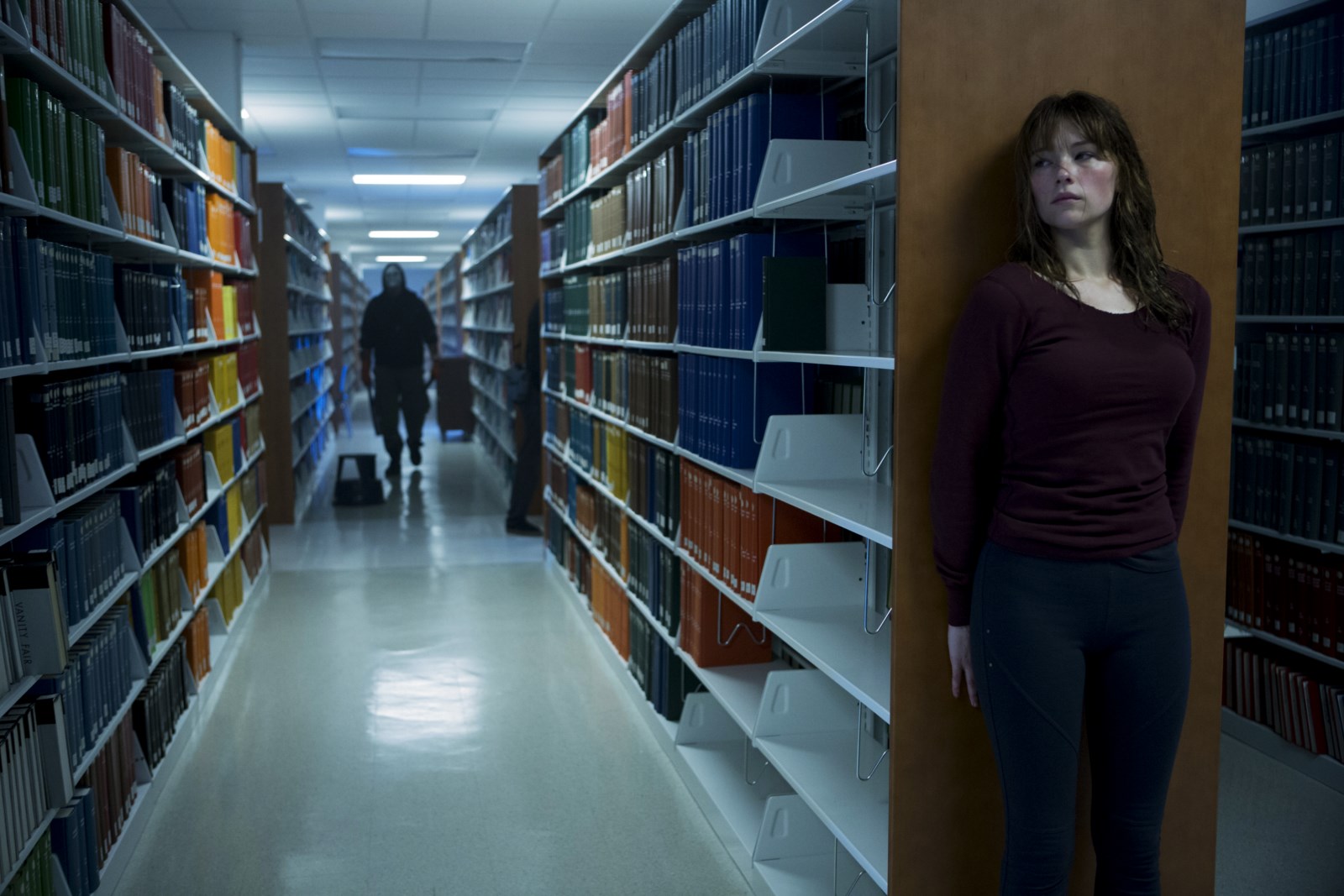
It isn’t long before she’s proven right.  The young woman appears in her room carrying  a knife.  Justine gets past her but soon learns the young woman isn’t alone: she has three male accomplices, all wearing tin foil masks and hoodies, and all carrying weapons.  A game of cat and mouse begins between Justine and the intruders.  Wayne is murdered and Justine is forced to run from building to building in an attempt to avoid being killed as well.  Even when she seeks help from the campus maintenance man, Scott (Ransone), who has a shotgun, the intruders outsmart him and Justine is left to fend for herself once again.  She must use every ounce of ingenuity she has to outwit the intruders and stay alive…
RANDOM

With its mix of Halloween (1978), The Shining (1980) and every school-based slasher movie ever released, Kristy could be accused of being derivative and unimaginative.  But in the hands of director Blackburn and writer Anthony Jaswinski, the movie is strong on atmosphere, as tense as barbed wire, and features some sterling, predatory camerawork thanks to DoP Crille Forsberg.  It’s an impressively mounted picture as well, the university environs – in particular, the swimming pool – put to very good use, the wide open spaces of the grounds proving just as claustrophobic as the interiors, Justine’s attempts at hiding or escape placed against a pitiless, unremarkable background of beiges and off-whites.

It’s a very measured, well-constructed mise-en-scene that benefits from Blackburn’s close attention to detail, validating his decision to combine tightly framed shots with wider, equally threatening compositions that add immeasurably to the sense of unease the movie displays from the first moment an overhead light begins to flicker in the dorm’s laundry room.  But while there’s a sure hand behind the camera, in front of it there’s a commanding performance from Bennett, her slightly geeky, girl-next-door looks and demeanour explored with effortless simplicity in the opening twenty minutes, from her interaction with Aaron to a deceptively effective montage of her activities once everyone’s left.  Justine is instantly likeable, the kind of young woman who makes you smile from the off.  Bennett invests her with a goofy charm, and while she spends the middle third running from the intruders, once Justine decides to take the hunt to them instead, she applies a calculating side of her character that comes across as entirely natural (it’s less the worm turning, more the worm realising she’s actually more than a match for her tormentors).

As the unreasoning, psychotic leader of a cell that’s part of a wider, Internet-based cult, Greene is hidden for the most part under a pink-tinged hoodie, only her facial piercings and chapped lips allowed any prominence.  She gives an angry, embittered performance, her coiled physicality threatening to erupt at any moment, making her the most unpredictable character of all; you watch her to see just what she’ll do next.  As her homicidal accomplices, Messrs Coy, Seal and Falick are hidden behind their masks but their presences are felt even when they’re off screen (Kristy is one of those movies where the viewer can’t quite be sure that one or more of them won’t just pop into view when it’s least expected).

There is violence throughout, from an opening montage of video clips of the cell’s other victims (which are posted on the Internet for other cult members to “enjoy”), to the outcome of Justine’s showdown with the young woman, but there is very little actual bloodshed, and Blackburn wisely avoids the kind of brutality that would have taken Kristy down the torture-porn route.  Instead, and aside from one crowd-pleasing contact blow that is entirely justified, each kill is rendered out-of-shot and with an emphasis on good old-fashioned sound effects.  In fact, the sound mix is one of the most effective aspects of the movie (take a bow, Michael B. Koff), particularly when the intruders are stalking Justine through the kitchens, their knives and weapons scraping against the fixtures and walls with hideous potency.

As mentioned above, the movie is indebted to several other horror outings, and while there will be those who won’t see beyond those influences, and will see deliberate moments taken from those movies – the fate of one character is lifted wholesale from Kubrick’s masterpiece – any naysayers will be missing the efficiency and verve that Blackburn et al. have employed to make these staple ingredients appear fresh and invigorated.  It’s very difficult these days to come up with something new in the horror arena, and while the thriller elements are pushed to the fore here, this variation on the home invasion sub-genre is refreshingly presented and, one unnecessary post-end credits sequence aside, belies its derivative nature to provide a riveting viewing experience.

Rating: 8/10 – unnerving, gripping and rewarding in equal measure, Kristy is a step up from other movies of a similar nature, and treats its audience accordingly; with clear intelligence at work both behind and in front of the camera this is one horror/thriller that really does deserve a wider audience.
Share this:

  • Click to share on X (Opens in new window) X
  • Click to share on Facebook (Opens in new window) Facebook
  • More
  • Click to print (Opens in new window) Print
  • Click to email a link to a friend (Opens in new window) Email
Like Loading...

Forgetting the Girl (2012)

07 Sunday Sep 2014

Posted by dullwood68 in Movies

≈ 1 Comment

Tags

Childhood trauma, Christopher Denham, Disappearance, Drama, Elizabeth Rice, Head shots, Lindsay Beamish, Nate Taylor, Photographer, Relationships, Review, Thriller

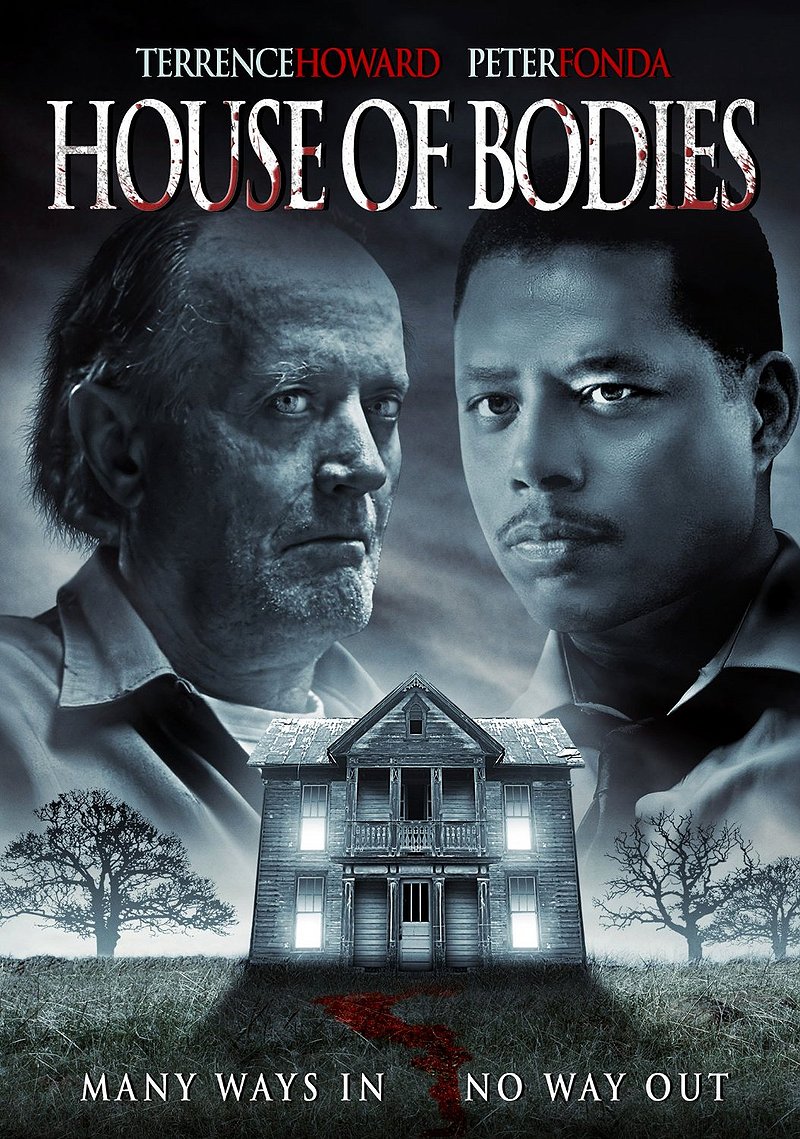
Forgetting the Girl

D: Nate Taylor / 85m

Cast: Christopher Denham, Lindsay Beamish, Elizabeth Rice, Paul Sparks, Anna Camp, Phyllis Somerville, Joel de la Fuente, Caitlin Carmichael, Holley Fain

Head shot photographer Kevin Wolfe (Denham) has a small studio from which he runs his business, aided by make up assistant Jamie (Beamish).  Kevin is looking for the right girl to settle down with but he’s socially awkward, quick to assume a “connection” with the women he does date, and unable to deal with the emotional fallout when his mostly short-lived romances come to an end.  In order to deal with the negative feelings he experiences, he has developed a system of forgetting, a way in which he can erase the bad memories of that person from his mind.

Kevin is also trying to deal with the memory of the death of his sister, Nicole (Carmichael) as a young child.  He feels responsible as he was there when it happened but he can’t fully remember all the details.  He asks his grandmother (Somerville) about it but she’s as haunted by the event as he is, and resists his enquiries, leaving him to deal with this childhood trauma as best he can.  When Kevin asks out Adrienne (Camp), a client, his surprise at her agreeing to see him causes him – as usual – to make more of the relationship than is actually the case and he quickly ruins things between them.  He tries to make amends but Adrienne tells him in no uncertain terms that they can’t be a couple.

Kevin tries to forget Adrienne but some time later he receives a visit from her sister, Denise (Fain).  Adrienne is missing, and Kevin is one of the last people to have seen her.  Kevin is unable to help and throws himself into his work in an effort to further erase Adrienne from his memory.  One of his clients, Beth (Rice) agrees to go out with him.  They go to the theatre and later Beth invites Kevin into her apartment for a nightcap.  He tries to force himself on her, believing again that they have a “special connection”.  Beth is frightened and pushes him away; Kevin leaves, thinking he’s ruined everything.

Through all this, Jamie has been struggling with her feelings for Kevin, and her sense of self-worth which is pushing her toward suicide.  One night, she takes the plunge and reveals her feelings to Kevin.  At first he’s receptive, but he still has hopes of getting back with Beth.  Unable to deal with the mixed emotions he’s feeling, Kevin decides to resort to an extreme solution in order to resolve his growing problems.

Forgetting the Girl - scene

Shot and framed as a video diary, Forgetting the Girl is a fairly straightforward thriller tricked out with overt psychological trimmings.  It has that low-budget indie feel that relies on short scenes, mannered performances and sometimes oblique direction.  As an exercise in paranoid psychosis it’s not entirely convincing, but features a handful of facile performances, not the least of which is Denham’s as the eerily blank-faced Kevin, his emotions buried so far behind his eyes you have to wonder if he really feels anything at all.  His speech is often short, clipped almost, as if by saying too much he’ll lay himself open to people in ways he won’t be able to control (and yet he wants to be “normal”, to have that everyday interaction everyone else has).

With such a tightly-wound character as its focus, the movie only rarely strays away from Kevin, focusing more and more on Jamie only as the movie progresses towards its tragic conclusion (and as a necessity).  This broadening of the story is at odds with Kevin’s video diary confession – how can he know even half of what’s been happening with her? – but provides a much needed contrast from Kevin’s subdued susceptibilities.  They’re a couple waiting to implode together, and Peter Moore Smith’s screenplay, based on his own story, has a dreadful fascination about it as these two damaged individuals use each other to achieve (temporary) happiness.

Forgetting the Girl works well as an examination of one man’s attempt to control the emotional content of his life, but in true indie style, it pays little attention to the standard thriller elements that it presents, opting to downplay these elements in favour of more exacting expressions of personal angst.  It’s not until the final twenty minutes that the introspection and clever insights give way in favour of a denouement that demands a final twist (that, sadly, doesn’t come).  Adrienne’s disappearance is used to point suspicion at secondary character Tanner (Sparks), but this attempt comes across as a little too pat, and long-time thriller fans won’t be fooled at all.  And the truth about what happened to Nicole, though left unrevealed until late on, is a little too predictable to provide the resonance that’s needed later on.

Denham captures Kevin’s slow-burn detachment with precision, offering a performance that is by turns creepy and sympathetic.  As the desperately lonely Jamie, Beamish uses her character’s punk clothing and make up to point up the emotional defences she uses to stop herself from being hurt, and the supporting cast flesh out their characters appropriately.  But, ultimately, this is Denham’s movie from start to finish, ably encouraged and directed by Taylor, and at times, frighteningly realistic in his attempts to prove he can “connect”, when in truth he never will.

Rating: 7/10 – Denham’s superb central performance anchors the movie and is often unnerving to watch; with an unexpectedly powerful last act redeeming the more pedestrian aspects of the rest of the movie, Forgetting the Girl emerges as a small-scale winner deserving of a wider audience.
 

Share this:

  • Click to share on X (Opens in new window) X
  • Click to share on Facebook (Opens in new window) Facebook
  • More
  • Click to print (Opens in new window) Print
  • Click to email a link to a friend (Opens in new window) Email
Like Loading...

Before I Go to Sleep (2014)

05 Friday Sep 2014

Posted by dullwood68 in Movies

≈ Leave a comment

Tags

Amnesia, Assault, Colin Firth, Drama, Literary adaptation, Mark Strong, Nicole Kidman, Review, Rowan Joffe, S.J. Watson novel, Thriller

J2730_BeforeIGoToSleep_OneSheet_31F.indd

D: Rowan Joffe / 92m

Cast: Nicole Kidman, Colin Firth, Mark Strong, Anne-Marie Duff, Adam Levy, Dean-Charles Chapman

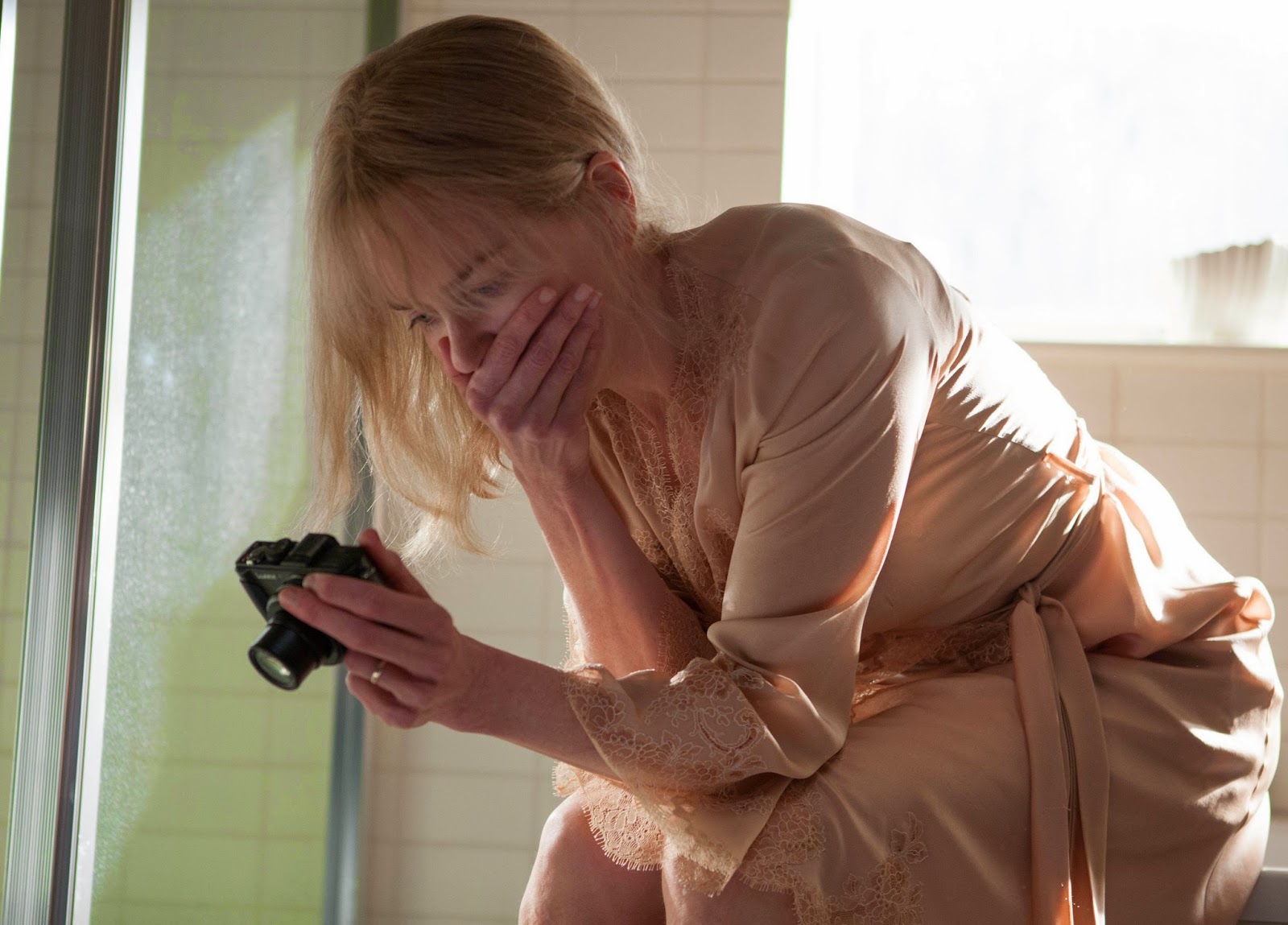
Christine Lucas (Kidman) wakes up each morning with no knowledge of who she is, and no memory of her life since her early Twenties.  Her husband, Ben (Firth), tells her she was in an accident ten years before and she is suffering from a form of retrograde amnesia: when she goes to sleep each night, her memory of that day is wiped clean and she remembers nothing about her situation.  To help her, Ben has put up pictures of their life together, and has left lists of items and instructions to help her get through the day while he’s at work.

After Ben heads off, the phone rings.  A man at the other end identifies himself as Dr Nasch (Strong).  He tells Christine he’s been treating her for a while and that she should go and look for a camera hidden in a wardrobe in the bedroom.  Nasch has persuaded Christine to use the camera as a kind of video diary, an aide-memoire that she can use each day to help her remember things.  The last entry shows Christine looking visibly upset and cutting the recording short when Ben returns home.

Two weeks before: Dr Nasch begins treating Christine and gives her the camera, advising her not to tell Ben about it.  She begins to make daily recordings, and in the process she learns things that don’t make sense: her accident proves to be a near-fatal assault by an unknown attacker; she and Ben have a dead son; and a friend of hers called Claire (Duff) has been trying to get in contact with her (though Ben tells her he doesn’t recall anyone by that name).  As Christine begins to piece together the mystery of the assault and the past ten years, she begins to suspect that someone, either Ben or Dr Nasch, is hiding the truth from her, and that she may be in danger.

Before I Go to Sleep - scene

Adapted from the novel by S.J. Watson, Before I Go to Sleep is a hard movie to really like.  It’s competently directed by Joffe, ably performed by its cast, and wrong foots the audience on at least two occasions with considerable shrewdness.  But it lacks any real tension, and despite the best efforts of all concerned, has a too-familiar feel to it that robs the movie of any lasting effect.  Christine’s predicament and the limitations of her memory, while intriguing, are too easily overcome; it’s hard to believe that no one’s come up with the idea of a video camera before now.  And for the purposes of the plot, Dr Nasch’s insistence on keeping Ben in the dark, while highly suspicious by itself, seems more of a contrivance than something reasonably developed to aid in Christine’s treatment.

Once Christine begins to unravel the mystery of the assault, the clues come thick and fast, and while the movie as adapted by Joffe may think it’s being very clever, it only succeeds in making it easy for its heroine to learn the truth.  It also loses a large amount of credibility when Christine agrees to meet Claire at Greenwich, but is later revealed to not even know the address of where she lives.  It’s in the mid-section that Joffe trots out a series of twists and turns that threaten to sink the movie’s credibility, but he manages to hold it all together until the arrival of the more generic confrontation that, alas, soon descends from tense showdown to tiresome violent retread.

Later, as the plot begins to unravel further, and the truth about the assault becomes clearer, what has been a fitfully absorbing psychological thriller becomes yet another damsel in distress movie with Christine forced to face off against the man who assaulted her all those years ago.  With such a predictable denouement, the movie adds an extended coda that seeks to give full closure to everything Christine has discovered (it also provides an emotional resonance that’s lacking elsewhere), but while it’s an effective scene in and of itself, it comes too late to save matters overall.

There’s also the issue of the movie’s look.  Joffe, along with director of photography Ben Davis, has chosen to film in muted colours, and with the dimmest lighting design seen for some time.  As a consequence, the movie is drab and depressing to look at, its dour interiors sucking the life out of proceedings and proving an obstacle to the performances, the cast struggling to stand out against the morose and dreary surroundings.  Even when Christine meets Claire at Greenwich, the colour mix is toned down so that the natural greens and browns seem as subdued as the rest of the palette.  As a reflection of Christine’s mental state, it comes across as pretty heavy handed, while also keeping the audience at a distance from the action.

Kidman plays Christine as a fragile, easily disturbed, yet strangely trusting woman who shows only few signs of being the strong, confident person she was before the assault (it’s only her memory that’s affected, not her personality), and while she’s as capable as ever – only Julianne Moore can show dawning, horrified realisation as well as Kidman can – she’s hemmed in by the character’s limitations (even an actress of Kidman’s calibre can do shock and surprise only so many times in a movie without it becoming repetitive).  In support, Firth gets to play angry and resentful in between being supportive and creepy, while Strong does what he can with a character who, ultimately, is there for exposition purposes more than anything else.

There are obvious connections that viewers will associate with Memento (2000), but Before I Go to Sleep lacks that movie’s inventiveness and if they were programmed as a double bill, Joffe’s would definitely be the second feature.  With obvious nods to movies such as Groundhog Day (1993) and Shattered (1991), this tries hard to be a riveting thriller but ends up looking and sounding too mundane to make any lasting impression.

Rating: 5/10 – disappointing and routine for most of its running time, Before I Go to Sleep could have done with more pace and more intensity; with few surprises, and even fewer moments to make an audience gasp, this is one thriller that doesn’t fully live up to expectations.

Share this:

  • Click to share on X (Opens in new window) X
  • Click to share on Facebook (Opens in new window) Facebook
  • More
  • Click to print (Opens in new window) Print
  • Click to email a link to a friend (Opens in new window) Email
Like Loading...

The Sacrament (2013)

17 Sunday Aug 2014

Posted by dullwood68 in Movies

≈ 3 Comments

Tags

AJ Bowen, Cult, Eden Parish, Father, Gene Jones, Horror, Joe Swanberg, Review, Sober living community, Thriller, Ti West, Vice

Sacrament, The

D: Ti West / 95m

Cast: Joe Swanberg, AJ Bowen, Kentucker Audley, Gene Jones, Amy Seimetz, Katie Forbes, Shirley Jones-Byrd, Kate Lyn Sheil, Donna Biscoe, Talia Dobbins

When photographer Patrick (Audley) receives a letter from his sister, Caroline (Seimetz), that tells him she’s part of a sober living community, and that she’s moving with them to a foreign country, he enlists the help of Vice, a multi-media company, to discover what’s really happening.  Joined by reporter Sam (Bowen) and cameraman Jake (Swanberg), they travel to the community’s new location – a compound named Eden Parish – and find Caroline safe and well and happy, along with dozens of people of all ages who have dedicated their lives to the teachings of the man they call Father (Jones).  Father has created a drug and alcohol free, politically independent society where there is no violence, no crime, only a firm belief in the Bible and the need for the community to remain apart from others.

Father agrees to be interviewed by Sam but it doesn’t go as Sam expects, and he finds himself wrong-footed and confused.  He and Jake become increasingly aware that not everything is as it seems, or as Father professes.  A woman implores them to take her mute daughter with them when they leave; an encounter with Caroline leads Sam and Jake to believe that she is high; and Patrick is kept away from them deliberately.  The next morning, as well as the woman and her mute child, there are several other people trying to leave the compound.  Fearing an end to his work, Father makes a drastic decision, one that has terrible consequences for everyone there.

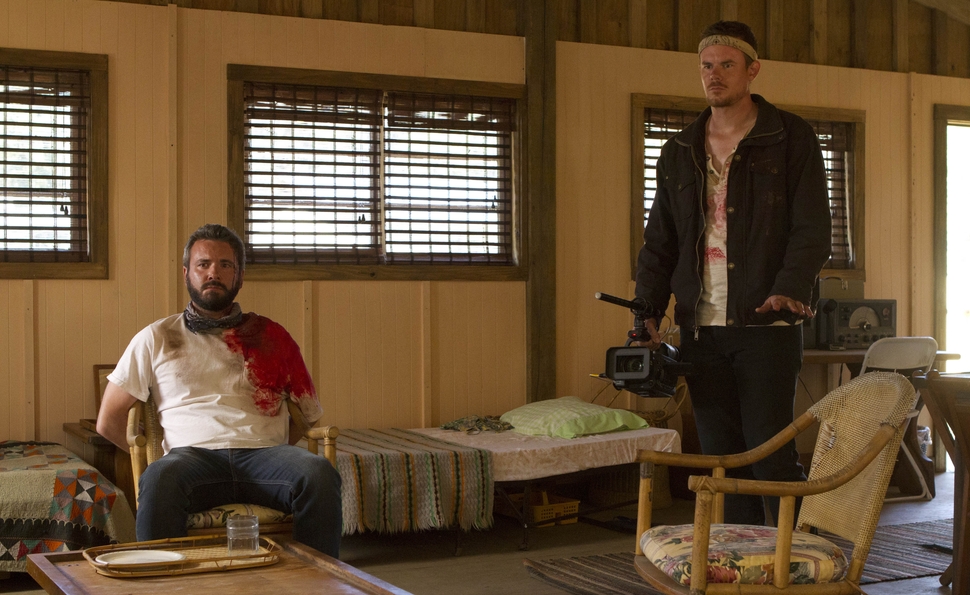
Sacrament, The - scene

With obvious parallels to the story of Jim Jones, The Sacrament has a horrible fatalism that permeates the movie throughout, and makes for often uncomfortable viewing.  Filmed found footage style – but with the odd occasional shot that clearly isn’t part of the set up – Ti West’s latest sees the world of exclusionist religion brought into sharp relief.  It’s a difficult subject to tackle, but West crafts a gripping thriller from the premise of a collective created out of one man’s misguided wish to provide a better life for his followers.  As it becomes more and more evident that Eden Parish is not the paradise that Father would have Sam and Jake (or the outside world) believe, the movie develops a quiet power and the tragedy that unfolds takes on a grim inevitability.

To be clear, there is nothing new here, and nor does West’s screenplay attempt to add anything different to the basic set up, but such is his growing confidence as a filmmaker that, while The Sacrament plays out as predictably as expected, it does so with a compelling fascination that keeps the viewer hooked as events unfold.  It’s also one of the few found footage movies that doesn’t look contrived with its framing, West proving capable of making the majority of shots look organic and plausible in their focus (and without resorting to any manufactured jump scares).  That said, the movie could have been filmed in a more traditional manner and it would still have been as effective.

Adding another layer of credibility to proceedings, West coaxes some great performances from his cast, with Bowen and Jones proving particularly impressive. Bowen is gaining more and more exposure as an actor, his indie leanings often leading to characterisations that have a greater depth to them than you might expect, and here he expertly displays the indecision that Sam feels about Eden Parish and its leader.  And as that leader, Jones is simply mesmerising, his low-key, slightly pained delivery both forceful and unnerving in equal measure.  As his vision for the community begins to unravel, so too does Father, revealing the psychosis beneath the believer, a psychosis shared by Caroline and many others.  It’s a subtle, confident performance, one that stays in the memory long after the movie is over.  Until now, Jones has been known primarily as the gas station proprietor who survives an encounter with Javier Bardem’s badly tonsured psycho in No Country for Old Men (2007), but on this evidence he deserves to be given even bigger and better opportunities to shine.

The Sacrament does have one major flaw however, and while it’s entirely forgivable, it does undermine the growing tension of the first hour.  With the understanding that there are people who want to leave Eden Parish because it’s not all it seems, but are too afraid to speak out, the sudden attempt at an exodus comes across as expediency instead of an intrinsic consequence of events so far.  This awkward turn of events also brings forward the expected denouement, and in doing so, sees the movie abandon its measured approach in the first hour in favour of various confrontations and chase sequences.  These scenes are still effective – one that features Patrick and Caroline and the fate of one of them is as terrible to watch as anything featured in a more bloody horror film – but they end up divorced from the cumulative effect of what’s gone before.

But when all is said and done, this is a testament to West’s increasing skills as a writer/director.  With his revenge Western, In a Valley of Violence, due in 2015, it’s not unreasonable to place him on the list of directors whose movies are eagerly looked forward to, especially on this evidence.  And with so few original voices working in the field of horror these days, West is a talent to be followed with avid interest.

Rating: 8/10 – essential viewing for fans of intelligent, well-constructed terror, with an understated but scary performance from Jones, The Sacrament is a throwback to the paranoia-ridden horror movies of the Seventies; potent and rewarding, this confirms West’s rising status and is pretty much a horror sleeper.


Share this:

  • Click to share on X (Opens in new window) X
  • Click to share on Facebook (Opens in new window) Facebook
  • More
  • Click to print (Opens in new window) Print
  • Click to email a link to a friend (Opens in new window) Email
Like Loading...

Poster of the Week – Stoker (2013)

30 Monday Jun 2014

Posted by dullwood68 in Movies

≈ 1 Comment

Tags

Colours, Illustration, Images, Movie poster, Poster of the week, Stoker, Thriller, Title

Stoker

Stoker (2013)

If you’ve seen Stoker, then you’ll know that it has an often surreal, slightly macabre air to it, and this poster beautifully captures the mood and spirit of the movie.  The various items that make up the cornucopia on display are all relevant to the story in one way or another, but their individual placements give no hint as to their importance or even if they’ll feature prominently or not.  Some, like the sneakers, seem to have no importance at all, and yet, the level of mystery the poster affords belies their prominence or pertinence.  Others, such as the skull, seem too apposite, as if their inclusion were entirely to be expected given the movie’s subject matter.  And then there is the coffin, the focal point of everything, its occupant’s demise the reason for everything that takes place.

With such an effective illustration dominating the poster, it’s easy to overlook the effect of having still pictures of Nicole Kidman and Mia Wasikowska almost growing out of the image.  Kidman’s veil and downcast visage indicates a grieving widow, while Wasikowska’s accusatory look in Kidman’s direction seems to say that not everything about Kidman’s demeanour can be trusted.  These portraits imply an animosity between the two characters that is both intriguing and compelling: just what can be so wrong for Wasikowska’s character to look that way?

Having so many provocative elements, the poster needs only to add its principal cast members and its title to round things off, but even then there’s a further, arresting aspect: the distressed green and white of the title’s letters.  It’s a slightly unnerving combination of colours, bold and eye-catching, and reinforces the sense of disquiet the rest of the poster generates.  All in all, the poster more than adequately reflects the movie’s rising turmoil and does so with a quiet effectiveness that creeps up stealthily and silently.

Agree? Disagree? Let me know.

Share this:

  • Click to share on X (Opens in new window) X
  • Click to share on Facebook (Opens in new window) Facebook
  • More
  • Click to print (Opens in new window) Print
  • Click to email a link to a friend (Opens in new window) Email
Like Loading...

Silent House (2011)

09 Monday Jun 2014

Posted by dullwood68 in Movies

≈ 1 Comment

Tags

Chris Kentis, Elizabeth Olsen, Escape, Haunted house, Horror, Injured father, Laura Lau, Locked in, Remake, Review, Supernatural, Thriller, Visions

Silent House

D: Chris Kentis, Laura Lau / 86m

Cast: Elizabeth Olsen, Adam Trese, Eric Sheffer Stevens, Julia Taylor Ross, Adam Barnett, Haley Murphy

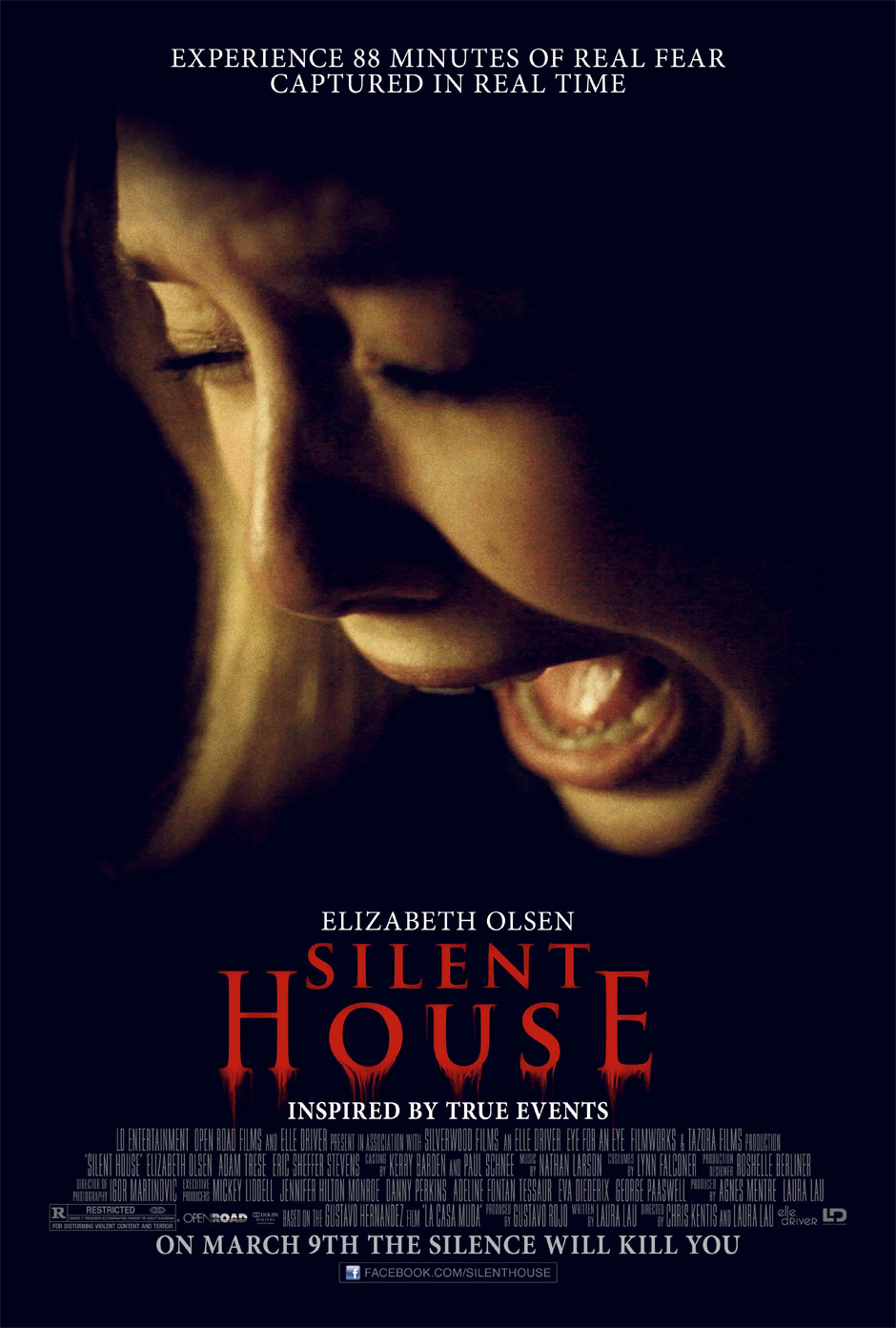
While renovating the summer home her family hasn’t visited or used for some time, Sarah (Olsen) begins to experience strange phenomena that may mean the house is haunted.  She is particularly attuned to the strange goings on, and finds herself becoming more and more aware that not everything is as it should be.  A visit from childhood friend, Sophia (Ross), whom she clearly doesn’t remember, adds to the sense of unease Sarah feels.  When her uncle Peter (Stevens) leaves after a dispute with her father John (Trese), Sarah starts to hear weird noises coming from one of the rooms upstairs.  She gets her dad to investigate but at first they don’t find anything (though John does find some photographs that he quickly hides away).  When her father is attacked and injured, Sarah tries to flee the house but finds herself locked in and unable to get out.  With someone else in the house, stalking her, Sarah becomes increasingly terrified; she finds a key to the padlock on the storm cellar door and escapes.

Outside, she has a vision of a young girl (Murphy), and runs into her returning uncle.  She tells him about her father and they head back to the house.  Peter goes inside; while Sarah waits in the car she becomes convinced someone has gotten in there with her.  She runs back into the house and locks the front door behind her.  Peter can’t find her father’s body (though he does find some photographs that he quickly hides away).  They search for John but Peter is attacked and knocked unconscious by the unknown intruder (Barnett).  Sarah’s visions of the young girl become more frequent, and the intruder looks more and more like a reanimated corpse.  Once again, Sarah tries to flee the house…and runs into Sophia who begins to challenge her memories of the past.  With her visions of the young girl proving more and more revealing of a past tragedy that happened at the house, Sarah is forced to confront some horrible truths surrounding her childhood.

Silent House - scene

A remake of the Uruguayan movie La casa muda (2010), Silent House starts off well, its remote lakeside location just wintry enough to make things feel eerie from the start.  The house is a bit of a labyrinth and seems to contain more rooms than seems feasible when looking at it from the outside, and the basement seems twice as large again.  The lack of working electricity adds to the atmosphere and the battery lamps used throughout throw out just enough light to keep things hidden in the shadows, further adding to the sense of foreboding, while Olsen’s wide-eyed moon face reflects the building tension with unexpected authority.

With all this in place, it’s a surprise then that the movie doesn’t work as well as it should.  The main problem lies in the approach to the material. What begins as a haunted house movie mutates part way through into a psychological thriller with lingering supernatural overtones, and ends as an uncomfortable revenge drama.  Wearing and shedding so many identities leaves Silent House feeling as if the writer (co-director Lau) couldn’t decide which approach was the most effective.  This also leaves the movie feeling disjointed and incohesive, and there are too many moments when the requirements of the script make for forced (non-)activity on screen – is it unreasonable to assume that Sarah wouldn’t be seen hiding under the kitchen table by the intruder?  There’s also the issue of what’s real and what’s not real – there’s a good argument to be made for Sophia not being real throughout, but this isn’t confirmed one way or the other – and it’s unclear if what Sarah is seeing is happening at all, but in the hands of Kentis and Lau the ending is inconclusive (but maybe deliberately so).

While the directors try and decide what kind of a movie they’re making, it’s left to Olsen to shoulder the burden of selling the movie and its twists and turns.  Fortunately she’s up to the task, and even if she can’t quite make the final scenes ring true, it’s still a strong performance, Sarah’s increasing hysteria tempered by an overriding obduracy.  Trese and Stevens are fine, if underused, and Ross is realistically creepy in her manner; when Sophia gives Sarah a hug it’s so awkward as to be cringe-inducing.  When she returns towards the movie’s end, her appearance is a powerful boost to proceedings (even if it doesn’t make complete sense for her to be there).

Rating: 6/10 – it needs a better ending, but on the whole Silent House works well within its (for the most part) interior location; a great performance from Olsen anchors the more outlandish moments and there’s a degree of fun to be had in trying to work out what’s happening and why, but sadly the movie stumbles far too often for it to be completely successful.

Share this:

  • Click to share on X (Opens in new window) X
  • Click to share on Facebook (Opens in new window) Facebook
  • More
  • Click to print (Opens in new window) Print
  • Click to email a link to a friend (Opens in new window) Email
Like Loading...

Mini-Review: Closed Circuit (2013)

25 Sunday May 2014

Posted by dullwood68 in Movies

≈ 2 Comments

Tags

Bombing, Cover up, Eric Bana, John Crowley, Lawyers, Rebecca Hall, Review, Steven Knight, Terrorism, Thriller

closed-circuit_8547532a

D: John Crowley / 96m

Cast: Eric Bana, Rebecca Hall, Ciarán Hinds, Jim Broadbent, Riz Ahmed, Anne-Marie Duff, Julia Stiles, Kenneth Cranham, Denis Moschitto

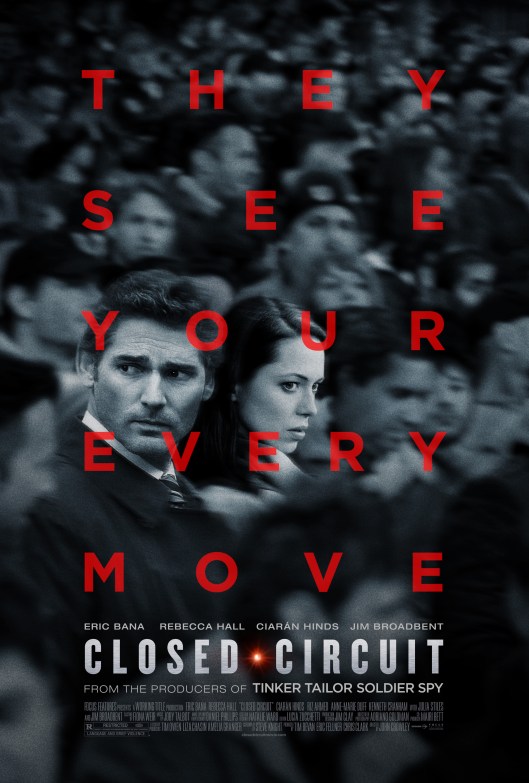
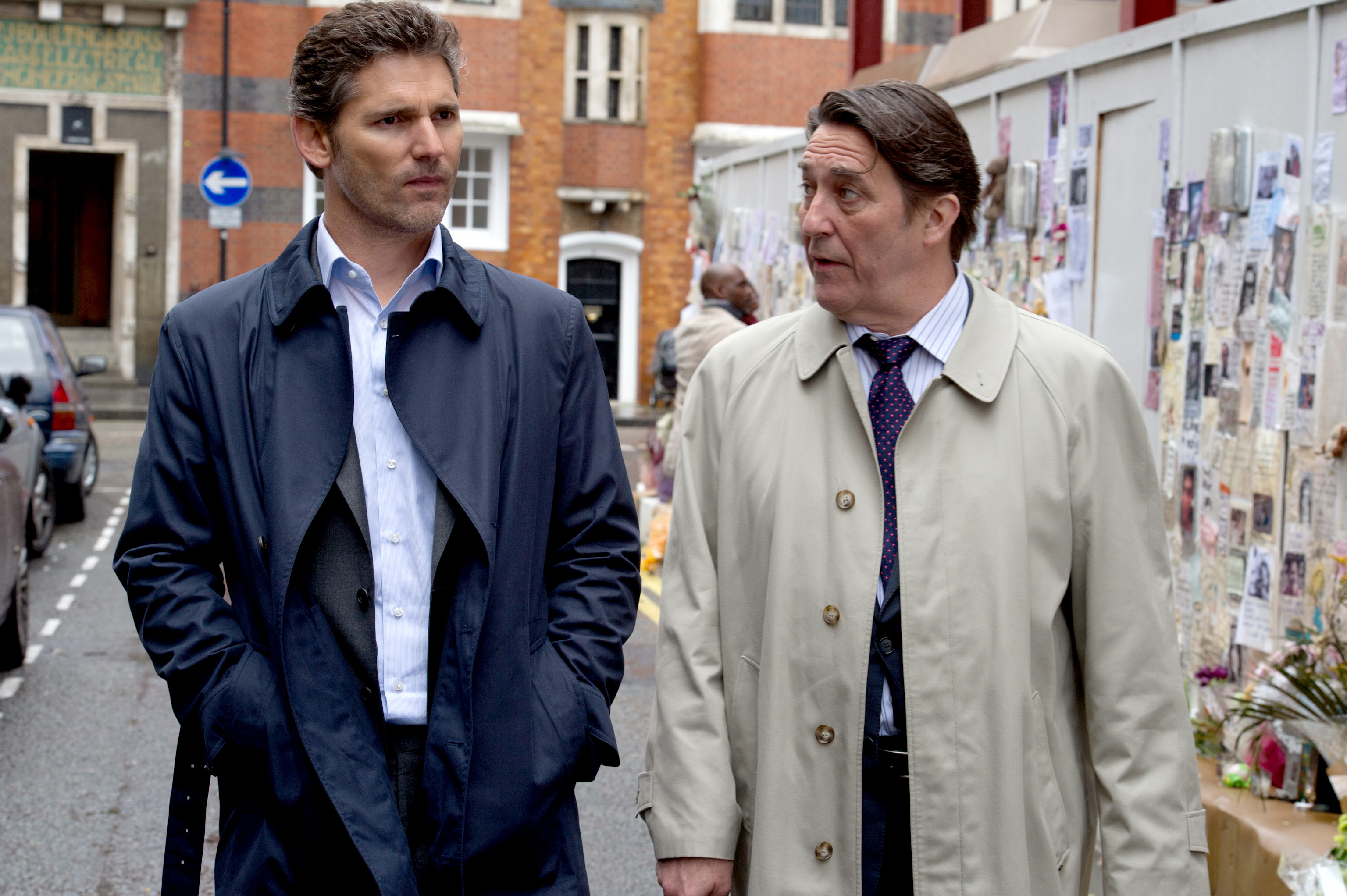
When a bomb goes off at a London market, the investigation leads to the arrest of Farroukh Erdogan (Moschitto). Government evidence that might support his case must be deliberated in closed court before an open trial can be conducted. Following the death of Erdogan’s lawyer, Martin Rose (Bana) is asked by the Attorney General (Broadbent) to represent the suspect at the open trial, while Claudia Simmons-Howe (Hall) is chosen to represent Erdogan at the closed hearings. Neither can be in contact with each other once the government evidence is submitted, but as both become aware they’re being followed, they begin to realise there’s more to the case than meets the eye.

Martin discovers that Erdogan is an MI5 agent who was working within the terrorist cell that carried out the bombing. With Erdogan refusing to confirm or deny anything, it’s unclear if he has double-crossed MI5, or the cell has set him up instead. Meanwhile, Claudia learns that Farroukh’s family are more involved than anyone thought. Claudia and Martin choose to work together – in spite of the risk of being disbarred – and endeavour to find out if MI5 had any further, more damaging involvement in the bombing.

Closed

Closed Circuit wants to be topical and thought-provoking but is too predictable – and cynical – to be entirely effective. Government involvement in terrorist matters is hardly news, and the idea that a cover up might be taking place is clear from the outset. The cat-and-mouse game that follows ticks all the relevant boxes – murder made to look like suicide, an MI5 overseer (Ahmed) who makes veiled threats, the revelation of a colleague working against Martin and Claudia – and there’s a subplot around Martin and Claudia’s having had an affair in the past that is dramatically redundant, but on the whole, the movie is a well-crafted, if obvious thriller that never quite takes off. Bana and Hall don’t quite gel as a couple, Crowley’s direction is efficient if indistinctive, and the script by Steven Knight isn’t as sharp as it needs to be.

Rating: 6/10 – as a paranoid conspiracy thriller, Closed Circuit is neither exciting nor provocative enough to succeed fully; with its idea of a government cover up, it’s also thirty years too late to provide much of a surprise.


Share this:

  • Click to share on X (Opens in new window) X
  • Click to share on Facebook (Opens in new window) Facebook
  • More
  • Click to print (Opens in new window) Print
  • Click to email a link to a friend (Opens in new window) Email
Like Loading...

Transcendence (2014)

21 Monday Apr 2014

Posted by dullwood68 in Movies

≈ 2 Comments

Tags

Artificial intelligence, Internet, Johnny Depp, Morgan Freeman, Nano technology, Paul Bettany, Rebecca Hall, Review, RIFT, Sci-fi, Thriller, Wally Pfister

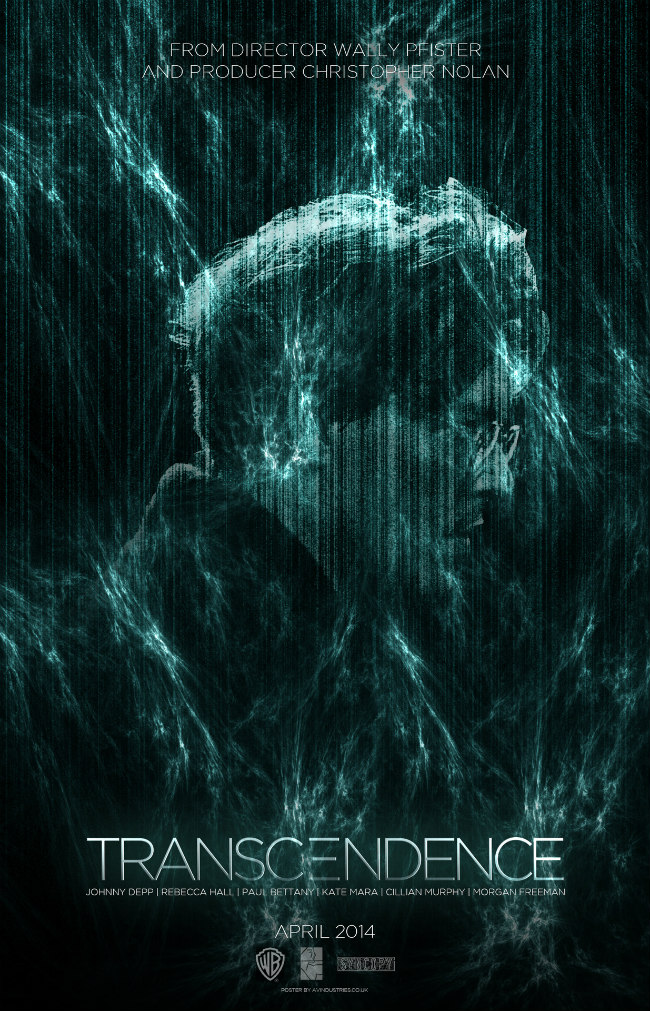
Transcendence

D: Wally Pfister / 119m

Cast: Johnny Depp, Rebecca Hall, Paul Bettany, Morgan Freeman, Cillian Murphy, Kate Mara, Cole Hauser, Clifton Collins Jr, Cory Hardrict, Falk Hentschel, Josh Stewart, Lukas Haas, Xander Berkeley

Those of you with a good memory will recall Johnny Depp’s last sci-fi outing, the distinctly flat and underwhelming The Astronaut’s Wife (1999).  Amongst the movies in Depp’s filmography it’s a rare misstep… until now.

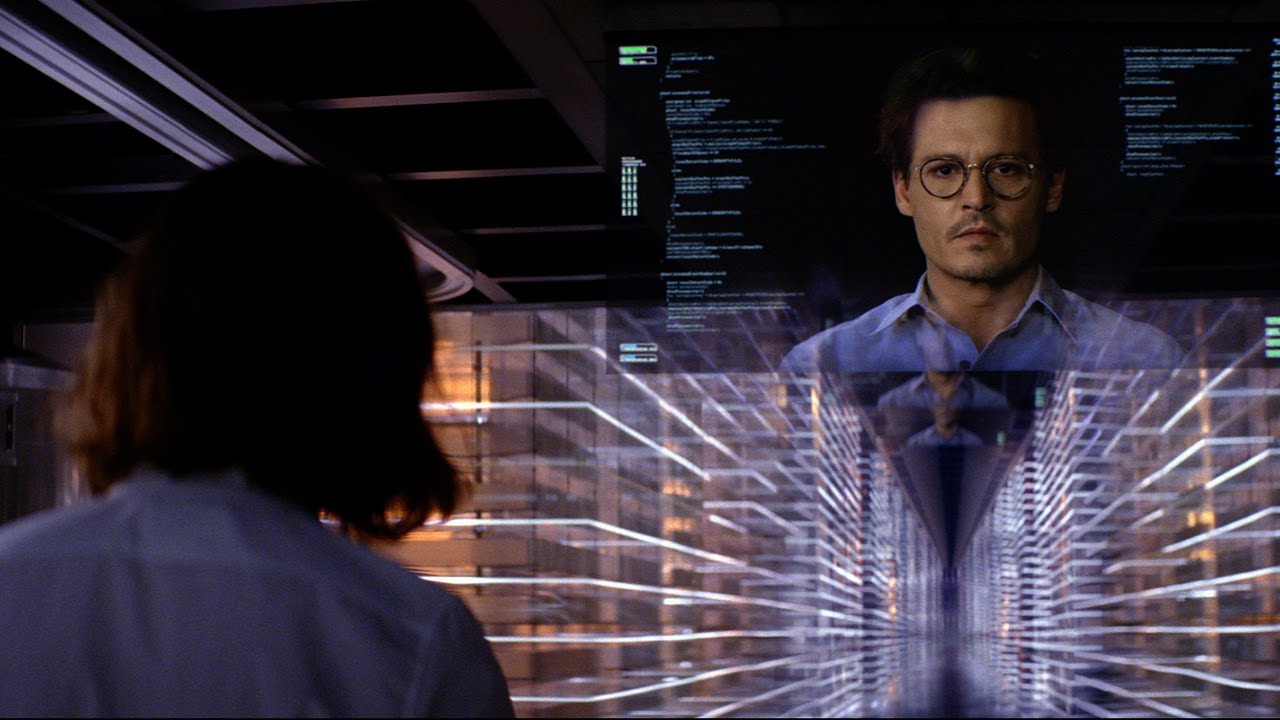
Here, Depp plays Dr Will Caster, a scientist investigating the possibilities surrounding artificial intelligence (AI).  He is supported by, and works with, his wife, Evelyn (Hall), and from the wider scientific community, Max Waters (Bettany) and Joseph Tagger (Freeman).  When he is shot leaving a symposium by a member (Haas) of a radical anti-AI movement, RIFT, Will receives what appears to be a non-fatal wound.  Later, he learns the bullet was coated with polonium and he has only a matter of weeks to live.

Appropriating the work of a fellow scientist, Dr Thomas Casey (Berkeley), Evelyn sets up a secret laboratory where she intends to digitise Will’s mind and connect it with a computer system, thus allowing his “consciousness” to live on after his physical death.  She’s aided by Max who has reservations about the plan; when it succeeds, and one of Will’s first requests is to be connected to the internet, Max becomes afraid of the potential danger in Will having access to every computer on the planet.  He tries to pull the plug but Evelyn stops him and forces him to leave.  Max is then kidnapped by RIFT, and their leader, Bree (Mara), decides to keep him captive until they can stop Will’s consciousness from spreading.  They arrive at the laboratory too late to stop Will connecting to the internet, and too late to stop Evelyn from escaping.

Meanwhile, Tagger is helping FBI agent Buchanan (Murphy) track down the members of RIFT.  When Will manipulates the FBI’s computer system in order to help them, Tagger also becomes worried about the possible consequences of Will’s access.  As Evelyn, under Will’s instruction, starts to oversee the building of a brand new facility in the desert town of Brightwood, RIFT inexplicably hold back from trying to sabotage it, and the FBI sit on their hands as well.  Two years later, Will has moved on to using nano-technology in his work and when a worker is badly injured, takes the opportunity to use his medical capabilities to “improve” the worker’s physical condition, even going so far as to install software in the man’s head that links him to Will.  As more and more people undergo this “corrective surgery”, RIFT and the FBI both become afraid that Will is creating an army, and decide to take steps to put an end to his new existence.  The only way they can do it?  By using a virus created by Max that should stop Will by shutting down the internet…completely.

Transcendence - scene

Hopefully that (actually quite) brief synopsis should alert the potential viewer that Transcendence has a lot going on, and not all of it either clever or logical.  At the movie’s beginning, Will is a bit like an absent-minded professor, and has no interest in trying to change the world through the appliance of new technologies; that’s Evelyn’s aim.  As his metamorphosis develops and his “power” increases, he begins to do just that, using nano-technology to heal the sick and heal the planet.  All good, right?  Well yes, and therein lies one of the movie’s major problems: it’s ostensibly a thriller, and outside of the involvement of RIFT, so far the thriller elements have been sorely lacking (it’s also meant to be a romantic drama, and a cautionary tale, and a bio-horror movie as well).  Will’s adaptation of people becomes the trigger for a last quarter increase in action and spectacle that, while predictable, is unnecessary and forced (hell, it’s so forced, the FBI and RIFT practically team up to put a stop to Will’s unwanted apotheosis).

There’s also the timescale, that “two years later” mentioned before where everyone outside of Will and Evelyn sit around waiting for things to reach a point where they have to intervene, whereas before, prevention was the order of the day, both legally and illegally.  It’s also absurd to think that Max would be held captive for all this time without anyone trying to find him, but this turns out to be the case.  And with the size of the facility being built at Brightwood it’s unreasonable to think that the government or homeland security or the NSA (or someone) wouldn’t come around for a look-see at some point, but they don’t.  And it’s equally implausible that Will, even with all the access to information that he has, can create and master so many new technological advances from scratch, but he does.

As science fiction, Transcendence is woollier than most and depends on its human element to move the story forward but even there the story stumbles.  Will and Evelyn are supposed to be devoted to each other, and before Will’s death that’s evident.  But when he “transcends” he becomes more attentive and tries hard to make up for his lack of a physical presence; however, Evelyn is unhappy with this and shows her unhappiness in such a way that even Will should notice but he doesn’t.  Even when she begins to have doubts about what he’s doing he still doesn’t notice – so much for having advanced intelligence!  This, of course, leads into the main theme of the movie: can an artificially created intelligence be self aware?  (The answer, very obviously, is no.)  The movie dangles this supposed conundrum at the audience every now and again as if it bestows some depth on proceedings, but it’s a hollow, nonsensical question which, unsurprisingly, is resolved in an awkward, unsatisfactory manner.

The cast mostly go through the motions.  Depp is off his game by a long stretch, and as AI-Will is too subdued to make much of an impression, either as the saviour of the world, or its potential destroyer.  Hall’s character is irritating and the actress never quite overcomes this limitation; she also seems unsure of how Evelyn should behave from one scene to the next.  Bettany, as the movie’s voice of reason is sidelined too much by his incarceration by RIFT, and early on, plays the concerned friend with so much humility you half expect him to start wringing his hands at the prospective awfulness of what’s going to happen.  Freeman does his by-now standard wise old man routine, while Murphy has to cope with being a bystander to pretty much everything.  And Mara gives such a blunt performance she never changes her facial expression once throughout the entire movie.

Jack Paglen’s script mixes cod-science with emotional drama to only slight effect, and as filmed, has too many stretches where the movie stops dead in its tracks – which is odd, as the movie is decently paced and only occasionally strays towards boring.  The scenes between AI-Will and Evelyn quickly become repetitive, as do those featuring Tagger and Buchanan.  In the director’s chair, veteran cinematographer Pfister (making his directorial debut), has obviously kept a close eye on DoP Jess Hall, and the movie is often beautifully lensed, particularly its desert location.  He’s less confident when it comes to the cast, hence the lacklustre performances, and the script hasn’t helped him either.  There’s also an annoying score courtesy of Mychael Danna, packed with predictable cues and motifs.

Rating: 5/10 – somehow, Transcendence holds the attention throughout, even if it’s just to see how much sillier it can get; with another sci-fi misstep under his belt, let’s see if it’s another fifteen years before Depp makes another venture into the genre.

Share this:

  • Click to share on X (Opens in new window) X
  • Click to share on Facebook (Opens in new window) Facebook
  • More
  • Click to print (Opens in new window) Print
  • Click to email a link to a friend (Opens in new window) Email
Like Loading...

No Contest (1995)

08 Saturday Mar 2014

Posted by dullwood68 in Movies

≈ Leave a comment

Tags

Action, Andrew Dice Clay, Beauty pageant, Camera gun, Die Hard, Hostages, Paul Lynch, Review, Robert Davi, Roddy Piper, Shannon Tweed, Thriller

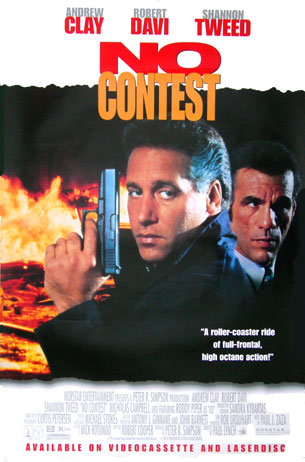
No Contest

D: Paul Lynch / 98m

Cast: Shannon Tweed, Robert Davi, Andrew Clay, Roddy Piper, Nicholas Campbell, John Colicos, James Purcell, Judith Scott, Polly Shannon, Louis Wrightman, Keram Malicki-Sanchez, J.D. Nicholsen

Seven years after Die Hard and still the rip-offs kept coming…  This time around the setting is a beauty pageant being staged in a hotel, and instead of wrong-cop-in-the-wrong-place John McClane, we have wrong-hostess-in-the-wrong-place Sharon Bell (Tweed).  As the winner is announced, arch-villain Oz (Clay) and his crew of ne’er-do-wells take over the pageant and the hotel and hold the finalists, plus Bell, as hostages.  Among the finalists is Miss U.S.A. (Shannon).  Her father, Senator Wilson (Colicos) and Oz used to be business partners until the Senator let him take the fall for a dodgy business deal gone wrong.  Now Oz is looking for some payback.

While Oz and co intimidate their hostages and try to look menacing, outside the building, Crane (Davi), Miss U.S.A.’s bodyguard, and Captain Hendricks (Purcell) plot to find a way into the hotel, rescue the hostages and thwart Oz’s evil plan.  Along the way there are the usual double crosses, action beats, less-than-credible dialogue, over-acting, lazy direction, ridiculous stunts (Davi hanging by his cane underneath a rising maintenance cart), and one climax too many.

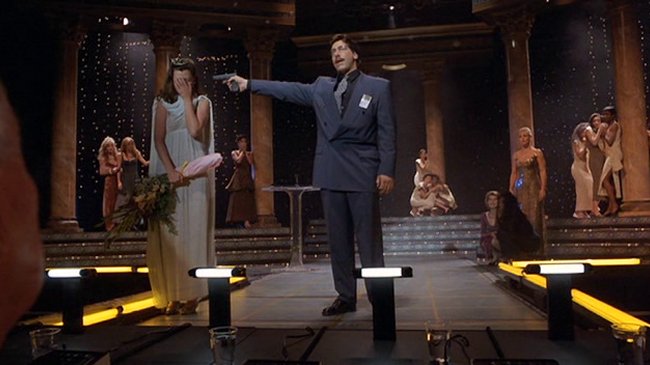
No Contest -scene

As No Contest lurches from one absurd scene to the next, it becomes obvious that no one on the production side of things was concerned at just how absurd it all is.  And yet, the movie, despite all its faults – or maybe because of them – is one of the most enjoyable Die Hard rip-offs out there.  First, there is Shannon Tweed, taking time out from her usual role as a sexual predator in movies such as Body Chemistry 4: Full Exposure.  Now, Tweed is a beautiful woman and she has a terrific figure, but what she doesn’t have is any real talent for acting.  She never seems sure of how to play a scene, or react to what’s going on around her.  Watch her in the scene where Vic (Campbell) takes her down to the swimming pool and removes the explosive cuff she and the other hostages have been made to wear.  In a scene where her character should be scared of what’s coming next, the expression on her face relays confusion instead.  It’s almost as if she’s not sure what she’s supposed to be doing.  But with all this, the camera loves her and it’s hard to take your eyes off her whether she’s standing at a podium announcing the winner of the pageant or scrabbling through an air vent.

Second is the inspired casting of the bad guys.  Aside from Clay there’s ex-WWE wrestler Roddy Piper as psychotic sidekick Ice; the aforementioned Nicholas Campbell as vain, incompetent Vic; Louis Wrightman as trigger-happy Que; Keram Malicki-Sanchez as pony-tailed computer whiz Cal; and J.D. Nicholsen as spare wheel Zed.  All six make for a great team of villains, and each gets their own special ‘moment’ to shine, especially Malicki-Sanchez once Tweed has tied him to a pipe.

Third is just the sheer barminess of the plot.  The police initially send in just two armed officers to infiltrate the hotel; both are killed by a camera fitted out with a gun.  Oz takes control of the pageant while wearing a ill-fitting wig and moustache that he quickly discards and never wears again;  Ice survives lethal attack after lethal attack, enough to make you wonder if his real name is Michael Myers; and Crane puts having a cigarette before being a proper bodyguard to Miss U.S.A. and gets himself locked out of the hotel as a result.  It’s so bad it’s brilliant.

Lynch directs ably enough, and the fights are well-staged.  Tweed does well as an action heroine, and Clay hams it up so much you wonder if there was a porcine shortage during the movie’s making.  The film moves along at a fair pace and while it’s all very preposterous, it keeps the viewer entertained throughout.

Rating: 6/10 – Tweed proves a good focus for an action movie that is short on original ideas but is fun to watch nevertheless; a six-pack and a pizza kind of movie and just right for a zone-out Saturday night.

Originally posted on thedullwoodexperiment website.

Share this:

  • Click to share on X (Opens in new window) X
  • Click to share on Facebook (Opens in new window) Facebook
  • More
  • Click to print (Opens in new window) Print
  • Click to email a link to a friend (Opens in new window) Email
Like Loading...

Removal (2010)

25 Tuesday Feb 2014

Posted by dullwood68 in Movies

≈ 1 Comment

Tags

Billy Burke, Mark Kelly, Murder mystery, Nick Simon, Oz Perkins, Review, Thriller

Removal

D: Nick Simon / 91m

Cast: Billy Burke, Mark Kelly, Oz Perkins, Kelly Brook, Emma Caulfield, Elliott Gould, Sharon Omi

At the end of his work day, contract cleaner Cole (Kelly) is persuaded to visit a potential client, Sharpe (Perkins) and provide him with an estimate for the work he requires.  When Cole arrives he finds himself bullied into taking on the job, cleaning a very large mansion, that same night.  He also begins to suspect that Sharpe has killed his wife and child and that their bodies might still be in the property.  As he becomes increasingly convinced of their demise, so begins a deadly game of cat-and-mouse with Sharpe, a game that quickly escalates into something both unexpected and much grimmer.  And to complicate matters, Cole has a secret of his own…

An uneasy, well-directed thriller, Removal has an edgy, almost hallucinatory quality from the off that helps keep the viewer wrong-footed as the plot advances from its standard everyman thrust into uncharted territory beginning, to its clever denouement.  Set largely within the confines of Sharpe’s mansion, the movie prowls the empty rooms and corridors along with the increasingly suspicious Cole, and as the viewer is drawn into the mystery of whether or not Sharpe has killed his family, two things become evident: that Removal will confound expectations, and that it will prove to be a worthwhile viewing experience.  Much of the storyline is overwhelmingly familiar but in the hands of writer/director Simon and his co-writers Daniel Meersand and Oz Perkins, the familiarity is overlaid with a disconcerting sense that, at any moment, the rug is going to be pulled out from under the viewer’s feet.  And so it proves: two thirds of the way in, the game changes, and it’s a tribute to the creative minds behind Removal – not to mention the committed cast – that it works as well as it does.
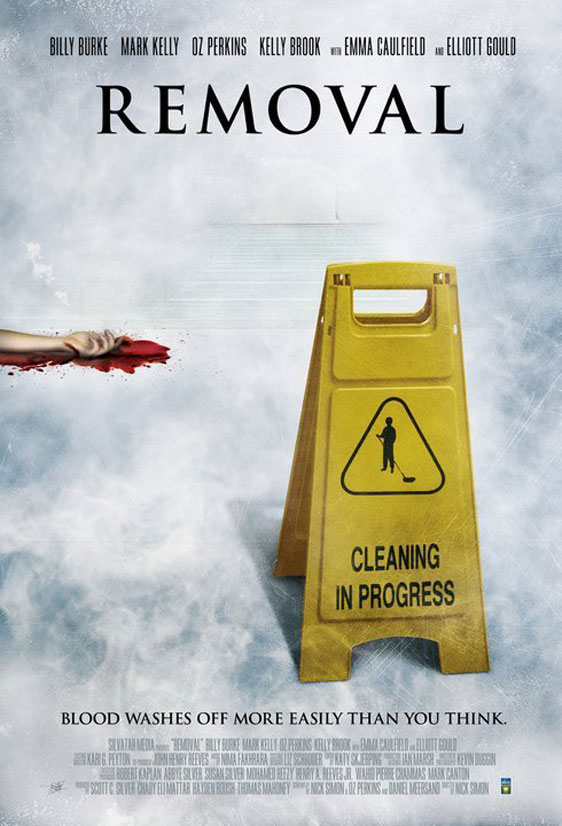
Removal - scene

As the main protagonist, Cole, Kelly imbues his character with a measured hang-dog quality, his personal circumstances dictating the ease with which Sharpe manipulates him.  Kelly is never less than believable throughout, and is matched by Perkins (son of Anthony).  Sharpe is an arrogant bully, judgmental and quick to undermine Cole’s already fragile self-esteem.  Perkins plays him with a steely disdain for those he perceives as weaker than himself, and yet he still possesses an off-kilter charm.  Burke acquits himself well, too, despite having less screen time, as an acquaintance of Cole’s, Eric, who finds himself drawn into the mystery.  In smaller roles, Caulfield as Cole’s wife, and Brook as an unlikely estate agent, make an impression, but the one disappointment is Gould: his lines are delivered with all the enthusiasm of someone awaiting root canal treatment.

There’s atmospheric photography courtesy of Kevin Duggin, and a complementary score provided by Nima Fakhrara.  On the negative side, the movie relies a little too much on its game changer to facilitate its ending, and while there is a logical outcome to events, the movie places Cole and Eric in a potentially never-ending situation that could presage a sequel at some point – but which would be unnecessary – and spoils the effect of what has gone before.  However, it’s easy to see why the filmmakers went with the idea.

Rating: 7/10 – an old-fashioned has-he-dunnit tricked out with a more modern sensibility, Removal rewards the viewer by not “talking down” to them; intelligent and very well crafted.

Originally posted on thedullwoodexperiment website.

Share this:

  • Click to share on X (Opens in new window) X
  • Click to share on Facebook (Opens in new window) Facebook
  • More
  • Click to print (Opens in new window) Print
  • Click to email a link to a friend (Opens in new window) Email
Like Loading...

My Top 10 Movies – Part Ten

24 Monday Feb 2014

Posted by dullwood68 in Movies

≈ 1 Comment

Tags

Action, Alan Rickman, Bonnie Bedelia, Bruce Willis, Hans Gruber, John McClane, John McTiernan, Nakatomi Building, Review, Terrorists, Thriller

Die Hard (1988)

Die Hard

D: John McTiernan / 131m

Cast: Bruce Willis, Bonnie Bedelia, Alan Rickman, Reginald VelJohnson, William Atherton, Alexander Godunov, Paul Gleason, Hart Bochner, James Shigeta

If, like me, you started watching action movies during the Seventies, then you had a plethora of riches.  There was Clint Eastwood’s Dirty Harry series, the stunt-heavy movies of Burt Reynolds, Charles Bronson’s vigilante excursions, and occasional gems such as Dirty Mary, Crazy Larry (1974) and Vanishing Point (1971).  These movies were often gritty and darkly humorous.  The violence in them was often brutal.  They did their best to reflect the times in which they were made, and often there were political overtones that couldn’t be ignored or missed.

This attitude carried on into the Eighties but the introduction of broad humour in movies such as Commando (1985), and the sense of a genre trading on old glories became more prevalent.  For every Southern Comfort (1981) and First Blood (1982) that kept the flame alive, there was a Stroker Ace (1983) or a Missing in Action 2: The Beginning (1985).  Action movies were becoming stale and unimaginative.  It seemed the doldrums had set in, and we would have to wait some time for the genre to see a resurgence, and to reinvent itself.

Instead of a long wait into the Nineties, we only had to wait until 1988, and the introduction of a character created by author Roderick Thorp, New York cop John McClane.  Die Hard came along unheralded and with a star in Bruce Willis who had no proven track record as an action hero.  In many ways it was a risky deal for 20th Century Fox, but it paid off handsomely (even with parts of the script not having been finalised by the time filming began).

For my part, I wasn’t that interested in seeing it.  I knew Willis from TV’s Moonlighting, but had the same feeling about him as everyone else, and the concept didn’t seem to lend itself to an exciting, two-hour thrill ride.  And so I didn’t see it straight away, even when I saw the positive reviews it garnered, and even when friends who’d seen it did nothing but rave about it.  It wasn’t until three weeks had passed that I finally went to see it, expecting to be disappointed, and not looking forward to it at all.

Well, we’re all allowed to get it wrong sometimes, aren’t we?

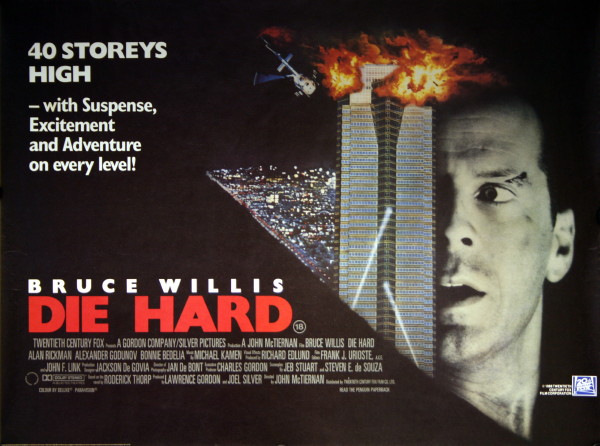
Die Hard - scene

In fact, I was riveted.  I couldn’t remember the last time I’d been so impressed by an action movie, by the twists and turns, by the cat and mouse games played out between McClane and Hans Gruber (Rickman), by the skill of John McTiernan’s direction, and the sheer exuberance of the action sequences.  Here was a movie that didn’t short change the audience in terms of intelligence, thrills and well-judged humour.  Die Hard was exciting.  I remember still that classic moment where McClane drops the C4 explosive down the lift shaft and blows up one of the lower floors (and a couple of Gruber’s henchmen): not only was it an incredible moment, but it was topped by smarmy reporter Richard Thornberg’s quip to his cameraman, “Tell me you got that”.  I wanted to see that scene again so badly, I’d already decided I was going to stay on and see the movie again.

Over the next two weeks, I saw Die Hard a further three times, and enjoyed it more and more.  I became a majorly annoying convert, extolling the film’s virtues to anyone who’d listen (and a few who wouldn’t).  Aside from the appallingly ill-judged Deputy Chief of Police Dwayne T. Robinson (Gleason), the movie didn’t put a foot wrong.  The relationships were well handled, the characters believable, and the cast were all on top form (even the unfortunate Gleason).  I loved the fact that John McClane was an everyman character, and that Willis imbued him with a vulnerability that the likes of Arnold Schwarzenegger and Chuck Norris would have found beyond their acting abilities.  His self-doubt was a nice change of pace as well.  And, of course, he had the perfect adversary in Alan Rickman’s Hans Gruber, a villain so urbane and charming his very sneer could probably cut glass.  (Rickman steals the movie, as he would three years later in Robin Hood: Prince of Thieves).

When I got my first surround sound system – and Die Hard on DVD – this was one of two movies I used to show how good the system was (the other was The Matrix).  Over the years I’ve watched it countless times, and it’s still as fresh as ever.  It’s also one of the most influential action movies of all time: even now, the Die Hard template is still being used – Olympus Has Fallen, anyone?  And with one of the best catchphrases ever: “Yippie ki-ay, motherfucker”, it’s a movie that will keep on having a great reputation and winning over audiences with each new generation.

Rating: 9/10 – a tense, exciting, action movie that has a down-to-earth appeal amongst the gunfire and explosions; Willis and Rickman elevate the material and make it sing, just like Dean Martin.

Share this:

  • Click to share on X (Opens in new window) X
  • Click to share on Facebook (Opens in new window) Facebook
  • More
  • Click to print (Opens in new window) Print
  • Click to email a link to a friend (Opens in new window) Email
Like Loading...

Grand Piano (2013)

20 Thursday Feb 2014

Posted by dullwood68 in Movies

≈ 2 Comments

Tags

Alex Winter, Classical concert, Elijah Wood, Eugenio Mira, John Cusack, Missing fortune, Pianist, Review, Sniper, Thriller

Grand Piano

D: Eugenio Mira / 90m

Cast: Elijah Wood, John Cusack, Kerry Bishé, Tamsin Egerton, Allen Leech, Don McManus, Alex Winter

A Hitchcockian thriller with a preposterous MacGuffin at its centre, Grand Piano is set at a classical concert that sees the return to the stage after five years of pianist Tom Selznick (Wood).  Selznick hasn’t played in all that time because he choked at his last recital, failing to complete a piece by his mentor Patrick Godureaux called La Cinquette.  Now, having been persuaded to return by his actress wife Emma (Bishé), Tom has to face both his fears about playing, and once he’s begun playing, a sniper hidden somewhere in the building.  The sniper, Clem (Cusack), wants Tom to play every note of the concert perfectly or he will kill Emma; in particular he wants Tom to play the same piece he couldn’t complete five years before.

The reason for Clem wanting Tom to play that particular piece is revealed at around the halfway mark, and has the potential to make some viewers give up there and then.  Up until that point, the script has made a good job of keeping both Tom and the audience in the dark about Clem’s intentions and the reasons why he’s doing it all.  It’s also done a good job of slowly increasing the tension as Tom tries to find a way of stopping Clem while keeping both himself and Emma alive, and still completing the concert.  Depending on your response to Clem’s motive – and this reviewer found it to be too complicated for its own good – the inherent implausibility in the whole endeavour will either cause you to say au revoir to Tom’s predicament, or keep going out of curiosity as to how everything will be resolved.

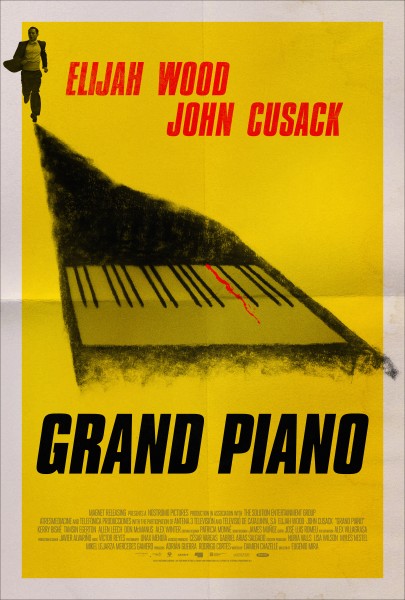
Grand Piano - scene

My advice, though, is to stick with it.  Grand Piano is one of those thrillers where the very unlikelihood of what’s transpiring is irrelevant (Speed anyone?).  Thanks to some inspired direction by Mira and a wonderfully nervy performance by Wood, Grand Piano succeeds where perhaps it shouldn’t.  From the moment where Tom finds notes from Clem written on his score sheets, the movie shifts up a gear, tightening the screws (or should that be piano strings?) with each new twist and turn.  Mira proves himself a supremely confident director, orchestrating the action with style and not a little panache.  He knows when to keep the camera moving, even if some of his pans are a little dizzying, but he’s more effective when he keeps the camera static; he makes a virtue of it when Tom begins to play La Cinquette, keeping the camera at a respectful distance and allowing Wood to show off his moves for a good two minutes.  It’s a bold move, holding up the action for a solo piano piece, but it works; you’re waiting for the moment where Tom froze last time, hoping the difficulty of the piece won’t trip him up again.

Mira also fares well with his cast, eliciting strong performances from all concerned.  As mentioned already Wood puts in a great performance, his initial stage fright giving way to panic and then to desperate resistance before finding a way out of his predicament. When he finally confronts Clem, the script is clever enough not to make him into an instant action hero, and his solution to their fight is entirely credible.  As the villain of the piece, Cusack’s performance is mostly a vocal one, as for most of the movie he’s just a disembodied voice in the earpiece he makes Tom wear.  Despite this restriction Cusack is more effective under these circumstances than he is when he finally confronts Tom; somehow his physical presence in the movie – while entirely necessary – still feels like a bit of a letdown.  It’s not Cusack’s fault, and yet given how good he is as just a threatening voice, maybe it is.

Of the supporting characters, most are underwritten in comparison with Tom and Clem, but they’re there to serve the story’s momentum rather than stand out.  Ashley (Egerton) and Wayne (Leech), as friends of Emma are annoying and dim in equal measure, while Emma herself is required to do little more than look constantly worried about her husband.  More interesting, and given better motivation and dialogue are Tom’s friend and conductor Norman (McManus) and Tom’s assistant (Winter).  Norman is larger than life and shows more faith in Tom than Tom does himself.  It’s a small part but McManus plays him with just the right amount of brio and concern.  As Tom’s assistant, Winter has a larger role than at first expected, but shows what a talented actor he is, keeping his character’s motives and actions pleasantly off-kilter.

The script, by Damien Chazelle, has its flaws, not least that McGuffin, but it’s structure is sound and it keeps the viewer wanting to know what’s next.  There’s some florid dialogue in there on occasion but the cast handle it well, and there’s a satisfying conclusion.  But ultimately this is Mora’s picture, and if it wasn’t his guiding hand on the baton, then this could have turned out a lot, lot worse.

Rating: 8/10 – a bravura piece of filmmaking that has a hypnotic effect on its audience; thrilling and exciting in equal measure, Wood’s convincing performance adds greatly to why the movie works so well.

Share this:

  • Click to share on X (Opens in new window) X
  • Click to share on Facebook (Opens in new window) Facebook
  • More
  • Click to print (Opens in new window) Print
  • Click to email a link to a friend (Opens in new window) Email
Like Loading...

Mini-Review: House of Bodies (2013)

20 Thursday Feb 2014

Posted by dullwood68 in Movies

≈ Leave a comment

Tags

Alex Merkin, Deaf teenager, Horror, Internet site, Murder investigation, Peter Fonda, Queen Latifah, Review, Serial killings, Terrence Howard, Thriller

House of Bodies

D: Alex Merkin / 78m

Cast: Terrence Howard, Peter Fonda, Alexz Johnson, Harry Zittel, George Katt, Queen Latifah, Francisco A. Pino, Juliana Harkavy, Elizabeth Brissenden, Karlee Eldridge

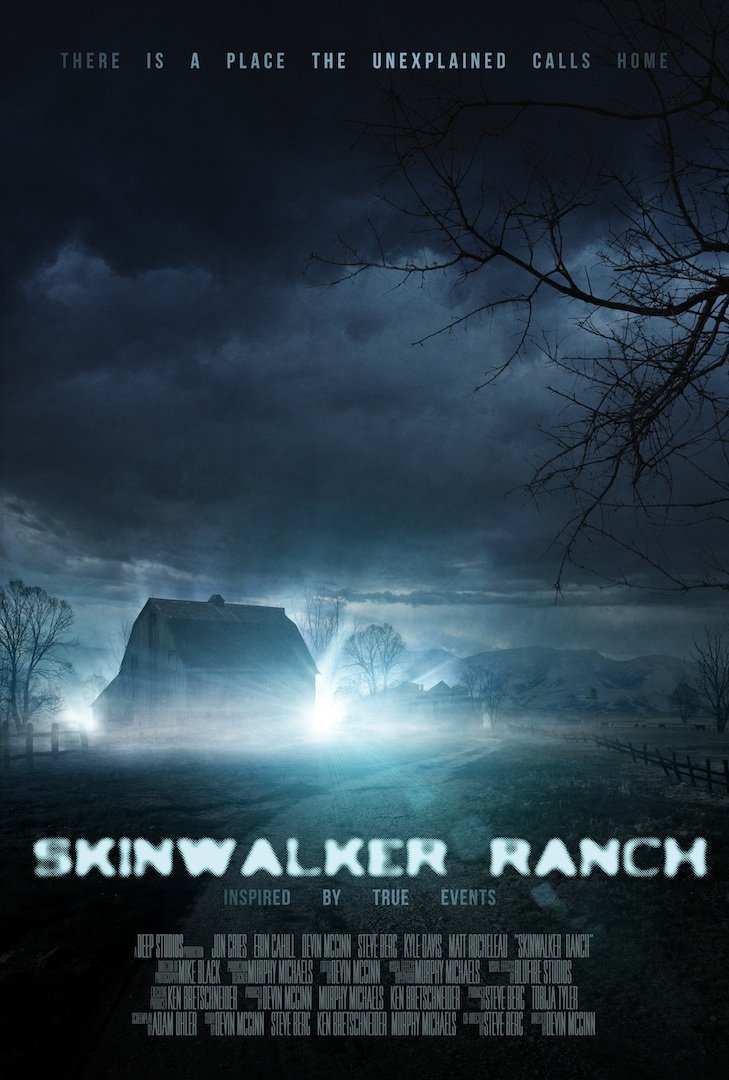
Alternating between a police interview with convicted serial killer, Henry Lee Bishop (Fonda) and events taking place in the house he used to live in, House of Bodies plays with notions of what is real and what isn’t and does it in quite a clever manner.  While the interview, carried out by Detective Starks (Howard) moves on, it becomes clear that events in the house are taking place before the interview so we’re treated to a framing device around an ongoing series of flashbacks.  It’s an awkward structure at times, with initial scenes appearing disjointed and confusing.  Once the movie hits its stride though, things become more clearcut, and the reason for the interview is brought into sharper relief.

Bishop’s house is being used as an internet site where members can log on and see recreations of Bishop’s original killings.  Run by Tracy (Brissenden), she employs three other girls, Kelli, Tisha and Ambra (Johnson, Harkavy and Eldridge) to play the victims and Ambra’s boyfriend Darryl (Pino) to play Bishop.  With each murder room set up with a video link and the requisite props, Tracy hopes to make a killing of her own.  On Kelli’s first night it becomes clear someone else is in the house with them; watching online is deaf teenager Kyle (Zittel).  He strikes up an unlikely relationship with Kelli and when he sees what’s happening (by hacking into the live feed – as all teenagers could), he tries to warn her.

House of Bodies - scene

House of Bodies has a neat premise but for a horror movie that sets up its serial killer as a particularly bloodthirsty monster, it’s quite tame when the killings are shown.  There’s very little tension during these sequences, and too much time is spent with Kelli and Kyle while the murders are taking place.  As an executive producer, Latifah adds another string to her bow by popping up a couple of times as Kyle’s online support worker, while Howard and Fonda give the movie a boost by making some very clunky dialogue sound better than it is.  Johnson and Zittel give it their best, but sadly the rest of the cast all seem on auto-pilot.  Merkin directs the interview scenes with confidence but lets himself down when things switch to the house, leaving the viewer stranded and waiting for the interview to resume.

Rating: 5/10 – a movie of two parts, with the worst part taking up too much of the (admittedly) short running time; if you’re new to the horror genre you might enjoy this, but if you’re not, you’ll be quickly disappointed.

Share this:

  • Click to share on X (Opens in new window) X
  • Click to share on Facebook (Opens in new window) Facebook
  • More
  • Click to print (Opens in new window) Print
  • Click to email a link to a friend (Opens in new window) Email
Like Loading...

Mini-Review: Oldboy (2013)

19 Wednesday Feb 2014

Posted by dullwood68 in Movies

≈ 1 Comment

Tags

Drama, Elizabeth Olsen, Hollywood remake, Imprisonment, Josh Brolin, Revenge, Review, Samuel L. Jackson, Sharlto Copley, Spike Lee, Thriller

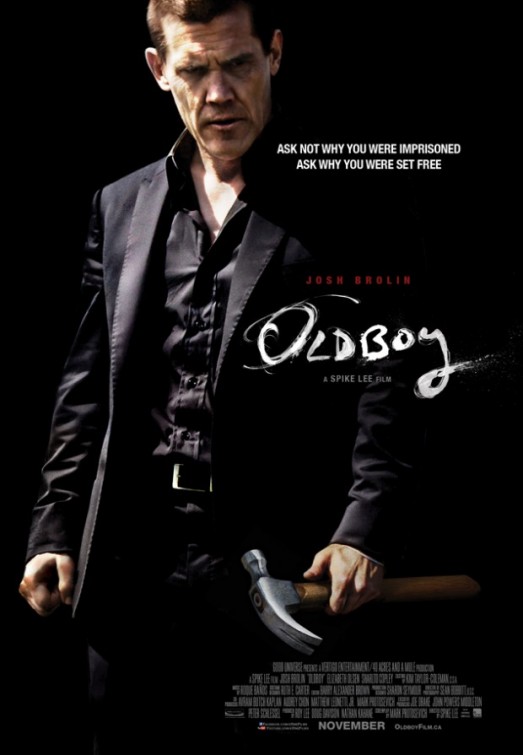
Oldboy (2013)

D: Spike Lee / 104m

Cast: Josh Brolin, Elizabeth Olsen, Sharlto Copley, Samuel L. Jackson, Michael Imperioli, Pom Klementieff, James Ransone, Max Casella, Linda Emond

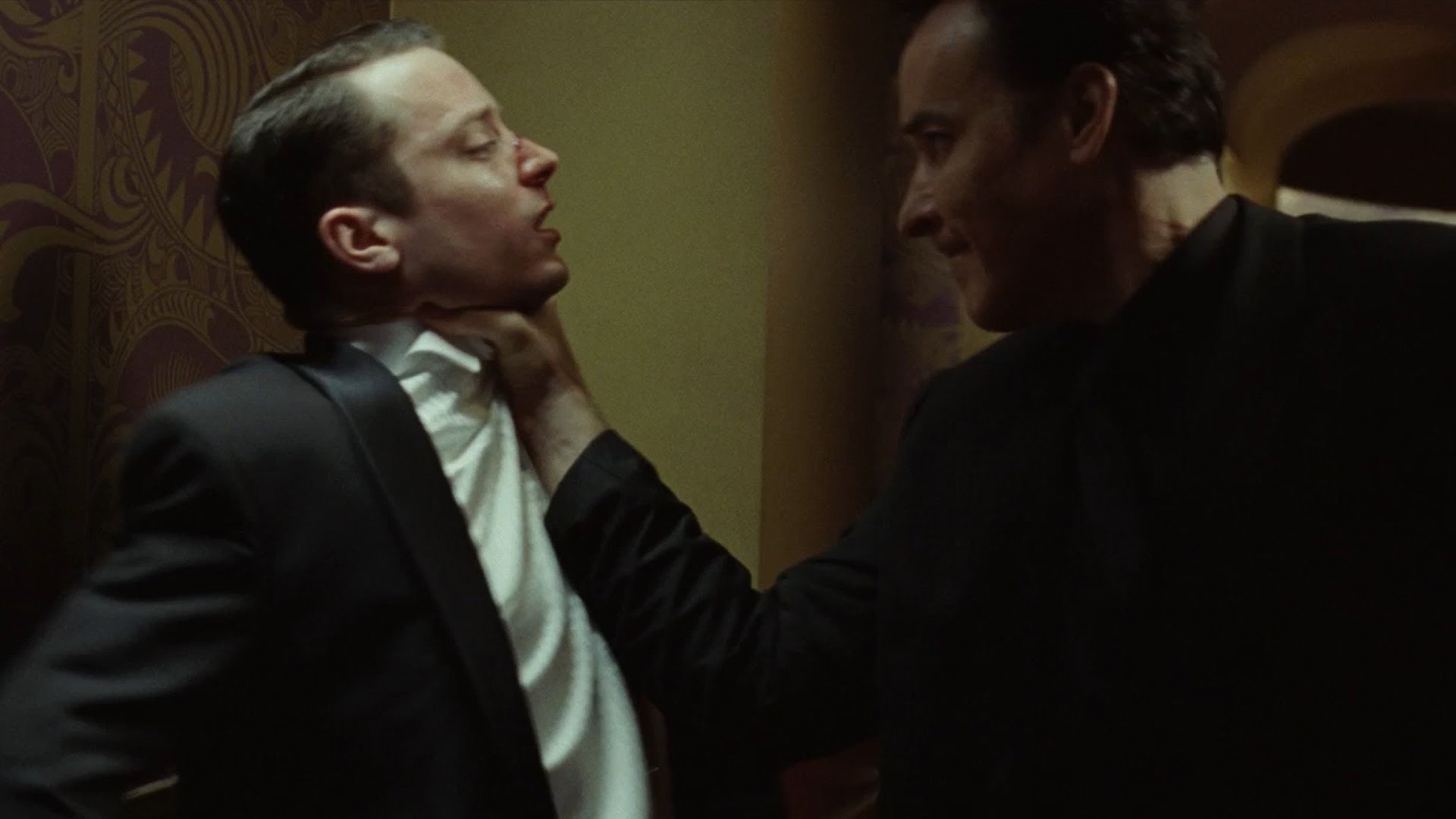
There are times when you just know that the phrase “just because you can doesn’t mean you should” is going to apply to an upcoming remake or sequel, and that what will eventually hit cinemas – if the movie’s that lucky (or has enough money behind it) – is going to be as disappointing as sunbathing during an eclipse.  It’s a very rare remake indeed that comes out as well as the original, and that’s mostly because those originals are lightning-in-a-bottle moments.  From Gus Van Sant’s ill-advised and unexpectedly dull shot-for-shot remake of Psycho (1998) to the current vogue for remaking what seems like every horror movie from the Eighties, remakes are the lazy filmmaker’s way of keeping busy.  And so it proves with Oldboy, Spike Lee’s remake of Chan-wook Park’s modern classic.

Oldboy (2013) - scene

Even with Lee and writer Mark Protosevich saying they’ve gone back to the original manga that Park based his movie on, this version still fails on so many levels.  The main character, Joe Doucett (played with his usual intensity by Brolin) is unlikeable from the start, so any sympathy we might have for him is dispensed with before he’s even held captive.  There’s a cartoonish performance from Samuel L. Jackson as chief gaoler Chaney that comes complete with blond ponytail and which sits at odds with the rest of the performances, and the tone of the movie as a whole.  When Joe meets Marie (Olsen) she gives him her number almost straight away in case he needs any help; yes, she’s an aid worker but would she really do that (but then how would the rest of the movie develop if she didn’t)?

The villain of the piece is played with pantomime bravura by Copley, and the only thing that’s missing from his performance is a bit of moustache-twirling (his vocal styling is quite irritating too).  The sequence where Joe takes on Chaney’s goons with just a hammer now looks over-rehearsed and lacks any visceral quality.  And the revelation of why Joe has been released is given a mock-opera makeover that resists any emotional engagement by the viewer because, in the set up, it appears that Copley’s character is able to install surveillance equipment wherever Joe goes and in advance of his knowing he’s going there.

In short, the movie relies on contrivance after contrivance and gives the viewer nothing to connect with.  As a reinterpretation (which sounds more like prevarication than anything else), Oldboy ends up being like a mime interpreting a song: you wonder what was the point.

Rating: 5/10 – proficient on a technical level with excellent photography courtesy of Sean Bobbitt, Oldboy strips away the cultural depth of Chan’s version and gives us nothing in return; even judged on its own merits it’s still a movie that doesn’t work.

Share this:

  • Click to share on X (Opens in new window) X
  • Click to share on Facebook (Opens in new window) Facebook
  • More
  • Click to print (Opens in new window) Print
  • Click to email a link to a friend (Opens in new window) Email
Like Loading...

Homefront (2013)

19 Wednesday Feb 2014

Posted by dullwood68 in Movies

≈ 2 Comments

Tags

Action, Clancy Brown, DEA agent, Drug dealing, James Franco, Jason Statham, Kate Bosworth, Review, Sylvester Stallone, Thriller, Winona Ryder

Homefront

D: Gary Fleder / 100m

Cast: Jason Statham, James Franco, Izabela Vidovic, Winona Ryder, Kate Bosworth, Marcus Hester, Clancy Brown, Rachelle Lefevre, Omar Benson Miller, Frank Grillo, Chuck Zito, Pruitt Taylor Vince, Austin Craig

Adapted by Sylvester Stallone from Chuck Logan’s novel of the same name – and once considered as the basis for a Rambo movie – Homefront finally makes it to the big screen with fellow Expendable Jason Statham in the lead role instead.

With its throwback style reminiscent of Seventies action movies such as Walking Tall, and Gator, Homefront settles into a familiar groove from the start, with undercover DEA agent Phil Broker (a badly bewigged Statham) having infiltrated drug dealing bikers The Outcasts.  When an attempt to bust them goes wrong, it leaves Outcasts kingpin Danny T (Zito) swearing revenge on Broker and his family.  Two years on and Broker has recently moved to the sleepy town of Rayville; in the meantime his wife has died and he’s left to bring up their nine year old daughter Maddy (Vidovic) all by himself.  A playground altercation with bully Teddy Klum (Craig) – Maddy gives him a bloody nose – leads to Teddy’s mom Cassie (Bosworth) seeking revenge.  She enlists the help of her brother, Gator (Franco), a local meth dealer.  When Gator finds out about Broker’s past he decides to let the remaining Outcasts deal with him; using his girlfriend Sheryl (Ryder) as an intermediary, Gator works out a deal where the Outcasts will distribute his drugs nationally in exchange for Broker’s whereabouts.

With its surprisingly leisurely pace, Homefront is a formulaic and professional Hollywood action movie, competently made, with no surprises and reminiscent of every other stranger-comes-to-town movie you’ve ever seen.  It allows Statham to stretch his acting muscles a little, sets up Franco as the baddest badass on the block only to renege on the deal two thirds in, puts Brown in uniform as the dishonest sheriff in Gator’s pocket (but does nothing more with it than that), gives Bosworth a chance to release her inner skank for a while, and sidelines Lefevre as Broker’s potential love interest at around the halfway mark.  Stallone’s script is full of these undeveloped story lines, and character arcs that are either cut short or allowed to peter out, all in order to allow more time for the action beats and the extended section where the Outcasts are brought back in.  It’s this part of the movie that is the most disappointing as the running time is padded out unnecessarily: Gator tells Sheryl to contact Danny T’s lawyer (Vince), Sheryl contacts him, he speaks to Danny T, Sheryl reports back to Gator, Sheryl meets Danny T’s lieutenant Cyrus (Grillo), and then the Outcasts travel to Rayville.  It all takes way too long, and all to set up the final showdown between Broker, Gator and the bikers which ends up being a two-part affair (and poorly edited at that).

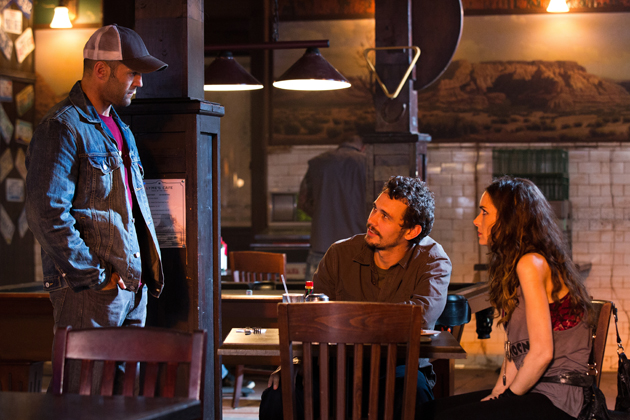
Homefront - scene

While it’s always good to see Statham kick ass – a fight at a gas station is probably the movie’s highlight – here he’s asked to be conflicted about his violent abilities.  It’s not entirely successful, focusing as it does on the effect Broker’s activities have on Maddy. The problem is that Broker has taught Maddy self-defence already (that’s how she gives Teddy a bloody nose) and is really pleased with her for standing up for herself.  And yet when he has to defend himself and Maddy witnesses it, she acts horrified and troubled.  This raises the question of whether she knows what Broker did for a living (after all she’s old enough to know); it’s never referred to, though, and remains just another loose end in a movie that litters them like confetti.

The deficiencies of Stallone’s script aside, Homefront at least looks good, its Louisiana locations shot in that slightly rosy glow beloved of so many cinematographers (here Theo van de Sande), and Statham acquits himself well.  Vidovic is captivating, Franco and Ryder do their best with roles too underwritten to care about, there’s too little screen time for Brown, and for once, the “black sidekick/friend/new acquaintance” (Miller) doesn’t get killed in the crossfire, but actually kills one of the bikers when they attack Broker’s home.  The only real surprise is Bosworth, raging at the mouth, swearing like a motherf*cker, and fit to explode from the anger she has pent up inside her.  Sadly, the script requires her to undergo a sea change, and this unfortunately robs her character of any further credibility, but for the first thirty minutes or so she steals the movie completely.

Rating: 5/10 – a misfire on so many levels, Homefront suffers from an unpolished script and lacklustre direction; technically solid with a couple of good fight scenes involving Statham (which you’d expect anyway), this never really matches up to its potential.

Share this:

  • Click to share on X (Opens in new window) X
  • Click to share on Facebook (Opens in new window) Facebook
  • More
  • Click to print (Opens in new window) Print
  • Click to email a link to a friend (Opens in new window) Email
Like Loading...

My Top 10 Movies – Part Seven

03 Monday Feb 2014

Posted by dullwood68 in Movies

≈ Leave a comment

Tags

Alfred Hitchcock, Apartment block, Broken leg, Cornell Woolrich, Drama, Grace Kelly, James Stewart, John Michael Hayes, Raymond Burr, Rear Window (1954), Review, Suspected murder, Thriller, Voyeurism

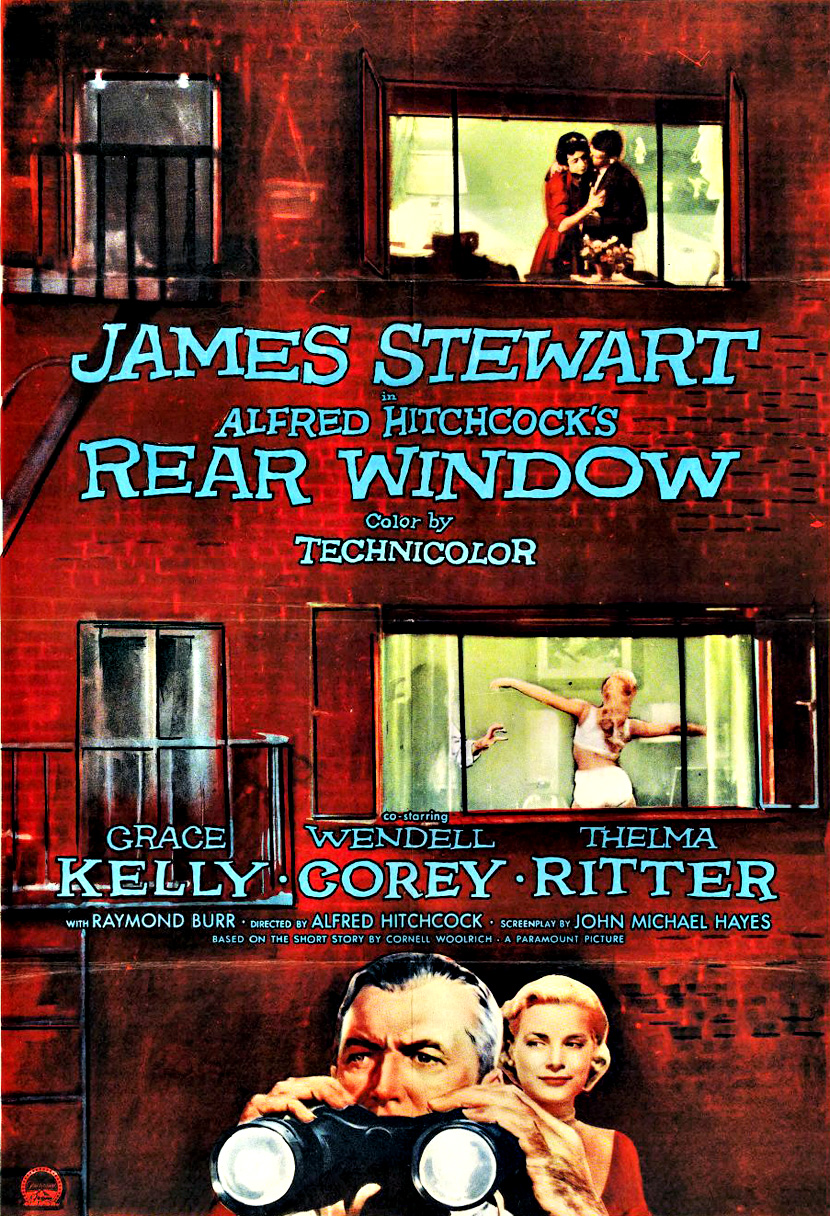
Rear Window (1954)

Rear Window

D: Alfred Hitchcock / 112m

Cast: James Stewart, Grace Kelly, Wendell Corey, Thelma Ritter, Raymond Burr, Judith Evelyn

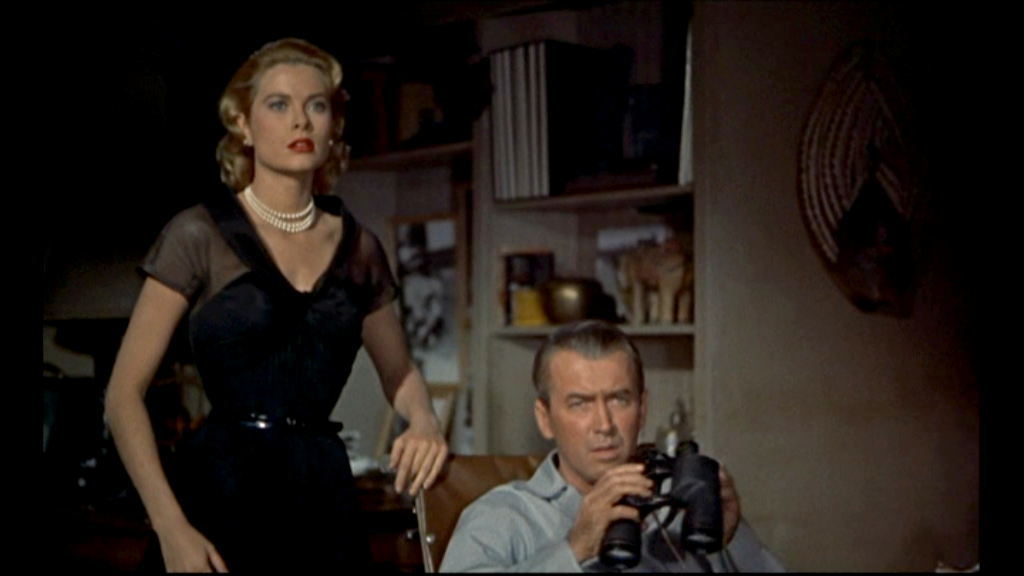
I guess it was inevitable that there’d be a Hitchcock movie in my Top 10, but while the likes of Psycho (1960) and Vertigo (1958) are more highly regarded, for me it’s Rear Window any time and all the time.

I first saw Rear Window in the early Nineties.  It was shown on TV, and while I was more than familiar with Hitchcock – and by this time had seen most of his sound features – this particular movie, along with Torn Curtain (1967) and The Trouble With Harry (1955), had evaded me until then.  My favourite Hitchcock movie at that stage was Foreign Correspondent (1942), followed very closely by Strangers on a Train (1951).  I was looking forward to seeing what Hitchcock would do with the “has he or hasn’t he?” style plot, and how Kelly would be treated, being the first of his blonde heroines (with all that that entailed).

I must admit to having a mixed reaction at first.  The movie’s opening, with its slow, voyeuristic peering into the apartments and lives of L.B. Jefferies (Stewart)’s neighbours seemed like an extended piece of scene setting, audacious in its camera moves but serving no discernible purpose (bear in mind I had only a faint idea of the movie’s plot).  As each neighbour was introduced I couldn’t help but wonder how much of what we were seeing was relevant to the plot, and which characters were going to prove more important than the others.  It seemed obvious Miss Lonelyhearts (Evelyn) would be given a fair bit of screen time, as well as the creepy salesman Thorwald (Burr) with the nagging wife, but how these characters would interact I really didn’t have a clue.  (I should admit at this point that I watch a lot of movies where I don’t have any idea of what’s going to happen or what the movie is about; I’m looking for the movie to surprise me.)

Rear Window - scene

Now, this being a Hitchcock movie, I knew there must be some kind of skullduggery about to be committed, and I knew that James Stewart’s character would likely be the hero, and Grace Kelly his romantic interest, but what I wasn’t prepared for, at all, was the movie’s master stroke: that up until the final scene, the whole movie doesn’t stray from Jefferies’ apartment.  Everything you see of his neighbours’ activities, and his girlfriend Lisa’s sleuthing, is seen from Jefferies’ perspective.  As it dawned on me that Hitchcock wasn’t going to take the camera any further than Jefferies’ window, it also dawned on me that, far from being a cinematic parlour trick, this was one of the cleverest set ups I’d ever seen.  Like Jefferies, the audience was confined to that small apartment, and again like Jefferies we too were helpless bystanders (he’s in a hip cast the whole time), involved in the action but removed from it at the same time.

This realisation made so much difference that I found myself agonising over what was happening as much as Jefferies.  When he was unable to convince his friend Doyle (Corey) of the likelihood of Thorwald’s guilty behaviour, I was there urging Doyle to see the sense in what Jefferies was saying.  And when Lisa appeared in Thorwald’s apartment, I was on the edge of my seat, knowing with a sick feeling in the pit of my stomach that Thorwald was bound to return home and find her.  And then, the worst moment of all, when Thorwald turns and sees…

Rear Window was the first thriller that gripped me, both physically and emotionally, and left me feeling wrung out to dry at its end (where Jefferies suffers a fitting punishment for his “professional” voyeurism).  Other movies have had a similar effect since – most recently, Captain Phillips (2013) – but I guess you never forget your first time.  The simplicity of the set up was terrific, and full marks should go to John Michael Hayes for building such a mousetrap from Cornell Woolrich’s short story (if you’ve never read Woolrich you’re missing out; his prose leaves you breathless).  Between them, Hayes and Hitchcock constructed a movie where watching other people’s lives becomes a litmus test for our own happiness, and where one man’s rescinded involvement provides an unwitting source of redemption for both himself and those he spies on.

I always get the feeling that Hitchcock is regarded as just a purveyor of thrills, and that people miss the psychological elements in his films.  Those elements are there in the majority of his movies, but when you mention Hitchcock most people are likely to remember scenes such as the shower murder in Psycho, or the crop duster attack in North by Northwest (1959), or Tippi Hedren under attack in a phone booth in The Birds (1963).  But for me, it’s the darker elements that make watching a Hitchcock movie so rewarding.  And if you want darker, then watch Rear Window, and see just how much Jefferies is put through the wringer; it’s torture, pure and simple.  And that’s just where Hitchcock wants us, and puts us.  And for myself, I was glad to be there.

Rating: 9/10 – one of the most memorable thrillers ever filmed and a testament to Hitchcock’s genius and creativity; excellent performances added to a perfectly coiled script and a wonderfully threatening score by Franz Waxman all go together to make Rear Window an absolute masterpiece.

Share this:

  • Click to share on X (Opens in new window) X
  • Click to share on Facebook (Opens in new window) Facebook
  • More
  • Click to print (Opens in new window) Print
  • Click to email a link to a friend (Opens in new window) Email
Like Loading...

Machete Kills (2013)

27 Monday Jan 2014

Posted by dullwood68 in Movies

≈ 1 Comment

Tags

Action, Amber Heard, Antonio Banderas, Charlie Sheen, Danny Trejo, Drug cartel, La Chameleon, Lady Gaga, Luther Voz, Machete, Mel Gibson, Nuclear missile, Review, Robert Rodriguez, Thriller

Machete Kills

D: Robert Rodriguez / 107m

Cast: Danny Trejo, Mel Gibson, Michelle Rodriguez, Amber Heard, Demian Bichir, Sofia Vergara, Charlie Sheen, Lady Gaga, Antonio Banderas, Cuba Gooding Jr, Walton Goggins, Vanessa Hudgens, William Sadler, Tom Savini, Jessica Alba

Arriving three years after its title character’s debut, Machete Kills opens with Machete (Trejo) and Agent Sartana (Alba) intercepting a weapons deal between US soldiers and members of a Mexican drugs cartel.  When their plan goes awry and Sartana is killed, Machete finds himself approached by President Rathcock (Sheen) to return to Mexico and find and, if necessary kill, cartel boss Mendez (Bichir).  Mendez is threatening to launch a nuclear missile on Washington D.C.; if Machete stops him, all of Machete’s past sins will be forgotten and he will be granted immediate US citizenship.

In Mexico, Machete finds himself captured by Mendez, who reveals he’s being backed by a mystery American who’s provided him with the missile.  This turns out to be Voz (Gibson).  Machete escapes with Mendez in tow and they head for the border but not before Mendez has put out a bounty on both their heads to the tune of $20 million.  With pretty much all of Mexico after them – plus face-changing super assassin La Chameleon (Goggins, Gooding Jr, Gaga, Banderas) – and the added problem of keeping Mendez alive (his heartbeat is connected to the missile’s arming device; if he dies the missile will fire), Machete has to get Mendez over the border and to Voz’s hideout in order to stop the missile from being fired.  Voz, though, proves to be a megalomaniac who can see the future (oh, and he’s also built an “ark” in space – once the world is destroyed by the nuclear missiles he’s got primed to be launched, and the dust has cleared, he and his followers will return to Earth and start a new, better society; there, got all that?)  With the help of old friend Luz (Rodriguez), Machete attacks Voz’s HQ just as he’s having his launch party.  Will Machete save the day?  Will Voz’s evil plan be thwarted?  Will there be a higher death toll than most Arnold Schwarzenegger movies from the Eighties?  (If you’ve answered yes to all three, then give yourself a pat on the back.)

Machete Kills - scene

As deliberately and casually over the top as its predecessor, Machete Kills is a riotous mix of primary colours, ear-crunching sound effects, limb-slicing violence, boys-with-toys style hardware, visceral humour, cheesy dialogue, unsubtle in-jokes, scantily clad gun-toting females, and the repository of Mel Gibson’s worst ever screen performance.  Rodriguez’s kitchen sink approach to the material works well over all, and he certainly wins points for inventiveness, but after ninety minutes the lack of subtlety begins to wear very thin indeed.  Fortunately he’s helped out by a committed cast who all seem to relish the chance to kick back and go with the absurdity of it all.  Except for Gibson, who plays Voz as if he were a villain in a Bond movie: all urbane chat and modish amusement.  He’s about as convincing as cottage cheese on steak.  That said, Trejo is still an awkward watch, his acting chops as wayward as a leaf in the wind, but it’s all about his physical presence, and Rodriguez uses him cleverly throughout, making Machete almost a force of nature.

For fans of the character, Machete Kills will reinforce their love for the character, though newcomers may wonder what all the fuss is about.  Some of the early scenes lack pace, and Rodriguez stops one too many times to introduce new characters or reintroduce old ones.  The action scenes are fun on an arcade game level, and give rise to all manner of violent, gory deaths (if I mention the words “intestines” and “helicopter blades” you might get an idea of how inventive Rodriguez is in this department).  Pretty much every woman in the movie is required to wear figure hugging and/or flesh-revealing clothing, including Lady Gaga (unfortunately, it doesn’t work for her as much as it does for, say, Sofia Vergara); sexist it may be but it’s as nothing compared to the casual racism that runs like a disquieting undertone from beginning to end (is American citizenship really such a great prize for a Mexican?).  Of course, there is a degree of irony here too, but it’s not quite as prominent as, say, Vergara’s crotch gun.

Away from Trejo and Gibson, the performances are much better, with Bichir a highlight as the schizophrenic Mendez: one moment a raging psychopath who thinks nothing of having his ward Cereza (Hudgens) killed as an example, the next a compassionate rebel determined to bring down the cartels.  Bichir switches between the two personalities with ease, often in the same line of dialogue, and his performance bolsters the movie every time he’s on screen.  Rodriguez, Alba and Savini reprise their roles from Machete, and of the four actors portraying La Chameleon, it’s Gooding Jr who impresses most.

At the beginning of the movie there’s a trailer for a forthcoming Machete feature, Machete Kills Again… In Space.  It appears to be a joke trailer but by the movie’s end it’s more of an accurate prediction of where Machete is heading next.  If and when that movie appears, let’s hope there’s a sharper script and less erratic direction.  With most, if not all, of Rodriguez’s movies there’s a feeling that he’s trying to bombard the audience with all sorts of diversions and trickery so that we don’t see the holes and the flaws in the plot or the storyline.  It’s evident here, and while Machete Kills is entertaining on a superficial level, the fact that there is no depth to it at all doesn’t help things.

Rating: 7/10 – a mixed bag (as usual) from Rodriguez with some stand-out moments and a firm sense of how ridiculous it all is; a popcorn movie for those who like their popcorn drenched in blood and free from logic.

Share this:

  • Click to share on X (Opens in new window) X
  • Click to share on Facebook (Opens in new window) Facebook
  • More
  • Click to print (Opens in new window) Print
  • Click to email a link to a friend (Opens in new window) Email
Like Loading...

State of Emergency (2010)

23 Thursday Jan 2014

Posted by dullwood68 in Movies

≈ Leave a comment

Tags

Chemical plant, Horror, Jay Hayden, Review, Thriller, Tori White, Turner Clay, Warehouse, Zombies

State of Emergency

D: Turner Clay / 90m

Cast: Jay Hayden, Tori White, Scott Lilly, Kathryn Todd Norman, McKenna Jones, Andy Stahl

Low-budget often means minimal resources.  It can also mean inventive outcome.  Such is the case with State of Emergency, a movie that, at face value, is a zombie movie but which never uses that word once to describe the victims of a chemical plant explosion.

After a tense prologue, we see Jim (Hayden) and his partner Emilie (Jones) running across open countryside.  Emilie is bleeding from a wound in her side.  As they rest under a tree, Emilie dies.  Jim carries her body to a nearby stable block where he hides out.  Up tip now the audience doesn’t know what’s happening, but whatever it is, it can’t be good.  It’s only when Jim is attacked by another man that we begin to realise what’s going on, and the possible reason why.

Later, Jim meets a couple, Scott (Lilly) and Julie (Norman), who have taken refuge in a warehouse; with them is a young woman called Ix (White).  They have plenty of food and water, and weapons; feeling safe, they have decided to wait for help to arrive.  And all the while, “people” are gathering outside the warehouse…  That’s the meat of the movie right there: the anxious wait for help to arrive while a growing threat gets nearer and nearer.

State of Emergency - scene

Full marks to writer/director Clay for making State of Emergency such a compelling movie.  It’s difficult enough to put a fresh spin on the zombie genre, but he pulls it off.  Not referring to the affected as zombies helps tremendously; after all, in the real world, if something like this was to happen, would we even call them that if we didn’t have George A. Romero to thank?  And where Clay really comes up trumps is with the committed performances of his cast.  Hayden does exceedingly well with his everyman role, projecting the right amount of vulnerability alongside a steely determination to survive.  Lilly has the more difficult male role, his character trying to be braver than he is and almost dying because of it, but he’s equally good even though he has less screen time.  As Ix, White plays defensive and scared mixed with an entirely credible teen obnoxiousness before she strikes a rapport with Jim; the scene where she opens up to him is one of the movie’s best.

As for the affected – remember, they’re not zombies – Clay has another good idea: if there’s no one around for them to attack they mostly stand still or walk in whatever direction (apparently) takes their fancy.  When they do spot someone, they charge at them, snarling.  This one-two combination of stillness and berserker speed is disconcerting; when it happens to Jim at the stables it’s a shock, even though Clay has set things up so the audience knows something nasty is about to happen.

With a clear nod to Romero’s Night of the Living Dead (1968), State of Emergency lacks that movie’s rising hysteria and ghoulish shock moments  (there’s no daughter in the basement), but it does ratchet up the tension.  The siege elements are handled with aplomb and Clay shows an aptitude for quick, yet concise characterisation.  Jim is someone the audience can identify with, as are Scott and Julie, and when they are put in danger, the movie lacks that sense of detachment that you’d find in most other zombie movies.  (I’ve seen quite a few zombie movies in the past year, from Zombie Farm, a more traditional, voodoo-based effort, to World of the Dead: The Zombie Diaries, a poor sequel to the original Zombie Diaries, and they all suffer from the same two problems: characters that you don’t care about, and – this bugs me the most – zombies who suffer from disfiguring facial injuries from the word go – I mean, how does that work exactly?  You die, come to as a zombie and wow! your jaw’s hanging off by a tendon or two.  Here, the affected have bloodshot eyes and what looks like a bad case of necrotising fasciitis – and that’s it, no missing bits, no decomposing limbs or extremities.  Memo to other would-be directors of zombie movies: make sure you watch State of Emergency first.)

Rating: 7/10 – a tense, effective “zombie” movie that keeps you hooked from start to finish; well-acted and free from the usual absurdities/deficiencies that otherwise seem endemic to the genre.

Originally posted on thedullwoodexperiment website.

Share this:

  • Click to share on X (Opens in new window) X
  • Click to share on Facebook (Opens in new window) Facebook
  • More
  • Click to print (Opens in new window) Print
  • Click to email a link to a friend (Opens in new window) Email
Like Loading...

Skinwalker Ranch (2013)

21 Tuesday Jan 2014

Posted by dullwood68 in Movies

≈ Leave a comment

Tags

Alien abduction, Devin McGinn, Disappearance, Erin Cahill, Found footage, Horror, Jon Gries, Kyle Davis, Lights in the sky, Paranormal activity, Review, Thriller, UFO's

Skinwalker Ranch

D: Devin McGinn / 86m

Cast: Jon Gries, Kyle Davis, Erin Cahill, Devin McGinn, Steve Berg, Matthew Rocheleau, Michael Horse, Michael Black

A short time after his son disappears inexplicably, Hoyt Miller (Gries) agrees for a team of paranormal researchers to spend time at his ranch in an effort to explain what happened to his son. The team, led by Sam (Berg), include veterinarian Lisa (Cahill), security and surveillance expert Ray (Davis), investigative journalist Cameron (McGinn), cameraman Britton (Black) plus media technician, driver, cook and resident bitch Matt (Rocheleau). Over the course of the next few days, Hoyt and the team experience all manner of weird phenomena, including strange lights, ghostly apparitions and loud, ear-splitting noises. As things get increasingly weirder, Matt leaves after getting injured, and exhorts everyone else to do the same. Nevertheless the rest all stay until events spiral wildly out of control…

Skinwalker Ranch - scene

Yet another found footage movie – and don’t we need even more of them? – Skinwalker Ranch at least tries to do something different by virtue of its location and the cause of the weird phenomena: this time around it’s (probably) aliens.  Taking some of the folklore surrounding UFO sightings and bending it to fit the storyline, the movie begins well enough, with comments from several locals about the boy’s disappearance, and with each character clearly defined and the team’s goal(s) clearly marked out.  McGinn invests these early sequences with the intention of making the audience identify to a degree with Hoyt and the team, but as the movie progresses that identification peters out as they all behave either stupidly or strangely, or both.

Skinwalker Ranch fails to address the same conundrum that undermines all found footage movies: when does someone pay heed to the danger around them and drop the ruddy camera?  That said, the movie gets extra mileage out of the fixed camera set ups the team employ around the ranch, and the open spaces make for an unexpectedly eerie visual theme.  But there’s still too much running with the camera.  By now we’re all aware that jostling the camera and/or employing interference is often a way of hiding an effect – here most effectively done in the barn sequence involving Hoyt’s dog – but this knowledge further undermines the effectiveness of the “fright” scenes.  Pulling off an apparently in-camera effect is half the fun of watching these movies – the girl being hoisted up in the air by her hair in Paranormal Activity 2 anyone? – but there’s little fun to be had now, there’s no sense of anticipation or dread either here, or anywhere else these days.

The movie takes an unexpected turn into Hound of the Baskervilles territory for a while before returning to its alien abduction theme, and the decision by Matt to leave after being thrown through the air is refreshing, but these aspects aside, there’s nothing really new here, just the setting.  A figure still passes by a window in the background but isn’t seen, one of the characters is forced to do something terrible by unseen hands, bright lights flash on and off for no discernible reason, and when the culprit is revealed there’s no element of terror, just a relief that, at last, things must be coming to an end.  And even though another side trip into the past where evidence comes to light that the organisation Sam works for – MDE – has been involved in previous strange events in the area, ticks the potential prequel box, this subplot leans more heavily in the direction of demonic possession than alien abduction, and actively lessens the effectiveness of the story as a whole.

Making his feature debut, McGinn copes well enough with the demands of the genre, but proves a better actor than director.  Gries is convincing throughout, and the rest of the cast do their best to flesh out characters that are largely stereotypes.  The location is the movie’s main strength, and is used tellingly, creating what little credible tension there is.  But more annoyingly, you never discover why it’s called Skinwalker ranch.

Rating: 6/10 – not the worst found footage movie, but not the best either, Skinwalker Ranch has some good ideas but they’re too often fumbled in the quest for the next scare; ultimately, a shallow experience and one that doesn’t follow through on its initial set up.

Share this:

  • Click to share on X (Opens in new window) X
  • Click to share on Facebook (Opens in new window) Facebook
  • More
  • Click to print (Opens in new window) Print
  • Click to email a link to a friend (Opens in new window) Email
Like Loading...

Runner Runner (2013)

10 Friday Jan 2014

Posted by dullwood68 in Movies

≈ 2 Comments

Tags

Ben Affleck, Costa Rica, Crime drama, FBI, Gambling, Gemma Arterton, Justin Timberlake, Online gaming, Review, Thriller

Runner Runner

D: Brad Furman / 91m

Cast: Justin Timberlake, Ben Affleck, Gemma Arterton, Anthony Mackie, Michael Esper, Oliver Cooper, Christian George, Yul Vazquez, John Heard, Bob Gunton

Supporting his financial outlay at university by acting as a facilitator for an online gambling organisation, Richie Furst (Timberlake) is ratted on to the Dean (Gunton) who gives him an ultimatum: either quit or be expelled.  Richie’s response is to bet all his remaining money on an online gaming site; when he loses it all he suspects the game was rigged.  When he finds proof, he determines to travel to Costa Rica – where the site is based – and show the site’s owner, Ivan Block (Affleck), what he’s found.  Grateful for Richie’s information, he offers him a job which Richie accepts.  Now living the high life, Richie begins to woo Ivan’s personal assistant (and ex-lover) Rebecca (Arterton).  While Richie enjoys his new lifestyle, things begin to crumble around him. He is targeted by FBI agent Shavers (Mackie) who tells him Block is a scam artist.  Two of his friends who came to work for Block on Richie’s recommendation begin to find strange anomalies in the way Block’s site is run.  When one of them ends up beaten to death, Richie finally begins to realise the enormity of the situation he’s got himself into.

Advertised as a thriller, Runner Runner certainly has thriller elements, but largely this is a crime drama that keeps the actual crime so far off screen that it might as well not be there.  That Block is running a scam seems of little consequence against the effect it has on Richie; the movie concentrates almost exclusively on how Richie is betrayed time after time, and then how he retaliates.  There’s a larger story here with the possibility of a much wider drama being explored, but the script by Brian Koppelman and David Levien keeps things restricted to Block’s empire, with occasional side trips to island enforcer Herrera (Vazquez), the man Block has to pay in order to keep his business running.

Ben Affleck, Justin Timberlake

What doesn’t help is the incredible naïveté that Timberlake is forced to adopt due to the laziness of the script.  For someone attending Princeton, Richie is possibly the dumbest student you’re ever likely to meet.  He falls for Block’s spiel hook, line and sinker, and even when he’s tricked time and time again, he still carries on as if Block’s assertions are just “part of the job”.  Even when he realises how much trouble he’s in he tries to escape back to America, something agent Shavers has already told him would not be permitted.  And then, when he agrees to help the FBI and the Costa Rican police bring down Block, he’s suddenly able to turn the tables just…like…that.

Making online gambling interesting is something the movie also fails to achieve, and a   few over-the-top parties that Block hosts aside, there is little glamour here.  Costa Rica is a beautiful country but you wouldn’t know it from the glimpses you get of it, and Arterton, who has a pouting attractiveness, is relegated to the sidelines for most of the movie.  So what you end up with is a movie that looks and feels bland and uninteresting, and as a result, ends up disappointing its audience in almost every scene.

Furman directs with an indifference to the material that makes you wonder if he saw the problems ahead of time and decided just to take the pay.  Timberlake sleepwalks through most of his scenes, while Affleck looks embarrassed by some of the dialogue he has to (try to) give credibility to.  Arterton is wasted, Mackie tries too hard and gives a one-note performance, and Heard is saddled with a character so similar to his role in Sharknado (2013) it’s almost embarrassing.  With no one trying very hard either in front or behind the camera, Runner Runner is doomed to fail from the very first frame.

Rating: 4/10 – a silly, shabby drama with pretensions toward being a thriller, Runner Runner is the cinematic equivalent of roadkill; a low point for all concerned that will be hard to beat.

Share this:

  • Click to share on X (Opens in new window) X
  • Click to share on Facebook (Opens in new window) Facebook
  • More
  • Click to print (Opens in new window) Print
  • Click to email a link to a friend (Opens in new window) Email
Like Loading...

Evasive Action (1998)

06 Monday Jan 2014

Posted by dullwood68 in Movies

≈ Leave a comment

Tags

Action, DeLane Matthews, Dorian Harewood, Drama, Jerry P. Jacobs, Prison escape, Prisoners, Ray Wise, Review, Roy Scheider, Runaway train, Thriller

Evasive Action

aka Con Train; Steel Train

D: Jerry P. Jacobs / 91m

Cast: Dorian Harewood, Ray Wise, Roy Scheider, DeLane Matthews, Ed O’Ross, John Toles-Bey, Clint Howard, Don Swayze, Richard Foronjy, Steven Barr, Blake Gibbons, Mallory Farrow, Keith Coogan, Bill McGee

An unabashed mash-up of Con Air and Under Siege 2 but with a tenth of either movie’s budget (or inventiveness), Evasive Action pits con-with-integrity Luke Sinclair (Harewood) against prison big wheel Enzo Marcelli (Scheider) during an attempted escape from the train carrying them both to a new prison.  Sinclair is doing time for the murder of the man who killed his wife and child, while Marcelli’s crime is never revealed; he’s just a very bad man.  Sinclair’s integrity is shown by his refusal to admit remorse for his crime at his parole hearings; Marcelli’s evil nature is shown by…. well, he queue jumps in the prison yard.

Once Sinclair and Marcelli, along with additional convicts Tommy (Toles-Bey), Ian (Swayze), and Hector “The Director” Miller (Howard, on Steve Buscemi psychopath duty), are on the way to San Diego and their new “home”, what has been up-to-now a fairly unremarkable thriller with some daft dialogue, moves quickly into the outer reaches of low-budget silliness.  With the aid of accomplices Vince (Foronjy) and Joe (Barr), Marcelli et al are freed from the high-tech (but actually low-tech) carriage they are being transported in.  With a plan to rendezvous with a helicopter and flee to Mexico, it’s up to Sinclair and plucky train employee Zoe (Matthews) to save the day and thwart Marcelli’s (slightly) evil plan.

Evasive Action starts promisingly but soon resorts to desperate measures to keep itself “on track”.  With the convicts taking over the train, Zoe manages to contact the police; soon Sheriff Blaidek (Wise) is heading to intercept the train and save the day.  What follows is a series of incidents that demand such a massive suspension of disbelief, the viewer is in danger of self-inducing a migraine.  For example, Blaidek commandeers the helicopter and orders the pilot to get him onto the train; Sinclair jumps from the train and reconnects with it after travelling across the desert on foot before reaching a town and stealing a motorbike; and the train company has only one worker, Anthony (Coogan), who can help the police keep track of where the train is headed and/or located (and he’s inexperienced).

Evasive Action - scene

As an action thriller, Evasive Action sets a robust pace once the train sets off but the audience is unlikely to connect with any of the characters.  As Luke, Harewood is earnest and just a little bit stuffy; plus in the fight scenes it’s clear he hasn’t squared up to anyone since he was probably five.  Wise acts like a man who hopes no one he knows will see the movie, while Matthews shows no fear, merely a kind of mild exasperation at what she has to go through.  It’s left to Scheider to raise the acting bar but even he can’t salvage a character so underwritten he has to resort to snarling his way through the movie as a way of keeping him interesting.

Jacobs’ direction lacks focus and substance (he’s better known as a producer, albeit of movies such as Vampires Suck and Disaster Movie), and the photography by Ken Blakey too often resorts to shaking the camera in order to make it look like the train is moving.  The script plays fast and loose with its own timescale, and makes Passenger 57 – another movie it’s been partially cloned from – look like Oscar-bait.  The movie looks bland and lacks any kind of zest.  And the movie’s big set-piece moment, when the train crashes through a terminus at high speed, is reduced to three poorly achieved shots involving model work.

While Evasive Action does try hard to entertain its audience, what you’re left with is a sense that this was a movie that was made quickly so as not to burden its cast and crew any more than it had to.  And whoever came up with the poster design has made it look as if Scheider is some kind of spy dealing with terrorists (maybe), or, as some reviewers might put it, is “in the wrong place at the wrong time”.  (Well, yes he is, but only in the “whoops-I-should-have-passed-on-this-one” sense.)  All in all, the best thing about the movie is that it moves with a sense of urgency, even if that urgency is to get things over with as quickly as possible.

Rating: 4/10 – saved from a lower score because its very inoffensiveness is a kind of relief from the madness of most direct-to-video releases, but only worth a view if every other variation on Con Air is unavailable.

Originally posted on thedullwoodexperiment website.

Share this:

  • Click to share on X (Opens in new window) X
  • Click to share on Facebook (Opens in new window) Facebook
  • More
  • Click to print (Opens in new window) Print
  • Click to email a link to a friend (Opens in new window) Email
Like Loading...

Illegal (1955)

06 Monday Jan 2014

Posted by dullwood68 in Movies

≈ Leave a comment

Tags

Albert Dekker, Courtroom drama, DeForest Kelley, District attorney, Drama, Drink problem, Edward G. Robinson, Jayne Mansfield, Lewis Allen, Nina Foch, Review, Thriller

Illegal

D: Lewis Allen / 88m

Cast: Edward G. Robinson, Nina Foch, Hugh Marlowe, Jayne Mansfield, Albert Dekker, Howard St John, Ellen Corby, Edward Platt, Jan Merlin

When ace district attorney Victor Scott (Robinson) gains a conviction in the case of wife murderer Edward Clary (Star Trek’s DeForest Kelley), he couldn’t be more pleased as it maintains his impressive run of convictions.  Clary is sentenced to be executed but as he goes to the chair, a death bed confession by another man proves Clary’s innocence.  Alerted to the confession, Scott tries to halt the execution but is too late.  His professional reputation in tatters, Scott takes to the bottle.  Self-pitying and pushing away anyone who might help him, particularly his assistant Ellen Miles (Foch), Scott eventually pulls himself together but determines to take on only defence cases from then on.  In the process he falls in with local gangster Frank Garland (Dekker).  Scott defends Garland’s men when they end up in court, and on one occasion goes to extreme lengths to gain an acquittal.  Soon he begins to regret the course he’s chosen and tries to extricate himself from Garland’s clutches.  And then Ellen ends up on trial for the murder of her husband Ray (Marlowe), giving Scott a chance to redeem himself for the mistake he made with Clary, and ensure that Garland is brought to justice.
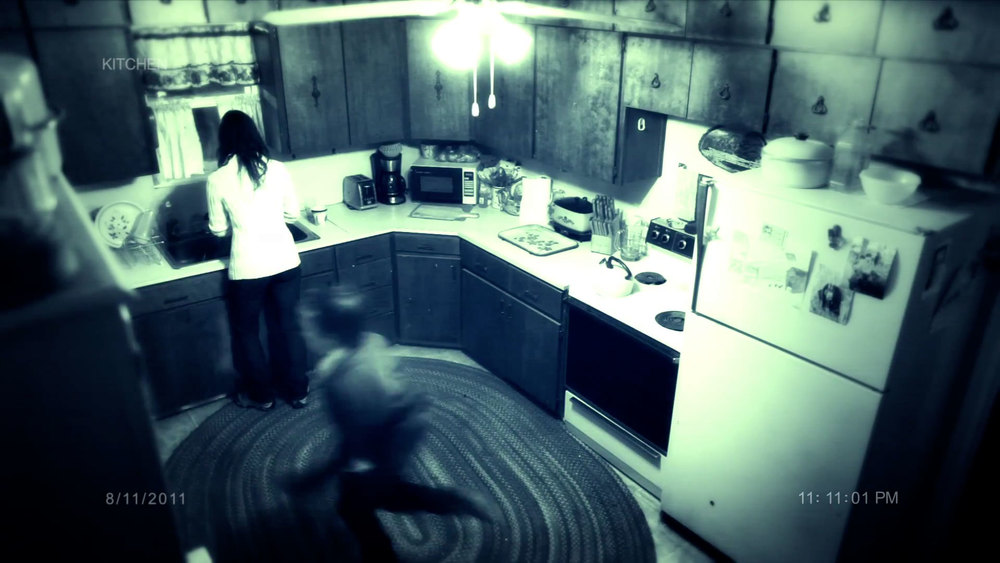
Illegal - scene

A remake of The Mouthpiece (1932), Illegal is a fast-paced courtroom drama with fine performances (though Foch can be a trifle stiff at times), and an early appearance for the buxom Mansfield.  Some of Scott’s motivations are a little bit hazy, especially when he begins working for Garland, but Robinson, consummate professional that he is, doesn’t allow this to interfere with the need for pushing the story forward.  As Garland, Dekker is a great foil for Robinson, and gives a firm reminder of why he was such a reliable supporting actor in the Forties.  There are a number of twists and turns, a mole in the DA’s office who must be uncovered (though the culprit is revealed early on), the usual lack of a romantic involvement for Robinson (he never did that well with the ladies), and some typically hard-boiled dialogue chewed on with relish by the largely male cast.

Directed with flair by Brit-born Allen (also responsible for The Uninvited – see review posted on 31 October 2013), Illegal is a legal potboiler that still retains a great deal of charm and is a pleasant enough way to spend an hour and a half.  On the downside, the sets are quite drab – evidence of a tight budget – and the photography is perfunctory, composed largely of medium shots.  It’s mostly predictable too, but this isn’t a drawback, and while there’s the odd misstep along the way (which might cause a grimace), the movie is an acceptable addition to the genre.  Plus there’s a great score from the ever-reliable Max Steiner.  There’s always an in-built reassurance with this type of movie, and if you’re a fan, you’ll be pleased you caught up with it.

Rating: 6/10 – minor problems with production values aside, Illegal benefits from a committed turn by Robinson and assured direction by Allen; not a classic but enjoyable nonetheless.

Share this:

  • Click to share on X (Opens in new window) X
  • Click to share on Facebook (Opens in new window) Facebook
  • More
  • Click to print (Opens in new window) Print
  • Click to email a link to a friend (Opens in new window) Email
Like Loading...

Peacock (2010)

02 Thursday Jan 2014

Posted by dullwood68 in Movies

≈ Leave a comment

Tags

Bill Pullman, Cillian Murphy, Drama, Ellen Page, Michael Lander, Review, Small-town America, Susan Sarandon, Thriller

Peacock

D: Michael Lander / 90m

Cast: Cillian Murphy, Ellen Page, Susan Sarandon, Josh Lucas, Keith Carradine, Bill Pullman, Graham Beckel

Beginning with a major plot twist that most movies would leave until the final reel, Peacock is a small-town drama that focuses on notions of family and identity, as well as what it can mean to be part of a small-town community.

Murphy plays John, a painfully shy/socially awkward bank clerk who has managed to keep himself to himself in the year since his mother passed away, despite the best efforts of neighbours and some of the customers at the bank.  He lives in a large house next to the train tracks; when a carriage jumps the rails and ends up crashing into his back garden, narrowly missing him, his life becomes more complicated than he could ever have wished, leading him to discover things about himself that he would rather not have known.

Peacock - scene

Peacock is a beguiling movie, with Murphy’s performance firmly at its heart.  He shows the complexity of the character and the fragility of John’s mental state with an ease that is hypnotic, keeping the viewer glued to the unfolding events and eliciting sympathy at every turn.  It is a bravura piece, and the movie is worth watching for his performance alone.  It’s great to be able to add that he is more than ably supported by Sarandon, Pullman and Carradine, whose characters all want something from John, and use their apparent concern for him to advance their own causes.  Lucas serves as the nearest John has to a friend, while Page plays Maggie, a figure from his past who further adds to the problems he can’t seem to shake.  It all leads to a desperate climax with John sacrificing everything in order to be able to carry on.

There is much to admire in Peacock.  Aside from the quality of the acting – unsurprising given the cast involved – the cinematography by Philippe Rousselot is perfectly framed throughout and at times shows an almost painterly eye.  The editing, by Sally Menke (on her last film) and Jeffrey M. Werner, keeps the movie expertly paced, and the production design, especially with regard to the darkened interior of John’s home, is faultless; this is small-town America as even non-Americans will recognise it.

Director and co-writer Lander, making his feature debut, has a good eye for the nuances and undercurrents of small-town life, and manages everything with the confidence of a director with many more films under their belt.  He also knows how to keep a scene moving and when to switch focus from character to character.  And lastly, a mention for the score by Brian Reitzell: it ably supports the various emotional arcs of the characters and adds an appropriately melancholy touch to the proceedings.

Rating: 8/10 – a touching drama that becomes a character-driven thriller at the end but which remains grounded in credibility throughout; a minor gem.

Originally posted on thedullwoodexperiment website.

Share this:

  • Click to share on X (Opens in new window) X
  • Click to share on Facebook (Opens in new window) Facebook
  • More
  • Click to print (Opens in new window) Print
  • Click to email a link to a friend (Opens in new window) Email
Like Loading...

Shame the Devil (2013)

18 Wednesday Dec 2013

Posted by dullwood68 in Movies

≈ 1 Comment

Tags

Doug Bradley, Horror, Juliette Bennett, Lie detector, Murders, Paul Tanter, Profiler, Review, Serial killer, Simon Phillips, Thriller

Shame the Devil

D: Paul Tanter / 94m

Cast: Simon Phillips, Juliette Bennett, Will de Meo, Bradford West, Lucy Clements, Doug Bradley, Kellie Shirley, Peter Woodward

Oh dear.  Oh dear, oh dear.  Really.  It’s that bad.  I mean, really bad.  Sooooo bad.

And once again, it’s all down to THE SCRIPT.  An awful… no, god-awful, unholy mess of a script that makes no effort to be coherent, has a passing acquaintance with competence, and contains some of the worst dialogue ever committed to celluloid.  The sad thing about Shame the Devil is that the cast and crew are actually trying their best…and failing miserably.

The plot concerns the hunt for a serial killer who hooks his victims up to lie detectors and then asks them a series of questions that will cause them to be killed if they lie.  The killer tells them, “The truth will set you free; tell the truth and shame the devil”.  The first victim is a supermarket manager, the second a doctor (Woodward), and the third a priest.  The police officer investigating the murders, Trent (Phillips) is suspended because he appears to be linked to the victims, and heads to New York to seek help from an old flame (Bennett) who is a profiler.  But while he’s there, the murders continue…

Shame the Devil - scene

Ten things that are wrong with Shame the Devil:

1 – Simon Phillips demonstrates every emotion required of his character by shouting.

2 – Writer/director Paul Tanter allows each actor to play their part independently of any other actor that might be in the same scene with them.

3 – The whole concept of the serial killer being one step ahead is made laughable by the circumstances surrounding the death of the first New York victim.

4 – Lucy Clements demonstrates every emotion required of her character by pouting.

5 – Despite jetting off to New York after being suspended, none of Trent’s superiors have any idea of where he is.

6 – Lines of dialogue are repeated by characters in a vain effort to reinforce the seriousness of the relevant situation.

7 – The photography by Haider Zafar is bland and uninspired.

8 – Writer/director Tanter and editor Richard Colton have no awareness of what makes a scene tense, thrilling, and/or dramatic.

9 – Doug Bradley, one of the few actors capable of injecting credibility into this kind of thing, is reduced to appearing in only one scene.

10 – The music is intrusive and fails to add any menace to the proceedings.

11 – There are moments of childish humour that even the Chuckle Brothers would have steered clear of (apologies to any non-UK readers for the reference).

I know, I know, that was eleven things but that just serves to illustrate how bad this movie really is: I could go on and on and on and on…  But I won’t.  Suffice it to say, Shame the Devil is an unmitigated disaster – poorly directed and acted, appallingly written, unimaginatively shot and edited, and completely unable to drag itself out of the mire of its own making.  Even the nihilistic ending – though welcome by the time it arrives – is badly staged and requires more of Phillips as an actor than he has to give.

Rating: 1/10 – another car crash of a movie from the writer/director of the White Collar Hooligan movies, Shame the Devil founders from its opening scene and never quite breaks the surface; an amateurish, dismaying waste of everyone’s time and patience.
Share this:

  • Click to share on X (Opens in new window) X
  • Click to share on Facebook (Opens in new window) Facebook
  • More
  • Click to print (Opens in new window) Print
  • Click to email a link to a friend (Opens in new window) Email
Like Loading...

Disaster Zone: Volcano in New York (2006)

13 Friday Dec 2013

Posted by dullwood68 in Movies

≈ Leave a comment

Tags

Alexandra Paul, Construction team, Costas Mandylor, Disaster movie, Drama, Michael Ironside, Review, Robert Lee, Thriller, Volcano

Disaster Zone Volcano in New York

D: Robert Lee / 90m

Cast: Costas Mandylor, Alexandra Paul, Michael Ironside, Michael Boisvert, Eric Breker, Ron Selmour, Pascale Hutton, Kevin McNulty, Zak Santiago, Robert Moloney, Kaj-Erik Eriksen, Matthew Bennett, William S. Taylor

What looks like a SyFy movie, sounds like a SyFy movie, has a script and direction like a SyFy movie, and special effects like a SyFy movie, and yet isn’t a SyFy movie?  The answer, of course, is Disaster Zone: Volcano in New York.  Shot on a predictably low budget, Disaster Zone begins well, showing the camaraderie of a construction team working on a new water supply tunnel for the Manhattan area.  Two newbies, Joey (Eriksen) and Karen (Hutton) are thrown in the deep end when a routine blasting goes wrong and three members of the team are killed.  The ensuing enquiry – which seems to take place the very next day – sees team leader Matt McLaughlin (Mandylor) sacked, despite his having seen lava break through the tunnel wall just before he got out.  No one believes his story, least of all the NY authorities, who authorise his team to continue working on the tunnel.  Enter a team from the US Geological Service to investigate (and immediately dismiss) Matt’s claims.  On the USGS team is Matt’s ex-wife Susan (Paul).  At first they butt heads, but soon enough they’ve made up their differences and are trying to work out if what Matt saw is just an isolated incident or something presaging a bigger problem.

Experienced viewers will now be shouting, “Of course there’s a bigger problem!”, and the cause of it all is pill-popping mad scientist Dr Levering (Ironside).  He’s drilled down seven miles into the earth’s crust (from a warehouse, no less!), and has caused major instability as well as aggravating the volcano that no one has ever been aware of previously.  For some reason this is a highly secret operation, backed by mysterious investors, and overseen by oily politician Kavanagh (McNulty).  Levering’s plan is to harness the earth’s geo-thermal energy and do away with fossil fuels.  But in the drive to meet his backers’ deadline, Levering ignores the warning signs and presses on.  Eventually it’s up to Matt and his remaining crew to save the day.

Disaster Zone Volcano in New York - scene

Disaster Zone: Volcano in New York has two main problems and they are both fundamental to the movie’s success (or lack of it).  Firstly, there is the script by Sarah Watson, which, as expected, is as scientifically accurate as saying that water falls upwards, and is littered with lines even the best actors in the world couldn’t give credibility to.  One sequence, and perhaps the most laughable in a movie riddled with laughable moments, shows a man watering a lawn who goes to open a neighbour’s door and finds the handle is red hot.  He uses his sleeve to open the door, lava pours out, engulfs him, and then causes an explosion in the house.  Minutes later we’re told that seventy-two people died in the explosion, in what is being described as a “terrorist incident”.  By this point you’re reduced to mouthing WTF? almost every couple of minutes in sheer astonishment at the script’s determined implausibility.  The second problem is Lee’s scattershot attempts at direction.  Lee is more often employed as a first assistant director or a second unit director, and his lack of ability shows throughout.  Few scenes are handled with any appreciable skill and his decision to shoot the bulk of the movie using various headache-inducing camera techniques such as whip-pans makes it unpleasant to watch.  He’s also unable to frame a shot properly or provide his cast with enough support; sometimes it seems he’s shot a rehearsal rather than the finished scene.

Woeful as this movie is, it’s further undercut by the dreadful special effects – there’s even a couple of shots lifted from footage taken on 9/11 – and lighting that makes everyone look ill.  There’s also a ludicrous subplot involving an anti-terrorist unit led by Agent Walters (Bennett), who believes everything is down to terrorists.  Of the cast, Mandylor and Paul show real chemistry, and while Ironside ends up chewing the scenery with relish, he’s still the best thing in the movie.  The supporting cast do their best against insurmountable odds, and the score hits every beat with leaden predictability.  And to cap it all off, there isn’t even a proper eruption.

Rating: 3/10 – watchable only if you’re in the mood to check your brain at the door; or for the opportunity to witness so much that is witless and stupid in such a short space of time.

Originally posted on thedullwoodexperiment website.

Share this:

  • Click to share on X (Opens in new window) X
  • Click to share on Facebook (Opens in new window) Facebook
  • More
  • Click to print (Opens in new window) Print
  • Click to email a link to a friend (Opens in new window) Email
Like Loading...

Paranoia (2013)

04 Wednesday Dec 2013

Posted by dullwood68 in Movies

≈ Leave a comment

Tags

Amber Heard, Commercial fraud, Communications, Drama, Gary Oldman, Harrison Ford, Liam Hemsworth, Review, Robert Luketic, Smart phone, Thriller

Paranoia

D: Robert Luketic / 106m

Cast: Liam Hemsworth, Gary Oldman, Amber Heard, Harrison Ford, Lucas Till, Embeth Davidtz, Julian McMahon, Josh Holloway, Richard Dreyfuss

When the final history of movies comes to be written, and all the various genres and sub-genres are assessed and valued, one type of movie will probably be given short shrift by its assessors: the industrial espionage thriller. In the real world, the cut and thrust of commercial enterprise, with often billions – and companies’ reputations – at stake, must play out with some degree of dramatic potential, but when it comes to the movies, this dramatic potential is all too often squandered for the sake of cinematic familiarity. And so it goes with Paranoia, a thriller based around the power play between two communications empires and the youngish would-be player who gets caught in the middle.

The player is Adam Cassidy (Hemsworth), an entry-level employee working for Nicolas Wyatt (Oldman). When a pitch to secure a position at Wyatt’s company fails disastrously, Adam decides to have one last splurge on his company credit card.  $16,000 later, he finds himself being blackmailed by Wyatt into going to work for Wyatt’s long-time rival, Jock Goddard (Ford). Once he has Goddard’s trust and knows his way around the company, Adam’s task is to steal details of the new, revolutionary smart phone that Goddard is planning to release onto the market. Along the way Adam meets and falls for Emma Jennings (Heard), an executive at Goddard’s company. As Wyatt increases the pressure on Adam to get the info he needs, Adam must decide if the path he has chosen is the right one.

PARANOIA

The problem with Paranoia – aside from the fact that the movie is mis-titled – is that we don’t care about anyone in the movie…at all. We’re supposed to feel sorry for Adam because his dad Frank (Dreyfuss) is ill and it’s a struggle for them to pay for the mounting medical bills. But Frank, who is on oxygen a lot of the time, continues to smoke; it’s this that gets him hospitalised and pushes the costs up. When Adam loses his job with Wyatt he doesn’t consider his responsibilities, he just goes out with his team and runs up a huge bill, another one he can’t pay.  So when Wyatt blackmails Adam into working for him as an industrial spy, there’s no sympathy for him at all. (I wanted him to really suffer as the movie went on but Adam is the “hero” in the movie, so that only goes so far.) Even when Wyatt threatens to hurt Frank if Adam doesn’t go along with his plan, you’re left thinking “yeah, that’s fair enough”. Adam is a slightly older version of the ‘callow youth’ the movies like to put in peril every so often, but here it doesn’t work. He’s simply not a good enough person for the audience to get behind.  Even when he begins to realise the real position he’s in, it’s still a case of “you got yourself into this mess…”.

As Adam, Hemsworth fails to make any connection with the audience, playing him as someone who thinks he’s smart but who actually hasn’t learnt anything in his twenty-seven years on the planet. Hemsworth is not the greatest actor in the world – watch how he tries to explain to Emma that he’s done some things he should have told her about – and there are times when the relevant emotion comes along a beat or two after it’s required, but as the character isn’t fully formed anyway – thanks to Jason Dean Hall and Barry L. Levy’s unconvincing screenplay – he does the best he can under the circumstances. Oldman uses an awkward mix of Cockney and mid-Atlantic vocal swagger as the keystone of his performance, while Heard, an actress who has yet to realise her full potential, is given little to do other than appear vapid and superficially strong. It’s Ford who impresses most, although that’s not saying much; he’s saddled with some of the most turgid dialogue this side of Star Wars (so he’s probably used to it), but at least he puts some energy and commitment into his performance, even if it counts, ultimately, for nothing. In a supporting role, McMahon exudes icy menace as Wyatt’s enforcer, Meechum, but Davidtz, as Wyatt’s PA, looks embarrassed throughout.

The direction by Robert Luketic is low-key and close to pedestrian, while the photography offers an almost wintry, subdued look that matches the downbeat aspects of the storyline and the grubby nature of the proceedings. The script struggles to add depth or texture to both events and characters, and the outcome can be seen from a mile off (you could even say it was phoned in). As a thriller, Paranoia never really hits the mark, and as a drama it’s too undercooked to be effective. Everyone involved has done better elsewhere, and probably will do again. What matters here is whether or not a hundred and five minutes of your time could be used doing something better instead.

Rating: 5/10 – an unimaginative thriller that goes through the motions for most of its running time, Paranoia never engages its audience or provides a way in to become involved; a shame then considering the talent taking part.

Share this:

  • Click to share on X (Opens in new window) X
  • Click to share on Facebook (Opens in new window) Facebook
  • More
  • Click to print (Opens in new window) Print
  • Click to email a link to a friend (Opens in new window) Email
Like Loading...

Sharknado (2013)

03 Tuesday Dec 2013

Posted by dullwood68 in Movies

≈ 3 Comments

Tags

Drama, Hurricane, Ian Ziering, John Heard, Review, Sci-fi, Sharks, SyFy Channel, Tara Reid, The Asylum, Thriller, Tornados

D: Anthony C. Ferrante / 86m

Cast: Ian Ziering, Tara Reid, Cassie Scerbo, Jaason Simmons, John Heard, Alex Arleo, Chuck Hittinger, Aubrey Peeples

With a title like Sharknado, this movie already has one strike against it.  That it’s also made by The Asylum for the SyFy Channel makes two more.  And… it’s out!

Any movie should be given the benefit of the doubt.  As the saying correctly has it, don’t criticise what you haven’t seen.  But there are times when to say this would be wrong, when the whole concept of a fair hearing, and leaving your prejudices at the door, is completely, totally and utterly a lost cause.  And ladies and gentlemen, here is one of those times.

Let’s not beat around the bush: Sharknado isn’t so bad it’s good, it’s just plain awful, and in ways that you can’t anticipate.  It takes the idea of low-concept movie making to somewhere below the acceptable nadir, and stakes its claim as the most inept, appalling movie ever made.  There are levels of bad this movie practically races past in its efforts to be dreadful.  If there was a clear intention to make the worst movie possible, and the filmmakers actually sat down and planned it to look and sound like this then, ladies and gentlemen of the jury, there can be only one verdict handed down this day: life imprisonment without hope of parole.

Beginning with a confusing scene set aboard a fishing boat, Sharknado sets out its stall of fake goods from the start.  A storm hoves into view and before you can say “holy flying sharks” the crew are all eaten by sharks that are being thrown about like tooth picks by the violent winds.  The movie then switches focus to the California coastline and bar owner/surfer Fin (Ziering).  When sharks that are attempting to outrun the storm – hey, I’m guessing here – start chewing on the local surfers and swimmers, including Fin’s pal Baz (Simmons), Fin, along with feisty bar girl Nova (Scerbo) and permanent lush George (Heard), decides that everyone needs to get to higher ground, as it’s a sure thing the storm – now upgraded to a hurricane – is going to cause untold devastation and, wait a minute!  Aren’t those sharks swirling around in the hurricane?  And aren’t they liable to just fall out of the sky at any minute and chomp on whoever’s unfortunate to hang around for dinner?

Sharknado - scene

With his estranged family – ex-wife April (Reid), son Matt (Hittinger), and daughter Claudia (Peeples) – living up in the hills, Fin and his entourage head over to rescue them.  With all sorts of obstacles in their way – flooded roads, marauding sharks popping up at every turn, the hurricane getting nearer as well – it looks unlikely they’ll live long enough to make it.  But they’re a plucky bunch, and before you can say “holy plot contrivances” they reach Fin’s family; once April’s new boyfriend is reduced to so much chum, they make a break for the airbase where Matt is doing some ATC work, and from there devise a plan to kill all the sharks, stop the hurricane in its tracks (it’s now subdivided into three huge water spouts), and save the California coastline from further devastation/a colossal insurance bill/being the source of the end of the world.  (Any of these could be true.)

Just writing that synopsis is difficult enough.  Seeing Sharknado in all its non-glory is harder still.  Yes, The Asylum make bad movies, yes the SyFy Channel is home to some of the worst monster mash-ups in recent history (Sharktopus (2010) anyone?), but this is just the worst kind of cynical movie making, with a script that makes no sense at all, where the characters behave like they were lobotomised a short while before everything went wrong, where the direction has all the style and originality of a toddler’s tea party, where the cast struggle and then give up quickly with any attempts at real acting (“just say the lines, keep your head down and it’ll all soon be over”), where the woeful special effects plumb new depths of ineptitude, where cutaways and inserts provide most of the photographic style, where the editing seems less fluid and more cut and splice with a hacksaw, and where the occasional gore effects are – surprise! – the only halfway decent aspect of the movie.  Sharknado is so bad it’s appalling, and so appalling it’s devoid of any worth at all.

If you have to watch Sharknado, and I suspect there are plenty of you out there for whom this will be as much a challenge as a must-see, then take this one piece of advice with you into the living room/lounge/den/bedroom/wherever: have no expectations whatsoever; that way you’ll survive the experience relatively intact.

Rating: 1/10 – saved from my first ever 0/10 rating by the acceptable gore effects (too few and far between though); atrocious, incompetent and utterly irredeemable as cinema, all those involved should hang their heads in shame.

Share this:

  • Click to share on X (Opens in new window) X
  • Click to share on Facebook (Opens in new window) Facebook
  • More
  • Click to print (Opens in new window) Print
  • Click to email a link to a friend (Opens in new window) Email
Like Loading...

12 Rounds: Reloaded (2013)

29 Friday Nov 2013

Posted by dullwood68 in Movies

≈ Leave a comment

Tags

Action, Brian Markinson, Drama, EMT, Low budget, Randy Orton, Review, Roel Reiné, Sequel, Thriller, WWE Films

12 Rounds Reloaded

aka 12 Rounds 2: Reloaded

D: Roel Reiné / 95m

Cast: Randy Orton, Tom Stevens, Brian Markinson, Venus Terzo, Cindy Busby, Sean Rogerson

Taking the semi-original idea of 12 Rounds (2009) and repeating it, 12 Rounds: Reloaded swaps John Cena’s cop for Randy Orton’s EMT (emergency medical technician), and Aiden Gillen’s psycho criminal for Brian Markinson’s psycho government defence contractor. This time around, Nick Malloy (Orton) fails to save the female passenger in a two-car pile-up. One year later and aggrieved husband Heller (Markinson) is out to “balance the scales of justice”. Malloy’s wife, Sarah (Busby) is kidnapped, and Malloy is forced to find clue after clues to why he and Sarah have been targeted, as he travels from one place to another in an occasionally desperate race against time. Along the way he picks up wastrel Tommy Weaver (Stevens), and the attention as they begin to realise Malloy is somehow connected to the recent disappearance of the Governor (don’t worry, it all comes together after about an hour).

This is dispiriting stuff, with a mess of a script that gives none of its cast the chance to provide anything resembling a performance. Orton gives new meaning to the phrase “as wooden as a dimestore Indian”, while Stevens and Markinson crank up the dial past eleven in their attempts to spout their dialogue convincingly. Terzo, as McKenzie, the police officer in charge of chasing Malloy and finding the Governor, fares even less well and the scene where she agrees to help Malloy is as brief and as unconvincing as it could possibly get (the part really needed Yancy Butler, but hey, them’s the breaks). The race against time aspect of the plot is played without throughout:  often Heller resets the time during rounds whenever there’s the slightest hold up or delay in Malloy’s progress.
12 Rounds Reloaded - scene

Reiné, no stranger to the world of low-budget action movies, does his best but the lack of any real peril linked to the continual absurdities of David Benullo’s script, hampers him from the start. The action sequences are poorly edited, and the scene where Malloy takes on two police officers in a park is so disjointed it makes the following sequence where he and Weaver escape in the officers’ cruiser look like the Odessa steps sequence in Battleship Potemkin. And the movie’s budget is, in fact, so low that the opening car crash happens off screen.

Ultimately, 12 Rounds: Reloaded fails because it’s a very cheap knock-off of an already fully played out idea. It lacks the conviction to put Malloy in any real danger or morally dubious circumstances, and reduces the threat to his wife by leaving her out of things until almost the end; a brief shot of Sarah asleep on a couch is used by Heller to keep Malloy in tow, but the script itself undercuts any menace – and believe me, there isn’t any – by having the police talk to her later in the movie…and she’s fine. Minor – often very minor – characters meet various grisly ends but there’s no sense of outrage or horror at what Heller’s doing, just a hope that he’ll get his comeuppance sooner rather than later so we can all go and do something more interesting. There’s only one moment in the whole movie where the audience’s expectations are undermined but by the time it happens, the viewer will have been past caring (waaaaay past).
WWE Films have produced a lot of low-budget action movies in recent years, in part as a way of further branding their “superstars” in the acting world. So far, only Dwayne Johnson, aka The Rock, is still the only wrestler who has met, and indeed surpassed, expectations. And while Orton was completely adequate in his cameo in That’s What I Am (2011), on this evidence his elevation from prime-time wrestling to movie stardom won’t be happening anytime soon.

Rating: 3/10 – muddled, underwhelming, dire, atrocious… just some of the words that could have been in the main review, but they all apply; let’s hope no one has the idea of making 12 Rounds: Revolutions.

Originally posted on thedullwoodexperiment website.

Share this:

  • Click to share on X (Opens in new window) X
  • Click to share on Facebook (Opens in new window) Facebook
  • More
  • Click to print (Opens in new window) Print
  • Click to email a link to a friend (Opens in new window) Email
Like Loading...

Roar of the Press (1941)

26 Tuesday Nov 2013

Posted by dullwood68 in Movies

≈ Leave a comment

Tags

B-movie, Comedy, Crime mystery, Drama, Honeymoon, Jean Parker, Monogram Pictures, Murder, Mystery, New York, Newlyweds, Phil Rosen, Review, Thriller, Wallace Ford

Roar of the Press

D: Phil Rosen / 71m

Cast: Jean Parker, Wallace Ford, Jed Prouty, Suzanne Kaaren, Harland Tucker, Evalyn Knapp, Robert Frazer, Dorothy Lee, John Holland, Maxine Leslie, Paul Fix, Betty Compson, Matty Fain, Byron Foulger

When journalist Wally Williams (Ford) and his just-married-that-morning bride Alice (Parker) arrive in New York for their honeymoon, little does Alice know she’s about to find out just how committed her husband is to his job. Within seconds of arriving at the building where they’ll be staying, Alice sees a body fall from a nearby building. Rushing over to the scene, Wally purloins a piece of paper from the dead man’s hands then runs back to Alice is waiting, rushes into their building, commandeers the telephone and phones the news through to his editor at the Globe, Gordon MacEwan (Prouty). Soon, MacEwan is doing everything in his power to keep Wally on the story, and away from an increasingly isolated and fuming Alice. The piece of paper turns out to be a personal ad from the Globe. This leads Wally to another dead body, and a deepening mystery involving a pacifist organisation. All the while, Alice remains at a loose end in their honeymoon penthouse, except for visits from some of the other newspaper wives, including Angela (Kaaren). As Wally’s plans to spend time with Alice are either curtailed or he finds himself hijacked, he finds himself torn between wanting to spend time with her, and solving the mystery.

Roar of the Press - scene

A Monogram picture – one of twenty-nine released in 1941 – Roar of the Press benefits from its two leads’ performances (though Parker is sorely underused throughout), and the kind of newsroom comedy made popular by His Girl Friday (1939). While the mystery itself is rather dull and only routinely presented – it doesn’t really take centre stage until the last twenty minutes – and the domestic issues are repeated a little too often, its the characters that make the movie, from MacEwan’s story-at-all-costs approach, to Mrs Mabel Leslie (coincidentally, Leslie)’s acid take on the reliability of newspaper men, to dodgy businessman ‘Sparrow’ McGraun (Fix) who proves to be a valuable friend to Wally, and to henpecked Eddie Tate (Foulger), a fellow newshound. These and other smooth characterisations provide the enjoyment the movie’s plot sadly lacks, and shows the cast picking up the slack with enviable ease. This is one of those B-movies where, by the end, everyone’s an old friend.

Rosen, who cut his teeth working successfully in silent movies, here does his best with some really slight material and keeps things as engaging as possible. His skill as a director isn’t tested here, and while some aspects of the movie are handled well, Roar of the Press always feels like an assembly line production where everyone was encouraged to knock off early but thankfully didn’t. The script, by Albert Duffy from an original story by Alfred Block, struggles to unite the two story lines – crime mystery and domestic drama – and the dialogue isn’t as snappy as it would like to be. The photography by Harry Neumann is proficient enough, but often settles for a standard medium-shot that doesn’t help the movie visually. For true movie buffs out there, there are also one-scene cameos for Dorothy Lee (regular foil to Bert Wheeler and Robert Woolsey) and Betty Compson, and a blink-and-you’ll-miss-it appearance by I. Stanford Jolley.

Rating: 5/10 – it often misses the mark (sometimes by a mile) but Roar of the Press gets by thanks to sterling work by its cast, and by having a director who can (mostly) elevate poor material; if you’re a fan of Ford or Parker then by all means track it down, otherwise this is one trip to the newsroom that can be missed.

NOTE: Currently, there’s no trailer for Roar of the Press.

Share this:

  • Click to share on X (Opens in new window) X
  • Click to share on Facebook (Opens in new window) Facebook
  • More
  • Click to print (Opens in new window) Print
  • Click to email a link to a friend (Opens in new window) Email
Like Loading...

Killers from Space (1954)

25 Monday Nov 2013

Posted by dullwood68 in Movies

≈ Leave a comment

Tags

50's sci-fi movie, Alien threat, Aliens, Atom bomb, Drama, Peter Graves, Review, Sci-fi, Thriller, W. Lee Wilder

killers-from-space_39ecf069

D: W. Lee Wilder / 71m

Cast: Peter Graves, James Seay, Steve Pendleton, Frank Gerstle, John Frederick (as John Merrick), Barbara Bestar, Shepard Menken

Following an A-bomb test, scientist Dr Doug Martin (Graves) goes missing when the plane he was in collating data about the blast, crash lands, killing the pilot. A while later he returns to the base where he works overseeing the bomb tests. He can’t remember what has happened to him after the plane went into a nose-dive, or how he got a surgical scar on his chest that he didn’t have before. Given an initially clean bill-of-health by both the military – represented by Colonel Banks (Seay) and medic Major Clift (Menken), as well as FBI agent Briggs (Pendleton) – Martin is sent home with his wife, Ellen (Bestar) to recuperate. Instead, Martin becomes anxious about being able to work on the next bomb test, and attempts to get himself back on the team. Still considered a security risk by Colonel Banks and Briggs, Martin resorts to breaking into the safe where his colleague Dr Kruger (Gerstle) keeps the test data – well, he doesn’t exactly break in, as he knows the combination; as a perceived security risk, you’d have thought someone would have changed it straight away to avoid such a thing happening.

Martin then takes the information – on a scrap of paper, no less – out into the desert where he is surprised by Briggs. Following a short sequence where Martin tries to evade everyone looking for him, he is taken back to the base and given sodium amytal in an attempt to find out what happened to him after the plane crash. What Martin reveals is the presence of aliens on Earth, aliens with a plan to take over our planet, and who are hiding in the caves near the test site; they need the energy from the atomic tests to further their plans. Even after this, Martin isn’t believed. Can he save the day and thwart the aliens?

Killers from Space - scene

The answer is obvious; this is a 50’s sci-fi movie after all. And yes, it is as laughable as it sounds, and yes, the acting and the script and the direction and the photography and the sets and the dodgy rear projection and the aliens themselves – bug-eyed men who do become unsettling the more you look at them – all border on the dire, but Killers from Space, like the majority of 50’s sci-fi movies, plays everything straight, no matter how absurd or loony it looks and sounds. There’s no irony involved, no campy humour (such as began creeping in in the 60’s), and no attempt to make any more of its basic premise than it does. In short, it’s not aiming to be profound.

It’s fitfully entertaining, suffers from an extended sequence where Martin, trying to escape from the caves where the aliens are hiding out, encounters all manner of giant insects and lizards and tries to look suitably horrified (but fails), and has too many scenes that are stretched to ensure the movie doesn’t run at least fifteen minutes shorter (Martin, while hiding in his office until Kruger leaves, opens the door so many times to look out that you almost wish someone would see him, just to put an end to it all). As noted, the acting is borderline dire with only Pendleton and Graves showing any aptitude for the material, though not consistently. The ultra-low budget scuppers any attempt at making the movie look halfway professional, and Wilder’s direction proves that that his younger brother Billy definitely inherited the talent gene.

Rating: 3/10 – woeful, woeful, woeful, why fore art thou woeful? KIllers from Space wouldn’t have turned out quite so bad if anyone on the production side had had any idea of what they were doing; alas, they didn’t, and while Peter Graves and 50’s sci-fi completists should track it down, there’s nothing here for pretty much everyone else, even if you treat it as an unintentional comedy.

Share this:

  • Click to share on X (Opens in new window) X
  • Click to share on Facebook (Opens in new window) Facebook
  • More
  • Click to print (Opens in new window) Print
  • Click to email a link to a friend (Opens in new window) Email
Like Loading...

Deer Crossing (2012)

24 Sunday Nov 2013

Posted by dullwood68 in Movies

≈ Leave a comment

Tags

Carvin County, Christian Jude Grillo, Christopher Mann, Disappearance, Doug Bradley, Drama, K.J. Linhein, Murder, Review, Thriller

Deer Crossing

D: Christian Jude Grillo / 110m

Cast: Christopher Mann, Laura L. Cottrel, K.J. Linhein, Doug Bradley, Tom Detrik, Carmela Hayslett, Jennifer Butler, Warren Hemenway, Kevin Fennell

Part thriller, part drama, part horror, Deer Crossing is a mixed bag to say the least, with elements from so many different genres it’s hard to keep track of them all. Just when you think you’ve got a handle on what’s going on writer/director Grillo turns the tables on you and leaves you thinking WTF?

At the film’s beginning, Maggie (Cottrel) and her six year old son Cole (Sebastian Banes) set out on a trip to visit her mother. They have an accident and are never seen again by husband and father Michael (Hemenway). Eight years pass and one day Michael receives a phone call from a boy claiming to be Cole and telling him that Maggie has died. Michael contacts the detective who was in charge of the original investigation, Stanswood (Mann), and asks him to look into it. At first the detective, recently retired and looking after his invalid wife, declines. Tragedy ensues and Stanswood then agrees to help. He travels to Carvin County and the small town where the phone call was made. Once there he encounters Sheriff Lock (Bradley) who proves less than helpful without being openly obstructive. It isn’t long however before suspicion points its ugly head in the direction of psychotic mountain man Lukas Walton (Linhein). And what Stanswood discovers proves to be only half the story…

By now, if you’ve reached this point in the movie you will already know Maggie and Cole’s fate and what part Walton has played in it. You’ll also know that director Christian Jude Grillo – here making his feature film debut – isn’t one for subtlety or a tight script. What you’ll also discover is that in a Christian Jude Grillo movie, padding comes along every five minutes or so in the shape of town hairdresser/brothel owner/drug dealer Gail Kennedy (Butler) and her amoral partner Randy (Detrik). Their antics take up far too much time and while both actors, Detrik in particular, are entirely watchable, their scenes are an unwelcome interruption to the main storyline. (Having said that, one scene featuring Randy threatening to lop off one gay punter’s nuts if he doesn’t obey the brothel’s rules is both disturbing and hypnotic at the same time. It may even be the movie’s best written scene; it just doesn’t fit with the rest of them.)

Deer Crossing - scene

As Stanswood gets nearer to finding the truth, a truth the viewer is fully aware of, Grillo pulls off one majorly mean trick on the audience and two of his characters. It’s a real shocker, make no mistake. It also leaves a nasty taste in the mouth, and one that female viewers will probably not appreciate. By this stage, though, the level of misogynism the movie is unafraid to portray will probably have alienated them anyway.

But is the movie any good? On the whole, no. There are too many random scenes that have no relevance to the ones before them, too few characters to feel sympathy or root for, haphazard pacing and plotting, hazy character motivation, dialogue that sounds forced, okay performances (though Linhein makes a great villain), and at least two storylines that add nothing to the movie as a whole. Grillo does have talent, he just needs someone, a strong producer perhaps, to rein him in when he starts to throw everything including the kitchen sink into his movies.

Rating: 5/10 – a muddled thriller with torture porn overtones sadly sabotaged by its own director’s over-reaching ambition.

Originally posted on thedullwoodexperiment website.

Share this:

  • Click to share on X (Opens in new window) X
  • Click to share on Facebook (Opens in new window) Facebook
  • More
  • Click to print (Opens in new window) Print
  • Click to email a link to a friend (Opens in new window) Email
Like Loading...

The Counselor (2013)

23 Saturday Nov 2013

Posted by dullwood68 in Movies

≈ 1 Comment

Tags

Brad Pitt, Cameron Diaz, Cartel, Cormac McCarthy, Crime, Drama, Drugs, Javier Bardem, Michael Fassbender, Penélope Cruz, Review, Ridley Scott, Thriller

Counselor, The

aka The Counsellor

D: Ridley Scott / 117m

Cast: Michael Fassbender, Penélope Cruz, Cameron Diaz, Javier Bardem, Brad Pitt, Rosie Perez, Bruno Ganz, Rubén Blades, Sam Spruell, Toby Kebbell, Natalie Dormer, Goran Visnjic

An original thriller from the pen of Cormac McCarthy, The Counselor is a cautionary tale about what can happen when a good man does something bad. The ‘bad’ in this case is get involved in a drug deal where a $20m shipment, bound for Chicago from Ciudad Juárez in Mexico, is hijacked along the way. The good man is the titular (unnamed) counsellor, seen first expressing his love for Laura (Cruz). His plan is to use the money he’ll get back from the deal to set up their life together; he buys a very expensive diamond engagement ring for her, further stretching his finances. In on the deal with him is Rainer (Bardem, sporting another of his strange movie hairstyles) and Westray (Pitt). What none of them know is that Rainer’s girlfriend, Malkina (Diaz) is behind the hijacking. What follows is a game of cat-and-mouse as all three men try and stay one step ahead of the cartel that suspects one or all of them are responsible.

Like a lot of Ridley Scott’s movies, The Counselor starts off promisingly enough but soon tails off into something completely at odds with the original mise-en-scène. The cautionary tale becomes a darkly-comic thriller that becomes a series of improbable scenes involving the Counselor’s efforts to extricate himself from the mess he’s got himself into, before becoming an equally improbable electronic money heist set in London. All the while, the movie is punctuated with the kind of profound monologues (Blades’ especially) that nobody really says in real life, and clinically-filmed set pieces that offer brief release from the turgid nature of the screenplay. There’s no doubt that McCarthy is a great writer, but film is a medium that, on this occasion, he’s failed to get to grips with. His characterisations are only occasionally compelling, while the Counselor is required to fall apart as soon as he hears about the hijacking and just plummet further from there. Malkina has no back story, no reasons given for her actions and Diaz is left playing a modern-dress version of Lady Macbeth, but without the informed psychology. It’s a tribute to Diaz that Malkina isn’t played entirely one-dimensionally, but there are times when it’s a close-run thing. And the character of Laura is given little to do other than to provide a reason for the Counselor’s getting involved in the deal in the first place; after that Cruz is pretty much sidelined.

Counselor, The - scene

As you would expect from a Ridley Scott movie, The Counselor is a visual treat, Scott painting celluloid pictures with the same verve and attention to detail that he’s been doing since The Duellists (1977). The desert vistas in Mexico are beautifully filmed, as is the US back road where the hijacking takes place – a brutally short but bravura piece that is a stand out, along with Westray’s eventual fate. Scott’s grasp on a script’s cinematic requirements is as sharp as always, and while he is a supreme stylist, he doesn’t appear to have kept a firm hand on what’s being filmed; as a result there are several nuances that are missing or undeveloped, not least in the encounter between Malkina and Laura which could have resonated much more than it does. Instead it becomes just a scene where we learn Malkina can be manipulative for the sake of it.

While Diaz and Bardem’s characters make for an unlikely couple, their scenes together are fun to watch, but it’s Pitt who comes off best as the been there, seen-it-all, knows when to get out Westray. It’s he that predicts the movie’s outcome, he that tells the audience in his first scene what’s going to happen to at least two of the characters, and it’s he that has the best line in the movie: when talking about the cartel, he says, “…they don’t really believe in coincidences.  They’ve heard of them.  They’ve just never seen one.” There’s a great little cameo from John Leguizamo (uncredited), and as Malkina’s hijacker of choice, Sam Spruell exudes a cold menace that keeps you watching out for him even when he’s not on-screen. Fassbender has the unenviable task of getting the audience to sympathise with a character who looks for anyone else to get him out of the hole he’s dug too deep, and by the film’s end you wish the cartel would catch up with him and put him, and us, out of our collective misery.

The Counselor isn’t a bad movie per se, just a muddled, at times distracting movie that loses focus throughout, only to redeem itself with a scene or two of better impact. There’s a nihilistic approach at times, and often you don’t care what happens to anyone, even Laura, presented here as a (mostly) innocent bystander. It looks great, as expected, but there are too many hollow moments for it to work properly. As with a lot of movies, the script is responsible for this, and while this is only his second screenplay after The Sunset Limited (2011), McCarthy shouldn’t be discouraged from writing any more.

Rating: 6/10 – it could have been so much better, but The Counselor fails to engage on an emotional level, and while as you’d expect from Scott it’s a pleasure to look at, there’s too little going on too often for it to work as a whole.

Share this:

  • Click to share on X (Opens in new window) X
  • Click to share on Facebook (Opens in new window) Facebook
  • More
  • Click to print (Opens in new window) Print
  • Click to email a link to a friend (Opens in new window) Email
Like Loading...

Getaway (2013)

20 Wednesday Nov 2013

Posted by dullwood68 in Movies

≈ 1 Comment

Tags

Action, Car chase, Courtney Solomon, Drama, Ethan Hawke, Jon Voight, Review, Selena Gomez, Sofia, Thriller

Getaway

D: Courtney Solomon / 90m

Cast: Ethan Hawke, Selena Gomez, Jon Voight, Rebecca Budig, Bruce Payne, Paul Freeman

It’s Xmas time in Sofia, Bulgaria.  Ex-racing driver Brent Magna (Hawke) arrives home one evening and finds signs of a violent struggle, but no sign of his wife Leanne (Budig).  His mobile rings.  The voice of a man he doesn’t know tells him if he wants to see Leanne again Brent must do as the man says, beginning with picking up a specially modified car from an underground garage.  Once he’s behind the wheel, Brent is set a series of tasks, all of which see him causing vehicular mayhem, and being continuously chased by the Sofia police.

During a breather, a young girl – whose name we never discover – tries to carjack him but he overpowers her.  The voice tells Brent to ensure she stays in the car as she will be useful… and so begins a cat-and-mouse game in which Brent and the girl try to work out the voice’s plan and then thwart it.  The girl proves vital to the plot – although her connection to the car is ham-fisted and beyond contrived – while Brent tries to regain his confidence as a driver after losing it on the racetrack (he’s supposed to be starting a new life in Sofia, but as what we never find out).

Getaway is by no means a cerebral thriller, far from it.  It flexes its muscles and makes its intentions clear within the first ten minutes as Brent is forced to drive at speed through a park full of Xmas revellers and shoppers, hitting an assortment of stands and displays but miraculously missing everyone in sight.  This is a blunt force trauma movie, with a car as the object of mass destruction.  Brent collides with an abundance of police vehicles, he outruns them, he causes them to crash – the regular laws of mechanical physics are blatantly ignored as usual as cars flip and crash with tiresome abandon – he is never followed by a helicopter, and on the one occasion when he encounters a roadblock, he bluffs his way out of it in about five seconds flat.  Yes, you’ve guessed it, this is one of those movies where plot, characterisation and a logical  sequence of events are of no importance because the action is the thing, and the only thing.

Getaway - scene

So, are the action sequences exciting, varied, above average for this sort of thing?  The answer is: once, in a sequence that involves Brent outrunning three henchmen on motorbikes.  It ends in a train yard with the unlikely destruction of a marshalling platform that explodes in sections giving a slight rush as Brent speeds away from the increasing inferno.  Aside from this one sequence, Getaway‘s action choreographer, the well-regarded and experienced Charlie Picerni, fumbles the ball too often to make sitting through Brent’s efforts to remain at large anything other than a chore.  They almost make you want to listen to the terrible dialogue that co-writers Sean Finegan and Gregg Maxwell Parker have hacked together.  Add to all this an ending that feels like it’s been lifted from a discarded Mission Impossible script and you have a truly dispiriting ninety minutes.

Solomon, who gave us the equally execrable Dungeons & Dragons (2000), directs with all the flair of someone who’s learnt all he knows from kids cartoons.  The film is clumsily edited as well by Ryan Dufrene, with images flicking between the video feeds from the car and Yaron Levy’s uninspired photography, as if further tension will be added that way.  On the performance side, Hawke is so lacklustre it’s hard to believe he also appeared in the sublime Before Midnight this year, while Gomez, continuing her transition from annoying teen actress to annoying adult actress, fails to inject anything remotely approaching an emotion into her role, and handles the exposition with the grace of someone speaking in a second language.

It’s only the location work – recognisably Sofia and not filmed in a Canadian location masquerading as same – and the silky menace offered by Voight that elevates Getaway from the mire it inhabits for most of its running time.  Without these two positives to save it, Getaway would be a complete waste of time.  Action movies can be as dumb as they like as long as they deliver the goods action-wise; if they don’t then what’s the point?

Rating: 4/10 – car chases are always a good draw, and when they’re done right – Bullitt, The French Connection, To Live and Die in L.A., Ronin – they can make a movie that much better, but when only one sequence out of a dozen or so works, someone should wave that checkered flag and call time; it’s a shame the filmmakers didn’t do so here.

Share this:

  • Click to share on X (Opens in new window) X
  • Click to share on Facebook (Opens in new window) Facebook
  • More
  • Click to print (Opens in new window) Print
  • Click to email a link to a friend (Opens in new window) Email
Like Loading...

Red 2 (2013)

17 Sunday Nov 2013

Posted by dullwood68 in Movies

≈ 2 Comments

Tags

Action, Anthony Hopkins, Bruce Willis, Catherine Zeta-Jones, Dean Parisot, Drama, Helen Mirren, John Malkovich, Nuclear bomb, Project Nightshade, Review, Sequel, The Frog, Thriller

D: Dean Parisot / 116m

Cast: Bruce Willis, John Malkovich, Mary-Louise Parker, Helen Mirren, Byung-hun Lee, Anthony Hopkins, Catherine Zeta-Jones, Neal McDonough, David Thewlis, Brian Cox, Garrick Hagon, Tim Pigott-Smith

A surprise hit in 2010, Red was fun to watch because it had an ageing cast (Parker excepted) indulging in the kind of action movie heroics that (Willis excepted) you wouldn’t normally find them involved in. Everyone looked like they were having a great time, so it was almost a certainty there would be a sequel. And here it is.

Following on from the first movie, Frank Moses (Willis) is still having trouble settling down with Sarah (Parker). When Marvin (Malkovich) warns that someone is coming for both of them, he then fakes his own death. At the funeral, Frank is taken in for questioning by federal agents.  Frank and Marvin are accused of having worked on Project Nightshade, an operation carried out over thirty years before whose purpose was to plant a nuclear bomb in Moscow. After Frank survives an attempt to kill him by sinister US agent Jack Horton (McDonough), the Americans hire Han (Lee) to complete the task, while the British give the job to old friend and ally Victoria (Mirren). Both countries have their reasons for putting Frank and Marvin on their most wanted lists, and as the movie progresses those reasons become clearer and clearer, and have a lot to do with missing-presumed-dead scientist Edward Bailey (Hopkins). In order to clear themselves, Frank, Marvin and Sarah travel from the US to Paris to Moscow and then to London in their efforts to stop the bomb from being set off. Along the way they are variously helped and/or hindered by terrorist The Frog (Thewlis), Russian official Ivan (Cox), and an ex-flame of Frank’s, Katja (Zeta-Jones).

Red 2 - scene

The first movie, as mentioned above, was fun to watch, but Red 2 is a chore. From the opening sequence to the final scene, the movie lumbers from set up to set up, barely pausing to catch its own breath. If it did, if it gave itself a chance to breathe, then there’s more chance the audience would realise how poor a sequel it is, so the movie doesn’t let up. Willis, Malkovich and Hopkins overact as if their careers depend on it, while Parker stretches kooky to flat-out annoying. Lee is underused, McDonough makes the most of his early scenes, while Zeta-Jones succeeds in putting the fatal in femme fatale. Only Helen Mirren emerges unscathed from a script – by Jon and Erich Hoeber – that dispenses with any attempt at characterisation, pays lip service to the idea of a coherent plot, and includes some of the worst dialogue this side of an Adam Sandler movie (Jack & Jill anyone?).

The action sequences are perfunctory and often poorly edited, and the humour that punctuates the movie seems forced rather than organic. It’s the same old schtick from the first movie but less interesting and on a bigger budget. Parisot directs as if he’s not responsible for anything that appears on screen, and nothing can detract from the sense of hopelessness that builds toward the incredibly naff – and predictable – showdown between Willis and the movie’s main villain (their identity in itself completely predictable). It’s somehow more disappointing when a big budget movie with a talented cast tanks so badly – you’d think someone might look at the script and say, “hang on, can’t we do something about this?”. If this is a cast and crew that are doing their best, perhaps they just shouldn’t bother.

Rating: 4/10 – an unremittingly bad sequel to a moderately good first movie, Red 2 stutters and stumbles its way through a disaster of a script; saved from a lower rating by some good location work, and the pleasure of seeing Helen Mirren showing everyone else how it should be done.

Share this:

  • Click to share on X (Opens in new window) X
  • Click to share on Facebook (Opens in new window) Facebook
  • More
  • Click to print (Opens in new window) Print
  • Click to email a link to a friend (Opens in new window) Email
Like Loading...

Twixt (2011)

16 Saturday Nov 2013

Posted by dullwood68 in Movies

≈ 1 Comment

Tags

Bruce Dern, Drama, Edgar Allan Poe, Elle Fanning, Francis Ford Coppola, Horror, Murder investigation, Murders, Old Chickering hotel, Psychological thriller, Review, Swann Valley, Thriller, Val Kilmer

D: Francis Ford Coppola / 88m

Cast: Val Kilmer, Bruce Dern, Elle Fanning, Ben Chaplin, Joanne Whalley, David Paymer, Anthony Fusco, Alden Ehrenreich, Bruce A. Miroglio

Several years ago, Francis Ford Coppola announced he would be making only personal films, and since then we’ve had Youth Without Youth (2007), Tetro (2009), and now Twixt, ostensibly a horror movie but one that veers off down several different paths before its conclusion.

Hall Baltimore (Kilmer) is a moderately successful writer of witchcraft-themed horror novels.  He’s also in a bit of a creative slump.  While on a book tour, he finds himself in the small town of Swann Valley. He meets Sheriff Bobby LeGrange (Dern) who tells him about a mystery that involves a dead girl and a group of teens camped out across the lake. The girl is recently deceased, “obviously the victim of a serial killer”, according to LaGrange, and still in the sheriff’s office-cum-morgue with a stake through her heart. That night, Baltimore falls asleep and dreams of walking through town and out into the surrounding woods. There he meets V (Fanning), a young girl who looks drained of blood. They go to the Old Chickering Hotel where Baltimore learns that the bodies of twelve children are buried under the floor. This adds to the mystery, and when Baltimore wakes up he realises the answers to both his creative slump and the murder of the dead girl are to be found in his dreams.

To give a fuller description of the plot would take a while as Coppola, serving as writer, producer and director, piles layer upon layer of story onto the already overloaded plotting.  There’s several appearances by Edgar Allan Poe (Chaplin) who helps Baltimore in his dreams but also provides some literary allusions to the main plot. There’s a sub-plot involving a seven-sided clock tower where each clock face tells a different time. The twelve children were the charge of Pastor Allan Floyd (Fusco); there’s a protracted sequence involving a Jim Jones-style massacre. LaGrange acts strangely throughout, at one point knocking Baltimore unconscious out of anger (but also as a handy device for getting him to the next dream sequence). Baltimore is also mourning the death of his teenage daughter, while fending off the financial needs of his wife Denise (Whalley). The teens across the river, led by Beaudelaire-quoting Flamingo (Ehrenreich), provide temporary relief from the increasing pretentiousness of all the other proceedings. Oh, and there’s a scene involving a Ouija board, and Baltimore fighting writer’s block by impersonating Marlon Brando (with a near-quote from Apocalypse Now) and James Mason amongst others, and an ending so abrupt you might wonder if you’ve nodded off and missed a few minutes.

Twixt - scene

From all this you could be forgiven for thinking that Twixt is a bit of a mess, and largely it is. Coppola has applied a kind of kitchen sink approach to the movie, and it would be a dedicated viewer – one prepared to watch it several times in fact – who could find a strict, coherent storyline that runs through the movie, and who could adequately explain the various diversions that Coppola includes. However, it’s unclear if Coppola himself knows exactly what’s going on, or why, and if he doesn’t, then the rest of us don’t stand a chance.

Visually, though, the movie is often stunning to look at, the initial dream sequences – at the Old Chickering hotel, Baltimore’s chat with Poe in the same location – all have a weird, surreal quality that suits the action that’s unfolding. The characters speak with a slight hollowness, and the colour scheme, all grey, metallic hues, looks wonderfully unsettling. This is where Twixt works best, in the dreamworld that Baltimore inhabits as often as he can. Coppola pulls out all the stops in these sequences, imbuing them with a sense of predatory menace that elevates them from perfunctory scenes of exposition to something more disquieting. Alas, the scenes in the real world lack any kind of sense or coherence, and as a result, bog down the movie unnecessarily.

The cast do their best under the circumstances, Kilmer injecting some humour when he can at the absurdity of LaGrange’s eccentricities, but otherwise going with the flow and committing to the script’s vagaries. Dern adds another oddball character to his repertoire, while Fanning plays the girl who may or may not have gotten away from the pastor (it’s never made clear) with an appropriate detachment. Chaplin copes well with some really dense, literary dialogue, and rest of the supporting cast do the best they can as well, particularly Miroglio as Deputy Arbus.

Ultimately, the best that can be said about Twixt is that it’s no better or worse than a lot of other horror movies made in the last five years, but definitely a step up visually.  Coppola still knows how to construct a scene and have it play out – even if the internal logic is skewed – and he still has the confidence borne out of his many years as a director.  He may not have made the best decision in working from his own script, and if truth be told, this may not be the best version of that script (some of the cast have apparently seen an earlier, different version), but despite the absurdities and the incoherent plot, Twixt still has enough going for it to make it worth watching, even if it’s just to say you have.

Rating: 6/10 – Coppola delivers what appears to be a train wreck of a movie, but on closer inspection, there’s still a few carriages on the track to rescue things; worth seeing for its hallucinogenic visuals and Kilmer back on form after too many low-budget thrillers.

Share this:

  • Click to share on X (Opens in new window) X
  • Click to share on Facebook (Opens in new window) Facebook
  • More
  • Click to print (Opens in new window) Print
  • Click to email a link to a friend (Opens in new window) Email
Like Loading...

Skytten (2013)

15 Friday Nov 2013

Posted by dullwood68 in Movies

≈ 1 Comment

Tags

Annette K. Olesen, Danish film, Drama, Kim Bodnia, Oil deal, Political conspiracy, Review, Sniper, Thriller, Trine Dyrholm

Skytten

English title: The Shooter

D: Annette K. Olesen / 90m

Cast: Trine Dyrholm, Kim Bodnia, Kristian Halken, Nikolaj Lie Kaas, Lars Ranthe, Marie-Louise Coninck, Carsten Bjørnlund

A remake of 1977’s The Marksman, this updates the political cause from keeping Denmark a nuclear-free zone to one where the government is holding back information about an off-shore oil deal that involves the US.

The movie begins with a montage detailing the election of a new government, one founded on strong environmental credentials, in particular, the promise that their won’t be any drilling for oil in the area between the Danish coastline and Greenland. Nearly a year later, and the Government has done a complete u-turn; now, in conjunction with the US and Greenland there is a deal to exploit the oil fields that have been found, and which will see significant investment made in Denmark itself by the US. Journalist Mia Moesgaard (Dyrholm) takes part in a TV debate with government minister Thomas Borby (Kaas) where she is manipulated into appearing to advocate violent reprisals against the drilling. Watching the broadcast is a geological worker, Rasmus (Bodnia).  He has information that proves the government is lying about vital aspects of the oil field. He also agrees with the idea that violent action is the way to force the issue out into the open. He sends Mia the information he has gathered, but while the newspaper strives to confirm the figures he’s provided, he takes it upon himself to target the people he feels are responsible for betraying the Danish electorate. Soon, he and Mia are being regarded as in collusion, and Mia has to do everything she can to stop Rasmus from carrying out his plan to stop the deal from being ratified.

Like its predecessor, Skytten relies on its conspiracy to provide the driving force for the movie, and while the notion that the government is covering up a big lie is usually a reliable one, here it appears to boil down to just how much oil is under the sea; it’s only in the closing minutes that the real reason for the deal is revealed, and even then, it’s still an underwhelming one. It’s an approach that comes close to undermining the movie’s credibility as an exciting political thriller – which it remains – but a better scenario would have been preferable.

Skytten - scene

There’s also an awkward sub-plot involving Mia adopting a child from India. She has to attend an adoption meeting in India in a few days from when Rasmus contacts her; if she doesn’t then she loses her chance. So now we have a race against time on two fronts, with Mia desperate to stop Rasmus as much for personal reasons as to stop him from killing someone. It’s an uneasy decision that the filmmakers have gone for, a mixture of the personal and the political, and while Dyrholm copes with the emotional tug-of-war that defines her character, it doesn’t quite work: her journalistic instincts always seem stronger than her maternal ones.

As for Rasmus, Bodnia keeps him removed emotionally, playing him almost passively, as if he has no choice in what he’s doing. His motives are clear, but there is little to explain his reasons for taking the action he does. In some respects it makes for a more interesting character, but ultimately he remains a cipher, there to provide the danger the movie requires but providing the viewer with little else than an avenging angel. That said, in his scenes with Mia, his presence is unsettling, and you’re never sure how he’s going to react when she challenges him over his actions.

Although the meat of the story is the effort to track down Rasmus and prevent him from disrupting the deal’s ratification, there are nods in the direction of newspaper censorship, civil liberties, whistle-blowing, and political expediency, all of which help to ground the thriller aspects and darken the main theme even further.  Olesen, who directed four episodes of the series Borgen, keeps a firm grip on things throughout and knows when to up the pace. The final sequence, where Mia tracks down Rasmus while everyone else thinks he’s heading for the border, owes a little to Fred Zinnemann’s The Day of the Jackal, and makes for a satisfying conclusion.

Shot in a familiar, wintry style by cinematographer Rasmus Videbæk, Skytten works best when focused on Mia or Rasmus, and both actors give good performances. The tension that mounts gradually until the final showdown is aided by fine editing courtesy of Nicolaj Monberg, and if the denouement is a trifle pat it doesn’t detract from what’s gone before.

Rating: 7/10 – an absorbing, occasionally over-elaborate movie that works well on the whole but trips over itself in its efforts to be clever; good central performances keep it from faltering completely.

Share this:

  • Click to share on X (Opens in new window) X
  • Click to share on Facebook (Opens in new window) Facebook
  • More
  • Click to print (Opens in new window) Print
  • Click to email a link to a friend (Opens in new window) Email
Like Loading...

Assault on Wall Street (2013)

09 Saturday Nov 2013

Posted by dullwood68 in Movies

≈ Leave a comment

Tags

Action, Cancer treatment, Dominic Purcell, Drama, Edward Furlong, Killing spree, Review, Thriller, Uwe Boll, Vigilante, Wall Street

Assault on Wall Street

D: Uwe Boll / 99m

Cast: Dominic Purcell, Erin Karpluk, John Heard, Edward Furlong, Keith David, Michael Paré, Lochlyn Munro, Eric Roberts

Security guard Jim Baxford (Purcell) and his wife Rosie (Karpluk) are faced with mounting debts when Rosie’s post-cancer treatment proves to be too expensive. Soon their medical insurance is capped, the savings they had invested are wiped out by fraudulent banking practices engineered by Jeremy Stancroft (Heard), they max out their credit card, the bank refuses to extend them any further credit then informs them they’ll be foreclosing on their property, and to top it all off, Jim loses his job. Can things get any worse? Well, yes they can, but then it’s up to Jim to fight back and redress the balance.

Set against the backdrop of the recent financial meltdown in America, Assault on Wall Street takes a simple tale of financial woes pushing a good man into doing (very) bad things, and turns it into something turgid and forgettable. Baxford’s response is to become judge, jury and executioner of every bigwig investment banker he can train his ‘scope on. There’s a long, slow build-up to all that, though – around seventy minutes – and as setback after setback is piled on poor Jim’s back, you’re supposed to feel so sorry for him and his plight that the extreme course of action he embarks upon seems entirely reasonable; forgivable even.

Assault on Wall Street - scene

But when all’s said and done, this is an old-style vigilante movie. Purcell makes for a cut-rate Charles Bronson, but at least has a better range of facial expressions (though check how he looks at a funeral: his eyes are so red and wet he looks like he’s been Maced). The main difference here is that Bronson’s Paul Kelso famously “took out the trash” while Purcell’s Jim Baxford merely goes on a killing spree. Like most vigilante movies there’s an unsurprising lack of moral depth on display, and what little there is is trampled underfoot by the banalities of Boll’s own script. At the film’s end, a voice over proclaims, “I promise I will keep killing” – nothing having been settled at all, other than the movie’s own requirement for some good old fashioned biblical-style bloodletting.

This being an Uwe Boll movie you can expect the usual disjointed montage sequences, a simplistic script peppered by implausible dialogue, the camera being in the wrong place at the wrong time so that even the simplest of scenes are visually confusing, performances that range from underwhelming to apparently improvised, and well-known character actors such as David and Paré (who should know better by now – Assault on Wall Street is his 11th movie under Boll’s direction) turning up to pay the mortgage without looking too embarrassed. In short, Assault on Wall Street is a very bad movie, and while Boll has made worse movies in his time (check out Bloodrayne: The Third Reich if you don’t believe me), this is a very slightly better movie than he usually makes. But don’t let anyone else tell you it’s a great deal better because it’s not: it’s leaden, unconvincing and slipshod.

That said there are some positives: Mathias Neumann’s photography is crisp and well-lit, and Jim’s firearm rampage is effectively choreographed, while Karpluk does a good job with her woefully underwritten role. Otherwise, this is one movie to avoid.

Rating: 3/10 – the sluggish pace and haphazard direction stifle any chance Assault on Wall Street had of being even remotely interesting. To all producers out there, a word of warning: if Uwe Boll wants you to finance his next picture, make sure he hasn’t written it as well.

Share this:

  • Click to share on X (Opens in new window) X
  • Click to share on Facebook (Opens in new window) Facebook
  • More
  • Click to print (Opens in new window) Print
  • Click to email a link to a friend (Opens in new window) Email
Like Loading...

Big Ass Spider! (2013)

06 Wednesday Nov 2013

Posted by dullwood68 in Movies

≈ 2 Comments

Tags

Action, Drama, Experiment, Greg Grunberg, Lin Shaye, Mike Mendez, Military, Ray Wise, Review, Sci-fi, Spiders, Thriller

Big Ass Spider!

aka Mega Spider

D: Mike Mendez / 80m

Cast: Greg Grunberg, Ray Wise, Lombardo Boyar, Clare Kramer, Patrick Bauchau, Lin Shaye

With a title like Big Ass Spider! you know going in that subtlety isn’t likely to be the movie’s top priority, and yet the opening scene is just that. Our hero Alex (Grunberg) lies unconscious on the ground. He wakes, gets to his feet, and to the strains of Where Is My Mind? by Storm Large, we see him staring off in the distance as people run past him screaming, and debris clutters the street around him. The camera pans round so we can see what Alex sees, and there, perched on top of a downtown Los Angeles building is…a…big ass spider! It’s a great opening, and while in many ways it’s the best scene in the movie, it shows that the movie makers aren’t going the SyFy route and just throwing a movie together based on the title alone.

With the scene set we rewind to twelve hours earlier. Alex is helping regular customer Mrs Jefferson (Shaye) when he’s bitten by a poisonous spider. At the hospital he flirts (badly) with one of the nurses while down in the morgue, a body bag starts to show signs of something alive inside it. The morgue attendant soon becomes a victim of the not-quite-yet big ass spider. Soon the military arrive, led by Major Braxton Tanner (Wise) and his second-in-command Lieutenant Karly Brant (Kramer). Alex is already attempting to deal with the morgue’s new resident, but it soon becomes clear this spider isn’t like any other spider, and even though Tanner warns him off, Alex, aided by hospital security guard Jose (Boyar), decides to try and catch the spider by himself. What he doesn’t realise is that this particular spider is growing at an exponential rate, and soon will become…a big ass spider!

Big Ass Spider! - scene

Despite the obvious low-budget and technical restrictions, Big Ass Spider! doesn’t disappoint when it comes to showing the arachnid going about its business of killing and encasing its victims in its web. A sequence set in Elysian Park is one of the movie’s highlights, as dozens of people are chased down and killed, and while some of the stabbing/impaling effects are a little shonky, they don’t detract from the horror the scene conveys. And when the spider eventually finds its way to the top of that downtown building, the falling debris effects are very well done indeed.

Director/editor Mendez and writer Gregory Gieras have done a great job in making a scary, funny, almost every expense spared creature feature that is consistently entertaining and above average in terms of execution and design. From the spider in its initial form – larger than average sure but scary purely because of the length of its legs – to its final gigantic size, the various incarnations of the spider are handled effectively and with panache, keeping it in the shadows to begin with, then showing it off in all its web-spinning glory. The cast too are fun to watch, with Boyar stealing the show as Jose, the “Mexican Robin” to Alex’s Batman. Alex is a slightly desperate would-be Romeo, and pursues Lieutenant Brant with wonderfully awkward humour; somehow he wins her over – surprise, surprise! – while Wise, an old hand at this type of thing, watches over things with increasing frustration and perfectly-timed exasperation.

Ultimately there’s nothing new here, neither in its characterisations or its plotting – the spider’s growth is the result of a mix-up in a military lab – and some of the dialogue is perfunctory, but it doesn’t matter one bit. From that memorable opening scene to the last-second possibility of everyone returning for Big Ass Cockroach!, Big Ass Spider! will put a smile on your face throughout thanks to its good-natured approach to the material, and the obvious love the movie makers have for this kind of movie.

Rating: 7/10 – obvious flaws notwithstanding, this is a fun ride that doesn’t outstay its welcome, and could easily pave the way for a sequel; More Big Ass Spiders! anyone?

Share this:

  • Click to share on X (Opens in new window) X
  • Click to share on Facebook (Opens in new window) Facebook
  • More
  • Click to print (Opens in new window) Print
  • Click to email a link to a friend (Opens in new window) Email
Like Loading...

Scenic Route (2013)

30 Wednesday Oct 2013

Posted by dullwood68 in Movies

≈ Leave a comment

Tags

Dan Fogler, Death Valley, Drama, Friends, Josh Duhamel, Kevin Goetz, Michael Goetz, Review, Road trip, Stranded, Thriller

Scenic Route

aka Wrecked

D: Kevin Goetz, Michael Goetz / 87m

Cast: Josh Duhamel, Dan Fogler, Christie Burson, Miracle Laurie

When two friends, Mitchell (Duhamel) and Carter (Fogler), take a road trip together and the truck they’re in breaks down, the stage is set for a tense battle of wills – first against each other, and then against the elements as they fight to survive being stranded in the desert.

Taking the basic premise that these two long-time friends are both failing in their lives and their ambitions, and are equally embittered, Scenic Route wastes no time in peeling back the layers of each character and showing them for the disillusioned, desperate people they are. Mitchell is trapped in a marriage he feels obliged to continue with, while Carter is homeless and failing to get his writing career off the ground. Both men are unable to break the chains they have wrapped around themselves. As they argue and fight over their respective failures – each summing up the other’s deficiencies – their arguments spiral out of control and become violent. To make matters worse, the stretch of road they’re on is miles from anywhere, and there’s almost no traffic.

Scenic Route - scene

On the whole, Scenic Route is a tense, involving movie that fares better than perhaps it should. Kyle Killen’s script is punctuated by the kind of smart one-liners that nobody in this kind of situation would come up with – the two men’s initial exchanges are needlessly verbose – and one or two plot developments (which I won’t spoil here) smack of convenience rather than organic advancement. What saves the day is the committed performances of Duhamel and Fogler. Duhamel gets an extreme makeover that looks odd at first but then really suits his character, while Fogler displays a depth and range that hasn’t been evident from his comic performances. This is a tough, physical movie (shot in Death Valley) and neither actor outshines the other, making this a movie about two men who begin as equals, struggle to maintain that equality and then who learn how to survive by fighting for each other.

Aside from the 1998 short Mass Transit, Kevin and Michael Goetz haven’t directed a movie before, and while this is their first feature, they keep things tightly focused on the truck and its immediate environs, placing an emphasis on keeping Mitchell and Carter in close relation to the vehicle. Even when they move away from the truck the frame remains obstinately restricted in its point of view. There are some long shots but these serve only to highlight how isolated and alone the two men are. The photography by Sean O’Dea emphasises the rugged natural beauty of the surroundings, while editor Kindra Marra ensures each scene is played out to maximum effect, including the extended coda that tries to take the movie into another territory altogether.

The movie does have its faults. Some, as mentioned above, are due to the script and hinge largely on the dialogue. Developments in the plot detract from the straightforward telling of the story – a flashback proves unnecessary and distracting – and the likelihood of the final outcome will always be in doubt. The two men also seem to get by without any food or water for over three days. How much these things will detract from a viewer’s enjoyment of the movie, though, will be down to the individual.

Rating: 7/10 – a modest suspenser/drama that plays well throughout and is bolstered by two above average performances; not as clever as it would like to be, perhaps, but still worth a look.

IMDb logo

Share this:

  • Click to share on X (Opens in new window) X
  • Click to share on Facebook (Opens in new window) Facebook
  • More
  • Click to print (Opens in new window) Print
  • Click to email a link to a friend (Opens in new window) Email
Like Loading...
Newer posts →

Blog Stats

  • 492,395 hits

Recent Posts

  • 10 Reasons to Remember Bibi Andersson (1935-2019)
  • Fantasia (1940)
  • Dances With Wolves (1990) – The Special Edition
  • Kiss of the Spider Woman (1985)
  • The Three Musketeers (1973)

Top Posts & Pages

  • Cardboard Boxer (2016)
    Cardboard Boxer (2016)
  • Table 19 (2017)
    Table 19 (2017)
  • Death on the Nile (1978)
    Death on the Nile (1978)
  • "Science or no science, a girl's got to get her hair done" - 10 Female-centric Sci-fi Quotes from the 1950's
    "Science or no science, a girl's got to get her hair done" - 10 Female-centric Sci-fi Quotes from the 1950's
  • Lost for Life (2013)
    Lost for Life (2013)
  • For One (Stretched) Week Only: Australian Cinema - Part V
    For One (Stretched) Week Only: Australian Cinema - Part V
  • Shame the Devil (2013)
    Shame the Devil (2013)
  • Art of Submission (2009)
    Art of Submission (2009)
  • Mini-Review: Kill Your Darlings (2013)
    Mini-Review: Kill Your Darlings (2013)
  • Stray Bullet (2010)
    Stray Bullet (2010)
Follow thedullwoodexperiment on WordPress.com

Blogs I Follow

  • Rubbish Talk
  • Film 4 Fan
  • Fast Film Reviews
  • The Film Blog
  • All Things Movies UK
  • Interpreting the Stars
  • Let's Go To The Movies
  • Movie Reviews 101
  • TMI News
  • Dan the Man's Movie Reviews
  • Film History
  • Jordan and Eddie (The Movie Guys)

Archives

  • April 2019 (13)
  • March 2019 (28)
  • February 2019 (28)
  • January 2019 (32)
  • December 2018 (28)
  • November 2018 (30)
  • October 2018 (29)
  • September 2018 (29)
  • August 2018 (29)
  • July 2018 (30)
  • June 2018 (28)
  • May 2018 (24)
  • April 2018 (21)
  • March 2018 (31)
  • February 2018 (25)
  • January 2018 (30)
  • December 2017 (30)
  • November 2017 (27)
  • October 2017 (27)
  • September 2017 (26)
  • August 2017 (32)
  • July 2017 (32)
  • June 2017 (30)
  • May 2017 (29)
  • April 2017 (29)
  • March 2017 (30)
  • February 2017 (27)
  • January 2017 (32)
  • December 2016 (30)
  • November 2016 (28)
  • October 2016 (30)
  • September 2016 (27)
  • August 2016 (30)
  • July 2016 (30)
  • June 2016 (31)
  • May 2016 (34)
  • April 2016 (30)
  • March 2016 (30)
  • February 2016 (28)
  • January 2016 (35)
  • December 2015 (34)
  • November 2015 (31)
  • October 2015 (31)
  • September 2015 (34)
  • August 2015 (31)
  • July 2015 (33)
  • June 2015 (12)
  • May 2015 (31)
  • April 2015 (32)
  • March 2015 (30)
  • February 2015 (37)
  • January 2015 (39)
  • December 2014 (34)
  • November 2014 (34)
  • October 2014 (36)
  • September 2014 (25)
  • August 2014 (29)
  • July 2014 (29)
  • June 2014 (28)
  • May 2014 (23)
  • April 2014 (21)
  • March 2014 (42)
  • February 2014 (38)
  • January 2014 (29)
  • December 2013 (28)
  • November 2013 (34)
  • October 2013 (4)

Create a free website or blog at WordPress.com.

Rubbish Talk

Film 4 Fan

A Movie Blog

Fast Film Reviews

The Film Blog

The official blog of everything in film

All Things Movies UK

Movie Reviews and Original Articles

Interpreting the Stars

Dave Examines Movies

Let's Go To The Movies

Film and Theatre Lover!

Movie Reviews 101

Daily Movie Reviews

TMI News

Latest weather, crime and breaking news

Dan the Man's Movie Reviews

All my aimless thoughts, ideas, and ramblings, all packed into one site!

Film History

Telling the story of film

Jordan and Eddie (The Movie Guys)

Movie Reviews & Ramblings from an Australian Based Film Fan

Privacy & Cookies: This site uses cookies. By continuing to use this website, you agree to their use.
To find out more, including how to control cookies, see here: Cookie Policy
  • Subscribe Subscribed
    • thedullwoodexperiment
    • Join 481 other subscribers
    • Already have a WordPress.com account? Log in now.
    • thedullwoodexperiment
    • Subscribe Subscribed
    • Sign up
    • Log in
    • Report this content
    • View site in Reader
    • Manage subscriptions
    • Collapse this bar
 

Loading Comments...
 

    %d