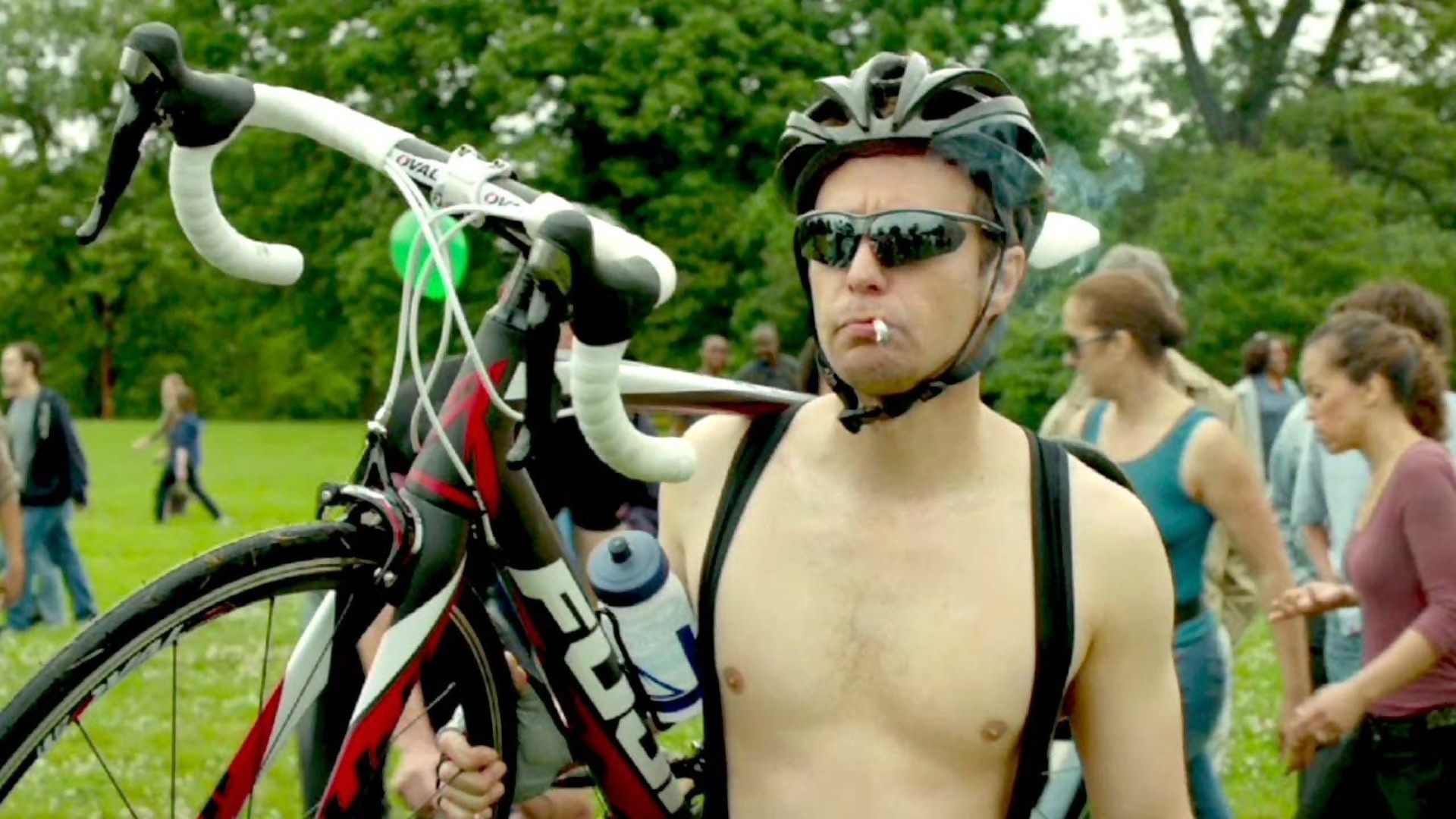
In a World… (2013)

Tags

, , , , , , , , , , ,

In a World...

D: Lake Bell / 93m

Cast: Lake Bell, Fred Melamed, Rob Corddry, Michaela Watkins, Alexandra Holden, Ken Marino, Demetri Martin, Nick Offerman, Tig Notaro, Stephanie Allynne, Geena Davis, Jason O’Mara

When King of the Voice Overs, Don LaFontaine dies, he leaves a vacuum within the voice over industry, one that veteran Sam Sotto (Melamed) would like to fill but he’s too aware of his own limitations to do so, and decides to support up and coming Gustav Warren (Marino) instead.  His daughter, Carol (Bell) works as a dialect coach, and while she would like to break into voice over work, the industry’s male-dominated nature – as well as Sam’s dismissal of her chances to succeed – keeps her from trying.  One day, while she’s teaching Eva Longoria to speak with a Cockney accent, Carol is asked by Heners (Offerman) to provide the voice over for the trailer for a children’s movie, one that Gustav was meant to do but which he hasn’t shown up for.  Helped by Louis (Martin), a sound engineer at the studio, Carol nails the voice over and begins to gain further trailer work on other children’s movies.

Gustav is upset by this, but Sam regards this development as a flash in the pan (neither of them know it’s Carol at this point).  When Gustav hosts a party for everyone in the industry, Carol attends with her father and sister, Dani (Watkins).  Gustav seduces Carol, much to the disgust and disappointment of Louis who has a crush on her, and the bemusement of her co-workers at the sound mixing studio.  When Carol is picked to voice the trailer for the upcoming futuristic fantasy movie The Amazon Games, and they plan to use the iconic phrase “in a world…” to begin the voice over, the news is greeted less than warmly by Sam.  He forces the issue with the movie’s producers, making them commit to an audition process.  Now facing competition from her father and Gustav, Carol almost throws in the towel, but Louis convinces her to go ahead with her audition tape.  At the Golden Trailer Awards, where Sam is to receive a Lifetime Achievement Award, the trailer’s first showing will reveal the producers’ choice.

In a World... - scene

Riffing off the death of LaFontaine, a real-life voice over artist, In a World… at first appears uncomfortably opportunistic, but thanks to Bell’s sure hand on the tiller, this feeling is soon dispensed with.  Writing as well as directing, Bell brings the audience into a world just as narcissistic and competitive as any other, but imbues it with enough good-natured characters and charm to offset the rampant ambition and casual backstabbing (Sam drops Gustav as soon as he knows Carol’s got the Amazon Games gig).  Indeed it’s only Sam who’s truly horrible, and Bell handles Carol’s scenes with him with understated simplicity, painting a portrait of a fractured relationship that shows no sign of ever being repaired.  Carol’s frustration with her father’s outdated sexist approach, as well as his lack of support for her and her career, are convincingly highlighted, and the way in which she deals with them completely plausible (it helps that Carol doesn’t have all the answers to the problems that beset her).

In her private life, Carol succumbs a little too easily to Gustav’s attentions, but there’s a lovely moment later when Louis declares his “liking” for her, and while this aspect of the script is less than persuasive, by the time it arrives the movie has built up so much good will it doesn’t matter.  There’s a subplot involving Dani and a guest at the hotel where she works, and whether or not she cheats on husband Moe (Corddry), and while it provides some much needed drama, it’s easily and neatly resolved, as are pretty much all the conflicts Bell’s script creates for her characters.  The movie relies on Carol’s placid nature throughout, and though there are plenty of laughs to be had, these are largely due to the activities and actions of the supporting cast – Notaro as deadpan lesbian Cher, Allynne as predatory receptionist Nancy, Offerman and Corddry.  Bell is an appealing presence as Carol, and proves an unselfish actor in scene after scene.  She draws good performances from her cast (Watkins and Corddry shine), and directs with an ease that some veteran directors never attain.  If the movie suffers from anything, it’s a lightness of touch that could have been fatal in the hands of someone less committed to the material.

Rating: 7/10 – satisfying for the most part, In a World… is a treat, but one that might not bear repeated viewings; it’s a great “debut” for Bell to be sure, but a little too lightweight in its execution to be truly memorable.
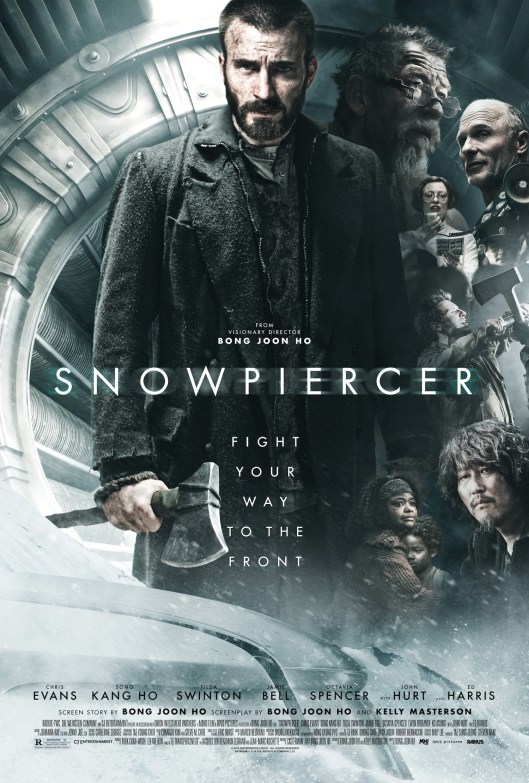
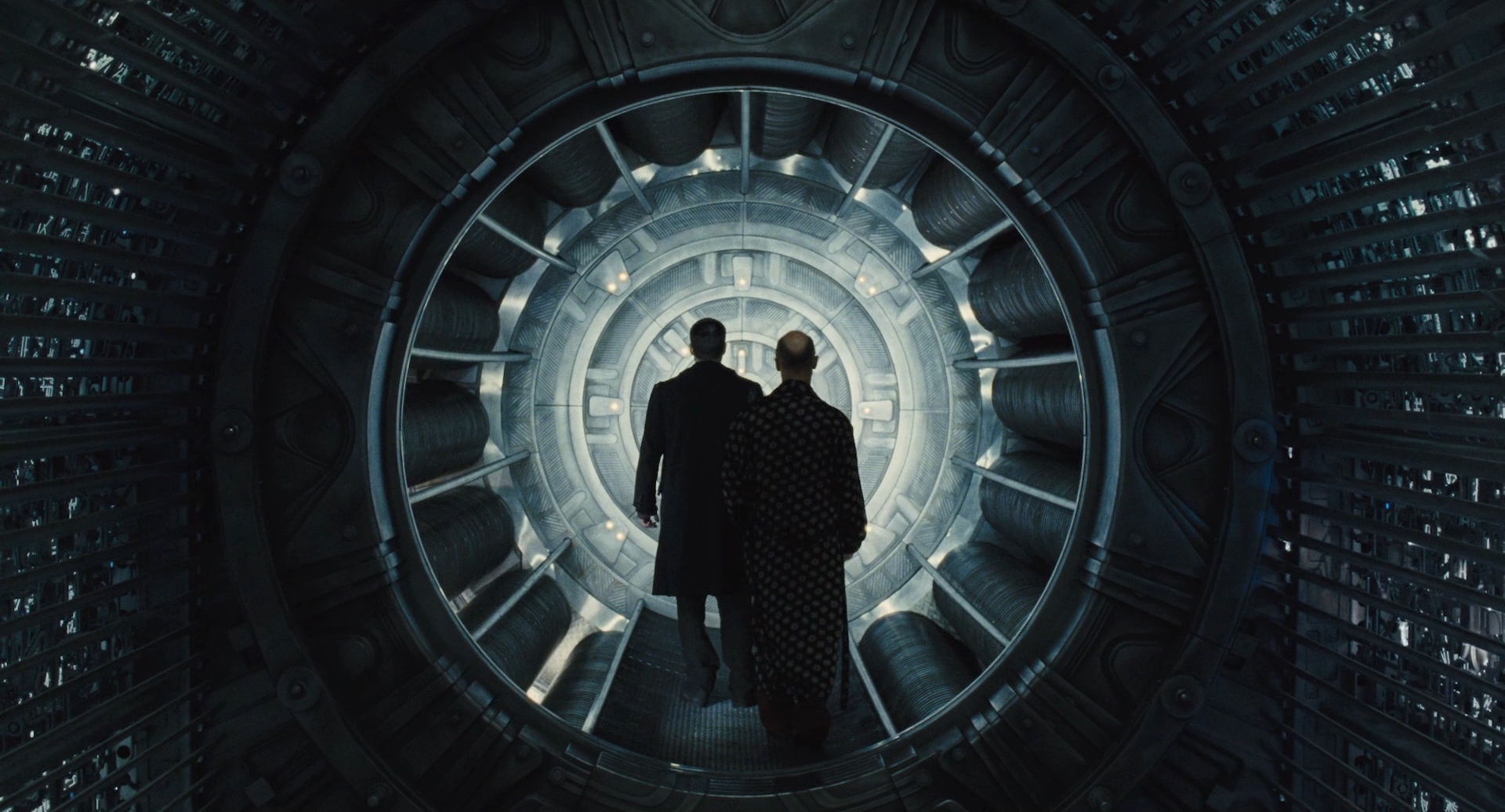
Snowpiercer (2013)

Tags

, , , , , , , , , , , , ,

snowpiercer_3a25f386

D: Joon-ho Bong / 126m

Cast: Chris Evans, Kang-ho Song, Jamie Bell, Tilda Swinton, John Hurt, Ah-sung Ko, Octavia Spencer, Alison Pill, Ed Harris, Luke Pasqualino, Ewen Bremner, Vlad Ivanov, Clark Middleton, Emma Levie

In 2014 global warming has reached such a level it threatens the entire human race with extinction. To combat this, scientists release a reversing agent, CW7, into the atmosphere. To the world’s horror, CW7 destroys all life on the planet and returns it to the ice age. The only survivors are those on a train that circumnavigates the globe without ever stopping, the brain child of reclusive Mr Wilford (Harris). But even on the train there is a class system: those at the tail end exist in cramped, overcrowded conditions, while those at the front of the train live a life of conspicuous luxury. Seventeen years later, the people at the tail are guided by Gilliam (Hurt), but place their trust for a planned revolution in the hands of Curtis Everett (Evans). Aided by Edgar (Bell), Curtis is planning to reach the front of the train and take control of the “sacred engine”, thus allowing him control over the whole train (he is also receiving cryptic messages written on red paper from a mystery source).

When two of the tail people’s children are taken by the armed guards that oversee the tail section, the agony experienced by the mother of one, Tanya (Spencer), and the father of the other, Andrew (Bremner), prompts Curtis to seize his chance to move forward through the train earlier than planned. At the first section, the de facto jail, they free Namgoong Minsu (Song), a security expert whose knowledge of the train and its systems will help them get through each door they come to; they also free his daughter, Yona (Ko). As the tail people make their way from one car to the next, they discover all manner of disturbing facts about life on the train, and are hindered continually in their progress by Miss Mason (Swinton), Mr Wilford’s representative on the train.

Despite overwhelming odds, Curtis reaches the front of the train sections of the train and the gap between the people there and at the tail is thrown into sharp relief. At a classroom run by Teacher (Pill), he learns more about Mr Wilford and his plan for the train, as well as learning that the person who is sending him the messages is part of the hierarchy he seeks to overthrow. With Mr Wilford’s guards, as well as the citizens of the front sections, determined to stop him from reaching the “sacred engine”, Curtis is forced to make some difficult decisions to achieve his aim, but when he does he’s faced with an even more difficult, unexpected decision to make, one that threatens to overturn everything he’s ever believed about the train, and himself.

Snowpiercer - scene

Snowpiercer is an odd movie, a mix of high concept filmmaking supported by cod-literate meditations on the nature of existence and the need for balance in a world that’s a microcosm of the world we still live in. It’s a long, uneven movie as a result, with an expected emphasis on bone-crunching action while it attempts to say something about a range of subjects, from rampant consumerism to notions of self-sacrifice to carefully monitored euthanasia to the morality of keeping one set of passengers in what amounts to a rigorously controlled ghetto. Some of these aspects are handled adroitly (the euthanasia), others less so (the ghetto), but the movie is largely thought-provoking in its approach, and while some of the twists and turns can be seen a snow-covered mountain away, there’s still enough here to surprise the average viewer.

What stops the movie dead in its tracks sometimes (no pun intended), are the moments when something is revealed that immediately makes no logical sense. One of the biggest of these moments occurs when Curtis and his companions reach the abattoir car, and there are row upon row of chicken carcasses on display – after seventeen years, really? Another is why, considering the lethal sub-zero temperatures outside the train, none of the rails have ever split or buckled? And the biggest flaw concerns the train itself and its route: was Mr Wilford so prescient he knew CW7 wasn’t going to work even before it was conceived, because the movie makes it seem as if everything was in place from the moment the reagent was launched. (There are other moments that give pause for credulity but then the whole idea is inherently nonsensical; criticising it further would be like taking a blind man to task for failing to pin the tail on a donkey… that isn’t there.)

These lapses aside, there is still much to admire in Bong’s adaptation of the graphic novel Le Transperceneige by Jacques Lob, Benjamin Legrand and Jean-Marc Rochette (Rochette also supplies the artwork seen in the tail end of the train). As Curtis makes his way to the “sacred engine”, discovering more and more unpalatable truths about the workings of the train, there is a marked sense that he is becoming physically more restricted than he was at the tail, despite the increase in space in which to move. Bong makes being at the front just as bad as being at the end, if not worse, and Evans gives a performance that sees his character become more and more insular and compacted than he was at the beginning (he also gets to deliver an emotionally charged, yet chilling, speech towards the end that resonates even more when he reaches the “sacred engine”). Evans is one of those actors who can easily subvert his handsome looks, and here his grimy appearance is offset by a physical, tightly coiled performance that fits the mood perfectly. He’s ably supported by Swinton as the tombstone-dentured Mason (and in another, blink-and-you’ll-miss-her smaller role), Spencer as the mother obsessed with retrieving her child, and Song as the drug-addled security expert. Bell, however, has little chance to make anything of Curtis’s young follower, while Hurt lends the necessary gravitas to a role that is as close to underwritten as you’d expect.

The depiction of a new ice age is effectively maintained throughout, and the cities the train passes through are thankfully anonymous. The functions of the various train cars are imaginatively handled (the woman knitting in the garden car is a particular favourite), while the special effects are, for the most part, seamlessly integrated into the physical action. Bong directs with a visual flair that suits the movie’s mise-en-scene, and despite filming in English for the first time, doesn’t miss a nuance or moment of subtle shading. He’s ably supported by Kyung-pyo Hong’s often striking photography, and the tremendous production design by Ondrej Nekvasil, continually supporting the notion of people living in one place for so long and often surprising in its details as a result. There’s also an impressive score by Marco Beltrami that skilfully avoids the musical clichés that usually clog up dystopian flavoured movies such as this.

Rating: 7/10 – not the sci-fi masterpiece some may have been expecting (the hype surrounding proposed cuts of twenty minutes for the US release hasn’t helped), Snowpiercer is an often thought-provoking movie that tries its best to add political and social content to its storyline without skimping on the action; sometimes awkward in its execution, this still has more going on than most sci-fi movies out there these days, and is well worth seeking out.

The Lucky One (2012)

Tags

, , , , , , , , , , , ,

the-lucky-one_ec5d8c66

D: Scott Hicks / 101m

Cast: Zac Efron, Taylor Schilling, Blythe Danner, Jay R. Ferguson, Riley Thomas Stewart, Adam LeFevre, Robert Hayes, Joe Chrest, Ann McKenzie, Kendal Tuttle

Adapted from the novel by Nicholas Sparks, The Lucky One opens in Iraq and a night mission where Logan (Efron) and his platoon run into Aces (Tuttle) and his platoon. There is a firefight with some Iraqis and Aces is killed. The next morning, Logan spies a picture of a woman in the rubble. He picks it up just seconds before an incendiary device goes off, killing several of his comrades. Logan survives, and for the rest of the tour he keeps the photo with him and it acts as a talisman, warding off harm and keeping him safe. He also tries to find out if anyone knows who the picture belongs to, but no one recognises it.

Back home, Logan traces the location where the picture was taken, and with his dog, Zeus, heads off on foot across country from Colorado to Louisiana, and the small town of Hamden, where after asking around, he discovers the woman’s name is Beth Green (Schilling) and she runs a kennels on the outskirts of town. When Logan goes there to tell her about the picture he finds he doesn’t know how to, and the situation is further complicated by Beth’s assumption that he’s there to apply for a job. Accepting the job, but with Beth having reservations about someone who walks so far just to work at a kennels, Logan makes himself useful doing repairs and general chores.

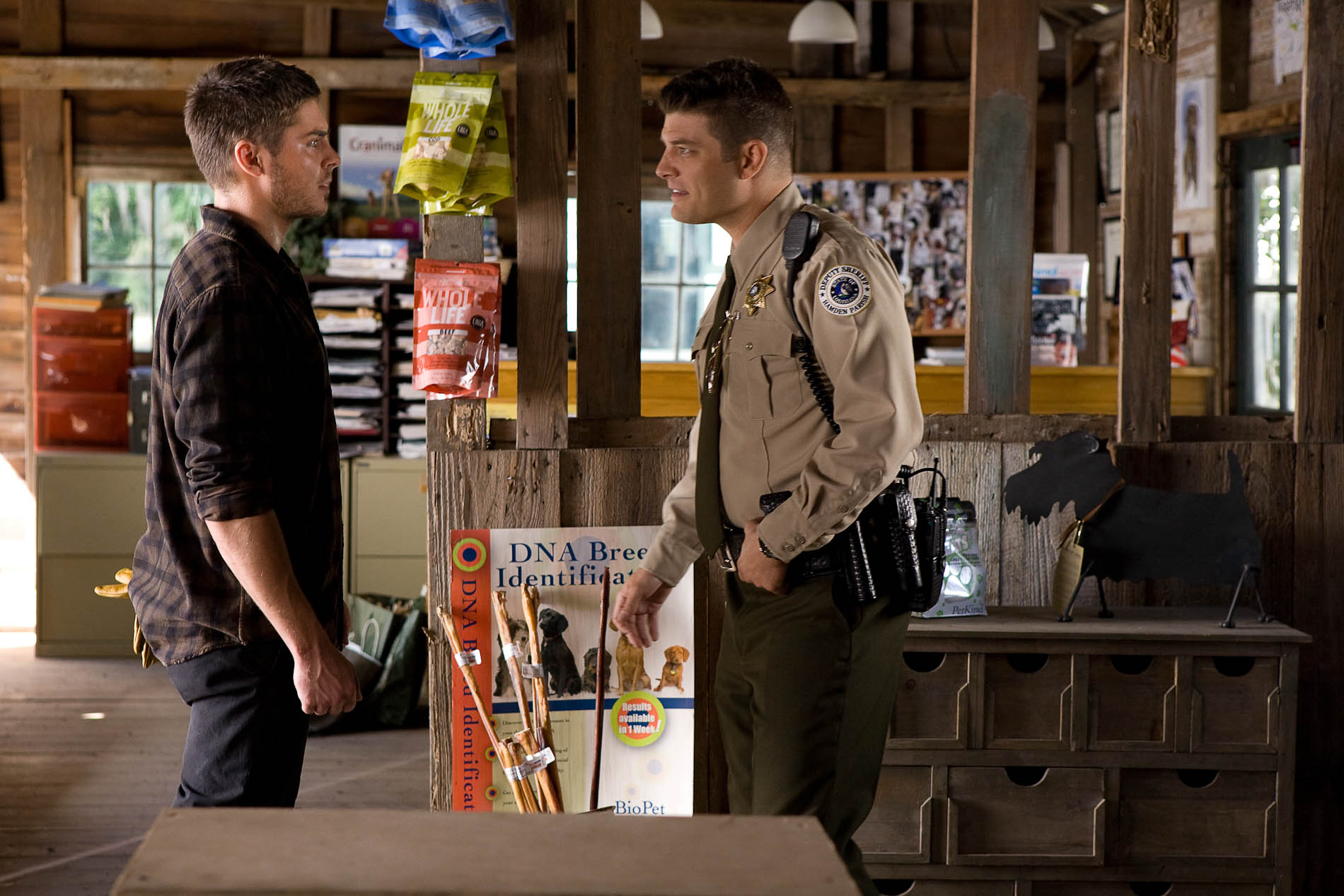
Beth’s grandmother, Ellie (Danner) takes to Logan from the start, as does Beth’s seven year old son, Ben (Stewart). The one person who doesn’t is Beth’s ex-husband, Keith (Ferguson), a deputy sheriff whose jealousy and violent temper have him believing that Logan is trying to usurp his position as Beth and Ben’s protector. With Keith making it difficult for Beth to move on with her life, Logan becomes increasingly close to her, and soon they are looking at each other with more than curiosity. They begin a hesitant romance, but Logan still finds it impossible to tell Beth about the photo, even when it becomes clear that Aces was her brother.

When Keith finds out that Logan was showing Beth’s picture around town he wastes no time in telling Beth (he also has the picture, stolen from Logan’s home). Beth confronts Logan and she asks him to leave. Keith makes an attempt to reconcile once more with Beth but when she rejects him, he threatens to take Ben there and then. Ben runs away, but in doing so, puts his life in danger…

The Lucky One

With its typical stranger-with-a-secret-comes-to-town storyline, The Lucky One doesn’t bring anything new to the romantic drama genre, but in many ways that’s its strength. Its reliance on minor soap opera clichés to reinforce both the romantic and the dramatic aspects helps establish the movie as a straightforward telling of a familiar story, and one that the audience can take a great deal of comfort from. As Logan and Beth circle each other, there’s never any doubt as to how their romance will proceed, and the familiarity of the situation is aided greatly by the performances of Efron and Schilling, his brooding reticence complimenting her fragile beauty.

Beautifully set (and shot) in Louisiana, the movie moves easily from one reassuring plot development to the next, almost casually hitting its emotional high points, and thanks to Will Fetters’ astute screenplay, never trying to subvert or over-complicate matters. Hicks, who shot to fame with the altogether weightier Shine (1992), directs with a confidence that is reflected in the ease with which the cast inhabit their characters, and the credibility of their interaction. Efron plays the strong, silent type effortlessly but for long stretches Logan is almost a secondary character, as the movie sets up the family dynamic around Beth, Ben, Keith and Ellie. Once the romance kicks in, Efron gets to show just why he’s become one of the most sought after actors working today, showing a vulnerability the likes of Channing Tatum and Josh Duhamel (both male leads in other Sparks’ adaptations) would struggle to portray. It’s a low-key performance and one that befits the character of an ex-Marine trying to rebuild his life one step at a time.

Schilling also impresses as the put upon single mother putting a brave face on being divorced and bereaved at the same time, as well as looking for some way to rebuild her own life. Beth and Logan are kindred spirits in that sense, and when they begin their romance, their need for each other ignites a coming together that breathes new fire into both their lives (surprisingly, their love scenes are quite steamy for a PG-13 movie, but that’s not a bad thing). As Keith, Ferguson (mostly known for his TV work) makes more of the dastardly ex-husband role than appears to have been a part of the script, and the scene where his armour cracks during a recital given by his son is both unexpected and affecting in equal measure. Danner outshines them all, of course, but then if she hadn’t then something would have really been wrong.

The movie does have some faults, however. Logan’s PTSD is clumsily dealt with and is forgotten once he’s met Beth, and there’s a few too many occasions where the central conceit struggles to fend off its own implausibility, and Ben behaves a little too much like the semi-adult he clearly isn’t at seven years old, but these are minor complaints. All in all, The Lucky One is a rewarding experience, cleverly presented, and if things are a little too predictable at times – fans of this type of movie will be able to spot the outcome from a mile off – as noted above, the filmmakers’ determination to embrace the customary elements of such a storyline is a benefit and not a detraction.

Rating: 7/10 – a solid if unspectacular production, The Lucky One will please fans of the genre for its straight on approach and for treating its main characters with sympathy and respect; bolstered by often beautiful location photography, it’s also blessed with a score by Mark Isham that avoids all the usual emotional cues.

(for Roxanne xx)

3 Days to Kill (2014)

Tags

, , , , , , , , , , ,

3 Days to Kill

D: McG / 123m

Cast: Kevin Costner, Amber Heard, Hailee Steinfeld, Connie Nielsen, Tómas Lemarquis, Richard Sammel, Marc Andréoni, Bruno Ricci, Jonas Bloquet, Eriq Ebouaney

Veteran CIA agent Ethan Renner (Costner) is part of a mission to capture international terrorist The Wolf (Sammel).  Acting on intelligence that his associate The Albino (Lemarquis) is selling a dirty bomb at a hotel in Belgrade, Ethan and his team attempt to capture him but the mission goes wrong when The Albino recognises one of Ethan’s team.  The Albino makes his escape in the ensuing shootout; Ethan chases him but finds himself short of breath, and he collapses.  Despite being wounded, The Albino gets away.  Ethan blacks out.  Later, in a local hospital, a doctor tells him he has cancer, and at best, has 3-5 months to live.

Having been pensioned off from the CIA, Ethan moves to Paris where his estranged wife, Tina (Nielsen), and daughter Zooey (Steinfeld) live.  He tries to reestablish his relationship with Zooey but his first attempts are clumsy and backfire on him.  When Tina has to go to London for a few days, Ethan persuades her that he can look after Zooey, and he moves into their apartment.  That same day, Ethan is approached by Vivi Delay (Heard), a senior CIA agent who wants him to continue looking for The Wolf, and offers him an experimental drug that will stave off the effects of his cancer enough to extend his life by a few more months.  Ethan accepts the job.  He begins targeting known associates of The Wolf and The Albino, until he learns that The Albino will be in Paris in a few days’ time.

His relationship with Zooey improves slowly, and is cemented when he saves her from being raped in a nightclub.  As their time together becomes more and more important to Zooey, Ethan has to juggle the demands made on him as a father, and as an agent.  Tina returns home and is pleased to see Ethan and Zooey getting on so well, and she and Ethan have a reconciliation.  His mission to capture The Wolf comes to a head when Zooey’s boyfriend Hugh (Bloquet) invites them to a party at his parents’ home, and in one of those amazing moments of serendipity that exist only in the movies, it turns out that Hugh’s father is The Wolf’s Paris business partner, and he’s there as well.

3 Days to Kill - scene

Another low-concept idea from the mind of Luc Besson, 3 Days to Kill bears all the hallmarks of a hastily put together movie production and lurches from one badly thought out scene to another, trading on Costner’s innate gravitas as an actor (and then doing it’s best to undermine that gravitas with some ill-considered comedy beats), and complete with awful dialogue and weak characterisations.  Not one of the relationships foisted on us by Besson and co-writer Adi Hasak is at all plausible, and Ethan himself is a bizarre combination of action hero, concerned absentee father, and comedic torturer.  The movie is full of awkward moments that add nothing to the plot but do succeed in padding out the running time.  There is a whole third-string storyline involving Ethan’s apartment and the family of squatters that have taken it over; unable to evict them, Ethan allows his anger at their being there to develop into a strange paternal devotion: when one of patriarch Jules’s (Ebouaney) daughters has a child in the apartment, Ethan is on hand to become a de facto godfather (and hold the baby).

Even more bizarre is the character of Vivi Delay, portrayed by Heard as a mixture of modern-day vamp and emotionally vacant dominatrix.  The actress’ interpretation of the role is (hopefully) based on what direction there is in the script, but if it’s not then it’s a freakish performance and one that makes Heard look like an amateur trying to break free from regional theatre.  Even the way she delivers her lines – arch, and laced with undisguised sarcasm – makes them sound like a first draft reading, and it’s a relief that she’s not on screen any more than she is.  Steinfeld is equally guilty of putting in a sub-par performance, giving us a moody teenager that no one would believe in, and failing to make Zooey’s relationship with Ethan anything other perfunctory and/or glib (depending on a scene’s requirements).  Nielsen has the thankless role of mother removed for the sake of the plot, while Costner (who has said he liked the character of Ethan, but didn’t like the movie) does his best with one of the most uneven roles of his career.  (You know an actor’s in trouble when his character name is a combination of Ethan Hunt and Jeremy Renner from Mission Impossible: Ghost Protocol.)  Looking uncomfortable throughout, and burdened with the daunting prospect of injecting some credibility into the proceedings, Costner does just enough to keep the audience from tuning out completely, and shows that it’s not only Liam Neeson who can still kick ass at an advanced age (Costner is 59).

Under the less than capable direction of McG, 3 Days to Kill is a mess of a movie that only moves up a notch with its action scenes, including a cleverly constructed kidnapping involving a bus, a bicycle, and a small claymore mine.  The Paris locations are also worth mentioning, as is the somewhat bucolic score by Guillaume Roussel, and the often tightly-framed compositions of veteran cinematographer Thierry Arbogast.  As a thrill ride, the movie is fitfully effective, but as an absorbing, entertaining piece it’s as lightweight as a feather, with too many narrative absurdities than it could ever overcome, including the experimental drug that only Vivi knows anything about (oh yeah?).

Rating: 4/10 – a second-hand script (replete with Besson’s recurring penchant for casual racism) masquerading as a polished action movie, 3 Days to Kill never lives up to its initial promise; with weak direction and the kind of cast that deserves more, the movie struggles to establish the same tone throughout, and boasts the kind of unlucky central performance from its star that, in the Nineties, would have doomed his career quicker than The Postman did.

Molly Maxwell (2013)

Tags

, , , , , , , , , ,

Molly Maxwell

D: Sara St. Onge / 90m

Cast: Lola Tash, Charlie Carrick, Krista Bridges, Rob Stewart, Richard Clarkin, Brooke Palsson, A.K. Shand, Nicholas Bode

Sixteen year old Molly Maxwell (the wonderfully named Tash) is a pupil at Phoenix Progressive School, where creative self-expression is encouraged amongst the pupils and where being ordinary (or settling for it) is not only discouraged, but viewed as abnormal.  Molly has a genius IQ but doesn’t want to be singled out or regarded as special.  When the head teacher, Raymond (Clarkin), pushes Molly to choose her ‘elect’ subject, she finds herself being guided towards photography by her handsome English teacher, Ben Carter (Carrick).  Surprised by his interest in her, Molly insists that Ben be her supervisor on the ‘elect’ subject.  Ben is initially hesitant but eventually agrees.  As they work ever more closely together, Molly and Ben become increasingly intimate (though Ben resists the temptation to make it a physical relationship).

As the relationship develops, Molly finds herself lying to her friends Caitlin (Palsson) and Gala (Shand), and her parents, Marilyn (Bridges) and Evan (Stewart).  She invents a boyfriend called Spencer who goes to another school to explain the time she spends with Ben, including a field trip that wouldn’t have been sanctioned by the school.  Molly’s attitude becomes more confrontational, while her behaviour around Ben when they’re in school begins to attract the attention of Raymond.  Things come to a head when the photos she took on the unofficial field trip are discovered at the school, and the seriousness of the situation – and its potential consequences – is brought to light.

Molly Maxwell - scene

There’s a moment in Molly Maxwell where Molly is outside Ben’s apartment.  She has a gift for him, a framed photograph she knows he’ll like.  In turn he has something for her, some books on photography.  Molly flicks through one of them and shows no sign of moving from Ben’s doorstep.  It’s an awkward moment, both for the characters and the audience, but it’s indicative of the problems the movie has in trying to approach its subject matter: forbidden love between a student and her teacher.  Molly Maxwell is an indie movie through and through, with an indie movie’s sensibility, and it wants to be different in the way that all indie movies want to be different: it wants to be “about something”.  (This might seem like an obvious thing to point out, but there are plenty of indie movies out there that strive to be different but come off as aloof or detached, with characters that operate in an emotional vacuum, apart from anything even remotely resembling reality.)

The “something” Molly Maxwell wants to be about is ostensibly growing pains, but there’s a deeper message hidden in the movie, and it’s not until Molly and Ben’s relationship is outed that it becomes clear.  Arising from the ashes of the relationship’s predictable demise is the reaffirmation of Molly’s relationship with her mother, a once solid connection that seems irreparably damaged by Molly’s love for Ben and the strain it places on the family structure.  Marilyn is a wonderfully complex creation, outwardly controlling in an overbearing, condescending way that most children would find hard to deal with anyway.  But Molly rebels against her mother when she receives real support from Ben, and as she becomes more and more infatuated with her teacher, so her disillusionment with her mother increases.  Marilyn clearly wants the best for Molly but has a tough time showing it appropriately.  In their efforts to be understood, both Molly and Marilyn end up pushing each other away.

It’s this secondary storyline – and its resolution – that ultimately has the most impact, and while Molly’s burgeoning love affair with Ben takes up most of the screen time, it’s predictable nature isn’t as appealing in the long run.  Molly’s naiveté gets in the way of making her attraction for Ben believable, while Ben’s motivation for pursuing the romance is murky at best, leaving the audience to wonder what exactly has brought them together.  That said, Tash and Carrick deliver good performances despite the flaws in first-time director St. Onge’s script, and there is a definite chemistry between them that bolsters their scenes together.  Tash is a good casting choice as Molly, and has a maturity that adds immeasurably to her reading of the character, while her scenes with Bridges are exhilarating for the depth that each actress brings.

Further on the plus side, St. Onge shows a keen eye for the absurdities of such a privileged milieu, while there’s a terrific indie soundtrack (keep an ear out for the perfect placement of Audrey & The Agents’ Hate Fuck).  For a first feature it’s a decent enough attempt, and if some of the drama veers perilously close to highlighting its soap opera similarities, then St. Onge’s lack of experience can be excused thanks to the movie’s overall quality.

Rating: 7/10 – an absorbing (though emotionally redundant in places) debut feature that features good performances in support of a not quite fully realised script; at times charming, Molly Maxwell works best when looking at the small tragedies that can beset a mother/daughter relationship.

Pompeii (2014)

Tags

, , , , , , , , , , , ,

pompeii_1e897365

D: Paul W.S. Anderson / 105m

Cast: Kit Harington, Emily Browning, Kiefer Sutherland, Carrie-Anne Moss, Adewale Akinnuoye-Agbaje, Jared Harris, Jessica Lucas, Joe Pingue, Currie Graham, Sasha Roiz

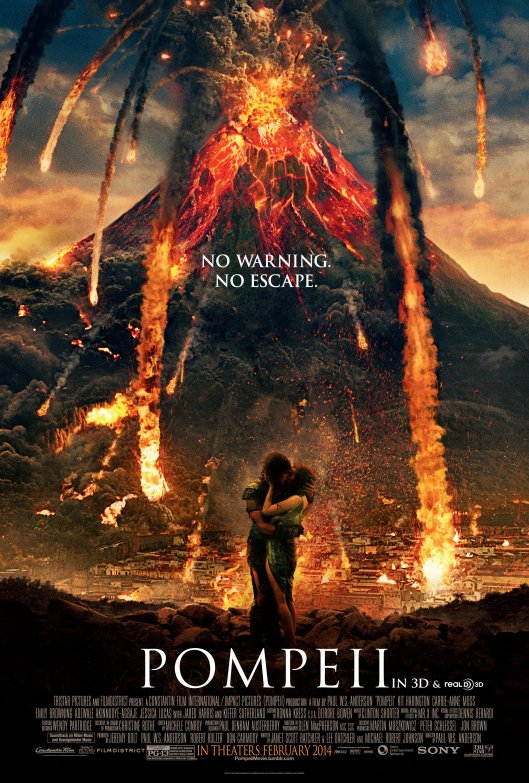
Beginning in AD62 with the sacking of a Celtic village by Roman soldiers led by Senator Corvus (Sutherland), Pompeii uses this back story to illustrate the determination to survive of young Milo (Dylan Schombing). Having witnessed the deaths of his parents, Milo hides amongst a pile of dead bodies; in doing so he escapes the Romans’ detection.

Seventeen years later, Milo (Harington) is now in Londinium, fighting in the gladiatorial arena and gaining a reputation for himself. His owner, Graecus (Pingue), sees the potential in taking Milo to Rome. On the journey, Milo and the rest of the gladiators travel with Princess Cassia (Browning) and her friend Ariadne (Lucas). One of the horses is injured and at Cassia’s bidding, Milo is allowed to put the animal out of its misery… and so, in these oddest of circumstances, their romance is born. Arriving in Pompeii, Cassia travels on to her family’s home on the lower slopes of Mount Vesuvius where she is welcomed by her parents, Severus (Harris) and Aurelia (Moss). Severus has a plan to rebuild large parts of Pompeii and bring greater wealth to the area; he’s also expecting the arrival of a representative of the new Emperor, Titus, to discuss the necessary investment the plan requires. Cassia is shocked to learn the representative is Senator Corvus; when she was in Rome he made clear his liking for her, though it isn’t reciprocated.

Meanwhile, Milo acquaints himself with the dungeons below the arena, where he meets Atticus (Akinnuoye-Agbaje), an African gladiator whose freedom is assured if he wins his next fight. After another slave attempts to kill Milo during a training session, and Atticus saves his life, the two men strike up an uneasy friendship. That evening, Milo and Atticus are taken to Cassia’s home where a celebration is taking place. Cassia’s horse, which has been missing since the morning, returns, clearly frightened by something and without the steward that was attending him. Milo calms the horse and he and Cassia ride off into the nearby hills to be alone. They are pursued by Corvus’ men. Corvus wants Milo killed but Cassia intervenes, and making herself beholden to the senator, saves the young Celt’s life.

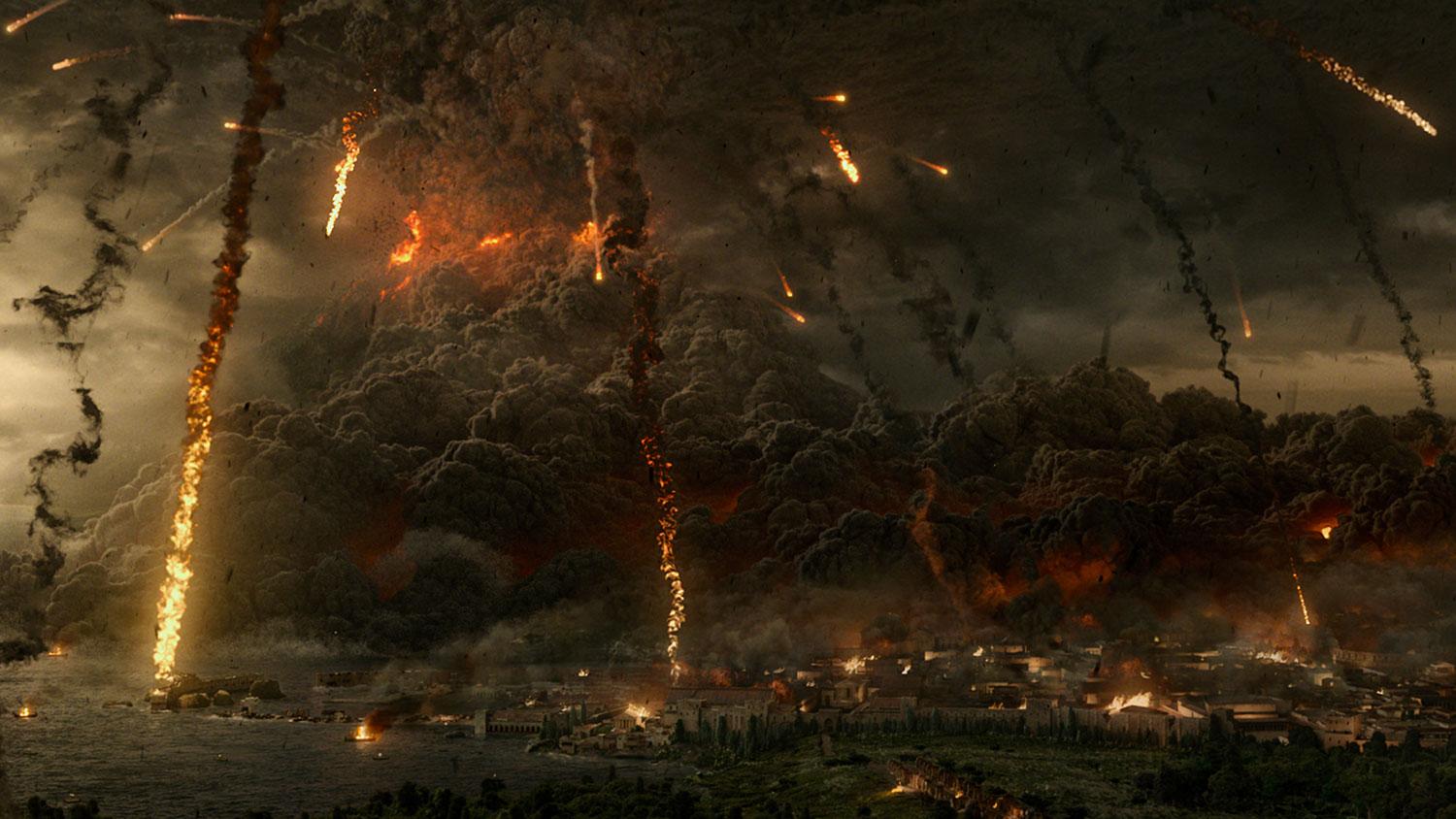
In the arena the next day, Atticus and Milo are amongst a group of slaves that are pitted against superior forces in a recreation of the sacking of Milo’s village. He turns the tables on Corvus’s plan to have him meet his end in the fighting, but before Corvus can retaliate further, the mountain begins to erupt. Parts of the arena collapse, leaving Corvus and Cassia’s parents unconscious in the wreckage. Milo attempts to find Cassia who fled the arena just before the eruption; when Severus and Aurelia come to they try to kill Corvus but he survives, and he too goes after Cassia. While the city is destroyed around them, Milo, Corvus and Cassia try to avoid being killed before a final showdown becomes inevitable.

Pompeii - scene

There’s a grim inevitability about the subject matter that makes Pompeii a hard movie to review. It’s a disaster movie, and while that’s as apt a description of things as you’re ever likely to get, the movie does have a compelling visual style, and Anderson, while not exactly the most subtle or dramatically creative of writer/directors, marshals the final third’s fireworks with an aggressive brio that suits the material perfectly. And therein lies the problem for any reviewer of a movie such as this one: ultimately, we’re only here to see the mountain do its worst and satisfy the devastation junkie within all of us.

But before all that, though, there’s the lead-up, an hour of uninteresting, derivative anti-dramatics that keep the characters busy until they have to start running and screaming and avoid being covered in molten lava. Milo and Cassia’s romance is lukewarm at best and is played with the same level of intensity by Harington and Browning as if they were choosing a mortgage provider. Sutherland makes a great villain but his accent is a weird mix of public school English and mid-American vowel mangling; it’s a mesmerising performance, and almost transcends the rest of the movie, as if the actor had the measure of the movie from the very beginning and chose to just have fun with it (if so, he more than succeeds). Harris and Moss are wasted in their secondary roles, Lucas’ role is one step up from the customary maid in waiting, and Akinnuoye-Agbaje does his best as the noble savage who’s naïve enough to believe he can win his freedom in the arena, and is called upon to refer to the mountain in hushed tones whenever there’s even the slightest rumble or disturbance.

On the plot side of things, there’s too much lifted from Gladiator (2000) for Pompeii to be anything other than – for the first hour at least – a pale imitation of that movie and its easily more credible heroics (and Harington is definitely no Russell Crowe), and the whole idea of a plan to regenerate Pompeii before the mountain erupts is either a gloriously ironic move on the filmmakers’ part, or just incredibly crass – and it’s hard to tell which is the more likely. As mentioned before, Anderson is less than gifted in the subtlety stakes, and he piles contrivance atop uninspiring dialogue atop simplistic character motivations with the giddy abandon of someone who can’t believe he’s been given an estimated $100,000,000 to make a movie in the first place. (Yes, you read that right: $100,000,000. Where did it all go to?)

But when it comes, the destruction – what we’ve all been waiting for – is magnificent. Anderson doesn’t skimp on the pyrotechnics and the flaming rocks and the mini tsunami and the exploding buildings and the suddenly yawning chasms, and after the fallout from the initial eruption, gives us the truly impressive sight of Mount Vesuvius blowing its top and then some. Forget Volcano (1997) and Dante’s Peak (1997), hell, even Mount Yosemite going up in 2012 (2009) – Pompeii gives us the eruption to end all eruptions, a staggering special effect that will take some beating, and which is easily worth waiting for. It’s the one moment the movie had to get right, and it does so, spectacularly.

Rating: 5/10 – yes it’s extremely silly in places, and yes it’s full of historical inaccuracies, but Pompeii brushes all that aside by piling on the destructive spectacle and providing plenty of “wow” moments; event cinema for the critically unconcerned and in some ways, all the better for it.

Hearts of Humanity (1932)

Tags

, , , , , , , , , , ,

Hearts of Humanity

D: Christy Cabanne / 65m

Cast: Jean Hersholt, Claudia Dell, Jackie Searl, Charles Delaney, J. Farrell MacDonald, Richard Wallace, Lucille La Verne, John Vosburgh, George Humbert, Tom McGuire, Betty Jane Graham

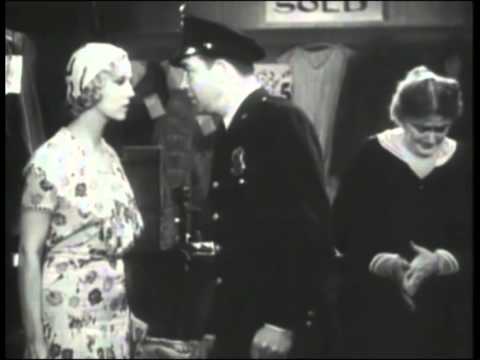
Based on the story by Olga Printzlau, Hearts of Humanity is set in a bustling neighbourhood in New York where one of the pillars of the community is genial Irish cop Tom O’Hara (MacDonald).  O’Hara’s wife and young son are travelling by ship from Ireland to be with him, something he has been waiting for (it seems) for quite some time.  O’Hara lives above a second hand shop owned by Sol Bloom (Hersholt), a kindly old widower whose son, Joey (Wallace) is always getting into trouble (though bunking school and stealing fruit from local merchant Tony (Humbert) seems to be the extent of his wilfulness).  A few days before his wife and son’s arrival, O’Hara receives a telegram informing him that his wife has died during the voyage and been buried at sea.  That night, Sol’s shop is broken into; when O’Hara attempts to apprehend the burglar he is shot and killed, but not before he extracts a promise from Sol that his son, Shandy (Searl) will be looked after.

Shandy is “adopted” by Sol (and calls himself Shandy O’Hara Bloom!), and the boy fits in well with the rest of the neighbourhood, including Ruth Sneider (Dell), whose mother (La Verne) runs a cleaning and dyeing store.  Ruth is seeing local ne’er-do-well Dave Haller (Vosburgh), whose dapper fashion sense and expensive car have turned her head, despite the attentions of beat cop Tom Varney (Delaney) who is in love with her.  When Shandy inadvertently uncovers the source of Haller’s “income” he brings the issue to a head; at the same time, his discovery that Joey has stolen a dollar from the till sets in motion a series of events that involve the threat of juvenile hall, a talent show, the theft of a violin that was given to Shandy by his mother, and a near-death inducing bout of pneumonia before everything is resolved satisfactorily.

With its melting pot background and portrait of an immigrant community coping with every day problems, Hearts of Humanity has a poignant approach – most typified by recurring shots of Hersholt smiling heavenward – that adds to the simplicity of the dramatic elements and elevates them appropriately.  The various story elements gel together naturally and the sense of a community committed to providing support for all its members is well-handled (and with a minimum of undue pathos).  It’s a tribute to the script by Edward T. Lowe Jr that these elements – already well on the way to becoming stereotypical – are moulded into such an entertaining whole, and that the characters, while instantly recognisable, are imbued with all-too understandable and relatable foibles and behaviours.  The dialogue is refreshingly naturalistic, without any of the archness that was present in so many movies from the early Thirties, and there’s an equally refreshing lack of artifice or contrivance (a good example of this is the fact that O’Hara’s killer is never caught).

The cast – all seasoned professionals at this point (with the exception of Wallace, making only his second screen appearance) – inhabit their roles with an easy conviction, and each gets a chance to shine.  Hersholt, already well established as an avuncular father figure following his success as a villain in the silent era (see von Stroheim’s Greed (1927) for a great example of this), comes close to being overly sentimental but manages to rein in the script’s occasional extravagance in this direction (though one scene with Wallace in particular might challenge a modern day audience’s view on the matter).  Searl, a child actor who was known as “The Kid Everybody Wants to Spank”, struggles with an awkward Irish accent that lapses almost as much as it’s actually put into play, but impresses in his scenes with Hersholt, and more than holds his own with the rest of the cast.  Dell, while given relatively little to do, invests Ruth with a steely vulnerability, and is complemented by Delaney’s dogged pursuit of her as the likeable Varney.  But if this is anyone’s movie in particular, then it’s MacDonald’s.  It’s a measure of the impact he has on the movie’s opening minutes that, when he’s killed, his presence is sorely missed from thereon.  The scene where he receives the news of his wife’s death is beautifully played, and quietly haunting.

In the director’s chair, Cabanne shows a sure hand, balancing and judging the disparate dramatic and comedic elements with aplomb, and making the whole experience a pleasing one that lingers in the memory, despite the movie’s short running time.  Ably supported by Charles J. Stumar in the cinematographer’s chair, Cabanne moves the camera around with surprising fluidity, and also has a keen eye for an effective close up.  Usually quite a workmanlike director (and once described by Kevin Brownlow as “one of the dullest directors of the silent film era”), here Cabanne ups his game quite a bit, and the result is appealing and engrossing in equal measure.  It’s no masterpiece, to be sure, but it is a lot of fun.

Rating: 7/10 – amusing and affecting in equal measure with confident performances throughout, Hearts of Humanity is a modest movie that, at the same time, has no intention of hiding its light under a bushel; in many ways a simple tale but told in such a persuasive style that the viewer can’t help but be absorbed by it.

Everywhen (2013)

Tags

, , , , , , , , , , , ,

Everywhen

D: Jarand Breian Herdal / 70m

Cast: Harald Evjan Furuholmen, Hugo Herrman, Elin Synnøve Braathen, Graeme Whittington, Hauk Phillip Bugge, Rune Dennis Tønnesen, Ruben Løfgren, Gjermund Gjesme, Joseph Whittington

Set some time in the future, Everywhen shows us a world where teleportation is in common everyday usage, and education exists in the form of microchips that can be inserted into a device in a person’s wrist.  Otherwise it’s a fairly normal world, not too far removed from the world of today.  We meet Ian (Furuholmen), a teenager who is looking after his much younger, adopted brother, Dylan (Bugge) while their parents are away.  For reasons that are left unexplained, Dylan decides to take his own life one day while Ian heads off to work; he leaves a note in Ian’s pocket that he finds later on.  Ian teleports back home but finds Dylan is missing.

What Ian does find is that the world has changed.  The home he and Dylan share is different, less well cared for.  Outside the streets are strangely empty.  The police, led by Jane Scott (Braathen), are doing their best to find out what has happened to what started out as a few thousand people, but has now reached three billion.  One of the police’s tech assistants discovers a correlation between the disappearances and eight a.m. when the majority of people are teleporting to get to work, but it still doesn’t solve the problem of where they’re disappearing to (or if they’ll ever come back).

Meanwhile, Ian is surprised by a teenager with a gun (Herrman).  The teenager – never named but called The Helper in the credits – wants to know what Ian is doing in his home.  After a fight in which neither can best the other, and as the nature of Ian’s predicament deepens (here Dylan is the Helper’s younger blood relative, and he’s also disappeared), they agree to work together to find a solution to the wider problem going on around them.  This involves tracking down the creator of the teleportation system, Thomas Wilfred (Graeme Whittington).  Wilfred tells them his teleportation system is the cause of the disappearances, as he has been a victim of it himself, and is now aware that the system is a way of connecting not only with the world, or reality, that it was created in, but a vast number of other worlds/realities as well.  The drawback is that no one can travel back to their own world unless they use a particular chip…and the last two are kept in Wilfred’s office.  Ian and the Helper must find and use the chips – and avoiding the police, who are on the same track – if they are to have any chance of getting back and saving Dylan.

Everywhen - scene

Originally a school project, Everywhen is the brainchild of director Herdal (who also co-wrote the script with Elrik Moe) and editor/visual effects designer/sound mixer Jens Peder Hertzberg, and while certain allowances have to be made on account of their age and their experience when making the movie – they were both seventeen year old students – these don’t impair the movie too much, and it’s a refreshing take on a well-established sci-fi trope.  With often impressive visuals, and a good feel for widescreen compositions, Herdal and Hetzberg have created a future world that is instantly recognisable but which also introduces significant differences to make the audience aware of just when everything is happening (a holographic touch-screen device outside a school giving opening times etc. is a clever idea).  The added discrepancies between the “real” world and the world Ian finds himself in are also well thought out and often subtle enough to avoid detection on first viewing, and it’s a testament to the amount of time and consideration they’ve put into the project that these things are executed so effectively.

That said, one decision almost threatens to undermine the movie completely.  Having taken the decision to use an amateur cast throughout – and it’s obvious this is the case – the further decision to shoot entirely in English for an international release hampers things tremendously.  It’s difficult to work out exactly, but Graeme Whittington aside, there are times when it seems as if some of the dialogue is being delivered phonetically, and this can become frustrating at times, especially if the scene is largely expositional.  But while some of the performances suffer as a result, the overall effect is one that adds, strangely, to the mix.  Furuholmen and Herrman both make impressive debuts (even if Herrman does overplay the disaffected teenager once too often for comfort), and there’s strong support from Braathen and Tønnesen (as a policeman), though some of the smaller roles seem to have been filled by friends or co-students of the movie’s creators (nearly all of the police tech assistants look way too young to be working there).

With its themes surrounding what constitutes reality, and the use of highly dangerous technology as a social improvement, Everywhen isn’t the brainless, action-heavy sci-fi thriller you might expect from a couple of students who’ve obviously lifted elements from other sci-fi movies – The Matrix (1999) and Twelve Monkeys (1995) to name just a couple – but a mature, well-constructed movie that offers some thought-provoking ideas, as well as a strong emotional basis, for its storyline.  The special effects are of a consistent and polished nature that put pretty much every SyFy release to shame, and the score by William Edward offers an often striking counterpoint to events occurring on screen, as well as adding to the tension of the action scenes.

Rating: 7/10 – a good first offering from Herdal and Hertzberg, Everywhen gives more than a hint of what these two guys could do with a decent budget and a professional cast; an intriguing idea presented in a surprisingly effective way and well worth seeking out.


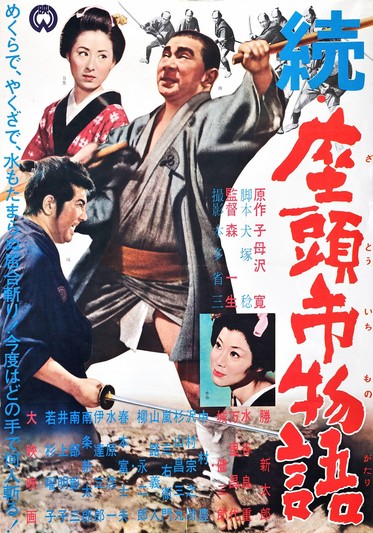
The Tale of Zatoichi Continues (1962)

Tags

, , , , , , , , ,

Tale of Zatoichi Continues, The

Original title: Zoku Zatôichi monogatari

D: Kazuo Mori / 72m

Cast: Shintarô Katsu, Yaeko Mizutani, Masayo Banri, Tomisaburô Wakayama, Yutaka Nakamura, Sonosuke Sawamura, Shôsaku Sugiyama, Mitsuemon Arashi, Yoshito Yamaji, Eijirô Yanagi

Made to capitalise on the unexpected success of The Tale of Zatoichi (1962), the imaginatively titled The Tale of Zatoichi Continues sees the blind masseur (Katsu) making his way back to Sasagawa, to honour the promise he made in the first movie, to make an annual pilgrimage to the grave of Master Hirate, the ailing samurai he fought and killed a year ago.  An initial altercation with the men of Lord Kuroda leads to a further encounter that is interrupted (and dealt with) by a wandering samurai called Yoshiro (Wakayama – though credited as Kenzaburo Jo).  At the next town, Zatoichi is hired to give a massage to the same Lord Kuroda, who it turns out, is a simpleton.  Kuroda’s retainers, fearing that their Lord’s secret may be revealed by Zatoichi, aim to have him killed, and send their men to look for him.

At a nearby inn, three courtesans are bemoaning how quiet the evening is because of the search for Zatoichi.  One of the three women, Setsu (Mizutani) reminds him of his lost love, Ochiyo.  He asks to spend the evening with her, and she agrees.  Just then, Yoshiro and his retainer, Sanzo (Nakamura) enter (Zatoichi hides in case they’re Kuroda’s men).  It becomes clear that Yoshiro was also in love with a woman called Ochiyo, and Setsu bears an uncanny resemblance to her.  He too wants to spend the evening with her but she refuses, and she leaves with Zatoichi.  The next morning, Koruda’s men catch up with them, but Zatoichi bests them.  This leads Kuroda’s retainers to employ the services and men of local yakuza boss, Kanbei (Sawamura).  Kanbei’s men also fail to best Zatoichi but learn that he is making his way to the Joshoji Temple in Sasagawa; Kanbei aims to enlist the aid of that town’s yakuza boss, Sukegorô (Yanagi).

Yoshiro follows in Zatoichi’s wake and we discover he isn’t a wandering samurai but a wanted criminal.  He seeks help from Sukegorô but is advised to leave the area.  Meanwhile, news of Zatoichi’s return reaches Otane (Banri), the servant girl he left behind at the end of the previous movie.  She learns of Sukegorô and Kanbei’s plan to ambush Zatoichi at the temple and goes to warn him.  With Zatoichi able to repel both boss’s men, the fight is interrupted by the appearance of Yoshiro, and the two men duel to the death, during which the secret behind the story of Ochiyo is revealed.

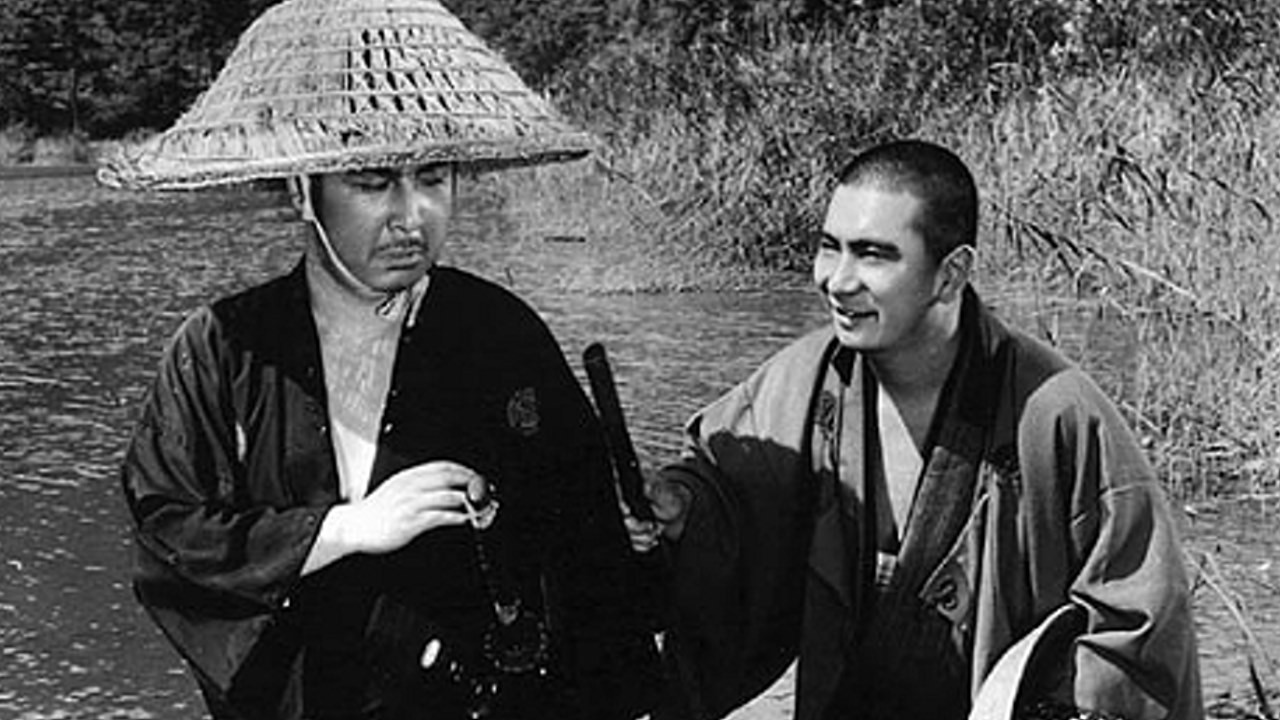
Tale of Zatoichi Continues, The - scene

Although you could be forgiven for thinking that The Tale of Zatoichi Continues is a bit of a cheap knock-off, a knee-jerk reaction to the success of the first movie, nothing could be further from the truth.  True, the much shorter running time hints at that, but this is a worthy successor, and builds on the themes of betrayal and redemption that were introduced before.  The way in which Minoru Inuzuka’s script brings everything full circle back to the bridge at Sasagawa where Zatoichi and Hirate fought, is cleverly done and resonates in a way that is completely unexpected.  This is a sequel that could easily have been added to its predecessor for a much longer – and in some ways – more satisfying introduction to its wonderfully complex character.

The events of the first movie are given due reference, and allow Zatoichi’s skills as a swordsman to be used to good advantage, alternately hastening and delaying the expected swordplay, and allowing for a variety of encounters that are expertly choreographed (with the necessary exception of the final duel between Zatoichi and Yoshiro; it shows the blind swordsman isn’t as superhuman as his enemies might think, and the movie is all the better for it).  Returning characters Otane and Sukegorô (both played by the same actors as before), though given less to do, are both welcome elements, and their involvement lends an added depth to the final third of the movie, while the newer characters are played to perfection by a cast that are entirely credible throughout (as the brooding Yoshiro, Wakayama is a stand out).  As with the first movie, the cast don’t put a foot wrong, but it’s still very much Katsu’s movie, another superb performance given added depth with the revelation of his having a lost love: when he describes how she left him – and for the very man she professed to hate – the expression of pain and longing on Katsu’s face is   truly moving.

There is an added layer of humour this time round, as well as a more compelling female relationship for Zatoichi to deal with, and a hint of how the series is likely to develop, further enriching what is already a rewarding viewing experience.  Shot again in glorious black and white, the movie is often beautiful to watch – witness the scene where Zatoichi muses at the edge of a lake – and director Mori, while not adopting completely the style and look of the first movie, does show a willingness to experiment with unexpected shots and compositions (several scenes are shot from above, while one fight scene is filmed from such a distance it would be jarring if it weren’t also such a pleasant surprise).

Rating: 9/10 – a wonderful follow-up to The Tale of Zatoichi and confirmation if any were needed that the character’s development for cinema was no flash in the pan; intelligent, robust filmmaking that satisfies and rewards in so many ways it’s like a banquet.

I, Frankenstein (2014)

Tags

, , , , , , , , , , , ,

i-frankenstein_8f851d11

D: Stuart Beattie / 92m

Cast: Aaron Eckhart, Bill Nighy, Miranda Otto, Yvonne Strahovski, Jai Courtney, Socratis Otto, Aden Young, Caitlin Stasey, Mahesh Jadu, Nicholas Bell

Dispensing with Mary Shelley’s novel in the first five minutes, I, Frankenstein – the title doesn’t mean anything until the very end – takes the basic template established by the Underworld movies but to avoid accusations of complete plagiarism, swaps vampires and werewolves for angels (in the form of gargoyles) and demons, and allows Kate Beckinsale a well earned rest from all the leather-clad slaying she had to do. Now it’s Aaron Eckhart’s turn to shoulder the hopes of a would-be franchise opener.

Sadly, he’s hamstrung from the start. Victor Frankenstein (Young) – having perished in the northern wastes searching for his creation (Eckhart) – is about to be buried in his family cemetery by said creature when a band of demons attack the monster. Nearby, gargoyles watch the scene with interest, but before Frankenstein’s creation can be captured – and Frankenstein’s journal detailing his experiments – the gargoyles intervene and the demons are “descended” – sent back to Hell from whence they can never return. Brought back to their hideout, the creature learns that the gargoyles are, in fact, angels, sworn to defend mankind from the threat of Naberius (Nighy) and his demons. Their Queen, Leonore (Otto), names the creature Adam, and seeks his aid in defeating the demons but he chooses to leave and go his own way; Frankenstein’s journal stays with the gargoyles.

Over the next two hundred years, Adam devotes his time to tracking down and killing demons wherever he can find them. In the present day, an encounter leads to the death of a human. Outraged by this, the gargoyles capture Adam and plan to keep him that way to avoid any further human casualties. Leonore’s second-in-command, Gideon (Courtney) is all for destroying Adam, but she refuses; however an assault on the gargoyles’ base by a horde of demons led by Zuriel (Socratis Otto) makes it all a moot point as Adam is released to defend himself and aid the gargoyles. In the melee, Leonore is captured. An exchange is set up: the journal for Leonore’s safe return, but Adam intervenes, saving the Queen but letting Zuriel escape with the journal.

The journal’s importance becomes clear as we learn of Naberius’ plan to reanimate thousands upon thousands of corpses using Frankenstein’s work. He employs Terra (Strahovski) to solve the problem of reanimation but she has no idea of his true motives. Adam infiltrates the demons’ hideout and discovers (quite easily) what’s going on. He escapes (with the journal), and later coerces Terra into helping him. Naberius forges ahead with his plan, forcing Terra’s colleague Carl (Bell) to finish the process. Adam leads the gargoyles to the demons’ hideout for one last ditch effort to stop the corpses being reanimated and inhabited by fallen demons (and by extension, save mankind etc. etc.).

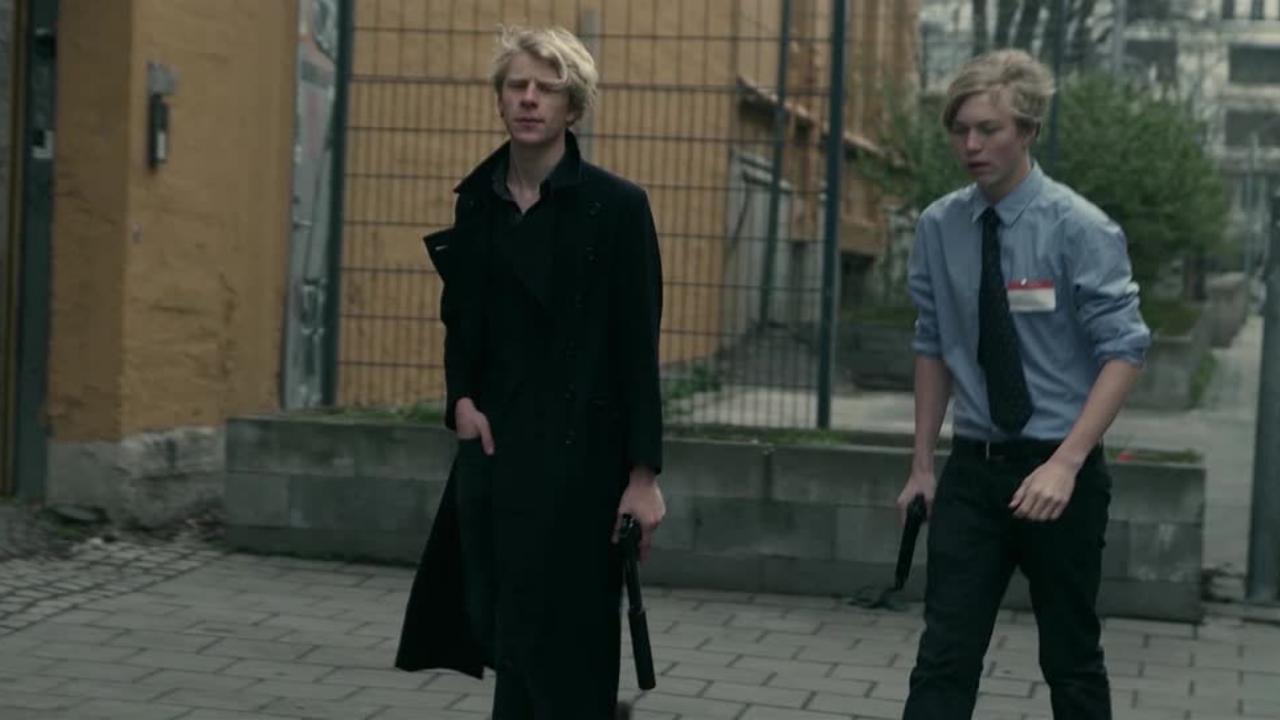
I, Frankenstein - scene

Based on the comic book by Kevin Grevioux (who also has a small role and was responsible for the Underworld series), I, Frankenstein conforms to that series’ visual styling, with thick greys and steely blues dominating the palette throughout with only the bursts of flame that signify a demon’s descending to alleviate the gloom. There’s the usual over-reliance on wanton destruction and well-choreographed if now slightly generic action beats, a plot that puts a stranglehold on logic and common sense, character motivations that often change from scene to scene, emotive outbursts that come and go without acknowledgement, twists and turns that you can see coming from a century away, acting that veers from unintentionally hilarious to po-faced in its attempts to be serious, direction that makes the action sequences feel flat and uninvolving (as well as confusing), dialogue that even the most dedicated actors – and Eckhart, Nighy and Otto in particular are no slouches – could ever add credibility to, and a stubborn refusal to be anything other than a mess of half-realised intentions and sub-par dramatics.

The problem with I, Frankenstein (and pretty much all the other action fantasy movies that clog up our screens) is its inability to give even its target audience something new to enjoy. Any fan of this particular genre will be disappointed by the lack of invention here, and while no one’s expecting Shakespeare, would it really have hurt the process to provide some depth to things, some gravitas? The story of Frankenstein’s creation is a tragedy, but here the character is reduced to the kind of hate-filled killing machine that wouldn’t look out of place in a vigilante movie; it’s a one-note characterisation that undermines both the character’s legacy and its iconic status. (In the end credits, Mary Shelley receives Special Thanks, but it’s hard to tell if the filmmakers are being ironic or genuine.)

Movies like this will always be green-lit by studios or find investors because they generally make their money back through ancillary sales – and hey, bad movies get made every day anyway – but what galls this particular reviewer is that nobody seems to want to make a movie that isn’t so derivative of every other movie like it. There’s something to be said for giving the audience what they want, but as the box office returns for I, Frankenstein have proved, too much of a (relatively) good thing can be off-putting. At this stage a sequel is probably inevitable and if it is, let’s hope whoever takes up the reins decides to take a little more care with the material and its presentation, and maybe tries something a little bit more interesting and/or different (though I’m betting they won’t).

Rating: 3/10 – a bad movie through and through with some dreadful performances (Courtney, Strahovski) married to a dreadful script and direction (both courtesy of Beattie), and a dreadful misappropriation of a classic literary character; I, Frankenstein should be avoided at all costs, and doesn’t even rate as a guilty pleasure.

Mini-Review: Baggage Claim (2013)

Tags

, , , , , , , , , ,

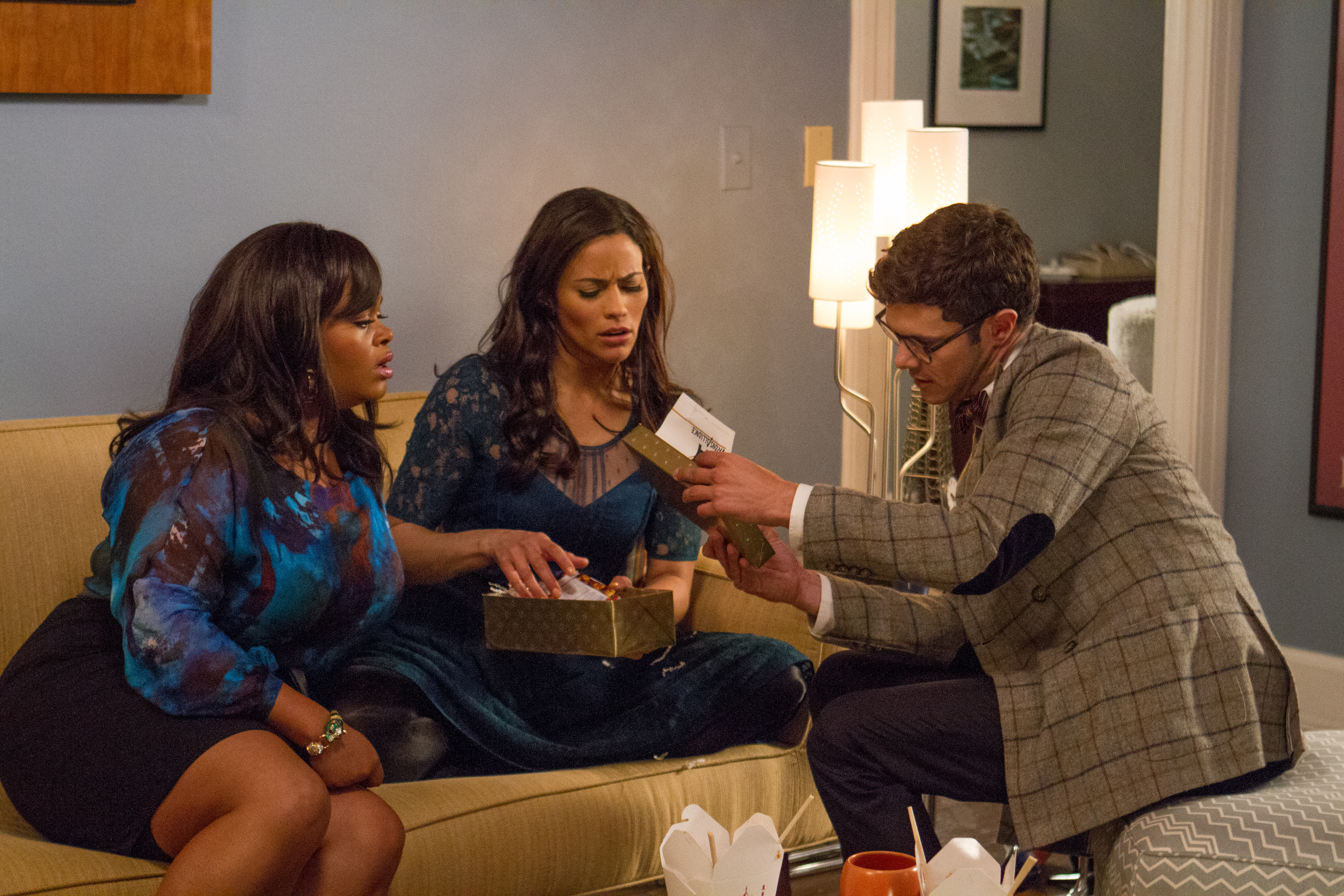
1Sheet_Master.qxd

D: David E. Talbert / 96m

Cast: Paula Patton, Derek Luke, Taye Diggs, Adam Brody, Jill Scott, Jenifer Lewis, Boris Kodjoe, Tremaine Neverson, Djimon Hounsou, Lauren London, Christina Milian, Ned Beatty

Adapted from his own novel, writer/director Talbert’s ode to the apparent perils of being female, thirty and unmarried, Baggage Claim is a low-key attempt to add something a little bit different to the usual slew of rom-coms hitting our screens these days. Focusing on air stewardess Montana (Patton), the movie opens with her receiving a romantic invitation to spend Thanksgiving with her boyfriend, Graham (Kodjoe). When Montana finds out that Graham is married (and with a pregnant wife), she all but gives up on finding Mr Right.  To make matters worse, her younger sister Sheree (London) announces she’s getting married – and she’s still in college. Consoled by colleagues Gail (Scott) and Sam (Brody), Montana is encouraged to look up her old boyfriends to see if any of them might still be interested in her. With the airline they work for being used as a means of locating these men, Montana “accidentally” bumps into them on flights they make across the country. The outcomes of these meetings vary, and by the time of her sister’s rehearsal dinner – when she’s promised to attend with the “new man” in her life – Montana is on the verge of having to make a potentially life-changing decision, but one that won’t involve getting married.

_AA_7693.CR2

Baggage Claim‘s main strength is that it’s not trying to compete with the Bridesmaids or Bachelorette’s of this world, and is rather an old-fashioned kind of rom-com, with a sympathetic lead character, a traditional romantic hurdle to overcome, and most of the really funny moments provided courtesy of the supporting characters (Scott is hilarious as the boulder-bosomed Gail). Montana’s Mr Right will come as no surprise to anyone, and the road to true love is littered with the usual obstacles and pitfalls. If it all sounds entirely predictable, then you’d be right, but Baggage Claim has a light-hearted sureness of touch that makes it a small-scale winner, and with pleasing performances from Patton, Luke, Diggs and Brody (amongst others), this is one rom-com that doesn’t disappoint on its way to the airport.

Rating: 7/10 – amusing and rewarding throughout, Baggage Claim is a rom-com with lo-cal sweetness; the only question is how come so many men passed over Montana in the first place… when she looks like Paula Patton?

The Last Days on Mars (2013)

Tags

, , , , , , , , ,

Last Days on Mars, The

D: Ruairi Robinson / 98m

Cast: Liev Schreiber, Elias Koteas, Romola Garai, Olivia Williams, Johnny Harris, Goran Kostic, Tom Cullen, Yusra Warsama

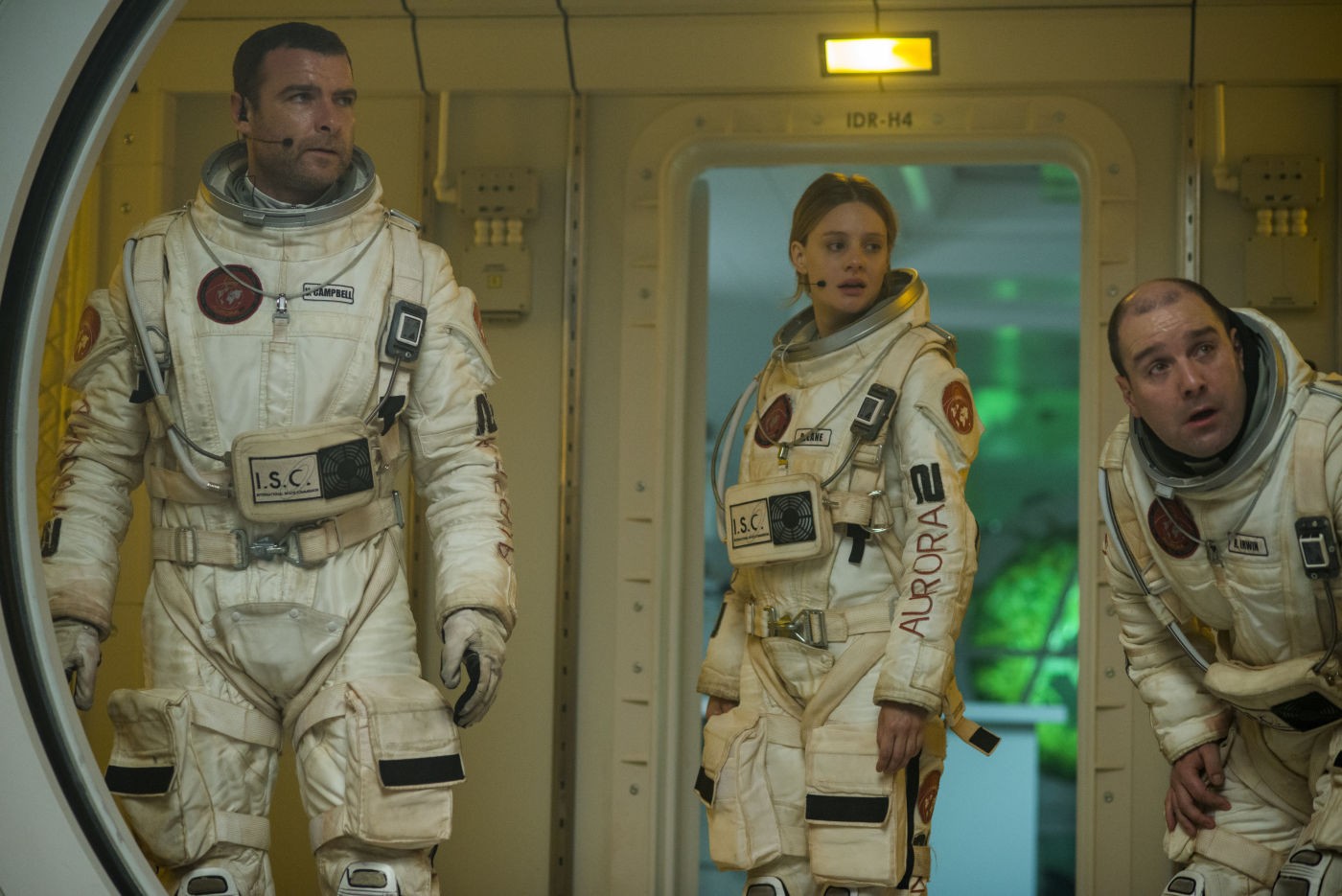
With less than twenty hours to go before their time on Mars is to end, a team of scientists winding up their six month stay as part of the Aurora 2 mission are thrown into peril when one of the team, Marko Petrovic (Kostic), with colleague Richard Harrington (Cullen), goes to check on a broken sensor rather than attend a last briefing. Marko has an ulterior motive for going, one that the rest of the team find out about while he journeys away from their command centre. It appears there is life on Mars, at a microbial level, but just as Marko discovers this the ground beneath him gives way and he plunges into a cavern. Harrington is unable to save or rescue him, but he does notify the rest of the team. Headed by senior officer Charles Brunel (Koteas), a rescue team consisting of Brunel, systems specialist Vincent Campbell (Schreiber), and scientist Kim Aldrich (Williams) attempts to rescue Marko’s body, and discover the whereabouts of medic Lauren Dalby (Warsama) who was left to watch over the site while rescue apparatus was obtained from the command centre.

However, Marko’s body and Dalby have disappeared, but Campbell sees the microbial organism (though he can’t describe it properly). As the rescue team heads back, two figures appear on the scanners, heading for the command centre. Harrington lets the first of them in, and it proves to be Marko… or at least, what remains of Marko. Affected by the microbial organism, Marko attacks Harrington and the remainder of the team before being joined by an equally altered Dalby. The rescue team returns and they and the rest of the (unaffected) crew trap Marko and Dalby in part of the command centre, but not before Brunel has been badly wounded. With their communications to Aurora base compromised, Campbell tries to reboot the system, but has to do so by himself, leaving the rest of the team to fend off Marko and Dalby’s attempts to get to them. When things go from bad to worse, Campbell, and scientists Rebecca Lane (Garai) and Robert Irwin (Harris), head for the Aurora rendezvous point in the hope that they can alert Aurora base and stop any of the infected team from being picked up.

Last Days on Mars, The - scene

With Jordan standing in for Mars, the movie’s exteriors look suitably other-worldly, and the Martian Rovers the team uses to get around in are quite impressive, leaving the look and feel of the movie well-grounded and believable. For a relatively low-budget production, this UK/Irish co-production looks ten times better than it should – hats off to production designer Jon Henson – and the special effects are uniformly excellent.

But – and yes, this is a very predictable ‘but’ – the storyline doesn’t match the quality of the look of the movie. Adapted from the short story, The Animators, by Sydney J. Bounds, Clive Dawson’s script has its scientific team behave in ways that make you want to slap your forehead and cry, Really? From Marko’s initial lying about going to check on the sensor, to Harrington’s letting Marko in without any attempt at decontamination (shown quite clearly as protocol before then), to Irwin’s sudden decision to betray a teammate, while these things obviously advance the storyline, they make a nonsense of these people being (hopefully) highly trained and motivated, not to mention well chosen for the mission. And none of them spot that the microbial organism craves water – though why it should turn the crew into homicidal maniacs is another question entirely – and none of them think to arm themselves at any time despite the obvious threat.

There’s also some scientific anomalies that rankle as well, like the EVA suits that have a limitless supply of oxygen, and the likelihood of the microbial organism behaving as if it has a hive mind. There’s an attempt to kill it using antibiotics but this serves only to highlight the resemblances to both The Thing (1982) – testing the antibiotics on a restrained Brunel – and Alien (1979) – the last remaining threat to Campbell’s escape from Mars being expelled from an airlock. These moments only add to the disappointment that accrues as the movie progresses, and while Robinson maintains a good pace throughout and keeps a firm hand on proceedings, the movie often stumbles with the weight of its contrivances. The cast do their best – Schreiber and Koteas put in their usual committed performances – but are hampered by having to behave in such unconvincing ways.

Rating: 5/10 – hamstrung by playing to too many stock situations and character development, The Last Days on Mars starts off well but goes downhill quicker than Marko down a crater; great visuals compensate for the poor plot and storyline, but there’s still the small fact that the movie should more accurately be called The Last Hours on Mars.

Magic Magic (2013)

Tags

, , , , , , , , ,

Magic Magic

D: Sebastián Silva / 97m

Cast: Juno Temple, Michael Cera, Emily Browning, Catalina Sandino Moreno, Agustín Silva

Shot entirely in Chile, Magic Magic is a slow-burn thriller that begins with Alicia (Temple) travelling outside the US for the first time to stay with her friend Sara (Browning).  Alicia is a little shy and unsure of herself, and looks to Sara for support when she fails to impress Sara’s boyfriend Agustín (Silva), and his two friends Barbara (Moreno) and Brink (Cera).  Leaving Santiago for a cabin in the countryside, they get so far when Sara receives a call saying she has to go back to resit one of her exams.  Against Alicia’s wishes, Sara travels back alone, promising to be back the next day.

At the cabin, Alicia repeatedly tries to contact Sara but there’s no signal.  She becomes increasingly restless and that night has trouble sleeping.  The next day, Alicia, Agustín and Brink go hunting with a rifle; Brink shoots a parrot, leaving Alicia disturbed by his cruelty.  Later, Alicia manages to contact Sara, who tells her she now won’t be back until the next day.  Alicia has another bad night, and in the morning is offered pills by Barbara to help her sleep.  Sara arrives and the group (minus Barbara) take a boat to a nearby place called The Rock where there is an outcrop that can be jumped off into the water.  Alicia freezes and, although she is reassured by the others, her behaviour begins to cause them serious concern.  Alicia, maybe through lack of sleep, is erratic, and prone to emotional outbursts; she also has fugue moments.

That night she is hypnotised by Agustín and responds directly to suggestions, even when Brink tells her to put her hand in the fire.  Later, Alicia sleepwalks and causes a disturbance before being found.  The next day there is an altercation between her and Brink which later leads to the discovery that Alicia is taking a lot of medication.  And then that evening, Alicia disappears…

Magic Magic - scene

From the start, Magic Magic takes pains to show us the emotional fragility that Alicia suffers from.  But while we see this time after time (until it becomes annoying – we get it, okay?), there’s no clear explanation for her behaviour, nor if the things that are happening are largely in her head because of some psychological issue, or the side effects of her medication, or even a mixture of both.  The lack of consistency in her behaviour, and in her attitude towards the rest of the group, doesn’t help either, and there are too many occasions when she behaves weirdly, it’s briefly commented on, then it’s on to the next weird moment.  And it doesn’t help that the culmination of all these events makes for a final ten minutes that shoves the movie into a whole different territory.

With the main character acting so strangely – and with little or no explanation to guide the viewer – Magic Magic suffers mightily from being a combination of arthouse and thriller that panders more to arthouse conventions than thriller ones.  In the hands of a more skilled writer/director, this might not have been a problem, but Silva overplays Alicia’s reticence and odd behaviour rather than developing the mystery of what’s happening and why.  Fortunately, the director has a strong ally in Temple, who despite the limitations of her character, puts in a brave, instinctive performance that helps the movie immeasurably.  There’s a moment when she’s walking through a field and encounters a couple of horses.  The moment is infused with a low-key tension – why though, is again left unanswered – but Alicia’s sense of uneasiness is portrayed credibly despite the lack of reasoning behind it.  It’s Temple’s ability to elevate the material in this way that saves the movie from being too diffident and removed.

Cera is the other main draw here, and fares reasonably well as Brink, but again the script has him behave in such a bullying, cowardly manner that his continual taunts and digs at Alicia become more annoying than anything else.  It’s good to see him play such an awful person – aside from his brilliant turn in This Is the End (2013) – but there’s little depth here and it’s hard to see why Agustín and Barbara would put up with him.  Browning fares badly, with the underwritten role of best friend whose return trip to Santiago turns out to be for other reasons but when they are revealed, prove to have no relation or effect on what’s going on with Alicia.  Moreno has little to do except moan about Alicia throughout, while Silva is almost a bystander with little to do except continually apologise for Brink’s bad behaviour.

With so much going on that is left unexplained and/or undeveloped, Magic Magic is a frustrating experience, and the title doesn’t provide any clues either (though it does relate to the movie’s denouement).  It also ends abruptly, leaving the audience even more in the dark than they were at the beginning.  The cast do the best they can under the circumstances and there’s some pleasure to be had from the beautiful Chilean locations, but as an evening’s entertainment you’d be hard pressed to find something less enervating.

Rating: 5/10 – with its writer/director denying his audience a way in to what’s happening, Magic Magic fails to engage or provide a character to sympathise with; good performances aside, this is a disappointing movie that seems happy to be obscure for its own sake.

The Raid 2 (2014)

Tags

, , , , , , , , , , ,

Raid 2, The

aka The Raid 2: Berandal

D: Gareth Evans / 150m

Cast: Iko Uwais, Arifin Putra, Tio Pakusodewo, Oka Antara, Alex Abbad, Cecep Arif Rahman, Ken’ichi Endô, Julie Estelle, Very Tri Yulisman, Yayan Ruhian, Cok Simbara, Roy Marten

Picking up after the events of The Raid, The Raid 2 reintroduces us to Rama (Uwais), that movie’s protagonist, and his boss Bunawar (Simbara).  After a quick debrief, Bunawar tells Rama he has another job for him, one that will take him undercover in an attempt to find further links to corrupt police officials.  Given a false identity, Yuda, Rama is sent to prison with the intention of getting close to Uco (Putra).  Uco is the son of gang boss Bangun (Pakusodewo), and the two men strike up an uneasy friendship, culminating in Rama saving Uco’s life during a massive prison brawl (one of the movie’s several impressive set pieces).

Two years later, Rama is released from prison and is welcomed into Bangun’s gang where he acts as a bodyguard for Uco and as an enforcer.  He also learns that Bangun isn’t the only crime boss in town, there’s also a Chinese gang led by Goto (Endô), but both sides have agreed on a truce that has lasted for ten years.  However, up-and-coming gangster Bejo (Abbad) wants both gangs overthrown and himself installed as overall boss.  With Uco desperate to become more involved in his father’s organisation, and continually being passed over when important jobs present themselves, it isn’t long before Bejo has struck a deal with Uco, and the pair begin to undermine the peace that has existed for so long.

With both sides doing their best to avoid any conflict, Uco is forced to take drastic measures to ensure the war between them takes place.  Now caught in the middle and with little support from Bunawar, Rama must avoid having his real identity revealed while also stopping Bejo and Uco from taking over.  This leads to an extended showdown at a restaurant where Bejo and Uco are negotiating with corrupt policeman, Reza (Marten).

Raid 2, The - scene

Following the tremendous success of The Raid, a follow up was inevitable, and it’s to writer/director Gareth Evans’ credit that he’s managed to expand on the criminal underworld introduced in the first movie, while retaining the fierce, bone-crunching action that made that movie such an exhilarating (albeit vicious) thrill ride.  The introduction of the two rival gangs deepens the ongoing story – there’s a third movie still to come – and the relationship between Bangun and Uco, while predictable, is given sufficient screen time to be credible.  It does mean that Rama takes a bit of a back seat during the movie’s middle third, and this protracted section could have done with some judicious trimming, but you can’t fault Evans for trying to broaden the scope after the claustrophobic setting of the first movie.  However, much of this expansion is unnecessary and there are too many scenes that replicate scenes that have gone before, while most of the new characters are a whisper away from being derivative and uninspired; it’s thanks to a great cast that they resonate more effectively than the shortcomings of Evans’ script would seem to allow.  And Rama’s remit: to expose more of the high-level corruption revealed in The Raid, is largely forgotten about until the movie’s untidy resolution.

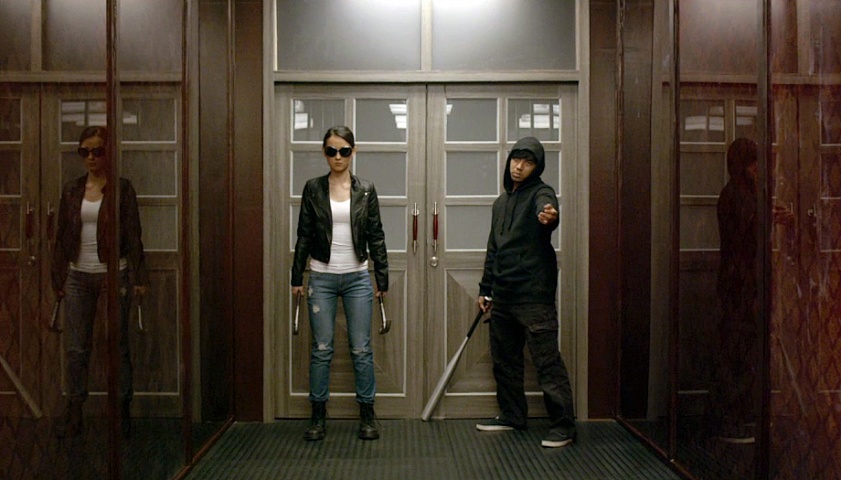
But it’s the action that counts and it’s here that Evans builds on the explosive, visceral content of The Raid to bring us several sequences that are just astonishing for their creativity, incredible choreography, and wince-inducing blows.  From the prison brawl (where one inmate has his leg broken in suitably horrible fashion), to the exploits of Bejo’s hired assassins Hammer Girl (Estelle) and Baseball Bat Man (Yulisman), to a car chase that earns prizes for its verve and ingenuity, to the final showdown between Rama and The Assassin (Rahman) that is dizzying in the speed of its execution, Evans raises the bar once more and shows Hollywood that even now, most action movies it churns out remain anaemic in comparison.

Rating: 8/10 – an adrenaline rush of a movie tempered by slower-paced sequences that boost the overall plot, The Raid 2 is slightly less rewarding than its predecessor but still head and shoulders above any other action movie you’ll see this year; unremittingly savage and gory in places, this sees Evans consolidate his position as the best action director working today.

The Amazing Spider-Man 2 (2014)

Tags

, , , , , , , , , , , , , ,

Amazing Spider-Man 2, The

D: Marc Webb / 142m

Cast: Andrew Garfield, Emma Stone, Jamie Foxx, Dane DeHaan, Sally Field, Colm Feore, Felicity Jones, Paul Giamatti, Campbell Scott, Embeth Davidtz, Marton Csokas, Chris Cooper

With this instalment – number two of four – the Spider-Man reboot continues to enervate and aggravate at the same time, and in many ways that are similar to the first movie.  The movie opens with a flashback to Peter Parker (Garfield) as a young child being left with his Uncle Ben (a non-returning Martin Sheen) and Aunt May (Field) while his parents, Richard (Scott) and Mary (Davidtz) head off for parts unknown.  So far, so retread of the opening of the first movie, but this time we discover what happened to Peter’s parents, and are given a brief glimpse into its importance in the series’ overall plot.  From there we pick up with Peter and Gwen Stacy (Stone) in the aftermath of The Lizard’s rampage and the resultant death of her father.  Peter’s promise to keep Gwen away from danger prompts him to end their relationship, despite Gwen’s protests.

At Oscorp, prodigal son Harry (DeHaan) returns from abroad at the request of his dying father, Norman (Cooper).  Given control of the company, and its secrets, Harry also discovers that the illness that is killing his father will also kill him.  When Norman dies, Peter hears about it and goes to see Harry to offer his condolences.  They pick up their old friendship, while back at Oscorp, loner employee Max Dillon (Foxx) – whose life Spider-Man saved in the opening chase sequence involving future-Rhino Aleksei Sytsevich (Giamatti) – ends up electrocuted in a tank full of electric eels.  When he awakens some time afterward he discovers he can control electricity.  Still adjusting to his new-found power, Max and Spider-Man have a showdown where Max is captured and sent to the Ravencroft Institute, a facility for the criminally insane that is run by Oscorp.  Under the instruction of Oscorp lawyer and bigwig Donald Menken (Feore), Max is “studied” by Dr Kafka (Csokas).

Harry learns that the research conducted by his father and Richard Parker may be the key to stopping his illness.  He asks Peter to contact Spider-Man with the intention of securing some of the web-slinger’s blood.  When Peter (as Spider-Man) refuses to help him, Harry is enraged, and vows to put an end to Spider-Man.  Meanwhile, Peter and Gwen try to be friends (but without much success), and Aunt May gives Peter a clue that might help him discover the truth about his parents’ disappearance.  This leads to an abandoned underground station, and a revelation that reinforces Peter’s decision not to help Harry.

When Harry tries to access certain Special Projects files, he’s unceremoniously dumped from Oscorp by Menken, but not before he finds out about Max and his incarceration at Ravencroft.  He frees Max – who now calls himself Electro – and they take back control of Oscorp.  Harry forces Menken to inject him with the spider serum but it has the predictable adverse effect.  He makes it to an exo-skeleton that has restorative and battle-focused properties and he survives, just as Electro and Spider-Man face off against each other again.

Spider-Man at GMA

There’s a lot more to the story, but surprisingly, the movie copes well with it all, even if at times it does throw off the pacing (some of the quieter scenes seem to drag in comparison with the more kinetic moments).  The tagline “No More Secrets” is only partly apt, as while we do get to know what Richard Parker was working on, its importance to Peter and his alter-ego, and the effect it’s had on Aunt May (not quite as important in the grand scheme of things but thanks to Field’s performance, effectively realised), we don’t get to know the full extent of Oscorp’s Special Projects (look out though for glimpses of Dr Octopus’s tentacles and the Vulture’s outfit), and any wider plan they’re being prepared for.  (In many ways, parts three and four look to be about developing these projects further, and while the prospect of Spider-Man versus the Sinister Six looks to be on the cards, it’s going to have to be very well thought out in order to work as well as it needs to.)

Where the movie works best is in its widening of the Spider-Man universe, and adding an extra layer of depth to the main characters that doesn’t always happen in sequels.  Peter’s ambivalence towards his relationship with Gwen is well-played, and Aunt May gets perhaps the best scene in the movie, while newcomers Harry and Max are painted with broad but effective brush strokes, although Max’s temerity and innate humility are jettisoned half way through to enable a more threatening second encounter with Spider-Man.  As the main villains, Foxx is on impressive form, particularly in his pre-Ravencroft scenes (including a suitably awkward elevator encounter with Gwen), while DeHaan does more than enough to prove that he’s not just replicating his performance as Andrew in Chronicle (2012), despite the similarities in the two characters.  Sadly though, the dreadful faux-Nazi/Dr Strangelove caricature that is Dr Kafka is the one character that will have everyone asking themselves, Really? and is the movie’s biggest misstep.

Tonally the movie flits between standard romantic drama, broad comedy (witness Sytsevich’s humiliating capture), overly stylised and over the top action sequences (with the by-now dramatically redundant but seemingly unavoidable mass destruction of property), cautious morality piece, and less than low-key father/son entanglements.  Some aspects don’t work as well as others – Spider-Man’s saving of a small child from bullies that leads to a very unlikely moment later on; Harry’s mastery of the exo-skeleton and its systems in about five minutes flat – while Webb’s direction, slightly off in the first movie, doesn’t improve here, leading to the movie having a surprisingly listless quality, where the highs don’t have the impact they should have, and the lows all operate at the same level.  There’s a lot going on but for a Spider-Man movie there really isn’t any “wow” factor; even Spider-Man’s aerial acrobatics, though better filmed than ever before, still have that “seen it too many times before” feel to them.

As the movie progresses into its final third there are some narrative lapses that undermine a lot of what’s gone before, especially considering the care that’s gone into the movie’s structure up til then, and one character’s emotional crisis is resolved in pretty much the blink of an eye, but it’s not enough to completely ruin things.  There’s one climax too many – and particularly as the last one is a bit of a throwaway – and too much is left unexplained in terms where certain characters end up (and how).  It makes for a disappointing ending and seems more about prepping audiences for part three than rounding off part two.

Rating: 7/10 – a solid sequel that builds on its predecessor by consolidating that movie’s strengths, The Amazing Spider-Man 2 still isn’t as invigorating or rewarding as it would like to be but is certainly more confident; not the best Spider-Man sequel but considering its collision of villains, not the worst either.

Calvary (2014)

Tags

, , , , , , , , , ,

Calvary

D: John Michael McDonagh / 100m

Cast: Brendan Gleeson, Chris O’Dowd, Kelly Reilly, Aiden Gillen, Dylan Moran, Isaach De Bankolé, M. Emmet Walsh, Marie-Josée Croze, Domhnall Gleeson, David Wilmot, Pat Shortt, Gary Lydon, Killian Scott, Orla O’Rourke, Leo Sharpe

Calvary opens with a confession, not of sins committed, but of a sin to be carried out.  The priest hearing the confession, Father Lavelle (Gleeson), is flippant at first, then astounded as the proposed sin is murder, and the victim will be himself.  The parishioner was abused as a child by another priest (now dead) and wants his revenge; what better way to offend God than to kill a good priest, rather than a bad one?  It’s a powerful opening, and one that is bookended by an equally powerful conclusion.  What occurs in between, in the week leading up to the proposed murder, is often wryly humorous, sometimes emotionally uplifting, occasionally absurd, but alas, rarely convincing.

The main problem Calvary has is what to do with Father Lavelle once his death sentence is announced.  His superior, Bishop Montgomery (David McSavage), offers no real support or advice, and the priest he shares duties with, Father Leary (Wilmot), is so ineffectual he eventually leaves the parish.  A visit from his daughter, Fiona (Reilly), reveals his inadequacy a a biological father – she’s recovering from a suicide attempt and has been estranged from him since the death of her mother – and while some inroads are made in their relationship, his interaction with the rest of the village is less successful.  As he alienates more and more people, his intended murderer’s assertion that he’s a good priest becomes more and more untenable, and his failings as a man and a priest are increasingly highlighted.  This is a man whose own demons, once banished, are coming back to claim him.  (There’s an argument here that the man planning to kill him would know all this, making his choice of Lavelle as a “good priest” less a case of conviction, and more likely, of convenience.)

Calvary - scene

But while Father Lavelle continually fails to understand or support his parishioners – wife-beater and butcher Jack (O”Dowd), his errant wife Veronica (O’Rourke) and her lover Simon (De Bankolé), local businessman Fitzgerald (Moran), angry doctor Frank Harte (Gillen), local policeman Inspector Stanton (Lydon) and his rent boy lover Leo (Sharpe) – the audience is left wondering just how he managed to become a priest in the first place.  The number of ways in which he misunderstands the villagers is increasingly impressive, but becomes tiring after a (very short) while, so when he comforts the widow (Croze) of a French tourist who’s been killed in a car accident, it’s great to find he can be appropriately sympathetic and contrite (the movie has several quiet moments like this one, but it’s by far the most effective).

As events conspire to push Lavelle closer to the edge of a breakdown, and violence becomes a bitter factor in his involvement with the village, Calvary becomes a much darker movie and one that seems determined to offer no ray of hope for its embattled cleric.  Gleeson is a perfect choice for the dour, embittered character he portrays, a man who has come late to the priesthood, and now finds himself the target of someone’s hatred of the institution he represents.  In the hands of director and screenwriter McDonagh, this premise should have been the basis for a trenchant examination of faith, responsibility and social exclusion.  What it serves up instead is a treatise on bad decisions and atonement, with unresolved guilt as a side order.  Aside from the village’s odd assortment of inhabitants, there’s little in terms of the drama taking place that we haven’t seen before (and with more sharply defined characters).  It’s not that Calvary is a bad film per se, just that it promises much more than it delivers.

Rating: 7/10 – strong performances and beautiful location photography side, Calvary doesn’t quite draw the audience in as planned; still worth watching though as there are few movies out there that take these kind of risks with both the material and its performances.

Transcendence (2014)

Tags

, , , , , , , , , , ,

Transcendence

D: Wally Pfister / 119m

Cast: Johnny Depp, Rebecca Hall, Paul Bettany, Morgan Freeman, Cillian Murphy, Kate Mara, Cole Hauser, Clifton Collins Jr, Cory Hardrict, Falk Hentschel, Josh Stewart, Lukas Haas, Xander Berkeley

Those of you with a good memory will recall Johnny Depp’s last sci-fi outing, the distinctly flat and underwhelming The Astronaut’s Wife (1999).  Amongst the movies in Depp’s filmography it’s a rare misstep… until now.

Here, Depp plays Dr Will Caster, a scientist investigating the possibilities surrounding artificial intelligence (AI).  He is supported by, and works with, his wife, Evelyn (Hall), and from the wider scientific community, Max Waters (Bettany) and Joseph Tagger (Freeman).  When he is shot leaving a symposium by a member (Haas) of a radical anti-AI movement, RIFT, Will receives what appears to be a non-fatal wound.  Later, he learns the bullet was coated with polonium and he has only a matter of weeks to live.

Appropriating the work of a fellow scientist, Dr Thomas Casey (Berkeley), Evelyn sets up a secret laboratory where she intends to digitise Will’s mind and connect it with a computer system, thus allowing his “consciousness” to live on after his physical death.  She’s aided by Max who has reservations about the plan; when it succeeds, and one of Will’s first requests is to be connected to the internet, Max becomes afraid of the potential danger in Will having access to every computer on the planet.  He tries to pull the plug but Evelyn stops him and forces him to leave.  Max is then kidnapped by RIFT, and their leader, Bree (Mara), decides to keep him captive until they can stop Will’s consciousness from spreading.  They arrive at the laboratory too late to stop Will connecting to the internet, and too late to stop Evelyn from escaping.

Meanwhile, Tagger is helping FBI agent Buchanan (Murphy) track down the members of RIFT.  When Will manipulates the FBI’s computer system in order to help them, Tagger also becomes worried about the possible consequences of Will’s access.  As Evelyn, under Will’s instruction, starts to oversee the building of a brand new facility in the desert town of Brightwood, RIFT inexplicably hold back from trying to sabotage it, and the FBI sit on their hands as well.  Two years later, Will has moved on to using nano-technology in his work and when a worker is badly injured, takes the opportunity to use his medical capabilities to “improve” the worker’s physical condition, even going so far as to install software in the man’s head that links him to Will.  As more and more people undergo this “corrective surgery”, RIFT and the FBI both become afraid that Will is creating an army, and decide to take steps to put an end to his new existence.  The only way they can do it?  By using a virus created by Max that should stop Will by shutting down the internet…completely.

Transcendence - scene

Hopefully that (actually quite) brief synopsis should alert the potential viewer that Transcendence has a lot going on, and not all of it either clever or logical.  At the movie’s beginning, Will is a bit like an absent-minded professor, and has no interest in trying to change the world through the appliance of new technologies; that’s Evelyn’s aim.  As his metamorphosis develops and his “power” increases, he begins to do just that, using nano-technology to heal the sick and heal the planet.  All good, right?  Well yes, and therein lies one of the movie’s major problems: it’s ostensibly a thriller, and outside of the involvement of RIFT, so far the thriller elements have been sorely lacking (it’s also meant to be a romantic drama, and a cautionary tale, and a bio-horror movie as well).  Will’s adaptation of people becomes the trigger for a last quarter increase in action and spectacle that, while predictable, is unnecessary and forced (hell, it’s so forced, the FBI and RIFT practically team up to put a stop to Will’s unwanted apotheosis).

There’s also the timescale, that “two years later” mentioned before where everyone outside of Will and Evelyn sit around waiting for things to reach a point where they have to intervene, whereas before, prevention was the order of the day, both legally and illegally.  It’s also absurd to think that Max would be held captive for all this time without anyone trying to find him, but this turns out to be the case.  And with the size of the facility being built at Brightwood it’s unreasonable to think that the government or homeland security or the NSA (or someone) wouldn’t come around for a look-see at some point, but they don’t.  And it’s equally implausible that Will, even with all the access to information that he has, can create and master so many new technological advances from scratch, but he does.

As science fiction, Transcendence is woollier than most and depends on its human element to move the story forward but even there the story stumbles.  Will and Evelyn are supposed to be devoted to each other, and before Will’s death that’s evident.  But when he “transcends” he becomes more attentive and tries hard to make up for his lack of a physical presence; however, Evelyn is unhappy with this and shows her unhappiness in such a way that even Will should notice but he doesn’t.  Even when she begins to have doubts about what he’s doing he still doesn’t notice – so much for having advanced intelligence!  This, of course, leads into the main theme of the movie: can an artificially created intelligence be self aware?  (The answer, very obviously, is no.)  The movie dangles this supposed conundrum at the audience every now and again as if it bestows some depth on proceedings, but it’s a hollow, nonsensical question which, unsurprisingly, is resolved in an awkward, unsatisfactory manner.

The cast mostly go through the motions.  Depp is off his game by a long stretch, and as AI-Will is too subdued to make much of an impression, either as the saviour of the world, or its potential destroyer.  Hall’s character is irritating and the actress never quite overcomes this limitation; she also seems unsure of how Evelyn should behave from one scene to the next.  Bettany, as the movie’s voice of reason is sidelined too much by his incarceration by RIFT, and early on, plays the concerned friend with so much humility you half expect him to start wringing his hands at the prospective awfulness of what’s going to happen.  Freeman does his by-now standard wise old man routine, while Murphy has to cope with being a bystander to pretty much everything.  And Mara gives such a blunt performance she never changes her facial expression once throughout the entire movie.

Jack Paglen’s script mixes cod-science with emotional drama to only slight effect, and as filmed, has too many stretches where the movie stops dead in its tracks – which is odd, as the movie is decently paced and only occasionally strays towards boring.  The scenes between AI-Will and Evelyn quickly become repetitive, as do those featuring Tagger and Buchanan.  In the director’s chair, veteran cinematographer Pfister (making his directorial debut), has obviously kept a close eye on DoP Jess Hall, and the movie is often beautifully lensed, particularly its desert location.  He’s less confident when it comes to the cast, hence the lacklustre performances, and the script hasn’t helped him either.  There’s also an annoying score courtesy of Mychael Danna, packed with predictable cues and motifs.

Rating: 5/10 – somehow, Transcendence holds the attention throughout, even if it’s just to see how much sillier it can get; with another sci-fi misstep under his belt, let’s see if it’s another fifteen years before Depp makes another venture into the genre.

Locke (2013)

Tags

, , , , , , , , ,

Locke

D: Steven Knight / 85m

Cast: Tom Hardy, Olivia Colman, Ruth Wilson, Andrew Scott, Ben Daniels, Tom Holland, Bill Milner

Movies where there is only one central character are notoriously difficult to pull off, and there are very few movies where there is only a single character for the audience to connect with, without anyone else impinging on the set up, either through a telephone call, or a flashback, or an imagined exchange.  There’s also the difficulty connected with keeping that one character in a single location – e.g. Colin Farrell in Phone Booth (2002), Ryan Reynolds in Buried (2010) – and Locke is no different.  When we first meet Ivan Locke (Hardy), he’s leaving work and getting into his car.  Once he’s behind the wheel we learn that he’s on his way to London (from where isn’t fully disclosed) where a woman, Bethan (Colman), he had a one night stand with is having his child.

Ivan is a man who needs to be in control.  He has a list of phone calls he has to make while he heads for London.  The people on the list includes his wife, Katrina (Wilson), his boss Gareth (Daniels), a colleague, Donal (Scott), and of course, Bethan.  In making these calls he’s looking to make sure a variety of things are taken care of: his marriage, the pouring of a major load of concrete the next morning at the building project he’s been working on, and that Bethan – who he regards as “fragile” – follows the doctors and nurses’ advice during her labour.

For Ivan, making the journey to be with Bethan is both an inconvenience and an obligation, but an obligation that he’s determined to go through with.  Bethan is in her early forties and all alone, and to an extent, Ivan feels sorry for her, but the main reason he’s determined to be at her side is due to the mistakes his father made when Ivan was born.  At odd times during the journey, Ivan talks to his father as if he were travelling with him, and he’s nothing less than vitriolic in his scorn for the man.  However, even with this, his commitment to Bethan – the crux of the movie – seems forced and doesn’t really convince.

His relationship with his wife is problematical as well.  For such a pragmatic, practical man, Ivan is sure that Katrina will forgive him as it’s “the only time” he’s ever slept with someone else, and there was a lot of booze involved.  Katrina is understandably horrified by her husband’s revelation, and while his two sons watch a football match he was expected home for downstairs, she shuts herself away upstairs trying to make sense of what Ivan’s saying, and what she should do next.  Ivan’s naiveté is at odds with his confidence in other aspects of his life, though whether he knows Katrina might leave him is open to question, and even when he speaks to his sons (Holland, Milner) he maintains a positive outlook that he can’t be sure of.

But Ivan’s personal issues take a back seat to his determination to ensure that the pour planned for the next morning goes ahead as arranged.  Unable to be there in person he entrusts the details – including checking rebars, the mix, road closures – to subordinate Donal.  At first, Donal is petrified of the responsibility but through a mix of cajolement and bullying Ivan persuades him to see things through.  At the same time he fields calls from his boss, Gareth (called Bastard in his phone’s contact list), who has been forced by Ivan’s unexpected absence to inform their bosses in Chicago.  Ivan expects to be fired, but he has decided to ensure the pour goes ahead without a hitch irrespective of his bosses’ decision, and as a matter of personal pride.  He keeps in touch with Donal throughout the journey, and as problems arise, coaxes Donal through each one until they’re dealt with.

Locke - scene

Locke is a difficult movie to categorise.  Ostensibly it’s a drama about one man’s attempts to deal with a crisis of conscience, and there are certain thriller elements, but it’s also an emotional roller coaster ride as each time Ivan’s phone rings the audience is on tenterhooks as to what’s coming next.  It’s this involvement that helps the movie tremendously.  As conceived by writer/director Steven Knight, Ivan Locke is a hard man to empathise with, and spending almost an hour and a half with him isn’t easy.  His insistence on being with Bethan makes no real sense, and the justification for it – not repeating the sins of his father – feels arch and ill-conceived.  His devotion to the pour shows him at his most animated and motivated, while his handling of the calls to and from Katrina are conducted as if he were dealing with someone he doesn’t know (or maybe even care about).  He’s also unable to reassure Bethan on anything but a superficial level, and is dismissive of her with the hospital staff.

As portrayed by Hardy, Ivan’s dour exterior and closed-off emotions are effectively portrayed.  Adopting a soft Welsh accent, Hardy is hypnotic, and while he’s not on screen the entire time – Knight intersperses shots of the motorways Ivan travels along with interior shots looking out as well as Ivan shot from different angles – his performance is a bravura one, with not a false note throughout.  Colman and Wilson offer solid support, but it’s Scott who wins the vocal plaudits, Donal being a memorable creation all by himself (look out for the conversation about cider).  In the director’s chair, Knight adds a kineticism to the journey that grabs the audience and never lets go, but can’t quite make up visually for the contradictions and anomalies in Ivan’s character.

Rating: 7/10 – at times gripping, but with a worrying tendency to underplay its main character’s reluctance to engage emotionally, Locke is often tense and nerve-wracking; a shame then that Ivan Locke is not someone you’d any more time with than necessary.


Divergent (2014)

Tags

, , , , , , , , , , ,

Divergent

D: Neil Burger / 139m

Cast: Shailene Woodley, Theo James, Ashley Judd, Kate Winslet, Jai Courtney, Ray Stevenson, Zoë Kravitz, Miles Teller, Tony Goldwyn, Ansel Elgort, Maggie Q, Mekhi Phifer

The first of four movies adapted from the novels by Veronica Roth, Divergent is yet another dystopian vision of the future as seen through the eyes of a young adult, this time, Beatrice Prior (Woodley).  Beatrice lives in a partly desolate version of Chicago that has seen its social structure reorganised so that people live in factions.  These factions determine the kind of life they lead and their social responsibilities.  Beatrice and her family, father Andrew (Goldwyn), mother Natalie (Judd) and brother Caleb (Elgort), live in the Abnegation faction.  Abnegation is about being selfless and helping others including giving food to the factionless (or the homeless); they are also the ruling government.  At sixteen, Beatrice and Caleb have to decide if they want to stay with Abnegation, or join one of the other factions: Erudite (science and teaching), Candor (unable to lie, often lawyers), Amity (farmers, nurses, artists who also favour peace), and Dauntless (brave and fearless and despite the apparent lack of crime, the city’s peacekeepers if needed).

Beatrice undergoes a test to see which faction she would most fit in with, but it is inconclusive.  At the choosing ceremony, Caleb opts for Erudite, and Beatrice for Dauntless (this also means neither of them can see their parents again).  Beatrice begins her training with Dauntless, and meets instructors Eric (Courtney), and Four (James).  At first, she struggles to make the first cut, but with Four’s support and encouragement she makes it through.  As time goes on, Beatrice – now calling herself Tris – learns that her test being inconclusive means she is ‘divergent’, someone who is able to encompass the traits of each faction and effectively “think for themselves”.  Divergents are viewed as a threat to society and are disposed of when discovered.  With the second stage of her training highlighting Tris’s abilities more and more, it becomes increasingly difficult for her to avoid detection, but with Four’s help, she passes the final test.

Throughout there have been rumours of a government takeover by Erudite, who view Abnegation as untrustworthy and duplicitous.  Erudite’s leader, Jeanine Matthews (Winslet), has co-opted the Dauntless leadership into her plan; she’s also created a serum that will dupe the Dauntless into believing they are taking part in a simulation exercise when in fact they’ll be killing the members of Abnegation.  Being immune to the serum, Tris – with Four’s help – has to find a way to stop the coming massacre.

Divergent - scene

From the start, Divergent falters by staying faithful to the novel’s vision of Chicago’s new social order.  The factions are a ridiculous concept, ill-thought out and impossible to justify both thematically and dramatically.  The idea that restricting free will and promoting conformity within such narrow confines, as well as rejecting the nuclear family, is so strained and untenable it’s to the movie’s credit that it doesn’t seek to explain or endorse it.  Instead, though, the concept sits there throughout, reminding us at every turn just how unlikely it all is.  (Though if ever a social order needed tearing down, this one fits the bill completely.)

With such a huge obstacle to try and overcome, Divergent never really gets off the ground, either as dystopian fable or cautionary science fiction.  Tris is a sympathetic main character, and without her the movie would be hard to watch, as most of the other characters operate almost independently of both the plot and each other.  Motivations are rote, and behaviours change largely without explanation – look out for Peter (Teller), a villain for ninety-five per cent of the movie, right until one of the final shots – while Tris’s family are used more as a plot device than as an emotional focal point.  There’s also the budding romance between Tris and Four, played out with so little deviation from formula that you could cut and paste them into any number of other movies and not notice the difference.

Where the movie does score points is in its creation of the world that Tris inhabits, with convincing differences between the locations of the factions – Abnegation is grey and nondescript, Erudite is futuristic and glamorous – and the semi-ravaged Chicago environs hinting at a more recent, more low-key war (a visit to a ruined fairground is a highlight).  There’s a pleasing mix of high and low-tech weaponry, and the various fight scenes are unfussy and effective (though Tris does seem to master things almost overnight once the plot needs her to).  Overall, Divergent is a movie with a strong visual style and the photography by Alwin H. Küchler is surprisingly fluid and well-framed for a movie with so many static, dialogue-heavy moments.  Neil Burger’s direction can’t quite keep a grip on the pace of the movie and the last thirty minutes feel rushed in comparison to what has gone before, but otherwise it’s a solid piece of work given the limitations of the material.

However, this is Woodley’s movie, pure and simple, a star-making turn that takes the promise she showed in The Descendants (2011) and validates that promise completely.  Wrestling with an awkwardly motivated character, Woodley takes Tris in hand and makes her truly ‘divergent’, displaying a range that fleshes out the character with unassuming ease.  (Tris does remain under-developed however, and it will be interesting where Woodley is able to take her – and how effectively – in the sequels.)  Woodley is a confident young actress and she deals persuasively with what is as much a physically demanding role as an emotional one.

Sadly, the rest of the cast don’t fare as well, with only James given more than a passing nod towards a fully-fledged character.  Courtney, Stevenson and Teller are wasted, while Judd and Goldwyn provide a minimum of parental guidance (and plot exposition) before being sidelined.   Kravitz and Elgort create new shades of bland (though to be fair, that’s largely down to the characters, and not them as actors), and even Winslet – usually convincing in whatever role she takes on – fails to add any depth to her character and is here reduced to the kind of sub-standard villain you’d expect in a cheap James Bond knock-off.

Rating: 5/10 – a bizarre hotchpotch of ideas about social programming, Divergent never overcomes the faults of its source material; fans of The Hunger Games looking for an interim fix before Mockingjay Part 1 will be disappointed, while newcomers who haven’t read the book will wonder what all the fuss is about.

Geography Club (2013)

Tags

, , , , , , , , , , ,

Geography Club

D: Gary Entin / 80m

Cast: Cameron Deane Stewart, Justin Deeley, Andrew Caldwell, Meaghan Martin, Allie Gonino, Ally Maki, Nikki Blonsky, Alex Newell, Teo Olivares, Ana Gasteyer, Marin Hinkle, Scott Bakula

It’s a sad fact that even today, with society supposedly more tolerant, and understanding, of different sexual orientations that a movie such as Geography Club can still be relevant in addressing the issue of homophobia.  Set in Goodkind High School – a misnomer if ever there was one – the movie begins with Russell arranging to meet a guy he’s met online.  He’s nervous, and unsure of his sexuality, but the meet is mainly a test of his feelings.  At the park he bumps into fellow high schooler Kevin (Deeley), and when Kevin walks away after an awkward conversation, Russell realises it was Kevin he was due to meet.

Later, on a school field trip, Russell and Kevin get to know each other better and one night they kiss.  The kiss is witnessed by Min (Maki), a fellow student.  Back at Goodkind, Min leaves Russell a message to meet her in one of the classrooms after school the next day.  Worried that she plans to blackmail him and Kevin, Russell goes to the classroom, and finds not only Min, but also Terese (Blonsky), Min’s partner, and Ike (Newell).  All three are gay and have formed the Geography Club in order to provide support for each other.  Min wants Russell to join them, but at first he refuses.  However, he goes back the next day, and in time becomes a member of the club.

Running parallel to all this are the efforts of his best friend Gunnar (Caldwell) to go out with Kimberly (Gonino), the object of Gunnar’s not inconsiderable lust.  While Russell tries to maintain a clandestine relationship with Kevin (who’s the star player on the school football team), his friendship with Gunnar threatens to fragment altogether, culminating in a disastrous weekend trip to Kimberly’s folks’ summer place.  With Gunnar counting on Russell’s support, his unwillingness to pair off with Kimberly’s friend Trish (Martin) leads to Russell being outed at school.  Determined not to let himself be categorised so unfairly, he feels it’s time for the Geography Club to go public.

Geography Club - scene

As an expose of what it’s like to be a teenager and either gay or lesbian, Geography Club falls a little short in its intentions, taking a serious subject – from the bestselling book by Brent Hartinger – and often undercutting that seriousness by placing the emphasis on humour, or by adopting a superficial approach to the material.  While the movie looks at ostracism, peer pressure, sexism, bullying, parental expectations, personal freedoms, teenage sexuality and its potential pitfalls, the perils of someone trying to find their place in the world, and the difficulty in being true to yourself (if you’re even sure what that means), this is all perhaps too much for Geography Club to address properly and with the right amount of attention for each issue.

Russell’s struggle is initially with his uncertainty about being gay, even after he and Kevin kiss.  But Min’s “intervention” has the effect of deciding the issue for him, and the rest of the movie settles for the inevitable how-long-will-it-be-before-the-main-character-is-honest-with-everyone? approach so prevalent in this type of movie.  As a result, Russell is forced to hide his true feelings for fear of being found out; he also takes part in bullying another student, Brian (Olivares), and with barely a moment’s hesitation (it’s a scene that involves Brian being humiliated in front of everyone in the school cafeteria, and yet Russell and his “friends” from the football team get away with it completely; there’s no punishment for their behaviour at all, one of the weirder instances that pop up throughout the movie).  And Russell would rather upset his best friend instead of trusting Gunnar with the knowledge that he’s gay.  With the movie changing focus so often, it’s hard to work out if there’s a main point trying to be made – be nice to gay people? bullying is an awful thing to do? friendships should be more important than emotional self-doubt?

The relationships in the movie range from the non-existent (Russell’s father is referred to but never seen, as if the family dynamic that would need to be addressed by his being gay was one issue too many for the filmmakers) to the predictable (Gunnar accepts Russell’s being gay without batting an eyelid).  Kevin is the jock who won’t commit to being homosexual because it would ruin his need to be “normal” (but he still wants to see Russell at the same time); Min and Terese appear more like lipstick lesbians than a real couple; Trish’s predatory attempts at making out with Russell are badly handled – and misconceived – considering her apparent experience with other guys; and Brian readily forgives Russell for his involvement in the cafeteria incident (but only after Russell is outed).

With the characters behaving either too predictably, or in ways that serve to advance the script rather than giving them some much-needed depth, the cast are constantly in danger of having their performances derailed by Edmund Entin’s lightweight script and Gary Entin’s overstretched direction.  Blonsky is wasted in a role that either has her playing the guitar or looking cynically at everyone else, while Martin is saddled with a one-note character and no chance of making Trish any or more interesting.  Deeley has less to do than most but what he does have to do is repetitive, and Kevin is so selfish and callow you hope he and Russell don’t end up together.  With a humorous turn from Gasteyer as an oddball teacher, and Caldwell stealing the movie as a desperate virgin (he’s like a young Jack Black at times), it’s left to Stewart to keep the audience’s attention and provide the sympathetic character the audience needs to make it through.  Fortunately he does just enough to engage our sympathies, but it’s a close run thing, and as expected, once Russell is outed, he becomes less annoying as well.

Rating: 6/10 – not quite as involving as was hoped for, perhaps, but still a pleasant enough way to spend eighty minutes, provided you have a tolerance for less than convincing character motivation; a decent enough effort, and a worthy subject matter, but too lacking in real drama to make much of an impact.

The Haunting of Harry Payne (2014)

Tags

, , , , , , , , , , , , ,

Haunting of Harry Payne, The

aka Evil Never Dies

D: Martyn Pick / 73m

Cast: Tony Scannell, Graham Cole, Anouska Mond, Fliss Walton, Katy Manning, P.H. Moriarty, Neil Maskell, John Mangan, Louis Selwyn

These days, British horror – Hammer’s recent resurgence aside – is almost entirely the preserve of low-budget filmmakers.  Within the broad spectrum of horror movies that are being made, there is a sub-genre involving a rural setting and a lot of blood-letting.  The Haunting of Harry Payne fits the mould quite nicely, and adds a gangster back story for its troubled title character.  It’s an awkward mash-up, but it is at least an attempt to do something a little different, even if the end results are as unstable as the movie’s chief villain.

Harry Payne (Scannell) is released from prison after serving ten years for the murder of his friend and gang boss, Eugene McCann (Moriarty).  He leaves London for the Norfolk countryside and the sleepy village of Rayleton, where he is the new owner of the pub.  He’s also able to visit his wife, Susan (Manning), who lives at a nearby sanitarium.  On his first night in Rayleton a young woman is brutally killed and dismembered.  Payne is immediately accused of the crime by Detective Inspector Bracken (Cole) who knows about Payne’s gangster past.  Along with Detective Sergeant Churchill (Walton), Bracken does his best to implicate Payne in the murder but doesn’t even have circumstantial evidence to proceed, just an intense dislike for Payne and his history.  When another murder occurs, Payne becomes embroiled in both the murders and the local legend of a Lady in White, a ghostly apparition that may or may not be responsible for the deaths.

To complicate matters, Payne has violent headaches that leave him with no memory of what he’s done, and flashbacks to his days working for McCann.  McCann was an extremely vicious gangster with a penchant for torture and cold-blooded murder.  This back story impacts on the events at Rayleton in a surprising fashion and leads to revelations that affect Payne and his wife, Bracken and Churchill and local occult store owner, Angela (Mond).  There’s a further twist to proceedings which I won’t spoil by revealing here, but it adds a little depth to the storyline, and gives Payne an extra layer of characterisation.

Haunting of Harry Payne, The - scene

From the outset, The Haunting of Harry Payne shows evidence of its low-budget origins and continues to do so throughout.  The flashbacks to Payne working with McCann are shot in large, open warehouse spaces that feature little or no props or set design.  The roads outside Rayleton are actually the same road through the woods each time, plus the same village road is used (but is shot from different angles).  There’s too much footage of a predatory presence prowling through the woods at ankle height, replaying the roving camerawork from The Evil Dead (1983) and dozens of other horror movies from the last thirty years.  And the gore effects are reduced to the results or after affects of an attack, making the various blood spurts that are seen almost abstract in their presentation.  The painfully short running time is another clear indicator of the movie’s low budget, though it does mean that the movie doesn’t outstay its (potential) welcome.

The script, by Mangan (who also appears as pub manager Tark), packs a lot in, but sacrifices characterisation and effective dialogue for a melange of ideas and plot contrivances in an effort to hold the audience’s attention.  Events happen quickly, almost overlapping themselves at times, with Payne striving to make sense of what’s going on, and in particular, how the Lady in White fits into everything.  The filmmakers’  ambition should be rewarded; however, in its execution the movie falls flat, and it’s like watching an am-dram attempt at making a gangster/horror movie.

Director Martyn Pick (better known as an animator), fails to rein in his cast’s preference for hamming it up – Moriarty and Cole are the worst offenders while Manning misjudges her role completely – and his inexperience leaves the movie looking distinctly ramshackle and visually unappealing.  He’s aided by John Fensom’s scattershot editing – some scenes look and feel like they’ve been taken from a work print – and an overbearing score courtesy of Alex Ball.  As Payne, Scannell looks uncomfortable throughout, as if he’s having second thoughts about being in the movie, and leaves what little acting kudos there is to Mond, who takes a severely malnourished character and makes more of her than would seem possible from the script.

With so much of contemporary British horror lying in the doldrums, The Haunting of Harry Payne could have been a welcome addition to the rural terror sub-genre, but its botched attempts at creating menace, and its awkward shoe-horning of McCann’s evil nature into the scheme of things serve only to show – once again – that horror is incredibly difficult to get right, and especially on a low budget.

Rating: 3/10 – with so much crammed in, it’s no surprise that The Haunting of Harry Payne lacks focus, or that it often looks rushed; at best an interesting failure, at worst a terrible mess that ought to be missed off everyone’s CV.

The Legend of Hercules (2014)

Tags

, , , , , , , , ,

Legend of Hercules, The

D: Renny Harlin / 99m

Cast: Kellan Lutz, Scott Adkins, Gaia Weiss, Roxanne McKee, Liam Garrigan, Liam McIntyre, Rade Serbedzija, Johnathon Schaech, Luke Newberry, Kenneth Cranham

The ongoing (but occasional) resurgence of sword-and-sandal movies in recent years, since 2002’s Gladiator, has been a largely disappointing event, with the movies concentrating more on the visuals than on coherent storylines (in particular, see anything with the word Titans in the title).  There’s another version of the Hercules story coming later this year starring Dwayne Johnson; on this evidence it shouldn’t be any worse (but if you watch the trailer you might not be so sure).

As an origin story, The Legend of Hercules makes two decisions at the start that affect the rest of the movie.  One, it introduces the villain of the piece, King Amphitryon (Adkins), as a power-hungry despot eager to conquer the lands around his own kingdom, no matter how peaceful they are; and Two, has conquered Queen Alcmene (McKee) pray to Hera for a deliverer from Amphitryon’s cruelty.  Alcmene has a second child, courtesy of a wild five minutes with Zeus, and so, we fast forward twenty years later, to meet grown up Alcides (Lutz), officially Amphitryon’s second son, and unaccountably blond where Alcmene and Amphitryon, and his “brother” Iphicles (McGarrigan) are all dark-haired.  Alcides is in love with Greek princess Hebe (Weiss) but she is to be betrothed to Iphicles.  They try to run away but are caught, and Alcides is sent on a certain death mission led by Sotiris (McIntyre).  The two men survive but their captor, Tarak (Schaech) sells the them into slavery to Lucius (Cranham) and they are forced to take part in gladiatorial games.

Meanwhile, Hebe and Alcmene believe Alcides is dead, and the planned marriage is still going ahead, even though Iphicles knows Hebe doesn’t love him.  Back in the slave pens, Alcides and Sotiris convince Lucius to let them compete in a gladiator contest in Greece where two men face six undefeated gladiators, and if they win, they also win their freedom.  Sotiris is injured though, and Alcides decides to fight the gladiators by himself (you’ll be surprised to learn he wins quite comfortably).  Alcides and Sotiris return home and begin gathering supporters from amongst the people and the King’s army in order to overthrow Amphitryon.  Alcmene dies at Amphitryon’s hand, but not before he learns of Alcides’ true name, and his true father (and at the same time, Alcides, who has gone by the name of Hercules since being captured by Tarak, learns about his true father too).  Captured (again), Hercules calls on his father to aid him and he escapes, regroups his followers, and marches on Amphitryon’s citadel.

Legend of Hercules, The - scene

From the start, The Legend of Hercules is weighed down by unwieldy, cod-ancient dialogue, and the kind of plotting that is like wading through treacle.  The script, by Sean Hood and Daniel Giat, is a mismatch of cliché and contrivance that makes no concession to logic or even sense.  Scenes come and go in a perfunctory manner without ever making an impression, or adding any depth to the proceedings.  And the whole thing seems to have been written at speed, without any concern as to how it would all flow together.  It’s a lazy piece of screenwriting, that does just enough to get by, but which fails on almost every level to achieve any kind of dramatic intensity.  A case in point: when Hercules learns of his mother’s death, he might as well have been told the 2-for-1 offer on sandals at the local market has ended for all the emotion the scene imparts.

But there’s an even greater problem, previously mentioned above: the two early decisions made by the movie.  Twenty years on from Amphitryon’s all-conquering days overthrowing kingdoms left, right and centre, he seems to have been quiet on the battlefront since then, with no further mention of empire building or even domestic oppression.  So, where’s the need for Hercules to overthrow his “father’s” tyranny?  It’s all in the past, so the movie has to create a need for Amphitryon’s removal (and which proves as banal as possible: the need to protect the alliance brought about by Iphicles’ marriage to Hebe).  And if Alcmene thought the problem was so bad as to seek divine intervention, why did she go along with the whole “child of Zeus” arrangement?  Didn’t she realise it would mean years of further tyranny before Hercules was of an age to do anything about it?

With these and other fundamental questions – why does Tarak sell Hercules and Sotiris into slavery when he’s been paid to kill everyone? (Answer: because the screenwriters couldn’t come up with a decent reason why not) – left unexplored or explained, The Legend of Hercules becomes a silly, lame attempt to revisit one of the most popular of the Greek myths, and in the process, undermines it completely.  The cast, perhaps sensing there’s no way of retrieving any dignity from the demands of the script, bravely do their best but most, including McGarrigan and Weiss, don’t even try and phone in their performances (perhaps from another movie).  Adkins is no one’s idea of a good actor and he reinforces that opinion here, while Lutz shows his immaturity and lack of experience are obstacles he’s yet to overcome.  (Only Cranham, taking on Oliver Reed’s role in Gladiator, makes any kind of impact, but sadly, he’s not on screen enough.)

However… the visuals are impressive, even if some of the depth perception is a little skewed at times (the Greek arena – just how big is it when seen against the rest of the city?), and Harlin is the kind of hack who knows how to shoot an action scene, so there’s always something to hold the attention when you’re not cringing at the dialogue.  But ultimately, these are aspects to the production that aren’t strong enough to make up for all the rest of the movie’s shortcomings.

Rating: 4/10 – lamentable and turgid are just two words the screenwriters should have applied to their own script, but didn’t; a woeful (hoped-for) money maker that has all the appeal of a village talent show, and heaps derision on itself without anyone else needing to help.

The Inner Circle (1946)

Tags

, , , , , , , , , ,

Inner Circle, The

D: Philip Ford / 57m

Cast: Adele Mara, Warren Douglas, William Frawley, Ricardo Cortez, Virginia Christine, Will Wright, Dorothy Adams

When private eye Johnny Strange (Douglas) wants a new secretary, he calls an agency and explains what he needs: “a blonde, beautiful, between 22-28, unmarried, with skin you love to touch, and a heart you can’t”.  His wish is granted immediately in the form of Geraldine Travis (Mara), who appears before he can finish the call, and effectively gives herself the job.  Overwhelmed and on the back foot from the moment she appears, Strange agrees to her employment just as the phone rings.  Geraldine deals with the call which is from a Spanish woman, asking for Strange to meet her later that evening; she has something very important she needs to talk to him about.

Strange meets the woman, who insists on hiding her identity behind a thick black veil.  They drive to her home where Strange is surprised to find the body of a man who’s been shot dead.  The Spanish woman attempts to bribe Strange into dealing with the body her way but when he declines and begins to call the police, she knocks him unconscious.  At this point, the movie reveals a major twist in the plot, and it becomes as much a whodunit as a whydunit?  The police, headed by ultra-suspicious Detective Lieutenant Webb (Frawley), think Strange killed the man – revealed as notorious gossip columnist Anthony Fitch – but with little evidence to secure a conviction, and the testimony of his new secretary keeping him out of jail, Strange resolves to find the killer and clear his name completely.

It soon becomes evident that Fitch wasn’t well-liked, and a number of people had motive and opportunity: there’s club owner Duke York (Cortez); singer Rhoda Roberts (Christine); Fitch’s housekeeper Emma Wilson (Adams); and Fitch’s gardener Henry Boggs (Wright).  Each behaves suspiciously but each denies any involvement in Fitch’s murder, even though they all saw him on the day he was killed.  When Strange learns that Fitch was about to reveal somebody’s big secret in his next radio broadcast, the why becomes clear but the who remains a mystery (unless you’ve seen some of these kind of movies before).

Inner Circle, The - scene

The Inner Circle has a jaunty, often comic feel to it that is nicely underplayed by its cast, and there are some great one-liners (mostly at Strange’s expense).  The humorous tone softens and complements the mystery elements, while the drama spins out at a surprisingly leisurely pace given the movie’s short running time.  It’s an easy movie to watch, and has a distinct charm that lifts it above the usual fare delivered by Republic Pictures during the Forties.  Mara and Douglas are a good match for each other, displaying a real chemistry together, and adding a spark to their scenes that benefits the movie throughout.  The mystery itself is hardly original, and there are moments when the audience’s credulity is strained as Strange makes yet another goof (is he really as good a private investigator as he thinks he is?), but taken as a whole, The Inner Circle succeeds with defiant ebullience.

What helps is it’s determination not to take the easy route.  So much of the movie – courtesy of Dorrell and Stuart E. McGowan’s fractious screenplay – turns on a willingness to upset its audience’s preconceptions.  The twist revealed after Strange is knocked unconscious gives a great indication of how slyly subversive the rest of the movie will turn out to be, with the murder complicated by side orders of blackmail, theft and unexpected revelations.  It all culminates in a radio broadcast where all the suspects are persuaded to play themselves in reenactments of key moments from earlier in the plot.  It’s like an Agatha Christie homage but with extra attitude in the staging and playing.

The cast all give good performances – Wright is a particular joy as the irascible gardener – and Ford’s direction shows a firm grasp of the material.  With its short running time and pleasant air, The Inner Circle deserves a wider audience than it’s likely to get these days.  As an example from the days when Poverty Row often meant appalling sets and even worse acting and/or directing, this is one movie that bucks the trend, and does it with a wonderful lack of concern.

Rating: 7/10 – often surprisingly witty and with a slightly eccentric approach to telling its story, The Inner Circle is a delight from beginning to end; proof as well that even Republic could grind out a winner every now and then.

Scooby-Doo! WrestleMania Mystery (2014)

Tags

, , , , , , , , , , , , , , , , , , , , ,

Scooby Doo! WrestleMania Mystery

D: Brandon Vietti / 83m

Cast: Frank Welker, Mindy Cohn, Grey DeLisle, Matthew Lillard, Charles S. Dutton, Mary McCormack, Bumper Robinson, John Cena, Vince McMahon

Scooby-Doo’s animated features are now in their thirty-fifth year, and by this year’s end there will be thirty-five movies in the series.  With three other features still to come this year, Scooby Doo! WrestleMania Mystery is number thirty-two, and while you might expect a drop off in quality after so long, and while the movie isn’t one of the best in the series, it’s still entertaining enough.

Strange things are occurring at WWE City – naturally – and they involve a ghost bear that is hell-bent on sabotaging the WWE facilities.  When Scooby wins a video game competition where the prize is a trip to WWE City and tickets to WrestleMania, he and Shaggy persuade the rest of the gang (who are less than enthusiastic) to go with them.  112 miles later, the gang arrive at WWE City only to run off the road avoiding a raccoon.  They’re helped by John Cena, and two WWE employees, Cookie (Dutton) and his nephew Ruben (Robinson).  Cookie used to be a wrestler until an injury cut short his career; Ruben is an IT wizard but wants to be a WWE superstar.  An encounter with local landowner Bayard (Corey Burton), who is against the amount of land that WWE City has taken over, also reveals more about the ghost bear.

With WrestleMania just two days away, WWE boss Mr McMahon shows the gang the WWE Championship belt, made from gold and inlaid with precious jewels.  Kept under guard and with a sophisticated security system in place to deter any thieves, the belt is regarded as completely safe from harm by WWE head of security Ms Richards (McCormack).  However, later that night, the belt is stolen and CCTV footage shows that Scooby-Doo is the thief.  Given a chance to prove Scooby’s innocence – or at best, unwitting involvement – the rest of the gang have until the start of WrestleMania to find the real culprit or Scooby and Shaggy will have to fight Kane in the opening match.  In the process they find out more about the ghost bear, discover a plan to detonate an EMP device during the show, receive the help of various WWE superstars including the reticent Sin Cara, and hatch a plan to find the real culprit.  But unfortunately for Scooby and Shaggy, not in time to avoid facing Kane…

Scooby Doo! WrestleMania Mystery - scene

The combination of Scooby-Doo and WWE is, in some ways, an obvious choice, with the larger than life exploits of the WWE superstars providing a good backdrop for the adventures of Scooby and the gang.  With the participation of a number of wrestlers – Cena, The Miz, Triple H, AJ Lee, Kane, Brodus Clay, Santino Marella, as well as commentator Michael Cole – Scooby Doo! WrestleMania Mystery strives to give equal screen time to both camps and thanks to Michael Ryan’s adroit screenplay, succeeds with a minimum of effort.  The mystery itself isn’t too difficult to work out – though anyone expecting the villain to be revealed as Mr McMahon has probably watched too many episodes of Raw and Smackdown! – and the villain’s motive is entirely obvious, but this is a Scooby-Doo movie and as anyone who’s watched even one other in the series, or any of the TV shows will know, these aspects are entirely irrelevant.  As always, it’s the antics that Scooby and the gang get up to that are the focus, and here, Shaggy and Scooby’s love of WWE is lampooned affectionately and provides most of the laughs.

The usual predictable nature of things still allows for some fun moments: a running gag involving The Miz, working out which WWE superstar is which (Triple H looks nothing like himself), Cena being able to speak luchador, a cave chase, and Shaggy persuading Fred (Welker), Velma (Cohn) and Daphne (DeLisle) to go to WWE City by showing them photos of some of the embarrassing costumes he and Scooby have had to wear over the years (complete with appropriately alliterative titles for the cases they relate to).  The wrestling matches are well choreographed, and include a few moves that would be cool to see attempted for real, and the ghost bear is an unlikely, but impressive, antagonist.

As expected, the principal voice cast give good performances – as well they should with the number of times they’ve done this – and Dutton adds a clearly defined level of sadness and regret to his role.  Of the wrestlers, only Cena is given more than a few lines to cope with, while McMahon reprises his brash TV character with mixed results (sometimes he doesn’t even sound like himself).  Brandon Vietti’s direction is confident though at times a little too sincere in its depiction of the WWE universe, the animation is of an acceptable standard but rarely breaks free of its own restrictions, and the songs added here and there are sadly annoying rather than an effective addition to the proceedings.  And the times spent on the production is given away by the prominence given to Sin Cara; now his current status is very much that of a second-string wrestler.

Rating: 6/10 – a middling entry in the series with its predictable plot proving particularly weak; a mash-up that still works by and large, but which will probably please fans of WWE more than those of Scooby-Doo.

Mini-Review: Bad Country (2014)

Tags

, , , , , , , , , , ,

Bad Country

D: Chris Brinker / 95m

Cast: Matt Dillon, Willem Dafoe, Neal McDonough, Amy Smart, Tom Berenger, Chris Marquette, Don Yesso, John Edward Lee, Alex Solowitz, Christopher Denham, Bill Duke

At times, Bad Country seems like an Eighties throwback, a Walking Tall-type movie that swaps Tennessee for Louisiana, and Buford Pusser for Willem Dafoe’s detective Bud Carter.  Its production design and filming style is reminiscent of other movies from that era, and while that’s no bad thing by itself, this grounding doesn’t add anything to the movie, or make it stand out.

With an opening statement that gives the impression the movie is based on a true story (but it’s not), Bad Country sees Carter bust a small-time gang of thieves.  Their arrest leads him to Jesse Weiland (Dillon).  Weiland is a safecracker-cum-enforcer for local syndicate kingpin Lutin Adams (Berenger); he also has a wife, Lynn (Smart) and baby son.  Adams is in Carter’s sights and he turns Jesse, aided by Jesse’s animosity towards Adams for having his brother killed, and his need to provide for Lynn and the baby (which will be difficult if he ends up in jail).  With the Feds, represented by rookie Fitch (Marquette), muscling in on Carter’s operation, the original plan is hijacked and things quickly go sour, with further loss of life on both sides.  When an attempt is made on Weiland’s life, he goes after Adams himself.

Bad Country - scene

There’s little that’s fresh or new here, and the movie trundles along in fits and starts and never really springs to life.  The plot is perfunctory and often banal, while Chris Brinker’s direction is drab and uninvolving.  The cast do their best – Dafoe gives his usual impassioned performance, despite the material – but Smart and McDonough are given short shrift, while Dillon often seems on auto-pilot.  The Baton Rouge locations are well-used but not enough to make them a feature, and there’s one too many scenes that fade to black, as if those scenes should have continued a bit longer but the script didn’t know how to manage it.  There’s plenty of gunfire, and a final shootout that lacks energy and focus when it should be thrilling.

Rating: 5/10 – more ho-hum than humdinger, Bad Country plods along without ever really getting going; set against other, more recent crime thrillers, it lacks more than most, and the Eighties setting ends up being of no benefit at all.

The Right Kind of Wrong (2013)

Tags

, , , , , , , , , ,

Right Kind of Wrong, The

D: Jeremiah Chechik / 97m

Cast: Ryan Kwanten, Sara Canning, Ryan McPartlin, Kristen Hager, James A. Woods, Raoul Bhaneja, Jennifer Baxter, Will Sasso, Catherine O’Hara, Mateen Devji, Maya Samy

The loser with a heart of gold is a staple of romantic comedies, but usually the loser is looking to better himself or is struggling to make it out of the dead-end job that is getting them down.  They meet the girl of their dreams, spend ninety minutes (or more) trying to win them over (often without the girl knowing they’re even trying), adopt a self-deprecating yet hopefully endearing approach, and wait for the miracle moment when the girl finally realises she’s in love with them and they can head off into the sunset together.  But what if the loser was happy with their dead-end job?  And what if the loser isn’t looking to better himself, but has tried and is okay with his lack of success?  And what if the girl of their dreams isn’t going to realise she’s in love with them… probably?

This is the twist that makes The Right Kind of Wrong one of the more enjoyable romantic comedies of recent years.  The loser in this movie is Leo (Kwanten), a would-be writer whose refusal to change even one word of his first novel has left him without a book deal, and has stopped him from writing anything else.  When his wife, Julie (Hager) tells him that she’s written a blog about him detailing all his faults – called Why You Suck – and that it’s becoming wildly popular, Leo is bemused but unfazed.  His attitude changes, though, when she leaves him.  Deflated and miserable, he stays at home watching Julie continue to character assassinate him in TV interviews, until one day he goes outside and sees Colette (Canning).  He’s immediately attracted to her, but there’s a problem: she’s in her bridal gown and minutes away from getting married.

Undeterred, Leo attends the ceremony and sees her marry handsome lawyer Danny (McPartlin).  He also meets Colette’s estranged mother, Tess (O’Hara).  They hit it off and Tess takes Leo to the reception.  There, Leo gets a chance to talk to Colette and wastes no time in telling her she shouldn’t have got married, and that she should be with him.  Colette is less than amused by Leo’s nerve and he’s thrown out.  Still not put off, Leo begins finding out more about Colette, and keeps “accidentally” bumping into her in town.  He attends the tours she conducts around the local area, sees her stealing a newspaper on a regular basis, and enlists the help of his workmate Mandeep (Bhaneja) in letting Colette see he’s more than just a stalker.  When Danny begins to worry about Leo’s influence on Colette, things take a more dramatic turn, and a work-related threat leaves Leo unable to continue following his heart, and Colette.

Right Kind of Wrong, The - scene

The central conceit of The Right Kind of Wrong – that the loser is happy with their lot and doesn’t care what people think about them – helps the movie tremendously, providing the basis for some unexpected dialogue and several saccharine-free exchanges between Leo and Colette.  Megan Martin’s script, adapted from the novel by Tim Sandlin, makes a virtue of Leo’s idiosyncrasies despite his wife Julie’s disparaging blog (and later, bestselling book).  Leo doesn’t expect a lot from life but he does know how to live his own life to his own level of satisfaction, and it’s this attribute that makes the movie more engaging than most recent romantic comedies; you’re never quite sure what Leo’s going to do or say next in his pursuit of Colette, and often he’s so lacking in guile it’s no wonder Colette keeps shooting him down.

Of course, the outcome of the movie is only occasionally in doubt, and there’s very little that’s new or different in the way that Colette and Danny’s marriage crumbles under the accumulated effects of Leo’s attentions.  But there are a few developments and incidents that aren’t foreseeable, such as Leo being beaten up by a group of teenagers, or his connection with an albino bear.  These add spice to the basic mix, as well as keeping some of the audience’s expectations firmly undermined.  The supporting characters are given small moments to make their mark, in particular Neil (Sasso), Leo’s publisher friend who is paranoid about his wife’s upcoming gallery opening being a result of her affair with the gallery owner.

Some aspects don’t work so well.  Colette and her mother are reconciled in two seconds’ flat; in a similar fashion, Julie has a change of heart about Leo near the movie’s end; and Leo’s juggling skills are abandoned after being prominently featured in the movie’s first half.  Danny and his lawyer cohorts are severely underwritten (as played by Woods, Troy Cooper is like someone straight out of a National Lampoon movie), and Leo’s attempts to conquer his fear of heights ends with an entirely too predictable disaster.  Chechik’s direction is solid if unspectacular, but he has a sure grasp of the dynamic that evolves between Leo and Colette, and their scenes together are wonderful to watch.  Both Kwanten and Canning are a joy to watch, and there’s a definite chemistry between them that makes the will-they-won’t-they? developments work so well.

The Right Kind of Wrong won’t win too many awards (probably), but it’s a genuinely simple romantic comedy that takes its basic premise and spins it out with clear affection for its two lead characters and their predicament.  If it sometimes seems a little contrived, this doesn’t detract from the overall enjoyment the movie provides.

Rating: 7/10 – a robust but still lightweight endeavour that wins out because of its charm and the boyish enthusiasm of Kwanten; full of small surprises and a pleasant diversion if you’re in the mood for something both a little carefree and defiantly oddball.

Noah (2014)

Tags

, , , , , , , , , , , , , ,

Noah

D: Darren Aronofsky / 138m

Cast: Russell Crowe, Jennifer Connelly, Ray Winstone, Emma Watson, Logan Lerman, Douglas Booth, Leo McHugh-Carroll, Anthony Hopkins, Marton Csokas, Frank Langella, Nick Nolte, Mark Margolis, Kevin Durand

It’s an unlikely idea for a fantasy movie, but Noah, as imagined by Darren Aronofsky and co-writer Ari Handel, is exactly that, a semi-religious essay on perceived personal sin and the demands of unwanted destiny tricked out with elaborate special effects sequences and… rock monsters.  The story of the ark is a tale told in many religions – the Biblical version isn’t even the first  – but here, Aronofsky removes any mention of God and has his characters reference The Creator instead.  With this choice in place, the decision to include Adam and Eve, the apple from the Tree of Forbidden Knowledge, and Cain and Abel becomes a little puzzling, especially when the bulk of the film is a fairly straightforward interpretation of chapters 6-9 of the Book of Genesis.

After an opening sequence that conflates the first five chapters, the inclusion of fallen angels – called the Watchers – who came to earth to support Man in his endeavours but were punished by The Creator by being turned into creatures made of rocks – and who were in turn attacked and cast out by Man – comes as a bit of a surprise (it also brings to mind the rock monster seen in Galaxy Quest (1999), not the best point of reference for a Bible story).  From there we see Noah as a young man with his father, Lamech (Csokas).  Lamech is killed by a chieftain called Tubal-Cain (Finn Wittrock); he wants Lamech’s land for his own people (and appears to have instituted the concept of manifest destiny several thousand years before it was first thought of).  Noah escapes and we next see him as an adult (Crowe).  He is married to Naameh (Connelly) and has three young sons, Shem, Ham and baby Japheth.  Noah is plagued by visions of the world covered by water.  He takes his family with him to visit his grandfather, Methuselah (Hopkins), in the hope that he can explain what the visions mean.  On the way they come across the scene of a slaughter, and rescue the only survivor, a young girl called Ila; Naameh quickly deduces that the wound she has will stop her from having children.

Methuselah believes The Creator has chosen Noah for a special task, and induces a vision that tells Noah he should build an ark.  Fast forward several years and with the help of the Watchers, the ark is nearly completed.  Shem (Booth) and Ila (Watson) have fallen in love, while Ham (Lerman) has a rebellious spark in him that Noah is unhappy about.  One day a large contingent of men led by Tubal-Cain (Winstone) come to the ark in an attempt to take control of it but the threat of the Watchers stops them.  Noah goes to their nearby encampment in the search for wives for his sons bout what he sees there, including uncontrollable lusts and signs of cannibalism, convinces him that the Creator’s plan is for the whole of Mankind to be wiped out, including Noah and his family.

Ham also travels to the encampment and there he meets Na’el (Madison Davenport).  At the same time, Ila meets Methuselah for the first time and he blesses her, curing her barrenness.  When the rain begins to fall, presaging the flood, Noah goes in search of Ham.  When he finds him, Noah is forced to leave Na’el behind – she has her leg caught in a trap – and she is trampled to death in the rush by Tubal-Cain’s people to get to the ark.  The Watchers aid Noah in keeping Tubal-Cain and his people from boarding the ark as the earth is engulfed in a terrible flood of water and massive funnels of water shoot skywards from the ground.  Somehow, Tubal-Cain manages to get aboard though he is injured in the attempt.  His boarding is witnessed by Ham, who, being angry with Noah over the death of Na’el, aids Tubal-Cain in his recovery.

Adrift on the waters, Ila learns she is pregnant and while Naameh and Shem are overjoyed, Noah is horrified.  Certain that The Creator’s intention is for all of mankind to be destroyed, he tells his family that if Ila has a girl – meaning further children could be born – he will have no choice but to kill her.  Ila and Shem attempt to escape the ark but Noah stops them.  Moments later, Ila goes into labour… and Ham draws Noah into an ambush with a recovered Tubal-Cain.

Noah - scene

A long-cherished project of Aronofsky’s, Noah reaches us with the weight of expectation weighing heavy about its celluloid shoulders, and while the movie takes quite a few mis-steps in its waterborne journey, there’s a lot here to offset any weaknesses.  Aronofsky is a confident, innovative director and he handles the movie’s themes of sin and redemption, and sacrifice and fortitude, with considerable ease, and is aided by a commanding performance by Crowe.  Between them they have created a Noah who carries the weight of his Creator’s plan with all the strength of purpose and stoicism needed to carry it through.  It’s an impressive turn from Crowe, the kind of meaty role he obviously relishes playing, and here he doesn’t disappoint.  Under Aronofsky’s intelligent direction, Crowe is completely convincing throughout, a patriarch given an unenviable task and determined that even the hardest of personal sacrifices won’t deflect him.  (It’s no surprise how the movie ends, but when the moment comes – and it’s largely thanks to Crowe’s unpredictability as an actor – the audience isn’t certain he’ll relent from killing Ila’s offspring.)

Crowe is ably supported by Connelly and Watson, though some of the aforementioned mis-steps derive from the other male cast members.  Winstone plays a pre-Christian version of (basically) himself, complete with East London accent and mangled phrasing.  Lerman’s boyish face still can’t adequately portray any emotion except surprise (as both Percy Jackson movies will attest), while Booth is wetter than the flood and given too little to do to make a better impression.  And with Crowe on such impressive form it makes the trio’s deficiencies even more obvious.  In particular, this leads to the scenes between Tubal-Cain and Ham appearing leaden and less dramatic than they should be (not to mention too formulaic for their own good).  As for Hopkins, the less said about his truly embarrassing performance the better (though the script should bear some of the blame too.  Berries?  Really?).

Noah is often amazing to look at, with Aronofsky and director of photography Matthew Libatique exploiting Iceland’s volcanic terrain to stunning effect.  There’s a creation sequence two thirds in that looks good but holds up the movie but also seems at odds with the message that the world is the work of The Creator, as if the movie doesn’t want to be explicitly identified as a religious movie (which it isn’t anyway).  It’s this kind of fence-sitting that undermines the movie for most of its running time.  In taking a Biblical story where God seeks to expunge Man from the world only to relent when He sees the good in Noah, Aronofsky seems uncertain if he wants faith to be a central part of things, when clearly it is.  There’s a snake skin – supposedly handed down from the Garden of Eden (yes, from that snake) – that was Noah’s father’s but it’s taken by Tubal-Cain.  It’s referred to visually on several occasions but its purpose or relevance is never made clear, except possibly as a means of passing on inherited knowledge or wisdom (and I’m guessing here, it really isn’t that clear).  Another mis-step is the inclusion of the Watchers, an addition to the flood myth that might be the movie’s most ill-judged decision.  On top of their relation to the monster in Galaxy Quest, once they start laying waste to Tubal-Cain’s followers they most resemble the Ents from The Lord of the Rings: The Two Towers (2002).  The idea of their being fallen angels is a good one but rock monsters?  Was that the only incarnation they could have had?  (Hang on, let me check my scripture.  Oh, I can’t.)

On a minor level, Crowe’s hair is a serious concern throughout, as is his clothing at the end (is he really wearing a suit at one point?), while Connelly stays the same all the way through.  Aronofsky appropriates some character names: in the Book of Genesis, Tubal-Cain is the son of Lamech and his sister’s name is Naamah (close enough, eh?).  This makes Tubal-Cain and Noah brothers, and Naameh his – well, let’s not go there.

Noah has its strong points, and for much of its running time, Aronofsky has a sure hand on the tiller but too often it trips over itself in its efforts to avoid any potential theological disputes.  In trying to please both sides of the is-there/isn’t-there a God argument, Aronofsky relents on the effectiveness of the drama and avoids making Noah anything more than a man-has-vision-and-does-what-it-tells-him story that lacks the necessary resonance for such a huge responsibility.  Aronofsky should thank The Creator that Crowe took on the role, for without him, what credible dramatic focus the movie has would have been lost.

Rating: 7/10 – on reflection a better movie than it seems while watching it, Noah suffers from its director’s indecisions but regains its edge thanks to Crowe’s intuitive performance; beautiful to look at, and with occasional moments of genius, but only just enough to offset the movie’s larger problems.


The Tale of Zatoichi (1962)

Tags

, , , , , , ,

Tale of Zatoichi, The

Original title: Zatôichi monogatari

D: Kenji Misumi / 96m

Cast: Shintarô Katsu, Masayo Banri, Ryûzô Shimada, Hajime Mitamura, Shigeru Amachi, Chitose Maki, Ikuko Môri, Michirô Minami, Eijirô Yanagi, Manabu Morita

The first of twenty-five Zatoichi movies* made between 1962 and 1973, and all starring the magnificent Shintarô Katsu, The Tale of Zatoichi introduces us to the famous blind masseur turned wandering swordsman.

When we first meet Zatoichi he’s approaching a small village, Iioka.  He knows a yakuza boss there called Sukegorô (Yanagi), and accepts an offer to stay as Sukegorô’s guest.  He soon arouses the enmity of Sukegorô’s men, particularly Tate (Minami), but also the warm attention of Tate’s sister Otane (Banri).  It’s not long before he learns of the enmity between Sukegorô and Shigezô (Shimada), another yakuza boss in the neighbouring village of Sasagawa.  Both sides are looking to escalate the bad feeling between them into all out war, but neither has a tactical or manpower advantage, or the confidence to attack the other.  With Zatoichi as his guest, Sukegorô plans to persuade him to fight on Iioka’s side; he also hopes Zatoichi’s fame as a swordsman will give them an easy victory.  But Shigezô has his own guest who’s good with a sword, Master Hirate (Amachi), and so the two rivals wait for a break in the stalemate.

Zatoichi and Hirate meet and find they have a mutual respect for each other.  Hirate reveals that he is ill with consumption; Zatoichi is filled with concern for him, and while they talk about the impending war between the yakuza gangs, Zatoichi knows that his new friend would not be a fair opponent to take on.  He decides to withdraw from any fighting, much to Sukegorô’s disgust.  When Hirate collapses, Sukegorô seizes his chance to attack.

Alongside all this, Zatoichi becomes involved in the welfare of Otane.  She has split from her lover Seisuke (Morita), who enlists Tate’s help in winning her back.  Her continued refusals, allied with Zatoichi’s kindly and protective nature toward her, leads Otane to fall in love with him, thus adding to the problems it seems he will be compelled to solve.  With a showdown between Zatoichi and Hirate proving to be inevitable, the reluctant swordsman must do what he can to resolve matters before he can leave.

Tale of Zatoichi, The - scene

It’s easy to see why Zatoichi was such an unexpected success when the character debuted in 1962.  As brought to life by the splendid Katsu, Zatoichi is a wonderfully realised character, fully rounded from the outset, and possessed of a readily identifiable personal code, one that’s entirely separate from the accepted codes of the yakuza or samurai.  He has a wry, self-deprecating sense of humour and relishes the physical pleasures in life (though he espouses any romantic attachments, at least while in Iioka).  He is fiercely loyal to those he respects, and in his relationship with Otane shows signs of being an early proto-feminist.  He hates injustice, rails at corruption, refuses to suffer fools gladly, and yet is reluctant to take up his sword unless it is absolutely necessary – and only he decides when this will be.  In this first movie we discover all this and more about Zatoichi, and taken as the nearest there is to an “origin” movie, The Tale of Zatoichi does such an incredible of introducing him that by the movie’s end we feel like he’s an old friend.  As the titular hero, Katsu is simply superb, juggling the physical demands of the role with a raft of emotional demands that are surprising for what must have been viewed as “just another” lone samurai movie.  It’s rare when an actor inhabits a role so completely from the beginning, but Katsu does it with consummate ease.

Of course it helps that Minoru Inuzuka’s script (based on the short story by Kan Shimozawa) pays as much attention to the human and emotional aspects as it does to the swordplay, investing time in the rivalry between the gangs, Otane’s domestic situation, the bond between Zatoichi and Hirate, and the myriad jealousies and resentments that Zatoichi’s presence ignites.  It’s a wonderfully layered screenplay, replete with moments of regret, sadness and tarnished hope.  From this, director Misumi has fashioned a wonderful piece of Japanese cinema, a more than worthy rival to Kurosawa’s Yojimbo (whom Zatoichi would meet later in the series), and a classic in its own right.  The movie looks beautiful as well, Misumi opting for a slightly off-kilter framing style that nevertheless keeps things fresh throughout (the highlight of this approach is when Sukegorô’s men approach Sasagawa via the river; even in black and white it’s simply stunning).

Rating: 9/10 – breathtaking and completely absorbing with an amazing central performance, The Tale of Zatoichi is an almost perfect start to the series; an outstanding movie with more going on during its ninety-six minutes than some movies achieve in twice the running time.

*All the Zatoichi movies will be reviewed in the coming months.

John Dies at the End (2012)

Tags

, , , , , , , , , , , ,

John Dies at the End

D: Don Coscarelli / 99m

Cast: Chase Williamson, Rob Mayes, Paul Giamatti, Clancy Brown, Glynn Turman, Doug Jones, Daniel Roebuck, Fabianne Therese, Jonny Weston, Jimmy Wong, Tai Bennett

Adapted from the cult novel by David Wong, John Dies at the End has two things working against it from the start: condensing the novel into ninety minutes was always going to mean a shed load of situations, characters, storylines and nuances being left out, and whatever situations, characters, storylines and nuances were included were never going to marry up convincingly.  And so it proves, with the movie throwing everything it can at the screen and the audience in the hope that some of it will impress or resonate.

It begins with an amusing prologue that helps give the viewer an idea of the approach the movie’s going to take with the material, being both surreal and off-kilter.  From there, we meet Dave (Williamson), a nervous-eyed slacker getting ready to meet journalist Arnie Blondestone (Giamatti).  Dave begins to tell Arnie about his experiences in the previous two years, and while Arnie is sceptical, as Dave tells him about all the strange things that have happened to him, Arnie’s credulity is tested at every point.  Because Dave’s story is very strange indeed, and includes a rasta street magician; a black substance, nicknamed ‘soy sauce’ that when ingested gives a person the ability to read minds, see the future, and all manner of other psychic abilities; John calling Dave on the phone despite being dead; the involvement of the police represented by a world-weary detective (Turman); possession by entities from another dimension; a dog that may be more than he seems; renowned paranormal investigator Dr. Albert Marconi (Brown); a trip to another dimension; an evil entity called Korrok; exploding eyeballs; a girl with a prosthetic hand; “the mall of the dead”; and a man called Roger North (Jones).

John Dies at the End - scene

With so much – and more – being thrown into the mix the result is an uneven, occasionally unappealing movie that aims squarely for cultdom but never quite achieves it.  Director and writer Coscarelli (the Phantasm series) is an obvious choice for the material but with so much to choose from the novel, the finished product looks like he used a cherry picker.  It’s a scattershot movie, one that struggles to maintain a through line and ill-advisedly uses a non-linear approach to the material, giving it a stop-start, stutter-like feel.  Some scenes follow each other without the barest connection between the two, and characters generally lack both conviction and coherent motivation, leaving the viewer to either go with the flow and just accept what’s happening, or head for the exit in frustration.

If you do stick around then there are some incentives.  Despite being one of the barmiest movies in recent years, it’s somehow held together by Williamson’s bemused and confused performance, and – paradoxically – the fact that you can’t predict just what will happen next, or which odd tangent the movie will drag itself along.  John Dies at the End has so many WTF? moments it’s a little impressive, even though they don’t help the movie as a whole.  But Williamson finds a way to make Dave as fully rounded a character as possible, and finds able support from Mayes as the goofy John of the title.  Both actors intuit the material in a way that helps immeasurably in grounding things (however tenuously), and prove themselves a great team in the process.  There’s also a good line in black humour (though it’s as inconsistent as the rest of the movie), and there’s a couple of great sight gags.

The rest of the cast fare as best as they can but are largely ill-served by Coscarelli’s script.  Brown’s appearance amounts to a cameo, while Turman seizes his chance and makes his detective the only character in Dave’s story we might recognise in the real world.  Giamatti delivers the best performance and in truth that’s not much of a surprise, but it’s good to have him aboard, especially when he sees what’s in the back of Dave’s car.

There are many books and novels that are regarded as “unfilmable”, and while John Dies at the End certainly presents more than its fair share of problems for the aspiring adaptor, a more focused version could be made.  Until that happens, it’s likely that fans of the novel will be disappointed, and newcomers to Dave and John’s universe(s) are likely to be left asking themselves, “What the hell was that all about?”  A shame, as under the right conditions, and with the right script, that version of John Dies at the End would definitely be the cult classic this adaptation is aiming for.

Rating: 5/10 – a mishmash of ideas and plot threads that often wither and die before they’re fully developed, John Dies at the End gives us fantasy for fantasy’s sake in lieu of a decent plot; an incoherent mess given a boost by some creative low-budget visuals.

Muppets Most Wanted (2014)

Tags

, , , , , , , , , , , , , ,

Muppets Most Wanted

D: James Bobin / 107m

Cast: Ricky Gervais, Ty Burrell, Tina Fey, Steve Whitmire, Eric Jacobson, Dave Goelz, Bill Barretta, David Rudman, Matt Vogel, Peter Linz, and a list of cameos as long as the Great Gonzo’s nose

Picking up right where The Muppets (2011) ended, Muppets Most Wanted starts off with a musical number explaining the inevitability of a sequel (it’s even called We’re Doing a Sequel).  Having broken the fourth wall so anarchically, the gang then ponder what they can do next.  Enter international tour manager Dominic Badguy (Gervais), with an offer to take their show around the world.  Kermit is reluctant, wanting to take things more slowly and hone the show they’ve only recently revived.  However, the gang’s enthusiasm for the idea makes him relent and they head off to the first date of the tour, “comedy capital of the world, Berlin”.

Meanwhile, in a Siberian gulag, the world’s greatest criminal, Constantine makes his escape.  Constantine looks exactly like Kermit except for a mole on his right cheek, and before you can say “Hel-lllooo, my name is Kerrrr-meet the Frorg”, Kermit has a mole glued to his face and is shipped off to the gulag, while Constantine applies some green makeup and takes over as Kermit.  Along with Dominic – his Number Two; there’s a song about it – they plot various thefts that will eventually allow them to steal the Crown Jewels.  With no one realising Kermit has been replaced, and with Dominic allowing the gang free rein with the show, the tour’s success – after Berlin, they travel to Madrid and then Dublin – keeps everyone happy, except for Animal who’s the only one who knows Kermit isn’t Kermit.

In the gulag, Kermit is kept under the watchful eye of warden Nadya (Fey), and although she comes to believe he isn’t Constantine, she tells him it doesn’t matter, he has to stay there anyway.  It’s not long before he’s persuaded to oversee the annual review show, and getting the inmates to perfect their song-and-dance routines.  Back in Europe, the thefts are connected to the Muppet tour by Interpol agent Jean Pierre Napoleon (Burrell) and FBI agent Sam the Eagle.  They follow the gang to the UK where they are due to perform at the Tower of London.  Will Kermit make it out of the gulag in time to thwart Constantine’s plan?  Will Miss Piggy get to duet with Celine Dion?  Will the world’s second greatest criminal, the mysterious Lemur, get to the Crown Jewels first?  Will the gulag inmates see their show transfer to Broadway?  And will Constantine succeed in marrying Miss Piggy in a bizarre third act twist?*

Muppets Most Wanted - scene

Where The Muppets was a reboot filtered through Jason Segel’s love of the gang, this is the kind of Muppet movie that we’re more familiar with: two or three human co-stars to interact with throughout, a bunch of songs to break up the manic activity and often screwball (and screwy) humour, a plot or storyline that serves as a springboard for both, and some of the gang being given legs (here though, it’s problematical: with Fozzie it makes a sight gag work, with Kermit it makes a song and dance routine look like he’s a poorly stringed marionette).  The emphasis is on having fun and while the plot veers dangerously close to being too lightweight, it’s no bad thing as the movie zips along at a good pace, and the mix of corny jokes, visual gags, great songs (again courtesy of Jemaine Clement), cameo appearances**, and clever practical effects is expertly handled by returning director James Bobin.

On the human front, Gervais coasts along for most of the movie, his role getting smaller and smaller as things progress.  Gervais is a somewhat diffident actor, and here his character serves more as a facilitator for the plot than anything else.  Burrell has fun playing against Sam the Eagle and their game of oneupmanship with their badges makes for a great gag (and one not entirely spoilt by the trailer).  It’s Fey who gets the best role, investing Nadya with a goofy realpolitik approach to the material, and perhaps inadvertently, nabbing the movie’s best (throwaway) line.  Of the Muppets, Constantine is a great new addition and deserves his time in the spotlight, the highlight of which is when he has to introduce the show for the first time.  Kermit, Miss Piggy, Fozzie and the rest of the gang all get their moments, and Beaker gets to save the day with his Bomb Attracting Suit.

Muppets Most Wanted is a fun-filled follow up to The Muppets and works on its own merits, incorporating in-jokes and references from other Muppet movies as well as giving its audience a better plot than usual to follow.  This knowing mix makes all the difference and avoids the too reverential approach of its predecessor.  With an action-packed finale to round things off, Muppets Most Wanted has all the energy and purpose you could need from a Muppet movie, and more besides.

Rating: 8/10 – for a movie that is – as Dr Bunsen Honeydew quite rightly points out – the eighth in the series, Muppets Most Wanted still hits the mark and proves the Muppets are as entertaining as ever; “Good night, Danny Trejo”.

*The answers are: Yes, Yes, Yes, Who knows?, and What do you think?

**Those cameos in full: Hugh Bonneville, Christoph Waltz, Salma Hayek, Tom Hollander, Frank Langella, Lady Gaga, Tony Bennett, James McAvoy, Tom Hiddleston, Céline Dion, Rob Corddry, Zach Galifianakis, Toby Jones, Mackenzie Crook, Til Schweiger, Usher Raymond, Josh Groban, Ray Liotta, Saoirse Ronan, Stanley Tucci, Chloë Grace Moretz, Jemaine Clement, Russell Tovey (though if you blink you really will miss him), and Danny Trejo.


Need for Speed (2014)

Tags

, , , , , , , , , , , ,

Need for Speed

D: Scott Waugh / 132m

Cast: Aaron Paul, Dominic Cooper, Imogen Poots, Michael Keaton, Scott Mescudi, Rami Malek, Ramon Rodriguez, Harrison Gilbertson, Dakota Johnson, Nick Chinlund

At one point in DreamWorks’ Need for Speed, Julia (Poots) comes out of a gas station restroom and sees Officer Lejeune (Chinlund) in the next aisle.  Immediately she ducks down and tries to sneak her way out.  It’s possibly the stupidest moment in the whole movie – and there’s plenty of others – and makes you wonder if anyone actually read George Gatins’ half-baked, semi-developed script before they committed to filming it.  (The answer is clearly: no.)  Another question that springs to mind is: are the car chases going to be enough to help the movie make its money back?  (Ahh… we’ll get to that.)

Tobey Marshall (Paul) has inherited his father’s auto shop but there are mounting debts he can’t pay, so when old rival Dino Brewster (Cooper) offers him a chance to make $2.7 million on a private race involving Tobey, Dino and Tobey’s friend Little Pete (Gilbertson), he can’t turn it down. But Little Pete is killed in the race, forced to crash by Dino.  With Dino denying any involvement, and hiding the car he was driving, Tobey ends up  spending two years in prison.  Two years later, Tobey is released on parole, and promptly arranges for a car so that he can travel from New York to California and a) take part in a race arranged by mysterious philanthropist Monarch (Keaton), and b) have his revenge on Dino.  Dino is taking part in the race, but Tobey needs a way in as its by invitation only.  With car dealer Julia along for the ride as the car owner’s representative, Tobey gets the car and himself noticed enough times that Monarch gives him a spot in the race.  All he has to do is reach San Francisco within forty-eight hours, avoiding the police and anyone who takes up Dino’s offer of a bounty if Tobey is stopped from getting there.

Naturally, Tobey has help along the way from fellow mechanics and friends Benny (Mescudi), Finn (Malek), and Joe (Rodriguez).  Benny is also a pilot and keeps stealing planes and helicopters in order to provide Tobey with eyes in the sky along the route.  Finn and Joe help refuel the car while it’s in motion, and generally follow along the route Tobey takes in case of back up (which is eventually needed when Tobey reaches San Francisco).  Monarch provides a running commentary on Tobey’s progress, and acts as commentator when the race starts.  Julia provides the inevitable romantic interest, and Dino is the sneering villain we all want to see crash and burn like Little Pete does.  Which leaves Tobey, the mostly silent but determined underdog who should win the race but only if he watches out for dastardly Dino and his habit of running people off the road.

Need for Speed - scene

If it seems a little predicable so far, then that’s because it is.  Need for Speed is a movie without an original thought under its bonnet, a handful of barely convincing performances, and lines of dialogue that prove impossible to give credibility to.  It’s movie-making by cliché, a string of ill-thought out scenes and low-key characters whose combined motivations couldn’t power a light bulb.  Once again, it’s the fault of the script, a horrible concoction that almost screams, “Rush job!”  This is Gatins’ first produced screenplay, and it’s ironic that he was an associate producer on a movie called You Stupid Man (2002); he gets hardly anything right.  This leaves the cast to deal with mountains of trite and terrible dialogue, third-rate plot contrivances, scenes so laughable they should be included in a training scheme for aspiring writers – at random: Benny in a military jail asking for an iPad and being allowed to follow the race on it… and all the while the guard holds it up for him to watch – and some of the most perfunctory dialogue this side of a script by George Lucas (have I mentioned the dialogue enough yet?).

With director Scott Waugh unable to breathe any life into the movie when there’s no chase going on, Need for Speed has to depend on its action scenes to gain any brownie points or gold stars.  Much has been made already of the fact that CGI hasn’t been used in the car chase sequences, and that all the smash-ups were done for real.  And so they should be.  But while Paul and Cooper may have spent time learning how to race so they could seen behind the wheel as much as possible, what the filmmakers have failed to realise is that, racing, in and of itself, is only really interesting or attention-grabbing when something goes wrong.  So yes, the car chases are exciting, but only if you find the idea of a car going really fast in competition with another car, and (inevitably) on a deserted stretch of road, to be truly exciting.  On this evidence, it’s almost exciting, but what’s missing is a real sense of danger.  When Tobey is in Detroit and he’s being chased by the police, there’s never the slightest doubt that he’ll get away (and yes, I know that’s obvious, he’s the hero, after all) so the movie drops down a gear or two and makes his escape both a high point and, from a technical viewpoint, a bit of a let-down.

This is the highly regarded “two-lane grasshopper” manoeuvre, where Tobey accelerates up an embankment and powers his car over two lanes of traffic to land safely in a third and drive away without being followed any further – at all.  It sounds like a great stunt, and on paper it is, but in the movie it’s a short sequence made up of five or six different shots (one of which is a long shot of the car in mid-flight), that doesn’t let the viewer see it happen in one fluid take (unlike, say, the bridge jump in The Man With the Golden Gun (1974).  It’s like the scene in Speed (1995) where the bus has to jump the gap in the freeway; it was done for real, but the way it’s cut together leaves you thinking it wasn’t.  Sadly, it’s the same here.

There are some positives, though.  Keaton – on a bit of a roll at the moment – reminds us just how exciting a performer he can be, and lifts the movie out of the doldrums whenever he’s on screen.  The crashes, when they happen, are spectacular and thrilling, and a testament to the creative abilities of the stunt team; they all look suitably life-threatening.  Paul and Poots, reunited after appearing together in A Long Way Down (2014), have a chemistry that helps their scenes immeasurably, and the location photography ensures the movie is nothing less than beautiful to look at in places.

Rating: 4/10 – fans will disagree but Need for Speed doesn’t have that kinetic charge that would have elevated it above other chase movies; the script’s deficiencies hurt it tremendously, too, and no matter how fast Messrs Paul and Cooper may try, that’s one (very major) problem they can’t outrun.


300: Rise of an Empire (2014)

Tags

, , , , , , , , , , , , , , ,

300 Rise of an Empire

D: Noam Murro / 102m

Cast: Sullivan Stapleton, Eva Green, Lena Headey, Hans Matheson, Callan Mulvey, Rodrigo Santoro, David Wenham, Jack O’Connell, Andrew Tiernan, Igal Naor

Are we all sitting comfortably?  Good, because if you’re going to watch 300: Rise of an Empire then this synopsis will probably help:

At the battle of Marathon, Greek general Themistocles (Stapleton) shoots an arrow that eventually kills Persian king Darius (Naor).  Darius’ son Xerxes (Santoro) wallows in grief at first but is heartened by his naval commander, Artemisia (Green).  She persuades him that he can be like a god, and with this he can defeat all his enemies, and particularly the Greeks.  Xerxes’ navy, under Artemisia’s command, sets sail for Greece at the same time that his army marches on Sparta.  The Persians and the Greeks do battle at sea, and despite early, minor successes, the Greeks are forced to retreat.  Themistocles tries to enlist the aid of the Spartan fleet for the next battle but Queen Gorgo (Headey) refuses as she is mourning the Spartan king Leonidas, who with his men, have failed to defeat the Persian hordes (who have since laid waste to Athens).  Themistocles has no choice but to take what few ships he has and gamble on getting to Artemisia’s barge, and killing her, which will end the battle.

There.  So what we’ve learnt from all that is that 300: Rise of an Empire is not a sequel to 300 (2006) but a side-quel, a fact-sloppy imagining of events happening concurrently with the first movie, and featuring both the Battle of Artemisium and the subsequent Battle of Salamis, complete with inky blood by the bucket load and more severed limbs than you’d find in a resurrectionist’s wheelbarrow.

R3_V10F_72613_CO3_PULLS_01rl_0025

It’s a strange movie to watch in many ways.  There’s the CGI-heavy backgrounds – slightly less impressive this time around – that only just manage to offset the amount of wood and cardboard on display in the foreground; Queen Gorgo’s penchant for narrating the movie despite not being involved in much of it; Stapleton’s attempts to rally his men in the same fashion as Gerard Butler (and failing); the very strange way in which Xerxes goes from ordinary bloke to baldy giant just by taking a bath; Green’s performance as a ball-breaking Goth-eyed head case; more thick-eared dialogue than you can shake a spear at; one of the most risible (not to mention unlikely) sex scenes in recent memory; and the sight of a horse plunging underwater and then miraculously resurfacing without anything to boost itself up from.  It’s all a little bit overwhelming, as if the filmmakers just decided at some point that “over the top” was the way to go, and proceeded accordingly.

It’s not even that 300: Rise of an Empire is a terrible movie – though it does have some terrible moments, and a couple of terrible performances (step forward O’Connell and Santoro).  It’s more that it’s a movie (so far) out there that it’s in a class of its own.  It exists in a strange half-world where the usual requirements for an historical epic can be safely ignored in favour of bloody spectacle.  And on this level the movie succeeds completely.  Unless this movie is remade at some point in the future – and right now that seems about as likely as producer Zack Snyder making a movie about a violinist rehearsing a piece of chamber music – you will never see a naval battle like either of the ones depicted here.  It’s these sequences that allow the audience to forgive all the movie’s flaws, because when all’s said and done, both battles are brutally impressive, a ballet of blood and beheadings and dismemberment that is as gorily inventive and casually choreographed as anyone who likes this sort of thing could hope for.  It’s not to everyone’s taste, certainly, but it’s hard to deny how well it’s been done.  It’s a shame this much passion couldn’t have been applied to the rest of the movie.

Repeating their roles, Headey and Wenham pop up from time to time to remind us there was and is another movie, while Santoro chews the scenery with unrestrained ferocity.  Stapleton tries to inject some intellect and thought into his performance, but the script defeats him.  Murro directs with an eye on the next limb to be hacked off and appears unconcerned about making the political machinations of both sides either clear or interesting.  The score by Junkie XL is overly dramatic but fits the bill, while Patrick Tatopoulos production design is as impressive as you’d expect.  What these all add up to though is a movie with a strong identity, but one that would be better suited to a video game.

Rating: 6/10 – an extra point for the unrelenting barbarity of the battle sequences, and the movie’s determination to leave no Persian or Greek unscathed; unappealing for most people but like its slightly less aggressive predecessor, war porn for those who  like that sort of thing.

Captain America: The Winter Soldier (2014)

Tags

, , , , , , , , , , , , , , , , , , , , , ,

Captain America The Winter Soldier

D: Anthony Russo, Joe Russo / 136m

Cast: Chris Evans, Scarlett Johansson, Samuel L. Jackson, Robert Redford, Anthony Mackie, Sebastian Stan, Frank Grillo, Cobie Smulders, Maximiliano Hernández, Emily VanCamp, Hayley Atwell, Toby Jones

Episode 3 of Phase 2 of Marvel’s Cinematic Universe sees ninety-five year old Steve Rogers (Evans) still trying to fit in to the modern day era.  After the events of Avengers Assemble (2012), his life has settled down a bit, though he still has doubts about his role in S.H.I.E.L.D.  When Nick Fury (Jackson) sends him on a mission with Natasha Romanoff aka Black Widow (Johansson) that proves to be cover for another, secret, mission altogether, Rogers confronts Fury over being used.  Fury takes Rogers’ point and as a show of faith, shows him the fruits of Project Insight, a plan to pre-empt future terrorist activity involving three gi-normous heli-carriers that, once launched, will sync up with satellites in order to locate and eradicate their targets.  Rogers is unimpressed and refuses to be a part of it all.  Meanwhile, Fury, having acquired a USB stick that contains details of Project Insight, finds himself unable to access it, despite its having apparently been encrypted by him.  He takes his concerns to senior S.H.I.E.L.D. officer Alexander Pierce (Redford), and asks for a delay in Project Insight’s launch.

Later, Fury is injured in an ambush carried out by agents we later learn are working for Hydra, and by a masked man with a metal arm; this proves to be the Winter Soldier of the title.  Fury manages to get to Rogers’ apartment and gives him the USB stick.  Before he can say any more, Fury is shot by the Winter Soldier.  Both Natasha and Pierce attempt to find out why Fury was in Rogers’ apartment but he rebuffs both of them.  When Natasha finds the USB stick he’s forced to accept her help, even though Fury told him to “trust no one”.  They trace the stick’s origins to a secret bunker at the army base where Rogers received his training.  There they encounter the consciousness of Hydra scientist Dr Zola (Jones) who has been infiltrating S.H.I.E.L.D.’s systems since his co-option after World War II.  A missile strike on the base that nearly kills them points to Pierce as the architect behind Hydra’s involvement in Project Insight and the attack on Fury.

With the aid of Sam Wilson (Mackie), a veteran with a surprise of his own to share, and Agent Hill (Smulders), Rogers and Natasha decide to stop the launch of Project Insight, but not before they’re targeted by the Winter Soldier.  During this encounter, his identity is revealed as Bucky Barnes, Rogers’ best friend from his army days and someone everybody believed had died during a mission.  From there it becomes a race against time to stop Pierce, the Winter Soldier, and the launch of the heli-carriers.

Captain America The Winter Soldier - scene

From the outset, Captain America: The Winter Soldier is a more confident, more impressive outing than Rogers’ first appearance.  Partly this is due to the first movie’s need to be an origin story, and partly because Rogers has always been Marvel’s answer to the “truth, justice and the American way” approach of DC’s Superman.  He’s the ultimate boy scout, not for him the convenient grey areas and moral sidestepping of today’s society.  Instead he sees things in black and white, and when challenged keeps his moral compass constant; it’s this unshakeable point of view that makes his character more interesting than many of his co-Avengers.  Evans has grown into the role over the course of three movies, and he’s never less than absolutely convincing.

Of course, S.H.I.E.L.D.’s ever-so-slightly imperialistic view of the world is glossed over in favour of some extended action sequences and a final thirty minutes that tests the various effects departments to destroy as much as possible in as many ways as possible (if there’s one thing the Avengers are good for, it’s putting insurance premiums up on a regular basis).  Rogers’ solution to the problem of Hydra and S.H.I.E.L.D. being joined at the hip (as it were) is extreme – and certainly poses a problem for the writers of the Agents of S.H.I.E.L.D. TV series – but it has a certain inevitability given the circumstances and the extent of Hydra’s infiltration.  Pierce’s motivation is less clear-cut and has something to do with creating a new world out of the current one, where there will be no subversive activity because anyone fitting his description of subversive will be targeted and killed.  (When the hell-carriers are launched and start picking out targets what we see on screen is laughable: in New York alone there appears to be a subversive living on nearly every block.)  How this idea benefits Hydra is never explained, and for all the issues surrounding the rights and wrongs of homeland security, the greater plot is poorly explored and exploited.

Also worrying are moments where the plot falters in other areas.  Rogers pays a visit to Peggy Carter (Atwell), now ill and in what looks like a nursing home.  It’s a short scene, and while both Evans and Atwell give it the resonance such a scene demands, it sits uncomfortably within the movie and isn’t referred to either before or after.  Part of Rogers’ solution to the problem of Hydra is to upload all of S.H.I.E.L.D.’s files and history onto the Internet, but why this is necessary is never explained, and only serves to give Natasha a chance to verbally stick two fingers up at a congressional committee.  And Dr Zola is only too quick to explain what’s going on and spill the beans about Hydra’s activities within S.H.I.E.L.D.

But there’s plenty to enjoy as well.  Those extended action sequences are superbly executed, although most of the hand-to-hand combat between Captain America and the Winter Soldier is edited to within an inch of both their lives, sacrificing clarity of movement for speed.  When Fury is ambushed it leads to a car chase that is as thrilling, if not more so, than those in Need for Speed, and the fight in the elevator – Rogers against (I counted ten) assailants is a stand-out.  Evans and the rest of the cast are on top form, and newbies Mackie and Redford fit in well as hero and villain respectively.  The Russo brothers handle the visuals with style, creating a lot of space for the characters to move around in, both to emphasise the scale of the movie and the threat within it.  And while some aspects of the script don’t always add up, for once the dialogue isn’t as hokey or contrived as it might have been (and the best line is delivered by the computer in Fury’s car).  The relationship between Rogers and Natasha is deepened, there’s a quick-and-you’ll-miss-it reference to someone who’s still waiting for their own movie, some knowing humour in amongst the gunplay and explosions, and a short pre-credits scene that introduces us to… well, that would be telling.

Rating: 8/10 – narrative troubles aside, Captain America: The Winter Soldier is a confident mix of character development – even Fury’s – and spectacular action; another hit from Marvel Studios and one that seems certain to be the real precursor to Avengers: Age of Ultron (2015), rather than Iron Man 3 (2013) or Thor: The Dark World (2013).

Death on the Nile (1978)

Tags

, , , , , , , , , , , , , , ,

Death on the Nile

D: John Guillermin / 140m

Cast: Peter Ustinov, Jane Birkin, Lois Chiles, Bette Davis, Mia Farrow, Jon Finch, Olivia Hussey, I.S. Johar, George Kennedy, Angela Lansbury, Simon MacCorkindale, David Niven, Maggie Smith, Jack Warden

Making a somewhat delayed appearance after the success of Murder on the Orient Express (1974, and referenced here near the end), Death on the Nile takes the all-star format of that movie and replicates it in another Agatha Christie adaptation.  Instead of Albert Finney as Hercule Poirot we have an avuncular, slightly whimsical Peter Ustinov, aided and abetted by old friend Colonel Race (Niven).  The set up: murder committed on a steamer making its way down the Nile, makes good use of its confined setting, and keeps the audience guessing throughout.

The story begins in England.  Heiress Linnet Ridgeway (Chiles) meets Simon (MacCorkindale), the fiancé of her best friend, Jackie (Farrow).  Not long after Linnet and Simon marry, much to the dismay of Jackie.  On their honeymoon tour of Europe and the Middle East, Jackie keeps popping up when they least expect it, attempting to ruin their trip.  They give Jackie the slip on the morning of their trip down the Nile, and board the steamer, unaware that nearly everyone else on board has a reason to want to see Linnet dead.  There’s her maid, Louise (Birkin), who is in love with a married man; Linnet refuses to give Louise the money she’s been promised so she can be with him.  Sex-mad authoress Salome Otterbourne (Lansbury) is being sued by Linnet over an ill-disguised representation of her in one of Salome’s novels.  Salome’s daughter, Rosalie (Hussey), will do anything to see her mother isn’t ruined.  Mrs Van Schuyler (Davis) has designs on a set of valuable pearls that Linnet owns, while her companion, Miss Bowers (Smith), saw her family ruined by Linnet’s father.  Then there is Andrew Pennington (Kennedy), Linnet’s American lawyer, who is embezzling funds from her estate, and would be ruined himself if she finds out.  Add to the mix, would-be (but not very convincing) socialist Mr. Ferguson (Finch), who thinks people like Linnet should be done away with, and the secretive Dr Bessner (Warden), as well as Jackie – who finds her way on to the steamer after all – and you have the usual glut of suspects you come to expect from one of Agatha  Christie’s whodunits.

One evening, Simon and Jackie have an argument.  Jackie has been drinking and in a fit of anger, she pulls out a gun and shoots Simon in the leg.  While a distraught Jackie is looked after by some of the other passengers, and Simon is seen to by Dr Bessner, someone takes the opportunity to steal Jackie’s gun and kill Linnet with it.  Entrusted by the company that owns the steamer to investigate the matter before it reaches its destination, Poirot and Colonel Race seek to discover the murderer’s identity and reveal how the murder was committed and why.

Generally regarded as one of Agatha Christie’s better novels, Death on the Nile has all the hallmarks of a prestige, international movie, with its glamorous Nile location, its glittering array of stars, and its lead character, recognised the world over.  In Ustinov’s hands, Poirot is by turns tetchy, amused, officious, arrogant, playful, and generous.  Given all that, it’s actually a less mannered performance than Finney’s, with Ustinov relaxing in the role for long stretches – particularly in the movie’s rather long-winded first hour – and providing some much-needed humour when the story requires it.  The traditional speech where he reveals the murderer is delivered with a nice mix of gravitas and sadness, making him less the avenging angel of some interpretations and more of a weary observer of human weaknesses.  It’s an astute performance, and one he was able to repeat in two further big screen outings – Evil Under the Sun (1982) and Appointment With Death (1988) – as well as three made for TV movies.

The rest of the cast all get their moments to shine, but some have less to do than others (Finch is probably given the least to do, but it’s unsurprising as his character is there mainly to provide Rosalie with a romantic attachment).  Davis and Smith make for a great double act, and even now it’s amazing to see the way in which Smith pulls Davis about without a moment’s hesitation.  Farrow plays the vengeful ex-fiancée to the hilt while supposedly star-crossed newlyweds Chiles and MacCorkindale provide less than convincing performances, she being unable to match her facial expressions to the emotion required, and he being unable to manage any facial expressions.  Niven has the thankless task of playing baffled foil to the great detective, while it’s Lansbury who steals the movie out from everyone with her portrayal of an ageing authoress with sex on the brain and a more than passing interest in the bar (she makes for a great lush).

With all the emphasis on its cast, the storyline and plotting take a bit of a back seat, despite being played out for nearly two hours before Poirot gathers everyone together for the “big reveal”.  Events occur that might be important, others prove to be red herrings, and one attempted murder at a temple is quickly forgotten about until the end, when the perpetrator is revealed.  Anthony Shaffer’s screenplay takes the bulk of Christie’s novel and puts it up there for all to see but in the process drags out the running time.  A case in point is the long stretch in the second hour where Poirot challenges the other passengers with his versions of how each one could have committed the murder.  They’re all of a similar nature and some judicious pruning at this stage would have been more effective; just one or two “recreations” would have sufficed for the audience to get the picture.

In the director’s chair, Guillermin coaxes good performances from his cast, and keeps the audience guessing throughout as to whether or not they’ve seen or heard something important or not (though chances are they have – it’s that kind of adaptation).  Having made the disastrous King Kong (1976) remake, it’s good to see him assemble the cast, script, locations and photography to such good effect, giving the movie a light, airy visual style that offsets the seriousness of the storyline and keeps it continually entertaining.

Rating: 8/10 – its length notwithstanding, Death on the Nile is an above par Christie adaptation, with a strong cast abetted by confident direction and beautiful location work; a good mystery too, with an ending that’s way more downbeat than anyone would ever expect.

Stray Bullet (2010)

Tags

, , , , , , , , , , ,

Stray Bullet

Original title: Rsasa taycheh

D: Georges Hachem / 75m

Cast: Nadine Labaki, Takla Chamoun, Hind Taher, Badih Bou Chakra, Rodrigue Sleiman, Nazih Youssef, Patricia Nammour, Pauline Haddad, Nasri Sayegh, Joelle Hannah, Lamia Merhi

Set in Palestine at summer’s end in 1976, Stray Bullet examines the increasing tensions that arise a fortnight before Noha (Labaki) is due to marry Jean (Youssef).  Noha is unsure if she wants to go through with the wedding; talking to her friend Wadad (Nammour), it becomes clear that Noha still has feelings for Joseph (Sleiman), the man she was seeing up until three years ago.  She tells her friend that she has arranged to meet Joseph, but she doesn’t know if her feelings for him are strong enough to convince her to cancel the wedding.  Confused about her own emotions, and unsure of how Joseph feels about her, Noha goes ahead with the meeting already aware that her family will not agree to her seeing Joseph, and that if they find out it will cause a rift between herself and her brother Assaf (Chakra).

Noha meets Joseph and they drive out into the nearby countryside.  They talk about how they feel but Noha is disappointed with Joseph’s reactions and gets out of the car.  She walks out of sight of Joseph and finds herself witness to a female revolutionary murdering someone tied up in a sack.  Joseph appears having heard the shot.  While Noha remains in hiding, Joseph is taken away by the revolutionary’s men.  Left with no other option, Noha walks back home.

Later that evening, Noha, her mother (Taher), and her older sister Leila (Chamoun) attend a pre-wedding get together at her brother’s.  Jean is there too, along with his mother, while the female revolutionary Noha saw earlier, Alexandra (Haddad), is also there (though it’s never made clear how she fits into the family dynamic).  There follows a debate about the war – so recently over and yet so clearly on the verge of being resumed –  and further discussion about the wedding.  As the evening progresses, circumstances provide Assaf with the knowledge that Noha has seen Joseph.  He assaults his sister before throwing her out and telling her she isn’t his sister anymore and he doesn’t know her.  As she reaches home, tragedy strikes and Noha’s life is turned completely upside down.

Stray Bullet - scene

Stray Bullet, with its theme of family loyalty versus personal freedom, is a dour piece, deliberately paced, and gloomily lit.  The visual style sits well with Noha’s emotional demeanour and her struggle to come to terms with her own feelings.  The conflict she feels towards Joseph highlights the way in which she also feels estranged from everyone else around her, particularly her sister, who being older and still unmarried, is who she fears she will become if she doesn’t marry.  Noha wants to get married and avoid becoming like Leila, but at the same time she has no feelings for Jean.  Family pressure has got her this far, to a point where if she doesn’t act, it will be too late.  But which is the worst option: to be married to someone she doesn’t love, or to remain single and unloved by anyone else?

Labaki is a strong screen presence and convincingly portrays Noha as a woman determined to find her own path in life and not the one her family thinks she should take.  Noha is wilful, at times scornful, of her sister and mother’s concerns about her commitment to the marriage, and Labaki’s performance is a fierce exercise in emotional warfare, burying Noha’s vulnerability so that she can survive the battle she knows is ahead of her.  The moment when Noha rails against Assaf is a short but gripping one, and in that moment, Labaki gives voice to all the pain and insecurity that Noha has been keeping in check for so long.  It’s a stand-out moment, and a mesmerising one thanks to Labaki’s committed performance.

Director Hachem has assembled a fine cast, and his script – while at first glance a little predictable – gives everyone plenty to do, even in the smaller roles.  Chamoun is particularly good as Noha’s spinster sister and the monologue she gives detailing the failure of her engagement is etched with deep-rooted regret and self-pity.  Hachem also makes good use of close-ups, cutting in tight on the characters’ faces, leaving nothing to the audience’s imagination as to how these people are feeling, and how it’s all affecting them.  Anger, disappointment, expectations, loss, distress, rage – all these and more are clearly visible.  The undercurrents can that affect family life are highlighted with unflinching directness. As a result, the movie’s coda is nothing more than devastating.

Rating: 8/10 – a short but powerfully realised movie that lingers in the memory thanks to good performances and a straightforward visual style; with clear direction and a streamlined, character-driven script, Stray Bullet is a poignant, rewarding experience.

Better Living Through Chemistry (2014)

Tags

, , , , , , , , , , , , ,

Better Living Through Chemistry

D: Geoff Moore, David Posamentier / 91m

Cast: Sam Rockwell, Olivia Wilde, Michelle Monaghan, Norbert Leo Butz, Ben Schwartz, Ken Howard, Harrison Holzer, Ray Liotta, Jane Fonda

Another slice of American small-town life, Better Living Through Chemistry introduces us to pharmacist Doug Varney (Rockwell).  Doug is married to Kara (Monaghan) and they have a twelve year old son, Ethan (Holzer).  Kara is too absorbed in her work as a fitness instructor to pay Doug much attention and they haven’t had sex for ages, while their son is getting into trouble at school.  At work, Doug has just taken over his father-in-law’s pharmacy business but is dismayed to find the sign isn’t changing from Bishop’s Pharmacy to Varney’s Pharmacy.  Browbeaten and ignored by the people closest to him, Doug continually finds it difficult to stand up for himself, or make any lasting changes in his life.  Seeing no way out of his predicament, he coasts along resignedly… until he meets Elizabeth (Wilde).

Elizabeth has recently moved to town with her husband, Jack (Liotta).  She takes a lot of pills and drinks a lot of alcohol and tells Doug about her troubled marriage.  They begin an affair, during which Doug takes one of Elizabeth’s pills, the first time he’s ever taken any drug, prescribed or otherwise.  Gaining a liking for how drugs can make him feel, Doug begins to make his own, mixing various pills in order to maintain and then boost the wellbeing he’s experiencing.  The drugs boost his confidence, and this in turn, helps him address matters at home.  He reconnects with Ethan, and devises a plan to beat Kara in the annual cycling race she has dominated for five of the last six years.  And as well as juggling work, his home life, and his affair with Elizabeth, Doug also has to deal with a routine investigation by DEA agent Carp (Butz), that might uncover his misuse of his stock.

Doug and Elizabeth’s affair becomes more serious and they plan to leave town together, but Elizabeth has signed a pre-nuptual agreement, and Doug will lose what little he has in a divorce.  They decide to bump off Jack by making a slight change to his prescription.  Elizabeth leaves town to establish an alibi, and Doug arranges for Jack’s medication to be delivered by assistant Noah (Schwartz).  But their plans go awry, and in a way neither of them could have foreseen…

Better Living Through Chemistry - scene

A bittersweet drama with comedic episodes woven into the movie’s fabric, Better Living Through Chemistry is an enjoyable though perilously lightweight movie that benefits tremendously from Rockwell’s confident central performance.  There’s little here that’s entirely new but co-writers/directors Moore and Posamentier have done a good job in bringing together and exploiting both the humorous and the dramatic elements.  The movie switches focus with ease from scene to scene, offering different moods at different times, but there’s nothing forced or contrived about the way events unfold, or how the characters react to or deal with them.

This is largely due to the script, which (as mentioned above) only occasionally strays towards depth, but does have a few things to say about love and marriage (even if we’ve heard and seen them many times before).  Where it does do well is in its ability to upset the audience’s expectations.  After the cycling race, Doug and Kara have sex, and it’s the most satisfying sex they’ve had in ages, but it doesn’t presage a sea change in their relationship.  Instead, it reinforces Doug’s decision to leave Kara for Elizabeth.  It’s this kind of twist in the tale that the movie does so well, and this and some other surprises stop it from being entirely predictable.

Unfortunately, the characters are mostly one-dimensional, especially as written, but thankfully the cast are more than up to the challenge of breathing life into them.  Rockwell excels as the mild-mannered pharmacist turned would-be killer for love (you’ll never look at him in the same way again after seeing him in a leotard), and carries the movie effortlessly, making Doug an everyman character we can all sympathise with and root for.  Wilde has the glamour role, and carries it off with ease, subverting expectations as to Elizabeth’s motivations at every turn.  Monaghan has the least developed role but still manages to make Kara a shade more interesting than if she was just a hard-nosed bitch, and in minor roles, Liotta (providing what amounts to a cameo) and Butz add flavour to the proceedings.  The oddest role goes to Jane Fonda who not only narrates the movie as if she’s been witness to everything that happens, but also appears briefly at the end, and is listed as herself in the end credits.

With its well-chosen cast and its carefree approach to recreational drug use, Better Living Through Chemistry is neither a cautionary tale nor an exposé of small town secrets.  At its heart it’s a look at one man’s road to emotional self-recovery, and on that level it works splendidly.  But without any appreciable depth to proceedings, the movie misses out on being as effective as it could have been.

Rating: 7/10 – a charming movie given life by its well-chosen cast (it’s hard now to envision first choice Jeremy Renner in the role of Doug), Better Living Through Chemistry often comes close to letting itself down but just manages to avoid doing so; an undemanding movie, but still a winning one for all that.

Mr Hublot. (2013)

Tags

, , , , , , , , ,

Mr Hublot.

D: Laurent Witz, Alexandre Espigares / 11m

Winner of this year’s Oscar for Best Animated Short Film, Mr Hublot. is the simple tale of a little man with OCD who spends his days checking that the pictures on his walls are aligned correctly, turning his lights on and off a proscribed number of times, while also managing to work from home.  He doesn’t appear to go anywhere, or have any hobbies.  He does appear to be happy though.  One day he hears the screech of brakes outside his apartment.  He goes to his balcony and sees that a robot dog has been abandoned on the sidewalk across the street.  At first he’s only mildly concerned and returns to his daily routine.  Later, when it’s raining, he hears the dog crying.  He looks out again and sees the dog cowering from the storm in a cardboard box.  The next morning, he looks out and is horrified to see the refuse collectors putting several cardboard boxes into the back of the truck where they are being crushed.  He dashes down to the street but is too late: the boxes are all crushed and the refuse truck has moved on.  But the dog is still alive.  Overjoyed, Mr Hublot takes him back to his apartment.

How the robot dog settles into Mr Hublot’s life and apartment makes up for the rest of the movie, and perhaps it’s a good idea to mention that when they first meet, the dog is a puppy.  As he grows it causes all sorts of problems for our bespectacled hero (not least when it comes to watching television), and it’s not long before Mr Hublot is forced to make a difficult decision about the dog’s future.

Mr Hublot. - scene

There is much to admire in Mr Hublot., from the steampunk world he lives in (inspired by the work of Belgian sculptor and artist Stéphane Halleux) to the convincing detail of the apartment he lives in.  There are Victorian elements to the set design that offset beautifully the mechanical devices, and the array of implements and machinery adds a commendable layer of authenticity to the surroundings.  With such a fully realised world to lose oneself in, it’s good to have Mr Hublot along as our guide, OCD and all (watch for the quandary he has to deal with when leaving the apartment in order to save the dog).  With his Gru-like dome of a head, complete with thought counter(?), and aviator-style goggles, Mr Hublot is like an eccentric uncle, one your parents don’t talk about much but who charms you from the moment you meet him.

The robot dog is a great character as well, a lively, attention-seeking puppy that turns into a destructive, immovable adult (but still retains his likeability).  As a grown dog a resemblance to the Iron Giant comes to the fore, and his strong metal jaw manages to give the impression that he’s smiling a lot of the time.  Even without a name, this robot pet is cute, adorable, annoying, stubborn, infuriating and even more cute the longer he stays with Mr Hublot.  It’s an inspired match, pairing a reclusive gentleman with a lively pet (though the effect the dog has on Mr Hublot’s OCD is less pronounced than you might expect).  There’s an emotional bond there too, and an entirely credible one at that.  It helps to ground some of the movie’s more whimsical moments, and provides the audience with a layer of depth that might otherwise be missing.

Co-director and writer – and first-timer – Laurent Witz has created a character and a world that is enjoyably realistic in its presentation.  He’s also taken a predictable storyline – one man and his dog – and managed to include a few surprises along the way, making Mr Hublot. a rewarding experience from beginning to end.  If there are to be any more adventures involving Mr Hublot, then they can’t come soon enough.

Rating: 9/10 – a beautifully realised “alternative” world that has been brought to life with amazing attention to detail; with its loveable and endearing central character, Mr Hublot. is a treat for fans of animation everywhere.


Authors Anonymous (2014)

Tags

, , , , , , , , , , , , , , ,

Authors Anonymous

D: Ellie Kanner / 93m

Cast: Kaley Cuoco, Chris Klein, Teri Polo, Dylan Walsh, Dennis Farina, Jonathan Bennett, Tricia Helfer, Jonathan Banks, Meagen Fay

Centred around a writer’s group assembled by optometrist Alan Mooney (Walsh), Authors Anonymous takes its aspiring, unpublished authors – Alan, pizza delivery guy Henry (Klein), war veteran John (Farina), Alan’s wife Colette (Polo), and slacker William (Bennett) – and lets the audience watch what happens when Hannah (Cuoco) is introduced into the group.  Hannah is the least literary-minded of the group, and as the movie progresses it becomes clear she doesn’t really read, she just writes.  When asked by Henry if she’s read The Great Gatsby, he’s amazed to find she’s never heard of it, let alone its author (and his favourite), F. Scott Fitzgerald.  William’s favourite author is Charles Bukowski, while John’s is Tom Clancy.  Colette is writing a novel called Nyet (Not Yet).  Alan likes to think of himself as an ideas man; he carries a dictaphone around with him and records his ideas as and when inspiration strikes – “Idea for Michael Crichton-type novel, members of Antarctic research station attacked by mutant penguins”.

The cat is really thrown amongst the pigeons when Hannah reveals she’s secured an agent.  Everyone is mildly happy for her and they do their best not to look too unsupportive, although John, probably the most competitive of the group, feels compelled to mention that an agent is currently reading his novel, Roaring Lion.  Things really begin to fracture when Hannah announces that her agent has sold her book and it’s going to be published.  Not wishing to be outdone, John goes the route of self-publishing, getting his book printed in China (and with disappointing results).  As the harmony within the group begins to unravel ever faster and faster, Hannah does her best to reassure everyone that they are all in it together, but personal ambitions and individual pride prove too strong to overcome.

As Hannah’s good fortune increases, she and Henry embark on a tentative relationship.  This helps break his writer’s block, but his thinly disguised literary version of their connection doesn’t fool anyone, and his hopes for his fictional characters are soon shot down.  Colette struggles to get her manuscript to an agent, even going so far as to “accidentally” bump into one at her husband’s practice.  William contributes very minor corrections each week to the three pages he’s written so far, while John decides to promote his book at the hardware store where his girlfriend, Sigrid (Helfer) works.  Each have their own blinkered view of their abilities, each thinks they can be successful in their own right, except for Alan who is happy to support his wife in her career.

Authors Anonymous - scene

Of course, with the exception of Henry, they are all terrible writers (or ideas man).  The movie makes a lot of hay out of the level of self-delusion each character brings to the typewriter, but does so with a degree of heart that underpins the humour.  Completely lacking in talent they may be, but John, William, Colette and Alan all have hope that their next big idea or writing project is going to be the one that makes them a success; they’re dreamers, and in a kind-hearted way, Authors Anonymous, doesn’t discourage the idea of that dream, even when each of them suffers setback after setback.  Even when John’s book signing backfires, it’s only slightly amusing, and as played by the late, great Dennis Farina, John’s disappointment is heartbreaking; he has such confidence in his book he can’t understand why it’s not an instant bestseller.

Colette stands out as the most desperate of the group, her need to succeed infusing everything she does with a barely restrained impetus.  Polo plays her as a trophy wife who wants her own identity, even if that identity is too much for her to achieve.  Backed by a husband she has few real feelings for beyond those at a superficial level, Colette eventually finds her way in to literary circles but not in the way she expects, while Alan is left to rue the day he created the group.

Aside and relatively uninvolved in all this is Hannah, an outwardly carefree, unpretentious woman who writes what she knows (not a bad maxim to have).  But Hannah is more determined than she at first appears, and if the will to succeed at all costs is carefully hidden at the outset, there’s no doubt about it by the movie’s end.  Cuoco (best known as Penny in The Big Bang Theory) doesn’t quite nail all the nuances that make Hannah deeper than she seems, and puts too much into making her more wholesome than she needs to be.  Her burgeoning relationship with Henry is too sedate to be credible; they’re too respectful of each other, and the passion they show in their writing fails to show up when they’re together.  There’s the makings of a good friendship there, and the script by David Congalton pursues that rather than a tumultuous affair.

And therein lies the movie’s unavoidable problem: it’s too nice.  In fact, it takes a very pleasant, often languid approach, and maintains that pace and presentation from start to end.  There are some moments of drama, but this is first and foremost a slow burn romantic comedy with the romance left out, leaving the audience with a comedy of (literary) manners.  It’s amusing in places but not uproariously so, and is at least character driven rather than reliant on gross-out gags and violent pratfalls.  It’s also shot in a faux cinéma vérité style – the group is being filmed for a documentary feature – that breaks its own rules frequently, and doesn’t really add anything to the proceedings.  The cast are willing participants and Polo and Farina are stand outs, while Klein and Cuoco do their best with characters who skirt perilously close to being a few baby steps away from boring.  Kanner directs with an occasional attempt at flair and a liking for low camera angles, and there’s a chirpy, upbeat score courtesy of Jeff Cardoni that should be distracting but fits the action.  There’s a few heavy-handed swipes at celebrity culture and pretentious literary types added to the mix but they’re not given enough focus to sway anyone’s attention or already held opinion, and the movie ends with a predictable coda based around the running gag/question of who is Hannah’s favourite author.  If you can’t guess who it is, then you haven’t seen enough movies, let alone read enough books.

Rating: 6/10 – a pleasant enough diversion made more engaging every time Farina is on screen; but with very little of note to break things up, or bolder characterisations, Authors Anonymous is like the cinematic equivalent of a synopsis.

Mini-Review: Turbo (2013)

Tags

, , , , , , , ,

Turbo

D: David Soren / 93m

Cast: Ryan Reynolds, Paul Giamatti, Michael Peña, Luis Guzmán, Bill Hader, Samuel L. Jackson, Snoop Dogg, Maya Rudolph, Ben Schwartz, Richard Jenkins, Ken Jeong, Michelle Rodriguez

Another offering from Dreamworks, Turbo is the tale of a snail who dreams of being a racer, and despairs of his everyday humdrum life working in a tomato patch. After an extended opening where his boredom is explored a little too thoroughly, Turbo (Reynolds) finds himself transformed after an encounter with the fuel of a dragstrip racing car. Now he has the speed he needs to broaden his horizons and live his dream. With the unlikely help of taco seller Tito (Peña) and a motley crew of fellow snails led by Whiplash (Jackson), Turbo wins a place in the Indianapolis 500. Can he realise his dream? Can he win over his worried, over-protective brother Chet (Giamatti)? Can he defeat the world champion, Guy Gagné (Hader)? The answers are…very predictable.

TURBO

This is yet another plucky-underdog-overcomes-huge-obstacles-to-realise-his-dream movie, and while entertaining in a superficial way with some great sight gags and one running joke in particular that works well, Turbo never really takes off. The main problem lies in the plotting: there’s nothing here we haven’t seen a hundred times before, and while the cast is an amazing array of talent, the dialogue they’re given borders on the banal. The animation is proficient without having that extra zing that Pixar brings to the mix, or even Dreamworks themselves with movies such as How to Train Your Dragon, and the race itself feels, ironically, pedestrian. A missed opportunity, then, but still miles ahead of Planes and Cars 2.

Rating: 6/10 – while the movie under performs as a whole, there’s still enough here to keep an audience occupied; will fare better with younger children, and if there’s a choice, see it in 3D which adds an extra crispness to the visuals.

The Grand Budapest Hotel (2014)

Tags

, , , , , , , , , , , ,

Grand Budapest Hotel, The

D: Wes Anderson / 100m

Cast: Ralph Fiennes, Tony Revolori, F. Murray Abraham, Mathieu Amalric, Adrien Brody, Willem Dafoe, Jeff Goldblum, Harvey Keitel, Jude Law, Bill Murray, Edward Norton, Saoirse Ronan, Jason Schwartzman, Léa Seydoux, Tilda Swinton, Tom Wilkinson, Owen Wilson

There’s nothing quite like a Wes Anderson movie, and each one that comes along is a reason to hang out the bunting, crack open the bubbly, and give thanks to the cinematic gods.  Even when one of Anderson’s movies isn’t quite as involving or engaging as usual – step forward The Life Aquatic with Steve Zissou (2004) – it’s still something to treasure, a respite from the formulaic and humdrum offerings of (most) other filmmakers.  His last feature, Moonrise Kingdom (2012), was my movie of the year, and quite possibly his best movie yet.  That movie is a tough act to follow – will The Grand Budapest Hotel match, or better it?

The movie begins with a young girl approaching a statue in a cemetery in the Middle European city of Lutz.  The statue is dedicated to the Author.  She begins to read from one of his books.  The author (Wilkinson) takes over the narrative and we see him speaking to camera.  He begins to tell the story of when he was a young man, and his stay at the titular hotel.  Here the narrative is taken over by the author as that younger version of himself.  The young author (Law) tells of his meeting with the mysterious owner of the hotel, Mr. Moustafa (Abraham).  In turn, Moustafa tells the young author how he came to own the hotel, beginning with his arrival at the hotel in 1932 as a young man called Zero (Revolori), and his tutelage as a lobby boy under the hotel’s concierge, M. Gustave (Fiennes).

M. Gustave has a penchant for the hotel’s elderly female guests, in particular, Madame D. (Swinton).  When she leaves the hotel to return to her family home in Lutz, she tells M. Gustave she has a premonition that something will happen to her.  Her prediction proves true, and she is found dead, poisoned.  M. Gustave and Zero go to pay their respects and find themselves at the reading of the will.  With the whole family in attendance, including son Dmitri (Brody), M. Gustave learns he has inherited a valuable painting, Boy with Apple.  Dmitri is outraged and threatens M. Gustave that he will never have the painting.  So the concierge and the lobby boy steal the painting and hide it back in the Grand Budapest Hotel.

With a missing document holding up the disbursement of the will’s provisions, the sudden disappearance of Madame D.’s servant Serge X (Amalric), and the approaching onset of war with a neighbouring country, M. Gustave finds himself arrested and charged with Madame D.’s murder (and despite a clear lack of evidence to incriminate him).  Once in jail, M. Gustave makes friends with some of the inmates, including Ludwig (Keitel), and they propose an escape.  With the help of Zero and his girlfriend, baker’s assistant Agatha (Ronan), M. Gustave breaks out of jail, and using the combined talents of several other concierges across the continent, tracks down Serge X who reveals Madame D. made a second will that the family believes is destroyed.  There is a copy, though, and it’s hidden in the back of the painting.  M. Gustave and Zero must return to the hotel, retrieve the painting, and avoid being killed by Jopling (Dafoe), a psychotic investigator in Dmitri’s employ.

GRAND BUDAPEST HOTEL_c371.JPG

In the world of cinema, nobody does “quirky” or “off the wall” like Anderson, and The Grand Budapest Hotel is no different.  With its tale within a tale within a tale within a tale, the movie delights and amuses on so many different levels it’s hard to keep track of them all.  There’s the inevitable visual humour – M. Gustave making a run for it when he realises the military police led by Inspector Henckels (Norton) believe he murdered Madame D.; the entrance to Field Post 19; the painting put in place of Boy with Apple – verbal wisecracks and one-liners, and plotting that never falters in its ability to raise a smile.  There’s a sure hand at work here, and Anderson steers things with astounding ease, making each development seem as plausible as possible given the layers of absurdity and beautifully judged lunacy that have already gone before.

The world he’s created, with all its foibles and social hierarchies, is beautifully rendered, each scene a glorious testament to Anderson’s exquisite eye for composition and framing, each aspect of the costumes and the set design and the props supporting his vision to the point where this is a completely credible world, even if the events are often incredible.  This is a movie that has something going on in almost every frame, and is ravishing to look at on so many levels.  The performances are uniformly excellent, from Fiennes’ effortless turn as the exacting lothario M. Gustave, to Revolori’s deadpan incarnation of the younger Moustafa, to the minor roles (watch for the other concierges); everyone is pitch perfect.

So, is The Grand Budapest Hotel as good as, if not better than Moonrise Kingdom?  Alas, it’s not, but it’s very close.  There are some jarring elements – the modern-day swearing comes across as harsh and out-of-place – and the framing devices (the tales within tales) don’t add anything to the mix, while there’s not quite the heart that infused Moonrise Kingdom and made it so impressive.  But this is still one of Anderson’s best, and an absolute must-see nevertheless.

Rating: 8/10 – a beautiful, funny adventure set in a fairytale location and brimming with wit and inventiveness; a chocolate box of goodies that will fill you up but leave you still wanting more.

Mini-Review: Jeune & jolie (2013)

Tags

, , , , , , , ,

Jeune et Jolie

D: François Ozon / 95m

Cast: Marine Vacth, Géraldine Pailhas, Frédéric Pierrot, Fantin Ravat, Johan Leysen, Charlotte Rampling

During the summer holidays, newly-seventeen Isabelle (Vacth) loses her virginity, but the experience has an unexpected and altogether darker effect on her: she becomes a prostitute. She meets men in hotel rooms, in particular Georges (Leysen), an elderly man who treats her with kindness. Naturally, her family, mother Sylvie (Pailhas), stepfather Patrick (Pierrot), and younger brother Victor (Ravat), know nothing of her activities outside school. It’s only when one of her customers dies while they are having sex, that everything comes out.

Jeune et Jolie - scene

Jeune & jolie is a compelling movie, made more so by an amazing performance from Vacth, making only her fourth screen appearance. She perfectly captures that awkward period in a teenage girl’s life where the need to be an adult is so overwhelming it can lead to the worst decisions. Whether arguing with her mother, or trying to make a “normal” relationship work, Vacth is always convincing; there’s not a single off-note in her entire performance. She’s ably supported by the rest of the cast – including a quietly emotional performance by Rampling as Georges’ widow – and by a script that refuses to be predictable or pedantic in its approach; it’s a testament to the quality of the screenplay that Isabelle’s reasons for becoming a prostitute are never clearly given, and the audience never feels cheated as a result.

Ozon’s direction is as captivating and intelligent as always, and each character is clearly delineated and given room to grow. The movie takes place over a year and the seasonal changes resonate with the characters and their development – it’s no surprise that Isabelle’s family discover what she’s been doing in winter. Fascinating from start to finish, with a central performance that is incredibly assured, this beguiling movie bears more than one viewing to ensure none of its complexities are missed.

Rating: 8/10 – a riveting movie that makes a virtue of being evasive in its lead character’s motivations; a potent reminder of just how courageous and thought-provoking French cinema can be when it wants to.

Reasonable Doubt (2014)

Tags

, , , , , , , , , , , ,

Reasonable Doubt

D: Peter P. Croudins / 91m

Cast: Dominic Cooper, Samuel L. Jackson, Gloria Reuben, Ryan Robbins, Erin Karpluk, Dylan Taylor

Pop quiz: You’re a mega-successful district attorney who’s never lost a case.  After a night out celebrating another win in court, and having had a few drinks, you still drive home because you’re worried your car might be stolen while you take a taxi.  On the way, you hit and injure a man.  Do you: a) call for an ambulance using your mobile phone and stay with the man until it arrives? b) call for an ambulance by using a pay phone and then drive off? or c) carry on driving and don’t look back?  If you answered b, then give yourself a gold star.

This is what hot shot DA Mitch Brockden (Cooper) does, and inevitably it sets in motion a series of events that ends with his wife, Rachel (Karpluk) and newborn child Ella being put in mortal danger.  In between those two events, Mitch gets an uncomfortable case of the guilts.  When Clinton Davis (Jackson) is arrested with the injured man – who is now dead – in his car later that evening, Davis’s assertion that he had found the man and was trying to get him to a hospital rings true with Mitch, even though Davis has tools in his car that match the weapons that caused the man’s other injuries.  When Davis is charged with the man’s murder, it’s Mitch who gets to prosecute him.

For reasons too tiresome and unlikely to reveal here, Mitch’s estranged step-brother Jimmy (Robbins) testifies at the trial that he saw the hit and run.  Davis is freed.  Soon after, another man is found dead with similar injuries.  Mitch now believes Davis did kill the man he knocked down, and when investigating Detective Kanon (Reuben) mentions other incidents that Davis is connected to, Mitch is convinced of Davis’s guilt.  He decides to investigate further, but soon finds that Davis is more dangerous than he expected.

Reasonable Doubt - scene

It’s not that the whole scenario of Reasonable Doubt is far-fetched, or that the motivations of both Mitch and Davis are about as convincing as a politician’s probity, nor even that the level of credibility is undermined continually by Cooper’s lacklustre performance – he demonstrates guilt by looking as if his haemorrhoids are playing up – it’s more that no one stopped to take stock of the movie while it was being made and said, “Hold on, isn’t this just the biggest load of rubbish?”  If someone had, then perhaps we’d all have been spared this poor excuse for a thriller.  As it is, the audience has to endure scene after scene of disjointed dialogue, uncomfortable plot contrivances, woeful acting (Cooper and Reuben are the worst offenders), and such dreadful direction that Peter Howitt’s name is changed in the credits (see above).

It’s always frustrating when movies like this are made.  Reasonable Doubt could have been so much better, but the script by Peter A. Dowling comes across as a hastily assembled first draft.  There is very little internal logic on display, and what there is is so ridiculous that even if you suspended all credulity you’d still be asking yourself if what you were seeing was really happening.  The character of Mitch bears no resemblance to anyone in real life, he makes risky decisions based more on the script’s need for him to do so than any actual self-motivation, and for someone who is so good at his job – so much so that he knows a judge’s decision before he even makes it – he makes one stupid mistake after another, until he ends up arrested for the attempted murder of his step-brother.

And then the movie presents us with it’s most ridiculous and stupid moment: after receiving a call from Davis who tells him he’s going to kill Rachel and Ella, and after he overpowers a police officer, Mitch walks out of the police station without being stopped and while carrying the police officer’s gun!  He doesn’t even try to hide it, just walks out with it in his hand!  It’s when a script offers this as a development, and no one stops to say “Hold on, isn’t this just the biggest load of complete rubbish?” that you know no one really cares.  So why should the audience?

There are – amazingly – worse thrillers out there, but these are mostly low-budget affairs with semi-professional casts and inexperienced directors.  Here, there’s a level of conspicuous ability but it’s all for nought.  Even Jackson phones in his performance, giving us a less intense, less convincing version of his character from Meeting Evil (2012).  You could say that Reasonable Doubt is so bad it’s mesmerising… but that would be a whole other load of rubbish.

Rating: 3/10 – dreadful thriller that insults its own cast as well as the audience; proof if any were needed that some movies should have their productions shut down after day one.

Dick Figures: The Movie (2013)

Tags

, , , , , , , , , , , , , , , , ,

Dick Figures The Movie

D: Ed Skudder, Zack Keller / 73m

Cast: Ed Skudder, Zack Keller, Eric Bauza, Ben Tuller, Shea Logsdon, Mike Nassar, Chad Quandt, Lauren K. Sokolov

If you’ve not seen any of the Dick Figures webisodes – all available to view on YouTube – then don’t worry about watching the movie first. Although there are some references that only fans will get e.g. the poster in Blue’s room for Flame War 4, some of the titles on his bookshelf, and Stacey’s sister, Dick Figures: The Movie works just as well as a stand-alone movie.

Providing Red (Skudder) and Blue (Keller) with an origin story, Dick Figures: The Movie sees our heroes twenty-five years on from their first meeting, and with no change in their circumstances: Red is still a self-absorbed, party hound who’ll try and have sex with almost any female he sees. Blue is still enamoured of Pink (Logsdon), and with her birthday fast approaching, Blue wants to get her the most amazing present ever. He and Red go to local store Ancient Secrets ‘n’ Things where owner Raccoon (Skudder) tells them about the fabled Sword of Destiny, its part in Raccoon’s family history, and how it has been divided into three parts and the parts hidden around the world. Giving them a map to help find the various parts, Red and Blue agree to find and unite the pieces, and provide Pink with the best birthday present ever.

Their journey take them to Japan where they find the hilt of the sword and run into Lord Takagami (Bauza). Takagami also seeks the Sword of Destiny, and after a narrow escape from his ninja-demons, Red and Blue find themselves on a deserted island. Miraculously rescued by blind pilot Captain Crookygrin (Skudder), the pair end up in Paris. There they meet their friend Lord Tourettes (Tuller) who helps them find the second piece of the Sword, the blade, located at the top of the Eiffel Tower. The trail then leads them back to their own hometown and a nearby mountain they’ve never seen before. They find the remaining piece, a jewel, but are ambushed by Lord Takagami and his ninja-demons. Will Red and Blue defeat the evil Lord and his minions? Will Pink get her most amazing birthday present ever? And will Red let Blue plunge to his death into the maw of Ochomuerte?

Dick Figures The Movie - scene

Fleshing out the two to five minute webisodes into a feature-length movie may have seemed like a risky move but creator Ed Skudder along with co-director and writer Zack Keller have done a great job. Although Red has a minimal character and story arc, Blue is given more of an “upgrade” and he has an emotional arc that suits the storyline. As the two friends set out to retrieve the missing Sword, Red’s selfish behaviour threatens to derail their adventure at (almost) every turn. It’s a mark of Skudder and Keller’s astute writing that even when Red is being the biggest asshole possible, he’s still likeable and fun to watch. Blue’s exasperation with his friend’s behaviour is understandable but there’s still an element of envy that Red can be so “carefree” when Blue feels so much responsibility, and for pretty much everything. Their bromance is entirely credible and anchors the movie when everything else is so gloriously anarchic.

And make no mistake, Dick Figures: The Movie is not your average Disney animation; far from it. Red and Blue’s debut movie is surreal, bizarre, scabrous, scatological, puerile (in places), exciting, captivating, deranged, absurd, outlandish, crazy, disgusting, violent, and so over the top it makes South Park look boring. With this much warped imagination on display, the movie barely stops for breath at any time during its (sadly) brief running time. There is a car chase through the streets of Paris that is as adrenalin-fuelled as anything in a Fast and Furious movie, and a parkour-style chase through a Japanese harbour that is as giddily inventive as anything in recent US animation. It’s obvious that Skudder and Keller know their action movies, and with a finale involving a giant demon, their cult Asian movies as well. And it’s just so damned funny.

Having a bigger budget – as well as allowing the inclusion of the aforementioned action sequences – has also given Skudder et al the room to provide more detailed backgrounds than in the webisodes, play around with different styles of animation, and to include a better level of visual effects (their explosions are so much more, well, explosive). Each character is clearly delineated from the rest, either by colour or physical appearance, and while Skudder contributes most of the vocalisations (thirteen in all), the work of Keller, Bauza and Tuller, all webisode regulars, adds to the richness of the performances.

Standing apart from the crowd, both in terms of content and its look, Dick Figures: The Movie will obviously appeal to fans first, but there’s so much here to entertain even a casual observer, that it would be a major disappointment if the movie didn’t find a wider audience. A second outing for Red and Blue would be something to look forward to indeed.

Rating: 8/10 – an unqualified delight and a must-see for fans of low-budget but distinctive animated story-telling; and despite the often crude humour, a movie with a lot of heart and soul as well.

Fear Island (2009)

Tags

, , , , , , , ,

Fear Island

D: Michael Storey / 95m

Cast: Aaron Ashmore, Haylie Duff, Lucy Hale, Kyle Schmid, Anne Marie DeLuise, Martin Cummins, Jacob Blair, Jessica Harmon, Jim Thorburn

Told in flashback by the lone survivor of a group of teens spending one last summer vacation together, and who find themselves at the mercy of a killer, Fear Island is a mystery/thriller/horror movie that tries to throw in more twists than a Chubby Checker dance competition.  When Jenna (Duff) is found covered in blood and clutching a knife she is immediately arrested by Detective Armory (Cummins).  Before he can bully a confession from her, police psychologist Dr Chalice (DeLuise) takes charge, and slowly, Jenna – who has very little memory of what took place – begins to tell the story of what happened on the island.

As Jenna recalls the events that led to the deaths of her friends, it looks at first as if there is a killer on the island with them, but then it appears that the killer may be one of the group – but who?  A further mystery unfolds surrounding the death of another girl the year before – were the friends involved, and are they being targeted because of it?  And is Jenna telling the truth about what happened, or is she warping the story to avoid incriminating herself?

Fear Island - scene

There’s a moment during Fear Island when one of the characters goes in search of her dog – alone – in the woods – by herself.  As this hoary old device is trotted out for the four billionth time, the full extent of the movie’s reliance on horror cliches becomes all too apparent.  As well as the brooding member of the group who is the initial suspect, through to the ripped devil-may-care lothario who cares only about himself, Fear Island allows itself the merest nod to adequate characterisation, throws in a few red herrings, and tries to make its mystery more difficult to unravel than it actually is.  The scenes with Jenna, Dr Chalice and Detective Armory are risible, and as a result, Duff struggles to maintain any continuity of tone or emotional distress.  The rest of the cast fare equally as badly, with only Ashmore providing a performance that keeps itself a few notches above adequate.

The island location is underused, and any sense of terror is undermined by director Storey’s inability to create tension or increasing dread.  The script is largely to blame, but the execution is so ham-fisted it just makes matters worse.  The action is often poorly framed and the editing seems intent on removing all tension or thrills from the murder sequences.  By the movie’s end, it’s as much a relief for the audience as it must have been for the cast and crew when filming was completed.

Rating: 3/10 – an underwhelming combination of I Know What You Did Last Summer and The Usual Suspects, Fear Island fails to generate any excitement at any stage of the proceedings; one for single location murder mystery enthusiasts only.

Originally posted on thedullwoodexperiment website.

Pressed (2011)

Tags

, , , , , , , ,

Pressed

D: Justin Donnelly / 105m

Cast: Luke Goss, Tyler Johnston, Jeffrey Ballard, Michael Eklund, Erica Carroll, Craig Stanghetta

When affluent sales executive Brian (Goss) is let go from his job, the childhood trauma he experienced when his father had to declare himself bankrupt, stops him from telling his wife Leanne (Carroll), and soon puts him on the path to contemplating desperate measures.  These arise from a chance encounter with an old schoolmate, Jimmy (Eklund).  Jimmy persuades Brian to go in with him on a quick fire money-making scheme that – so Brian believes – will enable him to stave off his immediate financial problems and also give him time to find another job.  Meanwhile, teen Jesse (Johnston) is looking to get out of town and make something of his life.  He seeks help from his friend Sam (Ballard).  Soon enough, Jesse and Brian cross paths and find their lives are on the line, as Jimmy’s get-rich-quick scheme goes horribly wrong for both of them.

Pressed - scene

Written and directed by first-timer Donnelly, Pressed benefits most from a committed performance by Goss, and by Donnelly’s attempts to try something different in an already over-stuffed genre.  At first, Goss plays Brian as a naive bystander in his own life, and while this isn’t necessarily the first description you’d apply to an actor like Goss, he pulls off these early scenes with sweaty conviction.  As the movie continues and he has to “man up”, Goss shows Brian’s transition from mild-mannered businessman to determined protagonist with clarity and conviction.

In the director’s chair, Donnelly orchestrates with a (largely) sure hand, allowing his script to play out unhurriedly, and with a greater focus on characterisation than is usual for this type of movie.  A strong case in point is the character of Jimmy, played with brio by Eklund.  Jimmy is a perfect example of how a stereotypical role can be imbued with enough additional nuances to overcome any expected deficiencies.  When Eklund is on screen, his portrayal is so effective you can’t keep your eyes off him.

Where Donnelly does falter is with the movie’s timescale.  When Brian arrives home after being laid off, Leanne and their young son (Ethan Sawyer) are going on holiday for a week.  As the story unfolds it’s clear that events are happening after this period should be up, and yet they don’t return home.  Also, Brian has his car repossessed within a couple of days of being let go – is that really likely?  Against this, Donnelly’s script does avoid the usual cliches, and even finds time for Brian to provide Jesse with some fatherly advice, albeit in the unlikeliest of circumstances.  And the final scenes allow for a pleasing ambiguity.

As the two teens caught up in Brian’s problems, Johnston and Ballard provide strong performances.  Johnston imbues Jesse with a vulnerability that is never at odds with his outwardly tough manner, and is a name to watch out for (though he does have extensive experience in television).  Ballard acquits himself with equal distinction, taking a less showy character in comparison to Jesse, but making him just as memorable.

The action, when it happens, is well choreographed, and the photography by Norm Li – while occasionally lax in terms of framing – has a gritty feel to it, matching the increasingly fervid atmosphere.  The final showdown is tenser than expected, and doesn’t cheat the viewer, giving Brian the chance to make things right on more than a personal level, and convincingly draw the movie to an end.

Rating: 6/10 – the too familiar mise-en-scene detracts from the all-round effectiveness of Donnelly’s debut but it maintains a grim credibility thanks largely to Goss’s well-judged performance; careful plotting gives it an edge over many of its contemporaries.

Originally posted on thedullwoodexperiment website.

Mini-Review: Trap Street (2013)

Tags

, , , , , , , ,

Trap Street

D: Vivian Qu / 93m

Cast: Yulai Lu, Wenchao He, Yong Hou, Xiaofei Zhao, Tiejian Liu, Xinghong Li

One of the few independent Chinese films to be made last year – and yet to be seen by China’s State Administration of Press, Publication, Radio, Film and Television (the movie industry’s governing body) – Trap Street starts off as an agreeable and potentially predictable romantic drama, as Qiuming (Lu) meets Lifen (He) and they begin a relationship. Lifen, though, is often gone for days at a time and acts mysteriously as well. Eventually, Qiuming discovers that Lifen works at a secret government laboratory, and the real idea behind the movie begins to show itself. When a pair of USB sticks that belong where Lifen works, end up in Qiuming’s hands for a while, the authorities react by keeping Lifen in a hotel for a couple of days and grilling him over it. Despite not accessing the USB sticks, the authorities refuse to believe he’s left them unaccessed or uncopied. Can Qiuming convince them of his innocence, or will he be arrested and charged with domestic terrorism?

Trap Street - scene

This situation – an individual being detained by the police for 2-3 days without being charged or even formally arrested, and then let go – is increasingly common in modern-day China, and even happened to a friend of one of the crew members shortly after the movie was made. Why this happens so often no-one knows, but it makes for an interesting and absorbing movie, and shows the aftermath of denial and paranoia that all too often accompanies the detainment. Along with a pertinent assessment of the various ways technology allows us to interact with each other on a variety of emotional levels, Trap Street is an intelligent, thought-provoking movie that holds a mirror up to contemporary Chinese culture, and shows that, despite recent openings up to Western influences, there is still a very strict political machine in place that governs people’s lives. Vivian Qu, whose first feature this is, directs with skill and an eye for off-kilter framings that accentuate the odd things taking place. On this evidence, any future movies she chooses to make will be well worth watching.

Rating: 8/10 – a confident approach to the material keeps the viewer engrossed from beginning to end; good performances and an incisive script make Trap Street well worth checking out.

Filth and Wisdom (2008)

Tags

, , , , , , , , , , , ,

Filth and Wisdom

D: Madonna / 80m

Cast: Eugene Hutz, Holly Weston, Vicky McClure, Richard E. Grant, Inder Manocha, Elliot Levey, Francesca Kingdon, Clare Wilkie, Stephen Graham, Hannah Walters, Shobu Kapoor

A somewhat philosophically inclined comedy surrounding three flatmates, A.K. (Hutz), Holly (Weston) and Juliette (McClure), Filth and Wisdom charts their attempts to find love, job fulfilment, and to make sense of their lives.

A.K. works as a dom (a male dominatrix), while Holly is a struggling dancer, and Juliette works in a chemist’s.  All three of them are floundering through life, trying to get ahead but never getting further than where they are.  When he isn’t abusing middle-aged men for money, A.K. is a furrow-browed philosopher, keen to point out the futilities of life or the conundrums of existence as he sees them.  Hutz – the lead singer of gypsy-punk band Gogol Bordello – spends most of the movie spouting apothegms and cod-literate sayings to camera.  Some of these sayings strive for importance and/or relevance to the events happening elsewhere in the movie but they have a poor success rate.

Holly attends regular dance lessons but seems to be getting no further in her ambition to be a dancer.  She visits a club and is offered a job there by the owner, Harry Beechman (Graham).  She agrees to audition only to find the job is pole dancing.  Terrible at it at first, she is taken under the wing of Francine (Kingdon), and soon becomes more confident.

Meanwhile, Juliette is treading water at the chemists’s, run by Sardeep (Manocher).  She steals pills off the shelves when he’s not looking though she doesn’t seem to have a drug problem; she’s just bored and wants to do something more meaningful.  She has a running battle with Sardeep over which charity collection box is more deserving: starving Africans or starving Asians.  All the while she is unaware that Sardeep – who is married – is attracted to her.

Downstairs from the three flatmates lives blind Professor Flynn (Grant).  A.K. gets his groceries for him and spends time with him.  Flynn is a melancholy figure surrounded by books he can no longer read.  As the movie progresses he becomes more and more withdrawn.

Filth and Wisdom - scene

Filth and Wisdom drew some unfavourable criticism when it was first released, and to be fair some of it is justifiable.  A.K. is just the kind of waffle-spouting poseur you’d cross the road to avoid.  This isn’t Hutz’s fault, it’s just the way the character’s written.  In fact, Hutz does well enough to create a modestly well-rounded character when he’s interacting with others, especially in his scenes with Professor Flynn.  Otherwise, when he’s talking to camera you just wish he’d get it over with.

Given roughly equal screen time, Weston and McClure fare better for having more straightforward roles, and both actresses shine.  Grant’s role is a little more complex but Professor Flynn is a secondary character, and once the script reaches a certain point, his storyline is discontinued.  The supporting cast, particularly Manocher, fare equally well, and there’s a lovely scene between Holly and Professor Flynn at a restaurant, but what scuppers Filth and Wisdom is its lack of focus from one scene to the next.  When Hutz is on screen it’s almost as if he’s acting in another movie entirely, and some scenes have a Seventies feel to them, as if Madonna’s main point of reference for filming in the UK was sitcoms from that era, such as Man About the House or Love Thy Neighbour; for such a cosmopolitan city, London comes across as parochial and insular.

And then there is the final scene.  It takes place at a Gogol Bordello concert and unites all the main characters, including a suddenly much happier Professor Flynn.  As if that isn’t jarring enough, there’s been no previous indication that A.K. is in a band at all.  Still, maybe it was a contractual obligation for Hutz appearing in the movie.

Filth and Wisdom isn’t quite as bad as some people would have it, but it does fall down far too often for its own good (although it does always get back up on its feet and try again – you can’t fault it for that).  Madonna, making her directorial debut, contributes some haphazard direction, while the script, which she co-wrote with Dan Cadan, shouldn’t have tried to sum up the trials and tribulations of daily life as it does.  The photography is dull, reflecting the environs in which it was shot, and the music – for a Madonna movie – isn’t entirely memorable.  However, the movie does manage to hold the viewer’s attention and there are far worse movies you could spend eighty minutes watching.

Rating: 5/10 – not bad, but not good, and too casual in its set up, Filth and Wisdom doesn’t always make as much sense as it thinks it does; with little wisdom (and even less filth) on display, the movie ends up failing to convince.

Originally posted on thedullwoodexperiment website.

Recreator (2012)

Tags

, , , , , , , , ,

Recreator

aka Cloned: The Recreator Chronicles

D: Gregory Orr / 90m

Cast: Stella Maeve, Alexander Nifong, Jamal Mallory-McCree, John de Lancie, Laura Moss

A trio of teens, Tracy (Maeve), Craig (Nifong) and Derek (Mallory-McCree), arrive at lake-bound Brewster Island for a camping trip.  They spy a house above the treelike and when Tracy decides she’d rather the bathroom than go in the woods, she unwittingly sets in motion events that will put all their lives in danger.  That night there is a terrible storm, complete with lightning, and the trio decide to throw all aims of camping out of the tent and take refuge in the house.  The next morning the owners (de Lancie, Moss) return from the mainland.  When they realise someone has been in their house, they react in a totally unexpected way: they coerce the trio into helping them bury the real owners – who they resemble exactly.

At this stage of the movie the plot introduces the duplicates of Tracy, Craig and Derek, and becomes a battle of wills between the two trios.  The duplicates – or clones – are stronger, more intelligent and above all, unscrupulous; they plan to kill the original trio as soon as possible.  Initially unaware of this, Tracy, Craig and Derek are still mistrustful of the whole situation, but seem more content to argue amongst themselves about what to do.  In the end, Derek leaves the island to get help.  While he’s gone, Tracy’s clone begins to develop feelings for Craig, while Craig’s clone attempts to seduce Tracy.  And all the while, Tracy and Craig try to work out why all this is happening…

Recreator - scene

Recreator begins well, with a couple of eerie, atmospheric sequences involving the house’s owners, but then fails to make its trio of original protagonists even remotely likeable.  Derek is arrogant, Tracy is self-absorbed, and Craig is wetter than water.  When their clones show up it’s almost a relief, as they truly are “better” than the real thing.  However, this is probably to allow for the dramatic aspects of the story to be heightened.  We know the clones are inherently bad, and we know that there will be a showdown at the end, and we know that there will be a large degree of proselytising from the clones about the world needing them more than the originals, and we also know that Tracy and Craig will discover the reason why all this is happening… but… will it be worth sticking around to find out?

The answer is yes and no.  Writer/director Orr has hit on a great idea for a movie, but in putting it all together, he’s taken a scattershot approach to his material.  The relationships appear culled from an indie movie, the sci-fi elements from any number of Fifties’ mad scientist outings, and the overall feel is like watching any of the first four Friday the 13th movies but without the gratuitous gore or semi-nudity.  The dialogue varies too, from faux-existential to banal to (possibly) semi-improvised.  Orr’s direction too is often off-balance, as if the mix of styles is problematical for him: some scenes are played as sinister when they should be more straightforwardly dramatic, while others have a latent humour that passes by either unacknowledged or under-utilised.

On the plus side, Maeve, Nifong and Mallory-McCree do well with roles that require them to play two sides of the same personality, and the necessary split-screen work is well done, particularly in a lake-set scene involving both Tracys.  The raison d’être for everything is laid out well, and while the latter day mechanics of it are a bit suspect – they involve a cesspit of all things – the lake bound setting keeps the action believably contained.  The music by Jeff Carruthers and Rick Conrad is effective, and David Tumblety’s photography, while not striking, does create a distinctive mood that fits with the storyline.  Even with the caveats mentioned above, Recreator is mostly engaging and even thought-provoking on occasion.
The movie ends with the legend To be continued.  If Orr gets a better grip on his ideas and material, then a sequel will be something to look forward to.

Rating: 6/10 – problems with the script knock this movie down a point; however, all problems aside, there’s enough here to warrant more than a cursory glance.

Originally posted on thedullwoodexperiment website.

RoboCop (2014)

Tags

, , , , , , , , , , ,

QUAD_UK_ROBO_101294f.indd

D: José Padilha / 117m

Cast: Joel Kinnaman, Gary Oldman, Michael Keaton, Abbie Cornish, Jackie Earle Harley, Michael K. Williams, Jennifer Ehle, Jay Baruchel, Marianne Jean-Baptiste, Samuel L. Jackson, Aimee Garcia, Douglas Urbanski, John Paul Ruttan, Patrick Garrow, Zach Grenier

With the Eighties being increasingly plundered for material that can be remade, rebooted or re-imagined, the likelihood of a new RoboCop movie was always a strong possibility.  Now that it’s here, it’s inevitable that the comparisons between this version and Paul Verhoeven’s 1987 original are appearing thick and fast, with equally inevitable results: it’s not the same (shock! horror!).

From the black suit to the addition of a wife and child, RoboCop is – and was always going to be – a different beast from its predecessor(s) (let’s not even mention the animated and live action TV series’).  Some things remain the same though.  Alex Murphy (Kinnaman) is still a Detroit cop, working with his partner, Jack Lewis (Williams) to bring down crime boss Antoine Vallon (Garrow).  When the pair get too close, Lewis is wounded in a shootout and Murphy is subsequently blown up outside his home.  With his life hanging in the balance, OmniCorp boss Raymond Sellars (Keaton) offers his wife Clara (Cornish) a way to keep Alex alive: sign up to their research programme, headed by Dr Norton (Oldman).

Three months later, Alex is restored to waking consciousness to find himself encased in a metal suit and horrified by what is happening to him.  After an escape attempt fails he begins to accept the reality of his situation and works with Norton to make the best of things and, more importantly, find his way back to Clara and his son David (Ruttan).  With a projected annual return of $600 billion if their robot police programme is a success – and if a bill banning robot police officers is repealed by the Senate – OmniCorp is determined not to let Alex’s individuality ruin their investment.  They take steps to control his emotional and judgmental responses, but reckon without his love for his family – and his need for revenge on Vallon – overriding their protocols.  Soon, Alex begins to understand the depth of Sellars’ duplicity, and with his partner’s help, sets out to – yes, you’ve guessed it – bring Sellars to justice.

RoboCop (2014) - scene

Although Ed Neumeier and Michael Miner – the screenwriters of the 1987 version – are credited alongside newbie Josh Zetumer, little remains from their script except various names, the Detroit location, and the movie’s basic structure.  It’s not a bad (exo-) skeleton to hang things on and ensures the movie doesn’t stray too far from the (in-built) audience’s expectations.  The major difference here is that Alex isn’t killed but is critically injured, making his memories and emotions a much more potent angle to explore… except the movie doesn’t.  With the exception of a brief (read: cut short in the editing process) scene where Alex goes home for the first time as RoboCop, there’s no real exploration of what Alex might be feeling beyond having Kinnaman look aggrieved for a few moments in-between the action elements.

There’s also a lot of talking.  RoboCop may be the first action movie in a long time to spend so much of its screen time having its secondary characters talk so often, and to so little effect.  Jackson ramps it up as a thinly disguised version of Fox News’ Bill O’Reilly, spouting diatribes as only he can, and providing the movie with its thinly disguised attack on corporate America and the media as devious bedfellows (Jackson also gets to say m*thaf*cka, so some things are all right with the world).  And then there’s the continual back-and-forth between Sellars and Norton where Norton voices a concern or a negative opinion, and Sellars just waffles a few sentences and Norton goes away appeased.  (I swear I have no idea what Michael Keaton is saying in those scenes.)

With all this dialogue and by-the-numbers plotting, how then do the action scenes fare?  Well, one first-person shooter sequence aside (which sticks out like a sore thumb), RoboCop delivers fairly effective if unexceptional action beats until it wimps out altogether and gives us one of the most ineffectual showdowns in action cinema history (look for the well-armed guard who doesn’t fire a shot – no, look for him: once RoboCop appears he all but vanishes).  And if I have to make one comparison only between this version and the 1987 movie, it’s that Vallon is a poor, practically disposable villain when set against Clarence Boddicker.

The cast perform efficiently enough and Kinnaman makes for a strong-jawed hero, while Oldman does his best with a character whose motivations change from scene to scene (and sometimes within them).  Keaton underplays Sellars and only occasionally shows off the nervous energy that made him so exciting to watch earlier on in his career, and Baruchel gets to play the annoying marketing character you hope gets killed by an ED-209.  As Clara, Cornish has little to do but look angry or upset from the sidelines, and Jean-Baptiste (so brilliant in Mike Leigh’s Secrets and Lies) is here reduced to treading water until her character is no longer required by the narrative.

Padilha directs with an efficiency and a drive that never quite translates into sustained tension, and there are too many filler shots of RoboCop zooming through the streets of Detroit on his customised motorbike.  That said, there are things to like: Lula Carvalho’s steel-burnished photography; Murphy’s treatment of hired mercenary Mattox (Haley) after a training exercise; a short scene where a man with robotic hands plays the guitar; Mattox’s choice of music during Murphy’s first training session (plus Norton’s bemused response); the seamless special effects, a predictably vast improvement on 1987; and the movie’s best scene by far: the moment when Murphy discovers just how much of himself fills the suit.

Ultimately, what’s missing from RoboCop is a clear attempt at relating the emotional trauma of being a man in a “tin suit”.  Without it, RoboCop doesn’t engage in the way it should do, and many scenes pass by without having any meaningful effect on the audience.  It makes for frustrating viewing, and robs the movie of any real drama; sadly, it all ends up being just too impersonal.

Rating: 6/10 – a tidier script would have helped but this is by no means a disaster; a shaky start to a new series of movies(?) but enjoyable enough despite its flaws.

The Wendell Baker Story (2005)

Tags

, , , , , , , , , , , , ,

Wendell Baker Story, The

D: Andrew Wilson, Luke Wilson / 99m

Cast: Luke Wilson, Eva Mendes, Seymour Cassel, Harry Dean Stanton, Owen Wilson, Eddie Griffin, Jacob Vargas, Kris Kristofferson, Will Ferrell

The less successful of the Wilson brothers, Luke has had a patchy career in comparison with his older, A-list sibling Owen, but he’s often provided audiences with more enjoyable offerings – Henry Poole Is Here vs Drillbit Taylor anyone? – even if they haven’t had the same box office success. In The Wendell Baker Story, Luke enlists his brother’s help in telling the story of a man who sells counterfeit driving licences to illegal immigrants before a spell in jail shows him his true calling in life: working in the hotel industry. But when he’s finally paroled, he finds himself working at a retirement home instead.

The home, Shady Grove, is run by Neil King (Owen Wilson). King isn’t interested in providing proper care for the residents, and is running a scam that he thinks Wendell will be the perfect patsy for if it comes to light (the scam involves him falsifying residents’ being there but still claiming their pensions and selling their medication on the black market). As Wendell gets to know everyone better, including Boyd Fullbright (Cassel) and Skip Summers (Stanton), he begins to realise just how bad things are at Shady Grove. With the help of reclusive resident Nasher (Kristofferson), and ex-associate from his driving licence days, Reyes (Vargas), Wendell, Boyd and Skip travel to King’s mother’s home – where the supposed “residents” are actually being hidden – to rescue them and so expose King’s scheme.

Alongside this, Wendell is trying to win back the love of his life, Doreen (Mendes). They were together before he went to prison but while he was inside, Doreen moved on and is now seeing a supermarket owner, Dave (Ferrell). Wendell makes a couple of clumsy attempts to win her back but he doesn’t reckon on just how disillusioned Doreen is with him, even if he is trying to get his life back on track.

Wendell Baker Story, The - scene

Wendell himself is an endearing character, Wilson’s boyish charm going a long way to making the audience like him. He has an innate goodness that anyone can see a mile off, and a small measure of naiveté to match. He gets along with anyone and is able to mend bridges between people (though the prison scene where he gets the Aryans and the Crips to gather in a group hug is a little too far-fetched). But as much as Wendell is a nice guy he’s also a little dull, and Wilson doesn’t add much else to the mix to make him more interesting. That’s left to Cassel and Stanton who make each scene they’re in that much more watchable, especially when they chat up two young women at a store; they inhabit their roles in a way that Wilson doesn’t. The older Wilson is the same, putting in only half a performance and coasting his way through the movie, leaving King looking less like a serious adversary and more like an unconvincing playground bully.

However, the fault for all this lies squarely at the feet of Luke Wilson. As the movie’s writer, star and co-director (with the eldest Wilson brother), Luke fumbles the ball in terms of characterisation and story. Everything is done with a light touch, as if the idea of adding some depth to the movie was anathema, or might spoil the overall effect. While this doesn’t make for a bad movie per se, it does undermine its potential; it’s still enjoyable on a superficial what-you-see-is-what-you-get level, but viewers will probably have seen many other similar movies already. And here, familiarity comes very close to breeding apathy rather than contempt.

But somehow, despite all this, The Wendell Baker Story does raise more smiles than groans, and Wilson’s goofy demeanour does endear. The by-the-numbers plot still works somehow, and the underlying message – that our elders should be treated with respect and as still-valuable members of society – is put across without too much sermonising. Cassel and Stanton are a pleasure to watch (Stanton should do more comedy while he can), there’s a couple of good sight gags, and Ferrell contributes a great cameo.

Rating: 5/10 – in school grade terms, The Wendell Baker Story earns a C- and a recommendation to do better; lacklustre for the most part but amusing enough to save it from being a complete dud.