• 10 Reasons to Remember…
  • A Brief Word About…
  • About
  • For One Week Only
  • Happy Birthday
  • Monthly Roundup
  • Old-Time Crime
  • Other Posts
  • Poster of the Week
  • Question of the Week
  • Reviews
  • Trailers

thedullwoodexperiment

~ Viewing movies in a different light

thedullwoodexperiment

Tag Archives: Action

The Hunger Games: Mockingjay Part 1 (2014)

28 Friday Nov 2014

Posted by dullwood68 in Movies

≈ 1 Comment

Tags

Action, District 13, Donald Sutherland, Drama, Francis Lawrence, Jennifer Lawrence, Josh Hutcherson, Julianne Moore, Katniss Everdeen, Liam Hemsworth, Literary adaptation, Mockingjay, Panem, Philip Seymour Hoffman, President Snow, Review, Sci-fi, Suzanne Collins, Woody Harrelson

Hunger Games Mockingjay Part 1, The

D: Francis Lawrence / 123m

Cast: Jennifer Lawrence, Josh Hutcherson, Liam Hemsworth, Woody Harrelson, Julianne Moore, Philip Seymour Hoffman, Donald Sutherland, Elizabeth Banks, Sam Claflin, Jeffrey Wright, Mahershala Ali, Willow Shields, Natalie Dormer, Stanley Tucci

Having been rescued from the Quarter Quell Hunger Games, Katniss Everdeen (Lawrence), Finnick Odair (Claflin), and Beetee (Wright) find themselves in the underground fortress that is the new District 13, and which has been built beneath the ruins of the old District 13. While Finnick despairs the loss of his lover, Annie Cresta, and Beetee sets about helping the district leaders with their plans to take the fight to the Capitol, Katniss is asked to become the Mockingjay, the symbol of the resistance. She refuses, blaming the District 13 leaders – headed by President Alma Coin (Moore) and ex-gamemaker Plutarch Heavensbee (Hoffman) – for not trying to save Peeta Mellark (Hutcherson), Annie, and Johanna Mason who are all prisoners in the Capitol.

Heavensbee decides it would be better to convince Katniss another way, and he arranges for her to visit the ruins of District 12. There she sees the devastation and the remains of her people and is visibly shocked by what’s happened. She agrees to become the Mockingjay but on the condition that the captured Victors are rescued and granted full pardons. Coin agrees and Katniss becomes a part of the rebel propaganda campaign, appearing in videos that are broadcast across the districts and eventually, into the Capitol. These videos lead to uprisings in some of the other districts, including the destruction of the dam that provides the bulk of the Capitol’s electrical power.

An attack on District 13 follows but the underground fortress isn’t breached. Coin sends a team led by security chief Boggs (Ali) and Gale (Hemsworth) to rescue the captured Victors. They find their way in with ease, helped immeasurably by Beetee’s jamming of the Capitol’s security signals. But when Beetee’s transmissions are interrupted, and President Snow himself reveals his awareness of the rescue attempt, the safety of Gale and Boggs and the rest of the team hangs in the balance.
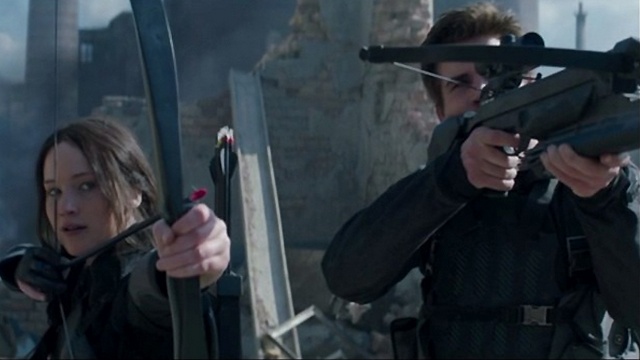
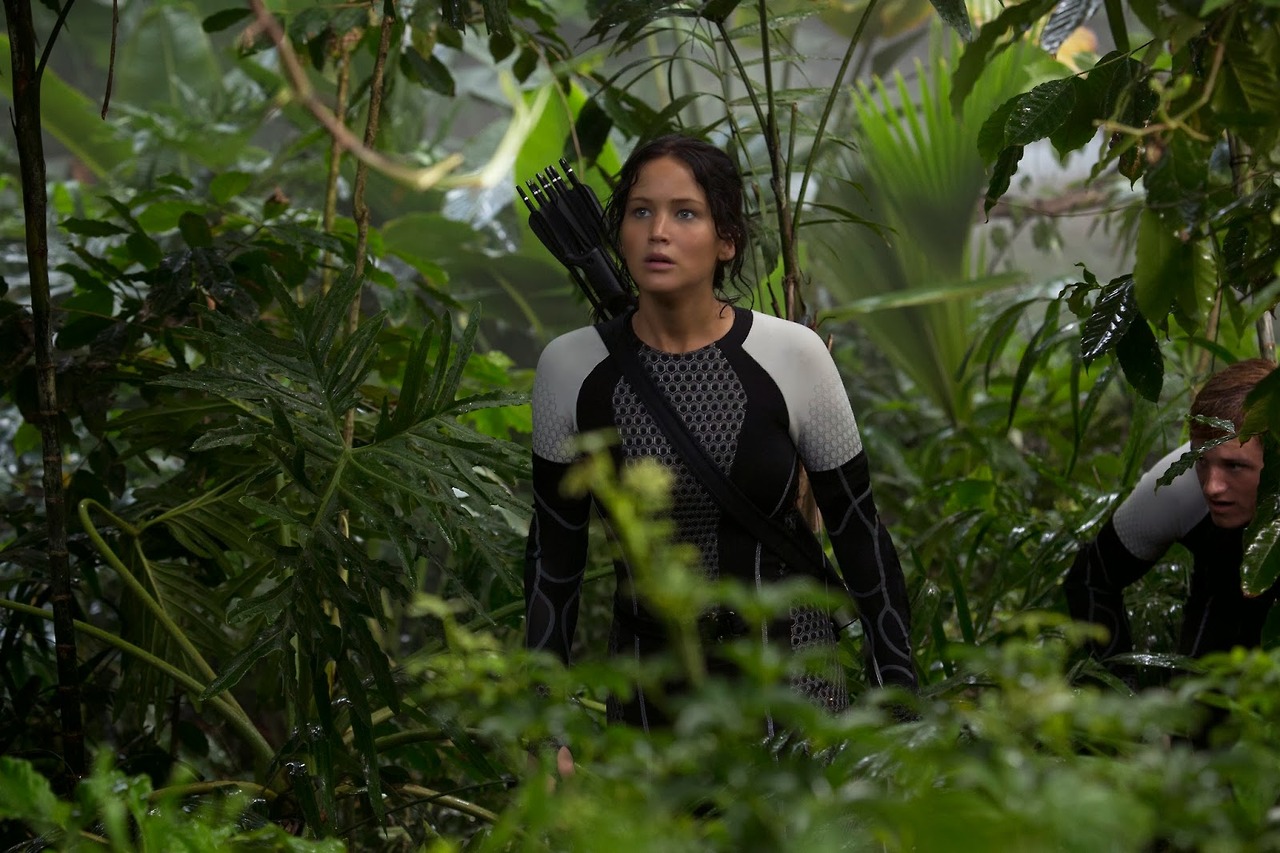
Hunger Games Mockingjay Part 1, The - scene

It’s a rare movie in any franchise that opens with two scenes showing characters in utter despair, but The Hunger Games: Mockingjay Part 1 is so confident in its set up, and what it needs to do in this necessarily darker episode, that these two scenes act both as a brief summation of where the story has been and where it is now. It’s also exposition given added weight by an emotional heft that exposition generally doesn’t carry, and gives notice that the writers – Danny Strong and Peter Craig – aren’t going to take the easy route in adapting the first part of Suzanne Collins’ final book in the Hunger Games trilogy.

In fact, this is an even more carefully assembled, and thought out, screenplay than the one that made The Hunger Games: Catching Fire (2013) so effective. Here, the political machinations are more exposed, the betrayals and compromises crueller than ever, and Katniss’ sense of being alone (even with Prim (Shields) and her mother, and Gale to support her) heightened even more. It’s a movie that looks at the loss of hope and the suspension of faith, and emphasises the way in which personal sacrifice almost always comes at a cost. It’s a bleaker, more anxiety-ridden movie, and in being true to the original source, furthers the series’ own integrity.

The introduction of President Snow’s District 13 counterpart, Alma Coin, is handled incredibly well, with Moore proving an excellent choice in the role. Fans of the book will know where the narrative takes President Coin, but for now the script provides very subtle clues as to the nature of that direction, and Moore gives a clever, finely tuned performance that provides a perfect foil for Sutherland’s spider-like turn as the malevolent Panem president. (It’s a shame that the best verbal sparring is reserved for Snow and Katniss – seeing Coin and Snow exchanging words would be an intense and fascinating encounter.) Moore isn’t on screen a lot but when she is, Coin is an enticingly vivid presence.

But the focus is, of course, on Katniss, and the way in which she deals with this new direction in her life. Lawrence is an intelligent, perceptive actress and she handles the demands of the role – again – with a fierce determination that matches the character and the journey she’s making. Katniss may not be the most emotionally stable young woman you’re ever likely to meet, but she has an inner strength that Lawrence brings to the fore with accomplished ease. Watching her reaction to the horrors of a devastated District 12 shows just why it’s now so difficult to imagine anyone else in the role, so completely does she inhabit the part.

The rest of the characters share varying amounts of screen time, with Gale having a larger part to play this time round, and Effie Trinket (Banks) also benefitting from an expanded role (that wasn’t in the novel; Banks’ previous performances convinced Collins the character needed to be more involved in the final two movies). A newly sober Haymitch (Harrelson) proves less effective as a character, but the actor rises to the challenge of providing the same (required) turn in each movie. Heavensbee reveals himself to be a clever, thoughtful manipulator, and Hoffman has fun with the role, a genial smirk never too far from his features. The relationship between Katniss and Prim continues in the same fashion as before, with their mother still given a background role, and Katniss’ affection for Gale is barely mentioned, leaving her (presumed) love for Peeta to take centre stage. This dynamic, always in doubt during the previous two movies, begins to coalesce into something more tangible here, and leads to one of the most heart-rending, and shocking, scenes in the series so far.

Returning to the director’s chair, Lawrence continues to be a wise choice for the hot seat, and keeps the focus on the characters and their relationships to each other, emphasising the emotional ups and downs that Katniss has to overcome, and the difficult path she has to take as the rebels’ figurehead. Lawrence also keeps the action on point, each sequence plotted and designed for maximum effect, and he brings the other featured districts to life with a well thought out economy. There’s another stirring score courtesy of James Newton Howard, and Jo Willems’ photography maintains the visual style of the previous movie while adding a grittier sheen to things.

Rating: 9/10 – with one more movie to go, The Hunger Games: Mockingjay Part 1 is a memorable, thrilling addition to the series, and perfectly sets up Part 2; with a handful of superb performances, and a director firmly in control of the material, this instalment stands as a perfect example of how to make a bridging chapter relevant and exciting in equal measure.
Share this:

  • Share on X (Opens in new window) X
  • Share on Facebook (Opens in new window) Facebook
  • More
  • Print (Opens in new window) Print
  • Email a link to a friend (Opens in new window) Email
Like Loading...

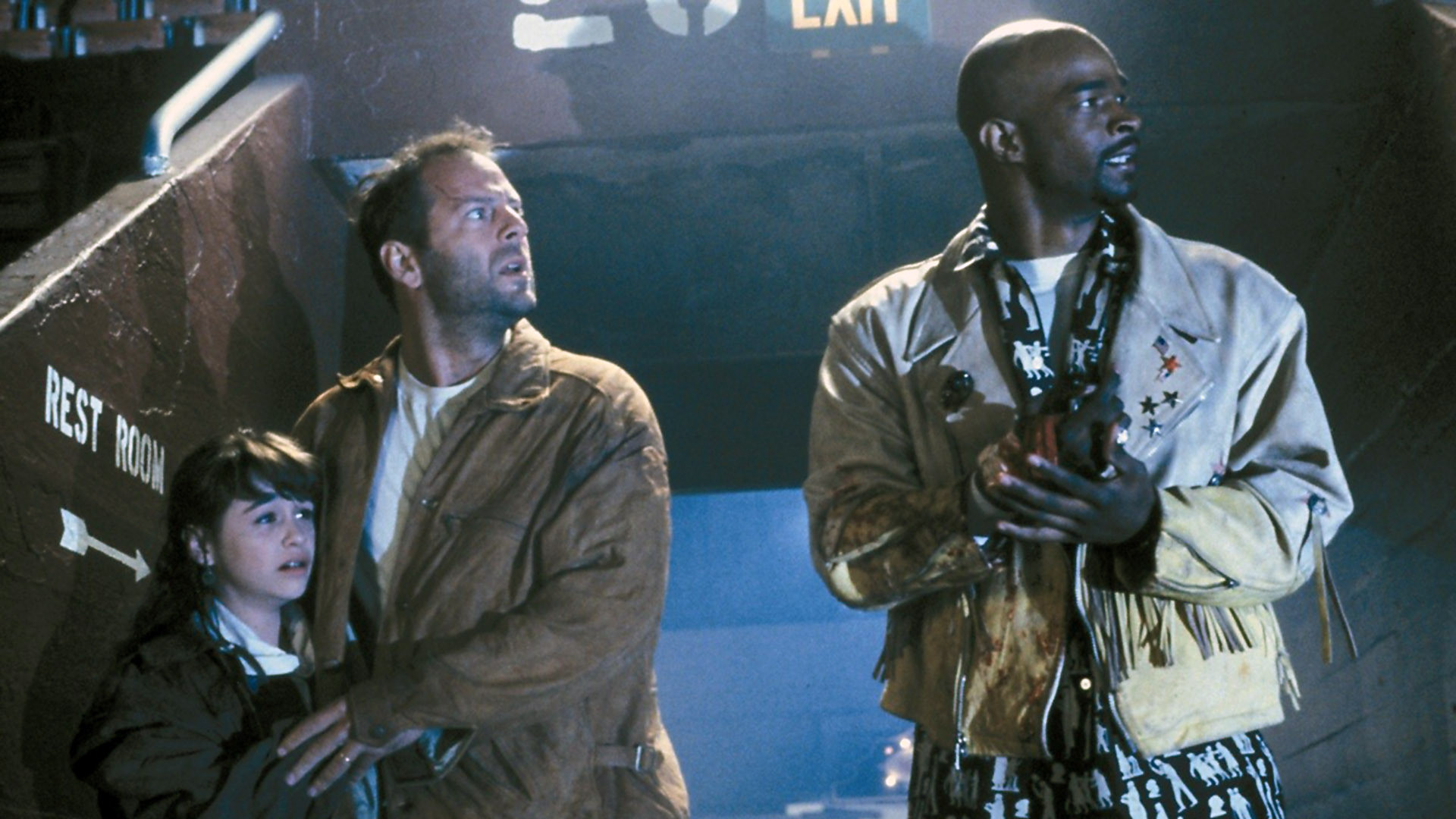
Lethal Weapon 4 (1998)

20 Thursday Nov 2014

Posted by dullwood68 in Movies

≈ Leave a comment

Tags

Action, Chris Rock, Counterfeit money, Danny Glover, Human trafficking, Jet Li, Joe Pesci, Martin Riggs, Mel Gibson, Police, Rene Russo, Review, Richard Donner, Roger Murtaugh, Sequel, Thriller, Triads

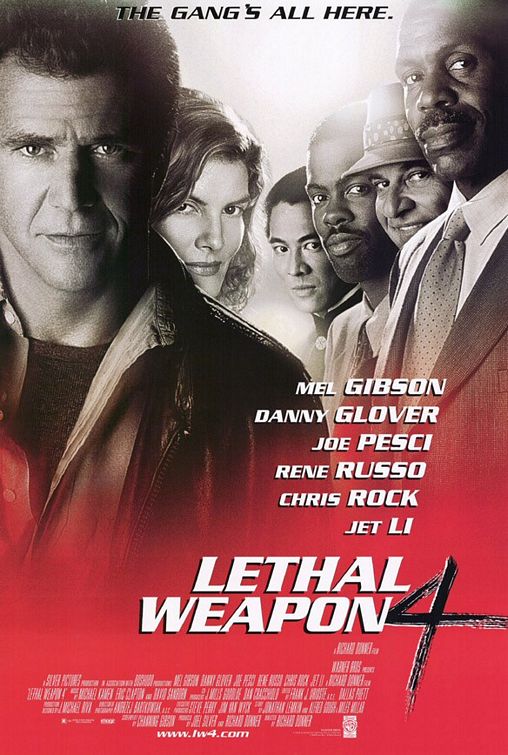
Lethal Weapon 4

D: Richard Donner / 127m

Cast: Mel Gibson, Danny Glover, Joe Pesci, Rene Russo, Chris Rock, Jet Li, Steve Kahan, Kim Chan, Darlene Love, Traci Wolfe, Eddy Ko

An incident involving an iron-suited, flamethrower-wielding criminal leads to two revelations: that Roger Murtaugh (Glover) is going to be a grandfather, and that Martin Riggs (Gibson) is going to be a father. Nine months later the two men are looking forward to the imminent births. Out one night on Roger’s boat, and accompanied by Leo Getz (Pesci), they find themselves nearly struck by a cargo freighter. When the freighter’s crew opens fire on them, Riggs takes the fight to them and boards the vessel. The ship eventually runs aground and the cargo hold reveals a group of Chinese illegal immigrants.

Later, Murtaugh discovers a family hiding in one of the lifeboats. Instead of letting INS know, he allows them to come home with him (but he doesn’t tell Riggs; he also doesn’t tell the investigating officer, Butters (Rock), who is secretly the father of Roger’s grandchild). In Chinatown, triad boss Uncle Benny (Chan) has a visitor in the form of Triad negotiator Wah Sing Ku (Li). Wah has been expecting the family Roger has discovered, as they are an important part of his plan to free four Triad overlords (including one who is his brother) from the clutches of a corrupt Chinese general. The head of the family, Hong (Ko), has an uncle who is a master engraver; Wah aims to buy the overlords’ freedom with counterfeit money.

Riggs and Murtaugh are given promotions to captain, and they start to help Butters with his investigation. A visit to Uncle Benny sees them meet Wah but they don’t find out who he is. Leaving Leo to trail Uncle Benny, Riggs and Murtaugh are unaware of just how close they’re getting, but it’s close enough for Wah to find out where the family are hiding and to abduct them – and then to put Riggs, his partner Lorna (Russo), Murtaugh and his wife (Love) and pregnant daughter (Wolfe) in danger of being burned alive. They all manage to escape unharmed, and with Butters in tow, Riggs and Murtaugh track down Uncle Benny at his dentist’s. With the use of some nitrous oxide, they get Uncle Benny to reveal the plot involving the Four Fathers (the triad overlords). When they liaise with other detectives who work the Chinatown beat, the three men learn about the corrupt Chinese general and where the exchange is likely to take place. Interrupting the meet, they spill the beans about the money, and a vicious firefight breaks, along with a three-way showdown between Riggs, Murtaugh and Wah.

Lethal Weapon 4 - scene

The last in the series, Lethal Weapon 4 could, and perhaps should, have been a whole lot worse, but it’s a measure of the likeability of the characters, and the directorial flair of Richard Donner that, while it may still be the least in the series, it’s also an entertaining ride that will put a smile on fans’ faces. The familiarity of the material and the verbal sparring between Riggs and Murtaugh (however predictable), along with the extended action sequences and the often slapstick comedy, makes this the celluloid equivalent of being wrapped up in a nice, warm blanket on a cold winter’s evening. It’s a huge comfort to know that everything you could want from a Lethal Weapon movie is all present and correct.

With all the series’ highlights in place, the movie does meander in places, mostly when it’s trying to acknowledge the fact that its characters are getting on a bit and are “getting too old for this shit”. Given that this is the fourth in the series, and also given that there’s been a clear decision to end the franchise before it gets too derivative and stale, this acknowledgment is a welcome development. It makes for a satisfactory conclusion to the series, but all the angst and drama of the first two movies – already lessened in Lethal Weapon 3 (1992) – has now been left behind completely. Riggs’ journey from near-suicidal nut job to devoted family man is complete, while Murtaugh is a proud grandfather whose anxiety about the loss of material things (usually his car, this time round his boat) and whatever can go wrong actually doing so, is more accepting of what Fate throws at him. These are now very settled men, and while it’s heartening to see them take on the bad guys one last time, this is a movie that – fortunately – realises it’s time to call it a day.

As lighthearted – and lightweight – as it is, Lethal Weapon 4 still does its best to deliver where it matters most: in the action sequences. The opener, with its exploding tanker and fiery devastation, is as preposterous as it sounds, but is still an impressive start to the movie and at least reassures the viewer that it’s going to be business as usual. There’s the obligatory car chase with its detour aboard a trailer, a foot chase that ends with Riggs dangling from a roof, a well choreographed fight at the Murtaugh home that showcases Li’s martial arts skills, and a climactic shootout that evolves into the three-way showdown mentioned above. All are expertly shot and cut together, and all are exciting to watch, but the familiarity they bring with them makes them less than memorable. It’s a shame, but draws attention to the fact that familiarity doesn’t always breed originality.

It’s difficult as well to bring anything new to the table with such well established characters, and while Gibson and Glover are still as enjoyable to watch as always, there’s more than a hint of tiredness in their banter, as they rework old lines and try to maintain the jokiness of previous outings. This leads to some awkward dialogue being exchanged – mostly around Murtaugh’s belief that Butters is attracted to him – and a sense that all the in-jokes and series’ references were included at the expense of more original material. It’s a trade-off, no doubt willingly made by Donner and the producers, but leaves the movie feeling a little jaded and occasionally lacklustre.

On the performance side, everyone acquits themselves well, particularly Pesci who’s given a completely out of character monologue towards the movie’s end that is surprisingly effective, and Li who provides Riggs and Murtaugh with the series’ first truly formidable adversary. Two scenes aside, Russo is reduced to hovering in the background, while Rock plays Butters as an earnest, slightly duller version of the man Murtaugh may have been when he was younger. Behind the camera, Donner plays ringmaster with his usual skill and expertise, while Andrzej Bartkowiak does a great job in making even the static shots interesting to watch. And no Lethal Weapon movie would be complete without the musical collaboration of Eric Clapton and Michael Kamen, here adding another familiar element with their jazz-infused score.

Rating: 7/10 – the tag line reads “The gang’s all here” and they are, along with all the other “best bits” of the series, in a movie that could have been called Lethal Weapon’s Greatest Hits; fun, if a tad too long thanks to its need to wrap things up, Lethal Weapon 4 is still an enjoyable diversion and provides an admirable send off for its two aging heroes.

Share this:

  • Share on X (Opens in new window) X
  • Share on Facebook (Opens in new window) Facebook
  • More
  • Print (Opens in new window) Print
  • Email a link to a friend (Opens in new window) Email
Like Loading...

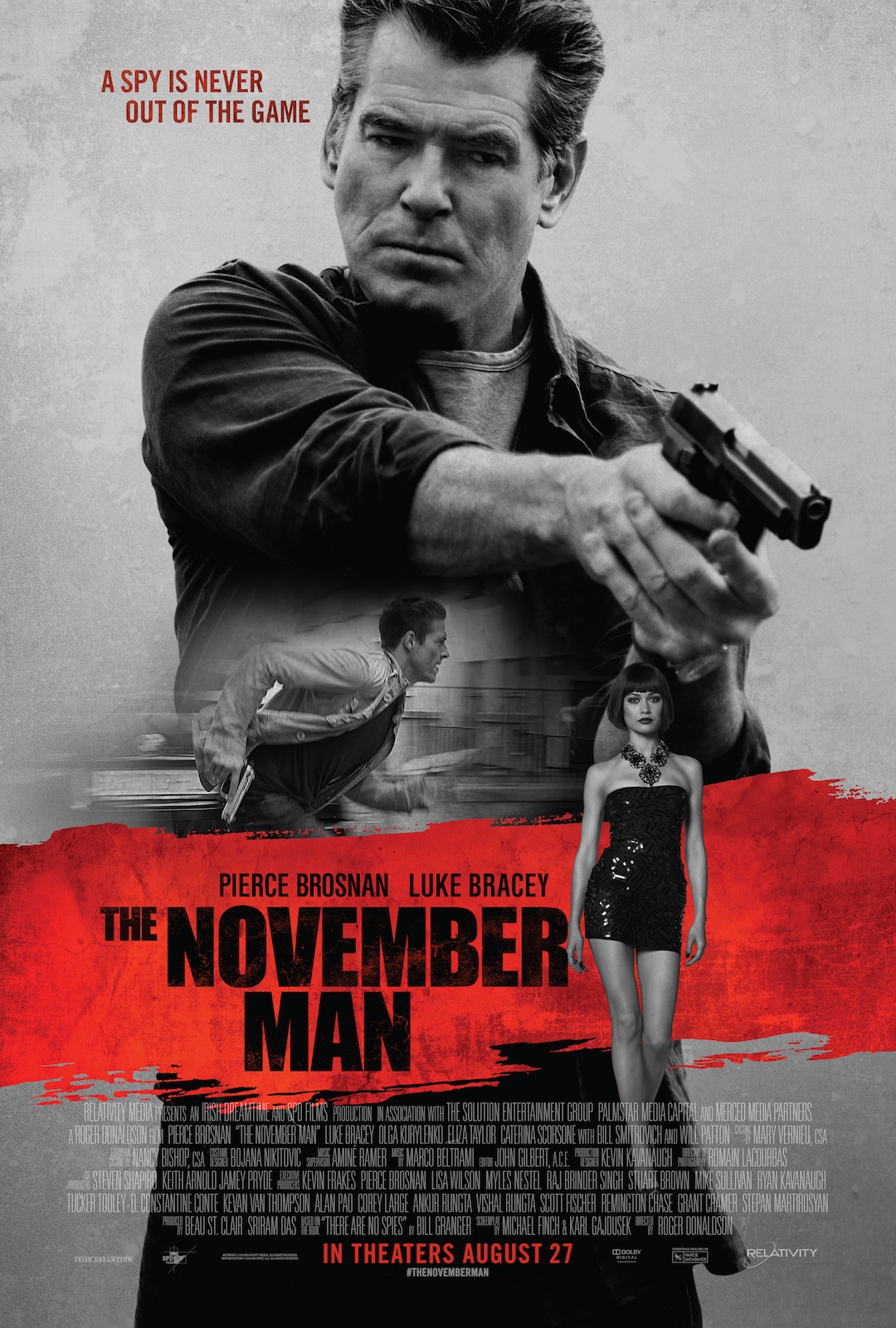
The November Man (2014)

15 Saturday Nov 2014

Posted by dullwood68 in Movies

≈ Leave a comment

Tags

Action, Belgrade, Bill Smitrovich, Chechnya, Drama, Luke Bracey, Moscow, Olga Kurylenko, Pierce Brosnan, Review, Roger Donaldson, Spies, Thriller, War criminal

November Man, The

D: Roger Donaldson / 108m

Cast: Pierce Brosnan, Luke Bracey, Olga Kurylenko, Bill Smitrovich, Lazar Ristovski, Eliza Taylor, Caterina Scorsone, Will Patton, Mediha Musliovic, Amila Terzimehic, Patrick Kennedy

Montenegro, 2008. CIA agent Peter Devereaux (Brosnan) and his protegé David Mason (Bracey) are on an assignment to stop the assassination of a visiting dignitary. Devereaux takes the man’s place and while they identify and kill the would-be assassin, it comes at a price: Mason’s lack of experience causes the death of a young boy.

Lausanne, 2013. Devereaux is now retired and owns a small lakeside cafe. One day he’s approached by his old handler, Hanley (Smitrovich), with a job. Devereaux’s ex-lover, Natalia (Musliovic) is in trouble. She is in Moscow working undercover as an aide to Russian President-elect Arkady Federov (Ristovski). Natalia has uncovered intelligence that she says will destroy Federov’s chances of becoming president, but won’t reveal any details unless she’s extracted. Devereaux agrees to get her out. On the day of the extraction, Natalia obtains the evidence she needs against Federov but her actions are discovered. With her position compromised, and with Federov’s men chasing her, she evades capture long enough for Devereaux to find her. However, Hanley’s superior, Weinstein (Patton) gives an order that leads the extraction team – led by Mason – to kill her.

Devereaux kills the rest of Mason’s team but leaves him alive. While Mason is tasked with tracking down his mentor – Weinstein believes Devereaux and Hanley are in collusion, but doesn’t know why – Devereaux seeks to find out just what was going on in Moscow and why Natalia was killed. Using the evidence she gathered and was able to give him before she died, Devereaux tries to find a young woman named Mira Filipova; she is the only witness to war crimes Federov committed in Chechnya, and he will stop at nothing to silence her. With the only clue to her whereabouts being her association with a Belgrade women’s aid centre, Devereaux – and an assassin (Terzimehic) sent by Federov – attempts to find out more from centre worker Alice Fournier (Kurylenko). They go on the run together, chased by both Federov’s assassin and Mason, but managing to stay one step ahead of both. Along the way Devereaux tests Mason’s resolve, learns the truth about Federov’s involvement in a bombing that started the Chechnya war, and finds his twelve year old daughter, Lucy, put in harm’s way.

_LAS9652.NEF

An old-fashioned spy thriller where the Russians are – ostensibly – the bad guys, and the CIA is equally corrupt, this adaptation of the novel There Are No Spies by Bill Granger (and the seventh in a series of novels featuring Devereaux) has a simple, retro feel to it, but the now over-familiar Belgrade locations and haphazard plotting, as well as some disastrous attempts at characterisation, leave the movie looking and feeling disjointed and ill-conceived. From its opening sequence, The November Man makes a valiant attempt to bring the viewer on board but then keeps them at a distance thanks to its unfailing ability to jettison credibility at every turn.

Despite the retro feel – at one point Devereaux picks a lock the old-fashioned way – The November Man makes the occasional attempt to appear and feel relevant, but making Devereaux seem like an ageing Jason Bourne merely highlights the scarcity of original thought on display. The script, by Michael Finch and Karl Gajdusek, is littered with ill-considered and poorly written scenes that fail to advance the plot, and which give the impression that, rather than adapting Granger’s novel, they were making things up as they went along. There’s one very disturbing, completely out of left field scene where Devereaux cuts the femoral artery of Mason’s neighbour, Sarah (Taylor), leaving her to die unless Mason saves her (and doesn’t pursue his mentor). It’s an incredibly stupid scene, badly written and directed, and serves only to show how determined the movie is to get it wrong.

The basic plot is sound if unoriginal – someone in the CIA colluded with Federov to instigate the war in Chechnya, but who? – but somewhere along the way the need to add in as many convoluted twists and turns as possible has distorted the movie’s focus and made it more ludicrous than convincing. There’s also some wildly absurd action beats that defy logic, such as when Mason drives at full speed into a wall in order to kill the agent he’s riding with (don’t ask!); seconds later, Mason’s running away from the crash as if nothing’s happened.

Against all this, not even Brosnan can rescue things, even when running along alleyways and hotel corridors like he did in his Bond days. He’s also tasked with constantly looking aggrieved (and judging by how badly the movie’s turned out, he probably knew something was up during filming), but it’s the continual change back and forth between cold-blooded killer and sensitive family man that fails to have any impact. Thanks to the script, Brosnan is effectively playing two different Devereauxs, but they don’t fit together (not even once), leaving the actor struggling to combine the two into one recognisable character. It’s no surprise then that the rest of the cast fare equally badly, though Bracey deserves special mention for the woodenness of his expressions and the awkwardness of his line readings. Kurylenko has a little more to do than be the female lead who gets to “stand-next-to-the-star-and-look-pretty”, and Smitrovich does aggressive even when the script doesn’t call for it.

In the end, The November Man is a soggy mess of a movie that does just enough to hold the attention but without putting in too much effort. Donaldson directs as if he’s only seen every other page of the script, and the location photography by Romain Lacourbas is perfunctory, leaving the backdrop of the movie looking less than interesting. And John Gilbert’s editing lacks the necessary punch and energy to make the action scenes anything more than humdrum and predictably constructed.

Rating: 4/10 – weak in almost every department, The November Man is a dire attempt at replicating the kind of spy thrillers that popped up every other month throughout the Eighties; it doesn’t work here, and hasn’t done in any of the three hundred similar movies that Steven Seagal has made in the last ten years either.

Share this:

  • Share on X (Opens in new window) X
  • Share on Facebook (Opens in new window) Facebook
  • More
  • Print (Opens in new window) Print
  • Email a link to a friend (Opens in new window) Email
Like Loading...

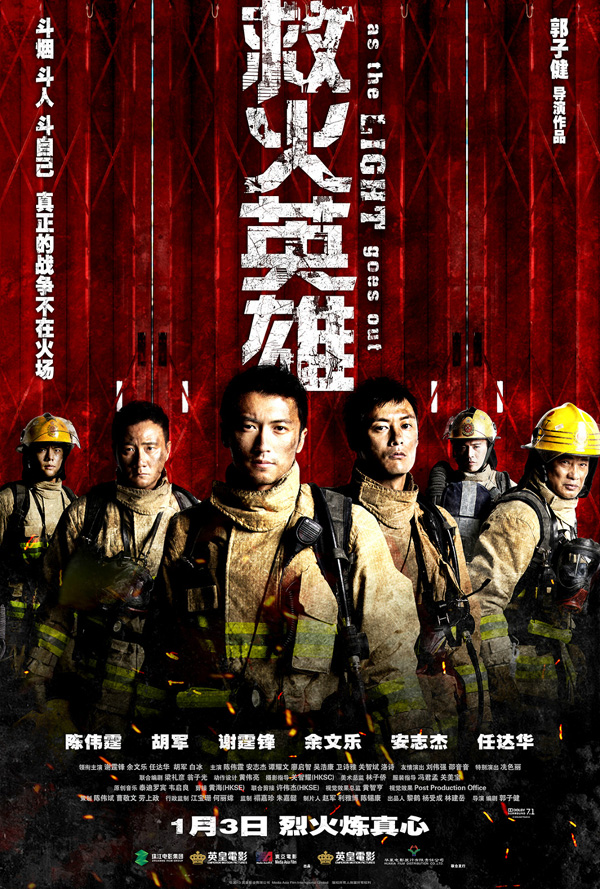
As the Light Goes Out (2014)

12 Wednesday Nov 2014

Posted by dullwood68 in Movies

≈ Leave a comment

Tags

Action, Black smoke, Chi-kin Kwok, Drama, Firefighters, Hong Kong, Ju Hun, Nicholas Tse, Power station, Review, Shawn Yue, Simon Yam

As the Light Goes Out

Original title: Jiu huo ying xiong

aka Final Rescue

D: Chi-kin Kwok / 115m

Cast: Nicholas Tse, Shawn Yue, Simon Yam, Hu Jun, Bai Bing, William Chan, Andy On, Patrick Tam, Liu Kai-chi, Deep Ng, Michelle Wai, Kenny Kwan, Alice Li, Jackie Chan, Andrew Lau, Susan Shaw, Bonnie Xian

Three Hong Kong firefighters – Sam (Tse), Chill (Yue), and Yip (On) – ignore basic safety rules when dealing with a fire and are brought before a disciplinary hearing to answer for their actions. Chill takes the blame but the trio’s friendship is undermined by the experience, as it was Yip who should have admitted it was his decision to ignore the rules.

A year later it’s 24 December and Hong Kong is experiencing the hottest, most humid weather in recorded history, with the soaring temperatures and an approaching typhoon set to make conditions potentially very dangerous in the coming days. At Lung Kwu Tan fire station it’s Sam’s last day before transferring to another station. It’s a bittersweet occasion as he still works with Chill and Yip (who’s now his station boss). At the same time a new firefighter, a transfer from the mainland called Ocean (Jun), is in his early forties and quickly earns the animosity of Chill when he overreacts to a minor situation at the station.

Meanwhile, Lee’s son, Water (Vincent Lo) is on a school trip to the nearby Pillar Point power station. Along with another station, Pillar Point is responsible for around eighty per cent of the power for Kowloon but while the plant supervisor Man (Tam) is convinced of its capabilities, others are not so certain with the impending weather conditions about to converge. When a fire breaks out in a winery that is adjacent to the main gas pipe that feeds the power station, Sam and his team deal with the fire but have reservations as to whether or not they’ve fully dealt with the situation. Overruled by Yip, Sam remains doubtful but returns to the station.

While Water and his schoolmates are waiting to leave the power station, Sam’s doubts about the winery grow and while Yip is away at a function, he decides to return to the site. The winery warehouse proves to be alight and when efforts to shut off the gas pipe fail, the resulting explosion sends fiery shock waves along the pipe and into the power station, causing devastation and trapping Water and two of his schoolmates, as well as Man, two of his colleagues, and Tao (Yam), a fellow firefighter. Sam must mount a rescue mission to save them, all while encountering situations and dangers that preclude following the rules.

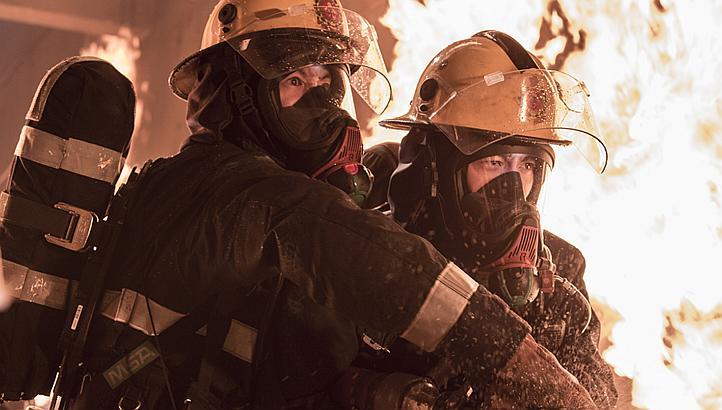
As the Light Goes Out - scene

Impressively mounted, As the Light Goes Out is the kind of disaster movie where the characters’ personal issues and their fears and insecurities are set out carefully from the beginning, only to be abandoned once a big fire breaks out. In fact, it’s the movie’s first half where the rivalries and animosities, all bubbling below the surface for the most part in true Hong Kong fashion, are explored that grabs the attention, even when the winery and its unfortunate location re: the gas pipe is discovered. While the viewer waits for the gas pipe to explode and the devastation to begin, the characters fall in and out with each other, and mistrust is either added to or begun. It’s the potential for emotional disaster that’s more intriguing: whether or not the raft of personal issues will override professional ethics and make the rescue effort more difficult.

Alas, under Kwok’s direction, the sterling effort put into setting up the characters – and Sam in particular – is put aside in favour of the type of selfless heroics that often defy logic and make the viewer wonder what all the fuss of the first hour was for. Even the callow Man steps up to the plate and has his moment of heroism, and while it makes a change to see such a rote character prove less than cowardly, when everyone is working together it actually lessens the drama; you need that sense that someone is going to endanger everyone else at some point in order to increase the tension. As it is, characters do die – one very, very predictably – but the movie lacks any emotional resonance on these occasions, and quickly moves on to the next dangerous situation with barely a backward glance.

As for the disaster itself, there’s the usual inevitability of man’s hubris coming back to bite him in the ass, and the pyrotechnics are suitably impressive, though the scale doesn’t seem quite as spectacular as it might have been. Once the gas pipe explodes and the power station blows up, the main enemy isn’t the fires that sporadically populate the inside of the station but the black smoke that seems to move around with a will of its own. Treated almost like a character itself, the smoke is ever-present at times but rarely proves a viable threat, so the rescuers and the rescued face peril instead from a variety of dangerous obstacles and missing walkways they have to find their way around. Cue some low-key heroics and hastily improvised solutions, and a sense that Jill Leung and Yung Tsz-kwong’s script was originally a firefighter drama that wasn’t intended to be the disaster epic it’s aiming for.

Uneven then, and with moments of unnecessary reflection amidst all the carnage, As the Light Goes Out isn’t the compelling drama it wants to be, and there’s too much that’s perfunctory to lift it out of the doldrums it runs into every now and then. The cast perform well but ultimately are restrained from doing any better because of the script’s need for them to become action heroes. Kwok’s direction is equally uneven and the pacing is off in several sequences that should be exciting but turn out to be surprisingly dull instead. There are better firefighter dramas out there – Ron Howard’s Backdraft (1991), Johnnie To’s Lifeline (1997) – and this may have had ambitions to join that select group, but sadly, the movie’s lack of focus and mishandled structure holds it back.

Rating: 5/10 – initially full of deft characterisations and engaging performances, As the Light Goes Out segues into its firefighting dramatics and promptly stalls; loud, impassioned, occasionally spectacular, this is a movie that promises much but rarely delivers (and did we really need kids in peril as well?).

Share this:

  • Share on X (Opens in new window) X
  • Share on Facebook (Opens in new window) Facebook
  • More
  • Print (Opens in new window) Print
  • Email a link to a friend (Opens in new window) Email
Like Loading...

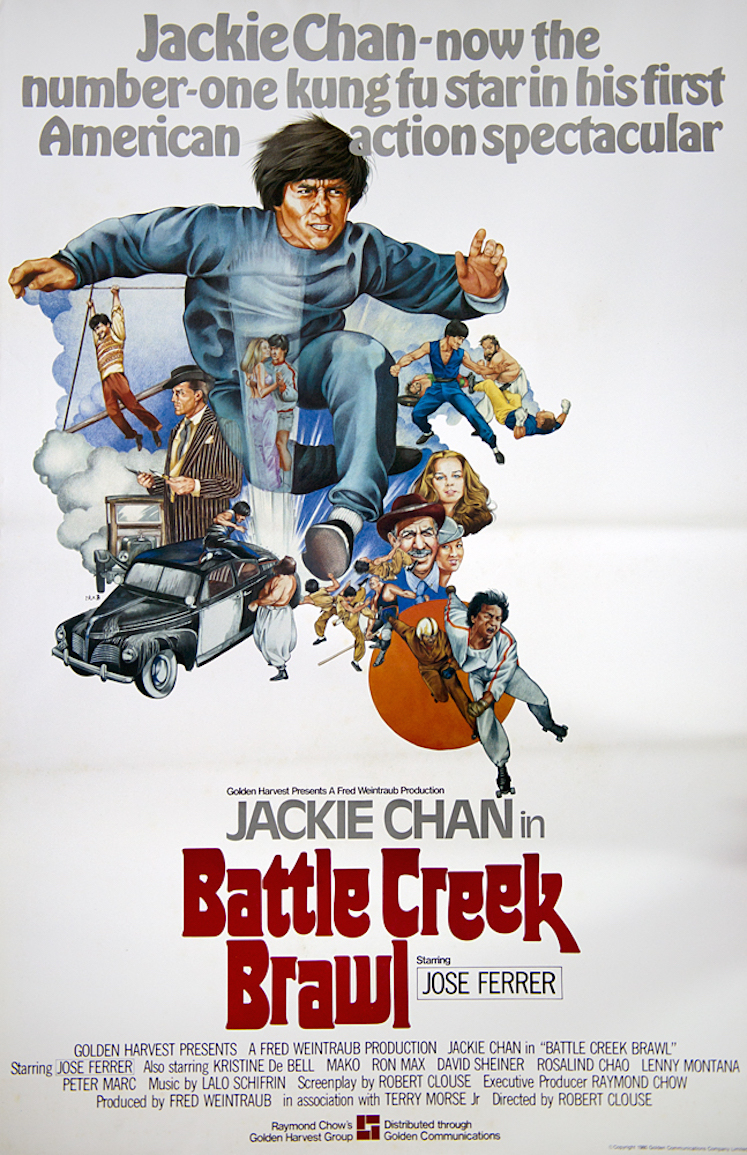
Battle Creek Brawl (1980)

11 Tuesday Nov 2014

Posted by dullwood68 in Movies

≈ Leave a comment

Tags

Action, Chicago, Drama, Golden Harvest, Jackie Chan, José Ferrer, Kristine DeBell, Kung fu, Mako, Martial arts, Protection money, Review, Robert Clouse, Thirties

Battle Creek Brawl

aka The Big Brawl

D: Robert Clouse / 95m

Cast: Jackie Chan, José Ferrer, Kristine DeBell, Mako, Ron Max, David Sheiner, Rosalind Chao, H.B. Haggerty, Chao Li Chi

In Chicago in the 1930’s, restaurant owner Kwan (Chi) is being pressured into paying protection money to gangster Dominici (Ferrer). When he receives a visit from Dominici’s henchman Leggetti (Max) and some of his goons, Kwan is physically intimidated but doesn’t pay. As Leggetti leaves, Kwan’s son Jerry (Chan) – who has considerable martial arts prowess but has promised his father he won’t fight – intervenes and leaves the goons thoroughly embarrassed and beaten by using their own moves against them.

When Dominici hears about Jerry’s prowess he believes he’s found the fighter he needs for the upcoming Battle Creek Brawl, a street fighting contest held in Texas. Dominici needs Jerry to combat the fighter backed by rival gangster Morgan (Sheiner), but Jerry  refuses at first. This leads Dominici to have Jerry’s brother’s fiancee (Chao) kidnapped and held hostage. Jerry attempts to rescue her – aided by his martial arts mentor, Herbert (Mako) – but Dominici outsmarts him; they strike a bargain though, and Jerry agrees to take part in the brawl.

Morgan, meanwhile, has persuaded Leggetti to betray Dominici and ensure his fighter’s win by kidnapping Herbert. Having made it to the final round, and facing off against Morgan’s fighter, Kiss (Taggerty), Leggetti threatens Jerry with his mentor being hurt if he doesn’t lose the contest. The only thing Jerry can do is to stall until he can find a way of saving Herbert, and then defeating Kiss.

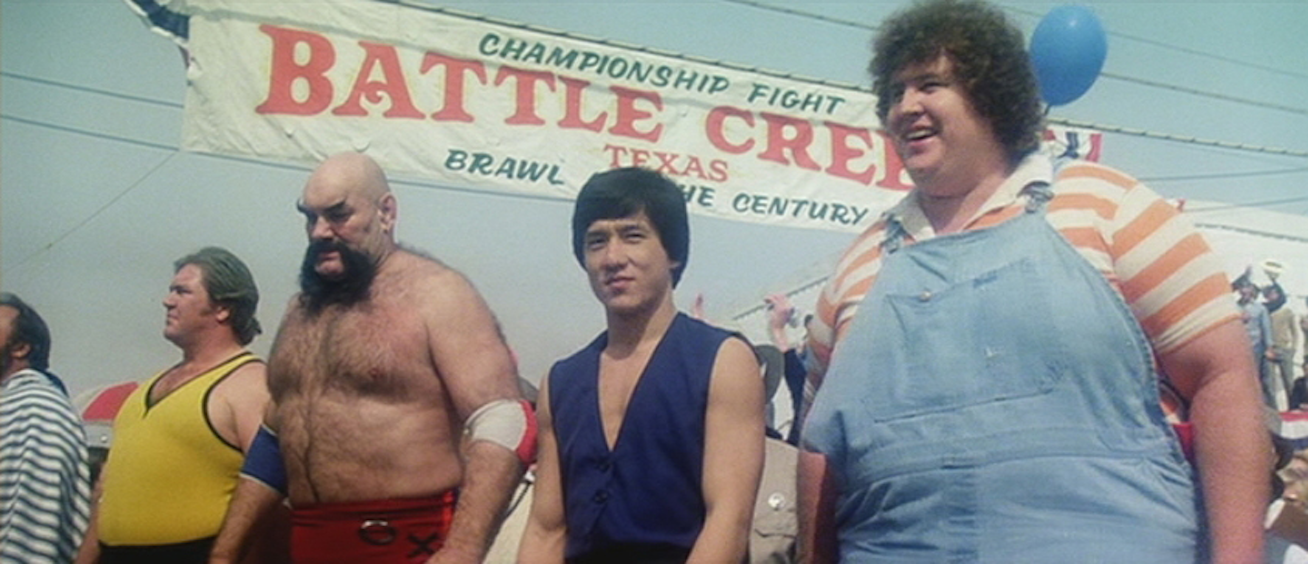
Battle Creek Brawl - scene

Chan’s first English language feature, Battle Creek Brawl is an enjoyable, free-wheeling martial arts movie that gives the diminutive star the chance to show off his athletic skills and flash the cheeky grin that’s stood him in such good stead for more than forty years. It’s a mainly lightweight distraction, unconcerned with providing any depth to the proceedings, and in many ways all the better for it. It’s a very likeable movie, made purely to entertain its target audience, and on that level it’s a complete success.

Chan’s acrobatics are given plenty of screen time, and as ever he’s a joy to watch, the sheer inventiveness and physical dexterity of his movements proving as entertaining as ever. His wonderfully expressive features and often amazing agility are placed to the fore as much as possible, and writer/director Clouse – with a few awkward exceptions – keeps the camera focused on Chan and leaves everyone else several places behind. The clever intricacy of the fight scenes, particularly the incredibly well choreographed bouts between Chan and Mako, raises the bar throughout, and if Chan’s adversaries are a little too eager to line up and take their punishment, well, that’s always going to be a drawback when working with US stuntmen – it’s a question of timing.

The movie takes place in a strange mix-world of Thirties Chicago and Seventies Texas, with only the costumes and the cars giving an indication that the brawl itself is taking place in the same time zone as the rest of the movie (keep an eye on the Texas backgrounds and you’ll see how jarring it can be). That said, the decision to make it a period piece in the first place makes no difference to the story or the action, but the apparent acceptance of Jerry’s inter-racial relationship with Nancy (DeBell) is a refreshing change (even if it does reinforce the lightweight nature of the script).

With the script’s refusal to add any real intensity to events, the performances are necessarily lacking in substance with even Ferrer struggling to add any appropriate menace to his role. He’s more like a cuddly uncle figure playing at being nasty but in as urbane a manner as possible. As his rival, Sheiner tries to add some threat to events but he’s not given enough screen time to succeed, while Max is given the chance to take on Chan, but with predictable results. DeBell is kept firmly in the background, and of the rest of the cast, only Haggerty as the dastardly Kiss, and Mako as Herbert make any real impression.

Clouse keeps the focus firmly on the fight scenes, and keeps the action moving in ever more exciting ways, and the camerawork by Robert C. Jessup – aided by editor George Grenville – is surprisingly precise and fluid in equal measure; there’s always something going on in the frame and some of it is as interesting to watch as what’s going on in the foreground, especially during the brawl itself, where there are plenty of “bits” that enrich the fights themselves. And to round things off there’s a rich, emphatic score courtesy of Lalo Schifrin that works so well with the material.

Rating: 8/10 – almost too flimsy in its construction and execution, Battle Creek Brawl is still simple yet effective, and a terrific introduction to Chan’s remarkable agility; with an innocence that borders on deliberate naïvete, the movie succeeds by having a great sense of humour and by not taking itself at all seriously – and by showcasing some tremendous fight scenes.

Share this:

  • Share on X (Opens in new window) X
  • Share on Facebook (Opens in new window) Facebook
  • More
  • Print (Opens in new window) Print
  • Email a link to a friend (Opens in new window) Email
Like Loading...

Sin City: A Dame to Kill For (2014)

01 Wednesday Oct 2014

Posted by dullwood68 in Movies

≈ Leave a comment

Tags

Action, Basin City, Corruption, Drama, Frank Miller, Guns, Jessica Alba, Joseph-Gordon-Levitt, Josh Brolin, Kadie's Bar, Marv, Mickey Rourke, Murder, Old Town, Review, Robert Rodriguez, Senator Roark, Sequel, Swords

Sin City A Dame to Kill For

D: Robert Rodriguez, Frank Miller / 102m

Cast: Mickey Rourke, Jessica Alba, Josh Brolin, Joseph Gordon-Levitt, Rosario Dawson, Bruce Willis, Eva Green, Powers Boothe, Dennis Haysbert, Ray Liotta, Christopher Meloni, Jeremy Piven, Christopher Lloyd, Jaime King, Juno Temple, Stacy Keach, Marton Csokas, Jude Ciccolella, Jamie Chung, Julia Garner

Basin City, night.  Marv (Rourke) is having trouble remembering what’s happened to him as he surveys the wreckage of two cars and the bodies of two young men lying in the road.  As the night’s events become clearer, he remembers an encounter with four young men, and being shot by one of them.  Heading for the Projects, two of the young men attempt to ambush Marv but they’re stopped by unseen assailants.  Marv kills them both and chases the other two down, bringing his memory full circle.

At Kadie’s Bar, a poker game in a back room is presided over by Senator Roark (Boothe).  Johnny (Gordon-Levitt), a drifter, invites himself into the game and wins big, earning the enmity of the Senator.  Later, Johnny has the fingers of his lucky hand broken by the Senator, and is shot in the leg as well.  Johnny swears revenge but Roark is dismissive of the threat, believing himself invincible because of the power he wields.

Elsewhere in Basin City, private eye Dwight (Brolin) receives a phone call from someone he’d hoped he’d never hear from again, old flame Ava (Green).  They meet, and she reveals she is in an abusive marriage, and is fearful for her life.  When she’s forced to leave by Manute (Haysbert), who works for her husband, Dwight decides to find out more.  He goes to Ava’s home but is caught by Manute and viciously beaten up.  Back at his apartment, Dwight receives another visit from Ava and they have sex, but again Manute arrives and takes her away.  Enlisting Marv’s help, Dwight returns to Ava’s home, where he kills her husband, Damien (Csokas), but soon realises he’s been set up by Ava who shoots him.  Marv (who’s blinded Manute in a vicious fight between the two) rescues Dwight and they get away to Old Town.  Helped by old friend Gail (Dawson), Dwight recovers and enlists her help in seeking revenge on Ava.  They return to Ava’s home to settle matters once and for all.

Johnny finds a doctor (Lloyd) to help him with his injuries and he returns to the poker game where once again he beats Roark.  His victory is short-lived as Roark turns the tables on him once more.  While Roark reclaims his standing, Nancy (Alba), a stripper at Kadie’s, plots to kill him in revenge for the death of Hartigan (Willis), a cop she cared about.  But Nancy drinks too much and hasn’t the courage to act on her anger.  In a fit of rage, she disfigures herself, which leads Marv to offer his help.  Together they make their way to Roark’s estate, where Nancy comes face to face with the Senator.

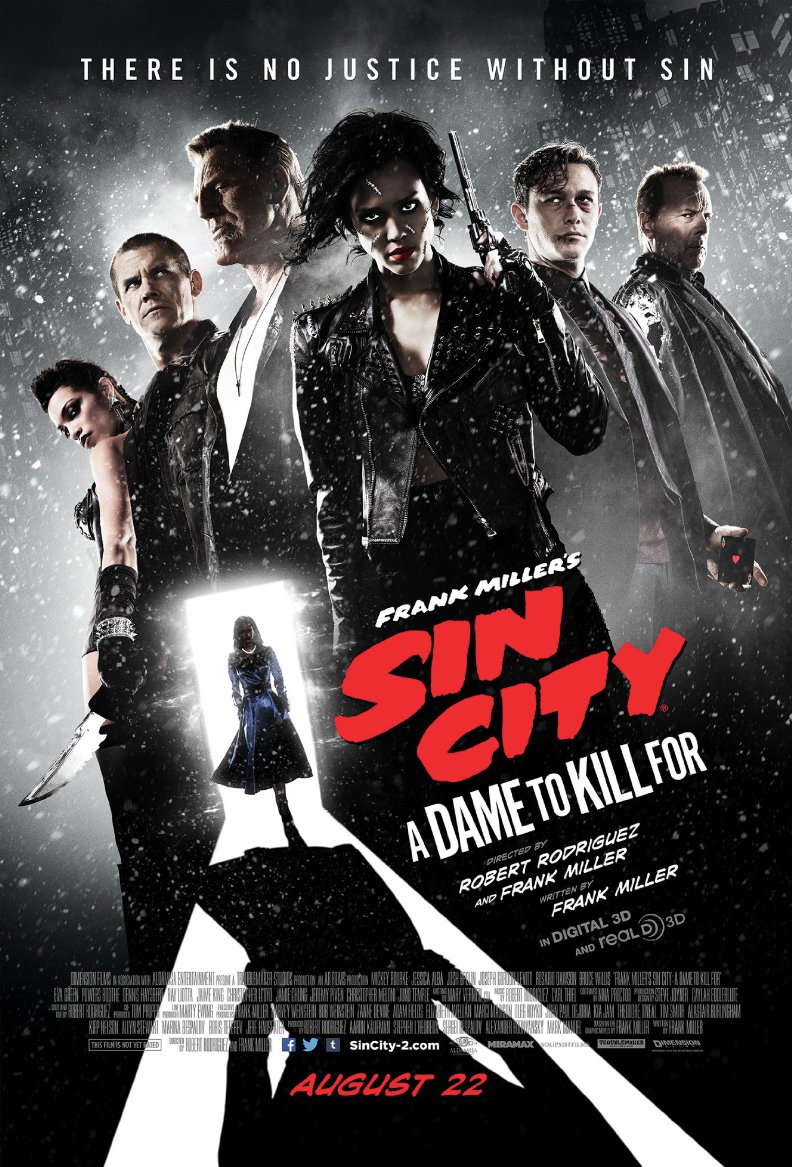
Sin City A Dame to Kill For - scene

Arriving nine years after its predecessor, Sin City: A Dame to Kill For retains many of the earlier movie’s characters, the same visual approach, hard-boiled dialogue and non-linear storytelling, and extreme bouts of violence.  As a companion piece, the movie works well, but there’s something missing from the experience: anything new.

The first movie worked precisely because it was new.  The mixture of live action and CGI, allied to heavily stylised violence and Frank Miller’s nihilistic characters, was, in its own way, a refreshing change from other violent dramas (and thankfully proved hard to duplicate).  The problem here is that Miller and Rodriguez have stuck too closely to the original formula, leaving Sin City: A Dame to Kill For looking and feeling like a greatest hits version of the first movie, rather than a bona fide sequel.  It’s disquieting to realise as you watch the movie that everything’s the same, and with that realisation it also becomes clear that this outing is going to lack the verve and complexity of Miller and Rodriguez’s first collaboration.  The tone is the same and there’s no variation.

Worse still is the lack of investment in certain characters, notably Johnny who we don’t really care about, despite his opposition to Senator Roark, and Nancy, whose bitter reluctance to act against the Senator seems forced rather than natural.  Twice she has him in her sights while performing a routine, and both times she fails to pull the trigger.  Credible?  No; and nor is Marv appearing in each storyline, and helping out in the same fashion on two separate occasions (it’s also problematical that he died in the first movie – why is he in this one?)  Hartigan returns as a ghost but makes almost no impact on Nancy’s story, while Gail and her team of female assassins are treated like bystanders.

Even the cast can’t raise this one from its slumbers, though Green makes the biggest impression, making Ava one of the most deceitful and alluring femme fatales to be seen for some time (she’s naked quite a lot as well, and shot in a fetishistic fashion that is reserved only for her).  Brolin subs for Clive Owen, and Boothe steps out from behind Rutger Hauer to play the movie’s main villain with aggressive panache.

Ultimately, the stories aren’t strong enough, or interesting enough, to resonate beyond a first viewing, and by the end, even the violence has lost its charm, becoming repetitive and – sadly – unexciting.  What’s left is an uneven mix that doesn’t know how to straighten itself out or make itself more coherent.

Rating: 5/10 – below par in pretty much every department with just enough being done to make the movie look better than it actually is, Sin City: A Dame to Kill For is a sequel that tries hard to recreate the magic of its forerunner, but never really succeeds; if a further entry is planned, Messrs Miller and Rodriguez will need to spend more time at the drawing board before committing anything to film.

Share this:

  • Share on X (Opens in new window) X
  • Share on Facebook (Opens in new window) Facebook
  • More
  • Print (Opens in new window) Print
  • Email a link to a friend (Opens in new window) Email
Like Loading...

The Equalizer (2014)

30 Tuesday Sep 2014

Posted by dullwood68 in Movies

≈ Leave a comment

Tags

Action, Antoine Fuqua, Corrupt cops, Denzel Washington, Drama, Prostitute, Review, Robert McCall, Russian mob, Thriller, TV show

EQ_DOM_1SHT_RAIN.indd

D: Antoine Fuqua / 131m

Cast: Denzel Washington, Marton Csokas, Chloë Grace Moretz, David Harbour, Haley Bennett, Bill Pullman, Melissa Leo, David Meunier, Johnny Skourtis

Robert McCall (Washington) is a quiet, reserved man who works at a hardware store in Boston and is generally well liked by his colleagues.  At home he lives a somewhat monastic, ordered lifestyle, and the only time he appears to go out is when he goes to a local diner and reads his latest book.  As a regular he gets to know Terri (Moretz), a teen prostitute with ambitions to be a singer.  When McCall witnesses her being mistreated by her pimp, Slavi (Meunier), and then she ends up in the hospital, badly beaten up, he decides to do something about it.  He pays Slavi a visit, and when negotiations don’t go as he’d hoped, he kills Slavi and four of his men.

What McCall doesn’t know is that Slavi was part of the East Coast Russian mob, and he’s singlehandedly taken out the Boston hub of that organisation.  The mob sends a fixer, Teddy (Csokas), to find the person responsible, but it takes a while, during which time McCall gets on with helping others who are experiencing crime-related problems.  When Teddy finally tracks him down, McCall decides to turn the tables on him and become the hunter instead of the hunted.  Striking at the mob’s operation while staying one step ahead of Teddy’s efforts to find and kill him, McCall reveals further aspects of a past that no one knows about, and which he keeps hidden.

When Teddy discovers a potential weakness in McCall’s character, his friendships with the people he works with, he holds them hostage and gives McCall an ultimatum: either give himself up or they all die.  But McCall has other ideas…

Equalizer, The - scene

Adapted from the US TV show that ran from 1985-1989 and starred Edward Woodward, The Equalizer is a big screen reboot that trades that series’ subtlety and clever plotting for a more direct, impactful approach, despite its slow burn opening and attempts at deft character work.  It’s a long while before McCall’s visit to Slavi, and during that time we get to see him at home, at work, at the diner, leading a normal life of sorts, but obviously lonely rather than a loner.  We learn that he’s a widower, and that he’s working his way through a list of books his wife was aiming to read before she died.  He helps a co-worker, Ralphie (Skourtis), prepare for a security guard exam, jokes with other co-workers that he was once one of Gladys Knight’s Pips, and encourages Terri to change her life and follow her dream of being a singer.  He’s kind, attentive, supportive, fair, but still a bit of an enigma.

It’s all “good stuff” and gives Washington a chance to show off his acting chops (which are considerable), and serves to introduce McCall as just more than the violent avenger he’s soon to become.  But the drawback is that once McCall faces off against Slavi and his men, all that character build-up is jettisoned in favour of a more traditional action thriller style movie, and Washington stops being Mr Average and becomes an invincible righter of wrongs.  In many ways this is unavoidable, the nature of the story giving the director and his star little option but to revert to the tried and trusted approach of blowing shit up and killing a whole bunch of stuntmen.  But thankfully, and despite the increasingly derivative nature of the narrative, Fuqua’s distinctive visual style and Washington’s reliable acting skills hold the viewer’s attention, and offset some of the more ludicrous moments (McCall walks away from a series of huge, multiple explosions at such an insanely slow pace it’s less a case of a cool looking moment than a clue that Denzel can’t run that fast anymore).

In the end, The Equalizer reveals itself as an origin story, prepping the way for potential sequels (though Washington has yet to make one).  On this evidence, any further outings will need to address the issue of how much McCall’s character will be focused on, and whether or not aspects such as his borderline OCD is dealt with (it’s featured, but isn’t developed, the same as his use of a stopwatch to time certain moments and incidents).  The storylines will need to be a bit more impressive as well, and a more serious adversary to give a much needed sense of threat; Teddy is certainly psychotic but McCall outwits and dispatches him too easily, leaving any possibility of tension or doubt about the outcome so far behind it’s practically invisible.

As a vehicle for Washington, The Equalizer is a good fit, and he’s ably supported by Csokas, Moretz and Harbour, while Pullman and Leo appear as old friends of McCall who know his history.  Richard Wenk’s script works best when focusing on McCall as Mr Average, and his relationships with Terri and Ralphie are skilfully drawn.  The action scenes are expertly choreographed (though a fight between McCall and one of Teddy’s men is scrappily edited: blows are landed but who’s being hit is mostly a mystery), and Mauro Fiore’s cinematography adds a vitality that helps counter the familiarity that builds once Slavi bites the dust.

Rating: 7/10 – although it eventually proves an entertaining introduction to Robert McCall and his “set of skills”, The Equalizer is too formulaic to have much of a genuine impact; a good vehicle for Washington but not a movie to stay in the memory for too long despite the positives (that the movie then squanders).

Share this:

  • Share on X (Opens in new window) X
  • Share on Facebook (Opens in new window) Facebook
  • More
  • Print (Opens in new window) Print
  • Email a link to a friend (Opens in new window) Email
Like Loading...

Into the Storm (2014)

16 Tuesday Sep 2014

Posted by dullwood68 in Movies

≈ Leave a comment

Tags

Action, Disaster movie, Documentary filmmakers, Donk & Reevis, Drama, Eye of the storm, Matt Walsh, Review, Richard Armitage, Sarah Wayne Callies, Silverton, Steven Quale, Titus, Tornado Hunters, Tornados

Into the Storm

D: Steven Quale / 89m

Cast: Richard Armitage, Sarah Wayne Callies, Matt Walsh, Max Deacon, Nathan Kress, Alycia Debnam Carey, Arlen Escarpeta, Jeremy Sumpter, Lee Whittaker, Kyle Davis, Jon Reep

Documentary filmmaker Pete Moore (Walsh) is having a hard time finding tornados to film for his latest project, despite help from meteorologist, Allison Stone (Callies).  When a storm warning is given out near Silverton, Oklahoma, Pete and his team rush there only for the storm to peter out.  Meanwhile, at the high school, the senior class is having its graduation day.  Assistant principal Gary Fuller (Armitage) is worried about the impending weather spoiling the day and wants the ceremony postponed.  He’s overruled and it goes ahead; partway through, the storm hits and a tornado causes damage to the school buildings and grounds.  At the same time, Fuller’s eldest son, Donnie (Deacon), is several miles away with fellow student, Kaitlyn (Carey), filming a project at an abandoned paper mill.  When the tornado hits there, they find themselves trapped beneath the debris.

Moore and his team continue to chase the ever-increasing number of tornados that keep springing up, while Fuller, accompanied by his younger son, Trey (Kress) try to rescue Donnie and Kaitlyn.  Their paths cross and they team up to find the youngsters (though Moore is still more interested in getting footage for his documentary).  They find them, but realise that a tornado the size of which has never been seen before is heading for the high school, and only they can save the people taking shelter there.

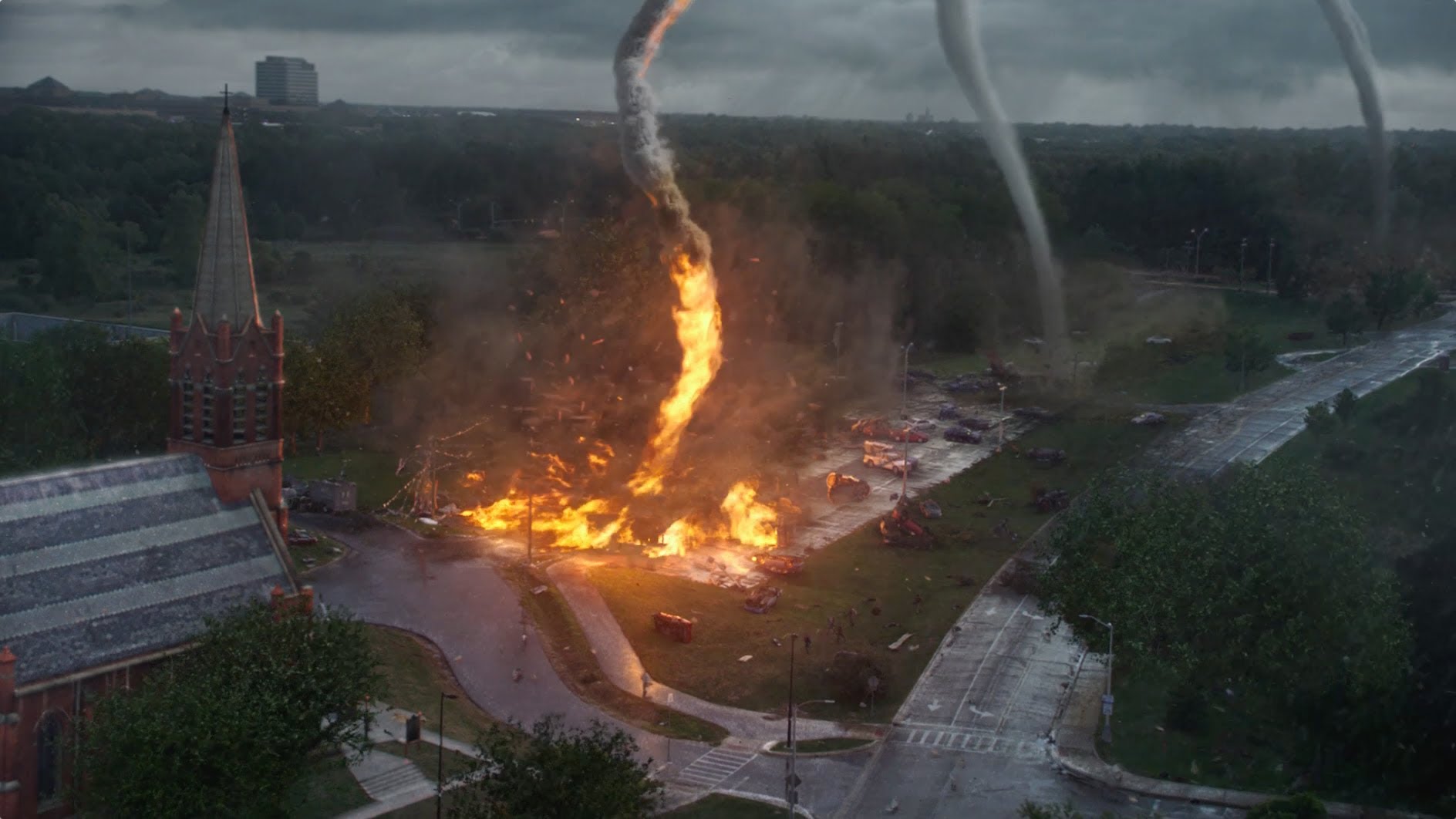
Into the Storm - scene

Into the Storm invites obvious comparisons with Jan de Bont’s Twister (1996), and while the special effects certainly look more impressive, there’s a level of detail in the earlier movie that’s missing here, and though this movie’s super-tornado dwarfs anything seen before, its scale and ferocity keeps changing (it chucks 747s around like so much matchwood, but can’t lift Moore’s tank-like tornado chaser until the screenplay says so).  What’s also missing is a decent script, John Swetnam’s attempts at excitement falling flatter than a pancake, and his characters behaving and sounding exactly like the stereotypes they are (they even behave predictably: Moore is a boorish ass for three quarters of the movie then suddenly acts selflessly – as if).

The script isn’t helped by Quale’s flaccid direction and a cast who look as if they know just how poor the script is, and have decided to do just as much as is needed to get their lines out with a minimum of effort.  Armitage is stranded in his role as the tough widower trying to raise two wayward sons, while Callies keeps stopping to (try to) have unnecessary phone calls with her five year old daughter.  And then there’s the dumbest duo on the planet, Donk (Davis) and Reevis (Reep), the redneck comic relief, who put themselves in harm’s way in the hope of becoming famous on YouTube.

While the movie aims for incredible scenes of destruction in between the banal theatrics of its characters, Into the Storm ultimately fails because there’s no one to care about, and the tornado scenes are about as thrilling as watching ice cream melt.  But it is a short movie, and while the decision to shoot found footage-style adds a level of immediacy to the devastation, it’s not enough to rescue the movie from falling far short of where the cow ends up.

Rating: 3/10 – adequate special effects and a mercifully short running time can’t make amends for the paucity of imagination and delivery on show here; the only area in which Into the Storm succeeds is that it’s a step up from being a SyFy Channel release.

Share this:

  • Share on X (Opens in new window) X
  • Share on Facebook (Opens in new window) Facebook
  • More
  • Print (Opens in new window) Print
  • Email a link to a friend (Opens in new window) Email
Like Loading...

Lucy (2014)

15 Monday Sep 2014

Posted by dullwood68 in Movies

≈ Leave a comment

Tags

Action, Brain function, CPH4, Drug mules, Luc Besson, Min-sik Choi, Morgan Freeman, Mr Jang, Paris, Review, Scarlett Johansson, Taiwan

Lucy

D: Luc Besson / 89m

Cast: Scarlett Johansson, Morgan Freeman, Min-sik Choi, Amr Waked, Julian Rhind-Tutt, Pilou Asbæk, Analeigh Tipton

In Taiwan, Lucy (Johansson) is coerced by her week-long boyfriend, Richard (Asbæk) into delivering a mysterious briefcase to a man called Mr Jang (Choi) at his hotel.  While she waits in reception, she sees Richard killed outside, and then finds herself grabbed and brought to Jang’s room.  The briefcase is opened to reveal four bags of a blue substance.  The substance is tested on a drug addict who is then shot dead by Jang.  He then offers Lucy a job; she refuses and is knocked unconscious.  When she comes to, she finds she’s been operated on.  She’s taken to a room where there are three men who are in the same situation as she is.  Jang’s plan is explained to them: each has a bag of the blue substance inside them.  They will travel to various European destinations where the bags will be removed and they will be paid for their trouble.

Lucy is taken to a cell where she is chained to a wall.  She antagonises one of her captors and he kicks her repeatedly in the stomach, causing the bag inside her to split and release the blue substance into her body.  When another of her captors returns, she overpowers him and escapes; she is shot in the process but is able to remove the bullet without feeling any pain.  She goes to a nearby hospital where she forces a surgeon to remove the bag inside her.  When she tells him it’s something called CPH4, he tells her that it’s something produced by pregnant women at around six weeks that provides nutrients for a foetus.  He also tells her that she’s lucky to be alive with that much CPH4 having leaked into her.

Lucy returns to Jang’s hotel room where she learns the destinations of the three men. She then visits a friend, Caroline (Tipton), and uses her laptop in order to find out about brain function.  She learns about the research of Professor Samuel Norman (Freeman), and with her new abilities allowing her to manipulate electronic systems, contacts him via the television in his hotel room in Paris.  She tells him what she’s able to do and how her brain function is increasing in leaps and bounds, and that she’ll be there to see him in person in twelve hours.  At the airport she contacts French police officer Pierre Del Rio (Waked) and tells him about the drug mules, and convinces him to have them picked up when they land in Rome, Berlin and Paris respectively.

In Paris, and with the drug mules all in French police custody, they are taken to a hospital to have the bags removed.  Jang’s men arrive and grab the bags but Lucy incapacitates them and steals them back.  She and Del Rio head for the university where Norman has assembled some of his colleagues.  Jang and his men follow them and while a pitched battle breaks out in the university between the police and Jang’s men, Lucy ingests a synthesised version of the CPH4 that sees her take the next step in what has become, for Lucy at least, her evolution.

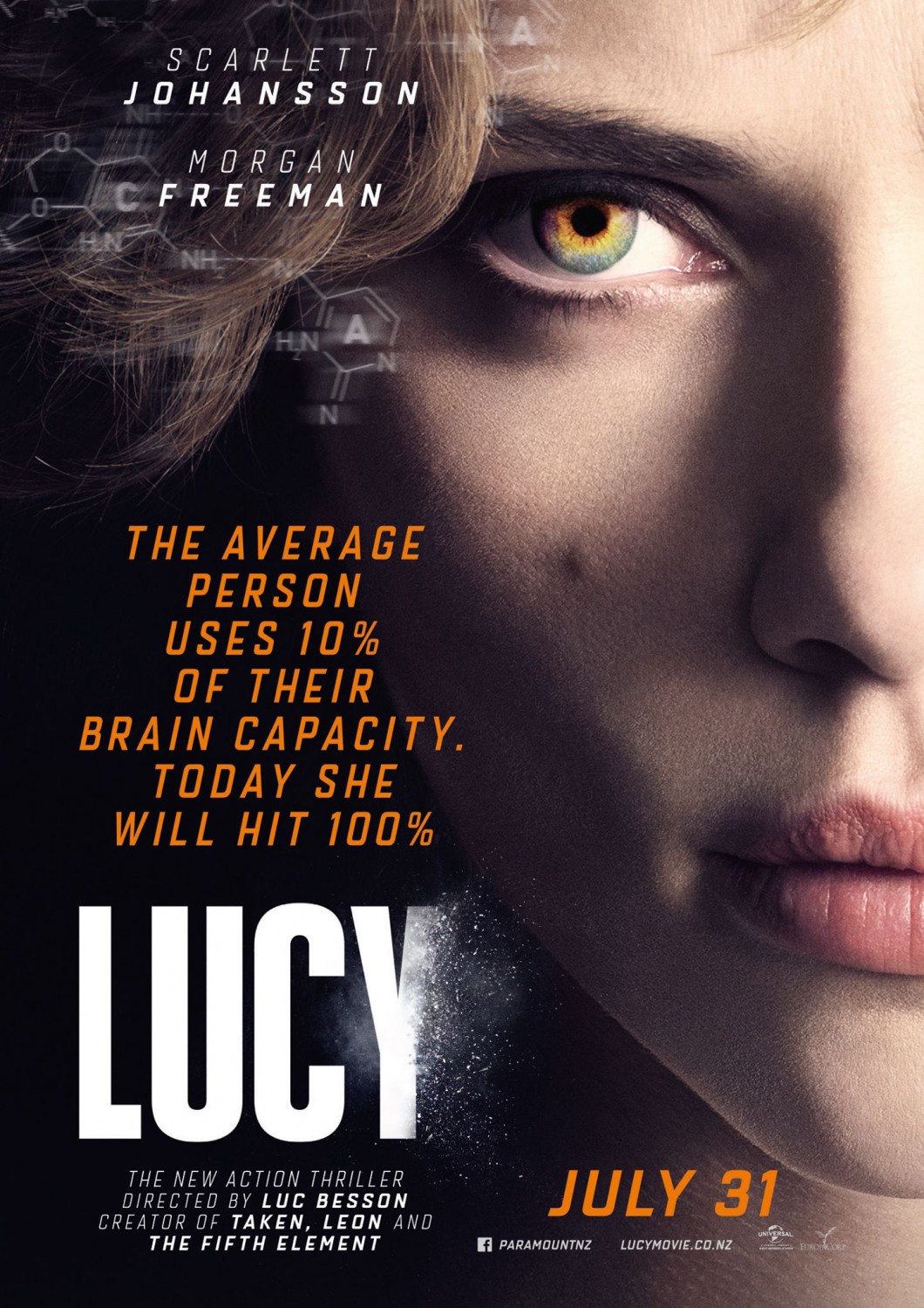
Lucy - scene

At the end of Lucy, French policeman Del Rio asks perpetually puzzled Professor Norman, “where is she?”  The answer is displayed on his mobile phone – viewers will have already guessed the answer – but it’s indicative of the movie’s less than well thought out idea about brain function that it effectively challenges not only our notions of evolution but of God as well.  If Lucy’s use of one hundred per cent of her brain means she no longer exists in human form but continues to live on some other plane of existence, then Besson (directing his own script) seems to be saying we all have the potential to be omnipotent and all-seeing.  If he is, then it means Lucy is perhaps the most philosophical and metaphysical action movie ever created.

However, while Besson is clearly a moviemaker who likes to have fun with his audiences, Lucy is not one of his better efforts, ending up as a ragbag of ideas that doesn’t make any coherent (or cohesive) sense and which often gives the impression that, like Brian in Monty Python’s Life of Brian, “He’s making it up as he goes along”.  As Lucy’s brain function expands towards one hundred per cent, she has a variety of experiences that apparently come and go, or can be turned on and off at will (and with very little effort).  These experiences also happen independently of one another, as if Besson had a tick list of cool effects he wanted to use at each stage of Lucy’s “development” (on the plane to Paris, Lucy begins to disintegrate, but the reason for this is never satisfactorily explained – but, again, it looks cool).  With this “anything goes” approach it’s to Besson’s credit that Lucy becomes less and less of an action heroine as the movie progresses, content in its later stages to just incapacitate Jang’s men and to leave the shootouts and the bloodshed to the French police.

It’s this undermining of accepted action movie devices that adds a level of originality and cleverness to proceedings – witness the car chase sequence where Lucy, driving for the first time, is merely in a hurry to get to the hospital and is unconcerned about the police cars that are trying to stop her; she’s not even trying to outrun them – but the movie’s best moment by far is perhaps it’s quietest, Lucy talking to her mother on the phone and trying to explain how she can feel things like the heat leaving her body before saying goodbye to her for the last time.  Johansson is hypnotic in this scene, and she’s equally good throughout, her questing gaze hinting at secrets that only she can see; it’s hard now to think of another actress in the role.

The rest of the cast are reduced to virtual walk-ons in Besson’s version of The Lucy Show.  Freeman essays another of his bemused expert roles but to even lesser effect than usual, while Choi (still refusing to learn English for a role) plays the urbane gangster Jang with a great deal of muted style.  Waked is little more than a bystander, and Rhind-Tutt comes in for one scene to explain Jang’s dastardly plot before disappearing back from whence he came.

On the whole, Lucy feels like an experiment in cinematic form that was forced to conform to the demands of mainstream movie-making, and as such, falls between the two disciplines.  It’s a shame, because if it had had a more judiciously constructed script, Lucy could have been 2014’s most adventurous and challenging action movie.

Rating: 5/10 – with far more intriguing ideas and concepts about the meaning of existence than it knows what to do with, Lucy is too uneven to be completely effective; but as an action movie with a mind-bending twist, Besson should be applauded for at least trying to be different.

Share this:

  • Share on X (Opens in new window) X
  • Share on Facebook (Opens in new window) Facebook
  • More
  • Print (Opens in new window) Print
  • Email a link to a friend (Opens in new window) Email
Like Loading...

Eraser (1996)

10 Wednesday Sep 2014

Posted by dullwood68 in Movies

≈ Leave a comment

Tags

Action, Arms deal, Arnold Schwarzenegger, Cyrez Corporation, James Caan, James Coburn, Review, US Marshal, Vanessa Williams, Witness Protection

Eraser

D: Charles Russell / 115m

Cast: Arnold Schwarzenegger, James Caan, Vanessa Williams, James Coburn, Robert Pastorelli, James Cromwell, Danny Nucci, Andy Romano, Nick Chinlund

John Kruger (Schwarzenegger) is a US Marshal who works for the Witness Protection programme; he “erases” people’s identities, sets them up in their new lives, and then makes sure they remain safe.  Lee Cullen (Williams) is an employee of the Cyrez Corporation, a weapons manufacturer that she suspects is selling arms to foreign terrorists.  She gains evidence of this as part of an FBI undercover operation, but the plan goes wrong and Cyrez learns of Lee’s involvement.  When killers are sent to her home, it’s Kruger who saves her.

Setting her up in a safe house until she can testify at an upcoming hearing into Cyrez’s business affairs, Kruger is approached by fellow Marshal Robert Deguerin (Caan) who tells him that witnesses in the programme are being killed; Deguerin wants his help in finding the mole who’s leaking the names.  They travel to one of Deguerin’s witnesses but unbeknownst to Kruger it’s a set up: Deguerin is the mole and he’s using the trip as a way of bringing Lee out into the open (he’s also working for Cyrez).  Kruger alerts Lee and she leaves the safe house, having previously agreed to meet Kruger at the New York Zoo.  Escaping Deguerin’s clutches, Kruger meets up with Lee and together they manage to evade Deguerin and his team.

With the information that will expose Cyrez copied to a disc, the only way Kruger and Lee can get a step ahead of everyone else is to learn what’s on the disc, but it’s heavily encrypted and the only way they can read it is to break into Cyrez’ headquarters and use one of the computer terminals.  Aided by one of Kruger’s witnesses, Johnny Casteleone (Pastorelli), they break in and discover that an arms shipment is being loaded onto a ship at the Baltimore docks that night.  They’re discovered, and as they try to escape, Lee is captured by Deguerin.  With Johnny’s help, it’s down to Kruger to stop the shipment and save Lee in the process.

Eraser - scene

One of Arnie’s later action forays, Eraser still looks good for the most part, even if it does have that Eighties vibe that is looked upon nostalgically at the moment (and which isn’t bad for a movie made in 1996).  Looking back at the movie after nearly twenty years it does have its faults – a complete disregard for logic or the laws of physics to name but two – but it also plays it seriously (Arnie’s one liners aside), letting the absurdity of the whole situation unfold with grim determination, as if by doing so the audience won’t dissolve into tears of laughter at every risible plot development (case in point: when Kruger and Lee break into Cyrez, we’re told they can only access the disk from one secured room… except they do it from an office terminal instead… which hasn’t occurred to anyone at Cyrez).  It’s this decision to play it straight that in the end allows the movie to hold up as well as it does.

Schwarzenegger glares a lot as befits a character who trusts no one (until he needs their help – so much for an elite operative who always works alone), and he strides through the movie like the enduring colossus he’s made out to be, shrugging off injury at every turn and allowing nothing to stand in his way.  It’s a commanding performance, the kind that subsequent action stars are still trying to emulate, and he carries it off with confidence and brash fearlessness.  Kruger is a throwback to the type of character Schwarzenegger played in the Eighties – Ben Richards in The Running Man (1987), Ivan Danko in Red Heat (1988) – taciturn, pitiless and single-minded.  It’s the kind of role that’s well-suited to Schwarzenegger’s abilities: short on dialogue, long on shooting people and blowing things up (though it is fun to hear him say “improvisation”, an unexpected gift from the screenwriters).

With the likes of Caan, Coburn and Cromwell providing equally serious-minded support, Eraser benefits enormously from their involvement, though even they have trouble when called upon to utter such glorious lines of dialogue as “We’re way beyond bullshit here” (quite ironic, really) and “Gentlemen, keep your eyes open and your assholes puckered”.  Caan plays Deguerin as a creature of circumstance, an opportunist who doesn’t care who he steps on or kills to get his cut, while Coburn plays the head of the Witness Protection programme as someone who can’t quite believe what’s going on (like the audience).  As Lee, Williams plays her part with brio and wide-eyed disbelief at the corruption going on around her.  She’s the viewer’s connection to the movie, their way in amidst all the mayhem.  She holds her own amongst all the testosterone on display, and is resourceful enough to fend for herself when necessary, making a welcome change from other damsels in distress at the time.

But this being an action movie first and foremost, it stands or falls on its action sequences, and at least here the movie succeeds without need for any further criticism.  There may be more bullets fired than in a small African war, and a higher body count than in same, but each sequence is choreographed to good effect, and Schwarzenegger displays his customary physical dominance in close quarter fighting.  There are plenty of explosions, some impressive stunt work in the final harbour battle, and a sense that not only is bigger better, but that it’s damn well imperative.  Russell orchestrates the various set pieces with a keen eye for casual brutality, and is ably supported by Adam Greenberg’s roving camerawork and Alan Silvestri’s propulsive score.

Rating: 7/10 – with its over-the-top violence bolted onto a script with more holes in it than a string vest, Eraser races along to its explosion-heavy finale with scant regard for the terrible plot it’s trying to outrun; but thanks to some committed performances and Arnie doing exactly what he does best, this is one action movie that – somehow – retains a sense of fun that gives it a much needed boost.


Share this:

  • Share on X (Opens in new window) X
  • Share on Facebook (Opens in new window) Facebook
  • More
  • Print (Opens in new window) Print
  • Email a link to a friend (Opens in new window) Email
Like Loading...

Poster of the Week – The Wild Bunch (1969)

19 Tuesday Aug 2014

Posted by dullwood68 in Movies

≈ Leave a comment

Tags

Action, Movie poster, Poster of the week, Sam Peckinpah, Tag line, Western

Wild Bunch, The

The Wild Bunch (1969)

One of many used for the movie’s original release, this poster for Sam Peckinpah’s seminal Western, is both powerful and sobering at the same time, its elements combining to provide an elegiac, mournful reflection of the movie itself.

A lot of it has to do with the use of space within the frame, as well as the way light and dark blend into each other: it’s quite a simple effect but it has such a resonance that you’re drawn to those nine men without even realising it.  With their facing a bright light, and seemingly heading towards it, the symbolism is obvious, but the way in which their shadows play out behind them, merging into darkness, it adds a further, fatalistic aspect to the image (there’s also the uncertainty of which “destination” they’ll end up in).

Above them is the tag line, a further intimation of the movie’s probable outcome, its regretful tone at once sad and forlorn, a doleful proclamation that endorses the foreboding image below it.  It’s a great combination of words and pictures, a forceful statement that things can’t – and won’t – end well for these men, even with all their firepower.

And then, as if to reinforce that view, we have a collection of stills from the movie, action beats that show some of the violent imagery the movie contains, and featuring the Wild Bunch themselves, though not as typical gunslinging heroes, but with their pain and confusion and terror made evident from the faces of Warren Oates and Ernest Borgnine.  The more you look at them, the more you realise how effective they are at highlighting the movie’s often brutal content.  The yellow tint used is important too, representing the fading of time and the passing of an era.

All in all, this is a great, and perhaps, initially deceptive movie poster that gives a clear representation of the movie’s nature, and makes a powerful statement of intent, much like the movie itself.

Agree?  Disagree?  Feel free to let me know.

Share this:

  • Share on X (Opens in new window) X
  • Share on Facebook (Opens in new window) Facebook
  • More
  • Print (Opens in new window) Print
  • Email a link to a friend (Opens in new window) Email
Like Loading...

The Expendables 3 (2014)

15 Friday Aug 2014

Posted by dullwood68 in Movies

≈ Leave a comment

Tags

Action, Antonio Banderas, Arms dealer, Arnold Schwarzenegger, Barney Ross, Conrad Stonebanks, Harrison Ford, Jason Statham, Mel Gibson, Patrick Hughes, Review, Sequel, Sylvester Stallone, War criminal

Expendables 3, The

D: Patrick Hughes / 127m

Cast: Sylvester Stallone, Jason Statham, Antonio Banderas, Jet Li, Wesley Snipes, Dolph Lundgren, Kelsey Grammer, Harrison Ford, Mel Gibson, Randy Couture, Terry Crews, Arnold Schwarzenegger, Kellan Lutz, Ronda Rousey, Glen Powell, Victor Ortiz, Robert Davi

Having rescued old friend Doc (Snipes), who’s been in prison in a foreign country for eight years, Barney (Stallone) and part of his team of Expendables head for Somalia in order to stop an arms deal that the US government – represented by Drummer (Ford) – wants foiled; they also have to capture arms dealer Victor Mins in the process.  But the plan goes wrong when Victor Mins turns out to be Conrad Stonebanks (Gibson), co-founder of the Expendables, and a man Barney thought he’d killed years before.  As Barney and his team come under increasing firepower, Stonebanks targets Caesar (Crews) and shoots him, wounding him badly.  They manage to escape but the experience prompts Barney to “retire” the rest of his team, even his closest friend Lee (Statham).  With Drummer still anxious to get Mins/Stonebanks, Barney enlists the help of Bonaparte (Grammer) in putting together a newer, younger team.  Once assembled, Barney and his new recruits go after Stonebanks.  They manage to capture him but their getaway is prevented by Stonebanks’ men who rescue him, and in a reversal of fortune, seize Barney’s young team.

With at first only Galgo (Banderas), a mercenary desperate to prove himself, and Trench (Schwarzenegger) to help him, Barney finds his old team refusing to let him go without them; he also finds himself backed up (unofficially) by Drummer.  The group heads for Stonebanks’ military training complex.  Getting in proves to be easy, but with Stonebanks’ men plus an army ranged against them, getting back out is a whole different matter.

Expendables 3, The - scene

The first Expendables movie was an okay affair bolstered by the concept itself: take a number of ageing action stars and put ’em all together and see how much fun can be had.  The follow up was more of the same and had an extended airport shootout that was bizarrely unexciting.  Now, with Hollywood’s current penchant for making trilogies out of almost any movie idea, we have the latest – and hopefully last – testosterone-fuelled outing for the getting-on-a-bit daredevils.

For anyone who’s seen the first two movies, the lack of a solid storyline won’t come as a surprise, nor will the lack of credible characters, residing as they do in such an incredible world (perhaps Barney and his team should be called The Incredibles – no, wait, that’s already been taken).  The returning viewer will also see that the dialogue has been kept at a first draft stage, character motivations remain simplistic at best, and the performances are as one-note as before.  In short, there’s been as much effort put into this movie as the first two.

It’s an amazing achievement when a movie is the culmination of all the bad things of its predecessors, and then adds a few more bad things for good measure.  With The Expendables 3, Stallone and co-writers Clayton Rothenberger and Katrin Benedikt have taken the witlessness of these movies and instead of reining it all in, have instead ramped it up another notch.  There’s the opening sequence where Doc is rescued from a heavily guarded train: he’s been in prison for eight years – why is it only now that Barney decides to free him?  In Somalia, Barney’s jeopardises the mission when he sees Stonebanks and tries to kill him (it’s Stallone’s “Khan!” moment).  When he assembles his new team, Barney awkwardly swaps his old friends for “kids” he feels a paternal responsibility for – so in either case he’s trying to people he cares about from getting hurt, so why the need to change the team (other than as a script requirement)?  Surely it would be more dramatic if it’d been the other way round and Barney was using the new team to rescue the old one.

And then there’s the big bad villain himself, Conrad Stonebanks, a vicious, preening, self-deluded ex-mercenary turned arms dealer who doesn’t exactly hide from the world – at one point he’s seen attending a museum exhibition in the middle of Moscow – but whom the US government appears to have no knowledge of and worse yet, no photos of him.  And yet Drummer tracks him down to Bucharest with apparent ease and the new team track his movements – again, with ease.  But before all this, nothing?  No clue?  Not one photograph to run through a Facial Recognition programme?  No?  Really?

It’s disheartening when you see so little effort going into something that cost $90 million to make (though really it’d be disheartening whatever the budget; the makers of these movies aren’t exactly inexperienced).  But where the script founders and sinks under the weight of its own (limited) expectations, the hoped-for rescue from complete viewing drudgery courtesy of some slam-bang action sequences also fails to materialise.  Just how many times can these guys go through the same motions, the same fights, wade through hundreds of run-into-the-line-of-fire extras and stuntmen, without themselves wondering if it’s all worth it?  And how many times can the audience?

In terms of the cast, the Expendables themselves walk through it all without pausing to act, while newcomers Ford, Banderas and Grammer – we’ll leave Lutz et al. as they’re not allowed to contribute very much – do their best to inject some energy into the proceedings, though Ford’s grumpy turn serves only to reinforce every off screen curmudgeon story you’ve ever heard about the man.  Only Banderas seems to have gauged the mediocrity of the situation and decided to ignore it all; Galgo is the only character you can even remotely warm to (and he’s essentially a big motor mouth).

In the director’s chair, Hughes – who’s been tapped for the upcoming remake of The Raid (2011) (as if we need it) – shows a grasp of how to assemble an impressive action sequence but doesn’t bring anything new to the equation, instead falling back on tried and tested shots, camera angles and set ups.  Of the various showdowns at Stonebanks’ hideout, a two-hander featuring Banderas and Rousey taking on all-comers is more effective than most, and the eventual brawl between Barney and Stonebanks is a severe let-down, less of a brawl and more of a slightly “harder” version of patty-cake.

With The Expendables 4 already rumoured to happen, there’s a sense that whatever box office returns this outing secures, the series is going to continue until Stallone says otherwise (he’s also prepping further Rambo and Rocky sequels).  But unless he hands the writing reins over to somebody else, the law of diminishing returns may well dictate otherwise.

Rating: 4/10 – loud, dumb, unadventurous, and reworking a whole raft of already tired scenarios, The Expendables 3 proves that however much fun a bunch of actors are having on a movie, it doesn’t mean the audience will have the same experience watching it; short on ingenuity and with the now de rigueur extended action sequence to round things off, this is one movie that doesn’t know when to quit.

Share this:

  • Share on X (Opens in new window) X
  • Share on Facebook (Opens in new window) Facebook
  • More
  • Print (Opens in new window) Print
  • Email a link to a friend (Opens in new window) Email
Like Loading...

Mini-Review: Brick Mansions (2014)

13 Wednesday Aug 2014

Posted by dullwood68 in Movies

≈ Leave a comment

Tags

Action, Banlieue 13, Camille Delamarre, David Belle, Detroit, Luc Besson, Parkour, Paul Walker, Remake, Review, RZA, Undercover cop

28616Quad_Final.indd

D: Camille Delamarre / 90m

Cast: Paul Walker, David Belle, RZA, Gouchy Boy, Catalina Denis, Ayisha Issa, Bruce Ramsay, Richard Zeman, Andreas Apergis, Carlo Rota, Frank Fontaine

In the not-too-distant future, Detroit has erected a wall around an area known as Brick Mansions.  Ruled over by crime boss Tremaine Alexander (RZA), this ghettoised area is full of drugs and guns and gang members (but not, it seems, any ordinary folk).  When the Mayor (Ramsay) decides that Brick Mansions has to be replaced by a brand new commercial development, he concocts a plan that involves sending undercover cop Damien Collier (Walker) into Brick Mansions to retrieve and “disarm” a hijacked bomb that could destroy the entire area.

On the inside, Alexander is having his own problems.  One of his drug shipments has been stolen by Lino (Belle) (and for no other reason than because the script needs him to).  When Lino proves too elusive to capture, Alexander has his ex-girlfriend Lola (Denis) kidnapped in retaliation.  He tries to rescue her but ends up in jail where Collier engineers a meeting with him and then tries to use him as a way of finding the bomb.  They form an uneasy alliance, and go after Alexander and the bomb together.

Brick Mansions - scene

As unnecessary remakes go, Brick Mansions gets by on its high-impact action scenes – expertly crafted and assembled by Delamarre and the movie’s stunt team – and the still impressive parkour abilities of Belle (who starred in the original movie, Banlieue 13 (2004), and doesn’t look a day older).  Beyond these elements, though, the movie pays lip service to plotting, characterisation, consistency and credibility, and merely jumps from one action sequence to the next with a minimum of fuss or subtlety.

The performances range from so-so (Belle, who has only the one facial expression) to trying (Walker, unable to create a character out of nothing), to embarrassing (RZA – when will someone tell him he can’t do menacing?).  The rest of the cast struggle with roles so under-developed they don’t even reach the level of being generic, and Luc Besson’s script (adapted from his co-written original) further handicaps everyone by relying on the kind of dialogue that sounds like it’s been badly translated from the original French.  While it’s true that Banlieue 13 isn’t perfect, it’s still the much better movie, and all Brick Mansions does is prove it.

Rating: 4/10 – a movie where acting was clearly not a requirement, Brick Mansions revels in its many patent absurdities; as brain-dead a movie as you’re likely to see all year but saved from being a complete loss by its well-staged action sequences.

Share this:

  • Share on X (Opens in new window) X
  • Share on Facebook (Opens in new window) Facebook
  • More
  • Print (Opens in new window) Print
  • Email a link to a friend (Opens in new window) Email
Like Loading...

Robin Hood: Prince of Thieves (1991)

10 Sunday Aug 2014

Posted by dullwood68 in Movies

≈ 1 Comment

Tags

Action, Adventure, Azeem, Crusades, Kevin Costner, Kevin Reynolds, King Richard, Little John, Locksley, Maid Marian, Moor, Nottingham Forest, Outlaws, Review, Sheriff of Nottingham, Will Scarlett, Witch

Robin Hood Prince of Thieves

D: Kevin Reynolds / 143m

Cast: Kevin Costner, Morgan Freeman, Alan Rickman, Mary Elizabeth Mastrantonio, Christian Slater, Geraldine McEwan, Micheal McShane, Michael Wincott, Nick Brimble, Soo Drouet, Walter Sparrow, Harold Innocent, Daniel Newman, Daniel Peacock, Jack Wild, Imogen Bain, Brian Blessed, Sean Connery

Jerusalem, 1194: Having taken part in the Crusades in support of King Richard the Lionheart, Robin of Locksley (Costner) is a prisoner facing a bleak future.  Seizing a chance to escape he finds himself doing so with Moor Azeem (Freeman), who tells Robin he must stay with him until he can repay the debt of Robin saving his life.  Back in England, Robin’s father (Blessed) is killed by the Sheriff of Nottingham (Rickman), his castle razed to the ground, and his lands forfeited.  Four months pass before Robin and Azeem arrive back in England.  When Robin learns of his father’s fate, he seeks out his former childhood friend, Marian (Mastrantonio).  The Sheriff’s men – led by his cousin Guy of Gisborne (Wincott) – chase Robin and Azeem into Sherwood Forest, where they find refuge with a band of outlaws.

Robin soon becomes the outlaws’ leader, and they start to rob convoys and shipments that travel through the forest, including a large cache of money that they learn is intended to pay off a group of barons who will support Nottingham’s challenge for the throne in King Richard’s absence.  With their increasing resistance interfering with the Sheriff’s plans, he hires a band of Celts to find and lead an assault on the outlaws’ hideaway.  With several of the outlaws taken prisoner, and with their executions planned to take place on the same day that the Sheriff intends to marry Marian against her wishes, Robin, Azeem and a few remaining outlaws – including Little John (Brimble), Will Scarlett (Slater), and Friar Tuck (McShane) – must save their comrades, stop the marriage, and thwart the Sheriff’s plans to overthrow the monarchy.

Robin Hood Prince of Thieves - scene

Back in 1991, Kevin Costner was fresh off the Oscar-winning success garnered by Dances With Wolves (1990), and audiences had the prospect of Oliver Stone’s JFK to come later in the year.  But in between there was Robin Hood: Prince of Thieves, a movie that promises so much but in practice offers a rather lumpen retelling of the Robin Hood myth, and which makes the mistake of having a lead character who is so bland and unexciting to watch that the movie stumbles along for far too long before it ratchets up the action for its extended, exhilarating climax.

Costner’s Robin is a bit of a dullard, so much so that the romance with Marian makes you question her eyesight and experience of other men.  With such an unnecessary and distracting approach, it falls to the supporting characters to provide any vitality or energy, though we’re talking minor supporting characters in the main, such as Bull (Peacock) and Much (Wild), or McEwan’s cackling turn as the witch Mortianna.  Thank the screenwriters then – Pen Densham and John Watson – that they gave us a Sheriff of Nottingham straight out of the am-dram leagues, and that Alan Rickman (only three years on from his breakout performance as Hans Gruber in Die Hard) embraced the pantomime aspects of the character and gave the movie a much-needed boost.  When he’s on screen there are just waves of pleasure generated by his exasperated, frustrated Sheriff, and lines of dialogue that continue to impress even after all this time: “That’s it then.  Cancel the kitchen scraps for lepers and orphans, no more merciful beheadings, and call off Christmas.”  But good as he is, Rickman’s performance only serves to highlight how little effort has gone into making Robin anywhere near as interesting.

It’s not really noticeable either, just how much time elapses over the course of the movie.  It takes Robin and Azeem four months to get home, and once they meet up with the outlaws in the forest, a further five months elapse before the Sheriff is given the idea of hiring the Celts.  This seriously undermines any dramatic tension the movie has – until the planned executions are announced – and this leaves the middle section feeling drawn out and at the mercy of the romance between Robin and Marian, which, despite being well acted by Costner and Mastrantonio, still drains the movie of any impetus it’s managed to build up by then.

The unevenness of the script, and problems with the pacing aside, there’s still much to recommend, from the stirring action set pieces, to the often pointed humour – “Where I come from, we talk to our women. We do not drug them with plants.” – as well as the aforementioned supporting turns, to the look of the movie, its rural settings and heavy greens and browns providing a rich palette for the audience to look at.  Reynolds directs with conviction, and with DoP Douglas Milsome’s help, keeps the camera moving in and around the action, often getting in close at unexpected, but effective, moments.

As an updated version of the classic tale, there are some unfortunate anachronisms throughout (mostly of the verbal variety – would Will Scarlett really have said what he does when Robin and Azeem catapult over a castle wall?), and some of the more modern, ironic sensibilities in the script are at odds with the medieval milieu, but they come across as part of the uneven approach to the material; ultimately these elements  fail to gel but don’t impede a basic enjoyment of the movie, and don’t detract when the movie picks up the pace (and becomes more exciting).

Rating: 7/10 – slow-moving in parts (and geographically amusing – Dover to Nottingham via Hadrian’s Wall, anyone?), Robin Hood: Prince of Thieves takes a high concept, big budget approach to a small-scale adventure drama and loses its focus accordingly; with Costner and most of the cast hindered by poor characterisations, it’s left to a bravura finale to rescue the film from being completely bland.

Share this:

  • Share on X (Opens in new window) X
  • Share on Facebook (Opens in new window) Facebook
  • More
  • Print (Opens in new window) Print
  • Email a link to a friend (Opens in new window) Email
Like Loading...

The Last Boy Scout (1991)

13 Sunday Jul 2014

Posted by dullwood68 in Movies

≈ Leave a comment

Tags

Action, Bribery, Bruce Willis, Comedy, Corruption, Damon Wayans, Joe Hallenbeck, Private detective, Sports, Tony Scott

Last Boy Scout, The

D: Tony Scott / 105m

Cast: Bruce Willis, Damon Wayans, Chelsea Field, Noble Willingham, Taylor Negron, Danielle Harris, Halle Berry, Bruce McGill, Badja Djola, Kim Coates, Chelcie Ross, Joe Santos, Clarence Felder

Joe Hallenbeck (Willis) is an ex-presidential bodyguard turned private detective who looks like a bum and is fast becoming estranged from his wife, Sarah (Field) and daughter Darian (Harris).  Taking a job protecting a stripper – sorry, exotic dancer – named Cory (Berry), Joe falls foul of her boyfriend, disgraced L.A. Stallions quarterback Jimmy Dix (Wayans).  When Cory is killed, Joe and Jimmy (reluctantly) team up to find out why she was killed, and who was behind it.  The trail leads to the owner of the L.A. Stallions, Sheldon Marcone (Willingham), and an audio tape that contains a recording of Marcone attempting to bribe an influential senator called Baynard (Ross) into approving a bill that would make sports gambling legal.  When the audio tape is accidentally ruined, Joe and Jimmy must find another way of bringing Marcone to justice.

However, it’s not as easy as they would like.  Marcone’s goons, led by urbane psycho Milo (Negron), are continually trying to either frame Joe or dispose of Jimmy, and their problems get worse when Darian ends up in Marcone’s clutches.  With Senator Baynard agreeing to a $6,000,000 bribe, Marcone arranges for the briefcase with the money in it to be swapped for one that has ten pounds of C4 instead.  With an important L.A. Stallions match coming up, and the Senator in attendance, Joe and Jimmy have to stop the Senator from being blown up, and amass enough evidence to stop the police from arresting them instead of Marcone.

Last Boy Scout, The - scene

Famously known for the price paid for writer Shane Black’s script – a then whopping $1.75 million – The Last Boy Scout is an action movie that combines often sadistic violence with a large amount of drily profane humour, and never once lets the viewer forget how clever it is.  Its plot is paper thin (and a little beside the point), and its principal villain borders on being constructed from cardboard, but it’s the attitude that counts: irreverent, flippant, and yet with a well-developed sense of decency at its core that offsets all the vulgarity and casual mayhem.  (It’s worth noting at this point that Black’s script was heavily reworked by Willis and producer Joel Silver during production; that the movie is as good as it is, is nothing short of a miracle.)

Viewed now, twenty-three years on, it’s aged remarkably well, with only the lack of mobile phones and the Internet highlighting its age (that and the amount of hair on Willis’s head).  The characters may be familiar, but they’re fleshed out by a cast that clearly relishes the whip-smart dialogue.  Willis’s world-weary turn as Joe Hallenbeck (a nice twist on the phrase “hell and back”) is a lesson in how to be laconic and expansive at the same time, and he invests Joe with a no-nonsense attitude that riffs on every other loner hero we’ve ever seen while still making him seem fresh.  Wayans has the more earnest role, but acquits himself well, his comic leanings put aside in order to provide the make the student/teacher dynamic between Jimmy and Joe that much more credible (though he has his own fair share of one-liners).  Willingham is appropriately arrogant and slimy as the villainous Marcone, while Negron oozes an oily menace as Milo, his outwardly refined behaviour masking the soul of a cold-blooded killer.  As Sarah, Field is unsurprisingly sidelined for most of the movie, which leaves Harris unexpectedly brought to the fore in the movie’s final third; she’s more than capable and takes on Darian’s troubled child persona and makes her instantly likeable (if there’s ever likely to be a sequel, it should see Harris reprise her role as an adult and inheriting Joe’s private detective business; it could be called The Last Girl Guide?).

The action scenes are well-staged and include enough twists and embellishments to make them stand out from the crowd, and there’s some sterling stunt work as well.  There’s plenty of casual violence (the scene where Joe warns Chet (Coates), “Touch me again and I’ll kill you” is still a highlight), and it’s all expertly orchestrated by Scott.  The director adds his preference for heavily filtered skylines to the mix, but keeps the attention-sapping, frenzied editing style of his later movies in check, and marshals what could be very disparate elements into a more than satisfying whole (quite an achievement given the production’s notoriously difficult shoot).

Rating: 8/10 – a wonderful mix of caustic humour and nonchalant bloodshed, The Last Boy Scout turns genre expectations on their head throughout and is all the more entertaining because of it; Willis is on top form and and the movie sums everything up perfectly when Joe says: “This is the 90’s. You can’t just walk up and slap a guy, you have to say something cool first”.

Share this:

  • Share on X (Opens in new window) X
  • Share on Facebook (Opens in new window) Facebook
  • More
  • Print (Opens in new window) Print
  • Email a link to a friend (Opens in new window) Email
Like Loading...

Tokarev (2014)

29 Sunday Jun 2014

Posted by dullwood68 in Movies

≈ Leave a comment

Tags

Action, Crime, Criminal past, Danny Glover, Irish gang, Kidnapping, Murder, Nicolas Cage, Paco Cabezas, Rachel Nichols, Revenge, Russian gang

Tokarev

aka Rage

D: Paco Cabezas / 98m

Cast: Nicolas Cage, Rachel Nichols, Danny Glover, Max Ryan, Michael McGrady, Peter Stormare, Pasha D. Lychnikoff, Max Fowler, Aubrey Peeples, Jack Falahee, Ron Goleman

Paul Maguire (Cage) is a successful property developer with a beautiful wife, Vanessa (Nichols), and a precocious teenage daughter, Caitlin (Peeples).  One evening, while Paul and Vanessa are out to dinner with the mayor, and Caitlin is at home with two friends, they’re interrupted by Detective St. John (Glover), who tells them that Caitlin has been kidnapped.  Her two friends, Mike (Fowler) and Evan (Falahee) tell Paul and the police that three armed men broke into the house and took Caitlin; the men were brutal, efficient and said nothing.  St. John warns Paul to let the police do their job and not use the skills he has to track the men down (it turns out Paul was part of a criminal gang but got out and has been straight ever since).  Paul pays lip service to St. John’s advice and enlists the help of old friends Kane (Ryan) and Doherty (McGrady) in searching for his daughter.

Their own enquiries reveal nothing; no one knows who is behind the kidnapping.  Then, after a few days, Caitlin’s body is found in a nearby river; she’s been shot in the head.  At her funeral, Paul is stopped by his ex-boss, Francis O’Connell (Stormare), who warns him not to stir up any more trouble than already exists between O’Connell’s gang, and that of the Russians, led by Chernov (Lychnikoff).  The warning brings back memories of a heist Paul and his two friends carried out nearly twenty years before, and which ended with them killing Chernov’s younger brother.  Having kept their involvement a secret all these years, Paul wonders if someone now knows, and Caitlin’s death is a form of payback.  Convinced this is the case, Paul, Kane and Doherty begin to target the Russians’ drug business, shutting down distribution houses and killing anyone that gets in their way.

Soon enough, Chernov begins to retaliate.  He abducts Kane and tortures him, while at the same time, Paul begins to suspect that Doherty has told someone what they did to Chernov’s brother.  With St. John doing his best to keep Paul out of trouble, and Chernov getting ever closer to finding out what happened to his brother, a sudden realisation leads Paul to the truth about Caitlin’s kidnapping and murder.

Tokarev - scene

Tokarev, with its slipshod script and lacklustre mise-en-scène, re-confirms the downward spiral that seems to be Nicolas Cage’s career.  Since World Trade Center (2006), Cage has appeared in twenty-one movies before this one, and the number of genuinely good movies he’s made can be counted on the fingers of one hand*.  It’s also hard to believe Cage is an Oscar winner, such is the decline in quality of the movies he’s made since then (only Cuba Gooding Jr’s post-Oscar career contains more poor choices).  Either Cage has some serious bills to pay, or his critical faculties are all burnt out, but either way, Tokarev is an out-and-out turkey.

None of it makes any sense, from Paul’s having been able to walk away clean from his criminal past, to the hackneyed “secret-no-one-knows” subplot, to St John’s leniency in the face of Paul’s flagrant vigilante behaviour, to O’Connell’s warning to Paul to let it go.  Expediency is piled on top of artifice which is then topped off with preposterousness, and it all comes complete with a large side order of implausibility.  The truth behind Caitlin’s abduction and murder is so unlikely even Cage can’t make it work (not that he’s trying very hard; his performance isn’t so much phoned in as faxed in from a different decade).  It’s all so much nonsense it’s almost insulting, the script by Jim Agnew and Sean Keller adding up to a series of barely connected scenes and events that operate separately from each other, and sometimes, in complete isolation (the two or three scenes where Paul tries to persuade Vanessa to find somewhere safe to be while he does the things she’s asked him to do but really doesn’t want to know about).

Adding to the disappointment doled out by the script is the leaden direction courtesy of Cabezas, an amazing combination of apathy towards the material and disinterest in the characters, leaving the cast adrift and having to fend for themselves.  What acting there is in the movie is mostly unexpected, as Cage et al. deliver their dialogue with all the capability of people for whom English is a second language.  Doherty, in particular, seems unable to say anything without mangling the content, and even when he does manage a clean delivery, there’s no emotion or heart there; he’s like a robot who’s stuck in neutral.  Nichols plays the upset second wife and stepmother as if she’s grateful to be there, while Stormare (in a glorified cameo) attempts an Irish accent with all the purpose of a man who knows he’s probably not going to be called back for redubbing.  As for Glover, he’s hamstrung by a character so vapid and ineffectual (as a policeman) that he might as well be invisible.

It doesn’t help that the movie is also drab to look at, with uninspired lighting and camera movements, and pacing that kills the movie stone dead just minutes in (editor Robert A. Ferretti has the same problem as the script writers: he doesn’t know what to focus on or for how long).  Scenes that should be powerful and dramatic are regularly stopped from doing so, and thanks to Cabezas, any potential interest in the story is quickly abandoned, leaving the viewer to count the minutes until the movie ends.

Rating: 3/10 – with the action sequences providing a bare minimum of excitement, Tokarev – the make of gun that kills both Chernov’s brother and Caitlin – has little to recommend it; fans of Nicolas Cage might give it a go, but otherwise this is one quasi-revenge movie that should be avoided completely.

*Those genuinely good movies: Kick-Ass (2010), The Croods (2013), and Joe (2013).

Share this:

  • Share on X (Opens in new window) X
  • Share on Facebook (Opens in new window) Facebook
  • More
  • Print (Opens in new window) Print
  • Email a link to a friend (Opens in new window) Email
Like Loading...

In the Blood (2014)

26 Thursday Jun 2014

Posted by dullwood68 in Movies

≈ Leave a comment

Tags

Abduction, Action, Cam Gigandet, Danny Trejo, Gina Carano, Honeymoon, John Stockwell, Luis Guzmán, MMA, Newlyweds, Puerto Rico, Zip line

In the Blood

D: John Stockwell / 108m

Cast: Gina Carano, Cam Gigandet, Ismael Cruz Cordova, Luis Guzmán, Amaury Nolasco, Treat Williams, Stephen Lang, Danny Trejo, Eloise Mumford

Newlyweds Ava (Carano) and Derek (Gigandet) are on their honeymoon in Costa Rica.  One night at a bar they meet Manny (Cordova), a good-natured hustler who persuades the happy couple to go to a club he knows, and on the next day, to “the Caribbean’s longest zip line”.  At the club, Ava draws the attention of Big Biz (Trejo).  When he tries to proposition her, Derek steps in but gets knocked to the ground.  The next thing anyone knows, Ava has beaten up around a dozen or so of Big Biz’s men.  Ava, Derek and Manny leave the club and as planned, the next day they visit the zip line.  Manny and Ava make it across without incident but when Derek travels across, one of the straps splits and he plummets to the forest floor below.  Miraculously he survives, and an ambulance is called.  Unable to travel with Derek, Ava is forced to follow the ambulance to the hospital, only to find when she gets there that Derek never arrived.

With her husband missing, Ava enlists the help of local police chief Garza (Guzmán).  When his investigation stalls at the first hurdle – the zip line operator denies Ava was there – Ava begins her own investigation.  With Manny’s help she learns that the ambulance was a fraud, that local gangster Lugo (Nolasco) is behind Derek’s abduction, and Garza knows all about it.  She rescues Derek but Lugo and his men come after them…

In the Blood - scene

Quite clearly a movie where logic and credibility were not on-set watchwords, In the Blood is like watching an updated Eighties action movie, the kind of action flick Arnold Schwarzenegger might have made on his way to super-stardom.  It has an exotic location, the close friend or family member in peril/needing to be found, the semi-amusing sidekick picked up along the way who provides all the clues, the nasty villain who can shrug off bullet wounds (literally – Lugo walks it off in minutes), a corrupt cop, and as a bonus the family member, Derek’s father, Robert (Williams), who thinks Ava’s bumped him off for his inheritance.  With so much familiar material, the movie drags in places, leaving the viewer waiting for each signposted plot development to go by so the next action sequence can begin.

Having Carano in the lead role helps, her physicality and MMA background making her involvement in the fight scenes entirely believable (and making those scenes possibly the only parts of the movie that are credible).  She takes some punishment along the way, but in a bizarre back story, we see her as a teenager (Paloma Louvat) being raised by her father (Lang) to be strong and overcome pain in a way that makes Big Daddy’s training of Hit Girl in Kick-Ass (2010) look sedate by comparison.  It’s akin to torture, and sits uncomfortably with the rest of the movie, begging the question, just what were screenwriters James Robert Johnston and Bennett Yellin thinking of when they came up with this idea?  Filmed in a dark, nightmarish way, these scenes seem to have been drafted in from another script entirely.

With the fight scenes choreographed to good effect, the movie at least has some things going for it, but otherwise is brutally inefficient in most other areas.  The performances range from amateurish (Carano – but she is still learning), to phoned in (Williams – “has my cheque cleared yet?”), to embarrassing (Trejo – like here, there are some roles he should just say “No” to).  Gigandet is sidelined for the bulk of the movie so has little chance to make an impact, while Guzmán plays the sweaty, deceptive police chief as if it’s a favour to the director.  Nolasco is about as menacing as an irritated tour guide, and Cordova underplays his role to the point of blandness.  It’s only Lang that convinces, his psycho father turn standing out from the crowd and putting a chill on an otherwise sunny movie.

In the director’s chair, Stockwell re-confirms his journeyman status, and as a result the movie never really gets out of third gear.  The script stutters and starts, and the reason for Derek’s abduction is as contrived, barmy and far-fetched as they come, while the relationship between Ava and Derek is painted in such broad strokes as to make it seem that Ava would do the same thing for anyone: brother, cousin, old high school classmate, neighbour six blocks over etc.  And Derek’s family turn up for a day and then head back home as if they were just passing through.  Other scenes are just plain ridiculous and/or embarrassing, but if there’s one scene that stands out as the most incredibly witless moment in the whole movie it’s when Ava stands by and lets the bad guys jam a huge needle into Derek’s spine.

Rating: 4/10 – with very little effort made by the filmmakers, In the Blood sinks under the weight of its own absurdity; with only its fight scenes to recommend it, this is a movie that should be watched with one finger hovering over the fast forward button.

Share this:

  • Share on X (Opens in new window) X
  • Share on Facebook (Opens in new window) Facebook
  • More
  • Print (Opens in new window) Print
  • Email a link to a friend (Opens in new window) Email
Like Loading...

Mini-Review: Chinese Zodiac (2012)

21 Saturday Jun 2014

Posted by dullwood68 in Movies

≈ Leave a comment

Tags

Action, Adventure, Animals, Bronze heads, Comedy, Jackie Chan, Martial arts, Oliver Platt, Qi Shu, Stolen artefacts, Stunts, Treasure hunting

Chinese Zodiac

Original title: Sap ji sang ciu

D: Jackie Chan / 109m

Cast: Jackie Chan, Xingtong Yao, Qi Shu, Oliver Platt, Fan Liao, Laura Weissbecker, Rosario Amedeo, Qingxiang Wang, Stephen Chang, Sang-woo Kwon, Alaa Safi, Caitlin Dechelle, Ken Lo

JC (Chan) and his team of mercenary treasure hunters are tasked with finding the twelve bronze heads that the animals of the Chinese Zodiac are made up of.  Originally plundered from the Summer Palace, the whereabouts of some of the heads are already known.  JC’s boss, Lawrence Morgan (Platt), wants him to locate and/or steal each one.  JC and his team travel from Hong Kong to France to Australia to Vanuatu in their efforts to find the heads; along the way they’re joined by antiquities expert Coco (Yao) and Parisian heiress Catherine (Weissbecker).  Unaware that Morgan has an ulterior motive for collecting the heads, JC finds each head in turn and then discovers he’s been tricked.  With time against him, JC has to save the last remaining head from being dropped into a live volcano.

kinopoisk.ru

If that last bit sounds a bit over the top, then you’d be right.  But then this is an action comedy devised, written, directed by and starring Jackie Chan, and made first and foremost for a Hong Kong Chinese audience.  Platt’s presence aside, this makes no concessions to international viewers, and is the usual mix of injury-defying stunts, intricate fight sequences, slapstick comedy, desperate mugging, chaste romancing, and has a storyline that barely serves as a hook for the action scenes; there’s even the standard outtakes included in the end credits (as well as a recap of Chan’s career).  If you like this sort of thing you’ll find plenty to keep you engrossed, and to be fair, Chan delivers the action goods even at 58.  With everyone involved clearly having fun, Chinese Zodiac is only interested in giving its audience a good time, and its far-fetched approach merely adds to that fun.  Chan has a steady hand on the tiller, the action is expertly choreographed, shot and edited, and the whole thing has a welcome, Saturday morning matinee feel to it.

Rating: 7/10 – an exhilarating thrill ride of a movie, Chinese Zodiac will attract fans of this type of thing probably more so than newbies; Chan is still an amazing physical performer, though, and thankfully, the positives easily outweigh the negatives.

Share this:

  • Share on X (Opens in new window) X
  • Share on Facebook (Opens in new window) Facebook
  • More
  • Print (Opens in new window) Print
  • Email a link to a friend (Opens in new window) Email
Like Loading...

Drive Hard (2014)

11 Wednesday Jun 2014

Posted by dullwood68 in Movies

≈ 1 Comment

Tags

Action, Australia, Bank robbery, Brian Trenchard-Smith, Car chases, Corrupt cops, Gold Coast, John Cusack, Review, Thomas Jane

Drive Hard

D: Brian Trenchard-Smith / 92m

Cast: John Cusack, Thomas Jane, Zoe Ventoura, Christopher Morris, Yesse Spence, Damien Garvey

Former race car driver Peter Roberts (Jane) runs a driving school but continues to dream of race car glory.  His wife, Tessa (Spence) and daughter Rebecca are not entirely supportive of him, and he’s very much stuck in a rut.  When a driving lesson with visiting American, Keller (Cusack) begins uncomfortably – Keller seems to know an awful lot about Peter, his family, and his past – Peter decides to end the lesson.  Keller persuades him to make a stop at a bank; when Keller comes out it’s clear he’s just committed a robbery, and Peter is now his getaway driver.  They evade the police and swap Peter’s clunky driving school car for a souped-up GT before heading further up the coast to where Keller can leave the country.

Of course, Keller hasn’t just committed any old bank robbery, he’s stolen $9 million in bearer bonds from a bank that acts as a front for the crime syndicate that left him high and dry after a job he did for them (Keller is a thief and spent five years in jail).  With the bank’s “security” staff after them, as well as the local police (who are on the bank’s payroll), and the Federal police, Peter and Keller have to try and keep a low profile on their journey, something that proves easier said than done.  And as their relationship develops, Keller shows Peter that his life isn’t as rosy as he thinks it is.  It all leads to a showdown at a marina that sees Peter and Keller working together to get both of them out of danger.

Drive Hard - scene

Drive Hard is best summed up in four words: it’s just plain awful.  This is movie-making of such depressing witlessness that it makes you wonder how on earth anyone could have thought they were doing a good enough job in the first place.  Watching actors of the calibre of Cusack and Jane trying to make any of it interesting or entertaining is like watching two ageing boxers trying to land punches but missing every time.  Jane is simply embarrassing; it’s like he’s decided that making his character seem credible just isn’t relevant or necessary.  It’s possibly the worst performance he’s ever given on screen.  And Cusack is only marginally better, again ditching a credible characterisation in favour of mangled line readings.  If there was ever a performance that shouted, “paying the mortgage here!” then this is the one.

At the reins, and failing to bring anything remotely interesting or new to proceedings is veteran director (and co-screenwriter) Trenchard-Smith, a cult figure quite well-regarded but on this outing, clearly going through the motions.  For a movie with a title like Drive Hard, it’s equally clear that the title came first, and the story and plot came along a very distant second and third.  Even the chase sequences – strictly speaking, one chase sequence split into two sections – are dull and uninspired, and you know things are bad when the budget isn’t big enough to come up with at least one decent collision or car wreck.  Otherwise there are plenty of shots of Peter and Keller driving through the (admittedly) beautiful Gold Coast countryside on their not very fast trip to the marina, and an encounter with a group of bikers that should provide some much-needed tension but which is resolved with a minimum of fuss and/or bother (basically these bikers are about as scary as a bunch of leather-clad Teletubbies).

There are other encounters along the way – a gas station attendant tries to steal the bonds but ends up like Marvin in Pulp Fiction (1994), an elderly woman at the site of a wedding reception goes gun crazy when she realises who Peter and Keller are – but these (very minor) highlights are still badly paced and edited.  The subplot involving the corrupt cops and the Feds is allowed to trundle on in such a contrived manner it makes its resolution all the more welcome, even if it is entirely implausible, and the main bad guy, Rossi (Morris) is so colourless he might as well be see-through.  Peter’s relationship with Tessa feels like it was adapted from an agony aunt column, and the solution to their problems proves to be unashamedly sexist.

The worst aspect of this absolute mess of a movie is without doubt the dialogue, with enough clunkers per minute to warrant some kind of award.  Cusack seems saddled with most of them, and his attempts to justify his actions are both lame and ludicrous at the same time.  Jane blusters his way through his lines with all the enthusiasm of someone who can’t wait to get them over and done with, and Rossi’s attempts to sound threatening are about as impressive as someone trying to intimidate a snail.  And as if things couldn’t get any worse, the end credits fail to list the young actress who plays Rebecca, but does list Cusack’s personal chef twice.

Rating: 3/10 – abysmal, and a low point for pretty much everyone concerned, Drive Hard disappoints on almost every level; leaden, tension-free and careless, this is filmmaking for the sake of it and as entertaining as watching your toenails grow.

Share this:

  • Share on X (Opens in new window) X
  • Share on Facebook (Opens in new window) Facebook
  • More
  • Print (Opens in new window) Print
  • Email a link to a friend (Opens in new window) Email
Like Loading...

22 Jump Street (2014)

11 Wednesday Jun 2014

Posted by dullwood68 in Movies

≈ Leave a comment

Tags

Action, Bromance, Channing Tatum, College, Comedy, Drugs, Ice Cube, Jenko, Jonah Hill, Peter Stormare, Review, Schmidt, Sequel, Spring break, Undercover cops

22 Jump Street

D: Phil Lord, Chris Miller / 112m

Cast: Jonah Hill, Channing Tatum, Ice Cube, Peter Stormare, Wyatt Russell, Amber Stevens, Jillian Bell, Kenny Lucas, Keith Lucas, Nick Offerman, Jimmy Tatro, Caroline Aaron

Having saved the day in 21 Jump Street – and to everyone’s surprise – rookie cops Schmidt (Hill) and Jenko (Tatum) are given another assignment, but this time instead of going undercover at a high school, they’re off to college instead.  With the church at 21 Jump Street having been bought back by the Koreans, the pair are assigned to the Vietnamese church across the road at 22 Jump Street.  Still under the command of the ever-cussing Captain Dickson (Cube), Schmidt and Jenko have to find who’s dealing a new drug on campus called WhyPhy (pronounced Wi-Fi), and who the supplier is as well.

College life proves to be divisive for the duo, with Jenko being welcomed into a jock fraternity headed by Zook (Russell), while Schmidt finds himself welcome amongst the geeks, in particular, art major Maya (Stevens).  When Zook is revealed to have an incriminating tattoo, Jenko refuses to accept he might be the dealer; so strong is his new attachment to the fraternity life he decides he and Schmidt should go their own way.  When the college counsellor is arrested and the case officially closed, neither Schmidt nor Jenko is convinced he’s the dealer.  They resume their investigation and discover the supplier is a criminal known as the Ghost (Stormare).  They also find out he plans to distribute the new drug at the upcoming spring break celebrations at Puerto Mexico.  With the dealer’s identity still a mystery, Schmidt and Jenko travel there in a bid to apprehend him and stop the drug spreading nationwide.

22 Jump Street - scene

The surprise success of 21 Jump Street meant that a sequel was inevitable, and returning writers/directors Lord and Miller have a great time subverting the pitfalls of such an endeavour, most notably in an extended sequence featuring the hangdog Deputy Chief Hardy (Offerman) where his instructions to Schmidt and Jenko to “keep things the same because they seemed to work the first time” are carried to their logical extreme (and then beyond).  There’s even a reference to the increased budget for the movie – $70m as opposed to the original’s $42m – when Hardy says the top brass have given 22 Jump Street more money to help them with their investigation.  It’s one of the funniest scenes in the movie, and played to perfection by messrs Offerman, Tatum and Hill.

As it turns out, the investigation is of secondary (hell, even tertiary) importance, as the movie focuses on the break-up of Schmidt and Jenko’s professional and personal relationships, with Jenko’s bromance with Zook taking up a great deal of screen time (as if we didn’t get how important it is to him), leaving Schmidt to act possessive and look broken hearted, even with his budding romance with Maya taking off at the same time.  This jealousy angle, somewhat signposted from the beginning, is given far more emphasis than it needs, and there’s very little room for the actual investigation, other than a few half-hearted attempts at surveillance and a trip to the counsellor’s office that ends up mocking every couples therapy session you’ve ever seen.  But, despite these scenes being very well played by Tatum and Hill, they often outstay their welcome, and could do with some judicious editing.

With plenty of scenes that could have been excised or shortened, 22 Jump Street is a movie sequel where the saying “Less is more” is definitely not adhered to.  It’s as if Lord and Miller, by embracing the tropes and conventions that contribute to most sequels, felt that being self-referential was all they had to do, and that it would get them off the hook when things didn’t quite work out.  But by following the template of the first movie so closely, what little originality there is on display is overwhelmed by so much that is familiar.  It’s a tightrope walk, and one where not everyone manages to stay on.  That said, the jokes about the stars’ age and looks come thick and fast and are very funny, with Hill in particular being given a roasting on more than one occasion.

Hill and Tatum still make for a great double act, though it’s Tatum who edges it here, his physicality and willingness to look foolish having more appeal than Hill’s strident comic style.  Cube is, well, Cube playing every other foul-mouthed, aggressive character he’s ever played (he’s in danger of becoming his own caricature now), while the rest of the supporting cast deal well with a range of underwritten characters.  There are cameos from Rob Riggle and Dave Franco, and the usual attempts to make it difficult to work out who the dealer is (not easy but not difficult either), and there’s a great moment when Jenko uses a girl on the beach to see off two of the Ghost’s thugs (who appear out of nowhere).

Enjoyable for the most part, with one absolutely standout moment about halfway through – watch for Jenko’s reaction when he finds out something about Schmidt’s love life – 22 Jump Street coasts along for much of its running time, riffing off the previous movie and doing just enough for the most part to avoid being looked on as a “contractual obligation”.  There are laughs to be had, but the action scenes are low-key and not very exciting, and there’s an incredibly indulgent end credits sequence that is amusing to begin with but soon runs out of both steam and imagination.

Rating: 5/10 – too long, and too uninterested in its drugs-related storyline, 22 Jump Street will nevertheless please fans of the original; if there is a 23 Jump Street (as seems likely) then a tighter, less self-reverential storyline will be required.

Share this:

  • Share on X (Opens in new window) X
  • Share on Facebook (Opens in new window) Facebook
  • More
  • Print (Opens in new window) Print
  • Email a link to a friend (Opens in new window) Email
Like Loading...

Edge of Tomorrow (2014)

01 Sunday Jun 2014

Posted by dullwood68 in Movies

≈ 2 Comments

Tags

Action, Aliens, Bill Paxton, Brendan Gleeson, Doug Liman, Emily Blunt, Exo-skeleton, Live Die Repeat, Mimics, Review, Sci-fi, The Louvre, Tom Cruise

Edge of Tomorrow

D: Doug Liman / 113m

Cast: Tom Cruise, Emily Blunt, Brendan Gleeson, Bill Paxton, Noah Taylor, Kick Gurry, Jonas Armstrong, Charlotte Riley, Tony Way, Franz Drameh, Dragomir Mrsic, Masayoshi Haneda

Sometime in the near future, a meteor crashes to earth in Europe, bringing with it an alien race called Mimics.  The Mimics set about taking over the planet, swiftly conquering Europe, with the UK next in line.  Military forces under the command of General Brigham (Gleeson) are preparing for a full-scale counter attack on French soil.  When Lt. Col. Bill Cage (Cruise) arrives in London to continue the PR drive he’s orchestrated from the US, he’s shocked to find he’s expected to do so from the Front and will be going in with the first wave of the attack.  His attempts to avoid this end up with him being busted down to private and made to join J Squad, under the auspices of Master Sergeant Farell (Paxton).  With no combat training or experience, Cage has a crash course in using the exo-skeletons the military provides and finds himself in a troop carrier the very next morning.  The attack is ambushed by the Mimics; Cage survives for a few minutes before he’s confronted by an Alpha Mimic.  He manages to kill the Alpha, getting the alien’s blood on him in the process.  Instead of dying as well, Cage wakes up back at the base in the UK on the day before the attack and has to relive the exact same experience all over again.

Despite still getting killed again and again, Cage does learn to anticipate events on the battlefield.  When he saves the life of Sergeant Rita Vrataski, the military’s poster girl and with more Mimic kills than any other soldier, Vrataski is obviously shocked and tells him to find her when he wakes up.  When he does, Cage learns that what is happening to him happened to Vrataski but she lost the ability after receiving a blood transfusion.  He also learns that the reason the Mimics have been so successful in conquering Europe is due to their ability to reset time; they are a hive race controlled by what is described as an Omega creature, like a queen.  Thanks to the Alpha’s blood, Cage is linked to the aliens, and Vrataski sees a chance for them to be defeated, using their ability to reset time to anticipate their actions and change the outcome of the attack.  But Cage’s continuous efforts prove fruitless; no matter how hard he trains with Vrataski or memorises the details of what happens during the attack, he still dies.

When Dr Carter (Taylor) tells Cage and Vrataski they need to find and eliminate the Omega alien, they realise they have to get away from the battle and track it down.  This proves harder than expected, but eventually they trace the Omega to the sub-cellars of the Louvre.  With the aid of J Squad, Cage and Vrataski mount an attack on the alien hideout.

Edge of Tomorrow - scene

A mash-up of Groundhog Day (1993), D-Day the Sixth of June (1956) and Starship Troopers (1997), Edge of Tomorrow is by no means an original concept, but thanks to a whip-smart script by Christopher McQuarrie and Jez and John-Henry Butterworth, it’s easily one of the more enjoyable sci-fi movies of recent years.  There are some inconsistencies – it’s never made clear exactly why Cage is reliving the same day over and over again when the Omega appears to reset time only when necessary – but this is such a gung-ho ride that it doesn’t matter.  From the moment Cage tries to blackmail Brigham into getting out of going with the first wave (with Cruise’s cowardly efforts proving no match for Gleeson’s blank-faced indifference), Edge of Tomorrow sweeps up the viewer and doesn’t let them down until the movie’s satisfying, if slightly corny, ending.

A lot of this is down to Cruise and Blunt, who make a great team.  Cruise is in his element, all cocky charm and mega-wattage smile at the beginning, then increasingly serious as the movie progresses, his physicality predominant in the action scenes, and his generosity as an actor evident in his scenes with Blunt and the rest of the cast.  (Cruise may have his detractors but even they should find little to confirm their doubts about him here.)  It’s a well-rounded performance, giving Cruise a chance to display a variety of moods and emotions, some that rarely get a look in during big budget sci-fi spectaculars.  There are a couple of quiet moments where it’s just him and Blunt, and the warmth of those scenes makes their characters’ relationship all the more credible, and shows two actors elevating what could have been just a couple of moments where the movie slows down to take a breather.  Blunt is just as good, taking a straightforward, no-nonsense soldier and giving her an emotional strength that strikes a necessary balance with her obvious physical strength (and she must have had fun killing Cruise over and over again).  In addition, Blunt may not be everyone’s idea of a bad ass, but she’s very convincing, and if the casting director on the upcoming female Expendables movie is still looking for some cast members, well, they need to sign up Blunt right away.

As marshalled by a reinvigorated Liman – after the twin disappointments of Jumper (2008) and Fair Game (2010) – the production is handsomely mounted with some of the most effective use of London locations this side of 28 Days Later… (2002) (and those of us in the UK will know just how much was filmed on Saturday and Sunday mornings, as well as how under-developed Heathrow is).  The hardware is a credible mix of low-tech – the exo-skeletons still shoot live rounds – and high-tech – the troop carriers – while communications in London are still carried out largely by telephone (a nice touch), and the colour scheme is a steely blue/grey mix that suits the mood entirely.  The Mimics are mostly a rapid blur and all the more scary for it, and the replayed scenes are given enough of a visual spin – different camera angles, close ups etc. – that they never become tiresome.  There’s plenty of wry humour to be had, as well as a couple of laugh-out-loud moments on the battlefield that should feel incongruous but aren’t, and Cruise displays a knack for comic timing that might surprise some people.  The action sequences are inventive and  well-staged, and the special effects are impressive throughout.

What makes Edge of Tomorrow so effective in the long run though is its ability to take elements from various other movies and sources and meld them into an action-packed, exhilarating fun ride of a movie that is as broadly entertaining as any other big budget mainstream movie, and adds a generous dash of heart and soul to the mix as well.  It’s an accomplished piece of movie-making and an early highlight in a (so far) largely disappointing year.

Rating: 8/10 – a must-see on the big screen (and even better in IMAX 3D), Edge of Tomorrow has all the ingredients of a smart, self-aware movie designed to entertain at maximum levels; a couple of dodgy plot twists aside, this is exhilarating stuff and an almost perfect way to spend a couple of hours.


Share this:

  • Share on X (Opens in new window) X
  • Share on Facebook (Opens in new window) Facebook
  • More
  • Print (Opens in new window) Print
  • Email a link to a friend (Opens in new window) Email
Like Loading...

Bad Asses (2014)

31 Saturday May 2014

Posted by dullwood68 in Movies

≈ Leave a comment

Tags

Action, Andrew Divoff, Comedy, Craig Moss, Danny Glover, Danny Trejo, Drugs, Fanny pack, Frank Vega, Ice pick, Review, Vigilante pensioner

bad-asses_9f0f4187

aka Bad Ass 2: Bad Asses

D: Craig Moss / 91m

Cast: Danny Trejo, Danny Glover, Andrew Divoff, Jacqueline Obradors, Ignacio Serricchio, Melany Ochoa, Patrick Fabian, Jeremy Ray Valdez, Jonathan Lipnicki, Leon Thomas III

Three years on from the events of Bad Ass (2012), Frank Vega (Trejo) is mentoring young boxers at a community centre.  One of his young proteges, Manny Parkes (Valdez), is poised to turn professional but has gotten mixed up with a drug dealer called Adolfo (Serricchio).  Manny steals from Adolfo and is killed in retaliation.  At first Frank leaves it to the police to investigate Manny’s murder, but when Manny’s mother, Rosaria (Obradors) asks him to look into it the obligation he feels convinces him.  Suspecting another of the young boxers at his gym must know something, he trails them to an apartment block where the young boxer, Tucson (Thomas III), collects a packet of drugs from one of the rooms.  Frank busts down the door, beats up the muscle, and burns the drugs.

Frank lives next door to a convenience store run by Bernie Pope (Glover), a grumpy old man with a serious liver problem that has left him with around six months to live.  When Frank is ambushed by some of Adolfo’s goons, Bernie comes to his aid.  Frank tortures one of the goons and learns about Adolfo’s involvement; hearing about Manny, Bernie offers to help.  Despite warnings from Officer Malark (Fabian), Frank and Bernie track down a lead that takes them to a frat house and another of Adolfo’s street dealers, Hammer (Lipnicki).  Hammer, encouraged by having a fan pressed against a tender part of his anatomy, tells Frank where Adolfo lives.  Frank goes there and confronts Adolfo who ends up with an ice pick in his right eye; he also tells Frank that it was his father, an Argentinian diplomat called Leandro (Divoff) who ordered the hit on Manny.  Frank and Bernie carry out a citizen’s arrest on Leandro but his diplomatic immunity means he’s released the same day.

Following Leandro’s release, Frank and Bernie trail him to a meat packing plant where they find out how the drugs are being smuggled into the country.  They are captured, and Leandro tells Frank that he’s going to retaliate for Adolfo’s losing an eye by taking Rosario and her daughter, Julia (Ochoa), away from him.  Frank and Bernie escape but are too late to stop Adolfo from kidnapping Rosario…

Bad Asses - scene

As a low budget follow-up to an equally low budget original, Bad Asses retains the first movie’s sense of its own absurdity and refuses to take itself seriously, eliciting groans throughout and an equal measure of affection.  Both movies are cut from the same template, with an Eighties action vibe that is reflected in the fight sequences and the way in which the script connects scenes with only the merest nod to logical continuity.  It’s easy to criticise a movie like Bad Asses but it’s mostly a pastiche of the kinds of movies that starred Chuck Norris or Michael Dudikoff, unrepentant in its paper-thin characterisations and their flimsy motivations, the meagre plotting, the dreadful picture car filming, the perfunctory nod to a romantic angle for the main character, and a villain who is both suave and slimy at the same time.  And all wrapped up with a knowing, almost winking at the camera kind of humour that offsets the predictable nature of the script and stops the movie from being completely ridiculous.

Thanks to returning director Moss and his star, Bad Asses works for the most part and is genuinely entertaining.  Watching Trejo and Glover riffing off each other is great fun, and even if they are “too old for this shit” their obvious enjoyment at working together boosts the movie immeasurably.  The retooling of the plot of Lethal Weapon 2 isn’t as off-putting as it might seem, and while some moments seem misguided or out of place – Bernie chatting up a young girl who’s only wearing her underwear, Adolfo surviving having the ice pick go through his eye and into his brain, Frank taking out a helicopter with a grenade flung from a moving car – the good will the rest of the movie engenders allows these moments the equivalent of a free pass.  (Even so, it’s inevitable the movie will have its naysayers but they won’t be picking up on the clear love of the genre the filmmakers have, and the necessity of embracing its faults as well as its good points.)

Rating: 6/10 – with Bad Ass 3 already in the can (and reuniting Moss, Trejo and Glover), Bad Asses is an unexpectedly enjoyable second outing for the vigilante pensioner; funny, derivative, good-natured, improbable, knowing, problematic – the movie is all these and more, and proof that some movies can be all the better for being uneven… but only when that was the intention.

Share this:

  • Share on X (Opens in new window) X
  • Share on Facebook (Opens in new window) Facebook
  • More
  • Print (Opens in new window) Print
  • Email a link to a friend (Opens in new window) Email
Like Loading...

Sabotage (2014)

28 Wednesday May 2014

Posted by dullwood68 in Movies

≈ 2 Comments

Tags

Action, Arnold Schwarzenegger, Crime, David Ayer, DEA agents, Drugs cartel, Murder, Olivia Williams, Review, Robbery, Sam Worthington, Stolen money

sabotage_c82f99af

D: David Ayer / 109m

Cast: Arnold Schwarzenegger, Sam Worthington, Olivia Williams, Terrence Howard, Mireille Enos, Joe Manganiello, Harold Perrineau, Josh Holloway, Max Martini, Kevin Vance, Martin Donovan

When a DEA task force led by veteran John “Breacher” Wharton takes down a house used by a Mexican drugs cartel, it becomes clear they have a more primary mission their superiors know nothing about: to steal $10 million of the cartel’s money.  Hiding the money in the sewers to be collected later, “Breacher” and his team – “Monster” (Worthington), “Grinder” (Manganiello), “Sugar” (Howard), “Neck” (Holloway), “Pyro” (Martini), “Tripod” (Vance), and Lizzy (Enos) – are soon under investigation by Internal Affairs on suspicion of stealing the money, but when they go to collect it, they find it’s gone.  Six months later, and with IA having found no evidence to prove they took the money, “Breacher” and his team are reinstated.

Shortly after, one of the team is killed when his trailer is hit by a train (it was moved onto the tracks while he was unconscious).  The death is investigated by Detective Caroline Brentwood (Williams) and her partner Darius Jackson (Perrineau).  Attempting to interview the team proves fruitless, and Brentwood enlists “Breacher”‘s help in talking to them.  They visit one of the team, only to find he’s been killed as well, and in a way that suggests the Mexican drugs cartel is targeting them in retaliation for stealing the money.  They find a third member of the team murdered also, along with clear evidence that he was killed by the cartel, one of whom they find dead nearby.  Jackson traces the dead man’s mobile phone to an apartment block; he and Brentwood take a squad there to arrest them but “Breacher” and the remainder of his team get there first and kill the men they find there, only to discover they aren’t the cartel’s hit squad.  When the bodies of the cartel hit squad are found a short time after, and it becomes clear they couldn’t have committed the first two murders, “Breacher” realises it’s one of his team that is picking them off one by one.

Things quickly unravel.  One of the team tells Brentwood about the money, and is subsequently murdered while talking to her and “Breacher”.  With no other possibilities as to the murderer’s identity, “Breacher” agrees to a meeting with them.  In the ensuing showdown, the whereabouts of the money is revealed and the motive for its theft becomes clear.

Sabotage (2014) - scene

Aiming for the kind of contemporary, gritty, urgent, down and dirty feel achieved in two of Ayer’s other outings as a writer – Training Day (2001) and End of Watch (2012) – Sabotage starts promisingly enough with a well-staged assault on the cartel house but then stumbles badly with its decision to delay the ensuing action for six months.  It doesn’t make sense that the cartel would wait that long to make their reprisals, nor that the killer within the team – especially when their motive is revealed – would also wait so long to target their teammates.  There’s also the matter of the back story involving “Breacher” that is revealed halfway through, which, once out in the open, muddies the waters even further.  With three separate ways of approaching the murders, and the reasons for them, Ayer’s script does its best to keep things as straightforward as possible, but there are too many times when narrative complexity is abandoned for moving the story along quickly to the next action sequence.  This leads to some lapses in logic that also weaken proceedings, such as Brentwood jumping into bed with “Breacher” at the drop of a hat, and “Breacher” allowing one of his team to have a drug problem, and there’s an air of convenience throughout.

Continuing his return to the big screen, Schwarzenegger puts in a grizzled performance that still relies on his trademark squint and square-jawed impassivity.  He’s the rock that anchors the movie but he doesn’t bring anything new to the table, and coasts on his physical presence, leaving the emoting to the rest of the cast (it’s still good to have him back though).  The casting of Williams is an interesting choice but she’s hampered by having to provide “Breacher” with a potential love interest, as well as trying to be a bad-ass detective.  From the team, Worthington and Enos fare best, while Holloway, whose career post-Lost seems to consist of uninspiring cameo turns, is forgettable in a role that appears written as one-dimensional.  Howard is sidelined for much of the movie, and Perrineau is the kind of peppy partner who’s so annoying you wonder why Brentwood hasn’t already shot him for the peace and quiet.

What hampers the movie most, though, is the curiously flat feel it has.  Everything happens at the same pitch, with little or no attempt to make even the action scenes tense or exciting, and the drama is disappointing for being so casually handled.  With Ayer’s direction largely AWOL, his and Skip Woods’ script is left to fend for itself, and its limitations are cruelly highlighted as a result.  By the time we get to the movie’s epilogue – a long time coming in and of itself – the viewer is left wondering what was the point.

Rating: 5/10 – not quite as terrible as it looks, Sabotage is nevertheless a serious letdown given the talent involved; one for fans of Ah-nold, and best viewed as an undemanding Saturday night/beer and a takeaway movie.

Share this:

  • Share on X (Opens in new window) X
  • Share on Facebook (Opens in new window) Facebook
  • More
  • Print (Opens in new window) Print
  • Email a link to a friend (Opens in new window) Email
Like Loading...

I, Frankenstein (2014)

03 Saturday May 2014

Posted by dullwood68 in Movies

≈ Leave a comment

Tags

Aaron Eckhart, Action, Adam, Angels, Bill Nighy, Demons, Frankenstein, Gargoyles, Mary Shelley, Miranda Otto, Monster, Review, Victor Frankenstein

i-frankenstein_8f851d11

D: Stuart Beattie / 92m

Cast: Aaron Eckhart, Bill Nighy, Miranda Otto, Yvonne Strahovski, Jai Courtney, Socratis Otto, Aden Young, Caitlin Stasey, Mahesh Jadu, Nicholas Bell

Dispensing with Mary Shelley’s novel in the first five minutes, I, Frankenstein – the title doesn’t mean anything until the very end – takes the basic template established by the Underworld movies but to avoid accusations of complete plagiarism, swaps vampires and werewolves for angels (in the form of gargoyles) and demons, and allows Kate Beckinsale a well earned rest from all the leather-clad slaying she had to do. Now it’s Aaron Eckhart’s turn to shoulder the hopes of a would-be franchise opener.

Sadly, he’s hamstrung from the start. Victor Frankenstein (Young) – having perished in the northern wastes searching for his creation (Eckhart) – is about to be buried in his family cemetery by said creature when a band of demons attack the monster. Nearby, gargoyles watch the scene with interest, but before Frankenstein’s creation can be captured – and Frankenstein’s journal detailing his experiments – the gargoyles intervene and the demons are “descended” – sent back to Hell from whence they can never return. Brought back to their hideout, the creature learns that the gargoyles are, in fact, angels, sworn to defend mankind from the threat of Naberius (Nighy) and his demons. Their Queen, Leonore (Otto), names the creature Adam, and seeks his aid in defeating the demons but he chooses to leave and go his own way; Frankenstein’s journal stays with the gargoyles.

Over the next two hundred years, Adam devotes his time to tracking down and killing demons wherever he can find them. In the present day, an encounter leads to the death of a human. Outraged by this, the gargoyles capture Adam and plan to keep him that way to avoid any further human casualties. Leonore’s second-in-command, Gideon (Courtney) is all for destroying Adam, but she refuses; however an assault on the gargoyles’ base by a horde of demons led by Zuriel (Socratis Otto) makes it all a moot point as Adam is released to defend himself and aid the gargoyles. In the melee, Leonore is captured. An exchange is set up: the journal for Leonore’s safe return, but Adam intervenes, saving the Queen but letting Zuriel escape with the journal.

The journal’s importance becomes clear as we learn of Naberius’ plan to reanimate thousands upon thousands of corpses using Frankenstein’s work. He employs Terra (Strahovski) to solve the problem of reanimation but she has no idea of his true motives. Adam infiltrates the demons’ hideout and discovers (quite easily) what’s going on. He escapes (with the journal), and later coerces Terra into helping him. Naberius forges ahead with his plan, forcing Terra’s colleague Carl (Bell) to finish the process. Adam leads the gargoyles to the demons’ hideout for one last ditch effort to stop the corpses being reanimated and inhabited by fallen demons (and by extension, save mankind etc. etc.).

I, Frankenstein - scene

Based on the comic book by Kevin Grevioux (who also has a small role and was responsible for the Underworld series), I, Frankenstein conforms to that series’ visual styling, with thick greys and steely blues dominating the palette throughout with only the bursts of flame that signify a demon’s descending to alleviate the gloom. There’s the usual over-reliance on wanton destruction and well-choreographed if now slightly generic action beats, a plot that puts a stranglehold on logic and common sense, character motivations that often change from scene to scene, emotive outbursts that come and go without acknowledgement, twists and turns that you can see coming from a century away, acting that veers from unintentionally hilarious to po-faced in its attempts to be serious, direction that makes the action sequences feel flat and uninvolving (as well as confusing), dialogue that even the most dedicated actors – and Eckhart, Nighy and Otto in particular are no slouches – could ever add credibility to, and a stubborn refusal to be anything other than a mess of half-realised intentions and sub-par dramatics.

The problem with I, Frankenstein (and pretty much all the other action fantasy movies that clog up our screens) is its inability to give even its target audience something new to enjoy. Any fan of this particular genre will be disappointed by the lack of invention here, and while no one’s expecting Shakespeare, would it really have hurt the process to provide some depth to things, some gravitas? The story of Frankenstein’s creation is a tragedy, but here the character is reduced to the kind of hate-filled killing machine that wouldn’t look out of place in a vigilante movie; it’s a one-note characterisation that undermines both the character’s legacy and its iconic status. (In the end credits, Mary Shelley receives Special Thanks, but it’s hard to tell if the filmmakers are being ironic or genuine.)

Movies like this will always be green-lit by studios or find investors because they generally make their money back through ancillary sales – and hey, bad movies get made every day anyway – but what galls this particular reviewer is that nobody seems to want to make a movie that isn’t so derivative of every other movie like it. There’s something to be said for giving the audience what they want, but as the box office returns for I, Frankenstein have proved, too much of a (relatively) good thing can be off-putting. At this stage a sequel is probably inevitable and if it is, let’s hope whoever takes up the reins decides to take a little more care with the material and its presentation, and maybe tries something a little bit more interesting and/or different (though I’m betting they won’t).

Rating: 3/10 – a bad movie through and through with some dreadful performances (Courtney, Strahovski) married to a dreadful script and direction (both courtesy of Beattie), and a dreadful misappropriation of a classic literary character; I, Frankenstein should be avoided at all costs, and doesn’t even rate as a guilty pleasure.

Share this:

  • Share on X (Opens in new window) X
  • Share on Facebook (Opens in new window) Facebook
  • More
  • Print (Opens in new window) Print
  • Email a link to a friend (Opens in new window) Email
Like Loading...

The Raid 2 (2014)

29 Tuesday Apr 2014

Posted by dullwood68 in Movies

≈ 1 Comment

Tags

Action, Baseball Bat Man, Car chase, Crime, Gareth Evans, Hammer Girl, Iko Uwais, Indonesia, Martial arts, Review, Sequel, The Raid

Raid 2, The

aka The Raid 2: Berandal

D: Gareth Evans / 150m

Cast: Iko Uwais, Arifin Putra, Tio Pakusodewo, Oka Antara, Alex Abbad, Cecep Arif Rahman, Ken’ichi Endô, Julie Estelle, Very Tri Yulisman, Yayan Ruhian, Cok Simbara, Roy Marten

Picking up after the events of The Raid, The Raid 2 reintroduces us to Rama (Uwais), that movie’s protagonist, and his boss Bunawar (Simbara).  After a quick debrief, Bunawar tells Rama he has another job for him, one that will take him undercover in an attempt to find further links to corrupt police officials.  Given a false identity, Yuda, Rama is sent to prison with the intention of getting close to Uco (Putra).  Uco is the son of gang boss Bangun (Pakusodewo), and the two men strike up an uneasy friendship, culminating in Rama saving Uco’s life during a massive prison brawl (one of the movie’s several impressive set pieces).

Two years later, Rama is released from prison and is welcomed into Bangun’s gang where he acts as a bodyguard for Uco and as an enforcer.  He also learns that Bangun isn’t the only crime boss in town, there’s also a Chinese gang led by Goto (Endô), but both sides have agreed on a truce that has lasted for ten years.  However, up-and-coming gangster Bejo (Abbad) wants both gangs overthrown and himself installed as overall boss.  With Uco desperate to become more involved in his father’s organisation, and continually being passed over when important jobs present themselves, it isn’t long before Bejo has struck a deal with Uco, and the pair begin to undermine the peace that has existed for so long.

With both sides doing their best to avoid any conflict, Uco is forced to take drastic measures to ensure the war between them takes place.  Now caught in the middle and with little support from Bunawar, Rama must avoid having his real identity revealed while also stopping Bejo and Uco from taking over.  This leads to an extended showdown at a restaurant where Bejo and Uco are negotiating with corrupt policeman, Reza (Marten).

Raid 2, The - scene

Following the tremendous success of The Raid, a follow up was inevitable, and it’s to writer/director Gareth Evans’ credit that he’s managed to expand on the criminal underworld introduced in the first movie, while retaining the fierce, bone-crunching action that made that movie such an exhilarating (albeit vicious) thrill ride.  The introduction of the two rival gangs deepens the ongoing story – there’s a third movie still to come – and the relationship between Bangun and Uco, while predictable, is given sufficient screen time to be credible.  It does mean that Rama takes a bit of a back seat during the movie’s middle third, and this protracted section could have done with some judicious trimming, but you can’t fault Evans for trying to broaden the scope after the claustrophobic setting of the first movie.  However, much of this expansion is unnecessary and there are too many scenes that replicate scenes that have gone before, while most of the new characters are a whisper away from being derivative and uninspired; it’s thanks to a great cast that they resonate more effectively than the shortcomings of Evans’ script would seem to allow.  And Rama’s remit: to expose more of the high-level corruption revealed in The Raid, is largely forgotten about until the movie’s untidy resolution.

But it’s the action that counts and it’s here that Evans builds on the explosive, visceral content of The Raid to bring us several sequences that are just astonishing for their creativity, incredible choreography, and wince-inducing blows.  From the prison brawl (where one inmate has his leg broken in suitably horrible fashion), to the exploits of Bejo’s hired assassins Hammer Girl (Estelle) and Baseball Bat Man (Yulisman), to a car chase that earns prizes for its verve and ingenuity, to the final showdown between Rama and The Assassin (Rahman) that is dizzying in the speed of its execution, Evans raises the bar once more and shows Hollywood that even now, most action movies it churns out remain anaemic in comparison.

Rating: 8/10 – an adrenaline rush of a movie tempered by slower-paced sequences that boost the overall plot, The Raid 2 is slightly less rewarding than its predecessor but still head and shoulders above any other action movie you’ll see this year; unremittingly savage and gory in places, this sees Evans consolidate his position as the best action director working today.

Share this:

  • Share on X (Opens in new window) X
  • Share on Facebook (Opens in new window) Facebook
  • More
  • Print (Opens in new window) Print
  • Email a link to a friend (Opens in new window) Email
Like Loading...

No Contest (1995)

08 Saturday Mar 2014

Posted by dullwood68 in Movies

≈ Leave a comment

Tags

Action, Andrew Dice Clay, Beauty pageant, Camera gun, Die Hard, Hostages, Paul Lynch, Review, Robert Davi, Roddy Piper, Shannon Tweed, Thriller

No Contest

D: Paul Lynch / 98m

Cast: Shannon Tweed, Robert Davi, Andrew Clay, Roddy Piper, Nicholas Campbell, John Colicos, James Purcell, Judith Scott, Polly Shannon, Louis Wrightman, Keram Malicki-Sanchez, J.D. Nicholsen

Seven years after Die Hard and still the rip-offs kept coming…  This time around the setting is a beauty pageant being staged in a hotel, and instead of wrong-cop-in-the-wrong-place John McClane, we have wrong-hostess-in-the-wrong-place Sharon Bell (Tweed).  As the winner is announced, arch-villain Oz (Clay) and his crew of ne’er-do-wells take over the pageant and the hotel and hold the finalists, plus Bell, as hostages.  Among the finalists is Miss U.S.A. (Shannon).  Her father, Senator Wilson (Colicos) and Oz used to be business partners until the Senator let him take the fall for a dodgy business deal gone wrong.  Now Oz is looking for some payback.

While Oz and co intimidate their hostages and try to look menacing, outside the building, Crane (Davi), Miss U.S.A.’s bodyguard, and Captain Hendricks (Purcell) plot to find a way into the hotel, rescue the hostages and thwart Oz’s evil plan.  Along the way there are the usual double crosses, action beats, less-than-credible dialogue, over-acting, lazy direction, ridiculous stunts (Davi hanging by his cane underneath a rising maintenance cart), and one climax too many.

No Contest -scene

As No Contest lurches from one absurd scene to the next, it becomes obvious that no one on the production side of things was concerned at just how absurd it all is.  And yet, the movie, despite all its faults – or maybe because of them – is one of the most enjoyable Die Hard rip-offs out there.  First, there is Shannon Tweed, taking time out from her usual role as a sexual predator in movies such as Body Chemistry 4: Full Exposure.  Now, Tweed is a beautiful woman and she has a terrific figure, but what she doesn’t have is any real talent for acting.  She never seems sure of how to play a scene, or react to what’s going on around her.  Watch her in the scene where Vic (Campbell) takes her down to the swimming pool and removes the explosive cuff she and the other hostages have been made to wear.  In a scene where her character should be scared of what’s coming next, the expression on her face relays confusion instead.  It’s almost as if she’s not sure what she’s supposed to be doing.  But with all this, the camera loves her and it’s hard to take your eyes off her whether she’s standing at a podium announcing the winner of the pageant or scrabbling through an air vent.

Second is the inspired casting of the bad guys.  Aside from Clay there’s ex-WWE wrestler Roddy Piper as psychotic sidekick Ice; the aforementioned Nicholas Campbell as vain, incompetent Vic; Louis Wrightman as trigger-happy Que; Keram Malicki-Sanchez as pony-tailed computer whiz Cal; and J.D. Nicholsen as spare wheel Zed.  All six make for a great team of villains, and each gets their own special ‘moment’ to shine, especially Malicki-Sanchez once Tweed has tied him to a pipe.

Third is just the sheer barminess of the plot.  The police initially send in just two armed officers to infiltrate the hotel; both are killed by a camera fitted out with a gun.  Oz takes control of the pageant while wearing a ill-fitting wig and moustache that he quickly discards and never wears again;  Ice survives lethal attack after lethal attack, enough to make you wonder if his real name is Michael Myers; and Crane puts having a cigarette before being a proper bodyguard to Miss U.S.A. and gets himself locked out of the hotel as a result.  It’s so bad it’s brilliant.

Lynch directs ably enough, and the fights are well-staged.  Tweed does well as an action heroine, and Clay hams it up so much you wonder if there was a porcine shortage during the movie’s making.  The film moves along at a fair pace and while it’s all very preposterous, it keeps the viewer entertained throughout.

Rating: 6/10 – Tweed proves a good focus for an action movie that is short on original ideas but is fun to watch nevertheless; a six-pack and a pizza kind of movie and just right for a zone-out Saturday night.

Originally posted on thedullwoodexperiment website.

Share this:

  • Share on X (Opens in new window) X
  • Share on Facebook (Opens in new window) Facebook
  • More
  • Print (Opens in new window) Print
  • Email a link to a friend (Opens in new window) Email
Like Loading...

Soldiers of Fortune (2012)

24 Monday Feb 2014

Posted by dullwood68 in Movies

≈ Leave a comment

Tags

Action, Christian Slater, Colm Meaney, Dominic Monaghan, Freedom fighters, James Cromwell, Maxim Korostyshevsky, Mercenaries, Reality TV, Review, Sean Bean, Televised war games, Ving Rhames

Soldiers of Fortune

D: Maxim Korostyshevsky / 93m

Cast: Christian Slater, Sean Bean, Ving Rhames, Dominic Monaghan, James Cromwell, Charlie Bewley, Oxana Korostyshevsky, Colm Meaney, Freddy Rodriguez, Ryan Donowho

Soldiers of Fortune, even with its impressive cast (who must still be paying off their mortgages), is still the epitome of a silly, war-related action movie. Playing fast and loose with both logic and credibility, Soldiers of Fortune begins with McCenzie (Slater) and Reed (Rodriguez) on a mission in Helmand province in 2008. Reed is disguised as a woman, and wears a full-length blue burqha in order to infiltrate a village hiding a weapons cache. He’s quickly rumbled and it’s up to “never-leave-a-man-behind” McCenzie to invade the village single-handedly and rescue Reed from both the Taliban and ultra-nasty CIA operative Mason (Meaney), and this despite clear orders to the contrary. Fast forward two dishonourable discharges and four years later, and McCenzie and Reed are in need of a big payday. Enter Oxana (Korostyshevsky) and Ernesto (Donowho), freedom fighters from an island off the coast of Eastern Europe. They want McCenzie and Reed to help them overthrow corrupt Colonel Lupo (Gennadi Vengerov), and reclaim their island. (Oh, and ultra-nasty CIA operative Mason who is now Lupo’s chief of security.)

At this point, so far, so predictable. But then the movie throws its one one and only curve ball… and it’s a doozy. The freedom fighters have gained financial backing for their intended coup from five multi-millionaires: metals magnate Dimitov (Bean); video games designer Tommy Sin (Monaghan); arms dealer Grimaud (Rhames); financial whizkid Vanderbeer (Bewley); and ageing tycoon Haussman (Cromwell). As well as providing financing for the intended coup, all five find themselves going along for the ride under the pretence of taking part in a televised war game. It’s down to McCenzie and Reed to keep them safe when the real bullets start flying.

Soldiers of Fortune - scene

It’s this aspect of the script – multi-millionaires in fatigues take on a well-trained guerrilla army – that heightens the absurdity of it all and takes it to new levels. And there is the added bonus of Tommy Sin having a broken leg from the mission’s beginning: initially it’s an obstacle to his getting about but it’s rarely of any consequence or cause of any impedance once the mission is fully under way. In fact, Sin walks and runs just as well as any of the others, even after he’s shot in the same leg later on in the movie.

Of the cast, Rhames and Cromwell fare best, while Slater is required to do little more than scowl a lot and show off his forward rolls. The action sequences are perfunctory, and the direction by first-timer Korostyshevsky is adequate for this kind of thing, although he often clutters the frame in his efforts to cram in all the cast. The locations, however, are beautiful, and if nothing else the cast must have had a wonderful time being there. There are the inevitable personal “showdowns” for each member of the team, and there is one completely WTF? moment when Grimaud produces a rocket launcher from – literally – out of nowhere.

Watching Soldiers of Fortune is akin to viewing the worst bits of a “boys with toys” wish-fulfillment video. The bad guys are always killed by one bullet when one of the team takes three hits before going out in a blaze of glory; Slater’s reputation for never losing anyone on a mission is overturned within minutes of the mission starting; one of the multi-millionaires turns out to be a traitor (gasp!); at boot camp, all five unfit multi-millionaires – even Monaghan – tackle the obstacle course with ease; and all the while the audience is left wondering if the script has been translated into a foreign language and then translated back again… by someone unversed in either language.

Rating: 4/10 – as bad as it looks but in a perverse way, fun too to see so many stars prepared to dumb down for the money; loud, stupid, and awful in equal measure.
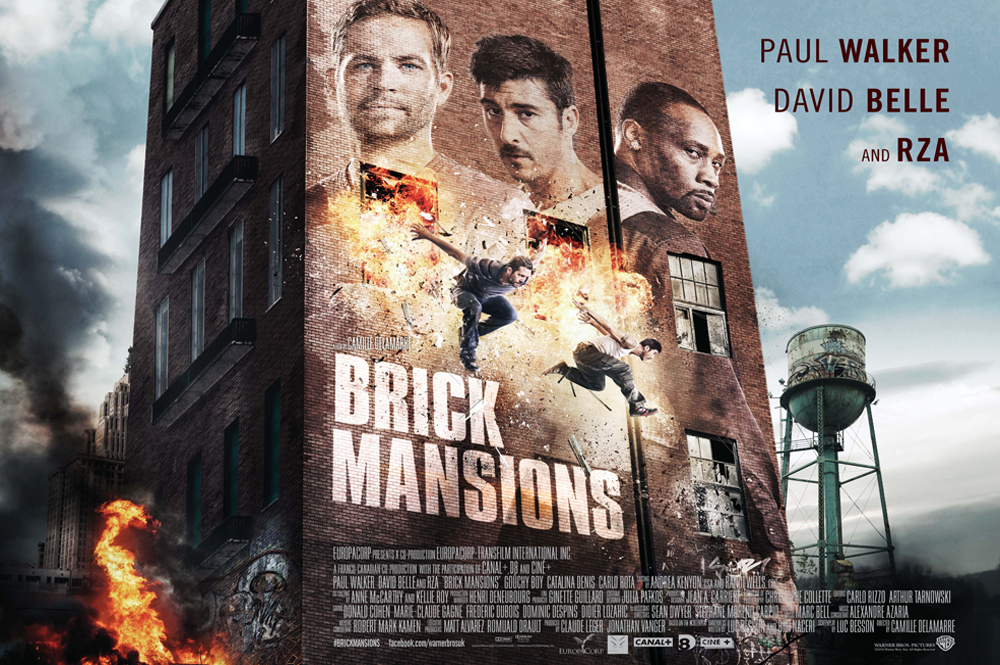
Originally posted on thedullwoodexperiment website.

Share this:

  • Share on X (Opens in new window) X
  • Share on Facebook (Opens in new window) Facebook
  • More
  • Print (Opens in new window) Print
  • Email a link to a friend (Opens in new window) Email
Like Loading...

My Top 10 Movies – Part Ten

24 Monday Feb 2014

Posted by dullwood68 in Movies

≈ 1 Comment

Tags

Action, Alan Rickman, Bonnie Bedelia, Bruce Willis, Hans Gruber, John McClane, John McTiernan, Nakatomi Building, Review, Terrorists, Thriller

Die Hard (1988)

Die Hard

D: John McTiernan / 131m

Cast: Bruce Willis, Bonnie Bedelia, Alan Rickman, Reginald VelJohnson, William Atherton, Alexander Godunov, Paul Gleason, Hart Bochner, James Shigeta

If, like me, you started watching action movies during the Seventies, then you had a plethora of riches.  There was Clint Eastwood’s Dirty Harry series, the stunt-heavy movies of Burt Reynolds, Charles Bronson’s vigilante excursions, and occasional gems such as Dirty Mary, Crazy Larry (1974) and Vanishing Point (1971).  These movies were often gritty and darkly humorous.  The violence in them was often brutal.  They did their best to reflect the times in which they were made, and often there were political overtones that couldn’t be ignored or missed.

This attitude carried on into the Eighties but the introduction of broad humour in movies such as Commando (1985), and the sense of a genre trading on old glories became more prevalent.  For every Southern Comfort (1981) and First Blood (1982) that kept the flame alive, there was a Stroker Ace (1983) or a Missing in Action 2: The Beginning (1985).  Action movies were becoming stale and unimaginative.  It seemed the doldrums had set in, and we would have to wait some time for the genre to see a resurgence, and to reinvent itself.

Instead of a long wait into the Nineties, we only had to wait until 1988, and the introduction of a character created by author Roderick Thorp, New York cop John McClane.  Die Hard came along unheralded and with a star in Bruce Willis who had no proven track record as an action hero.  In many ways it was a risky deal for 20th Century Fox, but it paid off handsomely (even with parts of the script not having been finalised by the time filming began).

For my part, I wasn’t that interested in seeing it.  I knew Willis from TV’s Moonlighting, but had the same feeling about him as everyone else, and the concept didn’t seem to lend itself to an exciting, two-hour thrill ride.  And so I didn’t see it straight away, even when I saw the positive reviews it garnered, and even when friends who’d seen it did nothing but rave about it.  It wasn’t until three weeks had passed that I finally went to see it, expecting to be disappointed, and not looking forward to it at all.

Well, we’re all allowed to get it wrong sometimes, aren’t we?

Die Hard - scene

In fact, I was riveted.  I couldn’t remember the last time I’d been so impressed by an action movie, by the twists and turns, by the cat and mouse games played out between McClane and Hans Gruber (Rickman), by the skill of John McTiernan’s direction, and the sheer exuberance of the action sequences.  Here was a movie that didn’t short change the audience in terms of intelligence, thrills and well-judged humour.  Die Hard was exciting.  I remember still that classic moment where McClane drops the C4 explosive down the lift shaft and blows up one of the lower floors (and a couple of Gruber’s henchmen): not only was it an incredible moment, but it was topped by smarmy reporter Richard Thornberg’s quip to his cameraman, “Tell me you got that”.  I wanted to see that scene again so badly, I’d already decided I was going to stay on and see the movie again.

Over the next two weeks, I saw Die Hard a further three times, and enjoyed it more and more.  I became a majorly annoying convert, extolling the film’s virtues to anyone who’d listen (and a few who wouldn’t).  Aside from the appallingly ill-judged Deputy Chief of Police Dwayne T. Robinson (Gleason), the movie didn’t put a foot wrong.  The relationships were well handled, the characters believable, and the cast were all on top form (even the unfortunate Gleason).  I loved the fact that John McClane was an everyman character, and that Willis imbued him with a vulnerability that the likes of Arnold Schwarzenegger and Chuck Norris would have found beyond their acting abilities.  His self-doubt was a nice change of pace as well.  And, of course, he had the perfect adversary in Alan Rickman’s Hans Gruber, a villain so urbane and charming his very sneer could probably cut glass.  (Rickman steals the movie, as he would three years later in Robin Hood: Prince of Thieves).

When I got my first surround sound system – and Die Hard on DVD – this was one of two movies I used to show how good the system was (the other was The Matrix).  Over the years I’ve watched it countless times, and it’s still as fresh as ever.  It’s also one of the most influential action movies of all time: even now, the Die Hard template is still being used – Olympus Has Fallen, anyone?  And with one of the best catchphrases ever: “Yippie ki-ay, motherfucker”, it’s a movie that will keep on having a great reputation and winning over audiences with each new generation.

Rating: 9/10 – a tense, exciting, action movie that has a down-to-earth appeal amongst the gunfire and explosions; Willis and Rickman elevate the material and make it sing, just like Dean Martin.

Share this:

  • Share on X (Opens in new window) X
  • Share on Facebook (Opens in new window) Facebook
  • More
  • Print (Opens in new window) Print
  • Email a link to a friend (Opens in new window) Email
Like Loading...

George and the Dragon (2004)

21 Friday Feb 2014

Posted by dullwood68 in Movies

≈ 1 Comment

Tags

Action, Dragons, Fantasy, James Purefoy, Medieval times, Michael Clarke Duncan, Patrick Swayze, Piper Perabo, Review, Tom Reeve

George and the Dragon

aka Dragon Sword

D: Tom Reeve / 93m

Cast: James Purefoy, Piper Perabo, Patrick Swayze, Michael Clarke Duncan, Bill Treacher, Jean-Pierre Castaldi, Rollo Weeks, Paul Freeman, Caroline Carver, Simon Callow, Joan Plowright

After fighting in the Holy Wars, knight George (Purefoy) returns home to seek a quiet life and settle down on a small parcel of land. To this end he seeks out King Edgar (Callow). But the King’s daughter, Princess Luna (Perabo) has been abducted, and in return for the land he wishes, George agrees to help search for the Princess alongside her betrothed, Garth (Swayze). While the rescue party, accompanied by faithful retainer Elmendorf (Treacher) and adventure-seeking youngster Wryn (Weeks), look for the Picts they suspect have taken Luna, the truth is far stranger. Luna is actually holed up in a cave looking after a dragon’s egg, having been abducted by the mother (who she calls Adelaide for some reason). Luna is determined that the egg will hatch and when she is rescued by George, she thwarts his repeated attempts to destroy it. An uneasy alliance is formed between them as George agrees to help Luna get the egg out of harm’s way long enough for the baby dragon (who she calls Smite for some reason) to hatch. As they travel they must contend with the machinations of Garth, several bands of Picts, and an approaching band of mercenaries led by the dastardly El Cabillo (an uncredited Val Kilmer) who have heard there is a reward for the Princess’s safe return. Cue sword fights, chases, a comic priest (Castaldi), an easily swayed Mother Superior (Plowright), and a brief appearance by Bill Oddie as an innkeeper, not to mention an adequately rendered dragon and its offspring.

George and the Dragon - scene

Despite being a Euro-pudding of a movie – Germany, the UK and Luxembourg were all involved in the movie’s production – George and the Dragon is a light-hearted romp that doesn’t take itself too seriously, has a surfeit of knowing performances (Purefoy has the movie’s measure completely), a winning line in obvious, hokey pantomime humour (watch out for the woman fixing her thatched roof when George arrives at the village where his father (Freeman) lives), and a convincing medieval feel courtesy of the (largely) Scottish locations. Enjoying themselves as much as Purefoy, the rest of the cast give their all, and the script by director Reeve and Michael Burks is geared to provide each character with enough screen time to shine in their own right, as well as entertain the audience.

There’s nothing new here, obviously, but it doesn’t matter. It’s a simple tale simply told but with enough verve and skill to offset its modest budget. Reeve, better known as a producer, keeps the various plot strands and storylines clearly outlined, and frees his cast to inject the kind of earnest frivolity this kind of movie thrives on. The photography by Joost van Starrenburg shows off Scotland and Luxembourg’s scenery to great effect, and the physical and special effects are integrated seamlessly (well, except for the shot of the dragons splashing about in a lake).

On the minus side, Perabo’s allowed too many modern day inflections and references in her performance, and Swayze looks ill throughout; his wig doesn’t help either. And that’s about it. Nitpickers may find other things to complain about but that would be doing the movie a major disservice. It’s not the best movie ever made but George and the Dragon is fun, entertaining, and a more than pleasant way to spend ninety minutes.

Rating: 7/10 – an entirely enjoyable surprise of a movie that’s much better than it looks; for once, a “guilty pleasure” you can tell all your friends about.

Originally posted on thedullwoodexperiment website.

Share this:

  • Share on X (Opens in new window) X
  • Share on Facebook (Opens in new window) Facebook
  • More
  • Print (Opens in new window) Print
  • Email a link to a friend (Opens in new window) Email
Like Loading...

Homefront (2013)

19 Wednesday Feb 2014

Posted by dullwood68 in Movies

≈ 2 Comments

Tags

Action, Clancy Brown, DEA agent, Drug dealing, James Franco, Jason Statham, Kate Bosworth, Review, Sylvester Stallone, Thriller, Winona Ryder

Homefront

D: Gary Fleder / 100m

Cast: Jason Statham, James Franco, Izabela Vidovic, Winona Ryder, Kate Bosworth, Marcus Hester, Clancy Brown, Rachelle Lefevre, Omar Benson Miller, Frank Grillo, Chuck Zito, Pruitt Taylor Vince, Austin Craig

Adapted by Sylvester Stallone from Chuck Logan’s novel of the same name – and once considered as the basis for a Rambo movie – Homefront finally makes it to the big screen with fellow Expendable Jason Statham in the lead role instead.

With its throwback style reminiscent of Seventies action movies such as Walking Tall, and Gator, Homefront settles into a familiar groove from the start, with undercover DEA agent Phil Broker (a badly bewigged Statham) having infiltrated drug dealing bikers The Outcasts.  When an attempt to bust them goes wrong, it leaves Outcasts kingpin Danny T (Zito) swearing revenge on Broker and his family.  Two years on and Broker has recently moved to the sleepy town of Rayville; in the meantime his wife has died and he’s left to bring up their nine year old daughter Maddy (Vidovic) all by himself.  A playground altercation with bully Teddy Klum (Craig) – Maddy gives him a bloody nose – leads to Teddy’s mom Cassie (Bosworth) seeking revenge.  She enlists the help of her brother, Gator (Franco), a local meth dealer.  When Gator finds out about Broker’s past he decides to let the remaining Outcasts deal with him; using his girlfriend Sheryl (Ryder) as an intermediary, Gator works out a deal where the Outcasts will distribute his drugs nationally in exchange for Broker’s whereabouts.

With its surprisingly leisurely pace, Homefront is a formulaic and professional Hollywood action movie, competently made, with no surprises and reminiscent of every other stranger-comes-to-town movie you’ve ever seen.  It allows Statham to stretch his acting muscles a little, sets up Franco as the baddest badass on the block only to renege on the deal two thirds in, puts Brown in uniform as the dishonest sheriff in Gator’s pocket (but does nothing more with it than that), gives Bosworth a chance to release her inner skank for a while, and sidelines Lefevre as Broker’s potential love interest at around the halfway mark.  Stallone’s script is full of these undeveloped story lines, and character arcs that are either cut short or allowed to peter out, all in order to allow more time for the action beats and the extended section where the Outcasts are brought back in.  It’s this part of the movie that is the most disappointing as the running time is padded out unnecessarily: Gator tells Sheryl to contact Danny T’s lawyer (Vince), Sheryl contacts him, he speaks to Danny T, Sheryl reports back to Gator, Sheryl meets Danny T’s lieutenant Cyrus (Grillo), and then the Outcasts travel to Rayville.  It all takes way too long, and all to set up the final showdown between Broker, Gator and the bikers which ends up being a two-part affair (and poorly edited at that).

Homefront - scene

While it’s always good to see Statham kick ass – a fight at a gas station is probably the movie’s highlight – here he’s asked to be conflicted about his violent abilities.  It’s not entirely successful, focusing as it does on the effect Broker’s activities have on Maddy. The problem is that Broker has taught Maddy self-defence already (that’s how she gives Teddy a bloody nose) and is really pleased with her for standing up for herself.  And yet when he has to defend himself and Maddy witnesses it, she acts horrified and troubled.  This raises the question of whether she knows what Broker did for a living (after all she’s old enough to know); it’s never referred to, though, and remains just another loose end in a movie that litters them like confetti.

The deficiencies of Stallone’s script aside, Homefront at least looks good, its Louisiana locations shot in that slightly rosy glow beloved of so many cinematographers (here Theo van de Sande), and Statham acquits himself well.  Vidovic is captivating, Franco and Ryder do their best with roles too underwritten to care about, there’s too little screen time for Brown, and for once, the “black sidekick/friend/new acquaintance” (Miller) doesn’t get killed in the crossfire, but actually kills one of the bikers when they attack Broker’s home.  The only real surprise is Bosworth, raging at the mouth, swearing like a motherf*cker, and fit to explode from the anger she has pent up inside her.  Sadly, the script requires her to undergo a sea change, and this unfortunately robs her character of any further credibility, but for the first thirty minutes or so she steals the movie completely.

Rating: 5/10 – a misfire on so many levels, Homefront suffers from an unpolished script and lacklustre direction; technically solid with a couple of good fight scenes involving Statham (which you’d expect anyway), this never really matches up to its potential.

Share this:

  • Share on X (Opens in new window) X
  • Share on Facebook (Opens in new window) Facebook
  • More
  • Print (Opens in new window) Print
  • Email a link to a friend (Opens in new window) Email
Like Loading...

Machete Kills (2013)

27 Monday Jan 2014

Posted by dullwood68 in Movies

≈ 1 Comment

Tags

Action, Amber Heard, Antonio Banderas, Charlie Sheen, Danny Trejo, Drug cartel, La Chameleon, Lady Gaga, Luther Voz, Machete, Mel Gibson, Nuclear missile, Review, Robert Rodriguez, Thriller

Machete Kills

D: Robert Rodriguez / 107m

Cast: Danny Trejo, Mel Gibson, Michelle Rodriguez, Amber Heard, Demian Bichir, Sofia Vergara, Charlie Sheen, Lady Gaga, Antonio Banderas, Cuba Gooding Jr, Walton Goggins, Vanessa Hudgens, William Sadler, Tom Savini, Jessica Alba

Arriving three years after its title character’s debut, Machete Kills opens with Machete (Trejo) and Agent Sartana (Alba) intercepting a weapons deal between US soldiers and members of a Mexican drugs cartel.  When their plan goes awry and Sartana is killed, Machete finds himself approached by President Rathcock (Sheen) to return to Mexico and find and, if necessary kill, cartel boss Mendez (Bichir).  Mendez is threatening to launch a nuclear missile on Washington D.C.; if Machete stops him, all of Machete’s past sins will be forgotten and he will be granted immediate US citizenship.

In Mexico, Machete finds himself captured by Mendez, who reveals he’s being backed by a mystery American who’s provided him with the missile.  This turns out to be Voz (Gibson).  Machete escapes with Mendez in tow and they head for the border but not before Mendez has put out a bounty on both their heads to the tune of $20 million.  With pretty much all of Mexico after them – plus face-changing super assassin La Chameleon (Goggins, Gooding Jr, Gaga, Banderas) – and the added problem of keeping Mendez alive (his heartbeat is connected to the missile’s arming device; if he dies the missile will fire), Machete has to get Mendez over the border and to Voz’s hideout in order to stop the missile from being fired.  Voz, though, proves to be a megalomaniac who can see the future (oh, and he’s also built an “ark” in space – once the world is destroyed by the nuclear missiles he’s got primed to be launched, and the dust has cleared, he and his followers will return to Earth and start a new, better society; there, got all that?)  With the help of old friend Luz (Rodriguez), Machete attacks Voz’s HQ just as he’s having his launch party.  Will Machete save the day?  Will Voz’s evil plan be thwarted?  Will there be a higher death toll than most Arnold Schwarzenegger movies from the Eighties?  (If you’ve answered yes to all three, then give yourself a pat on the back.)

Machete Kills - scene

As deliberately and casually over the top as its predecessor, Machete Kills is a riotous mix of primary colours, ear-crunching sound effects, limb-slicing violence, boys-with-toys style hardware, visceral humour, cheesy dialogue, unsubtle in-jokes, scantily clad gun-toting females, and the repository of Mel Gibson’s worst ever screen performance.  Rodriguez’s kitchen sink approach to the material works well over all, and he certainly wins points for inventiveness, but after ninety minutes the lack of subtlety begins to wear very thin indeed.  Fortunately he’s helped out by a committed cast who all seem to relish the chance to kick back and go with the absurdity of it all.  Except for Gibson, who plays Voz as if he were a villain in a Bond movie: all urbane chat and modish amusement.  He’s about as convincing as cottage cheese on steak.  That said, Trejo is still an awkward watch, his acting chops as wayward as a leaf in the wind, but it’s all about his physical presence, and Rodriguez uses him cleverly throughout, making Machete almost a force of nature.
For fans of the character, Machete Kills will reinforce their love for the character, though newcomers may wonder what all the fuss is about.  Some of the early scenes lack pace, and Rodriguez stops one too many times to introduce new characters or reintroduce old ones.  The action scenes are fun on an arcade game level, and give rise to all manner of violent, gory deaths (if I mention the words “intestines” and “helicopter blades” you might get an idea of how inventive Rodriguez is in this department).  Pretty much every woman in the movie is required to wear figure hugging and/or flesh-revealing clothing, including Lady Gaga (unfortunately, it doesn’t work for her as much as it does for, say, Sofia Vergara); sexist it may be but it’s as nothing compared to the casual racism that runs like a disquieting undertone from beginning to end (is American citizenship really such a great prize for a Mexican?).  Of course, there is a degree of irony here too, but it’s not quite as prominent as, say, Vergara’s crotch gun.

Away from Trejo and Gibson, the performances are much better, with Bichir a highlight as the schizophrenic Mendez: one moment a raging psychopath who thinks nothing of having his ward Cereza (Hudgens) killed as an example, the next a compassionate rebel determined to bring down the cartels.  Bichir switches between the two personalities with ease, often in the same line of dialogue, and his performance bolsters the movie every time he’s on screen.  Rodriguez, Alba and Savini reprise their roles from Machete, and of the four actors portraying La Chameleon, it’s Gooding Jr who impresses most.

At the beginning of the movie there’s a trailer for a forthcoming Machete feature, Machete Kills Again… In Space.  It appears to be a joke trailer but by the movie’s end it’s more of an accurate prediction of where Machete is heading next.  If and when that movie appears, let’s hope there’s a sharper script and less erratic direction.  With most, if not all, of Rodriguez’s movies there’s a feeling that he’s trying to bombard the audience with all sorts of diversions and trickery so that we don’t see the holes and the flaws in the plot or the storyline.  It’s evident here, and while Machete Kills is entertaining on a superficial level, the fact that there is no depth to it at all doesn’t help things.

Rating: 7/10 – a mixed bag (as usual) from Rodriguez with some stand-out moments and a firm sense of how ridiculous it all is; a popcorn movie for those who like their popcorn drenched in blood and free from logic.

Share this:

  • Share on X (Opens in new window) X
  • Share on Facebook (Opens in new window) Facebook
  • More
  • Print (Opens in new window) Print
  • Email a link to a friend (Opens in new window) Email
Like Loading...

Evasive Action (1998)

06 Monday Jan 2014

Posted by dullwood68 in Movies

≈ Leave a comment

Tags

Action, DeLane Matthews, Dorian Harewood, Drama, Jerry P. Jacobs, Prison escape, Prisoners, Ray Wise, Review, Roy Scheider, Runaway train, Thriller

Evasive Action

aka Con Train; Steel Train

D: Jerry P. Jacobs / 91m

Cast: Dorian Harewood, Ray Wise, Roy Scheider, DeLane Matthews, Ed O’Ross, John Toles-Bey, Clint Howard, Don Swayze, Richard Foronjy, Steven Barr, Blake Gibbons, Mallory Farrow, Keith Coogan, Bill McGee

An unabashed mash-up of Con Air and Under Siege 2 but with a tenth of either movie’s budget (or inventiveness), Evasive Action pits con-with-integrity Luke Sinclair (Harewood) against prison big wheel Enzo Marcelli (Scheider) during an attempted escape from the train carrying them both to a new prison.  Sinclair is doing time for the murder of the man who killed his wife and child, while Marcelli’s crime is never revealed; he’s just a very bad man.  Sinclair’s integrity is shown by his refusal to admit remorse for his crime at his parole hearings; Marcelli’s evil nature is shown by…. well, he queue jumps in the prison yard.

Once Sinclair and Marcelli, along with additional convicts Tommy (Toles-Bey), Ian (Swayze), and Hector “The Director” Miller (Howard, on Steve Buscemi psychopath duty), are on the way to San Diego and their new “home”, what has been up-to-now a fairly unremarkable thriller with some daft dialogue, moves quickly into the outer reaches of low-budget silliness.  With the aid of accomplices Vince (Foronjy) and Joe (Barr), Marcelli et al are freed from the high-tech (but actually low-tech) carriage they are being transported in.  With a plan to rendezvous with a helicopter and flee to Mexico, it’s up to Sinclair and plucky train employee Zoe (Matthews) to save the day and thwart Marcelli’s (slightly) evil plan.

Evasive Action starts promisingly but soon resorts to desperate measures to keep itself “on track”.  With the convicts taking over the train, Zoe manages to contact the police; soon Sheriff Blaidek (Wise) is heading to intercept the train and save the day.  What follows is a series of incidents that demand such a massive suspension of disbelief, the viewer is in danger of self-inducing a migraine.  For example, Blaidek commandeers the helicopter and orders the pilot to get him onto the train; Sinclair jumps from the train and reconnects with it after travelling across the desert on foot before reaching a town and stealing a motorbike; and the train company has only one worker, Anthony (Coogan), who can help the police keep track of where the train is headed and/or located (and he’s inexperienced).

Evasive Action - scene

As an action thriller, Evasive Action sets a robust pace once the train sets off but the audience is unlikely to connect with any of the characters.  As Luke, Harewood is earnest and just a little bit stuffy; plus in the fight scenes it’s clear he hasn’t squared up to anyone since he was probably five.  Wise acts like a man who hopes no one he knows will see the movie, while Matthews shows no fear, merely a kind of mild exasperation at what she has to go through.  It’s left to Scheider to raise the acting bar but even he can’t salvage a character so underwritten he has to resort to snarling his way through the movie as a way of keeping him interesting.

Jacobs’ direction lacks focus and substance (he’s better known as a producer, albeit of movies such as Vampires Suck and Disaster Movie), and the photography by Ken Blakey too often resorts to shaking the camera in order to make it look like the train is moving.  The script plays fast and loose with its own timescale, and makes Passenger 57 – another movie it’s been partially cloned from – look like Oscar-bait.  The movie looks bland and lacks any kind of zest.  And the movie’s big set-piece moment, when the train crashes through a terminus at high speed, is reduced to three poorly achieved shots involving model work.

While Evasive Action does try hard to entertain its audience, what you’re left with is a sense that this was a movie that was made quickly so as not to burden its cast and crew any more than it had to.  And whoever came up with the poster design has made it look as if Scheider is some kind of spy dealing with terrorists (maybe), or, as some reviewers might put it, is “in the wrong place at the wrong time”.  (Well, yes he is, but only in the “whoops-I-should-have-passed-on-this-one” sense.)  All in all, the best thing about the movie is that it moves with a sense of urgency, even if that urgency is to get things over with as quickly as possible.

Rating: 4/10 – saved from a lower score because its very inoffensiveness is a kind of relief from the madness of most direct-to-video releases, but only worth a view if every other variation on Con Air is unavailable.

Originally posted on thedullwoodexperiment website.

Share this:

  • Share on X (Opens in new window) X
  • Share on Facebook (Opens in new window) Facebook
  • More
  • Print (Opens in new window) Print
  • Email a link to a friend (Opens in new window) Email
Like Loading...

The Hunger Games: Catching Fire (2013)

10 Tuesday Dec 2013

Posted by dullwood68 in Movies

≈ 3 Comments

Tags

Action, District 12, Donald Sutherland, Drama, Francis Lawrence, Gale, Haymitch, Jennifer Lawrence, Josh Hutcherson, Katniss Everdeen, Mockingjay, Peeta, Philip Seymour Hoffman, President Snow, Review, Sci-fi, Suzanne Collins, Woody Harrelson

Hunger Games Catching Fire, The

D: Francis Lawrence / 146m

Cast: Jennifer Lawrence, Josh Hutcherson, Liam Hemsworth, Woody Harrelson, Donald Sutherland, Philip Seymour Hoffman, Elizabeth Banks, Stanley Tucci, Lenny Kravitz, Jeffrey Wright, Amanda Plummer, Sam Claflin, Toby Jones, Jena Malone, Willow Shields

Picking up from the end of The Hunger Games, part two of the franchise – Mockingjay is being adapted into two parts, due in 2014 and 2015 respectively – sees Katniss Everdeen (Lawrence) trying to fit in to a post-Games world where she is now seen as a symbol of hope for the beleaguered districts.  Becoming increasingly aware of the social injustice around her, Katniss tries her best to balance protecting her family from the less-than-veiled threats of President Snow (Sutherland) against the increasing demands made of her to be the symbol that promotes the resistance.  With things made even more difficult by her mixed feelings for Peeta (Hutcherson), and the attentions of Gale (Hemsworth), Katniss finds herself struggling to find her way in a world that is changing rapidly both around her, and because of her.

Aware of her increasing importance to the resistance movement, President Snow plots to destroy her with the help of new Games Master Plutarch Heavensbee (Hoffman).  In order to do this the next Hunger Games is designed to pit Katniss against the remaining winners in a kind of Best of the Best tournament.  She also has to contend with Peeta taking part as well and trying to keep him safe.  For his part, Peeta wants to keep Katniss safe in order for her to remain a beacon of hope.  With both of them striking deals with Haymitch (Harrelson) to protect the other, Katniss is unaware that their are deeper political manoeuvrings going on behind the scenes, manoeuvrings that will have a greater effect on her life than she could ever imagine.

As that awkward beast, the middle part of a trilogy, Catching Fire builds on the first movie’s strengths and benefits immensely from an even more assured and commanding turn from Lawrence.  She dominates proceedings from start to finish, eclipsing her co-stars with ease – no mean feat given the calibre of actors such as Hoffman and Sutherland – and gives such a layered, intelligent performance that it almost threatens to overwhelm the rest of the movie.  Full marks to director Lawrence and screenwriters Simon Beaufoy and Michael Arndt then for making Catching Fire such an exciting, dramatic episode that grips throughout, and successfully juggles the widening story arc with more intimate moments and the kind of cutting-edge visuals we’ve come to expect from big-budget sci-fi movies.

Hunger Games Catching Fire, The - scene

With the movie in such assured hands, Catching Fire is free to impress on even further levels: the gritty realism of District 12 contrasted with the spectacular opulence of the Capitol, both triumphs of art direction and production design; the costumes courtesy of  Trish Summerville (her costumes for Effie Trinket (Banks) are even more outlandish than those of the first movie); the score by James Newton Howard, by turns austere,  stirring and richly evocative from scene to scene, supporting effortlessly the emotional and physical elements; and the superb photography by Jo Willems, a feast for the eyes and even more impressive when seen at an IMAX cinema – the Hunger Games tournament is played out in the full IMAX format; it adds a whole new dimension to the movie, and the scale is suitably impressive: the lagoon seems impossibly huge and the forest thickly impenetrable.

But the scale of the movie is nothing without the characters that inhabit it, and here the cast display a greater confidence in their roles, while newcomers such as Hoffman, Claflin and Malone fit in with ease.  As already noted, Lawrence is excellent, while Hutcherson and Hemsworth overcome the limitations of the source material to forge much stronger characters than you’d expect.  Sutherland is as icy as the President’s name implies, and Hoffman creates a devious sadist in Heavensbee: all self-satisfied smiles and preening behaviour.  Tucci excels (as always) as the overly coiffed broadcaster Caesar Flickerman, Wright and Plummer have small but important roles as fellow Victors Beetee and Wiress, and once again, as Haymitch, Harrelson proves what a versatile actor he is by nearly stealing the movie out from under Lawrence – but only nearly.

With two more films to come, the producers have given themselves a hard task to overcome.  Catching Fire, in terms of the novels, was the point at which author Suzanne Collins began to lose her grip on the overall storyline.  Where Katniss and Peeta and Gale go from here is already known by millions; the trick will be to turn what was a largely disappointing resolution to Katniss’s story into something as exhilarating as this adaptation.  It will be interesting to see if they manage it.

Rating: 9/10 – a bold adaptation that retains all the strengths of the novel, and manages to jettison all the aspects that marred it; a rare sequel that stands on its own and towers over its predecessor.

Share this:

  • Share on X (Opens in new window) X
  • Share on Facebook (Opens in new window) Facebook
  • More
  • Print (Opens in new window) Print
  • Email a link to a friend (Opens in new window) Email
Like Loading...

The Family (2013)

08 Sunday Dec 2013

Posted by dullwood68 in Movies

≈ Leave a comment

Tags

Action, Comedy, Drama, Hitman, Luc Besson, Michelle Pfeiffer, Normandy, Review, Robert DeNiro, the Mob, Tommy Lee Jones, Witness Protection

Family, The

D: Luc Besson / 111m

Cast: Robert De Niro, Michelle Pfeiffer, Tommy Lee Jones, Dianna Agron, John D’Leo, Jimmy Palumbo, Domenick Lombardozzi, Stan Carp, Vincent Pastore, Jon Freda

Having ratted on his bosses in the Mob, Giovanni Manzoni (De Niro) and his family – wife Maggie (Pfeiffer), daughter Belle (Agron) and son Warren (D’Leo) – are living in France under the Witness Protection Program.  Following an incident at their placement on the Riviera, the Manzonis are moved to a quiet Normandy town where their handler, CIA agent Robert Stansfield (Jones), hopes they’ll settle down and stay out of trouble. While the Manzonis (now the Blakes) try to fit in, a hitman (Freda) is trying to track them down.

Each member of the family does their best to adapt to their new surroundings but with varied results.  Giovanni begins writing his memoirs, Maggie takes an interest in a nearby church, Belle fends off the advances of the local teenage boys and falls in love with a mature student, while Warren takes over the various rackets at their school.  They all encounter problems along the way, and each deals with these problems in their own way: Giovanni with violence, Belle with violence, Warren with violence, and Maggie with violence but then followed by her making confession.  It’s their inability to fit in without reverting to their Mob ways that causes Stansfield to threaten them with yet another relocation, especially after he reads Giovanni’s memoirs and realises how dangerous they could be if anyone outside the family were to read them.  But then the hitman and his gang find them, and everyone has to pull together to keep the Manzonis alive.

Family, The - scene

Ostensibly a comedy, The Family is ultimately a bit of a mixed bag.  Besson, directing from a script co-written with Michael Caleo, adds drama, romance, action, a lot of casual violence, a wonderful moment for De Niro at a film screening, and a soupçon of domestic troubles.  The main characters are well-drawn: Giovanni is both naturally aggressive and yet also quite melancholy and thoughtful, while Maggie appears lonely and struggling to adjust; she’s a mother whose role is no longer as clearly defined as it was back in New York.  Belle is sophisticated and yet naïve at the same time: she misunderstands the situation with the mature student, and takes too much for granted.  And Warren finds he’s not quite the clever gangster he thought he was.  All four actors are on top form, De Niro providing a world-weary performance that belies the uncompromising mobster he’ll always be at heart; he’s a joy to watch.  Pfeiffer revisits her character from Married to the Mob (1987), and gives a shaded turn where her unhappiness at her family’s situation is offset by her obvious pride and love for them.  As the children, Agron (from TV’s Glee) is confident, poised and vulnerable, and D’Leo plays Warren with an equal confidence that is impressive for his age.

What spoils the movie though is the continuing shifts in tone.  Beginning with a hit on a family (and providing Freda with a great entrance) that is horribly violent, the movie shifts uneasily between moments of light humour – there are no really laugh-out-loud moments in the movie – and more and more extreme bouts of violence: Belle taking a tennis racket to a teenage boy’s face, Giovanni fantasising about pushing a man’s face onto a barbecue grill.  These episodes, meant to remind the audience perhaps that these people, after all, were part of the Mob and have done some horrible things in the past, serve only to show that, Giovanni’s writing aside, the experience of being in the Witness Protection Program hasn’t changed them at all; if anything, they are using their unique skill-sets to dominate their community just as they used to do.  It’s this lack of personal improvement or growth that undermines the characters and makes them appear close to stereotypes.  There’s also an unpleasant whiff of institutionalised racism that runs throughout the movie, with the Manzonis the target of some unvarnished cultural attacks (“they eat hamburgers morning, noon and night”); the family’s only response is to have a barbecue for their neighbours where they serve only American food, and of course, the French all go away very happy.

The movie also isn’t quite as funny as it thinks it is, and shifts in tone aside, fails to hit the mark too often.  It’s largely predictable and while this isn’t necessarily a bad thing with this type of movie, with the cast involved you’d hope for something a little richer, and with more surprises.  The final shootout is well-staged and shows Besson is still more than adept at shooting action scenes.  The preceding set-up is equally well-staged and quite gripping.  If only the previous hour and a half had been the same.  That said, Thierry Arbogast’s photography is deceptively fluid and gives certain scenes an almost painterly finish, and the score by Sacha and Evgueni Galperine subtly enhances things throughout.

Rating: 6/10 – only fitfully entertaining, and saved by strong performances; The Family won’t change your life, but then it hasn’t changed theirs either.

Share this:

  • Share on X (Opens in new window) X
  • Share on Facebook (Opens in new window) Facebook
  • More
  • Print (Opens in new window) Print
  • Email a link to a friend (Opens in new window) Email
Like Loading...

Illegal Aliens (2007)

05 Thursday Dec 2013

Posted by dullwood68 in Movies

≈ Leave a comment

Tags

Action, Aliens taking over the world, Anna Nicole Smith, Chyna, Comedy, David Giancola, Joanie Laurer, Megagravitron, Review, Sci-fi

Illegal Aliens

D: David Giancola / 96m

Cast: Lenise Sorén, Gladise Jimenez, Anna Nicole Smith, Joanie Laurer, Kevin McGuire, Patrick Burleigh, Dennis Lemoine, Woody Keppel, Michael J. Valentine

This low-budget mash-up of Charlie’s Angels and Men in Black deserves some kind of award for the most movie references shoved – sometimes unwillingly – into one movie.  From random shots to one-liners to visual effects to footage lifted from other movies, Illegal Aliens proves to be a surprisingly enjoyable experience; it even raises a smile with its fart jokes.

Three aliens  – Cameron (Sorén), Drew (Jimenez) and Lucy (Smith) – are sent to Earth to protect it from potential invasion by other aliens.  They set up shop in Hollywood as stunt coordinators (did I mention how far-fetched this movie was?), and for three years all is quiet until a renegade alien (Laurer) lands on Earth and takes over the body of a mob boss’s wife.  The alien, Rex, takes over as mob boss and uses the mob to help her (yes, Rex is a she, even in alien form) steal various items which, together, will allow her to build a megagravitron, a device that will pull the Moon into the Earth and destroy all life.  Backed by holographic know-it-all Syntax (McGuire), our three heroines vow to stop Rex’s plan and save the Earth.

Illegal Aliens - scene

That Illegal Aliens is cheesy, cheap and chock-full of over-acting, often woeful special effects and too many “Jeez, they didn’t!” moments, is actually to miss the point.  This movie is deliberately cheesy and cheap etc.  What else can you say about a movie that has a Main Villian Monologue Timer appear on screen when Rex explains her motivation for what she’s doing?  (And yes, that is how ‘villain’ is spelt onscreen.)  And how else do you explain the occasional breaking of the fourth wall, particularly at the movie’s end?  And yet, for the most part, it works.  If you take the movie for what it is, and not try to make too much out of it, then it’s actually a rewarding experience.  But you also have to have a liking for this kind of movie already.  If you go into this one blind, then all you’ll see is a silly spoof that makes too much of Lucy being brainless, Laurer adding a maniacal laugh at the end of almost every sentence, and underling Ray (Lemoine) being shot several times over and yet still going strong at the movie’s end.

As for the acting, Sorén and Jimenez do well in spoofing the Kate Jackson and Jaclyn Smith roles from the original Charlie’s Angels, while Smith – in what was her last movie – does the ditzy klutz role (worryingly) to perfection; she’s like a child that’s too distracted to learn things properly.  Laurer, better known as WWE wrestler Chyna, is surprisingly good as Rex, downplaying her physicality and using her voice and facial expressions to good effect, and channelling her inner Vincent D’Onofrio.  Giancola keeps it all moving at a good pace, and and the action sequences, again, are better than expected – especially the one lifted from Red Heat (1987).  The humour is broad, there is a fair amount of slapstick, and the whole thing is done with a knowing wink to the audience: look out for the guard who won’t fight Jimenez because his shift has just ended.

NOTE: This was a troubled shoot, with Smith proving unreliable within the first few days of filming; at the time she had personal issues surrounding her marriage.  If you’re interested in finding out more about the movie’s production and what was going on behind the scenes then watch Addicted to Fame (2012).

Rating: 6/10 – a silly sci-fi spoof that hits the mark more often than it (perhaps) has a right to do; one for the fans and anyone who likes frat humour.

Originally posted on thedullwoodexperiment website.

Share this:

  • Share on X (Opens in new window) X
  • Share on Facebook (Opens in new window) Facebook
  • More
  • Print (Opens in new window) Print
  • Email a link to a friend (Opens in new window) Email
Like Loading...

1812: Lancers Ballad (2012)

02 Monday Dec 2013

Posted by dullwood68 in Movies

≈ Leave a comment

Tags

Action, Borodino, Dirigible, Drama, French history, History, Napoleon, Oleg Fesenko, Period movie, Review, Russian history, Sergey Bezrukov, The Three Musketeers

1812 Lancers Ballad

Original title: 1812 Ulanskaya ballada

aka 1812: Ballad of the Uhlans

D: Oleg Fesenko / 98m

Cast: Anton Sokolov, Anna Chipovskaya, Sergey Bezrukov, Valeriy Nikolaev, Pawel Delag, Gediminas Adomaitis, Anatoliy Belyy, Olga Kabo, Eric Fraticelli, Sergei Zhuravel

Napoleon Bonaparte (Fraticelli) is planning to do battle with the Russians at Borodino. An unscrupulous nobleman, De Vitte (Nikolaev) steals the details of the Russian positions and presents them to the French leader. The treachery is overheard by young Russian Aleksey (Sokolov), who has come to assassinate Bonaparte but finds himself chased back to the Russian lines. There he informs Field Marshal Kutuzov (Zhuravel) of the diminutive invader’s plans. Kutuzov rewards Aleksey with a commission in the Lancers, where he meets Gorzhevskiy (Bezrukov), de Kolenkur (Adomaitis) and Kiknadze (Belyy). Together, the quartet are sent behind enemy lines to retrieve the Empress’s crown which has been appropriated by Napoleon. They discover De Vitte has stolen the crown for himself, and determine to retrieve it. All the while they are being chased by Polish officer Ledokhovskiy (Delag).

1812 Lancers Ballad - scene

With a love interest for Aleksey provided by Beata (Chipovskaya), a maid of the Countess Walewska, and fight sequences/explosions galore, 1812: Lancers Ballad is a lunatic reworking of the Three Musketeers with De Vitte in the Milady de Winter role, and any pretense of originality or logic dispensed with within the first few minutes. The script by Gleb Shprigov is amateurish, with dreadful dialogue (even worse probably when subtitled), implausible motivations, lifeless characters, shoddy plotting, and the sense that whole pages were torn out just prior to filming. Scenes stumble and collide with each other, and Arunas Baraznauskas’ photography comes complete with arbitrary angles and desultory, washed-out lighting so bad the cast all look ill. The movie gives a home to a jumble of poorly choreographed and edited action scenes – Fesenkov loves his slo-mo – while the cast drown under a welter of unconvincing good intentions, and subsequently, no turn should be left unstoned. Sokolov, in particular, serves up a prime slice of ham pie, while everyone else does their best not to look too embarrassed (and fail).

Fesenkov directs proceedings with all the flair and accuracy of a blind man at a firing range, leaving the plot to hang out to dry in favour of one more underwhelming explosion. He leaves the cast to find their own way, shows no interest in constructing a coherent visual narrative, and fails to grasp the fact that even the most ridiculous of action movies has to have action sequences that are exciting. Here they’re a reminder that it’s all been done before and better, even in Paul W.S. Anderson’s laughable The Three Musketeers (2011). (Hang on, does that count as an achievement?) And let’s not even mention the glaring historical errors and inconsistencies.

As an historical drama, the movie makes for a decent comedy, and if you’re a connoisseur of bad movies then this will be right up your стреэт. Inept, nonsensical, incoherent, witless, 1812: Lancers Ballad is such a misfire that it really has to be seen to be believed.

Rating: 3/10 – car crash movie making from the country that gave us Battleship Potemkin (1925) and War and Peace (1967-8), 1812: Lancers Ballad, complete with stirring songs played – oddly – over the action scenes, deserves some kind of place in movie history as the one time an exploding dirigible is more a cause for yawning than excitement.

NOTE: The trailer below is in Russian without English subtitles but they’re not really needed as the focus is mainly on the movie’s action scenes.

Share this:

  • Share on X (Opens in new window) X
  • Share on Facebook (Opens in new window) Facebook
  • More
  • Print (Opens in new window) Print
  • Email a link to a friend (Opens in new window) Email
Like Loading...

12 Rounds: Reloaded (2013)

29 Friday Nov 2013

Posted by dullwood68 in Movies

≈ Leave a comment

Tags

Action, Brian Markinson, Drama, EMT, Low budget, Randy Orton, Review, Roel Reiné, Sequel, Thriller, WWE Films

12 Rounds Reloaded

aka 12 Rounds 2: Reloaded

D: Roel Reiné / 95m

Cast: Randy Orton, Tom Stevens, Brian Markinson, Venus Terzo, Cindy Busby, Sean Rogerson

Taking the semi-original idea of 12 Rounds (2009) and repeating it, 12 Rounds: Reloaded swaps John Cena’s cop for Randy Orton’s EMT (emergency medical technician), and Aiden Gillen’s psycho criminal for Brian Markinson’s psycho government defence contractor. This time around, Nick Malloy (Orton) fails to save the female passenger in a two-car pile-up. One year later and aggrieved husband Heller (Markinson) is out to “balance the scales of justice”. Malloy’s wife, Sarah (Busby) is kidnapped, and Malloy is forced to find clue after clues to why he and Sarah have been targeted, as he travels from one place to another in an occasionally desperate race against time. Along the way he picks up wastrel Tommy Weaver (Stevens), and the attention as they begin to realise Malloy is somehow connected to the recent disappearance of the Governor (don’t worry, it all comes together after about an hour).

This is dispiriting stuff, with a mess of a script that gives none of its cast the chance to provide anything resembling a performance. Orton gives new meaning to the phrase “as wooden as a dimestore Indian”, while Stevens and Markinson crank up the dial past eleven in their attempts to spout their dialogue convincingly. Terzo, as McKenzie, the police officer in charge of chasing Malloy and finding the Governor, fares even less well and the scene where she agrees to help Malloy is as brief and as unconvincing as it could possibly get (the part really needed Yancy Butler, but hey, them’s the breaks). The race against time aspect of the plot is played without throughout:  often Heller resets the time during rounds whenever there’s the slightest hold up or delay in Malloy’s progress.

12 Rounds Reloaded - scene

Reiné, no stranger to the world of low-budget action movies, does his best but the lack of any real peril linked to the continual absurdities of David Benullo’s script, hampers him from the start. The action sequences are poorly edited, and the scene where Malloy takes on two police officers in a park is so disjointed it makes the following sequence where he and Weaver escape in the officers’ cruiser look like the Odessa steps sequence in Battleship Potemkin. And the movie’s budget is, in fact, so low that the opening car crash happens off screen.

Ultimately, 12 Rounds: Reloaded fails because it’s a very cheap knock-off of an already fully played out idea. It lacks the conviction to put Malloy in any real danger or morally dubious circumstances, and reduces the threat to his wife by leaving her out of things until almost the end; a brief shot of Sarah asleep on a couch is used by Heller to keep Malloy in tow, but the script itself undercuts any menace – and believe me, there isn’t any – by having the police talk to her later in the movie…and she’s fine. Minor – often very minor – characters meet various grisly ends but there’s no sense of outrage or horror at what Heller’s doing, just a hope that he’ll get his comeuppance sooner rather than later so we can all go and do something more interesting. There’s only one moment in the whole movie where the audience’s expectations are undermined but by the time it happens, the viewer will have been past caring (waaaaay past).

WWE Films have produced a lot of low-budget action movies in recent years, in part as a way of further branding their “superstars” in the acting world. So far, only Dwayne Johnson, aka The Rock, is still the only wrestler who has met, and indeed surpassed, expectations. And while Orton was completely adequate in his cameo in That’s What I Am (2011), on this evidence his elevation from prime-time wrestling to movie stardom won’t be happening anytime soon.

Rating: 3/10 – muddled, underwhelming, dire, atrocious… just some of the words that could have been in the main review, but they all apply; let’s hope no one has the idea of making 12 Rounds: Revolutions.

Originally posted on thedullwoodexperiment website.

Share this:

  • Share on X (Opens in new window) X
  • Share on Facebook (Opens in new window) Facebook
  • More
  • Print (Opens in new window) Print
  • Email a link to a friend (Opens in new window) Email
Like Loading...

Getaway (2013)

20 Wednesday Nov 2013

Posted by dullwood68 in Movies

≈ 1 Comment

Tags

Action, Car chase, Courtney Solomon, Drama, Ethan Hawke, Jon Voight, Review, Selena Gomez, Sofia, Thriller

Getaway

D: Courtney Solomon / 90m

Cast: Ethan Hawke, Selena Gomez, Jon Voight, Rebecca Budig, Bruce Payne, Paul Freeman

It’s Xmas time in Sofia, Bulgaria.  Ex-racing driver Brent Magna (Hawke) arrives home one evening and finds signs of a violent struggle, but no sign of his wife Leanne (Budig).  His mobile rings.  The voice of a man he doesn’t know tells him if he wants to see Leanne again Brent must do as the man says, beginning with picking up a specially modified car from an underground garage.  Once he’s behind the wheel, Brent is set a series of tasks, all of which see him causing vehicular mayhem, and being continuously chased by the Sofia police.

During a breather, a young girl – whose name we never discover – tries to carjack him but he overpowers her.  The voice tells Brent to ensure she stays in the car as she will be useful… and so begins a cat-and-mouse game in which Brent and the girl try to work out the voice’s plan and then thwart it.  The girl proves vital to the plot – although her connection to the car is ham-fisted and beyond contrived – while Brent tries to regain his confidence as a driver after losing it on the racetrack (he’s supposed to be starting a new life in Sofia, but as what we never find out).

Getaway is by no means a cerebral thriller, far from it.  It flexes its muscles and makes its intentions clear within the first ten minutes as Brent is forced to drive at speed through a park full of Xmas revellers and shoppers, hitting an assortment of stands and displays but miraculously missing everyone in sight.  This is a blunt force trauma movie, with a car as the object of mass destruction.  Brent collides with an abundance of police vehicles, he outruns them, he causes them to crash – the regular laws of mechanical physics are blatantly ignored as usual as cars flip and crash with tiresome abandon – he is never followed by a helicopter, and on the one occasion when he encounters a roadblock, he bluffs his way out of it in about five seconds flat.  Yes, you’ve guessed it, this is one of those movies where plot, characterisation and a logical  sequence of events are of no importance because the action is the thing, and the only thing.

Getaway - scene

So, are the action sequences exciting, varied, above average for this sort of thing?  The answer is: once, in a sequence that involves Brent outrunning three henchmen on motorbikes.  It ends in a train yard with the unlikely destruction of a marshalling platform that explodes in sections giving a slight rush as Brent speeds away from the increasing inferno.  Aside from this one sequence, Getaway‘s action choreographer, the well-regarded and experienced Charlie Picerni, fumbles the ball too often to make sitting through Brent’s efforts to remain at large anything other than a chore.  They almost make you want to listen to the terrible dialogue that co-writers Sean Finegan and Gregg Maxwell Parker have hacked together.  Add to all this an ending that feels like it’s been lifted from a discarded Mission Impossible script and you have a truly dispiriting ninety minutes.

Solomon, who gave us the equally execrable Dungeons & Dragons (2000), directs with all the flair of someone who’s learnt all he knows from kids cartoons.  The film is clumsily edited as well by Ryan Dufrene, with images flicking between the video feeds from the car and Yaron Levy’s uninspired photography, as if further tension will be added that way.  On the performance side, Hawke is so lacklustre it’s hard to believe he also appeared in the sublime Before Midnight this year, while Gomez, continuing her transition from annoying teen actress to annoying adult actress, fails to inject anything remotely approaching an emotion into her role, and handles the exposition with the grace of someone speaking in a second language.
It’s only the location work – recognisably Sofia and not filmed in a Canadian location masquerading as same – and the silky menace offered by Voight that elevates Getaway from the mire it inhabits for most of its running time.  Without these two positives to save it, Getaway would be a complete waste of time.  Action movies can be as dumb as they like as long as they deliver the goods action-wise; if they don’t then what’s the point?
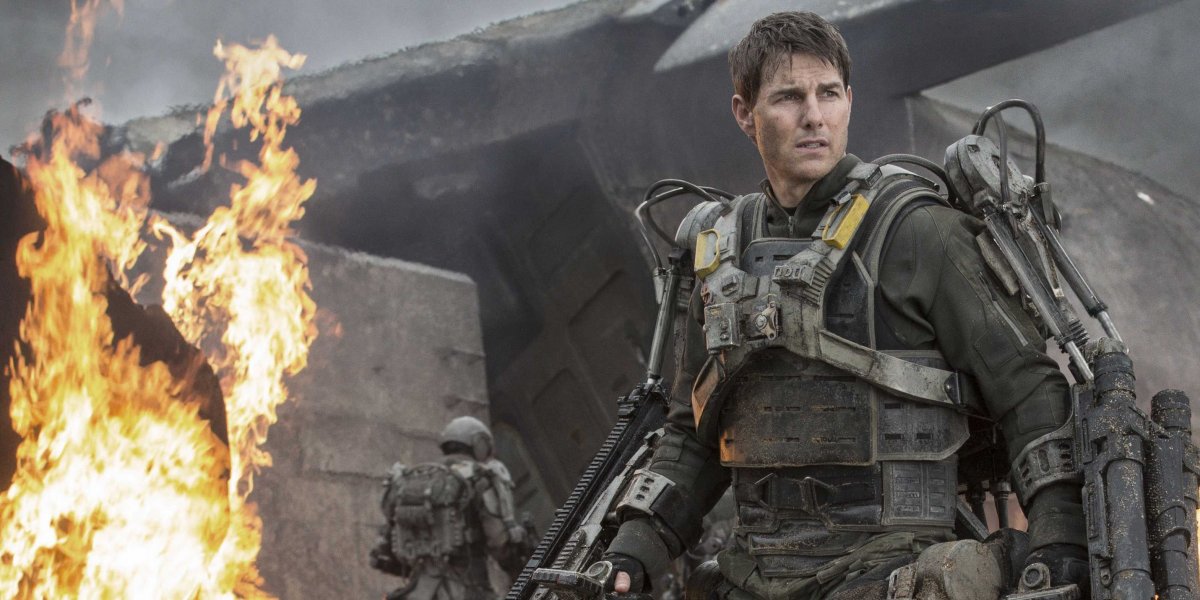
Rating: 4/10 – car chases are always a good draw, and when they’re done right – Bullitt, The French Connection, To Live and Die in L.A., Ronin – they can make a movie that much better, but when only one sequence out of a dozen or so works, someone should wave that checkered flag and call time; it’s a shame the filmmakers didn’t do so here.

Share this:

  • Share on X (Opens in new window) X
  • Share on Facebook (Opens in new window) Facebook
  • More
  • Print (Opens in new window) Print
  • Email a link to a friend (Opens in new window) Email
Like Loading...

Red 2 (2013)

17 Sunday Nov 2013

Posted by dullwood68 in Movies

≈ 2 Comments

Tags

Action, Anthony Hopkins, Bruce Willis, Catherine Zeta-Jones, Dean Parisot, Drama, Helen Mirren, John Malkovich, Nuclear bomb, Project Nightshade, Review, Sequel, The Frog, Thriller

D: Dean Parisot / 116m

Cast: Bruce Willis, John Malkovich, Mary-Louise Parker, Helen Mirren, Byung-hun Lee, Anthony Hopkins, Catherine Zeta-Jones, Neal McDonough, David Thewlis, Brian Cox, Garrick Hagon, Tim Pigott-Smith

A surprise hit in 2010, Red was fun to watch because it had an ageing cast (Parker excepted) indulging in the kind of action movie heroics that (Willis excepted) you wouldn’t normally find them involved in. Everyone looked like they were having a great time, so it was almost a certainty there would be a sequel. And here it is.

Following on from the first movie, Frank Moses (Willis) is still having trouble settling down with Sarah (Parker). When Marvin (Malkovich) warns that someone is coming for both of them, he then fakes his own death. At the funeral, Frank is taken in for questioning by federal agents.  Frank and Marvin are accused of having worked on Project Nightshade, an operation carried out over thirty years before whose purpose was to plant a nuclear bomb in Moscow. After Frank survives an attempt to kill him by sinister US agent Jack Horton (McDonough), the Americans hire Han (Lee) to complete the task, while the British give the job to old friend and ally Victoria (Mirren). Both countries have their reasons for putting Frank and Marvin on their most wanted lists, and as the movie progresses those reasons become clearer and clearer, and have a lot to do with missing-presumed-dead scientist Edward Bailey (Hopkins). In order to clear themselves, Frank, Marvin and Sarah travel from the US to Paris to Moscow and then to London in their efforts to stop the bomb from being set off. Along the way they are variously helped and/or hindered by terrorist The Frog (Thewlis), Russian official Ivan (Cox), and an ex-flame of Frank’s, Katja (Zeta-Jones).

Red 2 - scene

The first movie, as mentioned above, was fun to watch, but Red 2 is a chore. From the opening sequence to the final scene, the movie lumbers from set up to set up, barely pausing to catch its own breath. If it did, if it gave itself a chance to breathe, then there’s more chance the audience would realise how poor a sequel it is, so the movie doesn’t let up. Willis, Malkovich and Hopkins overact as if their careers depend on it, while Parker stretches kooky to flat-out annoying. Lee is underused, McDonough makes the most of his early scenes, while Zeta-Jones succeeds in putting the fatal in femme fatale. Only Helen Mirren emerges unscathed from a script – by Jon and Erich Hoeber – that dispenses with any attempt at characterisation, pays lip service to the idea of a coherent plot, and includes some of the worst dialogue this side of an Adam Sandler movie (Jack & Jill anyone?).

The action sequences are perfunctory and often poorly edited, and the humour that punctuates the movie seems forced rather than organic. It’s the same old schtick from the first movie but less interesting and on a bigger budget. Parisot directs as if he’s not responsible for anything that appears on screen, and nothing can detract from the sense of hopelessness that builds toward the incredibly naff – and predictable – showdown between Willis and the movie’s main villain (their identity in itself completely predictable). It’s somehow more disappointing when a big budget movie with a talented cast tanks so badly – you’d think someone might look at the script and say, “hang on, can’t we do something about this?”. If this is a cast and crew that are doing their best, perhaps they just shouldn’t bother.

Rating: 4/10 – an unremittingly bad sequel to a moderately good first movie, Red 2 stutters and stumbles its way through a disaster of a script; saved from a lower rating by some good location work, and the pleasure of seeing Helen Mirren showing everyone else how it should be done.

Share this:

  • Share on X (Opens in new window) X
  • Share on Facebook (Opens in new window) Facebook
  • More
  • Print (Opens in new window) Print
  • Email a link to a friend (Opens in new window) Email
Like Loading...

Gravity (2013)

09 Saturday Nov 2013

Posted by dullwood68 in Movies

≈ Leave a comment

Tags

Action, Alfonso Cuarón, Astronauts, Drama, Emmanuel Lubezki, George Clooney, Hubble telescope, Outer space, Review, Sandra Bullock, Satellite debris, Sci-fi, Shuttle, Tim Webber

D: Alfonso Cuarón / 91m / 3D

Cast: Sandra Bullock, George Clooney, Ed Harris

Several years in the making, Gravity arrives with a tremendous amount of expectation attached to it, its cutting-edge visuals hinted at in both trailers that preceded it. What wasn’t given as much emphasis was the storyline. Having seen Gravity there’s a good reason why…

Towards the end of a shuttle mission to service the Hubble telescope, mission specialist Dr Ryan Stone (Bullock) and retiring astronaut Matt Kowalski (Clooney) are working outside the shuttle when they’re advised by Houston Mission Control (Harris) that debris from a Russian satellite (recently destroyed by the Russians) is heading towards them. Before they can get back inside the shuttle, the debris hits, killing another member of the team and disabling the shuttle altogether.  After Kowalski saves Stone from spiralling off into space, they head for the nearby International Space Station in the hopes of using one of its landing modules. But things don’t go according to plan…

Gravity - scene

There’s more to the story than that, but to mention any more would be a shame in terms of spoiling things, even if what does follow is disappointing in terms of the plot and Stone’s development as a character. Suffice it to say there follows a series of cliffhangers, and even though you can probably guess that Stone makes it back to Earth – doesn’t she? – it’s the way in which it’s arrived at that stops Gravity from being better than expected.

Thankfully, the visuals are superb, with space represented, if not accurately, then with a verve and a verisimilitude than adds to the (mock-)realism. The scenes where Stone is tumbling through space after the debris strike, where Earth seems to be tumbling around her as much as she is, are breathtaking, as is the opening sequence where the camera appears to be roving around the Hubble telescope in a dizzying whirl of images. As the movie continues, each scene is a feast for the eyes, with a standout moment coming when Stone reaches the ISS and the camera’s point of view – roving around Stone at first – suddenly becomes her point of view from inside her helmet (in 3D this effect is even more impressive). The technical advancement on view is nothing short of incredible and come the awards season, Gravity should be a shoo-in for pretty much every technical award going. The amount of work director Cuarón, director of photography Emmanuel Lubezki and visual effects supervisor Tim Webber have put into creating “space” as it’s never been seen before, close-up and frequently terrifying, has resulted in a movie that is both beautiful and astonishing to look at.

But still there’s Stone’s character and back story, neither of which inspire much of a connection, and stops the audience from empathising with her as much as needed. She remains a fairly reticent, removed character from beginning to end, and while Bullock does her best to project a degree of steely vulnerability, she never quite manages it; Stone only “steps up” in the final ten minutes and even then it seems forced rather than the organic conclusion of her journey for survival. Equally, Clooney isn’t best served by the character of Kowalski, a glib would-be raconteur with a story for every occasion that belies, and even undermines, his experience as an astronaut.

Rating: 7/10 – seen in 3D, Gravity is a genuine cinematic experience, and all the more impressive for being converted in post-production. There hasn’t been such an exceptional 3D movie since Avatar. It’s a shame then about the muted characters and the undercooked storyline.

Share this:

  • Share on X (Opens in new window) X
  • Share on Facebook (Opens in new window) Facebook
  • More
  • Print (Opens in new window) Print
  • Email a link to a friend (Opens in new window) Email
Like Loading...

Assault on Wall Street (2013)

09 Saturday Nov 2013

Posted by dullwood68 in Movies

≈ Leave a comment

Tags

Action, Cancer treatment, Dominic Purcell, Drama, Edward Furlong, Killing spree, Review, Thriller, Uwe Boll, Vigilante, Wall Street

Assault on Wall Street

D: Uwe Boll / 99m

Cast: Dominic Purcell, Erin Karpluk, John Heard, Edward Furlong, Keith David, Michael Paré, Lochlyn Munro, Eric Roberts

Security guard Jim Baxford (Purcell) and his wife Rosie (Karpluk) are faced with mounting debts when Rosie’s post-cancer treatment proves to be too expensive. Soon their medical insurance is capped, the savings they had invested are wiped out by fraudulent banking practices engineered by Jeremy Stancroft (Heard), they max out their credit card, the bank refuses to extend them any further credit then informs them they’ll be foreclosing on their property, and to top it all off, Jim loses his job. Can things get any worse? Well, yes they can, but then it’s up to Jim to fight back and redress the balance.

Set against the backdrop of the recent financial meltdown in America, Assault on Wall Street takes a simple tale of financial woes pushing a good man into doing (very) bad things, and turns it into something turgid and forgettable. Baxford’s response is to become judge, jury and executioner of every bigwig investment banker he can train his ‘scope on. There’s a long, slow build-up to all that, though – around seventy minutes – and as setback after setback is piled on poor Jim’s back, you’re supposed to feel so sorry for him and his plight that the extreme course of action he embarks upon seems entirely reasonable; forgivable even.

Assault on Wall Street - scene

But when all’s said and done, this is an old-style vigilante movie. Purcell makes for a cut-rate Charles Bronson, but at least has a better range of facial expressions (though check how he looks at a funeral: his eyes are so red and wet he looks like he’s been Maced). The main difference here is that Bronson’s Paul Kelso famously “took out the trash” while Purcell’s Jim Baxford merely goes on a killing spree. Like most vigilante movies there’s an unsurprising lack of moral depth on display, and what little there is is trampled underfoot by the banalities of Boll’s own script. At the film’s end, a voice over proclaims, “I promise I will keep killing” – nothing having been settled at all, other than the movie’s own requirement for some good old fashioned biblical-style bloodletting.

This being an Uwe Boll movie you can expect the usual disjointed montage sequences, a simplistic script peppered by implausible dialogue, the camera being in the wrong place at the wrong time so that even the simplest of scenes are visually confusing, performances that range from underwhelming to apparently improvised, and well-known character actors such as David and Paré (who should know better by now – Assault on Wall Street is his 11th movie under Boll’s direction) turning up to pay the mortgage without looking too embarrassed. In short, Assault on Wall Street is a very bad movie, and while Boll has made worse movies in his time (check out Bloodrayne: The Third Reich if you don’t believe me), this is a very slightly better movie than he usually makes. But don’t let anyone else tell you it’s a great deal better because it’s not: it’s leaden, unconvincing and slipshod.

That said there are some positives: Mathias Neumann’s photography is crisp and well-lit, and Jim’s firearm rampage is effectively choreographed, while Karpluk does a good job with her woefully underwritten role. Otherwise, this is one movie to avoid.

Rating: 3/10 – the sluggish pace and haphazard direction stifle any chance Assault on Wall Street had of being even remotely interesting. To all producers out there, a word of warning: if Uwe Boll wants you to finance his next picture, make sure he hasn’t written it as well.

Share this:

  • Share on X (Opens in new window) X
  • Share on Facebook (Opens in new window) Facebook
  • More
  • Print (Opens in new window) Print
  • Email a link to a friend (Opens in new window) Email
Like Loading...

Hummingbird (2013)

07 Thursday Nov 2013

Posted by dullwood68 in Movies

≈ 3 Comments

Tags

Action, Agata Buzek, Court martial, Drama, Jason Statham, London, Review, Shelter, Steven Knight

aka Redemption

D: Steven Knight / 100m

Cast: Jason Statham, Agata Buzek, Vicky McClure, Benedict Wong, Ger Ryan, Anthony Morris, Christian Brassington, Victoria Bewick

There are times when watching a Jason Statham movie is akin to watching an old friend do their favourite party trick: they may execute the trick with all their usual finesse (or lack of it), and they may add or refine it as they feel necessary. But when all’s said and done, it’s still the same old trick. The same is true of Hummingbird, a London-based drama that does its best to show that Statham has a broader range than we might think, but then still gets him to thump various co-stars and stuntmen.

Statham plays Joey, on the run from a military court martial and living rough on the streets of London. When we first meet him he’s sheltering in a cardboard box with a woman called Isabel (Bewick). They’re separated after an encounter with a local criminal enforcer called Taxman (Morris) and his henchman; Joey has tried to resist and been beaten for his efforts. He manages to get away over the rooftops and eventually finds his way into a flat where he discovers the owner is away until October (it’s now February). He cleans himself up, helps himself to the owner’s clothes and finds a new credit card amongst the mail piled up by the front door (as well as an envelope conveniently stamped Pin Enclosed).

Joey has become a drunk since going AWOL and despite his new-found good fortune he returns to the bottle. While drunk he goes to a shelter run by the Church and gives £500 to Sister Christina (Buzek); in the past he has relied on the food provided by the shelter and wants to give something back in return. Joey also asks her to find out what’s happened to Isobel.

Hummingbird - scene

Now at this point, one of two things could have happened: one, Joey spirals ever further into alcoholism before finding redemption through a selfless act, or two, Joey turns his life around and does things of true value before facing up to his past. But writer/director Knight comes up with a third option: Joey turns his life around and joins a Chinese crime syndicate. It’s an amazing choice and his motivation for doing so remains murky throughout. It allows for the requisite punch-ups that Statham is renowned for, but offers little in the way of real character development. His relationship with Sister Christina becomes more involved, almost romantic, but it’s her motivation that remains murky, and so the movie stumbles from scene to scene with no clear purpose or, ultimately, resolution.

Statham is an actor for whom expressing real emotion is always going to be a stretch, and he’s fashioned his career accordingly as the stoic loner who’s stony expression acts as much as a warning to others as a mask for his feelings. And while Hummingbird might be viewed as an attempt to show he has more skill as an actor than expected, the material doesn’t allow him to do so. He’s still the taciturn outsider, resorting to violence when necessary and doling out clipped lines of dialogue. There may be an emotional role out there that Statham would be entirely suited to, but this isn’t it.

As for the rest of the cast, Buzek offers a conflicted Sister Christina who becomes dangerously close to Joey and finds herself in turmoil because of it, while other characters come and go without making much of an impact. The exception is Max Forrester (Brassington), a particularly nasty punter who abuses prostitutes and finds himself the target of Joey’s somewhat confused sense of morality. Otherwise, this is a movie that concentrates on its two main characters.

The London locations are used to good effect – it’s always strange to see places like Shaftesbury Avenue largely deserted, whatever the time of day – and the production design by Michael Carlin is suitably grimy and depressing. Knight proves to be a capable director but sadly his own script lets him down; it’s an uneasy mix of unlikely romance, grim docudrama, social criticism, action movie and crime drama, and not all of the elements gel. There’s also a problem with the pacing, with some stretches slowing the movie unnecessarily.

Rating: 6/10 – not all bad but a disappointment nevertheless; Knight needs to tighten any further film scripts he writes, and Statham – if he wants to – should commit to a script that really stretches him as an actor.

Share this:

  • Share on X (Opens in new window) X
  • Share on Facebook (Opens in new window) Facebook
  • More
  • Print (Opens in new window) Print
  • Email a link to a friend (Opens in new window) Email
Like Loading...

Big Ass Spider! (2013)

06 Wednesday Nov 2013

Posted by dullwood68 in Movies

≈ 2 Comments

Tags

Action, Drama, Experiment, Greg Grunberg, Lin Shaye, Mike Mendez, Military, Ray Wise, Review, Sci-fi, Spiders, Thriller

Big Ass Spider!

aka Mega Spider

D: Mike Mendez / 80m

Cast: Greg Grunberg, Ray Wise, Lombardo Boyar, Clare Kramer, Patrick Bauchau, Lin Shaye

With a title like Big Ass Spider! you know going in that subtlety isn’t likely to be the movie’s top priority, and yet the opening scene is just that. Our hero Alex (Grunberg) lies unconscious on the ground. He wakes, gets to his feet, and to the strains of Where Is My Mind? by Storm Large, we see him staring off in the distance as people run past him screaming, and debris clutters the street around him. The camera pans round so we can see what Alex sees, and there, perched on top of a downtown Los Angeles building is…a…big ass spider! It’s a great opening, and while in many ways it’s the best scene in the movie, it shows that the movie makers aren’t going the SyFy route and just throwing a movie together based on the title alone.

With the scene set we rewind to twelve hours earlier. Alex is helping regular customer Mrs Jefferson (Shaye) when he’s bitten by a poisonous spider. At the hospital he flirts (badly) with one of the nurses while down in the morgue, a body bag starts to show signs of something alive inside it. The morgue attendant soon becomes a victim of the not-quite-yet big ass spider. Soon the military arrive, led by Major Braxton Tanner (Wise) and his second-in-command Lieutenant Karly Brant (Kramer). Alex is already attempting to deal with the morgue’s new resident, but it soon becomes clear this spider isn’t like any other spider, and even though Tanner warns him off, Alex, aided by hospital security guard Jose (Boyar), decides to try and catch the spider by himself. What he doesn’t realise is that this particular spider is growing at an exponential rate, and soon will become…a big ass spider!

Big Ass Spider! - scene

Despite the obvious low-budget and technical restrictions, Big Ass Spider! doesn’t disappoint when it comes to showing the arachnid going about its business of killing and encasing its victims in its web. A sequence set in Elysian Park is one of the movie’s highlights, as dozens of people are chased down and killed, and while some of the stabbing/impaling effects are a little shonky, they don’t detract from the horror the scene conveys. And when the spider eventually finds its way to the top of that downtown building, the falling debris effects are very well done indeed.

Director/editor Mendez and writer Gregory Gieras have done a great job in making a scary, funny, almost every expense spared creature feature that is consistently entertaining and above average in terms of execution and design. From the spider in its initial form – larger than average sure but scary purely because of the length of its legs – to its final gigantic size, the various incarnations of the spider are handled effectively and with panache, keeping it in the shadows to begin with, then showing it off in all its web-spinning glory. The cast too are fun to watch, with Boyar stealing the show as Jose, the “Mexican Robin” to Alex’s Batman. Alex is a slightly desperate would-be Romeo, and pursues Lieutenant Brant with wonderfully awkward humour; somehow he wins her over – surprise, surprise! – while Wise, an old hand at this type of thing, watches over things with increasing frustration and perfectly-timed exasperation.

Ultimately there’s nothing new here, neither in its characterisations or its plotting – the spider’s growth is the result of a mix-up in a military lab – and some of the dialogue is perfunctory, but it doesn’t matter one bit. From that memorable opening scene to the last-second possibility of everyone returning for Big Ass Cockroach!, Big Ass Spider! will put a smile on your face throughout thanks to its good-natured approach to the material, and the obvious love the movie makers have for this kind of movie.

Rating: 7/10 – obvious flaws notwithstanding, this is a fun ride that doesn’t outstay its welcome, and could easily pave the way for a sequel; More Big Ass Spiders! anyone?

Share this:

  • Share on X (Opens in new window) X
  • Share on Facebook (Opens in new window) Facebook
  • More
  • Print (Opens in new window) Print
  • Email a link to a friend (Opens in new window) Email
Like Loading...

Thor: The Dark World (2013)

05 Tuesday Nov 2013

Posted by dullwood68 in Movies

≈ 3 Comments

Tags

Action, Aether, Alan Taylor, Anthony Hopkins, Asgard, Chris Hemsworth, Dark Elves, Fantasy, Greenwich, Loki, Malekith, Marvel, Marvel Cinematic Universe, Natalie Portman, Review, Tom Hiddleston

Thor The Dark World

D: Alan Taylor / 120m

Cast: Chris Hemsworth, Natalie Portman, Tom Hiddleston, Anthony Hopkins, Christopher Eccleston, Stellan Skarsgård, Kat Dennings, Idris Elba, Jaimie Alexander, Zachary Levi, Ray Stevenson, Tadanobu Asano, Adewale Akinnuoye-Agbaje, Rene Russo

Another sequel to Avengers Assemble, rather than to the first Thor movie, this opens with a prologue that introduces us to the Dark Elves, evil creatures who want to see an end to the Nine Realms (if you’re not a Marvel fan, just go with me on this).  Their leader Malekith (Eccleston) plans to use the Aether, a swirling mass of energy that will allow him to do this when the realms are in alignment.  Thwarted by Odin’s (Hopkins) father, Malekith is forced into hiding, and the Aether is hidden “where no one will find it”.

Fast forward five thousand years (how often the realms are in alignment) and Malekith returns to do his worst.  Meanwhile, Loki (Hiddleston) is imprisoned in Asgard, Jane Foster (Portman) is unhappy that two years have past since she last saw Thor (Hemsworth), and Thor is busy bringing peace to the Nine Realms by fighting anyone who stands in his way.  Alerted to strange phenomena in a deserted warehouse somewhere in London, Jane stumbles across the Aether and becomes its host.  With Jane’s life on the line, it’s up to Thor to save both her and thwart Malekith’s evil plans.  But in order to do so he’ll need help…

Thor The Dark World - scene

This third outing for Thor is huge fun from start to finish, with spectacular set-pieces, humour that ranges from subtle to broader than Volstagg’s (Stevenson) pectorals, gravitas courtesy of Hopkins (as Odin) and Russo (as Frigga), further explorations of the fraternal bond that chafes between Thor and Loki, and the best cameo from another Avenger… ever.  The romance between Thor and Jane is given more space – which is a good thing otherwise Portman would have remained sorely under-used – while the accepted jealousy that Sif (Alexander) feels towards Jane is handled effectively.  It’s the quiet moments such as these that offset the action sequences so well, and while those sequences are directed with accomplished flair by Taylor, it’s the ongoing character developments that Marvel are getting right each time.  At the heart of the film , though, is the relationship between Thor and Loki, here given added depth by their having to work together to defeat Malekith; the interaction between Hemsworth and Hiddleston is a joy to watch.  Hiddleston has a ball (again) as Loki and grabs all the best lines, while Hemsworth continues to mature in the role he’s made his own.  Of the supporting cast, Elba, Russo and Dennings shine, while Eccleston makes more of a villain whose sole motivation seems to be ‘destroy everything’.

Taylor handles the various twists and turns of the storyline with experienced aplomb – can we stop mentioning he worked on Game of Thrones now? – and while the script by Christopher Yost, Christopher Markus and Stephen McFeely has its fair share of plot contrivances, they don’t detract from the enjoyment provided by this latest instalment in Marvel’s plans to dominate the cinema box office.  There’s also some great location work at Greenwich (three stops from Charing Cross on the underground – really?), and fantastic production design courtesy of Charles Wood.

Rating: 8/10 – top-notch episode from Phase 2 of the Marvel Universe that also helps set up the forthcoming Guardians of the Galaxy; bold and more confident in every way.  And by the way, note to Marvel: find some way to give Loki his own movie – okay?

Share this:

  • Share on X (Opens in new window) X
  • Share on Facebook (Opens in new window) Facebook
  • More
  • Print (Opens in new window) Print
  • Email a link to a friend (Opens in new window) Email
Like Loading...
Newer posts →

Blog Stats

  • 505,659 hits

Recent Posts

  • 10 Reasons to Remember Bibi Andersson (1935-2019)
  • Fantasia (1940)
  • Dances With Wolves (1990) – The Special Edition
  • Kiss of the Spider Woman (1985)
  • The Three Musketeers (1973)

Top Posts & Pages

  • Mary Queen of Scots (2018)
    Mary Queen of Scots (2018)
  • Mayhem (2017)
    Mayhem (2017)
  • Flightplan (2005)
    Flightplan (2005)
  • The White Orchid (2018)
    The White Orchid (2018)
  • 10 Reasons to Remember Bibi Andersson (1935-2019)
    10 Reasons to Remember Bibi Andersson (1935-2019)
  • Black Tide (2018)
    Black Tide (2018)
  • Pressed (2011)
    Pressed (2011)
  • Edge of Tomorrow (2014)
    Edge of Tomorrow (2014)
  • The Library Suicides (2016)
    The Library Suicides (2016)
  • Free the Nipple (2014)
    Free the Nipple (2014)
Follow thedullwoodexperiment on WordPress.com

Blogs I Follow

  • Rubbish Talk
  • Film 4 Fan
  • Fast Film Reviews
  • The Film Blog
  • All Things Movies UK
  • Interpreting the Stars
  • Let's Go To The Movies
  • Movie Reviews 101
  • TMI News
  • Dan the Man's Movie Reviews
  • Film History
  • Jordan and Eddie (The Movie Guys)

Archives

  • April 2019 (13)
  • March 2019 (28)
  • February 2019 (28)
  • January 2019 (32)
  • December 2018 (28)
  • November 2018 (30)
  • October 2018 (29)
  • September 2018 (29)
  • August 2018 (29)
  • July 2018 (30)
  • June 2018 (28)
  • May 2018 (24)
  • April 2018 (21)
  • March 2018 (31)
  • February 2018 (25)
  • January 2018 (30)
  • December 2017 (30)
  • November 2017 (27)
  • October 2017 (27)
  • September 2017 (26)
  • August 2017 (32)
  • July 2017 (32)
  • June 2017 (30)
  • May 2017 (29)
  • April 2017 (29)
  • March 2017 (30)
  • February 2017 (27)
  • January 2017 (32)
  • December 2016 (30)
  • November 2016 (28)
  • October 2016 (30)
  • September 2016 (27)
  • August 2016 (30)
  • July 2016 (30)
  • June 2016 (31)
  • May 2016 (34)
  • April 2016 (30)
  • March 2016 (30)
  • February 2016 (28)
  • January 2016 (35)
  • December 2015 (34)
  • November 2015 (31)
  • October 2015 (31)
  • September 2015 (34)
  • August 2015 (31)
  • July 2015 (33)
  • June 2015 (12)
  • May 2015 (31)
  • April 2015 (32)
  • March 2015 (30)
  • February 2015 (37)
  • January 2015 (39)
  • December 2014 (34)
  • November 2014 (34)
  • October 2014 (36)
  • September 2014 (25)
  • August 2014 (29)
  • July 2014 (29)
  • June 2014 (28)
  • May 2014 (23)
  • April 2014 (21)
  • March 2014 (42)
  • February 2014 (38)
  • January 2014 (29)
  • December 2013 (28)
  • November 2013 (34)
  • October 2013 (4)

Create a free website or blog at WordPress.com.

Rubbish Talk

Film 4 Fan

A Movie Blog

Fast Film Reviews

The Film Blog

The official blog of everything in film

All Things Movies UK

Movie Reviews and Original Articles

Interpreting the Stars

Dave Examines Movies

Let's Go To The Movies

Film and Theatre Lover!

Movie Reviews 101

Daily Movie Reviews

TMI News

Latest weather, crime and breaking news

Dan the Man's Movie Reviews

All my aimless thoughts, ideas, and ramblings, all packed into one site!

Film History

Telling the story of film

Jordan and Eddie (The Movie Guys)

Movie Reviews & Ramblings from an Australian Based Film Fan

Privacy & Cookies: This site uses cookies. By continuing to use this website, you agree to their use.
To find out more, including how to control cookies, see here: Cookie Policy
  • Subscribe Subscribed
    • thedullwoodexperiment
    • Join 481 other subscribers
    • Already have a WordPress.com account? Log in now.
    • thedullwoodexperiment
    • Subscribe Subscribed
    • Sign up
    • Log in
    • Report this content
    • View site in Reader
    • Manage subscriptions
    • Collapse this bar
 

Loading Comments...
 

    %d