• 10 Reasons to Remember…
  • A Brief Word About…
  • About
  • For One Week Only
  • Happy Birthday
  • Monthly Roundup
  • Old-Time Crime
  • Other Posts
  • Poster of the Week
  • Question of the Week
  • Reviews
  • Trailers

thedullwoodexperiment

~ Viewing movies in a different light

thedullwoodexperiment

Author Archives: dullwood68

A United Kingdom (2016)

28 Tuesday Mar 2017

Posted by dullwood68 in Movies

≈ Leave a comment

Tags

Amma Asante, Bamangwato tribe, Bechuanaland, David Oyelowo, Drama, Historical drama, Jack Davenport, Literary adaptation, Marriage, Politics, Review, Romance, Rosamund Pike, Ruth Williams, Seretse Khama, Tom Felton, True story

D: Amma Asante / 111m

Cast: David Oyelowo, Rosamund Pike, Jack Davenport, Tom Felton, Laura Carmichael, Terry Pheto, Jessica Oyelowo, Vusi Kunene, Nicholas Lyndhurst, Arnold Oceng, Anastasia Hille, Charlotte Hope, Theo Landey, Abena Ayivor, Jack Lowden, Anton Lesser

In 1947, Prince Seretse Khama of Bechuanaland (Oyelowo) was studying law in England when he met and fell in love with Ruth Williams (Pike), a clerk at a London-based law firm. Poised to inherit the position of King, Seretse’s relationship with a white woman caused concern among both the British government (who ruled over Bechuanaland as a proctectorate), and Seretse’s uncle, Tshekedi (Kunene), who was ruling as regent until Seretse was ready to ascend the throne. Faced with opposition on all sides – Ruth’s father effectively disowned her – the couple ignored warnings and approbation and eventually married in September 1948.

A political maelstrom ensued, and all intended to ensure that Seretse never became King. The British government, in the form of Alistair Canning (Davenport), their representative in South Africa, attempted to bully Seretse into renouncing his claim, but he stood firm, and both he and Ruth travelled to Bechuanaland (now modern day Botswana) to begin their life together. They received a muted welcome, with Ruth being treated with hostility by Seretse’s family, and Seretse’s uncle refusing to accept the marriage, or Seretse’s wish for them to work together to solve their country’s problems. With the people of Bechuanaland supporting Seretse’s claim to the throne (and his marriage), the British government tricked him into travelling to Britain, where in 1951, he was promptly informed that he and Ruth were being exiled from his home country for a period of five years (fortunately, Ruth stayed behind).

Back in Bechuanaland, Ruth discovered that she was pregnant. Her predicament proved beneficial in that it brought her closer to Seretse’s family, particularly his sister, Naledi (Pheto). With the women of Bechuanaland beginning to support her as well, Ruth did her best to support Seretse from afar, but with the British government proving intransigent in their attitude toward him, the would-be King was hindered at every turn. Eventually he found backing and support from members of the Labour Party, including Tony Benn (Lowden), and pressure was brought to bear. With the people of Britain voicing their dismay at the way in which Seretse and Ruth were being treated, a solution seemed on the horizon when Winston Churchill, ahead of the next General Election, announced he would rescind Seretse’s exile if the Conservatives won. They did win, but Seretse’s exile became even more of a political hot potato…

The story of Seretse Khama and Ruth Williams has been filmed before, as a TV drama in 1990 called A Marriage of Inconvenience. But where that version ran to an hour and focused more on their romance than the political upheaval that surrounded them, Amma Asante’s follow up to Belle (2013) aims to be a more comprehensive look at the trials and tribulations that affected both Seretse and Ruth, and an entire country. But as with so many historical dramas that have been made in recent years – The Birth of a Nation (2016), J. Edgar (2011), The Monuments Men (2014) – getting the balance right between historical accuracy and telling a compelling story is often the biggest problem of all. And so it proves with A United Kingdom, a movie that sets out to tell a fascinating tale wherein true love really does conquer all, but which somehow manages to fall short of making the impact it that should.

It begins well, placing the audience firmly in heritage picture-land, with convincing depictions of post-war London: its foggy streets, stoic populace, and rationing-led austerity. Seretse and Ruth’s courtship is depicted with a great deal of charm and it’s easy to see why these two fell in love with each other so easily and so readily, and despite the obvious social disapproval they would encounter (and on both sides of the racial divide, a theme that continues in Bechuanaland). Oyelowo and Pike have an easy-going chemistry, and it’s a delight to see them bring Seretse and Ruth together. Even the introduction of Davenport’s sneering, arrogant government representative can’t derail or diminish their love for each other. But this isn’t just a love story, it’s also a political drama, and once the movie switches from the gloomy back streets of London to the colourful plains of Bechuanaland, the movie changes tone and emphasis, and in doing so, loses sight of what has, up until now, made it so effective.

The trouble is that Seretse and Ruth’s relationship actually ceases being as relevant as it was before their arrival in Bechuanaland. Once there, the movie has to deal more directly with tribal politics, colonial do’s and don’t’s, government machinations, and the consequences of exile. Against all this and as a couple, Seretse and Ruth are required to take a back seat, as the wider world becomes more and more involved in their plight. Canning’s ruses and double dealings keep them marginalised, while the key to all their worries, Seretse’s uncle, disappears from the movie for around an hour. It’s left to British politicians to make the difference that’s needed, while Seretse lets himself become a figurehead for national change in Bechuanaland. And Ruth doesn’t fare any better, becoming a mother and gaining tribal respect. While this is important for the character, it has less impact than Guy Hibbert’s screenplay may have intended, and Pike is too often called upon to smile hopefully and talk in short, clichéd bursts.

Playing yet another important black historical figure after Dr Martin Luther King Jr in Selma (2014), Oyelowo is earnest, forthright, passionate in his dealings with Seretse’s people, and as the movie progresses, just a little on the dull side. It’s not Oyelowo’s fault; rather it seems that, by the time Seretse has been exiled, we’ve seen all there is to him. It’s a disconcerting thing to realise, and makes the movie’s second half more than a little disappointing as both central characters take an effective back seat in their own lives. Dramatically this is somewhat necessary – after all, they couldn’t be involved in all the background political manoeuvrings that occurred – but the downside is that the movie’s philosophical tagline, “No man is free who is not master of himself”, doesn’t feel quite as affirmative as it sounds.

Asante at least makes all those political manoeuvrings more interesting than expected (and easy to follow), and there’s some degree of humour to be derived from the way in which Canning and the rest of the British establishment receive their deserved come-uppance, but the movie ends on a triumphalist note that is a tad more simplistic than necessary (though it will send audiences away in a happy frame of mind). She also makes good use of the Botswanan locations, shooting in Seretse and Ruth’s real home at the time, and in the hospital where Ruth gave birth to their first child. Sam McCurdy’s cinematography is suitably drab and claustrophobic when in London, and beautifully airy when in Bechuanaland, making the movie hugely attractive to watch, and highlighting the impressive efforts of production designer Simon Bowles and costume designers Jenny Beavan and Anushia Nieradzik.

Rating: 7/10 – despite some prolonged stretches where the narrative either maintains the same tone from scene to scene, or it repeats itself (any scene between Seretse and Canning), A United Kingdom is still a movie that holds the attention and treats its real-life characters with respect and admiration; though not as powerful as it could have been, it’s still a movie that has the undeniable charm of a well-mounted heritage picture, and more besides.

Share this:

  • Click to share on X (Opens in new window) X
  • Click to share on Facebook (Opens in new window) Facebook
  • More
  • Click to print (Opens in new window) Print
  • Click to email a link to a friend (Opens in new window) Email
Like Loading...

In a Valley of Violence (2016)

27 Monday Mar 2017

Posted by dullwood68 in Movies

≈ 2 Comments

Tags

Action, Denton, Drama, Ethan Hawke, Gunfight, James Ransone, John Travolta, Review, Taissa Farmiga, Ti West, Western

D: Ti West / 104m

Cast: Ethan Hawke, John Travolta, Taissa Farmiga, James Ransone, Karen Gillan, Toby Huss, Tommy Nohilly, Larry Fessenden, Burn Gorman

These days, Westerns come and go infrequently, but largely seem to be a cause for (minor) celebration. A genre that had its heyday in the Fifties and Sixties, the Western was a simple beast, telling classic tales of good versus evil (white hats versus black hats, cowboys versus Indians), until they got darker, more symbolic, and infused with heavy psychological importance. In the last twenty years, the Western has lain relatively dormant. But for some movie makers, the Western is a genre that’s ripe for re-evaluation and examination. Ti West, who has made his name on the back of a run of horror thrillers, is one such movie maker. And so, we have In a Valley of Violence, his “tribute” to the Western genre.

It begins with a recognisable Western encounter. A lone rider (Hawke) comes upon a priest (Gorman), who’s stranded thanks to a lame mule. He’s looking to get to the nearest town, Denton, but needs help. He pulls a gun on the lone rider, but it has no effect whatsoever; the man doesn’t appear worried in the slightest. The next thing the priest knows, the man’s dog has him by his gun arm, and the tables have been turned in an instant. The man doesn’t kill him, though. Instead, he takes the priest’s water and the bullets from his gun, and lets him live. He rides off, heading for Mexico, and at first, he’s intending to avoid Denton, but when he sees what kind of a detour he’d need to make to avoid it, he decides passing through is the better option. As long as he doesn’t draw any attention to himself…

Ten minutes in and already we’re in classic Western territory (almost as classic as its New Mexico setting). We’ve got the tactiturn, quick-witted loner (whose name we later discover is Paul), and we have a supporting character in the priest that you can be sure will make another appearance later on. And then there’s Denton, a town that, according to the priest, is “run by sinners”. As Paul heads into town, the viewer could almost be asking themselves, “What could possibly go wrong?” The answer is as obvious as the scar on the side of Paul’s face: everything.

And at first, it looks as if West is going to honour all the staples of a Western movie. The loner rides into town, and within minutes is being challenged by the town bully, a loudmouth by the name of Gilly Martin (Ransone). A showdown is on the cards, as Gilly goads the stranger in town into a gunfight. But here’s where West wrong foots the audience, and instead of a classic gunfight in the middle of the street, Gilly’s efforts to call out Paul meet with quiet dismissal. Until Gilly realises that Paul’s dog is across the street and makes a threatening move towards it. It’s too much for Paul: he comes out, water bowl for the dog in hand, throws it at Gilly, and when he catches it, Paul punches him once in the face and lays him out. Not a shot fired, not even a gun drawn out of a holster. The lead-up is stretched out, but the fight is short, and the outcome is funny as all hell. We’re in classic Western territory all right, but somewhere along the way, West has taken his audience down a different trail, and though quite a lot of what follows cleaves to the staples mentioned above, it’s clear that West is going to put his own spin on things.

But therein lies the problem with the movie as a whole: it’s a classic Western that’s been bent out of shape, and though it looks like a Western, and it sounds like a Western (even down to Jeff Grace’s Morricone-inspired score), it’s only a Western in terms of its starting-off point. Once Paul throws that bowl, we’re in a whole different kind of Western altogether, and a lot of it doesn’t fit together. There’s a lot of sly humour here, and while it would be unfair to pin the blame for the movie’s unevenness on the humour alone, it does contribute greatly to the sense that West, while he definitely wanted to make a Western, didn’t quite know what kind of Western he wanted to make. As a result, bullets do fly, and revenge is placed firmly on the table as a motivating force for the violence, but there are other elements – sibling rivalry, public confidence in the town marshal (Travolta), bravery and cowardice co-existing at the same time in most of the characters, lead-footed moments of irony – that are part of the material, and which serve to either slow down the movie, or make it seem ragged and unfocused.

The other problem is with the characters themselves, archetypes that are also twisted out of shape. At one pivotal point in the narrative, Paul is ambushed by Gilly and his men. West can’t decide from one moment to the next if Paul should be angry, upset, fearful for his life, pleading, or stubborn in the face of imminent death, and so has him be all of these things. Hawke’s a great actor, but even he can’t pull off all that. When we meet the marshal, we find he has a wooden leg and is of a temperament to let his son get a beating from a stranger (yes, Gilly is his son), and not pursue it because he knows what his son is like. The wooden leg proves to be incidental, while the decision to send Paul on his way, proves to be an awkward way of allowing the revenge angle to be introduced. Gilly himself is vainglorious and stupid, and vacillates between the two, sometimes in the same scene. As a result, Ransone has a hard time keeping him even remotely credible as a character. Farmiga is the sixteen-year-old whose husband has left her(!) and wants to leave town (but won’t do it unless a man takes her with him), while Gillan (as her sister) gets to screech a lot at Ransone, and generally behave like a spoilt brat. While many Westerns play up the stereotypes of the genre, usually it’s a welcome gambit – a movie shorthand, if you will – but here, the impression given is that West wasn’t too interested in having his characters interact or behave in a way that the audience could identify or sympathise with.

Visually, West does provide enough cues and familiar set ups to make his Western look and feel authentic, and the town of Denton is cleverly realised, from its boarded up church and empty saloon, to the absence of its townsfolk or any thriving businesses. It’s a ghost town in the making, and what better way to help it on its way than to bring in a lone stranger to kill most of the people who still remain there? Of course, being a Western there’s plenty of violence, and West doesn’t skimp on making it impactful and severe, with Fessenden and Ransone in particular suffering quite nastily at Hawke’s hands (and cutthroat razor, and boot). But again, there’s that humour to soften the blow, but it’s not as successful in that respect as West has probably intended. Instead the two elements sit together unhappily, with neither elevating the other.

Something of a vanity project for West, the movie does work for the most part, but there are too many occasions where the awkward mix of styles and elements derails the narrative, and brings everything up short. This leads to the movie having an awkward rhythm as well, with some scenes extended beyond their ability to be effective, or to advance the various storylines. Hawke is a great choice for the lead role, while Travolta appears to be having more fun than he’s had on a movie set in years. There’s enough to admire here without feeling that West has done his audience a disservice, but there’s also enough here to leave said audience also feeling that he hasn’t quite done enough for them either.

Rating: 6/10 – ambitious but ultimately disappointing given West’s track record so far, In a Valley of Violence never really reconciles itself as to what kind of Western it wants to be; Hawke and Travolta make for appealing adversaries, and there’s a sense that if West had adopted a more straightforward approach, this could have been the classic modern Western he was (perhaps) aiming for.

Share this:

  • Click to share on X (Opens in new window) X
  • Click to share on Facebook (Opens in new window) Facebook
  • More
  • Click to print (Opens in new window) Print
  • Click to email a link to a friend (Opens in new window) Email
Like Loading...

Mini-Review: Why Him? (2016)

25 Saturday Mar 2017

Posted by dullwood68 in Movies

≈ Leave a comment

Tags

Boyfriend, Bryan Cranston, Comedy, James Franco, John Hamburg, Keegan-Michael Key, Megan Mullally, Review, Romance, Video games, Zoey Deutch

D: John Hamburg / 111m

Cast: Bryan Cranston, James Franco, Megan Mullally, Zoey Deutch, Griffin Gluck, Keegan-Michael Key, Cedric the Entertainer, Zack Pearlman, Adam Devine, Kaley Cuoco

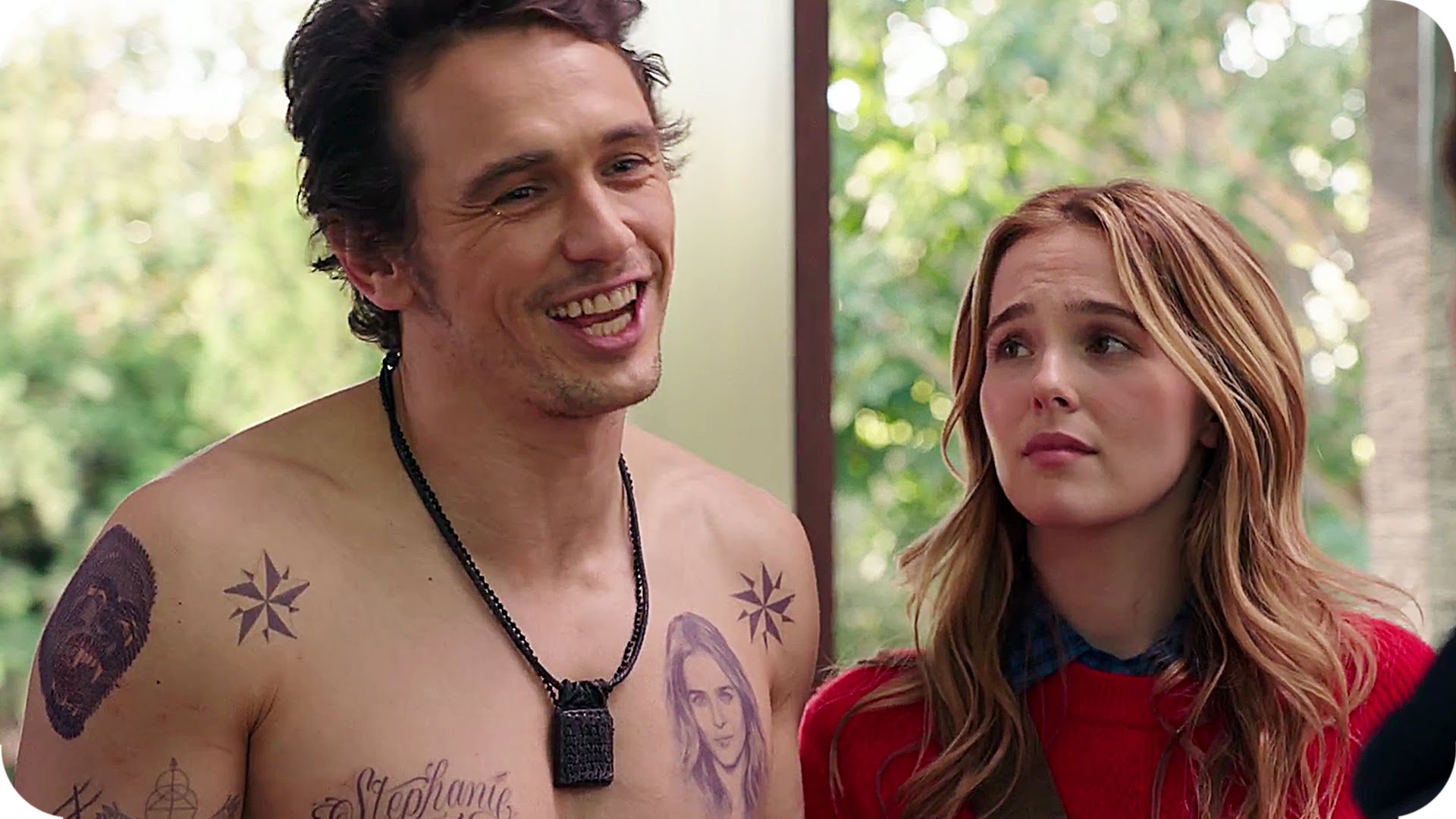
It’s any father’s nightmare: that the daughter he adores meets a man that she adores but whom the father hates. Such is the case in Why Him?, where Bryan Cranston’s struggling businessman dad, Ned Fleming (he owns a printing company), and his wife, Barb (Mullally) are invited to meet their daughter’s new boyfriend. Their daughter, Stephanie (Deutch), has kept quiet about her new boyfriend, Laird Mayhew (Franco), but as it’s Xmas, she thinks it’s a good idea for everyone to start getting to know each other. But Laird, who owns a video game company and is very, very successful, is also a bit of a loose cannon. He swears a lot, behaves inappropriately, appears to have few or no filters at all, and spends his money seemingly at random and on random things.

Despite his efforts to impress Ned, Laird doesn’t make it easy for himself, and soon learns that Ned doesn’t trust him. Furthermore, when Laird asks for Ned’s blessing so he can propose to Stephanie, the answer is an emphatic No. Laird is persistent, though, and tells Ned that by the time it’s Xmas Day (three days later), he will have won over Ned, and he’ll have his blessing. Ned thinks that is highly unlikely. A wager is made, and Laird does his best to get Ned to like him, but it’s not so easy, and the road to mutual respect is littered with the best of intentions, a few misunderstandings, and the appearance of two real-life rock stars.

However you look at it, Why Him? is a reasonably funny, yet also stupidly awful comedy that relies on its very talented cast to get itself out of quite a few holes (plot- and otherwise). It’s also an awkward mix of culture and generational clashes that rely heavily on clichés and predictable responses from both Ned and Laird as it chugs steadily along the path of least dramatic resistance in its need to be as heartfelt as it is puerile. This is the movie’s biggest flaw: it wants to be humorously crude and shocking in the same fashion as, say, some of Franco’s other recent work (that is, as bluntly as possible), and yet it also wants to be warm-hearted and decent. In the end, decent wins out, but there’s always the feeling that writer/director Hamburg and his screenwriting cohort Ian Helfer didn’t actually know at first which way things were going to work out.

But the movie has a trump card in the form of its casting, with Cranston playing the uptight dad to perfection, and providing the equally perfect foil to Franco’s crass, whacko video game designer. Mullally, who some may remember as the self-serving über-bitch Karen from TV’s Will & Grace, is kept largely in the background but then excels in an hilarious scene where she attempts to seduce Cranston while completely drunk. Deutch does well as the movie’s nominal “straight man”, and Gluck combines the best attributes of both Cranston and Franco’s characters as Stephanie’s younger brother, Scotty. But as is so often the case, it’s one of the supporting characters who proves the most effective. Step forward Keegan-Michael Key as Gustav, Laird’s estate manager who also doubles as this movie’s version of Cato from the Pink Panther series. The movie steps up a notch every time he appears, and if there has to be a spin-off, then Why Gustav? might not be such a bad idea.

Rating: 6/10 – not as obvious or objectionable as it appears to be, Why Him? struggles to maintain a consistent tone throughout, but has a good success rate when it comes to providing big laughs; good performances help paper over some very rough cracks indeed, but overall it’s an enjoyable movie that often tries too hard in its efforts to be edgy, and which doesn’t always seem able to rein itself in for the better.

Share this:

  • Click to share on X (Opens in new window) X
  • Click to share on Facebook (Opens in new window) Facebook
  • More
  • Click to print (Opens in new window) Print
  • Click to email a link to a friend (Opens in new window) Email
Like Loading...

A (Very) Brief Word About the Justice League (2017) Trailer

25 Saturday Mar 2017

Posted by dullwood68 in Movies

≈ Leave a comment

Tags

DCEU, Justice League, Trailer, Warner Bros.

(This could also qualify as a Question of the Week.)

If you’ve seen the trailer for Justice League (2017) – and it appears millions of you have – then ask yourself this: did you spot anything that gave you an idea as to the actual storyline? Or did it seem like just another Warner Bros./DCEU trailer that was only concerned with showing off how much action will be included? And lastly, does anyone at this stage hold out any hope that this will be an improvement on Batman v Superman: Dawn of Justice (2016)?

(Nope, no trailer this time. Did you really expect one?)

Share this:

  • Click to share on X (Opens in new window) X
  • Click to share on Facebook (Opens in new window) Facebook
  • More
  • Click to print (Opens in new window) Print
  • Click to email a link to a friend (Opens in new window) Email
Like Loading...

The Lost City of Z (2016)

24 Friday Mar 2017

Posted by dullwood68 in Movies

≈ 1 Comment

Tags

Adventure, Charlie Hunnam, Drama, Explorer, Hidden civilisation, Historical drama, James Gray, Perceval Fawcett, Review, Robert Pattinson, Sienna Miller, South America, Thriller, Tom Holland, True story

D: James Gray / 141m

Cast: Charlie Hunnam, Robert Pattinson, Sienna Miller, Tom Holland, Edward Ashley, Angus Macfadyen, Ian McDiarmid, Harry Melling, Franco Nero

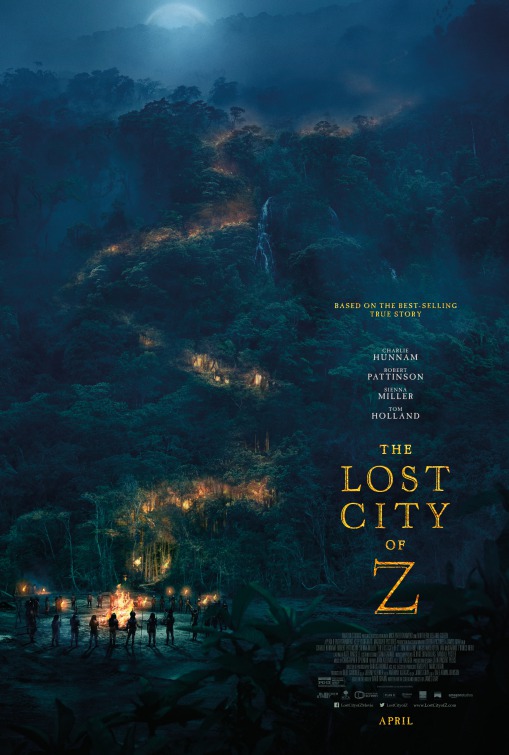
A throwback to the kind of big budget adventure stories made in the Seventies and Eighties, with location filming designed to heighten the events shown, The Lost City of Z concerns the efforts of military man turned explorer Perceval “Percy” Fawcett (Hunnam) to find a city he believes is hidden somewhere in the Amazonian jungle. Covering the years between 1905 and 1925, the movie introduces us to Fawcett the military man while he’s posted to Ireland, and finding it difficult to advance through the ranks thanks to what a senior officer refers to as, “an unfortunate choice in ancestors”. Good fortune arrives in the form of a secondment to the Royal Geographical Society, where he is asked to map an area of jungle on the Brazil-Bolivia border.

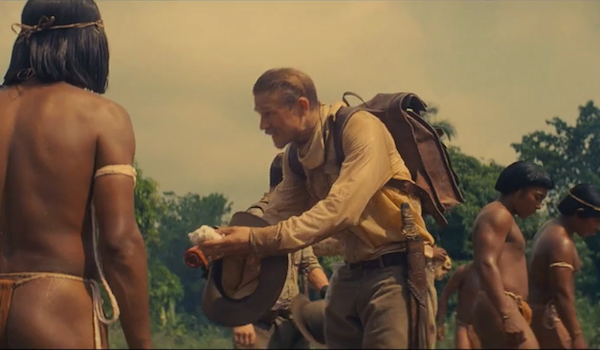
Fawcett accepts the commission, and finds himself in the company of fellow military men Henry Costin (Pattinson) and Arthur Manley (Ashley). While they carry out their task, Fawcett finds what he believes is evidence of an advanced civilisation that once existed within the jungle but which has remained, until now, undiscovered. When he returns to England, and presents his findings to the RGS, they and he are ridiculed, and the idea that the indigenous tribes are anything but “savages” is dismissed. Fawcett does, however, find an ally in RGS member James Murray (Macfadyen), who agrees to fund a further expedition in search of what Fawcett is calling “the lost city of Z”. And so in 1911, Fawcett, accompanied again by Costin and Manley, and with Murray in tow, returns to the Bolivian jungle.

The expedition, however, suffers a series of setbacks, from the loss of equipment to Murray’s inability to deal with the harsh, uncompromising environment. Forced to turn back despite Fawcett’s conviction that they are close to finding the lost city, the trio return home just as war in Europe breaks out. They find themselves fighting together in France, and during a push across the Somme in 1916, Fawcett falls victim to a chlorine gas attack and is temporarily blinded. Invalided out of the Army, Fawcett believes his exploring days are now behind him. That is, until his son, Jack (Holland), convinces him that they should travel together to Bolivia, and make one more effort to find the lost city. And so, in 1925, the pair set off into the jungle in an effort to prove once and for all that the fabled city and its ancient civilisation did exist.

Based on the book The Lost City of Z: A Tale of Deadly Obsession in the Amazon (2009) by David Grann, James Gray’s adaptation is sincere, meticulously researched, beautifully shot by Darius Khondji, engaging on a Boys’ Own adventure level, and yet, despite everyone’s best efforts, not as interesting to watch as it should be. The tale of Fawcett’s obsession should be strong, compelling stuff, but thanks to Gray’s adaptation covering such a long period of time, the movie suffers from being episodic, and as a result, feels hesitant in some scenes and overly confident in others. Gray handles the material well, but the narrative’s stop-start approach – something that Gray in both roles as screenwriter and director fails to find a solution for – means that it’s always difficult for the viewer to maintain interest in a story that, ultimately, isn’t going to lead anywhere.

If you already know the outcome of Fawcett’s third expedition to the Bolivian jungle, then this movie won’t necessarily be of interest. Having to wade through a succession of failures before this point, the movie does its best to make each disappointment and setback in Fawcett’s life part of a never-give-up, never-say-die attitude that drives the man forward, but the key word in Grann’s title – “obsession” – never really applies, and that’s partly due to Gray’s script, which never portrays Fawcett as passionate in his beliefs. It’s also due to Hunnam’s less-than-charismatic performance, one that will have viewers wondering why Costin and Manley stick with Fawcett for so long, and how he managed to attract backers for his second and third expeditions. Watching the movie, it gives the impression that the idea of a hidden civilisation in the Bolivian jungle is more enticing than the idea of Fawcett being the man to lead the search.

The expeditions themselves lack any tension, even when Fawcett and his companions encounter a tribe of cannibals, and though Gray shows an impressive capacity for framing the jungle scenes in such a way that they feel other-worldly, these sections of the movie go by without making as much of an impact as Gray was no doubt aiming for. There are also signposted moments that are straight out of Predictable Storytelling 101, such as when Fawcett holds a book up in front of his face and an arrow pierces it, stopping just inches away from hitting him. Or the moment where Murray demands an apology from Fawcett, and he agrees to do so, and then turns and apologises to Costin and Manley instead.

Also problematical is Fawcett’s relationship with his wife, Nina (Miller). She accepts his going to Bolivia in 1906, and is supportive of the trip. But when it comes time for the 1911 trip, Nina wants to go with him, and the pair have an awkward argument where Fawcett plays down her physical ability to make the journey there and back, and she argues that she has endured childbirth (twice by now) and if she can weather that particular experience then the jungle shouldn’t be any worse. Again, it’s an awkward exchange that feels out-of-place – and designed to give Miller something to do other than play the otherwise doting wife – and feels even more out-of-place when their oldest son, Jack, suggests a third trip and she agrees without so much as a murmur. Perhaps Gray felt the need to include a slice of proto-feminism amongst all the testosterone flying around, but if so, it’s not something that works.

By the time Fawcett and his eldest son get to Bolivia, viewers will probably be wondering how this is all going to pan out. Those in the know will find Gray’s choice of endings (technically, there are three) unlikely, overly poignant, and at odds with the tone of the movie thus far. That said, Gray does give Miller another chance to stand out from the overwhelmingly male cast, and while wish fulfilment is the order of the day, it sits uncomfortably with what we know of Fawcett and that last trip.

Overall, The Lost City of Z is a sterile drama that never hits any emotional highs and struggles to provide the audience with a sense of just how important Fawcett’s search for a hidden civilisation really was back in the Georgian era (or even if it was). There’s the usual degree of sexism sitting alongside the kind of blinkered attitudes that seem to define the period, and though Gray keeps the movie interesting on a visual level, with spectacular scenery and beautifully composed individual shots aplenty, it’s on a dramatic level that the movie fails to gain traction, becoming a succession of scenes that aim for a classic adventure feel, but which lack the depth to elevate it to such lofty heights. An adventure then, but one that offers scant reward for both its characters’ efforts, and the audience’s.

Rating: 6/10 – not as compelling or as rich in detail as viewers will need in order to gain maximum enjoyment from it, The Lost City of Z wastes its potential by making Fawcett’s “obsession” a strictly pedestrian affair; Gray delivers on the production side but can’t seem to work his magic on his own script or the cast, leaving the movie feeling like it’s always about to step up a gear while remaining steadfastly in neutral.

Share this:

  • Click to share on X (Opens in new window) X
  • Click to share on Facebook (Opens in new window) Facebook
  • More
  • Click to print (Opens in new window) Print
  • Click to email a link to a friend (Opens in new window) Email
Like Loading...

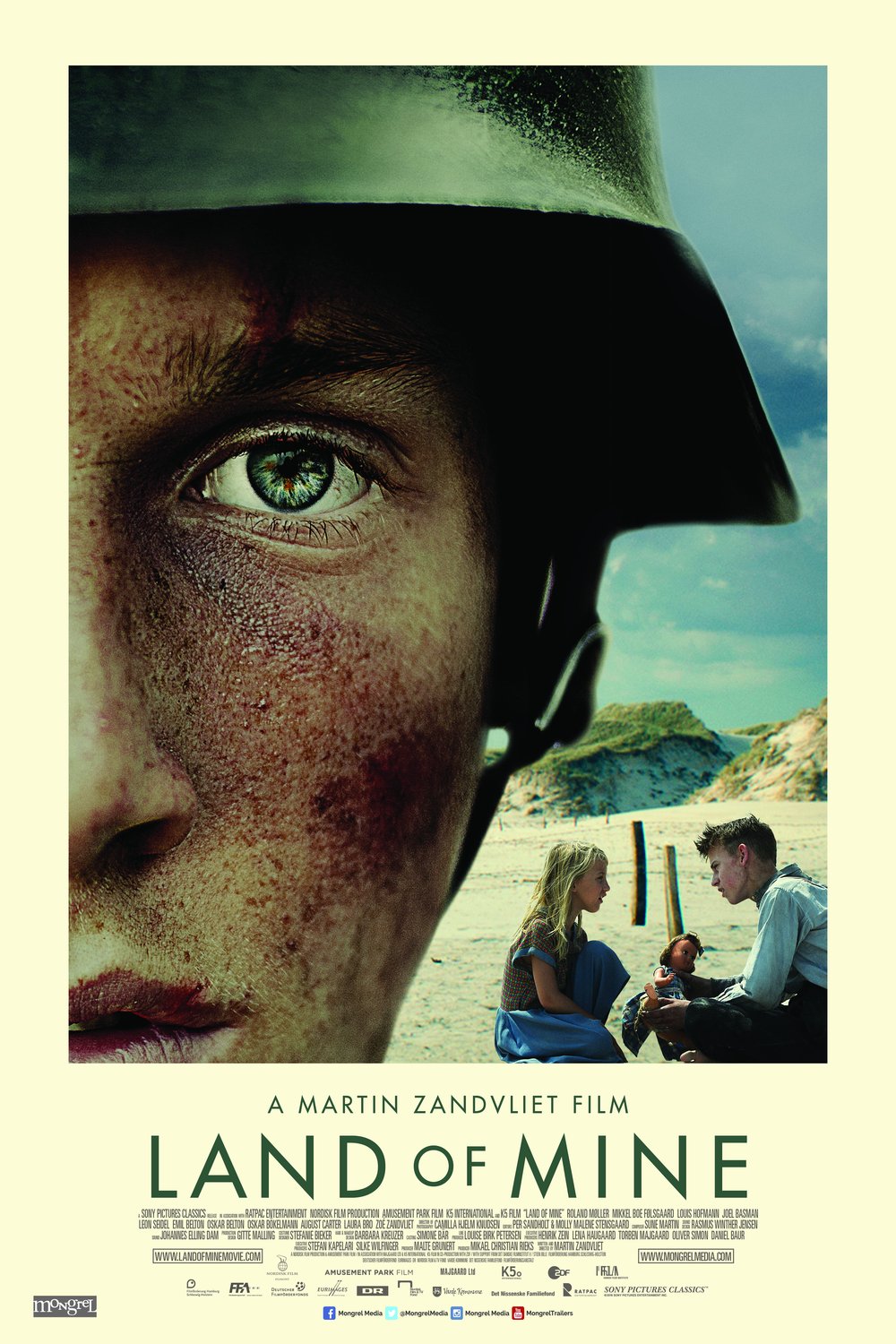
Land of Mine (2015)

23 Thursday Mar 2017

Posted by dullwood68 in Movies

≈ Leave a comment

Tags

Denmark, Drama, German soldiers, Joel Basman, Landmines, Louis Hofmann, Martin Zandvliet, Review, Roland Møller, Thriller, War

Original title: Under sandet

D: Martin Zandvliet / 97m

Cast: Roland Møller, Louis Hofmann, Joel Basman, Mikkel Boe Følsgaard, Mads Riisom, Oskar Bökelmann, Emil Belton, Oskar Belton, Leon Seidel

In the wake of World War II, German POWs were sent to various places along the Danish coast with a view to their being used to clear the beaches of landmines. The fact that they were expendable made them the perfect choice for the job, and the Danes had no compunction about putting them in harm’s way (though they did train them beforehand). It was a large-scale operation, using approximately two thousand Germans – most of them barely out of their teens – to clear approximately two million landmines. And the Danes were in a hurry.

This is the background to Martin Zandvliet’s sparse yet rigorous post-War drama, Land of Mine. The German soldiers co-opted for the task are young, inexperienced for the most part, and looking forward to going back home… until the Danes come calling in the form of Lt. Ebbe Jensen (Følsgaard). He teaches them the basics of how to disarm a landmine, and then sends fourteen of them off to the coast and into the care of Sgt Carl Rasmussen (Møller). Rasmussen’s antipathy toward them is soon evidenced by his lack of concern when food supplies aren’t delivered, and the Germans begin to scavenge for food, all of which leads to sickness amongst the men and the first fatality within the group.

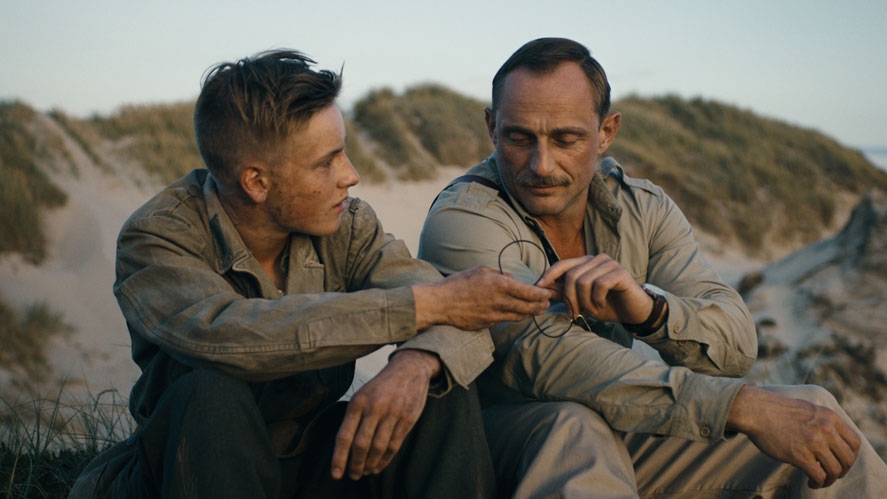
Despite their initial fears, the Germans unite as a team, and their conscientious approach to their work begins to pay off. A natural leader emerges, Sebastian Schumann (Hofmann), and he and Rasmussen begin to forge a relationship based on mutual respect, a situation that catches the Danish sergeant by surprise. He softens his attitude toward the men, and even brings them food from the Danish army camp further inland. Eventually, he even removes the barricade on the men’s barracks that keeps them locked in at night. Another fatality occurs, an unforeseen event that serves to make one of the men, Helmut Morbach (Basman), question the likelihood of their ever returning home. It’s an unpopular idea, but when a further death has a profound effect on Rasmussen, his reaction only serves to reinforce Morbach’s paranoia, and the men are faced with the very real possibility that all their lives will be forfeited there on the beaches.

Despite its simple storyline and set up, Land of Mine is resolutely not a simplistic tale. There’s far too much going on than it appears at first glance, and Zandvliet (working from his own script) has forged a powerful, compelling portrait of commitment under pressure, both in the relationships between the men (including Rasmussen), and in the disabling of the landmines. Zandvliet shows that, even in the worst of circumstances, bonds can be formed between even the unlikeliest of adversaries. When we first meet Rasmussen he’s in a jeep watching a large group of German POWs trudging past him on the road. He assaults one of them, displaying a deep-rooted anger towards the German soldiers that doesn’t augur well for his future charges.

For their part, the German POWs who are selected to clear the beaches are too young to have seen any meaningful action during the war, and aren’t to be blamed for the decisions made by their elders. They all look ahead to the time when they’ll be back home in Germany and making their way, fruitfully, in the world. Even though the odds are against them (and nearly half of the two thousand Germans made to remove the mines were either killed or maimed for life), these young men still have the capacity to look forward to a better, brighter future. It’s this optimism in the face of grim experience that helps give the movie a positive spin, one that’s sorely needed to balance the inevitability of their dying. And once Rasmussen discovers he can respect them as people, and not just German soldiers, then that optimism flares brightly, and in contrast to the flare of the explosions that threaten them every day.

As well as hope and optimism, the movie dwells on camaraderie and the notion of friendship under fire, but to a lesser extent. It still manages to explore the nature of reliance on others in extreme circumstances (both emotionally and practically), but it does so in an understated manner that complements the restraint Zandvliet shows in handling the narrative. This isn’t a showy, flashy movie intent on making eye candy out of explosive situations. Rather, it’s a stringent, occasionally profound meditation on the human ability to find something worth saving or fighting for in the worst of situations. All of these men confront death each day, and all of these men find strength in having each other around them.

Land of Mine‘s introspective qualities are highlighted by the performances. Møller is the nominal “angry man”, ruled by his prejudices until he realises the Germans are just young men thrown into the war like cannon fodder – just like they are when they’re on the beaches. Møller adopts a stern, patrician gaze for most of his scenes, but when Rasmussen lets down his guard (in his scenes with Sebastian), the one-time career criminal turned actor shows that he has a natural talent for portraying a character’s inner workings and thoughts. Relaxing into the role with every scene, Møller is the one cast member who draws the eye throughout, and his transformation from “angry man” to unacknowledged friend and back again to “angry man” is convincing because he’s sincere and there’s an equally sincere sense of purpose in his approach to the role.

The rest of the cast are more than capable, and provide impressive support when needed, particularly Hofmann as the thoughtful, clever Sebastian, and Emil Belton as one of two brothers, Ernst, whose sadness at the loss of his sibling leads to both triumph and tragedy in the same scene. Zandvliet never compromises with the characters, and manages to make them all feel like fully rounded human beings, ones that you could imagine being stuck in such horrendous circumstances. They populate a beautiful stretch of the Danish coastline, locations that are historically authentic, and Camilla Hjelm’s bright, stately cinematography adds a lustre to the movie that makes it seem hyper-real in places, with the blinding white of the beaches reflecting back off the blue skies above in striking fashion. Between them, she and Zandvliet have crafted a visual aesthetic that belies the grim nature of the material, and which instinctively elevates the movie beyond that of yet another post-War drama where enemies learn to respect each other.

Rating: 9/10 – its nomination in the Best Foreign Language Film category at this year’s Oscars may have surprised some people, but Land of Mine was a worthy nominee, and it’s a movie that is well worth seeking out; bold, absorbing, and in places, delicately nuanced, this is a triumph of low-key yet resonant movie making, and full of neat directorial touches that confirm Zandvliet is a director who knows exactly what he’s doing.

Share this:

  • Click to share on X (Opens in new window) X
  • Click to share on Facebook (Opens in new window) Facebook
  • More
  • Click to print (Opens in new window) Print
  • Click to email a link to a friend (Opens in new window) Email
Like Loading...

Viceroy’s House (2017)

22 Wednesday Mar 2017

Posted by dullwood68 in Movies

≈ Leave a comment

Tags

Drama, Gillian Anderson, Gurinder Chadha, Hindus, Historical drama, Hugh Bonneville, Huma Qureshi, India, Manish Dayal, Michael Gambon, Muslims, Pakistan, Partition, Politics, Review, Sikhs, True story

D: Gurinder Chadha / 106m

Cast: Hugh Bonneville, Gillian Anderson, Manish Dayal, Huma Qureshi, Michael Gambon, Om Puri, Simon Callow, Lily Travers, Tanveer Ghani, Denzil Smith, Neeraj Kabi, Darshan Jariwala

The awkwardly titled Viceroy’s House opens with a quote by Winston Churchill: “History is written by the victors.” Bearing in mind the story that follows, it’s hard to see why this particular quote has been chosen to open the movie. Perhaps director Gurinder Chadha is using it in an ironic fashion; any winners borne out of the terrible circumstances and outcomes surrounding the partition of India in 1947 may not have been aware of their having “won” anything at the time – even those who wanted the creation of Pakistan.

One thing that soon becomes apparent from watching the movie is that it’s going to be a politics-lite experience, with little depth beyond that given to an adaptation being shown on UK Sunday evening television. This means that some viewers, especially those with little awareness of the period when the British withdrew from India, and the terrible consequences that followed, will take much of what the movie tells them to heart. What should be made clear from the start is that Viceroy’s House is better viewed as an impression of those events than as a recreation.

The problem here is that one of the most traumatic upheavals of the 20th Century that involved a country and fifteen million of its inhabitants – those who were displaced – is given an unremarkable soap opera sheen that paints the British as saviours, and the Indian people as the authors of their own downfall. As an interpretation of what actually occurred on the Indian sub-continent, the movie takes several factual liberties with the events surrounding partition, and panders to the idea that the frustration experienced by Lord Louis Mountbatten (known more familiarly as “Dickie”) (Bonneville) is somehow more affecting and deserving of our sympathy than the political and social upheavals being experienced by India’s Hindu, Muslim and Sikh communities. As a dramatic approach to the material, it’s akin to asking an audience to be more sympathetic towards someone with a slight case of sunburn than someone who’s lost a limb.

The obvious comparison here is with the TV series Upstairs, Downstairs (or Downton Abbey for that matter, which also stars Bonneville). By attempting to focus on both the political machinations going on above stairs and the social upheavals occurring below stairs, Viceroy’s House tries to show the effect of partition on the British and the Indians alike. But the script – by Paul Mayeda Berges, Moira Buffini, and Chadha – takes an uncomfortable approach to the historical material, and tries to add a standard Romeo and Juliet-style romance to proceedings through the attraction between valet Jeet Kumar (Dayal) and lady’s attendant Aalia Noor (Qureshi). Alas, and despite the best efforts of Dayal and Qureshi, their romance is a tepid affair that occupies too much screen time, and lacks the kind of epic passion that could be seen as a compelling reflection of the violent passions of a country expressing itself through mounting conflict.

Other members of the Viceroy’s staff have arguments and cause problems from time to time, and Mountbatten is seen to berate them as if they were all naughty children. It’s a condescending attitude that extends to Mountbatten’s meetings with India’s leading politicians. Whether it’s Nehru (Ghani), Jinnah (Smith) or Ghandi (Dabi), the movie has “Dickie” treating them as if they should all just get along because he needs them to. And as a sop to the current need for strong female characters in pretty much every movie being made, Lady Edwina Mountbatten (Anderson) is portrayed as the “brains of the outfit”, while at the same time falling victim to the idea that their predicament is worse than that of the Indian people (“How can it be getting worse under us?”).

As the inevitability of partition looms ever nearer, and outbreaks of violence become the norm, Mountbatten is pushed into a corner and forced to accept that there can’t be a united India. With Pakistan now a certainty, he’s required to divide India into two, and enlists British lawyer Sir Cyril Radcliffe (Callow) to carry out the task. But it proves too difficult, until he’s advised by General Ismay (Gambon), Mountbatten’s advisor on all things Indian and political, that there is a solution. It’s here that the movie cements its appreciation and sympathy for the Viceroy by showing him as having been tricked by the British Government and set up for a fall if the violence continues and/or escalates out of control. It’s a moment that should elicit a good deal of compassion for “poor old” Mountbatten, but instead makes the viewer realise that Chadha feels more for him than she does for the Indian people.

Much else in the movie is perfunctory stuff designed to move the story forward with the least amount of effort or acknowledgment as to how dry and uninvolving it all is. Chadha directs with a minimum of fuss or apparent enthusiasm, leaving some scenes feeling cursory and superficial. Against this, the cast can only do their best, though Anderson manages to imbue Lady Mountbatten with a supportive, agreeable nature that makes her feel like more of a fully rounded character than anyone else. Bonneville is a good choice for “Dickie” (though he doesn’t look anything like him), but even he’s held back by a script that paints Mountbatten, somewhat plainly, as a good man in a bad situation (though if you need someone to portray “pained frustration” then Bonneville’s your man).

For someone whose family were involved in the partition and the subsequent resettlement of so many people, Chadha doesn’t always seem interested in telling a coherent, responsible story. Muslims are unlikely to be happy about the way in which they are shown to be the main instigators of the violence depicted, while the religious enmities between Muslims and Hindus are reduced to petty squabbling, a direction that is extended to the encounters between Nehru and Jinnah – if you believe the movie, then neither man could be in the same room as the other without resorting to childish bickering. By reducing the key players’ importance in this way, and by playing up the ineffective nature of Mountbatten’s tenure as Viceroy, the movie ends up paying lip service to a terrible period in India’s history, a period that deserves a much more focused and intelligent approach than is featured here.

Rating: 4/10 – sporadically effective as a heritage picture, Viceroy’s House is let down by its one-sided consideration of British colonialism, and by its insistence on depicting Indians of the time as quarreling malcontents; nowhere is freedom from oppression expressed as forcibly as needed, and the movie’s tacit exoneration of Great Britain’s often brutal occupation makes for an uncomfortable viewing experience throughout.

Share this:

  • Click to share on X (Opens in new window) X
  • Click to share on Facebook (Opens in new window) Facebook
  • More
  • Click to print (Opens in new window) Print
  • Click to email a link to a friend (Opens in new window) Email
Like Loading...

Wolves at the Door (2016)

21 Tuesday Mar 2017

Posted by dullwood68 in Movies

≈ Leave a comment

Tags

1969, Drama, Elizabeth Henstridge, Horror, John R. Leonetti, Katie Cassidy, Manson Family, Tate murders, Thriller, True story

D: John R. Leonetti / 73m

Cast: Katie Cassidy, Elizabeth Henstridge, Adam Campbell, Miles Fisher, Lucas Adams, Spencer Daniels, Jane Kaczmarek, Chris Mulkey, Eric Ladin

Here on thedullwoodexperiment it’s often the case that a review will question why a movie was made in the first place. Sometimes it just seems incredible that no one – seriously, no one – saw how a movie was progressing during production and didn’t say anything along the lines of, “Hey guys, this isn’t really very good, shouldn’t we just call it quits and save ourselves the embarrassment?” With low-budget movies it’s a little more forgivable. Fewer resources and an inexperienced cast and crew should always be taken into consideration, even if the end result fails to meet any and all expectations; at least the movie makers have tried their best (and even if their best proves to be their worst). Good intentions can mean a lot.

But then there are movies that are made by established, world-renowned production companies such as New Line Cinema, and/or released by equally world-renowned distributors such as Warner Bros. These movies get a wider shot at audiences than those made by independents or first-timers, and have a wider chance of making their production costs back. But when you watch them, it’s like watching a movie where the least amount of thought and consideration has gone into them, from the script to the cinematography to the editing to the soundtrack to the acting to the directing to the whole tone of the thing. It’s like watching the movie version of a contractual obligation.

And so we have Wolves at the Door, the latest movie to fit the criteria listed above. Based on “true events”, the movie recounts what happened over two particular nights in Los Angeles in August 1969. First we witness the early morning home invasion of a couple (Kaczmarek, Mulkey) that results in the couple being frightened for their lives but suffering no actual physical harm. A detective (Ladin) tells them that there have been a lot of similar incidents recently, but that this is something different. Cue the next evening and four friends having dinner together. The quartet – eight months pregnant Sharon (Cassidy), and her friends, Jay (Fisher), and couple Abigail (Henstridge) and Wojciech (Campbell) – are commiserating over Abigail’s imminent trip to Boston. They head back to Sharon’s home, intending to continue their “commiserations”.

Another friend, Steven (Adams), is there too, but he’s spending more time with the property’s caretaker, William (Daniels), who lives in a separate building. When he parts company with William, Steven encounters a strange man and woman who stop him from leaving the estate. Meanwhile, Wojciech, upset by Abigail’s decision to move to Boston, decides to get some air. He too encounters the strangers. Inside, Jay settles on the sofa to watch TV while Sharon and Abigail begin to hear strange noises. At one point, they see a strange woman in the house. Though scared, they still attempt to find out why the woman is there, but soon they both realise that there’s more than just the one stranger, and that the four friends are all in danger.

If you made the effort you could watch Wolves at the Door without knowing anything about it; which would be a blessing of sorts. If you managed to avoid reading any reviews, or hearing any word of mouth reports, or even seeing the poster with its give-away tagline, then there’s a certain degree of intrigue that will attach itself to the viewing experience. You’d be asking yourself why is all this happening, and you’d also be waiting for the four friends to turn the table on their attackers and come out on top (after the requisite amount of violent reprisals and bloodshed). But this isn’t that kind of movie, and it’s that tagline that gives it all away. For yes, this isn’t based on “true events” in the sense that it takes something that happened and fashions a different story around those events. No, this is a movie that takes those events and purports to be a recreation of those events – mostly.

Putting aside the movie’s appropriation of the Tate murders for mild exploitation purposes, what is more distressing is the absence of any connection with the characters themselves, and especially as they’re based on real people. The movie leaves Sharon Tate and her friends with no discernible personalities, lets the cast behave like approximations of the people they’re portraying, and doesn’t even try to engage the audience’s sympathy for the terrible things that happen to them. The viewer can only watch, distant and uninvolved, as the Manson Family members terrorise and attack the four friends (and Steven), and keep their motives unexplained (until the movie’s coda). It could all be happening to any group of strangers, and again it’s odd that with the movie being based on “true events”, the producers have decided to adopt an approach that reduces the impact of real people being attacked and killed to that achieved by a below-average slasher movie.

It doesn’t help that Gary Dauberman’s script is uninterested in telling a coherent story in the first place. The story of the Tate murders is one that’s ripe for a powerful, impactful movie, but this plods along employing standard horror movie clichés and failing to provide any tension. Despite the short running time, there are still plenty of scenes that could be removed and not be missed thanks to Dauberman’s disjointed approach to structure, and the absence of any appreciable imagination. He also has a tin ear for dialogue, saddling the cast with the kind of lines that would defeat even the most inspired casting. In terms of the cast, Cassidy and Henstridge are the nominal stars, but they’re soon reduced to crying, hiding, running about and making stupid decisions without any regard for logic or credibility, while everyone else involved has to hope that their performances survive the arbitrary decisions made by director Leonetti and editor Ken Blackwell at the assembly stage.

As the director, John R. Leonetti reminds audiences why he’s better off in his regular day job as a cinematographer, but at the same time, leaves those same audiences perplexed by his encouraging the kind of dimly-lit, murky photography that leaves this movie looking so bland and unremarkable, and which adopts the same kind of predictable framing and shot construction that we’ve seen so many, many times before in the realm of low-budget horror. All of this adds up to a flat, generic, dull movie that someone should have pointed out wasn’t going to work however much everyone tried – because it doesn’t seem as if anyone was. So once again, audiences are left with a movie that doesn’t work, is beyond lacklustre, and which can’t even manage the energy to be at least partially interesting.

Rating: 2/10 – a movie that reinforces the idea that some projects are just exercises in going through the motions, Wolves at the Door takes a real life tragedy and makes it seem trivial in comparison; and as if that wasn’t bad enough, it’s just plain awful.

Share this:

  • Click to share on X (Opens in new window) X
  • Click to share on Facebook (Opens in new window) Facebook
  • More
  • Click to print (Opens in new window) Print
  • Click to email a link to a friend (Opens in new window) Email
Like Loading...

Can We Take a Joke? (2015)

20 Monday Mar 2017

Posted by dullwood68 in Movies

≈ Leave a comment

Tags

Comedy, Documentary, Free Speech, Gilbert Gottfried, Humour, Jim Norton, Lisa Lampanelli, Obscenity, Offense, Outrage, Penn Jillette, Ted Balaker

D: Ted Balaker / 75m

Narrator: Christina Pazsitzky

With: Jim Norton, Lisa Lampanelli, Gilbert Gottfried, Karith Foster, Penn Jillette, Heather McDonald, Christopher Lee, Noam Dworman, Greg Lukianoff, Jonathan Rauch, Adam Carolla, Jon Ronson

They say that humour is subjective, that what one person finds funny is likely to leave another person unmoved. But what if a joke is deemed offensive? And what if that joke, or comment, is deemed so offensive that the person making the joke is condemned by an audience member, or perhaps the whole audience, or worse still, thousands (perhaps millions) of social media users? How does that work, and why is it happening so often in the United States? Why has free speech come under so much threat, and why is one person’s idea of free speech more important than someone else’s? Why, in short, are so many people now quick to be or feel offended?

This is the central conundrum of Can We Take a Joke?, a documentary that explores the notion that if you tell a joke that’s offensive, and someone takes offence against that joke, then they’re right to do so, and it’s the comedian’s fault for stepping over the line – deliberately or not. It seems outrage is all the rage now, as jokes have to pass a kind of cultural litmus test of what’s acceptable and what’s not. And woe betide you if you’re the one stepping over that line, because you will be pilloried. And don’t think that you’ll find support from the liberals in America, because in reality, they’ve become even more stringent than the conservatives. What’s a comedian to do? The answer’s easy: keep on doing what you’re doing.

The movie takes us back to the early Sixties and the rise to prominence of Lenny Bruce, the godfather of modern comedy. Bruce was uncompromising and he regularly skewered the fascist tendencies of a heirarchy that ensured the police were in attendance at his shows, waiting to arrest him if he said anything the authorities deemed offensive or inflammatory or obscene. The point here is that no one in the audience at a Lenny Bruce gig ever complained or said they were outraged or offended. The end result of Bruce’s several arrests? Since then, not one comedian has been arrested for being offensive, inflammatory or obscene. Progress, then. Except, as Can We Take a Joke? shows, in the years since, there has been a sea change, a growing reluctance by some people to accept that comedians can, and will, use offensive material in their routines.

Unfortunately, the movie doesn’t ask why this has happened. It makes the point – and it’s rightly a bit of a blow to realise – that some audiences are now less tolerant of political satire, or attacks on sexist and racist attitudes, or just about anything that they don’t like. And they are increasingly vocal about it, whether they’re heckling performers (sometimes they’re organised, as at a college show that was advertised as deliberately offensive), or taking to social media outlets such as Facebook and/or Twitter in order to make their intolerance known. The movie shows just how pervasive this intolerance can be through the restrictions put on comedians when they do campus gigs – some, like Chris Rock and Jerry Seinfeld won’t perform at campuses because they have to self-censor their material – and the unfortunate tale of Justine Sacco, who in 2013 tweeted, “Going to Africa. Hope I don’t get AIDS. Just kidding. I’m white!” She tweeted this while at Heathrow Airport, then turned off her mobile phone. Eleven-and-a-half hours later, she arrived in South Africa, turned her mobile back on, and discovered that her tweet had generated enough online outrage that she lost her job.

Sacco’s tweet was clearly ill-considered, but the sheer scale of the backlash against her was also clearly disproportionate. So why is comedy targeted in this way, and why do the complainers and the outraged respond with such venom? Again, the movie doesn’t have an answer. What it does have is a roster of comedians who are recognised for their use of offensive material in their acts. The movie’s quick to make the point: what do audiences expect if they go to see comedians like Lisa Lampanelli or Gilbert Gottfried? These are comedians who are renowned for the offensive nature of their material, for the challenging, uncomfortable mirror they hold up to the rest of society. And they’re condemned for doing so, and all because it seems that modern audiences have no idea about context, or perversely, won’t tolerate the idea of free speech if it goes against their own ideas about what’s funny and what isn’t.

So, with the battle lines drawn, what’s a comedian to do? The answer appears to be, go on the offensive (no pun intended). None of the interviewees are prepared to back down, and some, like comedian and podcaster Adam Carolla are actively attempting to challenge the anti-free speech brigade while continuing to engage in the kind of comedy routines that are likely to rile said brigade in the first place. There’s a hint that Carolla is just as militant in his opinions as the people who take exception to offensive jokes or routines or shows. But the movie skirts round this particular possibility, and provides a succession of comic talking heads who espouse their own distaste with the people who don’t like their material. There’s an irony here that seems lost on director Balaker and his production team, and which allows for a certain amount of mirth as we see nominally thick-skinned comedians criticise the people who criticise them.

In the end, the movie asks a lot of questions, makes several relevant points, provides a few clever insights (mostly thanks to author and activist Jonathan Rauch), but lacks both balance and answers. That the movie lacks balance isn’t necessarily a negative, as it’s clear that Can We Take a Joke? is intended as a riposte to the very hyperbolic hysteria that seems to follow in the wake of offensive material being aired. That it doesn’t offer the “other side” a voice is likely to upset some viewers, but the idea that a fair-minded approach should be mandatory in documentaries is ridiculous; how would any debate on any issue ever get started? And as for answers, the movie’s relatively short running time and plethora of questions doesn’t allow for too many answers, and those that it includes are all from the comedians getting to air their views unchallenged.

If there is one answer that the movie does accept (and wholeheartedly at that) is the one to its title. That answer is definitely: no. But if it’s no because tastes have changed, or because society is less tolerant of so-called taboo subjects (for some reason), or because of some hidden agenda within society itself – well, these are the questions that aren’t addressed but could have been. The movie’s one over-riding consensus is that offensive comedy is good and venomous criticism is bad. This may be true (if a little trite), but then we’re back to the same point made at the beginning of this review: that humour is subjective, and that will always be the case.

Rating: 7/10 – a documentary that has a tendency to waste too much of its short running time on repeating the same claims re: the necessity for offensive comedy, Can We Take a Joke? is nevertheless a caustic response to those who feel it isn’t; by accepting that there is a need (though without explaining why), the movie doesn’t always do justice to the questions it asks, but as a platform for debate, it’s much more successful.

Share this:

  • Click to share on X (Opens in new window) X
  • Click to share on Facebook (Opens in new window) Facebook
  • More
  • Click to print (Opens in new window) Print
  • Click to email a link to a friend (Opens in new window) Email
Like Loading...

T2 Trainspotting (2017)

19 Sunday Mar 2017

Posted by dullwood68 in Movies

≈ 1 Comment

Tags

Danny Boyle, Drama, Drugs, Edinburgh, Ewan McGregor, Ewen Bremner, Irvine Welsh, Jonny Lee Miller, Literary adaptation, Porno, Review, Robert Carlyle, Sequel

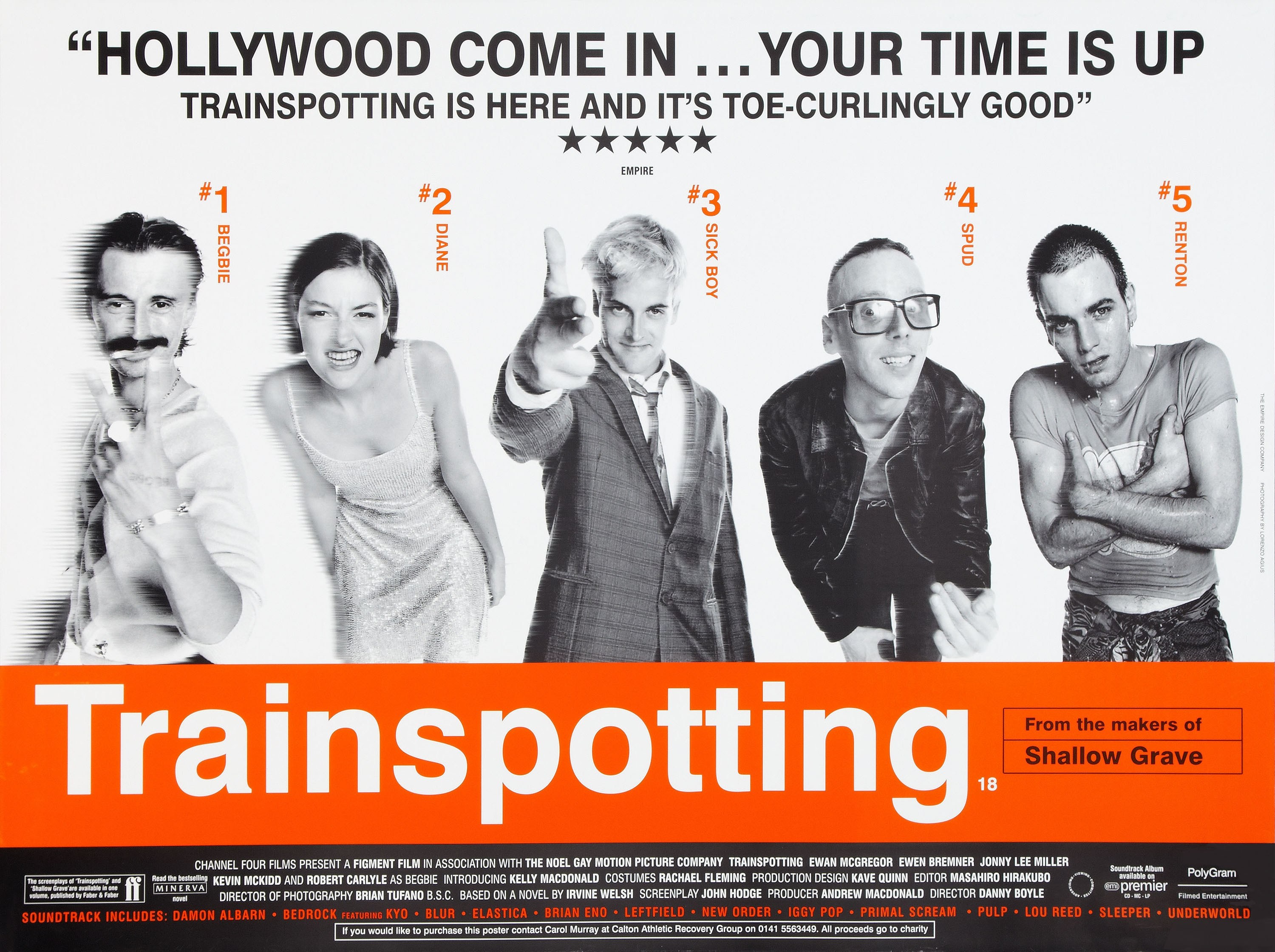
t2-trainspotting-uk-poster

D: Danny Boyle / 117m

Cast: Ewen McGregor, Ewen Bremner, Robert Carlyle, Jonny Lee Miller, Anjela Nedyalkova, Kelly Macdonald, James Cosmo, Shirley Henderson, Pauline Turner, Scot Greenan, Kyle Fitzpatrick, Gordon Kennedy, Irvine Welsh

Choose life, choose four characters who have led miserable lives for the past twenty years and can’t overcome their failings. Choose redemption if only because it sounds good and it might make you feel better. Choose old friends, however much they might hate you, because making new ones is too difficult. Choose Scotland. Choose to make amends. Choose the past over the future because it’s safer. Choose remorse. Choose anger at seeing your dreams go unfulfilled, and try to make new dreams to stop yourself from feeling angry. Choose revenge if remorse won’t work. Choose life over a slow, drawn-out, painful trudge towards non-existence. Choose drugs to soothe or melt away the pain of choosing life. And choose the path of least resistence so that choices become easy. Choose football, music, sex, anything to make the emptiness inside you feel less overwhelming. But above all, choose life, and live it with everything you’ve got, even when you feel that you don’t have anything to offer, and if you did, that no one would want it.

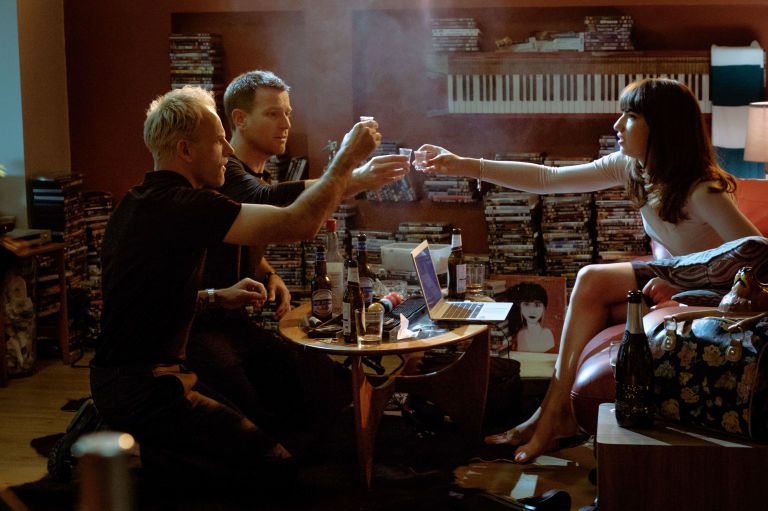
Twenty-one years on from the events depicted in Trainspotting (1996), we finally have the sequel that’s been mooted for so long (Danny Boyle first voiced the idea back in January 2009). Back then, the original movie ended with Renton (McGregor) stealing the proceeds of a drug deal – £16,000 – from his friends, Simon aka Sick Boy (Miller), Spud (Bremner) and Begbie (Carlyle), and heading off to live a normal life. But that “normal” life, which included living in Amsterdam and being married, has fallen apart, and now Renton is back in Edinburgh. His mother has died, he’s staying with his dad (Cosmo), and looking to hook up with his old friends – if they’ll let him. He visits Spud first, only to find him trying to asphyxiate himself with a plastic bag. Saving an initially ungrateful Spud, Renton learns that Begbie is in jail serving a twenty-five year sentence, Simon is the landlord of a rundown pub that an aunt has left him, and Spud himself is a drug addict.

Renton reconnects with Simon, but Simon holds too much enmity towards his old friend because of the money from the drug deal. Along with his business partner, Veronika (Nedyalkova), Simon offers Renton the chance to become part of a scam to acquire European development funds that Simon can use to open a “leisure” club above the pub. Renton agrees, and ropes in Spud to help design the club and oversee its construction once the funds are awarded. Meanwhile, Begbie finds a way out of prison and back home to his wife, June (Turner), and teenage son, Frank Jr (Greenan). Begbie takes his son with him when he burgles properties, but is sidetracked from his endeavours when he learns from Simon that Renton is back in Edinburgh. Begbie’s thirst for revenge is exploited by Simon, and a chance encounter at a nightclub between the AWOL gaolbird and Renton leads to a showdown above the pub, and the chance to settle old scores the hard way.

If you enjoyed Trainspotting, then T2 Trainspotting is likely to make you feel all warm and fuzzy inside. Laced with affectionate nostalgia and perceptive notions of what it is to be middle-aged and treading water, this looked-for sequel isn’t as iconic as its predecessor – and to be fair, it was never likely to be – but it does have an erstwhile melancholy feel to it that accurately reflects the regrets of its four main characters. Like everyone else, Renton is the architect of his own downfall: drug-free but without any purpose in life, he’s come home because he’s not been able to make a go of it in Amsterdam; he’s adrift in his own life, and lacking ambition. Conversely, Simon has nothing but ambition, a drive to better himself financially, but he lacks foresight and cohesive thinking; his plans always backfire as a result. Spud is an addict who wants to swap his drug habit for something more meaningful, another addiction preferably, but one that has a positive effect on his life; writing down stories from twenty years ago helps him on this path. And Begbie – well, Begbie’s only regret is that he’s only just now got out of prison.

With the characters locked in place, John Hodge’s screenplay is free to explore themes of personal responsibility, misplaced nostalgia, revenge, deceit, and compromised friendships. It looks back further than Trainspotting itself, to when all four friends were much younger, pre-teens with the whole world ahead of them, and all the promise that entailed. It provides flashbacks to the first movie, and reintroduces other characters from twenty years before, such as Renton’s girlfriend, Diane (Macdonald), now a successful solicitor. And it shows how stagnant each of the main characters’ lives have become, how mired in mediocrity they are thanks to emotional malaise and impulsive behaviour. There’s little in the way of meaningful progress for any of them, just a desire to lead brighter, better lives that is slipping away from them with every passing year.

This gloomy, regret-laden approach could have made the movie too depressing or downbeat for audiences unfamiliar with the original (which was itself a frank, unapologetic examination of the joys and horrors inherent in taking drugs), but there’s too much mordaunt humour and scabrous comedy on display, and Hodge and returning director Danny Boyle have made a movie that connects on various, different levels, and which does so with Boyle’s trademark visual stylings. This is still a movie that fizzes with invention, from its seemingly scattershot, haphazard camera angles, complex yet rewarding editing rhythms, exceptionally well chosen soundtrack, and emphatic performances, and all the way down to the integration of “old’ footage with new, including a recreation of that classic moment from the original where Renton is almost knocked down by a car – and then stops to revel in the moment.

It’s a Danny Boyle movie through and through, with several moments where the semi-linear narrative seems unlikely to knit together into a satisfying whole, until by the end, everything has been explained and the various strands all neatly tied up. And there are fitting outcomes for all the characters, with all bar one back on the road to self-respect and potential absolution. In bringing back the original cast, and at a point where their own ages reflect the passing of time more effectively than if it had been achieved through make up, the movie offers a kind of shorthand for new viewers, introducing each character they play with an economy of purpose that’s admirable and effective. McGregor still retains some of that boyish charm that made the younger Renton so attractive to watch, while Miller takes glowering to new heights, his features displaying the frustration of Simon’s life with an icy conviction. Carlyle is still effortlessly frightening as Begbie, a man who may not be as comfortable in his own skin as we thought, but who can still inject menace and venom into the most unremarkable line of dialogue.

But if there’s one performance that stands out from the rest, and unexpectedly so, it’s that of Bremner as Spud. Spud is the eternal fuck-up, the addict with the unenviable ability to still feel deeply and profoundly despite the mental numbing he endures, and Bremner is simply superb in the role. Spud is the only character that the viewer can sympathise with, as his motives are selfless, and focused (as best he can) on providing for his partner, Gail (Henderson), and son, Fergus (Fitzpatrick). There’s an innate bravery about Spud that Bremner underplays with skill, making the moment where his writing skills are acknowledged by Veronika, a touching and heartfelt one. Through Veronika’s eyes we see Spud as more than just an addict, and unlike his friends, he can be cheered on with affectionate glee. But friendship is still the key ingredient in what makes these four people tick, even if they’re at odds with each other over past indiscretions. And some bonds, however stretched or damaged they may have become, will, as the movie tells us, withstand much more besides, and still prove beneficial to everyone concerned, no matter how much life has battered them.

Rating: 8/10 – an invigorating if pensive look at middle-aged bitterness wrapped up in a blanket of repentance, T2 Trainspotting doesn’t match the heights of its predecessor, but in fairness, it never actually tries; as much a product of its time as the first movie, there’s a heartache about this movie that is genuinely affecting, and which allows new viewers to see Renton et al as far more than cyphers in a movie about trying not to let the past inform and dictate the future.

Share this:

  • Click to share on X (Opens in new window) X
  • Click to share on Facebook (Opens in new window) Facebook
  • More
  • Click to print (Opens in new window) Print
  • Click to email a link to a friend (Opens in new window) Email
Like Loading...

Get Out (2017)

17 Friday Mar 2017

Posted by dullwood68 in Movies

≈ 2 Comments

Tags

Allison Williams, Bradley Whitford, Catherine Keener, Daniel Kaluuya, Drama, Horror, Jordan Peele, Mystery, Paranoia, Racism, Review, Thriller

D: Jordan Peele / 104m

Cast: Daniel Kaluuya, Allison Williams, Catherine Keener, Bradley Whitford, Caleb Landry Jones, Marcus Henderson, Betty Gabriel, Lakeith Stanfield, Stephen Root, LilRel Howery

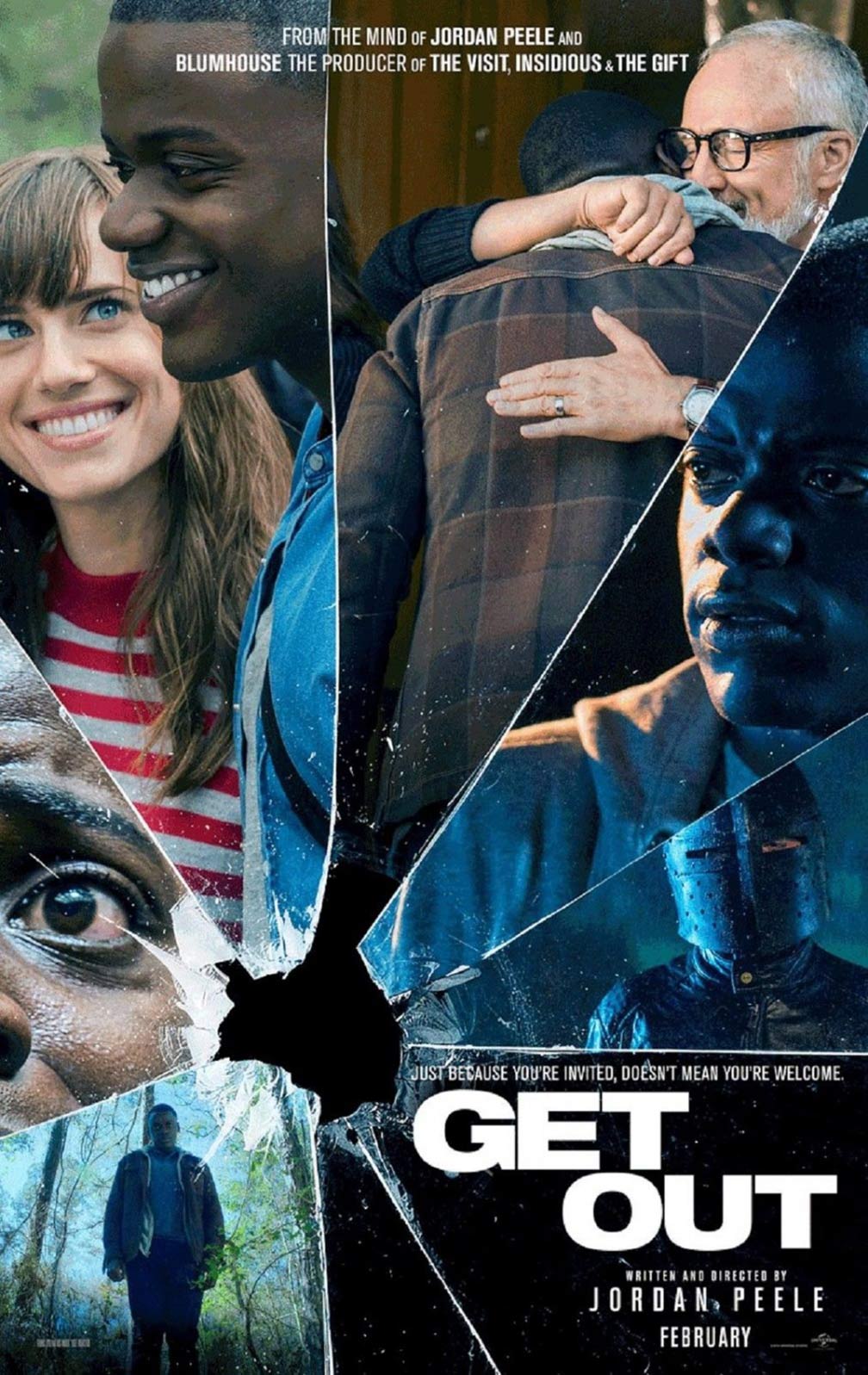
Chris Washington (Kaluuya) is a young, gifted photographer whose work is beginning to be noticed. He’s also black and in a relationship with Rose Armitage (Williams), who is white. Invited by her parents to come stay for the weekend, Chris is anxious about meeting them, fearing they might be uncomfortable with their daughter dating a black man. But Rose reassures him, and tells him that her parents haven’t a racist bone in either of their bodies, and if he could have, her father would have voted a third time for Barack Obama. They set off, but along the way their car collides with a deer, causing some damage but not enough to stop them from reaching Rose’s parents’ home. Once there, her parents – Missy (Keener) and Dean (Whitford) – greet them both warmly, but Chris is perplexed by the odd behaviour exhibited by the Armitages’ housekeeper and gardener, Georgina (Gabriel) and Walter (Henderson), who are both black.

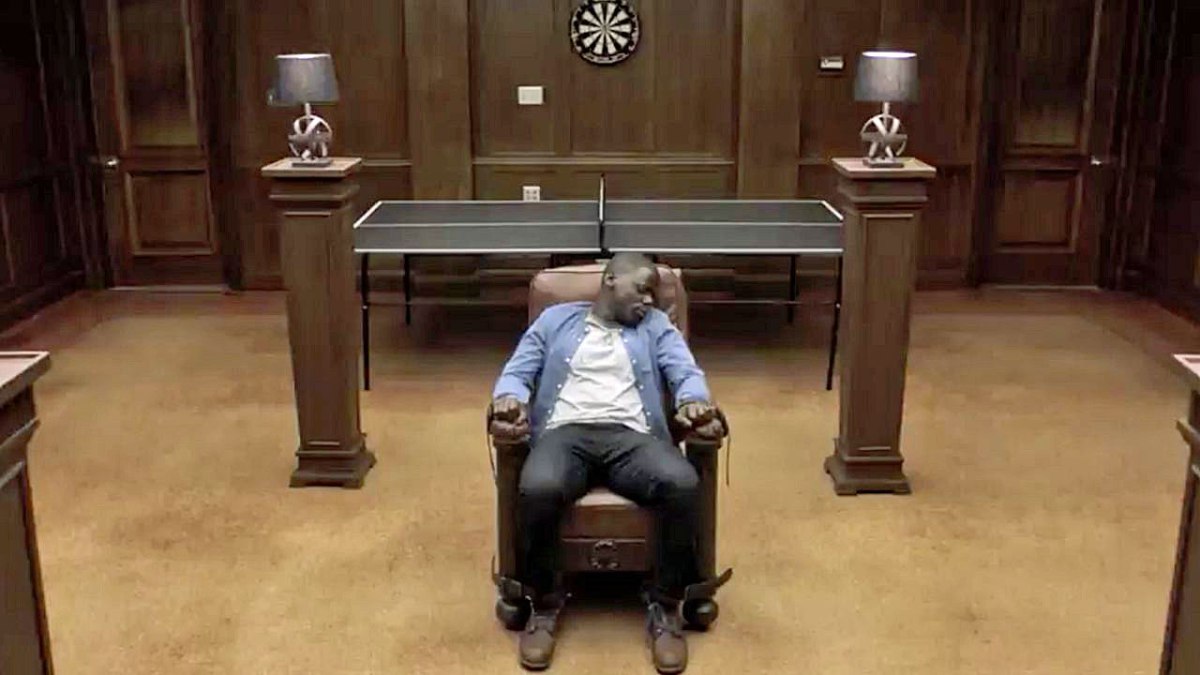
Later that evening Chris meets Rose’s brother, Jeremy (Jones), whose behaviour is provocative and aggressive. He also continues to observe Georgina and Walter behaving strangely. When Missy persuades Chris into sitting with her, he finds that she’s hypnotising him, and he ends up in the Sunken Place, a limbo he can’t return from. At least, that’s what he believes, as he wakes the next morning, confused about what’s happened to him but finding his smoking habit is now cured. He also finds his mobile phone has been somehow disconnected from its charger. At an annual get together that the Armitages hold for their friends, Chris is surprised to see another black man arrive with a much older white woman. But the black man behaves just as oddly as Georgina and Walter, even going so far as to grab Chris and yell at him to “get out”. Chris voices his suspicions that there is something sinister going on, and Rose agrees to leave with him. But when Chris discovers evidence that makes him scared for his life, leaving proves to be far more difficult than he could have ever imagined.

Ever since its debut at the Sundance Festival back in January this year, Get Out has attracted a lot of attention for being a horror movie that takes a satirical look at contemporary racial attitudes in the good ole US of A. The movie certainly paints a satirical portrait of white liberal hubris that’s hard to ignore, but its basic premise – once it’s revealed – plants the movie firmly in paranoid thriller territory. So while there are some standard horror tropes on display, they take a firm backseat to the mystery that is carefully developed by first-time writer/director Jordan Peele, and which proves far more satisfying for its Twilight Zone stylings than for any horror trappings Get Out may be trying to appropriate.

This isn’t to say that the movie is unsure of just what kind of a movie it wants to be, far from it. It’s just that appearances can be deceiving, and Peele instills his tale of racial profiling and assimilation with so many genuinely unsettling moments that mistaking Get Out for a horror movie is only natural – and that’s without its ultra-violent, cathartic final fifteen minutes. But in terms of Peele’s acidulous look at the state of racism in modern day America, the movie is on much firmer ground. Chris’s fear that Rose’s parents won’t approve of him reflects the lingering sense of outrage over miscegenation that still resonates within the US. Despite all the advances made since the Civil Rights movement in the Sixties, Peele is saying these attitudes still prevail, subconsciously perhaps, but then that’s the point: they’ve never really gone away, and they never will. Whisper it if you must, but racism is endemic to the American psyche.

That’s a pretty blatant way of putting it, but Peele is much more subtle than that, and finds various clever ways of getting his message across. This allows the movie to flesh out its subplots – notions surrounding the nuclear family, self-determinism, and social acceptance – unencumbered by the need to be forthright or didactic. Peele is confident enough in his central narrative that he can give these subplots their due, while also playing around – successfully – with the movie’s tone. It starts off as a relationship drama, slightly anecdotal, but set up in such a way that Rose’s parents seem like just another liberal white couple with awkward yet good intentions. The introduction of Walter and Georgina and their odd behaviour allows the thriller elements to begin to take centre stage, and Peele handles the growing uncertainty of what’s really happening with a sureness of touch that’s surprising in someone making this kind of movie for the first time.

Following on, the movie descends into paranoid conspiracy territory, with Chris’s fears amplified by each successive clue he discovers, and with each one serving to reinforce his paranoia. And then we’re in full-on horror mode, as Peele pulls out all the stops to give the viewer a rousing, blood-soaked resolution. Peele displays complete control over the material, keeping each tonal shift feeling organic and unforced. And he keeps the irony spread throughout the movie, allowing it to show itself and act as a counterpoint to the serious nature of the overall material. But Peele’s comedic background won’t be denied either, and there are times when the movie is flat out funny. This is largely due to the inclusion of Chris’s friend Rod (Howery), a Transport Security Administration (TSA) officer who acts as the movie’s comic relief. Again, it’s a measure of Peele’s confidence in his material that he unites these disparate elements and makes them mesh together to such good effect.

But while there is much to recommend Get Out, Peele does drop the ball at times, with some scenes feeling unnecessary or out-of-place – the car-deer collision and its racist cop aftermath, a telephone conversation between Rose and Rod – and his command of the camera (one of this movie’s key strengths) failing him at key moments. But these don’t harm the movie insomuch as they draw attention to themselves when they occur, making for a handful of jarring moments that crop up here and there. At all other times, Peele and his crew, including DoP Toby Oliver, editor Gregory Plotkin, and production designer Rusty Smith, combine to make Get Out one of the boldest and most assured first feature’s for some time.

Peele is aided immeasurably too by his talented cast, with the UK’s Kaluuya giving a measured, yet nervy performance, perfectly displaying the disquiet Chris experiences and the misgivings Chris feels during his visit. As Rose, Williams is all sunny smiles and reassuring glances, though her character also possesses a wicked sense of humour. Keener and Whitford bring an understated menace to proceedings, but Jones is once more on barely restrained psycho duties, leaving Henderson and Gabriel to add real unease to their portrayals. And then there’s Howery, stealing the movie with a succession of one-liners, all of which lead up to a bona fide final line classic: “Man, I told you not to go in that house.”

Rating: 8/10 – a multi-faceted racial drama/horror/mystery hybrid with satirical overtones (and undertones as well), Get Out is one of the more polished and convincing thrillers you’re likely to see in 2017; well thought out, constructed and delivered, its writer/director deserves all the praise that’s been coming his way, and if he wants to give up his comedy day job and make more movies like this one, then that will be absolutely fine.

Share this:

  • Click to share on X (Opens in new window) X
  • Click to share on Facebook (Opens in new window) Facebook
  • More
  • Click to print (Opens in new window) Print
  • Click to email a link to a friend (Opens in new window) Email
Like Loading...

Trailers – Coco (2017), Baby Driver (2017) and Early Man (2018)

16 Thursday Mar 2017

Posted by dullwood68 in Movies

≈ Leave a comment

Tags

Aardman Studios, Animation, Ansel Elgort, Eddie Redmayne, Edgar Wright, Nick Park, Pixar, Previews, Thriller, Trailers

The second movie this year from Pixar (after Cars 3), Coco sees the creators of the Toy Story series make what is arguably their first fantasy movie, as twelve year old Miguel (Anthony Gonzalez) finds himself embroiled in a long-standing family mystery surrounding a ban on music. Miguel’s quest to solve this mystery, and how it connects to his musical idol Ernesto de la Cruz (Benjamin Bratt), leads Miguel into the fabled Land of the Dead. The trailer makes it clear that music is integral to the story in Coco, and the TV footage of de la Cruz is reminiscent of the newsreel footage from Up (2009), but once again it’s the quality of the animation that captures the attention: the end reveal is breathtaking. Pixar appear to have weathered the initial controversy surrounding their decision to try and trademark the term “Día de los Muertos”, and in doing so, have created a Pixar movie first: Miguel is their first central character of ethnic origin. In a way this could be a movie to savour, as it’s the last original story idea we’ll see from Pixar until March 2020. But if the story is locked in, then this could be the kind of uplifting, emotionally resonant tale that Pixar does so well when it’s not concentrating too much on banging out lacklustre sequels to existing favourites.


Edgar Wright may be the only director to turn down a gig at Marvel (he walked away from Ant-Man (2015) citing creative differences), but the downside of that decision for movie fans was his distinctive directing style being absent from our screens for four loooong years. But now he’s back, and with baby-faced Ansel Elgort as, well, the Baby Driver of the title. An action/crime/thriller about a getaway driver (yes, Elgort) looking to “retire” after meeting the girl of his dreams (Lily Collins), but reeled in for one last job by über-crime lord Kevin Spacey, the movie is replete with Wright’s trademark visual stylings (no static angles allowed here), and offbeat sense of humour (the Halloween argument). Anyone familiar with the video for Mint Royale’s Blue Song will already know how Baby Driver begins, but those who don’t will be in for a treat nevertheless. The trailer features some very impressive stunt driving, a great supporting cast that includes the likes of Jamie Foxx and Jon Hamm, and appropriately for a movie where the title character drives to the sounds of his own personal soundtrack, some really great tunes.


Aardman Studios are gloriously unique. They’re the only animation company who work with stop-motion clay animation techniques, and they regularly make crowd-pleasing movies that thrive on their own unique form of invention and wit. And if the teaser trailer for Early Man is anything to go by, then they’re onto another winner here as well. Even though we won’t see the finished product until January 2018, there’s already enough here to vouchsafe its tale of Dug (voiced by Eddie Redmayne) and his efforts to unite his tribe against rivals from the Bronze Age (yes, time travel is involved) in a confrontation that pre-dates European football by thousands and thousands of years. Dug is a classic Aardman creation, and will no doubt prove popular, but if one character is likely to stand out from all the rest, it has to be Dug’s trusty sidekick, Hognob the (early) pig. With this being Nick Park’s first solo venture as a director, and like Pixar’s Coco, Aardman’s last original story idea for some time to come, this is definitely one to look forward to (and hopefully treasure).

Share this:

  • Click to share on X (Opens in new window) X
  • Click to share on Facebook (Opens in new window) Facebook
  • More
  • Click to print (Opens in new window) Print
  • Click to email a link to a friend (Opens in new window) Email
Like Loading...

Billy Lynn’s Long Halftime Walk (2016)

15 Wednesday Mar 2017

Posted by dullwood68 in Movies

≈ 3 Comments

Tags

120fps, Ang Lee, Bravo Squad, Chris Tucker, Dallas Cowboys, Drama, Garrett Hedlund, Iraq, Joe Alwyn, Literary adaptation, Review, Steve Martin, Vin Diesel

D: Ang Lee / 113m

Cast: Joe Alwyn, Kristen Stewart, Garrett Hedlund, Chris Tucker, Steve Martin, Vin Diesel, Makenzie Leigh, Arturo Castro, Mason Lee, Brian ‘Astro’ Bradley, Beau Knapp, Ismael Cruz Cordova, Barney Harris, Ben Platt, Tim Blake Nelson

When Billy Lynn’s Long Halftime Walk went into production back in April 2015, there was much talk about Ang Lee’s decision to shoot the movie at a projection frame rate of 120fps in 3D and at 4K resolution. The previous highest frame rate was 48fps for The Hobbit: An Unexpected Journey (2012), but that experience didn’t prove as successful as hoped for. Lee’s idea was to make the movie as immersive as possible, and shooting at 120fps would have achieved the visual effect he was looking for. It’s a measure of Lee’s standing that his idea was supported by the various production companies who put up the money for the movie to be made. Lee’s idea was revolutionary, but also meant that there would only six cinemas worldwide that would be able to show it as Lee intended. So – artistic idealism or financial folly?

In the end, and inevitably, it’s a bit of both. Lee has taken the novel by Ben Fountain and given it the kind of loving attention to detail that is rare in mainstream movie making these days, but in doing so, has somehow managed to lose focus on the “bigger” picture. It’s a valiant effort, and one that deserves greater attention, but the movie itself proves too wayward in its execution for any distinct meaning to be attributed to the title character’s feelings about the public’s perception of him as a hero. Billy (Alwyn) is meant to be torn between two options: following the advice of his sister, Kathryn (Stewart), and leaving the army after an appearance at a Dallas Cowboys Thanksgiving home game, or returning to Iraq for another tour of duty (which is what his squad is supposed to be doing).

Billy and the rest of his squad, led by Sergeant Dime (Hedlund), are on the last leg of a nationwide victory tour. The group of soldiers, misnamed Bravo Squad by the media, are there because Billy was caught on camera in heroic fashion as he tried to save another wounded sergeant, Virgil “Shroom” Breem (Diesel), during a firefight. Back home for the tour, Billy has had time to visit his home, where his sister Kathryn has voiced her fears for his continued safety, and her worries that he’s suffering from Post Traumatic Stress Disorder. Billy is undecided, unsure if he should commit to his sister’s  proposal, or reaffirm his commitment to his squad. Making a decision is made more difficult both by the attention he’s getting, and the lack of understanding from the public. Nobody seems to be able to grasp what it’s like fighting in a war, and when he tries to explain how it is, he’s either unable to express himself clearly enough, or the other person doesn’t want to hear it.

This is the crux of the matter, and the script – by Jean-Christophe Castelli – spends an awful lot of time examining this aspect of what it’s like to be a soldier. At one point, the squad are approached by a businessman (Nelson) who tries to flatter them into endorsing his fracking operation, but his obvious lack of empathy leads to an overly sarcastic response from Sgt Dime that highlights the distance between them. It’s the kind of well-rehearsed comeback that happens only in the movies, but along with a shorter retort made by Billy in response to Dallas Cowboys’ owner Norm Oglesby’s (Martin) understanding of Billy’s public status, it does make clear just how distant a soldier’s experience is from what the public supposes; and how difficult it is for each side to meet in the middle. Billy connects with one of the Dallas Cowboys cheerleaders, Faison (Leigh), and tells her “It’s sort of weird, being honored for the worst day of your life”. She’s sympathetic, but doesn’t really understand what he’s telling her.

Around all this, the movie explores notions of fate, camaraderie, personal philosophies, determinism, what it means to be a hero, and the broader effects of violence, and the script and the movie are on firmer ground when these are being examined. There are moments where PTSD is shown to be a problem for some of the squad, particularly when a disrespectful Dallas Cowboy fan is choked into unconsciousness. And during flashbacks, Sgt Breem makes it clear to Lynn that there’s no point worrying about being killed; as he puts it, if that’s the way Billy is destined to die then “the bullet’s already been fired”. Breem’s philosophical bent makes sense to Billy, and he does his best to embrace his sergeant’s more thoughtful approach to the war and being a soldier. But he’s also firmly behind the assault on the fan, deeming the inappropriate use of force as acceptable. These contradictions add to the dichotomy inherent in Billy’s thinking, and provide a better understanding of why he’s so torn between leaving and staying. They’re also a much better way of explaining why there will always be a distance between the soldiers and the public.

Billy’s relationships with Kathryn and Faison act as a counterpoint to the macho solidarity he has with the rest of the squad, but they don’t occupy enough screen time to make as much of an impact as may have been intended. Along with movie producer Albert Brown (Tucker), there trying to clinch a deal for a movie version of the squad’s endeavours in Iraq, Dallas Cowboys gofer, Josh (Platt), and his boss, Norm, there are few other characters who are given much prominence. Fortunately, Billy’s story is absorbing enough to compensate for all this, and newcomer Alwyn proves to be a great choice in the role, having got the part just two days after leaving drama school. His ability to express the doubts and fears and troubled feelings of the character are exemplary, and it’s a performance of remarkable maturity for someone who at the time of shooting was only twenty-four (also, his American accent was so convincing, that at first Steve Martin didn’t even realise he was British).

Alwyn is given a lot of room by Lee to explore Billy’s relationship with his comrades and his return to life back home, and this freedom pays off extremely well, with Billy becoming a fully rounded character who’s entirely sympathetic thanks to the dilemma he has to face. Elsewhere, Hedlund is on equally good form as the acerbic, straight-talking Dime, Stewart looks unfortunately as if Kathryn has a drug problem, Martin is unctuous and insincere as Oglesby, Leigh is refreshing as a cheerleader with Christian beliefs, and Diesel shows that there’s far more to his acting abilities than driving muscle cars and propping up other, unsuccessful franchises.

With the performances offsetting some of the more troublesome aspects of the script, Lee’s decision to shoot the movie at 120fps does pay off, even in lower frame rate versions. Billy Lynn’s Long Halftime Walk is possibly the most beautiful, most visually arresting movie of 2016. Images are crystal clear and possessed of a sharpness and depth that is amazing to watch, so much so that when Lee opts for a close-up (cue shots of Martin and Tucker late on in the movie) it’s a little unnerving; it’s as if the actors are really “in your face”. Lee’s aim to make the movie as immersive as possible has been achieved with no small amount of style and panache, and as a gamble it’s paid off far more effectively than with The Hobbit: An Unexpected Journey. He’s also chosen one of the best cinematographers working today, John Toll, to help make the movie so astounding to watch. It’s a shame then that the material on screen doesn’t quite match up to the efforts made off screen.

Rating: 7/10 – with its muddled exploration of the soldier’s lot, and a lack of clarity in terms of explaining said lot to a wider public (namely the audience), Billy Lynn’s Long Halftime Walk doesn’t quite manage to reach the heights it was aiming for; technically superb but not as gripping or insightful as it could have been, it’s still a movie that has plenty of things to recommend it, though expectations should be reined in ahead of seeing it.

Share this:

  • Click to share on X (Opens in new window) X
  • Click to share on Facebook (Opens in new window) Facebook
  • More
  • Click to print (Opens in new window) Print
  • Click to email a link to a friend (Opens in new window) Email
Like Loading...

Miss Sloane (2016)

14 Tuesday Mar 2017

Posted by dullwood68 in Movies

≈ Leave a comment

Tags

Alison Pill, Corruption, Drama, Gugu Mbatha-Raw, Gun control, Jessica Chastain, John Lithgow, John Madden, Lobbying, Mark Strong, Politics, Review, Senate hearing, Thriller

D: John Madden / 132m

Cast: Jessica Chastain, Mark Strong, Gugu Mbatha-Raw, Alison Pill, Michael Stuhlbarg, Jake Lacy, John Lithgow, Sam Waterston, David Wilson Barnes, Al Mukadam, Douglas Smith, Chuck Shamata, Dylan Baker

At the beginning of Miss Sloane, the title character (Chastain) looks directly into camera and says the following: “Lobbying is about foresight. About anticipating your opponent’s moves and devising counter measures. The winner plots one step ahead of the opposition. And plays her trump card just after they play theirs. It’s about making sure you surprise them. And they don’t surprise you.” Chastain delivers this short speech with complete conviction and due gravitas. And in doing so, the movie puts the audience on notice: what follows may not be as true or as real as you believe.

The movie follows lobbyist Elizabeth Sloane into a senate hearing where she’s accused of authorising expenses for the Indonesian government, something which is illegal for a lobbyist to do. At first she refuses to answer the questions she’s asked, hiding behind her lawyer’s brief to “plead the Fifth”. But a more personal line of questioning leads to her abandoning this line of defence and taking the fight to the hearing. Afterwards, her lawyer (Barnes) keeps repeating “five years”, the term of imprisonment she’ll receive if she’s found guilty of perjury. But Elizabeth appears unperturbed.

The movie then travels back to roughly seven months before. Elizabeth is working for a law firm owned by George Dupont (Waterston). A representative of the National Rifle Association, Bob Sanford (Shamata), asks for her help in connecting with a broader female demographic ahead of an upcoming vote on a bill that would mean mandatory background checks on anyone looking to purchase a gun. The NRA sees it as an infringement on civil liberties, and wants to make sure that the bill, the Heaton-Harris Amendment, isn’t passed. Elizabeth laughs in Sanford’s face, and refuses to have anything to do with it. Later, Dupont makes it clear that if she doesn’t work on the NRA’s initiative then her position won’t be as assured as she thinks. That night she meets Rodolfo Schmidt (Strong), head of the law firm Peterson Wyatt, and the man in charge of the fight to get the Heaton-Harris Amendment passed. The next day, Elizabeth resigns, and takes several of her team with her to Peterson Wyatt, though one of her best colleagues, Jane Molloy (Pill), chooses to stay.

In order for the Amendment to have a chance of being successful, Elizabeth, her team, and the staff at Peterson Wyatt, including Esme Manucharian (Mbatha-Raw), have to persuade sixteen out of twenty-one uncommitted senators to vote their way. As they set about this seemingly huge task – Dupont and the NRA only need to persuade six – Elizabeth plays out various strategies in her efforts to secure the necessary votes. But it soon becomes obvious that she’ll cross almost any line in order to win, even if it means sacrificing colleagues or lying to them deliberately. With the tide turning in her favour, and Dupont becoming ever more determined to derail her progress, her old firm launches a smear campaign, one that leads to Elizabeth’s sitting before a senate hearing committee and having to answer for her actions.

From the off, Miss Sloane is a thriller that throws the viewer deep into the mire of political lobbying, and which expects them to keep up with everything that’s going on. It’s an intellectual minefield, with so many issues dependent on the appropriate (or inappropriate) use of legal and ethical considerations, that looking away for even a moment could mean the difference between knowing exactly what’s going on – difficult enough thanks to Jonathan Perera’s dauntingly detailed script – and what might be going on. If you’re ever unsure as to what is happening, and/or why, then it’s best to bear in mind that opening speech, and the lobbyist always being “one step ahead”. Do that, and most of the movie will make sense… eventually.

By preferring (or needing) to stay one step ahead at all times, Elizabeth inevitably becomes a character that the viewer can’t trust. But we can have faith in her, in her need to win, and her commitment to never being out-thought, outfoxed, or outmanoeuvred. For all her manipulations and outright deceptions, Elizabeth is consistent in her efforts to be the winner, and she makes no bones about her methods: if they get the win then that’s all that matters. Along the way this means there are some casualties, notably Mbatha-Raw’s Esme, who has a personal secret exposed in front of millions of TV viewers. Elizabeth would argue that the end justifies the means, but as she is drawn deeper and deeper into the fight to get the Amendment passed, she begins to learn that some lines, once crossed, can’t be re-crossed. And as the stakes are increased, and the senate hearing hoves into view, Elizabeth has no option but to reassess her approach to lobbying and the people she works with.

Bringing the character of Elizabeth Sloane to mesmerising life, Chastain gives, arguably, her best performance since Zero Dark Thirty (2012). Cool, controlling, yet undeniably complex in both her motivations and her need to win at all costs, Chastain portrays Elizabeth as a restless, rest-avoiding predator, always looking for the weak link in an opponent’s armour, and always ready to exploit that weak link. She’ll even use her own people if she feels it’s necessary, but she’s up front about it, and it’s this straight-shooting, unapologetic persona that Chastain exploits so well, making her unlikeable and yet still strangely admirable at the same time. Chastain is the star of the movie, unforgettable whether she’s trampling on other people’s feelings or struggling to contain her own. She’s not alone, though. As her “boss” (a term you soon feel is inadequate in describing anyone who employs her), Strong goes from marvelling at her successes to feeling increasingly worried that she’s going too far with her own, hidden agenda. As the cruelly exposed Esme, Mbatha-Raw is a perfect foil for Chastain’s ebullient performance, her wide-eyed naïvete and quiet strength making her the movie’s most sympathetic character. And there’s further impressive support from Stuhlbarg as Elizabeth’s main adversary at Dupont, Lithgow as the head of the senate committee, and Barnes as her exasperated lawyer.

Orchestrating all this is Madden, now free from depicting events at the Best Exotic Marigold Hotel, and displaying all the skills and directorial touches needed to shepherd Perera’s screenplay (a top five Black List script from 2015) through its varied twists and turns. Make no mistake, this is an intelligent, penetrating look at a world few of us have any conception of, and which is paced like a thriller, all of which makes Miss Sloane a much more compelling movie than expected. It’s also put together very skilfully by editor Alexander Berner, and he and Madden ensure that the many scenes that are taken up by immense amounts of exposition are as equally vital as those scenes where Elizabeth’s plans are achieving momentum, or are already in full swing. In the end, it’s a tale about personal redemption set against a dark backdrop of corruption and ethical malaise, and thanks to Chastain, is nothing less than exhilarating.

Rating: 8/10 – marred only by its predictable denouement, some by-the-numbers villainy from Dupont, and Elizabeth’s not-quite-credible overall gamble, Miss Sloane is still a political thriller with teeth, and replete with flashes of dark humour that leaven the serious tone; irresistible once it’s in full flow, this has unfortunately been overlooked by audiences – which is a shame given the pedigree of the cast, the skill of its director, and the sharpness of its script.

Share this:

  • Click to share on X (Opens in new window) X
  • Click to share on Facebook (Opens in new window) Facebook
  • More
  • Click to print (Opens in new window) Print
  • Click to email a link to a friend (Opens in new window) Email
Like Loading...

Sing (2016)

13 Monday Mar 2017

Posted by dullwood68 in Movies

≈ 5 Comments

Tags

Animals, Animation, Christophe Lourdelet, Comedy, Garth Jennings, Illumination Entertainment, Matthew McConaughey, Musical, Reese Witherspoon, Review, Scarlett Johansson, Seth MacFarlane, Singing contest

D: Garth Jennings, Christophe Lourdelet / 108m

Cast: Matthew McConaughey, Reese Witherspoon, Seth MacFarlane, Scarlett Johansson, John C. Reilly, Taron Egerton, Tori Kelly, Jennifer Saunders, Jennifer Hudson, Garth Jennings, Peter Serafinowicz, Nick Kroll, Beck Bennett, Nick Offerman, Leslie Jones, Jay Pharaoh, Rhea Perlman, Laraine Newman

In a world where animals inhabit human roles, Buster Moon (McConaughey) is a koala whose love of show business has led him to owning his own theatre. But his recent productions have failed to make any money, and Buster is in debt to pretty much everyone, including his own stage crew, and the bank, in the form of llama Judith (Perlman). Needing to come up with a successful idea, Buster decides to hold a singing contest with a $1000 prize for the winner. But his secretary, Miss Crawly (Jennings), accidentally adds two extra zeros to the flier he plans to distribute across the city, and when they find their way into the hands of the public, the prize money reads $100,000. The next day, there’s a massive queue outside Moon’s theatre, all ready to audition for the contest.

Amongst the hundreds of contenders, there’s arrogant blowhard Mike (MacFarlane), a white mouse with the heart and voice of a crooner; long-suffering Rosita (Witherspoon), a pig whose dreams of becoming a singer were sidetracked when she married and had twenty-five piglets; conflicted Johnny (Egerton), a teenage gorilla who wants to avoid following in his father’s criminal footsteps; wildly extroverted Gunter (Kroll), another pig who is teamed up with Rosita; aspiring lead guitarist Ash (Johansson), a porcupine whose musical tastes run to alternative rock; and reluctant Meena (Kelly), an elephant whose shyness stops her from performing. All bar Meena are chosen by Buster to take part in the contest, and rehearsals begin in anticipation of a fantastic night for all of them.

Away from the contest, all of them face personal problems that threaten their involvement in the show. As they each juggle these problems, Buster tries to find the $100,000 he needs, and targets Nana Noodleman (Saunders), a former star who performed at Buster’s theatre. The grandmother of his best friend, sheep Eddie (O”Reilly), at first she refuses to help, but agrees to see a one-off performance by all the acts. But disaster strikes thanks to Mike’s crooked fleecing of three bears in a card game. Their interruption of the show leads to the contest having to be cancelled. Buster hides himself away at Eddie’s place, but the contestants aren’t about to give up on their dreams, and they badger him to carry on. Buster refuses, until that is, he hears a certain elephant singing Leonard Cohen’s Hallelujah.

A bright and breezy musical comedy with a great deal of heart, Sing is as much a feelgood musical as La La Land (2016), and maybe more so. It’s a genuinely heartfelt, uplifting experience that takes its generic “let’s put on a show” narrative and populates it with a winning collection of anthropomorphic animals, all of whom are likeable, endearing and fun to watch. The brainchild of writer and co-director Garth Jennings (who is also a hoot as Miss Crawly, an iguana who keeps losing her glass eye), the movie doesn’t offer anything new in terms of the overall material – you can pretty much predict the solution/outcome of each character’s problems from the word go – but what it does offer is a selection of musical performances that are well-staged and wonderfully rendered by Illumination Entertainment’s animation wizards.

Sing is a bright, sometimes gaudy, colourful movie that revels in its feelgood vibe, from Buster’s ebullient never-say-die attitude, to Gunter’s carefree, self-confidence, and Mike’s insistence on being the inevitable contest winner. Even the travails of the other characters are overcome by positive, ingenious thinking, with Rosita creating a husband and children management system out of weights and pulleys, and Ash relying on her songwriting skills to offset her sadness at being replaced so readily. Only Johnny’s story contains any potential upset, as his father’s refusal to accept his son’s dream of being a singer leads to an estrangement between them, especially when Johnny puts the preview show for Nana ahead of being the getaway driver for his father’s latest robbery.

Of course, the story is about people following their dreams, and achieving them despite the obstacles in their way. It’s not exactly groundbreaking, but then it doesn’t have to be. What’s important is that the characters, and the audience, are having a good time, and on this level, Sing is entirely successful, its vibrant, crowd-pleasing musical performances boasting great song choices, great interpretations (MacFarlane’s version of My Way is particularly good), and great visual representations (Rosita and Gunter’s version of Taylor Swift’s Shake It Off). On and off the stage, there’s a great selection of songs on the soundtrack, and there’s not one dud amongst them.

This being an Illumination Entertainment movie, there’s plenty of jokes, gags and visual humour, from Miss Crawly (just by herself), to Gunter’s avowal of “piggy power”, Johnny’s father’s gang wearing bunny masks on their robberies, and what happens when Rosita’s “home care system” eventually malfunctions. Only in an animated movie could you see such invention, and such comic anarchy, and only in an animated movie would it all make such wonderful, physics-defying sense. Perhaps inevitably though, there are a few maudlin moments, but there are only a few, and it’s perhaps to be expected that the script has seen fit to include them. The thing to remember is that for every sentimental moment, there’s at least five gags to compensate for it.

As is now the standard with Illumination, the animation is exemplary, with the characters’ mannerisms and foibles beautifully expressed, and Jennings is particularly adept at balancing their various storylines and subplots so that no one is reduced to a supporting role. Buster may be the ostensible lead, but the script is more than capable of focusing on each contestant without reducing the others’ screen time. Jennings has also assembled a great cast, with the likes of Johansson and Egerton proving that they’re just as good at singing as they are at acting. As Eddie the sheep, O’Reilly is a great foil for McConaughey’s chipper impresario, while Saunders delivers a sharply withering turn as the great Nana Noodleman. And for fans of innovation in animation, look out for the time-lapse photography that occurs near the end of the movie, and which is as breathtaking in its audacity as it is in its execution.

Rating: 8/10 – another critical and financial success for Illumination, Sing is a gorgeous, freewheeling exercise in the power of dreams, and features a wonderful variety of exciting musical performances; top-notch entertainment that extends the company’s run of success at the box office, this is just the kind of movie to chase away any negative feelings, and provide its audience with a thoroughly good time.

Share this:

  • Click to share on X (Opens in new window) X
  • Click to share on Facebook (Opens in new window) Facebook
  • More
  • Click to print (Opens in new window) Print
  • Click to email a link to a friend (Opens in new window) Email
Like Loading...

Oh! the Horror! – Train to Busan (2016) and XX (2017)

12 Sunday Mar 2017

Posted by dullwood68 in Movies

≈ Leave a comment

Tags

Annie Clark, Anthology, Christina Kirk, Don't Fall, Drama, Gong Yoo, Her Only Living Son, Horror, Jovanka Vuckovic, Karyn Kusama, Melanie Lynskey, Review, Roxanne Benjamin, South Korea, The Birthday Party, The Box, Thriller, Yeon Sang-ho, Zombies

Train to Busan (2016) / D: Yeon Sang-ho / 118m

aka Busanhaeng

Cast: Gong Yoo, Jung Yu-mi, Kim Su-an, Ma Dong-seok, Kim Eui-sung, Choi Woo-shik, Ahn So-hee, Choi Gwi-hwa, Jung Suk-yong, Ye Soo-jung, Park Myung-sin

Seok-woo (Gong) is a workaholic whose marriage has ended in divorce, and who neglects to spend time with his young daughter, Soo-an (Kim). When she insists he goes with her to Busan to visit her mother, he feels guilty enough to do it. They board the train in Seoul, but just before it departs a young woman gets on who proceeds to have convulsions. One of the train attendants goes to help her, but she’s attacked by the woman, and within moments both have become zombies. The pair attack the rest of the passengers in that section of the train. Seok-woo grabs his daughter, and heads as far down the train as he can, while behind them, more and more passengers become victims. Only the fact that the zombies seem unable to work out how to open the doors between compartments keeps the remaining unharmed travellers from suffering the same fate.

As the train journey continues it soon becomes clear that the zombie outbreak is spreading throughout South Korea. The train eventually stops at Daejeon, which appears deserted. But once they’ve got off the train, the passengers discover that they’re not as safe as they thought. Back on the train, they find themselves separated by several zombie infested compartments. One group, including Seok-woo, fight their way through to the other passengers, only to find the others – under the direction of paranoid businessman Yon-suk (Kim Eui-sung) – barring them from entering the safety of their compartment. When they finally do get in, they’re forced to quarantine themselves in another section. And then the zombies get in as well…

A major success in South Korea (being the first movie from there in 2016 to be seen by over ten million viewers), Train to Busan takes its zombie cues from movies such as 28 Days Later… (2002) and World War Z (2013). Here the afflicted are fast, rapacious, and all kitted out with special contact lenses. The difference between these and any other zombie is their inability to notice any of the living if the living don’t move, or if they’re all in the dark (Seok-woo and co’s efforts to unite with the other passengers relies on the train travelling through several tunnels). There’s a clear sense of peril as the train embarks on its journey, and director Yeon and writer Park Joo-suk do their utmost to ramp up the tension, killing off the cast with a determined frequency, until only a handful are left (though you’ll probably be able to guess just who quite early on).

There are attempts at underscoring it all with a degree of social commentary, but unless you’re familiar with South Korean life, much of it will pass you by. That said, what will be more comforting is the number of stereotypes on display in terms of the characters, from Ma’s tough-on-the-outside, soft-on-the-inside father-to-be, to Kim Eui-sung’s self-serving, Machiavellian businessman. The movie wastes no time on fleshing them out as characters, and instead, focuses on the action, which includes a spectacular train wreck, and several gripping on-board encounters between the unaffected and the (dis)affected. The cast, particularly Jung as Ma’s pregnant wife, and Gong, play their parts with conviction, and the entire mise en scene is given an eerie verisimilitude thanks to Lee Hyung-doek’s crisp, strangely homogensied cinematography.

Rating: 7/10 – an above average entry in the zombie sub-genre of horror movies, Train to Busan has lots of neat directorial flourishes, and isn’t afraid to acknowledge its influences (especially in the final scene); refreshingly direct, and making good use of its largely claustrophobic settings, the movie is solidly made and definitely worth spending two hours in its company.


XX (2017) / D: Jovanka Vuckovic, Annie Clark, Roxanne Benjamin, Karyn Kusama / 81m

Cast: Natalie Brown, Jonathan Watton, Peter DaCunha, Melanie Lynskey, Sheila Vand, Casey Adams, Breeda Wool, Angela Trimbur, Morgan Krantz, Christina Kirk, Kyle Allen, Mike Doyle

A portmanteau of four stories wrapped up in an interstitial animated tale, XX opens with Vuckovic’s The Box, in which a young boy, Danny (DaCunha), is allowed a peek inside the box a man on the subway says is a present, and thereafter refuses to eat. His parents (Brown, Watton) think it’s all just a phase, but then his sister starts refusing to eat as well, followed by the father. Come Xmas and all three are wasting away, but seem happy and resigned about it. Soon, the mother is riding the subway in the hope of finding the man with the box, and learning what was inside it. In Clark’s The Birthday Party, a mother (Lynskey) trying to organise her young daughter’s birthday party finds an obstacle to everything going well in the form of her recently dead husband. She tries to hide the body, but interruptions and other problems get in the way until she comes up with an ingenious, but risky, solution – if only no one looks too closely at the giant panda.

The third tale, Benjamin’s Don’t Fall, sees two couples on a trip to the desert. They find an ancient cave painting that depicts a demon. Later that night, one of them, Gretchen (Wool), is attacked. She turns into a murderous creature, and tries to kill her friends. In the final story, Kusama’s Her Only Living Son, Cora (Kirk) is a single mother who wants nothing to do with the father of her only son, Andy (Allen). But as he approaches eighteen, she begins to find that he’s not exactly the child she thinks he is, and that there are dark forces surrounding him, forces that have an agenda for him that she has either suppressed, or is completely unaware of.

XX is being promoted heavily thanks to its four female directors – five if you count Sofia Carrillo’s animated contributions – but it’s an approach that should have been avoided, because what may have sounded like a good gimmick in the planning stages, soon wears out any promise it held by the end of the first story. Now, that’s not to say that the four women behind the camera aren’t necessarily up to the challenge, it’s just that they’re unable to overcome the limitations inherent in the movie’s format. With each tale running under twenty minutes, they’re over before they’ve barely begun, and  the resulting lack of defined characters, predictable storylines, hurried plot developments, and quickly applied scares/gory moments means that there’s very little substance with which to engage the audience.

Benjamin’s tale suffers the most, having four characters that we never get a chance to even halfway care about before they’re being killed off. Elsewhere, credulity is stretched to breaking point by The Birthday Party‘s central conceit, and the parents in The Box not doing more to seek help for their son apart from making just one trip to the doctor’s. The various tales are also short on atmosphere, or a sense of dread, leaving each one to slip by without meeting many of the viewer’s expectations. It’s an admirable effort, but one that tumbles helplessly and expectedly into the pit of fruitless endeavours. The performances are mostly perfunctory (though Lynskey stands out from the crowd), and the look of each tale only occasionally rises above being bland and uninspired. The idea of women doing horror is a sound one, and shouldn’t be discouraged, but on this occasion, it doesn’t work as well as it could.

Rating: 4/10 – four talented directors, four underwhelming tales, one frustrating movie – XX is all this and more, an idea that needed stronger material than that shown; if there is to be an XX 2, then maybe the directors shouldn’t be the writers as well, and maybe the running time should be expanded on, allowing for a greater emphasis on characterisation, atmosphere and increasing tension.

Share this:

  • Click to share on X (Opens in new window) X
  • Click to share on Facebook (Opens in new window) Facebook
  • More
  • Click to print (Opens in new window) Print
  • Click to email a link to a friend (Opens in new window) Email
Like Loading...

A Cure for Wellness (2016)

10 Friday Mar 2017

Posted by dullwood68 in Movies

≈ 3 Comments

Tags

Celia Imrie, Cure, Dane DeHaan, Drama, Gore Verbinski, Jason Isaacs, Mia Goth, Mystery, Review, Swiss Alps, Thriller, Water

D: Gore Verbinski / 146m

Cast: Dane DeHaan, Jason Isaacs, Mia Goth, Ivo Nandi, Adrian Schiller, Celia Imrie, Harry Groener, Tomas Norström, Ashok Mandanna, Magnus Krepper, Peter Benedict

An early contender for Most Disappointing Movie of the Year, A Cure for Wellness held so much promise that it was perhaps inevitable that it wouldn’t hold up under close scrutiny. The return to live action moviemaking of Gore Verbinski after the less-than-stellar The Lone Ranger (2013), the movie looked like it could be many different things all at once, and while that’s not usually a good sign, Verbinski’s skill as a director meant that the movie had a better than average chance of being a success. And with no other feature in 2017 looking as if it could match the movie’s style and sense of mysterious intrigue, it seemed equally inevitable that, whatever reaction it received, it was destined for cult status.

While it’s a little early to be certain if A Cure for Wellness will achieve cult status, right now one thing that can be said is that if you make it all the way through to the end, then your own status as a tenacious, determined individual is assured. Put simply, the movie has a similar effect that a stay at the mysterious wellness centre has on its patients: it slowly drains the life out of anyone watching it, and they end up a dried out husk (it’s one of the movie’s more clumsy revelations: that patients at the spa are dying from dehydration). Verbinski has attempted to make a gothic mystery, but in doing so, has forgotten that if you’re going to put people in mortal jeopardy, then the mortal jeopardy has got to be very frightening indeed, and the nature of the mystery has got to be fully explained and not rendered unintelligible thanks to its being unintelligible in the first place.

The mystery itself is quite a simple one: what’s going on at a secluded spa in the Swiss Alps? But on the back of this, Verbinski and screenwriter Justin Haythe have fashioned a tepid melodrama that twists and turns in an effort to be intriguing, but which unfortunately, is more likely to leave viewers irretrievably puzzled instead of satisfied. As the viewer slowly learns the deep, dark, terrible history of the area, and how its legacy is still being felt two hundred years later, the movie hints at even darker, more disturbing things going on behind the spa’s public façade. And to help the viewer unravel the mystery, we have DeHaan’s venal financial consultant, a man we know almost from the start to be duplicitous and corrupt. He’s our anti-hero, unsympathetic for the most part, and someone we wouldn’t want to identify with in a million years. It seems, though, that DeHaan knows this, and he doesn’t try to make the character likeable, or misunderstood, or deserving of anything other than our immediate mistrust. But that’s at the beginning; sadly though, very little of that changes as the movie wearyingly moves on.

In making DeHaan’s character, Lockhart, so unappealing, the movie lacks a central figure for the audience to care about (even when he’s strapped into a dentist’s chair with a drill about to do something horrible to him; the audience won’t be cringing because he’s the one in the chair, but because they’re imagining themselves in the chair). Lockhart is the intended fall guy, the patsy, and for long periods – and this is a movie that delights in long periods – his fate seems assured. Sent to retrieve his firm’s AWOL CEO, Pembroke (Groener), Lockhart encounters obstacle after obstacle until he’s reassured he can see his boss later that day. But a car crash leaves him with a broken leg and no immediate way of leaving the spa. And when he finally sees Pembroke, the man is initially reluctant to leave, though he does eventually agree he should return (there’s some nonsense about an imminent business merger and financial irregularities to be pinned on the CEO, but it’s all irrelevant to the main plot and serves merely as a contrived way of getting Lockhart to Switzerland).

The best laid plans rule comes into play at this point, and Pembroke is supposed to have suffered a relapse and retracted his decision. Lockhart becomes intrigued by the spa’s history – aided by a conveniently interested and knowledgeable patient, Victoria Watkins (Imrie) – and begins to piece together its tortuous past. He also becomes intrigued by the presence of Hannah (Goth), the youngest patient there by at least thirty years, and in the words of the spa’s director, Dr Volmer (Isaacs), “a special case”. Lockhart begins to suspect that Volmer is conducting clandestine experiments on the so-called patients, and that the water everyone drinks is contributing to the ill health that they’re all experiencing. As he begins to piece together the truth of what is happening, and Hannah’s role in it all, he makes another, more startling discovery, and soon finds his own life is in serious jeopardy.

There’s a lot more to the movie than the previous two paragraphs can cover, and that’s part of the problem; it tries to be so many different things, and never settles on one thing for good. As the plot unfolds, stranger and stranger things occur and are witnessed, but not with any sense that said stranger things might be meaningful, or dangerous necessarily to Lockhart’s health. There’s a scene late on where Lockhart is trapped (barring his head) in what looks like a reconstituted iron lung. He’s roughly intubated and live eels flow down into his body. If this was a normal, reality-based incident, Lockhart would die from the experience; in the aftermath however, Verbinski has DeHaan play him like he’s experiencing time dilation, or has taken one too many downers. And then, just as suddenly, he’s over it, because the movie needs a rousing climax – not that it gets it; it gets perverse body horror instead – rather than its anti-hero staring into space until he dies.

A Cure for Wellness is a movie that its creators have made inaccessible and obscure in terms of its narrative, and the tangled history of the spa and what happened on its site two hundred years before. Some viewers will manage to work out what’s going on and why, but it won’t make any difference if they’re right or wrong. Verbinski and Haythe are less concerned with making it all appear real than they are in trying to instill a palpable sense of dread into the material. But with too many scenes outstaying their welcome, or failing to advance the plot in any way, what the viewer is left with is a movie that often looks stunning – Eve Stewart’s production design deserves every superlative you can think of – but which doesn’t know when to shut up shop and say “that’s enough already”. By the time it reaches its faux-Hammer finale, the movie has lost any intensity it may have had, and Verbinski’s handling of the last ten to fifteen minutes lacks the necessary impact to make it work properly. It’s less “Oh my God!” and more “Oh my, is that the time?”

On the performance side, DeHaan enters into the spirit of things with obvious commitment (and no small amount of personal discomfort in some scenes), but even though he brings a great deal of sincerity to his role, it doesn’t help the viewer connect with Lockhart in any meaningful way, and when he does suffer at the hands of Volmer or others, there’s no emotional investment there on the viewer’s part. As the probably devious Volmer, Isaacs is a calmer presence than DeHaan, his urbane manner contrasting with DeHaan’s more aggressive portrayal, but all that is thrown away by the demands of the finale’s Gothic excesses. And as the ethereal Hannah, Goth gets to act all mysterious and coy in a performance that matches the part, but which isn’t allowed to develop beyond Hannah’s being a very curious damsel in distress. All three make the movie more palatable thanks to their involvement, but ultimately all three are just pawns moved about in awkward ways by Verbinski’s unconvincing approach to the material.

Rating: 5/10 – bloated and stagnant for long stretches, A Cure for Wellness looks impressive from the outside, but is fatally hollow on the inside; part psychological drama, part horror, it’s a movie whose storyline never really gels or feels organic, and which relies too heavily on its visuals to be anywhere near as effective as the thriller it’s meant to be.

Share this:

  • Click to share on X (Opens in new window) X
  • Click to share on Facebook (Opens in new window) Facebook
  • More
  • Click to print (Opens in new window) Print
  • Click to email a link to a friend (Opens in new window) Email
Like Loading...

10 Movies That Are 40 Years Old This Year – 2017

09 Thursday Mar 2017

Posted by dullwood68 in Movies

≈ 1 Comment

Tags

1977, 3 Women, Annie Hall, Close Encounters of the Third Kind, Desperate Living, Eraserhead, Julia, Movies, Opening night, That Obscure Object of Desire, The American Friend, The Last Wave

1976 wasn’t exactly a great year for the movies, and 1977 seemed content to follow in its footsteps. Aside from the movies listed below (and a certain movie set in a galaxy far, far away), 1977 was a year that disappointed more than it rewarded, and the massive forward strides that had been made in the first half of the decade in terms of storytelling, directing, and acting, were beginning to seem like a distant memory. What all the movies listed below have in common is a director at the helm with a clear vision of what the movie is about, and how that message is best relayed/imparted to the audience. Across a wide range of themes and subject matters, these movies have stood the test of time over the last forty years, and like all truly impressive movies, we’ll still be talking about them in another forty years’ time.

1) Eraserhead – A movie that could qualify as the dictionary definition of bizarre (and which Variety described as “a sickening bad-taste exercise”), Eraserhead is an unsettling, disturbing surrealist masterpiece. Deftly examining contrary notions of sexual disgust and longing, Lynch’s debut feature is visually arresting, but is more notable for its sound design, an aural landscape that permeates the movie and provides an unnerving backdrop for the events occurring on screen. For many, this is the highpoint of Lynch’s career, but if one thing about it is true, it’s that it’s a movie that’s never been replicated; nor is it ever likely to be.

2) That Obscure Object of Desire – Luis Buñuel’s last movie is a romantic drama set against the backdrop of a terrorist insurgency, and is famous for his use of two actresses – Carole Bouquet and Angela Molina – in the same role. It also contains Buñuel’s trademark surrealist humour, explorations of sexual frustration, a healthy dose of cynicism, and one of Fernando Rey’s most enjoyable performances. Regarded as a masterpiece by contemporary critics, That Obscure Object of Desire sees Buñuel having fun, and rewarding his fans with possibly the most relaxed and accessible movie of his entire career.

3) Close Encounters of the Third Kind – Justly famous for its stunning Devil’s Tower-set climax, Steven Spielberg’s ode to (peaceful) alien contact is big on awe and wonder, and forty years on, still retains an emotional wallop. Richard Dreyfus is a great choice for the movie’s everyman central character, and though the movie has been re-edited twice since its original release, it’s arguable that the 1977 version is still the best cut available. With that musical motif still oddly effective after all this time, and Spielberg managing to keep everything grounded, it’s an exciting, hugely entertaining slice of science fiction and a classic of the genre.

4) Annie Hall – It was nearly called Anhedonia (the inability to experience pleasure), and could have been known as either It Had to Be Jew or Me and My Goy, but in the end, Woody Allen settled for the much simpler Annie Hall, and an Best Film Oscar winner was born. The movie that first saw Allen move away from making out and out comedies, and address more dramatic issues, it sees Allen’s Alvy “Max” Singer break the fourth wall on various occasions, and make a fashion icon (albeit briefly) out of Diane Keaton. Much like David Lynch and Eraserhead, there are those who feel that Annie Hall is Allen’s best movie… and you know what? It’s difficult to argue with them.

5) Julia – When Fred Zinnemann’s Nazi-era drama first appeared on our screens, its depiction of writer Lillian Hellman’s own pre-War experiences was quickly challenged by critics and those in the know. But though Hellman’s credibility may have been in question, what isn’t is the quality of the movie itself, from its star performances (Vanessa Redgrave, Jane Fonda) to its impressive period settings, and its fascinating storyline (even if it is largely apocryphal). A movie that’s still ripe for discussion, the controversy that surrounds it makes it all the more intriguing to watch, and it sees Zinnemann on fine form, orchestrating the material with his usual aplomb.

6) 3 Women – Robert Altman was a mercurial director, with a tremendous faith in his own abilities, but even he may have been surprised that he got 3 Women made as easily as he did. Based on a dream Altman had and which he intended to make without a formal script, the movie’s psychological examination of the titular characters and the relationships they develop was greenlit on the back of Altman’s previous work. It’s a movie that can be described in many ways: absorbing, meticulous, grandiose, ambitious, funny, and more still, making it a movie that contains a number of wonderful surprises and is as fresh now as it was in 1977.

7) The American Friend – Wim Wenders’ atmospheric neo-noir thriller, adapted from the novel Ripley’s Game by Patricia Highsmith, is at first glance, a movie that doesn’t make a whole lot of sense, but if you stick with it (or better still, see it a second time) then the cleverness of Wenders’ approach, along with Dennis Hopper’s accomplished performance as Tom Ripley, becomes immediately apparent. A tragic tale that is by turns gripping, stylish, and unapologetic in its nihilism, The American Friend coasts through the seedy underbelly of European criminal life with a dispassionate eye for its crueller details, and Wenders turns famous directors such as Samuel Fuller into on screen gangsters.

8) Opening Night – A movie that suffered at the hands of critics on its release, John Cassavetes’ excoriating look at a self-destructive actress (played convincingly by Gena Rowlands) is difficult, intense, emotionally exhausting, powerful, and an undeniable triumph. A movie that makes its audience think about what’s happening, and which doesn’t provide any easy answers, Opening Night sees Cassavetes at the height of his writing and directing powers.

9) Desperate Living – Welcome to Mortville, home of criminals, nudists and sexual deviants, and the evil Queen Carlotta (who else but Edith Massey?). Just from that sentence alone you’d know it was a John Waters movie, and even though there’s no Divine to increase the level of audacious trashiness (is that a phrase? It is now), this is still a terrific example of how wickedly inventive Waters could be on a tiny budget. And let’s be honest, who else could get the critics from Good Housekeeping to walk out after ten minutes?

10) The Last Wave – Amazingly, The Last Wave was never picked up for distribution in the US back in ’77, an oversight that seems absurd given the movie’s reputation since then. But Peter Weir’s elliptical, thought-provoking clash of cultures and belief systems does feature one of Richard Chamberlain’s finest performances (if not the finest), some startling imagery courtesy of DoP Russell Boyd, and a final image that can be taken either literally or figuratively – something which is left entirely to the viewer.

Share this:

  • Click to share on X (Opens in new window) X
  • Click to share on Facebook (Opens in new window) Facebook
  • More
  • Click to print (Opens in new window) Print
  • Click to email a link to a friend (Opens in new window) Email
Like Loading...

The Hollars (2016)

08 Wednesday Mar 2017

Posted by dullwood68 in Movies

≈ Leave a comment

Tags

Anna Kendrick, Brain tumour, Comedy, Drama, Family, John Krasinski, Margo Martindale, Operation, Pregnancy, Relationships, Review, Richard Jenkins, Sharlto Copley

D: John Krasinski / 89m

Cast: John Krasinski, Richard Jenkins, Sharlto Copley, Margo Martindale, Anna Kendrick, Charlie Day, Josh Groban, Randall Park, Ashley Dyke, Mary Elizabeth Winstead, Mary Kay Place

Dysfunctional families – where would indie movie makers be without them? A staple of indie movie making, the dysfunctional family has provided us with some great movies over the years, from The Royal Tenenbaums (2001) to Little Miss Sunshine (2006) to August: Osage County (2013). Now it’s John Krasinski’s turn to shine a light on a family for whom “normal behaviour” isn’t exactly customary practice.

Krasinski plays John Hollar, a struggling graphic artist whose self-confidence is almost exhausted. As if that wasn’t enough, his girlfriend, Rebecca (Kendrick), is expecting their baby. Feeling the pressure from both sides, things get even more stressful for him when he learns that his mother, Sally (Martindale), is in the hospital and needs an operation to remove a brain tumour. Returning to his hometown after several years away, John reconnects with his father, Don (Jenkins), and his older brother, Ron (Copley). With a few days to go before the operation, John comes face to face with the problems and issues that occupy his family members’ time. Ron is screwing up his divorce from Stacey (Dyke) by spying on her and her new partner, Reverend Dan (Groban), as well as acting inappropriately in order to spend time with his two daughters. Meanwhile, Don’s plumbing business is on the brink of going under.

Adding to John’s worries is one of his mother’s nurses, an old high school classmate called Jason (Day) who has married John’s old girlfriend Gwen (Winstead). At first, Jason is concerned that John is going to try and sleep with Gwen while he’s back. John reassures him that he won’t, and receives an invitation to dinner. But though his intentions are honourable, Gwen’s aren’t and he has to rebuff her advances. Wanting to be open and honest about the encounter, he tells Rebecca about it, but in such a clumsy way that she becomes worried and travels to his hometown to be with him. Once there, she reveals a few truths that John has been avoiding admitting, while he too reveals a truth that she has been unaware of. Meanwhile, Ron finds an unlikely supporter in Reverend Dan, Don takes a job at a wine store to bolster his business’s finances, and soon, the day of Sally’s operation is at hand.

Krasinski has said that the one-liner for The Hollars is something that we’ve heard before: a guy goes home to his family and finds out about himself. And he’s spot on. But while it’s true that it’s a theme that’s been done several times before, and that the movie doesn’t really offer us anything new in terms of characterisation or the narrative, what the movie does do is to introduce us to a new, disparate bunch of people who are all trying to deal with their own individual problems, while also trying to support each other as best they can. But that’s the basis of any movie about a dysfunctional family. The question to ask is: within its own terms and its own ambitions, does The Hollars work?

Inevitably, the answer is yes and no. There is much to recommend The Hollars, and Krasinski plays to the strengths of Jim Strouse’s screenplay at every opportunity. The characters are well-drawn, and the interaction between them is sympathetic and knowing, allowing the cast to display each character’s vulnerabilities and strengths to good effect. From Krasinski’s self-doubting, slightly adrift John to Copley’s manic, short-sighted Ron, from Jenkins’ overly emotional, self-deluding Don to Martindale’s anxious yet eternally supportive Sally, and Kendrick’s mostly confident, comforting Rebecca, the movie is populated by characters who are easily recognisable and a pleasure to spend time with. Strouse keeps the various inter-relationships on the simple side, with few complications to upset or muddy the waters. This allows the viewer to engage with them more easily, and though this also leads to a feeling of unnecessary mawkishness that develops as the movie goes on, Krasinski’s skill as a director ensures it doesn’t overwhelm the material as a whole.

Krasinski is helped by a clutch of great performances, and he exploits each member of his talented cast in justifiable fashion. Jenkins does bewildered to very good effect, making Don seem as if he’s barely in the room. Copley’s take on Ron is to mix a committed father with an ADD sufferer, and he provides a good deal of the movie’s easy humour. Kendrick tenders another slight variation on the type of character that she always plays in this kind of thing, but Rebecca is very much a supporting role whose job it is to show John the way forward when he needs it. Krasinski slips easily into the central role, and plays the gauche, somewhat perplexed John with a good deal of charm. But if anyone stands out from the ensemble cast then it’s Martindale, who once again, reaffirms her status as one of the best character actors currently working in movies. As the affable, good-natured Sally, Martindale gives a delicate, thoughtful performance that is entirely natural and heartfelt.

But while the performances are the movie’s main draw, some of the subplots fail to take hold in – perhaps – the way they were meant to. Ron’s often childish behaviour, particularly in the presence of Reverend Dan, is a little over-the-top and far from credible, even for a character who appears, for the most part, to be a man-child. And Don’s business problems, which at first seem like they’re going to have a lasting impact on the family as a whole, waste a whole scene where he’s refused credit, only for a solution to come along that fails to address the issue of depleted funds entirely. The inclusion of John’s ex-girlfriend, Gwen, has even less impact, as beyond the dinner scenes, she doesn’t reappear, leaving the viewer to wonder if she was meant to have an effect on John’s life in some way. But if that’s so, then it seems it was either left out at one of the draft stages, or on the cutting room floor. These failings help to make the movie feel uneven at times, and there’s a definite sense that more time would have been needed to address them properly.

Overall, Strouse’s screenplay and Krasinski’s direction combine to make The Hollars an enjoyable comedy with serious moments, and a poignant drama with humorous stretches. A lot of it is predictable, but that’s not a bad thing as this is one of those occasions where familiarity breeds fondness and uncomplicated indulgence instead of contempt. With a suitably indie soundtrack made up of original songs by Josh Ritter, and a winning, relaxed feel to proceedings, The Hollars provides viewers with an offbeat, captivating experience that adds up to a warm-hearted, generous good time for anyone that seeks it out.

Rating: 7/10 – genial and obliging, The Hollars doesn’t waste a second in its attempts to get you to like it, and once you do, you can forgive it when the material stumbles over itself from time to time; buoyed by a great ensemble cast, and a good sense of its own strengths and weaknesses, it tells its story succinctly and without any undue fuss – and that’s not always when there’s a dysfunctional family involved.

Share this:

  • Click to share on X (Opens in new window) X
  • Click to share on Facebook (Opens in new window) Facebook
  • More
  • Click to print (Opens in new window) Print
  • Click to email a link to a friend (Opens in new window) Email
Like Loading...

The Great Wall (2016)

07 Tuesday Mar 2017

Posted by dullwood68 in Movies

≈ 2 Comments

Tags

Action, Andy Lau, Archer, Bianliang, Black powder, China, Drama, Fantasy, Matt Damon, Nameless Order, Pedro Pascal, Review, Tao Tei, Tian Jing, Willem Dafoe, Yimou Zhang

D: Yimou Zhang / 103m

Cast: Matt Damon, Pedro Pascal, Tian Jing, Willem Dafoe, Andy Lau, Hanyu Zhang, Lu Han, Kenny Lin, Eddie Peng, Xuan Huang, Ryan Zheng, Karry Wang, Cheney Chen, Pilou Asbæk

On paper it must have sounded like a great idea. A US/China co-production directed by Yimou Zhang and starring Matt Damon, and telling one of the legends behind the creation of the Great Wall of China: that it was built to stop a species of monster called the Tao Tei from over-running the country. On paper it promised Zhang’s visionary skill as a director, Damon’s solid acting presence, and some of the most exciting battle scenes this side of The Lord of the Rings trilogy. It would also be the most expensive movie in Chinese history, costing $135 million.

But somewhere along the way, what everyone – the production companies and the producers, Zhang and Damon, anyone else involved – forgot was that the movie was going to need a decent script. Or maybe they were aware it needed a decent script but decided to make do with the one they had (or maybe working with more than one hundred on-set translators didn’t help). However it was, The Great Wall reaches us with its goal to entertain its audience undermined almost from the word go. And it never recovers, offering lazy characterisations, even lazier motivations for its characters, plotting that goes beyond ridiculous, and the kind of moments that are meant to be, well, meaningful but just look and sound awkward. It’s only the well-mounted action sequences that provide any fun, but by the end, any credibility they’ve given the movie has run dry as well. So step forward Max Brooks, Edward Zwick and Marshall Herskovitz who came up with the story, and Carlo Bernard, Doug Miro and Tony Gilroy who actually wrote the script. Give them all a hearty round of applause – and let that be the only acknowledgment they get for coming up with this farrago.

Now obviously, The Great Wall is a fantasy movie, and none of it ever happened for real, but that doesn’t mean that it can’t be grounded as far as possible within its own fantastical world. Matt Damon and Pedro Pascal as mercenaries trying to steal black powder (gunpowder) from the Chinese? Okay, that one’s possible. The Great Wall built to stop a horde of monsters from over-running the country (and by extension, the world)? Ahh, hang on a minute. No, that’s not going to work. There are problems with that idea straight away, and these are problems the movie ignores, as if by ignoring them no one will stop and say, ahhh, hang on a minute… The problem lies with those pesky, awkward timescales, the ones the movie itself comes up with. Seventeen hundred years to build. Okay, but the Tao Tei attack every sixty years, and again according to the movie, have been doing so for two thousand years. So the obvious question is: how is it that the Tao Tei haven’t over-run the country already? There’s thousands upon thousands of the ugly creatures (which must mean their Queen is kept very busy).

To be fair, the movie does try to provide an answer to this conundrum, by mentioning that the Tao Tei are evolving with each sixty year cycle, and becoming more and more intelligent. But then it shoots itself in the foot – again – by giving Damon’s character, William, a large chunk of magnetised rock (don’t ask; really, don’t). Magnets apparently have the ability to literally put the creatures to sleep, something the Chinese are aware of but which they’ve never put to the test. Cue a mission to capture one of the creatures. Once secured, the creature is then whisked off to the capital city of Bianliang where the magnet is removed far enough for the creature to wake up and transmit its location telepathically to its Queen (oh, yes, they’re telepathic as well). And just at the same moment, the Chinese, led by Commander Lin (Jing) and Strategist Wang (Lau) discover that the Tao Tei have been digging a massive tunnel through the Wall and are heading for Bianliang (and no one has noticed this, or spotted them heading for the capital; no, really, no one).

If after all this, you’re not convinced that The Great Wall has a really duff script then you’ll really have to see it for yourself. What was probably meant to be an effective melding of Western and Eastern movie making, or at the very least a Chinese tale adapted for a wider international audience, in the end becomes a collection of cinematic clichés, desultory character beats, and an ending that’s so rushed you get the feeling that maybe you’ve missed something (one minute the tunnel is discovered, the next, everyone’s climbing onto unstable hot-air balloons to reach Bianliang before the Tao Tei get there). It’s a movie that doesn’t seem to trust itself with any depth or nuance, as if audiences wouldn’t appreciate their inclusion. In its aim to be as entertaining as possible, it appears to have shed anything that might be thought-provoking, original, or ambitious.

During the movie’s production there was a lot of criticism surrounding Damon’s casting (as if no one realised this was an international co-production). Accusations of the movie using a white saviour narrative prevailed for a long while, and on watching the movie, it’s not hard to see why such accusations were made. Whether they’re well-founded or not will be down to the individual viewer, but as the Chinese have been fending off the Tao Tei for centuries, and only defeat them once Damon’s character turns up – well, you do the math. There’s also the inevitable attraction between Damon’s early medieval archer and Jing’s initially wary (but intrigued) commander. Their relationship remains entirely platonic throughout, with admiring glances appearing here and there, but the idea of an actual romance is firmly kept in its place. This may be an international co-production made for modern audiences, but let’s not get several centuries ahead of ourselves.

In the end, this is an American production that takes an ostensibly Chinese story (it was actually dreamed up by Legendary Entertainment CEO Thomas Tull and World War Z author Max Brooks), makes it on Chinese soil with a largely Chinese cast and crew, appropriates a Chinese national monument, and then jettisons anything that makes it truly, identifiably Chinese. (There’s also a corollary with World War Z as the Tao Tei climb up and over each other in their efforts to scale the Wall.) Should the Chinese feel insulted by this? That’s a difficult one to answer, their having been involved in this almost from the beginning, but if the white saviour narrative does apply then this is arguably one of  the most racially condescending movies made in a very long while.

But inevitably, with all the talent involved, there are some things that the movie gets right, it’s just that there aren’t enough of them to make up for when it goes wrong. The movie is often beautiful to look at, with a dazzling array of colours for the Chinese to wear and be seen against, and the overall production design by John Myhre is equally dazzling. The Wall’s defences are impressive too, with one unexpected, built-in feature proving particularly effective against the Tao Tei (though frustratingly it’s only used once). And one character’s death prompts a beautiful display of sky lanterns against the backdrop of the night sky. But as already mentioned, these aspects don’t make up for the clumsy, substance-free elements that are thrust centre-stage, from those awkward timescales, some truly awful dialogue, a subplot involving Dafoe’s captive mercenary and his plan to steal the black powder, and the inclusion of a young soldier who proves his bravery when everyone (except William) doubts him.

Rating: 4/10 – as dumb as dumb can be, The Great Wall is a terrible mis-step by Zhang, and by everyone else involved; big on spectacle but short on invention and lacking any internal logic, it’s a movie built out of nothing and unsurprisingly, is well on course to lose a lot of money for the studios who made it.

Share this:

  • Click to share on X (Opens in new window) X
  • Click to share on Facebook (Opens in new window) Facebook
  • More
  • Click to print (Opens in new window) Print
  • Click to email a link to a friend (Opens in new window) Email
Like Loading...

Toni Erdmann (2016)

06 Monday Mar 2017

Posted by dullwood68 in Movies

≈ 2 Comments

Tags

Bucharest, Business consultant, Comedy, Drama, Father/daughter relationship, Germany, Maren Ade, Peter Simonischek, Review, Sandra Hüller, The Greatest Love of All

D: Maren Ade / 162m

Cast: Sandra Hüller, Peter Simonischek, Michael Wittenborn, Thomas Loibl, Trystan Pütter, Ingrid Bisu, Hadewych Minis, Lucy Russell, Victoria Cocias, Vlad Ivanov

Winfried Conradi (Simonischek) is a retired music teacher with too much time on his hands and not enough to do. To make his life more “fun” he plays jokes on the people around him. He’s harmless though, and anyway, the people he knows are used to him and his behaviour. The only person he doesn’t see is his daughter, Ines (Hüller), who is working for a firm of business consultants in Bucharest. When she arrives home unexpectedly, Winfried gains a suspicion that Ines isn’t very happy; she pretends to be on her phone rather than socialise with her family. Following the death of his dog, Willi, Winfried decides to pay Ines a visit himself.

He waits for sometime at her company’s offices, until she sends an assistant, Anca (Bisu) to look after him until the evening, when she invites him to a reception for the CEO of a German oil company, Henneberg (Wittenborn); it’s his company that she’s hoping to secure a lucrative contract with. But Henneberg ignores her, and pays more attention to Winfried. At a club afterwards, Henneberg continues by patronising Ines and mocking Winfried. As time goes on, Ines finds having her father around too much of a distraction; the final straw is when he causes her to miss an important business meeting. Feeling unappreciated and unwanted, Winfried decides to go home.

A few days later, Ines is meeting her friends Steph (Russell) and Tatjana (Minis) at a bar when a man asks if he can share his champagne with them. It’s clearly Winfried wearing a wig and false teeth (and calling himself Toni Erdmann), but Ines says nothing, even when he claims to be a life coach. In the days that follow, Winfried appears at her work and insinuates himself into the company. Ines at first believes he’s trying to ruin her life, but strangely, he has some good ideas and she begins to take him with her when she has any meetings. He also goes with her on a company night out, but Winfried is dismayed to see that he’s been right all along, and Ines isn’t happy. To make up for this, he takes her to a Romanian family’s Easter party, where he gets her to sing Whitney Houston’s The Greatest Love of All. But this brings up conflicting feelings in Ines, and later, at a party she’s hosting at her apartment, a problem with her zip leads to a decision that will be far-reaching in more ways than one.

Justifiably nominated for the Best Foreign Language Film at this year’s Oscars, Toni Erdmann is the kind of movie that looks daunting when you first approach it – a German comedy/drama running two hours and forty-two minutes? – but which draws you in and keeps you spellbound from beginning to end. Thanks to a perceptive, well-constructed script by writer/director Ade, it’s a movie that confounds expectations and proves engaging throughout, and it does so by creating two entirely credible and relatable central characters in worn-down Ines and her aging hippy father. When we first see them together, there’s a definite distance between them: Winfried didn’t even know she was going to be visiting. And disappointed, he leaves early. But he’s seen enough to know that he has to make an effort to help his daughter.

It’s this notion, that a parent can still feel responsible for a child even when they’re an adult, is what drives the movie, and what makes it so engaging. Winfried’s idea of helping Ines may be unorthodox, weird even, but it’s also heartfelt and sincere. And he’s not put off when his trying to help her as himself doesn’t work. He adopts a different approach, and discovers that his alter ego is far more effective as a father figure than he is as an actual parent. It’s a lovely twist, and one that keeps the movie from becoming too predictable as Ines struggles to make sense of what her father is doing, and why. And Winfried’s task is made all the more difficult thanks to Ines’ work ambitions, which are being hampered by her boss, Gerald (Loibl). While she tries harder than anyone else to capture the oil company contract, she also has to deal with the casual sexism that exists in her workplace. It’s because she feels she has to put up with all this that makes Winfried’s job all the harder; he has to get her to loosen up.

Ines herself is the movie’s real focus, and she’s one of the most well-developed, and credible, female characters in recent movie memory. Ambitious and yet unsure of those ambitions, in a relationship with colleague Tim (Pütter) that meets her physical needs but not her emotional ones, and caught up in an after-work party lifestyle that makes her feel uncomfortable, Ines is brought to life by Hüller in a performance that is honest (at one point nakedly so), scrupulously authentic, and hugely impressive. When it all gets too much and her defences begin to come tumbling down, Hüller’s portrayal of Ines remains as tightly contained as it’s been throughout, but she adds emotional layers that haven’t been there, layers that provide depth and help explain just how she’s coming to terms with the changes to her life that have long been delayed.

Ines’ relationship with her father is many things: exasperating, dismaying, mortifying, but still a loving relationship, and Ade adds a coda to the movie that perfectly relates the feelings they’ve had for each other all along. In many ways it’s a brave movie, mixing comedy and drama to surprisingly good effect given the melancholy feel the movie has as a whole, and it isn’t afraid to paint either of its two main characters in a negative light. It’s also painstakingly directed by Ade, whose use of space and her placement of the characters in that space hasn’t really been given its due since the movie debuted at Cannes last year. Aided tremendously by DoP Patrick Orth and editor Heike Parplies, Ade has put together a movie that’s as visually arresting as it is intellectually and emotionally stimulating. It’s a beautifully composed movie, with imagery that lingers in the mind long after you’ve viewed it.

Beaten to the Oscar by The Salesman (2016) (no mix-up there), Toni Erdmann is an extraordinary look at the relationship between a father and a daughter that deserves all the awards it’s received, and which channels poignancy and hope through that relationship in ways that are humorous and dramatic, affecting and remarkable, and striking and challenging – and all at the same time. It’s a tremendous achievement by Ade, a movie that quietly amazes as it rewards its audience with two faultless performances, a scenario that never quite goes in the direction you think it will, and which throws in – unexpectedly – a Bulgarian kukeri for good measure. Powerful and appealing, this is a modern classic, pure and simple.

Rating: 9/10 – you’ll laugh, you’ll cry, you’ll be sad, you’ll be lifted up, but you definitely won’t be bored, as Toni Erdmann is a triumph of character building and emphatic storytelling; near flawless in its execution, the movie’s complex emotional shading and refreshing visual style combine with various other carefully applied elements to make a movie that’s both thought-provoking and entertaining.

Share this:

  • Click to share on X (Opens in new window) X
  • Click to share on Facebook (Opens in new window) Facebook
  • More
  • Click to print (Opens in new window) Print
  • Click to email a link to a friend (Opens in new window) Email
Like Loading...

A Kind of Murder (2016)

05 Sunday Mar 2017

Posted by dullwood68 in Movies

≈ Leave a comment

Tags

Andy Goddard, Crime, Drama, Eddie Marsan, Jessica Biel, Literary adaptation, Murder, Patricia Highsmith, Patrick Wilson, Review, The Blunderer, Thriller, Vincent Kartheiser

kind_of_murder

D: Andy Goddard / 95m

Cast: Patrick Wilson, Jessica Biel, Vincent Kartheiser, Haley Bennett, Eddie Marsan, Radek Lord, Jon Osbeck, Christine Dye

New York City, the Sixties. Walter Stackhouse (Wilson) is a successful architect with a beautiful home and a beautiful wife, Clara (Biel). In his free time he writes short stories about crime and murder. On the outside he’s living the perfect life, but his marriage is strained. Clara has a history of mental instability, and is remote from him. At the same time, though, she’s jealous and possessive, accusing him of having an affair with a young woman, Ellie (Bennett), who attended a party they gave. When Clara is like this, Walter usually ends up in a local bar. It’s on one such occasion that he reads an article in a newspaper about the unsolved murder of a woman outside of New York at a rest stop called Harry’s Rainbow Grill.

Suspicion seems to rest on the woman’s husband, a bookstore owner called Kimmel, but he has an alibi. This isn’t enough for the detective investigating the case, Corby (Kartheiser), who is convinced Kimmel is the killer. While he tries to intimidate Kimmel into confessing, Walter becomes more and more fascinated with the murder, and like Corby, becomes convinced that Kimmel is guilty. He even goes so far to visit Kimmel at his bookstore. But at home, his marriage goes from bad to worse. Clara takes an overdose and ends up in hospital. When she comes home, her jealousy remains firmly in place, and she remains convinced that Walter is having an affair with Ellie. When she’s proved right, Walter tells her he’s going to divorce her; Clara retaliates by saying she’ll definitely kill herself if he does.

a-kind-of-murder-2016-1

Undeterred, Walter continues with his relationship with Ellie, but when Clara leaves suddenly to visit her sick mother upstate, he follows the bus she takes until it reaches Harry’s Rainbow Grill. But though she gets off the bus, Walter doesn’t see her, and he heads back to New York City. Later, Walter receives terrible news, news that causes Corby to link him to the murder of Kimmel’s wife, his relationship with Ellie to falter, and his business partnership to founder. With his honesty and integrity on the line, as well as his freedom, Walter must find a way of extricating himself from a situation that grows worse every day, and that could ultimately cost him his life.

An adaptation of Patricia Highsmith’s novel The Blunderer, A Kind of Murder is a good-looking movie in search of a leading character for the audience to identify and sympathise with. Walter’s plight should be one that has the viewer on the edge of their seat, but thanks to both the script and Wilson’s performance, he’s vanilla bland from start to finish, and the movie never really knows how to make his predicament more intriguing or exciting. Walter becomes interested in the murder of Kimmel’s wife because he’s beginning to have thoughts about killing Clara. As he believes Kimmel killed his wife, Walter is supposed to feel some kind of kinship with the bookstore owner, but it’s all psychologically unconvincing. Walter channels his feelings about Clara into his writing, something we see on more than one occasion, and so any idea that he and Kimmel are similar can be disregarded from the start.

BRR 11-29-14-5392.dng

What this leaves us with is a contrived relationship that never develops beyond an uneasy semi-alliance against Corby’s invasive and confrontational detective work. And there’s never any doubt as to whether or not Kimmel killed his wife, or if Walter’s situation will lead to his livelihood being compromised. As the movie progresses from potential whodunnit to unabashed thriller, Susan Boyd’s first-time script forgets to instil proceedings with any tension, as Walter’s predicament never sees him fully in jeopardy, or at risk of having his comfortable world taken away from him. And in conjunction with Boyd’s script, Wilson delivers what may well be one of his least successful performances ever. For an actor who can genre-hop with ease, and who at least doesn’t look out of place in a period drama, Wilson never connects with Walter and gives a wayward portrayal of a man whose calm, outward manner belies a compulsive, selfish individual hidden away on the inside.

It’s this duality that the movie tries hard to promote, with Walter and Kimmel meant to be two sides of the same coin, and Clara and Ellie both representing the best and worst of Walter’s relationships with women. But again, there’s nothing for the audience to connect with. Even when Clara spells out her intention to kill herself if Walter goes ahead with the divorce, and tells him everyone will blame him for not doing enough to help her, there’s nothing there to back up that claim. It carries the weight of an empty paper bag, and as such, loses any validity, so that when Walter receives his terrible news, it doesn’t have the impact that it should have. And this is the moment when the viewer should find themselves completely on Walter’s side… but probably won’t.

akindofmurder_clipdeath

As a thriller, A Kind of Murder stumbles along trying to match Highsmith’s elegant turn of phrase to its early Sixties setting, and only doing so on very rare occasions. It also dispenses with any attempt at providing back stories for any of the characters, leaving us in a void when it comes to understanding their current motivations. Clara is clearly mentally ill, and she’s clearly difficult to live with, so why Walter stays with her is a bit of a mystery (and a better one than if Kimmel killed his wife or not). And why Corby becomes so obsessed with Kimmel and bringing him to justice isn’t explained either. In the end, these are characters operating in a vacuum, occasionally bumping into each other but failing to make a proper connection.

And so it goes for the length of the movie. Wilson’s disappointing turn is matched by Biel’s monotone performance, Kartheiser’s unncessarily angry cop, and Bennett’s subdued turn as Walter’s girlfriend. Only Eddie Marsan deserves any praise, giving the kind of unexpected, yet nuanced performance that this kind of movie needs to be anywhere near successful. His brooding, snake-like approach to Kimmel is a master-class in big screen malevolence. Tying all this together is Goddard, known mostly for his TV work, but not stretching his abilities too far in bringing this tale to the big screen. However, he’s on firmer ground with the movie’s recreation of Sixties New York, with its colourful vibrancy and Mad Men-style glamour of the period, and all despite (or in spite of) the wintry backdrop. But for anyone expecting more substance with their style, this isn’t the place to be looking for it.

Rating: 5/10 – lacklustre in too many ways to even count, A Kind of Murder flatlines for most of its running time, and forgets to make itself interesting for the viewer; with so-so performances and a dull script, this is one thriller that can be given a wide berth unless you’re a fan of Marsan’s, or in an undemanding mood when it comes to choosing something to watch.

Share this:

  • Click to share on X (Opens in new window) X
  • Click to share on Facebook (Opens in new window) Facebook
  • More
  • Click to print (Opens in new window) Print
  • Click to email a link to a friend (Opens in new window) Email
Like Loading...

Poster(s) of the Week – Josef Fenneker Collection

05 Sunday Mar 2017

Posted by dullwood68 in Movies

≈ Leave a comment

Tags

Berlin, Josef Fenneker, Marmorhaus, Poster of the week, Posters

Way back on 1 February 2017, Poster of the Week looked at Der Januskopf (1920), a lost movie by F.W. Murnau. At the end of the post there was this:

NOTE: There’ll be more from Josef Fenneker throughout February 2017.

The idea was to show off more of Fenneker’s distinctive work, and provide some very basic information about the movies themselves. There were meant to be four such posts, but somewhere along the way, what with all the lead-up to the Oscars, and it proving suprisingly difficult to pick out just four posters, the idea got pushed back and back until February was over and done with. But a good idea is still a good idea, even if it gets delayed, and a rethought idea is even better. So instead of four movie posters to admire (or not, Fenneker is something of an acquired taste), here are eight examples of his work, all startling in their own right, and all testaments to Fenneker’s skill as a graphic artist.

c1f3b471ede7a7cf70ff8159cf662259

Nerves (1919) / D: Robert Reinert

2317a12edfd58d0e6d75f0709f2ae0a7

The Dictatorship of Love Part 2: The World Without Love (1921) / D: Fred Sauer

rocaille-blog-josef-fenneker-22

The Burning Soil (1922) / D: F.W. Murnau

335901448b0e4b90aa9df74ecc2d73e9

Alcohol (1920) / D: Ewald André Dupont, Alfred Lind

20aac35fb42ba89f07a0a30a661a3770

Nemesis (1920) / D: Carmine Gallone

04-filmposter-fauentzienpalast

Madame de La Pommeraye’s Intrigues (1922) / D: Fritz Wendhausen

ac0046471d5d6e1bb6cd37fe860f5957

A Debt of Honour (1921) / D: Paul L. Stein

0000-0816

The Devil and Circe (1921) / D: Adolf Gärtner

NOTE: If you’re wondering what “Marmorhaus” (literally “marble house”) refers to, it was a cinema built in Berlin in 1912-13. It was for Marmorhaus that Fenneker designed these and over two hundred and fifty more posters.

Share this:

  • Click to share on X (Opens in new window) X
  • Click to share on Facebook (Opens in new window) Facebook
  • More
  • Click to print (Opens in new window) Print
  • Click to email a link to a friend (Opens in new window) Email
Like Loading...

Catfight (2016)

04 Saturday Mar 2017

Posted by dullwood68 in Movies

≈ 1 Comment

Tags

Alicia Silverstone, Anne Heche, Art, Black comedy, Coma, Drama, Onur Tukel, Pregnancy, Review, Sandra Oh, War

catfight-poster

D: Onur Tukel / 95m

Cast: Sandra Oh, Anne Heche, Alicia Silverstone, Myra Lucretia Taylor, Amy Hill, Giullian Yao Gioiello, Ariel Kavoussi, Stephen Gevedon, Damian Young, Tituss Burgess, Dylan Baker, Craig Bierko

Veronica Salt (Oh) is the trophy wife of Stanley (Young), a businessman whose company is about to make a lot of money thanks to a contract with the US government. She has a teenage son, Kip (Gioiello), who aspires to be an artist (even though she and Stanley want him to go into finance), but Veronica herself doesn’t work, though she does have a habit of drinking too much red wine. Ashley Miller (Heche) is a struggling artist whose work is regarded as too painful to look at, or be displayed in people’s homes. She has a partner, Lisa (Silverstone), who is supportive of her, and an assistant, Sally (Kavoussi), who she treats appallingly. When Lisa needs Ashley to help her out one night with her catering business, she finds herself at a party organised by Stanley to celebrate the birthday of one of his business partners.

Veronica and Ashley were at college together, but though they were friends, Veronica ended their friendship when she found out Ashley was a lesbian. With Ashley still feeling some animosity for this, an unfortunate encounter later on on a stairwell leads to a fight between the two women. Ashley is victorious, but the fight leaves Veronica in a coma. Two years pass. Veronica wakes to find that her world has changed completely while she’s been asleep. Stanley and Kip are no longer alive, and she’s flat broke. Ashley, meanwhile, has become successful, and her latest exhibition has resulted in her selling all her paintings. She and Lisa have also decided to have a baby together, with Ashley being the birth mother. Veronica is taken in by her ex-housekeeper, Donna (Taylor), and begins a job as a chambermaid at a hotel. One day she sees an art magazine that features an article on Ashley. Angry at all that she’s lost because of her fight with Ashley, she attends Ashley’s latest exhibition and damages several of the paintings before running off with one. Chased by Ashley, they have another fight, but this time it’s Ashley who ends up in a coma.

catfight-2017

Two more years pass. Ashley wakes to find that her world has changed completely while she’s been asleep. She has lost both the baby and Lisa, and she’s flat broke. Sally, meanwhile, has become successful, and her comic book about happy bunnies has led to Hollywood snapping up the movie rights. Ashley is taken in by Sally, but she finds it difficult to draw, a side effect of the coma. With her life having lost all its meaning, Ashley is given the opportunity to find Veronica – who is now living in the countryside with her Aunt Charlie (Hill) – and settle things once and for all.

If the idea of seeing Sandra Oh and Anne Heche beat the living crap out of each other is your main reason for watching Catfight, then perhaps you shouldn’t. Although the three fights in the movie occupy a reasonable amount of screen time, they’re not what the movie is about, and they’re not as integral to the story as you might believe. In fact, writer/director Tukel could have used any one of a dozen other confrontations between Veronica and Ashley, and still got his point across. The fights themselves are heavily stylised, with both women hauling off and landing huge punches to each other’s faces in a way that isn’t the least bit realistic (they even use a hammer and a wrench on each other in the second fight), but which is at least entertaining in an “oh-my-Lord-will-you-look-at-that” kind of way. Both actresses give it their all, but the accompanying sound effects add to the dampened sense of realism that Tukel is aiming for, and as mentioned before, the fights are heavily stylised, brutal exercises in women behaving like brawling men.

catfight-20164660

The real message that Tukel is trying to get across is that happiness is intangible, here one minute, gone the next, and it’s how we deal with that loss that counts. Veronica loses everything: her family, money, her social standing, and a lot of bad habits that she encouraged in herself, such as drinking too much and not taking responsibility for it. She learns humility, and begins to work on bettering herself. She’s derailed for a moment by seeing Ashley on the cover of the art magazine, and when she goes to Ashley’s gallery, she’s doing so out of both revenge and self-pity. She wins the fight that ensues and walks away the victor because she’s exorcised the anger she felt for missing out on so much, and losing so much as well. She finds a peace within herself in the time that follows, and by living with her aunt, learns to embrace that peace in the same way that her aunt embraces nature (or Sam the tree).

For Ashley, though, it’s a different matter. While she has a strident sense of her self-worth as an artist, her lack of success has left with her with a warped sense of entitlement. Her art reflects this, with its violent images and criticisms of consumerism and the Middle Eastern war the US is engaged in. This anger sees her through the first fight, and precipitates the third, but where Veronica eventually finds a better way to live her life, Ashley is unable to. As she tells Veronica before their third showdown, “I have nothing left to do in this life but destroy you.” Ashley needs her anger; in some ways it defines who she is. For Veronica, anger is a tool, a resource that she can call on when she needs to. It’s no wonder their feud is so intense, and costs them both so much emotionally and physically.

catfight-1

In telling Veronica and Ashley’s stories, Tukel is on solid ground when examining the two women’s lives and what drives them, but unfortunately is less successful with the themes and subplots that accompany them. Throughout, there’s a war on, a conflict in the Middle East that Tukel uses to further examine issues of individual loss and pain, and to challenge the broader sense of entitlement that the US has in these situations. But these moments within the movie, ultimately, don’t add anything to it, and aren’t fully addressed, leaving the viewer with the sense that the movie is anti-war but can’t quite articulate why beyond the obvious. And there are awkward interludes featuring Bierko as a TV presenter whose updates on the war are meant to be ironic, but which are too facile to count.

Oh is terrific as Veronica, perfectly capturing the emotional highs and lows of her character’s journey, while Heche has the straighter arc, and one that calls for her to be largely unsympathetic throughout. Both do a fine job, and there’s able support from Silverstone as Ashley’s partner, whose paranoia surrounding gifts at a baby shower is one of the movie’s (uncomfortable) comic highlights. Tukel deftly weaves comedy and drama together in his script, but when he wants to get surreal – as when both women wake from their comas – it’s a little less effective. (He’s on even less firmer ground with Lisa’s obsession over a fake baby that she uses as a substitute for not being the birth mother.) With crisp, adroitly framed cinematography from Zoe White, and an offbeat soundtrack that features tunes played by a marching band, Catfight is a low-budget, low-key surprise, and well worth a look.

Rating: 7/10 – mildly demanding, but effective enough within the limits of its own ambitions, Catfight mixes black comedy with drama and the occasional dose of satire to create a movie that tries hard to impress, even if it doesn’t always succeed; Oh and Heche make for great rivals, and show a tremendous commitment to their fight scenes, but it’s when they’re called upon to show each character’s vulnerabilities and strengths that the movie really strikes a chord.

Share this:

  • Click to share on X (Opens in new window) X
  • Click to share on Facebook (Opens in new window) Facebook
  • More
  • Click to print (Opens in new window) Print
  • Click to email a link to a friend (Opens in new window) Email
Like Loading...

Logan (2017)

03 Friday Mar 2017

Posted by dullwood68 in Movies

≈ 2 Comments

Tags

Action, Adamantium, Boyd Holbrook, Caliban, Dafne Keen, Drama, Hugh Jackman, James Mangold, Marvel, Patrick Stewart, Professor X, Richard E. Grant, Road movie, Sequel, Stephen Merchant, Superheroes, Thriller, Transigen, Wolverine, X-23

logan-2017-poster

D: James Mangold / 137m

Cast: Hugh Jackman, Patrick Stewart, Dafne Keen, Boyd Holbrook, Stephen Merchant, Elizabeth Rodriguez, Richard E. Grant, Eriq LaSalle, Elise Neal, Quincy Fouse

It’s 2029, and mutants are pretty thin on the ground, with those that remain hiding from the rest of humanity, hoping to be overlooked. They’re almost extinct thanks to a virus created by the Transigen Project, led by Dr Zander Rice (Grant). More able than most to blend in, Logan aka Wolverine (Jackman), is working as a limo driver while also looking after – secretly – Professor Charles Xavier (Stewart), now in his nineties and suffering from senile dementia. Hidden away in Mexico, Logan is helped in this by another mutant, Caliban (Merchant). Xavier’s psychic abilities are now inherently dangerous; if he has a seizure it triggers a psychic attack that could mean the death of anyone around him. In one of his more lucid moments he talks of a mutant who will need Logan’s help, but Logan doesn’t want to know anything about it.

An encounter with a woman, Gabriela (Rodriguez) and a young girl, Laura (Keen), brings Logan and the mutant Xavier has been talking about together. Laura is a mutant, but with a difference: she was created in a Transigen lab, along with twenty-two other “children”. Bred to be weapons, the creation of a twenty-fourth mutant means Laura and all the other children are expendable. Gabriela has helped Laura and the other children escape, but now they need to rendezvous at a place called Eden in North Dakota. When Transigen come a-calling at Logan’s hideout – in the form of Donald Pierce (Holbrook) and his team of genetically enhanced Reavers – previous events dictate that Logan, Xavier and Laura make a run for it, and against Logan’s better judgment, they head for North Dakota. But Caliban is captured by Pierce and coerced into using his tracking abilities to find Logan and the girl.

logan-trailer-2-2

As the trio journey to Eden, Logan learns more about the activities of Transigen and their attempts to create mutants they can control, while Pierce comes close a couple of times to catching them. A chance encounter outside of Oklahoma City with a local family, the Munsons (LaSalle, Neal, Fouse) has unexpected consequences, as well as revealing the identity of X24, Transigen’s latest creation. Logan does eventually get Laura to Eden, which proves to be real and not the comic book-inspired destination that Logan has believed Gabriela made up. There the other children are planning to make a break for the Canadian border, and Laura plans to go with them. But Pierce, now accompanied by Dr Rice, is soon on their heels, and it will need Logan’s alter ego, the Wolverine, to ensure they reach safety instead of being captured and killed.

Fans of Logan/Wolverine have been clamouring to see the character that they’ve read and seen in the comics, brought to life in the same violent, berserker fashion that he’s portrayed on the page. A brief moment towards the end of X-Men: Apocalypse (2016) gave everyone a chance to see what that would look like, but it was just a moment, however well-received. Now, in his third solo outing, Logan’s rage has finally been given its due, and this is the ultra-violent/borderline sadistic outing that the fans have been waiting for. The tone is set right at the start, with a scene that pits Logan against a quartet of gangbangers. Blasted in the chest, he still gets up and proceeds to use his adamantium claws to slice, dice and eviscerate all four of them. But at the same time it’s clear that his healing powers aren’t as effective as they used to be, and though his trademark rage is still there, it appears that the use of his claws is as painful for him as it is for anyone on their receiving end.

patrick-stewart-hugh-jackman-logan-01-600x350

It’s this vulnerable side to Logan’s character, this curtailment of his powers, that makes Logan such an interesting movie to watch. Based very loosely on the comic book series Old Man Logan (2008-09), this version of Logan, older, even more pragmatic, yet weary of life and living, allows the viewer to look beyond the usual superhero movie traits, and into the mind of a character who’s seen and done too much and doesn’t care to keep living that kind of life. He wants to die, a concept that most – if not all – other superhero movies shy away from. But returning director James Mangold, who made The Wolverine (2013), and along with screenwriters Michael Green and Scott Frank, has made a road movie-cum-Western that adds surprisingly complex emotional layers to its basic storyline, and which doesn’t tiptoe around the issues it brings up. This is an unashamedly adult “superhero” movie, dealing with adult themes in an intelligent, adult way, and at no point does it short change the viewer by glossing over the emotional stakes set up within the narrative.

It’s the Wolverine movie that Hugh Jackman has been waiting to make since his first appearance in the role back in 2000. Still aloof, but weighed down by experiences we can only guess at, Logan is battered and scarred, his features weathered by time, and partly hidden beneath a salt and pepper beard that provides texture in terms of his age and weary resignation at being so old. This is a Logan who is continually in pain, the antithesis of the Logan we’re used to seeing, and it’s ironic that the source of his strength and invincibility (until now), his adamantium skeleton and claws, is the very thing that’s now killing him. There’s an inevitable layer of melancholy attached to this, but Mangold and Jackman make sure that Logan’s gruff demeanour is still in place, derailing any sentimentality that might have arisen otherwise. This isn’t as elegiac as its references to Shane (1953) make it sound; instead, it’s about that other staple narrative of the Old West, the passing of an era.

619315922

Jackman excels in what is easily his best performance in the role, and it’s good to see him finally playing Logan as something more than the cigar-chomping, Elvis-sideburned figure we’ve been used to. But if Jackman’s transformation into a much older Logan is disarming, then he’s more than matched by Stewart’s interpretation of Xavier’s mental disintegration. There are moments when Stewart’s bewildered, beseeching features are too painful to watch, and again it’s the irony of seeing a once proud and powerful man undermined by the very gift that made him stand out from the crowd that makes the movie so emotionally complex and rewarding. There are terrific supporting turns from Holbrook (give this man a leading role, for Pete’s sake), Grant, and Merchant, but inevitably it’s Keen who draws the viewer’s attention for her largely mute, refreshingly feral performance as Laura/X23, a character with a close connection to Logan, and someone you really don’t want to mess with when she furrows her brow.

If this really is Jackman’s swansong in the role then he couldn’t have picked a better storyline with which to hang up the claws and walk away from the X-Men franchise. By stripping back the narrative, and focusing on the relationships of the three main characters, Logan transcends its comic book origins to become a movie that is daring, quietly introspective when necessary, aggressively violent in a shocking, sometimes disturbing way, and able to take its basic set up – the road movie – and twist it far enough out of shape that it feels more nuanced and transgressive than on first impression. Mangold shapes the world around Logan with a keen eye for detail, and avoids doling out excessive sentimentality, keeping everything grounded and credible, despite the fantastic nature of the material. It’s an artistic triumph, and one that shows that Marvel superhero movies don’t have to follow the same template all the time, a message that Kevin Feige will hopefully take on board.

Rating: 9/10 – an intense, gritty, superbly realised and mature outing for its title character, Logan is perhaps the first “superhero” movie that wouldn’t feel out of place as a Best Film Oscar nominee (though it’s still unlikely to happen); gripping for long stretches, with the quieter moments proving just as engrossing as the action sequences (which are very well staged indeed, if a little hyper-edited), Mangold and Jackman’s determination to give the Wolverine a proper send-off is apparent from start to end.


Share this:

  • Click to share on X (Opens in new window) X
  • Click to share on Facebook (Opens in new window) Facebook
  • More
  • Click to print (Opens in new window) Print
  • Click to email a link to a friend (Opens in new window) Email
Like Loading...

The Oscars 2017 – A Review

01 Wednesday Mar 2017

Posted by dullwood68 in Movies

≈ Leave a comment

Tags

2017, Acceptance speeches, Controversy, Donald Trump, In Memoriam, Jimmy Kimmel, Oscars, Presenters, Racism, Review, Sara Bareilles

oscars-2017

This year’s Oscars ceremony – that terrible, embarrassing mix-up aside – was a show that stayed true to its usual format, and by doing so, played it distressingly safe. There was a big opening production number courtesy of Justin Timberlake (performing a medley of songs that did at least manage to include his Oscar-nominated song “Can’t Stop This Feeling” from Trolls), and the sight of dozens of unrehearsed movie stars, industry bigwigs, and their plus ones trying to look cool while making it seem as if the only dance manual they’d ever read was called The Dad’s Guide to Hip Displacements on the Dance Floor. You almost expected to hear Timberlake say “Tough crowd!” when he was finished.

Next up we had new host Jimmy Kimmel. His opening monologue took in some expected topics – last years’ #OscarsSoWhite controversy, amusing shout outs to some of the nominees, politics and the Donald, his feud with Matt Damon, and an extended pop at Meryl Streep for being over-rated – and on the whole was a pretty good routine, but it was also a little underwhelming. Even the jokes at Mel Gibson’s expense sounded like they’d been toned down by committee (Scientology? Really? Imagine if the Academy had hired Ricky Gervais this year). And while Kimmel was parlaying his talk show host routine into an Oscars gig, the phrase “safe pair of hands” must have been ricocheting through viewers’ minds across the world.

gettyimages-645658876

After so much controversy in 2016, 2017’s approach must have been prudence at all costs. And what could have been the most political and politicised Oscar ceremony ever, didn’t even come close. If tweeting Donald Trump was the best that Kimmel and his writers could come up with, then let’s announce it here: political satire is dead. It took a precise and stinging rebuke by Asghar Farhadi (who wasn’t even there in person) to fully remind people just how insidious Trump’s immigration ban is, and will be if it’s allowed to continue. Even Meryl Streep, who you would have thought would have relished her opportunity as a presenter to say a few choice words about her new President, was unexpectedly muted on the night; it was a far cry from her fiery speech at the Golden Globes.

So with the diversity issue addressed and put to bed, and politics never allowed to stay up past its bedtime anyway, what were we left with? Not a lot as it turned out. Certainly nothing that might have leavened the stale, predictable procession of largely dull presenters – Jamie Dornan and Dakota Johnson, anyone? – or staved off the overwhelming feeling of déja vu from all the regular platitudes trotted out each year. You know the ones, where each and every category is a unique and vital part of what makes the movies so special. There were the usual musical numbers, used to break up the monotony of award presentation/shots of loser(s) sucking it up for the cameras/semi-humorous quip by Kimmel/award presentation/shots of loser(s) sucking it up for the cameras, and though each was an oasis of merciful relief, they’re still entirely predictable both in their placement and their production (hands up anyone who didn’t think Sting would perform his song solo and picked out by a single spotlight?).

2aa34d8cca1a549789207fd13ba88ed065077bd32e1b04387a78ca0217d395e8-770x443

The show lasted three hours and forty-nine minutes, and though that’s a lot shorter than some years (hello, 2002!), it still felt longer. And there’s a curious time dilation that occurs at the Oscars: the last hour flies by in comparison to the rest of the show. It’s almost as if there’s a sudden rush to get things wrapped up for another year. (Though it’s a sure bet they would have liked more time this year: “What do you mean you’ve given Warren Beatty the wrong envelope?”) And as time goes on, the host’s role gets smaller and smaller, until almost every award or presenter is set up by a woman we never get to see, a voice from the Gods who clearly wants to get the job done and move on (like the rest of us).

So. What can the Academy do to pep things up a bit? Well, one way is to make the host more integral to the proceedings and not just a witty mouthpiece to open the show with. (Though it has to be acknowledged that Kimmel’s “hijacking” of a group  of tourists was a terrific idea, even if he couldn’t stop himself from patronising some of them.) Whoever takes on the job next year – and it’s unlikely to be Kimmel; the Academy seem to be auditioning for long-term hosts each year, but not finding anyone they like enough – they should introduce every category and presenter, add a joke here or there at everyone’s expense, and generally take every opportunity they can to poke fun at the absurdity of a room full of rich celebrities slapping each other on the back for being so wonderful (unless you’re Denzel Washington, of course).

denzel_1-large_trans_nvbqzqnjv4bqfmww8ztkyokguqylfpqhyknwenfddzcutbhjtkyezio

And for Pete’s sake, someone, somewhere, put a stop to the melancholy musical accompaniment to the In Memoriam section. This year we had Sara Bareilles singing Joni Mitchell’s Both Sides, Now. It’s a great song, and Bareilles has an amazing voice, but as Heath Ledger’s Joker might put it, “Why so serious?” Let’s really celebrate the people we’ve lost. Let’s remind ourselves why we’ll miss them, and do so by showing a montage of them at their best, not by picking out screen moments that aim for poignancy instead. If you look back at all the In Memoriams over the years, count how many comedians have been recognised through a clip or still that would have raised a laugh (good luck with that). (Oh, and they should make sure they get the right picture of someone, as well.)

And if you’re going to get two stars to present an award, then vet them first. Take a leaf out of John Cho and Leslie Mann’s book and make your material shine before you take the stage. Half the time, presenters make you wonder if English is their first language, or if they learn their lines phonetically. On a movie set they can remember pages and pages of dialogue; put them in front of a teleprompter and it’s like they’re all trying to audition for the biopic version of Life, Animated (2016). And whatever else happens, don’t wheel/aid/carry out someone who’s so old/infirm/frail that it looks like elder abuse (was it really necessary to have Katherine Johnson there?).

oscars-2017-mistake-host-jimmy-kimmel-roasts-night-saying-thank-god-denzel-washington-was-there-the-sydney-morning-herald-2

Lastly, if the Academy wants to do something really bold and different (and keep the running time down), then they should rethink the whole notion of acceptance speeches. While it’s nice to see the elation on the winners’ faces, no one really wants to hear them stutter out the names of people we’ve never heard of, or make the same old pleas for peace, love and understanding (it’s just reinforcing the point made in the previous paragraph). Let them grab their Oscars, wave them about for a few seconds, and then have them ushered them into the wings for their photoshoot.

And there you have it. In fairness, 2017’s show was better than some of the new century’s other outings, but it was still only fitfully entertaining, tied down as it was by its adherence to a production schedule that’s proving to be tired and less and less exciting to sit through each year. To paraphrase Jimmy Kimmel, “Remember that year when it seemed like the Oscars were really entertaining?”

Share this:

  • Click to share on X (Opens in new window) X
  • Click to share on Facebook (Opens in new window) Facebook
  • More
  • Click to print (Opens in new window) Print
  • Click to email a link to a friend (Opens in new window) Email
Like Loading...

Monthly Roundup – February 2017

01 Wednesday Mar 2017

Posted by dullwood68 in Movies

≈ Leave a comment

Tags

Alexis Wajsbrot, Alycia Debnam-Carey, Barbara Hale, Bill Douglas, Black mirror, Boys' school, Bryce Dallas Howard, Comedy, Damien Macé, David Lowery, Disney, Don't Hang Up, Drama, Edwin L. Marin, Fantasy, Friend Request, Gambling, Garrett Clayton, Gregg Sulkin, Horror, Insomnia, Internet, Joanna David, Lady Luck, Lawrence Huntington, Life on the Road, Literary adaptation, Marius Goring, Mr. Perrin and Mr. Traill, Oakes Fegley, Pete's Dragon, Prank calls, Remake, Reviews, Ricky Gervais, Robert Young, Romance, Saxon Logan, Simon Verhoeven, Sleepwalker

Life on the Road (2016) / D: Ricky Gervais / 96m

aka David Brent: Life on the Road

Cast: Ricky Gervais, Ben Bailey Smith, Tom Basden, Jo Hartley, Tom Bennett, Mandeep Dhillon, Andrew Brooke, Andy Burrows, Steve Clarke, Michael Clarke, Stuart Wilkinson

gallery-1460024286-david-brent-life-on-the-road

Rating: 5/10 – post-Wernham Hogg, David Brent (Gervais) is now a salesman with dreams of becoming famous by putting together a band, Foregone Conclusion, and going on tour; the gulf between Life on the Road and The Office (2001-03) can be gauged within the first ten minutes as Gervais treats his most enduring (and sympathetic) character with a complete disregard for Brent’s development, and by being unnecessarily cruel to everyone else, making this a chore to sit through, and only slightly more enjoyable than Special Correspondents (2016).

Pete’s Dragon (2016) / D: David Lowery / 103m

Cast: Bryce Dallas Howard, Oakes Fegley, Wes Bentley, Karl Urban, Oona Laurence, Robert Redford, Isiah Whitlock Jr

nekjooahknoxop_1_a

Rating: 7/10 – following a car crash that kills his parents and leaves him lost in the woods, a young boy called Pete is “adopted” and cared for by Elliot, who just happens to be a dragon, a situation that continues until civilisation comes calling in the form of a logging operation; a good-natured remake of the 1977, Pete’s Dragon original offers good performances all round, beautiful New Zealand backdrops, a lovable dragon, and keeps it all light and airy, all of which compensates for a script that wavers too often in its attempts to put Elliot in any real danger from Urban and his men.

Mr. Perrin and Mr. Traill (1948) / D: Lawrence Huntington / 92m

Cast: Marius Goring, David Farrar, Greta Gynt, Raymond Huntley, Edward Chapman, Mary Jerrold, Ralph Truman

de23013771395642cc6946f7ec5881e3-1000x563

Rating: 8/10 – when a new teacher at an all-boys’ school, Mr Traill (Farrar), proves more popular with the pupils, and the school nurse (Gynt), than the older Mr Perrin (Goring), personal and professional jealousies lead to an unexpected tragedy; an adaptation of the novel by Hugh Walpole, Mr. Perrin and Mr. Traill expertly creates a hothouse environment for its title characters, but never comes down fully on the side of either, making this a surprisingly jaundiced view of male rivalry, and a movie that features an exemplary performance from Goring.

Don’t Hang Up (2016) / D: Alexis Wajsbrot, Damien Macé / 83m

Cast: Gregg Sulkin, Garrett Clayton, Bella Dayne, Jack Brett Anderson, Parker Sawyers, Sienna Guillory

dont-hang-up-3

Rating: 5/10 – two phone pranksters, Sam (Sulkin) and Brady (Clayton), find themselves on the receiving end of a psycho(?) who’s willing to play their own game against them, with increasingly disturbing and violent results; basically the first ten minutes of Scream (1996) stretched to breaking point, Don’t Hang Up will soon have you rooting for the psycho as Sam and Brady behave as stupidly as you might expect, even to the point of continually picking up the phone, or answering their mobiles, just so the story can advance a bit further.

Lady Luck (1946) / D: Edwin L. Marin / 97m

Cast: Robert Young, Barbara Hale, Frank Morgan, James Gleason, Don Rice, Harry Davenport, Lloyd Corrigan

6770-2

Rating: 7/10 – Mary (Hale), who’s staunchly anti-gambling marries Scott (Young), who does his best to reform, but a trip to Las Vegas – on their honeymoon, no less – soon puts their marriage in jeopardy; a lightweight romantic comedy featuring smooth performances and a pleasing sense of its own absurdity, Lady Luck is carefree, populist piece of entertainment that hits a few dramatic potholes along the way to its final scene, but is nevertheless an enjoyable way to spend ninety-seven minutes.

Friend Request (2016) / D: Simon Verhoeven / 92m

Cast: Alycia Debnam-Carey, William Moseley, Connor Paolo, Brit Morgan, Brooke Markham, Sean Marquette, Liesl Ahlers, Shashawnee Hall, Nicholas Pauling

friend-request

Rating: 4/10 – the suicide of one of her classmates leads Laura to regret unfriending her on social media, a decision that has dire consequences for her and her friends, as her classmate’s ghost seeks revenge from beyond the grave; in amongst the horror motifs and distressed editing techniques that are now a depressing norm of the genre, Friend Request does have some pertinent things to say about popularity and the perils of social media, but it’s done in such a ham-fisted, unconvincing way that all that effort goes to waste very quickly.

Sleepwalker (1984) / D: Saxon Logan / 50m

Cast: Joanna David, Bill Douglas, Nickolas Grace, Heather Page, Fulton Mackay, Michael Medwin, Raymond Huntley

sleepwalker-sleepwalking

Rating: 7/10 – two couples at an isolated farmhouse share an evening deriding each other’s class and social values, unaware that the sleepwalking tendencies of one of them will lead to blood being spilt; part curdled Abigail’s Party and part baroque thriller, Sleepwalker has much to say about middle class angst, the antagonism inherent in middle class relationships of the time, and sets it all against the backdrop of a social evening from hell.

Share this:

  • Click to share on X (Opens in new window) X
  • Click to share on Facebook (Opens in new window) Facebook
  • More
  • Click to print (Opens in new window) Print
  • Click to email a link to a friend (Opens in new window) Email
Like Loading...

Mini-Review: Blackway (2015)

28 Tuesday Feb 2017

Posted by dullwood68 in Movies

≈ Leave a comment

Tags

Alexander Ludwig, Anthony Hopkins, Crime, Daniel Alfredson, Drama, Enderby, Go With It, Julia Stiles, Literary adaptation, Ray Liotta, Review, Thriller

a4eb9f17e1a6a3cd39eedca150b5e57a

Original title: Go With Me

D: Daniel Alfredson / 90m

Cast: Anthony Hopkins, Julia Stiles, Alexander Ludwig, Ray Liotta, Steve Bacic, Lochlyn Munro, Hal Holbrook, Dale Wilson

Enderby, British Columbia. Lillian (Stiles) has returned to her hometown following the death of her mother. Working as a waitress in a bar she attracts the unwanted attention of Richard Blackway (Liotta), an ex-police constable turned local crime lord. One night he turns up at her house and frightens her so much that she goes to the local sheriff (Wilson). When he learns that Blackway is involved, the sheriff becomes uninterested in helping her, and tells Lillian to seek out a man named Scotty at one of the lumber companies. Instead of finding Scotty, Lillian is offered help by an old man called Lester (Hopkins), and a young man called Nate (Ludwig). Together they try and track down Blackway, beginning with a man Lester thinks will help them, Fitzgerald (Bacic).

But Fitzgerald is just as afraid of Blackway as the rest of the town. He does give them a lead on Blackway’s whereabouts, and the trio find themselves driving from place to place, either just missing him, or on one occasion, finding him but not where he’s alone. Along the way Nate has a fight with Blackway’s accountant, Murdoch (Munro), an incident at a hotel Blackway runs as a brothel leads to its being set on fire, and the trio reach a point of no return, travelling up into the mountains to an old logging camp where Blackway hides out when he needs to. But will they remain the hunters, or will Blackway turn the tables on them instead?

go-with-me-recensione

Post-Lisbeth Salander, Daniel Alfredson’s career hasn’t been as consistent as he perhaps would have liked. Work on the small screen took him back to his roots until Echoes of the Dead (2013) came along, but that movie couldn’t maintain its initial premise and made some questionable decisions before reaching its conclusion. In the same year as Blackway, Alfredson teamed up with Hopkins for Kidnapping Mr. Heineken, a lacklustre account of the true story that must have convinced the pair to work together again. And so we have Blackway, an austere thriller-cum-unspoken revenge drama that has more going for it than first meets the eye. The movie has a gloomy, penetrating atmosphere that perfectly suits the mood of the piece. Everyone in Enderby looks beaten down, defeated, all but Blackway, whose violent, malevolent nature leaves him as the only person in town enjoying himself.

Liotta revels in his evil nature, and he adds another psycho character to his resumé, infusing the title villain with all the rage and sadism he can muster. There’s a scene where Blackway has his hand around the neck of Fitzgerald’s daughter, squeezing it, and Liotta plays it as if he were playing with a doll. It’s disquieting, and uncomfortable to watch, and tells you everything you need to know about him. Against this we have Stiles’s heroine, unwilling to leave town, and at first, emotional and angry at being treated so horribly. But as the movie progresses, she too appears beaten down, saying less and less, until words become superfluous, until it becomes apparent where tracking down Blackway is going to take her; and her newfound allies. Hopkins is taciturn and determined, and gives one of his better performances of recent years, a proud man looking to redeem himself for something we can guess at, but which we never see confirmed. And there’s a lot that’s left unsaid in Blackway, adding to the austerity and the stripped back nature of the material, and making it far more absorbing and intriguing than it looks.

Rating: 6/10 – once you get past some of the more awkward elements in the script – Blackway never sends his men out to find Lester and co, their search for him seems just a little too easy at times – there’s much to admire about Blackway, and Alfredson keeps it agreeably low-key throughout; a mood piece as much as a thriller, it’s a movie that doesn’t deserve to be dismissed as just another DtV backwoods drama.

Share this:

  • Click to share on X (Opens in new window) X
  • Click to share on Facebook (Opens in new window) Facebook
  • More
  • Click to print (Opens in new window) Print
  • Click to email a link to a friend (Opens in new window) Email
Like Loading...

The 89th Annual Academy Awards – The Oscars 2017

27 Monday Feb 2017

Posted by dullwood68 in Movies

≈ 2 Comments

Tags

2017, Academy Awards, Diversity, Envelope mistake, Jimmy Kimmel, Oscars, Politics

2017-oscars-89th-academy-awards

The Oscars are back, and this year there won’t be any outcry at the lack of diversity that marred the 2016 ceremony (thank you politically conscious Academy board!). But whereas we now have a wider colour spectrum amongst the nominees – Joi McMillan is the first African-American nominee in the Editing category since 1970 – what we do have are fewer movies to choose from. La La Land‘s fourteen nominations, added to the eight nominations for Arrival and Moonlight, and the six accorded to Hacksaw Ridge, Lion and Manchester by the Sea, means a very short field to choose from overall. It’s only in the technical categories that there’s any real diversity, with the likes of Suicide Squad, Sully, Passengers and Deepwater Horizon getting a look in (and who would have thought Suicide Squad would get a nod?).

But what’s an Oscar ceremony without some kind of controversy? With diversity having been addressed, it’s politics’ turn to be the bad guy at the Oscars (and not for the first time). Asghar Farhadi, director of The Salesman, couldn’t attend the event thanks to Donald Trump’s not-exactly-popular immigration ban. And Kaled Khateeb, one of the cinematographers on documentary short The White Helmets, was also banned from entering the country (he’s from Syria). Hollywood (a foreign land all by itself at times) was built by immigrants, and over the years it’s been very vocal about political decisions that have had a negative effect on the movie industry. And this year hasn’t been any different, with ??? all taking the opportunity during their acceptance speeches to stick it to the current floppy-minded President (sorry, floppy-haired President).

But political nut-kicking aside, it was otherwise another predictable night at the Oscars, from new host Jimmy Kimmel’s tribute to some of the nominees, to the nominees in the Best Song category being performed live, to the usual weird camera pans over the audience, and close ups of stars who were all desperately pretending not to be aware that a camera was staring right… at… them. There was a big production number from Justin Timberlake to start things off and it had some very awkward looking stars trying to look like they had rhythm. The highlight of the show was the introduction of a group of tourbus tourists who weren’t expecting to take part in a live Oscar ceremony, and who stole the whole night out from under everyone. Real people – you just can’t beat ’em.

Winners in bold.

Best Supporting Actor
Mahershala Ali – Moonlight
Jeff Bridges – Hell or High Water
Lucas Hedges – Manchester by the Sea
Dev Patel – Lion
Michael Shannon – Nocturnal Animals

First-time nominee Ali’s win was no surprise, and he got a standing ovation. He thanked his teachers and their telling him that the characters are what’s important, and not him. He was visibly upset, but noted his being inspired by the rest of the cast. Presented by Alicia Vikander.

la-mahershala-ali-muslim-oscar-winner-20170226

Achievement in Makeup and Hairstyling
A Man Called Ove – Eva von Bahr, Love Larson
Star Trek Beyond – Joel Harlow, Richard Alonzo
Suicide Squad – Alessandro Bertolazzi, Giorgio Gregorini, Christopher Nelson

Well, well, well, who would have thought it? Presented by Kate McKinnon and Jason Bateman.

Achievement in Costume Design
Allied – Joanna Johnston
Fantastic Beasts and Where to Find Them – Colleen Atwood
Florence Foster Jenkins – Consolata Boyle
Jackie – Madeline Fontaine
La La Land – Mary Zophres

Fourth time lucky for Atwood who really is one of the best costume designers working today. Presented by Kate McKinnon and Jason Bateman.

Best Documentary Feature
Fire at Sea – Gianfranco Rosi, Donatella Palermo
I Am Not Your Negro – Raoul Peck, Rémi Grellety, Hébert Peck
Life, Animated – Roger Ross Williams, Julie Goldman
O.J.: Made in America – Ezra Edelman, Caroline Waterlow
13th – Ava DuVernay, Spencer Averick, Howard Barish

Another odds-on favourite takes the Oscar and a short heartfelt speech from Edelman who acknowledged Ron Goldman and Nicole Brown. Presented by Taraji P. Henson, Octavia Spencer and Janelle Monáe.

Achievement in Sound Editing
Arrival – Sylvain Bellemare
Deepwater Horizon – Wylie Stateman, Renée Tondelli
Hacksaw Ridge – Robert Mackenzie, Andy Wright
La La Land – Ai-Ling Lee, Mildred Iatrou Morgan
Sully – Alan Robert Murray, Bub Asman

Another first-time winner, and the best outcome. Bellemare also won at the BAFTAs and so this was a perfect result. Presented by Sofia Boutella and Chris Evans.

Achievement in Sound Mixing
Arrival – Bernard Gariépy Strobl, Claude La Haye
Hacksaw Ridge – Kevin O’Connell, Andy Wright, Robert Mackenzie, Peter Grace
La La Land – Andy Nelson, Ai-Ling Lee, Steve A. Morrow
Rogue One – David Parker, Christopher Scarabosio, Stuart Wilson
13 Hours: The Secret Soldiers of Benghazi – Gary Summers, Jeffrey J. Haboush, Mac Ruth

Kevin O’Connell’s first win after twenty previous nominations was a lovely moment, and he did really well to hold it together to give a heartfelt thanks to his mother for getting him a job in Sound in the first place. Presented by Sofia Boutella and Chris Evans.

gkttquuc-2-1

Best Supporting Actress
Viola Davis – Fences
Naomie Harris – Moonlight
Nicole Kidman – Lion
Octavia Spencer – Hidden Figures
Michelle Williams – Manchester by the Sea

Another odds-on favourite winner given a standing ovation, Davis’ win led to her making a speech that was poignant (if overlong) and which made reference to August Wilson for telling stories about ordinary people. Presented by Mark Rylance.

viola-davis-speech-oscars-moments

Best Foreign Language Film
Land of Mine – Martin Zandvliet
A Man Called Ove – Hannes Holm
The Salesman – Asgahr Farhadi
Tanna – Martin Butler, Bentley Dean
Toni Erdmann – Maren Ade

Farhadi obviously couldn’t attend but a speech he had prepared condemning Trump’s immigration ban received applause, and was the first fully politicised moment of the evening. Presented by Charlize Theron and Shirley MacLaine.

Best Animated Short
Blind Vaysha – Theodore Ushev
Borrowed Time – Andrew Coats, Lou Hamou-Lhadj
Pear Cider and Cigarettes – Robert Valley, Cara Speller
Pearl – Patrick Osborne
Piper – Alan Barillaro, Marc Sondheimer

A great result for Pixar whose animated shorts are still as beautifully and brilliantly made even when the company’s feature length movies don’t quite meet those requirements. Presented by Hailee Steinfeld and Gael Garcia Bernal.

Best Animated Feature
Kubo and the Two Strings – Travis Knight, Arianne Sutner
Moana – John Musker, Ron Clements, Osnat Shurer
My Life as a Zucchini – Claude Barras, Max Karli
The Red Turtle – Michaël Dudok de Wit, Toshio Suzuki
Zootopia – Byron Howard, Rich Moore, Clark Spencer

Richly deserved, this was easily the right result, and also the right Disney movie to win the award. Presented by Hailee Steinfeld and Gael Garcia Bernal.

480x270-q100_ba64b0b63b7f28950a4f67545d855435

Best Production Design
Arrival – Patrice Vermette, Paul Hotte
Fantastic Beasts and Where to Find Them – Stuart Craig, Anna Pinnock
Hail, Caesar! – Jess Gonchor, Nancy Haigh
La La Land – David Wasco, Sandy Reynolds-Wasco
Passengers – Guy Hendrix Dyas, Gene Serdena

The first win of the night for La La Land and not entirely unexpected. Presented by Dakota Johnson and Jamie Dornan.

Achievement in Visual Effects
Deepwater Horizon – Craig Hammack, Jason Snell, Jason Billington, Burt Dalton
Doctor Strange – Stephane Ceretti, Richard Bluff, Vincent Cirelli, Paul Corbould
The Jungle Book – Robert Legato, Adam Valdez, Andrew R. Jones, Dan Lemmon
Kubo and the Two Strings – Steve Emerson, Oliver Jones, Brian McLean, Brad Schiff
Rogue One – John Knoll, Mohen Leo, Hal Hickel, Neil Corbould

Not the best result but in keeping with the evening’s apparent attempt – by this stage – to give an award to every separate movie that was nominated. Presented by Felicity Jones and Riz Ahmed.

Best Film Editing
Arrival – Joe Walker
Hacksaw Ridge – John Gilbert
Hell or High Water – Jake Roberts
La La Land – Tom Cross
Moonlight – Nat Sanders, Joi McMillon

And so, the first movie to win two Oscars is… Hacksaw Ridge, a notion that wouldn’t have been given too much credence before the show started. A good result nevertheless. Presented by Michael J. Fox and Seth Rogen.

Best Documentary Short Subject
Extremis – Dan Krauss
4.1 Miles – Daphne Matziaraki
Joe’s Violin – Kahane Cooperman, Rafaela Neihausen
Watani: My Homeland – Marcel Mettelsiefen, Stephen Ellis
The White Helmets – Orlando von Einsiedel, Joanna Natasegara

Another poke in the eye for Donald Trump and his immigration ban, and a prepared speech by the leader of the White Helmets (unable to attend) was received warmly. Presented by Salma Hayek and David Oyelowo.

Best Live Action Short
Ennemis intérieurs – Sélim Azzazi
La Femme et le TGV – Timo von Gunten, Giacun Caduff
Silent Nights – Asks Bang, Kim Magnussen
Sing – Kristóf Deák, Anna Udvardy
Timecode – Juanjo Giménez

Like many of the categories, not an easy one to pick but still a deserved award. Presented by Salma Hayek and David Oyelowo.

Cinematography
Arrival – Bradford Young
La La Land – Linus Sandgren
Lion – Greig Fraser
Moonlight – James Laxton
Silence – Rodrigo Prieto

Not exactly unexpected, but if you were Rodrigo Prieto you’d have every right to feel aggrieved. Presented by Javier Bardem and Meryl Streep.

Best Original Score
Jackie – Mica Levi
La La Land – Justin Hurwitz
Lion – Dustin O’Halloran, Hauschka
Moonlight – Nicholas Britell
Passengers – Thomas Newman

La La Land starts to gain momentum at this point, picking up its third award, and Hurwitz gave a succinct speech thanking everyone else on the movie for inspiring him. Presented by Samuel L. Jackson.

Best Original Song
Jim: The James Foley Story – “The Empty Chair” – J. Ralph, Sting
La La Land – “Audition (The Fools Who Dream)” – Justin Hurwitz, Benj Pasek, Justin Paul
La La Land – “City of Stars” – Justin Hurwitz, Benj Pasek, Justin Paul
Moana – “How Far I’ll Go” – Lin-Manuel Miranda
Trolls – “Can’t Stop the Feeling” – Justin Timberlake, Max Martin, Karl Johan Schuster

Number four for La La Land, with Hurwitz doing his best to thank all the people he couldn’t previously. Presented by Scarlett Johansson.

Best Original Screenplay
Hell or High Water – Taylor Sheridan
La La Land – Damien Chazelle
The Lobster – Yorgos Lanthimos, Efthymis Filippou
Manchester by the Sea – Kenneth Lonergan
20th Century Women – Mike Mills

A near flawless script that would have been robbed if anyone else had won. Lonergan was magnanimous in his speech and gave thanks to his father who passed away earlier this year. Presented by Ben Affleck and “guest”.

480x270-q100_05688e8e0084bea90ec0467350a798b7

Best Adapted Screenplay
Arrival – Eric Heisserer
Fences – August Wilson
Hidden Figures – Allison Schroeder, Theodore Melfi
Lion – Luke Davies
Moonlight – Barry Jenkins, Tarell Alvin McCraney

Moonlight‘s second win was entirely well deserved and Jenkins managed to thank a hell of a lot of people and at a rate of knots. And McCraney made it clear that the movie was for anyone who felt the same way that Chiron does. Presented by Amy Adams.

Best Director
Damien Chazelle – La La Land
Mel Gibson – Hacksaw Ridge
Barry Jenkins – Moonlight
Kenneth Lonergan – Manchester by the Sea
Denis Villeneuve – Arrival

The youngest person ever to win Best Director, Chazelle was a little overwhelmed but gave a lovely shout out to his girlfriend. Presented by Halle Berry.

Best Actor
Casey Affleck – Manchester by the Sea
Andrew Garfield – Hacksaw Ridge
Ryan Gosling – La La Land
Viggo Mortensen – Captain Fantastic
Denzel Washington – Fences

Despite the possibility of Washington snatching the award at the last minute, Affleck was easily the right choice, and was completely “dumbfounded” by his win, but still managed to give a poignant acceptance speech. Presented by Brie Larson.

89th Annual Academy Awards - Show

Best Actress
Isabelle Huppert – Elle
Ruth Negga – Loving
Natalie Portman – Jackie
Emma Stone – La La Land
Meryl Streep – Florence Foster Jenkins

Absolutely, positively, completely and utterly the wrong choice – Stone was good in La La Land but Huppert was in a league of her own. Stone, though, was humble in her acceptance, and it was a popular result. Presented by Leonardo DiCaprio.

rt-emma-stone-02-as-170226_4x3_992

Best Picture
Arrival – Shawn Levy, Dan Levine, Aaron Ryder, David Linde
Fences – Scott Rudin, Denzel Washington, Todd Black
Hacksaw Ridge – Bill Mechanic, David Permut
Hell or High Water – Carla Hacken, Julie Yorn
Hidden Figures – Donna Gigliotti, Peter Chernin, Jenno Topping, Pharrell Williams, Theodore Melfi
La La Land – Fred Berger, Jordan Horowitz, Marc Platt
Lion – Emile Sherman, Iain Canning, Angie Fielder
Manchester by the Sea – Matt Damon, Kimberly Steward, Chris Moore, Lauren Beck, Kevin J. Walsh
Moonlight – Adele Romanski, Dede Gardner, Jeremy Kleiner

The evening ended with a complete cock-up as the award was first awarded to La La Land, and appeared to be the result of a mistake with the envelopes (or senility in Warren Beatty – we may never know). For many a great result, but if any movie has to beat La La Land then Moonlight isn’t a bad alternative. Presented by Warren Beatty and Faye Dunaway.

And so, despite the controversy on the last award, La La Land was the evening’s overall winner with six Oscars. Moonlight‘s win for Best Film was well deserved, and the variety of winners was encouraging. The show was as slickly produced as ever, and Jimmy Kimmel’s ongoing war of attrition with Matt Damon provided some good laughs, but the undoubted highlight was provided not by Kimmel, or any of the stars, but by Gary from Chicago, a future celebrity in the making.

Share this:

  • Click to share on X (Opens in new window) X
  • Click to share on Facebook (Opens in new window) Facebook
  • More
  • Click to print (Opens in new window) Print
  • Click to email a link to a friend (Opens in new window) Email
Like Loading...

10 Reasons to Remember Bill Paxton (1955-2017)

26 Sunday Feb 2017

Posted by dullwood68 in Movies

≈ Leave a comment

Tags

Actor, Bill Paxton, Career

Bill Paxton (17 May 1955 – 25 February 2017)

bill-paxton-smile-desktop-wallpaper-59172-60956-hd-wallpapers

Can you imagine what The Da Vinci Code (2006) would have been like if Bill Paxton had played Professor Robert Langdon, and not Tom Hanks? It should have happened, but Fate (in the form of TV show Big Love) dictated otherwise. If you’re having trouble imagining Paxton reeling off tons of symbolic exposition in an overly earnest manner, then that’s a disservice to an actor whose career included a wide variety of roles, and whose skill as an actor was often under-appreciated.

Starting out as a set dresser for Roger Corman’s New World Pictures, Paxton spent the early part of his career in bit parts, but eventually it was a part in Franc Roddam’s The Lords of Discipline (1983) that brought him to the public’s attention (and casting directors). A year later he began a fruitful relationship with James Cameron, playing one of the three punks unfortunate enough to meet Arnold Schwarzenegger’s T-800 at the beginning of The Terminator (1984). Two years later and it was the very opposite of “Game over, man!” as Paxton’s role as Private Hudson in Cameron’s sequel to Alien (1979) gave him all the exposure an up-and-coming actor could need. From then on, Paxton’s career was assured.

He hit his peak in the Nineties, appearing in a succession of well received roles in a succession of popular, well received movies that often found him being one of the best things in them. But in amongst a run of Hollywood blockbusters (including some movie about a sunken ship), Paxton made several movies that may not have been as successful, but still provided examples of his range and skill as an actor, from the misfire that was Boxing Helena (1993), to offbeat crime drama Traveller (1997), and even turning up in horror portmanteau Future Shock (1994). Paxton wasn’t afraid to dive into roles, and even in something as daft as Club Dread (2004), you could still see the effort he was making in bringing his character to life and making him as credible as possible given the nature of the movie.

As well as acting, Paxton was a director, producer and writer, and he worked equally well on television, particularly on the aforementioned Big Love, a show that demonstrated how good he was in leading roles, though it’s likely he’ll be remembered more for his supporting roles over the years. Paxton’s last movie is The Circle (2017), and it’s hard to believe that he won’t be making any more, that we won’t see that infectious, mischievous grin anymore, or hear that distinctive Texan drawl. He’ll be sorely missed. After all, who else could have taken a line like “I’m navel lint!” and made it funny, pathetic, heartrending, and despairing all at the same time?

bill-paxton-aliens

1 – Aliens (1986)

2 – Near Dark (1987)

3 – One False Move (1992)

4 – Tombstone (1993)

tombstone-bill-paxton

5 – True Lies (1994)

6 – Apollo 13 (1995)

7 – Twister (1996)

twister-2

8 – A Simple Plan (1998)

9 – Frailty (2001)

10 – Hatfields & McCoys (2012)

"The Hatfields and the McCoys"

Share this:

  • Click to share on X (Opens in new window) X
  • Click to share on Facebook (Opens in new window) Facebook
  • More
  • Click to print (Opens in new window) Print
  • Click to email a link to a friend (Opens in new window) Email
Like Loading...

The Happiest Day in the Life of Olli Mäki (2016)

25 Saturday Feb 2017

Posted by dullwood68 in Movies

≈ Leave a comment

Tags

1962, Biography, Boxing, Championship bout, Drama, Eero Milonoff, Finland, Hymyilevä mies, Jarkko Lahti, Juho Kuosmanen, Oona Airola, Review, Romance, True story

images-w1400

Original title: Hymyilevä mies

D: Juho Kuosmanen / 92m

Cast: Jarkko Lahti, Oona Airola, Eero Milonoff, Joanna Haartti, Esko Barquero, Elma Milonoff, Leimu Leisti, Hilma Milonoff, John Bosco Jr

Shot in gorgeous black and white, The Happiest Day in the Life of Olli Mäki opens in Finland in 1962. Olli (Lahti) is an amateur boxer turned professional whose manager, Elis Ask (Milonoff), is on the verge of clinching a deal that will see Olli fight in a bout against the World Boxing Association featherweight champion, Davey Moore (Bosco Jr). If it goes ahead, it will be the biggest sporting event in Finnish history. But Olli has other things on his mind, particularly his friend Raija Jänkä (Airola). At a wedding they both attend, Olli discovers he’s attracted to her, but at first he doesn’t know what to do or say about his new feelings. When the bout is agreed, Olli finds himself too busy to spend much time with Raija, who is reduced to the role of onlooker by Elis’s insistence that Olli focus on the bout and nothing else.

There’s also the issue of Olli’s weight, which needs to come down in order for him to be able to fight, but which he doesn’t seem to be concentrating on. With Elis arranging for a documentary film crew to record Olli’s preparations, it’s a further distraction for the boxer, and adds to the dissociation he feels with Raija. She too begins to feel the same thing, as Elis’ behaviour pushes her further and further away from Olli, almost to the point where she feels that she’s in the way. Meanwhile, Olli is forced to attend various dinners and promotional photo-shoots, adding to the disenchantment he’s feeling about the whole process. As the bout draws nearer, Raija returns to her home town, while Olli becomes increasingly withdrawn.

the-happiest-day-in-the-life-of-olli-maki-1

Unable to train any further, Olli follows Raija and declares his feelings for her. Giving Elis no option, he stays with Raija and trains at his own pace, even fighting to get his weight down. At the weigh-in he just comes in under the required weight, and afterwards he proposes to Raija. Buoyed by this he approaches the bout with a renewed sense of optimism. And as he enters the ring, the stage is set for a career- and life-defining moment – but will it prove to be the happiest day of his life?

If you’re not Finnish, and more specifically, up to speed on Finland’s boxing history, then it’s unlikely that you’ll have heard of Olli Mäki. His career was a succession of ups and downs, beginning with his winning the European lightweight title as an amateur in 1959, his bout with Moore, and his European Boxing Union light welterweight title win in 1964. He continued boxing until 1973 when he retired to become a boxing coach and manager. At first glance, his life doesn’t seem to warrant a biopic being made out of one particular period in his life, even if it does include a championship title bout. But this is a boxing movie that isn’t about boxing, even though it inhabits that world. Instead, director Kuosmanen (making his full-length feature debut) and co-writer Mikko Myllylahti have turned their attention onto Mäki himself, his doubts and fears and longings outside the ring, and in doing so, have wrought an accomplished, intelligent, and compassionate portrait of a man fighting for more than just a title.

the_happiest_day_in_the_life_of_olli_maki_36000515_st_8_s-high

From the beginning, Mäki seems bemused and oh-so-bored by all the media circus that surrounds him, a necessary evil he must endure on his way to the title bout. But he knows the ropes as it were, and goes along with Elis’ conditions and demands, trusting in the man who’s got him to this point. But the eagle-eyed viewer will soon spot that Elis is working as much to his own agenda as he is for Olli, and a scene late on where Elis is forced to take his children (and Mäki) with him on a rainy night to visit some of his backers, leaves the distinct feeling that there’s some form of corruption going on behind the scenes. But it’s enough to know that it’s there, because wisely, Kuosmanen doesn’t let this side trip upset the delicate balance he’s established by focusing on Mäki’s warring emotions.

Mäki’s dilemma revolves around whether he should be a lover or a fighter, or whether he can be both. It’s clear that he wants to be both, but if he has to make a choice – and an irrevocable one at that – then it’s obvious that he’ll be a lover. But boxing still has a hold over him, one that’s stronger than his loyalty to Elis, and letting go isn’t as easy as he may have believed. It takes Raija’s complete absence from his training camp to push him in the right direction, and for a moment the movie teeters on the edge of discarding the title fight altogether in favour of a happy ending. But Raija, despite her reservations about the world of boxing, believes in Mäki, and it’s this that allows him to return to his training and make the weigh-in. What happens next may not be entirely unpredictable, and definitely not if you’re familiar with Mäki’s career, but it has a pleasing symmetry with what’s gone before.

170209_film_thehappiestdayinthelifeofollimaki_5-912x513

As the eponymous boxer, Lahti wears a worn-down expression for the most part, but it’s in keeping with Mäki’s bemused resignation, and the actor inhabits the role with a weary sincerity. He also makes Mäki’s coiled physicality a part of his performance, as if the character is waiting for the right moment to explode but isn’t quite sure – outside of the ring at least – when that should be. As Raija, Airola (who in certain shots looks like Marion Cotillard’s younger sister) has an air of detachment and melancholy that again suits the movie’s mood and her character’s dwindling sense of importance when measured against Mäki’s training regime. But she also gets a chance to explore Raija’s more winsome, frivolous side in a party scene that fully explains why Mäki falls in love with her. As the main rival for Mäki’s “affections”, Milonoff is equally as good as his co-stars, portraying Elis as a man desperately trying to hide how much this fight means to him both professionally and personally. It could have been a two-dimensional role in comparison to Lahti and Airola’s, but Milonoff takes the bare bones of what appears to be a stock character and fleshes him out with sympathy and understanding.

Kuosmanen’s decision to make The Happiest Day in the Life of Olli Mäki in black and white proves to be a perfect choice for the material, and the depth and the richness of the images is further ensured by his use of a Kodak film stock that was never meant for feature length movies. The result is a movie that is frequently beautiful to watch, and which offers the viewer a variety of arresting images. Kuosmanen makes a number of other, equally important decisions, from the movie’s disciplined, elegant framing to the careful way in which he teases out each of the main characters’ feelings and desires in such a way that leaves them vulnerable and yet still secure. Add in themes around personal sacrifice and professional responsibility, as well as the pressures of an entire country’s expectations of an individual, and you have a movie that quietly and effortlessly draws in the viewer and rewards them in a variety of unexpected ways, not the least of which is a dry, diffident sense of humour.

Rating: 9/10 – a movie that speaks to the heart and tells a wonderful love story in the process, The Happiest Day in the Life of Olli Mäki is a modest, yet enthralling movie that somehow failed to be nominated for an Oscar this year (though it did win the Prize Un Certain Regard at Cannes last year); putting all that aside, this should be on everyone’s list of must-see movies, and a welcome reminder that sometimes it’s the movies that receive the least fanfare that can often be the ones to have the most impact.

Share this:

  • Click to share on X (Opens in new window) X
  • Click to share on Facebook (Opens in new window) Facebook
  • More
  • Click to print (Opens in new window) Print
  • Click to email a link to a friend (Opens in new window) Email
Like Loading...

The LEGO Batman Movie (2017)

24 Friday Feb 2017

Posted by dullwood68 in Movies

≈ 1 Comment

Tags

Action, Alfred, Animation, Batman, Chris McKay, Comedy, Drama, Lego, Michael Cera, Ralph Fiennes, Review, Robin, Rosario Dawson, The Joker, The Phantom Zone, Will Arnett, Zach Galifianakis

cym_yo1w8aqqn_z

D: Chris McKay / 104m

Cast: Will Arnett, Zach Galifianakis, Michael Cera, Rosario Dawson, Ralph Fiennes, Hector Elizondo, Jenny Slate, Channing Tatum, Jason Mantzoukas, Conan O’Brien, Doug Benson, Billy Dee Williams, Zoë Kravitz, Kate Micucci, Riki Lindhome, Eddie Izzard, Seth Green, Jemaine Clement, Ellie Kemper, Jonah Hill, Adam Devine, Mariah Carey

A black screen. And then… “Black. All important movies start with a black screen. And music. Edgy, scary music that would make a parent or studio executive nervous. And logos. Really long and dramatic logos. Warner Bros. Why not Warner Brothers? I dunno. DC. The house that Batman built. Yeah, what Superman? Come at me bro. I’m your kryptonite. Hmm, not sure what RatPac does but that logo is macho. I dig it. Okay, get yourself ready for some… reading. If you wanna make the world a better place, take a look at yourself and make a change. Hoooo. [attributed to Michael Jackson] No, I said that. Batman is very wise. I also have huge pecs and a nine pack. Yeah, I’ve got an extra ab. Now lets start the movie.” …and that’s just the first couple of minutes.

After the success of The LEGO Movie (2014), it was inevitable that a spin-off movie featuring the Caped Crusader would eventually hit our screens. Above all the other superheroes in that movie, it was Batman (Arnett), and his wonderfully egotistical repartee that grabbed the audience’s attention (“Bruce Wayne? Uh… who’s that? Sounds like a cool guy”). Now, he’s back, and this time he faces his biggest challenge. No, not the Joker (Galifianakis), or Catwoman (Kravitz), or Scarecrow (Mantzoukas), but… accepting he’s part of a family.

thelegobatman_trailer4

After foiling another of the Joker’s dastardly plans to destroy Gotham, and flatly denying the Joker’s assertion that he is Batman’s greatest enemy, the (brick)Bat heads back to the Batcave and a lonely evening at Wayne Manor (now on Wayne Island). The next night, at a gala to celebrate the retirement of Commissioner Gordon (Elizondo), his successor, his daughter Barbara (Dawson), announces that she intends to restructure Gotham’s police force to function without Batman’s help. The Joker turns up unexpectedly with all the other Gotham villains, and surrenders. Batman is immediately suspicious that the Joker is up to something, and aware that his arch-rival Superman (Tatum) banished General Zod to the Phantom Zone, decides this is what should happen to the Joker.

Before he can acquire Superman’s Phantom Zone Projector (PZP from now on), Batman is reminded by his butler, Alfred (Fiennes), that while he was at the gala, he inadvertently adopted an orphan (“My name is Richard Grayson. The other kids call me Dick.” “Well, children can be cruel.”). Batman allows “Dick” to help him and his young ward takes on the superhero identity, Robin. Together they steal the PZP from Superman’s Fortress of Solitude, and visit Arkham Asylum where they use it on the Joker. The new Commissioner reacts badly to this, and she has both Batman and Robin locked up. But Harley Quinn (Slate), the one villain who didn’t surrender, steals the PZP and uses it to free the Joker. In turn he uses it to free all the villains trapped in the Phantom Zone, a group that includes Lord Voldemort (Izzard), the Daleks, and the Eye of Sauron (Clement) (but strangely, not General Zod).

lego-batman-sdcc-1_9b94b532939c45c0b268d9d8bde646ea

With Gotham once again facing terrible ruin and destruction, Commissioner Gordon (or Babs as Batman calls her) realises she needs Batman and Robin’s help, and the three of them team up with Alfred to take on all the super-villains now loose in Gotham. Attacked on all sides, the quartet manage to see off the Eye of Sauron (and an embarrassed Kraken) before making it to Wayne Island and a showdown with the Joker. But Batman can’t risk losing the three people who now mean the most to him, and so he tricks them, and faces the Joker alone. But his plan quickly backfires on him, and the Caped Crusader finds himself in the Phantom Zone, while his new “family” do their utmost to try and save him…

The LEGO Batman Movie, like its predecessor, crams an awful lot into its running time, but although the plot thickens at a fast pace, and the jokes come even thicker and faster (a second viewing is practically unavoidable if you want to “get” all the in-jokes and references to previous Batman movies and comics), but thanks to a script by Seth Grahame-Smith, Chris McKenna, Erik Sommers, Jared Stern and John Whittington that defies the idea that “too many cooks spoil the broth”, the storyline is easy to follow, and the main subplot involving Batman not going it alone is stressed over and over (in fact, a little too much). It also provides one of the best Batman/Joker story arcs seen for quite some time, as the Joker’s need to be hated by Batman casts their adversarial relationship in the light of an unrequited bromance.

the-lego-batman-movie-villains-harley-quinn-231392

But while the script adds layers that you wouldn’t necessarily expect to find in a semi-sequel animated movie, it certainly doesn’t skimp on the comedy, and like The LEGO Movie, it’s a riot of visual gags, verbal one-liners, and sit-com moments that all gel together into a splendidly anarchic whole. It also takes as many opportunities as it can to poke fun at previous Batman movies – at one point, Alfred chides Batman’s behaviour as something he’s seen “in 2016 and 2012 and 2008 and 2005 and 1997 and 1995 and 1992 and 1989 and that weird one in 1966 (cue LEGO versions of Batman’s previous big screen outings; well, except for that weird one) – while taking a few sideswipes at other superhero movies. If anything, there’s a greater success rate here than in 2014, and the writing team should be congratulated for making this feel as fresh and as appealing as its forerunner.

Of course, the cast have a lot to do with it as well, with Arnett now in a position to lay claim to the title of Best Batman Voice Artist Ever. Whether he’s being arrogantly charming, obtuse, horrified by Robin’s liking for disco music, or struggling to say the word “sorry”, Arnett’s performance is immensely entertaining, and it’s clear the actor is having a blast. This is reflected in the performances of the rest of the cast, with Galifianakis, Cera, Fiennes, and Slate all on top form, while Dawson is unfortunately stuck with being the straight (wo)man to Arnett’s comic embellishments. The movie looks wonderful as well, with the LEGO sets combining beautifully with the CGI elements, and there’s a level of inspired visual invention that you can only get from an animated movie. If there’s one criticism to be made in this respect, it’s that some of the super-villains – the Daleks, the Gremlins, and the Kraken in particular – don’t look as good as most of the others do. But when a movie is otherwise as visually and comedically ingenious as this is, then what’s a few dodgy character designs between super-villains?

Rating: 8/10 – in amongst all the vivid action and the crunching noise, The LEGO Batman Movie is a good-natured, entertaining… movie that doesn’t waste a frame or the chance to put a smile on its audience’s faces; better by far than its live action brethren, it does more with the character in one outing than ever before, and does so in a way that’s still respectful of the source material, even though said material is being pulled around and twisted out of shape in the pursuit of gags, gags, and more gags.

Share this:

  • Click to share on X (Opens in new window) X
  • Click to share on Facebook (Opens in new window) Facebook
  • More
  • Click to print (Opens in new window) Print
  • Click to email a link to a friend (Opens in new window) Email
Like Loading...

Fences (2016)

23 Thursday Feb 2017

Posted by dullwood68 in Movies

≈ 2 Comments

Tags

1950's, August Wilson, Denzel Washington, Drama, Father/son relationship, Jovan Adepo, Pittsburgh, Relationships, Review, Stephen McKinley Henderson, Viola Davis

fences

D: Denzel Washington / 139m

Cast: Denzel Washington, Viola Davis, Stephen McKinley Henderson, Jovan Adepo, Russell Hornsby, Mykelti Williamson, Saniyya Sidney

Movie adaptations of stage productions, especially hugely successful stage productions, don’t come along too often. The two mediums don’t always make for good bedfellows, with one medium’s strengths rarely translating well to the other. For every Casablanca (1943), there’s a Boom! (1968); conversely, for every Hairspray (1988) there’s an Evil Dead: The Musical (2003). But sometimes a stage-to-screen adaptation comes along that has a built-in advantage, a guarantee of quality that ensures it’s going to be as impressive on screen as it was on stage. And Fences is such an adaptation.

Set in 1950’s Pittsburgh, the movie opens with best friends Troy Maxson (Washington) and Jim Bono (Henderson) working as refuse collectors for the city. Troy is facing the possibility of losing his job because he’s challenging the idea that only white men can drive the garbage trucks. But Troy is unperturbed; he reckons he has right on his side, and that’s all he needs. They also talk about a woman that Troy has been spending time with, Alberta. Troy denies there’s anything wrong in what he’s doing, but Bono remains unconvinced. At Troy’s home, Bono and Troy’s wife Rose (Davis), listen to Troy relive a time when he almost died from pneumonia. He tells them he fought the Devil and beat him while he was sick, and he’s ready to take him on again. Rose and Bono laugh at his bluster, and so does Troy, but there’s a distinct feeling that he believes what he’s saying.

film-review-fences_news2-640x330

Troy has two sons: one, Lyons (Hornsby), from a previous relationship, and Cory (Adepo), whose mother is Rose. Lyons is in his thirties, an aspiring musician who only visits when he needs money. Cory is a teenager who wants to play football, but when Troy finds out he’s not working after school as agreed, but is going to football practice, Troy rails against it. Convinced that his own career in baseball was cut short by racial prejudice (and not his age at the time), and that the same will happen to his son, Troy refuses to support Cory’s ambitions. Meanwhile, Troy’s younger brother, Gabriel (Williamson), who has a metal plate in his head from serving in World War II and is mentally impaired, talks about knowing St Peter and needing to be ready when the Gates of Heaven will be opened.

Troy and Cory fight over Cory’s ambition to play football, while Rose takes her son’s side. But Troy is adamant, and when he learns that Cory isn’t working at all, he refuses point blank to sign any permission documents. Their animosity over the issue also leads Troy to visit the school and get Cory kicked off the team. With tensions flaring between the two, Troy’s inability to read or write backfires on him when he has to sign papers that leave Gabriel institutionalised. Fate takes further aim at him when Bono confronts him over his now having an affair with Alberta. Urged by Bono to do something about it, Troy has to face up to Rose and tell her the truth – not only about the affair, but that he’s going to be a father again…

rehost-2016-10-3-02ec9b46-aa66-437b-a129-7023fd8fc76f

Fences, first performed on stage in 1983, was revived on Broadway in 2010 to major acclaim and won a stack load of awards. It starred Denzel Washington and Viola Davis (who both won Tony’s for their performances), and also featured Henderson, Williamson and Hornsby in the roles they would eventually reprise on screen. With its creator, August Wilson, having passed away in 2005, a movie version rested on one proviso: that the director be an African-American. Step forward Washington, who took a script that August had prepared, and remained faithful to every word of it. There’s a quote from Shakespeare, “the play’s the thing”, and in Washington’s, and Davis’s, and everyone else’s more than capable hands, Fences is a perfect example of that quote.

The problem with a lot of stage to screen adaptations is the dialogue. There’s just too much of it, and while monologues and lengthy speeches are the lifeblood of many a theatrical production, on screen it’s a vastly different matter. Movies are a visual medium, and who wants to watch a bunch of people standing or sitting around talking to each other the whole time? But Fences is, to borrow from the movie’s vernacular, a whole different ball game. Wilson has created such a distinct, precise, rhythmic way of speaking for his characters that it also becomes poetry when listened to long enough. It flows and eddies in ways that ordinary speech never quite manages, but on stage or screen alike, this is dialogue that captivates and mesmerises, and keeps you hanging on every word. Wilson’s dialogue has weight, and a depth that carries such levels of meaning that you could spend hours dissecting each line and find new aspects of it every time. Washington the director knows this, and his fidelity to the words each character speaks is one of the reasons the movie works. They’re simply so well crafted that nobody else could improve on them.

maxresdefault

With the dialogue locked in, the performances follow. The cast know their characters inside out, and it shows. Washington is on superb form as Troy, angry and bitter at the way his life has worked out, and unable to see that the respect he demands from his family is given out of intimidation and fear. Troy isn’t anywhere near likeable for the most part, and Washington isn’t afraid to show just how selfish and controlling he is, daring his wife and sons to challenge him at every turn, a bullish man whose arrogance wears down everyone around him. But if Washington is superb, what can be said about Davis’s performance? Amazingly, she’s on a whole different level. In any two-hander with Washington, it’s Davis that the viewer will be focused on. She gives meaning to Rose’s sacrifice and wounded pride and makes her the strongest character in the whole movie. At one point, Troy asks her to do something that you hope will see Rose turn on him, a final straw for all the pain he’s caused her. But she doesn’t, and her change of heart is both achingly sad and completely understandable all at the same time. Davis is winning lots of awards for her performance, but they’re all justified; she’s simply that good.

The rest of the cast, including newcomers Adepo and Sidney, all add to the acting masterclass that Washington has created, and though some of the staginess of the original is inevitably present, thanks to some careful framing and the editing skills of Hughes Winborne, the movie soon becomes its own thing. Ultimately, Fences is about people – these people – and we learn more and more about them as time goes on, and through the outside influences that have an effect on all of them. Troy talks a lot about duty and responsibility, but these are issues that have affected him, and driven his life for too long, until now he feels trapped. Rose has stood by him, realising that neither will achieve their dreams but counting on their love to help them get by. And Cory is his father’s son, a younger version of Troy who wants his own life and not his father’s, just as Troy tried to emerge from under the shadow of his own father. Emotions run high, battles are fought, and lives are changed. It’s all there in Wilson’s fastidious dialogue, impeccably drawn out and presented by Washington, and all ending on a moment of magical realism that offers a surprisingly positive, and yet apt conclusion to a tale that isn’t afraid to show people at their most vulnerable, and how the notion of family can be both fluid and rigid at the same time.

Rating: 9/10 – a powerhouse of a movie, Fences is emotionally draining for long stretches, and thanks to Washington and Davis, a must-see for anyone even remotely interested in seeing raw, sincere emotions depicted honestly and realistically; naturally the fences of the title are allegorical, but it’s easy to see the boundaries enforced by Troy against the people around him, and though he’s ultimately a tragic figure, one truth the movie espouses is that, within the four walls of his home, he’s not alone.

Share this:

  • Click to share on X (Opens in new window) X
  • Click to share on Facebook (Opens in new window) Facebook
  • More
  • Click to print (Opens in new window) Print
  • Click to email a link to a friend (Opens in new window) Email
Like Loading...

Imperium (2016)

22 Wednesday Feb 2017

Posted by dullwood68 in Movies

≈ 1 Comment

Tags

Daniel Radcliffe, Daniel Ragussis, Drama, FBI, Review, Terrorism, Thriller, Toni Collette, Tracy Letts, Undercover, White supremacy

imperium-poster

D: Daniel Ragussis / 109m

Cast: Daniel Radcliffe, Toni Collette, Tracy Letts, Sam Trammell, Nestor Carbonell, Chris Sullivan, Seth Numrich, Pawel Szajda, Devin Druid, Burn Gorman

At the start of Imperium, relatively inexperienced FBI agent Nate Foster (Radcliffe) helps foil a terrorist bombing on US soil. His intuitive interrogation skills attract the attention of senior agent Angela Zampano (Collette). When a truck illegally carrying quantities of Caesium-137 – a chemical used in radiation treatments – crashes and six of the manifested containers are found to be missing, the FBI immediately assume that the chemical has been appropriated by Muslim terrorists. However, Zampano believes that the perpetrators are much closer to home, specifically within the white supremacy movement. She approaches Nate and convinces him that he would be an ideal choice to go undercover and infiltrate said movement and discover the whereabouts of the Caesium-137.

Connecting with a group of neo-Nazis led by Vincent (Szajda), Nate quickly earns their trust, and sets about making himself useful to them. Through Vincent, Nate is introduced to Aryan Alliance leader Andrew Blackwell (Sullivan), and other members of the movement, including atypical supremacist Gerry Conway (Trammell) who espouses supremacy ideals but leads an otherwise quiet suburban life. In turn, Nate’s attendance at a Unity Conference allows him to meet Zampano’s main target, an ultra-right-wing radio talk show host called Dallas Wolf (Letts). Wolf has ties and contacts to most of the organisations within the white supremacy movement, and Zampano is certain that he will know of any “action” that any of them may be planning. Nate gives Wolf the impression that he can help him boost the circulation of his radio show, in exchange for knowledge of any imminent “action” that Wolf may be aware of.

maxresdefault

At a rally, a fight breaks out and Blackwell is injured. Nate helps him get away, and later receives an invitation to the Aryan Alliance’s new compound (which the FBI is unaware of). There he sees plans relating to the water network for Washington D.C., and fears that the Caesium-137 will be used to poison the water supply. Needing confirmation from Wolf, he pushes the talk show host, but Wolf refuses both the money offered to help expand his circulation, and to have anything further to do with Nate. At the same time, Blackwell is dismissed as a potential threat by the FBI. With his undercover work seemingly at an end, Nate makes one last visit to see Conway. Still “in character”, Nate relates how much he wants to make a difference to the world as it is now. And to his surprise, Conway reveals that he has the Caesium-137, and that Nate can make a difference to the world…

Imperium does two things that are dramatically unexpected: first, it makes it appear incredibly easy to infiltrate a white supremacist organisation, and second, it makes it appear equally incredibly easy to divert suspicion when an agent’s identity is called into question. There are two main occasions when it looks as if the game is up, and Daniel Radcliffe’s wide-eyed right-wing ingénue is in danger of being exposed, but apparently the trick is just to get angry, accuse others of duplicity or stupidity – or both, and treat the accusation with complete disdain. As for providing proof, don’t worry; due diligence isn’t exactly high on a white supremacist’s list of priorities. They may be paranoid, but they’re not stu- Oh, hang on. Sadly, it’s this unconvincing approach to the material that undermines much of director Daniel Ragussis’s screenplay, leaving the movie itself to struggle from scene to scene in maintaining the viewer’s interest.

imperium-2016

It’s not so much that Imperium is a bad movie per se, but it is a movie that never grabs the viewer’s attention completely, making it an exercise that’s more frustrating than engaging or compelling. Also, there are problems with the character of Nate that Ragussis never seems to find solutions for. His initial naïvete and inexperience in field work (let alone being undercover) – illustrated by his being told to keep his weapon holstered in the movie’s opening sting operation – is highlighted in almost every scene until he’s facing Vincent across a table in a diner and making out he’s a disgruntled ex-Marine who doesn’t know why he was in Iraq. Nate gives an assured, confident performance that is completely at odds with his real, somewhat nerdy personality. He’s Serpico in suspect Levi jeans, and has an answer for everything. And despite the occasional protest to an uninterested Zampano, that’s how he remains.

This leaves the movie lacking in tension, as Nate goes about his task of infiltrating the white supremacy movement catching lucky break after lucky break and fending off any concerns about his being less than “racially superior”. And even though he’s been chosen for his empathy for others, where you might think that would lead to a kind of Stockholm Syndrome scenario, instead Nate appears largely unaffected by the hatred he encounters, and emerges from his undercover work psychologically unscathed. It’s this lack of depth, or any consequences to his involvement with such ideologically extreme people, that hurts the movie the most, as the script moves him from scene to scene, gathering intel but never being affected by what he sees and hears. This leaves Radcliffe, normally more than capable of inhabiting a role, somewhat stranded and unable to pull together a cohesive performance.

Imperium (2016) - Toni Collette and Tracy Letts

Inevitably, and despite the idea of there being a deadly chemical out there that could be used in a dirty bomb with the potential to kill thousands, it’s not a threat that anyone watching Imperium could take seriously. The various white supremacy protagonists are shown to be less than organised, preferring to squabble among themselves rather than combine their efforts and really make a difference (for which we should all be grateful), and their lack of guile and sophistication makes them a less than worrying “villain”. Only Gerry seems to be properly motivated, but in a very real sense he comes across as a left-wing idea of how a white supremacist should talk and behave; then they’d be more approachable, a notion that doesn’t make any sense at all.

With such tonal and narrative problems at the heart of the movie’s premise, Ragussis has assembled a movie that only fitfully engages the viewer, and which doesn’t seem to know just how effectively white supremacist groups are operating currently in the US, and just how much of a threat they really are (again, on this showing, not very much at all). There’s a good, thought-provoking movie to be made from the issue, but this isn’t it, and though the likes of Collette, Letts and Druid as a young neo-Nazi rise above the material for the most part, spare a thought for Radcliffe, stuck with carrying the movie for most of the running time, and whose director couldn’t get him to stop looking so scared and wide-eyed in scenes where he had no need to look scared and wide-eyed.

Rating: 5/10 – not quite a disaster, but certainly not as impressive as you might expect, Imperium is a sluggish, uncertain, and poorly assembled movie that never does itself justice; hampered by a script that feels under-developed in large stretches, this is passable stuff that requires patience and forgiveness in order to reap the few rewards it has to offer.

Share this:

  • Click to share on X (Opens in new window) X
  • Click to share on Facebook (Opens in new window) Facebook
  • More
  • Click to print (Opens in new window) Print
  • Click to email a link to a friend (Opens in new window) Email
Like Loading...

Captain Fantastic (2016)

21 Tuesday Feb 2017

Posted by dullwood68 in Movies

≈ 2 Comments

Tags

Comedy, Drama, Frank Langella, Funeral, George MacKay, Home schooling, Kathryn Hahn, Matt Ross, Mental illness, Mexico, Review, Viggo Mortensen, Washington state

ho00003779

D: Matt Ross / 119m

Cast: Viggo Mortensen, George MacKay, Samantha Isler, Annalise Basso, Nicholas Hamilton, Shree Crooks, Charlie Shotwell, Steve Zahn, Kathryn Hahn, Frank Langella, Ann Dowd, Trin Miller, Erin Moriarty, Missi Pyle

Parents inevitably want the best for their kids, but equally inevitably, are never quite sure if their kids are getting the best. While most children go through whatever state education system is available to them, there are some who are home schooled, whether it’s a lifestyle choice determined by their parents, or a matter of their culture or social background. In Matt Ross’s charming and idiosyncratic Captain Fantastic, we’re able to see both sides of the coin, and also see the pros and cons of a conventional upbringing, and the pros and cons of an unconventional upbringing. Which is best? That’s up to the viewer to decide.

Ben Cash (Mortensen) and his wife, Leslie (Miller), have elected to raise their six children – Bodevan “Bo” (MacKay), Kielyr (Isler), Vespyr (Basso), Rellian (Hamilton), Zaja (Crooks), and Nai (Shotwell) – in the mountains of Washington state. As the movie opens, Leslie is in hospital, and nobody knows when she’ll be home. In the meantime, Ben continues instructing their children through mental and physical exercises and tests that are designed to make them smarter and fitter than most children of their respected ages. But while he and Bo are on a trip to the nearest town, Ben learns that Leslie has died. He tells the children the exact circumstances of their mother’s death, and for a while they are all visibly upset. But they soon rally round thanks to Ben ensuring that their normal routine isn’t altered.

web-captain-fantastic_rgb

Matters are complicated by Leslie’s father, Jack (Langella), refusing to acknowledge his daughter’s wish to be cremated, and threatening to have Ben arrested if he shows up at the funeral. The children want to go however, and persuade their father to ignore their grandfather’s dictates. They set off on their first ever road trip, heading for Mexico, with the children getting their first real glimpses of the wider world. On the way, they stop off at the home of Ben’s sister, Harper (Hahn), and her husband, Dave (Zahn). Ben’s honesty and directness in talking about Leslie in front of their two young boys leads to a row between Ben and Harper as to the suitability of speaking explicitly about issues that children don’t need to know about until they’re older. Ben apologises, but the next day he’s forced to show that his sister’s children are no match for even his second youngest child in terms of intelligence.

At a camping ground, Bo meets Claire (Moriarty), and experiences his first kiss, an event that leaves him confused and unhappy enough (though not about the kiss) to reveal that he’s applied to all the top colleges (Princeton, Yale etc.) and been accepted by all of them. Ben is upset that Bo has gone behind his back, but Bo reveals a secret that gives Ben pause, and makes him start to rethink his decision to raise the children in the wilderness. When they arrive at the funeral, Ben takes over from the priest, and reads out Leslie’s will. This angers Jack who has him removed. Still threatened with arrest if they turn up at the burial, his children convince Ben to stay away. But when Rellian makes it clear that he wants to stay with his grandparents (and the reasons why), it leads Ben further down the path of inappropriate parenting, results in one of his children ending up in hospital, leaves Ben with an unhappy decision to make, and unites his family in an endeavour that pushes the boundaries of what even the Cashes deem acceptable… probably.

maxresdefault

Based around the idea of being “completely present” in a child’s life, and how difficult that would be in today’s technology-saturated world, Matt Ross’s second feature is a warm, funny, yet profoundly sincere examination of what it means to be a parent, and the role of education in children’s lives. It offers a tantalising glimpse of a child’s true potential if that potential is guided and shaped by someone who is with them every day (like a parent), and not someone who may only interact with them for a few hours each week (like a teacher – and then not every week). But of course, while children may very well thrive in such an environment, the obvious pitfalls are there too. If you’re squirrelled away in the woods, then social skills become an issue, and so too does a child’s emotional development. You can teach a child about social interaction, but that’s no substitute for experience. But while Ross appears to be fully on the side of individualism and non-conformity, he’s astute enough to know that that’s not the full story, and that a more rounded approach needs to be in place (even if it does mean rejoining the “rat race”).

However, what this still means in terms of the narrative is a series of incidents and behaviours condoned and endorsed by Ben that are hugely amusing and yet wildly inappropriate at the same time. Robbing a grocery store, receiving hunting knives in order to celebrate Noam Chomsky day instead of Xmas, proposing marriage to the girl you’ve just kissed, climbing over a roof – all these and more are carried out by the children without even a first thought (let alone a second) as to how acceptable they are. It’s all fun and no consequences, games without frontiers or boundaries, and if there’s one thing we all know about consequences, it’s that they always come around sooner or later; and here those consequences turn up in the form of Leslie’s father. And Ross turns the tables on the viewers who’ve taken Ben’s side up til now by showing that Jack has a point too, and Ben’s way of parenting isn’t the only or right way of doing things.

5790f2a02400002600b3257a

This emotional and determinist tug-of-war occupies the movie’s final third, and leads to an overly sentimental conclusion to the whole affair (but which also begs a whole new set of questions about behaviour and consequences). In attempting to avoid providing any easy answers, Ross adds complexity to his narrative that stands the movie in very good stead, and which makes it an intriguing experience to watch. He’s helped immensely by a terrific, richly textured, and shrewd performance from Mortensen, expertly portraying Ben’s growing realisation that in order to be the good parent he thinks he is, he has to change and adapt to a new way of raising his children. As for the children themselves, high praise should be given to casting director Jeanne McCarthy for assembling such an amazing group of child actors. Each one of them has the chance to shine over and over, and not one of them is less than convincing (especially Shotwell, whose gender in the movie may be confusing for quite some time). They also get the lion’s share of the movie’s best lines, such as this (a)cute observation by Zaja: “You said Americans are under-educated and over-medicated.”

Ross mines the children’s superior intellects for much of the movie’s humour, but does so in a warmhearted, affectionate way that never grates or feels gratuitous. He’s not afraid to put his characters in emotionally distressing situations either, and there are times when the feelings on display are so raw as to be a little awkward to watch. But again, Ross keeps everything balanced and maintains a sense of purpose throughout, allowing scenes to flow easily and with obvious intent. It’s all shot beautifully by Stéphane Fontaine, who’s had a banner year in 2016, what with Jackie and Elle also under his belt (now there’s versatility), and the production design by Russell Barnes adds to the richness of the imagery. All in all, it’s a movie that entrances and captivates, and packs an emotional wallop when you least expect it.

Rating: 9/10 – owing a little to the work of Wes Anderson (and that’s definitely not a criticism), Captain Fantastic is a graceful, appealing look at parenting under pressure, and the highs and lows that come with it; with terrific performances all round, and assured, perceptive writing and direction from Ross, this is one of the more quietly profound movies of 2016, and also one of the most delightful.

Share this:

  • Click to share on X (Opens in new window) X
  • Click to share on Facebook (Opens in new window) Facebook
  • More
  • Click to print (Opens in new window) Print
  • Click to email a link to a friend (Opens in new window) Email
Like Loading...

The Eagle Huntress (2016)

20 Monday Feb 2017

Posted by dullwood68 in Movies

≈ Leave a comment

Tags

Adventure, Aisholpan, Altai Mountains, Daisy Ridley, Documentary, Eagles, Kazakh, Mongolia, Otto Bell, Review, Rys Nurgaiv, True story

ho00004027

D: Otto Bell / 87m

Narrated by Daisy Ridley

With: Nurgaiv Aisholpan, Rys Nurgaiv, Kuksyegyen Almagul, Boshai Dalaikhan, Bosaga Rys

In the Altai Mountains of Mongolia, there is a nomadic tribe who for centuries have used eagles in their hunt for food. A tradition that has survived for generations, an eagle hunter is usually male, usually an existing eagle hunter’s son who takes on the same mantle, and usually looked upon with respect. What is not supposed to happen – at least as far as the tribal elders are concerned – is the mantle of eagle hunter being passed on to a girl. Women, they believe, are “weaker and more fragile”, and should be “at home preparing tea and water”. Their attitude is unsurprising, but one thirteen year old girl is determined to prove them wrong.

Her name is Nurgaiv Aisholpan, and she wants nothing more than to be Mongolia’s first eagle huntress. Encouraged and supported by her father Nurgaiv, and her mother Almagul, Aisholpan takes her first step towards achieving her dream when she goes in search of an eaglet that she can train. Travelling into the nearby mountains with her father, they spot an eagle’s nest high up among the rocks. Nurgaiv lowers her down to the nest and Aisholpan is surprised to find there are two eaglets nesting there. While their mother circles overhead she manages to secure one of the eaglets and get it, and herself, back up to her father. The first hurdle is overcome, and Aisholpan is on her way to achieving her dream.

eaglehuntress_clipready

She trains the eaglet to do a variety of things, including flying to her on command. And she maintains her focus on the upcoming, annual Golden Eagle Festival, intending to enter the competition to find the best eagle hunter (an award her father has won twice himself). Aisholpan works hard, and her efforts pay off; she wins the competition, becoming the first female ever to do so. But she still has more to do to prove herself as a proper eagle huntress. In order to fully win over the tribal elders and their conservative attitudes, she must venture into the mountains during the winter months and with her eagle, hunt and capture the foxes that help sustain the tribe until the spring. It’s a perilous task, one fraught with danger, but Aisholpan gladly takes up the challenge, and with her father at her side, determines to claim the title of eagle huntress all for herself.

The Eagle Huntress introduces us to a world that most people will have little or no awareness of. As the movie opens we see wide Mongolian vistas that are breathtaking in their beauty and majesty. Awe-inspiring aerial shots of the Altai Mountains and the plains that spread out from their foothills show us a vast land that is both inviting and deadly. As we discover, Aisholpan and her family (and the rest of the tribe) live in yurts during the summer, but wisely, retreat to houses when the winter arrives. As Nurgaiv says, sometimes the winter temperatures can drop to as low as -40°. It’s against this chilling backdrop that the tribe source the animals that allow them to maintain their existence in this remote part of Mongolia.

13

That Aisholpan is aware of all this and still wants to follow in her father’s footsteps, shows both a commitment to her family, and her heritage. The tribe’s way of life, unchanged for generations, is important to Aisholpan, but there’s enough of an appreciation for wider issues involving sexism for the viewer to grasp the notion that, in her own way (and probably without her consciously doing it), she is standing up for women’s rights. It’s not the most obvious theme that the movie promotes – that would be the challenge to entrenched tradition – but it’s there nevertheless; in the background perhaps, but making its presence felt at various times throughout the movie. Once Aisholpan has won the Golden Eagle Festival competition, the camera returns to the tribal elders who have dismissed the idea of an eagle huntress with such easy disdain. For a minute or so, all is silence and embarrassment. It’s a lovely moment – a little predictable perhaps – but if you’re a practicing feminist, you’ll be punching the air in triumph.

Aisholpan’s fearlessness and tenacity in the face of such opposition – best exemplified by the looks she receives when her fellow competitors become aware of her intention to challenge them – is made delightful by Aisholpan’s straighforward manner and open, smiling features. She seems unperturbed by the antipathy that surrounds her, and at times appears to be ignoring it completely. What also makes Aisholpan a pleasure to spend time with is the sheer joy she radiates when she’s with her eagle, their bond one of the most affecting seen in recent cinema. Her confidence, and her ease around such a deadly predator, is startling for how quickly that bond is established. Every time she strokes its head or holds it close to her, the majority of viewers will no doubt be wondering if it’s all going to go horribly wrong.

23uvwfzdza17rkdnhgelhmqrj1v

But it doesn’t (thankfully). Instead, Aisholpan and her father journey into the unforgiving mountains together to hunt for foxes, and to complete the rite of passage that she’s embarked upon only a few months before. Once again proving the tribal elders wrong by enduring the hardships of winter life, Aisholpan’s persistence and courage win out, but not at the expense of her character or personality. Away from being an eagle huntress, Aisholpan is still a typical thirteen year old, chatting and giggling with her friends, and getting excited when she gets a chance to visit a department store in the nearest large town, Ölgii. There’s no contradiction between Aisholpan the grade-A student, and Aisholpan the eagle huntress, and that’s as it should be. If you watch this movie looking for some psychological insight into why Aisholpan does what she does, then you’ll go away empty-handed.

In the director’s chair, Otto Bell combines the natural splendour of the Mongolian steppes with the simple lifestyle led by Aisholpan and her family, and provides a familiar yet otherworldly environment for audiences to fall in love with. If there are times when things seem to go Aisholpan’s way a little too easily, then it’s a minor criticism when the movie is this enjoyable and this heartwarming. This is one of those occasions where the phrase “If you only see one documentary movie this year…” is entirely appropriate.

Rating: 9/10 – beautifully shot and edited by Simon Niblett and Pierre Takal respectively, and with a tremendous sense of its surroundings, The Eagle Huntress is a stirring, magical exploration of a world rarely seen by outsiders; it’s a movie that leaves you wanting to see more of the enchanting world it portrays, and to learn more about its intriguing, and quietly determined, central character.

Share this:

  • Click to share on X (Opens in new window) X
  • Click to share on Facebook (Opens in new window) Facebook
  • More
  • Click to print (Opens in new window) Print
  • Click to email a link to a friend (Opens in new window) Email
Like Loading...

Lion (2016)

19 Sunday Feb 2017

Posted by dullwood68 in Movies

≈ 3 Comments

Tags

Adoption, Australia, Biography, Dev Patel, Drama, Garth Davis, Google Earth, India, Literary adaptation, Nicole Kidman, Review, Rooney Mara, Saroo Brierley, True story

lion-movie-poster-01-1594x2362

D: Garth Davis / 115m

Cast: Dev Patel, Rooney Mara, Nicole Kidman, David Wenham, Sunny Pawar, Abhishek Bharate, Priyanka Bose, Divian Ladwa, Deepti Naval, Tannishtha Chatterjee, Nawazuddin Siddiqui

If you watch enough movies you soon learn that the world is full of inspiring true life stories where people from all walks of life overcome seemingly insurmountable odds in order to achieve a particular personal or professional goal. In 2016, movies based on true stories included the likes of Hacksaw Ridge, The Finest Hours, The Infiltrator, and Sully. And then there’s Lion, the story of a young Indian boy, Saroo (Pawar), who finds himself lost and alone in a part of India he doesn’t know, and who ends up being adopted by an Australian couple, the Brierleys (Kidman, Wenham). Twenty years later, Saroo (Patel) decides to go in search of his birth family: his older brother Guddu, his mother Kamla, and younger sister Shekila.

As expected, Lion is a movie of two halves. In the first we meet Saroo and Guddu (Bharate), brothers who steal coal from trains that they then sell on so as to be able to afford groceries. On one such mission they travel to a train station, where they end up separated. Saroo boards a train in the hope of finding Guddu, but he falls asleep. When he wakes the train is moving and he’s unable to get off until it arrives at its destination: Calcutta. Though he’s taken in by a kindly young woman, Noor (Chatterjee), Saroo flees from her home when a man she knows, Rama (Siddiqui), appears set on selling Saroo into the sex trade. Eventually, he finds himself in the care of the authorities and lodging in a children’s home. Some time later, Mrs Sood (Naval), from the Indian Society for Sponsorship and Adoption, tells him that an Australian couple want to adopt him. Saroo travels to Hobart, Tasmania, where he meets his adoptive parents, John and Sue Brierley. He settles in, and the Brierleys also adopt another orphaned Indian boy, Mantosh.

https-blueprint-api-production-s3-amazonaws-com-uploads-card-image-281971-sunny_pawar

This first half is compelling stuff, due largely to Pawar’s winning presence, and the sympathy his plight elicits. From the moment Saroo falls asleep on a platform bench, and despite his brother’s instruction to stay there, it’s obvious that it’s all going to go wrong (there wouldn’t be much of a movie otherwise). But this awareness in the viewer is what makes it work so well. Watching Saroo calling for his brother – and knowing he won’t appear or answer – adds to the sense of isolation that Saroo will soon begin to feel, and it’s one of those situations we can all appreciate. And when he falls asleep on the train that will take him far away from home, it’s especially heartbreaking. As the young Saroo, Pawar’s performance is pitch perfect, his natural way in front of the camera making it easy to identify with Saroo and hope that he doesn’t come to any harm. Pawar plays him as a cheeky, happy-go-lucky child at first, but when things become more serious, he’s more than able to display the sadness and dismay inherent in Saroo’s situation.

In the second half, Saroo is now studying hotel management in Melbourne, and begins a relationship with fellow student, Lucy (Mara). At a party with friends, Saroo experiences a flashback to his childhood, and it proves to be the first of many. Lucy and his friends suggest he uses Google Earth to try and find his hometown in India. But the town name he remembers doesn’t exist, and the only memory he has of the station where he last saw Guddu is that there was a rain tower there, something not uncommon at Indian railway stations. As his search continues, and with less and less luck or progress as time goes by, Saroo’s relationship with Lucy begins to suffer. Eventually, Saroo finds a clue on Google Earth that points him in the right direction, and brings the prospect of finding his Indian family even closer.

lion3

With the movie’s first half proving so compelling and so emotionally effective, it becomes something of a surprise when the second half appears to be doing its best to undo all the good work of the first. As an adult, Saroo’s floppy-haired, well-liked personality soon gives way to miserable, semi-tortured whinger as his efforts to find his birth family fail to provide the results he wants, and his disappointment causes him to treat Lucy like a stranger, and his adopted brother Mantosh (Ladwa) with callous disregard. It’s this transition that doesn’t make sense dramatically, and it’s an issue that Luke Davies’ otherwise exemplary script never addresses satisfactorily. The why of Saroo’s change in behaviour may well be due to accrued frustration, but why he should deliberately jeopardise his relationships with those closest to him remains a mystery, one greater than if he’ll succeed in his search. Not even Patel, normally a perceptive and thoughtful actor, can’t make anything of this turnaround, and for a long stretch any sympathy for the character that the viewer has, is in danger of being lost for good.

The second half is also where the script trots out too many subplots that don’t always add up to a coherent whole. Mantosh is seen as having issues surrounding his role in the Brierley family, but the reasons for these are never explained, while the reason for the Brierleys having adopted two Indian boys instead of having their own children is given at a point where Sue’s health is precarious. Sue’s health issues, though, are left hanging so that Saroo can head off to India with her encouragement and blessing, but not with anything resembling a backward glance. The whole pace of the second half is off as a result of these narrative fumbles, and some scenes feel as if they should have been excised in favour of a shorter, yet more dramatically sound approach. When you lose interest in the main character’s search or journey because of how he behaves, then you know the movie’s doing something wrong.

maxresdefault

Making his feature debut, Garth Davis makes the most of the Indian settings, painting a portrait of life as seen through the eyes of the young Saroo – a world full of wonder (a kaleidoscope of butterflies, the taste of a cold fizzy drink), and a world full of danger (predatory sex traffickers). Davis is on solid ground here, depicting Saroo’s journey with heart and compassion, and making it clear just how lucky Saroo was to be adopted. Many of the scenes in Calcutta show Saroo surrounded quite literally by the rush and press of its populace, but Davis is quick to show just how isolated he is at the same time. And he follows through with this idea with the adult Saroo, but instead of Saroo becoming isolated through the vagaries of Fate, this time he becomes isolated because of what he does. It reinforces the idea of Saroo not being settled in terms of his heritage and the connection he has with his past; he doesn’t want to continue being adrift.

Visually, Lion is often impressive to watch, alternating between the brooding, teeming city life of Calcutta, and the bright open spaces of Melbourne. Greig Fraser’s cinematography catches the mood precisely, his use of close ups in particular adding to the resonance of the story. Of course, those close ups wouldn’t be entirely as effective if it weren’t for the quality of the acting. As mentioned above, Patel has problems making Saroo credible in terms of his behaviour, but does a good job nevertheless. Mara makes a minimal impression because, one scene aside, her character is the standard girlfriend seen in too many other movies. As the Brierleys, Wenham is sidelined in favour of Kidman’s sterling performance, one that sees her regain some of the critical favour she’s lost in recent years. But if the movie “belongs” to anyone in the cast, it’s young Pawar, whose sweet, angelic features are difficult to resist, and even harder to ignore. Without him, Lion would not be as powerful as it is, or as rewarding.

Rating: 7/10 – let down by a second half that isn’t as focused as its first, Lion is still worth watching, but not as much as its various awards nominations – and wins – would have you believe; a true story that at least doesn’t preach to its audience, its tale is a remarkable one but in this version, not one that will necessarily linger too long in the memory.

Share this:

  • Click to share on X (Opens in new window) X
  • Click to share on Facebook (Opens in new window) Facebook
  • More
  • Click to print (Opens in new window) Print
  • Click to email a link to a friend (Opens in new window) Email
Like Loading...

The Founder (2016)

18 Saturday Feb 2017

Posted by dullwood68 in Movies

≈ Leave a comment

Tags

Biography, Drama, Franchise, Franchise Realty Corporation, History, John Carroll Lynch, John Lee Hancock, McDonalds, Michael Keaton, Nick Offerman, Prince Castle, Ray Kroc, Review

cezgbkauyaa20xx

D: John Lee Hancock / 115m

Cast: Michael Keaton, Nick Offerman, John Carroll Lynch, Laura Dern, Linda Cardellini, B.J. Novak, Patrick Wilson, Kate Kneeland, Justin Randell Brooke, Griff Furst

For those of us who live outside the good ole US of A, the idea of the American Dream seems like a typically grandiose American proposition, as if the US is the only place where dreams can come true, where people can become anyone they want to be, or where success can be won if you work really hard to achieve it. At the risk of upsetting any American readers of thedullwoodexperiment, it’s a strange kind of conceit; in reality, what makes the States any different from anywhere else in the world when it comes to people achieving their dreams? The obvious answer is: nothing. But it’s an idea that many Americans believe wholeheartedly, and one that fuels the story of Ray Kroc (Keaton), the man who gave us McDonald’s, the corporate behemoth that grew out of one independent restaurant in San Bernardino, California, and now spans the globe.

When we first meet Kroc it’s 1954. He’s a milkshake mixer salesman who’s about as successful as a butcher at a vegan commune. But he’s his own boss so he keeps plugging away at it, facing rejection at every turn, when one day his secretary, June (Kneeland), tells him they’ve received an order for six mixers from a restaurant in San Bernardino, a place called McDonald’s. Surprised, he decides to visit the owners, Mac and Dick McDonald (Lynch, Offerman), and they elect to tell him their story, one that involves many false starts and setbacks in setting up a burger restaurant, until they realised that by stripping down the menu and speeding up the delivery time, they could maximise their sales. Kroc is astonished by how effective their business is, and finds he can’t stop thinking about it.

1480047707230

The next day he proposes the brothers expand their business into a franchise. But they’ve tried this also, and it hasn’t worked, mostly because they were unable to guarantee the same quality of operation as at their own site. Kroc persuades them to let him take on the challenge, but fearful of what he might do in the process, they get him to sign a contract that states all changes must be agreed by them first. Kroc sets about building the McDonald’s brand but encounters problems when wealthy investors are involved. Instead he tries to attract middle-class couples who will work hard to make their franchise a success. Soon there are franchises opening all across the Midwest, but Kroc is getting little financial reward from it all. His contract gives him a very small percentage of any profits, despite the amount of effort he’s putting in, and the McDonald brothers won’t change the terms.

A chance encounter with a financial consultant, Harry Sonneborn (Novak), sees Kroc changing his approach to both his finances and his relationship with Mac and Dick. By focusing on the real estate needed by the franchisees, Kroc not only increases his own revenue, but is able to leverage his deal with the brothers to make changes to the overall operation, including replacing the ice cream in the milkshakes with powdered milk. The brothers resist, but by this stage, Kroc is effectively the face of McDonald’s to anyone who’s interested. And soon, he’s in a position to force out the brothers from their own business, and continue his expansion of the McDonald’s brand…

1479508650011

Your reaction to The Founder is going to be based on one of two things: whether you feel Ray Kroc was right in the way that he treated the McDonald brothers, or whether you feel that he mistreated them. But Robert D. Siegel’s engaging script isn’t solely about fair or foul play, or whether Kroc is a hero or a villain (like a lot of people he’s both, depending on the circumstances). Rather, it’s also about the very thing Kroc mentions in his opening sales pitch to an off-screen customer, and later to various groups of potential franchisees: opportunity. Ray Kroc was in the right place at the right time, and he instinctively knew that creating a franchise was the way to go. He was blinkered in his attitude, dismissive of his critics, and willing to roll over anyone and anything to make the McDonald’s brand a nationwide success. As he tells the unfortunate Mac and Dick: “If I saw a competitor drowning, I’d shove a hose down his throat.”

Throughout the movie Kroc seizes on opportunity after opportunity, triumphing over every setback and potential obstacle until he gets what he wants. And although you may indeed feel that his treatment of the McDonald brothers was akin to bullying, there’s a kind of grim inevitability to the story that makes Kroc seem like an instrument of Fate. The question then becomes, if Ray Kroc hadn’t met the McDonald brothers, would their one restaurant have grown into a franchise operation with approximately thirty-six and a half thousand outlets worldwide? The movie makes it clear: no. And so the movie becomes about the how (the why is obvious). And if sharp practice is the order of the day, then that’s going to come with a side order of fries and a drink (preferably Coca-Cola).

the-founder-film-still

Inevitably, audiences will decide that Ray Kroc treated the McDonald brothers abominably, because that’s exactly how he treated them. The movie doesn’t shy away from this, or from his shoddy treatment of pretty much everyone around him, and particularly his long-suffering wife Ethel (Dern). As Kroc, Keaton is a mesmerising presence, tightly-wound, arrogant and determined. Even when he’s still, he looks as if fires are raging beneath his skin. In 1954, Kroc was fifty-two and suddenly possessed by an idea that would consume him until his death in 1984, and Keaton displays this “possession” as if it was a calling. But Keaton also shows the venal side of Kroc’s nature, the need to be seen to succeed after so many years toiling in fields of failure, and so the movie also becomes, however uncomfortably, about one man’s redemption through the mistreatment of others.

As the McDonald brothers, both Offerman (in a rare serious role) and Lynch provide equally good performances, showcasing the naïvete and increasing stubbornness that would prove their undoing, and see them forced – eventually – out of the restaurant business. Dern gives a quiet, controlled portrayal as Kroc’s wife, while there’s a cameo role for Wilson as an interested franchisee whose wife (Cardellini) attracts Kroc’s attention. It’s all set against a vibrant period backdrop that highlights the sense of immeasurable promise that the US held for itself in the Fifties, and Hancock marshals the various plot strands and storylines with skill, maintaining the movie’s forward momentum despite several occasions when exposition threatens to overwhelm everything. As a cautionary tale – be careful who you do business with – The Founder is a good example of inexperience (and some degree of pride) going before a fall. It may not be the most positive of messages, but then, not everyone or everything in this world is going to treat you as you yourself would like to be treated, something Ray Kroc, despite his faults, knew all along.

Rating: 8/10 – anchored by a strong, forceful performance by Keaton, The Founder is a judicious mix of history and biography that looks behind the scenes at the beginnings of a global corporation with insight and sincerity; whatever your feelings about the fast-food industry, or McDonald’s specifically, this won’t necessarily change your mind, but as an object lesson in getting what you want – at all costs – then this should be required viewing.

Share this:

  • Click to share on X (Opens in new window) X
  • Click to share on Facebook (Opens in new window) Facebook
  • More
  • Click to print (Opens in new window) Print
  • Click to email a link to a friend (Opens in new window) Email
Like Loading...

Quotes of the Week – Trainspotting (1996) and T2 Trainspotting (2017)

17 Friday Feb 2017

Posted by dullwood68 in Movies

≈ Leave a comment

Tags

Choose life, Ewan McGregor, Quotes, Renton, T2 Trainspotting, Trainspotting

trainspotting-poster

Back in 1996, the monologue recited by Mark Renton (Ewan McGregor) at the beginning of Trainspotting (1996) set the tone for the scabrous, searing, drug-fuelled blast of nihilism that followed. It became culturally iconic, with poster versions on the walls of students everywhere. Renton’s rant against the social and cultural mores of the day was like having your eyes and ears opened to the ills that surrounded you, whether you were into drugs or not. It railed against “normal” middle class lifestyles and being part of a faceless crowd, lacking identity or personal pride. It was a cry to the young to avoid the mistakes of the previous generation and not fall into the same traps that had left them ambling through life like sheep. And it wanted you to be angry, to rebel at the possibility of following in your parents’ footsteps. It wanted you to… Choose… Life… because the alternative, and the inevitability of it all, was too terrible to deal with.

“Choose life. Choose a job. Choose a career. Choose a family. Choose a fucking big television, Choose washing machines, cars, compact disc players, and electrical tin can openers. Choose good health, low cholesterol and dental insurance. Choose fixed-interest mortgage repayments. Choose a starter home. Choose your friends. Choose leisure wear and matching luggage. Choose a three piece suite on hire purchase in a range of fucking fabrics. Choose DIY and wondering who the fuck you are on a Sunday morning. Choose sitting on that couch watching mind-numbing spirit-crushing game shows, stuffing fucking junk food into your mouth. Choose rotting away at the end of it all, pishing your last in a miserable home, nothing more than an embarrassment to the selfish, fucked-up brats you have spawned to replace yourself. Choose your future. Choose life . . . But why would I want to do a thing like that? I chose not to choose life: I chose something else. And the reasons? There are no reasons. Who needs reasons when you’ve got heroin?”

trainspotting

Fast forward twenty-one years and Renton is still challenging the status quo, and casting stones against the way life is treating both him and his generation. In T2 Trainspotting (2017) the fire is still there, but it’s been dimmed by twenty years of disappointment and regret. It’s a shorter monologue as well, hinting at how weary Renton has become with the struggle to maintain a “normal”, socially acceptable lifestyle. His return to Edinburgh and his disillusionment at falling back into his old lifestyle is highlighted by this outburst, made in front of a bemused Veronika (Anjela Nedyalkova). But just as he was twenty years ago, Renton is trapped by addiction – not to heroin, but failure. All he wants is to make something of his life, something better, something worthwhile. But the clue to how successful he’ll be in the future (and it’s likely Renton already knows this), is there in his scathing tirade: “And choose watching history repeat itself.”

“Choose life. Choose Facebook, Twitter, Instagram and hope that someone, somewhere cares. Choose looking up old flames, wishing you’d done it all differently. And choose watching history repeat itself. Choose your future. Choose reality TV, slut shaming, revenge porn. Choose a zero hour contract, a two hour journey to work. And choose the same for your kids, only worse, and smother the pain with an unknown dose of an unknown drug made in somebody’s kitchen. And then… take a deep breath. You’re an addict, so be addicted. Just be addicted to something else. Choose the ones you love. Choose your future. Choose life.”

Share this:

  • Click to share on X (Opens in new window) X
  • Click to share on Facebook (Opens in new window) Facebook
  • More
  • Click to print (Opens in new window) Print
  • Click to email a link to a friend (Opens in new window) Email
Like Loading...

Under the Shadow (2016)

16 Thursday Feb 2017

Posted by dullwood68 in Movies

≈ Leave a comment

Tags

Avin Manshadi, Babak Anvari, Djinn, Drama, Horror, Mother/daughter relationship, Narges Rashidi, Review, Tehran, Unexploded bomb

under-the-shadow-_nz-poster-final-web

D: Babak Anvari / 84m

Cast: Narges Rashidi, Avin Manshadi, Bobby Naderi, Arash Marandi, Aram Ghasemy, Soussan Farrokhnia, Ray Haratian, Hamid Djavadan

Tehran, the late Eighties. Shideh (Rashidi) is a former medical student who finds herself unable to resume her studies due to her prior involvement with left-wing political groups. She disposes of most of her old medical books but keeps one that was a gift from her mother. With the city under continual threat from random bomb attacks by Iraq, Shideh still wants to stay where she is with her daughter, Dorsa (Manshadi). Her husband, Iraj (Naderi), wants them to go and live with his parents away from the shelling, but Shideh refuses. When Iraj is conscripted, the matter becomes a moot point, but before he leaves, he tells Dorsa that her favourite doll, Kimia, will keep her safe from harm.

Soon after, neighbours the Ebrahimis take in an orphaned cousin, a young boy. During an air raid, he whispers something in Dorsa’s ear and hands her a charm meant to ward off evil spirits. Shideh finds it later in Dorsa’s room and throws it away. Afterwards, Dorsa develops a fever and begins having nightmares; Shideh has similar dreams as well. When a missile strikes the building they live in, causing a large crack in the ceiling, the impact also renders Dorsa unconscious; at the same time, Kimia goes missing. As a result, Dorsa’s behaviour becomes erratic, and she keeps trying to get into the flat on the floor above, insisting that Kimia is inside. She also tells Shideh that someone is moving around in their own flat, a mysterious woman that only she can see.

b0b8dcdd8222b22c985a1104c4c02164-1000x563

From one of their remaining neighbours, Shideh learns that a djinn can possess a person, and will steal a favourite item in their efforts to ensnare and take control of that person. Soon, Shideh and Dorsa are the only people left in the building. Shideh’s nightmares increase in both frequency and intensity, until she has no choice but to leave and go to Iraj’s parents. But Dorsa won’t leave unless she has Kimia back. Shideh makes one last desperate search for the doll, and in the process learns a horrifying truth: that the one last medical text book she kept is no longer in the locked drawer where she had hidden it, but has been replaced by Dorsa’s doll. Even more intent on leaving, the pair attempt to do so but find that it’s not so easy, and that the supernatural force Shideh has tried to deny, is determined to stop them.

Under the Shadow has proven to be a surprise hit since its first screening at the 2016 Sundance Film Festival, what with a glowing critical reception, and audiences finding themselves entranced by the low-key, thoughtful approach adopted by writer/director Babak Anvari. Having recently won a BAFTA for Outstanding Debut by a British Writer, Director or Producer, the movie is a subtle, menacing chiller that takes a simple premise and builds on it in such a way that when the terror of Shideh and Dorsa’s situation begins to form in earnest, the tension builds with it until it becomes almost unbearable. Anvari succeeds at this by keeping the scares to a minimum and using them to punctuate the narrative instead of making them the focus. As the tension mounts, each scare or shock adds to the overall effect, and increases the sense of dread that the movie has created.

under-the-shadow-sundance-film-festival-final

It’s a movie where the atmosphere inside Shideh’s flat is stifling and claustrophobic right from the start. Her relationship with Iraj is strained, his lack of understanding of how she feels when her studies are curtailed a prime mover in her decision to remain in Tehran. But Shideh herself is equally lacking in empathy when Iraj is conscripted, more concerned that he’s kept it from her until the last moment. With her marriage on rocky ground, Shideh focuses on Dorsa, but finds that their relationship has become even more strained than it is with her husband. Dorsa’s insistence on finding Kimia and the presence of someone else in the flat challenges Shideh’s attempts at keeping order in both the flat and her life. As she becomes more and more affected by her nightmares, and the growing sense that Dorsa may be right – despite everything her practical mind tells her – Shideh’s ability to tell reality from fantasy becomes increasingly fraught.

Where a mother’s determination to protect her daughter from harm is a staple of dramas the world over, here it’s made all the more effective by Anvari’s considered approach to both Shideh and Dorsa and the unexpected relationship that develops between them as their situation becomes more and more imperilled. There are moments where Dorsa is fully in control and Shideh is behaving in thrall to her daughter’s obsessive needs over Kimia. Anvari makes these moments credible through Shideh’s own need to keep Dorsa safe at all costs, and while Shideh resists the idea that there’s a supernatural reason for her daughter’s “condition”, her struggle to maintain a sense of normalcy drives her to make concessions when necessary. She doesn’t necessarily agree with her daughter’s claims, but she does recognise that her daughter believes what’s she’s saying.

undertheshadow_trailer1

The effectiveness of Shideh and Dorsa’s relationship is a key component of Anvari’s script, but it’s also his development of the danger that threatens them that makes as much of an impact. The disintegration of their nuclear family gives way to a more serious threat, as the djinn’s presence in the building promotes fear and anxiety on a level that permeates the narrative, and which also allows the level of dread to grow and develop at a slow, deliberate pace that makes things all the more intimidating and terrifying. By the time they try to leave the building, Anvari has made the presence of the djinn – represented by the spookiest chador you’re ever likely to see – such a palpably unnerving entity that it’s very nature: ordinary yet intrinsically threatening, makes it a truly terrifying opponent.

The movie is also effective because of its background, a period of Iranian history where the country was experiencing constant strife thanks to the ongoing hostilities with Iraq. The missile that crashes into the building is seen as the means by which the djinn arrives, as if it were a chemical weapon attached to the shell and designed to spread confusion and terror amongst the Tehran populace. Shideh’s inappropriate political leanings also reflect the non-status of many women at the time, their role reduced to that of being a mother, and with all the social restrictions that apply (after a particularly vivid nightmare, Shideh escapes outside but is apprehended by the police for not being covered up in public; when she is brought home, she does her best to hide the shame she feels but doesn’t want to feel).

Kit Fraser’s deliberately drab, minimalistic cinematography highlights the uphill struggle experienced by Shideh in trying to keep Dorsa safe, and his use of shadow and light in certain shots evokes an uneasiness that Anvari exploits to the movie’s full advantage. Likewise, the score by Gavin Cullen and Will McGillivray is used to support the growing, unhealthy atmosphere inside Shideh’s flat, and to punctuate those moments when the djinn’s evil aura adds dismay and menace to the proceedings. It’s all wrapped up by Anvari neatly and convincingly, and at a modest running time, is easily one of the best horror movies of recent years.

Rating: 9/10 – expertly constructed by its writer/director (making his feature debut), Under the Shadow is a goosebump-inducing tale of paranoia and possession that makes the most of its limited resources; a refreshing take on the home invasion/urban terror sub-genre of horror movies, the movie succeeds by playing it straight, and by layering everything that happens with sincerity and a large helping of credibility.

Share this:

  • Click to share on X (Opens in new window) X
  • Click to share on Facebook (Opens in new window) Facebook
  • More
  • Click to print (Opens in new window) Print
  • Click to email a link to a friend (Opens in new window) Email
Like Loading...

John Wick: Chapter 2 (2017)

15 Wednesday Feb 2017

Posted by dullwood68 in Movies

≈ 1 Comment

Tags

Action, Chad Stahelski, Common, Drama, Ian McShane, Keanu Reeves, New York, Review, Riccardo Scamarcio, Rome, Sequel, The Continental, Thriller

john-wick-chapter-2-poster

D: Chad Stahelski / 122m

Cast: Keanu Reeves, Riccardo Scamarcio, Ian McShane, Common, Ruby Rose, Claudia Gerini, Laurence Fishburne, Lance Reddick, Franco Nero, Peter Serafinowicz, Peter Stormare, John Leguizamo, Bridget Moynahan

In the surprise movie of 2014, Keanu Reeves made a bit of a comeback playing a retired assassin called John Wick. Brutally coerced into giving up a peaceful life as a widower after his wife, Helen (Moynahan), died from cancer, Wick had his car stolen and his dog – a puppy! – killed (not to mention being beaten up himself). He came out of retirement, dished out some serious retribution – killing a total of seventy-seven people (mostly unfortunate henchmen) in the process – and headed off into the sunrise.

Well, that’s what we thought he was doing. But as this amped-up, mercilessly nihilistic sequel shows, here’s what John actually did next. First there’s the small matter of retrieving his car from the uncle (Stormare) of the Russian gangster who stole his car in the first place. One warehouse full of wrecked cars and dead or suffering henchmen later, John has got his vehicle back and has managed to get it home where it can be rebuilt in all its former glory by John’s friend and chop shop specialist, Aurelio (Leguizamo). Job done, he says hello to his new dog, and he even re-buries the weapons he disinterred in the first movie. But just as he’s finished that, and is ready to resume his retirement, fate comes calling in the form of sequel nemesis, Santino D’Antonio (Scamarcia).

john_wick_chapter_2_-_1

Santino wants John to honour a marker he has, the debt that John owes him for Santino’s help in John’s retirement. John refuses, but Santino is like a spoilt child who’s been told he can’t have his own way. As soon as he leaves he uses a rocket launcher to blow John’s house to smithereens (but don’t worry, this time John and the dog survive). Next stop for a seriously annoyed John is the Continental hotel, where assassins can meet, have a few drinks, rest up, and absolutely, positively not kill each other. Chided by hotel owner and mentor, Winston (McShane), for not accepting the marker, John meets with Santino and discovers that his target is Santino’s sister, Gianna (Gerini).

So, a less than happy John travels to Rome, meets up with Winston’s Italian counterpart, Julius (Nero), gets all kitted out – bulletproof suits are all the rage in Rome – and after wandering through a series of tunnels setting up an elaborate kill sequence for later, he finds Gianna. Her death ensues, and just as expected, John has to escape back through the tunnels while offing an astonishingly large amount of disposable henchmen (don’t they have a union?). On his tail is Santino’s right hand assassin, Ares (Rose), there to dispose of him as a “loose end”, and Cassian (Common), Gianna’s personal bodyguard, who has taken his employer’s death, well, personally. John avoids death several dozen times over, gets back to the Italian Continental, and manages to leave for New York with Julius’s help. But not before the scheming and deceitful Santino has taken out a contract on John’s life, a contract worth $7m to anyone who can do what no one else has even come close to doing: killing the Boogeyman himself.

12275-john-wick-chapter-two-featurette-training

There’s more to the story, but in actuality it doesn’t amount to much, peppered as it is with an extended sequence of multiple mayhems at a train station – John and Cassian casually shooting at each other over the heads of blissfully unaware travellers is both comical and disturbing in equal measure – a reunion for ex-Matrix co-stars Reeves and Laurence (“Don’t call me Larry”) Fishburne, and yet another extended shootout in a museum, which features a genuinely disorientating sequence in an exhibition wing full of mirrored hallways and rooms. It’s all impossibly loud and garish and there’s not even the hint of a policeman hoving into view at any moment (though we do get to see a returning Jimmy the patrolman ask John if he’s “working”).

But plausibility and noting the absence of any laws that don’t pertain to the life of an assassin aren’t exactly the movie’s main interest. John Wick: Chapter 2 has one mission statement and one mission statement only: to provide its audience with as many over the top, seriously insane fight sequences as it can squeeze into its two hour running time. There are moments when the movie is absolutely bat-shit crazy in its determination to make viewers exclaim “Holy f*ck!” at the positively insane levels of violence on display, whether it’s John taking out a motorcyclist with a car door, or dispatching another assassin with a pencil; it’s all designed to up the ante for modern day action thrillers, and put other like-minded movie makers on notice: this is what you have to surpass.

john-wick-chapter-2-movie-4k-on

Whether anyone else can or will match the violent excesses that John Wick can come up with is debatable – and that’s without the inevitable Chapter 3 to consider as well. Under the guidance of returning screenwriter Derek Kolstad and director Chad Stahelski, John Wick: Chapter 2 is a riot: bigger, bolder, more exhausting than its predecessor, and yet leavened by healthy doses of humour when it’s needed. It’s not to all tastes, and some viewers will be put off by the obvious “gun love” on display, not to mention the number of close up head shots that are sprayed (literally) throughout the movie. But this is a movie that’s unashamedly for fans of high body counts, sneering villains who’ll definitely get their come-uppance, brutal fight sequences, and beautifully art-directed and surreal backdrops for said sequences.

The world that John Wick and his contemporaries inhabit is not the same world that we inhabit (though it has its similarities, obviously). In it, a man can be shot in the stomach and still see off multiple attackers. But thanks to a script that’s much cleverer in its design and intent than most people are likely to give it credit for, this is a sequel that delivers on the promise of its predecessor, and adds a whole new level of shock and awe, while also expanding on the world it takes place in. It’s almost the perfect sequel, giving the returning audience more of what it liked first time round and much more besides. If there are criticisms to be made then they’ll relate to the suddenness of the airport sequences and how they’re edited together (clumsily in places), and the continuing idea that John Wick is a ghost, the boogeyman that no one sees coming, when everyone he meets says, “Ah, Mr Wick”.

It all ends on a promise, one that will have fans clamouring for the makers to hurry up, and naysayers burying their heads in their hands in despair. But again, this is a movie made for fans of the original, a demographic that has apparently grown since 2014. At time of writing, John Wick: Chapter 2 has already made half of what the first movie made overall, and in just four days of release. And whatever you might say about Reeves’ acting ability, or the absurdity of the shootouts and one man overcoming all odds, this is a movie that delivers a ridiculous amount of adrenalin-fuelled turmoil and does so with an enormous amount of chutzpah. There really isn’t anything else out there to touch it.

Rating: 9/10 – that rare beast, a superior sequel, John Wick: Chapter 2 opens up the throttle in the first frenzied fifteen minutes, and barely lets up for the next hour and forty-five minutes; simply put, it does what it says on the tin, and then pumps an extra shot in for good measure.

Share this:

  • Click to share on X (Opens in new window) X
  • Click to share on Facebook (Opens in new window) Facebook
  • More
  • Click to print (Opens in new window) Print
  • Click to email a link to a friend (Opens in new window) Email
Like Loading...

Trailers – Speech & Debate (2017), The Bad Batch (2016) and Unlocked (2017)

14 Tuesday Feb 2017

Posted by dullwood68 in Movies

≈ Leave a comment

Tags

Ana Lily Amarpour, Drama, Horror, Jason Momoa, Michael Apted, Noomi Rapace, Previews, Thriller, Trailers

Based on the off-Broadway play by Stephen Karam (who also provides the screenplay), Speech & Debate concerns a trio of troubled teenagers who are all struggling to find their places in life, and most urgently, their school. Held back from expressing themselves by the repressive, hypocritical dictates of their school heirarchy, the trio – played by Liam James, Sarah Steele and Austin P. McKenzie – decide to resurrect the school debate club, and by doing so, attempt to challenge and overcome the rigid strictures they encounter on a daily basis. Steele was in the original stage production, and from the trailer it looks as if she’ll steal the movie – that last excerpt is a killer – but the rest of the cast appear on form as well, and if the use of Mika’s We Are Golden is anything to go by, then the movie’s likely to have a killer soundtrack as well. It’s been a while since we’ve had a decent teen-themed movie; maybe Speech & Debate will be the movie to rekindle our appreciation for them.


For her follow up to A Girl Walks Home Alone at Night (2014), writer/director Ana Lily Amarpour changes locations from the Iranian ghost town Bad City, to a Texas wasteland inhabited – not by vampires – but by cannibals. Amarpour has a distinct, vivid visual style (as can be seen in the trailer), and she isn’t afraid to depict violence in all its hideous glory, but she’s just as interested in ideas and the development of her characters as she is any bloodshed. The presence of Jason Momoa will no doubt attract a number of fans looking forward to another movie he’s in this year (Braven – obviously), but with the likes of Jim Carrey, Giovanni Ribisi and Keanu Reeves on board, the chances that Amarpour’s odd love story set against an equally odd backdrop will cement her growing reputation as an indie movie maker to watch out for.


And so it’s Noomi Rapace’s turn to kick ass and take names later as a modern day action heroine in Michael Apted’s by-the-numbers Unlocked. Twists and turns and betrayals every five minutes appear to be the order of the day, and the casting of John Malkovich, Toni Collette, Orlando Bloom, and Michael Douglas in lead roles is a strong nod to the level of credibility the movie is aiming for. But despite all this, Unlocked could still turn out to be quite respectful in its ambitions, and worth more of your time than you’d expect. Director Apted isn’t exactly inexperienced, and he certainly doesn’t need to make a generic action movie any more than he needs to, but his presence behind the camera is encouraging, and though the trailer doesn’t have the “wow” factor it needs to stand out from the crowd, it could still surprise us all… possibly.

Share this:

  • Click to share on X (Opens in new window) X
  • Click to share on Facebook (Opens in new window) Facebook
  • More
  • Click to print (Opens in new window) Print
  • Click to email a link to a friend (Opens in new window) Email
Like Loading...

La La Land (2016) and the Return of the Classic Musical

13 Monday Feb 2017

Posted by dullwood68 in Movies

≈ 5 Comments

Tags

Actress, Auditions, Damien Chazelle, Dance, Drama, Emma Stone, J.K. Simmons, Jazz, John Legend, Musical, Pianist, Review, Romance, Ryan Gosling

1

D: Damien Chazelle / 128m

Cast: Ryan Gosling, Emma Stone, John Legend, Rosemarie DeWitt, Finn Wittrock, Josh Pence, Callie Hernandez, Jessica Rothe, Sonoya Mizuno, Tom Everett Scott, J.K. Simmons

A bona fide awards magnet, La La Land is the movie that’s grabbing accolade after accolade, award after award, and more recognition than you can shake a well-timed dance step at. It’s lively, it’s precocious, it’s endearing, it’s alluring, it’s beautiful to watch, it’s often breathtaking, and it’s absolutely deserving of all the praise that has been heaped on it since it was first screened at the Venice Film Festival back in August 2016. In short, it’s a triumph.

Movie makers – in recent years at least – have somehow managed to forget what makes a musical so enjoyable, what elevates them above all the comedies and the romantic dramas and the sincerity-driven historical biographies that we see year in and year out, never quite offering audiences anything new or different, or breaking free of their self-imposed comfort zones. Movies such as Sweeney Todd: The Demon Barber of Fleet Street (2007) or Into the Woods (2014) – adaptations of successful stage incarnations – were too dark to warrant “enjoyment” as such, while the animated movie became the bolthole for musical numbers needed to pad out already short running times. Some musicals did try to be different – the “hip-hop” opera Confessions of a Thug (2005), splatterpunk/rock extravaganza Repo! The Genetic Opera (2008), biographical comedy-drama The Sapphires (2012) – but it was only fan favourites like Mamma Mia! (2008) and Les Misérables (2012) that made any impact at the box office or garnered any awards.

lala1

What modern movie makers failed to recognise when making these movies, was what made all those famous, much-loved musicals of the Forties and Fifties so beloved of contemporary audiences, and today’s aficionados. It wasn’t just the sight of Fred Astaire dancing effortlessly, and sublimely, with Cyd Charisse, or Gene Kelly pushing the boundaries of what could be achieved in a dance routine; it wasn’t even the sheer joy and enthusiasm of the singers and dancers, or the dizzying, dazzling cinematography that made each routine a small kinetic masterpiece all by themselves. What made those movies work was a shared love for the medium, a heartfelt commitment to making the best musicals they could, and by attempting to infuse these movies with a wonder and a magic you wouldn’t find anywhere else. If you need any further proof that the Forties and Fifties were a Golden Age for the movie musical, then take a look at any of the following: On the Town (1949), An American in Paris (1951), or The King and I (1956). Now, those are musicals.

Which brings us to La La Land. A shot in the arm for the modern musical, La La Land succeeds because it combines the look and feel of those long-ago musicals with a more up-to-date sensibility, and in doing so, breathes new life into a largely moribund genre, and gives audiences the best of both worlds. By ensuring they honour the conventions of the musical, Chazelle and his talented cast and crew have created a movie that pays homage to those great movie musicals of the past, while also having one foot planted very firmly in modern musical aspirations. And there’s a trenchant, beautifully observed love story at its heart, a tale of two aspiring entertainers who come together by chance, and explore what it means to be in love through a series of primary colour-drenched sequences that provide audiences with an endorphin rush of happiness. You can’t help but tap your fingers, or your toes, as jazz pianist Sebastian (Gosling) and aspiring actress Mia (Stone) sing and dance and fall in love against a fantasy LA backdrop that is both dreamlike and alluring.

LLL d 12 _2353.NEF

Chazelle has chosen his leads well, with Gosling and Stone displaying an easy chemistry together, a comfortable vibe that translates to the screen and makes their affair all the more believable. There are too many times when stars look at each other and the viewer can see there’s just no connection there whatsoever, but here that’s not the case (and this isn’t the first time that Gosling and Stone have been an on-screen item: check out Crazy, Stupid, Love. (2011) for further evidence of how well they look together). With the central relationship served perfectly by its award-winning duo, La La Land is free to present the couple with the necessary obstacles that challenge their love, and their desire for each other. As they navigate the treacherous waters that Love and Life can put in people’s way, Sebastian and Mia transform from musical archetypes into fully-grown characters we can sympathise with, empathise with, and wish all the best for. We know them, and somewhat intimately, because we recognise ourselves – our better, more devotedly romantic selves – in them, and we want their relationship to succeed, and for their personal dreams to succeed as well.

But the course of true love never runs smooth, and La La Land‘s bittersweet ending may be upsetting for some, but it’s a perfect way to show just how passionate and all-consuming love can be, an experience akin to lightning in a bottle. Sebastian and Mia are lovers in the moment, bewitched by each other, and when the inevitable cracks begin to appear in their relationship, you’ve become so invested in their future together that you can’t believe there’s trouble ahead; in fact, you don’t want there to be any trouble. But this is a romantic musical drama, and there has to be sadness and tears amid the laughter and exultation. Chazelle, though, is confident enough to include melancholy in his tale of love, and love in his melancholy denouement.

la-la-land-movie-720p-wallpaper

He’s also made the music and dance elements work independently of the main story, but at the same time, ensured they’re intrinsically connected in such a way that they elevate Sebastian and Mia’s love affair. You can watch only the musical sequences and gain an understanding of the emotions and feelings the couple are experiencing, but as  expressions of their love for each other, they take on an extra weight when interlaced with the main narrative, as each strives to be successful at what they love (or at the expense of each other). Desire and sacrifice are often two sides of the same coin when it comes to intense love affairs, and Chazelle shows how these two facets can co-exist for a time before they take on a disastrous over-importance in the couple’s lives.

La La Land is an amazing visual experience, a gorgeous, splendid ode to the Land of Dreams and an inspiring dreamland all by itself. It’s a bright, happy, sad, poignant, beautiful, wonderful confection that wraps up the viewer in its warm embrace and keeps you there as it makes you laugh and cry and feel a myriad of unexpected emotions. There’s not a wasted moment in La La Land, and Chazelle has created a world where each second is infused with meaning and significance, and the beauty of two people finding each other becomes paramount. For once, it’s an award winner that fully deserves all the acclaim that’s been afforded it, and is that rare thing: a modern classic musical.

Rating: 9/10 – ravishing, and astonishing for how delightfully beguiling it is, La La Land is a treat for the senses, a movie that keeps on giving and giving and giving; bold and exciting, there’s no room for churlish brickbats or grumbling sentiments, this is a lively, handsomely mounted movie that has, or will have, no comparable, contemporary equal, either now or in the future.

Share this:

  • Click to share on X (Opens in new window) X
  • Click to share on Facebook (Opens in new window) Facebook
  • More
  • Click to print (Opens in new window) Print
  • Click to email a link to a friend (Opens in new window) Email
Like Loading...

The BAFTAs 2017

12 Sunday Feb 2017

Posted by dullwood68 in Movies

≈ 1 Comment

Tags

2017, Awards, BAFTA, Casey Affleck, Damien Chazelle, Dev Patel, Emma Stone, Kenneth Lonergan, La La Land, Lion, Manchester by the Sea, Movies, Viola Davis

BAFTA logo

As the song has it, “And here we are again…” Another distinctly British affair that avoids the razzle-dazzle of Hollywood and settles for more of a kind of comfy armchair approach to awards ceremonies. Hosted once again by Stephen Fry at London’s Royal Albert Hall – and in the presence of royalty no less – the show opened, very strangely, with a routine from the Cirque du Soleil troupe (and complete with a moment where Meryl Streep couldn’t look). As the TV broadcast continued, Fry gave shoutouts to Emma Stone, Ken Loach, Amy Adams, Hugh Grant, Meryl Streep (mugged for a kiss by Fry), Michelle Williams, Casey Affleck, Emily Blunt, and Andrew Garfield, before the awards ceremony got under way properly.

Outstanding British Film
American Honey – Andrea Arnold, Lars Knudsen, Pouya Shahbazian, Jay Van Hoy
Denial – Mick Jackson, Gary Foster, Russ Krasnoff, David Hare
Fantastic Beasts and Where to Find Them – David Yates, David Heyman, Steve Kloves, J.K. Rowling, Lionel Wigram
I, Daniel Blake – Ken Loach, Rebecca O’Brien, Paul Laverty
Notes on Blindness – Peter Middleton, James Spinney, Mike Brett, Jo-Jo Ellison, Steve Jamison
Under the Shadow – Babak Anvari, Emily Leo, Oliver Roskill, Lucan Toh

No surprise here, though it would have been nice to see American Honey win the award instead. Loach accepted and said it “was extraordinary”, and made a predictable anti-Government speech, and a plea for social equity. Presented by Dev Patel and Nicole Kidman.

EE Rising Star Award
Laia Costa, Lucas Hedges, Tom Holland, Ruth Negga, Anya Taylor-Joy

A fairly open field yielded a fairly unsurprising result, but Holland gave a rambling yet sincere acceptance speech. Presented by Viola Davis.

3280

Adapted Screenplay
Luke Davies – Lion
Tom Ford – Nocturnal Animals
Eric Heisserer – Arrival
Andrew Knight, Robert Schenkkan – Hacksaw Ridge
Theodore Melfi, Allison Schroeder – Hidden Figures

A surprise win for Davies who seemed unprepared as he gave a less than stellar speech. Presented by Stanley Tucci and Emily Blunt.

Best Supporting Actress
Viola Davis – Fences
Naomie Harris – Moonlight
Nicole Kidman – Lion
Hayley Squires – I, Daniel Blake
Michelle Williams – Manchester by the Sea

There really couldn’t be any other winner, and it was a win that was endorsed by the audience. Davis gave an impassioned speech about how unsung black lives do matter, and gave thanks to August Wilson and Denzel Washington. Presented by Hugh Grant (who revealed his previous life as an actress).

cedd7c738faacc1d16ac81a6ffc24b0d

Animated Film
Finding Dory – Andrew Stanton
Kubo and the Two Strings – Travis Knight
Moana – Ron Clements, John Musker
Zootropolis – Byron Howard, Rich Moore

A great win for Kubo… and Laika Entertainment. Knight quoted several pop culture quotes, thanked his crew and what seemed like everyone else in the world – and called the BAFTA statuette a “cudgel”. Presented by Bryce Dallas Howard and Riz Ahmed.

Special Visual Effects
Arrival – Louis Morin
Doctor Strange – Richard Bluff, Stephane Ceretti, Paul Corbould, Jonathan Fawkner
Fantastic Beasts And Where To Find Them – Tim Burke, Pablo Grillo, Christian Manz, David Watkins
The Jungle Book – Robert Legato, Dan Lemmon, Andrew R. Jones, Adam Valdez
Rogue One – Neil Corbould, Hal Hickel, Mohen Leo, John Knoll, Nigel Sumner

Not the best choice here – Doctor Strange really should have got the win – but at least the winners’ speeches were short and to the point. Presented by Daisy Ridley and Luke Evans.

Outstanding Debut by a British Writer, Director or Producer
The Girl With All the Gifts – Mike Carey (Writer), Camille Gatin (Producer)
The Hard Stop – George Amponsah (Writer/Director/Producer), Dionne Walker (Writer/Producer)
Notes on Blindness – Peter Middleton (Writer/Director/Producer), James Spinney (Writer/Director/Producer), Jo-Jo Ellison (Producer)
The Pass – John Donnelly (Writer), Ben A. Williams (Director)
Under the Shadow – Babak Anvari (Writer/Director), Emily Leo, Oliver Roskill, Lucan Toh (Producers)

Not an easy one to predict – though Notes on Blindness would have been an equally worthy winner – it’s great to see a low-budget horror movie win such a prestigious award. Presented by Jamie Dornan and Rafe Spall.

Best Supporting Actor
Mahershala Ali – Moonlight
Jeff Bridges – Hell or High Water
Hugh Grant – Florence Foster Jenkins
Dev Patel – Lion
Aaron Taylor-Johnson – Nocturnal Animals

Another win for Lion came out of the blue, but Patel gave a short speech that was halting and yet sincere. Presented by Felicity Jones.

stream_img

Outstanding British Contribution to Cinema (The Michael Balcon Award)

Awarded to Curzon, the cinema chain most known for bringing foreign movies to the UK, as well as creating the Artificial Eye DVD catalogue, and launching the Curzon Home Cinema streaming service in 2010. Accepted by Phillip Knatchbull, Curzon’s CEO, he gave a speech that referenced Brexit and the threat to the funding Curzon receives from the EU. Presented by Isabelle Huppert (the most promising newcomer of 1978).

Original Screenplay
Damien Chazelle – La La Land
Barry Jenkins – Moonlight
Paul Laverty – I, Daniel Blake
Kenneth Lonergan – Manchester by the Sea
Taylor Sheridan – Hell or High Water

The only choice and absolutely the right decision. Lonergan looked genuinely shocked by his win, and he thanked his cast in particular for the wonderful work they did. He also related a personal anecdote about his fifteen year old daughter – who’s attended five protest marches since Trump became President! Presented by Thandie Newton.

Leading Actor
Casey Affleck – Manchester by the Sea
Andrew Garfield – Hacksaw Ridge
Ryan Gosling – La La Land
Jake Gyllenhaal – Nocturnal Animals
Viggo Mortensen – Captain Fantastic

The only choice and absolutely the right decision (again). Affleck gave a beautifully poignant speech that revealed why he acts, and thanked Kenenth Lonergan for his “sublime script”. Presented by Penélope Cruz.

Director
Damien Chazelle – La La Land
Tom Ford – Nocturnal Animals
Ken Loach – I, Daniel Blake
Kenneth Lonergan – Manchester by the Sea
Denis Villeneuve – Arrival

If you were watching the television broadcast, then this was the first time that La La Land won an award, and with Manchester by the Sea having won the previous two awards, it seemed more like a surprise than the odds-on favourite to win that was expected. Presented by Mark Rylance.

Leading Actress
Amy Adams – Arrival
Emily Blunt – The Girl on the Train
Natalie Portman – Jackie
Emma Stone – La La Land
Meryl Streep – Florence Foster Jenkins

And the late rush for La La Land continued. Stone was gracious in her speech and thanked almost everyone who worked on the movie. And then added a heartfelt coda about the state of the world today and the need for positivity. Presented by Eddie Redmayne.

gallery-1486937959-bafta-film-awards-winners-room-emma-stone

Best Film
Arrival – Dan Levine, Shawn Levy, David Linde, Aaron Ryder
I, Daniel Blake – Rebecca O’Brien
La La Land – Fred Berger, Jordan Horowitz, Marc Platt
Manchester by the Sea – Lauren Beck, Matt Damon, Chris Moore, Kimberly Steward,
Kevin J. Walsh
Moonlight – Dede Gardner, Jeremy Kleiner, Adele Romanski

The biggest non-surprise of the evening, La La Land‘s win capped off a great night for the movie, and reinforced the idea that a joyous movie can be just as important as  some of the more “serious” or “downbeat” movies that generally win at awards ceremonies. Presented by Noomi Rapace and Tom Hiddleston.

The Fellowship Award

Awarded to Mel Brooks. Brooks was as funny as you’d expect, and quite humble in his speech, and told the audience how he felt that England wasn’t a foreign country, but just “a larger Brooklyn where they speak better”. Presented by Prince William, Simon Pegg and Nathan Lane.

5235

The following awards weren’t shown during the broadcast:

Costume Design
Colleen Atwood – Fantastic Beasts and Where to Find Them
Consolata Boyle – Florence Foster Jenkins
Madeline Fontaine – Jackie
Joanna Johnston – Allied
Mary Zophres – La La Land

Film Not in the English Language
Dheepan – Jacques Audiard, Pascal Caucheteux
Julieta – Pedro Almodóvar, Agustín Almodóvar
Mustang – Deniz Gamze Ergüven, Charles Gillibert
Son of Saul – László Nemes, Gábor Sipos
Toni Erdmann – Maren Ade, Janine Jackowski

Original Music
Justin Hurwitz – La La Land
Jóhann Jóhannsson – Arrival
Abel Korzeniowski – Nocturnal Animals
Mica Levi – Jackie
Dustin O’Halloran, Hauschka – Lion

Documentary
13th – Ava DuVernay, Spencer Averick, Howard Barish
The Beatles: Eight Days a Week – The Touring Years – Ron Howard, Brian Grazer, Scott Pascucci, Nigel Sinclair
The Eagle Huntress – Otto Bell, Stacey Reiss
Notes on Blindness – Peter Middleton, James Spinney
Weiner – Josh Kriegman, Elyse Steinberg

Cinematography
Greig Fraser – Lion
Seamus McGarvey – Nocturnal Animals
Giles Nuttgens – Hell or High Water
Linus Sandgren – La La Land
Bradford Young – Arrival

Editing
Tom Cross – La La Land
John Gilbert – Hacksaw Ridge
Jennifer Lame – Manchester by the Sea
Joan Sobel – Nocturnal Animals
Joe Walker – Arrival

Production Design
Doctor Strange – Charles Wood, John Bush
Fantastic Beasts and Where to Find Them – Stuart Craig, Anna Pinnock
Hail, Caesar! – Jess Gonchor, Nancy Haigh
La La Land – David Wasco, Sandy Reynolds-Wasco
Nocturnal Animals – Shane Valentino, Meg Everist

Make Up & Hair
Doctor Strange – Jeremy Woodhead
Florence Foster Jenkins – J. Roy Helland, Daniel Phillips
Hacksaw Ridge – Shane Thomas
Nocturnal Animals – Donald Mowat, Yolanda Toussieng
Rogue One – Amanda Knight, Neal Scanlan, Lisa Tomblin

Sound
Arrival – Sylvain Bellemare, Claude La Haye, Bernard Gariépy Strobl
Deepwater Horizon – Dror Mohar, Mike Prestwood Smith, Wylie Stateman, Renee Tondelli, David Wyman
Fantastic Beasts and Where to Find Them – Niv Adiri, Glenn Freemantle, Simon Hayes, Andy Nelson, Ian Tapp
Hacksaw Ridge – Peter Grace, Robert Mackenzie, Kevin O’Connell, Andy Wright
La La Land – Mildred Iatrou Morgan, Ai-Ling Lee, Steve A. Morrow, Andy Nelson

British Short Animation
The Alan Dimension – Jac Clinch, Jonathan Harbottle, Millie Marsh
A Love Story – Khaled Gad, Anushka Kishani Naanayakkara, Elena Ruscombe-King
Tough – Jennifer Zheng

British Short Film 
Consumed – Richard John Seymour
Home – Shpat Deda, Afolabi Kuti, Daniel Mulloy, Scott O’Donnell
Mouth of Hell – Bart Gavigan, Samir Mehanovic, Ailie Smith, Michael Wilson
The Party – Farah Abushwesha, Emmet Fleming, Andrea Harkin, Conor MacNeill
Standby – Jack Hannon, Charlotte Regan

bafta-2017-winners

IN CONCLUSION: It was La La Land‘s night with five wins, a respectable haul from its eleven nominations, and good results for Manchester by the Sea and Lion (two apiece). Otherwise the awards were spread about evenly amongst the other nominees, but the oddest moment was Son of Saul winning Film Not in the English Language, odd in that the movie was released back in 2015, and it stopped Toni Erdmann from winning (as it should have done). The ceremony grew increasingly predictable as it headed for the finish line, but on the whole the categories and the range of the nominations made it more difficult to determine most of the eventual winners – something that’s unlikely to happen at the Oscars.

Share this:

  • Click to share on X (Opens in new window) X
  • Click to share on Facebook (Opens in new window) Facebook
  • More
  • Click to print (Opens in new window) Print
  • Click to email a link to a friend (Opens in new window) Email
Like Loading...

Mini-Review: The 9th Life of Louis Drax (2016)

11 Saturday Feb 2017

Posted by dullwood68 in Movies

≈ Leave a comment

Tags

Aaron Paul, Aiden Longworth, Alexandre Aja, Coma, Drama, Jamie Dornan, Literary adaptation, Mystery, Oliver Platt, Review, Sarah Gadon, Therapy, Thriller

ninth_life_of_louis_drax

D: Alexandre Aja / 108m

Cast: Jamie Dornan, Aiden Longworth, Sarah Gadon, Aaron Paul, Oliver Platt, Molly Parker, Terry Chen, Julian Wadham, Barbara Hershey

Narrated by the title character, The 9th Life of Louis Drax introduces us to a nine year old boy who is always having near-fatal accidents. His ninth involves a cliff-top fall into the sea while on a picnic with his parents, Natalie (Gadon) and Peter (Paul). While Louis (Longworth) is rescued but trapped in a coma, mystery surrounds his father, who is missing, and his mother, who may or may not be telling the truth about what happened. While the police (Parker, Chen) investigate, Louis’s care falls under the remit of pediatric coma specialist Dr Allan Pascal (Dornan). He believes that Louis can recover in time, even though there are no signs to support this, Louis having been diagnosed as being in a persistent vegetative state.

Over time, Pascal finds himself growing closer to Natalie, while also delving into Louis’s past medical history, including his visits to a psychiatrist, Dr Perez (Platt). It soon becomes clear that there is a mystery surrounding Louis’s accidents, and letters begin appearing that seem to have been written by Louis – which is impossible. Meanwhile, in his coma, Louis is discovering truths about his life that he has been aware of but has suppressed. As the mystery begins to unravel, both Pascal and Louis come to realise that strange forces are at work, and that neither will remain unaffected by them.

9thlife1x

If you know nothing about The 9th Life of Louis Drax before settling down to watch it, then the direction that it takes in telling its story may baffle you or seem inexplicably weird. This will be due to the dreamlike fantasy world that Louis inhabits inside his coma, a place where a gravel-voiced sea creature acts as a guide in allowing Louis to understand his past, and what it means for the present. It’s these scenes which are both fascinating and frustrating in equal measure, though, as Max Minghella’s adaptation of the novel by Liz Jensen uses these scenes to explain – at length – what has been going on, and why. While they are necessary in terms of the plot, their presence does, however, make the movie a more sluggish beast (much like the sea creature itself) than it needs to be.

Indeed, the pacing is a problem throughout, with a rapid compendium of Louis’s previous eight “lives” given a Jeunet-esque run-through, before the movie settles down to tell a (mostly) more conventional story. But it only ever really convinces in terms of the relationship between Louis and Peter, while Pascal’s attraction to Natalie feels very much like a tired, hoary old plot device that’s never going to go anywhere (and despite a last-minute reveal that will either have you groaning or grinning – or both). Likewise, Louis is another of those precocious pre-teens whose grasp of human dynamics and adult language only occurs in the movies. The performances are adequate – Gadon’s Natalie though, looks culpable right from the start – but the movie itself is a pedestrian affair that lacks pace and energy, and struggles to make you care about Louis or the people around him.

Rating: 5/10 – some arresting visuals aside, The 9th Life of Louis Drax is a slow, unengaging movie that tries to present its story as a puzzle-box mystery, but fails to make it anything more than a run-of-the-mill thriller; with Aja seemingly unable to elevate the material to the level it needs to reach to be effective, this has to go down as a missed opportunity, and yet another movie that doesn’t do its source material any justice.

Share this:

  • Click to share on X (Opens in new window) X
  • Click to share on Facebook (Opens in new window) Facebook
  • More
  • Click to print (Opens in new window) Print
  • Click to email a link to a friend (Opens in new window) Email
Like Loading...

Brotherhood (2016)

09 Thursday Feb 2017

Posted by dullwood68 in Movies

≈ Leave a comment

Tags

Arnold Oceng, Cornell John, Drama, Jason Maza, Noel Clarke, Revenge, Review, Sequel, The Hood Trilogy, Thriller

brotherhood-2016-movie-poster

D: Noel Clarke / 104m

Cast: Noel Clarke, Arnold Oceng, Jason Maza, Cornell John, Shanika Warren-Markland, Tonia Sotiropoulou, Leeshon Alexander, Lashana Lynch, David Ajala, Nick Nevern, Jack McMullen, Michael “Stormzy” Omari, Daniel Anthony, Adjoa Andoh, Red Madrell

And this year’s award for worst second sequel of a British movie goes to…

It’s a category you’re not likely to see at the BAFTAs this year (or any year for that matter), but if you did then Brotherhood would be the odds-on, hands-down winner. A broad mix of revenge drama, juvenile comedy, awkward social commentary, and baffling thriller, Noel Clarke’s conclusion to The Hood Trilogy – following Kidulthood (2006) and Adulthood (2008) – sees him return to the character of Sam Peel and provide fans of the previous entries with a disjointed, exploitation-heavy, credibility-free movie that is let down by Clarke most of all.

Which is a huge shame, as Clarke has consistently fought to make British movies on his own terms and for British audiences first and foremost. When Kidulthood was released, it was the kind of movie that audiences were unfamiliar with. Its gritty, though exaggerated look at a South London teenage sub-culture, was challenging, and a bold statement of intent from Clarke himself, who wrote the script. As well as Clarke, it contained roles for the likes of Adam Deacon, Nicholas Hoult and Rafe Spall, and grabbed enough attention that it spawned a slew of similar, like-minded movies over the next few years. Two years later, Adulthood cemented Clarke’s reputation as an indie movie maker, retaining the original’s gritty, challenging demeanour while exploring themes of revenge and personal responsibility that attempted to add depth to the events of the movie.

brotherhood-di-1

The same themes are explored even further in Brotherhood, but as with most second sequels, the law of diminishing returns hits hard, and sees Clarke struggle to piece together a storyline that makes any sense. Ten years on from the events seen in Kidulthood, Sam is holding down four jobs in his efforts to keep his family – partner Kayla (Warren-Markland), and their two young children – together, but it means he doesn’t see as much of them as he needs to. Meanwhile, his younger brother, Royston (Anthony), an up-and-coming singer, is shot and wounded at a gig; the gunman leaves a note “For Sam Peel”.

When Sam learns of the note through one of Royston’s friends, Henry (Oceng), it leads him to an East End gangster called Daley (Maza). Daley explains that Sam, and his family, has been targeted for “past sins”, sins that can be erased if he takes a job working for him. Sam refuses, and is then confronted by Curtis (John), the uncle of Trife, a young man Sam killed ten years before. He wants revenge, and wants Sam to know what it’s like to have nothing. Matters are made worse when a stupid mistake on Sam’s part causes Kayla to leave with the children, and a sudden death pushes Sam over the edge and seeking his own revenge on both Curtis and Daley.

brotherhood_-_still_-_h_-_2016

Brotherhood is a mess, both in terms of its plot and storyline, and its overall approach. Clarke can’t seem to connect things in an organic, natural manner, and there are too many scenes that bump up against each other like strangers. Whether or not this was intended from the start – and it’s unlikely that it was – what it means for the movie as a whole is it becomes a succession of unlikely situations and confrontations connected by the thinnest of motivations or a variety of ill-considered choices. Chief among these is the note left for Sam by Royston’s assailant: Henry takes the note home, leaves it there for a day or two (the movie’s timeline is hazy at the best of times), runs into Sam by accident, and only then tells him about it. It’s one of several occasions when the movie prompts disbelief in the viewer, and makes you wonder if Clarke was in too much of a rush to get the movie made, and was forced to cut several corners in the process.

If so, it still doesn’t excuse just how clumsily the plot has been assembled, or how badly it’s been executed. Clarke the writer and Clarke the director often seem at odds with each other, offering contradictions in scene after scene and never meshing together in a way that allows the tortured narrative to make any sense. Early on, Sam catches on that one of Daley’s gang is following him. Sam attacks him, beating him to the ground and injuring his leg, but in the very next minute, Hugs (Alexander), Daley’s enforcer, arrives on the scene and Sam immediately backs down and behaves like a scared child. It’s such an about-face that it’s actually shocking to see Clarke the screenwriter and Clarke the director expose Clarke the actor in such a terrible way, and make what should be a tense, memorable moment one that encourages laughter and further disbelief.

Brotherhood Unit Stills

As a result of Clarke’s poorly constructed script, and his equally poor directorial choices, the rest of the cast fare just as badly, and are as poorly served as Clarke himself. Maza gives a mannered performance that’s meant to be menacing, but he’s about as scary as the villain in a Scooby-Doo! movie. John, who’s appeared in all three movies, plays the vengeful Curtis with all the subtlety of a tank crushing roses, while Oceng is the comic relief whose performance is surprisingly enjoyable, but whose character, and his involvement, is at odds with the tone of the rest of the movie.

But worst of all is the callous streak of misogyny that runs throughout the movie, with several scenes that feature “European prostitutes” being paraded completely naked or wearing the kind of lingerie that makes no difference. Their inclusion provides a sour taste that the movie never overcomes (or makes any apology for), and Clarke makes sure that he has sex scenes with Warren-Markland and Sotiropoulou that fail to add to the plot or advance it in any way. The movie seems happier when it’s being violent, and there’s a particularly nasty – and yet, cathartic – scene where Sam takes a nail gun to one of Daley’s goons. But it doesn’t rescue the movie from the tonal and narrative disasters it propagates throughout its running time, and despite everyone’s best efforts, Brotherhood proves to be an unfortunate conclusion to a saga that has never really escaped its rough and ready appearance, or its raw, ill-defined acting.

Rating: 3/10 – low-budget, British “meh”; an unfortunate conclusion to a trilogy of movies that have always been well regarded (though against the odds), Brotherhood is unlikely to be thought of in the same way as either of its predecessors, and is let down by an amateurish sheen that is the responsibility of all concerned, and not just its overstretched writer/director/actor.

Share this:

  • Click to share on X (Opens in new window) X
  • Click to share on Facebook (Opens in new window) Facebook
  • More
  • Click to print (Opens in new window) Print
  • Click to email a link to a friend (Opens in new window) Email
Like Loading...

A Brief Word About the Toni Erdmann Remake

08 Wednesday Feb 2017

Posted by dullwood68 in Movies

≈ Leave a comment

Tags

Jack Nicholson, Paramount Pictures, Remake, Toni Erdmann

Why oh why oh why oh why oh why?

Why does Hollywood, and in particular Paramount Pictures, think it can do justice to Maren Ade’s superb black comedy Toni Erdmann (2016) by remaking it? What makes them think that they can bring anything new to a movie that made the top of so many critics’ 10 best lists for 2016? And why involve Jack Nicholson? He’ll be eighty this year, and without trying to be ageist, that’s way too old to be playing the title character. It just doesn’t make any sense.

1250150_tonierdmann_02

And again, why Paramount? Seriously – why them? Why has the remake rights gone to a studio that in 2016-17 is producing the likes of Rings, Ben-Hur, and Office Christmas Party?

If anyone knows the answer, please spread the word so that the rest of us can understand just why this is being allowed to happen. Some movies just don’t need to be remade, rebooted, or have their success tarnished by a retread. And Toni Erdmann is one of those movies.

Share this:

  • Click to share on X (Opens in new window) X
  • Click to share on Facebook (Opens in new window) Facebook
  • More
  • Click to print (Opens in new window) Print
  • Click to email a link to a friend (Opens in new window) Email
Like Loading...

Nicolas Cage’s Top 10 Movies at the International Box Office

08 Wednesday Feb 2017

Posted by dullwood68 in Movies

≈ Leave a comment

Tags

Actor, Career, International Box Office, Nicolas Cage, Top 10

The career of Nicholas Kim Coppola has had its fair share of ups and downs (though in recent years it’s consisted mostly of downs). Inhabiting the strange netherworld of DtV movies nowadays, Cage seems to be flitting from one career-killing project to another with no apparent concern for his legacy as an actor (something that could be attributed to a lot of other actors as well – eh, John Travolta?). But overall, Cage has had a great career, and appeared in several modern classics over the years, and this is reflected in the movies that make up the list below (though it doesn’t include his Oscar win for Leaving Las Vegas (1995). The most recent movie in the list is an unexpected success from 2013, but his recent cameo in Snowden (2016) and a well-received outing in Army of One (2016) are, hopefully, signs that the tide is turning. Cage has six movies due for release in 2017, but if none of them improve his standing, we’ll still have all these (mostly) great movies to remember him by.

10 – The Sorcerer’s Apprentice (2010) – $215,283,742

Surprisingly enjoyable on a “don’t-expect-too-much” level, Cage enters into the spirit of things (along with a wonderfully hissable Alfred Molina as the villain) in this barmy fantasy movie. As the ever-so-slightly po-faced Balthazar, Cage has to make one too many trips to Exposition Central, but acquits himself well in a role that could have been played oh-so-seriously. The movie has its fans, and if you haven’t seen it yet, it’s well worth seeking out as an undemanding treat.

sorcerer-s-apprentice-nicholas-cage-39943160-4096-2721

9 – Con Air (1997) – $224,012,234

After making the very downbeat Leaving Las Vegas, Cage surprised everyone by making a string of big-budget, high-concept action movies, including this riotous romp where he plays the one good guy on a prison transport plane full of murderers, rapists,  thieves, and Steve Buscemi. Cage goes for laconic, brooding and ironically mirthless (“Put… the bunny… back… in the box”), and cements the action credentials he established for himself in The Rock. He’s the calm at the centre of the storm, and all the more convincing for it.

8 – Ghost Rider (2007) – $228,738,393

The first of two outings as stunt motorcyclist turned demonic revenger Johnny Blaze, Ghost Rider sees Cage play the flame-headed title character against the backdrop of an increasingly silly script, and a lacklustre plot. But against the odds, Cage’s interpretation of the character works better than expected, and his understanding of the role lends some gravitas when it’s most needed, making this a definite guilty pleasure, and whether you’re a Marvel fan or not.

7 – Gone in Sixty Seconds (2000) – $237,202,299

Cage saw in the new century with this remake of H.B. Halicki’s 1974 counter-culture classic, but somewhere along the way it failed to replicate what made the original so memorable. Cage gives an unremarkable performance, and the movie’s surface sheen hides a superficial storyline that no amount of slickly produced car chases can hide. That it did so well at the box office is a testament to Cage’s popularity at the time, and a vigorous marketing campaign that promised more than the movie could actually deliver.

tumblr_lfg8zq7rmn1qz4vba

6 – Face/Off (1997) – $245,676,146

John Woo given (nearly) free rein + Nicolas Cage + John Travolta + more mayhem and carnage than you can shake a church full of doves at = an even barmier and over the top movie than The Rock. Face/Off is one of the maddest, strangest, but totally enjoyable action movies of the Nineties. Woo directs as if he doesn’t care how looney it all is, and Cage – along with his future DtV compatriot Travolta – goes along for the ride, hamming it up as much as he can and having a whale of a time. He’s out there, and he wants you to come with him… and how can you refuse?

5 – G-Force (2009) – $292,817,841

Cage has contributed his vocal talents to a handful of other movies, but his role as Speckles the mole in G-Force may just be his goofiest performance yet. And it’s made all the more impressive by the fact that, for the most part, it doesn’t even sound like it’s Cage. A kids’ movie that doesn’t try too hard with its script, it’s nevertheless a minor pleasure, and has enough wit about it to offset the unnecessarily convoluted nature of the central plot.

4 – The Rock (1996) – $335,062,621

The first of Cage’s forays into the action movie genre, The Rock gave him a new lease of life on the big screen, and brought him to the attention of a whole new audience. Beginning as a nerd but inevitably transforming into a kick-ass action hero, it’s obvious that Cage is having fun with his role, and this transfers itself to the viewer. Rarely have the gung ho endeavours of an unprepared yet adaptable rookie been so coated in so many levels of ridiculousness, and rarely has an actor proved so effective in carrying it all off as if they were born to it.

rock-nic

3 – National Treasure (2004) – $347,512,318

An action-adventure movie that came out of nowhere and proved unexpectedly successful, National Treasure takes the template that has made Dan Brown such a household name, and tweaks it so that it’s fun and not at all pompous in its self-important outlook. Cage revisits his action hero period but makes his character more like Indiana Jones than Cameron Poe, and in doing so gives one of his loosest, most enjoyably Cage-like performances in years. The plot is suitably daft, but who cares when the aim is to have as much fun as possible? Certainly not this movie, as it revels in its absurdity from start to finish, and continually winks at the audience to reassure them that, for once, it is all just an act.

2 – National Treasure: Book of Secrets (2007) – $457,364,600

A sequel to National Treasure was perhaps inevitable, but what wasn’t as predictable was said sequel out-grossing its predecessor. More convoluted than the original, but lacking the flair that made the first movie so enjoyable, the movie bounces from one absurdist set piece to another with galling regularity, but somehow still manages to keep the audience on board, a feat that is the one thing that makes this poorly constructed – and thought out – sequel as successful as it is.

1 – The Croods (2013) – $587,204,668

An animated movie about a family of Neanderthals with Cage as its male figurehead? A surefire box office success? Unlikely on the face of it, but that’s what happened as audiences took the Crood family to their hearts, and gave Cage his most unexpected hit to date. As in G-Force, Cage shows an aptitude for voice work that makes his role all the more enjoyable, and he finds various and varied ways to display the character’s frustration at continually being ignored by his family. Cage sounds relaxed in the role, and is clearly having fun, an experience his fans haven’t had for quite some time – since this movie, in fact.

the-croods

Share this:

  • Click to share on X (Opens in new window) X
  • Click to share on Facebook (Opens in new window) Facebook
  • More
  • Click to print (Opens in new window) Print
  • Click to email a link to a friend (Opens in new window) Email
Like Loading...

Hacksaw Ridge (2016)

06 Monday Feb 2017

Posted by dullwood68 in Movies

≈ 5 Comments

Tags

Andrew Garfield, Biography, Conscientious objector, Desmond Doss, Drama, Hugo Weaving, Mel Gibson, Review, Sam Worthington, Teresa Palmer, True story, Vince Vaughn, World War II

hacksaw-ridge-poster

D: Mel Gibson / 139m

Cast: Andrew Garfield, Sam Worthington, Teresa Palmer, Vince Vaughn, Luke Bracey, Hugo Weaving, Rachel Griffiths, Luke Pegler, Ben Mingay, Firass Dirani, Michael Sheasby, Nico Cortez, Goran D. Kleut, Richard Roxburgh, Ori Pfeffer

The story of Desmond T. Doss (Garfield) is one of those stories that seems tailor made for a big screen adaptation. After a childhood incident where he nearly kills his older brother, Desmond takes the sixth commandment, thou shalt not kill, very much to heart. When the US enters the Second World War, and pretty much every other young man has enlisted, Desmond enlists as well, and is sent to Fort Jackson in South Carolina for his basic training, he immediately upsets the normal order of things by refusing to touch a rifle… or indeed, any weapon. Naturally this antagonises his fellow trainees, and they make life difficult for him, as does his instructor, Sergeant Howell (Vaughn), and commanding officer, Captain Glover (Worthington), who want to see the back of Doss and his religious beliefs (he’s also a Seventh Day Adventist).

But Doss endures everything the army can throw at him, and begins to earn the respect of his comrades. However, when he’s given a direct order to pick up a gun and he refuses, he finds himself facing a court-martial. Luckily, a last-minute intervention by his father (Weaving), sees Doss allowed to take part in the war as a medic and without having to carry a rifle. Soon, Glover’s men, including Doss, are shipped out to the Pacific, and specifically, the island of Okinawa, where they are tasked with climbing the cliff face of the Maeda Escarpment – otherwise known as Hacksaw Ridge – and take on the Japanese forces that are dug in there. Their first attack is unsuccessful and they’re forced to take shelter on the ridge overnight. The next day they’re driven back down the Escarpment, leaving dozens of injured and wounded men behind.
hacksaw-ridge-2

Doss, however, refuses to leave them there. Over the next twenty-four hours he rescues seventy-five men, keeping them safe from Japanese patrols and when it’s safe to do so, lowering them down the cliff face to the amazement of the US soldiers below. Doss’ last rescue saves the life of Sergeant Howell, and he and an equally chastened Captain Glover, admit how wrong they’ve been about Doss and the courage he’s shown in sticking to his beliefs, and in saving so many men. The next day, another assault is launched. This time it’s Doss who is injured, and this time it’s his fellow soldiers who have to take care of him.

Doss’s heroism – and rescue of so many men – is told in a straightforward, linear fashion (its prologue aside), and is respectful of the man and his beliefs to such a degree that there’s a danger of his being a symbol rather than a fully fledged character. But thanks to a combination of Robert Schenkkan and Andrew Knight’s moving screenplay, Andrew Garfield’s impressive performance as Doss, and Mel Gibson’s equally impressive directing turn, Hacksaw Ridge never lionises Doss to the extent where he’s portrayed as an above average human being doing something extraordinary. Instead, Doss’s humility and keen sense of purpose keep him grounded firmly and effectively, and his sincerity is never doubted. He’s exactly the kind of man you want fighting alongside you in battle. Garfield – on somewhat of a religious roll with this and Silence (2016) – expresses Doss’s beliefs with a keen sense of how important his faith is to him, and gives a performance that is subtly nuanced, honest, and hugely sympathetic. When he’s saying to God, “Help me to get one more”, there’s no other line of dialogue in the movie that so perfectly encapsulates Doss’s character and personality, or his sense of personal responsibility.

external

Garfield is helped and surrounded by a terrific supporting cast, from Weaving as Doss’s sad, alcoholic father, to Palmer’s girl-next-door who he falls in love with at first glance, and on to Bracey’s gung-ho soldier who accuses Doss of cowardice. Vaughn, who rarely strays from his comedy man-child persona, here does some of his best work in years as the gruff Sergeant Howell, berating his men in a toned-down version of R. Lee Ermey’s Sergeant Hartman in Full Metal Jacket (1987), and doing so with a thinly disguised layer of affection. On the home front, Palmer is suitably fresh and enticing as the love of Doss’s life, and Griffiths is appropriately supportive as his mother. Only Worthington, saddled with a stock character and some clumsy dialogue, fails to make an immediate impression (though once he’s on Doss’s side it’s easier for the viewer to be on his side too).

But overall, this is Gibson’s triumph through and through, a powerful, riveting war movie that features some of the most exhilarating and, at the same time, exhausting battle sequences since Saving Private Ryan (1998). But where Spielberg’s ground-breaking recreation of the Normandy landings was brutal and uncompromising, and featured someone – Tom Hanks’ Captain Miller – that the viewer could relate to during all the carnage, here Gibson switches perspectives between the US and Japanese soldiers almost at will, and in doing so, captures some of the true, overwhelming nature of hand-to-hand combat (while also seeming a little too pre-occupied with setting men on fire, images of which crop up time and again).

hacksaw-ridge-20160349

But while the fierce exchanges at Hacksaw Ridge are given their due, Gibson is on equally solid ground during the sequences set in Doss’s home town of Lynchburg, Virginia, and at Fort Jackson, imbuing the Lynchburg scenes with a rosy, yet melancholy feeling, and then beginning to make things seem a little darker at Fort Jackson. By the time Doss reaches Okinawa, the viewer is left in no doubt that what follows will make Doss’s childhood trauma and boot camp humiliations seem like a walk in the park. It’s a slow build up as well, allowing the audience to get better acquainted with the men who’ll go into battle with Doss (and maybe not return), and to fully understand the dynamic between Doss and his father, and the bond between Doss and his fiancée, Dorothy.

Tales of heroism are often about the act or acts themselves, but here it’s “Doss the coward” (as he’s referred to) who is the focus. His determination, and over-riding desire to save life while everyone else is taking it, is embodied by Garfield’s praiseworthy performance, and further endorsed by the movie’s gung-ho, populist rhetoric. If it strays a little too close to feeling like a soap opera at times (especially in its scenes at Lynchburg), or unintentional melodrama, then Gibson is astute enough to bring it back from the brink. All of which makes Hacksaw Ridge one of the most “authentic-looking” war movies ever made, as well as being a fine tribute to the exploits of a man whose beliefs are truly inspirational.

Rating: 8/10 – bolstered by Simon Duggan’s bold cinematography, and Barry Robison’s exemplary production design, Hacksaw Ridge sees Gibson the director on fine form, and making one of the most impressive war movies of recent years; harrowing, visceral, and yet uplifting at the same time, the battle sequences are the movie’s main draw, though the earlier scenes contain enough emotional clout as well to balance things out, all of which provides viewers with one of the most fearless and potent true stories of 2016.

Share this:

  • Click to share on X (Opens in new window) X
  • Click to share on Facebook (Opens in new window) Facebook
  • More
  • Click to print (Opens in new window) Print
  • Click to email a link to a friend (Opens in new window) Email
Like Loading...

Denial (2016)

05 Sunday Feb 2017

Posted by dullwood68 in Movies

≈ Leave a comment

Tags

Andrew Scott, David Irving, Deborah Lipstadt, Drama, Holocaust, Libel case, Mick Jackson, Rachel Weisz, Review, Timothy Spall, Tom Wilkinson, Trial, True story

denial_movie_poster_p_2016

D: Mick Jackson / 109m

Cast: Rachel Weisz, Tom Wilkinson, Timothy Spall, Andrew Scott, Jack Lowden, Caren Pistorius, Alex Jennings, Harriet Walter, Mark Gatiss, John Sessions, Nikki Amuka-Bird

“The most effective way to destroy people is to deny and obliterate their own understanding of their history.” That quote, made by George Orwell, is a particularly apt phrase when looking at Denial, a movie that explores the libel case brought by Holocaust denier David Irving (Spall) against renowned historian Deborah Lipstadt (Weisz) and her UK publishers, Penguin, back in 2000. In her book, Denying the Holocaust: the Growing Assault on Truth and Memory (1993), Lipstadt had referred to Irving as a “Holocaust denier, falsifier, and bigot”, and also stated “that he manipulated and distorted real documents.” Irving sued Lipstadt in the British courts for one very good reason: in the UK, the burden of proof is on the defendant. In this case it meant that Lipstadt and Penguin had to prove that the Holocaust did actually happen, thereby proving that Irving was a falsifier and the accusations in her book were true.

If you were around in the late Nineties, it’s likely you would have heard of David Irving. He was notorious for his denial of the Holocaust, and the very nature of the trial made it headline news at the time. In bringing this incredible true story to the screen, director Mick Jackson and screenwriter David Hare have managed to somehow make a movie that gets the salient points across but which does so with a minimum of apparent enthusiasm. Perhaps it’s the nature of the subject matter, and the makers have gone for a dour, unspectacular approach in recognition of this. If that’s the case, then they’ve done the movie a massive disservice.

maxresdefault

From the moment we see Irving challenge Lipstadt at one of her lectures, the very idea that the Holocaust didn’t happen – and that someone would willingly say such a thing, and then challenge someone to prove it did happen – is so bizarrely unnerving that it should make Irving all the more intriguing, and yet, as played by Spall, he’s more like a kindly uncle who’s gone slightly off his rocker. When he makes his opening speech at the trial – Irving represented himself – his off-kilter rhetoric and less than fashionable beliefs show a man whose disregard for historical truth has brought him to the last place he should ever want to be: in a courtroom, where his beliefs could be challenged under law and where his convictions could be exposed as terrible shams. Irving may have thought he was being clever bringing the case in an English court, but it was hubris that made him do so, and inevitably, he paid the price.

It’s an aspect that the movie fails to grasp, instead highlighting Irving’s sense of self-aggrandisement, and his talent for being a fly in the ointment of accepted historical fact. Spall is good in the role (when was the last time Spall wasn’t good in a role?*), but as written, Irving never appears truly threatening; he never comes across as someone who ever had even the slightest chance of winning, but the movie tries to make it seem as if he did. There are nods to the oxygen of publicity that encourages him in his efforts, but the real question that should be on everyone’s lips is never asked: Why? Why be a naysayer for the Nazis?

denialpic2-600x400

With Irving filling the role of boogeyman to Lipstadt’s crusading historian, the movie settles back, happy with its principal villain, and finds itself struggling to make the defence team just as interesting. As Lipstadt, Weisz brings determination and passion to the role, but it’s directed too often in opposition to her legal team, headed by barrister Richard Rampton QC (Wilkinson), and solicitor Anthony Julius (Scott). She butts heads with them over how she thinks the case should be handled, questions their commitment, and then wonders why her passion isn’t as openly shared as she expects. Wilkinson bounces back and forth between carefree bonhomie and courtroom gravitas, while Scott essays patrician superiority at every turn, all of which leaves little room for the rest of the defence team to make much of an impact.

In the courtroom, any expected fireworks fail to be set off. There’s so little tension, and so few moments where the inherent drama of the case is allowed a bit of breathing room that the viewer can only wonder if Hare somehow forgot that these scenes were meant to be gripping. The same could be said for Jackson’s direction, which relies on the same camera set ups throughout, the cut and thrust of Rampton’s cross-examination of Irving, and a last-minute inference from the judge (Jennings) that the defence’s case might crumble at the final hurdle to instil some heightened drama. But by the time it happens, most viewers will have ceased to care if Irving loses or not, just as long as there’s an end to the story.

denial__2016_5048

All in all, Denial works as a generalised account of an important moment in British legal, and Holocaust, history. But in taking the generalised road – the road most travelled, if you will – the movie loses any sprightliness it might have had, and resorts to plodding along, picking up plot points along the way, and under-utilising its very talented cast. It doesn’t fall down at any point; instead it lumbers along as if it’s about to. The only time it breaks free of its self-imposed shackles, is during a trip to Auschwitz, where Rampton appears to be insensitive to the surroundings. It’s a bleak, mournful sequence that speaks to how gripping the rest of the movie could have been.

All in all, it’s not everyone’s finest hour, but it does do just enough to give people the sense of what it was like back then, with Irving seemingly unassailable and the very real possibility that Lipstadt might lose. But the movie’s dry, methodical approach undermines the material – and the performances – too often for comfort, and though this is a worthy piece, it never gains the necessary traction to make it compelling as well.

Rating: 6/10 – not a straight up fiasco, nor a contentious thriller either, Denial falls somewhere between the two camps in its efforts to be absorbing and persuasive; a movie that could, and should, have been made as a legal thriller, it keeps a respectful distance from the horrors that Irving would have had us dismiss, and only really gets under its own skin when it’s at the real Auschwitz-Birkenau camp.


*The last time Spall wasn’t that great in a role? Sofia aka Assassin’s Bullet (2012). Don’t check it out.

Share this:

  • Click to share on X (Opens in new window) X
  • Click to share on Facebook (Opens in new window) Facebook
  • More
  • Click to print (Opens in new window) Print
  • Click to email a link to a friend (Opens in new window) Email
Like Loading...
← Older posts
Newer posts →

Blog Stats

  • 492,424 hits

Recent Posts

  • 10 Reasons to Remember Bibi Andersson (1935-2019)
  • Fantasia (1940)
  • Dances With Wolves (1990) – The Special Edition
  • Kiss of the Spider Woman (1985)
  • The Three Musketeers (1973)

Top Posts & Pages

  • Cardboard Boxer (2016)
    Cardboard Boxer (2016)
  • Death on the Nile (1978)
    Death on the Nile (1978)
  • Shame the Devil (2013)
    Shame the Devil (2013)
  • Art of Submission (2009)
    Art of Submission (2009)
  • Frozen (2013)
    Frozen (2013)
  • For One Week Only
    For One Week Only
  • Bang Gang (A Modern Love Story) (2015)
    Bang Gang (A Modern Love Story) (2015)
  • Grosse Pointe Blank (1997)
    Grosse Pointe Blank (1997)
  • Dances With Wolves (1990) - The Special Edition
    Dances With Wolves (1990) - The Special Edition
  • Dick Figures: The Movie (2013)
    Dick Figures: The Movie (2013)
Follow thedullwoodexperiment on WordPress.com

Blogs I Follow

  • Rubbish Talk
  • Film 4 Fan
  • Fast Film Reviews
  • The Film Blog
  • All Things Movies UK
  • Interpreting the Stars
  • Let's Go To The Movies
  • Movie Reviews 101
  • TMI News
  • Dan the Man's Movie Reviews
  • Film History
  • Jordan and Eddie (The Movie Guys)

Archives

  • April 2019 (13)
  • March 2019 (28)
  • February 2019 (28)
  • January 2019 (32)
  • December 2018 (28)
  • November 2018 (30)
  • October 2018 (29)
  • September 2018 (29)
  • August 2018 (29)
  • July 2018 (30)
  • June 2018 (28)
  • May 2018 (24)
  • April 2018 (21)
  • March 2018 (31)
  • February 2018 (25)
  • January 2018 (30)
  • December 2017 (30)
  • November 2017 (27)
  • October 2017 (27)
  • September 2017 (26)
  • August 2017 (32)
  • July 2017 (32)
  • June 2017 (30)
  • May 2017 (29)
  • April 2017 (29)
  • March 2017 (30)
  • February 2017 (27)
  • January 2017 (32)
  • December 2016 (30)
  • November 2016 (28)
  • October 2016 (30)
  • September 2016 (27)
  • August 2016 (30)
  • July 2016 (30)
  • June 2016 (31)
  • May 2016 (34)
  • April 2016 (30)
  • March 2016 (30)
  • February 2016 (28)
  • January 2016 (35)
  • December 2015 (34)
  • November 2015 (31)
  • October 2015 (31)
  • September 2015 (34)
  • August 2015 (31)
  • July 2015 (33)
  • June 2015 (12)
  • May 2015 (31)
  • April 2015 (32)
  • March 2015 (30)
  • February 2015 (37)
  • January 2015 (39)
  • December 2014 (34)
  • November 2014 (34)
  • October 2014 (36)
  • September 2014 (25)
  • August 2014 (29)
  • July 2014 (29)
  • June 2014 (28)
  • May 2014 (23)
  • April 2014 (21)
  • March 2014 (42)
  • February 2014 (38)
  • January 2014 (29)
  • December 2013 (28)
  • November 2013 (34)
  • October 2013 (4)

Blog at WordPress.com.

Rubbish Talk

Film 4 Fan

A Movie Blog

Fast Film Reviews

The Film Blog

The official blog of everything in film

All Things Movies UK

Movie Reviews and Original Articles

Interpreting the Stars

Dave Examines Movies

Let's Go To The Movies

Film and Theatre Lover!

Movie Reviews 101

Daily Movie Reviews

TMI News

Latest weather, crime and breaking news

Dan the Man's Movie Reviews

All my aimless thoughts, ideas, and ramblings, all packed into one site!

Film History

Telling the story of film

Jordan and Eddie (The Movie Guys)

Movie Reviews & Ramblings from an Australian Based Film Fan

Privacy & Cookies: This site uses cookies. By continuing to use this website, you agree to their use.
To find out more, including how to control cookies, see here: Cookie Policy
  • Subscribe Subscribed
    • thedullwoodexperiment
    • Join 481 other subscribers
    • Already have a WordPress.com account? Log in now.
    • thedullwoodexperiment
    • Subscribe Subscribed
    • Sign up
    • Log in
    • Report this content
    • View site in Reader
    • Manage subscriptions
    • Collapse this bar
 

Loading Comments...
 

    %d