• 10 Reasons to Remember…
  • A Brief Word About…
  • About
  • For One Week Only
  • Happy Birthday
  • Monthly Roundup
  • Old-Time Crime
  • Other Posts
  • Poster of the Week
  • Question of the Week
  • Reviews
  • Trailers

thedullwoodexperiment

~ Viewing movies in a different light

thedullwoodexperiment

Tag Archives: Drama

Old-Time Crime: The Rogues Tavern (1936) and Lady in the Death House (1944)

23 Saturday Sep 2017

Posted by dullwood68 in Movies

≈ Leave a comment

Tags

Barbara Pepper, Crime, Drama, Jean Parker, Lionel Atwill, Murder, Mystery, Old-Time Crime, Review, Robert F. Hill, Steve Sekely, Thriller, Wallace Ford

The Rogues Tavern (1936) / D: Robert F. Hill / 70m

Cast: Wallace Ford, Barbara Pepper, Joan Woodbury, Clara Kimball Young, Jack Mulhall, John Elliott, Earl Dwire, John W. Cowell, Vincent Dennis, Arthur Loft, Ivo Henderson, Ed Cassidy, Silver Wolf

Wise-cracking detective Jimmy Kelly (Ford) is in a hurry to marry ex-store detective Marjorie Burns (Pepper), but has to cross the state line in order to do so. The pair end up at the Red Rock Tavern late one night waiting for a justice of the peace to turn up. Soon, one of the other guests, a man named Harrison (Henderson) has been killed, his throat ostensibly ripped out by a dog (Silver Wolf) that roams around the outside of the inn. When a second murder occurs, Kelly takes charge of the situation, but finds few clues to help him. A third murder, plus the arrival of another guest named Wentworth (Loft), makes things even more confusing, but it’s not long before the inn’s owner, wheelchair bound Mr Jamison (Elliott), points Jimmy in the right direction, and it becomes clear that a conspiracy is in progress and that the guests are all potential murder victims of an unknown assailant. But is that assailant someone who is already there at the inn?

There were literally hundreds (if not thousands) of murder mysteries set in old dark houses during the Thirties and Forties, and they all followed a very predictable formula: a group of people are brought together (some might know each other, most will be strangers to each other) at a remote location, soon their numbers will begin to dwindle as one by one they’re killed off, and one of the assembled guests will prove to be a detective (or amateur sleuth) who will solve the mystery in the last reel (and may even get to sock the villain on the jaw in the process). Along the way there will be the usual amount of red herrings, obvious characters who must be the villain but who will turn out to be innocent, and a leading lady acting as the hero’s annoying, always-getting-into-trouble girlfriend (or if he’s a newspaperman, then she’ll be a rival journalist trying to figure out who the murderer is before he does).

The Rogues Tavern follows that formula very carefully, with its stranded characters arguing amongst each other as the wily murderer picks them off one by one, and the screenplay – an original by Al Martin – seeks to keep the viewer guessing at every turn, and doing a pretty good job of it. The first two murders are blamed on the dog (who looks about as frightening as Lassie), but when it’s in the same room as (nearly) all the others and a third murder is committed, then it’s clear that the movie has something else up its sleeve. This is eventually revealed in the final reel, where the murderer’s identity is uncovered, they laugh maniacally while explaining their dastardly plan for everyone, and are overpowered by Kelly appearing at the last second to save the day. Before then secrets are exposed, Marjorie does her own sleuthing (which pays off), Kelly gets socked on the jaw more than once (and not by the villain), and the inn is revealed to be one big death trap.

Despite its unprepossessing scenario and overly familiar set up, the movie is a sprightly example of what could be achieved on a meagre budget. Hill – who would go on to direct Flash Gordon’s Trip to Mars (1938) – refrains from using too many wide shots and keeps things tight, giving the movie an occasionally claustrophobic feel, an effect that’s helped by the camera staying close to the characters and capturing as many close ups as it can. The cast, many of whom are veterans of this type of movie, play their parts with agreeable gusto, while Ford makes for an enjoyable leading man, his easy-going demeanour and vaudeville background ensuring Kelly isn’t the genre’s usual earnest young hero. Pepper is stranded in blonde-bimboland but acquits herself well, and there’s an opportunity to see silent era star Kimball Young in a small but pivotal role that shows off the skills that, by that stage in her career, were criminally under-used.

Rating: 6/10 – despite its familiar setting and occasionally dodgy line readings, The Rogues Tavern is an entertaining old dark house mystery thriller that offers a handful of surprises to sweeten the experience; there’s comedy too amongst the thrills, and the whole thing is a delightful reminder that not every low budget, minor league thriller from the Thirties was a poor excuse for entertainment.
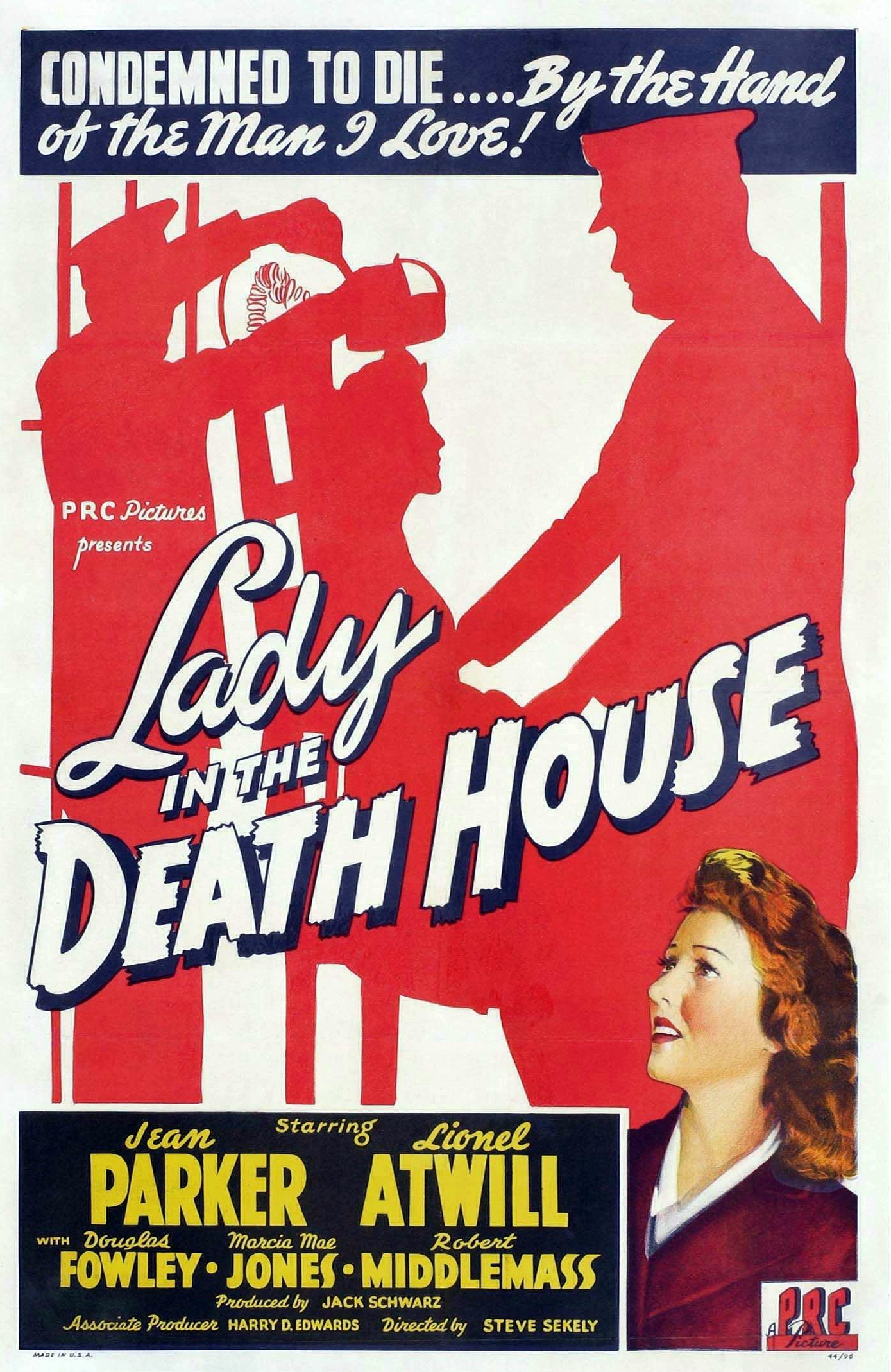
Lady in the Death House (1944) / D: Steve Sekely / 55m

Cast: Jean Parker, Lionel Atwill, Douglas Fowley, Marcia Mae Jones, Cy Kendall, John Maxwell, Robert Middlemass, George Irving

The tag line for Lady in the Death House says it all really: “Condemned to die…by the hand of the man I love!”, and only in a murder mystery from the Forties (oh, okay, and maybe the Fifties as well) would a scenario such as that one even exist. The movie begins with Mary Kirk Logan (Parker) on her way to the electric chair for the murder of a blackmailer. She’s just written a letter to a friend, criminal psychologist Dr Charles Finch (Atwill), who recounts both the details of the letter, and the case, to a group of journalists. We see Finch first meet struggling scientist Dwight Bradford (Fowley), and then they in turn meet Mary. Bradford and Mary soon fall in love but there’s a sticking point to their relationship: in order to make ends meet and further his research into reviving dead tissue, he has a second job as the state executioner (you can see where this is going, can’t you?). Mary won’t marry him while he’s a sanctioned killer, but before they get a chance to patch things up, Mary is sent to prison, and it’s down to Finch and Bradford, aided by Mary’s younger sister, Suzy (Jones), to prove her innocence before she’s executed.

Despite the absurdity of its romantic conundrum, Lady in the Death House is a neat, compelling little murder mystery that packs a lot into its short running time, and is far more rewarding than it has any right to be. A lot of its appeal has to do with the presence of Parker and Atwill, two actors who rarely gave disappointing performances and who should have had much bigger careers than was actually the case. Parker was a very talented actress, and it shows here as she resists the urge to make Mary’s situation one that many other actresses would have decided was ripe for unrestrained melodrama. It’s this very restraint that makes her role all the more sympathetic and credible. Atwill is at his most charming and relaxed, carrying the weight of so much exposition with an ease that most other actors would have wilted under. Like Parker, he divests his character of any melodramatic tendencies, something that for the time wasn’t the norm. When they share a scene together, it’s like a mini acting masterclass, and their performances stand out from those around them.
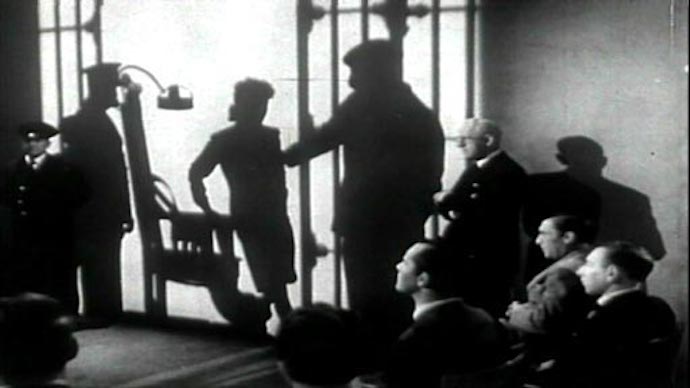
They’re helped immensely by Harry O. Hoyt’s focused screenplay – from a story by Frederick C. Davis – which culminates in a race against time to keep Mary alive. Bradford has a crisis of conscience along the way, but by then it’s too late for the character, who proves to be the movie’s one weak link. Fowley was a capable actor for the most part, but here he’s cruelly exposed by the constraints of a character who can’t or won’t give up his job as state executioner for the woman he loves (because the script says he can’t or won’t). Whenever it’s brought up, Fowley adopts the look of a man suffering from extreme emotional torment and remains quiet, frowning in apparent pain and wishing he was elsewhere. It’s not Fowley’s fault, but Bradford’s avoidance of the subject makes the character appear wilfully stupid.

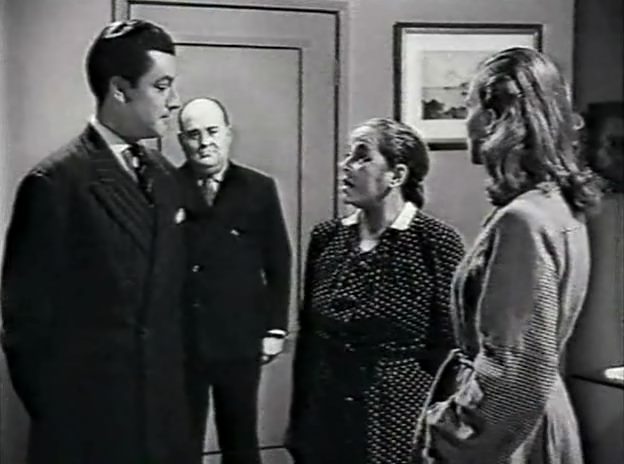
That one issue aside though, the movie has a consistent, well developed pace that Hungarian-born director Sekely maintains through using effective cutting to provide a sense of urgency. His use of light and shadow is also much more effective than is usual for this kind of movie (see above image), and though this is a Producers Releasing Corporation production – a company more usually associated with so-called Poverty Row releases – it doesn’t look as washed out or as bland as many other movies made on such a small budget. The mystery elements are cleverly and plausibly established (even if there’s a clear miscarriage of justice at the heart of Mary’s trial that’s likely to have modern day audiences yelling at the screen), and the identity of the murderer, and their motive, is revealed in an equally acceptable and plausible way. On the whole, this is a low budget thriller that’s had a lot more attention paid to it than you’d usually expect.

Rating: 6/10 – good performances from Parker and Atwill, and confident direction from Sekely, help tremendously in keeping Lady in the Death House from becoming a pedestrian retread of every other innocent-facing-certain-death mystery movie; a largely polished exercise in small-scale thrills, it may not strike a chord with everyone, but for those who enjoy this sort of thing, there’s plenty to keep them happy.

Share this:

  • Click to share on X (Opens in new window) X
  • Click to share on Facebook (Opens in new window) Facebook
  • More
  • Click to print (Opens in new window) Print
  • Click to email a link to a friend (Opens in new window) Email
Like Loading...

Kingsman: The Golden Circle (2017)

20 Wednesday Sep 2017

Posted by dullwood68 in Movies

≈ 1 Comment

Tags

Action, Comedy, Drama, Drugs, Galahad, Halle Berry, Julianne Moore, Kingsman, Mark Strong, Matthew Vaughn, Merlin, Pedro Pascal, Poppyland, Review, Sequel, Statesman, Taron Egerton

D: Matthew Vaughn / 141m

Cast: Colin Firth, Julianne Moore, Taron Egerton, Mark Strong, Halle Berry, Pedro Pascal, Edward Holcroft, Hanna Alström, Bruce Greenwood, Emily Watson, Elton John, Channing Tatum, Jeff Bridges, Poppy Delevingne, Sophie Cookson, Michael Gambon

When Kingsman: The Secret Service hit our screens back in 2014, its anarchic sense of fun and willingness to push the boundaries of good taste (exploding heads, anyone?) made it stand out from the crowd, and introduced us to Colin Firth the action hero. It was smart, it was savvy, it was funny, and its action sequences, especially that astounding sequence set in a Kentucky church, showed that well choreographed fight scenes could still impress and leave jaws dropped everywhere. A sequel may have been in some initial doubt – writer/director Vaughn wasn’t sure the first movie would be successful enough to warrant a second outing – but now it’s here, and it’s a very mixed bag indeed.

As a sequel, Kingsman: The Golden Circle adheres to the formula for a follow-up to an unexpectedly successful movie in that it goes bigger, brings back its original stars and gives them less to do, references its predecessor in some ways that are good and some ways that aren’t, introduces a group of new characters that the audience aren’t allowed to connect with, and extends the running time unnecessarily. It’s as if Vaughn and returning co-screenwriter Jane Goldman have heard the phrase, “Give ’em what they want, and then give ’em more” and taken it to heart. But there are too many elements that clash with each other, and the movie never maintains a consistent tone. Also, that anarchic sense of fun that the first movie carried off so well, here feels awkward and somewhat laboured, and we have yet another villain with a goofy personality who’s just plain misunderstood (Moore’s over-achieving cartel boss wants to be recognised for her “business acumen”).

Of course, any sequel that seeks to revive a character who appeared to be killed in the first movie, has to tread carefully in how it brings them back; this may be a world far removed from our own reality, but even in fantasy land, death means dead and gone. Vaughn and Goldman have come up with an ingenious idea that makes sense within the confines of the world that Kingsman operates within, but the fact that in terms of the plot a year has passed and Harry (Firth) is still suffering from amnesia and the Kingsmen haven’t been told he’s alive, is just one of the larger plot holes that pepper the script and make you think that while Vaughn has been reported as saying that “writing this was the hardest thing I’ve ever done”, it soon becomes obvious that he needed to try a bit harder. Perhaps the biggest question that goes unanswered, is why villain of the piece Poppy Adams (Moore) takes out the Kingsmen in the first place. Without even a throwaway line to clear up the matter, viewers could be forgiven for thinking that it was important to the plot, and it is, but only as a way of introducing their American cousins, the Statesmen.

Cue a lot of cool new gadgets, the presence of franchise newbies Tatum, Berry, Pascal, and Bridges (seemingly the only people who work for Statesman – until the end, that is), a side trip to the Glastonbury Music Festival that actually includes a scene where Eggsy (Egerton) asks his girlfriend, Tilde (Alström), if she’s okay with him having sex with another woman (Delevingne), the sorry spectacle of Elton John having been persuaded to send up his image from the Seventies and encased in ever more ridiculous stage outfits (he’s been kidnapped by Poppy – of course), a physics defying stunt involving a cable car that at least has the benefit of a terrific one-liner as its pay-off, Harry being cured of his retrograde amnesia but still seeing butterflies (don’t ask), Poppy’s robot attack dogs Bennie and Jet (geddit?), and several plot threads that are left dangling like so much silly string.

There’s more, a lot more, but if there’s one area where the movie lets itself, and the audience, down, it’s with a disastrous sub-plot involving the US President (Greenwood) and his so-called “war on drugs”. Poppy’s plan is to infect the millions of addicts who use her drugs with a deadly chemical that will kill them. Unless the President agrees to her demand to make all drugs legal, then she’ll withhold the antidote. Publicly, the President appears to agree to her terms, but privately he has no intention of saving anyone, reasoning that if all the drug addicts in the world are dead, then illegal drugs will become a thing of the past because there’ll be no one around to take them. There is a twisted sense of logic there – barely – and it could have been made to sound semi-plausible, but the President’s flippant, couldn’t-care-less attitude seems more of a rebuke to the current real-life incumbent than any properly considered character design. And leading on from the President’s decision, the movie opts to provide audiences with the unsettling and seriously off-kilter sight of thousands of victims of Poppy’s plan being herded into cages and stacked on top of each other within the confines of a US football stadium (is there a message here?).

This time around the comedy is muted in favour of a more serious approach, but it’s as haphazardly sewn into the fabric of the movie as everything else. The action sequences, particularly an opening display of vehicular mayhem on the streets of London, and the final showdown at Poppyland, have been shot and edited with a view to making the fight choreography flow as quickly as possible within the frame, but as a result, details are lost and much of what can be seen seems to involve as much posing as it does fighting. Against all this, the performances are adequate, though Strong and Berry are on better form than the rest, while there are odd instances – a bar fight that echoes the original’s pub brawl, but with Harry coming off worst; Merlin singing Take Me Home, Country Roads by John Denver at a crucial moment – where the viewer can see glimpses of what might have been, but overall there aren’t enough to warrant a better appreciation of a movie that’s slackly directed, confuses sentiment for depth in its treatment of the relationship between Harry and Eggsy, and which doesn’t try hard enough to match the style and energy of its predecessor.

Rating: 5/10 – with the prospect of a third movie just over the horizon, Kingsman: The Golden Circle is the point where the service should hang up its tailoring shingle and head off into early retirement; a disappointing sequel that shows a flare for inconsistency throughout, it offers shallow pleasures for those who want that sort of thing, but will prove a more difficult experience for those expecting a repeat of the giddy heights of the first movie.

Share this:

  • Click to share on X (Opens in new window) X
  • Click to share on Facebook (Opens in new window) Facebook
  • More
  • Click to print (Opens in new window) Print
  • Click to email a link to a friend (Opens in new window) Email
Like Loading...

The African Doctor (2016)

19 Tuesday Sep 2017

Posted by dullwood68 in Movies

≈ Leave a comment

Tags

Aïssa Maïga, Comedy, Doctor, Drama, France, Julien Rambaldi, Kamini, Marc Zinga, Marly-Gomont, Review, Seyolo Zantoko, True story, Zaire

Original title: Bienvenue à Marly-Gomont

D: Julien Rambaldi / 96m

Cast: Marc Zinga, Aïssa Maïga, Bayron Lebli, Médina Diarra, Rufus, Jonathan Lambert, Jean-Benoît Ugeux

The fish out of water movie is a such a staple of movie making that it’s hard to get it wrong, and The African Doctor, which is based on a true story, covers familiar narrative ground with ease, while providing a lightweight yet enjoyable experience for the casual viewer. Try as you might, to rail against this movie because of its simple premise and equally simple mise en scene is like railing against the air for being intangible: there’s just no point in doing so. Combining drama and comedy to good effect, it’s a movie that has no trouble in entertaining its audience, even though it tells a familiar story.

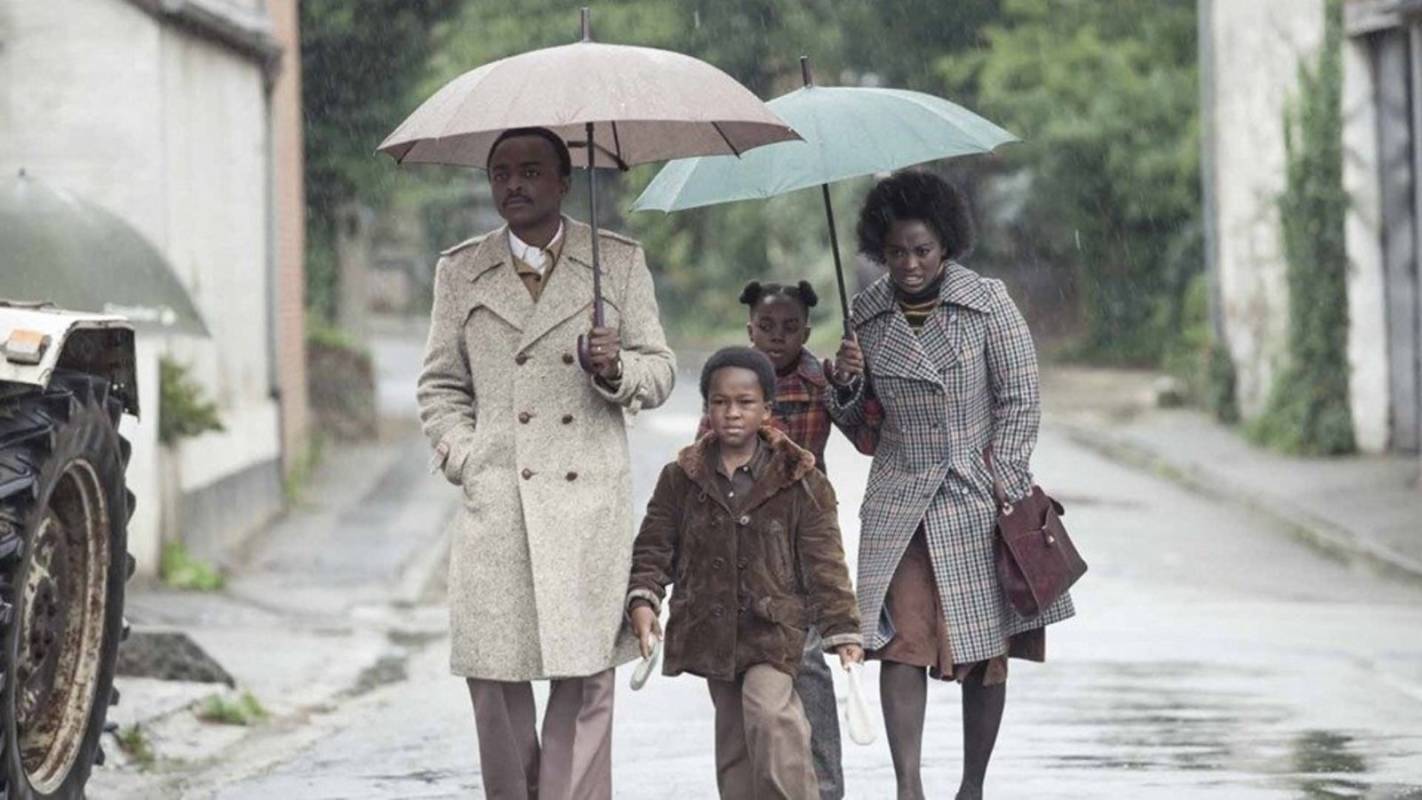
Based on the reminiscences of the comedian/singer Kamini when he was a child in the Seventies, the movie introduces us to his father, Seyolo Zantoko (Zinga), on the day that he graduates from medical school in Paris. Originally from Kinshasa in Zaire (now the Democratic Republic of the Congo), Seyolo is unsure of where his future will take him, but having been offered the role of personal physician to Zairean president, Joseph-Desiré Mobutu, and turned it down, he finds himself being offered the role of physician in the small, rural village of Marly-Gomont. A position that’s offered to him by the mayor (Ugeux), Seyolo takes it because he doesn’t want to become corrupted by being so close to Mobutu, and to give his children a better life than they might have under Mobutu’s rule. His wife, Anne (Maïga), and two children, Kamini (Lebli) and Sivi (Diarra), travel from Zaire to be with him, and are less than impressed by their new surroundings.

Inevitably, Seyolo’s presence in the town is seen as unnecessary and unwanted, as the villagers hold fast to their entrenched beliefs and avoid going to him when they’re unwell. Seyolo ingratiates himself with some of the menfolk but to no avail; he still can’t attract any patients. In order to have money coming in he goes to work for a local farmer, Jean (Rufus), and it’s not until he delivers a baby that he’s accepted and the villagers begin coming to him with their medical issues. But political machinations – the role of mayor is up for election – see Seyolo barred from practicing medicine until certain immigration issues related to his seeking French citizenship are overcome. It’s not until the day of the election that Seyolo discovers just how highly regarded he is by the village, and what a difference a school play can make in determining his and his family’s future.

The key strength of The African Doctor – a clumsy title that doesn’t do the movie itself justice – is Rambaldi’s relaxed, almost carefree directorial style, a major plus for a movie that deals with its more dramatic moments in a quietly authoritative way, and which doesn’t descend into melodrama when it could so easily have done so on several occasions. Seyolo’s struggle to be accepted and to make a success of the clinic he’s been asked to run has its ups and downs (as expected), but it’s not the run-ins with the villagers that makes his struggle so difficult but the effect it has on him and his family. Seyolo faces a greater struggle in convincing Anne that he’s made the right decision for their family, and his bringing them to Marly-Gomont has been achieved under false pretences (they don’t know about the offer of being Mobutu’s personal physician). He also doesn’t learn from his mistakes: when Anne learns that they could have stayed in Kinshasa, it causes a rift in their relationship that is damaged further when he agrees to remain in the village at the mayor’s request and he doesn’t consult her about it.

The family dynamic is one that the script – by Rambaldi, Benoît Graffin, and Kamini himself – keeps returning to, and a subplot involving Sivi’s desire to play football (which she’s very good at) is allowed to take centre stage towards the end. It’s here that Seyolo realises his true worth to the community, and where his misguided attempts at making decisions for his family are left behind. It’s also at this point that Seyolo’s journey, one that began when he came to France to study medicine, reaches its true end stage, and his “arrival” in Marly-Gomont is complete. The subtle themes of acceptance and rejection that have been threaded throughout the narrative are given due acknowledgment, and the material as a whole, which has been buoyant even in its most dramatic moments, ends on a bittersweet note that is entirely fitting in relation to what’s gone before.

For many viewers, The African Doctor will feel derivative and/or predictable, and while much of what takes place isn’t exactly new, that’s not the point. Kamini, with the support of Rambaldi and an experienced cast, has made a tribute to his father that is both heartfelt and unafraid to show the man as less than perfect. His story may be one that we’ve seen before, but there’s a quiet dignity about Seyolo that stands out, and it’s given full expression via a captivating performance from Zinga, who captures the man’s sense of pride and determination to succeed, and the humility he experiences towards the end. Zinga is matched by a terrific performance by Maïga, who perfectly expresses the resentment and anger Anne feels towards her husband for treating her so poorly. Balanced against these portrayals however is an unnecessarily smarmy and wince-inducing turn from Lambert as the mayor’s chief political rival, an uninspired visual style, and an annoying, often grating score from Emmanuel Rambaldi (the director’s brother) that sounds as if it was composed for another, more whimsical movie altogether. These are problems that Rambaldi cannot solve (and could be said to have encouraged), but overall, it’s the quality of Seyolo’s story that wins out, and which makes this a movie to look out for.

Rating: 7/10 – an engaging movie about fitting in and finding a place in the world that suits both an individual’s needs and aspirations, The African Doctor is a small-scale, yet largely enjoyable love letter from a son to his father; though cultural and racial divisions abound, this isn’t about one man overcoming feckless hostility, but instead it’s about one man’s commitment to himself and his family, a universal theme that is played out with a great deal of charm and sincerity.

Share this:

  • Click to share on X (Opens in new window) X
  • Click to share on Facebook (Opens in new window) Facebook
  • More
  • Click to print (Opens in new window) Print
  • Click to email a link to a friend (Opens in new window) Email
Like Loading...

The Hippopotamus (2017)

18 Monday Sep 2017

Posted by dullwood68 in Movies

≈ Leave a comment

Tags

Comedy, Drama, Fiona Shaw, John Jencks, Literary adaptation, Matthew Modine, Miracles, Poet, Review, Roger Allam, Swafford Hall, Tommy Knight

D: John Jencks / 89m

Cast: Roger Allam, Fiona Shaw, Matthew Modine, Tommy Knight, Tim McInnerny, Emily Berrington, Geraldine Somerville, John Standing, Lyne Renee, Emma Curtis, Dean Ridge

A washed-up alcoholic poet working as a (soon-to-be-fired) theatre critic may not be the best person to investigate a series of potential miracles at an English stately home in Norfolk, but that’s the situation Ted Wallace (Allam) finds himself in after being approached by his goddaughter, Jane (Berrington), to do the very same. Ted is naturally credulous when Jane reveals she has leukaemia, but that it’s now in remission after a recent visit to Swafford Hall, and she’s on the mend. She won’t reveal the exact nature of the miracle that she ascribes her better health to, but instead wants Ted to go there and discover it for himself (she believes a miracle might help him too). Ted agrees to go, but has reservations: Swafford Hall is owned by an old friend, Lord Logan (Modine), from their days in National Service, but their relationship has become strained due to Ted’s recent (mis-)behaviour.

Ted wangles an invitation on the pretence of seeing his godson, David (Knight), but once at the Hall he soon discovers that the source of Jane’s miracle – and possibly many others – may be David himself. Ted remains entirely credulous though as the Hall fills up with guests, all of whom have their own secret reasons for being there, reasons that relate to David and his “gift”. But while everyone else seems willing to believe in David as a miracle worker, Ted continues to have his doubts, even when David appears to cure a horse that is so ill it looks as if it will have to be put down. As his visit becomes more and more contentious – the other guests pour scorn on his increasing denial of David as a healer – the arrival of Jane’s mother, Rebecca (Somerville), and a revelatory telephone call casts a different light on proceedings, and Ted begins to piece together the true nature of David’s miraculous nature.

This being an adaptation of a novel by Stephen Fry, The Hippopotamus abounds with literary and poetic references, some of them well known and most of them more obscure unless you’re as well read as Fry is, but while Fry himself has hijacked a poem by T.S. Eliot for his title (and his central character), the screenplay – by Rebecca McIntyre and Tom Hodgson, with additional contributions from John Finnemore and Robin Hill – doesn’t use these quotes in order to be clever, but as a way of exploring the natures and the personalities of its characters. Ted, of course, is prone to making the odd telling quote when riled/pushed/in need of a witty reply to some careless utterance or display of ignorance, but it’s David who excels in his literary endeavours, captivated as he is by romantic poetry in particular. As he gives free vocal reign to his teenage desires through the medium of iambic pentameter, David retains a virginal intensity that (unexpectedly) supports the notion of his being a miracle worker.

The script works hard to make it difficult to decide if Ted is right or not about David’s “gift”, and while there is a very obvious clue tucked away in a scene about halfway through, Ted’s determined obduracy over the issue, and his refusal to play the game everyone else is playing, makes his task all the harder. But Ted is a stubborn man, and though he might not be the obvious choice for such a role, his stubbornness allows him to avoid being sidetracked by the glaring needs of the other guests, and the equally glaring need of his goddaughter, Jane. There’s a poem by Rudyard Kipling called If…, one that’s not used by Fry or the script, that observes, If you can keep your head when all about you / Are losing theirs and blaming it on you. That’s Ted in a nutshell, the lone voice in the wilderness who won’t be swayed, even when it may be politic to do so. Allam, yet another character actor who can be relied on to give a good performance no matter what the role, plays Ted with a caustic, anti-social charm that is both endearing and objectionable at the same time. When Ted needs to be at his sarcastic, opinionated best, Allam resists the temptation to “go loud” and instead roots his contempt through the character’s disappointment at no longer being able to write any poetry. There’s a great deal of subtlety to Allam’s portrayal of Ted, and it’s hard to imagine anyone else in the role.

Allam’s performance is the lynchpin that holds the movie together, and it’s fortunate that he does, because without him the movie would be populated entirely by a group of puffed-up, graceless wonders who barely deserve the viewer’s attention. It’s a shame that so many characters should be so negative and unappealing, from McInnerny’s borderline offensive gay theatre director to Renee’s spiteful, wicked witch mother. The cast are hampered by the script’s determined efforts to avoid giving everyone bar Ted a sympathetic angle, with only David’s mother, Lady Anne (Shaw), coming anywhere close. That said, Shaw is wasted in the role, as is Modine as the kind of dyed-in-the-wool grouch who pontificates instead of having a normal conversation. As the potentially “divine” David, Knight is the only other actor given anything of any merit to do, and he tackles the role with an enthusiasm that is unfortunately tempered by Jencks’ direction, which seeks to pigeonhole David as merely a troubled teenager.

The plot has the potential to make a number of acidic comments on the landed gentry and their sycophantic followers, and it does so at times, but in such a scattershot fashion that it only allows for the odd pot-shot (courtesy of Ted). Jencks focuses on the mystery of Swafford Hall instead, but then forgets this is also a comedy of manners, and when he remembers that, he forgets that this is also a drama encompassing notions of faith and religious observance. This leads to many dramatic and comedic lulls as the movie takes pause, works out how it should move forward, and then proceeds in an orderly fashion until the next sticking point. Thankfully, the dialogue is there to save the day, and there is a certain one-liner that may well be one of the best heard all year. On the production side, Angus Hudson does a fine job of photographing the beautiful interiors of Swafford Hall (actually West Wycombe House in Buckinghamshire), and the equally splendid grounds. So the movie looks good, even if it feels a little hollow at times, and the required depth sneaks away on too many occasions for comfort. But in doing so, it always leaves the frame free for another of Ted’s acerbic rants – something that it does get right every time.

Rating: 7/10 – Allam’s skill as a performer, and Hudson’s skill as a cinematographer, allied to Fry’s knack for a wry quote makes all the difference in a movie that has too many superfluous characters and not enough going on to occupy them; an enjoyable, witty movie for the most part, The Hippopotamus is only partially successful in its aims, and lets itself down by appearing unable to work out just what kind of a movie it wants – or needs – to be.

Share this:

  • Click to share on X (Opens in new window) X
  • Click to share on Facebook (Opens in new window) Facebook
  • More
  • Click to print (Opens in new window) Print
  • Click to email a link to a friend (Opens in new window) Email
Like Loading...

A Girl Like Her (2015)

17 Sunday Sep 2017

Posted by dullwood68 in Movies

≈ Leave a comment

Tags

Amy S. Weber, Bullying, Documentary, Drama, High School, Hunter King, Jimmy Bennett, Lexi Ainsworth, Review, Spy camera, Suicide

D: Amy S. Weber / 91m

Cast: Hunter King, Lexi Ainsworth, Jimmy Bennett, Amy S. Weber, Stephanie Cotton, Mark Boyd, Christy Engle, Jon W. Martin, Madison Deadman, Anna Spaseski, Mariah Harrison, Emma Dwyer, Michael Maurice, Gino Borri, Sarah Kyrie Soraghan

If there’s a message to be found at the heart of A Girl Like Her, a tale of bullying and its consequences, it’s not that bullying is wrong per se (though of course it is), it’s that we all make mistakes, and especially when we’re young. In this particular movie, mistakes are made by children and adults alike, and some of them are compounded and inexcusable. And yet the movie seems to be saying, if, after the fact, you’re sorry, then that’s alright. That may be a very nice, and very politic way of looking at things, but unfortunately, by the time A Girl Like Her arrives at that conclusion, its argument has been undermined completely by its approach up until that point.

The movie quickly introduces us to Jessica Burns (Ainsworth), a student at South Brookdale High School who is anxious, depressed, and contemplating suicide. She has one friend, Brian (Bennett), who she spends a lot of time with, and she’s confided in him that she’s being bullied at school by her one-time best friend, Avery (King). Their friendship changed over a minor incident that could have been dealt with very easily, but Avery has used it as a launchpad for a series of incidents that have made Jessica’s life an absolute misery. Brian gives her a brooch that doubles as a spy camera, and he persuades her to wear it at school, to document the bullying and provide proof that it’s happening. Jessica wears it, but is too fearful of what Avery might do if she finds out about it that she refuses to do anything with the footage, and she makes Brian promise he won’t tell anyone about it either. Then, one day, while wearing the brooch, she takes an overdose and lapses into a coma.

At this stage of the movie, what we’ve seen so far has been a compilation of footage shot by Brian, and footage from the spy camera. Now, with Jessica in a coma, and with no certainty that she’ll fully recover, the task of providing the viewer with footage falls to a documentary movie crew who are at South Brookdale thanks to its recent, highly impressive ranking in the national school league tables. Sensing a bigger story than the school’s educational achievements, the documentary’s director, Amy Gallagher (Weber), decides to focus on Jessica and how the rest of the students and the faculty feel about what she’s done, and the possibility that it’s linked to bullying. But “the fun” really begins when Amy finds out about Avery and decides to incorporate her into the documentary. Given a camera to record a daily video diary, Avery soon uses it as a means to make the viewer feel sorry for her instead of Jessica, but when Brian breaks his promise and shows Amy the footage of Jessica being bullied by Avery, “the most popular girl in school” soon learns that her past behaviour hasn’t always been her best behaviour, and her popularity begins to wane.

By mixing found footage with documentary footage in order to tell both Jessica’s story and Avery’s story, Weber has created a movie that looks and feels like a basic documentary but which veers off into straight up drama territory too often to make the conceit a successful one. It’s an earnest movie that looks to explore the fallout from Jessica’s suicide attempt in a way that’s sincere and non-judgmental – and therein lies its biggest problem. An initial talking heads approach with Amy eliciting the thoughts and reactions from students and faculty offer the expected clichés (“She was in my class but I didn’t really know her”), but once the idea of Jessica’s suicide attempt being the result of bullying arises, there are thinly veiled criticisms of the school’s anti-bullying policy (mostly from the teachers), and the students react in an offhand, blasé kind of way. For them, bullying, though deplorable, is just another fact of high school life.

So far, so predictable. But then, with Jessica consigned to a coma, Weber turns her attention to Avery, and makes her the focus instead. At first, this seems like a good idea, but the movie becomes irrevocably heavy-handed from this point on, and all the nominally good work Weber has put in so far begins to fall away. An extended scene at Avery’s home during dinner time shows her mother (Engle) behaving inappropriately and showing a complete lack of understanding in regard to Avery’s feelings. From this, we are meant to accept that Avery’s home life and domineering mother are to blame for her bullying Jessica, and that she is just as much a victim of bullying as Jessica. This would be fine if it wasn’t all too pat, and if Avery didn’t show any remorse until she sees the footage from the spy camera showing her being unrelentingly abusive. Sympathy for Avery, the movie seems to be saying, is essential if the cycle of bullying is to be broken, but Avery’s behaviour is presented as self-aware and opportunistic; she’s enjoying being a bully. And in another scene that’s meant to be telling, she does all she can to ensure that her parents don’t see the spy camera footage.

The movie strives to be an emotional rollercoaster as well, with tears at every turn, melodramatic scenes at the hospital, and awkward moments where Avery’s friends attempt to distance themselves from their involvement in her attacks on Jessica. It also stumbles badly in a scene where the school principal (Maurice) holds a meeting with Avery and her parents to get her side of “the story” (Avery’s friends have written a letter blaming her for Jessica’s situation). Avery is allowed to get angry, swear at the principal and storm off without any repercussions whatsoever. It’s a scene that lacks credibility throughout, and later, when Amy attempts to offer Avery help in dealing with the fallout from a self-serving, self-pitying video she posted online, the perilously thin line between documenary movie maker and secondary character is crossed irrevocably, and the movie reveals it’s true raison d’être: to persuade the viewer that being a bully is a matter of emotional circumstance and any blame is ephemeral. All of which is likely to provoke a less than satisfied response in the average viewer, and particularly if said viewer has been the victim of bullying themselves.

Nevertheless, there are good performances from King and Ainsworth, with strong support from Cotton and Boyd as Jessica’s distraught parents, but they’re all in service to a script that too often preaches when it should be observing (as all good documentaries do). Weber doesn’t always move from one scene to the next as fluidly as might be expected, and Samuel Brownfield’s cinematography noticeably varies between handheld and static and often in the same scene, a decision that undermines any attempt at cinéma vérité that Weber might be aiming for. There’s the germ of a good idea here, but with too much going on that feels forced or laboured, the same can also be said of the movie’s message… and that it can be applied to the movie itself can be considered unfortunate and ironic at the same time.

Rating: 5/10 – overheated at times and often lacking in subtlety, A Girl Like Her strives to provide a meaningful discourse on bullying and its aftermath, but falls short in its aim thanks to poor plotting and some wayward characterisations; with its uncertain approach and mix of shooting styles, it’s a movie that’s searching for a fixed identity, one that it brushes up against from time to time, but which it has very little chance of connecting with.

Share this:

  • Click to share on X (Opens in new window) X
  • Click to share on Facebook (Opens in new window) Facebook
  • More
  • Click to print (Opens in new window) Print
  • Click to email a link to a friend (Opens in new window) Email
Like Loading...

It (2017)

14 Thursday Sep 2017

Posted by dullwood68 in Movies

≈ 4 Comments

Tags

Andy Muschietti, Bill Skarsgård, Drama, Finn Wolfhard, Horror, Jaeden Lieberher, Jeremy Ray Taylor, Literary adaptation, Pennywise, Review, Sophia Lillis, Stephen King, The Losers Club, Thriller

D: Andy Muschietti / 135m

Cast: Jaeden Liberher, Jeremy Ray Taylor, Sophia Lillis, Finn Wolfhard, Chosen Jacobs, Jack Dylan Grazer, Wyatt Oleff, Bill Skarsgård, Nicholas Hamilton, Jake Sim, Logan Thompson, Owen Teague, Jackson Robert Scott, Stephen Bogaert

Somebody somewhere knows just how many movie adaptations there are of novels, novellas and short stories (and random ideas) by Stephen King. But having that knowledge will also mean that if they’ve seen all those adaptations, then the ratio of good to bad is going to be firmly on the bad side. For every Carrie (1976) there’s a Graveyard Shift (1990), or an unwanted sequel such as The Lawnmower Man 2: Beyond Cyberspace (1996). Then there are the TV adaptations, but even there the ratio is still predominantly bad over good, with the likes of The Tommyknockers (1993) and Trucks (1997) proving less than successful. However, one TV adaptation that had a better reception was It (1990), and mostly because of Tim Curry’s performance as Pennywise the Dancing Clown. A big screen remake has been in the works since 2009, and after a couple of false starts it’s finally here.

The first thing to mention about It is that it’s a far better adaptation of King’s novel than we could have ever expected. The script – a rewrite by Gary Dauberman of one written by previously attached director Cary Fukunaga and Chase Palmer – gives us several avenues down which we can explore, from the camaraderie of the Losers Club (the group of six boys and one girl who take on Pennywise the Clown), to the troubled history of their hometown of Derry, Maine, and the reluctance of the adults in Derry to acknowledge the evil that lurks in their town. The movie is also a coming-of-age story, as the members of the Losers Club try to overcome their fears and take on an evil entity that identifies and plays on those fears in order to feed every twenty-seven years. Led by Bill Denbrough (Lieberher), who loses his little brother, Georgie (Scott), to the sewer-dwelling clown who calls himself Pennywise (Skarsgård), the Losers Club is a select band of friends who become aware of Pennywise’s presence in Derry, and decide to do something about it. There’s motormouth Richie (Wolfhard), hypochondriac  Eddie (Grazer), orphaned Mike (Jacobs), germaphobe Stanley (Oleff), new kid in town and local history buff Ben (Taylor), and in time, strong-willed Beverly (Lillis).

Their friendships are at the heart of the movie, adding a rich layer of emotional consequence that could so easily have been overlooked in favour of the next big scare. Instead, the hopes and dreams and fears of a group of young kids take centre stage, and thanks to the script and Muschietti’s adept direction it’s easy to feel anxious for them, whether they’re being bullied by older teen Henry Bowers (Hamilton) and his cronies, or facing up to the malicious intentions of Pennywise and his abductions of children. As each is drawn into a tighter and tighter circle of responsibility – they all realise that there aren’t any adults who could deal with what’s happening (or want to; there’s a pervading sense that the adults are complicit in Pennywise’s actions) – friendships old and new are tested like they’ve never been tested before, and they discover a heroism in themselves that proves to be their greatest achievement, both individually and as a group. They bicker, they argue, they prove their love for each other – even and especially Beverly – and they unite to defeat Pennywise… for the time being.

With the characters and the performances of the Losers Club locked in, Muschietti is free to concentrate on making It as scary and as terrifying as he possibly can, and he does so by making Pennywise a more vicious and intense incarnation of the Dancing Clown than was the case back in 1990. A little flirtatious, and tempting with it, the sewer-dwelling entity is an unnerving creation made all the more unsettling by the quality of Skarsgård’s portrayal. Using his gangly frame to excellent advantage, Skarsgård adds a serpent-like nuance to his performance, his physical presence (even when still) exuding menace at every turn. Aided by a terrific visual design, inspired in part by Lon Chaney’s portrayal of The Phantom of the Opera (1925), Pennywise is the stuff of coulrophobics’ nightmares, and the movie exploits that fear in various clever and impressive ways; for once he’s just as scary out of the shadows as he is within them.

The movie is bolstered by a host of impressive performances from its young cast members, with Lieberher leading the charge as stuttering Bill Denbrough, evincing Bill’s grief at losing his little brother, and looking an unlikely hero in the grand scheme of things with complete conviction. Equally as good (if not slightly better) is Lillis as the tomboyish Beverly, plagued by the unsavoury attentions of her father and finding respite in the company of a group of boys whose own worries and concerns are easier for her to deal with. The unofficial mother and girlfriend of the group, Beverly dares and challenges them to be better than they are. There’s good support from Wolfhard and Taylor, though inevitably, and despite their best efforts, Jacobs, Oleff and Grazer are at the mercy of a script that can’t possibly focus on everyone equally, and so have less to do in terms of the overall narrative.

Structurally, the movie does suffer by having two confrontations between the Losers Club and Pennywise occupying the last hour, and there’s a sense that the longer the movie goes on, the less frightening Pennywise becomes, though this would be to overlook the notion that’s spelt out towards the end that the Losers Club are becoming less and less scared of It, and with their doing so, the entity itself becomes less intimidating. It’s another clever conceit in a movie that is dominated by a plethora of good ideas in terms of the adaptation carved out of King’s novel, and Muschietti’s assured direction is augmented and complemented by Claude Paré’s splendid production design and Chung-hoon Chung’s dread-fuelled cinematography. There are scares to be had throughout, some of them very effective indeed, and the movie maintains a morbid, chilling atmosphere from the first rain-soaked scene to the climactic battle below the streets of Derry. A definite winner as an adaptation of a Stephen King novel, if Muschietti and co are able to maintain this level of consistency in Chapter Two, then 2019 can’t come round quickly enough.

Rating: 8/10 – King’s sprawling tome is transferred to the big screen with a great deal of skill and enviable attention paid to the dynamics of the Losers Club and the vicious nature of its villain, making It a much better option than another more recent King adaptation; visually arresting at times, and a lot more uncompromising than a mainstream horror movie usually aims for (let alone achieves), this is an old-fashioned chiller that is both discomfiting and disturbing – and wants the viewer to know it.

Share this:

  • Click to share on X (Opens in new window) X
  • Click to share on Facebook (Opens in new window) Facebook
  • More
  • Click to print (Opens in new window) Print
  • Click to email a link to a friend (Opens in new window) Email
Like Loading...

Wind River (2017)

13 Wednesday Sep 2017

Posted by dullwood68 in Movies

≈ 1 Comment

Tags

Drama, Elizabeth Olsen, FBI, Graham Greene, Indian reservation, Jeremy Renner, Murder, Mystery, Native American, Review, Taylor Sheridan, Thriller

D: Taylor Sheridan / 107m

Cast: Jeremy Renner, Elizabeth Olsen, Graham Greene, Gil Birmingham, James Jordan, Jon Bernthal, Kelsey Asbille, Martin Sensmeier

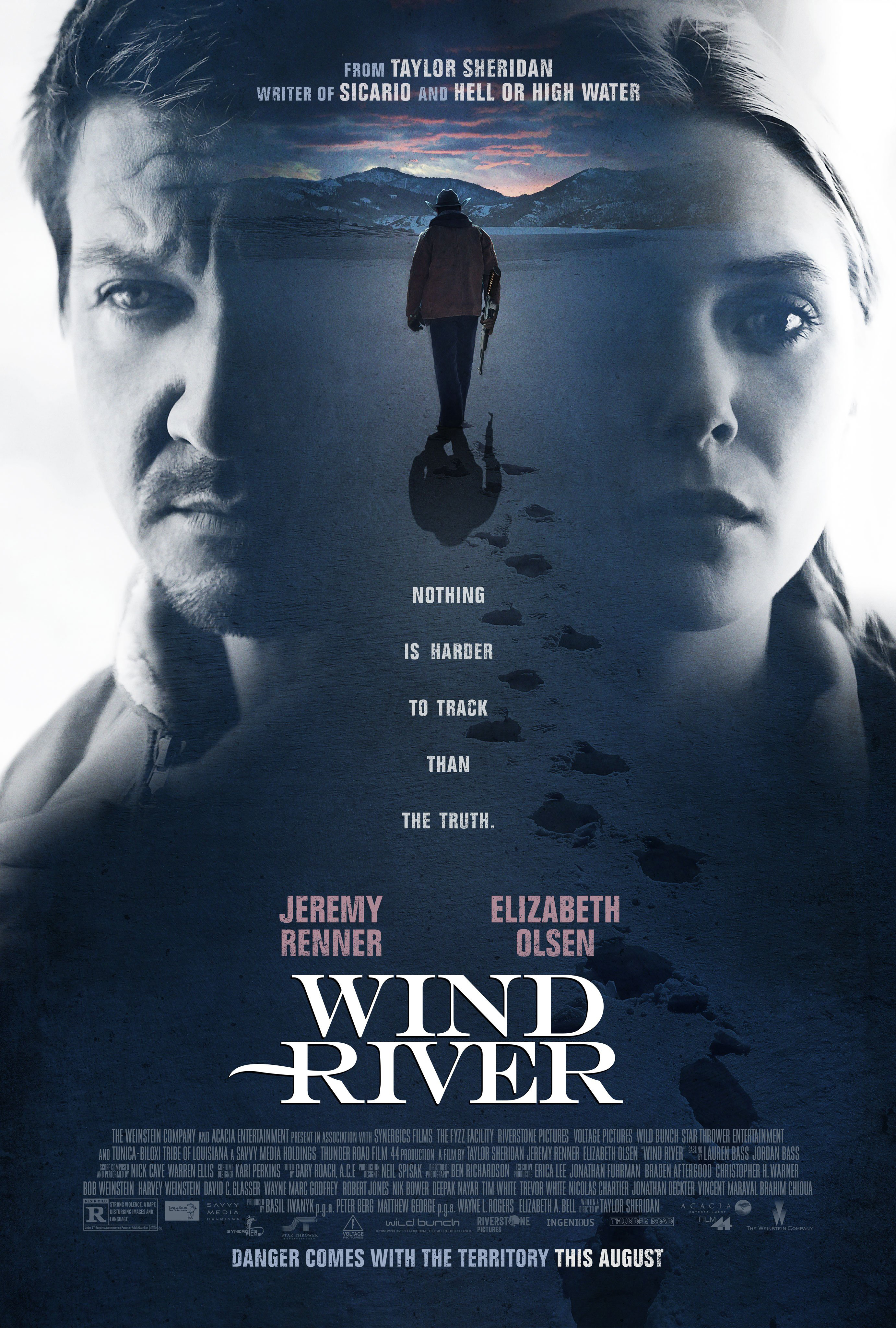
The Wind River Indian Reservation is situated in Wyoming’s Wind River Basin and occupies an area of nearly three and a half thousand square miles. It’s surrounded by the Wind River Mountain Range, the Owl Creek Mountains and the Absaroka Mountains, and temperatures can drop to a point where rapid breathing of the cold air can cause death by pulmonary haemorrhage. It’s also a place where the lives of its Native Americans are blighted by a persistent drug problem and sense of aimlessness amongst its youth. These points are all worth bearing in mind when considering the merits of Wind River, the latest movie written by Taylor Sheridan, and his first as a director. Sheridan is responsible for the screenplays for Sicario (2015) and Hell or High Water (2016), two very impressive movies indeed thanks to his contributions, and this, his latest, is equally as impressive (if not more so).

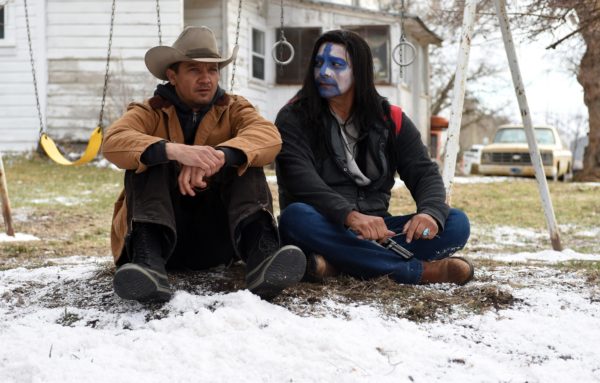
This is a movie where the locations are just as important as the characters themselves and the tangled narrative that they inhabit. The backdrop for a tale of rape and murder that takes place on tribal lands, Sheridan takes the inhospitable nature of the reservation in winter and uses it as a way of examining the issues affecting the tribes people who live there, and to provide an unforgiving environment against which the plot unfolds. It begins with an eighteen year old called Natalie Hanson (Asbille) as she flees across the snow, panicked and bloody. Eventually she collapses and lies still, and remains there until she’s discovered the next day by US Fish and Wildlife agent Cory Lambert (Renner). Lambert reports his discovery to Ben (Greene), the tribal chief of police, and he in turn alerts the FBI. Their response is to send rookie agent Jane Banner (Olsen), who arrives completely unprepared for the harsh winter weather, and who has no awareness of, or background in, Indian affairs.

Banner hopes that an autopsy will prove that Natalie’s death was murder but the cause of death, pulmonary haemorrhage, won’t support that contention. Unable to bring in a full FBI investigative team, Banner decides to enlist Lambert’s help in finding out what caused Natalie to be so far from the nearest shelter. They learn from her brother, Chip (Sensmeier), that Natalie had a new boyfriend, a security guard at a nearby oil drilling site. Lambert discovers the track of a snowmobile that leads up into the mountains. He and Banner follow the track and find the naked body of a male that’s been ravaged by the local wildlife. Eventually, Banner and Ben, along with a few local deputies and members of the tribal police visit the oil drilling site on the pretext of wanting to speak to Natalie’s boyfriend, who they now know is called Matt (Bernthal). But the security guards that greet them begin behaving suspiciously, and while Banner staves off an armed confrontation between them all, Lambert is up in the mountains where the male body was found, and where he also finds a snowmobile track that leads down to the oil drilling site…

Wind River is a tough, uncompromising thriller that doesn’t stint on the emotional lives of its characters, even allowing the viewer a glimpse of the life that Natalie could have enjoyed if she’d lived, and it’s this approach that helps to anchor the murder investigation that drives the movie forward. Lambert agrees to help Banner because his daughter also died of exposure in the snow three years before, and he wants to assuage his feelings of guilt at not being able to save her. Lambert uses his skills as a tracker to piece together the events that led to Natalie’s murder, and with step he takes, Renner’s thoughtful, subdued performance allows the viewer to see his sadness slip slowly from his shoulders until he’s in a position to offer advice to Martin (Birmingham), Natalie’s father, that is both affecting and heartfelt. Aside from his supporting role in Arrival (2016), Renner hasn’t exactly been best served by the roles he’s taken over the last few years, but his portayal of the taciturn Lambert is one of his best, and a reminder that when he’s given the right material he can be very good indeed.

Sheridan is also careful to make Banner not just a fish out of water, but someone doing their best in a situation that isn’t ideal for them, but which is pushing them beyond their comfort zone. From arriving unprepared for the harsh weather conditions to the point where she begins to understand both the environment and the social climate of the reservation, Banner visibly grows as a character, and Olsen also reminds viewers that she is one of the best actresses of her generation. Displaying a tough determination, and a commitment to finding the truth, Sheridan and Olsen use Banner’s inexperience as a way of bringing out the clues and the details of Natalie’s murder and making them as fresh for the audience as they are for her. Though Lambert is nominally the lead character, and discovers said clues and details, we still see the bulk of the investigation through Banner’s eyes, and we also see the effect that it has on her throughout.

But while Sheridan concentrates on the characters, even to giving us brief moments that tell their stories concisely and effectively, he doesn’t lose sight of the mystery he’s created and the narrative structure that allows it to unfold at a pace that doesn’t disappoint in terms of detail or leaves the viewer feeling as if they’re being led by the nose. Given the bleak (yet beautiful) nature of the environment, it’s unsurprising that there are some harsh, and somewhat brutal outbursts of violence, and the fate of one character has a pleasing, Old Testament eye-for-an-eye feel to it, but again it’s all in keeping with the milieu that Sheridan has created, and there’s an appropriate sense of nihilism that infuses the movie and keeps any sentimentality at bay, particularly in relation to the fractured outlook of its young Native Americans.

Behind the camera, Sheridan has enlisted the aid of a number of collaborators whose contributions add further lustre to the quality of the movie, and without whom this may not have been as successful. There’s Ben Richardson’s rich, detailed cinematography that also highlights the vastness of the Wind River Basin and its austere, wintry beauty, and a beautifully expressive score by Nick Cave and Warren Ellis that is both unobtrusive and eerily soulful at the same time. These collaborators, along with production designer Neil Spisak and editor Gary Roach – and many more – all help make the movie a hugely rewarding and outstanding feature debut for its writer.

Rating: 9/10 – a near perfect combination of mystery thriller and cleverly mounted character-driven drama, Wind River succeeds on so many levels that it would be churlish to say otherwise; Sheridan just keeps on getting better and better, and he draws out terrific performances from his two leads, making this one of the more worthwhile movies out there, and deserving of far more awards than just Sheridan’s Un Certain Regard Director Award at Cannes this year.

Share this:

  • Click to share on X (Opens in new window) X
  • Click to share on Facebook (Opens in new window) Facebook
  • More
  • Click to print (Opens in new window) Print
  • Click to email a link to a friend (Opens in new window) Email
Like Loading...

Gun Shy (2017)

10 Sunday Sep 2017

Posted by dullwood68 in Movies

≈ Leave a comment

Tags

Antonio Banderas, Chile, Comedy, Drama, Kidnapping, Literary adaptation, Mark Valley, Martin Dingle Wall, Metal Assassin, Olga Kurylenko, Ransom, Review, Rock star, Simon West

Original title: Salty

D: Simon West / 91m

Cast: Antonio Banderas, Olga Kurylenko, Mark Valley, Martin Dingle Wall, Aisling Loftus, Fernando Godoy, David Mitchell, Jesse Johnson, Ben Cura, Jeremy Swift, Anna Francolini, Emiliano Jofre

Based on the novel Salty by co-screenwriter Mark Haskell Smith, the retitled Gun Shy is officially the world’s first equity crowd funded Hollywood movie… which in effect means, you may have a script and you may have talent attached to the project, but it still doesn’t mean the movie should get made. This is definitely the case with Gun Shy, a movie that juggles drama, comedy, romance and action with all the skill of a blind man whose fingers have been glued together. It’s also another movie that makes the viewer question why it was made at all, other than to give the cast and crew the chance of visiting Chile, where most of the action takes place. Perhaps the clue is in the phrase “world’s first equity crowd funded Hollywood movie”. After all, if you can’t even get “real” Hollywood to finance your movie project, then just how good is it?

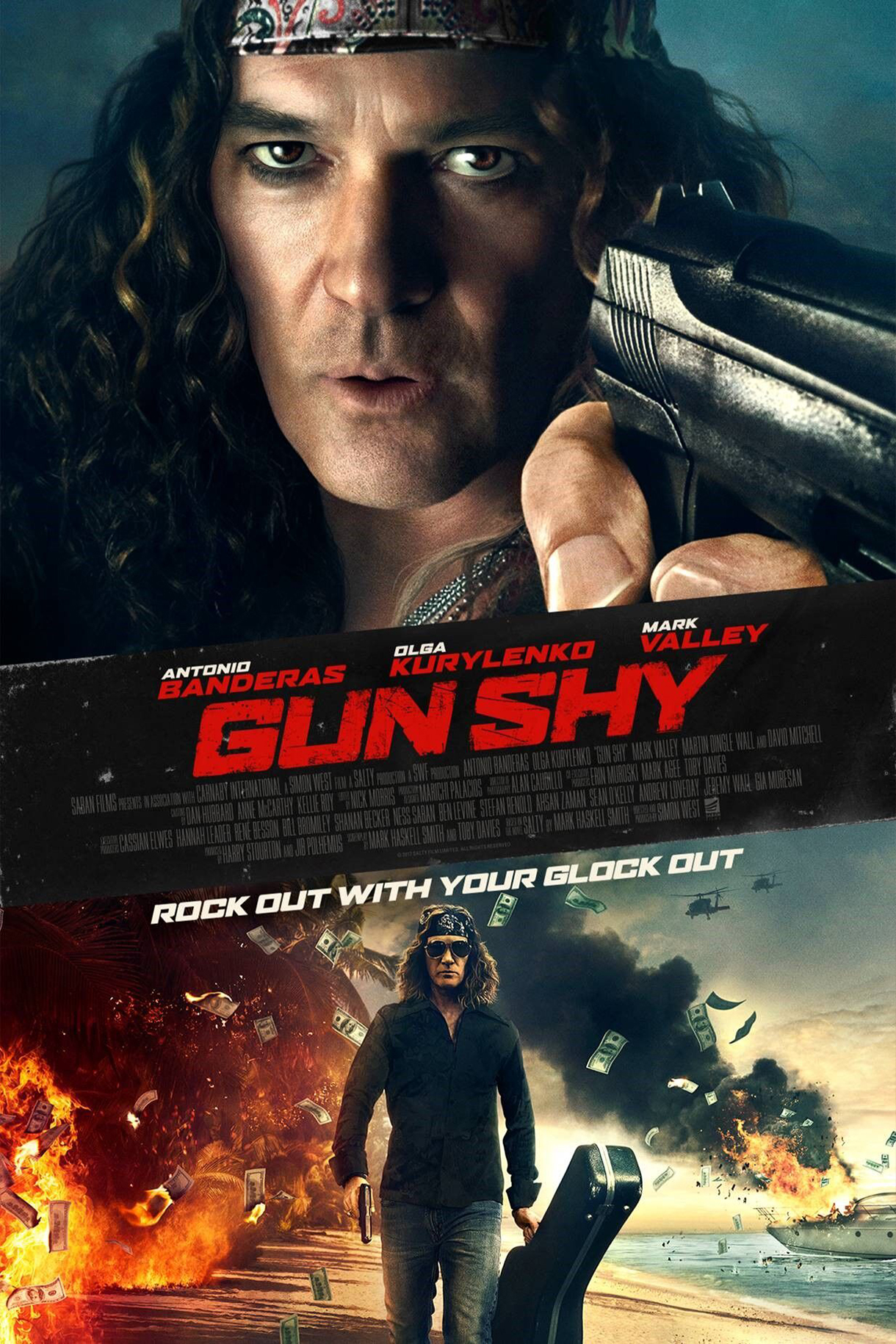
In this particular case, not very good at all. It’s meant to be a wacky comedy, with Antonio Banderas’ washed-up musician, Turk Henry, sulking in his Malibu home following his having been let go from the band he helped form, Metal Assassin, and which has since gone on to mega-stardom. Turk won’t leave the house, behaves like a spoilt, whiny child, and is married to his long-suffering wife, ex-supermodel Sheila (Kurylenko), whom he met when they were both in rehab. Determined to get Turk out of the house, Sheila blackmails him into making a trip to his home country of Chile (though Turk always tells people he’s English and from London, even though he has a strong Spanish accent). Once there, and at the hotel, Turk just wants to stay by the pool drinking beer, while Sheila is more interested in getting out and experiencing Chilean culture. When Turk discovers that Sheila has been kidnapped along with a couple of British tourists, and is being held for ransom by a group of would-be pirates, his attempt to secure her release by paying a million dollars is hampered by US embassy official Ben Harding (Valley).

Harding wants to use the kidnappings to win promotion by apprehending the so-called “terrorists” (his phrase). He forbids Turk from paying the ransom, and confiscates the money when Turk tries to go ahead with paying the kidnappers. Meanwhile, Sheila is using the time with her abductors, led by Juan Carlos (Cura), to examine more closely the relationship she has with Turk, and how satisfactory it is; naturally she’s not impressed with its current state. Turk though, hasn’t given up trying to get her back. He enlists the aid of one of his agent’s employees, Marybeth (Loftus), and through her, a specialist security agent called Clive Muggleton (Wall). With Harding still trying to win the day by himself and doing all he can to foil their efforts, Turk, Marybeth and Clive concoct a plan to pay the ransom. But will it work?

The more appropriate question might be, will anyone care? Turk and Sheila do deserve each other, but not in a grand romantic fashion, but rather in a no-one-else-would-put-up-with-their-selfish-attitudes kind of way. Turk wants Sheila back because he can’t live without her, but that’s because she organises his life and he can’t function without her. And yet, when she’s kidnapped he does exactly that, and does pretty well for himself in the bargain. He still behaves in a silly, empty-headed manner, but that’s due largely to the way that the script portrays him, and is less to do with Banderas’ performance, which is grating for the most part and dispiriting for the rest. Faced with a main character who is less than sympathetic, and with a situation where you could be forgiven for thinking that being kidnapped is an opportunity to live a better life (with the kidnappers, who at least know what they want: ships), the couple’s marriage would be better served dramatically if this was the beginning of the end. Unfortunately, this isn’t the approach the movie wants to take, so it makes Sheila’s navel-gazing over ther marriage purely something for Kurylenko to do while she waits for her character to be rescued.

With Turk and Sheila’s relationship lacking credibility, the movie struggles elsewhere as well, with the aims and goals of the kidnappers – literally, to have ships so that they can call themselves pirates – being portrayed in such a ridiculous way that the idea remains laughable whenever it’s brought up. They’re basically nice guys playing at being bad, and they aren’t very successful at it. This leaves Harding as the movie’s big bad, and he’s played by Valley in such a way that you can’t take him seriously no matter how hard Valley tries. There’s also a sub-plot involving Turk’s agent, John Hardigger (Mitchell), which doesn’t come into its own until the last ten minutes, and which feels like an after thought to the main narrative (although it does make better use of Mitchell during that time than it does Banderas for the whole movie).

Crowd-funded or not, Gun Shy is a movie that mistakes silliness for humour, and doesn’t attempt to take itself seriously. It wastes the time and efforts of its cast, plays fast and loose with its kidnapping plot, labours the point in respect to Harding’s ambitious personality, and seems to have been directed on auto pilot by West, who can’t even make the occasional action sequence anything more than laboured (a chase/taser attack by Harding on Muggleton is poorly staged and less than thrilling). The early scenes drag on unnecessarily, and the middle section is hampered by the need to stretch things out in terms of the drama (what there is of it). Amazingly though, the final half hour does see the movie pick up, and the pacing and material appear energised in comparison to the rest of the movie. Some of it is even funny at this stage, which makes you wonder why the movie as a whole wasn’t treated in the same way. With this and Security (2017), Banderas isn’t having the best of years, and the rest of the cast do what they can, but Smith’s script (co-written with Toby Davies) isn’t as well structured or funny as was perhaps originally intended. Even the Chilean locations don’t look their best, and if you can’t get that right, then something is very seriously wrong indeed.

Rating: 4/10 – though it should have been a slick comedy adventure movie, Gun Shy is undermined by lacklustre pacing, no one to root for, laughs that land with a thud, and leaden direction from West; only Wall and Loftus emerge with any credit from the cast, and only by dint of the effort they put in, but otherwise this is yet another movie that plays out in an exotic foreign location to very little effect except for providing everyone with a working holiday.

Share this:

  • Click to share on X (Opens in new window) X
  • Click to share on Facebook (Opens in new window) Facebook
  • More
  • Click to print (Opens in new window) Print
  • Click to email a link to a friend (Opens in new window) Email
Like Loading...

Mountain Men (2014)

08 Friday Sep 2017

Posted by dullwood68 in Movies

≈ Leave a comment

Tags

Brothers, Cameron Labine, Chace Crawford, Comedy, Drama, Pot cookies, Relationships, Review, Rocky Mountains, Tyler Labine

D: Cameron Labine / 89m

Cast: Chace Crawford, Tyler Labine, Ben Cotton, Britt Irvin, Christine Willes

Families – the movies love ’em. And the more dysfunctional they are, the more writers and directors want to tell their stories. Hundreds of family-based dramas and comedies (and dramedies) are made each year, and each of them follow a tried and tested and unstinting pattern: the family members are shown to be at odds with each other (often over a misunderstanding that no one fully remembers, or how it all started), rows and disagreements follow, characters remain at odds with each other for the majority of the movie, but by the end, everything has been resolved and everyone loves everyone else again. To quote Mrs Potts, it’s a tale as old as time, and you could be forgiven for thinking that every last wrinkle has been smoothed out in movie makers’ efforts to provide us with yet another example of the genre.

And though it does try to be different, both with its location and its main characters’ need to survive in the harsh environs of the Rockies, Mountain Men doesn’t quite have the wherewithal to stand out from the crowd. And it’s a shame, because while it just misses out on having the necessary substance or the required depth needed to make it more memorable, the movie does have a great deal of understated charm, and though he’s playing the kind of character he’s known for (again), Labine is the movie’s top draw, and it’s worth watching for his performance alone (that and some very impressive Rocky Mountain scenery, stunningly depicted by DoP Catherine Lutes).

It’s a tale of two brothers, Toph (Labine) and Cooper (Crawford). Toph is the eldest, still living in their small hometown, and kind of drifting through life, selling a little weed here and there, and when we first meet him, learning that his girlfriend, Leah (Irvin), is pregnant. Cooper has long fled the family nest. He has a well-paid, high-powered job, a girlfriend who’s a twelve, and apparently, not a care in the world. Back home because their mother is remarrying (everyone believes their father died somewhere in the surrounding mountains, but his body has never been found), Cooper is intent on staying for just a couple of days, but Toph has other ideas. Toph wants them to spend some quality time together, and suggests that they go up to their father’s cabin on the pretext of confronting someone who’s squatting there. At first Cooper declines to go, but when their mother (Willes) suggests he spends time getting to know his new stepfather, Cooper finds Toph’s proposition sounds like the better option.

Once there, though, Cooper makes it clear that he’s in a hurry to leave, and the very next morning. Toph is upset by this, but agrees to return home. However, Toph’s truck won’t start, and Cooper’s solution leads to not only the car going up in flames, but the cabin as well. With only basic winter clothing and minimal supplies, they decide to head for a nearby ranger station. Once there they settle in for the night, intending to leave at first light and reach the road that will lead them back to town. But in amongst the food rations that Toph has brought are some pot cookies, and Cooper eats a couple of them. Later, and while still under their influence, his gazing at the stars in wonder leads to his breaking his leg, and putting the brothers in a difficult, life-threatening situation: namely, how to get back home and how to survive the harsh weather conditions in the meantime…

Making only his second feature after the under-rated Control Alt Delete (2008), Cameron Labine clearly knows a thing or two about fraternal love (yes, he and Tyler are brothers), and it’s equally clear he knows just how fraternal animosities can impair a relationship as well. As is common in these types of comedy dramas, Toph and Cooper are opposites in character, personality and demeanour, with Toph the outwardly goofy, irresponsible brother who’s on the verge of having to “grow up”, while Cooper is the serious one, weighed down by the choices he’s made and the mistakes that have arisen from them (it’s no surprise that both his professional and personal lives have unravelled spectacularly). But Labine isn’t interested entirely in telling a commonplace tale of sibling misunderstanding or rivalry, and instead uses Cooper’s injury to remind the brothers of just how important their relationship is to both of them. He also makes Toph the dependable one, solving each problem that arises once Cooper is incapacitated, and helping his suffering brother in more ways than one.

And there’s much for Toph to deal with, as Labine garlands Cooper’s problems with hints of mental illness and self-loathing, and raises issues surrounding the death of their father that takes the material into much darker territory than expected. But even then, Labine holds back from exploring this idea more fully, almost as if he’s remembered the movie is also a comedy and he needs to strike a balance. It’s this that holds the movie back from achieving its full potential as a drama, and keeps it from being as effective as it could be. That said, the humour is fresh and appealing, and arises out of the characters and not just their situation (one jump cut is guaranteed to make viewers laugh by itself, though). Along the way, Labine also ensures that the brothers’ predicament remains credible, as well as the solutions that Toph comes up with, and this makes the movie more engaging than it might appear from its basic premise. The brothers’ journey, both physical and emotional, ends up being beneficial for both of them, and though this isn’t entirely surprising, Labine does more than enough to make tagging along with them a surprising and enjoyable experience.

Rating: 7/10 – modest in both scope and ambition, and hindered somewhat by being so, Mountain Men is nevertheless the kind of movie that sneaks up on the viewer and proves pleasantly entertaining; having Crawford and Labine on board is a plus, and so is the beauitiful scenery, but if anything truly resonates, it’s the way in which Labine deftly examines the mutual bond of love and affection that unites these brothers no matter how well or how badly either of them (think they) are doing.

Share this:

  • Click to share on X (Opens in new window) X
  • Click to share on Facebook (Opens in new window) Facebook
  • More
  • Click to print (Opens in new window) Print
  • Click to email a link to a friend (Opens in new window) Email
Like Loading...

Contratiempo (2016)

07 Thursday Sep 2017

Posted by dullwood68 in Movies

≈ Leave a comment

Tags

Ana Wagener, Bárbara Lennie, Drama, Jose Coronado, Mario Casas, Murder, Mystery, Oriol Paulo, Review, Spain, The Invisible Guest, Thriller

aka The Invisible Guest

D: Oriol Paulo / 106m

Cast: Mario Casas, Ana Wagener, Jose Coronado, Bárbara Lennie, Francesc Orella, David Selvas, Iñigo Gastesi, San Yélamos

Early on in Contratiempo, murder suspect Adrián Doria (Casas) is caught out in a lie by the defence attorney, Virginia Goodman (Wagener), who has been hired to keep him out of prison. Having recounted the circumstances in which he came to be accused of the murder of his lover, Laura Vidal (Lennie), Doria is surprised to find that Virginia isn’t convinced that he’s told her the whole truth. It’s only when she shows him a newspaper article about a young man who is missing that the certainty of his story begins to waver, and the viewer begins to realise that they can’t trust anything that they’re being told. The basic premise – Doria and Laura are coerced into meeting up in a hotel room to hand over money to a blackmailer who knows about their affair, only for Laura to end up killed by an unknown assailant and all the evidence pointing to Doria – is soon expanded on to involve a car accident, a cover up, the aforementioned missing young man, grieving parents, a locked room mystery, and a race against time to get Doria’s story “straight” before he’s called before a judge in a matter of three hours.

The events that have led to Laura’s death are recounted in detail as Virginia goads and cajoles Doria into remembering the details of what happened, and tries to put together a defence that will see the charges against him dismissed. She’s taken his case as a favour to his lawyer, and has a one hundred per cent success rate in keeping her clients out of jail. As the story unfolds, and with revelations coming thick and fast, director Paulo’s script keeps the viewer guessing as to the truth of Doria’s recollections and also Virginia’s assertions when she believes he’s lying to her (often she already seems to know more about the case than Doria has revealed). Paulo has assembled a tale that continually keeps shifting, as each retelling of events adds further layers of uncertainty and mystery to proceedings, and Doria’s guilt – did he kill Laura or was she really the victim of someone who was able to escape from their locked hotel room? – becomes clearer and then more obscure and then clearer again as the truth changes from scene to scene.

Paulo is able to do all this thanks to his tightly constructed script, which packs in so many twists and turns and narrative sleights of hand that the viewer is in danger of missing the most important moments of all, the ones where Doria’s story trembles on the precipice of exposure, but pulls back just in time while also revealing elements of the wider truth that will ultimately be revealed in the final fifteen minutes. It’s an impressive juggling act, one that stumbles only occasionally as Paulo weaves tangled thread after tangled thread in his efforts to bamboozle the viewer and keep things up in the air. Along the way he maintains an enviable level of tension, but it’s not just through the convoluted script, but also thanks to the performances.

As the morally compromised Doria, Casas plays it deadly straight throughout, protesting Doria’s innocence of Laura’s murder with a great deal of conviction while also providing enough doubt for the viewer to be questioning both his motives and his innocence. Casas brings a much needed sincerity to the role, and proves more than capable of investing Doria with a degree of wounded pride in conjunction with a surprising vulnerability when the script requires it. He’s matched by a fierce, uncompromising performance by Wagener as the defence attorney whose zero tolerance for ambiguity or avoidance (“Your testimony has holes, and I need details”) drives the narrative forward as she pursues the truth no matter what it means for her client. Between them, the two actors play an exacting game of cat-and-mouse that sees them engage in the kind of verbal sparring that keeps audiences engrossed and the material flowing inexorably to its one-last-twist conclusion.

But even though Paulo has gone to a lot of trouble in littering his script with more red herrings than it seems possible to include, fans of this kind of mystery thriller will realise what’s going on pretty much right from the start. However, this awareness doesn’t detract from the consistently clever and successful attempts to wrongfoot the viewer in terms of why things happen as they do, and who is responsible for it all. Paulo examines much of what occurs from different perspectives and different angles, and in doing so, manages to add unexpected emotional layers to the story that help to anchor the characters’ motives and reinforce the credibility of certain scenes that might otherwise have fallen short in terms of their effectiveness.

By the time all is revealed, Contratiempo has proven to be a gripping, provocative thriller that never lets up in its efforts to keep the viewer guessing, and it does so with no small amount of skill and confidence on Paulo’s part. He’s aided greatly by Xavi Giménez’s chilly, atmospheric cinematography, and Balter Gallart’s austere production design (this is a movie that eschews bright colours in favour of muted browns and dulled pastels), and these elements all join to make the movie feel appropriately suspenseful in a dour but thankfully arresting fashion. Casas and Wagener are terrific adversaries, and there’s good support from Coronado and Lennie, both of whom provide sympathetic performances as the father of the missing young man and Doria’s unlucky mistress respectively. It’s all rounded off by an unobtrusive yet effective score by Fernando Velázquez, that adds to the overall ambience and sense of subdued menace that the movie promotes throughout.

Rating: 8/10 – a couple of forced narrative moments aside, Contratiempo is the kind of thriller that demands the viewer’s complete attention, and rewards that attention over and over; if there’s ever a Hollywood remake, rest assured it will not be as entertaining or as assured as this version is.

Share this:

  • Click to share on X (Opens in new window) X
  • Click to share on Facebook (Opens in new window) Facebook
  • More
  • Click to print (Opens in new window) Print
  • Click to email a link to a friend (Opens in new window) Email
Like Loading...

Let Us Prey (2014)

06 Wednesday Sep 2017

Posted by dullwood68 in Movies

≈ 1 Comment

Tags

Brian O'Malley, Catch Up movie, Drama, Horror, Liam Cunningham, Police station, Pollyanna McIntosh, Retribution, Review, Thriller

D: Brian O’Malley / 95m

Cast: Liam Cunningham, Pollyanna McIntosh, Bryan Larkin, Hanna Stanbridge, Douglas Russell, Niall Greig Fulton, Jonathan Watson, Brian Vernel

At one point in Brian O’Malley’s debut feature, acerbic police sergeant Jim MacReady (Russell) states, “The world is full of evil. Police stations doubly so.” It’s a perfect summing up of the situation the movie is concerned with, as the small Scottish town of Inveree – population: seven, plus hundreds of crows – finds itself the focus of a night of retribution instigated by a mysterious bearded figure referred to only as Six (Cunningham) (for the cell he’s assigned to). Each person who finds themself in the town’s police station has their secrets, some more obvious than others, but you can bet that by the time the midnight hour arrives that there won’t be any secrets anymore – or perhaps anyone alive.

There’s the aforementioned Sgt MacReady, the officer in charge, a forty-something relic from a previous generation of policing whose caustic approach to people and police procedure hides a very dark personal secret indeed. Then there’s newbie Rachel McHeggie (McIntosh), a police constable working her very first shift at the station who is still dealing with the trauma of events from her childhood. Completing the police roster are PC Jack Warnock (Larkin) and PC Jennifer Mundie (Stanbridge), who share more than the one secret, their relationship one of mutual affinity and dependency. In the cells already is a teacher with a penchant for beating his wife, Ralph Beswick (Watson), and joining him after being arrested earlier by Heggie, is local hooligan Caesar (Vernel). Caesar’s arrest is for apparently hitting Six while driving at speed through the town, but while there’s blood on the headlights, there’s no sign of Six’s body. Later, Warnock and Mundie find Six and bring him to the station, where a head wound he has prompts them to call in a local doctor, Hume (Fulton). And yes, Hume has a terrible secret, just like everyone else.

With everyone in place and Six about to stir things up, Let Us Prey is poised to offer up a smorgasbord of tension, ultra-violence, psychological terror, and heightened realism. What it provides instead is a juiced-up series of extreme physical shocks interspersed with cod-religious truisms, rampant melodrama, and any number of plot developments that feel forced and/or contrived. Along the way, eagle-eyed (and -eared) viewers will spot John Carpenter’s heavy influence, from the movie’s Assault on Precinct 13 (1976)-style setting, to the electronic-based score by Steve Lynch with its thudding sub-Carpenter phrasing. Not a bad pedigree, by any means, but though imitation may well be the sincerest form of flattery, here it’s used to bludgeon the audience with a succession of moments where violence is meted out in either cartoonish or visceral fashion, and with no clear tone established from one moment to the next.

The movie does open well though, with atmospheric shots of Six emerging from the rocks of a broiling seashore, with spray and fume crashing together in great arcs, and crows littering the sky above. As Six makes his way inland, crossing hills and fields until he arrives at Inveree, the script – by Fiona Watson and David Cairns with additional input from O’Malley – looks as if it’s going to retain the atmosphere it’s already built up, and those opening, highly distinctive and impressive shots will serve as a template for the rest of the movie. Alas, this idea proves short-lived, and the law of budgetary constraints begins to make itself felt, with the police station divided into two main sets: the office space (there’s no front desk or area separating the public from the police), and the cells at the rear. Aiming for an increasingly claustrophobic vibe from the start, the movie settles instead for using these areas as drab backdrops to the main action, bursts of unsettling violence that don’t always fit organically into the overall narrative, and which serve, strangely enough, to take the viewer out of the flow of the story.

The idea of a stranger who knows everyone’s deepest, darkest secrets and who exploits those secrets for his or her own ends isn’t exactly a new concept (J.B. Priestley’s An Inspector Calls (1954) is probably the best version yet made), and here the use of Six as an instigator for what appears to be divine retribution, albeit through a less than heavenly approach, is given better credence than expected thanks to Cunningham’s resolute performance, and scathing impatience with the denials of others. Cunningham is a character actor whose career hasn’t always allowed him to deliver the kind of performances that would have made him better known, but this is one where he fleshes out the mystery of his character with a seething, pitiless bearing that makes even more sense when his identity is revealed near the end. As the heroine of the movie, McIntosh is another in a long line of cinematic female warriors, taking her lumps but coming through against much greater odds. Her character’s back story (and related “secret”) is used to differentiate her from the other participants, and though the importance of it all is fumbled in terms of how it relates to her involvement now, it does help provide the movie with an ending that is both unexpected and somewhat baffling.

Though O’Malley directs with a great deal of verve, and an appreciation of the genre he’s working in, the movie is still let down by the vagaries of its script and the various directions it takes along the way, as well as some crushingly awful dialogue (sometimes it’s better if characters don’t explain their reasons for murdering/torturing people; the justifications screenwriters come up with always seem to defeat the best of actors). There’s some uneasy humour added here and there to the mix, but on the whole, the movie opts for a fierce, angry tone that it tries hard to escalate the longer events go on. This unfortunately leads to scenes where melodrama swiftly turns to unrepentant psychodrama, and the motives of the characters become less and less persuasive, and more in keeping with the way in which the script needs to tie things up. A good try, then, but like so many low budget horror thrillers, not quite managing to achieve the goals it’s given itself.

Rating: 5/10 – while there’s a fair amount to admire here, in the end Let Us Prey can’t maintain a consistent tone, or make the viewer care about any of the characters, plus it places too much emphasis on providing moments of extreme violence in place of ratcheting up the tension; solid enough to keep viewers watching until the end, and grisly enough to keep gorehounds happy, the movie wastes too many opportunities to provide a more satisfying experience.

Share this:

  • Click to share on X (Opens in new window) X
  • Click to share on Facebook (Opens in new window) Facebook
  • More
  • Click to print (Opens in new window) Print
  • Click to email a link to a friend (Opens in new window) Email
Like Loading...

American Made (2017)

04 Monday Sep 2017

Posted by dullwood68 in Movies

≈ 1 Comment

Tags

Adventure, Barry Seal, CIA, Comedy, Domhnall Gleeson, Doug Liman, Drama, Drugs smuggling, Medellin Cartel, Nicaragua, Pilot, Review, Sarah Wright, Tom Cruise, True story

D: Doug Liman / 115m

Cast: Tom Cruise, Domhnall Gleeson, Sarah Wright, Jesse Plemons, Caleb Landry Jones, Jayma Mays, Lola Kirke, William Mark McCullough, Alejandro Edda, Mauricio Mejía, Benito Martinez

Yet another true story where the emphasis is on reinventing the story, American Made arrives in the wake of possibly Tom Cruise’s worst movie ever, a movie so bad it may just have killed off an entire franchise before it’s even begun. In many respects, The Mummy (2017) was a little outside of Cruise’s comfort zone, and the movie’s attempts to shoehorn Cruise’s increasingly broad style of acting into its mix foundered after his first scene. But the true story of Barry Seal, however much it’s rewritten and reinvented, is a project that does give Cruise the chance to redeem himself for recent mistakes. So – does he?

Predictably, the answer is both yes and no. When given a script and a character that stretches him as an actor, Cruise always finds a way to meet the requirements of the role, but in the past decade the only movie that’s come anywhere near to pushing him as an actor has been Valkyrie (2008), where he played another real life person. Otherwise, Cruise has been content to, well, cruise his way through a number of high concept features that may have cemented his credentials as an action hero, but have also allowed people to forget that, once upon a time, he was an actor who took quite a few chances with his career. Now, he works to protect his action hero status, while taking the occasional time out to play the likes of airline pilot turned drugs smuggler Barry Seal. Here, Cruise gets to turn on his megawatt smile, have a lot of fun, and give his fans exactly what he thinks they want to see: a man in his mid-Fifties behaving as if he was twenty years younger (thank goodness there’s only Seal’s wife, Lucy (Wright) to worry about on the female side).

While Cruise is still able to play the fun-loving ne’er-do-well with a heart of gold and a winning smile, here it’s in service to a real-life person who wasn’t exactly the charming good ole boy which is Cruise’s – and the script’s – interpretation. But like a lot of movies “based on a true story”, the makers are only concerned with getting it right when they do so accidentally, and where the “spirit of the thing” is more important than telling a factual story (which would have been more interesting). Barry is outed early on by outwardly diffident CIA agent, Monty Schafer (Gleeson), when he’s a TWA pilot smuggling Cuban cigars into the country for peanuts. Faced with an offer he doesn’t want to refuse, Barry goes to work for the CIA using one of their planes to take reconnaissance photographs over South America. When the Medellin Cartel becomes aware of Barry’s activities, they persuade him to transport drugs back to the US. Thus the next few years of Barry’s life involve him trying to ensure that neither side finds out about what he’s doing, while he stashes away his ill-gotten gains by the trunkload.

Of course, things begin to get out of hand, whether it’s the cartel’s demands for more smuggled product, or the arrival of Lucy’s wastrel younger brother, JB (Jones), whose light fingers eventually cause Barry more problems than he’s worth. Soon, a whole raft of law enforcement departments descend on Barry and they all try to claim jurisdiction. But in a twist that nobody, let alone Barry, could have anticipated, certain jail time is replaced by community service, and the chance to juggle gun-running with drugs smuggling and money laundering proves too much of an opportunity for Barry to pass up, and though there’s the small matter of providing evidence against the cartel – one of whose members is the easily irritated Pablo Escobar (Mejía) – Barry goes along with whatever he’s asked.

The tone of American Made is one that says it’s okay to be a criminal if you’re having fun while you’re doing it, and as long as you’re providing for your family then that’s okay too. It’s hard to take a movie like this seriously when it won’t take the basis of its real-life story seriously either. It’s a movie that wants to have its cake and eat it… or in this case fly its drugs and snort them. It’s a cavalier approach that wants to attract audiences with its freewheeling approach and carefree attitude, and though there’s nothing wrong with a bit of harmless escapism from time to time, this is ultimately a movie that glamourises crime for the sake of it, and which encapsulates its approach to the material in the scene where a recently arrested Barry promises Cadillacs to a group of law enforcement officers before being allowed to go free. “Should have taken the Caddies,” he quips as he leaves, and in doing so, reveals for anyone who wasn’t sure, just how serious the movie is about celebrating its hero’s misdeeds and moral laxity.

But while Cruise is clearly having fun, the same can’t be said of the rest of the cast. Gleeson’s spook pops up every now and then to drive the plot forward and give Barry his next set of Government-sanctioned shenanigans, while Wright plays his long-suffering wife with some style, but remains as vapid at the end as she is at the start (and she adapts to her husband’s new “career path” with undue haste). Jones is the only other character to make an impact, and strangely, his pale, lank-haired appearance gives the narrative a much-needed boost whenever he’s on screen. In comparison with the rest of the cast, Jones is practically a major supporting character, and everyone else does a perfunctory job of playing to the script’s demands for a host of generic role players. Liman, reuniting with Cruise after Edge of Tomorrow (2014), keeps things moving, and tries to imbue Gary Spinelli’s script with an energy that he believes can only be achieved in fits and starts. And with so much of Barry’s story remaining at odds with official versions, it remains a frustrating movie to watch, and not just for the awkwardly structured narrative, but for the compelling notion that Barry Seal’s story would have been better served as a straight-up drama than as a low-key comedy.

Rating: 6/10 – another movie built around Cruise’s action comedy persona (but with the action dialled right down), American Made is a lightweight, easily forgettable look at a period in US law enforcement where deals were struck with almost anyone if it provided even the slightest benefit to the US; with too many scenes that pad out the already generous running time, the movie has a tendency to coast when it should be sprinting, and it never really puts its central character through the wringer – until the end, that is.

Share this:

  • Click to share on X (Opens in new window) X
  • Click to share on Facebook (Opens in new window) Facebook
  • More
  • Click to print (Opens in new window) Print
  • Click to email a link to a friend (Opens in new window) Email
Like Loading...

The Dish (2000)

01 Friday Sep 2017

Posted by dullwood68 in Movies

≈ 1 Comment

Tags

Apollo 11, Australia, Comedy, Drama, Historical drama, Kevin Harrington, Moon landing, NASA, Neil Armstrong, Parkes, Patrick Warburton, Review, Rob Sitch, Sam Neill, Tom Long

D: Rob Sitch / 101m

Cast: Sam Neill, Kevin Harrington, Tom Long, Patrick Warburton, Roy Billing, Eliza Szonert, Tayler Kane, Genevieve Mooy, Lenka Kripac, Bille Brown, John McMartin

Hands up if you’ve seen The Dish? And keep those hands up if you enjoyed its mix of historical drama and parochial whimsy. Now ask yourself this question: why don’t more people know about this movie? And why isn’t this movie championed around the globe? Why isn’t this movie more highly regarded than it actually is? In short, why has this movie been allowed to amble into our lives with so little fanfare, and then amble away again so easily? It’s a mystery that may never be solved, along with who really shot JFK, who built Stonehenge, and how is it that Liam Hemsworth has a movie career? The Dish should be required viewing for anyone interested in movies as a whole, and Australian movies in general. It’s a nigh-on perfect slice of comedy-drama, and one of the most enjoyable movies of the new millennium.

It’s a simple idea: take an historical fact – that the Parkes Observatory in New South Wales was used by NASA to relay live television footage of Man’s first steps on the Moon in July 1969 – and use it as the backdrop for a gentle comedy of errors that puts that television footage in danger of never being seen. Add in the anxiety and civic pride of the local community, the operational paranoia of NASA and the apprehensive natures of visiting dignitaries, and you have a smartly scripted movie that scores highly in terms of its ability to charm and entertain audiences. The only people who seem less perturbed by the responsibility heaped on their shoulders is the small group of men charged with ensuring the television footage is seen as planned, and that the radio telescope that will facilitate this, doesn’t malfunction. There are four men in all, technicians Glenn Latham (Long) and Ross “Mitch” Mitchell (Harrington), visiting NASA official, Al Burnett (Warburton), and the observatory’s chief scientific advisor, Cliff Buxton (Neill).

All four are aware of the momentous nature of their roles in the Apollo 11 mission, but that doesn’t mean there’s no room for animosity, as Burnett’s fastidious nature butts heads with Mitchell’s more “liberal” approach to their work. Defusing arguments and disagreements, Buxton is a calming influence on both men, but deep down he has his own apprehensions about the dish’s capabilities and whether or not they can pull off the “job of a lifetime”. There are ups and downs along the way, telemetry issues that NASA is unaware of, re-pointing the dish when it loses the signal’s lock, and a sudden gale that threatens to damage the dish and leave it unable to transmit those all important images of Neil Armstrong walking on the Moon. Buxton is the senior operative whose calm demeanour under pressure smooths and soothes the problems that arise with the equipment, and within his team. Neill’s avuncular performance is the glue that holds the movie together, and whenever he’s on screen, Buxton is the character you can’t help but focus on.

While there’s plenty of tension and drama as the hour of Armstrong’s history-making walk approaches, there’s also plenty of humour to be had as well. This being an Australian movie, there’s a pleasing sense of self-deprecation that makes itself felt throughout, from the attitude of self-regarding town mayor Bob McIntyre (Billing), to the gossipy nature of the townswomen (led by McIntyre’s own wife), and the gloriously naïve nature of the townsfolk as a whole (cue that rendition of the American national anthem). Autralian movies exploit these kinds of cultural foibles with practiced ease, and the script – by director Sitch, along with Santo Cilauro, Tom Gleisner, and Jane Kennedy – applies these aspects in such a good-natured fashion that you can’t help but smile at them when they happen. Take Rudi Kellerman (Kane) (please take him). A young man desperate to be of use who assigns himself the role of the observatory’s security guard, Rudi is discovered with a gun by his sister, Janine (Szonert), she asks him if their mum knows. Only in a movie like The Dish could the reply be, “No. And don’t you go telling her, either! Or else she might come and take it off me.”

There are other, similarly inspired lines of dialogue, and much of it is used to point up the absurd behaviour and nature of the characters themselves – McIntyre’s political aspirations are a particular target, and brilliantly so – but it’s all done with a warmth and a liking for the characters that stops it all from being uncomfortable or malicious. Likewise, the antagonism between Mitchell and Burnett begins seriously enough but is soon transformed into mutual respect and the kind of gentle ribbing that is both friendly and innocuous, and more in keeping with the tone of the movie and its quiet sense of scientific and national euphoria when, inevitably, Armstrong walks on the moon and Parkes’s place in the history books is assured. But it’s not all pleasantries and affability. The movie touches on notions of a community’s pride, there’s the grief over the loss of his wife that keeps Buxton somewhat remote from everyone around him, and a point where the team “lose” Apollo 11 and don’t immediately know how to find it again.

For all this to work, director Rob Sitch has assembled a marvellous cast, with Neill on superb form, and sterling supporting performances from Warburton (terrific as always), Billing, Long and Harrington (the sheep are good too). But it’s the production design that often stands out, with the movie able to use the real locations from the time – including the observatory, and on the dish itself – and lots of original NASA equipment that was left behind as too costly to transport to the US. This helps to give the movie a pleasing sense of verisimilitude, even if the audience is unaware of it at the time of watching. It all adds up to a movie that came out of nowhere, stole many many hearts from contemporary viewers, and is still as charming and entertaining now as it was back in 2000. And how many other movies can you say that about?

Rating: 9/10 – a sparkling, witty, yet still decidedly subtle dramatic comedy set around a defining moment in human history, The Dish is as triumphant as those first images from the Moon must have been; an excellent movie that works on many more levels than is immediately apparent, this is easily one of the best Australian movies ever made – and for the most part, it all takes place in a sheep paddock.

Share this:

  • Click to share on X (Opens in new window) X
  • Click to share on Facebook (Opens in new window) Facebook
  • More
  • Click to print (Opens in new window) Print
  • Click to email a link to a friend (Opens in new window) Email
Like Loading...

The BFG (2016)

31 Thursday Aug 2017

Posted by dullwood68 in Movies

≈ Leave a comment

Tags

Catch Up movie, Drama, Fantasy, Giant Country, Giants, Literary adaptation, Mark Rylance, Penelope Wilton, Review, Roald Dahl, Ruby Barnhill, Runt, Sophie, Steven Spielberg

D: Steven Spielberg / 117m

Cast: Mark Rylance, Ruby Barnhill, Penelope Wilton, Jemaine Clement, Rebecca Hall, Rafe Spall, Bill Hader, Ólafur Darri Ólafsson, Adam Godley, Michael Adamthwaite, Daniel Bacon, Jonathan Holmes, Chris Gibbs, Paul Moniz de Sa

Steven Spielberg meets Roald Dahl against the backdrop of a billion computer generated pixels – less a case of “Who could ask for anything more”, and more a case of “Be careful what you wish for”. This is very much a movie where the child in Spielberg has been sat on and made to go without his dinner. While this is a movie that looks absolutely stunning – in Giant Country at least, London feels drabbed down in comparison – and there’s a richness to the colours and the detail that few other directors would have achieved for their movie, overall The BFG lacks something that has been a consistent part of Spielberg’s directorial skills over the last forty-plus years, and that’s honest, heartfelt emotion.

It’s an odd feeling to realise, but this is a movie where Spielberg has managed to avoid creating an emotional connection between the characters and the audience. Right from the start, and from our first encounter with tomboyish Sophie as she hides under a rug late one night at the orphanage (handily called the Orphanage) where she lives, what should be a tale that inspires various levels of child-friendly awe and wonder, does so in dribs and drabs, and rarely feels inspired or inspirational. Even the moment when Sophie spies a large, very large hand righting a fallen rubbish bin – which should provoke a degree of wonder all by itself – plays out plainly and matter-of-factly. The scene would have played out much the same if it the bin had been knocked over by a cat, and the cat had turned round and picked it up by itself. It’s the first of many moments that fail to achieve the necessary degree of childish delight that would allow viewers – and not just adults – to connect with the material.

Elsewhere, the relationship between Runt (the BFG in question) and Sophie soon develops into the kind of easy-going father-daughter dynamic that allows for few disagreements and full-on harmony. Both of them may be unlocking nurturing instincts in each other, but Melissa Mathison’s adaptation of Dahl’s hugely popular novel foregoes any depth and relates everything in a matter-of-fact manner that leaves their relationship feeling perfunctory instead of earned. While it’s expected that they hit it off and prove to be firm friends, there’s still little in the way of any grounding to their friendship, and it happens with barely a whisper of discord between them. Even when Runt tells Sophie she can’t go back to the orphanage, her reaction has all the impact of a child being told that they can’t have semolina for dessert. It’s another example of the way in which Spielberg’s direction can’t elevate the material and make the movie more interesting. Instead it ambles along, creating indifference for long stretches and relying heavily on Rylance’s performance as the BFG.

Rylance, who has become Spielberg’s first choice, go-to actor since they made Bridge of Spies (2015), is on terrific form, his motion capture performance perhaps the very best thing the movie has to offer. Whether he’s muttering and mumbling about snozzcumbers or frobscottle, or a myriad of other Giant-ish terms, Rylance’s simple, delicate portrayal is affecting and whimsical, an object lesson in how not to let a CGI conversion take anything away from the performance itself. But thanks to Spielberg’s puzzling detachment from the material, Rylance’s portrayal is operating in a vacuum, separated from the rest of the movie by an invisible wall that even he can’t penetrate. It’s like giving the world’s greatest footballer the chance to score from five yards out, and then removing the goal just before he shoots.

On the performance front, Rylance is surprisingly alone in terms of the quality of his portrayal. Elsewhere, there are problems galore, from Barnhill’s stilted line readings to Wilton’s wide-eyed and easily dismayed Queen of England, to Hall’s unexpected and underwhelming turn as the Queen’s maid (a role that could have been played by anyone, such is its importance to the story). And that’s without Clement’s turn as chief unfriendly giant, Fleshlumpeater, a performance that leaves him sounding like David Walliams with a bad nasal infection. Rylance aside, this is a movie where the cast aren’t given much to do, and the imbalance between the success of his efforts and theirs is telling. This is largely the fault of Mathison’s screenplay, which maintains its focus on the BFG at all times, and to the detriment of the other characters, who feel unsupported and under-developed at the same time.

This being a Roald Dahl story, there should be plenty of subtexts shoring up the main plot, and the notion of Runt and Sophie creating their own family as a way of confronting their sense of being alone should be one of them, but instead of informing their bond and its importance to both of them, it’s given an occasional and brief acknowledgment before the movie heads into another visually impressive but empty bout of physical comedy. Said comedy is a mix of pratfalls – cue those loveable cannibal giants! – incredible shrinking orphan moments, and CGI corgis, and these should find favour with viewers younger than ten. But adults, for whom Dahl wrote just as much as he did for children, will find themselves curiously locked out of the garden of delights that have been broadly assembled out of Mathison’s screenplay. A movie then that’s lacking in too many areas for it to be entirely or even moderately successful in its ambitions, a state of affairs that is all the more surprising given the quality of the source material and its director’s affinity for children’s fantasy.

Rating: 5/10 – a movie that’s easy to admire but very difficult to engage with, The BFG sees Spielberg operating at half throttle, and dialling back on the emotional elements of Dahl’s story; Rylance is the key player here, giving a captivating performance and anchoring the movie in a way that he shouldn’t have to given the quality and the experience of the rest of the cast, and the very talented crew.

Share this:

  • Click to share on X (Opens in new window) X
  • Click to share on Facebook (Opens in new window) Facebook
  • More
  • Click to print (Opens in new window) Print
  • Click to email a link to a friend (Opens in new window) Email
Like Loading...

Detroit (2017)

30 Wednesday Aug 2017

Posted by dullwood68 in Movies

≈ 3 Comments

Tags

12th Street riot, Algee Smith, Algiers Motel, Drama, John Boyega, Kathryn Bigelow, Review, The Dramatics, True story, Will Poulter

D: Kathryn Bigelow / 143m

Cast: John Boyega, Will Poulter, Algee Smith, Anthony Mackie, Jacob Latimore, Jason Mitchell, Kaitlyn Dever, Hannah Murray, Ben O’Toole, Jack Reynor, Malcolm David Kelley, Nathan Davis Jr, Peyton ‘Alex’ Smith, Austin Hébert, John Krasinski, Jeremy Strong

Like many extreme incidents of violence and aggression, the 12th Street riot began in somewhat innocuous fashion with a raid on an unlicensed underground club, a “blind pig” frequented by blacks. As everyone at the club was being loaded into police vans, a crowd gathered and began throwing rocks at the police, and when they had left the scene, the crowd – now more of an unruly mob – began destroying and looting any and all surrounding stores and properties. This was 23 July 1967. It was the beginning of one of the worst recorded outbreaks of civil disobedience in the entire history of the US. It lasted for five days, and during that time forty-three people died, 1,189 were injured, over 7,200 were arrested, and over 2,000 buildings were destroyed. Only the 1863 New York City draft riots, and the 1992 Los Angeles riots were worse.

By the third night, the situation had grown so bad that President Johnson authorised the use of federal troops in aiding the police in their attempts to quell the rioting. With the city of Detroit under a quasi-martial law, the looting and the destruction and the violence continued. Against this backdrop, director Kathryn Bigelow has chosen to tell the story of the Algiers Motel incident, a tragic event that saw three people die, and a trio of police officers arrested for murder. Working again with Mark Boal, the screenwriter of her previous two movies – The Hurt Locker (2008), Zero Dark Thirty (2012) – Bigelow has fashioned an incredibly tense, incredibly gripping thriller that grabs the viewer’s attention from the start, and thrusts them into the midst of the violent upheaval that occurred that fateful summer.

Bigelow is a bravura movie director, and she makes Detroit a visceral experience, hard-hitting and uncompromising, blending contemporary footage with the movie’s recreation of the period to brilliant effect. It’s the closest anyone is likely to get to being in an urban war zone, and Bigelow knows just how to ramp up the tension and make the movie as gripping as possible. From the moment when a young man named Carl (Mitchell) decides to have fun with the National Guard and the police by firing a starter pistol out of a window at the Algiers Motel, and in their direction, the sense of impending doom is palpable. It’s just the excuse that two particular cops, Krauss (Poulter), and Flynn (O’Toole), need: to be the heroes who apprehend the “sniper” at the Algiers Motel. Along with a third officer, Demens (Reynor), they soon make their presence felt at the motel, and within moments, one black man is dead and everyone else the cops have discovered are being forced to stand face first against a wall and keep quiet so that Krauss and his fellow officers can track down the sniper. What follows is a powerful examination of implicit racism applied in a pressure cooker environment. Krauss won’t believe anyone who says they didn’t see a sniper, or who says they didn’t even see a gun. He has to be sure, and what better way to get at the truth than by intimidating, bullying, abusing and beating the truth out of them?

As the movie continues, Detroit‘s sympathies lie very obviously with the people at the motel, including two white girls, Karen (Dever) and Julie (Murray), and a handful of black men, including would-be singer Larry Reed (Smith). As the tension grows, Bigelow successfully avoids making these characters mere ciphers, and uses the situation to inculcate audiences with just how they behave or react, whether it’s defiantly, bravely, or by being just plain scared. As Krauss’s psychopathy keeps everyone praying to be spared, a game of intimidation spirals out of control and the barely thought out motivations of Krauss and his fellow cops is exposed for the superficially “clever” institutional racism that dictates their every move. It’s horrifying to watch, and is made all the more horrifying by the casual evil displayed by Poulter as the intentionally duplicitous Krauss (it’s worth noting that Poulter is still only twenty-four, and his performance, while atypical, is also astounding).

With the inherent tension in place and Bigelow tightening the screws at every turn, the wider cultural and social implications of the events that night are allowed to seep out around the narrative and add a further layer of discomfort to what the viewer is witnessing. Providing a counterpoint to Krauss’s predatory racism is the passive presence of store security guard Melvin Dismukes (Boyega). Drawn to the Algiers by the sound of the “gunfire”, Dismukes at first appears to be our eyes and ears on the inside, a witness to the horrors perpetrated by the police. But Dismukes’ presence proves disconcerting, as he soon adopts the role of quiescent observer, ever watchful but effectively complicit in what takes place. The initial bravery and diligence he shows when we first meet him is shorn away to reveal a man who shrinks before our eyes as the movie progresses. In contrast we see the unprompted heroism of the two young white girls, trapped in the wrong place at the wrong time and victims of violence, sexist rhetoric and inverse racism. Bigelow isn’t making any comments about “good whites and bad blacks”, or even “bad whites and good blacks”, instead she’s making the point that the decisions we make in extreme circumstances, such as the Algiers Motel incident, affect us all differently in the long run (though in Krauss’s case you’d have to argue that there’s no effect at all).

Valid notions of causality and pre-determinism aside, Detroit works best by not appearing to judge why the riots happened, or to provide a wider historical and cultural context for what did happen. That’s for another movie altogether, and Bigelow and Boal are right to keep their focus on events at the Algiers Motel, and for using them to explore the riots in microcosm, whether it’s through the yielding eyes of Dismukes, or the desperate, traumatised eyes of Larry Reed. Some viewers may find the aftermath of the riots more disturbing than the riots themselves, as Detroit picks itself up and dusts itself down and restores order in the best way it knows how: by refusing to acknowledge that “the establishment” did anything wrong. That’s an issue that is very much in the contemporary eye right now, and if Bigelow ever intended to make a political statement through her movie, that would be it.

Rating: 9/10 – a movie that burns brightly in its attempts to provide immediacy with a contemplation of the events of 25 July 1967, Detroit is a fierce, intelligent, provocative, and often incendiary piece of movie making from an equally fierce, intelligent and provocative movie maker; with exemplary cinematography from Barry Ackroyd, and practically precision-tooled editing from William Goldenberg and Harry Yoon, this is a movie that lingers in the mind and provides enough food for thought for three movies, let alone one.

Share this:

  • Click to share on X (Opens in new window) X
  • Click to share on Facebook (Opens in new window) Facebook
  • More
  • Click to print (Opens in new window) Print
  • Click to email a link to a friend (Opens in new window) Email
Like Loading...

The Hitman’s Bodyguard (2017)

29 Tuesday Aug 2017

Posted by dullwood68 in Movies

≈ 2 Comments

Tags

Action, Amsterdam, Belarus, Comedy, Drama, Gary Oldman, Patrick Hughes, Review, Ryan Reynolds, Salma Hayek, Samuel L. Jackson, The Hague, Thriller

D: Patrick Hughes / 118m

Cast: Ryan Reynolds, Samuel L. Jackson, Gary Oldman, Salma Hayek, Elodie Yung, Joachim de Almeida, Tine Joustra, Sam Hazeldine, Richard E. Grant

There are several moments during The Hitman’s Bodyguard, Hollywood’s latest attempt at the mismatched buddy genre of action thrillers, when the movie’s humour seems to come on a little too strong, as if it’s fighting its way into the script and looking to be front and centre. More often than not it’s a moment of physical comedy, such as the extended scene where Ryan Reynolds’ triple-A rated protection agent, Michael Bryce, is sitting at an outdoor Amsterdam café complaining about the behaviour of Samuel L. Jackson’s veteran assassin, Darius Kincaid. While he vents, chaos erupts all around him, as everyone in the vicinity ducks for cover, and bullets fly indiscriminately. The barman cowers, Bryce keeps on complaining, and eventually a car plows through the tables behind him. On the surface, it’s a funny scene, with Reynolds’ deadpan expression the counterpoint for all the mayhem going on behind him. But watch it a second time and the humour isn’t there anymore. Now it’s a technically clever scene that relies entirely on Reynolds’ performance. Watch it a third time, and it’s a scene to be endured. Should a scene like that provoke such a response so quickly? If it’s really that funny, then the answer is No.

For much of the rest of the movie, the script’s attempts at levity only serve to highlight just how uneven the material truly is. The humour is largely forced, the action is perfunctory (a chase along the canals in Amsterdam should see Kincaid’s commandeered boat reduced to splinters, or the involvement of at least one Dutch police car), and the basic plot is ludicrous before it’s even begun: Gary Oldman’s brutal Belarussian dictator, Dukhovich, on trial at the Hague for being a brutal Belarussian dictator, can only be brought to justice by the testimony of Jackson’s veteran assassin. Cue a race against time from Manchester, England to said trial, with the usual hundreds of disposable bad guys trying to stop Bryce and Kincaid from getting there. Along the way, Bryce’s back story takes up more and more time but never becomes interesting enough to warrant it (he’s still sulking over the death of a client under his protection, though technically the circumstances mean It doesn’t count), while Kincaid is ratting on Dukhovich as a way of getting his wife, Sonia (Hayek), out of jail (yes, folks, he’s doing it for love, the old softie).

It all plays out predictably enough, with supporting characters straight out of Stock City, including Yung’s Interpol agent, Amelia Roussel, who just happens to be Bryce’s ex-girlfriend, and de Almeida’s shifty Interpol boss who may well be in cahoots with Dukhovich (what are the odds?). No matter how much Tom O’Connor’s script tries to instil proceedings with freshness and vitality, the banal nature of the material as a whole brings those attempts crashing down like Redwoods. In the director’s chair, Hughes, who made more out of The Expendables 3 (2014) than was required, has no option but to go with the flow and let his stars do the heavy lifting. As long as he can get them from A to B, Hughes’s work is done, and often before the end of a scene. Others, but particularly those that feature Hayek’s apoplectic performance as Sonia, don’t appear to have had Hughes’ involvement at all. (Sonia looks and sounds like a character brought in from another movie altogether.) By the time we reach the end and justice is done, it’s become possibly the most generic action movie of the year.

But what of the chemistry between Reynolds and Jackson? Surely that’s in the movie’s favour? Well, strangely enough, the pair work better when they’re apart. Reynolds’ lovelorn, soppy-headed protection agent is like a man-child dropped into a war zone, while Jackson – well, Jackson trots out the same hard-headed “motherfucker”-spouting character he’s been portraying ever since the word was invented. Cue angry stare, mad-as-hell stare, glary stare, and angry mad-as-hell glary stare, all of them trotted out at regular points in the movie, and almost as if they qualify as their own action beats. Jackson is seriously wasted here, and not in a good, been-to-Amsterdam-for-some-of-them-chocolate-brownies kind of way either. When they’re together, Reynolds and Jackson spar like an old married couple, an old tired married couple who can no longer stand each other. Oldman grabs his pay cheque with both hands and hams it up accordingly, while the rest of the cast do their best to get through all the absurdity and nonsense with their dignity intact.

All of this indolence and protracted inertia – Bryce and Kincaid have twenty-four hours to get to the Hague but it feels like they’re taking twice as long – allied to the kind of comedy that comes pre-marked as “strained” is all the more dispiriting when you realise that O’Connor’s script was another Black List screenplay, this time from 2011. But back then it didn’t have any comedy. Instead it was a straight drama. But a few weeks before filming began, a two-week rewrite meant less drama and more comedy. And now we have the end result: a poorly assembled collection of scenes that hint constantly at what might have been. Maybe one day the movie will be remade with its original format, but until then this is all we have. It’s just that overall, it’s not enough.

Rating: 4/10 – an idea that probably looked great on paper – Reynolds! Jackson! Comedy! Action! – The Hitman’s Bodyguard translates into something that never takes full advantage of its basic premise, and chugs along quite amiably without ever doing anything to reward the viewer for their patience; with a cast that should have known better, it’s a movie that quickly fades from the memory soon after it’s watched – so it gets something right at least.

Share this:

  • Click to share on X (Opens in new window) X
  • Click to share on Facebook (Opens in new window) Facebook
  • More
  • Click to print (Opens in new window) Print
  • Click to email a link to a friend (Opens in new window) Email
Like Loading...

Hotel Salvation (2016)

28 Monday Aug 2017

Posted by dullwood68 in Movies

≈ Leave a comment

Tags

Adil Hussain, Comedy, Death, Drama, Father/son relationship, India, Lalit Behl, Review, River Ganges, Salvation, Shubhashish Bhutiani, Varanasi

Original title: Mukti Bhawan

D: Shubhashish Bhutiani / 99m

Cast: Adil Hussain, Lalit Behl, Geetanjali Kalkarni, Palomi Ghosh, Navnindra Behl, Anil K. Rastogi

What would you say if you had an elderly father and he announced one day that he thought that his time had come, that it would soon be time for him to die? And what if he also announced that he planned to spend his last days at a hotel that would allow him to prepare his soul for death? Outside of India, where there are three or four such hotels, the matter is unlikely to arise, but if it did, if your elderly father wanted to see out his life away from his family and friends, and with like-minded people, how supportive would you be? Would you remonstrate with him, try and get him to change his mind, emotionally blackmail him, perhaps, by impressing on him how upsetting this will be for his relatives (and yourself)? Or would you do everything in your power to make his final wishes come true? This is the dilemma faced by Rajiv (Hussain) in the feature debut of Shubhashish Bhutiani, an engaging, wistful look at death and its effect on the surviving family.

Daya (Lalit Behl) is the elderly father in question, a seventy-seven year old man who has a dream in which he pursues his boyhood self through the deserted village of his childhood. He takes it as a sign that he is being called to the afterlife, and tells his family – son Rajiv, daughter-in-law Lata (Kalkarni), and granddaughter Sunita (Ghosh) – that he plans to travel to Varanasi, on the banks of the River Ganges, to stay at a hotel where he hopes to attain salvation. Rajiv doesn’t know what to do about this, torn as he is between loyalty to his father, and his personal reluctance to entertain such an idea. It’s only when his father threatens to go by himself that Rajiv agrees to accompany him to Varanasi. Once there, Daya and Rajiv find the hotel to be a simple one, with basic amenities, and run by the sincere, yet business-like Mishraji (Rastogi). They settle in, with Daya having fifteen days to achieve salvation or face being asked to leave. Rajiv has a lot of trouble adjusting to the situation, and finds looking after his father more stressful than he could have imagined.

While Rajiv juggles caring for his father with the demands of his work, Daya embraces the atmosphere of the hotel, and gets to know some of the other guests. In particular, he becomes friendly with a widow, Vimla (N. Behl); they both find meaning in their being at the hotel and facing the certain futures they have decided for themselves. This gives them an increased sense of comfort, but it’s not enough for Rajiv to understand how clearly they see their salvation, or why they are so calm and practical about it all. Even the wise ministrations of Mishraji can’t put a dent in Rajiv’s unhappy presence. As the days pass, Daya’s peace of mind and acceptance of his fate leads to Rajiv having to make an equally fateful decision: whether to stay with his father until the end, or return home to his family and his work.

Death isn’t exactly the most cinema-friendly of subjects, and when it’s placed front and centre in a movie in the way that it is in Hotel Salvation, there’s always the chance that it will lead to a dour, dispiriting exercise in profound sorrow or morbid pessimism. But thanks to a knowing, sympathetic script by Bhutiani, this meditation on one of life’s greater certainties, is both affecting and sophisticated, using as it does the differences of opinion and belief in different generations, and by exploring the outer limits of faith and personal conviction. That said, faith and belief are only minor elements in a tale that more carefully examines the relationship between a father and a son that isn’t as clearly defined as it should be. There is a bond between the two, certainly, and it is borne out of familial love and affection, but it’s also become frayed at the edges, leaving both father and son unable to connect fully with each other. The trip to Varanasi, as well as giving Daya a chance at salvation, is also a last chance for the pair to make good on the strain in their relationship.

However, both men are too wrapped up in their own concerns to notice right away the opportunity that’s in front of them, and Bhutiani’s trenchant, observant script doesn’t let either character off the hook for their near-sighted behaviour. He’s aided by two standout performances by Hussain and Behl, both actors rising to the challenges of the script and giving well rounded portrayals that capture the idiosyncracies of both men, while also displaying the deep-rooted bond that they share as father and son. Hussain judges Rajiv’s flustered dismay at being away from his work and his family with a mix of baffled expressions and abject body language, his tactless references to trains home and the impolitic nature of his father’s last wishes, making the character credible from the start; if Rajiv doesn’t understand his father, then why has he accompanied him? Is it from guilt, feelings of familial responsibility, or a need to be “there” at the end? Bhutiani is clever enough to make all three viable, and Hussain’s layered portrayal allows for further interpretations to be made.

In many respects, Behl has the simpler role, but through his interactions with Vimla and the other guests, Bhutiani ensures that we get to know the man behind the decision, and how the surety of his purpose has liberated him as an individual. It’s a wonderfully expansive portrayal, with Behl striking the right note in every scene, and providing the viewer with clear insights into the workings of his (very much made up) mind. This interior work is finely balanced against a shooting style that errs on the side of wide shots for the most part, and a much broader, comedic canvas against which Bhutiani pokes genial fun at the idea of the hotel itself, while also detailing its more serious nature and the benefits available to its guests. But Bhutiani is just as interested in the effect on Daya’s family as he is on Daya himself, and the various reactions and emotions displayed by Rajiv, Lata, and Sunita offer clever insights into just how unsettling “co-operating” in someone’s death can be. In the end, it’s a movie about accepting death and celebrating life, two subjects that this movie addresses with ease.

Rating: 9/10 – a thoughtful, considerate, and witty examination of what it is to prepare for death, and the best way to go about it, Hotel Salvation is that rarity: a movie that draws you in and makes you forget you’re watching a movie; beautifully shot by DoPs Mike McSweeney and David Huwiler, Bhutiani’s feature debut already marks him out as a movie maker to watch, and takes the viewer on a journey of self-discovery that isn’t all about Daya, or Rajiv, but about the hopes and fears surrounding death for all of us.

Share this:

  • Click to share on X (Opens in new window) X
  • Click to share on Facebook (Opens in new window) Facebook
  • More
  • Click to print (Opens in new window) Print
  • Click to email a link to a friend (Opens in new window) Email
Like Loading...

Rings (2017)

25 Friday Aug 2017

Posted by dullwood68 in Movies

≈ Leave a comment

Tags

Alex Roe, Curse, Drama, F. Javier Gutiérrez, Horror, Johnny Galecki, Matilda Anna Ingrid Lutz, Review, Samara, Sequel, Seven days, Video, Vincent D'Onofrio

D: F. Javier Gutiérrez / 102m

Cast: Matilda Anna Ingrid Lutz, Alex Roe, Johnny Galecki, Vincent D’Onofrio, Aimee Teegarden, Bonnie Morgan

Inevitability. In the world of franchise horror, the word is a touchstone for movie makers everywhere. Where there is one horror movie that’s been successful (even moderately so), chances are that someone will come along and make another. And another. And another, until the law of diminishing returns – financial, not artistic – brings an end to the whole terrible enterprise. For a while.

The latest franchise entry to be foisted on us without any kind of encouragement from fans, interested third parties, previous investors, or the terminally bewildered, Rings is a redundant exercise in supernatural nonsense that outstays its welcome right from the very start. Set on a plane, the opening scene plays out like a game of tag as first one passenger then another, and then another, reveals that they’ve all watched the dreaded videotape featuring Samara. It’s seven days on for all of them – just what are the odds? – and there’s nowhere for them to go: the plane’s in the air and the video screens are all working. And sure enough, heeeeeere’s Samara! Inevitably (there’s that word again), the plane crashes, killing everyone aboard. But has the cycle been broken?

Fast forward two years and the answer is an obvious, of course not. A college professor called Gabriel (Galecki) buys a battered old VCR at a garage sale and inevitably it contains a copy of the cursed videotape (just how many copies of this videotape were made?). Inevitably, Gabriel watches it. We’re then side-tracked into the lives of generic teen lovebirds, Julia (Lutz) and Holt (Roe) just as Holt is about to go off to college (guess who’s a professor there?). When Holt stops returning her calls and texts, and she receives a mysterious call from a girl called Skye (Teegarden) asking after Holt’s whereabouts, Julia drops everything and heads to Holt’s college. Soon, she’s met Skye and Gabriel, been introduced to “The Sevens”, a group of students involved in an experiment of Gabriel’s devising that involves Samara’s videotape, and been a passive witness to Skye’s demise. She learns that Holt has watched the tape and has twelve hours left before Samara kills him. Julia watches it too, but when she gets the call to tell her she has “seven days”, the phone burns a mark into her palm, and she has a vision of a door.

All this sets up a road trip to the town of Sacrament Valley, and an investigation into the whereabouts of Samara’s remains (Julia and Holt believe that by cremating her remains, Samara’s curse will be lifted). Soon they’re breaking into tombs, visiting a blind man named Burke (D’Onofrio) who knows some of Samara’s history in the town, and discovering hidden rooms below the church. There’s danger, more danger, continued supernatural threat, death, injury, more death, and a sequel-baiting ending that wants to have its Samara-shaped cake and eat it as well. Does it make any sense? On a convoluted, I-can’t-believe-it’s-not-simpler level, no, it doesn’t, and mainly because Samara’s influence is allowed to have an effect beyond the videotape and her murderous follow-up courtesy call seven days later. This allows for the deaths of two characters that are at odds with the basic set up, and an ending that makes no sense because it undermines the admittedly skewed logic created from the start, and the greater mythology of the franchise as a whole – as anyone who remembers the end of The Ring Two (2005) should be able to attest.

So what we have here is a belated series’ revival that should be filed under “cash-in”, or “uninspired knock-off”. It tries to reinvent the wheel in terms of Samara’s origins in an attempt to provide viewers with something different from previous outings, but in doing so, becomes laboured and unaccountably dull. Much of the time spent in Sacrament Valley plods along at a pace that defies audience involvement, and with each new plot “development” the sounds of heads being scratched and confused sighs being released act as a measure of just how stale the script has become. Said script has been cobbled together by David Loucka, Jacob Estes, and Akiva Goldsman (what with this and The Dark Tower, Goldsman isn’t exactly having a banner year – and that’s without his story credit for Transformers: The Last Knight). With its bland central duo, reflexive storyline and make-it-up-as-you-go-along plotting, Rings is a horror movie that aims to be as creepy as its forebears, but then forgets that the old trick of having Samara emerging from a TV has lost much of its original impact. The troubled teen spirit is old hat now, a horror icon who no longer possesses the power to frighten audiences, except in relation to how living in a well isn’t too good for the complexion.

At the helm of all this is Gutiérrez, a director whose last stint behind the camera was in 2008. There are certain moments and scenes where it’s clear he’s opted for a generic approach to the material, but what’s unclear is whether this was due to budgetary constraints or creative decision-making. But what it does is to make the movie drag for much of its latter half, which in conjunction with the script’s grinding to a dramatic halt, leaves the viewer stranded waiting for the movie to become interesting again. But neither the script nor Gutiérrez can overcome the lack of original ideas being put forward, and much as he might try, Gutiérrez lacks the wherewithal to inject a much needed spark into proceedings. The performances are perfunctory and lack depth (which is perhaps inevitable given the material), and the cinematography relies too heavily on scenes being lit as if exploring the wider edges of the frame wasn’t required, or important. Even the movie’s few jump scares are tired approximations of previous jump scares. With so much that’s ineffective and mundane, the only thing the viewer can hope for is that, despite its success at the box office, this is one sequel-cum-reboot that puts off anyone revisiting the curse of Samara anytime soon.

Rating: 4/10 – stereotypical even by horror franchise standards, and lacking a perceptible style all its own, Rings adds nothing of value to the series, instead settling for telling the kind of melodramatic detective story that has been done to death dozens of times before; a movie then that serves only to reinforce just how the franchise has deteriorated since the heady days of Hideo Nakata’s 1998 original.

Share this:

  • Click to share on X (Opens in new window) X
  • Click to share on Facebook (Opens in new window) Facebook
  • More
  • Click to print (Opens in new window) Print
  • Click to email a link to a friend (Opens in new window) Email
Like Loading...

Appropriate Behavior (2014)

24 Thursday Aug 2017

Posted by dullwood68 in Movies

≈ 1 Comment

Tags

Bisexuality, Comedy, Desiree Akhavan, Drama, Halley Feiffer, Rebecca Henderson, Relationships, Review, Romance

D: Desiree Akhavan / 86m

Cast: Desiree Akhavan, Rebecca Henderson, Halley Feiffer, Ryan Fitzsimmons, Anh Duong, Hooman Majd, Arian Moayed, Justine Cotsonas, Scott Adsit, Maryann Urbano, Aimee Mullins, Rosalie Lowe, James C. Bristow

The basic premise of Appropriate Behavior, the feature debut of director, producer, screenwriter and actress Desiree Akhavan, is one that many of us will be familiar with: the break-up of that all-important first, serious relationship. This being an indie romantic comedy-drama, though, there’s an inevitable twist, but one that Akhavan handles with a great deal of skill: her central character, Shirin (Akhavan), is a bisexual woman of Iranian heritage struggling to make sense of her relationships –  familial, social, emotional – while attempting to deal with the fallout from a relationship that she thought was going well. So with all the usual relationship issues to deal with, Shirin also has to find a way of dealing with the way her sexuality impacts on her life (and the lives of those around her), and the entrenched beliefs of her family. (There’s nothing like stacking the odds against a character for a bit of extra added dramatic effect.)

At the start of the movie, Shirin’s relationship with Maxine (Henderson) has ended after a bitter falling out over Shirin’s inability to come out to her parents, and other issues surrounding Maxine’s expectations of their relationship. Shirin finds herself homeless, unemployed, newly single, and still maintaining a façade with her morally strict, culturally retentive parents (Duong, Majd). Thanks to her friend, Crystal (Feiffer), Shirin finds a place to live, renting a room in an apartment owned by a couple of avant-garde performance artists. In time, she also finds a job (of sorts) teaching movie making to five year olds (only in New York…). But working her way through the minefield of her emotions proves to be far more complex and demanding a proposition than she could have ever imagined. First there are her residual feelings for Maxine, which prompt Shirin to try and win her back. Second, there’s the expectations of her family, muted yet still supportive on her parents’ side, more acerbic on her brother’s side (Shirin’s mother: “She was the only freshman in high school who could swim in the varsity team. And she didn’t even take lessons.” Shirin’s brother: “Wow! That’s a real resumé builder right there”). And then there’s the further burden of trying to date and possibly build a new relationship from scratch.

Shirin really doesn’t know whether she’s coming or going, and it’s this confusion that drives the movie forward, as Akhavan puts her heroine through the wringer in one embarrassing scene/encounter after another. Shirin is the kind of rootless, semi-aimless twenty-something who should be annoying because of her general lack of self-awareness, and passive-resistant personality. But Akhavan is clever enough to balance Shirin’s less attractive qualities with a genuine likeability borne out of the character’s underlying vulnerability; she’s someone you can imagine spending time with and enjoying the experience. The same might not be true for Shirin, though, as she’s always looking for that deeper, more permanent connection that will help her make sense of her place in the world. If only she can make that connection, she reasons, then everything else will fall into place.

Of course, nothing is that easy, and Shirin finds that making the kind of progress in her life that she needs to, is hampered by the whims and foibles and personal idiosyncrasies of the people around her. Maxine is more self-contained and outwardly confident, but has an ambition that may or may not be her life’s goal; if it is then it’s going to make her relationship with Shirin that much more complicated (Akhavan deftly avoids dealing with this issue in just the way people would do in real life). Her friend, Crystal, is very supportive but doesn’t have any answers, while her parents occupy a protective bubble of their own making, equally as supportive as Crystal but equally as lacking in answers. Shirin attempts to connect with new people, such as party pick-up Henry (Bristow), and sexually adventurous couple Brendan (Fitzsimmons) and Jackie (Urbano), but she’s so unaware of what she really wants that her discomfort really shows through (the threesome scene is perhaps the most awkward, uncomfortable ménage à trois ever portrayed in a movie). Throughout it all, Akhavan keeps Shirin moving forward, even if she has no real sense of direction and is just doing her best to connect with whomever comes along.

One of the best things about Appropriate Behavior is the way in which Shirin’s bisexuality isn’t an issue but a statement of fact that needs no further examination. It may explain her pan-sexual approach to relationships (casual or otherwise), but it’s not an “issue” as it might have been in the hands of less intuitive movie makers (Akhavan has based much of her movie on her own experiences but Shirin’s story isn’t autobiographical). With this acceptance set up from the beginning, the movie is free to explore the issues and crises and dynamics of modern day relationships. If there is a message Akhavan is trying to get across it’s that contemporary relationships rise and fall in often spectacular fashion because individual selfishness always gets in the way. Shirin may be looking for love, but like Maxine (with whom she has much more in common than she realises), it has to be on her own terms and to meet her needs before her partner’s. With the inevitable clashes that will always arise from this kind of emotional dynamic, it’s no wonder that Shirin feels stranded and unfulfilled.

Akhavan proves equally adept at comedy as she does with drama, and peppers her script with some terrific one-liners and biting exchanges (see above). She also makes some witty observations about the contemporary New York social scene, and the upmarket pretensions of Brooklyn’s Park Slope community with its moviemaking classes for ten year olds (“We are doing a shot for shot remake of a scene from The Birds”). Elsewhere, the perils of dating are addressed with acuity and appropriate amounts of dissemblance, while Akhavan draws together Shirin’s cultural background, family history and lack of adherence to both to good effect through her performance and those of Duong and Majd. As the star and the writer and the director, Akhavan shows good instincts in her choice of material, and its structure, but it’s her knowing critique of Shirin’s environment and lifestyle that scores most highly. Reconnecting with Shirin in ten years’ time may not be on Akhavan’s agenda, but on this basis, it would definitely be intriguing to see where Life has taken her.

Rating: 8/10 – an enjoyable piece of indie navel-gazing, Appropriate Behavior is smart, funny, occasionally waspish, but always entertaining; Akhavan is a talent to look out for, and based on this evidence alone, could well be a movie maker whose future sees her going from strength to strength.

Share this:

  • Click to share on X (Opens in new window) X
  • Click to share on Facebook (Opens in new window) Facebook
  • More
  • Click to print (Opens in new window) Print
  • Click to email a link to a friend (Opens in new window) Email
Like Loading...

The Circle (2017)

22 Tuesday Aug 2017

Posted by dullwood68 in Movies

≈ 2 Comments

Tags

Dave Eggers, Drama, Emma Watson, James Ponsoldt, John Boyega, Literary adaptation, Review, Sci-fi, SeeChange, Thriller, Tom Hanks

D: James Ponsoldt / 110m

Cast: Emma Watson, Tom Hanks, John Boyega, Karen Gillan, Patton Oswalt, Ellar Coltrane, Glenne Headly, Bill Paxton

Imagine a device that could accurately record and predict your every emotion before you experienced it. Would you find that a boon or a hindrance to your everyday life? Now hold that thought, because there’s a better question: would you find such a device a boon or a hindrance while watching The Circle? (Actually it would be both: If you feel it would be a boon then you’re advocating knowing you’re going to be bored for an hour and fifty minutes, and you can deal with that appropriately, like watching something else; and if you feel it would be a hindrance then you’re advocating knowing you’re going to be bored, and you can also deal with that appropriately, like watching something else.)

The Circle is a high-tech company that’s looking to integrate every possible form of social interaction, be it personal, professional, legal, financial, medical, morally proscribed or otherwise, into a catch-all application that’s designed to promote and provide transparency in all aspects of daily life. In essence, The Circle is attempting to create a world where there are no secrets or lies, and all to make everyone’s lives easier and better and more fruitful. What could possibly be wrong with that? (Actually, quite a bit, but for the movie itself, that’s another issue.) It’s left to newbie Mae Holland (Watson) to discover the truth behind The Circle’s motives, but not before she becomes the face of The Circle, and accrues the kind of worldwide popularity afforded to rock stars, footballers and self-promoting celebrity wannabes… and all because of a midnight kayak trip that goes wrong.

It’s at this point in The Circle that director James Ponsoldt, along with co-writer and creator of the original novel, Dave Eggers, throw in the towel and quietly resign the audience to a series of even more ineffectual scenes than have gone before. Mae gets her job at The Circle with the usual ease of someone in the movies who can field a barrage of probing questions by umming and ahhing and giving uninspired answers. Once ensconced in Customer Experience she quickly blends in with all the other vanilla members of staff, and makes no impact whatsoever. She meets but doesn’t recognise disillusioned programmer Ty Lafitte (Boyega), whose True You application is now being misused by the company, and believes everything that co-founder Eamon Bailey (Hanks) says at his regular company-wide meetings (which are no more than mini-Expo’s for the company’s latest innovations). All around her, the clues are there as to The Circle’s true motives, and though she’s not exactly drinking the company Kool-Aid, she is allowing herself to be drawn further and further into its “evil machinations”.

But then comes that fateful midnight kayak trip and everything changes. Mae, who is to civil disobedience what Stephen Hawking is to breakdancing, steals a kayak, ventures out into a shipping lane surrounded by fog, and ends up being rescued by the Coast Guard. Without this out of character moment (which is never satisfactorily explained), the movie would have stalled altogether and even more viewers would have lapsed into comas. Mae thinks the publicity – the whole thing was captured on dozens of the company’s SeeChange cameras – will mean the end of her career. But Bailey has other ideas and enlists Mae to promote the company’s latest idea, that of a life led through total transparency. Mae wears a tiny video camera, allows the feed to be shared online, and only gradually begins to understand that The Circle is as dastardly in its aims as everyone else has guessed from the beginning. It’s not until the use of a new app leads to a tragedy that affects Mae directly that she decides to turn the tables on Bailey and… well… let’s just say it’s meant to be ironic and a case of just desserts being served, but it’s so underwhelming you might not believe she’s actually done it.

As dystopian thrillers go, The Circle operates on a level that, much like the Circlers who work for the company, requires the viewer to go along with whatever the movie comes up with, and not to raise any objections. However, Ponsoldt and Eggers have crafted a script that defies the viewer to make any connection with Mae, or Bailey, or her parents (an underused Headly and Paxton), or anyone else for that matter, and which is dramatically inert for much of its running time. It’s a movie in which very little happens, and when it does, it doesn’t have the impact required to lift the movie out of its self-imposed doldrums. It’s a thriller where the director appears to have forgotten to include any thrills, and a message movie where the message is spelt out in big bold letters for anyone watching who might be hard of understanding. It’s a spectacularly misjudged movie, baffling in its intentions, and uncomfortably, unalterably dull.

As well as being unable to elevate the material above the merely mundane, Ponsoldt is also unable to draw out even the hint of a good performance from anyone. Watson gives yet another performance that makes it seem as if she’s still astonished at how she’s been able to sustain a career beyond Harry Potter, while Hanks adopts a friendly uncle persona that is the whole of his portrayal (after this and A Hologram for the King (2016), perhaps he should stay away from any more adaptations of Eggers’ work). Boyega is wasted as the “mysterious” Lafitte (Bailey doesn’t know where he is, even with all his SeeChange cameras; which is a shame as he can be spotted at The Circle’s HQ wandering around quite openly), and several subplots waste the involvement of the likes of Oswalt, Gillan and Coltrane. While the movie clunks along in neutral, with occasional detours into first gear, it also manages to undermine the not inconsiderable talents of its composer, Danny Elfman, its DoP, Matthew Libatique, and its production designer, Gerald Sullivan. And when that’s the best achievement that a movie can make, then it’s definitely time to move on and watch something else.

Rating: 4/10 – boring, dull, uninspired, leaden, bland – take your pick as all of those could (and do) apply to The Circle, the latest in a long line of thrillers that have chosen high tech businesses as their preferred boogeyman; just when you think it’s going to get interesting, it doesn’t, and just when you think Mae will wake up and smell the bullshit, she doesn’t, leaving the movie to promise much, but deliver very, very little in the way of viewing satisfaction.

Share this:

  • Click to share on X (Opens in new window) X
  • Click to share on Facebook (Opens in new window) Facebook
  • More
  • Click to print (Opens in new window) Print
  • Click to email a link to a friend (Opens in new window) Email
Like Loading...

The Dark Tower (2017)

21 Monday Aug 2017

Posted by dullwood68 in Movies

≈ 9 Comments

Tags

Drama, Fantasy, Gunslinger, Idris Elba, Literary adaptation, Matthew McConaughey, Nikolaj Arcel, Review, Roland Deschain, Stephen King, The Man in Black, Tom Taylor

D: Nikolaj Arcel / 95m

Cast: Idris Elba, Matthew McConaughey, Tom Taylor, Dennis Haysbert, Jackie Earle Haley, Claudia Kim, Fran Kranz, Abbey Lee, Katheryn Winnick

Problems, problems, problems…

It’s taken eleven years for an adaptation of Stephen King’s magnum opus, The Dark Tower, to reach our screens, and now that it’s here, it’s not even an adaptation of King’s work. Instead it’s an approximation of King’s tale, a clumsy reshaping of a story that had the potential to be one of the most impressive fantasy series ever made. You could argue that King has been spectacularly hard done by over the years when it comes to adaptations of his novels, what with the likes of Dreamcatcher (2003), Cell (2016), and über-awful The Mangler (1995) proving that King’s fertile imagination doesn’t always translate well to the screen. What’s also noticeable is that over the years the quality of adaptations has dwindled to the point where a movie or TV version of a King novel or short story evokes dispassion and/or protracted bouts of ennui rather than enthusiasm. Take for example 11.22.63 (2016), a TV mini-series based on one of King’s more well received recent novels. Who remembers it now?

The Dark Tower, though, should have been another matter altogether. It should have raised the bar for big screen fantasy movies. But instead of a movie to herald in a series replete with narrative complexity, flawed yet fascinating characters, high stakes adventure, a carefully constructed yet organic mythology, and pursuing elements of fate and predestination, we have a hodgepodge of ideas and a crude collage of scenes from the books as a whole, all stitched together with little or no concern as to how it all looks as a final product. Stories of post-production problems have been rife, with an early cut of the movie being greeted with the kind of dismay that leads to producers considering replacing their director. And that’s without reshoots designed to provide more backstory about the rivalry between Idris Elba’s vengeful gunslinger, Roland Deschain, and Matthew McConaughey’s evil predator in black, Walter Padick. It doesn’t take much to wonder why such a backstory wasn’t thought out and shot originally, but it does point to the terrible ineptitude that appears to have been prevalent throughout.

Problems, problems, problems…

Watching the movie itself, there is one immediate flaw that shows that director Arcel, his co-writers Akiva Goldsman, Jeff Pinkner, Anders Thomas Jensen, and the producers weren’t paying attention to the structure or the set up of King’s novels at all. That flaw is the decision to make Roland a supporting character. When the main character who drives an eight-volume saga is reduced to playing second fiddle to a pre-teen, then you know that something is terribly, dreadfully wrong. Whether or not this was an attempt to broaden the movie’s chances at the box office is hard to decipher, but when a movie gets something this fundamentally wrong, then there’s little hope for the rest of it. The quest for the Dark Tower is Roland’s quest, and to play down this really quite important aspect of King’s novels is to show no understanding of the story at all. And then there’s the ending…

Perhaps it was too much to ask that The Dark Tower would turn out to be all that it could be. After all, if movie makers of the calibre of JJ Abrams and Ron Howard couldn’t make it work, whether as a series of movies, or a mix of movies and TV series, then what confidence could anyone have in this particular incarnation? With its budget of $60 million, and a running time of ninety-five minutes, how do you build another world that exists alongside our own? The answer, as anyone who’s seen the movie knows, is easy: you don’t. Aside from some impressive desert vistas, and a couple of sequences set in Mid-World, the movie remains firmly rooted in New York, keeping its characters there for long periods and managing the expectations of fans by ignoring them altogether.

Problems, problems, problems…

With the makers unsure of just what exactly they want to do with the material at their disposal, the movie itself struggles to make any sense or provide any depth. This is a dreadfully flat, unnecessarily dry “adaptation” that skips over any attempts at character development, keeps exposition to a minimum, and favours action scenes that seem content to showcase the various ways that Roland can reload his guns instead of making them exciting to watch. As Roland, Elba has no choice but to ramp up the sincerity and make the gunslinger as taciturn as possible. That he gives a good performance is more of a tribute to his skill as an actor than any skill possessed by the writers, and even though he’s burdened by the kind of trite, clichéd dialogue that most actors would fail to overcome, Elba makes the best of moments such as when he’s called upon to recite the most long-winded, and excruciating, mantra in movie history (it begins with, “I do not shoot with my hand”). Opposite him is McConaughey, an actor who has surpassed everybody’s expectations (except possibly his own) in recent years, but here all he does is remind us that when he’s not working with a strong-minded director who’ll keep him in line, his performance will suffer. Here he gives us a caricature of a villain, and a pantomime one at that.

Taylor as Jake lacks presence, and the likes of Haley, Kim and Haysbert are given too little to do to make an impact. There’s too much jumping through portals, too many moments where the script trips itself up (bullets are supposed to be scarce in Mid-World but Roland never runs out), and too many references to characters and places in other King novels (prizes though for spotting a shop called Barlow and Straker’s). As it’s unlikely that The Dark Tower will be successful enough to warrant any further adventures that aren’t based on King’s original novels, all these references feel like gratuitous easter eggs rather than attempts to (subtly) build on the notion that there are worlds next to worlds, and there are more connections than even Roland or Jake are aware of. It’s another example of Arcel and co. lacking the insight into the material to make it work more effectively, making the movie a shoddy, ill-lit, tension-free exercise in damage limitation.

Rating: 4/10 – professionally made at least, but lacking energy and conviction, The Dark Tower is a dramatically sprawling yet visually restrained fantasy action movie that won’t interest fans of the novels, or win over viewers who have no connection to them at all; Arcel exerts very little control over the material, and what few glimpses there are of what could have been, only add to the disappointment and the horror of what’s been done with the source material – literally nothing.

Share this:

  • Click to share on X (Opens in new window) X
  • Click to share on Facebook (Opens in new window) Facebook
  • More
  • Click to print (Opens in new window) Print
  • Click to email a link to a friend (Opens in new window) Email
Like Loading...

Everything, Everything (2017)

19 Saturday Aug 2017

Posted by dullwood68 in Movies

≈ Leave a comment

Tags

Amandla Stenberg, Anika Noni Rose, Drama, Fantasy, Literary adaptation, Nick Robinson, Review, Romance, SCID, Stella Meghie

D: Stella Meghie / 96m

Cast: Amandla Stenberg, Nick Robinson, Anika Noni Rose, Ana de la Reguera, Taylor Hickson, Danube Hermosillo, Sage Brocklebank

The latest romantic drama to involve teenagers, Everything, Everything is a movie that wants to tug at the heartstrings (and this may work with teenage girls, or those with a very low tolerance for this sort of thing), and put across the obvious message that true love is both everything (as the title suggests) and able to overcome any and all obstacles. There’s a definite market for this type of movie, and the bigger the obstacle, the more likely it is that teenage audiences will flock to see just how said obstacle is dealt with on the road to true, everlasting love. Often bearing little relation to the real world, these movies play out in a fantasy land that we can all recognise, but which remains just that: a fantasy land, with clearly observed roles and dilemmas and backdrops. And Everything, Everything subscribes to that idea and that fantasy world very closely.

Adapted from the novel of the same name by Nicola Yoon, the movie introduces us to Madeleine ‘Maddy’ Whittier (Stenberg), a seventeen year old who lives with her mother, Pauline (Rose), in their hermetically sealed home. Maddy can’t leave the house because she has Severe combined immunodeficiency (SCID), a condition that means she has a compromised immune system that makes her extremely vulnerable to infectious diseases; any contact could potentially be fatal. Maddy seems to have adapted to being at home all the time, but she’s not totally alone. She has a nurse, Carla (de la Reguera), who visits every day, and Carla’s daughter, Rosa (Hermosillo), is allowed to come over as well. Otherwise, Maddy is on her own. Things change, however, with the arrival of new neighbours next door, including teenage son Olly (Robinson). It isn’t long before Olly takes an interest in Maddy, and she takes an interest in him. They text, they e-mail, he plays amusing games with a bundt cake. Soon, Maddy wants him to come over, and convinces Carla to allow it.

Olly’s visits give the now eighteen year old Maddy such a boost that she begins to consider what it might be like if she went outside. Before then, her mother finds out about Olly’s visits and puts more draconian measures in place to keep Maddy ‘safe’. But Maddy won’t be put off, and she devises a plan whereby she and Olly will go on a short break to Hawaii. Once there, their relationship develops from a fraternal one to a physical one, but there’s a consequence: Maddy falls ill and is hospitalised. Back home, her mother tells Maddy that there’s no future in her relationship with Olly, as he is bound to meet someone else who isn’t as restricted in her movements as she is. Seeing the logic in this, Maddy doesn’t encourage Olly any further and doesn’t respond to his entreaties to contact him. And then Maddy receives a call that changes everything…

In assembling Everything, Everything, writer J. Mills Goodloe and director Stella Meghie have retained as many of the novel’s fairy tale elements as they can, and in doing so have made a movie that operates at a remove from our own world and in a place that constantly makes the viewer question what they’re seeing. Maddy is the beleaguered princess, locked up like Rapunzel in a glass prison (we see her looking out of windows for most of the movie’s first half). Olly is the dashing prince, come to rescue the princess out of true love (though in a pick-up truck and not on a white charger). SCID translates as the curse that keeps the princess imprisoned, while there are no prizes for guessing which role Maddy’s mother occupies. The parallels are there for everyone to see, and the movie makes no real effort to hide them, but as a result, the movie becomes an easy one to anticipate as it progresses steadily along its time-worn path.

Watching as events unfold, the viewer will likely find themselves asking lots of awkward and annoying questions (annoying because of the frequency with which they’ll pop up). Questions such as, if she never leaves the house, why does Maddy have shoes? Or why does she have a hundred white tops? Or, just how much credit would an eighteen year old be given on her first credit card? And would it be enough to pay for flights to Hawaii, or an obviously 5-star hotel room, or cover their expenses while they’re there? More importantly, if Maddy’s condition makes her susceptible to any and all infectious diseases, how can she or her mother or Carla (or anyone for that matter) be sure they don’t have an infectious disease each time they arrive at the house (going through some kind of airlock at the front of the house just doesn’t seem to cover it). But over and above all these issues, one question will soon be paramount in the minds of viewers everywhere: why don’t Maddy and Olly ever just talk to each other on their phones instead of texting all the time?

Despite all these distractions, Everything, Everything is likeable enough, with a couple of minor fantasy sequences where Maddy and Olly’s text conversations are acted out in Maddy’s head using the backdrops of architectural models that she’s created as part of her home learning. The movie as a whole is brightly lensed by DoP Igor Jadue-Lillo, with the Hawaii sequences (actually shot in Mexico) displaying a crisp, immersive quality, and Meghie, while not called upon to do anything too spectacular, does draw out appealing performances from Stenberg and Robinson. The romantic aspects range from sappy to heartfelt, but manage to avoid any unnecessary gooey sentimentality, and the outcome is never in doubt. All in all, it’s a movie that knows what it’s doing, does it competently enough, and will attract fans who don’t need their movies to be any more complicated than girl-meets-boy, girl-loses-boy, girl-regains-boy.

Rating: 6/10 – another teen romance that brings very little that’s new to the table, Everything, Everything is still watchable, albeit in an undemanding, none too stressful way; sufferers with SCID will scoff at the way it’s portrayed, and the ease with which Maddy and Olly get to Hawaii should raise more than a few eyebrows, but again this is a romantic fantasy drama, and on that level, it’s effective enough for the receptive viewer.

Share this:

  • Click to share on X (Opens in new window) X
  • Click to share on Facebook (Opens in new window) Facebook
  • More
  • Click to print (Opens in new window) Print
  • Click to email a link to a friend (Opens in new window) Email
Like Loading...

It Comes at Night (2017)

16 Wednesday Aug 2017

Posted by dullwood68 in Movies

≈ 1 Comment

Tags

Carmen Ejogo, Christopher Abbott, Drama, Horror, Joel Edgerton, Kelvin Harrison Jr, Review, Thriller, Trey Edward Shults

D: Trey Edward Shults / 91m

Cast: Joel Edgerton, Christopher Abbott, Carmen Ejogo, Kelvin Harrison Jr, Riley Keough, Griffin Robert Faulkner

In recent years, low budget horror thrillers have had something of a resurgence, what with It Follows (2014), The Witch (2015), Split (2016), and Get Out (2017) all making an impact with audiences and critics alike. While there are still too many similar movies out there that lack the attention to detail or the originality of these particular examples, it’s heartening to see that some movie makers aren’t just content to rehash familiar stories and plots, and are willing to bringing something different to the table. In addition to the makers of the movies listed above, we now have to add the name of Trey Edward Shults. Making only his second feature, Shults has made a movie that is by turns eerie, unnerving and undeniably tense. It’s a post-apocalyptic thriller that slowly tightens the screws on its characters from the start, and makes no promises of a happy ending for any of them.

We discover things are bad right at the beginning, with Paul (Edgerton), his wife Sarah (Ejogo), and their teenage son, Travis (Harrison Jr), transporting an old man in a wheelbarrow to a clearing in the woods. The old man – who is Sarah’s father – is visibly ill. Paul shoots him, and he and Travis put the body in a shallow grave; they then burn it. The message is clear: anyone found to be contaminated by the disease that has ravaged the rest of the world, will be despatched in a similar fashion. They return to their home deep in the woods, where they barricade themselves inside. This is their life now, and Paul is determined to keep them from harm. That determination is put to the test the next night when they capture an intruder trying to break in. The man’s name is Will (Abbott), and he manages to convince Paul that he was only looking for food and water for himself and his wife, Kim (Keough), and young son Andrew (Faulkner). Satisfied that Will doesn’t have the disease, Paul agrees to travel with him to collect his wife and son.

With Will’s family in the house as well, Paul impresses on the newcomers the rules that have kept him and his family safe, in particular ensuring the only entrance door is kept secure at night. The two families begin to learn to trust each other, but there are odd moments where Travis wonders if the stories Will and Kim tell are entirely true. On an excursion into the woods, Travis’s dog, Stanley, runs off and doesn’t come back. That night, Travis wakes from a nightmare, and in turn, discovers that the entrance door is ajar. Having wakened his father and Will, they discover a badly wounded Stanley just inside the door. Tensions mount when Sarah suggests that a sleepwalking Andrew might have opened the door, while Will and Kim accuse Travis. Tensions mount even further when Travis learns that Andrew may be infected, and Paul decides to finds out for himself…

For much of It Comes at Night, the audience is only given enough to appreciate the immediate situation, and what it means for the two families concerned. There’s no extended scene where someone describes the outbreak of the disease and how it happened, or how quickly it spread, or how easily society fell apart in the wake of the spread. Instead, it’s enough to know that the world has become an entirely dangerous place, and that trust may have become the most precious commodity on the planet. It’s easy to see that Paul is doing his best to protect his family, and it’s clear that he’s given their situation a lot of thought, but it’s also obvious that he’s had to make other, more personal sacrifices along the way, and though much of the story’s focus is on Travis and how he perceives events happening around him, Edgerton’s quiet, brooding performance is the movie’s touchstone. He’s a man who’s dispensed with the idea of social niceties, and if killing means survival, then that’s what he’ll do. Edgerton brings all this to the character, and though he’s sometimes on the periphery of a scene, his presence is as accurate a monitor of the movie’s overall mood as you’d need.

And that mood is pretty intense for most of the movie as the audience waits for the inevitable disintegration of the uneasy combination of two families with differing agendas co-existing in the same claustrophobic property. A veritable maze of a place, the house is a distorting labyrinth that allows for various spy holes and hiding places, and which allows Travis to be the conduit through which the viewer gains a broader understanding of the dynamics of both families, as well as his own growing understanding of the fault lines developing between them. Travis has recurring nightmares relating to the disease, and it’s his fear that gives the audience a way into a scenario that could otherwise have been just a mood piece. There’s a grim inevitability to the way in which this new, insular “society” breaks down, and Shults makes good use of the dread that comes along with it. Will Paul be able to protect his family or will events determine otherwise? And are Travis’s nightmares a foretaste of what’s to come?

For most of the movie’s well-judged running time, Shults handles the character dynamics with confidence and a consistent use of sparse, realistic dialogue. He also ensures that the mottled colour scheme of the property and the surrounding woods adds a melancholy layer to proceedings that is both dispiriting and oppressive. This isn’t a movie that provides much in the way of humour, and though smiles are appropriate on a couple of occasions, what Shults does is to use these moments as a way of leavening the pervading sense of anxiety that he’s building, and to help soften some of the blows to come. Inevitably though, there are a couple of issues that hinder the movie from becoming a complete success. There’s an awkward moment involving Travis and Kim that could best be described as a “seduction scene”, but which isn’t developed any further, and the issue of who opened the entrance door is left unsolved, which feels like a clumsy misstep from a writer/director who for the most part, is in firm control of everything else. It’s a frustrating lapse, as well, because it leaves the viewer waiting to find out who did open it, and for some, it’s likely to occupy their thoughts for the last twenty-five minutes. Those issues aside, though, It Comes at Night is a movie that continues that recent run of effective horror thrillers with more than a dash of style.

Rating: 8/10 – a slowburn thriller with horror overtones, It Comes at Night is also a sombre, doleful survivalist drama that is well-paced, confidently handled by its writer/director, and features a terrific performance from Edgerton; with a palpable sense of impending doom to weigh the characters down, it’s a movie with nihilist leanings and very little intention of sending the viewer away in a happy mood, but in terms of what it wants to achieve, it has to be considered a definite success.

Share this:

  • Click to share on X (Opens in new window) X
  • Click to share on Facebook (Opens in new window) Facebook
  • More
  • Click to print (Opens in new window) Print
  • Click to email a link to a friend (Opens in new window) Email
Like Loading...

The Ghoul (2016)

14 Monday Aug 2017

Posted by dullwood68 in Movies

≈ Leave a comment

Tags

Alice Lowe, Drama, Gareth Tunley, Mental illness, Occult, Review, Thriller, Tom Meeten

D: Gareth Tunley / 82m

Cast: Tom Meeten, Dan Renton Skinner, Rufus Jones, Alice Lowe, Niamh Cusack, Geoffrey McGivern, James Eyres, Paul Kaye

It’s very, very difficult to keep one step ahead of audiences today, what with narrative twists and turns coming at us thick and fast in what feels like every other movie (so much so that we’re looking out for them all the time), and with the Internet being a boundless source of spoilers and inappropriate info. Any movie that tries to hoodwink its audience, or lead them down the path marked ‘astray’, will inevitably stand or fall by the quality of its deception, and the way in which viewers are misled. Show them one thing and then show them something else that brings the first thing into question and you have a mystery. Show them one thing and then another and then another and keep everything vague and unknowable – until the end – and you have a head scratcher.

A head scratcher is what The Ghoul presents us with early on. Chris (Meeten), a police detective, arrives at a quiet suburban house that has become a crime scene. His partner, Jim (Skinner), tells a disturbing, impossible story: a burglar, surprised by the owners, shoots both of them… and neither of them dies, not until he flees the scene. Chris is a taciturn individual, wrapped up in himself and his thoughts, thoughts that make him look in the direction of the lettings agent, Michael Coulson (Jones), who has been helpful in the early stages of their investigation. When they try to talk to him, they find that on one wall of his flat is a collage of notes and pictures that indicate he’s seeing a psychotherapist, Dr Fisher (Cusack). Chris decides to go undercover and try and find out about Coulson through his seeing Fisher. A friend of his, a forensics officer, Kathleen (Lowe), helps with his fictional pathology, and soon Chris is seeing Dr Fisher as well. And through his visits, he meets Coulson, and the two strike up an initially uneasy friendship. Soon they are both seeing another therapist, Dr Morland (McGivern), and Coulson starts behaving strangely, accusing Morland of having an alternative and sinister reason for treating them both. And soon, Coulson’s paranoia begins to show itself in Chris’s behaviour as well…

Up to a point, fans of psychological thrillers and intriguing mysteries will be kept enthralled by Gareth Tunley’s debut feature as writer/director. There’s not much precedent in British detective fiction or movies for a detective to go undercover as a patient needing psychotherapy in order to find out if a potential witness is also complicit in a crime. But it’s not until much later that Tunley reveals the reason why Chris does this and why the few people around him – Jim, Kathleen – don’t have any objections to the idea, or think it’s a strange way of tracking down a man who can help them with their enquiries. The average viewer may well find this approach to be dramatically unsound, but Tunley is more interested in making the viewer question Chris’s state of mind rather than his investigative methods (though both are linked). But then there’s that point mentioned at the beginning of this paragraph, and once the movie reaches that moment, it takes a turn that encourages bafflement and bewilderment, and quite deliberately.

At a session with Dr Fisher, Chris reveals that he sometimes daydreams about being a detective. In his head he’s created characters from people he knows, such as Kathleen, who in reality (or so it seems) is a teacher and not a forensics officer. It’s at this point that the movie mutates from being a dour, unconventional police procedural into an unsettling excursion into the mind of a man who may not be a police detective at all, and who may just be someone in need of help in dealing with manic depression or hallucinatory episodes or an inability to distinguish fantasy from reality. Chris also says he knows his daydreams aren’t real – but are they? That’s the question the movie wants the viewer to be asking themselves, and as it moves further and further into a world that offers few concrete answers, the movie becomes less of a thriller and more of an ominous horror movie.

Thanks to a non-linear narrative, and Tunley’s decision to include several moments where time and memory become disjointed, Chris’s investigation begins to unravel and fall apart. And so does Chris. He becomes more and more insular, saying less and less and bowing his head as if trying to hide. Soon the viewer will have to decide which narrative strand is the real one: Chris as a police officer, or Chris as an ordinary man suffering from depression (who thinks he’s a police officer). There are clues as to which strand is the correct one, and the inclusion of visual motifs such as a Klein bottle, and an ouroboros, provide strong evidence for what’s happening over all, but Tunley does his best to keep everything blurred and out of focus, both for Chris and the viewer. That he doesn’t succeed entirely is due to the number of aforementioned clues, several of which spell things out quite clearly, and a need to shoehorn Chris into the events of the last ten minutes where his fate is revealed and the tension is amped up considerably.

Tunley invokes a stylish mix of visuals, with avant-garde imagery jostling side by side with gothic expressionism and a dash of magical realism. It’s a heady concoction, prone to lapsing into the kind of fractured, portentous imagery that wouldn’t look out of place in a found-footage movie (where the camera is in the hands of someone who’s running with it). There’s also a subdued Twilight Zone kind of vibe to the material, with Chris heading for the kind of uncomfortable denouement that will see him revealed as a pawn in a much larger game. The character is played in a brooding, melancholic, and abstract manner by Meeten, a performance that is largely internalised, but which still allows Chris’s pain to reveal itself. Meeten is like a forlorn, lonely ghost, one that seeks the company of the living but then doesn’t know how to connect with them. Meeten’s performance is a massive plus for the movie, and Tunley exploits his star’s morbidly depressed approach to Chris in a way that reveals often contradictory mannerisms that help support both notions surrounding the truth of his situation. He’s ably supported by the likes of Lowe and McGivern, and there’s a bitter poignancy to Chris’s scenes with Kathleen that works extremely well in grounding the character’s otherwise wayward emotions and feelings.

Rating: 8/10 – though not a movie for everyone, and one that could be accused of creating an artificial mood throughout, The Ghoul is nevertheless an intriguing if overly bleak treatise on the nature of mental illness as a doorway to a different reality; Tunley directs with a confidence that allows the narrative to play out in its own way and time (much like Chris’s fate), and to keep the viewer from becoming too comfortable – much like Chris himself, who thanks to Meeten, remains an unlikely, yet memorable movie creation.

Share this:

  • Click to share on X (Opens in new window) X
  • Click to share on Facebook (Opens in new window) Facebook
  • More
  • Click to print (Opens in new window) Print
  • Click to email a link to a friend (Opens in new window) Email
Like Loading...

Una (2016)

13 Sunday Aug 2017

Posted by dullwood68 in Movies

≈ Leave a comment

Tags

Ben Mendelsohn, Benedict Andrews, Blackbird, Child abuse, David Harrower, Drama, Review, Riz Ahmed, Rooney Mara, Theatrical adaptation

D: Benedict Andrews / 90m

Cast: Rooney Mara, Ben Mendelsohn, Riz Ahmed, Ruby Stokes, Tara Fitzgerald, Natasha Little, Tobias Menzies

Very occasionally a movie comes along that makes you question why it was made, or maybe what message it was trying to get across. Such a movie makes the viewer question the validity or the purpose of its existence. Sometimes it’s because the movie is lacking in several important areas, such as acting, or being competently directed. At other times it could be down to the script, or the way the movie has been shot; it could even be all four reasons at once. If it’s an adaptation of an existing novel or play or television series, or something similar, then sometimes it’s all about whether or not the movie is faithful to the original, or whether the adaptation works on its own merits.  And sometimes it’s purely because the movie itself is just plain bad, on every level.

Una isn’t bad on every level, but it is a movie that makes the viewer question why they’re watching it, while they’re watching it. Adapted from the stage play, Blackbird by David Harrower, Una is about the titular character (Mara) and her ex-neighbour, Ray (Mendelsohn), who seduced her when she was thirteen. It’s about the consequences and the ramifications of that illicit, and illegal, relationship, and the ways that it has affected both characters in the fifteen years since. Una has remained single, and still lives in her childhood home with her mother (Fitzgerald). We learn little about her except that she has sex with men she doesn’t know in night clubs, and that her relationship with her mother is fragile, partly because her mother isn’t well, and partly because of what happened fifteen years ago. One day she skips work and heads to a large warehouse where she asks to see Ray. Ray, it turns out, is now called Pete, and is a manager at the warehouse. He steers Una into a break room, and clearly unnerved by her arrival, asks her what she wants.

What Una wants, we discover, is very simple: she wants to know why he left her all those years ago, when they were on the verge of eloping to Europe. The answer proves not to be as clear-cut as we, or Una, might expect, but before we learn what that answer is, Ray’s attendance at a meeting leads to uproar amongst the workforce, and Ray having to hide from everyone. He and Una stay one step ahead of everyone else, including Scott (Ahmed), one of Ray’s co-workers, and senior management honcho, Mark (Menzies). As Ray waits for everyone to leave, he and Una talk about their relationship, what it meant for both of them at the time, and what it means for them now. Ray served four years in jail, and has since gotten married, and found a stable way of living his life. Una has no such stability, only the same house she’s lived in her whole life, and in a neighbourhood where everyone knows her and knows what happened to her.

What follows should be absorbing and fascinating at the same time, as both Una and Ray reflect on events from their past, and the feelings they each had at the time. Inevitably, it takes their combined memories to provide the truth of what happened at the end for both of them; whether this will be enough for Una is a different matter. Suffice it to say, it isn’t, and the movie insists on making the same points in slightly different ways, until it heads off into the night with no clearer idea of where it’s going than Una has of what she’s going to do next. What she does do next depends entirely on the kindness of Scott, and leads to a contrived ending that takes the movie out of the realm of psychological drama and into the realm of unvarnished melodrama. But while the last third of the movie is unsatisfying and unrewarding, and relies on the good will of Harrower’s screenplay to move its characters from Point A to Point B, the cracks in said screenplay start appearing much earlier on.

Whatever the merits of the stage production (and it did win the Laurence Olivier Award for Best New Play in 2007), this new screen adaptation somehow manages to highlight a number of faults with the overall scenario that perhaps aren’t as noticeable under the proscenium arch. The reason for Una being at the warehouse, ostensibly to ask Ray why he left her, lacks conviction precisely because of the period of time that has elapsed. Harrower’s script never seeks to answer the question why this is still so important to her. Does she want to pick up where they left off? Does she still love Ray? Is her visit less about slaying the demons from her past, and more about breathing new life into them? These questions remain unexplored as the movie clatters along spewing out platitudes and clichés on both sides, with Ray bemoaning his time in prison, and Una blaming her father’s death on Ray’s predatory sexual behaviour. It also tries to show Una as being complicit in their affair, as if this is some kind of mitigating circumstance for what happened. The aim here may have been to make the issue more complex, but a paedophile is a paedophile, and what happened remains inexcusable.

Alas, very little of what is brought up is relatable or convincing, and with Una’s motives remaining obscure and possibly ill-considered throughout, the movie struggles to make us care what happened to her (which is concerning in itself). Mara gives a very good performance as the emotionally disturbed Una, but remains a figure we can’t relate to very well. Mendelsohn, however, is better served by the script, and makes Ray an untrustworthy character from the start. He lies to everyone, and probably about everything, and he’s good at it. Mendelsohn makes Ray self-serving and arrogant, and he rarely says anything important without thinking about it first. Ray may now be called Pete, and he may have a new life, but he’s still Ray, and with all that that entails. In bringing Una to the screen, theatre director Andrews makes his feature debut, but rarely seems comfortable in exploring the medium effectively. Within the warehouse, its crisp, clean lines and polished surfaces act as a stringent counterpoint to the raw emotions being mauled over in the break room (and a store cupboard and the ladies’ – of course), while the ending, which seems designed to leave the audience feeling appalled and shocked, plays out awkwardly and with scant regard for its backdrop.

Rating: 6/10 – a psychological drama that’s been given an arthouse makeover by its director, Una looks and feels austere, and lacks the passion to be truly effective as a movie about the lingering effects of child abuse; Mara and Mendelsohn make a good pairing but are unable to compensate for the wayward structure imposed on the material, and the script’s attempts at complexity inhibit the material even further, making it feel sterile rather than impassioned.

Share this:

  • Click to share on X (Opens in new window) X
  • Click to share on Facebook (Opens in new window) Facebook
  • More
  • Click to print (Opens in new window) Print
  • Click to email a link to a friend (Opens in new window) Email
Like Loading...

Operator (2016)

12 Saturday Aug 2017

Posted by dullwood68 in Movies

≈ Leave a comment

Tags

Chicago Neo-Futurists, Christine Lahti, Comedy, Drama, Logan Kibens, Mae Whitman, Martin Starr, Nat Faxon, Review, Romance, Welltrix

D: Logan Kibens / 91m

Cast: Martin Starr, Mae Whitman, Nat Faxon, Cameron Esposito, Christine Lahti, Kris D. Lofton, Kate Cobb, Retta

One of modern society’s worst innovations is the automated answering service. You know the drill: you call a company or an organisation and you have to listen to a list of seemingly endless options before being connected to a real live human being. Or worse still, there isn’t a live human being at the end of it at all, as the automated system seeks to wrangle you into fitting your square problem into their round solution. And all the while reminding you that your call is important to the company or organisation that doesn’t want to speak to you in the first place. This technological misstep is at the heart of first-time writer/director/editor Logan Kibens’ Operator, but instead of challenging the system as it exists currently, Kibens is more interested in exploring the idea that an artificial creation can replace a human being on a relationship level.

The movie’s central protagonist is a computer programmer called Joe Larsen (Starr). The company Joe works for is in the doghouse over an automated answering service they’ve created for Welltrix, a medical health organisation. Feedback from customers points to the service, and in particular the choice of phrasing used by the “operator”, as being too clinical and lacking in warmth and sympathy. Charged with finding a voice that is more empathetic (and given a week to do so), Joe hits on the idea of using his wife’s. For Joe, his wife Emily (Whitman), is the perfect candidate: she works as a concierge at a hotel and has a calm, likeable manner that even the most annoyed or angry customer is assuaged by. Emily agrees to help out and she provides Joe and his colleagues with valuable insights into the sorts of things that people like to hear in difficult or challenging circumstances. But when the client likes what they hear and gives the go ahead for Joe’s company to roll out a full programme, Emily’s voice work and successful audition with an experimental theatre group, the Neo-Futurists, causes Joe to grow anxious about the future of their relationship.

His anxiety is exacerbated by his mother, Beth (Lahti), being diagnosed with Addison’s disease, and Emily’s success with the Neo-Futurists. Their individual workloads sees them spending less and less time together, and Joe’s reliance on Emily to ease his panic attacks and feelings of helplessness sees him connecting more and more with the answering system version of Emily than with Emily herself. Able to listen to soothing phrases such as “I’m with you” whenever he needs to, Joe begins to distance himself from Emily, and she in turn becomes unhappy with his growing need to speak and listen to a recorded version of her that, as she puts it, “isn’t her”. But Joe refuses to listen to his real wife and continues to fixate on what he reasons is the ideal version of her. And when Emily vents some of her frustration at the situation through her theatre work – even though she’d promised Joe she’d never use their life together as part of the show – Joe’s inability to understand her feelings and forgive her leads to their splitting up, and Joe becoming more and more fixated on her “replacement”.

Our interaction with others, whether personal, professional, occasional, or unexpected, is a fundamental part of our social awareness, and the way in which we communicate says a lot about our personalities and our view of the world. However, it’s unlikely that many people would obsess about an ersatz person in the way that Joe does, so what Kibens has to do in her script, and which is unfortunate in the way it is presented and in how it develops, is to give Joe a mental health issue right from the start. Joe doesn’t just have crippling anxiety attacks, he’s unable to connect with people in the same way that the original version of the answering service was. He lacks empathy, and talks about regular hopes and fears about relationships – and particularly as expressed by his boss, Gregg (Faxon) – in terms that a research psychologist would understand, but dismissively as well, as if the “data” he’s presenting is obvious. With this in place it’s hard to understand just how Joe and Emily got together in the first place, let alone got married.

By making Joe such an aloof figure – and as the movie progresses he becomes increasingly and disturbingly more insular and emotionally distant – the movie also finds itself struggling to keep him on the right side of sympathetic. That it doesn’t is due to the corner it paints itself into thanks to his obsession, which seems cruel and unnecessarily vindictive. Viewers won’t be surprised by how the movie resolves the breakdown of Joe and Emily’s marriage, as the manner of its resolution is signposted in great big neon letters quite early on, and when it happens it happens just as awkwardly as many other scenes play out. As Joe, Starr tries to play him as both a wide-eyed innocent and an inconsiderate, self-absorbed asshole, but never manages to connect the two successfully, although Joe’s dead-eye stare is impressive by itself. Like Whitman, he’s hampered by the vagaries of Kibens’ screenplay and its lack of dramatic focus, as when Joe’s obsession with the fake Emily is transposed into an addiction that sees him staggering along the street begging strangers to use their mobile phones.

There’s the germ of a good idea here, but Kibens’ lack of experience shows through all too often, and she’s unable to smooth over the cracks that pepper her screenplay. Starr and Whitman make for a nice couple, and their early scenes together have a lightness of touch that’s appropriate for what looks set to be a romantic comedy, but when things become darker, Kibens’ direction becomes less convincing. At this stage, the change in tone may put off some viewers, but with Kibens trying and failing to make clever statements about technology and our dependency on it, and its invasive nature, it becomes a moot point altogether. Add a tired storyline that centres around Gregg’s getting fit to impress an ex-girlfriend who’s now a lesbian, and the inclusion of Joe’s mother falling ill (which leads nowhere other than to explain why Joe is the way he is), and you have a movie that appears to have a lot going on, but which on closer inspection, doesn’t really amount to much.

Rating: 5/10 – a tighter and more focused script would have allowed Operator to make more cogent points about our dependency on modern technology, but Kibens doesn’t have as sure a handle on things as she needs; more confident in its humour than its drama, the movie is bolstered by a charming score by Sage Lewis, and Esposito’s turn as a Neo-Futurist with a severe haircut and bags of attitude, but even with these positives to help it along, it’s a movie that stutters too much in its execution to prove as rewarding as it should.

Share this:

  • Click to share on X (Opens in new window) X
  • Click to share on Facebook (Opens in new window) Facebook
  • More
  • Click to print (Opens in new window) Print
  • Click to email a link to a friend (Opens in new window) Email
Like Loading...

The Beguiled (2017)

11 Friday Aug 2017

Posted by dullwood68 in Movies

≈ Leave a comment

Tags

Colin Farrell, Drama, Elle Fanning, Kirsten Dunst, Literary adaptation, Nicole Kidman, Remake, Review, Sofia Coppola, US Civil War

D: Sofia Coppola / 94m

Cast: Colin Farrell, Nicole Kidman, Kirsten Dunst, Elle Fanning, Oona Laurence, Angourie Rice, Addison Riecke, Emma Howard

Remakes are ten-a-penny these days, with movie makers deciding that familiarity will attract more moviegoers than not, and if the original movie is one that is fairly well known and/or regarded (and even better, financially successful), then it makes it easier to justify revisiting said original. But it’s unlikely that anyone was clamouring for a remake of Don Siegel’s minor classic The Beguiled (1971), a movie that bombed on its initial release but which has gained a sterling reputation since then. However, on the advice of production designer Anne Rose, writer/director Sofia Coppola watched Siegel’s version and began thinking of ways in which she could update the movie for modern audiences. The result is a movie that is atmospheric, sophisticated, beautifully shot, and yet curiously distant in its evocation of female desires.

As with the 1971 version, Coppola has adapted the novel A Painted Devil by Thomas P. Cullinan. In it a Union Army corporal named John McBurney (Farrell) suffers a serious leg wound during battle and manages to get away from the fighting. He makes it to some nearby woods where he is discovered by a young girl, Amy (Laurence). She helps him up and takes him to the girls school where she resides along with the school’s owner (and teacher), Miss Martha Farnsworth (Kidman), another teacher, Miss Edwina Morrow (Dunst), a teenage girl called Alicia (Fanning), and three other young girls, Jane (Rice), Emily (Howard), and Marie (Riecke). McBurney’s arrival causes consternation and divided opinions amongst the staff and the pupils, with some of them insisting he be turned over to the Confederate Army as a prisoner of war, and others insisting that he be allowed to stay and at least recover from his wound. In the end, Miss Farnsworth decides that he can stay until his leg has healed.

McBurney’s presence gives rise to his being the recipient of overly attentive behaviour from the women and the children alike. Miss Farnsworth tends to his leg, while Miss Morrow hovers around offering assistance at every opportunity. Alicia too is in close attendance, and the rest of the girls all take an exaggerated interest in McBurney’s well-being. As his leg improves he begins to move around the school, and shows an interest in the garden, which he helps to maintain. He begins to spend more time with Miss Morrow, and eventually professes his love for her. They arrange to meet in her room late one night after everyone has gone to bed, but when McBurney fails to turn up, Miss Morrow goes to his room and finds it empty. And then she hears noises coming from another room…

Where the 1971 version traded on a more fervid atmosphere in order to tell its tale, this version remains an austere and measured accomplishment, with Coppola giving limited expression to any desires held by the female characters. While it’s a given that Miss Farnsworth and Miss Morrow would strive to remain aloof in relation to the presence of a wounded yet otherwise virile soldier, and for the perceived sake of the children in their care, thanks to the precise nature of Coppola’s screenplay, their being aloof hampers the effectiveness of the emotional outbursts that occur as the movie progresses. These outbursts are generally well handled by the cast, but in dramatic terms they don’t have the impact needed to make the viewer sympathise with the characters involved, and even though McBurney suffers more than an injured leg, what should be a moment of horror – both for McBurney’s discovery of what’s happened to him, and the ease with which his suffering is agreed upon and carried out – is let down by the restrained melodrama that precedes it.

This distancing between the viewer and the characters has a strange effect on the story and how it plays out. In many respects, and by making the directorial decisions that she’s made, Coppola has taken Cullinan’s novel and decided to explore it from a female perspective. And usually, this would be all well and good. But Coppola, rather than hold to the idea that repressed sexual tension should be the catalyst for the events that follow McBurney’s arrival at the school, instead makes it all to do with a failing of manners and etiquette on the soldier’s part. This may not be the most obvious reading of the story, and it may not have been Coppola’s main intention in telling the story, but nevertheless, what comes across is a tale of one man’s refusal to accept implicitly the hospitality he has been given, and the consequences of taking that refusal to “behave” too far. When McBurney is seeking to fit in, and to reward his convalescence by helping in the garden, he’s a favoured “guest”. Once his true motives are revealed, his benefactors become his gaolers and his transgressions must be paid for. It’s Old Testament retribution wrapped up in New Testament flummery, but determined by an arch, emotional rigidity of manner that suits Coppola’s arthouse style of movie making but which does a cruel disservice to the material.

The issue of passion in Coppola’s remains unaddressed by the director herself, and though she elicits good performances from all concerned, the somewhat stuffy dialogue and repressive mood often defeats the cast’s attempts to break free of their acting “chains”. Farrell gets a chance to rage out, but against the restrained nature of the residents of Martha Farnsworth’s Seminary for Young Ladies it’s like witnessing a sudden downpour on any otherwise brilliantly sunny day. The movie does, however, look wondrous, with exquisitely composed exterior shots (moss has rarely looked this beautiful) and tastefully lit interiors that hint of secrets hidden just out of frame. Against the backdrop of the US Civil War, there’s a pleasing sense of deliberate isolationism that may or may not be a reflection on modern US politics, and Coppola wisely exploits the notion of being careful of what you wish for, and on both sides of the gender divide. But all in all, there’s less here than meets the eye, and for that, one shouldn’t be too surprised.

Rating: 7/10 – though Coppola has deliberately dialled down the “hothouse” nature of Don Siegel’s original, The Beguiled lacks for enough passion to make the young ladies of the seminary, and their teachers’ emotional dilemmas, entirely believable; as a thriller it has its moments, and as a drama it’s riveting enough to get by, but technical achievements aside, it’s another movie where Coppola somehow manages to disengage herself from the material too often to provide viewers with a movie that retains an emotional through line.

Share this:

  • Click to share on X (Opens in new window) X
  • Click to share on Facebook (Opens in new window) Facebook
  • More
  • Click to print (Opens in new window) Print
  • Click to email a link to a friend (Opens in new window) Email
Like Loading...

War for the Planet of the Apes (2017)

10 Thursday Aug 2017

Posted by dullwood68 in Movies

≈ 2 Comments

Tags

Alpha-Omega, Andy Serkis, Caesar, Drama, Karin Konoval, Matt Reeves, Review, Sequel, Steve Zahn, Thriller, Trilogy, Woody Harrelson

D: Matt Reeves / 140m

Cast: Andy Serkis, Woody Harrelson, Steve Zahn, Karin Konoval, Amiah Miller, Terry Notary, Ty Olsson, Michael Adamthwaite, Toby Kebbell, Gabriel Chavarria, Judy Greer

With so many franchise trilogies out there at the moment, and with so many of them failing to maintain a consistent level of quality across all three movies, what are the odds that a series based on a previous five-movie saga – which went from genre classic to tired afterthought – would prove to be the trilogy that bucked the trend and have the most impact? For such is the case thanks to War for the Planet of the Apes, the final entry in a trilogy that has been consistently impressive from start to finish, and which has raised the bar significantly in terms of motion capture performances.

The success of the series can be attributed to the seriousness, and the sense of purpose with which each entry has been approached. Rise of the Planet of the Apes (2011) introduced us to a world where the potential of apes superseding humans was a tantalising prospect. Dawn of the Planet of the Apes (2014) took us deeper into that world and showed how intolerance and distrust on both sides could be exploited by personal agendas. And in War for the Planet of the Apes we see the inevitable consequences that arise from attempting to avoid a future that has been predestined ever since Will Rodman created ALZ 112. The whole trilogy has been a triumph of storytelling and characterisation, and thanks to the efforts of everyone involved, has ended on such a high note that if Chernin Entertainment and 20th Century Fox do decide to continue the saga (as seems to be the plan) then they will have a massive job on their hands to equal or improve upon what’s gone before.

Since the events of Dawn… Caesar (Serkis) and his tribe have retreated further into California’s Muir Woods, but their hope for a peaceful, undisturbed existence is short-lived. A paramilitary group called Alpha-Omega has tracked them down. The group launches an attack on the apes’ home, but are repelled. Caesar spares the lives of four men, and tells them to report back to their leader, Colonel McCullough (Harrelson), that he hasn’t started this war, and he just wants his tribe to be left alone. Later, the soldiers return at night, and this time the apes suffer greater casualties than before. Caesar, determined to put an end to these endless skirmishes once and for all, decides to find the colonel and kill him. He intends to go alone, but his chief advisor, orang-utan Maurice (Konoval), gorilla Luca (Adamthwaite), and chimpanzee Rocket (Notary), all follow after him. Caesar allows them to accompany him, and while the rest of the tribe journey in search of a new home, the quartet travel to the “border” where the colonel has his base. Along the way, they encounter the daughter of a soldier, Nova (Miller), who cannot speak; Maurice insists that she continue on with them. Further on they meet Bad Ape (Zahn), a chimpanzee who helps them locate McCullough’s compound.

By this stage of the movie, many viewers may feel that they know what will happen next, and how, but one of the strengths of Mark Bomback and Matt Reeves’ script is its willingness to take the material into much darker territory than anyone might expect. To this end, Caesar undergoes both a crisis of faith and an apotheosis, and the moral certainties and imperatives that govern the actions and motives of both Caesar and McCullough are thrown into sharp relief by the similarities they exhibit. Although nominally the movie’s villain, and despite his resemblance to Colonel Kurtz from Apocalypse Now (1979), McCullough isn’t the cut-and-dried bad guy that he first appears to be. Driven by the same fears of species annihilation that occupy Caesar, McCullough has glimpsed humanity’s future and the sight has scared him badly. Operating out of fear and a desperate sense of protectionism, the colonel behaves in ways that are both understandable and reprehensible, and it’s this dichotomy that makes the character such a good adversary for Caesar.

For his part, Caesar is still trying to deal with the ramifications of his killing Koba (Kebbell), and what that might imply in terms of his ability to lead his tribe. This element of self-doubt, itself riffing off the precept that “ape shall not kill ape”, adds further depth to a character who has always challenged the assumption that the apes’ fate is pre-determined. As time has gone by and his goal of peaceful assimilation has been repeatedly derailed by human intransigence, Caesar has become all too aware that mutual annihilation may be the eventual outcome of the apes’ struggle with their human counterparts. He knows that killing McCullough is necessary but finds that it’s not as simple as he thought it would be, partly because of the nature of the colonel’s compound (where apes are used as slave labour), and partly because he can’t fully excuse some of his own behaviour (which he sees reflected in McCullough’s actions).

The movie also deals with issues of social exclusion, both ape and human, and has a political edge that adds further realism to what is essentially a fantasy-based parable of human folly on a grand scale. There are succinct parallels to modern-day events happening in the real world that make it seem as if Bomback and Reeves have a prophetic ability that the movie can capitalise on, while for those who want to explore the idea, there’s the possibility that the apes represent another tribe searching for a place to settle in peace. All this aside, War… is further strengthened by a tremendous central performance by Serkis as Caesar. It’s been mentioned elsewhere, but Serkis’s performance is so powerful and so emotionally layered that if he’s not nominated for any acting trophies come awards season, then maybe a boycott is in order. Without Serkis, there’s little doubt that the trilogy would not have been as impressive and as compelling as it is. We’ve watched the character evolve over the course of three increasingly remarkable movies, and Serkis’s equally remarkable achievement deserves appropriate recognition.

Rating: 9/10 – a superb example of how to end a trilogy by not deviating from the path originally set out in the first movie, and by not sanitising it in any way, War for the Planet of the Apes is intelligent, emotive and complex movie making that wears its confidence on its sleeve as a badge of merit; featuring breathtaking cinematography by Michael Seresin (who was for a long time the go-to DoP for Alan Parker), expertly choreographed action sequences, clever references to the original Planet of the Apes movies, and by turns, a charged, stirring and poignant score courtesy of Michael Giacchino, this is easily one of the best movies of 2017 – paws down.

Share this:

  • Click to share on X (Opens in new window) X
  • Click to share on Facebook (Opens in new window) Facebook
  • More
  • Click to print (Opens in new window) Print
  • Click to email a link to a friend (Opens in new window) Email
Like Loading...

Valerian and the City of a Thousand Planets (2017)

08 Tuesday Aug 2017

Posted by dullwood68 in Movies

≈ 1 Comment

Tags

Action, Alpha, Cara Delevingne, Clive Owen, Dane DeHaan, Drama, Ethan Hawke, Fantasy, Luc Besson, Review, Rihanna, Sci-fi

D: Luc Besson / 137m

Cast: Dane DeHaan, Cara Delevingne, Clive Owen, Rihanna, Ethan Hawke, Herbie Hancock, Kris Wu, Sam Spruell, Alain Chabat, John Goodman, Elizabeth Debicki, Rutger Hauer

There’s a phrase, “Beware of Greeks bearing gifts”, that needs an update. It should now read, “Beware of French movie directors making vanity projects”. A project that’s been on his mind to make since The Fifth Element (1997), Luc Besson’s Valerian and the City of a Thousand Planets arrives trailing a cosmos-worth of hype and anticipation, but somehow manages to land with a massive, resounding thud. This is a movie that looks continuously busy, but at the same time it feels like it’s leaden and ponderous. It’s another loud barrage of a sci-fi movie driven by mounds of uninteresting exposition, and supported by empty visuals that look amazing but offer as much refreshment as an empty bottle of water. It’s a mess, and one that never lets up in its efforts to impress you with its meticulously detailed sets and costumes, and its tired characterisations. There’s a love story too, between two charismatic military operatives, Valerian (DeHaan) and Laureline (Delevingne), that offers occasional and all too brief periods of respite from the CGI onslaught, and which feels as organic as the pixelated backgrounds it plays in front of. And there’s a villain, one so obvious that they might as well stomp around yelling, “I’m the bad guy!” (in case the viewer isn’t sure).

There’s more, lots more, lots and lots and lots of it, with Besson aiming to include a veritable kitchen sink’s worth of alien species, high-tech weaponry, dazzling backdrops, vibrant colours, impressive make up designs, and specious action scenes. There’s a story in there too – somewhere – but it’s overwhelmed by the movie’s need to keep moving from one breakneck-paced scene to another. There are long stretches where the viewer might find themselves wondering if they’ve transitioned into watching the video game version of Valerian… and other stretches where they might also be wondering if Besson actually knows what’s supposed to happen next. Too often, things happen for no better reason than that Besson wants them to, and the pacing seems relentless, as the writer/director flings his lead characters into danger after danger, but without once actually putting them in danger.

The cast suffer almost as often and as much as the viewer. As the titular hero, DeHaan tackles the role with enthusiasm and a fair degree of commitment, but is hampered by Besson’s decision to make Valerian look and sound like a high school kid on his first day at an entry-level job. DeHaan is a talented actor but fantasy sci-fi is not his forte, and he rarely seems comfortable with all the running and leaping about and firing guns. Delevingne, meanwhile, appears to be far more in tune with Besson’s ambitions for the movie, and her knowing, unimpressed demeanour works well for the character, and acts as a subtle commentary on the movie as a whole. But too often, Laureline has to play second fiddle to Valerian, an unhappy circumstance that gives rise to the idea that in the 28th century, sexism still hasn’t been consigned to the dustbin of history.

There’s a great supporting cast, too, used to occasional good effect, but too often required to stand around waiting for the next clunking shift in the storyline to get them moving again. Owen’s character is an angry clown in a self-consciously big hat, Rihanna is a shapeshifting cabaret artist whose admittedly enjoyable stage routine still stops the movie dead in its tracks, Hawke (as Jolly the Pimp no less!) seems to be acting in another movie altogether, while Hauer gets off lightly with a Presidential address at the start of the movie that has all the hallmarks of being a favour to the director. Only Spruell as an harassed general seems to have grasped Besson’s intentions for his character, and as a result, his appearances are a godsend.

In case you’re wondering if there’s anything remotely good about Valerian and the City of a Thousand Planets, then rest assured there is, but unfortunately it’s all packed into the first fifteen to twenty minutes. Here we see the International Space Station grow in size as several countries from Earth send representatives in space vehicles that attach themselves to the station. As time goes by, alien life-forms also visit the station, and the same welcoming rituals are observed: a handshake, a bemused smile/grimace from the human in charge, and a succession of impressively realised aliens who seemed equally bemused by the idea of said handshake. As more and more ships arrive and attach themselves, the space station becomes – ta-da! – Alpha, the city of a thousand planets. It’s a terrific idea, well executed, and bodes well for the rest of the movie. Things look even better when the narrative shifts to the planet Mül, and we’re introduced to the race that live there, a peaceful, pearl-cultivating civilisation that becomes central to the plot later on (as expected), and which is apparently wiped out by events happening nearby in space. But with that prologue out of the way, we’re thrust thirty years on and forced to put up with the romantic aspirations of Valerian, and the machinations of a plot that serves as a second cousin retread of Besson’s earlier work on The Fifth Element (watch that movie now and you’ll see how inter-connected they are).

When a director announces that they’re finally going to make a long-cherished project, and one that they’ve delayed making due to the limitations of existing technology, it should be a cause for celebration. After all, it wouldn’t be wrong to believe that as they have such a passion for the project, that they’d make every effort to ensure the finished product was a vast cut above their other movies, the pinnacle of their career perhaps. But somewhere along the way, Besson has settled for making a movie that is plodding and uninspired. Scenes and characters come and go without making the slightest impact, and Besson makes the same basic error that so many other fantasy/sci-fi directors make: they mistake a distinct visual style for substance. This leaves Valerian… feeling like it’s only half the movie Besson envisaged, and with a generic genre score by the usually reliable Alexandre Desplat to add to the misery, this is a strong contender for Most Disappointing Movie of 2017.

Rating: 4/10 – technical wizardry aside, Valerian and the City of a Thousand Planets is an unabashed dud, content to make as little effort as possible, and trading on its writer/director’s past glories; with its €197 million budget making it the most expensive European and independent movie ever made, it’s a shame that all that money has been used to such undemanding and underwhelming effect.

Share this:

  • Click to share on X (Opens in new window) X
  • Click to share on Facebook (Opens in new window) Facebook
  • More
  • Click to print (Opens in new window) Print
  • Click to email a link to a friend (Opens in new window) Email
Like Loading...

Spider-Man: Homecoming (2017)

07 Monday Aug 2017

Posted by dullwood68 in Movies

≈ 2 Comments

Tags

Action, Drama, High School, Iron Man, Jon Watts, Marvel Cinematic Universe, Michael Keaton, Review, Robert Downey Jr, Superhero, The Vulture, Thriller, Tom Holland

D: Jon Watts / 133m

Cast: Tom Holland, Michael Keaton, Robert Downey Jr, Marisa Tomei, Jon Favreau, Gwyneth Paltrow, Zendaya, Donald Glover, Jacob Batalon, Laura Harrier, Tony Revolori, Bokeem Woodbine, Michael Chernus, Logan Marshall-Green, Tyne Daly, Hannibal Buress, Jennifer Connelly

What must it have been like back at the tail end of 2014 and the start of 2015 if you were “in the know” at Sony Pictures and Marvel Studios, and were aware of what was about to happen to everyone’s favourite neighbourhood web-slinger? How exciting must that have been? If you were a fan of Spider-Man, just the anticipation that he might be coming to the Marvel Cinematic Universe was enough to send you into a giddy spell of mega proportions. And then to find out that not only was there going to be a new Spider-Man movie designed to bring him into the MCU, but that he was also going to make his first appearance in another movie within that Universe – well, it was like having Xmas every day (if you were a fan). And then to have that early appearance, in Captain America: Civil War (2016) no less, and for him to steal the movie – well, that was like having the best ice cream in the whole wide world, and with sprinkles on (but again, if you were a fan).

But what if you’re not a fan? What if the very idea of another Spider-Man reboot (the third in fifteen years) has all the attraction of a Liam Hemsworth movie? What if the idea of all that ice cream, with sprinkles on, holds no attraction at all? Well, if that’s the case then be assured: this is a Spider-Man movie that even non-fans can enjoy. And why? That’s the clever part. This is the first Spider-Man movie where the whole notion of “with great power comes great responsibility” is sidelined in favour of seeing Peter Parker struggle with the basics, and not some overwhelming sense of guilt over the death of his uncle, or his parents, or Mary Jane Watson (or even Norman Osborn). This is the first Spider-Man movie where the makers have done away with the more traditional origin story, and instead have got things started by accepting that we all know the story by now; so why bother? Why not just get on with it?

Which is exactly what happens, but cannily, not before a trip back to 2012 and the aftermath of the Battle of New York. There’s Chitauri technology all over the place, and salvage contractor Adrian Toombes (Keaton) has spotted a way of exploiting it in order to make a lot of money. But no sooner has he thought of it than he’s shut down by the US Department of Damage Control and forced to continue his plan to make weapons in secret. And before long, that plan is coming to fruition. Fast forward five years and high school student Peter Parker (Holland) still can’t believe he was involved in the airport scrap that took place in Berlin between Team Captain America and Team Iron Man. Still buzzing, Peter believes his involvement in that fight means he’s a member of the Avengers team, but Tony Stark (Downey Jr) has other ideas, and does his best to mentor Peter from a distance. But Peter is irrepressible (and naïve), and his determination to show Stark what he’s capable of inevitably backfires. When he inadvertently takes on some of the men that work for Toombes, it brings him to the attention of Toombes’ alter ego, The Vulture.

Peter decides it’s his mission to stop The Vulture from building and selling any more Chitauri-based weaponry, and one (future) classic scene where Peter and Toombes realise each other’s secret identities aside, the movie follows a predictable pattern before the inevitable superhero v supervillain showdown. But what makes the movie so charming and so enjoyable is both its backdrop and its setting: Peter’s first year in high school and all the trials and tribulations that follow in the wake of that teenage milestone. Already described as a superhero movie by way of John Hughes, Spider-Man’s first solo outing in the MCU paints a much more believable portrait of Peter Parker than we’ve seen in the previous five movies. By keeping Peter at the age he was when he developed his powers in the comics, Marvel have actually managed to breathe new life into the character and make him seem fresh and relevant, rather than  an angst-ridden science nerd with literally no friends. Here, Tom Holland’s incarnation is bright, overly enthusiastic, and immensely likeable (just like the movie). Holland perfectly captures the giddy sense of euphoria that comes from doing something so cool you want to shout from the rooftops about it – but know that you can’t. This is a Spider-Man who knows how to have fun (at last).

By focusing more on Peter’s attempts at fitting in, both in high school and in the wider world of superheroes, the script allows the audience to have a lot of fun at Peter’s expense. But then he is only fifteen, and he’s bound to make mistakes, whether from plain old exuberance or because he hasn’t built up his street smarts yet. Seeing him fail is more refreshing than expected, and a pivotal scene involving Stark and the loss of his Stark-created outfit highlights the true dilemma of being able to shoot webs and swing between tall buildings but not be able to talk to a girl. But again, it’s a happy dilemma because this is what the movie is all about: providing audiences with a surfeit of fun. Marvel know how to incorporate humour into their movies, but this may well be the first MCU movie that knows how to sustain that humour throughout, and round things off with the best end credits sting since Nick Fury first tried to recruit Tony Stark to some team he was trying to put together. This is a movie that is enjoyable and joyous at the same time, and proof that Marvel really do understand their characters better than anyone else (sorry Sony).

And for the first time since Loki we have a villain who has a credible motive for being the bad guy, and thanks to Keaton’s performance, he’s one we can have a degree of sympathy for. Toombes is about providing for and protecting his family, but though that’s an honourable sentiment, Keaton shows how that has become inexorably warped over the years, until his motives aren’t quite as clear-cut as when he began putting on the flying suit. Together, Holland and Keaton are terrific adversaries, and easily outshine the rest of the cast, who, to be fair, don’t stand out quite as well (though Batalon as Peter’s best friend, Ned, comes close). There’s the possibility of a romance for Peter with debate team captain, Liz (Harrier), that takes an unexpected turn, a series of action scenes that vary between broadly exciting and acceptable, competent direction from Watts that fares better away from said action scenes, a little too much moralising from Tony Stark, and a “get-to-know-your-suit” sequence which is possibly the movie’s true highlight. Smartly written – and by a team of six writers at that – this is the Spider-Man movie fans have been waiting for. Now, how about all you non-fans?

Rating: 8/10 – a giddy fun ride of a movie that can’t contain its own excitement about existing, Spider-Man: Homecoming adds another superhero to the MCU roster and does so with exuberance and no small amount of wit; you know Marvel have got a firm grip on things when the opening music cues reference the original Sixties animated series theme tune, and web-swinging in the suburbs brings its own measures of difficulty and danger.

Share this:

  • Click to share on X (Opens in new window) X
  • Click to share on Facebook (Opens in new window) Facebook
  • More
  • Click to print (Opens in new window) Print
  • Click to email a link to a friend (Opens in new window) Email
Like Loading...

The Wall (2017)

06 Sunday Aug 2017

Posted by dullwood68 in Movies

≈ 1 Comment

Tags

Aaron Taylor-Johnson, Doug Liman, Drama, Iraq, John Cena, Review, Sniper, Thriller

D: Doug Liman / 89m

Cast: Aaron Taylor-Johnson, John Cena, Laith Nakli

We’re back in Black List territory again with The Wall, another screenplay that has gained a reputation of quality thanks to its inclusion on said list. A first-time script by playwright Dwain Worrell, the story has two US Army soldiers – Staff Sergeant Shane Matthews (Cena), who is a sniper, and his spotter, Sergeant Allen Isaac (Taylor-Johnson) – on overwatch at a stretch of pipeline deep in the Iraqi desert in 2007. The team of contractors working on the pipeline have all been killed. Isaac thinks it’s the work of a highly skilled sniper, while Matthews isn’t so convinced. After twenty-two hours of waiting and watching, Matthews decides that it’s safe to come out of hiding and take a closer look. Closer inspection of the bodies reveals Isaac is right, but the knowledge comes too late; Matthews is shot and wounded. Isaac rushes to help him, but in the process he too is wounded, and he’s forced to take cover behind a flimsy wall built of bricks and mortar.

With Matthews lying prone out in the open, Isaac tries to radio for help but his antenna is busted. Soon, he receives a message over the duo’s comms system. At first it seems that the pair will be rescued, but Isaac is horrified to learn that the messenger is in fact an Iraqi sniper called Juba (Nakli), and the man responsible for the deaths of the pipeline workers, and his and Matthews’ injuries. What follows is a game of cat-and-mouse as Isaac tries to work out where exactly Juba is hidden, and how he can get himself and Matthews out of there alive. While he does, Juba engages him in conversation and tries to get inside Isaac’s head using information he’s gleaned from listening in on the duo’s chatter while they were on overwatch. In time, Isaac works out Juba’s location, but there are two problems: one, he needs a sniper rifle of his own to try and eliminate the Iraqi, and the only one available to him is out in the open alongside Matthews; and two, he needs to do so before the arrival of a rescue team Juba has tricked into coming…

Like any thriller that attempts to present audiences with a tough, uncompromising villain, The Wall stands or falls on just how tough and uncompromising said villain truly is. And at first it seems that Juba will fit the bill quite nicely. Shooting Matthews in the gut, and Isaac in the knee (deliberately), displays a sadistic quality that bodes well for any tension going forward, but it’s not long before the needs of the script ensure that this aspect is either played down, forgotten, or ignored in favour of the less than scintillating exchanges between Juba and Isaac that pepper around an hour of the movie’s running time. These exchanges range from being intriguing (why does Juba want to know about the scope that Isaac uses?) to existential (why is Isaac still in country?) to crushingly banal (who is the real terrorist?). The answer to all these questions are forthcoming but as these conversations continue, you begin to realise that by setting up the wait for the rescue team, Worrell hasn’t worked out just how to keep the interim period compelling enough to keep audiences interested in each step of the cat-and-mouse game that’s playing out.

Inevitably there’s a terrible secret that Isaac has been hiding, but by the time we get to it, it doesn’t have the impact that Worrell and Liman are hoping for, partly because it’s yet another occasion where someone in a stressful situation has something terrible to reveal about themselves – and how many times have we witnessed that particular scenario? – and partly because by the time it is revealed we don’t really care because it’s an attempt to add depth to a character that didn’t need it in the first place. It’s enough for Isaac to be in peril from a hidden sniper; we don’t need to know if he’s suffering from guilt or PTSD or any lingering childhood traumas that might stop him from surviving this encounter. All we need to know is: is he going to be clever enough to find a way out of his predicament and take out Juba? For the most part the answer is yes, but there’s too much unnecessary banter getting in the way. Sometimes, movie makers can’t see that a simple set up such as this one doesn’t need to be anything more than what it is. What we want to see bravery and ingenuity and determination under pressure. What we don’t want to see is our lead character going through a crisis of confidence every ten minutes.

Messrs Liman and Worrell would probably claim that they’re just adding to the tension, but in reality they’re allowing it to ebb and flow (mostly ebb), whereas if they just concentrated on ratcheting up the tension continuously and making the situation as unbearable as possible for viewers to watch, then their movie would be improved tremendously. This is definitely not the case here, with long stretches where Isaac propels himself backwards and forwards along the wall to little effect, and moments where the screen goes dark while he takes a nap. And Liman and Worrell don’t seem to have realised the obvious flaw in their presentation of Juba’s skill as a sniper. When he ambushes Isaac he fires three shots; all three have specific targets: Isaac’s radio antenna, his water bottle, and his right knee. And yet, there are numerous point of view shots through Juba’s scope that shows he couldn’t possibly have achieved those hits thanks to how blurry the image is. And later, when Isaac is finally pushed into making his move, Juba’s accuracy deserts him. Tough? Maybe. Uncompromising? Sometimes. As deadly as his reputation would have it? Hmmm…

Despite huge problems with the narrative, The Wall does have its good points. Liman is a great visual stylist and he makes the most of the desert location. He also moves the camera around to good effect, and in conjunction with editor Julia Bloch, ensures the movie has a rhythm that offsets some of the slower sections and keeps everything flowing. He elicits a good performance from Taylor-Johnson who anchors the movie without quite making the viewer entirely sympathetic toward him (you never feel the urge to shout “Go on, get the sonofabitch!” or anything similar during his time behind the wall), and who at least makes Isaac’s unhappy emotional and physical state more credible than it may look. Cena doesn’t have a lot to do, but he’s becoming an actor for whom the perceived stigma of being a WWE Superstar no longer holds as much sway, and his is a solid portrayal. And Nakli uses his voice as a character all by itself and manages to display a convincing range of emotions without ever being seen. The movie as a whole is watchable despite its faults, but what it doesn’t do is draw you in completely and then leave you drained and breathless at the end.

Rating: 5/10 – lacking the consistency of tension that would have made it a more compelling and absorbing experience, The Wall never quite makes the most of its single setting and its minimal cast of characters; Liman manages to inject a degree of verve into proceedings, and the desert visuals are bleakly beautiful, but be warned, this is also a movie where the ending may leave you thinking, what the hell was the point of it all?

Share this:

  • Click to share on X (Opens in new window) X
  • Click to share on Facebook (Opens in new window) Facebook
  • More
  • Click to print (Opens in new window) Print
  • Click to email a link to a friend (Opens in new window) Email
Like Loading...

A Date for Mad Mary (2016)

04 Friday Aug 2017

Posted by dullwood68 in Movies

≈ Leave a comment

Tags

10 Dates with Mad Mary, Charleigh Bailey, Comedy, Darren Thornton, Drama, Friendship, Ireland, Review, Romance, Seána Kerslake, Tara Lee, Wedding

D: Darren Thornton / 79m

Cast: Seána Kerslake, Tara Lee, Charleigh Bailey, Denise McCormack, Siobhán Shanahan, Barbara Brennan

In recent years, Ireland has produced a slew of movies that have wowed audiences at film festivals around the world, won numerous awards, garnered heaps of critical praise, and shown that the country is capable of making smart, well-made, impressive movies on relatively small budgets but with bags of talent and ingenuity. In 2016 alone, Ireland brought us Sing Street, Love & Friendship, The Young Offenders, and South. And it also gave us A Date for Mad Mary, a movie about friendship, first love, and false assumptions. It’s a movie that takes a well established dramatic template – what happens when best friends stop being best friends – and fashions a winning narrative (itself based on the play 10 Dates with Mad Mary by Yasmine Akram), that proves to be a hugely enjoyable experience.

The Mad Mary of the title is Mary McArdle (Kerslake), recently released from a six month spell in prison. Her best friend is Charlene (Bailey), and all Mary can think about is seeing her as soon as she’s back in their home town of Drogheda. But Charlene is busy with her impending wedding (for which Mary is the maid of honour), and they don’t meet up until the next day. Charlene is a little reserved but blames it all on the preparations for the wedding. She asks Mary to make some of the arrangements, and then adds that she’s given away Mary’s plus one to someone else. Mary protests and Charlene relents, but this leaves Mary in a quandary: she doesn’t have a boyfriend, and doesn’t particularly want one, but as Charlene has inferred she won’t be able to find one, Mary is determined to find a man to go with her. While she sets about going on blind date after blind date, Mary meets Jess (Lee), an aspiring singer who also does wedding videos.

A chance encounter with Charlene leads to Mary telling her she has a man in her life, called John Carter. But he doesn’t exist, and Mary does her best to make him seem real, to the point of persuading a blind date to act as him when Charlene sees them together. Her plan backfires though, and Mary is back to square one. Meanwhile, she becomes friends with Jess, and starts spending time with her when Charlene keeps putting her off. Mary accompanies Jess on a weekend away at a wedding Jess is videoing, and the two become closer. Back in Drogheda, Mary’s behaviour begins to alienate both Jess and Charlene as she struggles to come to terms with her feelings for her old friend and her new one. Things go from bad to worse, and on the night before the wedding she and Charlene have a row that leads to Mary’s best friend telling her a few home truths, home truths that will either aid Mary in moving forward, or leave her powerless to overcome the behaviour that is holding her back.

A Date for Mad Mary is one of those movies that comes along and shows audiences just how easy it is to juggle comedy and drama at the same time, and with an apparent minimum of effort. Director Darren Thornton, along with his co-screenwriter and brother Colin, has done a marvellous job in adapting Akram’s one-woman play (which he also directed), and has opened it up with a keen eye that keeps the focus on Mary and her emotional journey. At the beginning Mary is akin to a tomboy, dressing in a way that de-emphasises her femininity, and wanting to go to clubs and drink a lot. She has a quick temper, and is even quicker to take offence. She can’t understand why Charlene doesn’t want to spend time with her, and can’t see that while she’s been in prison that Charlene no longer wants to indulge in drunken antics and foolish conduct. Mary believes that everything can and should continue as it did before she went to prison, but is missing what seems obvious: that Mary’s prison spell has been a wake-up call for Charlene.

Throughout these early sequences, with Mary being rebuffed by Charlene at every turn and only being included in the wedding preparations if it’s absolutely necessary (Charlene even writes Mary’s maid of honour speech for her), Mary begins to behave more and more like a jilted suitor, acting petulantly and showing her jealousy of Leona (Shanahan), Charlene’s bridesmaid (who does get to spend time with her). Switching her attention to Jess, Mary ends up on a journey of self-discovery, and in doing so, begins to understand that she has to make the same kind of changes that Charlene has. Again, this is a pretty standard template that Thornton has decided on, but it’s tackled with such understated verve that you can’t help but go along with it. Mary is someone we can all identify with, even if we’re nothing like her, because all she wants to do is belong, and being Charlene’s best friend is the only way she knows of achieving this. When Charlene rejects her, she has no way of dealing with the emotional fallout that overwhelms her. But Jess proves to be a welcome distraction…

It’s a measure of Thornton’s confidence in the material that the emerging relationship between Mary and Jess isn’t allowed to dominate the movie’s second half. Instead it plays out in much the way you’d expect but with a bittersweet poignancy that reflects both women’s sense of being alone (though for very different reasons). Mary’s friendship with Charlene remains front and centre, and thanks to both the material and some exemplary work from Kerslake and Bailey, their beleaguered relationship never feels forced or contrived. Kerslake is terrific as Mary, balancing a deep-rooted vulnerability behind a solidly defensive exterior and taking no prisoners when she feels the need to. It’s a role that requires Kerslake to soften gradually and open up more and more, and she achieves this with such acuity and precision that it seems like the most natural progression in the world, and better still, one that you’re not even aware of until it’s happened.

Rating: 8/10 – a comedy drama that is successful in both departments (and then some), A Date for Mad Mary makes a virtue of its familiar set up and provides viewers with enough genuine laughs (particularly one involving Mary’s mother and a sniper) and moments of pathos to keep anyone satisfied; assembled with obvious love, care and attention by Thornton and his very talented cast and crew, it’s a movie that sneaks up on you and makes you oh so thankful that you’ve seen it.

Share this:

  • Click to share on X (Opens in new window) X
  • Click to share on Facebook (Opens in new window) Facebook
  • More
  • Click to print (Opens in new window) Print
  • Click to email a link to a friend (Opens in new window) Email
Like Loading...

Dunkirk (2017)

03 Thursday Aug 2017

Posted by dullwood68 in Movies

≈ 2 Comments

Tags

Christopher Nolan, Cillian Murphy, Drama, Dunquerke, Fionn Whitehead, IMAX, Kenneth Branagh, Mark Rylance, Operation Dynamo, Review, Suspense, The Mole, Tom Hardy, World War II

D: Christopher Nolan / 106m

Cast: Fionn Whitehead, Tom Hardy, Mark Rylance, Kenneth Branagh, Cillian Murphy, Tom Glynn-Carney, Barry Keoghan, Aneurin Barnard, Harry Styles, Jack Lowden, James D’Arcy

NOTE: This review is based on an IMAX screening of the movie.

At one point during Christopher Nolan’s visually and sonically impressive ode to British heroism, Mark Rylance’s stoic Mr Dawson says, “Men my age dictate this war. Why should we be allowed to send our children to fight it?” It’s a rare moment of unexpected criticism (of the war) in a movie that celebrates the British determination to rescue victory from the jaws of defeat on the beaches at Dunquerke (through Operation Dynamo), and which does so in spectacular style. It’s one of a number of awkward moments where Nolan the writer appears to realise that he needs to be a commentator as well as an observer of events, and that he needs to add some much needed depth to proceedings. It’s also a moment that’s indicative of a greater problem with the movie as a whole: it doesn’t engage with the audience as much as it should do.

Nolan has gone on record to say that his idea for Dunkirk wasn’t to make a war movie but to make a suspense thriller, to take the three strands of land, sea and air and amalgamate them by the end of the movie into one combined incident. It’s typical of Nolan’s fondness for non-linear narratives, and he orchestrates the three different time frames – land: one week, sea: one day, air: one hour – with great skill and ingenuity, but amidst all the technical wizardry, the human element is left just as stranded as the Allied troops were back in 1940. Considering the scale of the evacuation, it’s hard to understand why Nolan decided to leave out such a crucial aspect. Thanks to the narrative decisions he’s made, the characters we do meet rarely make an impact, with patronym Tommy (Whitehead) suffering the most. Right from the start, where we see him fleeing from a barrage of gunfire and his comrades dropping like flies around him, and through all the travails he endures along the way, he’s a character we never fully identify or sympathise with. He’s a cypher in uniform, and Nolan never really introduces us to him.

The same goes for Hardy as RAF pilot Farrier. Once more hidden behind a mask that obscures his lower face, Hardy’s expression barely changes from scene to scene; he either looks determined or very determined. Alas, this isn’t enough to provide audiences with a character to identify with or relate to, and it’s only his heroic manner (which is shared by all but one other character) that allows us to appreciate him. Of all the characters we meet, only Rylance as the quietly resolute Mr Dawson and Branagh as Commander Bolton, overseer of the evacuation at Dunquerke itself, make much of an impact but that’s entirely due to their skill and experience as actors. It’s a shame that Nolan couldn’t have fleshed out his characters more; what’s the point of employing actors of the calibre of Murphy and Hardy when you’re not going to give them much to do?

For a movie maker of Nolan’s stature, this is an unfortunate approach, and it leaves the movie in danger of becoming just an empty spectacle. Nolan has put a lot of time and effort into ensuring his take on the evacuation is as realistically mounted as possible, with a minimal use of CGI and the majority of practical effects being done in camera, and shooting on the very same beaches at Dunquerke. Thankfully this verisimilitude pays off handsomely, with Nolan’s standing as one of the most technically and visually gifted directors of his generation confirmed for all to see. There’s no room for doubt: Dunkirk is a stunning visual experience. Nolan wanted to give audiences the most immersive movie experience possible (albeit in the IMAX format) and he’s succeeded magnificently. Whether it’s on the beach, on the water, or in the air, Nolan, along with DoP Hoyte Van Hoytema, ensures that the viewer is thrust into the thick of things, whether it’s amongst a group of soldiers hemmed in on a jetty while German Stukas strafe them, or Tommy and some of his fellow soldiers stuck below decks in a torpedoed ship, or the cockpit of Farrier’s Spitfire, all these scenes and many more have an immediacy and a visceral intensity that is breathtaking to watch. On these occasions, the movie truly is an immersive experience, and Nolan’s ambition is fully realised.

But if Dunkirk looks visually astonishing, then it’s surpassed by its sound design. Every rifle shot and bullet hit, every creak and warp of timber on the boats, every burst and spin of the fighter planes is delivered with such clarity and impact that it adds an extra layer to the immersive nature of the material, and in IMAX 6-track format it’s even more impressive. There are details in the mix that are remarkably subtle as well, such as the different engine sounds of the small ships as they approach Dunquerke, or the trudge of footsteps across the beach. This is attention to detail taken to an almost obsessive degree, and the movie is all the better for it, creating a soundscape that highlights and dominates events shown, and which in terms of fidelity, sets a new benchmark.

Ultimately though (and a little unfortunately), what Nolan has devised and created is a movie that offers an unparalleled viewing and listening experience but which has moments where it seems to be saying, “look at this, isn’t that spectacular?” You can almost imagine a reporter turning to a newsreel cameraman and asking, a la Die Hard (1988), “Tell me you got that.” Nolan can perhaps be forgiven for a little grandstanding, or a little showing off from time to time, but when these moments occur they have the effect of taking the viewer out of the movie and reminding them that what they’re watching isn’t always as immersive as planned. What’s also distracting at times is Hans Zimmer’s score for the movie, which uses Nolan’s own pocket watch as a musical template for much of the tension that’s generated, though it’s a motif that’s over-used. It’s a divisive score, hugely effective on some occasions, an unfortunate pall over proceedings at others, but at least Zimmer stops short of making it all too triumphant and imperialistic – and that adds to the overall effect tremendously.

Rating: 7/10 – aside from some questionable narrative decisions, and restrictions around getting to know the characters, Dunkirk is the year’s most ambitious, and most mature, summer blockbuster; an incredible technical achievement by Nolan, the movie is a visual and aural tour-de-force, a feat of movie making that’s unlikely to be equalled or bettered any time in the near future, and which may well be Nolan’s best movie so far… oh, hang on, no, that’s still The Dark Knight (2008).

Share this:

  • Click to share on X (Opens in new window) X
  • Click to share on Facebook (Opens in new window) Facebook
  • More
  • Click to print (Opens in new window) Print
  • Click to email a link to a friend (Opens in new window) Email
Like Loading...

Person to Person (2017)

01 Tuesday Aug 2017

Posted by dullwood68 in Movies

≈ Leave a comment

Tags

Abbi Jacobson, Bene Coopersmith, Comedy, Drama, Dustin Guy Defa, Michael Cera, Murder, New York, Relationships, Review, Tavi Gevinson

D: Dustin Guy Defa / 84m

Cast: Abbi Jacobson, Michael Cera, Tavi Gevinson, Bene Coopersmith, George Sample III, Philip Baker Hall, Isiah Whitlock Jr, Mchaela Watkins, Olivia Luccardi, Ben Rosenfield, Buddy Duress

Ensemble movies have to play things very carefully. There are so many boxes to tick – quirky but relatable characters, humorous/dramatic scenarios as required, switching between them if necessary, maybe connecting each in an organic way, creating an interesting environment – all these things and more have to be taken into consideration before the cameras even start rolling. Pity the poor writer/director who takes on such a project and isn’t fully prepared from the word Go. And pity the poor viewer who settles down to watch such a project with a great deal of anticipation. Because not only do ensemble movies have to play things very carefully, they also have to be credible.

Person to Person is an ensemble movie where several of the tick boxes mentioned above remain resolutely unticked from start to finish. Partly because whatever writer/director Dustin Guy Defa’s message is, it’s obscured by the bland characters on display, the lack of any real humour or drama (even though a potential murder occupies the attention of two of the characters), and certain scenes that are so leadenly paced that ennui is likely to seep in before they come to an end. This is a movie to watch with one eye open, while the other takes a well-earned rest. It’s sluggish, gives us dramatic scenarios that don’t ring true, and introduces us to a slew of self-absorbed malcontents and socially awkward worriers.

First up is Bene (Coopersmith), a middle-aged jazz fan and collector who has his sights set on buying a rare red vinyl LP by Charlie Parker. At the same time, Bene’s best friend, Ray (Sample III), is staying with him after breaking up with his girlfriend, Janet, but he just sits on the sofa doing nothing. Bene encourages him to get up and go out, even if it’s just around the block. Meanwhile, there’s Wendy (Gevinson), a waif-like teen with a waspish, anti-everything stance that hides a desperate need to be liked, and more importantly, loved (but of course she doesn’t know how to commit to anyone or trust them). She spends time with her best friend, Melanie (Luccardi), but Melanie is more interested in talking about her boyfriend than listening to Wendy’s tirades about life, love and relationships. And then there’s newbie journalist Claire (Jacobson), working her first day and teamed up with her editor, Phil (Cera), to report on a potential murder. She’s nervous and unsure if this is the right job for her, while he’s doing his best to impress her into sleeping with him. The police investigation leads them to a watch repairer called Jimmy (Hall), and the victim’s wife (Watkins). And while all this is happening, Ray leaves Bene’s apartment and attempts to make things right between himself and Janet, but soon finds that he’s being tracked down by her brother, Buster (Whitlock Jr), who wants to break both his legs (in a particularly misguided moment, Ray uploaded naked pictures of Janet onto the Internet).

These are the stories that Defa has assembled for Person to Person, and though they all prove superficially engaging, by the time the movie struggles over the finishing line by having Phil thump his desk in self-pity and frustration, Bene attend a party with his girlfriend, Claire go home to her cat, Wendy standing alone on a sidewalk, Ray breaking down in front of Janet, and everyone else left in limbo, the only true resolution the movie offers is connected to the possible murder. It’s a narrative decision that feels awkward when you think about it, and feels even more awkward when you see it. Defa wants to show his audience the various problems that disparate people can face every day in New York (another character that isn’t best served by Defa’s screenplay). But the problem with that lies in the stories he wants to tell. Claire is ostensibly the most sympathetic character, but she’s also the most wishy-washy, apologetic character you’re ever likely to meet in an indie dramedy. Bene, at first, appears quite switched on and self-aware but then he frets about a new shirt he’s bought, and he does it all day long and to anyone who’ll listen.

These quirks (and others) are meant to endear the viewer to the characters, but therein lies another problem: the characters aren’t that likeable or too sympathetic. Watching them go through their day so totally wrapped up in themselves isn’t all that interesting, and Defa has trouble convincing us that we should care about them. They may all be misfits to one degree or another, but that doesn’t auomatically give them a free pass to our understanding and appreciation. Even the cast, which is very talented indeed, can’t elevate the material to any level where the viewer might become more involved or more intrigued or more interested. Only Hall, who’s been around too long to let a character get away from him, makes anything of his role, and he’s appropriately subdued. Elsewhere, the likes of Gevinson and Coopersmith are stuck portraying characters you’d cross the street to avoid, and Cera brings his usual schtick to a role that requires less schlep and more chutzpah (though the sight of Cera pretending to be a metalhead is funny all by itself).

Thankfully, the one good decision Defa has made is to keep it brief. At eighty-four minutes the movie is not a minute too long, but even then there are times when it feels longer, as when Claire has to attempt an interview with just about anyone. These are meant to be comic moments, but they lack the kind of humorous resonance that would instill laughter in an audience, and instead just look painfully awkward, both for the character and the actor or actress. That said, Defa has been fortunate in obtaining the services of DoP Ashley Connor, who gives the movie a polished look that makes it feel bright and airy, while also using close ups to good effect. But all in all, this is a movie that doesn’t even manage to get even halfway to being as good as it could be.

Rating: 4/10 – with too much room for improvement, Person to Person fails to engage and fails to impress, leaving the viewer with little to do but sit back and hope things improve (which they don’t); there’s the germ of a good idea buried somewhere deep inside Defa’s screenplay, but the execution does the material no favours, and the end result is entirely disappointing.

Share this:

  • Click to share on X (Opens in new window) X
  • Click to share on Facebook (Opens in new window) Facebook
  • More
  • Click to print (Opens in new window) Print
  • Click to email a link to a friend (Opens in new window) Email
Like Loading...

Monthly Roundup – July 2017

01 Tuesday Aug 2017

Posted by dullwood68 in Movies

≈ 2 Comments

Tags

47 Meters Down, Action, Alain Desrochers, Animation, Antonio Banderas, Ben Kingsley, Brian Fee, Cars 3, Claire Holt, Comedy, Crime, Cristela Alonzo, Daniel Brühl, Danny Glover, Day of the Mummy, Drama, Girls Trip, Horror, Jessica Chastain, Johannes Roberts, Johnny Tabor, Lesley Selander, Malcolm D. Lee, Mandy Moore, Matthew Goode, Niki Caro, Owen Wilson, Peggie Castle, Phil Daniels, Queen Latifah, Quincannon Frontier Scout, Regina Hall, Reviews, Robbery, Ronnie Thompson, Security, Sharks, The Hatton Garden Job, The Zookeeper's Wife, Thriller, Tony Martin, True story, Warsaw Zoo, Western, William McNamara

The Hatton Garden Job (2017) / D: Ronnie Thompson / 93m

Cast: Matthew Goode, Phil Daniels, Larry Lamb, Clive Russell, David Calder, Joely Richardson, Stephen Moyer, Mark Harris, Jack Doolan

Rating: 6/10 – a group of aging ex-cons decide to rob an underground safe deposit facility in London’s Hatton Garden, but find that too many interested parties want in on the job, and the proceeds; based on the actual robbery that occurred in April 2015, The Hatton Garden Job is a light-hearted, and often lightweight version of actual events, but gets by thanks to some winning performances, a sense that it’s all too, too implausible, and a broad sense of humour that suits the material well enough despite its low budget origins.

The Zookeeper’s Wife (2017) / D: Niki Caro / 126m

Cast: Jessica Chastain, Johan Heldenbergh, Daniel Brühl, Michael McElhatton, Timothy Radford, Val Maloku, Efrat Dor, Iddo Goldberg, Shira Haas

Rating: 4/10 – at the outbreak of World War II, the Warsaw Zoo, run by Antonina and Jan Zabinski (Chastain, Heldenbergh), is commandeered by the Nazis, but it becomes a hiding place for Jews, and an even more dangerous place without its animals; a true story undone by telling it across the whole course of the war, The Zookeeper’s Wife is a turgid, painfully dull movie that is only sporadically interesting and which wastes the talents of its cast by making their characters’ plight seem like its been lifted from an unsuccessful soap opera.

Day of the Mummy (2014) / D: Johnny Tabor / 77m

Cast: Danny Glover, William McNamara, Andrea Monier, Eric Young, Philip Marlatt, Michael Cortez, Brandon deSpain

Rating: 4/10 – an archaeological trip into the Egyptian desert in search of a lost tomb sees its members at the mercy of a mummy, while they try and find a sacred stone said to be worth millions; a found-footage movie that like most doesn’t know how to make the most of the format, Day of the Mummy stretches its audience’s patience at every turn, and literally reduces Glover’s role to the bottom left hand corner of the screen, something that could be construed as “video-phoning” in his performance.

Security (2017) / D: Alain Desrochers / 92m

Cast: Antonio Banderas, Ben Kingsley, Liam McIntyre, Gabriella Wright, Chad Lindberg, Cung Le, Katharine de la Rocha, Jiro Wang

Rating: 5/10 – ex-Army veteran Eddie (Banderas) takes a night security job at a mall, and on his first night, finds himself fighting off a band of mercenaries hired to kill the teenage girl who’s taken refuge there; another Die Hard rip-off (when will they stop coming?), Security does have committed performances from Banderas and Kingsley as hero and villain respectively, but lacks sufficient invention to make this anything other than a pale echo of similar and better movies.

Quincannon, Frontier Scout (1956) / D: Lesley Selander / 84m

aka Frontier Scout

Cast: Tony Martin, Peggie Castle, John Bromfield, John Smith, Ron Randell, John Doucette, Morris Ankrum, Peter Mamakos, Edmund Hashim

Rating: 6/10 – when the Army discovers someone is selling rifles to the Indians, it’s down to experienced scout Quincannon (Martin) to get to the bottom of it all; while there’s nothing new here, thanks to Selander’s astute direction, Quincannon, Frontier Scout zips along at a decent pace and delivers on its basic premise, but not even Selander can mitigate for a pretty awful performance from Martin, a singer who really should have ignored his agent on this one.

Cars 3 (2017) / D: Brian Fee / 102m

Cast: Owen Wilson, Cristela Alonzo, Chris Cooper, Nathan Fillion, Larry the Cable Guy, Armie Hammer, Ray Magliozzi, Tony Shalhoub, Bonnie Hunt

Rating: 6/10 – Lightning McQueen’s days on the race track are numbered, but only he doesn’t get it, until racing for a new team begins to show him that there’s more to life than being Number One; Pixar redeem themselves somewhat after the complete and utter disaster that was Cars 2, but this is still tepid stuff that struggles to make the impact it needs, leaving Cars 3 looking nostalgic for the first movie, and trading on that movie’s glories to make itself look good.

Girls Trip (2017) / D: Malcolm D. Lee / 122m

Cast: Regina Hall, Queen Latifah, Jada Pinkett Smith, Tiffany Haddish, Mike Colter, Kate Walsh, Larenz Tate, Deborah Ayorinde

Rating: 6/10 – self-help guru Ryan (Hall) decides it’s time that she and her three best friends (Latifah, Smith, Haddish) should reconnect while in New Orleans for the annual Essence Festival, but having a good time proves more difficult than she, or they, could have ever imagined; yet another female-centric variation of The Hangover, Girls Trip wants to be raunchy and out there (the urination scene), but ends up instead as a warm and fuzzy ode to sisterhood that conforms to expectations, but is rescued by the committed performances of the “girls” themselves.

47 Meters Down (2017) / Johannes Roberts / 89m

Cast: Mandy Moore, Claire Holt, Matthew Modine, Chris Johnson, Yani Gellman, Santiago Segura

Rating: 6/10 – two sisters (Moore, Holt) on vacation in Mexico find themselves stranded in a shark cage at the titular depth, and they only have an hour to save themselves before their oxygen runs out; better than it sounds thanks to Roberts’ hand on the tiller, 47 Meters Down isn’t beyond making some silly mistakes (let’s have Modine’s captain recite the perils of nitrogen narcosis – twice), being too repetitive once on the sea bed, and building up tension only to allow it to dissipate to no great effect.

Share this:

  • Click to share on X (Opens in new window) X
  • Click to share on Facebook (Opens in new window) Facebook
  • More
  • Click to print (Opens in new window) Print
  • Click to email a link to a friend (Opens in new window) Email
Like Loading...

Shock Waves (1977)

31 Monday Jul 2017

Posted by dullwood68 in Movies

≈ Leave a comment

Tags

Brooke Adams, Catch Up movie, Death Corps, Drama, Horror, John Carradine, Ken Wiederhorn, Luke Halpin, Nazis, Peter Cushing, Review, Thriller, World War II, Zombies

aka Almost Human

D: Ken Wiederhorn / 85m

Cast: Peter Cushing, Brooke Adams, Luke Halpin, Fred Buch, Jack Davidson, D.J. Sidney, Don Stout, John Carradine

Horror movies in the Seventies went through a kind of sea change. By the middle of the decade, Hammer were on their last legs having exhausted their Dracula and Frankenstein franchises, and the big Hollywood studios had yet to embrace the genre as fully as they could have, content to leave it to low budget production companies such as Amicus and Roger Corman’s New World Pictures. In Europe, horror movies were more concerned with providing sleaze than monsters, and further afield there were sporadic releases that rarely made an impact beyond their own borders. Zombie movies were still few and far between despite the success of George A. Romero’s Night of the Living Dead (1968), and movies where the protagonists were zombie Nazis were even rarer, with only The Frozen Dead (1966) predating the eerie chills of Shock Waves.

The movie begins in typical fashion, with a group of strangers on a chartered boat that’s seen better days, just like its crusty old captain, Ben (Carradine). The rest of his crew amounts to Keith (Halpin), who seems to be there just to steer the boat, and Dobbs (Stout), the booze-living galley hand. The passengers are a mixed bunch as well, consisting of middle-aged couple Norman and Beverly (Davidson, Sidney), and younger couple Chuck and Rose (Buch, Adams). Norman is already complaining about the age of the boat and the cost of the trip, but when the sky turns crimson and the boat’s instruments don’t respond, he really has something to complain about. An night-time encounter with a mysterious freighter leads to the boat needing repairs, but in the morning, Ben has disappeared. Believing he’s headed towards a nearby island, everyone gets in a dinghy and heads for shore. They find Ben but he’s dead. They also find a hotel, long abandoned – or so they think. Instead they find themselves challenged by a German-sounding stranger (Cushing).

The stranger insists they leave immediately, and tells them of a boat they can use to get off the island. In the meantime, Dobbs is killed, and his body discovered by Rose. Seeking answers, the group confront the stranger, who tells them of a secret experiment that the Nazis carried out during World War II, an experiment to create a ruthless super-soldier. The result was a soldier not living and not dead, and too difficult to control. When the war ended, the stranger, an SS Commander, was charged with disposing of the super-soldiers under his command, and so he sunk their ship. But now they have returned, and will continue to kill everyone they encounter. As far as getting off the island is concerned, avoiding the Death Corps will be difficult enough, but as fear and terror take hold, those who remain alive begin to fight amongst themselves…

If it’s a gore-soaked, ripped-out entrails kind of zombie movie that you’re after, then be warned: Shock Waves is not the movie for you. In fact, this is possibly the first and only post-1968 zombie movie where not even a single drop of blood is spilt. Instead, director Wiederhorn (making his first feature), and co-writer John Kent Harrison concentrate on creating an unnerving, atmospheric chiller-thriller that does its best to be macabre rather than gory, and which largely succeeds in its aim. There’s something to be said for any horror movie that eschews blood and gore in its efforts to make viewers feel unnerved and uncomfortable, and though the movie suffers due to genre-standard scenes where the characters run from place to place without actually getting anywhere, the scenes that involve the implacable zombie Nazis have a certain frisson about them. At one point they emerge from the surf, one by one, and stand as if waiting for a signal only they can hear; it’s genuinely creepy.

Wiederhorn is to be congratulated on being so constrained, and relying on menace and a febrile atmosphere to accentuate the occasional shocks. He’s helped by the choice of location, which isn’t an island at all, but several sites in Florida, including an area of swampland that the characters are forced to take flight and stumble through time and again as they try and escape, but though all that running about quite aimlessly seems to be just a way of padding out the running time, like all swampland, it has an unpleasant, threatening vibe that slowly makes itself felt the longer everyone crashes around it. Wiederhorn and DoP Reuben Trane do well to create such a hostile, potentially deadly environment… and that’s without the zombies. Also, there are times, notably at the beginning when the sky turns red, that the movie feels like it’s heading into full-on Twilight Zone territory, and these moments add to the growing sense of unease that the movie promotes in its opening half hour.

But while there’s plenty of effective atmosphere to be had, the movie is less successful when it comes to its motley crew of characters. Cushing and Carradine are old hands at this sort of thing and manage their roles accordingly, while Adams, in her first leading role, has little to do but pose or swim in a bikini. Ex-Flipper star Halpin fares better as the nominal hero, but everyone else is saddled with the usual horror stereotypes: the long-suffering wife, the outwardly macho/inwardly cowardly adult jock, the self-important malcontent, and the booze-fuelled worrier. Once Ben is killed off the script disposes of the rest of the characters in predictable fashion (and order), without once attempting to make them more relatable. This, however, shouldn’t be much of a surprise, as creating likeable characters never seems to be a priority in horror movies, and Shock Waves is no different. But what is notable about it is that in the context of when it was released, it dared to be different in its approach and with its “monsters”. Many more zombie Nazi movies have followed in the years since, and some can be considered better movies overall, but with apologies to The Frozen Dead, this is the grandaddy of them all, and still as diverting and sinister as it was forty years ago.

Rating: 6/10 – if you can put aside the genre conventions and occasional dumb-ass decision-making, Shock Waves is a grim, intense horror movie that makes good use of its “bad guys” and has a palpable sense of disquiet about it; still more of a curio than a cult movie, it’s better than it looks but is hamstrung by poor production values and some very choppy editing. (29/31)

Share this:

  • Click to share on X (Opens in new window) X
  • Click to share on Facebook (Opens in new window) Facebook
  • More
  • Click to print (Opens in new window) Print
  • Click to email a link to a friend (Opens in new window) Email
Like Loading...

Speak (2004)

30 Sunday Jul 2017

Posted by dullwood68 in Movies

≈ Leave a comment

Tags

Catch Up movie, Drama, Elizabeth Perkins, High School, Jessica Sharzer, Kristen Stewart, Literary adaptation, Review, Steve Zahn, Trauma

D: Jessica Sharzer / 89m

Cast: Kristen Stewart, Elizabeth Perkins, Steve Zahn, Michael Angarano, Allison Siko, Hallee Hirsh, D.B. Sweeney, Eric Lively, Robert John Burke, Leslie Lyles, Megan Pillar

It seems to be a truism that all actors and actresses only ever look forwards: to the next role, the next script, the next director in need of their talents. Ask them about past roles and a reluctance seems to set in. Oh, they’ll talk about the movies they made when they first started out, and they may even have fond memories of making some of them, but more often than not, it’s the next project that they’re really interested in. But audiences aren’t necessarily that focused, and fans even less so. They want the reassurance that said actor or actress will be making the same kind of movies that have made them famous. Familiarity breeds contentment, if you will. But what’s often interesting in an actor or actress’s career is the movies they made before they became truly famous, before they became a household name or achieved international recognition. Looking back can be just as advantageous as looking forward. After all, we know what they can do now, but what could they do back in the day?

Speak is a movie that Kristen Stewart made when she was just fourteen. It’s important to remember that, as the role of Melinda Sordino, a high school freshman who suffers a traumatic experience at a friend’s summer house party, requires her to portray a teenager you can actually identify with – and the reason she’s so good isn’t entirely because the character is well written. It’s as much a reflection on Stewart’s burgeoning talent as an actress as it is on the script by director Sharzer and co-writer Annie Young Frisbie (and itself an adaptation of the award-winning novel of the same name by Laurie Halse Anderson). Returning to school after the summer hiatus, Melinda finds herself ostracised by her friends, and treated like a pariah. The reason? At the party, Melinda called 911 but failed to tell the police why she was calling. However, the police traced her call and attended, prompting everyone to run for the hills (though why is never explained). Now, Melinda is regarded as a “squealer”.

With her best friend, Rachel (pronounced Rachelle) (Hirsh), ignoring her, and most of the other pupils whispering about her and giving her pointed looks, Melinda finds herself developing unexpected friendships with two fellow students, newbie Heather (Siko), and Melinda’s biology lab partner, Dave (Angarano). She also receives the help and support of her art teacher, Mr Freeman (Zahn), who encourages her to explore her feelings through an assignment he sets her. But still she struggles to deal with what happened to her at the party, something she’s told no one about, and something that stops her from trying to regain the friendships she used to have. As the school year progresses she begins to grow more confident in herself, and by its end has reached the conclusion that she needs to tell someone, anyone, about what happened to her. At first she wants to tell a stranger, but realises that there is only one person she should talk to. However, that person is Rachel, and what Melinda has to tell her may end their friendship for good.

Whatever your feelings about Kristen Stewart as an actress, it’s safe to say that the role of Bella in the Twilight saga was a game changer, and since that franchise ended in 2012, Stewart has made some eclectic choices and chosen a variety of roles and appeared in a variety of genres in order to escape being typecast as the somewhat dour heroine who rarely gets to smile. It was a straitjacket role, and there were times when Stewart seemed unable to give the role more than what was in the script. There are no such problems in Speak, a movie that looks at peer pressure in a compassionate, intelligent way, and how the devastating effects of a terrible experience can express themselves in ways that are positive and of benefit to the person concerned. Melinda’s ordeal is shown fairly early on, allowing the audience to sympathise with her and feel angry on her behalf. Of course, Melinda is still trying to deal with it all in her own way, and she seeks to withdraw from everyone while at the same time wishing everything could return to normal. Stewart highlights this dochotomy with an assurance that belies her age, and as Melinda’s emotions tug her this way and that, Stewart never loses sight of the different kinds of pain that she’s feeling, even as time goes on.

With Stewart giving such an impressive portrayal, it’s a shame that too much else stands out in poor relief. Melinda’s parents (Perkins, Sweeney) are too self-involved to even realise that their daughter is going through a bad time (even Melinda’s drawing lines on her lips in lieu of stitches is dismissed out of hand), and Burke’s racist history teacher bullies her in worse fashion than her friends (and gets away with it). And despite a good performance from Zahn, his freewheeling, rebellious art teacher feels contrived and/or stereotypical depending on the scene. But the main issue that may disappoint viewers is the idea that Melinda will spend much of the movie not speaking as a way of protesting what has, and is, happening to her. She even wonders how long it would take people to notice if she did. But in the end, she stays mute for two scenes and that is it for that idea. What could have made the movie more engrossing and challenging, instead is referenced on occasion and treated as a temporary affectation rather than a defined way of rebelling. At one point, Melinda is asked why a revolutionary is only as good as his or her analysis; she replies that you should know what you stand for, and not just what you’re against. This arrives too late to push the movie in a more dramatic direction, because even then Melinda’s avowal of this doesn’t mean that she’s any better equipped to deal with things or make a personal stand, just more determined to face up to them.

Having the action take place over a school year (with continual references to the holidays/special dates in order for the viewer to keep track of the time elapsing) means the movie is very episodic in nature, and as a result, it’s unable to maintain dramatic traction. Sharzer, whose sole feature credit this is so far, makes no effort to overcome this, leaving the viewer to wonder just what needs to happen to make Melinda start dealing with what happened to her. And too much of what does happen feels like it’s been lifted wholesale from other teen dramas, from the internal logic to the secondary characters to the way in which various subplots are left hanging as if waiting to be included in an extended director’s cut. It wouldn’t be fair to say that Speak is mostly shallow, but it doesn’t always reach the heights that Anderson’s novel attains, and its TV Movie of the Week veneer doesn’t help either. A bold choice, then, but one that lets down its source material, and in the process, its audience.

Rating: 6/10 – there’s a really great movie to be made from Anderson’s novel but sadly, Speak is only a middling effort that’s as good as it is thanks to Stewart’s perceptive, intuitive performance; engaging enough, and with a dry sense of humour that’s allowed to flourish from time to time, it’s a movie that has no trouble drawing in the viewer, but which then has to work extra hard to keep them interested, something that’s not quite so easily done. (28/31)

Share this:

  • Click to share on X (Opens in new window) X
  • Click to share on Facebook (Opens in new window) Facebook
  • More
  • Click to print (Opens in new window) Print
  • Click to email a link to a friend (Opens in new window) Email
Like Loading...

Enough Said (2013)

29 Saturday Jul 2017

Posted by dullwood68 in Movies

≈ Leave a comment

Tags

Catch Up movie, Catherine Keener, Comedy, Divorce, Drama, James Gandolfini, Julia Louis-Dreyfus, Nicole Holofcener, Review, Romance, Toni Collette

D: Nicole Holofcener / 93m

Cast: Julia Louis-Dreyfus, James Gandolfini, Catherine Keener, Toni Collette, Ben Falcone, Tracey Fairaway, Tavi Gevinson, Eve Hewson, Michaela Watkins, Toby Huss, Kathleen Rose Perkins

The career of writer/director Nicole Holofcener has been an interesting and successful one, with plenty of plaudits for her movies, and healthy box office returns. She makes movies that rely on a sense of realism that you don’t see too often in other, similar-minded indie movies, and thanks to Holofcener having hired Catherine Keener for every feature that she’s made, she’s regarded as someone who makes chick flicks. Chick flicks that are intelligent and character-driven, but still… chick flicks. When the producers of Enough Said approached Holofcener with an offer to produce her next movie, they had one proviso: it had to be more mainstream than her previous movies. Holofcener rose to this somewhat insensitive challenge, and in doing so, made her most accessible, and most enjoyable movie to date.

The movie’s central character is a middle-aged, ten-year divorced masseuse called Eva (Louis-Dreyfus). She has a teenage daughter, Ellen (Fairaway), who’s about to leave home to go to college, and she’s not seeking a new partner or husband or significant other. At a party she attends with her friends, Sarah and Will (Collette, Falcone), she meets Marianne (Keener), a poet, and the two hit it off. Later on, Eva tells Sarah and Will there isn’t a single man there that she’s attracted to. Until she’s introduced to Albert (Gandolfini), that is. Within a day or two, Eva has been contacted by Marianne who wants a massage, and she learns from Sarah that Albert has asked for her number. Eva and Albert arrange to have dinner together, and the evening is a success. She begins a relationship with Albert, while at the same time she learns about Marianne’s failed marriage to a man who always pushed the onions in guacamole off to the side of the bowl before eating it. Marianne remains hyper-critical of her ex-husband, and tells Eva more and more about his “digusting habits”.

Soon, Eva begins to put two and two together, and realises that Albert is the ex-husband that Marianne disparages so much. But instead of revealing her connection to both of them – she and Marianne have become friends – Eva keeps quiet, but allows Marianne’s complaints about Albert to colour her judgment about him and their relationship. At a dinner party with Sarah and Will, Eva makes embarrassing comments about Albert’s weight, all of which lead to him asking her the question, why did it seem like he’d spent the evening with his ex-wife? Eva has no answer for her behaviour, and their relationship cools a little. It’s only when Eva finds herself at Marianne’s place and her daughter, Tess (Hewson) (who Eva has already met on a lunch date with Albert), reveals the truth about her relationship with Albert, that things come to a head. But will Albert be as forgiving of Eva as she needs him to be?

It isn’t long before Enough Said begins to exert a sincere and yet powerful fascination on the viewer, as the wit and perspicacity of Holofcener’s script begins to take hold and for once – for once – it becomes clear that this will be a movie where the characters are entirely recognisable, and where the dialogue they voice has the freshness and the vitality of everyday speech. This isn’t a movie where characters get to expound on how they feel at length, or say pithy, clever remarks that perfectly encapsulate their emotions or sum up their situation. Instead this is a movie where the central character allows their built-in neuroses and their lack of confidence in a new relationship to undermine the happiness they’re building up, and does so in a way that’s entirely regrettable but also entirely human. Holofcener based her script on some of her own experiences as a divorced, middle-aged mother of two, and with Enough Said she’s crafted a knowing, sympathetic tale that carries with it an emotional heft and a low-key, semi-jaundiced view of starting afresh when all you can focus on is the possibility of past mistakes repeating themselves.

When we first meet Eva she’s stuck in a rut of her own choosing. Ten years after her divorce she’s resigned herself, deliberately, to being a parent and a masseuse and a friend, all roles that involve being of service to others. Albert’s arrival in her life throws all that up in the air, and Holofcener’s script, aided by a shrewd performance from Louis-Dreyfus, highlights just how much his presence rattles her, even while it’s the best thing that’s happened to her in years. Eva’s confidence is further undermined by Marianne’s descriptions of Albert as the less-than-perfect husband, and with a little knowledge comes great doubt as Eva allows herself to be swept up in the possibility that her relationship with Albert will be an echo of his marriage to Marianne. It all leads to Eva sabotaging their affair and endangering the happiness she hasn’t had for so long. And Louis-Dreyfus makes it all so plausible, thanks to some detailed shading in her performance, and a willingness to risk making Eva appear unsympathetic.

The role of Albert was of course Gandolfini’s last screen portrayal, and it’s a pleasure to watch his performance, one that’s relaxed and where he’s clearly enjoying the opportunity to shrug off his bad guy image and play a gentler, more vulnerable kind of character. He and Louis-Dreyfus have an easy-going chemistry together, and though Holofcener’s script is full of naturalistic, convincing dialogue, it’s the moments where they’re improvising that provide some of the movie’s more memorable (and quotable) exchanges. Elsewhere, the bickering between Sarah and Will will be familiar to anyone who’s been in a long-term relationship, though Eva’s unofficial “adoption” of Chloe occasionally stretches Holofcener’s carefully crafted credibility. There are also minor themes relating to alienation between a parent and a child, peer pressure amongst teenagers, and undisguised snobbery, all of which have their moments and all of which add to the rich texture of Holofcener’s story. But it’s the relationship between Eva and Albert that works best of all, because it’s relatable, it’s sensitively handled, and it’s the kind of middle-aged romance that rarely turns up on our screens, and rarely with such vivid, impressive authority.

Rating: 9/10 – a beautifully written tale of love under unnecessary pressure, Enough Said is insightful, vital, immensely satisfying, and features two superb performances from Louis-Dreyfus and Gandolfini; that said, Holofcener is the real star here, and it’s a shame that there haven’t been any other producers banging on her door with the same enthusiasm since, especially as this movie is, so far at least, the very talented writer/director’s finest work to date. (27/31)

Share this:

  • Click to share on X (Opens in new window) X
  • Click to share on Facebook (Opens in new window) Facebook
  • More
  • Click to print (Opens in new window) Print
  • Click to email a link to a friend (Opens in new window) Email
Like Loading...

Short Term 12 (2013)

28 Friday Jul 2017

Posted by dullwood68 in Movies

≈ Leave a comment

Tags

Abuse, Brie Larson, Care home, Catch Up movie, Destin Daniel Cretton, Drama, John Gallagher Jr, Kaitlyn Dever, Rami Malek, Review

D: Destin Daniel Cretton / 97m

Cast: Brie Larson, John Gallagher Jr, Kaitlyn Dever, Rami Malek, Lakeith Stanfield, Kevin Balmore (as Kevin Hernandez), Stephanie Beatriz, Frantz Turner, Alex Calloway

Some movies catch you by surprise, literally as you’re watching them. Sometimes it’s like a switch going on inside your head, a moment when everything suddenly falls into place, or is lit up like the night sky at a fireworks party. Everything about what you’re seeing and hearing now makes perfect sense, and everything continues in that same vein, rewarding you more and more and more. Short Term 12 is one of those movies, a small-scale, low budget feature expanded by its writer/director, Destin Daniel Cretton, from his 2009 short movie of the same name. It begins simply enough at a group home for troubled teenagers, with new member of staff, Nate (Malek), being regaled on his first day at work with a story that involves a runaway teen, a support worker, and an unfortunate bowel problem. It’s a funny story, well told by the support worker himself, Mason (Gallagher Jr), but interrupted by an attempt at escaping by one of the children.

As the day progresses we’re introduced to the home’s facilitator, Jack (Turner), who advises another of the support workers, Grace (Larson) that a new girl, Jayden (Dever), will be coming to stay for a while. Grace already has plenty of children to look after at the home, from nearly eighteen year old and ready to leave Marcus (Stanfield), to the would-be escapee, Sammy (Calloway). Away from the home she and Mason are in a relationship, but Grace has recently discovered that she’s pregnant, something she hasn’t told him or anyone else. As she deals with that issue, Jayden’s arrival and her background cause Grace to assess her own past, something that she hasn’t done for some time (she and Jayden share similarities in behaviour and the emotional trauma they’ve experienced). She and Jayden start to get to know each other, but it’s not all plain sailing.

Grace eventually tells Mason that she’s pregnant, and though he’s initially shocked, he’s pleased as well, and at a party to honour Mason’s foster parents he asks Grace to marry him. She accepts, but the next day her happiness is deflated by news relating to her father. The news upsets her, but not as much as the news that the previous night, Jayden was collected by her father and won’t be returning. She berates her boss and nearly loses her job over it. Things become even worse when one of the children tries to commit suicide. With everything piling on top of her, Grace becomes withdrawn and uncommunicative with Mason, and tells him she can’t marry him or have his child. But hope comes in an unexpected form, as Grace makes one last effort to help Jayden, and by extension, herself as well.

A movie about the staff and children at a group care home that could have turned out to be mawkish, unconvincing, and trite, instead is sincere, moving, and pleasantly unsentimental. Based on writer/director Cretton’s own experiences working at a group facility for teenagers for two years, Short Term 12 (the name of the home) is a marvel of concise, effective storytelling, restrained yet emotive direction, and features a clutch of heartfelt, honest performances. It’s a movie that avoids the cliché trap with ease, and never once talks down to its audience or undermines its characters by making their issues and problems stereotypical or sensational. From Sammy’s borderline autism to the abuse Jayden is subject to, each child is given a background and a history that informs their behaviour and neutralises any notion that their actions aren’t credible. Cretton found most of the children through open casting calls (Stansfield is the only returnee from the 2009 version), and it’s a tribute to the casting team of Kerry Barden, Rich Delia and Paul Schnee that they were able to find so many children with little or no acting experience who were able to portray these characters in such a realistic manner.

But ultimately, and with no disrespect to Gallagher Jr or Dever, who both put in exemplary work, this is Larson’s movie, pure and simple. She is simply magnificent in her first leading role, imbuing Grace with a caring, resilient nature that’s slowly eroded by the overwhelming feelings that she tries so hard to avoid or ignore, feelings that are brought to the fore by becoming pregnant and meeting Jayden. Larson offers a performance that is never less than truthful, and which is fearless in presenting the emotional devastation that Grace experiences, and the pain that keeps her from enjoying any happiness beyond helping the children at the home. And as Larson explores the depths of Grace’s increasingly dissociative behaviour, she also ensures that the lifeline offered to her by helping Jayden isn’t taken up for purely selfish reasons but because Grace genuinely needs and wants to help others like her. Just the various degrees of subtlety that Larson employs is impressive enough, but she also transforms herself physically, turning in on herself as things get worse for Grace and her survivor’s guilt begins to gnaw at her. She’s aided by Cretton’s decision to frame her in close up for much of the movie, so that we get to see in detail the effect everything is having on her.

Making only his second feature, Cretton shows an assurance and a confidence in the material that some directors who’ve been making movies for far longer never achieve. In conjunction with DoP Brett Pawlak, Cretton uses a hand-held camera to tremendous effect, following his characters around as they peer into rooms and travel down hallways and gather together at break times to shoot the breeze and reestablish some sense of normalcy (if that’s at all possible) in the face of days where they’re run ragged by the demands of both the chidren and the system they’re stuck with. Cretton is clever enough not to criticise the system and its failings directly, either in relation to the staff or the children, but he does throw in some well aimed barbs that hit home with stunning accuracy. Also, he takes the issue of parental abuse and makes sure that there is no attempt to understand or condone such abuse, or to put it into a context that might offer an excuse for it. There are broader issues here that could have been addressed, but Cretton leaves them be in order to concentrate on the terrible trials endured on a daily basis by a still traumatised young woman and a devalued teenager. And it’s the best decision he could have made by far.

Rating: 8/10 – a small miracle of a movie that stumbles only once or twice in its search for emotional and social verisimilitude, Short Term 12 is impressive in a restrained, deliberate way, but it’s also one of the most emotionally honest movies seen in recent years; with an incredible performance by Larson, and the kind of intuitive screenplay that only comes along once in a while, this is a dazzlingly simple yet powerful movie that lingers in the mind long after you’ve seen it. (26/31)

Share this:

  • Click to share on X (Opens in new window) X
  • Click to share on Facebook (Opens in new window) Facebook
  • More
  • Click to print (Opens in new window) Print
  • Click to email a link to a friend (Opens in new window) Email
Like Loading...

Fantastic Beasts and Where to Find Them (2016)

27 Thursday Jul 2017

Posted by dullwood68 in Movies

≈ Leave a comment

Tags

Adventure, Catch Up movie, Colin Farrell, Dan Fogler, David Yates, Drama, Eddie Redmayne, Fantasy, J.K. Rowling, Katherine Waterston, New York, No-Maj, Obscurus, Review, Wizards

D: David Yates / 133m

Cast: Eddie Redmayne, Katherine Waterston, Colin Farrell, Dan Fogler, Samantha Morton, Ezra Miller, Alison Sudol, Carmen Ejogo, Ron Perlman, Jon Voight, Kevin Guthrie, Johnny Depp

There are some movies that come along and you immediately think: shameless cash-in. Or just: really? Some movies try to be smart and come at a franchise from a different angle, seeking to retain the original fanbase but at the same time giving them something newer, something related but not quite as familiar. Fantastic Beasts and Where to Find Them is one such movie, an attempt by J.K. Rowling and Warner Bros. to squeeze another series of movies out of the Potterverse, and justifying doing so by setting it in the 1920’s (1926 to be precise). Add the fact that what was once meant to be a trilogy will now be a quintet, and you should have a pretty good idea of the motivation in making this new series in the first place.

Which is understandable on a business/financial level, but not on an artistic or creative one. Warner Bros and J.K. Rowling are entitled to make whatever movies they like, but where the Harry Potter saga was clearly that: a saga with an over-arching plot and main storyline, Fantastic Beasts… looks and feels very much like a stand-alone movie that Rowling et al hoped would be successful enough to warrant further entries. Well, financially, it has been – $814,037,575 according to boxofficemojo – but on closer inspection, there are problems that no amount of magical skill can deal with. Partly because of Rowling’s script (her first), and partly because of Yates’ direction. Both lack the credibility needed to make the movie appear better than it is. Rowling knows her wizarding world but this time around she doesn’t have as compelling a story to tell as she did with Harry Potter.

One of the problems with Rowling’s approach is the character of Newt Scamander (Redmayne), a protege of a certain future headmaster of Hogwarts (“Now… what makes Albus Dumbledore… so fond of you?”). Newt is possibly the most under-developed character in the entire Potterverse. As played by Redmayne he’s a closed book that the viewer never gets to know or appreciate, and Rowling never attempts to make him anything other than a floppy-fringed creature collector with all the social skills of a man in a coma. Redmayne has no chance against this, and he ambles and mumbles his way through the movie giving a performance that he looks and feels uncomfortable with. Let’s hope that future installments give us the chance to get to know him better, otherwise he’s going to remain a pedantic nerd whose dialogue consists largely of exposition.

Then there’s the plot itself, which involves a multitude of characters, all of whom waltz around each other in inter-connected ways that don’t add up and which don’t further the nonsensical narrative in any convincing way. We’re alerted at the start to a wizard-gone-bad called Gellert Grindelwald (Depp). Forewarned of his evil nature we wait patiently for him to appear properly only to find that he’s not part of the storyline (at least not in the way we expect). Instead we’re prodded back and forth between Newt and MACUSA (Magical Congress of the United States of America) agent Tina Goldstein (Waterston), or eavesdrop on the lives of the Barebone family, whose matriarch, the forever-adopting Mary Lou (Morton), is head of the New Salem Philanthropic Society, a group seeking to expose the wizarding world for no particular reason other than that’s the motive Rowling gives them for existing. There’s a sub-plot involving a young child that may or may not be the source of a devastating magical creature called an Obscurus (of which naturally, Newt has some experience), and there’s a No-Maj (US slang for Muggle), would-be baker Jacob Kowalski (Fogler), who gets involved thanks to an old-fashioned suitcase switch that only happens in the movies.

There’s more – way more – with Rowling trying to cram in enough incidents for the planned series as a whole, but mostly the movie revolves around Newt’s search for some of the beasts in the title, the ones who manage to escape the suitcase he keeps them in. All these things and again, way more, serve only to make the movie a piecemeal adventure that flits from scene to scene in its attempts to tell a coherent, and more importantly, interesting story. Too much happens for reasons beyond the skill of Rowling to explain, and while a handful of the performances rise above the constraints of the script – Fogler’s, Sudol as Tina’s Legilimens sister Queenie, Miller as the tortured Clarence Barebone – they aren’t enough to rescue the movie as a whole.

Which leads us to Yates, whose direction isn’t as bold or as confident as it was with Harry Potter parts five through eight (and who is attached to the rest of this series). Here, Yates is clearly a director for hire, and if he had any input into the tone or feel of the movie then it looks to have been dismissed with a wave of Rowling’s pen. The movie lacks for energy in its many action scenes, and any attempts at corralling the wayward script is lost in a welter of special effects, many of which aren’t that impressive (a common fault with movies set in the Potterverse). Yates’ skill as a director is missing here and scenes that should have an emotional impact pass by as blandly as the rest. Ultimately what’s missing is the sense of awe and wonder the audience should be experiencing at seeing these fantastic beasts, and from being allowed to explore this new/old (you decide) era in wizarding history. That the movie never achieves this is disappointing, and doesn’t bode well for the remaining four movies coming our way.

Rating: 5/10 – not the most auspicious of starts to a franchise, Fantastic Beasts and Where to Find Them is by-the-numbers moviemaking that doesn’t make the most of its fantasy trappings or its Twenties New York setting (it literally could have been set anywhere and it wouldn’t have made a difference to the story or the characters); Rowling shoehorns in as much as she can but can’t quite manage to make any of it as exciting or significant as she did with the boy wizard, all of which leaves the movie looking and sounding like a cynical exercise in milking further dividends from a previously successful franchise. (25/31)

Share this:

  • Click to share on X (Opens in new window) X
  • Click to share on Facebook (Opens in new window) Facebook
  • More
  • Click to print (Opens in new window) Print
  • Click to email a link to a friend (Opens in new window) Email
Like Loading...

Porco Rosso (1992)

26 Wednesday Jul 2017

Posted by dullwood68 in Movies

≈ Leave a comment

Tags

1930's, Adventure, Air pirates, Animation, Catch Up movie, Comedy, Drama, Hayao Miyazaki, Kurenai no buta, Review, Shûichirô Moriyama, Studio Ghibli, Tokiko Katô

Original title: Kurenai no buta

D: Hayao Miyazaki / 93m

Cast: Shûichirô Moriyama, Tokiko Katô, Bunshi Katsura Vi, Tsunehiko Kamijô, Akemi Okamura, Akio Ôtsuka, Hiroko Seki, Reizô Nomoto, Osamu Saka, Yu Shimaka

Let’s get this out of the way first of all – thank God (or whichever deity you choose) for Hayao Miyazaki. In a world full of pretenders and puffed-up egos, the man is an unassailable genius. From Laputa: Castle in the Sky (1986), all the way through to his swansong, The Wind Rises (2013), Miyazaki has been responsible for providing audiences around the world with a succession of beautifully crafted, emotionally resonant animated movies that have been a feast for the eyes and a balm to the heart. And Porco Rosso (literally ‘crimson pig’) sits firmly within the pantheon of Miyazaki’s career as a director (and just as firmly as Fio’s behind in Porco Rosso’s rebuilt plane).

The movie is another of Miyazaki’s grounded fantasies, with the title character (Moriyama) a veteran fighter pilot from World War I who now acts as an aerial bounty hunter, tracking down and putting out of business so-called air pirates operating above the Adriatic Sea. But Porco isn’t just a bounty hunter, he’s also an anthropomorphic pig, the victim of a curse that has no apparent cure. When Porco isn’t chasing down air pirates and saving groups of school children (a common occurrence it seems), he divides his time between the tiny island he uses as his base, and the Hotel Adriano, which is owned and run by the widow of one of his war-time co-pilots, Madame Gina (Katô) (she has feelings for Porco but he’s blissfully unaware of them). The hotel is also the meeting place for the leaders of the various air pirate gangs; they’ve arranged for a famous American flyer, Donald Curtis (Ōtsuka), to take on and defeat Porco when he next attempts to stop them from robbing a ship. The confrontation takes place as planned, but Porco’s plane – which has seen better days – lets him down and he’s forced to give Curtis the impression that he’s gone to a watery grave. In time, Porco returns to the European mainland, and travels to Milan in order to get his plane repaired.

Being careful to keep a low profile – Porco is a wanted pig in Italy – he arrives at the workshop of his old friend and mechanic, Piccolo (Katsura Vi). He’s surprised to learn that Piccolo’s sons have left to find work elsewhere, and his old friend only has his seventeen-year-old granddaughter, Fio (Okamura) to help him. Against his initial reservations he agrees to let Fio redesign his plane, but she proves to have some excellent ideas, all of which go to make Porco’s plane faster and more robust in the air. With the Italian secret police closing in on him, Porco makes to leave, only to find Fio determined to go with him as “a hostage”. They evade the secret police and arrive back at the Hotel Adriano only to be accosted by the air pirates who threaten to destroy Porco’s plane and kill him. But Fio intervenes and shames them into accepting a duel between Porco and Curtis instead. If Porco wins, Curtis must make good on the debts Porco owes Piccolo; if Curtis wins though, Fio will agree to marry him…

If Porco Rosso looks and feels as if Miyazaki has a stronger attachment to this project than usual, then the fact that it’s an adaptation of a three-part watercolour manga, The Age of the Flying Boat, by Miyazaki himself might offer a clue as to the reason why. Miyazaki’s distrust of modern technology is evident in both the movie’s setting and the way in which Porco keeps faith with his plane – and despite its obvious failings in the movie’s opening third. And when his plane is redesigned by Fio, the materials that are used are in keeping with the original construction (only the engine could be considered an “upgrade”). All this is in keeping with Miyazaki’s environmentalist beliefs as well as his reoccurring notions of family, here represented by Piccolo’s workforce all being female relatives of his whose skills are required because the menfolk are absent. It’s these deft touches that add depth to the material, much of which is an ode to an earlier, simpler age, and Miyazaki, working from his own script, ensures there’s an added sense of poignancy in relation to a future where everything will change.

In many ways, Porco Rosso is perhaps the closest Miyazaki has gotten to making a Western. Porco is the lone gunslinger, quicker on the draw than anyone else, while Curtis is the young upstart looking to make a name for himself by bringing down the more experienced gunfighter. The Hotel Adriano doubles for a saloon, the air pirates are rustlers and bandits who rob stagecoaches, and Fio is the plucky young girl a la Mattie Ross in True Grit (1969). Further references can be made, and it’s fun to spot them as the movie zips along merrily in such good-natured fashion that finding fault with it soon proves to be a task of Herculean proportions. It’s an infectiously enjoyable movie, funny in a variety of ways and always aiming to please, always looking for new and different ways to surprise the viewer and improve their viewing experience. That it succeeds, and with such ease, is a testament to Miyazaki’s innate ability to tell a good story, and his unwavering commitment to the movies he makes (or since his retirement in 2013, made).

This being a Studio Ghibli movie, the animation is suitably and predictably impressive, with sharp, clean lines; bright, vibrant colours; superb lighting effects; and wonderfully expressive characters. Some scenes have a painterly effect, as if you’re looking at a canvas in a museum of art, and there’s an incredible sense of space and movement that Miyazaki and his team pull off as it was the easiest thing in the world (which it probably isn’t). This is 2D animation at its best: richly detailed, painstakingly assembled, and often beautiful to watch or look at. With an amusing screenplay that doesn’t ignore or gloss over the inherent drama of Porco’s situation (particularly the dream-like sequence where he reveals how he came to be a pig), or aspects such as Madame Gina’s unrequited love for him, the movie flows as easily and as confidently as the waves depicted on screen.

Rating: 9/10 – an unabashed gem of a movie, Porco Rosso does what all truly great animated movies do: it makes you forget you’re watching an animated movie; full of memorable moments (too many to mention here at least), it’s a movie that contains palpable senses of mischief and wonder in its storytelling, and makes you wish that Miyazaki’s planned sequel, Porco Rosso: The Last Sortie, could have been made before he decided to retire from making features. (24/31)

Share this:

  • Click to share on X (Opens in new window) X
  • Click to share on Facebook (Opens in new window) Facebook
  • More
  • Click to print (Opens in new window) Print
  • Click to email a link to a friend (Opens in new window) Email
Like Loading...

The Face of Love (2013)

25 Tuesday Jul 2017

Posted by dullwood68 in Movies

≈ Leave a comment

Tags

Annette Bening, Arie Posin, Bereavement, Catch Up movie, Döppelganger, Drama, Ed Harris, Grief, Review, Robin Williams, Romance

D: Arie Posin / 92m

Cast: Annette Bening, Ed Harris, Robin Williams, Jess Weixler, Amy Brenneman

What if you had the chance to relive the love you once had but lost? What if Fate afforded you the opportunity to continue living the romantic life you’d taken for granted? And what if that romantic life, or a newer version of it at least, wasn’t intrinsically healthy, but you had to embrace it, or lose more of yourself than you could ever realise? What would you do? Would you still try for happiness under those circumstances, or would you take a step back, avoid committing yourself, let Life take you in another direction? Or would the mere contemplation of taking a different, more appropriate path, persuade you to try for that renewed happiness? And if you did commit yourself to revisiting a once treasured relationship, how would that decision make you feel, and what would be the emotional toll of such a decision?

These are all questions asked by The Face of Love, a romantic drama that centres around the grief experienced by Nikki Lostrom (Bening) after the death of her husband, Garret (Harris), after thirty years of marriage. Five years on from his unexpected death from drowning while on holiday in Mexico, Nikki is still grieving, still devoted to his memory, still living in the house he built for her, and still wishing he was alive. She has become resigned to being on her own; the only “man” in her life is an old friend of Garret’s called Roger (Williams) who uses her pool (Garret used to swim, and Roger’s using their pool is another way of retaining a connection with her late husband). A random trip to an art gallery she and Garret used to visit leads to a fateful discovery: a man (Harris) who looks exactly like Garret, sitting on a bench. Nikki is shocked, but mostly energised by the possibility that he might serve as a replacement for Garret, a döppelganger she can pretend is her dead husband come back to life.

She discovers the man’s name is Tom Young, and that he’s an art professor at a local college. An attempt to enrol in one of his classes backfires, partly because it’s already halfway through the semester, and partly because she becomes overwhelmed. But she engineers another “chance” meeting, and she hires Tom as a private art tutor. From there they begin a relationship, one that becomes more and more serious, and one that she hides from Roger, and her daughter, Summer (Weixler). She also hides the truth about Tom’s uncanny resemblance to Garret, knowing instinctively that no one else will understand the need she has to keep him in her life. As time goes on, Tom falls in love with Nikki, while her obsession with Garret threatens to undermine the love she feels for Tom. As she strives – and fails – to keep her relationship with Tom from developing into a full-blown obsession, Summer meets Tom accidentally and doesn’t react well to his presence, while a trip to Mexico doesn’t go as Nikki planned either…

When it comes to depicting grief, the movies tend to go for big, emotionally devastating scenes that are constructed with the express desire of wringing out the audience and leaving them feeling hollow inside – in a good way, of course. Pixar took this idea to the nth degree with the opening montage in Up (2009), a sequence so perfectly judged and executed that it can instil tears no matter how many times you see it. But Arie Posin’s second feature after the quirky, indie-flavoured The Chumscrubber (2005), isn’t interested in grand emotional gestures but quietly devastating ones instead. Nikki’s grief is compounded by her inability to deal with being a widow, and the gloomy knowledge that she is on her own again after thirty years. She works, she potters around at home, she does her best to support her daughter who has her own relationship issues, but still she lacks purpose. She trades on her memories to keep her going, and every day is the same: another day where she misses Garret fiercely.

Posin and co-screenwriter Matthew McDuffie are keen to show the dilemma that Nikki faces when she sees Tom for the first time. Her initial shock soon gives way to desire, a physical craving to have Garret’s double in her life, to give her back the purpose she lacks, and to allow herself to feel whole once more. Nikki experiences a number of complex, emotional reactions to the possibility of spending more time with “Garret”, and as her desire descends slowly into obsession (at one point it becomes clear she’d rather have Tom in her life than her own daughter), the viewer is forced to watch Nikki deny her own grief and clutch at the hope of a relationship she knows in her heart can’t last. She’s both aware of, and in denial of, the feelings that are trapping her in an ever increasing spiral of deceit. With all this emotional upheaval going on it’s a good job that Bening was chosen for the role, as she is nothing short of incredible, making Nikki both horrifying and sympathetic at the same time, a monstrous figure borne of overwhelming selfishness and unseemly desire.

It’s not too far off to say that Nikki is psychologically abusive, to herself and to Tom, and the script effectively explores the nature of that abuse and its effect on everyone concerned. Harris is solid and dependable as Tom, and more ebullient as the Garret we see in flashbacks. As he becomes more and more suspicious of Nikki’s need for him, we witness Tom’s own vulnerability from being alone, and the personal importance his romance with Nikki takes on. But while the central relationship builds on an achingly effective sense of co-dependency, elsewhere the narrative isn’t as confident or compelling. Secondary characters such as Williams’ romantically hopeful friend, and Weixler’s bright but narratively redundant daughter are given short shrift by the script and pop up only when said script remembers to include them (though not always in a way that advances the story or plot). Posin the director concentrates on Nikki almost to the exclusion of everything else, and while this does allow Bening to give another of her exemplary performances, it doesn’t help that many scenes look and feel contrived, and the narrative suffers any time Nikki avoids telling Tom the truth about why she’s seeing him. Posin never really finds a solution for these problems, and they end up harming the movie, making it seem unnecessarily superficial in places, and yet far more successful as a study in the mechanics of obsessive need. A detailed, somewhat complex movie then, but undermined by its clumsy structure and random attempts to broaden the narrative.

Rating: 7/10 – Bening is the main attraction here, riveting and plausible in equal measure, and giving The Face of Love such a boost it’s hard to envision the movie without her; narrative problems aside, this is still a movie that packs an emotional wallop in places, and which shows that romantic dramas aren’t exclusively the domain of twentysomethings or disaffected teenagers. (23/31)

Share this:

  • Click to share on X (Opens in new window) X
  • Click to share on Facebook (Opens in new window) Facebook
  • More
  • Click to print (Opens in new window) Print
  • Click to email a link to a friend (Opens in new window) Email
Like Loading...

The Card (1952)

24 Monday Jul 2017

Posted by dullwood68 in Movies

≈ Leave a comment

Tags

Alec Guinness, Bursley, Catch Up movie, Comedy, Countess of Chell, Drama, Glynis Johns, Literary adaptation, Review, Romance, Ronald Neame, Valerie Hobson

aka The Promoter

D: Ronald Neame / 91m

Cast: Alec Guinness, Glynis Johns, Valerie Hobson, Petula Clark, Edward Chapman, Veronica Turleigh, George Devine

How many times does it happen? Just when you think you’ve seen all but the most obscure entries in an actor or actress’s filmography, then up pops a movie that elicits a blank-faced response and mutterings along the line of, “No, I’ve seen it… I must have seen it”. The Card is such a movie, an outing for Alec Guinness that somehow slipped through the cracks of the last forty years. Oh, the shame! The horror! The – okay, that’s enough hysterical melodrama. There’s an upside to this kind of situation, though, a silver lining in the dark cloud of feature blindness, and that’s the joy at discovering there’s still a movie starring a favourite actor or actress that you haven’t seen, a movie to savour at a point when you thought there wouldn’t be any more movies to catch up on. Of all the movies in this month’s strand, this has provided the most pleasure in terms of its being “discovered”.

It’s an adaptation of the novel of the same name by Arnold Bennett, and tells the tale of an ambitious young man called Edward Henry Machin (Guinness), but known as Denry by his friends, family and work colleagues. Denry wants to get ahead in Life, and isn’t above a little cheating in order to further his ambitions. He forges his exam results to get into a better school, and when he’s a young man he uses a lost wallet to get his foot in the door at the office of Herbert Duncalf (Chapman), town clerk and solicitor. One day, Denry meets the Countess of Chell (Hobson), one of Duncalf’s clients. Denry is smitten by her, and determines to win her patronage however he can. Charged by Duncalf with sending out invitations to a grand municipal ball the Countess is hosting, Denry ensures he has an invitation himself. Needing a dress suit he provides an invitation to the tailor, and needing dance lessons, he provides an invitation to his instructor, Miss Ruth Earp (Johns). At the ball, Denry accepts a challenge to dance with the Countess. He does so, and this earns him a reputation as a “card” (in other words, a “character”).

His attendance at the ball enrages Duncalf who fires him, but not before Denry spots an opportunity to work for himself. He offers his services as a rent collector to one of Duncalf’s dissatisfied clients, and quickly realises he can make money for himself by advancing loans to tenants and reaping the benefits of a profitable interest rate. His success secures him another landlord’s list of tenants, one of whom turns out to be Miss Earp. Despite her efforts to avoid paying her rent arrears, and despite Denry’s every effort to get her to do so, they find themselves engaged. On a trip to Llandudno in Wales – accompanied by Nellie Cotterill (Clark), Miss Earp’s friend and chaperone – Denry becomes aware of just how avaricious his fiancée really is (he’s had enough clues by now) and they part company. Denry returns to his home town of Bursley and starts up the Five Towns Universal Thrift Club, which allows members to buy on credit from certain shops. Using this as a platform to enhance his social standing, Denry becomes a councillor, persuades the Countess to act as patroness of the Thrift Club, gets involved with Bursley’s ailing football club, and looks ahead to running for Mayor. But who will he choose as the woman to share it all with – Miss Earp, the Countess, or young Nellie?

This was Guinness’s first outing as a romantic lead, but Guinness being Guinness he’s not the most romantic lead you’ve ever seen. Adopting a dreamy, wistful, semi-surprised look for most of the movie, Guinness does his best to look beatific even when things aren’t going entirely Denry’s way. It’s a performance full of light touches and broad brush strokes, charm and unassuming wit, with Guinness looking eternally cheerful and eternally optimistic. It’s often a carefree, overly relaxed portrayal, with Guinness opting for nonchalance instead of keen involvement, and it matches the light, frivolous nature of the material. This is a comedy, through and through, and one that’s played at just the right level – bordering on farce – by all concerned. You can reckon on the cast imbuing the characters with exactly the right mannerisms and exactly the right motivations, whether it’s Johns’ mercenary dance teacher, Chapman’s unctuous public official, or Hobson’s stately yet approachable Countess. They offer the cinematic equivalent of comfort food, and he experience of watching the movie is all the better for it.

But even though it’s an outright comedy, there are still dramatic elements that add depth to the material, such as an underlying critique of social conventions that’s dropped onto centre stage at times just to remind the audience that there’s more to the movie than laughs aplenty (even if most of those elements are steamrollered into submission by the end). Also there are moments where Denry’s plans look as if they might all tumble around him, and the movie adopts a plaintive, melancholy tone before Denry extricates himself in such a way that he comes out ahead (and make no mistake, Eric Ambler’s screenplay is firmly behind Denry all the way). And then there are the romantic antics of Denry and Miss Earp, an adversarial relationship that somehow seems fortuitous and yet ineluctably doomed at the same time. Guinness and Johns spar with each other delightfully, and the conclusion to their Llandudno trip – “I only said Rockefeller” – is beautifully judged and executed.

What drama there is, though, is completely overwhelmed by the movie’s earnest desire to entertain its audience purely and thoroughly. This isn’t a movie that will have you mulling over its finer points for weeks afterwards, nor is it a movie where its parochial backdrop serves as anything more than just that, a backdrop for the rags to riches tale of Denry’s success as a social climber. It’s directed nimbly and with a keen eye by Neame for the absurdity of having a whey-faced cheat as its “hero”, and he and Guinness have created a loveable seducer to hang their story on. Buoyed by crisp cinematography by the ever-reliable Oswald Morris, and with a singsong, happy-go-lucky score by William Alwyn, this is marvellous entertainment that doesn’t need to be anything more than it is: a silly, giddy, unpretentious piece of fun.

Rating: 8/10 – Guinness is on fine form (as always), and though he’ll never convince as a romantic lead, he does convince as a conniver and an opportunist, and retains a likeability that’s hard to ignore; easy-going and happy to be nothing more than a bit of fluff to be enjoyed for what it is, The Card is a genuinely cheerful experience, and proof yet again that they don’t make ’em like that anymore. (22/31)

NOTE: Sadly, there isn’t a trailer available for The Card.

Share this:

  • Click to share on X (Opens in new window) X
  • Click to share on Facebook (Opens in new window) Facebook
  • More
  • Click to print (Opens in new window) Print
  • Click to email a link to a friend (Opens in new window) Email
Like Loading...

The Two Deaths of Quincas Wateryell (2010)

23 Sunday Jul 2017

Posted by dullwood68 in Movies

≈ Leave a comment

Tags

Bahia, Brazil, Catch Up movie, Comedy, Corpse, Drama, Literary adaptation, Mariana Ximenes, Marieta Severo, Paulo José, Quincas Berro d'Água, Review, Sérgio Machado

Original title: Quincas Berro d’Água

D: Sérgio Machado / 101m

Cast: Paulo José, Mariana Ximenes, Marieta Severo, Vladimir Brichta, Flavio Bauraqui, Luis Miranda, Frank Menezes, Irandhir Santos

When you think about it, there are hundreds of thousands of English language movies to choose from, with thousands more being added each year. But there are even more foreign language movies, and picking one to watch can be daunting. Do you keep it safe by seeing foreign language movies that are awards winners, such as Toni Erdmann (2016), or do you opt for pot luck and take a corresponding chance? Taking the second option can be a reward in itself, and if you choose to see The Two Deaths of Quincas Wateryell, an adaptation of the novella, The Double Death of Quincas Water-Bray (1959) by Jorge Amado, then that choice will definitely be well made.

The plot concerns Quincas Wateryell (José), an old man whose friends have planned a surprise birthday party for him. But Quincas goes and does something unexpected: he misses the party and promptly dies (his first death). His body is found the next morning, and his family – his daughter Vanda (Ximenes), and son-in-law Leonardo (Brichta) – are contacted. While the news of her father’s death is obviously upsetting, there is another reason why the news is unwelcome: Quincas isn’t his real name, it’s Joaquim Soares da Cunha, and he disgraced his family by walking out on them to become a vagabond alcoholic. Having changed his name, only a handful of people are aware of his connection to Vanda, and she wants to keep it that way. Early preparations for the funeral are made, and some of Quincas’ friends – Curió (Menezes), Pé de Vento (Miranda), Pastinha (Bauraqui), and Cabo Martim (Santos) – hold a late night vigil over Quincas’ corpse.

The four men reminisce about the times they spent with Quincas, and they decide to give him what they regard as a proper send off: they take him for one last jaunt through town, going to the places they used to frequent, and treat it all as one big farewell party. Their intentions are simple, and the rest of the people who knew Quincas all join in, including his “girlfriend”, a club singer called Manuela (Severo). However, their having taken Quincas’ body is soon discovered, and the police become involved. It’s not long before they’re arrested and taken into custody, along with Quincas’ body. A hastily put together diversion allows the four friends (and Quincas) to escape from the police station, and they head for the docks where they plan to take him for one last boat trip. But a storm intervenes, and while the four friends, and Manuela, struggle to keep themselves afloat, Quincas’ final resting place suddenly seems more likely to be a watery one than one underground.

When Amado’s novella was first published, it was well received due to its indictment of Brazil’s class-ridden society, and The Two Deaths of Quincas Wateryell retains much of that original recrimination, though it becomes more of a comedic issue than a dramatic one. Vanda receives the news of her father’s death while in the company of two friends, and at first her shock is a natural reaction to such unexpected news. But it’s not long before she perceives her social standing as being under threat, and she takes steps to ensure her father, Joaquim, and Quincas, aren’t connected in any way. The same is true of her husband, Leonardo, who supports the fabrication that he ran off with the daughter of an Italian Comendatore and hasn’t been seen since. This stands him in good stead at work as well, with his colleagues taking more notice of him than before. Machado, working from his own script, starts off by making the couple unfeeling and duplicitous, but in a comedic light, as they’re unable to hide their conflicting emotions and their behaviour borders on being inappropriate. Even when Quincas’ relationship to them becomes more and more well known, they still can’t help themselves, and resort to misplaced pride to maintain their reputation in the local community.

What’s clever about Machado’s adaptation, though, is that he doesn’t continue with this attitude, and by the movie’s end, Vanda is a completely different person, wiser perhaps, and definitely changed, and free of the social insecurities she had before. How Machado achieves this is equally clever, and psychologically quite astute. He’s helped by a terrific performance by Ximenes, who provides each step of Vanda’s character arc with convincing details and honest emotional reactions. Less successful is Leonardo’s role in everything, as the longer the movie goes on, the less he’s involved, and he disappears from the final half an hour altogether. By then, of course, the focus is on getting Quincas to the boat trip, and Machado has to sacrifice tying up some of his script’s loose ends in favour of a dramatic denouement.

Along the way though, Machado achieves a lot of mileage out of Quincas’ “night out” with his friends. Taking a peek at the social underclass in Salvador da Bahia gives the director a chance to provide a colourful glimpse into a world of tradition and superstition, and which has a pronounced indifference to more conventional social practices (as evidenced by the religious ritual that Vanda dismisses as unnecessary because her family – not Quincas it’s important to note – are Catholics). It’s a lively, expressive environment, where people wear their hearts on their sleeves, and live with a passion for life that appears to be compromised amongst the people in Vanda and Leonardo’s social circle. The cast are all equally as expressive in their roles, with good performances throughout by Messrs Bauraqui, Miranda, Menezes, and Santos, but special mention must go to José, whose portrayal of Quincas is the bedrock of the movie, and an amazing feat in itself (at first you’ll be looking to see if he twitches or blinks or can be caught breathing; don’t bother, you won’t manage it). He also provides a witty, often poignant narration that’s delivered with sincerity and charm. Rounded off by immersive yet unshowy cinematography by Toca Seabra, it’s a movie that never flags for incident, and never undervalues its characters or their motives.

Rating: 8/10 – a vital and energetic comedy drama that tackles themes of social climbing, emotional disillusionment, and unwanted family legacies, The Two Deaths of Quincas Wateryell is a sturdy, engaging and ultimately winning movie that offers much for the casual viewer to enjoy; advertised more as a comedy, it has a depth to it that anchors much of the storyline, and shows that absurd moments involving a corpse don’t have to be purely a showcase for laughs. (21/31)

NOTE: There aren’t any English subtitles for the trailer below, but there shouldn’t be any problem understanding what’s going on.

Share this:

  • Click to share on X (Opens in new window) X
  • Click to share on Facebook (Opens in new window) Facebook
  • More
  • Click to print (Opens in new window) Print
  • Click to email a link to a friend (Opens in new window) Email
Like Loading...

Out of the Furnace (2013)

22 Saturday Jul 2017

Posted by dullwood68 in Movies

≈ Leave a comment

Tags

Bare knuckle fights, Braddock, Casey Affleck, Catch Up movie, Christian Bale, Drama, Forest Whitaker, Ramapo Mountains, Review, Scott Cooper, Thriller, Woody Harrelson, Zoe Saldana

D: Scott Cooper / 116m

Cast: Christian Bale, Woody Harrelson, Casey Affleck, Forest Whitaker, Willem Dafoe, Zoe Saldana, Tom Bower, Sam Shepard

There is a song by Sparks called Talent Is an Asset. It’s a turn of a phrase to remember when watching Out of the Furnace, the second feature by Scott Cooper, because without its very talented cast, the movie would not be as good as it is, and it wouldn’t be as persuasive. Cooper has taken a spec script by Brad Inglesby (who receives a co-writing credit) – and which originally had Leonardo DiCaprio and Ridley Scott attached to it – and made a movie that alternately baffles and convinces with its plotting. It’s a movie that takes over half its running time to get to the meat of the story, and which throws in a couple of sub-plots for good measure in order to pad out said running time.

It’s a tale that begins inauspiciously, in the small town of Braddock, with steel mill worker Russell Baze (Bale) discovering that his younger brother, Iraq War veteran Rodney (Affleck), is in serious debt to local bar owner and small town criminal John Petty (Dafoe). Without telling Rodney, Russell begins paying off his debt, but an unexpected and tragic accident sees Russell sent to prison. In the meantime, Rodney returns to Iraq for another tour of duty, their terminally ill father dies, and Russell’s girlfriend, Lena (Saldana), takes up with the town sheriff, Wesley Barnes (Whitaker) without even telling him. When he eventually gets out, he soon discovers that Rodney, who is now back home for good, is taking part in illegal bare knuckle fights in order to pay off his debt to Petty. Russell challenges him to work at the steel mill instead but Rodney refuses.

Rodney compels Petty to set up one last fight, one with a big enough payout that he can clear his debt and start his life afresh. Against his better judgment, Petty arranges a fight through one of his criminal contacts, a vicious drug dealer from the Ramapo Mountains called Harlan DeGroat (Harrelson). After the fight, evidence points to DeGroat having killed Rodney and Petty, but the police are hampered by the uncooperative nature of the Ramapo community, and DeGroat never being in the same place twice. Russell decides he has to take the law into his own hands, and he goes looking for DeGroat, but has the same luck as the police. And then he hits on an idea that will bring DeGroat to him…

Out of the Furnace has two clear ambitions: to be a tough, uncompromising drama, and to provide a snapshot of rural communities along the Eastern Seaboard of America, and their daily struggles to keep their heads above water. For the most part, Cooper succeeds in making the movie tough and uncompromising, and there are several scenes that exert a morbid fascination in terms of the characters and their acceptance of the way Life makes their situations worse than they need to be. Rodney can’t see a better way out of his financial situation, and so gets regularly beaten and bruised and bloodied. Russell comes out of prison and makes only a half-hearted attempt to reconnect with Lena (an attempt that is shot down in flames in moments). And Lena rues the decision she made in leaving Russell but is in a position where she can’t back out anymore. All this makes everyone’s life that much harder, and their various predicaments are what drive the movie forward. And then Russell finds himself in another corner, the one where he feels compelled to seek revenge for what’s happened to his brother.

Decisions and consequences, then, but ones that aren’t handled that well by Cooper, and ones that follow a very prescribed pattern. A scene showing DeGroat making and injecting heroin is interspersed with shots of a SWAT team advancing on the house where DeGroat is supposed to live. Not one viewer should be surprised when the SWAT raid reveals DeGroat isn’t home and that he’s somewhere else. This scene and others play out as if we’ve never seen them before, and while familiarity can be used to a director’s advantage, here they’re just stepping stones on a path too many of us have witnessed before. Cooper also connects the dots for the viewer at almost every turn, and there’s too much unnecessary exposition propping up these scenes to make them anywhere near effective. As for the backdrop of the town’s misfortune, aside from a brief mention that the mill is expected to close, the precarious nature of people’s lives and the decline of Braddock’s infrastructure is glimpsed but receives no further exploration.

With the story following a familiar through line, and Cooper finding it difficult to make the action as urgent as it needs to be, it’s left to the cast to rescue things. Bale gives a magnetic performance as Russell, a man with a strong moral code that brooks no compromise, and he’s matched by Affleck’s tightly-wound portrayal of Rodney, an Iraq War veteran whose seen too much and uses bare knuckle fighting to punish himself for being a part of it all (an aspect of his character which is barely explored but is a more effective reason for his fighting than paying off a debt). Whitaker, Saldana, and Dafoe offer strong support, taking largely underwritten characters and fleshing them out to good effect, but it’s Harrelson who steals the movie, making DeGroat one of the scariest, and yet charismatic villains of recent years. There’s something about Harrelson playing a psychopath that always seems just right, and here the actor gives an hypnotic performance that chills and repulses at the same time. In assembling such a great cast, Cooper has been lucky in that the material has been given a massive boost thanks to their overall commitment; but if they hadn’t agreed to take part…

Rating: 5/10 – an ambitious, rural-based thriller that isn’t as muscular or compelling as its writer/director intended, Out of the Furnace suffers from a muddled structure and too many scenes that exist in isolation of each other; saved by a clutch of very good performances, it remains a movie that should have made more of its deprived-area backdrop and even more of its generic revenge-based denouement. (20/31)

Share this:

  • Click to share on X (Opens in new window) X
  • Click to share on Facebook (Opens in new window) Facebook
  • More
  • Click to print (Opens in new window) Print
  • Click to email a link to a friend (Opens in new window) Email
Like Loading...

The Goob (2014)

21 Friday Jul 2017

Posted by dullwood68 in Movies

≈ Leave a comment

Tags

Catch Up movie, Diner, Drama, Guy Myhill, Liam Walpole, Marama Corlett, Norfolk, Review, Sean Harris, Sienna Guillory

D: Guy Myhill / 84m

Cast: Liam Walpole, Sean Harris, Sienna Guillory, Marama Corlett, Oliver Kennedy, Hannah Spearritt, Paul Popplewell, Joe Copsey

Watching The Goob, it’s tempting to ask the question, just how many disaffected, aimless teenagers are there in the world? And following on from that question, it’s equally as tempting to ask: why is it that their mothers all seem to take up with violent, reprehensible boyfriends? Sometimes it seems that when it comes to teenagers navigating the ups and downs of trying to find their way in the world, the movies rely on too many clichés to get the story told. Cliché no 1: have the teenager sulk a lot and look miserable. Cliché no 2: make sure the teenager has very little dialogue, and that when he or she does speak, it’s in monosyllables. Cliché no 2a: and if they do speak, make sure they don’t articulate any feelings or emotions. Cliché no 3: make sure the teenager is shown walking or running or riding a bicycle or moped in a generally aimless direction (and more than once). Cliché no 4: give the teenager a chance at a meaningful relationship with a person of the opposite sex, but then ensure that something happens to ruin it. And cliché no 5: always, always, have the teenager do something that will alienate them even further.

Guy Myhill’s debut feature ticks all these boxes and more in its attempt to tell the story of Goob Taylor, a sixteen year old living in the wilds of rural Norfolk who we meet on a school bus heading home after his last day in full-time education. Home is a weather-worn diner run by his mother, Janet (Guillory), somewhere on a main road but only able to attract the custom of the local residents (which is strange, as aside from the odd building here and there, and a custom car race track, housing seems to be in very short supply). Janet and Goob have a strong, loving relationship, but recently she’s started seeing Gene (Harris), a local beet farmer and would-be race car champion who’s also a vindictive bully. Gene seems only interested in Janet for sex, while he treats Goob and his older brother, Rod (Copsey), with complete disdain. A joy ride in Gene’s race car ends in a crash that sees Rod ending up in hospital, but Goob barely suffering a scratch. This leads to Goob having to help Gene on his beet farm, holed up in a pit overnight to watch out for anyone trying to steal the crop.

The arrival of help in the form of Elliott (Kennedy), an upbeat, continually smiling young man a little older than Goob hints at a potential gay love interest, but Myhill avoids this by introducing instead a field worker called Eva (Corlett), whom Goob takes a shine to. As their relationship develops, it starts to provoke an envious response in Gene, who watches the pair from a distance, and with the intention of interfering. At a party where all the field workers are invited, Eva and one of Gene’s friends head off to play snooker but it’s not long before Gene interrupts their game in order to be alone with Eva and try his luck. When she rejects his advances he’s less than gentle in his response. Goob appears to rescue Eva and confront Gene, but whatever plan Goob has, Gene isn’t remotely aware of it, and their confrontation doesn’t go as Goob would like…

As well as the clichés listed above, there are several more that could be added. While the movie paints a melancholy tale of a life headed nowhere, literally and figuratively, this would be fine if there was any likelihood that Goob’s situation would be any different at the end of the movie from what it is at the beginning. Goob is not just stuck in the middle of nowhere, he’s stuck with no ambition and no willingness to improve his life in any meaningful way. His relationship with his mother constantly hints at being inappropriate – they play wrestle on her bed, she hugs him tightly and tells him he’ll still be her “boy” even when he’s forty-six – and she appears to gain more emotional support from him than the other way round. But while Myhill signposts this sort of thing with the appearance that it’s all relevant and will be explored later in the movie, this subplot and several others fall by the wayside with increasing frequency. The same is true of a scene where Goob discovers Gene having sex with Mary (Spearritt), a young girl who helps out in the diner. You’d be willing to bet that Goob will use this at some point to expose Gene in front of his mother, but it’s not even referred to. In The Goob, it’s surprising how many blind alleys there are lurking in the rural vastness of the Norfolk countryside.

With much of the plot lacking development, and less exploration of the characters’ states of mind than benefits the material, Myhill is rescued by Simon Tindall’s impressive cinematography, and sterling performances from Harris (convincing as always; now give this man a comedy, for God’s sake) and newcomer Walpole, whose glum demeanour and pouty stare adds to the sense of Goob’s isolation from those around him. But neither can detract from the pervading sense of familiarity that watching the movie provokes, nor the idea that Myhill has opted for style over substance in his efforts to tell Goob’s story – such as it is.

Rating: 5/10 – containing too many elements that don’t add up or are just ignored as the movie progresses, The Goob looks more persuasive than it is, and only occasionally proves as compelling as it should be; an occasion where less is just that, it’s a movie that looks good on the surface, but which tells its story without stopping to convince the audience how its main character feels about anything that’s happening to him or around him. (19/31)

Share this:

  • Click to share on X (Opens in new window) X
  • Click to share on Facebook (Opens in new window) Facebook
  • More
  • Click to print (Opens in new window) Print
  • Click to email a link to a friend (Opens in new window) Email
Like Loading...

RKO 281 (1999)

19 Wednesday Jul 2017

Posted by dullwood68 in Movies

≈ Leave a comment

Tags

Benjamin Ross, Catch Up movie, Drama, History, James Cromwell, John Malkovich, Liev Schreiber, Melanie Griffith, Orson Welles, Review, RKO Pictures, True story, William Randolph Hearst

D: Benjamin Ross / 87m

Cast: Liev Schreiber, James Cromwell, Melanie Griffith, John Malkovich, Brenda Blethyn, Roy Scheider, Liam Cunningham, David Suchet, Fiona Shaw, Anastasia Hille

In 1939, Orson Welles (Schreiber), the “boy wonder”, signed a movie contract with RKO Pictures. He was given unprecedented freedom to make whatever movie he wanted (though RKO hoped he would make a movie version of his infamous War of the Worlds radio broadcast). After two attempts at making his first picture, Welles, along with old friend and writer Herman J. Mankiewicz (Malkovich) came up with the idea of making a loosely fictionalised version of the life of publishing magnate William Randolph Hearst (Cromwell). Welles regarded Hearst as a hypocrite and a monster, a man richly deserving of being exposed in much the same way that Hearst’s newspapers had done to others. Welles considered he had nothing to lose by making such a movie, but before long it became something much more personal, and with a great deal of meaning for him. RKO 281 – Citizen Kane‘s production number – shows how the movie came to be made, some of the pitfalls along the way, and the pressure Hearst tried to exert in order to make the movie disappear without the public ever seeing it.

Like many an acknowledged classic, Citizen Kane didn’t just appear out of nowhere. In RKO 281, we see the genesis of both the myth and the legend, and the movie itself. After a year in Hollywood, and with nothing to show for his efforts, Welles was already being looked upon as a failure, a circumstance that didn’t bother him in the slightest, but which would spur him on to make a movie that is generally regarded as the best American movie ever made. Based in part on the documentary The Battle Over Citizen Kane (1996), RKO 281 begins with Welles’ arrival in Hollywood, his fame preceeding him. Persuaded to come out there by RKO head George J. Schaefer (Scheider), Welles attends a dinner held by Hearst and is appalled by the man’s attitude and takes immediate offence. Soon he’s telling Mankiewicz that Hearst is the perfect subject for his first movie. But Mankiewicz isn’t so sure and tries to warn Welles of the trouble he’ll face if he goes ahead with his plan.

Soon, however, they have a screenplay, and though the two men have a falling out over Mankiewicz’s name being removed from the final script, the movie goes ahead and production begins in earnest. But Welles is soon behind, his quest for perfection causing delays and production overspends. The industry, still unaware of the content of Welles’ movie, predicts it will be a disaster. It’s only when news of its focus reaches the ears of Hearst that the possibility of its truly being a disaster becomes more likely. Determined to ensure that the movie, originally titled American, is never shown in cinemas, Hearst brings pressure to bear on the heads of the other studios, partly by playing the race card – that the heads were all Jewish wasn’t widely known or acknowledged – and partly by threatening to expose the immoral activities of their stars. While everyone else around him views Hearst as being entirely capable of destroying Welles’ career, and their own if he so wishes, it’s left to Welles to fight for his movie. Help, though, comes in an unexpected form…

The story behind the making of Citizen Kane is often as fascinating as the actual movie itself, and though RKO 281 uses The Battle Over Citizen Kane as its template for John Logan’s vigorous screenplay, there’s still a sense that this is a movie going over old ground, and without achieving the same effect. Logan certainly hits his mark as it were, and there are some priceless lines of dialogue – Mankiewicz on San Simeon, the massive estate where Hearst lived: “it’s the place God would have built if he had the money” – but once Hearst becomes aware of just how much of his life Welles has appropriated for Citizen Kane, the movie makes an unjustified attempt at becoming a thriller, with Welles’ career on the line versus Hearst’s reputation. And despite a passionate performance by Schreiber, and with the outcome already known in advance, the movie struggles to make Hearst’s threats as worrying as they must have been at the time, and he comes across as a petulant control freak. The same can be said for Welles also, and the movie makes the point several times over that the two men were very similar, but in doing this so often, it lessens the impact of what the movie is trying to say.

Before then, the movie focuses on the making of Citizen Kane, and here the movie is on firmer ground, replicating the ups and downs of the production with a great deal of enthusiasm, and recreating events such as the time that Welles had a massive hole dug in the studio floor to facilitate a particular low-level shot he wanted (apparently he never thought of raising the set instead). His relationship with the cinematographer, Gregg Toland (Cunningham) is also explored, but ultimately it’s his friendship with Mankiewicz that gets the most screen time, and the ways in which Welles exploited his friend’s talent. Both Schreiber and Malkovich relish the dialogue they’re given in their scenes together, and these scenes are some of the best in the movie, with both men sparking and feeding off each other to very good effect. Cromwell injects a little bit of pathos into his portrayal of Hearst, but it’s not enough to offset the idea that here is a man whose monomania – himself – has become a lifestyle choice. As the former silent actress Marion Davies, Griffith gives a sympathetic and sincere performance, while Scheider is equally good as the put-upon studio head who puts his career on the line to ensure Welles succeeds in getting his own off the ground.

The movie is attractively shot and lit by DoP Mike Southon, and there are some well chosen contemporary numbers on the soundtrack, but though the script is good enough to tell the story in a slightly lumbering fashion (there are very few highs and lows to help capture the intensity of the production itself), Ross’s direction is too pedestrian to elevate the material above that of solid and dependable. Too many scenes lack the energy to push the narrative forward with any real conviction, while others are repetitive in nature, as if the audience wouldn’t understand things the first time. And that’s without the scene near the end where the story contrives to have Welles and Hearst alone in an elevator – let the verbal sparring commence! It’s an unnecessary cinematic cliché that’s included in a movie about another movie that was anything but clichéd.

Rating: 7/10 – a mixed bag of a movie, with good performances overcoming several narrative slip-ups, RKO 281 is mostly intriguing if you don’t know the story, and fairly run of the mill if you do; still, it’s a movie that’s largely entertaining despite itself, and as a passive recreation of the making of one of the most influential features of all time, it’s effective without being too demanding. (18/31)

Share this:

  • Click to share on X (Opens in new window) X
  • Click to share on Facebook (Opens in new window) Facebook
  • More
  • Click to print (Opens in new window) Print
  • Click to email a link to a friend (Opens in new window) Email
Like Loading...

Bruiser (2000)

18 Tuesday Jul 2017

Posted by dullwood68 in Movies

≈ Leave a comment

Tags

Catch Up movie, Drama, George A. Romero, Horror, Jason Flemyng, Leslie Hope, Mask, Murder, Peter Stormare, Review, Thriller

D: George A. Romero / 95m

Cast: Jason Flemyng, Peter Stormare, Leslie Hope, Nina Garbiras, Andrew Tarbet, Tom Atkins, Jonathan Higgins, Jeff Monahan, Marie V. Cruz, Beatriz Pizano

Henry Creedlow (Flemyng) is one of Life’s true put-upons. Married to a woman, Janine (Garbiras), who no longer loves him, Henry fares no better at work, where he’s a mid-level executive for a magazine called Bruiser. The magazine’s owner is a sleazy mini-despot called Miles Styles (Stormare). Styles chides and insults and derides his staff, and acts as if they’re all inconsequential in comparison to himself. Henry is friends with Miles’ wife, Rosemary (Hope), who works as a photographer at the magazine; she’s unhappy because she knows that Miles is sleeping around at every opportunity. What neither of them knows though is that Miles is having an affair with Janine. At a party at Miles’s house, Henry sees his wife in a compromising situation with Miles and he confronts her about it afterwards. Janine is dismissive of his feelings and berates him for being “nothing” and “a nobody”. The next morning, Henry discovers something terrible: his face is covered by a white mask similar to the one Rosemary made, only he can’t remove it.

The mask has a strange effect on Henry. At first he hides from their maid, Katie (Pizano), until he sees her stealing money from his wallet. When he confronts her it’s a different story from the night before, and later, when he overhears Janine arranging to meet Miles, he follows her to the Bruiser offices. Rosemary is also there and she catches Miles and Janine in the act. After she leaves, and while Miles chases after her, Henry deals with Janine in his own way. The police become involved, and it’s not long before they’re looking for Henry, who is righting all the wrongs that have been done to him in the past. Finally, the only one who’s left is Miles. At a company party that Henry has arranged, he stalks his boss while the police come ever closer to catching him.

The movie that always slips past unnoticed whenever there’s any discussion of George A. Romero’s career, Bruiser was the last feature he made before returning exclusively to the world of zombies (with 2005’s Land of the Dead). It was also the first movie he made away from Pittsburgh. It’s certainly an odd movie, a French/Canadian/US co-production that’s a valiant attempt by Romero to do something out of the ordinary. That it doesn’t succeed entirely is perhaps not so surprising, as Romero’s ambition is stifled by budgetary constraints and an allegorical narrative that likely seems far more heavy-handed than he originally intended. Romero was well used to working with limited budgets – something which is sorely in evidence here – and Bruiser is one of those times when he was forced to work with some very strict, prescribed resources. But there are problems too with Romero’s script, and though he’s on top of the material, the plot takes several short cuts on its way to a less than satisfying conclusion.

The worm-has-turned scenario that Romero adopts lacks subtlety throughout, but as the movie progresses it becomes clear that Romero isn’t too concerned with how sophisticated his narrative is, or how it might be perceived. Henry’s aggrieved nature is the central focus here, and Romero signals this through a series of fantasy sequences where Henry imagines killing the people who upset him. These are the movie’s most extreme moments, designed to illustrate the depth of Henry’s pain at being ignored or belittled, and Romero stages them with gusto, hinting at the possibility that Henry has psychotic tendencies, a mental health problem that can’t be solved just by his being assertive or regaining his self-confidence. This gives the early scenes an edge as the viewer tries to work out just what it will be that will push Henry over the edge. And then comes that mask…

The mask is an amazing creation, and it proves eerie to look at no matter how many times we see it. But as an allegory, or a motif, for how Henry is regarded by his peers it’s a little too obvious, though still highly effective. Behind it, Flemyng is required to give a portrayal that’s mostly about body language – each time he angles his head he’s giving the viewer a very good idea of what he’s thinking or feeling – and his vocal performance, laced with a wicked, black humour, relays the various new emotions Henry is feeling with poise and precision. It’s a confident, nuanced performance, even when the script pushes things closer to melodrama than is required, and Flemyng, whose skill as an actor is often overlooked, keeps Henry from becoming just another revenge-happy psycho with a permanent axe to grind. Romero may occasionally let him down when it comes to some of the dialogue, but Flemyng avoids a few obvious bear traps and is consistently good throughout.

Less successful is Stormare’s over the top turn as Miles. Given free rein to chew the scenery and anything else in reach, Stormare is like a bull in a china shop, pushing the limits of his character’s hedonism in terms of words if not thankfully, deeds (the sight of him in what suspiciously look like spanks is another of the movie’s “highlights”). He’s like a pantomime villain, but one that you can’t take seriously, and Stormare at least is wise to this, and imbues Miles with a requisite lack of self-awareness. It’s a showy, breathless performance, but it does work well against Flemyng’s more measured portrayal. Sadly, Hope and Garbiras aren’t afforded quite so well rounded characters to play, with Hope stranded as Henry’s potential true love interest, and Garbiras stuck with being an admittedly very attractive, but dislikeable shrew.

As a thriller, the movie has its moments, and Romero still knows how to set up a compelling murder scene, but the setting for the movie’s conclusion, a Bacchanale party that features the band, The Misfits, gets away from him, and it’s undermined by some injudicious editing courtesy of Miume Jan Eramo. Better in terms of understanding what Romero is looking for is Adam Swica’s low-level camerawork which heightens Henry’s sense of displacement, and long-time collaborator Donald Rubinstein’s energetic, jazz-based score. In the end, Bruiser isn’t able to overcome many of the problems that hold it back from being an accomplished and entertaining diversion, but it’s also not as bad as its reputation might suggest.

Rating: 6/10 – a low-key yet mostly absorbing outing from a director who was never fully allowed to make the movies he wanted to make (and how he wanted to make them), Bruiser is a movie whose potential can be glimpsed throughout, even though it’s not been achieved fully; aided by a great performance from Flemyng, the movie does its best to provide a compelling narrative, but too many stumbles along the way make too much of a difference – unless you can forgive Romero for lacking the wherewithal to achieve greater things. (17/31)

Share this:

  • Click to share on X (Opens in new window) X
  • Click to share on Facebook (Opens in new window) Facebook
  • More
  • Click to print (Opens in new window) Print
  • Click to email a link to a friend (Opens in new window) Email
Like Loading...

Death in High Heels (1947)

17 Monday Jul 2017

Posted by dullwood68 in Movies

≈ Leave a comment

Tags

Catch Up movie, Christianna Brand, Crime, Don Stannard, Drama, Elsa Tee, Hammer Films, Leslie Tomlinson, Literary adaptation, Murder, Mystery, Review, Thriller, Veronica Rose

D: Lionel Tomlinson (as Tommy Tomlinson) / 48m

Cast: Don Stannard, Elsa Tee, Veronica Rose, Denise Anthony, Patricia Laffan, Diana Wong, Nora Gordon, Bill Hodge, Kenneth Warrington, Leslie Spurling

A cheap and cheerful murder mystery – told by the lead detective in flashback – Death in High Heels is a “quota quickie” designed by Hammer Films (who had been dormant as a production company since 1937) as a way of reviving the company name and helping to fill the gaps in cinema schedules. Made on a shoestring, its tale of murder in a Bond Street dress shop is a perfect example of the material that Hammer looked to release at the time, and though it seems unremarkable at first glance, acts as a snapshot of the period, and what could be done on a micro-budget.

As already mentioned, the movie is set (largely) in a dress shop and is narrated by Detective Charlesworth (Stannard) as he recounts a tale of murder, jealousy and ambition. The dress shop is called Christof’s, and it’s owned and run by a man named Frank Bevan (Warrington). He employs a staff of seven: two supervisors, Agnes Gregory (Rose) and Magda Doon (Laffan); a designer, Mr Cecil (Hodge); three dress models, Victoria (Tee), Aileen (Anthony), and Almond Blossom (Wong); and a cleaning lady, Mrs ‘Arris (Gordon). Eight very different people all together, but with seven of them all united about one thing: their dislike of Miss Gregory. Sharp-tongued and unfriendly, Miss Gregory has earned the enmity of everyone at one time or another. She has attached herself to Bevan though, and when Magda is put in line for a promotion ahead of her, Miss Gregory does her best to get the job instead. When Bevan changes his mind, and gives the job to Miss Gregory, Magda’s unexpected death (which follows soon after), leads to a murder investigation.

The cause of death is poisoning, and by an acid that was brought into the shop by Aileen and Victoria in order to clean a hat. Most of it was spilt on the floor and then cleared up by Mrs ‘Arris who was supposed to have left it in an envelope on a table. But the envelope disappears before Magda’s death, and no one will admit to taking it. Everyone is a suspect, but Charlesworth quickly deduces that Magda wasn’t the intended victim, it was Miss Gregory, the poison added to her lunch but eaten by her rival instead. As his investigation continues, Charlesworth learns that some of the staff have secrets that may or may not be reasons for trying to kill Miss Gregory, and as he sifts through a web of lies and deceit, two main suspects emerge… but did either one of them try to poison Miss Gregory?

The answer is nowhere near as obvious as you’d expect, though it’s not really the point of this fast-paced little thriller, which seeks instead to shine a light on post-War Britain and the social imperatives of the period. Bevan is the haughty self-made man who enjoys the prestige that goes with having titled clients and a shop in London’s exclusive Bond Street. Miss Gregory has ideas above her station as well, and behaves badly towards the others because she rides on Bevan’s coat-tails and presumes an intimacy with him that allows her to feel superior to everyone else. Aileen’s “young man” is “very grand” and it’s her ambition to be as grand as he is, even though she’s from a working class background, the same background as Mrs ‘Arris. Mr Cecil is something of an hysterical ninny, a man whose sense of self-worth is reinforced by his mother. Only Magda and Victoria seem comfortable in their own skin, as even Almond Blossom’s aloof nature seems to be a cover for an unfortunate prior experience with Bevan. All this is neatly laid out in the nineteen minutes before Magda’s death, and all this has a bearing on the nature of Charlesworth’s investigation.

Inevitably, the secrets the characters have been trying to hide are revealed, and just as inevitably they prove predictable and of no relevance to the murder. But Christianna Brand’s screenplay, adapted from her novel of the same name, makes good use of the distrust amongst the characters, and even if to contemporary eyes there doesn’t seem to be anything too striking about the inter-relationships and the society in microcosm approach to the staff and their foibles, nevertheless, someone watching this seventy years ago would have recognised much of the social dynamic on display. They would have felt comforted by it to some degree, and even now the movie has that ability to reassure the viewer as to its intentions. Familiar territory then, and all the better for it; and despite some awkward line readings, it holds the attention and balances its various storylines with ease.

Though the performances range from arch (Wong, Rose) to overtly theatrical (Laffan), there’s still the sense that everyone is familiar with the material and knows what to do. Stannard gives a carefree performance that is amusing and relaxed, while Tee is confident and direct, and in their brief scenes together, a good foil for his breezy attitude. Tomlinson, whose first feature this was, keeps the camera as agile as possible given the confines of the sets, and uses his previous experience as an editor to give the movie a sprightly feel that adds to the pleasant nature of the material as a whole. It’s not a movie that will rock anyone’s world (not that it was ever meant to), but as a calling card to the rest of the British movie industry that Hammer was back and here to stay, it has to be judged a success.

Rating: 6/10 – it’s too easy to be dismissive of a movie like Death in High Heels, and too easy to ignore its obvious virtues, but anyone willing to give the movie the benefit of the doubt will be pleasantly surprised by its jaunty nature and effective character building; the low budget and sparse production values do hinder things, and some unnecessary narrative leaps and bounds in the second half don’t help, but overall this is a solid, agreeable mystery that deserves a wider audience. (16/31)

NOTE: Unsurprisingly, there isn’t a trailer for Death in High Heels.

Share this:

  • Click to share on X (Opens in new window) X
  • Click to share on Facebook (Opens in new window) Facebook
  • More
  • Click to print (Opens in new window) Print
  • Click to email a link to a friend (Opens in new window) Email
Like Loading...

Billy the Kid and the Green Baize Vampire (1985)

15 Saturday Jul 2017

Posted by dullwood68 in Movies

≈ Leave a comment

Tags

Alan Clarke, Alun Armstrong, Bruce Payne, Catch Up movie, Challenge match, Drama, Horror, Phil Daniels, Review, Snooker, Vampire

D: Alan Clarke / 89m

Cast: Phil Daniels, Alun Armstrong, Bruce Payne, Louise Gold, Eve Ferret, Richard Ridings, Don Henderson, Neil McCaul

There are some movies that seem to have been made expressly with the intent that they become cult items some time after their initial release. The world’s only vampire snooker musical, Billy the Kid and the Green Baize Vampire is such a movie, a one-off that’s unlikely to ever be remade, rebooted, or given a sequel. It’s also very much a product of its time, a musical fable built around the real life rivalry between British snooker players Ray Reardon (the green baize vampire) and Jimmy White (Billy the Kid). Small in scale and very cheaply made, and dismissed by contemporary critics and audiences at the time, the movie has gained a certain caché over the last thirty-two years. Rarely seen these days, but available on DVD if you know where to look, the movie makes the most of its limited budget and if you’re in the right mood, offers a viewing experience that might just capture your interest.

The story is a simple one: Billy the Kid (Daniels) is an up and coming snooker prodigy. Just twenty years old, two years before he was discovered by T.O. (The One) (Payne), who now acts as his manager and promoter. Having made a name for himself, Billy is being touted as the next World Champion. He’s flash, he’s arrogant, he plays unsanctioned exhibition matches for money, and he’s as good as he says he is (maybe even better). His attitude earns him the ire of former nine times World Champion Maxwell Randall (Armstrong). A war of words erupts between them in the press, fuelled by manipulative journalist Miss Sullivan (Gold), and soon there’s talk of a challenge match.

T.O. brokers a deal with a loan shark called the Wednesday Man (Henderson) (T.O. is in his debt), and the match goes ahead with the added stipulation that whoever loses has to stop playing professional snooker. Randall shows off his prowess by winning the first frame with a maximum break of 147. He goes on to win the next seven frames, giving himself a seemingly unassailable lead of eight frames to nil, with the match being played over seventeen frames. During a break, Billy  – who’s in shock at how badly he’s faring – and T.O. discover something about the match that changes everything, and when play resumes, a lucky break gives Billy the opportunity to play his way back into the match. It all comes down to the final frame. Which player will be able to hold their nerve and win the match… and how will they do it?

Shot in what looks like the basement of an old abandoned cement factory, Billy the Kid and the Green Baize Vampire is definitely one of the oddest movies you’re ever likely to see, but even with its low budget production values and its over-reliance on sports tropes – the talented newcomer with something to prove, the aging player who resents the newcomer’s apparent disrespect for him and the sport, the manager with financial problems who puts the newcomer’s career on the line, the journalist who foments discord as part of her own agenda, the shadowy figure (here the Wednesday Man) who pulls all the strings behind the scenes – the movie still has a charm that makes it an easy watch, and by the end you can see why it’s gained something of a cult following over the years, and despite being very rough around the edges.

A collaboration between two creative talents for whom this would not have been a predictable choice, the movie has a solemn, well-constructed screenplay by Trevor Preston, and highly stylised direction by Alan Clarke. Both men had backgrounds in more gritty and realistic TV dramas such as the excellent Out (1978 – Preston), and the controversial Scum (1977 – Clarke). Though the screenplay does play things “by the book” and follows a well established template, Preston strays far enough from the template on occasion to make the story more intriguing, such as providing Randall with a home where vampire-related paraphernalia gives rise to the idea that he really is a vampire, and it’s not just a nickname. Also, Preston doesn’t give Billy a girlfriend who’s there solely to tell him how good he is and cheer from the sidelines. And the inclusion of rival sets of fans for the players gives rise to a battle of the classes that should seem out of place, but isn’t at all.

For his part, Clarke keeps the characters hemmed in thanks to the claustrophobic nature of the various sets, and this gives the feel of their being in a pressure cooker environment, where every little slight and criticism is blown up out of all proportion, and emotions run more intensely than they would do otherwise. However, this does give the movie a very theatrical feel, with Randall’s living room looking like a stage set, and the setting for the match, with its spectators’ galleries on three sides, also giving the impression of watching a filmed play rather than a movie. Clarke thankfully compensates for this through the editing, and although the movie never shakes off this notion fully, Clarke’s staging and framing of the action helps smooth things over as well.

As a musical, the movie is on less firmer ground than it is as a sports tale, and though the inclusion of several well written songs (lyrics by Preston, music by George Fenton) gives the movie a boost from time to time, not all of them work as well as they should. The opening song, Green Stamps, will baffle anyone born after 1991, while Kid to Break‘s repetitive nature quickly undermines the intended potency of the song as a whole, which seems to have been written as the snooker equivalent of a football chant. Two songs do stand out though: the vituperative I Bite Back, with its chorus and vocal counterpoint from Eve Ferret (it’s also the one song that wouldn’t sound out of place in a Broadway or West End musical), and the exuberant Snooker (So Much More Than Just a Game), sung by the match’s flamboyant compere, Big Jack Jay (McCaul).

The performances are spirited and engaging, with Daniels wisely abandoning his usual cheeky chappie demeanour, and Armstrong hissing his lines with thinly restrained anger. Both actors are on good form, taking the bare bones of their characterisations and fleshing them out beyond Preston’s original intentions, and looking very comfortable and authentic at the snooker table. Payne, whose career has never really recovered from his being the bad guy in Passenger 57 (1992) (though he was very good indeed in it, better than Wesley Snipes), is the surprise here, giving gambling addict T.O. a much broader, more sympathetic reading than was probably on the page, and making him the most interesting character in the movie. One thing that should be noted though, is that none of the cast are particularly good singers, and their voices aren’t always up to the challenges of the songs, which is a pity as the ways in which they interpret them, are very good indeed.

Rating: 7/10 – much better than it looks (just ignore Clive Tickner’s murky photography), and sounds (Randall’s squeaky shoes are a distraction), Billy the Kid and the Green Baize Vampire is quirky enough and original enough to warrant closer inspection and a better reputation; Clarke squeezes a lot out of Preston’s screenplay, the cast are all on fine form, the songs reflect and enable the narrative, and the whole daft nature of the material – which is taken very seriously indeed –  is exactly what makes it work as well as it does. (15/31)

NOTE: At the moment there’s no trailer available for Billy the Kid and the Green Baize Vampire.

Share this:

  • Click to share on X (Opens in new window) X
  • Click to share on Facebook (Opens in new window) Facebook
  • More
  • Click to print (Opens in new window) Print
  • Click to email a link to a friend (Opens in new window) Email
Like Loading...
← Older posts
Newer posts →

Blog Stats

  • 488,323 hits

Recent Posts

  • 10 Reasons to Remember Bibi Andersson (1935-2019)
  • Fantasia (1940)
  • Dances With Wolves (1990) – The Special Edition
  • Kiss of the Spider Woman (1985)
  • The Three Musketeers (1973)

Top Posts & Pages

  • Lost for Life (2013) - Another Look
    Lost for Life (2013) - Another Look
  • Lost for Life (2013)
    Lost for Life (2013)
  • About
    About
  • BFI London Film Festival 2015
    BFI London Film Festival 2015
  • Mini-Review: Good Kill (2014)
    Mini-Review: Good Kill (2014)
  • Irrational Man (2015)
    Irrational Man (2015)
  • 10 Reasons to Remember Arthur Hiller (1923-2016)
    10 Reasons to Remember Arthur Hiller (1923-2016)
  • The Haunting of Harry Payne (2014)
    The Haunting of Harry Payne (2014)
  • Green Book (2018)
    Green Book (2018)
  • Legend (2015)
    Legend (2015)
Follow thedullwoodexperiment on WordPress.com

Blogs I Follow

  • Rubbish Talk
  • Film 4 Fan
  • Fast Film Reviews
  • The Film Blog
  • All Things Movies UK
  • Interpreting the Stars
  • Let's Go To The Movies
  • Movie Reviews 101
  • TMI News
  • Dan the Man's Movie Reviews
  • Film History
  • Jordan and Eddie (The Movie Guys)

Archives

  • April 2019 (13)
  • March 2019 (28)
  • February 2019 (28)
  • January 2019 (32)
  • December 2018 (28)
  • November 2018 (30)
  • October 2018 (29)
  • September 2018 (29)
  • August 2018 (29)
  • July 2018 (30)
  • June 2018 (28)
  • May 2018 (24)
  • April 2018 (21)
  • March 2018 (31)
  • February 2018 (25)
  • January 2018 (30)
  • December 2017 (30)
  • November 2017 (27)
  • October 2017 (27)
  • September 2017 (26)
  • August 2017 (32)
  • July 2017 (32)
  • June 2017 (30)
  • May 2017 (29)
  • April 2017 (29)
  • March 2017 (30)
  • February 2017 (27)
  • January 2017 (32)
  • December 2016 (30)
  • November 2016 (28)
  • October 2016 (30)
  • September 2016 (27)
  • August 2016 (30)
  • July 2016 (30)
  • June 2016 (31)
  • May 2016 (34)
  • April 2016 (30)
  • March 2016 (30)
  • February 2016 (28)
  • January 2016 (35)
  • December 2015 (34)
  • November 2015 (31)
  • October 2015 (31)
  • September 2015 (34)
  • August 2015 (31)
  • July 2015 (33)
  • June 2015 (12)
  • May 2015 (31)
  • April 2015 (32)
  • March 2015 (30)
  • February 2015 (37)
  • January 2015 (39)
  • December 2014 (34)
  • November 2014 (34)
  • October 2014 (36)
  • September 2014 (25)
  • August 2014 (29)
  • July 2014 (29)
  • June 2014 (28)
  • May 2014 (23)
  • April 2014 (21)
  • March 2014 (42)
  • February 2014 (38)
  • January 2014 (29)
  • December 2013 (28)
  • November 2013 (34)
  • October 2013 (4)

Create a free website or blog at WordPress.com.

Rubbish Talk

Film 4 Fan

A Movie Blog

Fast Film Reviews

The Film Blog

The official blog of everything in film

All Things Movies UK

Movie Reviews and Original Articles

Interpreting the Stars

Dave Examines Movies

Let's Go To The Movies

Film and Theatre Lover!

Movie Reviews 101

Daily Movie Reviews

TMI News

Latest weather, crime and breaking news

Dan the Man's Movie Reviews

All my aimless thoughts, ideas, and ramblings, all packed into one site!

Film History

Telling the story of film

Jordan and Eddie (The Movie Guys)

Movie Reviews & Ramblings from an Australian Based Film Fan

Privacy & Cookies: This site uses cookies. By continuing to use this website, you agree to their use.
To find out more, including how to control cookies, see here: Cookie Policy
  • Subscribe Subscribed
    • thedullwoodexperiment
    • Join 481 other subscribers
    • Already have a WordPress.com account? Log in now.
    • thedullwoodexperiment
    • Subscribe Subscribed
    • Sign up
    • Log in
    • Report this content
    • View site in Reader
    • Manage subscriptions
    • Collapse this bar
 

Loading Comments...
 

    %d