• 10 Reasons to Remember…
  • A Brief Word About…
  • About
  • For One Week Only
  • Happy Birthday
  • Monthly Roundup
  • Old-Time Crime
  • Other Posts
  • Poster of the Week
  • Question of the Week
  • Reviews
  • Trailers

thedullwoodexperiment

~ Viewing movies in a different light

thedullwoodexperiment

Tag Archives: Horror

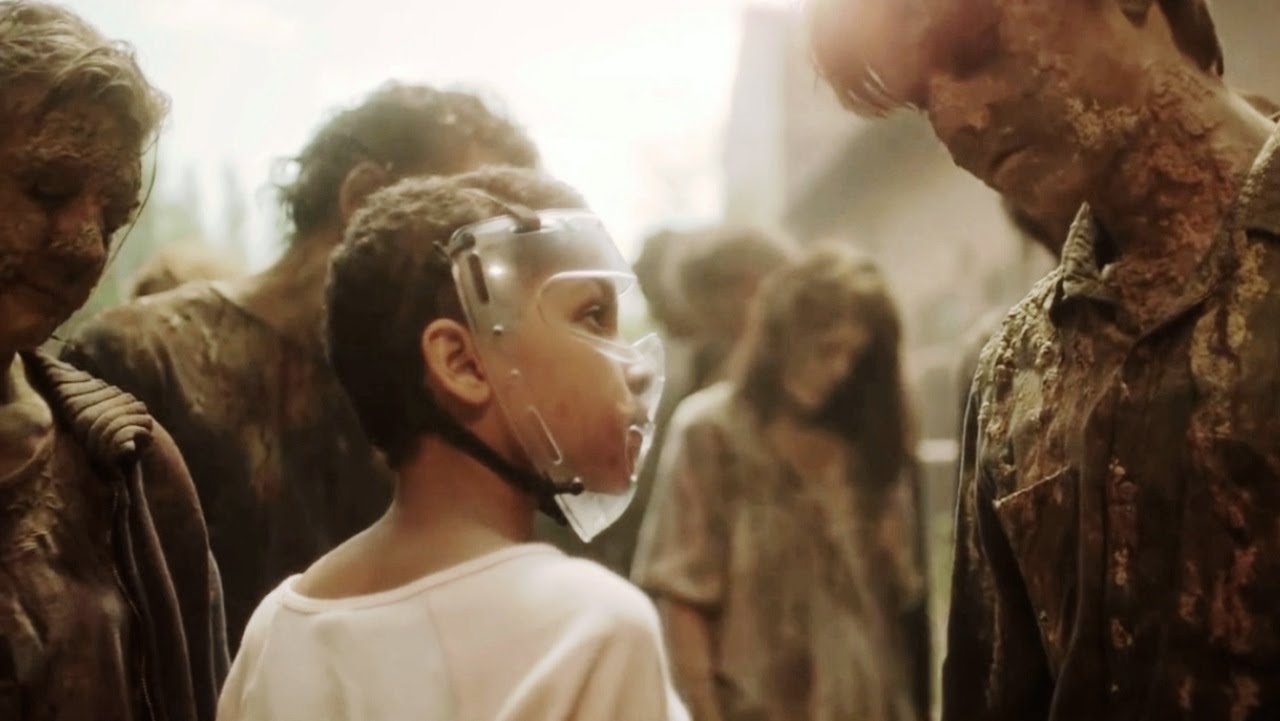
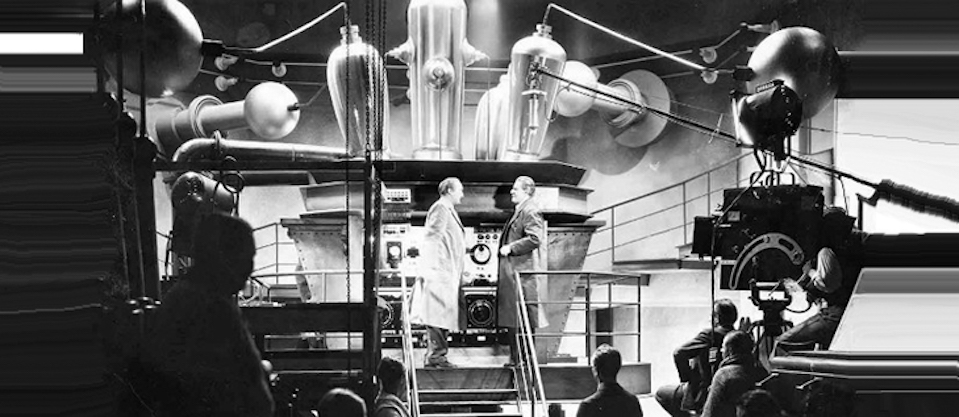
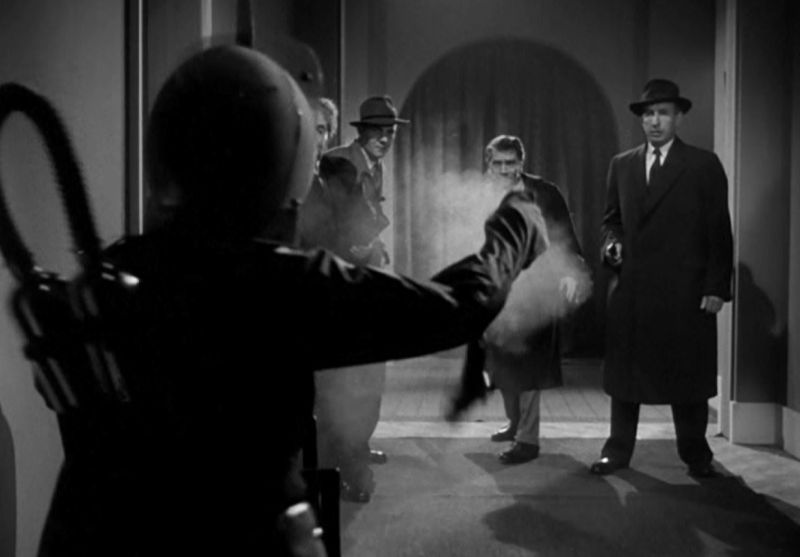
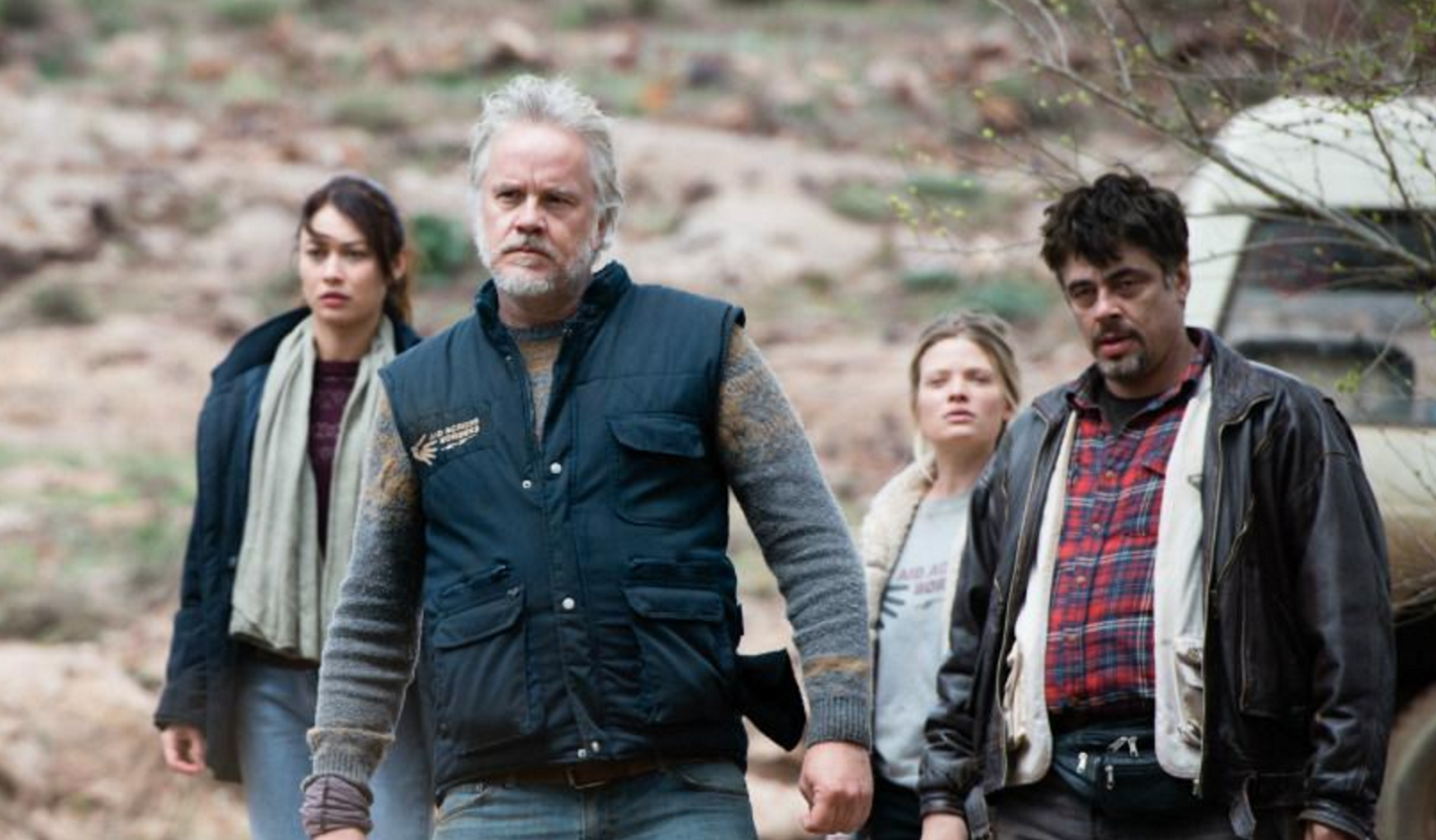
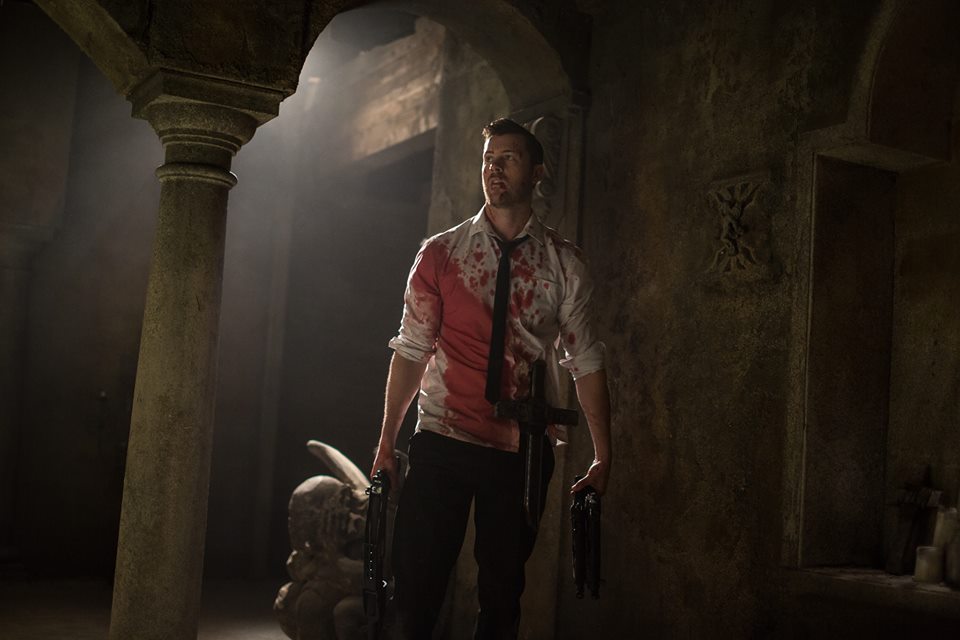
10 Reasons to Remember George A. Romero (1940-2017)

16 Sunday Jul 2017

Posted by dullwood68 in Movies

≈ Leave a comment

Tags

Career, Director, George A. Romero, Horror, Movies, Zombies

George A. Romero (4 February 1940 – 16 July 2017)

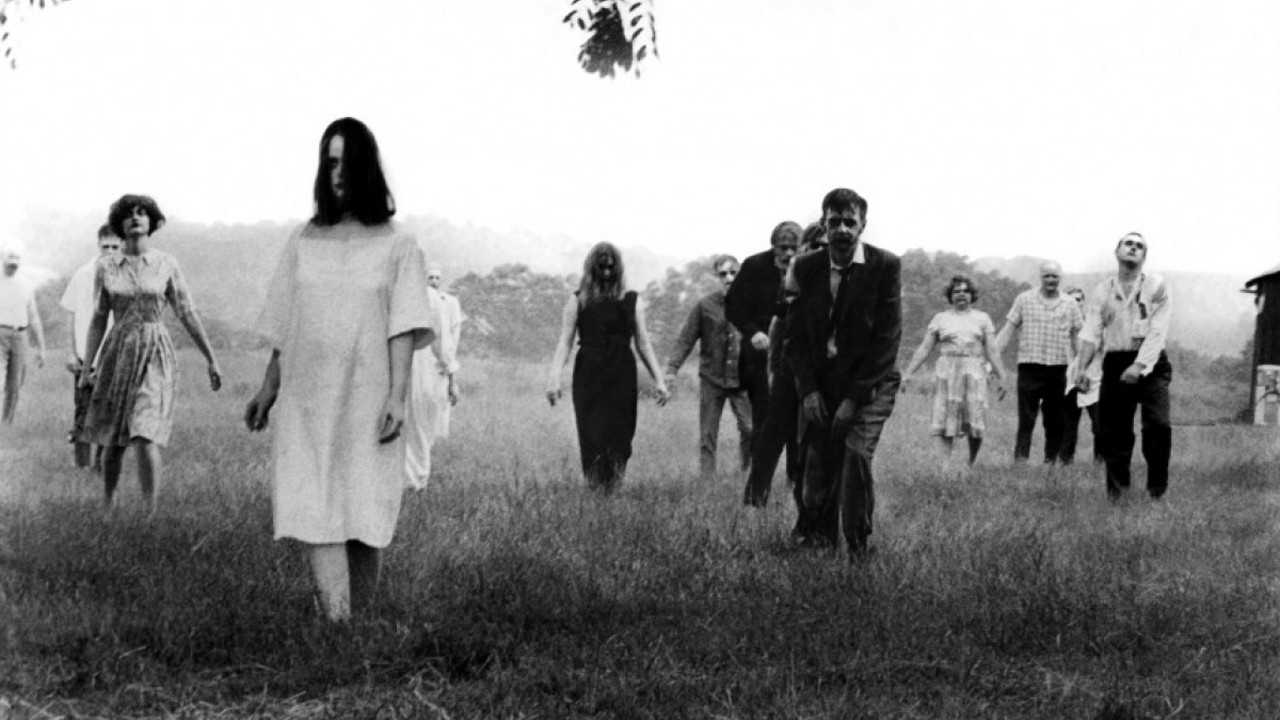
Although best known for his series of zombie movies, George A. Romero’s desire to make movies came about when he saw The Red Shoes (1948), a movie so far removed from the genre that made him famous that it’s intriguing to wonder just where his career would have taken him if he’d followed in the footsteps of Michael Powell and Emeric Pressburger, and not fallen in with the low budget horror arena where he spent pretty much all his career. He was also a huge fan of The Tales of Hoffmann (1951), a movie he would rent on 16mm from the very same rental company that Martin Scorsese used.

But a career creating those kind of artistic endeavours wasn’t to be. Romero started out by making TV commercials and industrial training movies in and around his home town of Pittsburgh. In 1968, he and some friends all contributed $10,000 so he could make his first feature. The result was an unqualified success, and Night of the Living Dead became a movie that would influence an entire sub-genre of horror. From then on Romero was pigeon-holed as a horror director, and though he made a number of movies that didn’t involve zombies or extreme gore effects (usually courtesy of Tom Savini), Romero was always grateful that his first feature allowed him to have a movie making career.

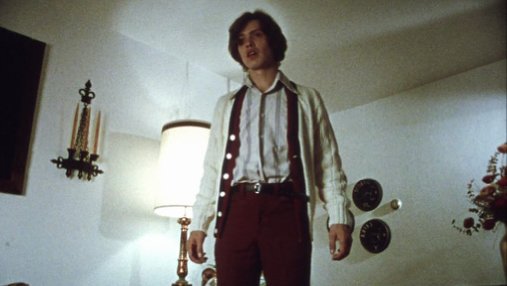
Romero would return to zombies five more times in his career, and though the law of diminishing returns had set in by number five, Diary of the Dead (2007), there was still enough of Romero’s patented social commentary to make the last three in the series interesting to watch at the very least. But Romero’s work away from marauding members of the undead, often provided examples of the best that he could do. Martin (1978) is a creepy, unsettling modern vampire tale, with a great performance from John Amplas, and Knightriders (1981) is a counter-culture movie that features probably Romero’s best assembled cast, and a knowing, mordaunt sense of humour. He was capable of so much more but spent too much time developing projects that inevitably never got off the ground, such as a TV version of Stephen King’s The Stand, or movies such as Resident Evil (2002) where he was slated to direct. An affable, knowledgeable, and likeable figure within the industry, Romero will be missed for all the subtexts he put in his movies and for the way he made zombies “cool”.

1 – Night of the Living Dead (1968)

2 – Season of the Witch (1972)

3 – The Crazies (1973)

4 – Martin (1978)

5 – Dawn of the Dead (1978)

6 – Knightriders (1981)

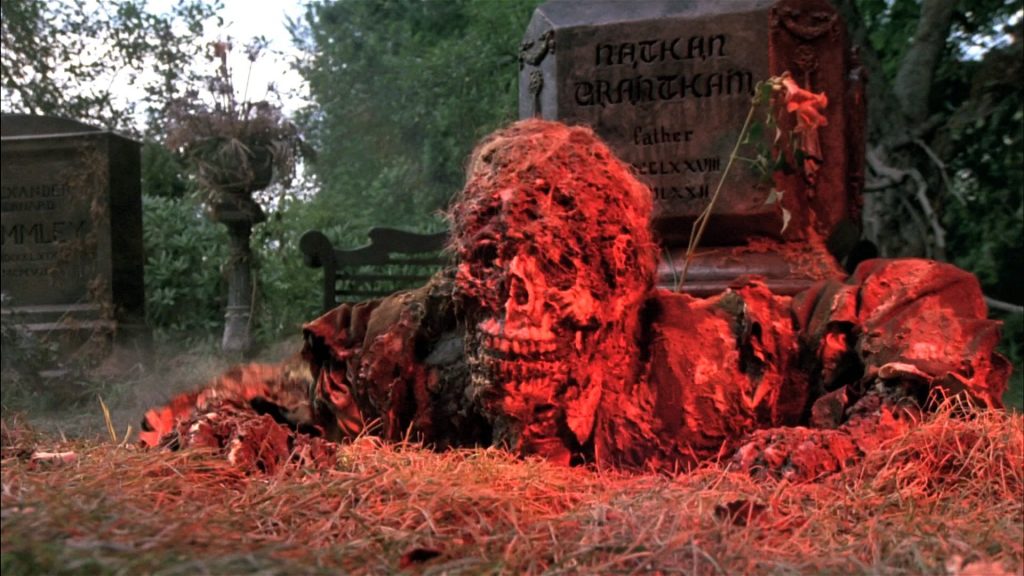
7 – Creepshow (1982)

8 – Day of the Dead (1985)

9 – The Dark Half (1993)

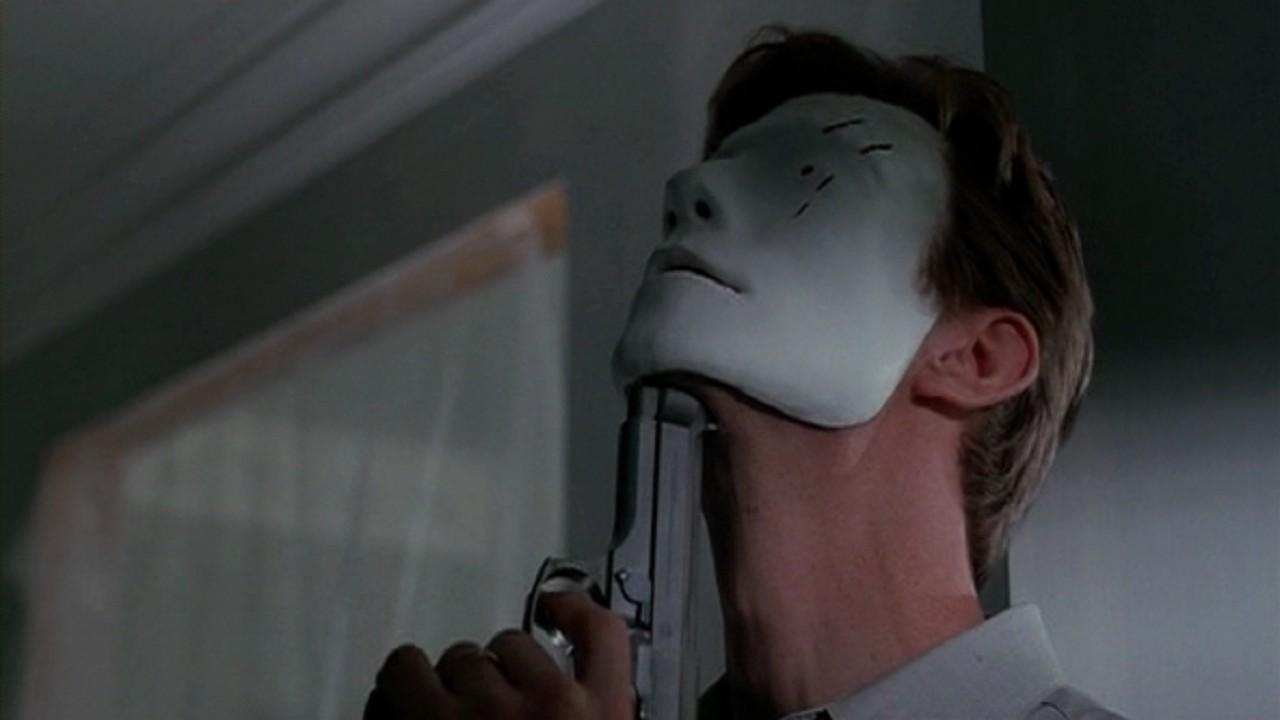
10 – Bruiser (2000)

Share this:

  • Click to share on X (Opens in new window) X
  • Click to share on Facebook (Opens in new window) Facebook
  • More
  • Click to print (Opens in new window) Print
  • Click to email a link to a friend (Opens in new window) Email
Like Loading...

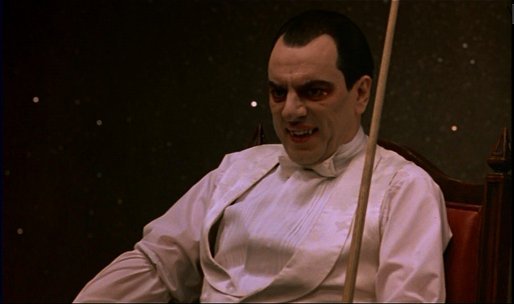
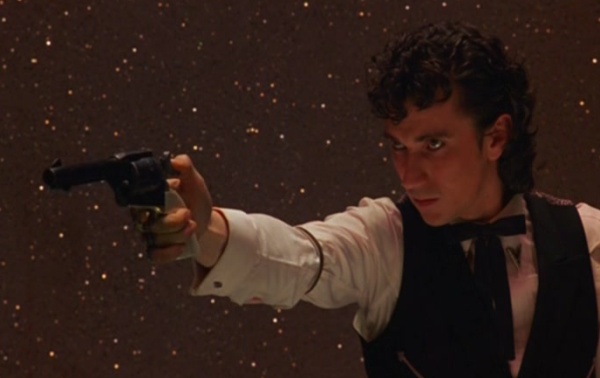
Billy the Kid and the Green Baize Vampire (1985)

15 Saturday Jul 2017

Posted by dullwood68 in Movies

≈ Leave a comment

Tags

Alan Clarke, Alun Armstrong, Bruce Payne, Catch Up movie, Challenge match, Drama, Horror, Phil Daniels, Review, Snooker, Vampire

D: Alan Clarke / 89m

Cast: Phil Daniels, Alun Armstrong, Bruce Payne, Louise Gold, Eve Ferret, Richard Ridings, Don Henderson, Neil McCaul

There are some movies that seem to have been made expressly with the intent that they become cult items some time after their initial release. The world’s only vampire snooker musical, Billy the Kid and the Green Baize Vampire is such a movie, a one-off that’s unlikely to ever be remade, rebooted, or given a sequel. It’s also very much a product of its time, a musical fable built around the real life rivalry between British snooker players Ray Reardon (the green baize vampire) and Jimmy White (Billy the Kid). Small in scale and very cheaply made, and dismissed by contemporary critics and audiences at the time, the movie has gained a certain caché over the last thirty-two years. Rarely seen these days, but available on DVD if you know where to look, the movie makes the most of its limited budget and if you’re in the right mood, offers a viewing experience that might just capture your interest.

The story is a simple one: Billy the Kid (Daniels) is an up and coming snooker prodigy. Just twenty years old, two years before he was discovered by T.O. (The One) (Payne), who now acts as his manager and promoter. Having made a name for himself, Billy is being touted as the next World Champion. He’s flash, he’s arrogant, he plays unsanctioned exhibition matches for money, and he’s as good as he says he is (maybe even better). His attitude earns him the ire of former nine times World Champion Maxwell Randall (Armstrong). A war of words erupts between them in the press, fuelled by manipulative journalist Miss Sullivan (Gold), and soon there’s talk of a challenge match.

T.O. brokers a deal with a loan shark called the Wednesday Man (Henderson) (T.O. is in his debt), and the match goes ahead with the added stipulation that whoever loses has to stop playing professional snooker. Randall shows off his prowess by winning the first frame with a maximum break of 147. He goes on to win the next seven frames, giving himself a seemingly unassailable lead of eight frames to nil, with the match being played over seventeen frames. During a break, Billy  – who’s in shock at how badly he’s faring – and T.O. discover something about the match that changes everything, and when play resumes, a lucky break gives Billy the opportunity to play his way back into the match. It all comes down to the final frame. Which player will be able to hold their nerve and win the match… and how will they do it?

Shot in what looks like the basement of an old abandoned cement factory, Billy the Kid and the Green Baize Vampire is definitely one of the oddest movies you’re ever likely to see, but even with its low budget production values and its over-reliance on sports tropes – the talented newcomer with something to prove, the aging player who resents the newcomer’s apparent disrespect for him and the sport, the manager with financial problems who puts the newcomer’s career on the line, the journalist who foments discord as part of her own agenda, the shadowy figure (here the Wednesday Man) who pulls all the strings behind the scenes – the movie still has a charm that makes it an easy watch, and by the end you can see why it’s gained something of a cult following over the years, and despite being very rough around the edges.

A collaboration between two creative talents for whom this would not have been a predictable choice, the movie has a solemn, well-constructed screenplay by Trevor Preston, and highly stylised direction by Alan Clarke. Both men had backgrounds in more gritty and realistic TV dramas such as the excellent Out (1978 – Preston), and the controversial Scum (1977 – Clarke). Though the screenplay does play things “by the book” and follows a well established template, Preston strays far enough from the template on occasion to make the story more intriguing, such as providing Randall with a home where vampire-related paraphernalia gives rise to the idea that he really is a vampire, and it’s not just a nickname. Also, Preston doesn’t give Billy a girlfriend who’s there solely to tell him how good he is and cheer from the sidelines. And the inclusion of rival sets of fans for the players gives rise to a battle of the classes that should seem out of place, but isn’t at all.

For his part, Clarke keeps the characters hemmed in thanks to the claustrophobic nature of the various sets, and this gives the feel of their being in a pressure cooker environment, where every little slight and criticism is blown up out of all proportion, and emotions run more intensely than they would do otherwise. However, this does give the movie a very theatrical feel, with Randall’s living room looking like a stage set, and the setting for the match, with its spectators’ galleries on three sides, also giving the impression of watching a filmed play rather than a movie. Clarke thankfully compensates for this through the editing, and although the movie never shakes off this notion fully, Clarke’s staging and framing of the action helps smooth things over as well.

As a musical, the movie is on less firmer ground than it is as a sports tale, and though the inclusion of several well written songs (lyrics by Preston, music by George Fenton) gives the movie a boost from time to time, not all of them work as well as they should. The opening song, Green Stamps, will baffle anyone born after 1991, while Kid to Break‘s repetitive nature quickly undermines the intended potency of the song as a whole, which seems to have been written as the snooker equivalent of a football chant. Two songs do stand out though: the vituperative I Bite Back, with its chorus and vocal counterpoint from Eve Ferret (it’s also the one song that wouldn’t sound out of place in a Broadway or West End musical), and the exuberant Snooker (So Much More Than Just a Game), sung by the match’s flamboyant compere, Big Jack Jay (McCaul).

The performances are spirited and engaging, with Daniels wisely abandoning his usual cheeky chappie demeanour, and Armstrong hissing his lines with thinly restrained anger. Both actors are on good form, taking the bare bones of their characterisations and fleshing them out beyond Preston’s original intentions, and looking very comfortable and authentic at the snooker table. Payne, whose career has never really recovered from his being the bad guy in Passenger 57 (1992) (though he was very good indeed in it, better than Wesley Snipes), is the surprise here, giving gambling addict T.O. a much broader, more sympathetic reading than was probably on the page, and making him the most interesting character in the movie. One thing that should be noted though, is that none of the cast are particularly good singers, and their voices aren’t always up to the challenges of the songs, which is a pity as the ways in which they interpret them, are very good indeed.

Rating: 7/10 – much better than it looks (just ignore Clive Tickner’s murky photography), and sounds (Randall’s squeaky shoes are a distraction), Billy the Kid and the Green Baize Vampire is quirky enough and original enough to warrant closer inspection and a better reputation; Clarke squeezes a lot out of Preston’s screenplay, the cast are all on fine form, the songs reflect and enable the narrative, and the whole daft nature of the material – which is taken very seriously indeed –  is exactly what makes it work as well as it does. (15/31)

NOTE: At the moment there’s no trailer available for Billy the Kid and the Green Baize Vampire.

Share this:

  • Click to share on X (Opens in new window) X
  • Click to share on Facebook (Opens in new window) Facebook
  • More
  • Click to print (Opens in new window) Print
  • Click to email a link to a friend (Opens in new window) Email
Like Loading...

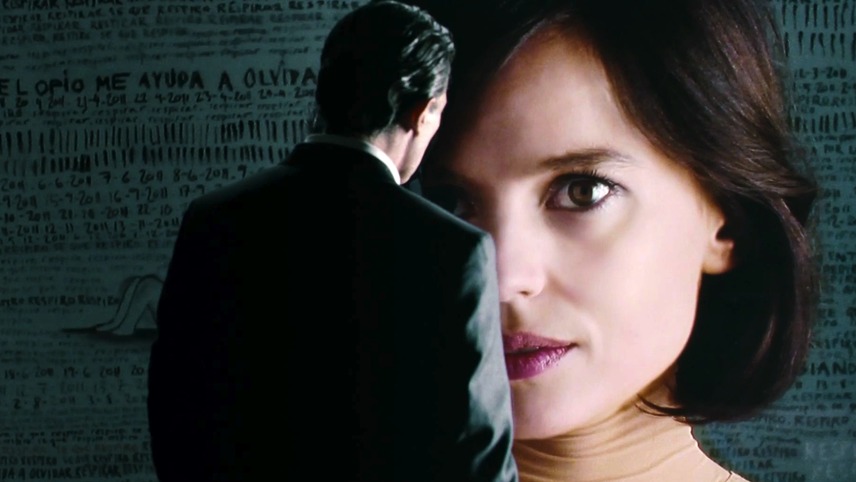
The Skin I Live In (2011)

13 Thursday Jul 2017

Posted by dullwood68 in Movies

≈ 1 Comment

Tags

Artificial skin, Catch Up movie, Drama, Elena Anaya, Horror, Jan Cornet, Marisa Parades, Pedro Almodóvar, Psychological thriller, Review

Original title: La piel que habito

D: Pedro Almodóvar / 120m

Cast: Antonio Banderas, Elena Anaya, Marisa Paredes, Jan Cornet, Roberto Álamo, Eduard Fernández, José Luis Gómez, Blanca Suárez, Susi Sánchez, Bárbara Lennie

What happens when a multi-award winning and very well respected director gets it completely wrong? The answer is a movie called The Skin I Live In. Since making his first feature, the anarchic Folle… folle… fólleme Tim! (1978), Pedro Almodóvar has presided over Spanish moviemaking like a benevolent enfant terrible, promoting home grown talent while making his own idiosyncratic movies and gaining an international reputation for flamboyance, passion and high-camp melodrama. He’s a true original, and a writer/director who has always been unapologetic about the movies he’s made, and their content (anyone who’s seen the opening five minutes of Matador (1986) will know what I mean). But sometimes, even the most innovative and instinctive of directors will take on a project they really should have steered well away from, and The Skin I Live In is Almodóvar’s. In attempting to fuse his usual movie making style with a genre he’s never worked in before, the director of such modern classics as Women on the Verge of a Nervous Breakdown (1988) and High Heels (1991) has made his most unconvincing and mundane movie to date.

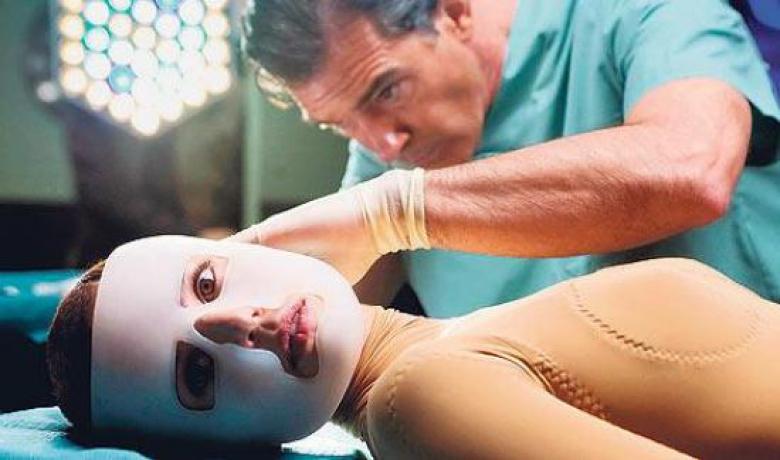
The movie begins with an old-fashioned two-pronged mystery; who is the woman (Anaya) being kept in a locked room by renowned surgeon Dr Robert Ledgard (Banderas), and why? As with all good mystery thrillers, there are no answers that are immediately forthcoming, just a number of clues and a few clever hints. What is clear is that Ledgard has been researching and cultivating an artificial skin that is resistant to fire and insect bites. And soon it becomes clear that he has been using this artificial skin on the young woman (whose name we learn is Vera). And for a while, that’s the movie. There’s a housekeeper, Marilia (Paredes), but she doesn’t appear relevant to the storyline or the plot. Oh, wait, here comes her criminal son, Zeca (Álamo), who’s on the run and needs a place to hide. When he realises there’s an attractive young woman in the house, he has one thing on his mind: sex, and whether she’s willing or not. Fortunately, Ledgard returns home (a little late, to be fair) and Zeca is “taken care of”.

It’s at this point that the script, by Almodóvar and his brother Agustín, decides its time to reveal just what is going on, and why. Cue a late-night confession from Marilia, a flashback from Ledgard’s perspective, and then, more intriguingly, a lengthier flashback from Vera’s point of view. This passage reveals almost everything you could need to know about what’s happening, why it’s happening, and how it’s all happened in the first place. The why, somewhat inevitably, is borne out of revenge, with Ledgard targeting a young man, Vicente (Cornet), for a particular misdeed that has gone unpunished. This futher explains what’s happening, and how it has all come about, but with the flashbacks out of the way, the movie begins to unravel as it heads for a melodramatic but also muted ending. And that’s without a coda that would work better as the beginning of a whole other movie.

Almodóvar has been quoted as saying that The Skin I Live In is “a horror story without screams or frights”. That may sound clever, or even something of a challenge to achieve, but the problem is that while Almodóvar may be good at exploring the lives of those living on the margins of Spanish society (very good in fact), when it comes to horror it’s obvious he doesn’t have the grounding or the knowledge to put together the kind of terrifying experience required of genuinely good horror movies. Instead, Almodóvar plays with his Frankenstein-lite scenario in such a way that he leeches all the horror out of it and leaves the audience with a soap opera melodrama that occasionally acts as a psychological or psycho-sexual thriller. Almodóvar isn’t really interested in making a horror movie; instead he seems more interested in seeing if he can fit horror themes into one of his standard dysfunctional family tragedies.

The result is a movie that proves disjointed and erratic when it comes to the characters and their motivations (Ledgard does a lot of things that are baffling or poorly thought through by the script), and which seems happier in observing things from a distance – much as Ledgard does with Vera. This makes it harder for the audience to engage or sympathise with the characters, and scenes where this might be regarded as essential in terms of building or maintaining tension, remain flat and unremarkable. Almodóvar is better off having his characters express their emotions, no matter how histrionic they might be, but here he opts for a restrained approach that gives the movie a chilly, displaced feel. It’s another bad decision that affects the movie greatly, and leaves the cast adrift completely. Banderas (reuniting with Almodóvar after a twenty-one year gap) plays Ledgard as a man determined on revenge but who makes some very strange choices along the way, while Anaya has the awkward task of denying her character’s back story while at the same time, needing it to perform her role adequately.

Ultimately, it’s a movie that doesn’t work because its director doesn’t know what kind of movie it should be in order to work. With that in mind, Almodóvar’s attempts at making his audience squirm, end up doing so, but for all the wrong reasons. Dread is replaced by unwarranted black humour, terror never has enough time to establish itself, and outright horror is knocked down and killed by a reliance on turgid melodrama. The movie may look good – Antxón Gómez’s production design is perfect for expressing the clinical, sterile environment that Ledgard inhabits – and it may have a surprisingly romantic score courtesy of Alberto Iglesias, but these are plusses that are unable to make up for the wayward, tonally artless moments that Almodóvar peppers his script with. When a horror movie fails in asserting itself as a horror movie and never quite realises where and why it’s going wrong, therein lies the true horror.

Rating: 4/10 – despite occasional moments where Almodóvar reminds us of his auteur status, The Skin I Live In is a movie whose purpose and raison d’être is never compelling enough to warrant the viewer’s full investment of their time; with way too many scenes in its last half hour that provide bafflement instead of suspense, the movie is proof that some directors should stick to what they know, and know what they should stick to. (13/31)

Share this:

  • Click to share on X (Opens in new window) X
  • Click to share on Facebook (Opens in new window) Facebook
  • More
  • Click to print (Opens in new window) Print
  • Click to email a link to a friend (Opens in new window) Email
Like Loading...

The Human Centipede (First Sequence) (2009)

02 Sunday Jul 2017

Posted by dullwood68 in Movies

≈ 1 Comment

Tags

Akihiro Kitamura, Ashley C. Williams, Ashlynn Yennie, Dieter Laser, Drama, Germany, Horror, Review, Surgery, Thriller, Tom Six

D: Tom Six / 88m

Cast: Dieter Laser, Ashley C. Williams, Ashlynn Yennie, Akihiro Kitamura, Andreas Leupold, Peter Blankenstein

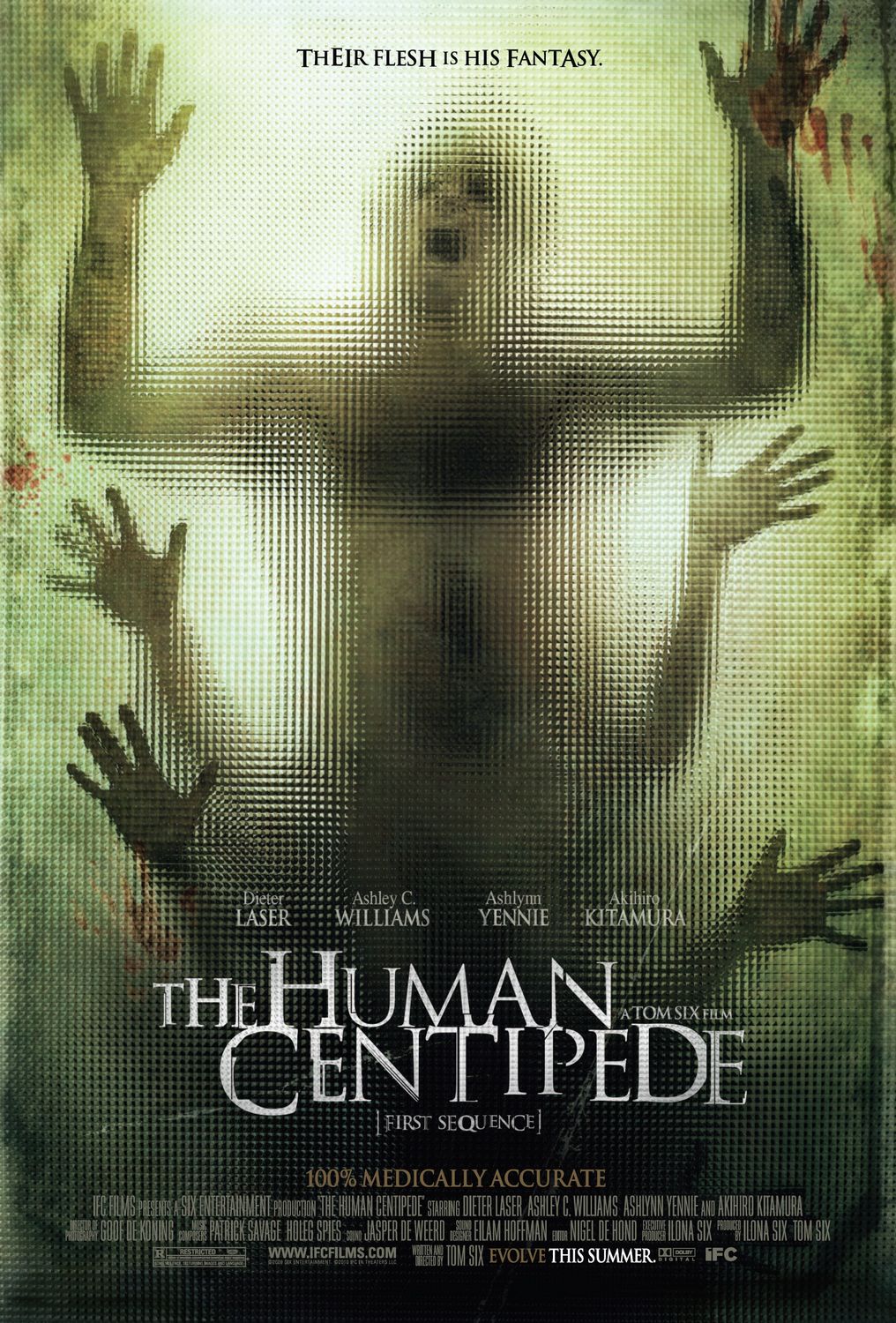
If you’ve ever thought that hype and horror go together like Tom Cruise and Scientology (in that they both support each other), then The Human Centipede (First Sequence) is a prime example of that particular maxim. Even its production, where the investors were kept in the dark about the nature of the “conjoining” writer/director Tom Six had in mind, added to the perception that here was a movie that was setting out deliberately to shock audiences and in the worst imaginable way possible. And soon, the hype took over, as word got out that Six’s movie would show people joined mouth-to-anus as part of a medical experiment carried out by the movie’s main character. And just that idea, that you would see three people joined together in such a way – with their mouths actually grafted onto someone else’s anus – was all the movie needed to attract a huge amount of attention. And outrage. Let’s not forget the inevitable outrage. Regarded by many as “sick” and “depraved”, the movie’s success was assured from the moment it’s raison d’être became known.

But more often than not, hype has a nasty way of proving itself to be unfounded. The greater the outrage, the less outrageous a movie usually is. The more critics charge a movie with being “disgusting” the less likely it is that it will be. And The Human Centipede (First Sequence) fits these requirements almost perfectly. It’s ostensibly a horror movie, it has a shocking central idea, and it makes no apologies for its existence. In short, it’s a success exactly because of the approbrium heaped upon it. But is it “sick”, “depraved”, or “disgusting”? The answer is an easy one: No.

What Six did was to take a crazy idea for a horror movie, pull together the funding needed to make it, and then give his project as much pre-release build-up as he could before unleashing it on a very suspecting world. And most everyone saw what he wanted them to see: a movie described as “sick”, “depraved”, and “disgusting” but which wasn’t. The movie that Six actually made was very much a standard monster movie with an opening section that riffed on slasher movies in an effort to lull audiences who weren’t aware of the movie’s content into thinking they were going to see yet another masked psycho feature. And so we’re introduced to Lindsay (Williams) and Jenny (Yennie), two Americans touring Europe who’ve reached Germany and find themselves stranded on a dark and lonely country road, and with no idea where they are (and surprise, surprise, they can’t get a phone signal). Instead of sticking to the road they head off into the woods, get even more lost, and bicker between themselves until they discover a house handily located in the middle of said woods. A safe haven at last. Or is it?

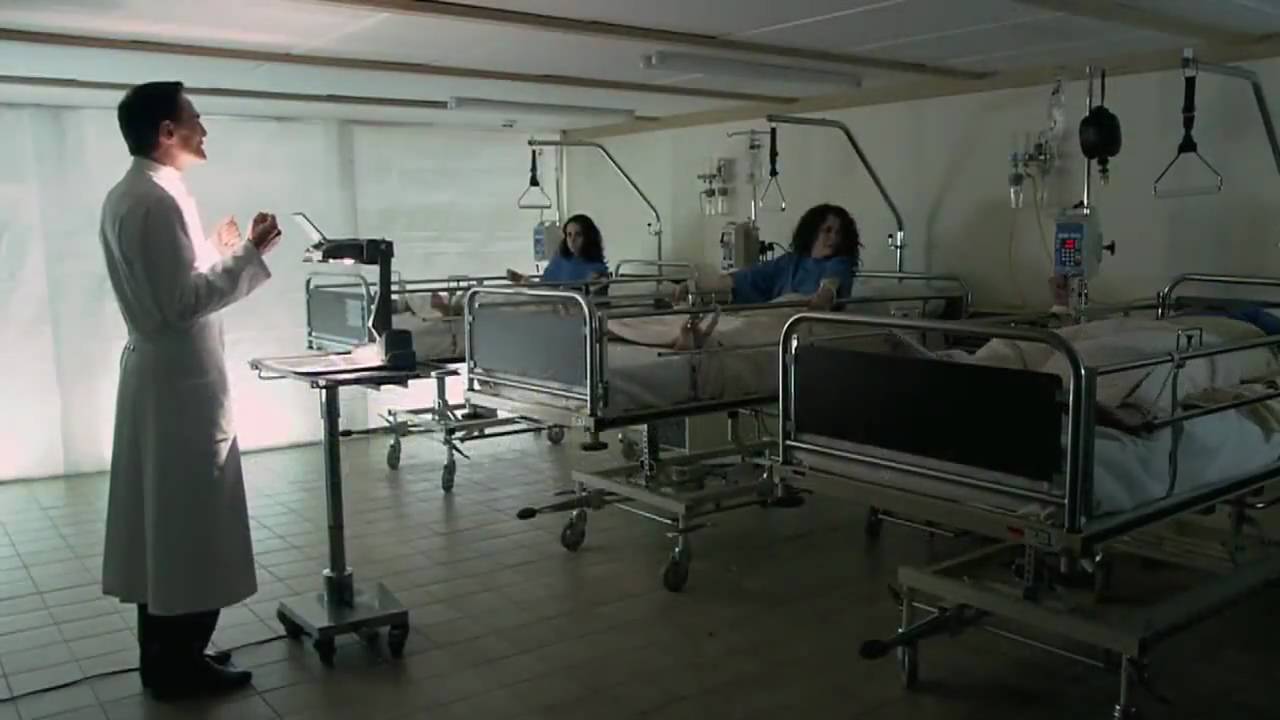
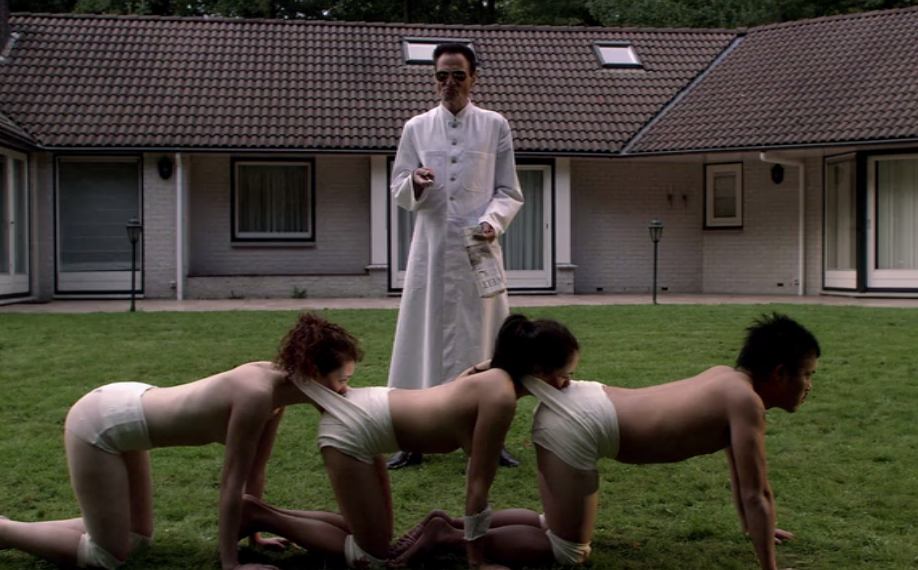
Of course, we all know the answer to that one, as the house is the home of the man we’ve seen right at the beginning of the movie aiming a sedative gun at a truck driver who’s defecating behind some bushes. One glass of water with a Rohypnol chaser (for Jenny), and a sedating injection (for Lindsay) later, and the man of the house, retired surgeon Dr Josef Heiter (Laser), has the girls cuffed to surgical gurneys in his basement and being prepped for an advanced procedure of his own design. But the truck driver has been a poor choice and has to go. And so, Japanese tourist Katsuro (Kitamura) finds himself abducted and taking the driver’s place. Lindsay makes an escape attempt, which in turn inspires Heiter’s admiration for her, and his decision to make her the middle part of his human centipede. The operation goes ahead, the three are joined together, and for a long while the movie forgets that it needs to expand on its basic premise and that seeing three people in what look like oversized nappies crawling around on the floor isn’t very enthralling. Thank God, then, that two cops (Leupold, Blankenstein) come looking for any missing tourists the doctor may be keeping hidden, and the movie can head for the finish line without any further delay.

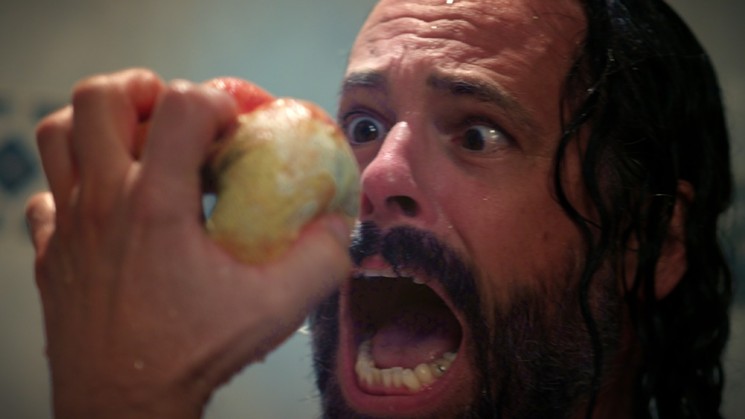
If much of the previous paragraph sounds as if the movie isn’t being taken too seriously, then that’s because it isn’t. You only have to look at the image above to know that this is a movie that shouldn’t be taken seriously by anyone, and even less so as a horror movie. While it does include a number of traditional horror tropes – the mad doctor, the creature that never wanted to be born, the creature turning on its creator – The Human Centipede (First Sequence) never aspires to doing anything remotely meaningful with them, or provide any subtext beyond a risible connection with experiments carried out by the likes of Dr Josef Mengele during World War II. This leaves the movie looking and sounding rather flat once the human centipede is put together. Kitamura shouts a lot, Williams and Yennie groan and cry a lot, and Laser struts around like the ruler of a kingdom only he can see.

This is a movie where we’re supposed to be horrified at the sight of three people connected in a way that wouldn’t look too out of place in a porn movie. Does this make the movie “sick”, “depraved” or “disgusting”? (Spanish audiences didn’t think so; they found the movie funny, and laughed throughout screenings.) Ultimately, this is a minor horror movie elevated through hype into something that it’s not. Six should be congratulated for bringing his movie to a wider public awareness, but it’s also a movie that betrays its Seventies Euro-horror and Cronenbergian influences at every turn. And if you’re holding out for some gore-soaked thrills, you’ll be disappointed there as well: what little there is has been done before, and on too many occasions to make Six’s efforts stand out from the crowd. If it’s real body horror you’re after, then go see Brian Yuzna’s Society (1989). Now there’s a movie where mouth to anus really is just the beginning.

Rating: 4/10 – an uninspired horror movie that holds back from being as exploitative as it sounds, The Human Centipede (First Sequence) is a triumph of carefully planned marketing and narrative shortcomings; bolstered by Thomas Stefan’s antiseptic production design and Goof de Koning’s angular cinematography, the movie promises a lot that it never follows through on, and in the end is too reliant on the so-called “shock value” of its basic premise to be anywhere near as effective as it should be. (2/31)

Share this:

  • Click to share on X (Opens in new window) X
  • Click to share on Facebook (Opens in new window) Facebook
  • More
  • Click to print (Opens in new window) Print
  • Click to email a link to a friend (Opens in new window) Email
Like Loading...

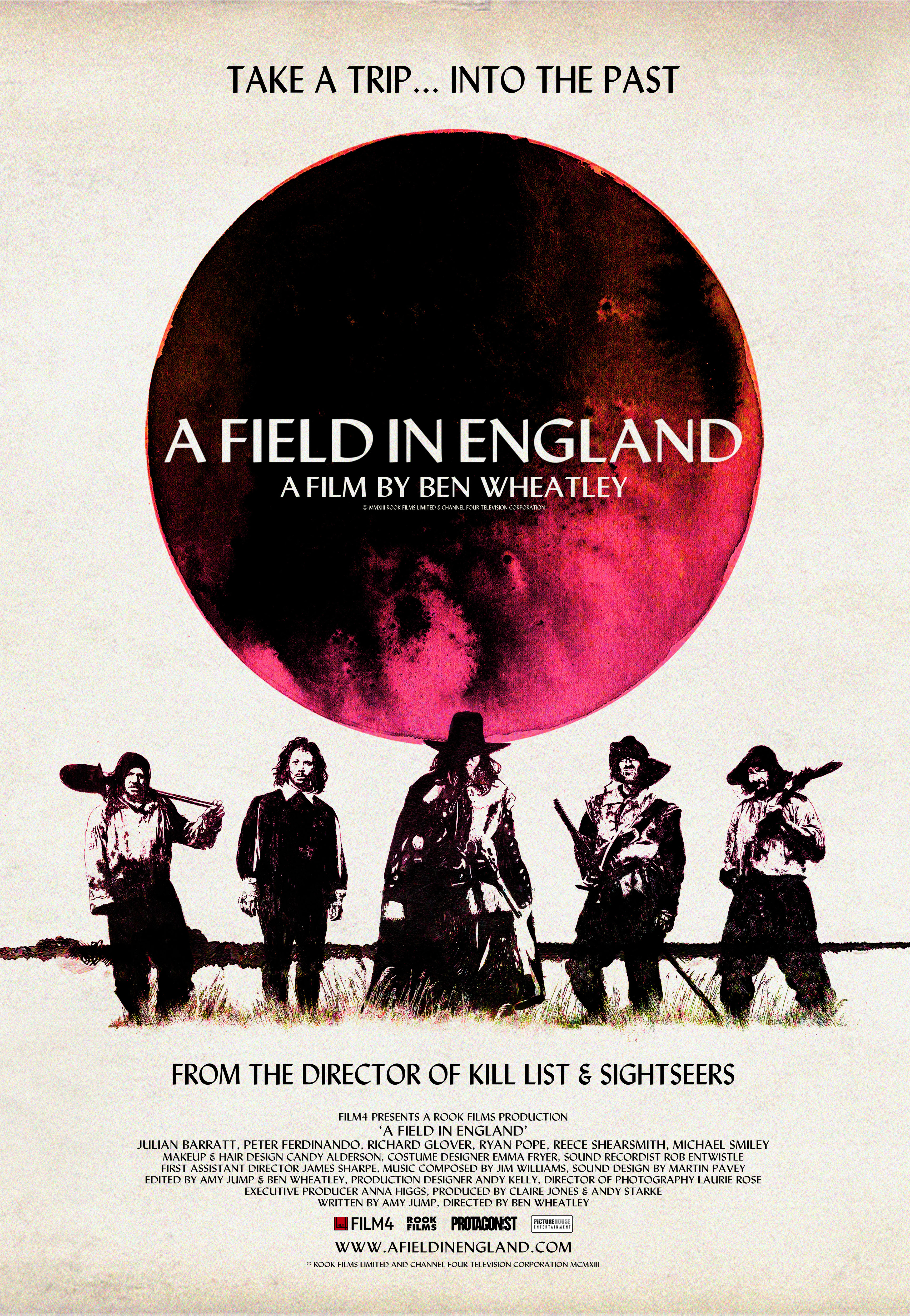
A Field in England (2013)

01 Saturday Jul 2017

Posted by dullwood68 in Movies

≈ Leave a comment

Tags

Ben Wheatley, Catch Up movie, Drama, English Civil War, Hallucinations, Horror, Michael Smiley, Peter Ferdinando, Reece Shearsmith, Review, Richard Glover, Ryan Pope, Thriller

D: Ben Wheatley / 90m

Cast: Julian Barratt, Peter Ferdinando, Richard Glover, Ryan Pope, Reece Shearsmith, Michael Smiley

The British writer/director/editor Ben Wheatley has made six movies to date, all of which have been greeted warmly by critics, but less so by audiences. So what does this say about the movies Wheatley makes? Or the critics that review them so favourably? Or the audiences who aren’t as moved as the critics? Well, like any discerning director, Wheatley makes the movies he wants to make. He’s not singing or dancing to anyone else’s tune, and he’s never been just a director for hire. His movies are personal to him (and his co-writer/co-editor, and wife Amy Jump), and he brings his own unique visual aesthetic to them. Perhaps it’s this individuality of purpose that makes him so popular with the critics. But still, wider audiences haven’t taken to Wheatley’s movies, and he remains a movie maker with a great deal of critical caché but very little box office appeal.

Is this fair? Possibly not, but Wheatley’s distinctive approach to making movies isn’t always as welcoming as it could be. His fourth movie, A Field in England, is probably the best example of how his distinctive approach can get in the way of making a movie accessible, or even fundamentally appealing. Set during an English Civil War battle, the movie begins with Reece Shearsmith’s cowardly alchemist’s assistant, Whitehead, crashing through a hedge and cowering in fear from his pursuer, Commander Trower (Barratt). Rescued by a soldier named Cutler (Pope), the pair also encounter a couple of deserters, an alcoholic called Jacob (Ferdinando) and his witless companion, Friend (Glover). They decide to leave the battle and travel to an alehouse that Cutler tells them isn’t far away. They begin crossing a field that’s ringed by mushrooms, and Cutler forces Jacob and Friend to eat them. Things begin to a turn for the weird when the men seemingly haul an Irishman named O’Neill (Smiley) from out of the ground. He quickly assumes control of the group and convinces them that there is treasure buried in the field, and traumatises Whitehead into become a kind of human divining rod in order for them to know where to dig.

What follows is a series of events and episodes that may or may not be the result of the men ingesting the mushrooms, as hallucinations and psychotic breaks affect the whole group except for O’Neill (who may be real and then again he might not be; his provenance is doubtful). And this is the point where what occurs, and what follows, can’t be trusted. If you accept that Wheatley has sent his characters on a really strange trip, then you can go with the flow quite easily and just accept what you’re seeing without worrying about what it might all mean. But if you do need to know what it all means, then the rest of the movie is going to be problematic for you.

Wrongly or rightly, deliberately or accidentally, A Field in England is a movie that takes a huge stylistic and narrative gamble around the half hour mark and never looks back. It maintains a semblance of traditonal storytelling but filters it all through a succession of moments of bravura visual and sonic experimentation. At one point, while being chased by O’Neill, Whitehead shoves mushroom after mushroom into his mouth and Wheatley uses it as a cue to transport the viewer into Whitehead’s mind and expose them to the kaleidoscopic and fantastical visions that the character is experiencing. It’s a tremendous feat of editing, combining fractured and composite visuals with an overwhelming audio conflation of natural sound and music, and it’s far and away the standout moment… but, exceptional as it is, it’s also indicative of the way in which Wheatley and Jump have decided to treat the narrative, and the material as a whole.

As the movie progresses, and the characters experience vision after hallucination after extended fever dream, it becomes clear that the story, such as it is, has been abandoned in favour of transporting the viewer into a world where anything Wheatley and Jump can come up with is the new norm, and regardless of whether it makes sense or not. What makes this all the more frustrating is that the dialogue and the characterisations, which were so redolent during the movie’s first half hour, are also abandoned, and the characters – literally – all become pawns to be moved around the field at random, and until Wheatley can set up the final showdown between Whitehead and O’Neill (which ends with a line from Whitehead that has Eighties action movie cliché written all over it; not bad for a movie set during the English Civil War). In the end, the viewer has no choice but to go along with what’s happening, because Wheatley isn’t giving them a choice; and if it doesn’t make sense – which a lot of it doesn’t – then it’s too bad.

But where the movie scores highly is in its imaginative cinematography, courtesy of DoP Laurie Rose (who has lensed all of Wheatley’s movies). The crisp, pin-sharp black and white images are hugely immersive, and close ups are rendered in such a precise, detailed fashion that there are several moments where the urge to pause the movie and savour the image is irresistible. It’s a movie that’s staggeringly beautiful at times, and if it’s ever released in a 4K UHD version it would be an even more incredible viewing experience. Full marks too to sound designer Martin Pavey and composer Jim Williams for combining their work in a way that adds so much resonance to the images, and helps accentuate the profoundly disturbed states of mind of the characters once their real “journey” has begun. Without these elements – the imagery and the soundtrack – A Field in England would definitely suffer further, but thankfully they more than make up for the errant narrative and directorial choices that Wheatley has made.

Rating: 6/10 – impressive visuals and an equally impressive soundscape aren’t enough to stop A Field in England from being a disappointing, and frustrating viewing experience; loaded with style and directorial flourishes, it neglects its storyline in favour of these approaches, and leaves the movie struggling to retain any meaning, which makes it an exercise in style that overwhelms any substance it may have had in the beginning. (1/31)

Share this:

  • Click to share on X (Opens in new window) X
  • Click to share on Facebook (Opens in new window) Facebook
  • More
  • Click to print (Opens in new window) Print
  • Click to email a link to a friend (Opens in new window) Email
Like Loading...

Monthly Roundup – June 2017

30 Friday Jun 2017

Posted by dullwood68 in Movies

≈ 1 Comment

Tags

Attack of the Killer Donuts, Bakery, Barbara Kent, Before the Flood, Carole Lombard, CHIPS, Climate change, Comedy, Crime, Dax Shepard, Documentary, Dough, Drama, Fisher Stevens, Grief Street, High Voltage, Horror, Howard Higgin, Jerome Holder, John Goldschmidt, John Holland, Jonathan Pryce, Justin Ray, Kay Linaker, Kayla Compton, Leonardo DiCaprio, Michael Peña, Murder, Mystery, Ralph Morgan, Raymond Cannon, Reviews, Richard Thorpe, Scott Wheeler, The Outer Gate, Thriller, William Boyd

Attack of the Killer Donuts (2016) / D: Scott Wheeler / 85m

Cast: Justin Ray, Kayla Compton, Ben Heyman, Michael Swan, C. Thomas Howell, Fredrick Burns, Kassandra Voyagis, Chris De Christopher, Lauren Compton, Alison England, Michael Rene Walton

Rating: 3/10 – Johnny (Ray) works in a donut shop, while his mad scientist uncle (Swan) works in his basement lab cooking up a formula that – surprise! – will eventually turn donuts into flesh-hungry, bloodthirsty… donuts; bottom of the barrel stuff that aims for kitschy fun but misses by a mile, Attack of the Killer Donuts wears its sugar-coated heart on its sleeve, but is too awful in its execution to make up for its many, many, many faults, or the fact that it’s run out of steam before the first victim is put out of their misery (unlike the audience).

Before the Flood (2016) / D: Fisher Stevens / 96m

With: Leonardo DiCaprio, Alejandro González Iñárritu, Al Gore, Elon Musk, Barack Obama, John Kerry

Rating: 8/10 – actor and UN Messenger of Peace on Climate Change, Leonardo DiCaprio explores the ways in which the world is still refusing to acknowledge the effects of greenhouse gases and the need to switch to renewable energy; DiCaprio is a passionate environmental activist who has access to many of the “big players”, and his targeted globe-trotting highlights the natural disasters that are occurring all around us, all of which makes Before the Flood a worthy successor to Al Gore’s An Inconvenient Truth (2006), and an important, and sadly necessary, acknowledgment that we’re still not doing enough to turn things around and ensure our collective futures.

Dough (2015) / D: John Goldschmidt / 95m

Cast: Jonathan Pryce, Jerome Holder, Phil Davis, Ian Hart, Pauline Collins, Andrew Ellis, Malachi Kirby, Natasha Gordon, Melanie Freeman, Daniel Caltagirone, Andy de la Tour

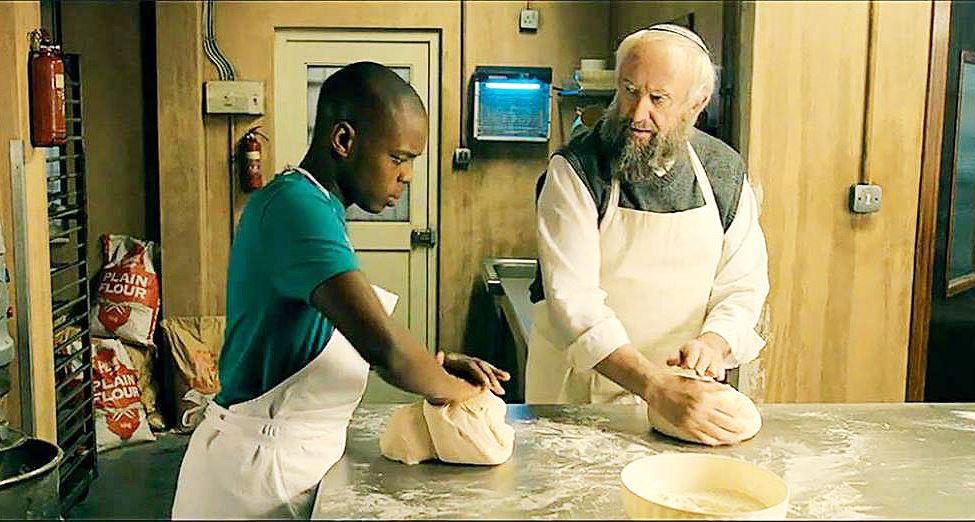
Rating: 7/10 – an aging Jewish baker (Pryce) takes on an apprentice (Holder) whose second job as a drug dealer leads to the bakery’s sales going through the roof when an unexpected ingredient finds its way into the dough mix; a genial, inoffensive movie that features winning performances from Pryce and Holder, Davis as the kind of smarmy business developer who belongs in a pantomime, and a pleasant sense of its own shortcomings, Dough is a cross-cultural comedy drama that is amusing for the most part but which lacks the substance needed to make it more engaging.

Grief Street (1931) / D: Richard Thorpe / 64m

Cast: Barbara Kent, John Holland, Dorothy Christy, Crauford Kent, Lillian Rich, James P. Burtis, Larry Steers, Lloyd Whitlock

Rating: 5/10 – there are plenty of suspects, but just who did kill less than popular stage actor Alvin Merle (Kent), and why?; a locked room murder mystery where everyone with a motive is assembled Agatha Christie-style at the end to reveal the murderer, Grief Street is a brash, enjoyable whodunnit whose villain will be obvious to anyone who’s seen more than a handful of similarly plotted movies, but the movie more than makes up for this thanks to spirited performances from its cast, and Thorpe’s relaxed directing style.

The Outer Gate (1937) / D: Raymond Cannon / 63m

Cast: Ralph Morgan, Kay Linaker, Ben Alexander, Eddie Acuff, Charles Brokaw

Rating: 5/10 – when an up-and-coming employee (Alexander) is sent to prison for embezzlement, his employer (Morgan) is the first to believe in his guilt, but when the truth is revealed and he’s released from jail, the employee sets about getting his revenge; directed by Cannon in a crude, rudimentary way, The Outer Gate is nevertheless a movie that plays to the strengths of its gosh-you-won’t-believe-it screenplay, Morgan’s low-key, passive performance, and a surprisingly grim fatalism, all of which make it more intriguing than it appears to be on the face of things.

High Voltage (1929) / D: Howard Higgin / 63m

aka Wanted

Cast: William Boyd, Carole Lombard, Owen Moore, Phillips Smalley, Billy Bevan, Diane Ellis

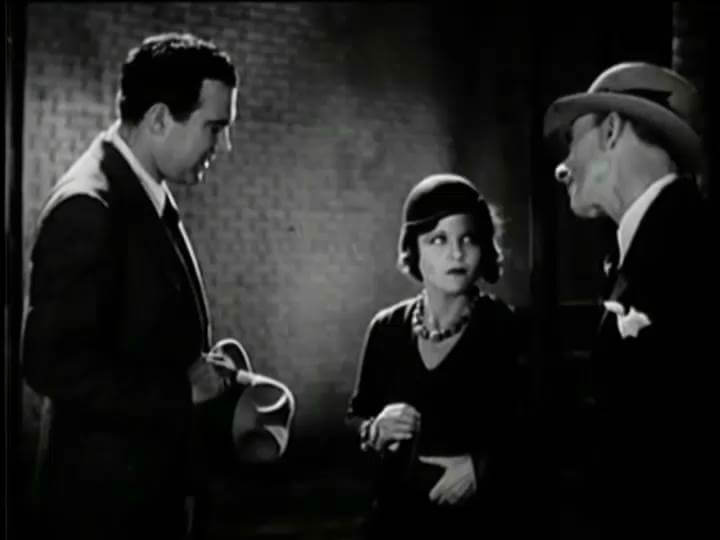
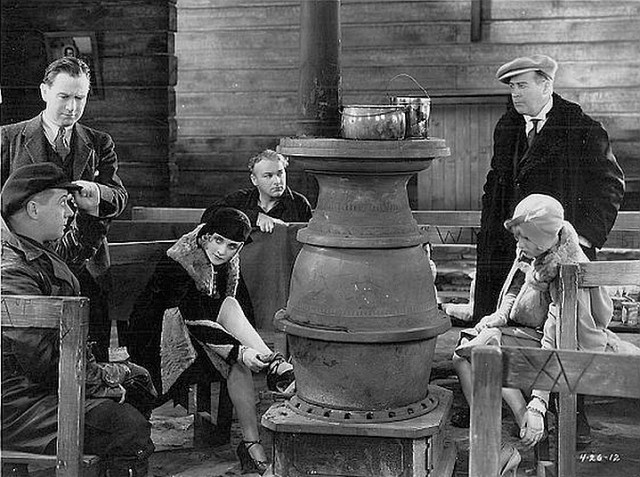
Rating: 4/10 – when a bus load of passengers is stranded thanks to heavy snow, they take refuge in an abandoned church, only to find they’re not alone; a dialogue heavy drama made in the early days of the Talkies, High Voltage is a well acted if dreary experience that tries hard to make itself interesting but falls short thanks to its focus on (already) stereotypical characters and the period’s need for a neat, everything-wrapped-up-satisfactorily ending.

CHIPS (2017) / D: Dax Shepard / 101m

Cast: Michael Peña, Dax Shepard, Vincent D’Onofrio, Rosa Salazar, Jessica McNamee, Adam Brody, Isiah Whitlock Jr, Kristen Bell, Justin Chatwin

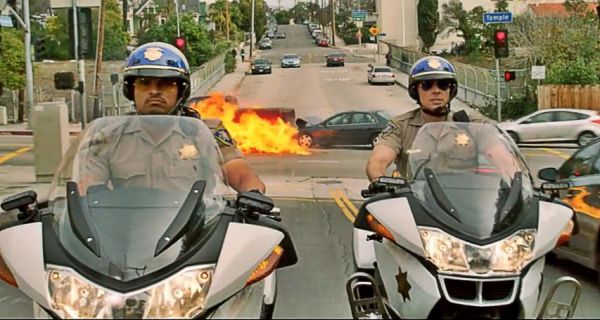
Rating: 4/10 – rookie motorcycle cop Jon Baker (Shepard) is teamed up with newly transferred Frank Poncharello (Peña) in the California Highway Patrol, and soon finds himself tracking down a bunch of dirty cops led by veteran Ray Kurtz (D’Onofrio); forty years on from its origin as a TV series, CHIPS is given a big screen reboot thanks to fanboy Shepard, but is only moderately successful in its efforts to drag the show kicking and screaming into the 21st century, leaving it completely dependent on how you feel about Shepherd and Peña as a comedy duo, and its less than inspired script.

Share this:

  • Click to share on X (Opens in new window) X
  • Click to share on Facebook (Opens in new window) Facebook
  • More
  • Click to print (Opens in new window) Print
  • Click to email a link to a friend (Opens in new window) Email
Like Loading...

Oh! the Horror! – The Windmill Massacre (2016) and The Void (2016)

29 Monday May 2017

Posted by dullwood68 in Movies

≈ Leave a comment

Tags

Aaron Poole, Charlotte Beaumont, Drama, Holland, Horror, Hospital, Jeremy Gillespie, Kenneth Welsh, Nick Jongerius, Review, Steven Kostanski

The Windmill Massacre (2016) / D: Nick Jongerius / 85m

Cast: Charlotte Beaumont, Bart Klever, Patrick Baladi, Noah Taylor, Fiona Hampton, Adam Thomas Wright, Tanroh Ishida, Ben Batt, Kenan Raven, Derek Howard

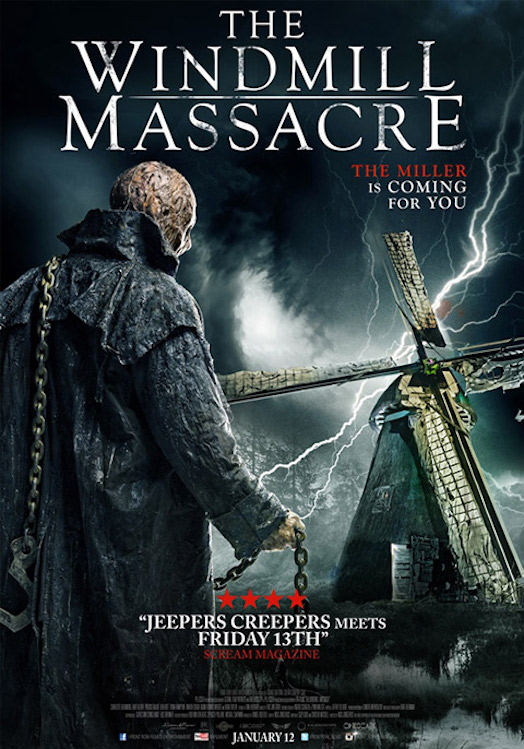
A motley crew of tourists, some of whom are running to escape their past. A sightseeing trip to several of Holland’s windmills. A tour bus that breaks down close to a windmill that isn’t on any map. A woman (Beaumont) who witnesses the murder of one of the day trippers. A movie that treads such a familiar and uninspiring path that it might as well have been marked, Cliché Road.

The serial killer with a supernatural raison d’etre is such a staple now of the horror genre that any new wrinkle on such a well established theme has to really go the extra mile to be effective. Alas, The Windmill Massacre only has its location to help differentiate it from all the other serial killer horror movies out there. And when you can’t even come up with a coherent origin story for your supernatural killer – here it comes in two parts and the makers haven’t realised that they don’t make a convincing whole – then your movie is at a disadvantage before it’s even begun.

Having such a disparate set of characters doesn’t help either. There’s Beaumont’s Aussie nanny, on the run after killing her abusive father (Howard); Baladi’s uptight dad taking his haemophiliac son (Wright) on an impromptu term-time holiday; Taylor’s coke-snorting art historian; Ishida’s innocuous yet resourceful Japanese student; Hampton’s ambitious French photographer; and Batt’s Marine fleeing from an incident with a Dutch prostitute. They’re rounded off by tour guide Abe (Klever), whose attitude ranges from nonchalant to incredibly nonchalant. If the viewer manages to connect with any of them then that says more about the viewer, because all are stock characters who don’t inspire any sympathy.

To be fair the movie does attempt to provide a slightly different motive for its burn victim villain – he’s there to claim the lives of sinners – but in the end it doesn’t matter what his motivation is, as long as he rids the unlucky viewer of the characters’ company and in as timely a manner as possible. This leads to a series of deaths that attempt to pay homage to the kill sprees found in Eighties horror movies but which only manage to do so in a derivative, obligatory fashion; and there’s a twist that won’t surprise anyone. Some of the cast try too hard, some barely register, and director Nick Jongerius can’t inject enough energy into proceedings to make a difference. There are a couple of loose ends that aren’t tied up, but the average viewer won’t care, as long as they don’t have to make the same trip again.

Rating: 3/10 – yet another horror movie that creates a set of rules to govern its villain’s behavour and demise – and then ignores them all in order to set up a potential sequel, The Windmill Massacre is tiresome, and subordinate to ideas better used elsewhere; it just goes to show that low-budget European horror can be just as bad as its US cousin, and just as predictable.


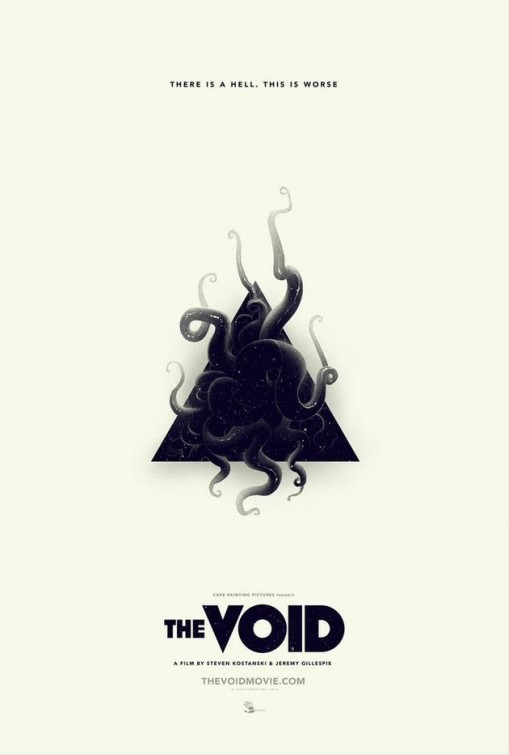
The Void (2016) / D: Jeremy Gillespie, Steven Kostanski / 90m

Cast: Aaron Poole, Kenneth Welsh, Daniel Fathers, Kathleen Munroe, Ellen Wong, Mik Byskov, Art Hindle, Stephanie Belding, James Millington, Evan Stern, Grace Munro

A lonely backwoods road. A deputy dozing in a patrol car. A man who stumbles out of the woods covered in blood. A rush to the nearest hospital even though the man isn’t wounded.

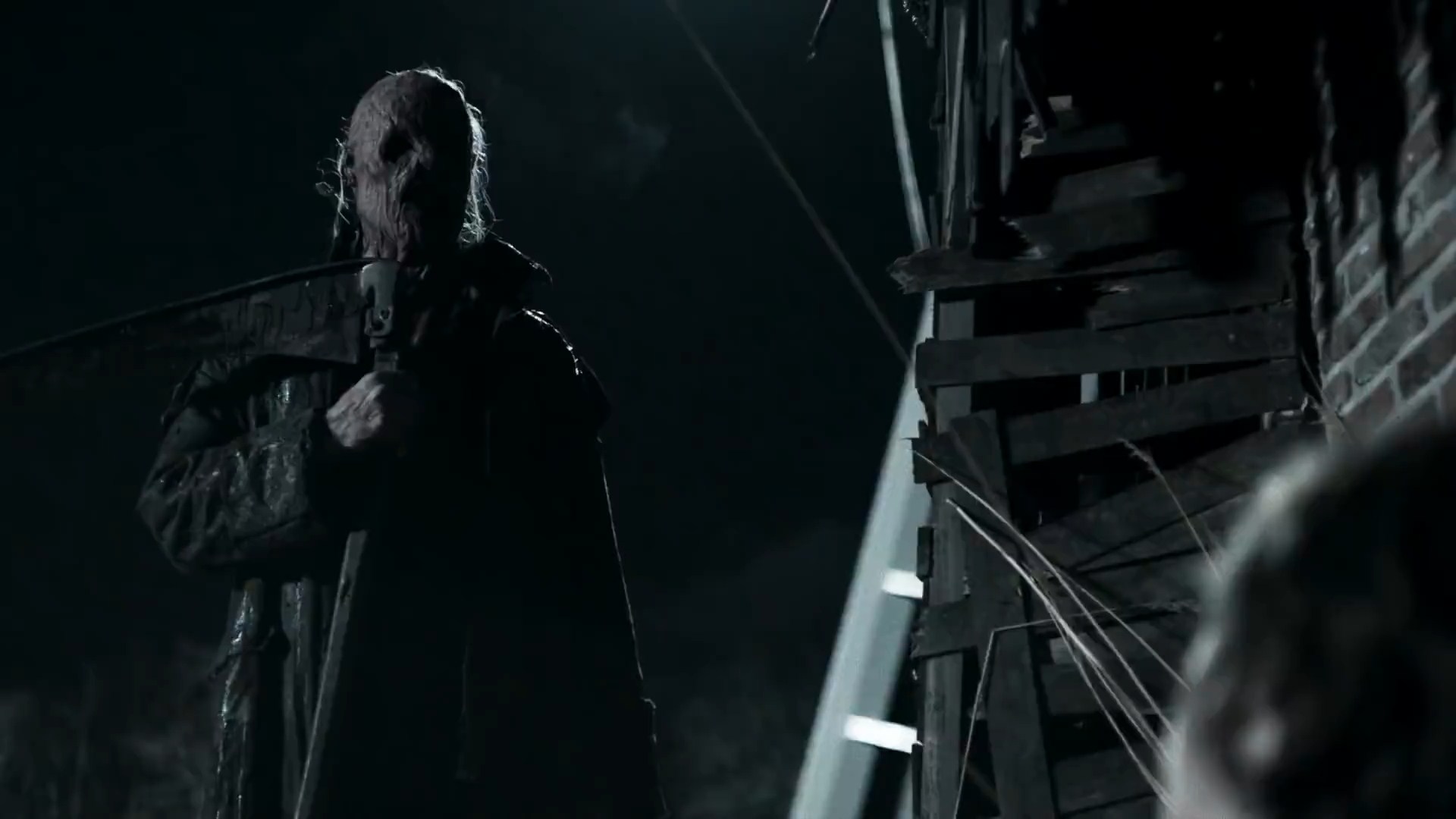
And let’s stop right there. Whatever you might be looking for in watching The Void, be advised that a story which makes sense will not be forthcoming. From the outset, The Void is a movie that, thanks to writers and directors Jeremy Gillespie and Steven Kostanski, opts for keeping its audience (and its characters) firmly in the dark (or the void, if you prefer). It has no sense of its own internal logic – such as it is – and plays fast and loose with motivation, coherence, and dramatic licence. Stupid things are done by pretty much all the characters, and there’s enough lug-headed dialogue going around to crunch open a portal to another dimension – Oh, hang on a moment, that’s what’s happening here, isn’t it?

This is a movie that seems to have a strange kinship with The Fast and the Furious franchise (bear with this). In that series, each movie is constructed by coming up with the OTT setpieces first and the plot and storylines second. Here it seems as if the creature effects and their place in the screenplay were devised first of all, and then a plot bolted on later. That plot makes no sense, and whenever the movie seems like it’s going to explain exactly what’s going on it finds a way to avoid doing so. Even when the chief villain starts spouting pseudo-intellectual gibberish in his efforts to explain things it soon becomes obvious that he’s just spouting any old drivel that sounds esoteric. Somewhere in there is the notion that physical metamorphosis can be brought about through ritual and the intervention of beings older than time, but that’s the best the movie can do to justify the events that are taking place.

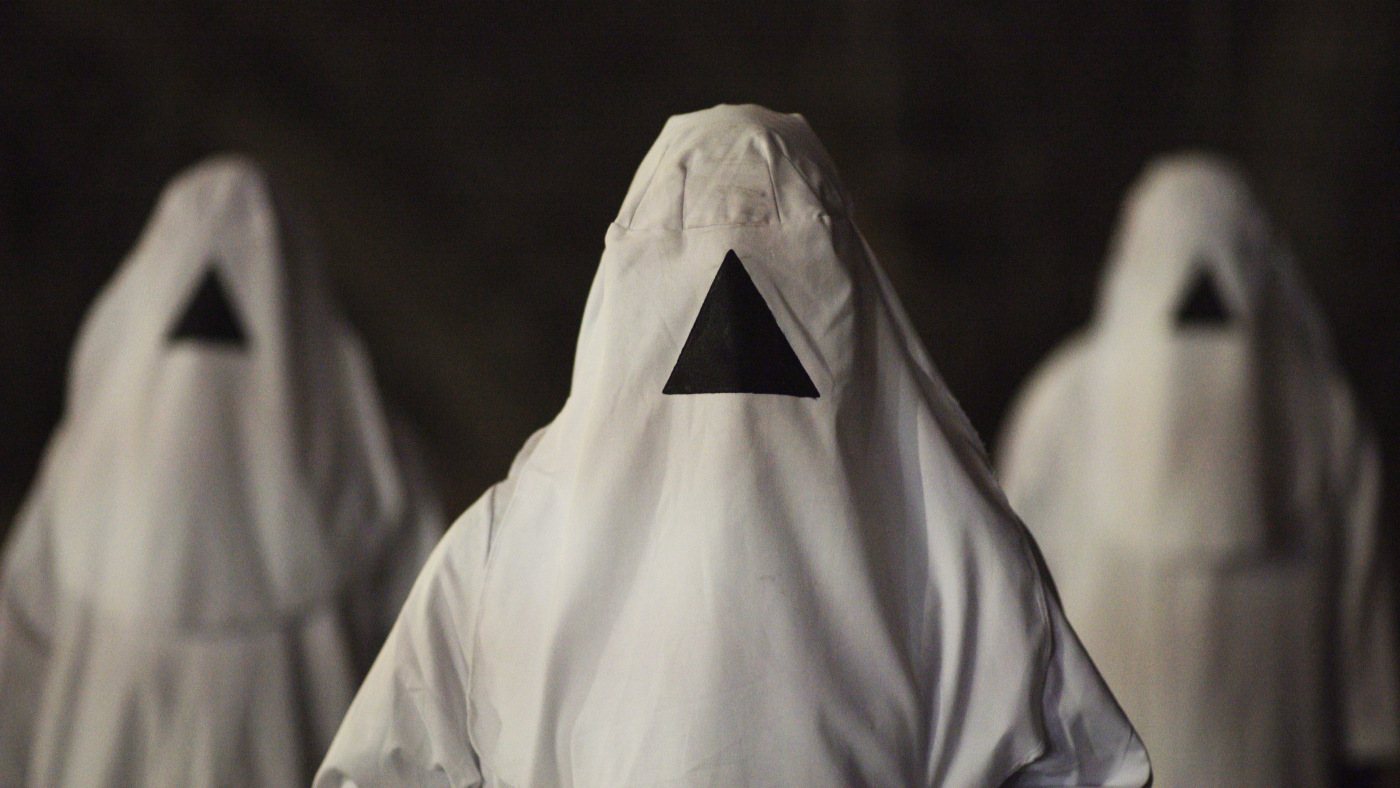
What can be discerned is that there is a cult operating in and around the kind of backwoods community where the local deputy is as much a doofus as he is a potential hero; that everyone in the hospital where the deputy and the man from the woods end up will die; that the creatures people “evolve” into will be low-lit and obscured by careful framing and ultra-careful editing; and that all this will happen in the kind of isolation that only occurs in low-budget horror movies. The movie trades on its retro-Eighties gore effects and sub-Lovecraftian tone but these can’t compensate for some truly awful performances (particularly from Poole), character motivations so dire they’re wince-inducing, and a number of plot “developments” that prompt the characters into putting their lives in danger over and over and over again. In many ways this is an ill considered project that lacks the zest and ideas needed to make it a breakout movie – which seems to have been the aim.

Rating: 3/10 – horror movies don’t have to make complete sense (though it would be nice if they tried), and The Void adheres to that idea with apparent relish; with no explanation offered for anything that happens, it’s a movie that tries hard to be effective on a visceral level but which ultimately fails to be anything more than yet another dumb horror that mistakes enthusiasm for quality.

Share this:

  • Click to share on X (Opens in new window) X
  • Click to share on Facebook (Opens in new window) Facebook
  • More
  • Click to print (Opens in new window) Print
  • Click to email a link to a friend (Opens in new window) Email
Like Loading...

Alien: Covenant (2017)

12 Friday May 2017

Posted by dullwood68 in Movies

≈ Leave a comment

Tags

Billy Crudup, Danny McBride, Drama, Horror, Katherine Waterston, Michael Fassbender, Prequel, Review, Ridley Scott, Sci-fi, Sequel, Thriller, Xenomorph

D: Ridley Scott / 122m

Cast: Michael Fassbender, Katherine Waterston, Billy Crudup, Danny McBride, Demián Bichir, Carmen Ejogo, Jussie Smollett, Callie Hernandez, Amy Siemetz, Nathaniel Dean, Alexander England, Benjamin Rigby, Uli Latukefu, Tess Haubrich

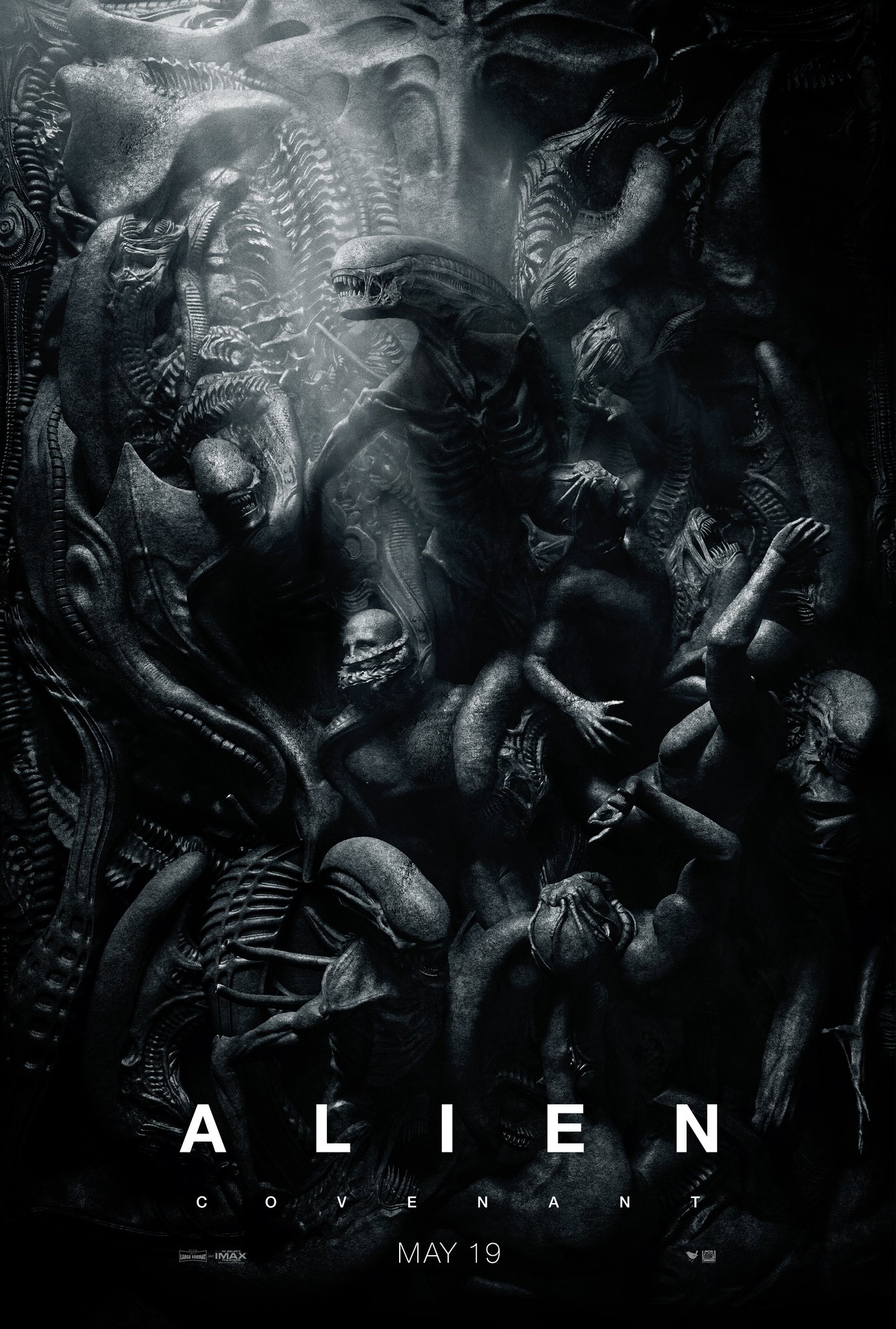
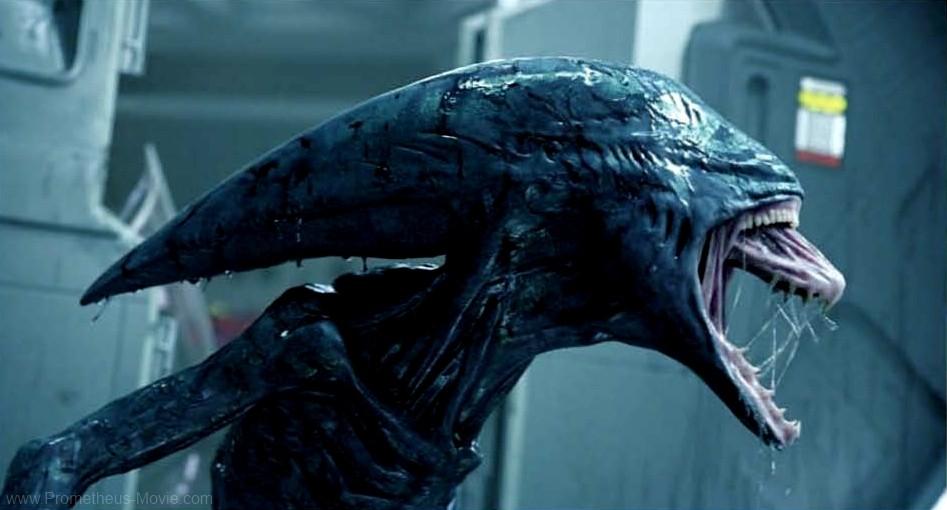
When the Alien franchise was given a new lease of life with official prequel Prometheus (2012), audiences were teased with the idea that they would finally learn just where the series’ chief villain, the xenomorph, came from. Prometheus, though, raised far more questions than it provided answers, and while it introduced the Engineers and went some way to showing the xenomorph’s origins (though not the reasons for its creation), the intended link between this first prequel and the original Alien (1979) remained obscure, and still far from being revealed. With Alien: Covenant, audiences could be excused for believing that some of those unanswered questions would be addressed, and the connecting story expanded on. But with at least two further prequels (sequels to the prequels?) planned, and possibly a third, the message here is frustratingly clear: don’t expect to learn anything you didn’t already know.

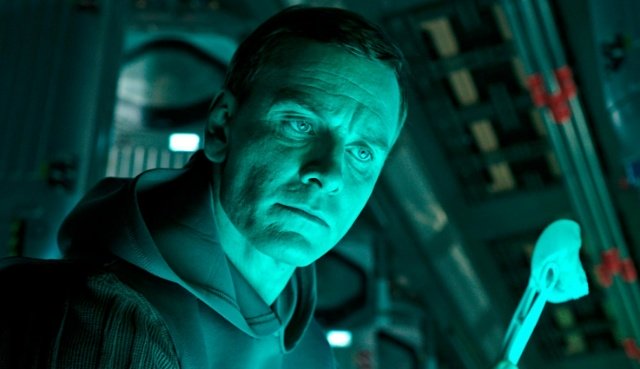
After the cod-theological leanings of Prometheus, the latest in the saga opts instead for cod-philosophical leanings, and spends time musing on notions of creation and acknowledging one’s place in the scheme of things. But the movie – scripted by John Logan and Dante Harper from a story by Jack Paglen and Michael Green – isn’t interested in exploring these notions in relation to the human contingent of the story, but instead in relation to two androids: David and Walter (both Fassbender) who represent opposite ends of their creationist cycle. David is the prototype, while Walter is the later model built to surpass the limitations of the original. Together they talk about their creator’s expectations for them, and then their own. But while on the surface these musings appear in keeping with the wider story of the xenomorph’s creation (whatever that may be), they don’t add as much depth to the material as may have been intended. Instead, they provide a basis and a reason for a third act “reveal” that exists purely to set up the next installment.

Before then, we’re introduced to the latest group of dinner dates for the murderous xenomorph. Only this time it’s either a neomorph (“infant” version) or a protomorph (“adult” version), but either way it still behaves like its forebear(?), has acid for blood, screeches like a banshee, and kills anyone in its path. This time around, the movie’s motley band of victims is the crew of the colony ship Covenant. A group of terraformers en route to an Earth-like planet called Origae-6, their cargo consists of two thousand colonists all in cryo-sleep, and a thousand embryos all in cold storage. While the crew also enjoys their cryo-sleep (they’re seven-and-a-half years away from reaching their destination), Walter carries out a variety of assigned tasks and monitors the ship and its personnel. A blast of unexpected solar energy damages the ship, and Walter wakes up the crew – all except for the captain, whose cryo-pod refuses to open. Thanks to the damage to the ship’s systems, the captain burns to death in his cryo-pod, which leaves Oram (Crudup) in charge.

A distress signal picked up from a planet that apparently doesn’t exist on any celestial maps reveals a human origin, and prompts Oram to redirect the Covenant to check it out. With the planet appearing to support human life, and being only a few weeks’ to get to, the reservations of chief terraformer Daniels (Waterston) are acknowledged but unheeded. Leaving chief pilot Tennessee (McBride) and two other crewmembers on board, Oram, along with Daniels, Walter, and the rest of the crew descends to the planet’s surface. There they find an anomaly in the form of wheat, a crashed spaceship, danger in the form of spores that infect two of the crew, and an unexpected rescuer when said spores precipitate the deaths of more than the infected. With a massive magnetic storm hindering their return to the Covenant, Oram and the remaining crew must find a way to survive the deadly intentions of the protomorph, and a more sinister danger lurking in their midst.

Those who found themselves dissatisfied with the direction taken in Prometheus will be pleased with this return to the series’ more basic roots, but even though it’s a step in the right direction, the problem with the movie overall is that it doesn’t offer anything new, and it doesn’t come close to replicating the tension and sense of dread that made Alien such an impressive outing. It tries to, and the script is clearly designed and constructed to provide gory set pieces at regular intervals in honour of the series’ abiding commitment to shocking audiences with jolts of body horror, but for anyone who’s seen all the previous movies in the franchise, this is a retread of scenes and set ups that were far more effective the first time round. Likewise the introduction of the various characters as regular joes, a device used to very good effect in Alien, but which here is truncated in favour of getting on with the action. Inevitably this means that when the crew starts to be whittled down, it doesn’t have the same effect as in the past, and Waterston’s plucky terraformer aside, it’s difficult to care about anyone as well.

In many ways, Alien: Covenant is a stripped down series’ entry that concentrates more on reliving old glories than advancing the franchise’s intended long-form narrative. Whatever happens in Alien: Awakening (2019?), it’s to be hoped that it reverts to telling the story begun in Prometheus and which should eventually connect with Alien. Here there are still more questions to be answered, and there’s a suspicion that the writers are already painting themselves into a corner, and that the decision to make a handful of prequels instead of just one all-encompassing prequel is beginning to look more than a little unsound. This has all the hallmarks of a movie made in response to the negative reaction afforded Prometheus, and if so, you have to wonder what this movie would have been like if the reaction had been positive. More of the same? Further exploration of the Engineers and their motivations? More pseudo-religious theorising? Less rampaging alien attacks and gory killings? It looks as if we’ll never know.

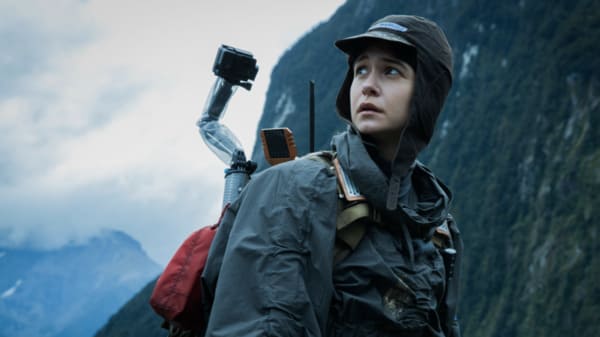
With the characters reduced mostly to alien-bait, only Fassbender and Waterston make any impact, though it is good to see McBride playing it completely straight for once. Fassbender is a mercurial actor but he always seems to have a stillness about him that seeps through in all his performances. Here as both David and Walter, that stillness is used to tremendous effect, and whether he’s waxing lyrical about art and music as David, or looking concerned as Walter, Fassbender provides two endlessly fascinating portrayals for the price of one. Waterston is equally impressive in a role that will inevitably draw comparisons with Sigourney Weaver as Ripley, but Waterston is canny enough not to make Daniels as strong-willed as Ripley, nor as valorous. Though she’s the movie’s nominal heroine, Daniels retains a vulnerability that Ripley didn’t have at all, and Waterston is a winning presence, her last act heroism borne out of desperation rather than determination.

Third time around, Ridley Scott ensures the movie looks as beautiful and darkly realised as his other entries, but somehow fails to make the movie as tense and compelling as Alien, or as intellectually portentous as Prometheus. He does ensure that the movie rattles along at a fair old lick, but with the script providing a series of “greatest hits” moments for him to revisit, Scott’s involvement doesn’t always appear to be as purposeful as in the past. There are too many moments where the movie’s energy seems to flag, and the tension dissipates as a result, leaving the viewer to wonder, if a director’s cut should be released in the future, will it be shorter than the theatrical version? And not even he can avoid making the movie’s coda look uninspired and predictable, all of which begs the question, should someone else sit in the director’s chair for the rest of the prequels?

Rating: 6/10 – a fitful, occasionally impressive second prequel/first sequel, Alien: Covenant revisits the haunted house horror tropes that made the first movie so successful, but finds little inspiration to help it fulfill its intentions; another missed opportunity to make the series as momentous as it was nearly forty years ago, where the story goes from here remains to be seen, but in continuing Scott et al really need to remember that a satisfying mystery requires a satisfying answer, something that this entry seems to have forgotten about entirely.

Share this:

  • Click to share on X (Opens in new window) X
  • Click to share on Facebook (Opens in new window) Facebook
  • More
  • Click to print (Opens in new window) Print
  • Click to email a link to a friend (Opens in new window) Email
Like Loading...

Monthly Roundup – April 2017

30 Sunday Apr 2017

Posted by dullwood68 in Movies

≈ Leave a comment

Tags

A Street Cat Named Bob, Aaron Eckhart, Action, Andy Mitton, Annette O'Toole, Anybody's Nightmare, Biography, Bob the Cat, Brad Peyton, Charles Barton, Chinook, Clark Freeman, Comedy, Crime, Crime Doctor, Dakota Johnson, Delayed Action, Documentary, Drama, Edward Dryhurst, Fifty Shades Darker, Gibb McLaughlin, Horror, Incarnate, Island of Doomed Men, James Foley, James Nunn, Jamie Dornan, Jason Bateman, Jesse Holland, John Harlow, Josh Gordon, Julie Suedo, June Thorburn, Kirby Dick, Kirby Grant, Literary adaptation, Luke Treadaway, Michael Gordon, Michael Powell, Mike Mizanin, Office Christmas Party, Patricia Routledge, Peter Lorre, Possession, Reviews, Robert Ayres, Roger Spottiswoode, Silent movie, The Claydon Treasure Mystery, The Marine 5: Battleground, The Night of the Party, The Woman from China, This Film Is Not Yet Rated, Tristram Powell, True story, Warner Baxter, We Go On, Will Speck, William Beaudine, WWE Films, Yukon Vengeance

Fifty Shades Darker (2017) / D: James Foley / 118m

Cast: Dakota Johnson, Jamie Dornan, Eric Johnson, Marcia Gay Harden, Eloise Mumford, Bella Heathcote, Rita Ora, Luke Grimes, Victor Rasuk, Max Martini, Kim Basinger

Rating: 4/10 – Christian Grey (Dornan) successfully woos back Anastasia Steele (Johnson), tries to go “straight” in the bedroom, and then narrowly avoids an attempt on his life – and that’s it for Round Two; flashy and trashy at the same time, Fifty Shades Darker continues the series’ commitment to providing two hours of inane, tedium-inducing material each time, and by never going as far as it might in the sexual activity department, making this yet another slickly produced teaser for the real thing.

A Street Cat Named Bob (2016) / D: Roger Spottiswoode / 103m

Cast: Luke Treadaway, Ruta Gedmintas, Joanne Froggatt, Anthony Head, Darren Evans, Beth Goddard, Ruth Sheen, Caroline Goodall, Bob the Cat

Rating: 7/10 – a recovering drug addict and talented busker, James Bowen (Treadaway), adopts a cat he calls Bob and in doing so finds a reason to stay off drugs and rebuild his life – with unexpected results; though A Street Cat Named Bob charts a particularly diffcult period in the life of the real James Bowen, the movie avoids being too depressing by emphasising the bond between Bob and his musician “owner”, and by resolutely aiming for feelgood, something at which it succeeds with a great deal of charm, and thanks to an endearing performance from Treadaway.

The Woman from China (1930) / D: Edward Dryhurst / 82m

Cast: Julie Suedo, Gibb McLaughlin, Frances Cuyler, Tony Wylde, Kiyoshi Takase
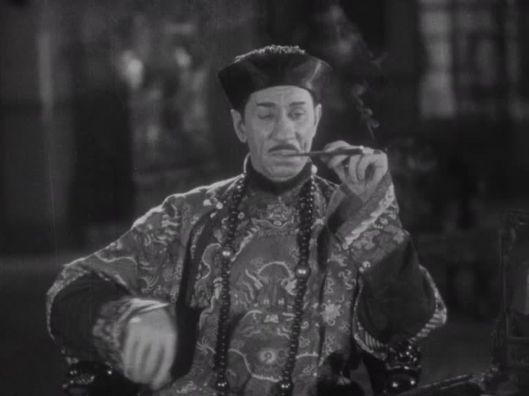
Rating: 7/10 – a Chinese criminal, Chung-Li (McLaughlin), kidnaps the girlfriend (Cuyler) of a ship’s lieutenant (Wylde) in order to satisfy his lust for her, but doesn’t reckon on one of his accomplices (Suedo) having feelings of her own for the same ship’s lieutenant; a late in the day silent movie, The Woman from China is a British production that has a Dickensian feel to it, narrowly avoids stereotyping its villain (very narrowly), and thanks to Dryhurst’s talent as a writer as well as a director, remains a well crafted thriller that is ripe for rediscovery.

We Go On (2016) / D: Jesse Holland, Andy Mitton / 85m

Cast: Annette O’Toole, Clark Freeman, Giovanna Zacarías, Jay Dunn, Laura Heisler, John Glover

Rating: 5/10 – Miles (Freeman) is terrified of dying and wants incontrovertible proof of life after death, so he offers a reward to anyone who can provide it, but the responses he gets aren’t exactly what he was expecting; a paranoid chiller that doesn’t quite have the focus it needs to be interesting throughout, We Go On nevertheless contains some really creepy moments, and a fiercely maternal performance from O’Toole that elevates the material whenever she’s on screen, but overall it falls short in too many areas, and particularly the way in which it’s been assembled, which leaves it feeling haphazard and hastily stitched together.

Yukon Vengeance (1954) / D: William Beaudine / 68m

Cast: Kirby Grant, Chinook, Monte Hale, Mary Ellen Kay, Henry Kulky, Carol Thurston, Parke McGregor, Fred Gabourie

Rating: 4/10 – when a lumber company’s wages keep being stolen while en route to the nearest town, Canadian Mountie Rod Webb (Grant) and his faithful sidekick Chinook are sent to investigate; a remake of Wilderness Mail (1935), Yukon Vengeance is also the last in a series of ten movies Grant and Chinook made together between 1949 and 1954, and is pleasant enough if you go in not expecting too much, but it’s hampered by poor performances from Hale and Kay, uninterested direction from Beaudine (usually much more reliable), and material that offers no surprises whatsoever (though that shouldn’t be a surprise either).

This Film Is Not Yet Rated (2006) / D: Kirby Dick / 98m

With: Kirby Dick, Kimberly Peirce, Matt Stone, John Waters, Kevin Smith, Maria Bello, Wayne Kramer, David Ansen, Mary Harron, Allison Anders

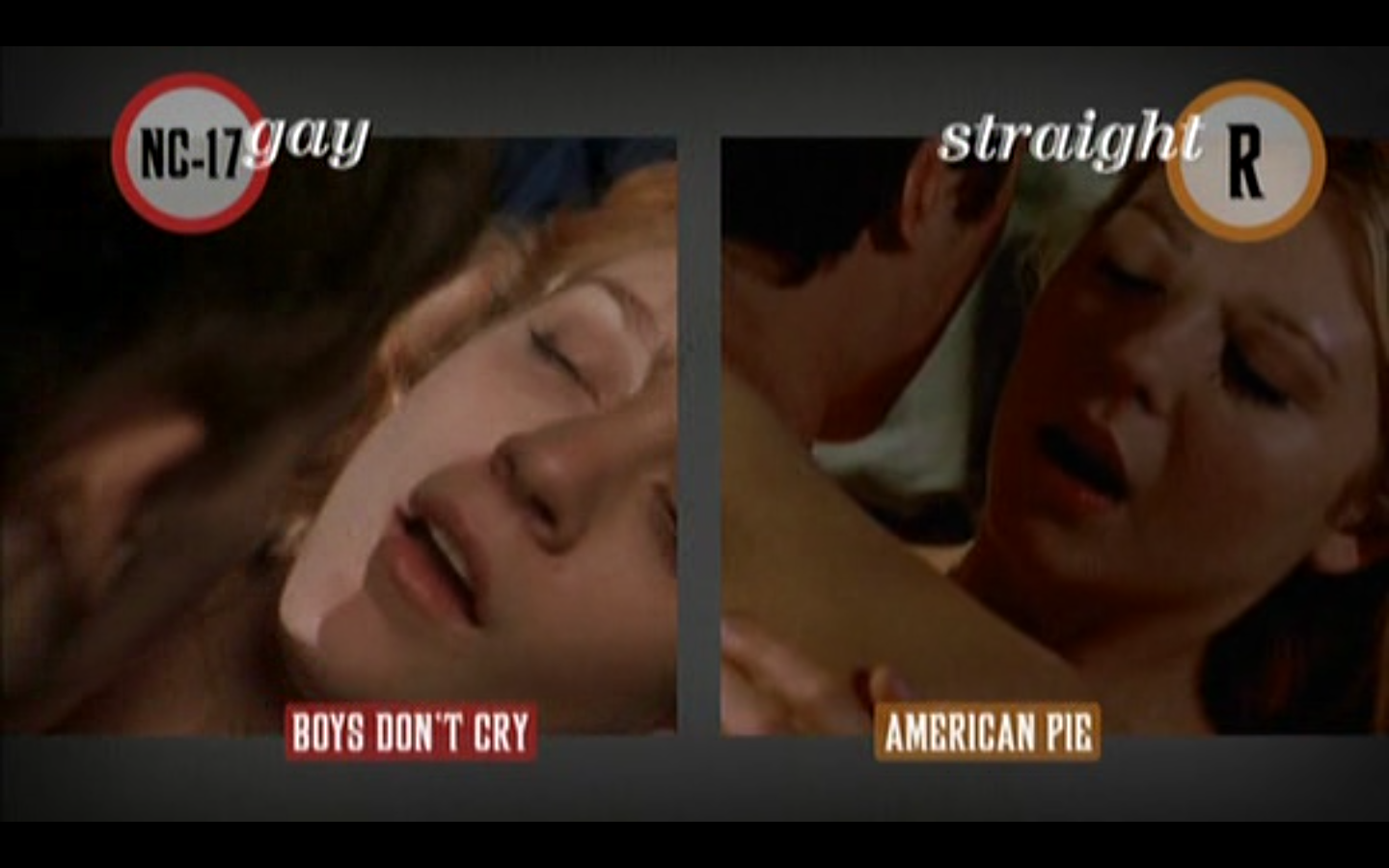
Rating: 6/10 – moviemaker Kirby Dick decides to try and find out just what goes on behind the secretive doors of the Motion Picture Association of America, and hires a private investigator to do so, while also eliciting the opinions of moviemakers who have had run-ins with the MPAA; Dick adopts a partisan approach to the material, but in the end, This Film Is Not Yet Rated doesn’t discover anything that viewers couldn’t have worked out for themselves without seeing it, and wastes a lot of time with Dick’s choice of private investigator as they sit outside the MPAA offices and take down car number plates for very little return (both investigative and cinematic).

The Claydon Treasure Mystery (1938) / D: H. Manning Haynes / 64m

Cast: John Stuart, Garry Marsh, Annie Esmond, Campbell Gullan, Evelyn Ankers, Aubrey Mallalieu, Finlay Currie, Joss Ambler, Richard Parry, Vernon Harris, John Laurie

Rating: 5/10 – following a disappearance and a murder, crime writer Peter Kerrigan (Stuart) becomes involved in a centuries old mystery at a country house, while attempting to work out just who is willing to kill to benefit from said mystery; what could have been a nimble little murder mystery is let down by Haynes’ solemn direction, and too much repetition in the script, but The Claydon Treasure Mystery does feature a handful of entertaining performances and a clever solution to the mystery.

Delayed Action (1954) / D: John Harlow / 58m

Cast: Robert Ayres, June Thorburn, Alan Wheatley, Bruce Seton, Michael Balfour

Rating: 5/10 – a suicidal man (Ayres) agrees to play the part of a businessman to meet the crooked demands of another (Wheatley), and forfeit his life at the end of the agreement, but doesn’t reckon on having a reason to live – a woman (Thorburn) – when the time comes; a sprightly little crime drama, Delayed Action never really convinces the viewer that Ayres’ character would agree so readily to the offer made to him, and Ayres himself is a less than convincing actor in the role, but the short running time helps, and Wheatley’s arrogant, preening master criminal is the movie’s trump card.

The Night of the Party (1935) / D: Michael Powell / 61m

aka The Murder Party

Cast: Malcolm Keen, Jane Baxter, Ian Hunter, Leslie Banks, Viola Keats, Ernest Thesiger, Jane Millican, W. Graham Brown, Muriel Aked
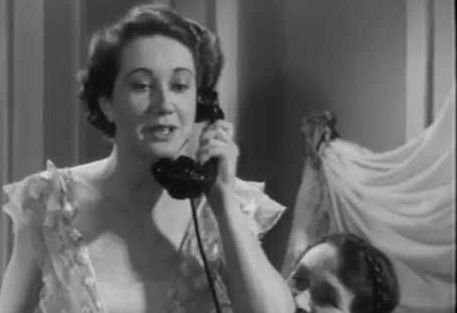
Rating: 5/10 – at a dinner party, hated newspaper proprietor Lord Studholme (Keen) is murdered, but which one of the many guests – all of whom had reason to kill him – actually did the deed, and why?; Powell was still finding his feet as a director when he made The Night of the Party, and though much of it looks like a filmed stage play (which it was), it’s exactly the movie’s staginess that robs it of a lot of energy, and stops it from becoming as involving and engaging as other movies of its ilk, and that’s despite some very enjoyable performances indeed.

Office Christmas Party (2016) / D: Josh Gordon, Will Speck / 105m

Cast: Jason Bateman, Olivia Munn, T.J. Miller, Jennifer Aniston, Kate McKinnon, Courtney B. Vance, Jillian Bell, Rob Corddry, Vanessa Bayer, Randall Park

Rating: 5/10 – with their office being threatened with closure, manager Clay (Miller) and several of his staff decide to throw a massive Xmas party in the hope that it will help secure a contract with businessman Walter Davis (Vance) and so save everyone’s jobs; only fitfully amusing, Office Christmas Party probably sounded great as an idea, but in practice it strays too far from the original concept, and has its cast going firmly through the motions in their efforts to raise a laugh, although McKinnon (once again) stands out as an HR manager who makes being uptight the funniest thing in the whole misguided mess of a movie.

The Marine 5: Battleground (2017) / D: James Nunn / 91m

Cast: Mike Mizanin, Anna Van Hooft, Nathan Mitchell, Bo Dallas, Curtis Axel, Heath Slater, Naomi, Sandy Robson

Rating: 4/10 – now a paramedic, Jake Carter (Mizanin) finds himself trapped in an underground car park and fending off a motorcycle gang who are trying to kill the injured man (Mitchell) who has just killed their leader; five movies in and WWE Films have used a low budget/low return formula to ensure that The Marine 5: Battleground remains a dreary, leaden-paced “action” movie that features a lot more WWE Superstars than usual, more glaring plot holes than you can shove the Big Show through, and proof if any were needed that playing hyper-realised athletes every week isn’t a good training ground for acting in the movies, no matter how hard WWE tries to make it seem otherwise.

Incarnate (2016) / D: Brad Peyton / 91m

Cast: Aaron Eckhart, Carice van Houten, Catalina Sandino Moreno, David Mazouz, Keir O’Donnell, Matt Nable, Emily Jackson, Tomas Arana

Rating: 4/10 – a scientist-cum-paranormal investigator (Eckhart) can induce himself into the minds of people possessed by demons and cast them out, but he comes up against a stronger adversary than any he’s encountered before: the demon that took the lives of his wife and son; a neat twist on a standard possession/exorcism movie, Incarnate suffers from the kind of muddled plotting, heavyhanded sermonising, and stereotypical characterisations that hamper all these variations on a horror movie theme, and in doing so, marks itself out as another nail in the coffin of Eckhart’s mainstream career, and a movie that lacks substance, style, wit, and credibility.

Crime Doctor (1943) / D: Michael Gordon / 66m

Cast: Warner Baxter, Margaret Lindsay, John Litel, Ray Collins, Harold Huber, Don Costello, Leon Ames, Dorothy Tree
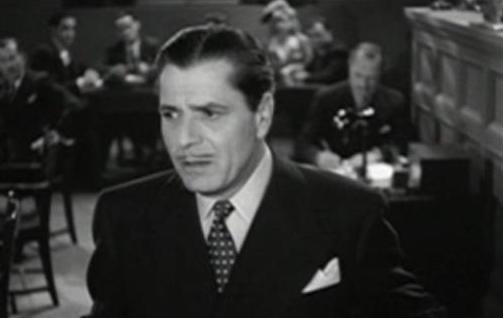
Rating: 7/10 – a man (Baxter) found unconscious at the side of the road wakes with no memory of his past, but over time builds a new life for himself as a leading criminal psychologist – until his own criminal past comes calling; the first in the Crime Doctor series is a solid, suspenseful movie bolstered by strong performances, a surprisingly detailed script, and good production values, making it an above average thriller and hugely enjoyable to watch.

Island of Doomed Men (1940) / D: Charles Barton / 68m

Cast: Peter Lorre, Rochelle Hudson, Robert Wilcox, Don Beddoe, George E. Stone, Kenneth MacDonald, Charles Middleton
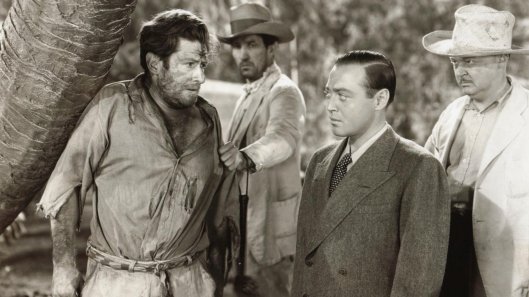
Rating: 6/10 – a Government agent (Wilcox) allows himself to be arrested and imprisoned in an effort to make it to an island owned by sadistic diamond mine owner Stephen Danel (Lorre), and then expose Danel’s use of ex-cons and parolees as slave labour; a seedy, florid atmosphere is encouraged and exploited by Barton as Island of Doomed Men allows Lorre to give one of his more self-contained yet intense performances, and which also shows that some Production Code-era movies could still be “exciting” for reasons that only modern day audiences would appreciate – probably.

Anybody’s Nightmare (2001) / D: Tristram Powell / 97m

Cast: Patricia Routledge, Georgina Sutcliffe, Thomas Arnold, Nicola Redmond, David Calder, Malcolm Sinclair, William Armstrong, Rashid Karapiet, Louisa Milwood-Haigh, Scott Baker
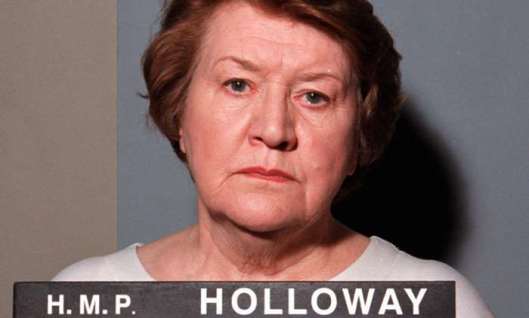
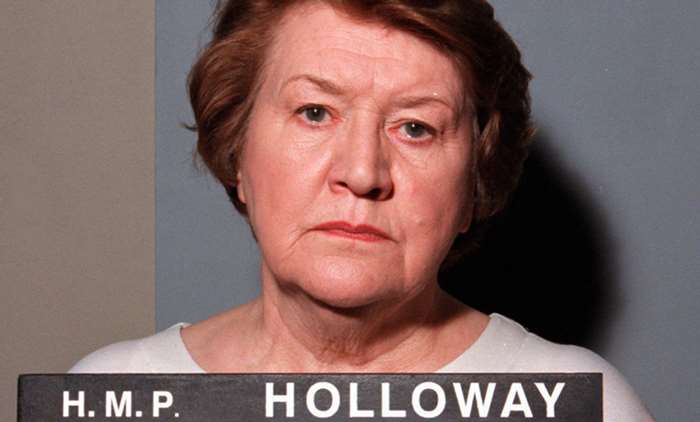
Rating: 5/10 – the true story of Sheila Bowler (Routledge) who in the early Nineties was arrested, tried and convicted of the death of her late husband’s aunt (despite a clear lack of evidence), and who spent the next four years fighting to have her conviction overturned; a miscarriage of justice story bolstered by Routledge’s dignified, sterling performance, Anybody’s Nightmare betrays its British TV movie origins too often for comfort, features some truly disastrous acting (step forward Thomas Arnold and Louisa Milwood-Haigh), but does make each twist and turn of Bowler’s legal case as shocking as possible, and in the end, proves once again that truth really is stranger than fiction.

Share this:

  • Click to share on X (Opens in new window) X
  • Click to share on Facebook (Opens in new window) Facebook
  • More
  • Click to print (Opens in new window) Print
  • Click to email a link to a friend (Opens in new window) Email
Like Loading...

The Belko Experiment (2016)

25 Tuesday Apr 2017

Posted by dullwood68 in Movies

≈ 1 Comment

Tags

Adria Arjona, Belko Industries, Bogota, Drama, Greg McLean, Horror, John C. McGinley, John Gallagher Jr, Murder, Review, Thriller, Tony Goldwyn, Tracers

D: Greg McLean / 89m

Cast: John Gallagher Jr, Tony Goldwyn, Adria Arjona, John C. McGinley, Melonie Diaz, Owain Yeaman, Sean Gunn, Brent Sexton, Josh Brener, David Dastmalchian, David Del Rio, Rusty Schwimmer, Gail Bean, James Earl, Abraham Benrubi, Gregg Henry, Michael Rooker

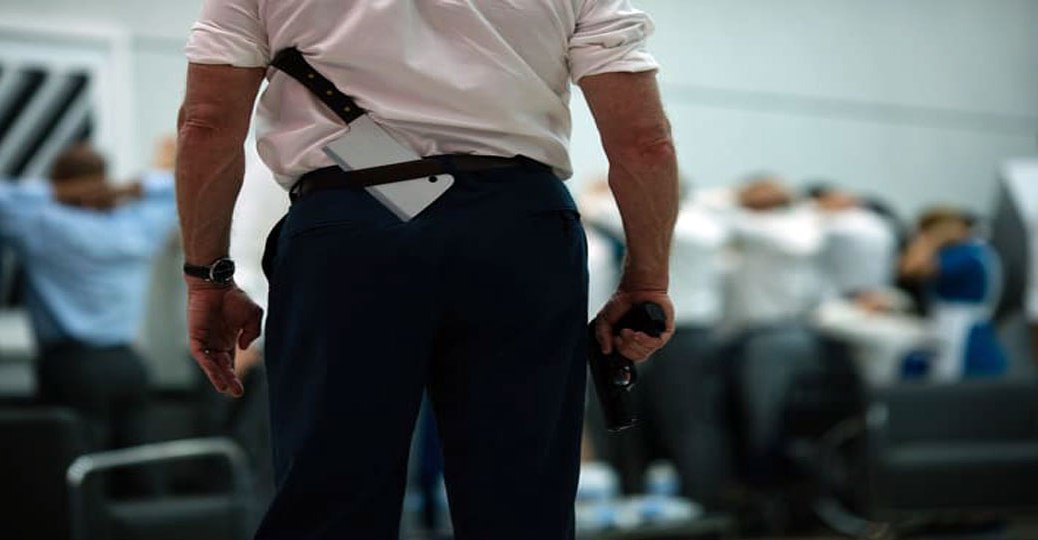
On the outskirts of Bogotá, Colombia, Belko Industries has an office building where its mostly American, relocated staff, help other American companies set up in South America. The office building has been open for a year, and the eighty American staff that work there have what are called “trackers” implanted in the back of their heads in case of kidnappings. If any member of staff is kidnapped, these “trackers” will make them easy to find and rescue. One day, Mike Milch (Gallagher Jr), a Belko employee, arrives to find the local Colombians who work there are being sent home, and this is being overseen by a group of security guards Milch has never seen before. Inside the building, Evan (Earl), the building security guard, admits he doesn’t know what’s going on, and neither does anyone else, not even the COO, Barry Norris (Goldwyn).

While the staff talk over this strange development, new starter Dany Wilkins (Diaz) begins her first day, while Norris’s assistant, Leandra Jerez (Arjona), bemoans the unwanted attention of colleague Wendell Dukes (McGinley). Unwanted because he won’t take no for an answer, and also because she’s in a relationship with Milch. As the rest of the morning gets under way, a tannoy announcement heard throughout the building informs everyone that unless two people are killed in the next thirty minutes then more people will die as a consequence. No one takes the announcement too seriously, even when shutters come down that seal everyone inside the building (though the roof remains accessible). When no one is killed, four people die when the “trackers” in their heads explode.

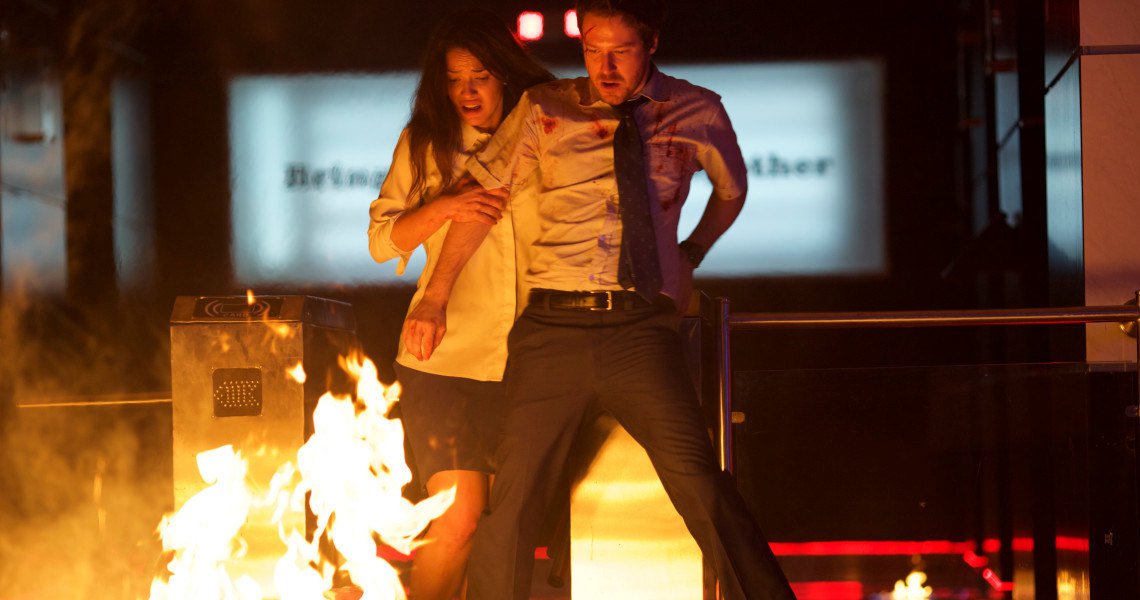
Realising the danger from the “trackers”, Milch tries to remove his but the voice from the tannoy announcement starts a countdown to its being detonated. Milch stops, and the next time the voice gives instructions they’re even more chilling than the last: unless thirty people are killed in the next two hours, sixty people will be killed just as randomly as the previous four. From this, two distinct factions form amongst the employees: those who, like Milch, think no one should be killed (and an alternative solution found to their predicament), and those who, like Norris, think that thirty deaths is better than sixty. What follows pits employee against employee, and engenders a complete breakdown of morality and compassion.

Working from an old script by James Gunn, The Belko Experiment – to paraphrase the title of a Werner Herzog movie – could almost be called James Gunn, James Gunn, What Have Ye Done. While the basic premise is sound, here the “execution” is less than satisfactory, as the finished product lacks clarity, subtlety, and is only consistent in its lack of clarity and subtlety. If Gunn was attempting to write a straightforward schlock horror movie combining equally straightforward ideas regarding the erosion of social and moral restraints in a highly charged atmosphere, then in one sense that’s what he’s done. But if that is the case, and though much of that approach to the material is still in place, director Greg McLean’s interpretation still leaves a lot to be desired.

Following on from the dreadful outing that was The Darkness (2016), McLean makes only partial amends with this, focusing his efforts too quickly on getting to the kind of indiscriminate carnage that is the movie’s raison d’etre. Forget social commentary, forget a knowing critique of office politics, this is all about seeing how fast a group of (apparently) average people can descend into homicidal rage and leave rational thinking behind. On that basis alone the movie is more successful (the answer is quicker than you can say “exploding head”). But once all the niceties are done and dusted, and we get to know who’s going to be a hawk and who’s going to be a dove, then it’s on with the murky motivations and desperate attempts at credibility.

It’s always problematical when you have characters such as Milch proclaiming that no one should be killed, and then, by the movie’s end he’s on a par with psycho colleagues Norris and Dukes in terms of how many people he’s despatched. It’s not addressed because it doesn’t suit the needs of the movie, and yet if it had, it would have gone some way towards giving the movie some much needed depth. As it is, Milch takes to murdering his colleagues with as much gusto as he can manage, and any blurring of the lines that was intended on the part of the script is forsaken in favour of more killing. But with the body count rising, the movie feels rushed and even more implausible, and the problem of killing off the remaining seventy-six employees becomes more important than any moral considerations.

It could be argued that to expect any depth in a movie that’s only concerned with coming up with as many inventive deaths as it can in ninety minutes (death by tape dispenser anyone?), is something of a fool’s errand, but The Belko Experiment also lacks style and wastes its talented cast. Saddled with woefully underwritten characters who practically scream “stock!” every time they speak, the likes of Gallagher Jr, Goldwyn and Arjona get to mouth platitudes and banalities at every turn. Spare a thought for McGinley though; his character is so relentlessly one dimensional it’s amazing he doesn’t disappear when he turns to the side. There’s no one to care about – surprise, surprise – and as the movie progresses, the average viewer might feel justified in wanting to get inside the building and culling the employees themselves.

With its stock characters, muddled narrative, and laboured editing courtesy of Julia Wong, The Belko Experiment is unlikely to impress anyone but the most ardent gore fan. They’ll enjoy the numerous exploding heads, and one particularly impressive skull injury, but there’s really little else to recommend a movie that poses lots of questions at the beginning of the experiment, and then forgoes providing any answers. With a coda that attempts an explanation for what’s happened that’s as baffling as it is shallow, as well as shamelessly trying to set up a further movie, the movie should best be viewed as an old-style exploitation flick given a modern polish. However, that would be doing a disservice to old-style exploitation flicks.

Rating: 4/10 – insipid and unconvincing, The Belko Experiment is yet another nail in the coffin of Greg McLean’s directing career; it also acts as further proof that when successful writer/directors have old scripts to hand, they shouldn’t always be made into movies.

Share this:

  • Click to share on X (Opens in new window) X
  • Click to share on Facebook (Opens in new window) Facebook
  • More
  • Click to print (Opens in new window) Print
  • Click to email a link to a friend (Opens in new window) Email
Like Loading...

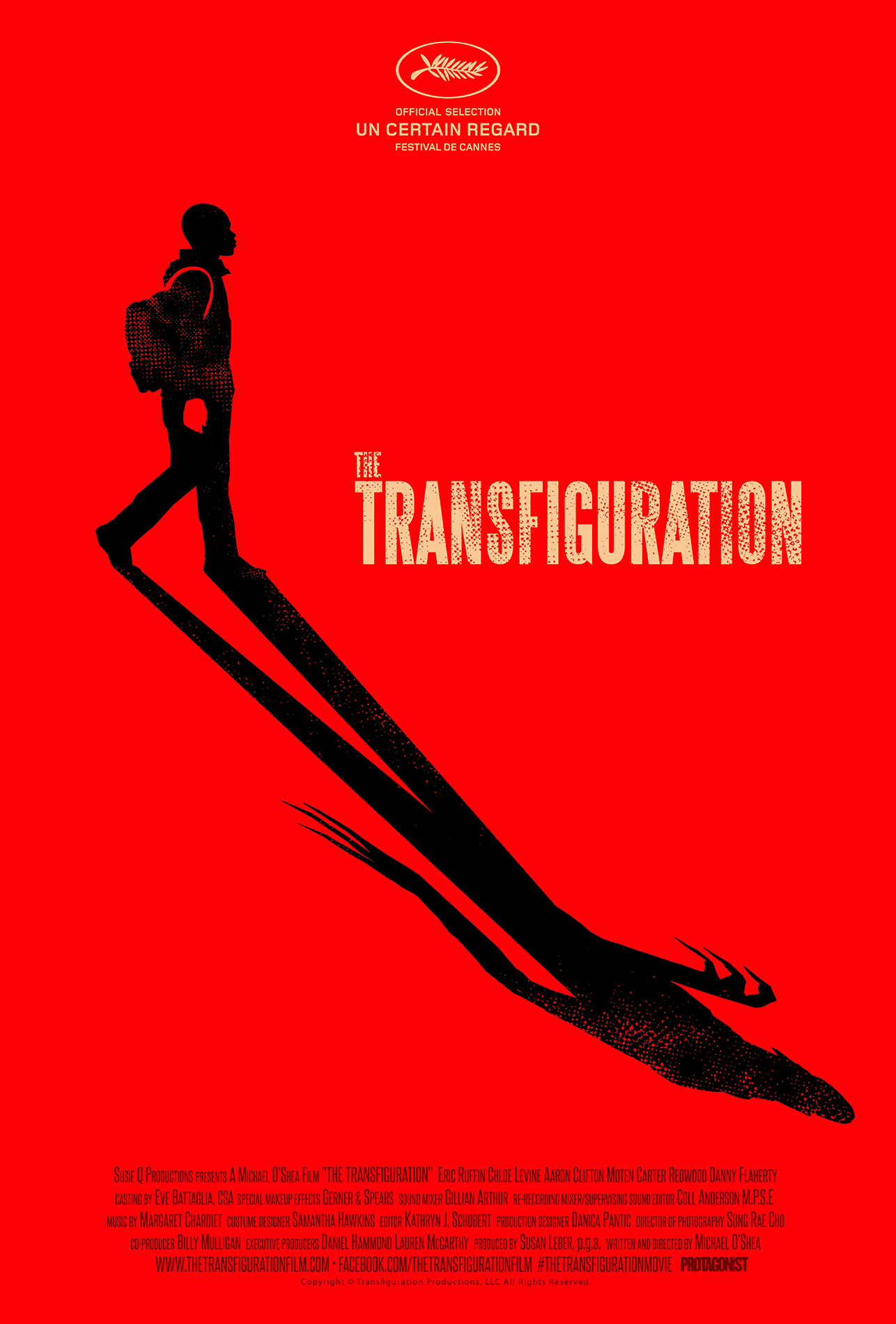
The Transfiguration (2016)

22 Saturday Apr 2017

Posted by dullwood68 in Movies

≈ Leave a comment

Tags

Chloe Levine, Debut, Drama, Eric Ruffin, Horror, Michael O'Shea, Milo, Review, Vampires

D: Michael O’Shea / 97m

Cast: Eric Ruffin, Chloe Levine, Aaron Moten, Carter Redwood

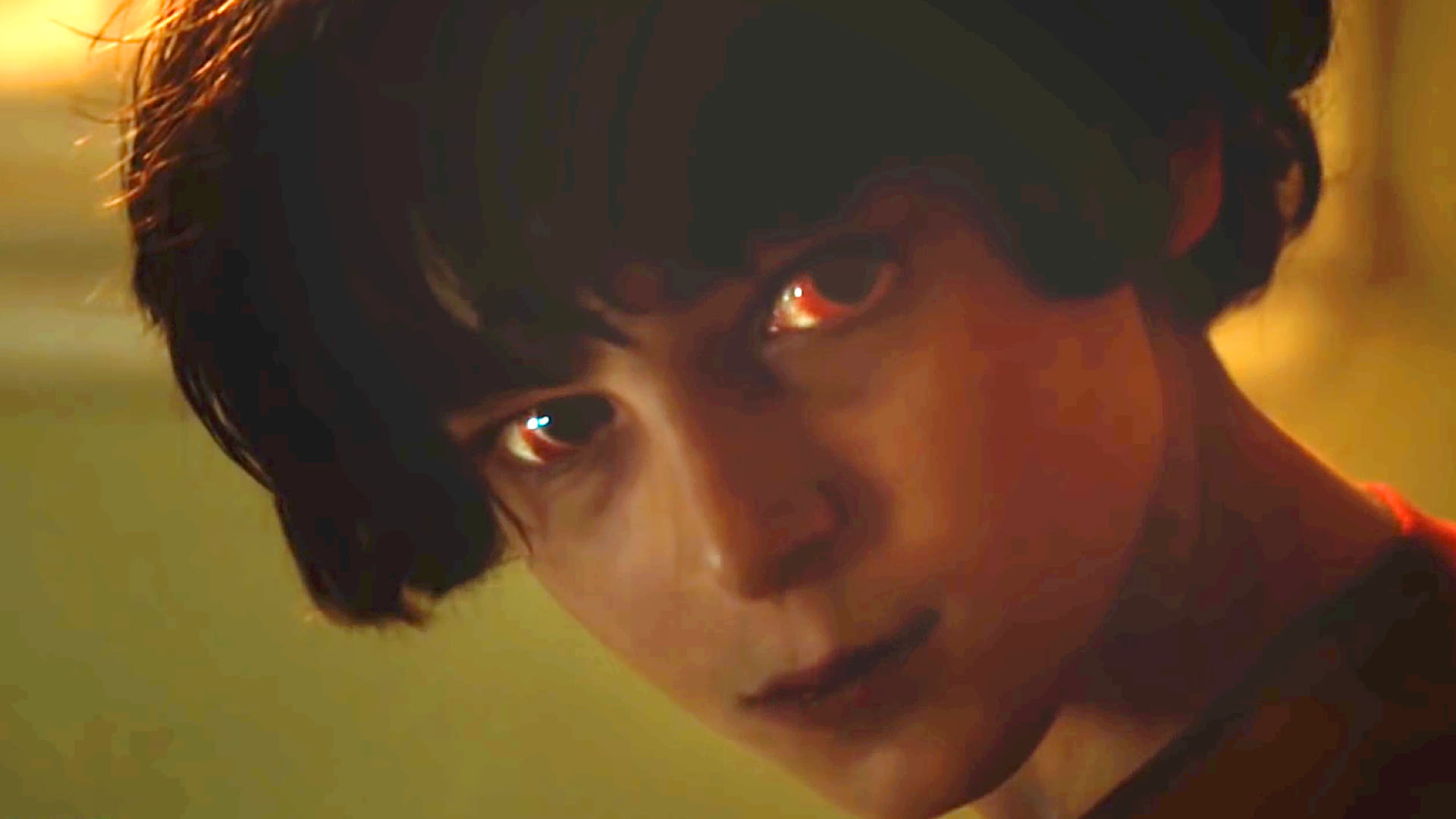
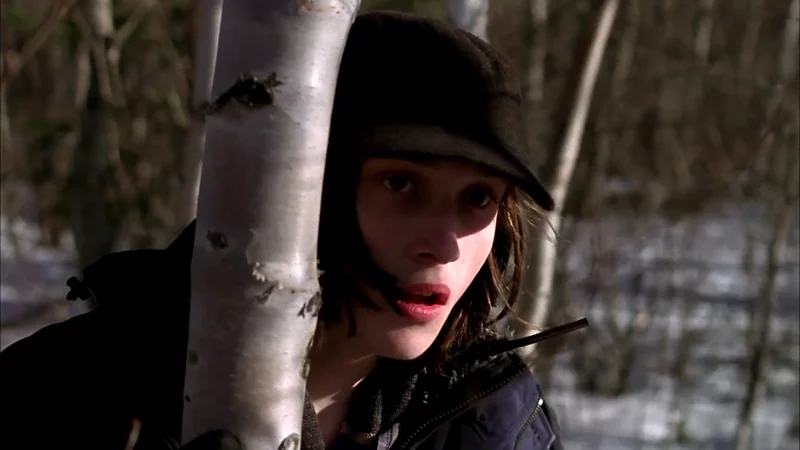
Milo (Ruffin) is a fourteen year old who lives with his older brother, Lewis (Moten), in the apartment they shared with their mother before she died. Milo is a loner, with no friends, no other family, and he’s regularly bullied by some of the children at his school. He is fascinated by vampires, and spends a lot of his spare time watching vampire movies. When we first meet him, Milo is in a bathroom stall drinking the blood of a man he’s just killed.

Milo’s vampiric behaviour is dictated by a monthly schedule that he’s worked out, and he chooses his victims at random. He uses a blade disguised as a pen to stab them in the neck, and it’s from the wound that he drinks their blood. But he’s not always able to keep the blood down, and he has none of the traditional signs that identify a vampire: he can go out during daylight, he doesn’t have fangs, and he still casts a reflection. But in the past he has mistreated and killed small animals, something his school counsellor is aware of. However, Milo reassures her that he doesn’t do that anymore, though unsurprisingly, he stops short at telling her why.
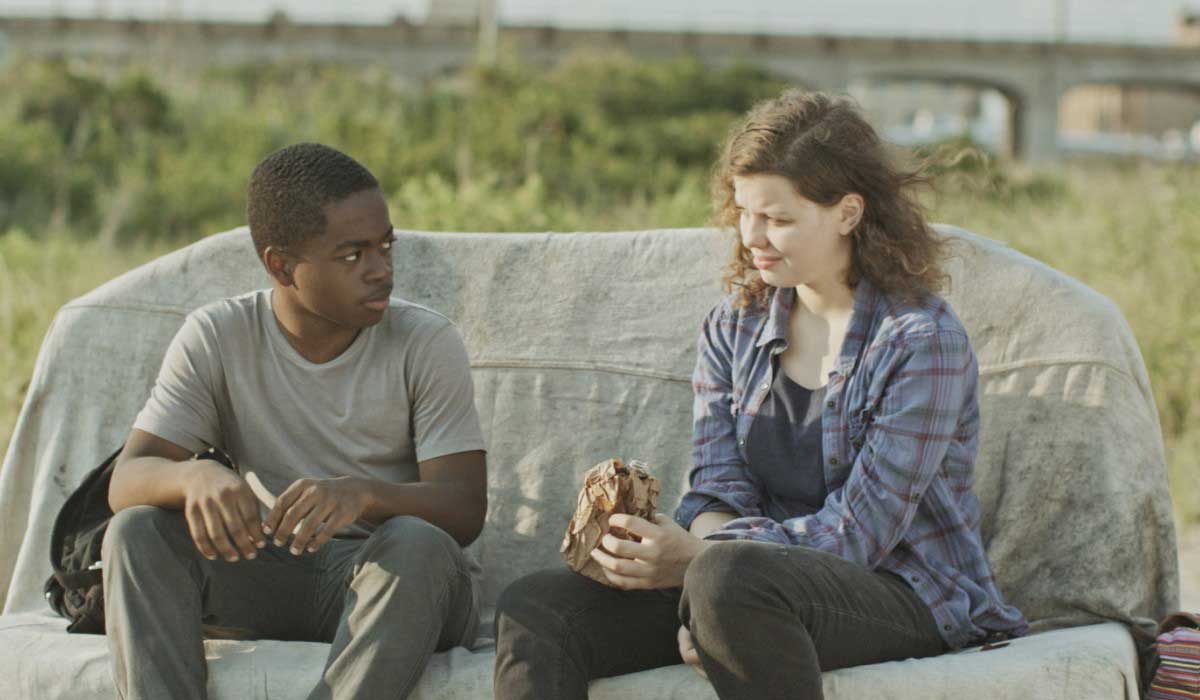
When a girl around his age, Sophie (Levine), moves into Milo’s building, they begin a tentative friendship. In her own way, Sophie is as much a loner as Milo. She has self-esteem issues, is bullied by her grandfather, and like Milo, both her parents are dead (she lives with her grandfather). They watch Milo’s collection of vampire movies together, and spend time getting to know each other. Meanwhile, Milo continues his killing pattern. Away from the apartment and school, Milo falls foul of a local gang led by Andre (Redwood). When he’s stopped in the street by a couple out to score some cocaine, he lures the man into a basement. The man ends up being killed by one of Andre’s gang, and Milo is taken in for questioning by police as a potential witness. He says nothing though, and is released, but in such a way that it makes it look as if he has snitched. Andre promises him that “it’s not over” between them, but Milo’s carefully constructed world is shaken properly when Sophie discovers notebooks Milo has written, notebooks that set out how to hunt people, and the best ways of killing them for their blood…

There’s much to admire in writer/director Michael O’Shea’s debut feature (expanded from his 2014 short, Milo). It’s a strong amalgamation of an indie teen drama and a low-key horror movie, and the melding of those two genres has created a deceptively powerful feature that moves slowly (and yet deliberately), and which brings an uneasy tone to the material. You could argue that the narrative concerns a teenage boy who wants to be a vampire, or conversely, that it concerns a teenage boy who wants to be normal. That’s what makes the movie tick: Milo wants to be a vampire, but once he meets Sophie, he wants to be a normal teenage boy as well. It’s this duality that drives the character of Milo and makes his situation so desperately sad. He has persuaded himself that he is a vampire – of sorts – but equally, he wants to have friends and be a normal child as well. But can he? Is it too late?

In keeping with its downbeat tone, The Transfiguration offers no easy answers, keeping the audience guessing if Milo is a real vampire or not right until the end (though for some viewers the answer will be a little more cut and dried). When it moves and sounds like a horror movie, O’Shea shows great promise, and there are moments where Milo’s behaviour, allied to Ruffin’s ability to provide a thousand-yard stare when needed, creates a chilling, morbid antipathy that suits the material and makes it unexpectedly expressive in terms of examining the inner life of a fourteen year old sociopath. Milo is quite detached from the world around him, only connecting with it if it can add to his obsession with vampires. We see the moment where he changes from being merely interested in vampirism to adopting the mantle of a bloodsucker. It’s a disturbing scene, made all the more disturbing for the way in which O’Shea portrays it as both a sacrificial offering and a rite of passage.

Having Sophie come into Milo’s life allows for some hope to form that Milo can be “saved”, that it’s not too late for him to be a part of the “real” world. As their friendship develops, O’Shea has Milo yearn for a simpler life (albeit one still spent watching vampire movies), and he begins to make an effort in that direction. But his craving for blood, and the secret life he leads proves too much. When he realises he’s missed that month’s date for hunting, Milo takes a bigger risk than he’s ever done before, and his actions show just how overwhelming his obsession has become. Just like the psychopath who needs to kill more and more victims to feel a continued sense of purpose, so Milo learns that he can’t escape the life he’s taken on. And so he does the one thing he can to save himself, and to save Sophie.

Like many first-time directors though, O’Shea is guilty of letting some scenes go on beyond their natural length, and including others that remain superfluous no matter how much they might feel integral to the script. There are also certain stretches where it seems as if the material is waiting for the right moment to move forward, and is hanging around on purpose until it arrives. As a result of this, the movie’s pace is often uncomfortably slow. Fortunately, O’Shea is on firmer ground when it comes to the relationship between Milo and Sophie, and he’s blessed by two impressive performances from Ruffin and Levine. Ruffin’s serious, sincere approach makes Milo all the more believable – and sympathetic – and in his scenes with Levine he displays a maturity that makes his performance all the more credible. Likewise, Levine imbues Sophie with a kind of damaged, yet reluctant vulnerability, as if her being aware of her situation isn’t about to define her if she can help it. In their scenes together, Ruffin and Levine share a chemistry that is completely convincing in terms of their characters finding common ground and coming to depend on each other.

As an ambitious melding of two distinct genres, The Transfiguration is a welcome change from the usual, run-of-the-mill offerings seen these days, and though it’s not entirely successful, its faults can be readily forgiven. O’Shea has made a movie that tells its story with a great deal of attention to detail, and in a robust, satisfying manner. More of a considered indie/arthouse horror than an out-and-out scarefest (and all the better for being so), O’Shea’s debut feature explores themes of alienation, morbid obsession, and emotional dysfunction, and in places, is genuinely unsettling. A surprise hit at Cannes in 2016, this will still only appeal to a certain audience, but if you have the time and the patience, it’s well worth seeking out.

Rating: 8/10 – a carefully constructed urban horror movie, The Transfiguration won’t be to everyone’s taste, but it is a tremendous addition to the small group of vampire movies that actually have something to say about the subject; boasting a superb performance from Ruffin, and a denouement that is both sad and uplifting, this is intelligent, vivid stuff that marks O’Shea as a moviemaker to watch out for in the future.

Share this:

  • Click to share on X (Opens in new window) X
  • Click to share on Facebook (Opens in new window) Facebook
  • More
  • Click to print (Opens in new window) Print
  • Click to email a link to a friend (Opens in new window) Email
Like Loading...

Hey Everyone, It’s Mike Mendez! – The Last Heist (2016) and Don’t Kill It (2016)

10 Monday Apr 2017

Posted by dullwood68 in Movies

≈ Leave a comment

Tags

Action, Bank robbery, Comedy, Demon Hunter, Dolph Lundgren, Drama, Henry Rollins, Horror, Kristina Klebe, Mike Mendez, Review, Thriller, Torrance Coombs, Windows Killer

2013 saw the relatively unheralded release of a low-budget creature feature called Big Ass Spider! It was silly but it was also huge fun, and it was obvious that the makers had a fondness for the material that kept things from being too silly, or derivative of other similar movies. Then in 2015, SyFy brought us the latest in their ongoing series of movies designed to make audiences want to pluck out their own eyes, or take psychotropic drugs, in an effort to forget what they’ve just seen. That movie was Lavalantula, a Sharknado-style offering that accentuated the comedy while still providing a fair few thrills along the way.

Both these movies were directed and edited by Mike Mendez, and if you’ve followed his career since his debut at Sundance, Killers (1996), then you’ll already know that even if he’s got the most risible of material to work with, somehow he still manages to elevate it beyond its limited expectations. He’s a director who’s able to take the most unlikeliest of projects and put a massive spin on them. This doesn’t make them into out-and-out classics, but it does make these movies far more bearable to watch than they have any right to be. So if you like low-budget features that are low on concept and even lower on potential, but are still enjoyable for a reason you can’t quite put your finger on, chances are it’s a Mike Mendez movie you’re watching.

The Last Heist (2016) / D: Mike Mendez / 84m

Cast: Henry Rollins, Torrance Coombs, Victoria Pratt, Michael Aaron Milligan, Mark Kelly, Kristina Klebe, John J. York, Mykel Shannon Jenkins, Camilla Jackson, Nick Principe, Ken Lyle, Courtney Compton, Fay DeWitt, John O’Brien

What are the odds? You’re the leader of a group of heavily-armed bank robbers intent on stealing something very valuable from the vault of a decommissioned bank, and you discover that one of the civilians in the building – and the very one who isn’t a hostage – is a serial killer who is equally intent on killing everyone and taking their eyes as trophies. How does something like that happen? Why does it happen? Because this is the main idea behind The Last Heist, a movie that mixes horror, crime and action all together in a hodgepodge of a script that seriously doesn’t know how to actually mix them all together in the first place. Give thanks to writer Guy Stevenson for managing to be so diligent in messing things up from the start.

But then give thanks to Mike Mendez for taking Stevenson’s messy script and injecting it with some much needed energy and directorial awareness. What he does that is so remarkable, is that he doesn’t try to fix the things that can’t be fixed. Take for example, the bank’s location. To get to it, you have to enter a security code that opens a gate, then walk through what looks like a loading area into a small square where the bank itself is located. But this doesn’t look like a bank; instead it looks like an old rundown supermarket that’s recently closed. There’s a sign above the door that is never clearly seen – probably because it doesn’t have the word bank in it. And inside the bank it’s no better. It looks equally rundown, and there are corridors in back and floors above that seem to go on for ever. Seriously, the vault feels like it’s miles away. But Mendez isn’t interested in trying to make things look correct. He’s got his sets and he uses them to his best advantage, but he’s not focused on them. He’s got other things to worry about.

Mainly, that’s the cast. Mendez wisely concentrates on the performances, and in particular on often small moments within the action that offer a surprising amount of depth, depth that was unlikely to have been in Stevenson’s script originally. Rollins, naturally, is the serial killer, who does what he does because God has told him to. When he claims his first victim inside the bank, the unfortunate Tracey (Klebe), he does so with a calmness of manner that is eerily unnerving. As she bleeds out, he recites a monologue about the darkness within everyone, and his gentle tone and sympathetic ministrations are at odds with the grisly nature of his trophy collecting. Both actors are good here, and the scene is unexpectedly moving as Tracey fights against dying until she doesn’t have any strength left to do so. There are other moments like these dotted throughout the movie, as Mendez lets the characters reveal different sides of themselves, and though not everyone benefits from this kind of attention, there’s enough introspection between the action beats to offer a different perspective on things.

That said though, Mendez is lumbered with a number of clumsy plot developments that either muddy the waters or seem out of place, especially one very late reveal that feels like it was tacked on during shooting. Elsewhere, and once the body count inside the bank mounts up, Rollins is allowed to do his thing with impunity, while outside, first cop on the scene, Detective Pascal (Pratt), has to contend with a couple of comedy cops who want to go in guns blazing, and who act like they’re both six year olds who should be on Ritalin. Mendez is very good at strengthening the humour in his movies, and there are examples of very dark comedy scattered about in The Last Heist, but on this occasion the cops’ juvenile behaviour is another problem he chooses to ignore. It’s frustrating when things like that happen, but overall the rest of the movie, despite its failings, still feels like it’s a better movie than it is, and Mendez makes it so through sheer determination and no small amount of directorial wizardry.

Rating: 4/10 – a movie where individual scenes often carry more weight than the movie as a whole, the script for The Last Heist takes huge liberties with logic and credibility (as this kind of movie often does), but is saved by having Mendez in the director’s chair; with better-than-average performances, and a sure-footed sense of its own failings, Mendez elevates the material through his commitment to the project and a never-say-awful approach that helps immensely.


Don’t Kill It (2016) / D: Mike Mendez / 84m

Cast: Dolph Lundgren, Kristina Klebe, Tony Bentley, James Chalke, Miles Doleac

If you go down to the woods today… you’ll be possessed by a demon who leap frogs from person to person every time his host body is killed. This is what happens to a hapless hunter and his dog, and soon the small town of Chicory Creek (yes, really) is overrun by murders of whole families. But, wait. Help is at hand in the form of Jebediah Woodley (yes, really) (Lundgren), a demon hunter who knows exactly what the town is up against and who offers his services to the town sheriff (Bentley) and hometown girl-turned-FBI agent, Evelyn Pierce (Klebe). Of course, he’s taken for an interfering nutcase and promptly locked up, but when the sheriff and Evelyn see for themselves what the demon can do, their disbelief evaporates in seconds and they’re soon asking what can be done. Jebediah’s answer? Capture the demon while it’s in a human host, have someone willing to take fast-acting poison, and then get that person to kill the demon’s host body. The demon goes into the person who’s on the brink of dying, and its spirit is released, making it easy to capture and imprison.
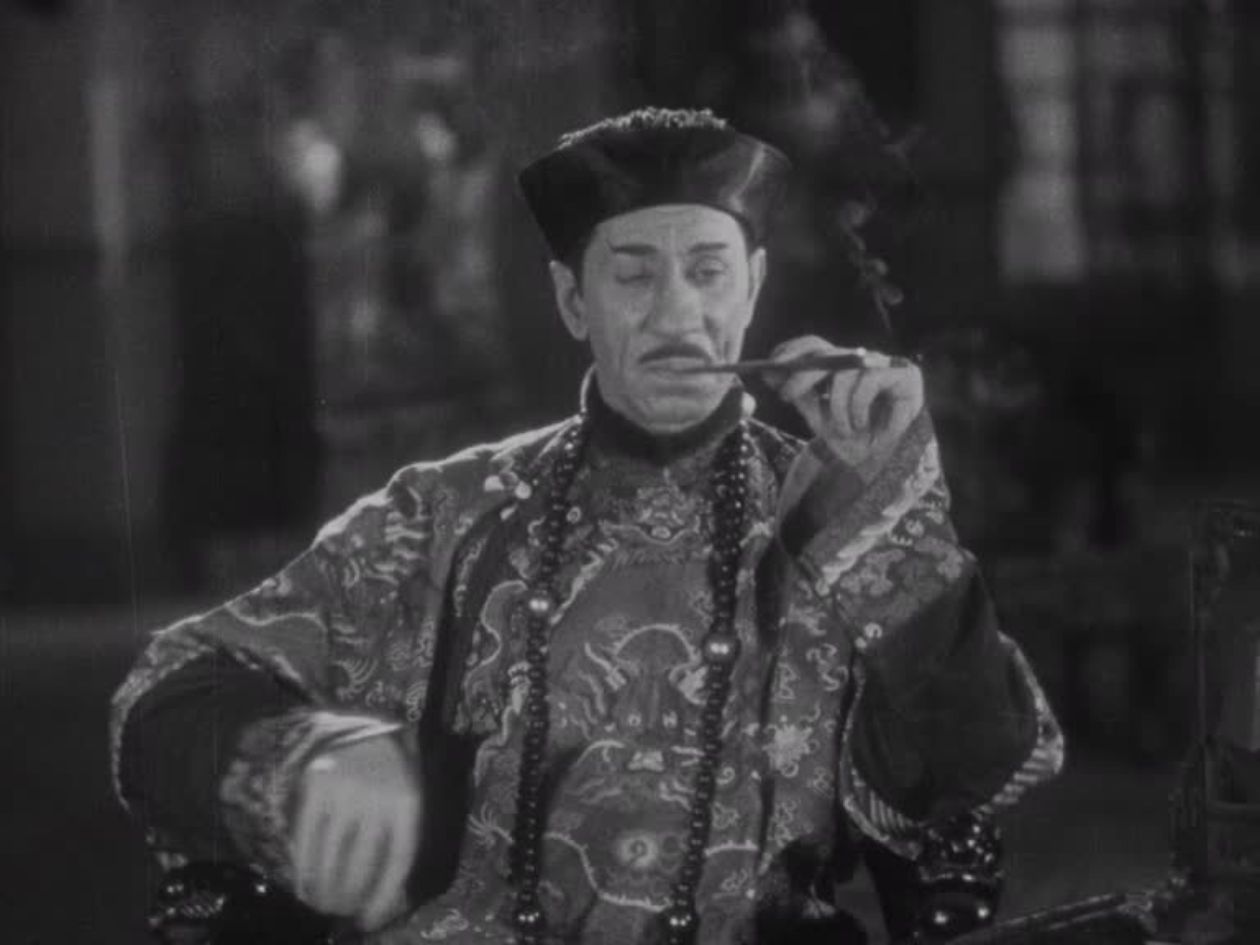
Simple, huh? Well, in a year where we were advised not to breathe, think twice or look twice, or even hang up, not killing a murderous, psychopathic demon seems like a less than reasonable request, and naturally it proves more difficult than even Jebediah expects. Hampered by his own experiences, Jebediah is the kind of certain-minded hero who rarely gets it right until Lady Luck smiles on him and a solution to the problem of the demon is arrived at. Until that happens, the script has him carry around a large, heavy-looking net gun in the hopes of capturing the demon, while he gets to know Agent Pierce. The script here is slightly more polished than the one for The Last Heist – it doesn’t try to be more than what it is, for starters – but it still has no time for logic or credibility (it’s a middling supernatural version of The Hidden (1987), for Dolph’s sake), and it sprints from scene to scene with all the unsightly haste of a starving man at an all-you-can-eat buffet.

Here, Mendez concentrates on the murders and making them as horrific as he can; and on the humour. Shotgun blasts and meat cleaver blows are shown with both clinical detachment and a surreal complicity made on the viewer’s behalf that leaves a nasty taste in the mouth. Mendez doesn’t shy away from showing the horror of these moments, and though the movie sheds “real” victims as it goes, those early scenes carry a surprising amount of intensity. He’s also able to draw out the comic absurdity of the situation, such as when the town pastor (Chalke) is exhorting Jebediah to leave his church. The pastor flings holy water at Jebediah from a small vial, but the amount that keeps coming out is way too much for the vial to hold. And when the pastor abjures Jebediah with the words, “The power of Christ compels you!”, our trusty hero replies, “I’m pretty sure that’s from The Exorcist“.

There are other moments where the humour rescues the drama, and stops the movie from being laudable merely for the impressive splatter effects, courtesy of special effects wizard Robert Kurtzman and his team. This time around, Mendez doesn’t concentrate as much on the performances, but instead he focuses on the pace and the rhythm of the movie, and in keeping the tone just this side of entirely ridiculous (even though it is). The result is a standard-narrative horror movie that belies its low-budget origins and bland location work to provide a more diverting and enjoyable Dolph Lundgren movie than most of us are used to. Lundgren himself is wryly amusing, and Klebe makes for a good foil for the aging action hero, but full marks must go to Tony Bentley, as the sheriff who leaves a major crime scene because he’s too scared and is never seen again. That’s a scene that shows Mendez’s skills as a director, and which is only marred by Klebe’s dialogue, which makes her sound desperate instead of authoritative. Again, Mendez overcomes several hurdles in his quest to make a better movie out of Don’t Kill It than it deserves, and he does so with style. He may not have the biggest budgets, or the casts he deserves, but Mendez is still able to overcome those problems thanks to his usual commitment and enthusiasm.

Rating: 4/10 – once again, Mendez’s involvement in a movie project means that it doesn’t turn out to be as bad as it could have done, and Don’t Kill It works far better than it has any right to; on the whole, still a bad movie, but flecked throughout with Mendez’s trademark attention to detail in one or two areas (and always to the movie’s benefit), and the occasional nod and a wink that says, “We know it’s bad, but hey, it could have been so much worse.”

Share this:

  • Click to share on X (Opens in new window) X
  • Click to share on Facebook (Opens in new window) Facebook
  • More
  • Click to print (Opens in new window) Print
  • Click to email a link to a friend (Opens in new window) Email
Like Loading...

Monthly Roundup – March 2017

01 Saturday Apr 2017

Posted by dullwood68 in Movies

≈ 1 Comment

Tags

Action, Adventure, Alistair Sim, Anthony Hopkins, Ben Kingsley, Bette Davis, Brie Larson, Charlie Day, Collide, Comedy, Crime, Documentary, Dougray Scott, Drama, Eran Creevy, Eugenio Ercolani, Felicity Jones, Fist Fight, Gordon Harker, Guiliano Emanuele, Horror, I.T., Ice Cube, Inspector Hornleigh Goes to It, Inspector Hornleigh on Holiday, James Cagney, James Frecheville, Jimmy the Gent, John Moore, Jordan Vogt-Roberts, Kong: Skull Island, Michael Curtiz, Mystery, Nicholas Hoult, Omega Rising: Remembering Joe D'Amato, Pierce Brosnan, Review, Richie Keen, Samuel L. Jackson, Steve Barker, The Rezort, Tom Hiddleston, Walter Forde, Zombies

Fist Fight (2017) / D: Richie Keen / 91m

Cast: Ice Cube, Charlie Day, Tracy Morgan, Jillian Bell, Dean Norris, Christina Hendricks, Kumail Nanjiani, Dennis Haysbert, JoAnna Garcia Swisher, Alexa Nisenson

Rating: 3/10 – meh; lame on levels you wouldn’t have thought possible (Bell’s character wants to have sex with a pupil – and doesn’t think it’s wrong), Fist Fight is a virtually laugh-free exercise that wastes the time of everyone concerned, and its unsuspecting audience.

I.T. (2016) / D: John Moore / 95m

Cast: Pierce Brosnan, James Frecheville, Anna Friel, Stefanie Scott, Michael Nyqvist

Rating: 3/10 – meh; lame on levels you wouldn’t have thought possible (Brosnan’s character is a tech mogul who doesn’t know the first thing about the tech he’s promoting), I.T. is a virtually tension-free exercise that wastes the time of everyone concerned, and its unsuspecting audience.

Collide (2016) / D: Eran Creevy / 99m

Cast: Nicholas Hoult, Felicity Jones, Anthony Hopkins, Ben Kingsley, Marwan Kenzari, Aleksandar Jovanovic, Christian Rubeck, Erdal Yildiz, Clemens Schick, Johnny Palmiero

Rating: 6/10 – Hoult’s backpacker finds himself mixed up with rival gangsters Hopkins and Kingsley, and using his driving skills to stay one step ahead of both of them; the focus is squarely on the action, which is a good thing, as Collide‘s plot is as all over the place as the various cars Hoult throws about on German autobahns, but when it’s bad it’s Hopkins intoning “I’m the destroyer of worlds” bad.

Jimmy the Gent (1934) / D: Michael Curtiz / 67m

Cast: James Cagney, Bette Davis, Allen Jenkins, Alan Dinehart, Alice White, Arthur Hohl, Mayo Methot

Rating: 7/10 – in an effort to woo back his former secretary (Davis), Cagney’s brash racketeer attempts to put a classier spin on his finding “lost” heirs business, and finds himself mellowing when a case challenges his compromised ethics; worth watching just for the pairing of Cagney and Davis, Jimmy the Gent is a typically fast-paced, razor sharp romantic comedy that may seem predictable nowadays but is nevertheless a minor gem that is effortlessly entertaining.

Kong: Skull Island (2017) / D: Jordan Vogt-Roberts / 118m

Cast: Tom Hiddleston, Samuel L. Jackson, Brie Larson, John Goodman, John C. Reilly, Thomas Mann, Corey Hawkins, Toby Kebbell, Tian Jing, John Ortiz, Jason Mitchell, Shea Whigham, Richard Jenkins, Terry Notary

Rating: 5/10 – an expedition to a mysterious island in the Pacific yields dangers galore for its participants – Jackson’s crazed Army Colonel, Hiddleston’s ex-SAS captain, Larson’s anti-war photographer, Goodman’s duplicitous government official et al – not the least of which is an angry hundred-foot gorilla called Kong; while Kong: Skull Island may be visually arresting, and its action sequences pleasingly vivid, the lack of a decent plot and characters with any kind of inner life makes the movie yet another franchise-building letdown.

The Rezort (2015) / D: Steve Barker / 93m

Cast: Dougray Scott, Jessica De Gouw, Martin McCann, Elen Rhys, Claire Goose, Jassa Ahluwalia, Lawrence Walker

Rating: 4/10 – after a viral outbreak that turned its victims into flesh-hungry zombies is contained, an island resort opens that offers survivors the chance to hunt down and exterminate zombies with little or no risk of harm – but the resort is targeted from the inside and a group of holiday makers find themselves becoming the hunted; a strong idea that runs out of steam by the halfway mark, The Rezort leaves its cast stranded with a standard “run from this place to the next and look desperate” approach that drains the movie of any tension and makes it all look as generic as the next zombie movie.

Inspector Hornleigh on Holiday (1939) / D: Walter Forde / 90m

Cast: Gordon Harker, Alistair Sim, Linden Travers, Wally Patch, Edward Chapman, Philip Leaver, Kynaston Reeves

Rating: 7/10 – a seaside holiday for Inspector Hornleigh (Harker) and his trusty sidekick, Sergeant Bingham (Sim), leads inevitably to a murder case involving an inheritance and a criminal outfit who target their victims with the unwitting aid of döppelgangers; the second of three movies featuring Harker’s irascible policeman and Sim’s less-than-sharp second-in-command, Inspector Hornleigh on Holiday is a simple, easy-going, undemanding bit of fun that manages to combine drama and comedy to good effect, and which still holds up nearly eighty years later.

Inspector Hornleigh Gets on It (1941) / D: Walter Forde / 87m

aka Mail Train

Cast: Gordon Harker, Alistair Sim, Phyllis Calvert, Edward Chapman, Charles Oliver, Raymond Huntley, Percy Walsh, David Horne

Rating: 7/10 – despite being sidelined from regular detective work through a stint investigating thefts at an army barracks, Hornleigh and Bingham find themselves on the trail of Fifth Columnists; the last in the short-lived series, Inspector Hornleigh Goes to It is as sprightly and entertaining as the previous two instalments, and allows Huntley to make this priceless observation: “One of them’s tall, bald, looks intelligent but isn’t. The other’s short, sour-faced, doesn’t look intelligent but is.”

Omega Rising: Remembering Joe D’Amato (2017) / D: Eugenio Ercolani, Guiliano Emanuele / 69m

With: Joe D’Amato (archive footage), Luigi Montefiori, Michele Soavi, Claudio Fragasso, Rossella Drudi, Antonio Tentori, Carlo Maria Cordio, Mark Thompson-Ashworth

Rating: 3/10 – Aristide Massaccesi (aka Joe D’Amato)’s career in movies is assessed by some of the people who worked with him closely when he first started out; at sixty-nine minutes, Omega Rising: Remembering Joe D’Amato is a documentary that feels like it lasts twice as long, thanks to Ercolani and Emanuele’s decision to let their interviewees ramble on at length (and usually about themselves instead of D’Amato), and a random assortment of clips that don’t always illustrate what’s being talked about.

Share this:

  • Click to share on X (Opens in new window) X
  • Click to share on Facebook (Opens in new window) Facebook
  • More
  • Click to print (Opens in new window) Print
  • Click to email a link to a friend (Opens in new window) Email
Like Loading...

Wolves at the Door (2016)

21 Tuesday Mar 2017

Posted by dullwood68 in Movies

≈ Leave a comment

Tags

1969, Drama, Elizabeth Henstridge, Horror, John R. Leonetti, Katie Cassidy, Manson Family, Tate murders, Thriller, True story

D: John R. Leonetti / 73m

Cast: Katie Cassidy, Elizabeth Henstridge, Adam Campbell, Miles Fisher, Lucas Adams, Spencer Daniels, Jane Kaczmarek, Chris Mulkey, Eric Ladin

Here on thedullwoodexperiment it’s often the case that a review will question why a movie was made in the first place. Sometimes it just seems incredible that no one – seriously, no one – saw how a movie was progressing during production and didn’t say anything along the lines of, “Hey guys, this isn’t really very good, shouldn’t we just call it quits and save ourselves the embarrassment?” With low-budget movies it’s a little more forgivable. Fewer resources and an inexperienced cast and crew should always be taken into consideration, even if the end result fails to meet any and all expectations; at least the movie makers have tried their best (and even if their best proves to be their worst). Good intentions can mean a lot.

But then there are movies that are made by established, world-renowned production companies such as New Line Cinema, and/or released by equally world-renowned distributors such as Warner Bros. These movies get a wider shot at audiences than those made by independents or first-timers, and have a wider chance of making their production costs back. But when you watch them, it’s like watching a movie where the least amount of thought and consideration has gone into them, from the script to the cinematography to the editing to the soundtrack to the acting to the directing to the whole tone of the thing. It’s like watching the movie version of a contractual obligation.

And so we have Wolves at the Door, the latest movie to fit the criteria listed above. Based on “true events”, the movie recounts what happened over two particular nights in Los Angeles in August 1969. First we witness the early morning home invasion of a couple (Kaczmarek, Mulkey) that results in the couple being frightened for their lives but suffering no actual physical harm. A detective (Ladin) tells them that there have been a lot of similar incidents recently, but that this is something different. Cue the next evening and four friends having dinner together. The quartet – eight months pregnant Sharon (Cassidy), and her friends, Jay (Fisher), and couple Abigail (Henstridge) and Wojciech (Campbell) – are commiserating over Abigail’s imminent trip to Boston. They head back to Sharon’s home, intending to continue their “commiserations”.

Another friend, Steven (Adams), is there too, but he’s spending more time with the property’s caretaker, William (Daniels), who lives in a separate building. When he parts company with William, Steven encounters a strange man and woman who stop him from leaving the estate. Meanwhile, Wojciech, upset by Abigail’s decision to move to Boston, decides to get some air. He too encounters the strangers. Inside, Jay settles on the sofa to watch TV while Sharon and Abigail begin to hear strange noises. At one point, they see a strange woman in the house. Though scared, they still attempt to find out why the woman is there, but soon they both realise that there’s more than just the one stranger, and that the four friends are all in danger.

If you made the effort you could watch Wolves at the Door without knowing anything about it; which would be a blessing of sorts. If you managed to avoid reading any reviews, or hearing any word of mouth reports, or even seeing the poster with its give-away tagline, then there’s a certain degree of intrigue that will attach itself to the viewing experience. You’d be asking yourself why is all this happening, and you’d also be waiting for the four friends to turn the table on their attackers and come out on top (after the requisite amount of violent reprisals and bloodshed). But this isn’t that kind of movie, and it’s that tagline that gives it all away. For yes, this isn’t based on “true events” in the sense that it takes something that happened and fashions a different story around those events. No, this is a movie that takes those events and purports to be a recreation of those events – mostly.

Putting aside the movie’s appropriation of the Tate murders for mild exploitation purposes, what is more distressing is the absence of any connection with the characters themselves, and especially as they’re based on real people. The movie leaves Sharon Tate and her friends with no discernible personalities, lets the cast behave like approximations of the people they’re portraying, and doesn’t even try to engage the audience’s sympathy for the terrible things that happen to them. The viewer can only watch, distant and uninvolved, as the Manson Family members terrorise and attack the four friends (and Steven), and keep their motives unexplained (until the movie’s coda). It could all be happening to any group of strangers, and again it’s odd that with the movie being based on “true events”, the producers have decided to adopt an approach that reduces the impact of real people being attacked and killed to that achieved by a below-average slasher movie.

It doesn’t help that Gary Dauberman’s script is uninterested in telling a coherent story in the first place. The story of the Tate murders is one that’s ripe for a powerful, impactful movie, but this plods along employing standard horror movie clichés and failing to provide any tension. Despite the short running time, there are still plenty of scenes that could be removed and not be missed thanks to Dauberman’s disjointed approach to structure, and the absence of any appreciable imagination. He also has a tin ear for dialogue, saddling the cast with the kind of lines that would defeat even the most inspired casting. In terms of the cast, Cassidy and Henstridge are the nominal stars, but they’re soon reduced to crying, hiding, running about and making stupid decisions without any regard for logic or credibility, while everyone else involved has to hope that their performances survive the arbitrary decisions made by director Leonetti and editor Ken Blackwell at the assembly stage.

As the director, John R. Leonetti reminds audiences why he’s better off in his regular day job as a cinematographer, but at the same time, leaves those same audiences perplexed by his encouraging the kind of dimly-lit, murky photography that leaves this movie looking so bland and unremarkable, and which adopts the same kind of predictable framing and shot construction that we’ve seen so many, many times before in the realm of low-budget horror. All of this adds up to a flat, generic, dull movie that someone should have pointed out wasn’t going to work however much everyone tried – because it doesn’t seem as if anyone was. So once again, audiences are left with a movie that doesn’t work, is beyond lacklustre, and which can’t even manage the energy to be at least partially interesting.

Rating: 2/10 – a movie that reinforces the idea that some projects are just exercises in going through the motions, Wolves at the Door takes a real life tragedy and makes it seem trivial in comparison; and as if that wasn’t bad enough, it’s just plain awful.

Share this:

  • Click to share on X (Opens in new window) X
  • Click to share on Facebook (Opens in new window) Facebook
  • More
  • Click to print (Opens in new window) Print
  • Click to email a link to a friend (Opens in new window) Email
Like Loading...

Get Out (2017)

17 Friday Mar 2017

Posted by dullwood68 in Movies

≈ 2 Comments

Tags

Allison Williams, Bradley Whitford, Catherine Keener, Daniel Kaluuya, Drama, Horror, Jordan Peele, Mystery, Paranoia, Racism, Review, Thriller

D: Jordan Peele / 104m

Cast: Daniel Kaluuya, Allison Williams, Catherine Keener, Bradley Whitford, Caleb Landry Jones, Marcus Henderson, Betty Gabriel, Lakeith Stanfield, Stephen Root, LilRel Howery

Chris Washington (Kaluuya) is a young, gifted photographer whose work is beginning to be noticed. He’s also black and in a relationship with Rose Armitage (Williams), who is white. Invited by her parents to come stay for the weekend, Chris is anxious about meeting them, fearing they might be uncomfortable with their daughter dating a black man. But Rose reassures him, and tells him that her parents haven’t a racist bone in either of their bodies, and if he could have, her father would have voted a third time for Barack Obama. They set off, but along the way their car collides with a deer, causing some damage but not enough to stop them from reaching Rose’s parents’ home. Once there, her parents – Missy (Keener) and Dean (Whitford) – greet them both warmly, but Chris is perplexed by the odd behaviour exhibited by the Armitages’ housekeeper and gardener, Georgina (Gabriel) and Walter (Henderson), who are both black.

Later that evening Chris meets Rose’s brother, Jeremy (Jones), whose behaviour is provocative and aggressive. He also continues to observe Georgina and Walter behaving strangely. When Missy persuades Chris into sitting with her, he finds that she’s hypnotising him, and he ends up in the Sunken Place, a limbo he can’t return from. At least, that’s what he believes, as he wakes the next morning, confused about what’s happened to him but finding his smoking habit is now cured. He also finds his mobile phone has been somehow disconnected from its charger. At an annual get together that the Armitages hold for their friends, Chris is surprised to see another black man arrive with a much older white woman. But the black man behaves just as oddly as Georgina and Walter, even going so far as to grab Chris and yell at him to “get out”. Chris voices his suspicions that there is something sinister going on, and Rose agrees to leave with him. But when Chris discovers evidence that makes him scared for his life, leaving proves to be far more difficult than he could have ever imagined.

Ever since its debut at the Sundance Festival back in January this year, Get Out has attracted a lot of attention for being a horror movie that takes a satirical look at contemporary racial attitudes in the good ole US of A. The movie certainly paints a satirical portrait of white liberal hubris that’s hard to ignore, but its basic premise – once it’s revealed – plants the movie firmly in paranoid thriller territory. So while there are some standard horror tropes on display, they take a firm backseat to the mystery that is carefully developed by first-time writer/director Jordan Peele, and which proves far more satisfying for its Twilight Zone stylings than for any horror trappings Get Out may be trying to appropriate.

This isn’t to say that the movie is unsure of just what kind of a movie it wants to be, far from it. It’s just that appearances can be deceiving, and Peele instills his tale of racial profiling and assimilation with so many genuinely unsettling moments that mistaking Get Out for a horror movie is only natural – and that’s without its ultra-violent, cathartic final fifteen minutes. But in terms of Peele’s acidulous look at the state of racism in modern day America, the movie is on much firmer ground. Chris’s fear that Rose’s parents won’t approve of him reflects the lingering sense of outrage over miscegenation that still resonates within the US. Despite all the advances made since the Civil Rights movement in the Sixties, Peele is saying these attitudes still prevail, subconsciously perhaps, but then that’s the point: they’ve never really gone away, and they never will. Whisper it if you must, but racism is endemic to the American psyche.

That’s a pretty blatant way of putting it, but Peele is much more subtle than that, and finds various clever ways of getting his message across. This allows the movie to flesh out its subplots – notions surrounding the nuclear family, self-determinism, and social acceptance – unencumbered by the need to be forthright or didactic. Peele is confident enough in his central narrative that he can give these subplots their due, while also playing around – successfully – with the movie’s tone. It starts off as a relationship drama, slightly anecdotal, but set up in such a way that Rose’s parents seem like just another liberal white couple with awkward yet good intentions. The introduction of Walter and Georgina and their odd behaviour allows the thriller elements to begin to take centre stage, and Peele handles the growing uncertainty of what’s really happening with a sureness of touch that’s surprising in someone making this kind of movie for the first time.

Following on, the movie descends into paranoid conspiracy territory, with Chris’s fears amplified by each successive clue he discovers, and with each one serving to reinforce his paranoia. And then we’re in full-on horror mode, as Peele pulls out all the stops to give the viewer a rousing, blood-soaked resolution. Peele displays complete control over the material, keeping each tonal shift feeling organic and unforced. And he keeps the irony spread throughout the movie, allowing it to show itself and act as a counterpoint to the serious nature of the overall material. But Peele’s comedic background won’t be denied either, and there are times when the movie is flat out funny. This is largely due to the inclusion of Chris’s friend Rod (Howery), a Transport Security Administration (TSA) officer who acts as the movie’s comic relief. Again, it’s a measure of Peele’s confidence in his material that he unites these disparate elements and makes them mesh together to such good effect.

But while there is much to recommend Get Out, Peele does drop the ball at times, with some scenes feeling unnecessary or out-of-place – the car-deer collision and its racist cop aftermath, a telephone conversation between Rose and Rod – and his command of the camera (one of this movie’s key strengths) failing him at key moments. But these don’t harm the movie insomuch as they draw attention to themselves when they occur, making for a handful of jarring moments that crop up here and there. At all other times, Peele and his crew, including DoP Toby Oliver, editor Gregory Plotkin, and production designer Rusty Smith, combine to make Get Out one of the boldest and most assured first feature’s for some time.

Peele is aided immeasurably too by his talented cast, with the UK’s Kaluuya giving a measured, yet nervy performance, perfectly displaying the disquiet Chris experiences and the misgivings Chris feels during his visit. As Rose, Williams is all sunny smiles and reassuring glances, though her character also possesses a wicked sense of humour. Keener and Whitford bring an understated menace to proceedings, but Jones is once more on barely restrained psycho duties, leaving Henderson and Gabriel to add real unease to their portrayals. And then there’s Howery, stealing the movie with a succession of one-liners, all of which lead up to a bona fide final line classic: “Man, I told you not to go in that house.”

Rating: 8/10 – a multi-faceted racial drama/horror/mystery hybrid with satirical overtones (and undertones as well), Get Out is one of the more polished and convincing thrillers you’re likely to see in 2017; well thought out, constructed and delivered, its writer/director deserves all the praise that’s been coming his way, and if he wants to give up his comedy day job and make more movies like this one, then that will be absolutely fine.

Share this:

  • Click to share on X (Opens in new window) X
  • Click to share on Facebook (Opens in new window) Facebook
  • More
  • Click to print (Opens in new window) Print
  • Click to email a link to a friend (Opens in new window) Email
Like Loading...

Oh! the Horror! – Train to Busan (2016) and XX (2017)

12 Sunday Mar 2017

Posted by dullwood68 in Movies

≈ Leave a comment

Tags

Annie Clark, Anthology, Christina Kirk, Don't Fall, Drama, Gong Yoo, Her Only Living Son, Horror, Jovanka Vuckovic, Karyn Kusama, Melanie Lynskey, Review, Roxanne Benjamin, South Korea, The Birthday Party, The Box, Thriller, Yeon Sang-ho, Zombies

Train to Busan (2016) / D: Yeon Sang-ho / 118m

aka Busanhaeng

Cast: Gong Yoo, Jung Yu-mi, Kim Su-an, Ma Dong-seok, Kim Eui-sung, Choi Woo-shik, Ahn So-hee, Choi Gwi-hwa, Jung Suk-yong, Ye Soo-jung, Park Myung-sin

Seok-woo (Gong) is a workaholic whose marriage has ended in divorce, and who neglects to spend time with his young daughter, Soo-an (Kim). When she insists he goes with her to Busan to visit her mother, he feels guilty enough to do it. They board the train in Seoul, but just before it departs a young woman gets on who proceeds to have convulsions. One of the train attendants goes to help her, but she’s attacked by the woman, and within moments both have become zombies. The pair attack the rest of the passengers in that section of the train. Seok-woo grabs his daughter, and heads as far down the train as he can, while behind them, more and more passengers become victims. Only the fact that the zombies seem unable to work out how to open the doors between compartments keeps the remaining unharmed travellers from suffering the same fate.

As the train journey continues it soon becomes clear that the zombie outbreak is spreading throughout South Korea. The train eventually stops at Daejeon, which appears deserted. But once they’ve got off the train, the passengers discover that they’re not as safe as they thought. Back on the train, they find themselves separated by several zombie infested compartments. One group, including Seok-woo, fight their way through to the other passengers, only to find the others – under the direction of paranoid businessman Yon-suk (Kim Eui-sung) – barring them from entering the safety of their compartment. When they finally do get in, they’re forced to quarantine themselves in another section. And then the zombies get in as well…

A major success in South Korea (being the first movie from there in 2016 to be seen by over ten million viewers), Train to Busan takes its zombie cues from movies such as 28 Days Later… (2002) and World War Z (2013). Here the afflicted are fast, rapacious, and all kitted out with special contact lenses. The difference between these and any other zombie is their inability to notice any of the living if the living don’t move, or if they’re all in the dark (Seok-woo and co’s efforts to unite with the other passengers relies on the train travelling through several tunnels). There’s a clear sense of peril as the train embarks on its journey, and director Yeon and writer Park Joo-suk do their utmost to ramp up the tension, killing off the cast with a determined frequency, until only a handful are left (though you’ll probably be able to guess just who quite early on).

There are attempts at underscoring it all with a degree of social commentary, but unless you’re familiar with South Korean life, much of it will pass you by. That said, what will be more comforting is the number of stereotypes on display in terms of the characters, from Ma’s tough-on-the-outside, soft-on-the-inside father-to-be, to Kim Eui-sung’s self-serving, Machiavellian businessman. The movie wastes no time on fleshing them out as characters, and instead, focuses on the action, which includes a spectacular train wreck, and several gripping on-board encounters between the unaffected and the (dis)affected. The cast, particularly Jung as Ma’s pregnant wife, and Gong, play their parts with conviction, and the entire mise en scene is given an eerie verisimilitude thanks to Lee Hyung-doek’s crisp, strangely homogensied cinematography.

Rating: 7/10 – an above average entry in the zombie sub-genre of horror movies, Train to Busan has lots of neat directorial flourishes, and isn’t afraid to acknowledge its influences (especially in the final scene); refreshingly direct, and making good use of its largely claustrophobic settings, the movie is solidly made and definitely worth spending two hours in its company.


XX (2017) / D: Jovanka Vuckovic, Annie Clark, Roxanne Benjamin, Karyn Kusama / 81m

Cast: Natalie Brown, Jonathan Watton, Peter DaCunha, Melanie Lynskey, Sheila Vand, Casey Adams, Breeda Wool, Angela Trimbur, Morgan Krantz, Christina Kirk, Kyle Allen, Mike Doyle

A portmanteau of four stories wrapped up in an interstitial animated tale, XX opens with Vuckovic’s The Box, in which a young boy, Danny (DaCunha), is allowed a peek inside the box a man on the subway says is a present, and thereafter refuses to eat. His parents (Brown, Watton) think it’s all just a phase, but then his sister starts refusing to eat as well, followed by the father. Come Xmas and all three are wasting away, but seem happy and resigned about it. Soon, the mother is riding the subway in the hope of finding the man with the box, and learning what was inside it. In Clark’s The Birthday Party, a mother (Lynskey) trying to organise her young daughter’s birthday party finds an obstacle to everything going well in the form of her recently dead husband. She tries to hide the body, but interruptions and other problems get in the way until she comes up with an ingenious, but risky, solution – if only no one looks too closely at the giant panda.

The third tale, Benjamin’s Don’t Fall, sees two couples on a trip to the desert. They find an ancient cave painting that depicts a demon. Later that night, one of them, Gretchen (Wool), is attacked. She turns into a murderous creature, and tries to kill her friends. In the final story, Kusama’s Her Only Living Son, Cora (Kirk) is a single mother who wants nothing to do with the father of her only son, Andy (Allen). But as he approaches eighteen, she begins to find that he’s not exactly the child she thinks he is, and that there are dark forces surrounding him, forces that have an agenda for him that she has either suppressed, or is completely unaware of.

XX is being promoted heavily thanks to its four female directors – five if you count Sofia Carrillo’s animated contributions – but it’s an approach that should have been avoided, because what may have sounded like a good gimmick in the planning stages, soon wears out any promise it held by the end of the first story. Now, that’s not to say that the four women behind the camera aren’t necessarily up to the challenge, it’s just that they’re unable to overcome the limitations inherent in the movie’s format. With each tale running under twenty minutes, they’re over before they’ve barely begun, and  the resulting lack of defined characters, predictable storylines, hurried plot developments, and quickly applied scares/gory moments means that there’s very little substance with which to engage the audience.

Benjamin’s tale suffers the most, having four characters that we never get a chance to even halfway care about before they’re being killed off. Elsewhere, credulity is stretched to breaking point by The Birthday Party‘s central conceit, and the parents in The Box not doing more to seek help for their son apart from making just one trip to the doctor’s. The various tales are also short on atmosphere, or a sense of dread, leaving each one to slip by without meeting many of the viewer’s expectations. It’s an admirable effort, but one that tumbles helplessly and expectedly into the pit of fruitless endeavours. The performances are mostly perfunctory (though Lynskey stands out from the crowd), and the look of each tale only occasionally rises above being bland and uninspired. The idea of women doing horror is a sound one, and shouldn’t be discouraged, but on this occasion, it doesn’t work as well as it could.

Rating: 4/10 – four talented directors, four underwhelming tales, one frustrating movie – XX is all this and more, an idea that needed stronger material than that shown; if there is to be an XX 2, then maybe the directors shouldn’t be the writers as well, and maybe the running time should be expanded on, allowing for a greater emphasis on characterisation, atmosphere and increasing tension.

Share this:

  • Click to share on X (Opens in new window) X
  • Click to share on Facebook (Opens in new window) Facebook
  • More
  • Click to print (Opens in new window) Print
  • Click to email a link to a friend (Opens in new window) Email
Like Loading...

Monthly Roundup – February 2017

01 Wednesday Mar 2017

Posted by dullwood68 in Movies

≈ Leave a comment

Tags

Alexis Wajsbrot, Alycia Debnam-Carey, Barbara Hale, Bill Douglas, Black mirror, Boys' school, Bryce Dallas Howard, Comedy, Damien Macé, David Lowery, Disney, Don't Hang Up, Drama, Edwin L. Marin, Fantasy, Friend Request, Gambling, Garrett Clayton, Gregg Sulkin, Horror, Insomnia, Internet, Joanna David, Lady Luck, Lawrence Huntington, Life on the Road, Literary adaptation, Marius Goring, Mr. Perrin and Mr. Traill, Oakes Fegley, Pete's Dragon, Prank calls, Remake, Reviews, Ricky Gervais, Robert Young, Romance, Saxon Logan, Simon Verhoeven, Sleepwalker

Life on the Road (2016) / D: Ricky Gervais / 96m

aka David Brent: Life on the Road

Cast: Ricky Gervais, Ben Bailey Smith, Tom Basden, Jo Hartley, Tom Bennett, Mandeep Dhillon, Andrew Brooke, Andy Burrows, Steve Clarke, Michael Clarke, Stuart Wilkinson

gallery-1460024286-david-brent-life-on-the-road

Rating: 5/10 – post-Wernham Hogg, David Brent (Gervais) is now a salesman with dreams of becoming famous by putting together a band, Foregone Conclusion, and going on tour; the gulf between Life on the Road and The Office (2001-03) can be gauged within the first ten minutes as Gervais treats his most enduring (and sympathetic) character with a complete disregard for Brent’s development, and by being unnecessarily cruel to everyone else, making this a chore to sit through, and only slightly more enjoyable than Special Correspondents (2016).

Pete’s Dragon (2016) / D: David Lowery / 103m

Cast: Bryce Dallas Howard, Oakes Fegley, Wes Bentley, Karl Urban, Oona Laurence, Robert Redford, Isiah Whitlock Jr

nekjooahknoxop_1_a

Rating: 7/10 – following a car crash that kills his parents and leaves him lost in the woods, a young boy called Pete is “adopted” and cared for by Elliot, who just happens to be a dragon, a situation that continues until civilisation comes calling in the form of a logging operation; a good-natured remake of the 1977, Pete’s Dragon original offers good performances all round, beautiful New Zealand backdrops, a lovable dragon, and keeps it all light and airy, all of which compensates for a script that wavers too often in its attempts to put Elliot in any real danger from Urban and his men.

Mr. Perrin and Mr. Traill (1948) / D: Lawrence Huntington / 92m

Cast: Marius Goring, David Farrar, Greta Gynt, Raymond Huntley, Edward Chapman, Mary Jerrold, Ralph Truman

de23013771395642cc6946f7ec5881e3-1000x563

Rating: 8/10 – when a new teacher at an all-boys’ school, Mr Traill (Farrar), proves more popular with the pupils, and the school nurse (Gynt), than the older Mr Perrin (Goring), personal and professional jealousies lead to an unexpected tragedy; an adaptation of the novel by Hugh Walpole, Mr. Perrin and Mr. Traill expertly creates a hothouse environment for its title characters, but never comes down fully on the side of either, making this a surprisingly jaundiced view of male rivalry, and a movie that features an exemplary performance from Goring.

Don’t Hang Up (2016) / D: Alexis Wajsbrot, Damien Macé / 83m

Cast: Gregg Sulkin, Garrett Clayton, Bella Dayne, Jack Brett Anderson, Parker Sawyers, Sienna Guillory

dont-hang-up-3

Rating: 5/10 – two phone pranksters, Sam (Sulkin) and Brady (Clayton), find themselves on the receiving end of a psycho(?) who’s willing to play their own game against them, with increasingly disturbing and violent results; basically the first ten minutes of Scream (1996) stretched to breaking point, Don’t Hang Up will soon have you rooting for the psycho as Sam and Brady behave as stupidly as you might expect, even to the point of continually picking up the phone, or answering their mobiles, just so the story can advance a bit further.

Lady Luck (1946) / D: Edwin L. Marin / 97m

Cast: Robert Young, Barbara Hale, Frank Morgan, James Gleason, Don Rice, Harry Davenport, Lloyd Corrigan

6770-2

Rating: 7/10 – Mary (Hale), who’s staunchly anti-gambling marries Scott (Young), who does his best to reform, but a trip to Las Vegas – on their honeymoon, no less – soon puts their marriage in jeopardy; a lightweight romantic comedy featuring smooth performances and a pleasing sense of its own absurdity, Lady Luck is carefree, populist piece of entertainment that hits a few dramatic potholes along the way to its final scene, but is nevertheless an enjoyable way to spend ninety-seven minutes.

Friend Request (2016) / D: Simon Verhoeven / 92m

Cast: Alycia Debnam-Carey, William Moseley, Connor Paolo, Brit Morgan, Brooke Markham, Sean Marquette, Liesl Ahlers, Shashawnee Hall, Nicholas Pauling

friend-request

Rating: 4/10 – the suicide of one of her classmates leads Laura to regret unfriending her on social media, a decision that has dire consequences for her and her friends, as her classmate’s ghost seeks revenge from beyond the grave; in amongst the horror motifs and distressed editing techniques that are now a depressing norm of the genre, Friend Request does have some pertinent things to say about popularity and the perils of social media, but it’s done in such a ham-fisted, unconvincing way that all that effort goes to waste very quickly.

Sleepwalker (1984) / D: Saxon Logan / 50m

Cast: Joanna David, Bill Douglas, Nickolas Grace, Heather Page, Fulton Mackay, Michael Medwin, Raymond Huntley

sleepwalker-sleepwalking

Rating: 7/10 – two couples at an isolated farmhouse share an evening deriding each other’s class and social values, unaware that the sleepwalking tendencies of one of them will lead to blood being spilt; part curdled Abigail’s Party and part baroque thriller, Sleepwalker has much to say about middle class angst, the antagonism inherent in middle class relationships of the time, and sets it all against the backdrop of a social evening from hell.

Share this:

  • Click to share on X (Opens in new window) X
  • Click to share on Facebook (Opens in new window) Facebook
  • More
  • Click to print (Opens in new window) Print
  • Click to email a link to a friend (Opens in new window) Email
Like Loading...

Under the Shadow (2016)

16 Thursday Feb 2017

Posted by dullwood68 in Movies

≈ Leave a comment

Tags

Avin Manshadi, Babak Anvari, Djinn, Drama, Horror, Mother/daughter relationship, Narges Rashidi, Review, Tehran, Unexploded bomb

under-the-shadow-_nz-poster-final-web

D: Babak Anvari / 84m

Cast: Narges Rashidi, Avin Manshadi, Bobby Naderi, Arash Marandi, Aram Ghasemy, Soussan Farrokhnia, Ray Haratian, Hamid Djavadan

Tehran, the late Eighties. Shideh (Rashidi) is a former medical student who finds herself unable to resume her studies due to her prior involvement with left-wing political groups. She disposes of most of her old medical books but keeps one that was a gift from her mother. With the city under continual threat from random bomb attacks by Iraq, Shideh still wants to stay where she is with her daughter, Dorsa (Manshadi). Her husband, Iraj (Naderi), wants them to go and live with his parents away from the shelling, but Shideh refuses. When Iraj is conscripted, the matter becomes a moot point, but before he leaves, he tells Dorsa that her favourite doll, Kimia, will keep her safe from harm.

Soon after, neighbours the Ebrahimis take in an orphaned cousin, a young boy. During an air raid, he whispers something in Dorsa’s ear and hands her a charm meant to ward off evil spirits. Shideh finds it later in Dorsa’s room and throws it away. Afterwards, Dorsa develops a fever and begins having nightmares; Shideh has similar dreams as well. When a missile strikes the building they live in, causing a large crack in the ceiling, the impact also renders Dorsa unconscious; at the same time, Kimia goes missing. As a result, Dorsa’s behaviour becomes erratic, and she keeps trying to get into the flat on the floor above, insisting that Kimia is inside. She also tells Shideh that someone is moving around in their own flat, a mysterious woman that only she can see.

b0b8dcdd8222b22c985a1104c4c02164-1000x563

From one of their remaining neighbours, Shideh learns that a djinn can possess a person, and will steal a favourite item in their efforts to ensnare and take control of that person. Soon, Shideh and Dorsa are the only people left in the building. Shideh’s nightmares increase in both frequency and intensity, until she has no choice but to leave and go to Iraj’s parents. But Dorsa won’t leave unless she has Kimia back. Shideh makes one last desperate search for the doll, and in the process learns a horrifying truth: that the one last medical text book she kept is no longer in the locked drawer where she had hidden it, but has been replaced by Dorsa’s doll. Even more intent on leaving, the pair attempt to do so but find that it’s not so easy, and that the supernatural force Shideh has tried to deny, is determined to stop them.

Under the Shadow has proven to be a surprise hit since its first screening at the 2016 Sundance Film Festival, what with a glowing critical reception, and audiences finding themselves entranced by the low-key, thoughtful approach adopted by writer/director Babak Anvari. Having recently won a BAFTA for Outstanding Debut by a British Writer, Director or Producer, the movie is a subtle, menacing chiller that takes a simple premise and builds on it in such a way that when the terror of Shideh and Dorsa’s situation begins to form in earnest, the tension builds with it until it becomes almost unbearable. Anvari succeeds at this by keeping the scares to a minimum and using them to punctuate the narrative instead of making them the focus. As the tension mounts, each scare or shock adds to the overall effect, and increases the sense of dread that the movie has created.

under-the-shadow-sundance-film-festival-final

It’s a movie where the atmosphere inside Shideh’s flat is stifling and claustrophobic right from the start. Her relationship with Iraj is strained, his lack of understanding of how she feels when her studies are curtailed a prime mover in her decision to remain in Tehran. But Shideh herself is equally lacking in empathy when Iraj is conscripted, more concerned that he’s kept it from her until the last moment. With her marriage on rocky ground, Shideh focuses on Dorsa, but finds that their relationship has become even more strained than it is with her husband. Dorsa’s insistence on finding Kimia and the presence of someone else in the flat challenges Shideh’s attempts at keeping order in both the flat and her life. As she becomes more and more affected by her nightmares, and the growing sense that Dorsa may be right – despite everything her practical mind tells her – Shideh’s ability to tell reality from fantasy becomes increasingly fraught.

Where a mother’s determination to protect her daughter from harm is a staple of dramas the world over, here it’s made all the more effective by Anvari’s considered approach to both Shideh and Dorsa and the unexpected relationship that develops between them as their situation becomes more and more imperilled. There are moments where Dorsa is fully in control and Shideh is behaving in thrall to her daughter’s obsessive needs over Kimia. Anvari makes these moments credible through Shideh’s own need to keep Dorsa safe at all costs, and while Shideh resists the idea that there’s a supernatural reason for her daughter’s “condition”, her struggle to maintain a sense of normalcy drives her to make concessions when necessary. She doesn’t necessarily agree with her daughter’s claims, but she does recognise that her daughter believes what’s she’s saying.

undertheshadow_trailer1

The effectiveness of Shideh and Dorsa’s relationship is a key component of Anvari’s script, but it’s also his development of the danger that threatens them that makes as much of an impact. The disintegration of their nuclear family gives way to a more serious threat, as the djinn’s presence in the building promotes fear and anxiety on a level that permeates the narrative, and which also allows the level of dread to grow and develop at a slow, deliberate pace that makes things all the more intimidating and terrifying. By the time they try to leave the building, Anvari has made the presence of the djinn – represented by the spookiest chador you’re ever likely to see – such a palpably unnerving entity that it’s very nature: ordinary yet intrinsically threatening, makes it a truly terrifying opponent.

The movie is also effective because of its background, a period of Iranian history where the country was experiencing constant strife thanks to the ongoing hostilities with Iraq. The missile that crashes into the building is seen as the means by which the djinn arrives, as if it were a chemical weapon attached to the shell and designed to spread confusion and terror amongst the Tehran populace. Shideh’s inappropriate political leanings also reflect the non-status of many women at the time, their role reduced to that of being a mother, and with all the social restrictions that apply (after a particularly vivid nightmare, Shideh escapes outside but is apprehended by the police for not being covered up in public; when she is brought home, she does her best to hide the shame she feels but doesn’t want to feel).

Kit Fraser’s deliberately drab, minimalistic cinematography highlights the uphill struggle experienced by Shideh in trying to keep Dorsa safe, and his use of shadow and light in certain shots evokes an uneasiness that Anvari exploits to the movie’s full advantage. Likewise, the score by Gavin Cullen and Will McGillivray is used to support the growing, unhealthy atmosphere inside Shideh’s flat, and to punctuate those moments when the djinn’s evil aura adds dismay and menace to the proceedings. It’s all wrapped up by Anvari neatly and convincingly, and at a modest running time, is easily one of the best horror movies of recent years.

Rating: 9/10 – expertly constructed by its writer/director (making his feature debut), Under the Shadow is a goosebump-inducing tale of paranoia and possession that makes the most of its limited resources; a refreshing take on the home invasion/urban terror sub-genre of horror movies, the movie succeeds by playing it straight, and by layering everything that happens with sincerity and a large helping of credibility.

Share this:

  • Click to share on X (Opens in new window) X
  • Click to share on Facebook (Opens in new window) Facebook
  • More
  • Click to print (Opens in new window) Print
  • Click to email a link to a friend (Opens in new window) Email
Like Loading...

Trailers – Speech & Debate (2017), The Bad Batch (2016) and Unlocked (2017)

14 Tuesday Feb 2017

Posted by dullwood68 in Movies

≈ Leave a comment

Tags

Ana Lily Amarpour, Drama, Horror, Jason Momoa, Michael Apted, Noomi Rapace, Previews, Thriller, Trailers

Based on the off-Broadway play by Stephen Karam (who also provides the screenplay), Speech & Debate concerns a trio of troubled teenagers who are all struggling to find their places in life, and most urgently, their school. Held back from expressing themselves by the repressive, hypocritical dictates of their school heirarchy, the trio – played by Liam James, Sarah Steele and Austin P. McKenzie – decide to resurrect the school debate club, and by doing so, attempt to challenge and overcome the rigid strictures they encounter on a daily basis. Steele was in the original stage production, and from the trailer it looks as if she’ll steal the movie – that last excerpt is a killer – but the rest of the cast appear on form as well, and if the use of Mika’s We Are Golden is anything to go by, then the movie’s likely to have a killer soundtrack as well. It’s been a while since we’ve had a decent teen-themed movie; maybe Speech & Debate will be the movie to rekindle our appreciation for them.


For her follow up to A Girl Walks Home Alone at Night (2014), writer/director Ana Lily Amarpour changes locations from the Iranian ghost town Bad City, to a Texas wasteland inhabited – not by vampires – but by cannibals. Amarpour has a distinct, vivid visual style (as can be seen in the trailer), and she isn’t afraid to depict violence in all its hideous glory, but she’s just as interested in ideas and the development of her characters as she is any bloodshed. The presence of Jason Momoa will no doubt attract a number of fans looking forward to another movie he’s in this year (Braven – obviously), but with the likes of Jim Carrey, Giovanni Ribisi and Keanu Reeves on board, the chances that Amarpour’s odd love story set against an equally odd backdrop will cement her growing reputation as an indie movie maker to watch out for.


And so it’s Noomi Rapace’s turn to kick ass and take names later as a modern day action heroine in Michael Apted’s by-the-numbers Unlocked. Twists and turns and betrayals every five minutes appear to be the order of the day, and the casting of John Malkovich, Toni Collette, Orlando Bloom, and Michael Douglas in lead roles is a strong nod to the level of credibility the movie is aiming for. But despite all this, Unlocked could still turn out to be quite respectful in its ambitions, and worth more of your time than you’d expect. Director Apted isn’t exactly inexperienced, and he certainly doesn’t need to make a generic action movie any more than he needs to, but his presence behind the camera is encouraging, and though the trailer doesn’t have the “wow” factor it needs to stand out from the crowd, it could still surprise us all… possibly.

Share this:

  • Click to share on X (Opens in new window) X
  • Click to share on Facebook (Opens in new window) Facebook
  • More
  • Click to print (Opens in new window) Print
  • Click to email a link to a friend (Opens in new window) Email
Like Loading...

Poster of the Week – Der Januskopf (1920)

01 Wednesday Feb 2017

Posted by dullwood68 in Movies

≈ 1 Comment

Tags

Conrad Veidt, Der Januskopf, F.W. Murnau, Horror, Josef Fenneker, Lost movie, Poster of the week, Silent movie

janushead

If you haven’t heard of Der Januskopf, then it’s not entirely surprising. Despite being directed by F.W. Murnau, with cinematography by Karl Freund, and starring Conrad Veidt (all at the height of their powers), this thinly disguised version of Robert Louis Stevenson’s The Strange Case of Dr. Jekyll and Mr. Hyde hasn’t been seen since its initial release, and is now considered a lost movie. While we’re unlikely to ever see the movie, especially after all this time, what we do have is its poster, and one that shows another creative artist working at the peak of their powers.

Josef Fenneker – whose signature can be seen near the bottom right hand corner – was a prolific designer and illustrator whose work in Berlin had already won him great acclaim before he was approached to create the poster for Murnau’s “appropriation” of Stevenson’s novel. It’s a typical Fenneker poster, with Veidt’s already angular features highlighted and exaggerated by sharp, slashing lines and deep, troubling shadows. His eyes are distorted so that they don’t look fully formed, or are undergoing some kind of violent transformation (hmmm…). Veidt’s forehead, usually curving and soft, is represented by two angular planes of flesh that look as if they’ve been joined together haphazardly, with no regard for symmetry. Or maybe the bones beneath them are splitting and fusing, and that’s causing the distortion. Whichever it is, one thing is clear from Veidt’s anguished expression: it’s painful.
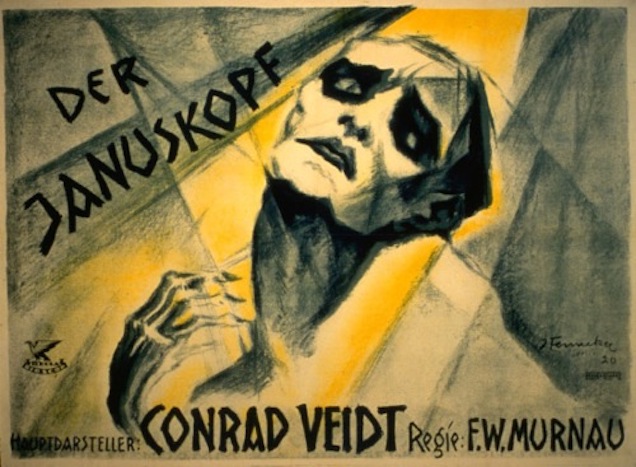
And yet, Veidt’s face isn’t all tortured flesh and bone. His lips, fully bee-stung and tapering at one corner to a point that could impale someone if they weren’t careful. They’re full, tempting, at odds with the rest of Veidt’s features, inviting even, a feminine pout that tempers Veidt’s expression of pain and which proves hard to avoid looking at. But then his jaw line reflects that agony again, jagged in its delineation, and almost as if Fenneker has made slicing motions with his brush in order to get the full effect.

Below that jaw line is a surprise, a throat so distended and goitre-like it acts as a further horrible reminder that Veidt – or at least his character, Dr Warren – is undergoing a terrible change in appearance. It’s almost as if his alter ego, the villainous Mr O’Connor, is making his way up and out, and will be forcing Veidt’s strikingly realised lips wide apart in his efforts to be free (what kind of monster is going to be revealed?). But almost as if this amount of horror isn’t enough, there’s also the shock of seeing Veidt’s hand, reduced to cadaverous bones and reaching out as if to claw his throat open and release the beast within.

With Veidt’s on-screen character so grotesquely depicted – contemporary audiences would most likely have been horrified by Fenneker’s creation – all that’s left is to provide a suitable background for the central image. Using swathes of yellow and grey to paint an unhealthy miasma around Veidt, the effect is of a man not only enduring a terrible (and terrifying) physical transformation, but having to do so while surrounded by an atmosphere that seems to exemplify sickness and disease. Or maybe it’s meant to represent that curiously German concept of schadenfreude, and the colours have been chosen to represent the character’s emotional and intellectual turmoil. Whichever view is right – indeed, if either of them are – Fenneker’s poster remains a startling, arresting work of art, and a testament to his prowess as an interpreter of German silent cinema.

NOTE: There’ll be more from Josef Fenneker throughout February 2017.

Share this:

  • Click to share on X (Opens in new window) X
  • Click to share on Facebook (Opens in new window) Facebook
  • More
  • Click to print (Opens in new window) Print
  • Click to email a link to a friend (Opens in new window) Email
Like Loading...

Monthly Roundup – January 2017

31 Tuesday Jan 2017

Posted by dullwood68 in Movies

≈ 3 Comments

Tags

Action, Animation, Ariel Schulman, Auli'i Cravalho, Chester Morris, Chris Wedge, Chris Williams, D.J. Caruso, Dave Franco, David Yates, Disney, Don Hall, Donnie Yen, Dwayne Johnson, Eddie Redmayne, Emma Roberts, Fantastic Beasts and Where to Find Them, George Sherman, Gerry O'Hara, Guy Hamilton, Heart of a Dog, Henry Joost, Horror, Howard Lovecraft and the Frozen Kingdom, Ian McShane, J.K. Rowling, January 2017, John Musker, Laurie Anderson, Lolabelle, Lucas Till, Moana, Monster Trucks, Monthly roundup, Movies, Nerve (2016), Oliver Reed, Rat terrier, Ray Enright, Reviews, Richard Conte, Ron Clements, Sean Patrick O'Reilly, The Party's Over, The Pleasure Girls, The Sixties, The Sleeping City, Tomorrow at Seven, Vin Diesel, xXx: Return of Xander Cage

Nerve (2016) / D: Henry Joost, Ariel Schulman / 96m

Cast: Dave Franco, Emma Roberts, Emily Meade, Miles Heizer, Juliette Lewis, Kimiko Glenn, Marc John Jefferies, Colson Baker, Brian Marc

maxresdefault

Rating: 6/10 – an online game of Truth or Dare quickly escalates into something more dangerous than expected when Vee (Roberts) decides to escape her comfort zone and take on the game’s challenges; less than subtle criticisms of the Internet and social media can’t hide the fact that this kind of scenario – teens (mostly) take risks to become “cool” in the eyes of the world – lacks immediacy and a real sense that its characters are in any actual danger, leaving Nerve to flirt with its ideas but never really take them out on a first date.

Fantastic Beasts and Where to Find Them (2016) / D: David Yates / 133m

Cast: Eddie Redmayne, Katherine Waterston, Dan Fogler, Colin Farrell, Alison Sudol, Samantha Morton, Ezra Miller, Faith Wood-Blagrove, Jenn Murray, Jon Voight, Ronan Raftery, Josh Cowdery, Ron Perlman, Carmen Ejogo

maxresdefault-1

Rating: 5/10 – in New York in 1926, young wizard, Newt Scamander (Redmayne), arrives with a case full of fantastic beasts (what else?) and finds himself in the midst of an evil plot to boost Warner Bros.’ take at the box office; despite being written by J.K. Rowling, Fantastic Beasts... is littered with characters we never get to know, clumsy demarcations between the wizarding world and that of the Muggles (or No-Maj’s as they’re known here), features another tedious series of destruction-porn episodes, and fosters the overwhelming sense that, despite protestations to the contrary, this is a franchise cash-in and nothing more.

Moana (2016) / D: Ron Clements, John Musker, Don Hall, Chris Williams / 107m

Cast: Auli’i Cravalho, Dwayne Johnson, Rachel House, Temuera Morrison, Jemaine Clement, Nicole Scherzinger, Alan Tudyk

36190303mauiandmoana-1280-1479767753823_large

Rating: 6/10 – when a curse threatens the island she lives on, chief’s daughter Moana (Cravalho) goes in search of the one person who can put things right: the cause of the curse, demi-god Maui (Johnson); following on from the delightful (and fresh) Zootopia (2016), it’s shocking to see just how lightweight Moana is in comparison, with little depth to the characters, and a plot so flimsy it’s almost see-through, all of which leaves the movie’s stunning animation as the only thing that makes an impact.

The Party’s Over (1965) / D: Guy Hamilton / 94m

Cast: Oliver Reed, Clifford David, Ann Lynn, Katherine Woodville, Louise Sorel, Mike Pratt, Maurice Browning, Jonathan Burn, Roddy Maude-Roxby, Annette Robertson, Alison Seebohm, Eddie Albert

cache_2432985076

Rating: 7/10 – an American businessman (David) comes to London to persuade his fiancée (Lynn) to return home and get married, but he finds himself battling against her friends (led by Reed’s anti-Establishment poser), and her sudden disappearance; seen today, The Party’s Over has all the hallmarks of a Sixties curio, but at the time it pushed quite a few boundaries, and fell foul of the British censors, forcing Hamilton to remove his name from the credits – but not before he’d made a fascinating and striking movie that’s only let down by a handful of weak performances and an ending that matches them.

The Sleeping City (1950) / D: George Sherman / 85m

Cast: Richard Conte, Coleen Gray, Richard Taber, John Alexander, Peggy Dow, Alex Nicol

image-w384

Rating: 6/10 – the murder of a doctor at New York’s Bellevue Hospital prompts the police to place three undercover officers there in an attempt to flush out the killer; beginning with an awkward endorsement of the Bellevue staff by Conte (whose inability to read from cue cards is obvious), The Sleeping City soon settles into its film noir trappings but while it’s diverting enough, it doesn’t know what to do with Conte’s lead detective, or how to make its central plot more interesting than it is.

Heart of a Dog (2015) / D: Laurie Anderson / 75m

With: Laurie Anderson

hoad_stills_05_lolaconcert

Rating: 8/10 – a tone poem, an essay, a treatise on the unconditional love a dog has for its owner, and a wider examination of grief and loss allied to the events of 9/11 – this isn’t just about Laurie Anderson’s relationship with her beloved rat terrier, Lolabelle, but about the various ways that love and loss can affect us; at its core, Heart of a Dog is not a documentary, but a collage of distressed film stock, abstract sound and sound effects, Anderson’s performance persona, visual memories, heartfelt imagery and reminiscences, poetic reality, and Anderson’s own unique view of the world and the essential poetic nature of it all, all of which combines to provide the viewer with one of the most intriguing and thought-provoking movies of recent years.

Tomorrow at Seven (1933) / D: Ray Enright / 62m

Cast: Chester Morris, Vivienne Osborne, Frank McHugh, Allen Jenkins, Henry Stephenson, Grant Mitchell, Charles Middleton, Oscar Apfel, Virginia Howell

tomorrowatseven

Rating: 7/10 – the Black Ace is a master criminal/murderer who predicts the time he’ll kill each of his victims, and he never fails, but crime writer Neil Broderick (Morris) is on his trail, and with the help of Black Ace expert, Thornton Drake (Stephenson), is determined to catch him; an old dark house mystery that features light relief (or major annoyance – take your pick) from the double act of McHugh and Jenkins as two of the stupidest cops on the force, Tomorrow at Seven does a good job of playing cat and mouse with the audience, but with so few suspects on display, the identity of the Black Ace is, sadly, all too obvious.

The Pleasure Girls (1965) / D: Gerry O’Hara / 88m

Cast: Ian McShane, Francesca Annis, Mark Eden, Klaus Kinski, Anneke Wills, Tony Tanner, Rosemary Nicols, Suzanna Leigh, Colleen Fitzpatrick, Carol Cleveland

the-pleasure-girls-images-b1253ff6-802d-4e22-a998-7d660e9305d

Rating: 6/10 – Sally (Annis) comes to London to be a model, and soon falls in with a like-minded group of young women looking to find their way in the world – and have a lot of fun at the same time, even though it doesn’t always work out like that; though the focus is in on Sally, her friends, and the various relationships they form, The Pleasure Girls makes more of an impact thanks to its male cast, with McShane, Eden and Kinski (very good) all standing out thanks to strong characterisations and having less soap opera-style dialogue than that of the female cast, and O’Hara’s direction appearing to wander whenever two or more of the girls are on screen.

Monster Trucks (2016) / D: Chris Wedge / 105m

Cast: Lucas Till, Jane Levy, Thomas Lennon, Barry Pepper, Rob Lowe, Holt McCallany, Amy Ryan, Danny Glover, Frank Whaley

monster-trucks

Rating: 7/10 – an oil-drilling operation leads to the release of three “monsters” that live deep underground, but while the oil company captures two of the creatures, the third ends up befriending high school senior, Tripp (Till), who in turn helps it to avoid being captured as well; an innocuous throwback to the kind of fantasy movies made for kids in the Eighties, Monster Trucks is a lot of fun if you let yourself just go with it, and though its message of tolerance and understanding of “foreigners” seems at odds with current notions of US nationalism, it’s still a message we can all stand to hear one more time.

Howard Lovecraft and the Frozen Kingdom (2016) / D: Sean Patrick O’Reilly / 83m

Cast: Kiefer O’Reilly, Sean Patrick O’Reilly, Jane Curtin, Ron Perlman, Christopher Plummer, Alison Wandzura, Tyler Nicol, Doug Bradley

howard-lovecraft-5

Rating: 5/10 – young Howard Lovecraft (Kiefer O’Reilly) finds himself transported to a strange kingdom of ice which is inhabited by equally strange creatures, and where he finds himself searching for both a way back, and a way to reassure his father (Nicol) (who’s locked up in an asylum) that his ravings about other worlds and said creatures are all true; a curious blend of children’s animation and H.P. Lovecraft’s Cthulhu mythos, Howard Lovecraft and the Frozen Kingdom is quite straightforward in its approach, but is let down by poor production values, an animation style that makes it look like a video game from the Nineties, and a script that juggles motivations and dialogue like a one-handed man in a chainsaw-catching competition.
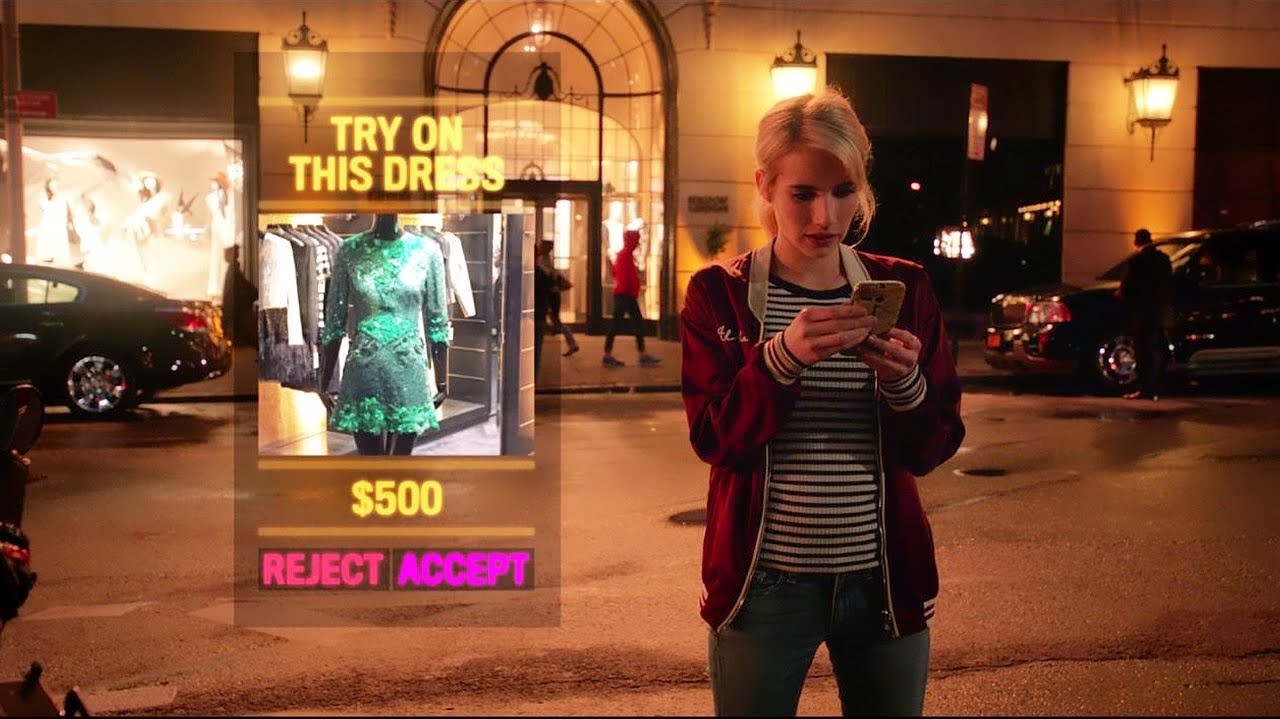
xXx: Return of Xander Cage (2017) / D: D.J. Caruso / 107m

Cast: Vin Diesel, Donnie Yen, Deepika Padukone, Toni Collette, Ruby Rose, Kris Wu, Tony Jaa, Nina Dobrev, Rory McCann, Michael Bisping, Samuel L. Jackson

xxx-the-return-of-xander-cage-vin-diesel-donnie-yen

Rating: 4/10 – the world is in peril from yet another technological McGuffin, and it’s up to extreme sports enthusiast/secret agent Xander Cage (Diesel) to save the day; with Diesel unable to get The Last Witch Hunter (2015) off the ground as another franchise earner, it’s no surprise that he’s returned to a character he left behind fifteen years ago, but this is as uninspired and as predictable as you’d expect, and only Yen’s (always) impressive physicality makes any kind of an impact.

Share this:

  • Click to share on X (Opens in new window) X
  • Click to share on Facebook (Opens in new window) Facebook
  • More
  • Click to print (Opens in new window) Print
  • Click to email a link to a friend (Opens in new window) Email
Like Loading...

Oh! the Horror! – The Disappointments Room (2016) and The Bye Bye Man (2017)

13 Friday Jan 2017

Posted by dullwood68 in Movies

≈ Leave a comment

Tags

Cressida Bonas, D.J. Caruso, Douglas Smith, Drama, Grief, Haunted house, Horror, Kate Beckinsale, Lucas Till, Lucien Laviscount, Paranoia, Review, Stacy Title, Supernatural

disappointments_room

The Disappointments Room (2016) / D: D.J. Caruso / 85m

Cast: Kate Beckinsale, Mel Raido, Duncan Joiner, Lucas Till, Gerald McRaney, Celia Weston, Jennifer Leigh Mann, Ella Jones, Marcia DeRousse

After the tragic death of their baby daughter, Dana (Beckinsale) and David (Raido), and their son, Lucas (Joiner), relocate to a rundown, rural dream home. Haunted by their daughter’s death, Dana soon begins to hear the sounds of a baby crying, and also the sound of dripping water. She traces the dripping water sounds to a leak from the roof, but still hears a baby crying and other noises; she also sees a strange dog outside. David is oblivious to all this, and doesn’t think it’s at all mysterious when Dana discovers a hidden room in the attic that isn’t on the plans. Investigating it further the next day, she finds herself locked in and threatened by a malevolent force. Hours pass, but when she finally manages to get out of the room, she learns that only minutes have passed, and not hours; and that David is worried she’s not taking her medication (to help her deal with her grief).

With the help of a local historian (DeRousse), Dana discovers that the house has a disappointments room, a room that would have been used to hide away a child born with a deformity or some such, and which would have been highly embarrassing to its (usually) upper class family. Dana’s research uncovers a previous owner, Judge Blacker (McRaney), whose daughter, Laura, was believed to have died in childbirth. But Dana suspects Laura was the inhabitant of the disappointments room, and that it’s her spirit that is haunting the house. With a local workman (Till) helping restore the house, and Dana becoming increasingly disturbed by the things she’s seeing, the truth behind the disappointments room slowly begins to unfold, and Dana begins to understand that there’s a far more malevolent force at work…

thumbnail_24864

For a horror movie to have the word “disappointment” anywhere in its title is asking for trouble (or it’s being incredibly reckless). And The Disappointments Room, ah, doesn’t let us, or itself, down in that respect. It’s yet another haunted house movie where things happen for no reason at all, and scenes take place that are by-and-large independent of each other and only fit together if the viewer is lucky. The script – by director Caruso and Wentworth Miller – likes to play with visual motifs, like a child’s kite seen in historical photos floating above the house, even though it would have been proof of a child’s existence when there shouldn’t have been any; and it likes to have things happen outside the house when it’s clear that the ghost responsible for all the shenanigans doesn’t stray outside at all (so shouldn’t have that much influence).

Away from the kind of plot holes that you could fit an entire haunted house through twice over, the movie aims very low in its attempts to be scary or frightening, and falls back too often on the kind of traditional haunted house set ups that now invoke yawns rather than tension. Against such a plain, derivative backdrop, Beckinsale has no option but to put in a generic genre performance and walk away with as much dignity as she can manage. The rest of the cast lack for things to do, especially Raido, and Caruso’s directorial style largely involves ignoring how tedious and pedestrian the script is, and that the whole thing – though no more preposterous than usual – lacks energy and any kind of visual panache. It’s a glum, uninvolving movie to watch, and it isn’t helped by Brian Tyler’s overbearing, cliché-driven score.
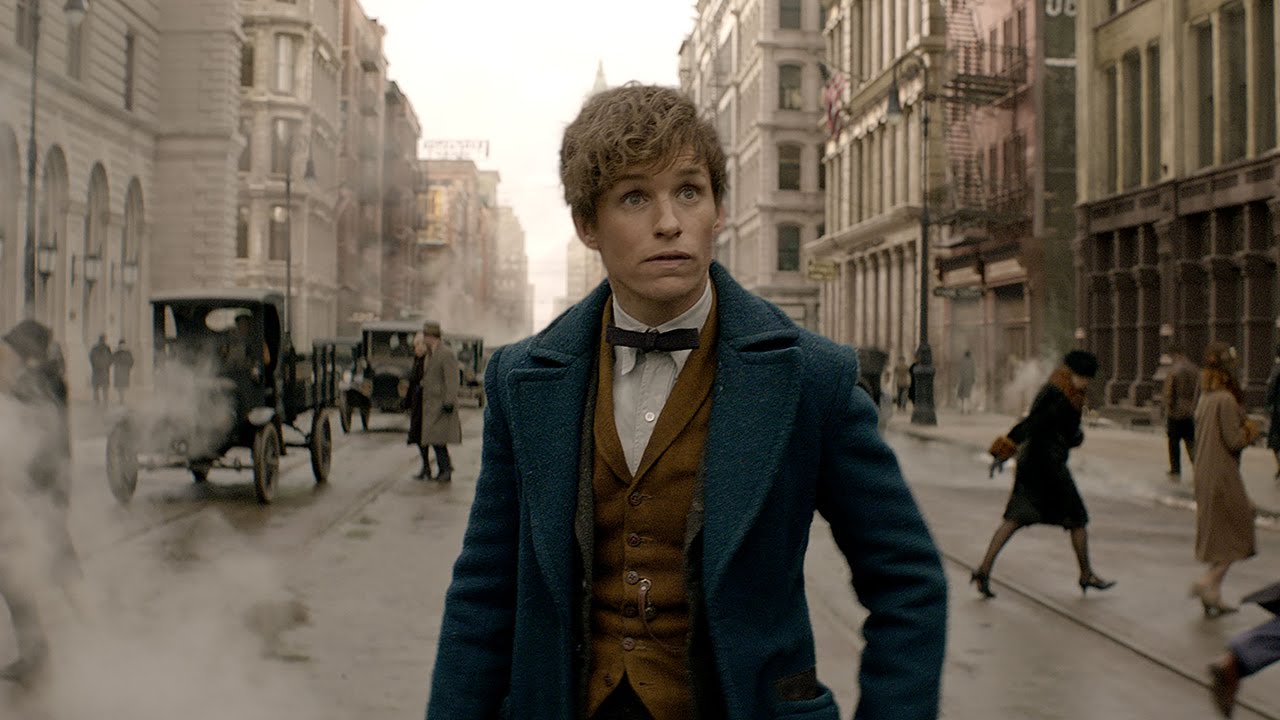
Rating: 3/10 – bad horror movies are ten a penny these days – in fact, they’re ten a penny on most days – but The Disappointments Room is a particularly bad horror movie, one that can’t be bothered to be better than it is; hackneyed, with poor/lazy performances, and a terrible sense of its own effectiveness, it outstays its welcome within the first five minutes, and never once feels as if it’s about to surprise the viewer or give them something/someone to care about.


the-bye-bye-man-poster01

The Bye Bye Man (2017) / D: Stacy Title / 96m

Cast: Douglas Smith, Lucien Laviscount, Cressida Bonas, Doug Jones, Michael Trucco, Jenna Kanell, Erica Tremblay, Marisa Echeverria, Cleo King, Faye Dunaway, Carrie-Anne Moss, Leigh Whannell

In 1969, a reporter, Larry Redmon (Whannell), goes on a killing spree in the town of Madison, Wisconsin. Fast forward forty-seven years and three university students – couple Elliot (Smith) and Sasha (Bonas), and best friend John (Laviscount) – rent an old house on the outskirts of town, and soon they’re having more than their fair share of weird experiences. After a housewarming party, a friend of Sasha’s, Kim (Kanell), performs a cleansing ceremony, but it doesn’t work. Soon she’s telling them that “something” is coming. Later, Elliot finds a sheet of paper with the words “Don’t think it” and “Don’t say it” written on it over and over again. These words are a caution relating to a supernatural entity known as the Bye Bye Man. If you say or think his name, he will come for you and he will make you do terrible things – like Larry Redmon did.

Soon the trio are seeing things and their own inner fears are being exploited. Elliot digs into the origins of the Bye Bye Man, while at the same time becoming ever more certain that Sasha and John are sleeping together. Sasha becomes increasingly ill, while John becomes more and more paranoid. When Kim is killed, the police become involved. And when Elliot tracks down Larry Redmon’s widow (Dunaway), he discovers a way to defeat the Bye Bye Man. But when he returns to the house, circumstances dictate that he might never get the opportunity to use his newfound knowledge, as the Bye Bye Man is there already…

maxresdefault

A better tagline for The Bye Bye Man would be “Don’t try it, don’t see it”, as this adaptation of The Bridge to Body Island, a chapter from Robert Damon Schneck’s non-fiction book The President’s Vampire, is one of the most poorly written, directed, and acted horror movies of recent years. Aside from the bravura pre-credits sequence where Larry Redmon goes on the rampage, The Bye Bye Man struggles at almost every turn in its attempts at telling a cohesive, halfway credible story, and fails to deliver any tension, any shocks, any drama, or any let-up from the crushing banality of Jonathan Penner’s screenplay. It’s as if Penner has watched a dozen or so recent horror movies featuring supernatural creatures, taken the worst aspects of those movies’ scripts, and put them all together to make this movie look and sound as atrocious as possible.

Things are further compounded by Title’s haphazard, scattershot approach to the material, directing most scenes as if she had no idea what was going to happen next (which would be odd, as Penner is her husband). She’s also unable to elicit one decent performance from anyone in the whole movie; even the likes of Dunaway and Moss have no chance when faced with such terrible dialogue and even worse character motivation. Bonas favours one facial expression throughout (sleepy), Laviscount does angry young man whatever the scene, and Smith is so bad you hope the Bye Bye Man gets him first. Things are further hampered by James Kniest’s unimaginative framing and cinematography, and worst of all, Ken Blackwell’s laissez-faire editing, which takes the movie to new depths of awfulness.

Rating: 3/10 – sometimes you wonder how some horror movies get a general release and don’t go straight to video, and The Bye Bye Man is one such horror movie; a real stinker, it insults its audience at every turn, can’t even rustle up an origin story for its title character, tries for franchise levels of integrity that are never achieved, and should be used as an object lesson in how not to make a supernatural creature feature.

Share this:

  • Click to share on X (Opens in new window) X
  • Click to share on Facebook (Opens in new window) Facebook
  • More
  • Click to print (Opens in new window) Print
  • Click to email a link to a friend (Opens in new window) Email
Like Loading...

Poster of the Week – The Unearthly (1957)

11 Wednesday Jan 2017

Posted by dullwood68 in Movies

≈ Leave a comment

Tags

Horror, John Carradine, Poster of the week, The Fifties, The Unearthly, Tor Johnson

unearthly_poster_02-jpg-html

Another jam-packed poster from the Fifties, this tells you all you need to know about the movie it’s promoting in so many sections it’s a wonder they had room for the title. A ghastly horror movie made on a B-movie budget and with Z-movie aspirations, The Unearthly has to be seen to be believed (yes it’s that bad/good), and yet, this particular broadsheet once again confirms that often enough, the humble poster has more to offer than the movie it’s advertising.

The eye literally has too many places it can go at first glance, but the top left hand corner is a good place to start. “Lured!” it says, a comment that is at once alluring itself – lured? lured by what exactly? – and also slightly dangerous in intent. Lured – that can’t be good. And so it proves: the rest of the strapline makes it clear with its reference to monsters. But the poster’s designer then adds something that’s a little bit clever and unexpected. He or she drags the word “monsters…” down towards the doorway that an amply proportioned woman is about to enter. While John Carradine looks in her direction, almost urging her through the doorway, the woman looks uncertainly, and worriedly, behind her. (Modern day audiences might wonder if she’s thinking, does my bum look big in this? She probably isn’t, though.) It’s a neat way of drawing the viewer’s attention in a specific direction, and having a shapely damsel in imminent distress is always an attention grabber.

Across the middle of the poster is the title, with its large, uneven lettering and promise that “there’s no escape from…” The red letters against the sickly green background make for an effective colour counterpoint, and there’s definitely no escaping that. And then there are those eight images from the movie itself, several of which feature men transformed into hairy beasts with wild, staring eyes (Carradine’s evil Dr Conway performs illegal experiments to prolong life but for some strange, inexplicable reason they always go wrong; talk about persistence over experience). These identikit Mr Hydes look like the special effects department raided the Cro-Magnon man exhibit at the nearest natural history museum, and as such are about as frightening as hairy mannequins can get.

Other images display one of Dr Conway’s ill-fated operations, a man trying to embrace the bars of his cell, and dear old Tor Johnson carrying a bosomy starlet. If for no other reason than that the movie featured Tor Johnson, you’d know it was bad; he played the same character in every one of his movies and, sad to say, he was awful in all of them. With Tor’s expression-free features on the poster, any remaining likelihood that the movie will be worth watching is despatched immediately. And further evidence that suspicions about the movie should be encouraged lie with the credits and the director’s name: Brooke L. Peters. Never heard of him? That’s no surprise, as it’s a pseudonym for Boris Petroff. Never heard of him? That’s no surprise either.

While the credits occupy a modicum of space and focus on the leading actors, the poster manages to include one last “surprise”: a rosette declaring that the movie is “guaranteed to frighten”. Similar claims were foisted on dozens of low budget horrors during the Fifties, almost as if the makers were daring people to come and watch their movie. But the rosette is a nice touch – if a trifle over-confident – and as a final flourish to the poster and its overall effectiveness, it’s a little like having a piece of cake with a cherry on top. The Unearthly may not be the best movie in the world – it’s probably not even the best movie released on 28 June 1957 – but this poster has far more going for it than the movie, and has too many elements that work well individually and taken as a whole. A deceptively clever poster then, and one where its design and construction can be rightly celebrated.

And for fans of dear old Tor Johnson, here’s a lobby card where he features more prominently:

the-unearthly-lobby-card-1957_4

Share this:

  • Click to share on X (Opens in new window) X
  • Click to share on Facebook (Opens in new window) Facebook
  • More
  • Click to print (Opens in new window) Print
  • Click to email a link to a friend (Opens in new window) Email
Like Loading...

Monthly Roundup – December 2016

31 Saturday Dec 2016

Posted by dullwood68 in Movies

≈ 2 Comments

Tags

50's sci-fi movie, A Perfect Man, Action, Alice Through the Looking Glass, Ana Girardot, Barry Sonnenfeld, Cameron Mitchell, Cat, Cell, Chandler Riggs, Christopher Walken, Comedy, David Tomlinson, Devil's Crag, Diana Dors, Drama, Edward Kemmer, Eliminators (2016), Flight to Mars, Frances O'Connor, Giant from the Unknown, Hard Target 2, Horror, Hostile takeover, Is Your Honeymoon Really Necessary, James Bobin, James Nunn, Jennifer Garner, John Cusack, Johnny Depp, Kevin Spacey, Lesley Selander, Literary adaptation, Marguerite Chapman, Mars, Maurice Elvey, Mercy (2014), Mia Wasikowska, Murder, Myanmar, Nine Lives, Peter Cornwell, Pierre Niney, Reviews, Rhona Mitra, Richard E. Cunha, Robert Knepper, Roel Reiné, Sally Fraser, Samuel L. Jackson, Scott Adkins, Sequel, Shirley Knight, Stephen King, The Mad Hatter, The Red Queen, Thriller, Tod Williams, Vargas, Wade Barrett, Wonderland, WWE Films, Yann Gozlan

Cell (2016) / D: Tod Williams / 98m

Cast: John Cusack, Samuel L. Jackson, Isabelle Fuhrman, Clark Sarullo, Ethan Andrew Casto, Owen Teague, Stacy Keach, Joshua Mikel

cell_2

Rating: 4/10 – a mysterious cell phone signal turns people into crazed, zombie-like creatures, but one man (Cusack) is determined to find his son while society disintegrates around him; a Stephen King adaptation (and co-scripted by him), Cell is another reminder that his work rarely translates well to the screen, and this is no exception, being dramatically incoherent, a waste of its talented cast, and lumbered with an ending that makes absolutely no sense at all.

A Perfect Man (2015) / D: Yann Gozlan / 104m

Original title: Un homme idéal

Cast: Pierre Niney, Ana Girardot, André Marcon, Valéria Cavalli, Thibault Vinçon, Marc Barbé, Sacha Mijovic

a_perfect_man_still

Rating: 7/10 – aspiring author Mathieu Vasseur (Niney) isn’t getting anywhere until he finds an unpublished novel and claims it as his own, a move that leads to fame, fortune, blackmail, and ultimately, murder; a clever, twisty thriller that benefits from a splendidly nervous, anxious performance from Niney, A Perfect Man may have many familiar elements, but it’s a movie with a great deal of style, and it holds the attention in such a way that there are times when you won’t realise you’re holding your breath.

Is Your Honeymoon Really Necessary (1953) / D: Maurice Elvey / 80m

Cast: David Tomlinson, Diana Dors, Bonar Colleano, Sidney James, Diana Decker, Audrey Freeman, MacDonald Parke

aa56833cc4842c8ff89eb399e9116e7d

Rating: 5/10 – returning to the UK with his new bride (Decker), US soldier Laurie Vining (Colleano) is horrified to learn that he may still be married to his first wife, glamour girl Candy (Dors), a situation that leads to his desperately trying to avoid his new bride – or anyone else – from finding out; a bedroom farce based on a successful stage play, Is Your Honeymoon Really Necessary has dated somewhat, but for fans of the cast and this type of Fifties UK comedy, there’s much to enjoy, from the frantic mugging of Colleano and Tomlinson, Elvey’s efficient direction, and a surprisingly nuanced performance from Dors.

Eliminators (2016) / D: James Nunn / 94m

Cast: Scott Adkins, Wade Barrett, Daniel Caltagirone, James Cosmo, Ty Glaser, Olivia Mace, Lily Ann Stubbs

eliminators-2016-movie-free-download-720p-bluray-4

Rating: 3/10 – when a home invasion means his Witness Protection identity is compromised, ex-Federal Agent Martin Parker (Adkins) finds himself the target of a hitman (Barrett) and forced to go on the run; a WWE Films production shot on location in and around London, Eliminators is a bog-standard actioner that stretches credulity, invites disbelief, and warrants avoidance as it does its best to cram in as many dull action scenes as it can in ninety minutes, and serves as yet another reminder that being a WWE superstar doesn’t mean you can act.

Giant from the Unknown (1958) / D: Richard E. Cunha / 77m

aka The Diablo Giant; Giant from Devil’s Crag; Giant from Diablo Point

Cast: Edward Kemmer, Sally Fraser, Bob Steele, Morris Ankrum, Buddy Baer, Jolene Brand, Gary Crutcher, Billy Dix

giantfromtheunknown-throw-jpg-html

Rating: 4/10 – animal mutilations and murder plague a small town – and that’s before a giant Spanish conquistador is released from suspended animation by a lightning bolt, and threatens both the town’s inhabitants and the research team trying to ascertain if the legend about him is true; not the best example of a Fifties “creature feature”, Giant from the Unknown takes so long to get going that it’s nearly over before it’s begun, features a raft of irritating performances, and is so flatly directed by Cunha that once the Giant is awakened, you can’t help but pray that he’s the first victim.

Alice Through the Looking Glass (2016) / D: James Bobin / 113m

Cast: Mia Wasikowska, Johnny Depp, Anne Hathaway, Helena Bonham Carter, Sacha Baron Cohen, Rhys Ifans, Matt Lucas, Lindsay Duncan, Leo Bill, Ed Speelers, Geraldine James, Andrew Scott, Alan Rickman, Stephen Fry, Michael Sheen, Barbara Windsor, Timothy Spall, Matt Vogel, Paul Whitehouse

alice-through-the-looking-glass-tv-spot

Rating: 5/10 – Alice (Wasikowska) returns to Wonderland to save the Mad Hatter (Depp) from suicidal depression(!) and the attentions of Time (Cohen) and the Red Queen (Carter) who are working in tandem and holding the Hatter’s family hostage for no convincing reason you can think of; another sequel no one asked for (and nowhere near as successful as its predecessor), Alice Through the Looking Glass is ravishing to look at, boasts some fine visual effects, and a great performance by Cohen, but everything else is a mess: bloated, derivative, witless, and with yet another wasteful performance from Depp (who clearly can’t be bothered).

Hard Target 2 (2016) / D: Roel Reiné / 104m

Cast: Scott Adkins, Robert Knepper, Rhona Mitra, Temuera Morrison, Ann Truong, Adam Saunders, Jamie Timony, Peter Hardy

hrdtrgt_8

Rating: 4/10 – ex-MMA fighter Wes Baylor (Adkins) finds himself in Myanmar with one simple objective: reach the Thai border while he’s pursued by a motley group of “hunters” who are out to kill him; a movie that definitely comes under the heading of “another sequel no one asked for”, Hard Target 2 is betrayed by its low budget origins, a script that lurches from one unmemorable action scene to another, and Knepper’s one-note portrayal of the villain.

Nine Lives (2016) / D: Barry Sonnenfeld / 87m

Cast: Kevin Spacey, Jennifer Garner, Christopher Walken, Robbie Amell, Malina Weissman, Cheryl Hines, Mark Consuelos, Talitha Bateman

nine-lives-film-kevin-spacey

Rating: 3/10 – businessman Tom Brand (Spacey) has no time for his wife (Garner) and daughter (Weissman), so what better way for him to learn the value of family (and some humility in the process) than by stranding his mind in the body of a cat?; the kind of inane, superficial comedy that Hollywood churns out with mindless regularity, Nine Lives gives Garfield 2 (2006) a run for its money in the stupid stakes, and hammers another nail into the coffin of Barry Sonnenfeld’s once-glorious career.

Flight to Mars (1951) / D: Lesley Selander / 72m

Cast: Marguerite Chapman, Cameron Mitchell, Arthur Franz, Virginia Huston, John Litel, Morris Ankrum, Richard Gaines, Lucille Barkley, Robert Barrat

alita-flight-to-mars-1951-_129993-fli_1363015116

Rating: 5/10 – the first manned flight to Mars gets there safely only to learn that the planet is inhabited, and by a human-like race that may or may not have an ulterior motive for helping them return to Earth; early-Fifties sci-fi hokum that throws in a tepid romance and some very, very short skirts for the female cast, Flight to Mars retains an odd charm – perhaps because of its naïve approach – that helps alleviate some of the more daffy moments the script insists on doling out.

Mercy (2014) / D: Peter Cornwell / 79m

Cast: Frances O’Connor, Shirley Knight, Chandler Riggs, Joel Courtney, Mark Duplass, Dylan McDermott, Amanda Walsh, Hana Hayes, Pepper Binkley

mercy-horror-movie-news-3

Rating: 4/10 – after a spell in a nursing home, Grandma Mercy (Knight) comes home to be looked after by her family – daughter Rebecca (O’Connor) and grandsons George (Riggs) and Buddy (Courtney) – but soon exhibits strange behaviour, behaviour that includes warning George that a supernatural force is coming to get him; adapted from the short story Gramma by Stephen King (yes, him again), Mercy aims for creepy and menacing, yet succeeds instead in being confused and uninspired, and with laboured direction and performances, a situation that devotees of King adaptations will appreciate, having been there many times before.

Share this:

  • Click to share on X (Opens in new window) X
  • Click to share on Facebook (Opens in new window) Facebook
  • More
  • Click to print (Opens in new window) Print
  • Click to email a link to a friend (Opens in new window) Email
Like Loading...

Blair Witch (2016)

27 Tuesday Dec 2016

Posted by dullwood68 in Movies

≈ 2 Comments

Tags

Adam Wingard, Black Hills, Burkittsville, Callie Hernandez, Drama, Horror, James Allen McCune, Review, Sequel, The Woods, Witch

cqzrohfueaaamq1-jpg-large

D: Adam Wingard / 89m

Cast: James Allen McCune, Callie Hernandez, Corbin Reid, Brandon Scott, Wes Robinson, Valorie Curry

Twenty years after his older sister, Heather, disappeared in the Black Hills woods outside Burkittsville, Maryland, James Donahue (McCune) comes into possession of a video that he believes is evidence that his sister is – somehow – still alive. Determined to find out for sure, he co-opts film student Lisa Arlington (Hernandez) – who is making a documentary about Heather’s disappearance and James’s search for answers – and friends Peter (Scott) and Ashley (Reid) into going with him. The night before they’re due to set off into the woods, they meet locals Lane (Robinson) and Talia (Curry), who agree to go with them.

Having set up camp on the first night, Lane tells the rest of the group stories he’s heard about the history of the Blair Witch. That night, noises from the surrounding woods wake James and Lisa; they discover Lane outside the camp and looking scared. The next day, the group discover lots of stick figures hanging from the trees and that they’ve slept until two o’clock. Freaked out by this, they decide to go back, but after several hours of trying to retrace their steps, they find themselves back at the campsite. Circumstances lead to Lane and Talia leaving the group and attempting to make their own way back.

blair-witch-2

The remaining four are forced to stay there overnight. Peter disappears, and when James tries to find him he encounters Lane and Talia instead. They tell him they’ve been lost in the woods for five days. The couple are allowed to stay in camp, though Lisa is suspicious of them. James sets his alarm for seven o’clock in the morning, but when it goes off it is still pitch dark. There are also, more, larger stick figures hanging from the trees. Lane runs off, and something happens to Talia that terrifies the rest. James, Lisa and Ashley become separated. When James and Lisa find each other again, they hear what they think is Ashley screaming. With it now raining heavily, they discover the same house where James believes he’ll find his sister…

When The Blair Witch Project was released in 1999, it was a massive, unexpected success. Made on a budget of $60,000, it accrued nearly $250 million worldwide and to this day, is one of the most successful independent movies ever produced. It spawned a sequel, Book of Shadows: Blair Witch 2 (2000) that was the antithesis of the original’s tone and approach, and which was so mangled in post-production by distributors Artisan Entertainment, that they wrecked any chances of it being even a fraction as successful as its predecessor. And now, we have a second sequel, one that ignores the events of Book of Shadows, and attempts to recreate the style and tone of the original movie.

3063621-poster-p-1-blair-witch-is-also-a-sequel-to-the-most-successful-movie-marketing-campaign

The key word here is “attempts”. Writer Simon Barrett and director Adam Wingard have decided, somewhat wisely, to take viewers back to the Black Hills woods, but in doing so, have unwittingly reminded everyone just why The Blair Witch Project was such a major success. It was a movie that dared its audience to say this isn’t real, that three people haven’t really disappeared in mysterious circumstances in the Black Hills woods in Maryland. It also made a virtue of its found-footage approach, and was all the more impressive for it. It was a simple, very effective way of detailing the increasing terror being experienced by Heather and her two friends, Mike and Josh. But since then, the found-footage genre has been done to death and back again, and its very moribund nature is the biggest obstacle any movie maker has to overcome in tackling a movie such as this one. We’ve seen too many people who are lost in the woods and are being menaced by malevolent forces. We’ve seen too many movies where the footage consists of distressed video images that tell us nothing of what’s happening, and are often set up just to provide jump scares.

And Blair Witch is no different. Barrett and Wingard – who are no slouches when it comes to horror movies – fail to provide us with anything new, or memorable. Instead they fall back on the tried and tested formula of several other, similar movies – A Night in the Woods (2012), Evidence (2011), and Willow Creek (2013), to name but a few – and make the same mistake that everyone else makes: they don’t provide us with anyone to care about. This leaves the movie feeling more like a (very) belated cash-in designed to wring a few more dollars out of an unsuspecting fanbase and/or potentially interested public. The makers went to a lot of trouble to ensure that Blair Witch wasn’t on anyone’s radar during its production, and right up until its first showing at this year’s Comic-Con, it was known as The Woods. Perhaps they already knew this wasn’t going to be as good as they’d hoped.

dd4ej8vfnf04ajyftimp

In the end, the movie falls way short of being a worthy successor to The Blair Witch Project, and it falls way short of being even an above average found-footage movie. Several times, and particularly during the events that take place in the house, there are shots that are clearly made by a third person. The editing, by Louis Cioffi, is haphazard and draining, stretching some scenes out to longer than necessary, while truncating others unnecessarily, and Wingard’s control of the material is similar in execution, with a lack of focus that undermines the narrative – such as it is – and keeps the audience at a distance.

The movie makes yet another huge mistake in showing the Blair Witch herself (however briefly), where the original didn’t have the inclination or the need, being scary enough without her – and it doesn’t help that she looks like the second cousin of the creature from [Rec] 2 (2009). When a sequel doesn’t follow through on one of the most important and effective decisions its predecessor made, then you know that no one’s paying close enough attention. And if they’re not, why should you?

Rating: 4/10 – professionally made but lacking in real smarts, Blair Witch arrives like an unwanted guest at a funeral – they knew the deceased, but can’t think of anything worthwhile to say about them; a sequel that squanders its predecessor’s legacy, it soon runs out of things with which to engage the audience and worse still, it can’t even come up with an ending that is even halfway as disturbing as the fate that befell Heather.

Share this:

  • Click to share on X (Opens in new window) X
  • Click to share on Facebook (Opens in new window) Facebook
  • More
  • Click to print (Opens in new window) Print
  • Click to email a link to a friend (Opens in new window) Email
Like Loading...

Xmas Classics – Christmas Evil (1980)

20 Tuesday Dec 2016

Posted by dullwood68 in Movies

≈ Leave a comment

Tags

Brandon Maggart, Drama, Horror, Jeffrey DeMunn, Jolly Dream, Lewis Jackson, Review, Santa Claus, Toy factory, Xmas, You Better Watch Out

christmas-evil-3a1

Original title: You Better Watch Out

D: Lewis Jackson / 100m

Cast: Brandon Maggart, Jeffrey DeMunn, Dianne Hull, Andy Fenwick, Brian Neville, Joe Jamrog

Xmas is a time for family – or so they say. If you’re young Harry Stadling, Xmas is a time for discovering that Santa Claus is actually your father playing dress-up and spending adult time with your mother rather than coming down the chimney and leaving presents for you and your brother, Philip. Disillusioned by this terrible discovery, Harry’s view on Xmas becomes twisted. As an adult, Harry (Maggart) spies on the children in his neighbourhood and makes notes on their behaviours in two large volumes: Good Boys and Girls 1980 and Bad Boys and Girls 1980. He works as a senior employee at a factory that makes children’s toys, but he’s tolerated more than respected, and one of the men who works the line, Frank Stoller (Jamrog), exploits his good nature. As Xmas approaches, Harry’s need to make people conform to his view of the importance of the Yuletide season – or his “tune” as he calls it – leads to his dressing up as Santa Claus on Xmas Eve and distributing presents.

Except, Harry’s plan doesn’t work out as he’d hoped. As well as handing out gifts for everyone at a children’s hospital, Harry finds himself handing out retribution to those who don’t share his love of Xmas, or respect how special it is. With his exploits attracting the attention of the police, Harry finds himself chased by a bloodthirsty mob who don’t take kindly to the “Xmas cheer” he’s dispensing. A narrow escape leads him to seek out his brother, but Philip (DeMunn) has his own issues surrounding Harry and the festive period, issues that mean a further escape for Harry, but not quite the one he’s looking for…

christmas-evil-1

Christmas Evil is not your typical slasher movie set at Xmas, and is vastly different from movies such as Black Christmas (1974) or Silent Night, Deadly Night (1984). For one thing, it takes its time in establishing the mental state of its central character, the emotionally detached Harry. This is very important to the overall storyline, as writer/director Jackson strives to make Harry a character the audience can at least have some sympathy with, and not regard as just some whack job intent on killing people for no reason (or because he got a present without any batteries, or a Barbie doll instead of Action Man). This means the movie gets off to a slow start, as Harry struggles to maintain an outward air of calm – as much as he can, at least – while everyone around him fails to recognise how important Xmas is to him.

Once the prologue set in 1947 is over with (and Harry’s childhood rejection of the Xmas myth is in place), the movie begins a few months before Xmas actually comes around. This again allows Jackson the time and space to show the gradual deterioration of Harry’s mental state, and the casual malice he endures both at work and closer to home through his brother, Philip. With Philip feeling obliged to look after Harry as well as his own family, there’s a tension and an animosity there that Harry feels deeply. At one point he watches from outside his brother’s home, and sees the perfect picture of a happy family at Xmas-time. Etched on Harry’s face is a mixture of dismay and envy that explains everything you need to know about Harry’s view on Xmas, and why he’s so torn by his feelings about it. He can’t quite reconcile the good with the bad, or the notion that there can’t be one without the other.

christmas_evil1

While Harry finds himself struggling to find a balance that will help him deal with his feelings, certain events conspire to push him towards more violent responses, including the offhand remarks of his bosses at the factory, and the (until then) suppressed need for revenge on Frank Stoller. It’s notable that for every bad thing that Harry does, he does an equally positive thing as well, and Jackson is clever enough to ensure – even if this is a “slasher” movie – that Harry’s predicament can’t be viewed in plain old black and white. He’s helped in large part by the performance of Maggart as Harry, a singular portrayal that is surprisingly nuanced beneath all the outer trappings of increasing mania and moral confusion. Maggart’s career is littered with television appearances (including an episode of ER in 1995 where he played a Santa Claus figure), and very few movies; this is his finest hour without a doubt. Imbuing Harry with a strangely affecting melancholy, and showing his descent into madness by reining in any possibility of histrionics, Maggart gives an intuitive, unforgettable performance, and Jackson is wise enough to give him the room to explore the character as fully as he can.

But while on the acting front this is Maggart’s movie, on the cinematography side it’s Argentinian DoP Ricardo Aronovich’s. Persuaded by Jackson to work on the movie, Aronovich’s sombre lighting design and tight close ups on Maggart’s face make for a claustrophobic, unnerving visual approach to the material. There are moments where he also creates a kind of chiaroscuro effect, particularly when Harry is being chased by the torch-wielding mob, the flames creating an odd halo effect that seems almost supernatural. His framing and spatial awareness is impressive too, making much of what takes place look and feel like the real world and not some composite assembled for yet another movie.

santas

In the end, Jackson’s commitment to his own script and the way in which it should be presented, pays off handsomely. At first glance, Christmas Evil looks like a hundred other gory slasher movies from the early Eighties, with their high body counts, splatter effects, and invincible killers. It also looks and feels like a low-budget slasher flick – Aronovich’s involvement notwithstanding – and it has a grimy, gloomy atmosphere that isn’t exactly an original approach. But as noted above, the movie takes its time before it provides its first kill, and it and all the subsequent kills are shot as cutaways, put together neatly and given a disturbing air by editors Corky O’Hara and Linda Leeds. These scenes have an almost sordid feel to them, thanks to the combination of mood and lighting, and Harry’s inability to quell his angry feelings.

There’s humour too, threaded throughout the movie, and like in any good, serious drama, it’s allowed to take centre stage on just the one occasion, when the police are trying to get witnesses to identify Harry from a line up of Santas. Otherwise, Jackson focuses on themes relating to family, loyalty, unmerited expectations, greed, and the endemic hypocrisy that the festive season seems to instill in everyone, where the phrase “goodwill to all men” really is just that: a phrase. There’s a sense that he’s tried to “keep it real”, and while he may not succeed in everything he’s attempted, he’s definitely got more right than he has wrong.

Rating: 8/10 – a superior horror thriller, featuring a great performance from Brandon Maggart, and a remarkably astute screenplay from its director, Christmas Evil is a much better movie than anyone could have ever expected (John Waters calls it “the greatest Christmas movie ever made”); as a portrait of one man’s struggle to make sense of his own conflicted feelings about the Yuletide season (and with a subtext of PTSD thrown in for good measure), it’s unexpectedly compelling, and makes good use of its Xmas backdrop, limited budget, and confident, measured pacing.

NOTE: The following trailer has French subtitles.

Share this:

  • Click to share on X (Opens in new window) X
  • Click to share on Facebook (Opens in new window) Facebook
  • More
  • Click to print (Opens in new window) Print
  • Click to email a link to a friend (Opens in new window) Email
Like Loading...

Poster of the Week – Giant from the Unknown (1958)

06 Tuesday Dec 2016

Posted by dullwood68 in Movies

≈ Leave a comment

Tags

Horror, Movie poster, Poster of the week, Richard E. Cunha, Screencraft Enterprises Inc

giant_from_unknown_poster_02

Giant from the Unknown (1958)

At first glance, the poster for Giant from the Unknown seems like a random collection of typographical styles, two primary colours and one secondary colour, a damsel in distress, and a lightning effect that appears to have been included for no particular reason at all. And that’s without the titular giant’s werewolf-like appearance (“My, what a lot of chest hair you have.” “All the better to frighten you, my dear… hopefully”). But it’s a poster that is deceptively effective – or effectively deceptive? – and which uses the apparently random nature of its elements to provide a strangely compelling overall image.

The movie itself is about – and I quote – “A very large, degenerate, Spanish conqueror [who] is freed from suspended animation by lightning and goes on a killing spree in a small town.” So that explains the lightning bolt. Then there’s the depiction of the Giant (who we now know is from Spain and not the Unknown – wherever that is). The artist has come up with an image that, ultimately, is misleading, but with its unruly hair and wild-eyed stare, and allied to a hairy, sharp-nailed hand, is much more of a beast than a giant. Fortunately he’s also proportionately bigger than the woman he’s menacing (though you do have to wonder what his little finger is doing). He’s a commanding figure when all’s said and done, and his stare seems to be directed right at you, which is unnerving considering he’s just an image on a poster.

The woman he’s towering over should be more eye-catching, what with her flimsy red dress, splash of hair, petrified gaze, and exposed flesh. The artist has seen fit to remove the strap from over the woman’s right shoulder, an excision that is at once exploitative and also a way to further highlight her vulnerability. The Giant doesn’t exactly look lascivious, but the inference is clear: that flimsy red dress won’t be there for long once he catches her. Of course, this is from 1958, and there was absolutely no chance of the poster image being replicated within the movie, but certain target audiences of the time would have hoped like crazy that it was.

The largely green background aids the two central images to stand out more, and gives the title a chance to “pop”, it’s sharp-edges and crowded conjoined lettering serving to accentuate the strangeness of the movie. (It’s also interesting to speculate that the woman is reaching desperately to grab the word “the” and maybe save herself.) Above the title is the movie’s tagline, a typical piece of hyperbole that even moviegoers of the time wouldn’t have been fooled by. The typeface used is unexpectedly dull, and doesn’t fit the random nature of the other elements – unless that’s the point of it, and a touch of random dullness was somehow a requirement.

The remaining type details the main cast members, and is in a more traditional black. But there’s an obvious – glaringly obvious – omission: the name of the director (in this case Richard E. Cunha, who was also the movie’s DoP). Either this was a tremendous oversight, or a deliberate decision by Screencraft Enterprises, Inc.; either way, not seeing a director’s name on a poster doesn’t exactly add confidence in the finished product’s likelihood of being good/entertaining/worth seeing, even if it is called Giant from the Mountain.

But all in all, this is a poster that, while largely generic for the time it was produced, exerts a strange fascination, and has an odd hypnotic nature to it. It’s a diamond in the rough, a poster that’s truly from the Unknown, and a better advert for the movie than it perhaps deserves. It’s certainly better than this Mexican lobby card that was used (note the difference between the artist’s impression and the actual Giant):

6a00d83451d04569e2019aff41468e970b-500wi

Agree? Disagree? Feel free to let me know.

Share this:

  • Click to share on X (Opens in new window) X
  • Click to share on Facebook (Opens in new window) Facebook
  • More
  • Click to print (Opens in new window) Print
  • Click to email a link to a friend (Opens in new window) Email
Like Loading...

Monthly Roundup – November 2016

01 Thursday Dec 2016

Posted by dullwood68 in Movies

≈ 1 Comment

Tags

Action, Adam Schindler, All'ultimo sangue, Andrew Stanton, Animation, Annalise Basso, Attack of the Lederhosen Zombies, Beth Riesgraf, Bury Them Deep, Colin Firth, Comedy, Craig Hill, Dominik Hartl, Drama, Elizabeth Reaser, Ellen DeGeneres, Ettore Manni, Felicity Jones, Finding Dory, Fort Osage, Gabriela Marcinková, Home invasion, Horror, Inferno (2016), Laurie Calvert, Lesley Selander, Literary adaptation, Mike Flanagan, Ouija: Origin of Evil, Paolo Moffa, Patrick Dempsey, Plague virus, Prequel, Renée Zellweger, Rod Cameron, Romance, Romantic comedy, Ron Howard, Rory Culkin, Sequel, Sharon Maguire, Shut In, Ski-ing, Thriller, Tom Hanks, Western

Bury Them Deep (1968) / D: Paolo Moffa (as John Byrd) / 109m

Original title: All’ultimo sangue

Cast: Craig Hill, Ettore Manni, Giovanni Cianfriglia (as Ken Wood), José Greci, Francesco Santovetti, Luciano Doria, Pino Patti (as Giuseppe Sorrentino), Ruggero Salvadori

4807-2

Rating: 5/10 – when an Army payroll is stolen by notorious outlaw Billy Gun (Cianfriglia), expert tracker Clive Norton (Hill) is hired to get it back, but in the process he finds himself up against a variety of obstacles, not the least of which is Billy’s brother, El Chaleco (Manni); an average Spaghetti Western given a much needed dose of energy thanks to Manni’s muscular, spirited performance as the conniving El Chaleco, Bury Them Deep rarely rises above its perfunctory level, and despite cramming in several lengthy action sequences.

Ouija: Origin of Evil (2016) / D: Mike Flanagan / 99m

Cast: Elizabeth Reaser, Annalise Basso, Lulu Wilson, Henry Thomas, Parker Mack

ouija-origin-of-evil

Rating: 6/10 – it’s 1965, and the Zander family – single mother Alice (Reaser) and her two daughters, Lina (Basso) and Doris (Wilson) – become imperilled by an evil spirit thanks to the misguided use of a ouija board; a prequel to the events seen in Ouija (2014), this does nothing new in terms of scares and special effects, but thanks to the involvement of Flanagan, at least gives you characters you can actually relate to and care about, and which is a rare and valuable thing indeed.

Finding Dory (2016) / D: Andrew Stanton, Angus MacLane / 97m

Cast: Ellen DeGeneres, Albert Brooks, Ed O’Neill, Kaitlin Olson, Hayden Rolence, Ty Burrell, Diane Keaton, Eugene Levy, Sloane Murray, Idris Elba, Dominic West, Bob Peterson, Kate McKinnon, Bill Hader, Sigourney Weaver

3083866-dory

Rating: 7/10 – Dory the blue tang fish (DeGeneres) starts having flashbacks to when she was younger and lived with her parents, and these in turn prompt her to try and find them, much to the continuing consternation of clown fish Marlin (Brooks) and his more positive son Nemo (Rolence); a sequel to one of Pixar’s most cherished movies, and one of this year’s most anticipated releases, Finding Dory lacks the original movie’s winning charm, and settles instead for being a guilty pleasure retread of Finding Nemo, while being saved from a lower score thanks to DeGeneres wonderful, and still inspired, vocal performance.

Bridget Jones’s Baby (2016) / D: Sharon Maguire / 123m

Cast: Renée Zellweger, Colin Firth, Patrick Dempsey, Sarah Solemani, Gemma Jones, Jim Broadbent, Emma Thompson, Neil Pearson, Joanna Scanlan, Kate O’Flynn, Celia Imrie, Ed Sheeran

160628142149-bridget-jones-baby-large-169

Rating: 7/10 – at the dreadfully old age of forty-three, Bridget (Zellweger) feels like love is passing her by, until two one night stands – with old flame Mark Darcy (Firth) and new beau Jack Qwant (Dempsey) – lead to her being pregnant but unsure as to which one of them is the father; a welcome return for Bridget, and with much of the pizzazz and feelgood humour of the first movie, but the whole “who’s the father?” storyline is a poor conceit to hang a whole movie on, and it shows, leaving standout moments such as Bridget miming to House of Pain’s Jump Around, as a much better reason for splurging on this latest installment.

Shut In (2015) / D: Adam Schindler / 90m

aka Deadly Home; Intruders

Cast: Beth Riesgraf, Rory Culkin, Martin Starr, Jack Kesy, Joshua Mikel, Leticia Jiminez, Timothy T. McKinney

shut-in

Rating: 5/10 – when Anna (Riesgraf), who’s agoraphobic, doesn’t attend her recently deceased brother’s funeral, the three men who arrive at her home to rob her soon find that Anna has a dark secret that will endanger them all; a brave attempt to do something different in the home invasion genre, Shut In nevertheless remains an intriguing idea that never coalesces into a completely successful whole, but does feature a terrific performance from Riesgraf.

Inferno (2016) / D: Ron Howard / 121m

Cast: Tom Hanks, Felicity Jones, Omar Sy, Irrfan Khan, Sidse Babett Knudsen, Ben Foster, Ana Ularu, Ida Darvish

inferno-teaser-trailer-tom-hanks-felicity-jones

Rating: 6/10 – despite suffering from short term memory loss, symbologist Robert Langdon must endure a race against time in order to stop the release of a deadly toxin that will wipe out billions of people; another year, another Dan Brown adaptation, but this time it’s an adaptation that’s at least bearable, thanks to Tom Elkins’ and Daniel P. Hanley’s editing skills, an enjoyable, knowing performance from Khan, and a script that doesn’t hang around getting bogged down by endless exposition, which, considering Brown’s reliance on it in his novels, is a massive step forward should The Lost Symbol or any further novels be adapted for the screen.

Attack of the Lederhosen Zombies (2016) / D: Dominik Hartl / 77m

Cast: Laurie Calvert, Gabriela Marcinková, Oscar Dyekjær Giese, Margarete Tiesel, Karl Fischer, Patricia Aulitzky, Kari Rakkola

attack-of-the-lederhosen-zombies-patient-zero

Rating: 5/10 – a formula for producing snow proves extremely harmful if ingested, and soon the guests at a remote mountain top ski resort are knee deep in zombies, both human and animal; similar in tone to the Dead Snow movies, Attack of the Lederhosen Zombies combines daft humour with gross-out gore and flying body parts a-plenty, but as usual with this type of movie, it pays lip service to cohesive plotting, or credible characters, and focuses instead on providing a series of inventive zombie kills – which is pretty much the only aspect it gets right.

Fort Osage (1952) / D: Lesley Selander / 72m

Cast: Rod Cameron, Jane Nigh, Morris Ankrum, Douglas Kennedy, John Ridgely

movie-photo-original-8x10fort-osage-1951-rod-cameron-2

Rating: 6/10 – homesteaders looking to head west through Indian country are exploited by a crooked businessman (Ankrum) and have their lives put at risk by his decision to cheat said Indians out of the rewards of a peace treaty, leaving would-be wagonmaster Tom Clay (Cameron) to get the bottom of all the corruption; an enjoyable way to spend seventy-two minutes thanks to Selander’s typically intuitive direction, Cameron’s no-nonsense approach to dialogue, and the joy of watching so many standard Western tropes being trotted out and given such a good airing.

Share this:

  • Click to share on X (Opens in new window) X
  • Click to share on Facebook (Opens in new window) Facebook
  • More
  • Click to print (Opens in new window) Print
  • Click to email a link to a friend (Opens in new window) Email
Like Loading...

Poster(s) of the Week – Witchfinder General/The Conqueror Worm (1968)

02 Wednesday Nov 2016

Posted by dullwood68 in Movies

≈ Leave a comment

Tags

American International Pictures, Horror, Michael Reeves, Poster of the week, The Conqueror Worm, Tigon, Vincent Price, Withchfinder General

When movies are released with an alternative title, often there’s a new poster created to go with the change of name. And sometimes the new poster proves to be better than the original (though more often there’s no difference either way). In 1968, the British production company Tigon released a movie based on a novel by Ronald Bassett called Witchfinder General. The movie was directed by wunderkind Michael Reeves, and starred Vincent Price in what would come to be regarded as one of his very best performances.

212c9375-afd0-4e0e-b78d-285017b3a566

The above poster was used in the UK, and while it has a lot to say for itself in terms of the activity presented within its frame, it’s not the best example of a horror movie poster from the period. The title is shown in large block capitals, but more in the style of an historical epic rather than the low-budget horror movie it’s actually about. And the image of Vincent Price, with its backdrop of rising flames, isn’t the best representation of the actor you’re ever likely to see, what with his beady eyes and protruding lower lip. There are – unfortunately – lots of other areas where the poster design lacks imagination, and in the case of the woman on the left hand side with her arms raised who looks like she’s wearing a bikini, quality control. There’s a riot of activity going on across the image, and while some of it – the burnings, Price’s black-cloaked figure – are relevant to the movie, there’s far more that isn’t, and there’s a sense that a cast of thousands has been assembled to match the intensity of the material (completely unlikely, though, as a plan to shoot the Battle of Naseby was scrapped as it would involve hiring too many extras). And then there’s the typeface, underlined in red for no reason at the top, taking up the bottom fifth of the poster, and leading to the central images being squashed between the two. In short, it’s a messy, jumbled effort and does the movie it’s advertising no favours.

In the US it was a whole different ballgame (as it usually is). Co-producers on the movie, American International Pictures, wanted to play up the presence of Vincent Price and link it in to the various Edgar Allan Poe movies they’d produced earlier in the decade. Of course, Reeves’ tale of Matthew Hopkins, Witchfinder General takes place roughly two hundred years before Poe’s career made him famous, so there can’t be any kind of connection at all, but AIP were the kind of company that wouldn’t let a simple thing like an historical mismatch get in the way of selling a movie. And as for that title, well it’s not very witch-y, is it?

22b9e525d70ac1f8d8800b745e20b2c4

The title change does have a certain charm, and on its own it’s an ominous enough combination, but it doesn’t adequately reflect the content of the movie. The poster though, for all its adherence to the lie that this is an adaptation of an Edgar Allan Poe tale, gets much more right than its British predecessor. The admonition to stay home with your children if you’re too squeamish is straight out of low-budget horror movie marketing for the time, but for once, it’s not false advertising. Reeves’ approach to the material was to highlight the sadism and the cruelty of the period, and while the UK censors took umbrage at some of the scenes in the movie and they were removed, US viewers saw the movie in a version that was virtually intact. And instead of a pouting, disapproving-looking Price staring out at you, AIP went with a mangled skull with one eye still in place, its tousled, straw-like hair like roots growing out of the skull itself. It’s definitely an arresting image, and one that isn’t constrained by the more orderly typeface seen at the top left and along the bottom of the image. It’s also the kind of horrifying image you might see in an illustrated version of Poe’s stories, and not a tale of witch-hunting in 17th century England. But it works, almost completely, with the only caveat being that its depiction of the crosses Hopkins’ victims are tied to, don’t match up to those in the movie (and really, that’s just a minor gripe at best).

So, to be clear, AIP took a movie they’d co-financed, they changed the title, they made it look and sound like another of their Edgar Allan Poe adaptations, they added an image with no relevance to the content of the movie at all, and they did it with full awareness that they were misrepresenting their own movie. And yet – it works, and more powerfully than Tigon’s version. Maybe there’s a lesson in there, somewhere, but one thing’s for sure, sometimes artistic licence really is the way to go.

Agree? Disagree? Feel free to comment.

Share this:

  • Click to share on X (Opens in new window) X
  • Click to share on Facebook (Opens in new window) Facebook
  • More
  • Click to print (Opens in new window) Print
  • Click to email a link to a friend (Opens in new window) Email
Like Loading...

10 Horror Sequels/Remakes to Avoid in 2017

27 Thursday Oct 2016

Posted by dullwood68 in Movies

≈ Leave a comment

Tags

2017, Horror, New movies, Previews, Remakes, Sequels

2017

With Halloween and all things spooky just around the corner – unless you’re the BFI and you have the chance to screen John Carpenter’s seminal Halloween (1978), which you do, though not on 31 October, but on the 17th instead – here are ten horror movies you would do well to steer very, very clear of in 2017.

1 – Friday the 13th – After their dreadful remake of the original Friday the 13th (1980), back in 2009, Platinum Dunes try again with another version. Originally planned for release this year, the movie has been put back to October of next year, and with very little in the way of a plot or storyline to be had, this seems to be a production that’s either being made as part of a contractual obligation, or as another attempt at making a quick buck off of Jason Voorhees’s fan club.

maxresdefault

2 – Rings – First there was the Japanese original, Ringu (1998), then the inevitable US remake, The Ring (2002), along with sequels from both countries. And now Sadako Yamamura is back, crawling out of another (the same?) well, and killing more people who’ve watched her doing so. The trailer for the movie shows events happening on board a plane, which begs the question: how is everyone on board going to receive a phone call seconds after the video has ended?

3 – World War Z 2 – The first movie started off strong then fell to pieces in its final third, but made enough money to (financially) warrant a sequel. Scheduling problems saw director J.A. Bayona leave the project early on, and little is known – surprise, surprise – about the plot except that it follows on directly from the first movie. Brad Pitt is back, but right now there’s no word on who will be joining him, and with so much up in the air at the moment, there’s a good chance that the movie won’t even see the light of day.

4 – Saw: Legacy – Proving yet again that if you’re making a horror movie series, and you include the words The Final Chapter in what is supposedly the last in the series, then all it means is that a further sequel will turn up eventually. Saw: Legacy is a continuation of the series, but one that nobody really wants or needs. With Jigsaw having been killed off long ago, let’s hope this one doesn’t get bogged down in trying to connect itself with previous outings, and tries at least to do something different, though the phrase, “Let’s play a game”, now seems a little ironic.

5 – Amityville: The Awakening – If ever there was a property that needed to be torn down and never built on again, then it’s 112 Ocean Avenue in Amityville, New York. Not because of the terrible, tragic events that occurred there in November 1974, but because it might stop movie makers from flogging this particular cinematic dead horse (this is the ninth movie overall). That it’s attracted a crop of well-known names – Jennifer Jason Leigh, Gabriel Mann and Bella Thorne – might encourage some viewers, but with none of the previous entries having garnered much critical support between them, this is unlikely to be any different.

6 – Annabelle 2 – The first movie somehow managed to gross over $250m at the international box office, so a sequel was inevitable, but the basic plotline makes it all sound more confusing than it needs to be, as it seems to provide another origin story for the doll with the rosy cheeks. It’s in the hands of David F. Sandberg (Lights Out), but this is unlikely to stray too far from its The Conjuring roots to be any more effective or challenging (except maybe to watch).

annabelle-2

7 – Suspiria – The original, superbly directed by Dario Argento, is a classic Italian horror, and a movie that is a perfect illustration of the phrase “lightning in a bottle”. Argento was never able to replicate or even come close to the power of his now-signature movie, and there’s no indication here that director Luca Guadagnino will manage to come close to it either. And as if to further handicap the movie’s chances of being anywhere near as good as the original, the producers have seen fit to hire Chloë Grace Moretz – a seriously bad move; haven’t they seen Carrie (2013)?

8 – Insidious: Chapter 4 – Another horror sequel where the basic plot is unknown (even to the makers?), this at least brings back Lin Shaye as troubled psychic Elise Rainier, so there’s a degree of quality attached to this movie, but with this many trips to the well already, the likelihood of returning scribe and creator Leigh Whannell fashioning anything really scary is limited. Consistently good box office returns have gotten the series this far, but that’s not necessarily a good thing.

9 – Halloween: The Night Evil Died – With Laurie Strode no longer around to fend off or foil her tortured brother, Michael Myers, this outing (the eighth, ignoring Halloween III: Season of the Witch (1983) and the two sequels made by Rob Zombie) has no option but to fall back on the time honoured tradition of there being a wider family presence for Michael to kill in a variety of semi-cool ways. The series ran out of steam a long while back, and as with every other movie on the list, it seems that the producers haven’t caught on yet.

10 – Hellraiser: Judgment – It’s hard to believe perhaps – and especially because most of the previous entries have gone straight to video – but this will be the tenth Hellraiser movie, and in keeping with that particular milestone, much is being promised by writer/director Gary J. Tunnicliffe. But this has the air of a movie being made to ensure Dimension Films retain the franchise rights, and if history has anything to say about that particular motive, then this will be very disappointing indeed.

screen-shot-2016-03-13-at-9-26-16-am

Share this:

  • Click to share on X (Opens in new window) X
  • Click to share on Facebook (Opens in new window) Facebook
  • More
  • Click to print (Opens in new window) Print
  • Click to email a link to a friend (Opens in new window) Email
Like Loading...

Mini-Review: The Greasy Strangler (2016)

12 Wednesday Oct 2016

Posted by dullwood68 in Movies

≈ Leave a comment

Tags

Big Brayden, Big Ronnie, Comedy, Disco, Drama, Elizabeth De Razzo, Horror, Jim Hosking, Michael St. Michaels, Murder, Sky Elobar, Thriller

the-greasy-strangler

D: Jim Hosking / 93m

Cast: Michael St. Michaels, Sky Elobar, Elizabeth De Razzo, Gil Gex, Joe David Walters, Abdoulaye NGom, Sam Dissanayake, Holland MacFallister, Mel Kohl

Big Ronnie (St. Michaels), an ex-disco entrepreneur back in the Seventies, lives with his middle-aged son, Big Brayden (Elobar). When they’re not bickering, they run a tour guide business where they show unsuspecting tourists various sites “supposedly” connected to the heyday of disco. Big Ronnie likes his food cooked in a lot of oil and grease, the oilier and greasier the better, because when he’s not chiding Big Brayden, or ripping off tourists, he’s the Greasy Strangler, a maniacal killer who has claimed several victims so far and whom the police are no nearer catching than when he started.

Big Ronnie and Big Brayden’s relationship is shaken up by the appearance of Janet (De Razzo). Much to Big Ronnie’s displeasure, Janet takes a shine to Big Brayden, and they begin dating. This makes Big Ronnie so angry that he claims more victims, including friends such as Oinker (Walters). Big Brayden begins to have his suspicions about the Greasy Strangler’s identity, and when Big Ronnie behaves “all smooth” and persuades Janet to be his girlfriend, the stage is set for a showdown between father and son, killer and self-appointed vigilante, that will (inevitably) change their lives forever – but not necessarily in a way that either could have foreseen.

tgs-scene

Already being hailed as a cult favourite, and having a level of critical approval that most low-budget, indie horrors would themselves kill for, The Greasy Strangler is a funny, awful, side-splitting, appalling, blackly comic, dreadful movie that works very well in stretches but makes too much use of verbal and visual repetition to pad out its running time. Depending on your tolerance, conversations involving the phrase “bullshit artist” may prove to be annoying, as might seeing over and over again, Big Ronnie getting cleaned up in a car wash after a bout of killing as the Greasy Strangler. Co-writer/director Jim Hosking appears to be striving for some kind of banality here, a further example of the monotonous lives that Big Ronnie and Big Brayden live – they do little beyond the tours, eating together, and arguing – but it’s a device that soon wears out its welcome.

Alternatively, the movie is on firmer ground when it’s trying to be shocking and distasteful. Prosthetic penises and exploding eyeballs are the order of the day, and there’s a pleasing, sleazy Eighties vibe to it all (the special effects reflect the quality of the period). It’s also very funny in a “you shouldn’t really be laughing” kind of way, particularly in the ongoing war of attrition that makes for the relationship between Big Ronnie and Big Brayden; dysfunctional doesn’t even cover it. St. Michaels and Elobar are both excellent, pushing a number of physical and emotional boundaries in the script’s pursuit of ever more alienating content. Love ’em or want to get as far away from ’em as possible, Big Ronnie and Big Brayden are characters you won’t forget in a hurry, and the movie is on very firm ground when they’re on screen together.

Rating: 7/10 – a breath of welcome bad air in a year where few movies have dared to be different, The Greasy Strangler doesn’t always overcome its low-budget origins, but it does have a number of moments where the viewer will be thinking “No way“; bold in both tone and content, the movie never tries to be likeable or elicit sympathy for its lead characters, meaning it is what it is, and it’s entirely unapologetic about everything it depicts, which in this genre, is exactly what it should be doing.

Share this:

  • Click to share on X (Opens in new window) X
  • Click to share on Facebook (Opens in new window) Facebook
  • More
  • Click to print (Opens in new window) Print
  • Click to email a link to a friend (Opens in new window) Email
Like Loading...

Oh! the Horror! – The Darkness (2016) and Lights Out (2016)

04 Tuesday Oct 2016

Posted by dullwood68 in Movies

≈ 2 Comments

Tags

Anasazi, David F. Sandberg, Diana, Drama, Grand Canyon, Greg McLean, Horror, Kevin Bacon, Maria Bello, Radha Mitchell, Review, Teresa Palmer, Thriller

the-darkness

The Darkness (2016) / D: Greg McLean / 92m

Cast: Kevin Bacon, Radha Mitchell, David Mazouz, Lucy Fry, Matt Walsh, Jennifer Morrison, Parker Mack, Paul Reiser, Ming-Na Wen

In The Darkness, a family returns home from a trip to the Grand Canyon, unaware that their autistic son has released an ancient supernatural force that had been imprisoned in a secret Anasazi location. Once the feuding Taylors – dad Peter (Bacon), mum Bronny (Mitchell), teenage daughter Stephanie (Fry), and son Michael (Mazouz) – get settled back into the routine of sniping at each other and generally ignoring the fact that their combined behaviours are slowly tearing the family apart, the inevitable strange things start to happen. First, the taps in the kitchen turn on by themselves…

… and with that, any aspirations to be or do anything different for the remainder of the movie goes so far out of the window you’re not even sure if it’s landed anywhere. The Darkness is a shockingly bad amalgam of horror tropes and the supposed best bits from other horror movies. But in the main it’s Poltergeist (1982) that gets ripped off the most here, from the American Indian connection to the spiritual healer recommended to Peter by his boss (Reiser), and all the way to the portal that opens up in Michael’s bedroom.

the-darkness-scene

With the script having been cobbled together by director Greg McLean, Shayne Armstrong and Shane Krause, the movie ambles along on creative life support before it reaches the end and gives up the ghost entirely. Along the way it attempts to add depth by giving the Taylors their own personal demons to face as well as the ones formerly held at bay by Anasazi rituals. Peter once had an affair (though of course it didn’t mean anything), Bronny has a history of alcohol abuse, and Stephanie is bulimic (though one trip to the doctor’s seems to sort that one out). Personal demons, supernatural demons – what has this poor misguided family done to deserve all this? (What’s that? The supernatural demons are metaphors? Oh, right…)

There’s no shortage of cringeworthy moments in The Darkness (though the demons going by the collective name of Jenny is probably the best/worst), and the cast appear to have given up quite early on – Bacon in particular looks like he’s wondering if he could drop a few scenes and thereby lessen his involvement – but it’s McLean’s lack of focus on both the performances and the material that hurts the movie the most. With the script on only nudging terms with credibility – and yes, this is a horror movie, and yes, credibility is often the first thing to go when one is being made – it still needed a firmer hand at the controls, but McLean, now a long, long way from the glory days of Wolf Creek (2005) just lets the movie drift to a unsatisfactory finish that is at least in keeping with how unsatisfactory the rest of the movie has been.

Rating: 3/10 – meh horror that lacks commitment from all concerned, and offers nothing new… at all; daft, confusing, muddled, and dramatically inert for long stretches, The Darkness will make you feel uneasy – but, sadly, not for the right reasons.


lights-out

Lights Out (2016) / D: David F. Sandberg / 81m

Cast: Teresa Palmer, Gabriel Bateman, Alexander DiPersia, Maria Bello, Billy Burke, Alicia Vela-Bailey, Andi Osho

Martin (Bateman) is a young boy whose stepfather is killed in a very violent fashion. His mother, Sophie (Bello), already on medication for depression, is acting strangely. She talks to someone called Diana (Vela-Bailey) who doesn’t appear to be real. But one night Martin sees the hand of an unnatural figure in his mother’s room. Scared, he finds it difficult to sleep properly, and instead, falls asleep at school. When this happens for a third time, and the school can’t get hold of Sophie, they contact his older sister, Rebecca (Palmer). Rebecca left home years before, shortly after her father (Sophie’s first husband) decided to leave for good himself. Rebecca looks after Martin, but thanks to the intervention of Child Services, isn’t allowed to do so full-time.

With the aid of her would-be boyfriend Bret (DiPersia), Rebecca finds herself quickly coming to terms with the fact that Diana is real – desite having died many years before – and needing to do something about the wraith’s deadly attacks on Martin and herself.  Armed with the knowledge that Diana’s attacks only take place in the dark thanks to the extreme heliophobia she suffered from when she was alive, Rebecca and Martin take steps to protect themselves, and to get Sophie to admit that her childhood friendship with Diana is allowing the spectre to exist. But Diana has other plans…

lights-out-scene

Expanded on from his 2013 short movie of the same name, David F. Sandberg’s Lights Out is an efficient, no-nonsense horror thriller that takes its basic premise – lights on: no ghost, lights off: there it is – and finds various clever ways of keeping the central conceit from getting too stale too quickly, even at eighty-one minutes. While Diana’s back story only partially explains her reason for haunting Sophie and her family, and Diana herself isn’t quite as frightening as she’s meant to be, nevertheless, Sandberg succeeds in making her as credible a character (in the circumstances) as can be, and manages to achieve the same success with Sophie, Martin and Rebecca. Sandberg is helped by strong performances all round – Palmer is particularly good as Rebecca – and  a script by Eric Heisserer that does its best in avoiding the pitfalls of dishing up too many horror movie clichés (though it does serve up two unsuspecting police officers as victims of Diana’s wrath, just to keep the momentum going).

The movie is strong on atmosphere, with certain scenes having a clammy, claustrophobic feel to them that isn’t entirely to do with the characters being in confined spaces, and Marc Spicer’s cinematography makes the darkness that surrounds the characters for most of the movie as threatening as possible thanks to some very good lighting choices and some expert framing. The look of the movie is of primary importance in how scary it is, and Sandberg provides viewers with a mix of generic visuals and heightened situations that is surprisingly uncomfortable to watch at times. It’s not entirely successful – Bret is a seriously one-note character, the basement of Sophie’s house conveniently reveals a secret that otherwise would never have been known, a confrontation with Sophie about Diana (and her death) features some very stilted and ill-chosen dialogue – but on the whole it’s a far better movie than expected.

Rating: 7/10 – a horror movie that dares to be different, and succeeds for the most part, Lights Out has a creepy central premise that’s handled well and makes for some effective jump scares (for a change); inevitably, a sequel has already been greenlit, but this is an effective, self-contained movie that stands on its own and proves that intelligence and horror can go hand in hand, and not just wave to each other in passing.

Share this:

  • Click to share on X (Opens in new window) X
  • Click to share on Facebook (Opens in new window) Facebook
  • More
  • Click to print (Opens in new window) Print
  • Click to email a link to a friend (Opens in new window) Email
Like Loading...

Monthly Roundup – September 2016

30 Friday Sep 2016

Posted by dullwood68 in Movies

≈ 3 Comments

Tags

Action, Andrew Asper, Antoine Fuqua, Ben-Hur, Chris Pratt, Denzel Washington, Drama, Elizabeth Mitchell, Fantasy, Florence Foster Jenkins, Frank Grillo, George Montgomery, Ghostbusters (2016), Glenn R. Miller, Historical drama, Horror, Hugh Grant, Ione Butler, Jack Huston, James DeMonaco, Kristen Wiig, Melissa McCarthy, Meryl Streep, Paul Feig, Review, Richard Boone, Robbers' Roost, Sidney Salkow, Stephen Frears, The Magnificent Seven (2016), The Purge: Election Year, Thriller, Timur Bekmambetov, Toby Kebbell, Western, Zoombies

The Purge: Election Year (2016) / D: James DeMonaco / 109m

Cast: Frank Grillo, Elizabeth Mitchell, Mykelti Williamson, Joseph Julian Soria, Betty Gabriel, Terry Serpico, Edwin Hodge, Kyle Secor

the-purge-election-year

Rating: 6/10 – several years after the events in The Purge: Anarchy (2014), ex-cop Leo Barnes (Grillo) is now head of security for Presidential candidate Senator Charlie Roan (Mitchell) – whose anti-Purge stance has made her a significant target come the latest Purge night; more of the same from writer/director DeMonaco, with the villainous Founding Fathers coming in for more grief thanks to the series’ need to avoid repeating itself, but without it actually finding a solution to the problem, all of which leads to The Purge: Election Year sounding good on paper, but proving instead that it’s an idea that’s already running out of steam.

Ben-Hur (2016) / D: Timur Bekmambetov / 125m

Cast: Jack Huston, Toby Kebbell, Rodrigo Santoro, Nazanin Boniadi, Ayelet Zurer, Pilou Asbæk, Morgan Freeman, Sofia Black-D’Elia

ben-hur

Rating: 3/10 – meh; a waste of time, money, resources, the cast, the crew, and another unwanted remake which ruins the one thing it should have moved Heaven and Earth to ensure it got right: yes, the chariot race, a sequence that’s assembled and edited so badly that you won’t have any idea what happens to Messala (Kebbell) other than that he loses.

Robbers’ Roost (1955) / D: Sidney Salkow / 83m

Cast: George Montgomery, Richard Boone, Sylvia Findley, Bruce Bennett, Peter Graves, Tony Romano, Warren Stevens

robbers-roost

Rating: 6/10 – revenge is on the mind of cowboy Jim Wall (Montgomery) as he tries to track down the killers of his wife, some of whom he suspects may be part of a notorious gang of cattle rustlers led by Hank Hays (Boone); an average Western bolstered by a strong cast, Robbers’ Roost is rough and tough and bristling with repressed macho energy, all of which is channelled – eventually – into a less than exciting showdown, and an about-face by Hays that undermines both the character, and Boone’s enjoyable portrayal of him.

Florence Foster Jenkins (2016) / D: Stephen Frears / 111m

Cast: Meryl Streep, Hugh Grant, Simon Helberg, Rebecca Ferguson, Nina Arianda, Stanley Townsend, Allan Corduner, Christian McKay, David Haig, John Sessions, Brid Brennan

florence-foster-jenkins

Rating: 7/10 – the true story of musically misguided socialite Florence Foster Jenkins (Streep) as she determines to bring her less than gifted voice to the unsuspecting ears of the public; as light and fluffy as a soufflé (and as enjoyable), Florence Foster Jenkins tries to be serious from time to time, but nothing can detract from Florence’s whimsical nature or the script’s determination to be nicer than nice, even when it needs to be a tad dramatic, such as when Florence’s husband (a terrific Hugh Grant) is shown to be having an affair, or Florence faces jeers rather than cheers from her audience.

The Magnificent Seven (2016) / D: Antoine Fuqua / 133m

Cast: Denzel Washington, Chris Pratt, Ethan Hawke, Vincent D’Onofrio, Byung-hun Lee, Manuel Garcia-Rulfo, Martin Sensmeier, Peter Sarsgaard, Haley Bennett, Luke Grimes, Matt Bomer

the-magnificent-seven

Rating: 4/10 – a land-grabbing, thieving, murdering businessman (Sarsgaard) plays nasty with the small town of Rose Creek and threatens to ruin them all, leaving them with only one choice: to hire a band of mercenaries who’ll save the town and defeat the evil land baron; leaden and uninspired, Fuqua’s remake features characters you don’t care about, a huge body count that quickly becomes tedious to watch, and a cast that move about like they’re wading in treacle searching for some much needed motivation (not that they’re likely to find any, as it’s something the script isn’t interested in exploring in any real depth).

Zoombies (2016) / D: Glenn R. Miller / 87m

Cast: Ione Butler, Andrew Asper, LaLa Nestor, Kim Nielsen, Marcus Anderson, Brianna Joy Chomer, Ivan Djurovic, Aaron Groben, Kaiwi Lyman-Mersereau

zoombies

Rating: 3/10 – somehow monkeys become infected with a virus that brings on zombie-like symptoms, and before you can shout “No, don’t open the door!”, they’re loose in the grounds of a massive zoo just days before it opens to the public; rubbish on a bargain basement level, Zoombies is lame in so many ways you’d need more time than the movie plays for to go through it all – and that’s if you can at least stomach the movie’s incessant inanity, and it’s seriously worst-ever gorilla suit.

Ghostbusters (2016) / D: Paul Feig / 116m

Cast: Melissa McCarthy, Kristen Wiig, Leslie Jones, Kate McKinnon, Chris Hemsworth, Neil Casey, Michael Kenneth Williams, Matt Walsh, Andy Garcia, Cecily Strong, Ed Begley Jr, Charles Dance

ghostbusters

Rating: 3/10 – more meh; a perfect example of just how out of tune some movie makers are when it comes to remakes, Ghostbusters is so lame it makes Ghostbusters II (1989) look like a masterpiece of comic horror fantasy, and labours consistently under the impression that if you put four comediennes together in the same room, instant hilarity will be the result – an idea that this farrago lays to rest speedily thanks to Feig and Katie Dippold’s creatively moribund screenplay (and let’s try to forget the awful cameos from Murray, Weaver, Ackroyd, and Hudson).

Share this:

  • Click to share on X (Opens in new window) X
  • Click to share on Facebook (Opens in new window) Facebook
  • More
  • Click to print (Opens in new window) Print
  • Click to email a link to a friend (Opens in new window) Email
Like Loading...

The Girl With All the Gifts (2016)

28 Wednesday Sep 2016

Posted by dullwood68 in Movies

≈ Leave a comment

Tags

Colm McCarthy, Drama, Fungal infection, Gemma Arterton, Glenn Close, Horror, Hungries, Literary adaptation, M.R. Carey, Paddy Considine, Review, Sennia Nanua, Thriller

the-girl-with-all-the-gifts

D: Colm McCarthy / 111m

Cast: Sennia Nanua, Gemma Arterton, Paddy Considine, Glenn Close, Anamaria Marinca, Fisayo Akinade, Anthony Welsh, Dominique Tipper

In the future, humanity has been infected by a variety of fungus known as Ophiocordyceps unilateralis. Victims lose the power to think and reason, and the basic need to eat living flesh becomes paramount. For this reason, the victims are called Hungries. But they won’t eat each other, only those who aren’t infected, and with the infection being passed on through blood and saliva, it’s even more important not to get bitten. Civilisation is in ruins, and what few survivors there are, are holed up in places like the army base located somewhere outside London. It’s here that the army, apparently under the command of Sgt. Parks (Considine), is working with a scientific team led by Dr Caroline Caldwell (Close), in an effort to find a cure for the fungal infection. Their best hope? Synthesizing an antidote from the brains and spinal columns of children who are second generation Hungries.

Second generation Hungries – children born with the infection – are able to think and reason but still hunger for flesh. There’s around twenty of them at the base, all kept in cells, and all kept in restraints when they attend their “schooling”. Their teacher, Helen Justineau (Arterton), is well-liked but naïve. She has a “class” favourite, Melanie (Nanua). Melanie is ten years old and very intelligent, even though she has no experience of the outside world, and she dotes on Helen as a surrogate mother. Meanwhile, Dr Caldwell is working her way through the children, using them (and then disposing of them) in her efforts to find a cure.

tgwatg-scene2

Inevitably, the base is overrun. In the melee that follows, Melanie saves Helen from being attacked, and they in turn are saved, unwittingly, by Sgt. Parks in an armoured vehicle. They, along with Dr Caldwell and two privates, Dillon (Welsh) and Gallagher (Akinade), escape into the nearby countryside. Their aim is to get to another base called the Beacon, but in order to do so, they find themselves having to travel through a Hungry-infested London, and having to rely on Melanie to help get them through…

At no point in The Girl With All the Gifts is the word zombie used or referred to. But this is clearly a movie featuring zombies, and there’s a significant amount of zombie carnage going on, but M.R. Carey’s adaptation of his novel of the same name isn’t really interested in all that. It’s an important part of the narrative, certainly, but the focus here is on watching Melanie become self-aware, and what that will ultimately mean for the non-Hungries she’s travelling with. As she learns more and more about the world she’s a part of, Carey’s best trick is to let Caldwell – so intent on doing good and saving the world – provide the impetus for the irrevocable choice that Melanie makes at the end of the movie (you’ll have to see the movie to find out what that is).

tgwatg-scene3

Along the way, Melanie’s interactions with Parks and Helen – her default step-parents, if you like – allows her to become more emotionally aware as well. Her initial doting on Helen, a young child’s needy infatuation, becomes more intense and more meaningful. Likewise, Parks’ simmering mistrust of Melanie and her motives gives way to mutual respect and trust, and Melanie learns from this as well. And when Gallagher is in danger from a group of feral Hungry children, it’s Melanie’s liking for him as an older brother that prompts her to insist they rescue him. All Melanie wants is to have a family around her, and even Caldwell fits into the mix as a grandmother figure. And thanks to the clarity and consideration found in Carey’s script, this need is defined without coming across as too laboured or too obvious.

It’s the personal relationships that anchor the movie, along with McCarthy’s strong, confident direction (all the more impressive for this being only his second feature), Kristian Milsted’s bleak yet arresting production design, and an eerie, unsettling score courtesy of Cristobal Tapia de Veer. With zombie movies virtually ten a penny these days, and with most looking to stand out from the crowd by virtue of any gimmicky concept they can come up with e.g. Zoombies (2016), The Girl With All the Gifts avoids such narrative and structural conceits by playing it completely straight and by applying studious attention to the details (though that’s not to say the script gets it right all the time; there are a handful of decisions made by the characters that don’t always add up).

tgwatg-scene4

The performances too are a major plus. Arterton, an actress whose career has never really taken off in the way that may have been expected, plays Helen with a quiet, sincere focus that gives the character a surprising depth. Considine is on equally fine form, Parks’ initial animosity toward Melanie giving way to the already mentioned respect, and the actor revealing an emotional quality to the character that could so easily have been overlooked. Close has the toughest role, as Caldwell’s single-minded pursuit of a cure creates more problems than it does answers, and leaves the character perilously near to being one-dimensional. But Close avoids this by imbuing Caldwell with an awareness of the cost to herself from her actions.

But this is Nanua’s movie. She gives such a finely nuanced performance that it’s hard to believe that this is her feature debut. As Melanie develops both emotionally and in terms of her relationships with the adults around her, Nanua displays a maturity that is quite impressive for her age, and her understanding of Melanie’s needs and desires is often very affecting. She tempers this with a no-nonsense, direct approach that matches the mood of the movie, and which allows her to dominate the scenes she’s in, making her more than a match for her more experienced co-stars. Wherever her career takes her, Nanua is off to a very good start, and her portrayal here is award worthy.

Rating: 8/10 – a post-apocalyptic thriller that boasts a clutch of very good performances and a tremendous sense of time and place, The Girl With All the Gifts is a surprisingly effective, and affecting, movie that breathes new life into a mostly moribund genre; it may not be the prettiest movie to watch, and it doesn’t shy away from being uncompromising when needed, but this is a genuinely rewarding movie that shouldn’t be missed.

Share this:

  • Click to share on X (Opens in new window) X
  • Click to share on Facebook (Opens in new window) Facebook
  • More
  • Click to print (Opens in new window) Print
  • Click to email a link to a friend (Opens in new window) Email
Like Loading...

Welcome to the World of High Concept/Low Return – Don’t Breathe (2016) and The Shallows (2016)

18 Sunday Sep 2016

Posted by dullwood68 in Movies

≈ 1 Comment

Tags

Action, Blake Lively, Blind man, Drama, Dylan Minnette, Fede Alvarez, Home invasion, Horror, Jane Levy, Jaume Collet-Serra, Medical student, Mexico, Murder, Review, Robbery, Seagull, Shark, Stephen Lang, Surfing, Thriller

dont-breathe

Don’t Breathe (2016) / D: Fede Alvarez / 89m

Cast: Jane Levy, Dylan Minnette, Stephen Lang, Daniel Zovatto, Franciska Töröcsik

You can hear the pitch even now: “What if these thieves tried to steal a lot of money from someone, and that someone was blind and he trapped them in his house and turned the tables on them?” A grateful production executive greenlights the project in seconds, and sometime later, the finished project is hitting screens with all the fanfare required of an original thriller (Don’t Breathe is being advertised and touted as a horror movie. It’s not; but more of that later.)

However, the grateful production executive clearly abdicated any responsibility for the project once he gave it the go-ahead. If he hadn’t, then maybe he could have insisted that the basic storyline, the marginally interesting characters, and the increasingly silly narrative be better developed before filming began. Sadly, it wasn’t, and the intriguing pitch that started everything off goes nowhere fast before throwing itself head first into the Comedy Zone in its last twenty minutes.

Every year the critics – and audiences – latch on to a movie they believe is a cut above the rest when it comes to other thrillers/horror movies/comedies etc. Don’t Breathe is one such movie, but as it does so little to justify its elevated importance, it’s tempting to wonder if the critics – and audiences – have seen a completely different cut of the movie; and if they have, why aren’t we allowed to see it? The basic premise is somewhat intriguing – three delinquents, Rocky, Alex and Money (Levy, Minnette, Zovatto), decide to go for broke on their next robbery/home invasion, but come up against a blind man whose resourcefulness (and unnerving ability to be in the wrong place at the right time) puts them in a life or (mostly) death situation.

dont-breathe-scene

Alvarez is a rising star in the horror firmament, and his remake of Evil Dead (2013) was better than expected. But here he’s in classic thriller territory, with a group of “innocents” being pursued by a relentless killer (Lang’s preternatural blind man), and finding themselves pushed beyond their limits. And though Alvarez is undoubtedly talented, here it’s obvious that he doesn’t have any answers when a script breaks its own rules – repeatedly. The blind man is referred to as an Army veteran, and because he’s played by Lang, we know he’s going to be a hard man to beat. But where a blind person’s other senses are often enhanced, here they come and go on a whim and a prayer. One minute he can hear extremely well, enough to pinpoint someone’s position in a ventilation system, the next he can’t hear a heavily wounded Minnette sneak up on him.

The problem with Don’t Breathe is that it wants to be a thrill ride with bloody (but non-horror) moments, but it forgets to add the thrills. A string of attempts to escape the house are repeatedly set up for Rocky and Alex to fail (Money exits stage left early on), and the plot’s major “twist” seems at first to be “great”, but it’s more of a way to keep the plot from collapsing in on itself (and pad out what would otherwise be a pretty meagre running time). In the end, the script, by Alvarez and Rodo Sayagues, runs out of steam and values unfortunate laughs over the muted tension it’s achieved earlier on. And as for the coda, well, let’s just say that clumsy is as clumsy does, and the end of the movie is very, very clumsy indeed.

Rating: 5/10 – with no one to care about or root for, Don’t Breathe becomes an exercise in soulless thriller tropes that let’s down the viewer continually once the blind man makes his presence felt; notwithstanding an eerie sequence in the basement when the lights go out, and some excellent production design, the movie will have long-standing fans of the sub-genre yawning at the absurdity and hamfisted nature of it all.


the-shallows

The Shallows (2016) / D: Jaume Collet-Serra / 86m

Cast: Blake Lively, Óscar Jaenada, Angelo José Lozano Corzo, José Manuel Trujillo Salas, Brett Cullen, Sedona Legge, Diego Espejel

As with Don’t Breathe, you can hear the pitch just as clearly: “What if a surfer, a lone woman even, gets trapped on a rock two hundred yards from land, but can’t get there because there’s a huge great shark stopping her?” And once again, a grateful production executive greenlights the project in seconds, and sometime later, the finished project is hitting screens with all the fanfare required of an original thriller. And yet…

The problem with The Shallows, however, is that, like Don’t Breathe, you don’t get a chance to really care about the main character, Nancy (Lively). We get to spend an awful lot of time with her, and while her predicament is scary enough on its own, it isn’t really enough in general terms for it all to work as well and as harmoniously as it would like. We get some back story – Nancy’s making a pilgrimage to the beach her mother, who has died recently, fell in love with twenty-five years before – but it’s very perfunctory and serves to pad out the script at the movie’s beginning. Then we have an extended section that shows just how good a surfer Blake Lively’s stunt double is, before Nancy’s leg gets chomped on and she makes it to the rock (along with an injured seagull).

And then the movie does something unforgivable: it makes Nancy’s predicament boring to watch. As if realising that having its heroine stranded on a rock with nowhere to go isn’t quite as cinematic as it hoped, the movie brings in a drunken Mexican (and brings back two surfers from earlier on), and serves them up to the shark as a way of re-engaging the audience’s interest (the drunkard’s death is particularly nonsensical, and any viewer who doesn’t hang their head in despair at the way in which he goes to his death, should give up now if they think it makes any sense whatsoever). Then it’s full speed ahead to the final showdown, Nancy vs shark, and the kind of over the top outcome that provokes laughter instead of relief.

the-shallows-scene

After a string of uneven yet mostly effective thrillers starring Liam Neeson – Unknown (2011), Non-Stop (2014), Run All Night (2015) – Collet-Serra seems unable to do anything positive with Anthony Jaswinski’s tension-free script. From the decision to shoot most of the movie against a green screen (making most shots and scenes look false and oddly lit), to failing to address issues of continuity (how do the two surfers fail to see the drunkard’s remains on the beach when they come back?), Collet-Serra allows the fractured narrative to play out with barely an attempt at tightening things up, or avoiding treating the viewer like a numpty (sure, you can “stitch” a bite wound with just a couple of pieces of jewellery and not bleed out – no problem).

As the injured yet resourceful Nancy, Lively is a good enough actress that she can overcome some of the more bizarre decisions her character makes – resetting a seagull’s dislocated wing, anyone? – but for most of the time she’s either yelling in pain or shouting for help. Some of the earlier scenes are geared around showing off her figure, and there’s a particularly gratuitous surfboard-cam cleavage shot that adds nothing to the sequence it appears in, but as the movie progresses she keeps covered up and her predicament is kept to the fore – until the end when she’s required to strip back down to her bikini. We may be in the twenty-first century but in certain regards, it seems, the times they aren’t a-changin’ (or are ever likely to).

Rating: 4/10 – a thriller that plays out by the odd numbers alone, The Shallows does everything it can to fall short of expectations and commitment; with its unhappy use of CGI, and an overbearing score courtesy of Marco Beltrami, it’s a movie that brings apathy and indifference to the table in ever increasing portions.

Share this:

  • Click to share on X (Opens in new window) X
  • Click to share on Facebook (Opens in new window) Facebook
  • More
  • Click to print (Opens in new window) Print
  • Click to email a link to a friend (Opens in new window) Email
Like Loading...

Trailers – Christine (2016), Nocturnal Animals (2016) and Annabelle 2 (2017)

15 Thursday Sep 2016

Posted by dullwood68 in Movies

≈ Leave a comment

Tags

Amy Adams, Annabelle 2, Antonio Campos, Christine, David F. Sandberg, Drama, Horror, Jake Gyllenhaal, Literary adaptation, Miranda Otto, Previews, Rebecca Hall, Suicide, Tom Ford, Trailers, True story, TV reporter

Thankfully, Christine is not an unwanted, unexpected remake of the 1983 John Carpenter movie about a haunted car, but instead the true life tale of a haunted woman, Christine Chubbuck. Chubbuck was a US TV news reporter working in Florida during the late Sixties, early Seventies. She battled depression and suicidal thoughts before killing herself live on TV in July 1974. In telling her story, director Antonio Campos and screenwriter Craig Shilowich have created a compelling, richly detailed account of Chubbuck’s life and struggle with her personal demons, and the movie features what many critics are already describing as a “career-best” performance from Rebecca Hall. From the trailer we can see that the era when Chubbuck was alive has been painstakingly recreated, and that the cinematography by Joe Anderson is an integral part of what makes the movie look and feel so fresh and nostalgic at the same time. A tragic tale, to be sure, but Christine seems keen to be true to Chubbuck’s awkward yet painfully endearing persona, and which also doesn’t appear to shrink from exploring the “issues” that led to her untimely death at the age of just twenty-nine.


Based on the novel Tony and Susan by Austin Wright, Nocturnal Animals is Tom Ford’s first movie since A Single Man (2009). A movie that features a narrative full of twists and turns, it sees Amy Adams’ art gallery owner apparently threatened by the existence of a novel written by her ex-husband (played by Jake Gyllenhaal). The novel reads like a revenge tale, a way of his getting back at her for something she did to him that was really terrible. She recognises herself in the story, and comes to believe that he’s written it deliberately to make her afraid that the story will come true. Adams, after her disappointing turns in the likes of Big Eyes (2014) and the less than stellar DC outings involving Superman, here gets to grip with a meaty, dramatic role that better suits her abilities than having to play second fiddle to a green screen. But it’s still, first and foremost, a Tom Ford movie: stylish, elliptical in places, and beautifully lensed by Seamus McGarvey, making it a feast for the senses as well as the intellect.


The inclusion here of the first, teaser trailer for a sequel to a spin-off movie that nobody really wanted, is, on the face of it, a little strange in itself (the original didn’t even merit inclusion in the Monthly Roundup it should have been a part of; yes, it’s that bad). But three things warrant giving the trailer for Annabelle 2 the equivalent of a hall pass: one, that’s Miranda Otto holding the cross, an actress who rarely makes bad movies; two, its director is David F. Sandberg, fresh from his success as the main creative force behind Lights Out (2016); and three, it keeps things commendably brief and doesn’t rely on a manufactured jump scare to get you, well… jumping out of your seat. These may not be enough to stop the movie from being as bad as its predecessor, but for the moment, this is one teaser trailer which understands that, when it comes to horror, less really is more.

Share this:

  • Click to share on X (Opens in new window) X
  • Click to share on Facebook (Opens in new window) Facebook
  • More
  • Click to print (Opens in new window) Print
  • Click to email a link to a friend (Opens in new window) Email
Like Loading...

I Am Not a Serial Killer (2016)

12 Monday Sep 2016

Posted by dullwood68 in Movies

≈ Leave a comment

Tags

Billy O'Brien, Christopher Lloyd, Clayton, Dan Wells, Drama, Funeral home, Horror, Laura Fraser, Literary adaptation, Max Records, Murders, Review, Serial killer, Sociopath

i-am-not-a-serial-killer

D: Billy O’Brien / 103m

Cast: Max Records, Christopher Lloyd, Laura Fraser, Christina Baldwin, Karl Geary, Dee Noah, Lucile Lawton, Anna Sundberg, Raymond Brandstrom, Michael Paul Levin

Welcome to the small US town of Clayton where the mutilated remains of one of the townsfolk ends up at the Cleaver-run funeral home. It’s actually the second such corpse to end up there, but the owner, April Cleaver (Fraser), isn’t too happy about the boost in business – given the circumstances. The same can’t be said for her son, John (Records), who views (literally) the bodies with a kind of excitement. Which isn’t surprising, as John has been recently diagnosed as a sociopath.

John ticks all the boxes for incipient sociopathy: bedwetting, pyromania and animal cruelty, but he’s self-aware and has a set of rules that he follows in order that he doesn’t act out on his violent impulses. He has a friend, Max (Brandstrom), that he hangs out with and does “normal” stuff, and he has a liking for a girl who lives across the road, Brooke (Lawton) (though he doesn’t know how to approach her, or talk to her even when she speaks to him). Aside from his mother, his aunt Margaret (Baldwin), and older sister Lauren (Sundberg), the only other people he interacts with are his therapist, Dr Neblin (Geary), and the elderly couple across the street, the Crowleys (Lloyd, Noah).

After the discovery of the second body, John starts to notice a mysterious man wandering around town and acting suspiciously. One day he follows the man, who bumps into Mr Crowley. Crowley is going ice fishing and the stranger invites himself along. John follows them out to a lake and watches as the stranger makes to stab the old man in the back. But John is astonished to see Crowley whirl round and using some kind of black, stick-like growth that shoots from his hand, kill the man instead. And then it gets weirder still…

ianask-scene3

What John sees causes him no end of confusion and indecision. But he’s also fascinated, impressed even on one level, and says nothing to anyone about what he’s seen. He begins to follow Crowley around town, until one afternoon the old man visits a barber’s. Once the other customers are gone, and the barber is distracted, Crowley locks the door and puts the Closed sign in the window. While he proceeds to kill the barber, John sets off the security alarm. Two policemen arrive, but when one of them discovers the barber’s body, Crowley kills both of them as well. Shocked, but also scared of putting anyone else in harm’s way, John decides that it’s down to him to do something about Crowley’s killing spree. But can he do it without betraying his own set of rules, and without giving in to the urges he manages to suppress?

Adapted from the novel of the same name by Dan Wells, I Am Not a Serial Killer is a dark comedy/drama that manages to work on several levels, and with a good deal of style and panache. Visually it’s a very dour, moody piece, even when Clayton is buried under a couple of feet of snow. Robbie Ryan’s cinematography is an obvious asset, whether it’s capturing the look and feel of a small town teetering on the edge of hysteria, or reflecting on the dark emotions that drive both John and Mr Crowley. (It’s a banner year for Ryan, with Ken Loach’s I, Daniel Blake and Andrea Arnold’s American Honey also lensed by him and due out.) As the movie progresses and the streets of Clayton become emptier and emptier, Ryan’s camerawork helps increase the sense of isolation experienced by the characters, and heightens the drama. For a relatively low budget movie, Ryan’s work is exemplary and helps elevate the somewhat uneven material.

ianask-scene2

This unevenness is due to the twists and turns of the story, some of which work perfectly – Crowley’s first on-screen kill – and some of which don’t – John’s mother being put in harm’s way near the end. In adapting Wells’s novel, O’Brien and co-screenwriter Christopher Hyde have rightly emphasised the struggle John has in keeping his impulses in check, but they’re less successful in examining and relating the reasons why he keeps Crowley’s secret to himself. He’s clearly appalled by both the fact of Crowley’s being a serial killer, and the manner in which he carries out his kills, and also that he’s been doing it for a very long time (there’s a nod to Lloyd’s role in the Back to the Future trilogy, as one of Crowley’s younger identities is called Emmett). This is at odds with his sociopathy, which is played with and included as and when the script requires it. Other emotional outbursts are also at odds with Dr Neblin’s diagnosis, and there’s even room for a last-minute joke to further call his condition into question.

Notions of sociopathy aside, John is a wholly sympathetic character that, strangely enough, audiences should be able to identify with. As a teenager, he has trouble fitting in, and as a protagonist he’s pro-active in ways that we’d like to think that we would be in a similar situation. As he and Crowley play their game of cat and mouse, it’s easy to root for him because even when he appears to have killed someone – a definite no-no according to the rules – John’s reaction is one of horror rather than indifference. What’s also very clever (and very cleverly handled) is the way in which Crowley is allowed to go from homicidal maniac to a character every bit as sympathetic as John, and with a compelling motive for his actions as well.

I Am Not A Serial Killer

Threaded throughout the story are moments of rich, dark humour – John’s way of dealing with a bully, Max’s father being interviewed on TV while he’s part of an angry mob – and John’s family background is given its fair share of screen time, revealing greater depths to the characters than is usual. As the fractured family, Fraser is under-used as John’s mother, while Baldwin is the strong-willed yet fair aunt, and Sundberg pops in and out of the narrative to remind viewers that John isn’t the only one trying to figure out their place in life. As John, Records gives an intuitive, carefully modulated performance that matches the character’s feelings of paranoia, while Lloyd provides a perfect mix of pathos and menace as the neighbourly serial killer with an even darker secret.

O’Brien ensures the movie is never less than intriguing, and directs at an unhurried, deliberate pace which suits the material and gives the narrative room to breathe. He’s also able to ensure that when things get really weird, the viewer isn’t put off by these developments or left stranded in open disbelief (a likely occurrence if this was in the hands of a less confident director). And the denouement, when it arrives, is unexpectedly touching, a surprise that is pulled off with aplomb, and which makes the movie a much more rewarding experience than usual.

Rating: 8/10 – there’s much to admire about I Am Not a Serial Killer, from its familiar small town vibe to its potent murder scenes, and the many ways in which it manages to subvert those small town vibes in order to heighten the drama; Records and Lloyd make for great adversaries, the special effects in the movie are used sparingly and to good effect, and the whole thing is far more entertaining and enjoyable than its semi-morbid title would have you believe.

Share this:

  • Click to share on X (Opens in new window) X
  • Click to share on Facebook (Opens in new window) Facebook
  • More
  • Click to print (Opens in new window) Print
  • Click to email a link to a friend (Opens in new window) Email
Like Loading...

Monthly Roundup – August 2016

03 Saturday Sep 2016

Posted by dullwood68 in Movies

≈ Leave a comment

Tags

A Perfect Day, Aid workers, Animation, Benicio Del Toro, Blue Sky, Curt Siodmak, Denis Leary, Drama, Espionage, EVP, Fedja Stukan, Fernando León de Aranoa, Galen T. Chu, Harrison Gilbertson, Haunt, Haunted house, Horror, Ice Age: Collision Course, Ione Skye, Jacki Weaver, Jean Byron, John Leguizamo, Ken Hughes, King Donovan, Liana Liberato, Little Red Monkey, Mac Carter, Mélanie Thierry, Meteorite, Mike Thurmeier, Morello Curse, Murder, Nuclear scientists, Olga Kurylenko, Queen Latifah, Ray Romano, Review, Richard Carlson, Richard Conte, Rona Anderson, Russell Napier, Sci-fi, Scrat, Simon Pegg, Spaceship, Sylva Langova, The Balkans, The Fifties, The Magnetic Monster, Thriller, Tim Robbins

The Magnetic Monster (1953) / D: Curt Siodmak / 76m

Cast: Richard Carlson, King Donovan, Jean Byron, Harry Ellerbe, Leo Britt, Leonard Mudie, Byron Foulger, Michael Fox

The Magnetic Monster

Rating: 6/10 – a sample of selenium, bombarded with alpha waves, becomes a lethal danger to mankind as it develops exponentially – and only the A-Men from the Office of Scientific Investigation can stop it; an exposition heavy sci-fi thriller that takes time out for (stranger) domestic interludes involving Carlson and Bryan, The Magnetic Monster packs a lot in to its relatively short running time and is unexpectedly entertaining for all its techno-speak and overly serious demeanour.

Haunt (2014) / D: Mac Carter / 86m

Cast: Harrison Gilbertson, Liana Liberato, Ione Skye, Jacki Weaver, Brian Wimmer, Danielle Chuchran, Ella Harris, Carl Hadra

Haunt

Rating: 3/10 – a family move into a house where tragedy struck the previous owners, and the son (Gilbertson), along with abused neighbour Sam (Liberato), discovers that the place is haunted by a vengeful spectre; muddled, confused and scare-free, Haunt aims for unsettling and frightening but misses by a mile thanks to weak plotting, a jumbled storyline, stock characters, absentee direction, and an overbearing score (and that’s without mentioning the performances, particularly Weaver’s – which is dreadful).

Ice Age: Collision Course (2016) / D: Mike Thurmeier, Galen T. Chu / 94m

Cast: Ray Romano, John Leguizamo, Denis Leary, Queen Latifah, Simon Pegg, Keke Palmer, Adam Devine, Wanda Sykes, Seann William Scott, Josh Peck, Jennifer Lopez, Jesse Tyler Ferguson, Jessie J, Nick Offerman, Chris Wedge

Ice Age Collision Course

Rating: 5/10 – while Scrat does his best to keep his acorn safe aboard a spaceship, his actions lead to a massive meteorite heading for Earth, which in turn leads to Manny (Romano) and the usual gang having to formulate a plan to avoid the extinction of them all; while the series can still manage to sprinkle a handful of inspired visual gags throughout each entry (and this is no different), the law of diminishing returns is having a savage effect on the storylines, with this outing proving less than inspired, and leaving the characters teetering on the edge of becoming their own caricatures.

Little Red Monkey (1955) / D: Ken Hughes / 71m

aka The Case of the Red Monkey

Cast: Richard Conte, Rona Anderson, Russell Napier, Sylva Langova, Colin Gordon, Donald Bisset, John King-Kelly, Bernard Rebel, Arnold Marlé, John Horsley

Little Red Monkey

Rating: 7/10 – when several nuclear scientists are murdered, and the culprit appears to be a little red monkey, Scotland Yard and a visiting US State Department agent have to make sure that defecting Professor Leon Dushenko (Marlé) doesn’t end up dead as well; an agreeable, fast-paced thriller, Little Red Monkey mixes international espionage, early Cold War paranoia, romance, and intrigue to good effect, and thanks to the script by Hughes and James Eastwood, has a discreet Hitchcockian vibe that benefits it tremendously.

A Perfect Day (2015) / D: Fernando León de Aranoa / 106m

Cast: Benicio Del Toro, Tim Robbins, Olga Kurylenko, Mélanie Thierry, Fedja Stukan, Eldar Residovic, Sergi López

A Perfect Day

Rating: 7/10 – a group of aid workers in the war-torn Balkans try to have a dead body removed from a well that provides drinking water, and are met by every type of obstruction possible – bureaucratic, cultural, and just plain bizarre; A Perfect Day‘s very good cast can’t mitigate against the episodic nature of the story, or de Aranoa’s offhand treatment of some of the minor characters, but otherwise this is a pointed, unsentimental look at the quieter horrors that war can throw up, and when it wants to be, uses black humour as a trenchant counterpoint to all the tragedy.

Share this:

  • Click to share on X (Opens in new window) X
  • Click to share on Facebook (Opens in new window) Facebook
  • More
  • Click to print (Opens in new window) Print
  • Click to email a link to a friend (Opens in new window) Email
Like Loading...

Oh! the Horror? – Cryptic (2014) and Visions (2015)

25 Thursday Aug 2016

Posted by dullwood68 in Movies

≈ Leave a comment

Tags

Anson Mount, Bart Ruspoli, Coffin, Crypt, Cryptic, Dan Feuerriegel, Drama, Ed Stoppard, Freddie Hutton-Mills, Gillian Jacobs, Horror, Isla Fisher, Jim Parsons, Joanna Cassidy, Kevin Greutert, Philip Barantini, Pregnancy, Ray Panthaki, Reviews, Thriller, Vampire, Vineyard, Visions

These days it’s easy to make a horror movie, and these days it’s even easier to be taken in by movie makers who promote their product as being one thing when it’s actually another. Here are two movies that, on the surface, look like horror movies and even have a basic horror movie set-up. Closer attention though reveals two movies that in reality are closer to thrillers with horror overtones than out and out scarefests.

Cryptic

Cryptic (2014) / D: Bart Ruspoli, Freddie Hutton-Mills / 93m

Cast: Ed Stoppard, Dan Feuerriegel, Ray Panthaki, Philip Barantini, Vas Blackwood, Ben Shafik, Sally Leonard, Robert Glenister

Five gangsters, their banker, their lawyer (and a random drug addict), find themselves in a crypt containing a strange metal coffin – and have strict instructions not to open it until their boss arrives later that night. With wild stories about a vampire killing off their fellow gangsters, it’s not long before the group begins to wonder if their boss has captured the creature in the metal coffin, and they’re all there to exact revenge on it when their boss turns up with the key. Tensions arise, however, with the idea that one of them might be the vampire instead, and accusations abound. With guns and knives all too ready to be employed, the group’s initial solidarity begins to disintegrate, and when one of them is found dead with wounds that could have been made by a vampire, suspicion and paranoia are the order of the night.

As the group struggles to reconcile their boss’s orders with the possibility of being locked in with a real “live” vampire, they become obsessed with the contents of the metal coffin. Now believing it contains weapons that could kill the creature – if it is one of them – they argue over whether or not to try and open it. Some, like banker Steve Stevens (Stoppard), are all for leaving the coffin alone and waiting for their boss. Others, such as loose cannons the Jonas brothers (Feuerriegel, Barantini), are all for opening it and using whatever’s inside to defend themselves (even though there’s no guarantee weapons are inside it). With an uneasy truce between the two sides looking unlikely to last, another death makes it impossible, and things quickly escalate…

Cryptic - scene1

A very low-budget British independent project, Cryptic is a rough diamond of a movie that mixes often corny humour with outbursts of blood-soaked violence and an East End vibe that works surprisingly well given its single location set-up and coolly bizarre scenario. That writers/directors Bart Ruspoli and Freddie Hutton-Mills have managed to stretch their very basic plot over ninety-three minutes and kept it entertaining is a tribute to their inventiveness, and the obvious fun they had in putting it all together. Even if the narrative does get bent out of shape now and again thanks to some fervent story ideas, and the need to keep its oh-so-important subplot ticking along in the background, Cryptic still manages to hold the attention and reward the viewer’s time.

Ruspoli and Hutton-Mills are aided by a more-than-game cast who invest their characters with recognisable traits and motivations, even when the action descends into unbridled psychopathy. Stoppard leads the pack as the suave, acerbic banker who refuses to let himself be rattled by the notion of a vampire in their midst, while Feurriegel and Barantini sidestep the script’s occasional need to caricature their characters by highlighting their solidarity as brothers even when they’re violently at odds with each other. And Blackwood is a delight as Meat, possibly the dumbest gangster ever, who buys his weapons on the Internet. They and the rest of the cast are hugely responsible for just how good the movie is, and it’s to Ruspoli and Hutton-Mills’ credit that they chose their cast so effectively and so well. By buying into the absurdity of the situation, their efforts make the movie a treat to watch.

Rating: 7/10 – an unexpected gem amongst the plethora of low-budget tosh the British Film Industry has released in recent years, Cryptic is deserving of a wider audience, and all because it’s clearly a movie that its creators have spent more than five minutes putting together; with a wicked streak of humour running through it from start to finish, and an edge that is only employed when necessary, this is proof that East End gangster movies don’t all have to be pony and trap.


Visions

Visions (2015) / D: Kevin Greutert / 82m

Cast: Isla Fisher, Anson Mount, Gillian Jacobs, Jim Parsons, Joanna Cassidy, Eva Longoria, Bryce Johnson, John de Lancie

Moving to Paso Robles to reopen a vineyard they’ve purchased, Eveleigh and David Maddox (Fisher, Mount) are expecting their first child. Having been on anti-depressants following a car accident a year earlier, Eveleigh has come off them thanks to her pregnancy, but is beginning to experience strange visions that lead her to believe that there are supernatural forces at work in their home. David isn’t so convinced, especially when their realtor confirms that the property doesn’t have a bad history. At the insistence of her OB/GYN doctor (Parsons), Eveleigh resumes taking anti-depressants and the visions cease.

Some months later, Eveleigh is persuaded to come off her anti-depressants by her friend, Sadie (Jacobs). But the visions return, and Eveleigh’s paranoia surrounding them leads her to believe that David is somehow involved. She delves further into the vineyard’s history, and discovers that a century earlier, paranormal activity prompted the then owner to burn it down. And Eveleigh’s research reveals pictures drawn by a medium who tried to contact spirits in the house; the pictures show Eveleigh and David. When her doctor and some of their friends mount an intervention, Eveleigh is forced to realise that her visions are not as she first thought, and are even more frightening for what they really mean.

Visions - scene1

There’s a twist in Visions that, all things considered, comes too late to save the movie from its determination to be bland and unremarkable. Despite a plot that requires Fisher to be put in jeopardy from the beginning, Lucas Sussman’s convoluted screenplay throws in everything bar the kitchen sink in its efforts to distinguish itself from every other “haunted house” movie. The result is a movie that promises much but delivers very little, from Fisher’s anguished mother-to-be, to Mount’s too-good-to-be-completely-true husband, and all the way to the “surprise” villains that audiences should have spotted a mile off. Greutert’s last movie was Jessabelle (2014), a movie that gave new meaning to the phrase, “so-bad-it’s-bad”, but here he’s on firmer ground, even if that ground contains the occasional narrative quicksand.

But the central mystery isn’t as gripping as it needs to be, and Fisher is often left stranded by the sudden twists and turns that her character’s visions propagate. Mount is left stranded by the script’s decision to involve him only occasionally, while supporting characters come and go without making any impact (including Parsons’ doctor, a role that does nothing to allay any suspicions that the actor can only play The Big Bang Theory‘s Sheldon Cooper). As the fitful tension begins to escalate, the movie – also edited by Greutert – at least makes an attempt at providing real thrills, even if they’re of the cheap and nasty kind. But all this pales beside the notion that the sins of the future are as dark and disturbing as the sins of the past; they’re not.

Rating: 4/10 – an unremarkable “chiller”, Visions tells its dull story with a modicum of creativity, but sadly, remains an underwhelming experience; Fisher is given the enviable task of not only being pregnant but “possessed” as well, but isn’t given enough support by the script to make some (or all) of her possessions come to her.

Share this:

  • Click to share on X (Opens in new window) X
  • Click to share on Facebook (Opens in new window) Facebook
  • More
  • Click to print (Opens in new window) Print
  • Click to email a link to a friend (Opens in new window) Email
Like Loading...

Before I Wake (2016)

14 Sunday Aug 2016

Posted by dullwood68 in Movies

≈ 4 Comments

Tags

Canker Man, Drama, Dreams, Foster parents, Horror, Jacob Tremblay, Kate Bosworth, Mike Flanagan, Nightmares, Review, Thomas Jane, Thriller

Before I Wake

D: Mike Flanagan / 97m

Cast: Kate Bosworth, Thomas Jane, Jacob Tremblay, Annabeth Gish, Dash Mihok, Antonio Evan Romero

Made in 2014 but only released now thanks to its US distributor, Relativity Media, filing for bankruptcy last year – which explains the credit “and introducing Jacob Tremblay” – Before I Wake is a horror thriller that takes the idea of dreams (and nightmares) that are able to come to life, and have a lasting physical effect on the “real” world. The focus is on a young boy, Cody (Tremblay), who has the ability to, literally, make dreams come true. After a string of foster placements break down because of this ability, Cody is placed with Jessie and Mark (Bosworth, Jane), a couple who have decided to foster following the death of their young son, Sean (Romero).

Kate Bosworth and Thomas Jane star in Relativity Media's "Before I Wake". Photo: Courtesy of Relativity Media Copyright: © 2014 QNO, LLC

Cody settles in and at first all is well, despite his unwillingness to get a good night’s sleep. Instead he uses caffeinated drinks to stay awake, all so he can ensure that he doesn’t have a nightmare and summon the Canker Man, a force for evil that devours its victims. Cody believes the Canker Man killed his mother, and is responsible for the disappearance of some of his previous foster carers. But while he may have nightmares that bring the Canker Man to life, Cody also has regular dreams, and ones that give life to Cody’s chief interest: butterflies. Soon, Jessie and Mark are revelling in the appearance of dozens of these magnificent creatures; at least, until Cody wakes up – then they disappear in a puff of smoke.

Cody’s interest in Sean leads to his appearing one night, and as real as when he was alive. Jessie is quicker to associate Sean’s “return” with Cody’s dreams than Mark is, and she soon takes advantage of the situation, ensuring Cody sleeps so that she can spend more time with Sean. Once Mark becomes aware of what she’s doing, and highlights how inappropriate her behaviour is, it proves to be too late. Cody has a nightmare, and the couple have their first experience of the Canker Man, a terrifying creature that threatens them both. Following on from this, Jessie decides to find out more about Cody’s life before she and Mark began fostering him, and to see if his past holds any clues that will help deal with the threat of the Canker Man.

BIW - scene3

There are lots of horror movies that take place in a dream world, or in the realm of waking dreams, but very few where dreams are allowed to manifest themselves outside of these arenas. The beauty of Before I Wake – at least in its first thirty to forty minutes – is that it patiently sets up the rules of its scenario and does its best to adhere to them. During this period we see a particular cause and effect to Cody’s dreams that shows writer/director Mike Flanagan, and co-writer Jeff Howard, have thought their movie through, and have done their best to ground it from the start. However… once Jessie begins looking into Cody’s past, all that patient build up and attention to detail is abandoned, and the movie loses its identity to become yet another generic horror thriller (Flanagan refutes the idea that this is a horror movie, preferring the term “supernatural drama”; he has a point but it only goes so far).

This leaves the movie feeling dramatically rich and engaging in its first half, tackling as it does issues of grief, dependency, overwhelming sadness, and the deliberate exploitation of a child. Jessie may well be grieving still for Sean (the movie takes place six months after his death), but the way in which she so readily accepts Cody’s gift and uses it for her own needs, is in many ways more horrifying than the Canker Man himself. Mark calls it abuse, and he’s right. It’s such a breach of trust that the script runs the risk of making Jessie unlikeable as well as selfish, but thanks to Bosworth’s sympathetic performance, this is avoided. There are moments, though, when it looks as if the Canker Man is going to have a run for his money in the villain stakes. (And what a different movie it would have been if Jessie’s motivation had remained the same throughout; how would the audience have felt about her then?)

Kate Bosworth stars in Relativity Media's "Before I Wake". Photo: Courtesy of Relativity Media Copyright: © 2014 QNO, LLC

But as already mentioned, the script hives off from this approach into much more familiar, and prevalent, territory as Jessie delves into Cody’s past. This involves the easy theft of his social services file (complete with the location of the children’s home he’s sent to once things have escalated beyond the point where Jessie and Mark can deal with everything themselves), a visit to a mental institution to talk to a previous foster parent, Whelan (Mihok), and a confrontation at the children’s home where all the staff appear to have gone home for the night. Again, the credibility built up until now is left to drift off by itself, discarded in favour of a showdown between Jessie and the Canker Man that is thankfully brief, and true to the nature of, and reason for, Cody’s dreams.

Flanagan is a talented rising star, and while Before I Wake has its problems, he’s still able to show a confidence in the material, as well as the visual design, that bode well for any future endeavours. He’s also able to coax a good performance from the criminally under-used Bosworth, and shepherds Tremblay through his first lead role in fine style (even if his sing-song voice can be a bit grating at times). Sadly, Jane gets sidelined by the script too many times for comfort, but at least he’s in good company, with Gish (as a harried social worker) and Mihok allowed just enough time to move things forward when necessary. Some viewers may find themselves struggling to connect the dots once Jessie relates Cody’s unfortunate history, and some may even feel that it’s all too contrived, but at least Flanagan doesn’t pitch a special effects laden  climax at his audience. There are a few scares along the way, but none that will trouble anyone who’s seen any recent scary movies, and no last minute idea for a sequel (hallelujah!).

Rating: 6/10 – a bunch of narrative inconsistencies and moments where the movie goes “off reservation” aside, Before I Wake is a hybrid horror/thriller that provides enough tension in its first half to help overlook the failings of the second; Bosworth is good value as always, and there are genuine moments of beauty thanks to Flanagan’s use of a kaleidoscope of butterflies as a potent indicator of Cody’s dream state.


//ws-eu.amazon-adsystem.com/widgets/q?ServiceVersion=20070822&OneJS=1&Operation=GetAdHtml&MarketPlace=GB&source=ss&ref=as_ss_li_til&ad_type=product_link&tracking_id=thedullwoodex-21&marketplace=amazon&region=GB&placement=B01M9I55OE&asins=B01M9I55OE&linkId=6a0e4e136852b9fd9468616f5391c5c9&show_border=true&link_opens_in_new_window=true

Share this:

  • Click to share on X (Opens in new window) X
  • Click to share on Facebook (Opens in new window) Facebook
  • More
  • Click to print (Opens in new window) Print
  • Click to email a link to a friend (Opens in new window) Email
Like Loading...

Monthly Roundup – July 2016

31 Sunday Jul 2016

Posted by dullwood68 in Movies

≈ Leave a comment

Tags

Action, Apache War Smoke, Apaches, Australia, Bank robbers, Banshee Chapter, Ben Whishaw, Benjamin Walker, Blair Erickson, Brendan Gleeson, Cambodia, Chris Hemsworth, Cillian Murphy, Crawl, Daniel Zirilli, Drama, Gena Rowlands, George Shevtsov, Georgina Haig, Gilbert Roland, Glenda Farrell, Harold F. Kress, Herman Melville, Historical drama, Hitman, Home invasion, Horror, In the Heart of the Sea, James Garner, Katia Winter, Literary adaptation, Moby Dick, Nantucket, Nicholas Sparks, Nick Cassavetes, Numbers stations, Offshore Grounds, Online journalist, Paul China, Paul Holmes, Project MK Ultra, Rachel McAdams, Reviews, Robert Horton, Romance, Ron Howard, Ryan Gosling, Steven Seagal, Ted Levine, Thailand, The Asian Connection, The Essex, The Notebook, Thriller, Tom Holland, Tonto Valley Station, True love, True story, Wells Fargo, Western, Whales

Crawl (2011) / D: Paul China / 80m

Cast: George Shevtsov, Georgina Haig, Paul Holmes, Lauren Dillon, Catherine Miller, Bob Newman, Andy Barclay, Lynda Stoner

Crawl

Rating: 7/10 – a hitman (Shevtsov) hired by an unscrupulous bar owner (Holmes) winds up injured while trying to leave town, and ends up playing a deadly game of cat-and-mouse with a waitress (Haig) when he seeks refuge in her home; a slow-burn thriller that takes its time and relies on tension and atmosphere to keep the viewer hooked, Crawl often belies its low budget, and features terrific performances from Shevtsov (in a role written expressly for him) and Haig, but stops short of being completely effective thanks to some awkward narrative choices and first-timer China’s lack of experience as a director.

The Asian Connection (2016) / D: Daniel Zirilli / 91m

Cast: John Edward Lee, Pim Bubear, Steven Seagal, Sahajak Boonthanakit, Byron Gibson, Byron Bishop, Eoin O’Brien, Michael Jai White

The Asian Connection

Rating: 3/10 – career criminal Jack Elwell (Lee) meets the love of his life, Avalon (Bubear), and decides that robbing a bank is the way to a financially stable relationship, but unfortunately the money he steals belongs to crime boss Gan Sirankiri (Seagal), and soon Jack is being coerced into robbing more of Sirankiri’s banks when one of his men (Boonthanakit) threatens to expose him; what could have been a moderately entertaining action thriller is let down by some atrocious acting (and not just from Seagal), some equally atrocious camerawork, editing that looks like it was done with a hatchet, and the kind of direction that gives “point and shoot” a bad name, all of which leaves The Asian Connection looking like something to be avoided at all costs.

Banshee Chapter (2013) / D: Blair Erickson / 87m

Cast: Katia Winter, Ted Levine, Michael McMillian, Corey Moosa, Monique Candelaria, Jenny Gabrielle, Vivian Nesbitt, Chad Brummett, William Sterchi

Banshee Chapter

Rating: 3/10 – a journalist (Winter) looks into the disappearance of a friend, and discovers a secret world of government experiments that are linked to strange radio broadcasts and the discredited MK Ultra program from the Sixties; a paranoid thriller with supernatural overtones, Banshee Chapter tries extra hard to be unsettling and creepy – much of it takes place at night and has been shot using low light – but fails to make its story of any interest to anyone watching, which means that Winter and Levine put a lot of effort into their roles but are let down by the tortuous script and Erickson’s wayward direction.

In the Heart of the Sea (2015) / D: Ron Howard / 122m

Cast: Chris Hemsworth, Benjamin Walker, Cillian Murphy, Tom Holland, Ben Whishaw, Brendan Gleeson, Michelle Fairley, Paul Anderson, Frank Dillane, Joseph Mawle, Charlotte Riley

In the Heart of the Sea

Rating: 5/10 – the writer, Herman Melville (Whishaw), convinces retired sailor Tom Nickerson (Gleeson) to talk about his experiences as a young boy at sea, and in particular his time aboard the Essex, a whaling ship that encountered a creature Melville will call Moby Dick; based on the true story of the Essex, and the voyage that saw it sunk by an enormous whale, In the Heart of the Sea is technically well made but lacks anyone to care about, avoids providing a true sense of the enormity of what happened, sees Ron Howard directing on auto-pilot, and leaves Hemsworth and Walker struggling to make amends for characters who are paper-thin to the point of being caricatures (or worse still, carbon copies of Fletcher Christian and William Bligh from Mutiny on the Bounty).

The Notebook (2004) / D: Nick Cassavetes / 123m

Cast: Ryan Gosling, Rachel McAdams, James Garner, Gena Rowlands, Sam Shepard, David Thornton, Joan Allen, James Marsden

The Notebook

Rating: 7/10 – in the late Thirties, a young man, Noah (Gosling), sets his cap for the girl of his dreams, Allie (McAdams), and though they fall in love, social conventions keep them apart, while in the modern day their story is told by an old man (Garner) to a woman with dementia (Rowlands); handsomely mounted and told with a genuine feel for the central characters and their travails, Nicholas Sparks’ The Notebook is an old-fashioned romantic drama that could have been made in the time period it covers, and which is bolstered by the performances of its four stars, as well as Cassavetes’ (son of Rowlands) sure-footed direction, glorious cinematography by Robert Fraisse, and a sense of inevitable tragedy that permeates the narrative to very good effect indeed.

Apache War Smoke (1952) / D: Harold F. Kress / 67m

Cast: Gilbert Roland, Glenda Farrell, Robert Horton, Barbara Ruick, Gene Lockhart, Harry Morgan, Patricia Tiernan, Hank Worden, Myron Healey

Apache War Smoke

Rating: 6/10 – a stagecoach station finds itself under attack from angry Apaches after a white man kills several of their tribe – and the evidence points to the station agent’s father, a wanted outlaw (Roland), as the killer; a compact, fast-paced Western, Apache War Smoke zips by in low-budget style thanks to the efforts of two-time Oscar winner Kress – editing awards for How the West Was Won (1962) and The Towering Inferno (1974) – and a cast who enter willingly into the spirit of things, making this studio-made Western set in Tonto Valley Station(!) a surprising treat.

Share this:

  • Click to share on X (Opens in new window) X
  • Click to share on Facebook (Opens in new window) Facebook
  • More
  • Click to print (Opens in new window) Print
  • Click to email a link to a friend (Opens in new window) Email
Like Loading...

Oh! the Horror! – Scare Campaign (2016) and Emelie (2015)

25 Monday Jul 2016

Posted by dullwood68 in Movies

≈ Leave a comment

Tags

Babysitter, Cameron Cairnes, Colin Cairnes, Drama, Emelie, Horror, Ian Meadows, Joshua Rush, Masked Freaks, Meegan Warner, Michael Thelin, Olivia DeJonge, Review, Sarah Bolger, Scare Campaign, Threat, TV show

Scare Campaign

Scare Campaign (2016) / D: Colin Cairnes, Cameron Cairnes / 80m

Cast: Meegan Warner, Ian Meadows, Olivia DeJonge, Josh Quong Tart, Patrick Harvey, Cassandra Magrath, Steve Mouzakis, Jason Geary, John Brumpton, Sigrid Thornton

Scare Campaign is a TV show that loves to prank unsuspecting members of the public by putting them in creepy situations and then scaring the life out of them. Approaching the end of its fifth season, the latest show has to be rescued after the stooge reacts to a “reanimated” corpse by producing a gun. Warned by their boss (Thornton) at the network, Marcus (Meadows) and his team are tasked with making their season finale more contemporary and more dramatic, particularly in light of the exploits of a rival “reality” TV show called Masked Freaks, which appears to show snuff footage.

Taking over an abandoned mental hospital, Marcus and his team – including ex-girlfriend and lead actress, Emma (Warner), aspiring newcomer Abby (DeJonge), and make up supremo JD (Harvey) – get ready to prank their latest stooge by making it look as if the place is haunted by the ghosts of former patients. Enter Rohan (Tart), the stooge, who reveals an unexpected connection to the hospital, and who soon goes on a rampage killing the Scared Campaign team. Emma finds herself being chased by Rohan, and along the way, discovers cameras that aren’t linked to the production…

Scare Campaign - scene

There’s a degree of fun to be had from Scare Campaign, the latest feature from Australians Colin and Cameron Cairnes, and horror fans in general will be happy with the level of inventive gore on display, but the movie falls into the same traps as many other low-budget horror movies, from the perfunctory character development – does it really matter if Emma and Marcus once had a relationship? – to the uninspired use of the low-budget horror movie maker’s location of choice, the abandoned medical facility.

Where the movie does score highly is in its use of humour, offering up some genuinely funny moments when you least expect it, as when one of the team reveals that they do their research. Co-writers and directors Colin and Cameron Cairnes inject enough rude energy to keep viewers watching once the central conceit is revealed, but by the movie’s awkward and credibility-lite conclusion, some viewers may well have become exasperated by some of the narrative decisions. That said, Warner and Tart provide good performances, and the relatively short running time means the movie doesn’t outstay its welcome.

Rating: 5/10 – though not as effective as it would like to be, Scare Campaign is still a reasonably likeable shocker, even if it does come across as too derivative for comfort; the Cairnes brothers have talent, but coming after their more impressive first feature 100 Bloody Acres (2012), this looks and feels like a backward step.


Emelie

Emelie (2015) / D: Michael Thelin / 80m

Cast: Sarah Bolger, Joshua Rush, Carly Adams, Thomas Bair, Chris Beetem, Susan Pourfar, Elizabeth Jayne, Dante Hoagland

Stressed out and needing an evening together without their kids, frazzled parents Dan and Joyce (Beetem, Pourfar) don’t stop to think that it’s strange that the babysitter who shows up isn’t the one they were expecting. Instead they head off without checking to see if Anna (Bolger) really is who she says she is, and leave their three children – Jacob (Rush), Sally (Adams), and Christopher (Bair) – in the care of a young woman who soon begins behaving oddly. She plays inappropriate games with them, and soon earns the suspicion of eldest child Jacob, who begins to realise that Anna may not be the replacement babysitter she’s supposed to be.

While their parents remain oblivious to what’s going on at home, Anna’s behaviour becomes increasingly alarming, and Jacob, Sally and Christopher find themselves being menaced by her. When the reason for her being there is revealed, Jacob does his best to keep his siblings safe, but Anna (now revealed as Emelie), always manages to keep one step ahead, even when the original babysitter’s friend, Maggie (Jayne), calls to say hi. Matters escalate, and by the time Dan and Joyce try to ring home and get no answer – prompting their swift return home – Emelie has almost achieved her aim in being there.

Emelie - scene

Michael Thelin’s first feature opens with an abduction, a predatory incident that takes place in broad daylight, and which is scary because it happens so easily. And a few uneasy moments aside, it’s also easily Emelie‘s most effective sequence. For despite many good intentions, and a handful of scenes that veer off in directions that aren’t immediately obvious, the movie struggles to maintain the sense of eerie disquietude that that opening provides. It’s a shame, as the uneven narrative needs more than just a few incongruous and unsettling moments to be as potent as it should be.

As the titular villain, Bolger gives a compelling performance, and manages to maintain a sense of repressed violence that adds greatly to her portrayal of a young woman pushing herself into a very dark expression of parental need. It’s also good to report that all three child actors cope well with the demands of the script, and Thelin directs them with due care and consideration. Once a cat-and-mouse situation develops, Thelin can’t resist adopting a more melodramatic approach, and there’s a subplot involving Emelie’s “partner” that seems superfluous until it’s used (clumsily) to link the parents and their belief that something is wrong at home. And to rounds things off, Thelin also can’t resist the possibility of a sequel, something that anyone watching this will not be clamouring for.

Rating: 4/10 – clunky and annoying for the most part, Emelie takes every parent’s fear – that of their children being at the mercy of a stranger who means to do them harm – and tries too hard to be different, resulting in a movie that is only fitfully tense and only occasionally alarming; with any menace reduced as a result, the movie can only pander to genre tropes in the hope that no one will notice just how ineffectual it is, and how poorly developed is Rich Herbeck’s screenplay.

Share this:

  • Click to share on X (Opens in new window) X
  • Click to share on Facebook (Opens in new window) Facebook
  • More
  • Click to print (Opens in new window) Print
  • Click to email a link to a friend (Opens in new window) Email
Like Loading...

Short Movies Volume 4

13 Wednesday Jul 2016

Posted by dullwood68 in Movies

≈ Leave a comment

Tags

'Tolulope Ajayi, Adeyemi Okanlowan, Blake Fraser, Blink, David Schmidt, Demon, Dennis Frymire, George Herpick, Georgina Haig, Horror, Idol Threats, Kim Rodriguez, Mark Pound, Michelle Courvais, Nightmares, Oliver Park, Open House, Rachel Winters, Recon 6, Richard Rodriguez, Short movies, South Africa, Vicious

The short movie is an oft-neglected aspect of movie viewing these days, with fewer outlets available to the makers of short movies, and certainly little chance of their efforts being seen in our local multiplexes (the exceptions to these are the animated shorts made to accompany the likes of Pixar’s movies, the occasional cash-in from Disney such as Frozen Fever (2015), and Blue Sky’s Scrat movies). Otherwise it’s an internet platform such as Vimeo, YouTube (a particularly good place to find short movies, including the ones in this post), or brief exposure at a film festival. Even on DVD or Blu-ray, there’s a dearth of short movies on offer. In an attempt to bring some of the gems that are out there to a wider audience, here’s another in an ongoing series of posts (that this time focuses on short horror movies). Who knows? You might find one that becomes a firm favourite – if you do, please let me know.

Recon 6 (2011) / D: Blake Fisher / 12m

Cast: Georgina Haig, Mark Pound

Recon 6

Rating: 7/10 – In the future, a blood compound designed to eradicate disease has had the opposite effect, and now threatens the world’s population. In order to stave off the effects, sufferers have to take Recon 6, a drug that inhibits their propensity for murderous, carnivorous rage. But Christine (Haig) enjoys the rush of being off the drug; when she meets suicidal Dave (Pound), she sees someone who might share her approach to being a sufferer. Essentially a comedy of romantic errors, Recon 6 features a great performance from Haig, and a sharpness that only falters in its efforts to remain true to the staples of a romantic drama. The horror is kept to a minimum, and though there’s an awkwardness to the denouement, this is nevertheless a neat little movie that is well worth checking out.

Vicious (2015) / D: Oliver Park / 12m

Cast: Rachel Winters, Isabelle King, Alex Holden

Vicious

Rating: 8/10 – It’s late at night and a woman, Lydia (Winters), returns home to find her front door is ajar. A check of the house shows no sign of an intruder, and she goes to bed. During the night she has a nightmare involving her recently deceased friend, Katie (King), that wakes her. And then she hears a noise from along the landing… An atmospheric chiller, Vicious is a model of expert camera movement and slowly built tension. Park creates such a climate of fear within Lydia’s home that by the time the answer to the question, Is she alone? is answered, audiences will be glad it’s all over. A great use of shadow and light as well, particularly in a standout moment involving a pile of clothes and a dreadful realisation.

Open House (2013) / D: Richard Rodriguez / 12m

Cast: George Herpick, Kim Rodriguez, Alex DeMarco, Denzel Ward, Ashley Hernandez

vlcsnap-00001

Rating: 4/10 – A young married couple (Herpick, Rodriguez) with their first baby on the way, go to view a house that their real estate agent says is perfect for them. When they get there they initially agree, but soon find themselves trapped in a house that doesn’t seem to want them to leave. Low production values and clumsy performances mar this short which ultimately tries too hard in almost every department. While Open House may well have the odd chilling moment to recommend it, it’s saddled with a “twist” you can see coming a mile off, and a score that’s too intrusive to work properly.

Blink (2013) / D: ‘Tolulope Ajayi / 12m

Cast: Adeyemi Okanlawon, Funlola Aofiyebi Raimi, Florence Uwaleke, Seun Faleke

Blink

Rating: 6/10 – A man (Okanlowan) awakens to find himself tied and weighted to a chair that’s underwater. He struggles to free himself but soon runs out of air – and wakes to find it’s all been a nightmare. But it’s not the only nightmare he suffers, and despite his best efforts, they recur each night. A bleak exercise in nihilistic justice, Blink is a South African short that is initially compelling but loses momentum once the man’s condition is revealed and explained. It’s also more of a psychological horror movie than an out-and-out scarefest, but has enough effective moments to warrant a look, plus it’s nice to see a movie like this from a country that doesn’t always produce this type of thing.

Idol Threats (2014) / D: David Schmidt / 10m

Cast: Michelle Courvais, Dennis Frymire, Brenda E. Kelly

Idol Threats

Rating: 6/10 – When a couple – Hanna (Courvais) and Colin (Frymire) – discover an ancient-looking figurine hidden inside the base of a statue, they find that the figurine holds within it a vengeful, angry spirit. Like a lot of horror shorts, Idol Threats takes a staple of the genre, the imprisoned demon, but adds a little tweak to proceedings by making its discoverers an upwardly mobile couple who are also quick to believe they’ve found something terrifying. However, while Schmidt makes good use of the bright, modern surroundings (the couple’s flat, a library), he’s let down by Courvais’ strident delivery of her lines, and some odd framing choices that are probably meant to create unease but just seem, well, odd. At least, as the end credits tell us, no books were harmed in the making of the movie.

Share this:

  • Click to share on X (Opens in new window) X
  • Click to share on Facebook (Opens in new window) Facebook
  • More
  • Click to print (Opens in new window) Print
  • Click to email a link to a friend (Opens in new window) Email
Like Loading...

Trailers – Denial (2016), Moana (2016) and Before I Wake (2016)

20 Monday Jun 2016

Posted by dullwood68 in Movies

≈ Leave a comment

Tags

Animation, Before I Wake, David Irving, Deborah Lipstadt, Denial, Drama, Holocaust, Horror, John Lasseter, Mike Flanagan, Moana, Movies, Previews, Rachel Weisz, Timothy Spall, Trailers

In 1996, the Holocaust denier David Irving sued the historian Deborah Lipstadt for libel in the English courts over remarks she had made about him in her book, Denying the Holocaust: the Growing Assault on Truth and Memory. With the burden of proof planted firmly in Lipstadt’s corner, she had to prove to a libel court that Irving’s claim that the Holocaust didn’t happen, was false. Now this trial is being brought to the screen with a script by David Hare, and a cast that has more than a little experience in bringing heavyweight drama to the fore. Weisz is a great choice to play Lipstadt (though she has replaced Hilary Swank in the role), and Spall looks both banal and creepy as Irving. With its terrible historical background, Denial looks like it has the potential to be a thought-provoking, morally complex thriller that examines one of the more darker, and disturbing assertions made about the Holocaust in the last thirty years.


If you’re John Lasseter, you’ve got to be feeling pretty satisfied with yourself and the state of play at Disney at the moment. Two out of the three last Disney animated releases have taken over a billion dollars at the international box office, and just in the last few days, the latest movie from Pixar, Finding Dory (2016), has broken all kinds of box office records including the largest opening weekend for an animated feature. Pretty sweet indeed. This must make the next Disney animated release another cause for (probable) celebration. However, this first teaser trailer for Moana doesn’t give anything away, and aside from some beautifully realised sea-faring animation, and a rather scrawny looking chicken as comic relief, there’s nothing to get excited about. Let’s hope Moana‘s first full trailer gives us something more to look forward to.


Mike Flanagan is a name that most mainstream movie goers will be unfamiliar with, but if you’re a fan of horror movies and have been paying attention in recent years then you’ll know that he’s made a handful of features that have tried (and sometimes succeeded) in doing something a little bit different with the genre. Absentia (2011) was a quietly unnerving experience, while Oculus (2013), even though it didn’t work completely, was a stylish and clever exercise in combining two linear narratives to heighten suspense. With Before I Wake, the signs are that Flanagan has found a story that will play to his visual strengths as well as his ability to craft unsettling experiences out of everyday occurrences. And for anyone who thinks the child actor has a familiar face, it’s Jacob Tremblay, from Room (2015).

Share this:

  • Click to share on X (Opens in new window) X
  • Click to share on Facebook (Opens in new window) Facebook
  • More
  • Click to print (Opens in new window) Print
  • Click to email a link to a friend (Opens in new window) Email
Like Loading...

The Conjuring 2 (2016)

17 Friday Jun 2016

Posted by dullwood68 in Movies

≈ 1 Comment

Tags

Amityville, Demon nun, Drama, Ed Warren, Enfield, Frances O'Connor, Horror, james Wan, Lorraine Warren, Madison Wolfe, Paranormal activity, Patrick Wilson, Review, Sequel, The Hodgson Family, Thriller, True story, Valak, Vera Farmiga

The Conjuring 2

aka The Conjuring 2: The Enfield Case

D: James Wan / 134m

Cast: Patrick Wilson, Vera Farmiga, Frances O’Connor, Madison Wolfe, Lauren Esposito, Benjamin Haigh, Patrick McAuley, Simon McBurney, Maria Doyle Kennedy, Simon Delaney, Franka Potente, Bob Adrian

In the world of paranormal investigations, the plight of the Hodgson family, who resided in Enfield during the Seventies, is one of the most well-documented cases on record. Between 1977 and 1979, the family – single mother Peggy and her four children, Margaret (13), Janet (11), Johnny (10), and Billy (7) – were reported to have been plagued by poltergeist activity. Among the various investigators who looked into the case were Ed and Lorraine Warren. Their findings were that the activity was the result of “inhuman spirit phenomena”, and this despite a general consensus that the alleged poltergeist activity was a hoax perpetrated – largely – by Janet.

The Warrens were just two of many investigators who visited the Hodgson’s home during the late Seventies, but for the purposes of The Conjuring 2, their involvement has been beefed up to the point where lead investigator Maurice Grosse becomes a secondary character, left behind in the wake of the Warrens’ more experienced involvement with the paranormal. And in beefing up the Warrens’ involvement, the movie also connects the events that occurred in Enfield with events related to the Warrens’ investigation into the Amityville haunting.

TC2 - scene3

And this is where the movie starts, in Amityville, and where it introduces us to the movie’s principal villain, a demon nun intent on claiming Ed Warren’s life (Lorraine witnesses his death while in a trance). This early sequence serves as the set up for the ensuing events based in Enfield, and widens the scope of the Warrens’ investigation once they’ve been persuaded to look into the case. In the hands of director James Wan and his co-screenwriters, Carey and Chad Hayes, and David Leslie Johnson, this gives viewers a mix of “true” occurrences and fictional explanations that works well for the most part, but which relies heavily on the style of horror movie making established in recent years through the likes of the Insidious series, the first Conjuring movie, and its spin-off Annabelle (2014).

It’s a style of horror movie making that is fast becoming too predictable for its own good, but as one of its creators, Wan is better placed than most to squeeze more life out of it. The Conjuring 2, with its demon nun and shaky dramatics, is a better sequel than might have been expected, but it still contains too many moments that shatter the ilusion of heightened reality that the script carefully tries to maintain throughout. With its flooded basement, final act heroics, and expository trance sequences, the movie identifies more with its own place in the modern horror landscape than it does with the requirements of telling a good story. And one or two standout sequences aside, the movie is too heavily reliant on the template established through previous movies to be entirely effective.

TC2 - scene2

But that’s not to say that Wan doesn’t give it a good try. The opening sequence set in the house at Amityville is beautifully set up, with a reverse dolly shot that brings the viewer into the house via one of the two windows that are so iconic to the look of the property from the outside. A seance sees Lorraine (Farmiga) wandering the house and imitating/reliving the murders committed by a former occupant. It’s an effective collection of scenes but as they go on there’s a feeling that this is a sideshow, a gory hors d’oeuvre before the main course set in Enfield. The Warrens’ investigation into the events at Amityville made their names (and could have made for a movie all by itself), but we’re quickly moved on, and are introduced to the Hodgsons. Peggy (O’Connor) is an harrassed single mother struggling to keep her family afloat amid issues involving an absent husband, mounting money problems, and a house that looks in places like it’s suffered from fire damage (the set design is curious to say the least).

When Janet (Wolfe) begins to experience strange phenomena, Peggy is initially dismissive until she herself witnesses the same sort of thing. The police are called but can offer little help except as witnesses to the self-same phenomena, though this does lead to the Press taking up the story. Paranormal researcher Maurice Grosse (McBurney) begins his investigation while back in the States, Lorraine convinces Ed (Wilson) they should take a break from their own investigations (though in the end it doesn’t take much to convince Lorraine to change her mind). Once they arrive, Ed and Lorraine waste no time in contacting the spirit of the house’s previous owner, a man named Bill Wilkins (Adrian). Bill died in the house and it’s he who is responsible for all the paranormal goings-on. Unable to convince him to move on, Bill’s malicious behaviour begins to put everyone at risk. But when a video recording shows Janet causing damage that everyone had attributed to Bill Wilkins, Ed and Lorraine have no option but to leave as it throws too much doubt on the veracity of what’s happening. Until Ed has a breakthrough in relation to two recordings made of Bill talking through Janet…

TC2 - scene1

While The Conjuring 2 is handsomely mounted with a touch of Grand Guignol here and there to add to the visual gloominess, and Wan orchestrates proceedings with a confidence and deftness of touch that benefits and enhances the mood of the movie to good effect, it’s still let down by the vagaries inherent in the script and its decision to include as many of the recorded events as possible (though the script seems to be saying that these events aren’t dramatic enough on their own and they’re bolstered by the inclusion of extra phenomena such as the Crooked Man and dozens of crosses that turn upside down). Narrative leaps make the movie feel disjointed at times, particularly in the stretch before Ed and Lorraine arrive in Enfield, and there’s little investment in the characters or their development, with only Grosse given a poignant (and true) reason to believe in the paranormal.

The cast perform efficiently enough, with Wilson and Farmiga settled into their roles, and there’s excellent support from Wolfe and O’Connor (though her accent, like Esposito’s, does wander from scene to scene). Don Burgess’s cinematography is a bonus, providing the movie with a sense of compressed space that feels appropriately claustrophobic when characters are shot in close-up, and there’s a subtle, “insidious” score by Joseph Bishara that adds to the effectiveness of the supernatural events. But if there’s one grumble to be made above all others, it’s why Valak, the demon nun in question, had to look like Marilyn Manson.

Rating: 7/10 – a solid if predictable horror sequel, The Conjuring 2 lacks cohesion in its narrative, but makes up for it with some impressive visuals and its recreation of the era; unnerving for the most part and featuring a couple of effective jump scares, viewers should take its assertion of being from “the true case files of Ed and Lorraine Warren” with a huge pinch of salt, and view accordingly.

Share this:

  • Click to share on X (Opens in new window) X
  • Click to share on Facebook (Opens in new window) Facebook
  • More
  • Click to print (Opens in new window) Print
  • Click to email a link to a friend (Opens in new window) Email
Like Loading...

Oh! the Horror! – The Girl in the Photographs (2015) and The Other Side of the Door (2016)

01 Wednesday Jun 2016

Posted by dullwood68 in Movies

≈ 1 Comment

Tags

Ashes, Claudia Lee, Drama, Horror, India, Jeremy Sisto, Johannes Roberts, Kal Penn, Kenny Wormald, Murders, Nick Simon, Photographs, Review, Sarah Wayne Callies, Serial killer, Spearfish, Supernatural, Temple

The Girl in the Photographs

The Girl in the Photographs (2015) / D: Nick Simon / 98m

Cast: Kal Penn, Claudia Lee, Kenny Wormald, Toby Hemingway, Luke Baines, Miranda Rae Mayo, Oliver Seitz, Autumn Kendrick, Mitch Pileggi

Colleen (Lee) is young, pretty, stuck in a dead-end job in her home town of Spearfish, and has a jerk of a boyfriend called Ben (Hemingway). Her dull, unexciting existence is eased by the discovery of a photograph that appears to show a murdered woman. She take it to the cops but with no clear evidence that the picture is real, it’s quickly dismissed as some kind of prank. But Colleen starts receiving more photographs, all similar in tone and content, and each one more disturbing than the last. News of the photographs finds its way onto the Internet and is seen by LA photographer Peter Hemmings (Penn). He’s the type of edgy photographer who likes to think his work is “out there”, and he’s affronted by the fact that these photographs have been taken by someone else; he’s also from Spearfish so adopts an even more personal interest.

When Hemmings arrives in Spearfish it isn’t long before he meets Colleen and wants her to be the focus of the photo shoot he’s planning. Colleen, having nothing better to do, agrees to take part, and she recieves an invite to a party where Hemmings is staying. Meanwhile, one of Colleen’s friends goes missing, and the photographs keep coming. As the party gets under way, the guests start ending up dead, and Colleen, along with Hemmings’ put-upon assistant, Chris (Wormald), find themselves trying to stay one step ahead of a killer who now seems content to come out of the shadows and create their own murderous “artistic” showcase.

The Girl in the Photographs

The last movie that Wes Craven was involved with before his death in August 2015, The Girl in the Photographs is one that he may well have been pleased with, but perhaps with some reservations as well. It starts off with the roadside murder of a young woman, the first of many narrative decisions that stop the movie from being an intriguing murder mystery-cum-horror thriller. Instead this helps the movie nail its colours to the mast as another serial killer movie, albeit with a neat twist. Where it wins points for originality is the inclusion of celebrity photographer Peter Hemmings and his selfish attitude to everyone; he’s so obnoxious you don’t know whether to cheer him or not. Penn is terrific in the role, and the script wisely includes him as much as possible.

However, the movie is on less surer ground when Hemmings isn’t around. The murders lack the kind of visceral intensity that the photographs point to, and the decision to reveal the villain’s identity by the halfway mark (after the movie spends a lot of time and energy hiding his face) allows much of the tension to dissipate, especially as the reason for the murders is none too complex. Director and co-writer (with Osgood Perkins and Robert Morast) Nick Simon shows that he’s learnt a thing or two from watching Craven’s ouevre, but the slow, deliberate, and rewarding pace of the first hour is abandoned in favour of the kind of stalk and slash routine we’ve seen way too many times before. The cast are likeable if not exactly memorable – Penn aside – though Lee is a sympathetic heroine, and the movie is enhanced by the contribution of veteran cinematographer Dean Cundey, who shot Halloween (1978) and all three Back to the Future movies. A little too nihilistic perhaps by the end but still something that Craven could, and probably would, have been proud of.

Rating: 6/10 – narrative muddles and tonal shifts aside, The Girl in the Photographs is a valiant attempt to do something different within the overstuffed serial killer sub-genere of horror movies; worth a watch though for Penn’s performance, and some subtle nods to several other horror movies that both Craven and Cundey have been involved with.


Other Side of the Door

The Other Side of the Door (2016) / D: Johannes Roberts / 96m

Cast: Sarah Wayne Callies, Jeremy Sisto, Sofia Rosinsky, Logan Creran, Suchitra Pillai

Michael (Sisto) is an antiquities dealer who visits India a lot. He and his wife Maria (Callies) decide to make Mumbai their permanent home, and start a family. Six years later, the couple are struggling to come to terms with the sudden death of their young son, Oliver (Creran) in a car accident. They still have their daughter, Lucy (Rosinsky), but for Maria the pain of losing Oliver is too much and she tries to commit suicide. In the hospital, their housekeeper, Piki (Pillai), offers Maria a chance of speaking to Oliver one last time. All she has to do is travel to an abandoned temple in the woods near Piki’s home, spread Oliver’s ashes on the steps outside, and wait inside the temple with the door shut. The only proviso: she mustn’t open the door while Oliver’s spirit is there.

Of course, Maria opens the door, and soon strange, supernatural events are happening back at home. Lucy tells Maria that Oliver is back, but it soon transpires that Oliver isn’t the happy-go-lucky boy he was when he was alive. And when Piki realises what’s happened, she berates Maria for her foolishness. Oliver is a malicious spirit now, and will stop at nothing to avoid going back to where he came from. But there’s also another entity to contend with: the temple’s gatekeeper, a supernatural guardian who will also stop at nothing to retrieve Oliver’s soul. With Oliver targeting his sister, and Michael away a lot through work, Maria has to find a way of dealing with Oliver’s return, and the gatekeeper’s increasing presence.

The Other Side of the Door

A grim variation on The Monkey’s Paw, The Other Side of the Door wastes no time in getting its lead character to behave unbelievably and without even a first thought about what she’s doing, let alone a second one. When Maria has Oliver dug up in the middle of the night so she can burn his body for the ashes, you know that this is a movie that credibility forgot on its way to the multiplex. It’s the kind of horror movie that relies on a few jump scares, a series of strange occurrences (here all the plant and animal life, except for the family dog (for some reason), dies off due to the approach of the gatekeeper – though exactly why is a tough question to answer), and the occasional appearances of a group called the Aghori, Aboriginal-looking guardians of the dead who pop up menacingly from time to time but are there to do the same work as the gatekeeper (for some reason).

By the time the final showdown comes around, the characters have behaved too stupidly for anyone to care, and the final scene is entirely predictable. Roberts, who also co-wrote the movie with Ernest Riera, never quite grasps the idea that evil spirits disguised as children should look normal instead of covered in zombie makeup, and that long close ups of a children’s toy – for sinister effect – are only disturbing when you realise just how often they’ve been done before. As a result of these and other lacklustre decisions, both Callies and Sisto are left stranded, with Callies, whose post- The Walking Dead career is going from bad to worse – this is her third turkey in a row after Into the Storm (2014) and Pay the Ghost (2015) – unable to do anything more with a character who makes so many bad decisions that the audience will be rooting for Oliver or the gatekeeper – it doesn’t matter which – to take her with them to the other side of the door.

Rating: 4/10 – a movie that’s just plain tired in its structure and execution, and with plot developments you can see coming a mile off, The Other Side of the Door tries hard to be different with its Mumbai setting, but lets itself down by being so determinedly prosaic; it also fails to generate any genuine terror, and with the Aghori, creates a mythology that it never fully tries to explain.


Share this:

  • Click to share on X (Opens in new window) X
  • Click to share on Facebook (Opens in new window) Facebook
  • More
  • Click to print (Opens in new window) Print
  • Click to email a link to a friend (Opens in new window) Email
Like Loading...

Monthly Roundup – May 2016

31 Tuesday May 2016

Posted by dullwood68 in Movies

≈ 2 Comments

Tags

Arkansas, Basil Dearden, Bedouin tribes, Biopic, Boaz Yakin, Carla Balenda, Cheerleaders, Chris White, Christine Nguyen, Crazy About Tiffany's, Crime, Damian Lewis, Documentary, Dog handler, Dominique Swain, Drama, Elliott Reid, Fantasy, Gertrude Bell, Googie Withers, History, Holly Golightly, Horror, Illegal arms, J.B. Priestley, James Franco, Jamie Brown, Jewellery, Jim Wynorski, John Clements, Jon Fabris, Josh Wiggins, Lauren Graham, Lawrence of Arabia, Matthew Miele, Max, Middle East, Mystery, Nicole Kidman, Prisoners, Queen of the Desert, Reviews, Robert Pattinson, Sharkansas Women's Prison Massacre, Stage play, Summer camp, The City, The Whip Hand, They Came to a City, Thomas Haden Church, Thriller, Tiffany's, Toxic waste, Traci Lords, True story, US Marines, Werner Herzog, William Cameron Menzies, Winnoga, Zombie Cheerleader Camp

Max (2015) / D: Boaz Yakin / 111m

Cast: Josh Wiggins, Thomas Haden Church, Lauren Graham, Luke Kleintank, Robbie Amell, Mia Xitlali, Dejon LaQuake, Jay Hernandez, Owen Harn

Max

Rating: 6/10 – after his handler is killed in Afghanistan, Max goes to stay with his handler’s family, and helps expose a plot to supply arms to a Mexican cartel; a feature that ticks every box in the “family movie” canon, Max is enjoyable enough but is also too lightweight to make much of a sustained impact, even though the cast enter wholly into the spirit of things.

They Came to a City (1944) / D: Basil Dearden / 78m

Cast: John Clements, Googie Withers, Raymond Huntley, Renee Gadd, A.E. Matthews, Mabel Terry-Lewis, Ada Reeve, Norman Shelley, Fanny Rowe, Ralph Michael, Brenda Bruce, J.B. Priestley

They Came to a City

Rating: 6/10 – nine individuals find themselves in unfamiliar terrain and on the outskirts of a vast city – and have to decide if they’re going to stay there; J.B. Priestley’s play is as close to a socialist tract as you could have got during World War II, and while They Came to a City betrays its stage origins and is relentlessly polemical, it has a stark, overbearing visual style that is actually quite effective.

Crazy About Tiffany’s (2016) / D: Matthew Miele / 86m

With: Jessica Alba, Katie Couric, Amy Fine-Collins, Fran Lebowitz, Baz Luhrmann, Sam Taylor-Johnson, Jennifer Tilly, Andrew & Andrew

Crazy About Tiffany's

Rating: 6/10 – a documentary charting the rise and rise of Tiffany’s, the jewellery store made even more famous by Truman Capote and Audrey Hepburn (who he despised in the role of Holly Golightly); a tremendously indulgent puff-piece for the company, Crazy About Tiffany’s is redeemed by some fascinating anecdotes, and the faint whiff of pretentiousness given off by most of its customers.

Queen of the Desert (2015) / D: Werner Herzog / 128m

Cast: Nicole Kidman, James Franco, Damian Lewis, Robert Pattinson, Jay Abdo, David Calder, Jenny Agutter, Holly Earl, Mark Lewis Jones, Christopher Fulford

Queen of the Desert

Rating: 5/10 – a biopic of the explorer and writer, Gertrude Bell (Kidman), and how she  won the trust of numerous Middle Eastern tribes at a time when British colonialism was  looked upon with distrust and contempt by those very same tribes; not one of Herzog’s best (or Kidman’s), Queen of the Desert suffers from being treated as history-lite by the script, and never quite being as courageous in its efforts as Miss Bell was in hers (and not to mention a disastrous turn by Pattinson as Lawrence of Arabia).

Zombie Cheerleader Camp (2007) / D: Jon Fabris / 85m

Cast: Jamie Brown, Chris White, Nicole Lewis, Jason Greene, Brandy Blackmon, Daniel Check, Terry Chandeline Nicole Westfall, Micah Shane Ballinger

Zombie Cheerleader Camp

Rating: 2/10 – when cheerleaders attend a summer training camp, they’re unaware that a squirrel exposed to toxic waste will be the catalyst that turns them and a group of horny males into flesh-eating zombies; all you need to know is that Zombie Cheerleader Camp was made at the extreme low budget end of movie making and features camera work that’s so bad it’s almost a challenge to find a well-framed shot anywhere in the movie (and then there’s the “acting”…)

Sharkansas Women’s Prison Massacre (2015) / D: Jim Wynorski / 84m

Cast: Dominique Swain, Traci Lords, Christine Nguyen, Cindy Lucas, Amy Holt, John Callahan, Corey Landis, Skye McDonald, Chris De Christopher

Sharkansas Women's Prison Massacre

Rating: 3/10 – fracking causes the release of an unspecified number of prehistoric sharks into the Arkansas waterways, and this jeopardises the escape of several women prisoners from a work detail; yes, Sharkansas (actually filmed in Florida) Women’s Prison Massacre is as bad as it sounds, and yes it is as cheesy as you’d expect, but it’s also one of the tamest and most annoying of all the recent shark-related movies we’ve had foisted upon us, and not even the talents of low budget movie maestro Wynorski can rescue this from the bottom of the barrel.

The Whip Hand (1951) / D: William Cameron Menzies / 82m

Cast: Carla Balenda, Elliott Reid, Edgar Barrier, Raymond Burr, Otto Waldis, Michael Steele, Lurene Tuttle, Peter Brocco, Lewis Martin, Frank Darien

The Whip Hand

Rating: 6/10 – a journalist (Reid) on vacation stumbles across a mystery involving a lake where the fish have all died, and a nearby ghost town where the remaining locals aren’t too friendly, and he finds himself prevented from leaving; a well-paced but forgettable effort from master production designer Menzies, The Whip Hand starts off well but soon ties itself inside out in trying to be a confident thriller, an ambition it fails to achieve thanks to untidy plotting and thin characterisations.

Share this:

  • Click to share on X (Opens in new window) X
  • Click to share on Facebook (Opens in new window) Facebook
  • More
  • Click to print (Opens in new window) Print
  • Click to email a link to a friend (Opens in new window) Email
Like Loading...

The Nightmare (2015)

29 Sunday May 2016

Posted by dullwood68 in Movies

≈ Leave a comment

Tags

Documentary, Horror, Nightmares, Review, Rodney Ascher, Shadowman, Sleep paralysis

The Nightmare

D: Rodney Ascher / 91m

With: Kate Angus, Forrest Borie, Christopher Bleuze-Carolan, Ana Malagon, Stephen Paynter, Jeff Reed, Korinne Wilson, Connie Yom

For those who have never experienced it, sleep paralysis is truly the stuff of nightmares, a disturbing occurrence that can happen nightly to its sufferers, and which can lead them to hallucinating the appearance of strange “shadow men” who approach them menacingly. These “shadow men” aren’t real, but such is the strange reality that accompanies sleep paralysis, that while the sufferer is experiencing all this, they believe it all to be real, and these hallucinations can be terrifying.

Sleep paralysis is a recognised condition, and a fascinating subject, one that documentarian Rodney Ascher has decided to explore in his follow up to Room 237 (2012), his look at so-called hidden meanings in Stanley Kubrick’s The Shining (1980). Using the experiences of eight sufferers, Ascher adopts a combination of talking heads testimony, eerie recreations, and occasional medical research to examine a condition that affects roughly six per cent of people, and which could provide an explanation for such cultural memes as near death experiences and alien abduction.

The Nightmare - scene1

What soon becomes apparent from hearing each individual tale is how similar they all are, with their apparent waking paralysis, open bedroom doors, and shadowy shapes making their presence known while the “sleeper” can do nothing about it. It’s perhaps this inability to move coupled with the presence of a strange creature that can’t be fended off that makes it all the more terrifying. Most sufferers begin to experience these attacks while they’re a child, and for many they persist into adulthood. As these tales unfold, one thing becomes clear (as a title card declares): it’s a thing.

Of course, the reality of the person’s recollection is supported by Ascher’s decision to re-enact their nightmares, making the movie not just a documentary but a horror movie as well, a well-intentioned hybrid that works better in some cases than in others. Using darkness and light to surreal yet credible effect, Ascher takes each case on its own merit, and introduces the kind of horror iconography that we haven’t seen since the days of Freddy Krueger (who features at one point in the movie’s journey). The “shadowman” image is repeated throughout – with some details changing as and when necessary – and it’s this chilling imagery that seems to drive the nightmares, and prove consistent in its appearance across different cultures and time zones. As Ascher probes each sufferer’s experiences, the “shadowman” takes up ever greater importance, until by the movie’s end there’s no doubt that this figure is instrumental in how terrifying each nightmare becomes.

The Nightmare - scene2

But while Ascher’s decision to re-enact these nightmares gives the movie some bite, and stops it from being just a bunch of talking heads expounding on theories of good and evil and supernatural design, what it doesn’t do is answer the one question that should be on every viewer’s mind: why these people in particular? They’re all regular people, leading regular lives, but while there’s evidence to support the theory that it’s all down to genetic inheritance, Ascher seems more concerned with the nightmares themselves than if sleep paralysis can be overcome and a sufferer cured of their afflcition. With so many recreations clogging up the movie’s run-time, Ascher makes the mistake of assuming that every recreation will be interesting to the viewer.

Unfortuantely, it’s this repetition that bogs down the movie once all eight sufferers have introduced themselves to the viewer. With the similarities between nightmares established early on, and with little recourse but to keep repeating the same ideas that keep coming up, Ascher’s movie soon runs out of steam. Part of the problem is that a proven, workable cure hasn’t been discovered yet – one sufferer uses televisions as a means of putting off the inevitable – and another is that there’s no mystery here; as mentioned above and in the movie, it’s a thing. And while there are plenty of reasons why this happens to people, and plenty of theory work out there, The Nightmare isn’t interested in examining any of it too closely. This leads to one of the sufferers believing there to be a supernatural element to her nightmares, a belief that has no basis in fact, and which goes unchallenged by Ascher. In fact, Ascher makes very few attempts to challenge any of the assertions of his interviewees, and their concerns and interpretations of their dreams are generally accepted for what they are.

The Nightmare - scene3

But while Ascher the interviewer forgets to provide some balance, Ascher the canny director knows that his movie will stand or fall on the quality of the re-enactments, and here he gets it right most of the time, using a variety of visual techniques to illustrate the panic and fear that envelops each sufferer, and the causes of that panic and fear. There are some genuinely chilling moments, even one or two jump scares, as each tale is told, and while some of the imagery he adopts has been seen before in a variety of horror movies from the last ten years, Ascher still manages to invest them with the kind of frisson that jangles the nerves. But then he sabotages the effect of these scenes by showing how some of them are set up by his own crew, a device that takes the viewer out of the moment and unfairly reminds them that none of this is actually real, even if the eight subjects chosen really believe their experiences are real.

By the movie’s end, some viewers will be wondering if the topic of sleep paralysis could have been examined in a better way. Ascher appears to have set out to make a documentary that examines the condition in such a way that any conclusions are avoided, and the movie suffers as a result. By not probing enough into both the condition and its sufferers’ experiences, The Nightmare ends up skimming the surface of a very intriguing phenomenon.

Rating: 5/10 – uneven and lacking a cohesive approach, The Nightmare never really decides what kind of documentary it wants to be, and misses out entirely on being the go-to movie on the subject; some arresting imagery aside, Ascher’s take on sleep paralysis and what it means to be a sufferer gets lost amidst all the appearances by “shadow men” and the director’s decision to refrain from explaining anything in any depth.

Share this:

  • Click to share on X (Opens in new window) X
  • Click to share on Facebook (Opens in new window) Facebook
  • More
  • Click to print (Opens in new window) Print
  • Click to email a link to a friend (Opens in new window) Email
Like Loading...

For One Week Only: Unnecessary Sequels – 3. The Wicker Tree (2011)

11 Wednesday May 2016

Posted by dullwood68 in Movies

≈ Leave a comment

Tags

Britannia Nicol, Cowboys for Christ, Fertility, For One Week Only, Graham McTavish, Henry Garrett, Horror, May Day, Pagan rituals, Robin Hardy, Sequel, Sir Lachlan Morrison, Tressock

Introduction

Horror movies – God bless ’em for their ability to have audiences shaking their heads in frustration as yet another group of teens head off to the haunted woods/abandoned building/kill zone of their choice, only to have their now ritualised behaviours interrupted and curtailed by whichever masked serial killer/escaped demon/demented whackjob happens to be lurking nearby. (And before anyone complains, yes, that description doesn’t cover every horror movie, but it is indicative of a great deal of modern “horror”; the true horror is that these tired, hoary old storylines are trotted out time and again.)

With horror movies becoming increasingly derivative and lacking in originality, the idea of watching one of them with a number at the end of the title isn’t exactly thrilling. Horror sequels rarely ever live up to the promise that may have been delivered by their predecessor, and it’s a very rare horror sequel indeed that expands effectively on, or outstrips, its parent. Not even the prospect of the same writer/director at the helm is a guarantee of quality. Here’s one example of a horror sequel that was much anticipated, but which didn’t live up to everyone’s expectations.

The Wicker Tree (2011) / D: Robin Hardy / 96m

The Wicker Tree

Cast: Britannia Nicol, Henry Garrett, James Mapes, Lesley Mackie, Clive Russell, Graham McTavish, Jacqueline Leonard, Honeysuckle Weeks, Christopher Lee

The Wicker Man (1973) is an acknowledged horror classic, a brooding, unsettling movie that lingers in the memory, and features one of Christopher Lee’s finest performances. The news that the movie’s writer/director Robin Hardy was working on a sequel first surfaced in 2002, and Lee was set to return as Lord Summerisle. But problems with financing kept the movie from being made, and Hardy turned his screenplay into a novel (unfortunately titled Cowboys for Christ). Hardy next adapted his novel into the screenplay that was used for The Wicker Tree, and it’s this process that perhaps gives the best clue as to why the movie doesn’t work as successfully as it should.

Returning to themes set around the belief in paganism in the modern world, The Wicker Tree could, and perhaps should, have been a worthy follow-up to Hardy’s classic original. But the flaws are there from the beginning, and it’s not long before the viewer has no option but to realise that this sequel isn’t going to live up to expectations. Hardy’s story is as basically simple as in The Wicker Man: a religious individual finds themselves caught up in a pagan community, and learns that they are being used as part of a fertility rite that will ensure the community’s survival. But where The Wicker Man had subtlety and a well-judged sense of impending doom for its central character, The Wicker Tree lacks both these elements, and struggles to establish itself as a worthy successor. Part of the problem is the central character of Beth (Nicol), an evangelical Christian from Texas. Thanks to Hardy’s script, and Nicol’s performance, Beth is a character we never get to really know or sympathise with. With no one to root for, or get anxious about, the movie lacks tension as a result.

The Wicker Tree - scene2

There’s also a problem with another character, Sir Lachlan Morrison (McTavish). Originally meant to be played by Christopher Lee, the role is this movie’s equivalent of The Wicker Man‘s Lord Summerisle. But Hardy doesn’t do enough with the role to give McTavish a chance of making him as mesmeric as Lee, or as quietly chilling. McTavish was originally meant to play the role of Morrison’s butler, Beame (Russell), but when Lee was unable to fill the part, McTavish was “promoted”. In doing so, Hardy appears to have recast the part without rewriting the character to match the actor’s skill and ability (McTavish isn’t a patch on Lee). This leads to scenes where McTavish looks uncomfortable, and where his credibility is often in question.

The actions of the community lend themselves to some unfortunate moments of unintended levity, and the May Day celebrations that will culminate in another sacrifice. There are too many of these moments for comfort, and Hardy seems unable to recognise that these are hurting the movie rather than supporting it. Echoes of the first movie abound, but lack a similar effect: where Britt Ekland’s naked dance is rightly remembered for its eerie, yet uncompromising sexuality, here we have Honeysuckle Weeks topless in a river; with apologies to Ms Weeks, it doesn’t evoke the same response.

The Wicker Tree - scene1

Tonally the movie is all over the place, with scenes not having even the barest impact and the plot being propelled forward without any sense that there’s a real through line. As it moves forward, the movie struggles to maintain a sense of the impending horror that awaits Beth come May Day, and although knowledge of the first movie isn’t necessary, the fact that it does exist, and that it is so good, makes Hardy’s mistreatment of his own material so hard to understand. He’s like a man adrift, failing to connect with a story that he’s spent so much time developing, and that translates to the screen. In taking so long to get his movie to the screen it appears that he’s lost sight of almost everything that made The Wicker Man so compelling.

Rating: 3/10 – a movie that makes you wonder just how its creator could have got it so badly wrong, The Wicker Tree is a lumpen, dreadful mess full of equally dreadful performances, and a storyline that defies logical appreciation; that it tarnishes the memory of The Wicker Man is bad enough, but being a bad movie through and through is worse still.

Share this:

  • Click to share on X (Opens in new window) X
  • Click to share on Facebook (Opens in new window) Facebook
  • More
  • Click to print (Opens in new window) Print
  • Click to email a link to a friend (Opens in new window) Email
Like Loading...

Southbound (2015)

06 Friday May 2016

Posted by dullwood68 in Movies

≈ Leave a comment

Tags

Chad Villella, David Bruckner, Death, Drama, Fabianne Therese, Horror, Jailbreak, Mather Zickel, Matt Bettinelli-Olpin, Patrick Horvath, Radio Silence, Review, Roxanne Benjamin, Sacrifice, Siren, The Accident, The Way In, The Way Out, Thriller

Southbound

D: Radio Silence, Roxanne Benjamin, David Bruckner, Patrick Horvath / 89m

Cast: Chad Villella, Matt Bettinelli-Olpin, Fabianne Therese, Nathalie Love, Hannah Marks, Susan Burke, Davey Johnson, Mather Zickel, David Yow, Tipper Newton, Matt Peters, Gerald Downey, Kate Beahan, Hassie Harrison, Larry Fessenden

The anthology has been a staple of the horror movie genre going back as far as Ealing’s Dead of Night (1945). This latest offering, a portmanteau of five interlocking stories – The Way Out, Siren, The Accident, Jailbreak, and The Way In – offers a range of competing terrors, and predictably, some are better than others.

We begin with Mitch (Villella) and Jack (Bettinelli-Olpin), speeding through the desert night, both of them covered in blood and anxiously looking behind them as they travel, on the look out for what is revealed to be a group of winged skeletal figures. These figures are still following them when they reach a gas station with a motel round the back. The two men take time to clean themselves up, but when they leave find that the road now brings them back to the gas station… again and again… and the skeletal figures are closing in.

From the motel in back we follow the efforts of three young women, Sadie (Therese), Ava (Marks), and Kim (Love), as they head towards their next gig. There should be four of them but their friend Alex died recently, something for which Sadie accepts some of the blame for not keeping their friend safe. When they find themselves stranded at the side of the road after a tire blows, a lift from a passing couple (Burke, Johnson) should be the answer to their prayers but instead Sadie’s friends begin acting strangely, and she discovers that they’re all in the hands of a group of devil worshippers.

Southbound - scene1

Sadie manages to get away but in doing so has a fateful encounter with Lucas (Zickel) (which the trailer gives away unfortunately). Lucas is on his way home but soon finds himself needing to get Sadie to the nearest town. Receiving instructions via his cell phone from the emergency services, Lucas finds the local hospital, but what he finds there is far from what he’s expecting, and the night takes an even more bizarre turn for the worse, worse enough that Lucas may never leave the town ever again.

Lucas’s tale gives way to that of Danny (Yow), a man in search of his missing sister, Jessie (Newton). He abducts a bartender (Peters) and forces him to take him to where he believes his sister is being held against her will. Along the way he learns about the true nature of the people Jessie has chosen to live amongst, and that his determination to find her has terrible consequences.

In the last segment we meet a family made up of Daryl (Downey), his wife Cait (Beahan), and their daughter, Jem (Harrison). They’re on a family vacation before Jem goes off to college, and they’ve rented a house. As they prepare to have dinner, three masked men show up outside before forcing their way in. Daryl is their target, and it soon becomes clear that the men are there out of revenge for something he’s done.

Southbound - scene3

Any portmanteau movie stands and falls on the quality of its individual stories, and Southbound is no different. The Way Out throws the viewer into the middle of an escape from supernatural creatures that it makes no attempt to explain. Mitch and Jack have done something bad – that we can guess – but the sparseness of the dialogue allied with the striking visuals used to depict the skeletal entities leaves any exposition unnecessary. This is the stuff of nightmares, and the viewer is forced to go along with it all and hope for answers later. (Observant readers will already have gathered that the final segment, The Way In, is more directly linked than the other episodes, and so it proves.)

Siren drops the ball however, its tale of desert-based devil worshippers proving clumsy both in its construction and its presentation. Writer/director Benjamin aims for eerie but never quite achieves the right tone. A dinner party that should be chilling thanks to the behaviour of everyone but the three friends is muted thanks to the generic set up and unfulfilled sense of menace. It’s further hampered by the unconvincing performances of Love and Marks, a poorly choreographed and framed scene in which the cultists induct Sadie’s friends around a fire pit, and the ease with which Sadie escapes a bear trap.

The Accident more than makes up for Siren‘s shortcomings, though, and is the movie’s stand out segment, a squirm-inducing tale of punishment and body horror that employs some truly excellent special effects and is the sort of tale that wouldn’t have been out of place in an old Tales of the Crypt comic book. It’s a sweaty, claustrophobic, blood-drenched episode, with an equally sweaty performance from Zickel that overcomes the segment’s only failing, that being the ease with which Lucas performs certain tasks with only the barest of encouragement to persuade him.

Southbound - scene2

Jailbreak and The Way In aren’t able to match the intensity of David Bruckner’s ballsy contribution, and although the rest of the movie isn’t quite the anti-climax it might seem, Patrick Horvath’s tale of unfortunate brotherly devotion is too slight to work effectively and feels like an under-developed Twilight Zone episode, while The Way In brings the movie back to where it started with a home invasion tale gone horribly, terribly wrong. These are acceptable as stand-alone segments but lack the edge needed to make them more memorable within the confines of the movie as a whole.

Eagle eyed viewers will spot clues and references to each of the segments popping up here and there, indicating the characters are trapped in some kind of purgatorial existence that they’re all doomed to repeat, and there are cameos from the skeletal creatures. Budgetary constraints hold the movie back however, though the majority of the performances fit well with the stories on offer, with Zickel grabbing the lion’s share of the acting plaudits. That said, the lonely desert landscapes are used to good effect, and the photography – by Tarin Anderson, Tyler Gillett, Alexandre Naufel, and Andrew Shulkind – is exemplary throughout, blending the action of each vignette into a surprisingly cohesive whole. And the whole thing is topped off by a gravelly, ominous voice over by Fessenden as a radio DJ who, if you listen closely, seems to know exactly what’s happening… and why.

Rating: 7/10 – despite some obvious flaws, Southbound is a largely effective and inventive horror anthology that does its best to offer jaded audiences something at least a little different; it succeeds for the most part thanks to the makers’ decision to link each of the stories in clever and intriguing ways, and by imbuing each tale with a satisfying sense of dread.

Share this:

  • Click to share on X (Opens in new window) X
  • Click to share on Facebook (Opens in new window) Facebook
  • More
  • Click to print (Opens in new window) Print
  • Click to email a link to a friend (Opens in new window) Email
Like Loading...
← Older posts
Newer posts →

Blog Stats

  • 482,994 hits

Recent Posts

  • 10 Reasons to Remember Bibi Andersson (1935-2019)
  • Fantasia (1940)
  • Dances With Wolves (1990) – The Special Edition
  • Kiss of the Spider Woman (1985)
  • The Three Musketeers (1973)

Top Posts & Pages

  • Lost for Life (2013) - Another Look
    Lost for Life (2013) - Another Look
  • Lost for Life (2013)
    Lost for Life (2013)
  • About
    About
  • Mini-Review: The Falling (2014)
    Mini-Review: The Falling (2014)
  • Irrational Man (2015)
    Irrational Man (2015)
  • Bone Tomahawk (2015)
    Bone Tomahawk (2015)
  • The Giver (2014)
    The Giver (2014)
  • Green Book (2018)
    Green Book (2018)
  • Floating! (2015)
    Floating! (2015)
  • A Brief Word About Netflix Original Comedies
    A Brief Word About Netflix Original Comedies
Follow thedullwoodexperiment on WordPress.com

Blogs I Follow

  • Rubbish Talk
  • Film 4 Fan
  • Fast Film Reviews
  • The Film Blog
  • All Things Movies UK
  • Interpreting the Stars
  • Let's Go To The Movies
  • Movie Reviews 101
  • TMI News
  • Dan the Man's Movie Reviews
  • Film History
  • Jordan and Eddie (The Movie Guys)

Archives

  • April 2019 (13)
  • March 2019 (28)
  • February 2019 (28)
  • January 2019 (32)
  • December 2018 (28)
  • November 2018 (30)
  • October 2018 (29)
  • September 2018 (29)
  • August 2018 (29)
  • July 2018 (30)
  • June 2018 (28)
  • May 2018 (24)
  • April 2018 (21)
  • March 2018 (31)
  • February 2018 (25)
  • January 2018 (30)
  • December 2017 (30)
  • November 2017 (27)
  • October 2017 (27)
  • September 2017 (26)
  • August 2017 (32)
  • July 2017 (32)
  • June 2017 (30)
  • May 2017 (29)
  • April 2017 (29)
  • March 2017 (30)
  • February 2017 (27)
  • January 2017 (32)
  • December 2016 (30)
  • November 2016 (28)
  • October 2016 (30)
  • September 2016 (27)
  • August 2016 (30)
  • July 2016 (30)
  • June 2016 (31)
  • May 2016 (34)
  • April 2016 (30)
  • March 2016 (30)
  • February 2016 (28)
  • January 2016 (35)
  • December 2015 (34)
  • November 2015 (31)
  • October 2015 (31)
  • September 2015 (34)
  • August 2015 (31)
  • July 2015 (33)
  • June 2015 (12)
  • May 2015 (31)
  • April 2015 (32)
  • March 2015 (30)
  • February 2015 (37)
  • January 2015 (39)
  • December 2014 (34)
  • November 2014 (34)
  • October 2014 (36)
  • September 2014 (25)
  • August 2014 (29)
  • July 2014 (29)
  • June 2014 (28)
  • May 2014 (23)
  • April 2014 (21)
  • March 2014 (42)
  • February 2014 (38)
  • January 2014 (29)
  • December 2013 (28)
  • November 2013 (34)
  • October 2013 (4)

Create a free website or blog at WordPress.com.

Rubbish Talk

Film 4 Fan

A Movie Blog

Fast Film Reviews

The Film Blog

The official blog of everything in film

All Things Movies UK

Movie Reviews and Original Articles

Interpreting the Stars

Dave Examines Movies

Let's Go To The Movies

Film and Theatre Lover!

Movie Reviews 101

Daily Movie Reviews

TMI News

Latest weather, crime and breaking news

Dan the Man's Movie Reviews

All my aimless thoughts, ideas, and ramblings, all packed into one site!

Film History

Telling the story of film

Jordan and Eddie (The Movie Guys)

Movie Reviews & Ramblings from an Australian Based Film Fan

Privacy & Cookies: This site uses cookies. By continuing to use this website, you agree to their use.
To find out more, including how to control cookies, see here: Cookie Policy
  • Subscribe Subscribed
    • thedullwoodexperiment
    • Join 481 other subscribers
    • Already have a WordPress.com account? Log in now.
    • thedullwoodexperiment
    • Subscribe Subscribed
    • Sign up
    • Log in
    • Report this content
    • View site in Reader
    • Manage subscriptions
    • Collapse this bar
 

Loading Comments...
 

    %d