• 10 Reasons to Remember…
  • A Brief Word About…
  • About
  • For One Week Only
  • Happy Birthday
  • Monthly Roundup
  • Old-Time Crime
  • Other Posts
  • Poster of the Week
  • Question of the Week
  • Reviews
  • Trailers

thedullwoodexperiment

~ Viewing movies in a different light

thedullwoodexperiment

Tag Archives: Comedy

Fading Gigolo (2013)

07 Friday Jul 2017

Posted by dullwood68 in Movies

≈ Leave a comment

Tags

Comedy, Drama, Escort, John Turturro, Liev Schreiber, Review, Romance, Sharon Stone, Sofía Vergara, Vanessa Paradis, Woody Allen

D: John Turturro / 90m

Cast: John Turturro, Woody Allen, Vanessa Paradis, Liev Schreiber, Sharon Stone, Sofía Vergara, Tonya Pinkins, Bob Balaban

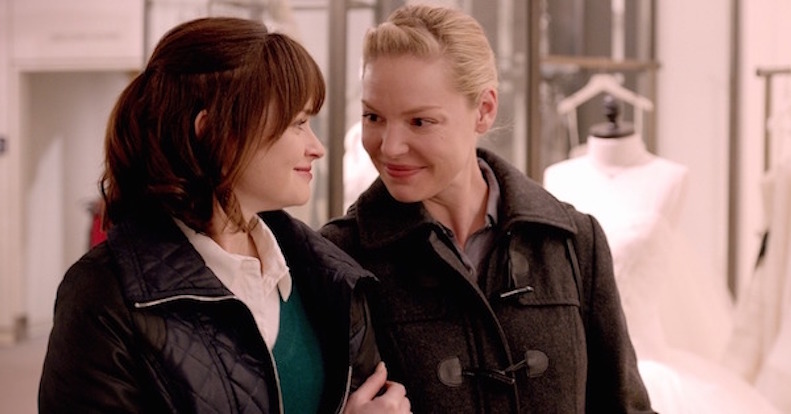
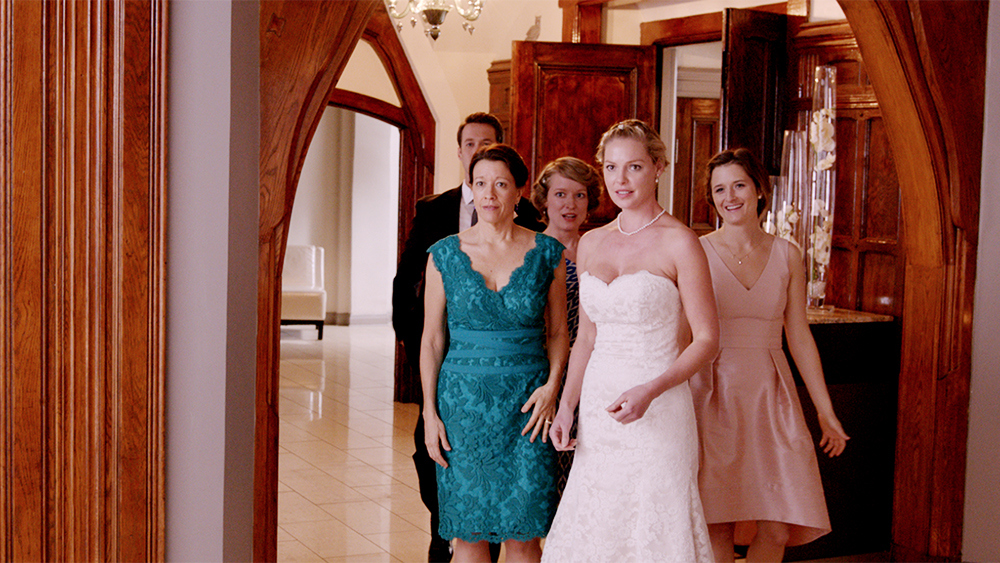
Question: when is a Woody Allen movie not quite a Woody Allen movie? Answer: when it’s written and directed by John Turturro… who’s had help from Woody Allen in assembling the script. A broad romantic comedy with a large helping of sympathy for its characters, Turturro’s fifth outing in the director’s chair is an engaging, likeable movie that has all the hallmarks of a Woody Allen movie, but then tweaks them in varied and surprising ways.

It begins with Turturro’s character, Fioravante, helping his friend, Murray (Allen), with the closure of his bookstore. Looking for a new business opportunity, Murray reveals that his dermatologist, Dr Parker (Stone), revealed to him during an appointment that she and a girlfriend of hers, Robbie (Vergara), are looking to engage in a ménage à trois. As Dr Parker is willing to pay for the experience, Murray suggests that Fioravante is the man they need, but he’s initially resistant to the idea. Eventually, Murray convinces his friend to take the “job” and contacts Dr Parker. She decides to meet Fioravante on her own to see if he will be suitable. He passes the test and soon, Dr Parker is recommending his services to some of her friends, while Murray is drumming up clients in his own fashion.

Fioravante’s success as an escort leads to an unexpected encounter. Through Murray, Fioravante meets the widow of a Hassidic Jew, Avigal (Paradis). They begin a tentative relationship that attracts the attention of Dovi, who works for Shomrim, a neighbourhood patrol. He has been in love with Avigal since they were teenagers, and he begins to follow her when she leaves the neighbourhood. While Fioravante and Avigal spend more and more time together, Dr Parker finally decides the time is right for the planned threesome to go ahead. But just at the point that Fioravante realises that he’s in love with Avigal, Dovi grabs Murray off the street and takes him to face a Rabbinic court. His involvement with Avigal is questioned, and it takes an unexpected intervention to resolve matters once and for all.

From the very beginning, Fading Gigolo is a genial, simple, romantic comedy drama that does what it does with equanimity, and which never tries to go beyond its basic remit. It’s this self-awareness that helps the movie immensely, and while the characters are largely stereotypical and written in broad brush strokes, Turturro’s direction encourages his talented cast to portray them with small, idiosyncratic details that help enhance the material as a whole. Turturro, both as director and actor, is generous with his cast, and his lack of selfishness in front of the camera is reflected in his largesse behind it.  Turturro also encourages his cast to underplay their emotions and provide more subtle character beats than would be expected (Stone in particular is good as a confident professional whose vulnerability is revealed during her first meeting with Fioravante). There’s a lot going on below the surface a lot of the time, and more is relayed to the viewer by the characters’ expressions than by the dialogue.

This allows the viewer to respond to the material to a much greater degree than might be expected. As a result, the movie gains increasing credibility as a romantic drama, and the cast respond accordingly. As it slips off its comedic mantle in favour of dealing properly with the emotional and relationship issues that have arisen, Turturro ensures each development is accorded the relevant amount of sincerity and pathos (except for Balaban’s appearance as Murray’s lawyer at the Rabbinic court, a turn that is resolutely out of place, and is the one major lapse in Turturro’s direction). The emerging friendship between Fioravante and Avigal is treated with a tenderness and a subtlety that mirrors the mutual uncertainty that both are feeling, and Paradis perfectly expresses the sadness and the hope that Avigal feels as both a widow and a woman. In comparison, Turturro keeps his performance reined in, barely moving, and keeping his dialogue to a minimum, and yet still expressing his character’s anxieties and sense of anticipation. The outcome of their relationship is never in doubt – such is the entirely foreseeable nature of the screenplay – but when it comes it, it’s a brief and affecting moment that in a very succinct fashion, highlights exactly why the outcome is what it is.

Allen’s participation is unusual in that he rarely appears in other people’s movies these days – the last time was in Alfonso Arau’s Picking Up the Pieces (2000), which also featured Stone – but what isn’t a surprise is that he plays yet another minor variation on the neurotic Jewish intellectual-cum-nebbish he’s been playing for over fifty years. He does infuse the role with a desperate, greedy quality we haven’t seen before, but otherwise it’s business as usual. Fortunately, Allen’s presence doesn’t overwhelm things, and his supporting role is integrated effectively into the main storyline. Again, there are many similarities between this movie and others that Allen has made over the years, enough perhaps to make him feel comfortable in taking on the part. But though his involvement in the script has been confirmed by Turturro, this isn’t a movie that anyone could say Allen directed. Turturro has his own style, and he approaches the characters in a very different way from the way that Allen does. And faced with such a predictable plot to begin with, that Turturro does overcome it is a sign of the actor’s confidence in being a director.

Rating: 7/10 – funny and dramatic in equal measure, Fading Gigolo never loses sight of what’s important and at the heart of its tale: how much we want to connect, and how much we’re willing to give of ourselves in order to make that connection; Turturro makes it all look relatively easy, and does so by remembering that every character (even Murray) is looking for love in some form or other, and that even if it’s provided by an escort, it can still be fulfilling and/or the right choice. (7/31)

Share this:

  • Share on X (Opens in new window) X
  • Share on Facebook (Opens in new window) Facebook
  • More
  • Print (Opens in new window) Print
  • Email a link to a friend (Opens in new window) Email
Like Loading...

Multiple Maniacs (1970)

03 Monday Jul 2017

Posted by dullwood68 in Movies

≈ 1 Comment

Tags

Baltimore, Catch Up movie, Comedy, Crime, David Lochary, Divine, Drama, John Waters, Mary Vivian Pearce, Mink Stole, Murder, Review, The Cavalcade of Perversion

D: John Waters / 96m

Cast: Divine, David Lochary, Mary Vivian Pearce, Mink Stole, Cookie Mueller, Edith Massey, Rick Morrow, Howard Gruber, Paul Swift, Susan Lowe, George Figgs

Some movies that garner a reputation for being “obscene” or “perverted” upon release generally don’t have a long shelf life, and soon fade not into obscurity exactly, but rely on gaining a cult following to ensure they’re still watched and talked about. And any such movie certainly won’t expect to be critically lauded, or attain cult status amongst those who’ve seen it unless it has something that no one other movie can offer, and John Waters’ Multiple Maniacs has that something: the amazing, human tornado of strident perversion called Divine.

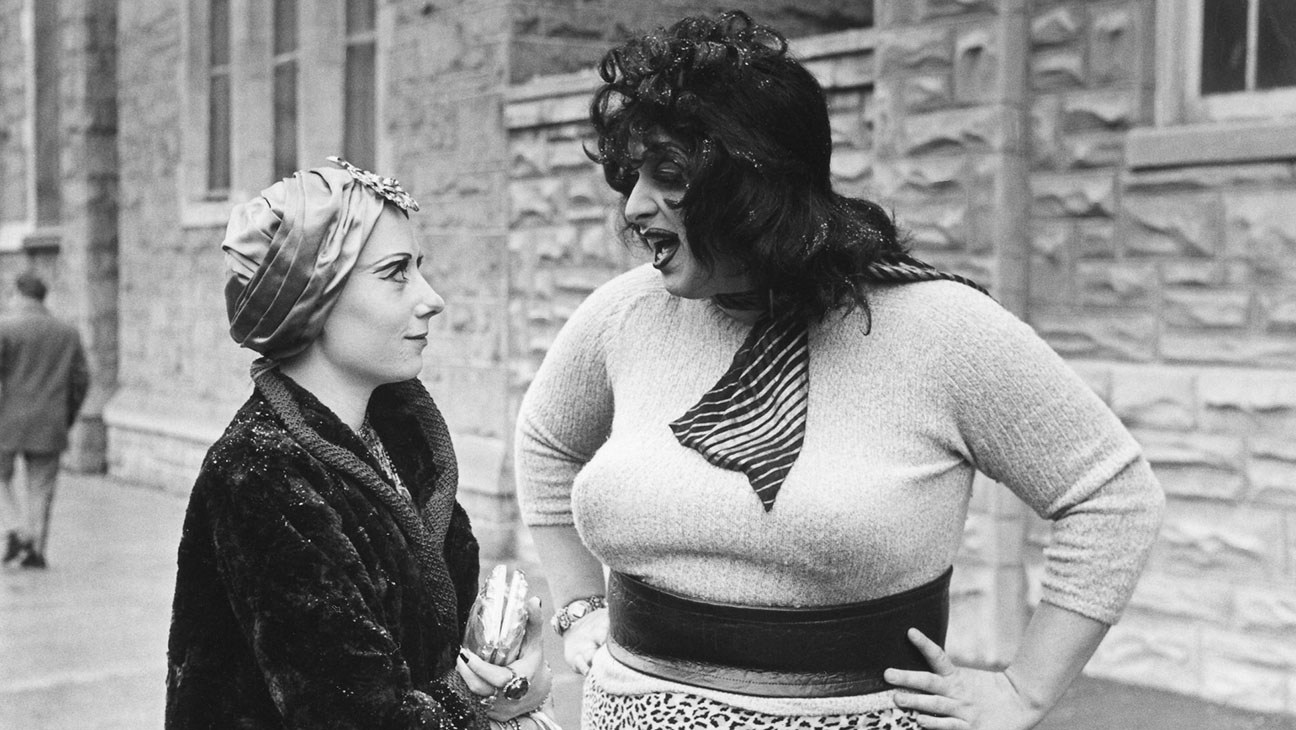
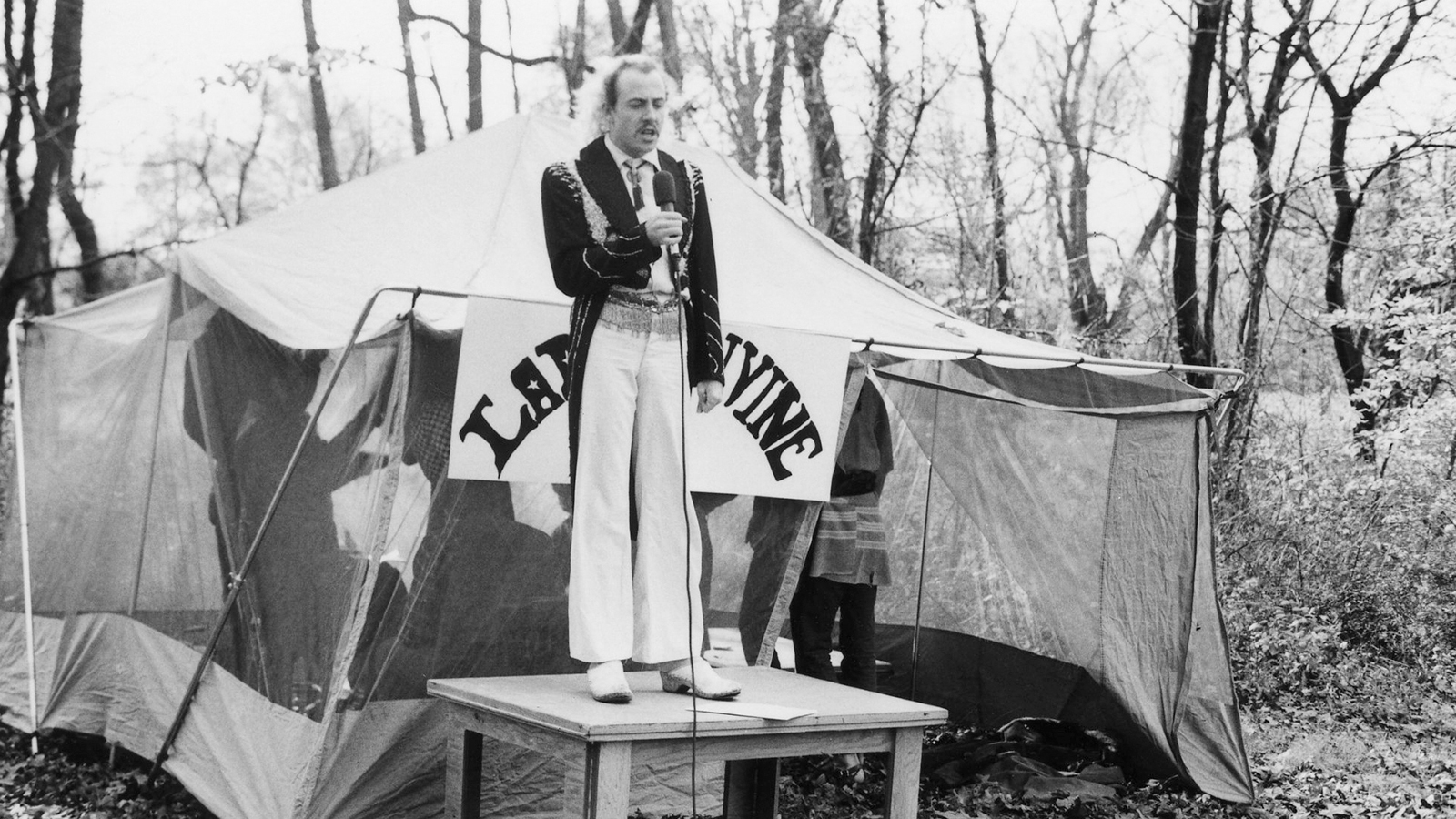
Waters’ early work – this is his second feature – is synonymous with the rise of Harris Glenn Milstead as the merciless, murderous-minded, savagely anti-establishment grotesquerie known as Divine. This is a movie that puts itself out there as being counter-culture entertainment, a bargain basement, shot-on-16mm trash bag of arch religious references, austere social commentary, and documentary-like footage. It doesn’t look or feel like a standard issue movie because Waters has deliberately chosen to shoot it in such a diffuse, non-professional way that it often looks like a collection of outtakes strung together for convenience rather than a truly finished product where everything was shot as planned and nobody forgot their lines in the middle of a scene (which happens here a lot). There’s also a lot of guerrilla moviemaking, as outdoor scene after outdoor scene reveals a member of the public looking on in confusion and/or horror at what they’re witnessing (Divine in various states of undress and challenging middle class perceptions of good taste).

Beneath all the amateur hour shenanigans and louche bravado of its characters though, Waters’ ode to unrestrained perversion is touchingly conservative in its approach, and nowhere near as bizarre as it wants you to believe. Part of the appeal of Waters’ movies in the early Seventies is their deliberate inversion of public, social and moral standards, and the ways in which Waters’ gleefully attempted to subvert the cultural values of the time. Waters was only twenty-four when he made Multiple Maniacs, but it feels like a movie made by a rebellious teenager taking pot shots at his parents (the religious elements) and the passive determinism of the denizens of his home town of Baltimore. It’s no wonder Waters wants to shake things up and challenge the status quo; he’s a young man still working out his issues from growing up.

In Multiple Maniacs, this kind of celluloid psychotherapy finds its best and truest expression in the form of Lady Divine (Divine, naturally) and her Cavalcade of Perversion, the travelling freak show she fronts as a way of making money (by robbing the poor fools who are persuaded to see the show), and espousing her contempt for society. Lady Divine surrounds herself with “assorted sluts, fags, dykes and pimps” because they share her disdain for more traditional adult roles. They’re the protesters and the dissenters, acolytes who share her (and Waters’) disapproval at the way society treats the disenfranchised and the socially excluded. Lady Divine would kill them all if she could, but Waters’ Catholic upbringing precludes such extreme measures, and though his transgressive alter ego does kill on a handful of occasions, and even feasts on the entrails of one of her victims, when she’s finally consumed by a murderous mania, the most violent act she commits is to take a sledgehammer to a car.

The movie’s more violent excesses are leavened by unintentional moments of levity, such as when Lady Divine attempts to stab her new friend, the Religious Whore (Stole), and begins her attack by stabbing the air above the character’s head, an obvious concession to the fact that Divine is wielding a real knife and doesn’t want to hurt his co-star. And towards the end, when Lady Divine is chasing dozens of people through the streets of Baltimore, her terrifying creature moment is undermined by the number of faces that are displaying laughter instead of terror. But through it all, Waters makes no apologies for the excesses he portrays, and he burns any religious bridges he may have had access to by juxtaposing Christ and the Stations of the Cross with Lady Divine being anally pleasured by a rosary-wielding Mink Stole. It’s profane and it’s crass but it’s still just Waters railing against the formalities and restrictions imposed by organised religion.

When Waters isn’t expressing his dissatisfaction with contemporary morality, he’s holding up a mirror to contemporary issues as well, with mentions of the murder of Sharon Tate – Lady Divine tortures her boyfriend, Mr David (the splendid David Lochary), with the possibility he was involved in her murder – and various references to the war in Vietnam. And he’s surprisingly waspish when it comes to notions of the nuclear family, with Lady Divine doting on her somewhat promiscuous daughter, Cookie (Mueller), while submitting to the attentions of glue-sniffing rapists, Miss Stole and her beads, and a giant lobster (Lobstora) that appears out of nowhere and sets her on the road to sexually-induced hysterical violence. And the idea that Mr David could be seeing another woman, Bonnie (Pearce), whips her into a hypocritical frenzy (and allows Waters’ favourite Edith Massey to provide her first mangled performance in one of his movies).

The dialogue is suitably terse and aggressive, as befits a group of characters who are angry at themselves and the wider world, and though the performances are what you’d have to charitably regard as “authentically naïve”, there’s a rude energy to it all that more than makes up for the deficiencies of shooting on such a low budget. Waters opts for some uncomfortable close ups to highlight the pains and suffering felt by his characters, and doesn’t always worry if those images are distorted or out of focus (one gets the feeling a lot of scenes and shots were the first, and only, take). This adds to the documentary tone the movie adopts and exploits from time to time, and shows that Waters was very much aware of the concept of cinema verité when he was putting his movie together. All of which makes Multiple Maniacs a more heartfelt and poignant movie than may be expected, and shows that, despite all the attempts at shocking its audience, the movie is as much an ode to treating people of all walks of life fairly as it is about exposing the social injustices that stop this from happening. This leaves John Waters looking very much like a social reformer – and who would have thought that?

Rating: 8/10 – a trial by fire for anyone unfamiliar with Waters’ early work, Multiple Maniacs nevertheless works on many levels and is unremittingly earnest in its exposure of small-minded hypocrisy amongst middle-class America and its apologists; for all the sturm und drang on display though, it’s a tract that preaches acceptance but only insofar as you conform to the way society expects you to behave – and if you don’t, then society will call out the National Guard. (3/31)
Share this:

  • Share on X (Opens in new window) X
  • Share on Facebook (Opens in new window) Facebook
  • More
  • Print (Opens in new window) Print
  • Email a link to a friend (Opens in new window) Email
Like Loading...

Monthly Roundup – June 2017

30 Friday Jun 2017

Posted by dullwood68 in Movies

≈ 1 Comment

Tags

Attack of the Killer Donuts, Bakery, Barbara Kent, Before the Flood, Carole Lombard, CHIPS, Climate change, Comedy, Crime, Dax Shepard, Documentary, Dough, Drama, Fisher Stevens, Grief Street, High Voltage, Horror, Howard Higgin, Jerome Holder, John Goldschmidt, John Holland, Jonathan Pryce, Justin Ray, Kay Linaker, Kayla Compton, Leonardo DiCaprio, Michael Peña, Murder, Mystery, Ralph Morgan, Raymond Cannon, Reviews, Richard Thorpe, Scott Wheeler, The Outer Gate, Thriller, William Boyd

Attack of the Killer Donuts (2016) / D: Scott Wheeler / 85m

Cast: Justin Ray, Kayla Compton, Ben Heyman, Michael Swan, C. Thomas Howell, Fredrick Burns, Kassandra Voyagis, Chris De Christopher, Lauren Compton, Alison England, Michael Rene Walton

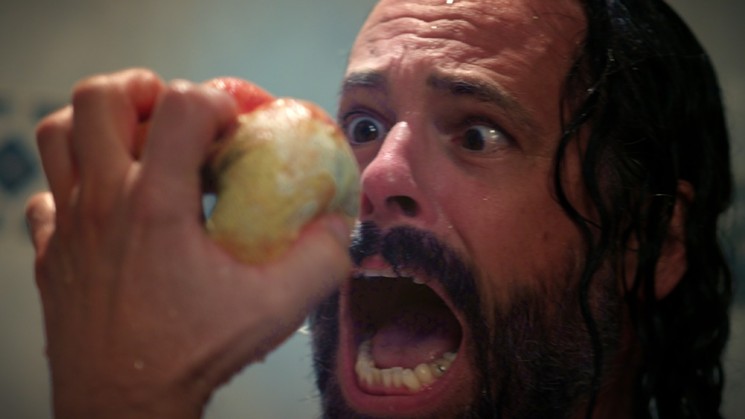
Rating: 3/10 – Johnny (Ray) works in a donut shop, while his mad scientist uncle (Swan) works in his basement lab cooking up a formula that – surprise! – will eventually turn donuts into flesh-hungry, bloodthirsty… donuts; bottom of the barrel stuff that aims for kitschy fun but misses by a mile, Attack of the Killer Donuts wears its sugar-coated heart on its sleeve, but is too awful in its execution to make up for its many, many, many faults, or the fact that it’s run out of steam before the first victim is put out of their misery (unlike the audience).

Before the Flood (2016) / D: Fisher Stevens / 96m

With: Leonardo DiCaprio, Alejandro González Iñárritu, Al Gore, Elon Musk, Barack Obama, John Kerry

Rating: 8/10 – actor and UN Messenger of Peace on Climate Change, Leonardo DiCaprio explores the ways in which the world is still refusing to acknowledge the effects of greenhouse gases and the need to switch to renewable energy; DiCaprio is a passionate environmental activist who has access to many of the “big players”, and his targeted globe-trotting highlights the natural disasters that are occurring all around us, all of which makes Before the Flood a worthy successor to Al Gore’s An Inconvenient Truth (2006), and an important, and sadly necessary, acknowledgment that we’re still not doing enough to turn things around and ensure our collective futures.

Dough (2015) / D: John Goldschmidt / 95m

Cast: Jonathan Pryce, Jerome Holder, Phil Davis, Ian Hart, Pauline Collins, Andrew Ellis, Malachi Kirby, Natasha Gordon, Melanie Freeman, Daniel Caltagirone, Andy de la Tour

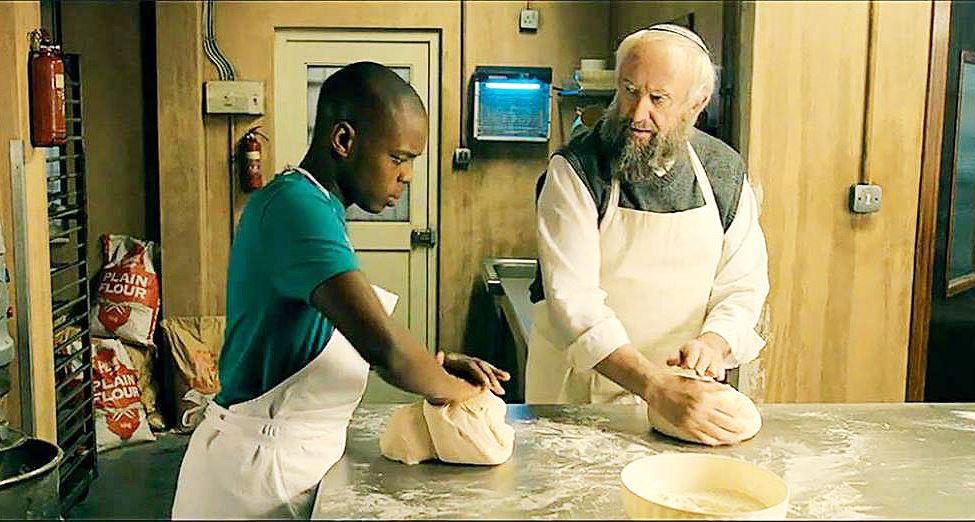
Rating: 7/10 – an aging Jewish baker (Pryce) takes on an apprentice (Holder) whose second job as a drug dealer leads to the bakery’s sales going through the roof when an unexpected ingredient finds its way into the dough mix; a genial, inoffensive movie that features winning performances from Pryce and Holder, Davis as the kind of smarmy business developer who belongs in a pantomime, and a pleasant sense of its own shortcomings, Dough is a cross-cultural comedy drama that is amusing for the most part but which lacks the substance needed to make it more engaging.

Grief Street (1931) / D: Richard Thorpe / 64m

Cast: Barbara Kent, John Holland, Dorothy Christy, Crauford Kent, Lillian Rich, James P. Burtis, Larry Steers, Lloyd Whitlock

Rating: 5/10 – there are plenty of suspects, but just who did kill less than popular stage actor Alvin Merle (Kent), and why?; a locked room murder mystery where everyone with a motive is assembled Agatha Christie-style at the end to reveal the murderer, Grief Street is a brash, enjoyable whodunnit whose villain will be obvious to anyone who’s seen more than a handful of similarly plotted movies, but the movie more than makes up for this thanks to spirited performances from its cast, and Thorpe’s relaxed directing style.

The Outer Gate (1937) / D: Raymond Cannon / 63m

Cast: Ralph Morgan, Kay Linaker, Ben Alexander, Eddie Acuff, Charles Brokaw

Rating: 5/10 – when an up-and-coming employee (Alexander) is sent to prison for embezzlement, his employer (Morgan) is the first to believe in his guilt, but when the truth is revealed and he’s released from jail, the employee sets about getting his revenge; directed by Cannon in a crude, rudimentary way, The Outer Gate is nevertheless a movie that plays to the strengths of its gosh-you-won’t-believe-it screenplay, Morgan’s low-key, passive performance, and a surprisingly grim fatalism, all of which make it more intriguing than it appears to be on the face of things.

High Voltage (1929) / D: Howard Higgin / 63m

aka Wanted

Cast: William Boyd, Carole Lombard, Owen Moore, Phillips Smalley, Billy Bevan, Diane Ellis

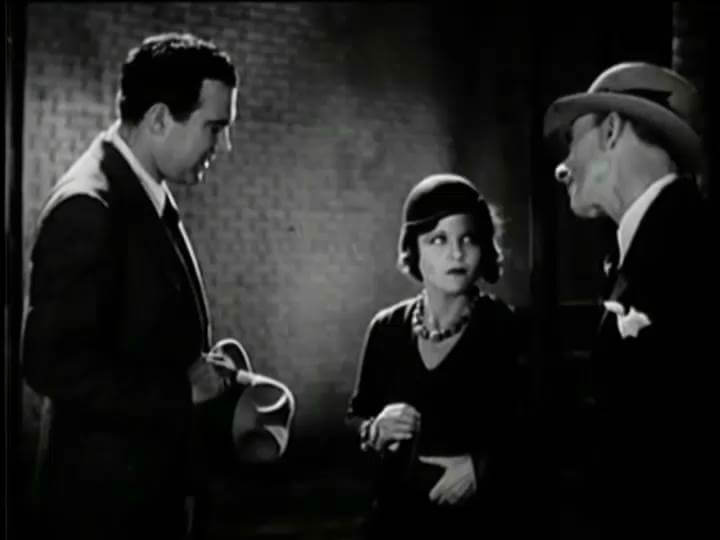
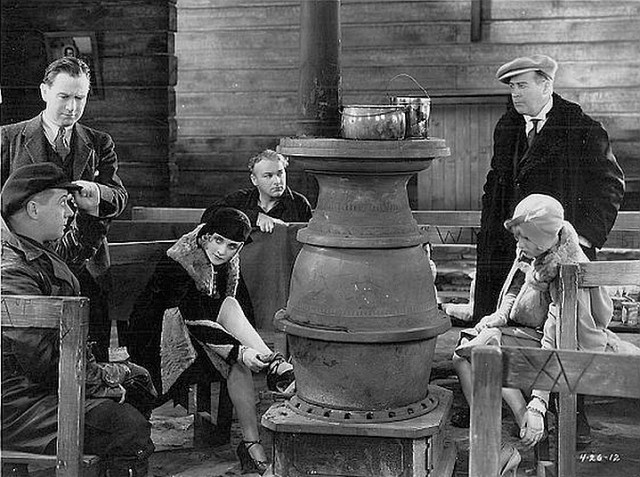
Rating: 4/10 – when a bus load of passengers is stranded thanks to heavy snow, they take refuge in an abandoned church, only to find they’re not alone; a dialogue heavy drama made in the early days of the Talkies, High Voltage is a well acted if dreary experience that tries hard to make itself interesting but falls short thanks to its focus on (already) stereotypical characters and the period’s need for a neat, everything-wrapped-up-satisfactorily ending.

CHIPS (2017) / D: Dax Shepard / 101m

Cast: Michael Peña, Dax Shepard, Vincent D’Onofrio, Rosa Salazar, Jessica McNamee, Adam Brody, Isiah Whitlock Jr, Kristen Bell, Justin Chatwin

Rating: 4/10 – rookie motorcycle cop Jon Baker (Shepard) is teamed up with newly transferred Frank Poncharello (Peña) in the California Highway Patrol, and soon finds himself tracking down a bunch of dirty cops led by veteran Ray Kurtz (D’Onofrio); forty years on from its origin as a TV series, CHIPS is given a big screen reboot thanks to fanboy Shepard, but is only moderately successful in its efforts to drag the show kicking and screaming into the 21st century, leaving it completely dependent on how you feel about Shepherd and Peña as a comedy duo, and its less than inspired script.

Share this:

  • Share on X (Opens in new window) X
  • Share on Facebook (Opens in new window) Facebook
  • More
  • Print (Opens in new window) Print
  • Email a link to a friend (Opens in new window) Email
Like Loading...

Baywatch (2017)

28 Wednesday Jun 2017

Posted by dullwood68 in Movies

≈ 3 Comments

Tags

Comedy, Drugs, Dwayne Johnson, Lifeguards, Priyanka Chopra, Reboot, Review, Seth Gordon, Zac Efron

D: Seth Gordon / 116m

Cast: Dwayne Johnson, Zac Efron, Priyanka Chopra, Alexandra Daddario, Kelly Rohrbach, Ilfenesh Hadera, Jon Bass, Yahya Abdul-Mateen II, Hannibal Buress, Rob Huebel, David Hasselhoff, Pamela Anderson

Drivel.

Rating: 2/10 – drivel; just drivel.

Share this:

  • Share on X (Opens in new window) X
  • Share on Facebook (Opens in new window) Facebook
  • More
  • Print (Opens in new window) Print
  • Email a link to a friend (Opens in new window) Email
Like Loading...

Trailers – Bronx Gothic (2017), Stronger (2017) and The Hippopotamus (2017)

27 Tuesday Jun 2017

Posted by dullwood68 in Movies

≈ Leave a comment

Tags

Andrew Rossi, Boston Marathon bombing, Comedy, Dance piece, David Gordon Green, Documentary, Drama, Jake Gyllenhaal, Literary adaptation, Okwui Okpokwasili, Previews, Roger Allam, Stephen Fry, Tatiana Maslany, Trailers, True story

If you’ve seen the New York-based writer, performer and choreographer Okwui Okpokwasili then you’ll be aware of just how magnetic a stage presence she is, and how impressive is her ability to manipulate her frame in such a way as to give full expression to an incredible range of feelings and desires and emotions. In 2014, Okpokwasili performed her one-woman dance piece, Bronx Gothic, where she used a series of letters sent between two young girls in the Bronx – and her remarkable body – to illustrate how little one of them knew about her body, and how they were able to connect with each other. It was a tour-de-force performance, and is now the subject of Andrew Rossi’s latest documentary. Rossi, who also made Page One: Inside the New York Times (2011) and The First Monday in May (2016), goes behind the scenes of Bronx Gothic and examines the way in which Okpokwasili conceived and created the piece, and how she used elements from her own life in the process. This may not attract a particularly wide audience base, but it promises to be one of the more original and impressively mounted documentaries of 2017. And with Okpokwasili being such an incredible performer to watch, any chance to see her is absolutely worth taking.


Following on the heels (no pun intended) of Peter Berg’s gripping Patriots Day (2016), Stronger tells the smaller scale story of one of the victims of the 2013 Boston Marathon bombing. Jeff Bauman (played by Jake Gyllenhaal) was caught in the first blast and lost both his legs. The movie, based on the book of the same name written by Bauman and Bret Witter, charts Bauman’s recovery and readjustment to life in the wake of the tragedy, and how his rehabilitation affected him, and his relationship with his girlfriend, Erin Hurley (played by Tatiana Maslany). Without trying to denigrate or undermine Bauman’s efforts to learn how to walk again, and overcome the emotional trauma he experienced, the trailer for Stronger hints at the movie being a straightforward re-telling of Bauman’s struggle, and the trailer’s content seems to include all the clichés you’d expect, right down to the moment where Bauman cries, “I showed up for you!” Let’s hope then that director David Gordon Green has a tighter grip on the material than is evident from the trailer, and that Bauman’s story is given a better handling than what we’ve seen so far.


When he’s not appearing on television or in the movies, Stephen Fry is also a well regarded writer with a string of successful books to his name. The Hippopotamus was his second novel to be published, and if you’ve read it then you’ll know that it’s ripe for a big screen adaptation (or a small screen mini-series). And at last that big screen adaptation is here, and for once, with the perfect choice for its lead character, disgraced poet Ted Wallace, in the form of Roger Allam. Allam’s crumpled features and unimpressed demeanour are a terrific combination for the part, and from the trailer it’s clear that the actor has the measure of the role and is also enjoying himself immensely. Whether or not the script will allow him to be the singular focus of Fry’s typically erudite comedy of manners remains to be seen, but if so then this could be the movie that provides a well-earned boost to Allam’s career. Let’s hope then, that Fry’s eccentric yet amusing novel has been given the adaptation it deserves.

Share this:

  • Share on X (Opens in new window) X
  • Share on Facebook (Opens in new window) Facebook
  • More
  • Print (Opens in new window) Print
  • Email a link to a friend (Opens in new window) Email
Like Loading...

Table 19 (2017)

16 Friday Jun 2017

Posted by dullwood68 in Movies

≈ Leave a comment

Tags

Anna Kendrick, Comedy, Craig Robinson, Drama, Jeffrey Blitz, June Squibb, Lisa Kudrow, Randoms, Relationships, Review, Romance, Stephen Merchant, Tony Revoroli, Wedding

D: Jeffrey Blitz / 87m

Cast: Anna Kendrick, Lisa Kudrow, Craig Robinson, Stephen Merchant, June Squibb, Tony Revolori, Wyatt Russell, Amanda Crew, Thomas Cocquerel, Margo Martindale

Eloise McGarry (Kendrick) is in a difficult place: with her best friend Francie’s wedding fast approaching, her boyfriend (and Francie’s brother) Teddy (Russell) dumps her, but she still receives an invitation to the wedding. She decides to attend but at the reception, finds that she’s been allocated a seat at Table 19, the furthest table away from the bride and groom’s. There she meets Bina and Jerry Kepp (Kudrow, Robinson), diner owners who know the groom’s father; Jo Flanagan (Squibb), who was Francie’s first nanny; Renzo (Revolori), whose parents are acquaintances of the groom’s family; and Walter (Merchant), a cousin of Francie’s father. Together they are the Randoms, the people who don’t fit in with any of the other tables. And as Jerry points out, it’s the table nearest the toilets.

As the reception gets under way, Eloise and Teddy argue over her being there, Renzo reveals that his parents have pushed him into going in order to meet a girl, Walter reveals a criminal past, Jo reflects on the good times she had as Francie’s nanny, and Bina and Jerry’s marriage shows signs of being under strain. As they learn more and more about each other they begin to find common ground, and band together when it’s clear that no one else at the reception will miss them or engage with them. A stranger (Cocquerel) makes a brief but telling connection with Eloise, Jo persuades most of the group to take medical marijuana with her, Bina surprises Jerry with the real reason why she agreed to attend the wedding, Renzo makes increasingly inappropriate overtures to one of the younger female guests, and Walter throws caution to the wind and comes out of the shell his family have imposed on him. By the end of the night, all their lives will have changed, and mostly for the better, with Eloise making a very big decision, and her actions emboldening everyone else who was assigned to Table 19.

On the face of it, Table 19 has all the hallmarks of an amiable comedy of manners that opts for easy laughs and doesn’t try too hard to entertain its audience. And on the face of it, that’s entirely true. For the most part, the movie is entirely predictable, plays it safe in terms of characterisations and its by-the-numbers storyline, and offers little in the way of wit or sophistication. Viewers who like this sort of thing will be able to guess who Eloise ends up with right from the start, and there are several scenes that exist just to provide unnecessary exposition instead of pushing the various subplots forward. Some of the movie is also unbearably trite, and there are moments where director Jeffrey Blitz – making only his second feature after Rocket Science (2007) – seems unable to combat the curious sense of inertia that settles over the movie and halts its momentum.

But buried amongst all the familiar rom-com tomfoolery and wacky behaviour of Kendrick et al, there’s a relationship drama unfolding that perhaps should be the focus of an entirely separate movie. When we first meet Bina and Jerry they’re sitting in adjacent booths in their diner, and with their backs to each other. They bicker about attending the wedding, and conclude their bickering by giving each other the finger. It’s amusing (to a point), but an early indication of the disparity that’s grown to the fore in their marriage. Jerry is supremely confident about most things, while Bina is subdued and quick to challenge Jerry’s assertions. As the evening draws on, we see how unhappy Bina is, and how oblivious Jerry is to her unhappiness. At one stage he tells her he hasn’t changed, as if it was a badge of pride. But Bina’s argument is much more succinct: if he believes he hasn’t, then why is she so unhappy? The only real dramatic element in a movie that tries hard to make a virtue of being twee and genially subversive at the same time, Bina and Jerry’s fractured marriage is also the only element that is likely to engage the audience and offer any real reward or satisfaction. As the couple-at-odds, Kudrow and Robinson deliver confident and touching performances, and their scenes together are absorbing for being so different from the rest of the movie (which is a good thing). It’s a pleasure to see two actors who are known more for their appearances in comic roles, commit so completely to examining the interior lives of two supporting characters, and achieve so much in the process. Simply put, they make the viewer care about both of them.

Blitz has written the screenplay based on a story he’s collaborated on with the Duplass brothers, Jay and Mark. This is likely the reason that Bina and Jerry’s story has such resonance, as the dialogue between the two regularly steps outside the range of a mid-budget, mainstream romantic comedy. It’s a shame then that their story has to rub shoulders with the rest of the movie, and take a back seat to the trials and tribulations experienced by Eloise, and the rest. The good news is that the ensemble cast has been well chosen, with all six Table 19-ers (except Kendrick) triumphing over the screenplay’s stock situations and tired characterisations. And the movie does at least have its visual moments thanks to Ben Richardson’s skillful cinematography and Timothy David O’Brien’s clever production design, which takes a modern day wedding reception and keeps it looking like a throwback to the Eighties. But these are plusses in a movie that otherwise contents itself with being only occasionally effective.

Rating: 5/10 – worth watching for the dynamic between Bina and Jerry alone, Table 19 is let down by its generic rom-com approach and laboured sense of humour; a sharper, more detailed script would have benefited the movie greatly, but as it stands, it’s yet another wasted opportunity released to audiences who will have seen this sort of thing too many times for comfort.

Share this:

  • Share on X (Opens in new window) X
  • Share on Facebook (Opens in new window) Facebook
  • More
  • Print (Opens in new window) Print
  • Email a link to a friend (Opens in new window) Email
Like Loading...

Norman: The Moderate Rise and Tragic Fall of a New York Fixer (2016)

14 Wednesday Jun 2017

Posted by dullwood68 in Movies

≈ Leave a comment

Tags

Black comedy, Charlotte Gainsbourg, Comedy, Drama, Fixer, Joseph Cedar, Lior Ashkenazi, Michael Sheen, Politics, Review, Richard Gere, Steve Buscemi

D: Joseph Cedar / 118m

Cast: Richard Gere, Lior Ashkenazi, Michael Sheen, Charlotte Gainsbourg, Dan Stevens, Steve Buscemi, Harris Yulin, Yehuda Almagor, Neta Riskin, Hank Azaria, Scott Shepherd, Josh Charles, Isaach De Bankolé

Norman Oppenheimer (Gere) is an aging, low-level fixer, a facilitator who wants to help people succeed in business, but who doesn’t have the necessary contacts to make things happen or to avoid being looked on with suspicion, or being dismissed out of hand. When he approaches a young investment banker, Bill Kavish (Stevens), with a deal that could make Kavish’s boss, Jo Wilf (Yulin), a fortune, he’s given the brush off. With the deal involving Israeli tax write-offs, Norman turns his attention to rising Israeli politician, Micha Eshel (Ashkenazi), who is in New York for a brief visit. He “bumps into” Eshel outside a men’s clothing store where Eshel is admiring a pair of shoes. Norman buys Eshel the shoes – as a gift – and persuades him to to join Norman at a party he’s going to that night at the home of Wilf’s main rival, Arthur Taub (Charles). But Eshel doesn’t go, and Norman’s plan to get the two men together (and involve Taub in the deal for the Israeli tax write-offs) falls apart.

Three years later, Norman is still committed to helping people achieve great success in their lives, when Eshel returns to New York as the new Israeli Prime Minister. At a reception, Norman and Eshel are reunited, and Eshel welcomes him into his inner circle as a close friend. But any further access becomes difficult, with Eshel’s chief advisor, Duby (Almagor), ensuring Norman’s calls go unanswered. Meanwhile, the synagogue that Norman is affiliated with is threatened with being sold off unless $14 million can be raised to save it. Norman takes it on himself to do so, and when Eshel asks for Norman’s help in getting his son into Harvard, he sees a way of turning the favour into a chance to save the synagogue. But his plan doesn’t work out, and Norman begins to weave a web of lies and half-truths in an effort to keep his relationship with Eshel, and the synagogue, alive in the eyes of everyone around him. But when he talks to a special Israeli investigator (Gainsbourg) on a train, and innocently mentions his connection with Eshel – and those shoes – it puts in motion a series of events that Norman couldn’t have predicted, and which leaves him having to make a decision that will have far-reaching consequences for everyone he’s involved with – and most of all, for Norman himself.

In recent years you could be forgiven for wondering if Richard Gere had given up on Hollywood altogether, and had decided to make only low budget movies for the rest of his career. The Second Best Exotic Marigold Hotel (2015), his first mainstream movie since Chicago (2002), reminded us that he could still pull off the kind of matinee idol role he essayed so successfully in the Eighties and Nineties, but it was a surprise to see him in something so pleasantly superficial. Now, after several trips to the indie well, Gere has found a role that suits him as the character actor he prefers to be known as, and which offers him the chance to give his best performance in years. As the indefatigably persistent Norman Oppenheimer, Gere the matinee idol is buried beneath a camel hair coat, flat cap, unflattering hairstyle, and dangling ear buds. There are times when Gere doesn’t even look like Gere, so complete is his transformation. He gives a fascinating portrayal of a man whose entire life is predicated around helping others, of arranging meetings between remarkable men while steadfastly remaining in the background.

This does make Joseph Cedar’s follow up to his Oscar-nominated Footnote (2011) (which also starred Ashkenazi) a little difficult to get to grips with at first, as Norman’s self-effacing personality threatens to overwhelm the narrative. He’s a nice guy, but he’s still not someone you’d want hanging around in your life all the time – which is exactly what he would do. And even though Norman’s motives are entirely genuine and full of good intentions, there’s something about his demeanour that keeps the players he tries to associate with from embracing him entirely (the analogy that would best describe him is the one where he’s the kid who’s chosen last by his classmates to be on someone’s team). We also learn very little about Norman, about his life or his beginnings, how he came to be a fixer. We never see him at home either; instead he retreats to the synagogue when he needs to take a break. And he seems to be financially independent as we never see him receive any money from anyone. He’s a mystery to the viewer, and more so to the characters he interacts with, who never quite manage to interpret his actions as anything other than self-serving.

Cedar’s impressively detailed script gains momentum as the story unfolds, with Norman in the midst of a web of his own making and finding himself trapped at its centre. But Norman never gives up, and though the solution he arrives at is detrimental to himself he doesn’t hesitate to do what he must. And everything he does is for someone else’s benefit; and he doesn’t care if people aren’t appreciative. It’s not the point. Cedar surrounds Norman with a cadre of (mostly) unlikeable contacts and movers and shakers and allows them to manipulate Norman for their own ends, while Norman continues being Norman and sticking to his guns. As the movie progresses, it becomes easier and easier to understand him, and to appreciate what he’s doing, even if the why is missing. In many ways, it’s better that Norman’s motivations remain hidden, as it somehow makes the resolution to his story all the more satisfying.

Gere is surrounded by a talented cast, some of whom appear whenever necessary – Gainsbourg, Stevens, Yulin – and some, like Ashkenazi, whose involvement is absolutely essential to the success of Cedar’s movie. The Israeli-born actor gives a terrific performance as a politician whose moral compass is gradually pulled askew in the name of political expediency. Cedar gifts the actor with a tremendous monologue about the nature of compromise, and Ashkenazi delivers it with scathing wit and undeniable rancour. It’s a stand out moment, and shows that Cedar isn’t going to fall back on standard tropes for his characters, even when they’re engaged in somewhat predictable political manoeuvrings. He’s also constructed a screenplay that is humorous and darkly comic, flecked with delicious subtleties that add to the screenplay’s already impressive nature, and which makes much of the dialogue unexpectedly tart and/or subversive. With Cedar also employing a split screen effect that affords an unexpected emotional weight when it’s used, Norman is a movie that is full of surprises, and definitely worth seeking out.

Rating: 8/10 – the kind of intelligent, well thought out, and observant movie that rarely gets the attention it deserves, Norman: The Moderate Rise and Tragic Fall of a New York Fixer is quite simply a joy to watch, and very easy to recommend; with Gere on such good form, and Cedar in full control of the various elements that make up his entertaining screenplay, the movie may tread some well-worn paths on it’s way to the end, but this shouldn’t put off anyone from seeing it.

Share this:

  • Share on X (Opens in new window) X
  • Share on Facebook (Opens in new window) Facebook
  • More
  • Print (Opens in new window) Print
  • Email a link to a friend (Opens in new window) Email
Like Loading...

Win It All (2017)

11 Sunday Jun 2017

Posted by dullwood68 in Movies

≈ Leave a comment

Tags

Addiction, Aislinn Derbez, Comedy, Drama, Gambling, Jake Johnson, Joe Lo Truglio, Joe Swanberg, Keegan-Michael Key, Review

D: Jake Swanberg / 89m

Cast: Jake Johnson, Aislinn Derbez, Joe Lo Truglio, Keegan-Michael Key, Nicky Excitement, Kris Swanberg, Jude Swanberg, Steve Berg, Arthur Agee, José Antonio García

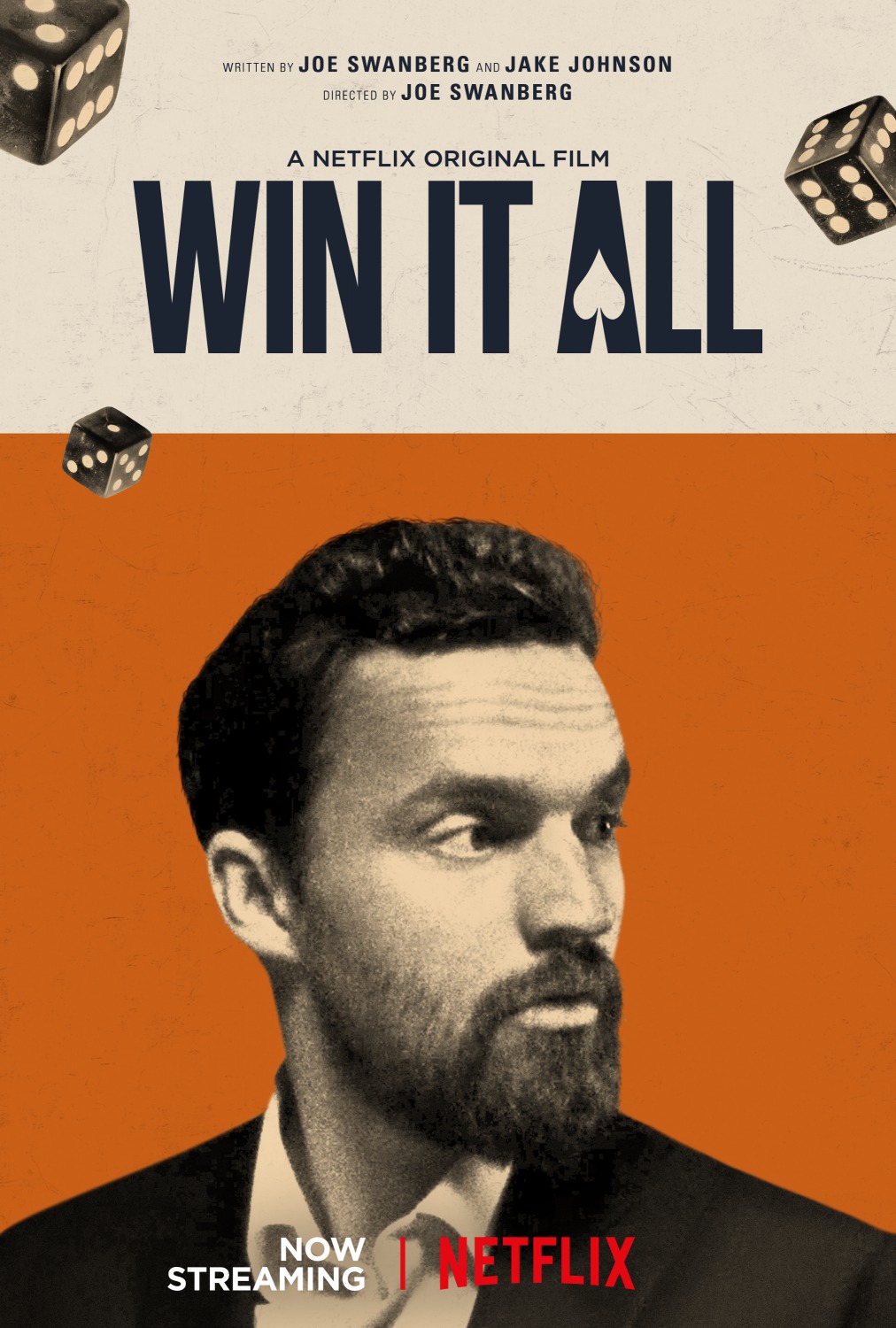
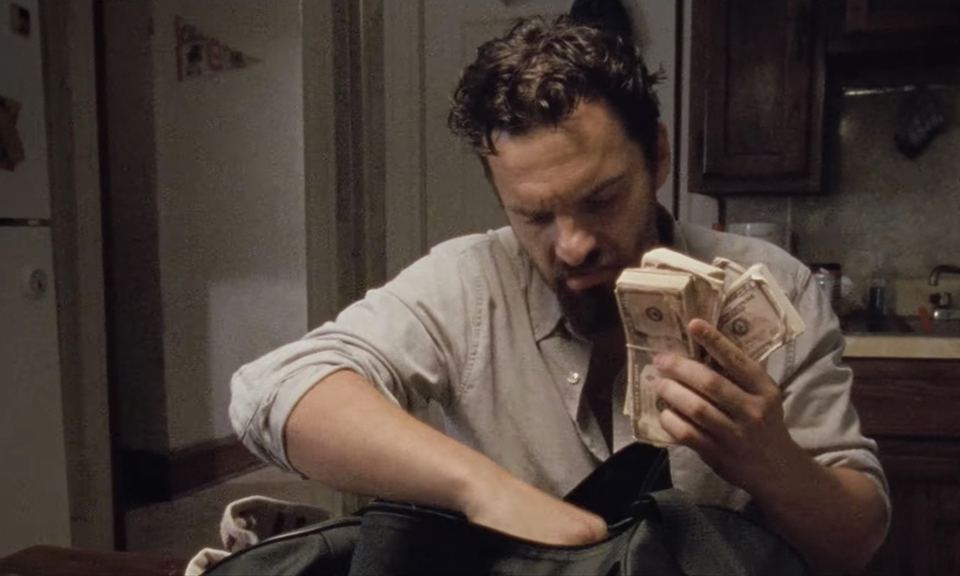
Eddie Garrett (Johnson) is a compulsive gambler. He supports his addiction by working at odd jobs such as parking cars at a sports stadium. He’s in his thirties, isn’t in a relationship, and has no ambition beyond having enough money to bet at his local casino each night. One day an acquaintance of his called Michael (García) makes him a proposition: if Eddie can look after a bag for him while Michael spends time in gaol, there’ll be $10,000 for him when Michael gets out. The only proviso is that Eddie doesn’t look in the bag. Believing himself entirely able to look after the bag, Eddie accepts, but it’s not long before he looks inside it and discovers it contains a lot of money. Eddie convinces himself that it’s okay to take $500 from the bag and use it to gamble. He does so, and he wins over $2,000.

While he’s out celebrating his good fortune, Eddie meets a nurse called Eva (Derbez) and they hit it off. But while they tentatively begin a relationship, Eddie’s gambling addiction leads to him losing the money he’s won, and then using even more of Michael’s money until he’s lost over $21,000. At this point, Eddie decides to turn things around. He goes to work for his brother, Ron (Lo Truglio), at his landscaping business, starts attending GA meetings under the supervision of his sponsor, Gene (Key), and stays away from gambling. He and Eva grow closer and closer, but just as it looks as if everything is going to be okay, Michael calls to say he’s going to be released early. With no other way of recouping the money he’s lost, Eddie takes the rest of Michael’s money and gambles on winning big at a high stakes game…

The directorial career of Joe Swanberg is one that has been consistently entertaining and enjoyable, from early low-budget features such as Hannah Takes the Stairs (2007), and Uncle Kent (2011), through to more polished outings such as Drinking Buddies (2013) and Digging for Fire (2015). The common component in those last two movies and Win It All is Jake Johnson, an actor for whom Swanberg’s off centre, idiosyncratic style of moviemaking (albeit heading toward a more mainstream vibe with each release) seems a perfect match for the actor’s ability to play the careworn, loveable loser with humanity and disarming depth. Such is the case here, with Johnson and Swanberg’s collaboration on the screenplay giving the movie a rough charm that belies the darker themes of addiction and personal dysfunction. Eddie is a classic indie loser: he’s a good person with everyone except himself, and he can’t always understand why Life treats him so badly.

With Eddie being such a recognisable character, it’s not a surprise to learn that the movie as a whole is predictable, although it’s a benign predictability that actually serves the movie well. Win It All is awash with honesty and charm, and it tells its familiar story with a great deal of sincerity. Swanberg has a way of exploring well worn themes with a fresh eye, and with Johnson’s input has made a movie that speaks of redemption in terms of doing what is best and not necessarily what is right. It’s a refreshing angle, and it isn’t delivered in a preachy, patronising manner, but instead it arises naturally out of the situations that Eddie finds himself in. Johnson is ably supported by Derbez and Lo Truglio while Key contributes yet another terrific supporting turn as Eddie’s credulous sponsor. Swanberg and Johnson cram a lot in, but it’s all delivered at a considered, effective pace that suits the narrative well… until the end, that is, which is rushed and feels out of sorts with what’s gone before. But then, just as you think the story is over, a mid-credits scene flips the ending on its head and reveals that the price of redemption is much higher than Eddie, or the viewer, could have expected.

Rating: 8/10 – a winning look at the efforts of a gambling addict trying to go straight, Win It All has plenty to lure in the viewer and reward them for their attention; the movie makes a virtue of its simple plot and flawed central character – and the milieu he inhabits – allowing the material to shine in often unexpected but very, very enjoyable ways.

Share this:

  • Share on X (Opens in new window) X
  • Share on Facebook (Opens in new window) Facebook
  • More
  • Print (Opens in new window) Print
  • Email a link to a friend (Opens in new window) Email
Like Loading...

Pirates of the Caribbean: Dead Men Tell No Tales (2017)

30 Tuesday May 2017

Posted by dullwood68 in Movies

≈ Leave a comment

Tags

Action, Black Pearl, Brenton Thwaites, Comedy, Curse, Drama, Fantasy, Geoffrey Rush, Javier Bardem, Joachim Rønning, Johnny Depp, Kaya Scodelario, Review, Sequel, Trident of Poseidon

aka Pirates of the Caribbean: Salazar’s Revenge

D: Joachim Rønning, Espen Sandberg / 129m

Cast: Johnny Depp, Javier Bardem, Geoffrey Rush, Brenton Thwaites, Kaya Scodelario, Kevin McNally, Golshifteh Farahani, David Wenham, Stephen Graham, Angus Barnett, Martin Klebba, Adam Brown, Giles New, Lewis McGowan, Orlando Bloom, Paul McCartney

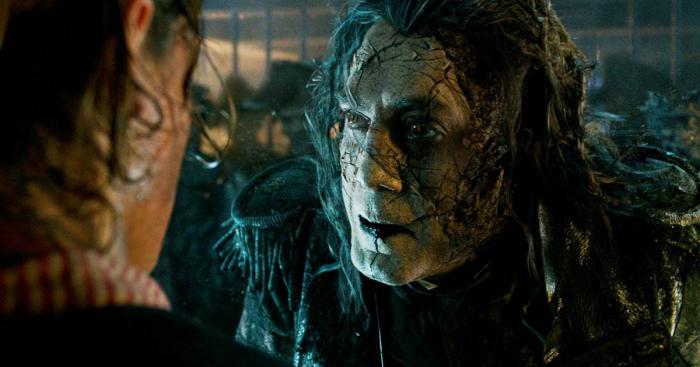
Six years after Pirates of the Caribbean: On Stranger Tides appeared to have brought the franchise to an end, Disney and Jerry Bruckheimer have resurrected Captain Jack Sparrow for one more round of hijinks on the high seas. This movie and a potential sixth in the series were being planned even before On Stranger Tides was released, but production delays and script problems kept Dead Men Tell No Tales from our screens until now. It’s debatable that anyone outside of the cast and crew and studio bosses were enthusiastic about the idea of a fifth movie, and it’s doubtful that even die-hard fans were expecting too much from it, but the series has made a lot of money since it began back in 2003 – over $3.7 billion before this installment – so perhaps another entry shouldn’t be too much of a surprise.

Dead Men Tell No Tales harks back to the simpler, more effective pleasures found in the series’ first movie, Curse of the Black Pearl, and attempts to forget the bloated excesses of the previous two installments by imitating much of what made that movie so successful. However, this approach hasn’t meant a return to form, but instead has stopped the rot. You can argue that this is a better movie than On Stranger Tides, and you wouldn’t be wrong, but both as a stand-alone entry and the continuation of a series that provides links to its predecessors in an ongoing game of Guess-the-Reference, number five in the series is still found wanting.

For a start, there’s the plot, a mish-mash of ideas that are borne out of the idea that hidden somewhere at sea is the Trident of Poseidon, and that this is the cure for all the curses of the sea. At the start of the movie, a young Henry Turner (McGowan) confronts his father, Will (Bloom), and tells him of his plan to find the Trident and free him from his fate as the Flying Dutchman. Will believes the Trident can’t be found, but Henry is determined. Nine years later, Henry is now a young man (Thwaites), and still searching for the Trident, as is astronomer Carina Smyth (Scodelario). She has a book that gives clues to the Trident’s whereabouts, but has been condemned by the British as a witch. Henry, meanwhile, has encountered the ghost of Captain Salazar (Bardem) who is seeking revenge on Captain Jack Sparrow for his supernatural existence. On the island of St Martin, Henry, Carina and Jack all come together and make sail for the unmarked island that can’t be navigated to, closely followed by Salazar and interested party Barbossa (Rush).

There’s more – much more – and therein lies one of the movie’s biggest problems: it takes what should be a fairly straightforward idea and twists it so far out of shape that every attempt to straighten it out merely serves to make it less and less, and less, straightforward. The plot becomes buried under layer after layer of unnecessary twists and turns and double crosses and “clever” subterfuges. The characters’ individual storylines become convoluted and unwieldy, with one relationship forged out of nothing, and as for any character development, that’s been ignored in favour of getting everyone from point A to point B with a minimum of effort or fuss. For a movie that was delayed partly because of script problems, it makes you wonder just how bad scribe Jeff Nathanson’s original screenplay really was (or if Johnny Depp’s widely credited contributions are to blame instead).

Another problem lies with the character of Jack Sparrow himself. Five movies in and it’s clear that the character has run out of steam both dramatically and comedically. He’s a pale shadow of his former self, no longer as witty as he once was, or retaining the skewed moral compass he once had, and halfway to being a lampoon. And for the most part Depp is going through the motions, offering brief glimpses of the portrayal that made such an impact fourteen years ago, but unable to rekindle the past glories that came with that portrayal. The usual grinning and grimacing are there but that’s the point: it’s exactly the same grinning and grimacing we’ve already seen four times before. When your main character becomes more and more of a caricature with every outing, then it’s time to really shake things up and do something different.

But doing something different – anything different – isn’t part of the movie’s agenda. Instead, newcomers Rønning and Sandberg cleave to the look and feel of the first movie, but are hamstrung by having little in the way of dramatic meat to work with, and a preponderance of comedic moments that are self-referential and which largely fall flat. Yes, there are moments where you’ll smile and maybe chuckle to yourself, but outright laughs are as rare as someone in Salazar’s crew having a complete body. The various action set pieces offer the occasional frisson, but again there’s very little that holds the attention or seems fresh by design or in execution. A bank heist early on plays like a low-budget version of the vault robbery from Fast Five (2011), while the finale steals its set up from the parting of the Red Sea in The Ten Commandments (1956).

On the acting front, returnees Rush, McNally, Klebba, Graham, Barnett, New, and Bloom do what they need to do within the confines of the script, while newcomers Bardem, Thwaites, Scodelario, Farahani (as a thinly disguised version of Naomie Harris’s Calypso), and Wenham face exactly the same problem. When an actor of the calibre of Javier Bardem can’t manage to make a character such as Salazar even occasionally memorable then there’s definitely something wrong going on. And just when you thought there wasn’t a rock star who could give a worse performance than Keith Richards in a Pirates movie, up pops Paul McCartney as Jack’s Uncle Jack, an appearance that makes you pray he doesn’t pop up again.

In essence, this is a movie (and a fourth sequel to boot) that atones for the appalling nature of its immediate predecessor, but which in doing so, defaults to being predictable and safe. This makes it a movie that offers few rewards for its fans, and even fewer rewards for anyone coming to the franchise for the first time. A post credits scene sets up a sixth movie which looks set to bring back another character from the series’ past, but if it does, then it will have to be a vast improvement on this entry, and perhaps require a complete rethink of a franchise that has gone astray and which shows no immediate signs of finding its way back.

Rating: 4/10 – impressive CGI and beautiful locations are about the best things in Pirates of the Caribbean: Dead Men Tell No Tales, but even they aren’t good enough to rescue a movie that opts for mediocre as a first choice, and is only fitfully entertaining; a tiptoe in the right direction for the franchise but still an underwhelming experience for anyone who remembers the glory days of the first Pirates of the Caribbean movie.

Share this:

  • Share on X (Opens in new window) X
  • Share on Facebook (Opens in new window) Facebook
  • More
  • Print (Opens in new window) Print
  • Email a link to a friend (Opens in new window) Email
Like Loading...

Whisky Galore! (2016)

22 Monday May 2017

Posted by dullwood68 in Movies

≈ Leave a comment

Tags

Comedy, Drama, Eddie Izzard, Ellie Kendrick, Gillies MacKinnon, Gregor Fisher, Home Guard, Kevin Guthrie, Remake, Review, Romance, Sean Biggerstaff, Shipwreck, Todday, World War II

D: Gillies MacKinnon / 98m

Cast: Gregor Fisher, Eddie Izzard, Sean Biggerstaff, Kevin Guthrie, Ellie Kendrick, Naomi Battrick, Michael Nardone, James Cosmo, Fenella Woolgar, Brian Pettifer, Iain Robertson, Anne Louise Ross

During World War II, on the remote Scottish island of Todday, a terrible thing happens to the residents: they run out of whisky. With rationing in force, and the chances of the island being resupplied looking far from likely, the inhabitants – well, mostly the men – soon fall into despair. Forced to make do with tea, their spirits appear broken, with even the arrival home of Sergeant Odd (Biggerstaff), and the prospect of a wedding between postmaster’s daughter Catriona Macroon (Kendrick) and teacher George Campbell (Guthrie), failing to interest them.

Salvation arrives in the form of an unexpected shipwreck, when the SS Cabinet runs aground a short way from shore. The crew manage to get off the stranded vessel and head for Todday; as they do so, they let on to some of the islanders who have come out to help them, that their cargo included fifty thousand cases of whisky bound for America. News of this windfall reaches the rest of the island and plans are put in motion immediately to recover as many cases as possible before the ship sinks for good. But the small matter of it being the Sabbath day means the islanders have to wait twenty-four hours before they can put their rescue plan into operation.

During this time, Catriona’s sister, Peggy (Battrick) renews her acquaintance with Sergeant Odd and romance quickly blossoms; her father learns that the SS Cabinet was carrying other valuable cargo that must be retrieved; Home Guard leader, Captain Waggett (Izzard), determines that he should prevent any looting; and George Campbell does battle with his strict Calvinist mother (Ross) over her refusal to acknowledge his impending marriage to Catriona. And a mysterious man called Brown (Nardone) takes an interest in the wreck that arouses suspicion of his motives for being on the island. The whisky is saved (and with it the island), and all that remains is for the islanders to find as many hiding places as they can for it, while Captain Waggett makes it his personal mission to find those many hiding places and confiscate all the whisky…

The first reaction upon hearing that someone has gone ahead and produced a remake of a movie that is a bona fide classic – and a bona fide Ealing classic at that – may well be one of complete and utter disbelief. Such news may also provoke feelings of horror and revulsion; after all these years (and the original was released in 1949), to do so may well be thought of as tantamount to sacrilege, or at the very least, just plain unnecessary. The Coen brothers tried the same thing with their version of The Ladykillers (2004), and now it’s generally regarded as one of their poorer efforts. But at least that remake had a touch of the bizarre about it, a sensibility that was far removed from that of Ealing Studios when they made the 1955 original. Here, there’s nothing out of the ordinary to make the movie stand out, and despite the makers’ intention to make a “modern interpretation” of Alexander Mackendrick’s masterful comedy, they hew too closely to the style of the original for that to be true.

What this all amounts to is a movie that is a pale shadow of its former incarnation, and a project that should have remained in the development hell that it was rescued from a few years ago. In the hands of director MacKinnon and screenwriter Peter McDougall, this “modern interpretation” lacks all the requisite energy needed to engage with an audience, and much like last year’s other reboot of an English comedy classic, the execrable Dad’s Army, fails at the one thing it should be doing above all else: making its audience laugh. Like the island without its whisky, the movie is a dry, barren experience where the most that any unlucky and/or unprepared viewer can hope for is a wry smile or a short chuckle. The humour should be built into the storyline, but you have to search long and hard for it, and after a while the feeling takes hold that you’re searching in vain.

It’s a strange realisation to make. It’s not as if the cast isn’t already well versed in the art of making people laugh. Fisher is better known as Rab C. Nesbitt, the alcoholic Glaswegian and self-confessed “sensitive big bastard”. But as Macroon the island postmaster, Fisher is restrained by a role that requires him to be avuncular and quietly persevering, while all around him get to explore a wider range of emotions and character arcs. It’s as if the producers’ cast him in the role without any real appreciation of his skills as a comic actor. Instead of being at the fore, he’s too often reduced to playing second fiddle or fading into the background. And then there’s Eddie Izzard, a comedian who can take the most mundane of topics and reduce audiences to tears with his inspired musings on said topics. But if you didn’t know about his career, and how good he is as a stand-up comedian, then seeing Izzard in this would prompt most people to ask, what’s so special about him? And they would be right, because in this, Izzard just isn’t funny. Instead he’s set adrift in a sea of humdrum material and there’s no sign of land to spur him on.

In the end it’s McDougall’s bland, pedestrian script that lets him down, allied with MacKinnon’s inability to instill any energy into the proceedings. This leaves Whisky Galore! relying unhealthily on some unexpected delights, chief of which is Fenella Woolgar’s terrific performance as Captain Waggett’s wife, Dolly. Dolly is a woman whose understanding of the islanders exceeds her husband’s, and who offers up the kind of observations that only someone who retreats often into her own world could come up with. But alas, Woolgar isn’t on screen very often, and the movie plods along in neutral for much of its running time, so much so that it becomes an endurance exercise: can you make it to the end without losing the will to watch? It’s a close one, but this really isn’t a movie to start watching when you’re really tired and sleep is the better option.

Perhaps remakes shouldn’t be attempted unless something really new or different can be brought to the project, something that’s able to stop audiences from reflecting on the strengths of an older, more well regarded movie and judging the newer version accordingly. However, this definitely isn’t one of those occasions, and though there’s a clear improvement afforded by seeing some truly beautiful Scottish scenery in colour, it’s not enough to overcome the movie’s deficiencies in pretty much every other department. When the movie you’re remaking is an acknowledged classic, and you don’t employ your A-game, then this is the likely result: a movie that could stand as the dictionary definition of tedious.

Rating: 3/10 – whatever ambitions its makers had for it, Whisky Galore! lacks the wherewithal to achieve them, and the entire cast (bar the delightful Woolgar) look as if they’d rather be doing anything else, anywhere else; woeful in the way that only modern British comedies can be, this is a remake that serves no other purpose than to remind viewers just how good the 1949 version is.

Share this:

  • Share on X (Opens in new window) X
  • Share on Facebook (Opens in new window) Facebook
  • More
  • Print (Opens in new window) Print
  • Email a link to a friend (Opens in new window) Email
Like Loading...

Mini-Review: Wilson (2017)

20 Saturday May 2017

Posted by dullwood68 in Movies

≈ 1 Comment

Tags

Comedy, Craig Johnson, Daniel Clowes, Drama, Graphic novel, Isabella Amara, Judy Greer, Laura Dern, Prison, Review, Woody Harrelson

D: Craig Johnson / 94m

Cast: Woody Harrelson, Laura Dern, Judy Greer, Isabella Amara, Cheryl Hines, Margo Martindale, David Warshofsky, Brett Gelman, Mary Lynn Rajskub

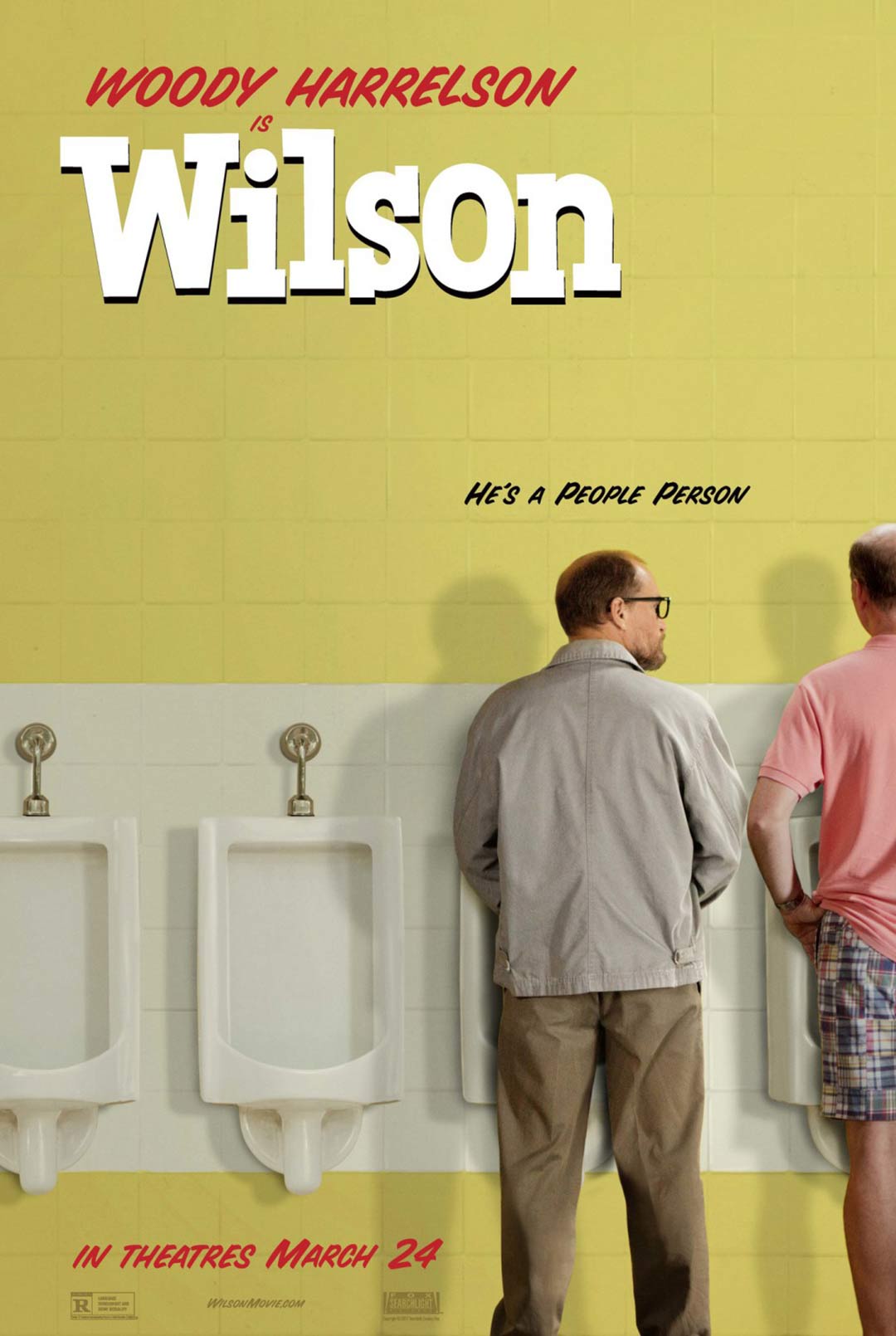
Wilson (Harrelson) is a loner with a strong misanthropic streak. He’s dissatisfied by most aspects of modern day living, and feels that communication isn’t what it used to be, that people are too insular. In an effort to combat this he’ll often approach people that are on their own, and try to strike up a conversation with them (and to their obvious consternation and confusion). In the wake of his father’s death, Wilson gets in contact with his estranged wife, Pippi (Dern), and against her better judgment they take the first steps towards being a couple again. During this time, Pippi tells Wilson something that gives his life a renewed purpose: he has a daughter somewhere.

Wilson soon tracks her down. Her name is Claire (Amara), she’s seventeen-years-old, and she’s a little overwhelmed when Wilson and Pippi suddenly turn up out of the blue. They try to spend time with Claire, but it’s difficult as they want to keep Claire’s adoptive parents in the dark about it all. Eventually the three of them embark on a trip to visit Pippi’s sister, Polly (Hines), and her family. The visit doesn’t go so well, and Polly works out that Claire’s parents don’t know where she is. The police are called, and Wilson is arrested on a charge of kidnapping. He winds up in prison for nearly three years. When he gets out, he finds that people are still as insular as ever, and that his life is about to take a turn for the better – probably.

Adapted by Daniel Clowes from his own graphic novel of the same name, Wilson was meant to be director Alexander Payne’s next project after Nebraska (2013), and with that knowledge in mind it’s tempting to wonder what the movie would have been like if he’d stayed on board. It’s not that Wilson is a bad movie, but it is one that can’t quite decide whether it wants to be a relationship drama, a bittersweet comedy, or something else entirely. What it is in the end, is a movie that flits back and forth between drama and comedy, and in the process fails to do adequate justice to either of them. The drama lies somewhere in the relationship between Wilson and Pippi, and the longer we see them together the easier it is to understand why she left him in the first place. Wilson bemoans how little people communicate, but doesn’t understand that the way he does it, it isn’t always appropriate.

The comedy is almost exclusively laid at the feet of Wilson himself, with said inappropriate behaviour causing all sorts of (mostly humorous) problems. But sometimes he sounds as if he’s being belligerent instead of caustic, as if between them Clowes and director Johnson have lost something of the character’s tone in translation. Harrelson gives a good performance, offering an interpretation of Wilson that ranges from manic to brash to insensitive to contemplative and all the way back to manic. Dern is also good as Pippi, a woman with “a past” that she’s trying to overcome. There are hints that Pippi has an addictive personality, and Dern reveals this added layer to good effect throughout. But the movie as a whole doesn’t make Wilson as sympathetic a character as it needs to, and the fallout from this is that Wilson the movie becomes an exercise in watching boorish behaviour being rewarded through a series of unlikely reversals and setbacks.

Rating: 6/10 – a mixed bag approach to the material – much of it lifted wholesale from Clowes’ graphic novel – means the narrative plods along in places and gives Wilson a patchwork feel that it never overcomes; the kind of movie that may well find itself ripe for reappraisal in ten years’ time, right now it’s an unconvincing look at one man’s studied ignorance of others, and his inability to recognise his own shortcomings.

Share this:

  • Share on X (Opens in new window) X
  • Share on Facebook (Opens in new window) Facebook
  • More
  • Print (Opens in new window) Print
  • Email a link to a friend (Opens in new window) Email
Like Loading...

Colossal (2016)

19 Friday May 2017

Posted by dullwood68 in Movies

≈ Leave a comment

Tags

Alcoholism, Anne Hathaway, Comedy, Dan Stevens, Drama, Fantasy, Giant robot, Jason Sudeikis, Monster, Nacho Vigalondo, Review, Seoul

D: Nacho Vigalondo / 109m

Cast: Anne Hathaway, Jason Sudeikis, Dan Stevens, Austin Stowell, Tim Blake Nelson, Hannah Cheramy, Nathan Ellison

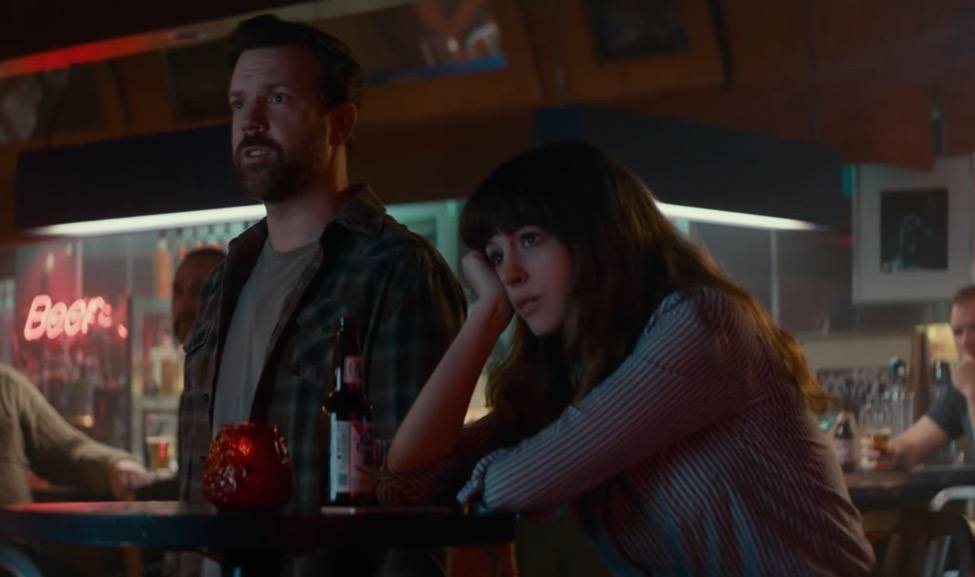
Gloria (Hathaway) can’t resist a night out with her friends; or more specifically she can’t resist having a drink or two, or three, or four, when she’s out with her friends. Unable to deal with her repeated denials about her behaviour and her alcohol dependency, Gloria’s boyfriend, Tim (Stevens), ends their relationship, forcing her to move back to her old hometown, somewhere she hasn’t been in over ten years. She moves in to her parents’ old home, which is unfurnished. The next day, after having purchased an air mattress to sleep on, she runs into an old friend from her school days, Oscar (Sudeikis). Now the owner of a bar, Oscar takes her there and introduces Gloria to his friends, Garth (Nelson) and Joel (Stowell). Several drinks later, Gloria staggers home, passing through a nearby park on the way.

The next day, the world’s media is in a frenzy over the appearance of a giant monster in Seoul, South Korea. Gloria sees the footage and like everyone else is astonished by it. That night Gloria gets drunk again and goes home through the park. The next morning, the news reports a second appearance by the monster, but Gloria is surprised to see that it makes a similar gesture to one that she makes, and that it looks as if it’s trying to carry something over its shoulder, as she did with the air mattress. Putting two and two together and hoping it’ll add up to five, Gloria heads for the park where she strikes a number of specific poses. When she sees the latest footage, the monster strikes the exact same poses. Realising there’s some kind of link between them, Gloria tells Oscar and his friends.

The appearance of a giant robot alongside the monster is connected to Oscar, who shows signs of drinking too much (while Gloria starts drinking less). With Gloria having spent the night with Joel, and the sudden arrival of Tim, Oscar becomes aggressive towards Gloria, and threatens to cause havoc and destruction in Seoul if she doesn’t stay with him. Unsure of what to do, matters come to a head when Oscar tries to stop Gloria from leaving with Tim…

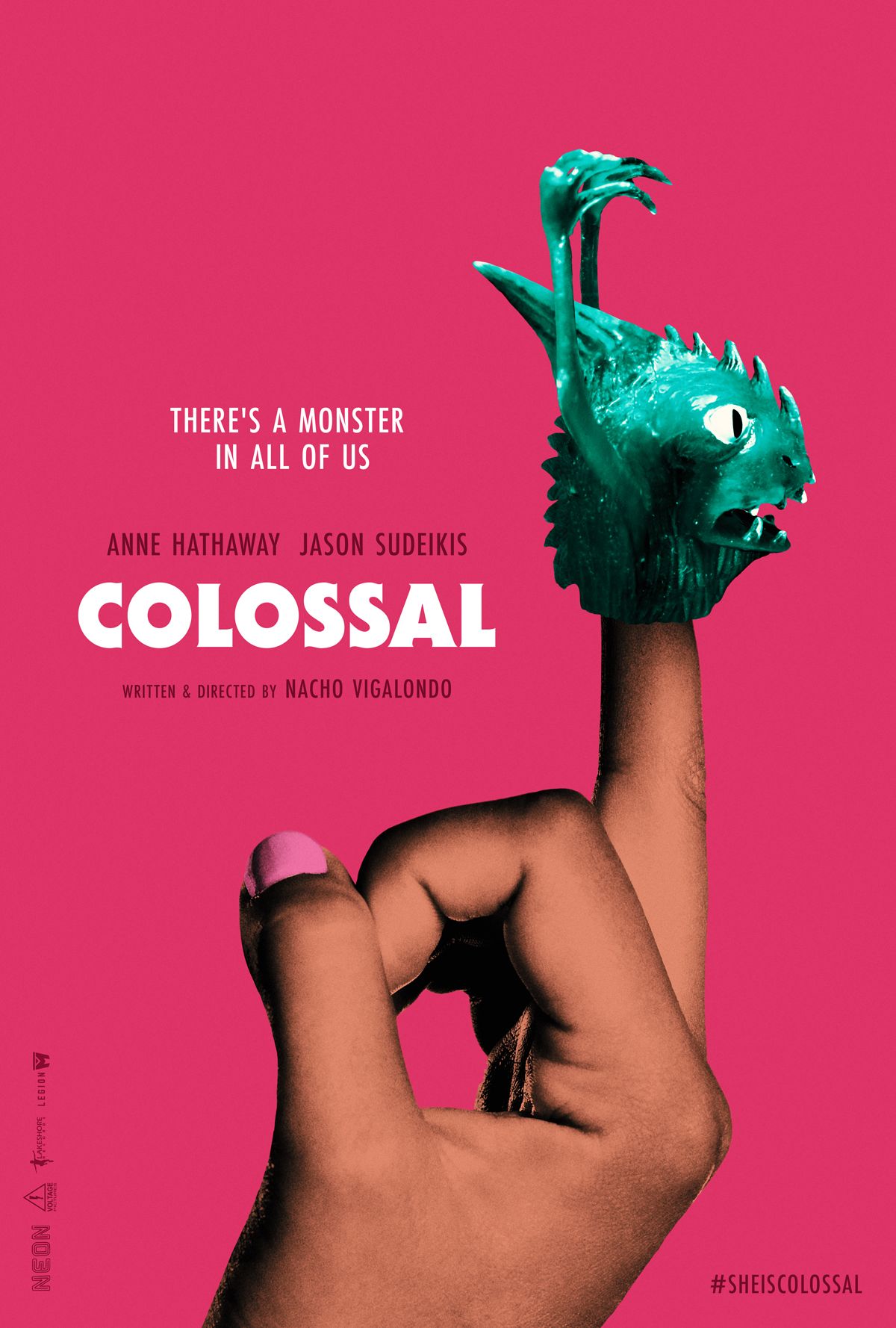
It’s safe to assume that, however many movies you see in 2017, you won’t see a stranger, more inventive movie than Colossal, the latest feature from Spanish writer/director Nacho Vigalondo. It’s a weird beast: by turns funny, dramatic, thrilling, challenging, poignant, even uplifting – and when was the last time you could say all that about one movie? And Vigalondo has the temerity to make it all look so easy. The movie is an unexpected cause for celebration, because this is a monster movie that is about so much more than just a creature terrorising downtown Seoul a la Godzilla and Tokyo. No, this is a movie concerned with notions of personal responsibility, self-respect, emotional insecurity, and redeeming past mistakes. It’s a movie with a very clear message: it’s never too late to start over, and to confound the expectations of those around you.

What could have been just another derivative monster movie also becomes, thanks to Vigalondo and his cast and crew, a surprisingly well grounded and credibly portrayed examination of survivors’ guilt, as both Gloria and Oscar deal in their very different ways with an event that happened when they were children, and which has left its mark on both of them. Gloria left her hometown for New York and fame and fortune as a writer, but she’s found alcoholism instead. Oscar has remained in their hometown and found that he can’t leave, that invisible ties hold him back, invisible ties, though, of his own making. Both are plagued by a sense of seemingly inevitable decline, that their lives are failing in terms of their potential, and neither of them know how to combat this. But by being given a chance to revisit that childhood incident, and to understand how it has affected them, both have the opportunity to rectify matters and move forward.

Of course, it’s not so easy, and Vigalondo twists the knife into both his lead characters, adding a layer of abuse to his increasingly dark and disturbing tale, and taking the story into places that the average fantasy drama wouldn’t even dream of trying to incorporate. And yet, with all this going on, Colossal isn’t as “heavy” as you might think, thanks to Vigalondo leavening things with massive doses of hope and pitch black humour. He’s helped tremendously by the performances of Hathaway and Sudeikis, two actors who might not be regarded as first choices for their roles, but who excel as two people struggling with their personal demons as best they can. Hathaway hasn’t been this good in quite some time, and she can sometimes seem removed from the character she’s playing, but here the opposite is true. She details Gloria’s growth from self-negating alcoholic to re-empowered avenger with such passion and empathy for the character that her performance gets better and better as the movie progresses. It’s impressive, and it’s courageous, and it’s Hathaway’s most deceptively skillful portrayal by far.

She’s matched by an intense, unsettling performance from Sudeikis, whose transformation from genial, easy-going bar owner and childhood friend to self-hating, conscience-free thug is one of the movie’s many highlights. When we first meet Oscar, Sudeikis plays him in much the same fashion as he’s played characters in other movies: with his trademark grin, amused yet casual demeanour, and equally casual delivery of his dialogue. Here, Sudeikis gets to subvert that image, and he seizes the opportunity with undisguised gusto. It’s a role that could so easily have descended into that of an unwavering, motiveless psycho, but between them, Vigalondo and Sudeikis have created a character whose psychopathy is believable to the point that when Gloria hits on what “ails” Oscar, the viewer can nod sagely and say to themselves, “that explains everything”.

The other characters aren’t given anywhere near as much depth as that shared by Gloria and Oscar, and Tim in particular is a distracting presence in the movie, with Stevens playing him as a shallow yet well-meaning putz. Thankfully, and one scene late on in the movie aside, Tim appears sparingly, and Vigalondo never makes him seem too important a part of Gloria’s future (she can do so much better and she probably knows it). As perhaps befits the tone of the movie, the visuals are kept muted, with the colour palette restricted to dull browns and distressed greys. The use of the monster and his giant robot adversary is kept in service to the story, and anyone expecting a full-on slugfest to close out the movie will be sorely disappointed. However, what does happen is clever, sad, and redemptive all at the same time, and allows the movie to end on one of the best sighs ever. Yes, a sigh, but one that says it all.

Rating: 8/10 – a bona fide gem, and chock full of surprises, all of them a pleasure to encounter and experience, Colossal is a movie that constantly moves the goalposts in its efforts to provide something different and extraordinary; Vigalondo has made an eloquent, remarkable movie that has something to say throughout and for once, it’s a movie that also knows just how to say it.

Share this:

  • Share on X (Opens in new window) X
  • Share on Facebook (Opens in new window) Facebook
  • More
  • Print (Opens in new window) Print
  • Email a link to a friend (Opens in new window) Email
Like Loading...

Folk Hero & Funny Guy (2016)

16 Tuesday May 2017

Posted by dullwood68 in Movies

≈ Leave a comment

Tags

Alex Karpovsky, Comedy, Drama, Friendship, Jeff Grace, Melanie Lynskey, Meredith Hagner, Relationships, Review, Road tour, Romance, Wyatt Russell

D: Jeff Grace / 91m

Cast: Alex Karpovsky, Wyatt Russell, Meredith Hagner, Melanie Lynskey, Michael Ian Black, Hannah Simone, Heather Morris, David Cross

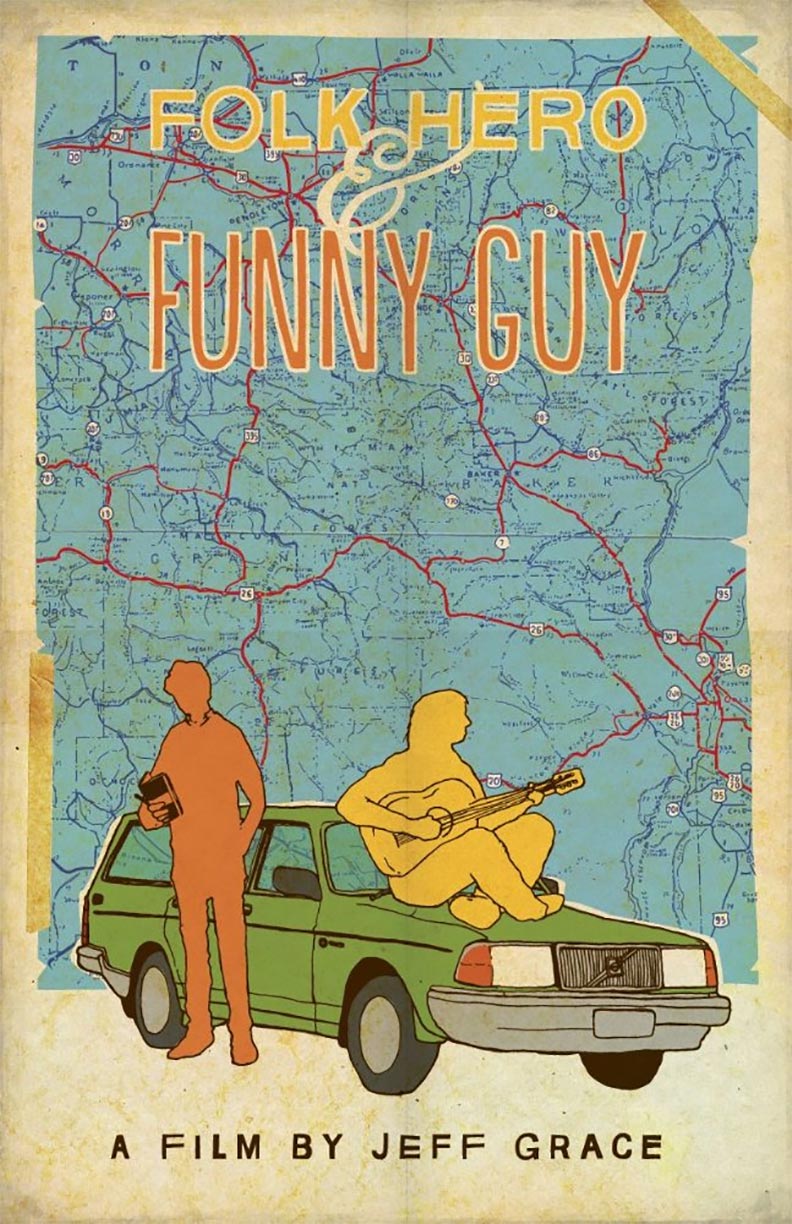
Paul Scott (Karpovsky) used to work in advertising, but he’s given it all up to be a stand-up comedian. His new career has its moments, but it’s still early days and he still has to refer to a notebook on stage for his material. Paul’s best friend since they were children is folk singer Jason Black (Russell). Jason’s career has brought him a degree of fame and popularity, and he’s the kind of carefree, live-for-the-moment guy that’s the complete opposite of Paul’s more grudging, dissatisfied approach to life (it doesn’t help that Paul’s just been dumped by his girlfriend). Seeing that his friend needs a bit of a lift, and some encouragement, Jason suggests Paul open for him on his upcoming solo tour. Paul thinks it might be a bit odd, a comedian opening for a folk singer, but Jason reassures him it’ll all be fine.

They set off in Jason’s battered old Volvo (his regular tour bus is too expensive for just the two of them), and on the first night of their trip they find themselves in a bar in Tom’s River, NJ, that has an open mic night. After hearing a very talented singer called Bryn (Hagner), Jason is cajoled into performing. While he does, Paul strikes up a conversation with Bryn, and they hit it off. The next morning, Paul is surprised to learn that Jason has invited Bryn along with them on the tour, and that she’s the new opening act, with Paul going on second. He’s a little flummoxed by it all, as he thought the tour was a chance for two old friends to spend some time together, but he’s also pleased because he’s attracted to Bryn and wants to get to know her better.

As the tour progresses, Paul and Bryn become good friends, while Jason pursues his usual vices. Bryn’s act goes down well with audiences, but Paul struggles to find the kind of form onstage that he can produce offstage. He begins to have second thoughts about being on the tour, and whether or not he should continue to pursue his dream. He and Bryn become closer still, until the revelation that she and Jason slept together that first night they all met, threatens to sever old and new friendships as Paul finds he’s unable to deal with it all…

Writer/director Jeff Grace – here making his feature debut – is also a stand-up comedian. Adam Ezra, who provides the movie’s original soundtrack, is a musician who it just so happens went on tour with Grace as his opening act. Using this as the basis of his screenplay, Grace has fashioned a perceptive, entertaining movie that has many pertinent things to say about the nature of old friendships, love and romance, and the downside of ambition. It’s a semi-serious comedy that isn’t afraid to show its three main characters in a less than flattering light, and it’s a very funny drama that highlights the difficulties involved in trying to start a relationship when you can’t articulate what you need from that relationship.

Paul is almost a classic underachiever, his personal life littered with regrets and misunderstandings that he can’t get past or overcome, and his new professional life proving to be just as frustrating. Part of the problem in both areas is that Paul doesn’t do enough to make things work in the way that they should. He makes the minimum effort required, and doesn’t see that this intransigence is what’s stopping him from achieving his goal as a stand-up, or committing fully to relationships. Even when he does try to commit, it’s done in such a way that the relationship is bound to founder as a result. Ultimately, Paul doesn’t trust in his own happiness, and he finds ways to sabotage things when they seem to be going well.

Jason is the exact opposite: confident, spontaneous, a risk taker, and someone who doesn’t overthink things. The tour is Jason’s idea of helping Paul regain some of the self-confidence that he had when he worked in advertising. He sees that Paul is down in the dumps, that his negative attitude needs challenging, but in the same way that Paul works against himself and any chance of contentment, Jason has the best of intentions but lacks the skill to reinvigorate his best friend’s life. He tries, but his efforts always backfire because he just can’t put himself in Paul’s shoes. Jason lacks the awareness that what pleases him and keeps him happy, isn’t going to work in the same way with Paul. There are times when you wonder just what it is that has kept them friends for so long, and Grace’s judicious script skirts this issue until the last night of the tour and the inevitable confrontation between the folk hero and the funny guy.

Grace handles the comedic elements with unsurprising aplomb, putting Paul on stage and letting him bomb in the same kamikaze way each time (“What is up with e-vites?”). It’s funny, sad and frustrating all at the same time, because before he gets to that point in his act, he always does so well. But Grace isn’t interested in making things easy for Paul – hell, even Paul isn’t interested in making things easy for himself – and Paul’s pent-up frustration leads to his being properly funny only when he lets things blow. It’s a good indication of the kind of stand-up comedian Paul could or should be, and Grace appears to be leading the audience in this direction when in fact he’s clever enough to steer everyone to a different place altogether. This makes the movie more intriguing than expected, and opens up the possibility that in good old indie movie fashion, things may not turn out so well for everyone at all.

Along the way, Grace gives Karpovsky some great routines to have fun with (until the rot has to kick in), and allows Russell and Hagner the chance to impress on more than one occasion with their soulful singing styles. All three give good performances in the kind of well written roles that only seem to come along in the indie sector these days, and in a brief supporting role, Melanie Lynskey proves yet again why she is one of the best character actresses working today. Grace does extremely well for a first-time director, drawing out the subtleties of his script with a sure hand and managing to avoid making it all look too obvious. If Paul’s intransigence becomes wearing after a while – and it does – then it’s a small price to pay for a movie that deals so effectively in portraying Paul’s downbeat persona, and counter-balancing it with Jason’s more hedonistic approach to everything. It all adds up to a movie brimming with heart and soul, and which never short changes its characters or its audience.

Rating: 8/10 – an appealing and thoughtful movie about the nature of unequal male friendships, Folk Hero & Funny Guy is also an irresistible road movie-romantic comedy-drama; with a great soundtrack and score, it’s a movie that signals Grace as a moviemaker to watch, confirms Russell to be an actor with an engaging, amiable screen presence, and features a screenplay that’s sympathetic and non-judgmental to all three of its main characters.

Share this:

  • Share on X (Opens in new window) X
  • Share on Facebook (Opens in new window) Facebook
  • More
  • Print (Opens in new window) Print
  • Email a link to a friend (Opens in new window) Email
Like Loading...

The Comedian (2016)

03 Wednesday May 2017

Posted by dullwood68 in Movies

≈ Leave a comment

Tags

Comedy, Community Service, Danny DeVito, Drama, Edie Falco, Harvey Keitel, Leslie Mann, Review, Robert De Niro, Romance, Stand-up, Taylor Hackford

D: Taylor Hackford / 120m

Cast: Robert De Niro, Leslie Mann, Harvey Keitel, Edie Falco, Danny DeVito, Patti LuPone, Charles Grodin, Cloris Leachman, Veronica Ferres, Lois Smith

Jackie Burke (De Niro) is an aging stand-up comedian who is famous for having appeared in a very successful sitcom thirty years ago, called Eddie’s Home. His career is somewhat in the doldrums, with his agent, Miller (Falco), unable to get him any really well-paid gigs. But he’s well liked and respected on the comedy circuit, and his act – as an insult comedian – is well received also. But one night, while he’s on stage he’s heckled by a member of the audience. The heckling takes a more serious turn when Jackie assaults the man responsible and winds up in court. Tasked with making a sincere apology to the man, Jackie refuses, and is sent to prison for thirty days. And when he’s released he has to perform a hundred hours community service.

Community service turns out to be helping at a mission, serving food and providing clothing to the local homeless. There, Jackie meets Harmony Schiltz (Mann), who is there because she assaulted her boyfriend and the woman he was having an affair with. There’s an attraction there on Jackie’s part, but not on Harmony’s. He does persuade her to go out with him (as an appointment, not a date), and Harmony has such a good time, she agrees to go with him to his niece’s wedding. They miss the actual ceremony, but are in time for the reception, where Jackie – at his neice’s insistence but to the horror of her parents Jimmy (DeVito) and Florence (LuPone) – gives a speech. It’s peppered with swear words, deliberately offensive, but by and large, is exactly what his niece wanted.

The next night, Jackie acts as a birthday present for Mac Schiltz (Keitel), Harmony’s father. He’s a big fan of Eddie’s Home, and can’t resist pushing Jackie to recite some of the character’s catchphrases. Mac also harangues Harmony over her community service, and tells her she can complete it in Florida where she can also resume the work she did at a retirement home her father owns. Jackie takes exception to the way Mac treats her, and they leave earlier than planned. A few drinks later, and back at Harmony’s apartment, their relationship takes an unexpected turn. The next day, Harmony has left for Florida, and Jackie resumes looking for the kind of work that will pay handsomely and restore his standing with bookers and club owners. But when he tries to contact Harmony, she doesn’t reply to his calls or his texts…

Every now and again, a movie comes along that provokes antipathy and dissatisfaction in equal measure, and which causes the viewer to wonder why on earth said movie was even made in the first place. The Comedian is such a movie. It’s one of those movies that doesn’t make sense when you consider the talent involved, and the potential it holds. But this really is a movie that makes so little impact, and which has so little meaning that it’s hard to understand why everyone involved in its making didn’t spot it sooner. The original story and screenplay is by the producer Art Linson, and he’s been aided and abetted by Richard LaGravenese, Lewis Friedman and Jeff Ross. That’s a talented group of people, but between them they’ve written a flat, uninspired screenplay that’s replete with redundant scenes, a minimum of effort in terms of the characters (say hello to more borderline stereotypes in one movie than you’ve seen in a very long time indeed), yet another of Hollywood’s bizarre and unconvincing attempts at portraying a May-December relationship, and perhaps unsurprisingly given the project’s long gestation period, jokes that would have been funny five or six years ago, but which now sound stale and in need of a rethink.

This is first and foremost meant to be a drama, as Jackie struggles to maintain a livelihood that doesn’t have anything to do with, or depend upon, Eddie’s Home. He hates reciting the catchphrases, complains bitterly at how much his TV success is ruining his stand-up career, and behaves in a churlish, emotionally dysfunctional way that is unattractive, unendearing, and unapologetic. He’s not quite a relic from a different age of entertainment, but in a time when diversity is a key component of social interaction, Jackie is so far behind in his thinking it’s unlikely he’ll ever catch up. His material is offensive at times, and not because Jackie doesn’t understand context (which might make his jokes more acceptable), but because he doesn’t care enough about context to include it. And this leads to much of his stand-up material being as far from funny as you can get. There’s an incredibly awkward, uncomfortable scene in Mac Schiltz’s retirement home that sees Jackie improvise an act around the elderly residents and their sexual proclivities (or Jackie’s idea of their proclivities), and reworking the song “Makin’ Whoopee” into “Makin’ Poopee”. It’s hard to know who to feel the more sorry for: De Niro for playing the scene and not being able to make it work, or the writers for including it and thinking it could work.

Jackie’s relationship with Harmony is another area where the script struggles to make any headway, aiming for a mixture of cute flirtations and meaningful glances to provide the (un)necessary romantic shorthand, and failing to convince audiences that Harmony would be attracted to Jackie at any point, let alone take him back to her apartment after she’s been drinking a lot and do something she “wants to do”. This is the kind of lazy dialogue screenwriters come up with when they have no credible basis for a character to behave in such a way, and it’s disheartening to see the main female character treated in such a cavalier fashion (Mann does what she can, but sadly it’s not much in the face of such blatant sexism.) And try as they might, De Niro and Mann don’t exactly light up the screen with their chemistry together.

Making only his third feature since the Oscar-winning Ray (2004), Taylor Hackford gives no indication that he’s engaged with the material, and the movie coasts along in first gear for much of its running time, muddling through its contentious romantic scenario without any recourse to enthusiasm, and staging the stand-up routines with all the flair of a director who’s heard that the camera doesn’t have to be static but who doesn’t trust it all the same. The Comedian was never going to be a visually arresting movie, even with Oliver Stapleton behind the lens (he’s Lasse Hallström’s cinematographer of choice), but it’s such a bland, unappealing movie to watch that you end up being unsurprised. After all, if the material is bland and unappealing then what chance does any other production aspect have?

Even the participation of real life comedians such as Brett Butler, Hannibal Buress and Jim Norton doesn’t add any verisimilitude to proceedings, because Grodin’s Friars Club bigwig aside, everyone loves Jackie and his act. And so too does the Internet, with three(!) videos of him going viral in quick succession and each time boosting his flagging career. It would have been a sloppy plot device if it was used just the once, but three times reeks of desperation, and each time it happens it doesn’t help propel the story forward because the script resolutely refuses to exploit the idea in any sensible or confident way. Jackie becomes even more famous than he already is – and that’s about it. No character development (or at least none that isn’t trite and/or clichéd), and no reason to believe that any might be forthcoming. Like the movie as a whole, it doesn’t matter what happens to Jackie because whatever it is, it will be of little consequence, and as a result, will have no effect on the audience either.

Rating: 4/10 – dramatically poor and comedically estranged, The Comedian is a movie that feels tired from the off, and which never has the energy to drag itself up out of the same doldrums where Jackie’s career is stranded; with no ambition or sense of its own inconsequence, it’s a movie that plays for two hours and barely registers as an experience, so slight and insubstantial is it.

Share this:

  • Share on X (Opens in new window) X
  • Share on Facebook (Opens in new window) Facebook
  • More
  • Print (Opens in new window) Print
  • Email a link to a friend (Opens in new window) Email
Like Loading...

A Dog’s Purpose (2017)

01 Monday May 2017

Posted by dullwood68 in Movies

≈ Leave a comment

Tags

Bailey, Britt Robertson, Comedy, Dennis Quaid, Drama, Josh Gad, K.J. Apa, Lasse Hallström, Reincarnation, Review

D: Lasse Hallström / 100m

Cast: Josh Gad, Bryce Gheisar, Juliet Rylance, Luke Kirby, K.J. Apa, Britt Robertson, John Ortiz, Kirby Howell-Baptiste, Dennis Quaid, Peggy Lipton

A Dog’s Purpose tells the five lives of one canine soul (related in voice over by Gad), who initially lives a very short life as a feral puppy called Toby before finding a “forever home” in his second incarnation as a Golden Retriever. It’s 1961, and Toby is rescued from a locked car by a young boy, Ethan (Gheisar), and his mother (Rylance). Toby is renamed Bailey (or to his ears, Bailey Bailey Bailey Bailey) and he becomes a part of the family. Ethan’s mother is very supportive, but his father (Kirby) can be aloof, and prone to mood swings. When a dinner party for his boss goes awry thanks to Bailey’s fun-seeking nature, seeds are sown in relation to Ethan’s father and the work he does, seeds that will have serious repercussions later on.

As a teenager, Ethan is on course to earn himself a football scholarship, and he has a bright, vivacious girlfriend, Hannah (Robertson). Bailey goes wherever Ethan goes, and life for Ethan is pretty good, but his father pushes his mother to the ground while he’s drunk and Ethan tells him to go for good. Following that incident, one of his “friends” puts a lit firecracker through their letterbox, and the house catches fire. Ethan and his mother only get out thanks to Bailey’s quick response, but in jumping to safety from an upstairs window, Ethan fractures his leg. His dream of playing professional football now in ruins, Ethan becomes embittered and ends his relationship with Hannah, and leaves for agricultural college.

Bailey lives out the rest of his life with Ethan’s mother and her parents, and eventually dies of old age. His next life sees him reincarnated into the body of a German Shepherd K-9 called Ellie. With her police partner, Carlos, Ellie chases criminals and helps Carlos overcome his feelings of loneliness follwing the break-up of his marriage. Ellie has all of Bailey’s memories (and attitude), and misses all the fun and games she had previously with Ethan. In his fourth life, Bailey is a Pembroke Welsh Corgi called Tino who is rescued from an animal shelter by shy college student Maya (Howell-Baptiste). Tino and Maya are together for a long time before his next life comes along. Now a Bernese Mountain Dog, and called Waffles, he’s abandoned by his owner’s abusive boyfriend but is found by someone whose smell he recognises, someone he hasn’t seen since his time with Ethan…

An unashamedly feelgood movie, A Dog’s Purpose has had a surprising amount of negative publicity forced upon it in the last few months, so much so that advance screenings (and its Los Angeles premiere) have been cancelled, supporters of the movie have done their best to distance themselves from it, and Hallström has received numerous hate messages. The reason? Back in January 2017, footage appeared that seemed to show a German Shepherd called Hercules being forcibly dropped into and dragged through rushing water, and with no regard for his safety or if he was distressed. But the footage had been edited to give a false impression of the dog’s “distress” and in February this was confirmed by the American Humane Association.

All of which was very dramatic – way more dramatic than anything that happens in A Dog’s Purpose, and despite the movie killing off its central character four times. Based on the novel of the same name by W. Bruce Cameron, the movie retains the novel’s portmanteau structure, and unsurprisingly, some of Bailey’s incarnations are more effective than others. His time with Ethan gets the most screen time, and their scenes together paint an affecting portrait of mutual respect and understanding. But though the emotional bond between Bailey and Ethan is established very early on, it’s the closer bond between Ethan and his father that matters more, and the inevitable disintegration of their relationship. While the movie puts warm and fuzzy in the foreground, it has the sense to keep dark and upsetting sequestered in the background, and waiting to come out when needed.

The same occurs when Bailey becomes Ellie. Ortiz’s melancholy police officer lacks the connection that Ethan had with Bailey, and though the mechanics of the overall storyline dictate that each incarnation has its fair share of problems, Ellie’s life is the toughest, and the complete opposite of Bailey’s. This is reflected in the manner in which Ellie becomes Tino, but even though it should be heartbreaking, the knowledge that “Bailey will return” negates any inherent drama. Thanks to Cameron’s spin on canine reincarnation, there’s no sense that there’s anything at stake here, and even though it’s fairly obvious where all these different lives are heading, there are few lessons learnt along the way, and Carlos’ and Maya’s stories end up feeling incidental to the main focus, which is when will Bailey and Ethan be reunited?

What helps and hinders the movie in equal measure is the voice over provided by Gad. As a way of (literally) getting inside Bailey’s head during each incarnation, it’s an idea that gives the movie the opportunity to see things from the dog’s point of view, and to do so in a way that avoids the usual kind of anthropomorphism so often seen in movies where animals feature as central characters. There’s no sappy, snappy banter a la Homeward Bound: The Incredible Journey (1993), just Gad relaying the joy of being a dog, and in such an infectious, humorous manner that you can believe that this is how all happy dogs think and behave. But there’s a serious side to it all as well, as Bailey takes time out every now and again to ponder on the bigger questions, such as why cats want to be dogs deep down and can’t admit it, why some owners don’t want to play Fetch, and more importantly, what is Bailey’s purpose in coming back so often.

While the answer may sound a little cheesy, and not quite as profound as Hallström and Cameron (plus his four co-screenwriters) would have liked, it does serve to give the movie more meaning than usual, and the material overall is in Hallström’s very safe hands. The director of My Life As a Dog (1985) and Hachi: A Dog’s Tale (2009) maintains his unique ability to craft emotionally resonant movies out of stories involving our canine friends, and though in many ways this is a movie that offers little in the way of anything new or original, it succeeds by telling Bailey’s story simply and directly. With a superb canine cast that easily puts its human counterparts in the shade, the movie also has a sentimental, decorative score from Rachel Portman, and vibrant, energetic cinematography from Terry Stacey that complements Bailey’s joie de vivre.

Rating: 7/10 – infectiously enjoyable, and a movie to warm the hearts of dog lovers everywhere, A Dog’s Purpose is at its best when showing the depth of the bond between a dog and its owner; less successful in terms of its structure, and perhaps showing one life too many, the movie also suffers from too many perfunctory performances (the script’s fault, not the cast’s), and a saccharine quality in places that’s completely unnecessary.

Share this:

  • Share on X (Opens in new window) X
  • Share on Facebook (Opens in new window) Facebook
  • More
  • Print (Opens in new window) Print
  • Email a link to a friend (Opens in new window) Email
Like Loading...

Monthly Roundup – April 2017

30 Sunday Apr 2017

Posted by dullwood68 in Movies

≈ Leave a comment

Tags

A Street Cat Named Bob, Aaron Eckhart, Action, Andy Mitton, Annette O'Toole, Anybody's Nightmare, Biography, Bob the Cat, Brad Peyton, Charles Barton, Chinook, Clark Freeman, Comedy, Crime, Crime Doctor, Dakota Johnson, Delayed Action, Documentary, Drama, Edward Dryhurst, Fifty Shades Darker, Gibb McLaughlin, Horror, Incarnate, Island of Doomed Men, James Foley, James Nunn, Jamie Dornan, Jason Bateman, Jesse Holland, John Harlow, Josh Gordon, Julie Suedo, June Thorburn, Kirby Dick, Kirby Grant, Literary adaptation, Luke Treadaway, Michael Gordon, Michael Powell, Mike Mizanin, Office Christmas Party, Patricia Routledge, Peter Lorre, Possession, Reviews, Robert Ayres, Roger Spottiswoode, Silent movie, The Claydon Treasure Mystery, The Marine 5: Battleground, The Night of the Party, The Woman from China, This Film Is Not Yet Rated, Tristram Powell, True story, Warner Baxter, We Go On, Will Speck, William Beaudine, WWE Films, Yukon Vengeance

Fifty Shades Darker (2017) / D: James Foley / 118m

Cast: Dakota Johnson, Jamie Dornan, Eric Johnson, Marcia Gay Harden, Eloise Mumford, Bella Heathcote, Rita Ora, Luke Grimes, Victor Rasuk, Max Martini, Kim Basinger

Rating: 4/10 – Christian Grey (Dornan) successfully woos back Anastasia Steele (Johnson), tries to go “straight” in the bedroom, and then narrowly avoids an attempt on his life – and that’s it for Round Two; flashy and trashy at the same time, Fifty Shades Darker continues the series’ commitment to providing two hours of inane, tedium-inducing material each time, and by never going as far as it might in the sexual activity department, making this yet another slickly produced teaser for the real thing.

A Street Cat Named Bob (2016) / D: Roger Spottiswoode / 103m

Cast: Luke Treadaway, Ruta Gedmintas, Joanne Froggatt, Anthony Head, Darren Evans, Beth Goddard, Ruth Sheen, Caroline Goodall, Bob the Cat

Rating: 7/10 – a recovering drug addict and talented busker, James Bowen (Treadaway), adopts a cat he calls Bob and in doing so finds a reason to stay off drugs and rebuild his life – with unexpected results; though A Street Cat Named Bob charts a particularly diffcult period in the life of the real James Bowen, the movie avoids being too depressing by emphasising the bond between Bob and his musician “owner”, and by resolutely aiming for feelgood, something at which it succeeds with a great deal of charm, and thanks to an endearing performance from Treadaway.

The Woman from China (1930) / D: Edward Dryhurst / 82m

Cast: Julie Suedo, Gibb McLaughlin, Frances Cuyler, Tony Wylde, Kiyoshi Takase

Rating: 7/10 – a Chinese criminal, Chung-Li (McLaughlin), kidnaps the girlfriend (Cuyler) of a ship’s lieutenant (Wylde) in order to satisfy his lust for her, but doesn’t reckon on one of his accomplices (Suedo) having feelings of her own for the same ship’s lieutenant; a late in the day silent movie, The Woman from China is a British production that has a Dickensian feel to it, narrowly avoids stereotyping its villain (very narrowly), and thanks to Dryhurst’s talent as a writer as well as a director, remains a well crafted thriller that is ripe for rediscovery.

We Go On (2016) / D: Jesse Holland, Andy Mitton / 85m

Cast: Annette O’Toole, Clark Freeman, Giovanna Zacarías, Jay Dunn, Laura Heisler, John Glover

Rating: 5/10 – Miles (Freeman) is terrified of dying and wants incontrovertible proof of life after death, so he offers a reward to anyone who can provide it, but the responses he gets aren’t exactly what he was expecting; a paranoid chiller that doesn’t quite have the focus it needs to be interesting throughout, We Go On nevertheless contains some really creepy moments, and a fiercely maternal performance from O’Toole that elevates the material whenever she’s on screen, but overall it falls short in too many areas, and particularly the way in which it’s been assembled, which leaves it feeling haphazard and hastily stitched together.

Yukon Vengeance (1954) / D: William Beaudine / 68m

Cast: Kirby Grant, Chinook, Monte Hale, Mary Ellen Kay, Henry Kulky, Carol Thurston, Parke McGregor, Fred Gabourie

Rating: 4/10 – when a lumber company’s wages keep being stolen while en route to the nearest town, Canadian Mountie Rod Webb (Grant) and his faithful sidekick Chinook are sent to investigate; a remake of Wilderness Mail (1935), Yukon Vengeance is also the last in a series of ten movies Grant and Chinook made together between 1949 and 1954, and is pleasant enough if you go in not expecting too much, but it’s hampered by poor performances from Hale and Kay, uninterested direction from Beaudine (usually much more reliable), and material that offers no surprises whatsoever (though that shouldn’t be a surprise either).

This Film Is Not Yet Rated (2006) / D: Kirby Dick / 98m

With: Kirby Dick, Kimberly Peirce, Matt Stone, John Waters, Kevin Smith, Maria Bello, Wayne Kramer, David Ansen, Mary Harron, Allison Anders

Rating: 6/10 – moviemaker Kirby Dick decides to try and find out just what goes on behind the secretive doors of the Motion Picture Association of America, and hires a private investigator to do so, while also eliciting the opinions of moviemakers who have had run-ins with the MPAA; Dick adopts a partisan approach to the material, but in the end, This Film Is Not Yet Rated doesn’t discover anything that viewers couldn’t have worked out for themselves without seeing it, and wastes a lot of time with Dick’s choice of private investigator as they sit outside the MPAA offices and take down car number plates for very little return (both investigative and cinematic).

The Claydon Treasure Mystery (1938) / D: H. Manning Haynes / 64m

Cast: John Stuart, Garry Marsh, Annie Esmond, Campbell Gullan, Evelyn Ankers, Aubrey Mallalieu, Finlay Currie, Joss Ambler, Richard Parry, Vernon Harris, John Laurie

Rating: 5/10 – following a disappearance and a murder, crime writer Peter Kerrigan (Stuart) becomes involved in a centuries old mystery at a country house, while attempting to work out just who is willing to kill to benefit from said mystery; what could have been a nimble little murder mystery is let down by Haynes’ solemn direction, and too much repetition in the script, but The Claydon Treasure Mystery does feature a handful of entertaining performances and a clever solution to the mystery.

Delayed Action (1954) / D: John Harlow / 58m

Cast: Robert Ayres, June Thorburn, Alan Wheatley, Bruce Seton, Michael Balfour

Rating: 5/10 – a suicidal man (Ayres) agrees to play the part of a businessman to meet the crooked demands of another (Wheatley), and forfeit his life at the end of the agreement, but doesn’t reckon on having a reason to live – a woman (Thorburn) – when the time comes; a sprightly little crime drama, Delayed Action never really convinces the viewer that Ayres’ character would agree so readily to the offer made to him, and Ayres himself is a less than convincing actor in the role, but the short running time helps, and Wheatley’s arrogant, preening master criminal is the movie’s trump card.

The Night of the Party (1935) / D: Michael Powell / 61m

aka The Murder Party

Cast: Malcolm Keen, Jane Baxter, Ian Hunter, Leslie Banks, Viola Keats, Ernest Thesiger, Jane Millican, W. Graham Brown, Muriel Aked

Rating: 5/10 – at a dinner party, hated newspaper proprietor Lord Studholme (Keen) is murdered, but which one of the many guests – all of whom had reason to kill him – actually did the deed, and why?; Powell was still finding his feet as a director when he made The Night of the Party, and though much of it looks like a filmed stage play (which it was), it’s exactly the movie’s staginess that robs it of a lot of energy, and stops it from becoming as involving and engaging as other movies of its ilk, and that’s despite some very enjoyable performances indeed.

Office Christmas Party (2016) / D: Josh Gordon, Will Speck / 105m

Cast: Jason Bateman, Olivia Munn, T.J. Miller, Jennifer Aniston, Kate McKinnon, Courtney B. Vance, Jillian Bell, Rob Corddry, Vanessa Bayer, Randall Park

Rating: 5/10 – with their office being threatened with closure, manager Clay (Miller) and several of his staff decide to throw a massive Xmas party in the hope that it will help secure a contract with businessman Walter Davis (Vance) and so save everyone’s jobs; only fitfully amusing, Office Christmas Party probably sounded great as an idea, but in practice it strays too far from the original concept, and has its cast going firmly through the motions in their efforts to raise a laugh, although McKinnon (once again) stands out as an HR manager who makes being uptight the funniest thing in the whole misguided mess of a movie.

The Marine 5: Battleground (2017) / D: James Nunn / 91m

Cast: Mike Mizanin, Anna Van Hooft, Nathan Mitchell, Bo Dallas, Curtis Axel, Heath Slater, Naomi, Sandy Robson

Rating: 4/10 – now a paramedic, Jake Carter (Mizanin) finds himself trapped in an underground car park and fending off a motorcycle gang who are trying to kill the injured man (Mitchell) who has just killed their leader; five movies in and WWE Films have used a low budget/low return formula to ensure that The Marine 5: Battleground remains a dreary, leaden-paced “action” movie that features a lot more WWE Superstars than usual, more glaring plot holes than you can shove the Big Show through, and proof if any were needed that playing hyper-realised athletes every week isn’t a good training ground for acting in the movies, no matter how hard WWE tries to make it seem otherwise.

Incarnate (2016) / D: Brad Peyton / 91m

Cast: Aaron Eckhart, Carice van Houten, Catalina Sandino Moreno, David Mazouz, Keir O’Donnell, Matt Nable, Emily Jackson, Tomas Arana

Rating: 4/10 – a scientist-cum-paranormal investigator (Eckhart) can induce himself into the minds of people possessed by demons and cast them out, but he comes up against a stronger adversary than any he’s encountered before: the demon that took the lives of his wife and son; a neat twist on a standard possession/exorcism movie, Incarnate suffers from the kind of muddled plotting, heavyhanded sermonising, and stereotypical characterisations that hamper all these variations on a horror movie theme, and in doing so, marks itself out as another nail in the coffin of Eckhart’s mainstream career, and a movie that lacks substance, style, wit, and credibility.

Crime Doctor (1943) / D: Michael Gordon / 66m

Cast: Warner Baxter, Margaret Lindsay, John Litel, Ray Collins, Harold Huber, Don Costello, Leon Ames, Dorothy Tree

Rating: 7/10 – a man (Baxter) found unconscious at the side of the road wakes with no memory of his past, but over time builds a new life for himself as a leading criminal psychologist – until his own criminal past comes calling; the first in the Crime Doctor series is a solid, suspenseful movie bolstered by strong performances, a surprisingly detailed script, and good production values, making it an above average thriller and hugely enjoyable to watch.

Island of Doomed Men (1940) / D: Charles Barton / 68m

Cast: Peter Lorre, Rochelle Hudson, Robert Wilcox, Don Beddoe, George E. Stone, Kenneth MacDonald, Charles Middleton

Rating: 6/10 – a Government agent (Wilcox) allows himself to be arrested and imprisoned in an effort to make it to an island owned by sadistic diamond mine owner Stephen Danel (Lorre), and then expose Danel’s use of ex-cons and parolees as slave labour; a seedy, florid atmosphere is encouraged and exploited by Barton as Island of Doomed Men allows Lorre to give one of his more self-contained yet intense performances, and which also shows that some Production Code-era movies could still be “exciting” for reasons that only modern day audiences would appreciate – probably.

Anybody’s Nightmare (2001) / D: Tristram Powell / 97m

Cast: Patricia Routledge, Georgina Sutcliffe, Thomas Arnold, Nicola Redmond, David Calder, Malcolm Sinclair, William Armstrong, Rashid Karapiet, Louisa Milwood-Haigh, Scott Baker

Rating: 5/10 – the true story of Sheila Bowler (Routledge) who in the early Nineties was arrested, tried and convicted of the death of her late husband’s aunt (despite a clear lack of evidence), and who spent the next four years fighting to have her conviction overturned; a miscarriage of justice story bolstered by Routledge’s dignified, sterling performance, Anybody’s Nightmare betrays its British TV movie origins too often for comfort, features some truly disastrous acting (step forward Thomas Arnold and Louisa Milwood-Haigh), but does make each twist and turn of Bowler’s legal case as shocking as possible, and in the end, proves once again that truth really is stranger than fiction.

Share this:

  • Share on X (Opens in new window) X
  • Share on Facebook (Opens in new window) Facebook
  • More
  • Print (Opens in new window) Print
  • Email a link to a friend (Opens in new window) Email
Like Loading...

Adult Life Skills (2016)

23 Sunday Apr 2017

Posted by dullwood68 in Movies

≈ Leave a comment

Tags

Bereavement, Brett Goldstein, Comedy, Drama, Grief, Jodie Whittaker, Lorraine Ashbourne, Rachel Tunnard, Review, Shed, Twins

D: Rachel Tunnard / 96m

Cast: Jodie Whittaker, Lorraine Ashbourne, Brett Goldstein, Rachael Deering, Eileen Davies, Ozzy Myers, Alice Lowe, Edward Hogg

Following the death of her twin brother, twenty-nine year old Anna (Whittaker) has moved into the shed at the bottom of her mother’s garden. It’s been eighteen months since he died, but although Anna works at a local outdoor pursuits centre, she doesn’t socialise or spend any of her free time away from the shed. Instead she stays inside it making videos that depict her two thumbs as astronauts in a space capsule. She uses this as a way of maintaining a connection with her brother, as they both made similar videos when they were younger. A lot of the stuff that’s in the shed is items and objects that she and her brother either played with or created. But while Anna is apparently content to remain living there, her mother, Marion (Ashbourne), isn’t as keen. She wants Anna to move out of the shed and start to rebuild her life. With Anna’s thirtieth birthday fast approaching, Marion gives her daughter an ultimatum: Anna has to be out of there before her birthday.

Anna has no intention of agreeing to this, and avoids or ignores all her mother’s attempts to get her to change. At the outdoor pursuits centre, Anna is given the task of monitoring the number of molehills that pop up each night, as well as ridding the site of any graffiti. It’s boring, mundane work, but she doesn’t mind, as it at least takes her mind off her brother. The reappearance of an old friend, Fiona (Deering), after she’s been away for some time, sees Anna begin to get out more (much to her mother’s delight), but she’s still adamant about remaining in the shed. Even the clumsy attentions of Brendan (Goldstein), a local estate agent who’s known Anna since childhood, aren’t enough to get her to rethink her future.

But when an eight year old boy, Clint (Myers), ends up in her family’s care temporarily following the death of his mother, his presence in Anna’s life begins to chip away at the carefully built-up walls she’s erected since her brother’s death. A night out with Fiona doesn’t go as planned, and puts a strain on their friendship, and when Clint goes missing overnight, Anna realises that she can care about someone else. But there’s still the issue of the shed, and the deadline of Anna’s birthday. Will Anna hold on to her need to be there, or will recent events show her a different way forward?

Expanded from the short, Emotional Fusebox (2014) (a lot of which is included or recycled here), Adult Life Skills is writer/director Rachel Tunnard’s feature debut. It’s a terrific little movie that’s emotionally astute and, in places, effortlessly poignant. The central conceit, that Anna feels bereft from everything following her brother’s death, is handled with sympathy and compassion for the character’s feelings, and the sadness that overwhelms her so much is often expressed in beautifully understated fashion by Whittaker. Even after eighteen months (or maybe because of that amount of time), Anna’s retreat from the world can still be regarded as understandable, but there’s still the sense that she’s using her grief as a way of avoiding any potential further heartbreak in her life.

But while Anna’s self-imposed predicament is viewed sympathetically, and the toll of her bereavement is presented with a great deal of care and sincerity, Tunnard is wise enough to know that the travails of a near-thirty something living in a shed isn’t going to be enough for a full-length movie. And so we’re introduced to the people around Anna, the people who care about her. Her mother – played with unrepressed yet entirely credible frustration by Ashbourne – is trying her best to get Anna to move on with her life, and it’s a tribute to the quality of Tunnard’s writing that Marion isn’t just the movie’s token “bad guy” but a parent trying to avoid losing both her children. No matter how acerbic or demanding she may be, she still cares. The same goes for Jean (Davies), Anna’s grandmother. Jean is supportive of Anna’s “lifestye choice”, and recognises that it’s a way for Anna to deal with her grief, that in time she’ll find her way back to everyone and everything. And though she too behaves in an acerbic manner towards Marion, there’s still the same love there as Marion feels for Anna.

The introduction of Clint, a small boy with a big attitude, acts as a catalyst for Anna’s eventual coming to terms with her pain and sadness at no longer officially being a twin. He’s challenging, acts like he doesn’t care, and sports a cowboy hat, gun and holster. He gets Anna to talk about her brother, something it’s clear she hasn’t done since his death, and as she trusts him more and more, you can see the weight lift from her shoulders. Unsurprisingly it’s Myers’ first movie, and though some of his lines don’t have the clarity needed for the viewer to understand them fully, he’s a child with wonderfully expressive features, and for his age, an equally wonderful insouciance about him.

As the emotionally tongue-tied Brendan, Goldstein provides much of the movie’s good-natured comedy (“How… is your… period?”), and Deering offers solid support as Anna’s best friend. Hogg pops up as a snorkeler Anna encounters at odd moments, while Lowe is her no-nonsense, lower-case angry work colleague, Alice. All the cast give good performances, but it’s Whittaker who holds the attention throughout, channelling Anna’s grief, confusion, and anger with an honesty and a warmth that can’t help but make the character likeable and someone to root for.

Aside from the performances, there’s much else to enjoy in Adult Life Skills, from the absurdist conversations Anna comes up with for her thumb videos (and those are Tunnard’s thumbs, not Whittaker’s), to the mangled version of Morning Has Broken courtesy of a recorder-playing barman, and its affecting sense of childhood nostalgia. Tunnard, who originally tried to pass on directing this, proves an adept, instinctive director, and her script isn’t too shoddy either. Unlike a lot of first-time moviemakers, Tunnard gets the pace just right (she is first and foremost an editor), and though she does overdo it on the quirky, shed-based activity that Anna involves herself in, she makes up for it by making Anna’s re-emergence into the outside world truthful and in keeping with the emotional journey the character is embarked upon. There’s fine cinematography courtesy of Bet Rourich, and the West Yorkshire locations provide an attractive backdrop to the action, all of which adds up to a hugely enjoyable movie about grief and loss – no, honestly.

Rating: 8/10 – sweet and sincere, and with the ability to pack an emotional wallop from time to time, Adult Life Skills is a blend of quirky characterisations, even quirkier confrontations and encounters, and sometimes, a potent examination of how grief can paralyse a person beyond their ability to deal with it; with a generosity of heart and spirit that adds further resonance to a movie with bags of sincerity already, this is a movie that doesn’t short change its characters or its cast or its viewers, and is also one of the funniest and most enjoyable British movies of the last five years.

Share this:

  • Share on X (Opens in new window) X
  • Share on Facebook (Opens in new window) Facebook
  • More
  • Print (Opens in new window) Print
  • Email a link to a friend (Opens in new window) Email
Like Loading...

Going in Style (2017)

21 Friday Apr 2017

Posted by dullwood68 in Movies

≈ 1 Comment

Tags

Alan Arkin, Ann-Margret, Bank robbery, Comedy, Eviction, Kidney transplant, Matt Dillon, Michael Caine, Morgan Freeman, Remake, Review, Zach Braff

D: Zach Braff / 96m

Cast: Morgan Freeman, Michael Caine, Alan Arkin, Ann-Margret, Matt Dillon, John Ortiz, Peter Serafinowicz, Joey King, Maria Dizzia, Josh Pais, Christopher Lloyd

Three old friends – Willie (Freeman), Joe (Caine), and Albert (Arkin) – have worked for the same steel company for over thirty years. But when the company decides to transfer all of its manufacturing abroad, all three find their jobs are gone and that their pensions are being used to facilitate the overseas set up. For Joe it’s even worse: without his pension he won’t be able to keep up the mortgage repayments on his home, and in a month will be evicted, along with his daughter, Rachel (Dizzia), and granddaughter Brooklyn (King). But Joe has the germ of an idea. Why not rob the bank that’s overseeing the liquidation of the pension funds, take only what they need personally, and give any money left over to charity?

Joe has gotten the idea because he was there when the bank was robbed only a few days before. Three masked bank robbers got away with over a million dollars, and the police, led by FBI Agent Hamer (Dillon), haven’t got any leads at all. Figuring that if the bank robbers can do it, then they can do it, Joe voices his idea to his friends. Willie, who desperately needs a kidney transplant, agrees to it more readily than Albert, who takes some convincing, but soon all three are on board. They put their stealing skills to the test at a local store, but are easily caught. This embarrassing failure at least tells them they need “professional” help. Through Joe’s ne’er-do-well ex-son-in-law, Murphy (Serafinowicz), they’re put in touch with a criminal-cum-pet store owner named Jesus (Ortiz). He agrees to help them, and soon they’re putting a plan into action that involves robbing the bank using their lodge’s carnival day as cover. But during the robbery, Willie’s identity is compromised, and though they get away with enough money to help clear their debts, FBI Agent Hamer is hot on their trail…

Another month, another remake, another reason to wonder if Hollywood has any idea why certain movies work and the majority of their remakes don’t. On paper, Going in Style has a lot going for it. It has a top-notch cast, its director has a brash, indie sensibility that could add an edge to proceedings, it has a screenplay from the co-writer/director of Hidden Figures (2016), and is a reworking of a movie that many regard with fondness even if it didn’t exactly set the box office alight. In short, and in baseball parlance, it should have been a home run. However, what we do have is a movie that settles for being bland and innocuous, and which wants its audience to have a fairly okay time with it, and not really an uproarious one. It keeps its ambitions quiet, plays things squarely by the book, and not once attempts anything that might upset the status quo. It’s as close to moviemaking by committee as you’re likely to get.

The script, by Theodore Melfi, trades on various forms of humour, but adopts a lightweight, unassuming tone that ensures the trio’s attempts to steal from their local store – this is how bright they are! – is the movie’s comedy highpoint. After that, the bank robbery itself is an exercise in gentle whimsy, with Willie ending up reassuring a little girl and potentially putting the trio in danger of being apprehended later. There are chuckles to be had, and plenty to smile good-naturedly about, but nothing else to make the viewer laugh out loud. For a comedy, Going in Style is a pretty good heist caper, but even then it refuses to do anything to make events feel fresh or remarkable. If you want belly laughs, or a long succession of jokes and one-liners, then this isn’t the movie you’re looking for.

With the movie suffering from more than just a hint of creative ennui, it plods through its various plot contrivances and unconvincing character development with all the energy of a narcolepsy sufferer on their fifth nap of the day. Counting heavily on its cast to signpost the laughs (and then act accordingly), the movie skips lightly from one scene to another, and rarely stops long enough to add any appreciable depth or additional layers to its bare bones storyline. Thankfully, the movie’s cast have been around for a while, and know how to elevate thin material, though there are still moments that defeat them (e.g. anytime Caine has to play doting grandfather to King’s annoyingly chirpy granddaughter). Arkin is the movie’s lucky charm though, making the grumpy, defeatist Albert its MVP, and making the viewer wish he had more screen time.

Overseeing it all is actor turned director Braff, making his third feature and showing a limited amount of enthusiasm for a project that he hasn’t written himself. Perhaps the characters just aren’t quirky enough, or have enough issues to be dealing with, for Braff to be interested, but there are long stretches where his indie style of moviemaking is absent, and is replaced by a director-for-hire vibe that fits in well with the movie’s corporate, take-no-risks attitude. Maybe it was the chance to work with such a great cast that persuaded him, but judged on the final result, this won’t add much lustre to Braff’s burgeoning career as a director (unless he’s offered similar projects).

But when all is said and done, and despite the movie being as ludicrous as you’d expect, it’s entirely necessary for movies like Going in Style to be seen on our screens. While they may offer stress-free paydays for their casts and crews, and while they may also offer an amount of generic material that could only be beaten by a low-budget horror movie, movies such as this one are the cinematic equivalent of comfort food. You know what to expect, and watching the movie will be an easy, minor pleasure, one you may even want to repeat at some point. Its lightweight, undemanding nature will attract viewers just as its cast will, and anyone looking for an hour and a half where they can kick back and leave their brain behind, will find this a pleasing experience that won’t tax them in the slightest.

For its target demographic (and it’s safe to assume it’s fans of the cast rather than fans of the original), Going in Style will be warmly received and, in all likelihood, it’ll gain more fans through word of mouth. Over time, some movies gain a reputation that they didn’t have when the movie was first released. This may be one of them, even though it’s too early to tell. What is certain is that right now, it’s a movie that lacks enough imagination to make it stand out from all the other remakes out there, and while it has heart and a degree of charm that’s entirely down to the efforts of its leading men, it’s not quite memorable enough to woo audiences in the long term.

Rating: 5/10 – good-natured and sweet it may be, but these are attributes that could have benefitted from being “roughed up” a little bit, and in doing so, made Going in Style more appealing; as it is, the movie moves along at a steady (though not quite geriatric) pace and manages to tick all the boxes on the path of least resistance to its eventual, and entirely predictable, denouement.

Share this:

  • Share on X (Opens in new window) X
  • Share on Facebook (Opens in new window) Facebook
  • More
  • Print (Opens in new window) Print
  • Email a link to a friend (Opens in new window) Email
Like Loading...

Little Boxes (2016)

19 Wednesday Apr 2017

Posted by dullwood68 in Movies

≈ Leave a comment

Tags

Armani Jackson, Comedy, Drama, Interracial family, Melanie Lynskey, Nelsan Ellis, Racism, Relationships, Review, Rob Meyer, Rome

D: Rob Meyer / 89m

Cast: Melanie Lynskey, Nelsan Ellis, Armani Jackson, Oona Laurence, Miranda McKeon, Christine Taylor, Janeane Garofalo, Nadia Dajani, Veanne Cox, Maliq Johnson

Gina McNulty (Lynskey) and Marcus “Mac” Burns (Ellis) are an interracial couple with a young, pre-teen son, Clark (Jackson). Gina is a photographer, while Mac is trying to come up with an idea for his second novel, his first having been published to moderate acclaim. They live in Brooklyn, have a nice, comfortable middle-class lifestyle, a great social life, and lots of friends with similar backgrounds and life experiences. In short, they’re comfortable. But their lives are about to change when Gina accepts a teaching job at a university in Rome, Washington State. Travelling across the country by road, they arrive at their new home to find the removals truck isn’t there (and won’t be for a while), and that they’ll have to make do until it does. A set of inflatable mattresses and a camping stove later, and they’ve officially moved in.

Rome proves to be a predominantly white town, with virtually no other ethnic groups represented there. This reveals itself slowly to the trio, and in different ways. Gina is accepted immediately by some of the female, tenured professors. Mac goes for long walks listening to free-form jazz on his MP3 player and encounters several of the locals who seem overly pleased that he’s moved there. Clark begins spending time with two girls near his own age, Ambrosia (Laurence) and Julie (McKeon). Gina’s acceptance is based on her being artistic and a woman. Mac’s acceptance is based on his being black, and when the local bookseller finds out, a published author. Clark is popular with Ambrosia and Julie because he’s ostensibly black and doesn’t mind being treated like a show-and-tell friend.

But at the same time, their acceptance by the townsfolk of Rome leads to divisions within the family. While Gina goes off to the university, and Clark spends more and more time with his “girlfriends”, Mac stays at home and works on an article for an online food blog. They spend less and less time together. As they adapt to their new surroundings, further cracks begin to appear in what used to be their comfortable lifestyle. Arguments and disagreements ensue, and Clark, determined to live up to Ambrosia and Julie’s expectations of him, begins acting like a surly teenager. When things go a little too far between him and Ambrosia, Gina and Mac begin to feel a sense of isolation, and it’s not long before they’re wondering if moving to Rome was such a good idea in the first place.

Diversity and equality seem to be cinematic buzzwords at the moment. The number of movies addressing issues surrounding racism and racial inclusion/exclusion seems to have increased exponentially in the wake of the OscarsSoWhite controversy in 2016. That most of these movies were in production before last year’s Oscar ceremony seems to point also to some kind of cinematic zeitgeist finally making itself felt. But one thing’s for sure: you won’t find a more low-key, or subtle, examination of middle class racism than in Little Boxes.

It’s a movie that takes reverse (or positive) discrimination and makes it feel just as insidious as direct discrimination. Mac is out walking when one of his neighbours asks if he needs any help. The inference is clear: it’s a white neighbourhood, and Mac shouldn’t be there. But the neighbour quickly realises that Mac should be there, and from then on it’s all okay, and Mac is treated like an old friend. The turnaround is sharply made and hard to dismiss as anything other than tokenism. Mac is initially bemused by this sort of thing, but as time goes on, he begins to like it, even though deep down he also despises it. Meanwhile, Clark is learning that fitting in can mean a loss of identity, but as long as Ambrosia and Julie spend time with him and include him in what they’re doing (mostly dance routines and lounging by the pool), then he seems happy to be the person they think he is: a cool black kid that only they are friends with.

It could be argued that, along with its glacial, racial undertones, Little Boxes is also about maintaining oneself in the context of a new environment. Mac struggles because he lacks a defined purpose. His writing appears stalled, and he’s more concerned about the mould he discovers in the house than anything else. And he’s easily led astray by his neighbour, knocking back uppers and ending up in a bar. For Gina, the path towards fitting in is paved with good intentions and liquid lunches with her colleagues. She does her best to fit in but finds it causes too many problems, problems that she discovers she’s ill-equipped to deal with. Clark’s growing rebelliousness adds to the lack of unity and faith in each other that all three had previously in Brooklyn, and it soon becomes obvious that this is a family that may have made a really bad decision in transporting themselves so far out of their combined comfort zones.

But while the movie examines these themes with candour and no small amount of intelligence thanks to Annie J. Howell’s perceptive script, it doesn’t make the family’s disintegration too believable. Just why their close-knit harmony and commitment to each other should fall apart so easily is never explained, and without this, the movie falls into the trap of presenting the trials and tribulations of a moderately well-to-do middle class family in an indie setting, and expecting the audience to feel sorry for them. Sadly, this doesn’t happen, and not just because these are characters who have attained a certain level of privilege in their lives, but because the trials and tribulations that they face operate on the level of minor farce. There’s nothing here that the average family couldn’t overcome or deal with as soon as it arose. Yes, it’s another movie where the characters say a lot, but aren’t actually talking to each other.

Thankfully, most of this is offset by the quality of the performances. Lynskey is a pleasure to watch – as always – and portrays Gina’s growing insecurities and bafflement with her usual sincerity. Ellis is on equally fine form, ensuring Mac is equally unsure of himself and his current role in life, and displaying Mac’s wounded pride when things he knows he can do, don’t go so well. Jackson, meanwhile, has that knack that most child actors have of not even appearing to be acting, so good is he as Clark, and he acquits himself so well it appears almost effortless. In the director’s seat, Meyer does a fine job on the whole, but can’t find a way to keep the audience sympathetic to the family and their woes (mostly because they’re self-inflicted). It’s not a movie that has a particularly distinctive visual style, and the narrative stops and starts a little too often, but it does have enough substance to keep viewers occupied, even if, in the end, they’ll find it hard to be concerned by what’s happening.

Rating: 6/10 – several nods to small-town inverse racist attitudes and the fragility of the nuclear family can’t save Little Boxes (a metaphorical title if ever there was one) from failing to connect with the viewer; good performances and a waspish sense of humour go some way to making up for the areas where the movie struggles to provide depth or resonance, but most viewers will find themselves disappointed by so much effort yielding a much smaller return than expected.

Share this:

  • Share on X (Opens in new window) X
  • Share on Facebook (Opens in new window) Facebook
  • More
  • Print (Opens in new window) Print
  • Email a link to a friend (Opens in new window) Email
Like Loading...

Asperger’s Are Us (2016)

18 Tuesday Apr 2017

Posted by dullwood68 in Movies

≈ 1 Comment

Tags

Alex Lehmann, Asperger's, Autism, Comedy, Documentary, Ethan Finlan, Final performance, Jack Hanke, Massachusetts, New Michael Ingemi, Noah Britton, Trains

D: Alex Lehmann / 84m

With: Noah Britton, Ethan Finlan, Jack Hanke, New Michael Ingemi

In 2010, at a summer camp for children with autism in Massachusetts, graduates New Michael Ingemi, Jack Hanke and Ethan Finlan met camp counsellor Noah Britton (himself an autism sufferer). Finding that they all shared the same sense of humour, they decided to form the world’s first comedy troupe made up entirely of people with Asperger’s Syndrome. They called the troupe, Asperger’s Are Us, began putting together original comedy sketches, and eventually, doing gigs. Their aim was to use performances and interviews to promote autism-rights activism and the more positive aspects of Asperger’s Syndrome. They also wanted audiences to view them as just comedians instead of “people who’ve overcome adversity”.

Four years on, Asperger’s Are Us played their final performance due to Jack heading off to England on a scholarship to an Oxford university. In the weeks leading up to the show, they struggled to find all-new material to use, and also had problems finding the time to rehearse. During this period they were never sure where their venue was going to be, whether or not they should rely on old material mixed with new, or if any of it was going to work. Their main idea, Superhero Palace, was disliked from the start by New Michael, and there were fears that if it became part of the show, then New Michael wouldn’t take part in it. Eventually, all the potential hurdles were overcome, and the show took place.

The best thing about Asperger’s Are Us the movie rather than Asperger’s Are Us the comedy troupe is that it doesn’t have an agenda, or at least, not a social or political one. The members of the group aren’t poster boys for autism, they’re not out to score points for “overcoming adversity”, and nor are they advocates for any kind of “special treatment” for people with autism. Even though some of these things do creep into their performances, they’re not there deliberately. And the quartet do their best to be funny – and that’s all. By using a mixture of visual tomfoolery, clever wordplay, and pop culture references, Asperger’s Are Us have earned the right to be thought of first and foremost as comedians, and as people with autism second.

But no matter how much the troupe, or director/cinematographer/editor Alex Lehmann, tries to downplay their various social anxieties, intimacy issues (Jack’s dad bemoans the fact that when he shows affection to his son there’s no reaction), and emotional detachments, it’s obvious from their behaviour – either individually or as a group – that their autistic nature is a very big part of who they are, and also how they’re able to do what they do. There’s a point where Noah states that they don’t put on their shows for other people, they put them on because they want to do it, they’re performing material that makes them laugh even if no one else is, and if an audience “gets” what they’re trying to do and say, then that’s a bonus. In a very real sense, if they weren’t autistic, they wouldn’t be doing what they’ve been doing.

It’s an angle that the movie engages with from time to time, but never pins down in terms of how the four friends feel about their act, or each other. The relationship between Noah and New Michael gets quite a bit of screen time, and in many ways, it’s this that drives the narrative forward, as they disagree and argue like brothers, while Jack and Ethan look on from the sidelines. In a very telling scene, New Michael equates the foursome to The Beatles, and says that, for people looking in from the outside, Noah is the group’s John Lennon, and he is Paul McCartney. If you’re not paying close attention it sounds as if New Michael (he changed his name from Aaron when he was eighteen) is claiming kinship with McCartney, while making Noah sound as if he isn’t completely worthy of all the praise the troupe has been getting (Noah initiates much of the group’s material, and from that you can understand what New Michael is saying). Pay much closer attention though, and you’ll realise that New Michael is pulling the audience’s combined legs very subtly indeed. There’s a nuance in use here that is at odds with people’s (often limited) awareness of autism, and as such it’s very telling.

But as Lehmann has followed the group in the two months prior to their final performance, there’s plenty of footage of the group rehearsing, travelling from place to place within Massachusetts (trains are very important to them, especially Ethan), and except for Noah, with their families. It’s in these moments that the wider issue of dealing with autism is put into sharp relief. While New Michael has little to say about, or do with his father (“Old Michael”), Jack’s relationship with his parents is stable, but we never learn much about Ethan and his background. Noah has no one, but seems to prefer it that way, and though New Michael does introduce a female friend, she’s soon relegated to the background. It’s only when the four are together that we see them interact in a “normal” way, joking around, sharing ideas and thoughts (and the occasional dream), and behaving like brothers from different mothers. And when New Michael reacts badly to everyone being in his home for a rehearsal meeting, Noah’s indifference to how he feels is uncomfortable to watch, and yet refreshingly at odds with how New Michael would be treated by his family or others. For Noah, out of line is out of line, whether you’ve got Asperger’s or not.

Moments like these are enlightening to say the least, and there are many more that are poignant as well, but Lehmann’s skill as an editor means that they don’t overwhelm the disjointed yet cleverly assembled narrative. As the final show draws nearer and nearer, we see the sketches and the performances slowly take shape, and we see the group’s pride in what they’ve achieved. And their material is very, very funny indeed (the Presidential press conference is a highlight, especially if you’ve been paying attention to all the train references). And away from the stage they’re funny, with Noah wearing T-shirts with slogans on them such as “Ask me about my fear of strangers”, and Ethan hoodwinking Lehmann by dishing the dirt on his friends before confessing it’s all a joke. These are four guys who, despite their autism (or maybe because of it), are all talented comedians.

The movie as a whole is remarkably well-assembled, with personal contributions from each member of the group and where applicable, their families. The family dynamic surrounding New Michael is explored in some depth, and it’s here that the poignancy comes in, as Old Michael confesses that his work ethic in the past has caused the distance between him and New Michael to be so pronounced. Neither father nor son seems to know how to repair things, and their relationship remains a terse affair that only benefits them for brief moments at a time. Lehmann captures a terrible sense of sad inevitability in these moments, and the awkwardness between the two is heartbreaking. You can’t help but hope for the best for them both, and that New Michael will eventually overcome his feelings of not being good enough for his father. Whether or not that happens only time will tell, but for now, like the futures of all the troupe, everything looks very promising indeed.

Rating: 8/10 – a moving examination of four people with autism who have no time for pity, and whose collective sense of humour is disarmingly sharp, Asperger’s Are Us is a terrific documentary and a wonderful tribute to the group as a whole; whatever your thoughts on, or experience of, autism, this movie does what all good documentaries should do: it informs and educates and entertains (where possible) all at the same time.

Share this:

  • Share on X (Opens in new window) X
  • Share on Facebook (Opens in new window) Facebook
  • More
  • Print (Opens in new window) Print
  • Email a link to a friend (Opens in new window) Email
Like Loading...

Trailers – Detroit (2017), The Hitman’s Bodyguard (2017) and Atomic Blonde (2017)

16 Sunday Apr 2017

Posted by dullwood68 in Movies

≈ Leave a comment

Tags

12th Street riot, Action, Charlize Theron, Comedy, Drama, James McAvoy, Kathryn Bigelow, Previews, Ryan Reynolds, Samuel L. Jackson, Trailers, True story

It’s been five years since the directing/writing team of Kathryn Bigelow and Mark Boal brought us Zero Dark Thirty – and it’s about time they had something new for us. Thankfully, the trailer for Detroit looks as if they’re not going to let us down. A stinging, emotive, and visceral look at the 12th Street riot that occurred in July 1967 following events that took place at the Algiers Motel, the movie has already come under fire for not including any black women in its main cast. It’s a little early to tell if this is a deliberate piece of revisionism, but what is clear from the glimpses of violence seen in the trailer is that Bigelow has captured the atmosphere and the grim inevitability of a situation that quickly spiralled out of control and left three men dead, and nine others brutally injured. Bigelow has also assembled a great cast, including John Boyega as a security guard who gets caught up in the riot, Jack Reynor, John Krasinski, Anthony Mackie, and in what could be the role that catapults him to well-deserved stardom, Will Poulter as one of the three cops who ended up on trial for murder. One of the must-see movies of 2017, Detroit has all the potential to be an impassioned and excoriating feature that will leave audiences stunned and impressed in equal measure when it’s released in August.


Samuel L. Jackson is the hitman. Ryan Reynolds is the bodyguard. Gary Oldman is the dictator both men team up to defeat. The tone of the movie? Well, you only have to see the poster for The Hitman’s Bodyguard to work that one out: a parody of The Bodyguard (1992) with Reynolds subbing for Kevin Costner, and Jackson for Whitney Houston. The trailer drives the idea home with what is obviously a deliberate lack of subtlety, and though Tom O’Connor’s screenplay was included in the 2011 Black List of unproduced scripts, this looks likely to be an action comedy that is big on action set-pieces, but short on actual laughs (though Reynolds’ comment that Jackson’s character has ruined the word “motherfucker” has an ironic touch to it that bodes well). However it turns out, and the trailer’s mix of shouty humour, action beats and Roadrunner/Wile E. Coyote-style stuntwork doesn’t seem to say “instant classic”, this could still be the kind of dumb “Saturday-night-with-beers-and-a-pizza” movie that gains a loyal fanbase, and becomes a bona fide guilty pleasure in years to come.


After the success of John Wick (2014), it was perhaps inevitable that there would be a distaff version of that movie (literally) hitting our screens. And so we have Atomic Blonde, an adaptation of Antony Johnston’s graphic novel The Coldest City (the movie’s original title), and starring Charlize Theron as an MI6 agent tasked with retrieving a list of double agents being smuggled into the West prior to the fall of the Berlin Wall. The John Wick connection is cemented by David Leitch being in the director’s chair, and the trailer showcases a scene that has Theron taking out a roomful of assailants in much the same style as Wick. Whether there will be too many similarities between the two movies remains to be seen, and if there are it may hurt Atomic Blonde‘s chances with the critics, but if its sense of humour is as acerbic as its action sequences are full-on kinetic, then the movie has a chance of connecting with a wider, more appreciative audience. The presence of Sofia Boutella as a French operative Theron’s character “makes contact with”, plus James McAvoy as her operational ally in Berlin, and John Goodman as a less than friendly CIA agent, adds lustre to the movie, and the trailer can’t help but give potential audiences the impression that this may well turn out to be a very, very fun ride indeed.

Share this:

  • Share on X (Opens in new window) X
  • Share on Facebook (Opens in new window) Facebook
  • More
  • Print (Opens in new window) Print
  • Email a link to a friend (Opens in new window) Email
Like Loading...

Rules Don’t Apply (2016)

15 Saturday Apr 2017

Posted by dullwood68 in Movies

≈ Leave a comment

Tags

Alden Ehrenreich, Comedy, Drama, Howard Hughes, Lily Collins, Matthew Broderick, Review, Romance, Screen test, Warren Beatty

D: Warren Beatty / 127m

Cast: Warren Beatty, Lily Collins, Alden Ehrenreich, Matthew Broderick, Annette Bening, Martin Sheen, Candice Bergen, Haley Bennett, Megan Hilty, Paul Schneider, Alec Baldwin, Oliver Platt, Taissa Farmiga, Ed Harris, Amy Madigan, Paul Sorvino, Dabney Coleman, Steve Coogan

Not counting the TV short, Dick Tracy Special (2010), this is Warren Beatty’s first time behind the camera since Bulworth (1998). That movie was a pithy, satirical look at (then) modern US politics, but eighteen years on, Beatty’s skill as a director isn’t on quite such good form. Rules Don’t Apply focuses on Howard Hughes’ life between 1958 and 1964, and adds a fictional romance to bolster the main storyline (which the movie can’t decide on). It’s not a bad movie per se, just one that isn’t sure which one of three stories it wants to focus on.

The first story concerns Frank Forbes (Ehrenreich), who has just started for Hughes as a driver. He has a fianceé back home, Sarah (Farmiga), and a dream to build affordable housing at an undeveloped location just outside Los Angeles. Working for Hughes, though, is somewhat limiting, and for the most part he acts as a chauffeur for some of the actresses Hughes has under contract. The second story concerns one of those actresses, the fresh from Virginia, Marla Mabrey (Collins). Accompanied by her mother, Lucy (Bening), Marla is excited to meet the great Howard Hughes, and screen test for a movie called Sally Starlight. But as time goes on, she doesn’t get to meet him, and the screen test seems increasingly unlikely to happen. But she and Frank hit it off, and soon there’s the beginning of a romance. Her mother, however, returns home, leaving Marla to navigate the treacherous waters of reachable fame – and with Frank’s help.

The third story has Hughes showing signs of the strange behaviour that will eventually see his ownership of Trans-World Airlines (TWA) challenged by the US government. He refuses to see people, makes appointments that he doesn’t keep, and generally acts as if the concerns of other people are irrelevant. But eventually he and Marla meet, and he meets Frank also. Hughes takes a shine to Marla, and he begins to trust Frank, and it seems their careers are set. But their relationship takes an unexpected turn, and they grow estranged from each other. Meanwhile, Hughes becomes more and more withdrawn from the world, and begins to show clear signs of dementia, demanding things like all the available quantity of a certain flavour of ice cream (and then wanting another), and repeating himself over and over. What seemed eccentric only a few years before, now seems detrimental to both his health and his wealth. Frank stands by him, now as a personal assistant, while Marla moves away to start her life over…

On paper, Rules Don’t Apply has all the hallmarks of a very good movie indeed. It has Beatty in the role of Howard Hughes (a project he’s been planning for around forty years), a supporting cast who all do a terrific job, a recreation of the period that includes broad vistas of cities such as Los Angeles and London as they were at the time, individual scenes that carry both emotional weight and poignancy, and provides a somewhat caustic examination of wished-for fame and fortune. But the movie also has difficulty in making Hughes, or indeed any of the characters, sympathetic, and it flits between each of the storylines without always allowing them to flourish or become integral to the overall narrative.

The romance between Marla and Frank starts typically for the period with lots of exchanged glances and oblique references to the relevance of sex before marriage (Frank has, Marla hasn’t). It’s an old-fashioned courtship, made slightly more awkward by Hughes’ insistence that if any of his employees take any kind of interest in his actresses, then they’ll be fired. However, although this is mentioned on several occasions (as if the audience won’t get it the first time), in the end it makes no difference, as Hughes has no idea about them, and the few people who do know – fellow driver, Levar (Broderick), Hughes’ personal secretary, Nadine (Bergen) – don’t say anything anyway. There’s plenty of unnecessary repetition in terms of Hughes not seeing people, or making strange decisions, and it all pads out the movie, making it feel unfocused and willfully disjointed.

In the end, it’s Beatty’s script, and some of it is really, really good, but some scenes could have been excised and it wouldn’t have made any difference to the overall story. It would have made it a lot tighter, though, and kept the audience more involved. As the romance between Marla and Frank begins to crumble, and Hughes’ dispute with potential investors in TWA takes centre stage, the movie attempts to show Hughes both in decline and also more self-aware than people believed at the time. (Beatty’s script avoids the uncomfortable fact that at this period in his life, Hughes had already taken to spending long periods of time alone and naked watching movies in places such as a bungalow at the Beverly Hills hotel.) Beatty’s intention seems to be to idolise the man while at the same time admitting that he was flawed, a circumstance that causes the movie to seem undecided in terms of what audiences should make of him.

This all leaves the movie feeling and sounding less dramatic than it should be, with only the occasional confrontation jolting things out of the cosy, straightforward approach that Beatty adopts as director. Inert in certain stretches, and lacking depth in others, the movie is rescued from being completely disappointing thanks to its cast. As the billionaire who marries in order to avoid being committed to an insane asylum, Beatty steals every scene he’s in because he still has that old-time star charisma. There’s a good-natured, yet inherently pathological bent to his performance, and Hughes’ unpredictable nature, complete with vacant stares, bemused glances and paranoid outbursts, is explored with the kind of range and subtlety – in both diction and movement – that makes Beatty still such a good actor. Unfortunately, both Marla and Frank, being original characters created for the movie, don’t feel as well-rounded, and their romance is tepid, and not entirely believable, as Collins and Ehrenreich – very good individually – don’t have the chemistry necessary to make audiences believe in them as a couple.

Elsewhere, Broderick and Bening are superb, there are lots of blink-and-you’ll-miss-them appearances from the likes of Sorvino, Harris and Coleman, and a very funny cameo from Coogan as a British pilot forced to sit back and watch Hughes deliberately cause the engines to fail while up in the sky for a joyride. There are other humorous moments in the movie, many in fact, and most of them are in service to the characters, but as they’re mixed in with the drama and the romance and aren’t always played out at the best moments, some viewers may find that the comedy is forced rather than organic. Ultimately, and despite the best efforts of Beatty as writer and director, the various elements on display don’t gel to good enough effect, and this makes the movie less compelling and (often) too bland. A more immediate approach, and a more historically accurate one, may have made for a better movie – we’ll never know – but what is certain is that Beatty’s passion project, after forty years, isn’t as passionate an experience as he may have hoped it would be.

Rating: 5/10 – slow and repetitive aren’t the best of bedfellows when it comes to creating a drama about one of the most intriguing and distinctive billionaires of the twentieth century, and Rules Don’t Apply suffers accordingly; Beatty the actor is terrific, but is let down by Beatty the writer and director, and although the first half hour is briliantly executed, the rest of the movie falls short of that initial promise and settles instead for the kind of soap opera theatrics that never ring true, no matter how hard everyone tries.

Share this:

  • Share on X (Opens in new window) X
  • Share on Facebook (Opens in new window) Facebook
  • More
  • Print (Opens in new window) Print
  • Email a link to a friend (Opens in new window) Email
Like Loading...

Hey Everyone, It’s Mike Mendez! – The Last Heist (2016) and Don’t Kill It (2016)

10 Monday Apr 2017

Posted by dullwood68 in Movies

≈ Leave a comment

Tags

Action, Bank robbery, Comedy, Demon Hunter, Dolph Lundgren, Drama, Henry Rollins, Horror, Kristina Klebe, Mike Mendez, Review, Thriller, Torrance Coombs, Windows Killer

2013 saw the relatively unheralded release of a low-budget creature feature called Big Ass Spider! It was silly but it was also huge fun, and it was obvious that the makers had a fondness for the material that kept things from being too silly, or derivative of other similar movies. Then in 2015, SyFy brought us the latest in their ongoing series of movies designed to make audiences want to pluck out their own eyes, or take psychotropic drugs, in an effort to forget what they’ve just seen. That movie was Lavalantula, a Sharknado-style offering that accentuated the comedy while still providing a fair few thrills along the way.

Both these movies were directed and edited by Mike Mendez, and if you’ve followed his career since his debut at Sundance, Killers (1996), then you’ll already know that even if he’s got the most risible of material to work with, somehow he still manages to elevate it beyond its limited expectations. He’s a director who’s able to take the most unlikeliest of projects and put a massive spin on them. This doesn’t make them into out-and-out classics, but it does make these movies far more bearable to watch than they have any right to be. So if you like low-budget features that are low on concept and even lower on potential, but are still enjoyable for a reason you can’t quite put your finger on, chances are it’s a Mike Mendez movie you’re watching.

The Last Heist (2016) / D: Mike Mendez / 84m

Cast: Henry Rollins, Torrance Coombs, Victoria Pratt, Michael Aaron Milligan, Mark Kelly, Kristina Klebe, John J. York, Mykel Shannon Jenkins, Camilla Jackson, Nick Principe, Ken Lyle, Courtney Compton, Fay DeWitt, John O’Brien

What are the odds? You’re the leader of a group of heavily-armed bank robbers intent on stealing something very valuable from the vault of a decommissioned bank, and you discover that one of the civilians in the building – and the very one who isn’t a hostage – is a serial killer who is equally intent on killing everyone and taking their eyes as trophies. How does something like that happen? Why does it happen? Because this is the main idea behind The Last Heist, a movie that mixes horror, crime and action all together in a hodgepodge of a script that seriously doesn’t know how to actually mix them all together in the first place. Give thanks to writer Guy Stevenson for managing to be so diligent in messing things up from the start.

But then give thanks to Mike Mendez for taking Stevenson’s messy script and injecting it with some much needed energy and directorial awareness. What he does that is so remarkable, is that he doesn’t try to fix the things that can’t be fixed. Take for example, the bank’s location. To get to it, you have to enter a security code that opens a gate, then walk through what looks like a loading area into a small square where the bank itself is located. But this doesn’t look like a bank; instead it looks like an old rundown supermarket that’s recently closed. There’s a sign above the door that is never clearly seen – probably because it doesn’t have the word bank in it. And inside the bank it’s no better. It looks equally rundown, and there are corridors in back and floors above that seem to go on for ever. Seriously, the vault feels like it’s miles away. But Mendez isn’t interested in trying to make things look correct. He’s got his sets and he uses them to his best advantage, but he’s not focused on them. He’s got other things to worry about.

Mainly, that’s the cast. Mendez wisely concentrates on the performances, and in particular on often small moments within the action that offer a surprising amount of depth, depth that was unlikely to have been in Stevenson’s script originally. Rollins, naturally, is the serial killer, who does what he does because God has told him to. When he claims his first victim inside the bank, the unfortunate Tracey (Klebe), he does so with a calmness of manner that is eerily unnerving. As she bleeds out, he recites a monologue about the darkness within everyone, and his gentle tone and sympathetic ministrations are at odds with the grisly nature of his trophy collecting. Both actors are good here, and the scene is unexpectedly moving as Tracey fights against dying until she doesn’t have any strength left to do so. There are other moments like these dotted throughout the movie, as Mendez lets the characters reveal different sides of themselves, and though not everyone benefits from this kind of attention, there’s enough introspection between the action beats to offer a different perspective on things.

That said though, Mendez is lumbered with a number of clumsy plot developments that either muddy the waters or seem out of place, especially one very late reveal that feels like it was tacked on during shooting. Elsewhere, and once the body count inside the bank mounts up, Rollins is allowed to do his thing with impunity, while outside, first cop on the scene, Detective Pascal (Pratt), has to contend with a couple of comedy cops who want to go in guns blazing, and who act like they’re both six year olds who should be on Ritalin. Mendez is very good at strengthening the humour in his movies, and there are examples of very dark comedy scattered about in The Last Heist, but on this occasion the cops’ juvenile behaviour is another problem he chooses to ignore. It’s frustrating when things like that happen, but overall the rest of the movie, despite its failings, still feels like it’s a better movie than it is, and Mendez makes it so through sheer determination and no small amount of directorial wizardry.

Rating: 4/10 – a movie where individual scenes often carry more weight than the movie as a whole, the script for The Last Heist takes huge liberties with logic and credibility (as this kind of movie often does), but is saved by having Mendez in the director’s chair; with better-than-average performances, and a sure-footed sense of its own failings, Mendez elevates the material through his commitment to the project and a never-say-awful approach that helps immensely.


Don’t Kill It (2016) / D: Mike Mendez / 84m

Cast: Dolph Lundgren, Kristina Klebe, Tony Bentley, James Chalke, Miles Doleac

If you go down to the woods today… you’ll be possessed by a demon who leap frogs from person to person every time his host body is killed. This is what happens to a hapless hunter and his dog, and soon the small town of Chicory Creek (yes, really) is overrun by murders of whole families. But, wait. Help is at hand in the form of Jebediah Woodley (yes, really) (Lundgren), a demon hunter who knows exactly what the town is up against and who offers his services to the town sheriff (Bentley) and hometown girl-turned-FBI agent, Evelyn Pierce (Klebe). Of course, he’s taken for an interfering nutcase and promptly locked up, but when the sheriff and Evelyn see for themselves what the demon can do, their disbelief evaporates in seconds and they’re soon asking what can be done. Jebediah’s answer? Capture the demon while it’s in a human host, have someone willing to take fast-acting poison, and then get that person to kill the demon’s host body. The demon goes into the person who’s on the brink of dying, and its spirit is released, making it easy to capture and imprison.

Simple, huh? Well, in a year where we were advised not to breathe, think twice or look twice, or even hang up, not killing a murderous, psychopathic demon seems like a less than reasonable request, and naturally it proves more difficult than even Jebediah expects. Hampered by his own experiences, Jebediah is the kind of certain-minded hero who rarely gets it right until Lady Luck smiles on him and a solution to the problem of the demon is arrived at. Until that happens, the script has him carry around a large, heavy-looking net gun in the hopes of capturing the demon, while he gets to know Agent Pierce. The script here is slightly more polished than the one for The Last Heist – it doesn’t try to be more than what it is, for starters – but it still has no time for logic or credibility (it’s a middling supernatural version of The Hidden (1987), for Dolph’s sake), and it sprints from scene to scene with all the unsightly haste of a starving man at an all-you-can-eat buffet.

Here, Mendez concentrates on the murders and making them as horrific as he can; and on the humour. Shotgun blasts and meat cleaver blows are shown with both clinical detachment and a surreal complicity made on the viewer’s behalf that leaves a nasty taste in the mouth. Mendez doesn’t shy away from showing the horror of these moments, and though the movie sheds “real” victims as it goes, those early scenes carry a surprising amount of intensity. He’s also able to draw out the comic absurdity of the situation, such as when the town pastor (Chalke) is exhorting Jebediah to leave his church. The pastor flings holy water at Jebediah from a small vial, but the amount that keeps coming out is way too much for the vial to hold. And when the pastor abjures Jebediah with the words, “The power of Christ compels you!”, our trusty hero replies, “I’m pretty sure that’s from The Exorcist“.

There are other moments where the humour rescues the drama, and stops the movie from being laudable merely for the impressive splatter effects, courtesy of special effects wizard Robert Kurtzman and his team. This time around, Mendez doesn’t concentrate as much on the performances, but instead he focuses on the pace and the rhythm of the movie, and in keeping the tone just this side of entirely ridiculous (even though it is). The result is a standard-narrative horror movie that belies its low-budget origins and bland location work to provide a more diverting and enjoyable Dolph Lundgren movie than most of us are used to. Lundgren himself is wryly amusing, and Klebe makes for a good foil for the aging action hero, but full marks must go to Tony Bentley, as the sheriff who leaves a major crime scene because he’s too scared and is never seen again. That’s a scene that shows Mendez’s skills as a director, and which is only marred by Klebe’s dialogue, which makes her sound desperate instead of authoritative. Again, Mendez overcomes several hurdles in his quest to make a better movie out of Don’t Kill It than it deserves, and he does so with style. He may not have the biggest budgets, or the casts he deserves, but Mendez is still able to overcome those problems thanks to his usual commitment and enthusiasm.

Rating: 4/10 – once again, Mendez’s involvement in a movie project means that it doesn’t turn out to be as bad as it could have done, and Don’t Kill It works far better than it has any right to; on the whole, still a bad movie, but flecked throughout with Mendez’s trademark attention to detail in one or two areas (and always to the movie’s benefit), and the occasional nod and a wink that says, “We know it’s bad, but hey, it could have been so much worse.”

Share this:

  • Share on X (Opens in new window) X
  • Share on Facebook (Opens in new window) Facebook
  • More
  • Print (Opens in new window) Print
  • Email a link to a friend (Opens in new window) Email
Like Loading...

Yoga Hosers (2016) – Or, Whatever Happened to Kevin Smith

09 Sunday Apr 2017

Posted by dullwood68 in Movies

≈ 1 Comment

Tags

Bratzis, Canada, Comedy, Eh-2-Zed, Harley Quinn Smith, Johnny Depp, Justin Long, Kevin Smith, Lily-Rose Depp, Nazis, Review, True North trilogy, Yoga

D: Kevin Smith / 88m

Cast: Lily-Rose Depp, Harley Quinn Smith, Johnny Depp, Austin Butler, Tyler Posey, Justin Long, Tony Hale, Natasha Lyonne, Adam Brody, Jennifer Schwalbach Smith, Genesis Rodriguez, Vanessa Paradis, Haley Joel Osment, Ralph Garman, Jason Mewes, Kevin Smith

Twenty-three years ago, a young, bearded denizen of New Jersey made his first movie, the very low-budget indie comedy, Clerks. It was an overnight sensation: acutely funny within the milieu it created, and introducing audiences to two unforgettable characters in the stoner forms of Jay and Silent Bob. The young movie maker who maxed out around a dozen credit cards and sold off a large portion of his comic book collection to make his first movie was, of course, Kevin Smith. He followed it up with Mallrats (1995), a TV pilot, Hiatus (1996), Chasing Amy (1997), Dogma (1999), an unreleased Prince documentary, and Jay and Silent Bob Strike Back (2001), a string of projects that cemented Smith’s reputation, increased his fanbase, and garnered a fair amount of critical approval.

But somewhere around the time of Jay and Silent Bob Strike Back, Smith’s energies seemed to wane. Both Jersey Girl (2004) and Clerks II (2006) felt as if Smith was treading water, while Zack and Miri Make a Porno (2008), despite the kind of premise that Smith could have had a lot of fun with, proved to be even more underwhelming than his previous two movies. He followed Zack and Miri… with the dreadful Cop Out (2010), a director-for-hire gig that made audiences and critics wonder why the King of Static Camerawork would be asked to make an action comedy. Red State (2011) came next, and while it was well-received by critics, and looked on as a return to form, it’s still a movie that only needs to be watched once. Smith took a break, and didn’t return to our screens until 2014, with Tusk. That particular movie, a Kafka-esque body horror comedy, was even more of a return to form (and despite an unnecessary cameo from Johnny Depp). Now, Smith has chosen to follow Tusk with Yoga Hosers, a movie for kids, and the second in the True North trilogy (Moose Jaws will complete the series).

For all that Smith has been making strides in regaining the kind of critical and audience mass that went with his work in the Nineties, Yoga Hosers remains Smith’s worst movie to date, a sprawling, endlessly disappointing concoction that lies flat on the screen like the title character in The Autopsy of Jane Doe (2016) (and without that character’s internal life to help it). By taking two minor characters from Tusk – the store clerks who didn’t even have names – and spinning a whole movie around them, Smith has managed to do three things all at the same time: one, write his lamest script yet; two, bring back Depp’s eye-swivelling private detective Guy Lapointe to no greater effect than before; and three, prove that nepotism is alive and well when it comes to making movies.

This time, the two store clerks are given names – Colleen Collette (Depp) and Colleen McKenzie (Smith) – and are portrayed as vacuous fifteen year olds who can’t live without their phones for more than five seconds, who disparage everyone and everything around them, and who seem destined to be the lead characters in Clerks III (should Smith ever write it). Working at the store owned by Colleen C’s dad (Hale), the pair spend much of their worktime rehearsing songs with their only other bandmate, drummer Ichabod (Brody) (cue a string of “inspired” jokes such as “Dickabod” that will give you an idea of the level Smith is aiming for). One night, one of their customers is murdered in a nearby park (though why in a park is a mystery the movie doesn’t have an answer for). The killer? Ah, there’s the rub (as Shakespeare would put it), because the killer is a six-inch tall Nazi bratwurst – or Bratzi.

Inevitably, there’s a back story, a tale of Nazis in Canada, and the legacy of Aryan supremo Andronicus Arcane (Garman). There’s cryogenesis, an arrested experiment that gives rise to the Bratzis, and a Bratzi-filled creature that’s made out of body parts and is technically inanimate, but which can still be kicked between the legs as a means of hindering it. And in an extended scene that matches Lapointe’s lone scene in Tusk for abject pointlessness, Garman gets to monologue by doing impressions of actors such as Al Pacino (‘hoo-ah!”) and Sylvester Stallone. So clever is Smith’s script, he has the Colleens unable to recognise any of Arcane’s impressions, thus reinforcing the notion (already made several times) that they don’t know about anyone or anything that hasn’t happened within their lifetime, or who isn’t their friend on Facebook, Twitter, or Instagram. (When Smith includes social commentary like that, it’s a shame he doesn’t realise how much it’s been done before.)

But being clever, and putting together a script that gels in all the right ways, is something that Smith seems unable to do anymore. Along with the Bratzis, the Colleens have to endure Collette C’s irritating stepmom (Lyonne) (quite lame), two teen Satanists (Butler, Posey) out to claim their virgin souls (very lame), and the snarky comments of their customers (not lame, just boring). What’s most dispiriting about the script is that Smith no longer seems to have that distinctive ear for dialogue that he had back in the days of the Quick Stop. Here, it’s all about providing the Colleens with the kind of empty-headed dialogue that confirms their latent idiocy, while poking fun at the Canadian accent, particularly the way they say words like about, which sounds like ah-boot, as in “I’m sorry ah-boot that”. Stress the word once and it’s mildly funny; stress it a hundred times and it becomes tedious.

Ultimately, the whole thing looks and sounds like a mess that’s been made off the back of a draft script that Smith couldn’t be bothered to tidy up or give a proper shape to. The performances range from grating (Depp as Lapointe, Rodriguez as the Colleens Phys Ed teacher), to one-note (Depp as Lapointe, Lyonne, Hale, Posey, Garman), to passable (Depp as Colleen C, Smith as Colleen M, Long as their yoga teacher), but it’s hard to stand out when the script you’re working from is determined to be as juvenile as possible while also trying to hold onto a semi-adult sensibility (this is only a movie for kids if those kids are fourteen to seventeen in age). Smith just doesn’t seem to have the focus or the fire that would make this movie even partially entertaining, and long stretches of it pass by without making any difference to the plot, any of the storylines, or any of the characters. And the Colleens remain the same at the end as they were at the beginning.

Whatever’s going on with Smith at the moment, one thing is very clear: like Austin Powers in The Spy Who Shagged Me (1999), Smith needs to get his mojo back. How he’s going to do that – or if he can – remains to be seen, but right now he’s fast becoming a member of that singular group of movie makers, the ones who are fast out of the gate with their first movie, but who struggle to maintain the initial quality of their work. Directors such as Tobe Hooper and Spike Lee, movie makers for whom the news of a new project is no longer cause for the kind of interest they garnered earlier in their career. Smith is at that point, where his career may be better suited to podcasting and one-man shows than it is to making movies. Time, perhaps, for a rethink going forward, before his career is littered with more bad movies than good.

Rating: 3/10 – if this is what Kevin Smith is happy to see released with his name attached, then Yoga Hosers is a sign that any ideas relating to originality he may have had have long since left the building; he’s already proven that low budget doesn’t have to mean low quality, but this has all the hallmarks of a movie made cheaply and with the idea of making a quick return before anyone realises just how awful it is.

Share this:

  • Share on X (Opens in new window) X
  • Share on Facebook (Opens in new window) Facebook
  • More
  • Print (Opens in new window) Print
  • Email a link to a friend (Opens in new window) Email
Like Loading...

True Memoirs of an International Assassin (2016)

08 Saturday Apr 2017

Posted by dullwood68 in Movies

≈ Leave a comment

Tags

Action, Andy Garcia, Assassination, Comedy, Drama, Jeff Wadlow, Kevin James, Kim Coates, Review, Revolution, The Ghost, Venezuela, Zulay Henao

D: Jeff Wadlow / 98m

Cast: Kevin James, Andy Garcia, Kim Coates, Zulay Henao, Maurice Compte, Andrew Howard, Yul Vazquez, Leonard Earl Howze, Rob Riggle, P.J. Byrne, Kelen Coleman, Katie Couric

Sometimes you just want to sit down and watch a movie and not have to think about it. Sometimes all you need is a movie that you don’t expect much from, or a movie that you’re pretty sure isn’t going to live up to any expectations you may or may not have, and just be that movie, the one that you can watch without waiting for this moment or that moment to happen. A movie that, when it’s over, you can say, “Okay, that did the trick, I needed that.” A movie that can be as awful as it likes, and it doesn’t make any difference. All it needs to do is keep you occupied – mostly – for an hour and a half (or maybe more) and maybe help you tick the box marked “Seen it”.

A perfect candidate for this kind of movie is True Memoirs of an International Assassin, the latest “comedy” from Netflix. After The Ridiculous 6 (2015) and Special Correspondents (2016), you might think that Netflix would have wanted to reconsider their comedy projects, but True Memoirs… shoots down that idea within the first fifteen minutes, the period in which the movie is at its funniest. Would-be writer Sam Larson (James) is putting the finishing touches to his latest book. We see his lead character, Mason Carver  (also James), fight off a horde of bad guys until he’s faced by one carrying an RPG. Deciding that an RPG is a little over the top, Sam has trouble coming up with an alternative. While he thinks about it, we see Mason and the (ex-)RPG carrier waiting around for the solution so that they can continue. They look like two actors on a set waiting for the next set up, or new script pages. It’s funny, and anyone watching the movie should remember this sequence well, because once it’s over, that’s as funny as the movie gets.

They say that comedy is harder than straight drama, and watching True Memoirs… is like trying to watch a comedy that has taken that particular maxim to heart and is doing everything it can to prove the saying right. Rejected by seemingly every publisher under the sun, Sam’s ambitions are kept alive by the unexpected appearance of an online publishing rep called Kylie (Coleman). She takes his manuscript, makes one very important change to the title, and the next thing he knows, Sam has a runaway bestseller on his hands. That change? It’s in the movie’s title: Sam’s book was originally called Memoirs of an International Assassin. Though his book is a work of fiction, Sam does his research, and he’s helped by his friend and ex-Mossad analyst, Amos (Rifkin) (can everyone say “lazy plotting”?). A story about a real assassin who was around in the Eighties and was called the Ghost, has found its way into Sam’s book, and now it’s non-fiction status and level of detail has people thinking Sam is actually the Ghost.

Now, if you’re watching this on Netflix – and chances are more people will see it there than will buy it on DVD or Blu-ray – then this is the point at which you should pause the movie and think very hard about that last sentence. People think Sam is really the Ghost. Later on this month (the 26th to be exact), Kevin James will be forty-two years old (and looks it). In order for Sam to be the Ghost he would have had to have been a pre-teen when he began his life as an international assassin. But nobody – seriously, nobody – brings this up. Not Andy Garcia’s Venezuelan freedom fighter, not his second-in-command, Juan (Compte), not even bumbling CIA field agents Cleveland (Howze) and Cobb (Riggle). Can everyone say “stupid plotting”?

Sam is kidnapped by Garcia’s El Toro and threatened with a horrible death unless he agrees to kill the Venezuelan President, Miguel Cueto (Coates). Through a further series of encounters too tedious to recount here, Sam is also tasked with killing a Russian criminal called Anton Masovich (Howard). Aided by DEA agent, Rosa Bolivar (Henao), Sam manages to avoid getting killed long enough to put a plan of sorts into action, one that involves bugging the President, and supporting El Toro’s revolution. By this stage, the screenplay – by director Wadlow and Jeff Morris – is intent on piling on huge levels of exposition onto huge levels of exposition as it does its best to make what should be a simple enough premise into something much more unwieldy and irksome. It’s a scenario that abandons simplicity almost from the beginning, and never looks back (it may actually be frightened to).

Fans of brain-dead comedies will no doubt enjoy True Memoirs… but for everyone else, the endless machinations that keep Sam ahead of everyone else will soon become tiresome, and the decreasing attempts at making the viewer laugh will become horribly apparent. By the movie’s end, discerning viewers will be wondering if they’ve really just wasted ninety-eight minutes of their life on this farrago, while even those viewers who were looking for the kind of distraction mentioned in the first paragraph will be shaking their heads in despair. When you end up hoping for something to come along to distract you from the distraction you’re already experiencing, then it’s time to choose your distractions more carefully.

Forced to carry the weight of the movie on his shoulders, James struggles to remain cheerful throughout, and soon gives in to the script’s requirement that he repeat over and over that he’s not the Ghost, while behaving like a petulant coward (and looking for a way out of his contract). James has a proscribed gift for physical comedy, but here he’s not given the chance to highlight that gift. Instead he’s pressed more into action hero mode, acquitting himself well in a series of fight scenes that are well choreographed and surprisingly invigorating. At all other times he plays the same physically awkward, bumbling, slightly desperate character he pretty much always plays. It makes you think that if True Memoirs… was written with James in mind, then he needs to avoid these kind of scripts in the future.

Orchestrating it all is Wadlow, a writer/director who for some reason was allowed to give us Kick-Ass 2 (2013). The same stumbling approach to the material that marred that movie is repeated here, with unexplained tonal shifts thrown in for good measure, and the cast encouraged to play their roles as clichéd stereotypes, or even stereotypical clichés. Garcia is wasted in his role (and that’s not a drug reference), Compte and Vazquez are allowed to pop up every now and then and add little to the overall narrative, Henao is tasked with being earnest while the camera focuses elsewhere, and Coates is in a different movie altogether as the Venezuelan President whose real name is Mike, and who doesn’t want the job anymore. Such is the variety and the standard of the performances, it’s obvious that Wadlow gave everyone carte blanche to do what they wanted. It would have been best if they’d all said no to the script (and a working holiday in the Dominican Republic), and just stayed at home. And if they needed to, watched something distracting.

Rating: 3/10 – while comedy is definitely harder to pull off than drama, there’s no argument when the comedy doesn’t even try that hard to beat the odds; a prime example of less is less, True Memoirs of an International Assassin is an embarrassing hodge-podge of stock situations and characters that reinforces the idea that when it comes to movies, Netflix are really good at making television shows.

Share this:

  • Share on X (Opens in new window) X
  • Share on Facebook (Opens in new window) Facebook
  • More
  • Print (Opens in new window) Print
  • Email a link to a friend (Opens in new window) Email
Like Loading...

20th Century Women (2016)

06 Thursday Apr 2017

Posted by dullwood68 in Movies

≈ Leave a comment

Tags

Annette Bening, Billy Crudup, Comedy, Drama, Elle Fanning, Feminism, Greta Gerwig, Lucas Jade Zumann, Mike Mills, Mother/son relationship, Relationships, Review, The Seventies

D: Mike Mills / 119m

Cast: Annette Bening, Elle Fanning, Greta Gerwig, Lucas Jade Zumann, Billy Crudup

Mike Mills’ last movie was the appealing and very enjoyable Beginners (2010), in which Christopher Plummer gave an Oscar-winning performance. Six years on and Mills has upped his game considerably with 20th Century Women, a semi-autobiographical tale set in Santa Barbara, California in 1979. By writing a script that’s much closer to home than his previous outings, Mills has made a quirky, sensitive, and much more mature feature, and one that impresses on a variety of levels.

It begins with declarations of life, as divorced, single mother Dorothea (Bening) recounts giving birth to her son, Jamie (Zumann). Despite being a single mother, and receiving no support from her ex-husband, Dorothea views those early years when it was just her and Jamie with warm-hearted nostalgia. But finances being what they were, Dorothea was forced to take in lodgers. In 1979, with Jamie aged fifteen, he and his mother live with Abbie (Gerwig), a budding photographer, and William (Crudup), a carpenter whose work on the house is often paid for in lieu of rent. Abbie is like a big sister to Jamie, but he and William are virtually strangers to each other. Add in the presence of Julie (Fanning), Jamie’s best friend (and object of his romantic affections), and Dorothea begins to believe that her son, because he doesn’t have a father (or father figure) to guide him, and because she feels as if her connection with him is slipping away, decides he needs help “understanding women” and being a “good man”.

To this end, Dorothea recruits Abbie and Julie and persuades them to help Jamie learn more about life and relationships and women. When she tells him this, he reacts angrily and goes off with some of his friends to L.A. to see a concert. When he gets back he finds out that Julie has slept with someone and thinks she might be pregnant. Leading on from that, Dorothea advises Jamie that Abbie, who is in remission from cervical cancer, will be attending a doctor’s appointment and may receive bad news; she asks that he be at home in case she needs some support (Dorothea can’t be there). Instead, he goes with her. The news is both good and bad, but Abbie is glad of Jamie’s presence, and she starts to “teach” him about women by giving him books on feminism.

Jamie’s “education” causes a growing rift between him and his mother, and it provokes a straining of the relationships between Abbie and Dorothea, Jamie and Julie, and William and Dorothea. The friendship between Jamie and Julie is tested the most: an admission made by Julie causes him to question his feelings for her, but she manages to persuade him to take a trip along the coast with her. In San Luis Obispo, things come to a sticking point and Jamie leaves Julie at the motel where they’re staying. Julie alerts Dorothea, and she heads there along with William and Abbie. It proves to be a turning point for everyone, and the status quo is irrevocably affected.

There is so much more to 20th Century Women that any proper synopsis would run to thousands of words instead of mere hundreds. What is mentioned above is only a fraction of the material that Mills has collated for his screenplay, but almost none of it feels extraneous or superficial. Each scene acts in service to the character(s) appearing in it, and each scene helps to further the narrative and the myriad of subplots that float along waiting for the next occasion when they can be exploited. Mills has written such a carefully constructed screenplay that there are dozens of moments that echo or resonate in relation to both earlier and future moments (yes, it’s that good a script), and there are a similar amount of subtle references and non-linear connections that add to the quality and the depth of his writing.

Mills has also taken the time to make the various characters memorable and credible and unique in their own way, with special attention given to the relationships between them all. Dorothea is an odd mix of honest maternal concern and inappropriate parenting, wanting her son to be a “good man” but still wishing he could remain her little boy. The emotional tug-of-war that occurs through these warring factions leave Dorothea looking and sounding a little distracted at times, as if the notion of being a mother requires abstract thought for it to make sense (to her, at least). Bening perfectly captures the hopeful, yet curiously distant nature of Jamie’s mother with her customary skill and attention to character detail, making her by turns alarmingly obtuse and/or resolutely indifferent, and fixated by love at the same time. It’s a fine balancing act, and one that would have challenged most actresses, but Bening carries it off with seeming ease, displaying an emotional and intellectual dexterity in the role that serves as a reminder of just how fine an actress she is.

There are equally impressive turns from Fanning and Gerwig. As the seemingly carefree (and care-less) Julie, Fanning shows the character’s innate vulnerability even when she’s trying to be offhand or dismissive of her feelings, and there are times when Julie seems determined to suffer the fate she believes others expect her to. This kind of disturbing fatalism can be difficult to pull off (if it’s given too much emphasis it can come across as irreparably narcissistic), but Fanning acquits herself well, grounding the character through the discomfort and confusion she feels at being regarded solely as an object of desire. Gerwig is just as impressive as Abbie, taking the character’s history and using it to portray a young woman who speaks for the rights of others, but who seems unable to heed her own advice when it comes to the opposite sex. Like Jamie, she lacks a father figure in her life, and this informs her behaviour far more than she would like to admit, and when she’s challenged over this, she can only retaliate, and in doing so, deflect the pain she’s all too aware she’s causing herself. It’s a very subtle role indeed, but Gerwig carries it off with style and confidence.

On the male side, Crudup is the kind of sensitive, caring man who always appears attractive to women, even though they won’t ever commit to a sustained relationship with him, and the actor portrays him with an easy-going attitude that plays off well against the stresses and strained emotions of the female characters. And then there’s Zumann, a young actor showing a lot of promise, and more than capable of keeping up with his more experienced co-stars. Like a lot of child actors, Zumann has the ability to be casually audacious, and show the kind of emotional range that some adult actors never achieve. He’s intuitive, adventurous, quick off the mark, and he has the gift of making it seem that he’s much more wiser than his years. His scenes with Bening are touching, and Mills is to be congratulated for finding a young actor who can share a scene with her and not be intimidated or do anything that doesn’t match the effort she herself is putting in.

By setting the movie in 1979, Mills makes use of that period’s history to provide a backdrop of social and political upheaval that compliments the upheavals going on in the Fields’ household. He also plays deliberate havoc with the characters’ pasts and futures, illuminating them in a way that adds even more resonance to the main storylines. And while it can be an emotionally messy movie at times, Mills has become such a strong, confident movie maker that he can be forgiven the occasional misstep. He’s said in the past that, “Making a movie is so hard, you’d better make movies about something you really know about.” By making this semi-autobiographical tale so moving and funny and poignant and life-affirming, he’s certainly done that, and to an incredibly rewarding degree.

Rating: 9/10 – a movie that constantly surprises and impresses, 20th Century Women is that rare thing: a picture about women told from a male perspective and infused with a great deal of understanding and respect; with a clutch of great performances, and an equally great soundtrack to accompany it, Mills and his cast and crew have created a movie that is so good, repeat viewings will only make it look and sound better.

Share this:

  • Share on X (Opens in new window) X
  • Share on Facebook (Opens in new window) Facebook
  • More
  • Print (Opens in new window) Print
  • Email a link to a friend (Opens in new window) Email
Like Loading...

All Nighter (2017)

02 Sunday Apr 2017

Posted by dullwood68 in Movies

≈ Leave a comment

Tags

Analeigh Tipton, Comedy, Drama, Emile Hirsch, Ex-boyfriend, Father/daughter relationship, Gavin Wiesen, J.K. Simmons, MIssing person, Review, Taran Killam

D: Gavin Wiesen / 86m

Cast: J.K. Simmons, Emile Hirsch, Taran Killam, Analeigh Tipton, Jon Daly, Kristen Schaal, Xosha Roquemore, Shannon Woodward

Martin (Hirsch) is a struggling musician who plays the banjo in an on-again, off-again band. Ginnie (Tipton) is his beautiful, confident girlfriend. Frank (Simmons) is her workaholic father who spends most of his time abroad. Frank and Ginnie’s mother are divorced. Martin is intimidated by Frank, even though Ginnie tells him he shouldn’t be. When the three of them meet up for dinner, Martin continues to be intimidated, Ginnie continues to be reassuring, and Frank proves to be aloof and unimpressed by Martin. It’s almost but-not-quite, the dinner from hell.

Fast forward six months and Martin is woken one afternoon by someone at his door. He finds Frank on his doorstep looking for Ginnie. He hasn’t been able to get hold of her for a couple of days and is worried. But Frank is unaware that Martin and Ginnie split up three months before. However, Frank is a resourceful man, and when Martin remembers that Ginnie went to stay with their friends, Gary and Roberta (Killam, Schaal), he coerces a still mostly intimidated Martin into helping him find her. The pair soon find that Gary and Roberta have their own issues (some of it involving cheese) as well as the address Ginnie has moved to. Unsurprisingly, though, they can’t find it, and Frank and Martin begin searching for Ginnie through the places she’s worked at.

Soon they learn that Ginnie is seeing someone new, someone referred to as Mr Hot Stuff. But they’re still no nearer to finding her, despite some promising nods in the right direction, and Frank’s persuasive way with strangers. Along the way they encounter an assortment of Ginnie’s friends and work colleagues, get into a couple of fights, fall foul of the law, and (inevitably) learn that they have more in common than they thought. And by the end of the night, both men will have also learnt a lot about themselves as well.

A variation on the mismatched buddy movie, All Nighter is an amiable, good-natured comedy that – to its credit – doesn’t try too hard to make its audience like it, and as a result, proves to be endearing and enjoyable. In terms of the hoops that Seth Owen’s script makes Frank and Martin jump through, there’s nothing too outrageous (though a certain sex toy is likely to give the average viewer pause for thought), and if any offence is given, then it’s unlikely to have been intended. The only moment where the script teeters off-balance and seems like it’s about to fall into character disrepute is when Martin calls someone a rapist. It’s an odd misstep in a movie that’s as genial and inoffensive as you’re likely to see all year.

Despite its amiable nature, the movie does have several key strengths. One is the pairing of Simmons and Hirsch. Trading somewhat on his character from Whiplash (2014), Simmons plays Frank as a controlling, no-nonsense, humourless man of mystery (he works in “procurement”), and the actor’s stony, icily bemused features are a joy to watch as he displays his continual annoyance at everything and (almost) everyone around him. He’s contained, conservative, and contemptuous of Martin’s more freewheeling, carefree lifestyle. In contrast, Hirsch portrays Martin as the direct opposite of Frank: he’s insecure, unable to make decisions, and he’s not quite as concerned as Frank is over Ginnie’s apparent disappearance. He even has the solution to the problem of finding her (it involves knowing just who to speak to), but he allows Frank to talk him out of doing it.

As a double act, Simmons is ostensibly the straight man, and Hirsch the funny one, but their characters are such that those roles flip back and forth between them throughout the movie. Each has some damning things to say about the other, and each has some encouraging things to say about the other, and it’s in this way that Owen and second-time director Wiesen tease out the growing friendship between the two. It’s not unusual in this kind of movie for two markedly different characters to find a common ground and a mutual understanding, and All Nighter is exactly that kind of movie, but here it’s done in such a slow, unforced manner that it very nearly creeps up on the viewer before they’ve even realised it’s happened.

With both actors on very good form, it’s heartening to realise that one of the movie’s other key strengths is the simple nature of its storyline. Too often these days, too many movies feel as if they have to be edgy or dark or quietly subversive (or even openly subversive), and it’s to All Nighter‘s credit that it doesn’t try to be anything other than a straightforward search for someone who’s missing. There are the necessary obstacles that have to be overcome before they can be found, but none of the obstacles here feel forced or contrived. A lot of the humour comes out of the characters rather than the situations they find themselves in, and a lot of the drama – yes, there’s drama as well – is similarly well-rooted. You may not be surprised at what happens, but at least everything is in keeping with the basic set up.

By keeping everything fairly low-key and on an even keel (two more of its key strengths) , the movie does risk losing the viewer’s interest, and some of the minor characters are one step removed from being stereotypes, but this is a movie that needs to be approached purely as a pleasant, undemanding hour and a half that won’t change your life or make you want to take on the world. Instead it’s that rare thing: a movie that has modest ambitions and achieves them through a modest approach and an awareness that what it’s doing isn’t going to have critics falling all over themselves to praise it. Kevin Costner might call it “neat”, others may damn it with faint praise, but if you sit down to watch All Nighter in the right frame of mind, then it won’t disappoint you.

Rating: 7/10 – you won’t find anything original or different on show in All Nighter, but in this case that’s not a bad thing, as this is the kind of agreeable, diverting “fluff movie” that is the cinematic equivalent of comfort food; back in the Thirties, Hollywood used to churn dozens of movies like this every year, and now they’re looked on with fondness, a fate that wouldn’t be inappropriate for this movie in another eighty years from now.

Share this:

  • Share on X (Opens in new window) X
  • Share on Facebook (Opens in new window) Facebook
  • More
  • Print (Opens in new window) Print
  • Email a link to a friend (Opens in new window) Email
Like Loading...

Monthly Roundup – March 2017

01 Saturday Apr 2017

Posted by dullwood68 in Movies

≈ 1 Comment

Tags

Action, Adventure, Alistair Sim, Anthony Hopkins, Ben Kingsley, Bette Davis, Brie Larson, Charlie Day, Collide, Comedy, Crime, Documentary, Dougray Scott, Drama, Eran Creevy, Eugenio Ercolani, Felicity Jones, Fist Fight, Gordon Harker, Guiliano Emanuele, Horror, I.T., Ice Cube, Inspector Hornleigh Goes to It, Inspector Hornleigh on Holiday, James Cagney, James Frecheville, Jimmy the Gent, John Moore, Jordan Vogt-Roberts, Kong: Skull Island, Michael Curtiz, Mystery, Nicholas Hoult, Omega Rising: Remembering Joe D'Amato, Pierce Brosnan, Review, Richie Keen, Samuel L. Jackson, Steve Barker, The Rezort, Tom Hiddleston, Walter Forde, Zombies

Fist Fight (2017) / D: Richie Keen / 91m

Cast: Ice Cube, Charlie Day, Tracy Morgan, Jillian Bell, Dean Norris, Christina Hendricks, Kumail Nanjiani, Dennis Haysbert, JoAnna Garcia Swisher, Alexa Nisenson

Rating: 3/10 – meh; lame on levels you wouldn’t have thought possible (Bell’s character wants to have sex with a pupil – and doesn’t think it’s wrong), Fist Fight is a virtually laugh-free exercise that wastes the time of everyone concerned, and its unsuspecting audience.

I.T. (2016) / D: John Moore / 95m

Cast: Pierce Brosnan, James Frecheville, Anna Friel, Stefanie Scott, Michael Nyqvist

Rating: 3/10 – meh; lame on levels you wouldn’t have thought possible (Brosnan’s character is a tech mogul who doesn’t know the first thing about the tech he’s promoting), I.T. is a virtually tension-free exercise that wastes the time of everyone concerned, and its unsuspecting audience.

Collide (2016) / D: Eran Creevy / 99m

Cast: Nicholas Hoult, Felicity Jones, Anthony Hopkins, Ben Kingsley, Marwan Kenzari, Aleksandar Jovanovic, Christian Rubeck, Erdal Yildiz, Clemens Schick, Johnny Palmiero

Rating: 6/10 – Hoult’s backpacker finds himself mixed up with rival gangsters Hopkins and Kingsley, and using his driving skills to stay one step ahead of both of them; the focus is squarely on the action, which is a good thing, as Collide‘s plot is as all over the place as the various cars Hoult throws about on German autobahns, but when it’s bad it’s Hopkins intoning “I’m the destroyer of worlds” bad.

Jimmy the Gent (1934) / D: Michael Curtiz / 67m

Cast: James Cagney, Bette Davis, Allen Jenkins, Alan Dinehart, Alice White, Arthur Hohl, Mayo Methot

Rating: 7/10 – in an effort to woo back his former secretary (Davis), Cagney’s brash racketeer attempts to put a classier spin on his finding “lost” heirs business, and finds himself mellowing when a case challenges his compromised ethics; worth watching just for the pairing of Cagney and Davis, Jimmy the Gent is a typically fast-paced, razor sharp romantic comedy that may seem predictable nowadays but is nevertheless a minor gem that is effortlessly entertaining.

Kong: Skull Island (2017) / D: Jordan Vogt-Roberts / 118m

Cast: Tom Hiddleston, Samuel L. Jackson, Brie Larson, John Goodman, John C. Reilly, Thomas Mann, Corey Hawkins, Toby Kebbell, Tian Jing, John Ortiz, Jason Mitchell, Shea Whigham, Richard Jenkins, Terry Notary

Rating: 5/10 – an expedition to a mysterious island in the Pacific yields dangers galore for its participants – Jackson’s crazed Army Colonel, Hiddleston’s ex-SAS captain, Larson’s anti-war photographer, Goodman’s duplicitous government official et al – not the least of which is an angry hundred-foot gorilla called Kong; while Kong: Skull Island may be visually arresting, and its action sequences pleasingly vivid, the lack of a decent plot and characters with any kind of inner life makes the movie yet another franchise-building letdown.

The Rezort (2015) / D: Steve Barker / 93m

Cast: Dougray Scott, Jessica De Gouw, Martin McCann, Elen Rhys, Claire Goose, Jassa Ahluwalia, Lawrence Walker

Rating: 4/10 – after a viral outbreak that turned its victims into flesh-hungry zombies is contained, an island resort opens that offers survivors the chance to hunt down and exterminate zombies with little or no risk of harm – but the resort is targeted from the inside and a group of holiday makers find themselves becoming the hunted; a strong idea that runs out of steam by the halfway mark, The Rezort leaves its cast stranded with a standard “run from this place to the next and look desperate” approach that drains the movie of any tension and makes it all look as generic as the next zombie movie.

Inspector Hornleigh on Holiday (1939) / D: Walter Forde / 90m

Cast: Gordon Harker, Alistair Sim, Linden Travers, Wally Patch, Edward Chapman, Philip Leaver, Kynaston Reeves

Rating: 7/10 – a seaside holiday for Inspector Hornleigh (Harker) and his trusty sidekick, Sergeant Bingham (Sim), leads inevitably to a murder case involving an inheritance and a criminal outfit who target their victims with the unwitting aid of döppelgangers; the second of three movies featuring Harker’s irascible policeman and Sim’s less-than-sharp second-in-command, Inspector Hornleigh on Holiday is a simple, easy-going, undemanding bit of fun that manages to combine drama and comedy to good effect, and which still holds up nearly eighty years later.

Inspector Hornleigh Gets on It (1941) / D: Walter Forde / 87m

aka Mail Train

Cast: Gordon Harker, Alistair Sim, Phyllis Calvert, Edward Chapman, Charles Oliver, Raymond Huntley, Percy Walsh, David Horne

Rating: 7/10 – despite being sidelined from regular detective work through a stint investigating thefts at an army barracks, Hornleigh and Bingham find themselves on the trail of Fifth Columnists; the last in the short-lived series, Inspector Hornleigh Goes to It is as sprightly and entertaining as the previous two instalments, and allows Huntley to make this priceless observation: “One of them’s tall, bald, looks intelligent but isn’t. The other’s short, sour-faced, doesn’t look intelligent but is.”

Omega Rising: Remembering Joe D’Amato (2017) / D: Eugenio Ercolani, Guiliano Emanuele / 69m

With: Joe D’Amato (archive footage), Luigi Montefiori, Michele Soavi, Claudio Fragasso, Rossella Drudi, Antonio Tentori, Carlo Maria Cordio, Mark Thompson-Ashworth

Rating: 3/10 – Aristide Massaccesi (aka Joe D’Amato)’s career in movies is assessed by some of the people who worked with him closely when he first started out; at sixty-nine minutes, Omega Rising: Remembering Joe D’Amato is a documentary that feels like it lasts twice as long, thanks to Ercolani and Emanuele’s decision to let their interviewees ramble on at length (and usually about themselves instead of D’Amato), and a random assortment of clips that don’t always illustrate what’s being talked about.

Share this:

  • Share on X (Opens in new window) X
  • Share on Facebook (Opens in new window) Facebook
  • More
  • Print (Opens in new window) Print
  • Email a link to a friend (Opens in new window) Email
Like Loading...

Prevenge (2016)

31 Friday Mar 2017

Posted by dullwood68 in Movies

≈ Leave a comment

Tags

Alice Lowe, Comedy, Drama, Foetus, Jo Hartley, Kate Dickie, Kayvan Novak, Murder, Pregnancy, Revenge, Review, Thriller

D: Alice Lowe / 88m

Cast: Alice Lowe, Jo Hartley, Kayvan Novak, Kate Dickie, Dan Renton Skinner, Tom Davis, Mike Wozniak, Tom Meeten, Gemma Whelan

In Alice Lowe’s feature debut as writer/director, the premise is simple: a pregnant woman is convinced her unborn foetus is compelling her to kill the people she holds responsible for the death of her partner. Angry and upset at being alone, Ruth (Lowe) targets each individual – inappropriate pet shop owner Mr Zabek (Skinner), repulsive Seventies DJ Dan (Davis), lonely corporate lawyer Ella (Dickie), anonymous victim  Zac (Meeten), apologetic rock climbing guide Tom (Novak), fitness fanatic Len (Whelan) – at the behest of her unborn child, and in the process finds being a mother-to-be more daunting (obviously) than she’d ever expected.

Made over a two week period while Lowe was actually pregnant, Prevenge is a movie that covers a lot of ground in its relatively short running time, and which isn’t just a standard revenge thriller tricked out with gory set pieces. It’s also a pitch black comedy, an uncompromising examination of an emotionally disturbed pregnant woman, and a mordaunt exercise in extreme pre-natal depression. Lowe has created a complex, flawed-yet-undeniably decent anti-heroine whose particular psychosis is both alarming and understandable at the same time. She has conversations with her unborn child that push the envelope of maternal paranoia. While most expectant mothers will worry that there might be something wrong with their baby, it’s safe to assume that they won’t be worried about the foetus talking to them and advocating a string of murders.

Throughout, Ruth is worried that her baby might not be normal. She misses a scan just in case it reveals something abnormal, an issue that Ruth’s midwife (Hartley) dismisses with the practised ease of someone who’s heard it all before. But of course, Ruth knows better. Cajoled and persuaded by the baby growing inside her to become a serial killer, Ruth knows that her baby is abnormal; she just doesn’t want anyone to know how much. When the midwife makes mention of letting Social Services know that Ruth is struggling with the pregnancy, Ruth is adamant that she doesn’t want them involved, that she doesn’t want her baby taken away from her. Despite her mixed feelings, Ruth’s maternal instinct to protect her offspring is as deep-rooted and profound as any other mother’s.

Lowe makes Ruth’s ambivalence a credible reaction to the idea that she’s being urged to revenge by a foetus, a “belief” that is clearly the result of a mental break that Ruth has experienced in the wake of her partner’s death. Lowe is also clever enough to avoid trying to introduce any notion of ambiguity to this fractured relationship – Ruth is mentally ill, and though is a movie with very definite horror overtones, any potential supernatural reason for the foetus’ speaking to her is never allowed any credence. Ruth is maddened by grief, then, and it’s this reason that provides her with both a defined character arc, and the necessary sympathy to help audiences identify with her.

In terms of Ruth’s victims, Lowe is also clever enough to make it a game of two halves. Mr Zabek, DJ Dan, and Ella are all horrible people in their own right. Mr Zabek is the slimy high priest of sexual innuendo, while DJ Dan is so crass and boorish that he can throw up into his Seventies afro wig and then think nothing of kissing Ruth full on the lips. Ella is unfeeling, dismissive of others, and generally insensitive. Each of them are so awful that when Ruth kills them the temptation is to cheer, and urge her on to the next victim. But when she arrives at Zac’s home – and makes Ruth the cuckoo in the nest, a neat twist on her own situation – Lowe finds that Zac’s flatmate, Josh (Wozniak), is a genuinely nice man, something she wasn’t expecting. His subsequent demise doesn’t sit well with Ruth, despite her baby’s withering disregard for both him and Ruth’s feelings.

From there on, Ruth’s commitment to avenging her partner’s death begins to falter. Her first contact with Tom (prior to despatching Zac) didn’t go the way she’d planned, and her next attempt fails also, so she moves on to Len, who puts up a fight (complete with boxing gloves). Her midwife, realising something is wrong, admonishes Ruth and tells her it’s got to stop. Returning to Tom again, Ruth finds his partner is expecting a child also, and her maternal instinct kicks in for this other mother-to-be: how fair would it be for Tom’s partner to be in the same situation as Ruth? The foetus is unconcerned, but before Ruth can go through with anything, her waters break and her whole world changes. Some viewers may think that this “second half” isn’t as effective as the gore and humour-soaked “first half”, but Lowe isn’t interested in simply repeating the early formula, and instead adds layers to both Ruth’s predicament and the movie’s overall sense of bitter regret.

But this is a comedy as well as a sustained and impressive look at pre-natal paranoia and psychosis. Lowe is an accomplished writer of naturalistic dialogue, but she’s also a winner when it comes to pithy one-liners (of anchovies: “They look like the eyelids of old men that have died”), and isn’t afraid to include some really bad puns, such as, “It’s a cutthroat world, you know”, after slitting Ella’s throat. There’s the aforementioned sexual innuendo of Mr Zabek (which often settles for the single entendre), and some of DJ Dan’s observations (“You’re not Olivia Newton-John. You’re more like Elton John”) are so cruelly insulting that you can’t help laughing at them, even though you shouldn’t. And Ruth herself, in her disjointed, socially awkward way, says things that only she could (mostly) get away with. It’s through the dialogue that Lowe builds her characters, fleshing them out and giving the cast much more to work with than it seems at first.

When it comes to the gore, the movie doesn’t hold back, with each death played out in the style of an Eighties British horror, and there’s a mundanity to each one that adds to the overall effectiveness (Ruth’s weapon of choice is a carving knife). Again, Lowe isn’t afraid to show how awful each murder is, nor how it affects Ruth the longer she continues. In the lead role, Lowe gives a terrific performance, one that’s brimming with quiet verve and sincerity, and is thoughtful and brave. When she applies make up for Halloween and takes to the streets, it’s easy to see just how disturbed she is thanks to the design she’s created (even though you can see it just as well by the look in Ruth’s eyes). Ruth is a wonderful creation, and Lowe does her justice, never striking a false note, and staying true to the character throughout. The movie could almost be a one-woman show, were it not for a battery of equally commendable performances from the likes of Hartley and Dickie, and if the men – for the most part – come off as douchebags and unreliable pricks, then it’s a small price to pay when a movie is this good and this rewarding.

Rating: 8/10 – a movie about a damaged soul that comes complete with plenty of heart and soul amidst all the carnage, Prevenge is uncompromising, poignant and hilarious, and a major feather in Lowe’s cap; marred only by some poor lighting choices made on too many occasions, and a final scene that goes against everything that’s gone before, it’s a movie that’s full of surprises and confidently assembled by its very talented writer/director/star.

Share this:

  • Share on X (Opens in new window) X
  • Share on Facebook (Opens in new window) Facebook
  • More
  • Print (Opens in new window) Print
  • Email a link to a friend (Opens in new window) Email
Like Loading...

My Blind Brother (2016)

29 Wednesday Mar 2017

Posted by dullwood68 in Movies

≈ Leave a comment

Tags

Adam Scott, Blind man, Brothers, Comedy, Drama, Jenny Slate, Nick Kroll, Review, Romantic comedy, Sophie Goodhart

D: Sophie Goodhart / 85m

Cast: Adam Scott, Nick Kroll, Jenny Slate, Zoe Kazan, Charlie Hewson

Robbie (Scott) is blind. His brother, Bill (Kroll), is not. Robbie is an athlete who regularly takes part in sponsored sporting events such as marathons in order to raise money for charity (and hey, if it gets him a little press or TV attention, that’s okay, isn’t it?). Bill is the manager of a small printing firm who regularly finds himself helping Robbie with his training, and taking part in each sponsored sporting event. Does he want to? Well, yes and no. Bill loves his brother, but deep down he wants to be free to live his own life and not defer so much of it to Robbie. This makes him feel guilty, which in turn pushes him to help his brother, which in turn makes him want to feel free to live his own life, which in turn makes him feel guilty, etc. etc.

It doesn’t help matters that Robbie is a bit of a jerk, one who never credits Bill for the help and support he provides, and who rarely acknowledges that he even needs any help in the first place. Living in Robbie’s shadow for so long – Robbie has been blind ever since a childhood accident – Bill has become aimless, self-deprecating, and bored. So when he meets Rose (Slate) at the wake for her boyfriend (who was knocked down and killed by a bus while having an argument with her), Bill’s emotional guilt over Robbie is matched by Rose’s feelings of guilt over her boyfriend. They find they have lots of things in common, and later on that same evening, they sleep together.

But in the morning, Rose has second thoughts about seeing Bill again, and tells him so. Upset and humiliated, Bill tries to forget about her, but he finds that he can’t. Meanwhile, Robbie announces his latest plan to swim across a local lake, but Bill stands his ground and refuses to take part. Robbie continues with the plan and finds a volunteer willing to help him train, and be in the boat that guides him across the lake. Of course, the volunteer is Rose, and when Bill finds out she’s helping his brother, he begins to take more of an active role in Robbie’s training. This leads to some unexpected complications (unexpected except in romantic comedies such as this one), as Bill realises he’s in love with Rose, Rose develops feelings for Robbie, and after not too long, Robbie takes it for granted that Rose and he are a couple. As the day of the swim approaches, the relationships of all three are tested, and certain revelations muddy the waters enough so that on the day, nothing goes quite as planned.

Early on in My Blind Brother, Bill reveals to Rose how much he doesn’t like Robbie, and that he sometimes wishes him harm. Later, we see him leave open a kitchen cupboard in order for Robbie to walk into it face first. It’s darker moments like these that make the movie a little more interesting than you’d expect given its low-budget indie roots and general indie demeanour. But My Blind Brother does its best not to be so predictable, and even though the outcome can be guessed before you even sit down to watch the movie, there’s still enough there in the run-up to keep audiences involved and amused. This is thanks mostly to Scott’s performance as Robbie, whose narcissistic, self-centred, arrogant tendencies mark him out as a rare creature of little depth or self-awareness. At a restaurant, he criticises another disabled man for being too noisy, and makes no apology for it. The message is clear: his disability is more “important” than anyone else’s.

By making Robbie such a jerk, writer/director Goodhart – here expanding on her original 2003 short of the same name – allows the movie to retain a dramatic sensibility amidst the more standard rom-com tropes. As well, Bill is a bit of a maladjusted schlepp, the antithesis of Robbie’s hard-line positivity, a guy whose one ambition is to spend lots of time watching TV. When he discovers that this is one of Rose’s favourite pastimes, his face lights up with the unexpected joy of finding a kindred spirit. It’s no wonder he falls in love with her: she’s as unhappy as he is. But whereas Bill would be happy to wallow on his couch for the rest of his life, Rose at least wants to do something, even if she’s not sure what that something is. Thus her involvement with Robbie leads Bill to regain some of his self-respect, and shed the ennui that’s been holding him back.

These themes are spread throughout the script, and given equal screen time with the more comedic moments, such as the one pictured above, where Bill and Rose have been interrupted having sex by Robbie, and have to put their clothes back on without him realising what’s going on. Goodhart’s direction is so good in this scene. It’s not just the physical awkwardness of the moment, but the expressions on the faces of both Bill and Rose that makes the scene so funny. They barely have to say a word, and that’s what makes it so effective. Elsewhere there’s plenty of mileage to be made from Robbie’s overwhelming self-belief, whether he’s driving a car, jumping into a swimming pool, or patronising female reporters, and Bill’s perplexed looks when things don’t go his way.

The romantic elements are handled well, and though viewers won’t find anything new on offer, it’s the quality of the performances and the sharpness of Goodhart’s script that makes up for any failings in the material. Scott’s portrayal of Robbie is often harsh and uncompromising; he’s like the pantomime villain everyone wants to boo and hiss. Kroll (the former Bobby Bottleservice) is lovable and sympathetic as Bill, and handles the darker aspects of his character with understated aplomb. Slate, an actress who impresses with each role she takes, and who was especially effective in Obvious Child (2014), brings an off-kilter sincerity to her role that helps define the character and her quirky understanding of personal responsibility. There are good supporting turns too from Kazan as Rose’s roommate, Francie, and Hewson as Bill’s blind, stoner friend, GT, while the script balances the light and shade of Robbie and Bill’s relationship with a good deal of appealing charm.

Watching My Blind Brother is one of those movie experiences where you think you know exactly what’s going to happen and how, but again, Goodhart’s script is much better than the basic storyline suggests, and though it ends exactly as it should, its caustic approach to the combative nature of Robbie and Bill’s relationship (exacerbated by Rose’s involvement with them both) elevates the material and aids the movie in avoiding being too lightweight or frivolous by comparison. If Robbie’s “advanced spatial awareness” means he moves around or picks things up a little too easily, then that’s a small quibble to make, but overall this is an enjoyable mix of the conventional and the unconventional that is well worth checking out.

Rating: 7/10 – a winning combination of comedy and drama that is easy to like and which is unafraid to try a slightly different approach to its basic rom-com storyline, My Blind Brother has an agreeableness to it that helps it stand out from the crowd; likely to be overlooked amongst all the other rom-coms that get released these days, it would be a shame if it failed completely to attract an audience, or missed out on the attention it deserves.

Share this:

  • Share on X (Opens in new window) X
  • Share on Facebook (Opens in new window) Facebook
  • More
  • Print (Opens in new window) Print
  • Email a link to a friend (Opens in new window) Email
Like Loading...

Mini-Review: Why Him? (2016)

25 Saturday Mar 2017

Posted by dullwood68 in Movies

≈ Leave a comment

Tags

Boyfriend, Bryan Cranston, Comedy, James Franco, John Hamburg, Keegan-Michael Key, Megan Mullally, Review, Romance, Video games, Zoey Deutch

D: John Hamburg / 111m

Cast: Bryan Cranston, James Franco, Megan Mullally, Zoey Deutch, Griffin Gluck, Keegan-Michael Key, Cedric the Entertainer, Zack Pearlman, Adam Devine, Kaley Cuoco

It’s any father’s nightmare: that the daughter he adores meets a man that she adores but whom the father hates. Such is the case in Why Him?, where Bryan Cranston’s struggling businessman dad, Ned Fleming (he owns a printing company), and his wife, Barb (Mullally) are invited to meet their daughter’s new boyfriend. Their daughter, Stephanie (Deutch), has kept quiet about her new boyfriend, Laird Mayhew (Franco), but as it’s Xmas, she thinks it’s a good idea for everyone to start getting to know each other. But Laird, who owns a video game company and is very, very successful, is also a bit of a loose cannon. He swears a lot, behaves inappropriately, appears to have few or no filters at all, and spends his money seemingly at random and on random things.

Despite his efforts to impress Ned, Laird doesn’t make it easy for himself, and soon learns that Ned doesn’t trust him. Furthermore, when Laird asks for Ned’s blessing so he can propose to Stephanie, the answer is an emphatic No. Laird is persistent, though, and tells Ned that by the time it’s Xmas Day (three days later), he will have won over Ned, and he’ll have his blessing. Ned thinks that is highly unlikely. A wager is made, and Laird does his best to get Ned to like him, but it’s not so easy, and the road to mutual respect is littered with the best of intentions, a few misunderstandings, and the appearance of two real-life rock stars.

However you look at it, Why Him? is a reasonably funny, yet also stupidly awful comedy that relies on its very talented cast to get itself out of quite a few holes (plot- and otherwise). It’s also an awkward mix of culture and generational clashes that rely heavily on clichés and predictable responses from both Ned and Laird as it chugs steadily along the path of least dramatic resistance in its need to be as heartfelt as it is puerile. This is the movie’s biggest flaw: it wants to be humorously crude and shocking in the same fashion as, say, some of Franco’s other recent work (that is, as bluntly as possible), and yet it also wants to be warm-hearted and decent. In the end, decent wins out, but there’s always the feeling that writer/director Hamburg and his screenwriting cohort Ian Helfer didn’t actually know at first which way things were going to work out.

But the movie has a trump card in the form of its casting, with Cranston playing the uptight dad to perfection, and providing the equally perfect foil to Franco’s crass, whacko video game designer. Mullally, who some may remember as the self-serving über-bitch Karen from TV’s Will & Grace, is kept largely in the background but then excels in an hilarious scene where she attempts to seduce Cranston while completely drunk. Deutch does well as the movie’s nominal “straight man”, and Gluck combines the best attributes of both Cranston and Franco’s characters as Stephanie’s younger brother, Scotty. But as is so often the case, it’s one of the supporting characters who proves the most effective. Step forward Keegan-Michael Key as Gustav, Laird’s estate manager who also doubles as this movie’s version of Cato from the Pink Panther series. The movie steps up a notch every time he appears, and if there has to be a spin-off, then Why Gustav? might not be such a bad idea.

Rating: 6/10 – not as obvious or objectionable as it appears to be, Why Him? struggles to maintain a consistent tone throughout, but has a good success rate when it comes to providing big laughs; good performances help paper over some very rough cracks indeed, but overall it’s an enjoyable movie that often tries too hard in its efforts to be edgy, and which doesn’t always seem able to rein itself in for the better.

Share this:

  • Share on X (Opens in new window) X
  • Share on Facebook (Opens in new window) Facebook
  • More
  • Print (Opens in new window) Print
  • Email a link to a friend (Opens in new window) Email
Like Loading...

Can We Take a Joke? (2015)

20 Monday Mar 2017

Posted by dullwood68 in Movies

≈ Leave a comment

Tags

Comedy, Documentary, Free Speech, Gilbert Gottfried, Humour, Jim Norton, Lisa Lampanelli, Obscenity, Offense, Outrage, Penn Jillette, Ted Balaker

D: Ted Balaker / 75m

Narrator: Christina Pazsitzky

With: Jim Norton, Lisa Lampanelli, Gilbert Gottfried, Karith Foster, Penn Jillette, Heather McDonald, Christopher Lee, Noam Dworman, Greg Lukianoff, Jonathan Rauch, Adam Carolla, Jon Ronson

They say that humour is subjective, that what one person finds funny is likely to leave another person unmoved. But what if a joke is deemed offensive? And what if that joke, or comment, is deemed so offensive that the person making the joke is condemned by an audience member, or perhaps the whole audience, or worse still, thousands (perhaps millions) of social media users? How does that work, and why is it happening so often in the United States? Why has free speech come under so much threat, and why is one person’s idea of free speech more important than someone else’s? Why, in short, are so many people now quick to be or feel offended?

This is the central conundrum of Can We Take a Joke?, a documentary that explores the notion that if you tell a joke that’s offensive, and someone takes offence against that joke, then they’re right to do so, and it’s the comedian’s fault for stepping over the line – deliberately or not. It seems outrage is all the rage now, as jokes have to pass a kind of cultural litmus test of what’s acceptable and what’s not. And woe betide you if you’re the one stepping over that line, because you will be pilloried. And don’t think that you’ll find support from the liberals in America, because in reality, they’ve become even more stringent than the conservatives. What’s a comedian to do? The answer’s easy: keep on doing what you’re doing.

The movie takes us back to the early Sixties and the rise to prominence of Lenny Bruce, the godfather of modern comedy. Bruce was uncompromising and he regularly skewered the fascist tendencies of a heirarchy that ensured the police were in attendance at his shows, waiting to arrest him if he said anything the authorities deemed offensive or inflammatory or obscene. The point here is that no one in the audience at a Lenny Bruce gig ever complained or said they were outraged or offended. The end result of Bruce’s several arrests? Since then, not one comedian has been arrested for being offensive, inflammatory or obscene. Progress, then. Except, as Can We Take a Joke? shows, in the years since, there has been a sea change, a growing reluctance by some people to accept that comedians can, and will, use offensive material in their routines.

Unfortunately, the movie doesn’t ask why this has happened. It makes the point – and it’s rightly a bit of a blow to realise – that some audiences are now less tolerant of political satire, or attacks on sexist and racist attitudes, or just about anything that they don’t like. And they are increasingly vocal about it, whether they’re heckling performers (sometimes they’re organised, as at a college show that was advertised as deliberately offensive), or taking to social media outlets such as Facebook and/or Twitter in order to make their intolerance known. The movie shows just how pervasive this intolerance can be through the restrictions put on comedians when they do campus gigs – some, like Chris Rock and Jerry Seinfeld won’t perform at campuses because they have to self-censor their material – and the unfortunate tale of Justine Sacco, who in 2013 tweeted, “Going to Africa. Hope I don’t get AIDS. Just kidding. I’m white!” She tweeted this while at Heathrow Airport, then turned off her mobile phone. Eleven-and-a-half hours later, she arrived in South Africa, turned her mobile back on, and discovered that her tweet had generated enough online outrage that she lost her job.

Sacco’s tweet was clearly ill-considered, but the sheer scale of the backlash against her was also clearly disproportionate. So why is comedy targeted in this way, and why do the complainers and the outraged respond with such venom? Again, the movie doesn’t have an answer. What it does have is a roster of comedians who are recognised for their use of offensive material in their acts. The movie’s quick to make the point: what do audiences expect if they go to see comedians like Lisa Lampanelli or Gilbert Gottfried? These are comedians who are renowned for the offensive nature of their material, for the challenging, uncomfortable mirror they hold up to the rest of society. And they’re condemned for doing so, and all because it seems that modern audiences have no idea about context, or perversely, won’t tolerate the idea of free speech if it goes against their own ideas about what’s funny and what isn’t.

So, with the battle lines drawn, what’s a comedian to do? The answer appears to be, go on the offensive (no pun intended). None of the interviewees are prepared to back down, and some, like comedian and podcaster Adam Carolla are actively attempting to challenge the anti-free speech brigade while continuing to engage in the kind of comedy routines that are likely to rile said brigade in the first place. There’s a hint that Carolla is just as militant in his opinions as the people who take exception to offensive jokes or routines or shows. But the movie skirts round this particular possibility, and provides a succession of comic talking heads who espouse their own distaste with the people who don’t like their material. There’s an irony here that seems lost on director Balaker and his production team, and which allows for a certain amount of mirth as we see nominally thick-skinned comedians criticise the people who criticise them.

In the end, the movie asks a lot of questions, makes several relevant points, provides a few clever insights (mostly thanks to author and activist Jonathan Rauch), but lacks both balance and answers. That the movie lacks balance isn’t necessarily a negative, as it’s clear that Can We Take a Joke? is intended as a riposte to the very hyperbolic hysteria that seems to follow in the wake of offensive material being aired. That it doesn’t offer the “other side” a voice is likely to upset some viewers, but the idea that a fair-minded approach should be mandatory in documentaries is ridiculous; how would any debate on any issue ever get started? And as for answers, the movie’s relatively short running time and plethora of questions doesn’t allow for too many answers, and those that it includes are all from the comedians getting to air their views unchallenged.

If there is one answer that the movie does accept (and wholeheartedly at that) is the one to its title. That answer is definitely: no. But if it’s no because tastes have changed, or because society is less tolerant of so-called taboo subjects (for some reason), or because of some hidden agenda within society itself – well, these are the questions that aren’t addressed but could have been. The movie’s one over-riding consensus is that offensive comedy is good and venomous criticism is bad. This may be true (if a little trite), but then we’re back to the same point made at the beginning of this review: that humour is subjective, and that will always be the case.

Rating: 7/10 – a documentary that has a tendency to waste too much of its short running time on repeating the same claims re: the necessity for offensive comedy, Can We Take a Joke? is nevertheless a caustic response to those who feel it isn’t; by accepting that there is a need (though without explaining why), the movie doesn’t always do justice to the questions it asks, but as a platform for debate, it’s much more successful.

Share this:

  • Share on X (Opens in new window) X
  • Share on Facebook (Opens in new window) Facebook
  • More
  • Print (Opens in new window) Print
  • Email a link to a friend (Opens in new window) Email
Like Loading...

Sing (2016)

13 Monday Mar 2017

Posted by dullwood68 in Movies

≈ 5 Comments

Tags

Animals, Animation, Christophe Lourdelet, Comedy, Garth Jennings, Illumination Entertainment, Matthew McConaughey, Musical, Reese Witherspoon, Review, Scarlett Johansson, Seth MacFarlane, Singing contest

D: Garth Jennings, Christophe Lourdelet / 108m

Cast: Matthew McConaughey, Reese Witherspoon, Seth MacFarlane, Scarlett Johansson, John C. Reilly, Taron Egerton, Tori Kelly, Jennifer Saunders, Jennifer Hudson, Garth Jennings, Peter Serafinowicz, Nick Kroll, Beck Bennett, Nick Offerman, Leslie Jones, Jay Pharaoh, Rhea Perlman, Laraine Newman

In a world where animals inhabit human roles, Buster Moon (McConaughey) is a koala whose love of show business has led him to owning his own theatre. But his recent productions have failed to make any money, and Buster is in debt to pretty much everyone, including his own stage crew, and the bank, in the form of llama Judith (Perlman). Needing to come up with a successful idea, Buster decides to hold a singing contest with a $1000 prize for the winner. But his secretary, Miss Crawly (Jennings), accidentally adds two extra zeros to the flier he plans to distribute across the city, and when they find their way into the hands of the public, the prize money reads $100,000. The next day, there’s a massive queue outside Moon’s theatre, all ready to audition for the contest.

Amongst the hundreds of contenders, there’s arrogant blowhard Mike (MacFarlane), a white mouse with the heart and voice of a crooner; long-suffering Rosita (Witherspoon), a pig whose dreams of becoming a singer were sidetracked when she married and had twenty-five piglets; conflicted Johnny (Egerton), a teenage gorilla who wants to avoid following in his father’s criminal footsteps; wildly extroverted Gunter (Kroll), another pig who is teamed up with Rosita; aspiring lead guitarist Ash (Johansson), a porcupine whose musical tastes run to alternative rock; and reluctant Meena (Kelly), an elephant whose shyness stops her from performing. All bar Meena are chosen by Buster to take part in the contest, and rehearsals begin in anticipation of a fantastic night for all of them.

Away from the contest, all of them face personal problems that threaten their involvement in the show. As they each juggle these problems, Buster tries to find the $100,000 he needs, and targets Nana Noodleman (Saunders), a former star who performed at Buster’s theatre. The grandmother of his best friend, sheep Eddie (O”Reilly), at first she refuses to help, but agrees to see a one-off performance by all the acts. But disaster strikes thanks to Mike’s crooked fleecing of three bears in a card game. Their interruption of the show leads to the contest having to be cancelled. Buster hides himself away at Eddie’s place, but the contestants aren’t about to give up on their dreams, and they badger him to carry on. Buster refuses, until that is, he hears a certain elephant singing Leonard Cohen’s Hallelujah.

A bright and breezy musical comedy with a great deal of heart, Sing is as much a feelgood musical as La La Land (2016), and maybe more so. It’s a genuinely heartfelt, uplifting experience that takes its generic “let’s put on a show” narrative and populates it with a winning collection of anthropomorphic animals, all of whom are likeable, endearing and fun to watch. The brainchild of writer and co-director Garth Jennings (who is also a hoot as Miss Crawly, an iguana who keeps losing her glass eye), the movie doesn’t offer anything new in terms of the overall material – you can pretty much predict the solution/outcome of each character’s problems from the word go – but what it does offer is a selection of musical performances that are well-staged and wonderfully rendered by Illumination Entertainment’s animation wizards.

Sing is a bright, sometimes gaudy, colourful movie that revels in its feelgood vibe, from Buster’s ebullient never-say-die attitude, to Gunter’s carefree, self-confidence, and Mike’s insistence on being the inevitable contest winner. Even the travails of the other characters are overcome by positive, ingenious thinking, with Rosita creating a husband and children management system out of weights and pulleys, and Ash relying on her songwriting skills to offset her sadness at being replaced so readily. Only Johnny’s story contains any potential upset, as his father’s refusal to accept his son’s dream of being a singer leads to an estrangement between them, especially when Johnny puts the preview show for Nana ahead of being the getaway driver for his father’s latest robbery.

Of course, the story is about people following their dreams, and achieving them despite the obstacles in their way. It’s not exactly groundbreaking, but then it doesn’t have to be. What’s important is that the characters, and the audience, are having a good time, and on this level, Sing is entirely successful, its vibrant, crowd-pleasing musical performances boasting great song choices, great interpretations (MacFarlane’s version of My Way is particularly good), and great visual representations (Rosita and Gunter’s version of Taylor Swift’s Shake It Off). On and off the stage, there’s a great selection of songs on the soundtrack, and there’s not one dud amongst them.

This being an Illumination Entertainment movie, there’s plenty of jokes, gags and visual humour, from Miss Crawly (just by herself), to Gunter’s avowal of “piggy power”, Johnny’s father’s gang wearing bunny masks on their robberies, and what happens when Rosita’s “home care system” eventually malfunctions. Only in an animated movie could you see such invention, and such comic anarchy, and only in an animated movie would it all make such wonderful, physics-defying sense. Perhaps inevitably though, there are a few maudlin moments, but there are only a few, and it’s perhaps to be expected that the script has seen fit to include them. The thing to remember is that for every sentimental moment, there’s at least five gags to compensate for it.

As is now the standard with Illumination, the animation is exemplary, with the characters’ mannerisms and foibles beautifully expressed, and Jennings is particularly adept at balancing their various storylines and subplots so that no one is reduced to a supporting role. Buster may be the ostensible lead, but the script is more than capable of focusing on each contestant without reducing the others’ screen time. Jennings has also assembled a great cast, with the likes of Johansson and Egerton proving that they’re just as good at singing as they are at acting. As Eddie the sheep, O’Reilly is a great foil for McConaughey’s chipper impresario, while Saunders delivers a sharply withering turn as the great Nana Noodleman. And for fans of innovation in animation, look out for the time-lapse photography that occurs near the end of the movie, and which is as breathtaking in its audacity as it is in its execution.

Rating: 8/10 – another critical and financial success for Illumination, Sing is a gorgeous, freewheeling exercise in the power of dreams, and features a wonderful variety of exciting musical performances; top-notch entertainment that extends the company’s run of success at the box office, this is just the kind of movie to chase away any negative feelings, and provide its audience with a thoroughly good time.

Share this:

  • Share on X (Opens in new window) X
  • Share on Facebook (Opens in new window) Facebook
  • More
  • Print (Opens in new window) Print
  • Email a link to a friend (Opens in new window) Email
Like Loading...

The Hollars (2016)

08 Wednesday Mar 2017

Posted by dullwood68 in Movies

≈ Leave a comment

Tags

Anna Kendrick, Brain tumour, Comedy, Drama, Family, John Krasinski, Margo Martindale, Operation, Pregnancy, Relationships, Review, Richard Jenkins, Sharlto Copley

D: John Krasinski / 89m

Cast: John Krasinski, Richard Jenkins, Sharlto Copley, Margo Martindale, Anna Kendrick, Charlie Day, Josh Groban, Randall Park, Ashley Dyke, Mary Elizabeth Winstead, Mary Kay Place

Dysfunctional families – where would indie movie makers be without them? A staple of indie movie making, the dysfunctional family has provided us with some great movies over the years, from The Royal Tenenbaums (2001) to Little Miss Sunshine (2006) to August: Osage County (2013). Now it’s John Krasinski’s turn to shine a light on a family for whom “normal behaviour” isn’t exactly customary practice.

Krasinski plays John Hollar, a struggling graphic artist whose self-confidence is almost exhausted. As if that wasn’t enough, his girlfriend, Rebecca (Kendrick), is expecting their baby. Feeling the pressure from both sides, things get even more stressful for him when he learns that his mother, Sally (Martindale), is in the hospital and needs an operation to remove a brain tumour. Returning to his hometown after several years away, John reconnects with his father, Don (Jenkins), and his older brother, Ron (Copley). With a few days to go before the operation, John comes face to face with the problems and issues that occupy his family members’ time. Ron is screwing up his divorce from Stacey (Dyke) by spying on her and her new partner, Reverend Dan (Groban), as well as acting inappropriately in order to spend time with his two daughters. Meanwhile, Don’s plumbing business is on the brink of going under.

Adding to John’s worries is one of his mother’s nurses, an old high school classmate called Jason (Day) who has married John’s old girlfriend Gwen (Winstead). At first, Jason is concerned that John is going to try and sleep with Gwen while he’s back. John reassures him that he won’t, and receives an invitation to dinner. But though his intentions are honourable, Gwen’s aren’t and he has to rebuff her advances. Wanting to be open and honest about the encounter, he tells Rebecca about it, but in such a clumsy way that she becomes worried and travels to his hometown to be with him. Once there, she reveals a few truths that John has been avoiding admitting, while he too reveals a truth that she has been unaware of. Meanwhile, Ron finds an unlikely supporter in Reverend Dan, Don takes a job at a wine store to bolster his business’s finances, and soon, the day of Sally’s operation is at hand.

Krasinski has said that the one-liner for The Hollars is something that we’ve heard before: a guy goes home to his family and finds out about himself. And he’s spot on. But while it’s true that it’s a theme that’s been done several times before, and that the movie doesn’t really offer us anything new in terms of characterisation or the narrative, what the movie does do is to introduce us to a new, disparate bunch of people who are all trying to deal with their own individual problems, while also trying to support each other as best they can. But that’s the basis of any movie about a dysfunctional family. The question to ask is: within its own terms and its own ambitions, does The Hollars work?

Inevitably, the answer is yes and no. There is much to recommend The Hollars, and Krasinski plays to the strengths of Jim Strouse’s screenplay at every opportunity. The characters are well-drawn, and the interaction between them is sympathetic and knowing, allowing the cast to display each character’s vulnerabilities and strengths to good effect. From Krasinski’s self-doubting, slightly adrift John to Copley’s manic, short-sighted Ron, from Jenkins’ overly emotional, self-deluding Don to Martindale’s anxious yet eternally supportive Sally, and Kendrick’s mostly confident, comforting Rebecca, the movie is populated by characters who are easily recognisable and a pleasure to spend time with. Strouse keeps the various inter-relationships on the simple side, with few complications to upset or muddy the waters. This allows the viewer to engage with them more easily, and though this also leads to a feeling of unnecessary mawkishness that develops as the movie goes on, Krasinski’s skill as a director ensures it doesn’t overwhelm the material as a whole.

Krasinski is helped by a clutch of great performances, and he exploits each member of his talented cast in justifiable fashion. Jenkins does bewildered to very good effect, making Don seem as if he’s barely in the room. Copley’s take on Ron is to mix a committed father with an ADD sufferer, and he provides a good deal of the movie’s easy humour. Kendrick tenders another slight variation on the type of character that she always plays in this kind of thing, but Rebecca is very much a supporting role whose job it is to show John the way forward when he needs it. Krasinski slips easily into the central role, and plays the gauche, somewhat perplexed John with a good deal of charm. But if anyone stands out from the ensemble cast then it’s Martindale, who once again, reaffirms her status as one of the best character actors currently working in movies. As the affable, good-natured Sally, Martindale gives a delicate, thoughtful performance that is entirely natural and heartfelt.

But while the performances are the movie’s main draw, some of the subplots fail to take hold in – perhaps – the way they were meant to. Ron’s often childish behaviour, particularly in the presence of Reverend Dan, is a little over-the-top and far from credible, even for a character who appears, for the most part, to be a man-child. And Don’s business problems, which at first seem like they’re going to have a lasting impact on the family as a whole, waste a whole scene where he’s refused credit, only for a solution to come along that fails to address the issue of depleted funds entirely. The inclusion of John’s ex-girlfriend, Gwen, has even less impact, as beyond the dinner scenes, she doesn’t reappear, leaving the viewer to wonder if she was meant to have an effect on John’s life in some way. But if that’s so, then it seems it was either left out at one of the draft stages, or on the cutting room floor. These failings help to make the movie feel uneven at times, and there’s a definite sense that more time would have been needed to address them properly.

Overall, Strouse’s screenplay and Krasinski’s direction combine to make The Hollars an enjoyable comedy with serious moments, and a poignant drama with humorous stretches. A lot of it is predictable, but that’s not a bad thing as this is one of those occasions where familiarity breeds fondness and uncomplicated indulgence instead of contempt. With a suitably indie soundtrack made up of original songs by Josh Ritter, and a winning, relaxed feel to proceedings, The Hollars provides viewers with an offbeat, captivating experience that adds up to a warm-hearted, generous good time for anyone that seeks it out.

Rating: 7/10 – genial and obliging, The Hollars doesn’t waste a second in its attempts to get you to like it, and once you do, you can forgive it when the material stumbles over itself from time to time; buoyed by a great ensemble cast, and a good sense of its own strengths and weaknesses, it tells its story succinctly and without any undue fuss – and that’s not always when there’s a dysfunctional family involved.

Share this:

  • Share on X (Opens in new window) X
  • Share on Facebook (Opens in new window) Facebook
  • More
  • Print (Opens in new window) Print
  • Email a link to a friend (Opens in new window) Email
Like Loading...

Toni Erdmann (2016)

06 Monday Mar 2017

Posted by dullwood68 in Movies

≈ 2 Comments

Tags

Bucharest, Business consultant, Comedy, Drama, Father/daughter relationship, Germany, Maren Ade, Peter Simonischek, Review, Sandra Hüller, The Greatest Love of All

D: Maren Ade / 162m

Cast: Sandra Hüller, Peter Simonischek, Michael Wittenborn, Thomas Loibl, Trystan Pütter, Ingrid Bisu, Hadewych Minis, Lucy Russell, Victoria Cocias, Vlad Ivanov

Winfried Conradi (Simonischek) is a retired music teacher with too much time on his hands and not enough to do. To make his life more “fun” he plays jokes on the people around him. He’s harmless though, and anyway, the people he knows are used to him and his behaviour. The only person he doesn’t see is his daughter, Ines (Hüller), who is working for a firm of business consultants in Bucharest. When she arrives home unexpectedly, Winfried gains a suspicion that Ines isn’t very happy; she pretends to be on her phone rather than socialise with her family. Following the death of his dog, Willi, Winfried decides to pay Ines a visit himself.

He waits for sometime at her company’s offices, until she sends an assistant, Anca (Bisu) to look after him until the evening, when she invites him to a reception for the CEO of a German oil company, Henneberg (Wittenborn); it’s his company that she’s hoping to secure a lucrative contract with. But Henneberg ignores her, and pays more attention to Winfried. At a club afterwards, Henneberg continues by patronising Ines and mocking Winfried. As time goes on, Ines finds having her father around too much of a distraction; the final straw is when he causes her to miss an important business meeting. Feeling unappreciated and unwanted, Winfried decides to go home.

A few days later, Ines is meeting her friends Steph (Russell) and Tatjana (Minis) at a bar when a man asks if he can share his champagne with them. It’s clearly Winfried wearing a wig and false teeth (and calling himself Toni Erdmann), but Ines says nothing, even when he claims to be a life coach. In the days that follow, Winfried appears at her work and insinuates himself into the company. Ines at first believes he’s trying to ruin her life, but strangely, he has some good ideas and she begins to take him with her when she has any meetings. He also goes with her on a company night out, but Winfried is dismayed to see that he’s been right all along, and Ines isn’t happy. To make up for this, he takes her to a Romanian family’s Easter party, where he gets her to sing Whitney Houston’s The Greatest Love of All. But this brings up conflicting feelings in Ines, and later, at a party she’s hosting at her apartment, a problem with her zip leads to a decision that will be far-reaching in more ways than one.

Justifiably nominated for the Best Foreign Language Film at this year’s Oscars, Toni Erdmann is the kind of movie that looks daunting when you first approach it – a German comedy/drama running two hours and forty-two minutes? – but which draws you in and keeps you spellbound from beginning to end. Thanks to a perceptive, well-constructed script by writer/director Ade, it’s a movie that confounds expectations and proves engaging throughout, and it does so by creating two entirely credible and relatable central characters in worn-down Ines and her aging hippy father. When we first see them together, there’s a definite distance between them: Winfried didn’t even know she was going to be visiting. And disappointed, he leaves early. But he’s seen enough to know that he has to make an effort to help his daughter.

It’s this notion, that a parent can still feel responsible for a child even when they’re an adult, is what drives the movie, and what makes it so engaging. Winfried’s idea of helping Ines may be unorthodox, weird even, but it’s also heartfelt and sincere. And he’s not put off when his trying to help her as himself doesn’t work. He adopts a different approach, and discovers that his alter ego is far more effective as a father figure than he is as an actual parent. It’s a lovely twist, and one that keeps the movie from becoming too predictable as Ines struggles to make sense of what her father is doing, and why. And Winfried’s task is made all the more difficult thanks to Ines’ work ambitions, which are being hampered by her boss, Gerald (Loibl). While she tries harder than anyone else to capture the oil company contract, she also has to deal with the casual sexism that exists in her workplace. It’s because she feels she has to put up with all this that makes Winfried’s job all the harder; he has to get her to loosen up.

Ines herself is the movie’s real focus, and she’s one of the most well-developed, and credible, female characters in recent movie memory. Ambitious and yet unsure of those ambitions, in a relationship with colleague Tim (Pütter) that meets her physical needs but not her emotional ones, and caught up in an after-work party lifestyle that makes her feel uncomfortable, Ines is brought to life by Hüller in a performance that is honest (at one point nakedly so), scrupulously authentic, and hugely impressive. When it all gets too much and her defences begin to come tumbling down, Hüller’s portrayal of Ines remains as tightly contained as it’s been throughout, but she adds emotional layers that haven’t been there, layers that provide depth and help explain just how she’s coming to terms with the changes to her life that have long been delayed.

Ines’ relationship with her father is many things: exasperating, dismaying, mortifying, but still a loving relationship, and Ade adds a coda to the movie that perfectly relates the feelings they’ve had for each other all along. In many ways it’s a brave movie, mixing comedy and drama to surprisingly good effect given the melancholy feel the movie has as a whole, and it isn’t afraid to paint either of its two main characters in a negative light. It’s also painstakingly directed by Ade, whose use of space and her placement of the characters in that space hasn’t really been given its due since the movie debuted at Cannes last year. Aided tremendously by DoP Patrick Orth and editor Heike Parplies, Ade has put together a movie that’s as visually arresting as it is intellectually and emotionally stimulating. It’s a beautifully composed movie, with imagery that lingers in the mind long after you’ve viewed it.

Beaten to the Oscar by The Salesman (2016) (no mix-up there), Toni Erdmann is an extraordinary look at the relationship between a father and a daughter that deserves all the awards it’s received, and which channels poignancy and hope through that relationship in ways that are humorous and dramatic, affecting and remarkable, and striking and challenging – and all at the same time. It’s a tremendous achievement by Ade, a movie that quietly amazes as it rewards its audience with two faultless performances, a scenario that never quite goes in the direction you think it will, and which throws in – unexpectedly – a Bulgarian kukeri for good measure. Powerful and appealing, this is a modern classic, pure and simple.

Rating: 9/10 – you’ll laugh, you’ll cry, you’ll be sad, you’ll be lifted up, but you definitely won’t be bored, as Toni Erdmann is a triumph of character building and emphatic storytelling; near flawless in its execution, the movie’s complex emotional shading and refreshing visual style combine with various other carefully applied elements to make a movie that’s both thought-provoking and entertaining.

Share this:

  • Share on X (Opens in new window) X
  • Share on Facebook (Opens in new window) Facebook
  • More
  • Print (Opens in new window) Print
  • Email a link to a friend (Opens in new window) Email
Like Loading...

Monthly Roundup – February 2017

01 Wednesday Mar 2017

Posted by dullwood68 in Movies

≈ Leave a comment

Tags

Alexis Wajsbrot, Alycia Debnam-Carey, Barbara Hale, Bill Douglas, Black mirror, Boys' school, Bryce Dallas Howard, Comedy, Damien Macé, David Lowery, Disney, Don't Hang Up, Drama, Edwin L. Marin, Fantasy, Friend Request, Gambling, Garrett Clayton, Gregg Sulkin, Horror, Insomnia, Internet, Joanna David, Lady Luck, Lawrence Huntington, Life on the Road, Literary adaptation, Marius Goring, Mr. Perrin and Mr. Traill, Oakes Fegley, Pete's Dragon, Prank calls, Remake, Reviews, Ricky Gervais, Robert Young, Romance, Saxon Logan, Simon Verhoeven, Sleepwalker

Life on the Road (2016) / D: Ricky Gervais / 96m

aka David Brent: Life on the Road

Cast: Ricky Gervais, Ben Bailey Smith, Tom Basden, Jo Hartley, Tom Bennett, Mandeep Dhillon, Andrew Brooke, Andy Burrows, Steve Clarke, Michael Clarke, Stuart Wilkinson

gallery-1460024286-david-brent-life-on-the-road

Rating: 5/10 – post-Wernham Hogg, David Brent (Gervais) is now a salesman with dreams of becoming famous by putting together a band, Foregone Conclusion, and going on tour; the gulf between Life on the Road and The Office (2001-03) can be gauged within the first ten minutes as Gervais treats his most enduring (and sympathetic) character with a complete disregard for Brent’s development, and by being unnecessarily cruel to everyone else, making this a chore to sit through, and only slightly more enjoyable than Special Correspondents (2016).

Pete’s Dragon (2016) / D: David Lowery / 103m

Cast: Bryce Dallas Howard, Oakes Fegley, Wes Bentley, Karl Urban, Oona Laurence, Robert Redford, Isiah Whitlock Jr

nekjooahknoxop_1_a

Rating: 7/10 – following a car crash that kills his parents and leaves him lost in the woods, a young boy called Pete is “adopted” and cared for by Elliot, who just happens to be a dragon, a situation that continues until civilisation comes calling in the form of a logging operation; a good-natured remake of the 1977, Pete’s Dragon original offers good performances all round, beautiful New Zealand backdrops, a lovable dragon, and keeps it all light and airy, all of which compensates for a script that wavers too often in its attempts to put Elliot in any real danger from Urban and his men.

Mr. Perrin and Mr. Traill (1948) / D: Lawrence Huntington / 92m

Cast: Marius Goring, David Farrar, Greta Gynt, Raymond Huntley, Edward Chapman, Mary Jerrold, Ralph Truman

de23013771395642cc6946f7ec5881e3-1000x563

Rating: 8/10 – when a new teacher at an all-boys’ school, Mr Traill (Farrar), proves more popular with the pupils, and the school nurse (Gynt), than the older Mr Perrin (Goring), personal and professional jealousies lead to an unexpected tragedy; an adaptation of the novel by Hugh Walpole, Mr. Perrin and Mr. Traill expertly creates a hothouse environment for its title characters, but never comes down fully on the side of either, making this a surprisingly jaundiced view of male rivalry, and a movie that features an exemplary performance from Goring.

Don’t Hang Up (2016) / D: Alexis Wajsbrot, Damien Macé / 83m

Cast: Gregg Sulkin, Garrett Clayton, Bella Dayne, Jack Brett Anderson, Parker Sawyers, Sienna Guillory

dont-hang-up-3

Rating: 5/10 – two phone pranksters, Sam (Sulkin) and Brady (Clayton), find themselves on the receiving end of a psycho(?) who’s willing to play their own game against them, with increasingly disturbing and violent results; basically the first ten minutes of Scream (1996) stretched to breaking point, Don’t Hang Up will soon have you rooting for the psycho as Sam and Brady behave as stupidly as you might expect, even to the point of continually picking up the phone, or answering their mobiles, just so the story can advance a bit further.

Lady Luck (1946) / D: Edwin L. Marin / 97m

Cast: Robert Young, Barbara Hale, Frank Morgan, James Gleason, Don Rice, Harry Davenport, Lloyd Corrigan

6770-2

Rating: 7/10 – Mary (Hale), who’s staunchly anti-gambling marries Scott (Young), who does his best to reform, but a trip to Las Vegas – on their honeymoon, no less – soon puts their marriage in jeopardy; a lightweight romantic comedy featuring smooth performances and a pleasing sense of its own absurdity, Lady Luck is carefree, populist piece of entertainment that hits a few dramatic potholes along the way to its final scene, but is nevertheless an enjoyable way to spend ninety-seven minutes.

Friend Request (2016) / D: Simon Verhoeven / 92m

Cast: Alycia Debnam-Carey, William Moseley, Connor Paolo, Brit Morgan, Brooke Markham, Sean Marquette, Liesl Ahlers, Shashawnee Hall, Nicholas Pauling

friend-request

Rating: 4/10 – the suicide of one of her classmates leads Laura to regret unfriending her on social media, a decision that has dire consequences for her and her friends, as her classmate’s ghost seeks revenge from beyond the grave; in amongst the horror motifs and distressed editing techniques that are now a depressing norm of the genre, Friend Request does have some pertinent things to say about popularity and the perils of social media, but it’s done in such a ham-fisted, unconvincing way that all that effort goes to waste very quickly.

Sleepwalker (1984) / D: Saxon Logan / 50m

Cast: Joanna David, Bill Douglas, Nickolas Grace, Heather Page, Fulton Mackay, Michael Medwin, Raymond Huntley

sleepwalker-sleepwalking

Rating: 7/10 – two couples at an isolated farmhouse share an evening deriding each other’s class and social values, unaware that the sleepwalking tendencies of one of them will lead to blood being spilt; part curdled Abigail’s Party and part baroque thriller, Sleepwalker has much to say about middle class angst, the antagonism inherent in middle class relationships of the time, and sets it all against the backdrop of a social evening from hell.

Share this:

  • Share on X (Opens in new window) X
  • Share on Facebook (Opens in new window) Facebook
  • More
  • Print (Opens in new window) Print
  • Email a link to a friend (Opens in new window) Email
Like Loading...

The LEGO Batman Movie (2017)

24 Friday Feb 2017

Posted by dullwood68 in Movies

≈ 1 Comment

Tags

Action, Alfred, Animation, Batman, Chris McKay, Comedy, Drama, Lego, Michael Cera, Ralph Fiennes, Review, Robin, Rosario Dawson, The Joker, The Phantom Zone, Will Arnett, Zach Galifianakis

cym_yo1w8aqqn_z

D: Chris McKay / 104m

Cast: Will Arnett, Zach Galifianakis, Michael Cera, Rosario Dawson, Ralph Fiennes, Hector Elizondo, Jenny Slate, Channing Tatum, Jason Mantzoukas, Conan O’Brien, Doug Benson, Billy Dee Williams, Zoë Kravitz, Kate Micucci, Riki Lindhome, Eddie Izzard, Seth Green, Jemaine Clement, Ellie Kemper, Jonah Hill, Adam Devine, Mariah Carey

A black screen. And then… “Black. All important movies start with a black screen. And music. Edgy, scary music that would make a parent or studio executive nervous. And logos. Really long and dramatic logos. Warner Bros. Why not Warner Brothers? I dunno. DC. The house that Batman built. Yeah, what Superman? Come at me bro. I’m your kryptonite. Hmm, not sure what RatPac does but that logo is macho. I dig it. Okay, get yourself ready for some… reading. If you wanna make the world a better place, take a look at yourself and make a change. Hoooo. [attributed to Michael Jackson] No, I said that. Batman is very wise. I also have huge pecs and a nine pack. Yeah, I’ve got an extra ab. Now lets start the movie.” …and that’s just the first couple of minutes.

After the success of The LEGO Movie (2014), it was inevitable that a spin-off movie featuring the Caped Crusader would eventually hit our screens. Above all the other superheroes in that movie, it was Batman (Arnett), and his wonderfully egotistical repartee that grabbed the audience’s attention (“Bruce Wayne? Uh… who’s that? Sounds like a cool guy”). Now, he’s back, and this time he faces his biggest challenge. No, not the Joker (Galifianakis), or Catwoman (Kravitz), or Scarecrow (Mantzoukas), but… accepting he’s part of a family.

thelegobatman_trailer4

After foiling another of the Joker’s dastardly plans to destroy Gotham, and flatly denying the Joker’s assertion that he is Batman’s greatest enemy, the (brick)Bat heads back to the Batcave and a lonely evening at Wayne Manor (now on Wayne Island). The next night, at a gala to celebrate the retirement of Commissioner Gordon (Elizondo), his successor, his daughter Barbara (Dawson), announces that she intends to restructure Gotham’s police force to function without Batman’s help. The Joker turns up unexpectedly with all the other Gotham villains, and surrenders. Batman is immediately suspicious that the Joker is up to something, and aware that his arch-rival Superman (Tatum) banished General Zod to the Phantom Zone, decides this is what should happen to the Joker.

Before he can acquire Superman’s Phantom Zone Projector (PZP from now on), Batman is reminded by his butler, Alfred (Fiennes), that while he was at the gala, he inadvertently adopted an orphan (“My name is Richard Grayson. The other kids call me Dick.” “Well, children can be cruel.”). Batman allows “Dick” to help him and his young ward takes on the superhero identity, Robin. Together they steal the PZP from Superman’s Fortress of Solitude, and visit Arkham Asylum where they use it on the Joker. The new Commissioner reacts badly to this, and she has both Batman and Robin locked up. But Harley Quinn (Slate), the one villain who didn’t surrender, steals the PZP and uses it to free the Joker. In turn he uses it to free all the villains trapped in the Phantom Zone, a group that includes Lord Voldemort (Izzard), the Daleks, and the Eye of Sauron (Clement) (but strangely, not General Zod).

lego-batman-sdcc-1_9b94b532939c45c0b268d9d8bde646ea

With Gotham once again facing terrible ruin and destruction, Commissioner Gordon (or Babs as Batman calls her) realises she needs Batman and Robin’s help, and the three of them team up with Alfred to take on all the super-villains now loose in Gotham. Attacked on all sides, the quartet manage to see off the Eye of Sauron (and an embarrassed Kraken) before making it to Wayne Island and a showdown with the Joker. But Batman can’t risk losing the three people who now mean the most to him, and so he tricks them, and faces the Joker alone. But his plan quickly backfires on him, and the Caped Crusader finds himself in the Phantom Zone, while his new “family” do their utmost to try and save him…

The LEGO Batman Movie, like its predecessor, crams an awful lot into its running time, but although the plot thickens at a fast pace, and the jokes come even thicker and faster (a second viewing is practically unavoidable if you want to “get” all the in-jokes and references to previous Batman movies and comics), but thanks to a script by Seth Grahame-Smith, Chris McKenna, Erik Sommers, Jared Stern and John Whittington that defies the idea that “too many cooks spoil the broth”, the storyline is easy to follow, and the main subplot involving Batman not going it alone is stressed over and over (in fact, a little too much). It also provides one of the best Batman/Joker story arcs seen for quite some time, as the Joker’s need to be hated by Batman casts their adversarial relationship in the light of an unrequited bromance.

the-lego-batman-movie-villains-harley-quinn-231392

But while the script adds layers that you wouldn’t necessarily expect to find in a semi-sequel animated movie, it certainly doesn’t skimp on the comedy, and like The LEGO Movie, it’s a riot of visual gags, verbal one-liners, and sit-com moments that all gel together into a splendidly anarchic whole. It also takes as many opportunities as it can to poke fun at previous Batman movies – at one point, Alfred chides Batman’s behaviour as something he’s seen “in 2016 and 2012 and 2008 and 2005 and 1997 and 1995 and 1992 and 1989 and that weird one in 1966 (cue LEGO versions of Batman’s previous big screen outings; well, except for that weird one) – while taking a few sideswipes at other superhero movies. If anything, there’s a greater success rate here than in 2014, and the writing team should be congratulated for making this feel as fresh and as appealing as its forerunner.

Of course, the cast have a lot to do with it as well, with Arnett now in a position to lay claim to the title of Best Batman Voice Artist Ever. Whether he’s being arrogantly charming, obtuse, horrified by Robin’s liking for disco music, or struggling to say the word “sorry”, Arnett’s performance is immensely entertaining, and it’s clear the actor is having a blast. This is reflected in the performances of the rest of the cast, with Galifianakis, Cera, Fiennes, and Slate all on top form, while Dawson is unfortunately stuck with being the straight (wo)man to Arnett’s comic embellishments. The movie looks wonderful as well, with the LEGO sets combining beautifully with the CGI elements, and there’s a level of inspired visual invention that you can only get from an animated movie. If there’s one criticism to be made in this respect, it’s that some of the super-villains – the Daleks, the Gremlins, and the Kraken in particular – don’t look as good as most of the others do. But when a movie is otherwise as visually and comedically ingenious as this is, then what’s a few dodgy character designs between super-villains?

Rating: 8/10 – in amongst all the vivid action and the crunching noise, The LEGO Batman Movie is a good-natured, entertaining… movie that doesn’t waste a frame or the chance to put a smile on its audience’s faces; better by far than its live action brethren, it does more with the character in one outing than ever before, and does so in a way that’s still respectful of the source material, even though said material is being pulled around and twisted out of shape in the pursuit of gags, gags, and more gags.

Share this:

  • Share on X (Opens in new window) X
  • Share on Facebook (Opens in new window) Facebook
  • More
  • Print (Opens in new window) Print
  • Email a link to a friend (Opens in new window) Email
Like Loading...

Captain Fantastic (2016)

21 Tuesday Feb 2017

Posted by dullwood68 in Movies

≈ 2 Comments

Tags

Comedy, Drama, Frank Langella, Funeral, George MacKay, Home schooling, Kathryn Hahn, Matt Ross, Mental illness, Mexico, Review, Viggo Mortensen, Washington state

ho00003779

D: Matt Ross / 119m

Cast: Viggo Mortensen, George MacKay, Samantha Isler, Annalise Basso, Nicholas Hamilton, Shree Crooks, Charlie Shotwell, Steve Zahn, Kathryn Hahn, Frank Langella, Ann Dowd, Trin Miller, Erin Moriarty, Missi Pyle

Parents inevitably want the best for their kids, but equally inevitably, are never quite sure if their kids are getting the best. While most children go through whatever state education system is available to them, there are some who are home schooled, whether it’s a lifestyle choice determined by their parents, or a matter of their culture or social background. In Matt Ross’s charming and idiosyncratic Captain Fantastic, we’re able to see both sides of the coin, and also see the pros and cons of a conventional upbringing, and the pros and cons of an unconventional upbringing. Which is best? That’s up to the viewer to decide.

Ben Cash (Mortensen) and his wife, Leslie (Miller), have elected to raise their six children – Bodevan “Bo” (MacKay), Kielyr (Isler), Vespyr (Basso), Rellian (Hamilton), Zaja (Crooks), and Nai (Shotwell) – in the mountains of Washington state. As the movie opens, Leslie is in hospital, and nobody knows when she’ll be home. In the meantime, Ben continues instructing their children through mental and physical exercises and tests that are designed to make them smarter and fitter than most children of their respected ages. But while he and Bo are on a trip to the nearest town, Ben learns that Leslie has died. He tells the children the exact circumstances of their mother’s death, and for a while they are all visibly upset. But they soon rally round thanks to Ben ensuring that their normal routine isn’t altered.

web-captain-fantastic_rgb

Matters are complicated by Leslie’s father, Jack (Langella), refusing to acknowledge his daughter’s wish to be cremated, and threatening to have Ben arrested if he shows up at the funeral. The children want to go however, and persuade their father to ignore their grandfather’s dictates. They set off on their first ever road trip, heading for Mexico, with the children getting their first real glimpses of the wider world. On the way, they stop off at the home of Ben’s sister, Harper (Hahn), and her husband, Dave (Zahn). Ben’s honesty and directness in talking about Leslie in front of their two young boys leads to a row between Ben and Harper as to the suitability of speaking explicitly about issues that children don’t need to know about until they’re older. Ben apologises, but the next day he’s forced to show that his sister’s children are no match for even his second youngest child in terms of intelligence.

At a camping ground, Bo meets Claire (Moriarty), and experiences his first kiss, an event that leaves him confused and unhappy enough (though not about the kiss) to reveal that he’s applied to all the top colleges (Princeton, Yale etc.) and been accepted by all of them. Ben is upset that Bo has gone behind his back, but Bo reveals a secret that gives Ben pause, and makes him start to rethink his decision to raise the children in the wilderness. When they arrive at the funeral, Ben takes over from the priest, and reads out Leslie’s will. This angers Jack who has him removed. Still threatened with arrest if they turn up at the burial, his children convince Ben to stay away. But when Rellian makes it clear that he wants to stay with his grandparents (and the reasons why), it leads Ben further down the path of inappropriate parenting, results in one of his children ending up in hospital, leaves Ben with an unhappy decision to make, and unites his family in an endeavour that pushes the boundaries of what even the Cashes deem acceptable… probably.

maxresdefault

Based around the idea of being “completely present” in a child’s life, and how difficult that would be in today’s technology-saturated world, Matt Ross’s second feature is a warm, funny, yet profoundly sincere examination of what it means to be a parent, and the role of education in children’s lives. It offers a tantalising glimpse of a child’s true potential if that potential is guided and shaped by someone who is with them every day (like a parent), and not someone who may only interact with them for a few hours each week (like a teacher – and then not every week). But of course, while children may very well thrive in such an environment, the obvious pitfalls are there too. If you’re squirrelled away in the woods, then social skills become an issue, and so too does a child’s emotional development. You can teach a child about social interaction, but that’s no substitute for experience. But while Ross appears to be fully on the side of individualism and non-conformity, he’s astute enough to know that that’s not the full story, and that a more rounded approach needs to be in place (even if it does mean rejoining the “rat race”).

However, what this still means in terms of the narrative is a series of incidents and behaviours condoned and endorsed by Ben that are hugely amusing and yet wildly inappropriate at the same time. Robbing a grocery store, receiving hunting knives in order to celebrate Noam Chomsky day instead of Xmas, proposing marriage to the girl you’ve just kissed, climbing over a roof – all these and more are carried out by the children without even a first thought (let alone a second) as to how acceptable they are. It’s all fun and no consequences, games without frontiers or boundaries, and if there’s one thing we all know about consequences, it’s that they always come around sooner or later; and here those consequences turn up in the form of Leslie’s father. And Ross turns the tables on the viewers who’ve taken Ben’s side up til now by showing that Jack has a point too, and Ben’s way of parenting isn’t the only or right way of doing things.

5790f2a02400002600b3257a

This emotional and determinist tug-of-war occupies the movie’s final third, and leads to an overly sentimental conclusion to the whole affair (but which also begs a whole new set of questions about behaviour and consequences). In attempting to avoid providing any easy answers, Ross adds complexity to his narrative that stands the movie in very good stead, and which makes it an intriguing experience to watch. He’s helped immensely by a terrific, richly textured, and shrewd performance from Mortensen, expertly portraying Ben’s growing realisation that in order to be the good parent he thinks he is, he has to change and adapt to a new way of raising his children. As for the children themselves, high praise should be given to casting director Jeanne McCarthy for assembling such an amazing group of child actors. Each one of them has the chance to shine over and over, and not one of them is less than convincing (especially Shotwell, whose gender in the movie may be confusing for quite some time). They also get the lion’s share of the movie’s best lines, such as this (a)cute observation by Zaja: “You said Americans are under-educated and over-medicated.”

Ross mines the children’s superior intellects for much of the movie’s humour, but does so in a warmhearted, affectionate way that never grates or feels gratuitous. He’s not afraid to put his characters in emotionally distressing situations either, and there are times when the feelings on display are so raw as to be a little awkward to watch. But again, Ross keeps everything balanced and maintains a sense of purpose throughout, allowing scenes to flow easily and with obvious intent. It’s all shot beautifully by Stéphane Fontaine, who’s had a banner year in 2016, what with Jackie and Elle also under his belt (now there’s versatility), and the production design by Russell Barnes adds to the richness of the imagery. All in all, it’s a movie that entrances and captivates, and packs an emotional wallop when you least expect it.

Rating: 9/10 – owing a little to the work of Wes Anderson (and that’s definitely not a criticism), Captain Fantastic is a graceful, appealing look at parenting under pressure, and the highs and lows that come with it; with terrific performances all round, and assured, perceptive writing and direction from Ross, this is one of the more quietly profound movies of 2016, and also one of the most delightful.

Share this:

  • Share on X (Opens in new window) X
  • Share on Facebook (Opens in new window) Facebook
  • More
  • Print (Opens in new window) Print
  • Email a link to a friend (Opens in new window) Email
Like Loading...

All About Them! (2015)

21 Saturday Jan 2017

Posted by dullwood68 in Movies

≈ Leave a comment

Tags

Anaïs Demoustier, Á trois on y va, Comedy, Drama, Félix Moati, Jérôme Bonnell, Love, Relationships, Review, Romance, Sophie Verbeeck

1224511_full

Original title: Á trois on y va

D: Jérôme Bonnell / 86m

Cast: Anaïs Demoustier, Félix Moati, Sophie Verbeeck, Patrick d’Assumçao

Mélodie (Demoustier) is a young defence lawyer working and living in Lille. She’s also in a relationship with Charlotte (Verbeeck) that’s lasted for five months. Unfortunately, Charlotte has also been in a relationship with Micha (Moati) for four years. Mélodie and Charlotte have managed to keep their affair a secret from Micha, but for Mélodie it’s reached a point where she wants Charlotte to commit to her. Charlotte has been a little distant recently, and following Micha’s return from a trip away, an evening spent together leads to Micha unexpectedly declaring to Mélodie that he has feelings for her. Against her better judgement she kisses him.

Over the next few days, Mélodie becomes further involved with Micha, while both of them attempt to maintain their individual relationships with Charlotte. They take chances that could lead to them being found out, and Mélodie does the same with Charlotte. While all this is going on, Mélodie receives bad news from her boss, William (d’Assumçao); he needs to let her go due to the likelihood of his being disbarred. He does at least recommend her to another law firm based in Paris, but with everything that’s happening, she doesn’t know if she wants to take up the offer.

a-trois-on-y-va

Things almost come to a head at a party that all three attend. Charlotte invites Mélodie who initially begs off because of work, when instead she’s arranged to meet up with Micha. Micha has told Charlotte that he’s going out with work colleagues; she’s told him that she’s tired and will be staying at home. Micha and Mélodie arrive together, but she manages to make it look as if she’s come alone, and Charlotte remains unsuspicious of any relationship between her boyfriend and her lover. Later that night, and back at Micha and Charlotte’s apartment, both of them sneak into Mélodie’s room on separate occasions and attempt to reassure her that each will try and convince Mélodie to live with them now her job is winding up. But when she’s called out to provide defence counsel for someone she’s defended before, it triggers a response for honesty in Mélodie that brings matters to the fore, and the trio to a place that none of them could have predicted.

Ah, the French – they do love an off-beat, quirky romance, especially if it involves two women and a man. Over the years they’ve explored probably every possible twist and complicated convolution in their efforts to provide a wide-ranging exploration of love and romance and the highs and lows that go with them. But All About Them! is possibly the first time that the phrase ménage à trois has turned out to be a completely inadequate description for writer/director Bonnell’s charming, if mostly too broad, romantic drama. By making the inter-relationships between Mélodie, Micha and Charlotte so complicated in terms of arranging the characters from scene to scene, there are times when the movie borders on farce, though thankfully it never falls into the trap completely.

all_of_them_still

But while Bonnell’s screenplay tries to play it straight with the characters’ feelings, some of the motivations remain obscured by the dramatic need for secrecy between them. Mélodie’s work as a defence lawyer reveals a pride in winning; we see her winning cases involving a pervert and a suspected terrorist. Her ability to avoid the truth of her clients’ innocence or guilt goes some way to explaining why she keeps her relationship with Charlotte a secret, but at the same time she clearly enjoys getting her own way. Why she’s allowed things between them to go on for so long is never properly addressed. Equally, Charlotte’s inability to choose between Mélodie and Micha smacks more of convenience that an actual emotional dilemma. And Micha’s admission of his feelings for Mélodie, although clearly the means by which the main narrative is set up, never loses the sense of its being engineered rather than an organic development.

With the various romantic entanglements lacking any appreciable depth, the movie is rescued by its trio of central performances. Demoustier is a particular delight, her pale, delicate features capable entirely of showing the various degrees of romantic confusion and commitment that Mélodie experiences throughout, as well as a moment of tearful epiphany after she’s called out to attend the local police station. There are times when Demoustier’s open, expressive face tells the viewer everything you need to know about how Mélodie is feeling at any given moment, and it’s her skills as an actress that often elevates the material. As Micha, Moati has the enviable task of being in love with two striking women at the same time, and he plays the role with obvious relish, though not without recognising the often callow nature of his romance with Mélodie. In some ways it’s an awkward role, precisely because of Micha’s carefree, unconcerned attitude towards betraying Charlotte, but Moati makes him surprisingly likeable. As the third member of the trio, Verbeeck has the least to do, and beyond looking melancholy and withdrawn for the most part, plays Charlotte as a free spirit drawn into relationships that she doesn’t feel entirely comfortable with. Even though it’s the minor role of the three, Verbeeck’s distant glances and sanguine approach to the character makes her the most interesting, and when she’s on screen the viewer can’t help but be drawn to her.

1427469962057

Bonnell orchestrates the various “near misses” with easy-going aplomb, though he does misjudge a scene where Mélodie and Charlotte are kissing in a bar and Micha is outside, oblivious to their presence behind him. Otherwise he avoids banality by peppering the script with witty observations on romance and the craziness of the characters’ situation. The drama remains parboiled throughout but is absorbing enough, though the movie ends too suddenly with one of the characters making an abrupt decision that allows for an unnecessary, and too pat, resolution. By this stage, though, Bonnell and his talented cast have done enough to involve the audience to the degree that they’ll want to know how things pan out (even though they may find themselves feeling disappointed). There are a couple of subplots threaded into the narrative, but Mélodie’s reacquaintance with her pervert client aside, they remain largely ineffective, and add little to the overall proceedings.

Rating: 6/10 – a romantic drama suffused with awkward comic moments, All About Them! shows a lot of promise, but ultimately lets itself down on the drama front by making each relationship less than absorbing; good performances from Demoustier, Moati and Verbeeck keep Bonnell’s semi-effective script from falling down completely, and there’s enjoyment to be had from the various ways that Bonnell keeps his characters in the dark about each other, but otherwise this won’t meet most viewers’ expectations.

Share this:

  • Share on X (Opens in new window) X
  • Share on Facebook (Opens in new window) Facebook
  • More
  • Print (Opens in new window) Print
  • Email a link to a friend (Opens in new window) Email
Like Loading...

The Young Offenders (2016)

21 Saturday Jan 2017

Posted by dullwood68 in Movies

≈ 1 Comment

Tags

Alex Murphy, Bicycles, Chris Walley, Cocaine, Comedy, Cork, Drama, Fake Billy, Hilary Rose, Ireland, Peter Foott, Review, True story

the-young-offenders_poster_goldposter_com_7

D: Peter Foott / 83m

Cast: Alex Murphy, Chris Walley, Hilary Rose, Dominic MacHale, PJ Gallagher, Shane Casey, Pascal Scott, Michael Sands, Ciaran Bérmingham

It’s the summer of 2007 in Cork, and best friends Conor (Murphy) and Jock (Walley) are spending their time differently: Conor is helping out his mother, Mairead (Rose), where she works at a fish market, while Jock is busy stealing bicycles and masquerading – literally – as a local thug called Billy (Casey) (helpfully he’s known as Fake Billy). Conor’s father died when he was four, and Jock’s mother only a year ago. Conor’s mother is hard on him, and is always calling him a moron, while Jock’s dad (Sands) has taken to drinking to deal with his grief; both boys wish for better family lives but don’t know how to make things better.

The big news story of the summer is a shipwreck further west that has seen bales of cocaine washed up along the shoreline. With each one reckoned to be worth around seven million Euros, Jock decides they should travel down to where the wreck occurred, grab themselves a bale, and make themselves rich on the proceeds (though how they’ll do that they haven’t worked out yet). Jock steals a couple of bicycles, and off they go, unaware that one of the bicycles has been fitted with a GPS transmitter, the brain child of obsessive Garda officer, Sergeant Healy (MacHale). Healy is determined to catch Fake Billy, and will do everything in his power to do so, even if it means tracking him across half of southern Ireland.

original

On their way they manage to elude Healy, but once they get to the site of the wreck, Conor and Jock are dismayed to learn that all the bales have been recovered by the Garda. But their fortunes change when they discover a man (Gallagher) sleeping with what looks suspiciously like one of the bales. They take the bale, strap it to the back of Conor’s bicycle, but as they set off back to Cork, something unforeseen happens, something they don’t discover until they get back home. With their luck already going from bad to worse – Healy is still hot on their trail – the sleeping man manages to track them down, resulting in a standoff in Conor’s kitchen that involves the two friends, Mairead, Healy, real Billy, the sleeping man, a large quantity of flour, and a nail gun.

Apparently based on true events, The Young Offenders has charm, laughs aplenty, and a huge amount of heart – and two utterly beguiling performances courtesy of Murphy and Walley. It’s safe to say that you won’t see two more convincing portrayals of what the Irish call “eejits” than here, as Murphy and Walley reach new heights of comic stupidity as best friends Conor and Jock, two young lads who know nothing and seem content with their ignorance. At one point, Jock mentions their country’s forefathers, and Conor asks who he means. Jock’s response? “Eh, Saint Patrick, Saint Bridget… I don’t know…” Of course, the level (or depth) of their stupidity is due to the wonderfully acerbic dialogue that writer/director Peter Foott (making his feature debut) has created, but the two young actors bring both characters to life such a measure of deadpan delight, that you can’t be helped but won over by Conor and Jock’s naive self-belief and disingenuous approach to life.

With two such convincing and commendable performances at the movie’s centre, you could be forgiven for thinking that the supporting characters would be less engaging, but thanks again to Foott’s considered and surprisingly layered script, such is not the case. Mairead, ostensibly a mother in constant despair at the juvenile antics of her only son, proves to be a thoughtful and supportive parent who genuinely wants what’s best for him. A scene towards the end where she and Conor find the common ground that’s been between them all along, is both funny and poignant, and emotional as well. Rose is terrific as Conor’s mother, and her scenes with Murphy provide the heart and soul of the movie just as much as the friendship between Conor and Jock does; she’s also great when dishing out insults to Jock (who thinks she’s kidding): when she points out a sucker fish to him, she tells him that will be his nickname in prison.

screen-shot-2016-08-17-at-12-29-33

Elsewhere, the obsessive Sergeant Healy is played with fierce determination by MacHale, and while the role could have been entirely one-dimensional, the actor makes him both sympathetic and understandable, a man who views his position within the Garda as one that carries great civic responsibility (even if it is a little too tightly focused). As the sleeping man, Gallagher is a joy, resourceful and clever despite having a withered arm and a club foot, and permanently astonished at how things are turning out (the scene where he acquires the nail gun is beautifully played). And there’s a wonderfully absurd, poignant, and unexpectedly heartfelt sequence involving a farmer (Scott) who suffers from a combination of alcoholism and confusion. Conor and Jock want to do right by him when they realise what his problems are, and they spend the evening with him, leading Conor to remark that “that was the closest we’d all got to a normal night in”.

It’s these moments when Foott reveals the sadness and the emotional complexity behind the characters, and lets on that they’re not entirely the “eejits” they appear to be that gives the movie a resonance and a warmth that makes it all the more impressive. Foott isn’t solely interested in making us laugh, he also wants us to experience the truth of Conor and Jock’s lives away from the obvious camaraderie they have with each other, where pain and heartache linger, but where they themselves are determined to keep them when they’re together. They’re always dreaming of what their lives could be like – the opening scene sees Jock ask Conor what he’d do if he had a million Euros – and deep down they just want ordinary home lives. By the movie’s end, Conor is well on the way to having achieved that, while Foott is careful to ensure that there’s no obvious happy ending for Jock, merely the possibility of one.

young-offenders

In essence, The Young Offenders is a movie about friendship and dreams, and how the two can sometimes, if we’re lucky, go together hand in hand. Foott is a talent to watch, and translates his script to the screen with confidence and aplomb. He extracts wonderful performances from all concerned, and there’s not one moment that feels forced or out of place. The comedy is fresh, laugh out loud funny, and deftly played by all concerned, while there’s plenty of pathos and bittersweet emotion in amongst all the levity. The movie looks great as well thanks to Paddy Jordan’s crisp, sky-bright cinematography, and on the soundtrack, there’s the more than welcome inclusion of Where’s Me Jumper by Sultans of Ping E.C., a proto-punk song that fits in well as a way of seeing out the movie on a musical high.

Rating: 9/10 – a perfectly balanced mix of comedy and familial heartbreak, The Young Offenders is the kind of movie that makes you want to spend more time with its central characters, and as soon as possible; Foott is to be congratulated for making a movie that operates so effectively on so many unexpected levels, and for keeping the friendship between Conor and Jock entirely credible throughout, an achievement that boosts the movie’s entertainment value and at the same time, ensures that it’s a rewarding viewing.

Share this:

  • Share on X (Opens in new window) X
  • Share on Facebook (Opens in new window) Facebook
  • More
  • Print (Opens in new window) Print
  • Email a link to a friend (Opens in new window) Email
Like Loading...

Kids in Love (2016)

05 Thursday Jan 2017

Posted by dullwood68 in Movies

≈ Leave a comment

Tags

Alma Jodorowsky, Cara Delevingne, Chris Foggin, Comedy, Drama, Jamie Blackley, Love, Preston Thompson, Relationships, Review, Romance, Romantic drama, Sebastian De Souza, Will Poulter

kids-in-love-movie-poster

D: Chris Foggin / 87m

Cast: Will Poulter, Alma Jodorowsky, Jamie Blackley, Sebastian De Souza, Preston Thompson, Cara Delevingne, Gala Gordon, Geraldine Somerville, Pip Torrens

Ahhh… to be young and in love… Movies about teenagers attempting to deal with their feelings when in the flush of first love are plentiful, so any new movie trying to tell such a well established story needs to bring something new to the table. Kids in Love, co-scripted by co-stars De Souza and Thompson, does its best but while it’s enjoyable enough and features a terrific performance from Poulter, the drama is lacking and the romance is too bittersweet.

Poulter plays Jack, heading off to university but taking a gap year to travel to South America with his best friend, Tom (Blackley), and take up an internship at a law firm. His life seems set on its course: gap year, university, work as a lawyer (probably marriage and 2.4 children), but Jack is a little restless. He’s not sure he wants the life his parents (Somerville, Torrens) expect of him, but he doesn’t know how to change things. With doubt nagging away at the back of his mind, fate steps in in the form of French girl, Evelyn (Jodorowsky). Carefree and open-minded, she’s the antithesis of the girls Jack knows, and when she invites him to drop in anytime at a bar she frequents, he’s quick to take up the offer.

kidsinlove-h_2016

Through Evelyn and her group of friends – Cassius (Thompson), Viola (Delevingne) and Elena (Gordon) – Jack is introduced to a world that completely alters the way he views his own life. Free-spirited and seemingly impervious to the more mundane aspects of everyday life, Evelyn et al pursue and enjoy a never-ending party-style existence where responsibility is positively discouraged. Jack finds himself being won over by this hedonistic lifestyle, so much so that his home life and friendship with Tom begins to falter. Smitten with Evelyn – though she has a boyfriend, Milo (De Souza) – Jack spends more and more of his time with this new group of friends he’s made, and in the process he tells Tom he doesn’t go to South America anymore, and he quits the internship before he even starts.

He also learns something about Milo that Evelyn doesn’t know about, but resists telling her. Making the decision to leave home, he heads for Viola and Elena’s place (where everyone hangs out during the day) hoping to crash there, and arrives just as Evelyn and Milo have had a huge row. Viola suggests the two of them get away for a while at her family’s place in the country. Jack and Evelyn take off, but when they arrive, their first night alone together leads to what may well prove to be a mistake that ruins their relationship irrevocably.

kids-in-love-movie-1-1

Again, movies about young love are plentiful, and Kids in Love, though made with an obvious amount of care and thought, still manages to fall short in its aspirations. That’s because there are only so many ways you can make a compelling story out of “boy-meets-girl, boy-falls-in-love-with-girl, girl-loves-boyfriend, boy-waits-for-chance-to-be-with-girl” and make it seem fresh. To be fair, it appears that co-writers Thompson and De Souza are aware of this, which is why it’s a shame that the movie isn’t more successful in achieving its aims, but given the path they’ve taken narratively, it’s not surprising. And while Jack is engaging and enjoyable company – thanks in no small measure to Poulter’s winning performance – Evelyn is the enigma that he, and the audience, have to contend with.

By making Evelyn so “complex” – or awkward, depending on your point of view – Thompson and De Souza paint themselves and the character into a corner. Her relationship with Milo is clearly an unequal one, and he’s abusive towards her at almost every opportunity. The script never manages to explain why she stays with him, or why an alternative life/relationship with Jack is so impossible. Without these distinctions, Evelyn’s interest in Jack becomes a convenience that keeps the storyline going, but which proves frustrating for the audience. And any prolonged interest in Jack’s pursuit of her – which means his looking forlornly at her at every opportunity – wears thin also. In the end it’s a relationship you can’t actually root for.

kidsinlove

With the central romance lacking the necessary spark to keep it interesting, the audience has to look for distractions elsewhere. Thankfully, Thompson and De Souza do manage to make the carefree, wild-child lifestyle of Jack’s new friends look and sound like something we’d all want to be a part of, and though things never get too hedonistic (the beginnings of a threesome in a bathroom is the closest it gets), there aren’t any darker strands involving drugs either. Milo’s “occupation” is the nearest the movie gets to being edgy or upsetting, and even then it’s all over in the blink of a scene. Add to that a clumsy “break up” between Jack and Tom (“Why are you in my room, Tom?”), and you can appreciate that Thompson and De Souza’s inexperience as writers is the movie’s biggest handicap.

Overseeing it all is first-time feature director Foggin. Best known as third assistant director on movies such as The Iron Lady (2011) and The World’s End (2013), Foggin exercises a steady control over the material but keeps things bland and unremarkable for the most part, and there are certain scenes that should be much more affecting and dramatic than they actually are. It’s not hard to watch overall, and Foggin is helped by good performances all round, especially from Poulter who makes Jack’s initial, unaffected nervousness a joy to behold, but when everything is put together the movie lacks cohesion or a central relationship that is strong enough to carry the rest of the material along with it. In fact, sometimes it feels very much like it’s the other way round.

Rating: 6/10 – an appealing, funny, low-key movie with lively performances and a good sense of the milieu it wants to portray, Kids in Love nevertheless falls short of being the terrific little charmer it should have been; that said, it’s still head and shoulders over most of the low budget movies being made in the UK, and it at least tries, something that on this occasion, should be applauded.

Share this:

  • Share on X (Opens in new window) X
  • Share on Facebook (Opens in new window) Facebook
  • More
  • Print (Opens in new window) Print
  • Email a link to a friend (Opens in new window) Email
Like Loading...

Monthly Roundup – December 2016

31 Saturday Dec 2016

Posted by dullwood68 in Movies

≈ 2 Comments

Tags

50's sci-fi movie, A Perfect Man, Action, Alice Through the Looking Glass, Ana Girardot, Barry Sonnenfeld, Cameron Mitchell, Cat, Cell, Chandler Riggs, Christopher Walken, Comedy, David Tomlinson, Devil's Crag, Diana Dors, Drama, Edward Kemmer, Eliminators (2016), Flight to Mars, Frances O'Connor, Giant from the Unknown, Hard Target 2, Horror, Hostile takeover, Is Your Honeymoon Really Necessary, James Bobin, James Nunn, Jennifer Garner, John Cusack, Johnny Depp, Kevin Spacey, Lesley Selander, Literary adaptation, Marguerite Chapman, Mars, Maurice Elvey, Mercy (2014), Mia Wasikowska, Murder, Myanmar, Nine Lives, Peter Cornwell, Pierre Niney, Reviews, Rhona Mitra, Richard E. Cunha, Robert Knepper, Roel Reiné, Sally Fraser, Samuel L. Jackson, Scott Adkins, Sequel, Shirley Knight, Stephen King, The Mad Hatter, The Red Queen, Thriller, Tod Williams, Vargas, Wade Barrett, Wonderland, WWE Films, Yann Gozlan

Cell (2016) / D: Tod Williams / 98m

Cast: John Cusack, Samuel L. Jackson, Isabelle Fuhrman, Clark Sarullo, Ethan Andrew Casto, Owen Teague, Stacy Keach, Joshua Mikel

cell_2

Rating: 4/10 – a mysterious cell phone signal turns people into crazed, zombie-like creatures, but one man (Cusack) is determined to find his son while society disintegrates around him; a Stephen King adaptation (and co-scripted by him), Cell is another reminder that his work rarely translates well to the screen, and this is no exception, being dramatically incoherent, a waste of its talented cast, and lumbered with an ending that makes absolutely no sense at all.

A Perfect Man (2015) / D: Yann Gozlan / 104m

Original title: Un homme idéal

Cast: Pierre Niney, Ana Girardot, André Marcon, Valéria Cavalli, Thibault Vinçon, Marc Barbé, Sacha Mijovic

a_perfect_man_still

Rating: 7/10 – aspiring author Mathieu Vasseur (Niney) isn’t getting anywhere until he finds an unpublished novel and claims it as his own, a move that leads to fame, fortune, blackmail, and ultimately, murder; a clever, twisty thriller that benefits from a splendidly nervous, anxious performance from Niney, A Perfect Man may have many familiar elements, but it’s a movie with a great deal of style, and it holds the attention in such a way that there are times when you won’t realise you’re holding your breath.

Is Your Honeymoon Really Necessary (1953) / D: Maurice Elvey / 80m

Cast: David Tomlinson, Diana Dors, Bonar Colleano, Sidney James, Diana Decker, Audrey Freeman, MacDonald Parke

aa56833cc4842c8ff89eb399e9116e7d

Rating: 5/10 – returning to the UK with his new bride (Decker), US soldier Laurie Vining (Colleano) is horrified to learn that he may still be married to his first wife, glamour girl Candy (Dors), a situation that leads to his desperately trying to avoid his new bride – or anyone else – from finding out; a bedroom farce based on a successful stage play, Is Your Honeymoon Really Necessary has dated somewhat, but for fans of the cast and this type of Fifties UK comedy, there’s much to enjoy, from the frantic mugging of Colleano and Tomlinson, Elvey’s efficient direction, and a surprisingly nuanced performance from Dors.

Eliminators (2016) / D: James Nunn / 94m

Cast: Scott Adkins, Wade Barrett, Daniel Caltagirone, James Cosmo, Ty Glaser, Olivia Mace, Lily Ann Stubbs

eliminators-2016-movie-free-download-720p-bluray-4

Rating: 3/10 – when a home invasion means his Witness Protection identity is compromised, ex-Federal Agent Martin Parker (Adkins) finds himself the target of a hitman (Barrett) and forced to go on the run; a WWE Films production shot on location in and around London, Eliminators is a bog-standard actioner that stretches credulity, invites disbelief, and warrants avoidance as it does its best to cram in as many dull action scenes as it can in ninety minutes, and serves as yet another reminder that being a WWE superstar doesn’t mean you can act.

Giant from the Unknown (1958) / D: Richard E. Cunha / 77m

aka The Diablo Giant; Giant from Devil’s Crag; Giant from Diablo Point

Cast: Edward Kemmer, Sally Fraser, Bob Steele, Morris Ankrum, Buddy Baer, Jolene Brand, Gary Crutcher, Billy Dix

giantfromtheunknown-throw-jpg-html

Rating: 4/10 – animal mutilations and murder plague a small town – and that’s before a giant Spanish conquistador is released from suspended animation by a lightning bolt, and threatens both the town’s inhabitants and the research team trying to ascertain if the legend about him is true; not the best example of a Fifties “creature feature”, Giant from the Unknown takes so long to get going that it’s nearly over before it’s begun, features a raft of irritating performances, and is so flatly directed by Cunha that once the Giant is awakened, you can’t help but pray that he’s the first victim.

Alice Through the Looking Glass (2016) / D: James Bobin / 113m

Cast: Mia Wasikowska, Johnny Depp, Anne Hathaway, Helena Bonham Carter, Sacha Baron Cohen, Rhys Ifans, Matt Lucas, Lindsay Duncan, Leo Bill, Ed Speelers, Geraldine James, Andrew Scott, Alan Rickman, Stephen Fry, Michael Sheen, Barbara Windsor, Timothy Spall, Matt Vogel, Paul Whitehouse

alice-through-the-looking-glass-tv-spot

Rating: 5/10 – Alice (Wasikowska) returns to Wonderland to save the Mad Hatter (Depp) from suicidal depression(!) and the attentions of Time (Cohen) and the Red Queen (Carter) who are working in tandem and holding the Hatter’s family hostage for no convincing reason you can think of; another sequel no one asked for (and nowhere near as successful as its predecessor), Alice Through the Looking Glass is ravishing to look at, boasts some fine visual effects, and a great performance by Cohen, but everything else is a mess: bloated, derivative, witless, and with yet another wasteful performance from Depp (who clearly can’t be bothered).

Hard Target 2 (2016) / D: Roel Reiné / 104m

Cast: Scott Adkins, Robert Knepper, Rhona Mitra, Temuera Morrison, Ann Truong, Adam Saunders, Jamie Timony, Peter Hardy

hrdtrgt_8

Rating: 4/10 – ex-MMA fighter Wes Baylor (Adkins) finds himself in Myanmar with one simple objective: reach the Thai border while he’s pursued by a motley group of “hunters” who are out to kill him; a movie that definitely comes under the heading of “another sequel no one asked for”, Hard Target 2 is betrayed by its low budget origins, a script that lurches from one unmemorable action scene to another, and Knepper’s one-note portrayal of the villain.

Nine Lives (2016) / D: Barry Sonnenfeld / 87m

Cast: Kevin Spacey, Jennifer Garner, Christopher Walken, Robbie Amell, Malina Weissman, Cheryl Hines, Mark Consuelos, Talitha Bateman

nine-lives-film-kevin-spacey

Rating: 3/10 – businessman Tom Brand (Spacey) has no time for his wife (Garner) and daughter (Weissman), so what better way for him to learn the value of family (and some humility in the process) than by stranding his mind in the body of a cat?; the kind of inane, superficial comedy that Hollywood churns out with mindless regularity, Nine Lives gives Garfield 2 (2006) a run for its money in the stupid stakes, and hammers another nail into the coffin of Barry Sonnenfeld’s once-glorious career.

Flight to Mars (1951) / D: Lesley Selander / 72m

Cast: Marguerite Chapman, Cameron Mitchell, Arthur Franz, Virginia Huston, John Litel, Morris Ankrum, Richard Gaines, Lucille Barkley, Robert Barrat

alita-flight-to-mars-1951-_129993-fli_1363015116

Rating: 5/10 – the first manned flight to Mars gets there safely only to learn that the planet is inhabited, and by a human-like race that may or may not have an ulterior motive for helping them return to Earth; early-Fifties sci-fi hokum that throws in a tepid romance and some very, very short skirts for the female cast, Flight to Mars retains an odd charm – perhaps because of its naïve approach – that helps alleviate some of the more daffy moments the script insists on doling out.

Mercy (2014) / D: Peter Cornwell / 79m

Cast: Frances O’Connor, Shirley Knight, Chandler Riggs, Joel Courtney, Mark Duplass, Dylan McDermott, Amanda Walsh, Hana Hayes, Pepper Binkley

mercy-horror-movie-news-3

Rating: 4/10 – after a spell in a nursing home, Grandma Mercy (Knight) comes home to be looked after by her family – daughter Rebecca (O’Connor) and grandsons George (Riggs) and Buddy (Courtney) – but soon exhibits strange behaviour, behaviour that includes warning George that a supernatural force is coming to get him; adapted from the short story Gramma by Stephen King (yes, him again), Mercy aims for creepy and menacing, yet succeeds instead in being confused and uninspired, and with laboured direction and performances, a situation that devotees of King adaptations will appreciate, having been there many times before.

Share this:

  • Share on X (Opens in new window) X
  • Share on Facebook (Opens in new window) Facebook
  • More
  • Print (Opens in new window) Print
  • Email a link to a friend (Opens in new window) Email
Like Loading...

Collateral Beauty (2016)

30 Friday Dec 2016

Posted by dullwood68 in Movies

≈ Leave a comment

Tags

Actors, Bereavement, Comedy, David Frankel, Death, Drama, Edward Norton, Grief, Helen Mirren, Jacob Latimore, Kate Winslet, Keira Knightley, Letters, Love, Michael Peña, Naomie Harris, Review, Time, Will Smith

collateral-beauty_poster

D: David Frankel / 97m

Cast: Will Smith, Edward Norton, Kate Winslet, Michael Peña, Helen Mirren, Naomie Harris, Keira Knightley, Jacob Latimore, Ann Dowd

Sometimes, a movie arrives with very little fanfare or advance notice (in comparison to the supposed blockbusters of the day), and features a cast that makes the average viewer say to themselves, “Wow! What a cast! This movie’s got to be good!” Collateral Beauty is one of those movies, with its dream cast in service to a story that deals with unyielding grief, and which does so by employing magical realism as its main approach to telling the story. It’s meant to be an uplifting, emotionally dexterous movie – set at Xmas – that will leave viewers with a warm glow in their heart as they leave the cinema.

Alas, Collateral Beauty – and despite the best efforts of its dream cast – isn’t actually that movie. What it is, is a tragedy wrapped up in a comedy wrapped up in a magical realist fantasy wrapped up in an awkwardly staged feelbad movie. It’s a movie that revels in the pain and suffering of a group of individuals who are the very definition of stock characters. Some effort has been made with Smith’s character, a marketing executive whose six year old daughter has recently died from brain cancer. Unable to let go of his grief (and not really wanting to), Howard still shows up for work but spends his time creating elaborate domino structures and neglecting the business he built up with best friend, Whit (Norton). With the company on the brink of losing their biggest contract thanks to Howard having “zoned out”, Whit needs to prove to a prospective buyer that Howard, who has the controlling interest, is sufficiently non compos mentis for the sale to go ahead without his involvement.

8472687-922147

But how to prove this? How, indeed. The answer arrives, like a gift from Heaven, in the form of budding actress Amy (Knightley). Through a process too unlikely to relate here, he hires Amy and her friends, Brigitte (Mirren) and Raffi (Latimore) to act as Love, Death and Time respectively, concepts that Howard has been writing to. Yes, Howard has been railing against Love, Death and Time for stealing his daughter away from him. Whit’s idea is for the trio to pop up at random and talk to Howard in various public places. These encounters will be filmed by a private investigator (Dowd), and the actors removed digitally before the footage is shown to the buyer, thus making Howard seem, at the very least, delusional, or at worst, completely bonkers.

Now, the thing to remember here is that Whit, along with his colleagues, Claire (Winslet) and Simon (Peña), is Howard’s friend. Let’s let that sink in for a moment. His friend. Who with Claire and Simon decides to play charades with a man whose grief is all-consuming and all in order to save the company where they all work. They want to do this not, in the first place, to help Howard deal with his grief, but so that they can save their jobs. And this is meant to be a good idea, both in practice and as the basis for a movie.

But not content with having them play mind games with their boss, the script also gives them their own problems to deal with. Whit has a young daughter who hates him because he had an affair that led to her parents’ divorce (as she puts it, he broke her heart). Claire has sacrificed her longing for a child in order to be successful at work. And Simon, who has fought off a serious illness twice before, is having to face up to the possibility that the third time might not be the charm. Throw in Naomie Harris’s grief counsellor, Madeleine (the only person Howard seems able to talk to about how he feels), who has also lost a daughter, and you have a group of people you’d cross the room to avoid at a feelgood seminar. They do glum with a capital G-L-U-M, and each time the script – by Allan Loeb, who has penned such classics as Here Comes the Boom (2012) and Just Go With It (2011) – indulges in their suffering it does so in a way that’s detrimental to the central storyline: Howard and his grief.

499295-will-smith-keira-knightley-collateral-beauty

There’s also the problem of the movie’s tone. Collateral Beauty is about death, and the sorrow felt and experienced by the people left behind; it’s also about how grief can twist and contort feelings of pain and guilt into something much more violent and harmful. But Loeb’s script doesn’t want to address these issues head on, as quite rightly, this would make the movie a bit of a downer (and then some). So instead of making a straight-up drama about grief and loss, Frankel et al have made a middling comedy about grief and loss. While the themes in play remain serious, they’re all dusted with a light-hearted sheen that never feels right and never sounds right. The comedy elements distract from the drama of the piece, and in such an awkward, “oh no, they didn’t” way as to be confusing to the viewer. Is this a drama about grief, or a comedy about grief? But there’s no point in asking, as the movie doesn’t know any more than anyone else does.

With the whole premise undermined from the very beginning, Collateral Beauty becomes an exercise in perpetual wincing. When actors of the calibre of Norton and Winslet can’t make the material work then it’s time to head home and call it a day. Scenes come and go that make no sense dramatically, but seem intended to provide a level playing field for all the cast so they have enough moments to add to their showreels. As the actors with no background in psychotherapy but given carte blanche to say anything they can think of, Mirren, Knightley and Latimore are acceptable, but rarely do anything that takes them out of their thespian comfort zones (there’s also a suspicion that Mirren is playing a version of herself that fans have come to expect rather than an actual character).

maxresdefault

Smith at least tries to inject some much needed dramatic energy into his role, but until the very end, when Howard is required to undergo an about face because the script needs him to, he’s held back by the script’s decision to make him appear either vague or angry (or sometimes, vaguely angry). Norton and Winslet coast along for long stretches, and a restrained Harris is the voice of wisdom that Howard desperately needs to hear. That leaves Peña, whose performance elicits some real sympathy late on in the movie, and who proves once again that he’s a talented actor who needs to be given better opportunities and roles than this one.

Overseeing it all is Frankel, whose previous movies include Marley & Me (2008) and Hope Springs (2012). You can understand why he got the job, but with the script unable to decide what approach it wants to take, Frankel is left stranded and unable to find an effective through-line with which to link everything together. It never feels as if he’s got a firm grasp on the narrative, or any of the underlying subtleties that Loeb’s script managed to sneak in when the writer wasn’t looking. In the end, he settles for a perfunctory directing style that keeps things moving along on an even keel but which doesn’t allow for anything out of the ordinary to happen. There’s no real dramatic ebb and flow here, and sadly, like so many other directors out there today, he’s not able to overcome something that is one of the movie’s biggest flaws.

Rating: 4/10 – near enough to “meh” as to be on close, personal speaking terms, Collateral Beauty is bogged down by its schizophrenic script, and an over-developed propensity for ridiculousness; rarely has magical realism felt so false or poorly staged, and rarely has a movie about grief instilled the same feeling in its audience for having seen it in the first place.

Share this:

  • Share on X (Opens in new window) X
  • Share on Facebook (Opens in new window) Facebook
  • More
  • Print (Opens in new window) Print
  • Email a link to a friend (Opens in new window) Email
Like Loading...

Poster of the Week – Masquerade (1965)

21 Wednesday Dec 2016

Posted by dullwood68 in Movies

≈ Leave a comment

Tags

Adventure, Cliff Robertson, Comedy, Masquerade (1965), Poster of the week

masquerade

In the Sixties, there were a plethora of adventure comedies born out of the success of the James Bond movies, and Masquerade was one of them. The movie itself is a spirited, engaging romp that takes a while to get going, but once it does, it’s hugely enjoyable. There are no such problems with the poster, though, as it happily tells you all you need to know about the movie and right from the first glance.

Like many similar-themed movies of the period, Masquerade‘s poster revels in a sense of uproarious fun that it hopes will attract viewers to its cause. There’s a lot going on, both here and in the movie, and the poster is a more than adequate reflection of the exploits that Cliff Robertson, Marisa Mell etc. get up to. From the very top of the image where we find an Arab sheik astride a camel settled on the tail of a helicopter, to the bottom where we see a dangling belly dancer juggling a bomb, the poster is practically yelling at us, “This movie is so much fun!” By carefully recreating the mood of the movie, the poster acts as an extension of the movie, and reinforces the idea that the viewer will have a whale of a time.

But there are plenty of strange things going on in the poster as well, things that easily draw the eye and furrow the brow. For one there’s the hand with the gun appearing from within the umbrella held by Cliff Robertson. Then there’s the disembodied arm seen to the right of the image and emerging from the bridge brandishing a blade. Why both of these elements are present is a puzzle as they have no equivalent in the movie, and their very random nature seems to point to the artist having a) free rein over the poster’s content, or b) been given some very bizarre, but specific instructions (or maybe he saw a different version of the movie).

There are other strange elements, all of which – when taken by themselves – leads to the inevitable conclusion that no small measure of anarchy was required in the creation of the poster. There’s the man plummeting head first (from the bridge?) whose identity is too obscure to recognise. There’s the man dangling from the helicopter, who’s equally hard to identify; the rush of horsemen seemingly intent on hurtling over the edge of the cliff; the red car that has left the cliff road; and the man hanging off the bridge and seemingly about to join the horsemen and the red car. All humorous elements, and all in service to the notion that there will be an awful lot of unintentonal and accidental deaths in the movie (which is funny, right? Well, of course it is).

But hang on, there’s romance on display as well, represented by Robertson’s deferential, protective attitude towards his glamorous co-star, Miss Mell. And yet, once again, malice and potential death aren’t too far away: she’s trying to stab him! The poster hints at a love/hate relationship (even though it’s obvious she’ll fall into his arms by the end of the movie), and Robertson’s grin surely means he’s not worried by her attempt to kill him, but again, it’s all part of the fun.

The various elements that go to making up the main image are crammed together in a relatively small space, but with enough space deployed to stop it all from looking too messy. To the left is one of those requests that were born in the Fifties, a plea from the producers meant to play on the goodwill of the audience, but also meant to imply that there was something so strange/wonderful/impressive that the audience would want to tell everyone about it. But here this intention is undermined by the completion of the tagline (or the second part), that mentions the removal of “cloaks and daggers”. It’s a smart and witty line, and again serves as a reminder: “this movie is so much fun!”

The text is an awkward mix of styles and colours, but fortunately the main credits and the way they’re listed don’t detract from the overall effect of the poster, although it would have been nice to see Michael Relph and Basil Dearden – the co-conspirators if you like on this project – given more prominence. But this poster isn’t bothered about the dry, academic stuff, this poster is all about giving its target or expected audience as good a time looking at it, as they’ll have a good time watching the movie. And for the most part, it succeeds, unlike this British example from the same year:

masquerade-320x240

Share this:

  • Share on X (Opens in new window) X
  • Share on Facebook (Opens in new window) Facebook
  • More
  • Print (Opens in new window) Print
  • Email a link to a friend (Opens in new window) Email
Like Loading...

Xmas Classics – The Shop Around the Corner (1940)

14 Wednesday Dec 2016

Posted by dullwood68 in Movies

≈ Leave a comment

Tags

Budapest, Comedy, Drama, Ernst Lubitsch, Frank Morgan, James Stewart, Margaret Sullavan, Matuschek's, Review, Romance, Xmas Classics

5f63facf48265363ed61ccfe114eb954

D: Ernst Lubitsch / 99m

Cast: Margaret Sullavan, James Stewart, Frank Morgan, Joseph Schildkraut, Sara Haden, Felix Bressart, William Tracy, Inez Courtney, Charles Smith

The first thing to know about The Shop Around the Corner, is that, for roughly the first nineteen minutes, it’s set during the summer. There’s not a snowflake or jingle bell in sight. There’s just Matuschek’s gift store, and the people who work there, waiting for the owner, Mr Matuschek (Morgan), to open up the store for another day. There’s Pepi (Tracy) the errand boy, Alfred Kralik (Stewart), the senior sales clerk, and the other sales clerks: Mr Vadas (Schildkraut), Mr Pirovitch (Bressart), Flora (Haden), and Ilona (Courtney). Later, Kralik is approached by Matuschek with the idea of selling a musical cigarette box; Kralik dismisses the idea for a number of reasons, and Matuschek reluctantly acquiesces.

But Kralik hasn’t heard or seen the last of the musical cigarette boxes. When Klara Novak (Sullavan) comes to the store looking for work, it’s her impromptu sale of one of the boxes that gets her a job, Matuschek’s respect, and Kralik’s reluctant admiration. But a mutual animosity soon takes over, and Klara and Kralik bicker with each other over almost everything. By the time Xmas is just a couple of days away, nothing has changed between them, but the relationship between Kralik and Matuschek has. The store owner no longer takes Kralik’s advice, or delegates important work to him. A row over who should stay on after work on the window displays leads to Matuschek firing Kralik, and much to the dismay of everyone else.

shoparound05

Kralik leaves, dejected. The only positive thing he has going for him is a first date with a girl he’s been penpals with since before the summer. Their correspondence has led to this first meeting, but Kralik isn’t sure he should go, partly because he’s nervous, and partly because he’s feeling down. He takes Mr Pirovitch with him to the cafe where they’re supposed to meet, and gets him to see what his penpal looks like. Surprise, surprise, it’s Klara. Kralik goes in and acts as if he’s there by chance, and soon learns that Klara’s romantic idealisation of her penpal is so complete that he is regarded as far inferior in comparison.

Meanwhile, a major development involving Matuschek and the real reason for Kralik’s dismissal leads to the store needing a stand-in manager. Kralik takes on the role, much to everyone’s surprise (and relief), though Mr Vadas’ position has become untenable. With Xmas Eve upon them, Klara has arranged another meeting with her penpal, though she’s still unaware that the man of her dreams is also her boss. The only thing Kralik is unsure of is how she’ll react when she learns about his deception.

Well, we all know the answer to that one, don’t we?

role-of-love-in-human-freedom

The Shop Around the Corner, adapted from a stage play by Miklós László and scripted by Samson Raphaelson, is a sheer delight from start to finish, another feather in the cap of Ernst Lubitsch’s career that is as entertaining today as it was seventy-six years ago. From the opening scene where the staff at Matuschek’s gather outside the store, the viewer is treated to a mini-masterclass in characterisation, a narrative and acting shorthand that obviates the need for long stretches of dialogue. Each character is recognisable instantly, and with their individual quirks acknowledged from the start, from Mr Pirovitch’s amiable passivity to Ilona’s youthful, fun-loving exuberance, to Mr Vadas’s irritating peacock-like strutting. Stock characters, perhaps, but already the kind of characters the viewer knows they’re going to enjoy spending the next hour and forty minutes with.

And so it proves. With the further introduction of Mr Matuschek – gruffly pompous – and Klara – sweet yet determined – the roster of characters is complete, and the small matter of the central romance is instigated. Around this, Raphaelson’s superb script adds layer upon layer of throwaway moments, from Pirovitch’s disappearing every time Matuschek wants someone’s “honest opinion”, to Pepi’s impersonation of Flora on the telephone (to avoid carrying out an errand for Mrs Matuschek). There’s a wealth of little moments like this, all designed to add extra merriment to a romantic comedy that fizzes and sparks when its central characters are sparring (but not sparing) with each other. Sullavan and Stewart play their roles to perfection, she disparaging everything he does, while he tries to find a way of evening the score. Both actors are a pleasure to watch, never missing a beat – either comedic or dramatic – and Sullavan’s breezy demeanour is complimented by Stewart’s often bemused, distracted presence.

shop-around-the-corner_2

They’re matched by Morgan’s ebullient turn as Matuschek, his story arc taking a darker turn as the movie progresses. There’s a moment where Matuschek realises that he’s made a huge, dreadful mistake, and the actor’s mournful, disconsolate expression speaks volumes as to the depth of his misjudgment. What follows is the movie’s most dramatic, and most affecting moment. Lubitsch imbues this scene with a quiet power that allows it to linger in the memory long after the movie has concluded, and it’s a mark of his skill as a director that it in no way disrupts the otherwise sparkling dialogue and engaging narrative. The German émigré displays a tongue-in-cheek approach to the material and a stylish wit throughout (the so-called “Lubitsch touch”), and he finds nuances in Raphaelson’s screenplay that add further lustre to a movie that is funny, sad, uproarious, charming, elegant in its construction, and unrelentingly appealing.

Rating: 9/10 – a perennial favourite amongst fans of Xmas-based movies, The Shop Around the Corner is a movie that effortlessly raises the spirits and puts a lingering smile on the viewer’s face; undeniably entertaining, it’s like an old friend you haven’t seen in years but who also holds a very dear place in your heart, and once you’ve seen them, you can’t wait until you see them again.

Share this:

  • Share on X (Opens in new window) X
  • Share on Facebook (Opens in new window) Facebook
  • More
  • Print (Opens in new window) Print
  • Email a link to a friend (Opens in new window) Email
Like Loading...

Monthly Roundup – November 2016

01 Thursday Dec 2016

Posted by dullwood68 in Movies

≈ 1 Comment

Tags

Action, Adam Schindler, All'ultimo sangue, Andrew Stanton, Animation, Annalise Basso, Attack of the Lederhosen Zombies, Beth Riesgraf, Bury Them Deep, Colin Firth, Comedy, Craig Hill, Dominik Hartl, Drama, Elizabeth Reaser, Ellen DeGeneres, Ettore Manni, Felicity Jones, Finding Dory, Fort Osage, Gabriela Marcinková, Home invasion, Horror, Inferno (2016), Laurie Calvert, Lesley Selander, Literary adaptation, Mike Flanagan, Ouija: Origin of Evil, Paolo Moffa, Patrick Dempsey, Plague virus, Prequel, Renée Zellweger, Rod Cameron, Romance, Romantic comedy, Ron Howard, Rory Culkin, Sequel, Sharon Maguire, Shut In, Ski-ing, Thriller, Tom Hanks, Western

Bury Them Deep (1968) / D: Paolo Moffa (as John Byrd) / 109m

Original title: All’ultimo sangue

Cast: Craig Hill, Ettore Manni, Giovanni Cianfriglia (as Ken Wood), José Greci, Francesco Santovetti, Luciano Doria, Pino Patti (as Giuseppe Sorrentino), Ruggero Salvadori

4807-2

Rating: 5/10 – when an Army payroll is stolen by notorious outlaw Billy Gun (Cianfriglia), expert tracker Clive Norton (Hill) is hired to get it back, but in the process he finds himself up against a variety of obstacles, not the least of which is Billy’s brother, El Chaleco (Manni); an average Spaghetti Western given a much needed dose of energy thanks to Manni’s muscular, spirited performance as the conniving El Chaleco, Bury Them Deep rarely rises above its perfunctory level, and despite cramming in several lengthy action sequences.

Ouija: Origin of Evil (2016) / D: Mike Flanagan / 99m

Cast: Elizabeth Reaser, Annalise Basso, Lulu Wilson, Henry Thomas, Parker Mack

ouija-origin-of-evil

Rating: 6/10 – it’s 1965, and the Zander family – single mother Alice (Reaser) and her two daughters, Lina (Basso) and Doris (Wilson) – become imperilled by an evil spirit thanks to the misguided use of a ouija board; a prequel to the events seen in Ouija (2014), this does nothing new in terms of scares and special effects, but thanks to the involvement of Flanagan, at least gives you characters you can actually relate to and care about, and which is a rare and valuable thing indeed.

Finding Dory (2016) / D: Andrew Stanton, Angus MacLane / 97m

Cast: Ellen DeGeneres, Albert Brooks, Ed O’Neill, Kaitlin Olson, Hayden Rolence, Ty Burrell, Diane Keaton, Eugene Levy, Sloane Murray, Idris Elba, Dominic West, Bob Peterson, Kate McKinnon, Bill Hader, Sigourney Weaver

3083866-dory

Rating: 7/10 – Dory the blue tang fish (DeGeneres) starts having flashbacks to when she was younger and lived with her parents, and these in turn prompt her to try and find them, much to the continuing consternation of clown fish Marlin (Brooks) and his more positive son Nemo (Rolence); a sequel to one of Pixar’s most cherished movies, and one of this year’s most anticipated releases, Finding Dory lacks the original movie’s winning charm, and settles instead for being a guilty pleasure retread of Finding Nemo, while being saved from a lower score thanks to DeGeneres wonderful, and still inspired, vocal performance.

Bridget Jones’s Baby (2016) / D: Sharon Maguire / 123m

Cast: Renée Zellweger, Colin Firth, Patrick Dempsey, Sarah Solemani, Gemma Jones, Jim Broadbent, Emma Thompson, Neil Pearson, Joanna Scanlan, Kate O’Flynn, Celia Imrie, Ed Sheeran

160628142149-bridget-jones-baby-large-169

Rating: 7/10 – at the dreadfully old age of forty-three, Bridget (Zellweger) feels like love is passing her by, until two one night stands – with old flame Mark Darcy (Firth) and new beau Jack Qwant (Dempsey) – lead to her being pregnant but unsure as to which one of them is the father; a welcome return for Bridget, and with much of the pizzazz and feelgood humour of the first movie, but the whole “who’s the father?” storyline is a poor conceit to hang a whole movie on, and it shows, leaving standout moments such as Bridget miming to House of Pain’s Jump Around, as a much better reason for splurging on this latest installment.

Shut In (2015) / D: Adam Schindler / 90m

aka Deadly Home; Intruders

Cast: Beth Riesgraf, Rory Culkin, Martin Starr, Jack Kesy, Joshua Mikel, Leticia Jiminez, Timothy T. McKinney

shut-in

Rating: 5/10 – when Anna (Riesgraf), who’s agoraphobic, doesn’t attend her recently deceased brother’s funeral, the three men who arrive at her home to rob her soon find that Anna has a dark secret that will endanger them all; a brave attempt to do something different in the home invasion genre, Shut In nevertheless remains an intriguing idea that never coalesces into a completely successful whole, but does feature a terrific performance from Riesgraf.

Inferno (2016) / D: Ron Howard / 121m

Cast: Tom Hanks, Felicity Jones, Omar Sy, Irrfan Khan, Sidse Babett Knudsen, Ben Foster, Ana Ularu, Ida Darvish

inferno-teaser-trailer-tom-hanks-felicity-jones

Rating: 6/10 – despite suffering from short term memory loss, symbologist Robert Langdon must endure a race against time in order to stop the release of a deadly toxin that will wipe out billions of people; another year, another Dan Brown adaptation, but this time it’s an adaptation that’s at least bearable, thanks to Tom Elkins’ and Daniel P. Hanley’s editing skills, an enjoyable, knowing performance from Khan, and a script that doesn’t hang around getting bogged down by endless exposition, which, considering Brown’s reliance on it in his novels, is a massive step forward should The Lost Symbol or any further novels be adapted for the screen.

Attack of the Lederhosen Zombies (2016) / D: Dominik Hartl / 77m

Cast: Laurie Calvert, Gabriela Marcinková, Oscar Dyekjær Giese, Margarete Tiesel, Karl Fischer, Patricia Aulitzky, Kari Rakkola

attack-of-the-lederhosen-zombies-patient-zero

Rating: 5/10 – a formula for producing snow proves extremely harmful if ingested, and soon the guests at a remote mountain top ski resort are knee deep in zombies, both human and animal; similar in tone to the Dead Snow movies, Attack of the Lederhosen Zombies combines daft humour with gross-out gore and flying body parts a-plenty, but as usual with this type of movie, it pays lip service to cohesive plotting, or credible characters, and focuses instead on providing a series of inventive zombie kills – which is pretty much the only aspect it gets right.

Fort Osage (1952) / D: Lesley Selander / 72m

Cast: Rod Cameron, Jane Nigh, Morris Ankrum, Douglas Kennedy, John Ridgely

movie-photo-original-8x10fort-osage-1951-rod-cameron-2

Rating: 6/10 – homesteaders looking to head west through Indian country are exploited by a crooked businessman (Ankrum) and have their lives put at risk by his decision to cheat said Indians out of the rewards of a peace treaty, leaving would-be wagonmaster Tom Clay (Cameron) to get the bottom of all the corruption; an enjoyable way to spend seventy-two minutes thanks to Selander’s typically intuitive direction, Cameron’s no-nonsense approach to dialogue, and the joy of watching so many standard Western tropes being trotted out and given such a good airing.

Share this:

  • Share on X (Opens in new window) X
  • Share on Facebook (Opens in new window) Facebook
  • More
  • Print (Opens in new window) Print
  • Email a link to a friend (Opens in new window) Email
Like Loading...

The Dressmaker (2015)

28 Monday Nov 2016

Posted by dullwood68 in Movies

≈ Leave a comment

Tags

1951, Australia, Comedy, Drama, Dressmaking, Dungatar, Hugo Weaving, Jocelyn Moorhouse, Judy Davis, Kate Winslet, Literary adaptation, Mystery, Revenge, Review, Sarah Snook

dressmaker

D: Jocelyn Moorhouse / 119m

Cast: Kate Winslet, Judy Davis, Liam Hemsworth, Hugo Weaving, Sarah Snook, Kerry Fox, Shane Bourne, Alison Whyte, Caroline Goodall, James Mackay, Sacha Horler, Gyton Grantley, Julia Blake, Barry Otto, Rory Potter

It’s Australia, and it’s 1951. The tiny rural town of Dungatar sees the return of Myrtle “Tilly” Dunnage (Winslet) after having been sent away as a child twenty-five years before for the suspected murder of Stewart Pettyman (Potter), the son of town councillor Evan Pettyman (Bourne). She’s back for two reasons: to look after her mother, Molly (Davis), who is suffering from dementia, and to discover the truth about what happened twenty-five years ago (Tilly doesn’t remember). The townsfolk aren’t exactly pleased to see her, with only Sergeant Farrat (Weaving) treating her fairly. Unconcerned, Tilly goes about caring for her mother, while also stirring things up around town, appearing in sexy, haute couture gowns and turning the heads of all the eligible and not-so-eligible men, and in particular, Teddy McSwiney (Hemsworth).

With the townsfolk treating her with suspicion and disrespect, she lets them know that she can make any of them bespoke dresses or outfits. Her first customer is young bride-to-be Gertrude Pratt (Snook). Going against her mother’s wishes, Gertrude is over the moon with the dress Tilly makes for her, and it’s not long before most of the women in town have followed suit. Pettyman employs the services of another dressmaker, Una Pleasance (Horler), but her efforts aren’t anywhere near as successful. Meanwhile, Tilly begins a tentative relationship with Teddy, while her mother’s memory improves, and her investigation into what happened to Stewart Pettyman starts to gather momentum.

maxresdefault

Along the way, town secrets are exposed, simmering animosities boil over, and Tilly’s skills as a dressmaker serve as a way of exacting revenge for the way she was treated as a child. Answers are revealed, lives are changed irrevocably, a tragedy ensues, and Dungatar’s entry into a local Eisteddfod affords Tilly the opportunity to carry out her ultimate revenge.

An adaptation of the novel by Rosalie Ham, The Dressmaker is a mixed bag indeed. Combining drama, comedy and romance, and mashing them all together (sometimes in the same scene), it’s a movie that is likely to divide audiences into two camps: those who prefer to have their revenge dramas played entirely straight throughout, and those who prefer to have their comedies unspoiled by dramatic stretches that restrict the belly laughs found elsewhere. Your tolerance for this mash-up will depend very much on going with the movie’s very particular flow, as Moorhouse and her co-screenwriter, husband P.J. Hogan, have embraced both the jaundiced drama and the wicked comedy inherent in Ham’s novel.

The result is a movie that’s tonally uneven and switches focus from comedy to drama and back again with unrestrained abandon. Moorhouse concentrates on the humour during the first hour, and gifts Davis with some great lines, some of them throwaways that make you wish the actress had made more comedies before this. When Tilly tells Gertrude the cost of the dress she wants made, Gertrude remarks that the cost is “outrageous”. Quick as a flash, Molly says, “So’s your bum.” Davis’ timing is simply brilliant. There are other moments that are equally as funny, and the cast can be seen to be enjoying themselves tremendously during these scenes. But all good things must come to an end, and the movie’s second half slowly sheds the comedy in order to concentrate more fully, and with more necessity, on the drama.

article-lead-wide1001981650gker0aimage-related-articleleadwide-729x410-gkjxzm-png1446177715341-jpg-620x349

But as well as shedding the humour, the script also sheds the shading and carefully orchestrated character beats, and leaves the viewer overwhelmed by increasing levels of melodrama. As well as the tragedy already alluded to, there is madness, murder, and extended bouts of retribution. There’s so much in fact, that Moorhouse struggles to find a way of making it all feel organic, with most scenes feeling forced by the need for resolution of the various subplots involving the townsfolk. By the time Tilly leaves Dungatar behind, the viewer may well be heaving a sigh of relief before laughing in gratitude at her final line of dialogue.

Thankfully, the movie’s flaws are more than compensated for by the performances. Davis steals the movie as the raddled, alcoholic, dementia-suffering Molly. It’s possibly the least glamorous role you’re likely to see for some time, but Davis is superb in it, caustic and sharp despite the dementia, and effortlessly dominating the scenes she’s in. Alongside her, Winslet gives another impressive performance, expressing Tilly’s determination and anger at how she was treated as a child, and yet also displaying an uncertainty and a mistrust surrounding her memories of her childhood. There are moments where Winslet is called upon to point up the character’s emotional fragility, and she does so in such an honest way that it’s entirely credible.

mgid-ao-image-mtv-com-209255

In support, Weaving is a delight as the crossdressing Sergeant Farrat, fey on the one hand, sturdy on the other, and a hoot as Rudolph Valentino. Hemsworth does enough to avoid giving an entirely wooden performance, but against Winslet still looks like a complete amateur. Further down the list there are good roles for, and good performances from, the likes of Kerry Fox as the acid-tongued schoolteacher, Bourne as the philandering town councillor, Blake as the ailing wife of the town’s doctor (Otto), Snook as the initially vapid but later viperish Gertrude, and Grantley as Teddy’s brother, Barney, who holds the key to what happened to Stewart Pettyman.

As befits a movie concerned with dressmaking, the costumes, designed by Marion Boyce and Margot Wilson, are fantastic, beautiful creations that flatter and enhance the female cast they were made for in exactly the way they were meant to flatter and enhance the characters. Winslet gets to show off her curves in a variety of figure hugging outfits, and there’s one scene where the dress she wears is – in terms of the time in which the movie is set – a precursor to the one worn by Anita Ekberg in La Dolce Vita (1960). And the overall look of the movie is like that of a Western, with Tilly “riding” back into town as an avenging angel á la Clint Eastwood in Hang ‘Em High (1968) or Pale Rider (1985). There are other references to other movies, some quite easy to spot, and some more subtly placed, but these don’t detract from the movie at all, but do add to the fun that can be had (in the first hour).

Rating: 7/10 – on balance, The Dressmaker‘s imbalance in terms of its storyline and tone should make this at least an awkward or unfulfilling watch, but somehow it’s a movie where it works more often than it doesn’t; with a standout turn from Davis, ravishing costumes, and a spare visual sense that suits the material, this is one of those movies where it’s unlikely for two different viewers to come to a consensus – but strangely, that’s one of its strengths.

Share this:

  • Share on X (Opens in new window) X
  • Share on Facebook (Opens in new window) Facebook
  • More
  • Print (Opens in new window) Print
  • Email a link to a friend (Opens in new window) Email
Like Loading...

Trailers – Claire in Motion (2016), The Comedian (2016) and The Zookeeper’s Wife (2017)

25 Friday Nov 2016

Posted by dullwood68 in Movies

≈ Leave a comment

Tags

Betsy Brandt, Comedy, Drama, Jessica Chastain, Previews, Robert De Niro, Trailers, True story

In Claire in Motion, the titular character finds her orderly world turned upside down when her husband disappears. What follows – at least as far as the trailer goes – is a search that takes some unexpected twists and turns, and which further undermines Claire’s sense of her marriage and her life. Featuring a breakout performance from Breaking Bad‘s Betsy Brandt, Claire in Motion is the creation of writing and directing team Annie J. Howell and Lisa Robinson, and looks like a strong, compelling mix of mystery thriller and a woman’s emotional struggle to make sense of what’s happened, that takes a well-worn storyline and does something unexpected with it. Will the husband be missing out of choice, or will there be a more sinister reason for his disappearance? What looks certain is that the answer won’t be as straightforward as might be expected.


De Niro’s third movie of 2016 – after Dirty Grandpa and Hands of Stone – The Comedian sees him playing Jackie Burke, an aging comic who’s performance style is somewhat “confrontational”. A burgeoning relationship with Leslie Mann’s charity worker sets the character off on a journey of personal reassessment, but along the way he still finds time to be obnoxious and insulting – which isn’t surprising as his stand-up routines were written by Jeffrey Ross. The movie has had several ups and downs on its way to our screens (director Taylor Hackford was preceeded by Martin Scorsese, Sean Penn, and Mike Newell, while Mann was third choice after Kristen Wiig and Jennifer Aniston), so it remains to be seen if it can maintain a “straight face” away from the moments where Burke indulges in his penchant for derogatory remarks and non-PC attitude.


Based on a true tale of wartime heroism, The Zookeeper’s Wife tells the story of Antonina Zabinska and her husband Jan Zabinski (Jessica Chastain, Johan Heldenbergh) who not only saved hundreds of animals from the Warsaw Zoo – where they lived and worked – but also hundreds of people fleeing from Nazi persecution. It’s a movie with some arresting imagery (wild animals prowling the streets of ghetto-ised Warsaw), a script adapted from the book by Diane Ackerman (itself based on the unpublished diaries of Antonina Zabinska), and all overseen by Niki Caro, the director of Whale Rider (2002) and North Country (2005). It all looks promising enough then, and with Daniel Brühl’s Nazi officer no doubt making things difficult, it remains to be seen if the movie adopts a typically polished approach to the Zabinskis’ story, or aims to be more gritty and realistic.

Share this:

  • Share on X (Opens in new window) X
  • Share on Facebook (Opens in new window) Facebook
  • More
  • Print (Opens in new window) Print
  • Email a link to a friend (Opens in new window) Email
Like Loading...

Mike and Dave Need Wedding Dates (2016)

22 Tuesday Nov 2016

Posted by dullwood68 in Movies

≈ Leave a comment

Tags

Adam Devine, Anna Kendrick, Aubrey Plaza, Brothers, Comedy, Craigslist, Hawaii, Jake Szymanski, Review, True story, Wedding, Zac Efron

mike-dave-need-wedding-dates-poster

D: Jake Szymanski / 98m

Cast: Zac Efron, Anna Kendrick, Adam Devine, Aubrey Plaza, Stephen Root, Stephanie Faracy, Sugar Lyn Beard, Sam Richardson, Alice Wetterlund, Mary Holland, Kumail Nanjiani, Jake Johnson

The Stangle brothers – Mike (Devine) and Dave (Efron) – are party animals who consistently disrupt and ruin any and all family occasions. Their parents (Root, Faracy) are fed up with their antics and provide them with an ultimatum: for their sister, Jeanie’s (Beard) upcoming wedding in Hawaii, the brothers have to bring dates with them, dates who will stop them from trying to impress all the single women there and causing chaos in the process. For two young men in their twenties, finding “nice girls” proves to be a bit of a challenge. So what’s the obvious answer? Easy – put an advert on Craigslist offering an all-expenses-paid trip to Hawaii for the two lucky women who are suitable companions.

Unsurprisingly, the vetting process isn’t as speedy as the brothers would like, and it’s not until they go on The Wendy Williams Show that best friends and equally riotous party girls Alice (Kendrick) and Tatiana (Plaza) take an interest in the offer, and decide that they are the perfect candidates for the “job”. They meet Mike and Dave, pretend to be a hedge fund manager and teacher respectively, and find that their machinations have done the trick: they’re off to Hawaii.

mike-and-dave-need-wedding-dates-2

The brothers’ parents, and everyone else for that matter, are impressed with their choice of partners. But as the stay continues, Alice and Tatiana’s true characters begin to express themselves. Tatiana refuses to have anything to do with a clearly infatuated Mike, while Alice begins a tentative relationship with Dave. They do their best to have a good time, while Mike and Dave do their best to behave themselves. But an unscheduled quad biking trip through Jurassic Park country finds Jeanie the victim of Mike’s carelessness, and suffering facial injuries that threaten her wedding day. Add to the mix a conniving cousin (Wetterlund), a massage therapist (Nanjiani) with a very “personal” touch, a groom considered by the bride to be boring, and increasing divisions between Mike and Dave, and there’s very little chance that their sister’s wedding is going to go ahead as planned. Far from it, in fact…

By now we should be used to the idea that women can be just as non-PC and crude as their male counterparts, and it’s an idea that Mike and Dave Need Wedding Dates clings onto with all its might. In fact, it clings onto the idea as if it were the only idea it could have. Even when it becomes clear that Alice and Dave are falling in love – and therefore it’s only a matter of time before the same happens to Tatiana and Mike – the movie wants to have its cake and eat it by trying to convince the audience that any redemption will be short-lived. But we’ve all been here way too many times for such a clumsy notion to work, and by the movie’s end, Mike and Dave and Alice and Tatiana are no longer the rough diamonds we’ve been encouraged to cheer on from the start, but polished individuals with an improved sense of propriety, and heading for a life of domesticated bliss.

mike_and_dave

It’s a well-worn road to Damascus that these characters take, and that familiarity breeds an acceptance that the script, by Andrew Jay Cohen and Brendan O’Brien, won’t try to do anything different in its closing stages. With examples of gross-out humour proving unforthcoming, the movie falls back on a handful (literally, in one scene) of sex jokes, and a short sequence where Alice and Jeanie get high on E’s. Elsewhere, Devine yells and shouts and makes agonised faces, while Efron adopts a strained, perpexed expression throughout, as if he’s read the script, passed on it, and is completely amazed that he’s actually making the movie after all. And Kendrick does what Kendrick does, not best, but all the time: plays Alice in the same perky, quirky way she plays all her other roles, from Martha in Mr. Right (2015) to Dana in The Accountant (2016). (Is there no beginning to her talent as an actress?)

Thankfully, there’s respite from all the stillborn humour and desperate attempts to instill laughter, and it comes in the form of Aubrey Plaza. Plaza has an uncanny ability to appear bored and engaged at the same time, and this apparent displacement allows her to give a performance that keeps the viewer on their toes; you’re never sure just what she’s going to say or do next. All you can be sure of is that the combination of her expressions and the way she delivers her dialogue won’t be as telegraphed or predictable as that of her co-stars. Plaza isn’t afraid to take risks in her performances, and it’s this that makes her so interesting to watch.

thumbnail_24385

With the movie proving entirely lacklustre, and relying on the kind of contrived set ups so familiar from a dozen or more similar movies – it even references Wedding Crashers (2005), a movie that makes this movie look like it was put together by people who haven’t actually seen Wedding Crashers – all the viewer can do is hope that it’ll all be over sooner rather than later. In the director’s chair, Szymanski makes his feature debut after years of writing and directing video shorts with titles such as Bat Fight With Will Ferrell and Denise Richards’ Funbags (both 2009), and makes a decent enough fist of things but can’t make it all flow together in a way that would make it more palatable. And with the performances being so wayward – Efron seems to be in a different movie from everyone else (maybe he was still wishing he was), Wetterlund sets back the cause of credible lesbian performances by about a thousand years – it’s a movie that doesn’t even do justice to its Hawaiian locations.

Rating: 4/10 – despite being based on a true story (two brothers really did advertise for wedding dates on Craigslist), Mike and Dave Need Wedding Dates takes the basic idea and doesn’t come up with anything it can run with; unfunny for long stretches, the movie lurches from one dispiriting confrontation to another without ever stopping to think if what it’s doing is actually working – which it isn’t.

Share this:

  • Share on X (Opens in new window) X
  • Share on Facebook (Opens in new window) Facebook
  • More
  • Print (Opens in new window) Print
  • Email a link to a friend (Opens in new window) Email
Like Loading...

Jenny’s Wedding (2015)

17 Thursday Nov 2016

Posted by dullwood68 in Movies

≈ Leave a comment

Tags

Comedy, Drama, Gay marriage, Grace Gummer, Katherine Heigl, Lesbian, Linda Emond, Mary Agnes Donoghue, Relationships, Review, Tom Wilkinson

jennys_wedding_xlg

D: Mary Agnes Donoghue / 91m

Cast: Katherine Heigl, Tom Wilkinson, Linda Emond, Grace Gummer, Alexis Bledel, Sam McMurray, Diana Hardcastle, Matthew Metzger, Houston Rhines

Jenny Farrell (Heigl) is the eldest daughter of fireman Eddie (Wilkinson) and housewife Rose (Emond). She works at placing foster kids and orphans in suitable homes, is well liked and admired by everyone around her – except maybe her younger sister, Anne (Gummer) – and is in a lesbian relationship with her (ostensible) flatmate, Kitty (Bledel). Jenny has never come out to her family because she doesn’t think they’d be able to handle it. Of course, this means she’s lied to them for a number of years now, and as with all lies that are prolonged beyond any possible good they may have done in the first place, Jenny has at least understood that if she tells them, they’ll be hurt and disappointed. But a conversation with her father about marriage and having children and all the responsibility that comes with it, leads Jenny to realise that that’s what she wants: to be married and have kids too.

So, now she needs to own up about her sexuality, and try and do so in a way that won’t upset everyone. She tells her mother first, but Rose is upset; not for herself per se, but for the knock her standing in the local community will take if everyone else was to know. She makes Jenny promise not to tell anyone else except her father, and not even Anne. Not wanting to upset her mother further, Jenny agrees. She tells her dad and while he’s shocked at not having realised after all this time, he’s initially much more supportive than Rose, though he goes along with her wishes.

jennys-wedding-4

Jenny and Kitty begin to plan their wedding. While they do so, Eddie and Rose struggle with the knowledge that Jenny has lied to them, and that they don’t know how to react. The relationships between the three of them begin to unravel, and are thrown into even more chaos when Anne sees her sister and Kitty kissing in a bridal store. When she learns that her parents have known about Jenny being a lesbian, and haven’t told her, Anne is devastated. But it does make her begin to question her marriage to layabout Frankie (Rhines), and the reason their front lawn isn’t green (don’t worry, it does makes sense within the movie). Things reach boiling point, though, at a funeral for a friend and neighbour where a confrontation between her father and Jenny leads to them becoming estranged. As the big day approaches, loyalties are challenged, relationships are tested, and prejudices appear set to interfere with, and derail, Jenny’s happiness.

Okay, let’s get the obvious out of the way, right at the start: this is not a good movie. Jenny’s Wedding is tired, predictable, asinine in places, dramatically inert for most of its running time, features another performance from Heigl that makes you wonder how she’s still getting lead roles, and looks and sounds like a Bible reader for those who find lesbianism distasteful. It’s a movie that suffers from trite dialogue, an unconvincing scenario, poorly realised motivations, and some extremely dodgy sexual politics. It tries hard not to be offensive, but fails every time it tries to make Eddie and Rose’s feelings “acceptable” in terms of their characters. Not even Tom Wilkinson, an actor who can inject genuine feeling and credibility into (almost) every role he plays, is stymied here by a script – courtesy of Donoghue – that asks him to either spout platitudes or inanities as a matter of course, and hunch over as if the weight of the world (or the movie’s ineptitude) was on his shoulders.

jennys-wedding-2

But there is one area where the movie is interesting, and it’s one that’s far beyond any expectation of achievement you could have hoped for. While Donoghue piles agony after agony onto a much more deserving Jenny than she probably intended, the movie’s creator tells a much better story about the lies we tell and the reasons we tell them. Jenny lies from the start but puts the onus on her parents for doing so, an act of cowardice that should offset any sympathy we have for her. As the movie progresses, Jenny continues to justify her having lied to her family because she’s unable to trust them to be supportive, and then she acts all hurt and surprised when the amount of time she’s spent lying to them prompts the exact reaction she’s been afraid of. The movie actively punishes her for doing so, an act of retribution that’s far more effective than expected precisely because Jenny is the main character and the audience is – nominally at least – supposed to be on her side.

But Jenny’s parents are just as bad, and although it’s out of confusion, their lies are based around, first, their helplessness about how they feel, and second, about the repercussions they’re likely to experience amongst their friends (in Rose’s case) and colleagues (in Eddie’s case). They lie out of fear and mistrust of others, and it’s here that Donoghue unexpectedly provides the most interesting aspect of the movie as a whole: that daughter and parents are entirely alike. And yet when the inevitable last-minute reconciliation occurs between Jenny and Eddie (Rose comes around much sooner), this isn’t mentioned at all. Instead, Donoghue, clearly unaware of the connection she’s made through her own script, trots out a sorry tale of male emasculation for Eddie’s recalcitrance, and leaves Wilkinson looking embarrassed for having to explain it all.

395e3ca0-1849-0133-f529-0e18518aac2f

There are lies and lying behaviour elsewhere in the movie. Anne’s husband Frankie is always going out on “business” late at night, a clear indication that he’s having an affair, and Rose’s friend, Ellen (Hardcastle), is the kind of hypocritical busybody who’ll take any piece of bad news and use it to her own ends, and embellish her own role at the same time. Her faux sympathy and understanding are a kind of insidious lying, and all the more unforgivable. Again, it’s this element of the movie, whether deliberately included or not, that gives it an edge that the so-called drama of Jenny getting her wedding day as wished for and planned doesn’t have (of course she’s going to get married and have kids – eventually; this is a fairy tale dressed up as a middling drama of expectations).

Like many other romantic dramas, Jenny’s Wedding could be seen as a comedy at heart, but while there are a handful of comic moments, this is a serious attempt at exploring… something. If it’s not readily clear then it doesn’t really impact on any enjoyment that can be had, and aside from the waste of Tom Wilkinson’s time and effort – it really is a stinker of a role – there’s Gummer’s performance to be appreciated, and odd moments where Emond also elevates things by sheer dint of effort. Otherwise, Donoghue struggles at maintaining a consistent tone, and avoids making anyone a bad guy, something that might have upped the drama and made it more interesting. She also marginalises the very relationship that Jenny is involved in, leaving Kitty in the background like an afterthought, and making it all about a self-absorbed coward and liar who wants it all her own way… and if you pay close attention, that attitude never changes.

Rating: 4/10 – some interesting aspects set around lying as a form of personal protection aside, Jenny’s Wedding lacks focus and a central character you can warm to; pedestrian in both its ideas and its presentation, it’s a movie that you’ll forget about soon after seeing it, and serves as another reminder that Heigl’s career is heading nowhere fast.

Share this:

  • Share on X (Opens in new window) X
  • Share on Facebook (Opens in new window) Facebook
  • More
  • Print (Opens in new window) Print
  • Email a link to a friend (Opens in new window) Email
Like Loading...
← Older posts
Newer posts →

Blog Stats

  • 501,443 hits

Recent Posts

  • 10 Reasons to Remember Bibi Andersson (1935-2019)
  • Fantasia (1940)
  • Dances With Wolves (1990) – The Special Edition
  • Kiss of the Spider Woman (1985)
  • The Three Musketeers (1973)

Top Posts & Pages

  • The White Orchid (2018)
    The White Orchid (2018)
  • Poster of the Week - Schindler's List (1993)
    Poster of the Week - Schindler's List (1993)
  • Scooby-Doo! Frankencreepy (2014)
    Scooby-Doo! Frankencreepy (2014)
  • Cardboard Boxer (2016)
    Cardboard Boxer (2016)
  • The Dish (2000)
    The Dish (2000)
  • Mickey Cohen's nose
    Mickey Cohen's nose
  • The Book Thief (2013)
    The Book Thief (2013)
  • Just Before I Go (2014)
    Just Before I Go (2014)
  • Fred: The Movie (2010)
    Fred: The Movie (2010)
  • Lost for Life (2013)
    Lost for Life (2013)
Follow thedullwoodexperiment on WordPress.com

Blogs I Follow

  • Rubbish Talk
  • Film 4 Fan
  • Fast Film Reviews
  • The Film Blog
  • All Things Movies UK
  • Interpreting the Stars
  • Let's Go To The Movies
  • Movie Reviews 101
  • TMI News
  • Dan the Man's Movie Reviews
  • Film History
  • Jordan and Eddie (The Movie Guys)

Archives

  • April 2019 (13)
  • March 2019 (28)
  • February 2019 (28)
  • January 2019 (32)
  • December 2018 (28)
  • November 2018 (30)
  • October 2018 (29)
  • September 2018 (29)
  • August 2018 (29)
  • July 2018 (30)
  • June 2018 (28)
  • May 2018 (24)
  • April 2018 (21)
  • March 2018 (31)
  • February 2018 (25)
  • January 2018 (30)
  • December 2017 (30)
  • November 2017 (27)
  • October 2017 (27)
  • September 2017 (26)
  • August 2017 (32)
  • July 2017 (32)
  • June 2017 (30)
  • May 2017 (29)
  • April 2017 (29)
  • March 2017 (30)
  • February 2017 (27)
  • January 2017 (32)
  • December 2016 (30)
  • November 2016 (28)
  • October 2016 (30)
  • September 2016 (27)
  • August 2016 (30)
  • July 2016 (30)
  • June 2016 (31)

  • May 2016 (34)
  • April 2016 (30)
  • March 2016 (30)
  • February 2016 (28)
  • January 2016 (35)
  • December 2015 (34)
  • November 2015 (31)
  • October 2015 (31)
  • September 2015 (34)
  • August 2015 (31)
  • July 2015 (33)
  • June 2015 (12)
  • May 2015 (31)
  • April 2015 (32)
  • March 2015 (30)
  • February 2015 (37)
  • January 2015 (39)
  • December 2014 (34)
  • November 2014 (34)
  • October 2014 (36)
  • September 2014 (25)
  • August 2014 (29)
  • July 2014 (29)
  • June 2014 (28)
  • May 2014 (23)
  • April 2014 (21)
  • March 2014 (42)
  • February 2014 (38)
  • January 2014 (29)
  • December 2013 (28)
  • November 2013 (34)
  • October 2013 (4)

Create a free website or blog at WordPress.com.

Rubbish Talk

Film 4 Fan

A Movie Blog

Fast Film Reviews

The Film Blog

The official blog of everything in film

All Things Movies UK

Movie Reviews and Original Articles

Interpreting the Stars

Dave Examines Movies

Let's Go To The Movies

Film and Theatre Lover!

Movie Reviews 101

Daily Movie Reviews

TMI News

Latest weather, crime and breaking news

Dan the Man's Movie Reviews

All my aimless thoughts, ideas, and ramblings, all packed into one site!

Film History

Telling the story of film

Jordan and Eddie (The Movie Guys)

Movie Reviews & Ramblings from an Australian Based Film Fan

Privacy & Cookies: This site uses cookies. By continuing to use this website, you agree to their use.
To find out more, including how to control cookies, see here: Cookie Policy
  • Subscribe Subscribed
    • thedullwoodexperiment
    • Join 481 other subscribers
    • Already have a WordPress.com account? Log in now.
    • thedullwoodexperiment
    • Subscribe Subscribed
    • Sign up
    • Log in
    • Report this content
    • View site in Reader
    • Manage subscriptions
    • Collapse this bar
 

Loading Comments...
 

    %d