• 10 Reasons to Remember…
  • A Brief Word About…
  • About
  • For One Week Only
  • Happy Birthday
  • Monthly Roundup
  • Old-Time Crime
  • Other Posts
  • Poster of the Week
  • Question of the Week
  • Reviews
  • Trailers

thedullwoodexperiment

~ Viewing movies in a different light

thedullwoodexperiment

Tag Archives: Literary adaptation

I Can’t Think Straight (2008)

18 Wednesday Apr 2018

Posted by dullwood68 in Movies

≈ Leave a comment

Tags

Drama, LGBTQ+, Lisa Ray, Literary adaptation, Review, Romance, Sexuality, Shamim Sarif, Sheetal Sheth, Wedding

D: Shamim Sarif / 79m

Cast: Lisa Ray, Sheetal Sheth, Antonia Frering, Dalip Tahil, Nina Wadia, Ernest Ignatius, Siddiqua Akhtar, Amber Rose Revah, Anya Lahiri, Kimberly Jaraj, Sam Vicenti, Rez Kempton, Darwin Shaw

The daughter of wealthy Christian Palestinians (Frering, Tahil), Tala (Ray) is preparing to get married. Hani (Shaw) is a handsome young businessman, and her fourth fiancé. The wedding is due to take place in Jordan, but Tala lives and works in London. There she meets Leyla (Sheth), the girlfriend of Ali (Kempton), one of Tala’s old college friends. There’s an instant attraction between the two, and soon they are finding excuses to spend time together. A trip to Oxford with one of Tala’s sisters, Lamia (Lahiri), leads to Leyla and Tala sleeping together. But where this emboldens Leyla to acknowledge and embrace her sexuality, Tala cites her family and cultural traditions as reasons why she can’t commit to a relationship with Leyla, and this causes a wedge between them. They go their separate ways, with Tala preparing to enter into a marriage that isn’t what she wants, and Leyla choosing to make a life-changing decision. Time passes, but though both women retain their feelings for each other, it takes one more life-changing decision to allow them the chance of being happy together…

A lighter, less dramatic (and contemporary) version of Sarif’s previous movie, The World Unseen, I Can’t Think Straight is also another adaptation by Sarif of one of her novels. It’s a semi-autobiographical tale where Leyla represents Sarif, and reunites Ray and Sheth in similar roles from The World Unseen. It’s a breezy effort, more concerned with applying humour to events than focusing on the drama, and making the romance between Tala and Leyla more predictable. It’s a movie where the outcome can be guessed within the first ten minutes, and where each character fits neatly into a prescribed stereotype, particularly both sets of parents, with the mothers portrayed as controlling, and resistant to truly supporting their daughters’ happiness, while the fathers are entirely accepting and sympathetic. With the majority of the characters being so agreeable, Sarif has to work hard to make Tala and Leyla’s burgeoning relationship the source of any conflict. And when she does, the same issue that hampers the script elsewhere also comes to the fore: it’s all too inevitable to be completely convincing.

Along the way we’re treated to picture postcard shots of London and Oxford, a battery of supporting characters who are all painted in broad brush strokes, and a polo match where Tala’s hair and make up are immaculate – after she’s taken part (the script does acknowledge this, but even so…). But what really doesn’t help is the dialogue. Clunky and awkward, and often proving the better of the cast – including Ray and Sheth – Sarif and co-screenwriter Kelly Moss have concocted some truly cringeworthy lines that  call attention to themselves when they’re uttered. It’s not helpful either that the script is peppered with lumbering references to the Israeli-Palestinian divide, and Tala’s mother voices as many anti-Semitic remarks as she can manage in any given scene. Thankfully, Ray and Sheth manage to make more of Tala and Leyla than is on the page, though the rest of the performances remain perfunctory throughout. As that commonplace conundrum, the difficult second movie, I Can’t Think Straight lacks the persuasiveness and focus of Sarif’s first movie, and suffers accordingly. It’s lightweight and somewhat superficial, and unsure if it’s a rom-com or a rom-dram. In the end it’s an ungainly combination of the two, and though there are occasional moments where the script does work, there aren’t enough of them to make this anything more than disappointing.

Rating: 4/10 – a movie that betrays its low budget production values, and gives the impression its script needed more of a polish, I Can’t Think Straight tells its lesbian love story like it was a meringue, i.e. light and insubstantial; Sarif does her own novel a minimum of justice, and there’s a complacency to the material that hampers it further, making this something of a curio and nothing more.

Share this:

  • Click to share on X (Opens in new window) X
  • Click to share on Facebook (Opens in new window) Facebook
  • More
  • Click to print (Opens in new window) Print
  • Click to email a link to a friend (Opens in new window) Email
Like Loading...

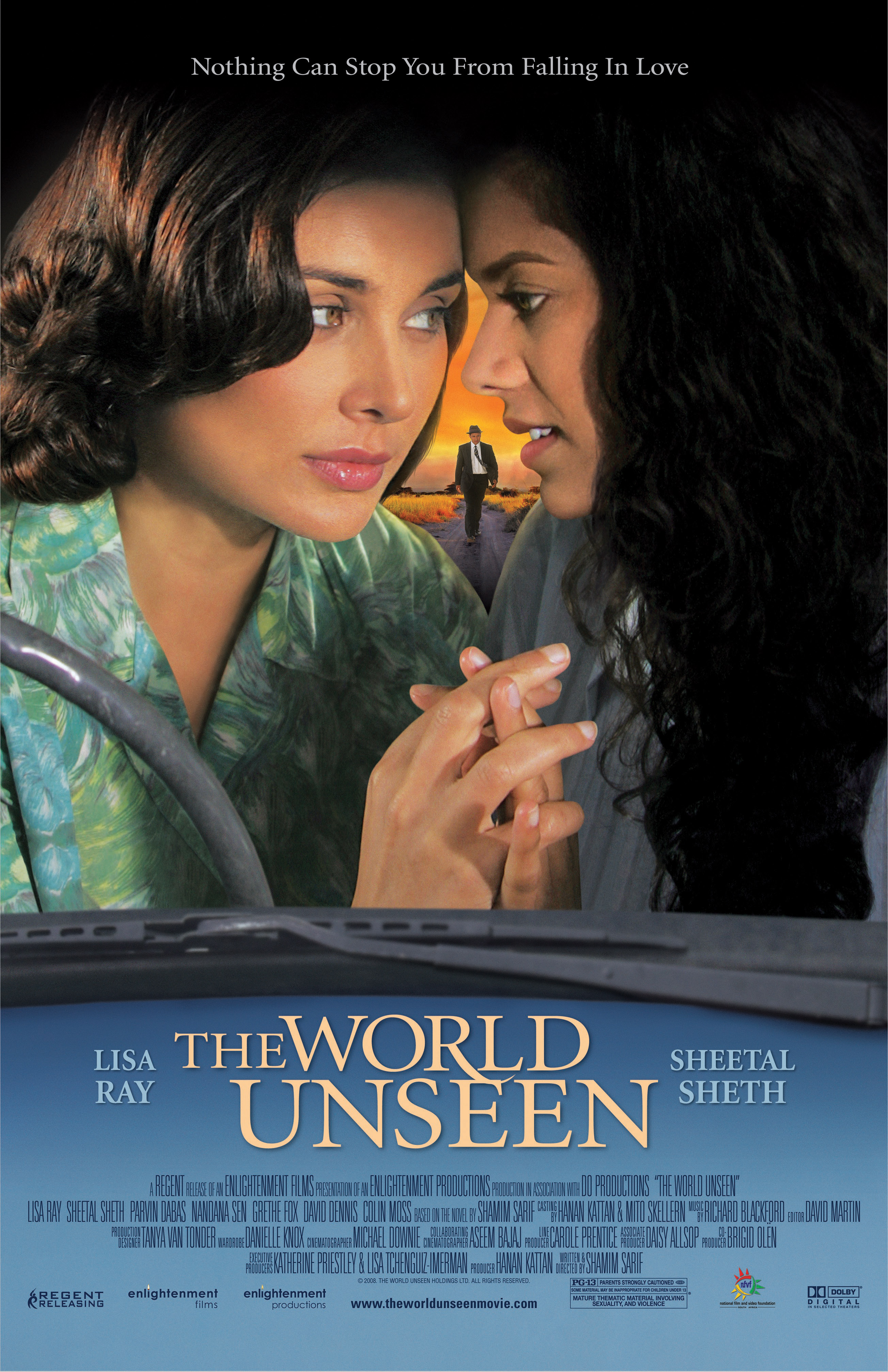
The World Unseen (2007)

12 Thursday Apr 2018

Posted by dullwood68 in Movies

≈ 1 Comment

Tags

Apartheid, Cape Town, Drama, LGBTQ+, Lisa Ray, Literary adaptation, Location Cafe, Parvin Dabas, Review, Romance, Shamim Sarif, Sheetal Sheth

D: Shamim Sarif / 90m

Cast: Lisa Ray, Sheetal Sheth, Parvin Dabas, Nandana Sen, David Dennis, Grethe Fox, Colin Moss, Natalie Becker, Rajesh Gopie, Bernard White, Avantika Akerkar

Cape Town, 1952. Amina (Sheth) is a young Indian woman who owns and runs the Location Cafe, a haven for both the local Indian community and the blacks. Miriam (Ray) is an Indian housewife and mother of three who visits the cafe and finds herself fascinated by Amina’s seemingly carefree, yet proud attitude. Her husband, Omar (Dabas), opens a general store on the outskirts of the city, and for a while, things progress as expected. Omar’s sister, though, puts them in danger when she comes to visit from Paris with her white husband. The police discover their presence, and Omar’s sister, Rehmat (Sen), is only saved from arrest by Amina’s hiding her. This helps to build Amina and Miriam’s friendship, something that is aided by Omar’s decision to hire Amina to create a vegetable garden behind the store. The two women spend more and more time together, and their friendship deepens until each begins to acknowledge the attraction they have for each other. But how can their love flourish when they have to contend with the social, sexual, cultural and political milieu they’re a part of?

A romantic drama set in a time and place that would have heavily condemned the sexual love of two women for each other, The World Unseen is a carefully paced, judiciously mounted movie that isn’t too interested in putting its central characters in too much jeopardy, while it explores themes related to the racism and homophobia of the period. Adapted from writer-director Sarif’s own novel, her tale of fledgling love amidst the trials and tribulations of apartheid South Africa is a low-key affair, telling its story simply and with due care and attention to the characters of Amina and Miriam. Thanks to Sarif’s script and the performances of Ray and Sheth, both women are sharply drawn, and their thoughts and feelings expertly expressed through covert looks, cautious body language, and coded language. The slow reveal of their feelings for each other is hidden behind a veil of subterfuge, and Sarif shows the mounting tension between Amina’s longing for Miriam and Miriam’s hesitancy over what it will mean to her marriage and her children, in such a way that the sincerity of their emotions is never in doubt.

With the movie’s central relationship locked in, Sarif is free to build around it, adding sub-plots and minor incidents to help flesh out the running time. Sadly, not all of these sub-plots are as successful as they could have been, and though they don’t do anything to hurt the pace of the movie – Sarif’s measured direction ensures everything proceeds at an even pace – there are too many that feel as if they’ve been lifted from a soap opera. Amina’s silent partner in the cafe, Jacob (Dennis), has a predictably short relationship with a white postmistress (Fox), Omar has a secret that Miriam has no choice but to tolerate (at first), and Amina’s grandmother tries to push her into an arranged marriage. Most of these elements end as quietly as they began, and lack any appreciable impact, but thanks to the engaging quality of the material as a whole, the movie doesn’t suffer as dramatically as it might have done. The rest of the performances are adequate (though Moss’s permanently aggressive policeman is particularly one-note), and the visual style is consistently muted in terms of colour and light, something that robs it of any further appeal, but overall this is a quietly persuasive movie that does very well by its central characters.

Rating: 7/10 – with its well conceived romance, and passive recreation of the time period it’s set in, The World Unseen is exemplary when focusing on its central characters’ hopes and dreams, but less so when the focus switches elsewhere; Sarif’s first outing as a writer and a director shows promise, and there’s a clear message about female empowerment, but in the end, there’s too much that feels perfunctory instead of important.

Share this:

  • Click to share on X (Opens in new window) X
  • Click to share on Facebook (Opens in new window) Facebook
  • More
  • Click to print (Opens in new window) Print
  • Click to email a link to a friend (Opens in new window) Email
Like Loading...

80,000 Suspects (1963)

17 Saturday Mar 2018

Posted by dullwood68 in Movies

≈ Leave a comment

Tags

Bath, Claire Bloom, Drama, Elleston Trevor, Literary adaptation, Review, Richard Johnson, Smallpox, The Pillars of Midnight, Thriller, Unhappy marriage, Val Guest, Yolande Donlan

D: Val Guest / 109m

Cast: Claire Bloom, Richard Johnson, Yolande Donlan, Cyril Cusack, Michael Goodliffe, Mervyn Johns, Kay Walsh, Norman Bird, Basil Dignam, Arthur Christiansen

It’s New Year’s Eve and all is not well between Dr Steven Monks (Johnson) and his wife, Julie (Bloom). After nine years their marriage is faltering. He has had an affair with a long-time friend, Ruth Preston (Donlan), the wife of one of his colleagues, Clifford (Goodliffe), but Julie only has vague suspicions and half-formed ideas as to why their marriage is in trouble. The discovery that a patient at the hospital where Steven works has smallpox, at first puts their problems to one side, but as more and more sufferers are found and the threat of an epidemic hangs over everyone, their relationship – and how they overcome their issues – takes on a greater importance for both of them. Julie contracts the virus, while at the same time, Ruth may or may not have left her husband. With the authorities stretched to the limit in their efforts to contain the outbreak, personal animosities become heightened, Steven and Julie find themselves making irrevocable decisions about their marriage, and one carrier threatens the safety of everyone…

Adapted from the novel, The Pillars of Midnight by Elleston Trevor, 80,000 Suspects is three movies rolled into one. There’s the hospital-based drama that unfolds as more and more smallpox sufferers are discovered and the Ministry of Health is brought in to save the day, there’s the relationship drama built around the problems of Steven and Julie, and there’s a late addition in the form of a race against time to find the last carrier, which makes it a thriller. All these elements bump against each other as the movie unfolds, and though they don’t always do so in an organic or believable way, the strength of the material overall ensures any rough transitions are smoothed over as quickly as possible. As each element is explored, the script also ensures that they’re not explored for too long before moving on or away to the next development in the story. This keeps the narrative ticking over effectively, and allows the characters – even the minor ones such as Johns’ over-anxious Ministry of Health coordinator – to stand out as credibly as possible. Working from his own script, director Val Guest adroitly keeps the focus where it’s needed, and elicits good performances from all concerned (though you could argue Johnson is a little stiff at times).

Shot in and around the town of Bath during the winter of early 1963 (which was particularly bad), the movie benefits from its location work, and the involvement of local residents in the scenes involving mass vaccination (watch out too for a cameo from Thirties star Graham Moffatt as a man with a fear of needles). This level of verisimilitude adds greatly to the no-frills approach adopted by Guest, and helps to make the potential scale of the epidemic that much more frightening. And for once, there aren’t any hidden agendas or characters using the outbreak for personal gain, just a group of people trying to do their best under difficult circumstances. The inter-relationships between the Monks’ and the Prestons does lead to a couple of soap opera-style moments, but these are forgivable in a movie that, by and large, could be mistaken at times as being a reconstruction of past events. Guest oversees it all with his usual skill, and in tandem with DoP Arthur Grant, uses the CinemaScope format to impressive effect, even though he relies on medium shots for most of the movie. Often gripping, this is a minor British classic, and easily due a revival.

Rating: 8/10 – an intelligent, yet modest drama with thriller leanings, 80,000 Suspects invests heavily in its characters and uses its smallpox outbreak as a way of exploring their faults and foibles, and in some depth; Bloom is terrific as the conflicted Julie, but Guest is the movies’s MVP, and if for nothing else, than for showing the fear and paranoia about the outbreak spreading out of control coming not from the public, but from the authorities trying to combat it.

NOTE: At present, there isn’t a trailer for 80,000 Suspects.

Share this:

  • Click to share on X (Opens in new window) X
  • Click to share on Facebook (Opens in new window) Facebook
  • More
  • Click to print (Opens in new window) Print
  • Click to email a link to a friend (Opens in new window) Email
Like Loading...

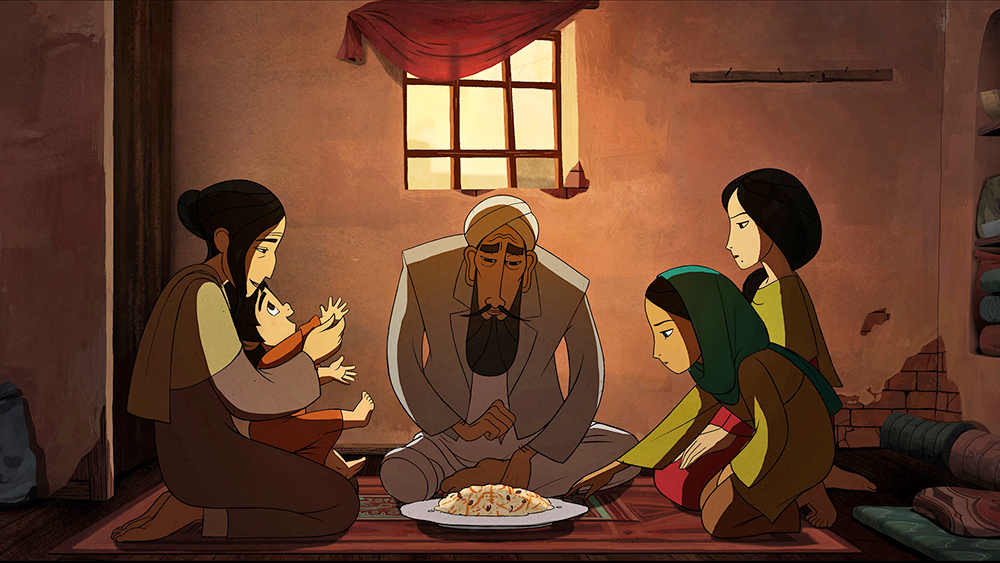
The Breadwinner (2017)

25 Sunday Feb 2018

Posted by dullwood68 in Movies

≈ Leave a comment

Tags

Afghanistan, Animation, Deborah Ellis, Drama, Kabul, Literary adaptation, Nora Twomey, Review, Saara Chaudry, Soma Chhaya, Taliban

D: Nora Twomey / 94m

Cast: Saara Chaudry, Soma Chhaya, Noorin Gulamgaus, Laara Sadiq, Ali Badshah, Shaista Latif, Kanza Feris, Kawa Ada

In Taliban controlled Kabul, Afghanistan, eleven year old Parvana (Chaudry) and her family – father Nurullah (Badshah), mother Soraya (Latif), older sister Fattema (Sadiq), and younger brother Zaki – get by through selling personal items on the street. Business isn’t always good, though, and when a run in with a member of the local militia, Idrees (Gulamgaus), leads to Nurullah being arrested and imprisoned without charge, things become even more difficult. With money and food running out, and women unable to move about freely unless accompanied by a man, Parvana hits on the idea to look and dress like a boy. She cuts her hair short, wears clothes worn by her deceased older brother, and along with Shauzia (Chhaya), a girl she knew when she went to school and who is also disguised as a boy, she begins to earn enough money to keep her family from becoming destitute. Parvana has a bigger aim, though: she wants to see her father, and maybe get him out of prison. Shauzia helps her get enough money together to bribe the guards, but Parvana’s plan doesn’t work. But as life in Kabul becomes more and more dangerous, the kindness of a stranger, Razaq (Ada), may prove to mean all the difference in Pavarna’s family being reunited…

Adapted from the literary award-winning novel of the same name by Deborah Ellis, The Breadwinner is the kind of animated movie we don’t often see enough of. Dealing with serious topics such as female persecution and religious intolerance in an honest and direct manner, the movie allows us a glimpse into a world most of us can’t even imagine. But like the best animation, the world it presents to us is just as real and just as affecting as if it were a documentary. The importance of the family unit, and the daily struggle to keep it intact, is highlighted by the little sacrifices that Parvana’s mother and sister make in the wake of Nurullah’s imprisonment. For Parvana, her experiences in the wider world – in a male-dominated world – bring both freedom of movement and unexpected restrictions due to her increased responsibility. It’s a dangerous path Parvana is taking, and the anguish it causes her family if she’s late home, is explored with impressive sincerity and pitched at just the right level of paranoia. Likewise, the risk of Parvana being found out, and the knowledge that if she is, everyone in her family will suffer, adds to the tension.

As a result, the movie draws in the viewer and provides them with a sincere, heartfelt story that is peppered with moments of philosophical reflection on the nature of modern Afghanistan, as well as showing that it’s still possible, even in a country ruled by the Taliban, to have hopes and dreams. Parvana hopes to be reunited with her father, Shauzia wants to see the ocean. Neither is unobtainable, but the script by Anita Doron makes it clear that achieving these things won’t be easy. The script also makes it clear that despite the hostility and the religious fundamentalism that the Taliban use to enforce their beliefs, there is also room for personal respect and understanding amongst the “people”. There are other messages to be found (relating to issues such as integrity, the abuse of power, and recurring injustice), but this is a movie about the power of hope and the power of family (a narrative strand that is best exemplified by the story within a story that Pavarna tells when there is a lull in her endeavours, and which features a brave villager taking on a terrible Elephant King). Twomey’s direction is confident, intelligent and humane, while the animation, with its clean lines and vibrant colours, is simple, yet tremendously effective.

Rating: 9/10 – nominated at this year’s Academy Awards in the Best Animated Feature Film category, The Breadwinner is an outstanding movie that features a great voice cast, superb animation, and a story that is compelling, thought-provoking, and ultimately, uplifting; not afraid to pull any narrative punches, the movie offers insights into life under the Taliban, but paints a picture of hope amidst all the suffering, and the refusal of the human spirit to be crushed completely.

Share this:

  • Click to share on X (Opens in new window) X
  • Click to share on Facebook (Opens in new window) Facebook
  • More
  • Click to print (Opens in new window) Print
  • Click to email a link to a friend (Opens in new window) Email
Like Loading...

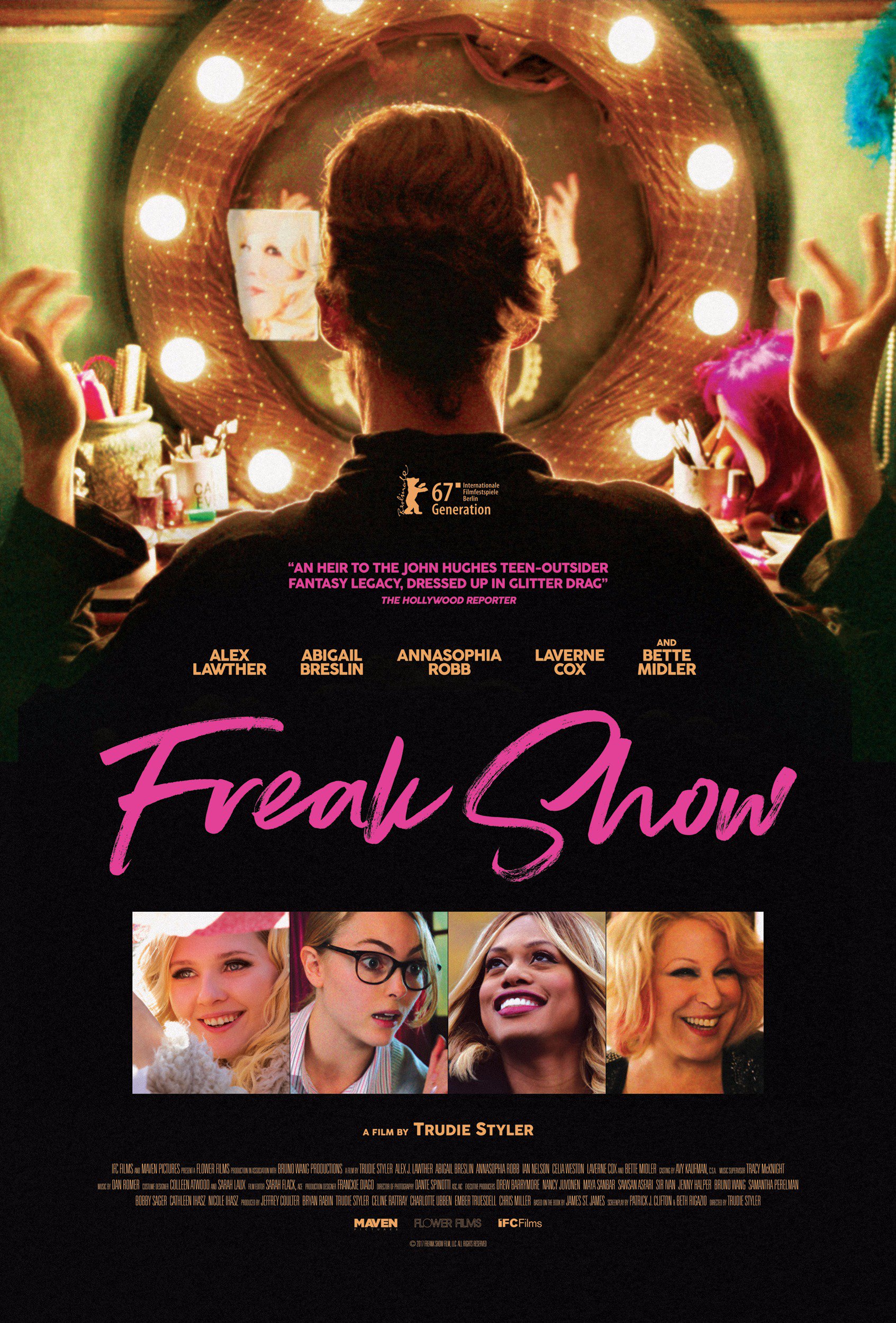
Freak Show (2017)

19 Monday Feb 2018

Posted by dullwood68 in Movies

≈ Leave a comment

Tags

Abigail Breslin, Alex Lawther, AnnaSophia Robb, Bette Midler, Comedy, Cross-dressing, Drama, High School, Homecoming Queen, Literary adaptation, Review, Trudie Styler

D: Trudie Styler / 91m

Cast: Alex Lawther, Abigail Breslin, AnnaSophia Robb, Ian Nelson, Larry Pine, Bette Midler, Celia Weston, Willa Fitzgerald, Charlotte Ubben, Laverne Cox, Christopher Dylan White, Michael Park, Mickey Sumner, John McEnroe, Eddie Schweighardt

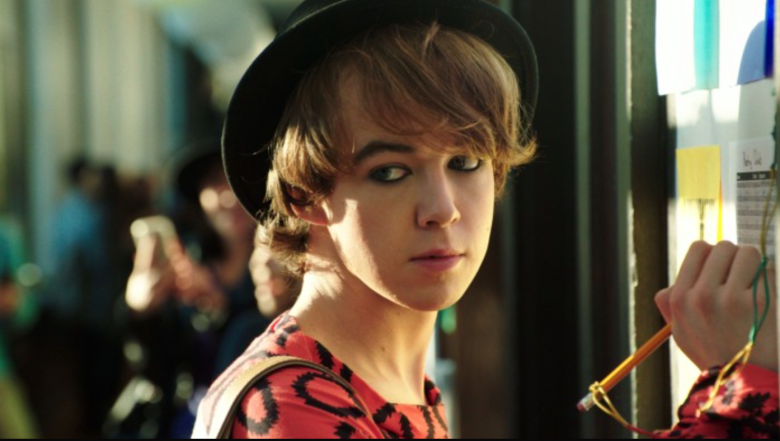
What if you didn’t fit in anywhere, and most days went out of your way not to fit in? And what if you were bullied by your fellow high schoolers, ignored by your father, missed your absentee mother terribly, and expressed your inner feelings by dressing up in outrageous yet clearly female outfits… and the source of all this was because you’re a boy? How would all that make you feel? And what would you do to combat the unwanted attention you’re getting from the other students? Well, in the feature debut of director Trudie Styler, the answer new kid Billy Bloom (Lawther) opts for is to be bolder and more outrageous, and to treat the majority of the other kids with disdain. But for all his outward self-confidence, Billy is still the outsider who wants to be accepted for who he is. The trouble is he’s flamboyant, shamelessly narcissistic, and completely uninterested in fitting in unless it’s on his own terms. But when he’s viciously beaten up by members of the school football team, things begin to edge his way, and a wider acceptance makes itself felt, an acceptance that is put to the test when Billy decides to run for Homecoming Queen…

Anyone coming to Freak Show might find themselves wondering if its origins lay between the pages of a Young Adult novel, and those assumptions would be right. Adapted from the novel of the same name by self-styled celebutante James St. James, Freak Show is a movie predicated to the idea of individuality above all else, and being true to yourself, even if you’re not sure just who you are yet. It’s an ode to persevering against the odds, but told in an uneven and often uncertain way thanks to a screenplay by Patrick J.Clifton and Beth Rigazio that can’t decide if Billy should fully integrate into high school life or remain a consenting outsider. Outside of school, Billy lives with his father (Pine) who doesn’t understand him, and he dreams of the day his mother (Midler) will come to rescue him from the terrible life he really doesn’t lead. Within school, Billy makes friends with Blah Blah Blah (Robb), who thinks he’s amazing, and football star Flip (Nelson) who has an artistic side he doesn’t feel he can express except when he’s around Billy.

The relationship that develops between Billy and Flip occupies a lot of the movie’s running time, and it spends a lot of that time not going where you might expect it to (but then it does). It’s not always handled well, and there’s a frankly embarrassing moment between Flip and Billy’s mother that has all the dramatic subtlety of a police baton strike to the lower right thigh (sorry, wrong movie). Billy’s decision to run for Homecoming Queen includes the movie’s heartfelt plea for tolerance, and though it’s beautifully expressed by Lawther, the movie tries to be ironic immediately after – and doesn’t even come close. With the screenplay also unable to pin down its approach to gender politics, it’s left to Lawther and the make up, costume and wardrobe departments to provide a series of outfits that best express Billy’s glamour obsessed personality, and in doing so to gloss over the movie’s various shortcomings, not the least of which is Breslin’s God-bothering rival for the Homecoming Queen tiara, Lynette. It is Lawther’s movie though, the young actor giving a relaxed, confident, and sincere performance that keeps Billy sympathetic throughout, even when it’s hard to feel entirely sorry for him.

Rating: 6/10 – bolstered by a terrific performance from Lawther, but hampered at the same time by so many high school movie clichés it’s like shooting fish in a barrel, Freak Show is at least funny when it’s trying to be, but tiresome when it’s trying to be serious; with its mixed messages centering around individuality and integration, the movie is only half as effective as it should be, and too often opts for warm and fuzzy when it should be direct and uncomfortable.

Share this:

  • Click to share on X (Opens in new window) X
  • Click to share on Facebook (Opens in new window) Facebook
  • More
  • Click to print (Opens in new window) Print
  • Click to email a link to a friend (Opens in new window) Email
Like Loading...

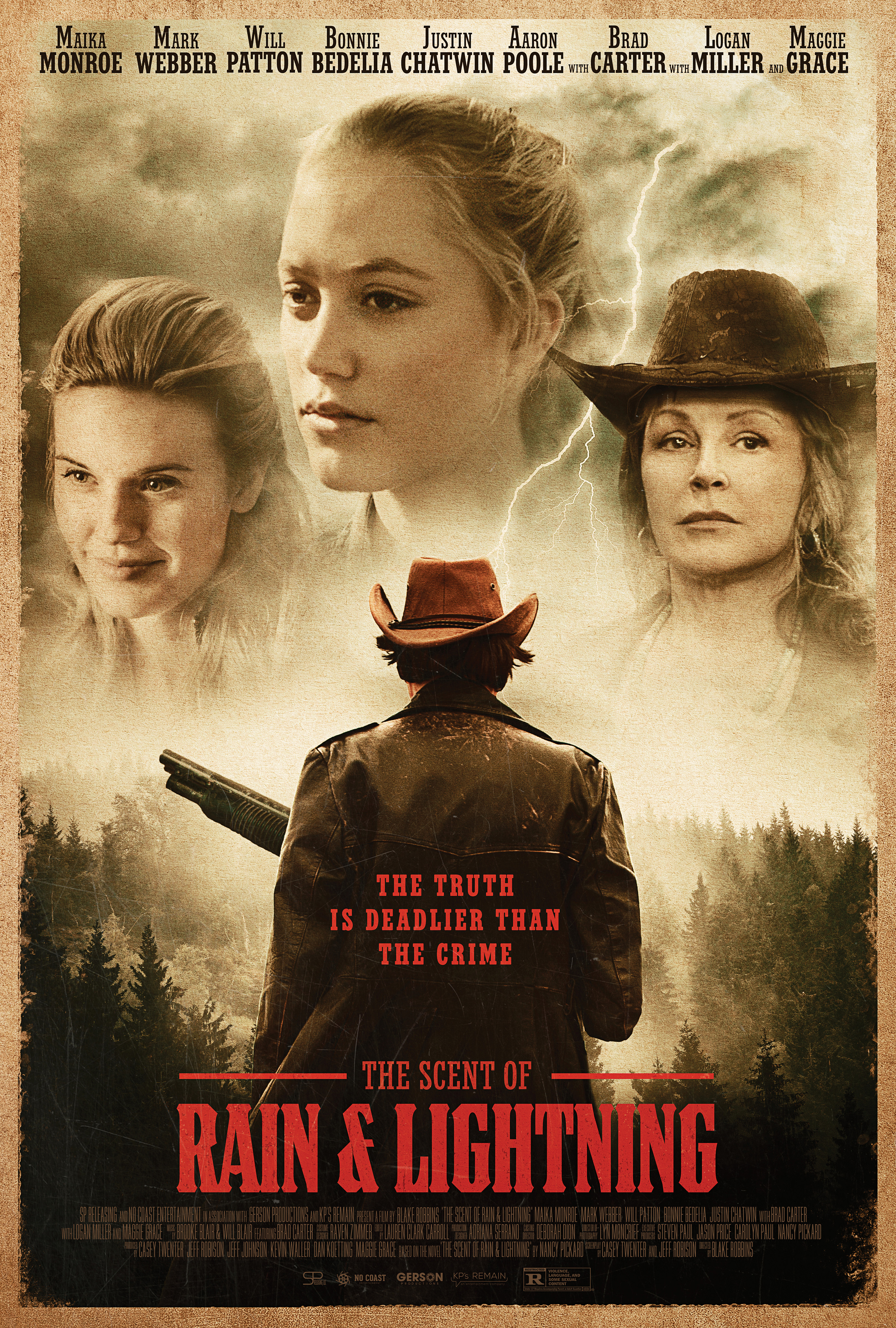
The Scent of Rain & Lightning (2017)

17 Saturday Feb 2018

Posted by dullwood68 in Movies

≈ Leave a comment

Tags

Blake Robbins, Drama, Literary adaptation, Maggie Grace, Maika Monroe, Mark Webber, Murder, Revenge, Review, Thriller, Will Patton

D: Blake Robbins / 103m

Cast: Maika Monroe, Mark Webber, Will Patton, Maggie Grace, Justin Chatwin, Bonnie Bedelia, Aaron Poole, Brad Carter, Logan Miller, Kassia Conway, Sarah Noble Peck

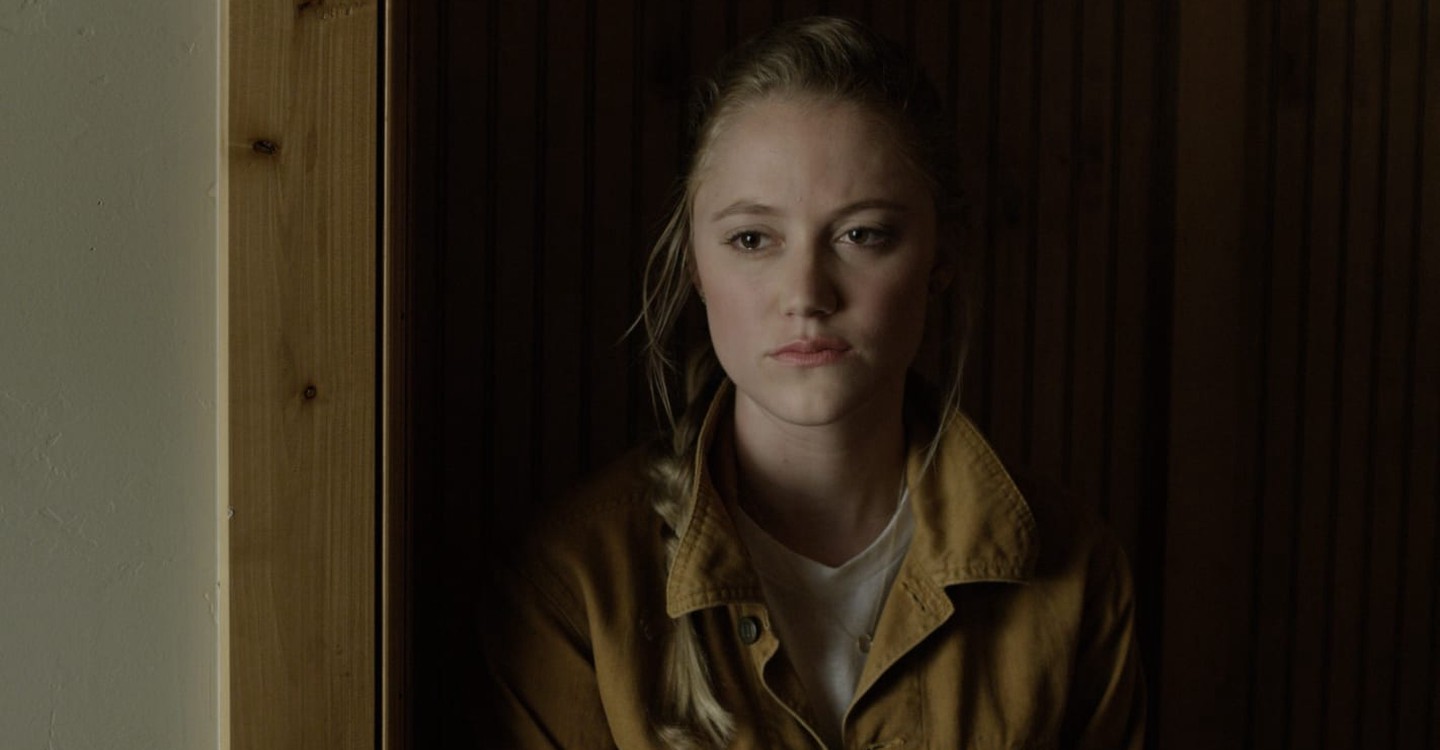
A small town murder mystery with an arthouse feel, The Scent of Rain & Lightning opens with bad news for Jody Linder (Monroe): Billy Croyle (Carter), the man who was jailed for killing her parents, Laurie and Hugh (Grace, Chatwin), twelve years before has had his sentence commuted and is being released from prison. Understandably, Jody and the rest of her family – grandfather ‘Senior’ (Patton), grandmother Annabelle (Bedelia), uncles Chace (Webber) and Meryl (Poole) – aren’t too happy about this, but when Jody confronts Croyle and he accuses ‘Senior’ of getting the verdict he wanted, as well as denying he killed her parents, Jody begins to ask questions around town, questions that make her believe that not everything about her parents’ deaths is as cut and dried as she’s been led to believe. As the town – and her family – start to give up their secrets, Jody is forced to accept that the answers she’s looking for may lie closer to home. But then a senseless act of violence occurs, one that puts Jody in danger, and which threatens her family as well…

A slow burn thriller that looks and feels like an arthouse movie, The Scent of Rain & Lightning (adapted from the novel of the same name by Nancy Pickard) doesn’t offer anything new for viewers with a liking for small town murder mysteries, but it does provide a non-linear narrative that interweaves Jody’s somewhat random approach to investigating her parents’ deaths, with flashbacks to the events that led up to the murders, and finally, what actually happened. These flashbacks are necessary, as Jody proves to be the Rick Deckard of small town murder mysteries, and never learns anything of real value. Thankfully, while she’s looking for answers, the script by Casey Twenter and Jeff Robison (also two of the movie’s producers) keeps the viewer up to speed with what happened, why, how, and who was responsible. It makes for an uneven narrative, with neither strand complementing each other, or finding common moments where they might connect effectively, and as a result, it’s a movie that often feels like it’s been stitched together Frankenstein Monster-style, with no clear idea of which part goes with which. This also leaves some scenes feeling a little lost, or there just to pad out the running time.

Performance-wise, the movie is a bit of a mixed bag also. None of the characters are particularly well developed, and Jody’s expected character arc fizzles out around two thirds in. Monroe, a very talented young actress who’s still looking for that perfect follow up to her breakout role in It Follows (2014), hasn’t much to do beyond ask awkward questions and have those questions go unanswered. As the movie progresses, her role diminishes further and further, and the need to solve the mystery takes precedence. This brings Grace’s character to the fore, but Laurie and her secret prove to be very stereotypical, which leaves any emotional connection the viewer might be looking to make as unlikely as Kevin Spacey winning a Best Supporting Actor award at this year’s Oscars. Elsewhere, the likes of Patton, Bedelia and Poole flit in and out of the narrative, while Webber struggles to make his character ambivalent enough to be considered a viable suspect. Robbins, making his second feature (and appearing as the town sheriff), opts for a muted visual style that is at least atmospheric, but which doesn’t elevate the material, and there are too many occasions where the image is refracted through water as if it has an important psychological resonance.

Rating: 5/10 – with two narrative strands that work independently of each other, and a sense that no amount of screenplay jiggery-pokery could have brought them together, The Scent of Rain & Lightning lacks the impact needed to make its mystery elements work, and its small town milieu appropriately claustrophobic; disappointing then – though not unwatchable – it’s another indie thriller that tries hard to be different while forgetting that it’s using very basic materials to begin with.

Share this:

  • Click to share on X (Opens in new window) X
  • Click to share on Facebook (Opens in new window) Facebook
  • More
  • Click to print (Opens in new window) Print
  • Click to email a link to a friend (Opens in new window) Email
Like Loading...

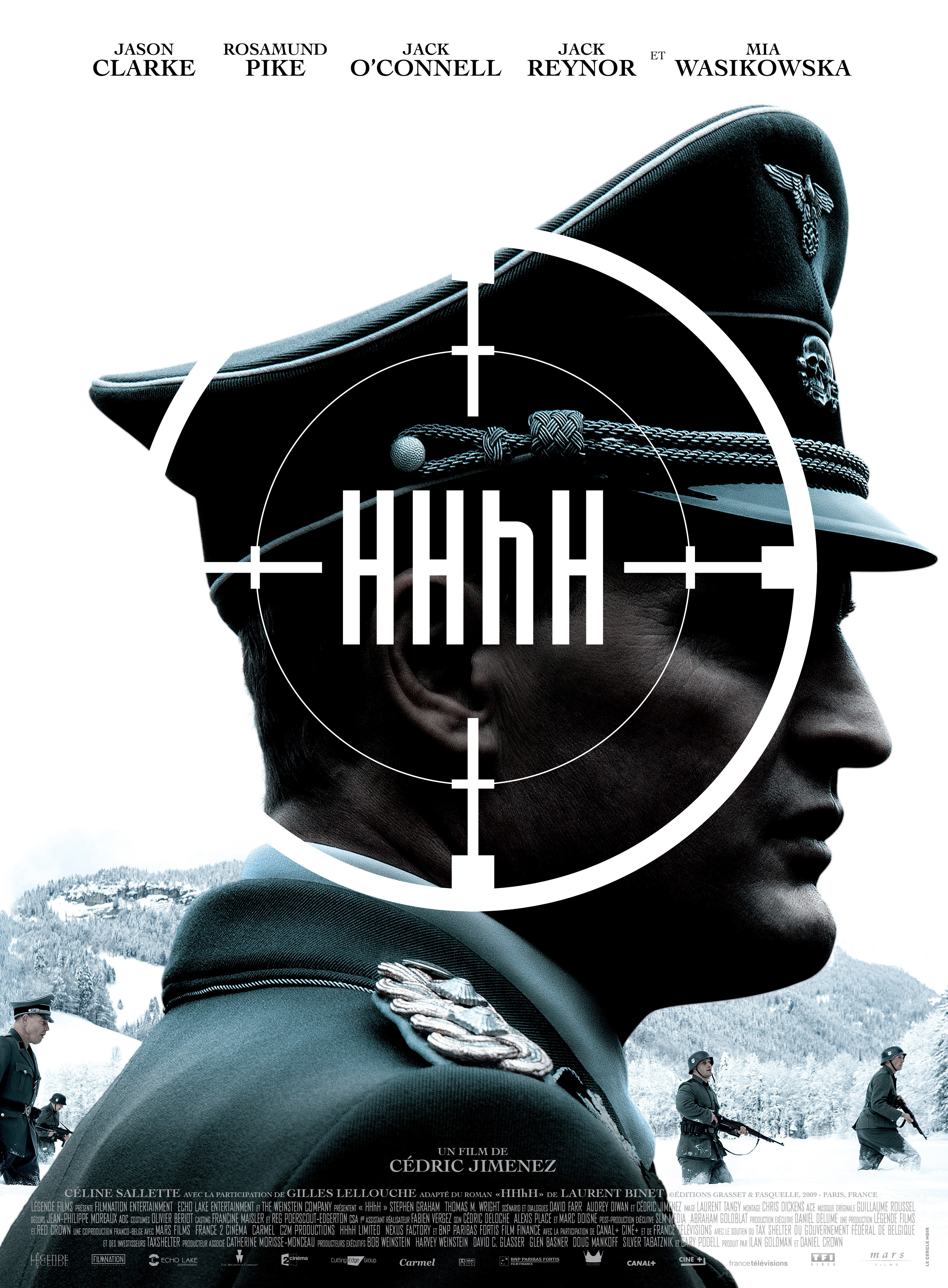
HHhH (2017)

12 Monday Feb 2018

Posted by dullwood68 in Movies

≈ Leave a comment

Tags

Assassination, Cédric Jimenez, Drama, History, Jack O'Connell, Jack Reynor, Jason Clarke, Literary adaptation, Mia Wasikowska, Reinhard Heydrich, Review, Rosamund Pike, Thriller, World War II

aka Killing Heydrich; The Man With the Iron Heart

D: Cédric Jimenez / 120m

Cast: Jason Clarke, Rosamund Pike, Jack O’Connell, Jack Reynor, Mia Wasikowska, Stephen Graham, Thomas M. Wright, Noah Jupe, Geoff Bell, Enzo Cilenti, Volker Bruch, David Rintoul, David Horovitch, Abigail Lawrie, Adam Nagaitis

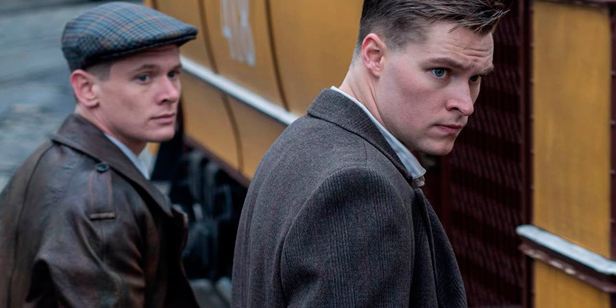
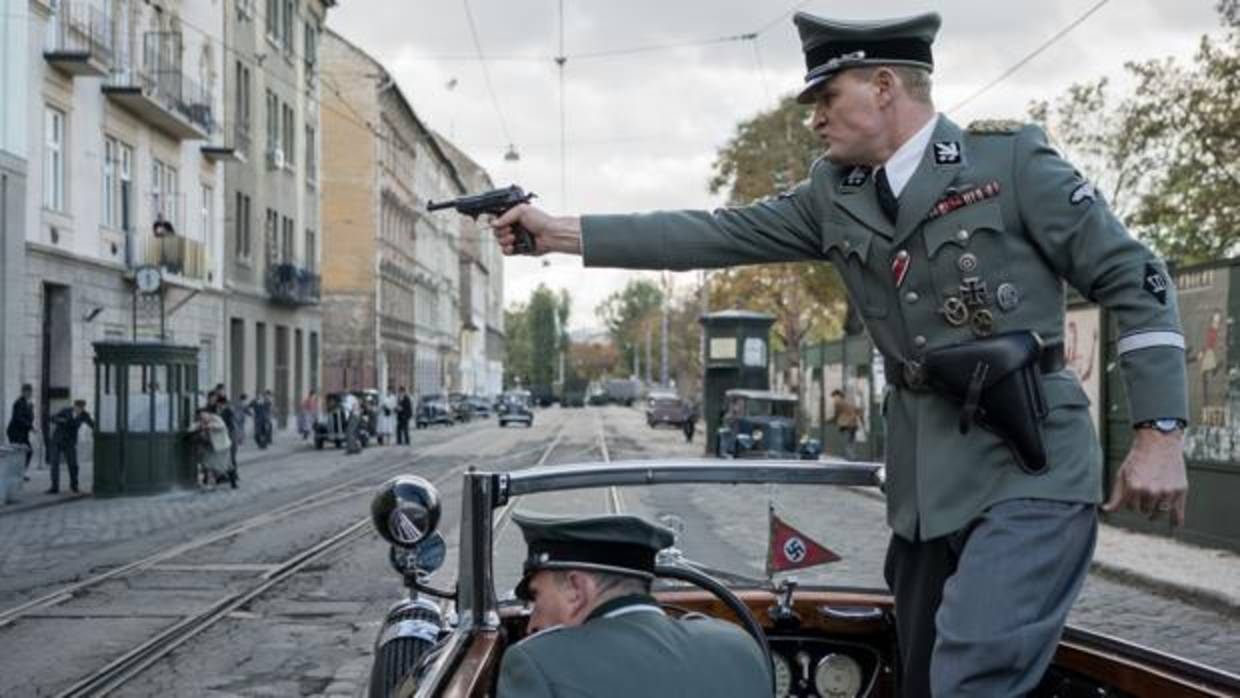
Let’s get this out of the way right from the start: HHhH is an odd movie. In fact, it’s very odd. Not because of the title, which is an acronym for Himmlers Hirn heißt Heydrich (Himmler’s brain is called Heydrich, a quip you wouldn’t dare repeat back then), and not because you have to wade through a long list of actors before you find someone whose first language is actually German or Czechoslovakian. No, what makes the movie so odd is that, for a drama based around the assassination of Reinhard Heydrich (Clarke), keen violinist and one of the main architects of the Final Solution, it lacks ambition and drive, and often moves from scene to scene as if seeking the right direction in which to move forward. It also lacks focus, telling us much about Heydrich’s early life in its first twenty minutes (including his love of fencing, and his dishonourable discharge from the German Navy), but then failing to link it all to anything that happens once he’s fully committed to being a Nazi.

Like a lot of members of the Nazi Party, Heydrich went from being something of a nobody to somebody wielding quite a lot of power in a very short space of time, and the movie recognises this. However, thanks to the vagaries of the script, and Clarke’s gloomy demeanour throughout, Heydrich remains a sadistic bully boy in adult’s clothing – and just that. No one is looking for the movie to redeem Heydrich in some way (though that would make it more interesting), but for all its attempts at trying to shine a spotlight on his pre-Nazi activities, they’re all left abandoned as the movie progresses. Instead we see Heydrich’s rise to prominence through the patronage of, first, his wife, Lina von Osten (Pike playing Lady Macbeth as if her career depends upon it), and then, second, Heinrich Himmler (Graham playing Hitler’s right hand man as the uncle you do visit). He does some expectedly nasty things, behaves unconscionably whenever possible, and then his story, with over an hour of the movie to go, takes a back seat to Operation Anthropoid.

By changing its focus nearly halfway through, Jimenez’s movie only narrowly avoids feeling schizophrenic. As we’re introduced to Jan Kubiš (O’Connell) and Jozef Gabčík (Reynor), the two men chosen to head up the assassination attempt, we also get to meet a whole roster of new characters that we don’t have time to get to know or care about. And once Heydrich is out of the way, the terrible reprisals carried out by the Nazis are represented by the razing of Lidice (which actually happened), but in such a brusque way that it makes it obvious that HHhH wants to move on quickly to address the fate of Kubiš and Gabčík and their compatriots – which goes on for far too long and features the kind of gung-ho heroics that only a movie would feel was appropriate. Add the fact that the script – by Jiminez, Audrey Diwan and David Farr from Laurent Binet’s novel – is represented by some of the blandest, most depressing cinematography seen in recent years, and you have a movie that is tonally awkward, flatly directed, and which flirts in earnest with having nothing meaningful to say.

Rating: 5/10 – clunky and dour, and only sporadically engaging, HHhH tells its story as if it was being forced to – and the whole process is painful; a missed opportunity would be putting it mildly, but the movie’s very oddness allows for a certain fascination to develop as the movie unfolds, making it watchable if you don’t expect too much from it.

Share this:

  • Click to share on X (Opens in new window) X
  • Click to share on Facebook (Opens in new window) Facebook
  • More
  • Click to print (Opens in new window) Print
  • Click to email a link to a friend (Opens in new window) Email
Like Loading...

The Clapper (2017)

02 Friday Feb 2018

Posted by dullwood68 in Movies

≈ 1 Comment

Tags

Amanda Seyfried, Comedy, Dito Montiel, Drama, Ed Helms, Infomercials, Literary adaptation, Review, Romance, Tracy Morgan

D: Dito Montiel / 90m

Cast: Ed Helms, Amanda Seyfried, Tracy Morgan, Adam Levine, Russell Peters, P.J. Byrne, Brenda Vaccaro, Leah Remini

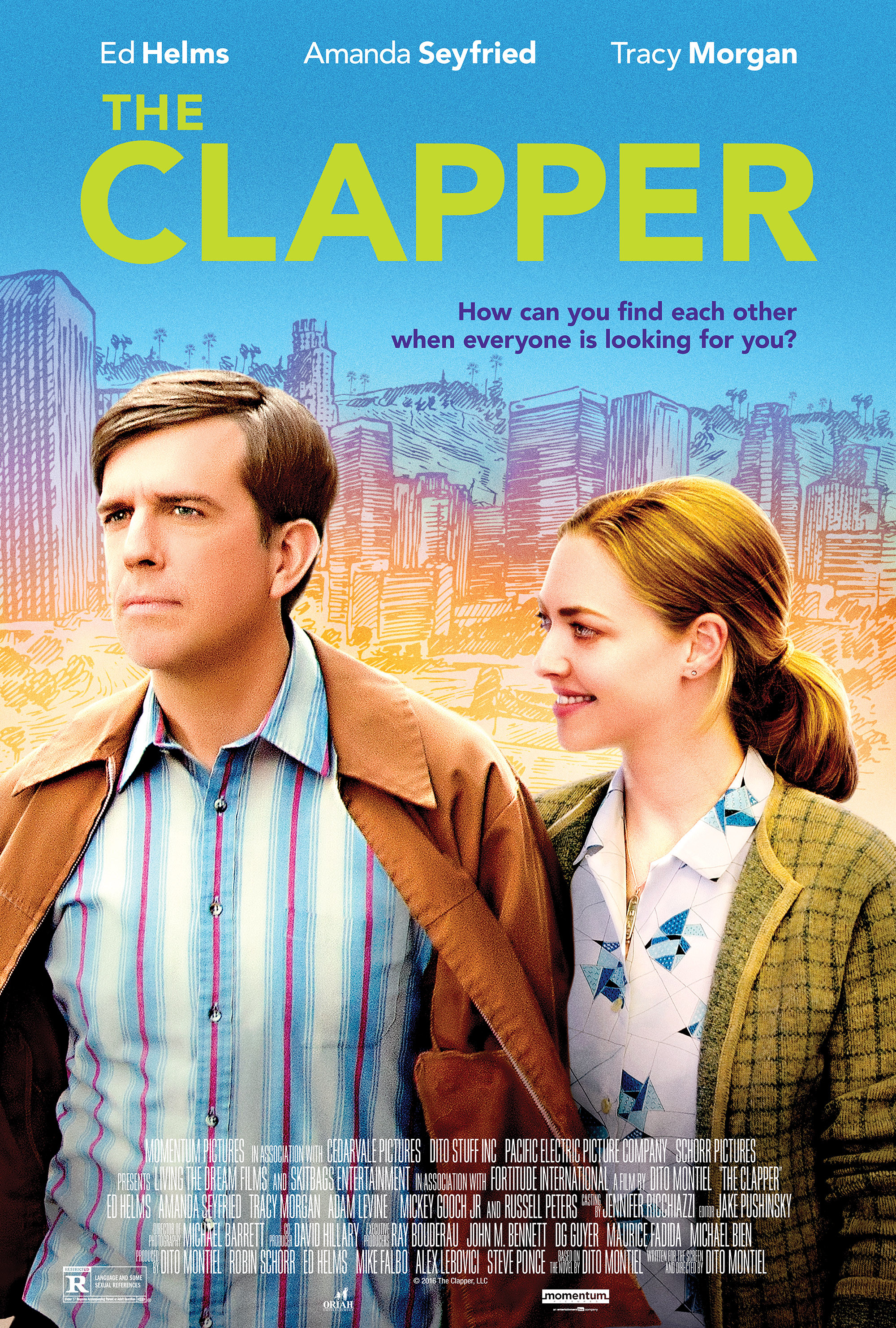
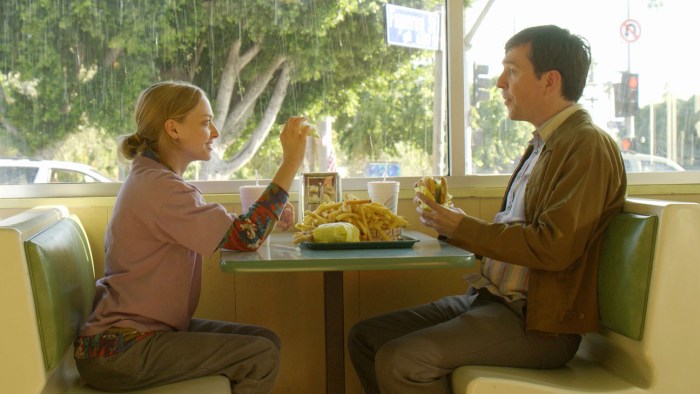
Eddie Krumble (Helms) is a professional clapper, a paid audience member of informercials who sometimes gets paid extra for asking a question, or standing out from the crowd in some other way. It’s not the best paid job in the world, but Eddie is kept busy, and along with his best (and only) friend, Chris (Morgan), he makes a good enough living to suit his needs. He’s also struck up an unlikely friendship with a young woman, Judy (Seyfried), who works at a gas station. But just as they begin dating, a late night TV show shines a spotlight on Eddie’s clapper activities, and asks the question, Who is the Clapper? This unwanted attention causes problems for Eddie as he doesn’t want the exposure, and it leads to Judy being fired from her job at the gas station. Not knowing how to contact her, and with the TV show still trying to track him down, Eddie hits on an idea that he thinks will keep everyone happy: he’ll appear on the show and ask people to help him find Judy. But Eddie’s efforts backfire, and soon it looks as if he and Judy are destined never to be reunited.

snap1.44861.4

In adapting his own novel, writer/director Dito Montiel has crafted an uneven yet enjoyable movie that tries to take a number of heavy-handed potshots at lowest common denominator television, while also featuring a sweetly nuanced romance, and a deft exploration of the lasting effects of overwhelming grief. In targeting the exploitative nature of some US TV shows, Montiel’s approach feels a little old and past its time, and it lacks the satirical bite that’s needed for his barbs to hit home with the required effect. The burgeoning romance between Eddie and Judy is handled with a lightness of touch that is magnified by the just-this-side of overbearingly cute performances by Helms and Seyfried. In their capable hands, what could have been sickly and off-putting is instead winning and delightful, a meeting of unsure hearts and minds with each needing to protect themselves as much as possible while also trying to find the courage to make a commitment. Their romance is touching and sincere, and the awkwardness each feels is tenderly expressed on both sides, with Eddie’s nervous ramblings a perfect foil for Judy’s equally nervous uncertainty.

But where the movie really works is in its depiction of the emotional troubles affecting Eddie, and his consternation at being singled out. Helms is terrific as Eddie, a man just trying to get along without being noticed, and trying to put a devastating trauma behind him. There’s a frailty and an anger and a desperation in Eddie, and they all threaten to leak out and overwhelm him, and Helms is at his best when showing us how his character is trying to keep all these feelings in check. There are moments when it seems as though Montiel has let Helms run with a scene, and if this is true, then it was a wise decision; this is one of Helms’s finest performances. However, it’s a performance that can’t make up for some of the other decisions Montiel has made, such as the late inclusion of Vaccaro as Eddie’s mother (there just to push Eddie into a necessary narrative corner), and the length of time that Eddie remains anonymous (when she wants to, Judy finds his agent/manager with ease; yet the TV show struggles for weeks to do the same thing). The tone of the piece changes too often as well, with the disparate storylines not always fitting well together. Nevertheless, this is diverting enough to warrant maybe a repeat watch, just for the pleasure of seeing Helms at his best.

Rating: 7/10 – that man Helms rescues The Clapper from a lower score purely by the strength and subtlety of his performance, and Montiel’s inspired decision to cast him; Morgan too is on good form, and so is Seyfried (even if she’s given less and less to do as the movie progresses), but narrative inconsistencies, and a sense that Montiel hasn’t fully locked in the script, undermine the good work on show elsewhere, leaving the movie feeling likeable yet also incomplete.

Share this:

  • Click to share on X (Opens in new window) X
  • Click to share on Facebook (Opens in new window) Facebook
  • More
  • Click to print (Opens in new window) Print
  • Click to email a link to a friend (Opens in new window) Email
Like Loading...

Final Portrait (2017)

25 Thursday Jan 2018

Posted by dullwood68 in Movies

≈ Leave a comment

Tags

Alberto Giacometti, Armie Hammer, Art, Comedy, Drama, Geoffrey Rush, James Lord, Literary adaptation, Painting, Paris, Review, Stanley Tucci

D: Stanley Tucci / 90m

Cast: Geoffrey Rush, Armie Hammer, Clémence Poésy, Tony Shalhoub, Sylvie Testud

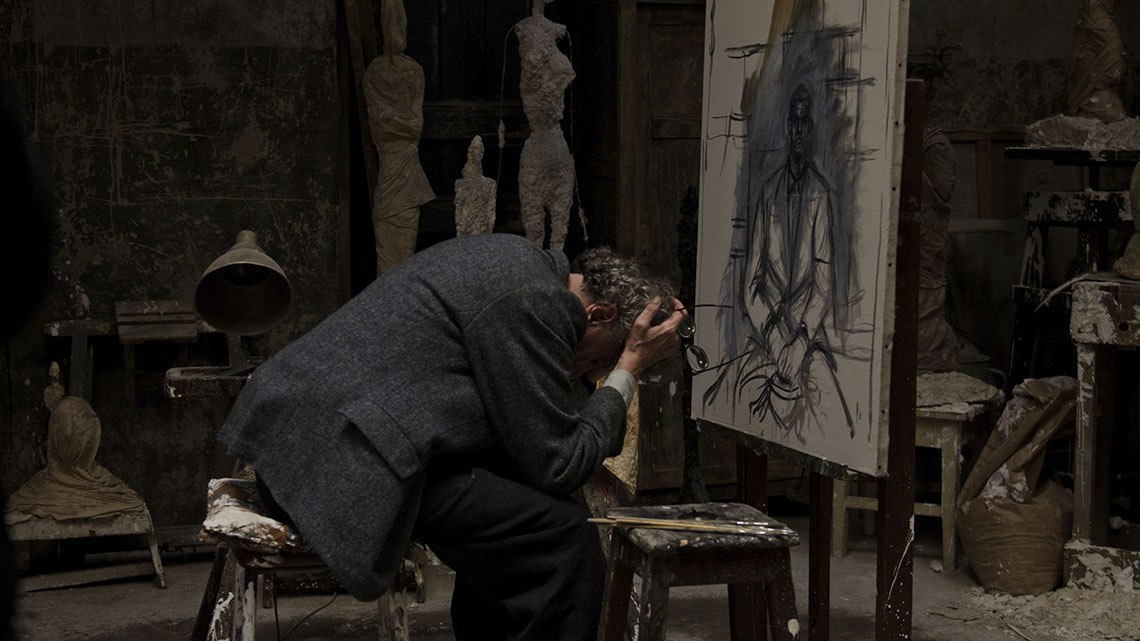
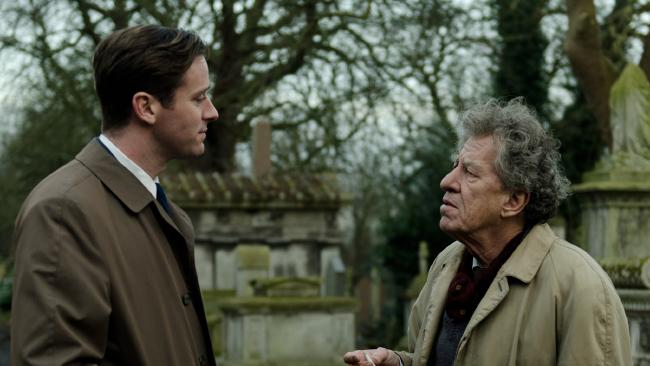
In 1964, the writer James Lord (Hammer) is in Paris on a short trip when his friend, the artist Alberto Giacometti (Rush), asks him to sit for a portrait. Giacometti initially says it will take a few hours – one afternoon – but his own eccentricities and his own self-doubts mean that one afternoon becomes several weeks, and Lord is faced with postponing his return to the US until the portrait is finished. Giacometti works in fits and starts, and his personal life often interferes with his progress with the painting. There are long-standing animosities between Giacometti and his wife, Annette (Testud), that are exacerbated by his relationship with Caroline (Poésy), whose portrait he’s also painting. As the time passes, Lord becomes an observer of Giacometti’s life and work, and his insecurities and obsessions.

Based on the biography written by Lord a year later, A Giacometti Portrait, Stanley Tucci’s fourth feature as a writer/director is a meditative exploration of the creative process, and the notion that no work of art can ever truly be regarded as finished. It’s an interesting idea for a movie to examine, as by its very nature, Final Portrait is exactly that: a finished product (unless Tucci decides to release revised versions of the movie in future years). But it’s an idea that Giacometti adheres to, and Tucci has him continually looking at the sculptures in his studio, examining them, assessing them, and sometimes changing them slightly, albeit in very minor ways, as if by doing so, he can improve the work in such a way that it becomes more relevant, and worth the effort he’s put into it. The same applies to Lord’s portrait, an endeavour that Giacometti says will never be truly completed, even if Lord were to be available to sit for the rest of his life; even then, more can always be done to improve the work, and then more again.

Tucci isn’t one for histrionics or exaggerated performances, and his cast comply with the needs of a script that requires a delicacy of touch and a sympathetic approach to both Giacometti and his erratic genius. Rush is a terrific choice as the artist who thinks nothing of throwing an envelope with two million francs in it under a bed and forgetting about it. Chain-smoking his way through the movie, Rush portrays Giacometti as a restless man who is always searching for that one moment of clarity in his work but never quite finding it. As the trapped, slightly bewildered, and increasingly frustrated Lord, Hammer is effectively the straight man to Rush’s manic devilry, but he carries the role well, and is a charming foil for Giacometti’s maddening behaviour. In support, Poésy and Testud offer polar opposites as the women in Giacometti’s life (neither of whom are as well treated as they would like), and there’s the quiet, reflective presence of Shalhoub as Giacometti’s brother, Diego. The movie is beautifully constructed, with the artist’s studio a wonderfully designed and assembled cave of wonders courtesy of production designer James Merifield, art director David Hindle, and set decorator Sarah Wan. The camera takes in all the elements that are on display and a wonderfully evocative world is entered into as a result. It’s all overlaid with a tremendous sense of fun, along with a dash of rueful humour here and there, and remains a captivating and entertaining experience throughout.

Rating: 8/10 – an affectionate tribute to the difficulties inherent in the artistic process, Final Portrait is a thoughtful, sincere, modest, and clever movie that offers a beguiling yet intuitive examination of the artist Alberto Giacometti and his work; Rush and Hammer give wonderful performances, Tucci directs with verve and confidence in his own script, and it all proves as invigorating as the pursuit of artistic “truth” should be.

Share this:

  • Click to share on X (Opens in new window) X
  • Click to share on Facebook (Opens in new window) Facebook
  • More
  • Click to print (Opens in new window) Print
  • Click to email a link to a friend (Opens in new window) Email
Like Loading...

The Foreigner (2017)

18 Thursday Jan 2018

Posted by dullwood68 in Movies

≈ 1 Comment

Tags

Action, Authentic IRA, Bombing, Drama, Ireland, Jackie Chan, Literary adaptation, London, Martin Campbell, Pierce Brosnan, Review, Thriller

D: Martin Campbell / 113m

Cast: Jackie Chan, Pierce Brosnan, Orla Brady, Dermot Crowley, Rory Fleck Byrne, Charlie Murphy, Niall McNamee, Rufus Jones, Ray Fearon, Lia Williams, Michael McElhatton

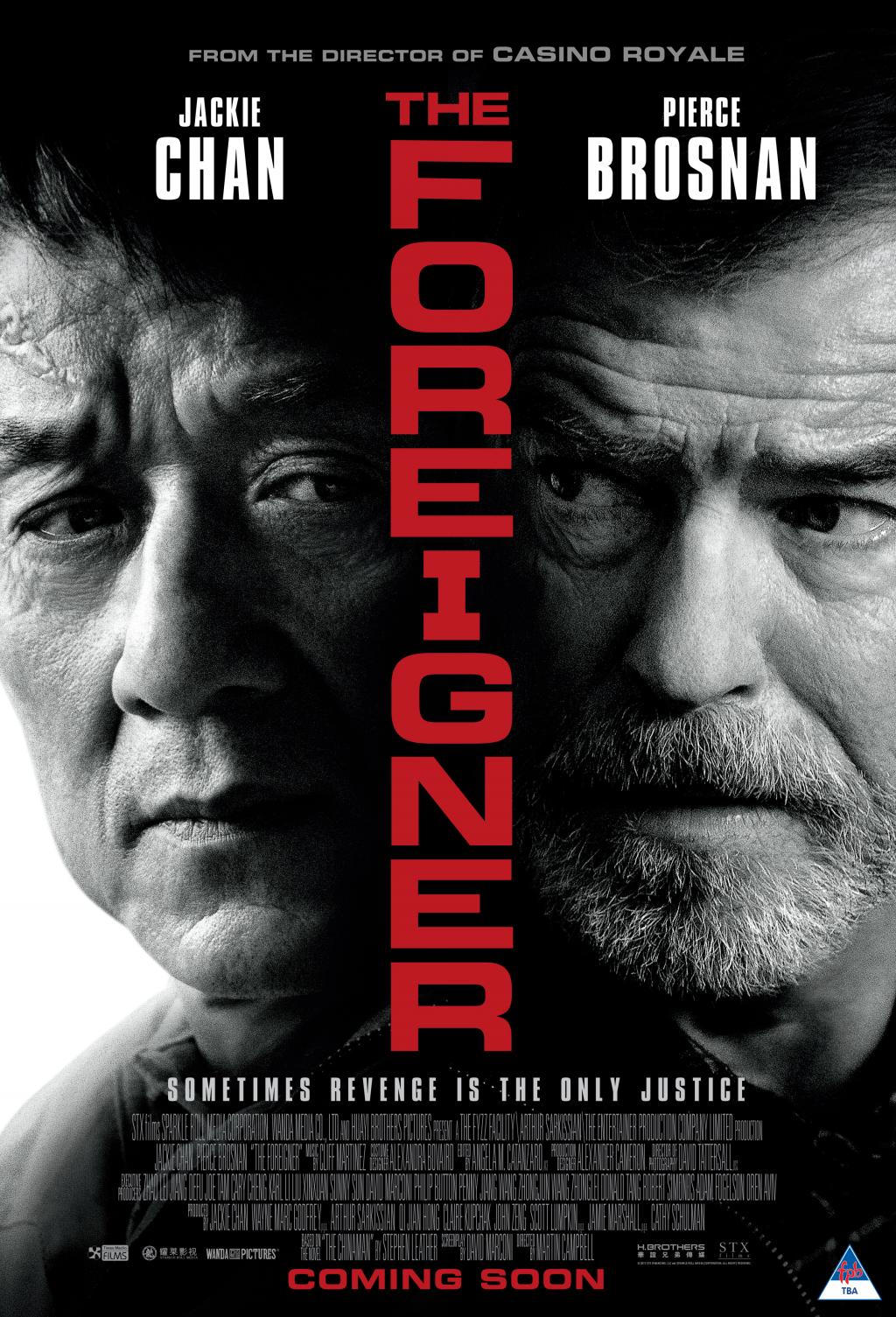
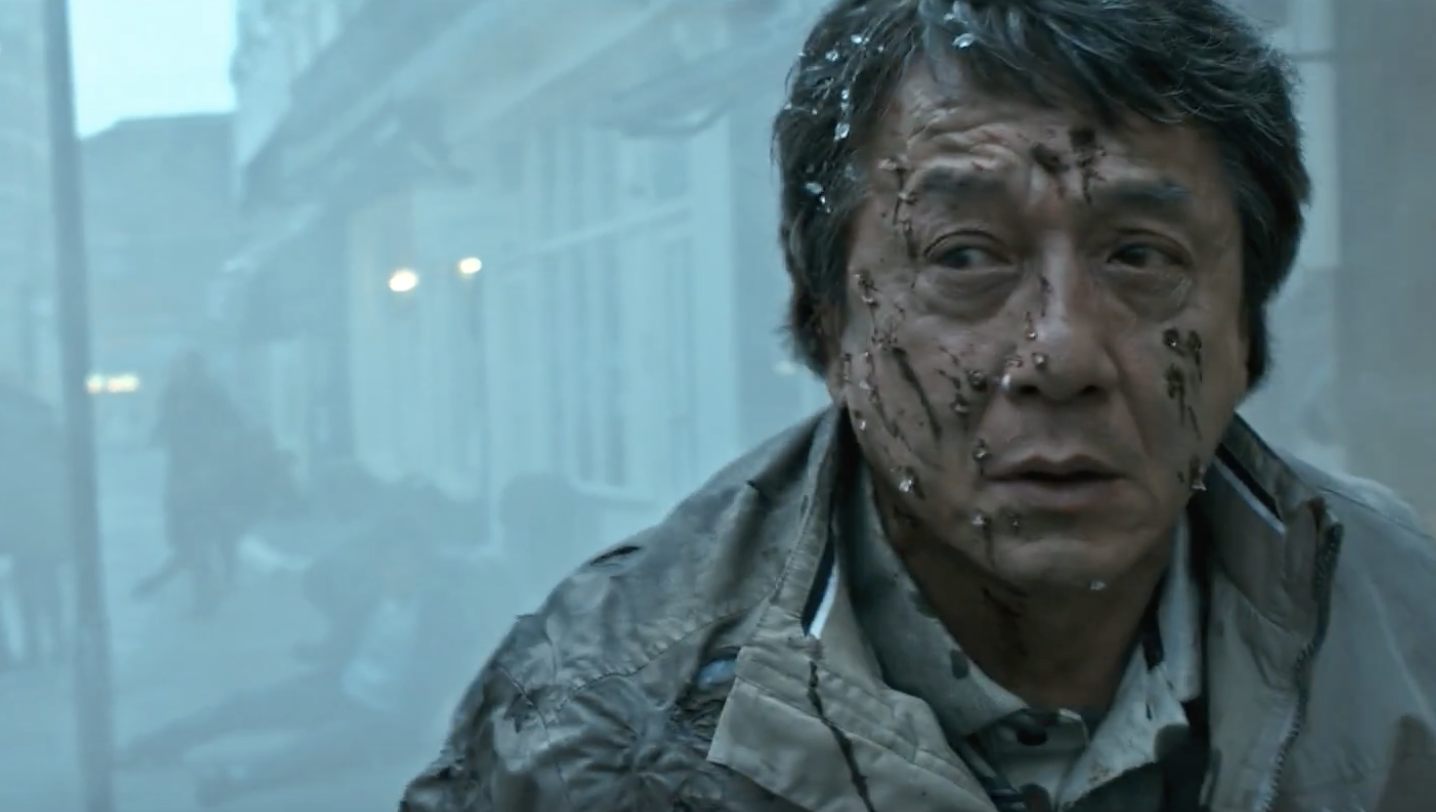
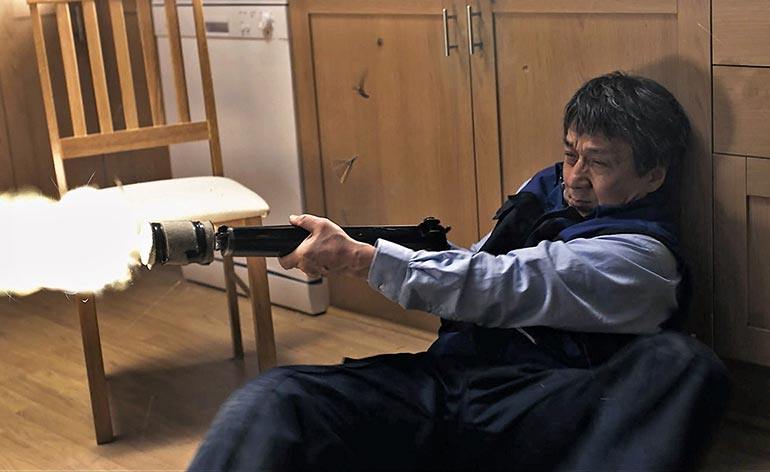
At the beginning of The Foreigner we see Jackie Chan playing a role that we’ve not seen him play before: that of a concerned father. Already it’s a refreshing change, and though you might think he’s being a little over-protective of his teenage daughter, even he can’t foresee that when he drops her off a boutique clothes shop that she’s going to be the victim of a terrorist bom blast just moments later. But if Chan’s character, a Chinese Nuang chef called Ngoc Minh Quan, is stone-faced before, then he’s positively chiselled granite afterwards, as the London Metropolitan police investigation stalls quickly in its efforts to discover which dissident faction of the IRA carried out the bombing (they call themselves the “Authentic IRA”, as if the real IRA were somehow a bunch of phoneys). Quan learns enough from the police to enable him to go after Northern Ireland Deputy First Minister Liam Hennessy (Brosnan), an ex-member of the original IRA brought into the Establishment but who still has ties to his once and fellow comrades. Is Hennessy the link that Quan needs to find the bombers? Will Quan be able to stay one step ahead of the police as he wages his own one-man war against Hennessy and his associates? And will anyone be able to answer the question, just how does one lone sixty-one year old Asian man that everyone’s on the lookout for, travel backwards and forwards between London and Ireland without racking up some serious air miles (oh yes, and being spotted)?

Adapted from Stephen Leather’s novel of the same name, The Foreigner is an action thriller that requires the usual suspension of disbelief at almost every turn, but which still manages, for the most part, to be entertaining. Chan is excellent value as the grieving yet violently focused Quan, a role he slips into with very little effort. It’s sometimes easy to write off stars such as Chan as not being “real” actors, but as Arnold Schwarzenegger showed in Maggie (2015), there will always be roles they can play that will surprise us. Chan’s melancholy, devastated presence is one that adds a layer of sympathy to the character that isn’t always considered a necessity in this kind of movie, but it’s a more than welcome change, and again, Chan is more than up to the task. So too is Brosnan, clearly relishing the chance to play an Irishman for a change and ramping up the character’s ambiguity; is he a good guy, or a bad guy, or just caught in the middle? Further down the cast list there are fine supporting turns from the likes of Crowley and Murphy (though her role is a little too similar to Polly Walker’s in Patriot Games (1992), and from the ever reliable McElhatton.

But while the performances are above average for a thick-ear thriller such as this, and director Martin Campbell does his best to keep things moving quickly enough so that the viewer won’t notice some of the more patent absurdities on display (again, just who is Quan’s remarkable travel agent?), the script by David Marconi either relies on too much exposition, or jumps from scene to scene disjointedly, making it difficult to keep track of what’s happening exactly, and why. That said, Campbell does know how to put together an effective action sequence, and though Chan isn’t as fast as he used to be, he still doesn’t have to rely on carefully chosen camera angles or rapid-fire editing to make himself look good. All in all, the movie is good in places, long-winded in others, but still well assembled enough to provide a couple of hours of harmless enjoyment – and sometimes that’s all you need.

Rating: 7/10 – Chan and Brosnan make for great adversaries, and Campbell is on solid form in the director’s chair, making The Foreigner an above average thriller with better ambitions than most; a bit of a throwback to thrillers from the Seventies (but with extra added millennial-style violence), this gives Chan his best role in years, and is an entertaining if occasionally cheesy action movie that doesn’t worry in the slightest about the things it gets irretrievably wrong.

Share this:

  • Click to share on X (Opens in new window) X
  • Click to share on Facebook (Opens in new window) Facebook
  • More
  • Click to print (Opens in new window) Print
  • Click to email a link to a friend (Opens in new window) Email
Like Loading...

Call Me by Your Name (2017)

30 Saturday Dec 2017

Posted by dullwood68 in Movies

≈ 2 Comments

Tags

Armie Hammer, Drama, First love, Italy, Literary adaptation, Lombardy, Luca Guadagnino, Michael Stuhlbarg, Review, Romance, Timothée Chalamet

D: Luca Guadagnino / 132m

Cast: Armie Hammer, Timothée Chalamet, Michael Stuhlbarg, Amira Casar, Esther Garrel, Victoire Du Bois, Vanda Capriolo, Antonio Rimoldi

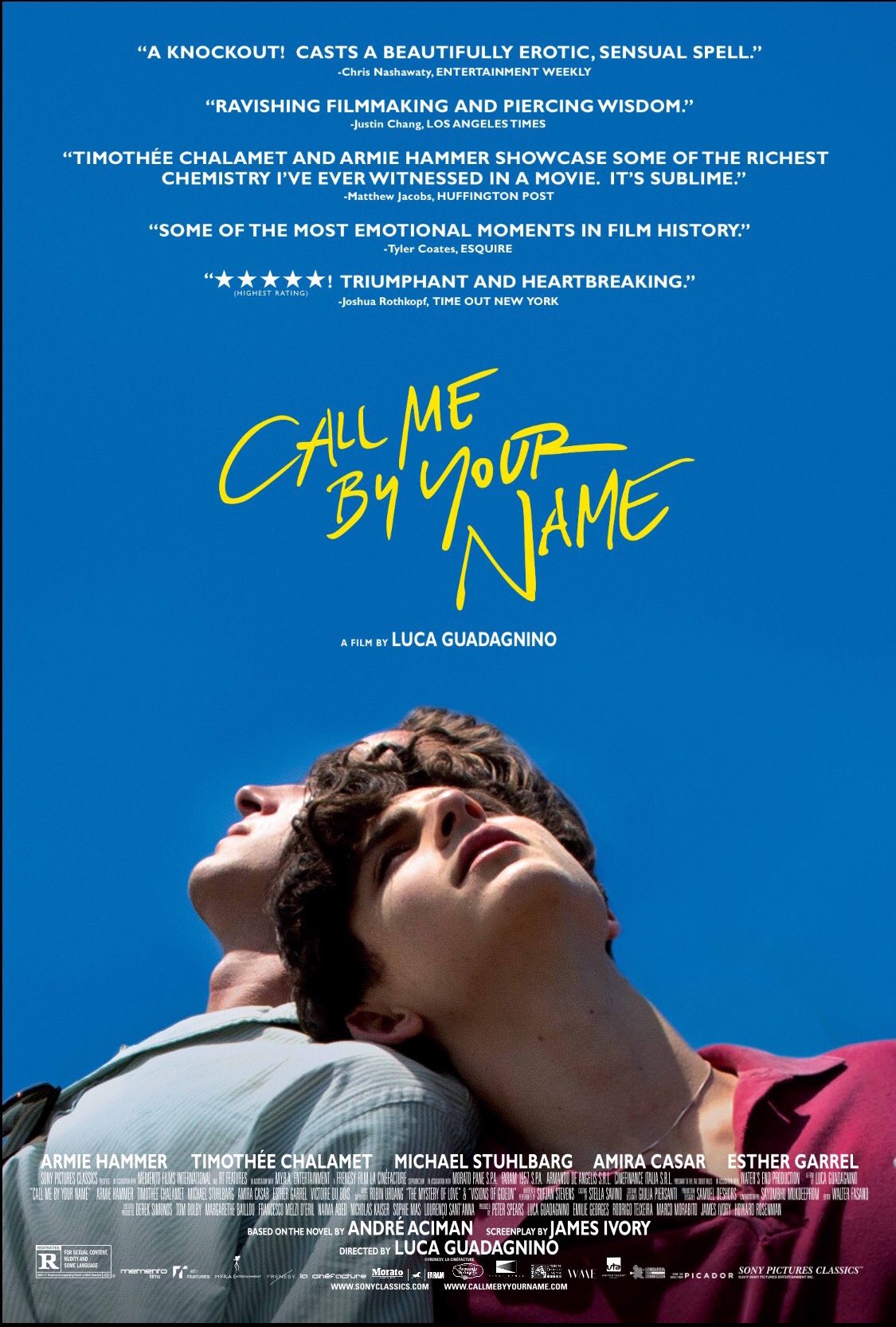
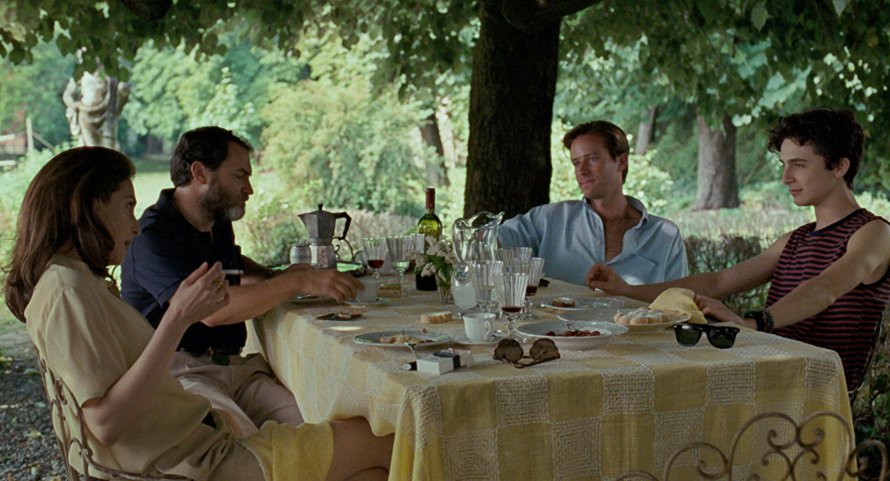
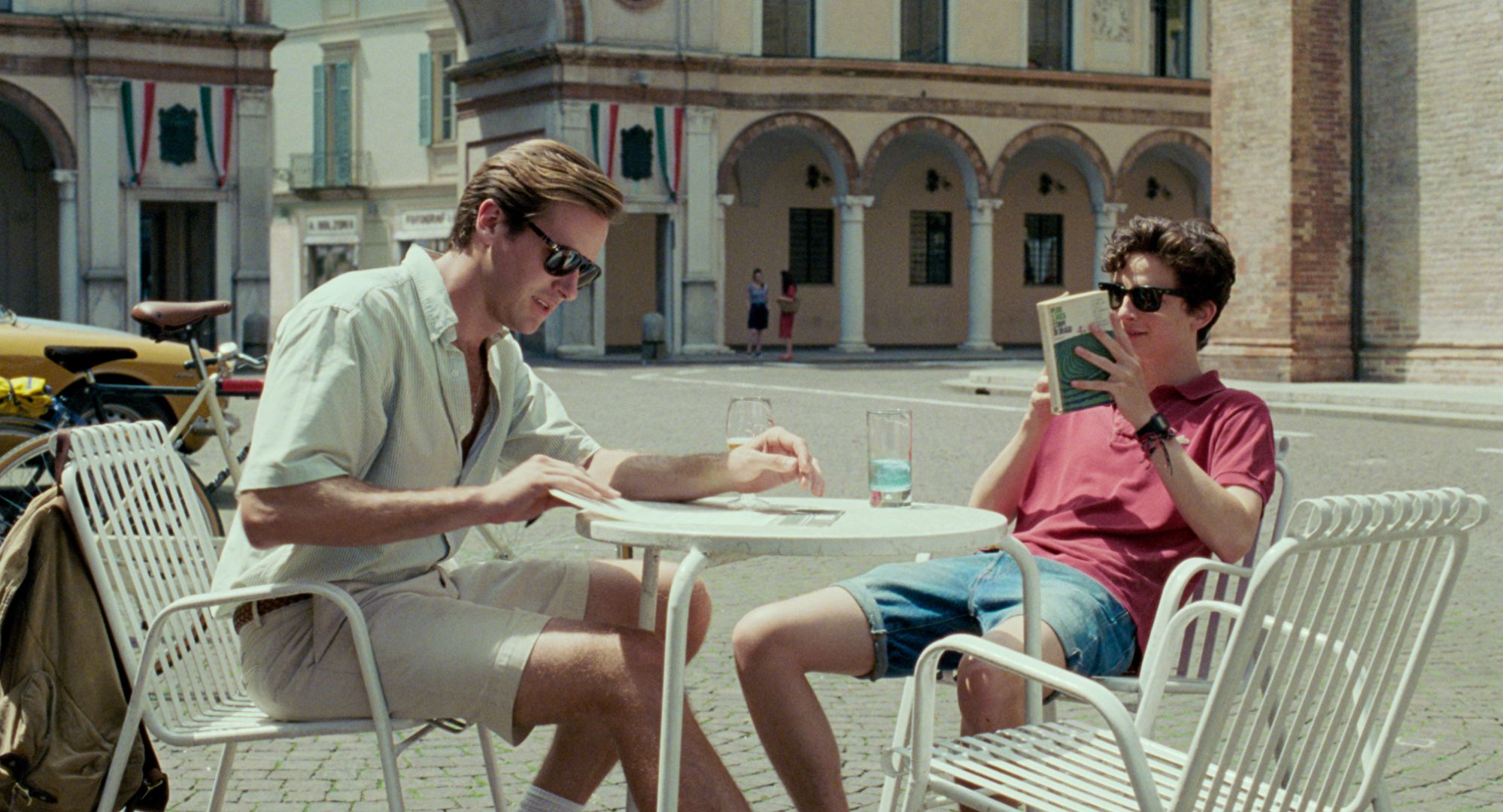
In this beautifully shot, written, directed, and acted adaptation of the novel by André Aciman, the setting is Northern Italy in the summer of 1983. Oliver (Hammer), a graduate student of archaeology and Greco-Roman culture arrives at the home of Professor Perlman (Stuhlbarg) and his family – wife Annella (Casar) and son Elio (Chalamet) – to assist the professor for six weeks with his academic paperwork. Oliver is outgoing, confident and charming, and soon wins over everyone except for Elio. Elio is Oliver’s polar opposite: reserved, insular, unsure of himself, and envious of Oliver’s ebullient nature. But Elio finds himself unexpectedly attracted to Oliver, something that both frightens and excites him. Lacking in any kind of sexual experience at seventeen, and torn between his burgeoning feelings for Oliver as well as the attentions of Marzie (Garrel), a close friend, Elio tries to navigate the treacherous waters of first love, and the realities inherent in accepting feelings and emotions that are completely overwhelming.

A project that has been in development since the movie’s main producers, Peter Spears and Howard Rosenman, saw an early galley of Aciman’s novel (his first) back in 2007, Call Me by Your Name is perhaps one of the most visually and emotionally ravishing movies of the year – or indeed any year. Shot in a variety of locations around Crema in Lombardy, this is a beautiful movie to watch, perfectly capturing the hazy, laidback existence of the Perlman family and their idyllic, rural home, and constantly providing the viewer with some absolutely magnificent imagery. Director Luca Guadagnino, in collaboration with DoP Sayombhu Mukdeeprom, has made a movie that is almost painterly in its design and execution. Shots are so perfectly framed that the amount of information in any given scene is breathtaking. With such a wealth of detail on offer, it’s a triumph of cinematography yes, but also of production design, and art and set decoration.

But this movie isn’t just about the world that it so richly creates. It’s an examination of the joys and cruelties associated with first love, that horrible wonderful period in a person’s life when the world seems turned upside down and all the surety and confidence they’ve accrued counts for nothing in the face of having to let down their defences and hope their hopes and feelings aren’t rejected wholesale. The movie addresses this directly in a scene where Annella reads from a German translation of Marguerite of Navarre’s Heptaméron, where the question is asked, “Is it better to speak or to die?” This is the dilemma Elio faces: does he reveal his feelings to Oliver, or does he remain silent and in doing so forgo the relationship he seeks. It’s a familiar plight, and one that the movie treats with an appropriate sympathy and sense of consideration. Elio’s uncertainty facilitates a kind of dance between the pair as they circle around each other, both providing hints for the other and neither of them trusting their instincts far enough to take that first, all-important step.

Guadagnino ensures that the nature of this dance and the intricacy of its turns and swirls is played out in contrast to Elio’s relationship with Marzie, which is just as hesitant and just as confusing for Elio as his feelings for Oliver. Faced with opposing emotions and unable to reconcile them, Elio is equally unable to take responsibility for them. The script – a remarkable achievement courtesy of James Ivory – has him do what any confused and horny teenager would do, and indulge his desires wherever and however they might appear. It doesn’t lessen his sense of ambiguity about his sexuality, or his need for Oliver, but it does lead him to make some questionable decisions, and while there are moments where he appears unable to overcome his own culpability, the fact that his behaviour is so easily recognisable and understandable, allows the viewer to remain hopeful that things will work out for him.

It helps that Ivory’s script and Guadagnino’s direction don’t pass judgment on any of the characters, and instead provides them with a cinematic safe haven for their troubles to play out. It’s also refreshing that the movie focuses on a gay relationship that runs its course – as inevitably it must do, Oliver is only there for six weeks – and there’s no threat or peril attached, either from Elio’s parents or any of the locals (though a handful of scenes set in Bergamo where Elio and Oliver spend some time together give the impression that something bad will happen at some point). It’s worth noting that this is a movie where prejudice isn’t allowed to raise its unwelcome head at any time, and though you could argue that this doesn’t sound entirely realistic given the period, it’s still encouraging to have that particular hoary old plot device ignored completely. The dynamic between Elio and Oliver is what’s important, and once Elio has made his choice to either speak or die, the movie rightly focuses on them and the fledgling steps they take in their relationship.

All of this, though, would be for nothing if it weren’t for the two mesmerising performances given by Hammer and Chalamet. For Hammer this is a major step up in his career, his portrayal of the apparently worldly-wise Oliver strengthened by his ability to show the character’s own insecurities and vulnerable side. There’s a scene where Oliver begins to have doubts about the longevity of his relationship with Elio, and the way in which Hammer expresses this uncertainty pulls at the heartstrings in a way that’s completely unexpected. Chalamet is equally as impressive as Elio, the camera lingering on him for long stretches, catching each fleeting emotion and sharply expressed moment of self-awareness. For Chalamet, the key scene is one that involves a peach, and it’s thanks to his skill as an actor that the scene works as incredibly well as it does; in the hands of some movie makers and actors, it would have killed the movie stone dead. Together, both actors support and encourage each other in their scenes, and the freedom they exhibit is hugely impressive. Again, without them, all the good work achieved in other areas would be for naught, and this would be a movie about which we would all be saying, “Ah well, good try.” That we’re not is a triumph for all concerned.

Rating: 9/10 – a superb adaptation of Aciman’s novel that is languid in pace yet deeply emotional in tone, Call Me by Your Name is also an amazingly affecting movie that grips like a thriller and which presents its characters as average human beings struggling with common human problems, but particularly, how to commit to someone else wholeheartedly; beautifully made on all levels, this is Guadagnino’s best movie yet, and one that resonates with, and rewards and reassures viewers by providing recognisable characters that we can all identify and sympathise with – because we’ve all been there ourselves.

Share this:

  • Click to share on X (Opens in new window) X
  • Click to share on Facebook (Opens in new window) Facebook
  • More
  • Click to print (Opens in new window) Print
  • Click to email a link to a friend (Opens in new window) Email
Like Loading...

Stronger (2017)

17 Sunday Dec 2017

Posted by dullwood68 in Movies

≈ 1 Comment

Tags

Biography, Boston Marathon bombing, David Gordon Green, Drama, Erin Hurley, Jake Gyllenhaal, Jeff Bauman, Literary adaptation, Miranda Richardson, Review, Romance, Tatiana Maslany, True story

D: David Gordon Green / 119m

Cast: Jake Gyllenhaal, Tatiana Maslany, Miranda Richardson, Clancy Brown, Richard Lane Jr, Nate Richman, Lenny Clarke, Patty O’Neil, Kate Fitzgerald, Danny McCarthy, Frankie Shaw, Carlos Sanz

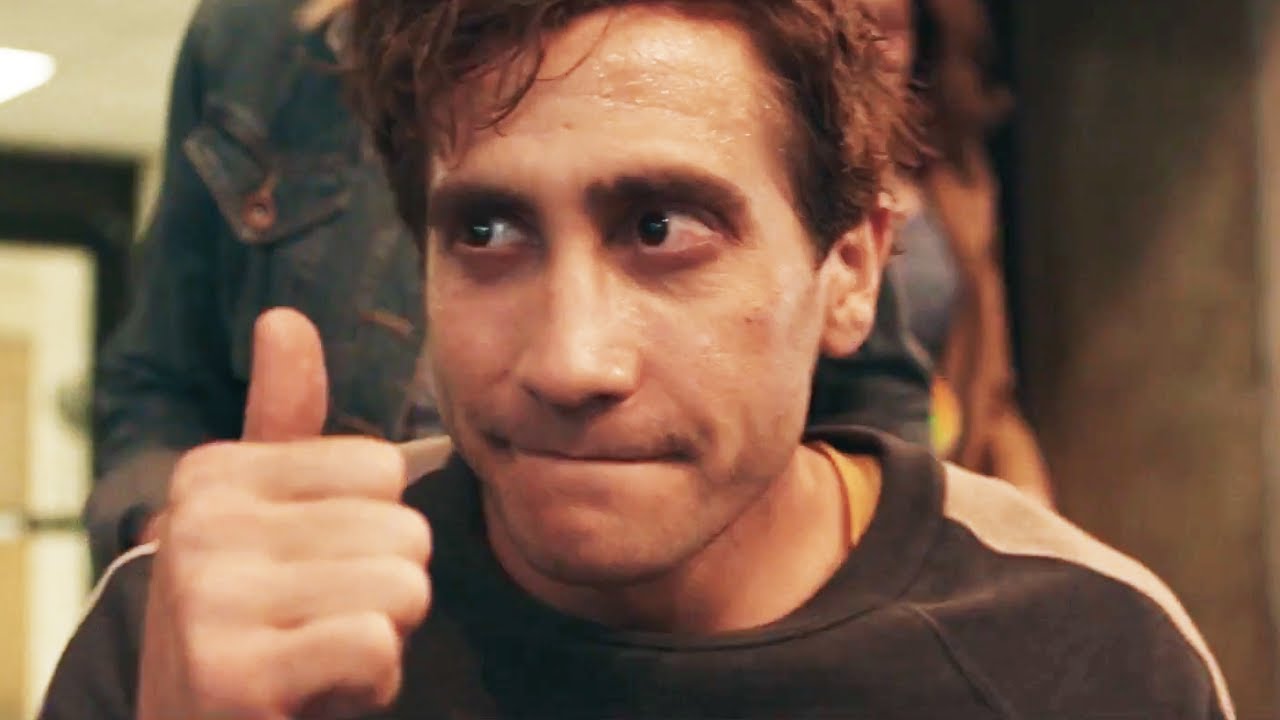
Following in the wake of Patriots Day (2016), Peter Berg’s excellent recreation of the manhunt for the Boston Marathon bombers, we have Stronger, a movie that focuses on one of the victims on that occasion, a Costco employee called Jeff Bauman (Gyllenhaal). Adapted from the book he wrote about his experiences after losing both his legs from above the knee down, Bauman’s tale is one of physical and emotional hardship, but most of all, how his relationship with on again, off again girlfriend, Erin Hurley (Maslany), made all the difference to his rehabilitation. It’s another true story of triumph over adversity, but while Jeff’s story – by itself – is inspiring, the movie itself isn’t quite as satisfactory.

Biopics often have a hard time avoiding the clichés of the genre. In recounting the trials and tribulations of someone who has suffered greatly through personal trauma, there’s usually a list of stock situations to be worked through. Most of them adhere to the various stages of grief, and so audiences can almost tick off these stock situations as they go along, but while Stronger does its best to avoid these clichés, in doing so it actually robs the movie of a lot of what would involve the audience more. Sure, we see Jeff falling off the toilet because his centre of gravity is out of whack, and yes, he tries to push Erin away because of self-pity, and of course, he misses rehab appointments because he can’t motivate himself, but while these are all established staples, here they’re downplayed to the point where the movie runs the risk of feeling a little detached from its subject matter and main character. There’s a matter-of-fact approach adopted by director David Gordon Green that stops the viewer from fully engaging with Jeff and his struggle to walk again.

Partly this is due to the way in which John Pollono’s script tackles the various stages of Jeff’s recovery. It always feels like a piecemeal attempt to tell a larger story, and while the focus on Jeff and Erin’s fractious relationship is to be commended, it doesn’t take long for the viewer to realise that without it the movie would be a lot shorter and a lot less interesting. Stripped of this central relationship, and once he’s lost his legs, the movie would consist merely of scenes between Jeff and his alcoholic mother, Patty (Richardson), a handful of other scenes featuring Jeff and his friends, Jeff being feted as a living breathing incarnation of the Boston Strong ideal, and further scenes where he’s told off for not going to his rehab appointments. All these are exactly the kind of things you’d expect to see in a movie such as this, and in that respect, the movie doesn’t disappoint. But there have been far too many other movies made along similar lines, and there’s not enough effort made to make this stand out from the crowd.

Bauman’s story, however, is made more interesting through his relationship with Erin. Pre-bombing, Jeff isn’t the most committed of boyfriends, but Erin has always allowed herself to give him another chance after splitting up with him. The irony of what happened to Jeff isn’t lost on the movie, as the only reason he was near the finishing line when the first bomb went off, was because he was there to support Erin (who was taking part in the race), and to show that she could rely on him more than in the past. Their connection is strengthened by Erin’s innate decency in supporting Jeff through the days and months that follow, and also by his need to have someone capable of looking after him; Patty is a semi-functioning alcoholic who admits she hasn’t been the greatest of mothers. With his father, Jeff Sr (Brown), reduced to hanging around in the background the longer the movie goes on, Jeff leans on Erin quite heavily, and as the dynamic of their relationship shifts and changes, it’s Erin’s own sense of self-respect that allows her to make a decision that, along with meeting the man who saved his life, Carlos Arredondo (Sanz), helps Jeff to dig himself out of the mire of self-pity and self-doubt that he’s surrounded himself with.

As Jeff, Gyllenhaal puts in another committed, powerful performance that sees the actor express Jeff’s confusion and anguish and dismay and anger at being placed in such a difficult position. However, his commitment to the role is hampered by the script’s determination not to make things too difficult for Jeff, as each obstacle he encounters is quickly overcome so that he can move on to the next – and overcome that one just as easily. If anything, this approach comes as something of a surprise, especially when it becomes obvious that Maslany’s portrayal of Erin is the movie’s strong suit, instead of Gyllenhaal’s portrayal of Jeff. It’s a career best performance from Maslany, who takes charge of the role and makes Erin the movie’s heart and soul. She’s simply mesmerising, and she finds new and different ways to make Erin more than the eternally supportive and self-sacrificing (i.e. stock) girlfriend that she could have been in other hands. In their scenes together, Maslany is so good that she’s always the focus and not Gyllenhaal; when the camera’s on him, you want it to shift back to her as quickly as possible.

There are many elements that are allowed to play out without any resolution, and a lot of things that are left unaddressed, such as the marital status of Jeff’s parents (are they divorced, separated, taking a break?), and though Green directs with his usual flair for exploiting emotional undercurrents, he’s not given too many occasions where he can do this. Certain scenes lack purpose – the script could have done with some judicious pruning – and there are times when Jeff’s family and friends seem present only to provide the movie with a sense of humour, but the overall problem with the movie is that its efforts to avoid the clichés of the genre don’t always work. And when you have a character who needs to learn to walk again but on prosthetic legs, and that aspect is reduced to a smattering of scenes, that raises another issue: just what is the movie’s focus if it isn’t that?

Rating: 6/10 – neither great nor awful but somewhere maddeningly in between, Stronger cleaves to audience expectations of what is, in cinematic terms, a very familiar story, and only manages to deviate from it when examining Jeff and Erin’s relationship; good performances all round help to alleviate the feeling of déjà vu that pervades the material and which holds it back from being more effective, leaving the whole thing feeling like a missed opportunity, and a curious one at that.

Share this:

  • Click to share on X (Opens in new window) X
  • Click to share on Facebook (Opens in new window) Facebook
  • More
  • Click to print (Opens in new window) Print
  • Click to email a link to a friend (Opens in new window) Email
Like Loading...

Wonder (2017)

04 Monday Dec 2017

Posted by dullwood68 in Movies

≈ 2 Comments

Tags

Drama, Facial disfigurement, Izabela Vidovic, Jacob Tremblay, Julia Roberts, Literary adaptation, Owen Wilson, R.J. Palacio, Review, Stephen Chbosky, Treacher Collins syndrome

D: Stephen Chbosky / 113m

Cast: Julia Roberts, Owen Wilson, Jacob Tremblay, Izabela Vidovic, Mandy Patinkin, Noah Jupe, Bryce Gheisar, Elle McKinnon, Daveed Diggs, Millie Davis, Danielle Rose Russell, Nadji Jeter, Sonia Braga

Imagine you’re at a restaurant and pancakes are on the menu. Now imagine that you’ve ordered said pancakes and they’ve just arrived at your table. The waiter (or waitress; let’s keep this fair) offers you maple syrup. You say please, and they begin to pour the maple syrup over the pancakes. And they continue pouring… and pouring… and pouring… Soon, the pancakes are swimming in maple syrup, and just the mere thought of tucking into them has become as desirable as if the waiter or waitress had poured an okra smoothie over them. This is the gourmet version of Wonder, a movie so glutinously nice, and so determinedly uplifting that it should come with a health warning. It not only tugs unashamedly at the heartstrings, but inspires lashings of sympathetic responses and unabashed sentimentality. It’s a massive sugar rush for fans of emotionalism and softheartedness.

For once, though, all this wistful sensitivity actually works – although you’d still be wise to wear waist-high waders in order to combat the rising tide of persistent romanticism that the movie fosters. In adapting R.J. Palacio’s novel, director Chbosky, along with co-screenwriters Steve Conrad and Jack Thorne, have retained the book’s wholesome dramatics, and tried extra hard to ensure there isn’t a dry eye in the house by the time they’ve finished. What this means for the movie as a whole, is that August “Auggie” Pullman (Tremblay somewhere under all the prosthetics), and his first time in school at the age of ten, becomes an exercise in survival for him, and a precautionary tale for the viewer who must overcome several instances where the script goes for the emotional jugular in its efforts to “hit home”.

August “Auggie” Pullman (Tremblay) suffers from Treacher Collins syndrome, a genetic disorder that is characterised by deformities affecting the eyes, ears, cheekbones and chin. It’s incurable, but the symptoms can be managed, and life expectancy is normal. Auggie has been home-schooled by his mother, Isabel (Roberts), but now it’s time for him to attend a school where there are other pupils and other teachers. Isabel insists everything will be alright, and Auggie wants to believe her, but inevitably he’s treated differently by all the other children. He’s bullied by one child, Julian (Gheisar), but finds a friend in another, Jack Will (Jupe). As the school year continues, Auggie learns that being different has both its ups and downs, and he grows in confidence as a result. Meanwhile, his older sister, Via (short for Olivia) (Vidovic), has problems of her own: her best friend, Miranda (Russell), isn’t talking to her, and her first day in high school has her feeling lost and alone.

Wonder‘s appealing sense of family dynamics makes the Pullmans seem impervious to external harm or misfortune; they even argue amongst each other with good grace. No problem is too big for them to overcome, and no issue is allowed to stop them from remaining as tight-knit and loving a family as you could ever wish for. And that’s the beauty of the narrative: it’s a fairy tale where the frog prince is welcomed into the fold despite never being able to turn into a handsome prince. It’s a wish fulfilment fantasy where everyone – even those who are initially horrible to Auggie and bully him at every turn – comes to be his friend and appreciates him for who he is and not what he looks like. Let’s be serious about this. This is a movie that has no grounding in any reality that any child with Treacher Collins syndrome would experience. Instead it’s a movie whose reality seems based on what that child would wish for. It’s a dubious conceit, but because the script is unequivocal in its approach – Auggie will triumph over all his adversities – there’s little room to manoeuvre. Either you go with the flow of the movie and give yourself over to its ultra-positive nature, or you struggle against it and allow yourself to be weighed down by its unabashed mawkishness.

If you choose the former, then thankfully there’s much to enjoy, not least from the performances. We haven’t really seen enough of Julia Roberts in recent years, but here she gives an impressive portrayal of a mother who has willingly put her career on hold to look after her son, and who has found a tremendous sense of purpose in doing so. Roberts is the movie’s anchor, her role the one that stabilises it and gives it meaning in the face of so much untrammelled sensitivity. Without her, Wonder would have a hollow centre where Isabel should be. Alongside her is Wilson, essaying much the same character he played in Marley & Me (2008), and offering a comic foil to Roberts’ more serious portrayal. He’s the light relief when things threaten to become too serious and the movie needs to right itself. Under all the make up, Tremblay continues to impress as the smart but emotionally smarting Auggie, and the young actor plays the role as the natural that he is. Sometimes it’s hard to express appropriate emotions from under a layer of latex, but Tremblay has no such problem, and he’s perhaps the perfect choice for the role.

Kudos too to Vidovic, who invests Via with an independence that allows the character to operate separately from the Pullman family dynamic, and Jeter as Via’s eventual boyfriend, Justin, a role that requires him to hang around and be nice a lot, something he pulls off without making it seem too weird. There’s plenty of weird going on elsewhere, but in a good way, as the movie allows Auggie triumph after triumph and keeps him away from any drama that might affect his slow rise to middle school stardom. The movie is with him all the way, knocking down obstacles and pushing aside unwanted nuisances. By the movie’s (slightly preposterous) end, Auggie’s luck will be left unchallenged and his family will remain as good-natured and eternally supportive as they were at the beginning. But this is still a good thing, and though the movie does look and sound as if it’s deliberately trying to induce tears in its audience, going against such a thing is, ultimately, too tiring and too much of a struggle to keep up for nearly two hours. As the Borg would say, “resistance is futile”.

Rating: 7/10 – an immensely appealing slice of unreality, Wonder is completely uninterested in making any of its characters suffer for very long, and by extension its viewers too, as it strives to make itself the feelgood movie of 2017; you’ll laugh, you’ll cry, you’ll laugh and cry some more, but in the hands of Chbosky and his talented cast, and despite some very high levels of romanticism and unrestrained poignancy, this is something of an unexpected treat.

Share this:

  • Click to share on X (Opens in new window) X
  • Click to share on Facebook (Opens in new window) Facebook
  • More
  • Click to print (Opens in new window) Print
  • Click to email a link to a friend (Opens in new window) Email
Like Loading...

The Disaster Artist (2017)

27 Monday Nov 2017

Posted by dullwood68 in Movies

≈ 5 Comments

Tags

Comedy, Dave Franco, Drama, Greg Sestero, James Franco, Literary adaptation, Review, Seth Rogen, The Room (2003), Tommy Wiseau, True story

D: James Franco / 103m

Cast: Dave Franco, James Franco, Alison Brie, Seth Rogen, Ari Graynor, Paul Scheer, Josh Hutcherson, Jacki Weaver, Zac Efron, Jason Mantzoukas, Hannibal Buress, Nathan Fielder, Megan Mullally, Sharon Stone, Melanie Griffith, Bryan Cranston

Every now and then a movie comes along that defies both its own creation and its own inherent drawbacks to achieve cult status amongst movie fans. Instead of disappearing into obscurity, perhaps never to be seen again (or only in the early hours of the morning on channels such as Movies 4 Men when they haven’t got a poorly dubbed spaghetti western to show) some movies take on a life and a reputation all their own, and succeed against – or in spite of – all the odds. One such movie is The Room (2003), written, produced, directed by and starring Tommy Wiseau. Generally regarded as one of the worst movies ever made, and critically lambasted on its initial release, The Room plays regularly at midnight showings throughout the US, and has the kind of dedicated fans who dress up like their favourite characters and throw items at the screen at relevant moments. Think The Rocky Horror Picture Show (1975), but without the wit or the ingenuity (or indeed, the songs).

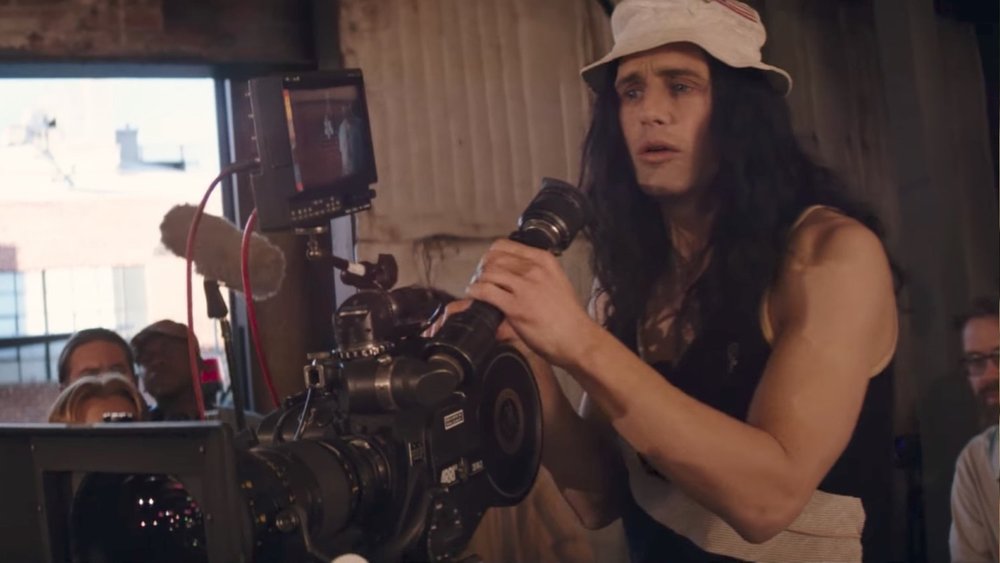
Wiseau made the movie with and for his friend, Greg Sestero, who eventually wrote about his experiences being Wiseau’s best friend, and making The Room, in a book called, The Disaster Artist: My Life Inside The Room, the Greatest Bad Film Ever Made. And now we have an adaptation of that book, and a recreation of the making of the movie, that is both entertaining and irresistible. In the hands of James Franco, The Disaster Artist is a fresh, appealing movie that looks at the dangers of following your dreams, and how those dreams can become the source of bitterness and disappointment. It’s a movie that works on a number of levels, and thanks to a perceptive screenplay by Scott Neustadter and Michael H. Weber, it’s a fully rounded piece that embraces drama, comedy, and darker facets of both in its tale of deluded ambition.

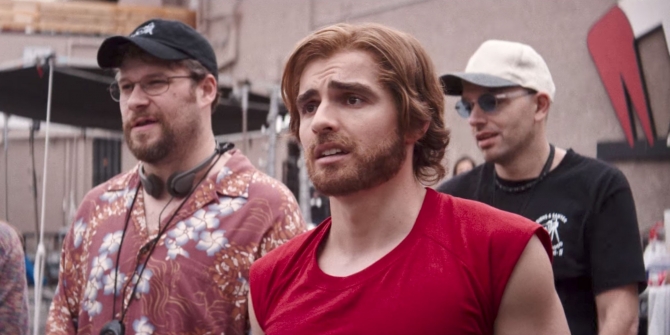
The movie begins in 1998, with Tommy (James Franco) and Greg (Dave Franco) meeting at acting classes and forming a strange, unorthodox friendship. Tommy is secretive and elusive, making out that he’s from New Orleans when he clearly has an Eastern European accent, and insisting that he’s the same age as Greg when clearly he’s much older. There’s also the matter of his being independently wealthy. Where does his money come from? Nobody knows. They move to Los Angeles, where they both try to break into Hollywood. Greg quickly gains an agent (Stone) but finds his career stalling just as quickly. Tommy remains unemployable as an actor, but can’t understand why. All he sees is his talent going unrecognised. Eventually they decide to make a movie on their own, a movie that will star Tommy and Greg and make their fortune. Tommy writes the script, and in 2002, production begins. And what a production it proves to be…

This being a good movie about the making of a bad movie, it’s tempting to wonder just how accurate this movie is in recreating the details of the production itself. There are moments of pure comedy, such as shooting Tommy’s first scene (“What is line?”), or the awkward mechanics of a sex scene (“Why is he having sex with her belly button? He knows where her vagina is, right?”), but there are also much darker moments when Tommy behaves like a dictator and riles the crew with his indifference and misplaced anger. It’s at these moments that Tommy is shown as a selfish, manipulative child, and none more so than when he refuses to let Greg have a day off to appear in an episode of Malcolm in the Middle (and at the request of Bryan Cranston himself). Tommy’s jealous intransigence casts a sallow light on his behaviour and his character, but it’s a measure of both the script and Franco’s performance that Tommy remains a figure to pity rather than be angry with.

What comes across is the importance of his friendship with Greg and the determination to make the movie he wants to make. When challenged about his on-set behaviour, Tommy cites Hitchcock and Kubrick as directors who didn’t care about their actors, but without realising that they had talent to make up for their callow attitudes. At every turn, Tommy doesn’t understand anything about what he’s doing, and he can’t see that the decisions he’s making are undermining almost everything that he’s trying to do. Everyone around him sees this, but Tommy’s insecurity won’t let him acknowledge it. He’s a lonely man looking for approbation, and though his friendship with Greg goes some way to meeting his emotional needs, it’s a much wider appreciation that he’s searching for. And the movie makes it clear that this is the dream he really has; the movie is just a means to that end. Franco nails the accent, and Wiseau’s own off-centre thought processes, and gives one of his best performances: at times sad, defensive, jealous – of Greg’s relationship with girlfriend, Amber (Brie) – antic, effusive, melodramatic, and emotionally shallow.

He’s matched by an intuitive and likeable portrayal of Greg by his younger brother, and there are plenty of enjoyable supporting performances, including Rogen as the script supervisor who becomes the de facto director when Tommy is “acting”, and Graynor as the female lead who possesses the aforementioned “belly button”. Elsewhere there are plenty of cameos and talking heads (at the beginning) to keep viewers on their toes, but it’s the recreation of those hectic days when The Room was being shot that proves the most compelling, and Franco the director assembles it all with an eye for the absurdity of it all and the misguided passion that pushed Wiseau to make the movie in the first place. An auteur’s folly, then, but one that has survived and prospered over the years, and which has afforded Wiseau exactly what he wanted: recognition. But as The Disaster Artist proves, passion without talent is just passion, and dreams often require luck as well as a determination to succeed.

Rating: 8/10 – a wonderfully bizarre tale given the kind of respectful treatment that only highlights how unlikely it all was at the time, The Disaster Artist doesn’t need anyone to see The Room before watching it, as the off-camera turmoil is captured with aplomb by Franco and his cast and crew; a testament to the power of friendship (and pinky swears), as well as not giving up on your dreams, this is also a cautionary tale about what can happen when ambition becomes obsession, and the pursuit of fame turns everything (temporarily) sour.

Share this:

  • Click to share on X (Opens in new window) X
  • Click to share on Facebook (Opens in new window) Facebook
  • More
  • Click to print (Opens in new window) Print
  • Click to email a link to a friend (Opens in new window) Email
Like Loading...

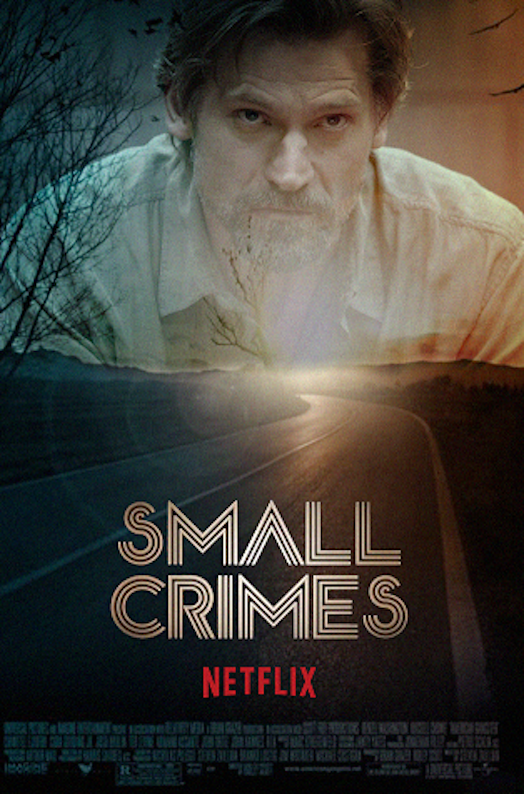
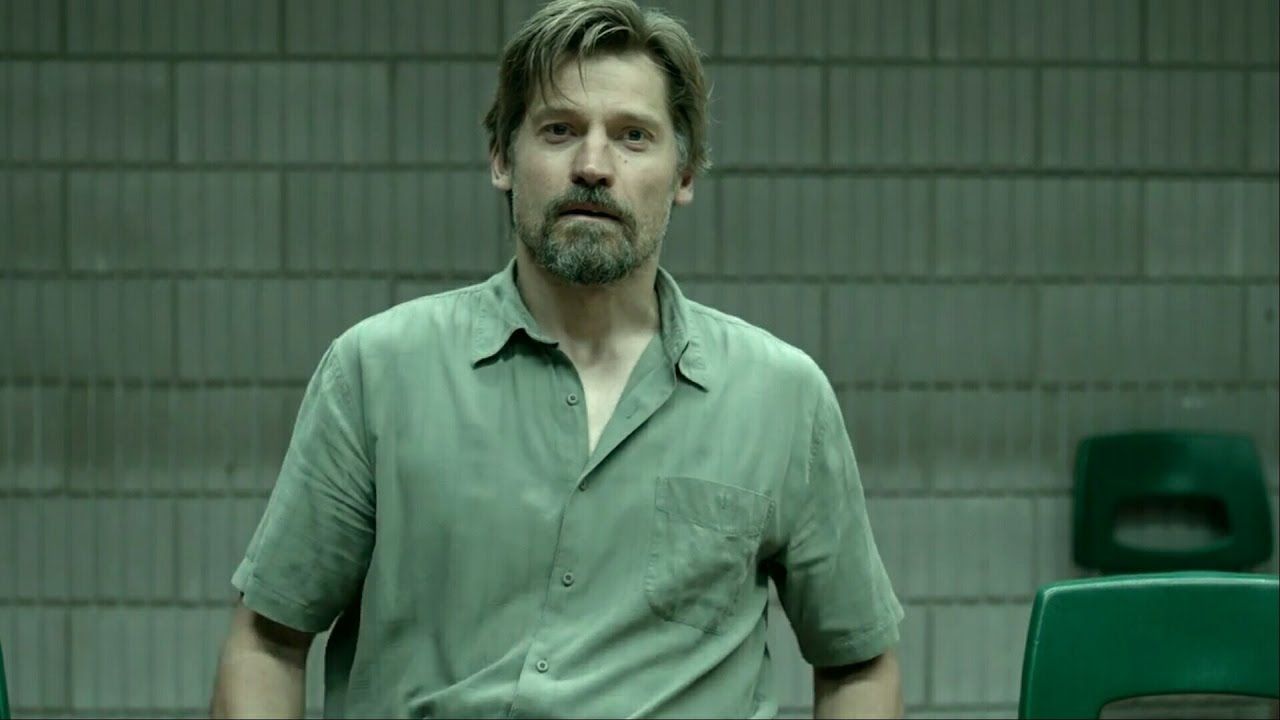
Small Crimes (2017)

15 Wednesday Nov 2017

Posted by dullwood68 in Movies

≈ 1 Comment

Tags

Crime, Drama, Evan Katz, Gary Cole, Literary adaptation, Molly Parker, Murder, Nikolaj Coster-Waldau, Review, Robert Forster, Thriller

D: Evan Katz / 95m

Cast: Nikolaj Coster-Waldau, Gary Cole, Molly Parker, Robert Forster, Jacki Weaver, Macon Blair, Pat Healy, Michael Kinney, Daniela Sandiford, Shawn Lawrence

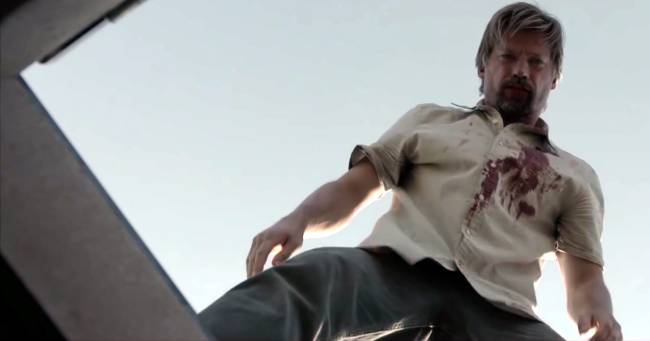
At one point in Evan Katz’s Small Crimes, the lead character, ex-cop and recent ex-con Joe Denton (Coster-Waldau) sets out to blackmail the local DA (Kinney) by setting him up with an obliging stripper in a motel room. With a camera in place to record the “tryst”, Joe settles back in an adjacent room and waits for the DA, Phil Coakley, to turn up. Coakley duly arrives but just as it looks as if Joe’s plan is going to work, along comes the stripper’s boyfriend – and with a gun. The boyfriend bursts in, Joe hears shots fired, and then looks out the window to see Coakley emerge unscathed with a gun in his hand. Rushing to the room, he finds the stripper and her boyfriend are both dead and the camera is gone. It’s not the first of Joe’s plans to go wrong since he got out of jail (nor will it be the last), but as the movie continues, and there’s no immediate follow up with either Coakley or Joe, it leaves the viewer wondering: where does all that fit in?

This happens several times during the course of the movie, and though it’s all part of Katz’ and co-screenwriter (and supporting actor) Macon Blair’s screenplay, such a non-linear approach – while it can be applauded as a way of making the movie more distinctive than some of its many cinematic cousins – doesn’t help the viewer to become more involved in the plot and with the various characters that pop up here and there, do their thing, and then disappear again. Only Joe is consistent in his appearance and involvement, and while the viewer can be thankful for this, Joe himself is less of a protagonist and more of a violence-attracting bystander. On his very first night of freedom after spending six years in jail for an extremely vicious assault on the same DA he later tries to blackmail, Joe graciously offers a young woman (Sandiford) a ride home from a bar. But it’s a honey trap, one that Joe fights his way out of, only to learn that the young woman is Coakley’s daughter.

Coincidence or set up? A set up is the likely answer, but the script fumbles this, as it does quite a lot else that could be explained by the odd line of exposition, but Katz and Blair aren’t interested in keeping things simple. Instead their brief seems to be the murkier the better. Motivations are kept frustratingly vague, and even when some decisions or events have to be explained, they’re done in such a way that often it makes it even more difficult to understand why something is happening, and where it fits in. Sometimes a scene will play out, and though it may feel important in the grand scheme of things, that scene will find itself isolated from the rest of the script until such time as Katz and Blair decide they can return to it. And sometimes, they never do. What this all means is that Small Crimes often feels arch and tiresome, as if it can’t make up its mind just what sort of tone it should be adopting, and is trundling along in the hope that inspiration will strike and help it on its way.

The movie has been adapted from the novel by Dave Zeltserman, and while it may seem to have all the requirements for a modern day noir – Joe just wants to go straight for the sake of his kids, who he’s not allowed to see – there’s no femme fatale, there’s no devious figure in the background pulling all the strings, and the only mystery involves a death that occurred before Joe went to jail and which he may be responsible for. The machinations that are set up once Joe is out of jail don’t always make sense, and though all the main characters are surprisingly well drawn (even Molly Parker’s superfluous cat lady-cum-love interest), they’re all in service to a narrative that only occasionally flexes its muscles, and which does so only when there’s violence involved. Otherwise, personal animosities are the order of the day, Joe’s efforts to extricate himself backfire then succeed out of nowhere once too often, and the material tries too hard to be ironic when it just needs to be sincere.

There’s humour then, but not so much that it makes watching the movie a more enjoyable experience. It’s often at a cost to the credibility of Joe himself and Coster-Waldau’s performance, which is through necessity, a more passive role than might be expected. Joe makes a lot of noise when he needs to, but that’s all it is: a lot of noise. He’s also surprisingly naïve in his thinking, believing that he can get himself out of the fix he’s in without there being any bloodshed. There’s noise too from Joe’s mother, Irma (Weaver), who seems there only to shout at him in a disapproving, angry manner. Later, she suffers an injury that could have been avoided, but the irony is in the detail of what happens. Alongside her is Joe’s father, Joe Sr (Forster), her antithesis, a man who is calm and confident and coordinated, and apparently unflustered by anything anyone says. Each gives a better performance than might be expected, and though Coster-Waldau is as charming as ever, there are times when he tries too hard, and the result is some obvious mugging.

The movie at least tries to be interesting, but its tired old scenario isn’t gripping enough for it to make a consistent impact, and some viewers may well be asking themselves why, with admittedly a lot going on, that there’s a distance between the material and the viewer. The simple answer is that what’s happening on screen isn’t anything so convincing or compelling that the viewer is ever likely to maintain continued interest throughout, or care about the characters and what happens to them. And even when the movie pulls a surprise out of its hat at the end, what should be a highly effective, and emotional moment, is undermined by there having been so little previously that would warrant that kind of reaction when it’s needed. Things are further hindered by Katz’s low-key directing style and the bland visual palette used to make the characters seem more interesting than they are. When murder and mayhem in a small town are this unaffecting, then it’s time to look elsewhere for your villainy and deceit.

Rating: 5/10 – patchy and rarely absorbing, Small Crimes unfolds patiently but with few moments where the pace quickens enough for the movie to become entirely interesting; the performances help, but the main storyline lacks cohesion and there’s a distinct sense that the material is laboured, something that it never finds a way to overcome.

Share this:

  • Click to share on X (Opens in new window) X
  • Click to share on Facebook (Opens in new window) Facebook
  • More
  • Click to print (Opens in new window) Print
  • Click to email a link to a friend (Opens in new window) Email
Like Loading...

Jungle (2017)

01 Wednesday Nov 2017

Posted by dullwood68 in Movies

≈ 1 Comment

Tags

Alex Russell, Amazon Rain Forest, Bolivia, Daniel Radcliffe, Drama, Greg McLean, Joel Jackson, Literary adaptation, Review, Survival, Thomas Kretschmann, Thriller, True story, Yossi Ghinsberg

D: Greg McLean / 116m

Cast: Daniel Radcliffe, Thomas Kretschmann, Alex Russell, Joel Jackson, Yasmin Kassim, Luis Jose Lopez, Lily Sullivan, Jacek Koman, Angie Milliken, John Bluthal

After serving three years in the Israeli military, and forgoing his father’s wish that he study to become a lawyer, Yossi Ghinsberg (Radcliffe) travelled to South America where he spent time travelling around the region until he wound up in Bolivia in 1981. There he made two new friends, Swiss school teacher Marcus Stamm (Jackson), and Marcus’s friend, Kevin Gale (Russell), an American and an avid adventurer-cum-photographer. Yossi also met an Austrian named Karl Ruchprecter (Kretschmann). Karl persuaded Yossi and his two new friends to go on an expedition into the jungle to find a lost Indian tribe that Karl was certain could be found. They set off on foot, and were soon miles from any kind of human habitation. But the dynamic of the group began to sour, especially when Marcus’s feet became badly blistered and he became unable to keep up the pace. With the expedition only partly completed, Karl announced that he was going back on foot, but that the others could use a raft to traverse the river that would take them to their destination. Marcus went with Karl, and Yossi and Kevin put together a raft and set off. But when the current proved too strong, and an accident caused the two to be separated, it left Yossi alone in the jungle, and with no tools to help him survive or find his way to safety…

As Jungle is based on the book of the same name by Ghinsberg himself, there’s no surprise in how the movie ends, but what is surprising is how compelling it all is once Ghinsberg is separated from Kevin, and the perils of being lost in the jungle become all too apparent. However, before all that, the viewer has to wade through some fairly tortuous scenes in the first hour, where the four main characters are introduced but without providing them with any appreciable depth, or Yossi aside, any clear motivations as to why they’re all there in the first place. Karl remains a mystery right until the end, when we learn something very important about him, while Kevin and Marcus come across as the unfortunate tag-alongs who share part of Yossi’s trials and tribulations, but whose own dilemmas don’t rate as much interest in Justin Monjo’s straightforward screenplay.

Once tensions arise within the group, it’s Yossi’s unintended lack of sympathy for Marcus’s plight that provokes the turning point where the quartet split up, but once that happens, the movie seems to breathe a huge sigh of relief, as if now it can concentrate on the story it really wants to tell. And aided by yet another impressive performance from Daniel Radcliffe, the movie quickly comes into its own and puts both Yossi and the viewer through the wringer as days pass and Yossi’s situation worsens with every step. He has to combat starvation, fatigue, disorientation, hallucinations, jungle predators, and the likelihood that he will wander round and round in circles without ever coming close to being found. It’s a horrifying situation to be in, and the script (perhaps unfairly) revels in giving Yossi moments of hope only to have them dashed a moment later. But these occasions also help to sharpen the narrative and accentuate the idea that the jungle has no time for sympathy if you’re unprepared for what it can do.

As the beleaguered Yossi, Radcliffe provides further evidence that he’s a more than capable actor, and though the role of Ghinsberg could be considered as just another in the long line of physical endurance roles that actors take on from time to time, thanks to Radcliffe’s commitment and understanding of the effects these rigours can have, Yossi’s deteriorating physical appearance and fast-eroding mental stability is made all the more credible and shocking when at last he reveals the extent of his (admittedly CGI enhanced) malnourishment. Ghinsberg somehow managed to survive for nineteen days before he was found, and though McLean fumbles the moment of discovery through some poor editing choices, there’s still an emotional kick to be found that is undeniable.

In telling such a dramatic true story, McLean and Monjo have crafted an old-fashioned survival story that focuses (eventually) on its central character’s will to cheat death and find their way back to civilisation, no matter how remote. McLean knows how to maintain dramatic tension – even if he hasn’t applied that ability to some of his more recent movies; The Darkness (2016) anyone? – and he uses close ups and an always unsettling, always encroaching soundscape to highlight both the pressure and the impending sense of doom that Yossi is experiencing. It’s a shame then that all this tension and pressure doesn’t come into play until around the halfway mark, and that McLean hasn’t been able to make Munjo’s script as compelling from the first page as it is to the last. Still, it’s a movie that goes someway to redeeming McLean’s “street cred” as a director, and there are plenty of moments where his skill as a director can be recognised in the claustrophobic nature of the jungle itself, and the ease with which he integrates Yossi’s hallucinations into the narrative so that they look and feel like an organic part of the whole.

True stories ultimately stand or fall based on the risks a movie maker is willing to take with the material, and though McLean has been stuck in something of a creative rut in recent years, here those risks relate to the various hallucinations/dream sequences that Yossi has, some of which provide some much needed humour into the mix. By taking Yossi, and the viewer, away from the threatening environment of the jungle, McLean gives both a chance to grab a breather and prepare themselves for the next part of Yossi’s heroic journey. The jungle itself is a fearsome opponent, and helped by cinematographer Stefan Duscio, McLean disorients and distracts both Yossi and the viewer so that each new setback to his finding safety increases the sense of fearfulness and increasing despair that the real Yossi must have felt all those years ago. That his predicament has proven so effective in terms of his will to survive, is as much a testament to the man himself, as it is – for the most part – to the movie itself.

Rating: 7/10 – an unfortunate first hour aside, Jungle is a harsh, unblinking look at a stranger in a strange land and the unwise decisions that cause him to be lost and alone in an inhospitable and deadly setting; Radcliffe is the main draw here, and then it’s McLean, and though McLean could have been tougher with some of the narrative decisions that were made, all in all this is a tough, unsentimental true story that impresses more than it disappoints.

Share this:

  • Click to share on X (Opens in new window) X
  • Click to share on Facebook (Opens in new window) Facebook
  • More
  • Click to print (Opens in new window) Print
  • Click to email a link to a friend (Opens in new window) Email
Like Loading...

The Death of Stalin (2017)

26 Thursday Oct 2017

Posted by dullwood68 in Movies

≈ Leave a comment

Tags

Armando Iannucci, Central Committee, Comedy, Drama, Jeffrey Tambor, Literary adaptation, Michael Palin, Moscow, Olga Kurylenko, Review, Simon Russell Beale, Soviet Russia, Steve Buscemi

D: Armando Iannucci / 106m

Cast: Steve Buscemi, Simon Russell Beale, Jeffrey Tambor, Michael Palin, Andrea Riseborough, Olga Kurylenko, Jason Isaacs, Rupert Friend, Dermot Crowley, Paul Whitehouse, Paul Chahidi, Paddy Considine, Adrian McLoughlin

The Death of Stalin could have easily been subtitled Fear and Loathing in Moscow, such are the high levels of animosity and opposition that ensue following the death of Soviet leader, “Uncle Joe” Stalin (McLoughlin). As the various members of the Central Committee scramble to establish a way forward – and more importantly, decide which one of them will be the country’s new leader – loyalties are tested, schemes are hatched, alliances are forged, but political manoeuvring continues unabated (it’s just that some of the goals, and the goalposts themselves, are changed from moment to moment). Under the satirical gaze of writer/director Armando Iannucci, the events that took place in the wake of Stalin’s death provide the basis for a movie that combines very black humour with a surprisingly serious approach to the material that helps the movie operate effectively on two separate levels, both comedic and dramatic.

While not everything happened in the way that Iannucci portrays it, some things did, and it’s the way in which he emphasises the absurdity of these real events that adds greatly to the effectiveness of the screenplay which has been co-written by Iannucci, David Schneider and Ian Martin, with additional material by Peter Fellows, and which itself is based on a screenplay by original source material writer Fabien Nury (The Death of Stalin has been adapted from the comic book of the same name). One such event occurs following the stroke Stalin suffered on 1 May 1953. When he’s found the next morning, it takes around twelve hours for a doctor to be called, as each member of the Central Committee refuses to make a decision by themselves in case Stalin recovers and takes them to task for their actions. It’s only when all the Committee members are in agreement that a doctor is needed that anything more is done. But then there’s another issue: thanks to the recent Doctors’ Plot, where prominent doctors were accused of conspiring to assassinate Soviet leaders, all the good, well regarded physicians in Moscow have been either imprisoned or executed. So, who to call? It’s moments like these, absurdist moments that challenge the perception of what’s real and what’s invented that makes the movie so enjoyable to watch.

But Iannucci isn’t solely interested in pointing out how ridiculous some of the events surrounding Stalin’s death were, but also how deadly serious that milieu was and how nothing could be taken for granted, be it a job, a reputation, or worse still, a life. Iannucci is quick to show the darker side of Soviet life in the Fifties, with Stalin’s Head of Security, Lavrentiy Beria (Beale), relishing his role as a combination accuser,  torturer, and executioner, whether he’s chasing down real enemies of the state or fabricating evidence to convict the innocent through political expediency. With Stalin’s full support while he’s alive, Beria has attained a position of power that he seeks to build on once his mentor is dead, and as he manipulates the Deputy Leader, the fragile minded Georgy Malenkov (Tambor), it’s left to Nikita Khrushchev (Buscemi) to put a stop to Beria’s ambitions.

One of the more absurdist notions of Iannucci’s movie is that it puts forth Nikita Khrushchev as its hero, but this was Khrushchev’s time, the moment where he took power in the wake of Stalin’s death and set about making long-lasting reforms. Here he’s a worried politician who wants to see an end to the tyranny of Stalin’s rule, and fears that Beria’s influence on Malenkov will see an unnecessary continuation of past horrors. Iannucci makes it clear that fear is the one overwhelming motivator in Soviet life, no matter what level you’re at. There’s fear of saying the wrong thing, fear of being seen with the wrong person, fear of ignorance and knowledge together, and fear of being in the wrong place at the wrong time. The movie shows how stressful this must have been, and how easy it must have been to make a simple honest mistake that might mean the difference between life and death, and how either outcome could shift according to whim or will.

Such a dark period in Soviet history (one of many though, to be fair) might not be the best subject for a dark comedy, but The Death of Stalin is more than that, and as well as its exploration of a society living in fear, it also seeks to examine how power corrupts those who look for it above all else – Beria seals his fate by threatening each of the other Committee members with what he knows about them. These dramatic moments, where the political jockeying turns brittle and ugly, allows the humour to have even more of an impact; if you didn’t laugh, you’d have to acknowledge the tragedy and the terrible nature of what’s happening. But Iannucci knows when to raise a laugh and when to keep the drama humour-free. It’s a delicate tightrope that he traverses, but he does it with style and confidence, creating a restrained yet also panic-ridden atmosphere for his characters to operate in. He also finds time to highlight the self-serving hypocrisy of the Committee members, something that’s best expressed through the attitude of Vyacheslav Molotov (Palin), who denounced his wife for the good of the party – and his own position within it.

With Iannucci and his co-writers putting together such a good script, and Iannucci himself proving that he’s firmly in control of both the tone and the pace of the movie, things are made even more impressive by the cast that he’s assembled. Buscemi is terrific as Khrushchev, a bureaucrat holding the fate of a nation within his hands, while Tambor’s turn as Malenkov is a delight, even if you have to wonder how such a dimwit got onto the Committee in the first place. There are first-rate supporting turns from Isaacs as a very gruff, very Yorkshire-sounding Head of the Red Army, Georgy Zhukov; Riseborough as Stalin’s daughter, Svetlana; Considine as an under threat theatre manager who really needs to record a live concert; and Palin, who gives such a subtle reading of his character that it serves as a reminder that when he’s not travelling the world, he’s a very accomplished actor indeed. But if anyone stands out it’s Beale as the venal, grotesque Beria, a character who seems fully formed from the moment we first see him, flinging horrible caustic remarks about with no concern for the feelings of others, and telling the audience everything they need to know about him in one perfect line of dialogue: “Have a long sleep, old man. I’ll take it from here.” It’s a performance that’s unlikely to win any awards thanks to the nature of the movie, but if Beale did win an award, it would be entirely justified. It’s the perfect cap to a movie that operates effectively on so many levels, and which has a lot more going on below the surface both in terms of the narrative, and its recreation of a period when laughing at senior Soviet politicians would have meant a swift trip to a gulag…or worse.

Rating: 8/10 – a movie that treats its historical backdrop with a great deal of respect (even when it alters certain facts to suit the material), The Death of Stalin is a small, unassuming gem of a movie that is both horrifying and amusing at the same time, and without either element undermining the other; with its clutch of richly perceptive performances, cleverly constructed humour, and astute direction, it’s a movie that may not find the wider audience it deserves, but is nevertheless a must-see for anyone who likes their political satire barbed and ready to sting.

Share this:

  • Click to share on X (Opens in new window) X
  • Click to share on Facebook (Opens in new window) Facebook
  • More
  • Click to print (Opens in new window) Print
  • Click to email a link to a friend (Opens in new window) Email
Like Loading...

1922 (2017)

23 Monday Oct 2017

Posted by dullwood68 in Movies

≈ Leave a comment

Tags

Drama, Dylan Schmid, Hemingford Home, Horror, Literary adaptation, Molly Parker, Murder, Review, Thomas Jane, Thriller, Zak Hilditch

D: Zak Hilditch / 102m

Cast: Thomas Jane, Molly Parker, Dylan Schmid, Kaitlyn Bernard, Neal McDonough, Brian d’Arcy James

Hemingford Home, Nebraska, 1922. Wilfred James (Jane), a farmer, owns eighty acres of land. His wife, Arlette (Parker), owns an adjoining one hundred acres of land, an inheritance from her late father. They have a teenage son, Henry (Schmid). Arlette is frustrated by having to live outside of town and wants the three of them to sell their combined land and move to Omaha. Wilfred is against the idea, but Arlette is insistent, telling him that if he won’t agree to her wish then she’ll sell her hundred acres and move to Omaha anyway; and she’ll take Henry with her. Wilfred is against this idea even more, and decides that he needs to do something to stop his wife from going through with her plan.

Now this being an adaptation of a Stephen King novella, Wilfred’s solution is, of course, to murder Arlette and dispose of her body down a well that’s conveniently located on the property. But Wilfred can’t do this on his own, and so he inveigles Henry into helping him. He does this by convincing his son that Arlette leaving will be the ruin of the farm (which is actually true), and that it will mean Henry will no longer be able to see his girlfriend, Shannon (Bernard), the daughter of another local farmer, Harlan Cotterie (McDonough). Henry has reservations about his father’s plan, but as there’s no particular love lost between him and his mother, he agrees. Between them, they murder Arlette, and as planned, her body ends up at the bottom of the well. Realising that he’ll need a reason to fill in the well (or it will look suspicious), Wilfred has one of his cows fall in as well. Then he fills it with concrete. It’s not long before Arlette’s disappearance – Wilfred tells the sheriff (James) that she just upped and left – has its consequences. Wilfred and Henry have trouble dealing with their individual guilt, and they become estranged from each other. And then Henry reveals Shannon is pregnant…

Secrets, and the dead, rarely remain quiet, and this is very true in 1922, the latest feature from Australian movie maker Zak Hilditch, and the latest in what seems to be a neverending conveyor belt of Stephen King adaptations that have been released this year. Once Arlette has been killed, things go quickly from bad to worse to simply terrible for Wilfred, as his relationship with Henry disintegrates, and Arlette’s ghost – aided by the presence of rats that seem to be in league with her – begins to appear with increasing malevolence. Wilfred has no one to turn to, no one he can ask for help, and as he sinks into a morass of terror and despair, he finds that his one fear, that Arlette’s leaving would be the ruin of the farm, is going to happen anyway (though just how he and Henry by themselves were going to manage one hundred and eighty acres remains a mystery). Taunted by Arlette’s ghost, menaced by rats, and abandoned by Henry who runs off with Shannon, Wilfred’s fate is sealed.

Despite its obvious thriller and horror trappings, 1922 is a movie that’s more concerned with its traditional theme of pride going before a fall. Many of the characters exhibit this trait in one form or another, and while it does provide the backbone of the narrative, writer/director Hilditch is clever enough not to overdo it. He adopts a matter of fact approach to the material that serves it well, and especially when pride turns to guilt and then to unavoidable resignation. There’s grief here too, painful, overwhelming grief, and again, Hilditch makes it an organic part of the narrative, and not something to be trotted out to make one or two scenes work independently of all the rest. These emotions are pervasive and tied to the fates of all concerned. When Wilfred comes up with his plan, it’s not just Arlette that is doomed, it’s Henry, and Shannon (they become Bonnie and Clyde-style robbers nicknamed The Sweetheart Bandits), and Harlan too. These emotions also help anchor the movie when it moves into the realm of the supernatural, and they help to make Wilfred’s situation all the more credible in the face of Arlette’s ghostly return.

The supernatural elements do feel a little forced however, with Arlette appearing randomly at first, but always at moments when you’d expected her to. And despite Hilditch’s best efforts, she’s not really that frightening or scary, her presence more of an obligation to the story than something to really be afraid of. Of course, she appears in a post mortem state, with blood and all, but it’s only in the movie’s best sequence, where she relates Henry and Shannon’s fate to a cowering Wilfred, her lips in kissing distance to his face, and shot in close up, that Hilditch makes the most of Arlette’s oppressive presence. As Arlette, Parker has little to do except be a self-regarding shrew for around twenty minutes before being killed off, and quite explicitly at that. Schmid is good as the conflicted yet defiant Henry, rushing off into the world without a clue as to how to tackle it and paying the price for his feelings of guilt and anguish. The other secondary and minor performances range from adequate to perfunctory, but all in all this is Jane’s movie from start to finish. Jane’s now rugged features are a perfect match for Wilfred, and helped by a severe haircut he paints a terrific portrait of a man defined by his pride and his actions, and who does what he does out of loyalty to the land and to his son. That both are taken away from him when he would sacrifice his own life for both of them – something that Jane incorporates into his portrayal with ease – adds to the tragedy of it all. This is by far and away Jane’s best performance in quite some time, and one that maintains a subdued energy throughout.

The era is replicated quite nicely, though the movie does suffer from a surfeit of patently false looking backdrops and CGI surroundings, no doubt a budgetary constraint rather than an artistic decision, but these are noticeable, and they do hamper the sense of time and place that the movie is looking to represent. The movie also moves at a slow, deliberate pace that suits the material in the early stages, but which does it no favours when applied to events in the last forty minutes. The story itself is told in wraparound fashion by Wilfred as he writes everything down in an attempt at a confessional while in a hotel room (not 1408). Here, Hilditch eschews the ambiguity of King’s original ending in favour of one last fright, and while this does provide a frisson to see out the movie, its literal nature isn’t quite as effective in terms of the story as it could have been. But these are caveats in a movie that gets far more right than it does wrong, and which can be added to the list of better than average Stephen King adaptations.

Rating: 7/10 – Hilditch has adapted King’s novella with a great deal of care, and 1922 is one adaptation where the characters and their motivations and emotions are more important than providing just a succession of frights and jump scares; a slow burn build up helps also, as well as Jane’s compelling performance, making this a movie that, while it may not be to all tastes, is still worth seeking out on its own terms.

Share this:

  • Click to share on X (Opens in new window) X
  • Click to share on Facebook (Opens in new window) Facebook
  • More
  • Click to print (Opens in new window) Print
  • Click to email a link to a friend (Opens in new window) Email
Like Loading...

6 Days (2017)

21 Saturday Oct 2017

Posted by dullwood68 in Movies

≈ Leave a comment

Tags

Abbie Cornish, DFRLA, Drama, Hostages, Iranian Embassy, Jamie Bell, Kate Adie, Literary adaptation, London, Mark Strong, Review, Rusty Firmin, SAS, Thriller, Toa Fraser, True story

D: Toa Fraser / 94m

Cast: Jamie Bell, Mark Strong, Abbie Cornish, Martin Shaw, Ben Turner, Emun Elliott, Aymen Hamdouchi, Andrew Grainger, Colin Garlick, Te Kohe Tuhaka, Tim Pigott-Smith

Between 30 April and 5 May 1980, the Iranian Embassy in London came under siege from six armed men whose aim was to secure the release of ninety-one Arab prisoners being held in Iran. Taking twenty-six hostages, they also demanded safe passage out of the United Kingdom once their goal was achieved. Of course, the outcome was very much different from what they were hoping for. Following the killing of one of the hostages, the order was given to send in the SAS. On the evening of the sixth day of the siege, they stormed the building and in the ensuing seventeen minutes killed five of the six armed men, rescued all but one of the remaining hostages (five had been released over the previous days), and gave notice to the world that the UK would not tolerate terrorism on any level.

What 6 Days does is to cover that dramatic period from a variety of angles in an effort to provide the viewer with a comprehensive overview of what was going on at the time both inside the embassy and outside it. So we see the six members of the Democratic Revolutionary Front for the Liberation of Arabistan (DRFLA), led by Salim (Turner), as they try to control the situation from an ever decreasing state of authority, as well as the Metropolitan Police’s chief negotiator, Max Vernon (Strong), as he does his best to keep things from escalating out of control. We also see the SAS teams that would eventually end the siege gathering intelligence on how best to enter the building, BBC reporter Kate Adie (Cornish) establish her reputation as a serious news journalist, and the political manoeuvring that went on behind the scenes involving the Home Secretary, William Whitelaw (Pigott-Smith), and the various decision makers who would debate and interpret the government’s policy of non-compliance in terrorist matters.

With such an intense, dramatic situation, and one whose violent conclusion was played out – deliberately – in front of a number of assembled news cameras, you might expect 6 Days to be as equally intense and dramatic, but sadly, whatever tension is achieved is arrived at accidentally. Glenn Standring’s screenplay, adapted from the awkwardly titled Go! Go! Go!: The SAS. The Iranian Embassy Siege. The True Story (2011) by Rusty Firmin and Will Pearson, alternates between each angle with an initial promise that soon falls away to offer routine exchanges between all concerned, a worrying number of occasions where we see the SAS fail in their preparations, Cornish’s role as Kate Adie built up so that her billing is made more credible, and negotiations between Vernon and Salim that consist of Vernon reassuring Salim that he wants to help, while Salim insists that he’ll kill a hostage if his demands aren’t met – over and over. (If there was ever any intention of exploring the psychological aspects of hostage negotiation, they certainly didn’t make it into the final script.)

There are other problems, some that relate to the movie’s pacing, and others that relate to director Toa Fraser’s handling of the material. Fraser made the enjoyably quirky Dean Spanley (2008), but here the confidence he showed with that movie appears to have deserted him. With an array of characters and situations to be exploited, Fraser leaves many scenes high and dry in terms of their potential effectiveness, opting for a flatness of tone that proves wearying the more it happens. As a result, he often leaves his talented cast looking as if they’ve been cast adrift from the narrative and are wondering where the lifeboats are. Bell, as the same Rusty Firmin whose book this is based on, can’t quite convince as a lance corporal in the SAS, and he’s too bland a character to make much of an impact. Cornish is kept on standby until the siege is broken, which is the point at which Adie came into her own and sealed her journalistic reputation by reporting events as they happened (though the movie has her standing heroically out in the open, whereas in reality Adie wisely hid behind a car door). Cornish also attempts a vocal interpretation of Adie that is off-putting to say the least.

But if you have to spare a thought for anyone in the movie it’s Mark Strong, a fine actor with an impressive range, but here reduced to staring continually in anguished sincerity while his character tries to keep things from going very wrong very quickly. In comparison with much of the rest of the movie, he’s one of the best things in it, but he’s hamstrung by the demands of the script and his director’s inability to make each scene anything more than flat and undemanding. This inattention leads to the movie having an equally flat and undemanding tone that negates any sense of urgency about the siege and the political machinations surrounding it. It’s not until the SAS storm the building that the movie wakes up and remembers it’s as much a thriller as a political drama, but even then there’s a great deal of confusion as to what’s happening where and, in the case of the SAS themselves, to whom.

Again, there are pacing issues as well, and too much repetition to make 6 Days anything other than a pedestrian representation of an event that made international headlines and kept a nation glued to their televisions and radios throughout its duration. There are flashes of humour that are largely muted (though a comment from an embassy staff member to Firmin is priceless by itself), the odd attempt at post-ironic commentary, contemporary footage that sits side by side with the movie’s recreations of the same images, and an eerily effective opening shot that sees the six terrorists passing by the Royal Albert Hall, but they’re not enough on their own to make the movie more engaging or gripping. There’s a great deal of earnestness and melodramatic sincerity on display, but it’s all in service to a script that feels as if it’s trying to tell its story at a remove from the actual events, and which compresses those fateful six days into an hour and a half and still finds the need to pad out the narrative with unnecessary detours and longueurs.

Rating: 4/10 – muddled and far from absorbing, 6 Days is an undemanding viewing experience that doesn’t try too hard to make its true story anything other than perfunctory and banal; by the time the SAS storm the embassy you’ll be thinking “at last” – not because the movie is finally going to be halfway exciting, but because it means the movie is close to being over.

Share this:

  • Click to share on X (Opens in new window) X
  • Click to share on Facebook (Opens in new window) Facebook
  • More
  • Click to print (Opens in new window) Print
  • Click to email a link to a friend (Opens in new window) Email
Like Loading...

The Snowman (2017)

18 Wednesday Oct 2017

Posted by dullwood68 in Movies

≈ Leave a comment

Tags

Charlotte Gainsbourg, Crime, Drama, Harry Hole, Jo Nesbø, Literary adaptation, Michael Fassbender, Murder, Rebecca Ferguson, Review, Serial killer, Thriller, Tomas Alfredson

D: Tomas Alfredson / 119m

Cast: Michael Fassbender, Rebecca Ferguson, Charlotte Gainsbourg, Val Kilmer, J.K. Simmons, Toby Jones, David Dencik, Chloë Sevigny, James D’Arcy, Jonas Karlsson, Adrian Dunbar, Ronan Vibert, Michael Yates

Another week, another literary adaptation, another disappointment… Sometimes it’s hard to understand just what happened when a movie based on a well regarded novel hits our screens with all the turgid urgency of dripping sludge. Who do you blame? The director? Maybe. They are in overall charge of how the movie looks and sounds and how thrilling or dramatic or funny or affecting it should be. Or maybe it’s the screenwriter(s). Maybe they didn’t “get” the novel or work out the best way of transferring it to the big screen. Maybe it’s the cast. Maybe they weren’t “feeling it” and couldn’t find their way to putting in good performances. Or perhaps it’s just something a little less tangible, the tone perhaps, or the pacing, or the emotion of the piece. Maybe – maybe – it’s a combination of all these.

That certainly seems to be the case with The Snowman, an adaptation of the novel by Jo Nesbø, and the first movie to feature his troubled detective, Harry Hole (played here by Michael Fassbender in a portrayal that seems based around Hole having only the one expression). Now, if you’ve read this paragraph up til now and you’ve been pronouncing Hole as in a hole in the ground, then you have the first problem that the movie can’t or won’t overcome: no one can even pronounce the lead character’s name correctly. Harry’s surname is pronounced Ho-ly as in holy scripture, or as with this movie, what the holy hell is happening? When the makers of a movie can’t even get the lead character’s name right, then what chance does the rest of the movie have? In short, hardly any chance at all.

A rushed production that finished shooting in April 2016, but which required reshoots in the spring of this year, the movie quickly gets bogged down by the requirements of a muddled script that wants to be regarded as another excellent example of the awkwardly named Scandi-noir. All the elements are there to be ticked off one by one: the dark, brooding lead detective, the dark, brooding atmosphere, the dark, brooding nature of the murders, the killer’s dark, brooding psychological profile, the dark, brooding visual backdrop – clearly if it wasn’t dark and brooding then it wasn’t allowed to remain in the screenplay. But just as having too much of a good thing can spoil that very same thing, having too little in the way of structure, common sense and thrills can also damage a movie’s chances, and The Snowman sabotages its own semi-focused ambitions at every turn.

For a thriller that should grip like a vice, there are just too many risible moments that offer unfortunate injections of humour, such as when James D’Arcy’s character reveals that he’s “infertile. I can’t have children”, just to make sure there’s no one in the audience who won’t understand what infertile means. Then there are the dreadful, logic-takes-a-beating moments such as when the killer uses a mobile phone they know the police will be monitoring to help them pin the blame on someone else, but who then forgets that they can be traced through the use of another mobile phone later on. Scenes come and go that don’t always follow on from each other (though it’s more disheartening to think there might be a longer Director’s Cut out there somewhere), and Harry’s maverick cop activities keep him in the front line no matter how often he acts independently of the rest of the Oslo police force, while Rebecca Ferguson’s impassioned rookie, Katrine, gets sidelined the first time she uses her own initiative. Some of this is in service of the plot, but mostly it just seems that in piecing together the key points of Nesbø’s novel, screenwriters Hossein Amini, Peter Straughan, and Søren Sveistrup have decided to only include the events from every other chapter in the novel, and not adapt the novel as a whole.

Characterisations suffer too as a result of this approach, with Harry’s alcoholism only of any relevance in introducing him to the audience, and to provide a degree of drama surrounding his continual inability to spend time with the son (Yates) of his old flame, Rakel (Gainsbourg). Being an alcoholic isn’t allowed to get in the way of showing just how good a detective Harry really is, and so it becomes less and less effective as a character defect the longer the movie goes on. Likewise the relationship between Harry and Rakel is confusing because there’s no back story for the viewer to latch onto (it might have helped if the producers had decided to adapt the first book in the Harry Hole series, instead of the seventh). The killer’s motives remain vague and unconvincing throughout, and their need to build a snowman at the scene of each crime is as baffling at the end as it is at the beginning. It’s as if it’s use as a signature “flourish” by the killer is all that’s needed. (A reason for it? Ah, don’t worry about it; it’ll look cool.)

Alfredson has spoken about the challenges of making the movie within a short period of time, and without a completed script, leading to issues that were discovered in the editing suite. But while it does seem that there are huge gaps in the narrative, and the movie has to work extra hard to maintain any tension or sense of urgency, it’s the flatness of the drama and the lethargy in certain scenes that can’t be explained away just because of a shortened production period. In the end, Nesbø’s page-turner has become a movie that fails to match up to its energy and verve, and which remains a leaden, dreary experience for the viewer. The performances are adequate (though Kilmer, worryingly, looks as if he’s trying to impersonate present day Gary Busey), and Dion Beebe’s cinematography does at least capture the beautiful isolation of rural Norway in often stunning fashion. But otherwise, this is a routine, formulaic serial killer movie that does itself no favours from beginning to end.

Rating: 4/10 – muddled and convoluted aren’t words that any potential viewer wants to hear, but they describe The Snowman perfectly; uninspired and chock full of thriller clichés, the movie stumbles along trying to be clever and effective, but instead ends up putting a finish to any notion of an intended Harry Hole franchise.

Share this:

  • Click to share on X (Opens in new window) X
  • Click to share on Facebook (Opens in new window) Facebook
  • More
  • Click to print (Opens in new window) Print
  • Click to email a link to a friend (Opens in new window) Email
Like Loading...

You Were Never Really Here (2017)

16 Monday Oct 2017

Posted by dullwood68 in Movies

≈ Leave a comment

Tags

Drama, Ekaterina Samsonov, Joaquin Phoenix, Judith Roberts, Literary adaptation, Lynne Ramsay, Review, Sex trade, Thriller, Violence

D: Lynne Ramsay / 95m

Cast: Joaquin Phoenix, Judith Roberts, Ekaterina Samsonov, Alex Manette, John Doman, Alessandro Nivola

A funny thing happened on the way from the Cannes Film Festival…

At Cannes this year, Lynne Ramsay’s latest feature, an adaptation of the novella of the same name by Jonathan Ames, won a joint best screenplay award (tying with The Killing of a Sacred Deer), and the best actor award for Joaquin Phoenix’s performance as Joe, an ex-Marine working “undercover of the law” rescuing young girls from the sex trade. The movie was greeted with widespread critical acclaim, received a seven-minute standing ovation from its premiere audience, and was believed to be a strong contender for the Palme d’Or (though it lost out to Ruben Östlund’s The Square). Since then it has appeared at four further festivals before arriving at the BFI London Film Festival where it was shown three times.

At the second of its screenings in London, Ramsay was in attendance to introduce the movie. Within moments of coming out on stage she advised the audience not to hang around for the Q&A afterwards as she hated them. When pressed to answer a couple of questions there and then, Ramsay demurred to the point where the member of the BFI team who was on stage with her, realised that Ramsay wasn’t going to “play ball”, and somewhat embarrassingly, they left the stage and the movie began. Ninety-five minutes later the movie ended, and many in the audience waited for the Q&A to begin. It didn’t. Ramsay never came back out, and no one from the BFI clarified the situation. Having seen the movie, quite a few people in the audience felt they knew why Ramsay didn’t want to discuss her new movie.

First and foremost, You Were Never Really Here is a movie that invites a lot of scrutiny. It deals with themes surrounding the nature of violence, has a stripped back approach to the narrative, paints an austere portrait of a man who battles with his own demons to little avail, is uncompromising in its depiction of the aftermath of extreme violence (though it’s very fuzzy on the actual violence itself), operates within a noir-ish version of New York City, and features exemplary cinematography from Thomas Townend. It’s a movie that looks and feels important, a movie that wants to be taken seriously, and that appears to have something to say about the darkness within us and how, through the character of Joe, we can both explore and deny that darkness. In short, it’s a movie that looks to carry weight and meaning.

But here’s the odd thing: along with Phoenix’s tortured, semi-burnt out portrayal, and another impressive score from Jonny Greenwood, the movie has a lot of very good things going for it. And yet, as a whole, it doesn’t work. So many of the elements that go to make up the movie – Joe Bini’s editing, Tim Grimes’ production design, for example – are so good, so well executed, that it would seem that the movie can’t be anything other than hugely successful on its own terms. How could it not be? And yet, it’s not Ramsay’s best movie, not by a very wide margin. That honour belongs to Ratcatcher (1999). In the end, and despite all the effort put in by all concerned, You Were Never Really Here doesn’t match the potential all those disparate elements should do when they’re all combined. It’s a movie that isn’t the sum of all its parts.

Ultimately, the movie is one to admire for the way it tells its story rather than the response it provokes in its audience (which is muted to say the least). Technically well made, and with fine performances from all concerned (except for Nivola, whose appearance amounts to a cameo), Ramsay’s adaptation is hard to get involved with. There’s no sense of danger about what Joe does because he seems indestructible. At the beginning he’s attacked from behind by a man with a length of pipe. But Joe shrugs off the blow, head-butts his assailant who falls to the ground, and then he walks off as if it’s all part of his daily routine. But while it tells us that Joe is inured to the violent world he lives in, it makes the viewer inured as well. If it doesn’t mean anything to Joe, then why should it mean anything to us? It’s also no surprise that Joe has an elderly mother (Roberts) whom he looks after, but even their relationship doesn’t resonate in the way Ramsay might want it to. And then there’s Joe’s childhood, a period we see glimpses of, and which should invite the audience’s sympathy, but which remain violent additions to an already violent story, and as such, don’t have the power they’re meant to.

The movie’s basic storyline is also one that feels undercooked, with its political corruption and sex trade background something that we’ve seen countless times before. Ramsay works hard to make this section of the movie thrilling, and helped by Bini’s considerable editing skills she almost pulls it off, but the decision to obscure the violent acts taking place and to disallow any cathartic expression in either Joe or the viewer makes these violent outbursts triumphs of style instead of emotion. You can admire the way they’ve been shot and assembled, but they don’t evoke any feelings the viewer can experience for themselves. Ramsay keeps everyone, even her characters, at a remove, and closes out the movie with a moment of such extreme nihilism that it literally feels shoehorned in to provoke a response when none is actually needed. And that response? Just one of bafflement, which is not a response any movie maker should be looking for.

Rating: 7/10 – having surrounded herself with a cast and crew all working flat out to make the best movie they can, director Lynne Ramsay fails to put their efforts to practical good use, and leaves You Were Never Really Here feeling like an abandoned first cut; a movie that is likely to provoke serious debate over its merits for quite some time to come, it’s perhaps best described as an experiment that needed more time to be completed before any results could be unveiled.

Share this:

  • Click to share on X (Opens in new window) X
  • Click to share on Facebook (Opens in new window) Facebook
  • More
  • Click to print (Opens in new window) Print
  • Click to email a link to a friend (Opens in new window) Email
Like Loading...

Devil’s Knot (2013)

10 Tuesday Oct 2017

Posted by dullwood68 in Movies

≈ Leave a comment

Tags

Alessandro Nivola, Atom Egoyan, Colin Firth, Drama, Literary adaptation, Murder, Reese Witherspoon, Review, Robin Hood Hills, True story, West Memphis

D: Atom Egoyan / 114m

Cast: Colin Firth, Reese Witherspoon, Alessandro Nivola, James Hamrick, Seth Meriwether, Kristopher Higgins, Amy Ryan, Robert Baker, Rex Linn, Bruce Greenwood, Dane DeHaan, Kevin Durand, Stephen Moyer, Elias Koteas

There are times when the very existence of a movie proves puzzling, puzzling because the content of the movie has already been covered in greater depth, and with far more fidelity, elsewhere. Such is the case with Devil’s Knot, an exploration of the Robin Hood Hills Murders that took place in West Memphis, Arkansas on 5 May 1993. On that fateful day, three eight year old friends – Stevie Branch, Christopher Byers, and Michael Moore – disappeared. Their bodies were found in a muddy creek the following day. It didn’t take long for the police and the local community to ascribe the murders to a Satanic cult believed to be operating in the area. It wasn’t long either before the police had three suspects firmly in their sights: teenagers Damien Echols, Jason Baldwin, and Jesse Misskelley Jr. After Misskelley Jr was interrogated for twelve straight hours, he confessed that all three were involved in the deaths of the children, and all three were subsequently arrested. At their trials, Misskelley Jr and Baldwin were sentenced to life imprisonment, while Echols was sentenced to be executed.

The problem with Devil’s Knot is not just that it’s another movie “based on a true story” and with all the limitations that usually apply, but that the story of the Robin Hood Hills murders and the West Memphis Three (the accused) have been so well documented elsewhere. There are currently four documentaries available that cover the case, and which do so in more depth, and with greater clarity of purpose. They are Paradise Lost: The Child Murders at Robin Hood Hills (1996), its sequel, Paradise Lost 2: Revelations (2000), a further sequel, Paradise Lost 3: Purgatory (2011), and a separate entry which covers the whole story, West of Memphis (2012). With all these excellent documentaries on offer (particularly the first one, which is nothing short of exceptional for the access the makers had), it remains surprising that Devil’s Knot was actually greenlit in the first place, let alone made.

Adapted from the book of the same name by Mara Leveritt, Devil’s Knot benefits greatly from having Atom Egoyan perched, however precariously, in the director’s chair. He’s a very talented movie maker, but he’s never seemed as comfortable as when he’s working from a script he’s written himself, and this proves to be the case here. Making the most of a script that doesn’t really tell us anything new and which can be found dramatically twiddling its thumbs from time to time, Egoyan shows occasional flashes of the erudite and ambitious director who has given us such modern classics as Exotica (1994) and The Sweet Hereafter (1997). But these are few and far between, and there are long periods where Egoyan feels like a jobbing director who hasn’t been able to connect with the material – and doesn’t know how to. And yet, conversely, there are moments where he does, and these contain a quiet power that is indisputably effective (and affecting).

Somewhat inevitably, the script tries to pull in various different directions, and by doing so, tries to cover too much ground all at once. This leads to scenes feeling unnecessarily truncated, and others feeling like filler. In its efforts to tell as much of the story as possible, the movie proves disjointed in its approach to the victims’ families – only Witherspoon’s grief-stricken mother, Pamela Hobbs gets a look in, and then only because she begins to believe Echols and co aren’t guilty – while the holes in the police investigation (and there are dozens of them) are allowed to go by remarked upon but under-emphasised. The trial scenes take up most of the second half of the movie but serve only to show that justice is not only blind in some US courts but sometimes half asleep as well, a situation that we’re already way too familiar with for these scenes to carry any appreciable weight. Egoyan gamely makes his way through them, throwing in an occasionally interesting shot, but relaying events in a style that resembles a TV Movie of the Week instead of a fully-fledged feature.

With the screenplay trying to fit so much in (there’s a reason the documentaries all run longer), it’s inevitable as well that some characters come to feel like observers rather than participants. Terry Hobbs (Nivola), Stevie’s stepdad, flits in and out of the narrative and remains elusive until the movie’s end when we learn something unexpected that relates to him. By the time this happens though it’s too late to have much of an impact as we haven’t got to know him well enough. Likewise for Durand’s scary-stary John Mark Byers, a potential alternative suspect whose day in court is remarkable for the way in which he’s let off the hook by all concerned (even the defence lawyers). Egoyan regular Koteas pops up as an expert on Satanic cults, Linn is the police official who knows his case is full of holes but pushes on regardless, and then there’s DeHaan as another potential suspect, Chris Morgan, who confesses then recants and is allowed to do so while Misskelley Jr does the same and ends up in prison for life. All these roles feel incidental to the overall aim of the movie, which in itself isn’t clear. As an undeniable miscarriage of justice, the movie does more than enough to get that across through some of the evidence that’s presented, but elements such as the local community’s willingness to accept the presence of Satanic cults despite there being no concrete evidence to support this, lands with a thud every time it’s mentioned.

More curious still is the decision to focus much of the movie on an outsider, Firth’s crusading legal investigator, Ron Lax. We see him challenging everyone around him to do their jobs properly, and he behaves like a man with a Messiah complex at times, but if the idea is that he’s the viewer’s guide through the maze of “evidence” and supposition that sees the West Memphis Three convicted, then it’s unfortunate but we don’t need him. There’s an awkward scene in the Robin Hood Hills woods between Lax and Pam Hobbs that is pure Hollywood speculation and has no place in a movie that’s striving to be taken seriously as a re-enactment of true events. It’s moments like these, where the script is trying to manipulate its audience, that it undermines its overall effectiveness and leaves the viewer wondering if the movie will ever settle for a consistent tone it can work with. The answer is a resounding No, and like so many other moments or issues this movie has, it’s in too much of a hurry to squeeze in the major plot points, however indifferently at times, and without giving them room to breathe.

Rating: 5/10 – as the movie equivalent of an unnecessary footnote, Devil’s Knot is only sporadically engaging, and on a severely reduced par with the likes of its documentary brethren; perfunctory in a way that shouldn’t be the case when you consider the story it’s trying to tell, this remains an ill-advised project that could have been a lot worse if it weren’t for the occasionally mindful ministrations of its director.

Share this:

  • Click to share on X (Opens in new window) X
  • Click to share on Facebook (Opens in new window) Facebook
  • More
  • Click to print (Opens in new window) Print
  • Click to email a link to a friend (Opens in new window) Email
Like Loading...

Lady Macbeth (2016)

06 Friday Oct 2017

Posted by dullwood68 in Movies

≈ 1 Comment

Tags

Affair, Cosmo Jarvis, Drama, Florence Pugh, Lady Macbeth of the Mtsensk District, Literary adaptation, Lust, Naomi Ackie, Paul Hilton, Review, William Oldroyd

D: William Oldroyd / 89m

Cast: Florence Pugh, Cosmo Jarvis, Paul Hilton, Naomi Ackie, Christopher Fairbank, Golda Rosheuvel, Anton Palmer

Rural England, 1865. A harsh time and place to live if you’re a woman, and especially if you’re a young woman entering into a marriage with a man you don’t know, and all because you were part and parcel of a land sale. That’s the fate of Katherine (Pugh), a farmer’s daughter who finds herself the wife of local landowner, Alexander Lester (Hilton), and living in his father’s house. Forbidden to go outside the house and expected to maintain a strict schedule in relation to running the house, Katherine is less than happy with the way her life is playing out. Her husband won’t even fulfill his duties in the marital bed, content instead to make Katherine strip naked and face the wall while he pleasures himself. And as if his indifference wasn’t enough, it’s compounded by her father-in-law’s ironic disapproval at her not being able to provide a son and heir. All the company she has is that of one of the servants, Anna (Ackie), who is the epitomy of subjection.

It’s only when both men leave on separate business trips that Katherine is able to explore the surrounding countryside and take back some aspects of the life she used to enjoy. She also encounters Sebastian (Jarvis), one of her husband’s workers. She’s attracted to him immediately, and he notices this. Soon after he comes to the house to see her, and though she rebuffs his advances at first, she succumbs readily and the pair embark on an affair. When her father-in-law (Fairbank) returns, he is aware of the unseemly relationship between Katherine and Sebastian, and he quickly berates her for it. Treating her even more harshly than he did before, and giving Sebastian a beating, Katherine determines to ensure that her affair can continue. To this end, the old man meets an untimely end, and Katherine installs Sebastian as the de facto man of the house. Some time passes, and then Alexander does return home, and though he knows about his wife’s duplicity, his plan to deal with her doesn’t go as expected…

Alexander’s return is the culmination of the movie’s second act, and it comes at a time when Katherine’s natural character has become somewhat exposed through her actions and her baser emotions. The viewer is beginning to understand that beneath the lustful, all-encompassing passion she feels for Sebastian, there lurks something that’s a little more sinister, and a little more discomfiting. Flashes of this have been seen up until now, but if this transposed Lady Macbeth of the wild English countryside (the movie was shot in Northumberland, and is an adaptation of the novella Lady Macbeth of the Mtsensk District by Nikolai Leskov) has anything to say about its central character then it’s simply this: beware of how you treat her, for she isn’t one to forgive. Now whether this is due to madness brought on by an aversion to solitude, or is part of her natural temperament and she will do anything to protect herself, that’s down to the viewer to decide. But what the viewer can be certain of is that Katherine will go to whatever lengths she deems necessary to maintain the life she wants. And this we discover at the end of the second act, and well into the third, where her sense of self-preservation becomes entirely twisted and goads her into doing something truly horrible.

All this passion and reckless abandonment of the accepted social norms and proprieties of the period is underlined by the stark severity of life in the Lester household, a place of cold, airy rooms – well-lit, but encouraging little warmth – and the even chillier nature of its male inhabitants, whose sense of puritan endeavour involves mocking and restraining the lives of others. It’s into this unforgiving patrician, and God-fearing environment that Katherine finds herself thrust without the benefit of any say in the matter. It’s this unfairness of place and position that allows Katherine to gain the viewer’s sympathy, and when she embarks on her affair with Sebastian, it’s good to see her find true affection – and love – even though it’s obvious there’s not going to be a “happy ever after”. And so it proves, with the patriarchal society she struggles against continuously, circling round her like hawks, ready to swoop down and punish her for her perceived impudence and “whorish” behaviour.

With the milieu firmly and unforgivingly established – there’s no better evocation of the social shackles Katherine is forced to endure than the sight of her sitting on a divan waiting for her husband to come home – director William Oldroyd is free to encourage and draw out a mesmerising performance from the twenty-one year old Pugh that is one of the most poised and impressive of 2016. She lets the audience know exactly what Katherine is thinking and feeling throughout, and reveals a maturity of approach to building the character that is even more extraordinary when you consider that after The Falling (2014), this is only her second feature (it also makes her next appearance in The Commuter (2018) seem like something of a backward step). So good is she that sometimes, and no matter what else is going on in a scene, the viewer is drawn to her like a moth to a flame. Passionate or icy-cold in her dealings with the other characters, Pugh ensures that Katherine remains endlessly fascinating, and a character you can love or hate or sympathise with or fear with equal intensity.

Pugh is ably supported by Jarvis as the easily manipulated (at first) Sebastian, his initial devil-may-care attitude more and more eroded the deeper he becomes embroiled in Katherine’s refusal to give up on their affair. There’s an element of Mellors from Lady Chatterley’s Lover about the characterisation, but as the story progresses that too fades away, and it’s not long before, like him, you can see that it’s not going to work out well for him. Ackie is on equally good form as Anna, the maid who retreats into silence when it all gets too much for her to deal with, while Hilton and Fairbank, though good in their roles, are a little too one-note – unrelentingly nasty, that is – in their portrayals (though this is down to the script than any intention of their own). Still, Oldroyd holds it all together by tightening the increasing suspense of just how far Katherine will go, and with cinematographer Ari Wegner ensures that the wild, sprawling moorland serves as a fine backdrop to the emotional upheavals occurring within the Lester household.

Rating: 8/10 – a gripping, emotionally charged tale of lust, madness and murder, Lady Macbeth is anchored by a superb performance from Pugh, and a chilly atmosphere that soon becomes as claustrophobic for the viewer as it is for the characters; a violent tragedy of emotions, it’s a movie that carries a rigorous beauty about it, and which remains absorbing from start to finish.

Share this:

  • Click to share on X (Opens in new window) X
  • Click to share on Facebook (Opens in new window) Facebook
  • More
  • Click to print (Opens in new window) Print
  • Click to email a link to a friend (Opens in new window) Email
Like Loading...

American Assassin (2017)

05 Thursday Oct 2017

Posted by dullwood68 in Movies

≈ 1 Comment

Tags

Action, Drama, Dylan O'Brien, Literary adaptation, Michael Cuesta, Michael Keaton, Mitch Rapp, Nuclear bomb, Revenge, Review, Sanaa Lathan, Shiva Negar, Taylor Kitsch, Thriller

D: Michael Cuesta / 112m

Cast: Dylan O’Brien, Michael Keaton, Sanaa Lathan, Shiva Negar, Taylor Kitsch, David Suchet, Scott Adkins, Joseph Long, Mohammad Bakri, Navid Negahban, Khalid Laith, Vladimir Friedman, Charlotte Vega

It doesn’t take long – or much – to work out that American Assassin wants to be the first in a new spy/action series. After all, it’s an origin story, and the main character, Mitch Rapp (O’Brien), is in his early twenties at this point, so the potential is there for several more movies to be adapted from the novels by Vince Flynn, and made into the kind of slick, glossily produced, but largely pedestrian movie that’s been put together here. Depending on your patience or your level of appreciation for Rapp and his personal mission to rid the world of terrorists – particuarly Muslim ones – this will either have you urging him on, or wondering what makes him so special. However, what is certain, is that Mitch’s origin story leaves a lot to be desired.

What sets Mitch off on his pesonal mission happens on a beach in Ibiza. Having just proposed to his girlfriend, Katrina (Vega), Mitch is getting them drinks to celebrate when, from out of nowhere and with no warning at all, the beach is overrun by terrorists who start shooting randomly at everyone, including Mitch himself, who gets wounded, and (of course) Katrina, who is killed right in front of him. Fast forward eighteen months, and Mitch is now on the trail of the terrorist responsible for the beach attack. He’s managed to persuade said terrorist that they share the same aims and gotten himself a personal invitation to meet up in person. But just as he’s face to face with his arch-nemesis, a team of US Special Forces ops take out the terrorist and his men, and leave taking Mitch with them. He’s taken to a CIA safe house where he spends thirty days being debriefed, and impressing CIA Deputy Director Irene Kennedy (Lathan). She wants him for a black ops team called Orion, because “he tests off the chart” for what they need.

Without wishing to use this site’s favourite I-word, what follows could be predicted by just about anyone, even someone who’s never seen this kind of movie before (or any kind of revenge flick). Mitch is revealed to have authority issues, and he clashes with his trainer/handler Stan Hurley (Keaton), while also getting on the nerves of the rest of his team, and in particular, those of Victor (Adkins), his main rival for the position of Alpha Male. But Irene keeps on vouching for him, even when Mitch makes it clear he’s not a team player, and even when Stan correctly deduces that he’s driven by revenge and not by any patriotic duty (which is apparently preferable, as revenge is regarded as something that gets in the way of being a fully competent operative). Sent on the trail of some missing weapons grade plutonium that may or may not be about to fall into the hands of a trio of Iranian hardliners, Mitch disobeys orders on a mission in Istanbul, but is fortunate enough to retrieve vital information in the process.

This sets the pattern for the rest of the movie, as Stan tries to focus Mitch’s energies in the right direction, while Mitch continues acting impulsively and without the slightest idea of what he’s going to do next until he makes it up on the spot. He’s kind of an anti-hero, using the resources of the CIA to wage his own war on terror, while being told that his approach and attitude isn’t the best. This leads to a fair bit of confusion on the script’s part, as Irene and Stan (mostly Stan) keep telling him that his motives are wrong. But without them, Mitch wouldn’t have the skill set that he has, and he wouldn’t “test off the chart”. Apparently, he’s a natural, the kind of operative that the CIA prays comes along every so often, but at the same time they want to reign him in and make him fit their approach and attitude. And they wonder why it doesn’t work…

In the end, the movie can’t help but try and have its cake and eat it, as Mitch swings into action single-handedly at every turn, ignoring Stan’s orders and advice, and getting by on sheer exuberance and luck. O’Brien gives an intense performance as Mitch, but aside from a growing respect for Stan that fits the standard template for this kind of movie, there’s no character arc as such because he goes from delighted fiancé to revenge-fuelled assassin in the space of those eighteen months we never get to see. What we’re left with is a dour, singularly remote character that the viewer can’t connect with, and whose only emotional trait is anger. Other than that, Mitch is pretty much a stiff with a variety of weapons. As his mentor, Keaton continues a run of performances that prove he’s an actor who can make more out of a character than is on the page, and whose work ethic is almost second to none. Whenever he’s on screen, the movie picks up, and his energy helps carry the movie forward when at times it’s in danger of stalling.

Elsewhere, Lathan’s CIA Deputy Director remains a bland interpretation of an even blander role, while Negar grabs some of the limelight as an Iranian agent who’s part of the team when they get to Rome. The main villain is a renegade Orion operative called Ghost (Kitsch) who has his own revenge issues, but like a lot of self-absorbed bad guys he’s prone to too much monologuing and being lenient when it’s absolutely not in his best interest. The script’s nuclear bomb McGuffin feels old hat, and it all leads to an unfortunate bout of ruinous CGI involving the US Navy’s Sixth Fleet that requires such a major suspension of disbelief that only unintentional laughter can be regarded as the correct response to it. Trying to keep all this feeling fresh and exciting, but being undermined by the tired scenarios on display, Cuesta – whose pedigree includes stints on TV’s Six Feet Under, Dexter and Homeland – does what he can, and there are flashes of what he could have achieved, but they’re not enough to lift the material out of its self-imposed doldrums. By the end of the movie, you’ll either be optimistically looking forward to another outing for Mitch and his authority issues, or you might be agreeing with Tina Turner and saying, “We don’t need another hero”.

Rating: 5/10 – a broad spectrum action thriller that’s at least professionally made, American Assassin is the result of the work of four screenwriters (including Edward Zwick when he was attached to direct as well) who, between them, couldn’t make the material memorable enough; formulaic and predictable at every turn, it’s not a bad movie per se, just one that doesn’t have the necessary impact to help it rise above the bar set by the likes of James Bond or Jason Bourne.

Share this:

  • Click to share on X (Opens in new window) X
  • Click to share on Facebook (Opens in new window) Facebook
  • More
  • Click to print (Opens in new window) Print
  • Click to email a link to a friend (Opens in new window) Email
Like Loading...

Gerald’s Game (2017)

30 Saturday Sep 2017

Posted by dullwood68 in Movies

≈ 1 Comment

Tags

Bruce Greenwood, Carla Gugino, Drama, Handcuffs, Heart attack, Henry Thomas, Literary adaptation, Mike Flanagan, Review, Stephen King, Thriller

D: Mike Flanagan / 103m

Cast: Carla Gugino, Bruce Greenwood, Henry Thomas, Chiara Aurelia, Kate Siegel, Carel Struycken

And so we have another Stephen King adaptation, the third within two months after The Dark Tower and It, and a movie that falls somewhere in between the two in terms of quality. Gerald’s Game may not be as bad as The Dark Tower, but it’s certainly nowhere near as good as It. But what it is, is a huge disappointment, one that forgets the cardinal rule when adapting one of King’s novels: that all the interior stuff that King does so well, doesn’t translate well to the screen. Unfortunately, that’s what takes up most of King’s novel, as unhappy wife Jessie Burlingame (Gugino) finds herself handcuffed to a bed while her previously equally unhappy husband, Gerald (Greenwood), lies dead on the floor from a heart attack. The one major problem? They’re at a deserted lake house, and no one’s likely to happen by any time soon. In fact, it might be a week or more before anyone shows up. And by then? Well, if Jessie doesn’t find a way out of her predicament, then whoever does show up is likely to find two dead bodies for the price of one.

And there you have it: the plot in a nutshell. It’s a slight plot, very simple in its nature, and if you were to make a movie based purely on that plotline and nothing else, you’d have a very short movie (and King would most likely have written a short story). But King wrote a novel, and he gave Jessie an abusive childhood (one more example of his parents as monsters motif) that enabled the basic plot to be expanded upon and Jessie’s plight made all the more resonant for highlighting how trapped she’s been throughout her life, first as a protector to her sister, and then as a trophy wife. More importantly, King is very good indeed at exploring the interior lives of his characters. But again, how King writes, and the detail he provides, doesn’t translate well to the (on this occasion small) screen. But director Mike Flanagan – who gave us the better than average Oculus (2013) and the entertaining if flawed Before I Wake (2016) – along with his fellow screenwriter, Jeff Howard, opts to include Jessie’s back story, but ends up having far more trouble connecting it to her present situation than perhaps should be the case. What the viewer is left with, is a movie that plays connect the psychological dots, but which manages to leave out some of those very same dots.

The basic set up is one we’ve seen many times before, both in novels and the movies, with a couple whose marriage isn’t working as well as it used to (if it did at all), trying to “spice things up in the bedroom” as way of improving things. But it’s obvious from the start that Jessie isn’t as confident about this as Gerald is, and when things become uncomfortable for her she calls a halt. But she’s already handcuffed to the bed, and after a short marital spat where a number of home truths are laid out on both sides, Gerald has a heart attack and dies (let that be a lesson to hypertensives who take Viagra). Cue Jessie having conversations in her head that are shown as hallucinations. Gerald keeps returning to tell her just how bad her situation is, and how unlikely it is that she’ll survive, while she also conjures up a version of herself who is more supportive and willing to do a bit of problem solving in order to keep Jessie alive. Both “characters” function as a part of Jessie’s psyche, which is fractured enough (and very quickly thanks to the demands of the script), but the repetitive nature of their dialogue soon becomes tiring, and any impact they initially have from “being there” disappears just as quickly as they show up.

From this we head off into Jessie’s childhood and the abuse she suffered at the hands of her father, Tom (Thomas). But Flanagan and Howard don’t quite know how to equate the abuse she suffered with the way in which Jessie behaves as an adult; the two don’t connect in a way that would make Jessie’s current predicament that much more affecting. In the end, the movie seems to be more about laying to rest the ghosts of Jessie’s childhood. And once that’s done, then it can get back to the small matter of Jessie being handcuffed to the bed. With that having been decided on, it’s left to Gugino to look increasingly awful thanks to dehydration, and to use an incident from her childhood to spark an idea as to how she can free herself. (Those familiar with the novel may be pleased/repulsed to know that King’s solution has been retained – and it’s not for the squeamish.)

Along the way there’s the added danger of a hungry stray dog who takes a liking to Gerald’s body and who might want to have a taste of “fresher meat”, and a mysterious presence, the Moonlight Man (Struycken), who may or may not be real. The problem with these elements, and many more besides, is that they are all signposted long before they become unveiled, and any suspense is squashed before it has a chance to make itself felt. Consequently, there is very little tension in the movie, and the pacing is erratic, with whole scenes feeling flat and pedestrian in nature. When the movie does pick up the pace, it’s only fleeting, but it still feels as if Flanagan hasn’t got as firm a grip on the material as he should have. He’s not helped by the performances of Gugino and Greenwood, which are serviceable at best, and often hampered by some unappealing dialogue (kudos to Greenwood though: he looks great for sixty-one).

Somewhat predictably, the script can’t help but throw in some referential dialogue to other works by King – the dog is referred to as “Cujo”, Gerald tells Jessie “all things serve the beam” – and there are moments when the promise inherent in the material threatens to break out, particularly with the Moonlight Man, but the wordplay is allowed to dominate, making this a movie that stops on several occasions to allow for lengthy speeches and broad declarations of how bad Jessie and Gerald’s marriage had become, or Jessie’s feelings about her childhood. Flanagan manages the odd flourish here and there, and visually it’s quite robust despite its mostly single set restrictions. There’s also a simple, yet evocative score by the Newton Brothers that does its best to amplify the emotional and psychological components of the script without making them too heavy handed. Good as these things are, though, they’re not enough to prevent Gerald’s Game from being a bit of a letdown.

Rating: 5/10 – yet another King adaptation that could have been a whole lot better, Gerald’s Game is a movie that only occasionally delivers any suspense or tension, and which concentrates more on its central character’s mental health than on tightening the structure of the main plot; earnest and a little bland (and despite the basic premise), this should be a tour-de-force of acting and directing, but instead it falls down way too often to provide the impact it needs.

Share this:

  • Click to share on X (Opens in new window) X
  • Click to share on Facebook (Opens in new window) Facebook
  • More
  • Click to print (Opens in new window) Print
  • Click to email a link to a friend (Opens in new window) Email
Like Loading...

Voice from the Stone (2017)

29 Friday Sep 2017

Posted by dullwood68 in Movies

≈ Leave a comment

Tags

Caterina Murino, Drama, Emilia Clarke, Eric Dennis Howell, La Voce Della Pietra, Literary adaptation, Marton Csokas, Mystery, Review, Tuscany

D: Eric Dennis Howell / 90m

Cast: Emilia Clarke, Marton Csokas, Caterina Murino, Remo Girone, Lisa Gastoni, Edward George Dring

There’s a whole other sub-section of the movies where English or American actors and actresses take roles that are shot in foreign locations with a foreign crew, and often their presence is there to ensure a decent enough showing in the international market. A lot of these movies, however, don’t always get the exposure they need, and head straight for DVD or VOD. Some manage to get into cinemas but they rarely make much of an impact, and often see out a week’s residency without too much fuss and bother. One such movie is Voice from the Stone, which since its world premiere at the Minneapolis-St Paul International Film Festival on 20 April this year, has made it onto the big screen in only five countries so far (six if you include its appearance at this year’s UK FrightFest). So how does this movie fare against all the others?

Without deliberately invoking this blog’s favourite i-word, Voice from the Stone proves largely disappointing, and for a number of reasons. The basic premise is ideal for setting up a semi-Gothic mystery thriller, but somewhere along the way, Howell’s interpretation of Andrew Shaw’s screenplay (itself an adaptation of Silvio Raffo’s novel La Voce Della Pietra), jettisons the idea of playing the obvious mystery elements – is grief-stricken son Jakob (Dring) really hearing the voice of his dead mother, Malvina (Murino), in the walls of his Tuscan villa home? – in order to focus on the nature of grief and the (not too) dark places it can lead us to. There’s Jakob’s grief, the grief his father, Klaus (Csokas), is dealing with, and then to a lesser extent, there’s the grief that Verena (Clarke) is feeling. Verena is a nurse who tends to sick children in their homes, and each time her work is done, it becomes harder and harder to leave, such is the emotional connections she makes as part of her approach to caring for the children in her charge.

Jakob was with his mother when she died, and had stayed by her bedside almost all throughout her illness. Since then he hasn’t said a word, whether through choice (as an expression, excuse the pun, of his grief), or something more sinister. The fact that he listens to the walls, and seems to be hearing his dead mother’s voice, is excused by his father as the boy’s way of dealing with his sadness. But Verena sees it as much more dangerous to Jakob’s emotional health, and in an initially oblique way, begins to challenge his behaviour. She’s encouraged in this by Lilia (Gastoni), Malvina’s mother, who is confident that Verena can get Jakob to talk. But although Verena slowly begins to make headway in bringing Jakob out of his grief, the dynamic within the villa starts to shift around her, and she finds she can no longer trust all that she believed when she first arrived…

Annoyingly, Voice from the Stone sets itself up as a slow-paced, methodical thriller that’s big on atmosphere and rich in emotional detail. However, while it never promises startling revelations along the way, what it does do is morph ever so slowly into a static drama that can’t make much of the few dramatic incidents that the script sets up. A visit to the family mausoleum should be disquieting but avoids making an impact by having its heroine behave as if she’s seeing ghosts that aren’t there, and a potentially frightening dream sequence is undermined by the way in which it’s staged. And despite Clarke’s best efforts, the character of Verena doesn’t convey the necessary depth that would allow the viewer to care about her predicament. The same is true of Csokas’ one-minute-guarded, the next-minute-approachable reading of Klaus, a grieving husband whose personality and demeanour lacks consistency, and who occupies a kind of there-when-the-script-needs-him-to-be middle ground that keeps the character from engaging with the viewer.

Shaw’s screenplay becomes increasingly erratic the longer the movie goes on, and there are a couple of jarring shifts in the narrative, along with a dramatic development involving a piece of sculpture that Klaus is working on, that nudges the story along but so unconvincingly you might be wondering if there’s a reel missing. There’s also a “surprise” that some viewers will have spotted a mile off, and which, when it’s revealed, has all the impact of being slapped with a damp tissue. As for the mystery of the voice in the walls, the script settles for being ambiguous when it needs to be more definitive (otherwise it’s a mystery with no payoff, and how much fun are they?). And the ending, when it comes, proves just as underwhelming as what’s gone before, though it does at least avoid throwing in a cheap twist to round things off or to try and set up a potential sequel.

With Shaw’s screenplay suffering from a number of fatal flaws, matters aren’t helped by Howell’s turn in the director’s chair. Only his second feature since From Heaven to Hell in 2002 (check out its cast), Voice from the Stone soon proves itself to be a challenge that Howell, a former stuntman, isn’t able to overcome. There are too many scenes that are flat and drearily composed, and the flow of the movie is stalled time and time again by decisions made in the editing suite, decisions that stop the movie from gaining any traction when it needs to, and stop it from being anything other than a chore to sit through for much of its running time. Clarke tries her best to get a good grip on the character of Verena but is unable to because her character makes too many random, unsupported choices, while Csokas is left to fashion a performance from too few clues and too few insights. And Dring, as the silent Jakob, can only frown a lot or remain passive, something he does well, but it’s not necessarily a recommendation of his performance, rather a drawback he can’t defeat. The movie is also unattractive to watch for the most part, too often dimly lit (even the exteriors) and attempting to provide itself with some atmosphere by doing so.

Rating: 4/10 – undercooked and underwhelming, Voice from the Stone is a movie that offers little in the way of satisfactory viewing, and only occasionally rises above the mundane handling of the material; a thriller that doesn’t thrill and with a mystery that’s never solved one way or the other, this is one for Emilia Clarke completists only, or viewers willing to give it the benefit of the doubt – though it would be hard to understand why.

Share this:

  • Click to share on X (Opens in new window) X
  • Click to share on Facebook (Opens in new window) Facebook
  • More
  • Click to print (Opens in new window) Print
  • Click to email a link to a friend (Opens in new window) Email
Like Loading...

The Hippopotamus (2017)

18 Monday Sep 2017

Posted by dullwood68 in Movies

≈ Leave a comment

Tags

Comedy, Drama, Fiona Shaw, John Jencks, Literary adaptation, Matthew Modine, Miracles, Poet, Review, Roger Allam, Swafford Hall, Tommy Knight

D: John Jencks / 89m

Cast: Roger Allam, Fiona Shaw, Matthew Modine, Tommy Knight, Tim McInnerny, Emily Berrington, Geraldine Somerville, John Standing, Lyne Renee, Emma Curtis, Dean Ridge

A washed-up alcoholic poet working as a (soon-to-be-fired) theatre critic may not be the best person to investigate a series of potential miracles at an English stately home in Norfolk, but that’s the situation Ted Wallace (Allam) finds himself in after being approached by his goddaughter, Jane (Berrington), to do the very same. Ted is naturally credulous when Jane reveals she has leukaemia, but that it’s now in remission after a recent visit to Swafford Hall, and she’s on the mend. She won’t reveal the exact nature of the miracle that she ascribes her better health to, but instead wants Ted to go there and discover it for himself (she believes a miracle might help him too). Ted agrees to go, but has reservations: Swafford Hall is owned by an old friend, Lord Logan (Modine), from their days in National Service, but their relationship has become strained due to Ted’s recent (mis-)behaviour.

Ted wangles an invitation on the pretence of seeing his godson, David (Knight), but once at the Hall he soon discovers that the source of Jane’s miracle – and possibly many others – may be David himself. Ted remains entirely credulous though as the Hall fills up with guests, all of whom have their own secret reasons for being there, reasons that relate to David and his “gift”. But while everyone else seems willing to believe in David as a miracle worker, Ted continues to have his doubts, even when David appears to cure a horse that is so ill it looks as if it will have to be put down. As his visit becomes more and more contentious – the other guests pour scorn on his increasing denial of David as a healer – the arrival of Jane’s mother, Rebecca (Somerville), and a revelatory telephone call casts a different light on proceedings, and Ted begins to piece together the true nature of David’s miraculous nature.

This being an adaptation of a novel by Stephen Fry, The Hippopotamus abounds with literary and poetic references, some of them well known and most of them more obscure unless you’re as well read as Fry is, but while Fry himself has hijacked a poem by T.S. Eliot for his title (and his central character), the screenplay – by Rebecca McIntyre and Tom Hodgson, with additional contributions from John Finnemore and Robin Hill – doesn’t use these quotes in order to be clever, but as a way of exploring the natures and the personalities of its characters. Ted, of course, is prone to making the odd telling quote when riled/pushed/in need of a witty reply to some careless utterance or display of ignorance, but it’s David who excels in his literary endeavours, captivated as he is by romantic poetry in particular. As he gives free vocal reign to his teenage desires through the medium of iambic pentameter, David retains a virginal intensity that (unexpectedly) supports the notion of his being a miracle worker.

The script works hard to make it difficult to decide if Ted is right or not about David’s “gift”, and while there is a very obvious clue tucked away in a scene about halfway through, Ted’s determined obduracy over the issue, and his refusal to play the game everyone else is playing, makes his task all the harder. But Ted is a stubborn man, and though he might not be the obvious choice for such a role, his stubbornness allows him to avoid being sidetracked by the glaring needs of the other guests, and the equally glaring need of his goddaughter, Jane. There’s a poem by Rudyard Kipling called If…, one that’s not used by Fry or the script, that observes, If you can keep your head when all about you / Are losing theirs and blaming it on you. That’s Ted in a nutshell, the lone voice in the wilderness who won’t be swayed, even when it may be politic to do so. Allam, yet another character actor who can be relied on to give a good performance no matter what the role, plays Ted with a caustic, anti-social charm that is both endearing and objectionable at the same time. When Ted needs to be at his sarcastic, opinionated best, Allam resists the temptation to “go loud” and instead roots his contempt through the character’s disappointment at no longer being able to write any poetry. There’s a great deal of subtlety to Allam’s portrayal of Ted, and it’s hard to imagine anyone else in the role.

Allam’s performance is the lynchpin that holds the movie together, and it’s fortunate that he does, because without him the movie would be populated entirely by a group of puffed-up, graceless wonders who barely deserve the viewer’s attention. It’s a shame that so many characters should be so negative and unappealing, from McInnerny’s borderline offensive gay theatre director to Renee’s spiteful, wicked witch mother. The cast are hampered by the script’s determined efforts to avoid giving everyone bar Ted a sympathetic angle, with only David’s mother, Lady Anne (Shaw), coming anywhere close. That said, Shaw is wasted in the role, as is Modine as the kind of dyed-in-the-wool grouch who pontificates instead of having a normal conversation. As the potentially “divine” David, Knight is the only other actor given anything of any merit to do, and he tackles the role with an enthusiasm that is unfortunately tempered by Jencks’ direction, which seeks to pigeonhole David as merely a troubled teenager.

The plot has the potential to make a number of acidic comments on the landed gentry and their sycophantic followers, and it does so at times, but in such a scattershot fashion that it only allows for the odd pot-shot (courtesy of Ted). Jencks focuses on the mystery of Swafford Hall instead, but then forgets this is also a comedy of manners, and when he remembers that, he forgets that this is also a drama encompassing notions of faith and religious observance. This leads to many dramatic and comedic lulls as the movie takes pause, works out how it should move forward, and then proceeds in an orderly fashion until the next sticking point. Thankfully, the dialogue is there to save the day, and there is a certain one-liner that may well be one of the best heard all year. On the production side, Angus Hudson does a fine job of photographing the beautiful interiors of Swafford Hall (actually West Wycombe House in Buckinghamshire), and the equally splendid grounds. So the movie looks good, even if it feels a little hollow at times, and the required depth sneaks away on too many occasions for comfort. But in doing so, it always leaves the frame free for another of Ted’s acerbic rants – something that it does get right every time.

Rating: 7/10 – Allam’s skill as a performer, and Hudson’s skill as a cinematographer, allied to Fry’s knack for a wry quote makes all the difference in a movie that has too many superfluous characters and not enough going on to occupy them; an enjoyable, witty movie for the most part, The Hippopotamus is only partially successful in its aims, and lets itself down by appearing unable to work out just what kind of a movie it wants – or needs – to be.

Share this:

  • Click to share on X (Opens in new window) X
  • Click to share on Facebook (Opens in new window) Facebook
  • More
  • Click to print (Opens in new window) Print
  • Click to email a link to a friend (Opens in new window) Email
Like Loading...

The Limehouse Golem (2016)

15 Friday Sep 2017

Posted by dullwood68 in Movies

≈ Leave a comment

Tags

Bill Nighy, Dan Leno, Daniel Mays, Douglas Booth, George Gissing, Horror, Juan Carlos Medina, Karl Marx, Limehouse, Literary adaptation, Murders, Music Hall, Olivia Cooke, Sam Reid, Thriller

D: Juan Carlos Medina / 109m

Cast: Bill Nighy, Olivia Cooke, Douglas Booth, Daniel Mays, Sam Reid, María Valverde, Eddie Marsan, Henry Goodman, Morgan Watkins

A music hall comedian and musical theatre actor. A Prussian-born philosopher. An English novelist. And an aspiring playwright. All four of them men, and all four suspected of being the infamous Limehouse Golem, a murderer whose latest outrage has claimed the lives of an entire family and their maid.  Which of these four men – Dan Leno (Booth), Karl Marx (Goodman), George Gissing (Watkins), and John Cree (Reid) – is the crazed, psychopathic killer, and why?

It’s a measure of the confidence that screenwriter Jane Goldman (adapting Peter Ackroyd’s novel, Dan Leno and the Limehouse Golem) has in the material that she keeps this central conceit ticking along for so long, because if you stopped to think about it for more than a cursory second, then said conceit would crumble to dust before your eyes. Ackroyd may have presented his story in better ways on the page, but Goldman is hampered by the requirements of a movie interpretation, and the scenes where the murders are re-enacted from the viewpoint of each suspect in turn leads to some very awkward moments indeed. The sight of Karl Marx – a bushy bearded Goodman – acting violently makes for one of the most inappropriately amusing murder scenes in recent cinema history. And the same can be said of Gissing’s turn behind the knife. Leno fares slightly better but that’s mostly thanks to Booth’s florid turn as the theatrical maestro, while Cree, this movie’s Most Likely does mentally unbalanced with too much glee to be even considered as the Golem. So with each of the suspects lacking that certain murderous je ne sais quoi, what’s a mystery thriller meant to do?

The answer is to focus instead on Cree’s wife, Lizzie (Cooke), a member of Leno’s troupe, and soon on trial for poisoning her husband. Cree’s death doesn’t immediately rule him out of being the Golem, but it does prompt Inspector John Kildare (Nighy) to attempt to kill two birds with one stone: to prove that Cree was the Golem, and in doing so, provide his wife with a motive for killing him that would make her a heroine and see her avoid the gallows. Aided by Constable George Flood (Mays), Kildare follows a clue left by the Golem at a murder scene to the British Library and a book by Thomas de Quincey that contains a diary written by the Golem within its pages. With only the four men mentioned above having had access to the book on the day of its last entry, Kildare sets about obtaining samples of the men’s handwriting in an effort to eliminate/incriminate them. Leno, Marx and Gissing are soon ruled out, but Cree’s death remains an obstacle to the truth: before he died he burnt all his personal papers.

With all this investigative work going on, and grisly accountings of the murders punctuating the narrative to boot, the movie recounts Lizzie’s life from sexually abused pre-teen to orphan to theatrical protegé to music hall star. It feels like a soap opera tale given a grim Victorian veneer, and takes up too much of the movie’s run time. For long stretches it’s Lizzie’s back story at the forefront of the material, and the search for the Golem is left feeling as if it’s been relegated to second place, a position that doesn’t feel right for the story or the overall structure. Allied with a number of scenes that see Kildare visiting Lizzie in prison and reassuring her all will be well, the mystery elements are forced to take a back seat as Kildare pursues his twin aims, all of which is likely to lead some viewers into construing that his visits are indicative of some burgeoning romance (Kildare is conscientious it’s true, but nothing fully explains his obsessive determination to save Lizzie from certain death). But wait, Kildare isn’t “interested” in women, he follows another persuasion, a detail the script brings up every now and then in a misguided attempt at adding depth to the character, and which only prompts Flood to reveal his own “interests” in a scene that is as awkwardly written as it is played out.

Lizzie’s theatrical experiences are used as a backdrop for the rise of the Golem, and there are plenty of clues dropped along the way as to the murderer’s identity (fans of this sort of thing will have no problem working out the whodunnit aspect of things). Along the way there are also several music hall interludes, and back stage confrontations, that help to throw suspicion on Leno and Cree respectively, but in an effort to stretch the material even further, there are minor sub-plots that add little to the larger storyline, and by the time the murderer’s identity is revealed, a certain amount of ennui has settled in as scenes are recycled or repeated without adding anything new or relevant to the proceedings. Even the murders themselves, touted as grisly and shocking, prove unambitious in their execution (excuse the pun), and a number of incidental deaths prove equally uninspired (and more than a little predictable).

That said, there are some good performances to be had, with Nighy putting aside all the tics and pauses that usually make up one of his portrayals (and subbing for a too ill to take part Alan Rickman), while Booth (who just keeps getting better and better) is on formidable form as Leno, imbuing the character with a melancholy nature off stage that is at odds with his more ebullient and public persona on stage. Marsan is good value as always as a senior member of Leno’s troupe, Reid plays the anger-driven Cree with a fierce passion, but Mays looks out of place, and Cooke does her best with a role that should be more sympathetic than it actually is, and which suffers from having too much attention focused on it. Medina organises everything in a frustratingly direct manner, with too many scenes and developments lacking the necessary impact, and though he has fine support from the likes of cinematographer Simon Dennis, production designer Grant Montgomery, and costume designer Claire Anderson, it’s not enough for the movie to look good when it doesn’t always feel right.

Rating: 6/10 – a mixed bag overall, The Limehouse Golem captures the squalid nature of the Victorian era with aplomb and sets up its central storyline well, but dials down on the melodrama and the lurid nature of the Golem’s activities; perfectly acceptable then in a “what to watch on a Sunday evening” kind of way, but not quite as formidable in its approach as it needed to be.

Share this:

  • Click to share on X (Opens in new window) X
  • Click to share on Facebook (Opens in new window) Facebook
  • More
  • Click to print (Opens in new window) Print
  • Click to email a link to a friend (Opens in new window) Email
Like Loading...

It (2017)

14 Thursday Sep 2017

Posted by dullwood68 in Movies

≈ 4 Comments

Tags

Andy Muschietti, Bill Skarsgård, Drama, Finn Wolfhard, Horror, Jaeden Lieberher, Jeremy Ray Taylor, Literary adaptation, Pennywise, Review, Sophia Lillis, Stephen King, The Losers Club, Thriller

D: Andy Muschietti / 135m

Cast: Jaeden Liberher, Jeremy Ray Taylor, Sophia Lillis, Finn Wolfhard, Chosen Jacobs, Jack Dylan Grazer, Wyatt Oleff, Bill Skarsgård, Nicholas Hamilton, Jake Sim, Logan Thompson, Owen Teague, Jackson Robert Scott, Stephen Bogaert

Somebody somewhere knows just how many movie adaptations there are of novels, novellas and short stories (and random ideas) by Stephen King. But having that knowledge will also mean that if they’ve seen all those adaptations, then the ratio of good to bad is going to be firmly on the bad side. For every Carrie (1976) there’s a Graveyard Shift (1990), or an unwanted sequel such as The Lawnmower Man 2: Beyond Cyberspace (1996). Then there are the TV adaptations, but even there the ratio is still predominantly bad over good, with the likes of The Tommyknockers (1993) and Trucks (1997) proving less than successful. However, one TV adaptation that had a better reception was It (1990), and mostly because of Tim Curry’s performance as Pennywise the Dancing Clown. A big screen remake has been in the works since 2009, and after a couple of false starts it’s finally here.

The first thing to mention about It is that it’s a far better adaptation of King’s novel than we could have ever expected. The script – a rewrite by Gary Dauberman of one written by previously attached director Cary Fukunaga and Chase Palmer – gives us several avenues down which we can explore, from the camaraderie of the Losers Club (the group of six boys and one girl who take on Pennywise the Clown), to the troubled history of their hometown of Derry, Maine, and the reluctance of the adults in Derry to acknowledge the evil that lurks in their town. The movie is also a coming-of-age story, as the members of the Losers Club try to overcome their fears and take on an evil entity that identifies and plays on those fears in order to feed every twenty-seven years. Led by Bill Denbrough (Lieberher), who loses his little brother, Georgie (Scott), to the sewer-dwelling clown who calls himself Pennywise (Skarsgård), the Losers Club is a select band of friends who become aware of Pennywise’s presence in Derry, and decide to do something about it. There’s motormouth Richie (Wolfhard), hypochondriac  Eddie (Grazer), orphaned Mike (Jacobs), germaphobe Stanley (Oleff), new kid in town and local history buff Ben (Taylor), and in time, strong-willed Beverly (Lillis).

Their friendships are at the heart of the movie, adding a rich layer of emotional consequence that could so easily have been overlooked in favour of the next big scare. Instead, the hopes and dreams and fears of a group of young kids take centre stage, and thanks to the script and Muschietti’s adept direction it’s easy to feel anxious for them, whether they’re being bullied by older teen Henry Bowers (Hamilton) and his cronies, or facing up to the malicious intentions of Pennywise and his abductions of children. As each is drawn into a tighter and tighter circle of responsibility – they all realise that there aren’t any adults who could deal with what’s happening (or want to; there’s a pervading sense that the adults are complicit in Pennywise’s actions) – friendships old and new are tested like they’ve never been tested before, and they discover a heroism in themselves that proves to be their greatest achievement, both individually and as a group. They bicker, they argue, they prove their love for each other – even and especially Beverly – and they unite to defeat Pennywise… for the time being.

With the characters and the performances of the Losers Club locked in, Muschietti is free to concentrate on making It as scary and as terrifying as he possibly can, and he does so by making Pennywise a more vicious and intense incarnation of the Dancing Clown than was the case back in 1990. A little flirtatious, and tempting with it, the sewer-dwelling entity is an unnerving creation made all the more unsettling by the quality of Skarsgård’s portrayal. Using his gangly frame to excellent advantage, Skarsgård adds a serpent-like nuance to his performance, his physical presence (even when still) exuding menace at every turn. Aided by a terrific visual design, inspired in part by Lon Chaney’s portrayal of The Phantom of the Opera (1925), Pennywise is the stuff of coulrophobics’ nightmares, and the movie exploits that fear in various clever and impressive ways; for once he’s just as scary out of the shadows as he is within them.

The movie is bolstered by a host of impressive performances from its young cast members, with Lieberher leading the charge as stuttering Bill Denbrough, evincing Bill’s grief at losing his little brother, and looking an unlikely hero in the grand scheme of things with complete conviction. Equally as good (if not slightly better) is Lillis as the tomboyish Beverly, plagued by the unsavoury attentions of her father and finding respite in the company of a group of boys whose own worries and concerns are easier for her to deal with. The unofficial mother and girlfriend of the group, Beverly dares and challenges them to be better than they are. There’s good support from Wolfhard and Taylor, though inevitably, and despite their best efforts, Jacobs, Oleff and Grazer are at the mercy of a script that can’t possibly focus on everyone equally, and so have less to do in terms of the overall narrative.

Structurally, the movie does suffer by having two confrontations between the Losers Club and Pennywise occupying the last hour, and there’s a sense that the longer the movie goes on, the less frightening Pennywise becomes, though this would be to overlook the notion that’s spelt out towards the end that the Losers Club are becoming less and less scared of It, and with their doing so, the entity itself becomes less intimidating. It’s another clever conceit in a movie that is dominated by a plethora of good ideas in terms of the adaptation carved out of King’s novel, and Muschietti’s assured direction is augmented and complemented by Claude Paré’s splendid production design and Chung-hoon Chung’s dread-fuelled cinematography. There are scares to be had throughout, some of them very effective indeed, and the movie maintains a morbid, chilling atmosphere from the first rain-soaked scene to the climactic battle below the streets of Derry. A definite winner as an adaptation of a Stephen King novel, if Muschietti and co are able to maintain this level of consistency in Chapter Two, then 2019 can’t come round quickly enough.

Rating: 8/10 – King’s sprawling tome is transferred to the big screen with a great deal of skill and enviable attention paid to the dynamics of the Losers Club and the vicious nature of its villain, making It a much better option than another more recent King adaptation; visually arresting at times, and a lot more uncompromising than a mainstream horror movie usually aims for (let alone achieves), this is an old-fashioned chiller that is both discomfiting and disturbing – and wants the viewer to know it.

Share this:

  • Click to share on X (Opens in new window) X
  • Click to share on Facebook (Opens in new window) Facebook
  • More
  • Click to print (Opens in new window) Print
  • Click to email a link to a friend (Opens in new window) Email
Like Loading...

Gun Shy (2017)

10 Sunday Sep 2017

Posted by dullwood68 in Movies

≈ Leave a comment

Tags

Antonio Banderas, Chile, Comedy, Drama, Kidnapping, Literary adaptation, Mark Valley, Martin Dingle Wall, Metal Assassin, Olga Kurylenko, Ransom, Review, Rock star, Simon West

Original title: Salty

D: Simon West / 91m

Cast: Antonio Banderas, Olga Kurylenko, Mark Valley, Martin Dingle Wall, Aisling Loftus, Fernando Godoy, David Mitchell, Jesse Johnson, Ben Cura, Jeremy Swift, Anna Francolini, Emiliano Jofre

Based on the novel Salty by co-screenwriter Mark Haskell Smith, the retitled Gun Shy is officially the world’s first equity crowd funded Hollywood movie… which in effect means, you may have a script and you may have talent attached to the project, but it still doesn’t mean the movie should get made. This is definitely the case with Gun Shy, a movie that juggles drama, comedy, romance and action with all the skill of a blind man whose fingers have been glued together. It’s also another movie that makes the viewer question why it was made at all, other than to give the cast and crew the chance of visiting Chile, where most of the action takes place. Perhaps the clue is in the phrase “world’s first equity crowd funded Hollywood movie”. After all, if you can’t even get “real” Hollywood to finance your movie project, then just how good is it?

In this particular case, not very good at all. It’s meant to be a wacky comedy, with Antonio Banderas’ washed-up musician, Turk Henry, sulking in his Malibu home following his having been let go from the band he helped form, Metal Assassin, and which has since gone on to mega-stardom. Turk won’t leave the house, behaves like a spoilt, whiny child, and is married to his long-suffering wife, ex-supermodel Sheila (Kurylenko), whom he met when they were both in rehab. Determined to get Turk out of the house, Sheila blackmails him into making a trip to his home country of Chile (though Turk always tells people he’s English and from London, even though he has a strong Spanish accent). Once there, and at the hotel, Turk just wants to stay by the pool drinking beer, while Sheila is more interested in getting out and experiencing Chilean culture. When Turk discovers that Sheila has been kidnapped along with a couple of British tourists, and is being held for ransom by a group of would-be pirates, his attempt to secure her release by paying a million dollars is hampered by US embassy official Ben Harding (Valley).

Harding wants to use the kidnappings to win promotion by apprehending the so-called “terrorists” (his phrase). He forbids Turk from paying the ransom, and confiscates the money when Turk tries to go ahead with paying the kidnappers. Meanwhile, Sheila is using the time with her abductors, led by Juan Carlos (Cura), to examine more closely the relationship she has with Turk, and how satisfactory it is; naturally she’s not impressed with its current state. Turk though, hasn’t given up trying to get her back. He enlists the aid of one of his agent’s employees, Marybeth (Loftus), and through her, a specialist security agent called Clive Muggleton (Wall). With Harding still trying to win the day by himself and doing all he can to foil their efforts, Turk, Marybeth and Clive concoct a plan to pay the ransom. But will it work?

The more appropriate question might be, will anyone care? Turk and Sheila do deserve each other, but not in a grand romantic fashion, but rather in a no-one-else-would-put-up-with-their-selfish-attitudes kind of way. Turk wants Sheila back because he can’t live without her, but that’s because she organises his life and he can’t function without her. And yet, when she’s kidnapped he does exactly that, and does pretty well for himself in the bargain. He still behaves in a silly, empty-headed manner, but that’s due largely to the way that the script portrays him, and is less to do with Banderas’ performance, which is grating for the most part and dispiriting for the rest. Faced with a main character who is less than sympathetic, and with a situation where you could be forgiven for thinking that being kidnapped is an opportunity to live a better life (with the kidnappers, who at least know what they want: ships), the couple’s marriage would be better served dramatically if this was the beginning of the end. Unfortunately, this isn’t the approach the movie wants to take, so it makes Sheila’s navel-gazing over ther marriage purely something for Kurylenko to do while she waits for her character to be rescued.

With Turk and Sheila’s relationship lacking credibility, the movie struggles elsewhere as well, with the aims and goals of the kidnappers – literally, to have ships so that they can call themselves pirates – being portrayed in such a ridiculous way that the idea remains laughable whenever it’s brought up. They’re basically nice guys playing at being bad, and they aren’t very successful at it. This leaves Harding as the movie’s big bad, and he’s played by Valley in such a way that you can’t take him seriously no matter how hard Valley tries. There’s also a sub-plot involving Turk’s agent, John Hardigger (Mitchell), which doesn’t come into its own until the last ten minutes, and which feels like an after thought to the main narrative (although it does make better use of Mitchell during that time than it does Banderas for the whole movie).

Crowd-funded or not, Gun Shy is a movie that mistakes silliness for humour, and doesn’t attempt to take itself seriously. It wastes the time and efforts of its cast, plays fast and loose with its kidnapping plot, labours the point in respect to Harding’s ambitious personality, and seems to have been directed on auto pilot by West, who can’t even make the occasional action sequence anything more than laboured (a chase/taser attack by Harding on Muggleton is poorly staged and less than thrilling). The early scenes drag on unnecessarily, and the middle section is hampered by the need to stretch things out in terms of the drama (what there is of it). Amazingly though, the final half hour does see the movie pick up, and the pacing and material appear energised in comparison to the rest of the movie. Some of it is even funny at this stage, which makes you wonder why the movie as a whole wasn’t treated in the same way. With this and Security (2017), Banderas isn’t having the best of years, and the rest of the cast do what they can, but Smith’s script (co-written with Toby Davies) isn’t as well structured or funny as was perhaps originally intended. Even the Chilean locations don’t look their best, and if you can’t get that right, then something is very seriously wrong indeed.

Rating: 4/10 – though it should have been a slick comedy adventure movie, Gun Shy is undermined by lacklustre pacing, no one to root for, laughs that land with a thud, and leaden direction from West; only Wall and Loftus emerge with any credit from the cast, and only by dint of the effort they put in, but otherwise this is yet another movie that plays out in an exotic foreign location to very little effect except for providing everyone with a working holiday.

Share this:

  • Click to share on X (Opens in new window) X
  • Click to share on Facebook (Opens in new window) Facebook
  • More
  • Click to print (Opens in new window) Print
  • Click to email a link to a friend (Opens in new window) Email
Like Loading...

The BFG (2016)

31 Thursday Aug 2017

Posted by dullwood68 in Movies

≈ Leave a comment

Tags

Catch Up movie, Drama, Fantasy, Giant Country, Giants, Literary adaptation, Mark Rylance, Penelope Wilton, Review, Roald Dahl, Ruby Barnhill, Runt, Sophie, Steven Spielberg

D: Steven Spielberg / 117m

Cast: Mark Rylance, Ruby Barnhill, Penelope Wilton, Jemaine Clement, Rebecca Hall, Rafe Spall, Bill Hader, Ólafur Darri Ólafsson, Adam Godley, Michael Adamthwaite, Daniel Bacon, Jonathan Holmes, Chris Gibbs, Paul Moniz de Sa

Steven Spielberg meets Roald Dahl against the backdrop of a billion computer generated pixels – less a case of “Who could ask for anything more”, and more a case of “Be careful what you wish for”. This is very much a movie where the child in Spielberg has been sat on and made to go without his dinner. While this is a movie that looks absolutely stunning – in Giant Country at least, London feels drabbed down in comparison – and there’s a richness to the colours and the detail that few other directors would have achieved for their movie, overall The BFG lacks something that has been a consistent part of Spielberg’s directorial skills over the last forty-plus years, and that’s honest, heartfelt emotion.

It’s an odd feeling to realise, but this is a movie where Spielberg has managed to avoid creating an emotional connection between the characters and the audience. Right from the start, and from our first encounter with tomboyish Sophie as she hides under a rug late one night at the orphanage (handily called the Orphanage) where she lives, what should be a tale that inspires various levels of child-friendly awe and wonder, does so in dribs and drabs, and rarely feels inspired or inspirational. Even the moment when Sophie spies a large, very large hand righting a fallen rubbish bin – which should provoke a degree of wonder all by itself – plays out plainly and matter-of-factly. The scene would have played out much the same if it the bin had been knocked over by a cat, and the cat had turned round and picked it up by itself. It’s the first of many moments that fail to achieve the necessary degree of childish delight that would allow viewers – and not just adults – to connect with the material.

Elsewhere, the relationship between Runt (the BFG in question) and Sophie soon develops into the kind of easy-going father-daughter dynamic that allows for few disagreements and full-on harmony. Both of them may be unlocking nurturing instincts in each other, but Melissa Mathison’s adaptation of Dahl’s hugely popular novel foregoes any depth and relates everything in a matter-of-fact manner that leaves their relationship feeling perfunctory instead of earned. While it’s expected that they hit it off and prove to be firm friends, there’s still little in the way of any grounding to their friendship, and it happens with barely a whisper of discord between them. Even when Runt tells Sophie she can’t go back to the orphanage, her reaction has all the impact of a child being told that they can’t have semolina for dessert. It’s another example of the way in which Spielberg’s direction can’t elevate the material and make the movie more interesting. Instead it ambles along, creating indifference for long stretches and relying heavily on Rylance’s performance as the BFG.

Rylance, who has become Spielberg’s first choice, go-to actor since they made Bridge of Spies (2015), is on terrific form, his motion capture performance perhaps the very best thing the movie has to offer. Whether he’s muttering and mumbling about snozzcumbers or frobscottle, or a myriad of other Giant-ish terms, Rylance’s simple, delicate portrayal is affecting and whimsical, an object lesson in how not to let a CGI conversion take anything away from the performance itself. But thanks to Spielberg’s puzzling detachment from the material, Rylance’s portrayal is operating in a vacuum, separated from the rest of the movie by an invisible wall that even he can’t penetrate. It’s like giving the world’s greatest footballer the chance to score from five yards out, and then removing the goal just before he shoots.

On the performance front, Rylance is surprisingly alone in terms of the quality of his portrayal. Elsewhere, there are problems galore, from Barnhill’s stilted line readings to Wilton’s wide-eyed and easily dismayed Queen of England, to Hall’s unexpected and underwhelming turn as the Queen’s maid (a role that could have been played by anyone, such is its importance to the story). And that’s without Clement’s turn as chief unfriendly giant, Fleshlumpeater, a performance that leaves him sounding like David Walliams with a bad nasal infection. Rylance aside, this is a movie where the cast aren’t given much to do, and the imbalance between the success of his efforts and theirs is telling. This is largely the fault of Mathison’s screenplay, which maintains its focus on the BFG at all times, and to the detriment of the other characters, who feel unsupported and under-developed at the same time.

This being a Roald Dahl story, there should be plenty of subtexts shoring up the main plot, and the notion of Runt and Sophie creating their own family as a way of confronting their sense of being alone should be one of them, but instead of informing their bond and its importance to both of them, it’s given an occasional and brief acknowledgment before the movie heads into another visually impressive but empty bout of physical comedy. Said comedy is a mix of pratfalls – cue those loveable cannibal giants! – incredible shrinking orphan moments, and CGI corgis, and these should find favour with viewers younger than ten. But adults, for whom Dahl wrote just as much as he did for children, will find themselves curiously locked out of the garden of delights that have been broadly assembled out of Mathison’s screenplay. A movie then that’s lacking in too many areas for it to be entirely or even moderately successful in its ambitions, a state of affairs that is all the more surprising given the quality of the source material and its director’s affinity for children’s fantasy.

Rating: 5/10 – a movie that’s easy to admire but very difficult to engage with, The BFG sees Spielberg operating at half throttle, and dialling back on the emotional elements of Dahl’s story; Rylance is the key player here, giving a captivating performance and anchoring the movie in a way that he shouldn’t have to given the quality and the experience of the rest of the cast, and the very talented crew.

Share this:

  • Click to share on X (Opens in new window) X
  • Click to share on Facebook (Opens in new window) Facebook
  • More
  • Click to print (Opens in new window) Print
  • Click to email a link to a friend (Opens in new window) Email
Like Loading...

The Circle (2017)

22 Tuesday Aug 2017

Posted by dullwood68 in Movies

≈ 2 Comments

Tags

Dave Eggers, Drama, Emma Watson, James Ponsoldt, John Boyega, Literary adaptation, Review, Sci-fi, SeeChange, Thriller, Tom Hanks

D: James Ponsoldt / 110m

Cast: Emma Watson, Tom Hanks, John Boyega, Karen Gillan, Patton Oswalt, Ellar Coltrane, Glenne Headly, Bill Paxton

Imagine a device that could accurately record and predict your every emotion before you experienced it. Would you find that a boon or a hindrance to your everyday life? Now hold that thought, because there’s a better question: would you find such a device a boon or a hindrance while watching The Circle? (Actually it would be both: If you feel it would be a boon then you’re advocating knowing you’re going to be bored for an hour and fifty minutes, and you can deal with that appropriately, like watching something else; and if you feel it would be a hindrance then you’re advocating knowing you’re going to be bored, and you can also deal with that appropriately, like watching something else.)

The Circle is a high-tech company that’s looking to integrate every possible form of social interaction, be it personal, professional, legal, financial, medical, morally proscribed or otherwise, into a catch-all application that’s designed to promote and provide transparency in all aspects of daily life. In essence, The Circle is attempting to create a world where there are no secrets or lies, and all to make everyone’s lives easier and better and more fruitful. What could possibly be wrong with that? (Actually, quite a bit, but for the movie itself, that’s another issue.) It’s left to newbie Mae Holland (Watson) to discover the truth behind The Circle’s motives, but not before she becomes the face of The Circle, and accrues the kind of worldwide popularity afforded to rock stars, footballers and self-promoting celebrity wannabes… and all because of a midnight kayak trip that goes wrong.

It’s at this point in The Circle that director James Ponsoldt, along with co-writer and creator of the original novel, Dave Eggers, throw in the towel and quietly resign the audience to a series of even more ineffectual scenes than have gone before. Mae gets her job at The Circle with the usual ease of someone in the movies who can field a barrage of probing questions by umming and ahhing and giving uninspired answers. Once ensconced in Customer Experience she quickly blends in with all the other vanilla members of staff, and makes no impact whatsoever. She meets but doesn’t recognise disillusioned programmer Ty Lafitte (Boyega), whose True You application is now being misused by the company, and believes everything that co-founder Eamon Bailey (Hanks) says at his regular company-wide meetings (which are no more than mini-Expo’s for the company’s latest innovations). All around her, the clues are there as to The Circle’s true motives, and though she’s not exactly drinking the company Kool-Aid, she is allowing herself to be drawn further and further into its “evil machinations”.

But then comes that fateful midnight kayak trip and everything changes. Mae, who is to civil disobedience what Stephen Hawking is to breakdancing, steals a kayak, ventures out into a shipping lane surrounded by fog, and ends up being rescued by the Coast Guard. Without this out of character moment (which is never satisfactorily explained), the movie would have stalled altogether and even more viewers would have lapsed into comas. Mae thinks the publicity – the whole thing was captured on dozens of the company’s SeeChange cameras – will mean the end of her career. But Bailey has other ideas and enlists Mae to promote the company’s latest idea, that of a life led through total transparency. Mae wears a tiny video camera, allows the feed to be shared online, and only gradually begins to understand that The Circle is as dastardly in its aims as everyone else has guessed from the beginning. It’s not until the use of a new app leads to a tragedy that affects Mae directly that she decides to turn the tables on Bailey and… well… let’s just say it’s meant to be ironic and a case of just desserts being served, but it’s so underwhelming you might not believe she’s actually done it.

As dystopian thrillers go, The Circle operates on a level that, much like the Circlers who work for the company, requires the viewer to go along with whatever the movie comes up with, and not to raise any objections. However, Ponsoldt and Eggers have crafted a script that defies the viewer to make any connection with Mae, or Bailey, or her parents (an underused Headly and Paxton), or anyone else for that matter, and which is dramatically inert for much of its running time. It’s a movie in which very little happens, and when it does, it doesn’t have the impact required to lift the movie out of its self-imposed doldrums. It’s a thriller where the director appears to have forgotten to include any thrills, and a message movie where the message is spelt out in big bold letters for anyone watching who might be hard of understanding. It’s a spectacularly misjudged movie, baffling in its intentions, and uncomfortably, unalterably dull.

As well as being unable to elevate the material above the merely mundane, Ponsoldt is also unable to draw out even the hint of a good performance from anyone. Watson gives yet another performance that makes it seem as if she’s still astonished at how she’s been able to sustain a career beyond Harry Potter, while Hanks adopts a friendly uncle persona that is the whole of his portrayal (after this and A Hologram for the King (2016), perhaps he should stay away from any more adaptations of Eggers’ work). Boyega is wasted as the “mysterious” Lafitte (Bailey doesn’t know where he is, even with all his SeeChange cameras; which is a shame as he can be spotted at The Circle’s HQ wandering around quite openly), and several subplots waste the involvement of the likes of Oswalt, Gillan and Coltrane. While the movie clunks along in neutral, with occasional detours into first gear, it also manages to undermine the not inconsiderable talents of its composer, Danny Elfman, its DoP, Matthew Libatique, and its production designer, Gerald Sullivan. And when that’s the best achievement that a movie can make, then it’s definitely time to move on and watch something else.

Rating: 4/10 – boring, dull, uninspired, leaden, bland – take your pick as all of those could (and do) apply to The Circle, the latest in a long line of thrillers that have chosen high tech businesses as their preferred boogeyman; just when you think it’s going to get interesting, it doesn’t, and just when you think Mae will wake up and smell the bullshit, she doesn’t, leaving the movie to promise much, but deliver very, very little in the way of viewing satisfaction.

Share this:

  • Click to share on X (Opens in new window) X
  • Click to share on Facebook (Opens in new window) Facebook
  • More
  • Click to print (Opens in new window) Print
  • Click to email a link to a friend (Opens in new window) Email
Like Loading...

The Dark Tower (2017)

21 Monday Aug 2017

Posted by dullwood68 in Movies

≈ 9 Comments

Tags

Drama, Fantasy, Gunslinger, Idris Elba, Literary adaptation, Matthew McConaughey, Nikolaj Arcel, Review, Roland Deschain, Stephen King, The Man in Black, Tom Taylor

D: Nikolaj Arcel / 95m

Cast: Idris Elba, Matthew McConaughey, Tom Taylor, Dennis Haysbert, Jackie Earle Haley, Claudia Kim, Fran Kranz, Abbey Lee, Katheryn Winnick

Problems, problems, problems…

It’s taken eleven years for an adaptation of Stephen King’s magnum opus, The Dark Tower, to reach our screens, and now that it’s here, it’s not even an adaptation of King’s work. Instead it’s an approximation of King’s tale, a clumsy reshaping of a story that had the potential to be one of the most impressive fantasy series ever made. You could argue that King has been spectacularly hard done by over the years when it comes to adaptations of his novels, what with the likes of Dreamcatcher (2003), Cell (2016), and über-awful The Mangler (1995) proving that King’s fertile imagination doesn’t always translate well to the screen. What’s also noticeable is that over the years the quality of adaptations has dwindled to the point where a movie or TV version of a King novel or short story evokes dispassion and/or protracted bouts of ennui rather than enthusiasm. Take for example 11.22.63 (2016), a TV mini-series based on one of King’s more well received recent novels. Who remembers it now?

The Dark Tower, though, should have been another matter altogether. It should have raised the bar for big screen fantasy movies. But instead of a movie to herald in a series replete with narrative complexity, flawed yet fascinating characters, high stakes adventure, a carefully constructed yet organic mythology, and pursuing elements of fate and predestination, we have a hodgepodge of ideas and a crude collage of scenes from the books as a whole, all stitched together with little or no concern as to how it all looks as a final product. Stories of post-production problems have been rife, with an early cut of the movie being greeted with the kind of dismay that leads to producers considering replacing their director. And that’s without reshoots designed to provide more backstory about the rivalry between Idris Elba’s vengeful gunslinger, Roland Deschain, and Matthew McConaughey’s evil predator in black, Walter Padick. It doesn’t take much to wonder why such a backstory wasn’t thought out and shot originally, but it does point to the terrible ineptitude that appears to have been prevalent throughout.

Problems, problems, problems…

Watching the movie itself, there is one immediate flaw that shows that director Arcel, his co-writers Akiva Goldsman, Jeff Pinkner, Anders Thomas Jensen, and the producers weren’t paying attention to the structure or the set up of King’s novels at all. That flaw is the decision to make Roland a supporting character. When the main character who drives an eight-volume saga is reduced to playing second fiddle to a pre-teen, then you know that something is terribly, dreadfully wrong. Whether or not this was an attempt to broaden the movie’s chances at the box office is hard to decipher, but when a movie gets something this fundamentally wrong, then there’s little hope for the rest of it. The quest for the Dark Tower is Roland’s quest, and to play down this really quite important aspect of King’s novels is to show no understanding of the story at all. And then there’s the ending…

Perhaps it was too much to ask that The Dark Tower would turn out to be all that it could be. After all, if movie makers of the calibre of JJ Abrams and Ron Howard couldn’t make it work, whether as a series of movies, or a mix of movies and TV series, then what confidence could anyone have in this particular incarnation? With its budget of $60 million, and a running time of ninety-five minutes, how do you build another world that exists alongside our own? The answer, as anyone who’s seen the movie knows, is easy: you don’t. Aside from some impressive desert vistas, and a couple of sequences set in Mid-World, the movie remains firmly rooted in New York, keeping its characters there for long periods and managing the expectations of fans by ignoring them altogether.

Problems, problems, problems…

With the makers unsure of just what exactly they want to do with the material at their disposal, the movie itself struggles to make any sense or provide any depth. This is a dreadfully flat, unnecessarily dry “adaptation” that skips over any attempts at character development, keeps exposition to a minimum, and favours action scenes that seem content to showcase the various ways that Roland can reload his guns instead of making them exciting to watch. As Roland, Elba has no choice but to ramp up the sincerity and make the gunslinger as taciturn as possible. That he gives a good performance is more of a tribute to his skill as an actor than any skill possessed by the writers, and even though he’s burdened by the kind of trite, clichéd dialogue that most actors would fail to overcome, Elba makes the best of moments such as when he’s called upon to recite the most long-winded, and excruciating, mantra in movie history (it begins with, “I do not shoot with my hand”). Opposite him is McConaughey, an actor who has surpassed everybody’s expectations (except possibly his own) in recent years, but here all he does is remind us that when he’s not working with a strong-minded director who’ll keep him in line, his performance will suffer. Here he gives us a caricature of a villain, and a pantomime one at that.

Taylor as Jake lacks presence, and the likes of Haley, Kim and Haysbert are given too little to do to make an impact. There’s too much jumping through portals, too many moments where the script trips itself up (bullets are supposed to be scarce in Mid-World but Roland never runs out), and too many references to characters and places in other King novels (prizes though for spotting a shop called Barlow and Straker’s). As it’s unlikely that The Dark Tower will be successful enough to warrant any further adventures that aren’t based on King’s original novels, all these references feel like gratuitous easter eggs rather than attempts to (subtly) build on the notion that there are worlds next to worlds, and there are more connections than even Roland or Jake are aware of. It’s another example of Arcel and co. lacking the insight into the material to make it work more effectively, making the movie a shoddy, ill-lit, tension-free exercise in damage limitation.

Rating: 4/10 – professionally made at least, but lacking energy and conviction, The Dark Tower is a dramatically sprawling yet visually restrained fantasy action movie that won’t interest fans of the novels, or win over viewers who have no connection to them at all; Arcel exerts very little control over the material, and what few glimpses there are of what could have been, only add to the disappointment and the horror of what’s been done with the source material – literally nothing.

Share this:

  • Click to share on X (Opens in new window) X
  • Click to share on Facebook (Opens in new window) Facebook
  • More
  • Click to print (Opens in new window) Print
  • Click to email a link to a friend (Opens in new window) Email
Like Loading...

Everything, Everything (2017)

19 Saturday Aug 2017

Posted by dullwood68 in Movies

≈ Leave a comment

Tags

Amandla Stenberg, Anika Noni Rose, Drama, Fantasy, Literary adaptation, Nick Robinson, Review, Romance, SCID, Stella Meghie

D: Stella Meghie / 96m

Cast: Amandla Stenberg, Nick Robinson, Anika Noni Rose, Ana de la Reguera, Taylor Hickson, Danube Hermosillo, Sage Brocklebank

The latest romantic drama to involve teenagers, Everything, Everything is a movie that wants to tug at the heartstrings (and this may work with teenage girls, or those with a very low tolerance for this sort of thing), and put across the obvious message that true love is both everything (as the title suggests) and able to overcome any and all obstacles. There’s a definite market for this type of movie, and the bigger the obstacle, the more likely it is that teenage audiences will flock to see just how said obstacle is dealt with on the road to true, everlasting love. Often bearing little relation to the real world, these movies play out in a fantasy land that we can all recognise, but which remains just that: a fantasy land, with clearly observed roles and dilemmas and backdrops. And Everything, Everything subscribes to that idea and that fantasy world very closely.

Adapted from the novel of the same name by Nicola Yoon, the movie introduces us to Madeleine ‘Maddy’ Whittier (Stenberg), a seventeen year old who lives with her mother, Pauline (Rose), in their hermetically sealed home. Maddy can’t leave the house because she has Severe combined immunodeficiency (SCID), a condition that means she has a compromised immune system that makes her extremely vulnerable to infectious diseases; any contact could potentially be fatal. Maddy seems to have adapted to being at home all the time, but she’s not totally alone. She has a nurse, Carla (de la Reguera), who visits every day, and Carla’s daughter, Rosa (Hermosillo), is allowed to come over as well. Otherwise, Maddy is on her own. Things change, however, with the arrival of new neighbours next door, including teenage son Olly (Robinson). It isn’t long before Olly takes an interest in Maddy, and she takes an interest in him. They text, they e-mail, he plays amusing games with a bundt cake. Soon, Maddy wants him to come over, and convinces Carla to allow it.

Olly’s visits give the now eighteen year old Maddy such a boost that she begins to consider what it might be like if she went outside. Before then, her mother finds out about Olly’s visits and puts more draconian measures in place to keep Maddy ‘safe’. But Maddy won’t be put off, and she devises a plan whereby she and Olly will go on a short break to Hawaii. Once there, their relationship develops from a fraternal one to a physical one, but there’s a consequence: Maddy falls ill and is hospitalised. Back home, her mother tells Maddy that there’s no future in her relationship with Olly, as he is bound to meet someone else who isn’t as restricted in her movements as she is. Seeing the logic in this, Maddy doesn’t encourage Olly any further and doesn’t respond to his entreaties to contact him. And then Maddy receives a call that changes everything…

In assembling Everything, Everything, writer J. Mills Goodloe and director Stella Meghie have retained as many of the novel’s fairy tale elements as they can, and in doing so have made a movie that operates at a remove from our own world and in a place that constantly makes the viewer question what they’re seeing. Maddy is the beleaguered princess, locked up like Rapunzel in a glass prison (we see her looking out of windows for most of the movie’s first half). Olly is the dashing prince, come to rescue the princess out of true love (though in a pick-up truck and not on a white charger). SCID translates as the curse that keeps the princess imprisoned, while there are no prizes for guessing which role Maddy’s mother occupies. The parallels are there for everyone to see, and the movie makes no real effort to hide them, but as a result, the movie becomes an easy one to anticipate as it progresses steadily along its time-worn path.

Watching as events unfold, the viewer will likely find themselves asking lots of awkward and annoying questions (annoying because of the frequency with which they’ll pop up). Questions such as, if she never leaves the house, why does Maddy have shoes? Or why does she have a hundred white tops? Or, just how much credit would an eighteen year old be given on her first credit card? And would it be enough to pay for flights to Hawaii, or an obviously 5-star hotel room, or cover their expenses while they’re there? More importantly, if Maddy’s condition makes her susceptible to any and all infectious diseases, how can she or her mother or Carla (or anyone for that matter) be sure they don’t have an infectious disease each time they arrive at the house (going through some kind of airlock at the front of the house just doesn’t seem to cover it). But over and above all these issues, one question will soon be paramount in the minds of viewers everywhere: why don’t Maddy and Olly ever just talk to each other on their phones instead of texting all the time?

Despite all these distractions, Everything, Everything is likeable enough, with a couple of minor fantasy sequences where Maddy and Olly’s text conversations are acted out in Maddy’s head using the backdrops of architectural models that she’s created as part of her home learning. The movie as a whole is brightly lensed by DoP Igor Jadue-Lillo, with the Hawaii sequences (actually shot in Mexico) displaying a crisp, immersive quality, and Meghie, while not called upon to do anything too spectacular, does draw out appealing performances from Stenberg and Robinson. The romantic aspects range from sappy to heartfelt, but manage to avoid any unnecessary gooey sentimentality, and the outcome is never in doubt. All in all, it’s a movie that knows what it’s doing, does it competently enough, and will attract fans who don’t need their movies to be any more complicated than girl-meets-boy, girl-loses-boy, girl-regains-boy.

Rating: 6/10 – another teen romance that brings very little that’s new to the table, Everything, Everything is still watchable, albeit in an undemanding, none too stressful way; sufferers with SCID will scoff at the way it’s portrayed, and the ease with which Maddy and Olly get to Hawaii should raise more than a few eyebrows, but again this is a romantic fantasy drama, and on that level, it’s effective enough for the receptive viewer.

Share this:

  • Click to share on X (Opens in new window) X
  • Click to share on Facebook (Opens in new window) Facebook
  • More
  • Click to print (Opens in new window) Print
  • Click to email a link to a friend (Opens in new window) Email
Like Loading...

The Beguiled (2017)

11 Friday Aug 2017

Posted by dullwood68 in Movies

≈ Leave a comment

Tags

Colin Farrell, Drama, Elle Fanning, Kirsten Dunst, Literary adaptation, Nicole Kidman, Remake, Review, Sofia Coppola, US Civil War

D: Sofia Coppola / 94m

Cast: Colin Farrell, Nicole Kidman, Kirsten Dunst, Elle Fanning, Oona Laurence, Angourie Rice, Addison Riecke, Emma Howard

Remakes are ten-a-penny these days, with movie makers deciding that familiarity will attract more moviegoers than not, and if the original movie is one that is fairly well known and/or regarded (and even better, financially successful), then it makes it easier to justify revisiting said original. But it’s unlikely that anyone was clamouring for a remake of Don Siegel’s minor classic The Beguiled (1971), a movie that bombed on its initial release but which has gained a sterling reputation since then. However, on the advice of production designer Anne Rose, writer/director Sofia Coppola watched Siegel’s version and began thinking of ways in which she could update the movie for modern audiences. The result is a movie that is atmospheric, sophisticated, beautifully shot, and yet curiously distant in its evocation of female desires.

As with the 1971 version, Coppola has adapted the novel A Painted Devil by Thomas P. Cullinan. In it a Union Army corporal named John McBurney (Farrell) suffers a serious leg wound during battle and manages to get away from the fighting. He makes it to some nearby woods where he is discovered by a young girl, Amy (Laurence). She helps him up and takes him to the girls school where she resides along with the school’s owner (and teacher), Miss Martha Farnsworth (Kidman), another teacher, Miss Edwina Morrow (Dunst), a teenage girl called Alicia (Fanning), and three other young girls, Jane (Rice), Emily (Howard), and Marie (Riecke). McBurney’s arrival causes consternation and divided opinions amongst the staff and the pupils, with some of them insisting he be turned over to the Confederate Army as a prisoner of war, and others insisting that he be allowed to stay and at least recover from his wound. In the end, Miss Farnsworth decides that he can stay until his leg has healed.

McBurney’s presence gives rise to his being the recipient of overly attentive behaviour from the women and the children alike. Miss Farnsworth tends to his leg, while Miss Morrow hovers around offering assistance at every opportunity. Alicia too is in close attendance, and the rest of the girls all take an exaggerated interest in McBurney’s well-being. As his leg improves he begins to move around the school, and shows an interest in the garden, which he helps to maintain. He begins to spend more time with Miss Morrow, and eventually professes his love for her. They arrange to meet in her room late one night after everyone has gone to bed, but when McBurney fails to turn up, Miss Morrow goes to his room and finds it empty. And then she hears noises coming from another room…

Where the 1971 version traded on a more fervid atmosphere in order to tell its tale, this version remains an austere and measured accomplishment, with Coppola giving limited expression to any desires held by the female characters. While it’s a given that Miss Farnsworth and Miss Morrow would strive to remain aloof in relation to the presence of a wounded yet otherwise virile soldier, and for the perceived sake of the children in their care, thanks to the precise nature of Coppola’s screenplay, their being aloof hampers the effectiveness of the emotional outbursts that occur as the movie progresses. These outbursts are generally well handled by the cast, but in dramatic terms they don’t have the impact needed to make the viewer sympathise with the characters involved, and even though McBurney suffers more than an injured leg, what should be a moment of horror – both for McBurney’s discovery of what’s happened to him, and the ease with which his suffering is agreed upon and carried out – is let down by the restrained melodrama that precedes it.

This distancing between the viewer and the characters has a strange effect on the story and how it plays out. In many respects, and by making the directorial decisions that she’s made, Coppola has taken Cullinan’s novel and decided to explore it from a female perspective. And usually, this would be all well and good. But Coppola, rather than hold to the idea that repressed sexual tension should be the catalyst for the events that follow McBurney’s arrival at the school, instead makes it all to do with a failing of manners and etiquette on the soldier’s part. This may not be the most obvious reading of the story, and it may not have been Coppola’s main intention in telling the story, but nevertheless, what comes across is a tale of one man’s refusal to accept implicitly the hospitality he has been given, and the consequences of taking that refusal to “behave” too far. When McBurney is seeking to fit in, and to reward his convalescence by helping in the garden, he’s a favoured “guest”. Once his true motives are revealed, his benefactors become his gaolers and his transgressions must be paid for. It’s Old Testament retribution wrapped up in New Testament flummery, but determined by an arch, emotional rigidity of manner that suits Coppola’s arthouse style of movie making but which does a cruel disservice to the material.

The issue of passion in Coppola’s remains unaddressed by the director herself, and though she elicits good performances from all concerned, the somewhat stuffy dialogue and repressive mood often defeats the cast’s attempts to break free of their acting “chains”. Farrell gets a chance to rage out, but against the restrained nature of the residents of Martha Farnsworth’s Seminary for Young Ladies it’s like witnessing a sudden downpour on any otherwise brilliantly sunny day. The movie does, however, look wondrous, with exquisitely composed exterior shots (moss has rarely looked this beautiful) and tastefully lit interiors that hint of secrets hidden just out of frame. Against the backdrop of the US Civil War, there’s a pleasing sense of deliberate isolationism that may or may not be a reflection on modern US politics, and Coppola wisely exploits the notion of being careful of what you wish for, and on both sides of the gender divide. But all in all, there’s less here than meets the eye, and for that, one shouldn’t be too surprised.

Rating: 7/10 – though Coppola has deliberately dialled down the “hothouse” nature of Don Siegel’s original, The Beguiled lacks for enough passion to make the young ladies of the seminary, and their teachers’ emotional dilemmas, entirely believable; as a thriller it has its moments, and as a drama it’s riveting enough to get by, but technical achievements aside, it’s another movie where Coppola somehow manages to disengage herself from the material too often to provide viewers with a movie that retains an emotional through line.

Share this:

  • Click to share on X (Opens in new window) X
  • Click to share on Facebook (Opens in new window) Facebook
  • More
  • Click to print (Opens in new window) Print
  • Click to email a link to a friend (Opens in new window) Email
Like Loading...

Speak (2004)

30 Sunday Jul 2017

Posted by dullwood68 in Movies

≈ Leave a comment

Tags

Catch Up movie, Drama, Elizabeth Perkins, High School, Jessica Sharzer, Kristen Stewart, Literary adaptation, Review, Steve Zahn, Trauma

D: Jessica Sharzer / 89m

Cast: Kristen Stewart, Elizabeth Perkins, Steve Zahn, Michael Angarano, Allison Siko, Hallee Hirsh, D.B. Sweeney, Eric Lively, Robert John Burke, Leslie Lyles, Megan Pillar

It seems to be a truism that all actors and actresses only ever look forwards: to the next role, the next script, the next director in need of their talents. Ask them about past roles and a reluctance seems to set in. Oh, they’ll talk about the movies they made when they first started out, and they may even have fond memories of making some of them, but more often than not, it’s the next project that they’re really interested in. But audiences aren’t necessarily that focused, and fans even less so. They want the reassurance that said actor or actress will be making the same kind of movies that have made them famous. Familiarity breeds contentment, if you will. But what’s often interesting in an actor or actress’s career is the movies they made before they became truly famous, before they became a household name or achieved international recognition. Looking back can be just as advantageous as looking forward. After all, we know what they can do now, but what could they do back in the day?

Speak is a movie that Kristen Stewart made when she was just fourteen. It’s important to remember that, as the role of Melinda Sordino, a high school freshman who suffers a traumatic experience at a friend’s summer house party, requires her to portray a teenager you can actually identify with – and the reason she’s so good isn’t entirely because the character is well written. It’s as much a reflection on Stewart’s burgeoning talent as an actress as it is on the script by director Sharzer and co-writer Annie Young Frisbie (and itself an adaptation of the award-winning novel of the same name by Laurie Halse Anderson). Returning to school after the summer hiatus, Melinda finds herself ostracised by her friends, and treated like a pariah. The reason? At the party, Melinda called 911 but failed to tell the police why she was calling. However, the police traced her call and attended, prompting everyone to run for the hills (though why is never explained). Now, Melinda is regarded as a “squealer”.

With her best friend, Rachel (pronounced Rachelle) (Hirsh), ignoring her, and most of the other pupils whispering about her and giving her pointed looks, Melinda finds herself developing unexpected friendships with two fellow students, newbie Heather (Siko), and Melinda’s biology lab partner, Dave (Angarano). She also receives the help and support of her art teacher, Mr Freeman (Zahn), who encourages her to explore her feelings through an assignment he sets her. But still she struggles to deal with what happened to her at the party, something she’s told no one about, and something that stops her from trying to regain the friendships she used to have. As the school year progresses she begins to grow more confident in herself, and by its end has reached the conclusion that she needs to tell someone, anyone, about what happened to her. At first she wants to tell a stranger, but realises that there is only one person she should talk to. However, that person is Rachel, and what Melinda has to tell her may end their friendship for good.

Whatever your feelings about Kristen Stewart as an actress, it’s safe to say that the role of Bella in the Twilight saga was a game changer, and since that franchise ended in 2012, Stewart has made some eclectic choices and chosen a variety of roles and appeared in a variety of genres in order to escape being typecast as the somewhat dour heroine who rarely gets to smile. It was a straitjacket role, and there were times when Stewart seemed unable to give the role more than what was in the script. There are no such problems in Speak, a movie that looks at peer pressure in a compassionate, intelligent way, and how the devastating effects of a terrible experience can express themselves in ways that are positive and of benefit to the person concerned. Melinda’s ordeal is shown fairly early on, allowing the audience to sympathise with her and feel angry on her behalf. Of course, Melinda is still trying to deal with it all in her own way, and she seeks to withdraw from everyone while at the same time wishing everything could return to normal. Stewart highlights this dochotomy with an assurance that belies her age, and as Melinda’s emotions tug her this way and that, Stewart never loses sight of the different kinds of pain that she’s feeling, even as time goes on.

With Stewart giving such an impressive portrayal, it’s a shame that too much else stands out in poor relief. Melinda’s parents (Perkins, Sweeney) are too self-involved to even realise that their daughter is going through a bad time (even Melinda’s drawing lines on her lips in lieu of stitches is dismissed out of hand), and Burke’s racist history teacher bullies her in worse fashion than her friends (and gets away with it). And despite a good performance from Zahn, his freewheeling, rebellious art teacher feels contrived and/or stereotypical depending on the scene. But the main issue that may disappoint viewers is the idea that Melinda will spend much of the movie not speaking as a way of protesting what has, and is, happening to her. She even wonders how long it would take people to notice if she did. But in the end, she stays mute for two scenes and that is it for that idea. What could have made the movie more engrossing and challenging, instead is referenced on occasion and treated as a temporary affectation rather than a defined way of rebelling. At one point, Melinda is asked why a revolutionary is only as good as his or her analysis; she replies that you should know what you stand for, and not just what you’re against. This arrives too late to push the movie in a more dramatic direction, because even then Melinda’s avowal of this doesn’t mean that she’s any better equipped to deal with things or make a personal stand, just more determined to face up to them.

Having the action take place over a school year (with continual references to the holidays/special dates in order for the viewer to keep track of the time elapsing) means the movie is very episodic in nature, and as a result, it’s unable to maintain dramatic traction. Sharzer, whose sole feature credit this is so far, makes no effort to overcome this, leaving the viewer to wonder just what needs to happen to make Melinda start dealing with what happened to her. And too much of what does happen feels like it’s been lifted wholesale from other teen dramas, from the internal logic to the secondary characters to the way in which various subplots are left hanging as if waiting to be included in an extended director’s cut. It wouldn’t be fair to say that Speak is mostly shallow, but it doesn’t always reach the heights that Anderson’s novel attains, and its TV Movie of the Week veneer doesn’t help either. A bold choice, then, but one that lets down its source material, and in the process, its audience.

Rating: 6/10 – there’s a really great movie to be made from Anderson’s novel but sadly, Speak is only a middling effort that’s as good as it is thanks to Stewart’s perceptive, intuitive performance; engaging enough, and with a dry sense of humour that’s allowed to flourish from time to time, it’s a movie that has no trouble drawing in the viewer, but which then has to work extra hard to keep them interested, something that’s not quite so easily done. (28/31)

Share this:

  • Click to share on X (Opens in new window) X
  • Click to share on Facebook (Opens in new window) Facebook
  • More
  • Click to print (Opens in new window) Print
  • Click to email a link to a friend (Opens in new window) Email
Like Loading...

The Card (1952)

24 Monday Jul 2017

Posted by dullwood68 in Movies

≈ Leave a comment

Tags

Alec Guinness, Bursley, Catch Up movie, Comedy, Countess of Chell, Drama, Glynis Johns, Literary adaptation, Review, Romance, Ronald Neame, Valerie Hobson

aka The Promoter

D: Ronald Neame / 91m

Cast: Alec Guinness, Glynis Johns, Valerie Hobson, Petula Clark, Edward Chapman, Veronica Turleigh, George Devine

How many times does it happen? Just when you think you’ve seen all but the most obscure entries in an actor or actress’s filmography, then up pops a movie that elicits a blank-faced response and mutterings along the line of, “No, I’ve seen it… I must have seen it”. The Card is such a movie, an outing for Alec Guinness that somehow slipped through the cracks of the last forty years. Oh, the shame! The horror! The – okay, that’s enough hysterical melodrama. There’s an upside to this kind of situation, though, a silver lining in the dark cloud of feature blindness, and that’s the joy at discovering there’s still a movie starring a favourite actor or actress that you haven’t seen, a movie to savour at a point when you thought there wouldn’t be any more movies to catch up on. Of all the movies in this month’s strand, this has provided the most pleasure in terms of its being “discovered”.

It’s an adaptation of the novel of the same name by Arnold Bennett, and tells the tale of an ambitious young man called Edward Henry Machin (Guinness), but known as Denry by his friends, family and work colleagues. Denry wants to get ahead in Life, and isn’t above a little cheating in order to further his ambitions. He forges his exam results to get into a better school, and when he’s a young man he uses a lost wallet to get his foot in the door at the office of Herbert Duncalf (Chapman), town clerk and solicitor. One day, Denry meets the Countess of Chell (Hobson), one of Duncalf’s clients. Denry is smitten by her, and determines to win her patronage however he can. Charged by Duncalf with sending out invitations to a grand municipal ball the Countess is hosting, Denry ensures he has an invitation himself. Needing a dress suit he provides an invitation to the tailor, and needing dance lessons, he provides an invitation to his instructor, Miss Ruth Earp (Johns). At the ball, Denry accepts a challenge to dance with the Countess. He does so, and this earns him a reputation as a “card” (in other words, a “character”).

His attendance at the ball enrages Duncalf who fires him, but not before Denry spots an opportunity to work for himself. He offers his services as a rent collector to one of Duncalf’s dissatisfied clients, and quickly realises he can make money for himself by advancing loans to tenants and reaping the benefits of a profitable interest rate. His success secures him another landlord’s list of tenants, one of whom turns out to be Miss Earp. Despite her efforts to avoid paying her rent arrears, and despite Denry’s every effort to get her to do so, they find themselves engaged. On a trip to Llandudno in Wales – accompanied by Nellie Cotterill (Clark), Miss Earp’s friend and chaperone – Denry becomes aware of just how avaricious his fiancée really is (he’s had enough clues by now) and they part company. Denry returns to his home town of Bursley and starts up the Five Towns Universal Thrift Club, which allows members to buy on credit from certain shops. Using this as a platform to enhance his social standing, Denry becomes a councillor, persuades the Countess to act as patroness of the Thrift Club, gets involved with Bursley’s ailing football club, and looks ahead to running for Mayor. But who will he choose as the woman to share it all with – Miss Earp, the Countess, or young Nellie?

This was Guinness’s first outing as a romantic lead, but Guinness being Guinness he’s not the most romantic lead you’ve ever seen. Adopting a dreamy, wistful, semi-surprised look for most of the movie, Guinness does his best to look beatific even when things aren’t going entirely Denry’s way. It’s a performance full of light touches and broad brush strokes, charm and unassuming wit, with Guinness looking eternally cheerful and eternally optimistic. It’s often a carefree, overly relaxed portrayal, with Guinness opting for nonchalance instead of keen involvement, and it matches the light, frivolous nature of the material. This is a comedy, through and through, and one that’s played at just the right level – bordering on farce – by all concerned. You can reckon on the cast imbuing the characters with exactly the right mannerisms and exactly the right motivations, whether it’s Johns’ mercenary dance teacher, Chapman’s unctuous public official, or Hobson’s stately yet approachable Countess. They offer the cinematic equivalent of comfort food, and he experience of watching the movie is all the better for it.

But even though it’s an outright comedy, there are still dramatic elements that add depth to the material, such as an underlying critique of social conventions that’s dropped onto centre stage at times just to remind the audience that there’s more to the movie than laughs aplenty (even if most of those elements are steamrollered into submission by the end). Also there are moments where Denry’s plans look as if they might all tumble around him, and the movie adopts a plaintive, melancholy tone before Denry extricates himself in such a way that he comes out ahead (and make no mistake, Eric Ambler’s screenplay is firmly behind Denry all the way). And then there are the romantic antics of Denry and Miss Earp, an adversarial relationship that somehow seems fortuitous and yet ineluctably doomed at the same time. Guinness and Johns spar with each other delightfully, and the conclusion to their Llandudno trip – “I only said Rockefeller” – is beautifully judged and executed.

What drama there is, though, is completely overwhelmed by the movie’s earnest desire to entertain its audience purely and thoroughly. This isn’t a movie that will have you mulling over its finer points for weeks afterwards, nor is it a movie where its parochial backdrop serves as anything more than just that, a backdrop for the rags to riches tale of Denry’s success as a social climber. It’s directed nimbly and with a keen eye by Neame for the absurdity of having a whey-faced cheat as its “hero”, and he and Guinness have created a loveable seducer to hang their story on. Buoyed by crisp cinematography by the ever-reliable Oswald Morris, and with a singsong, happy-go-lucky score by William Alwyn, this is marvellous entertainment that doesn’t need to be anything more than it is: a silly, giddy, unpretentious piece of fun.

Rating: 8/10 – Guinness is on fine form (as always), and though he’ll never convince as a romantic lead, he does convince as a conniver and an opportunist, and retains a likeability that’s hard to ignore; easy-going and happy to be nothing more than a bit of fluff to be enjoyed for what it is, The Card is a genuinely cheerful experience, and proof yet again that they don’t make ’em like that anymore. (22/31)

NOTE: Sadly, there isn’t a trailer available for The Card.

Share this:

  • Click to share on X (Opens in new window) X
  • Click to share on Facebook (Opens in new window) Facebook
  • More
  • Click to print (Opens in new window) Print
  • Click to email a link to a friend (Opens in new window) Email
Like Loading...

The Two Deaths of Quincas Wateryell (2010)

23 Sunday Jul 2017

Posted by dullwood68 in Movies

≈ Leave a comment

Tags

Bahia, Brazil, Catch Up movie, Comedy, Corpse, Drama, Literary adaptation, Mariana Ximenes, Marieta Severo, Paulo José, Quincas Berro d'Água, Review, Sérgio Machado

Original title: Quincas Berro d’Água

D: Sérgio Machado / 101m

Cast: Paulo José, Mariana Ximenes, Marieta Severo, Vladimir Brichta, Flavio Bauraqui, Luis Miranda, Frank Menezes, Irandhir Santos

When you think about it, there are hundreds of thousands of English language movies to choose from, with thousands more being added each year. But there are even more foreign language movies, and picking one to watch can be daunting. Do you keep it safe by seeing foreign language movies that are awards winners, such as Toni Erdmann (2016), or do you opt for pot luck and take a corresponding chance? Taking the second option can be a reward in itself, and if you choose to see The Two Deaths of Quincas Wateryell, an adaptation of the novella, The Double Death of Quincas Water-Bray (1959) by Jorge Amado, then that choice will definitely be well made.

The plot concerns Quincas Wateryell (José), an old man whose friends have planned a surprise birthday party for him. But Quincas goes and does something unexpected: he misses the party and promptly dies (his first death). His body is found the next morning, and his family – his daughter Vanda (Ximenes), and son-in-law Leonardo (Brichta) – are contacted. While the news of her father’s death is obviously upsetting, there is another reason why the news is unwelcome: Quincas isn’t his real name, it’s Joaquim Soares da Cunha, and he disgraced his family by walking out on them to become a vagabond alcoholic. Having changed his name, only a handful of people are aware of his connection to Vanda, and she wants to keep it that way. Early preparations for the funeral are made, and some of Quincas’ friends – Curió (Menezes), Pé de Vento (Miranda), Pastinha (Bauraqui), and Cabo Martim (Santos) – hold a late night vigil over Quincas’ corpse.

The four men reminisce about the times they spent with Quincas, and they decide to give him what they regard as a proper send off: they take him for one last jaunt through town, going to the places they used to frequent, and treat it all as one big farewell party. Their intentions are simple, and the rest of the people who knew Quincas all join in, including his “girlfriend”, a club singer called Manuela (Severo). However, their having taken Quincas’ body is soon discovered, and the police become involved. It’s not long before they’re arrested and taken into custody, along with Quincas’ body. A hastily put together diversion allows the four friends (and Quincas) to escape from the police station, and they head for the docks where they plan to take him for one last boat trip. But a storm intervenes, and while the four friends, and Manuela, struggle to keep themselves afloat, Quincas’ final resting place suddenly seems more likely to be a watery one than one underground.

When Amado’s novella was first published, it was well received due to its indictment of Brazil’s class-ridden society, and The Two Deaths of Quincas Wateryell retains much of that original recrimination, though it becomes more of a comedic issue than a dramatic one. Vanda receives the news of her father’s death while in the company of two friends, and at first her shock is a natural reaction to such unexpected news. But it’s not long before she perceives her social standing as being under threat, and she takes steps to ensure her father, Joaquim, and Quincas, aren’t connected in any way. The same is true of her husband, Leonardo, who supports the fabrication that he ran off with the daughter of an Italian Comendatore and hasn’t been seen since. This stands him in good stead at work as well, with his colleagues taking more notice of him than before. Machado, working from his own script, starts off by making the couple unfeeling and duplicitous, but in a comedic light, as they’re unable to hide their conflicting emotions and their behaviour borders on being inappropriate. Even when Quincas’ relationship to them becomes more and more well known, they still can’t help themselves, and resort to misplaced pride to maintain their reputation in the local community.

What’s clever about Machado’s adaptation, though, is that he doesn’t continue with this attitude, and by the movie’s end, Vanda is a completely different person, wiser perhaps, and definitely changed, and free of the social insecurities she had before. How Machado achieves this is equally clever, and psychologically quite astute. He’s helped by a terrific performance by Ximenes, who provides each step of Vanda’s character arc with convincing details and honest emotional reactions. Less successful is Leonardo’s role in everything, as the longer the movie goes on, the less he’s involved, and he disappears from the final half an hour altogether. By then, of course, the focus is on getting Quincas to the boat trip, and Machado has to sacrifice tying up some of his script’s loose ends in favour of a dramatic denouement.

Along the way though, Machado achieves a lot of mileage out of Quincas’ “night out” with his friends. Taking a peek at the social underclass in Salvador da Bahia gives the director a chance to provide a colourful glimpse into a world of tradition and superstition, and which has a pronounced indifference to more conventional social practices (as evidenced by the religious ritual that Vanda dismisses as unnecessary because her family – not Quincas it’s important to note – are Catholics). It’s a lively, expressive environment, where people wear their hearts on their sleeves, and live with a passion for life that appears to be compromised amongst the people in Vanda and Leonardo’s social circle. The cast are all equally as expressive in their roles, with good performances throughout by Messrs Bauraqui, Miranda, Menezes, and Santos, but special mention must go to José, whose portrayal of Quincas is the bedrock of the movie, and an amazing feat in itself (at first you’ll be looking to see if he twitches or blinks or can be caught breathing; don’t bother, you won’t manage it). He also provides a witty, often poignant narration that’s delivered with sincerity and charm. Rounded off by immersive yet unshowy cinematography by Toca Seabra, it’s a movie that never flags for incident, and never undervalues its characters or their motives.

Rating: 8/10 – a vital and energetic comedy drama that tackles themes of social climbing, emotional disillusionment, and unwanted family legacies, The Two Deaths of Quincas Wateryell is a sturdy, engaging and ultimately winning movie that offers much for the casual viewer to enjoy; advertised more as a comedy, it has a depth to it that anchors much of the storyline, and shows that absurd moments involving a corpse don’t have to be purely a showcase for laughs. (21/31)

NOTE: There aren’t any English subtitles for the trailer below, but there shouldn’t be any problem understanding what’s going on.

Share this:

  • Click to share on X (Opens in new window) X
  • Click to share on Facebook (Opens in new window) Facebook
  • More
  • Click to print (Opens in new window) Print
  • Click to email a link to a friend (Opens in new window) Email
Like Loading...

Death in High Heels (1947)

17 Monday Jul 2017

Posted by dullwood68 in Movies

≈ Leave a comment

Tags

Catch Up movie, Christianna Brand, Crime, Don Stannard, Drama, Elsa Tee, Hammer Films, Leslie Tomlinson, Literary adaptation, Murder, Mystery, Review, Thriller, Veronica Rose

D: Lionel Tomlinson (as Tommy Tomlinson) / 48m

Cast: Don Stannard, Elsa Tee, Veronica Rose, Denise Anthony, Patricia Laffan, Diana Wong, Nora Gordon, Bill Hodge, Kenneth Warrington, Leslie Spurling

A cheap and cheerful murder mystery – told by the lead detective in flashback – Death in High Heels is a “quota quickie” designed by Hammer Films (who had been dormant as a production company since 1937) as a way of reviving the company name and helping to fill the gaps in cinema schedules. Made on a shoestring, its tale of murder in a Bond Street dress shop is a perfect example of the material that Hammer looked to release at the time, and though it seems unremarkable at first glance, acts as a snapshot of the period, and what could be done on a micro-budget.

As already mentioned, the movie is set (largely) in a dress shop and is narrated by Detective Charlesworth (Stannard) as he recounts a tale of murder, jealousy and ambition. The dress shop is called Christof’s, and it’s owned and run by a man named Frank Bevan (Warrington). He employs a staff of seven: two supervisors, Agnes Gregory (Rose) and Magda Doon (Laffan); a designer, Mr Cecil (Hodge); three dress models, Victoria (Tee), Aileen (Anthony), and Almond Blossom (Wong); and a cleaning lady, Mrs ‘Arris (Gordon). Eight very different people all together, but with seven of them all united about one thing: their dislike of Miss Gregory. Sharp-tongued and unfriendly, Miss Gregory has earned the enmity of everyone at one time or another. She has attached herself to Bevan though, and when Magda is put in line for a promotion ahead of her, Miss Gregory does her best to get the job instead. When Bevan changes his mind, and gives the job to Miss Gregory, Magda’s unexpected death (which follows soon after), leads to a murder investigation.

The cause of death is poisoning, and by an acid that was brought into the shop by Aileen and Victoria in order to clean a hat. Most of it was spilt on the floor and then cleared up by Mrs ‘Arris who was supposed to have left it in an envelope on a table. But the envelope disappears before Magda’s death, and no one will admit to taking it. Everyone is a suspect, but Charlesworth quickly deduces that Magda wasn’t the intended victim, it was Miss Gregory, the poison added to her lunch but eaten by her rival instead. As his investigation continues, Charlesworth learns that some of the staff have secrets that may or may not be reasons for trying to kill Miss Gregory, and as he sifts through a web of lies and deceit, two main suspects emerge… but did either one of them try to poison Miss Gregory?

The answer is nowhere near as obvious as you’d expect, though it’s not really the point of this fast-paced little thriller, which seeks instead to shine a light on post-War Britain and the social imperatives of the period. Bevan is the haughty self-made man who enjoys the prestige that goes with having titled clients and a shop in London’s exclusive Bond Street. Miss Gregory has ideas above her station as well, and behaves badly towards the others because she rides on Bevan’s coat-tails and presumes an intimacy with him that allows her to feel superior to everyone else. Aileen’s “young man” is “very grand” and it’s her ambition to be as grand as he is, even though she’s from a working class background, the same background as Mrs ‘Arris. Mr Cecil is something of an hysterical ninny, a man whose sense of self-worth is reinforced by his mother. Only Magda and Victoria seem comfortable in their own skin, as even Almond Blossom’s aloof nature seems to be a cover for an unfortunate prior experience with Bevan. All this is neatly laid out in the nineteen minutes before Magda’s death, and all this has a bearing on the nature of Charlesworth’s investigation.

Inevitably, the secrets the characters have been trying to hide are revealed, and just as inevitably they prove predictable and of no relevance to the murder. But Christianna Brand’s screenplay, adapted from her novel of the same name, makes good use of the distrust amongst the characters, and even if to contemporary eyes there doesn’t seem to be anything too striking about the inter-relationships and the society in microcosm approach to the staff and their foibles, nevertheless, someone watching this seventy years ago would have recognised much of the social dynamic on display. They would have felt comforted by it to some degree, and even now the movie has that ability to reassure the viewer as to its intentions. Familiar territory then, and all the better for it; and despite some awkward line readings, it holds the attention and balances its various storylines with ease.

Though the performances range from arch (Wong, Rose) to overtly theatrical (Laffan), there’s still the sense that everyone is familiar with the material and knows what to do. Stannard gives a carefree performance that is amusing and relaxed, while Tee is confident and direct, and in their brief scenes together, a good foil for his breezy attitude. Tomlinson, whose first feature this was, keeps the camera as agile as possible given the confines of the sets, and uses his previous experience as an editor to give the movie a sprightly feel that adds to the pleasant nature of the material as a whole. It’s not a movie that will rock anyone’s world (not that it was ever meant to), but as a calling card to the rest of the British movie industry that Hammer was back and here to stay, it has to be judged a success.

Rating: 6/10 – it’s too easy to be dismissive of a movie like Death in High Heels, and too easy to ignore its obvious virtues, but anyone willing to give the movie the benefit of the doubt will be pleasantly surprised by its jaunty nature and effective character building; the low budget and sparse production values do hinder things, and some unnecessary narrative leaps and bounds in the second half don’t help, but overall this is a solid, agreeable mystery that deserves a wider audience. (16/31)

NOTE: Unsurprisingly, there isn’t a trailer for Death in High Heels.

Share this:

  • Click to share on X (Opens in new window) X
  • Click to share on Facebook (Opens in new window) Facebook
  • More
  • Click to print (Opens in new window) Print
  • Click to email a link to a friend (Opens in new window) Email
Like Loading...

The Bumblebee Flies Anyway (1999)

04 Tuesday Jul 2017

Posted by dullwood68 in Movies

≈ Leave a comment

Tags

Car crash, Catch Up movie, Drama, Elijah Wood, Janeane Garofalo, Literary adaptation, Martin Duffy, Memory loss, Rachael Leigh Cook, Review, Roger Rees, Terminal cancer

D: Martin Duffy / 96m

Cast: Elijah Wood, Janeane Garofalo, Roger Rees, Joe Perrino, George Gore II, Rachael Leigh Cook, Jeffrey Force, Oni Faida Lampley

In pretty much every actor’s filmography there’s usually at least one movie that hardly anyone ever sees, and slips past audiences like a whisper in the night. These movies are often ones that have been made quickly and cheaply, with mid-range stars either on their way up the Ladder of Stardom, or heading back down it. Sometimes they’re movies that have been made for an international market, with said mid-range stars heading up a European or African or Far Eastern cast, and sometimes only appearing for maybe a third of the movie’s running time. And sometimes, those mid-range stars have taken part as a favour to the director, or a producer, or someone else attached to the project. In essence, they’re jobbing gigs, a somewhat easy payday for the actor(s) concerned, and one that they’ll look back on only if pressed.

It’s hard to determine if there really is a market for these kinds of movies. There are enough of them out there to prove that people are willing to invest in them, but often it’s hard to determine who is the target audience (aside from any fans of the stars that appear in them). And one such movie is The Bumblebee Flies Anyway, a feature that appeared at the Deauville Film Festival in September 1999, opened briefly in the US in January 2000, and hasn’t been seen in cinemas anywhere in the world since. If you’re one of the few people who saw it way back then, then you probably already know the reason why it had such a limited exposure. And that’s because it’s bad, so very, very bad.

Adapted from the novel of the same name by Robert Cormier, The Bumblebee Flies Anyway has all the appeal of the kind of car crash it opens with (or actually, that it doesn’t open with; there isn’t the budget to stage a proper car crash). Poorly staged and leaden-footed throughout, the movie is achingly stilted, with careless attempts at characterisations, and a set up that nearly disappears under the weight of its own inconsequence. This is an adaptation that makes less and less sense the longer it goes on, and Jennifer Sarja’s screenplay sacrifices dramatic tension in favour of soap opera theatrics at nearly every opportunity, while also leaving the cast stranded on a desert island of inane dialogue. (This is Sarja’s only credited screenplay, and it’s not difficult to work out why.)

The story itself is puzzlingly obscure, with Elijah Wood’s car crash amnesiac, Barney Snow (no, really) taking part in a medical experiment designed to help him deal with his involvement in the crash and move on with his life. But he’s receiving his treatment in a medical facility for terminal cancer patients, all of whom are teenagers or younger (well, all actually means three). Barney is kept on medication (or “the merchandise” as he keeps calling it for no apparent reason), and is sedated every now and again and taken to a basement room where he undergoes some form of regressive hypnotherapy (which he doesn’t know about). Meanwhile he makes friends with bone cancer sufferer Mazzo (Perrino), kidney cancer victim Billy (Gore II), and undisclosed cancer patient Allie (Force). The movie tries to present their respective illnesses with as much poignancy as it can, particularly Mazzo’s, but does so in a way that makes Billy and Allie look like poster boys for cancer remission. As Mazzo gets worse and worse, he receives a visit from his twin sister, Cassie (Cook). Concerned about her brother she naturally turns to Barney for comfort and they begin a tentative romance (well, what else are they likely to do?).

But Barney has his own problems. He has a memory of the car crash and a woman stepping out in front of his car that just won’t go away. He thinks the woman is his mother but he can’t remember her name. When he does he persuades Billy to help him locate her address, and gets Cassie to drive him there. The visit doesn’t go as planned, and subsequent treatments by Barney’s doctors, Harriman (Garofalo) and Croft (Rees), cause further memories to surface, and in them, Barney learns about the basement room and the inherent contradiction that exists at the heart of his treatment. Soon he has a difficult choice to make, one that will have far-reaching consequences whichever way he decides. But before then he makes another difficult choice, and this time it’s one with the potential to affect everyone around him.

Everything about Barney’s predicament and the so-called medical facility that he resides at is so ridiculous it’s hard to take any of it seriously. Garofalo’s caring doctor advises Barney not to get attached to Mazzo et al, but he finds himself drawn into their worlds almost against his will, and not caring about them doesn’t become an option. None of it however, is compelling or dramatic enough to make the unsuspecting viewer care about any of them, and the cast find themselves endlessly bogged down in scenes that should be affecting but which are so flatly directed by Duffy that they inspire ennui instead. Indeed, the combination of Duffy’s pedestrian direction and Sarja’s lumbering screenplay leaves Wood and his co-stars struggling to inject any purpose into their performances, and any meaningful exchanges between the characters are undermined before they’ve even begun. It all leads to a rooftop “showdown” that is laughable instead of sincere, and insufferably trite instead of emotionally haunting. Not the best outcome for a movie that already has enough strikes against it to warrant an enquiry into just how it received a showing at Deauville in the first place.

Rating: 3/10 – a perfect example of why some movies get the barest of releases, The Bumblebee Flies Anyway is dramatically inert from start to finish and offers proof (if any were needed) that the presence of a “name” actor is no guarantee of quality; shoddy in every department, and with platitudes masquerading as dialogue, it’s not even fascinating in an “oh no they didn’t” kind of way (which might at least make it halfway bearable to watch). (4/31)

Share this:

  • Click to share on X (Opens in new window) X
  • Click to share on Facebook (Opens in new window) Facebook
  • More
  • Click to print (Opens in new window) Print
  • Click to email a link to a friend (Opens in new window) Email
Like Loading...

Trailers – Bronx Gothic (2017), Stronger (2017) and The Hippopotamus (2017)

27 Tuesday Jun 2017

Posted by dullwood68 in Movies

≈ Leave a comment

Tags

Andrew Rossi, Boston Marathon bombing, Comedy, Dance piece, David Gordon Green, Documentary, Drama, Jake Gyllenhaal, Literary adaptation, Okwui Okpokwasili, Previews, Roger Allam, Stephen Fry, Tatiana Maslany, Trailers, True story

If you’ve seen the New York-based writer, performer and choreographer Okwui Okpokwasili then you’ll be aware of just how magnetic a stage presence she is, and how impressive is her ability to manipulate her frame in such a way as to give full expression to an incredible range of feelings and desires and emotions. In 2014, Okpokwasili performed her one-woman dance piece, Bronx Gothic, where she used a series of letters sent between two young girls in the Bronx – and her remarkable body – to illustrate how little one of them knew about her body, and how they were able to connect with each other. It was a tour-de-force performance, and is now the subject of Andrew Rossi’s latest documentary. Rossi, who also made Page One: Inside the New York Times (2011) and The First Monday in May (2016), goes behind the scenes of Bronx Gothic and examines the way in which Okpokwasili conceived and created the piece, and how she used elements from her own life in the process. This may not attract a particularly wide audience base, but it promises to be one of the more original and impressively mounted documentaries of 2017. And with Okpokwasili being such an incredible performer to watch, any chance to see her is absolutely worth taking.


Following on the heels (no pun intended) of Peter Berg’s gripping Patriots Day (2016), Stronger tells the smaller scale story of one of the victims of the 2013 Boston Marathon bombing. Jeff Bauman (played by Jake Gyllenhaal) was caught in the first blast and lost both his legs. The movie, based on the book of the same name written by Bauman and Bret Witter, charts Bauman’s recovery and readjustment to life in the wake of the tragedy, and how his rehabilitation affected him, and his relationship with his girlfriend, Erin Hurley (played by Tatiana Maslany). Without trying to denigrate or undermine Bauman’s efforts to learn how to walk again, and overcome the emotional trauma he experienced, the trailer for Stronger hints at the movie being a straightforward re-telling of Bauman’s struggle, and the trailer’s content seems to include all the clichés you’d expect, right down to the moment where Bauman cries, “I showed up for you!” Let’s hope then that director David Gordon Green has a tighter grip on the material than is evident from the trailer, and that Bauman’s story is given a better handling than what we’ve seen so far.


When he’s not appearing on television or in the movies, Stephen Fry is also a well regarded writer with a string of successful books to his name. The Hippopotamus was his second novel to be published, and if you’ve read it then you’ll know that it’s ripe for a big screen adaptation (or a small screen mini-series). And at last that big screen adaptation is here, and for once, with the perfect choice for its lead character, disgraced poet Ted Wallace, in the form of Roger Allam. Allam’s crumpled features and unimpressed demeanour are a terrific combination for the part, and from the trailer it’s clear that the actor has the measure of the role and is also enjoying himself immensely. Whether or not the script will allow him to be the singular focus of Fry’s typically erudite comedy of manners remains to be seen, but if so then this could be the movie that provides a well-earned boost to Allam’s career. Let’s hope then, that Fry’s eccentric yet amusing novel has been given the adaptation it deserves.

Share this:

  • Click to share on X (Opens in new window) X
  • Click to share on Facebook (Opens in new window) Facebook
  • More
  • Click to print (Opens in new window) Print
  • Click to email a link to a friend (Opens in new window) Email
Like Loading...

My Cousin Rachel (2017)

12 Monday Jun 2017

Posted by dullwood68 in Movies

≈ 1 Comment

Tags

Cornwall, Daphne du Maurier, Drama, Holliday Grainger, Iain Glen, Literary adaptation, Poison, Rachel Weisz, Remake, Review, Roger Michell, Romance, Sam Claflin, Thriller

D: Roger Michell / 106m

Cast: Rachel Weisz, Sam Claflin, Holliday Grainger, Iain Glen, Pierfrancesco Favino, Simon Russell Beale, Tim Barlow

Philip Ashley (Claflin) is a young man whose guardian, Ambrose Ashley, owns a large Cornish estate. When Ambrose travels to Italy, his letters home tell of a woman he’s met, their mutual cousin, Rachel (Weisz). They are married, but it’s not long before Ambrose falls ill. His letters become increasingly paranoid, with claims that Rachel is watching him closely and that he can trust no one, and so Philip travels to Italy and the villa where Ambrose is living. There he meets Rainaldi (Favino), a friend of Rachel’s who tells Philip that Ambrose has died of a brain tumour. Philip returns home without meeting Rachel, and once there, he inherits the estate. Blaming Rachel for Ambrose’s death (he doesn’t believe there was a brain tumour), he makes it clear that if they ever meet he will exact a punishment on her. Not long after, though, Rachel arrives at the estate, and despite his vengeful intentions, Philip finds himself fascinated by her.

A relationship begins to develop between them, a friendship at first, and one that is welcomed by his godfather, Nick Kendall (Glen). Philip soon becomes infatuated with Rachel, and reacts poorly to tales of her misbehaviour in Italy with Rainaldi. Goaded by such gossip, Philip ensures she has an allowance (which she spends too rapidly), and at an estate party, wears a pearl necklace that was his mother’s. Kendall is none too happy with this, but Rachel returns them without any fuss. With his twenty-fifth birthday approaching – when he can do whatever he likes with his inheritance – Philip has a transfer written whereby Rachel becomes the estate’s owner. In return he expects Rachel to marry him, but she denies him, and despite their friendship having become intimate. And then Philip falls ill, and the similarities between his illness and Ambrose’s leads him to suspect that Rachel is now poisoning him…

A late arrival in the remake stakes, My Cousin Rachel appears sixty-five years on from its predecessor, and offers several good reasons for the gap being longer. Based on the novel by Daphne du Maurier, Roger Michell’s adaptation is a heady exercise in turgid melodrama that does little with its “Did she? Didn’t she? Is she? Isn’t she?” storyline, and instead of concentrating on the thriller elements, turns to a one-sided romance for its focus. This means there are plenty of scenes where Claflin’s love-sick booby hovers over and around Weisz’s prideful widow, and with the worst kind of eager beaver-itis. That Philip goes from determined avenger to smitten teenager (even though he’s twenty-four) in the blink of an eye, should alert viewers that this isn’t going to be an engrossing Gothic-tinged chiller, but a romantic drama with all the fizzle of a sparkler reaching the end of its lifespan. Philip’s actions in pursuit of Rachel’s affections become more and more absurd the longer they go on, until they culminate in his climbing up to her bedroom window in order to bestow on her the family jewellery (and in the process  his own jewels). (Oh, and he climbs down again the next morning.)

In between all this uninspiring swooning, the movie remembers to include scenes that paint Rachel as some kind of predatory black widow (as well as Ambrose’s sad demise, her first husband was killed in a duel). This secondary plot (which should be the movie’s primary one), relies heavily on Ambrose having left hidden notes and letters in his clothing and books, and their being conveniently found just when Rachel’s potential perfidy needs a nudge in the right direction. Out of this, any ambiguity is brushed aside as Michell’s script lacks the panache to sow doubt in the mind of the viewer. And if you’re familiar with the novel or Henry Koster’s 1952 version, then you’ll already know the outcome, something that Michell fumbles badly thanks to a very, very clumsy piece of foreshadowing, and an equally clumsy denouement.

Against this, Weisz delivers an arresting performance that in many ways highlights the paucity of ideas and the lack of energy that the movie exhibits elsewhere. Weisz’s career can safely be described as eclectic, and in recent years she’s done some of her best work. As Rachel, Weisz is an hypnotic presence, her round, moon-faced features expressing vulnerability, pride, determination, gratitude and forbearance in equal measure. As the naïve Philip, Claflin has the harder task, and he doesn’t always succeed, but this is due more to the script than his portrayal, as the character is more callow than necessary, and he operates on a dramatic level that never allows the viewer to feel sorry for him. Grainger (as Kendall’s daughter) and Glen offer solid support, while there’s a terrific turn from Barlow as the estate’s chief overseer, Secombe. It’s all wrapped up in a bucolic haze that’s further enhanced by Mike Eley’s evocative cinematography and Alice Normington’s impressive production design.

Rating: 5/10 – a movie that could have been a whole lot better had its writer/director tried harder to make it more compelling, and more of a psychological thriller, My Cousin Rachel is undermined by its inability to seem more than a stifled piece of moviemaking; Weisz’s performance almost makes up for its obvious shortcomings, but if you have to see this then adjust your expectations accordingly.

Share this:

  • Click to share on X (Opens in new window) X
  • Click to share on Facebook (Opens in new window) Facebook
  • More
  • Click to print (Opens in new window) Print
  • Click to email a link to a friend (Opens in new window) Email
Like Loading...

Brain on Fire (2016)

08 Thursday Jun 2017

Posted by dullwood68 in Movies

≈ Leave a comment

Tags

Anti-NMDA receptor encephalitis, Carrie-Anne Moss, Chloë Grace Moretz, Drama, Gerard Barrett, Journalist, Literary adaptation, New York Post, Review, Richard Armitage, Susannah Cahalan, Thomas Mann, True story

D: Gerard Barrett / 89m

Cast: Chloë Grace Moretz, Thomas Mann, Richard Armitage, Carrie-Anne Moss, Jenny Slate, Tyler Perry, Navid Negahban, Robert Moloney, Vincent Gale, Janet Kidder, Alex Zahara, Jenn McLean-Angus

Susannah Cahalan (Moretz) is a young reporter working at the New York Post. Life for Susannah is good: she’s working at her dream job, she still has the love of her divorced parents, Tom (Armitage) and Rhona (Moss), and she’s in a relationship with budding musician Stephen (Mann). At the Post, her boss, Richard (Perry), is encouraging and acknowledges her good work, while one of her colleagues, Margo (Slate), has become a firm friend. But one day, while celebrating her birthday with her parents, their respective new partners, and Stephen, Susannah experiences a dissociative moment where she’s unable to focus on what’s being said or whether she should be responding. The moment passes without anyone noticing, and Susannah forgets about it, thinking it’s just a one-off.

But it happens again. And again. And again. Soon, Susannah is experiencing these dissociative moments five or six times a day, but she doesn’t mention them to anyone. She does mention bites on her arm that she thinks are caused by bed bugs, but when anyone else looks at her arm, they don’t see anything there. One night, while she’s with Stephen, Susannah has a fit, but while he gets her to hospital, the tests they carry out don’t reveal anything wrong. She sees a doctor (Gale) who has further tests carried out, but when they come back normal as well, his diagnosis is that Susannah is drinking too much and her symptoms are those of alcohol withdrawal. Tom and Rhona aren’t impressed by this, and they take turns in looking after Susannah at their respective homes. But Susannah’s beahviour worsens and she becomes paranoid and delusional. Another fit ensures a longer stay in hospital, where her condition worsens. As she edges into a semi-catatonic state, the hospital staff admit they have no idea what’s causing Susannah’s illness. It’s only the last-minute attendance of physician Dr Najjar (Negahban) that offers Susannah a chance at regaining her life, and finding a solution – and a cure – to the illness that’s crippling her.

The disease that was eventually diagnosed as causing the dissociative moments, the hallucinations, the manic outbursts, the paranoia and the semi-catatonia, was anti-NMDA receptor encephalitis. It was also a disease that had only been identified a mere three years before Susannah Cahalan was diagnosed as having it. Her subsequent memoir, Brain on Fire: My Month of Madness (2012), told her story from the viewpoint of when she woke up after having been in hospital after a month and couldn’t remember anything that she’d done, or had happened, during that period. Gerard Barrett’s adaptation of Cahalan’s book eschews that approach for a more linear, traditional way of presenting her story. It’s not an entirely surprising direction for the movie to take, but it does mean that many of the standard tropes associated with good old-fashioned disease-of-the-week TV movies are all present and correct.

It also means that the viewer has to contend with an ill-advised and unalterably trite opening voice over that has Susannah forewarn them that something is going to go terribly, terribly wrong (as if we couldn’t have already worked that one out for ourselves), and a succession of scenes that reinforce the idea that Susannah is leading a wonderful life. But when Susannah begins “zoning out” she doesn’t say anything to anyone, and attempts to carry on as if her “zoning out” is a minor inconvenience. But then the disease pulls the rug out from under her: an assignment that she believes she’s written on a Thursday for inclusion in the Post on Saturday, is rubbished by her boss on the ensuing Monday – the day he’s received it. Watching Brain on Fire, this is the point at which many viewers will be saying to themselves, Why doesn’t she say anything? Sure, she goes to the doctor but when that proves inconclusive of anything and her illness begins to worsen, her behaviour is written off as either an alcohol problem or potentially psychiatric in nature.

That the various medical professionals who examine Susannah fail to diagnose her condition properly, makes for another staple of this kind of movie, but while it’s a familiar presentation, what makes it particularly invidious on this occasion is a caveat that the movie avoids providing. Anti-NMDA receptor encephalitis was only identified three years before Susannah was affected by it, and the number of patients who had been diagnosed up until then was relatively small. This allows for Dr Najjar’s actions to appear almost miraculous in relation to the rapid decline that Susannah experiences (in her book if not in the movie; here her illness and its development is allowed to take place over what seems far longer than a month). Again, this is tried and tested stuff, as predictable as it is anodyne, and Barrett makes sure the audience knows just how terrible it all is by having Moretz looking spaced out and/or wasted at every opportunity.

Susannah herself is given short shrift by Barrett’s script, with too much emphasis on the illness instead of the character. This leaves Moretz adrift for much of the movie, looking vacuous for the most part, and never ensuring that the audience really cares about Susannah and her plight. As she stumbles through her life, effectively dismantling it from the inside out as she goes, Susannah (as portrayed by Moretz) is a helpless witness to what’s happening, and where this should offer some poignancy or even outright sympathy, it never quite pays off as it should. The viewer can readily acknowledge that what’s happening to Susannah is terrible, but beyond that it’s difficult to maintain any empathy for her. Moretz struggles with a number of scenes where she’s under the influence of her illness and either self-diagnosing – “I’m bipolar; I have multiple personality disorder” – or attempting to deal with it on her own. By the time Susannah is in a semi-catatonic state, the audience could be excused for breathing a sigh of relief: now we’re getting somewhere…

The characters around Susannah are mostly stereotypical, with Stephen’s initial self-absorption giving way to his staying resolutely at her bedside, while Tom agonises over her situation at every turn and Rhona acts calmly yet decisively and keeps it all together. Her doctors are either blasé or baffled, Margo is the concerned friend who makes just the one visit to her in the hospital, and her boss, Richard, behaves in a manner that stretches credulity as when Susannah botches an important interview and he doesn’t fire her. Throughout all this, these characters remain cyphers, given just enough to do to avoid being bystanders to it all, but at the same time, not having any depth that would prompt a connection with the audience.

Barrett’s script lacks the edge or the energy to make Susannah’s story compelling enough for more than a cursory investment by the viewer, and there are several stretches – mostly where Susannah wanders the streets of New York in an apparent daze – where the editing needed to be more judicious. As a director, Barrett doesn’t seem to know how to build on the story to make it more affecting and effective, and there are times when the movie’s pace founders and becomes less measured than at other times. All in all, the movie fails to engage properly with its audience, and though it’s a valiant attempt by Barrett et al to tell a fascinating story, there’s not enough attention to detail, and not enough in place to make this stand out from the crowd.

Rating: 5/10 – with its less than gripping plot and inconsistent narrative, Brain on Fire is persistent in its efforts to bring its audience on board, though its under-developed script makes it hard to pull that off; Moretz’s strained performance, the movie’s pedestrian tone, and its preponderance of fugue moments, all serve to make this a potentially intriguing movie that never quite makes the most of its incredible real life story.

Share this:

  • Click to share on X (Opens in new window) X
  • Click to share on Facebook (Opens in new window) Facebook
  • More
  • Click to print (Opens in new window) Print
  • Click to email a link to a friend (Opens in new window) Email
Like Loading...

Before I Fall (2017)

06 Tuesday Jun 2017

Posted by dullwood68 in Movies

≈ 1 Comment

Tags

Bullying, Drama, Friendships, Halston Sage, High School, Literary adaptation, Logan Miller, Relationships, Review, Ry Russo-Young, Zoey Deutch

D: Ry Russo-Young / 99m

Cast: Zoey Deutch, Halston Sage, Logan Miller, Kian Lawley, Elena Kampouris, Cynthy Wu, Medalion Rahimi, Erica Tremblay, Liv Hewson, Diego Boneta, Jennifer Beals

It’s Cupid’s Day (12 February), a day for romantic gestures, red roses, and if you’re high schooler Samantha Kingston (Deutch), the perfect time to lose your virginity with your boyfriend, Rob (Lawley). As her day begins, Samantha is teased about this by her three best friends, Lindsay (Sage), Ally (Wu), and Elody (Rahimi), but she’s comfortable with their comments and single entendres. One of her classes is interrupted by the arrival of flower girls, students going from classroom to classroom and distributing roses for the lucky students who have an admirer (known or unknown), and while Rob has sent her some, she receives another that she believes has come from Kent (Miller), someone she’s known since they were children. Later, Kent invites her to a party he’s having that night. At the party, Rob drinks too much to be of use sexually, while the arrival of Juliet (Kampouris), an outsider that Samantha and her friends have bullied for some time, leads to an altercation and Juliet running off into the surrounding woods. The four friends leave soon after, but as they travel home in Lindsay’s car, it hits something in the road and crashes, killing them all.

But Samantha wakes up and it’s Cupid’s Day again. She can remember what happened, but when she meets up with her friends again, they’re all doing and saying the same things they did the day before. Samantha relives the day knowing that something isn’t right, but while some incidents and events happen differently, the end result is the same and Samantha finds herself waking up on Cupid’s Day. This continues over and over, with Samantha finding different ways of dealing with each same day. As she does so, she discovers things about Lindsay that she didn’t know, and about Juliet, and begins to understand much of what was going on in her life, but which she’d either ignored or wasn’t aware of. But with each change she makes there are consequences, some emotional, some moral, some unexpected. In time she begins to realise that the true benefit of having so many days in which she can experience her life over and over again, is the ability it brings to live a perfect day, and to use it to put right so many of the things that would otherwise remain unalterably wrong.

Before I Fall is based on the young adult novel of the same name by Lauren Oliver, and while it certainly paints an interesting portrait of the group dynamic surrounding Samantha and her friends, on its wider, broader themes of bullying, peer pressure, socially approved acceptance, and emotional confusion, Maria Maggenti’s screenplay lacks the focus needed to make the movie as compelling as it could have been. The opportunity to provide viewers with a powerfully realised exploration of teenage redemption as seen through the eyes of Samantha and the cruel circumstances of her death, is undermined by the determinedly soap opera elements of the plot, and the stereotypical natures of the characters.

Samantha is revealed to be the conscience of her little clique, while Lindsay is the overbearing queen bitch that the other three defer to, and Ally and Elody are the “other two”, the less rounded but nevertheless essential characters needed to make Samantha and Lindsay more important in comparison. With these stock incarnations established, and the movie’s opening twenty minutes devoted to the kind of socially exclusive banter and posturing that quickly grows tiresome if you’re not a member of the group itself, the movie heads for Kent’s party and an awkwardly staged – and edited – hazing of Juliet that you can’t help but feel wouldn’t have happened because Juliet would never have gone there in the first place. It disarms the movie in moments, and brings the viewer out of what up until then, had been an acceptable small town milieu with recognisable small town behaviours. But without it, a major part of Samantha’s coming to terms with her own attitudes and prejudices would go amiss, and her Road to Damascus would take a lot longer to travel along. It’s a compromise, but it’s also dramatically unsound.

The tone of the movie varies too, with domestic scenes at Samantha’s home taking centre stage just as further explorations of her friends and their interactions seem likely to reap better dividends, and then again when the plot decrees that of course Samantha’s relationship with Rob is inappropriate and it shifts her attention to Kent. There isn’t always a through line to connect all these disparate elements though, and while there is a piecemeal, episodic approach to the material that’s no doubt derived from its Groundhog Day-style structure, what connections there are, are often left hanging in order for the action to move from one scene to the next. By the time of Samantha’s last day, the day when she makes everything right, the movie has corrected this imbalance, but it’s too late. However it all turns out, whatever sympathy or support the viewer may have had for Samantha and her efforts will have evaporated long before then (like so many of the movie’s subplots).

What also evaporates very early on is any attempt at providing the plot and the characters with any depth. Maggenti’s script references Sisyphus (a clumsy metaphor for Samantha’s plight) and the Butterfly Effect (an inane metaphor for… what exactly?), but otherwise keeps things simple and simplistic in equal measure. Even the blatant promotion of the mantra Be Yourself (here reworked as Become Who You Are) has all the resonance of a greetings card homily. Meaning and purpose are bandied about with abandon, but neither land with conviction on either the script or the characters, and when pressed into action, feel contrived and pedantic.

The performances are serviceable, with Deutch given the kind of voice over dialogue that even the likes of Meryl Streep or Julianne Moore would struggle with, and only Kampouris makes any real impression, and that’s thanks to possibly the most unflattering blonde wig seen in many a year, and the strident nature of her portrayal. Otherwise it’s business as usual in a teen drama, with the problems of a bunch of well off kids put into sharp relief by the banality of their issues, and their persistent bullying of one of their classmates proof that they’re as shallow as their own gene pools.

Russo-Young’s direction is as wayward as the script, and they seem to be a perfect match for each other, but though the director lacks the wherewithal to make a better movie out of Maggenti’s ill-focused screenplay, she is at least able to relay a sense of the painful ennui that must come eventually from reliving the same day over and over. Thematically, she doesn’t have as tight a control on things as the viewer would like, and this shows in the pacing too, as scenes that should have a directness and a sharpness of intent are allowed to go on for too long, and jeopardise the viewer’s patience and/or interest. It’s all topped off by a slightly trippy score courtesy of Adam Taylor that, much like the movie overall, is intermittently successful at adding to the mood, and sometimes, is overly intrusive.

Rating: 5/10 – to borrow a phrase from sellers everywhere, “Buyer beware!”, because Before I Fall never lives up to its promise, and never focuses long enough on what it needs to in order to be more effective; a drama attempting to be something much more than it is, it’s a project that – like so many others – needed a much better script before it was allowed into production, and which works best if you go into it with absolutely no expectations at all.

Share this:

  • Click to share on X (Opens in new window) X
  • Click to share on Facebook (Opens in new window) Facebook
  • More
  • Click to print (Opens in new window) Print
  • Click to email a link to a friend (Opens in new window) Email
Like Loading...

The Sense of an Ending (2017)

04 Sunday Jun 2017

Posted by dullwood68 in Movies

≈ Leave a comment

Tags

Charlotte Rampling, Diary, Drama, Harriet Walter, Jim Broadbent, Literary adaptation, Review, Ritesh Batra, Suicide, The Sixties

D: Ritesh Batra / 108m

Cast: Jim Broadbent, Charlotte Rampling, Harriet Walter, Michelle Dockery, Matthew Goode, Emily Mortimer, James Wilby, Edward Holcroft, Billy Howle, Freya Mavor, Joe Alwyn, Peter Wight, Hilton McRae

In Ritesh Batra’s first movie since The Lunchbox (2013), Jim Broadbent’s elderly divorcé, Tony Webster, receives a solicitor’s letter telling him that he has been left something in the will of a woman he knew back in the Sixties. The woman was Susan Ford (Mortimer), the mother of Tony’s first love, Veronica (Mavor). At first, Tony is puzzled by the news, and he’s further puzzled when he discovers that the “something” is the diary of a schoolfriend, Adrian Finn (Alwyn). This prompts Tony to reflect back on his life as a university student, and his relationship with Veronica. But getting hold of Adrian’s diary proves more difficult than he expects; it’s in Veronica’s hands and she’s not passing it on to her solicitors’.

Tony seeks advice from his ex-wife, Margaret (Walter), who is also in the legal profession. Margaret, though, can’t understand why getting hold of the diary means so much to Tony, so he attempts to tell her the story of how he and Veronica met, and the beginning of his friendship with Adrian. As he recounts that period of his life, Tony remembers times and events that he had largely forgotten, and he begins to suspect that things were happening that he wasn’t fully aware of. Eventually he persuades Veronica’s solicitors to ask her to contact him, and they arrange to meet. Tony is expectant that he’ll finally receive the diary, but Veronica is distant and tells him that she’s burnt it. After the meeting, Tony follows Veronica but is unable to find out where she lives.

Tony’s memories of his student days continue to plague him, forcing him to remember a letter he wrote when Veronica stopped seeing him and began seeing Adrian instead. The events that followed his sending the letter make Tony view himself in a bad light, but then another attempt to follow Veronica reveals a circumstance that takes him by surprise. In time, this circumstance shows that his understanding of the events of his school days is not only flawed, but has informed the majority of his adult life, something that means Tony has to face up to the idea that he’s lived a life that could have been very much different.

An adaptation of Julian Barnes’ 2011 Man Booker Prize-winning novel, The Sense of an Ending is the kind of low-key, measured drama that offers big rewards provided that you can get past its slow, deceptively pedestrian approach. This is a movie that relies on teasing out the emotional undercurrents of its story, and doing so in a well considered, thoughtful manner that makes each revelation and divulgence of motive more affecting than you might suspect. Barnes’ novel concerned itself with notions of memory and ageing, and while both those aspects are present here, there are others that are equally potent. Adapted by Nick Payne, the movie seeks to explore the ways in which the actions of our youth inform our behaviour as adults, and the ways in which the consequences of those actions can lead to repressed feelings and the slow accumulation of guilt.

At the beginning of the movie, Tony has no understanding of the events that surrounded him as a student, other than how they affected him at the time. However, Tony’s involvement, when looked at closely, was entirely minimal, and as the movie progresses and we see more of those events unfold, what emerges is a portrait of a man trying to attach meaning to a period of his life where he was in many ways a supporting character in the drama of everyone else’s lives. It’s instructive that as an adult Tony’s life is lived somewhat on the fringes as well. He’s divorced though still in touch with his ex-wife, has a daughter whose pregnancy brings them only slightly more together (he attends a pre-natal class with her), and owns a business that sells classic Leica cameras (in a very small shop). It’s not clear that he has any appreciable “life” beyond these things, and his general demeanour is dismissive. He may not be living in the past – until the solicitor’s letter arrives that is – but he’s not exactly living in the present either.

As the past exerts a fearsome pull on Tony, his memories begin to have a profound effect on him, leading him to question what he remembers and what actually happened. Veronica is pre-disposed not to help him, and as her story is revealed you can understand why. But Tony’s determination to solve the mystery of his youth and reconstruct his younger self from the tangle of his memories at least proves cathartic, and by the movie’s end he’s more settled than perhaps he’s ever been. As we follow Tony on his journey of self-rediscovery, we’re guided along the way by another terrific performance from the ever-reliable Broadbent, whose initially perplexed expressions speak of credible bemusement. But soon these give way to expressions of doubt and regret, as the full enormity of what happened all those years ago begins to unravel and Tony’s foundations as an adult begin to crumble. Broadbent allows the audience to see the tragic trajectory of Tony’s life, and the hollow man he’s become, and still he maintains a sympathy for the character that’s not entirely deserved.

Carrying the majority of the movie, Broadbent is simply magnificent in a role that is heartfelt, honest and sincere. He’s also at the top of a very impressive cast, with Rampling excelling as usual as Veronica, a woman who has no time for broad introspection or revisiting a past that is painful to her if not to Tony. The rest of the cast provide sterling support, with special mentions going to Howle as the younger Tony, and Mortimer as Veronica’s mother. Even the likes of Goode and Holcroft (as Tony’s teacher and Veronica’s brother respectively) make an impact despite being given less to do than others, and Alwyn – in only his second movie after Billy Lynn’s Long Halftime Walk (2016) – handles Finn’s philosophical musings with both humour and subtlety.

The contrasts between the past and the present are handled well by Batra and his talented production crew, with Tony’s student days presented in a warm, nostalgic glow that could be considered rose-tinted were it not for the tragic elements at the heart of it all. The present day is much more airy and coolly defined, with sharper colours and rigid edges used to define the emotional trap waiting for Tony to walk into it. Batra displays a confidence with the material that keeps it all feeling genuine and without guile, and as the narrative builds toward its inevitable (and only semi-signposted) revelation, his skill at revealing the various complexities of Tony’s student days becomes more and more evident. And by the time Tony’s daughter has given birth and he’s accepted his life for what it can be rather than what it is, the movie has provided rich dividends for the viewer willing to look beyond its superficially mundane surface.

Rating: 8/10 – something of a mood piece, but bolstered by assured direction, a weighty and compelling script, and skilled performances from its cast, The Sense of an Ending is an engaging and thought-provoking movie that makes a virtue of its earnest and somewhat melancholy narrative; a prime example of a literary adaptation that takes the virtues of its source material and adds a smattering of cinematic probity to the mix, it’s a plaintive, absorbing investigation into the nature of elusive recall and the relationship between memory and remembrance.

Share this:

  • Click to share on X (Opens in new window) X
  • Click to share on Facebook (Opens in new window) Facebook
  • More
  • Click to print (Opens in new window) Print
  • Click to email a link to a friend (Opens in new window) Email
Like Loading...

Top 10 Stephen King Movie Adaptations

11 Thursday May 2017

Posted by dullwood68 in Movies

≈ Leave a comment

Tags

10 Best, Carrie (1976), Christine (1983), Frank Darabont, Literary adaptation, Misery, Movies, Novels, Pet Sematary, Rob Reiner, Stand by Me, Stanley Kubrick, Stephen King, The Dead Zone, The Green Mile, The Mist, The Shawshank Redemption, The Shining (1980)

Ah, Stephen King, a writer so prolific it was once said that he could publish his shopping list and someone would turn it into a movie. The years and the adaptations haven’t been excessively kind to the Maine-born writer; even the movies he himself wrote the scripts for have (mostly) turned out to be bad beyond belief. But with (nearly) every novel and short story being transferred to either the big screen or the small screen, inevitably some must be successful. Here are ten movie adaptations of his work that have bucked the trend and proven to be masterful examples of movies where the phrase, Based on a novel by Stephen King, isn’t something to be afraid of.

10 – Christine (1983)

John Carpenter’s adaptation of King’s 1983 novel began shooting just a few days after the book was published, and could have featured Scott Baio and Brooke Shields instead of Keith Gordon and Alexandra Paul – what a version that might have been. Poorly received on release, Christine has gone on to become something of an Eighties cult classic, and is still one of Carpenter’s better constructed movies. With songs such as Bad to the Bone and a well placed Keep A-Knockin’ included in the soundtrack to highlight the horror of a ’58 Plymouth Fury gone very, very bad, King’s ode to Fifties teen culture (despite being updated) still resonates thanks to Gordon’s accomplished performance as Arnie, Christine’s owner, and Carpenter’s professional approach to a job he “needed to do” for his career.

9 – The Dead Zone (1983)

As if one King adaptation by a proven horror movie director in 1983 wasn’t enough, the year also saw David Cronenberg take up the reins of The Dead Zone, a project that had stalled on several occasions before he came on board (Stanley Donen as director? Bill Murray [King’s first choice for Johnny Smith] as the star?). Rejecting a script by King as being “too brutal”, Cronenberg shaped the novel’s parallel story structure into a three-act play, and gave Christopher Walken the chance to shine in one of his most underrated roles to date. The opening and closing acts have their moments, but it’s the middle act, where Smith helps Tom Skerritt’s small-town sheriff track down a serial killer that impresses the most (and which may have put some people off using scissors for some time afterwards).

8 – Pet Sematary (1989)

A novel that King felt was “too disturbing” and which nearly didn’t get published, Pet Sematary should have been directed by George A. Romero, but a scheduling clash with Monkey Shines meant he had to pass on the project. Enter Mary Lambert, and a movie that “defied the critics and opened at blockbuster levels” was created. Retaining much of the novel’s harsh, nihilistic tone, the movie works on a primitive level, and in its increasingly nightmarish way, makes for uncomfortable viewing once Louis Creed’s young son Gage returns from the dead. Another adaptation that has grown in stature since its original release, this is unnerving stuff indeed, and much better than most mainstream critics of the time were willing to accept.

7 – The Green Mile (1999)

The longest movie adaptation of a King novel – at three hours and nine minutes – The Green Mile was a return to the prison milieu (albeit set in the Thirties) that director Frank Darabont had already visited with delayed success in 1994. An absorbing, intelligent, and often gripping drama with standout performances from one of the best ensemble casts ever assembled for a King adaptation, Darabont’s assured direction from his own screenplay fleshes out the characters, and ensures that what happens to each and every one of them (even Percy) is affecting. It also features one of the most horrific deaths ever seen in cinema history, as Michael Jeter’s mouse-loving Eduard Delacroix meets a grisly end in the electric chair. Its length, and its subject matter, has been known to deter viewers over the years, but this is one occasion where the material warrants it, and thanks to Darabont, the movie is all the better for it.

6 – The Mist (2007)

The third – and to date, final – adaptation by Frank Darabont of a King tale, The Mist was originally meant to be Darabont’s first crack at the author’s work, but another project came first. Ostensibly a creature feature, the movie is much more than that, and shows just how quickly humans can become monsters themselves given the right circumstances. A bleak, unremitting experience for the viewer unfamiliar with the source material, The Mist closes with one of the most unexpected, most harrowing, and most emotionally devastating final scenes in horror history. It’s like a punch to the gut, and although different to the ending of King’s novella, fits in with the tone and feel of the movie perfectly. Darabont prefers the black and white version, and he’s right to: the absence of colour makes The Mist even more disturbing to watch – and that’s saying something.

5 – Stand by Me (1986)

Based on the novella, The Body (1982), Stand by Me was a last-minute change of title for a movie adaptation that was originally meant to be directed by Adrian Lyne. Despite its good standing now, the movie wasn’t too well received on its release, but whatever your feelings about the story of four young friends who go off to see a dead body somewhere in the woods near their home, it’s their casting that makes it so special. Watching the movie and their performances, you can believe that Wil Wheaton, River Phoenix, Jerry O’Connell, and Corey Feldman really are good friends, and that how they behave with each other really is as true to life as to make no odds. Eventual director Rob Reiner captures the novella’s poignancy and heartfelt sense of nostalgia with a great deal of sensitivity, and does full justice to one of King’s finer creations, Davie “Lard-Ass” Hogan.

4 – Carrie (1976)

King’s first novel was also the first of his ouevre to be turned into a movie, and as firsts go, Brian De Palma’s brash directorial style was a perfect fit for King’s tale of sexual repression, extreme religious fervour, and terrifying teen angst. Featuring Oscar-nominated performances (rare for a horror movie) from Sissy Spacek (as Carrie) and Piper Laurie (Carrie’s mother), the movie takes its time in setting up the prom sequence that is justifiably famous for its split-screen depiction, and also spends more time letting the audience get to know Carrie than would normally happen in a standard horror movie. A bravura turn from De Palma makes Carrie the kind of heightened horror that rarely succeeds on its own terms, and it features a last-minute jump scare that is the absolute gold standard of jump scares.

3 – Misery (1990)

Stephen King + Rob Reiner + William Goldman + Kathy Bates = the first (and so far only) Oscar-winning King adaptation. King’s claustrophobic novel about a writer trapped in a remote cabin by his “number one fan” (Bates, the Oscar winner), is dominated by the actress’s astute, mesmerising performance. Like all the best King adaptations there’s a standout moment – usually horrific – and this time it’s the infamous “hobbling” scene. Changed from the novel, where the writer has a foot amputated, and made even more uncomfortable for viewers by the knowledge of what’s going to happen, it’s this scene that sticks, rightly, in people’s minds. But Misery is more than just a thriller about obsession taken too far, it’s also about the will to survive, and the corrosive nature of fame and its attendant idolatry.

2 – The Shining (1980)

Back when it was announced that Stanley Kubrick would be directing a movie version of King’s hugely impressive third novel, it seemed like a match made in Heaven. And for many fans of the novel, it is, but King took umbrage with the movie, saying that Kubrick missed the point of what his novel was about. However you look at it, The Shining remains one of the most – if not the most – remarkable King adaptations ever produced. Kubrick’s studied, deliberately paced movie is packed full of memorable moments, from the lady in Room 237, the appearance of the Grady twins, the elevator gushing blood, the revelation of what Jack Torrance has been writing, that soundbite, the inventive use of Steadicam (then still in its relative infancy) as it follows Danny Torrance along seemingly endless hallways, and a final photographic image that challenges everything that’s gone before. King and Kubrick may have been at odds over the nature of evil, and its source, but Kubrick’s vision remains just as disturbing and palpably unnerving as it did when it was first released.

1 – The Shawshank Redemption (1994)

If any moviemaker “gets” Stephen King then it’s Frank Darabont. The writer/director is on a winning streak of 3-0 in King adaptations – 4-0 if you count the short movie The Woman in the Room (1983) – and his finest moment (and King’s) is this redolent, beautifully realised ode to friendship and the will to survive (a common theme in King’s work). It seems impossible to believe that Tim Robbins and Morgan Freeman weren’t the first choices for Andy and Red, but it’s true. What would The Shawshank Redemption have been like if Tom Cruise had played Andy, Harrison Ford had played Red – and Rob Reiner had directed? With all due respect to Messrs Cruise, Ford and Reiner, it probably wouldn’t be a version that sits at No. 1 on the IMDb Top 250 List (at time of writing). It’s yet another movie adaptation that plays to King’s strengths as a writer, with fully realised characters, an effective emotional undercurrent that makes Andy and Red’s friendship all the more credible, and a number of memorable moments that keep the narrative captivating from its opening story of murder all the way to Red’s arrival on a beautiful beach at the end. A movie that resonates more and more with each and every viewing, it’s the highpoint, the zenith, of King adaptations, and a tribute to Darabont, and Robbins, and Freeman, and everyone else involved in making what is easily the best prison movie ever.

Share this:

  • Click to share on X (Opens in new window) X
  • Click to share on Facebook (Opens in new window) Facebook
  • More
  • Click to print (Opens in new window) Print
  • Click to email a link to a friend (Opens in new window) Email
Like Loading...

The Hunter’s Prayer (2017)

09 Tuesday May 2017

Posted by dullwood68 in Movies

≈ 1 Comment

Tags

Action, Allen Leech, Assassin, Drama, For the Dogs, Jonathan Mostow, Kevin Wignall, Literary adaptation, Odeya Rush, Review, Sam Worthington, Thriller

D: Jonathan Mostow / 91m

Cast: Sam Worthington, Odeya Rush, Allen Leech, Martin Compston, Amy Landecker, Verónica Echegui

A couple enjoying a quiet evening at home. A man (Compston) lurking in their garden. When the couple’s housekeeper lets out their dog, the man comes out of hiding, shoots the housekeeper and then heads straight into the house. He shoots the wife, and then the husband. He listens for any sound that might indicate there is anyone else in the house. Soon he is pouring something flammable over the furniture, and then setting it alight. As he drives away, flames in the house can be seen through his car’s rear window. The man has remained impassive throughout, and hasn’t said a word.

It’s a classic opening for a thriller: a hit that serves two purposes. It gets the audience asking themselves, what is going on; and it acts as notice from the makers that their movie is going to be tough and uncompromising. Except that here it also prompts another response, one that the makers won’t want audiences to think about, and piggy-backs off of that first purpose. That response is: why has this man gone to all the trouble of burning the bodies? It’s a question that’s never answered, but it’s indicative of a script that gets its characters to do lots of weird things on lots of different occasions… and by doing so, it robs the movie of any validity. If you see The Hunter’s Prayer, watch carefully and you will see all sorts of odd things going on, and where some movies can make these moments part of the fabric of the narrative, here, in Jonathan Mostow’s first movie since Surrogates (2009), all they do is draw attention to the deficiencies of a screenplay that no one thought to read more carefully.

However, this being a thriller with a degree of ambition, those deficiencies are overlooked while the plot lumbers on in search of a reason to exist. Adapted by Paul Leyden from the novel, For the Dogs (2004) by Kevin Wignall, The Hunter’s Prayer (which isn’t referenced once during the whole movie) concerns itself with the couple’s daughter, Ella (Rush), and the assassin, Lucas (Worthington), who was meant to kill her. That’s right, meant to kill her. The turgid plot that this hinges on is as follows: Ella’s father stole £25m from English businessman-cum-crook Richard Addison (Leech), and Addison wanted Ella killed first but Lucas didn’t do it in time, so her father and stepmother were killed instead. Now Addison still wants Ella killed, and Lucas has taken it on himself to protect her from the man (whose name is Metzger) and anyone else who might be hired to make it three out of three. Makes sense? No, of course it doesn’t.

To be fair, the script does address this issue, but then it quickly ignores it, preferring to see Ella and Lucas pursued across Europe in a pale imitation of The Bourne Identity (2002), whose wintry, isolated feel it tries to emulate. As usual in these kinds of movies, the pair is found easily whenever the script calls for an action sequence, and whatever efforts Lucas makes to keep them safe always opens them up to the potential of being killed instead. At one point, Ella and Lucas are on a train; he’s been shot in the leg and he’s arranged for a friend, Dani (Echegui), to treat his wound while they’re on the train. She does so, persuades Ella to get off at the next stop, and then attempts to kill Lucas by giving him a drug overdose (did you know Lucas was a high-functioning addict whose drug of choice is supplied to him by Addison? Don’t worry, there’s more). Thank God that the script’s choices of adversaries for Lucas are as dumb as a box of spanners, otherwise he would have been dead within the first fifteen minutes.

Despite the occasional attempt to intercept and kill them, Ella and Lucas make it to England, where Lucas has a hideout that’s conveniently in the same city, Leeds, that Addison has his business HQ. By now, the movie has decided to be as reckless with its own (limited) internal logic as it wants to be, and it sends Ella off to kill Addison at his offices. You can guess how successful she is from the image above, and while Lucas goes cold turkey in a matter of hours, Ella is put in the care of FBI Special Agent Gina Banks (Landecker), who is in Addison’s employ (don’t ask. No, really, don’t). There’s some guff about the £25m being hidden in a bank account only Ella has access to, and then everyone shows up at Addison’s country estate for the final showdown, which handily involves just three security guards for Lucas to get past, and Addison’s young son popping up with a bow and arrow (again, don’t ask).

There’s a real sense as you’re watching The Hunter’s Prayer that it’s all being made up on the spot, and that the movie has been shot in sequence with everyone improvising everything from character motivation to dialogue. If true, it explains why there are so many little ironies dotted throughout, or as on one occasion, a giant irony when Addison decides to spare Lucas because he’s not worth it, but still intends to kill Ella as an example to others. There are more – a lot more – but they all go toward making the movie feel like a terrible waste of everyone’s time and effort. Worthington isn’t the world’s best actor, and there are moments where his “skills” are cruelly exposed, as in the scene where Lucas explains to Ella that he can’t kill her. His expressions are bad enough, but what he does with his hands? Wow. Just – wow.

The rest of the cast run Worthington a combined close second in the bad acting stakes, with Leech overdoing his smarmy crook routine, Landecker struggling to make her FBI agent look and sound convincing, and Rush labouring under the optimistic impression that Ella is more than just a tired plot device. By the movie’s end it’s only Compston who gets off lightly, and that’s because he has so little dialogue. Attempting to organise it all, Mostow does what he can but most dialogue scenes are flat and don’t build on anything that’s gone before – at least not in a meaningful way – and the movie plods from action sequence to action sequence with all the intensity of a skin care advert. Only the action sequences themselves prove diverting enough, with Mostow and editor Ken Blackwell atoning for the poor choices made elsewhere and making them genuinely thrilling.

Somewhat inevitably, The Hunter’s Prayer is another movie that has sat on the shelf waiting for a distributor brave enough to take it on and give it a belated release. Shot in 2014, it’s further evidence that some movies really should be cancelled at the pre-production stage. It’s hard to believe that Saban Films saw enough in this to release it three years on, and it’s even harder to believe that this will gain any kind of an audience outside of the merely curious, or fans of Sam Worthington. Forgettable and beyond second-rate, it’s a movie that should be avoided at all costs. Seriously, if it’s a choice between this and a rectal exam, choose the rectal exam. It’ll be a lot less painful and it’ll be over sooner.

Rating: 3/10 – the kind of movie that should win a Razzie Award, The Hunter’s Prayer undermines itself at every turn, and wastes more opportunities than most movies of its type; banal, derivative, trite, depressing – it’s all these things and more, and a movie that you can bet will not be one that anyone involved in it will be highlighting on their resumé.

Share this:

  • Click to share on X (Opens in new window) X
  • Click to share on Facebook (Opens in new window) Facebook
  • More
  • Click to print (Opens in new window) Print
  • Click to email a link to a friend (Opens in new window) Email
Like Loading...

Their Finest (2016)

04 Thursday May 2017

Posted by dullwood68 in Movies

≈ Leave a comment

Tags

Bill Nighy, Drama, Gemma Arterton, History, Literary adaptation, Lone Scherfig, Ministry of Information, Moviemaking, Review, Sam Claflin, Screenwriting, World War II

D: Lone Scherfig / 117m

Cast: Gemma Arterton, Sam Claflin, Bill Nighy, Jack Huston, Paul Ritter, Rachael Stirling, Richard E. Grant, Henry Goodman, Jake Lacy, Jeremy Irons, Eddie Marsan, Helen McCrory

Britain, the summer of 1940. Since the outbreak of World War II, the British Ministry of Information has been making short information movies to be shown at cinemas. Its film department – headed up by Roger Swain (Grant) – takes on a young Welsh woman called Catrin Cole (Arterton) to act as a screenwriter, and in particular, to write better dialogue for any female characters (the other screenwriters are, unsurprisingly, all male). Catrin settles in, and finds herself working alongside Tom Buckley (Claflin) and Raymond Parfitt (Ritter), and under the stewardship of Phyl Moore (Stirling). Catrin soon earns a degree of respect from Buckley, who is nominally more experienced, and her work begins to gain recognition. But at home, it’s not quite the same. Catrin’s husband, Ellis (Huston), is a struggling artist whose bleak reflections on the War aren’t attracting any attention. He’s pleased that she’s doing well in her own job, but is inwardly jealous at the same time.

The film department is charged with making a full-length feature. Catrin is given the task of talking to twin sisters who took out their father’s boat and sailed across to Dunkirk to help in the evacuation. But she soon discovers that the boat developed engine trouble five miles out and they never even got to Dunkirk, let alone rescued anyone. Undeterred, Catrin returns to the Ministry and tells a fictional version of the twins’ story – and one that is believed by everyone except Tom. He keeps quiet, and the project is given the go-ahead. Catrin, Tom and Raymond all work on the script, while the casting goes ahead. Pompous actor Ambrose Hilliard (Nighy) is approached through his agent, Sammy Smith (Marsan), but turns down the supporting role of drunken Uncle Frank out of misplaced pride. Tragedy strikes, however, and Hilliard takes on the role thanks to pressure from Sammy’s sister, Sophie (McCrory).

The truth about the twins’ rescue mission is discovered, and though the Ministry has been determined to make a movie out of an act of real life heroism, Catrin convinces everyone to make a fictional version. Production begins on location in Devon, but the unexpected intervention of the Secretary of War (Irons) means that the script will now have to accommodate the presence of an American soldier in its plot, and specifically, Eagle Squadron pilot (and non-actor) Carl Lundberg (Lacy). Catrin persuades Hilliard to tutor Lundberg, while she and Tom grow closer. As the shoot progresses, their relationship develops to the point where surprising information volunteered by Catrin herself promises a sea change in her relationships with both Ellis and Tom.

Adapted from the novel, Their Finest Hour and a Half by Lissa Evans, this awkwardly titled movie is the kind of heritage picture that the British do so well. From the moment Catrin steps out onto a Blitz-torn street we’re in oh-so familiar territory, with just enough artfully stylised devastation to provide the viewer with a visual shorthand as to the time and place they’re witnessing. In a way it’s comforting, seeing all these bomb blasted buildings with their scattered debris, and as Arterton’s plucky Welsh screenwriter-to-be makes her way to the Ministry of Information, there’s a sense that whatever happens in Their Finest, it will retain the opening’s carefully constructed sense of artificiality, and avoid any “difficult” or “realistic” moments.

And so it proves. The movie ticks all the boxes for a nicely balanced period feature, with Catrin filling the role of innocent abroad, Tom as the adversary-cum-mentor figure that she’ll inevitably fall in love with, Hilliard as the curmudgeonly actor who’s on grudging terms with humility, and a variety of supporting characters who pop up every now and again, contribute a further variety of notable moments or dialogue (“He is an actor. Unless you have reviewed him, had intercourse with him, or done both simultaneously, he won’t remember you.”), and then fade back into the background until needed again. There’s the requisite number of apparently insurmountable problems that are resolved in under a minute flat, bickering and misunderstandings between the romantic leads, obvious references to the sexism of the times, Richard E. Grant pulling faces whenever he can, and all of it coated with the rosy sheen of familiarity and nostalgia.

But again, this is the kind of heritage picture that the British (or the British as led by a director from Denmark) do so well, and again, so it proves. While the plot and its surrounding storylines all have the look and feel of scenarios we’ve seen before – and too many times at that – the best thing that can be said about Their Finest is that the director, the writer, the cast, the crew, hell everyone involved, knew this was true, and proceeded without a moment’s hesitation in using that knowledge as the basis for providing audiences with a very enjoyable movie indeed. Is Their Finest a true original, groundbreaking and constantly surprising? No, it’s not. Is it a movie that will change anyone’s life? Again, no, it’s not. But it is a movie that does do something unexpected: it makes the movie within the movie, The Nancy Starling, the emotional core of everything, and it does so with a carefree, nonchalant sense of entitlement that you couldn’t have predicted at the start. It’s here that Hilliard proves what a fine actor he really is, it’s here where a lunkhead American soldier can appear soulful and poetic, and where traditional values around serving the greater good and unavoidable personal sacrifice are made self-evident.

While the movie within a movie offers more dramatic meat than its parent, what the rest of the movie does offer is a recognisable template to hang a romantic comedy with dramatic elements on. It does this effectively and with a minimum of fuss, and gives the audience a succession of self-reflexive feelgood moments where anticipation is satisfied and rewarded thanks to the script’s commitment to playing it (pleasantly) safe. Only two moments stand out as being darker than all the rest. One is a bitter reflection on the realities of death by bombing, while the other is a “twist” that is as bold as it is dispiriting. Otherwise and elsewhere, the movie maintains its wry, comedic edge and its avoidance of being too serious.

Scherfig injects her usual bonhomie into things, keeping it all light enough to fly away forever, and doing so with a studied sense of what’s acceptable in terms of such lightweight material. A quality cast helps tremendously with Arterton displaying a charm and likeability that has been missing from more recent roles, while Claflin is all pent-up superiority and diffidence as the movie’s real leading man. Nighy invites the viewer to laugh at Hilliard with affection, while further down the cast list, McCrory scores highly as another woman attempting to do well in a traditionally man’s world. It’s all neatly held together by Gaby Chiappe’s heartfelt and engaging script, and the scenes behind the making of the movie within a movie are terrific in the way that they expose some of the tricks of the trade back in the Forties. It’s dourly glamorous too, with fine cinematography by Sebastian Blenkov, and there’s a suitably nostalgic yet rousing score by Rachel Portman that perfectly accentuates the movie’s sprightly tone.

Rating: 7/10 – an enjoyable piece of wartime flag-waving, Their Finest is funny, romantic, occasionally dramatic, and as winsome as it can be given its backdrop; entertaining in a generic yet fulfilling way, the movie coasts along for much of its running time, but it does so in such an amiable fashion that most viewers won’t mind at all.

Share this:

  • Click to share on X (Opens in new window) X
  • Click to share on Facebook (Opens in new window) Facebook
  • More
  • Click to print (Opens in new window) Print
  • Click to email a link to a friend (Opens in new window) Email
Like Loading...

Monthly Roundup – April 2017

30 Sunday Apr 2017

Posted by dullwood68 in Movies

≈ Leave a comment

Tags

A Street Cat Named Bob, Aaron Eckhart, Action, Andy Mitton, Annette O'Toole, Anybody's Nightmare, Biography, Bob the Cat, Brad Peyton, Charles Barton, Chinook, Clark Freeman, Comedy, Crime, Crime Doctor, Dakota Johnson, Delayed Action, Documentary, Drama, Edward Dryhurst, Fifty Shades Darker, Gibb McLaughlin, Horror, Incarnate, Island of Doomed Men, James Foley, James Nunn, Jamie Dornan, Jason Bateman, Jesse Holland, John Harlow, Josh Gordon, Julie Suedo, June Thorburn, Kirby Dick, Kirby Grant, Literary adaptation, Luke Treadaway, Michael Gordon, Michael Powell, Mike Mizanin, Office Christmas Party, Patricia Routledge, Peter Lorre, Possession, Reviews, Robert Ayres, Roger Spottiswoode, Silent movie, The Claydon Treasure Mystery, The Marine 5: Battleground, The Night of the Party, The Woman from China, This Film Is Not Yet Rated, Tristram Powell, True story, Warner Baxter, We Go On, Will Speck, William Beaudine, WWE Films, Yukon Vengeance

Fifty Shades Darker (2017) / D: James Foley / 118m

Cast: Dakota Johnson, Jamie Dornan, Eric Johnson, Marcia Gay Harden, Eloise Mumford, Bella Heathcote, Rita Ora, Luke Grimes, Victor Rasuk, Max Martini, Kim Basinger

Rating: 4/10 – Christian Grey (Dornan) successfully woos back Anastasia Steele (Johnson), tries to go “straight” in the bedroom, and then narrowly avoids an attempt on his life – and that’s it for Round Two; flashy and trashy at the same time, Fifty Shades Darker continues the series’ commitment to providing two hours of inane, tedium-inducing material each time, and by never going as far as it might in the sexual activity department, making this yet another slickly produced teaser for the real thing.

A Street Cat Named Bob (2016) / D: Roger Spottiswoode / 103m

Cast: Luke Treadaway, Ruta Gedmintas, Joanne Froggatt, Anthony Head, Darren Evans, Beth Goddard, Ruth Sheen, Caroline Goodall, Bob the Cat

Rating: 7/10 – a recovering drug addict and talented busker, James Bowen (Treadaway), adopts a cat he calls Bob and in doing so finds a reason to stay off drugs and rebuild his life – with unexpected results; though A Street Cat Named Bob charts a particularly diffcult period in the life of the real James Bowen, the movie avoids being too depressing by emphasising the bond between Bob and his musician “owner”, and by resolutely aiming for feelgood, something at which it succeeds with a great deal of charm, and thanks to an endearing performance from Treadaway.

The Woman from China (1930) / D: Edward Dryhurst / 82m

Cast: Julie Suedo, Gibb McLaughlin, Frances Cuyler, Tony Wylde, Kiyoshi Takase
Rating: 7/10 – a Chinese criminal, Chung-Li (McLaughlin), kidnaps the girlfriend (Cuyler) of a ship’s lieutenant (Wylde) in order to satisfy his lust for her, but doesn’t reckon on one of his accomplices (Suedo) having feelings of her own for the same ship’s lieutenant; a late in the day silent movie, The Woman from China is a British production that has a Dickensian feel to it, narrowly avoids stereotyping its villain (very narrowly), and thanks to Dryhurst’s talent as a writer as well as a director, remains a well crafted thriller that is ripe for rediscovery.

We Go On (2016) / D: Jesse Holland, Andy Mitton / 85m

Cast: Annette O’Toole, Clark Freeman, Giovanna Zacarías, Jay Dunn, Laura Heisler, John Glover

Rating: 5/10 – Miles (Freeman) is terrified of dying and wants incontrovertible proof of life after death, so he offers a reward to anyone who can provide it, but the responses he gets aren’t exactly what he was expecting; a paranoid chiller that doesn’t quite have the focus it needs to be interesting throughout, We Go On nevertheless contains some really creepy moments, and a fiercely maternal performance from O’Toole that elevates the material whenever she’s on screen, but overall it falls short in too many areas, and particularly the way in which it’s been assembled, which leaves it feeling haphazard and hastily stitched together.

Yukon Vengeance (1954) / D: William Beaudine / 68m

Cast: Kirby Grant, Chinook, Monte Hale, Mary Ellen Kay, Henry Kulky, Carol Thurston, Parke McGregor, Fred Gabourie

Rating: 4/10 – when a lumber company’s wages keep being stolen while en route to the nearest town, Canadian Mountie Rod Webb (Grant) and his faithful sidekick Chinook are sent to investigate; a remake of Wilderness Mail (1935), Yukon Vengeance is also the last in a series of ten movies Grant and Chinook made together between 1949 and 1954, and is pleasant enough if you go in not expecting too much, but it’s hampered by poor performances from Hale and Kay, uninterested direction from Beaudine (usually much more reliable), and material that offers no surprises whatsoever (though that shouldn’t be a surprise either).

This Film Is Not Yet Rated (2006) / D: Kirby Dick / 98m

With: Kirby Dick, Kimberly Peirce, Matt Stone, John Waters, Kevin Smith, Maria Bello, Wayne Kramer, David Ansen, Mary Harron, Allison Anders

Rating: 6/10 – moviemaker Kirby Dick decides to try and find out just what goes on behind the secretive doors of the Motion Picture Association of America, and hires a private investigator to do so, while also eliciting the opinions of moviemakers who have had run-ins with the MPAA; Dick adopts a partisan approach to the material, but in the end, This Film Is Not Yet Rated doesn’t discover anything that viewers couldn’t have worked out for themselves without seeing it, and wastes a lot of time with Dick’s choice of private investigator as they sit outside the MPAA offices and take down car number plates for very little return (both investigative and cinematic).

The Claydon Treasure Mystery (1938) / D: H. Manning Haynes / 64m

Cast: John Stuart, Garry Marsh, Annie Esmond, Campbell Gullan, Evelyn Ankers, Aubrey Mallalieu, Finlay Currie, Joss Ambler, Richard Parry, Vernon Harris, John Laurie

Rating: 5/10 – following a disappearance and a murder, crime writer Peter Kerrigan (Stuart) becomes involved in a centuries old mystery at a country house, while attempting to work out just who is willing to kill to benefit from said mystery; what could have been a nimble little murder mystery is let down by Haynes’ solemn direction, and too much repetition in the script, but The Claydon Treasure Mystery does feature a handful of entertaining performances and a clever solution to the mystery.

Delayed Action (1954) / D: John Harlow / 58m

Cast: Robert Ayres, June Thorburn, Alan Wheatley, Bruce Seton, Michael Balfour

Rating: 5/10 – a suicidal man (Ayres) agrees to play the part of a businessman to meet the crooked demands of another (Wheatley), and forfeit his life at the end of the agreement, but doesn’t reckon on having a reason to live – a woman (Thorburn) – when the time comes; a sprightly little crime drama, Delayed Action never really convinces the viewer that Ayres’ character would agree so readily to the offer made to him, and Ayres himself is a less than convincing actor in the role, but the short running time helps, and Wheatley’s arrogant, preening master criminal is the movie’s trump card.

The Night of the Party (1935) / D: Michael Powell / 61m

aka The Murder Party

Cast: Malcolm Keen, Jane Baxter, Ian Hunter, Leslie Banks, Viola Keats, Ernest Thesiger, Jane Millican, W. Graham Brown, Muriel Aked
Rating: 5/10 – at a dinner party, hated newspaper proprietor Lord Studholme (Keen) is murdered, but which one of the many guests – all of whom had reason to kill him – actually did the deed, and why?; Powell was still finding his feet as a director when he made The Night of the Party, and though much of it looks like a filmed stage play (which it was), it’s exactly the movie’s staginess that robs it of a lot of energy, and stops it from becoming as involving and engaging as other movies of its ilk, and that’s despite some very enjoyable performances indeed.

Office Christmas Party (2016) / D: Josh Gordon, Will Speck / 105m

Cast: Jason Bateman, Olivia Munn, T.J. Miller, Jennifer Aniston, Kate McKinnon, Courtney B. Vance, Jillian Bell, Rob Corddry, Vanessa Bayer, Randall Park

Rating: 5/10 – with their office being threatened with closure, manager Clay (Miller) and several of his staff decide to throw a massive Xmas party in the hope that it will help secure a contract with businessman Walter Davis (Vance) and so save everyone’s jobs; only fitfully amusing, Office Christmas Party probably sounded great as an idea, but in practice it strays too far from the original concept, and has its cast going firmly through the motions in their efforts to raise a laugh, although McKinnon (once again) stands out as an HR manager who makes being uptight the funniest thing in the whole misguided mess of a movie.

The Marine 5: Battleground (2017) / D: James Nunn / 91m

Cast: Mike Mizanin, Anna Van Hooft, Nathan Mitchell, Bo Dallas, Curtis Axel, Heath Slater, Naomi, Sandy Robson

Rating: 4/10 – now a paramedic, Jake Carter (Mizanin) finds himself trapped in an underground car park and fending off a motorcycle gang who are trying to kill the injured man (Mitchell) who has just killed their leader; five movies in and WWE Films have used a low budget/low return formula to ensure that The Marine 5: Battleground remains a dreary, leaden-paced “action” movie that features a lot more WWE Superstars than usual, more glaring plot holes than you can shove the Big Show through, and proof if any were needed that playing hyper-realised athletes every week isn’t a good training ground for acting in the movies, no matter how hard WWE tries to make it seem otherwise.

Incarnate (2016) / D: Brad Peyton / 91m

Cast: Aaron Eckhart, Carice van Houten, Catalina Sandino Moreno, David Mazouz, Keir O’Donnell, Matt Nable, Emily Jackson, Tomas Arana

Rating: 4/10 – a scientist-cum-paranormal investigator (Eckhart) can induce himself into the minds of people possessed by demons and cast them out, but he comes up against a stronger adversary than any he’s encountered before: the demon that took the lives of his wife and son; a neat twist on a standard possession/exorcism movie, Incarnate suffers from the kind of muddled plotting, heavyhanded sermonising, and stereotypical characterisations that hamper all these variations on a horror movie theme, and in doing so, marks itself out as another nail in the coffin of Eckhart’s mainstream career, and a movie that lacks substance, style, wit, and credibility.

Crime Doctor (1943) / D: Michael Gordon / 66m

Cast: Warner Baxter, Margaret Lindsay, John Litel, Ray Collins, Harold Huber, Don Costello, Leon Ames, Dorothy Tree
Rating: 7/10 – a man (Baxter) found unconscious at the side of the road wakes with no memory of his past, but over time builds a new life for himself as a leading criminal psychologist – until his own criminal past comes calling; the first in the Crime Doctor series is a solid, suspenseful movie bolstered by strong performances, a surprisingly detailed script, and good production values, making it an above average thriller and hugely enjoyable to watch.

Island of Doomed Men (1940) / D: Charles Barton / 68m

Cast: Peter Lorre, Rochelle Hudson, Robert Wilcox, Don Beddoe, George E. Stone, Kenneth MacDonald, Charles Middleton
Rating: 6/10 – a Government agent (Wilcox) allows himself to be arrested and imprisoned in an effort to make it to an island owned by sadistic diamond mine owner Stephen Danel (Lorre), and then expose Danel’s use of ex-cons and parolees as slave labour; a seedy, florid atmosphere is encouraged and exploited by Barton as Island of Doomed Men allows Lorre to give one of his more self-contained yet intense performances, and which also shows that some Production Code-era movies could still be “exciting” for reasons that only modern day audiences would appreciate – probably.

Anybody’s Nightmare (2001) / D: Tristram Powell / 97m

Cast: Patricia Routledge, Georgina Sutcliffe, Thomas Arnold, Nicola Redmond, David Calder, Malcolm Sinclair, William Armstrong, Rashid Karapiet, Louisa Milwood-Haigh, Scott Baker
Rating: 5/10 – the true story of Sheila Bowler (Routledge) who in the early Nineties was arrested, tried and convicted of the death of her late husband’s aunt (despite a clear lack of evidence), and who spent the next four years fighting to have her conviction overturned; a miscarriage of justice story bolstered by Routledge’s dignified, sterling performance, Anybody’s Nightmare betrays its British TV movie origins too often for comfort, features some truly disastrous acting (step forward Thomas Arnold and Louisa Milwood-Haigh), but does make each twist and turn of Bowler’s legal case as shocking as possible, and in the end, proves once again that truth really is stranger than fiction.

Share this:

  • Click to share on X (Opens in new window) X
  • Click to share on Facebook (Opens in new window) Facebook
  • More
  • Click to print (Opens in new window) Print
  • Click to email a link to a friend (Opens in new window) Email
Like Loading...

Oh! the Horror! – Vengeance: A Love Story (2017) and Arsenal (2017)

29 Saturday Apr 2017

Posted by dullwood68 in Movies

≈ 1 Comment

Tags

Action, Adrian Grenier, Anna Hutchison, Brothers, Crime, Don Johnson, Drama, Johnathon Schaech, Johnny Martin, Joyce Carol Oates, Kidnapping, Literary adaptation, Nicolas Cage, Rape: A Love Story, Review, Steven C. Miller, Thriller

A Nicolas Cage double bill this time round, with two of his more recent movies offering him different roles, but both serving as reminders that when Cage is having a bad day on set, there’s really nothing quite like Cage having a bad day on set.

Vengeance: A Love Story (2017) / D: Johnny Martin / 99m

Cast: Nicolas Cage, Anna Hutchison, Talitha Bateman, Deborah Kara Unger, Don Johnson, Joshua Mikel, Rocco Nugent, Joe Ochterbeck, Carter Burch, Charlene Tilton

In Vengeance: A Love Story, Cage is Detective John Dromoor, a veteran Niagara Falls-based cop who meets a young woman, Teena (Hutchison), in a bar and takes a paternal liking to her. Teena is separated from her husband and has a young daughter, Bethie (Bateman). On their way home from a party at her husband’s, Teena and Bethie run into four men who proceed to drag them both into a nearby boathouse with the intention of raping Teena and, possibly, Bethie as well. Though Bethie manages to hide from them, it doesn’t stop her from being a witness to her mother being raped. The men leave Teena for dead, while Bethie comes out of hiding and gets help.

Dromoor is assigned to the case, but doesn’t recognise Teena when he arrives at the scene. But later, when her identity is revealed, Dromoor takes it upon himself to ensure that the four men are arrested and put in prison. Fate, however, has other plans: two of the men are brothers, and their mother (Tilton), protesting their innocence, hires a lawyer, Jay Kirkpatrick (Johnson), with a reputation for keeping violent criminals out of jail. When the trial begins and it begins to look as if Kirkpatrick’s winning streak will continue, Dromoor decides that, for justice to be truly served, he must go after the four men, and ensure they are punished.

Adapted from the novel, Rape: A Love Story by Joyce Carol Oates, the more commercially titled Vengeance: A Love Story sees Cage coast along in the role of Detective Dromoor, and look throughout as if the anti-depressants aren’t working. Maybe Cage is attempting to internalise his feelings but it’s hard to tell, as his expression rarely changes and he’s given the kind of dialogue that makes him sound like he’s half asleep. It’s also the kind of performance that could best be described as disconnected. Even when Dromoor’s playing judge, jury and executioner Cage still looks as if he wishes he were somewhere else.

For a while, Cage was set to direct, but scheduling conflicts saw him hand over the reins to Martin. As a director, Martin is a great stunt coordinator (his primary role within movies), and his previous experience has been in directing low budget horror movies. As a result, Vengeance: A Love Story, is a leaden effort that eschews any subtleties that might have been a part of the source material in favour of a by-the-numbers approach. It’s also tension-free, features a performance from Johnson that seems to be taking place in a vacuum, and makes its villains the kind of grinning idiots that should have gone out of movie fashion in the Eighties. All in all, it’s dispiriting stuff that reinforces the notion that, these days, Cage will commit to anything for a pay cheque.
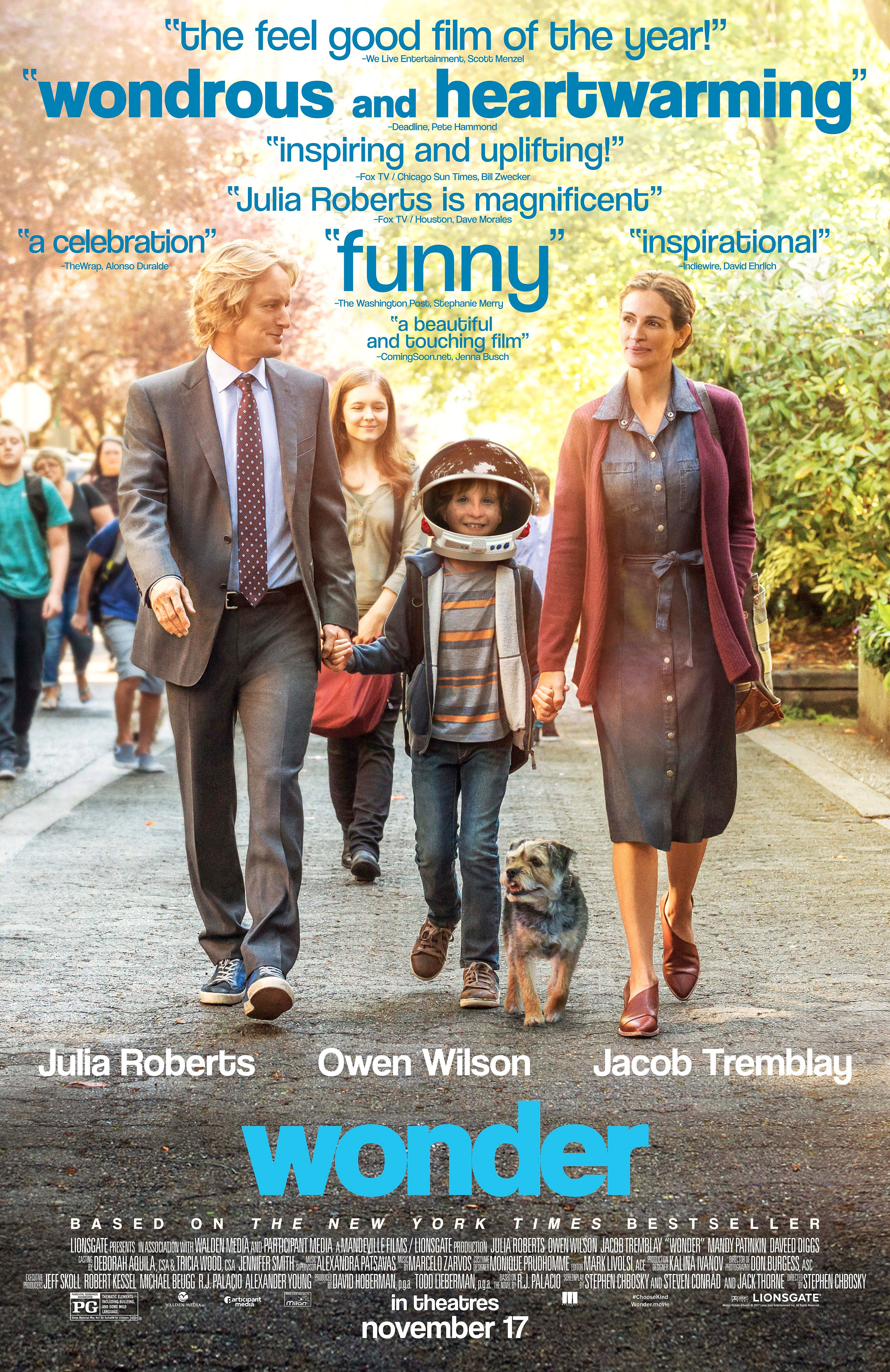
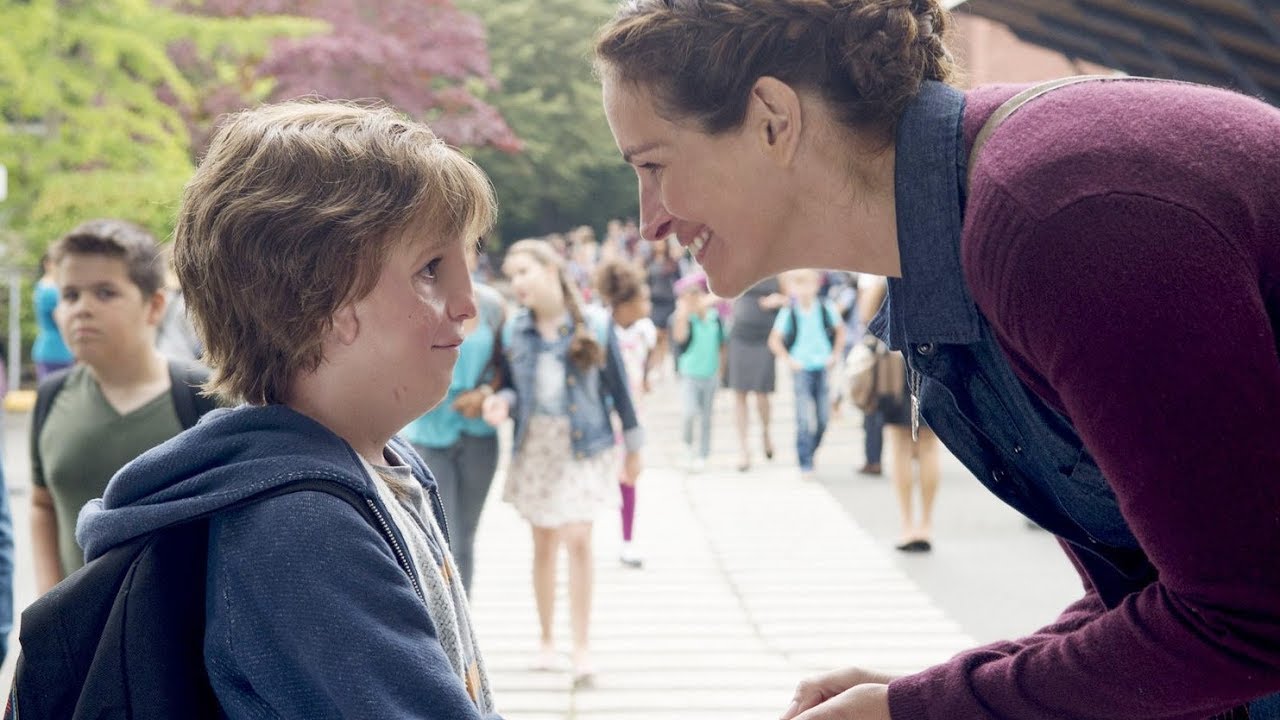
Rating: 3/10 – not even an attempt at creating the moody, stifling atmosphere of a modern noir can help Vengeance: A Love Story gain any dramatic traction; a poorly realised adaptation of Oates’ novel and a blunt exercise in emotional distress, it’s a movie that’s best forgotten as soon as you’ve seen it.


Arsenal (2017) / D: Steven C. Miller / 92m

aka Southern Fury

Cast: Adrian Grenier, Johnathon Schaech, Nicolas Cage, John Cusack, Heather Johansen, Lydia Hull, William Mark McCullough, Christopher Coppola

In Arsenal, Cage is Eddie King, a low-life Southern mobster who snorts a lot of cocaine and gets involved with the lives of two brothers, JP (Grenier) and Mikey (Schaech). As kids, Mikey was always the one ot watch out for his younger brother, JP, but as adults the tables have turned. Mikey has been in trouble with the law, while JP has built up a local construction company; he’s also married with a young daughter. Mikey takes a loan of $10,000 from JP to help him start again, but Mikey’s idea is to use the money to buy cocaine and re-sell it at a profit. But Mikey’s home is raided, and the cocaine is stolen from him. He tracks down the two men who stole it, but is unable to get it back. Soon after, a chance encounter with Eddie King leads to Mikey being kidnapped by King and held to ransom.

Despite being told not to involve the police, JP enlists the help of old friend and local cop, Sal (Cusack). Between them the pair discover that King is the kidnapper they’re dealing with, though they have no immediate way of managing the situation other than to pay the ransom of $350,000. While JP gets the money together, Mikey makes an unsuccessful escape attempt, old alliances are put to the test, Eddie deals with some awkward family ties, and a clue leads to the location where Mikey is being held. Determined not to let his brother be killed, JP comes up with a plan to save Mikey and stop King once and for all.

As opposed to his almost invisible performance in Vengeance: A Love Story, here Cage aims for the opposite end of the spectrum and gives his most over-the-top performance since Bad Lieutenant (2009). With an ill-fitting (and frankly ridiculous looking) wig, bulbous nose, and semi-laughable moustache (that’s rarely in the same place twice), Cage goes full throttle in his efforts to make his character appear dangerous and/or psychotic. He may have aimed for bravura at first, but it isn’t long before he’s shouting his lines at high volume and appearing to be on the verge of having a stroke. It’s a one-note performance that makes Eddie look and sound like the ultimate spoilt child, and in terms of the movie, it undermines his role as the central villain.

However, against the likes of Grenier and Schaech (who are supposed to be brothers, but who don’t look or sound alike, and have little on-screen chemistry together), Cage at least is making an effort. Grenier looks confused a lot, as if the rest of the cast is working from a script he hasn’t seen, while Schaech tries for muscle-bound yet deep-down sensitive and only succeeds in looking like he’s unsure of what’s being asked of him as an actor. Cusack wanders in and out of the narrative, mutters a few lines each time, then disappears until the next time the script needs him to tell Grenier just how bad things are getting. The movie lacks a sense of urgency once Mikey is kidnapped, its action scenes are perfunctory, and an extended prologue goes to great lengths to show the deep, caring relationship between JP and Mikey when a short dialogue scene could have done it in half the time. All in all, it’s dispiriting stuff that reinforces the notion that, these days, Cage will commit to anything for a pay cheque.

Rating: 3/10 – predictable on every level, Arsenal is a dull excuse for an action thriller, and directed in a manner that suggests Miller knew there was little chance of a decent movie emerging from out of the banal nature of Jason Mosberg’s screenplay; Cusack, wearing a bandanna and shuffling around a lot, seems to be acknowledging a debt to Steven Seagal, while any fun to be had is in seeing how many times the movie can set up a promising scene only for it to turn out to be just as bad as the rest.

Share this:

  • Click to share on X (Opens in new window) X
  • Click to share on Facebook (Opens in new window) Facebook
  • More
  • Click to print (Opens in new window) Print
  • Click to email a link to a friend (Opens in new window) Email
Like Loading...
← Older posts
Newer posts →

Blog Stats

  • 472,128 hits

Recent Posts

  • 10 Reasons to Remember Bibi Andersson (1935-2019)
  • Fantasia (1940)
  • Dances With Wolves (1990) – The Special Edition
  • Kiss of the Spider Woman (1985)
  • The Three Musketeers (1973)

Top Posts & Pages

  • Authors Anonymous (2014)
    Authors Anonymous (2014)
  • The Hand That Rocks the Cradle (1992)
    The Hand That Rocks the Cradle (1992)
  • A Dangerous Method (2011)
    A Dangerous Method (2011)
  • Speak (2004)
    Speak (2004)
  • The Wave (2015)
    The Wave (2015)
  • Bastards (2013)
    Bastards (2013)
  • Lost and Delirious (2001)
    Lost and Delirious (2001)
  • A Brief Word About Cineworld Unlimited
    A Brief Word About Cineworld Unlimited
  • Tehran Taboo (2017)
    Tehran Taboo (2017)
  • The Giver (2014)
    The Giver (2014)
Follow thedullwoodexperiment on WordPress.com

Blogs I Follow

  • Rubbish Talk
  • Film 4 Fan
  • Fast Film Reviews
  • The Film Blog
  • All Things Movies UK
  • Interpreting the Stars
  • Let's Go To The Movies
  • Movie Reviews 101
  • TMI News
  • Dan the Man's Movie Reviews
  • Film History
  • Jordan and Eddie (The Movie Guys)

Archives

  • April 2019 (13)
  • March 2019 (28)
  • February 2019 (28)
  • January 2019 (32)
  • December 2018 (28)
  • November 2018 (30)
  • October 2018 (29)
  • September 2018 (29)
  • August 2018 (29)
  • July 2018 (30)
  • June 2018 (28)
  • May 2018 (24)
  • April 2018 (21)
  • March 2018 (31)
  • February 2018 (25)
  • January 2018 (30)
  • December 2017 (30)
  • November 2017 (27)
  • October 2017 (27)
  • September 2017 (26)
  • August 2017 (32)
  • July 2017 (32)
  • June 2017 (30)
  • May 2017 (29)
  • April 2017 (29)
  • March 2017 (30)
  • February 2017 (27)
  • January 2017 (32)
  • December 2016 (30)
  • November 2016 (28)
  • October 2016 (30)
  • September 2016 (27)
  • August 2016 (30)
  • July 2016 (30)
  • June 2016 (31)
  • May 2016 (34)
  • April 2016 (30)
  • March 2016 (30)
  • February 2016 (28)
  • January 2016 (35)
  • December 2015 (34)
  • November 2015 (31)
  • October 2015 (31)
  • September 2015 (34)
  • August 2015 (31)
  • July 2015 (33)
  • June 2015 (12)
  • May 2015 (31)
  • April 2015 (32)
  • March 2015 (30)
  • February 2015 (37)
  • January 2015 (39)
  • December 2014 (34)
  • November 2014 (34)
  • October 2014 (36)
  • September 2014 (25)
  • August 2014 (29)
  • July 2014 (29)
  • June 2014 (28)
  • May 2014 (23)
  • April 2014 (21)
  • March 2014 (42)
  • February 2014 (38)
  • January 2014 (29)
  • December 2013 (28)
  • November 2013 (34)
  • October 2013 (4)

Create a free website or blog at WordPress.com.

Rubbish Talk

Film 4 Fan

A Movie Blog

Fast Film Reviews

The Film Blog

The official blog of everything in film

All Things Movies UK

Movie Reviews and Original Articles

Interpreting the Stars

Dave Examines Movies

Let's Go To The Movies

Film and Theatre Lover!

Movie Reviews 101

Daily Movie Reviews

TMI News

Latest weather, crime and breaking news

Dan the Man's Movie Reviews

All my aimless thoughts, ideas, and ramblings, all packed into one site!

Film History

Telling the story of film

Jordan and Eddie (The Movie Guys)

Movie Reviews & Ramblings from an Australian Based Film Fan

Privacy & Cookies: This site uses cookies. By continuing to use this website, you agree to their use.
To find out more, including how to control cookies, see here: Cookie Policy
  • Subscribe Subscribed
    • thedullwoodexperiment
    • Join 481 other subscribers
    • Already have a WordPress.com account? Log in now.
    • thedullwoodexperiment
    • Subscribe Subscribed
    • Sign up
    • Log in
    • Report this content
    • View site in Reader
    • Manage subscriptions
    • Collapse this bar
 

Loading Comments...
 

    %d