• 10 Reasons to Remember…
  • A Brief Word About…
  • About
  • For One Week Only
  • Happy Birthday
  • Monthly Roundup
  • Old-Time Crime
  • Other Posts
  • Poster of the Week
  • Question of the Week
  • Reviews
  • Trailers

thedullwoodexperiment

~ Viewing movies in a different light

thedullwoodexperiment

Yearly Archives: 2017

The Sense of an Ending (2017)

04 Sunday Jun 2017

Posted by dullwood68 in Movies

≈ Leave a comment

Tags

Charlotte Rampling, Diary, Drama, Harriet Walter, Jim Broadbent, Literary adaptation, Review, Ritesh Batra, Suicide, The Sixties
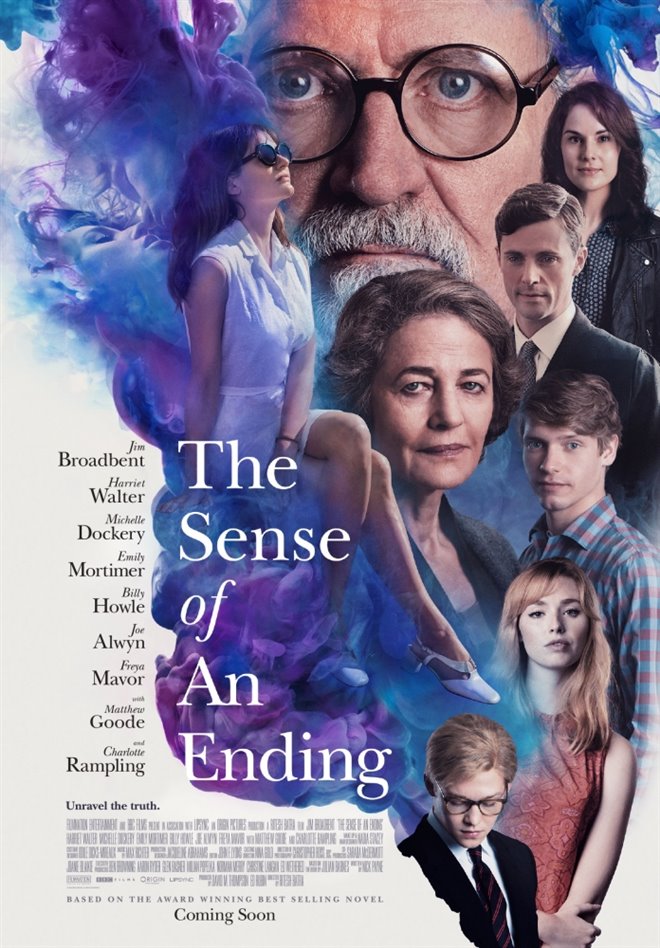
D: Ritesh Batra / 108m

Cast: Jim Broadbent, Charlotte Rampling, Harriet Walter, Michelle Dockery, Matthew Goode, Emily Mortimer, James Wilby, Edward Holcroft, Billy Howle, Freya Mavor, Joe Alwyn, Peter Wight, Hilton McRae

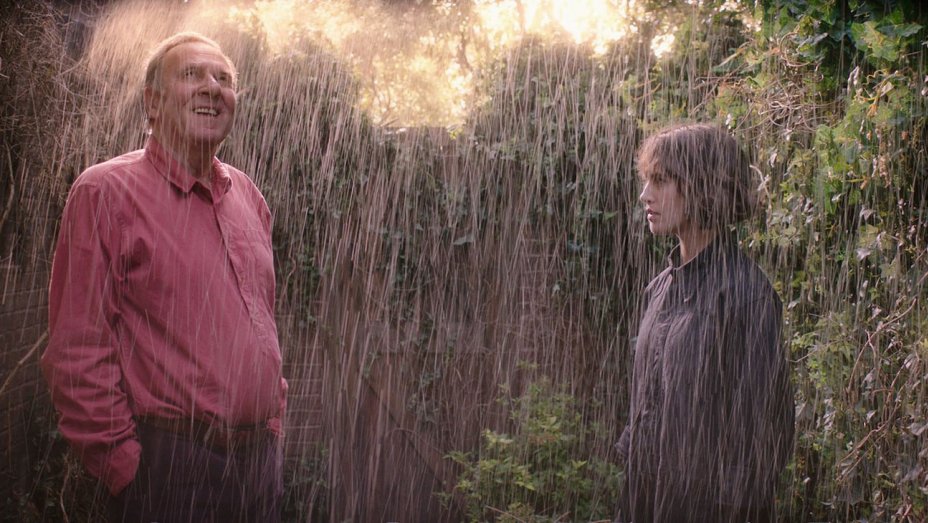
In Ritesh Batra’s first movie since The Lunchbox (2013), Jim Broadbent’s elderly divorcé, Tony Webster, receives a solicitor’s letter telling him that he has been left something in the will of a woman he knew back in the Sixties. The woman was Susan Ford (Mortimer), the mother of Tony’s first love, Veronica (Mavor). At first, Tony is puzzled by the news, and he’s further puzzled when he discovers that the “something” is the diary of a schoolfriend, Adrian Finn (Alwyn). This prompts Tony to reflect back on his life as a university student, and his relationship with Veronica. But getting hold of Adrian’s diary proves more difficult than he expects; it’s in Veronica’s hands and she’s not passing it on to her solicitors’.

Tony seeks advice from his ex-wife, Margaret (Walter), who is also in the legal profession. Margaret, though, can’t understand why getting hold of the diary means so much to Tony, so he attempts to tell her the story of how he and Veronica met, and the beginning of his friendship with Adrian. As he recounts that period of his life, Tony remembers times and events that he had largely forgotten, and he begins to suspect that things were happening that he wasn’t fully aware of. Eventually he persuades Veronica’s solicitors to ask her to contact him, and they arrange to meet. Tony is expectant that he’ll finally receive the diary, but Veronica is distant and tells him that she’s burnt it. After the meeting, Tony follows Veronica but is unable to find out where she lives.
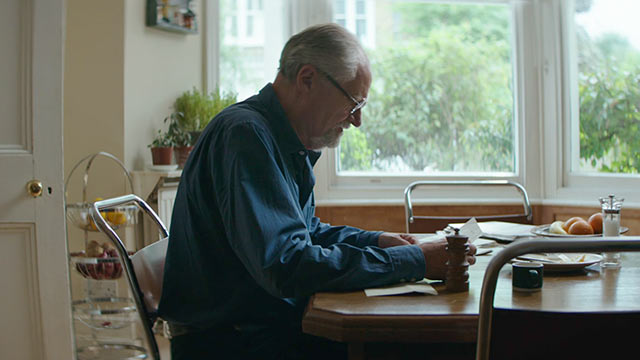
Tony’s memories of his student days continue to plague him, forcing him to remember a letter he wrote when Veronica stopped seeing him and began seeing Adrian instead. The events that followed his sending the letter make Tony view himself in a bad light, but then another attempt to follow Veronica reveals a circumstance that takes him by surprise. In time, this circumstance shows that his understanding of the events of his school days is not only flawed, but has informed the majority of his adult life, something that means Tony has to face up to the idea that he’s lived a life that could have been very much different.

An adaptation of Julian Barnes’ 2011 Man Booker Prize-winning novel, The Sense of an Ending is the kind of low-key, measured drama that offers big rewards provided that you can get past its slow, deceptively pedestrian approach. This is a movie that relies on teasing out the emotional undercurrents of its story, and doing so in a well considered, thoughtful manner that makes each revelation and divulgence of motive more affecting than you might suspect. Barnes’ novel concerned itself with notions of memory and ageing, and while both those aspects are present here, there are others that are equally potent. Adapted by Nick Payne, the movie seeks to explore the ways in which the actions of our youth inform our behaviour as adults, and the ways in which the consequences of those actions can lead to repressed feelings and the slow accumulation of guilt.

At the beginning of the movie, Tony has no understanding of the events that surrounded him as a student, other than how they affected him at the time. However, Tony’s involvement, when looked at closely, was entirely minimal, and as the movie progresses and we see more of those events unfold, what emerges is a portrait of a man trying to attach meaning to a period of his life where he was in many ways a supporting character in the drama of everyone else’s lives. It’s instructive that as an adult Tony’s life is lived somewhat on the fringes as well. He’s divorced though still in touch with his ex-wife, has a daughter whose pregnancy brings them only slightly more together (he attends a pre-natal class with her), and owns a business that sells classic Leica cameras (in a very small shop). It’s not clear that he has any appreciable “life” beyond these things, and his general demeanour is dismissive. He may not be living in the past – until the solicitor’s letter arrives that is – but he’s not exactly living in the present either.

As the past exerts a fearsome pull on Tony, his memories begin to have a profound effect on him, leading him to question what he remembers and what actually happened. Veronica is pre-disposed not to help him, and as her story is revealed you can understand why. But Tony’s determination to solve the mystery of his youth and reconstruct his younger self from the tangle of his memories at least proves cathartic, and by the movie’s end he’s more settled than perhaps he’s ever been. As we follow Tony on his journey of self-rediscovery, we’re guided along the way by another terrific performance from the ever-reliable Broadbent, whose initially perplexed expressions speak of credible bemusement. But soon these give way to expressions of doubt and regret, as the full enormity of what happened all those years ago begins to unravel and Tony’s foundations as an adult begin to crumble. Broadbent allows the audience to see the tragic trajectory of Tony’s life, and the hollow man he’s become, and still he maintains a sympathy for the character that’s not entirely deserved.
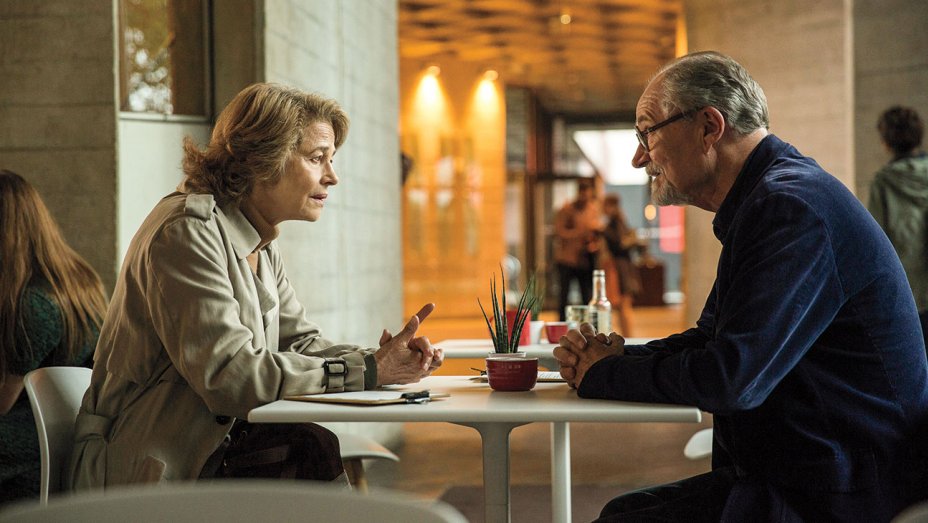
Carrying the majority of the movie, Broadbent is simply magnificent in a role that is heartfelt, honest and sincere. He’s also at the top of a very impressive cast, with Rampling excelling as usual as Veronica, a woman who has no time for broad introspection or revisiting a past that is painful to her if not to Tony. The rest of the cast provide sterling support, with special mentions going to Howle as the younger Tony, and Mortimer as Veronica’s mother. Even the likes of Goode and Holcroft (as Tony’s teacher and Veronica’s brother respectively) make an impact despite being given less to do than others, and Alwyn – in only his second movie after Billy Lynn’s Long Halftime Walk (2016) – handles Finn’s philosophical musings with both humour and subtlety.

The contrasts between the past and the present are handled well by Batra and his talented production crew, with Tony’s student days presented in a warm, nostalgic glow that could be considered rose-tinted were it not for the tragic elements at the heart of it all. The present day is much more airy and coolly defined, with sharper colours and rigid edges used to define the emotional trap waiting for Tony to walk into it. Batra displays a confidence with the material that keeps it all feeling genuine and without guile, and as the narrative builds toward its inevitable (and only semi-signposted) revelation, his skill at revealing the various complexities of Tony’s student days becomes more and more evident. And by the time Tony’s daughter has given birth and he’s accepted his life for what it can be rather than what it is, the movie has provided rich dividends for the viewer willing to look beyond its superficially mundane surface.

Rating: 8/10 – something of a mood piece, but bolstered by assured direction, a weighty and compelling script, and skilled performances from its cast, The Sense of an Ending is an engaging and thought-provoking movie that makes a virtue of its earnest and somewhat melancholy narrative; a prime example of a literary adaptation that takes the virtues of its source material and adds a smattering of cinematic probity to the mix, it’s a plaintive, absorbing investigation into the nature of elusive recall and the relationship between memory and remembrance.

Share this:

  • Share on X (Opens in new window) X
  • Share on Facebook (Opens in new window) Facebook
  • More
  • Print (Opens in new window) Print
  • Email a link to a friend (Opens in new window) Email
Like Loading...

Trailers – Murder on the Orient Express (2017), Logan Lucky (2017) and The Founders (2016)

03 Saturday Jun 2017

Posted by dullwood68 in Movies

≈ Leave a comment

Tags

Agatha Christie, Carrie Schrader, Charlene Fisk, Daniel Craig, Documentary, Golf, Kenneth Branagh, LGPA, Previews, Remake, Steven Soderbergh, Trailers

As remakes go, Murder on the Orient Express has its work cut out for it – or does it? When it was first made in 1974 with an all-star cast that included John Gielgud, Lauren Bacall, Ingrid Bergman, Sean Connery, and Albert Finney as Hercule Poirot, its labyrinthine plot – adapted from the novel by Agatha Christie – required a cool head to keep up with it all, and to follow the various strands of its complex narrative. And the solution to it all still ranks as one of Christie’s more ingenious and surprising resolutions. So, with that in mind, perhaps it’s best that over forty years have passed between the original and this new version, directed by Kenneth Branagh, and featuring Branagh himself as the Belgian detective. Another strong point for the movie is that Branagh is working from a screenplay by Michael Green, who has provided scripts for two other highly anticipated movies this year, Logan and Blade Runner 2049. With a starry cast that doesn’t quite match the A-listers of 1974, this version still has enough acting firepower to ensure that audiences are kept on the edge of their seat – unless they’re focused entirely on the humongous moustache that Branagh sports as Poirot.


When Steven Soderbergh announced his retirement from directing movies after making Behind the Candelabra (2013), it was regarded as a definite loss. An idiosyncratic moviemaker with a great deal of smarts and an enviable career (few directors could release movies as disparate as Erin Brockovich and Traffic in the same year), Soderbergh’s retirement always seemed to be less of a retirement and more of a break. And so it proves – hurrah! – as he returns with a spirited caper movie that features a great cast (including some newcomer called Daniel Craig), the kind of convoluted plot that won’t be as straightforward as it looks, and Soderbergh’s bold, feast-for-the-eyes cinematography. The script is by another newcomer, Rebecca Blunt, but from the trailer it looks as if Soderbergh has allied himself with the kind of tale that suits his eye for the ridiculous and his talent as a storyteller. If Soderbergh brings his A-game, this could well be one of the funniest, and most enjoyable movies of 2017 – and it could make a star out of this Craig guy.


If you’ve never heard of Shirley Spork, Marilynn Smith, Louise Suggs, or Marlene Bauer Vossler, it’s not so surprising. They were pioneers in a sport that didn’t encourage female players, and they helped to legitimise women’s involvement in that sport. In 1950, they and nine other women players formed the LPGA, the Ladies Professional Golf Association, an achievement that The Founders covers through a mixture of contemporary footage and interviews with the four surviving founder members. It’s an inspiring tale, and shines a light on yet another example of the institutional sexism that permeated sporting life in the US, where women were deemed unable to play as well as their male counterparts. It’s the first feature-length documentary for its directors, Charlene Fisk and Carrie Schrader, but in telling the story behind the founding of the LPGA, they’ve hit on a piece of recent history that has a wider relevance even today.

Share this:

  • Share on X (Opens in new window) X
  • Share on Facebook (Opens in new window) Facebook
  • More
  • Print (Opens in new window) Print
  • Email a link to a friend (Opens in new window) Email
Like Loading...

Wonder Woman (2017)

02 Friday Jun 2017

Posted by dullwood68 in Movies

≈ 1 Comment

Tags

Action, Amazons, Ares, Chris Pine, Connie Nielsen, Danny Huston, David Thewlis, DC Extended Universe, Drama, Fantasy, Gal Gadot, Patty Jenkins, Review, Robin Wright, Superhero, Themyscira, World War I

D: Patty Jenkins / 141m

Cast: Gal Gadot, Chris Pine, Connie Nielsen, Robin Wright, Danny Huston, David Thewlis, Saïd Taghmaoui, Ewen Bremner, Eugene Brave Rock, Lucy Davis, Elena Anaya, Lilly Aspell

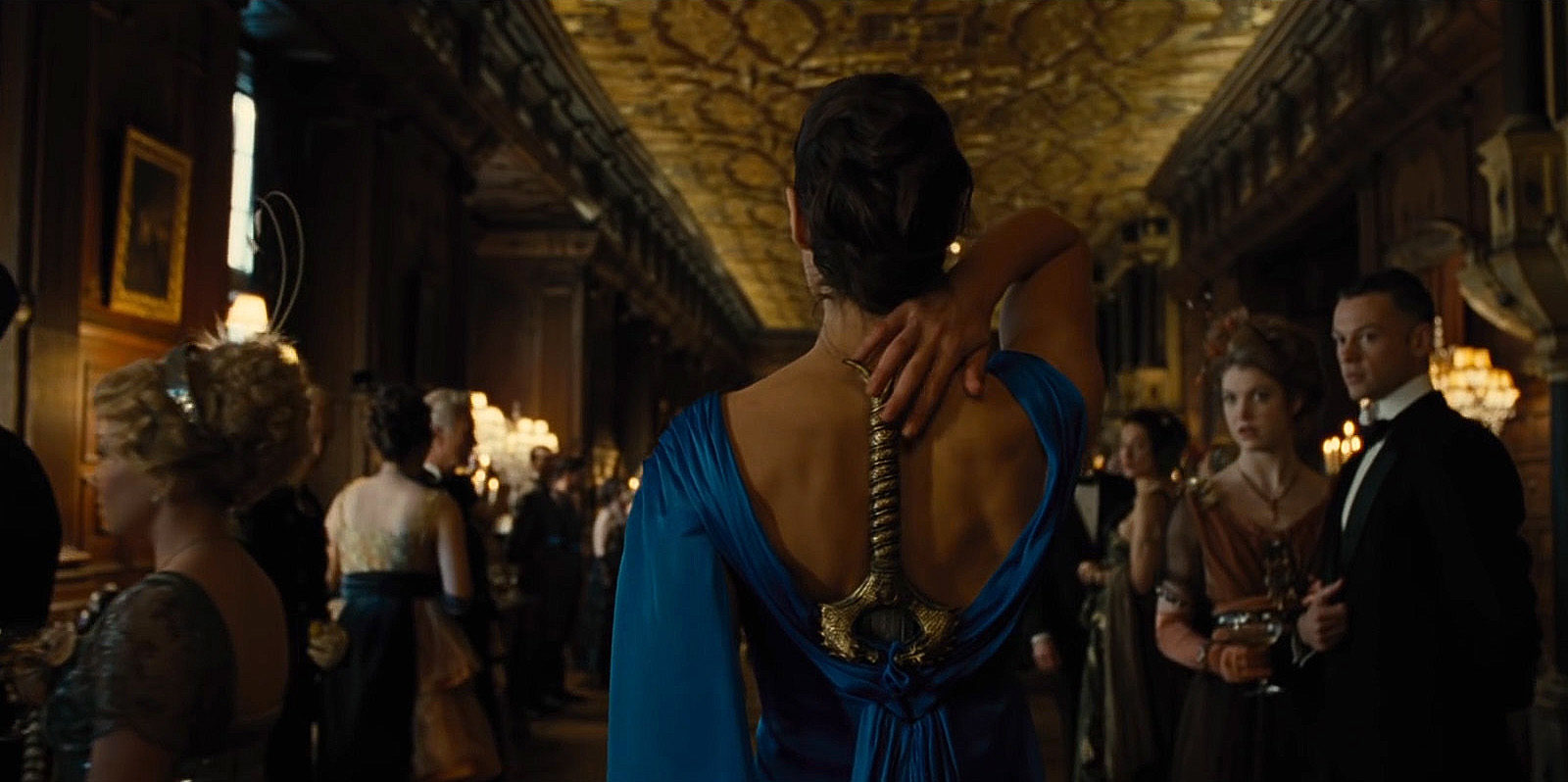
On the hidden island of Themyscira live the Amazons, a fierce warrior tribe of women whose presence in the world has been kept from the rest of mankind by the wishes of Zeus. The only child on the island is Diana (Aspell), the daughter of Queen Hippolyta (Nielsen). Diana is precocious, challenging, disobedient, and determined to become a warrior like the rest of the Amazons, but her mother forbids it. Hippolyta’s sister, Antiope (Wright), trains Diana in secret, though, and she grows into a young woman (Gadot) to be reckoned with: the quickest, most agile, most determined Amazon of them all. With her fighting skills honed under the stewardship of Antiope, Diana finds she lacks a clear purpose in life, until one day the shield keeping the island hidden is penetrated by a plane that crashes into the sea. Diana rescues the lone pilot, Steve Trevor (Pine), who tells the Amazons of “a war to end to all wars”, and who provides all the reason Diana needs to leave the island and seek her destiny (once she leaves she can never return).

The pair travel to London where Trevor alerts the British High Command – led by Sir Patrick Morgan (Thewlis) – to a plot by Germany’s General Ludendorff (Huston) to end the War by use of the most deadliest form of mustard gas yet created. Forced to go it alone, Trevor recruits three old friends – would-be actor Sameer (Taghmaoui), sharpshooter Charlie (Bremner), smuggler the Chief (Brave Rock) – and with Diana, travels to the Belgian Front, where Ludendorff and his chief scientist, Dr Maru (Anaya), are in the process of preparing their new weapon to be used for the first (and they hope, last) time in the War. But Diana has no intention of letting them succeed in their plan, and convinced that Ludendorff is the modern incarnation of Ares, the disgraced God of War, she takes the fight to the Germans, and in the process learns something about herself that has been hidden from her all her life…

The question everyone is asking is an easy one to answer. The question is, is Wonder Woman the best DC Extended Universe movie to date? And the easy answer is Yes, it is. But that’s like saying, if I have one leg shorter than the other, and I have an operation to correct this, will I be better able to walk? Again, the answer is Yes, of course. And so it goes with Wonder Woman, a movie that provides a sharp upturn in quality in relation to its predecessors – Man of Steel (2013), Batman v Superman: Dawn of Justice (2016), Suicide Squad (2016) – but which still embraces many of the issues and problems that have plagued those same DCEU productions.

It’s yet another movie where the tone is so earnest and so po-faced that when the script does make an attempt at humour, it’s the same as when Garland Greene says of Billy Bedlam in Con Air (1997): “he’s so angry moments of levity actually cause him pain; gives him headaches. Happiness, for that gentleman, hurts.” The humour is there, tucked away in odd places, but it never feels like an integral part of the overall tone and feel of the movie. It’s as if Allan Heinberg’s script was accused of being too heavy, and was charged with including moments of levity as a direct consequence. What this means in practice is that the movie rarely feels comfortable when it’s tasked with being funny, and seems to breathe a sigh of relief when it can move on and concentrate on providing audiences with an industrious trek through the land of superhero clichés.

As an origin story, it’s akin to the first Thor movie, in that it introduces us to a realm built on myth and legend, and after a suitable period, hijacks the central character and thrusts them into the “real” world, with all its problems and rewards. Themyscira is a first for the DC Extended Universe, a beautifully realised paradise that features sun-dappled buildings, verdant fields, and the healthy glow of bronze and gold. Its relentlessly blue skies stretch as far as the eye can see, and the azure waters of the sea are dazzling. But once the island of Themyscira is left behind, the movie defaults to the muted colour palette and downplayed visual aesthetic that governs all the movies in the DC Extended Universe. Whether we’re in London or the battle-torn Belgian countryside, the movie does its best to be all gloomy backdrop and sombre foreground. It all fits in with the earnest, dramatic nature of the material, but as a visual statement it’s less than satisfying and helps to drain some of the life from the movie as a whole.

Where the movie does score more highly is in its attention to the horrors of life on the Western Front, and the effects of warfare on the local populace. But even that acknowledgment is over quickly so as to facilitate the next action sequence (which unfortunately features the kind of jerky CGI gymnastics from Wonder Woman that you’d be forgiven for thinking wouldn’t be attempted anymore in a movie costing $149 million and released in 2017). There are other nods to the horrors of war – Charlie’s PTSD, musings on the terrible things that man can inflict on his fellow man – but while it’s good to see them addressed – however briefly – it’s as near to depth as the movie gets, and they seem shoehorned into the main storyline rather than arising naturally from it. Diana’s obsession with hunting down Ares also gives rise to further arguments about the nature of war and man’s predilection towards it, but these are largely spurious and serve only to weigh down a final showdown between Diana and Ares that quickly descends into yet another dispiriting bout of disaster porn theatrics.

As the 5000 year old Amazon princess, Gadot builds on her appearance in Batman v Superman: Dawn of Justice, and proves that the praise she received in that movie wasn’t just a result of her standing out against its poor structure, lacklustre script, and wayward direction. There are some roles that can only be played by certain actors or actresses, and Gadot owns the part in a way that the likes of Sandra Bullock, Catherine Zeta-Jones, and Beyoncé Knowles – all considered for the role in the past – would find incredibly difficult to match or improve upon. Elsewhere, Gadot isn’t the most convincing of actresses, but here she gives a compelling, intuitive performance that stretches her skills as an actress but does so in a way that marks her out – in the DC Extended Universe at least – as the character to look out for. She’s ably supported by Pine who reins in his usual cocky charm; Huston as yet another less than memorable villain; Thewlis as the politician who may or may not be all that he seems; and Wright as Diana’s strong-willed aunt. However, if anyone in the supporting cast has to be picked out, it’s Bremner, who injects some much needed energy into his scenes and who makes Charlie possibly the most well rounded character in the whole movie.

Much has been made of Patty Jenkins being the first female director of a superhero movie featuring a female character as its lead, and Jenkins does do a decent enough job of pushing against the narrow confines of a DC superhero movie. But though she does manage to incorporate some elements of feminism into the story, there aren’t enough to make the movie into something more relevant than it is, and it’s curiously flimsy as an example of female empowerment. This is still, and despite the presence of Wonder Woman herself, a Boys’ Own adventure that could have featured any number of superheroes as its lead protagonist. It gets full marks for its period setting (something that was avoided for a long time before production finally began), but the movie takes too long in getting its audience from London to the Front, takes too much time in attempting to flesh out characters that don’t need fleshing out, and provides enough exposition to deaden the senses more effectively than Dr Maru’s poison gas. A small-scale triumph, then, and a definite improvement on the movies already mentioned above, but there’s still a long way to go before DC and Warner Bros. overcome the same problems they seem incapable – at present – of recognising and prevailing over.

Rating: 6/10 – a movie that starts out strongly (much in the way that Suicide Squad did), Wonder Woman seems set on delivering on the promise it showed in its trailers, and the advance word from preview screenings, but it soon falters and falls prey to the apparently carved-in-stone requirements of the DC Extended Universe; bold and confident in places, yet haphazard and stumbling in others, it’s a movie that surprises more than it dismays, but when it does dismay the effect is, unfortunately, far more noticeable, and has far more repercussions.

Share this:

  • Share on X (Opens in new window) X
  • Share on Facebook (Opens in new window) Facebook
  • More
  • Print (Opens in new window) Print
  • Email a link to a friend (Opens in new window) Email
Like Loading...

Monthly Roundup – May 2017

01 Thursday Jun 2017

Posted by dullwood68 in Movies

≈ Leave a comment

Tags

Action, Aloha Scooby-Doo!, Animation, Arnaud Larrieu, Contract to Kill, Dapper Jack, Drama, Frank Welker, His Lordship Goes to Press, Jean-Marie Larrieu, June Clyde, Keoni Waxman, Love Is the Perfect Crime, Mathieu Amalric, Melvin Van Peebles, Mystery, Nicolas Cage, Review, Scooby-Doo! Shaggy's Showdown, Steven Seagal, The Mystery Gang, Thriller, Tim Maltby, True story, USS Indianapolis: Men of Courage, Warner Bros., Wiki Tiki

USS Indianapolis: Men of Courage (2016) / D: Mario Van Peebles / 130m

Cast: Nicolas Cage, Tom Sizemore, Matt Lanter, James Remar, Thomas Jane, Brian Presley, Yutaka Takeuchi, Johnny Wactor, Adam Scott Miller, Cody Walker, Weronika Rosati, Currie Graham

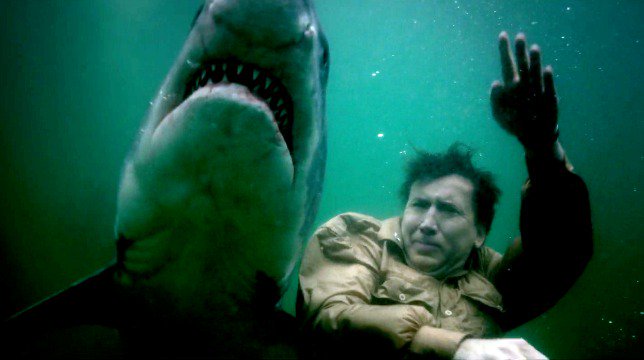
Rating: 4/10 – five days after it delivers the atomic weaponry that would be used against Japan, the USS Indianapolis is torpedoed and sunk, leaving around three hundred crewmen hundreds of miles from land and at the mercy of starvation, dehydration and worst of all, marauding sharks; the true story that gave rise to that monologue in Jaws (1975), USS Indianapolis: Men of Courage betrays its low budget and scaled back production values at almost every turn, and lacks the necessary intensity to make it work properly, though it does allow Cage the chance to give a slightly better performance than we’ve recently been used to.

His Lordship Goes to Press (1938) / D: Maclean Rogers / 80m

Cast: June Clyde, Hugh Williams, Leslie Perrins, Louise Hampton, Romney Brent, Aubrey Mallalieu

Rating: 4/10 – an American journalist (Clyde) travels to England to write a story about farming, and while she’s en route, insults an Earl (Williams) who decides to teach her a lesson, one that involves his posing as a farmer on his own estate; what could and should have been a light-hearted romantic comedy gets bogged by the mechanics of its plot, and two lead performances that aren’t as interesting to watch as those of the supporting cast, all of which, unfortunately, makes His Lordship Goes to Press easily forgettable.

Scooby-Doo! Shaggy’s Showdown (2017) / D: Matt Peters / 79m

Cast: Frank Welker, Grey Griffin, Matthew Lillard, Kate Micucci, Melissa Villasenor, Carlos Alazraqui, Gary Cole, Kari Wahlgren, Stephen Tobolowsky, Max Charles

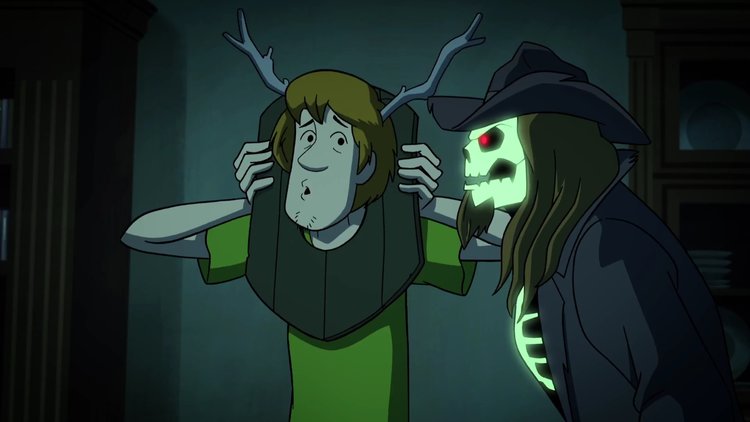
Rating: 7/10 – the latest outing for the Mystery Gang sees them head out west to a small town haunted by the terrifying ghost of Dapper Jack – who just happens to be one of Shaggy’s ancestors; one of the better entries in Warner Bros. ongoing series, Scooby-Doo! Shaggy’s Showdown is sharp, funny, has an intriguing storyline, and throws in more suspects than usual, making it slightly more difficult than usual to spot the villain (though you might argue it’s the person who gave the go ahead for two songs to be included).

Love Is the Perfect Crime (2013) / D: Jean-Marie Larrieu, Arnaud Larrieu / 110m

Original title: L’amour est un crime parfait

Cast: Mathieu Amalric, Karin Viard, Maïwenn, Sara Forestier, Denis Podalydès

Rating: 7/10 – Marc (Amalric) is a literature professor at the University of Lausanne who first becomes embroiled in the disappearance of a student, and then finds himself falling in love with her stepmother (Maïwenn); Amalric’s arrogant but often childish professor is matched by Viard’s casual malevolence as his sister, and while Love Is the Perfect Crime plays out like a mystery (that’s actually quite easy to solve), it’s really a drama about one man’s initially unwitting, then complicit attempt at self-destruction, a storyline that offers much in the way of subdued Gallic charm.

Contract to Kill (2016) / D: Keoni Waxman / 90m

Cast: Steven Seagal, Russell Wong, Jemma Dallender, Mircea Drambareanu, Sergiu Costache, Ghassan Bouz, Andrei Stanciu

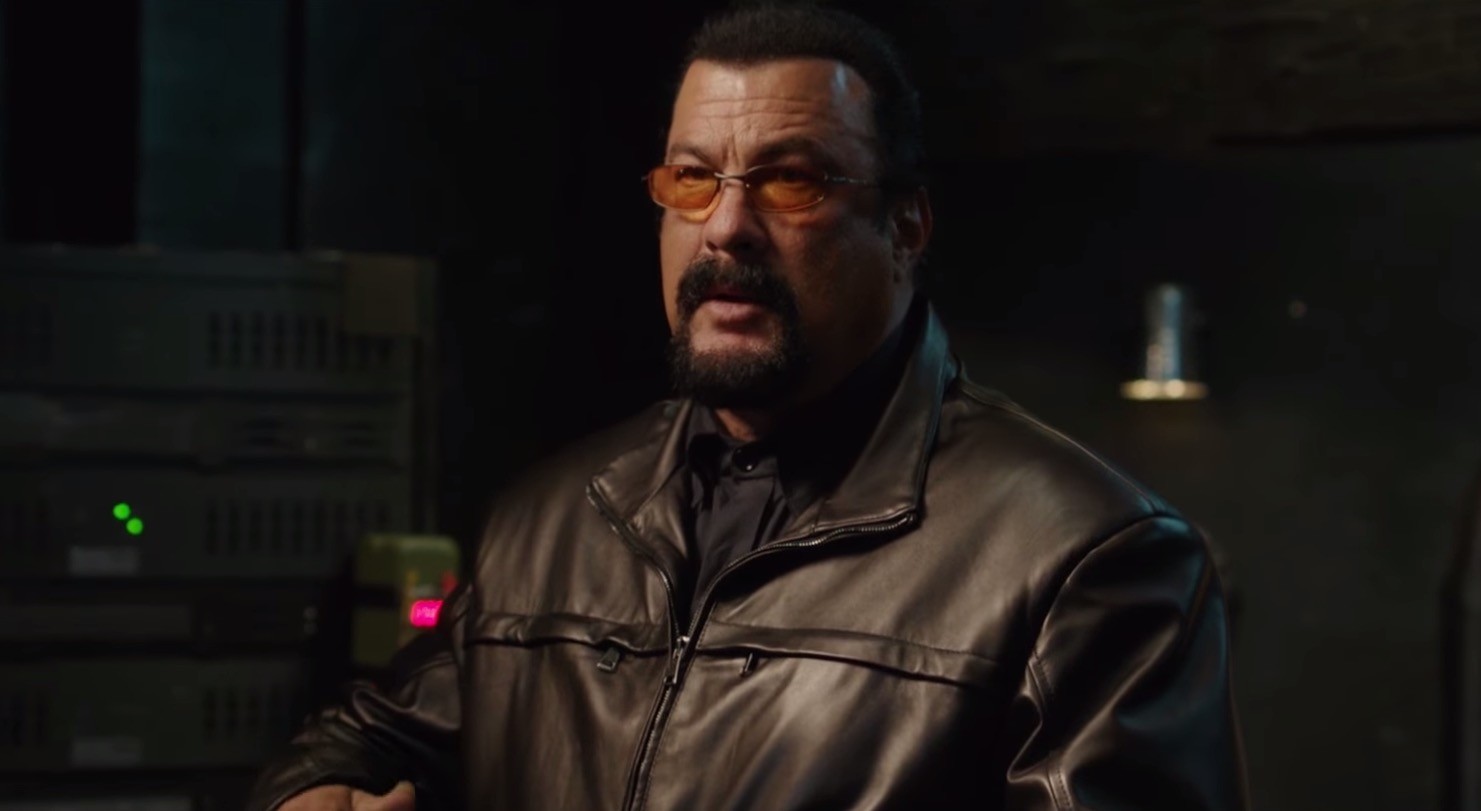
Rating: 3/10 – a Mexican drug cartel helps Arab terrorists smuggle weapons and personnel into America, but they don’t reckon on CIA/DEA agent John Harmon (Seagal) and his team interfering with their plans; Contract to Kill is a Steven Seagal movie, with all that that entails, including Seagal himself reciting dialogue as if he was reading it off the back of a cereal box, the same tired, poorly edited actions sequences we’ve seen a dozen times or more in the past, and a plot that makes no coherent sense no matter how closely you examine it.

Aloha Scooby-Doo! (2005) / D: Tim Maltby / 74m

Cast: Frank Welker, Casey Kasem, Mindy Cohn, Grey DeLisle, Ray Bumatai, Tia Carrere, Teri Garr, Mario Lopez, Adam West

Rating: 5/10 – when Daphne (DeLisle) gets the chance to be a clothes designer for a company based in Hawaii, inevitably the rest of the gang go with her – and find themselves investigating the mystery of the ghostly Wiki Tiki; not the best movie in the series (the villain is so obvious it’s almost insulting), Aloha Scooby-Doo! strives to have Daphne in a bikini as often as possible, struggles to make its central mystery interesting, features little Tiki monsters that are funny rather than scary, and direction by Maltby that makes you wonder how involved he was throughout.

Share this:

  • Share on X (Opens in new window) X
  • Share on Facebook (Opens in new window) Facebook
  • More
  • Print (Opens in new window) Print
  • Email a link to a friend (Opens in new window) Email
Like Loading...

The Immortal Life of Henrietta Lacks (2017)

31 Wednesday May 2017

Posted by dullwood68 in Movies

≈ Leave a comment

Tags

Cells, Drama, George C. Wolfe, HeLa immortal cell line, History, Johns Hopkins, Medical research, Oprah Winfrey, Renée Elise Goldsberry, Review, Rose Byrne, True story

D: George C. Wolfe / 93m

Cast: Oprah Winfrey, Rose Byrne, Renée Elise Goldsberry, Reg E. Cathey, Courtney B. Vance, Rocky Carroll, Leslie Uggams, Reed Birney, John Douglas Thompson, Adriane Lenox, Roger Robinson, John Beasley, Peter Gerety, Gabriel Ebert, John Benjamin Hickey, Ruben Santiago-Hudson, Byron Jennings

Without the HeLa immortal cell line, it’s unlikely that many solutions to many medical conditions would have been arrived at as quickly as they have. A breakthrough in medical research, the cancer cells taken from then thirty-year-old Henrietta Lacks during the summer of 1951, have meant literally the difference between life and death for people all over the world. In the years since their discovery, it’s estimated that scientists have grown around twenty tons of Henrietta’s cells, and there have been approximately eleven thousand patents registered that involve HeLa cells. But even though Henrietta’s cells have contributed greatly to the advancement of medical research, the method of their attainment has been the cause of much debate about US medical ethics in the 1950’s, and the treatment of patients during that time. Put simply, Henrietta Lacks’s cells were taken from her by the staff at Johns Hopkins without her permission, or her being aware that it was happening.

Revelations surrounding the source of the HeLa immortal cell line arose during the 1970’s when Henrietta’s family were asked to provide blood samples in order to help researchers replace a batch of contaminated cells. A dinner table conversation in 1975 made the family aware that her cells were still being used. However, Henrietta’s family didn’t pursue the matter, and although Henrietta’s contribution to medical science began to be recognised more and more during the 1990’s, it wasn’t until Rebecca Skloot, a freelance science writer who’d already written two articles about HeLa in 2000 and 2001, approached the family through daughter Deborah Lacks with a view to writing a book about it all.

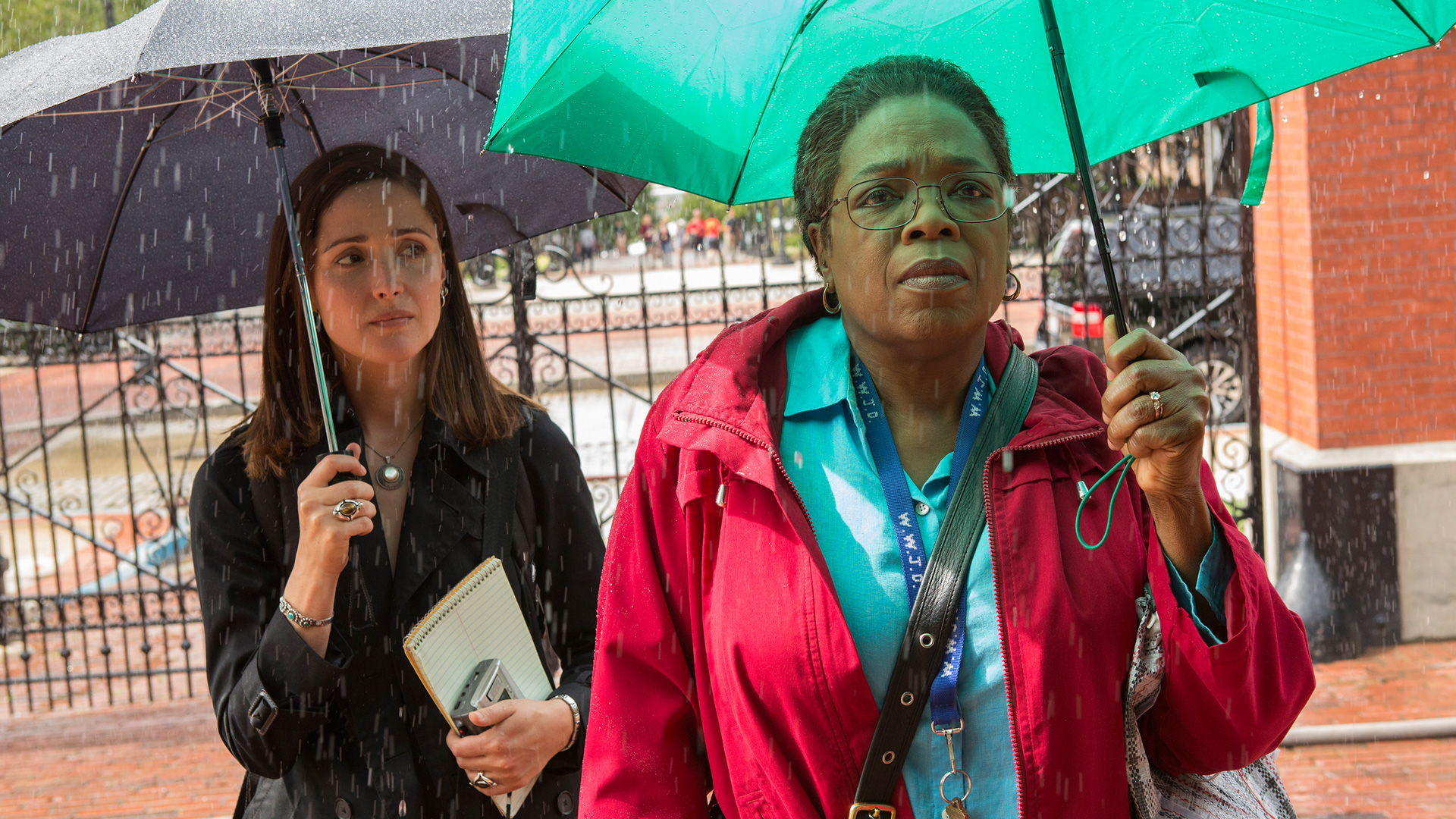
And so we have the movie version of Skloot’s multi-award-winning non-fiction book, The Immortal Life of Henrietta Lacks. In gestation since the book’s publication in 2010, the movie arrives courtesy of HBO and Oprah Winfrey (who plays Deborah), and seeks to examine the medical, ethical, moral and human dilemmas surrounding the harvesting of a person’s cells without their consent. And though these issues are raised at various times during the movie, it soon becomes obvious that these aren’t going to be the issues the movie focuses on. Instead, the focus is on Rebecca Skloot (Byrne) herself, and Deborah Lacks, a woman whose personal demons dictate a high level of erratic, and sometimes paranoid, behaviour.

What also becomes obvious is that in adapting Skloot’s book, screenwriters Peter Landesman, Alexander Woo, and director George C. Wolfe, have bitten off quite a bit more than they can chew. As the central character, Skloot deservedly takes centre stage, but we never really get to know too much about her other than that she’s using her own money to fund all her research into learning about Henrietta and what happened both to her, and to her family. Skloot’s motivation for pursuing the story remains unanswered (though the question is asked), and she’s often reduced to being a bystander, an observer on the periphery of everything. But then the script will bring her to the forefront, leaving the viewer to wonder just how important she is to what is happening on screen.

Byrne plays Skloot, at first, as an awkward, nervously grinning, seemingly out-of-her-depth journalist hooked on a great idea for a book but unsure if she can make it work when Henrietta’s family don’t exactly welcome her with open arms. She perseveres though (as does Byrne), but it’s all to too little effect; Skloot remains a cypher throughout, a stable character that everyone else can use as either a sounding board or an emotional punchbag. There are times when Byrne seems to be a little bit behind everyone else, as if she’s always running to catch up, and while her performance is adequate, there’s a feeling that the script has subordinated her character in order to give the movie’s first-billed star more room to impress.

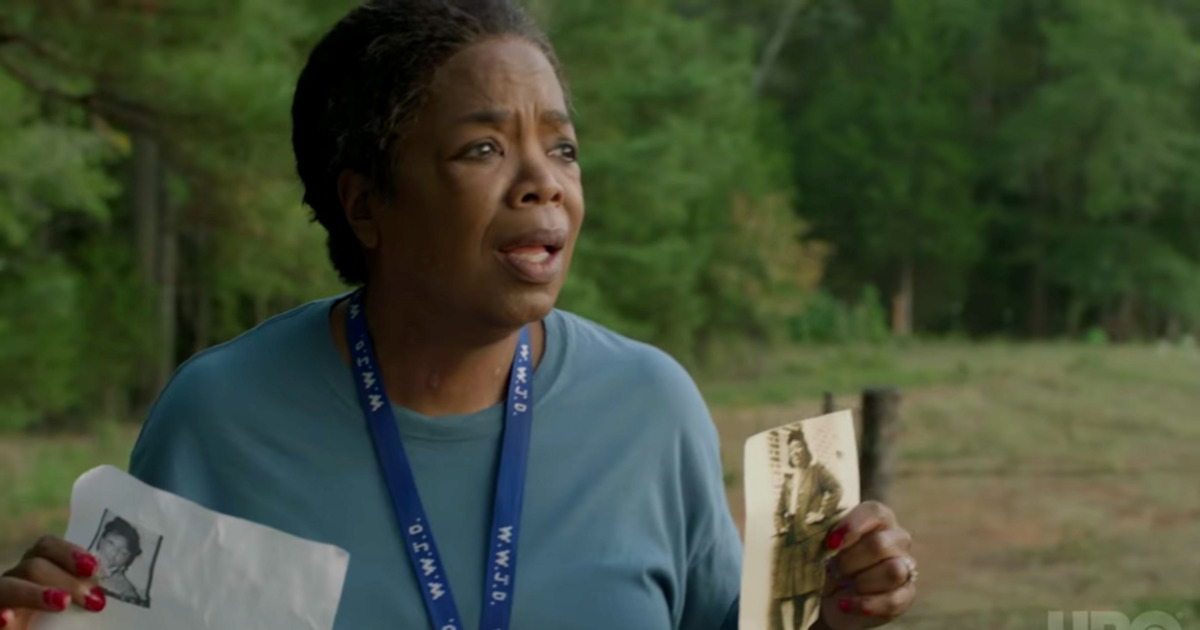
As Deborah Lacks, Winfrey gives an impressive, emotive portrayal that serves as a reminder that when she’s engaged fully with a role, she’s a very fine actress indeed. Ironically though, her performance is so strong, and so compelling, that it dominates the rest of the movie entirely, and upsets the movie’s otherwise sedentary nature whenever Winfrey appears. It’s hard to tell if this has been a deliberate move on the part of Wolfe and his co-screenwriters, or the actress herself. Either way, the movie becomes more intense and more dramatic whenever she’s on screen, and then becomes quieter whenever she isn’t. Only Cathey as Deborah’s older brother Zakariyya matches her for intensity, and that’s largely because Zakariyya has acute anger issues that threaten to flare up at any moment.

There are further problems that centre around the movie’s focus, with too many subplots and minor storylines brought into play only to be left unexplored, and too many supporting characters given only a scene or two to make an impact. Wolfe and co. have attempted to cram in as much information, incident and development as they can but it all proves detrimental in telling a coherent and cohesive story. There’s outrage too, but instead of being directed at the way in which Henrietta was, and has been exploited all these years, it’s all to do with Deborah’s younger sister, Elsie, who was committed to the appallingly named Hospital for the Negro Insane when she was just eleven years old. And while this subplot works better than many others, it’s more about Deborah than it is Henrietta.

All in all, The Immortal Life of Henrietta Lacks is less about the unwitting donor of the HeLa immortal cell line than it is about her immediate family, and the journalist who felt compelled to reveal her story to a wider audience. Somewhere during the movie’s production the focus was allowed to shift away from Henrietta, and in letting that happen, the movie manages to do her a massive disservice. Perhaps it’s ironic, but in reducing Henrietta’s involvement in a movie about the most significant thing that ever happened to her, to that of a supporting role, the makers have continued to keep a woman of tremendous influence back in the shadows where she’s already spent too long.

Rating: 5/10 – a movie that never manages to work out which story it wants to tell at any given time, The Immortal Life of Henrietta Lacks flits from subplot to minor storyline in an effort to cram in as much as possible, but all to no avail; more of a tribute to the tenacity of Deborah Lacks in wanting to learn more about her mother than a tribute to Henrietta herself, it’s a patchwork piece where the sum of its parts doesn’t add up to a purposeful whole.

Share this:

  • Share on X (Opens in new window) X
  • Share on Facebook (Opens in new window) Facebook
  • More
  • Print (Opens in new window) Print
  • Email a link to a friend (Opens in new window) Email
Like Loading...

Pirates of the Caribbean: Dead Men Tell No Tales (2017)

30 Tuesday May 2017

Posted by dullwood68 in Movies

≈ Leave a comment

Tags

Action, Black Pearl, Brenton Thwaites, Comedy, Curse, Drama, Fantasy, Geoffrey Rush, Javier Bardem, Joachim Rønning, Johnny Depp, Kaya Scodelario, Review, Sequel, Trident of Poseidon

aka Pirates of the Caribbean: Salazar’s Revenge

D: Joachim Rønning, Espen Sandberg / 129m

Cast: Johnny Depp, Javier Bardem, Geoffrey Rush, Brenton Thwaites, Kaya Scodelario, Kevin McNally, Golshifteh Farahani, David Wenham, Stephen Graham, Angus Barnett, Martin Klebba, Adam Brown, Giles New, Lewis McGowan, Orlando Bloom, Paul McCartney

Six years after Pirates of the Caribbean: On Stranger Tides appeared to have brought the franchise to an end, Disney and Jerry Bruckheimer have resurrected Captain Jack Sparrow for one more round of hijinks on the high seas. This movie and a potential sixth in the series were being planned even before On Stranger Tides was released, but production delays and script problems kept Dead Men Tell No Tales from our screens until now. It’s debatable that anyone outside of the cast and crew and studio bosses were enthusiastic about the idea of a fifth movie, and it’s doubtful that even die-hard fans were expecting too much from it, but the series has made a lot of money since it began back in 2003 – over $3.7 billion before this installment – so perhaps another entry shouldn’t be too much of a surprise.

Dead Men Tell No Tales harks back to the simpler, more effective pleasures found in the series’ first movie, Curse of the Black Pearl, and attempts to forget the bloated excesses of the previous two installments by imitating much of what made that movie so successful. However, this approach hasn’t meant a return to form, but instead has stopped the rot. You can argue that this is a better movie than On Stranger Tides, and you wouldn’t be wrong, but both as a stand-alone entry and the continuation of a series that provides links to its predecessors in an ongoing game of Guess-the-Reference, number five in the series is still found wanting.

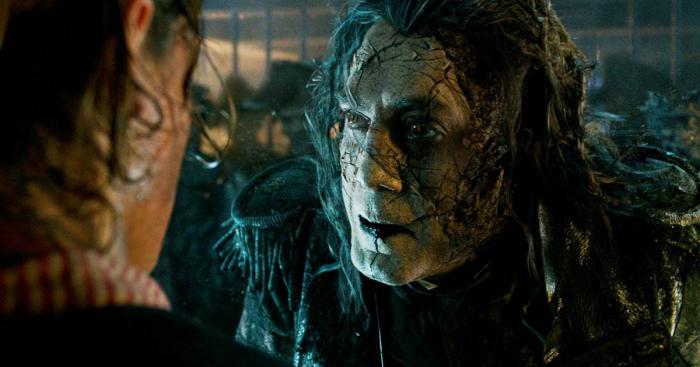
For a start, there’s the plot, a mish-mash of ideas that are borne out of the idea that hidden somewhere at sea is the Trident of Poseidon, and that this is the cure for all the curses of the sea. At the start of the movie, a young Henry Turner (McGowan) confronts his father, Will (Bloom), and tells him of his plan to find the Trident and free him from his fate as the Flying Dutchman. Will believes the Trident can’t be found, but Henry is determined. Nine years later, Henry is now a young man (Thwaites), and still searching for the Trident, as is astronomer Carina Smyth (Scodelario). She has a book that gives clues to the Trident’s whereabouts, but has been condemned by the British as a witch. Henry, meanwhile, has encountered the ghost of Captain Salazar (Bardem) who is seeking revenge on Captain Jack Sparrow for his supernatural existence. On the island of St Martin, Henry, Carina and Jack all come together and make sail for the unmarked island that can’t be navigated to, closely followed by Salazar and interested party Barbossa (Rush).

There’s more – much more – and therein lies one of the movie’s biggest problems: it takes what should be a fairly straightforward idea and twists it so far out of shape that every attempt to straighten it out merely serves to make it less and less, and less, straightforward. The plot becomes buried under layer after layer of unnecessary twists and turns and double crosses and “clever” subterfuges. The characters’ individual storylines become convoluted and unwieldy, with one relationship forged out of nothing, and as for any character development, that’s been ignored in favour of getting everyone from point A to point B with a minimum of effort or fuss. For a movie that was delayed partly because of script problems, it makes you wonder just how bad scribe Jeff Nathanson’s original screenplay really was (or if Johnny Depp’s widely credited contributions are to blame instead).

Another problem lies with the character of Jack Sparrow himself. Five movies in and it’s clear that the character has run out of steam both dramatically and comedically. He’s a pale shadow of his former self, no longer as witty as he once was, or retaining the skewed moral compass he once had, and halfway to being a lampoon. And for the most part Depp is going through the motions, offering brief glimpses of the portrayal that made such an impact fourteen years ago, but unable to rekindle the past glories that came with that portrayal. The usual grinning and grimacing are there but that’s the point: it’s exactly the same grinning and grimacing we’ve already seen four times before. When your main character becomes more and more of a caricature with every outing, then it’s time to really shake things up and do something different.

But doing something different – anything different – isn’t part of the movie’s agenda. Instead, newcomers Rønning and Sandberg cleave to the look and feel of the first movie, but are hamstrung by having little in the way of dramatic meat to work with, and a preponderance of comedic moments that are self-referential and which largely fall flat. Yes, there are moments where you’ll smile and maybe chuckle to yourself, but outright laughs are as rare as someone in Salazar’s crew having a complete body. The various action set pieces offer the occasional frisson, but again there’s very little that holds the attention or seems fresh by design or in execution. A bank heist early on plays like a low-budget version of the vault robbery from Fast Five (2011), while the finale steals its set up from the parting of the Red Sea in The Ten Commandments (1956).

On the acting front, returnees Rush, McNally, Klebba, Graham, Barnett, New, and Bloom do what they need to do within the confines of the script, while newcomers Bardem, Thwaites, Scodelario, Farahani (as a thinly disguised version of Naomie Harris’s Calypso), and Wenham face exactly the same problem. When an actor of the calibre of Javier Bardem can’t manage to make a character such as Salazar even occasionally memorable then there’s definitely something wrong going on. And just when you thought there wasn’t a rock star who could give a worse performance than Keith Richards in a Pirates movie, up pops Paul McCartney as Jack’s Uncle Jack, an appearance that makes you pray he doesn’t pop up again.

In essence, this is a movie (and a fourth sequel to boot) that atones for the appalling nature of its immediate predecessor, but which in doing so, defaults to being predictable and safe. This makes it a movie that offers few rewards for its fans, and even fewer rewards for anyone coming to the franchise for the first time. A post credits scene sets up a sixth movie which looks set to bring back another character from the series’ past, but if it does, then it will have to be a vast improvement on this entry, and perhaps require a complete rethink of a franchise that has gone astray and which shows no immediate signs of finding its way back.

Rating: 4/10 – impressive CGI and beautiful locations are about the best things in Pirates of the Caribbean: Dead Men Tell No Tales, but even they aren’t good enough to rescue a movie that opts for mediocre as a first choice, and is only fitfully entertaining; a tiptoe in the right direction for the franchise but still an underwhelming experience for anyone who remembers the glory days of the first Pirates of the Caribbean movie.

Share this:

  • Share on X (Opens in new window) X
  • Share on Facebook (Opens in new window) Facebook
  • More
  • Print (Opens in new window) Print
  • Email a link to a friend (Opens in new window) Email
Like Loading...

Oh! the Horror! – The Windmill Massacre (2016) and The Void (2016)

29 Monday May 2017

Posted by dullwood68 in Movies

≈ Leave a comment

Tags

Aaron Poole, Charlotte Beaumont, Drama, Holland, Horror, Hospital, Jeremy Gillespie, Kenneth Welsh, Nick Jongerius, Review, Steven Kostanski

The Windmill Massacre (2016) / D: Nick Jongerius / 85m

Cast: Charlotte Beaumont, Bart Klever, Patrick Baladi, Noah Taylor, Fiona Hampton, Adam Thomas Wright, Tanroh Ishida, Ben Batt, Kenan Raven, Derek Howard

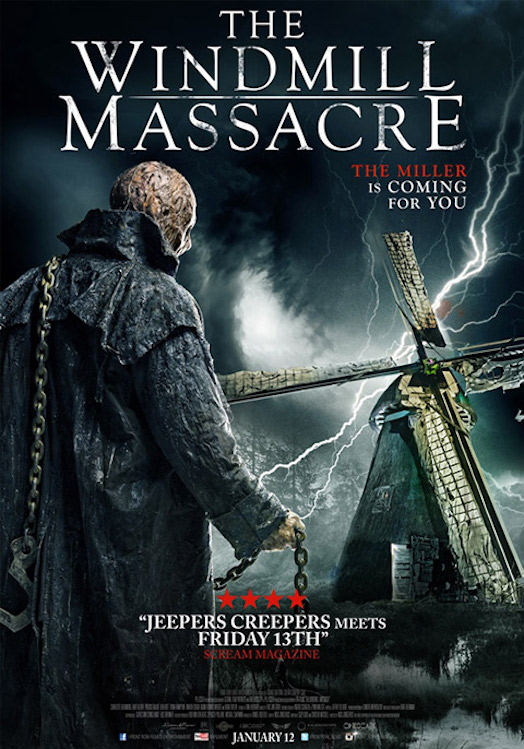
A motley crew of tourists, some of whom are running to escape their past. A sightseeing trip to several of Holland’s windmills. A tour bus that breaks down close to a windmill that isn’t on any map. A woman (Beaumont) who witnesses the murder of one of the day trippers. A movie that treads such a familiar and uninspiring path that it might as well have been marked, Cliché Road.

The serial killer with a supernatural raison d’etre is such a staple now of the horror genre that any new wrinkle on such a well established theme has to really go the extra mile to be effective. Alas, The Windmill Massacre only has its location to help differentiate it from all the other serial killer horror movies out there. And when you can’t even come up with a coherent origin story for your supernatural killer – here it comes in two parts and the makers haven’t realised that they don’t make a convincing whole – then your movie is at a disadvantage before it’s even begun.

Having such a disparate set of characters doesn’t help either. There’s Beaumont’s Aussie nanny, on the run after killing her abusive father (Howard); Baladi’s uptight dad taking his haemophiliac son (Wright) on an impromptu term-time holiday; Taylor’s coke-snorting art historian; Ishida’s innocuous yet resourceful Japanese student; Hampton’s ambitious French photographer; and Batt’s Marine fleeing from an incident with a Dutch prostitute. They’re rounded off by tour guide Abe (Klever), whose attitude ranges from nonchalant to incredibly nonchalant. If the viewer manages to connect with any of them then that says more about the viewer, because all are stock characters who don’t inspire any sympathy.

To be fair the movie does attempt to provide a slightly different motive for its burn victim villain – he’s there to claim the lives of sinners – but in the end it doesn’t matter what his motivation is, as long as he rids the unlucky viewer of the characters’ company and in as timely a manner as possible. This leads to a series of deaths that attempt to pay homage to the kill sprees found in Eighties horror movies but which only manage to do so in a derivative, obligatory fashion; and there’s a twist that won’t surprise anyone. Some of the cast try too hard, some barely register, and director Nick Jongerius can’t inject enough energy into proceedings to make a difference. There are a couple of loose ends that aren’t tied up, but the average viewer won’t care, as long as they don’t have to make the same trip again.

Rating: 3/10 – yet another horror movie that creates a set of rules to govern its villain’s behavour and demise – and then ignores them all in order to set up a potential sequel, The Windmill Massacre is tiresome, and subordinate to ideas better used elsewhere; it just goes to show that low-budget European horror can be just as bad as its US cousin, and just as predictable.


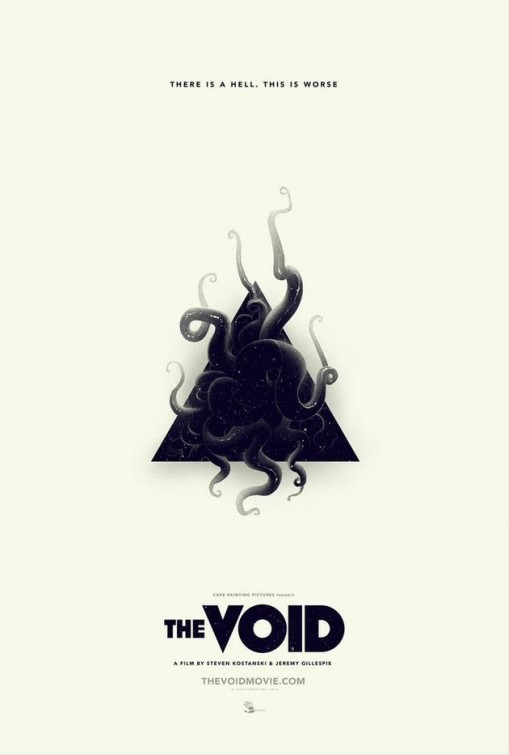
The Void (2016) / D: Jeremy Gillespie, Steven Kostanski / 90m

Cast: Aaron Poole, Kenneth Welsh, Daniel Fathers, Kathleen Munroe, Ellen Wong, Mik Byskov, Art Hindle, Stephanie Belding, James Millington, Evan Stern, Grace Munro

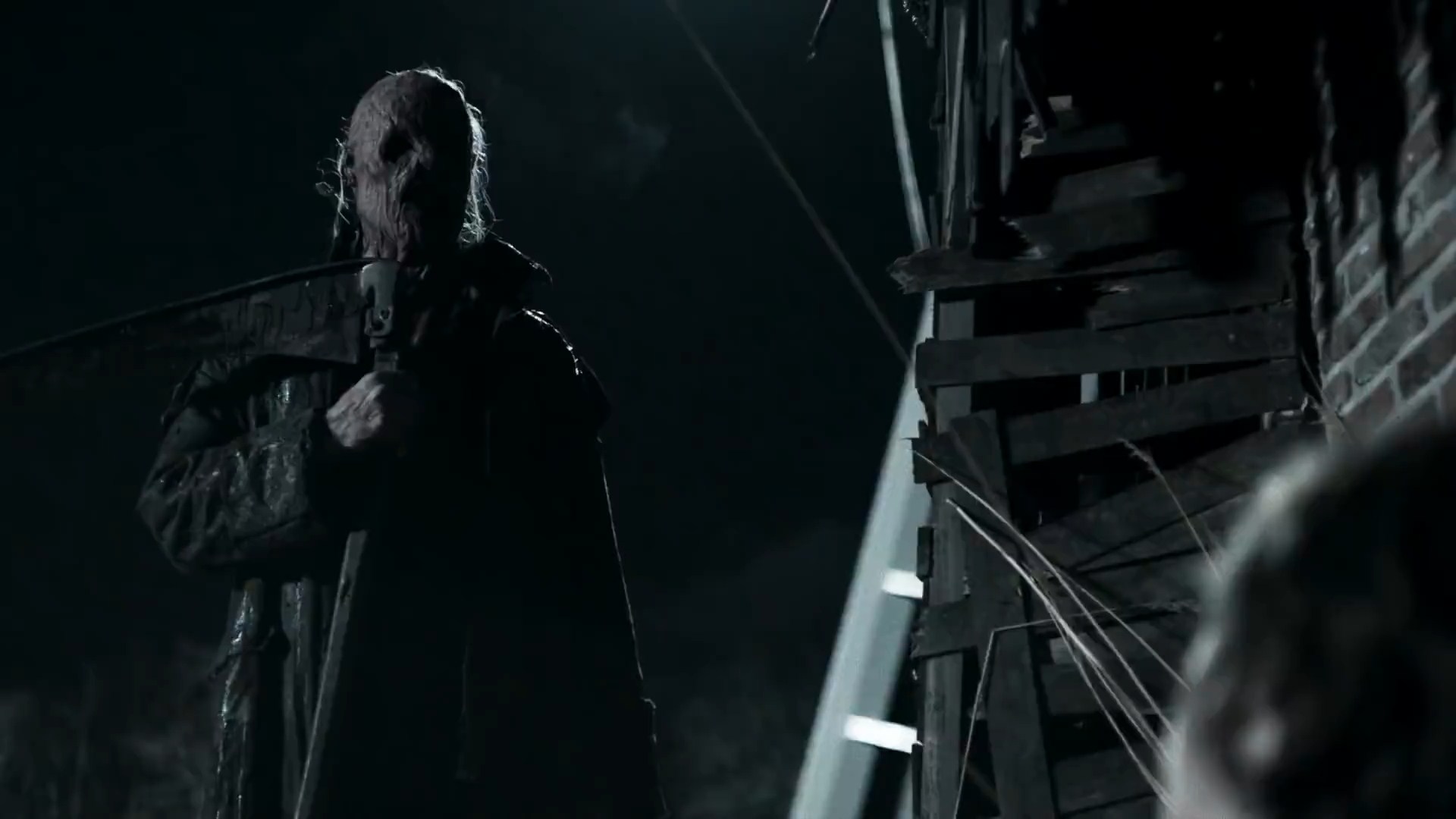
A lonely backwoods road. A deputy dozing in a patrol car. A man who stumbles out of the woods covered in blood. A rush to the nearest hospital even though the man isn’t wounded.

And let’s stop right there. Whatever you might be looking for in watching The Void, be advised that a story which makes sense will not be forthcoming. From the outset, The Void is a movie that, thanks to writers and directors Jeremy Gillespie and Steven Kostanski, opts for keeping its audience (and its characters) firmly in the dark (or the void, if you prefer). It has no sense of its own internal logic – such as it is – and plays fast and loose with motivation, coherence, and dramatic licence. Stupid things are done by pretty much all the characters, and there’s enough lug-headed dialogue going around to crunch open a portal to another dimension – Oh, hang on a moment, that’s what’s happening here, isn’t it?

This is a movie that seems to have a strange kinship with The Fast and the Furious franchise (bear with this). In that series, each movie is constructed by coming up with the OTT setpieces first and the plot and storylines second. Here it seems as if the creature effects and their place in the screenplay were devised first of all, and then a plot bolted on later. That plot makes no sense, and whenever the movie seems like it’s going to explain exactly what’s going on it finds a way to avoid doing so. Even when the chief villain starts spouting pseudo-intellectual gibberish in his efforts to explain things it soon becomes obvious that he’s just spouting any old drivel that sounds esoteric. Somewhere in there is the notion that physical metamorphosis can be brought about through ritual and the intervention of beings older than time, but that’s the best the movie can do to justify the events that are taking place.

What can be discerned is that there is a cult operating in and around the kind of backwoods community where the local deputy is as much a doofus as he is a potential hero; that everyone in the hospital where the deputy and the man from the woods end up will die; that the creatures people “evolve” into will be low-lit and obscured by careful framing and ultra-careful editing; and that all this will happen in the kind of isolation that only occurs in low-budget horror movies. The movie trades on its retro-Eighties gore effects and sub-Lovecraftian tone but these can’t compensate for some truly awful performances (particularly from Poole), character motivations so dire they’re wince-inducing, and a number of plot “developments” that prompt the characters into putting their lives in danger over and over and over again. In many ways this is an ill considered project that lacks the zest and ideas needed to make it a breakout movie – which seems to have been the aim.

Rating: 3/10 – horror movies don’t have to make complete sense (though it would be nice if they tried), and The Void adheres to that idea with apparent relish; with no explanation offered for anything that happens, it’s a movie that tries hard to be effective on a visceral level but which ultimately fails to be anything more than yet another dumb horror that mistakes enthusiasm for quality.

Share this:

  • Share on X (Opens in new window) X
  • Share on Facebook (Opens in new window) Facebook
  • More
  • Print (Opens in new window) Print
  • Email a link to a friend (Opens in new window) Email
Like Loading...

Aftermath (2017)

28 Sunday May 2017

Posted by dullwood68 in Movies

≈ Leave a comment

Tags

Arnold Schwarzenegger, Drama, Elliott Lester, Grief, Guilt, Judah Nelson, Maggie Grace, Plane crash, Review, Scoot McNairy, True story

D: Elliott Lester / 92m

Cast: Arnold Schwarzenegger, Scoot McNairy, Maggie Grace, Judah Nelson, Hannah Ware, Glenn Morshower, Mariana Klaveno, Martin Donovan, Jason McCune, Christopher Darga, Larry Sullivan, Kevin Zegers, Danielle Sherrick, Lewis Pullman

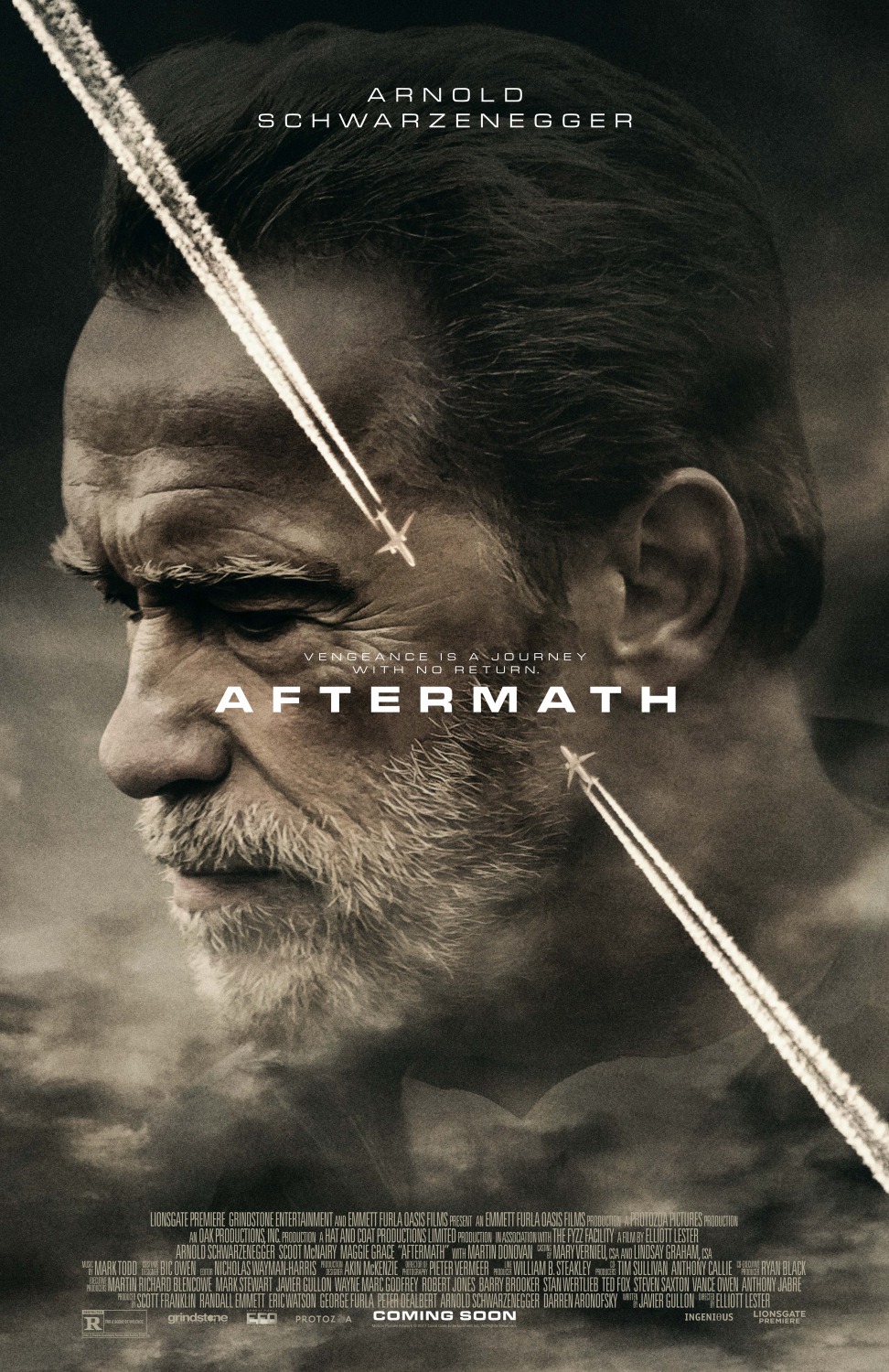
Based on a true story, that of the Überlingen mid-air collision which occurred on 1 July 2002, Aftermath examines the lives of two men affected by the tragedy. One is Roman Melnik (Schwarzenegger), a construction worker whose wife and pregnant teenage daughter (Sherrick) are aboard Flight AX112, and the other is Jacob “Jake” Bonanos (McNairy), the air traffic controller on duty when the collision happened. When Flight AX 112 and Flight DH616 collide, causing the deaths of two hundred and seventy-one people, both men’s lives are changed forever.

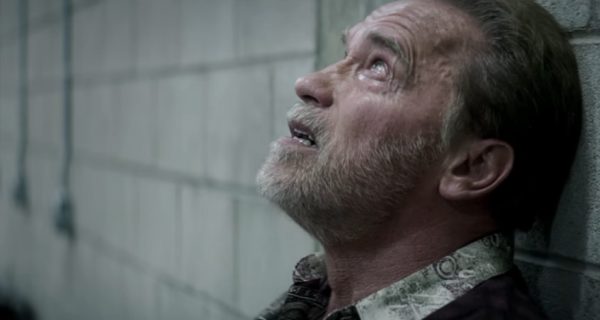
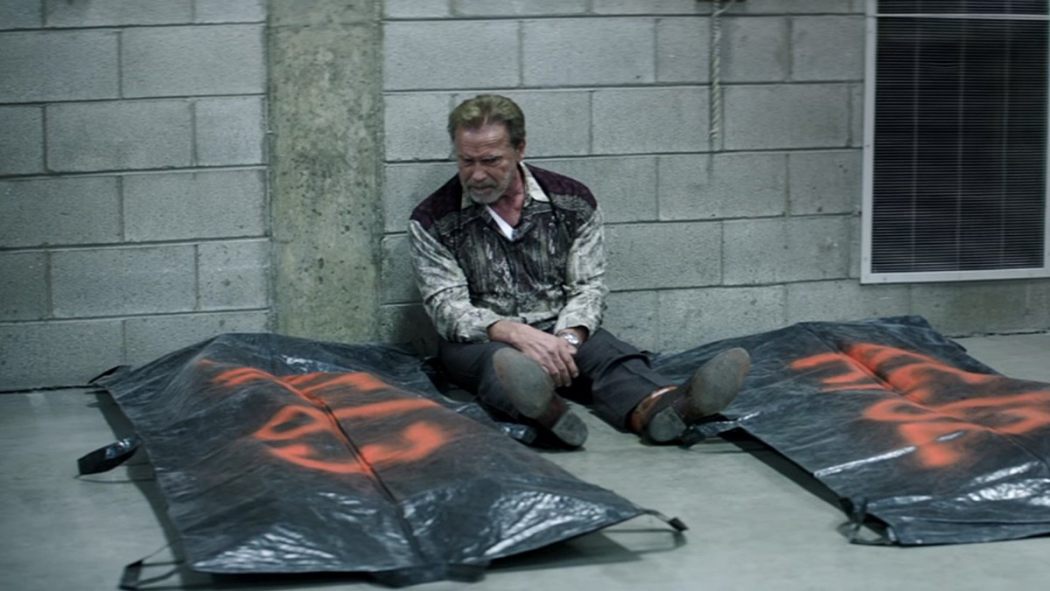
Roman is consumed by shock and anger and disbelief. He can’t understand how it happened, and some part of him still clings to the idea that his wife and daughter somehow survived the collision. He poses as a volunteer at the crash site, but in a cruel trick of fate, he finds the body of his daughter. Further subsumed by grief he waits for an apology from someone – anyone – from the airline companies involved, but is treated dismissively, and the compensation he’s offered is insulting. Of all the relatives of the victims, only Roman refuses to sign an agreement that effectively lets the airlines off the hook. Following his family’s funerals, he retreats from the world and remains at home.

While Roman is consumed by grief, Jake is consumed by guilt. Even though the circumstances of the crash were beyond his control, Jake hides away with his family – wife Christina (Grace) and young son Samuel (Nelson) – but even though they are supportive, his inability to deal with his feelings and the knowledge that so many people died “on his watch” causes his marriage to falter. When his bosses advise him to start afresh with a new identity somewhere else – for his own good – Jake takes the deal and begins a new life as a travel agent, Pat Dealbert. Meanwhile, Roman receives a visit from a journalist, Tessa Gorbett (Ware), who intends to write a book about the collision. She leaves copies of articles she’s written on previous plane crashes as evidence of her sincerity, and it leads Roman to become aware of Jake’s existence and his role in the tragedy. Soon, Roman blames Jake for everything.

A year passes, a year during which Roman gets by doing odd jobs as a carpenter, and Jake has settled into his new life. One day, Roman is contacted by Tessa who tells him her book is ready to be published. He asks her if she can find out Jake’s whereabouts; initially she refuses but eventually she agrees to tell him Jake’s new name and job, but not his address. Nevertheless, Roman manages to find out where he lives, and travels there to confront him. Unbeknownst to Roman, Jake is spending the evening with his wife and son, a situation that leads to further tragedy…

From the outset, Elliott Lester’s approach to the script by Javier Gullón is to provide audiences with the gloomiest, bleakest movie he can manage. Even before the crash, where Schwarzenegger’s gruff but friendly Roman is over the moon at being reunited with his wife and daughter, the visuals are uniformly subdued. Colours are muted, the lighting makes indoor scenes look as if a thunderstorm is coming, and even the costumes have the air of having been chosen deliberately for their nondescript appearance. And of course, Mark D. Todd’s original score is appropriately cheerless and troubling. But while this is a movie about grief and guilt and the way both emotions can eat away at a person, Lester has made a parlous mistake in terms of the way the movie looks. Grief and guilt are sombre topics, and can contribute to some seriously affecting drama, but do we really need everything to look and sound so dreary?

Because everything about Aftermath is dreary. It’s as if the movie is afraid that audiences will abandon it for want of trying, as if its focus on the mental anguish of two men connected by a terrible tragedy can’t be presented in any other way. But that’s not true, and Lester and his cast and crew have opted for the dour, oppressive leanings that are on show in the finished product. It’s as if someone, somewhere decreed that movies about negative emotions or tragedies or bad luck stories didn’t deserve to be produced in any other fashion. So, where does this leave Aftermath? The answer is simple: it makes it a proficient movie with two good central performances that never overcomes the style in which it was made.

Which is a shame as those two central performances – from Schwarzenegger and McNairy – are pretty much all that stand between Aftermath and a shorter shelf life. Since his retirement from politics, the former Governor of California has made a number of action movies (as expected), but in amongst them are a couple of low budget dramas that have required him to considerably up his game acting-wise and concentrate on character instead of fitting in amidst all the spectacle. Maggie (2015) showed he was more than up to the task, and now Aftermath shows that it wasn’t just a flash in the pan. There are still the occasional verbal mishaps – thanks to his accent more than anything else – but otherwise this is a quietly authoritative performance from Schwarzenegger that showcases an emotional range that’s improved since his appearance in Maggie and which makes him (now) the go-to guy for grieving father roles.

He’s ably supported by McNairy, an actor whose career keeps him popping up in all kinds of features and always to the movie’s advantage. Here he’s nervous, afraid, despairing and contrite – sometimes in the same scene – and on such good form that you’re never sure what he’s going to do next. The storyline plays out in much the same way that the real life story did, but what doesn’t work so well on screen is the antipathy toward Jake that Gullón’s script prompts the audience to feel. He’s not a bad man, but between the script, and Lester’s decision to present Jake as weak-willed where Roman is strong-minded, what should have been an even-handed look at how two men badly affected by a terrible tragedy regain the meaning in their lives, pivots more toward the real life outcome of their meeting, and seeing Roman getting “justice” for his family. Sadly, this isn’t the movie’s best scene, thanks to some very clumsy framing and editing, and the final coda – while not exactly unexpected – doesn’t match the tone of the rest of the movie. It’s a safe choice with which to end the movie, but, like a lot of other scenes, it’s not as effective as Lester probably hoped.

Rating: 6/10 – a real life tragedy given a visual drubbing, Aftermath takes a spartan approach to its subject matter, and only does it the barest of favours; away from its real life source material, the movie offers fine work from its two leads, a never say cut-and-dried stance that’s abandoned fifteen minutes from the end to the detriment of the movie as a whole, and the sense that a bit more time with both characters would have benefitted the movie greatly.

Share this:

  • Share on X (Opens in new window) X
  • Share on Facebook (Opens in new window) Facebook
  • More
  • Print (Opens in new window) Print
  • Email a link to a friend (Opens in new window) Email
Like Loading...

Becoming Bond (2017)

27 Saturday May 2017

Posted by dullwood68 in Movies

≈ Leave a comment

Tags

Australia, Car salesman, Career, Documentary, Drama, George Lazenby, James Bond, Josh Greenbaum, Josh Lawson, Kassandra Clementi, Male model, Review

D: Josh Greenbaum / 92m

With: George Lazenby

Cast: Josh Lawson, Kassandra Clementi, Jane Seymour, Jeff Garlin, Jake Johnson, Dana Carvey, Adamo Palladino, Sofia Mattsson, Landon Ashworth, Jonathan Slavin

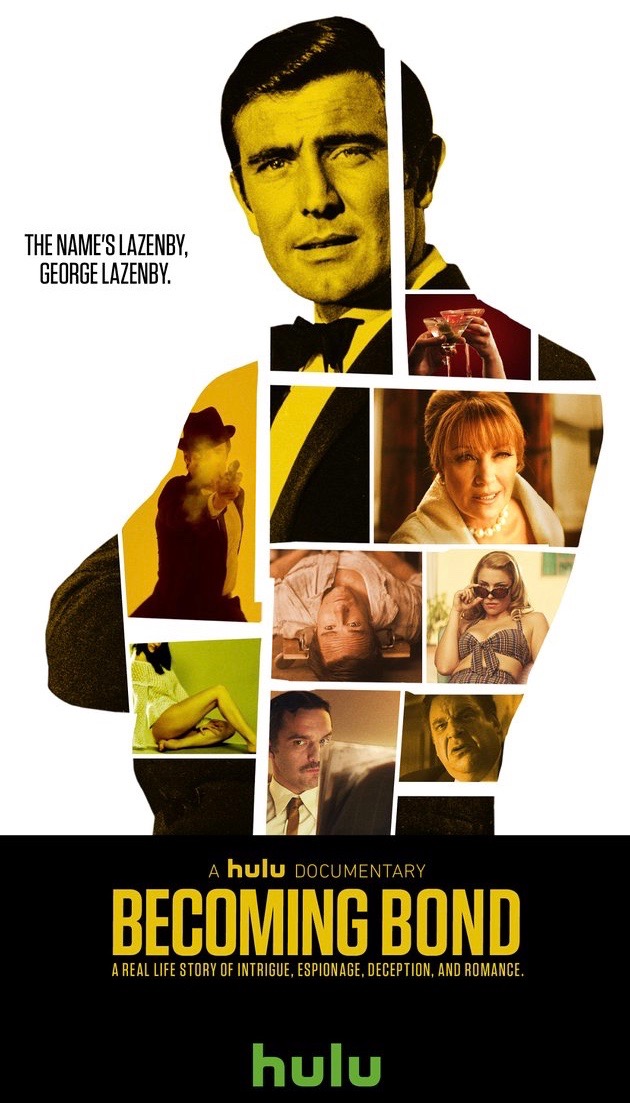
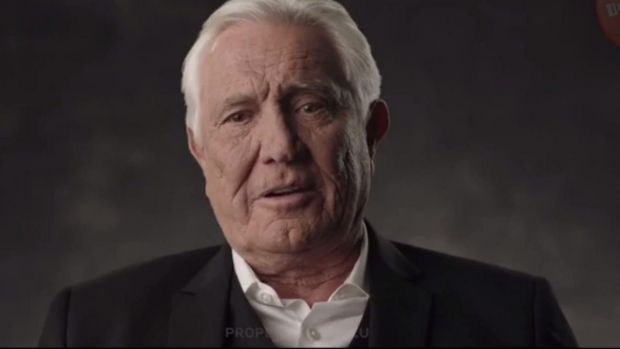
George Lazenby will be known forever as the man who played James Bond once, and then refused to play him again. It’s a story that’s been told over and over again, and which gets another airing in Becoming Bond, an affectionate documentary-cum-reenactment of Lazenby’s life up to, including, and just past his time as 007. But this time the story is told by Lazenby himself, and even though you still might consider him to be incredibly foolish for abandoning the role, at least here you get a better, more convincing set of reasons for his having done so.

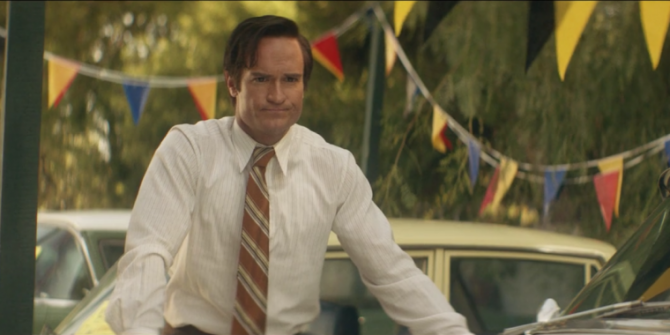
Lazenby recounts his early life as a child, talking to camera and occasionally prompted by director Greenbaum. His early life in Australia isn’t short of drama. At the age of three he was left with half a kidney, and his doctors advised his mother that he’d probably only live until he was twelve (maybe thirteen). Growing up he got into all kinds of mischief, from “stealing” his uncle’s car to bringing a snake to school. He recounts his first sexual experience (“I thought I’d blown my penis apart”), his failure to graduate from school, and his first job as a mechanic. From there, Lazenby (Lawson) becomes a car salesman, and he meets Belinda (Clementi), his first true love. He pursues her (despite the antipathy of her parents), but their relationship is severed when she goes to England to study.

But Lazenby is nothing if not persistent. When he doesn’t hear from Belinda he travels to England and tracks her down. But there’s no reconciliation, and soon Lazenby finds himself broke and in need of a job. He returns to being a car salesman, and hears from  Belinda who wants their relationship to be platonic. However, this doesn’t hold for long, and the pair marry. Around this time, Lazenby is talent-spotted as a male model, and he begins to do photo-shoots and appear in adverts. As he becomes more and more in demand though, a photo-shoot in Spain leads to his making a huge mistake. A few years pass and Lazenby is introduced to an agent, Maggie Abbott (Seymour). A short while after that, and Maggie is calling him about a movie role she thinks he’ll be perfect for: James Bond.

What follows is largely well known, but Lazenby provides more than enough detail to keep fans of On Her Majesty’s Secret Service (1969) – and James Bond in general – happy in perpetuity. From Lazenby’s attempts to get to see casting director Dyson Lovell (Slavin) to his first meetings with director Peter Hunt (Palladino) and producer Harry Saltzman (Garlin), the making of the first Bond movie not to star Sean Connery is told with candour and charm by Lazenby, and the aftermath with sincerity and a certain amount of ruefulness. Lazenby is an avuncular screen presence, always ready to laugh at the antics of his younger self, but also willing to admit the mistakes he made and the harm they may have caused others.

The movie puts Lazenby front and centre, adopting a talking head approach that keeps the focus on the ex-model while his past is played out on screen in a lightweight, genial fashion that relies heavily on Josh Lawson’s amiable good looks and an overall tone that says, “hey, don’t take all this so seriously”. The recreations of Lazenby’s youth and early adulthood – he was twenty-nine when he played Bond, the youngest person to do so – are played out in a variety of styles and against a variety of poorly realised backgrounds, but it’s all so unremittingly charming that it doesn’t matter. It couldn’t look and feel more quaint if it was all shot in jerky black and white and everyone moved as if they were speed walking.

It’s clear from the start that Greenbaum and his crew are fans of Lazenby, and are relishing the opportunity to have their hero tell his life story, but if there’s a consequence to all that then it’s the lack of follow up comments or questioning when something happens that paints Lazenby in a negative light. Greenbaum seems content to let Lazenby tell his story unedited and unchallenged, and while there’s nothing to suggest that James Bond Version 2.0 isn’t telling the truth about his life and times, there are moments where it’s obvious that some degree of dramatic licence has been invoked. And while these moments are usually at the behest of the humour, there are other times when the more serious elements seem to get a free pass (particularly in relation to Belinda). It’s almost as if Greenbaum didn’t want to pry too closely in case Lazenby called to a halt to the whole thing.

But while a little more depth would have made the material resonate a little more, there’s no denying that Lazenby is an agreeable, pleasant companion to spend ninety minutes with, and that by focusing largely on his pre-Bond years, he has the chance to tell a variety of anecdotes which are both amusing and which are kept in context with the rest of his life. Whether he’s the face of Big Fry chocolate, or a stubbornly bearded star abandoning his image as a suave, globe-trotting spy, Lazenby is true to himself, and even if you think his decision to leave Bond behind was misguided, by the movie’s end you have a better understanding of his reasons for doing so. You still might disagree with his decision but it’s not as arbitrary or as ill considered as people thought at the time.

While Lazenby is an amusing, often self-deprecating “host”, and the re-enactments of his life are heavily stylised and redolent of a long-forgotten era (though the makers should have realised that in England a car’s steering wheel is on the right), there is still a sense that Becoming Bond is lacking in something vital. It’s amusing, it’s bright and attractively shot by John W. Rutland, it’s a nice blend of whimsy and historical faction, and it’s unrelentingly pleasant. And though it may seem churlish to criticise a movie for being pleasant – or even inoffensive, which it is – when Lazenby gets to the point where to say more might leave him wide open to complaints of narcissism (and there are many such moments), or insensitivity, then he’s allowed to stay quiet. But then this is as much an homage to the one-time James Bond as it is a chance for that same man to relive former glories. But even though Lazenby seems to have dealt with his past, there’s still the nagging sense that if he had it all to do again, then Lazenby himself would be in the record books for making the most Bond movies, and not Roger Moore.

Rating: 7/10 – neither a confession nor an exposé, Becoming Bond is instead a cheerful, engaging movie that – to paraphrase William Shakespeare – comes to praise Lazenby, not to bury him; he’s led an eventful life, certainly, and much of it is recounted here, but while it’s entertaining enough, Greenbaum seems too willing to let things pass for any objectivity to come into play.

Share this:

  • Share on X (Opens in new window) X
  • Share on Facebook (Opens in new window) Facebook
  • More
  • Print (Opens in new window) Print
  • Email a link to a friend (Opens in new window) Email
Like Loading...

Buster’s Mal Heart (2016)

25 Thursday May 2017

Posted by dullwood68 in Movies

≈ Leave a comment

Tags

Concierge, DJ Qualls, Drama, Home invasions, Kate Lyn Sheil, Rami Malek, Review, Sarah Adina Smith, The Inversion, Tragedy

D: Sarah Adina Smith / 98m

Cast: Rami Malek, DJ Qualls, Kate Lyn Sheil, Mark Kelly, Sukha Belle Potter, Lin Shaye, Sandra Ellis Lafferty, Nicholas Pryor, Toby Huss, Bruce Bundy

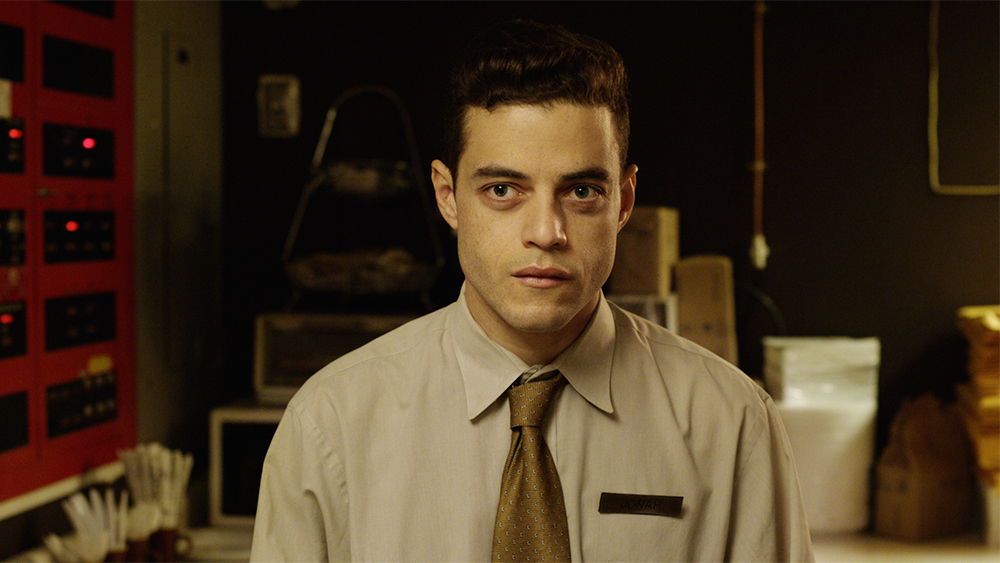
The eponymous Buster (Malek) is a vagrant who breaks into empty vacation homes in a remote mountain community, and who stays in each property for as long as he wishes. The authorities, led by a local deputy named Winston (Huss), have been trying to catch him for some time but Buster is wily and elusive. Buster has also gained his name thanks to his regular calls to radio stations where he rants and raves about the upcoming “Inversion”, an impending celestial event that will have a serious impact on everyone on Earth. But Buster’s real name is Jonah, and the events that have brought him to this place and time in his life are shown in flashback.

A night concierge at a less than busy hotel, Jonah is married to Marty (Sheil), and has a young daughter, Roxy (Potter). He doesn’t like working nights as he can’t always sleep during the day, but staffing problems at the hotel prohibit Jonah from changing to days; also his duties are dull and repetitive, and add to the overwhelming ennui that he’s begun to feel. When a stranger (Qualls) tries to get a room for the night but has no I.D. or other way of confirming his identity, the man’s talk of being free and able to do whatever he wants strikes a chord in Jonah, and he agrees to let him stay for just the one night. The man tells Jonah about the Inversion, an event that will coincide with the expected chaos of Y2K, and his impassioned speech has a profound effect on Jonah, who finds an unexpected succour in the idea.

The man returns the next night, and against Jonah’s better judgment, he allows him to stay until the morning. This leads to a tragedy that affects Jonah greatly, and causes him to abandon his life and take to the mountains where in time he becomes Buster. He stays one step ahead of the authorities, until one day the owners of the house he’s hiding out in arrive home unexpectedly, forcing him to deal with their presence and the attentions of a neighbour who comes calling one afternoon. Soon Buster is on the run, and cornered in a cave in the mountains…

The first thing to realise about Buster’s Mal Heart, the second feature from Sarah Adina Smith, is that the Inversion is the movie’s idea of a McGuffin: it never happens, it’s assigned too much importance by the stranger and Jonah/Buster, and it acts as a catalyst for certain events that Jonah becomes involved with. As a plot device it’s fairly simplistic, and as a way of providing or assigning motivation to the characters, it’s undermined by a plot development that Smith throws in towards the end of Jonah’s story. But what it does do that’s quite important is that it allows the movie to retain an air of mystery that, without it, would leave the movie looking and feeling a lot less mysterious and a lot more straightforward than it appears.

Smith introduces us to Buster from the start, then switches back to when he was Jonah, and in an attempt to make the movie seem more elliptical, shows him as another version of Buster but one stranded in a rowboat on the ocean. Smith then interweaves all three stories in an effort to explore the notion of a fractured, possibly irredeemable psyche, and the ways in which it tries to circumvent the overwhelming feelings brought on by a terrible tragedy. It’s powerful, humane stuff, made all the more powerful by Smith’s languorous, dream-like direction, and Malek’s emotive yet disconnected performances. The movie attempts to show that even when someone tries to beat an emotional retreat from the world, they’re still tied to it, no matter how hard they try and break away. Jonah becomes Buster out of necessity and lives a life of housebreaking and reclusivity. But in a moment that resonates deeply, Buster watches a news story about a message in a bottle that has washed up on a beach and been found. It’s a message his ocean-stranded alter ego created and sent out into the world – a lifeline, perhaps – and it precipitates an end to Buster’s life of crime.

This of course begs the question, is either of Jonah’s new identities “real”, or are they just avatars that his mind has come up with to help him deal with his agony and despair. Smith offers no easy answers (as befits a mystery), but can’t help but litter her screenplay with clues as to the likelihood that Jonah is experiencing a psychic split, or conversely, that it’s all a waking dream. It’s left to the viewer to make up their own minds, but in reality, the movie doesn’t need too close an inspection for it to reveal its secrets. Smith is an original, visually competent director, but in attempting to make Jonah’s journey more compelling, she makes the mistake of assigning depth to sections of the movie that don’t deserve them. In the end, Jonah’s breakdown is only that: a breakdown, and no matter much Smith tricks it out with cinematic sleights-of-hand, it’s not a puzzle that needs too much investigation to solve.

As Jonah, Malek’s constrained performance perfectly fits the bewilderment the character is experiencing in his daily life, while as Buster his wild man of the mountains appearance reflects the anguish that Jonah must be feeling. Malek is also on form as the version of Jonah who finds himself “all at sea”, a handy metaphor for how the character must be feeling overall. Some viewers may find all this too obvious for their liking, but what can’t be denied is that Smith, along with cinematographer Shaheen Seth, has created a number of milieus for Jonah to inhabit, and while they all spring from the same grounding in reality, they also serve as a jumping off point for the more surreal elements in Smith’s screenplay.

The ending is unsurprisingly designed to make viewers question their assumptions, but it’s one last parlour trick that is likely to evoke frustration rather than admiration. By doing so, Smith allows for yet one more outcome of Jonah’s breakdown, but though it ties in neatly with the notion that what we’ve witnessed is an allegory based on the story of Jonah and the whale, it’s not as effective as it first seems. Still, Smith is to be congratulated for creating a tale that is confidently handled for the most part, and which requires its audience to contemplate whether or not Jonah’s tri-lateral existence is a boon or a hindrance when it comes to reconfiguring his damaged psyche.

Rating: 7/10 – a somewhat dour narrative benefits greatly from Smith’s ambitious directing style and Malek’s propitious performance, making Buster’s Mal Heart an intriguing movie to watch but not necessarily one to revisit; the cinematography, editing (also by Smith), and soundtrack all add lustre to the movie’s tone and point of view, and though it all seems unnecessarily tricky, there’s heart and warmth here too, even if it’s in short supply.

Share this:

  • Share on X (Opens in new window) X
  • Share on Facebook (Opens in new window) Facebook
  • More
  • Print (Opens in new window) Print
  • Email a link to a friend (Opens in new window) Email
Like Loading...

Personal Shopper (2016)

24 Wednesday May 2017

Posted by dullwood68 in Movies

≈ Leave a comment

Tags

Drama, Ghost story, Kristen Stewart, Kyra, Lars Eidinger, Mystery, Olivier Assayas, Paris, Review, Texts, Thriller

D: Olivier Assayas / 105m

Cast: Kristen Srewart, Lars Eidinger, Sigrid Bouaziz, Anders Danielsen Lie, Ty Olwin, Nora von Waldstätten, Benjamin Biolay, Audrey Bonnet, Pascal Rambert

Maureen Carmichael (Stewart) is an American living in Paris whose twin brother, Lewis, has recently died of a heart attack, the result of a congenital defect that Maureen has as well. The pair made a pact when they were younger that if one of them died, the other would wait to receive a sign that the deceased had passed on to an afterlife. Maureen is committed to doing this, and she stays for a night in a chateau that her brother purchased before he died. She experiences strange phenomena while she’s there but isn’t sure it was Lewis that was causing it. She returns to the chateau again and this time she has a supernatural experience that is terrifying, but which doesn’t seem to involve her brother.

At a loss as to whether or not she should stop waiting for a sign from Lewis, Maureen focuses on her work as a personal shopper to a celebrity called Kyra (von Waldstätten). Maureen spends her time in exclusive boutiques, handpicking clothes and shoes and accessories so that Kyra always appears glamorous and ahead of the fashion game. In many ways it’s a thankless role, but it pays well enough for Maureen to continue waiting for Lewis to “get in touch”. One day, after dropping off some items for Kyra, Maureen receives the first in a series of mysterious text messages from an unknown sender. The texts tease her into thinking that she may be conversing with a ghost, or some kind of mischievous spirit, as the sender seems to know a lot about her and the trips she’s making.

The texts also prompt Maureen into doing something that Kyra has forbidden her to do: namely, wear the clothes and outfits that Maureen has chosen for her. One night, Maureen dresses up as Kyra, an act that is emotionally fulfilling but which also has unexpected ramifications. A visit to Kyra’s apartment reveals a shocking surprise, as does a rendezvous with her anonymous texter, all of which leave Maureen wondering if she knows anymore what is real and what isn’t.

Part ghost story, part thriller, part reflection of celebrity culture, and part exploration of the nature of grief, Personal Shopper is a movie that comes laden with purpose and promise, a Gallic hodge-podge of ideas and themes that sometimes mesh seamlessly together, but which also prove frustratingly obtuse when clarity would have been a better approach to take. The narrative moves awkwardly at times between its trio of storylines – Maureen searching for proof of her brother’s existence after death, Maureen co-opting Kyra’s identity for her own as an outlet for her grief, Maureen dealing with her phone stalker – but at least gives each storyline equal weight, and provides Kristen Stewart with her best role yet. It’s a movie that attempts to say much, and for the most part it does so with skill and determination, but any messages it wants to send – like it’s unknown texter – don’t always have the depth to match their weight.

In exploring the nature and the need of Maureen’s sense of loss, Assayas keeps the focus on Maureen’s belief in an afterlife, used as much as a reason for her to persist as to exist, and as a doleful foreshadowing of the scenes where she’s plagued by text by an unknown admirer. These two storylines blend well together, and Assayas is on firm ground when he plays up the supernatural possibility that Maureen is in touch with a spirit (albeit one that seems remarkably human still). He exploits Maureen’s naïve gullibility, and Stewart’s guileless performance anchors the character’s desperate need to believe that her brother isn’t just dead. But while the question of the mystery texter’s identity is rarely in doubt – the clues are there – Assayas does what so many other directors have done in recent years, and shows the texts on Maureen’s phone, often holding the shot while we wait for each bait and response. If these scenes are meant to provide some much needed tension, then Assayas has badly misjudged his own sense of what works and what doesn’t, as they only serve to derail the narrative and undermine the visual acuity of the rest of the movie.

Ironically, the storyline that doesn’t work so well is the one that concerns Maureen’s job as a personal shopper. Offering a jejune commentary on modern celebrity culture, Assayas predictably makes Kyra a “monster”, and Maureen just a cog in the machine that keeps it all going. Despite her reservations about the job, Maureen is keen to remind the people she buys or borrows clothes from that she is the same size and shape as her employer, but affects a “best not” approach when encouraged to try on any of Kyra’s outfits. When finally, at the urging of her mystery texter she tries on one of these outfits it leads to an expression of physical pleasure that is impactful by virtue of its being so unexpected. But having Maureen dress up as someone else and finding fulfillment isn’t something that resonates as much as perhaps Assayas intended. Instead it’s a moment where narrative conviction gives way to unnecessary dramatic licence.

The muddled question of which is Maureen’s dominant personality aside, Personal Shopper is also a mystery that operates on two levels, with the supernatural aspects handled well but losing importance as the movie progresses, and the identity of the texter taking centre stage by the movie’s midpoint but fizzling out once Maureen makes her shocking discovery. By dovetailing these two elements, Assayas does make the bulk of the movie intriguing (until he reveals the truth behind everything), and while as mentioned before, they’re the movie’s strongest components, this is largely due to the atmosphere that Assayas creates around them, rather than any intensity that might arise naturally out of the material. It’s the same for the thriller elements that come into play late on: on a technical level they’re handled extremely well, but they lack a connection to what’s gone before and remain adrift from the rest of the material as a result.

Stewart gives easily her best performance so far, inhabiting the twin worlds of Maureen’s passive/more passive existence with skill and intelligence. Hers is a powerful study of a woman whose connection to the real world is as remote as the probability that her brother will make contact with her. It’s a trenchant, incisive portrayal, and Assayas exploits Stewart’s commitment to the character every chance he gets, shooting in close up wherever possible and getting the actress to express every trace of Maureen’s internal confusion. It’s Stewart’s movie, and she takes full advantage of the opportunity given to her. But unfortunately she remains, like the audience, subject to the narrative whims of the material, and Assayas’ random allocation of depth and importance to the material as a whole. This is definitely a good movie, but lurking somewhere inside it, there’s a potentially great movie that, like Lewis, is just waiting to be heard from.

Rating: 7/10 – a movie that is likely to leave many viewers scratching their heads in their efforts to derive satisfaction from its messy screenplay, Personal Shopper is a case of a movie taking two steps forward and then one step back in its approach to the material; Assayas and Stewart work extremely well together, but the French auteur has fashioned better movies in the past, and even though he won the Best Director award at Cannes (tying with Cristian Mungiu), this is not the best example of what he can achieve.

Share this:

  • Share on X (Opens in new window) X
  • Share on Facebook (Opens in new window) Facebook
  • More
  • Print (Opens in new window) Print
  • Email a link to a friend (Opens in new window) Email
Like Loading...

10 Reasons to Remember Roger Moore (1927-2017)

23 Tuesday May 2017

Posted by dullwood68 in Movies

≈ Leave a comment

Tags

Actor, Career, James Bond, Movies, Television, The Saint, UNICEF Goodwill Ambassador

Roger Moore (14 October 1927 – 23 May 2017)

Looking back over Roger Moore’s career, it’s tempting to wonder just how it would have continued if the role of a certain British spy hadn’t come along in 1972. Up until then, Moore’s movie career had been occasional and not very successful, with early try-outs with MGM and Warner Bros. doing little to further his career. As he said himself, “At MGM, RGM (Roger George Moore) was NBG (no bloody good).” In the early Sixties he made a couple of movies in Italy, but by then he’d already made important in-roads in the format that would stand him in good stead throughout the rest of the decade. Television gave Moore true recognition with featured roles in series such as Ivanhoe (1958-9), The Alaskans (1959-60), and Maverick (1959-61). But it was the role he played between 1962 and 1969, that of Leslie Charteris’s suave, sophisticated anti-hero, Simon Templar, in The Saint, that brought him international attention.

The early Seventies saw Moore team up with Tony Curtis for The Persuaders! (1971-72), and then Cubby Broccoli came calling with the offer to play James Bond. At this point, Moore’s career went into overdrive, and he became a worldwide star. His interpretation of Bond has had its detractors over the years, but there has always been the sense that the producers of the series adapted the role to suit Moore’s abilities rather than the other way round. He remained in the role for twelve years and made seven appearances, and though each entry was successful there was a recognisable falling off of quality, and sometimes, Moore looked tired. In between saving the world, Moore made a number of action movies during the Seventies that cemented his position as an international star and celebrity, and if some of those movies attracted controversy (such as the trio he made in South Africa), Moore stayed clear of all the fuss and bother and he remained popular in the eyes of the public.

Post-Bond, Moore’s movie career never maintained the heights he’d achieved throughout the Seventies and early Eighties, but by then he was in his sixties and it was perhaps inevitable that he would take on less work. The early Nineties saw him appear in a number of less than remarkable comedies, but he also began his tenure as a UNICEF Goodwill Ambassador, work that was rewarded by his receiving a knighthood in 2003. In the last ten years his career had gravitated to voice roles, and he made increasingly fewer public appearances. Moore was a charming man with an awareness of his limitations as an actor, and he was always quick to agree when anyone brought this up. The British satirical show Spitting Image (1988-91) included Moore in their roster of recurring puppets. In it, the writers had Moore respond to a director’s call for “more emotion” by raising an eyebrow. Such was Moore’s lack of ego that he expanded on this, saying that as Bond he’d had three expressions: “right eyebrow raised, left eyebrow raised, and eyebrows crossed when grabbed by Jaws”. Just for his personality and his sense of fun alone he’ll be missed, but as an actor who never really took things too seriously but still managed to entertain millions of moviegoers, he’ll be missed even more.

1 – Gold of the Seven Saints (1961)

2 – The Man Who Haunted Himself (1970)

3 – Live and Let Die (1973)

4 – Shout at the Devil (1976)

5 – Sherlock Holmes in New York (1976)

6 – The Spy Who Loved Me (1977)

7 – The Wild Geese (1978)

8 – The Sea Wolves (1980)

9 – The Cannonball Run (1981)

10 – For Your Eyes Only (1981)

Share this:

  • Share on X (Opens in new window) X
  • Share on Facebook (Opens in new window) Facebook
  • More
  • Print (Opens in new window) Print
  • Email a link to a friend (Opens in new window) Email
Like Loading...

Whisky Galore! (2016)

22 Monday May 2017

Posted by dullwood68 in Movies

≈ Leave a comment

Tags

Comedy, Drama, Eddie Izzard, Ellie Kendrick, Gillies MacKinnon, Gregor Fisher, Home Guard, Kevin Guthrie, Remake, Review, Romance, Sean Biggerstaff, Shipwreck, Todday, World War II

D: Gillies MacKinnon / 98m

Cast: Gregor Fisher, Eddie Izzard, Sean Biggerstaff, Kevin Guthrie, Ellie Kendrick, Naomi Battrick, Michael Nardone, James Cosmo, Fenella Woolgar, Brian Pettifer, Iain Robertson, Anne Louise Ross

During World War II, on the remote Scottish island of Todday, a terrible thing happens to the residents: they run out of whisky. With rationing in force, and the chances of the island being resupplied looking far from likely, the inhabitants – well, mostly the men – soon fall into despair. Forced to make do with tea, their spirits appear broken, with even the arrival home of Sergeant Odd (Biggerstaff), and the prospect of a wedding between postmaster’s daughter Catriona Macroon (Kendrick) and teacher George Campbell (Guthrie), failing to interest them.

Salvation arrives in the form of an unexpected shipwreck, when the SS Cabinet runs aground a short way from shore. The crew manage to get off the stranded vessel and head for Todday; as they do so, they let on to some of the islanders who have come out to help them, that their cargo included fifty thousand cases of whisky bound for America. News of this windfall reaches the rest of the island and plans are put in motion immediately to recover as many cases as possible before the ship sinks for good. But the small matter of it being the Sabbath day means the islanders have to wait twenty-four hours before they can put their rescue plan into operation.

During this time, Catriona’s sister, Peggy (Battrick) renews her acquaintance with Sergeant Odd and romance quickly blossoms; her father learns that the SS Cabinet was carrying other valuable cargo that must be retrieved; Home Guard leader, Captain Waggett (Izzard), determines that he should prevent any looting; and George Campbell does battle with his strict Calvinist mother (Ross) over her refusal to acknowledge his impending marriage to Catriona. And a mysterious man called Brown (Nardone) takes an interest in the wreck that arouses suspicion of his motives for being on the island. The whisky is saved (and with it the island), and all that remains is for the islanders to find as many hiding places as they can for it, while Captain Waggett makes it his personal mission to find those many hiding places and confiscate all the whisky…

The first reaction upon hearing that someone has gone ahead and produced a remake of a movie that is a bona fide classic – and a bona fide Ealing classic at that – may well be one of complete and utter disbelief. Such news may also provoke feelings of horror and revulsion; after all these years (and the original was released in 1949), to do so may well be thought of as tantamount to sacrilege, or at the very least, just plain unnecessary. The Coen brothers tried the same thing with their version of The Ladykillers (2004), and now it’s generally regarded as one of their poorer efforts. But at least that remake had a touch of the bizarre about it, a sensibility that was far removed from that of Ealing Studios when they made the 1955 original. Here, there’s nothing out of the ordinary to make the movie stand out, and despite the makers’ intention to make a “modern interpretation” of Alexander Mackendrick’s masterful comedy, they hew too closely to the style of the original for that to be true.

What this all amounts to is a movie that is a pale shadow of its former incarnation, and a project that should have remained in the development hell that it was rescued from a few years ago. In the hands of director MacKinnon and screenwriter Peter McDougall, this “modern interpretation” lacks all the requisite energy needed to engage with an audience, and much like last year’s other reboot of an English comedy classic, the execrable Dad’s Army, fails at the one thing it should be doing above all else: making its audience laugh. Like the island without its whisky, the movie is a dry, barren experience where the most that any unlucky and/or unprepared viewer can hope for is a wry smile or a short chuckle. The humour should be built into the storyline, but you have to search long and hard for it, and after a while the feeling takes hold that you’re searching in vain.

It’s a strange realisation to make. It’s not as if the cast isn’t already well versed in the art of making people laugh. Fisher is better known as Rab C. Nesbitt, the alcoholic Glaswegian and self-confessed “sensitive big bastard”. But as Macroon the island postmaster, Fisher is restrained by a role that requires him to be avuncular and quietly persevering, while all around him get to explore a wider range of emotions and character arcs. It’s as if the producers’ cast him in the role without any real appreciation of his skills as a comic actor. Instead of being at the fore, he’s too often reduced to playing second fiddle or fading into the background. And then there’s Eddie Izzard, a comedian who can take the most mundane of topics and reduce audiences to tears with his inspired musings on said topics. But if you didn’t know about his career, and how good he is as a stand-up comedian, then seeing Izzard in this would prompt most people to ask, what’s so special about him? And they would be right, because in this, Izzard just isn’t funny. Instead he’s set adrift in a sea of humdrum material and there’s no sign of land to spur him on.

In the end it’s McDougall’s bland, pedestrian script that lets him down, allied with MacKinnon’s inability to instill any energy into the proceedings. This leaves Whisky Galore! relying unhealthily on some unexpected delights, chief of which is Fenella Woolgar’s terrific performance as Captain Waggett’s wife, Dolly. Dolly is a woman whose understanding of the islanders exceeds her husband’s, and who offers up the kind of observations that only someone who retreats often into her own world could come up with. But alas, Woolgar isn’t on screen very often, and the movie plods along in neutral for much of its running time, so much so that it becomes an endurance exercise: can you make it to the end without losing the will to watch? It’s a close one, but this really isn’t a movie to start watching when you’re really tired and sleep is the better option.

Perhaps remakes shouldn’t be attempted unless something really new or different can be brought to the project, something that’s able to stop audiences from reflecting on the strengths of an older, more well regarded movie and judging the newer version accordingly. However, this definitely isn’t one of those occasions, and though there’s a clear improvement afforded by seeing some truly beautiful Scottish scenery in colour, it’s not enough to overcome the movie’s deficiencies in pretty much every other department. When the movie you’re remaking is an acknowledged classic, and you don’t employ your A-game, then this is the likely result: a movie that could stand as the dictionary definition of tedious.

Rating: 3/10 – whatever ambitions its makers had for it, Whisky Galore! lacks the wherewithal to achieve them, and the entire cast (bar the delightful Woolgar) look as if they’d rather be doing anything else, anywhere else; woeful in the way that only modern British comedies can be, this is a remake that serves no other purpose than to remind viewers just how good the 1949 version is.

Share this:

  • Share on X (Opens in new window) X
  • Share on Facebook (Opens in new window) Facebook
  • More
  • Print (Opens in new window) Print
  • Email a link to a friend (Opens in new window) Email
Like Loading...

Kidnap (2017)

21 Sunday May 2017

Posted by dullwood68 in Movies

≈ 1 Comment

Tags

Action, Car chase, Chris McGinn, Drama, Halle Berry, Kidnapping, Lew Temple, Luis Prieto, Review, Sage Correa, Thriller

D: Luis Prieto / 95m

Cast: Halle Berry, Sage Correa, Chris McGinn, Lew Temple

Karla Dyson (Berry) is separated from her husband, and has custody of their young son, Frankie (Correa). She works as a waitress in a diner, and is patient, courteous and respectful of even the most rude and obnoxious of customers. After a particularly horrendous shift where she’s the only waitress on duty, Karla is grateful to get out of work and take Frankie to a local park. There are rides and stalls and shows to see, and Frankie is keen to try them all, but Karla is on a budget, and so they end up watching one of the stage shows and eating ice cream. When Karla receives a call from her lawyer who tells her that her husband is suing for full custody of Frankie, two things happen in rapid succession: her phone runs out of charge, and her son goes missing. She searches the park, asks people if they’ve seen her son, and calls out his name. It’s only when she reaches the car park that she sees Frankie being bundled into a car by a woman (McGinn).

The car speeds off and in desperation, Karla gets in her own car and follows it. She loses her phone in the process, and in her attempt to keep the car in sight, is the cause of a couple of accidents. At first, the kidnapper’s car doesn’t try to outrun her, and even when it swerves off the freeway she still manages to catch up to it (it helps that the car is very distinctive, a green Eighties Mustang GT with no plates). The chase develops into a game of cat and mouse as the kidnapper tries to stop Karla from following her. But she perseveres, promising her son that she’ll never give up, even when it becomes clear that there are two kidnappers, a man (Temple) and a woman. Karla momentarily gains an advantage when she isolates the woman, but the man continues on, not stopping and eventually eluding her. When he’s involved in an accident and he’s forced to switch cars, Karla still keeps on his trail, and makes one last attempt to stop him before her car runs out of gas. He gets away though, only to return and try to kill her once and for all – and without Frankie in the car…

The abduction of a child is possibly the worst nightmare imaginable for most parents, and so you’d expect a thriller about exactly that scenario to be a tense, nerve-shredding experience that would give any parent the heebie-jeebies. After all, if it can happen to Halle Berry’s conscientious single mother, then it can happen to anyone, right? Well, probably not under these circumstances…

Sometimes the simplest of movie plots can mean the most rewarding of movies, and with its child in peril scenario plus mother in high-speed pursuit – Oh, wait, that’s only at the beginning, when the kidnappers are intent on getting out of the city and away from Karla’s dogged appearance in their rearview mirror. Once the city’s left behind, and there’s only the odd attempt to get Karla to stop following them, the movie settles into a predictable rhythm for the best part of an hour, and offers the viewer several shots of the kidnappers’ car being trailed by Karla’s red minivan across the highways and byways of the state of Louisiana, and all at a safe distance. These shots don’t add to the drama, they don’t add to the tension; in fact, they only serve as filler in a movie that could have easily got by without them. And it makes no sense that the kidnappers would let Karla follow them for so long (it’s a pursuit that seems to go on forever).
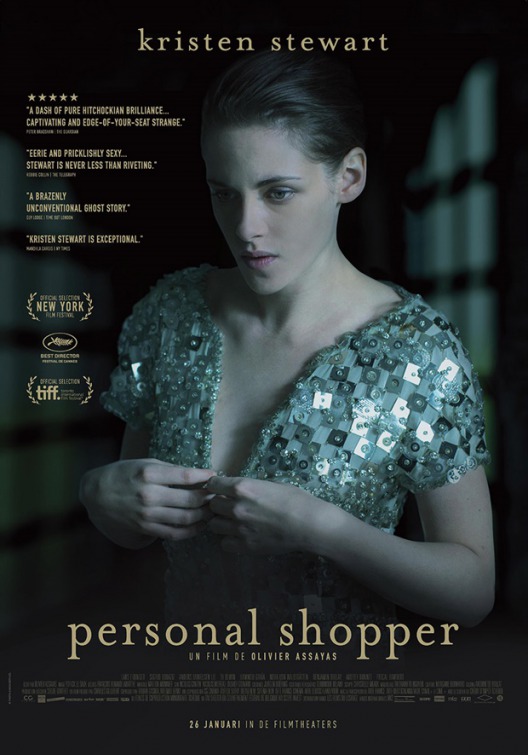
But this is nothing when compared with the crime against logic that the movie makes nearly all the way through: the whole car chase, with its occasional bursts of mayhem and damage and with its two distinctive vehicles not exactly difficult to spot, involves the police on just the one occasion. And even then it’s because Karla weaves her car from side to side as if drunk behind the wheel in order to attract the attention of a motorcycle cop (who is dispatched in one of the movie’s best stunts). The absence of police on the various roads the kidnappers and Karla travel on leads to something of a payoff, albeit an unfortunate one: arriving in a small town, Karla heads for the police station, only to find one lone deputy in attendance. Karla tells the deputy about the kidnapping, and the deputy responds by saying, “we can have a hundred cars out looking for them in an hour”. The irony is lost on Karla, but it won’t be lost on the viewer.
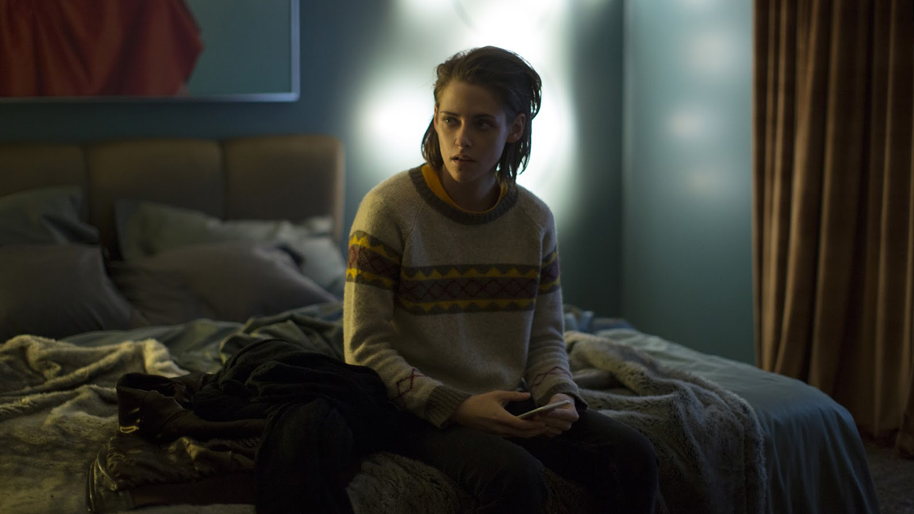
Of course, there’s a reason for Frankie’s abduction, and while some viewers might be forgiven for thinking it’s all to do with the husband and the custody battle, here it’s a little more unnerving, and offers clear parallels to abductions that happen in real life. It also allows Karla the chance for a showdown with the woman that ought to be more exciting than it actually is. But that’s the movie in a nutshell: it promises more than it can actually deliver, and it never fully exploits its simple premise. Plus it digs itself into several holes along the way, and comes up with ever more ridiculous solutions in order to keep the movie plugging away until Karla’s eventual arrival at the kidnappers’ home (e.g. the satnav that conveniently tells her she’s only a couple of miles away when she has to travel on foot).

Now, any movie where disbelief has to be suspended regularly in order for the action to continue, isn’t working to the best of its abilities. Knate Lee’s script has the feel of a screenplay that’s undergone revisions during shooting, and while this is entirely common within the industry, what it does mean is that the finished product has to work extra hard in order to remain as effective as originally planned. The sense here is that Lee had a number of set pieces in mind for the movie, but as for the stuff in between, well let’s just say it needed a lot more work. Karla’s motivation is obvious, but she makes a number of decisions that work against that motivation, and the script falls back on her determination to keep chasing the kidnappers long after she’s identified the Mustang and could have called it into the police, as a means of justifying those decisions.

Where the movie does score highly is with its action sequences, which are confidently handled by director Luis Prieto and expertly pieced together by editor Avi Youabian. Karla vs the man is a particular highlight, and there’s a stomach churning hit and run that stays in the memory (it really looks as if the stuntwoman got hurt), but while these sequences stop the movie from looking and sounding unappealing and dull, this is still, ultimately, a thriller that only thrills in fits and starts. Berry shows off her angry face to ever-decreasing effect, but does make Karla a sympathetic character for the viewer to cheer on, even if she’s not always the brightest mother on the planet. As the villains of the piece, McGinn and Temple are nasty enough without being unavoidably psychotic, and Correa is a cute if low-key presence (and even cuter in the real life footage of him as a baby and growing up that opens the movie).

Rating: 5/10 – a movie that could have been a lot worse, and should have been a lot better, Kidnap is a frustrating viewing experience because of all the risible moments that interfere with the simplicity of the basic idea; Berry is good value, the stunts elevate the material, Prieto exhibits a patience with the narrative that stands it all in good stead, but in the end, this is still less than the sum of its parts.

Share this:

  • Share on X (Opens in new window) X
  • Share on Facebook (Opens in new window) Facebook
  • More
  • Print (Opens in new window) Print
  • Email a link to a friend (Opens in new window) Email
Like Loading...

Mini-Review: Wilson (2017)

20 Saturday May 2017

Posted by dullwood68 in Movies

≈ 1 Comment

Tags

Comedy, Craig Johnson, Daniel Clowes, Drama, Graphic novel, Isabella Amara, Judy Greer, Laura Dern, Prison, Review, Woody Harrelson

D: Craig Johnson / 94m

Cast: Woody Harrelson, Laura Dern, Judy Greer, Isabella Amara, Cheryl Hines, Margo Martindale, David Warshofsky, Brett Gelman, Mary Lynn Rajskub

Wilson (Harrelson) is a loner with a strong misanthropic streak. He’s dissatisfied by most aspects of modern day living, and feels that communication isn’t what it used to be, that people are too insular. In an effort to combat this he’ll often approach people that are on their own, and try to strike up a conversation with them (and to their obvious consternation and confusion). In the wake of his father’s death, Wilson gets in contact with his estranged wife, Pippi (Dern), and against her better judgment they take the first steps towards being a couple again. During this time, Pippi tells Wilson something that gives his life a renewed purpose: he has a daughter somewhere.

Wilson soon tracks her down. Her name is Claire (Amara), she’s seventeen-years-old, and she’s a little overwhelmed when Wilson and Pippi suddenly turn up out of the blue. They try to spend time with Claire, but it’s difficult as they want to keep Claire’s adoptive parents in the dark about it all. Eventually the three of them embark on a trip to visit Pippi’s sister, Polly (Hines), and her family. The visit doesn’t go so well, and Polly works out that Claire’s parents don’t know where she is. The police are called, and Wilson is arrested on a charge of kidnapping. He winds up in prison for nearly three years. When he gets out, he finds that people are still as insular as ever, and that his life is about to take a turn for the better – probably.

Adapted by Daniel Clowes from his own graphic novel of the same name, Wilson was meant to be director Alexander Payne’s next project after Nebraska (2013), and with that knowledge in mind it’s tempting to wonder what the movie would have been like if he’d stayed on board. It’s not that Wilson is a bad movie, but it is one that can’t quite decide whether it wants to be a relationship drama, a bittersweet comedy, or something else entirely. What it is in the end, is a movie that flits back and forth between drama and comedy, and in the process fails to do adequate justice to either of them. The drama lies somewhere in the relationship between Wilson and Pippi, and the longer we see them together the easier it is to understand why she left him in the first place. Wilson bemoans how little people communicate, but doesn’t understand that the way he does it, it isn’t always appropriate.

The comedy is almost exclusively laid at the feet of Wilson himself, with said inappropriate behaviour causing all sorts of (mostly humorous) problems. But sometimes he sounds as if he’s being belligerent instead of caustic, as if between them Clowes and director Johnson have lost something of the character’s tone in translation. Harrelson gives a good performance, offering an interpretation of Wilson that ranges from manic to brash to insensitive to contemplative and all the way back to manic. Dern is also good as Pippi, a woman with “a past” that she’s trying to overcome. There are hints that Pippi has an addictive personality, and Dern reveals this added layer to good effect throughout. But the movie as a whole doesn’t make Wilson as sympathetic a character as it needs to, and the fallout from this is that Wilson the movie becomes an exercise in watching boorish behaviour being rewarded through a series of unlikely reversals and setbacks.

Rating: 6/10 – a mixed bag approach to the material – much of it lifted wholesale from Clowes’ graphic novel – means the narrative plods along in places and gives Wilson a patchwork feel that it never overcomes; the kind of movie that may well find itself ripe for reappraisal in ten years’ time, right now it’s an unconvincing look at one man’s studied ignorance of others, and his inability to recognise his own shortcomings.

Share this:

  • Share on X (Opens in new window) X
  • Share on Facebook (Opens in new window) Facebook
  • More
  • Print (Opens in new window) Print
  • Email a link to a friend (Opens in new window) Email
Like Loading...

Colossal (2016)

19 Friday May 2017

Posted by dullwood68 in Movies

≈ Leave a comment

Tags

Alcoholism, Anne Hathaway, Comedy, Dan Stevens, Drama, Fantasy, Giant robot, Jason Sudeikis, Monster, Nacho Vigalondo, Review, Seoul

D: Nacho Vigalondo / 109m

Cast: Anne Hathaway, Jason Sudeikis, Dan Stevens, Austin Stowell, Tim Blake Nelson, Hannah Cheramy, Nathan Ellison

Gloria (Hathaway) can’t resist a night out with her friends; or more specifically she can’t resist having a drink or two, or three, or four, when she’s out with her friends. Unable to deal with her repeated denials about her behaviour and her alcohol dependency, Gloria’s boyfriend, Tim (Stevens), ends their relationship, forcing her to move back to her old hometown, somewhere she hasn’t been in over ten years. She moves in to her parents’ old home, which is unfurnished. The next day, after having purchased an air mattress to sleep on, she runs into an old friend from her school days, Oscar (Sudeikis). Now the owner of a bar, Oscar takes her there and introduces Gloria to his friends, Garth (Nelson) and Joel (Stowell). Several drinks later, Gloria staggers home, passing through a nearby park on the way.

The next day, the world’s media is in a frenzy over the appearance of a giant monster in Seoul, South Korea. Gloria sees the footage and like everyone else is astonished by it. That night Gloria gets drunk again and goes home through the park. The next morning, the news reports a second appearance by the monster, but Gloria is surprised to see that it makes a similar gesture to one that she makes, and that it looks as if it’s trying to carry something over its shoulder, as she did with the air mattress. Putting two and two together and hoping it’ll add up to five, Gloria heads for the park where she strikes a number of specific poses. When she sees the latest footage, the monster strikes the exact same poses. Realising there’s some kind of link between them, Gloria tells Oscar and his friends.

The appearance of a giant robot alongside the monster is connected to Oscar, who shows signs of drinking too much (while Gloria starts drinking less). With Gloria having spent the night with Joel, and the sudden arrival of Tim, Oscar becomes aggressive towards Gloria, and threatens to cause havoc and destruction in Seoul if she doesn’t stay with him. Unsure of what to do, matters come to a head when Oscar tries to stop Gloria from leaving with Tim…

It’s safe to assume that, however many movies you see in 2017, you won’t see a stranger, more inventive movie than Colossal, the latest feature from Spanish writer/director Nacho Vigalondo. It’s a weird beast: by turns funny, dramatic, thrilling, challenging, poignant, even uplifting – and when was the last time you could say all that about one movie? And Vigalondo has the temerity to make it all look so easy. The movie is an unexpected cause for celebration, because this is a monster movie that is about so much more than just a creature terrorising downtown Seoul a la Godzilla and Tokyo. No, this is a movie concerned with notions of personal responsibility, self-respect, emotional insecurity, and redeeming past mistakes. It’s a movie with a very clear message: it’s never too late to start over, and to confound the expectations of those around you.

What could have been just another derivative monster movie also becomes, thanks to Vigalondo and his cast and crew, a surprisingly well grounded and credibly portrayed examination of survivors’ guilt, as both Gloria and Oscar deal in their very different ways with an event that happened when they were children, and which has left its mark on both of them. Gloria left her hometown for New York and fame and fortune as a writer, but she’s found alcoholism instead. Oscar has remained in their hometown and found that he can’t leave, that invisible ties hold him back, invisible ties, though, of his own making. Both are plagued by a sense of seemingly inevitable decline, that their lives are failing in terms of their potential, and neither of them know how to combat this. But by being given a chance to revisit that childhood incident, and to understand how it has affected them, both have the opportunity to rectify matters and move forward.

Of course, it’s not so easy, and Vigalondo twists the knife into both his lead characters, adding a layer of abuse to his increasingly dark and disturbing tale, and taking the story into places that the average fantasy drama wouldn’t even dream of trying to incorporate. And yet, with all this going on, Colossal isn’t as “heavy” as you might think, thanks to Vigalondo leavening things with massive doses of hope and pitch black humour. He’s helped tremendously by the performances of Hathaway and Sudeikis, two actors who might not be regarded as first choices for their roles, but who excel as two people struggling with their personal demons as best they can. Hathaway hasn’t been this good in quite some time, and she can sometimes seem removed from the character she’s playing, but here the opposite is true. She details Gloria’s growth from self-negating alcoholic to re-empowered avenger with such passion and empathy for the character that her performance gets better and better as the movie progresses. It’s impressive, and it’s courageous, and it’s Hathaway’s most deceptively skillful portrayal by far.

She’s matched by an intense, unsettling performance from Sudeikis, whose transformation from genial, easy-going bar owner and childhood friend to self-hating, conscience-free thug is one of the movie’s many highlights. When we first meet Oscar, Sudeikis plays him in much the same fashion as he’s played characters in other movies: with his trademark grin, amused yet casual demeanour, and equally casual delivery of his dialogue. Here, Sudeikis gets to subvert that image, and he seizes the opportunity with undisguised gusto. It’s a role that could so easily have descended into that of an unwavering, motiveless psycho, but between them, Vigalondo and Sudeikis have created a character whose psychopathy is believable to the point that when Gloria hits on what “ails” Oscar, the viewer can nod sagely and say to themselves, “that explains everything”.

The other characters aren’t given anywhere near as much depth as that shared by Gloria and Oscar, and Tim in particular is a distracting presence in the movie, with Stevens playing him as a shallow yet well-meaning putz. Thankfully, and one scene late on in the movie aside, Tim appears sparingly, and Vigalondo never makes him seem too important a part of Gloria’s future (she can do so much better and she probably knows it). As perhaps befits the tone of the movie, the visuals are kept muted, with the colour palette restricted to dull browns and distressed greys. The use of the monster and his giant robot adversary is kept in service to the story, and anyone expecting a full-on slugfest to close out the movie will be sorely disappointed. However, what does happen is clever, sad, and redemptive all at the same time, and allows the movie to end on one of the best sighs ever. Yes, a sigh, but one that says it all.

Rating: 8/10 – a bona fide gem, and chock full of surprises, all of them a pleasure to encounter and experience, Colossal is a movie that constantly moves the goalposts in its efforts to provide something different and extraordinary; Vigalondo has made an eloquent, remarkable movie that has something to say throughout and for once, it’s a movie that also knows just how to say it.

Share this:

  • Share on X (Opens in new window) X
  • Share on Facebook (Opens in new window) Facebook
  • More
  • Print (Opens in new window) Print
  • Email a link to a friend (Opens in new window) Email
Like Loading...

Iris (2016)

18 Thursday May 2017

Posted by dullwood68 in Movies

≈ Leave a comment

Tags

Charlotte Le Bon, Crime, Drama, Jalil Lespert, Kidnapping, Mechanic, Ransom, Review, Romain Duris, Thriller

aka In the Shadow of Iris

D: Jalil Lespert / 99m

Cast: Romain Duris, Charlotte Le Bon, JaliL Lespert, Camille Cottin, Adel Bencherif, Sophie Verbeeck, Hélène Barbry, Jalis Laleg

Maxim Lopez (Duris) is a car mechanic with an ex-wife, Nina (Verbeeck) and young son, Eli (Laleg). He is way behind on his mortgage payments and his work as a mechanic doesn’t bring in enough money to allow him to clear the debt anytime soon. He keeps promising Nina he’ll deal with it, but it’s unlikely he’ll ever be able to. Antoine Doriot (Lespert) is the owner of the bank that holds Maxim’s mortgage. He has an attractive wife, Iris (Barbry), and appears to have it all. But one day, after he and his wife have had lunch together, she disappears. Later on that day, Doriot receives a telephone call. The caller is a man, and he informs Doriot that Iris has been kidnapped. Unless Doriot pays €500,000 for her release, then she’ll be killed.

Despite being warned not to, Doriot contacts the police. Capitaines Nathalie Vasseur (Cottin) and Malek Ziani (Bencherif) are assigned to the case, and immediately suspect someone who holds a grudge against the bank. A list of people who have made complaints contains Maxim’s name. Before they can get around to speaking with him, a ransom drop is arranged at a railway station. Doriot is required to board a particular train but at the last moment he remains on the platform. Vasseur and Ziani continue to work their way through the list until they reach Maxim. They ask him what he was doing the afternoon Iris disappeared but he has an alibi that’s supported by his ex-wife.

The police decide that the kidnapping should be made public. What they don’t know is that by doing so, what seems to have been a straightforward kidnapping will turn into something far more dramatic and deadly. Unknown to them, Iris has faked her own abduction with the aid of Maxim, but when news of the kidnapping is released to the media, Maxim makes a discovery that turns everything he knows upside down, and puts both his life and his continued liberty at risk, and from an entirely unexpected source. Forced to put a plan of his own into action, Maxim must stay one step ahead of his adversary, and hope that everything will work out as Iris originally planned.

Originally planned as a US production, but eventually ending up in France – naturellement – Iris arrives with little fanfare and no shortage of problems in the script department, which is a surprise as the screenplay is by Andrew Bovell, whose credits include Strictly Ballroom (1992), Lantana (2001), and Edge of Darkness (2010). But it’s likely that Bovell’s script lost and gained things in translation, as this is very definitely a Gallic interpretation of what is otherwise a typical neo-noir. Once the police are introduced, the movie’s well constructed and intriguing beginning soon gives way under a welter of dramatic inconsistencies and dubious narrative decisions. There’s a good movie here somewhere, but under Lespert’s guidance, it only gets to shine on occasion, and remains an inconsistent, frustrating piece throughout.

Inevitably with a movie that stands or falls on the quality of its main “twist”, Iris relies on a piece of sleight-of-hand involving Iris herself that should immediately set viewers’ alarm bells ringing (it’s also the point where more experienced viewers will be nodding to themselves wisely and saying “Ah-ha!”). But the movie continues as if no one will have noticed what’s going on and then falls promptly on its sword by introducing Vasseur and Ziani. Ultimately it’s their involvement that ruins the whole tone of the movie, as their attempt at investigating Iris’s kidnapping proves to be both foolish and inane. The French may well be an idiosyncratic race, but it’s unlikely that their police detectives reveal intimate details of their sex lives when interviewing suspects (as they do with Doriot). And you’d certainly hope that if a kidnapper got in touch by mobile phone that they’d try to track him down by tracing his number – not here, though.

There are other instances of police stupidity on display including a dawn raid on Maxim’s workshop-cum-home where they haven’t bothered to check if he’s even there in the first place, and these instances take up too much of the movie’s running time. But even away from all that, things speed up and unravel at such a pace that there’s no time to wonder how all of it is happening, and without the principal characters – let’s leave the police out of all this – knowing about it. It all narrows down to Maxim and Doriot, and what each will do to get what they want. This leaves Iris as a pawn in both their games, but a pawn who has the capacity to ruin either one of them.

On the whole, Iris has the appearance of a thriller that’s been well thought out, but only to a point. Despite some appropriately moody camera work courtesy of Pierre-Yves Bastard, and a plaintive, melancholy score by ambient duo A Winged Victory for the Sullen, Lespert’s approach to the material remains scattershot and lacking in focus. Too many scenes seem to have been included at random, or for no appreciable reason, and too many dialogue scenes serve only to reinforce what’s already happened rather than to drive the story forward. The cast are often left stranded by the demands of the script, with Duris called upon to grimace his way through Maxim’s domestic crises (which have no bearing on anything else that happens), and Lespert himself prone to playing scenes where he stares off into space as if these moments will add depth to both the character (it doesn’t) and the scene (ditto).

The movie adds another couple of twists into the mix late on, but by then it’s too late, and most viewers will have worked out where it’s all going anyway. There’s also time for a fairly gratuitous and unnecessary sex scene, and the kind of denouement that aims for a combination of psychological integrity and emotional intensity, but instead falls well short of achieving both. The movie weaves various flashbacks into the narrative in an effort to explain certain things that have happened, but even with that clarity it doesn’t help the movie feel any less muddled or ill defined. As thrillers go it’s quite mundane, and plays out with a noticeable lack of energy – which could be forgiven if Lespert had opted for a more considered approach to the material.

Rating: 5/10 – despite a number of narrative and directorial flaws that hamper the flow of the movie, Iris takes its place amongst the movies that have aimed high, and without any clear sense of how those aims should play out; determinedly Gallic in tone but unable to offer anything new, it’s a movie that plays out favourably enough, but without being too memorable.

Share this:

  • Share on X (Opens in new window) X
  • Share on Facebook (Opens in new window) Facebook
  • More
  • Print (Opens in new window) Print
  • Email a link to a friend (Opens in new window) Email
Like Loading...

Gifted (2017)

17 Wednesday May 2017

Posted by dullwood68 in Movies

≈ 1 Comment

Tags

Chris Evans, Custody battle, Drama, Jenny Slate, Lindsay Duncan, Marc Webb, Mathematics, Maths prodigy, Mckenna Grace, Navier-Stokes problem, Octavia Spencer, Review

D: Marc Webb / 97m

Cast: Chris Evans, Mckenna Grace, Lindsay Duncan, Octavia Spencer, Jenny Slate, Glenn Plummer, John M. Jackson, John Finn, Elizabeth Marvel, Keir O’Donnell

In a small town in Florida, seven-year-old Mary Adler (Grace) is reluctantly preparing to go to school for the first time. Up until now she’s been homeschooled by her uncle Frank (Evans). Brighter and more precocious than the other children, Mary still has a lot to learn about social interaction and the rules she needs to abide by. Her first day doesn’t go entirely well, but she does catch the attention of her maths teacher, Bonnie Stevenson (Slate), who starts to suspect that Mary is a maths prodigy. An incident involving Mary and a boy on the school bus nearly sees her expelled; in turn it causes Mary’s grandmother, Evelyn (Duncan), to visit.

There is no love lost between Frank and Evelyn (his mother). In his own words, Evelyn is uncompromising, and she hasn’t seen Mary ever before. Her reason for showing up soon becomes obvious: she wants to take Mary under her wing and cultivate her gift with complex mathematics, just as she did with Mary’s mother, Diane. But Diane – who was just as gifted as her daughter, and working on the Navier-Stokes problem (one of seven Millennium Prize Problems) – committed suicide soon after Mary’s birth, and Frank blames himself for not seeing how unhappy she was. He also blames Evelyn for not letting Diane grow up like a normal child, something that he’s determined won’t happen to Mary. But Evelyn is truly uncompromising, and soon a custody battle is under way.

Frank and Bonnie begin seeing each other, while the custody hearing sees both sides in with a chance of winning. When Frank’s lawyer (Plummer) approaches him with a deal that’s been devised by Evelyn, and which involves Mary going to live with foster carers, Frank wavers in his commitment to his niece, and eventually agrees to the plan because he’s not sure he can give her the life she needs (even though he’s done really well so far). When the day comes for her to move in with the foster carers, Mary is understandably sad, and feels betrayed. With no other recourse at his disposal it takes a notice posted at Mary’s school to push Frank into getting Mary back, and revealing something about Diane that will ensure Evelyn relinquishes her claim on Mary.

Surprisingly, Gifted is only Marc Webb’s fourth feature, and it’s telling from the movie’s poster that any mention of a certain web-slinger isn’t going to be relevant here. But an acknowledgment that Webb made the terrific indie charmer (500) Days of Summer (2009) certainly is, as this tale of a troubled family, though genial and passively compelling, has the ebb and flow of Webb’s first movie rather than the bloated excesses of the last two Spider-Man movies. Where Webb’s skill and voice as a director was lost in the hubbub of taking on a Marvel icon, here he’s regained that voice and made a movie that’s more in keeping with his moviemaking sensibilities.

The crux of the matter in Tom Flynn’s straightforward, no frills script is whether or not Mary should be treated as the maths genius she undoubtedly is, or as a normal child who just happens to be good with exponential equations. Frank wants her to have a regular childhood, where she plays outside, has friends, and isn’t nose deep in a book of mathematical problems all the time. Evelyn wants Mary to eschew all that and devote her life – even at such a young age – to developing her skills and attaining the kind of recognition that Diane was beginning to achieve before she killed herself. The movie is keen to highlight the pros and cons of both sides of the argument, but as the relationship between Frank and Mary is a loving one, and the script makes Evelyn into a hard-hearted shrew from the moment she appears, there’s no prizes for guessing which way the movie wants the viewer to vote. (In fairness, the script doesn’t allow Evelyn any kind of redemption, and makes her self-serving and callous all the way to the end.)

Of course, the overall conclusion is that Mary should be allowed to have and be both, a child prodigy and an ordinary child at the same time. The signs are already there when we first meet her, and there are dozens of clues littered throughout the movie, from her karaoke nights with neighbour Roberta (Spencer), to the empathy she shows towards a boy in her class who’s the victim of bullying. As the movie progresses and Frank opens up to Bonnie about his sister, and the responsibility he took on in looking after Mary, his self-doubt becomes apparent, but the good work he’s done in raising Mary is also apparent. He may have sacrificed a lot to be a single parent, but he’s done a remarkable job, but the script never allows him a moment of true personal triumph; he’s never sure about what he’s doing, or if it’s the right thing. This does add to the drama of the piece, but when it’s relayed so often you just want to yell, “Get over yourself, man!”

Frank’s insecurities aside, there are too many times when Evans and the character are required to provide substantial amounts of exposition that slow the movie down. Evans is a more than capable actor but here he’s required to either dial back on Frank’s feelings, or limit any angry outbursts to one every half an hour of running time. The movie is on firmer ground whenever Grace is on screen. Whether pulling a frown that would have the Joker asking “Why so serious?”, or smiling with undisguised glee, Grace is yet another child actor who can’t strike a false note even if she tried. She’s the focus and the heart of the movie, and she gives a moving performance that at times is reminiscent of Ricky Schroder in The Champ (1979). As mentioned above, Duncan is the villain of the piece, and she does well to make Evelyn occasionally sympathetic in her desire to take over Mary’s life, but there are too many moments where the character’s humanity (seen occasionally) is pushed aside in order for her to behave appallingly yet again.

Spencer and Slate are given the odd scene to remind us they’re still taking part, though it’s hard to work out why Spencer’s character is there in the first place. Slate’s role diminshes the longer the movie plays out, and by the end Bonnie is there just to listen to Frank complain about the raw deal he and Mary have been dealt (even though he agreed to it in the first place). These are two very good actresses and it’s a shame to see them relegated to playing such under-developed characters. Webb handles it all with a surety and a conviction that helps overcome some of the movie’s more clichéd moments – Mary spots the deliberate mistake in a smug professor’s equation, Evelyn gets to make an impassioned speech on the witness stand that goes unchallenged – and keeps the movie from tipping over into unrestrained mawkishness, in particular during a scene set in a hospital waiting room – one that has a powerful, sentimental payoff.

There are times when the movie feels slighter than it needs to be, and other times where the drama threatens to overwhelm the relaxed nature of much of the movie. It’s not a movie that offers much in the way of originality but it does have a charm and a likeable nature that makes it eminently watchable, and Evans, despite the limitations of his character, remains an engaging, dependable presence. Littered with enough heartstring-tugging moments designed to have viewers teary-eyed and reaching for the nearest box of tissues, Gifted does pack an emotional wallop at times, and it does provide enough food for thought in terms of its central dilemma to offset some of the thoughtless moralising that passes back and forth between Frank and Evelyn. But it’s still a simple story, told well enough to hold the viewer’s attention throughout, and is a welcome return by Webb after too many years in the mainstream wilderness.

Rating: 7/10 – a largely effective exercise in manipulating an audience’s emotions, Gifted coasts in places and isn’t as focused in its second half as it is during the first; it’s still a good movie though, full of dry humour, winning performances, a sense of its own conventional nature, and overall, a more than pleasant experience.

Share this:

  • Share on X (Opens in new window) X
  • Share on Facebook (Opens in new window) Facebook
  • More
  • Print (Opens in new window) Print
  • Email a link to a friend (Opens in new window) Email
Like Loading...

Folk Hero & Funny Guy (2016)

16 Tuesday May 2017

Posted by dullwood68 in Movies

≈ Leave a comment

Tags

Alex Karpovsky, Comedy, Drama, Friendship, Jeff Grace, Melanie Lynskey, Meredith Hagner, Relationships, Review, Road tour, Romance, Wyatt Russell

D: Jeff Grace / 91m

Cast: Alex Karpovsky, Wyatt Russell, Meredith Hagner, Melanie Lynskey, Michael Ian Black, Hannah Simone, Heather Morris, David Cross

Paul Scott (Karpovsky) used to work in advertising, but he’s given it all up to be a stand-up comedian. His new career has its moments, but it’s still early days and he still has to refer to a notebook on stage for his material. Paul’s best friend since they were children is folk singer Jason Black (Russell). Jason’s career has brought him a degree of fame and popularity, and he’s the kind of carefree, live-for-the-moment guy that’s the complete opposite of Paul’s more grudging, dissatisfied approach to life (it doesn’t help that Paul’s just been dumped by his girlfriend). Seeing that his friend needs a bit of a lift, and some encouragement, Jason suggests Paul open for him on his upcoming solo tour. Paul thinks it might be a bit odd, a comedian opening for a folk singer, but Jason reassures him it’ll all be fine.

They set off in Jason’s battered old Volvo (his regular tour bus is too expensive for just the two of them), and on the first night of their trip they find themselves in a bar in Tom’s River, NJ, that has an open mic night. After hearing a very talented singer called Bryn (Hagner), Jason is cajoled into performing. While he does, Paul strikes up a conversation with Bryn, and they hit it off. The next morning, Paul is surprised to learn that Jason has invited Bryn along with them on the tour, and that she’s the new opening act, with Paul going on second. He’s a little flummoxed by it all, as he thought the tour was a chance for two old friends to spend some time together, but he’s also pleased because he’s attracted to Bryn and wants to get to know her better.

As the tour progresses, Paul and Bryn become good friends, while Jason pursues his usual vices. Bryn’s act goes down well with audiences, but Paul struggles to find the kind of form onstage that he can produce offstage. He begins to have second thoughts about being on the tour, and whether or not he should continue to pursue his dream. He and Bryn become closer still, until the revelation that she and Jason slept together that first night they all met, threatens to sever old and new friendships as Paul finds he’s unable to deal with it all…

Writer/director Jeff Grace – here making his feature debut – is also a stand-up comedian. Adam Ezra, who provides the movie’s original soundtrack, is a musician who it just so happens went on tour with Grace as his opening act. Using this as the basis of his screenplay, Grace has fashioned a perceptive, entertaining movie that has many pertinent things to say about the nature of old friendships, love and romance, and the downside of ambition. It’s a semi-serious comedy that isn’t afraid to show its three main characters in a less than flattering light, and it’s a very funny drama that highlights the difficulties involved in trying to start a relationship when you can’t articulate what you need from that relationship.

Paul is almost a classic underachiever, his personal life littered with regrets and misunderstandings that he can’t get past or overcome, and his new professional life proving to be just as frustrating. Part of the problem in both areas is that Paul doesn’t do enough to make things work in the way that they should. He makes the minimum effort required, and doesn’t see that this intransigence is what’s stopping him from achieving his goal as a stand-up, or committing fully to relationships. Even when he does try to commit, it’s done in such a way that the relationship is bound to founder as a result. Ultimately, Paul doesn’t trust in his own happiness, and he finds ways to sabotage things when they seem to be going well.

Jason is the exact opposite: confident, spontaneous, a risk taker, and someone who doesn’t overthink things. The tour is Jason’s idea of helping Paul regain some of the self-confidence that he had when he worked in advertising. He sees that Paul is down in the dumps, that his negative attitude needs challenging, but in the same way that Paul works against himself and any chance of contentment, Jason has the best of intentions but lacks the skill to reinvigorate his best friend’s life. He tries, but his efforts always backfire because he just can’t put himself in Paul’s shoes. Jason lacks the awareness that what pleases him and keeps him happy, isn’t going to work in the same way with Paul. There are times when you wonder just what it is that has kept them friends for so long, and Grace’s judicious script skirts this issue until the last night of the tour and the inevitable confrontation between the folk hero and the funny guy.

Grace handles the comedic elements with unsurprising aplomb, putting Paul on stage and letting him bomb in the same kamikaze way each time (“What is up with e-vites?”). It’s funny, sad and frustrating all at the same time, because before he gets to that point in his act, he always does so well. But Grace isn’t interested in making things easy for Paul – hell, even Paul isn’t interested in making things easy for himself – and Paul’s pent-up frustration leads to his being properly funny only when he lets things blow. It’s a good indication of the kind of stand-up comedian Paul could or should be, and Grace appears to be leading the audience in this direction when in fact he’s clever enough to steer everyone to a different place altogether. This makes the movie more intriguing than expected, and opens up the possibility that in good old indie movie fashion, things may not turn out so well for everyone at all.

Along the way, Grace gives Karpovsky some great routines to have fun with (until the rot has to kick in), and allows Russell and Hagner the chance to impress on more than one occasion with their soulful singing styles. All three give good performances in the kind of well written roles that only seem to come along in the indie sector these days, and in a brief supporting role, Melanie Lynskey proves yet again why she is one of the best character actresses working today. Grace does extremely well for a first-time director, drawing out the subtleties of his script with a sure hand and managing to avoid making it all look too obvious. If Paul’s intransigence becomes wearing after a while – and it does – then it’s a small price to pay for a movie that deals so effectively in portraying Paul’s downbeat persona, and counter-balancing it with Jason’s more hedonistic approach to everything. It all adds up to a movie brimming with heart and soul, and which never short changes its characters or its audience.

Rating: 8/10 – an appealing and thoughtful movie about the nature of unequal male friendships, Folk Hero & Funny Guy is also an irresistible road movie-romantic comedy-drama; with a great soundtrack and score, it’s a movie that signals Grace as a moviemaker to watch, confirms Russell to be an actor with an engaging, amiable screen presence, and features a screenplay that’s sympathetic and non-judgmental to all three of its main characters.

Share this:

  • Share on X (Opens in new window) X
  • Share on Facebook (Opens in new window) Facebook
  • More
  • Print (Opens in new window) Print
  • Email a link to a friend (Opens in new window) Email
Like Loading...

10 Reasons to Remember Powers Boothe (1948-2017)

15 Monday May 2017

Posted by dullwood68 in Movies

≈ Leave a comment

Tags

Actor, Career, Emmy winner, Movies, Powers Boothe, Stage, Television

Powers Boothe (1 June 1948 – 14 May 2017)

For the first ten years of his acting career, Powers Boothe was on stage appearing in a range of Shaespearean productions that included Troilus and Cressida to Henry IV, Part II to Richard III. Quite a difference in terms of his background as the youngest of three boys growing up on a ranch in Texas (he was also the first person in his family to go to university). Those early years helped Boothe hone his acting skills, and though he began his movie career with a bit part in The Goodbye Girl (1977), it was only three short years before he was impressing television audiences with his performance as the doomed cult leader in Guyana Tragedy: The Story of Jim Jones (1980). Boothe won an Emmy, and that auspicious portrayal heralded the arrival of a real talent.

During the Eighties Boothe consolidated his success with a variety of movie, television (particularly as Philip Marlowe) and stage roles that reaffirmed his skill as a performer, but as the decade progressed he appeared more and more as both a supporting actor, and as a villain as well. With his stern features, penetrating stare and sonorous voice, Boothe was equally suited to the various law enforcement roles he began playing as he got older, before moving on to senior politician roles such as Alexander Haig in Oliver Stone’s Nixon (1995). He was able to inject a sense of gravitas to these roles that often helped tremendously when a movie was lacking in other areas, but a glance through his filmography shows that he didn’t make too many bad choices during his career, and he was able to work with directors of the calibre of John Boorman, Walter Hill and Robert Rodriguez.

From the late Nineties onwards, Boothe gravitated more and more towards television, and appeared in a number of well received shows including Attila the Hun, Deadwood, and 24. In recent years he also appeared in the likes of Nashville and Marvel’s Agents of S.H.I.E.L.D. But whatever the format, Boothe was always an actor worth paying attention to, someone who could take a role and spin something unexpected out of it. And despite the often serious nature of the parts he played – he never did comedy – he could be relied on to appreciate the benefits of his profession: “Hell, I’ve played as many guys who get the girl as I have heavies. I’ve done love scenes with Jessica Lange and Jennifer Lopez, and I won’t kid you, they’re fun”.

1 – Guyana Tragedy: The Story of Jim Jones (1980)

2 – Southern Comfort (1981)

3 – The Emerald Forest (1985)

4 – Extreme Prejudice (1987)

5 – Into the Homeland (1987)

6 – By Dawn’s Early Light (1990)

7 – Tombstone (1993)

8 – Blue Sky (1994)

9 – U Turn (1997)

10 – Sin City (2005)

Share this:

  • Share on X (Opens in new window) X
  • Share on Facebook (Opens in new window) Facebook
  • More
  • Print (Opens in new window) Print
  • Email a link to a friend (Opens in new window) Email
Like Loading...

This Beautiful Fantastic (2016)

14 Sunday May 2017

Posted by dullwood68 in Movies

≈ Leave a comment

Tags

Andrew Scott, Drama, Gardening, Horticulture, Jeremy Irvine, Jessica Brown Findlay, Review, Romance, Simon Aboud, Tom Wilkinson

D: Simon Aboud / 91m

Cast: Jessica Brown Findlay, Tom Wilkinson, Andrew Scott, Jeremy Irvine, Anna Chancellor, Eileen Davies, Paul Hunter

Bella Brown (Findlay) was a foundling child, abandoned in a park and kept alive by ducks. She has grown up to be a young woman with obsessive compulsive disorder, and an ambition to be an author. She works at her local library where her love of books has made her a valiuable, if persistently late, member of staff. Her home is a modest property with an expansive garden, one that she doesn’t maintain due to an extreme aversion to flora. She is shy, modest, inquisitive, and in the words of her neighbour, Alfie Stevenson (Wilkinson), has been “sent here to test us”.

One day at the library, Bella meets Billy (Irvine), a young man interested in the works of Leonardo Da Vinci. He leaves behind a piece of paper that Bella can see has the imprint of a drawing on it. She takes it home and uses a pencil to raise the image, which is of a bird. As she gazes on it, the window to the garden flies open due to a storm outside, and the drawing is whisked away into the branches of a tree. Plucking up courage, Bella goes into the garden and retrieves it. In the process she falls and loses consciousness. When she comes to, Bella finds herself in the home of her neighbour, Alfie, and being tended to by his doctor, Milly (Davies), while in turn, Alfie is being tended to by his housekeeper, Vernon (Scott). Alfie is an old curmudgeon, and berates Bella for the condition of her garden, calling her a “horticultural terrorist”.

Alfie’s displeasure at the state of Bella’s garden leads to Vernon working for her instead, which in turn leads to a battle of wills as Alfie tries to browbeat Bella into letting Vernon go back to him. Soon after, Bella receives a visit from her landlord, Mr O’Brien (Hunter), who tells her that unless her garden is kept to a reasonable standard, then she’ll be evicted. Bella has a month to make good on this condition, and with the help of Vernon and Alfie she begins to tackle the momentous job of clearing and redesigning the garden before O’Brien returns. Meanwhile, she begins a relationship with Billy, who proves to be an inventor. But when she sees him with another woman, she suffers such a sense of betrayal and loss that her commitment to the garden is put in jeopardy, and with O’Brien’s return getting closer and closer, it’s going to take a small miracle to keep Bella in her home.

Although This Beautiful Fantastic is only the second movie written and directed by Simon Aboud – after Comes a Bright Day (2012) (itself well worth checking out) – it’s not a feature that falls foul of “difficult second movie syndrome”. Instead it’s an appealing, sweet-natured, even goofy at times, romantic-comedy-drama that does its best to put a smile on its audience’s faces, and all with a lightness of touch that makes it an undeniable pleasure to watch. Aboud’s “movie in microcosm” is such a delight from start to finish that it’s like having cheesecake ahead of a main course at a restaurant: it’s definitely a movie to savour.

And it’s all so simply constructed and put together, with Aboud’s confidence behind the camera matching the quality of his screenplay, and the performances fitting perfectly into the whimsical nature of the material. This isn’t a movie that springs any surprises on its audience, and it’s definitely not a movie that tries to be different, but it does have a tremendous amount of quiet, understated charm, and a delightfully winning way about it. From its opening scenes, which offer a brief appraisal of Bella’s childhood coupled with Alfie’s sniping comments about her, This Beautiful Fantastic is a movie that sets out its stall from the start, and which doesn’t disappoint as it expands on its contemporary fairy tale theme and keeps its narrative wrapped tightly around its quartet of main characters.

In keeping with its lightness of touch and playful nature, the romance between Bella and Billy is engaging and kept just this side of annoyingly saccharine, with Irvine’s eager puppy of a young man a perfect foil for Findlay’s more restrained, and yet attentive Bella. Their relationship fits the bill in terms of boy-meets-girl, boy-loses-girl-through-unfortunate-mix-up, and then regains-girl-through-apologetic-explanation-of-mix-up, but again it’s all done with the full acknowledgment by all concerned that this is a fairy tale, and in fairy tales there are certain rules that have to be followed, and one of them is that the princess always gets her prince.

With the romantic elements having been taken care of, Aboud is free to create dozens of comedic moments that act as an undercurrent to the central drama of Bella making sure her garden doesn’t remain an eyesore. Alfie’s cantankerous, acidic nature is portrayed by Wilkinson with a deftness of touch that makes a virtue out of waspish pomposity, and the character’s arrogant outward appearance belies a romantic soul whose passion for horticulture is more personal than expected. As Vernon, Scott delivers a mannered, sympathetic portrayal of a widower with two twin girls whose sense of self-worth has taken a bit of battering thanks to Alfie’s bullying ways. But there’s a way back for him, and Scott makes sure that Vernon’s recurring way of dealing with Alfie is one of the movie’s more pleasing highlights. For her part, Findlay is something of a “straight woman”, and though she gives a fine, rounded performance, she’s not required to “dazzle” as much as her male co-stars, and has to leave the comedy to Chancellor, who plays her boss, Mrs Bramble (her insistence on complete silence within the library leads to a great sight gag three quarters in).

The drama is concerned with Bella’s voyage of self-discovery through gardening, as evidenced by her checking obsessively that her front door is closed every time she leaves home, and which falls by the wayside as she begins to experience love for the first time (though whether being in love really constitutes a cure for OCD is a bit of a stretch). Bella gains in confidence, and her ambitions as a writer, stalled until the arrival of Billy, allow her to blossom even further beyond the confines of her garden. Aboud ensures that Bella’s journey is punctuated with the necessary number of setbacks, all of which allow for and encourage her personal (allegorical) growth at the same time that the garden begins to flourish also. Alfie develops too, although his development is less about personal growth and more about acknowledging the past and its lasting effect on him. Again, Aboud handles all these elements with a great deal of skill and compassion for his characters, and the end result is a movie that will make you laugh a lot, cry on occasion, and feel glad that you took a chance on a movie that could have missed its target by a country mile.

Rating: 8/10 – with a couple of last-minute revelations that unfortunately undermine the good work Aboud has put in in assembling his movie, This Beautiful Fantastic is still a movie that provides a very pleasant viewing experience indeed; one of those movies that make you feel great if you’ve found it without help from critics or word of mouth, it’s a lovely piece that knows its limitations and works within them to provide a beautifully designed and established visual delight – just like Bella’s garden.

Share this:

  • Share on X (Opens in new window) X
  • Share on Facebook (Opens in new window) Facebook
  • More
  • Print (Opens in new window) Print
  • Email a link to a friend (Opens in new window) Email
Like Loading...

Poster(s) of the Week – A Landscape Collection

13 Saturday May 2017

Posted by dullwood68 in Movies

≈ Leave a comment

Tags

Get Carter (1971), Landscape, Portrait, Poster of the week, Posters, Shaun of the Dead, Steamboat Bill Jr, The Bridge on the River Kwai, The Discreet Charm of the Bourgeoisie, The Searchers, Tranquility of Blood

When choosing the posters for this particular thread, it’s always the landscape format that I aim for. There’s something so appealing about the format that I can’t help but be drawn to it. In comparison, the portrait format – for me, at least – lacks something I can’t quite put my finger on, which is ironic when you consider that my reviews feature exactly that style of poster. It’s also very difficult at times to do a poster sufficient justice, and though this is a category/thread that is one of my favourites, choosing the right poster is often more of a struggle than it needs to be. As a result, what was meant to be a regular weekly feature has become very hit and miss during 2017, something that I intend to address – though, sadly, not just yet.

In the meantime, here are seven landscape movie posters that are particular favourites of mine. A couple of them are also posters of movies that I have a specific liking for, but all the rest are here on their own merits. So, no commentary or examination of the posters’ and their relative pros and cons, and no other context either. I just think they’re damn good posters.

Share this:

  • Share on X (Opens in new window) X
  • Share on Facebook (Opens in new window) Facebook
  • More
  • Print (Opens in new window) Print
  • Email a link to a friend (Opens in new window) Email
Like Loading...

Alien: Covenant (2017)

12 Friday May 2017

Posted by dullwood68 in Movies

≈ Leave a comment

Tags

Billy Crudup, Danny McBride, Drama, Horror, Katherine Waterston, Michael Fassbender, Prequel, Review, Ridley Scott, Sci-fi, Sequel, Thriller, Xenomorph

D: Ridley Scott / 122m

Cast: Michael Fassbender, Katherine Waterston, Billy Crudup, Danny McBride, Demián Bichir, Carmen Ejogo, Jussie Smollett, Callie Hernandez, Amy Siemetz, Nathaniel Dean, Alexander England, Benjamin Rigby, Uli Latukefu, Tess Haubrich

When the Alien franchise was given a new lease of life with official prequel Prometheus (2012), audiences were teased with the idea that they would finally learn just where the series’ chief villain, the xenomorph, came from. Prometheus, though, raised far more questions than it provided answers, and while it introduced the Engineers and went some way to showing the xenomorph’s origins (though not the reasons for its creation), the intended link between this first prequel and the original Alien (1979) remained obscure, and still far from being revealed. With Alien: Covenant, audiences could be excused for believing that some of those unanswered questions would be addressed, and the connecting story expanded on. But with at least two further prequels (sequels to the prequels?) planned, and possibly a third, the message here is frustratingly clear: don’t expect to learn anything you didn’t already know.

After the cod-theological leanings of Prometheus, the latest in the saga opts instead for cod-philosophical leanings, and spends time musing on notions of creation and acknowledging one’s place in the scheme of things. But the movie – scripted by John Logan and Dante Harper from a story by Jack Paglen and Michael Green – isn’t interested in exploring these notions in relation to the human contingent of the story, but instead in relation to two androids: David and Walter (both Fassbender) who represent opposite ends of their creationist cycle. David is the prototype, while Walter is the later model built to surpass the limitations of the original. Together they talk about their creator’s expectations for them, and then their own. But while on the surface these musings appear in keeping with the wider story of the xenomorph’s creation (whatever that may be), they don’t add as much depth to the material as may have been intended. Instead, they provide a basis and a reason for a third act “reveal” that exists purely to set up the next installment.

Before then, we’re introduced to the latest group of dinner dates for the murderous xenomorph. Only this time it’s either a neomorph (“infant” version) or a protomorph (“adult” version), but either way it still behaves like its forebear(?), has acid for blood, screeches like a banshee, and kills anyone in its path. This time around, the movie’s motley band of victims is the crew of the colony ship Covenant. A group of terraformers en route to an Earth-like planet called Origae-6, their cargo consists of two thousand colonists all in cryo-sleep, and a thousand embryos all in cold storage. While the crew also enjoys their cryo-sleep (they’re seven-and-a-half years away from reaching their destination), Walter carries out a variety of assigned tasks and monitors the ship and its personnel. A blast of unexpected solar energy damages the ship, and Walter wakes up the crew – all except for the captain, whose cryo-pod refuses to open. Thanks to the damage to the ship’s systems, the captain burns to death in his cryo-pod, which leaves Oram (Crudup) in charge.

A distress signal picked up from a planet that apparently doesn’t exist on any celestial maps reveals a human origin, and prompts Oram to redirect the Covenant to check it out. With the planet appearing to support human life, and being only a few weeks’ to get to, the reservations of chief terraformer Daniels (Waterston) are acknowledged but unheeded. Leaving chief pilot Tennessee (McBride) and two other crewmembers on board, Oram, along with Daniels, Walter, and the rest of the crew descends to the planet’s surface. There they find an anomaly in the form of wheat, a crashed spaceship, danger in the form of spores that infect two of the crew, and an unexpected rescuer when said spores precipitate the deaths of more than the infected. With a massive magnetic storm hindering their return to the Covenant, Oram and the remaining crew must find a way to survive the deadly intentions of the protomorph, and a more sinister danger lurking in their midst.

Those who found themselves dissatisfied with the direction taken in Prometheus will be pleased with this return to the series’ more basic roots, but even though it’s a step in the right direction, the problem with the movie overall is that it doesn’t offer anything new, and it doesn’t come close to replicating the tension and sense of dread that made Alien such an impressive outing. It tries to, and the script is clearly designed and constructed to provide gory set pieces at regular intervals in honour of the series’ abiding commitment to shocking audiences with jolts of body horror, but for anyone who’s seen all the previous movies in the franchise, this is a retread of scenes and set ups that were far more effective the first time round. Likewise the introduction of the various characters as regular joes, a device used to very good effect in Alien, but which here is truncated in favour of getting on with the action. Inevitably this means that when the crew starts to be whittled down, it doesn’t have the same effect as in the past, and Waterston’s plucky terraformer aside, it’s difficult to care about anyone as well.

In many ways, Alien: Covenant is a stripped down series’ entry that concentrates more on reliving old glories than advancing the franchise’s intended long-form narrative. Whatever happens in Alien: Awakening (2019?), it’s to be hoped that it reverts to telling the story begun in Prometheus and which should eventually connect with Alien. Here there are still more questions to be answered, and there’s a suspicion that the writers are already painting themselves into a corner, and that the decision to make a handful of prequels instead of just one all-encompassing prequel is beginning to look more than a little unsound. This has all the hallmarks of a movie made in response to the negative reaction afforded Prometheus, and if so, you have to wonder what this movie would have been like if the reaction had been positive. More of the same? Further exploration of the Engineers and their motivations? More pseudo-religious theorising? Less rampaging alien attacks and gory killings? It looks as if we’ll never know.

With the characters reduced mostly to alien-bait, only Fassbender and Waterston make any impact, though it is good to see McBride playing it completely straight for once. Fassbender is a mercurial actor but he always seems to have a stillness about him that seeps through in all his performances. Here as both David and Walter, that stillness is used to tremendous effect, and whether he’s waxing lyrical about art and music as David, or looking concerned as Walter, Fassbender provides two endlessly fascinating portrayals for the price of one. Waterston is equally impressive in a role that will inevitably draw comparisons with Sigourney Weaver as Ripley, but Waterston is canny enough not to make Daniels as strong-willed as Ripley, nor as valorous. Though she’s the movie’s nominal heroine, Daniels retains a vulnerability that Ripley didn’t have at all, and Waterston is a winning presence, her last act heroism borne out of desperation rather than determination.

Third time around, Ridley Scott ensures the movie looks as beautiful and darkly realised as his other entries, but somehow fails to make the movie as tense and compelling as Alien, or as intellectually portentous as Prometheus. He does ensure that the movie rattles along at a fair old lick, but with the script providing a series of “greatest hits” moments for him to revisit, Scott’s involvement doesn’t always appear to be as purposeful as in the past. There are too many moments where the movie’s energy seems to flag, and the tension dissipates as a result, leaving the viewer to wonder, if a director’s cut should be released in the future, will it be shorter than the theatrical version? And not even he can avoid making the movie’s coda look uninspired and predictable, all of which begs the question, should someone else sit in the director’s chair for the rest of the prequels?

Rating: 6/10 – a fitful, occasionally impressive second prequel/first sequel, Alien: Covenant revisits the haunted house horror tropes that made the first movie so successful, but finds little inspiration to help it fulfill its intentions; another missed opportunity to make the series as momentous as it was nearly forty years ago, where the story goes from here remains to be seen, but in continuing Scott et al really need to remember that a satisfying mystery requires a satisfying answer, something that this entry seems to have forgotten about entirely.

Share this:

  • Share on X (Opens in new window) X
  • Share on Facebook (Opens in new window) Facebook
  • More
  • Print (Opens in new window) Print
  • Email a link to a friend (Opens in new window) Email
Like Loading...

Top 10 Stephen King Movie Adaptations

11 Thursday May 2017

Posted by dullwood68 in Movies

≈ Leave a comment

Tags

10 Best, Carrie (1976), Christine (1983), Frank Darabont, Literary adaptation, Misery, Movies, Novels, Pet Sematary, Rob Reiner, Stand by Me, Stanley Kubrick, Stephen King, The Dead Zone, The Green Mile, The Mist, The Shawshank Redemption, The Shining (1980)

Ah, Stephen King, a writer so prolific it was once said that he could publish his shopping list and someone would turn it into a movie. The years and the adaptations haven’t been excessively kind to the Maine-born writer; even the movies he himself wrote the scripts for have (mostly) turned out to be bad beyond belief. But with (nearly) every novel and short story being transferred to either the big screen or the small screen, inevitably some must be successful. Here are ten movie adaptations of his work that have bucked the trend and proven to be masterful examples of movies where the phrase, Based on a novel by Stephen King, isn’t something to be afraid of.

10 – Christine (1983)

John Carpenter’s adaptation of King’s 1983 novel began shooting just a few days after the book was published, and could have featured Scott Baio and Brooke Shields instead of Keith Gordon and Alexandra Paul – what a version that might have been. Poorly received on release, Christine has gone on to become something of an Eighties cult classic, and is still one of Carpenter’s better constructed movies. With songs such as Bad to the Bone and a well placed Keep A-Knockin’ included in the soundtrack to highlight the horror of a ’58 Plymouth Fury gone very, very bad, King’s ode to Fifties teen culture (despite being updated) still resonates thanks to Gordon’s accomplished performance as Arnie, Christine’s owner, and Carpenter’s professional approach to a job he “needed to do” for his career.

9 – The Dead Zone (1983)

As if one King adaptation by a proven horror movie director in 1983 wasn’t enough, the year also saw David Cronenberg take up the reins of The Dead Zone, a project that had stalled on several occasions before he came on board (Stanley Donen as director? Bill Murray [King’s first choice for Johnny Smith] as the star?). Rejecting a script by King as being “too brutal”, Cronenberg shaped the novel’s parallel story structure into a three-act play, and gave Christopher Walken the chance to shine in one of his most underrated roles to date. The opening and closing acts have their moments, but it’s the middle act, where Smith helps Tom Skerritt’s small-town sheriff track down a serial killer that impresses the most (and which may have put some people off using scissors for some time afterwards).

8 – Pet Sematary (1989)

A novel that King felt was “too disturbing” and which nearly didn’t get published, Pet Sematary should have been directed by George A. Romero, but a scheduling clash with Monkey Shines meant he had to pass on the project. Enter Mary Lambert, and a movie that “defied the critics and opened at blockbuster levels” was created. Retaining much of the novel’s harsh, nihilistic tone, the movie works on a primitive level, and in its increasingly nightmarish way, makes for uncomfortable viewing once Louis Creed’s young son Gage returns from the dead. Another adaptation that has grown in stature since its original release, this is unnerving stuff indeed, and much better than most mainstream critics of the time were willing to accept.

7 – The Green Mile (1999)

The longest movie adaptation of a King novel – at three hours and nine minutes – The Green Mile was a return to the prison milieu (albeit set in the Thirties) that director Frank Darabont had already visited with delayed success in 1994. An absorbing, intelligent, and often gripping drama with standout performances from one of the best ensemble casts ever assembled for a King adaptation, Darabont’s assured direction from his own screenplay fleshes out the characters, and ensures that what happens to each and every one of them (even Percy) is affecting. It also features one of the most horrific deaths ever seen in cinema history, as Michael Jeter’s mouse-loving Eduard Delacroix meets a grisly end in the electric chair. Its length, and its subject matter, has been known to deter viewers over the years, but this is one occasion where the material warrants it, and thanks to Darabont, the movie is all the better for it.

6 – The Mist (2007)

The third – and to date, final – adaptation by Frank Darabont of a King tale, The Mist was originally meant to be Darabont’s first crack at the author’s work, but another project came first. Ostensibly a creature feature, the movie is much more than that, and shows just how quickly humans can become monsters themselves given the right circumstances. A bleak, unremitting experience for the viewer unfamiliar with the source material, The Mist closes with one of the most unexpected, most harrowing, and most emotionally devastating final scenes in horror history. It’s like a punch to the gut, and although different to the ending of King’s novella, fits in with the tone and feel of the movie perfectly. Darabont prefers the black and white version, and he’s right to: the absence of colour makes The Mist even more disturbing to watch – and that’s saying something.

5 – Stand by Me (1986)

Based on the novella, The Body (1982), Stand by Me was a last-minute change of title for a movie adaptation that was originally meant to be directed by Adrian Lyne. Despite its good standing now, the movie wasn’t too well received on its release, but whatever your feelings about the story of four young friends who go off to see a dead body somewhere in the woods near their home, it’s their casting that makes it so special. Watching the movie and their performances, you can believe that Wil Wheaton, River Phoenix, Jerry O’Connell, and Corey Feldman really are good friends, and that how they behave with each other really is as true to life as to make no odds. Eventual director Rob Reiner captures the novella’s poignancy and heartfelt sense of nostalgia with a great deal of sensitivity, and does full justice to one of King’s finer creations, Davie “Lard-Ass” Hogan.

4 – Carrie (1976)

King’s first novel was also the first of his ouevre to be turned into a movie, and as firsts go, Brian De Palma’s brash directorial style was a perfect fit for King’s tale of sexual repression, extreme religious fervour, and terrifying teen angst. Featuring Oscar-nominated performances (rare for a horror movie) from Sissy Spacek (as Carrie) and Piper Laurie (Carrie’s mother), the movie takes its time in setting up the prom sequence that is justifiably famous for its split-screen depiction, and also spends more time letting the audience get to know Carrie than would normally happen in a standard horror movie. A bravura turn from De Palma makes Carrie the kind of heightened horror that rarely succeeds on its own terms, and it features a last-minute jump scare that is the absolute gold standard of jump scares.

3 – Misery (1990)

Stephen King + Rob Reiner + William Goldman + Kathy Bates = the first (and so far only) Oscar-winning King adaptation. King’s claustrophobic novel about a writer trapped in a remote cabin by his “number one fan” (Bates, the Oscar winner), is dominated by the actress’s astute, mesmerising performance. Like all the best King adaptations there’s a standout moment – usually horrific – and this time it’s the infamous “hobbling” scene. Changed from the novel, where the writer has a foot amputated, and made even more uncomfortable for viewers by the knowledge of what’s going to happen, it’s this scene that sticks, rightly, in people’s minds. But Misery is more than just a thriller about obsession taken too far, it’s also about the will to survive, and the corrosive nature of fame and its attendant idolatry.

2 – The Shining (1980)

Back when it was announced that Stanley Kubrick would be directing a movie version of King’s hugely impressive third novel, it seemed like a match made in Heaven. And for many fans of the novel, it is, but King took umbrage with the movie, saying that Kubrick missed the point of what his novel was about. However you look at it, The Shining remains one of the most – if not the most – remarkable King adaptations ever produced. Kubrick’s studied, deliberately paced movie is packed full of memorable moments, from the lady in Room 237, the appearance of the Grady twins, the elevator gushing blood, the revelation of what Jack Torrance has been writing, that soundbite, the inventive use of Steadicam (then still in its relative infancy) as it follows Danny Torrance along seemingly endless hallways, and a final photographic image that challenges everything that’s gone before. King and Kubrick may have been at odds over the nature of evil, and its source, but Kubrick’s vision remains just as disturbing and palpably unnerving as it did when it was first released.

1 – The Shawshank Redemption (1994)

If any moviemaker “gets” Stephen King then it’s Frank Darabont. The writer/director is on a winning streak of 3-0 in King adaptations – 4-0 if you count the short movie The Woman in the Room (1983) – and his finest moment (and King’s) is this redolent, beautifully realised ode to friendship and the will to survive (a common theme in King’s work). It seems impossible to believe that Tim Robbins and Morgan Freeman weren’t the first choices for Andy and Red, but it’s true. What would The Shawshank Redemption have been like if Tom Cruise had played Andy, Harrison Ford had played Red – and Rob Reiner had directed? With all due respect to Messrs Cruise, Ford and Reiner, it probably wouldn’t be a version that sits at No. 1 on the IMDb Top 250 List (at time of writing). It’s yet another movie adaptation that plays to King’s strengths as a writer, with fully realised characters, an effective emotional undercurrent that makes Andy and Red’s friendship all the more credible, and a number of memorable moments that keep the narrative captivating from its opening story of murder all the way to Red’s arrival on a beautiful beach at the end. A movie that resonates more and more with each and every viewing, it’s the highpoint, the zenith, of King adaptations, and a tribute to Darabont, and Robbins, and Freeman, and everyone else involved in making what is easily the best prison movie ever.

Share this:

  • Share on X (Opens in new window) X
  • Share on Facebook (Opens in new window) Facebook
  • More
  • Print (Opens in new window) Print
  • Email a link to a friend (Opens in new window) Email
Like Loading...

King Arthur: Legend of the Sword (2017)

10 Wednesday May 2017

Posted by dullwood68 in Movies

≈ 2 Comments

Tags

Action, Astrid Bergès-Frisbey, Camelot, Charlie Hunnam, Djimon Hounsou, Drama, Eric Bana, Excalibur, Fantasy, Guy Ritchie, Jude Law, Londinium, Review

D: Guy Ritchie / 126m

Cast: Charlie Hunnam, Astrid Bergès-Frisbey, Jude Law, Djimon Hounsou, Eric Bana, Aidan Gillen, Freddie Fox, Craig McGinlay, Tom Wu, Kingsley Ben-Adir, Neil Maskell, Annabelle Wallis, Geoff Bell, Poppy Delevingne, Bleu Landau, Peter Ferdinando, Mikael Persbrandt, Michael McElhatton

The tagline for King Arthur: Legend of the Sword is a simple yet effective one: “from nothing comes a king”. But to quote William Shakespeare (and with the most sincerest of apologies), a better tagline would be, “nothing will come of nothing”. In fact, there are several famous Shakespeare quotes that are apposite for Guy Ritchie’s latest outing, so in an effort to provide a unique review for a movie that offers nothing that is in the remotest sense “unique”, here are some of the Bard’s most well known pieces of dialogue, and their relevance to King Arthur: Legend of the Sword.

“Now is the winter of our discontent” (Richard III) – strictly speaking, it’s spring right now, but the sentiment remains the same whatever the season. Ritchie, along with co-screenwriters Joby Harold and Lionel Wigram (his producing partner), offers audiences a King Arthur re-style that lurches from one CGI-heavy action sequence to another, all of which are edited in such a way as to remove every last ounce of excitement from every single one of them.

“Lord, what fools these mortals be!” (A Midsummer Night’s Dream) – it’s hard to work out just who fits this quote more, Warner Bros. for asking Ritchie to make this movie, or Ritchie for accepting the challenge. Perhaps it should be a joint award, as the end result stretches credibility at every turn, appears as if it was collated from a dozen different scripts, and ensures its cast of characters remain as one-dimensional as possible in order to match the quality of the narrative. This leads to Hunnam et al all struggling to give decent performances, and all looking uncomfortable throughout.

“We have seen better days” (Timon of Athens) – each year brings us a fantasy movie that attempts to bring us something out of the ordinary, something we haven’t seen before, and King Arthur: Legend of the Sword certainly has aspirations in that department, but instead it ends up looking and sounding like an uninspired retread/mash up of The Lord of the Rings (with bigger elephants), Game of Thrones (without the style), and weirdly, In the Name of the King: A Dungeon Siege Tale (2007) (skip the better days angle on this one).

“Some are born great, some achieve greatness, and some have greatness thrust upon them” (Twelfth Night) – this is the central conceit that infuses the character of Arthur, but once again we have to put up with a character denying his destiny for half the movie before taking up the mantle that he’s been due all along, and then finally going out and kicking some ass. It’s a tired character arc that’s been done so often it’s lost any kind of dramatic weight, and now feels obligatory, as if every character faced with this kind of choice has to be humble and committed to self-denial. If the movie had really wanted to bring us something out of the ordinary, Arthur would have found out he was the rightful King, grabbed up Excalibur, left Londinium, and killed evil uncle Vortigern (Law) at the first opportunity (and shaved at least half an hour off the movie’s two hour running time).

“All that glisters is not gold” (The Merchant of Venice) – the presence of Ritchie behind the camera, and with such a talented cast in front of it, just goes to show that you can’t judge a movie by its intentions. If you saw the first trailer and thought, “Hmm, this looks great!” then a) the makers of that particular trailer got off lightly, and b) there’s not much anyone can do for you. This is a movie that delights in showing off its various boxes of tricks, but as so often happens in these cases (where ambition should have been strangled at birth), once the tricks have been showcased, it becomes obvious that there wasn’t any substance behind them at all. And this is what this movie wants you to forget: that it’s made up of various boxes of tricks and very little else.

“Misery acquaints a man with strange bedfellows” (The Tempest) – watching King Arthur: Legend of the Sword is an often painful, dispiriting way to spend a couple of hours, but it’s also one that should have no problem in uniting audiences in expressing their general displeasure at what they’ve witnessed. They say that watching movies at the cinema qualifies as a communal experience. It’s such a shame then that so many people are going to be disappointed by a movie that flails around looking for a cohesive story to tell, and which does so without any attempt at providing wit or panache to help it along.
“But, for my own part, it was Greek to me” (Julius Caesar) – in this reimagining of the Arthurian legend (complete with a Camelot that isn’t mentioned by name, only title caption), the once and future king is an East End brothel owner long before there were actual East End brothel owners, and long before anyone added the word “mate” to the end of a sentence. Ritchie and his screenwriter chums may believe this adds a certain piquancy to the dialogue, but instead it feels more out of place than organic, and on occasion, forced. It’s a verbal affectation that does the movie no favours and soon becomes distracting instead of part and parcel of the movie’s overall tone (as intended).
“It is a tale told by an idiot, full of sound and fury, signifying nothing” (Macbeth) – while Ritchie is by no means an idiot (libel lawyers take heed), this is still a movie that assaults the senses at every opportunity, and which never keeps still. This is a movie for people who can’t bear to see a shot last more than five seconds, who can’t watch an action sequence unless it’s cut into non-sequential chunks, and who like their soundtrack pumped up as much as the movie hopes they are already. The action lacks intensity (though it strives repeatedly to attain the intensity it needs in order to be halfway effective), and the spectacle soon becomes mind-numbing in its repetitiveness. And the occasional quiet moments? Just filler, until the next action sequence comes along.

Rating: 3/10 – you’ll laugh (unintentionally but often), you’ll cry (at the cumulative absurdity/lack of ideas on display), you’ll want to believe that somewhere, in an alternate reality perhaps, that Ritchie has made a masterpiece; alas, a terrible plot and central narrative counter any such notions, and King Arthur: Legend of the Sword reaches us adrift on a shoddy raft of its own making, taking on water with every swell, and capable only of letting off distress flare after distress flare.
Share this:

  • Share on X (Opens in new window) X
  • Share on Facebook (Opens in new window) Facebook
  • More
  • Print (Opens in new window) Print
  • Email a link to a friend (Opens in new window) Email
Like Loading...
The Hunter’s Prayer (2017)

09 Tuesday May 2017

Posted by dullwood68 in Movies

≈ 1 Comment

Tags

Action, Allen Leech, Assassin, Drama, For the Dogs, Jonathan Mostow, Kevin Wignall, Literary adaptation, Odeya Rush, Review, Sam Worthington, Thriller

D: Jonathan Mostow / 91m

Cast: Sam Worthington, Odeya Rush, Allen Leech, Martin Compston, Amy Landecker, Verónica Echegui

A couple enjoying a quiet evening at home. A man (Compston) lurking in their garden. When the couple’s housekeeper lets out their dog, the man comes out of hiding, shoots the housekeeper and then heads straight into the house. He shoots the wife, and then the husband. He listens for any sound that might indicate there is anyone else in the house. Soon he is pouring something flammable over the furniture, and then setting it alight. As he drives away, flames in the house can be seen through his car’s rear window. The man has remained impassive throughout, and hasn’t said a word.

It’s a classic opening for a thriller: a hit that serves two purposes. It gets the audience asking themselves, what is going on; and it acts as notice from the makers that their movie is going to be tough and uncompromising. Except that here it also prompts another response, one that the makers won’t want audiences to think about, and piggy-backs off of that first purpose. That response is: why has this man gone to all the trouble of burning the bodies? It’s a question that’s never answered, but it’s indicative of a script that gets its characters to do lots of weird things on lots of different occasions… and by doing so, it robs the movie of any validity. If you see The Hunter’s Prayer, watch carefully and you will see all sorts of odd things going on, and where some movies can make these moments part of the fabric of the narrative, here, in Jonathan Mostow’s first movie since Surrogates (2009), all they do is draw attention to the deficiencies of a screenplay that no one thought to read more carefully.

However, this being a thriller with a degree of ambition, those deficiencies are overlooked while the plot lumbers on in search of a reason to exist. Adapted by Paul Leyden from the novel, For the Dogs (2004) by Kevin Wignall, The Hunter’s Prayer (which isn’t referenced once during the whole movie) concerns itself with the couple’s daughter, Ella (Rush), and the assassin, Lucas (Worthington), who was meant to kill her. That’s right, meant to kill her. The turgid plot that this hinges on is as follows: Ella’s father stole £25m from English businessman-cum-crook Richard Addison (Leech), and Addison wanted Ella killed first but Lucas didn’t do it in time, so her father and stepmother were killed instead. Now Addison still wants Ella killed, and Lucas has taken it on himself to protect her from the man (whose name is Metzger) and anyone else who might be hired to make it three out of three. Makes sense? No, of course it doesn’t.

To be fair, the script does address this issue, but then it quickly ignores it, preferring to see Ella and Lucas pursued across Europe in a pale imitation of The Bourne Identity (2002), whose wintry, isolated feel it tries to emulate. As usual in these kinds of movies, the pair is found easily whenever the script calls for an action sequence, and whatever efforts Lucas makes to keep them safe always opens them up to the potential of being killed instead. At one point, Ella and Lucas are on a train; he’s been shot in the leg and he’s arranged for a friend, Dani (Echegui), to treat his wound while they’re on the train. She does so, persuades Ella to get off at the next stop, and then attempts to kill Lucas by giving him a drug overdose (did you know Lucas was a high-functioning addict whose drug of choice is supplied to him by Addison? Don’t worry, there’s more). Thank God that the script’s choices of adversaries for Lucas are as dumb as a box of spanners, otherwise he would have been dead within the first fifteen minutes.

Despite the occasional attempt to intercept and kill them, Ella and Lucas make it to England, where Lucas has a hideout that’s conveniently in the same city, Leeds, that Addison has his business HQ. By now, the movie has decided to be as reckless with its own (limited) internal logic as it wants to be, and it sends Ella off to kill Addison at his offices. You can guess how successful she is from the image above, and while Lucas goes cold turkey in a matter of hours, Ella is put in the care of FBI Special Agent Gina Banks (Landecker), who is in Addison’s employ (don’t ask. No, really, don’t). There’s some guff about the £25m being hidden in a bank account only Ella has access to, and then everyone shows up at Addison’s country estate for the final showdown, which handily involves just three security guards for Lucas to get past, and Addison’s young son popping up with a bow and arrow (again, don’t ask).

There’s a real sense as you’re watching The Hunter’s Prayer that it’s all being made up on the spot, and that the movie has been shot in sequence with everyone improvising everything from character motivation to dialogue. If true, it explains why there are so many little ironies dotted throughout, or as on one occasion, a giant irony when Addison decides to spare Lucas because he’s not worth it, but still intends to kill Ella as an example to others. There are more – a lot more – but they all go toward making the movie feel like a terrible waste of everyone’s time and effort. Worthington isn’t the world’s best actor, and there are moments where his “skills” are cruelly exposed, as in the scene where Lucas explains to Ella that he can’t kill her. His expressions are bad enough, but what he does with his hands? Wow. Just – wow.

The rest of the cast run Worthington a combined close second in the bad acting stakes, with Leech overdoing his smarmy crook routine, Landecker struggling to make her FBI agent look and sound convincing, and Rush labouring under the optimistic impression that Ella is more than just a tired plot device. By the movie’s end it’s only Compston who gets off lightly, and that’s because he has so little dialogue. Attempting to organise it all, Mostow does what he can but most dialogue scenes are flat and don’t build on anything that’s gone before – at least not in a meaningful way – and the movie plods from action sequence to action sequence with all the intensity of a skin care advert. Only the action sequences themselves prove diverting enough, with Mostow and editor Ken Blackwell atoning for the poor choices made elsewhere and making them genuinely thrilling.

Somewhat inevitably, The Hunter’s Prayer is another movie that has sat on the shelf waiting for a distributor brave enough to take it on and give it a belated release. Shot in 2014, it’s further evidence that some movies really should be cancelled at the pre-production stage. It’s hard to believe that Saban Films saw enough in this to release it three years on, and it’s even harder to believe that this will gain any kind of an audience outside of the merely curious, or fans of Sam Worthington. Forgettable and beyond second-rate, it’s a movie that should be avoided at all costs. Seriously, if it’s a choice between this and a rectal exam, choose the rectal exam. It’ll be a lot less painful and it’ll be over sooner.

Rating: 3/10 – the kind of movie that should win a Razzie Award, The Hunter’s Prayer undermines itself at every turn, and wastes more opportunities than most movies of its type; banal, derivative, trite, depressing – it’s all these things and more, and a movie that you can bet will not be one that anyone involved in it will be highlighting on their resumé.

Share this:

  • Share on X (Opens in new window) X
  • Share on Facebook (Opens in new window) Facebook
  • More
  • Print (Opens in new window) Print
  • Email a link to a friend (Opens in new window) Email
Like Loading...

Mini-Review: Unlocked (2017)

08 Monday May 2017

Posted by dullwood68 in Movies

≈ Leave a comment

Tags

Action, CIA, Drama, John Malkovich, London, MI5, Michael Douglas, Noomi Rapace, Orlando Bloom, Review, Terrorism, Thriller, Toni Collette

D: Michael Apted / 98m

Cast: Noomi Rapace, Orlando Bloom, Toni Collette, John Malkovich, Michael Douglas, Philip Brodie, Makram Khoury, Brian Caspe, Tosin Cole, Aymen Hamdouchi, Michael Epp

In 2008, Peter O’Brien’s script for Unlocked made it onto the Black List. In order to make it onto the Black List that year, a script had to receive a minimum of four “mentions”. These “mentions” were tabulated from the responses of around two hundred and fifty movie executives, each of whom had to nominate up to ten unproduced screenplays that were relevant to 2008. Unlocked received five mentions, and though that keeps it quite a ways down the list, the idea that it’s on the list in the first place gives the impression that the script has some merit, that if it were to be produced, and if it did make it to our screens, then it would be a worthwhile movie to watch.

Well, Unlocked has been produced (by seven collaborating production companies), it has made it to our screens, but it’s far from being a worthwhile movie to watch. It’s yet another generic, cliché-ridden action thriller where loyalties are betrayed every five minutes, where the hero (or in this case, the heroine) goes it alone to prove their innocence, where jumps in credibility and logic are allowed to happen without any thought as to how they might harm the narrative, and where Noomi Rapace continues to show why the role of Lisbeth Salander will always be the high point of her career. It’s a movie that starts off moderately well – Rapace’s interrogator is called on to interview the go-between for an imam who’s sympathetic to terrorism, and an associate looking to release a biological weapon in Central London – and which quickly abandons that early promise by failing to connect the dots in any menaningful way, and by offering Tired Thriller Set Up No 387 as the basis of the action.

Such is the tired nature of the whole endeavour, it shouldn’t come as any surprise that this is a movie that was shot over two years ago, and which makes it to our screens now purely as a mercy release, a way of allowing those seven production companies a chance to earn back their investments. And it’s yet another movie where the quality of the cast and crew should ensure some measure of critical acclaim, but despite everyone’s involvement, this fails to happen, and the measure of the movie can be found in Bloom’s risible performance, Apted’s uninterested direction, a principal villain who sticks out like a sore thumb, and the kind of twists and turns that we’ve all seen in other, sometimes much better movies.

It’s hard to explain from the finished product just why O’Brien’s script made the Black List. Maybe since then it’s suffered from a pronounced case of rewrite-itis, and any subtleties it once had have been removed. Whatever happened between then and now, none of it has helped Unlocked become anything more than a weary, lukewarm slice of hokum. Rapace plays her character with grim determination and little else, Collette adds another high-ranking spook to her resumé, Malkovich provides the humour (welcome but still out of place), and Douglas is Mr Exposition, a role it’s unlikely anyone could have made anything out of. It’s a disjointed mess, providing few thrills and laboured fight scenes, along with a misplaced sense of relevance (chemical weapons smuggled into Britain from Russia? Really?). Ultimately, once it’s seen, this is a movie that fades away at speed, and is soon forgotten.

Rating: 3/10 – a movie that struggles to make an impact, but when it does, does so in ways that induces groans instead of applause, Unlocked could be re-titled Unloved and it would mean absolutely no difference to anyone; with too many scenes that provoke laughter – and often not deliberately – this is yet another reminder that low-key, low-budget action movies deserve more care and attention than their makers are willing to provide.

Share this:

  • Share on X (Opens in new window) X
  • Share on Facebook (Opens in new window) Facebook
  • More
  • Print (Opens in new window) Print
  • Email a link to a friend (Opens in new window) Email
Like Loading...

A Brief Word About The Dark Tower (2017)

06 Saturday May 2017

Posted by dullwood68 in Movies

≈ Leave a comment

Tags

Idris Elba, Matthew McConaughey, Movie, Nikolaj Arcel, Stephen King, The Dark Tower, The Gunslinger, The Man in Black

If you’ve seen the first trailer for The Dark Tower, and if you’ve read the series of novels by Stephen King, then chances are you’re already wondering what the hell is going on. While fans and non-fans alike of King’s fantasy magnum opus have been in agreement over the casting of Idris Elba as Roland Deschain, the Gunslinger, and Matthew McConaughey as Walter Padick, the Man in Black, there’s been little understanding of the movie’s structure or the makers’ intentions in telling King’s vast story. How much of the first volume, The Gunslinger, is going to be included? Is this the first of a series of movies, or as suggested in the past, will the next incarnation be shown on television as a mini-series before it all returns to the big screen? And how long will it be before we reach the conclusion of King’s tale?

Well, again, if you’ve seen the first trailer then you might have noticed that all those questions are actually irrelevant. For while The Dark Tower takes elements from all eight volumes, it is essentially a sequel to all of them, as the action takes place some time after the events of the final volume. Now bearing that in mind, is this the first adaptation in a series of projects derived from The Dark Tower novels, or is this the first in a series of projects based on The Dark Tower novels? It seems to be the latter, which means that credited screenwriters Akiva Goldsman, Jeff Pinkner, Anders Thomas Jensen, and director Nikolaj Arcel have decided to come up with new material. Which makes the next question a resoundingly obvious, Why? King has given them everything they need to produce a movie (or series of movies/TV shows) that would do justice to his literary endeavours. Instead, like so many adaptations of his work, it appears they’ve decided to go their own way with the material.

King himself appears to be happy with the way The Dark Tower is going, but for anyone who’s read the books and feels the same way about them as fans of The Lord of the Rings did when Peter Jackson stepped up to bring Tolkien’s classic to the big screen, this feels less and less like a viable proposition and instead like one more cinematic offering to join the dozens of other below-par movies that have been made out of King’s work in the past.


Agree? Disagree? Couldn’t give a ka-tet one way or the other? Let me know by leaving a comment.

Share this:

  • Share on X (Opens in new window) X
  • Share on Facebook (Opens in new window) Facebook
  • More
  • Print (Opens in new window) Print
  • Email a link to a friend (Opens in new window) Email
Like Loading...

The Vessel (2016)

05 Friday May 2017

Posted by dullwood68 in Movies

≈ Leave a comment

Tags

Aris Mejias, Drama, Faith, Jacqueline Duprey, Julio Quintana, Lucas Quintana, Martin Sheen, Puerto Rico, Religion, Review, San Juan, Tragedy, Tsunami

D: Julio Quintana / 86m

Cast: Lucas Quintana, Martin Sheen, Jacqueline Duprey, Aris Mejias, Hiram Delgado, Eugenio Monclova

At a small town on the coast of Puerto Rico, tragedy hangs heavy over the residents. Ten years before, a tsunami destroyed the elementary school and claimed the lives of forty-six children. The women, who all wear mourning black, have vowed never to have any more children, and the church services are largely unattended due to the townspeople’s loss of faith in God. Leo (Quintana), whose younger brother was one of the children who died, lives with his mother, Fidelia (Duprey), and is one of the few young men remaining in the town. Fidelia has remained grief-stricken since the tragedy, and has retreated into a world of her own.

Leo feels obliged to stay and look after his mother, even though the local priest, Father Douglas (Sheen), has told him that arrangements could be made for her to live another couple in the town. However, there is another reason for his staying, a widow called Soraya (Mejias). Leo has been entranced by her for years, and hopes one day they can have a relationship. Meanwhile, a chance to leave comes along when Leo’s friend, Gabriel (Delgado) announces his plan to leave town and start a new life elsewhere. On Gabriel’s last night in town they go out, have too many drinks, and at the end of the night, while at the sea wall, both fall into the water below.

Both are drowned, and their bodies taken to the town’s makeshift morgue. Hours after he has died, Leo returns to life. Father Douglas views it as a miracle (though he makes no more of it than that), while the townspeople view it initially with suspicion, making the sign of the cross when they pass Leo on the street. However, church attendance increases, and Father Douglas sees the beginnings of a return to faith amongst the community as a whole. Leo feels emboldened enough to speak to Soraya, and a relationship begins to develop between them. At the same time, Leo is compelled to build first a shelter, and then a boat from the debris left in the church. Why he does this he doesn’t know, but he is convinced that it will float if it’s put out to sea. He plans to put his own rediscovered faith to the test, but some of the townspeople, wanting Leo to provide miracles for them, turn against him (and the church) when he’s unable to give them what they want, and they turn to sabotage as a means of hurting him…

A movie about renewed faith and rediscovered hope in a community that has shackled itself to the idea of perpetual penance, The Vessel is a rich, contemplative movie that tackles its religious themes with a modicum of proselytising, and which provides a thoughtful and thought-provoking approach to the material. All of the townsfolk – except for Leo – are waiting on a sign, an indication that God has not forsaken them in the wake of the tsunami. They want the deaths of their children to have some kind of meaning, and when finally they receive the sign they’ve been waiting for, it’s not what they’ve expected: a drowned man returned to life is the kind of message that seems to be taunting them: why him and not their children?

Crucially, it’s a question the movie, written and directed by Julio Quintana (making his first feature) never answers, settling instead for alluding to Leo as a Christ figure come to free the townsfolk from their self-imposed emotional prisons. But Leo isn’t interested in helping the townsfolk, in fact, he’s not even sure he’s helping himself. His actions in building the boat certainly have an effect on the people and friends he’s known all his life, but as Quintana the director/writer is keen to point out, whatever message there is, it’s as open to interpretation as any other message might be. This allows Quintana the director to show the townspeople’s varied reactions to the fact of Leo’s resurrection, and to focus on the way that these reactions are less concerned with regaining hope and faith than in exploiting potential solutions to their own grief and fears (and without too much forethought, as well).

Leo pursues Soraya with a determination that brooks no interference or rebuke, and their tentative, sensitively handled courtship shows both of them taking a leap of faith – Leo in acting on his feelings, and Soraya in allowing herself to have feelings again. Their romance provides the movie with a strong emotional core, while elsewhere Quintana focuses on notions of grief, sadness and religious fragility. All of these aspects are addressed in a simple, straightforward way that keeps the movie from descending into unnecessary melodrama, and allows it to maintain an even tone throughout. But it’s still the town’s lack of faith that infuses the narrative, and though it becomes clear by the movie’s end that the townsfolk have regained some of their faith (in God and each other), it’s also clear that it’s not come about because of any religious imperative. This is why Father Douglas appears to be more tolerated than needed.

As the beleaguered priest, Sheen is a major draw for the movie, and his character’s involvement with Leo and the townspeople occupies a good part of the movie’s running time. It’s a measured, delicate performance from Sheen, who provides Father Douglas with a sense of ennui that perfectly explains the priest’s inability to make significant changes to the spiritual health of his flock. He’s too weighed down by the intransigence of the townsfolk, and despite his best attempts, he has no answer for it. As the source of reawakened feelings within the townspeople, Leo is perhaps an unwitting instrument of God, but Quintana leaves that up to the viewer to decide, and uses Leo’s own reluctance to engage with religion as a powerful way of sewing doubt as to the validity of Father Douglas’s claim that his return to life is a miracle.

The Vessel (and there’s no prizes for guessing who or what the title refers to) is also one of the most beautifully shot movies of 2016, thanks to some truly impressive location photography by Santiago Benet Mari. The visual acuity brought out by such spectacular surroundings creates a sense of natural beauty that is almost hyper-real, and even the interiors have a conspicuous harmony that complements the gorgeous exteriors. Quintana organises his characters within the frame so that they too seem like an organic part of the scenery, and some compositions are so striking they’re capable of making the viewer say, “Wow!” – and more than once.

Rating: 8/10 – a modest movie with modest ambitions, The Vessel succeeds in surpassing those ambitions to provide audiences with an earnest, yet genuine look at unfettered sorrow and dissipated faith; bewitching, and with good performances all round, Julio Quintana’s debut feature is honest, unpretentious, and above all, effortlessly absorbing from start to finish.

Share this:

  • Share on X (Opens in new window) X
  • Share on Facebook (Opens in new window) Facebook
  • More
  • Print (Opens in new window) Print
  • Email a link to a friend (Opens in new window) Email
Like Loading...

Their Finest (2016)

04 Thursday May 2017

Posted by dullwood68 in Movies

≈ Leave a comment

Tags

Bill Nighy, Drama, Gemma Arterton, History, Literary adaptation, Lone Scherfig, Ministry of Information, Moviemaking, Review, Sam Claflin, Screenwriting, World War II

D: Lone Scherfig / 117m

Cast: Gemma Arterton, Sam Claflin, Bill Nighy, Jack Huston, Paul Ritter, Rachael Stirling, Richard E. Grant, Henry Goodman, Jake Lacy, Jeremy Irons, Eddie Marsan, Helen McCrory

Britain, the summer of 1940. Since the outbreak of World War II, the British Ministry of Information has been making short information movies to be shown at cinemas. Its film department – headed up by Roger Swain (Grant) – takes on a young Welsh woman called Catrin Cole (Arterton) to act as a screenwriter, and in particular, to write better dialogue for any female characters (the other screenwriters are, unsurprisingly, all male). Catrin settles in, and finds herself working alongside Tom Buckley (Claflin) and Raymond Parfitt (Ritter), and under the stewardship of Phyl Moore (Stirling). Catrin soon earns a degree of respect from Buckley, who is nominally more experienced, and her work begins to gain recognition. But at home, it’s not quite the same. Catrin’s husband, Ellis (Huston), is a struggling artist whose bleak reflections on the War aren’t attracting any attention. He’s pleased that she’s doing well in her own job, but is inwardly jealous at the same time.

The film department is charged with making a full-length feature. Catrin is given the task of talking to twin sisters who took out their father’s boat and sailed across to Dunkirk to help in the evacuation. But she soon discovers that the boat developed engine trouble five miles out and they never even got to Dunkirk, let alone rescued anyone. Undeterred, Catrin returns to the Ministry and tells a fictional version of the twins’ story – and one that is believed by everyone except Tom. He keeps quiet, and the project is given the go-ahead. Catrin, Tom and Raymond all work on the script, while the casting goes ahead. Pompous actor Ambrose Hilliard (Nighy) is approached through his agent, Sammy Smith (Marsan), but turns down the supporting role of drunken Uncle Frank out of misplaced pride. Tragedy strikes, however, and Hilliard takes on the role thanks to pressure from Sammy’s sister, Sophie (McCrory).

The truth about the twins’ rescue mission is discovered, and though the Ministry has been determined to make a movie out of an act of real life heroism, Catrin convinces everyone to make a fictional version. Production begins on location in Devon, but the unexpected intervention of the Secretary of War (Irons) means that the script will now have to accommodate the presence of an American soldier in its plot, and specifically, Eagle Squadron pilot (and non-actor) Carl Lundberg (Lacy). Catrin persuades Hilliard to tutor Lundberg, while she and Tom grow closer. As the shoot progresses, their relationship develops to the point where surprising information volunteered by Catrin herself promises a sea change in her relationships with both Ellis and Tom.

Adapted from the novel, Their Finest Hour and a Half by Lissa Evans, this awkwardly titled movie is the kind of heritage picture that the British do so well. From the moment Catrin steps out onto a Blitz-torn street we’re in oh-so familiar territory, with just enough artfully stylised devastation to provide the viewer with a visual shorthand as to the time and place they’re witnessing. In a way it’s comforting, seeing all these bomb blasted buildings with their scattered debris, and as Arterton’s plucky Welsh screenwriter-to-be makes her way to the Ministry of Information, there’s a sense that whatever happens in Their Finest, it will retain the opening’s carefully constructed sense of artificiality, and avoid any “difficult” or “realistic” moments.

And so it proves. The movie ticks all the boxes for a nicely balanced period feature, with Catrin filling the role of innocent abroad, Tom as the adversary-cum-mentor figure that she’ll inevitably fall in love with, Hilliard as the curmudgeonly actor who’s on grudging terms with humility, and a variety of supporting characters who pop up every now and again, contribute a further variety of notable moments or dialogue (“He is an actor. Unless you have reviewed him, had intercourse with him, or done both simultaneously, he won’t remember you.”), and then fade back into the background until needed again. There’s the requisite number of apparently insurmountable problems that are resolved in under a minute flat, bickering and misunderstandings between the romantic leads, obvious references to the sexism of the times, Richard E. Grant pulling faces whenever he can, and all of it coated with the rosy sheen of familiarity and nostalgia.

But again, this is the kind of heritage picture that the British (or the British as led by a director from Denmark) do so well, and again, so it proves. While the plot and its surrounding storylines all have the look and feel of scenarios we’ve seen before – and too many times at that – the best thing that can be said about Their Finest is that the director, the writer, the cast, the crew, hell everyone involved, knew this was true, and proceeded without a moment’s hesitation in using that knowledge as the basis for providing audiences with a very enjoyable movie indeed. Is Their Finest a true original, groundbreaking and constantly surprising? No, it’s not. Is it a movie that will change anyone’s life? Again, no, it’s not. But it is a movie that does do something unexpected: it makes the movie within the movie, The Nancy Starling, the emotional core of everything, and it does so with a carefree, nonchalant sense of entitlement that you couldn’t have predicted at the start. It’s here that Hilliard proves what a fine actor he really is, it’s here where a lunkhead American soldier can appear soulful and poetic, and where traditional values around serving the greater good and unavoidable personal sacrifice are made self-evident.

While the movie within a movie offers more dramatic meat than its parent, what the rest of the movie does offer is a recognisable template to hang a romantic comedy with dramatic elements on. It does this effectively and with a minimum of fuss, and gives the audience a succession of self-reflexive feelgood moments where anticipation is satisfied and rewarded thanks to the script’s commitment to playing it (pleasantly) safe. Only two moments stand out as being darker than all the rest. One is a bitter reflection on the realities of death by bombing, while the other is a “twist” that is as bold as it is dispiriting. Otherwise and elsewhere, the movie maintains its wry, comedic edge and its avoidance of being too serious.

Scherfig injects her usual bonhomie into things, keeping it all light enough to fly away forever, and doing so with a studied sense of what’s acceptable in terms of such lightweight material. A quality cast helps tremendously with Arterton displaying a charm and likeability that has been missing from more recent roles, while Claflin is all pent-up superiority and diffidence as the movie’s real leading man. Nighy invites the viewer to laugh at Hilliard with affection, while further down the cast list, McCrory scores highly as another woman attempting to do well in a traditionally man’s world. It’s all neatly held together by Gaby Chiappe’s heartfelt and engaging script, and the scenes behind the making of the movie within a movie are terrific in the way that they expose some of the tricks of the trade back in the Forties. It’s dourly glamorous too, with fine cinematography by Sebastian Blenkov, and there’s a suitably nostalgic yet rousing score by Rachel Portman that perfectly accentuates the movie’s sprightly tone.

Rating: 7/10 – an enjoyable piece of wartime flag-waving, Their Finest is funny, romantic, occasionally dramatic, and as winsome as it can be given its backdrop; entertaining in a generic yet fulfilling way, the movie coasts along for much of its running time, but it does so in such an amiable fashion that most viewers won’t mind at all.

Share this:

  • Share on X (Opens in new window) X
  • Share on Facebook (Opens in new window) Facebook
  • More
  • Print (Opens in new window) Print
  • Email a link to a friend (Opens in new window) Email
Like Loading...

The Comedian (2016)

03 Wednesday May 2017

Posted by dullwood68 in Movies

≈ Leave a comment

Tags

Comedy, Community Service, Danny DeVito, Drama, Edie Falco, Harvey Keitel, Leslie Mann, Review, Robert De Niro, Romance, Stand-up, Taylor Hackford

D: Taylor Hackford / 120m

Cast: Robert De Niro, Leslie Mann, Harvey Keitel, Edie Falco, Danny DeVito, Patti LuPone, Charles Grodin, Cloris Leachman, Veronica Ferres, Lois Smith

Jackie Burke (De Niro) is an aging stand-up comedian who is famous for having appeared in a very successful sitcom thirty years ago, called Eddie’s Home. His career is somewhat in the doldrums, with his agent, Miller (Falco), unable to get him any really well-paid gigs. But he’s well liked and respected on the comedy circuit, and his act – as an insult comedian – is well received also. But one night, while he’s on stage he’s heckled by a member of the audience. The heckling takes a more serious turn when Jackie assaults the man responsible and winds up in court. Tasked with making a sincere apology to the man, Jackie refuses, and is sent to prison for thirty days. And when he’s released he has to perform a hundred hours community service.

Community service turns out to be helping at a mission, serving food and providing clothing to the local homeless. There, Jackie meets Harmony Schiltz (Mann), who is there because she assaulted her boyfriend and the woman he was having an affair with. There’s an attraction there on Jackie’s part, but not on Harmony’s. He does persuade her to go out with him (as an appointment, not a date), and Harmony has such a good time, she agrees to go with him to his niece’s wedding. They miss the actual ceremony, but are in time for the reception, where Jackie – at his neice’s insistence but to the horror of her parents Jimmy (DeVito) and Florence (LuPone) – gives a speech. It’s peppered with swear words, deliberately offensive, but by and large, is exactly what his niece wanted.

The next night, Jackie acts as a birthday present for Mac Schiltz (Keitel), Harmony’s father. He’s a big fan of Eddie’s Home, and can’t resist pushing Jackie to recite some of the character’s catchphrases. Mac also harangues Harmony over her community service, and tells her she can complete it in Florida where she can also resume the work she did at a retirement home her father owns. Jackie takes exception to the way Mac treats her, and they leave earlier than planned. A few drinks later, and back at Harmony’s apartment, their relationship takes an unexpected turn. The next day, Harmony has left for Florida, and Jackie resumes looking for the kind of work that will pay handsomely and restore his standing with bookers and club owners. But when he tries to contact Harmony, she doesn’t reply to his calls or his texts…

Every now and again, a movie comes along that provokes antipathy and dissatisfaction in equal measure, and which causes the viewer to wonder why on earth said movie was even made in the first place. The Comedian is such a movie. It’s one of those movies that doesn’t make sense when you consider the talent involved, and the potential it holds. But this really is a movie that makes so little impact, and which has so little meaning that it’s hard to understand why everyone involved in its making didn’t spot it sooner. The original story and screenplay is by the producer Art Linson, and he’s been aided and abetted by Richard LaGravenese, Lewis Friedman and Jeff Ross. That’s a talented group of people, but between them they’ve written a flat, uninspired screenplay that’s replete with redundant scenes, a minimum of effort in terms of the characters (say hello to more borderline stereotypes in one movie than you’ve seen in a very long time indeed), yet another of Hollywood’s bizarre and unconvincing attempts at portraying a May-December relationship, and perhaps unsurprisingly given the project’s long gestation period, jokes that would have been funny five or six years ago, but which now sound stale and in need of a rethink.

This is first and foremost meant to be a drama, as Jackie struggles to maintain a livelihood that doesn’t have anything to do with, or depend upon, Eddie’s Home. He hates reciting the catchphrases, complains bitterly at how much his TV success is ruining his stand-up career, and behaves in a churlish, emotionally dysfunctional way that is unattractive, unendearing, and unapologetic. He’s not quite a relic from a different age of entertainment, but in a time when diversity is a key component of social interaction, Jackie is so far behind in his thinking it’s unlikely he’ll ever catch up. His material is offensive at times, and not because Jackie doesn’t understand context (which might make his jokes more acceptable), but because he doesn’t care enough about context to include it. And this leads to much of his stand-up material being as far from funny as you can get. There’s an incredibly awkward, uncomfortable scene in Mac Schiltz’s retirement home that sees Jackie improvise an act around the elderly residents and their sexual proclivities (or Jackie’s idea of their proclivities), and reworking the song “Makin’ Whoopee” into “Makin’ Poopee”. It’s hard to know who to feel the more sorry for: De Niro for playing the scene and not being able to make it work, or the writers for including it and thinking it could work.

Jackie’s relationship with Harmony is another area where the script struggles to make any headway, aiming for a mixture of cute flirtations and meaningful glances to provide the (un)necessary romantic shorthand, and failing to convince audiences that Harmony would be attracted to Jackie at any point, let alone take him back to her apartment after she’s been drinking a lot and do something she “wants to do”. This is the kind of lazy dialogue screenwriters come up with when they have no credible basis for a character to behave in such a way, and it’s disheartening to see the main female character treated in such a cavalier fashion (Mann does what she can, but sadly it’s not much in the face of such blatant sexism.) And try as they might, De Niro and Mann don’t exactly light up the screen with their chemistry together.

Making only his third feature since the Oscar-winning Ray (2004), Taylor Hackford gives no indication that he’s engaged with the material, and the movie coasts along in first gear for much of its running time, muddling through its contentious romantic scenario without any recourse to enthusiasm, and staging the stand-up routines with all the flair of a director who’s heard that the camera doesn’t have to be static but who doesn’t trust it all the same. The Comedian was never going to be a visually arresting movie, even with Oliver Stapleton behind the lens (he’s Lasse Hallström’s cinematographer of choice), but it’s such a bland, unappealing movie to watch that you end up being unsurprised. After all, if the material is bland and unappealing then what chance does any other production aspect have?

Even the participation of real life comedians such as Brett Butler, Hannibal Buress and Jim Norton doesn’t add any verisimilitude to proceedings, because Grodin’s Friars Club bigwig aside, everyone loves Jackie and his act. And so too does the Internet, with three(!) videos of him going viral in quick succession and each time boosting his flagging career. It would have been a sloppy plot device if it was used just the once, but three times reeks of desperation, and each time it happens it doesn’t help propel the story forward because the script resolutely refuses to exploit the idea in any sensible or confident way. Jackie becomes even more famous than he already is – and that’s about it. No character development (or at least none that isn’t trite and/or clichéd), and no reason to believe that any might be forthcoming. Like the movie as a whole, it doesn’t matter what happens to Jackie because whatever it is, it will be of little consequence, and as a result, will have no effect on the audience either.

Rating: 4/10 – dramatically poor and comedically estranged, The Comedian is a movie that feels tired from the off, and which never has the energy to drag itself up out of the same doldrums where Jackie’s career is stranded; with no ambition or sense of its own inconsequence, it’s a movie that plays for two hours and barely registers as an experience, so slight and insubstantial is it.

Share this:

  • Share on X (Opens in new window) X
  • Share on Facebook (Opens in new window) Facebook
  • More
  • Print (Opens in new window) Print
  • Email a link to a friend (Opens in new window) Email
Like Loading...

The Levelling (2016)

02 Tuesday May 2017

Posted by dullwood68 in Movies

≈ Leave a comment

Tags

David Troughton, Drama, Ellie Kendrick, Floods, Grief, Hope Dickson Leach, Review, Suicide

D: Hope Dickson Leach / 84m

Cast: Ellie Kendrick, David Troughton, Jack Holden, Joe Blakemore

Clover Catto (Kendrick) is a trainee veterinarian who hasn’t been back to her home since she was eighteen. Home is the Somerset cattle farm she grew up on, but a falling out with her father, Aubrey (Troughton), has kept her away. When she receives news that her brother, Harry (Blakemore), has died – by committing suicide – she returns home against her better judgment for the funeral. There she finds her father in denial over the way Harry died: he keeps saying it was an accident, but as Harry put a shotgun in his mouth and pulled the trigger, Aubrey’s assertion is obviously his way of dealing with it all.

Clover is shocked to see how much the farm has deteriorated since floods hit the area some months before. The main house is in a state of disrepair since part of the roof fell in, and Aubrey is living in a mobile home. Also, Aubrey transferred ownership of the farm to Harry just before he died, but some of his recent actions are hard to understand. Aubrey had arranged for some of the livestock to be sold, only for Harry to cancel the sale. And the discovery of a number of dead badgers, all of them shot (something that’s illegal in the UK), further adds to the mystery of Harry’s mindset in the days before he committed suicide.

In the wake of all this, Clover and her father find themselves at odds over Harry’s death and the reopening of old wounds, their fractured relationship hanging on by a thread as they try to be civil with each other, and not let the past influence their present day actions. But as the truth surrounding Harry’s death comes to light, and Ellie understands both her own role in the tragedy, and her father’s, what has appeared to be a senseless tragedy becomes something that hits much closer to home, but which also has the potential to reunite Ellie and Aubrey after so many years of blaming each other for the distance between them.

The first feature from British moviemaker Hope Dickson Leach, The Levelling is a largely subdued, bitterly poignant movie about the different ways that grief can affect people, and the different ways that people deal with it. Clover tries to deal with her grief by questioning everything she sees and hears going on around her, from her father’s apparent emotional absenteeism, to her own physical absence from the farm at a time when her brother needed her. Clover has questions for her father, for her brother’s best friend, James (Holden), and in time, she has some for herself. As she gathers the various answers she receives, and begins to put them all together, Ellie discovers that her brother’s death isn’t as straightforward as it looks, and that her father isn’t as culpable as she believes.

Essentially a two-hander, the movie makes it clear that there are underlying tensions between Aubrey and Clover, and that these stem from her childhood. The issue of whether or not Aubrey was a good father is cemented early on, but as with Clover’s proprietary notions of innocence in her brother’s death, things aren’t as cut and dried as they may appear. There are faults on both sides, and perceived memories play a significant part in the way the two treat each other. As a result, Clover views her father with suspicion and mistrust, while Aubrey views his daughter with disappointment and enmity. Neither is entirely right or wrong in their assumptions and beliefs about each other, and the movie shows just how these unresolved feelings have driven a wedge between them, and how difficult it will be for them to reconcile their beliefs.

Harry’s role in everything though, is the reason for the distance between them. The movie tells us little about him at the beginning, but as the story unfolds, and we learn more and more about him, his death takes on the nature of an unavoidable – and possibly predictable – tragedy. In time, we discover that Harry – and despite all initial evidence to the contrary – would have been a responsible farmer, and probably much better in his way than either his father, or indeed his sister, who harbours a further resentment toward Aubrey because he didn’t transfer ownership of the farm to her. The movie explores this beleaguered family dynamic with a deft awareness of the way in which a combination of resentment and grief can cause further alienation between already distant individuals.

Although not a movie that is likely to appeal to mainstream audiences, The Levelling is nevertheless a powerful examination of grief and its debilitating effects that is effectively realised, and presented with a great deal of insight. Though this might seem a “difficult” subject, Leach ensures that her treatment is accessible (if a little too morose at times), and thanks to two excellent performances from Kendrick and Troughton, doesn’t deal in platitudes or trivialities. As the prodigal daughter not wanting to return, Kendrick’s sobering features and tensed up body language make for a convincing portrayal of a woman whose family role has never been clear to her, while Troughton’s quietly anguished performance as Aubrey more than adequately displays the character’s refusal to see beyond the surface of the problems that surround him.

Leach makes full use of the beautiful, autumnal Somerset locations, and in partnership with DoP Nanu Segal, uses the surrounding countryside to provide the movie with another character, and one that’s integral to the story being told. Leach also creates a strong sense of atmosphere (though again, it’s a little too morose at times), and gives the material a moving, impassioned quality that belies its somewhat dour compositions and decluttered narrative approach. It’s a movie to admire perhaps, more than to enjoy, but with a strong emotional core and moments of devastating incisiveness, it’s also a movie that remains constantly surprising and constantly rewarding.

Rating: 8/10 – an intelligent and (yes) thought provoking tale of the agony that comes with bereavement, The Levelling is formal and yet audacious, and a penetrating look at the pain that grief can cause; with Leach proving to be a writer/director to look out for in the future, this is a first feature that shows how grief can be used as a way of expressing deep-seated regret, and as a cleansing means of reconciliation.

Share this:

  • Share on X (Opens in new window) X
  • Share on Facebook (Opens in new window) Facebook
  • More
  • Print (Opens in new window) Print
  • Email a link to a friend (Opens in new window) Email
Like Loading...

A Dog’s Purpose (2017)

01 Monday May 2017

Posted by dullwood68 in Movies

≈ Leave a comment

Tags

Bailey, Britt Robertson, Comedy, Dennis Quaid, Drama, Josh Gad, K.J. Apa, Lasse Hallström, Reincarnation, Review

D: Lasse Hallström / 100m

Cast: Josh Gad, Bryce Gheisar, Juliet Rylance, Luke Kirby, K.J. Apa, Britt Robertson, John Ortiz, Kirby Howell-Baptiste, Dennis Quaid, Peggy Lipton

A Dog’s Purpose tells the five lives of one canine soul (related in voice over by Gad), who initially lives a very short life as a feral puppy called Toby before finding a “forever home” in his second incarnation as a Golden Retriever. It’s 1961, and Toby is rescued from a locked car by a young boy, Ethan (Gheisar), and his mother (Rylance). Toby is renamed Bailey (or to his ears, Bailey Bailey Bailey Bailey) and he becomes a part of the family. Ethan’s mother is very supportive, but his father (Kirby) can be aloof, and prone to mood swings. When a dinner party for his boss goes awry thanks to Bailey’s fun-seeking nature, seeds are sown in relation to Ethan’s father and the work he does, seeds that will have serious repercussions later on.

As a teenager, Ethan is on course to earn himself a football scholarship, and he has a bright, vivacious girlfriend, Hannah (Robertson). Bailey goes wherever Ethan goes, and life for Ethan is pretty good, but his father pushes his mother to the ground while he’s drunk and Ethan tells him to go for good. Following that incident, one of his “friends” puts a lit firecracker through their letterbox, and the house catches fire. Ethan and his mother only get out thanks to Bailey’s quick response, but in jumping to safety from an upstairs window, Ethan fractures his leg. His dream of playing professional football now in ruins, Ethan becomes embittered and ends his relationship with Hannah, and leaves for agricultural college.

Bailey lives out the rest of his life with Ethan’s mother and her parents, and eventually dies of old age. His next life sees him reincarnated into the body of a German Shepherd K-9 called Ellie. With her police partner, Carlos, Ellie chases criminals and helps Carlos overcome his feelings of loneliness follwing the break-up of his marriage. Ellie has all of Bailey’s memories (and attitude), and misses all the fun and games she had previously with Ethan. In his fourth life, Bailey is a Pembroke Welsh Corgi called Tino who is rescued from an animal shelter by shy college student Maya (Howell-Baptiste). Tino and Maya are together for a long time before his next life comes along. Now a Bernese Mountain Dog, and called Waffles, he’s abandoned by his owner’s abusive boyfriend but is found by someone whose smell he recognises, someone he hasn’t seen since his time with Ethan…

An unashamedly feelgood movie, A Dog’s Purpose has had a surprising amount of negative publicity forced upon it in the last few months, so much so that advance screenings (and its Los Angeles premiere) have been cancelled, supporters of the movie have done their best to distance themselves from it, and Hallström has received numerous hate messages. The reason? Back in January 2017, footage appeared that seemed to show a German Shepherd called Hercules being forcibly dropped into and dragged through rushing water, and with no regard for his safety or if he was distressed. But the footage had been edited to give a false impression of the dog’s “distress” and in February this was confirmed by the American Humane Association.

All of which was very dramatic – way more dramatic than anything that happens in A Dog’s Purpose, and despite the movie killing off its central character four times. Based on the novel of the same name by W. Bruce Cameron, the movie retains the novel’s portmanteau structure, and unsurprisingly, some of Bailey’s incarnations are more effective than others. His time with Ethan gets the most screen time, and their scenes together paint an affecting portrait of mutual respect and understanding. But though the emotional bond between Bailey and Ethan is established very early on, it’s the closer bond between Ethan and his father that matters more, and the inevitable disintegration of their relationship. While the movie puts warm and fuzzy in the foreground, it has the sense to keep dark and upsetting sequestered in the background, and waiting to come out when needed.

The same occurs when Bailey becomes Ellie. Ortiz’s melancholy police officer lacks the connection that Ethan had with Bailey, and though the mechanics of the overall storyline dictate that each incarnation has its fair share of problems, Ellie’s life is the toughest, and the complete opposite of Bailey’s. This is reflected in the manner in which Ellie becomes Tino, but even though it should be heartbreaking, the knowledge that “Bailey will return” negates any inherent drama. Thanks to Cameron’s spin on canine reincarnation, there’s no sense that there’s anything at stake here, and even though it’s fairly obvious where all these different lives are heading, there are few lessons learnt along the way, and Carlos’ and Maya’s stories end up feeling incidental to the main focus, which is when will Bailey and Ethan be reunited?

What helps and hinders the movie in equal measure is the voice over provided by Gad. As a way of (literally) getting inside Bailey’s head during each incarnation, it’s an idea that gives the movie the opportunity to see things from the dog’s point of view, and to do so in a way that avoids the usual kind of anthropomorphism so often seen in movies where animals feature as central characters. There’s no sappy, snappy banter a la Homeward Bound: The Incredible Journey (1993), just Gad relaying the joy of being a dog, and in such an infectious, humorous manner that you can believe that this is how all happy dogs think and behave. But there’s a serious side to it all as well, as Bailey takes time out every now and again to ponder on the bigger questions, such as why cats want to be dogs deep down and can’t admit it, why some owners don’t want to play Fetch, and more importantly, what is Bailey’s purpose in coming back so often.

While the answer may sound a little cheesy, and not quite as profound as Hallström and Cameron (plus his four co-screenwriters) would have liked, it does serve to give the movie more meaning than usual, and the material overall is in Hallström’s very safe hands. The director of My Life As a Dog (1985) and Hachi: A Dog’s Tale (2009) maintains his unique ability to craft emotionally resonant movies out of stories involving our canine friends, and though in many ways this is a movie that offers little in the way of anything new or original, it succeeds by telling Bailey’s story simply and directly. With a superb canine cast that easily puts its human counterparts in the shade, the movie also has a sentimental, decorative score from Rachel Portman, and vibrant, energetic cinematography from Terry Stacey that complements Bailey’s joie de vivre.

Rating: 7/10 – infectiously enjoyable, and a movie to warm the hearts of dog lovers everywhere, A Dog’s Purpose is at its best when showing the depth of the bond between a dog and its owner; less successful in terms of its structure, and perhaps showing one life too many, the movie also suffers from too many perfunctory performances (the script’s fault, not the cast’s), and a saccharine quality in places that’s completely unnecessary.

Share this:

  • Share on X (Opens in new window) X
  • Share on Facebook (Opens in new window) Facebook
  • More
  • Print (Opens in new window) Print
  • Email a link to a friend (Opens in new window) Email
Like Loading...

Monthly Roundup – April 2017

30 Sunday Apr 2017

Posted by dullwood68 in Movies

≈ Leave a comment

Tags

A Street Cat Named Bob, Aaron Eckhart, Action, Andy Mitton, Annette O'Toole, Anybody's Nightmare, Biography, Bob the Cat, Brad Peyton, Charles Barton, Chinook, Clark Freeman, Comedy, Crime, Crime Doctor, Dakota Johnson, Delayed Action, Documentary, Drama, Edward Dryhurst, Fifty Shades Darker, Gibb McLaughlin, Horror, Incarnate, Island of Doomed Men, James Foley, James Nunn, Jamie Dornan, Jason Bateman, Jesse Holland, John Harlow, Josh Gordon, Julie Suedo, June Thorburn, Kirby Dick, Kirby Grant, Literary adaptation, Luke Treadaway, Michael Gordon, Michael Powell, Mike Mizanin, Office Christmas Party, Patricia Routledge, Peter Lorre, Possession, Reviews, Robert Ayres, Roger Spottiswoode, Silent movie, The Claydon Treasure Mystery, The Marine 5: Battleground, The Night of the Party, The Woman from China, This Film Is Not Yet Rated, Tristram Powell, True story, Warner Baxter, We Go On, Will Speck, William Beaudine, WWE Films, Yukon Vengeance

Fifty Shades Darker (2017) / D: James Foley / 118m

Cast: Dakota Johnson, Jamie Dornan, Eric Johnson, Marcia Gay Harden, Eloise Mumford, Bella Heathcote, Rita Ora, Luke Grimes, Victor Rasuk, Max Martini, Kim Basinger

Rating: 4/10 – Christian Grey (Dornan) successfully woos back Anastasia Steele (Johnson), tries to go “straight” in the bedroom, and then narrowly avoids an attempt on his life – and that’s it for Round Two; flashy and trashy at the same time, Fifty Shades Darker continues the series’ commitment to providing two hours of inane, tedium-inducing material each time, and by never going as far as it might in the sexual activity department, making this yet another slickly produced teaser for the real thing.

A Street Cat Named Bob (2016) / D: Roger Spottiswoode / 103m

Cast: Luke Treadaway, Ruta Gedmintas, Joanne Froggatt, Anthony Head, Darren Evans, Beth Goddard, Ruth Sheen, Caroline Goodall, Bob the Cat

Rating: 7/10 – a recovering drug addict and talented busker, James Bowen (Treadaway), adopts a cat he calls Bob and in doing so finds a reason to stay off drugs and rebuild his life – with unexpected results; though A Street Cat Named Bob charts a particularly diffcult period in the life of the real James Bowen, the movie avoids being too depressing by emphasising the bond between Bob and his musician “owner”, and by resolutely aiming for feelgood, something at which it succeeds with a great deal of charm, and thanks to an endearing performance from Treadaway.

The Woman from China (1930) / D: Edward Dryhurst / 82m

Cast: Julie Suedo, Gibb McLaughlin, Frances Cuyler, Tony Wylde, Kiyoshi Takase

Rating: 7/10 – a Chinese criminal, Chung-Li (McLaughlin), kidnaps the girlfriend (Cuyler) of a ship’s lieutenant (Wylde) in order to satisfy his lust for her, but doesn’t reckon on one of his accomplices (Suedo) having feelings of her own for the same ship’s lieutenant; a late in the day silent movie, The Woman from China is a British production that has a Dickensian feel to it, narrowly avoids stereotyping its villain (very narrowly), and thanks to Dryhurst’s talent as a writer as well as a director, remains a well crafted thriller that is ripe for rediscovery.

We Go On (2016) / D: Jesse Holland, Andy Mitton / 85m

Cast: Annette O’Toole, Clark Freeman, Giovanna Zacarías, Jay Dunn, Laura Heisler, John Glover

Rating: 5/10 – Miles (Freeman) is terrified of dying and wants incontrovertible proof of life after death, so he offers a reward to anyone who can provide it, but the responses he gets aren’t exactly what he was expecting; a paranoid chiller that doesn’t quite have the focus it needs to be interesting throughout, We Go On nevertheless contains some really creepy moments, and a fiercely maternal performance from O’Toole that elevates the material whenever she’s on screen, but overall it falls short in too many areas, and particularly the way in which it’s been assembled, which leaves it feeling haphazard and hastily stitched together.

Yukon Vengeance (1954) / D: William Beaudine / 68m

Cast: Kirby Grant, Chinook, Monte Hale, Mary Ellen Kay, Henry Kulky, Carol Thurston, Parke McGregor, Fred Gabourie

Rating: 4/10 – when a lumber company’s wages keep being stolen while en route to the nearest town, Canadian Mountie Rod Webb (Grant) and his faithful sidekick Chinook are sent to investigate; a remake of Wilderness Mail (1935), Yukon Vengeance is also the last in a series of ten movies Grant and Chinook made together between 1949 and 1954, and is pleasant enough if you go in not expecting too much, but it’s hampered by poor performances from Hale and Kay, uninterested direction from Beaudine (usually much more reliable), and material that offers no surprises whatsoever (though that shouldn’t be a surprise either).

This Film Is Not Yet Rated (2006) / D: Kirby Dick / 98m

With: Kirby Dick, Kimberly Peirce, Matt Stone, John Waters, Kevin Smith, Maria Bello, Wayne Kramer, David Ansen, Mary Harron, Allison Anders

Rating: 6/10 – moviemaker Kirby Dick decides to try and find out just what goes on behind the secretive doors of the Motion Picture Association of America, and hires a private investigator to do so, while also eliciting the opinions of moviemakers who have had run-ins with the MPAA; Dick adopts a partisan approach to the material, but in the end, This Film Is Not Yet Rated doesn’t discover anything that viewers couldn’t have worked out for themselves without seeing it, and wastes a lot of time with Dick’s choice of private investigator as they sit outside the MPAA offices and take down car number plates for very little return (both investigative and cinematic).

The Claydon Treasure Mystery (1938) / D: H. Manning Haynes / 64m

Cast: John Stuart, Garry Marsh, Annie Esmond, Campbell Gullan, Evelyn Ankers, Aubrey Mallalieu, Finlay Currie, Joss Ambler, Richard Parry, Vernon Harris, John Laurie

Rating: 5/10 – following a disappearance and a murder, crime writer Peter Kerrigan (Stuart) becomes involved in a centuries old mystery at a country house, while attempting to work out just who is willing to kill to benefit from said mystery; what could have been a nimble little murder mystery is let down by Haynes’ solemn direction, and too much repetition in the script, but The Claydon Treasure Mystery does feature a handful of entertaining performances and a clever solution to the mystery.

Delayed Action (1954) / D: John Harlow / 58m

Cast: Robert Ayres, June Thorburn, Alan Wheatley, Bruce Seton, Michael Balfour

Rating: 5/10 – a suicidal man (Ayres) agrees to play the part of a businessman to meet the crooked demands of another (Wheatley), and forfeit his life at the end of the agreement, but doesn’t reckon on having a reason to live – a woman (Thorburn) – when the time comes; a sprightly little crime drama, Delayed Action never really convinces the viewer that Ayres’ character would agree so readily to the offer made to him, and Ayres himself is a less than convincing actor in the role, but the short running time helps, and Wheatley’s arrogant, preening master criminal is the movie’s trump card.

The Night of the Party (1935) / D: Michael Powell / 61m

aka The Murder Party

Cast: Malcolm Keen, Jane Baxter, Ian Hunter, Leslie Banks, Viola Keats, Ernest Thesiger, Jane Millican, W. Graham Brown, Muriel Aked

Rating: 5/10 – at a dinner party, hated newspaper proprietor Lord Studholme (Keen) is murdered, but which one of the many guests – all of whom had reason to kill him – actually did the deed, and why?; Powell was still finding his feet as a director when he made The Night of the Party, and though much of it looks like a filmed stage play (which it was), it’s exactly the movie’s staginess that robs it of a lot of energy, and stops it from becoming as involving and engaging as other movies of its ilk, and that’s despite some very enjoyable performances indeed.

Office Christmas Party (2016) / D: Josh Gordon, Will Speck / 105m

Cast: Jason Bateman, Olivia Munn, T.J. Miller, Jennifer Aniston, Kate McKinnon, Courtney B. Vance, Jillian Bell, Rob Corddry, Vanessa Bayer, Randall Park

Rating: 5/10 – with their office being threatened with closure, manager Clay (Miller) and several of his staff decide to throw a massive Xmas party in the hope that it will help secure a contract with businessman Walter Davis (Vance) and so save everyone’s jobs; only fitfully amusing, Office Christmas Party probably sounded great as an idea, but in practice it strays too far from the original concept, and has its cast going firmly through the motions in their efforts to raise a laugh, although McKinnon (once again) stands out as an HR manager who makes being uptight the funniest thing in the whole misguided mess of a movie.

The Marine 5: Battleground (2017) / D: James Nunn / 91m

Cast: Mike Mizanin, Anna Van Hooft, Nathan Mitchell, Bo Dallas, Curtis Axel, Heath Slater, Naomi, Sandy Robson

Rating: 4/10 – now a paramedic, Jake Carter (Mizanin) finds himself trapped in an underground car park and fending off a motorcycle gang who are trying to kill the injured man (Mitchell) who has just killed their leader; five movies in and WWE Films have used a low budget/low return formula to ensure that The Marine 5: Battleground remains a dreary, leaden-paced “action” movie that features a lot more WWE Superstars than usual, more glaring plot holes than you can shove the Big Show through, and proof if any were needed that playing hyper-realised athletes every week isn’t a good training ground for acting in the movies, no matter how hard WWE tries to make it seem otherwise.

Incarnate (2016) / D: Brad Peyton / 91m

Cast: Aaron Eckhart, Carice van Houten, Catalina Sandino Moreno, David Mazouz, Keir O’Donnell, Matt Nable, Emily Jackson, Tomas Arana

Rating: 4/10 – a scientist-cum-paranormal investigator (Eckhart) can induce himself into the minds of people possessed by demons and cast them out, but he comes up against a stronger adversary than any he’s encountered before: the demon that took the lives of his wife and son; a neat twist on a standard possession/exorcism movie, Incarnate suffers from the kind of muddled plotting, heavyhanded sermonising, and stereotypical characterisations that hamper all these variations on a horror movie theme, and in doing so, marks itself out as another nail in the coffin of Eckhart’s mainstream career, and a movie that lacks substance, style, wit, and credibility.

Crime Doctor (1943) / D: Michael Gordon / 66m

Cast: Warner Baxter, Margaret Lindsay, John Litel, Ray Collins, Harold Huber, Don Costello, Leon Ames, Dorothy Tree

Rating: 7/10 – a man (Baxter) found unconscious at the side of the road wakes with no memory of his past, but over time builds a new life for himself as a leading criminal psychologist – until his own criminal past comes calling; the first in the Crime Doctor series is a solid, suspenseful movie bolstered by strong performances, a surprisingly detailed script, and good production values, making it an above average thriller and hugely enjoyable to watch.

Island of Doomed Men (1940) / D: Charles Barton / 68m

Cast: Peter Lorre, Rochelle Hudson, Robert Wilcox, Don Beddoe, George E. Stone, Kenneth MacDonald, Charles Middleton

Rating: 6/10 – a Government agent (Wilcox) allows himself to be arrested and imprisoned in an effort to make it to an island owned by sadistic diamond mine owner Stephen Danel (Lorre), and then expose Danel’s use of ex-cons and parolees as slave labour; a seedy, florid atmosphere is encouraged and exploited by Barton as Island of Doomed Men allows Lorre to give one of his more self-contained yet intense performances, and which also shows that some Production Code-era movies could still be “exciting” for reasons that only modern day audiences would appreciate – probably.

Anybody’s Nightmare (2001) / D: Tristram Powell / 97m

Cast: Patricia Routledge, Georgina Sutcliffe, Thomas Arnold, Nicola Redmond, David Calder, Malcolm Sinclair, William Armstrong, Rashid Karapiet, Louisa Milwood-Haigh, Scott Baker

Rating: 5/10 – the true story of Sheila Bowler (Routledge) who in the early Nineties was arrested, tried and convicted of the death of her late husband’s aunt (despite a clear lack of evidence), and who spent the next four years fighting to have her conviction overturned; a miscarriage of justice story bolstered by Routledge’s dignified, sterling performance, Anybody’s Nightmare betrays its British TV movie origins too often for comfort, features some truly disastrous acting (step forward Thomas Arnold and Louisa Milwood-Haigh), but does make each twist and turn of Bowler’s legal case as shocking as possible, and in the end, proves once again that truth really is stranger than fiction.

Share this:

  • Share on X (Opens in new window) X
  • Share on Facebook (Opens in new window) Facebook
  • More
  • Print (Opens in new window) Print
  • Email a link to a friend (Opens in new window) Email
Like Loading...

Oh! the Horror! – Vengeance: A Love Story (2017) and Arsenal (2017)

29 Saturday Apr 2017

Posted by dullwood68 in Movies

≈ 1 Comment

Tags

Action, Adrian Grenier, Anna Hutchison, Brothers, Crime, Don Johnson, Drama, Johnathon Schaech, Johnny Martin, Joyce Carol Oates, Kidnapping, Literary adaptation, Nicolas Cage, Rape: A Love Story, Review, Steven C. Miller, Thriller

A Nicolas Cage double bill this time round, with two of his more recent movies offering him different roles, but both serving as reminders that when Cage is having a bad day on set, there’s really nothing quite like Cage having a bad day on set.

Vengeance: A Love Story (2017) / D: Johnny Martin / 99m

Cast: Nicolas Cage, Anna Hutchison, Talitha Bateman, Deborah Kara Unger, Don Johnson, Joshua Mikel, Rocco Nugent, Joe Ochterbeck, Carter Burch, Charlene Tilton

In Vengeance: A Love Story, Cage is Detective John Dromoor, a veteran Niagara Falls-based cop who meets a young woman, Teena (Hutchison), in a bar and takes a paternal liking to her. Teena is separated from her husband and has a young daughter, Bethie (Bateman). On their way home from a party at her husband’s, Teena and Bethie run into four men who proceed to drag them both into a nearby boathouse with the intention of raping Teena and, possibly, Bethie as well. Though Bethie manages to hide from them, it doesn’t stop her from being a witness to her mother being raped. The men leave Teena for dead, while Bethie comes out of hiding and gets help.

Dromoor is assigned to the case, but doesn’t recognise Teena when he arrives at the scene. But later, when her identity is revealed, Dromoor takes it upon himself to ensure that the four men are arrested and put in prison. Fate, however, has other plans: two of the men are brothers, and their mother (Tilton), protesting their innocence, hires a lawyer, Jay Kirkpatrick (Johnson), with a reputation for keeping violent criminals out of jail. When the trial begins and it begins to look as if Kirkpatrick’s winning streak will continue, Dromoor decides that, for justice to be truly served, he must go after the four men, and ensure they are punished.

Adapted from the novel, Rape: A Love Story by Joyce Carol Oates, the more commercially titled Vengeance: A Love Story sees Cage coast along in the role of Detective Dromoor, and look throughout as if the anti-depressants aren’t working. Maybe Cage is attempting to internalise his feelings but it’s hard to tell, as his expression rarely changes and he’s given the kind of dialogue that makes him sound like he’s half asleep. It’s also the kind of performance that could best be described as disconnected. Even when Dromoor’s playing judge, jury and executioner Cage still looks as if he wishes he were somewhere else.

For a while, Cage was set to direct, but scheduling conflicts saw him hand over the reins to Martin. As a director, Martin is a great stunt coordinator (his primary role within movies), and his previous experience has been in directing low budget horror movies. As a result, Vengeance: A Love Story, is a leaden effort that eschews any subtleties that might have been a part of the source material in favour of a by-the-numbers approach. It’s also tension-free, features a performance from Johnson that seems to be taking place in a vacuum, and makes its villains the kind of grinning idiots that should have gone out of movie fashion in the Eighties. All in all, it’s dispiriting stuff that reinforces the notion that, these days, Cage will commit to anything for a pay cheque.

Rating: 3/10 – not even an attempt at creating the moody, stifling atmosphere of a modern noir can help Vengeance: A Love Story gain any dramatic traction; a poorly realised adaptation of Oates’ novel and a blunt exercise in emotional distress, it’s a movie that’s best forgotten as soon as you’ve seen it.


Arsenal (2017) / D: Steven C. Miller / 92m

aka Southern Fury

Cast: Adrian Grenier, Johnathon Schaech, Nicolas Cage, John Cusack, Heather Johansen, Lydia Hull, William Mark McCullough, Christopher Coppola

In Arsenal, Cage is Eddie King, a low-life Southern mobster who snorts a lot of cocaine and gets involved with the lives of two brothers, JP (Grenier) and Mikey (Schaech). As kids, Mikey was always the one ot watch out for his younger brother, JP, but as adults the tables have turned. Mikey has been in trouble with the law, while JP has built up a local construction company; he’s also married with a young daughter. Mikey takes a loan of $10,000 from JP to help him start again, but Mikey’s idea is to use the money to buy cocaine and re-sell it at a profit. But Mikey’s home is raided, and the cocaine is stolen from him. He tracks down the two men who stole it, but is unable to get it back. Soon after, a chance encounter with Eddie King leads to Mikey being kidnapped by King and held to ransom.

Despite being told not to involve the police, JP enlists the help of old friend and local cop, Sal (Cusack). Between them the pair discover that King is the kidnapper they’re dealing with, though they have no immediate way of managing the situation other than to pay the ransom of $350,000. While JP gets the money together, Mikey makes an unsuccessful escape attempt, old alliances are put to the test, Eddie deals with some awkward family ties, and a clue leads to the location where Mikey is being held. Determined not to let his brother be killed, JP comes up with a plan to save Mikey and stop King once and for all.

As opposed to his almost invisible performance in Vengeance: A Love Story, here Cage aims for the opposite end of the spectrum and gives his most over-the-top performance since Bad Lieutenant (2009). With an ill-fitting (and frankly ridiculous looking) wig, bulbous nose, and semi-laughable moustache (that’s rarely in the same place twice), Cage goes full throttle in his efforts to make his character appear dangerous and/or psychotic. He may have aimed for bravura at first, but it isn’t long before he’s shouting his lines at high volume and appearing to be on the verge of having a stroke. It’s a one-note performance that makes Eddie look and sound like the ultimate spoilt child, and in terms of the movie, it undermines his role as the central villain.

However, against the likes of Grenier and Schaech (who are supposed to be brothers, but who don’t look or sound alike, and have little on-screen chemistry together), Cage at least is making an effort. Grenier looks confused a lot, as if the rest of the cast is working from a script he hasn’t seen, while Schaech tries for muscle-bound yet deep-down sensitive and only succeeds in looking like he’s unsure of what’s being asked of him as an actor. Cusack wanders in and out of the narrative, mutters a few lines each time, then disappears until the next time the script needs him to tell Grenier just how bad things are getting. The movie lacks a sense of urgency once Mikey is kidnapped, its action scenes are perfunctory, and an extended prologue goes to great lengths to show the deep, caring relationship between JP and Mikey when a short dialogue scene could have done it in half the time. All in all, it’s dispiriting stuff that reinforces the notion that, these days, Cage will commit to anything for a pay cheque.

Rating: 3/10 – predictable on every level, Arsenal is a dull excuse for an action thriller, and directed in a manner that suggests Miller knew there was little chance of a decent movie emerging from out of the banal nature of Jason Mosberg’s screenplay; Cusack, wearing a bandanna and shuffling around a lot, seems to be acknowledging a debt to Steven Seagal, while any fun to be had is in seeing how many times the movie can set up a promising scene only for it to turn out to be just as bad as the rest.

Share this:

  • Share on X (Opens in new window) X
  • Share on Facebook (Opens in new window) Facebook
  • More
  • Print (Opens in new window) Print
  • Email a link to a friend (Opens in new window) Email
Like Loading...

Guardians of the Galaxy Vol. 2 (2017)

28 Friday Apr 2017

Posted by dullwood68 in Movies

≈ 1 Comment

Tags

Action, Bradley Cooper, Chris Pratt, Dave Bautista, Drama, Ego, James Gunn, Marvel, Michael Rooker, Review, Sci-fi, Sequel, Star Lord, The Sovereign, Vin Diesel, Zoe Saldana

D: James Gunn / 136m

Cast: Chris Pratt, Zoe Saldana, Dave Bautista, Bradley Cooper, Vin Diesel, Michael Rooker, Karen Gillan, Kurt Russell, Pom Klementieff, Elizabeth Debicki, Chris Sullivan, Sean Gunn, Tommy Flanagan, Laura Haddock

At the end of Guardians of the Galaxy (2014), there was a reference to the identity of Peter Quill/Star Lord’s father. It wasn’t particularly complimentary, but it did give some idea of where a sequel might be headed if the movie was successful (which it ever so slightly was). Three months on from the events of the first movie, Guardians of the Galaxy Vol. 2 begins with our heroes working for the Sovereign, a race led by Ayesha (Debicki). Charged with protecting some valuable batteries, the Guardians complete their mission but manage to earn the Sovereign’s enmity when it’s discovered that Rocket (Cooper) has stolen some of the batteries himself. Attacked by hundreds of Sovereign drone ships, the Guardians’ spaceship suffers a lot of damage before it can make a light speed jump to safety – and before the drone ships are all destroyed by another mysterious craft.

The Guardians crash land on a nearby planet and the mysterious craft lands also. The owner of the craft reveals himself as Peter’s father, called Ego (Russell), and that he’s been searching for Peter (Pratt) for years. It also transpires that Peter was abducted from Earth by Ravager Yondu Udonta (Rooker) at Ego’s request (though why Yondu kept charge of Peter goes unexplained). Now reunited, Ego suggests they travel to his home planet so that he can be “the father he should have been”. While Peter, Gamora (Saldana), and Drax (Bautista) agree to journey with him, Rocket and Baby Groot (Diesel) stay behind to repair their ship and look after Nebula (Gillan), Gamora’s sister and the payment they received from the Sovereign for their work. However, Ayesha has hired Yondu with the mission of retrieving the stolen batteries and capturing the Guardians.

On Ego’s home planet, Peter and his father begin to bond, but Gamora senses that something isn’t right. Ego’s attendant, an empath called Mantis (Klementieff), appears anxious over Peter’s being there but remains silent. Meanwhile, Yondu has been the victim of a mutiny, and some of his crew, led by self-proclaimed Taserface (Sullivan) and aided by Nebula, have taken over the ship. Nebula takes a ship and heads for Ego’s planet intent on killing Gamora, while Rocket, Baby Groot and Yondu find they need to work together to avoid being killed. Soon, everyone, including another drone armada sent by Ayesha, is heading for Ego’s planet, and the fate of the Guardians and hundreds of other far-flung planets hangs in the balance…

The surprise success of Guardians of the Galaxy three years ago was a shot in the arm for the Marvel Cinematic Universe, proving to audiences becoming accustomed to a regular diet of superhero theatrics, that there was more to said Universe than egotists in tin suits, enhanced super soldiers, and feuding demi-gods. By making a movie that had nothing to do with anyone else in the MCU, Marvel showed a confidence in their original material, and in the movie’s writer/director, that could so easily have backfired on them. That it didn’t must lie squarely on the creative shoulders of James Gunn, the man who took a motley crew of ne’er-do-wells and made them loved the world over. It wasn’t long before there was talk of the Guardians appearing in Avengers: Infinity War (2018), but a sequel was already in place. So – what to do with them in the meantime?

The answer is…not very much at all. Guardians of the Galaxy Vol. 2 falls into the category of uninspired Marvel sequel, a placement it shares with Iron Man 2 (2010), Thor: The Dark World (2013), and Avengers: Age of Ultron (2015) (only the Captain America sequels have avoided falling into this category). While it’s true that there’s much to enjoy this time around, and the first movie’s freewheeling sense of fun and adventure is firmly in place, the fact is that this is a two and a quarter hour movie that runs out of steam – dramatically at least – at around the hour and a quarter mark. By that time, the three main storylines – Peter finds his father, Yondu makes amends for breaking the Ravager code, Gamora and Nebula come to terms with their hatred of each other – have all reached a point where there’s nowhere further for them to go, and James Gunn’s script lurches into an extended series of showdowns and signposted revelations that offer little in the way of character or plot development.

On this occasion, and with only one post-credits scene designed to set up the already announced Guardians of the Galaxy Vol. 3, it’s clear that this is Marvel’s first true filler movie, designed and made to capitalise on the success of the original, and to fill a gap in the release schedule. Fortunately though, and again thanks to the involvement of Gunn and his returning cast, this is a filler movie that replicates much of the first movie’s highly enjoyable charm and visual quirkiness. From the opening credits sequence that sees Baby Groot dancing to ELO’s Mr. Blue Sky while his fellow Guardians take on a multi-tentacled inter-dimensional monster in the background, Gunn’s novel approach to the material proves (again) to be one of the movie’s MVP’s, and is only bested by the sequence later in the movie when Yondu and Rocket take back control of Yondu’s ship. (However, Ego’s home planet looks like it was designed by My Little Pony on an acid trip.)

But while there’s a heck of a lot going on visually, it’s down in the story department that the movie shows signs of wear and tear. The emphasis on family ties is made over and over again as old enemies become bosom buddies in order to give the movie a happy, feelgood vibe, and the ranks of the Guardians are swelled temporarily (this is personal redemption achieved easily and without the slightest challenge). The characters remain much the same too, with Peter and Gamora still at odds over their attraction for each other, and Rocket retaining his knack for deliberately saying things that will antagonise others. Drax is even more insensitive than before, Nebula is still consumed with rage against her father, Thanos, and Baby Groot – well, he’s still just as cute (if not more so). Of the newcomers, Gunn doesn’t seem entirely sure of how to use Mantis, Ayesha is akin to a spoilt little princess, while Ego’s “purpose” isn’t fully explored, and makes Russell work extra hard in getting the idea across to audiences.

With much of the movie underperforming in this way, it’s fortunate that Gunn has retained the irreverent sense of humour present in the first movie, and there are some very funny moments indeed, from Rocket being described as a “trash panda”, to an out of leftfield reference to Mary Poppins, and the pay-off to the first post-credits scene. Elsewhere, Sylvester Stallone pops up in a role that’s intended to be expanded on in future outings, Russell is given the same younger version treatment Michael Douglas received in Ant-Man (2015), the Awesome Mix Tape Vol. 2 is exactly that, and the space battles are bewildering in terms of what’s happening and to whom. But with all that, this is still hugely enjoyable stuff, lavishly produced and glossy from start to finish, and designed to please the fans first and foremost. On that level it will probably succeed, but it won’t change the fact that this is not quite the triumphant sequel that many will be expecting – or hearing about.

Rating: 6/10 – with much of the movie feeling flat and ponderous in terms of the drama, and the characters no further forward in terms of their development, Guardians of the Galaxy Vol. 2 gets by on its often inspired humour, and the chemistry that unites its cast; a safe bet for the most part, with enough inventiveness and charm to make it look and sound better than it is, it’s a solid enough movie, but in automobile terms, it doesn’t have too much going on under the hood.

Share this:

  • Share on X (Opens in new window) X
  • Share on Facebook (Opens in new window) Facebook
  • More
  • Print (Opens in new window) Print
  • Email a link to a friend (Opens in new window) Email
Like Loading...

Mini-Review: Gold (2016)

27 Thursday Apr 2017

Posted by dullwood68 in Movies

≈ 1 Comment

Tags

Bryce Dallas Howard, Drama, Edgar Ramirez, Fraud, Indonesia, Matthew McConaughey, Review, Stephen Gaghan, True story, Washoe Mining

D: Stephen Gaghan / 121m

Cast: Matthew McConaughey, Edgar Ramírez, Bryce Dallas Howard, Corey Stoll, Toby Kebbell, Bill Camp, Joshua Harto, Timothy Simons, Craig T. Nelson, Macon Blair, Adam LeFevre, Frank Wood, Michael Landes, Bhavesh Patel, Rachael Taylor, Stacy Keach, Bruce Greenwood

Kenny Wells (McConaughey) is a struggling businessman trying to keep his father’s company, Washoe Mining, afloat. Working out of the bar where his girlfriend, Kay (Howard) works, Kenny’s efforts are proving fruitless. One night he has a dream of finding gold in the jungles of Indonesia. Inspired by this, and the recollection of having met a geologist, Michael Acosta (Ramírez), who works in the region, Kenny reaches out to Acosta and convinces him to go into partnership with him. Michael will find a drilling site, and Kenny will put up the funding (using every last penny he can muster). The gamble pays off handsomely: gold is discovered, and when the news reaches the outside world, there’s no shortage of people and companies willing to invest in the newly revitalised Washoe Mining.

The company makes billions overnight, trading high on the Stock Exchange. But soon, word reaches Kenny and his team that the gold find in Indonesia is a fraud. The gold hasn’t been mined, but is river gold, not of the same calibre and nowhere near as valuable. Also, Michael has disappeared, along with $164 million that he’s accrued by dumping stock over the past few months. The FBI become involved, and their investigation, led by Agent Jennings (Kebbell), has one all-important question to ask: was Kenny a part of the fraud or not?

Using the 1993 Bre-X mining scandal as the basis for its story, Gold is a cautionary tale of desperation leading to blind greed as everyone buys into the gold find and sees multiple dollar signs everywhere – and without looking too closely to see if it was all above aboard. In this version, the movie makes it clear: the signs were there but no one wanted to look at them. The message then is “be careful what you wish for”, or more appropriately perhaps, “all that glitters is not gold”. However, this message is all but buried by the movie’s focus on Kenny and his struggle to avoid failure. Kenny is not one of Life’s winners, and even when he does achieve success it’s short-lived. He’s a loser, grabbing at a last chance to honour his father’s legacy. This is all well and good, but in terms of the movie and the story it’s trying to tell, it’s not that compelling. Thanks to the combination of Patrick Massett and John Zinman’s drawn-out screenplay and Stephen Gaghan’s static direction, Gold doesn’t trade in any expected highs and lows, but instead, maintains an even keel throughout its two hour running time.

This leaves the cast, and the audience, with little to connect with. McConaughey gives a committed performance, putting on weight, shaving back his hairline, and adopting crooked teeth, but does his appearance add depth or nuance to the character? Sadly, the answer is no. The rest of the cast, even Ramirez, are left stranded by the script’s focus on Kenny, and they operate as satellites around his ever decreasing orbit. And no one is memorable enough to stand out. The bulk of the movie is set in 1988, but this doesn’t add anything either, and Gaghan’s efforts to add tension to the movie’s latter half also fall short of succeeding. Gold could have been about a combination of avarice and hubris bringing about one man’s particular downfall. Instead it comes across as a weak-minded morality tale where no one and everyone is to blame, and the only consequence to it all is a last-minute “twist” that undermines everything that’s gone before.

Rating: 5/10 – lacklustre in both design and execution, Gold benefits from some stunning location photography (with Thailand standing in for Indonesia), and a well chosen soundtrack, but otherwise fails to impress; a missed opportunity then, and a movie that doesn’t make much of an impact thanks to its undeveloped potential.

Share this:

  • Share on X (Opens in new window) X
  • Share on Facebook (Opens in new window) Facebook
  • More
  • Print (Opens in new window) Print
  • Email a link to a friend (Opens in new window) Email
Like Loading...

10 Reasons to Remember Jonathan Demme (1944-2017)

26 Wednesday Apr 2017

Posted by dullwood68 in Movies

≈ Leave a comment

Tags

Career, Director, Documentaries, Jonathan Demme, Movies

Jonathan Demme (22 February 1944 – 26 April 2017)

Like many of his contemporaries, Jonathan Demme started his movie career working for Roger Corman. He wrote several screenplays, including The Hot Box (1972) and Caged Heat (1974 – which he also directed), and had several modest successes as a director in the mid-Seventies. He learned his craft well, and over the next decade Demme made a succession of well received movies as well as a string of music videos for bands such as Talking Heads and New Order (a group whose songs featured in pretty much all his movies from the Eighties onwards). Demme chose his projects carefully and as a result he wasn’t the most prolific of directors when it came to features, but he was a committed documentarian, making over a dozen during his career.

It was a certain Oscar-winning movie in 1991 that gave Demme his biggest exposure as a director, but though he could have used that success to helm any movie he wanted to, he continued to choose projects that most other directors would have passed on, from intimate documentary portrait Cousin Bobby (1992), to literary adaptation Beloved (1998), to the well intentioned but unsuccessful remake of Charade (1964), The Truth About Charlie (2002) (on the subject of remakes he never thought it was “sacrilegious to remake any movie”; for Demme it was “sacrilegious to make a bad movie”). He kept returning to music documentaries, and ventured into television, ensuring that he continued to have a varied, and sometimes eclectic career.

He was known primarily for his use of close-ups, for finding roles for his “stock company” (actors such as Charles Napier and Dean Stockwell), and for his work having had a profound influence on the writer/director Paul Thomas Anderson. If anything, Demme was a mercurial director who never quite received the acclaim that his body of work deserved, but for anyone who has followed his career since those heady days working for Roger Corman, he was an intelligent, perceptive director whose talent and skill behind the camera meant that whatever project he was working on, it would always be worth watching.

1 – Caged Heat (1974)

2 – Melvin and Howard (1980)

3 – Stop Making Sense (1984)

4 – Something Wild (1986)

5 – Swimming to Cambodia (1987)

6 – The Silence of the Lambs (1991)

7 – Philadelphia (1993)

8 – Neil Young: Heart of Gold (2006)

9 – Rachel Getting Married (2008)

10 – I’m Carolyn Parker (2011)

Share this:

  • Share on X (Opens in new window) X
  • Share on Facebook (Opens in new window) Facebook
  • More
  • Print (Opens in new window) Print
  • Email a link to a friend (Opens in new window) Email
Like Loading...

The Belko Experiment (2016)

25 Tuesday Apr 2017

Posted by dullwood68 in Movies

≈ 1 Comment

Tags

Adria Arjona, Belko Industries, Bogota, Drama, Greg McLean, Horror, John C. McGinley, John Gallagher Jr, Murder, Review, Thriller, Tony Goldwyn, Tracers

D: Greg McLean / 89m

Cast: John Gallagher Jr, Tony Goldwyn, Adria Arjona, John C. McGinley, Melonie Diaz, Owain Yeaman, Sean Gunn, Brent Sexton, Josh Brener, David Dastmalchian, David Del Rio, Rusty Schwimmer, Gail Bean, James Earl, Abraham Benrubi, Gregg Henry, Michael Rooker

On the outskirts of Bogotá, Colombia, Belko Industries has an office building where its mostly American, relocated staff, help other American companies set up in South America. The office building has been open for a year, and the eighty American staff that work there have what are called “trackers” implanted in the back of their heads in case of kidnappings. If any member of staff is kidnapped, these “trackers” will make them easy to find and rescue. One day, Mike Milch (Gallagher Jr), a Belko employee, arrives to find the local Colombians who work there are being sent home, and this is being overseen by a group of security guards Milch has never seen before. Inside the building, Evan (Earl), the building security guard, admits he doesn’t know what’s going on, and neither does anyone else, not even the COO, Barry Norris (Goldwyn).

While the staff talk over this strange development, new starter Dany Wilkins (Diaz) begins her first day, while Norris’s assistant, Leandra Jerez (Arjona), bemoans the unwanted attention of colleague Wendell Dukes (McGinley). Unwanted because he won’t take no for an answer, and also because she’s in a relationship with Milch. As the rest of the morning gets under way, a tannoy announcement heard throughout the building informs everyone that unless two people are killed in the next thirty minutes then more people will die as a consequence. No one takes the announcement too seriously, even when shutters come down that seal everyone inside the building (though the roof remains accessible). When no one is killed, four people die when the “trackers” in their heads explode.

Realising the danger from the “trackers”, Milch tries to remove his but the voice from the tannoy announcement starts a countdown to its being detonated. Milch stops, and the next time the voice gives instructions they’re even more chilling than the last: unless thirty people are killed in the next two hours, sixty people will be killed just as randomly as the previous four. From this, two distinct factions form amongst the employees: those who, like Milch, think no one should be killed (and an alternative solution found to their predicament), and those who, like Norris, think that thirty deaths is better than sixty. What follows pits employee against employee, and engenders a complete breakdown of morality and compassion.

Working from an old script by James Gunn, The Belko Experiment – to paraphrase the title of a Werner Herzog movie – could almost be called James Gunn, James Gunn, What Have Ye Done. While the basic premise is sound, here the “execution” is less than satisfactory, as the finished product lacks clarity, subtlety, and is only consistent in its lack of clarity and subtlety. If Gunn was attempting to write a straightforward schlock horror movie combining equally straightforward ideas regarding the erosion of social and moral restraints in a highly charged atmosphere, then in one sense that’s what he’s done. But if that is the case, and though much of that approach to the material is still in place, director Greg McLean’s interpretation still leaves a lot to be desired.

Following on from the dreadful outing that was The Darkness (2016), McLean makes only partial amends with this, focusing his efforts too quickly on getting to the kind of indiscriminate carnage that is the movie’s raison d’etre. Forget social commentary, forget a knowing critique of office politics, this is all about seeing how fast a group of (apparently) average people can descend into homicidal rage and leave rational thinking behind. On that basis alone the movie is more successful (the answer is quicker than you can say “exploding head”). But once all the niceties are done and dusted, and we get to know who’s going to be a hawk and who’s going to be a dove, then it’s on with the murky motivations and desperate attempts at credibility.

It’s always problematical when you have characters such as Milch proclaiming that no one should be killed, and then, by the movie’s end he’s on a par with psycho colleagues Norris and Dukes in terms of how many people he’s despatched. It’s not addressed because it doesn’t suit the needs of the movie, and yet if it had, it would have gone some way towards giving the movie some much needed depth. As it is, Milch takes to murdering his colleagues with as much gusto as he can manage, and any blurring of the lines that was intended on the part of the script is forsaken in favour of more killing. But with the body count rising, the movie feels rushed and even more implausible, and the problem of killing off the remaining seventy-six employees becomes more important than any moral considerations.

It could be argued that to expect any depth in a movie that’s only concerned with coming up with as many inventive deaths as it can in ninety minutes (death by tape dispenser anyone?), is something of a fool’s errand, but The Belko Experiment also lacks style and wastes its talented cast. Saddled with woefully underwritten characters who practically scream “stock!” every time they speak, the likes of Gallagher Jr, Goldwyn and Arjona get to mouth platitudes and banalities at every turn. Spare a thought for McGinley though; his character is so relentlessly one dimensional it’s amazing he doesn’t disappear when he turns to the side. There’s no one to care about – surprise, surprise – and as the movie progresses, the average viewer might feel justified in wanting to get inside the building and culling the employees themselves.

With its stock characters, muddled narrative, and laboured editing courtesy of Julia Wong, The Belko Experiment is unlikely to impress anyone but the most ardent gore fan. They’ll enjoy the numerous exploding heads, and one particularly impressive skull injury, but there’s really little else to recommend a movie that poses lots of questions at the beginning of the experiment, and then forgoes providing any answers. With a coda that attempts an explanation for what’s happened that’s as baffling as it is shallow, as well as shamelessly trying to set up a further movie, the movie should best be viewed as an old-style exploitation flick given a modern polish. However, that would be doing a disservice to old-style exploitation flicks.

Rating: 4/10 – insipid and unconvincing, The Belko Experiment is yet another nail in the coffin of Greg McLean’s directing career; it also acts as further proof that when successful writer/directors have old scripts to hand, they shouldn’t always be made into movies.

Share this:

  • Share on X (Opens in new window) X
  • Share on Facebook (Opens in new window) Facebook
  • More
  • Print (Opens in new window) Print
  • Email a link to a friend (Opens in new window) Email
Like Loading...

A Brief Word About Kingsman: The Golden Circle (2017)

25 Tuesday Apr 2017

Posted by dullwood68 in Movies

≈ Leave a comment

Tags

Colin Firth, Harry Hart, Kingsman: The Golden Circle, Poster, Return, Surprise, Trailer

They couldn’t help themselves, could they? They just couldn’t help themselves.

If by now you’ve seen the first trailer for Kingsman: The Golden Circle you’ll know that Colin Firth’s character, Harry Hart, believed to have been killed in the first movie, Kingsman: The Secret Service (2014), is very much alive, and eyepatch notwithstanding, looking pretty good. Now, it was a fairly safe assumption that this character would be back, and it was an equally safe assumption that they wouldn’t appear in the movie until some way in, making it a surprise for the audience – and a welcome one at that. But thanks to the trailer, that surprise won’t be happening at all now. Instead we’ll all be waiting for that moment some way in when the character reappears for the first time (and which we’ll already have seen). Now it’s true that his resurrection will make fans of the original very happy indeed (who still remembers the shock of it when he was killed off – apparently – with a third of the movie still to go?), but as returns go it’s not exactly earth-shattering.

But it seems that the makers of Kingsman: The Golden Circle have missed out on a golden opportunity. How much better would it have been if the character’s return had been kept quiet? This would have allowed doubt to take root in the audience’s collective mind, and provided a real surprise when he did appear. Instead the trailer gives the game away, and now we’ll no doubt be bombarded with a million and one online theories as to how he survived, and what his role in the movie will be.

And to make matters worse, the makers have gone even further in ruining the surprise. Take a look at the poster, and see who’s name is first in the list of cast members. Maybe they don’t feel it matters, maybe they don’t feel it’s important, but in this day and age when movies are hyped and promoted and positioned as important cultural events (and mostly they’re not), is it too much to ask for a little less transparency when it comes to the movies? Is it too much to ask to be kept in the dark? And is it really too much for moviemakers to do this? On this occasion, apparently so. But is it really necessary? Well, that’s an easy one: no, it’s not.

What do you think? Yes, you, reading this now. Leave a comment below – it’ll only cost you the price of a few neurons.

Share this:

  • Share on X (Opens in new window) X
  • Share on Facebook (Opens in new window) Facebook
  • More
  • Print (Opens in new window) Print
  • Email a link to a friend (Opens in new window) Email
Like Loading...

Unforgettable (2017)

24 Monday Apr 2017

Posted by dullwood68 in Movies

≈ Leave a comment

Tags

Denise Di Novi, Drama, Ex-wife, Geoff Stults, Katherine Heigl, Murder, Review, Rosario Dawson, Thriller

D: Denise Di Novi / 100m

Cast: Rosario Dawson, Katherine Heigl, Geoff Stults, Isabella Kai Rice, Cheryl Ladd, Whitney Cummings, Simon Kassianides, Robert Wisdom

Thankfully, it isn’t.

Rating: 4/10 – rescued from a lower rating thanks to Rosario Dawson’s committed performance, Unforgettable is an unfortunate choice of title for a movie that offers nothing new, or compelling, in its tale of a bonkers ex-wife (Heigl) who tries to frame her ex-husband’s new girlfriend (Dawson) for murder; with a script best described as dramatically inert, characters who might as well be cardboard cutouts for all the depth they have, and stolid, workmanlike direction from first-timer Di Novi (better known as a producer), this is a tepid thriller that telegraphs every single plot development from a mile away, and abandons any notion of credibility right from the very start.

Share this:

  • Share on X (Opens in new window) X
  • Share on Facebook (Opens in new window) Facebook
  • More
  • Print (Opens in new window) Print
  • Email a link to a friend (Opens in new window) Email
Like Loading...

Adult Life Skills (2016)

23 Sunday Apr 2017

Posted by dullwood68 in Movies

≈ Leave a comment

Tags

Bereavement, Brett Goldstein, Comedy, Drama, Grief, Jodie Whittaker, Lorraine Ashbourne, Rachel Tunnard, Review, Shed, Twins

D: Rachel Tunnard / 96m

Cast: Jodie Whittaker, Lorraine Ashbourne, Brett Goldstein, Rachael Deering, Eileen Davies, Ozzy Myers, Alice Lowe, Edward Hogg

Following the death of her twin brother, twenty-nine year old Anna (Whittaker) has moved into the shed at the bottom of her mother’s garden. It’s been eighteen months since he died, but although Anna works at a local outdoor pursuits centre, she doesn’t socialise or spend any of her free time away from the shed. Instead she stays inside it making videos that depict her two thumbs as astronauts in a space capsule. She uses this as a way of maintaining a connection with her brother, as they both made similar videos when they were younger. A lot of the stuff that’s in the shed is items and objects that she and her brother either played with or created. But while Anna is apparently content to remain living there, her mother, Marion (Ashbourne), isn’t as keen. She wants Anna to move out of the shed and start to rebuild her life. With Anna’s thirtieth birthday fast approaching, Marion gives her daughter an ultimatum: Anna has to be out of there before her birthday.

Anna has no intention of agreeing to this, and avoids or ignores all her mother’s attempts to get her to change. At the outdoor pursuits centre, Anna is given the task of monitoring the number of molehills that pop up each night, as well as ridding the site of any graffiti. It’s boring, mundane work, but she doesn’t mind, as it at least takes her mind off her brother. The reappearance of an old friend, Fiona (Deering), after she’s been away for some time, sees Anna begin to get out more (much to her mother’s delight), but she’s still adamant about remaining in the shed. Even the clumsy attentions of Brendan (Goldstein), a local estate agent who’s known Anna since childhood, aren’t enough to get her to rethink her future.

But when an eight year old boy, Clint (Myers), ends up in her family’s care temporarily following the death of his mother, his presence in Anna’s life begins to chip away at the carefully built-up walls she’s erected since her brother’s death. A night out with Fiona doesn’t go as planned, and puts a strain on their friendship, and when Clint goes missing overnight, Anna realises that she can care about someone else. But there’s still the issue of the shed, and the deadline of Anna’s birthday. Will Anna hold on to her need to be there, or will recent events show her a different way forward?

Expanded from the short, Emotional Fusebox (2014) (a lot of which is included or recycled here), Adult Life Skills is writer/director Rachel Tunnard’s feature debut. It’s a terrific little movie that’s emotionally astute and, in places, effortlessly poignant. The central conceit, that Anna feels bereft from everything following her brother’s death, is handled with sympathy and compassion for the character’s feelings, and the sadness that overwhelms her so much is often expressed in beautifully understated fashion by Whittaker. Even after eighteen months (or maybe because of that amount of time), Anna’s retreat from the world can still be regarded as understandable, but there’s still the sense that she’s using her grief as a way of avoiding any potential further heartbreak in her life.

But while Anna’s self-imposed predicament is viewed sympathetically, and the toll of her bereavement is presented with a great deal of care and sincerity, Tunnard is wise enough to know that the travails of a near-thirty something living in a shed isn’t going to be enough for a full-length movie. And so we’re introduced to the people around Anna, the people who care about her. Her mother – played with unrepressed yet entirely credible frustration by Ashbourne – is trying her best to get Anna to move on with her life, and it’s a tribute to the quality of Tunnard’s writing that Marion isn’t just the movie’s token “bad guy” but a parent trying to avoid losing both her children. No matter how acerbic or demanding she may be, she still cares. The same goes for Jean (Davies), Anna’s grandmother. Jean is supportive of Anna’s “lifestye choice”, and recognises that it’s a way for Anna to deal with her grief, that in time she’ll find her way back to everyone and everything. And though she too behaves in an acerbic manner towards Marion, there’s still the same love there as Marion feels for Anna.

The introduction of Clint, a small boy with a big attitude, acts as a catalyst for Anna’s eventual coming to terms with her pain and sadness at no longer officially being a twin. He’s challenging, acts like he doesn’t care, and sports a cowboy hat, gun and holster. He gets Anna to talk about her brother, something it’s clear she hasn’t done since his death, and as she trusts him more and more, you can see the weight lift from her shoulders. Unsurprisingly it’s Myers’ first movie, and though some of his lines don’t have the clarity needed for the viewer to understand them fully, he’s a child with wonderfully expressive features, and for his age, an equally wonderful insouciance about him.

As the emotionally tongue-tied Brendan, Goldstein provides much of the movie’s good-natured comedy (“How… is your… period?”), and Deering offers solid support as Anna’s best friend. Hogg pops up as a snorkeler Anna encounters at odd moments, while Lowe is her no-nonsense, lower-case angry work colleague, Alice. All the cast give good performances, but it’s Whittaker who holds the attention throughout, channelling Anna’s grief, confusion, and anger with an honesty and a warmth that can’t help but make the character likeable and someone to root for.

Aside from the performances, there’s much else to enjoy in Adult Life Skills, from the absurdist conversations Anna comes up with for her thumb videos (and those are Tunnard’s thumbs, not Whittaker’s), to the mangled version of Morning Has Broken courtesy of a recorder-playing barman, and its affecting sense of childhood nostalgia. Tunnard, who originally tried to pass on directing this, proves an adept, instinctive director, and her script isn’t too shoddy either. Unlike a lot of first-time moviemakers, Tunnard gets the pace just right (she is first and foremost an editor), and though she does overdo it on the quirky, shed-based activity that Anna involves herself in, she makes up for it by making Anna’s re-emergence into the outside world truthful and in keeping with the emotional journey the character is embarked upon. There’s fine cinematography courtesy of Bet Rourich, and the West Yorkshire locations provide an attractive backdrop to the action, all of which adds up to a hugely enjoyable movie about grief and loss – no, honestly.

Rating: 8/10 – sweet and sincere, and with the ability to pack an emotional wallop from time to time, Adult Life Skills is a blend of quirky characterisations, even quirkier confrontations and encounters, and sometimes, a potent examination of how grief can paralyse a person beyond their ability to deal with it; with a generosity of heart and spirit that adds further resonance to a movie with bags of sincerity already, this is a movie that doesn’t short change its characters or its cast or its viewers, and is also one of the funniest and most enjoyable British movies of the last five years.

Share this:

  • Share on X (Opens in new window) X
  • Share on Facebook (Opens in new window) Facebook
  • More
  • Print (Opens in new window) Print
  • Email a link to a friend (Opens in new window) Email
Like Loading...

The Transfiguration (2016)

22 Saturday Apr 2017

Posted by dullwood68 in Movies

≈ Leave a comment

Tags

Chloe Levine, Debut, Drama, Eric Ruffin, Horror, Michael O'Shea, Milo, Review, Vampires

D: Michael O’Shea / 97m

Cast: Eric Ruffin, Chloe Levine, Aaron Moten, Carter Redwood

Milo (Ruffin) is a fourteen year old who lives with his older brother, Lewis (Moten), in the apartment they shared with their mother before she died. Milo is a loner, with no friends, no other family, and he’s regularly bullied by some of the children at his school. He is fascinated by vampires, and spends a lot of his spare time watching vampire movies. When we first meet him, Milo is in a bathroom stall drinking the blood of a man he’s just killed.

Milo’s vampiric behaviour is dictated by a monthly schedule that he’s worked out, and he chooses his victims at random. He uses a blade disguised as a pen to stab them in the neck, and it’s from the wound that he drinks their blood. But he’s not always able to keep the blood down, and he has none of the traditional signs that identify a vampire: he can go out during daylight, he doesn’t have fangs, and he still casts a reflection. But in the past he has mistreated and killed small animals, something his school counsellor is aware of. However, Milo reassures her that he doesn’t do that anymore, though unsurprisingly, he stops short at telling her why.

When a girl around his age, Sophie (Levine), moves into Milo’s building, they begin a tentative friendship. In her own way, Sophie is as much a loner as Milo. She has self-esteem issues, is bullied by her grandfather, and like Milo, both her parents are dead (she lives with her grandfather). They watch Milo’s collection of vampire movies together, and spend time getting to know each other. Meanwhile, Milo continues his killing pattern. Away from the apartment and school, Milo falls foul of a local gang led by Andre (Redwood). When he’s stopped in the street by a couple out to score some cocaine, he lures the man into a basement. The man ends up being killed by one of Andre’s gang, and Milo is taken in for questioning by police as a potential witness. He says nothing though, and is released, but in such a way that it makes it look as if he has snitched. Andre promises him that “it’s not over” between them, but Milo’s carefully constructed world is shaken properly when Sophie discovers notebooks Milo has written, notebooks that set out how to hunt people, and the best ways of killing them for their blood…

There’s much to admire in writer/director Michael O’Shea’s debut feature (expanded from his 2014 short, Milo). It’s a strong amalgamation of an indie teen drama and a low-key horror movie, and the melding of those two genres has created a deceptively powerful feature that moves slowly (and yet deliberately), and which brings an uneasy tone to the material. You could argue that the narrative concerns a teenage boy who wants to be a vampire, or conversely, that it concerns a teenage boy who wants to be normal. That’s what makes the movie tick: Milo wants to be a vampire, but once he meets Sophie, he wants to be a normal teenage boy as well. It’s this duality that drives the character of Milo and makes his situation so desperately sad. He has persuaded himself that he is a vampire – of sorts – but equally, he wants to have friends and be a normal child as well. But can he? Is it too late?

In keeping with its downbeat tone, The Transfiguration offers no easy answers, keeping the audience guessing if Milo is a real vampire or not right until the end (though for some viewers the answer will be a little more cut and dried). When it moves and sounds like a horror movie, O’Shea shows great promise, and there are moments where Milo’s behaviour, allied to Ruffin’s ability to provide a thousand-yard stare when needed, creates a chilling, morbid antipathy that suits the material and makes it unexpectedly expressive in terms of examining the inner life of a fourteen year old sociopath. Milo is quite detached from the world around him, only connecting with it if it can add to his obsession with vampires. We see the moment where he changes from being merely interested in vampirism to adopting the mantle of a bloodsucker. It’s a disturbing scene, made all the more disturbing for the way in which O’Shea portrays it as both a sacrificial offering and a rite of passage.

Having Sophie come into Milo’s life allows for some hope to form that Milo can be “saved”, that it’s not too late for him to be a part of the “real” world. As their friendship develops, O’Shea has Milo yearn for a simpler life (albeit one still spent watching vampire movies), and he begins to make an effort in that direction. But his craving for blood, and the secret life he leads proves too much. When he realises he’s missed that month’s date for hunting, Milo takes a bigger risk than he’s ever done before, and his actions show just how overwhelming his obsession has become. Just like the psychopath who needs to kill more and more victims to feel a continued sense of purpose, so Milo learns that he can’t escape the life he’s taken on. And so he does the one thing he can to save himself, and to save Sophie.

Like many first-time directors though, O’Shea is guilty of letting some scenes go on beyond their natural length, and including others that remain superfluous no matter how much they might feel integral to the script. There are also certain stretches where it seems as if the material is waiting for the right moment to move forward, and is hanging around on purpose until it arrives. As a result of this, the movie’s pace is often uncomfortably slow. Fortunately, O’Shea is on firmer ground when it comes to the relationship between Milo and Sophie, and he’s blessed by two impressive performances from Ruffin and Levine. Ruffin’s serious, sincere approach makes Milo all the more believable – and sympathetic – and in his scenes with Levine he displays a maturity that makes his performance all the more credible. Likewise, Levine imbues Sophie with a kind of damaged, yet reluctant vulnerability, as if her being aware of her situation isn’t about to define her if she can help it. In their scenes together, Ruffin and Levine share a chemistry that is completely convincing in terms of their characters finding common ground and coming to depend on each other.

As an ambitious melding of two distinct genres, The Transfiguration is a welcome change from the usual, run-of-the-mill offerings seen these days, and though it’s not entirely successful, its faults can be readily forgiven. O’Shea has made a movie that tells its story with a great deal of attention to detail, and in a robust, satisfying manner. More of a considered indie/arthouse horror than an out-and-out scarefest (and all the better for being so), O’Shea’s debut feature explores themes of alienation, morbid obsession, and emotional dysfunction, and in places, is genuinely unsettling. A surprise hit at Cannes in 2016, this will still only appeal to a certain audience, but if you have the time and the patience, it’s well worth seeking out.

Rating: 8/10 – a carefully constructed urban horror movie, The Transfiguration won’t be to everyone’s taste, but it is a tremendous addition to the small group of vampire movies that actually have something to say about the subject; boasting a superb performance from Ruffin, and a denouement that is both sad and uplifting, this is intelligent, vivid stuff that marks O’Shea as a moviemaker to watch out for in the future.

Share this:

  • Share on X (Opens in new window) X
  • Share on Facebook (Opens in new window) Facebook
  • More
  • Print (Opens in new window) Print
  • Email a link to a friend (Opens in new window) Email
Like Loading...

Going in Style (2017)

21 Friday Apr 2017

Posted by dullwood68 in Movies

≈ 1 Comment

Tags

Alan Arkin, Ann-Margret, Bank robbery, Comedy, Eviction, Kidney transplant, Matt Dillon, Michael Caine, Morgan Freeman, Remake, Review, Zach Braff

D: Zach Braff / 96m

Cast: Morgan Freeman, Michael Caine, Alan Arkin, Ann-Margret, Matt Dillon, John Ortiz, Peter Serafinowicz, Joey King, Maria Dizzia, Josh Pais, Christopher Lloyd

Three old friends – Willie (Freeman), Joe (Caine), and Albert (Arkin) – have worked for the same steel company for over thirty years. But when the company decides to transfer all of its manufacturing abroad, all three find their jobs are gone and that their pensions are being used to facilitate the overseas set up. For Joe it’s even worse: without his pension he won’t be able to keep up the mortgage repayments on his home, and in a month will be evicted, along with his daughter, Rachel (Dizzia), and granddaughter Brooklyn (King). But Joe has the germ of an idea. Why not rob the bank that’s overseeing the liquidation of the pension funds, take only what they need personally, and give any money left over to charity?

Joe has gotten the idea because he was there when the bank was robbed only a few days before. Three masked bank robbers got away with over a million dollars, and the police, led by FBI Agent Hamer (Dillon), haven’t got any leads at all. Figuring that if the bank robbers can do it, then they can do it, Joe voices his idea to his friends. Willie, who desperately needs a kidney transplant, agrees to it more readily than Albert, who takes some convincing, but soon all three are on board. They put their stealing skills to the test at a local store, but are easily caught. This embarrassing failure at least tells them they need “professional” help. Through Joe’s ne’er-do-well ex-son-in-law, Murphy (Serafinowicz), they’re put in touch with a criminal-cum-pet store owner named Jesus (Ortiz). He agrees to help them, and soon they’re putting a plan into action that involves robbing the bank using their lodge’s carnival day as cover. But during the robbery, Willie’s identity is compromised, and though they get away with enough money to help clear their debts, FBI Agent Hamer is hot on their trail…

Another month, another remake, another reason to wonder if Hollywood has any idea why certain movies work and the majority of their remakes don’t. On paper, Going in Style has a lot going for it. It has a top-notch cast, its director has a brash, indie sensibility that could add an edge to proceedings, it has a screenplay from the co-writer/director of Hidden Figures (2016), and is a reworking of a movie that many regard with fondness even if it didn’t exactly set the box office alight. In short, and in baseball parlance, it should have been a home run. However, what we do have is a movie that settles for being bland and innocuous, and which wants its audience to have a fairly okay time with it, and not really an uproarious one. It keeps its ambitions quiet, plays things squarely by the book, and not once attempts anything that might upset the status quo. It’s as close to moviemaking by committee as you’re likely to get.

The script, by Theodore Melfi, trades on various forms of humour, but adopts a lightweight, unassuming tone that ensures the trio’s attempts to steal from their local store – this is how bright they are! – is the movie’s comedy highpoint. After that, the bank robbery itself is an exercise in gentle whimsy, with Willie ending up reassuring a little girl and potentially putting the trio in danger of being apprehended later. There are chuckles to be had, and plenty to smile good-naturedly about, but nothing else to make the viewer laugh out loud. For a comedy, Going in Style is a pretty good heist caper, but even then it refuses to do anything to make events feel fresh or remarkable. If you want belly laughs, or a long succession of jokes and one-liners, then this isn’t the movie you’re looking for.

With the movie suffering from more than just a hint of creative ennui, it plods through its various plot contrivances and unconvincing character development with all the energy of a narcolepsy sufferer on their fifth nap of the day. Counting heavily on its cast to signpost the laughs (and then act accordingly), the movie skips lightly from one scene to another, and rarely stops long enough to add any appreciable depth or additional layers to its bare bones storyline. Thankfully, the movie’s cast have been around for a while, and know how to elevate thin material, though there are still moments that defeat them (e.g. anytime Caine has to play doting grandfather to King’s annoyingly chirpy granddaughter). Arkin is the movie’s lucky charm though, making the grumpy, defeatist Albert its MVP, and making the viewer wish he had more screen time.

Overseeing it all is actor turned director Braff, making his third feature and showing a limited amount of enthusiasm for a project that he hasn’t written himself. Perhaps the characters just aren’t quirky enough, or have enough issues to be dealing with, for Braff to be interested, but there are long stretches where his indie style of moviemaking is absent, and is replaced by a director-for-hire vibe that fits in well with the movie’s corporate, take-no-risks attitude. Maybe it was the chance to work with such a great cast that persuaded him, but judged on the final result, this won’t add much lustre to Braff’s burgeoning career as a director (unless he’s offered similar projects).

But when all is said and done, and despite the movie being as ludicrous as you’d expect, it’s entirely necessary for movies like Going in Style to be seen on our screens. While they may offer stress-free paydays for their casts and crews, and while they may also offer an amount of generic material that could only be beaten by a low-budget horror movie, movies such as this one are the cinematic equivalent of comfort food. You know what to expect, and watching the movie will be an easy, minor pleasure, one you may even want to repeat at some point. Its lightweight, undemanding nature will attract viewers just as its cast will, and anyone looking for an hour and a half where they can kick back and leave their brain behind, will find this a pleasing experience that won’t tax them in the slightest.

For its target demographic (and it’s safe to assume it’s fans of the cast rather than fans of the original), Going in Style will be warmly received and, in all likelihood, it’ll gain more fans through word of mouth. Over time, some movies gain a reputation that they didn’t have when the movie was first released. This may be one of them, even though it’s too early to tell. What is certain is that right now, it’s a movie that lacks enough imagination to make it stand out from all the other remakes out there, and while it has heart and a degree of charm that’s entirely down to the efforts of its leading men, it’s not quite memorable enough to woo audiences in the long term.

Rating: 5/10 – good-natured and sweet it may be, but these are attributes that could have benefitted from being “roughed up” a little bit, and in doing so, made Going in Style more appealing; as it is, the movie moves along at a steady (though not quite geriatric) pace and manages to tick all the boxes on the path of least resistance to its eventual, and entirely predictable, denouement.

Share this:

  • Share on X (Opens in new window) X
  • Share on Facebook (Opens in new window) Facebook
  • More
  • Print (Opens in new window) Print
  • Email a link to a friend (Opens in new window) Email
Like Loading...

Christine (2016)

20 Thursday Apr 2017

Posted by dullwood68 in Movies

≈ 1 Comment

Tags

1974, Antonio Campos, Biography, Christine Chubbuck, Drama, Michael C. Hall, Rebecca Hall, Review, Sarasota, Tracy Letts, True story, TV News, WXLT

D: Antonio Campos / 119m

Cast: Rebecca Hall, Michael C. Hall, Tracy Letts, Maria Dizzia, J. Smith-Cameron, Timothy Simons, Kim Shaw, John Cullum

In the Spring of 1974, Christine Chubbuck (Hall) was a twenty-nine year old news reporter working for Channel WXLT in Sarasota, Florida. She was single, she lived with her mother, Peg (Smith-Cameron), and she had been given her own talk show on WXLT called Suncoast Digest, in which she would focus on local people and community activities. But Christine also suffered from depression, and could be up one moment and down the next (nowadays she would likely be diagnosed as having bi-polar disorder). Her depression could lead to extreme mood swings, and she would often push people away even though the few friendships she had were very important to her. And she regularly complained that the news stories she, and the station, were covering weren’t interesting enough, and that the station should focus more on regular people’s lives and what those lives were really like.

This kept her at odds with news director Mike Simmons (Letts), and the two would have regular run-ins as Christine tried to emphasise the various ways she felt the station wasn’t living up to its potential. Simmons wanted “juicier” stories about murder and other crimes; Christine felt the station should focus more on local people and the drama inherent in their lives. Simmons didn’t. Also at this time, the owner of WXLT, Bob Anderson (Cullum), was looking for two of the news team to transfer to Baltimore to a new station he’d recently purchased. Lead anchor George Peter Ryan (Hall) was a likely candidate, but Christine felt that she could be the other person Anderson was looking for.

Christine’s determination to be that other person led her to make some questionable decisions in relation to her work, and she came close to alienating Simmons for good. When she discovered that she wouldn’t be going to Baltimore (even after speaking directly to Anderson), Christine’s depression seemed to be under control. Her mood swings disappeared, she was more agreeable to her fellow co-workers, and she apologised to Simmons. She also asked to helm a Suncoast Digest piece direct to camera, something she’d never done before. Simmons agreed, and on the morning of 15 July 1974, Christine became a news story herself…

In telling the last few months in the life of Christine Chubbuck, Antonio Campos and screenwriter Craig Shilowich have fashioned the kind of Seventies-based journalistic enquiry that wouldn’t look out of place when compared to similar movies made at the time. With its drab Seventies decor and often drabber costume design (brown was definitely the colour back then), Christine pays homage to an era when news reporting in the US was heavily community-based – parochial even – and sensationalism was just beginning to take hold (when one of Christine’s reports is bumped in favour of a murder outside their area, she’s informed it’s because it’s what the viewers want to see). The movie eloquently and confidently recreates the period (in all its dreary glory), and provides a perfect backdrop for its tale of a real-life news reporter who could never understand why her work wasn’t as well-regarded as she expected.

Christine’s issues at work were exacerbated by her mental health issues, and the movie spends a lot of time reinforcing the idea that she was unwell. There are references to a previous “episode” that occurred before she and her mother moved to Sarasota; Christine herself acknowledges at times her own inability to connect with the people around her (she seems more confident with strangers, something that’s noted but not examined too closely); and her continual on-again, off-again reactions to her colleagues speak effectively of someone struggling to make sense of her place in the harried world of news journalism.

That Christine Chubbuck suffered from a variety of mental health issues is clear from Shilowich’s sympathetic and engrossing screenplay, and Hall gives a bravura performance, imbuing the troubled newswoman’s lack of social skills, and her off-kilter idea of professional balance with a scary, aggressive approach that initially makes her a hard character to like. But with the knowledge that she is ill, the movie is able to provide a sympathetic hook for the audience to hold on to, even when Christine is being manipulative and horrible to her mother, berating Simmons for treating her badly, or when she mistreats her best friend and colleague, Jean (Dizzia).Through all this and more, Hall never loses sight of the woman who is trapped behind the cold veneer of mental illness, and whose sense of self-worth is only as strong as the approbation she receives from the people around her (and which she then refutes). It’s an often distressing performance, and one that’s tempered by a refusal to soften the blow of certain scenes and images (it also makes you wonder how on earth Meryl Streep could have received an Oscar nomination for Florence Foster Jenkins when Hall’s portrayal is on another level entirely).

Other aspects of Christine’s personality, character and history are explored, such as the work she did with children with intellectual disabilities, adopting a puppet show approach to teaching them life skills. The movie uses these shows to explore the depth of Christine’s own feelings about various topics, and they retain an added poignancy thanks to the knowledge that though Christine is passing on sound advice, the viewer is aware that it’s advice she herself won’t be able to follow. In a scene where Ryan takes her to a trancendental analysis meeting, Christine expresses all the things that are wrong with her life, including the lack of a partner and/or children. This is the crux of the matter: she doesn’t want to be alone anymore. She’s fast approaching thirty, is to all intents and purposes alone in her life, can’t see a way forward, and decides on a course of action that will deal with everything that contributes to her being depressed.

Anyone aware of Christine Chubbuck and what she did that baleful July morning in 1974, will already know the movie’s outcome, but what’s remarkable about the period before that day, and the way that both Shilowich and Campos treat it, is that it’s not until the last ten or twelve minutes that Christine’s fate is sealed. There are a couple of foreshadowings that viewers who are “in the dark” may well pick up on, but as well as its self-destructive mental health theme, this is the story of a woman fighting for recognition in an industry that was inherently sexist, and which was on the verge of becoming less conventional and more exploitative. This subplot is given enough screen time that it adds to the sense of Christine being beleaguered from all sides, and her efforts to break free and get to Baltimore all the more understandable. But it’s also Christine’s last chance to salvage something from her time at WXLT, and it’s only then that her “solution” presents itself. With both her personal and professional lives coming to a standstill, her decision has an inevitability about it that the movie has avoided delving into up until then.

Throughout, Campos’ direction is solid, sympathetic and invigorating. He wisely keeps the focus on Hall, while giving the likes of Letts and Michael C. Hall plenty of room to flesh out their characters and make them as credible as they can (in reality, neither Ryan nor Simmons had as much involvement in Christine’s life as they do here, and sometimes it shows). The hustle and bustle of the newsroom is downplayed in favour of effective character beats, while Joe Anderson’s muted yet moody cinematography is a perfect match for the emotional troubles Christine experiences. There’s a whole lot of heart and craft here, and as an examination of one person’s bitter disappointment with the hand Life has dealt her, it’s also painfully affecting.

Rating: 8/10 – with a mesmerising and compelling performance from Hall (a career best in fact), and a wealth of sincerity and compassion when it comes to its central character, Christine is a remarkable movie let down only by its lack of back story, and some repetition in Christine’s dealings with Simmons; absorbing and vivid, and with a sly streak of humour running throughout, it’s also a movie that refuses to pass judgment on her, and which does its best to honour her memory without sensationalising it, something she would most likely have approved of.

Share this:

  • Share on X (Opens in new window) X
  • Share on Facebook (Opens in new window) Facebook
  • More
  • Print (Opens in new window) Print
  • Email a link to a friend (Opens in new window) Email
Like Loading...

Little Boxes (2016)

19 Wednesday Apr 2017

Posted by dullwood68 in Movies

≈ Leave a comment

Tags

Armani Jackson, Comedy, Drama, Interracial family, Melanie Lynskey, Nelsan Ellis, Racism, Relationships, Review, Rob Meyer, Rome

D: Rob Meyer / 89m

Cast: Melanie Lynskey, Nelsan Ellis, Armani Jackson, Oona Laurence, Miranda McKeon, Christine Taylor, Janeane Garofalo, Nadia Dajani, Veanne Cox, Maliq Johnson

Gina McNulty (Lynskey) and Marcus “Mac” Burns (Ellis) are an interracial couple with a young, pre-teen son, Clark (Jackson). Gina is a photographer, while Mac is trying to come up with an idea for his second novel, his first having been published to moderate acclaim. They live in Brooklyn, have a nice, comfortable middle-class lifestyle, a great social life, and lots of friends with similar backgrounds and life experiences. In short, they’re comfortable. But their lives are about to change when Gina accepts a teaching job at a university in Rome, Washington State. Travelling across the country by road, they arrive at their new home to find the removals truck isn’t there (and won’t be for a while), and that they’ll have to make do until it does. A set of inflatable mattresses and a camping stove later, and they’ve officially moved in.

Rome proves to be a predominantly white town, with virtually no other ethnic groups represented there. This reveals itself slowly to the trio, and in different ways. Gina is accepted immediately by some of the female, tenured professors. Mac goes for long walks listening to free-form jazz on his MP3 player and encounters several of the locals who seem overly pleased that he’s moved there. Clark begins spending time with two girls near his own age, Ambrosia (Laurence) and Julie (McKeon). Gina’s acceptance is based on her being artistic and a woman. Mac’s acceptance is based on his being black, and when the local bookseller finds out, a published author. Clark is popular with Ambrosia and Julie because he’s ostensibly black and doesn’t mind being treated like a show-and-tell friend.

But at the same time, their acceptance by the townsfolk of Rome leads to divisions within the family. While Gina goes off to the university, and Clark spends more and more time with his “girlfriends”, Mac stays at home and works on an article for an online food blog. They spend less and less time together. As they adapt to their new surroundings, further cracks begin to appear in what used to be their comfortable lifestyle. Arguments and disagreements ensue, and Clark, determined to live up to Ambrosia and Julie’s expectations of him, begins acting like a surly teenager. When things go a little too far between him and Ambrosia, Gina and Mac begin to feel a sense of isolation, and it’s not long before they’re wondering if moving to Rome was such a good idea in the first place.

Diversity and equality seem to be cinematic buzzwords at the moment. The number of movies addressing issues surrounding racism and racial inclusion/exclusion seems to have increased exponentially in the wake of the OscarsSoWhite controversy in 2016. That most of these movies were in production before last year’s Oscar ceremony seems to point also to some kind of cinematic zeitgeist finally making itself felt. But one thing’s for sure: you won’t find a more low-key, or subtle, examination of middle class racism than in Little Boxes.

It’s a movie that takes reverse (or positive) discrimination and makes it feel just as insidious as direct discrimination. Mac is out walking when one of his neighbours asks if he needs any help. The inference is clear: it’s a white neighbourhood, and Mac shouldn’t be there. But the neighbour quickly realises that Mac should be there, and from then on it’s all okay, and Mac is treated like an old friend. The turnaround is sharply made and hard to dismiss as anything other than tokenism. Mac is initially bemused by this sort of thing, but as time goes on, he begins to like it, even though deep down he also despises it. Meanwhile, Clark is learning that fitting in can mean a loss of identity, but as long as Ambrosia and Julie spend time with him and include him in what they’re doing (mostly dance routines and lounging by the pool), then he seems happy to be the person they think he is: a cool black kid that only they are friends with.

It could be argued that, along with its glacial, racial undertones, Little Boxes is also about maintaining oneself in the context of a new environment. Mac struggles because he lacks a defined purpose. His writing appears stalled, and he’s more concerned about the mould he discovers in the house than anything else. And he’s easily led astray by his neighbour, knocking back uppers and ending up in a bar. For Gina, the path towards fitting in is paved with good intentions and liquid lunches with her colleagues. She does her best to fit in but finds it causes too many problems, problems that she discovers she’s ill-equipped to deal with. Clark’s growing rebelliousness adds to the lack of unity and faith in each other that all three had previously in Brooklyn, and it soon becomes obvious that this is a family that may have made a really bad decision in transporting themselves so far out of their combined comfort zones.

But while the movie examines these themes with candour and no small amount of intelligence thanks to Annie J. Howell’s perceptive script, it doesn’t make the family’s disintegration too believable. Just why their close-knit harmony and commitment to each other should fall apart so easily is never explained, and without this, the movie falls into the trap of presenting the trials and tribulations of a moderately well-to-do middle class family in an indie setting, and expecting the audience to feel sorry for them. Sadly, this doesn’t happen, and not just because these are characters who have attained a certain level of privilege in their lives, but because the trials and tribulations that they face operate on the level of minor farce. There’s nothing here that the average family couldn’t overcome or deal with as soon as it arose. Yes, it’s another movie where the characters say a lot, but aren’t actually talking to each other.

Thankfully, most of this is offset by the quality of the performances. Lynskey is a pleasure to watch – as always – and portrays Gina’s growing insecurities and bafflement with her usual sincerity. Ellis is on equally fine form, ensuring Mac is equally unsure of himself and his current role in life, and displaying Mac’s wounded pride when things he knows he can do, don’t go so well. Jackson, meanwhile, has that knack that most child actors have of not even appearing to be acting, so good is he as Clark, and he acquits himself so well it appears almost effortless. In the director’s seat, Meyer does a fine job on the whole, but can’t find a way to keep the audience sympathetic to the family and their woes (mostly because they’re self-inflicted). It’s not a movie that has a particularly distinctive visual style, and the narrative stops and starts a little too often, but it does have enough substance to keep viewers occupied, even if, in the end, they’ll find it hard to be concerned by what’s happening.

Rating: 6/10 – several nods to small-town inverse racist attitudes and the fragility of the nuclear family can’t save Little Boxes (a metaphorical title if ever there was one) from failing to connect with the viewer; good performances and a waspish sense of humour go some way to making up for the areas where the movie struggles to provide depth or resonance, but most viewers will find themselves disappointed by so much effort yielding a much smaller return than expected.

Share this:

  • Share on X (Opens in new window) X
  • Share on Facebook (Opens in new window) Facebook
  • More
  • Print (Opens in new window) Print
  • Email a link to a friend (Opens in new window) Email
Like Loading...

Asperger’s Are Us (2016)

18 Tuesday Apr 2017

Posted by dullwood68 in Movies

≈ 1 Comment

Tags

Alex Lehmann, Asperger's, Autism, Comedy, Documentary, Ethan Finlan, Final performance, Jack Hanke, Massachusetts, New Michael Ingemi, Noah Britton, Trains

D: Alex Lehmann / 84m

With: Noah Britton, Ethan Finlan, Jack Hanke, New Michael Ingemi

In 2010, at a summer camp for children with autism in Massachusetts, graduates New Michael Ingemi, Jack Hanke and Ethan Finlan met camp counsellor Noah Britton (himself an autism sufferer). Finding that they all shared the same sense of humour, they decided to form the world’s first comedy troupe made up entirely of people with Asperger’s Syndrome. They called the troupe, Asperger’s Are Us, began putting together original comedy sketches, and eventually, doing gigs. Their aim was to use performances and interviews to promote autism-rights activism and the more positive aspects of Asperger’s Syndrome. They also wanted audiences to view them as just comedians instead of “people who’ve overcome adversity”.

Four years on, Asperger’s Are Us played their final performance due to Jack heading off to England on a scholarship to an Oxford university. In the weeks leading up to the show, they struggled to find all-new material to use, and also had problems finding the time to rehearse. During this period they were never sure where their venue was going to be, whether or not they should rely on old material mixed with new, or if any of it was going to work. Their main idea, Superhero Palace, was disliked from the start by New Michael, and there were fears that if it became part of the show, then New Michael wouldn’t take part in it. Eventually, all the potential hurdles were overcome, and the show took place.

The best thing about Asperger’s Are Us the movie rather than Asperger’s Are Us the comedy troupe is that it doesn’t have an agenda, or at least, not a social or political one. The members of the group aren’t poster boys for autism, they’re not out to score points for “overcoming adversity”, and nor are they advocates for any kind of “special treatment” for people with autism. Even though some of these things do creep into their performances, they’re not there deliberately. And the quartet do their best to be funny – and that’s all. By using a mixture of visual tomfoolery, clever wordplay, and pop culture references, Asperger’s Are Us have earned the right to be thought of first and foremost as comedians, and as people with autism second.

But no matter how much the troupe, or director/cinematographer/editor Alex Lehmann, tries to downplay their various social anxieties, intimacy issues (Jack’s dad bemoans the fact that when he shows affection to his son there’s no reaction), and emotional detachments, it’s obvious from their behaviour – either individually or as a group – that their autistic nature is a very big part of who they are, and also how they’re able to do what they do. There’s a point where Noah states that they don’t put on their shows for other people, they put them on because they want to do it, they’re performing material that makes them laugh even if no one else is, and if an audience “gets” what they’re trying to do and say, then that’s a bonus. In a very real sense, if they weren’t autistic, they wouldn’t be doing what they’ve been doing.

It’s an angle that the movie engages with from time to time, but never pins down in terms of how the four friends feel about their act, or each other. The relationship between Noah and New Michael gets quite a bit of screen time, and in many ways, it’s this that drives the narrative forward, as they disagree and argue like brothers, while Jack and Ethan look on from the sidelines. In a very telling scene, New Michael equates the foursome to The Beatles, and says that, for people looking in from the outside, Noah is the group’s John Lennon, and he is Paul McCartney. If you’re not paying close attention it sounds as if New Michael (he changed his name from Aaron when he was eighteen) is claiming kinship with McCartney, while making Noah sound as if he isn’t completely worthy of all the praise the troupe has been getting (Noah initiates much of the group’s material, and from that you can understand what New Michael is saying). Pay much closer attention though, and you’ll realise that New Michael is pulling the audience’s combined legs very subtly indeed. There’s a nuance in use here that is at odds with people’s (often limited) awareness of autism, and as such it’s very telling.

But as Lehmann has followed the group in the two months prior to their final performance, there’s plenty of footage of the group rehearsing, travelling from place to place within Massachusetts (trains are very important to them, especially Ethan), and except for Noah, with their families. It’s in these moments that the wider issue of dealing with autism is put into sharp relief. While New Michael has little to say about, or do with his father (“Old Michael”), Jack’s relationship with his parents is stable, but we never learn much about Ethan and his background. Noah has no one, but seems to prefer it that way, and though New Michael does introduce a female friend, she’s soon relegated to the background. It’s only when the four are together that we see them interact in a “normal” way, joking around, sharing ideas and thoughts (and the occasional dream), and behaving like brothers from different mothers. And when New Michael reacts badly to everyone being in his home for a rehearsal meeting, Noah’s indifference to how he feels is uncomfortable to watch, and yet refreshingly at odds with how New Michael would be treated by his family or others. For Noah, out of line is out of line, whether you’ve got Asperger’s or not.

Moments like these are enlightening to say the least, and there are many more that are poignant as well, but Lehmann’s skill as an editor means that they don’t overwhelm the disjointed yet cleverly assembled narrative. As the final show draws nearer and nearer, we see the sketches and the performances slowly take shape, and we see the group’s pride in what they’ve achieved. And their material is very, very funny indeed (the Presidential press conference is a highlight, especially if you’ve been paying attention to all the train references). And away from the stage they’re funny, with Noah wearing T-shirts with slogans on them such as “Ask me about my fear of strangers”, and Ethan hoodwinking Lehmann by dishing the dirt on his friends before confessing it’s all a joke. These are four guys who, despite their autism (or maybe because of it), are all talented comedians.

The movie as a whole is remarkably well-assembled, with personal contributions from each member of the group and where applicable, their families. The family dynamic surrounding New Michael is explored in some depth, and it’s here that the poignancy comes in, as Old Michael confesses that his work ethic in the past has caused the distance between him and New Michael to be so pronounced. Neither father nor son seems to know how to repair things, and their relationship remains a terse affair that only benefits them for brief moments at a time. Lehmann captures a terrible sense of sad inevitability in these moments, and the awkwardness between the two is heartbreaking. You can’t help but hope for the best for them both, and that New Michael will eventually overcome his feelings of not being good enough for his father. Whether or not that happens only time will tell, but for now, like the futures of all the troupe, everything looks very promising indeed.

Rating: 8/10 – a moving examination of four people with autism who have no time for pity, and whose collective sense of humour is disarmingly sharp, Asperger’s Are Us is a terrific documentary and a wonderful tribute to the group as a whole; whatever your thoughts on, or experience of, autism, this movie does what all good documentaries should do: it informs and educates and entertains (where possible) all at the same time.

Share this:

  • Share on X (Opens in new window) X
  • Share on Facebook (Opens in new window) Facebook
  • More
  • Print (Opens in new window) Print
  • Email a link to a friend (Opens in new window) Email
Like Loading...

Life (2017)

17 Monday Apr 2017

Posted by dullwood68 in Movies

≈ Leave a comment

Tags

Calvin, Daniel Espinosa, Drama, International Space Station, Jake Gyllenhaal, Mars, Rebecca Ferguson, Review, Ryan Reynolds, Sci-fi, Thriller

D: Daniel Espinosa / 104m

Cast: Jake Gyllenhaal, Rebecca Ferguson, Ryan Reynolds, Hiroyuki Sanada, Ariyon Bakare, Olga Dihovichnaya

It’s a good day on the International Space Station (ISS). A probe that has been collecting soil samples from the Mars surface is on its way back and is about to be intercepted by the team on board the ISS. The hope is that the soil samples will contain evidence of extraterrestrial life. The team – medical officer Dr David Jordan (Gyllenhaal), quarantine officer Dr Miranda North (Ferguson), systems engineer Rory “Roy” Adams (Reynolds), ISS pilot Sho Murakami (Sanada), biologist Hugh Derry (Bakare), and ISS commander Ekaterina Golovkina (Dihovichnaya) – are all excited at the prospect. They’re further excited when they discover a dormant cell in amongst the samples. Derry manages to revive it, and it’s not long before it grows into a multi-celled organism. Back on Earth, the news is received with even greater excitement, and the organism is given the name Calvin.

However, Calvin enters another period of dormancy. Derry elects to use a low-level electric shock to help re-stimulate it, but this approach has an unexpected result: Calvin attaches itself to Derry’s hand and begins to crush it. Derry manages to free himself, and while Calvin devours a lab rat, Adams rushes in to the quarantine area to rescue him. Derry gets out but Adams isn’t so lucky: Calvin attaches itself to his leg, leaving Jordan no option but to keep them both locked inside the quarantine area. Adams does his best to kill Calvin but the creature escapes into the vents. As it continues to grow it causes further problems for the crew, leading them to realise that it’s far more intelligent than they could ever have expected.

With their communication with Earth cut off, and an attempt to send Calvin into deep space failing, the ISS enters a decaying orbit, one that will see it burn up on re-entry to Earth’s atmosphere. Certain that Calvin would survive such an event, the crew have to come up with a plan that will see Calvin stopped from reaching Earth’s surface, while also ensuring their own safety, but further events dictate that this won’t be as easy as they’d hoped, and soon time is running out for everyone – both on the ISS and on Earth…

The first thing that anyone will tell you about Life is that it’s so obviously an Alien (1979) rip-off (and that’s supposed to make it a bad thing). And while it does share certain elements with that movie, it’s also a little unfair to damn the whole movie with such faint praise. With Ridley Scott poaching his own genre classic in Prometheus (2012), and no doubt the upcoming Alien: Covenant (2017) as well, accusing Life of being a rip-off isn’t exactly fair criticism. And if imitation really is the sincerest form of flattery, then Life has taken a pretty good template from which to tell its story. What screenwriters Rhett Reese and Paul Wernick have done is taken the bare bones of the Alien premise, and from that they’ve created an intense, thrill-ride of a movie that – if it has a real problem – only falls short when it focuses on the characters.

One aspect where the movie doesn’t emulate Alien is in the speed with which it puts the ISS crew in danger. There’s no leisurely build-up, no time to get to know anyone, and as a result, no one to care about. The characters express themselves solely through their roles on board the ISS, and when they do stop to express any philosophical or moral implications to the situation they’ve found themselves in, it all feels trite and under-developed. It’s all a bit Screenwriting 101: give the characters an inner life for the audience to connect with. But these interludes only serve to stall the movie and stop it from what it does best, which is ramp up the tension, exert as much pressure on the crew as possible, and reduce the odds of anyone surviving the longer the movie progresses.

To this end, director Daniel Espinosa and his editors, Mary Jo Markey and Frances Parker, have fashioned a series of encounters and showdowns between Calvin and the ISS crew that equate to good old-fashioned, edge-of-your-seat sequences designed to have audiences holding their breath as they wait to see what’s going to happen next. Life is like a rollercoaster ride, but an often grim, horrific rollercoaster ride, one that doesn’t let up (except for those pesky dialogue scenes), and which isn’t afraid to be nasty when it wants to be. Like the Nostromo before it, the ISS is a claustrophobic, up-is-down environment where Calvin could strike at any time. Espinosa lets the camera – operated with his usual aplomb by Seamus McGarvey – roam the corridors and remote areas of the ISS with an eerie stealth, emulating Calvin’s point of view or just setting up a scare that may or may not happen (you’ll never be too sure).

With the majority of the movie given over to these sequences, Life holds the attention and plays out its simple storyline with a great deal of confidence and a gripping visual style to it. The cast, however, are hampered by the script’s need for their characters to be introspective from time to time – too often, actually – and when they’re not debating whether Calvin should be feared or admired or both, they’re action figures floating around the ISS trying to survive. Gyllenhaal has a back-story that involves wanting to be completely alone, and which gives you a clue as to the eventual resolution, but it doesn’t resonate enough to feel important, just contrived. Ferguson is the tough decision-maker who won’t feel pity or remorse for killing another living creature, even if it is just trying to survive on its own terms, while Reynolds adds yet another semi-anarchic risk-taker to his resumé, a role he does well but which he could probably do in his sleep by now. Sanada and Bakare have their moments, and both actors are well-cast in their roles, bringing a much-needed sincerity to characters who could have been entirely forgettable. Which is almost the sad fate of Dihovichnaya, except that her encounter with Calvin is one of the movie’s more impressive set ups.

Fans of serious science fiction will find lots to annoy them, and though there are many occasions where disbelief is suspended too easily for the movie’s own good, Life isn’t going to be regarded as a modern classic like its genre forbear, but in terms of what it sets out to do – that is, entertain an audience – it succeeds for the most part, and its cheesy, forehead-slapping conclusion aside, is a lot more effective than most people will give it credit for. This isn’t a movie that will change your life, nor will it prompt anyone to become an astronaut and work on the ISS, but it is a solid piece of sci-fi entertainment, and in Calvin it has an alien life form that is one of the most well-conceived creatures ever seen on our screens; and it’s eerily beautiful too.

Rating: 7/10 – boasting superb production design and a vivid sense of impending doom, Life isn’t entirely successful, but it does more than enough to justify its existence (Alien clone or not); a popcorn movie for anyone seeking an undemanding hour and three quarters to kill, it’s unashamedly populist moviemaking and none the worse for being so.

Share this:

  • Share on X (Opens in new window) X
  • Share on Facebook (Opens in new window) Facebook
  • More
  • Print (Opens in new window) Print
  • Email a link to a friend (Opens in new window) Email
Like Loading...

Trailers – Detroit (2017), The Hitman’s Bodyguard (2017) and Atomic Blonde (2017)

16 Sunday Apr 2017

Posted by dullwood68 in Movies

≈ Leave a comment

Tags

12th Street riot, Action, Charlize Theron, Comedy, Drama, James McAvoy, Kathryn Bigelow, Previews, Ryan Reynolds, Samuel L. Jackson, Trailers, True story

It’s been five years since the directing/writing team of Kathryn Bigelow and Mark Boal brought us Zero Dark Thirty – and it’s about time they had something new for us. Thankfully, the trailer for Detroit looks as if they’re not going to let us down. A stinging, emotive, and visceral look at the 12th Street riot that occurred in July 1967 following events that took place at the Algiers Motel, the movie has already come under fire for not including any black women in its main cast. It’s a little early to tell if this is a deliberate piece of revisionism, but what is clear from the glimpses of violence seen in the trailer is that Bigelow has captured the atmosphere and the grim inevitability of a situation that quickly spiralled out of control and left three men dead, and nine others brutally injured. Bigelow has also assembled a great cast, including John Boyega as a security guard who gets caught up in the riot, Jack Reynor, John Krasinski, Anthony Mackie, and in what could be the role that catapults him to well-deserved stardom, Will Poulter as one of the three cops who ended up on trial for murder. One of the must-see movies of 2017, Detroit has all the potential to be an impassioned and excoriating feature that will leave audiences stunned and impressed in equal measure when it’s released in August.


Samuel L. Jackson is the hitman. Ryan Reynolds is the bodyguard. Gary Oldman is the dictator both men team up to defeat. The tone of the movie? Well, you only have to see the poster for The Hitman’s Bodyguard to work that one out: a parody of The Bodyguard (1992) with Reynolds subbing for Kevin Costner, and Jackson for Whitney Houston. The trailer drives the idea home with what is obviously a deliberate lack of subtlety, and though Tom O’Connor’s screenplay was included in the 2011 Black List of unproduced scripts, this looks likely to be an action comedy that is big on action set-pieces, but short on actual laughs (though Reynolds’ comment that Jackson’s character has ruined the word “motherfucker” has an ironic touch to it that bodes well). However it turns out, and the trailer’s mix of shouty humour, action beats and Roadrunner/Wile E. Coyote-style stuntwork doesn’t seem to say “instant classic”, this could still be the kind of dumb “Saturday-night-with-beers-and-a-pizza” movie that gains a loyal fanbase, and becomes a bona fide guilty pleasure in years to come.


After the success of John Wick (2014), it was perhaps inevitable that there would be a distaff version of that movie (literally) hitting our screens. And so we have Atomic Blonde, an adaptation of Antony Johnston’s graphic novel The Coldest City (the movie’s original title), and starring Charlize Theron as an MI6 agent tasked with retrieving a list of double agents being smuggled into the West prior to the fall of the Berlin Wall. The John Wick connection is cemented by David Leitch being in the director’s chair, and the trailer showcases a scene that has Theron taking out a roomful of assailants in much the same style as Wick. Whether there will be too many similarities between the two movies remains to be seen, and if there are it may hurt Atomic Blonde‘s chances with the critics, but if its sense of humour is as acerbic as its action sequences are full-on kinetic, then the movie has a chance of connecting with a wider, more appreciative audience. The presence of Sofia Boutella as a French operative Theron’s character “makes contact with”, plus James McAvoy as her operational ally in Berlin, and John Goodman as a less than friendly CIA agent, adds lustre to the movie, and the trailer can’t help but give potential audiences the impression that this may well turn out to be a very, very fun ride indeed.

Share this:

  • Share on X (Opens in new window) X
  • Share on Facebook (Opens in new window) Facebook
  • More
  • Print (Opens in new window) Print
  • Email a link to a friend (Opens in new window) Email
Like Loading...

Rules Don’t Apply (2016)

15 Saturday Apr 2017

Posted by dullwood68 in Movies

≈ Leave a comment

Tags

Alden Ehrenreich, Comedy, Drama, Howard Hughes, Lily Collins, Matthew Broderick, Review, Romance, Screen test, Warren Beatty

D: Warren Beatty / 127m

Cast: Warren Beatty, Lily Collins, Alden Ehrenreich, Matthew Broderick, Annette Bening, Martin Sheen, Candice Bergen, Haley Bennett, Megan Hilty, Paul Schneider, Alec Baldwin, Oliver Platt, Taissa Farmiga, Ed Harris, Amy Madigan, Paul Sorvino, Dabney Coleman, Steve Coogan

Not counting the TV short, Dick Tracy Special (2010), this is Warren Beatty’s first time behind the camera since Bulworth (1998). That movie was a pithy, satirical look at (then) modern US politics, but eighteen years on, Beatty’s skill as a director isn’t on quite such good form. Rules Don’t Apply focuses on Howard Hughes’ life between 1958 and 1964, and adds a fictional romance to bolster the main storyline (which the movie can’t decide on). It’s not a bad movie per se, just one that isn’t sure which one of three stories it wants to focus on.

The first story concerns Frank Forbes (Ehrenreich), who has just started for Hughes as a driver. He has a fianceé back home, Sarah (Farmiga), and a dream to build affordable housing at an undeveloped location just outside Los Angeles. Working for Hughes, though, is somewhat limiting, and for the most part he acts as a chauffeur for some of the actresses Hughes has under contract. The second story concerns one of those actresses, the fresh from Virginia, Marla Mabrey (Collins). Accompanied by her mother, Lucy (Bening), Marla is excited to meet the great Howard Hughes, and screen test for a movie called Sally Starlight. But as time goes on, she doesn’t get to meet him, and the screen test seems increasingly unlikely to happen. But she and Frank hit it off, and soon there’s the beginning of a romance. Her mother, however, returns home, leaving Marla to navigate the treacherous waters of reachable fame – and with Frank’s help.

The third story has Hughes showing signs of the strange behaviour that will eventually see his ownership of Trans-World Airlines (TWA) challenged by the US government. He refuses to see people, makes appointments that he doesn’t keep, and generally acts as if the concerns of other people are irrelevant. But eventually he and Marla meet, and he meets Frank also. Hughes takes a shine to Marla, and he begins to trust Frank, and it seems their careers are set. But their relationship takes an unexpected turn, and they grow estranged from each other. Meanwhile, Hughes becomes more and more withdrawn from the world, and begins to show clear signs of dementia, demanding things like all the available quantity of a certain flavour of ice cream (and then wanting another), and repeating himself over and over. What seemed eccentric only a few years before, now seems detrimental to both his health and his wealth. Frank stands by him, now as a personal assistant, while Marla moves away to start her life over…

On paper, Rules Don’t Apply has all the hallmarks of a very good movie indeed. It has Beatty in the role of Howard Hughes (a project he’s been planning for around forty years), a supporting cast who all do a terrific job, a recreation of the period that includes broad vistas of cities such as Los Angeles and London as they were at the time, individual scenes that carry both emotional weight and poignancy, and provides a somewhat caustic examination of wished-for fame and fortune. But the movie also has difficulty in making Hughes, or indeed any of the characters, sympathetic, and it flits between each of the storylines without always allowing them to flourish or become integral to the overall narrative.

The romance between Marla and Frank starts typically for the period with lots of exchanged glances and oblique references to the relevance of sex before marriage (Frank has, Marla hasn’t). It’s an old-fashioned courtship, made slightly more awkward by Hughes’ insistence that if any of his employees take any kind of interest in his actresses, then they’ll be fired. However, although this is mentioned on several occasions (as if the audience won’t get it the first time), in the end it makes no difference, as Hughes has no idea about them, and the few people who do know – fellow driver, Levar (Broderick), Hughes’ personal secretary, Nadine (Bergen) – don’t say anything anyway. There’s plenty of unnecessary repetition in terms of Hughes not seeing people, or making strange decisions, and it all pads out the movie, making it feel unfocused and willfully disjointed.

In the end, it’s Beatty’s script, and some of it is really, really good, but some scenes could have been excised and it wouldn’t have made any difference to the overall story. It would have made it a lot tighter, though, and kept the audience more involved. As the romance between Marla and Frank begins to crumble, and Hughes’ dispute with potential investors in TWA takes centre stage, the movie attempts to show Hughes both in decline and also more self-aware than people believed at the time. (Beatty’s script avoids the uncomfortable fact that at this period in his life, Hughes had already taken to spending long periods of time alone and naked watching movies in places such as a bungalow at the Beverly Hills hotel.) Beatty’s intention seems to be to idolise the man while at the same time admitting that he was flawed, a circumstance that causes the movie to seem undecided in terms of what audiences should make of him.

This all leaves the movie feeling and sounding less dramatic than it should be, with only the occasional confrontation jolting things out of the cosy, straightforward approach that Beatty adopts as director. Inert in certain stretches, and lacking depth in others, the movie is rescued from being completely disappointing thanks to its cast. As the billionaire who marries in order to avoid being committed to an insane asylum, Beatty steals every scene he’s in because he still has that old-time star charisma. There’s a good-natured, yet inherently pathological bent to his performance, and Hughes’ unpredictable nature, complete with vacant stares, bemused glances and paranoid outbursts, is explored with the kind of range and subtlety – in both diction and movement – that makes Beatty still such a good actor. Unfortunately, both Marla and Frank, being original characters created for the movie, don’t feel as well-rounded, and their romance is tepid, and not entirely believable, as Collins and Ehrenreich – very good individually – don’t have the chemistry necessary to make audiences believe in them as a couple.

Elsewhere, Broderick and Bening are superb, there are lots of blink-and-you’ll-miss-them appearances from the likes of Sorvino, Harris and Coleman, and a very funny cameo from Coogan as a British pilot forced to sit back and watch Hughes deliberately cause the engines to fail while up in the sky for a joyride. There are other humorous moments in the movie, many in fact, and most of them are in service to the characters, but as they’re mixed in with the drama and the romance and aren’t always played out at the best moments, some viewers may find that the comedy is forced rather than organic. Ultimately, and despite the best efforts of Beatty as writer and director, the various elements on display don’t gel to good enough effect, and this makes the movie less compelling and (often) too bland. A more immediate approach, and a more historically accurate one, may have made for a better movie – we’ll never know – but what is certain is that Beatty’s passion project, after forty years, isn’t as passionate an experience as he may have hoped it would be.

Rating: 5/10 – slow and repetitive aren’t the best of bedfellows when it comes to creating a drama about one of the most intriguing and distinctive billionaires of the twentieth century, and Rules Don’t Apply suffers accordingly; Beatty the actor is terrific, but is let down by Beatty the writer and director, and although the first half hour is briliantly executed, the rest of the movie falls short of that initial promise and settles instead for the kind of soap opera theatrics that never ring true, no matter how hard everyone tries.

Share this:

  • Share on X (Opens in new window) X
  • Share on Facebook (Opens in new window) Facebook
  • More
  • Print (Opens in new window) Print
  • Email a link to a friend (Opens in new window) Email
Like Loading...
← Older posts
Newer posts →

Blog Stats

  • 508,407 hits

Recent Posts

  • 10 Reasons to Remember Bibi Andersson (1935-2019)
  • Fantasia (1940)
  • Dances With Wolves (1990) – The Special Edition
  • Kiss of the Spider Woman (1985)
  • The Three Musketeers (1973)

Top Posts & Pages

  • The White Orchid (2018)
    The White Orchid (2018)
  • Touchy Feely (2013)
    Touchy Feely (2013)
  • Mark Felt: The Man Who Brought Down the White House (2017)
    Mark Felt: The Man Who Brought Down the White House (2017)
  • Bastards (2013)
    Bastards (2013)
  • Cold Lunch (2008)
    Cold Lunch (2008)
  • Festival (2005)
    Festival (2005)
  • The Haunting of Harry Payne (2014)
    The Haunting of Harry Payne (2014)
  • Personal Shopper (2016)
    Personal Shopper (2016)
  • The Giver (2014)
    The Giver (2014)
  • Speak (2004)
    Speak (2004)
Follow thedullwoodexperiment on WordPress.com

Blogs I Follow

  • Rubbish Talk
  • Film 4 Fan
  • Fast Film Reviews
  • The Film Blog
  • All Things Movies UK
  • Interpreting the Stars
  • Let's Go To The Movies
  • Movie Reviews 101
  • TMI News
  • Dan the Man's Movie Reviews
  • Film History
  • Jordan and Eddie (The Movie Guys)

Archives

  • April 2019 (13)
  • March 2019 (28)
  • February 2019 (28)
  • January 2019 (32)
  • December 2018 (28)
  • November 2018 (30)
  • October 2018 (29)
  • September 2018 (29)
  • August 2018 (29)
  • July 2018 (30)
  • June 2018 (28)
  • May 2018 (24)
  • April 2018 (21)
  • March 2018 (31)
  • February 2018 (25)
  • January 2018 (30)
  • December 2017 (30)
  • November 2017 (27)
  • October 2017 (27)
  • September 2017 (26)
  • August 2017 (32)
  • July 2017 (32)
  • June 2017 (30)
  • May 2017 (29)
  • April 2017 (29)
  • March 2017 (30)
  • February 2017 (27)
  • January 2017 (32)
  • December 2016 (30)
  • November 2016 (28)
  • October 2016 (30)
  • September 2016 (27)
  • August 2016 (30)
  • July 2016 (30)
  • June 2016 (31)
  • May 2016 (34)
  • April 2016 (30)
  • March 2016 (30)
  • February 2016 (28)
  • January 2016 (35)
  • December 2015 (34)
  • November 2015 (31)
  • October 2015 (31)
  • September 2015 (34)
  • August 2015 (31)
  • July 2015 (33)
  • June 2015 (12)
  • May 2015 (31)
  • April 2015 (32)
  • March 2015 (30)
  • February 2015 (37)
  • January 2015 (39)
  • December 2014 (34)
  • November 2014 (34)
  • October 2014 (36)
  • September 2014 (25)
  • August 2014 (29)
  • July 2014 (29)
  • June 2014 (28)
  • May 2014 (23)
  • April 2014 (21)
  • March 2014 (42)
  • February 2014 (38)
  • January 2014 (29)
  • December 2013 (28)
  • November 2013 (34)
  • October 2013 (4)

Blog at WordPress.com.

Rubbish Talk

Film 4 Fan

A Movie Blog

Fast Film Reviews

The Film Blog

The official blog of everything in film

All Things Movies UK

Movie Reviews and Original Articles

Interpreting the Stars

Dave Examines Movies

Let's Go To The Movies

Film and Theatre Lover!

Movie Reviews 101

Daily Movie Reviews

TMI News

Latest weather, crime and breaking news

Dan the Man's Movie Reviews

All my aimless thoughts, ideas, and ramblings, all packed into one site!

Film History

Telling the story of film

Jordan and Eddie (The Movie Guys)

Movie Reviews & Ramblings from an Australian Based Film Fan

Privacy & Cookies: This site uses cookies. By continuing to use this website, you agree to their use.
To find out more, including how to control cookies, see here: Cookie Policy
  • Subscribe Subscribed
    • thedullwoodexperiment
    • Join 481 other subscribers
    • Already have a WordPress.com account? Log in now.
    • thedullwoodexperiment
    • Subscribe Subscribed
    • Sign up
    • Log in
    • Report this content
    • View site in Reader
    • Manage subscriptions
    • Collapse this bar
 

Loading Comments...
 

    %d