• 10 Reasons to Remember…
  • A Brief Word About…
  • About
  • For One Week Only
  • Happy Birthday
  • Monthly Roundup
  • Old-Time Crime
  • Other Posts
  • Poster of the Week
  • Question of the Week
  • Reviews
  • Trailers

thedullwoodexperiment

~ Viewing movies in a different light

thedullwoodexperiment

Author Archives: dullwood68

A Look Back at 2018 (Part 2)

01 Tuesday Jan 2019

Posted by dullwood68 in Movies

≈ 2 Comments

Tags

2018, Bernardo Bertolucci, Black Panther, Crazy Rich Asians, International Box Office, Movies, Mubi, Netflix, Nicolas Roeg, Venom

Well, 2019 is here (as expected), and looking back over the past year, it already seems like a hazy dream. Did we really applaud the decision to wipe out half the universe? Did Netflix ever release a comedy that actually made us laugh? Can it really have been the year when both Nicolas Roeg and Bernardo Bertolucci died within days of each other, and IMDb didn’t even mention either sad event? And was it really the year in which a Transformers movie received good reviews? Strange times, indeed.

It was another year of big-budget, underperforming blockbusters (The Predator, Robin Hood, Mortal Engines), and  a year where only sixteen movies made over $500 million at the international box office (down from nineteen in 2017). Avengers: Infinity War swept all before it – as we all knew it would – and was one of six superhero movies in the year’s Top 10 (and one of six sequels). Black Panther and Crazy Rich Asians showed that positive ethnic representations could succeed at the box office, though it remains to be seen if these will be followed by other, similarly successful movies, while recent award-winning directors such as Damien Chazelle and Luca Guadagnino saw their movies (First Man, Suspiria respectively) succeed critically though not necessarily financially.

If anything, 2018 was a year in which the movies continued in much the same vein as 2017, highlighting the stagnant nature of most mainstream fare, and despite more platforms for viewing than ever before, reinforcing the notion that being able to watch a movie that strayed deliberately and effectively from the norm was just as difficult as it’s ever been. Even niche outlets such as Mubi found that the response to their curated offerings didn’t always match their expectations. Arthouse movies continued to find it hard to make much of an impact outside of festivals, and outlets for short movies seemed to have dried up altogether, with only Vimeo appearing to champion the format.

In the world of movie blogs, the emphasis remained firmly on reviewing the latest new releases (whether at cinemas or on Netflix), but without any apparent awareness or concern that what was being said on one site was often being repeated on another (and another…). What was always gratifying was when sites took the time to explore non-mainstream movies, or cinema in wider contexts. With so many movies being released each year, focusing on the few continued to feel redundant and restrictive. Here at thedullwoodexperiment, the decision not to review movies such as Jurassic World: Fallen Kingdom and Aquaman seemed more and more appropriate as the year played out – and will continue in 2019.

Finally, two words about one particular movie released in 2018: Venom. A spectacular train wreck of a superhero origin story, it somehow managed to be the fifth highest earning movie of the year, raking in an astonishing $855,156,907 across the globe. And the two words? How and why?
Share this:

  • Click to share on X (Opens in new window) X
  • Click to share on Facebook (Opens in new window) Facebook
  • More
  • Click to print (Opens in new window) Print
  • Click to email a link to a friend (Opens in new window) Email
Like Loading...

Lizzie (2018)

30 Sunday Dec 2018

Posted by dullwood68 in Movies

≈ Leave a comment

Tags

Chloë Sevigny, Craig William Macneill, Double murder, Drama, Fiona Shaw, Jamey Sheridan, Kristen Stewart, Lizzie Borden, Review, Thriller, True story

D: Craig William Macneill / 106m

Cast: Chloë Sevigny, Kristen Stewart, Jamey Sheridan, Fiona Shaw, Kim Dickens, Denis O’Hare, Jeff Perry

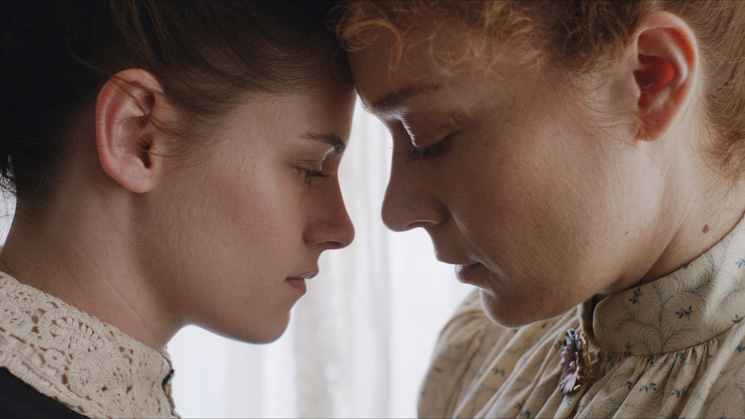
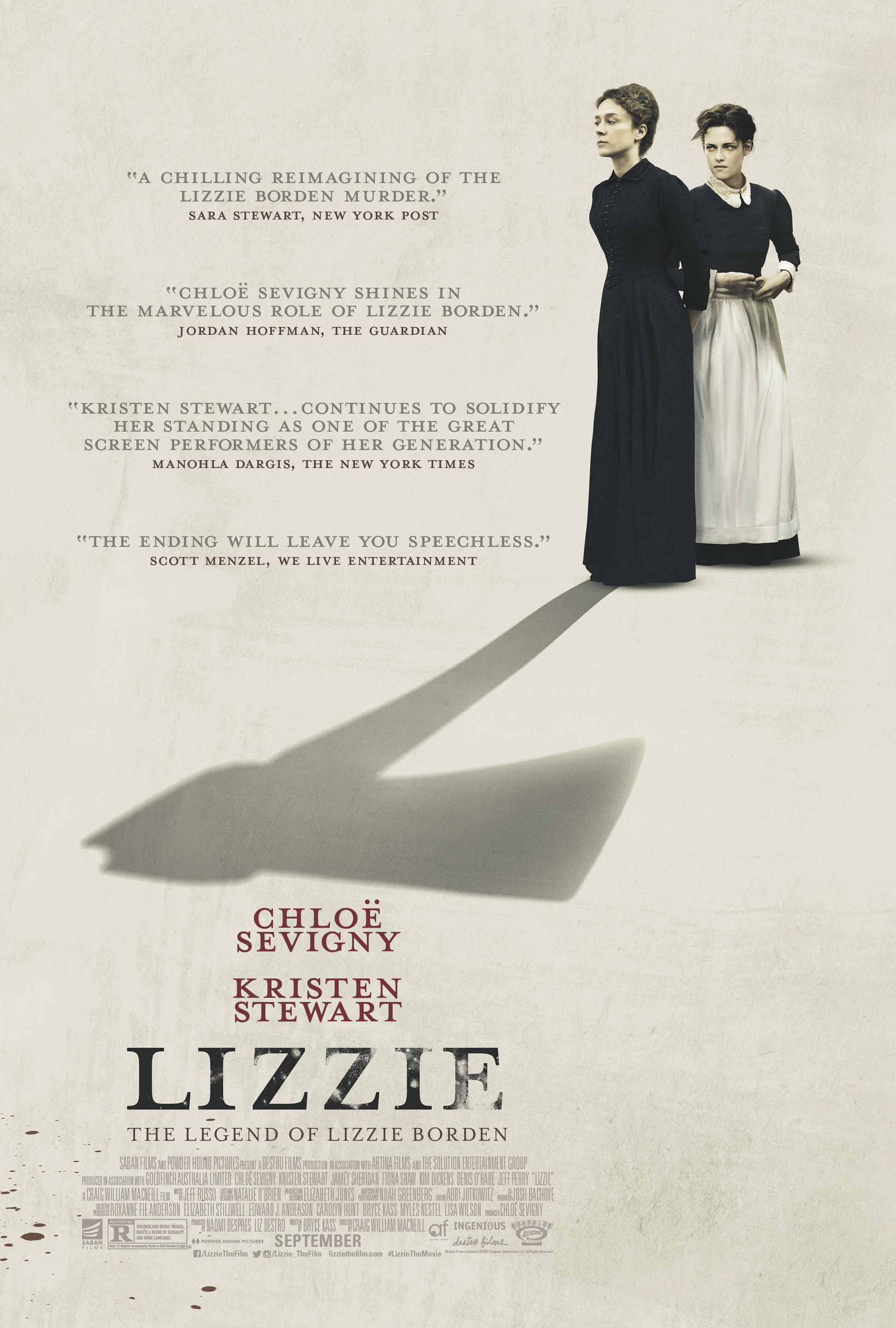
Fall River, Massachusetts, 1892. Lizzie Borden (Sevigny) is the youngest daughter of respected local businessman Andrew Borden (Sheridan). Unmarried at thirty-two, Lizzie is constantly at odds with her father over the way in which she conducts herself. She finds a supporter of sorts when her father engages a new servant, Bridget Sullivan (Stewart). Known as Maggie, Bridget and Lizzie develop a close bond just when Andrew begins receiving anonymous threats to his life. Consulting with his brother-in-law, John Morse (O’Hare), he alludes to a will that would see Morse inherit his estate if his wife, Abby (Shaw), were to pre-decease him. Lizzie overhears this conversation and decides to take matters into her own hands. Her actions lead to an outbreak of violent events within the Borden household, while at the same time, Lizzie and Bridget become lovers. Lizzie’s father discovers their relationship and forbids Lizzie from having anything to do with Bridget unless it is related to her role as a servant. And then on the morning of 4 August, Lizzie discovers that someone has killed her father…

Something of a cause célèbre even now, the murders of Andrew and Abby Borden have become the stuff of gory legend, spawning a famous rhyme (“Lizzie Borden took an axe…”), and maintaining a lurid fascination that is unlikely to dissipate anytime soon. Of course, the main problem with any re-telling of the story is that Lizzie was tried and acquitted of the murders, and no one else was ever accused (though Morse was viewed as a possible suspect for a while). With this in mind, any explanation for the murders must be conjecture only, and Bryce Kass’s chilly screenplay chooses to adopt the theory put forward by crime writer Ed McBain in 1984, that Lizzie killed her father and stepmother after her lesbian relationship with Bridget had been discovered. The issue of the will adds a further twist to the story, and seems as likely as any other reason, but the script approaches these theories as if they are fact, and any ambiguity is abandoned with the recreation of the Bordens’ deaths. Up until then, the movie has established an atmosphere of subdued yet inevitable violence that is almost suffocating; knowing what’s going to happen makes it all the worse. And when it does, it’s almost as cathartic for the viewer as it appears to be for Lizzie.

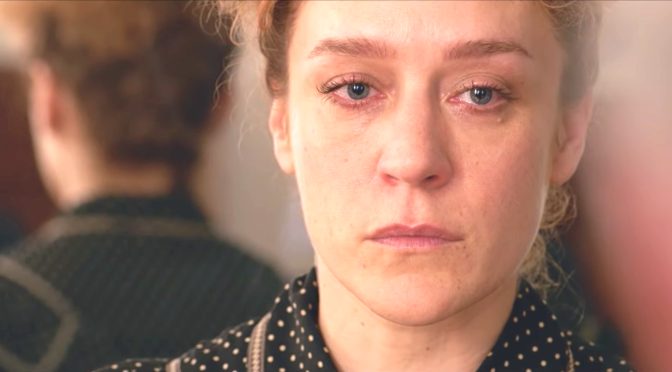
Lizzie is brought to life thanks to a wonderfully astute performance from Sevigny that highlights both the character’s rebellious nature and the deeper passions that she had to keep hidden. It’s an intelligent, well constructed portrayal that never falters in its conviction and which isn’t afraid to make Lizzie unsympathetic, as in the aftermath of the murders when she appears unperturbed (we see these scenes before we see the murders). Stewart has the more emotional role, and projects Bridget’s discomfort at the situation she finds herself in with empathy and compassion. There’s sterling support from Sheridan as the domineering Andrew Borden, and O’Hare is suitably nasty as the avaricious Morse, but Shaw and Dickens are left with precious little to do except when it suits the screenplay. Macneill directs with a keen understanding that Lizzie feels very much like a prisoner in her own home, and Noah Greenberg’s exemplary cinematography captures and expands on this idea through careful framing and extensive use of close ups. There are some minor issues with pacing as the movie introduces both the characters and the psychological backdrop to their behaviours, and the score by Jeff Russo doesn’t always complement the action, but overall this is an impressive, richly detailed recreation of two visceral, unsolved murders that continue to enthrall and captivate us over a hundred and twenty years on.

Rating: 8/10 – anchored by a sterling performance by Sevigny, and a palpable sense of impending dread, Lizzie is a subtle, yet powerful movie that explores what can happen when repressed emotions remain that way for too long; beginning as a perceptive character study before descending into startling, but necessary melodrama, it’s an intriguing, intelligently expressed piece that is confidently handled and often unflinching in its approach.

Share this:

  • Click to share on X (Opens in new window) X
  • Click to share on Facebook (Opens in new window) Facebook
  • More
  • Click to print (Opens in new window) Print
  • Click to email a link to a friend (Opens in new window) Email
Like Loading...

Black ’47 (2018)

29 Saturday Dec 2018

Posted by dullwood68 in Movies

≈ Leave a comment

Tags

Action, Drama, History, Hugo Weaving, Ireland, James Frecheville, Lance Daly, Review, Stephen Rea, The Great Famine, Thriller

D: Lance Daly / 100m

Cast: Hugo Weaving, James Frecheville, Stephen Rea, Freddie Fox, Barry Keoghan, Moe Dunford, Sarah Greene, Jim Broadbent, Dermot Crowley, Aidan McArdle

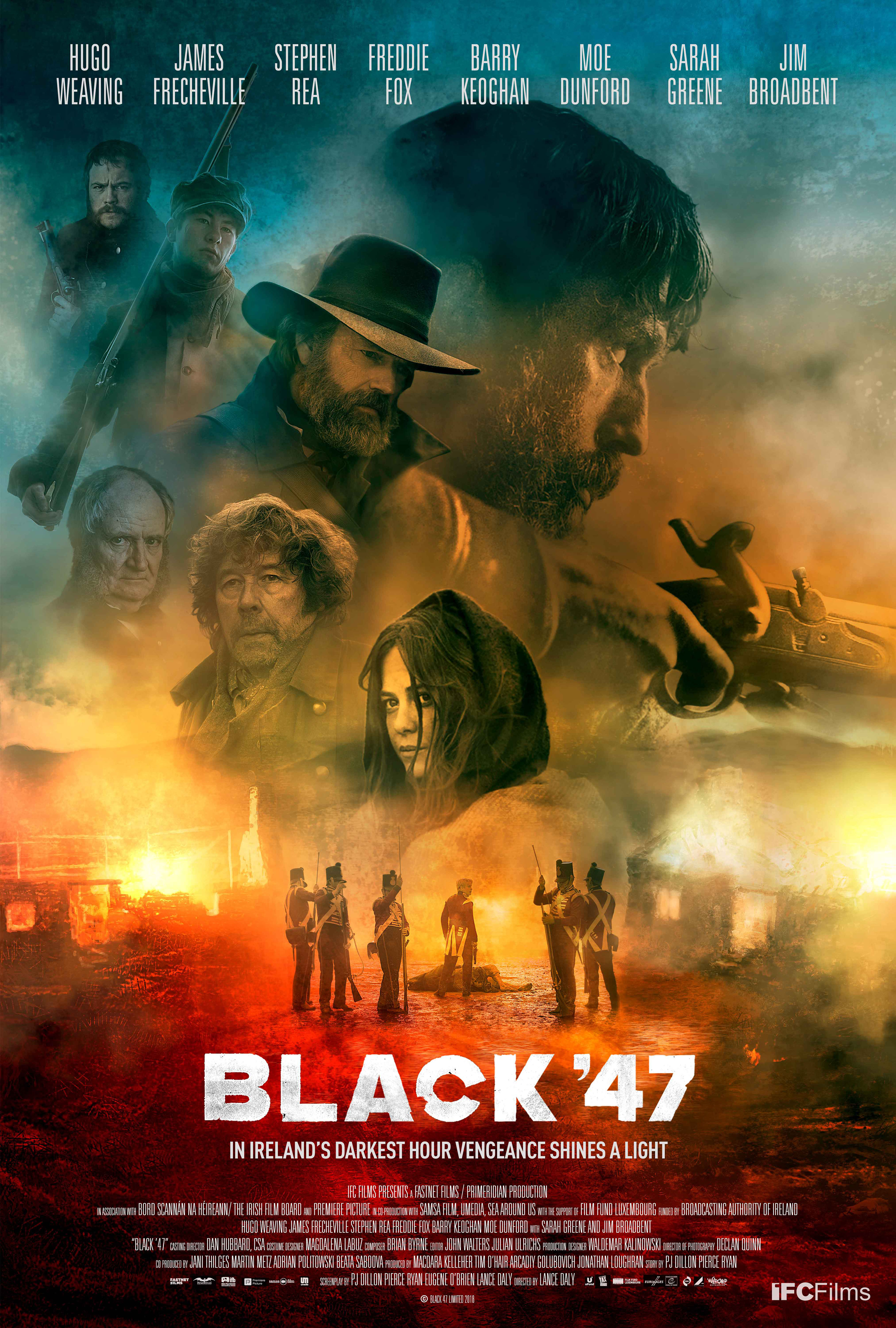
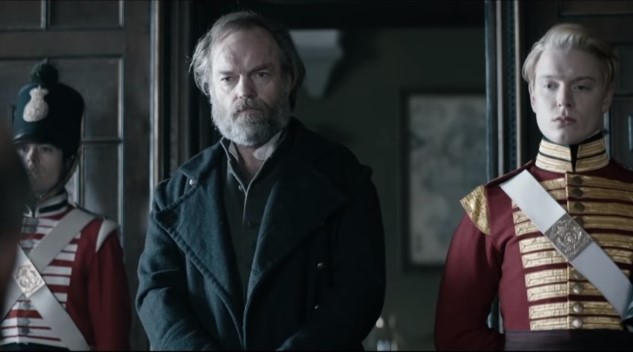
In 1847, Martin Feeney (Frecheville), an Irish ranger who has served in the English army, returns home to Connemara only to discover that his mother has died of starvation and his brother has been hanged for stabbing a bailiff while being evicted. Staying with his brother’s family, their own eviction from the property they’re squatting in, leads to the death of Martin’s nephew, and his arrest by the constabulary. Escaping from the barracks where he was being held, and burning it down in the process, Martin is targeted by the British authorities, and an up-and-coming lieutenant called Pope (Fox) is assigned to find and kill him. He’s aided by a veteran of the British Army called Hannah (Weaving), and a young English private called Hobson (Keoghan). While they attempt to track him down, Feeney goes on a revenge spree, beginning with the man who took advantage of his mother’s plight by purchasing her home after her eviction, to the judge (Crowley) who sentenced his brother to hang, and all the way to the biggest landlord in the area, Lord Kilmichael (Broadbent). And it’s not long before the paths of everyone involved come together…

Expanded from the short, An Ranger (2008), which was written and directed by P.J. Dillon (here one of four co-writers), Black ’47 explores a period in Irish history that hasn’t really been seen on the big screen before. The title refers to the worst year of a famine that lasted from 1845 to 1849, when as many as a million people died from starvation and disease brought about by a potato blight. Here the use of the Great Famine as the backdrop to a tale of violent, unmerciful revenge helps the narrative greatly, giving it an immediacy and power – and depth – that allows the movie to become more than just another exercise in morally doubtful vigilantism. The nature and the widespread effects of the famine can be seen in scene after scene, with communities decimated and starving families congregating in fields or at the side of the road because they no longer have homes, and work is unavailable. Feeney is an avenging angel, targeting the corrupt Irish officials who have opted to collude with the British, and the British authorities, whose arrogance and greed has led them to view the famine as an opportunity to make themselves richer by removing the labourers and farmers they never wanted on their lands in the first place.

By allowing the backdrop to become a big part of the movie’s foreground, director Lance Daly ensures that what’s at stake on a national level isn’t entirely forgotten, even if it’s not the movie’s primary focus. Feeney may be an Irishman with “a very particular set of skills” for the time, and he may be taciturn out of expediency, but he’s also someone who accepts that he can’t change anything; he’s just doing what he can. Frecheville is an imposing figure, his eyes glowering with suppressed rage, and he makes Feeney as much a victim as an avenger. Weaving adds a sense of melancholy to his role, making Hannah the most conflicted character of all thanks to a connection with Feeney that complicates things when they matter most. However, these characters, and Rea’s world-weary translator, are the only ones that have any meat on them (excuse the pun), and as a result, the script struggles to make their actions and motives entirely credible (Hobson has a mad moment of naïve idealism that is jarring thanks to its unlikely occurrence). Sometimes the politics is a little pedantic as well, but when it comes to Feeney exacting his revenge, the movie is on much firmer ground, and Daly provides viewers with a number of exciting, well staged – and brutal – action sequences. It’s not an entirely successful movie, but it is gripping, and for anyone who has seen An Ranger, yes, the pig is back.

Rating: 7/10 – though a markedly genre exercise (a Western) set against a grim historical backdrop, Black ’47 uses said backdrop as a way of adding depth and intensity to its otherwise generic main storyline; with starkly beautiful imagery thanks to DoP Declan Quinn (and this despite some very dodgy matte work), and equally impressive production design courtesy of Waldemar Kalinowski, this is a movie that tells its simple story in ways that help elevate the material, and make it a far more emotional experience than expected.

Share this:

  • Click to share on X (Opens in new window) X
  • Click to share on Facebook (Opens in new window) Facebook
  • More
  • Click to print (Opens in new window) Print
  • Click to email a link to a friend (Opens in new window) Email
Like Loading...

Cold War (2018)

28 Friday Dec 2018

Posted by dullwood68 in Movies

≈ Leave a comment

Tags

Drama, France, Joanna Kulig, Lukasz Zal, Music, Pawel Pawlikowski, Poland, Review, Romance, Tomasz Kot

Original title: Zimna wojna

D: Pawel Pawlikowski / 88m

Cast: Joanna Kulig, Tomasz Kot, Borys Szyc, Agata Kulesza, Cédric Kahn, Jeanne Balibar, Adam Woronowicz

In the wake of World War II, and with Poland trying to establish a new identity for itself under Communist rule, Wiktor (Kot) and Zula (Kulig) meet at the musical academy where he is one of the directors, and she is a pupil. The academy has been set up as a training ground for performing musicians tasked with spreading Communist propaganda, but despite all the rules and restrictions that prohibit any kind of relationship between them, Wiktor and Zula fall in love. While on a foreign tour, they grab the opportunity of escaping to the West, but their plan means travelling separately, something that leads to both of them making decisions that affect their reunion. When they are eventually reunited in Paris, they renew their love affair while Zula is approached to become a recording artist. Jealousy and distrust begin to undermine their love for each other, and Zula becomes unhappy with her life in France. Looking for a solution to her problems, Zula makes an independent decision that has a far-reaching impact on both her life, and Wiktor’s also…

With Ida (2013), writer/director Pawel Pawlikowski made good on the promise hinted at in the four movies he’d made up ’til then, and showed that he was a movie maker of extraordinary skill and talent. In case anyone thought that movie might be a flash in the pan, here’s Cold War to prove them wrong. Loosely based on the experiences of his own parents, Pawlikowski’s ode to the power and perseverance of love is an impressive, heart-wrenching experience that has flashes of profundity and a clarity of purpose that is outstanding. Everything about Cold War has a note of authenticity about it, from the opening recitations of Polish folk songs, to the austere functionality of the academy and its rural surroundings, to the smoky clubs and bars of late Fifties Paris, and the heady milieu that gave birth to the cultural and artistic explosion that was beginning to make itself felt. But looking and sounding even more authentic is the relationship between Wiktor and Zula, an incandescent, tender, desperate, imploring, fiery, all-consuming romance that can only be sustained in bursts before it tears them apart. Pawlikowski shows the pain and the anguish they feel, and also the need for each other that drives them on, their love prompting them to make sacrifices for each other that may appear foolish to others, but which are true expressions of the depth of their love.

As with Ida, Pawlikowski has chosen to shoot Cold War in black and white, and the decision is yet another reason why he’s such a skilled cinematic interpreter and technician. Working again with DoP Lukasz Zal, Pawlikowski ensures the movie is often breathtaking to look at, whether we’re looking at wintry rural Polish landscapes, or the interior of the garret apartment where Wiktor and Zula live in Paris. Individual frames and compositions leap out, but they’re always in service to the material, and never feel gratuitous. This visual flare is matched by the flawless choice of music that enhances and enthralls, whether it’s the aforementioned (and melancholy sounding) Polish folk songs, or the jazz breakouts, or even the unexpected use of Rock Around the Clock. Pawlikowski melds it all together with a singular ease, tying the characters’ moods and emotions to the music, and enhancing the narrative so much and so effectively that the movie winds up feeling like a lost Sixties New Wave classic being given a long overdue, big screen re-issue. Kulig and Kot give powerful, indelible performances, highlighting their characters’ strengths and shortcomings with equal measures of sympathy and persuasion, and Pawlikowski rounds it all up with a final shot (and line) that is so affecting it almost takes the breath away. It’s simple, and it’s audacious, and it sums up the movie completely.

Rating: 9/10 – a prime contender for best movie of 2018, Cold War is a passionate, beautifully shot tale that exceeds expectations at every turn, and which provides ample rewards for the interested viewer; with this and Ida, Pawlikowski seems to have found his oeuvre, and on this form if he wants to make further features in a similar fashion and/or vein, then he absolutely should be allowed to do so.

Share this:

  • Click to share on X (Opens in new window) X
  • Click to share on Facebook (Opens in new window) Facebook
  • More
  • Click to print (Opens in new window) Print
  • Click to email a link to a friend (Opens in new window) Email
Like Loading...

Holmes & Watson (2018) – Or, Time for Will Ferrell to Do Something Different

27 Thursday Dec 2018

Posted by dullwood68 in Movies

≈ Leave a comment

Tags

Comedy, Dr Watson, Etan Cohen, John C. Reilly, Moriarty, Parody, Queen Victoria, Rebecca Hall, Review, Sherlock Holmes, Will Ferrell

D: Etan Cohen / 90m

Cast: Will Ferrell, John C. Reilly, Rebecca Hall, Kelly Macdonald, Lauren Lipkus, Rob Brydon, Pam Ferris, Steve Coogan, Hugh Laurie, Ralph Fiennes

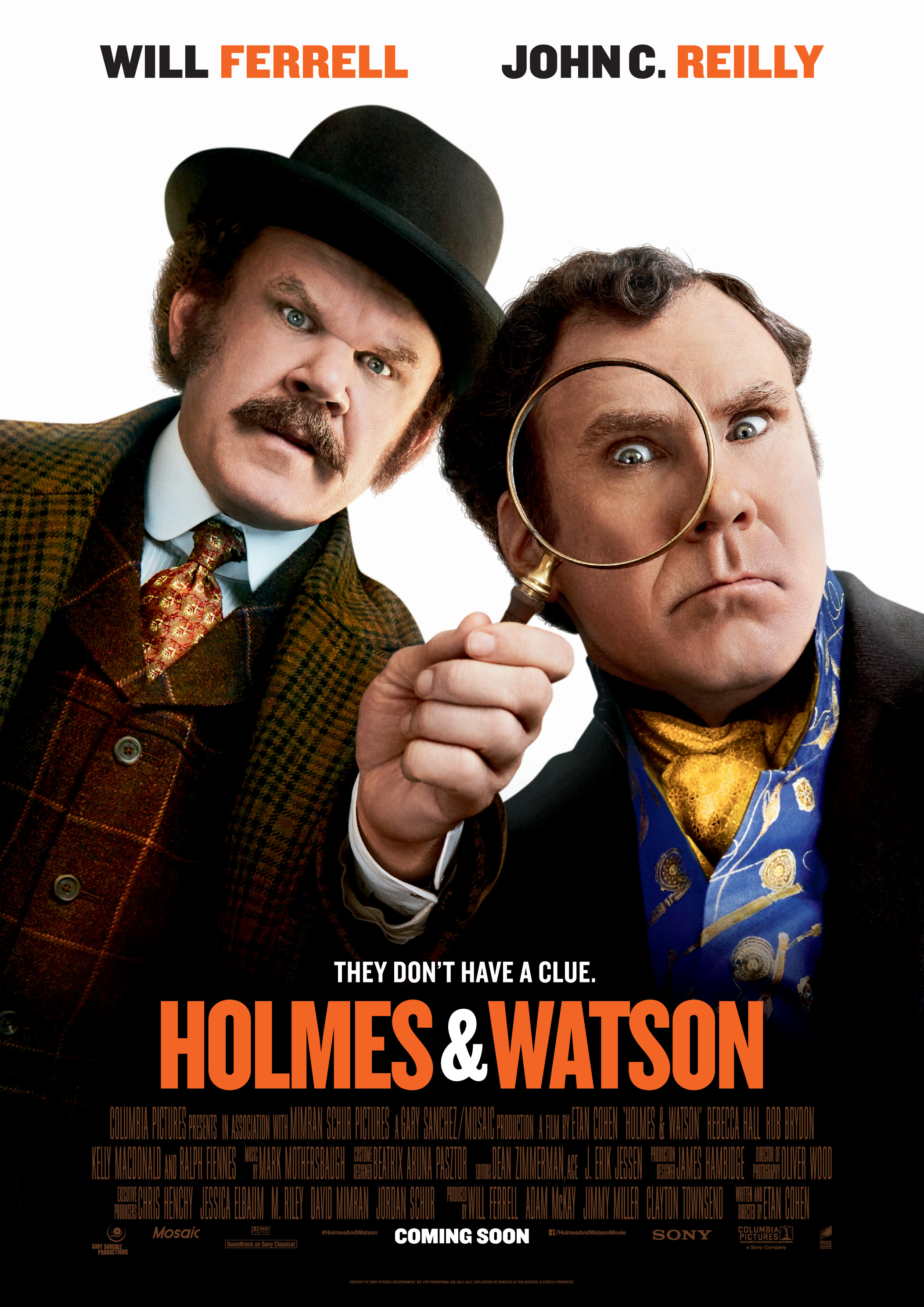
A score of 3.9 on IMDb. A score of 25 on Metacritic. A 6% rating on Rotten Tomatoes. All beg the question: is Holmes & Watson really that bad? The answer is unequivocal: yes, it is.

It’s not just bad, it’s abysmal. It’s sluggish, dull, uninspired, monotonous, vapid, unimaginative, feeble, pointless, moronic, inane, stupid, tedious, stale, lacklustre, incompetent, and worst of all for a supposed comedy, almost entirely laugh free. It’s a clear contender for worst movie of the year, something of a feat when 2018 has already given us the likes of Lake Placid: Legacy, The Nun, Mile 22, Supercon, and Proud Mary. This is a movie that is so awful you have to wonder if anyone was paying attention while they were making it, a piece of dreadful nonsense about a plot to kill Queen Victoria (Ferris) by Professor Moriarty (Fiennes) that is so lazy its climax takes place on RMS Titanic (Victoria was long dead by the time it launched in 1912). Writer/director Cohen brings absolutely nothing new to the idea of a Sherlock Holmes parody, and wastes the time and efforts of his very talented cast. A perfect example of Cohen’s approach is the moment when Holmes smears Watson in horse shit; a better metaphor for the movie as a whole couldn’t be more fitting.

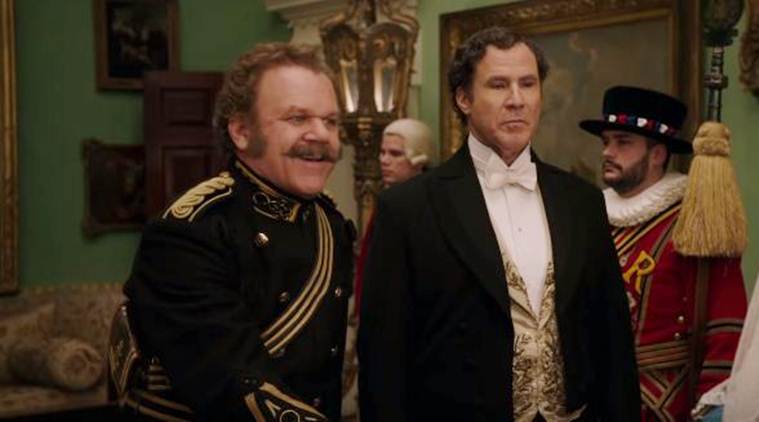
But more concerning perhaps than all of this is the performance of Will Ferrell. Someone really needs to take him to one side and tell him that his manic style of comic acting is wearing perilously thin these days. Shouting isn’t inherently funny, but Ferrell does this a lot, and when he isn’t shouting, he’s behaving in such an arch, mannered fashion that he just looks and sounds like he’s trying too hard, as if someone had told him that if he didn’t behave that way then the material – and his performance – wouldn’t be as effective. As a result, it’s hard to tell if Ferrell is afraid to try something different, or he’s just being lazy. Either way, he’s the movie’s weakest link, and he drags it down every time he opens his mouth or offers us another of his “hilarious” facial expressions (see above). Maybe it’s time for Ferrell to broaden his horizons and make more serious fare, and remind audiences that beneath his default man-child persona, there’s an actor with a greater range than portrayals such as Chazz Michael Michaels in Blades of Glory (2007) and James in Get Hard (2015) would seem to indicate. It’s not as if he hasn’t proved this already, with Stranger Than Fiction (2006) and Everything Must Go (2010), movies that showed he could do subtle and restrained, and find the truth in a character, rather than their inner idiot.

In the meantime we’re stuck with Holmes & Watson, a movie that sucks hard at the teat of comedy and comes away with the merest of dribbles to sustain its inept storyline, dire dialogue, and crass characterisations (you really have to feel for the likes of Fiennes and Hall, forced to standby as their credibility as serious actors is stripped from them with each passing moment they’re on screen). Cohen – whose first outing as a writer/director was the less than appropriately titled short, My Wife Is Retarded (2007) – displays a singular lack of ability behind the camera, cluttering up the frame, placing the camera where it has the least impact, and utilising close ups for dramatic purposes that only he can explain. Scenes connect haphazardly and awkwardly with each other, and Holmes’ leaps of intuition make about as much sense as why this farrago was made in the first place. This is the second movie of 2018 to feature John C. Reilly and Steve Coogan in its cast, and it’s instructive that this is markedly inferior to their other outing, the sublime Stan & Ollie. Now that really is a funny movie (take note, Will Ferrell).

Rating: 3/10 – saved from a 2/10 rating by virtue of its production design alone, Holmes & Watson is a terrible, dispiriting way to see out the year, and a firm reminder that Ferrell’s “schtick” is well past its sell-by date; when a “comedy” with such a talented cast is released straight to cinemas without the benefit of critics’ screenings beforehand then the warning signs couldn’t be more obvious, and the timing of its release near Xmas is entirely apt: it’s an enormous turkey.

Share this:

  • Click to share on X (Opens in new window) X
  • Click to share on Facebook (Opens in new window) Facebook
  • More
  • Click to print (Opens in new window) Print
  • Click to email a link to a friend (Opens in new window) Email
Like Loading...

British Classics: Love Actually (2003)

24 Monday Dec 2018

Posted by dullwood68 in Movies

≈ Leave a comment

Tags

Alan Rickman, Colin Firth, Comedy, Emma Thompson, Hugh Grant, Keira Knightley, Liam Neeson, London, Love, Provence, Review, Richard Curtis, Romance, Xmas

D: Richard Curtis / 135m

Cast: Rowan Atkinson, Thomas Brodie-Sangster, Chiwetel Ejiofor, Colin Firth, Gregor Fisher, Martin Freeman, Hugh Grant, Keira Knightley, Andrew Lincoln, Laura Linney, Heike Makatsch, Kris Marshall, Martine McCutcheon, Lúcia Moniz, Liam Neeson, Bill Nighy, Joanna Page, Alan Rickman, Rodrigo Santoro, Emma Thompson, Billy Bob Thornton

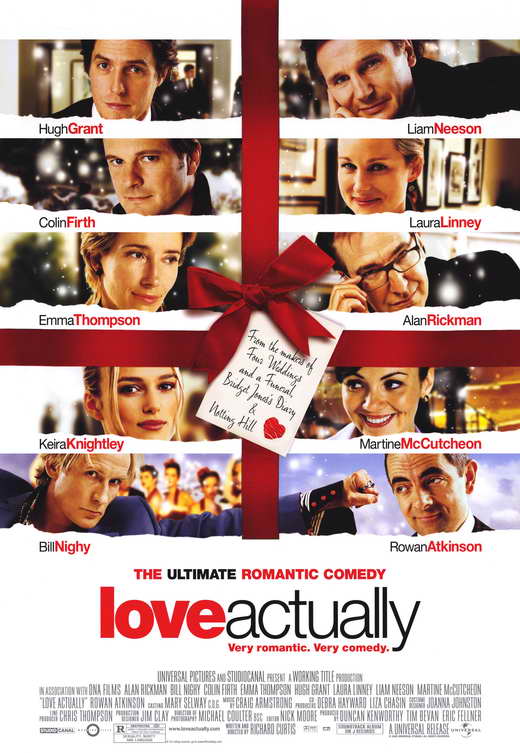
In the weeks leading up to Xmas, several friends and relatives who are all connected to each other find themselves dealing with love in (almost) all its various forms. David (Grant) is the newly elected Prime Minister who finds himself attracted to Natalie (McCutcheon), a junior member of the staff at 10 Downing Street. Mark (Lincoln) is the best friend of Peter (Ejiofor), who has just married Juliet (Knightley) – who Mark is secretly in love with. Writer Jamie (Firth), after being cheated on by his girlfriend, heads to Provence to write his latest novel, and falls in love with his housekeeper, Aurélia (Moniz). David’s sister, Karen (Thompson), begins to suspect that her husband, Harry (Rickman), is having an affair with someone at his work. Meanwhile, one of his other employees, Sarah (Linney), has feelings for her colleague, Karl (Santoro), but doesn’t know how to broach them. Daniel (Neeson), a friend of Karen’s, is a recent widower who’s stepson Sam (Brodie-Sangster) reveals his own life for a girl at his school. John (Freeman) and Judy (Page) are body doubles working on a movie, while Colin (Marshall) dreams of visiting the U.S. where he believes his being British will attract lots of women.

The glue that binds all these characters together, even more so than writer/director Richard Curtis’s excessive generosity in connecting them in the first place, is the character of Billy Mack (Nighy), an aging singer making a comeback with a cover version of The Troggs’ Love Is All Around, retitled Christmas Is All Around. Whenever the movie is spending time with the other characters, Billy is often there in the background, his cheesy monstrosity of a Xmas record and louche behaviour a much needed antidote to the surfeit of sentimentality and saccharine romanticism that peppers the narrative from start to finish. Even the less “happy” storylines – Harry and Karen, Sarah and Karl, Juliet and Mark – are bittersweet entries that are layered with poignancy and hopefulness. But that’s the point of the movie: it’s a positive message of love for everyone. Even if a marriage founders for a moment (Harry and Karen), or love is a case of wrong place, wrong time (Mark and Juliet), or even if it never gets off the ground at all (Sarah and Karl), all the clichés are in place: love will find a way, love is all you need, love conquers all… That Curtis holds it all together and still manages to make it work despite all the plot contrivances and rampant wish fulfillment that threaten to derail it several times over, is a testament to his confidence in the material.

Of course, he’s aided by an accomplished ensemble cast who rise to their individual challenges with gusto and no small amount of charm. Grant’s dance routine, Rickman’s hangdog expressions, Nighy’s inappropriate smirking – all of these character beats and more help to make the movie a feast of feelgood moments that linger like treasured memories long after it’s ended. Curtis may have laid on the romance with a trowel (sometimes it’s like being battered over the head with a dozen red roses), but this is a very, very funny movie with endlessly quotable lines (Colin: “Stateside I am Prince William without the weird family”), visual gags aplenty, and the ability to spring a number of clever narrative sleights of hand when you’re least expecting them. It’s an appealing, but unsophisticated slice of romantic fairy tale excess that’s bolstered by pin-sharp humour, terrific performances, and a refreshing awareness that it all takes place in a fantasy-based “reality” of Curtis’s devising (where else would the US President get such a public dressing down for his behaviour?). Fifteen years on, it remains a perennial favourite at Xmas, and despite an initial lack of enthusiasm on the part of critics, a movie that has transcended any criticism – deserved or otherwise – to become one of those rare movies that can be enjoyed over and over again, and which never seems to grow old or stale with repeated viewings.

Rating: 8/10 – a movie that tells nine separate stories and which does justice to all of them, Love Actually is a moving, thoughtful, and emotional look at love itself and what it means for a variety of people in a variety of situations and circumstances (though notably, not anyone who’s LGBT); comic and romantic in equal measure, it’s a movie you can fall in love with easily and unreservedly (and any movie that contains Jeanne Moreau in a blink-and-you’ll-miss-it cameo has got to be getting things more right than wrong).

Share this:

  • Click to share on X (Opens in new window) X
  • Click to share on Facebook (Opens in new window) Facebook
  • More
  • Click to print (Opens in new window) Print
  • Click to email a link to a friend (Opens in new window) Email
Like Loading...

1985 (2018)

23 Sunday Dec 2018

Posted by dullwood68 in Movies

≈ Leave a comment

Tags

AIDS, Cory Michael Smith, Drama, Homosexuality, Jamie Chung, Michael Chiklis, Review, Virginia Madsen, Xmas, Yen Tan

D: Yen Tan / 86m

Cast: Cory Michael Smith, Viriginia Madsen, Michael Chiklis, Jamie Chung, Aidan Langford

Returning home for the Xmas holidays after having been away for three years living and working in New York, Adrian (Smith) arrives back in Fort Worth, Texas with a number of misgivings. Adrian is a closeted homosexual, and his parents’ conservative Christian values are at odds with his sexual orientation, making his return a potentially difficult occasion. Appearing to be successful in his work at an advertising agency, but “too busy” to be in a relationship, Adrian seems a little bit adrift but assures his mother, Eileen (Madsen) and father Dale (Chiklis) that everything is okay. Reconnecting with an old friend, Carly (Chung), Adrian finds it just as hard to tell her what’s really going on in his life (which isn’t what he’s told his parents), and an evening spent with her ends in disaster. Matters are further complicated by an unexpected admission from his father, and Adrian’s own inability to be honest with himself. When Carly tells him she doesn’t want to lose him as a friend, Adrian finally reveals what he’s been wanting to say the whole time he’s been back, but hasn’t dared to because of the reaction he’s expecting…

Adapted and expanded from a short of the same name that writer/director Tan made in 2016, 1985 is set in that hysterical time period when AIDS was seen as an untreatable, ultra-contagious pandemic, and discrimination against homosexuals for carrying what was unfairly regarded as the “gay plague” was prevalent. Adrian’s situation was by no means unusual – many young gay men fled their conservative, judgmental small town communities for the anonymity of big cities – and his decision to return home “for one last time” speaks to the pressure that must have affected other young men who still yearned for the love and support of their families, even when it was unlikely to be given. Such are Adrian’s concerns when he arrives home. He has so much to tell them, but his father’s disdain for the work he does (Dale is blue collar through and through), his mother’s constant referrals to Carly (she’s a matchmaker, but is it through ignorance of her son’s sexual preference?), and the open antagonism of his younger brother, Andrew (Langford), for being away for so long, hinder matters, and Adrian avoids the inevitable fallout from making any confessions. Unable to settle his emotions due to the fear and paranoia that he feels both from being at home, and from what he has to return to in New York, it’s no wonder that Adrian feels lost and alone.

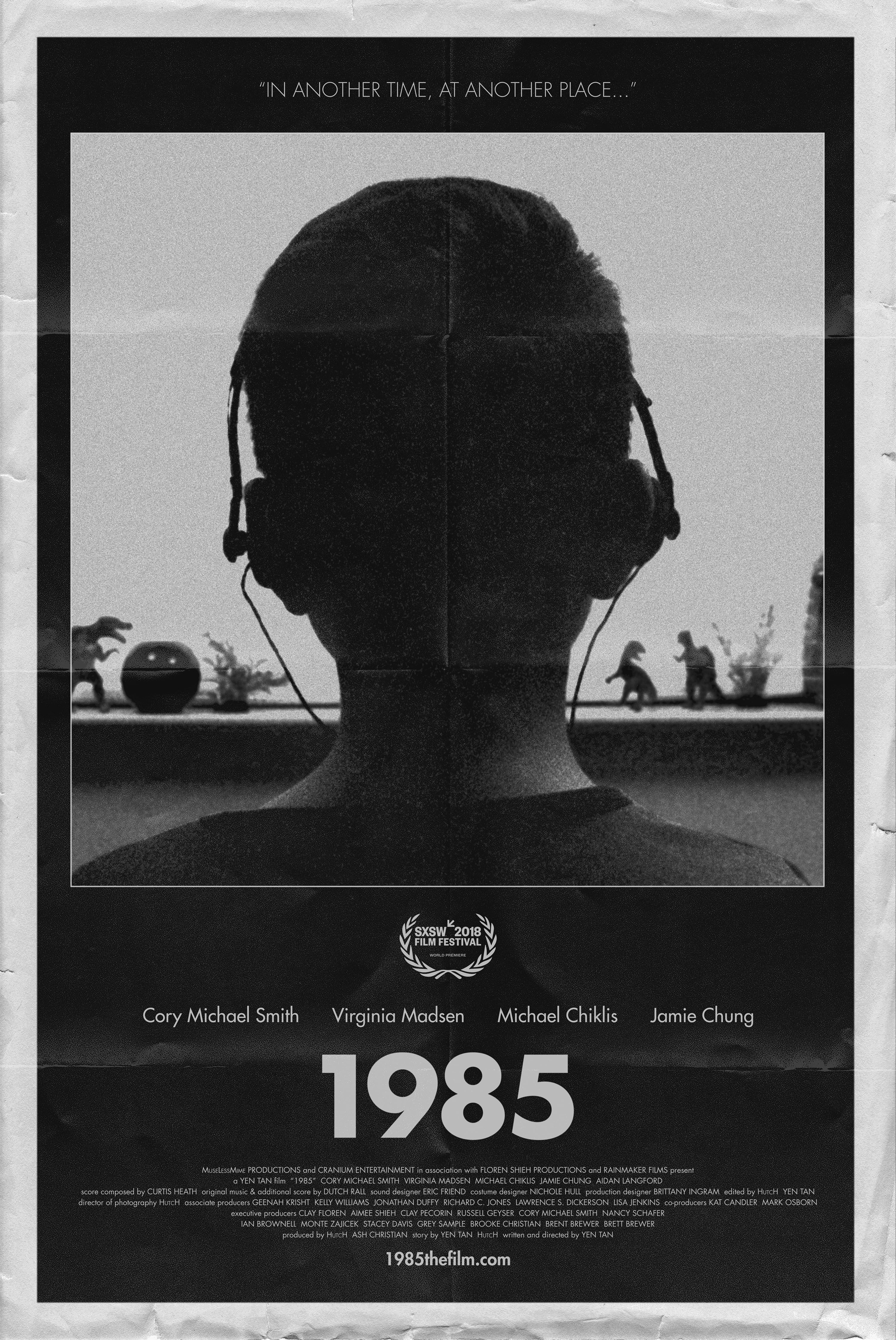
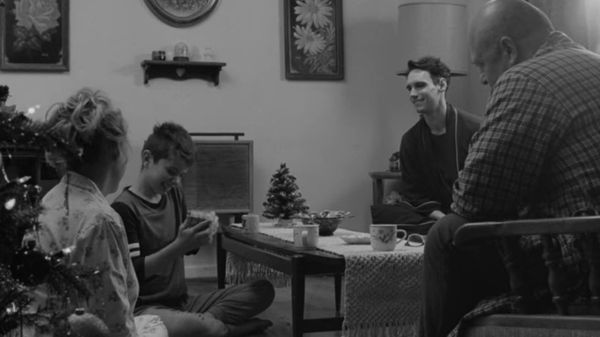
Tan makes all this look and sound as realistic and truthful as possible, and avoids any unnecessary melodramatics by ensuring that any emotional outbursts are kept to a minimum, and even then they’re as restrained as they can be without feeling muted. It’s the emotion that’s bubbling under the surface of Adrian’s need to be at home that matters, rather than any overt display that would feel out of place against Tan’s carefully assembled mise-en-scene. It’s also as much about Adrian coming to terms with his situation; only when he’s done that will he be ready to tell his family. It’s all rendered in grainy yet evocative black and white, with DoP HutcH using light and shadow to highlight the conflicting emotions felt by Adrian, and to emphasise the dark time that he’s going through. There are moments of quiet power, too, such as a shot of Eileen praying that makes her look beatific. In exploring both the period and the effects on individual AIDS sufferers during that period, Tan has assembled a movie that pays tribute to those who were unfortunate enough to succumb to the disease, and the struggle they had to be accepted by society. Adrian’s fate is left unresolved, so there is a degree of hope for him by the movie’s end, one that you can’t help but feel will bring him back for another Xmas… and maybe another one after that.

Rating: 9/10 – an exceptionally honest and at times, intentionally raw look at impending mortality and the need for reconciliation with those who matter most in your life, 1985 is a complex, sensitively handled drama that doesn’t skirt the issues it raises, and which doesn’t offer any easy solutions; with excellent performances from all concerned, and a claustrophobic atmosphere that fits well with the narrative and the movie’s visual design, this is deeply moving and beautifully observed.

Share this:

  • Click to share on X (Opens in new window) X
  • Click to share on Facebook (Opens in new window) Facebook
  • More
  • Click to print (Opens in new window) Print
  • Click to email a link to a friend (Opens in new window) Email
Like Loading...

Almost Christmas (2016)

22 Saturday Dec 2018

Posted by dullwood68 in Movies

≈ Leave a comment

Tags

Comedy, Danny Glover, David E. Talbert, Drama, Dysfunctional family, Gabrielle Union, Kimberly Elise, Mo'Nique, Review, Romany Malco, Xmas

D: David E. Talbert / 111m

Cast: Danny Glover, Gabrielle Union, Mo’Nique, Kimberly Elise, Romany Malco, J.B. Smoove, Jesse T. Usher, John Michael Higgins, Nicole Ari Parker, Omar Epps, Keri Hilson, DC Young Fly

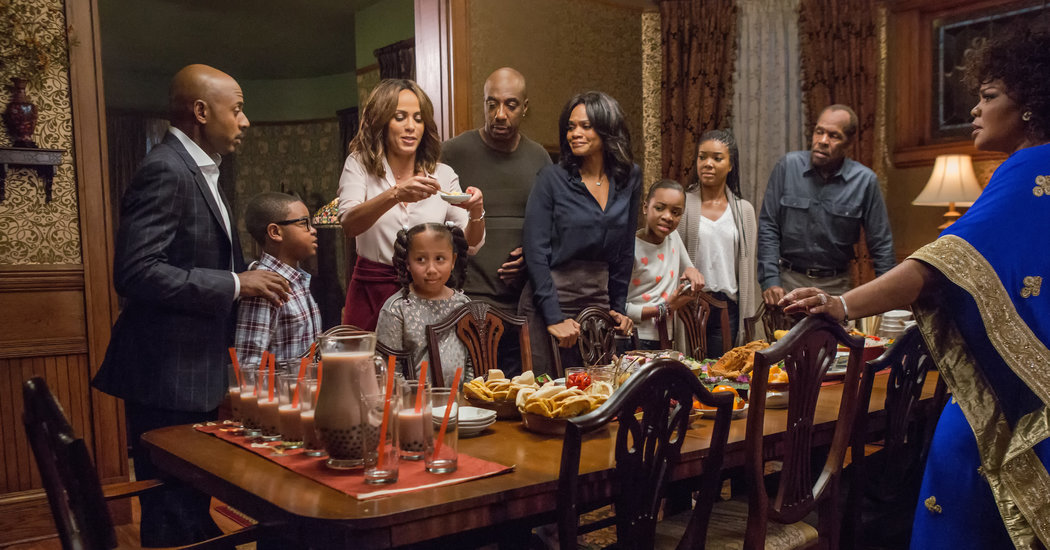
For Walter Meyers (Glover), it’s the first Xmas since the death of his wife, Grace. Determined to have the same traditional family get together that they always have, Walter invites his children and their partners and their children, and his sister-in-law, May (Mo’Nique), to spend the five days before Xmas with him. It should be a happy time for everyone, but his two daughters, Cheryl (Elise) and Rachel (Union) don’t get on, his eldest son, Christian (Malco), is wrapped up in running for Congress, and his youngest son, Evan (Usher), has an addiction to painkillers that no one is aware of. Animosities old and new soon take centre stage as Walter tries to rein in his family’s inability to get along for just five short days, while Cheryl’s husband, Lonnie (Smoove), does more than flirt with checkout girl, Jasmine (Hilson), and Christian’s involvement with a local planning issue threatens the homeless shelter that Grace and Walter supported their entire marriage. And that’s without Walter’s own plans to sell the family home, something he hasn’t mentioned to anyone…

Ah, the dysfunctional family. What would movie makers do without it, and especially at Xmas? (They’d probably have to invent it,) In writer/director David E. Talbert’s ode to the the highs and lows of Yuletide family arrangements, the Meyers family behave just like most large families, with some members still clinging on to long past upsets and disappointments as if they were freshly minted, with yet others in unfulfilling or strained relationships, and yet others trying to make sense of the lives they’re leading (while all of them are wondering where it all went wrong). None of the scenarios and storylines in Talbert’s screenplay, however, are particularly original, and even if you haven’t seen that many movies with a similar set up, there’s little here that will come as a surprise, except perhaps for Talbert’s laidback approach to the material, and how the search for easy laughs hampers the more dramatic elements (such is Talbert’s reliance on the tried and tested that Glover even gets to repeat his Lethal Weapon catchphrase, “I’m too old for this shit”). Audiences may feel the same way, as each sub-plot and scenario is worked through in the same formulaic way that dozens if not hundreds of other, similar movies have adopted before.

It’s a relief then, that the movie has the seasoned cast that it has, because without them, much of Talbert’s laboured screenplay would have stopped the movie from having any kind of impact at all. Glover is the patient patriarch who should really be banging some heads together, while Union and Smoove grab the lion’s share of the viewer’s attention by playing, respectively, the sister who’s still looking for a direction in her life, and the self-absorbed ex-basketball player whose head is easily turned by a pretty, young admirer. Stock characters they may be, but at least the cast know how to play them for maximum effect, even if that proves somewhat contradictory in practice. As a result, the movie is pleasant to watch, but in an undemanding fashion that allows the viewer to just sit back and let the movie do all the work, while the comedy is successful enough to warrant a few hearty guffaws here and there. Ultimately, it’s held together by good will and perseverance, and by a determination to do the best that it can, even if the odds are against it. And so, it’s like a lot of Xmas movies that feature a dysfunctional family: basically entertaining, but you wouldn’t want to repeat the experience.

Rating: 5/10 – with little to recommend it beyond the obvious, Almost Christmas is competent enough to hold the casual viewer’s interest – and not exactly a chore to watch – but it does what it does without attempting to be anything more effective; one to watch on a quiet Xmas Eve afternoon perhaps, but not one that is likely to be adopted as an annual Yuletide treat.

Share this:

  • Click to share on X (Opens in new window) X
  • Click to share on Facebook (Opens in new window) Facebook
  • More
  • Click to print (Opens in new window) Print
  • Click to email a link to a friend (Opens in new window) Email
Like Loading...

The Butterfly Tree (2017)

21 Friday Dec 2018

Posted by dullwood68 in Movies

≈ Leave a comment

Tags

Australia, Burlesque, Butterflies, Drama, Ed Oxenbould, Ewen Leslie, Fantasy, Grief, Melissa George, Priscilla Cameron, Review

D: Priscilla Cameron / 96m

Cast: Melissa George, Ewen Leslie, Ed Oxenbould, Sophie Lowe, Ella Jaz Macrokanis, Lauren Dillon, Paula Nazarski, Steve Nation

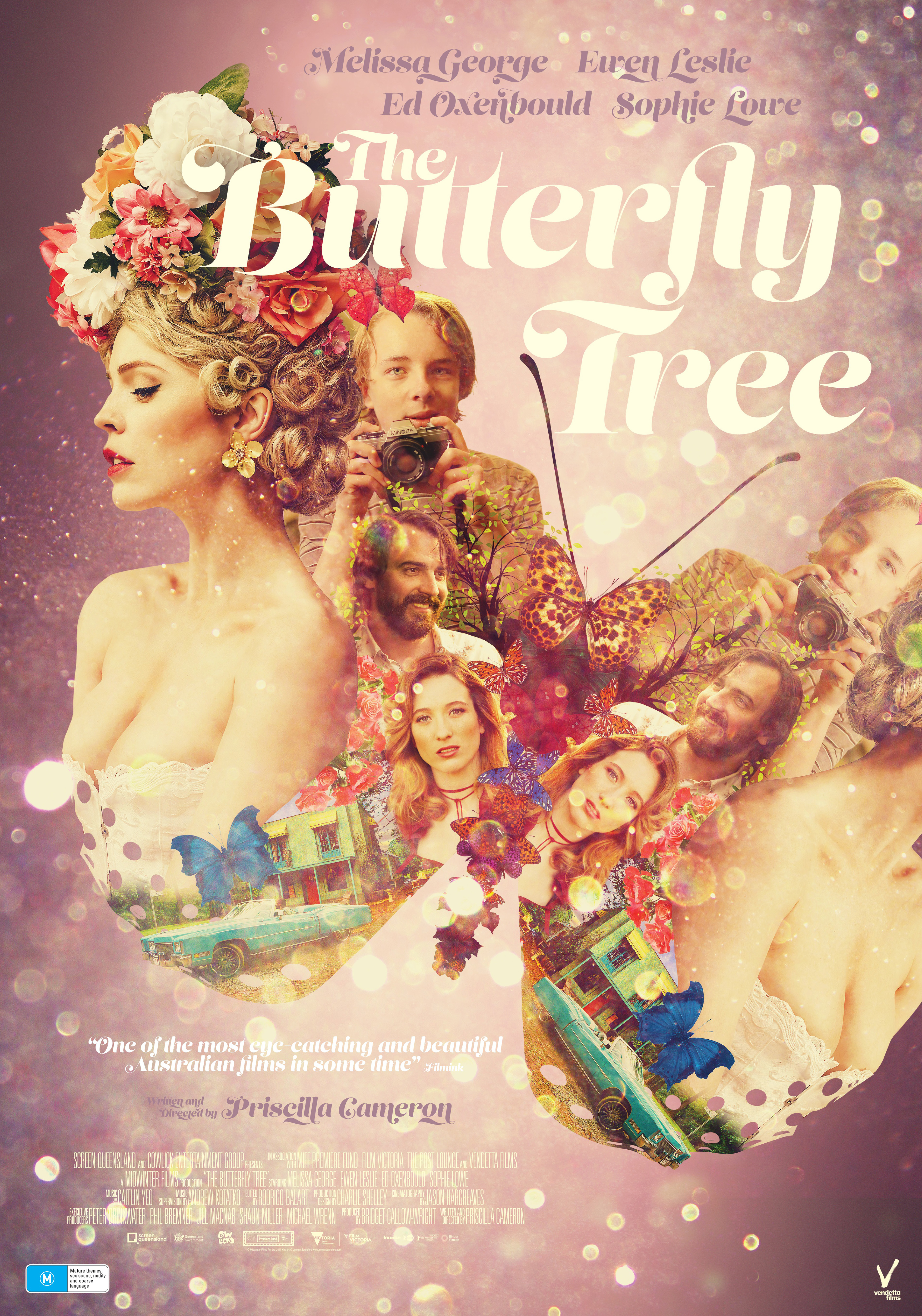
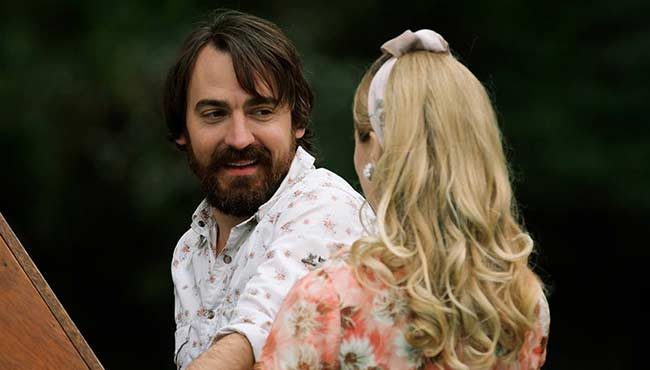
In a small Australian town, widowed father Al (Leslie) and his son, Fin (Oxenbould), are both struggling to deal with the recent death of Fin’s mother, Rose (Dillon). Al is a teacher at the local college who has sought comfort in a string of short-term physical relationships, and who is currently sleeping with one of his students, Shelley (Lowe). Fin has retreated into a fantasy world populated by butterflies and happy memories of his mother. Both in their own way are looking for a love to replace the one they’ve lost, and when retired burlesque dancer, Evelyn (George), opens a flower shop nearby, they soon fall under her spell. Fin becomes possessive of her, while Al believes a new, more long-lasting relationship is possible – once he can extricate himself from the persistent attentions of Shelley. But father and son soon find themselves at loggerheads over their attraction for Evelyn, and their antagonism towards each other escalates, bringing up painful memories of Rose’s passing, and at a time when Evelyn has her own problems to deal with, problems that she has kept from both of them…

Movies that deal with grief and longing are often melancholic and hard to watch. Seeing other people’s misery acted out in front of us isn’t something that’s likely to attract large audiences or much in the way of mainstream appeal. But there’s definitely a niche market for such movies, and any feature that tries to examine how we deal with the pain and grief of losing a close relative is to be applauded for venturing into territory that most people want to avoid. But though The Butterfly Tree is one of those less fearful movies, it’s also one that struggles to find a consistent identity as it tells its oh-so-sad story. It has an uneven mix of styles, from its poignant magical realist opening as Fin imagines himself surrounded and then transported by thousands of butterflies, to the arch comedy of Shelley’s blinkered pursuit of an unwilling Al, to the romantic possibilities created by both Al and Fin’s super-fast infatuations with Evelyn, and to the wistful, philosophical mood it aims for when Evelyn wittingly or unwittingly (you decide) helps with Fin’s infatuation. And that’s without the drama of Al and Fin going to war against each other, a war that’s sparked by teenage jealousy and cinema’s usual approach of ensuring that two characters avoid talking to each other.

With all these elements vying for our attention, writer/director Priscilla Cameron (making her feature debut) has trouble keeping them all in line, and it’s not long before you begin to wonder if perhaps this is a movie that has been improvised from start to finish, and not least with the dialogue, which often sounds awkward, and awkwardly phrased. The movie is at least often luminous to look at, thanks to Jason Hargreaves’ careful use of colour saturated photography, and Charlie Shelley’s evocative production design, which makes Evelyn’s heady, over-stylised home, itself a riot of competing colours and textures and sights, a visual delight. But all in all, this is a movie that seems content to flirt with many of the heavy-hitting themes it seeks to explore, and which signposts many of the twists and turns in its narrative, making it not just predictable, but laboured as well. There are good performances from George and Oxenbould, though Leslie is hampered by the script’s insistence that Al should not be able to confront Fin over his behaviour at any point (until it’s dramatically too late). And by the time Evelyn’s main problem comes to the fore and adds further gravitas to everything else, it’s a diversion that, like much else in the movie, fails to have any appreciable impact.

Rating: 5/10 – though clearly made with the best of intentions, The Butterfly Tree falls short of achieving its goals thanks to Cameron’s lack of focus, and a script that doesn’t want its characters to suffer too much; shot through with a hazy, quirky sensibility that hints at any meaning being up for grabs, it’s a movie that unfortunately frustrates more often than it impresses.

Share this:

  • Click to share on X (Opens in new window) X
  • Click to share on Facebook (Opens in new window) Facebook
  • More
  • Click to print (Opens in new window) Print
  • Click to email a link to a friend (Opens in new window) Email
Like Loading...

Time Share (2018)

20 Thursday Dec 2018

Posted by dullwood68 in Movies

≈ Leave a comment

Tags

Cassandra Ciangherotti, Drama, Everfields, Holiday resort, Luis Gerardo Méndez, Mexico, Miguel Rodarte, Montserrat Marañon, Mystery, Relationship problems, Review, Sebastián Hofmann

Original title: Tiempo compartido

D: Sebastián Hofmann / 96m

Cast: Luis Gerardo Méndez, Miguel Rodarte, Cassandra Ciangherotti, Montserrat Marañón, Andrés Almeida, Emiliano Rodriguez, RJ Mitte

For Pedro (Méndez) and Eva (Ciangherotti), a week’s vacation at an Everfields holiday resort with their young son, Raton (Rodriguez), is exactly what they need after a year spent recovering from a family tragedy. However, their plans for a relaxing holiday are ruined on the first night with the arrival of a family headed by Abel (Almeida) who have been booked into the same apartment as Pedro and Eva. Eva invites them to share the apartment (much to Pedro’s annoyance), and the two families find themselves spending all their time together. They even attend the time share sessions that the hotel has set up. Overseen by Tom (Mitte), an American Everfields executive, the sessions give one of the hotel staff, Gloria (Marañón), a chance to improve herself, but it’s at the expense of her marriage to Andres (Rodarte), who also works there, but who had a seizure five years before that caused some long-term physical effects. Believing that Gloria is being brainwashed by Everfields, he discovers just what they’ll do to sell a time share, while Pedro learns the hard way that his own marriage isn’t as good as he thought it was…

A Mexican-Dutch co-production, Time Share has a surfeit of good ideas that it can play around with, and it establishes an uneasy, eerie atmosphere from the start, with pre-seizure Andres blowing a whistle and then finding himself unable to stop while at the same time he becomes as rigid as a board. However, though those good ideas are brought into play quite often, and sometimes to very good effect – two encounters between Andres and a little boy are cleverly done – when they’re taken all together, there are too many awkward juxtapositions that interrupt the movie’s flow, and make it feel disjointed. The script – by director Hofmann and Julio Chavezmontes – wants to be an emotional drama about the effect of familial tragedy on couples who are still grieving, as well as a mystery (just what part of Everfields’ sales strategy is being withheld from potential customers?), and a thriller (a series of mishaps hint at something darker going on at the resort). That none of these approaches takes central stage fully is an indication that Hofmann and Chavezmontes didn’t themselves know which avenue to explore as a main narrative thread, and as a result, they all suffer in terms of impact.

The movie also doesn’t really know what to do with Pedro as a character. He has an arc of sorts, but it’s one that wouldn’t happen if it wasn’t for Andres’ timely intervention; otherwise he’s a lot like a petulant teenager: always moody, never satisfied, and frequently wishing he was elsewhere. He remains this way for much of the movie, and though Méndez does a fine job of articulating Pedro’s unhappiness, it’s not until very late on that Pedro becomes more than the one-dimensional protagonist he’s been up until then. Rodarte has better luck with Andres, using the character’s slowness of mind to appear methodical and determined, and sympathetic when Gloria and others use his slowness against him. Meanwhile, Marañón is very impressive as Gloria, infusing the character’s conversion to the “cult” of Everfields with a bitter desperation that is meant to give her renewed purpose after a personal loss, but which is clearly not working. In support of all the emotional brouhaha that Hofmann brings to matters, there’s sterling cinematography from Matias Penachino that includes a number of striking images, and the resort is given an appropriately second-hand, slightly rundown feel thanks to Claudio Ramirez Castelli’s production design.

Rating: 6/10 – while there’s much about Time Share that should work (and often it comes close to doing so), it’s ultimately a movie that develops only a few of the good ideas that it starts out with, while allowing many others to drift away from the narrative as if they’ve been forgotten about altogether; a mixed bag then, but worth a view for Marañón’s terrific performance, and those moments where Hofmann’s directorial intentions jibe perfectly with the demands of a script that is too wayward, too often to be consistently good or bad.

NOTE: The following trailer doesn’t have English subtitles, but it’s so well assembled that you’ll get a very good idea of what’s happening anyway.

Share this:

  • Click to share on X (Opens in new window) X
  • Click to share on Facebook (Opens in new window) Facebook
  • More
  • Click to print (Opens in new window) Print
  • Click to email a link to a friend (Opens in new window) Email
Like Loading...

A Look Back at 2018 (Part 1)

19 Wednesday Dec 2018

Posted by dullwood68 in Movies

≈ 2 Comments

Tags

2018, 9/10 rating, Debra Granik, Leave No Trace, Peter Jackson, Review, They Shall Not Grow Old

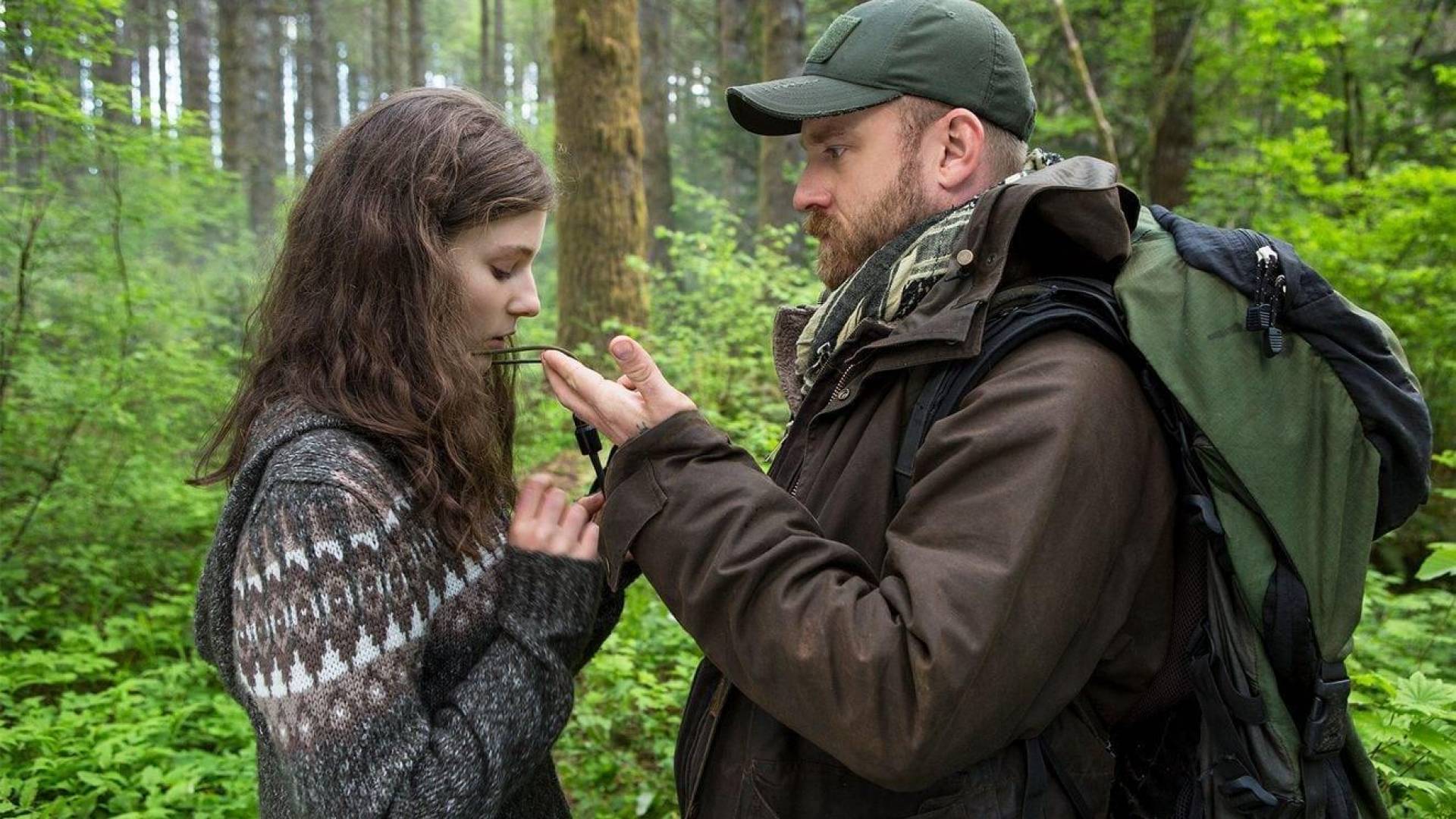
2018 has been a funny old year – not funny ha ha, however, real laughs have been thin on the ground during 2018 – as the first few months reflected on the strength of movies released during 2017, with late arrivals to the UK such as The Post, I, Tonya, Phantom Thread, and the Oscar-winning The Shape of Water. Otherwise, there was a dearth of good, new movies on our screens and our streaming services. As we moved into the spring, Marvel hit us with the double whammy of Black Panther and Avengers: Infinity War, the latter proving to be this year’s runaway box office success, with earnings of $2,048,187,730 at time of writing. But these behemoths aside, there was little to get excited about, and little in the way of promise for the latter half of the year. It wasn’t until July 6 that thedullwoodexperiment posted its first 9/10 movie review of 2018, Debra Granik’s tremendously moving and visually striking Leave No Trace. Back then it was something of an oasis in a sea of mediocre summer releases, and though Mission Impossible: Fallout bowed later that month and surprised pretty much everyone with how good it was (and garnered this site’s second 9/10 review), there still wasn’t much of a sense that the year would improve. Two movies do not a renaissance make (as it were).

Since the end of July, this site has awarded a 9/10 rating to only ten other 2018 movies so far this year, making a Top 10 for the year a little unnecessary, or indeed, facetious, though one movie did stand out from all the rest: Peter Jackson’s incredible reconstruction of both the lives of, and the footage depicting, the British men who fought during the First World War. They Shall Not Grow Old is an amazing blend of technological prowess, emotive imagery, and historical remembrance. No other movie had the emotional impact that this stunning documentary provided, and one of the most surprising aspects of its release was the way in which it was overlooked by UK movie magazines such as Empire, and even Sight & Sound (more focus was afforded Jackson’s involvement with Mortal Engines; how ironic is that?). The tide has begun to turn in the last couple of months, and with December heralding the arrival of a clutch of movies looking to be serious awards contenders over the next couple of months, the year has effectively rallied, and even Netflix, that paragon of haphazard programming, has outdone itself with the release of movies such as Orson Welles’ The Other Side of the Wind, and Alfonso Cuarón’s Roma. But while there’s a sense that there’s better still to come, for us here in the UK, any movies that fit that particular bill won’t be seen until 2019 (or at all in the case of the majority of foreign language movies), which does seem to leave 2018 a little bit stranded. An argument for same-day worldwide releases perhaps?

Share this:

  • Click to share on X (Opens in new window) X
  • Click to share on Facebook (Opens in new window) Facebook
  • More
  • Click to print (Opens in new window) Print
  • Click to email a link to a friend (Opens in new window) Email
Like Loading...

Stan & Ollie (2018)

18 Tuesday Dec 2018

Posted by dullwood68 in Movies

≈ Leave a comment

Tags

British tour, Comedy, Drama, John C. Reilly, Jon S. Baird, Laurel & Hardy, Nina Arianda, Review, Shirley Henderson, Steve Coogan

D: Jon S. Baird / 97m

Cast: Steve Coogan, John C. Reilly, Nina Arianda, Shirley Henderson, Danny Huston, Rufus Jones

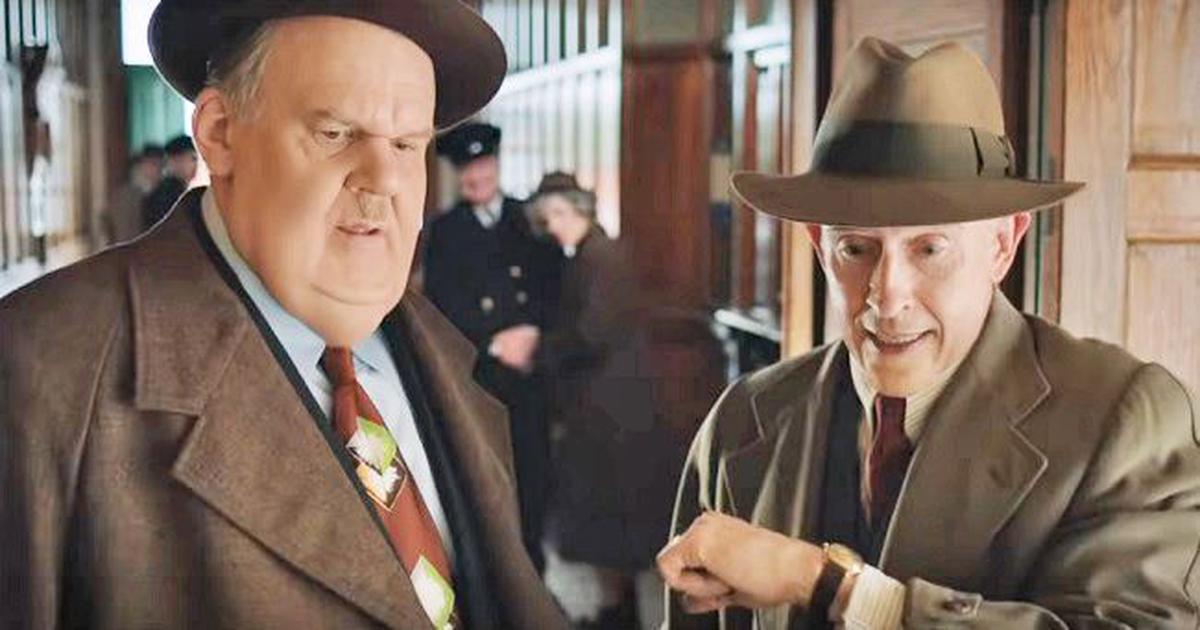
In 1937, Stan Laurel (Coogan) and Oliver Hardy (Reilly) are at the height of their fame: beloved the world over, they are in the midst of making their latest movie, Way Out West, when Stan’s determination to get them more money doesn’t go as well as he’d hoped. Sixteen years later, the duo are embarking on a British comedy tour, beginning in Newcastle. They’re playing small venues to small audiences under the guidance of impresario Bernard Delfont (Jones), and missing their wives, Ida (Arianda) and Lucille (Henderson). They’re also hoping to begin filming a new version of Robin Hood once the tour has finished, and Stan spends much of his spare time fine-tuning the script. As the tour progresses, the sales improve, and by the time they reach London, the tour is a critical and commercial success. But long held animosities begin to surface, and the pair have a falling out. With public appearances and further shows to be carried out, Stan and Ollie continue at loggerheads until Ollie is taken ill, and the rest of the tour is threatened. Stan is persuaded to carry on with an English comedian in place of Ollie, but Laurel and Cook just isn’t the same…

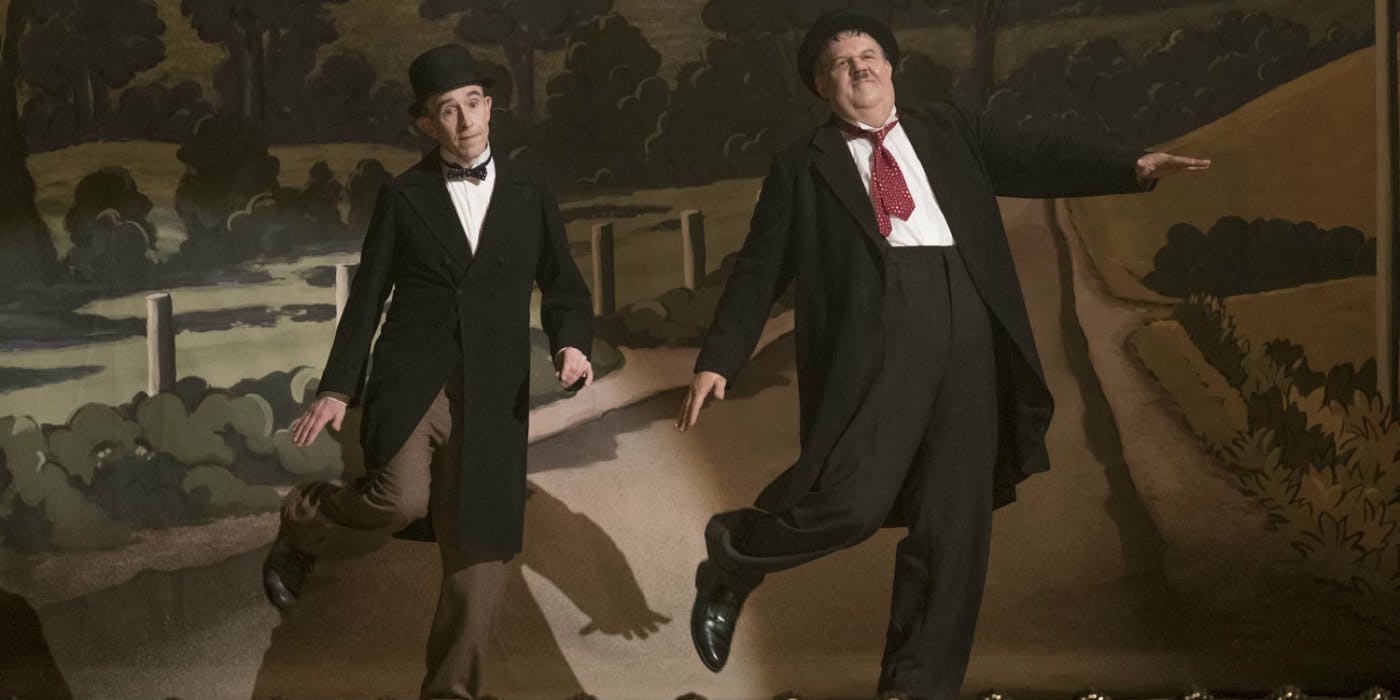
An entertaining, affectionate, and beautifully played tribute to the comedy genius of Stan Laurel and Oliver Hardy, Stan & Ollie offers fans of the duo a chance to revel in some of the best loved comedy routines ever created, and to share in the limelight they enjoyed for around forty years. The movie acknowledges that they had their personal ups and downs – Stan antagonising Hal Roach (Huston) and getting fired after Way Out West (effectively ending their success at the box office), Ollie going off and doing “the elephant picture” (1939’s Zenobia) – and it isn’t afraid to highlight just how often their professionalism kept them going during these periods. But through all the disagreements and the disappointments that followed in the wake of their severed ties from Roach, what shines through is the enduring, unassailable nature of their partnership. Jeff Pope’s nostalgic and emotionally redolent screenplay shows just how strong a bond the pair had, and through the exceptional performances of Coogan and Reilly, we see that bond expressed through shared moments of happiness and contentment where, whatever else is going on around them, they’re able to find solace and strength in each other.

So this is as much a love story as it is a fictionalised record of a British tour that didn’t include plans to make a Robin Hood movie (that occurred during their European tour of 1947), and which conflates several other incidents from the time. But for once, historical fidelity isn’t the issue, instead it’s about being true to the legacy of Laurel & Hardy, and the joy they brought to millions. As portrayed by Coogan, Stan is the restless creator, always thinking up new ideas, new jokes, or tinkering with old ones to make them better. Laurel’s facial expressions have kept impressionists in work for decades, and Coogan does an excellent job of recreating them, but there’s also heart and passion in his performance, and he perfectly captures the quiet melancholy beneath all the laughs. Reilly is also excellent as Ollie, consumed by a fat suit, but more than capable of relaying Hardy’s own doubts and concerns, while retaining his sense of joy and his surprising physicality. Though the illusion is dispelled in close ups, when viewed at a distance and when they’re replicating the pair’s routines, it’s almost as if a veil has been lifted, and for a moment, you can believe you’re seeing the real thing. Now that would have been truly wonderful…

Rating: 9/10 – a moving, delightful, and above all, joyous celebration of Laurel & Hardy’s unique personal and professional relationships, Stan & Ollie could be accused of lacking depth, but as a snapshot of a surprisingly successful period in the duo’s lives it’s winning stuff, and packed with charm; with a number of classic L&H routines on display, and terrific supporting performances from Arianda and Henderson (sometimes they’re funnier than Stan and Ollie themselves), this is Baird’s best movie to date, and for fans, an absolute delight.

Share this:

  • Click to share on X (Opens in new window) X
  • Click to share on Facebook (Opens in new window) Facebook
  • More
  • Click to print (Opens in new window) Print
  • Click to email a link to a friend (Opens in new window) Email
Like Loading...

Outside In (2017)

17 Monday Dec 2018

Posted by dullwood68 in Movies

≈ Leave a comment

Tags

Drama, Edie Falco, Granite Falls, Indie movie, Jay Duplass, Kaitlyn Dever, Lynn Shelton, Murder, Parole, Review, Romance

D: Lynn Shelton / 109m

Cast: Edie Falco, Jay Duplass, Kaitlyn Dever, Ben Schwartz, Charles Leggett, Eryn Rea, Matt Molloy, Pamela Reed

After spending the last twenty years in prison for murder, Chris (Duplass) is paroled and returns to his home town of Granite Falls. At a surprise party given by his brother, Ted (Schwartz), Chris reunites with Carol (Falco), one of his high school teachers and the person whose efforts have helped gain his release. Later, Carol begins to realise that Chris has a crush on her, something that is confirmed when he kisses her outside her home and declares his love for her. Carol insists they can only be friends, but even that proves difficult, as when he and Carol do begin to spend time together, it’s in the company of Carol’s teenage daughter, Hildy (Dever). While Carol does her best to put some distance between them, Hildy becomes interested in Chris and begins to hang out with him. But though he and Hildy get on, Chris still hopes to be with Carol, and convinces her to spend the day with him as a kind of final, one off experience that would allow him to move on. But while the day goes better than they could have hoped for, the following day sees things begin to go badly wrong…

Featuring an original screenplay by director Shelton and star Duplass, Outside In is a subtle, elegantly paced drama that explores the emotional vicissitudes of two people whose close bond has been developed over years in which they have only been able to exchange their ideas and feelings through letters. How much longing would build up over all that time, the movie asks, and how would someone deal with the inevitable pressure of expectation that would bring? Well, for Chris it’s easy: he blurts out his feelings as if it were the simplest thing in the world to do. But for Carol, the pressure she feels is different. Married – though to an indifferent husband (Leggett) – and with a daughter who is trying to deal with her own issues, Carol’s feelings for Chris are tempered by responsibility and their inappropriate nature. While Chris persists in his attentions, Carol feels the weight of her own expectations slowly eroding her will to say no. And though there are no prizes for guessing how things will turn out on their day together, Shelton and Duplass’s sympathetic and revealing screenplay ensures that what follows isn’t as easily deciphered.

The movie is anchored by two terrific central performances. Falco offers a quietly devastating portrayal of a middle-aged woman who is only now beginning to realise just how much she’s settled for in her life. As she struggles with her feelings for Chris, Carol’s inner torment is perfectly expressed by Falco, and the depth of her feelings, and the crisis it’s causing her is beautifully rendered. Just as good, but in a different fashion, Duplass plays Chris as a thirty-eight year old man suffering from arrested development, still the eighteen year old he was when he went to jail, and still viewing much of life through the eyes of a teenager. That he’s not fully aware of this should be tragic, but Chris is so good-natured and kind that it counts almost as a blessing, and Duplass uses the character’s naïvete to good effect. This is a movie that is decisive and impactful in equal measure, and in service to a story that builds momentum while avoiding many of the clichés that you might expect from yet another “small-town story”. Shelton has made perhaps her best movie yet, and the whole thing is given a further boost thanks to a lovely, wistful, engaging soundtrack courtesy of Andrew Bird.

Rating: 8/10 – full of quiet, tender moments that carry an unexpected emotional wallop, Outside In is a beautifully crafted and shot movie (by Nathan M. Miller) that takes its time in developing both the main storyline and the inner lives of its two central characters; a movie about hope and longing, and how there are many, different kinds of imprisonment, the latest from the prolific Duplass brothers reconfirms that when it comes to small scale indie dramas, they’re still in a league of their own.

Share this:

  • Click to share on X (Opens in new window) X
  • Click to share on Facebook (Opens in new window) Facebook
  • More
  • Click to print (Opens in new window) Print
  • Click to email a link to a friend (Opens in new window) Email
Like Loading...

The Hate U Give (2018)

16 Sunday Dec 2018

Posted by dullwood68 in Movies

≈ 1 Comment

Tags

Algee Smith, Amandla Stenberg, Anthony Mackie, Drama, Garden Heights, George Tillman Jr, Literary adaptation, Police shooting, Racism, Regina Hall, Review, Russell Hornsby

D: George Tillman Jr / 128m

Cast: Amandla Stenberg, Regina Hall, Russell Hornsby, Anthony Mackie, Algee Smith, Issa Rae, K.J. Apa, Lamar Johnson, Sabrina Carpenter, Dominique Fishback, Megan Lawless, Common

Starr Carter (Stenberg) is a sixteen year old black girl living in a predominantly black neighbourhood – Garden Heights – but who attends a predominantly white prep school, Williamson. One night, while at a party, she reconnects with a childhood friend, Khalil (Smith). Later, as Khalil takes her home, they’re pulled over by a white police officer, who insists Khalil gets out of the car. When Khalil reaches into the car for a hairbrush, the officer thinks he’s going for a gun, and reacts by shooting Khalil dead. The shooting causes a local outcry, but Starr’s involvement is kept a secret, even from her best friends (Carpenter, Lawless) at Williamson, and her white boyfriend, Chris (Apa). But as racial tensions increase, and Starr is required to testify before a grand jury, matters are further complicated by the attentions of local gang leader, King (Mackie), who doesn’t want Starr saying anything about Khalil selling drugs for him. Torn between keeping quiet and not putting herself or her family at risk, and honouring Khalil’s memory, Starr must find the courage to chart a course that ensures she does the right thing…

A contentious and powerful adaptation of the novel by Angie Thomas, The Hate U Give doesn’t shy away from tackling some pretty serious issues, and does so in spite of its YA backdrop, proving that the genre can address issues beyond dystopian futures and awkward romantic entanglements. And while the continuing effects of cultural and political racism are front and centre, the movie also delves into topics such as social deprivation (Garden Heights isn’t exactly an affluent neighbourhood), peer pressure, police accountability, gang culture, cultural appropriation, and political activism. It’s a heady brew, and as such, a challenge for any one movie to assimilate without running the risk of minimising the impact or importance of any one aspect at the expense of the others. But Audrey Wells’ screenplay is one of the best literary adaptations of recent years, and it addresses each issue succinctly and with a great deal of care, and ensures that the viewer understands the effects that each issue has on the characters. Whether it’s the injustice felt by a community that has already seen too many people die unnecessarily, or Starr’s increasing unhappiness at the way her friends behave as “black” because it’s “cool”, the movie refuses to treat these issues lightly, or inappropriately (as the kids at Williamson do).

With the script locked in, it’s left to the performances to amplify the importance of the issues the movie explores. As Starr, Stenberg gives one of the best performances of the year, courageously tackling her role head on, and always finding the emotional truth in any given scene. It’s such a mature portrayal, so nuanced and impressive, that on the rare occasions Starr isn’t the focus of a scene, you can’t wait to have her back. There’s fine support from Hall and Hornsby, and Smith proves that his break-out performance in Detroit (2017) wasn’t a flash in the pan. Tillman Jr has assembled a powerful, hard-hitting movie, but despite the quality of Wells’ script and the quality of the performances, it’s a movie that is often more effective in its quieter moments than when it seeks to escalate the tensions inherent within it. A protest march that descends into violence feels timid in relation to the emotions it’s engendered, while the sequence where Starr and Seven are trapped in their father’s burning store is over before any real threat to their lives can be allowed to create any tension. Minor bumps in the road such as these, however, do serve to distract from the good work the rest of the movie revels in, and as they come in the last half hour, unfortunately they undermine some of what’s gone before. But even so, this remains an intense and vigorous exploration of issues that rarely get addressed with this much clarity and confidence.

Rating: 8/10 – despite a few narrative leaps and bounds designed to wrap things up more quickly than necessary, and a few soap opera moments that always feel out of place, The Hate U Give is a vivid, potent examination of America’s continuing racial divide; with its superb central performance, and its ability to tackle complex issues without resorting to being dogmatic or condescending, it’s a significant reminder – as if it has to be said – that all lives matter.

Share this:

  • Click to share on X (Opens in new window) X
  • Click to share on Facebook (Opens in new window) Facebook
  • More
  • Click to print (Opens in new window) Print
  • Click to email a link to a friend (Opens in new window) Email
Like Loading...

The Escape (2017)

15 Saturday Dec 2018

Posted by dullwood68 in Movies

≈ Leave a comment

Tags

Art, Depression, Dominic Cooper, Dominic Savage, Drama, Gemma Arterton, Marital problems, Paris, Review, The Lady and the Unicorn

D: Dominic Savage / 101m

Cast: Gemma Arterton, Dominic Cooper, Jalil Lespert, Frances Barber, Marthe Keller

Tara (Arterton) is a young, stay-at-home wife and mother. Her husband, Mark (Cooper), works long hours, while their two young children, Teddy and Florrie, are of school age but still young enough that they prove a constant source of struggle for Tara as she tries to deal with their beahviours. She is unhappy in the marriage, particularly with Mark’s constant need for sex, which she finds distressing (though he doesn’t know this). When she finally begins to express her unhappiness, Mark is confused, and tries his best to be more supportive, but when Tara puts forward the idea of taking art classes, his support wavers at the first mention. Things come to a head one day when Mark castigates her for being clumsy; Tara packs a bag and leaves right then. She travels to Paris to see a series of tapestries titled The Lady and the Unicorn (the source of her desire to start art classes), and to begin a new life free from the stifling constraints of marriage and motherhood. At the museum she meets a Frenchman, Phillipe (Lespert), and they strike up a friendship, but what seems to be a much needed turning point in Tara’s life, instead brings more problems…

The story of an unhappy woman looking for both meaning and satisfaction in her life, The Escape is a sombre, emotionally redolent drama that isn’t afraid to explore the dark side of being a wife and mother. At one point, Tara confesses that she doesn’t care about her children – at all – and she knows they hate her. It’s a startling admission, relayed in a low-key, subdued manner by Arterton, but exactly the kind of transgressive admission that mothers aren’t supposed to make. This reflection of the depth of Tara’s misery is the movie’s key revelation, the heart of what ails her (if you prefer), and once that particular genie is out of the bottle, it’s obvious that it can’t be put back. Tara will flee the nest she’s built but now detests, and she’ll seek to give her life a renewed purpose. Is she genuinely unhappy with her life? Has she genuinely fallen out of love with Mark? Is she depressed, or suffering from some other form of mental illness? The screenplay (by the director) doesn’t clarify matters – and deliberately so. Tara can’t fully articulate her distress herself, and Savage uses this as a way of holding things back from the viewer. But it’s this that proves the movie’s undoing.

We never get to know what has brought Tara to this point in her life, and why she feels so unhappy. And when she reaches Paris, her initial pleasure at being there soon dissipates once her liaison with Phillipe takes a more serious turn than expected. This section of the movie is the least effective, with Tara’s motivations lacking full credibility, and a brief scene featuring Keller appearing to have been thrown in just to provide a resolution to Tara’s time in Paris. Through it all, Tara remains an emotional enigma, and despite a tremendous performance from Arterton, it’s hard to fathom entirely what’s going on in her head, and why. More successful is Cooper’s distraught husband, unable to fathom why his marriage is falling apart, and without the skills to deal with Tara’s unhappiness. As his efforts to save their relationship fail at every turn, Mark becomes a source of profound pity, and more so than Tara. Cooper and Arterton are great together, and the movie is all the better for the scenes they share, while Lespert’s amiable Frenchman is given short shrift by Savage’s decision to handicap the character in a way that he doesn’t with Tara. The end is deliberately elliptical, and seems to hint at Tara being stuck in the same depressive mind-set as at the beginning – which if true, hints at a broader meaning to events, but one that hasn’t been made clear.

Rating: 6/10 – sterling performances from Arterton and Cooper add lustre to a movie that is much more successful as an exploration of a marriage in freefall, than as an examination of a woman’s need to feel fulfilled; with its writer/director taking a broader approach to the latter theme, The Escape ultimately feels disingenuous once it reaches Paris, and the movie never recovers from its change of scenery and narrative opacity.

Share this:

  • Click to share on X (Opens in new window) X
  • Click to share on Facebook (Opens in new window) Facebook
  • More
  • Click to print (Opens in new window) Print
  • Click to email a link to a friend (Opens in new window) Email
Like Loading...

Come Sunday (2018)

14 Friday Dec 2018

Posted by dullwood68 in Movies

≈ Leave a comment

Tags

Carlton Pearson, Chiwetel Ejiofor, Condola Rashad, Drama, Heresy, Jason Segel, Joshua Marston, Lakeith Stanfield, Religion, Review, True story, Tulsa, Universal reconciliation

D: Joshua Marston / 105m

Cast: Chiwetel Ejiofor, Jason Segel, Condola Rashad, Lakeith Stanfield, Martin Sheen, Stacey Sargeant, Danny Glover, Vondie Curtis-Hall, Ric Reitz

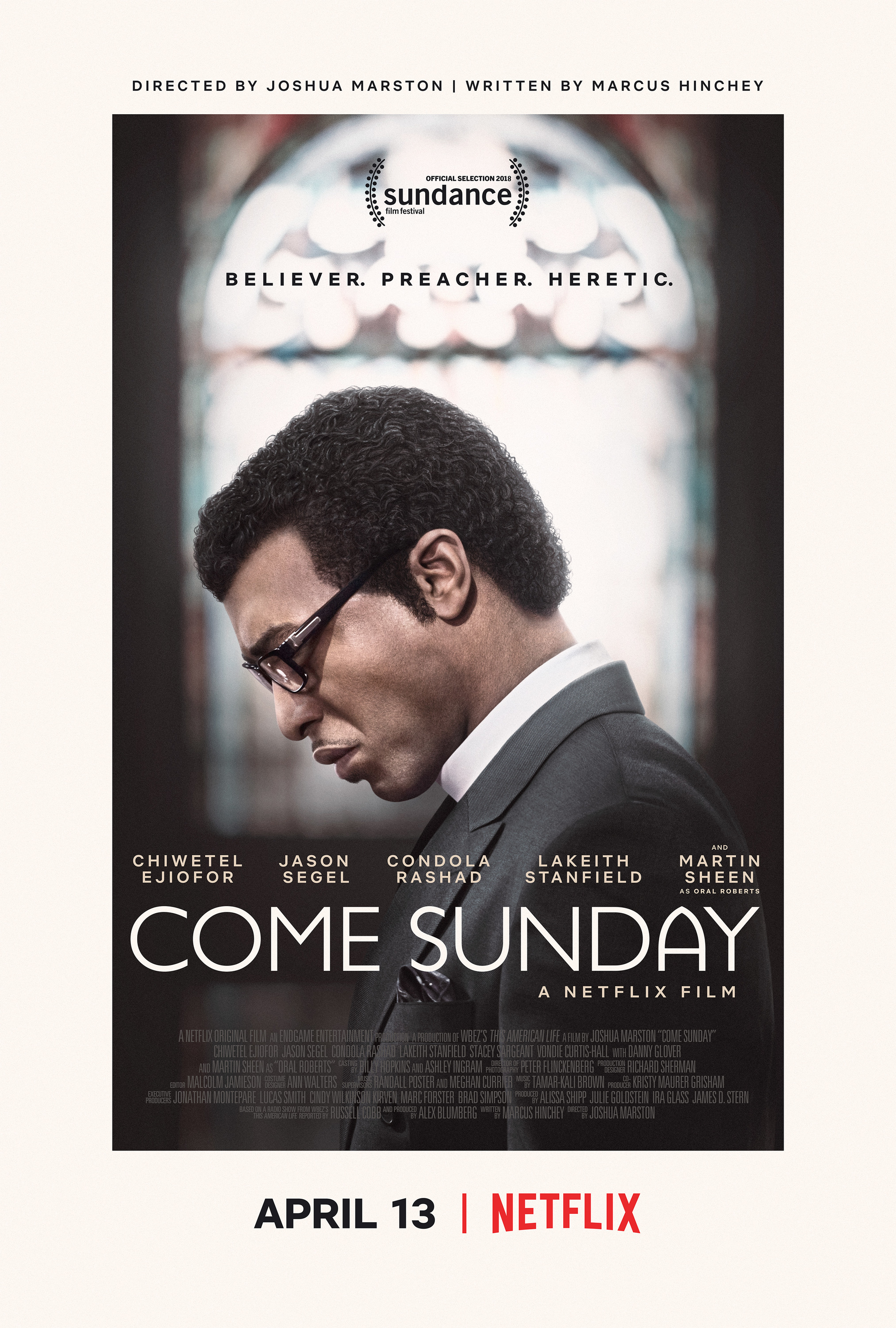
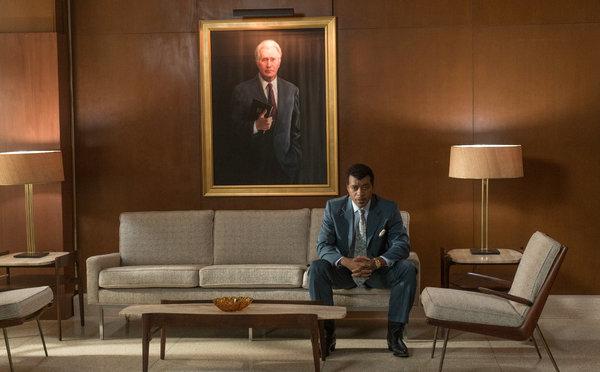
1998, Tulsa, Oklahoma. Carlton Pearson (Ejiofor) is the pastor of the Higher Dimensions Family Church. His congregation is a mix of blacks and whites and his services are attracting around six thousand members each week. He is highly regarded in the community, and has the respect of his peers, and the people who work for him at the church. Things begin to change, though, after he watches a programme about the Rwandan genocide. Believing that he has received an epiphany from God, Carlton begins to refute the notion that non-Christians will automatically go to Hell, and asserts that Jesus Christ died to absolve all of humanity’s sins, not just those who are saved or given absolution. This goes against the received teaching of the church, and it proves too much for many in his congregation, who elect to leave and worship elsewhere. The loss of so many parishioners is further exacerbated by his being declared a heretic by the Joint College of African-American Pentecostal Bishops. Throughout it all, Carlton wrestles with his faith, but remains true to his belief that God has spoken to him, even when it seems that God has now deserted him…

When watching a movie that explores notions of faith and religious belief, it’s often tempting to ask the question, just how is that faith going to be portrayed? Are we going to be treated to a blood and thunder show of Biblical proportions, or a quieter, more considered affair? Come Sunday, the true story of Carlton Pearson and his belief in universal reconciliation, opts for the second approach, but there are certain moments where a bit of blood and thunder wouldn’t have gone amiss. Despite the inherent drama that overtakes Carlton’s life, and which sees him lose his ministry, there’s much about Marcus Hinchey’s otherwise well constructed screenplay that keeps the movie from being as dramatic as it should be. Too many confrontational scenes – between Carlton and his associate, Henry (Segel); between Carlton and his mentor, Oral Roberts (Sheen); between Carlton and the Bishops – lack the vitality and energy that would allow them to stand out from the connective scenes around them. It’s like going to a revivalist meeting, only to find that everyone in the choir has laryngitis and they’re singing in a whisper. Even the scenes between Carlton and his wife, Gina (Rashad), where we learn there are marital problems, have a restraint about them that makes them feel of little consequence in the overall scheme of things.

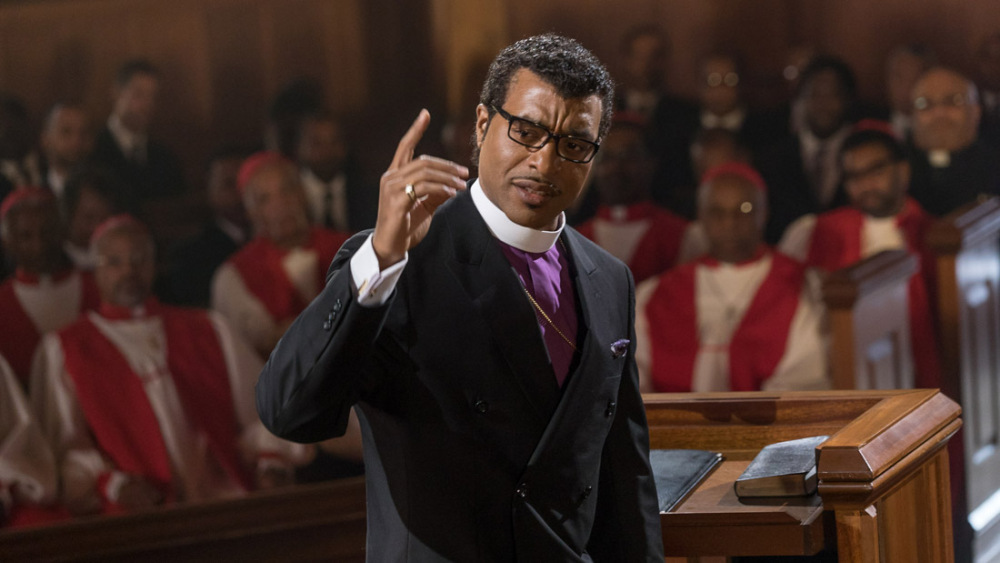
But where a quieter approach proves more effective is when Carlton begins to question if his new-found belief is right. When everyone except for Gina and his assistant, Nicky (Sargeant), desert him, Carlton’s faith is rocked, and he begins to feel that God has deserted him too. Thanks to a terrific performance from Ejiofor, Carlton’s growing anguish is revealed through the star seeming to shrink physically on screen, while relaying the character’s conflicting emotions through a range of searching looks and pained expressions. There’s subtlety and range to Ejiofor’s performance, and it’s a good thing too, as Marston relies on his star more and more as the movie progresses. The director’s cautious development of the material is another reason why the movie doesn’t soar as it should, and why its examination of true faith feels laboured whenever it’s debated. There are fine supporting turns from Segel and Stanfield (as Carlton’s AIDS-affected musical director), but Sheen is miscast as Roberts, and Rashad is stifled by a role that borders on caricature. In the end, it’s a pallid movie that lacks energy, and which spends much of its running time steering clear of being anywhere near as controversial as Pearson was.

Rating: 5/10 – with its neutered narrative and sub-par dramatics, Come Sunday treats Pearson’s struggle to be explain his epiphany and subsequent denunciation as a heretic as if it were a footnote in a much larger story; with an ending that’s even more low-key than what’s gone before, the message seems to be clear: God isn’t the sure-fire draw He used to be.

Share this:

  • Click to share on X (Opens in new window) X
  • Click to share on Facebook (Opens in new window) Facebook
  • More
  • Click to print (Opens in new window) Print
  • Click to email a link to a friend (Opens in new window) Email
Like Loading...

Chameleon (2016)

13 Thursday Dec 2018

Posted by dullwood68 in Movies

≈ Leave a comment

Tags

Chile, Drama, Gastón Salgado, Home invasion, Jorge Riquelme Serrano, Paula Zúñiga, Paulina Urrutia, Review, Thriller, Violence

Original title: Camaleón

D: Jorge Riquelme Serrano / 80m

Cast: Gastón Salgado, Paula Zúñiga, Paulina Urrutia, Alejandro Goic

For couple Paulina (Urrutia) and Paula (Zúñiga), it’s the morning after a party for their friends to say goodbye to Paulina before she embarks on a trip to England. Their house overlooking the ocean is a mess, but Paula soon sets to cleaning up, while Paulina showers and gets dressed. They share breakfast together, then while Paula tends to a sink that’s overflowed, there’s a knock at the front door. Paulina opens the door to find Gastón (Salgado), there on behalf of their mutual friend, Franco (Goic), who has sent Gastón to apologise for Franco’s rude behaviour at the party. Franco has sent wine glasses that Paulina likes, and a bottle of wine. Paula is a little dismayed by Gastón’s arrival, as she was expecting to spend the day alone with Paulina, but the pair make Gastón welcome, and soon the wine has been poured, and the three of them are discussing various matters related to their jobs, and as time goes on, the relationship between the two women. As Paula becomes more and more drunk from the wine, animosities are revealed, and when she becomes incapacitated, Gastón’s true reason for being there is revealed…

A slow, carefully paced thriller that is unsettling to watch on several occasions, Chameleon is also a telling drama that examines themes surrounding sexual identity and class. When we first meet Gastón, it’s in a prologue that shows him flirting and being intimate with Franco, and so when he later admits that he’s only known Franco since the night before, no one is surprised, and it all seems like a normal occurrence. And Serrano is in no hurry to disabuse the viewer of this idea, even though Gastón is wearing one of Franco’s shirts, and Franco can’t be contacted. Gastón’s presence seems plausible enough, and even though Paulina suspects him of lying about his work, there’s no sense that he’s there for any other reason than the one he’s mentioned. Instead, the greater threat – if any at this stage – comes from the adversarial nature of the two women’s relationship. Paulina is the boss, while Paula adopts a more servile attitude, but the wine allows Paula to express her true feelings about Paulina’s superior attitude, and the lack of a child in their relationship. Throughout all this bickering and emotional unloading, Gastón remains calm and quietly supportive of both of them, and seems genuinely concerned when Paula begins to feel unwell.

This all accounts for the first half of the movie, and Serrano maintains a slow build up that shows a calculated restraint in setting up what is a much darker, less “normal” second half. What happens once Paula is put to bed is a nightmare scenario that plays out in a matter-of-fact way that is augmented by Serrano’s decision to make the viewer an unwilling observer. Ensuring that the camera is there to record what happens instead of providing the viewpoint for any one of the characters, Serrano challenges the audience to keep looking, even though there’s nothing graphic to see. Instead, he builds on the menace that has been there from the beginning, from that unremarkable prologue with Gastón and Franco, and tightens the screws accordingly. It’s a home invasion movie with a grim sense of foreboding about it, and it’s one that doesn’t supply the viewer with any easy answers as to Gastón’s motives (some can be guessed at, but none are definitive). There are solid performances from Salgado and Zúñiga (Urrutia’s character is too one-dimensional to be entirely effective), and Cristián Petit-Laurent’s cinematography is disposed primarily to unnerve the viewer, something that it achieves with verve. And then there’s the ending…

Rating: 8/10 – an undeniably tough watch from the halfway mark onwards, Chameleon is a dark, uncompromising thriller that knows how to make the viewer uneasy – even when they’re not sure why they should be; an impressive debut from Serrano, it’s a movie that’s best approached with as little knowledge about it as possible, and with a willingness on the viewer’s part to accept that the painstaking build up of the first half is a necessary precursor to what follows.

Share this:

  • Click to share on X (Opens in new window) X
  • Click to share on Facebook (Opens in new window) Facebook
  • More
  • Click to print (Opens in new window) Print
  • Click to email a link to a friend (Opens in new window) Email
Like Loading...

The Old Man & the Gun (2018)

12 Wednesday Dec 2018

Posted by dullwood68 in Movies

≈ 1 Comment

Tags

Bank robberies, Casey Affleck, Crime, David Lowery, Drama, Forrest Tucker, Manhunt, Review, Robert Redford, Sissy Spacek, True story

D: David Lowery / 93m

Cast: Robert Redford, Sissy Spacek, Casey Affleck, Danny Glover, Tom Waits, Tika Sumpter, David Carradine, Isiah Whitlock Jr, John David Washington, Elisabeth Moss, Robert Longstreet

In 1981, and in his Seventies, career criminal Forrest Tucker (Redford) is still doing what he’s best at: robbing banks. As the founder of The Over the Hill Gang, Tucker, along with his associates, Teddy (Glover) and Waller (Waits), takes a low key, gentlemanly approach to robbing a bank. He smiles a lot, he pretends to have a gun, and no one ever gets hurt. Of course, the police don’t see it in quite the same light, and a detective, John Hunt (Affleck), becomes determined to catch Tucker and put him away. But this is easier planned than done, as Tucker stays one step ahead of everyone while he also romances a widow called Jewel (Spacek). As Hunt learns more and more about Tucker, and vice versa, a mutual respect develops between the pair. But even knowing Hunt is on his trail, and the promise of an easy retirement with Jewel is within his grasp, Tucker can’t help but keep on robbing banks. It’s not until the police finally track him down, and he’s forced to go it alone, that Tucker has to decide on what kind of future he really wants…

If Forrest Tucker hadn’t been a real life character (he passed away in 2004), and if he hadn’t really escaped from prison around sixteen times (including once, in 1979, from San Quentin), and made an estimated four million dollars from his robberies over the years, then the movies would have had to have made him up. And if a casting director had been charged with finding the perfect actor for the role, then they would have had only one choice: Robert Redford. Widely acknowledged as Redford’s swansong performance, Tucker is a fitting role for an actor who has encompassed all the qualities that David Lowery’s screenplay – itself based on a 2003 article by David Grann – imbues the character with. He’s charming, he has a relaxed manner, he appears unhurried and thoughtful, and he has that smile, that signifier that if you stick with him, everything will be okay, and most of all, a lot of fun. Redford could almost be playing himself, or an older, wiser version of the Sundance Kid, such is the modern day Western vibe that infuses the movie. And he doesn’t even have to do too much to be effective; it’s possibly the most relaxed he’s ever been, and it shows. It’s a performance that feels effortless.

But this being a David Lowery movie, it’s not just about Tucker and his almost carefree attitude to life and other people’s money. It’s also about time – what we do with it, how it affects us, whether the past informs our present, and whether the future should be something to be concerned about – and how our memories can influence how we look at time. Tucker has nothing but fond memories of his life, even though he’s spent most of it locked up, while Jewel feels regret for not having been more selfish with her time when she was married. It’s not difficult to work out which one of them feels that they’ve really been in prison, and just as easy to work out which one is the more fulfilled. But while it would be easy to look at this as another, off-kilter version of the Follow Your Dream experience, the movie is a lot subtler than that, and has a much more solid and dramatic foundation. That Lowery has chosen to layer his movie with a poignant meditation on getting old doesn’t detract from the enjoyment to be had from it, and the discerning viewer will find much that resonates along the way.

Rating: 9/10 – a movie that remains wistful and pleasantly languid for much of its running time, The Old Man & the Gun is still chock full of dramatic moments that highlight the underlying seriousness of Tucker’s “work”; with terrific performances from all concerned, and enchanting cinematography from Joe Anderson, this may end up being regarded solely as a fitting tribute to Redford and his career, but it has so much more to offer, and is so much more rewarding.

Share this:

  • Click to share on X (Opens in new window) X
  • Click to share on Facebook (Opens in new window) Facebook
  • More
  • Click to print (Opens in new window) Print
  • Click to email a link to a friend (Opens in new window) Email
Like Loading...

Beautiful Boy (2018)

11 Tuesday Dec 2018

Posted by dullwood68 in Movies

≈ Leave a comment

Tags

Amy Ryan, Drama, Drug addiction, Father/son relationship, Felix van Groeningen, Literary adaptation, Maura Tierney, Review, Steve Carell, Timothée Chalamet, True story

D: Felix van Groeningen / 120m

Cast: Steve Carell, Timothée Chalamet, Maura Tierney, Amy Ryan, Kaitlyn Dever, LisaGay Hamilton, Andre Royo, Christian Convery, Oakley Bull, Timothy Hutton

After his teenage son, Nic (Chalamet), goes missing for a couple of days, freelance writer David Sheff (Carell) discovers that Nic has a drug habit. David arranges treatment for Nic at a rehab clinic and the teenager makes significant progress, however it’s not long before he goes missing again and his habit becomes an addiction. With the support of his father, and his stepmother, Karen (Tierney), Nic makes a full recovery and goes off to college to focus on writing. Nic relapses, though, and soon he’s back to taking drugs, particularly crystal meth, while insisting that he has everything under control. When an overdose puts Nic in the hospital, David and his ex-wife, Nic’s mother, Vicki (Ryan), decide that he should live with her while he attends rehab sessions. Again, Nic makes significant progress, and is sober for over a year before anxieties about relapsing cause the very thing he’s afraid of to happen. Reconnecting with an old girlfriend, Lauren (Dever), Nic’s addiction spirals even further out of control, which leaves David with a tough decision to make: whether to continue trying to help his son, or admit that he can’t help him at all…

From the synopsis above, it’s easy to guess just how much Beautiful Boy is going to be a movie based around a succession of terrible lows and tantalising highs, and though it’s based on a true story, this is exactly how the movie plays out: Nic takes drugs, Nic gets better, Nic relapses, and so on. Unfortunately, while the quality of the central performances isn’t in doubt – Carell and Chalamet are superb – and van Groeningen’s direction ensures the viewer remains interested throughout, the repetitive nature of the material leads to an emotional distancing that becomes more pronounced as the movie progresses. Though the effects of Nic’s drug addiction clearly take their toll on him and everyone around him, once he’s relapsed the first time (and so early on), you know that it’s going to happen again, and again. The script – by van Groeningen and Luke Davies – does its best to offset this by focusing on David’s efforts to understand his son’s addiction, though strangely, it’s on a more physiological and intellectual level; when Nic explains how drugs make him feel, David doesn’t get it at all. So, while Nic experiences feelings and sensations that make drug addiction, to him, more desirable, David remains somewhat aloof. Even after he’s taken cocaine himself, David is unchanged, and any effect the drug may have had isn’t revealed.

With both father and son unable to connect anymore in a meaningful way, the movie seeks to remind its audience of the tragedy that’s occurring by resorting to flashbacks that show the bond David and Nic shared when he was much younger. These are placed at key points in the narrative and serve as leavening moments against the grim nature of Nic’s addiction. But these too lose their impact through over-use, and by the time Nic reaches rock bottom, the idea of one more poignant remembrance is one too many. But though the structure and the content of the movie hampers its effectiveness, it’s the performances that stand out. Carell has rarely been better, using David’s anger and shame at not being able to help his son, to paint a portrait of a man coming up against the hard fact of his own limitations. As Nic, Chalamet continues to impress, imbuing the character with a desperate, anguished fatalism that is heart-wrenching to watch. The father/son relationship is the heart of the movie, and van Groeningen pays close attention to it, letting it dominate the movie accordingly, while leaving Tierney and Ryan with little to do as a result. At least it doesn’t seek to be profound, or to provide any glib answers to the issues it explores, and that at least is something to be thankful for.

Rating: 7/10 – adapted from books written by both David and Nic, and which allow for a powerful yet emotionally subdued movie, Beautiful Boy is bolstered by two stand out performances, and its refusal to compromise on the dispiriting nature of its storyline; while it doesn’t work as well as it should, and it might not be everyone’s idea of a “good time”, there’s still more than enough on offer to keep the average, or even casual viewer hoping that, by the movie’s end, Nic finds some semblance of peace.

Share this:

  • Click to share on X (Opens in new window) X
  • Click to share on Facebook (Opens in new window) Facebook
  • More
  • Click to print (Opens in new window) Print
  • Click to email a link to a friend (Opens in new window) Email
Like Loading...

Assassination Nation (2018)

10 Monday Dec 2018

Posted by dullwood68 in Movies

≈ Leave a comment

Tags

Abra, Drama, Er0str4tus, Hari Nef, Odessa Young, Review, Salem, Sam Levinson, Secrets, Social media, Suki Waterhouse, Thriller

D: Sam Levinson / 108m

Cast: Odessa Young, Suki Waterhouse, Hari Nef, Abra, Maude Apatow, Anika Noni Rose, Joel McHale, Colman Domingo, Bella Thorne, Bill Skarsgård, Cody Christian, Danny Ramirez, Kathryn Erbe, Jennifer Morrison

In modern day Salem, Massachusetts, Lily Colson (Young) is a high school senior whose main interests are art, challenging the views of the adults around her, and hanging out with her best friends, Em (Abra), Sarah (Waterhouse), and Bex (Nef). She has a boyfriend, Mark (Skarsgård), but also appears to have a relationship with someone called “Daddy”. One day, a mysterious hacker known only as Er0sta4tus begins a campaign of releasing photographs and texts that expose the secrets of a number of well-known townspeople, including the mayor and Lily’s school principal (Domingo). Damage is done in both instances, but it’s when a massive data dump exposes the secrets of half the town that things spiral out of control. Mark finds out about “Daddy”, and Lily is cruelly victimised as a result. A week later, matters worsen for Lily and her friends when a group of vigilantes assert that she is responsible for the data dump. With all four at Em’s house, they find themselves under attack, and unable to count on being rescued by the police…

A triumph of style over substance, Assassination Nation is an angry movie that raves against the intolerance it perceives to be prevalent in the US today, but in the same way that a certain elected proponent of the “fear” factor paints a self-serving, one-sided version of the truth, so too does writer/director Sam Levinson. With the movie lacking in introspection, and unable to provide the necessary causality to make its second half anywhere near convincing, it’s a frustrating experience that starts off well (an early montage of coming attractions that include violence, transphobia, fragile  male egos, and giant frogs is a particular highlight), but which soon abandons any attempts at satire, or subtlety, as it morphs from an impassioned critique of small town hypocrisy into a below par, gender-focused variation of The Purge. Levinson has some pretty big targets in his sights, but doesn’t quite know how to approach them, riffing on the perils of social media and toxic masculinity, but from a cautious distance that only feels truly immersive when he’s subjecting Lily to all sorts of physical humiliation. These moments are also gleefully exploitative, and wouldn’t feel out of place if they’d been lifted from the likes of Day of the Woman (1978).

There’s the temptation to believe that Levinson has set out to shock and upset his audience deliberately, although if that is the case, the why remains a mystery. The one truly upsetting thing about the movie is its lack of narrative clarity. It doesn’t help either that the characters remain singularly one-dimensional from start to finish, with several individuals’ motivations proving murky at best, or risible at worst. It’s fortunate then that the look of the movie is all the more arresting and confidently handled. Thanks to DoP Marcell Rév, Assassination Nation is one of the bolder and more vivid movies released this year, and the visual flair on display is often breathtaking in its audacity. Utilising split screen techniques, filters, odd camera angles, fluid camera work, and tight framing where it’s most effective, Rév makes the movie soar beyond the pedestrian nature of the narrative. It also has a terrific, and eclectic soundtrack that mixes classical, avant-garde, pop, and alternative rap to superb effect. Against this, the performances range from the committed and convincing (Nef), to the perfunctory and underwhelming (Waterhouse, Christian), and in the case of Young, hampered by poor writing and direction.

Rating: 5/10 – a vibrant, visually startling movie that’s also a mess of half-thought out ideas and narrative cul-de-sacs, Assassination Nation wants to get in its viewer’s face and scream about the unfairness of bigotry and hypocrisy, but in the end it’s too unfocused to get its message across except in the clumsiest of fashions; it also has a tough time justifying its “girls can be tough too” approach when their own revenge spree smacks so much of being an obvious male fantasy brought to life.

Share this:

  • Click to share on X (Opens in new window) X
  • Click to share on Facebook (Opens in new window) Facebook
  • More
  • Click to print (Opens in new window) Print
  • Click to email a link to a friend (Opens in new window) Email
Like Loading...

The Sweet Life (2016)

09 Sunday Dec 2018

Posted by dullwood68 in Movies

≈ Leave a comment

Tags

Abigail Spencer, Chris Messina, Comedy, Drama, Golden Gate Bridge, Review, Road trip, Rob Spera, Romance, Suicide

D: Rob Spera / 90m

Cast: Chris Messina, Abigail Spencer, Maggie Siff, Tyson Ritter, J.D. Evermore, Karan Soni, Glenn Plummer, Nick Searcy, Josh Pence, Jayne Brook

After another day of poor returns, depressed ice cream salesman Kenny Pantalio (Messina) contemplates throwing himself off a bridge and ending it all. But he’s interrupted by Lolita Nowicki (Spencer), a young woman with her own suicidal tendencies. When they discover they have the same therapist, it leads to them wandering through night-time Chicago until outside a swanky restaurant, Kenny is mistaken for a valet parker, and is given the keys to a Mercedes. Lolita convinces him to take the car, and that they should travel together to the Golden Gate Bridge where they can both commit suicide. As their journey takes them across country, Kenny and Lolita find themselves in a number of weird situations, from trying to rob a convenience store on the promise of their having a gun, to Kenny’s stealing a car that has a surprising cargo on the back seat, to a side trip to meet someone from Kenny’s past. Through trial and error they arrive in San Francisco, where Lolita’s own past catches up with her, and her relationship with Kenny prompts a sudden decision…

Despite the best of intentions, and the best efforts of its screenplay – by Jared Rappaport – its director, and its two leads, The Sweet Life lacks the necessary credulity to allow the viewer to connect with the characters and the plot. From the moment that Lolita interrupts Kenny’s suicidal reverie, the movie goes off in several different directions all at once, and it tries to become a drama, a comedy, and yes, a romance, and often, all at the same time. This scatter gun effect works well at certain moments, but falls flat at others, leaving the movie feeling haphazard and poorly constructed. Even if you accept the unlikely “meet-cute” that brings Kenny and Loilta together, the contrived nature of their subsequent relationship remains a recurring problem. The idea is that they will support each other during their road trip, but this rarely happens, as each is as selfish and inwardly focused as the other, and even when they do put aside their differences to come to each other’s rescue, it’s always because the script needs them to, not because it makes their journey that much richer or profound. That said, their journey does avoid easy sentimentality, and there are trenchant moments that work surprisingly well.

What Rappaport’s script also avoids is any in-depth explorations of Kenny and Lolita’s reasons for wanting to commit suicide. There are hints and clues, but none that are fleshed out enough to make sense, or allow the viewer to feel sorry for them. Kenny is depressed, and as it transpires, for a variety of reasons; Lolita is the same. But their intention to jump from the Golden Gate Bridge always feels like a stretch, the road trip a way of giving them time to realise that their lives aren’t as bleak as they think, and for the movie to make a number of telling comments about the nature of happiness. If you were watching the movie, and didn’t know why they were heading to San Francisco, you could quite easily believe this was merely another modern rom-com where opposites attract. And on many levels, when the script isn’t addressing this issue directly, the movie is much better for it. Messina portrays Kenny with an increasingly endearing manner that proves likeable by the movie’s end, but Spencer has the very hard task of making Lolita look and sound like someone who would exist in the real world. In the end, Spera’s direction proves too wayward to help matters, and the outcome is both dramatically and emotionally spurious, something that undermines those moments earlier in the movie that do work.

Rating: 5/10 – with little in the way of depth, and little in the way of examining the serious side of suicidal tendencies, The Sweet Life is a rom-com with dramatic pretensions it’s unable to pull off; a frustrating experience, it’s a low-key, genial movie that offers odd moments of poignancy, but never gels into anything more substantial.

Share this:

  • Click to share on X (Opens in new window) X
  • Click to share on Facebook (Opens in new window) Facebook
  • More
  • Click to print (Opens in new window) Print
  • Click to email a link to a friend (Opens in new window) Email
Like Loading...

The Guilty (2018)

08 Saturday Dec 2018

Posted by dullwood68 in Movies

≈ Leave a comment

Tags

Court appearance, Denmark, Drama, Emergency East, Gustav Möller, Jakob Cedergren, Jessica Dinnage, Kidnapping, Police officer, Review, Thriller

Original title: Den skyldige

D: Gustav Möller / 85m

Cast: Jakob Cedergren, Jessica Dinnage, Omar Shargawi, Johan Olsen, Jacob Lohmann, Katinka Evers-Jahnsen, Jeanette Lindbæk

Asger Holm (Cedergren) is a police officer working as a call handler for the Danish emergency response services. He’s doing this while he waits for the outcome of a court appearance that will determine if he remains a police officer. It’s his last shift before his court date, and with around half an hour to go he’s having to deal with the usual amount of time wasters and people who want an emergency response there and then. But one call brings Asger out of his self-imposed funk: a young woman called Iben (Dinnage) tells him she has been kidnapped and is in a vehicle, but she doesn’t know where she’s being taken. Asger knows roughly the area she’s in, and once he gets Iben to reveal the colour and kind of vehicle she’s in, he calls the appropriate police force to look for   her. But as Asger’s shift ends and he decides to stay on, he becomes more and more involved in finding Iben and reuniting her with her two children, who are still at home. But his efforts have unexpected consequences…

With all the action taking place wihin the confines of the Emergency East call centre, and for much of the movie within the further confines of an office where only Asger is situated, The Guilty relies heavily on both its plot, and Cedergren’s performance. Luckily, the plot is a gripping, edge-of-your-seat race against time scenario that sees Asger make a number of mistakes – some avoidable, some not – that both highlight and complicate the urgency of the situation, and which rely on the drip feed of information that some viewers will be able to piece together before Asger does. It’s a scenario that requires Asger to be a very good listener, but with his own issues weighing heavily on him, this proves difficult for him to achieve, and as he gets in deeper and deeper – even to the point of involving one of his police colleagues, Rashid (Shargawi) – his feelings of guilt over the incident that has brought him to the call centre begin to overwhelm him, and his efforts to do the right thing become more and more desperate. As Iben’s situation worsens, so too does Asger’s, and as he strives to save her, it becomes obvious that he’s trying to redeem himself at the same time.

This duality of purpose becomes more and more explicit as the movie progresses, and thanks to a sterling performance from Cedergren, Asger’s taciturn, dismissive demeanour gives way to a maelstrom of unexpected emotions that ultimately prove to be both the source of his undoing and his redemption. Asger isn’t the most sympathetic of characters, and Cedergren makes no attempt to soften him or make him more agreeable, but the narrative is still looking for that positive outcome, and if only Asger can swing it, then that’s okay. Möller and editor Carla Luff instill the movie with a sinewy, muscular rhythm that deflects from just how many times the camera placidly, but effectively observes Asger in close up, and the restrained camera work by DoP Jasper J. Spanning is suitably claustrophobic, making good use of the limited space Asger occupies and further highlighting the urgency of the situation. With good supporting performances from his voice cast, Möller teases out the truth in stages, and confounds audience expectations on a couple of occasions while playing to the gallery at others. It’s a compelling thriller, commendably staged and cleverly executed, and one that balances the demands of its main plot with that of Asger’s own situation with style and a surfeit of brooding self-confidence.

Rating: 8/10 – Denmark’s entry for Best Foreign Language Film at next year’s Academy Awards, The Guilty is a riveting, tightly constructed thriller that doesn’t short change the viewer, or betray its own internal logic in the final third as so many thrillers do; quietly devastating in places, its relatively short running time means not a moment is wasted, and there’s depth lurking beneath the simplicity of the main set up.

Share this:

  • Click to share on X (Opens in new window) X
  • Click to share on Facebook (Opens in new window) Facebook
  • More
  • Click to print (Opens in new window) Print
  • Click to email a link to a friend (Opens in new window) Email
Like Loading...

A Brief Word About the Avengers: Endgame Trailer

07 Friday Dec 2018

Posted by dullwood68 in Movies

≈ Leave a comment

Tags

Avengers 4, Marvel, The Russo brothers, Trailer

Like a lot of folks around the globe, I was looking forward to the release of the first trailer for what until now, has been known simply as Avengers 4. With so much about the movie shrouded in mystery, many people were probably hoping that the trailer would provide them with clues as to what will happen now that Thanos has wiped out half the universe (as well as finally getting a confirmed title). To say the first trailer – a definite teaser, if ever there was one – gives very little away is an understatement (though it won’t stop a tonne of exhaustive deconstructions and detailed theorising about what’s in the trailer from hitting the Internet in the next few days). But that’s easily the best thing about it.

For once, we have a trailer for a huge, upcoming blockbuster movie that doesn’t give anything away, and which won’t spoil anything for fans when the movie is released in April 2019.

How cool is that? And how cool is it that Disney and Marvel have taken this approach? In this day and age of media saturation and information overload, when everybody wants everything now (and pretty much spoon-fed to them), how refreshing is it that we still don’t know anything about the content and the storyline of Avengers: Endgame? Full marks to the Russo brothers then if it was their idea, and for keeping us all deliberately in the dark for a while longer. Let’s hope the next trailer keeps us just as much in the dark as this one has. And let’s hope that other studios and production companies and distributors learn a valuable lesson from this: that less is always better than more, and that audiences don’t always want to know the ins and outs of a movie months before they get a chance to see it (okay, that’s unlikely to happen, but we can all wish, can’t we?).

Share this:

  • Click to share on X (Opens in new window) X
  • Click to share on Facebook (Opens in new window) Facebook
  • More
  • Click to print (Opens in new window) Print
  • Click to email a link to a friend (Opens in new window) Email
Like Loading...

Oh! the Horror! – The Possession of Hannah Grace (2018) and The Harrowing (2018)

06 Thursday Dec 2018

Posted by dullwood68 in Movies

≈ Leave a comment

Tags

Arnold Vosloo, Cadaver, Demons, Diederik Van Rooijen, Drama, Grey Damon, Horror, Jon Keeyes, Matthew Tompkins, Morgue, Psychiatric hospital, Review, Shay Mitchell

The Possession of Hannah Grace (2018) / D: Diederik Van Rooijen / 86m

Cast: Shay Mitchell, Grey Damon, Kirby Johnson, Nick Thune, Louis Herthum, Stana Katic, Maximillian McNamara, Jacob Ming-Trent

Megan Reed (Mitchell) is an ex-cop still suffering the lingering effects of PTSD from a shooting that saw her partner killed. Getting back on her feet, she takes a job working the night shift at the Boston Metro Hospital morgue. Working alone in her part of the building, her main responsibility is to see in any “new arrivals” and get them processed into the system. Her first night on the job passes by without incident, but on the second night something more out of the ordinary happens: the body of a young woman (Johnson), the victim of a deranged killer who has hacked her body and tried to burn it, is brought in. Alerted to the fact that the killer is still at large, Megan sets about trying to process the body, but her equipment fails at every turn. Later, while seeing in another body, a man (Herthum) slips into the morgue, and hides away. Later still, Megan becomes aware of his presence, and finds him trying to haul the young woman’s body into the incinerator. She overpowers him, and it’s then that he tells her that the young woman, Hannah Grace, isn’t dead…

A modest little horror flick from Sony/Screen Gems, The Possession of Hannah Grace has slipped into cinemas recently, and though there’s always the temptation to think that if it’s in cinemas then it must be better than the usual horror fare released these days, in this case that wouldn’t be entirely appropriate. Originally entitled Cadaver, this has good production values for its budget, a good central performance from Mitchell, and a handful of creepy moments that are as much to do with its setting as it’s title character. However, the story holds about as much water as a paper bag, and the details of Hannah’s possession can best be described as “flaky to the max” (and that’s being generous). This flakiness is the excuse for the supporting characters to be picked off one by one, but on each occasion, the contrivance is obvious and perfunctory. Van Rooijen keeps the scares simple if predictable, but is unable to rein in the preposterousness that runs rampant through the screenplay. The end result is a movie that falls short of being as gripping, or frightening, as its setting should have made it, and which relies too heavily on its title character’s ability to make weird clacking noises when she (inevitably) moves around.

Rating: 4/10 – another frustrating horror movie experience foisted on our cinema screens, The Possession of Hannah Grace is unlikely to bother anyone who’s seen any of the four million other possession movies released in the last few years, or indeed, anyone coming to the genre for the first time either; dull in stretches, with a back story for its heroine that is as unnecessary as these things usually are, it does at least have an ending, and thankfully, not one that sets up a sequel.


The Harrowing (2018) / D: Jon Keeyes / 111m

Cast: Matthew Tompkins, Arnold Vosloo, Arianne Martin, Michael Ironside, Damon Carney, Hayden Tweedie, Michael Crabtree, Susana Gibb, Morgana Shaw, James Cable

Ryan Calhoun (Tompkins) is a vice cop working a sting operation with his partner, Jack (Carney), and newbie, Greenbaum (Cable). While he’s out getting coffee, something goes wrong in the apartment they’re monitoring, and when Ryan gets there, he finds the prostitute who’s been working with them, her trick, and Jack all dead, horribly mutilated, and apparently killed by Greenbaum. Greenbaum attacks Ryan, who shoots him dead, but not before Greenbaum has mentioned something to do with demons. Although he’s removed from the case by his superior, Lieut, Logan (Ironside), Ryan does his own investigating, and discovers that Greenbaum was a patient at a psychiatric facility before joining the force. Electing to go undercover at the facility, which is run by Dr Franklin Whitney (Vosloo), Ryan looks for answers as to why Greenbaum would have committed such a terrible act. Soon he learns that Greenbaum wasn’t the only patient who believed in demons, and that both himself and the other patients are in danger from something truly diabolical…

Beginning with a prologue that proves entirely superfluous to what follows, The Harrowing is a less than sure-footed attempt at blending a variety of genres, from the humble police procedural to the psychological thriller, and with a heavy coating of supernatural drama ladled on top. There’s the hint of a neat little mystery here, but it’s buried under a welter of kaleidoscopic lighting effects, more cutaways than could ever be necessary, and a fragmented screenplay that has a defined ending in mind but which doesn’t know quite how to get there without tripping itself up along the way (and more than once). There’s certainly ambition on display here as well, but writer/director Keeyes has opted for visual and aural excess over subtlety in telling his story, and the result is a shouty mess that lacks the coherence needed to keep the viewer intrigued or motivated to keep watching. Things aren’t helped by a truly awful performance from Tompkins, and a number of very questionable directorial decisions made by Keeyes as he tries to create a nightmare fusion of reality and fantasy, but succeeds only in creating a nightmare that the viewer is forced to navigate. By the end, it’s hard to care how it all turns out, and when it does, it does so abruptly – which is some consolation at least given the extended running time.

Rating: 3/10 – when veterans of this sort of thing like Vosloo and Ironside look as if they’d rather be elsewhere, then you know there’s a problem, though for The Harrowing it’s just one of many; another example of low budget equals low return, Keeyes has been doing this sort of thing for a while now, something that begs the question, isn’t it time to try another genre altogether?

Share this:

  • Click to share on X (Opens in new window) X
  • Click to share on Facebook (Opens in new window) Facebook
  • More
  • Click to print (Opens in new window) Print
  • Click to email a link to a friend (Opens in new window) Email
Like Loading...

The Carer (2016)

05 Wednesday Dec 2018

Posted by dullwood68 in Movies

≈ Leave a comment

Tags

Brian Cox, Coco König, Comedy, Drama, Hungary, János Edelényi, Lifetime Achievement Award, Parkinson's disease, Review, Sir Michael Gifford

D: János Edelényi / 88m

Cast: Brian Cox, Coco König, Emilia Fox, Anna Chancellor, Karl Johnson, Andrew Havill, Selina Cadell, Emily Bevan, Roger Moore

Sir Michael Gifford (Cox) is a British acting legend, equally at home in movies and on television, but mostly on the stage. Now retired and suffering from the early onset of Parkinson’s disease, Sir Michael is being urged to accept having a full-time carer by his daughter, Sophia (Fox), and his housekeeper (and ex-lover) Milly (Chancellor). Resistant to the idea, Sir Michael finds that the introduction of Dorottya (König), a Hungarian care worker who has applied to study drama in the UK, isn’t quite the imposition he expects it to be. With her love of, and ability to quote, Shakespeare, Sir Michael finds Dorottya’s sympathetic approach and youthful enthusiasm something of a tonic – though he reserves his usual dyspeptic disposition for everyone else. However, when he’s put forward for a Lifetime Achievement Award, it causes friction between him and Sophia (who thinks he’s too infirm to attend), and Sophia and Dorottya (who thinks it would be good for him). Sir Michael decides he’s going to go, whether his daughter agrees or not, but before he does he has to recconnect with Dorottya, who has been sacked by Sophia…

In a similar vein to Venus (2006), The Carer is about a crusty, cantankerous old thespian who finds an unexpected kinship with a much younger carer, and in doing so, learns a number of valuable life lessons. And… that’s it. There are Shakespeare quotes a-plenty (with King Lear getting the lion’s share for obvious, though, undercooked thematic reasons), occasional nods to the indignities of getting old (adult nappies), regrets and recriminations flying thick and fast from all sides, and a tendency to soft-pedal any really serious issues through the use of ill-focused humour. Nothing about the movie is surprising or unexpected. It ticks along in time-honoured fashion, hitting each required beat with almost metronomic regularity, and relying on its talented albeit under-served (and undeserved) cast to rescue it from the doldrums of its own making. At no point do you feel that this could be happening in real life, or that you might meet any of the characters while walking down the street. With the action largely taking place at Sir Michael’s baronial hall of a home, a grim sense of claustrophobia soon settles in as Sir Michael takes profanity flecked inconstancy to new levels of banality; he’s the least disagreeable misanthrope you’re ever likely to encounter.

More problematical is the character of Dorottya. The Carer is a Hungarian/British co-production, with a Hungarian director, and dozens of Hungarian crew members, and so the inclusion of König as the title character is, like much else, unsurprising. But Dorottya doesn’t ring true on any level. She’s so one-dimensional you half expect her to disappear when she turns sideways. With the barest of motivations for what she does, and not even the required knowledge that medicaton and alcohol don’t mix, Dorottya is a lumpen plot device designed to allow Sir Michael to play to one last appreciative audience before popping his theatrical clogs. Making her feature debut, König does her best but hasn’t got a hope of imbuing the character with any meaningful traits or mannerisms, thanks to a script that makes very little effort to add depth or texture at any stage of the proceedings. There are misguided attempts at pathos, scattered instances of poorly judged poignancy, and an acceptance speech from Sir Michael that is part ramble, part soliloquy, and all contrived; it’s the musings of an actor who really can’t improvise. Cox is fine despite all this, and it’s fun to see him in his younger days through movies and posters, but if this was a role that was written with him in mind, he shouldn’t feel so flattered.

Rating: 4/10 – visually as bland and uninviting as the storyline proves to be, The Carer strives for emotional resonance and comes up short every time; acceptable only on a very basic level, and even then with reservations, this is a misguided and unconvincing movie that wastes the time and efforts of its cast, and never appears to be aspiring to anything other than being merely perfunctory.

Share this:

  • Click to share on X (Opens in new window) X
  • Click to share on Facebook (Opens in new window) Facebook
  • More
  • Click to print (Opens in new window) Print
  • Click to email a link to a friend (Opens in new window) Email
Like Loading...

Green Book (2018)

04 Tuesday Dec 2018

Posted by dullwood68 in Movies

≈ 4 Comments

Tags

Concert tour, Don Shirley, Drama, Linda Cardellini, Mahershala Ali, Music, Peter Farrelly, Racism, Review, The Deep South, Tony Villalongo, True story, Viggo Mortensen

D: Peter Farrelly / 130m

Cast: Viggo Mortensen, Mahershala Ali, Linda Cardellini, Sebastian Maniscalco, Dimiter D. Marinov, Mike Hatton, P.J. Byrne, Joe Cortese, Brian Stepanek

In 1962, in New York City, club bouncer Tony Villalonga (Mortensen) (known as Tony Lip) finds himself temporarily out of work. Though a number of opportunities are open to him, he becomes intrigued when he’s approached through a friend to be a driver for a doctor on a trip down south. At the interview, Tony meets Dr Don Shirley (Ali), and is surprised to learn that Don isn’t a medical doctor, but a doctor of music (amongst other things). The trip down south is a two-month concert tour that will eventually head into the Deep South, and Don needs someone who can keep him out of trouble during the tour. The two men agree terms, and aim to be back in New York City on Xmas Eve. Setting out, their differences in attitude causes friction between them: Tony is uncultured and lacking in certain social graces, while Don is refined and sophisticated. As the trip continues however, Tony and Don begin to develop a mutual respect and understanding, at the same time as the Deep South’s racist agenda begins to threaten the tour’s completion…

If you were black in the early Sixties, and wanted to travel in relative safety through the South, then a good investment would have been a copy of The Negro Motorist Green Book by Victor Hugo Green, a book which listed hotels and restaurants that would accept black people. Tony is given a copy at the start of the tour, and though he has own racist tics, he’s bemused by the idea of such a book. He’s an Italian-American who’s lived his whole life in New York City; his interaction with the kind of institutional racism practiced in the South has been next to zero. For Don, it’s the very fact that this kind of racism is prevalent that he carries out these tours; it’s about not taking the easy option and staying in the North and (literally) playing it safe. But while Green Book has a clearly defined backdrop that encompasses contemporary racism and the social politics of the period, it’s not specifically about those issues. Instead it’s about the blossoming friendship between two men from two very different cultural and social backgrounds who find a common ground through their experiences travelling together. Each learns from the other, and each is a better man for it.

Now, so far it’s another standard tale of friendship achieved between polar opposites, but it’s played out in such a way that both men are made better versions of themselves and without the need for either of them to lose or change any aspect of their character or personality. Instead, they improve themselves, and willingly, seeing their own lives through the ideas and thoughts of each other. This approach takes place over time, and the script – co-written by Villalonga’s real-life son, Nick (who also has a role as one of Tony’s relatives), Farrelly, and Brian Hayes Currie – doesn’t rush things out of any sense of dramatic necessity, relying instead on the subtleties and nuances on the page, and two magnificent performances from Mortensen and Ali. Both actors are on superb form, teasing out small but important revelations about their characters, and relishing the opportunity to work with such strong material. Farrelly, whose output in this decade has been less than compelling – The Three Stooges (2012), anyone? – here hits a home run, getting it tonally and thematically right, and without recourse to unnecessary melodramatics or forced sentimentality. There’s humour amidst the drama, of course (“I knew you had a gun”), but again Farrelly balances it all with skill and intelligence. This is the kind of road trip that you’ll want to go on on a second and maybe a third time, and if you do, you’ll still be as entertained as you were on the first.

Rating: 9/10 – at times, Green Book appears effortless in its attempts to tell a simple story without the need for artifice or contrivance, and it’s this simplicity of style and content – along with a generous helping of cinematic heart and soul – that makes it such a wonderful experience; again, this isn’t about the time period or the geographical area it’s set in, or any combination of the two, it’s about two men with different outlooks and predispositions who become lifelong friends in the unlikeliest of circumstances, and against some pretty long odds.

Share this:

  • Click to share on X (Opens in new window) X
  • Click to share on Facebook (Opens in new window) Facebook
  • More
  • Click to print (Opens in new window) Print
  • Click to email a link to a friend (Opens in new window) Email
Like Loading...

The Miseducation of Cameron Post (2018)

03 Monday Dec 2018

Posted by dullwood68 in Movies

≈ 1 Comment

Tags

Chloë Grace Moretz, Desiree Akhavan, Drama, Forrest Goodluck, Gay conversion therapy, God's Promise, Jennifer Ehle, John Gallagher Jr, Lesbian, Literary adaptation, Review, Sasha Lane

D: Desiree Akhavan / 92m

Cast: Chloë Grace Moretz, John Gallagher Jr, Jennifer Ehle, Sasha Lane, Forrest Goodluck, Emily Skeggs, Owen Campbell, Melanie Ehrlich, Christopher Dylan White, Quinn Shephard, Kerry Butler

For Cameron Post (Moretz) and her best friend, Coley Taylor (Shephard), being discovered having sex in the back seat of one of their boyfriends’ cars on prom night was not how the evening was meant to turn out. Although not their first sexual experience together, they’ve kept their relationship a secret from everyone, and Cameron, though certain that she’s a lesbian, is still coming to terms with how it will affect her life. However, being discovered leads her aunt (Butler), who is a devout Christian (and who has been raising Cameron since the deaths of her parents), to enrol Cameron in a gay conversion therapy centre called God’s Promise. Run by brother and sister, Reverend Rick (Gallagher Jr) and Dr Lydia Marsh (Ehle), the centre views homosexuality as a sin, and its programme is designed to help young people who are “confused” by their sexuality into making the right changes and embracing heterosexuality. Cameron soon makes friends – mainly with fellow lesbian Jane (Lane) and two spirit Adam Red Eagle (Goodluck) – but she also finds her own certainty about being a lesbian brought into question…

Imbued with a healthy dose of skepticism about the whole notion of gay conversion therapy, The Miseducation of Cameron Post is not the strident call to have these institutions banned that you might think it would be. Instead, it’s a much more subtle piece, adapted from Emily M. Danforth’s novel, and thanks to its historical setting – the movie takes place in 1993 – the movie is able to explore the issues it raises – freedom of sexual expression, religious fundamentalism, nature vs nurture, even free will – with a lightness of tone that seems at odds with the seriousness of its subject matter, but which enables it to get its points across more effectively. This isn’t a movie that wants to pound its viewers over the head with damning rhetoric. Rather, it explores Cameron’s experiences at home and at the centre in a way that gets its message across without it feeling forced or contrived. Cameron poses her challenges to the centre’s programme in a wry, humorous way that makes clear her confusion – not about her sexuality, but whether or not Reverend Rick or Dr Lydia even know what they’re doing (tragically, they don’t). There’s no war of attrition, no acting out or playing up, just an awareness that God’s Promise is not an answer to anything, and so, perhaps not worth the effort to take it seriously.

In adapting Danforth’s novel, director Akhavan and her co-scripter, Cecilia Frugiuele, paint the adults as either blinkered or over-reaching, and the young people as doing what teenagers do best (or worst, depending on your point of view), and that’s working out what kind of people they’re going to be. Anchored by Moretz’s best performance in years, and with strong supporting turns from Lane, Goodluck and Skeggs, Akhavan draws out each character’s strengths and insecurities in such a way that they don’t feel like stereotypes, and the emotional upheaval that they’re experiencing feels genuine. It’s often a delicate balancing act, but Akhavan is more than up to the task, and this is a terrific follow up to her first feature, Appropriate Behaviour (2014). Bristling with confidence in the material, and the approach she’s taken, Akhavan finds nuance and perception in the smallest of details, and without feelig the need to hold the viewer’s hand throughout. The title claims that Cameron has been miseducated, but by the end of the movie, when Cameron, Jane and Adam decide to take matters into their own hands, you could argue that this has been a misstep rather than a miseducation. Either way, it’s a well observed piece that doesn’t skirt the issues it raises, or treat them lightly.

Rating: 8/10 – a movie that doesn’t labour the points it’s trying to make, and which avoids both sentimentality and the need for polemics, The Miseducation of Cameron Post is a sly dog of a movie that sneaks up on the viewer and makes a quiet, yet effective impact; whatever your feelings about religion and homosexuality, and the way the two butt heads so often, this is a movie that stresses humanity over dogma, and finds beauty in the struggle for personal acceptance.

Share this:

  • Click to share on X (Opens in new window) X
  • Click to share on Facebook (Opens in new window) Facebook
  • More
  • Click to print (Opens in new window) Print
  • Click to email a link to a friend (Opens in new window) Email
Like Loading...

Sour Grapes (2016)

02 Sunday Dec 2018

Posted by dullwood68 in Movies

≈ Leave a comment

Tags

Acker Merral & Condit, Bill Koch, Burgundy, Documentary, Fraud, Jef Levy, Jerry Rothwell, Laurent Ponsot, Reuben Atlas, Review, Rudy Kurniawan, True story, Wine

D: Jerry Rothwell, Reuben Atlas / 85m

With: Laurent Ponsot, Jay McInerney, Jef Levy, Maureen Downey, Rajat Parr, Arthur Sarkissian, Corie Brown, Don Cornwell, David Fredston, Bill Koch, Brad Goldstein, Jim Wynne, Jerome Mooney, Vincent Verdiramo, Jason Hernandez

In the US in the early 2000’s, a young Indonesian wine collector named Rudy Kurniawan began making a name for himself. Apparently blessed with an incredible palate, and supported by a wealthy family background (he once boasted his annual allowance was a million dollars), Kurniawan bought huge amounts of fine and rare wines, and became a friend to several serious wine collectors, such as TV director Jef Levy, and retired businessman Bill Koch. His knowledge and appreciation of wine brought him a degree of fame that stood him in good stead when he began selling his own wines in the middle of the decade. Through the auction firm, Acker, Merral & Condit, in 2006 alone, wines from Kurniawan’s personal collection sold for over $35 million. But in 2008, he attracted the attention of Laurent Ponsot, the head of Domaine Ponsot, a burgundy producer who spotted that a number of wines that Kurniawan was selling were fakes. Ponsot travelled to the US and had the sale stopped, and while he decided to meet Kurniawan to assess his culpability, it was Bill Koch who began an investigation into Kurniawan’s background…

The old saying, You can fool some of the people some of the time, but not all of the people all of the time, could be an appropriate tagline for Sour Grapes, touching as it does on the gullibility of many of the people Kurniawan defrauded thanks to his superior knowledge of wine. Kurniawan’s ability to name-drop famous rare wines – and state that he’d drunk some of them – never failed to impress, even when he mentioned a number of vintages that one of his “marks” had failed to buy in twenty-five years. Another saying springs to mind as well: If it sounds too good to be true, then it probably isn’t. But all this happened in the wake of the boom years of the Nineties, when money was no object, and wine collectors thought nothing of paying tens of thousands of dollars for a single bottle. With such a culture of excess, it shouldn’t be a surprise that Kurniawan fared as well as he did, and the movie paints a compelling portrait of the symbiosis that was fostered: each side used each other for their own ends and personal gains.

As well as providing a great deal of subdued social commentary, Rothwell and Atlas have gone about telling Kurniawan’s fraudulent behaviour in a way that mimics a detective story. With his origins and his background shrouded in secrecy, the directing duo tease out clues at various stages and there are moments that wouldn’t feel out of place in a true crime show. Featuring interviews with the likes of Brad Goldstein, who mounted an investigation at Koch’s request, and Brown, who was the first journalist to question Kurniawan’s conspicuous wealth, the movie hits its stride once Ponsot becomes involved. A genial Frenchman with a wry sense of humour, Ponsot is the man who cries foul publicly, and then befriends Kurniawan in order to see if he’s another victim or the man responsible. It’s a moment where life outwits fiction, and in doing so, the movie veers off into a weird alternate reality that culminates in Levy declaring Kurniawan incapable of any wrongdoing. Rothwell and Atlas make sure to present as many different points of view as possible, and even acknowledge doubts that were expressed as to Kurniawan being a lone counterfeiter, but this is a fairly straightforward case that’s told in a fairly straightforward manner using a mix of interviews, contemporary footage (in which Kurniawan features a lot), and restagings of key events that emphasise just how different things were only a decade ago.

Rating: 7/10 – an absorbing movie for the most part, Sour Grapes still has to work hard to find the victims in what Kurniawan did, and more importantly, his motivation for doing it; an excellent case of Buyer Beware, there’s a measure of humour to be found when we discover that Kurniawan did most of his counterfeiting in the kitchen of his home in Arcadia, California, and a sense of amazement when the potential source, and scale, of his wealth is revealed late on.

Share this:

  • Click to share on X (Opens in new window) X
  • Click to share on Facebook (Opens in new window) Facebook
  • More
  • Click to print (Opens in new window) Print
  • Click to email a link to a friend (Opens in new window) Email
Like Loading...

The Lovers & the Despot (2016)

01 Saturday Dec 2018

Posted by dullwood68 in Movies

≈ Leave a comment

Tags

Choi Eun-hee, Documentary, Kim Jong-il, North Korea, Review, Robert Cannan, Ross Adam, Shin Sang-ok, South Korea, True story

D: Robert Cannan, Ross Adam / 98m

With: Choi Eun-hee, Shin Jeong-kyun, Shin Myung-yim, Michael Yi, Pierre Rissient, Lee Jang-ho, David Straub, Jang Jin-sun, Nishida Tetsuo, Derek Malcolm

During the 1950’s and 1960’s Shin Sang-ok was regarded as the Prince of South Korean Cinema. With over one hundred producing credits and seventy directing credits to his name, he created his own studio and production company, Shin Films, and married actress Choi Eun-hee, who starred in many of his movies (though they divorced in 1976). In 1978, while in Hong Kong, Choi was kidnapped and taken to North Korea on the orders of that country’s leader, Kim Jong-il. Shin travelled to Hong Kong to find her, and he too was kidnapped. But where Choi had been welcomed from the start by Kim, Shin spent five years in detention camps, partly because he tried to escape, and partly because his abductors misunderstood their instructions from Kim. When Choi and Shin were finally reunited in 1983, Kim revealed his plan for both of them: he wanted to make movies for North Korea that would establish the country internationally. Choi and Shin went along with Kim’s wishes, but planned to flee to the West at the earliest opportunity. Aware that their abductions were viewed with suspicion, the pair had to find a way of proving their story was true…

One from the file marked So Unlikely It Must Be True, The Lovers & the Despot is a fascinating, yet flawed documentary that often feels like it’s skimming the surface of its incredible story. Despite the involvement of Choi – Shin passed away in 2006 – and the recollections of many who were peripheral to events between 1978 and 1986 (when the pair fled their keepers while in Vienna), there’s much that depends on Choi’s own reminiscences, and a series of secret recordings they made in the presence of Kim himself. This was their way of proving their story, and the movie quotes from them at length, while avoiding the obvious flaw in taking them at face value: as more than one person mentions, no one up until then had heard Kim Jong-il’s voice. With this in mind, the due diligence of directors Cannan and Adam could be called into question in the same way that the veracity of Choi and Shin’s tale was. And to make matters even more intriguing, there’s a tremendous ambiguity in Shin’s dialogue, and the way in which he panders to Kim’s needs while appearing to satisfy his own. But though the movie acknowledges the doubts as to whether or not Choi and Shin were kidnapped, it never questions Choi’s testimony, or the veracity of the recordings.

In telling this remarkable story, Cannan and Adam have opted for a combination of archival materials, dramatic reconstructions, interviews, and movie clips (including a brief glimpse of Shin’s Pulgasari (1985), a Godzilla knock off that was his last North Korean production). The result is a documentary that doesn’t flow as smoothly as it should, and at times feels disjointed, as if there are scenes that have been omitted, but which would have provided some much needed glue. Shin, whose career in South Korea was suffering in the Seventies, remains an enigma, and there’s still that nagging feeling that he was happy in North Korea, and only fled to the West because it was Choi’s wish (they remarried during their “captivity”). Choi herself is a sympathetic presence, ostensibly open but still reluctant to explore fully her time in North Korea, or provide any revealing details. This all makes the movie a frustrating experience, its inability to be more rigorous hampering it at every turn. Whatever the truth, it’s unlikely that we’ll ever know what happened in 1978 for certain, and sadly, this examination of one of the more extraordinary abduction stories out there isn’t as convincing as it would like to be.

Rating: 6/10 – with too much in The Lovers & the Despot being open to interpretation, and with Cannan and Adam opting to take too many things at face value, this is a movie that never gels in a rewarding way, or feels definitive; there’s the potential for an even more fascinating story to be revealed, but for now, this will have to do.

Share this:

  • Click to share on X (Opens in new window) X
  • Click to share on Facebook (Opens in new window) Facebook
  • More
  • Click to print (Opens in new window) Print
  • Click to email a link to a friend (Opens in new window) Email
Like Loading...

A Brief Word About Fantastic Beasts: The Crimes of Grindelwald (2018)

30 Friday Nov 2018

Posted by dullwood68 in Movies

≈ Leave a comment

Tags

Fantastic Beasts, J.K. Rowling, Newt Scamander, Sequel

A funny thing happened while I was watching Fantastic Beasts: The Crimes of Grindelwald…

It happened when Newt Scamander was getting ready to leave London for Paris. Surprised by an unexpected visit from Jacob and Queenie, the scene plays out with Jacob under an enchantment cast by Queenie to keep him in love with her (as if she doesn’t know he loves her already). As J.K. Rowling – writer and stretcher of the series from three movies to five – reintroduces these benign secondary characters, an eerie sense of familiarity made itself known. I realised I didn’t need to be reintroduced to them, to have their relationship explained to me in the wake of the events of the first movie. To paraphrase the Bard, “I knew them, Horatio.”

In fact, I knew all the characters, and all the situations they were about to find themselves in. I knew their back stories without having to be told them, I knew the inter-relationships and the things that had brought them together, and why. I knew all this as if by osmosis, as if it had all dropped fully formed into my mind from the moment i saw Grindelwald apparently trapped in a cell he couldn’t escape from. Cinematic shorthand? Watching too many movies for my own good? Possibly (on both counts). But this led me to an idea I don’t remember ever having before while watching a first sequel: did I really need to have seen Fantastic Beasts and Where to Find Them before seeing this installment? And I had to answer, No.

So, the question remains: is it necessary to watch the first movie before this one? I think not, which makes Newt Scamander’s first outing something of an anomaly: a movie that is superfluous to the ones that follow in its wake. Now how often can you say that?

Share this:

  • Click to share on X (Opens in new window) X
  • Click to share on Facebook (Opens in new window) Facebook
  • More
  • Click to print (Opens in new window) Print
  • Click to email a link to a friend (Opens in new window) Email
Like Loading...

Hit So Hard (2011)

30 Friday Nov 2018

Posted by dullwood68 in Movies

≈ Leave a comment

Tags

Biography, Courtney Love Cobain, Documentary, Drugs, Eric Erlandson, Hole, Melissa Auf der Maur, Music, P. David Ebersole, Patty Schemel, Review

D: P. David Ebersole / 103m

With: Patty Schemel, Eric Erlandson, Courtney Love Cobain, Melissa Auf der Maur, Terry Schemel, Larry Schemel, Nina Gordon, Roddy Bottum, Joe Mama-Nitzberg, Gina Schock, Alice de Buhr, Chris Whitemyer

Patty Schemel began playing drums at the age of eleven. Along with her brother, Larry, she formed her first band, The Milkbones, when she was fifteen. In the late Eighties, Patty played drums in a succession of bands, most of whom were fleeting and/or unsuccessful. Nirvana’s Kurt Cobain considered Patty as the replacement for the band’s original drummer; instead she became the drummer for Courtney Love’s Hole when their original drummer left. Between 1992 and 1998, Patty became an intrinsic member of the band, co-writing songs with Love and lead guitarist Eric Erlandson, and becoming recognised as one of the best female drummers around. However, substance abuse took its toll on Patty’s talent, and by the time Hole came to record their third album, her drug addiction contributed to her being replaced on the album by a session drummer brought in by the producer, and with Love and Erlandson’s agreement. In the wake of this, Patty devloped an addiction to crack cocaine and was homeless for a year. It was only through reaching out to Love that she was able to find her way back to being clean and sober…

Subtitled The Life and Near Death Story of Patty Schemel, Hit So Hard is a frank and – given the excesses on display – sobering account of how lucky Patty was to survive a period when drugs were as prevalent in her life as the music that inspired her. What is perhaps most surprising about Patty’s story is that her drug addiction wasn’t a reaction to the lingering effects of an unhappy childhood, or the fallout from a doomed love affair, or any of the myriad other reasons that some addicts confess to when they reach rock bottom. Instead, Patty was a victim of the drug culture that was tacitly condoned within the music industry, and which claimed the lives of people like Kurt Cobain. She and Cobain were good friends, and the movie reflects on their relationship (she lived with Cobain and Love for a time), while his death acts as a foreshadowing of Patty’s own potential for self-destruction. Even the death of Hole bassist Kristen Pfaff two months later – a blow that might have precipitated a further emotional downward spiral – is dealt with more readily than expected. Losing her role within Hole pushed Patty over the edge, but it was one she was already pre-disposed to fall from.

Though drug addiction and its consequences play a large part in Patty’s story, it’s the music that holds centre stage, from her early beginnings in bands such as Sybil and Doll Squad, to the heady days with Hole, and even now, playing with a variety of bands and teaching drumming. Interviews with some of Patty’s contemporaries show the high regard she has within the industry, and even now the other members of Hole acknowledge that the treatment she received on that third album wasn’t right; regret is the rightful order of the day. Through it all, Patty is an honest, engaging presence, certain and concise, and unafraid to confront her own failings. Having found a cache of Hi8 video footage she herself shot while on a world tour to support Hole’s second album, Patty has used this as the basis for the movie, and Ebersole has confidently weaved this and other archival footage into the non-linear narrative of Patty’s life, placing key moments at seemingly odd juxtapositions to other moments that are important (how she came out to her mother, Terry, happens much later in the movie than you might expect). Yet, as a whole, it works, and the reminiscences of Erlandson and Love offer valuable confirmations of Patty’s own recollections. What could have been another rock and roll tragedy is instead a tale of personal triumph, and one that eclipses the fame and fortune she had for six brief but incredible years.

Rating: 8/10 – what could easily have been presented – and promoted – as a cautionary tale, Hit So Hard (ironically a song title from that disastrous third album) avoids being a standard rock biopic, and tells its story simply and in a straightforward manner; there’s plenty of heartache and tragedy on display (and on many levels), but Patty Schemel’s level-headed approach to her own life and career makes hearing her story all the more rewarding and, yes, entertaining.

Share this:

  • Click to share on X (Opens in new window) X
  • Click to share on Facebook (Opens in new window) Facebook
  • More
  • Click to print (Opens in new window) Print
  • Click to email a link to a friend (Opens in new window) Email
Like Loading...

A Syrian Love Story (2015)

29 Thursday Nov 2018

Posted by dullwood68 in Movies

≈ Leave a comment

Tags

Amer, Arab Spring, Bashar al-Assad, Damascus, Documentary, France, Raghda, Refugees, Review, Sean McAllister, Syria, Yarmouk Camp

D: Sean McAllister / 76m

For Amer and Raghda, love began in a Syrian prison in 1989. They had both been arrested for protesting against the Syrian regime, but on their release they married and soon had four children, all sons: Shadi, Fadi, Kaka, and Bob. In 2009, Raghda was imprisoned again for writing a book that was critical of the Syrian government. When she was released, the Arab Spring protests that began sweeping the country made the family’s situation untenable, and they fled to Lebanon, and the now notorious Yarmouk Camp. There, the French Embassy granted them political refugee status, and they moved to Albi in France. But life in France brought with it a new set of problems: as the family adjusted to being in a foreign country, the relationship between Amer and Raghda began to fracture. With both unable to reconnect with each other following Raghda’s incarceration, the stresses and strains of living “peacefully” began to drive a wedge between them that made life difficult for Amer and Raghda and their children. While their country sank further and further into ruin thanks to the still continuing Syrian Civil War, Amer and Raghda fought their own war of attrition, one that threatened to tear them asunder as irrevocably as their homeland was being torn asunder…

Shot over a five year period from 2009 onward, A Syrian Love Story is a heartbreakingly raw examination of a relationship in freefall. Director Sean McAllister, having gained the trust of Amer and Raghda and their children, has assembled a movie that is often unbearably painful to watch. With his camera often positioned uncomfortably close to the “action”, McAllister captures the depth of feeling and distressed emotions of both parents. In the beginning, Amer is a loving father and devoted husband – his affection for his youngest son, Bob, is lovely to see – dedicated to looking after his family in Raghda’s absence, and it’s his solid presence that anchors the movie until her return. Up until then, all we’ve seen of Raghda is photographs that show a lively, vibrant woman with a ready smile. But the Raghda we finally meet is a pale shadow of her former self, silent, withdrawn, and seemingly unhappy with being away from her home country; whatever trauma she suffered while in prison is still with her. Faced with this change in his wife, Amer proves unable to cope, and as their marriage begins to crumble, we’re witness to moments that are so uncompromisingly raw and honest, they’re by turns difficult to watch and unavoidably compelling.

That it never feels exploitative is due in large part to the relationship McAllister has built up with the family. At times he’s brought into the conversations (and the rows), and asked what he thinks. McAllister cannily avoids being pinned down by either side in the marital divide, but over time he does provide support for the children, allowing them an outlet for their own feelings of confusion and anger and loss. These moments are some of the most affecting in the whole movie, as the effects of leaving Syria and their parents’ break up are expressed calmly and rationally, while their expressions point to the turmoil going on inside them. Particular attention is paid to Bob, for whom the whole experience at times seems to be having the greatest impact, as when he expresses his desire to return to Syria and take a knife with him to kill President Bashar al-Assad (he’s only five or six when he says this). Death and murder, always there in the background, intrude more towards the end as Shadi points out all his friends who have died, pointing them out from photographs showing much happier times. It’s a poignant moment, and a potent one too – one of many in the movie – a reminder of what they’ve escaped from, and how important it was that they did.

Rating: 9/10 – an unflinchingly honest and emotionally devastating documentary, A Syrian Love Story juxtaposes the breakdown of a marriage with the struggle to find a foothold in a foreign land; ably balancing the personal with the political as well, this is illuminating, superbly assembled, and an invaluable glimpse into the effects of a refugee crisis that, sadly, shows no sign of abating.

Share this:

  • Click to share on X (Opens in new window) X
  • Click to share on Facebook (Opens in new window) Facebook
  • More
  • Click to print (Opens in new window) Print
  • Click to email a link to a friend (Opens in new window) Email
Like Loading...

Buena Vista Social Club (1999)

28 Wednesday Nov 2018

Posted by dullwood68 in Movies

≈ Leave a comment

Tags

Compay Segundo, Cuba, Danzón, Documentary, Ibrahim Ferrer, Music, Omara Portuondo, Review, Rubén González, Ry Cooder, Wim Wenders

D: Wim Wenders / 105m

With: Ry Cooder, Rubén González, Compay Segundo, Ibrahim Ferrer, Omara Portuondo, Eliades Ochoa, Orlando “Cachaito” López, Manuel “Guajiro” Mirabal, Joachim Cooder

Ry Cooder had always wanted to make an album featuring the hugely talented musicians who’d been making Cuban music back in the Fifties and Sixties. Finding himself heading to Havana, Cuba, Cooder was surprised to find as well that most of those musicians were still alive, and better yet, still performing the songs that had made them famous (albeit in Cuba alone). Bringing many of them together for the first time in decades, Cooder began recording his album, and was amazed at the quality of their playing after so long. Along with making an album, Cooder had an idea that they should all play together at a handful of concerts. And so, in April 1988, the Buena Vista Social Club played two nights in Amsterdam, and then in July, a single night at New York’s famed Carnegie Hall. Wim Wenders’ movie shows how Cooder assembled this amazing group, the group’s commitment to the music, and the pleasure they gained from playing live to non-Cuban audiences, and all while managing to retain (with apparent ease) a keen sense of their identity as Cubans.

The movie that made the rest of the world sit up and take notice of Cuban music, Buena Vista Social Club is a pure blast of joy from beginning to end. Seeing performers like Segundo (in his early Nineties at the time of the movie’s release) still playing to such a high standard, still enjoying the music they’re playing, and still able to find new ways of interpreting the songs they’ve all known for a lifetime, is both inspiring and moving in equal measure. Their enthusiasm is infectious. When Ry Cooder made the decision to head down to Cuba with his son, Joachim, to make an album of Cuban music featuring the very musicians who’d made danzón (the official musical genre and dance of Cuba) so popular in their own country, he couldn’t have known just how much of an impact the resulting album, and this movie about the making of said album, would have worldwide. The music itself is beautiful, full of emotion and played with a delicacy and finesse that pushes it toward being simply sublime. The live performance sections of the movie are as joyous as you could possibly hope for.

Wenders (who’s made more than a few documentaries over the years) highlights the relish shown by the singers and musicians who bring this music to life, capturing through performances and often surprisingly candid interviews, a sense of the music’s importance in their lives, and it’s importance in Cuban culture in general. It’s a celebration of their lives and the musical heritage that has inspired them, and which continues to do so after fifty, sixty, seventy or more years of living and breathing danzón – and achieving the natural high that keeps them going, keeps them reaching for improvement and mastery over the songs they know so well and love so much. There’s pride there too, in each other, and in their country, a pride that finds meaningful expression in songs such as Chan Chan and Candela. In the end, it’s unsurprising that the music of the Buena Vista Social Club crosses so many international and cultural boundaries; these are songs from the heart, sung and played by artists whose only ambition is to pass on as much of the joy and fervour they themselves feel. Wenders rightly focuses on the Cubans – Cooder barely gets a look-in by comparison – and in doing so, he makes us all wish we had that same attachment to music that the likes of González and Ochoa and Portuondo have.

Rating: 9/10 – an uplifting and inspiring documentary, Buena Vista Social Club is difficult to ignore, or overlook thanks to the sheer exuberance of the music, and the passionate interpretations of the songs by such a talented group of musicians; Cooder’s initial idea proved to be a godsend, and even now, it remains a marvelous, delightful examination of a marvelous, delightful, musically magical moment in time.

Share this:

  • Click to share on X (Opens in new window) X
  • Click to share on Facebook (Opens in new window) Facebook
  • More
  • Click to print (Opens in new window) Print
  • Click to email a link to a friend (Opens in new window) Email
Like Loading...

Almost Heaven (2017)

27 Tuesday Nov 2018

Posted by dullwood68 in Movies

≈ Leave a comment

Tags

Carol Salter, China, Death, Documentary, Ming Yang Mountain Funeral Home, Mortician, Review, Ying Ling

D: Carol Salter / 72m

In today’s China, if you’re a teenager and you’re looking for a job, chances are that you’ll have to travel hundreds of miles away from home to find one. Such are the demands of China’s modern industrial approach to funeral homes, that even seventeen year old girls like Ying Ling will be hired as morticians, and taught the traditions surrounding the handling of the dead, while also acknowledging the commercialisation of the whole funeral process. For any young girl it would be a daunting prospect, but even more so when you’ve never been away from your family before, and getting back to see them is problematical. For Ying, alone and living in a sparsely decorated and furnished room (her bed is a thin mattress on the floor covered by a large blanket) within the confines of the Ming Yang Mountain Funeral Home, her occasional calls home are both wistful and disappointing – wistful for the sad reactions they prompt in Ying, and disappointing for the lack of support that Ying seems to be receiving from her family. It’s no wonder that she feels isolated, and it’s no wonder she’s unsure if being a mortician is something she wants to continue with as a career.

The funeral home is an austere, brilliantly lit yet empty building split up into several different areas, some of which are accessible to grieving families. For Western audiences, seeing relatives watch as their loved ones are washed and cleaned is a little unnerving at first, but Salter’s unflinching cinematography soon draws in the viewer and makes them (eventually) a willing participant. It’s fascinating, and it’s strange, but these traditions and rituals are ultimately about what’s best for the deceased, and their transition to the next life. As Ying learns more and more, so too does the viewer, and Carol Salter’s intuitive yet restrained direction allows those unfamiliar with Chinese funeral practices a greater appreciation and understanding of why these rituals are so important. Ying has her own reservations at first, and isn’t always paying attention, but the mistakes she makes are minor, albeit enough to make her question her long-term future; she has her own hopes and dreams away from Ming Yang, even if it’s only to have a small shop that sells milk tea. Salter catches Ying in various moments of repose and contemplation, and each time she looks melancholy and unsure of what to do.

The stifling nature of Ying’s circumstances are exacerbated by the eventual departure of the young boy her own age who decides to leave and return home once he learns his grandparents aren’t well. Ying’s troubled features as she accompanies him to the airport tell you everything you need to know, both about her hesitant attraction for him, and the sense of loss she’s already feeling. Later, when they engage in a video chat, so much is left unspoken on both sides that it becomes painful to watch. Salter documents all this and creates a continual juxtaposition between Ying’s need to explore and live a more satisfying life, and the continual reminders of our inevitable mortality. Ying never really settles in her job, and appears to be unhappy for the most part, but whether this is a reflection of the work she doesn’t really want to do, or of her own issues, the movie doesn’t take the time to explore or reflect upon. Much is gained by the subtle inferences that Salter threads throughout the material, and there’s a great deal of poignancy to be found in the way that grief-fuelled outbursts are offset by the natural Chinese tendency for stoicism. And that’s without the occasional reminder that this is a business after all: “She will only be cremated after you have made the payment…”

Rating: 8/10 – an elegant, beautifully rendered meditation on the nature of death amidst life, Almost Heaven is also a quiet, intimate documentary that addresses how life causes us to reflect on death; though for many this will be the antithesis of a must-see movie – for the subject matter alone – this is nevertheless a powerful and insightful foray into a world that would otherwise remain a mystery to many of us.

Share this:

  • Click to share on X (Opens in new window) X
  • Click to share on Facebook (Opens in new window) Facebook
  • More
  • Click to print (Opens in new window) Print
  • Click to email a link to a friend (Opens in new window) Email
Like Loading...

For One Week Only: Documentaries

26 Monday Nov 2018

Posted by dullwood68 in Movies

≈ Leave a comment

Tags

Documentaries, For One Week Only, Movies, Reviews

Regular visitors to thedullwoodexperiment may have noticed an increase in the number of documentaries that have been reviewed in recent weeks. This hasn’t been deliberate, just the way things have worked out in terms of the movies I’ve watched, and which ones have interested me enough to write about them. I’ve always liked documentaries, and learning about other people and their lives, their struggles, their hopes and dreams, sometimes their failures, or learning about subjects that previously I haven’t had a clue about. And like their fictional movie counterparts, documentaries can be just as entertaining.

And so, to kickstart the much delayed return of For One Week Only, all the reviews posted between now and Sunday 2 December will be of documentaries. Right now I only know which one is going to be the first; there’s so much choice out there, it’s not going to be as straightforward as I would like it to be (choice is not always the would-be reviewer’s best friend). So this will be as much a journey of discovery – if I can use such a grandiose term – for me as it will (hopefully) be for any visitors to the site. All I can hope for is that the movies I do choose, connect with you out there as much as they do with me.

Share this:

  • Click to share on X (Opens in new window) X
  • Click to share on Facebook (Opens in new window) Facebook
  • More
  • Click to print (Opens in new window) Print
  • Click to email a link to a friend (Opens in new window) Email
Like Loading...

Under an Arctic Sky (2017)

26 Monday Nov 2018

Posted by dullwood68 in Movies

≈ Leave a comment

Tags

Chris Burkard, Documentary, Iceland, Icelandic winter, Isafjordur, Justin Quintal, Review, Sam Hammer, Storm, Surfing

D: Chris Burkard / 40m

With: Chris Burkard, Sam Hammer, Steve Hawk, Sigurdur Jonsson, Heidar Logi, Elli Thor Magnusson, Ingo Olsen, Justin Quintal, Mark Renneker, Timmy Reyes

For six highly regarded surfers, the chance to test their skill on a surfboard in the challenging waters of Northwest Iceland is a challenge that’s willingly accepted. Their timing might seem a little off though, as they arrive in Reykjavik during the Icelandic winter, and in conditions that none of them have encountered before – let alone surfed in. Journeying along the coast to connect with the ship that will take them to their planned destination of Isafjordur, they take an impromptu detour to surf some waves, and get the measure of the experience ahead of them. Once on board ship though, the advance of a storm that will come to be regarded as the worst in twenty-five years, forces the ship’s captain to turn back. But the surfers know that once the storm has passed, in its wake will follow some of the most breathtaking swells imaginable, and the opportunity to surf in a stretch of Icelandic waters that is almost virgin surfing territory. Aided by a group of their Icelandic counterparts, the six surfers decide to travel by road through the storm to reach Isafjordur, and those majestic waves…

Although only a compact forty minutes in length, Under an Arctic Sky is an engrossing, fascinating account of how surfing can truly be thought of as radical. A romantic’s idea of surfing might not stretch to its taking place in the depths of a bitter Icelandic winter, and at a location so isolated and inhospitable that the Icelanders themselves haven’t settled there, but there is a romanticism here that lends itself to the whole crazy endeavour. There’s a genuine spirit and sense of camaraderie between the men, all friends and mutual admirers, and their decision to surf the icy cold waters of Iceland’s remote Hornstrandir Nature Reserve. They’re also modern day adventurers, literally charting new territory in terms of surfing, and literally doing what no other surfers have done before. It’s inspiring, it’s incredible to witness, and it leaves you thinking that they’re all as mad as a box of frogs – but in a good way. Each time they take to the water, you wonder how they can stand the cold, especially as they’re warned at one point that hypothermia can set in in under ten minutes. Brave, foolish, mad, heroic? All of them? You decide.

But the key strength of the movie is Ben Weiland’s incredibly impressive cinematography. This is a documentary that features an embarrassment of visual riches, from shots of the snow-covered Icelandic mountains to the steel-blue waters that nudge against the Icelandic coast, and in the movie’s most powerful and uplifting sequence, the final, post-storm bout of free surfing, where Justin Quintal is framed against a backdrop of luminescent waves, while the sky above him ripples with the eerie glow of the Northern Lights; it’s simply awe-inspiring (and if you can, see the movie on the biggest screen possible – the image above doesn’t do the effect any justice). Directed with clear-eyed passion and verve, the movie leads up to this one moment, and the wait is worth it. Inevitably, the run time means we don’t get to know the likes of Quintal and Hammer too well, but this is a small price to pay when the rewards are so beautifully presented. Even the scenes set during the storm have a magnificent, rugged, terrifying beauty to them. In the end – and like all the best documentaries about a pastime that most of us take a pass on – it leaves you wanting to grab a board and hope that you don’t get raked over before you’ve even begun.

Rating: 8/10 – even if you’re not a fan of surfing, Under an Arctic Sky remains a compelling look at how the search for greater challenges can lead to the most sublime of experiences; guaranteed to impress purely thanks to its visuals, this is also a movie about a group of men who treat each other with unstinting respect and affection, and whose passion for their chosen sport is acknowledged with an equal amount of respect, and admiration.

Share this:

  • Click to share on X (Opens in new window) X
  • Click to share on Facebook (Opens in new window) Facebook
  • More
  • Click to print (Opens in new window) Print
  • Click to email a link to a friend (Opens in new window) Email
Like Loading...

The Guernsey Literary and Potato Peel Pie Society (2018)

25 Sunday Nov 2018

Posted by dullwood68 in Movies

≈ Leave a comment

Tags

Channel Islands, Drama, Katherine Parkinson, Lily James, Literary adaptation, Michiel Huisman, Mike Newell, Mystery, Penelope Wilton, Review, Romance, Tom Courtenay, World War II

D: Mike Newell / 124m

Cast: Lily James, Michiel Huisman, Glen Powell, Matthew Goode, Jessica Brown Findlay, Katherine Parkinson, Penelope Wilton, Tom Courtenay, Kit Connor, Bronagh Gallagher, Bernice Stegers, Clive Merrison

In 1946, author Juliet Ashton (James) is in the middle of promoting her latest book, when two things happen simultaneously: The Times Literary Supplement asks her to write a series of articles on the benefits of literature, and she receives a letter from a Guernsey man named Dawcey Adams (Huisman) who is part of a literary society on the island. Intrigued by the idea of a literary society formed during the war, Juliet opts to visit Guernsey and meet Adams and the other members. Just before she sails from London, her American beau, Mark (Powell), proposes to her and she accepts. On Guernsey, Juliet meets all but one of the members of the literary society, and is told that the absent member, Elizabeth McKenna (Findlay), is away on the continent. When she mentions writing an article about the group, one of them, Amelia Maugery (Wilton), refuses to agree to the idea. Sensing there are things that she’s not being told, Juliet remains on the island and soon finds herself beginning to piece together the mystery surrounding Elizabeth’s absence…

Based on the novel of the same name (and how could it be anything different?) by Mary Ann Shaffer and Annie Barrows, The Guernsey Literary and Potato Peel Pie Society is a lightweight slice of rose-tinted nostalgia filtered through the lens of modern movie-making techniques, and with even less substance than the culinary creation in its title (which sounds like a stodge-fest of epic proportions). It’s by-the-numbers movie making with no surprises, an ending you can guess all the way from the rings of Saturn, and as many softly poignant moments designed to raise a tear that can be squeezed into a two-hour run time. It’s cosy, and reassuring in its approach, and it requires almost no effort at all in watching it. In short, it’s a perfectly enjoyable confection that’s written and directed and performed with a keen understanding that it has to be made in a certain way, and that way is to provide audiences with the cinematic equivalent of comfort food. So lightweight is it that the mystery of Elizabeth’s absence isn’t even the most dramatic aspect of the movie – and that’s bcause there’s nothing dramatic about any of it, no matter how hard the script tries, and no matter how hard its director tries also.

Thankfully, all this doesn’t mean that the movie is a bad one, just predictable and bland and almost a perfect tick box exercise in terms of it being a romantic drama with a wartime background. It does feature a clutch of good performances, with James suitably bullish and radiant at the same time, Courtenay delivering yet another example of his recent run of lovable old codgers, Goode effortlessly suave and supportive as Juliet’s publisher, and Powell as the boyfriend who you know is going to be dumped near the end to ensure that true love prevails as it should. Only Huisman looks out of place (and there’s a distinct awkwardness and lack of chemistry between him and James), while Parkinson and Wilton deliver pitch-perfect portrayals of a gin-making (and swigging) spinster, and a still grieving mother respectively. It’s handsomely mounted (though sadly, none of it was actually shot on Guernsey), with impressive production design and period detail, and equally impressive effects shots detailing some of the destruction suffered by London during the Blitz. But still, there’s that traditional romantic storyline that anchors the movie and keeps it from straying too far into original territory. And if there’s one thing that the movie knows above all else, it’s that familiarity – when done correctly – is all you need.

Rating: 7/10 – a movie that can be criticised easily for what it doesn’t do, The Guersey Literary and Potato Peel Pie Society is a modest movie with modest ambitions, and likely to have a modest effect on its audience; a good-natured bit of celluloid fluff, it’s perfect viewing for a wet and windy Sunday afternoon, or when all you need is something that doesn’t require too much effort in order to enjoy it fully.

Share this:

  • Click to share on X (Opens in new window) X
  • Click to share on Facebook (Opens in new window) Facebook
  • More
  • Click to print (Opens in new window) Print
  • Click to email a link to a friend (Opens in new window) Email
Like Loading...

How It Ends (2018)

24 Saturday Nov 2018

Posted by dullwood68 in Movies

≈ Leave a comment

Tags

Black List script, David M. Rosenthal, Drama, Forest Whitaker, Grace Dove, Post-apocalypse, Review, Road trip, Seattle, Theo James, Thriller

D: David M. Rosenthal / 113m

Cast: Theo James, Forest Whitaker, Grace Dove, Kat Graham, Kerry Bishé, Nicole Ari Parker, Mark O’Brien

Will (James) and Sam (Graham) are a young couple living in Seattle who have recently discovered they are going to have a baby. Will flies to Chicago to ask Sam’s father, Tom (Whitaker), for his blessing to marry her, but the evening goes badly due to Tom’s domineering nature. The next morning, as he prepares to fly back to Seattle, Will is talking to Sam on the phone when something mysterious happens and the line is lost. Heading back to her parents’ home, Will finds Tom ready and packed to travel across country to Seattle to find Sam. With all flights grounded, Will goes with him. Their trip is fraught with all sorts of dangers, particularly when an encounter with a police cruiser leaves their car banged up and Tom with a couple of broken ribs. Reaching a small town, they meet Ricki (Dove), a car mechanic with plans to head west. Tom convinces her to come with them, and as they head towards Seattle, the mystery of what happened on the West Coast becomes ever more puzzling. With the US heading into a post-apocalyptic future, the trio have to overcome a number of threats and obstacles in order to find Sam and ensure she’s safe…

The script for How It Ends – by Brooks McLaren – was on the 2010 Black List of highly regarded yet unproduced screenplays. Now that it has been made, it would be interesting to make a comparison between the original Black List script and the final version used here, because this is yet another occasion where the initial hype is very far from justified. For one thing, the characters are paper thin, and barely fleshed out beyond their screenwriting 101 archetypes. Will is a lawyer but his occupation hardly matters as he has no personality or recognisable character traits to make him stand out in any meaningful way. Tom is the classic overbearing father, convinced no one is good enough for his “little girl” and initially dismissive of Will’s presence and minimal capabilities (during the encounter with the police cruiser, he can’t even use a gun properly). Of course, the pair will bond over time, and mutual respect will be formed, but here it happens almost as an afterthought, as if McLaren had forgotten about it, and then realised he needed to tick that particular narrative box before it was too late. The secondary characters are even less interesting, there to help move things along as and when necessary, though Ricki does add a little flavour to proceedings (though this is largely due to Dove’s performance, which looks out of place because she’s actually trying).

The narrative relies on too many moments of convenience – Tom talks their way through a military roadblock, Will convinces a town sheriff to let them through a barricade – and it creates danger at nearly every turn, with almost everyone they meet on the road out to rob them or kill them or both on nearly every occasion. This wouldn’t be so bad if director David M. Rosenthal was able to make these sequences tense or suspenseful, but there’s much that goes wrong in the editing of these sequences, so much so that they lack any appreciable impact, leaving them to slot into a movie that proceeds along a steady, measured pace for much of its running time. The mysterious occurrence on the West Coast goes unexplained for the most part (though there is a conspiracy theory trotted out near the end that is meant to sound plausible but isn’t), and its effects vary from late scene to late scene, until the movie climaxes with a final image that will literally have viewers saying, “This is how it ends…?” But by then, it will have failed to matter long before, making this an apocalyptic event that could have done us all a favour.

Rating: 4/10 – with nods to the breakdown of civilisation that is always expected to occur in these occasions (but within a day or two – and country wide?), How It Ends strives for relevance where it doesn’t need to, and aims for resonance where it doesn’t have to, making this a turgid trip through a less than convincing post-apocalypse Twilight Zone; with no one to connect to, and a series of repetitive encounters with people who have conveniently “turned bad” at the drop of a hat, the movie struggles with a number of ideas it doesn’t know what to do with, and instead of trying, it settles for being banal and dramatically commonplace.

Share this:

  • Click to share on X (Opens in new window) X
  • Click to share on Facebook (Opens in new window) Facebook
  • More
  • Click to print (Opens in new window) Print
  • Click to email a link to a friend (Opens in new window) Email
Like Loading...

To the Bone (2017)

23 Friday Nov 2018

Posted by dullwood68 in Movies

≈ Leave a comment

Tags

Alex Sharp, Anorexia, Carrie Preston, Catch Up movie, Drama, Eating disorders, Keanu Reeves, Lili Taylor, Lily Collins, Marti Noxon, Review, Treatment

D: Marti Noxon / 107m

Cast: Lily Collins, Carrie Preston, Lili Taylor, Keanu Reeves, Alex Sharp, Liana Liberato, Retta, Leslie Bibb, Maya Eshet, Alanna Ubach

Ellen (Collins) is a twenty year old college dropout suffering with anorexia. Returning to her father and stepmother’s home after a failed stint at an in-patient programme, she finds herself put forward for yet another treatment regime, this time run by unconventional therapist Dr Beckham (Reeves). At the urging of her stepmother, Susan (Preston), and younger sister, Kelly (Liberato), Ellen agrees to take part, and goes to stay at a home run by Beckham where sufferers from eating disorders can receive treatment and learn to remind themselves that “life is worth living”. There Ellen meets a variety of fellow anorexics (and bulimics), including Lucas (Sharp), a young, British-born ballet dancer whose career has been cut short by a knee injury and his subsequent anorexia. The pair develop a friendship that sees Lucas act as Ellen’s personal advocate, encouraging her to eat more and to see the world in a more positive light. But Ellen’s demons – largely in the form of something she did that prompted another girl to take her own life – aren’t so easily overcome, and her initial progress is soon derailed by events that she has no defence against…

Early on in To the Bone, Ellen and her sister are sitting talking quietly, an unidentified city spread out before them. Kelly is voicing her concern about Ellen’s condition when Ellen replies, “I’ve got it under control. Nothing bad’s gonna happen.” To which Kelly answers, “How many people do you think are down there? Like 2 million? I bet a bunch of them who are about to die just said the exact same thing.” It’s a poignant moment, and one that highlights the problem on both sides of the eating disorder divide: the sufferers think they’re in control of what they’re doing, while their loved ones wish it were true. And there’s no middle ground. It’s moments like these, where hope and despair collide and cancel each other out, that makes Noxon’s debut as a feature writer/director all the more affecting. A movie that for the most part offers little in the way of concrete answers, To the Bone is instead a powerful and unflinching examination of both the physical effects of anorexia, and the psychological damage that accompanies it. Based around Noxon’s own experiences, the movie steers clear of being yet another “disease of the week” TV-style outing, and instead focuses on what can be done to make someone with an eating disorder value their life again.

Despite some odd moments of fractured humour, mainly expressed through Lucas’s flamboyant behaviour, this isn’t a movie designed to entertain or make the viewer feel good. Which is a good thing, as this would have trivialised the serious nature of the subject matter, and undermined the good work of all concerned. Collins gives an exemplary performance, expressing Ellen’s anger and sense of hopelessness at her situation, and doing so with a clarity and a precision that allows Ellen’s rough-hued antagonism to have a credible emotional and psychological footing. There’s good support from Taylor as Ellen’s mother, unable to deal with her daughter’s suffering because of her own problems, Preston as Ellen’s stepmother, a woman out of her depth but willing to make  mistakes if it helps matters (though usually it doesn’t), and Liberato as the younger sister who misses the version of Ellen that she’s meant to be. If there’s one thorn in the narrative ointment, it’s related to Reeves’ character, a therapist whose benign manner and intuitive insights are jettisoned during a misjudged scene in which Beckham tells Ellen that the answer to her problems is to “grow a pair”. It’s a moment that sits uncomfortably within the rest of the material, but fortunately it’s a rare mis-step in a movie that is otherwise moving and empathetic.

Rating: 8/10 – confidently handled by Noxon, and compellingly structured, To the Bone benefits from an excellent central performance from Collins, and the decision to be non-judgmental of its characters; a journey worth taking then, sincere and unapologetic in its examination of a difficult and important subject, and worthy without preaching or being condescending.

Share this:

  • Click to share on X (Opens in new window) X
  • Click to share on Facebook (Opens in new window) Facebook
  • More
  • Click to print (Opens in new window) Print
  • Click to email a link to a friend (Opens in new window) Email
Like Loading...

An Interview With God (2018)

21 Wednesday Nov 2018

Posted by dullwood68 in Movies

≈ Leave a comment

Tags

Brenton Thwaites, David Strathairn, Drama, Faith, God, Interview, Journalist, Marital problems, Perry Lang, Religion, Yael Grobglas

D: Perry Lang / 97m

Cast: David Strathairn, Brenton Thwaites, Yael Grobglas, Charlbi Dean Kriek, Hill Harper, Bobby Di Cicco

Paul Asher (Thwaites) is a talented young journalist whose coverage of the war in Afghanistan has brought him a measure of acclaim and a good position at the newspaper he works for. He writes religious, faith-based articles, but while his career is going well, his marriage to Sarah (Grobglas) is failing, and his own faith is crumbling in the wake of his experiences in Afghanistan. Not knowing how to resolve any of the issues he’s facing, he finds some distraction in an interview with a man claiming to be God (Strathairn). Paul arranges to meet the man on three consecutive days for thirty minutes at a time. On the first day, the man blithely avoids answering Paul’s direct questions, and poses plenty of his own that Paul finds himself responding to. Later, at home, Sarah’s absence leads him to the realisation that she has left him. Meeting the man again the next day, the interview becomes more adversarial, with “God” insisting that he is there to help Paul, but with Paul refusing to believe him. Confused and scared by the effect the interviews are having on him, Paul struggles to come to terms with the very real possibility that this man really is God…

In An Interview With God, the Almighty is a middle-aged man in a bland suit who dispenses axioms with all the dexterity of someone used to bamboozling the people he meets. In the more than capable hands of David Strathairn, he also conforms to the idea that God is unknowable, even when God Himself is telling you all you need to know about Him – or isn’t. This is at the heart of the initial mystery of whether the man really is the One True God, or whether he’s just a con artist looking to exploit Paul’s emotional problems for unknown reasons. But this being a Christian movie first and foremost, it doesn’t take long for the mystery to be jettisoned and God’s identity to be confirmed (it happens during the first interview). What follows is a jittery, dramatically unstable examination of faith and how its loss can have a profoundly negative effect on our lives, and particularly in relation to personal trauma. However, Paul’s experiences in Afghanistan are never explored in a way that would allow us to have any insights into what ails him, and his failing marriage hinges more on Sarah’s feelings than his own. He may be in pain, but – and here’s the irony – we have to take it on faith that he is.

The script – by Ken Aguado – does its best to explore notions of salvation and free will, but skims over questions such as why do bad things happen to good people (the answer? They just do). With God answering Paul’s questions often with another question, their conversations soon feel like empty existential banter tricked out to sound illuminating and profound. Also, such is the amount of cod-philosophical repetition in these scenes, it’s hard to decide if Aguado and director Perry Lang were aware that this approach was stifling the material, and making it feel stilted. In the end, the movie opts for a literal answer to the question of God’s identity when a more ambivalent one would have suited the material better. As the embattled Paul, Thwaites acquits himself well but is hampered by his character lacking sufficient depth for us to care about him except superficially, while Strathairn opts to play God as a kind of exasperated guidance counselor. Both actors are good in their roles, but mostly this is against the odds, as their characters remain ciphers throughout. With artifice increasingly the order of the day, and faith sometimes treated as an abstract concept, the movie ends on a feelgood note that it hasn’t quite earned, or is deserving of.

Rating: 5/10 – the tagline asks, What Would You Ask? but this is as profound as An Interview With God ever gets, thanks to a wayward, not fully realised screenplay, and some awkwardly staged scenes between Paul and his boss (Harper) (and Paul and Sarah… and Paul and God…); in the end it proves nothing except that God continues to work in mysterious ways – if you believe in that sort of thing – and none more so than in allowing this movie to be made as it is.

Share this:

  • Click to share on X (Opens in new window) X
  • Click to share on Facebook (Opens in new window) Facebook
  • More
  • Click to print (Opens in new window) Print
  • Click to email a link to a friend (Opens in new window) Email
Like Loading...

Three Identical Strangers (2018)

20 Tuesday Nov 2018

Posted by dullwood68 in Movies

≈ 1 Comment

Tags

Adoption, David Kellman, Documentary, Edward Galland, Nature vs Nurture, Review, Robert Shafran, Tim Wardle, Triplets, True story

D: Tim Wardle / 96m

With: Robert Shafran, David Kellman, Lawrence Knight, Natasha Josefowitz, Elyse Schein, Paula Bernstein

In 1980, Bobby Shafran arrived for his first day at a new college, only to be greeted by the other students as if they already knew him. Puzzled at receiving such a friendly welcome, things got even stranger still when his roommate insisted Bobby come with him to see someone he would definitely want to meet. An hour or so later, Bobby met Edward ‘Eddy’ Galland; he looked exactly like Bobby. They discovered they shared the same birthday – 12 July 1961 – had both been adopted as a baby, and both had a younger sister who had also been adopted. Their story made the local newspapers, and in turn caught the attention of David Kellman, who saw their photo and realised they looked exactly like him. He too was born on 12 July 1961, he too had been adopted, and he too had a younger sister who had also been adopted. This amazing coincidence became a national story, and the triplets became overnight celebrities, eventually opening their own restaurant in New York. But questions surrounding their adoptions and the agency that arranged them, led to a disqueting truth: that their separation at birth and subsequent placements were all part of an undisclosed scientific study into nature vs nurture in twins…

One of those stories that would be dismissed out of hand as fanciful if it were made as a fiction movie, the story of Bobby, Eddy and David is by turns exhilarating, uplifting, maddening, tragic, and ultimately (and despite all the odds, and what has gone before) life-affirming, albeit in a sad and distressing manner. It’s a measure of the skill with which Tim Wardle has assembled the triplets’ story that the viewer can experience all these emotions and feelings, and still feel that the trio were much better off for having the chance to know each other and discover the truth behind their adoptions. As the initial exhilaration and joy of their finding each other hints at a happy ever after outcome – the early success of their restaurant venture, cameoing with Madonna in Desperately Seeking Susan (1985), each getting married and starting families – the spectre of their adoptions begins to take on a greater weight in their story. Like the best endeavours of a fictional detective story, the movie begins to delve deeper into the adoption agency and its involvement in the nature vs nurture study that kept the brothers apart for the first nineteen years of their lives.

As the truth emerges, outrage is layered with irony. The brainchild of psychiatrist, Dr Peter B. Neubauer, the study was sanctioned by the Jewish Board of Family and Children’s Services. Neubauer fled Nazi Germany in 1941; that he began a study that is eerily similar to the experiments the Nazis carried out on twins leaves a nasty, depressing pall over the movie that never quite goes away (and in many respects it shouldn’t). But though the material does emphasise the tragedy of the brothers’ separation, Wardle also allows several moments of easy joy and happiness, such as each of their wives revealing that they married “the handsome one”, and the sheer exuberance displayed in their television appearances. Alongside these moments, the recollections of their adoptive families sit comfortably in the framework of showing that each brother was loved for themselves, and no matter what the provenance of their adoptions. The movie mixes recreations of certain events with interviews with many of those who were there (including Wright, whose investigation into the twins study revealed the truth), and lots of archival material, to make this all a visually engaging, as well as intellectually and emotionally stimulating movie that really goes to prove that reality is stranger than fiction.

Rating: 9/10 – told with compassion and sensitivity, Three Identical Strangers is something of a revelation: intense, frighteningly credible (though you don’t want it to be), and continually fascinating in a I-can’t-believe-this-is-happening kind of way; a tragic story that still appears to be having a lingering effect on Bobby and David (though that shouldn’t be a surprise), this is a riveting, candid documentary that casts a vivid spotlight on a very shady endeavour, and does so with great skill and integrity.

Share this:

  • Click to share on X (Opens in new window) X
  • Click to share on Facebook (Opens in new window) Facebook
  • More
  • Click to print (Opens in new window) Print
  • Click to email a link to a friend (Opens in new window) Email
Like Loading...

Almost Adults (2016)

19 Monday Nov 2018

Posted by dullwood68 in Movies

≈ Leave a comment

Tags

Comedy, Drama, Elise Bauman, Friendship, Justin Gerhard, Lesbianism, LGBTQ+, Natasha Negovanlis, Review, Romance, Sarah Rotella

D: Sarah Rotella / 90m

Cast: Natasha Negovanlis, Elise Bauman, Justin Gerhard, Winny Clarke, Mark Matechuk, Pujaa Pandey, David John Phillips

Cassie (Negovanlis) and Mackenzie (Bauman) are best friends on the verge of leaving college and heading out into the wider world. Cassie has recently split up from her boyfriend, Matthew (Matechuk), while Mackenzie is coming to terms with being a lesbian. While Cassie tells Mackenzie about her love life, Mackenzie feels awkward about coming out to Cassie; she’s told their mutual gay friend, Levi (Gerhard), and recently her parents, but is unsure how Cassie will react. Persuaded  by Levi to look for a girlfriend on Tumblr, Mackenzie continues to avoid telling Cassie she’s a lesbian, while a couple of chance encounters with Matthew lead Cassie to wonder if she is over him. Inevitably, Cassie finds out about Mackenzie’s “secret”, and her disappointment causes a rift between them. As they navigate the new dynamic of their friendship, with each finding fault with the other for their attitudes and behaviours, both Cassie and Mackenzie try to come to terms with all the new feelings and emotions they’re experiencing. Mackenzie begins a relationship with Elliot (Clarke), while Cassie focuses on getting the job she wants. As they focus on their own needs, though, their friendship suffers even more…

In any movie where one character keeps something a secret from their family/friends/workmates (delete as appropriate), the reason for their doing so often remains unanswered at best, or spuriously explained at worst. Almost Adults opts for the second approach and never makes Mackenzie’s reasoning convincing. Fortunately, this narrative misstep doesn’t hurt the movie too much, but it does mean that the animosity that develops between Cassie and Mackenzie feels unnecessarily contrived; in real life, Mackenzie’s reticence probably wouldn’t make such a difference. But where Adrianna DiLonardo’s subtly observant screenplay scores more highly is in its depiction not of two characters falling out because of a poorly motivated secret, but because they are finally learning how to be responsible adults. Their friendship – when we first meet them – is the kind that has them swearing to be in each other’s lives forever, the kind of promise that teenagers make out of a desperate need to be needed. DiLonardo soon waves off this affectation, and has Cassie and Mackenzie behave like the insecure and selfish young adults they really are. When faced with the demands of moving on to the next stage in their lives – and their friendship – life soon finds them unprepared and trying their utmost to control everything around them, including each other.

Although the movie falls under the LGBTQ+ banner thanks to its inclusion of openly gay characters, it’s not a movie about being gay. Rather it’s a movie about finding your place in the world, and at a pivotal moment in most people’s lives, when growing up becomes a mandatory requirement. Look what can happen if you don’t, the movie seems to be saying, and though it does include its fair share of coming-of-age clichés, it’s not weighted in favour of either character, and it does its best not to make easy judgments. Making her feature debut, Rotella handles the material with a lightness of touch that helps the movie through some of its rougher patches, and she has a knack for positioning the camera at odd yet effective vantage points. As the warring BFF’s, Negovanlis and Bauman have an easy chemistry that makes their characters’ falling out all the more dramatic, while Gerhard steals nearly all his scenes as the mandatory wise gay friend. The movie balances comedy and drama (with a smattering of romance) to good effect, and proves appealing throughout. It’s not ground-breaking stuff, or particularly original, but what it does it does with a quiet confidence and skill, and in a way that impresses more than it disappoints.

Rating: 7/10 – by not taking the obvious route in telling its story of a friendship undone by poor choices and a crippling lack of self-awareness on both sides, Almost Adults avoids looking and feeling like every other LGBTQ+ movie you might have seen recently; enjoyable though not exactly profound, and with two praiseworthy central performances, it’s a lovely, self-effacing diversion, and well worth anyone’s time and attention.

Share this:

  • Click to share on X (Opens in new window) X
  • Click to share on Facebook (Opens in new window) Facebook
  • More
  • Click to print (Opens in new window) Print
  • Click to email a link to a friend (Opens in new window) Email
Like Loading...

The Ballad of Buster Scruggs (2018)

17 Saturday Nov 2018

Posted by dullwood68 in Movies

≈ Leave a comment

Tags

Comedy, Drama, Ethan Coen, Gold prospector, James Franco, Joel Coen, Liam Neeson, Outlaw, Review, Tim Blake Nelson, Tom Waits, Wagon train, Western, Zoe Kazan

D: Joel Coen, Ethan Coen / 133m

Cast: Tyne Daly, James Franco, Brendan Gleeson, Bill Heck, Grainger Hines, Zoe Kazan, Harry Melling, Liam Neeson, Tim Blake Nelson, Jonjo O’Neill, Chelcie Ross, Saul Rubinek, Tom Waits

Six tales from the Old West: The Ballad of Buster Scruggs, in which the titular singing outlaw (Nelson) rides into a small town and finds himself threatened with being shot at almost every turn; Near Algodones, in which a would-be bank robber (Franco) underestimates the difficulty of robbing his latest target, and winds up on the verge of being lynched; Meal Ticket, in which a grizzled impresario (Neeson) travels from town to town in a wagon that converts into a small stage that allows an armless and legless young orator called Harrison (Melling) to perform; All Gold Canyon, in which an aging gold prospector (Waits) discovers a valley that may just provide him with the strike he’s being hoping for; The Gal Who Got Rattled, in which a young woman (Kazan) travelling to Oregon by wagon train with her brother, finds herself alone and at the financial mercy of an unscrupulous trail hand; and The Mortal Remains, in which a group of travellers on a stage coach discover that their destination may not be exactly the one they’re expecting…

The Coen brothers have apparently been writing Western short stories for years, and The Ballad of Buster Scruggs showcases some of those stories, plus one based on a story by Jack London (All Gold Canyon), in a handy compendium sized movie that offers a variety of pleasures for the interested viewer. Each tale or segment is different from the others both in terms of content and approach, though the Coens’ trademark humour can be found in all of them, and each is self-contained and thematically restrained. With no overlaps or need to wonder if a character from one story will pop up in another one, the various tales are linked only by a framing device that depicts each story as part of a volume entitled The Ballad of Buster Scruggs and Other Tales of the American Frontier. With this conceit established, the Coens proceed to have a lot of fun with their opening story, with Scruggs breaking the fourth wall and taking part in a series of shootouts that are ingeniously and very cleverly staged (the confrontation between Scruggs and Clancy Brown’s poker player is simply genius). There’s more physical humour to be found in Near Algodones, and though it is funny to watch, it’s the slightest of the six tales on offer.

The tone changes completely with Meal Ticket, and the story ends on a dark note that is a little uncomfortable, as commerce and altruism make for uneasy bedfellows (kudos too to the special effects work that makes Harrison’s limbless nature so convincing). Another switch is provided by All Gold Canyon, practically a solo performance by Waits and supported by some of the most stunning natural scenery seen in any movie this year. It speaks towards determinism and self-will, and like its predecessor, provides a wry commentary on the hardships of frontier life. Perhaps the most fully realised and affecting of all the stories is The Gal Who Got Rattled, which skillfully blends comedy and romance into its narrative, and which features a terrific performance from Kazan as an innocent abroad whose naïvete eventually gets the better of her (be warned: there are illustrations that accompany the stories in the framing device, and this one hints strongly at the story’s outcome). And lastly, The Mortal Remains sees the Coens ending the movie with a tale that strictly speaking isn’t related to the Old West or the frontier, but will be familiar to anyone who enjoys tales of the macabre or supernatural. All in all, the Coens have taken a chance in combining so many disparate stories within one movie, but such is their control over the material, and their confidence in their abilities as writers and directors, that as a result, it’s a movie that works exceptionally well throughout, and has much to offer – even for those who don’t like Westerns.

Rating: 8/10 – a compendium of stories that each hold their own, and which offer different narrative rewards, The Ballad of Buster Scruggs is an affectionate tribute to the Old West from a couple of writers/directors who clearly have a fascination for the period and its hardships; very funny in places, and with a dramatic flair to match, the movie sees the Coens back on form after the perceived stumble of Hail, Caesar! (2016), and showing that there’s still life in the Old West if you know where to look.

Share this:

  • Click to share on X (Opens in new window) X
  • Click to share on Facebook (Opens in new window) Facebook
  • More
  • Click to print (Opens in new window) Print
  • Click to email a link to a friend (Opens in new window) Email
Like Loading...

10 Reasons to Remember William Goldman (1931-2018)

17 Saturday Nov 2018

Posted by dullwood68 in Movies

≈ Leave a comment

Tags

All the President's Men, Butch Cassidy and the Sundance Kid, Career, Oscar winner, Screenwriter, The Princess Bride, William Goldman

William Goldman (12 August 1931 – 16 November 2018)

The man who famously said, “Nobody knows anything” – and he was right – William Goldman was a gifted storyteller (not that he would have agreed with that opinion). A screenwriter with as many unpublished scripts as ones brought to the screen, Goldman started out as a novelist, publishing his first novel, The Temple of Gold, in 1956. Further novels followed until a brush with Hollywood brought him to the attention of producer Elliot Kastner. With an agreement that Goldman would write a script based on Ross Macdonald’s Lew Archer character, and Kastner would produce it, the resulting movie, Harper (1966), was a hit and Goldman’s place in the Hollywood firmament was seemingly assured, especially as his next script, for Butch Cassidy and the Sundance Kid (1969), won him his first Oscar.

But over the next decade, and despite Goldman being in demand and winning another Oscar – for All the President’s Men (1976) – he began to discover that getting a script made into a movie wasn’t that easy. Several projects fell by the wayside, and he found himself less and less in demand, a strange circumstance for a screenwriter with two Oscars on his mantle. The Eighties were a particularly rough period for Goldman, more so after the publication of his first memoir, Adventures in the Screen Trade (1983), which contained that quote, and which was openly critical of the Hollywood machine. It wasn’t until he teamed up with Rob Reiner for an adaptation of his novel, The Princess Bride (one of only two screenplays that he could look at “without humiliation”), that Goldman found himself back in demand. He worked steadily through the Nineties, often as a script consultant, and maintained an enviable reputation.

Looking back over Goldman’s career, there are some tantalising what ifs, screenplays that were never used, from adaptations of Papillon and The Right Stuff, to a musical remake of Grand Hotel (1932), to adaptations of some of his other novels, and perhaps, most intriguing of all considering how the actual movie turned out, Mission: Impossible II (2000). And let’s not forget, these are the scripts that didn’t get produced. With such an impressive body of work, it’s no wonder that Goldman remained a highly regarded writer whose work – concise, cohesive, intelligent, entertaining – was often a guarantor of a good movie (you could argue that the bad ones were the fault of the studios or the directors etc.). But Goldman himself was always self-critical, stating once that he didn’t like his work, which is a shame as there are plenty of people who, if he were still with us, would disagree with him wholeheartedly.

1 – Harper (1966)

2 – Butch Cassidy and the Sundance Kid (1969)

3 – The Stepford Wives (1975)

4 – Marathon Man (1976)

5 – All the President’s Men (1976)

6 – Magic (1978)

7 – The Princess Bride (1987)

8 – Misery (1990)

9 – Chaplin (1992)

10 – The Ghost and the Darkness (1996)

Share this:

  • Click to share on X (Opens in new window) X
  • Click to share on Facebook (Opens in new window) Facebook
  • More
  • Click to print (Opens in new window) Print
  • Click to email a link to a friend (Opens in new window) Email
Like Loading...

Chuck Norris Vs Communism (2015)

16 Friday Nov 2018

Posted by dullwood68 in Movies

≈ Leave a comment

Tags

Ana Maria Moldovan, Dan Chiorean, Documentary, History, Ilinca Calugareanu, Irina Nistor, Mr Zamfir, Review, Romania, True story, Video tapes

D: Ilinca Calugareanu / 80m

Cast: Ana Maria Moldovan, Dan Chiorean, Valentin Oncu, Cristian Stanca

Romania, the Eighties. The Ceausescu regime is in full swing. Television has been severely restricted (one two-hour programme per day), and its content heavily censored. Capitalism in any form is prohibited. But there is an underground movement that’s beginning to find a foothold amongst the Romanian people. It’s centred on “video evenings”, where citizens gather to watch pirate VHS tapes of Western movies. From very humble beginnings, these video evenings became more and more popular, and more and more people defied the authorities, including Irina Nistor (Moldovan), a translator for Romanian Television who was asked to dub the Western movies that were being distributed. Working for an enigmatic figure called Mr Zamfir (Chiorean), Irina eventually dubbed around three thousand movies, and his clandestine business went on to include high-ranking party officials as customers, a fact that kept his enterprise going until 1992. Becoming less of an underground “secret” and more of an accepted part of society, the effect of these video evenings was to give Romanians a greater idea of the Western world, as well as a keener sense of what was missing from their own lives…

The movie that prompted Tom Hanks to post on his Facebook account, “See this documentary! The power of film! To change the world”, Chuck Norris Vs Communism is a captivating examination of a period of (fairly) recent history that sounds exactly like something out of the movies. Ilinca Calugareanu’s illuminating docu-drama – key scenes and events are recreated alongside the reminiscences of people who were a part of it all – has a wistful, fantasy-lite approach that makes the reality of what happened seem all the more incredible. From Zamfir bribing border guards in order to get the original VHS tapes into the country, to Nistor’s clandestine work away from the scrutiny of her bosses, and the number of household raids that mysteriously saw no one arrested for what would have certainly been regarded as treasonous activity, the movie relates all of these instances with a fascinated disbelief that it could all have happened so quickly and so easily. The question arises repeatedly: how could the authorities not have known what was going on? After all, Nistor’s voice was incredibly well known; the only voice that was more familiar to the Romanians was that of Ceausescu himself. The answer is revealed (after a fashion) late on, but when it is, it’s an appropriately ironic and simple one.

More engaging than the recreation of stealth viewings and unhindered piracy activities, though, are the recollections of the Romanians who took part in those video evenings. The affection and the sense of nostalgia for those times, which were otherwise bleak and uncompromising, shines through and gives the movie an incredible sense of poignancy. Through the movies of Chuck Norris (of course), and Sylvester Stallone, as well as a range that included the likes of Doctor Zhivago (1965) and Once Upon a Time in America (1984), the quality of the movies was as nothing to the overall enjoyment that seeing them brought to the Romanian people. The movie reveals a tremendous sense of people coming together out of a common interest, and excited both by what they’re doing and by the fact that it’s in defiance of a Communist dictator who wasn’t exactly known for his forgiving nature. Recollections around certain movies are in abundance, and Calugareanu makes sure there are plenty of illustrative clips to go round. But it’s Nistor who receives the most attention, her distinctive vocal talents a source of endless speculation and fascination (though to be fair she didn’t actually dub the movies she worked on: instead she added a Romanian translation after each line was spoken). Loved and feted while remaining an anonymous mystery figure, her fans were horrified by the later appearance of a male voice on their bootleg tapes. And well they might have been: it was perhaps one subversive step too far.

Rating: 9/10 – an absorbing and continually fascinating look at a period and a country where screenings of Western movies were forbidden, Chuck Norris Vs Communism is an absolute gem of a documentary; Tom Hanks was right in his enthusiasm, as this is witty, funny, engaging, charming stuff that has a mischievous streak a mile wide and that doesn’t once try to be ponderous or focus too much on notions of cultural imperialism.

Share this:

  • Click to share on X (Opens in new window) X
  • Click to share on Facebook (Opens in new window) Facebook
  • More
  • Click to print (Opens in new window) Print
  • Click to email a link to a friend (Opens in new window) Email
Like Loading...

A Brief Word About Dumbo (2019) and Its New Poster

15 Thursday Nov 2018

Posted by dullwood68 in Movies

≈ Leave a comment

Tags

Disney, Live action, Poster, Remake, Tim Burton, Trailer

Earlier this year, Disney released a first trailer for their new live action version of Dumbo (2019), directed by Tim Burton. Alongside it they released a first poster for the movie which looked like this:

Adopting the whole “less is more” approach, this poster remains a striking, beautifully composed and – more importantly – simple design that is evocative, boldly colourful and exactly what a teaser poster should be: a small, but potent glimpse of what’s to come. Now we have a second trailer and a second poster, and what a difference between the two. Somewhere along the way, the good folks at Disney have decided that evocative, boldly colourful and simple, isn’t good enough. And so, we have this:

This is the image that Disney want us to see from now on – that first poster will disappear into the archives with all the speed of a flying baby elephant. Cluttered, overwrought, visually distracting, and just plain clumsy in its design, it lacks the imagination of the first poster, and its simplicity. It may be small potatoes in the grand scheme of things – it is just a poster after all – but doesn’t it seem as if the person who signs off on these posters hasn’t got the slightest clue as to what’s effective and what isn’t? Posters can, and have been, regarded as art. But it seems that it’s a lost art, or at best, one that isn’t as valued as it used to be. Which, considering some of the classic posters that Disney themselves have given us over the years, is all the more surprising, and something of a shame.

Share this:

  • Click to share on X (Opens in new window) X
  • Click to share on Facebook (Opens in new window) Facebook
  • More
  • Click to print (Opens in new window) Print
  • Click to email a link to a friend (Opens in new window) Email
Like Loading...

Whitney (2018)

14 Wednesday Nov 2018

Posted by dullwood68 in Movies

≈ Leave a comment

Tags

Biography, Bobby Brown, Cissy Houston, Documentary, Drugs, Kevin Macdonald, Music, Review, Singer, Whitney Houston

D: Kevin Macdonald / 120m

With: Cissy Houston, Bobby Brown, Michael Houston, Gary Houston, Mary Jones, John Houston III,  Donna Houston, Debra Martin Chase, Nicole David, Rickey Minor, Kevin Costner

Born into a family with a musical background – her mother, Cissy, was a backing singer for the likes of Aretha Franklin and Elvis Presley, before embarking on a successful solo career – Whitney Houston was blessed with the gift of an amazing singing voice. As a youngster she sang in her local church, and at the age of nineteen she was signed to Arista Records; three years later she released her first album: it went to number one on the Billboard 200. Further success followed, and she became the only female artist to have seven consecutive number one singles in the US. 1992 was a banner year for Whitney, with her starring role in The Bodyguard, and her marriage to rapper Bobby Brown. She had a daughter, Bobbi Kristina, and continued success with albums and movies. But towards the end of the Nineties, it became clear that Whitney was struggling with a drug addiction that was interfering with her work, and affecting her voice. Public appearances showed a woman who seemed adrift from herself and unable to find her way back, and in 2012, aged just forty-eight, she died in tragic circumstances…

Watching Whitney, the latest documentary from Kevin Macdonald – Touching the Void (2003), Marley (2012) – you’re almost waiting for that moment, the one where the acclaimed singer took the wrong path, the point where it all started to go horribly, terribly wrong. But as the movie progresses, and several moments appear as if they could be the one, Macdonald reveals a sadder truth: the somber tragedy of Houston’s later life and career was caused by a number of problems that the singer never faced up to or properly dealt with. That’s not to say that Houston was the author of her own downfall, but instead she was someone who was taken advantage of in different ways – by her family, her friends, her various collaborators, her husband – and because these problems were both incremental and consistent, she found herself unable to deal with them. Escape through drugs was her only, perceived, option. As this becomes clearer and more obvious through the testimonies of the people who were with her during the Nineties, another, even sadder truth emerges: no one did anything to help her. Through all the highs and lows of Houston’s life, and despite all the attention she had, and all the success, her loneliness is made undeniably apparent.

Much has been made of the movie’s “revelation” that Houston was molested by her first cousin, Dee Dee Warwick, when she was a child, but Macdonald wisely acknowledges it and the anecdotal nature of its provenance, and doesn’t allow it to take up too much of the running time. He’s too intent on examining her life and career from the arms-length distance of an observer, allowing those who knew her to provide bias or clarity or their own self-interest as appropriate – except for Brown, who is challenged when he asserts that drugs had nothing to do with Houston’s life, or what eventually happened to her. But though the tragedy of Houston’s life is revealed in broad, unhappy swathes that are sometimes hard to watch (a comeback show in Australia is particularly hard to bear), this is still a celebration of a musical talent that touched the lives of millions around the world. Using archival footage, Macdonald shows the impact Houston had, and how deserving she was of the success she achieved. Her talent may have been a blessing and a curse, but what is certain from this sensitive and deftly assembled documentary, is that her talent is what truly defined her, and that’s something that a tragic end can’t erase.

Rating: 8/10 – an absorbing, entertaining, and thoughtful movie, Whitney makes no judgments about the singer’s life and career, or the choices she made, but it does highlight the various ways in which she lost control of her own destiny; a heartfelt mixture of joy and sadness, with powerful reminders of her prodigious talent, it’s a movie that also reinforces the notion that success and fame aren’t always precursors to happiness.

Share this:

  • Click to share on X (Opens in new window) X
  • Click to share on Facebook (Opens in new window) Facebook
  • More
  • Click to print (Opens in new window) Print
  • Click to email a link to a friend (Opens in new window) Email
Like Loading...

Peterloo (2018)

13 Tuesday Nov 2018

Posted by dullwood68 in Movies

≈ Leave a comment

Tags

Drama, History, Manchester, Massacre, Maxine Peake, Mike Leigh, Politics, Radicals, Review, Rory Kinnear, St Peter's Fields, True story

D: Mike Leigh / 154m

Cast: Rory Kinnear, Maxine Peake, Pearce Quigley, Karl Johnson, Neil Bell, Philip Jackson, John-Paul Hurley, Tom Gill, Vincent Franklin, Jeff Rawle, Philip Whitchurch, Martin Savage, Roger Sloman, Sam Troughton, Alastair Mackenzie, Tim McInnerny, Dorothy Duffy, Victoria Moseley

In the wake of Napoléon Bonaparte’s defeat on the Continent in 1815, the working classes in the north of England turn their attention to protesting against the lack of fair political representation, and asking for extended voting rights (one vote per household). Getting wind of this, and viewing it as impending sedition, the British Government – as represented by the Home Secretary, Lord Sidmouth (Johnson) – decides to do all it can to ensure that this new movement is unsuccessful, and preferably crushed before it can begin. While local radicals from the Manchester Observer, including its founder, Joseph Johnson (Gill), organise a great assembly to take place at St Peter’s Fields in Manchester on 9 August 1819, with a speech to be delivered by the great reformist orator Henry Hunt (Kinnear), government spies and local magistrates plot to have Hunt arrested and the crowd dispersed by force if necessary. With a crowd of around 60,000 people attending, the local militia’s attempts to break up the gathering lead to a terrible tragedy…

Beginning on the battlefield in 1815, Mike Leigh’s latest movie features several firsts for the director in terms of action and bloodshed, but Peterloo is also his most fiercely political movie to date. In telling the story of one of Britain’s worst tragedies, Leigh takes us on a vital history lesson, ranging from the semi-rural mill towns of Lancashire and their inhabitants’ clamour for fair political representation, to the richly decorated rooms of the Establishment and their unwillingness to ease the yoke of political oppression, to the austere courtrooms of the local magistrates and their callous disregard for the lives of the working class. In meeting rooms and at outdoor venues, Leigh explores and illuminates the political and social climate of the period, and through the use of lengthy speeches and extended conversations, brings to life a time when liberty was a luxury afforded only to the ruling elite, and the working classes were so beaten down they were constantly in danger of dying from starvation and disease. Leigh brings all this to life, and gives powerful voice to both the ideals of the radicals and their supporters, and the arrogance of the Establishment. By the time the massacre gets under way, the audience knows exactly what is being fought for (albeit peacefully), and why it matters. And why the elite are so determined to impede any progress.

If all this sounds irredeemably dry and didactic, then nothing could be further from the truth. Like Eric Rohmer, whose movies often consist of just two people talking at length but which are still fascinating to watch, Leigh has the same ability to draw in the viewer and make the expression of ideas as compelling as the action that inevitably follows in their wake (though if anything, the massacre itself isn’t as well realised as the rest of the movie, and carries a strangely muted impact, as if Leigh didn’t want to go too far in depicting the violence). There are real emotions on display, however, from the peacock-ish pride of Henry Hunt, to the cautious reticence of Peake’s unconvinced wife and mother, to the fervour and enthusiasm of the leaders of the nascent Manchester Female Reform Society, to the priggish belligerence of the Prince Consort (McInnerny). In this, the cast are uniformly excellent, with special mention going to Bell as radical reformer Samuel Bamford, and Franklin as the vituperative, apoplectic Magistrate Rev Etlhelson. With expressive, beautifully composed cinematography by Dick Pope that further brings the period to life, along with Suzie Davies’ highly impressive production design, this is a gripping account of a despicable act of state-organised domestic terrorism.

Rating: 9/10 – not for all tastes, but a compelling and revealing look at a key moment in 19th century British history nevertheless, Peterloo sees Mike Leigh working at the height of his considerable story-telling powers; absorbing, intelligently handled, and brimming with vitality, this does border on being unashamedly polemical at times, but when the quality of the material is this good, it’s something that can be easily forgiven.

Share this:

  • Click to share on X (Opens in new window) X
  • Click to share on Facebook (Opens in new window) Facebook
  • More
  • Click to print (Opens in new window) Print
  • Click to email a link to a friend (Opens in new window) Email
Like Loading...

I Think We’re Alone Now (2018)

12 Monday Nov 2018

Posted by dullwood68 in Movies

≈ Leave a comment

Tags

Charlotte Gainsbourg, Drama, Elle Fanning, Mystery, Paul Giamatti, Peter Dinklage, Post-apocalypse, Reed Morano, Review, Sci-fi

D: Reed Morano / 99m

Cast: Peter Dinklage, Elle Fanning, Paul Giamatti, Charlotte Gainsbourg

In a small US coastal town, Del (Dinklage) is apparently the only survivor of a worldwide catastrophic event that has seen everyone else killed off. Something of a loner before this happened, Del has adjusted quickly to being alone, and divides his time between his job at the library, and systematically cleaning homes and disposing of bodies. He’s content, until one day he sees fireworks going off across the bay. The next day he encounters a young woman, Grace (Fanning), who has suffered a head injury in a car accident. His surprise at finding someone else alive is muted by his wanting to be alone; he tries to get Grace to move on, but she appears to be just as alone as he is. An uneasy relationship begins to develop between them, and Grace helps with the house cleanings and body disposals. Days pass in this way, with the pair coming to terms with each other’s quirks and foibles, including Del’s collecting photographs of the people who lived in the houses he’s cleaned. But it’s Grace’s story that intrudes more decisively – with the arrival of Patrick (Giamatti) and Violet (Gainsbourg)…

The second feature of cinematographer/director Reed Morano, I Think We’re Alone Now is a slow, meditative, yet absorbing examination of what it’s like to be alone, and what it’s like to want to be alone. In a muted, largely contained performance from Dinklage, Del comes across as the de facto embodiment of survivor’s guilt, taking on the responsibility of looking after the dead and their homes and belongings, as if by doing so he can atone for being alive when they’re not. No explanation is given for the apocalyptic event that has caused people to drop dead wherever they are (though not in the street apparently), and no explanation is given as to why Del hasn’t died as well. This adds to the melancholy feel of Del’s predicament, one that he’s embraced but which also feels like a guilty fait accompli. The arrival of Grace has a profound effect on him: how can he continue to feel the same way when she’s obviously happy to be alive, and this is how he should really be feeling? It’s not a question that Del – or Mike Makowsky’s screenplay – is able to answer with any authority, and before there’s any likelihood of the issue being addressed, along come Patrick and Violet to take the story in a different direction altogether.

To be fair, this narrative switch has been signposted a couple of times already by then, but when it does happen, the movie ceases to be about loneliness and becomes something else entirely. Examining what that involves would be to spoil things (mostly), but it can be noted that the movie ceases to be as effective or as absorbing as it’s been with just Del and Grace as our guides to this eerie new world (it also feels like something of a cheat, as if two competing narrative strands had been glued together for the sake of a dramatic final third). This also leaves the careful construction of the relationship between Del and Grace in limbo, and offers Del a chance to play the unlikely hero. Unconvincing as this may be, Morano, who directs in a formal yet expressive manner that adds a layer of hazy unreality to the overall mise en scene, provides moments of serene beauty but is unable to rectify the larger problems with the script. It’s a shame as Dinklage and Fanning make for a great “odd couple”, and there’s a decent enough central idea on display. But more work needed to be done on the movie as a whole, making this compelling and frustrating at the same time.

Rating: 6/10 – with its post-apocalypse background serving as the anchor for its tale of melancholy self-negation, I Think We’re Alone Now strives for resonance but falls short thanks to the vagaries of its script; good performances from all concerned are sadly not enough to prop up the movie, but Morano does more than enough to cement her growing reputation as a director to watch.

Share this:

  • Click to share on X (Opens in new window) X
  • Click to share on Facebook (Opens in new window) Facebook
  • More
  • Click to print (Opens in new window) Print
  • Click to email a link to a friend (Opens in new window) Email
Like Loading...

Hurricane (2018)

11 Sunday Nov 2018

Posted by dullwood68 in Movies

≈ Leave a comment

Tags

David Blair, Drama, History, Iwan Rheon, Milo Gibson, Poland, RAF, Review, Stefanie Martini, True story, World War II

aka Hurricane: Squadron 303

D: David Blair / 108m

Cast: Iwan Rheon, Milo Gibson, Stefanie Martini, Marcin Dorociński, Krystof Hádek, Christopher Jaciow, Slawomir Doliniec, Radoslaw Kaim, Adrian Zaremba, Hugh Alexander, Nicholas Farrell, Rosie Gray

Having seen their country overrun by the Nazis, a number of Polish fighter pilots, including Jan Zumbach (Rheon) and Witold Urbanowicz (Dorociński), find their way to England where they join the Royal Air Force. It’s 1940, and Britain is suffering heavy casualties in the air, and is fast running out of both planes and pilots. With the RAF top brass unwilling to let them fly their best planes because of doubts about their skills and experience, it takes a while for the Poles to find a role in the War. Eventually, they form 303 Squadron, based at RAF Northolt aerodrome, and take to the skies during the Battle of Britain. Their courage and determination brings them aerial glory, and despite some resentment among some of the British pilots, the Poles soon find themselves highly regarded. Jan begins a relationship with a WAAF called Phyllis (Martini), but as the war continues and inevitably, his comrades are killed, Jan begins to experience an ambivalence about the war that sees him become angrier and more reckless…

Of the many stories to come out of World War II, the story of the Polish fighter pilots who served in the RAF is one of the more remarkable. In the first six weeks of combat, they claimed an unprecedented hundred and twenty six kills, and by the end of the war, 303 Squadron had the highest ratio of enemy aircraft destroyed to their own lost. With such a notable history, it’s a shame then that Hurricane resorts to lazy soap opera dramatics in telling the Poles’ story. The tone is set when we see Jan steal a plane in France in order to reach England: instead of being a perilous endeavour that could go wrong at any moment, it’s treated as something of a practical joke on Jan’s part. Good-natured banter ensues between the Poles while they wait to be put to good use, and only when the RAF top brass assign lucky Canadian John Kent (Gibson) to oversee their training. Rule-breaking and insubordination are the order of the day from then on, alongside skirmishes with British pilots who are brought in to be unpleasantly racist, something that’s heightened by Phyllis dumping her usual man (Alexander) in favour of Jan. It’s history perhaps, but played out in a distant, modern fashion that doesn’t suit the period.

While the movie does get darker as the war continues – and the Polish body count rises – we see flashbacks to the fates of Jan and Witold’s spouses at the hands of the Nazis. This sobering of the narrative is necessary but feels underwhelming; there’s always another soap opera moment waiting just around the corner, such as when Jan seeks to repay the hospitality of a working class family, only to find their home has been destroyed in a bombing raid (the inference is clear but Jan never actually checks to see if they’re dead or alive). Elsewhere, there’s a member of the squadron suffering from cowardice, plenty of stiff upper lip moments, and the strange sight of a book on Rudimentary Polish that’s the size of War and Peace. Thankfully the aerial dogfights rescue the movie from its self-inflicted doldrums, though the anonymity of the pilots in these sequences (despite as many cockpit close ups as possible), lessens the impact when one of them is killed. The cast are proficient without being asked to do too much, and TV veteran Blair does his best to cope with the few demands of Robert Ryan and Alistair Galbraith’s patchy screenplay. All in all, it’s a great story, but here it’s also one that never seems like it’s being encouraged to truly “take off”.

Rating: 5/10 – lacklustre, though enjoyable in a basic, just-go-with-the-flow kind of way, Hurricane is the kind of movie that doesn’t even tell you its title is the make of plane its main characters are flying; without the requisite energy needed to make it as compelling as it should have been, the movie founders under a weight of good intentions and unrealised ambitions, something that can’t be said of its Polish pilots in real life – dzięki Bogu.

Share this:

  • Click to share on X (Opens in new window) X
  • Click to share on Facebook (Opens in new window) Facebook
  • More
  • Click to print (Opens in new window) Print
  • Click to email a link to a friend (Opens in new window) Email
Like Loading...
← Older posts
Newer posts →

Blog Stats

  • 486,721 hits

Recent Posts

  • 10 Reasons to Remember Bibi Andersson (1935-2019)
  • Fantasia (1940)
  • Dances With Wolves (1990) – The Special Edition
  • Kiss of the Spider Woman (1985)
  • The Three Musketeers (1973)

Top Posts & Pages

  • Lost for Life (2013) - Another Look
    Lost for Life (2013) - Another Look
  • Lost for Life (2013)
    Lost for Life (2013)
  • About
    About
  • Exposed (2016)
    Exposed (2016)
  • Cardboard Boxer (2016)
    Cardboard Boxer (2016)
  • A Brief Word About La La Land (2016)
    A Brief Word About La La Land (2016)
  • My Top 10 Guilty Pleasures
    My Top 10 Guilty Pleasures
  • The Monuments Men (2014)
    The Monuments Men (2014)
  • A Brief Word About Netflix Original Comedies
    A Brief Word About Netflix Original Comedies
  • Removal (2010)
    Removal (2010)
Follow thedullwoodexperiment on WordPress.com

Blogs I Follow

  • Rubbish Talk
  • Film 4 Fan
  • Fast Film Reviews
  • The Film Blog
  • All Things Movies UK
  • Interpreting the Stars
  • Let's Go To The Movies
  • Movie Reviews 101
  • TMI News
  • Dan the Man's Movie Reviews
  • Film History
  • Jordan and Eddie (The Movie Guys)

Archives

  • April 2019 (13)
  • March 2019 (28)
  • February 2019 (28)
  • January 2019 (32)
  • December 2018 (28)
  • November 2018 (30)
  • October 2018 (29)
  • September 2018 (29)
  • August 2018 (29)
  • July 2018 (30)
  • June 2018 (28)
  • May 2018 (24)
  • April 2018 (21)
  • March 2018 (31)
  • February 2018 (25)
  • January 2018 (30)
  • December 2017 (30)
  • November 2017 (27)
  • October 2017 (27)
  • September 2017 (26)
  • August 2017 (32)
  • July 2017 (32)
  • June 2017 (30)
  • May 2017 (29)
  • April 2017 (29)
  • March 2017 (30)
  • February 2017 (27)
  • January 2017 (32)
  • December 2016 (30)
  • November 2016 (28)
  • October 2016 (30)
  • September 2016 (27)
  • August 2016 (30)
  • July 2016 (30)
  • June 2016 (31)
  • May 2016 (34)
  • April 2016 (30)
  • March 2016 (30)
  • February 2016 (28)
  • January 2016 (35)
  • December 2015 (34)
  • November 2015 (31)
  • October 2015 (31)
  • September 2015 (34)
  • August 2015 (31)
  • July 2015 (33)
  • June 2015 (12)
  • May 2015 (31)
  • April 2015 (32)
  • March 2015 (30)
  • February 2015 (37)
  • January 2015 (39)
  • December 2014 (34)
  • November 2014 (34)
  • October 2014 (36)
  • September 2014 (25)
  • August 2014 (29)
  • July 2014 (29)
  • June 2014 (28)
  • May 2014 (23)
  • April 2014 (21)
  • March 2014 (42)
  • February 2014 (38)
  • January 2014 (29)
  • December 2013 (28)
  • November 2013 (34)
  • October 2013 (4)

Create a free website or blog at WordPress.com.

Rubbish Talk

Film 4 Fan

A Movie Blog

Fast Film Reviews

The Film Blog

The official blog of everything in film

All Things Movies UK

Movie Reviews and Original Articles

Interpreting the Stars

Dave Examines Movies

Let's Go To The Movies

Film and Theatre Lover!

Movie Reviews 101

Daily Movie Reviews

TMI News

Latest weather, crime and breaking news

Dan the Man's Movie Reviews

All my aimless thoughts, ideas, and ramblings, all packed into one site!

Film History

Telling the story of film

Jordan and Eddie (The Movie Guys)

Movie Reviews & Ramblings from an Australian Based Film Fan

Privacy & Cookies: This site uses cookies. By continuing to use this website, you agree to their use.
To find out more, including how to control cookies, see here: Cookie Policy
  • Subscribe Subscribed
    • thedullwoodexperiment
    • Join 481 other subscribers
    • Already have a WordPress.com account? Log in now.
    • thedullwoodexperiment
    • Subscribe Subscribed
    • Sign up
    • Log in
    • Report this content
    • View site in Reader
    • Manage subscriptions
    • Collapse this bar
 

Loading Comments...
 

    %d