• 10 Reasons to Remember…
  • A Brief Word About…
  • About
  • For One Week Only
  • Happy Birthday
  • Monthly Roundup
  • Old-Time Crime
  • Other Posts
  • Poster of the Week
  • Question of the Week
  • Reviews
  • Trailers

thedullwoodexperiment

~ Viewing movies in a different light

thedullwoodexperiment

Yearly Archives: 2016

10 Reasons to Remember Raoul Coutard (1924-2016)

09 Wednesday Nov 2016

Posted by dullwood68 in Movies

≈ Leave a comment

Tags

Career, Cinematographer, Director, Jean-Luc Godard, Nouvelle Vague, Raoul Coutard

Raoul Coutard (16 September 1924 – 8 November 2016)

tumblr_lxspbhowem1qednp7o1_1280

A key influence on the look and style of movies made during the Nouvelle Vague period (covering the late Fifties and the Sixties), Raoul Coutard was a cinematographer known primarily for his work with Jean-Luc Godard, but he also worked with the likes of Jacques Demy, François Truffaut, and Costa-Gravas.

Coutard served in the Indochina War (1946-1954), and ended up living and working in Vietnam for eleven years as a war photographer. In 1956 he was asked by Pierre Schoendoerffer to work on a documentary called The Devil’s Pass (1958); Coutard accepted due to a misunderstanding: he thought he was being hired to take stills shots. From there he shot two more movies for Schoendoerffer, and in 1959 was hired by Godard’s producer Georges de Beauregard to work on Godard’s first feature, Breathless (1960). Godard had had somebody else in mind for the job but the end result saw Coutard shoot all of Godard’s movies bar Masculin, féminin (1966) from then until 1967. Coutard was adept at using handheld cameras for Godard’s low-budget black and white movies, but he really impressed the director when it came to shooting his widescreen, colour movies: Coutard created a lighting rig that enabled shooting inside places without enough natural light.

Coutard’s career slowed down in the Seventies, though he did direct his first feature, Hoa Binh (1970); it was nominated for the Academy Award for Best Foreign Language Film, and won the prize for Best First Work at the 1970 Cannes Film Festival. He reunited with Godard in 1982 on Passion, and from then on Coutard began to work more consistently. His work continued to be distinctive and an asset to the projects he worked on, right up until his last work on Philippe Garrel’s Wild Innocence (2001). But he will always be remembered for the movies he made in the early to mid-Sixties, a selection of classic French movies that have stood the test of time not just because of the passions and fearlessness of their writers and directors, but also because of the way that Coutard illuminated those passions and that fearlessness through the immediacy of his visual style.

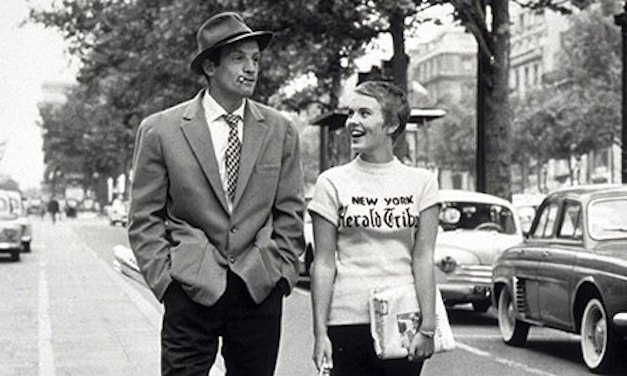
Herald Tribune: Breathless

1 – À bout de souffle (Breathless) (1960)

2 – Une Femme est une femme (A Woman Is a Woman) (1961)

3 – Jules et Jim (1962)

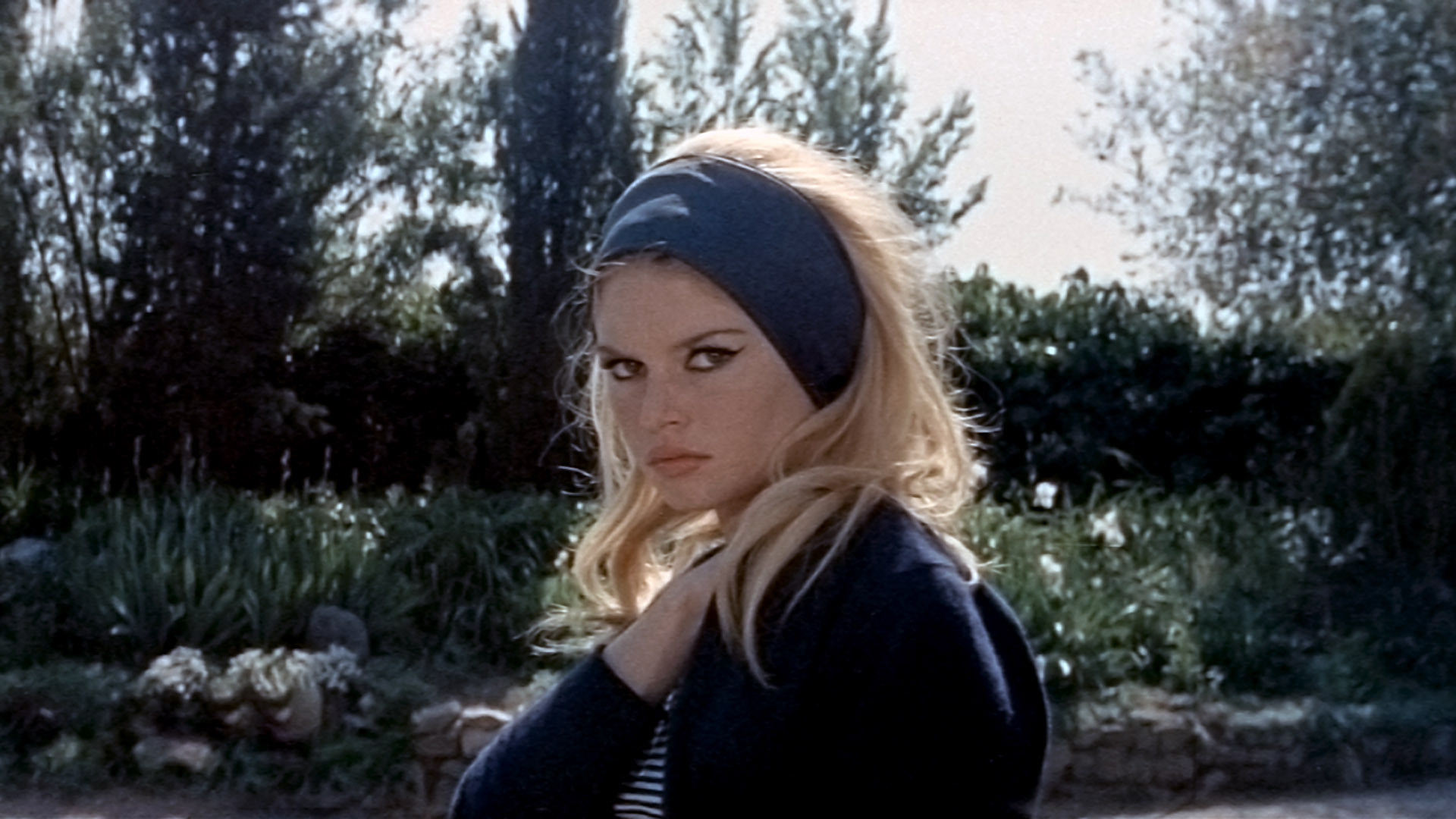
4 – Le Mépris (Contempt) (1963)

mepris-le-webofficialstill2

5 – Bande à part (Band of Outsiders) (1964)

6 – Alphaville, une étrange aventure de Lemmy Caution (Alphaville, a Strange Adventure of Lemmy Caution) (1965)

7 – Pierrot le Fou (1965)

pierrotlefou01_0

8 – Weekend (1967)

9 – Z (1969)

10 – Passion (1982)

passion-1

Share this:

  • Share on X (Opens in new window) X
  • Share on Facebook (Opens in new window) Facebook
  • More
  • Print (Opens in new window) Print
  • Email a link to a friend (Opens in new window) Email
Like Loading...

Despite the Falling Snow (2016)

08 Tuesday Nov 2016

Posted by dullwood68 in Movies

≈ Leave a comment

Tags

Antje Traue, Charles Dance, Cold War, Defection, Drama, Espionage, Literary adaptation, Moscow, Rebecca Ferguson, Review, Romance, Russia, Sam Reid, Shamim Sarif, Spying

despite-the-falling-snow-poster

D: Shamim Sarif / 93m

Cast: Rebecca Ferguson, Sam Reid, Charles Dance, Antje Traue, Oliver Jackson-Cohen, Thure Lindhardt, Anthony Head

One of the things that never happened in the Golden Age of Cinema was an author being given the opportunity to make a movie of one of their novels or stories. Some were employed to adapt their novels and stories, but none were ever allowed to step behind the camera as well and actually direct the movie. Nowadays, this isn’t so unusual, but it’s also still not very prevalent. So step forward Shamim Sarif, author and movie maker, who has been making movies from her novels from the very beginning. She is possibly unique in this way, and has gained a very good reputation from working on both sides of the creative arena. Despite the Falling Snow is the third movie she’s made from one of her novels, and while she may be well regarded in some quarters as the perfect person to adapt her work – after all, who knows it better than she? – the finished product here isn’t quite the testament to her talents as a director.

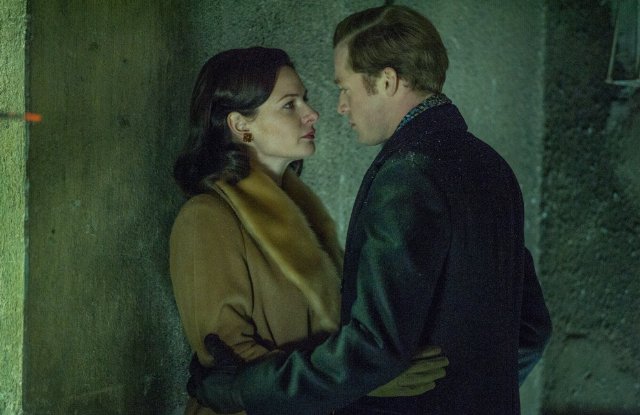
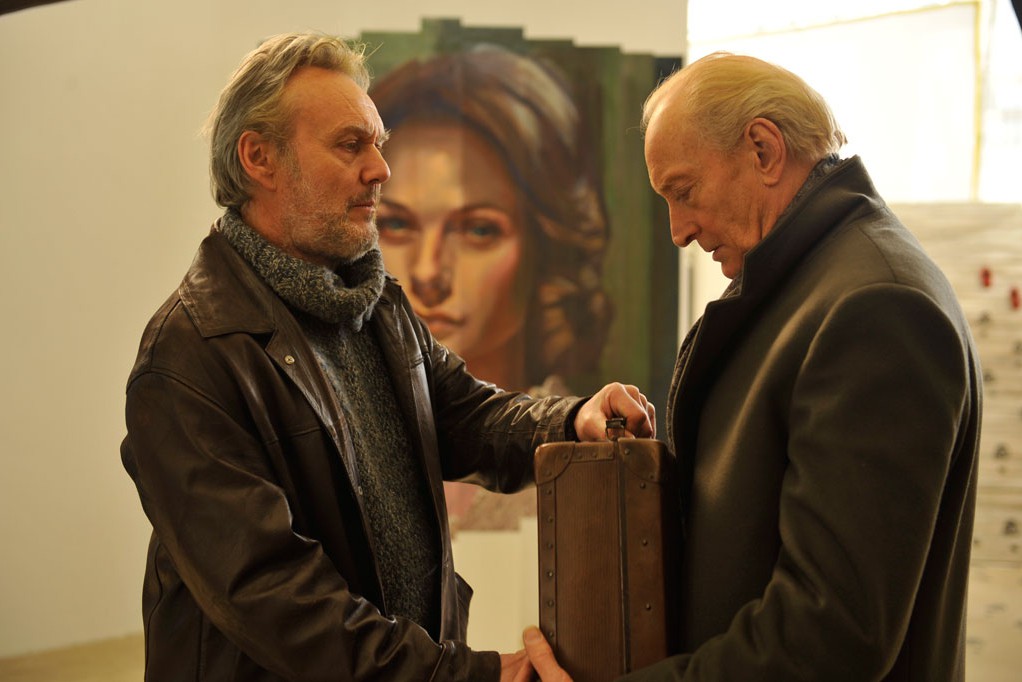
The movie begins in New York in 1961 with the defection of a Russian government official called Sasha (Reid). As he’s helped to escape from his Russian handlers, he asks about his wife, Katya (Ferguson). She’s back in Moscow, but his new, US handlers have no idea where she is or what has happened to her. Fast forward thirty years and Sasha (Dance) is a successful restaurateur who has a niece, Lauren (also Ferguson) who is the spitting image of Katya, and who wants to travel to Moscow to try and find out what happened to her aunt. Sasha refuses to go with her, though, so Lauren, who’s lucky enough to be an artist who’s been asked to mount an exhibition in Moscow, heads off by herself.

day-17-2-881x588

While Lauren’s story plays out in 1991, Katya’s story plays out in tandem from 1959 to 1961. Katya is a teaching assistant who’s also helping her friend and government official Misha (Jackson-Cohen) steal secrets and pass them on to the Americans. At a party she meets Sasha but is unimpressed by him. It’s only when Misha persuades her to get close to Sasha because of his position in the Kremlin that she finds herself falling in love with him. Meanwhile, in 1991, Lauren meets and befriends a journalist called Marina (Traue) who helps her in finding out about Katya. Marina learns that Misha (Head) is still alive, and they make plans to visit him. When they do they find he’s become an embittered, angry old man who wants nothing to do with them.

Back in 1961, Katya and Sasha wed, but she agonises over whether she should tell him she’s a spy. In 1991, Marina’s behaviour becomes suspicious, and the unexpected arrival of Sasha in Moscow prompts a revelation. Katya’s decision to tell Sasha leads to his agreeing to defect, but thirty years on only Misha holds the key to what happened to her.

mv5bmtq1ndu0mjmyov5bml5banbnxkftztgwnzqxotkznje-_v1_sx640_sy720_

A romantic drama set – partly – during a period of intense political and social upheaval, namely the early Sixties, Despite the Falling Snow has such a generic feel to it that it could have been made about any couple in any country at any time, and still have made the same kind of impact. This is thanks to Sarif’s uninspired, pedestrian direction, and a visual style that never rises above formulaic. It’s as if Sarif has forgotten to add the drama needed to make the narrative more than just a succession of events and scenes that show how two people came together and then were separated by fate in the form of expediency. Even when suspicion falls on the officials in the Kremlin, including Sasha and Misha, it’s a moment where real terror at being found out translates instead as a mild concern. Misha is almost fatalistic about the whole thing, a reaction that not even the talented Jackson-Cohen can make convincing; this man should be even more scared than he’s been already.

But if the steady stream of narrative downplaying that infuses the scenes in early Sixties Russia also makes those scenes feel awkward and inconsistent, then spare a thought for those set in 1991. Sarif makes reference to the Berlin Wall having come down two years earlier, but her new Moscow is an uneasy mix of contemporary US stylings and Russian forebearance, as evidenced by Marina’s designer clothing and old Misha’s tower block abode. The juxtaposition jars, and adds to the overall feeling that Sarif wants her characters to look glamorous against the concrete backdrop of post-Stalinist Russia (Katya seems never to be without her red lipstick). The visual conceit is highlighted by Sarif’s decision to have Katya and Sasha, and Lauren and Marina, walk along the same snow-laden stretch of riverside pavement at different times, but instead of creating an echo of past events, it appears to be more of a budgetary deference than a creative decision.

despite_the_falling_snow-15

Elsewhere, narrative developments that appear out of nowhere are treated as if they are absolutely necessary to the overall plot, and that includes a left-field decision to have Lauren and Marina begin a sexual relationship. Old Sasha’s willingness to stay home out of harm’s way is overturned by the contents of a fax, while Old Misha’s decision to spill the beans about what happened to Katya is spurred on by feelings of guilt, and that old chestnut, a terminal illness. And when the viewer does find out what happened to Katya, Sarif handles it in such a hamfisted way that any emotional weight the scene might – or should – have engendered with said viewer, is lost before the scene’s even begun.

A lacklustre movie then, one that doesn’t even aim particularly high, but which does feature another of Charles Dance’s supporting roles (is he semi-retired now, is that what’s going on?) and a level of political naïvete that further dilutes the drama that isn’t really there. On the performance side, Ferguson is unable to make much of either role, as Sarif never allows the viewer to engage with them as anything other than under-developed non-characters. Reid is earnest but treading in a pool so shallow it’s practically evaporated, while Traue is allowed to look moody and resentful in equal measure even when she’s kissing Ferguson. Dance and Head bring a degree of old-time gravitas to the proceedings, but even they can’t avoid the pitfalls that are inherent in the script. On this showing, Sarif needs some more time to clarify her goals in making such a movie, and maybe next time, getting someone else to direct.

Rating: 4/10 – Sixties Moscow never looked cleaner, quieter, or more family friendly than it does in this movie, and that’s despite several efforts to make it look as if it’s not brand new; as a drama it never gets started, despite the best efforts of its cast, and by the end you’ll only want to know what happened to Katya just so that you can move on in (roughly) the same way everyone else does: without too much fuss.

Share this:

  • Share on X (Opens in new window) X
  • Share on Facebook (Opens in new window) Facebook
  • More
  • Print (Opens in new window) Print
  • Email a link to a friend (Opens in new window) Email
Like Loading...

The Girl on the Train (2016)

07 Monday Nov 2016

Posted by dullwood68 in Movies

≈ 1 Comment

Tags

Alcoholism, Drama, Emily Blunt, Haley Bennett, Justin Theroux, Literary adaptation, Luke Evans, Murder, Paula Hawkins, Rebecca Ferguson, Review, Tate Taylor, Thriller

girl_on_the_train_ver3

D:Tate Taylor / 112m

Cast: Emily Blunt, Haley Bennett, Rebecca Ferguson, Justin Theroux, Luke Evans, Edgar Ramírez, Laura Prepon, Allison Janney, Darren Goldstein, Lisa Kudrow

Whenever a novel becomes an unexpectedly massive success – such as Paula Hawkins’ The Girl on the Train did in 2015 – then a movie adaptation is sure to follow. But what happens when the source material isn’t strong enough to support a movie version? What do the makers of such a movie do to combat this? The answer, when you watch the movie version of The Girl on the Train, becomes obvious quite quickly: they don’t do anything, they merely transcribe events and characters to the screen and do nothing to circumvent the problems in the novel. Oh – and they do so in the hope that no one will notice.

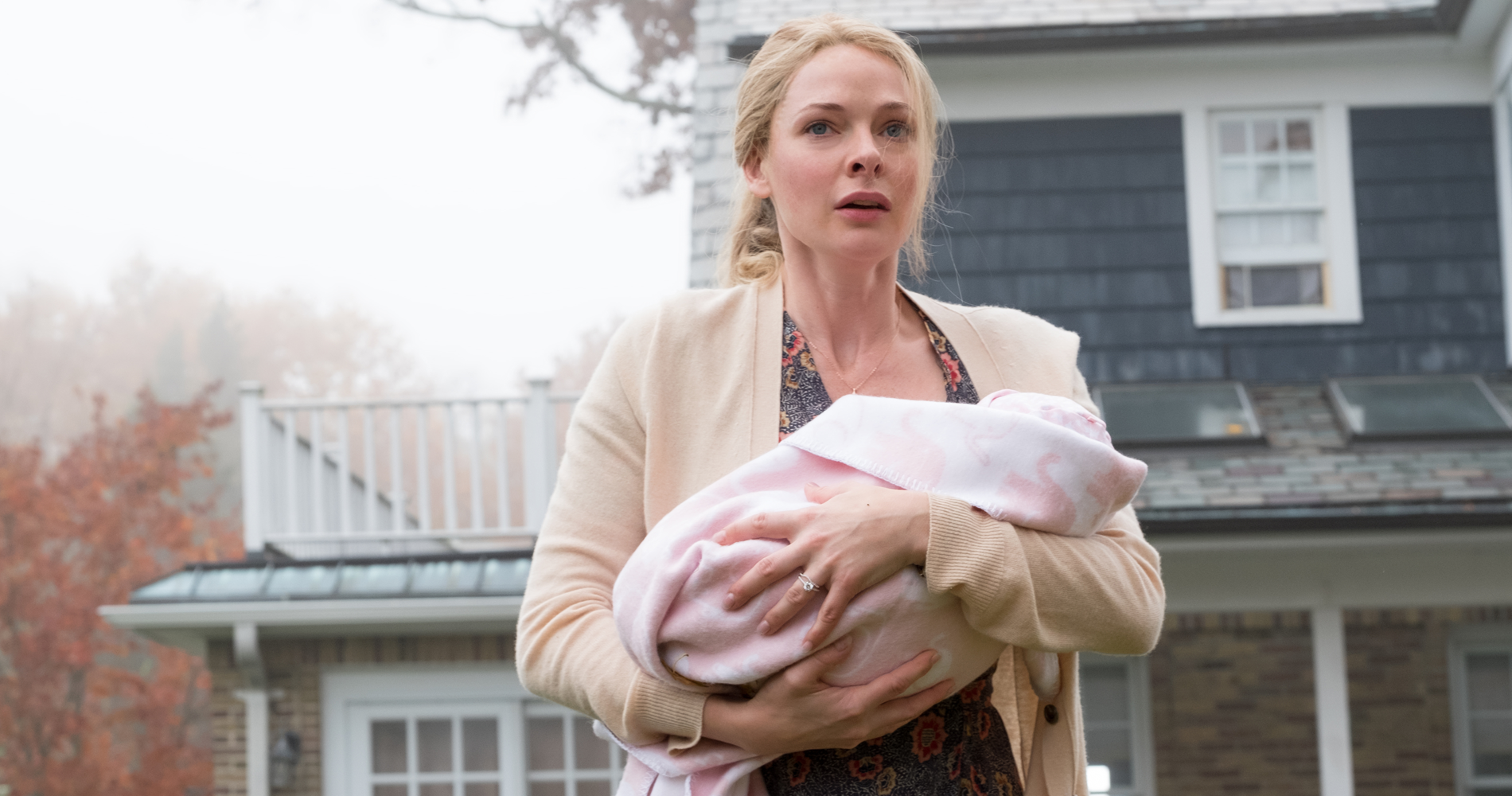
From the beginning of The Girl on the Train we have a clumsy voice over that introduces us to Rachel Watson, a thirty-two year old woman who rides the train to and from work every day, and who seems to have created a fantasy world built around another woman (Bennett) that she sees most days from the train. The woman in question piques Rachel’s interest, as she lives a few doors away from where Rachel’s ex-husband Tom (Theroux) lives with his new wife, Anna (Ferguson), and their baby daughter, Evie. Believing this woman to have a perfect marriage (but having no real reason to believe this at all), Rachel is shocked one morning to see her kissing a man who isn’t her husband.

e51d4c20-6bb1-0134-cdc5-0aec1efe63a9

Rachel is so disturbed by this that she decides to confront the woman. But Rachel is an alcoholic, and though she makes the attempt, she suffers a blackout and wakes the next morning with cuts and bruises and blood on her clothes – but no memory of how any of it happened. Things get worse when a detective (Janney) visits Rachel and asks her if she knows the woman, whose name is Megan. Megan has gone missing, and because Rachel was spotted in the area where Megan was last seen, the detective wonders if Rachel is involved in Megan’s disappearance in some way. Able to stall the detective’s questions, Rachel then makes a fateful decision.

Anyone who has read the book will know that Rachel’s decision is to involve herself in the life of Megan’s husband, Scott (Evans). And the movie follows this route as well – how could it not? – but as with the novel, the movie has the same problem: her decision makes no sense at all. It’s obvious from Rachel’s behaviour – when she’s not fantasizing about a complete stranger, she’s stalking her ex-husband – that she’s got what you’d politely call “issues”, but the only reason the movie has for this behaviour is the fact that Rachel is an alcoholic. It was a contributing factor in her divorce from Tom, and it leads to a couple of minor revelations later on, but it ends up being a catch-all for anything she does that seems a bit manic or ill-advised. The novel tries to make her appear vulnerable; here she just seems desperate.

But as her involvement with Scott is passed off as trying to help (and punish Megan if she stops being missing), Rachel abandons all sense of decency and respect for the ordeal Scott is going through, and pushes her own agenda, which is to find Megan’s abductor or killer – and hope that it isn’t her. This leads to a couple of major revelations, and a final denouement that will have female audiences cheering, and male audiences shaking their heads at the reverse misogyny on display. In essence, the problems in the novel have become the problems in the movie.

girlontrainhaleybennett650

The main problem audiences will have is a lack of someone to even remotely care about. Despite a powerful and from time to time, deeply moving performance by Blunt, The Girl on the Train operates in an emotional vacuum. The trials and tribulations of the various characters are often on display, but it’s like watching a trio of strong-minded women who’ve all decided to give up on being independent, and who can only define themselves through their relationships with men. Rachel is the ex-wife who can’t deal with the fact that her marriage is over, Megan is the wife who needs affairs to feel some kind of connection with herself, and Anna is the ex-lover turned second wife whose chief function is being the mother of Tom’s child. Viewers may find themselves put off by the relentless undermining these characters experience, and the various ways the movie reinforces the ways in which said characters were undermined in the novel.

But beyond all the ersatz feminism, there remains the problem of the central mystery. Megan’s disappearance becomes a murder enquiry when her body is discovered in some nearby woods. But though Rachel wonders if she did kill Megan during her blackout, the likelihood of that actually having happened is so small it’s on a virtually sub-atomic level. So that leaves Anna, a character so gloriously one-dimensional that Ferguson’s talents as an actress are wasted; her husband Tom, whose outward calm and sincerity masks a need to control his environment; and tortured husband Scott, whose wild, angry outbursts could be a smokescreen for something much darker. And those are the only suspects, as the man Megan is seen kissing is her shrink, Dr Kamal Abdic (Ramírez), and despite the screenplay’s ham-fisted attempt to put him in the frame, he’s the classic red herring. This then makes it easy to work out who killed Megan, and also why.

gallery4-5717c33a14c70-1

For a thriller based on the novel “that shocked the world” – really? – The Girl on the Train is a bit of a damp squib, only showing signs of life when focusing on Blunt’s portrayal of Rachel. Blunt brings some much needed craft to her performance, ensuring that while everyone around her aims for competent, she’s proving capable of giving a layered, compassionate performance that elevates the material whenever her alcoholism is mentioned, or she’s on screen. In contrast, Taylor, who failed to find the motivation to make The Help (2011) as compelling as it should have been, leaves the viewer with the feeling he’s only semi-engaged with the project, and as a result, none of it resonates in the way that it should. It all leaves the movie looking and sounding like an uninspired echo of the original novel – and a less than engaging one at that.

Rating: 5/10 – slickly, professionally made, but as hollow as an Easter egg, The Girl on the Train delivers low rent thrills and annoying plot developments as it unfolds the mystery of Megan Hipwell’s disappearance; the non-linear approach of the novel is retained, and used to good effect, but this is still one literary adaptation that should have been more enticing and rewarding than it actually is.

Share this:

  • Share on X (Opens in new window) X
  • Share on Facebook (Opens in new window) Facebook
  • More
  • Print (Opens in new window) Print
  • Email a link to a friend (Opens in new window) Email
Like Loading...

Mini-Review: Jack Reacher: Never Go Back (2016)

06 Sunday Nov 2016

Posted by dullwood68 in Movies

≈ 1 Comment

Tags

Action, Cobie Smulders, Conspiracy, Danika Yarosh, Drama, Edward Zwick, Father/daughter relationship, Lee Child, Literary adaptation, Murder, New Orleans, Sequel, Thriller, Tom Cruise, US Military

cqlurvqumaatri2

D: Edward Zwick / 118m

Cast: Tom Cruise, Cobie Smulders, Aldis Hodge, Danika Yarosh, Patrick Heusinger, Holt McCallany, Austin Hébert, Robert Knepper, Madalyn Horcher, Robert Catrini

After helping the US Military apprehend a crooked sheriff – it doesn’t matter why – Jack Reacher (Cruise) begins flirting by telephone with his contact, Major Susan Turner (Smulders). When he arrives back at his old military HQ to meet her for the first time, Reacher finds she’s been arrested on suspicion of treason. It’s all to do with an investigation she was overseeing in Afghanistan, and which involves the murder of two soldiers out there. Reacher is instantly suspicious himself, but when Turner’s attorney winds up murdered, he finds himself framed for the killing, and with only one option going forward: break Turner and himself out of military prison and go on the run while also trying to solve the conspiracy surrounding Turner’s arrest.

While all this is going on, Reacher also learns that he may have a daughter. Her name is Samantha (Yarosh), she’s fifteen years old, and she becomes involved when the mercenary assassin (Heusinger) charged with tracking down Reacher and Turner links her to her possible father. With the guilty party looking like defence contractor, Parasource, the trio travel to New Orleans and try to find the company’s middle man in Afghanistan, Daniel Prudhomme (Hébert). Frightened and in hiding, Prudhomme is eventually found, and what he tells them reveals a puzzling conspiracy involving the illegal smuggling of weaponry owned by Parasource itself, the rewards of which are outweighed by the potential worth of government contracts.

1774

Jack Reacher (2012) made just enough money (if $218,340,595 can be considered “just enough”) to allow Jack Reacher: Never Go Back to be made. Making this only the second time that Cruise has reprised a character role, the movie again dispenses with any intention of following the sequence of Lee Child’s novels, and plumps for a more recent effort. Given that it provides Reacher with a potential daughter, you can see why Never Go Back was so attractive to the producers, including Cruise himself: let’s show the action man can be a big softie as well (though, actually, not too much of a big softie). But in the end, all this means is that the viewer is subjected to dozens of close ups of Cruise manipulating his facial expressions as if with strings, and a handful of awkward father-daughter moments that are played by rote. You can guess the outcome of this particular “mystery” from a mile away, but the movie goes through the motions with it, and never once makes it seem that Reacher and Samantha could achieve a really meaningful relationship.

This leaves the conspiracy story to lead the rest of the movie, but sadly, the movie never springs to life with it, leaving everything feeling flat and unnecessarily bland. Part of the problem is that you don’t really care what happens to anyone, even Samantha, and the mechanics of the villain’s deadly plot never catch on in the way that the writers and producers and Edward Zwick would like. None of it seems relevant, and all of it is coated with a thin layer of effort. Cruise looks determined, but often it’s difficult to work out if he’s in character or just trying to get through the filming stage. Smulders at least tries to inject some passion into things, but she’s held back by a script that actively ignores her character’s role in the military whenever it can, and at one point sidelines her as a babysitter to Samantha. It all makes the viewer “glad” that sexism can rear its ugly head in a movie, and if it’s supported by Tom Cruise then it’s all the better, and perhaps, even acceptable.

Rating: 5/10 – a sequel that lacks the bite of its predecessor, Jack Reacher: Never Go Back could also be called Jack Reacher: Never Knowingly Exciting; professionally done but a little too generic in its approach and presentation, it’s a movie that never strays out of its comfort zone, not even by accident.

Share this:

  • Share on X (Opens in new window) X
  • Share on Facebook (Opens in new window) Facebook
  • More
  • Print (Opens in new window) Print
  • Email a link to a friend (Opens in new window) Email
Like Loading...

Miss Peregrine’s Home for Peculiar Children (2016)

05 Saturday Nov 2016

Posted by dullwood68 in Movies

≈ 2 Comments

Tags

Asa Butterfield, Drama, Eva Green, Fantasy, Hollowgasts, Peculiars, Review, Samuel L. Jackson, Terence Stamp, Tim Burton, Time loop, Wales, World War II, Ymbrynes

miss-peregrines-home-movie

D: Tim Burton / 127m

Cast: Eva Green, Asa Butterfield, Samuel L. Jackson, Ella Purnell, Judi Dench, Rupert Everett, Allison Janney, Chris O’Dowd, Terence Stamp, Finlay McMillan, Lauren McCrostie, Hayden Keeler-Stone, Georgia Pemberton, Milo Parker, Raffiella Chapman, Pixie Davies, Joseph Odwell, Thomas Odwell, Cameron King, Kim Dickens

Teenager Jake Portman (Butterfield) is very close to his grandfather, Abe (Stamp), who tells him stories of when he was a boy and lived on an island off the coast of Wales during the Second World War. Abe lived at Miss Peregrine’s Home for Peculiar Children, a place where children with paranormal abilities could live freely and without fear of persecution. In time, Abe had to leave, but he’s never forgotten his time there, and he’s told Jake many stories during the course of Jake’s growing up, but Jake has always believed them to be Abe’s version of fairy stories. But one day, Jake finds his grandfather’s body in the woods near Abe’s home; he’s been attacked and his eyes removed. With his last breath, Abe exhorts Jake to find “the bird, the loop and September 3, 1943”.

The discovery of a letter from Miss Peregrine to Abe, added to advice given by Jake’s therapist (Janney), sees Jake and his dad, Franklin (O’Dowd), heading for Wales. They stay at the local inn, and soon, Jake is searching for the “peculiar” home. He finds it in ruins, the result of a direct hit by a German bomb on September 3, 1943. But while he marvels at confrmation of the home’s existence, several of the children Abe has told him about, make themselves known and draw Jake into their world. They travel through a “loop”, a part of time that has been folded in on itself and now re-plays the same day over and over: September 3, 1943. And Jake meets Miss Peregrine (Green) herself, the children’s guardian, called an Ymbryne, a bird able to take human form (and vice versa) and manipulate time.

44455180-3ccb-11e6-af9a-bd6fd6faa6bc_20160627_missperegrineshomeforpeculiarchild

Miss Peregrine wastes no time in welcoming Jake into the home, and he spends the evening there until he realises his father will be looking for him. He returns as quickly as he can, but not before Miss Peregrine shows him just how dangerous it is outside of her protection. Jake sees a hideous creature called a “Hollowgast” come for the children before Miss Peregrine dispatches it with a crossbow. From there stems a warning relating to Wights, former Peculiars who have been the unfortunate victims of an experiment to harness an Ymbryne’s power. One Wight in particular, Mr Barron (Jackson), has made it his mission to track down all the Ymbrynes and take their eyes. But while the way through the loop remains hidden, the children are safe… until Jake unwittingly leads Mr Barron right to them…

When author Ransom Riggs’ novel, Miss Peregrine’s Home for Peculiar Children was first published in 2011, it was an unexpected success. Riggs’ tale of peculiar children with strange abilities and the evil creatures that hunt them was the first in a trilogy of novels that breathed new life into gothic fantasy. It was obvious that a movie version would be made, and who better to bring the novel to life than Tim Burton? His brand of weird humour and his visual stylings were perfect for Miss Peregrine…, and with a script courtesy of Jane Goldman (X-Men: Days of Future Past, Kingsman: The Secret Service), all the signs were good that the movie would be as dark and strange and captivating and exciting as the novel.

miss-peregrines-home-peculiar_trailer-cap

And for the most part it is. Ultimately, it’s the adaptation that doesn’t work entirely, with Goldman unable to pin down the main storyline, and fumbling with the subtext relating to humans as monsters during World War II (it’s no coincidence that Abe is a Polish Jew and a survivor of the ghetto, and that the hollowgasts’ name sounds like something else from World War II). With the main ingredients of Riggs’ tale broadened at first and then allowed to carry on broadening, the movie ends up being only half as rewarding as it could have been. Things begin well with Stamp’s genial yet firm Abe trying to keep Jake safe from the threat of the Wights and the Hollowgasts, but once Abe dies there’s an uneasy switch from Abe and Jake to Jake and Franklin, and their trip to Wales. Goldman rushes things along and soon Jake is getting to know the likes of Emma Bloom (Purnell), who is lighter than air and has to be weighted down; Millard Nullings (King), an invisible boy; and Olive Abroholos Elephanta (McCrostie) who can set things alight just by touching them.

It’s this stretch of the movie that is the most enjoyable, as Jake (and the viewer) gets to know everyone, and the idyllic, if repetitive, nature of the children’s existence is explored. There are terrific performances from all the child actors playing the Peculiar Children of the title, and a wonderful performance from Green as their guardian. With her probing stare and knowing smiles, Green is the movie’s ace in the hole, and the movie misses her energy whenever she’s off screen. Once things start to unravel and Mr. Barron gains the upper hand, the movie pauses to regroup itself, and heads for a crowd-pleasing finale at the end of Blackpool Pier that involves a riotous showdown between Hollowgasts and animated skeletons á la Jason and the Argonauts (1963). Along the way it abandons any notion of cohesion and continuity, and its attempts to make sense of the time loop/time travel conundrum the Peculiars and Jake find themselves in are brief and inconclusive (and baffling to anyone not paying full attention).

miss-2

But while the script tries to work out how best to tell the story, and in doing so deviates from Riggs’ original halfway cliffhanger-ish ending, the movie is rescued by Burton and his striking visual compositions and the movie’s darkly exuberant set design and decoration. This is, at times, a sumptuous movie to watch, and Burton’s trademark gothic flair is well in evidence as he guides the viewer through a series of imaginative and impressive sequences that more than adequately show how good a fit for the material he is. But again, when the story has to take centre stage it’s often weak and lacking focus, though to be fair to Goldman she is trying to cram an awful lot into a two hour movie, and as good as she is as a screenwriter, when the source material is as detailed as it is, it’s unsurprising that some of the good stuff is going to be overlooked or a way for it all to fit in isn’t explored with any vigour.

Alongside Burton’s efforts, those of Green, Jackson, Stamp and Purnell are most welcome, with Jackson’s pantomime performance proving weirdly appropriate. Fans of the novel will be surprised to find that this is, unless a sequel is green-lit, a stand-alone movie with only a couple of nods to the book’s original ending. Does this work? The answer is impenetrable, either way. Fans and supporters of the novels will be disappointed that this isn’t the beginning of a series, and newcomers will most likely have wanted to spend more time getting to know all the peculiar’s; all in all, there’s something for everyone, just not as much for avid fans of the book.

Rating: 7/10 – with its script proving too wayward, and feeling like it was rushed (or hastily rewritten at some point prior to filming), Miss Peregrine’s Home for Peculiar Children entertains in fits and starts; and yet it’s hugely enjoyable when Goldman and Burton’s sensibilities meet in the middle, and there’s more than enough on display to justify the movie’s being seen by as many people as possible, so perhaps this is one adaptation where advance knowledge of the plot isn’t necessary… or desirable.

Share this:

  • Share on X (Opens in new window) X
  • Share on Facebook (Opens in new window) Facebook
  • More
  • Print (Opens in new window) Print
  • Email a link to a friend (Opens in new window) Email
Like Loading...

Mr. Church (2016)

05 Saturday Nov 2016

Posted by dullwood68 in Movies

≈ 1 Comment

Tags

Breast cancer, Britt Robertson, Bruce Beresford, Cooking, Drama, Eddie Murphy, Natascha McElhone, Pregnancy, Relationships, Review, Tearjerker

mr-church_poster

D: Bruce Beresford / 104m

Cast: Eddie Murphy, Britt Robertson, Natascha McElhone, Xavier Samuel, Lucy Fry, Christian Madsen, Mckenna Grace, Natalie Coughlin, Madison Wolfe, Lincoln Melcher

In 1971, something unusual happens to single mother Marie Brooks (McElhone) and her ten year old daughter Charlotte (known as Charlie) (Coughlin): they find they have a cook. His name is Henry Joseph Church (Murphy), and he is effectively a legacy from the man who was Charlie’s father. Employed to look after Marie and Charlie after her father’s death, Mr. Church – as he likes to be called – has been paid to look after them for the next six months. The timescale is important because Marie has breast cancer and has been given that amount of time to live, though she hasn’t told Charlie any of this.

At first, Charlie doesn’t want Mr. Church in their home. But once she tastes his cooking, she slowly comes around to the idea that having him there during the day is a good idea. He brings books into the home that Charlie begins to read, and he makes things easier for Marie. But after six months, Marie is still alive, and is still alive again in six years’ time, though much sicker by now. When Charlie (Robertson) is asked to the prom by the boy she likes, Owen (Samuel), she doesn’t want to accept because she’s afraid Marie won’t be alive by then, but Marie confounds expectations and even helps her decide on a dress. Throughout all this time, Mr. Church has been the rock that both women have relied on; the only thing that bothers Charlie is that after six years, she still doesn’t know anything about him.

crush_4

But one night she sees him going into an infamous club called Jelly’s. She doesn’t say anything, and soon after she goes off to Boston University, helped in part by savings Mr. Church has put aside for her. There she meets new people, works hard, and winds up pregnant. Unsure of what to do, she returns home, and with her mother no longer alive, she goes to Mr. Church’s home. He lets her stay on the condition that she continues to respect his privacy. She agrees, but later on, the temptation to find out more about him, leads her to break that one rule and in doing so, bring an end to their relationship.

Putting aside the Beverly Hills Cop retread that was made for TV in 2013, Eddie Murphy hasn’t appeared in a movie since A Thousand Words (2012). In fact, since he made the execrable Norbit (2007) his career has consisted of four theatrical releases, and five outings as Donkey (from Shrek) on both the big and the small screen. Once upon a time, Murphy was the world’s biggest movie star. Now he’s rarely seen at all, and when he is, there’s precious little fanfare. Mr. Church is a movie that has slipped under most people’s radar, and it’s indicative of both Murphy’s place in the acting firmament, and it’s likely reception, that this movie isn’t being promoted more heavily. It’s a small movie, to be sure, but one that has a lot more going for it than might be readily expected.

Cook_Day13_05701.NEF

For starters, there’s Murphy’s portrayal of Henry Joseph Church. Henry is a quiet, proud man, though he has his demons (as Charlie discovers when she stays with him). Murphy focuses on the man’s quiet demeanour, his initially reserved, almost calculating approach to being Marie and Charlie’s “cook” (he becomes so much more to both of them), and the way in which his relationships with them give his life a greater meaning. And even when he’s dealing with his inner demons, what is more impressive in terms of the character is the alacrity with which he can forget about those demons and continue to be supportive of Charlie and Marie. Murphy doesn’t strike a false note throughout (though an angry outburst nearly takes the shine off, coming across as an awkward line reading of an equally awkward piece of dialogue). Like a lot of comedians, Murphy is a fine, dramatic actor, and here he judges the character and the emotional links to the narrative with quiet aplomb, grounding a movie that at times can strike the viewer as being cloyingly sentimental.

But Murphy is the antidote to that feeling, even when he’s involved in some of that overly sentimental material. Mr. Church is a guardian angel, someone who knows exactly what to do in any given situation, and the former star of movies such as The Golden Child (1986) and Vampire in Brooklyn (1995), effortlessly redeems himself for some of the dreadful movies he’s made in the last twenty, thirty years. Using a neutral expression for the most part, Murphy still manages to evoke feelings and responses in the viewer that a lot of actors would struggle to achieve across a movie lasting five times as long. And in conjunction with Britt Robertson, he’s found someone who can match him in terms of displaying their character’s emotional stance without resorting to an exaggerated acting style. Mr. Church is a tearjerker, and one that works best because of the understated way in which its characters are played.

That’s not to say that the movie is entirely successful, though. Given the era it all takes place in, you could be forgiven for thinking that at some point, racism will rear its ugly head, but there’s not one scene that addresses the issue directly. This makes it seem as if the story is taking place in an historical vacuum, an idea that is further compounded by the realisation that Mr. Church doesn’t have a family of his own, or even friends, and his emotional well-being is entirely dependent on the white family he works for. There are moments where this is highlighted, and awkwardly, leaving the viewer with the suspicion that any such notions were ignored or removed during the movie’s production. But equally, it’s a measure of the movie that as race isn’t an issue for Marie and Charlie, then their acceptance of Mr. Church is a valuable lesson in how to make a movie about just the characters and their relationships, and not about any extraneous issues such as race or creed.

9ed18e20-664c-11e6-a882-afd8a6f86925_20160819_mrchurch_trailer

Some may find that the movie is overly and severely sentimental, but this, for once, isn’t a bad thing. There are several moments where the emotional message behind the movie is turned on like Xmas lights, and while these moments do stick out from the rest of the material, it’s a tribute to veteran director Bruce Beresford (and his cast) that they don’t overwhelm the episodic storyline, or prove too off-putting. There are also times when the characters avoid talking to each other, and almost in deference to Jack Nicholson’s character in A Few Good Men (1992) when he tells Tom Cruise’s character that he “can’t handle the truth”. These moments can be frustrating, but by the time you’ve registered the frustration, the story has moved on and the “danger” has passed.

Having previously directed the likes of Driving Miss Daisy (1989) and A Good Man in Africa (1994), Beresford is a good choice for the director’s chair, adding layers of subtlety when required, and allowing emotional outbursts to happen without their feeling staged, or pulling the viewer out of the narrative. He keeps things very simple throughout, and doesn’t allow the various “tragedies” that occur during the narrative to define the characters, leaving them free to grow in their own way. Even secondary characters such as Madsen’s Army vet with a drink problem are allowed to shine at various points in the movie, and while some of them may feel extraneous to things, they all have their place in driving the story forward. It all helps Mr. Church to become more than just a deft “feel-good Samaritan movie”, and more of an ode to (mostly) uncomplicated, mutually dependent and rewarding relationships.

Rating: 7/10 – with its simple message, and even simpler approach to the material, Mr. Church might seem, at first, to be lacking in depth, but thanks to good performances from Murphy and Robertson, and pertinent direction from Beresford, the movie has more to offer than meets the eye; easy to watch and even easier to admire for what it gets right, Murphy’s latest outing won’t win many awards or attract great swarms of viewers, but it is worth seeing as a reminder that he’s still a very talented actor indeed.

Share this:

  • Share on X (Opens in new window) X
  • Share on Facebook (Opens in new window) Facebook
  • More
  • Print (Opens in new window) Print
  • Email a link to a friend (Opens in new window) Email
Like Loading...

Poster(s) of the Week – Witchfinder General/The Conqueror Worm (1968)

02 Wednesday Nov 2016

Posted by dullwood68 in Movies

≈ Leave a comment

Tags

American International Pictures, Horror, Michael Reeves, Poster of the week, The Conqueror Worm, Tigon, Vincent Price, Withchfinder General

When movies are released with an alternative title, often there’s a new poster created to go with the change of name. And sometimes the new poster proves to be better than the original (though more often there’s no difference either way). In 1968, the British production company Tigon released a movie based on a novel by Ronald Bassett called Witchfinder General. The movie was directed by wunderkind Michael Reeves, and starred Vincent Price in what would come to be regarded as one of his very best performances.

212c9375-afd0-4e0e-b78d-285017b3a566

The above poster was used in the UK, and while it has a lot to say for itself in terms of the activity presented within its frame, it’s not the best example of a horror movie poster from the period. The title is shown in large block capitals, but more in the style of an historical epic rather than the low-budget horror movie it’s actually about. And the image of Vincent Price, with its backdrop of rising flames, isn’t the best representation of the actor you’re ever likely to see, what with his beady eyes and protruding lower lip. There are – unfortunately – lots of other areas where the poster design lacks imagination, and in the case of the woman on the left hand side with her arms raised who looks like she’s wearing a bikini, quality control. There’s a riot of activity going on across the image, and while some of it – the burnings, Price’s black-cloaked figure – are relevant to the movie, there’s far more that isn’t, and there’s a sense that a cast of thousands has been assembled to match the intensity of the material (completely unlikely, though, as a plan to shoot the Battle of Naseby was scrapped as it would involve hiring too many extras). And then there’s the typeface, underlined in red for no reason at the top, taking up the bottom fifth of the poster, and leading to the central images being squashed between the two. In short, it’s a messy, jumbled effort and does the movie it’s advertising no favours.

In the US it was a whole different ballgame (as it usually is). Co-producers on the movie, American International Pictures, wanted to play up the presence of Vincent Price and link it in to the various Edgar Allan Poe movies they’d produced earlier in the decade. Of course, Reeves’ tale of Matthew Hopkins, Witchfinder General takes place roughly two hundred years before Poe’s career made him famous, so there can’t be any kind of connection at all, but AIP were the kind of company that wouldn’t let a simple thing like an historical mismatch get in the way of selling a movie. And as for that title, well it’s not very witch-y, is it?

22b9e525d70ac1f8d8800b745e20b2c4

The title change does have a certain charm, and on its own it’s an ominous enough combination, but it doesn’t adequately reflect the content of the movie. The poster though, for all its adherence to the lie that this is an adaptation of an Edgar Allan Poe tale, gets much more right than its British predecessor. The admonition to stay home with your children if you’re too squeamish is straight out of low-budget horror movie marketing for the time, but for once, it’s not false advertising. Reeves’ approach to the material was to highlight the sadism and the cruelty of the period, and while the UK censors took umbrage at some of the scenes in the movie and they were removed, US viewers saw the movie in a version that was virtually intact. And instead of a pouting, disapproving-looking Price staring out at you, AIP went with a mangled skull with one eye still in place, its tousled, straw-like hair like roots growing out of the skull itself. It’s definitely an arresting image, and one that isn’t constrained by the more orderly typeface seen at the top left and along the bottom of the image. It’s also the kind of horrifying image you might see in an illustrated version of Poe’s stories, and not a tale of witch-hunting in 17th century England. But it works, almost completely, with the only caveat being that its depiction of the crosses Hopkins’ victims are tied to, don’t match up to those in the movie (and really, that’s just a minor gripe at best).

So, to be clear, AIP took a movie they’d co-financed, they changed the title, they made it look and sound like another of their Edgar Allan Poe adaptations, they added an image with no relevance to the content of the movie at all, and they did it with full awareness that they were misrepresenting their own movie. And yet – it works, and more powerfully than Tigon’s version. Maybe there’s a lesson in there, somewhere, but one thing’s for sure, sometimes artistic licence really is the way to go.

Agree? Disagree? Feel free to comment.

Share this:

  • Share on X (Opens in new window) X
  • Share on Facebook (Opens in new window) Facebook
  • More
  • Print (Opens in new window) Print
  • Email a link to a friend (Opens in new window) Email
Like Loading...

The Library Suicides (2016)

01 Tuesday Nov 2016

Posted by dullwood68 in Movies

≈ Leave a comment

Tags

Catrin Stewart, Drama, Dyfan Dwyfor, Euros Lyn, Fflur Dafydd, Literary adaptation, Murder, National Library of Wales, Review, Ryland Teifi, Suicide, Thriller, Twins, Wales, Y Llyfrgell

the-library-suicides-poster

Original title: Y Llyfrgell

D: Euros Lyn / 87m

Cast: Catrin Stewart, Dyfan Dwyfor, Ryland Teifi, Sharon Morgan, Carwyn Glyn

Twins Ana and Nan (Stewart) both work in the archive section of the National Library of Wales in Aberystwyth. Their mother, Elena (Morgan), is a famous author who has raised her daughters by herself. Ana is the creative, more outgoing twin, while Nan is the dependable, more introverted one. Their lives are orderly, well-managed and maintained, and their work appears to be all they have outside of their relationship with their mother. But all that changes when Elena commits suicide by jumping from a second story window at their home. With Ana and Nan both present in her dying moments, Elena says that “it was Eben”.

Eben (Teifi) was once a student of Elena’s who in the time since her death, has been granted access to her papers, and is intending to write her biography. The papers are kept at the National Library, in a vault room below ground. Late one afternoon he arrives at the Library to begin work on the biography. He’s shown in by security guard Dan (Dwyfor). Soon the Library closes, and once all the other visitors have left, Ana and Nan begin to carry out a plan they’ve hatched to kill Eben for causing the death of their mother.

screen-shot-2016-11-01-at-13-16-31

Along with Dan, there’s another guard called Glyn (Glyn). The twins offer them both coffee laced with crushed sleeping tablets. Glyn succumbs, but Dan rejects the offer. Ana tempts him with alcohol (also laced with crushed sleeping tablets) but he only drinks enough to pass out for a short while. While both men are “out of action”, the twins confront Eben in the vault room. They pull guns on him, tie his hands together, put a noose around his neck, and make him stand on a chair. But as they pull away the chair, Dan – who has woken up and has seen what’s happening on a security monitor – cuts the power to the building. The lights go out, there’s a crash followed by a gunshot, and in the moments that follow, both Ana and Nan become aware that their plan for revenge isn’t going to go as well as they’d planned…

The Library Suicides is a bit of a rarity. It’s a Welsh thriller where the entire cast speak Welsh throughout (there’s the odd English phrase or word, but it still leaves the cast speaking Welsh for ninety-nine percent of the running time), and it’s largely set in the actual National Library of Wales in Aberystwyth. There’s also something of a mystery to be solved, as the circumstances surrounding Elena’s death aren’t as clear-cut as they seem, and in particular, Eben’s involvement – if any – in what happened that day. As Ana and Nan put their plan into action, Eben’s behaviour, allied with some unexpected interventions by Dan, ensure that Ana and Nan have to improvise quite a bit, and in doing so, learn more about their mother than they suspected could be true.

screen-shot-2016-11-01-at-13-20-19

Adapted from the novel by Fflur Dafydd (who also provides the screenplay), The Library Suicides is a smart, intriguing psychological thriller that makes good use of its unique location – it’s like a maze in there – and manages to keep the viewer guessing for most of its relatively short running time before it conforms to thriller conventions and reveals all. Before then, though, it throws in a few deft twists and turns, and keeps its focus firmly on Ana and Nan as they try to contain the fallout from Dan’s cutting off the power, and also contain their own feelings as they both learn about and reveal things about their mother.

In the hands of experienced director Euros Lyn – better known for his TV work on shows such as Daredevil, Broadchurch and Doctor Who – The Library Suicides is a dour but imaginative thriller that features a terrific dual performance from Stewart (who is herself a twin in real life), an ominous score courtesy of Dru Masters, and sterling cinematography from Dan Stafford Clark that captures the chilly atmosphere of the Library and the claustrophobic nature of the material as the characters become more and more trapped by the decisions they’re forced to make. One of the main reasons for how good the movie is lies at the door of Stewart, who at first makes it very difficult for the viewer to tell Ana from Nan and vice versa, but as the movie progresses, slowly but surely, she expertly defines both twins’ individual psychology, and in the process, gives two awards-worthy performances.

screen-shot-2016-11-01-at-13-19-03

The mystery surrounding Elena’s death, and the meaning behind the phrase, “it was Eben”, is slowly but surely revealed as the movie progresses, and the deep, dark secret lurking behind it all (while it will be obvious to some viewers) is handled with care throughout. Lyn resists the temptation to make more out of it than there is, making it all more low-key than a lot of other movies would feel comfortable with. By doing so, Lyn ensures the viewer is more attentive and more invested than in a lot of other, similar thrillers out there, and he sprinkles some misdirection here and there to keep audiences on their toes.

This being a modern day thriller, there’s blood to be spilled, and though the physical demands of the production are entirely evident on the screen, it’s often the movie’s subtext that has the advantage of making more of an impact as the movie progresses. The movie is as much about redacted memory and the suppression of feelings than it is about revenge for an undisclosed crime, and Dafydd’s script keeps sight of all this even when said blood is being spilled. In particular it’s what the twins remember that carries emotional and dramatic weight, and again, both Lyn and Stewart are more than up to the challenge of revealing just enough to keep viewers enthralled and wanting to see what happens next. In the end it’s only a last-minute reveal that proves unnecessary, and while it may be clever in the context of what’s gone before, it does the narrative no favours and seems tacked on for effect – which it doesn’t need to do.

Rating: 8/10 – deliberately paced, and with the look and feel of a “Nordic noir”, The Library Suicides is a movie that gives its characters solid reasons for what they do, and never short changes them or the audience as a result; Stewart’s performances are compelling, and Lyn’s direction expertly juggles the visual demands of those performances, while also negotiating the spaces within the National Library with vigour and aplomb, making this one night shift that’s hard to forget.

Share this:

  • Share on X (Opens in new window) X
  • Share on Facebook (Opens in new window) Facebook
  • More
  • Print (Opens in new window) Print
  • Email a link to a friend (Opens in new window) Email
Like Loading...

Monthly Roundup – October 2016

31 Monday Oct 2016

Posted by dullwood68 in Movies

≈ 1 Comment

Tags

400 Days, Action, Africa, Alexander Skarsgård, Christoph Waltz, Crime, David Yates, Documentary, End of a Gun, Greg Kwedar, Historical drama, John Dower, Johnny Simmons, Keoni Waxman, Louis Theroux, Malin Buska, Margot Robbie, Matt Osterman, Michael Nyqvist, Mika Kaurismäki, Monthly roundup, My Scientology Movie, Queen Kristina of Sweden, Reviews, Samuel L. Jackson, Sarah Gadon, Sci-fi, Steven Seagal, The Girl King, The Legend of Tarzan, Thriller, Transpecos

The Legend of Tarzan / D: David Yates / 110m

Cast: Alexander Skarsgård, Samuel L. Jackson, Margot Robbie, Christoph Waltz, Djimon Hounsou, Jim Broadbent, Simon Russell Beale, Ben Chaplin

the-legend-of-tarzan-movie-review

Rating: 3/10 – “meh”; woeful only just about covers how bad this movie is, from the wooden performances, to the haphazard scripting, to Yates’s casual engagement with the material, and all the way to the creaky use of CGI to simulate the African backgrounds – at no point does The Legend of Tarzan ever feel as if it has any intention of putting any real effort into things.

400 Days (2015) / D: Matt Osterman / 91m

Cast: Brandon Routh, Dane Cook, Caity Lotz, Ben Feldman, Tom Cavanagh, Grant Bowler, Dominic Bogart, Fernanda Romero, Sally Pressman, Mark Steger

400-days-movie-review

Rating: 4/10 – four astronauts are locked inside a chamber designed to simulate the timescale of a planned mission, and the psychological effects of such a journey, but as the simulation nears its finish, the quartet find that things aren’t entirely what they seem; a mystery thriller that doesn’t need its sci-fi trappings (and where the mystery is unengaging), 400 Days plays out like an old Outer Limits episode but without the succinctness that show could provide, all of which leaves the viewer trying hard to make sense of what’s going on, and trying equally hard to decide whether or not they should be bothered about it all.

The Girl King (2015) / D: Mika Kaurismäki / 106m

Cast: Malin Buska, Sarah Gadon, Michael Nyqvist, Lucas Bryant, Laura Birn, Hippolyte Girardot, Peter Lohmeyer, François Arnaud, Patrick Bauchau

girl-king2

Rating: 5/10 – the story of Queen Kristina of Sweden (Buska), who in the ten years she ruled her country, did her best to bring enlightenment and peace for everyone, and who fought against her advisors’ insistence that she marry and secure her throne for the future; reminiscent of the Euro-pudding movies so prevalent in the late Seventies and throughout the Eighties, The Girl King lacks a coherent shooting style that isn’t helped by Hans Funck’s scattershot approach to the editing, but it does keep things admirably simple (if not too simple at times), and remains unexpectedly watchable thanks to Kaurismäki’s determined effort to convert Kristina’s reign (and her presumed lesbianism) into historical soap opera.

My Scientology Movie (2015) / D: John Dower / 99m

With: Louis Theroux, Marty Rathbun, Marc Headley, Tom De Vocht, Jeff Hawkins, Andrew Perez, Rob Alter

tumblr_o0t34k4rij1qzle40o1_1280

Rating: 7/10 – Louis Theroux, intrepid (and annoying) documentarian turns his attention onto Scientology, and attempts to understand why the organisation is so litigious and defensive about its practices; Theroux teams up with ex-Scientology bigwig Marty Rathbun to learn about what goes on behind the scenes, but succeeds largely in having childish spats with one of the organisation’s “security” team (very funny indeed), while organising a filmed representation of a meeting where Scientology leader David Miscavage threw a major tantrum, all of which leaves My Scientology Movie feeling arid for long stretches and not quite as illuminating as Theroux might have hoped.

Transpecos (2016) / D: Greg Kwedar / 86m

Cast: Johnny Simmons, Gabriel Luna, Clifton Collins Jr, Julio Oscar Mechoso

thumbnail_24647

Rating: 5/10 – three Border Patrol guards find themselves in trouble with a Mexican cartel when they stop the wrong car at a checkpoint, and learn that one of them is in even deeper trouble than anyone knew; Transpecos makes good use of its New Mexico locations, and the opening twenty minutes point towards the movie being a tense, tightly constructed thriller, but sadly it soon degenerates into an unconvincing, meandering collection of scenes that are often dramatically inert, and which stretch the narrative in a variety of ineffective ways that it can’t recover from.

End of a Gun (2016) / D: Keoni Waxman / 87m

Cast: Steven Seagal, Florin Piersic Jr, Jade Ewen, Ovidiu Nicolescu, Jonathan Rosenthal, Alexandre Nguyen, Claudiu Bleont

138

Rating: 4/10 – retired DEA agent-cum-“ghost” Michael Decker (Seagal) rescues a stripper (Ewen) from her abusive boyfriend (by killing him) and finds himself helping her steal €2m of the man’s money – which doesn’t go down well with his drug czar boss; another Romanian-shot quickie from Seagal that keeps his stunt double, his running double, and his walking double in gainful employment, End of a Gun is made bearable thanks to a good performance from Piersic Jr, and Waxman’s ingenuity when shooting low-budget shootouts, but otherwise it’s business as usual, which is to say, pretty awful (and the less said about ex-Sugababes member Ewen, the better).

Share this:

  • Share on X (Opens in new window) X
  • Share on Facebook (Opens in new window) Facebook
  • More
  • Print (Opens in new window) Print
  • Email a link to a friend (Opens in new window) Email
Like Loading...

I, Daniel Blake (2016)

30 Sunday Oct 2016

Posted by dullwood68 in Movies

≈ Leave a comment

Tags

Dave Johns, Drama, Employment Support Allowance, Hayley Squires, Heart attack, Jobseeker's Allowance, Ken Loach, Palme d'Or, Paul Laverty, Preview

i-_daniel_blake_poster-1

D: Ken Loach / 100m

Cast: Dave Johns, Hayley Squires, Briana Shann, Dylan McKiernan, Kate Rutter, Micky McGregor

As the opening credits of I, Daniel Blake are displayed, the viewer gets to hear a conversation that the movie’s title character (Johns) is having with a “healthcare professional”. The “healthcare professional”, a woman, is asking a series of questions that have nothing to do with Daniel’s recent heart attack. As he gets more and more frustrated with her, it becomes clear that he’s already become stuck in a welfare system that can’t deviate from its proscribed formulas and rules. The end result is a situation where Daniel’s health is such that his doctor and his consultant have advised him that he shouldn’t work until he’s fully recovered. But he’s unable to claim the Employment Support Allowance (ESA) that would tide him over until he’s better; he’s just not unwell enough as judged by the criteria. And with the so-called “healthcare professional” not having followed up about his health with his doctor, Daniel finds that if she had, he would have had enough points.

But he’s stuck with having to appeal the decision, which isn’t as straightforward as he expects. While he waits for the appeal to be heard, he has no choice but to claim Jobseeker’s Allowance (JSA), which is for people who are fit and looking for work. Needing money to live on but now finding himself stuck in a twilight world where strict rules often fail to help an individual’s needs, Daniel soon discovers that getting any kind of financial support is much, much harder than it looks (or should be). A carpenter who’s mostly worked on building sites for forty years, and who has been recently widowed, Daniel isn’t computer literate (instead he’s “pencil literate”, as he puts it) and struggles to fill in the requisite forms online. His efforts to look for work – because he hasn’t got any evidence of doing so that the Job Centre will accept – are looked upon unfavourably, and he’s threatened with sanctions if he doesn’t make more of an effort.

Through all of this, Daniel meets and befriends a young, single mother of two called Katie (Squires). Having had to move from London to Newcastle in order to live somewhere better than a homeless persons’ hostel, Katie is also struggling for money. Daniel helps her out where he can, mostly in a practical way by helping out around her new home, and in the process he bonds with her two children, Daisy (Shann) and Dylan (McKiernan). They support each other, their unlikely friendship borne out of their frustrating efforts to get the UK welfare system to help them in the short term. But even their friendship is put to the test by the system’s lack of support, and when Katie makes a decision that has (potentially) wider consequences, it causes a rift between them, and both find themselves alone again.

137

A few years ago, Ken Loach announced his retirement from movie making. He’d made Jimmy’s Hall (2014), and wasn’t sure he could continue with the same amount of confidence in his abilities as he had before. It was an understandable feeling, but one that many people hoped Loach would overcome. Obviously, he has. But if anyone had any doubts that Loach wasn’t capable of maintaining his passion for movies, and the making of them, then I, Daniel Blake is the movie to dispel those doubts. Laced with Loach’s trademark vitriol when dealing with blinkered authority, this is a movie that shows Loach has lost none of his skill in dissecting the ills lurking at the heart of British society, and the ways in which the under-privileged are treated with such disdain.

Along with regular screenwriter and collaborator Paul Laverty, Loach has fashioned a caustic tale of intransigence within the UK welfare system, and in doing so, has highlighted some of the more farcical aspects of said system. There’s a scene where Daniel, having given his CV to a number of potential employers, receives a phone call from one of them offering him a job. But because his ESA appeal is still pending he’s unable to take up the offer. This causes the employer to brand him a timewaster and someone who’d rather take benefits than work. It’s an untenable situation, and Daniel has no answer to it except to continue to plough through the mountain of red tape that seems designed to keep him from getting any money at all.

2717

Likewise, Katie has her own problems in getting any JSA. New to the city she misses her first Job Centre appointment by minutes and is told she can’t claim any money because she’s late. There’s no attempt to allow for extenuating circumstances, and when she protests she’s asked to leave; no one is interested in hearing her out. Loach uses examples like these to show just how unyielding and implacable the system is, and how it keeps knocking people down at every opportunity. If, at the start of the movie your understanding of the UK welfare system is that it isn’t as flawed as everyone makes out, then that understanding will be completely washed away by the movie’s end.

Loach’s passionate, didactic approach is, however, as heavy-handed and lacking in subtlety as ever. He and Laverty pile on the problems and the knockbacks and the condescension and the impugnity of uncaring authority figures with little regard for the drama of the piece. The movie is relentless in this respect, adding to Daniel’s woes in almost every scene, and by the end it’s an exhausting experience just watching a once proud man pushed to the limit of what he can endure. Katie also suffers, her efforts to keep her children safe and healthy meaning that she has to experience the opposite. With Loach and Laverty keen to prove just how terrible being dependent on the welfare system can be, their efforts to show just how bad it all is soon feels like they’re trying too hard. It shouldn’t take long for the viewer to understand and appreciate what they’re saying – and within the first twenty minutes, easily – but they can’t resist making it worse the longer the movie continues.

This makes the movie sound like a distressing polemic, a one-sided view of life in 21st century Britain. And it is, but thankfully it’s leavened by a streak of mordaunt humour that makes things more tolerable, and which allows Loach to lighten up from time to time and acknowledge that no matter how bad things get, even the most downtrodden of people can find something positive to fall back on. Daniel and Katie have each other, and their shared experiences help make things more bearable for both of them. Loach allows them (and the viewer) hope – and that’s the right thing to do. How else does anyone survive being treated so badly by a system that’s supposed to be helping them?

i-blake

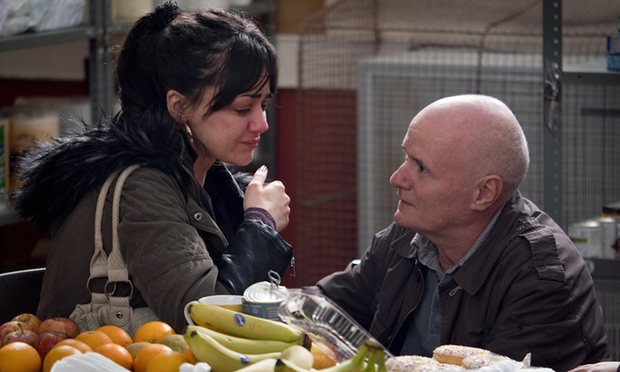
Loach is ably supported by two commendable performances from Johns and Squires. Johns is a comedian making his feature debut, and he gives a beautifully judged portrayal of a man falling into despair but who’s determined not to give in. His plaintive, frustrated expressions speak volumes, while his attitude and physical presence in certain scenes are deliberately downplayed to show how much his will to fight has been whittled away. Squires is equally impressive, making Katie an entirely believable character whose focus is always on her children, and who is willing to make whatever sacrifice she can to keep them with her. There’s a scene in a food bank that is easily the movie’s best moment, and Squires is magnificent, letting Katie’s fears and desperation overwhelm her to heartbreaking effect.

In the end, much of I, Daniel Blake isn’t “enjoyable” in the traditional sense, and it’s not meant to be, clearly. Loach is on a mission to highlight the absurdity and misery that go hand in hand in today’s Britain if you’re seeking government assistance, and he more than succeeds, even if at times it’s at the expense of narrative consistency (the one authority figure Katie encounters who doesn’t add to her woes, only lets her off the hook because if he didn’t, the script wouldn’t be in a position to allow her to make the decision that causes a rift between her and Daniel), or credible characterisations (one Job Centre operative is so callous and uncaring it’s beyond caricature). But again, Loach isn’t exactly known for his subtlety, but he is aware of the message he’s sending, and in that respect, it’s good to have him back after his “so-called” retirement.

Rating: 8/10 – Loach’s second movie to win the Palme d’Or at Cannes – the first was The Wind That Shakes the Barley (2006) – I, Daniel Blake is a powerful, depressing, enraging, and yet touching movie made by a director who can still get angry at the injustice he sees being meted out to Britain’s social underclass; whatever your view on Loach’s politics, one thing is undeniable: he’s a director, who at the age of eighty, is still capable of making vital, socially relevant movies after nearly fifty years, and who shows no sign of (really) letting up just yet – and that’s something we should all be grateful for.

Share this:

  • Share on X (Opens in new window) X
  • Share on Facebook (Opens in new window) Facebook
  • More
  • Print (Opens in new window) Print
  • Email a link to a friend (Opens in new window) Email
Like Loading...

Question of the Week – 29 October 2016

29 Saturday Oct 2016

Posted by dullwood68 in Movies

≈ 1 Comment

Tags

Ouija: Origin of Evil, Ouija: The Devil's Game, Plagiarism, Poster, Question of the Week, You Will Kill

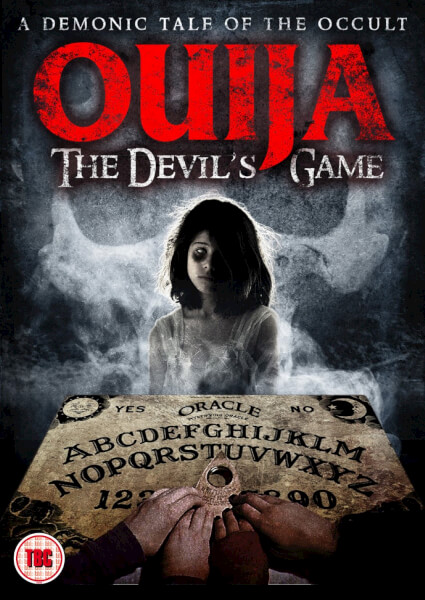
This week’s question is a really, really simple one, but also one that relies on people’s awareness of Lulu Wilson’s character and appearance in Ouija: Origin of Evil (2016). The poster below is for the UK re-release on DVD of You Will Kill (2015) (aka Ouija Summoning). Take a look at it, then ask yourself this week’s Question of the Week (see below).

11325954-1564410919408644

Should the makers of Ouija: Origin of Evil sue for copyright infringement?

Share this:

  • Share on X (Opens in new window) X
  • Share on Facebook (Opens in new window) Facebook
  • More
  • Print (Opens in new window) Print
  • Email a link to a friend (Opens in new window) Email
Like Loading...

Happy Birthday – Winona Ryder

29 Saturday Oct 2016

Posted by dullwood68 in Movies

≈ 2 Comments

Tags

A Scanner Darkly, Actress, Career, Happy Birthday, The Crucible, The House of the Spirits, The Iceman, The Last Word, Winona Ryder

Winona Ryder (29 October 1971 -)

winona-ryder_2837819b

In the late Eighties, Winona Ryder appeared in two iconic movies: Beetlejuice (1987) and Heathers (1988). She wouldn’t be twenty for another three/four years. Having that much success so early in her career could now be seen as a bad thing, as the Nineties increasingly showed that fame and fortune were having an adverse effect on her. Dogged by depression and anxiety, Ryder continued to make movies that were incredibly diverse, and which featured varied, challenging performances. But like many of her contemporaries, once the new century arrived she became less and less of a box office draw, and her choice of roles retained their variety but not the critical or commercial acclaim of her earlier work. Nowadays her appearances are more sporadic, though well-received. In particular, her role in Black Swan (2010) and her work on the TV series Stranger Things (2016) have reinforced the idea that she is still as talented as she was in her heyday. Here are five more reminders of just how good an actress Winona Ryder is.

The Crucible (1996) – Character: Abigail Williams

Nicholas Hytner’s adaptation of Arthur Miller’s acclaimed play (and with a script by Miller himself) features a stunning performance from Ryder as the lover of Daniel Day-Lewis’s character who, out of envy, sparks a witch hunt in the town of Salem. Ryder is mesmerising as the vindictive Abigail, and she more than holds her own against the likes of Day-Lewis, Joan Allen, and Paul Scofield, imbuing her character with an angry, yet damaged vulnerability that more than justifies her vengeful actions.

3e2bb1aa74ba42e49d2cf1cebb7ed380

A Scanner Darkly (2006) – Character: Donna Hawthorne

In Richard Linklater’s bold, inventive movie, which features the second fully integrated use of rotoscoping (basically tracing over original movie footage), Ryder is a dealer of Substance D, a drug that has gotten 20% of the American public hooked on it. Keanu Reeves’ undercover government agent becomes emotionally entangled with her, and it’s Ryder’s quietly subtle performance that helps guide the viewer through some of the more labyrinthine aspects of the narrative, and (hopefully) out the other side.

a-scanner-darkly

The House of the Spirits (1993) – Character: Blanca Trueba

Based on the novel by Isabel Allende, this arresting look at love and politics during the turbulent years of the military dictatorship in Chile sees Ryder recalling her character’s memories as a child and then following that same character’s adult life, and all the difficulties experienced at both times. It’s a largely supporting role, but Ryder is more than capable of providing a fully rounded character who has an increasing impact on the story the movie is telling. It’s also a testament to Ryder that this was her third costume/historical drama in a row – after Bram Stoker’s Dracula (1992) and The Age of Innocence (1993) – and she retains the virtues that allowed her to give such great performances in those movies as well.

winona4xu-2895

The Iceman (2012) – Character: Deborah Kuklinski

As the unsuspecting wife of real life hitman Richard Kuklinski (Michael Shannon), Ryder gives an understated, yet compelling performance that acts as a credible counterpoint to Shannon’s more expressive role. This was another reminder that Ryder is a fine, intuitive actress when given the right role, and she matches her co-star for intensity when the part requires it, leaving the viewer in no doubt that whatever troubles have plagued her in the past, she’s still more than capable of bringing a somewhat stock character to life.

the-iceman-winona-ryder

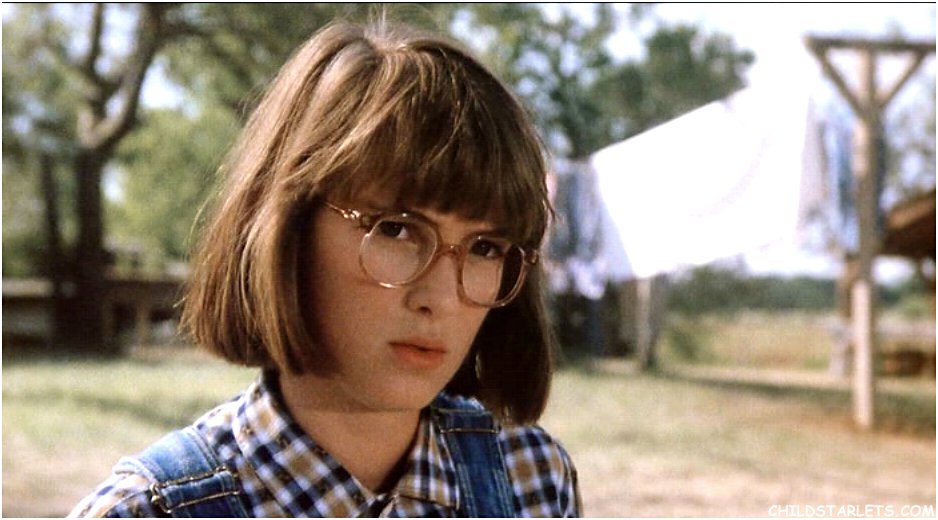
Square Dance (1987) – Character: Gemma Dillard

In only her second appearance in a movie, Ryder plays a thirteen year old who, having lived in the country with her grandparents (Jason Robards and Jane Alexander) for most of her life, accepts an offer from her mother to go and live with her in the city. She gives a sweet, confident performance in a movie that deserves to be reassessed as it approaches its thirtieth anniversary, and she displays a maturity in the role that few other actresses at that age could muster.

wrsdd07

Share this:

  • Share on X (Opens in new window) X
  • Share on Facebook (Opens in new window) Facebook
  • More
  • Print (Opens in new window) Print
  • Email a link to a friend (Opens in new window) Email
Like Loading...

Mini-Review: The Late Bloomer (2016)

28 Friday Oct 2016

Posted by dullwood68 in Movies

≈ Leave a comment

Tags

Brittany Snow, Comedy, J.K. Simmons, Johnny Simmons, Kevin Pollak, Literary adaptation, Maria Bello, Puberty, Review, Romance, Sex, True story

the-late-bloomer-poster-2

D: Kevin Pollak / 94m

Cast: Johnny Simmons, Brittany Snow, Maria Bello, J.K. Simmons, Kumail Nanjiani, Beck Bennett, Paul Wesley, Blake Cooper, Jane Lynch, Sam Robards

Peter Newmans (Simmons) is essentially a sex therapist, but one with a difference: his job is to convince sexaholics that they should channel their sexual energy into other avenues, such a hobby or work. In essence he’s encouraging his patients to be as celibate as he is. Yes, that’s right, Peter is celibate, and has reached the age of thirty without ever having sex, or even a girlfriend. He’s attracted to his neighbour, would-be chef Michelle (Snow), but she’s already in a relationship, and anyway, he wouldn’t know what to say or do even if she wasn’t. Luckily, Fate steps in when Peter collapses and is rushed to hospital. There he’s told that he has a tumour that has been pressing on his pituitary gland, and this has been the cause of his asexuality. But once the tumour is removed, puberty is going to hit him like a ton of bricks.

And so it proves. Initial attempts by his friends, Rich (Nanjiani) and Luke (Bennett), to get Peter laid don’t work, and it’s not until he wakes up one morning with an erection that Peter finally gets to experience the pleasures of, to begin with, excessive masturbation. It also changes the way he views his work, and he begins to encourage his patients to fully embrace their sexual desires, a change that causes concern for his boss, Caroline (Lynch), who has Peter booked on several publicity spots (he’s written a book on how to avoid “unnecessary” sex). But when Michelle becomes single, Peter’s continued inability to properly express his feelings for it – now thanks to the hormones raging inside him – leads him to alienate her, and also Rich. With only his long-suffering parents (Bello, J.K. Simmons) to turn to, Peter has to find a way of becoming the responsible adult – the man – he would have become if he’d gone through puberty at the right time.

nebrrlpciijgfh_1_b

A comedy that wants to be raunchy and sweet at the same time, The Late Bloomer is based on the book, Man-Made: A Memoir of My Body by Ken Baker. So, in essence it’s a true story (Baker did suffer from the same kind of tumour that Peter does), but this is a movie where the approach and the way the material has been handled, will inevitably lead the viewer to wonder if Baker’s experiences have been fairly or even halfway accurately transferred to the screen. Because this is a movie that wavers throughout in its efforts to tell a coherent story. It wants to be a raunchy comedy for the most part, and there are laughs to be had, but this is at odds with the romantic aspects of the material, and the non-existent sympathy for Peter and his situation.

With the movie lacking a clear focus, scenes come and go without any connection to each other, and Simmons is left looking and sounding like a complete doofus. As the movie progresses it becomes clear that the screenplay (assembled by five – count ’em – five screenwriters) and the director are not in sync, and despite several efforts by the cast, are never likely to gel no matter how hard they try. This leaves the movie looking disjointed and poorly assembled. There’s a funny, rewarding, and charming movie to be made out of Baker’s memoir, but this isn’t it.

Rating: 4/10 – a movie that strives to be liked but stumbles at almost every turn in its efforts to do so, The Late Bloomer wastes a ton of potentially humorous situations by ditching subtlety at every opportunity; Pollak’s feature debut as a director, he might be better off choosing any future projects by making sure they have a more polished script, and a better sense of where they’re going (and how to get there).

Share this:

  • Share on X (Opens in new window) X
  • Share on Facebook (Opens in new window) Facebook
  • More
  • Print (Opens in new window) Print
  • Email a link to a friend (Opens in new window) Email
Like Loading...

10 Horror Sequels/Remakes to Avoid in 2017

27 Thursday Oct 2016

Posted by dullwood68 in Movies

≈ Leave a comment

Tags

2017, Horror, New movies, Previews, Remakes, Sequels

2017

With Halloween and all things spooky just around the corner – unless you’re the BFI and you have the chance to screen John Carpenter’s seminal Halloween (1978), which you do, though not on 31 October, but on the 17th instead – here are ten horror movies you would do well to steer very, very clear of in 2017.

1 – Friday the 13th – After their dreadful remake of the original Friday the 13th (1980), back in 2009, Platinum Dunes try again with another version. Originally planned for release this year, the movie has been put back to October of next year, and with very little in the way of a plot or storyline to be had, this seems to be a production that’s either being made as part of a contractual obligation, or as another attempt at making a quick buck off of Jason Voorhees’s fan club.

maxresdefault

2 – Rings – First there was the Japanese original, Ringu (1998), then the inevitable US remake, The Ring (2002), along with sequels from both countries. And now Sadako Yamamura is back, crawling out of another (the same?) well, and killing more people who’ve watched her doing so. The trailer for the movie shows events happening on board a plane, which begs the question: how is everyone on board going to receive a phone call seconds after the video has ended?

3 – World War Z 2 – The first movie started off strong then fell to pieces in its final third, but made enough money to (financially) warrant a sequel. Scheduling problems saw director J.A. Bayona leave the project early on, and little is known – surprise, surprise – about the plot except that it follows on directly from the first movie. Brad Pitt is back, but right now there’s no word on who will be joining him, and with so much up in the air at the moment, there’s a good chance that the movie won’t even see the light of day.

4 – Saw: Legacy – Proving yet again that if you’re making a horror movie series, and you include the words The Final Chapter in what is supposedly the last in the series, then all it means is that a further sequel will turn up eventually. Saw: Legacy is a continuation of the series, but one that nobody really wants or needs. With Jigsaw having been killed off long ago, let’s hope this one doesn’t get bogged down in trying to connect itself with previous outings, and tries at least to do something different, though the phrase, “Let’s play a game”, now seems a little ironic.

5 – Amityville: The Awakening – If ever there was a property that needed to be torn down and never built on again, then it’s 112 Ocean Avenue in Amityville, New York. Not because of the terrible, tragic events that occurred there in November 1974, but because it might stop movie makers from flogging this particular cinematic dead horse (this is the ninth movie overall). That it’s attracted a crop of well-known names – Jennifer Jason Leigh, Gabriel Mann and Bella Thorne – might encourage some viewers, but with none of the previous entries having garnered much critical support between them, this is unlikely to be any different.

6 – Annabelle 2 – The first movie somehow managed to gross over $250m at the international box office, so a sequel was inevitable, but the basic plotline makes it all sound more confusing than it needs to be, as it seems to provide another origin story for the doll with the rosy cheeks. It’s in the hands of David F. Sandberg (Lights Out), but this is unlikely to stray too far from its The Conjuring roots to be any more effective or challenging (except maybe to watch).

annabelle-2

7 – Suspiria – The original, superbly directed by Dario Argento, is a classic Italian horror, and a movie that is a perfect illustration of the phrase “lightning in a bottle”. Argento was never able to replicate or even come close to the power of his now-signature movie, and there’s no indication here that director Luca Guadagnino will manage to come close to it either. And as if to further handicap the movie’s chances of being anywhere near as good as the original, the producers have seen fit to hire Chloë Grace Moretz – a seriously bad move; haven’t they seen Carrie (2013)?

8 – Insidious: Chapter 4 – Another horror sequel where the basic plot is unknown (even to the makers?), this at least brings back Lin Shaye as troubled psychic Elise Rainier, so there’s a degree of quality attached to this movie, but with this many trips to the well already, the likelihood of returning scribe and creator Leigh Whannell fashioning anything really scary is limited. Consistently good box office returns have gotten the series this far, but that’s not necessarily a good thing.

9 – Halloween: The Night Evil Died – With Laurie Strode no longer around to fend off or foil her tortured brother, Michael Myers, this outing (the eighth, ignoring Halloween III: Season of the Witch (1983) and the two sequels made by Rob Zombie) has no option but to fall back on the time honoured tradition of there being a wider family presence for Michael to kill in a variety of semi-cool ways. The series ran out of steam a long while back, and as with every other movie on the list, it seems that the producers haven’t caught on yet.

10 – Hellraiser: Judgment – It’s hard to believe perhaps – and especially because most of the previous entries have gone straight to video – but this will be the tenth Hellraiser movie, and in keeping with that particular milestone, much is being promised by writer/director Gary J. Tunnicliffe. But this has the air of a movie being made to ensure Dimension Films retain the franchise rights, and if history has anything to say about that particular motive, then this will be very disappointing indeed.

screen-shot-2016-03-13-at-9-26-16-am

Share this:

  • Share on X (Opens in new window) X
  • Share on Facebook (Opens in new window) Facebook
  • More
  • Print (Opens in new window) Print
  • Email a link to a friend (Opens in new window) Email
Like Loading...

Queen of Katwe (2016)

26 Wednesday Oct 2016

Posted by dullwood68 in Movies

≈ Leave a comment

Tags

Chess, David Oyelowo, Grandmaster, Katwe, Literary adaptation, Lupita Nyong'o, Madina Nalwanga, Mira Nair, Phiona Mutesi, True story, Uganda

qok

D: Mira Nair / 124m

Cast: Madina Nalwanga, David Oyelowo, Lupita Nyong’o, Martin Kabanza, Taryn Kyaze, Ronald Ssemaganda, Ethan Nazario Lubega, Nikita Waligwa, Edgar Kanyike, Esther Tebandeke

It may not be obvious at first glance but Disney like to make true stories into movies. Even better is if it’s an inspirational true story. Which is why their production of the true story of Phiona Mutesi isn’t as odd a project as it might seem at first glance. Based on the book, The Queen of Katwe: A Story of Life, Chess, and One Extraordinary Girl’s Dream of Becoming a Grandmaster by Tim Crothers, Mira Nair’s latest movie holds steady to the usual tenets stipulated by Disney when they make a true story into a movie, and the result is a polished but depth-free look at one young girl’s rise from the slums of Uganda to prominence within the world of African chess players.

Phiona (Nalwanga) lives with her mother, Harriet (Nyong’o), her older sister Night (Kyaze), and her two younger brothers, Brian (Kabanza) and Richard. They make a living from selling maize and sweetcorn on the streets of Katwe, one of eight slums in Kampala, Uganda. Early on, Night leaves home to live with her affluent boyfriend. As if her leaving wasn’t enough, Phiona realises that Brian isn’t spending much time selling maize and sweetcorn; instead he’s heading off to do something else. One day, Phiona follows him, and finds that he’s going to a project run by the Sports Outreach Institute, a Christian sports mission. Run by Robert Katende (Oyelowo), the children there are learning how to play chess. Phiona joins the group and it soon becomes obvious that she has a natural aptitude for the game.

queen-of-katwe-1

Robert encourages her, and when a local tournament is held, he enters some of the children, including Phiona and Brian. Phiona wins the tournament and she finds she has a degree of fame back in Katwe. Robert wants her to improve her game, but Harriet is suspicious of both chess and Robert’s assertion that Phiona can succeed as a future grandmaster. Initially reluctant to let Phiona follow her destiny, she eventually becomes supportive and proud of her youngest daughter. But Phiona’s increasing confidence leads to complacency and she loses another competition. What follows is a crisis of confidence that sees Phiona believe that the future within her grasp is no longer hers to achieve.

Queen of Katwe has several things going for it. One is the relative unfamiliarity of its location and its characters. Another is the quality of the performances. There’s also Nair’s attentive, confident direction. And there’s Sean Bobbitt’s rich, detailed, vibrant cinematography. All these elements come together and enhance the movie in ways that are entirely felicitous and sometimes unexpectedly profound. As Phiona’s story unfolds, the hardships and the setbacks she faces, while not exactly as grim-looking or -sounding as they probably were in real life, are given enough emphasis that when she and her family are evicted, the audience is likely to be concerned as to what they’ll do next, and where they will go. Their journey has become the viewer’s journey.

null

But Nair’s admirable direction, Nalwanga’s easy-going, likeable performance (allied to the more polished performances of Oyelowo and Nyong’o), the beautiful but desperate locations, and Bobbitt’s tremendous depictions of them, all of these wonderful components somehow lack the ability to offset the one major problem the movie has at its core: an over-reliance on predictability. Each development in the story is signposted with almost clockwork regularity, from Phiona’s first tournament loss, to Harriet’s eventual unconditional support for her daughter, to Robert’s decision in relation to a much longed for job opportunity. It’s as if the movie can’t help itself: it has to stick to formula, and it can’t be too imaginative.

What this leaves the viewer with is a further problem: how to adequately qualify their feelings about Phiona’s story, and how much of it is kept from being even more effective (and affecting) by this decision to keep things static. Whole scenes go by where their importance is tenuous to what follows, or indeed, to what’s gone before. It’s even more difficult to lay this weird displacement at the door of the screenwriter, William Wheeler. Wheeler has done a good job in making Phiona’s story both appealing and inspiring, but even when he strays too close to cliché and melodrama he’s still not strayed close enough for those two “bad guys” to have the kind of impact that slows a movie down or makes it seem like too much effort is required.

queen-katwe-movie-2016-reviews

In real terms, Queen of Katwe is a story we’ve seen too many times before, and because of this, it’s told in a way that is, at best, a comfortable one for the viewer, but also a desultory one for the movie. Phiona’s family dynamic offers nothing new, and nor does the way in which her story unfolds, from the unexpected success on the lower rungs of the Angolan chess ladder to the here-again-gone-again antics of Night. Even the section where Phiona doubts herself and becomes (somewhat) depressed is approached with a kind of bland decisiveness that adds little or no drama to what’s unfolding. Instead of feeling undue and unnecessary pressure, all it takes is a pep talk from Robert and she’s okay again – and the viewer will know in advance that this will be all she will need to start playing again.

There are many more moments like that one, and the movie is so reliant on them, it’s as if the makers decided to include as much movie shorthand as possible during Queen of Katwe‘s filming, and then they imbedded the idea even further during the editing process. It doesn’t make the movie unwatchable, or a bad movie that could have been better; rather it’s a movie that won’t surprise anyone, and it’s a movie that hits each emotional highpoint with all the skill and precision of someone pushing a dart into a bullseye from a foot away. It’s movie making by rote, and sadly, it lessens the impact of Phiona’s story, and her achievements – which can’t be right, can it?

Rating: 7/10 – a good movie that rescues outright victory from the jaws of averageness too often for its own good, Queen of Katwe has a lot that works but only in the context of its lack of narrative ambition; an odd movie then, one that can be liked and disliked in equal measure, and which will leave many viewers wondering if it’s as good as they think it is.

Share this:

  • Share on X (Opens in new window) X
  • Share on Facebook (Opens in new window) Facebook
  • More
  • Print (Opens in new window) Print
  • Email a link to a friend (Opens in new window) Email
Like Loading...

Doctor Strange (2016)

25 Tuesday Oct 2016

Posted by dullwood68 in Movies

≈ 3 Comments

Tags

Action, Astral plane, Baron Mordo, Benedict Cumberbatch, Chiwetel Ejiofor, Cloak of Levitation, Drama, Fantasy, Mads Mikkelsen, Magic, Marvel, Marvel Cinematic Universe, Rachel McAdams, Review, Scott Derrickson, Sorcerer Supreme, The Ancient One, Tilda Swinton

doctor-strange-2016-poster-impossibilities

D: Scott Derrickson / 115m

Cast: Benedict Cumberbatch, Chiwetel Ejiofor, Rachel McAdams, Tilda Swinton, Mads Mikkelsen, Benedict Wong, Michael Stuhlbarg, Benjamin Bratt, Scott Adkins

Stephen Strange (Cumberbatch) is a gifted neurosurgeon. He’s also an arrogant pain in the ass. His ego is on a par with Tony Stark’s, and he enjoys reminding people just how good he is. But one rainy evening, Strange’s car ends up in the river and his hands are so badly damaged that he’ll never be able to operate again. Angry and full of self-pity, Strange learns of a man who suffered a severed spine and was paralysed from the chest down, but who somehow managed to walk again. Strange tracks the man (Bratt) down, and is told of a monastery in Kathmandu, Nepal, where he learned how to walk again. Strange travels there and meets The Ancient One (Swinton), a mystic who teaches him that their plane of existence is one of many, and that Strange must let go of everything he thinks he knows in order to achieve “enlightenment”.

Strange proves to be an eager and willing (if still slightly sceptical) pupil. He learns how to cast spells, how to travel from one place to another by visualising it in his mind and creating a portal through which to get there, and the existence of a former pupil, Master Kaecilius (Mikkelsen), who believes he can gain immortality by helping a creature from the Dark Dimension, Dormammu, take over the Earth. As Strange’s powers grow, Kaecilius begins attacking the three sanctums that help keep Dormammu and his like from entering our world. Aided by another Master, Baron Mordo (Ejiofor), Strange attempts to stop Kaecilius from bringing about the end of the world; he also receives help from an unlikely source: the Cloak of Levitation, which chooses Strange as its master.

13-120647-marvel_debuts_doctor_strange_teaser_trailer

But the London sanctum falls to Kaecilius’s onslaught, and he moves on to attack the sanctum in Hong Kong. Strange and Mordo arrive too late to avoid its destruction and the arrival of Dormammu in our world, but Strange has an idea that will counter-act all the death and destruction that has followed in Dormammu’s wake. If he fails, however, it will mean the end of all life on Earth…

Another Marvel movie, another origin story. But Stephen Strange has always been the odd character out in the Marvel Universe (cinematic or otherwise), a humbled physician redeemed by the power of magic and able to deal with the kind of villains that would give the likes of Iron Man and Captain America more than a run for their money. (Not that Strange is in any immediate danger here; Kaecilius isn’t exactly the most threatening villain Marvel has come up with, but he is good at running a lot.) With Phase Three of the Marvel Cinematic Universe now under way, this gives Marvel the opportunity to add fresh characters to the roster, and take their ongoing series of movies in a new direction.

But is it any good? Well, predictably, the answer is Yes – for the most part. The standard Marvel formula is firmly in place, although there is less humour to be had this time round, and while the template is tweaked here and there, most viewers will be reassured that the House of Spidey hasn’t strayed too far from the formula that has made their movies so successful in the past. What is different, and markedly so, is the visual style adopted for the movie. Away from all the mind-bending, Inception-style graphics, Doctor Strange is both darker in tone and look. Even the hospital where Strange works isn’t as brightly lit as you might expect. But it’s not a gloomy movie over all, it’s just that for once, Marvel have realised that – scenes involving the Cloak of Levitation aside, and Strange’s “borrowing” habits in the library – this needs to be a serious piece above all.

doctor-strange-movie-image-gallery

Strange’s arrogance, and then his anger, in the beginning gives Cumberbatch the opportunity to play unlikeable with an unexpected fierceness. One scene in particular with McAdams as Strange’s one-time significant other, Christine Palmer, sees the actor deliver cruel lines of dialogue in a way that hasn’t been done before in a Marvel movie (he’s the hero and he’s being delberately objectionable). Even when he begins to accept that magic really does exist, he’s still an egotist, making snarky, caustic comments, but thanks to the script – by Derrickson, Jon Spaihts, and C. Robert Cargill – he’s also on a journey of self-discovery, and this comes across more and more effectively as the movie progresses.

With the main character in good hands (Cumberbatch inhabits the role with his customary panache, and even slips in an Alan Rickman tribute for those paying attention), it’s a shame that the rest are painted in such broad strokes. Baron Mordo, Strange’s arch-nemesis in the comics, is here very much a secondary character whose time will come in a later movie, while The Ancient One, despite being well-played by Swinton, is burdened with some astonishingly po-faced dialogue (“I spent so many years peering through time… looking for you.”) that you start to wonder if the half-smile Swinton adopts at times is in acknowledgment of how daft some of her lines truly are. As mentioned before, Mikkelsen’s master-turned-bad is not one of Marvel’s best villains, while McAdams is sidelined for much of the movie, though at least she’s not there as a damsel in need of being rescued.

null

The visuals are, unsurprisingly, stunning. The folding of cityscapes and the weird monstrosities glimpsed in the Dark Dimension are both equally impressive, but there is one sequence which stands head and shoulders above all the others: when Strange reverses the destruction of the Hong Kong sanctum. If anyone wants a clue as to why Marvel is more successful at the box office, and critically, than DC, then it’s this particular sequence that should be watched for one of the answers. Both DC and Marvel have been guilty of going down the destruction-porn road before, and audiences have begun to voice their dislike of these big, CGI-driven demolition extravaganzas. But here, we don’t see the destruction of the Hong Kong sanctum, just the aftermath, and then, in a complete stroke of genius, we see the destruction in reverse – and it’s so much more effective for being shown in this way. Clearly, someone at Marvel is listening.

Where Stephen Strange will fit into the wider Marvel Cinematic Universe remains to be seen (though a pre-end credits scene points him in one particular direction), and he won’t be back in another solo outing for some time, but as an introduction to a character with so much more to be explored, Doctor Strange has to be considered a success. Like most of Marvel’s output in the last eight years, though, it does have its fair share of pitfalls, and it does stumble at times in trying to simplify the more esoteric aspects of playing with magic, but overall this is an exciting, well-crafted, rewarding, and enjoyable first outing for the future Sorcerer Supreme.

Rating: 8/10 – superb spectacle can’t compensate for some poor decisions when it comes to the secondary characters, or the tangled logic surrounding Kaecilius’ need to bring Dormammu into this world, but these are minor gripes in a movie that takes a challenging character and does him justice from start to finish; by doing more than enough with the formula to make it more interesting, Doctor Strange becomes a movie that contradicts the claim that Marvel are just churning out the same movie over and over again.

Share this:

  • Share on X (Opens in new window) X
  • Share on Facebook (Opens in new window) Facebook
  • More
  • Print (Opens in new window) Print
  • Email a link to a friend (Opens in new window) Email
Like Loading...

Michael Moore in TrumpLand (2016)

24 Monday Oct 2016

Posted by dullwood68 in Movies

≈ Leave a comment

Tags

American politics, Documentary, Donald Trump, Election, Hillary Clinton, Michael Moore, Review, Wilmington Ohio

michael-moore-in-trumpland

D: Michael Moore, Dana Calderwood / 71m

With: Michael Moore

Filmed in front of a live audience at the Murphy Theatre in Wilmington, Ohio, where the majority of people there have already indicated they will vote for Donald Trump in the upcoming US Presidential election on 8 November, Michael Moore in Trumpland is aptly named. (In an ironic twist on the value afforded free speech in America, Moore originally planned to perform his show at the Midland Theatre in Newark, Ohio, but the management nixed the idea.) Moore addresses the the relative virtues of both candidates, and asks the audience why it is that of the two, Hillary Clinton has been so stigmatised and attacked by her peers since her husband became President back in 1993.

In practice, Moore is reliably left-wing, but prefers to be thought of as a political activist, so this is an unsurprising move (and movie) from Moore. Releasing such a documentary with only weeks to go before the election, there’s little chance he’ll have any discernible effect on the way people vote come 8 November, but ever the optimist, Moore gives it his best shot. His audience, supposedly made up of confirmed Trump voters, seem more than willing to give Moore’s less than impassioned rhetoric a chance, and he regularly picks up laughs at both candidate’s expense (there’s even a moment where some audience members stand and applaud him). With the audience increasingly agreeing with him (especially the women), Moore basks in the rosy glow of the political commentator who appears deliberately partisan – at first – but who then reveals his own preference for President.

trumpland21f-3-web

What Moore does that is clever is not to vilify Donald Trump outright. Instead he highlights some of Trump’s more extreme views by having his Mexican and Muslim audience members segregated at the back of the theatre. The Mexicans, and one Guatemalan woman, are kept behind a representation of the wall Trump wants to build along the US-Mexico border. The Muslims are kept watch over by a drone, which at least isn’t armed. It’s broad, uncomfortable humour that is maintained throughout the show, and by picking on these particular ethnic communities, Moore ends up being just as objectionable in his approach as Trump is with his. The wall and the drone remain in place (apparently) throughout; did Moore need to be this heavyhanded?

With the Mexicans and the Muslims sidelined because of Trump’s dislike for them, Moore sidesteps around Trump entirely and focuses on the decline of the white American male. He reveals his theory that men are becoming increasingly unnecessary in a world where there are more women than men and the birth rate amongst males is declining. Anxiety about the male role – “there are more women in law schools than men” – is at the heart of the typical Trump voter, posits Moore, and he makes a convincing argument, even if it does require a bit of a leap of understanding. It’s an extended sequence that has many women in the audience nodding their heads in acknowledgment, and several of the men looking stony-faced and unhappy at their perceived masculinity being lampooned in such a way.

He moves on to further highlight the demographic that is likely to vote for Trump based on promises he’s made: the poor, disadvantaged person who doesn’t have a job, maybe not even a home or a family, but who does have a vote, that one precious right that will mean they’ll vote for Trump because he’s promised to make things right for them, and he’s promised to go after the institutions that have contributed to so many people becoming dispossessed. As Moore puts it, “Trump’s election is going to be the biggest ‘Fuck you’ ever recorded in human history”. It’s a powerful moment, and the audience is deathly quiet, hanging on Moore’s every word, because he makes the one salient point that everyone seems to be overlooking: voting for Trump will be voting for the wrong reason, because Trump has no intention on following through on his promises.

vlcsnap-00001

Moore follows this up with a mock TV news report that shows what the US will be like once Trump is elected and moves into the White House. It’s a clumsy, awkward device, and it sits uneasily against the convincing, well thought out oratory of the previous minutes. It’s often the way with Moore: he makes a passionate plea for change or understanding or the use of common sense, and then he bludgeons everyone with the same point, almost as if he thinks he’s dealing with people who couldn’t possibly work it out for themselves (which is ironic, as that’s what he’s hoping for).

And then it’s Hillary’s turn, in the movie’s final section, and the one where Moore wears his heart, almost literally, on his sleeve. He likes Hillary, once called her a “hot, shit-kicking feminist babe”, and he bemoans the treatment she’s received over the years. This leads to Moore bringing in Pope Francis because he thinks they have a lot in common (and yes, this is a bit of a stretch), and he asks the audience to say nice things about her (even the Republicans and Trump voters). It’s a heartfelt but naïve approach, as Moore makes the most of Hillary’s virtues, and he explains why everyone has a chance to atone for the way she was treated in the past, and is still treated now.

By the end, Moore has made his position clear: vote for Hillary because it’s the right thing to do for the country, for America. The audience seems to agree with him because he gets a standing ovation. But throughout there have been shots of those audience members who clearly don’t agree with him, and who remain unmoved, even when he appears to be remarking on Trump’s good points. As a result it all smacks of too little, too late, and Moore himself lacks the anger and the disgust seen in previous documentaries. He’s impassioned at times, but this is less a rallying call than a plea to be nice to Hillary.

94b0bf16c48e10edee649a143fa8e34b

It’s hard to believe that Moore, despite his research and friendly approach, thinks that this will have any impact on the hearts and minds of American voters in a few weeks’ time. Liberals and democrats will vote for Hillary, right-wingers and Republicans (mostly) will vote for Trump. And there’ll be a sizeable portion of the electorate that won’t decide until the day itself. All this is normal, and all this is entirely predictable. It’s easy to see why Moore has released this movie, but as an intelligent, well-reasoned, though one-sided “debate” there are too many longeuers and references to issues away from the Presidential race to make Moore’s latest documentary as effective as he may have hoped. It’s good that he’s tried to “clear the air”, but in taking a less aggressive tone than usual, Moore has let both candidates off the hook for their past misdeeds, and in doing so, has made his show too much about him, and not enough about them.

Rating: 7/10 – with Moore displaying less outrage than on previous outings – only his disgust at the lack of healthcare reforms leading to 50,000 deaths a year really gets him angry – Michael Moore in TrumpLand ends up looking and sounding more tepid than vital; as a vehicle for raising political awareness it also falls short, and as an examination of the candidates’ campaigns it doesn’t even get started, but this is very much a love letter to Hillary above all else, a decision that both overwhelms and undermines the movie at the very same time.

NOTE: There’s no trailer available for Michael Moore in TrumpLand.

Share this:

  • Share on X (Opens in new window) X
  • Share on Facebook (Opens in new window) Facebook
  • More
  • Print (Opens in new window) Print
  • Email a link to a friend (Opens in new window) Email
Like Loading...

50 Movies to Look Forward to in 2017 – Part 2

23 Sunday Oct 2016

Posted by dullwood68 in Movies

≈ Leave a comment

Tags

2017, New movies, Previews

2017

And… we’re back! Here’s the second batch of movies that may or may not have us jumping for joy at having seen them in 2017. There’s a pleasing mix of genres, some movies have really great casts, and some that may go on to win copious awards. Whatever happens these are all – at this moment in time – movies that are capable of finding a place in our hearts and in our Top 10 lists for the year – or maybe not. We’ll just have to wait and see.

26 – Hidden Figures – The tagline is clever – “Meet the women you don’t know, behind the mission you do.” – and perfectly sums up the true story of the African-American women who were pivotal in ensuring that NASA were able to launch their space programme in the Sixties. It’s one of those inspiring true life tales that will no doubt pick up some Oscar buzz, but with a cast that includes Octavia Spencer, Taraji P. Henson, Kevin Costner and Mahershala Ali, this should be a fascinating look behind the scenes of an equally fascinating period in NASA’s history.

hidden-figures

27 – Valerian and the City of a Thousand Planets – Luc Besson has wanted to make this adaptation of the French comic series by Pierre Cristin and Jean-Claude Mézières for a very long time. With Dane DeHaan in the title role, and the city in question providing a home to thousands of different species from across the universe, this could well be a riotous, visually spectacular movie replete with Besson’s quirky humour and operatic leanings. Like so many other movies in this list, there’s a great cast that includes Cara Delevingne, John Goodman, Clive Owen and Rihanna, and at €197 million, it’s also the most expensive French movie ever made.

28 – Despicable Me 3 – Steve Carell has stated that this will be his last feature outing as the not-quite-so-villainous Gru. If so, then it’ll be a shame as Carell’s vocal performance has been one of the series’ several high spots. Perhaps knowing this, the producers and writers have come up with a storyline that gives Carell twice as much to do as he plays both Gru and his long-lost brother Dru. Add to the mix the inclusion of Trey Parker as definitely villainous Balthazar Bratt, alongside the usual madcap humour of the Minions, and you have a second sequel that might just be better than expected.

29 – Tully – An original screenplay by Diablo Cody is brought to the screen by Jason Reitman for the third time – after Juno (2007) and Young Adult (2011) – and reteams them with Charlize Theron in a tale of a single mother with three kids who’s “gifted” a night nanny (the Tully of the title and played by Mackenzie Davis) by her brother. If Cody’s script is sharper than some of her more recent efforts then this could be a winning combination of comedy and drama that tugs at the heartstrings while also keeping audiences highly amused.

30 – Untitled Darren Aronofsky Project – This isn’t due for release until the very end of 2017, and Aronofsky is keeping details about his latest movie very close to his chest, but what we do know is that it features Michelle Pfeiffer, Ed Harris, Javier Bardem and Jennifer Lawrence, and concerns a couple whose relationship is put to the test by some uninvited guests. With extensive special effects still to be completed, just how the couple’s relationship is tested is an intriguing question, but in Aronofsky’s hands this is unlikely to be a standard home invasion thriller.

31 – The Dark Tower – Stephen King’s sprawling eight-volume tale set in Mid-World concerns the pursuit of a mysterious Man in Black (Matthew McConaughey) by an equally mysterious Gunslinger (Idris Elba). An adaptation has been on the cards in various forms since 2007, but this production has been somewhat rushed, which may not prove to be a good thing. Still it’s highly anticipated by fans, and the main casting shows a willingness on the producers’ part to add some weight to proceedings, but it will be the strength of the adaptation that will decide if this succeeds or fails.

rolanddraw

32 – Dunkirk – The latest from Christopher Nolan recounts the evacuation of British, Canadian, French and Belgian troops from the beaches of Dunkerque in Northern France, and in the midst of an intense onslaught from surrounding German forces. This promises to be suitably epic, but whether Nolan has opted for Saving Private Ryan-style realism, or something a little less hard-hitting remains to be seen, but what will need to be seen is the movie in its IMAX 65mm format, which should make the movie look as spectacular as Nolan is probably intending.

33 – Baby Driver – Having departed from Ant-Man (2015), director Edgar Wright moved on to this comedy-action-thriller about a getaway driver (Ansel Elgort) who works for various bank robbers and finds himself in deep trouble when a heist goes badly wrong. Wright directs his own script so expect the humour to be spot on, and he’s assembled a great cast that includes Kevin Spacey, Jamie Foxx and Lily James. However it all turns out, one thing is for sure: it’ll look and sound completely different from any other movie out there.

34 – A Cure for Wellness – If you’ve already seen the first trailer for Gore Verbinski’s first movie since The Lone Ranger (2013), then you’ll know that A Cure for Wellness is likely to be the most visually arresting movie of 2017. With a succession of stunning visuals allied to the mystery of a “wellness centre” located high in the Swiss Alps that is definitely not all that it seems, Verbinski has created a psychological mindbender of a movie that is likely to draw audiences in and then pull the rug out from under them – and not just the once.

screen-shot-2016-10-19-at-10-20-52-pm

35 – Murder on the Orient Express – It could be argued that we don’t exactly need another version of one of Agatha Christie’s most famous stories, but with Kenneth Branagh directing and starring as Hercule Poirot, and surprisingly, with Johnny Depp as the murder victim, there’s a good possibility that it will transcend the more “stage-bound” versions we’ve seen before. A mixed supporting cast that includes Judi Dench and Daisy Ridley should lend some gravitas to proceedings, all of which leaves one last question to be asked: will Branagh lean towards Peter Ustinov or David Suchet in his interpretation of the Belgian detective, or will he find his own approach to the sleuth?

36 – How to Talk to Girls at Parties – From the title you might be expecting another teen comedy about lustful boys chasing beautiful girls, but while Neil Gaiman’s original short story starts off very much like that, where it takes you from there is another matter entirely. John Cameron Mitchell adapts and directs which should ensure that this will be one of the more interesting movies of 2017, and he’s supported by the likes of Nicole Kidman, Elle Fanning and Matt Lucas.

37 – Downsizing – If your life is getting you, well, down, what if you had the chance to be shrunk to a much smaller size and lead a better life; would you take the opportunity? That’s the question inherent in the latest from Alexander Payne, which sees Matt Damon and Kristen Wiig as the couple granted such an opportunity, only for her to back out at the last moment and leave Damon stranded as 2017’s version of The Incredible Shrinking Man (1957). Payne has been working on this project for some time, so expect his trademark wry humour and heartfelt drama to shine through, and provide one of the more affecting movies of the coming year.

38 – Hostiles – A Western drama that sees Christian Bale’s army captain reluctantly escort a Cheyenne chief (Wes Studi) and his family through dangerous territory, Hostiles could well be a dark, brooding affair touching on racist attitudes and the concept of self-determinism in amongst more familiar Western staples (which would be good), but if it isn’t then a good old-fashioned oater with lots of gunfights, Indian attacks and galloping about on horseback will do just fine.

39 – Andorra – Veteran director Fred Schepisi returns with an adaptation of the novel by Peter Cameron, about a man, Alexander Fox (played by Clive Owen), who leaves the US and settles in Andorra, only to find himself the prime suspect in a murder case. With Toni Collette and Gillian Anderson as the two women he finds himself involved with, it remains to be seen if Schepisi and Cameron (adapting his own novel) have retained the disturbing eeriness of the novel, and the country’s reimagining as one with a coastline and several other differences.

40 – John Wick: Chapter 2 – John Wick was both a pleasant surprise and something of a comeback for Keanu Reeves, and it may need to be again as Reeves has returned to making sub-standard DTV movies as the main part of his “day job”. With Reeves back again, along with directors Chad Stahelski and David Leitch and writer Derek Kolstad, the action is relocated to Rome as Wick agrees to combat a former associate with plans to seize control of the assassins’ guild both belong to. Expect plenty of gunplay, gratuitous headshots, and bone-cracking fight scenes as Reeves does what he does best: play a focused, hell-bent killing machine.

johnwick2

41 – An Interview With God – Questions of faith and belief are challenged when a young journalist (Brenton Thwaites) finds himself interviewing a mysterious man who claims to be God (David Strathairn). Quite how much of this will be a two-hander remains to be seen but there’s something to be said for a drama where God may just be in the room, and can be asked anything at all. This puts much of the pressure on Ken Aguado’s script, but if he’s been careful and thought things through, then this could be a movie that gets people talking about faith for all the right reasons.

42 – Wonder – It’s Jacob Tremblay again, grabbing all the good pre-teen roles before it’s too late, and playing Auggie Pullman, a young boy with a facial deformity that has all sorts of effects on the children at the school he goes to. This adaptation of the novel by R.J. Palacio features Julia Roberts and Owen Wilson as Auggie’s parents, and sounds like the kind of feelgood, triumph-over-adversity movie that awards are made for. But Palacio’s novel isn’t as easily transferable to the screen as some might think, so director Stephen Chbosky and co-screenwriters Steve Conrad and Jack Thorne have their work cut out for them.

43 – Submergence – Another literary adaptation, this time from the novel by J.M. Ledgard, this sees Alicia Vikander and James McAvoy as separated lovers who look back over their time together while both deal with different kinds of confinement: he in a windowless room at the mercy of jihadists, she in a submersible heading for the bottom of the Greenland Sea. A heavyweight romantic drama then, and the latest from Wim Wenders, this may not set the box office alight, but it has the potential to pick up awards by the bucket load.

44 – Logan Lucky – In Hollywood, even in the independent sector, retirement is usually just a word bandied about by writers, directors and actors when they feel they’ve done enough and can sit back and relax. Steven Soderbergh hasn’t exactly relaxed since Behind the Candelabra (2013), but this is his first feature since then, and it’s good to know he’s back. Telling the tale of two brothers (Channing Tatum, Adam Driver) who decide to pull off a robbery during a NASCAR race, this should be a clever comedy where nothing goes right for the brothers, and everything goes wrong.

45 – Annihilation – Following on from the success of Ex Machina (2015), writer/director Alex Garland continues with another sci-fi drama, this time an adaptation of the first novel in Jeff VanderMeer’s Southern Reach trilogy. Telling the story of an expedition to the mysterious Area X, and what happened to several previous expeditions, the movie has attracted a great cast that includes Natalie Portman, Oscar Isaac and Jennifer Jason Leigh, and if Garland is on form, should be the year’s most thought-provoking sci-fi movie.

annihilation-garland-set

46 – Untitled Paul Thomas Anderson Fashion Project – Details are scarce at this point in time, but what we do know is that Anderson’s latest movie is set in the London fashion world of the 1950’s and features Daniel Day-Lewis. Just the fact that Anderson and Day-Lewis are reuniting on this project is enough for now, but whatever the movie is about, it’s sure to be an intense, mesmerising drama that grabs the attention and doesn’t let go, and should include another (potentially) award-winning performance from Day-Lewis.

47 – The Kidnapping of Edgardo Mortara – After going all family-friendly with The BFG (2016), Steven Spielberg returns to the arena of historical drama with this true story about a young Jewish boy in Italy in 1858 who was secretly baptised and then abducted by the Papal States and trained to become a priest. A massive political and religious scandal in its day, Spielberg is working from a script by Tony Kushner, and reuniting for the fourth time in as many movies with Mark Rylance, who plays Pope Pius IX.

48 – Kingsman: The Golden Circle – An inevitable sequel for the surprise hit of 2014, this sees Matthew Vaughn returning to the director’s chair, while he and Jane Goldman collaborate on the script. Also returning are Taron Egerton, Mark Strong, Sophie Cookson, and surprisingly, Colin Firth, whose character was killed off in the first movie… or was he? This time round the Kingsmen have to team up with their US rivals the Statesmen, when their headquarters is attacked. Expect lots of action, lots of comedy, and lots of sharply tailored suits, as well as a cameo from Elton John.

49 – Untitled Woody Allen Project – With his recent movies pointing towards a kind of late-career renaissance, Woody Allen keeps things moving with this drama set in 1950’s New York. With the likes of Kate Winslet, Juno Temple and Justin Timberlake on board, there’s little doubt that whatever Allen has come up with story-wise, the movie should be further proof that late-career Allen is more than a match for most everyone else.

50 – God Particle – A sci-fi movie involving a team of astronauts who find themselves completely alone aboard a space station when the Earth disappears, this has yet another great cast – Chris O’Dowd, Gugu Mbatha-Raw, David Oyelowo, and Ziyi Zhang amongst others – and if Internet gossip/predictions are to be believed, is the third movie in the unofficial Cloverfield trilogy. Whether that’s true or not, the idea of the Earth vanishing is potent enough, and the involvement of J.J. Abrams as producer should help bring audiences into cinemas. Let’s just hope the ending isn’t as awkwardly tacked on as the one in 10 Cloverfield Lane (2016).

Share this:

  • Share on X (Opens in new window) X
  • Share on Facebook (Opens in new window) Facebook
  • More
  • Print (Opens in new window) Print
  • Email a link to a friend (Opens in new window) Email
Like Loading...

The Whole Truth (2016)

22 Saturday Oct 2016

Posted by dullwood68 in Movies

≈ 2 Comments

Tags

Courtney Hunt, Crime, Drama, Gugu Mbatha-Raw, Jim Belushi, Keanu Reeves, Louisiana, Murder, Renée Zellweger, Review, Thriller, Trial

the-whole-truth-2016-movie-poster

D: Courtney Hunt / 93m

Cast: Keanu Reeves, Renée Zellweger, Gugu Mbatha-Raw, Gabriel Basso, Jim Belushi, Jim Klock, Ritchie Montgomery, Christopher Berry, Nicole Barré, Sean Bridgers, Mattie Liptak

In a small Louisiana town, young Mike Lassiter (Basso) is arrested for the murder of his father, Boone (Belushi). Having confessed to the crime, Mike says nothing more, even to his lawyer, Richard Ramsey (Reeves). Obviously this makes it hard for Ramsey to mount a defence, but as a friend of the family, and someone that Boone helped become a lawyer, he has inside knowledge about Boone that the jury won’t be aware of. With his client staying quiet, Ramsey’s only choice is to malign Boone’s reputation as a good father to Mike and loving husband to Loretta (Zellweger).

As the trial begins, Ramsey is joined by a junior lawyer, Janelle Brady (Mbatha-Raw). Together they begin to piece together a defence based on Boone’s abusive behaviour towards Mike and Loretta, while the prosecution – led by Leblanc (Klock) – reinforces the details surrounding the murder and Mike’s subsequent confession. The case seems hopeless until Ramsey calls Loretta to the witness stand, where she confirms just how abusive her husband could be. But as the trial continues, Janelle becomes suspicious about what might have really happened; she comes to believe that Mike is taking the fall for his mother. There’s no evidence to support this, however, and when Mike takes the stand and delivers a bombshell that no one could have prepared for, his testimony takes the trial in a direction that no one could have prepared for either.

the-whole-truth-2015-movie-header1

With an introductory voice over by Reeves that sets the tone for the whole movie (he sounds bored and uninterested), The Whole Truth is one of those courtroom dramas where secrets are revealed every so often in an effort to keep the audience guessing as to what’s happened, or is happening, and which should add up to a last-minute revelation that will have said audience saying to themselves, “Wow! I never saw that coming!” Except, in reality, The Whole Truth opts for secrets that have no impact on the movie’s ending, and which are pretty much forgotten about once they’ve been revealed.

You don’t have to have seen hundreds of courtroom dramas to know that ninety-nine per cent of the time, if the defendant has confessed to the crime (but isn’t saying why they did it), then the chances of them actually being guilty are greatly reduced. And while it would be unfair to reveal if this is the case here, let’s just say that there is a formula here that’s being adhered to, and said formula shouldn’t spring too many surprises on anyone familiar with the genre. And thanks to screenwriter Nicholas Kazan (known here as Raphael Jackson, and perhaps wisely), the movie plods along from one unexciting revelation to another in a dour effort to appear exciting. It’s all so sloppily written that, from Ramsey’s “knowing” voice over to both his and Leblanc’s inability to cross-examine witnesses, The Whole Truth acts more as an educational movie about how not to make a courtroom drama than the effective thriller it wants to be.

reevesbar640

Kazan’s script is one of the main offenders, but it’s not alone in handicapping the movie at every turn. Since coming to people’s attention with her well-received debut, Frozen River (2008), director Courtney Hunt has only worked on five TV episodes before taking on the challenge of molding this movie into something that isn’t the cinematic definition of “generic”. That she never gets to grips with the material, and films everything in a bland, TV-movie-of-the-week style, is evident throughout, and the look of the movie – all washed-out and looking as if bright colours were a no-no – further undermines any attempts the movie might make to stand out from the crowd. It’s as if cinematographer Jules O’Loughlin was instructed not to make the movie look attractive.

And then, somewhat inevitably, there’s the cast. Keanu Reeves has the kind of career that fluctuates between godawful and cautiously optimistic with almost absurd regularity. John Wick (2014) was a reminder that when he’s asked to play taciturn and given minimal dialogue, he’s playing to his strengths as an actor. But then he also appears in movies such as Man of Tai Chi (2013 – and which he directed), and Knock Knock (2015), and you’re reminded that he’s only good with certain material. Here he struggles as usual with both his character and his character’s dialogue, with his occasional voice overs further underscoring how often he looks and sounds removed from the movies he makes. He makes for an unconvincing trial lawyer as well, and The Whole Truth teeters on the edge of disaster every time Ramsey gets up to question a witness.

thumbnail_24946

Making her return to acting after a six-year hiatus, Renée Zellweger is, as many people have already pointed out, hard to recognise as Loretta. Even when she speaks you could still be forgiven for thinking she’s someone else, and this proves to be something of a distraction whenever she’s on screen. Why she picked this movie to make her comeback is a mystery that’s more intriguing than the central mystery around who killed Boone, and though she has second billing, Loretta is more of a supporting role than a lead. She’s not asked to do too much, and when Loretta takes the stand, Zellweger treats us to a glimpse of what she’s capable of, but otherwise it’s a performance that dozens of other actresses could have given. Mbatha-Raw is underused as well, her character the inexperienced, somewhat naïve ingenue who gets her one chance to shine in court before being relegated back to the sidelines.

With the performances unable to lift the movie out of its self-imposed narrative doldrums, and Hunt apparently unable to make much out of the material, The Whole Truth proves to be hugely disappointing, and resoundingly flat. There’s no impetus, no energy in the courtroom scenes, and by the end it’s difficult to care who did what, why or how. Courtroom dramas succeed or fail on the quality of the secrets that are revealed during a trial, and the odds against the defence lawyer winning, but here there’s so much apathy on display that any impact is curtailed before any such secrets are fully revealed. This may be a courtroom drama per se, but someone really should have pointed out that the drama was, in legal terms, misrepresented.

Rating: 4/10 – originally set to star Daniel Craig as Ramsey, The Whole Truth is a movie that wouldn’t have turned out any better even if he hadn’t dropped out just days before production was due to begin; clumsy and dull, the movie is like drudge work for the eyes and ears, and never once feels like it’s going to step up a gear and become even slightly interesting.

Share this:

  • Share on X (Opens in new window) X
  • Share on Facebook (Opens in new window) Facebook
  • More
  • Print (Opens in new window) Print
  • Email a link to a friend (Opens in new window) Email
Like Loading...

Mini-Review: The Fits (2015)

21 Friday Oct 2016

Posted by dullwood68 in Movies

≈ Leave a comment

Tags

Anna Rose Holmer, Boxing, Dancing, Drama, Fits, Review, Royalty Hightower

fits_onesheet_final2.indd

D: Anna Rose Holmer / 72m

Cast: Royalty Hightower, Alexis Neblett, Makyla Burnam, Da’Sean Minor, Lauren Gibson, Antonio A.B. Grant Jr, Inayah Rodgers

Toni (Hightower) is an eleven year old who hangs out with her older brother Jermaine (Minor) at their local gym where he’s training to be a boxer. She uses the time and opportunity to work out, and occasionally, spars with Jermaine and his friend, Donté (Grant Jr). It’s a situation she’s more than happy with, but when she becomes aware of the dance class that takes place elsewhere in the building, Toni becomes intrigued by the sense of camaraderie and commitment the girls in the group exhibit.

Eventually she joins the group. Some of the older girls are rehearsing for an upcoming competition after achieving success in another. As Toni begins to make friends and learn the routines, one of the older girls has a fit. Though unexpected, the group carries on rehearsing until the same thing happens to another of the older girls. Suspicion for the fits falls on the water supply to the building, but even though everyone is advised to drink bottled water, the fits continue to affect several of the girls, including some of the younger ones. But is there a simple solution to what’s happening, or is it a form of hysteria that has no obvious source?

thefitswff1

Anna Rose Holmer’s debut feature is a low-key, minimalist drama that unfolds slowly and with great deliberation. It maintains a steady, thoughtful pace throughout, and uses an observational approach that’s almost documentary-like in style (and which should be unsurprising given Holmer’s background in documentaries, and where she’s known as Anna Farrell). The story is kept very simple, as Toni’s attempts to fit in are offset by the rising tide of paranoia that affects the dance group, even after the mains water is ruled out as a cause for the fits. Holmer is clever enough not to provide any definitive answers for the seizures, and the movie retains its credibility even as the mystery deepens.

But while Holmer’s approach to her own material is consistently and carefully measured, it’s the material itself that doesn’t reward the viewer quite as effectively. Toni’s switch from boxing to dancing comes about thanks to her curiosity about the dance group, and a need to fit in amongst children of her own age and gender. But Toni makes few efforts to forge any friendships, and she remains a passive observer of each successive seizure and development. This makes it difficult to invest in the movie on a personal level, and while emotions run high on screen, the distancing effect adopted by Holmer makes Toni’s experiences more of an intellectual exercise than a moving one.

Rating: 7/10 – bolstered by a terrific performance by Hightower, The Fits is nevertheless a movie that keeps its distance from the viewer and makes it difficult to enjoy on a conventional level; strong on ideas, but with Holmer focused more on how the movie is assembled, it’s a feature to be admired for its rigorous approach rather than how affecting it is.

Share this:

  • Share on X (Opens in new window) X
  • Share on Facebook (Opens in new window) Facebook
  • More
  • Print (Opens in new window) Print
  • Email a link to a friend (Opens in new window) Email
Like Loading...

Complete Unknown (2016)

20 Thursday Oct 2016

Posted by dullwood68 in Movies

≈ Leave a comment

Tags

Azita Ghanizada, Drama, Identity, Joshua Marston, Michael Chernus, Michael Shannon, Mystery, Rachel Weisz, Review

complete_unknown-243183734-large

D: Joshua Marston / 91m

Cast: Rachel Weisz, Michael Shannon, Michael Chernus, Azita Ghanizada, Omar Metwally, Frank De Julio, Condola Rashad, Kathy Bates, Danny Glover

What if you could just up and walk away from the life you were living, and go and be somebody else, assume a different identity and create a history for yourself to go with that identity? And what if you could do that over and over, changing your name and your looks every so often, and living a new life each time? What would be the rewards of doing such a thing? What would be the downside? And even if you could, why would you do it in the first place?

This is what Rachel Weisz’s character, Jenny, does. The movie opens by introducing us to some of the identities she’s adopted in the fifteen years since she left her home and family and friends behind and became someone else. She’s lived in Australia, been a magician’s assistant in China, and an ER nurse somewhere in the US. Currently she’s a biologist who’s part of a team that have discovered a previously unknown species of frog in Tasmania. Her name is Alice Manning, and her work has brought her back to New York, where she comes from originally. Looking to reconnect with her past she tracks down Tom (Shannon), a land reform advocate on a mission to have environmental protection clauses inserted into the legislature. As we learn later on, Tom is Jenny’s only link to her past since the death of her father, and despite the time and distance she’s put between her first life and her current one, she still has a need to affirm its existence.

complete-unknown-3

Adopting a softly, slowly approach, Alice gets to know Tom’s work partner, Clyde (Chernus). She dazzles him, and when it comes time for Tom’s birthday, Clyde invites her along to the birthday party as his plus one. Once there, Tom becomes suspicious that Alice isn’t Alice, but the Jenny he remembers. As the party continues, Alice admits to changing her identity when she wants to. Some of the guests are impressed, others think it’s a horrible idea because of the lies involved. Tom remains bemused, certain and yet uncertain that Alice is Jenny. He tries to tackle her about it, but her answers offer confirmation and non-confirmation at the same time. It’s only when they all go to a club to spend the rest of the evening dancing that Tom becomes convinced that it’s Jenny and not Alice. When she leaves, in a hurry to get away suddenly, he follows her and gets her to admit to her deception.

What follows can best be described as a cinematic chamber piece, as Alice and Tom walk the streets debating the rights and wrongs of Jenny’s “lifestyle”, encounter Kathy Bates’ Nina who is out walking her dog, and who subsequently has a fall, and her husband Roger (Glover) when they help her back to her apartment. Further discussion around why Jenny left follows, and eventually, Tom tells her he wants to see how she moves on to the next identity. Having experienced some form of emotional epiphany, Tom returns home to his wife, Remina (Ghanizada)… and on the cusp of a revelation, the movie ends.

complete-unknown-1

Fans of very slow-paced dramas will enjoy the last half an hour of Complete Unknown, as the script – by director Marston and Julian Sheppard – winds down in terms of pace, interest, and credibility. It’s here that Marston sheds any notion that he knows where the movie is going, and the viewer is left wondering if there has been any point to the movie at all. Tom and Alice/Jenny’s relationship is the key focus by this time, but it’s not as dramatic as it should be, and Marston is unable to create any drama or sense of heightened feelings as the emotionally distant duo fret over each other’s pain, but only for a short period before they move on. For both there are meant to be “lessons learned”, but it’s hard to tell if any “lessons” have been doled out. Jenny can’t explain with any precision why she does what she does, and Tom is so tightly wound-up at times that it’s hard to work out if he’s mad at Jenny for disappearing all those years ago, or because his marriage is about to go through a potentially very rough patch.

Throughout the movie, Marston fails to explain things in a way that isn’t confusing to the viewer, or problematical for the characters. Jenny/Alice’s motivation for leaving behind her original life remains spurious at worst, and unsatisfactory at best. And more importantly, the script never sells the viewer on the reasons for Jenny/Alice wanting to return to her roots, undermining her previous determination to avoid any confrontation from her past. Similarly, Tom’s steely-eyed persistence in wanting to know why Jenny left so abruptly, is shown as being immediate and close to the surface, the dynamic of which seems absurd given the passage of time. Are we really meant to believe that he hasn’t moved on after fifteen years? And if we are, then why doesn’t the script explain why?

complete-unknown-sundance-2016

It’s these dramatic exclusions that hurt the movie most, draining it of the few mystery elements it’s set up at the beginning. The result is a dry, mannered, unconvincing movie that fails to provide depth for its characters to build on, and lacks the necessary desire to fill in the multitude of gaps in the narrative. Marston doesn’t really know where his movie is going to, and he’s curiously unable to make sense of Jenny’s need for reinvention, or the mechanics of it (toward the end, Tom challenges Jenny over her ability to change her identity, and tells her he wants to see how she does it; she takes him to her apartment and packs a bag – and that’s it).

Against this, Weisz provides a thankfully intuitive performance that goes a long way toward helping the viewer engage with the material, but even she can only do so much. Shannon is largely passive throughout, his face a blank canvas that gives little away, and his default manner one of bewilderment. In their scenes together there’s precious little spark to help explain the feelings they had for each other, and why it’s so important for Jenny to see Tom again, and the distance between them is another aspect of the production that Marston is unable to do anything about.

Rating: 4/10 – questions of identity are left hanging in Complete Unknown, and what could have been an absorbing, insightful examination of one woman’s need to be different versions of herself, is abandoned in favour of a trite, vaguely rewarding trawl through poorly constructed dialogues that leave everything open for interpretation; a slowburn movie that treats its central character like a cypher (because it can’t do anything else with her), Marston’s micro-drama is unlikely to generate the interest it needs in order to find an audience willing to forgive its indolence.

Share this:

  • Share on X (Opens in new window) X
  • Share on Facebook (Opens in new window) Facebook
  • More
  • Print (Opens in new window) Print
  • Email a link to a friend (Opens in new window) Email
Like Loading...

Question of the Week – 20 October 2016

20 Thursday Oct 2016

Posted by dullwood68 in Movies

≈ Leave a comment

Tags

Actors, Actresses, Chloë Grace Moretz, Liam Hemsworth, Question of the Week

This week the question is a simple one, and is based on a simple premise. How do some actors and actresses manage to find regular employment in movies when they clearly can’t act their way out of a paper bag? (That’s not this week’s question, that’s just part of the preamble.) These are actors and actresses that are well-known, have appeared in many well-known movies, but have yet to give a decent performance in any of them (well, maybe once, to be fair). And yet they keep getting hired… and hired… Is it because they have great agents who are very good at getting them parts time after disappointing time? (That’s still not the question.) Or are they just very, very, lucky – or always available? (Wait for it…) So, in the light of all this, this week’s Question of the Week is:

Just how do Liam Hemsworth and Chloë Grace Moretz manage to keep on working?

liam-hemsworth-eric-snowden-movie__opt

Share this:

  • Share on X (Opens in new window) X
  • Share on Facebook (Opens in new window) Facebook
  • More
  • Print (Opens in new window) Print
  • Email a link to a friend (Opens in new window) Email
Like Loading...

Mini-Review: Mascots (2016)

19 Wednesday Oct 2016

Posted by dullwood68 in Movies

≈ 1 Comment

Tags

Alvin the Armadillo, Chris O'Dowd, Christopher Guest, Comedy, Corky St Clair, Jack the Plumber, Jane Lynch, Jim Piddock, Netflix, Parker Posey, Review, Sid the Hedgehog, The Fist, Tom Bennett

mascots

D: Christopher Guest / 94m

Cast: Carrie Aizley, Sarah Baker, Bob Balaban, Ed Begley Jr, Tom Bennett, Jennifer Coolidge, Kerry Godliman, Matt Griesser, Christopher Guest, John Michael Higgins, Michael Hitchcock, Don Lake, Jane Lynch, Christopher Moynihan, Chris O’Dowd, Jim Piddock, Parker Posey, Harry Shearer, Fred Willard, Zach Woods, Susan Yeagley

Sports mascots from around the globe gather to take part in the 8th World Mascot Association Championships, though strangely, we only get to meet competitors from the US, Canada, and the UK. There’s Mike and Mindy (Woods, Baker), teachers at Rhea Perlman Middle School; Cindi Babineaux (Posey), a former dance student; Owen Golly (pronounced “jolly”) Jr (Bennett), a third generation mascot; Tommy ‘Zook’ Zucarello (O’Dowd), a hockey mascot with a penchant for drugs and sexual misconduct; and Phil Mayhew (Moynihan), a real estate appraisor.

We meet them in the days leading up to the Championship, watch them deal with various problems related to being a mascot, and the pressures of being in such a low-profile tournament. Alongside them we get to meet the judges (Lynch, Lake, Begley Jr), the Championship organiser (Hitchcock), and a handful of interested parties, including Owen’s father (Piddock), Cindi’s sister, Laci (Yeagley), and Phil’s coach (Willard). As the big day approaches, each of the contestants faces a crisis that could mean the difference between winning and losing.

mascots

If that brief synopsis of Mascots seems a little tired, and a little uninspired, then that’s because it’s an adequate representation of the movie itself. This is the fifth movie of its type from Guest, and it has the look and feel of an idea that has been put aside in the past because it just doesn’t match up to the quality of its predecessors. There’s the same set up as before, with brief character introductions giving way to even briefer journeys to the main venue, followed by a series of obstacles that the contestants need to overcome before the big day. Along the way there are the usual monologues or discussions to camera that reveal character flaws or embarrassing histories, wedded to documentary style footage that shows the same characters behaving badly or with few social skills.

As a result, the situations and the jokes feel forced and the humour dries up very quickly in any given scene. And many of those same scenes are superfluous and dull, failing to advance the basic storyline, and feeling more extraneous than relevant. That said, the cast do the best they can, but some are more fortunate than others, with Bennett and Moynihan coming off best, while the likes of Willard, Lynch and Hitchcock play the same old characters they always play. Guest, though, actually does play a character he’s played before: Corky St Clair from Waiting for Guffman (1996). It all adds up to a fitfully amusing movie that never manages to gather any momentum, and remains unrewarding except for a couple of the mascot performances.

Rating: 5/10 – a bit of a struggle to get through, Mascots is another Netflix movie that promises more than it can deliver; time for Guest et al to hang up the mockumentary approach and find a new way to lampoon the people whose niche pursuits have provided us with so much hilarity in the past.

Share this:

  • Share on X (Opens in new window) X
  • Share on Facebook (Opens in new window) Facebook
  • More
  • Print (Opens in new window) Print
  • Email a link to a friend (Opens in new window) Email
Like Loading...

War on Everyone (2016)

18 Tuesday Oct 2016

Posted by dullwood68 in Movies

≈ Leave a comment

Tags

Action, Alexander Skarsgård, Comedy, Corrupt cops, Crime, Drama, John Michael McDonagh, Michael Peña, New Mexico, Review, Tessa Thompson, Theo James, Thriller

war-on-everyone

D: John Michael McDonagh / 98m

Cast: Michael Peña, Alexander Skarsgård, Theo James, Tessa Thompson, Malcolm Barrett, Caleb Landry Jones, Stephanie Sigman, David Wilmot, Paul Reiser

Do you like your cops as corrupt as the criminals they arrest/steal from? Do you like to see cops misuse their position and betray your trust in them at every turn? And do you like them to have so little regard for your (or anyone else’s) dignity or safety that they’d hit a mime with their car just to see if he yells in pain? Well, if you only answered yes to that last question, then War on Everyone is the movie for you. It’s a buddy cop movie where the cops in question, Detectives Bob Bolaño (Peña) and Terry Monroe (Skarsgård), will do everything they possibly can to screw over everyone they meet, be it their long-suffering boss, Lt. Stanton (Reiser), or one of their stoolpigeons, Reggie (Barrett), or just about anyone operating on the wrong side of the law (like them).

When news reaches them that a big heist is being planned, naturally Bob and Terry want to know all about it so they can grab the money once the robbers have done all the hard work. But the man planning the heist is a shadowy figure they’ve not encountered before, and the details are equally shadowy; all they have are the men who’ll be involved but not the location or where the money is to be taken. With Reggie managing to get himself the getaway driver’s job, Bob and Terry think they’ve got it all worked out: follow Reggie, grab the cash at the earliest opportunity, and head off to somewhere foreign with no extradition arrangement with the US. But of course, nothing goes to plan, and Bob and Terry find themselves up against a British aristocrat called “Lord” James Mangan (James), the mastermind behind the heist, and someone who doesn’t take kindly to their efforts to hijack the robbery and take most of the money.

woe-scene1

After the relatively sombre and restrained The Guard (2011) and Calvary (2014), writer/director John Michael McDonagh has decided to cut loose – and quite a bit – with this tale of two ultra-corrupt cops that’s set in New Mexico, is bolstered by the inclusion of Glen Campbell on the soundtrack, and which has a very gritty Seventies vibe to it. War on Everyone is also extremely funny in places, as you’d expect from McDonagh, and there are a plethora of laugh-out-loud moments to keep the audience happy and the script from seeming too formulaic. McDonagh is great at creating a world for his dysfunctional characters to inhabit, and the bright, airy spaces of New Mexico are used to good effect to create a surprisingly natural background for the absurdities that unfold in the foreground.

The plot, such as it is, is acceptable without pushing any boundaries or bringing anything new to the table, and McDonagh is keen to highlight the fact that he knows this, and that the audience should just go along with it. It’s Bob and Terry who are the movie’s real focus, even though their relationship – built as ever on mutual trust and respect while everyone else (bar Bob’s family) is fair game – is one we’re meant to enjoy for its verbal jousting and the pair’s unspoken dependence on each other. Only when it seems that Bob has run out of luck do we see how much Terry depends on him as both a partner and a friend. But in keeping with the characters’ macho exteriors, it’s a necessarily brief glance – and then back to the action.

woe-scene2

With McDonagh having established the bond that unites these two latter-day Robin Hoods (only difference: they don’t give to the poor), he adds subplots and secondary characters to flesh out the drama, but in the process and with the exception of Landry Jones’ twitchy portrayal of Mangan’s right hand man, Birdwell, never quite manages to make them as memorable as they need to be. Despite sending Mangan (literally) on an acid trip that’s designed more to show off some fancy camera moves and elaborate staging than to look into the mind of the character, the villain is essentially colourless and in the end, easily dealt with. Likewise, Terry’s love interest, Jackie (Thompson), who he places under his own personal protection and who he promptly falls in love with. Jackie’s a sweet enough character, and as a counterpoint to all the cynicism on display elsewhere she fits the bill, but McDonagh doesn’t develop her in any way, and she remains a frustrating caricature: the girl who needs to be rescued.

As the two felons with badges, Peña and Skarsgård make a great team. Peña is the erudite, well-read partner who can quote from the Greek classics, and who realises that they can’t keep doing what they’re doing indefinitely (it doesn’t help that he looks a little like a Latino version of the British movie critic Mark Kermode). Skarsgård brings the muscle, folding in on himself a lot of the time and accentuating his forehead, as if he’s about to use it as a battering ram. He’s the more dangerous of the two, unpredictable, and Skarsgård projects just the right amount of bottled-up menace that the role requires. Together the two stars are a joy to watch, and McDonagh ensures that their camaraderie is entirely believable, even when he takes them out of their New Mexico comfort zone and sends them off to Iceland to track down an absconded Reggie.

woe-scene3

Making his first feature away from Ireland, McDonagh shows a confidence in his decision that isn’t supported by the way he handles the material, and on this occasion McDonagh the director doesn’t know quite what to do to combat the problems inherent in McDonagh the writer’s screenplay. But the movie is an enjoyable one for the most part, provided the viewer keeps their expectations to a minimum; then they might be pleasantly surprised by Bob and Terry’s antics, and also more invested in how things turn out. One area where the movie can’t be faulted is in its cinematography, courtesy of the very talented Bobby Bukowski, whose previous movies include Rosewater (2014) and The Iceman (2012). Thanks to his efforts, War on Everyone is often beautiful to look at, and he keeps the camera moving in ways that are often very inventive – and often without the viewer realising it.

Rating: 7/10 – at times a raucous, freewheeling movie with plenty of buzz about it, War on Everyone can’t sustain it’s initial set up for very long, and McDonagh’s script loses its freshness around the halfway mark; good performances from Peña and Skarsgård help things immeasurably, but this has to go down as a missed opportunity from McDonagh, but not so bad that his next movie won’t be as highly anticipated as this one was.

Share this:

  • Share on X (Opens in new window) X
  • Share on Facebook (Opens in new window) Facebook
  • More
  • Print (Opens in new window) Print
  • Email a link to a friend (Opens in new window) Email
Like Loading...

The 60th BFI London Film Festival 2016 – Roundup

17 Monday Oct 2016

Posted by dullwood68 in Movies

≈ 2 Comments

Tags

A Woman of the World, BFI, Dog Eat Dog, Frantz, London Film Festival 2016, Mifune: The Last Samurai, Reviews, Roundup, The Autopsy of Jane Doe, The Bacchus Lady, The Informer (1929), The Last Laugh (2016), Women Who Kill

This year’s BFI London Film Festival ended yesterday after providing a total of 380 features and short movies from 74 countries for people to see over twelve days. It was a rich and varied programme, with something for everyone, and its diversity was, as ever, its main strength. Here are the movies that I saw during the Festival – not as many as I would have liked, and certainly not as many as I’ve seen in previous years, but then, when you work for the BFI and part of your job is to be there “on the night” then you have to accept that some opportunities aren’t going to come your way. That said, the bulk of the movies that I wanted to see but which I missed, I’ll catch up with at a later date, but in the meantime, these still made an impact.

The Bacchus Lady (2016) / D: E J-yong / 110m

Cast: Youn Yuh-jung, Chon Moo-song, Yoon Kye-sang, An A-zu

Rating: 8/10 – growing old in South Korea never looked so unappealing as it does here, with Yuh-jung’s elderly prostitute struggling to make ends meet while trying to look after a young boy whose mother has been arrested – and while she also finds herself acting as an angel of mercy to some of her clients; J-yong’s look at what it’s like to be old in modern day South Korea is a sobering reflection on the change of attitude toward the elderly by the current, younger generation, and his unsentimental (and yet curiously unjudgmental) approach makes for sometimes uncomfortable viewing, but it does feature an outstanding performance from Yuh-jung, and some very dark humour indeed.

Frantz (2016) / D: François Ozon / 113m

Cast: Paula Beer, Pierre Niney, Ernst Stötzner, Marie Gruber, Johann von Bülow, Anton von Lucke, Cyrielle Clair, Alice de Lencquesaing

Rating: 9/10 – a young German woman (Beer) mourns the death of her fiancé during World War I, but finds her grief is shared by a young Frenchman (Niney) who comes to place flowers on his grave – and in doing so, begins a relationship with her that has unforeseen consequences for both of them; Ozon’s latest, shot for the most part in glorious black and white, is a layered, deceptively simple examination of grief and personal need set against a backdrop of lingering racial hostility that features a standout performance from Beer, and which sees Ozon making possibly his finest movie to date, an evocative, richly detailed movie that is both moving and emotionally astute.

The Autopsy of Jane Doe (2016) / D: André Øvredal / 99m

Cast: Emile Hirsch, Brian Cox, Ophelia Lovibond, Michael McElhatton, Olwen Kelly

Rating: 7/10 – a murder scene reveals the body of a young woman buried in the cellar – but how long has she been there, what was the cause of death, and will coroners Tommy Tilden (Cox) and his son, Austin (Hirsch) find the answers?; strong on atmosphere and performances, and shot through with a grim sense of foreboding, Øvredal’s follow up to Troll Hunter (2010) is nevertheless let down by a script that can’t maintain the quality of its early scenes, and which ends up trying to apply further tension at the expense of both the characters and the already fractured narrative, leaving the viewer with the feeling that more time needed to have been spent on suspending disbelief rather than encouraging it.

The Last Laugh (2016) / D: Ferne Pearlstein / 88m

With: Renee Firestone, Klara Firestone, Mel Brooks, Sarah Silverman, Gilbert Gottfried, Larry Charles, Rob Reiner, Lisa Lampanelli, Etgar Keret

Rating: 7/10 – the question is a simple one: is it okay to make jokes about the Holocaust, but the answer proves to be more elusive than you might expect as Pearlstein invites several famous Jewish comedians to comment and give their views, while filtering their responses through the reactions and experience of Renee Firestone, herself a Holocaust survivor; while Pearlstein’s liberal approach to her brief (Lenny Bruce and 9/11 are also touched on) means a wide range of (sometimes contradictory) feedback, there’s no mistaking the quality of the material on offer in terms of Holocaust related jokes and observations, but it’s the time we spend with Renee that offers the most reward, an ordinary woman who survived an extraordinary experience, and who has the best perspective of everyone.

The Informer (1929) / D: Arthur Robison / 101m

Cast: Lya de Putti, Lars Hanson, Warwick Ward, Carl Harbord, Dennis Wyndham, Janice Adair, Daisy Campbell

Rating: 8/10 – political and personal relationships count for nothing in newly independent Ireland in 1922, as headstrong Gypo Nolan (Hanson) betrays his friend, Francis McPhillip (Harbord), thanks to jealousy and his own insecurities; made as both a silent and a talkie, this is by far the more impressive version, with Robison’s claustrophobic direction accompanied by compelling camerawork from Werner Brandes and Theodor Sparkuhl, their striking approach to the material, along with spirited performances from de Putti and Hanson, making this a must-see for fans of late Twenties silent cinema, and a reminder that edge-of-the-seat drama is not restricted to movies made with dialogue and a soundtrack.

informer-02

Women Who Kill (2016) / D: Ingrid Jungermann / 93m

Cast: Ingrid Jungermann, Ann Carr, Sheila Vand, Shannon O’Neill, Grace Rex, Annette O’Toole, Deborah Rush, Rodrigo Lopresti, Terence Nance

Rating: 7/10 – audio bloggers Morgan (Jungermann) and Jean (Carr) produce shows about female serial killers and were once an item, which makes things unexpectedly awkward when Morgan begins a relationship with Simone (Vand), who may or may not be the daughter of a female serial killer, or even a serial killer herself; Jungermann’s feature debut features a mix of styles and never really settles for one in particular, making this a movie that is part comedy, part thriller, part relationship drama, and part indie navel-gazer, while attempting to be bittersweet and compelling at the same time, an objective which, despite some good performances and some very good individual scenes, it never quite achieves to either its satisfaction or the viewer’s.

Mifune: The Last Samurai (2015) / D: Steven Okazaki / 80m

With: Keanu Reeves (narrator), Toshirô Mifune (archive footage), Shirô Mifune, Kyôko Kagawa, Tadao Sato, Kôji Yakusho, Steven Spielberg, Martin Scorsese

Rating: 7/10 – a look at the life and career of legendary Japanese actor Toshirô Mifune, as discussed by some of his contemporaries, his eldest son Shirô, and those that admired him; it’s an odd biography that doesn’t introduce its central character until nearly twenty minutes in, but such is the case with Mifune: The Last Samurai, as the viewer is treated to an overview of Samurai culture and Japan’s involvement in World War II before we begin to learn anything of value about the star of such classics as Rashomon (1950) and Yojimbo (1961), but when we do, Mifune’s strength of character and commitment to his acting roles reveals a man who was self-possessed to an incredible degree and who used that intense self-possession to provide us with a gallery of unforgettable performances.

A Woman of the World (1925) / D: Malcolm St. Clair / 75m

Cast: Pola Negri, Charles Emmett Mack, Holmes Herbert, Blanche Mehaffey, Chester Conklin, Lucille Ward, Guy Oliver, Dot Farley, May Foster

Rating: 7/10 – when the Countess Elnora Natatorini (Negri) discovers her beau is seeing another woman she decides there’s only one thing for it: to travel to the “other side of the world”, namely Maple Valley, Iowa, where she has relatives by marriage, but once there she finds herself at odds with the prudish locals, especially when they learn she has a tattoo; a charming, almost feather-light production featuring an equally charming performance by Negri, A Woman of the World is a funny, sweet, undemanding confection of a movie that fans of silent cinema will warm to straight away, and which offers – out of the blue – a dramatic confrontation with a bullwhip which has to be seen to be believed for its physical and emotional ferocity.

woman-of-the-world-handhold

Dog Eat Dog (2016) / D: Paul Schrader / 93m

Cast: Nicolas Cage, Willem Dafoe, Christopher Matthew Cook, Omar J. Dorsey, Paul Schrader, Louisa Krause, Melissa Bolona, Reynaldo Gallegos, Louis Perez

Rating: 5/10 – ex-cons Troy (Cage), Mad Dog (Dafoe), and Diesel (Cook) are all two-strike losers looking to luck on to that one big pay day that will see them able to get out from under, but when they’re tasked with the kidnapping of a baby (in order to get the baby’s father to cough up money he owes a big-time gangster), everything goes wrong, and the trio find themselves running out of time to put things right; based on a novel by Edward Bunker, nihilism is the order of the day as Schrader serves up a movie that is unapologetically unlikeable, violently crass and crassly violent, lacking in dramatic focus, but redeemed somewhat by good performances by Cage and Dafoe, and a fevered approach to the cinematography that adequately replicates the moral capriciousness of its central trio (Schrader introduced the movie, and made mention of some of the classic movies he’d contributed to; then he said this wasn’t one of them – how right he was).

Share this:

  • Share on X (Opens in new window) X
  • Share on Facebook (Opens in new window) Facebook
  • More
  • Print (Opens in new window) Print
  • Email a link to a friend (Opens in new window) Email
Like Loading...

The 60th BFI London Film Festival 2016 – Closing Night

16 Sunday Oct 2016

Posted by dullwood68 in Movies

≈ Leave a comment

Tags

BFI, Closing Night, Free Fire, London Film Festival 2016

And so we say au revoir to the 60th BFI London Film Festival 2016. The Closing Night gala screening was Ben Wheatley’s Free Fire, an action-packed comedy thriller set in a warehouse that sees two rival gangs trying to kill each other in an orgy of gunfire. The movie features Brie Larson, Sharlto Copley and Cillian Murphy, and its simple, direct approach – a bit of a welcome tonic after the tonal and narrative discrepancies that undermined High-Rise (2015) – has already garnered critical approval following its showing at the Toronto International Film Festival. As with the Opening Night galas, and since 1967 when the Closing Night became a “thing”, the programmers at the BFI have managed to secure some amazing, and varied, movies to occupy their Closing Night slot. Here are just a dozen of those movies.

1967 – Daisies

1968 – If…

1976 – The Killing of a Chinese Bookie

1979 – My Brilliant Career & Breaking Away

1980 – Raging Bull

1985 – Adieu Bonaparte

1992 – Blade Runner – The Director’s Cut

1993 – Farewell My Concubine

1999 – American Beauty

2005 – Good Night, and Good Luck

2011 – The Deep Blue Sea

Share this:

  • Share on X (Opens in new window) X
  • Share on Facebook (Opens in new window) Facebook
  • More
  • Print (Opens in new window) Print
  • Email a link to a friend (Opens in new window) Email
Like Loading...

Mini-Review: The Greasy Strangler (2016)

12 Wednesday Oct 2016

Posted by dullwood68 in Movies

≈ Leave a comment

Tags

Big Brayden, Big Ronnie, Comedy, Disco, Drama, Elizabeth De Razzo, Horror, Jim Hosking, Michael St. Michaels, Murder, Sky Elobar, Thriller

the-greasy-strangler

D: Jim Hosking / 93m

Cast: Michael St. Michaels, Sky Elobar, Elizabeth De Razzo, Gil Gex, Joe David Walters, Abdoulaye NGom, Sam Dissanayake, Holland MacFallister, Mel Kohl

Big Ronnie (St. Michaels), an ex-disco entrepreneur back in the Seventies, lives with his middle-aged son, Big Brayden (Elobar). When they’re not bickering, they run a tour guide business where they show unsuspecting tourists various sites “supposedly” connected to the heyday of disco. Big Ronnie likes his food cooked in a lot of oil and grease, the oilier and greasier the better, because when he’s not chiding Big Brayden, or ripping off tourists, he’s the Greasy Strangler, a maniacal killer who has claimed several victims so far and whom the police are no nearer catching than when he started.

Big Ronnie and Big Brayden’s relationship is shaken up by the appearance of Janet (De Razzo). Much to Big Ronnie’s displeasure, Janet takes a shine to Big Brayden, and they begin dating. This makes Big Ronnie so angry that he claims more victims, including friends such as Oinker (Walters). Big Brayden begins to have his suspicions about the Greasy Strangler’s identity, and when Big Ronnie behaves “all smooth” and persuades Janet to be his girlfriend, the stage is set for a showdown between father and son, killer and self-appointed vigilante, that will (inevitably) change their lives forever – but not necessarily in a way that either could have foreseen.

tgs-scene

Already being hailed as a cult favourite, and having a level of critical approval that most low-budget, indie horrors would themselves kill for, The Greasy Strangler is a funny, awful, side-splitting, appalling, blackly comic, dreadful movie that works very well in stretches but makes too much use of verbal and visual repetition to pad out its running time. Depending on your tolerance, conversations involving the phrase “bullshit artist” may prove to be annoying, as might seeing over and over again, Big Ronnie getting cleaned up in a car wash after a bout of killing as the Greasy Strangler. Co-writer/director Jim Hosking appears to be striving for some kind of banality here, a further example of the monotonous lives that Big Ronnie and Big Brayden live – they do little beyond the tours, eating together, and arguing – but it’s a device that soon wears out its welcome.

Alternatively, the movie is on firmer ground when it’s trying to be shocking and distasteful. Prosthetic penises and exploding eyeballs are the order of the day, and there’s a pleasing, sleazy Eighties vibe to it all (the special effects reflect the quality of the period). It’s also very funny in a “you shouldn’t really be laughing” kind of way, particularly in the ongoing war of attrition that makes for the relationship between Big Ronnie and Big Brayden; dysfunctional doesn’t even cover it. St. Michaels and Elobar are both excellent, pushing a number of physical and emotional boundaries in the script’s pursuit of ever more alienating content. Love ’em or want to get as far away from ’em as possible, Big Ronnie and Big Brayden are characters you won’t forget in a hurry, and the movie is on very firm ground when they’re on screen together.

Rating: 7/10 – a breath of welcome bad air in a year where few movies have dared to be different, The Greasy Strangler doesn’t always overcome its low-budget origins, but it does have a number of moments where the viewer will be thinking “No way“; bold in both tone and content, the movie never tries to be likeable or elicit sympathy for its lead characters, meaning it is what it is, and it’s entirely unapologetic about everything it depicts, which in this genre, is exactly what it should be doing.

Share this:

  • Share on X (Opens in new window) X
  • Share on Facebook (Opens in new window) Facebook
  • More
  • Print (Opens in new window) Print
  • Email a link to a friend (Opens in new window) Email
Like Loading...

10 Reasons to Remember Andrzej Wajda (1926-2016)

11 Tuesday Oct 2016

Posted by dullwood68 in Movies

≈ Leave a comment

Tags

Andrzej Wajda, Career, Director, Movies, Poland

Andrzej Wajda (6 March 1926 – 9 October 2016)

ostpor050706

The most prominent movie maker to come out of Poland, Andrzej Wajda was also a director with a strong European sensibility, even as he was chronicling the turbulent political times he lived in. His father was killed in the Katyn Massacre in 1940 (an event Wajda would revisit in 2007), but he survived along with his mother and brother. After the war he went to Kraków’s Academy of Fine Arts, and then in the early Fifties the Łódź Film School, where he was an apprentice to the director Aleksander Ford. He made his first movie, A Generation in 1955; it was also the first in a trilogy of movies that would take an anti-war stance then unpopular in Poland itself, which was still under Soviet rule.

He worked in the theatre as well, but focused more and more on movie making. His work gained international recognition – Kanal (1956) shared the Special Jury Prize at Cannes in 1957 with Ingmar Bergman’s The Seventh Seal – and he was able to explore more of the topics that interested him, as in Lotna (1959), a tribute to the Polish Cavalry that his father had been a part of. Throughout the Sixties he made movies that were more and more allegorical and symbolic, and his reputation increased accordingly. He was most successful in the Seventies, making a string of films that cemented his position as the foremost Polish movie maker of his generation.

In the Eighties he continued to make movies but more and more of his time was taken up with supporting Lech Wałęsa’s Solidarity movement. This involvement angered the Polish government to such an extent that it forced the closure of Wajda’s production company. Undeterred, Wajda continued to make the movies he wanted to make, and his career continued to go from strength to strength. In 1990 he was honoured by the European Film Awards with a Lifetime Achievement award (only the third director to have the honour, after Fellini and Bergman). Wajda won numerous other awards during his lifetime, and he was a tireless innovator who held a light up to the social and political upheavals and troubles that were occuring in his beloved Poland. His movies had a rigid formalism to them that was always undermined (and deliberately so) by Wajda’s own innate sympathy for humanity. He was a passionate, discerning movie maker who could make audiences laugh, cry, be angry or sad, but never bored or uninvolved.

a-generation

1 – A Generation (1955)

2 – Kanal (1957)

3 – Ashes and Diamonds (1958)

4 – The Birch Wood (1970)

the-birch-wood

5 – The Promised Land (1975)

6 – Man of Marble (1977)

7 – Man of Iron (1981)

man-of-iron

8 – Danton (1983)

9 – Korczak (1990)

10 – Katyn (2007)

katyn

Share this:

  • Share on X (Opens in new window) X
  • Share on Facebook (Opens in new window) Facebook
  • More
  • Print (Opens in new window) Print
  • Email a link to a friend (Opens in new window) Email
Like Loading...

Robert Zemeckis’ 10 Most Successful Movies at the International Box Office

10 Monday Oct 2016

Posted by dullwood68 in Movies

≈ Leave a comment

Tags

Career, Director, International Box Office, Robert Zemeckis, Top 10

Robert Zemeckis has been making movies for nearly forty years. He’s been at the forefront of a variety of technical firsts, from motion capture (on The Polar Express) to digital effects (Lieutenant Dan’s missing legs in Forrest Gump), but despite all this he’s still an actors’ director at heart, and he loves to tell a story. Even when his aim is to tell a serious story, such as in The Walk (2015), he still wants to entertain the audience, and to take them on a journey to a place they’ve never seen or experienced before. Along the way he’s made a handful of movies that are bona fide modern classics, and made a little town called Hill Valley into a place we’d all like to visit. For providing us with so many wonderful movie memories, here’s how we’ve repaid him at the international box office.

10 – Beowulf (2007) – $196,393,745

The middle picture in Zemeckis’ motion capture trilogy, Beowulf sees him trying to stretch the boundaries of both motion capture and 3D but with predictably mixed results. While his use of 3D is exemplary, the problems that prevented The Polar Express from being completely effective – the dullness of the eyes, the subtleties of lip movement – remain to make for some awkward moments. Nevertheless, the final showdown with the dragon is still one of the best fantasy sequences yet committed to screen (in any format), and Angelina Jolie is a great choice for Grendel’s mother.

beowulf

9 – Back to the Future Part III (1990) – $244,527,583

The last in the trilogy was always going to divide audiences. Some were always going to love it for its Western setting, others were going to hate it for exactly the same reason. Whatever your leaning, what is unassailable is the movie’s appreciation for the genre, and the very satisfactory way in which Zemeckis and co-writer Bob Gale have wound up the overall story. Few trilogy closers are this triumphal, and fewer still are as emotionally astute – only Toy Story 3 (2010) springs to mind – but when you’re having this much fun saying goodbye, it seems right and proper to such a degree that you never think about just how much you’re going to miss the characters when it’s done.

8 – What Lies Beneath (2000) – $291,420,351

Zemeckis tries his hand at a psycho-drama with supernatural overtones, ropes in Michelle Pfeiffer and Harrison Ford as the leads, and manages to pull off a number of effective sequences, but ultimately, What Lies Beneath is a movie that doesn’t quite work in the way that Zemeckis and screenwriter Clark Gregg want it to. The tone of the movie fluctuates too often, leaving viewers uncertain if they’re watching a bloodless horror, a taut thriller, or a domestic drama gone awry. There are elements of all three on display, but it’s when they’re all combined in the same scene that things go badly wrong. Still, the scene where Pfeiffer is paralysed in the bathtub is unbearably tense, and Zemeckis handles it with accomplished ease.

7 – The Polar Express (2004) – $307,514,317

Best seen in its IMAX 3D format, The Polar Express (now a Xmas staple) sees Zemeckis experimenting for the first time with motion capture and gives Tom Hanks the chance to emulate Alec Guinness’s eight role appearance in Kind Hearts and Coronets (1949). It’s a heartwarming tale, with a plethora of breathtaking visuals and sequences – the train racing across a frozen lake as the ice breaks up is simply stunning – and if it’s a little too smothered in saccharine at times, then it’s a small price to pay for a movie that in terms of its original look (and the problems that come with it) is endlessly fascinating to watch.

the-polar-express

6 – A Christmas Carol (2009) – $325,855,863

Zemeckis teams with Jim Carrey for a version of Dickens’ classic tale that dials back on The Polar Express‘s sometimes overbearing sentimentality, and offers all kinds of visual tricks and complexities as the director tries once more to convince audiences that motion capture is the way of the future. But even though many of the issues surrounding facial expressions and physical movement that hampered The Polar Express and Beowulf have been addressed, there’s still an inherent “unreality” to the characters that, in the end (and despite the movie’s success), audiences couldn’t ignore, or overlook.

5 – Who Framed Roger Rabbit (1988) – $329,803,958

When Who Framed Roger Rabbit was first released, there were plenty of people who were fooled by the opening Baby Herman cartoon into thinking the whole movie was going to be animated. That might have been a good move on Zemeckis’ part, but how less satisfying it would have been than this perennial crowd-pleaser, both an homage to the Golden Age of Animation, and the most expensive movie (animated or otherwise) made in the Eighties. It’s an almost perfect blend of comedy, drama, pathos and nostalgia that moves at a cracking pace, and has so many visual gags in it you can’t catch them all in a single viewing. Roger is adorable, his wife Jessica Rabbit “isn’t bad… [she’s] just drawn that way”, and when revealed, Judge Doom is one of the scariest villains in any movie, period.

4 – Back to the Future Part II (1989) – $331,950,002

Many people felt that Back to the Future Part II was too complex, too convoluted, and too much of a head-scratcher, especially when Marty travelled back to 1955 to ensure his parents got together – again. But it’s the movie’s complex understanding of time travel, and the consequences that can arise when time is tinkered with, that makes this first sequel such an unexpected joy to watch. It’s also darker and more cynical than the first and third movies, but Zemeckis handles the material with confidence and no small amount of flair. For some fans, this is the best movie in the trilogy.

back-to-the-future-part-ii

3 – Back to the Future (1985) – $381,109,762

The movie that made Zemeckis’ career, Back to the Future is a delight from start to finish, a beautifully rendered love poem to a bygone era, and one of the smartest sci-fi comedies ever made (if not the smartest). Michael J. Fox and Christopher Lloyd make for an inspired teaming, and the whole thing is both whimsical and irresistible, with some classic lines of dialogue (“Roads? Where we’re going, we don’t need roads.”), and a whole raft of smart, enagaging performances. A movie you can watch over and over again and never tire of it.

2 – Cast Away (2000) – $429,632,142

If all you take away from Cast Away is that Tom Hanks lost an awful lot of weight to convince viewers his character was living on a desert island, and that he talked (a lot) to a volleyball called Wilson, then you’re missing the point of a movie that paints a vivid, unsentimental portrait of a man believed missing at sea who learns the art of survival the hard way. Hanks gives one of his best-ever performances, but the script includes too many longeuers for comfort, and the final third fails to match the impetus of the opening scenes. Zemeckis shows a keen eye for the practicalities of surviving on a desert island, and along with a committed Hanks, ensures the audience is just as invested in Hanks’s character getting off the island as he is.

1 – Forrest Gump (1994) – $677,945,399

Unsurprisingly, it’s the Oscar-winning home run that is Forrest Gump which sits atop this list. A perfect combination of director, script and star, the movie blends so many disparate elements, both thematically and visually (and with such confidence), that it’s easy to forget just how much of a surprise this movie was when it appeared over twenty years ago. Hanks, arguably, has never been better, and the same can be said of Zemeckis, who displays a fearlessness in handling the material that he’s never quite managed to recapture in his work since then.

forrest-gump

Share this:

  • Share on X (Opens in new window) X
  • Share on Facebook (Opens in new window) Facebook
  • More
  • Print (Opens in new window) Print
  • Email a link to a friend (Opens in new window) Email
Like Loading...

Sacrifice (2016)

09 Sunday Oct 2016

Posted by dullwood68 in Movies

≈ Leave a comment

Tags

David Robb, Drama, Joanne Crawford, Literary adaptation, Peter A. Dowling, Radha Mitchell, Review, Rupert Graves, Sharon Bolton, Shetland Islands, Thriller

sacrifice

D: Peter A. Dowling / 91m

Cast: Radha Mitchell, Rupert Graves, David Robb, Joanne Crawford, Ian McElhinney, Liam Carney, Peter Vollebregt, Conor Mullen, Declan Conlon, Deirdre Monaghan

Consultant surgeon Tora Hamilton (Mitchell) wants to have a baby. After four miscarriages – and with no real reason why they should be happening – Tora and her husband, Duncan (Graves) relocate to his hometown in the Shetland Islands from New York. She starts afresh in the local hospital, while he works on an industrial project elsewhere on the island. She’s welcomed by one and all, especially by Duncan’s parents, Richard and Elspeth (Robb, Monaghan), who have arranged both their jobs, the house they live in, and the hassle-free adoption of a baby eight months from then via a specialised clinic on a neighbouring island. Everything is perfect.

But then Tora discovers the body of a young woman buried in the peat at the rear of the house, and everything stops being so perfect. The woman had died as her heart was cut from her body, and strange runes have been carved into her back. Tora also notices tell-tale signs that the woman had given birth a week or two before her death. The later discovery of a ring bearing the initials of a local councillor’s wife makes Tora believe she’s identified the young woman’s body, but she’s dismayed to learn that the woman in question died several years before. Unconvinced that she could be wrong in her belief about the woman’s identity, she challenges the local police, led by D.I. McKie (McElhinney), along with Sgt. Dana Tulloch (Crawford), to look into the matter further. She begins her own parallel investigation, one that touches on a local legend involving male firstborns.

sacrifice-scene1

She also finds herself becoming suspicious of Duncan, as well as several of the more important men on the island, all of whom have a single male child that was the result of a pregnancy with their first wives; what makes it all so strange is that these women all died soon after their pregnancies, and some from a stage four cancer that precludes their being pregnant in the first place. She and Sgt. Tulloch find linking evidence of a fraudulent use of charity funds, as well as a connection with the adoption clinic. But when Tulloch is killed, her death leads to the confession of the local solicitor; he admits to killing the woman found by Tora, and more besides. Everything is resolved – or, at least it seems to be – until eight months later, when Tora and Duncan are on the verge of completing their adoption of an unwanted baby.

The Denver Post had this to say about the novel on which Sacrifice is based: “The page turner of the summer… Extraordinary”. High praise indeed, but the same can’t be said for Peter A. Dowling’s muddled, plodding adaptation, which struggles to maintain a coherent or consistent tone, and which steadfastly refuses to explain its fractured storyline in any great depth or detail. So much goes unexplained that after a while, the viewer has no choice but to either go with the movie and hope for the best, or stage a King Canute-like attempt to stem the tide of narrative short cuts and poorly handled plot developments that make up large parts of Dowling’s untidy screenplay.

sacrifice-scene3

Thrillers like Sacrifice often require more of a commitment to suspended disbelief than usual. The quiet, seemingly idyllic island community, the hint of magical fantasy that informs local beliefs and behaviours, the sense of a long-term mystery needing to be solved, the plucky heroine going up against a shadowy menace that will protect itself at any cost – all these elements, if mishandled, can undermine the overall mood that the movie is attempting to create. And so it proves here, with Bolton’s well-received novel churned over repeatedly and reduced to a mass of warmed-over clichés. It’s almost as if Dowling couldn’t be bothered to make any of it even halfway plausible, from Tora’s opening miscarriage (which takes place while she ministers to a woman about to give birth – oh, the irony!), to the scene where a conveniently placed cleaner allows her access to the dental wing of the hospital, and all the way to the end and the moment where the chief villain hands Tora a sacrificial dagger and then stands directly behind her (what could possibly happen next?).

These and other moments will have even the most casual of viewers scratching their heads in disbelief, and faced with such ill-advised decisions, the cast have no choice but to keep a straight face and do their best against all the odds. Mitchell, an actress who just doesn’t seem to get the right breaks career-wise (seriously, 2016 has seen her in this, London Has Fallen, and The Darkness – time to rethink her representation perhaps?), and while she’s often been the brightest thing in some truly mediocre movies, not even she can rescue a movie that doesn’t allow its central character to grow or develop in any way. Likewise, Graves is saddled with the kind of secondary role that requires him to pop up from time to time, act shady on occasion to attract suspicion, and then pull action hero duty against a secondary villain in a vain attempt to inject some excitement into a movie that’s been determinedly second-rate up until then. It’s a thankless role, and Graves looks increasingly put out by the role’s lack of, well, everything, as the movie progresses.

sacrifice-scene2

Dowling also fumbles the use of local folklore, neither explaining it fully or giving the viewer any clue as to why its practices would be maintained in a more contemporary setting (though, on the plus side, this does mean the chief villain doesn’t get to monologue his way through the inevitable cliff-top showdown). And the whole thing is so unnecessarily convoluted it’s a wonder any of the participants can keep track of what they’re doing and why – just like the audience. Ultimately, Sacrifice is a movie that doesn’t try hard enough to be anything other than just about acceptable as a time waster.

Rating: 3/10 – another low-budget, poorly made thriller that at least acknowledges it doesn’t have pretensions, Sacrifice is so bad that at times you wonder if it wouldn’t have been improved by the introduction of some humour to leaven things out; a “meh” movie then, and one that cuts corners both narratively and through the erratic editing process, leaving the unsuspecting viewer to wish that they too had been killed and left in a peat bog, thus ending their misery at watching a movie that wants to be like The Wicker Man (1973) but ends up being more like The Wicker Tree (2011).

Share this:

  • Share on X (Opens in new window) X
  • Share on Facebook (Opens in new window) Facebook
  • More
  • Print (Opens in new window) Print
  • Email a link to a friend (Opens in new window) Email
Like Loading...

Question of the Week – 8 October 2016

08 Saturday Oct 2016

Posted by dullwood68 in Movies

≈ Leave a comment

Tags

Animated classics, Beauty and the Beast, Disney, Live action, Question of the Week, Remakes

Disney’s decision to remake their animated classic, The Jungle Book (1967) as a live-action movie has certainly paid off handsomely at the box office, having taken $966,220,138, while also garnering quite a bit of critical approbation. And though they’ve tinkered with this sort of thing before now – 101 Dalmatians (1996), Alice in Wonderland (2010), Cinderella (2015) – it’s looking as if the House of Mouse is going all out to re-invent its animated classics as live-action classics as well. 2017 will bring us Beauty and the Beast, with Emma Watson, while various other projects are in equally various stages of development, from Dumbo (to be directed by Tim Burton), to Pinocchio, to Mulan. It’s an ambitious scheme, and some movies are likely to stand or fall based on how popular they were in their animated form, so it will be interesting to see which movies get adapted and which ones are successful. But one burning question remains, and it’s this week’s two-part Question of the Week:

Has Disney gone remake crazy at the expense of more original projects, and if so, should we be pleased and excited, or deflated and demoralised by the prospect?

Share this:

  • Share on X (Opens in new window) X
  • Share on Facebook (Opens in new window) Facebook
  • More
  • Print (Opens in new window) Print
  • Email a link to a friend (Opens in new window) Email
Like Loading...

50 Movies to Look Forward to in 2017 – Part 1

07 Friday Oct 2016

Posted by dullwood68 in Movies

≈ Leave a comment

Tags

2017, New movies, Previews

2017

Is it really that time again, to look ahead to the coming year and hope against all previous experience that things will get better, that Hollywood will launch itself wholeheartedly into making original, entertaining, thought-provoking movies that aren’t creatively moribund? Well, yes it is, but in the spirit of recent changes on thedullwoodexperiment the movies highlighted here and in Part 2 won’t feature very many of the tentpole movies that will be hyped to death between now and their release next year, because, well, that’s what everyone else will be doing. So, here’s the first batch of contenders looking to conquer our hearts and minds in 2017. How many will you see, and how many will become new favourites?

1) Loving Vincent – A project that has literally taken years to accomplish (more than it takes Pixar or Dreamworks to produce one of their movies), Loving Vincent is the world’s first painted animation feature. It also incorporates traditional 2D animation and rotoscoping into its visual structure, and features the voice talents of Saoirse Ronan, Chris O’Dowd and Aidan Turner amongst others. The Vincent in question is Van Gogh, and the movie explores the mysteries surrounding his life and death, and will do so in a way that promises to expand the possibilities of animation in a whole new, breathtaking way.

loving-vincent

2) Granite Mountain – In June 2013, a wildfire ignited south of Prescott, Arizona that would later claim the lives of nineteen firemen as they fought to bring the blaze under control. The men were members of the Granite Mountain Hotshots, and Joseph Kosinski’s tribute to them and their valiant efforts has attracted a stellar cast that includes Josh Brolin, Miles Teller, Jennifer Connelly, James Badge Dale, and the ever-reliable Jeff Bridges.

3) The Death and Life of John F. Donovan – Xavier Dolan directs a hopefully compelling drama that examines the consequences and moral contradictions that arise when a movie star, John F. Donovan (played by Kit Harington) is revealed to have corresponded with a child actor (who’s eleven). Assumptions are made, and Donovan’s career and reputation are put at risk. Natalie Portman, Susan Sarandon and Jessica Chastain round out the cast, and for the eagle-eyed. there’s a cameo from Adele.

4) Tulip Fever – A project that was filmed in 2014 and has sat on the shelf since then doesn’t sound like a movie with much to recommend it, but Justin Chadwick’s adaptation of Deborah Moggach’s novel of 17th Century romance and drama amongst the art scene in Amsterdam, and based on a script by Tom Stoppard no less, doesn’t have to mean it’s a turkey ready-basted for the oven. It also features an eclectic cast that includes Zach Galifianakis, Alicia Vikander, Jack O’Connell, Christoph Waltz, and Judi Dench, but however it turns out, this should be interesting to watch if nothing else.

tulip-fever

5) The Coldest City – Based on the graphic novel by Antony Johnston, The Coldest City sees James McAvoy’s undercover MI6 agent sent to Berlin during the Cold War to recover a list of double agents that’s gone missing while also investigating the death of a fellow agent. It’s highly likely that the two things will be connected, but with the likes of Toby Jones, Charlize Theron and John Goodman to help muddy the waters, it’s also likely that McAvoy’s character will be fighting for his own life before the movie’s over.

6) The Circle – Originally due to hit our screens this year, James Ponsoldt’s adaptation of the novel by Dave Eggers features Emma Watson as a young woman who lands a job at a powerful tech company and finds herself involved in a wide-ranging conspiracy that could hasten the way in which surveillance technology erodes personal privacy. With Tom Hanks as a mysterious colleague whose loyalties Watson’s character can’t be completely certain of, this has the potential to be a whip-smart thriller, and quite timely as well.

7) War for the Planet of the Apes – Very little is known about this third entry in the new Apes franchise, but the good news is that Andy Serkis is back as Caesar, and Woody Harrelson is on board as the movie’s chief villain. Whether or not the title means there’ll be more action this time round remains to be seen, but as long as the dramatic threads of Rise… and Dawn… are maintained, then there’s no reason to expect anything but another intelligently handled entry in a series that’s been a surprise success from day one.

8) T2: Trainspotting – A sequel that many, many people have been waiting for, the awkwardly titled T2: Trainspotting reaches us with Danny Boyle returning to the helm, and reunited with the original cast (less Kevin McKidd). Based on Irvine Welsh’s novel, Porno, this promises to be as scabrous and deliciously crude as its predecessor, and if the tone is right, could be one of the more deliberately unapologetic movies released in 2017.
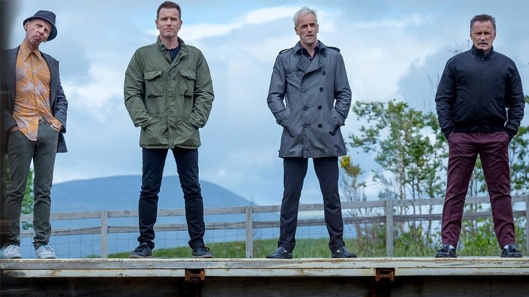
t2-trainspotting

9) Yeh Din Ka Kissa – It’s an indie movie with a classic indie set up: an estranged family gathers for an event to celebrate the father’s work. What long-lasting emotional traumas will be brought up, and which long-buried secrets will be disinterred? Only writer/director Noah Baumbach knows, but with the likes of Adam Sandler, Ben Stiller, Dustin Hoffman and Emma Thompson taking part, Yeh Din Ka Kissa has all the potential to be a must-see dramedy.

10) The Shape of Water – Guillermo del Toro returns after the disappointment of Crimson Peak with this eerie fantasy set against the backdrop of the Sixties and the Cold War between Russia and America. Sally Hawkins is the janitor working in a lab where a mysterious “amphibious man” is being held. Cue elements of romance, danger, and (no doubt some) horror as Hawkins’ character decides that the “amphibious man” should be freed. Del Toro seems to be walking a bit of a tightrope in achieving the necessary credibility for his tale, but it’s a project he’s been working on for some time, so let’s give him the benefit of the doubt.

11) Molly’s Game – The directorial debut of Aaron Sorkin, this adaptation by the man himself of Molly Bloom’s memoir, features the ubiquitous Jessica Chastain as the writer who set up and ran an international high stakes poker game, and became the subject of an FBI investigation. Expect a screenplay liberally strewn with Sorkin’s trademark intelligent dialogue, and a close examination of a world that few people get to experience.

12) Battle of the Sexes – It’s true story time as husband and wife directing team Jonathan Dayton and Valerie Faris take on the media circus that surrounded the 1973 tennis match between World No. 1 Billie Jean King (played by Emma Stone) and ex-champ Bobby Riggs (a well-chosen Steve Carell). It’s an event that cries out for comedic treatment, and hopefully the true absurdity of both the reasons for the match and the eventual game itself will be highlighted in such a way that audiences unfamiliar with it all will be wondering, How on earth?

13) Same Kind of Different As Me – A story that focuses on faith and how much it can transform a person’s life, Same Kind of Different As Me features Greg Kinnear as an art dealer whose relationship with a dangerous homeless man (played by Djimon Hounsou) could be the key to saving his marriage. With Renée Zellweger as the wife, and supporting roles for Jon Voight and Olivia Holt, this drama may not attract a wide audience, but it does appear to have enough going for it to be a strong alternative to the usual mainstream fare.

same-kind-of-difference-as-me

14) Guardians of the Galaxy Vol. 2 – James Gunn and crew return with a sequel that, if handled properly (and there’s no reason to suspect otherwise), will prove to be just as energetic and enjoyable as its predecessor. There will be other superhero movies released in 2017 – inevitably – but it’s this that has the best chance of rising above its competitors and showing them how superhero movies should be made (and yes, that means you, Warner Bros.).

15) Weightless – Set against the music scene in Austin, Texas, this could be veteran director Terrence Malick’s Nashville, but it’s just as likely that he’ll give us yet another elliptical, narrative-lite exploration of a character’s angst-ridden ennui that’s driven by their inability to connect with the people around them. As usual, Malick has assembled an amazing cast that includes Michael Fassbender, Christian Bale, Ryan Gosling, Cate Blanchett, Benicio Del Toro, and Natalie Portman, but while his recent, prolific output is to be welcomed, let’s hope this outing has more of a story than some recent releases.

16) The Book of Henry – Naomi Watts is the mother of a child genius (played by child star du jour Jacob Tremblay), who learns that something terrible is happening in the house next door, and that her son is not only aware of it, but has come up with a plan to deal with it and put things right. But her decision to put her son’s plan into action (inevitably) doesn’t go as planned. Directed by Colin Trevorrow from a script by Gregg Hurwitz, this could be a dark horse in the thriller stakes.

17) Shock and Awe – Ostensibly a drama that hopefully sees a return to form for director Rob Reiner, the title refers to the term used by George Bush to allude to the US Army’s approach to the invasion of Iraq in 2003. But the movie itself concerns a group of journalists who begin to doubt the President’s claim that Saddam Hussein has weapons of mass destruction, and that the War in Iraq is as legitimate as he claims. Reiner’s assembled another great cast, including Woody Harrelson, Milla Jovovich, Alec Baldwin, and Tommy Lee Jones, and if the script points up the irregularities and misinformation the US government fed to the media, then this could be as pertinent a look at government perfidy now as it was then.

18) The Zookeeper’s Wife – Another true story, another Jessica Chastain movie, this sees her play Antonina Zabinski, who with her husband, Jan, was a keeper at the Warsaw Zoo during World War II. Determined to save as many of the zoo animals, and people, as she could, Antonina took tremendous risks in avoiding detection and capture by the Nazis, and in the hands of Niki Caro, this has all the potential of being a gripping thriller about personal courage against tremendous odds.

the-zookeepers-wife

19) American Made – It’s had its fair share of problems – two wrongful death lawsuits so far – and the concept: a pilot working for the CIA also works for a cartel running drugs, has potential at least, but American Made‘s success will hinge entirely on two men: director Doug Liman and star Tom Cruise. It’s a great combination, and should result in an action thriller that provides jaded action junkies with enough adrenaline-fuelled sequences to keep a perma-smile on their faces, but it’s the story that really needs to be solid if it’s all going to work properly.

20) The LEGO Batman Movie – The movie that’s most likely to be the best DC superhero movie released in 2017, The Lego Batman Movie sees the brick-solid Caped Crusader (once again voiced by Will Arnett) battling a horde of enemies including the Joker (Zach Galifianakis) and Harley Quinn (Jenny Slate), while also trying to raise his adopted son Dick Grayson (Michael Cera). This will be cool, funny, action-packed, and in a weird not-weird way, able to make grown men – okay, fanboys – cry.

21) Bright – This is one of the more out there movies coming out in 2017, as David Ayer directs a script by Max Landis that references a world where fantasy characters such as elves and orcs have become integrated into human society and everyone gets along. It gets generic though as Will Smith’s LAPD cop is assigned an Orc partner, and while details are being kept under wraps, it’s likely that they’ll have to investigate a murder, or a case of corruption, that ultimately leads to a behind the scenes villain who hates the status quo. But Landis has promised the action will be incredible, and Ayer is no slouch in that department, so we’ll just have to wait and see just how batshit crazy it all is.

22) Jungle – “If you go down to the jungle today…” – it’s bound to end badly. And that’s the likelihood in a thriller directed by Greg McLean that stars Daniel Radcliffe as one of a group of friends who go trekking through the Bolivian jungle with a guide who isn’t all he says he is. Based on a true story, with Radcliffe playing Yossi Ghinsberg, who ended up lost and alone in said jungle back in 1981, this could well be a nerve-shredding experience, but only if McLean puts the hugely disappointing The Darkness behind him and trusts in the material.
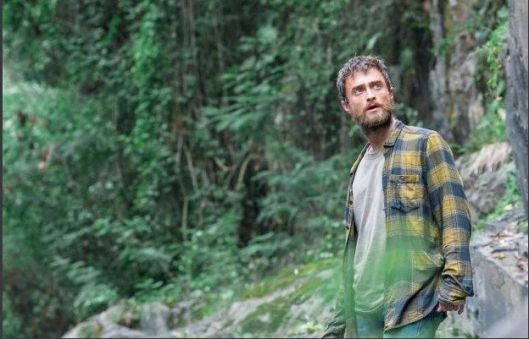
jungle

23) My Cousin Rachel – An adaptation of the novel by Daphne Du Maurier (and which was previously filmed in 1952 with Olivia de Havilland and Richard Burton), this romantic drama spiced with intrigue and revenge features Rachel Weisz and Sam Claflin as the cousins whose relationship becomes increasingly more intimate even though he suspects her of murdering his guardian. Roger Michell directs, and sensibly, the period setting is retained, making this a rare historical drama in amongst all the other releases in 2017.

24) Rebel in the Rye – A biopic of renowned, and reclusive, author J.D. Salinger, with Nicholas Hoult taking on the role, this also features Kevin Spacey as Whit Burnett, Salinger’s mentor at Columbia University, Zoey Deutch as Oona O’Neill, who had a short romance with Salinger in the late 40’s, and Sarah Paulson as Dorothy Olding, who was his agent. It remains to be seen if Danny Strong’s examination of Salinger’s life will reveal anything new about the writer, but he’s an intriguing character, and one worth taking a closer look at.

25) Beauty and the Beast – With the success of Jon Favreau’s The Jungle Book, Disney adds another live-action adaptation of one of their animated classics to the roster. Emma Watson is Belle, Dan Stevens is the Beast, while the likes of Ewan McGregor, Ian McKellen, Emma Thompson and Stanley Tucci put flesh on the “bones” of all those ornaments and dinnerware we’ve come to know and love. But as with The Jungle Book, it remains to be seen just how many of the original animated classic’s wonderful songs will be kept in place.

beauty-and-the-beast

Share this:

  • Share on X (Opens in new window) X
  • Share on Facebook (Opens in new window) Facebook
  • More
  • Print (Opens in new window) Print
  • Email a link to a friend (Opens in new window) Email
Like Loading...

Hunt for the Wilderpeople (2016)

06 Thursday Oct 2016

Posted by dullwood68 in Movies

≈ 3 Comments

Tags

Barry Crump, Child services, Comedy, Drama, Julian Dennison, Literary adaptation, New Zealand, Rachel House, Review, Rima Te Wiata, Sam Neill, Taika Waititi, The Bush, Wild Pork and Watercress

hunt-for-the-wilderpeople

D: Taika Waititi / 101m

Cast: Sam Neill, Julian Dennison, Rima Te Wiata, Rachel House, Tioreore Ngatai-Melbourne, Oscar Kightley, Stan Walker, Mike Minogue, Cohen Holloway, Rhys Darby

Ricky Baker (Dennison) is a problem child. He’s in the care system, and has a reputation for disobedience, stealing, spitting, running away, throwing rocks, kicking stuff, defacing stuff, burning stuff, loitering, and graffiti-ing (and that’s just the stuff Child Services knows about). In short, he’s a real bad egg. But he’s been given one last chance: to be looked after by Bella Faulkner (Te Wiata) and her grouchy husband Hec (Neill) on their farm. Bella is endlessly upbeat despite a tendency for inappropriate comments (“Whoo! You’re a big fella. Who ate the guy who ate all the pies, eh?”), but her heart’s in the right place and she more than compensates for Hec’s less than welcoming behaviour. Ricky runs away the first night, but doesn’t get very far, and soon he’s running away each night – but he’s always back in time for breakfast.

Responding to Bella’s ministrations, Ricky soon settles in and begins to take an interest in the farm and Hec’s role. Hec teaches Ricky to shoot, and they begin to form a bond. When Ricky’s birthday comes around, the Faulkners get him a dog, which he names Tupac. But tragedy strikes, and Ricky is required to go back into the care system. Refusing to go he heads off into the Bush, and determines to remain in hiding. Hec soon finds him, and they begin the return journey home when Hec breaks his ankle. Forced to stay in the Bush while his ankle heals, six weeks pass, during which Child Services, in the form of would-be Agatha Trunchbull, Paula Hall (House), and the police, search for the missing pair. An encounter at a lodge with a trio of hunters who are looking for Ricky and Hec leads to Hec being regarded as a pervert, and Ricky having been kidnapped.

hftw-scene1

Ricky and Hec go on the run, and decide to hole up in the Bush until the search for them peters out. They survive by catching or foraging for food, use the “Knack” – a kind of semi-mystical knowledge that allows them to avoid being found and to survive in the wilderness – and slowly and surely learn to trust and respect and depend on each other. But the search for them continues unabated, thanks to Paula Hall’s determination that “no child is left behind”, and the occasional help afforded them by strangers such as young girl Kahu (Ngatai-Melbourne), and raving conspiracy theorist Psycho Sam (Darby). But inevitably the pair are tracked down and it only remains to be seen if they go out with a bang or a whimper.

An adaptation of the novel Wild Pork and Watercress by Barry Crump, Hunt for the Wilderpeople is one of the most enjoyable and endearing movies you’re likely to see all year. It has charm by the bucket load, an irresistible central character in Ricky Baker, is peppered with some of the funniest dialogue heard in a very loooong time, and features some absolutely stunning New Zealand scenery. And because it all takes place in New Zealand there’s a fantastic Lord of the Rings joke to round things off. It’s a movie that, thanks to the efforts of writer/director Taika Waititi, provides enough comic indulgence for two movies.

hftw-scene3

It features a quartet of wonderfully bizarre and idiosyncratic performances as well, from Neill’s wonderfully arch turn as a man with all the parental skills of a confirmed malcontent, to Te Wiata’s brief but heartfelt portrayal of a woman for whom the act of caring compensates greatly for the one regret she’s ever had in life, to House’s grotesque Child Services agent, a loud, over-earnest, bullying monster of a woman who won’t be beaten by Ricky at any cost, as evidenced by this brilliant exchange:

Ricky Baker: I’ll never stop running!
Paula: Yeah, and I’ll never stop chasing you – I’m relentless, I’m like the Terminator.
Ricky Baker: I’m more like the Terminator than you!
Paula: I said it first, you’re more like Sarah Connor, and in the first movie too, before she could do chinups.

But when all’s said and done, this is Dennison’s movie. He owns the role of Ricky Baker as if he’s played it all his life, from the constant gangsta/thug life referrals, all the way to the petulant disregard for others he uses as a shield against getting hurt. Dennison is nothing short of superb here, soaking up Waititi’s fluid direction and relaying with disarming simplicity the problems of being in a care system that doesn’t actually care about him. He’s also a great physical comedian, using his size in unexpected ways to draw out several moments of equally unexpected humour. And his timing isn’t too bad, either. Witness the scene where he tries to cajole Hec into looking for a Russian bride online: when Hec looks at him with disdain, Ricky’s deadpan “Too soon?” is served up to perfection.

hftw-scene2

In amongst the humour, Waititi is wise enough to keep the sermonising about the importance of family ties, and just what makes a family, to a minimum, and the demonisation of Child Services via the character of Paula is kept from becoming too silly or ridiculous thanks to Waititi’s assured handling of his own script, and House’s confident awareness of the character’s narrative limitations. She’s a cartoon figure in many respects, and in some ways the Yosemite Sam to Ricky’s Bugs Bunny, but not drawn or portrayed too broadly to be completely obnoxious or hateful. (There’s a sad back story there, no doubt, and one that would be good to know more about.) The relationship between Ricky and Hec is allowed to develop naturally, and is helped by the passage of time. Neill and Dennison work very well together, and the early scenes where they clash adds poignancy later on when it becomes clear to both of them just how much they need each other.

As mentioned before, the whole thing plays out against the backdrop of some spectacular New Zealand scenery – the opening credits sequence as the camera skims the treetops of the Bush sets the tone for the movie’s overall look and feel – and DoP Lachlan Milne captures the rugged beauty of the Bush itself and the surrounding terrain with clarity and precision; it’s a visually splendid movie to watch. And to cap it all off, the soundtrack, with its mix of original compositions and well-chosen songs – Nina Simone’s version of Sinnerman is put to particularly good use – adds an extra layer of finesse to a movie that already has more than enough finesse already.

Rating: 9/10 – a feel-good movie that doesn’t even have to try too hard to make its audience laugh or cry, Hunt for the Wilderpeople is beautifully observed, beautifully constructed, and effortlessly satisfying; Waititi is to be congratulated for taking material that could have been treated with far less care than is shown here and making it feel special, and for making a movie about a fat kid and his grumpy “uncle” that is nothing short of “majestical”.

Share this:

  • Share on X (Opens in new window) X
  • Share on Facebook (Opens in new window) Facebook
  • More
  • Print (Opens in new window) Print
  • Email a link to a friend (Opens in new window) Email
Like Loading...

The 60th BFI London Film Festival 2016 – Opening Night

05 Wednesday Oct 2016

Posted by dullwood68 in Movies

≈ Leave a comment

Tags

A United Kingdom, BFI, London Film Festival 2016, Opening night

It’s the opening night of the 60th BFI London Film Festival 2016, and to kickstart the Festival there’s a Gala screening of A United Kingdom, the true story of Prince Seretse Khama of Botswana who came to the UK in the late 1940’s and married Ruth Williams, a clerk at Lloyd’s of London. Their interracial marriage caused concerns both in the UK and in Botswana, and both politically and socially. The movie stars David Oyelowo and Rosamund Pike as the couple who challenged the racist attitudes of two countries, and advance word on the movie is that it’s a remarkable portrait of the turbulent period it’s set in. If it is, then it’s in very good company, as over the years the programmers of the Festival have managed to secure some amazing, and varied, movies to occupy their Opening Night slot. Here are just a dozen of those movies.

1957 – Throne of Blood

1964 – The Umbrellas of Cherbourg

1968 – The Firemen’s Ball

the-firemens-ball

1971 – Traffic

1977 – 1900

1980 – Kagemusha

kagemusha

1985 – Ran

1993 – The Remains of the Day

1999 – Ride With the Devil

ride-with-the-devil

2004 – Vera Drake

2009 – Fantastic Mr Fox

2013 – Captain Phillips

Share this:

  • Share on X (Opens in new window) X
  • Share on Facebook (Opens in new window) Facebook
  • More
  • Print (Opens in new window) Print
  • Email a link to a friend (Opens in new window) Email
Like Loading...

Wiener-Dog (2016)

05 Wednesday Oct 2016

Posted by dullwood68 in Movies

≈ Leave a comment

Tags

Black comedy, Cancer, Danny DeVito, Doody, Drama, Ellen Burstyn, Greta Gerwig, Indie movie, Julie Delpy, Review, Todd Solondz

wiener-dog

D: Todd Solondz / 88m

Cast: Julie Delpy, Keaton Nigel Cooke, Tracy Letts, Greta Gerwig, Kieran Culkin, Connor Long, Bridget Brown, Danny DeVito, Sharon Washington, Ellen Burstyn, Zosia Mamet, Michael James Shaw

A portmanteau of stories connected by the titular animal, Wiener-Dog is the kind of quirky, off-kilter indie movie that attracts audiences attuned to quirky, off-kilter indie movies. That’s to say there’s a certain audience out there for it, and it’s a movie that does its best to be quirky and off-kilter, but as with most portmanteau movies – indie-based or otherwise – some stories work and others don’t. And this won’t help it reach a wider audience. Making a quirky, off-kilter indie movie isn’t a bad idea, but in order for it to avoid being stuck in a niche market, it really needs to be thought through in better fashion than writer/director Todd Solondz has done here.

We first meet wiener-dog as he’s taken to a shelter. Why he’s taken there we never find out – it probably doesn’t matter, but if it does, Solondz isn’t looking to give the viewer any clues – but it’s not long before he’s given a home by Danny (Letts) as a surprise gift for his young son, Remi (Cooke). Remi’s mother, Dina (Delpy), isn’t too happy though about having a dog in the house, and she’s keen to make it clear that the dog is Remi’s responsibility alone. Remi has recently survived a brush with cancer, and is only too happy to have a dog to look after. But an unfortunate occurrence involving the dog and a granola bar leads to wiener-dog being taken back to the shelter.

wiener-dog-scene2

Ear-marked to be put down, wiener-dog is saved at the last minute by veterinary nurse, Dawn (Gerwig). She takes the dog home with her and christens her Doody. At a local store she runs into Brandon (Culkin), who she knew in high school. He’s going on a trip to visit his brother, Tommy (Long) and his wife, April (Brown), and he invites Dawn along. With nothing better to do, she accepts. When they get to Tommy’s house, Dawn learns that he and April both have Downs Syndrome. When it’s time to leave, Dawn makes a gift of Doody to the couple.

We next see Doody with screenwriting professor Dave Schmerz (DeVito). Dave is trying to get his own screenplay produced, but his agent hasn’t even read it, and Dave is getting more and more depressed about it as a result. He’s lost his enthusiasm for teaching, and in turn has lost the respect of his students. Even when he’s assigned a new agent who tells him she may have a deal with Dreamworks set up for him, Dave’s newfound happiness is undermined by news that his students have complained about him. Angry and upset by this, Dave assembles a bomb, attaches it to Doody, and sends her into the college where he works.

wiener-dog-scene3

Our final encounter with the dog is when she’s owned by Nana (Burstyn) and is called Cancer. Nana lives with her caregiver and appears miserable and grumpy. She receives a visit from her granddaughter, Zoe (Mamet), and her current boyfriend, Fantasy (Shaw), a performance artist she thinks is cheating on her. The visit is cut short before Nana can give any practical advice, and afterwards she has goes outside and has a dream where younger versions of herself endlessly repeat how better her life would have been if she’d been nicer to people, less critical of them etc.

There’s one last scene involving wiener-dog in animatronic form, but that’s basically it, a collection of four stories where the dog is largely coincidental to the tales being told, and the characters – as per Solondz’ usual penchant – are disillusioned, emotionally stunted, socially awkward lost souls who are unable to connect to others on any meaningful level. Now, there’s aways room for this kind of movie making, and in the past Solondz has been an accomplished purveyor of tales about such people. He’s pretty much built his career on the back of them, and Happiness (1998) is a superb example of what he can do when the muse takes him. But Wiener-Dog is neither as sharp as that movie, or as engaging. There’s Solondz’ trademark waspish humour, but unfortunately, it’s also not as acute as it needs to be.

The first tale is possibly the most satisfactory, with Remi’s persistent questioning of his mother leading to some of the most inappropriate parenting seen on screen for a while. Dina doesn’t do much to reassure Remi; instead she offers worst-case scenarios and semi-pious examples of times went horribly wrong for want of the right thing being done. It’s reassurance by scare tactics, and while Solondz is aiming for very black humour in these moments, the awfulness of Dina’s approach is just that: awful. Delpy is a superb actress, and she handles the dialogue well, but even she can’t find the fine line that stops emotional support from becoming emotional abuse.

wiener-dog-scene1

The story involving Dawn and Brandon – characters reunited from Welcome to the Dollhouse (1995) – runs out of ideas very quickly, and Solondz doesn’t have anything to offer in terms of the characters or their lives, other than that Dawn and Brandon both exist in the kind of emotional bubbles that are difficult for others to break through, and partly because the two of them aren’t especially aware that that’s the kind of lives they lead. Dave’s tale is flat and uninvolving, a tired story about a tired man that you don’t spend enough time with to really care about. DeVito is often a better dramatic actor than he’s given credit for, but here he just doesn’t have the material to work with. But spare a thought for Burstyn, who has even less to work with, and who is left to yield the floor to Mamet and her character’s own worries. The focus isn’t on Nana enough for the dream visitations of her younger self to have any relevance, and once they occur her tale is effectively over, leaving the viewer to wonder why the story was included in the first place.
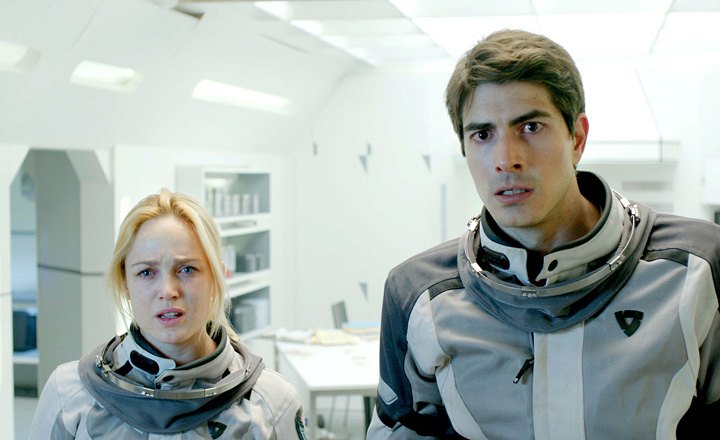
The cast do their best, but Solondz maintains a dreary, desultory tone throughout, aiming perhaps for slice of life tales that are meant to be affecting and saying something about modern day ennui, but instead, giving the viewer brief character sketches that say little beyond the obvious, and which lack the necessary depth to make these characters sympathetic or intriguing. It’s hard to care about any of them, and in the end, Solondz reveals just how little he cares about them, or the dog, as he pulls the rug out from under the audience with a scene that’s so gratuitous and unnecessary that you feel like slapping him in the face for being so arbitrary and cruel.

Rating: 4/10 – with past glories fading away with every passing minute, Wiener-Dog is not the movie to sound hurrahs for Solondz’ return to movie making after five years away; as it squanders every opportunity to be interesting or appealing, the movie gets bogged down by its attempts to say something about the lives of the disconnected, and in doing so – and with an irony that only highlights Solondz’ clumsy approach to his own material – keeps its characters at a safe distance from the audience as well.

Share this:

  • Share on X (Opens in new window) X
  • Share on Facebook (Opens in new window) Facebook
  • More
  • Print (Opens in new window) Print
  • Email a link to a friend (Opens in new window) Email
Like Loading...

Oh! the Horror! – The Darkness (2016) and Lights Out (2016)

04 Tuesday Oct 2016

Posted by dullwood68 in Movies

≈ 2 Comments

Tags

Anasazi, David F. Sandberg, Diana, Drama, Grand Canyon, Greg McLean, Horror, Kevin Bacon, Maria Bello, Radha Mitchell, Review, Teresa Palmer, Thriller

the-darkness

The Darkness (2016) / D: Greg McLean / 92m

Cast: Kevin Bacon, Radha Mitchell, David Mazouz, Lucy Fry, Matt Walsh, Jennifer Morrison, Parker Mack, Paul Reiser, Ming-Na Wen

In The Darkness, a family returns home from a trip to the Grand Canyon, unaware that their autistic son has released an ancient supernatural force that had been imprisoned in a secret Anasazi location. Once the feuding Taylors – dad Peter (Bacon), mum Bronny (Mitchell), teenage daughter Stephanie (Fry), and son Michael (Mazouz) – get settled back into the routine of sniping at each other and generally ignoring the fact that their combined behaviours are slowly tearing the family apart, the inevitable strange things start to happen. First, the taps in the kitchen turn on by themselves…

… and with that, any aspirations to be or do anything different for the remainder of the movie goes so far out of the window you’re not even sure if it’s landed anywhere. The Darkness is a shockingly bad amalgam of horror tropes and the supposed best bits from other horror movies. But in the main it’s Poltergeist (1982) that gets ripped off the most here, from the American Indian connection to the spiritual healer recommended to Peter by his boss (Reiser), and all the way to the portal that opens up in Michael’s bedroom.

the-darkness-scene

With the script having been cobbled together by director Greg McLean, Shayne Armstrong and Shane Krause, the movie ambles along on creative life support before it reaches the end and gives up the ghost entirely. Along the way it attempts to add depth by giving the Taylors their own personal demons to face as well as the ones formerly held at bay by Anasazi rituals. Peter once had an affair (though of course it didn’t mean anything), Bronny has a history of alcohol abuse, and Stephanie is bulimic (though one trip to the doctor’s seems to sort that one out). Personal demons, supernatural demons – what has this poor misguided family done to deserve all this? (What’s that? The supernatural demons are metaphors? Oh, right…)

There’s no shortage of cringeworthy moments in The Darkness (though the demons going by the collective name of Jenny is probably the best/worst), and the cast appear to have given up quite early on – Bacon in particular looks like he’s wondering if he could drop a few scenes and thereby lessen his involvement – but it’s McLean’s lack of focus on both the performances and the material that hurts the movie the most. With the script on only nudging terms with credibility – and yes, this is a horror movie, and yes, credibility is often the first thing to go when one is being made – it still needed a firmer hand at the controls, but McLean, now a long, long way from the glory days of Wolf Creek (2005) just lets the movie drift to a unsatisfactory finish that is at least in keeping with how unsatisfactory the rest of the movie has been.

Rating: 3/10 – meh horror that lacks commitment from all concerned, and offers nothing new… at all; daft, confusing, muddled, and dramatically inert for long stretches, The Darkness will make you feel uneasy – but, sadly, not for the right reasons.


lights-out

Lights Out (2016) / D: David F. Sandberg / 81m

Cast: Teresa Palmer, Gabriel Bateman, Alexander DiPersia, Maria Bello, Billy Burke, Alicia Vela-Bailey, Andi Osho

Martin (Bateman) is a young boy whose stepfather is killed in a very violent fashion. His mother, Sophie (Bello), already on medication for depression, is acting strangely. She talks to someone called Diana (Vela-Bailey) who doesn’t appear to be real. But one night Martin sees the hand of an unnatural figure in his mother’s room. Scared, he finds it difficult to sleep properly, and instead, falls asleep at school. When this happens for a third time, and the school can’t get hold of Sophie, they contact his older sister, Rebecca (Palmer). Rebecca left home years before, shortly after her father (Sophie’s first husband) decided to leave for good himself. Rebecca looks after Martin, but thanks to the intervention of Child Services, isn’t allowed to do so full-time.

With the aid of her would-be boyfriend Bret (DiPersia), Rebecca finds herself quickly coming to terms with the fact that Diana is real – desite having died many years before – and needing to do something about the wraith’s deadly attacks on Martin and herself.  Armed with the knowledge that Diana’s attacks only take place in the dark thanks to the extreme heliophobia she suffered from when she was alive, Rebecca and Martin take steps to protect themselves, and to get Sophie to admit that her childhood friendship with Diana is allowing the spectre to exist. But Diana has other plans…

lights-out-scene

Expanded on from his 2013 short movie of the same name, David F. Sandberg’s Lights Out is an efficient, no-nonsense horror thriller that takes its basic premise – lights on: no ghost, lights off: there it is – and finds various clever ways of keeping the central conceit from getting too stale too quickly, even at eighty-one minutes. While Diana’s back story only partially explains her reason for haunting Sophie and her family, and Diana herself isn’t quite as frightening as she’s meant to be, nevertheless, Sandberg succeeds in making her as credible a character (in the circumstances) as can be, and manages to achieve the same success with Sophie, Martin and Rebecca. Sandberg is helped by strong performances all round – Palmer is particularly good as Rebecca – and  a script by Eric Heisserer that does its best in avoiding the pitfalls of dishing up too many horror movie clichés (though it does serve up two unsuspecting police officers as victims of Diana’s wrath, just to keep the momentum going).

The movie is strong on atmosphere, with certain scenes having a clammy, claustrophobic feel to them that isn’t entirely to do with the characters being in confined spaces, and Marc Spicer’s cinematography makes the darkness that surrounds the characters for most of the movie as threatening as possible thanks to some very good lighting choices and some expert framing. The look of the movie is of primary importance in how scary it is, and Sandberg provides viewers with a mix of generic visuals and heightened situations that is surprisingly uncomfortable to watch at times. It’s not entirely successful – Bret is a seriously one-note character, the basement of Sophie’s house conveniently reveals a secret that otherwise would never have been known, a confrontation with Sophie about Diana (and her death) features some very stilted and ill-chosen dialogue – but on the whole it’s a far better movie than expected.

Rating: 7/10 – a horror movie that dares to be different, and succeeds for the most part, Lights Out has a creepy central premise that’s handled well and makes for some effective jump scares (for a change); inevitably, a sequel has already been greenlit, but this is an effective, self-contained movie that stands on its own and proves that intelligence and horror can go hand in hand, and not just wave to each other in passing.

Share this:

  • Share on X (Opens in new window) X
  • Share on Facebook (Opens in new window) Facebook
  • More
  • Print (Opens in new window) Print
  • Email a link to a friend (Opens in new window) Email
Like Loading...

The Lunchbox (2013)

02 Sunday Oct 2016

Posted by dullwood68 in Movies

≈ 1 Comment

Tags

Comedy, Dabba, Dabbawala, Drama, Irrfan Khan, Mumbai, Nawazuddin Siddiqui, Nimrat Kaur, Review, Ritesh Batra, Romance

the-lunchbox

Original title: Dabba

D: Ritesh Batra / 104m

Cast: Irrfan Khan, Nimrat Kaur, Nawazuddin Siddiqui, Lillete Dubey, Nakul Vaid, Bharti Achrekar, Yashvi Puneet Nagar, Denzil Smith, Shruti Bapna

In Mumbai, a dabbawala is literally “one who carries a box”. A dabbawala is part of a delivery system that allows workers who don’t want to eat at a food stand or a restaurant, to have hot, home-cooked food for lunch. The lunchboxes are collected from the worker’s home in the morning, delivered in time for their lunch break, and then returned to the worker’s home by the evening. This service first started in 1890, and has grown to the point where anywhere between 175,000 and 200,000 lunchboxes are delivered every day, and incredibly, it’s estimated that dabbawalas make less than one mistake in every six million deliveries.

It’s this amazing service that forms the backdrop and set up for The Lunchbox, a wonderfully complex, and still very simple, May-December romance that develops between soon-to-retire claims actuary Saajan Fernandes (Khan) and housewife Ila (Kaur). Saajan is a widower, well-regarded in the workplace but somewhat withdrawn from his colleagues. He doesn’t socialise outside of work, and he appears to be resigned to remaining alone. Ila has a husband, Rajeev (Vaid) who is distant from her, and from their young child, Yashvi (Nagar). Ila wants Rajeev to play more of an active part in their marriage; some nights he comes home and doesn’t say a word. Ila’s aunty (Achrekar), who lives in the flat above them, suggests that Ila make delicious lunches for Rajeev, in order to help rekindle the romance they used to have.

the-lunchbox-scene2

But instead of Rajeev receiving the first of these lunches, it’s Saajan who gets to discover just how good a cook Ila is. When she realises that her husband hasn’t been receiving the lunches, she leaves a note in the next one, advising the person who is getting them, about the mistake. Saajan is amused by this, but he’s even more enamoured by the quality of Ila’s cooking. He replies to her note, and so begins a correspondence that both keep to themselves, and which enables both of them to feel that there is more to life than the boundaries that seem to keep them hemmed in. As their relationship begins to deepen, Saajan has to cope with the irritating interruptions and attention of his successor, Shaikh (Siddiqui), while Ila has to cope with her father’s long-term illness, and the effect it’s having on her mother (Dubey), and the realisation that Rajeev is having an affair.

The first, and so far, only feature from Mumbai-born Ritesh Batra, The Lunchbox is so deceptively simple, and so elegantly complex, that it’s difficult to work out which of these two aspects is the more effective. Ostensibly a romantic drama with comedic overtones, the movie resists the temptation to be acceptably superficial, and instead, lays the groundwork for perceptive ruminations on growing old in modern India, and what it means to accept the role in life you believe you’ve been given. Through Saajan’s listless acceptance of his fate as a widower with no future in retirement, the movie casts an observant eye over what it is to become inured to a certain way of life, and to regard change as unobtainable. Saajan believes his fate is unavoidable, and in believing so, can do nothing about it.

Ila wants her husband back from wherever it is that his mind is taking him. She at least believes she can change things back to how they were, and has yet to resign herself to a stale marriage of convenience. But Rajeev’s continued indifference, and Ila’s eventual discovery of his infidelity, both serve to leave her feeling trapped and unable to make a better life for herself and Yashvi. Thankfully, Saajan’s enjoyment of her food, and his willingness to engage with her via the notes they send each other, allows her to feel that there is hope for the future, whether she leaves Rajeev and goes to live in Bhutan with Yashvi and Saajan (as he suggests at one point), or even if it’s just her and her daughter.

the-lunchbox-scene1

For Saajan, things are made more complicated by his age and his position in the workplace. After thirty-five exemplary years in the same job, he’s retiring out of some sense of commitment to the memory of his late wife. Closed off from everyone, including himself from time to time, Saajan has resigned himself to a life of anonymity and seclusion, and in a place, Nashik, for which he has little actual enthusiasm. It’s only through the persistence of his successor, the garrulous and irritating Shaikh, and Ila’s notes, that Saajan begins to come out of his shell. He becomes more outgoing, less gloomy, and he tolerates Shaikh’s ebullient behaviour, even when he joins Saajan for lunch and the older man finds himself sharing with the younger man – and is surprised to find he’s happy to do so.

Saajan and Ila’s relationship develops to the point where the audience is practically praying that they’ll meet and properly fall in love, and not rely on the kind of epistolary romance that suits a novel but not necessarily a movie (unless that movie is Whit Stillman’s Love & Friendship). But the course of true love is never known to run smoothly, and despite their obvious need for each other, Saajan’s awareness of the age difference between them leads him to snatch defeat from the jaws of victory. An arranged meeting doesn’t go as planned, and their romance suffers as a result, leaving both parties to decide if what they had was even tangible. Decisions are made, and though they seem immutable, Batra’s clever script allows for optimism in the face of dramatic certainty.

the-lunchbox-scene3

Batra is helped immensely by his two leads. Khan is a perceptive, dignified actor, and he brings those qualities to bear on a role that requires him to reveal more and more about Saajan as the movie progresses. With his gaze registering bemused astonishment with every mouthful and smell of Ila’s cooking, Khan is a delight to watch, and he handles the disappointments and self-imposed barriers to living that Saajan endures with an emotional clarity that is an acting masterclass all by itself. Kaur is equally impressive. Whether Ila is trading quips or recipe tips with her aunty, or whether she’s coming to terms with the likelihood of a loveless marriage for years to come, the actress displays a range and an understanding of her character’s situation that is breathtaking to watch. Both actors are superb here, so much so that it’s very difficult to envisage anyone else in either role.

With Batra proving to be as good a screenwriter as he is a director, The Lunchbox is in very good hands throughout. He makes a background character out of the city of Mumbai, and the hustle and bustle of its streets and trains and buses – all constant reminders that life goes on around us, vibrant and compulsive, even if we choose to step back from it – is used to potent effect, as Saajan in particular experiences its highs and lows. Batra is aided by sterling work from DoP Michael Simmonds, and the movie’s slow, lyrical pace is courtesy of editor John F. Lyons. Scenes play out sometimes at such a stately pace that it’s hard to believe it’s all been agreed in advance, and that so many quiet moments could have such a cumulative, and remarkable effect. But the pace and the tone of the movie are aspects that have been achieved with a great deal of skill, and they serve the material with undisguised aplomb.

Rating: 9/10 – a beautifully observed, beautifully constructed movie that takes two trapped souls and sets them free by virtue of their finding in each other a kindred spirit, The Lunchbox is touching, affecting, stylish, and endlessly gracious in its delivery; a sparkling romantic drama that pays dividends from the very start, and which never short changes either its characters or its audience, it’s a movie that delights with ease, and lingers in the memory long after it’s over.

Share this:

  • Share on X (Opens in new window) X
  • Share on Facebook (Opens in new window) Facebook
  • More
  • Print (Opens in new window) Print
  • Email a link to a friend (Opens in new window) Email
Like Loading...

Trailers – Fences (2016), Mean Dreams (2016) and The Free World (2016)

01 Saturday Oct 2016

Posted by dullwood68 in Movies

≈ Leave a comment

Tags

August Wilson, Bill Paxton, Boyd Holbrook, Crime, Denzel Washington, Drama, Previews, Trailers, Viola Davis

In 2010, a production of Fences, August Wilson’s award-winning play, won Tony’s for Best Revival of a Play, Best Actor and Best Actress. The two leads in the revival were Denzel Washington and Viola Davis, so if you think after watching the trailer that their performances look incredibly good – well, there’s the reason why. Set in the 1950’s, the movie examines the effects changes in race relations in the US have on an average African-American family, and in particular the dynamic between Washington’s struggling husband and father Troy, and his teenage son Cory (played by relative newcomer Jovan Adepo). With Washington making his first feature since The Great Debaters (2007), it will be interesting to see just how much of Wilson’s tale of bitter regret and personal despair is retained, and if the movie retains the play’s episodic structure. But from the trailer alone it does look as if Washington has made a challenging, powerful movie, and perhaps a sure-fire awards winner further down the line.


In Mean Dreams, Bill Paxton is the kind of backwoods sheriff we’ve seen quite a lot of recently: outwardly charming, seemingly decent, but beneath all that, as callous and conniving as any regular bad guy (and probably more so). But this is a small-town sheriff bordering on the psychotic, which makes his treatment and eventual pursuit of his daughter (Sophie Nélisse) and her wrong-guy-in-the-wrong-place boyfriend (Josh Wiggins) all the more gripping. Given the right role, Paxton is an actor you should never underestimate; he can take a viewer to some very dark places indeed, and often at the drop of a hat. This has all the hallmarks of such a role, and while the movie has a wintry feel to it that appears to suit the mood and tone of the movie, it’s still going to be Paxton who grabs all the attention – and he looks good and ready to do so.


There are always actors who pop up in movies and make an impression, but who still manage to retain an air of mystery and have audiences scratching their heads and asking themselves, “Didn’t I see him/her in that other movie?” Boyd Holbrook is one of those actors. He’s been quietly amassing a body of work that’s also been increasingly impressive ever since he first appeared in Milk (2008). Now, it looks as if The Free World, a taut thriller about second chances and personal redemption set against the backdrop of a domestic murder case, could be the movie to catapault Holbrook into the big(ger) leagues. If it doesn’t, then it’s unlikely Holbrook will be too worried. He’ll just carry on giving good performances in whatever movies he makes.

Share this:

  • Share on X (Opens in new window) X
  • Share on Facebook (Opens in new window) Facebook
  • More
  • Print (Opens in new window) Print
  • Email a link to a friend (Opens in new window) Email
Like Loading...

Monthly Roundup – September 2016

30 Friday Sep 2016

Posted by dullwood68 in Movies

≈ 3 Comments

Tags

Action, Andrew Asper, Antoine Fuqua, Ben-Hur, Chris Pratt, Denzel Washington, Drama, Elizabeth Mitchell, Fantasy, Florence Foster Jenkins, Frank Grillo, George Montgomery, Ghostbusters (2016), Glenn R. Miller, Historical drama, Horror, Hugh Grant, Ione Butler, Jack Huston, James DeMonaco, Kristen Wiig, Melissa McCarthy, Meryl Streep, Paul Feig, Review, Richard Boone, Robbers' Roost, Sidney Salkow, Stephen Frears, The Magnificent Seven (2016), The Purge: Election Year, Thriller, Timur Bekmambetov, Toby Kebbell, Western, Zoombies

The Purge: Election Year (2016) / D: James DeMonaco / 109m

Cast: Frank Grillo, Elizabeth Mitchell, Mykelti Williamson, Joseph Julian Soria, Betty Gabriel, Terry Serpico, Edwin Hodge, Kyle Secor

the-purge-election-year

Rating: 6/10 – several years after the events in The Purge: Anarchy (2014), ex-cop Leo Barnes (Grillo) is now head of security for Presidential candidate Senator Charlie Roan (Mitchell) – whose anti-Purge stance has made her a significant target come the latest Purge night; more of the same from writer/director DeMonaco, with the villainous Founding Fathers coming in for more grief thanks to the series’ need to avoid repeating itself, but without it actually finding a solution to the problem, all of which leads to The Purge: Election Year sounding good on paper, but proving instead that it’s an idea that’s already running out of steam.

Ben-Hur (2016) / D: Timur Bekmambetov / 125m

Cast: Jack Huston, Toby Kebbell, Rodrigo Santoro, Nazanin Boniadi, Ayelet Zurer, Pilou Asbæk, Morgan Freeman, Sofia Black-D’Elia

ben-hur

Rating: 3/10 – meh; a waste of time, money, resources, the cast, the crew, and another unwanted remake which ruins the one thing it should have moved Heaven and Earth to ensure it got right: yes, the chariot race, a sequence that’s assembled and edited so badly that you won’t have any idea what happens to Messala (Kebbell) other than that he loses.

Robbers’ Roost (1955) / D: Sidney Salkow / 83m

Cast: George Montgomery, Richard Boone, Sylvia Findley, Bruce Bennett, Peter Graves, Tony Romano, Warren Stevens

robbers-roost

Rating: 6/10 – revenge is on the mind of cowboy Jim Wall (Montgomery) as he tries to track down the killers of his wife, some of whom he suspects may be part of a notorious gang of cattle rustlers led by Hank Hays (Boone); an average Western bolstered by a strong cast, Robbers’ Roost is rough and tough and bristling with repressed macho energy, all of which is channelled – eventually – into a less than exciting showdown, and an about-face by Hays that undermines both the character, and Boone’s enjoyable portrayal of him.

Florence Foster Jenkins (2016) / D: Stephen Frears / 111m

Cast: Meryl Streep, Hugh Grant, Simon Helberg, Rebecca Ferguson, Nina Arianda, Stanley Townsend, Allan Corduner, Christian McKay, David Haig, John Sessions, Brid Brennan

florence-foster-jenkins

Rating: 7/10 – the true story of musically misguided socialite Florence Foster Jenkins (Streep) as she determines to bring her less than gifted voice to the unsuspecting ears of the public; as light and fluffy as a soufflé (and as enjoyable), Florence Foster Jenkins tries to be serious from time to time, but nothing can detract from Florence’s whimsical nature or the script’s determination to be nicer than nice, even when it needs to be a tad dramatic, such as when Florence’s husband (a terrific Hugh Grant) is shown to be having an affair, or Florence faces jeers rather than cheers from her audience.
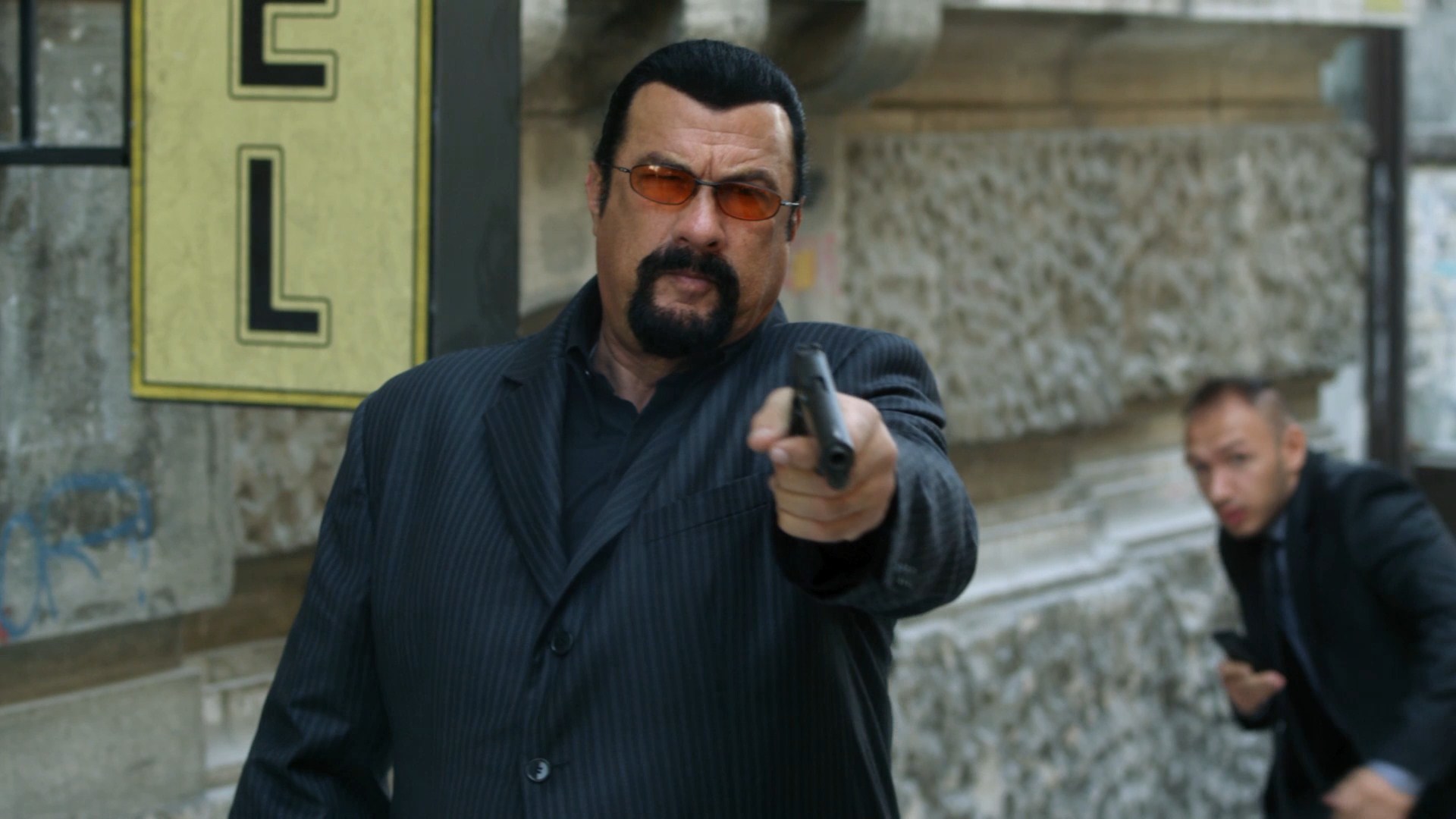
The Magnificent Seven (2016) / D: Antoine Fuqua / 133m

Cast: Denzel Washington, Chris Pratt, Ethan Hawke, Vincent D’Onofrio, Byung-hun Lee, Manuel Garcia-Rulfo, Martin Sensmeier, Peter Sarsgaard, Haley Bennett, Luke Grimes, Matt Bomer

the-magnificent-seven

Rating: 4/10 – a land-grabbing, thieving, murdering businessman (Sarsgaard) plays nasty with the small town of Rose Creek and threatens to ruin them all, leaving them with only one choice: to hire a band of mercenaries who’ll save the town and defeat the evil land baron; leaden and uninspired, Fuqua’s remake features characters you don’t care about, a huge body count that quickly becomes tedious to watch, and a cast that move about like they’re wading in treacle searching for some much needed motivation (not that they’re likely to find any, as it’s something the script isn’t interested in exploring in any real depth).

Zoombies (2016) / D: Glenn R. Miller / 87m

Cast: Ione Butler, Andrew Asper, LaLa Nestor, Kim Nielsen, Marcus Anderson, Brianna Joy Chomer, Ivan Djurovic, Aaron Groben, Kaiwi Lyman-Mersereau

zoombies

Rating: 3/10 – somehow monkeys become infected with a virus that brings on zombie-like symptoms, and before you can shout “No, don’t open the door!”, they’re loose in the grounds of a massive zoo just days before it opens to the public; rubbish on a bargain basement level, Zoombies is lame in so many ways you’d need more time than the movie plays for to go through it all – and that’s if you can at least stomach the movie’s incessant inanity, and it’s seriously worst-ever gorilla suit.

Ghostbusters (2016) / D: Paul Feig / 116m

Cast: Melissa McCarthy, Kristen Wiig, Leslie Jones, Kate McKinnon, Chris Hemsworth, Neil Casey, Michael Kenneth Williams, Matt Walsh, Andy Garcia, Cecily Strong, Ed Begley Jr, Charles Dance

ghostbusters

Rating: 3/10 – more meh; a perfect example of just how out of tune some movie makers are when it comes to remakes, Ghostbusters is so lame it makes Ghostbusters II (1989) look like a masterpiece of comic horror fantasy, and labours consistently under the impression that if you put four comediennes together in the same room, instant hilarity will be the result – an idea that this farrago lays to rest speedily thanks to Feig and Katie Dippold’s creatively moribund screenplay (and let’s try to forget the awful cameos from Murray, Weaver, Ackroyd, and Hudson).

Share this:

  • Share on X (Opens in new window) X
  • Share on Facebook (Opens in new window) Facebook
  • More
  • Print (Opens in new window) Print
  • Email a link to a friend (Opens in new window) Email
Like Loading...

Me Before You (2016)

29 Thursday Sep 2016

Posted by dullwood68 in Movies

≈ Leave a comment

Tags

Charles Dance, Comedy, Drama, Emilia Clarke, Euthanasia, Janet McTeer, Jojo Moyes, Literary adaptation, Quadriplegia, Review, Romance, Sam Claflin, Thea Sharrock

me-before-you

D: Thea Sharrock / 110m

Cast: Emilia Clarke, Sam Claflin, Janet McTeer, Charles Dance, Matthew Lewis, Brendan Coyle, Samantha Spiro, Jenna Coleman, Stephen Peacocke, Vanessa Kirby, Ben Lloyd-Hughes, Joanna Lumley

Will Traynor (Claflin) is young, smart, successful, and thanks to an accident involving a motorbike, a quadriplegic. Louisa Clark (Clarke) is also young, but while she’s smart enough and able bodied, she’s reached her mid-twenties without having travelled or worked anywhere except in the local cafe. Will is financially well off and can afford the best care available; he also has doting parents (McTeer, Dance) who don’t want him to limit himself because of his disability. Louisa, nicknamed Lou by everyone who knows her, lacks ambition, and has a fitness-obsessed boyfriend, Patrick (Lewis), who treats her like a member of his (non-existent) fan club. Will wants to die, and has agreed to give his parents six months before he does. Lou wants a life but doesn’t know how to go about claiming one.

Lou loses her job at the cafe. Will needs a live-in carer. Lou applies for the job despite having no previous experience. Will’s mother hires her anyway, surmising that Lou’s madcap personality can bring Will out of his bitter moods. At first it doesn’t work. But as time goes on, Lou and Will establish a friendship that sees both of them venture out of their shells, and begin to engage/re-engage with the wider world. Lou introduces Will to her family. They go on outings together. Patrick suspects that Lou has stronger feelings for Will than she’ll readily admit. Patrick is right. After Will suffers a recurring bout of pneumonia, Lou persuades Will to take a holiday to Mauritius. She goes with him, as does Will’s personal care-giver, Nathan (Peacocke). The night before they’re due to return, Lou tells Will she loves him. But Will has devastating news for her…

mby-scene3

On the surface, Me Before You – adapted by Jojo Moyes from her novel of the same name – is a brisk romantic drama with comedic elements that is designed to tug at the heartstrings of viewers susceptible to this kind of thing, and leave them blubbing into their Kleenex by the movie’s end. And on a superficial level, the movie does this very well indeed, and is quite charming as it does so. But there’s a lot more going on in Me Before You than meets the eye; a lot more. The only question to ask is: how much of it is deliberate?

First there’s Lou, a bubbly, positive bundle of energy who pulls faces a lot when she’s nervous, and whose eyebrows appear to have (literally) wandered in from a documentary on endangered insects. She also has the worst fashion sense this side of anyone in either Zoolander movie. But she’s cute and she’s lovable, and she’s like an adorable puppy; she just wants to be liked sooooo much. But it’s not until she rounds on Will for being rude to her (for the umpteenth time) that their relationship truly begins. He stops behaving like an arse, she starts to like him. And romance begins to make itself felt, even if it’s only one-sided at first.

And secondly, there’s Will, a once-energetic, care-free young man who had the world at his feet, the admiration of his friends and colleagues, and a beautiful girlfriend (Kirby). He loses all that, and more besides. He loses the will to live, and he shuts himself away. He does his best to alienate the people around him, while refusing to show anyone just how much pain he’s in. When Lou chastises him for his behaviour it makes him rethink his approach, and the way he feels.

mby-scene1

But that’s the wicked attitude that sits at the heart of the movie. Moyes, aided by director Sharrock and the twin efforts of Clarke and Claflin, brings these two lonely characters together and gives them an unrealistic chance at happiness. We’re told at the beginning that Will’s condition is irreversible, and we’re told his intentions soon after. And through Lou’s efforts at bringing Will out of his shell, the audience is persuaded to believe that there is hope – for Will, for Lou, for both of them as a couple. But it’s a false hope, and one that the movie focuses on for a large part of its running time. As each shared experience brings Lou and Will closer and closer to each other, the audience is encouraged to believe that there will be a glorious Happy Ever After.

But anyone who has been paying attention will know that true love doesn’t conquer all, and that in the real world, fairy tale romances have a nasty habit of folding under the pressure of expectations (it doesn’t help that Moyes has also written a sequel, helpfully entitled Me After You). And so it proves here, as the kind of wonderful romance that only happens in the movies is derailed by narrative considerations it cannot avoid. It’s like a kick in the teeth, and the average viewer could be forgiven for thinking that the movie has stopped being a positive message about overcoming the restrictions of a truncated lifestyle, and has become a glowing advert for euthanasia.

mby-scene2

But strangely, such narrative concerns do little to hinder the movie’s charm and likeability. Despite the darkness at the heart of the story, Lou and Will’s burgeoning love affair is one that tugs at the heartstrings and proves impossible not to root for. Moyes is clever enough to make their relationship credible enough amid all of Lou’s self-doubt and Will’s hatred of his condition, and she and first-time director Sharrock are aided immensely by the performances of Clarke and Claflin. Both actors have the measure of both their characters and the drama that underlies the surface fluffiness of their romance. Clarke’s surprisingly malleable features express joy and sadness and confusion and worry with undeniable charm, while Claflin expresses more with a look than some actors manage with their whole body and a lengthy monologue.

Me Before You isn’t a perfect rom-dram – or rom-com – though it has the best elements of both, and it sometimes goes out of its way to paint an idealised picture of Will’s condition that is at odds with its own narrative agenda, but for all that it’s a warm-hearted, often very funny movie that is engaging, affecting and hugely enjoyable despite the last-minute change into movie-of-the-week melodramatics. And if it all looks a little too sleek and shiny in terms of its overall look, then chalk that one up to DoP Remi Adefarasin – he makes it all look like the fairy tale it so nearly is.

Rating: 8/10 – amiable and smart enough to overcome the necessity of its downbeat ending, Me Before You is entertaining, and full of light, lovely touches that should bring a smile to lovers of this type of movie; Clarke and Claflin are well-cast, and there’s good support from veterans McTeer and Dance, but it’s Moyes who earns the plaudits by retaining the structure and difficult denouement of her novel.

Share this:

  • Share on X (Opens in new window) X
  • Share on Facebook (Opens in new window) Facebook
  • More
  • Print (Opens in new window) Print
  • Email a link to a friend (Opens in new window) Email
Like Loading...

The Girl With All the Gifts (2016)

28 Wednesday Sep 2016

Posted by dullwood68 in Movies

≈ Leave a comment

Tags

Colm McCarthy, Drama, Fungal infection, Gemma Arterton, Glenn Close, Horror, Hungries, Literary adaptation, M.R. Carey, Paddy Considine, Review, Sennia Nanua, Thriller

the-girl-with-all-the-gifts

D: Colm McCarthy / 111m

Cast: Sennia Nanua, Gemma Arterton, Paddy Considine, Glenn Close, Anamaria Marinca, Fisayo Akinade, Anthony Welsh, Dominique Tipper

In the future, humanity has been infected by a variety of fungus known as Ophiocordyceps unilateralis. Victims lose the power to think and reason, and the basic need to eat living flesh becomes paramount. For this reason, the victims are called Hungries. But they won’t eat each other, only those who aren’t infected, and with the infection being passed on through blood and saliva, it’s even more important not to get bitten. Civilisation is in ruins, and what few survivors there are, are holed up in places like the army base located somewhere outside London. It’s here that the army, apparently under the command of Sgt. Parks (Considine), is working with a scientific team led by Dr Caroline Caldwell (Close), in an effort to find a cure for the fungal infection. Their best hope? Synthesizing an antidote from the brains and spinal columns of children who are second generation Hungries.

Second generation Hungries – children born with the infection – are able to think and reason but still hunger for flesh. There’s around twenty of them at the base, all kept in cells, and all kept in restraints when they attend their “schooling”. Their teacher, Helen Justineau (Arterton), is well-liked but naïve. She has a “class” favourite, Melanie (Nanua). Melanie is ten years old and very intelligent, even though she has no experience of the outside world, and she dotes on Helen as a surrogate mother. Meanwhile, Dr Caldwell is working her way through the children, using them (and then disposing of them) in her efforts to find a cure.

tgwatg-scene2

Inevitably, the base is overrun. In the melee that follows, Melanie saves Helen from being attacked, and they in turn are saved, unwittingly, by Sgt. Parks in an armoured vehicle. They, along with Dr Caldwell and two privates, Dillon (Welsh) and Gallagher (Akinade), escape into the nearby countryside. Their aim is to get to another base called the Beacon, but in order to do so, they find themselves having to travel through a Hungry-infested London, and having to rely on Melanie to help get them through…

At no point in The Girl With All the Gifts is the word zombie used or referred to. But this is clearly a movie featuring zombies, and there’s a significant amount of zombie carnage going on, but M.R. Carey’s adaptation of his novel of the same name isn’t really interested in all that. It’s an important part of the narrative, certainly, but the focus here is on watching Melanie become self-aware, and what that will ultimately mean for the non-Hungries she’s travelling with. As she learns more and more about the world she’s a part of, Carey’s best trick is to let Caldwell – so intent on doing good and saving the world – provide the impetus for the irrevocable choice that Melanie makes at the end of the movie (you’ll have to see the movie to find out what that is).

tgwatg-scene3

Along the way, Melanie’s interactions with Parks and Helen – her default step-parents, if you like – allows her to become more emotionally aware as well. Her initial doting on Helen, a young child’s needy infatuation, becomes more intense and more meaningful. Likewise, Parks’ simmering mistrust of Melanie and her motives gives way to mutual respect and trust, and Melanie learns from this as well. And when Gallagher is in danger from a group of feral Hungry children, it’s Melanie’s liking for him as an older brother that prompts her to insist they rescue him. All Melanie wants is to have a family around her, and even Caldwell fits into the mix as a grandmother figure. And thanks to the clarity and consideration found in Carey’s script, this need is defined without coming across as too laboured or too obvious.

It’s the personal relationships that anchor the movie, along with McCarthy’s strong, confident direction (all the more impressive for this being only his second feature), Kristian Milsted’s bleak yet arresting production design, and an eerie, unsettling score courtesy of Cristobal Tapia de Veer. With zombie movies virtually ten a penny these days, and with most looking to stand out from the crowd by virtue of any gimmicky concept they can come up with e.g. Zoombies (2016), The Girl With All the Gifts avoids such narrative and structural conceits by playing it completely straight and by applying studious attention to the details (though that’s not to say the script gets it right all the time; there are a handful of decisions made by the characters that don’t always add up).

tgwatg-scene4

The performances too are a major plus. Arterton, an actress whose career has never really taken off in the way that may have been expected, plays Helen with a quiet, sincere focus that gives the character a surprising depth. Considine is on equally fine form, Parks’ initial animosity toward Melanie giving way to the already mentioned respect, and the actor revealing an emotional quality to the character that could so easily have been overlooked. Close has the toughest role, as Caldwell’s single-minded pursuit of a cure creates more problems than it does answers, and leaves the character perilously near to being one-dimensional. But Close avoids this by imbuing Caldwell with an awareness of the cost to herself from her actions.

But this is Nanua’s movie. She gives such a finely nuanced performance that it’s hard to believe that this is her feature debut. As Melanie develops both emotionally and in terms of her relationships with the adults around her, Nanua displays a maturity that is quite impressive for her age, and her understanding of Melanie’s needs and desires is often very affecting. She tempers this with a no-nonsense, direct approach that matches the mood of the movie, and which allows her to dominate the scenes she’s in, making her more than a match for her more experienced co-stars. Wherever her career takes her, Nanua is off to a very good start, and her portrayal here is award worthy.

Rating: 8/10 – a post-apocalyptic thriller that boasts a clutch of very good performances and a tremendous sense of time and place, The Girl With All the Gifts is a surprisingly effective, and affecting, movie that breathes new life into a mostly moribund genre; it may not be the prettiest movie to watch, and it doesn’t shy away from being uncompromising when needed, but this is a genuinely rewarding movie that shouldn’t be missed.

Share this:

  • Share on X (Opens in new window) X
  • Share on Facebook (Opens in new window) Facebook
  • More
  • Print (Opens in new window) Print
  • Email a link to a friend (Opens in new window) Email
Like Loading...

Poster(s) of the Week – Hammer Studios Part 2: Dracula

27 Tuesday Sep 2016

Posted by dullwood68 in Movies

≈ Leave a comment

Tags

Dracula, Exploitation, Hammer, Movies, Posters

You can say what you like about the quality of Hammer’s horror output between 1957 and 1976 (and you could say quite a lot), but where they did excel was in the luridness of their promotional materials, and particularly their posters. Their series of Dracula-based movies are a great case in point, with their exaggerated declarations of terror, vivid colour schemes, damsels in partially-dressed distress, and arresting depictions of violence. Back in the late Fifties and on through to the early Seventies, Hammer mastered the art of the exploitation poster (and in time the art of the exploitation movie), but rarely as effectively as they did with their Frankenstein and Dracula movies. Here, in the second of a two-part Poster(s) of the Week, are the terribly sensational posters used to advertise a series of movies that got worse and worse the longer the series continued. What’s interesting is the way in which the posters mirrored the lacklustre content and declining success of the series, with the later entries being represented by posters that are nowhere near as eye-catching as their predecessors. Nowadays though, and despite Hammer’s recent resurgence, these movies are still the focus of much nostalgia and appreciation. And the same can be said for their posters.

dracula

the-brides-of-dracula

dracula-prince-of-darkness

dracula-has-risen-from-the-grave

taste-the-blood-of-dracula

scars-of-dracula

dracula-a-d-1972

the-satanic-rites-of-dracula

the-legend-of-the-7-golden-vampires

Share this:

  • Share on X (Opens in new window) X
  • Share on Facebook (Opens in new window) Facebook
  • More
  • Print (Opens in new window) Print
  • Email a link to a friend (Opens in new window) Email
Like Loading...

Swiss Army Man (2016)

26 Monday Sep 2016

Posted by dullwood68 in Movies

≈ 1 Comment

Tags

Corpse, Daniel Kwan, Daniel Radcliffe, Daniel Scheinert, Drama, Manny, Mary Elizabeth Winstead, Paul Dano, Review

swiss-army-man

D: Daniel Scheinert, Daniel Kwan / 97m

Cast: Paul Dano, Daniel Radcliffe, Mary Elizabeth Winstead, Antonia Ribero, Timothy Eulich, Richard Gross

Stranded and alone on an island in the Pacific, Hank Thompson (Dano) has decided to end it all. He’s going to hang himself. But as he’s about to do so he spies a man’s body lying on the shoreline. Hoping the man (Radcliffe) is still alive, Hank forgets about killing himself and rushes to the man’s side. But he’s too late. The man looks as if he’s been in the water for too long, and it’s also not long before the accumulation of the gases inside his body begin to make themselves known. At first, Hank is annoyed and dismayed by the noises (and smells) coming from the man’s corpse, but when the tide starts to carry him back out to sea, Hank realises that the dead man’s flatulence is the answer to his being stranded on the island. Hank straddles the dead man’s back, points him away from the island and lets the escaping gases propel them both across the open ocean. And then he falls off…

Hank comes to on another beach, but this time he’s not on an island somewhere. He’s made it to US soil. And so has the dead man. Feeling a debt of gratitude to the dead man, Hank takes his corpse with him as he begins his trek back to civilisation. That first night he seeks shelter in a cave. The next morning, the corpse begins to speak, hesitantly at first, and then with increasing fluency. His conversation, though, is naïve and childlike, and Hank finds himself having to explain much about life and love and the nature of relationships. The corpse, who Hank names Manny, sees a picture of Hank’s “girlfriend”, Sarah (Winstead), on Hank’s mobile phone. He becomes obsessed with meeting her, so much so that to appease him, Hank constructs a hideout in the woods where he can teach Manny the best way to approach her, and how to talk to her without sounding stupid.

swiss-army-man-scene1

When they move on, they discover that they’ve been nearer to civilisation than either could have expected. And by chance they find themselves in Sarah’s back yard, where her daughter, Chrissy (Ribero) is playing. She’s curious about them at first, but Manny starts talking about being dead and then alive thanks to Hank. Chrissy becomes scared, and Sarah comes out to see what’s going on. When she sees Hank and Manny, she calls the police. In turn, EMT’s arrive to take away Manny’s body, and Hank’s dad (Gross), whom he’s distant from, also turns up. But Hank can’t bear to be separated from Manny, and so he makes one last desperate act of compassion, one that astounds everyone.

At one point in Swiss Army Man, Hank tells Manny that, “You can’t just say anything that comes into your head, that’s bad talking.” Judged against the things that Hank doesn’t say, it’s a self-serving rebuke that highlights just how uncomfortable he is with his own thoughts. If, as seems likely – and despite the best efforts of writers/directors Scheinert and Kwan to make it seem otherwise – that Hank is imagining Manny’s return to life as a way of coping with his own issues of being alone (and not just on the island), then Hank is arguing with himself. Or more accurately, attempting to persuade himself that he doesn’t have to be alone, and that he can find happiness in a relationship with Sarah. But where you might expect Manny to act as a deus ex machina, a source of resolution for Hank’s emotional fragility, what Scheinert and Kwan do in their script – and achieve thanks to two standout performances by Dano and Radcliffe – is make Manny the unbridled id to Hank’s more cautious super-ego.

swiss-army-man-scene2

It all makes for a fascinating and delicately balanced examination of one man’s lack of faith in himself. In the same way that we never learn how Hank came to be on the island in the first place, we never learn who Manny really is and why he came to be washed up there either. But it makes perfect sense if you accept that Manny’s physical self is real, and that his subsequent, miraculous ability to talk is due to Hank’s attempts to work out, or through, his own emotional distance from everyone. For Hank, Manny offers him a chance to examine his life and begin to make a difference. But Manny’s “approach” to life is the antithesis of how Hank approaches life; it’s no coincidence that Manny appears to be more “alive” than Hank.

By “resurrecting” Manny and making him Hank’s companion and eventual friend, Scheinert and Kwan have created a unique cinematic relationship. There’s a troubling sequence around the hour mark where Hank dresses up as Sarah in order to teach Manny what to say and how to behave around her. From this we can discern the exact nature of Hank’s relationship with Sarah, and also just how important it is to him. The sequence is troubling for the way in which Hank readily becomes Sarah, and readily accepts the off-kilter “courtship” that ensues. It all leads to a moment that is both uncomfortable for the audience and potentially cathartic for Hank, but he backs away at the last second, content still to grab defeat from the jaws of victory.

swiss-army-man-scene3

It’s been said elsewhere, but Swiss Army Man is definitely unlike any other movie you’ve ever seen. As if its basic premise isn’t bizarre enough, Scheinert and Kwan’s decision to include metaphysical and reality-bending aspects to the narrative makes it even more extraordinary, and so too is their decision not to shy away from the more singular side effects of being a corpse (“Manny, I think your penis is guiding us home”). As mentioned before, the movie benefits greatly from the performances of Dano and Radcliffe, both actors unsurprisingly committed to their roles and unsurprisingly affecting, and effective, as two halves of the same person. Dano’s offbeat acting style suits Hank immensely, his tremulous delivery and poignant facial expressions matched perfectly by Radcliffe’s mostly static gaze and conscience-free dialogue.

Aside from Dano and Radcliffe’s involvement, the movie has plenty else to recommend it, from the two Daniels’ sense of the absurdity of Hank’s situation and his decreasing mental stability, to the crisp, carefully composed cinematography of Larkin Seiple, a catchy indie soundtrack, and a deliciously tart sense of humour that helps alleviate the inherent darkness of the material. It’s not a perfect movie – amongst other things there are too many continuity problems for that – but it is one that brings its own rewards if you’re willing to go along with it. Scheinert and Kwan are to be congratulated for coming up with such an unusual, and diverting, cinematic experience.

Rating: 8/10 – a movie that defies easy categorisation – and for once, that’s a good thing – Swiss Army Man is likely to divide audiences, and be unapologetic for doing so; if you go with it then it’s an outlandish yet entertaining treat, but if you don’t then you’re missing out on one of the most original, inventive and surprising movies made in recent years, and one replete with enough fart jokes to keep anyone and everyone happy.

Share this:

  • Share on X (Opens in new window) X
  • Share on Facebook (Opens in new window) Facebook
  • More
  • Print (Opens in new window) Print
  • Email a link to a friend (Opens in new window) Email
Like Loading...

Mini-Review: De Palma (2015)

25 Sunday Sep 2016

Posted by dullwood68 in Movies

≈ 1 Comment

Tags

Brian De Palma, Career, Documentary, Interview, Jake Paltrow, Noah Baumbach, Review

de-palma

D: Noah Baumbach, Jake Paltrow / 110m

With: Brian De Palma

It’s a great idea: take a movie maker whose career spans over fifty years, put him in front of a camera, and let him talk about that career in as much detail as he can. It’s a great idea, and it’s a simple one, and Brian De Palma is a perfect choice. He’s had a career with its fair share of ups and downs, critical and commercial successes and failures, and he’s not hesitant about defending some of the “poor choices” he’s made over the years. From his early days making student shorts such as Woton’s Wake (1962), De Palma is captivating and incisive about his work. He talks about each movie he’s made – some in more depth than others – but always with a view to explaining what he feels went right and what went wrong with each movie, and why. He talks about his disagreements with the studios, with screenwriters (De Palma is possibly the only director who worked with Robert Towne and thought he wasn’t doing a good enough job), and occasionally with actors (his remarks about Cliff Robertson are hilarious).

In terms of actual movie making, De Palma is a knowledgeable, avuncular storyteller, able to recall the reasons he made certain movies, the battles he had to fight to get some of them made, and why some weren’t as successful as others. His reasoning at times is a little self-serving (he still thinks The Bonfire of the Vanities (1990) holds up as a movie), and he’s dismissive of the critics and their views (unless that critic is Pauline Kael, who championed his work when few others would). He has some great anecdotes to tell about the likes of Robert De Niro and Sean Connery, and he’s not afraid to talk about the accusations of exploitation and Hitchcockian mimicry that have dogged his career.

de-palma-scene

There are well-chosen clips from each of De Palma’s movies, and most serve as visual references for his opinions and recollections. Here and there are revelations that many people won’t be aware of, or have seen, such as the alternative ending to Snake Eyes (1998), and his use of Michael Caine’s double in Dressed to Kill (1980). There’s a whole mineful of useful, interesting information being relayed here, and De Palma is an engaging, smart, occasionally witty interviewee; listening to him talk about the perils involved in getting a movie off the ground is like a masterclass in itself (and it’s happened to him way too often for comfort). But you also get a good sense of how tenacious he’s been in the past, and how determined he’s been to make the movies he’s wanted to make.

If there’s one issue that De Palma the movie is unable to address, it’s that De Palma the man goes unchallenged throughout. By giving De Palma a free pass, he’s allowed to make several remarks that would normally require further exploration (see The Bonfire of the Vanities). This leads, on occasion, to a number of moments where the viewer may be tempted to ask their own questions in the hope that De Palma somehow picks up on them. Someone once observed that “all directors are egomaniacs”, and while De Palma seems a little less egocentric than most, eagle-eyed viewers will notice that he rarely accepts any blame for those of his movies that didn’t work out so well. But then, De Palma is telling his story, not someone else’s, and like any artist who creates alternate realities for a living, sometimes the line between truth and reality can get blurred by self-interest.

Rating: 8/10 – fans of Brian De Palma will find his reminiscences and opinions of great interest, and even casual admirers will be drawn in by his winning (and occasionally) belligerent approach; as mentioned already, De Palma is a great idea, and one that could (and should) be used to capture the views and experiences of his contemporaries – so, calling Mr Spielberg, and Mr Scorsese, and Mr Coppola…

Share this:

  • Share on X (Opens in new window) X
  • Share on Facebook (Opens in new window) Facebook
  • More
  • Print (Opens in new window) Print
  • Email a link to a friend (Opens in new window) Email
Like Loading...

Question of the Week – 24 September 2016

24 Saturday Sep 2016

Posted by dullwood68 in Movies

≈ Leave a comment

Tags

Angelina Jolie, Brad Pitt, Divorce, Marriage, Question of the Week

With the news earlier this week that Brad Pitt and Angelina Jolie are getting divorced “for the good of the family”, there’s a feeling that their break up was inevitable. After all, they’re not the first couple to make a movie together and then decide it’s not working (the marriage, not the movie; though sometimes it is both). Having made the less than absorbing By the Sea (2015) – about a failing marriage, no less – the end of Brangelina appears to have occurred as an expected consequence. Make a movie where you play a couple who are no longer happy with each other, and as Woody Harrelson’s character in Now You See Me 2 (2016) puts it, “Bingo, bango, bongo!”, you’ve got a predictable case of Life imitating Art.

by-the-sea

And they’re not the first couple to end up fighting each other in the tabloids and/or a courtroom. Who can forget the unlikely pairing of Tom Cruise and Nicole Kidman – as a real life couple, not as an on screen one – in Eyes Wide Shut (1999)? Again, a serious movie about relationship troubles, and soon afterwards, a marriage in tatters. And on a lighter note there’s the always doomed Bennifer, Ben Affleck and Jennifer Lopez, in the so-bad-it’ll-only-be-a-cult-movie-when-everyone’s-dead celluloid disaster, Gigli (2003) (Jeez, was it really that long ago?). At least they didn’t have to fight over the kids.

Of course, and all joking aside, married couples who act together don’t always split up. Take Antonio Banderas and Melanie Griffith who appeared together in Autómata (2014) – oh, hang on, no, they split up the same year. Well, if not them then there’s Ben Affleck (him again) and Jennifer Garner – oh no, hang on, they split up last year, and they didn’t even make a movie together. Oh well, you can’t win ’em all (just ask Brad Pitt, who now gets to add suspected child abuser to his resumé). So with all that in mind, this week’s Question of the Week is:

Should married couples who act, appear in movies together, and should they appear as a couple fighting to save/end a doomed marriage?

by-the-sea-2

Share this:

  • Share on X (Opens in new window) X
  • Share on Facebook (Opens in new window) Facebook
  • More
  • Print (Opens in new window) Print
  • Email a link to a friend (Opens in new window) Email
Like Loading...

ARQ (2016)

23 Friday Sep 2016

Posted by dullwood68 in Movies

≈ Leave a comment

Tags

Drama, Gray Powell, Rachael Taylor, Robbie Amell, Sci-fi, Shaun Benson, The Bloc, Thriller, Time loop, Tony Elliott, Torus

arq

D: Tony Elliott / 88m

Cast: Robbie Amell, Rachael Taylor, Shaun Benson, Gray Powell, Jacob Neayem, Adam Butcher, Tantoo Cardinal

In the future, a man (Amell) wakes with a start. It’s early in the morning and there’s a woman (Taylor) sleeping next to him. Suddenly, men wearing air filtration masks burst in; when the man resists them he’s rendered unconscious. When he wakes for the second time, he and the woman are tied to chairs in the basement. The men are threatening, but will leave if the man gives them his “scrips”, credit notes they believe he has a large supply of. The home invaders leave the couple to think about it. The man finds a way to free himself and the woman. The man attempts to escape and is killed in the process.

In the future, the man (whose name is Renton) wakes with a start. It’s early in the morning and there’s a woman (whose name is Hannah) sleeping next to him. Suddenly, men wearing air filtration masks burst in; when Renton resists them he’s rendered unconscious. When he wakes for the second (fourth?) time, he and Hannah are tied to chairs in the basement. The men are threatening, but will leave if the man gives them his “scrips”, credit notes they believe he has a large supply of. The home invaders leave the couple to think about it. The man finds a way to free himself and the woman. Aware that, somehow, this has already happened, he forms a plan to kill the intruders by releasing cyanide gas into the ventilation system. While he turns on the system, he waits for Hannah to release the gas. But she doesn’t, and is revealed to be in collusion with the men. Renton hands over the scrips but is then shot and killed.

arq-scene2

Renton wakes with a start. It’s early in the morning… and his predicament is beginning all over again. He formulates another approach but this backfires as well, and so on, until one by one, Hannah and the intruders become aware that they’re all stuck in a time loop, one that lasts for around three hours and fourteen minutes, endlessly repeating itself. The cause is a device, the ARQ (pronounced Ark), that Renton was working on for the Torus Corporation, and which he stole from them when he realised that its properties as a perpetual motion machine could be used as a weapon. The intruders, and Hannah, are members of a rebel group called The Bloc, and Renton is convinced that they’re after the ARQ and the need for scrips is incidental. Not wanting to let either side get their hands on the ARQ, Renton tries to figure out a way of escaping the time loop, saving himself and Hannah, and foiling the plans of the Torus Corporation and the Bloc.

Writer/director Tony Elliott’s first feature, ARQ is a quirky, sincere sci-fi drama that is refreshingly free of the kind of initial setting up period that would normally introduce us to the characters and their surroundings before letting them loose in the overall plot. Instead, Elliott throws us and Renton straight into the thick of things, and with a great deal of aplomb, lures his main character, and the viewer, into thinking that a solution to the time loop can be easily arrived at – and despite our knowing that nothing that easy is likely to happen; this is a time paradox movie after all.

arq-scene3

With each successive loop, the movie creates more and more unexpected twists and turns, and in doing so, proves remarkably refreshing to watch. Of course, things get increasingly worse with every loop, and there’s an awful lot of dying involved (mostly by Renton), but Elliott’s script retains a fair degree of optimism as Renton’s efforts to solve the problem of the time loop and the ARQ’s role in it gathers momentum and urgency. The necessary internal logic that keeps everything as credible as possible is strictly maintained – for the most part – and one huge flaw aside, keeps the viewer hooked and wanting to see what happens next (the flaw involves the ARQ and what’s needed to shut it down). As Renton’s dilemma becomes more acute – can he afford for even the Bloc, the nominal good guys in this story, to have the ARQ? – Elliott works hard to maintain a level of suspense that also allows the relationship between Renton and Hannah to be explored in some detail.

Their back story allows for a degree of ethical debate, but thankfully it’s not at the expense of the movie’s more acute thriller elements. But it does add some much needed emotional depth to what would otherwise be a straighforward sci-fi thriller. Both Amell (best known for roles in TV shows such as The Flash and The Tomorrow People) and Taylor (also a TV alumni from shows such as 666 Park Avenue and Jessica Jones) strive for an honesty and a sincerity in their roles, and while they both stumble occasionally thanks to minor inconsistencies in Elliott’s script, their commitment to the material is evident in every scene and every twist and turn of the narrative.

arq-scene1

The story plays out in a claustrophobic home setting, with a splendid mix of futuristic and old-fashioned production design courtesy of Oleg M. Savytski that makes Renton’s home look entirely practical for his needs and not just the script’s. If occasionally it feels like it’s a home designed to replicate a warren, with too many corridors and rooms for comfort, it merely adds to the level of anxiety created by the recurring time loop and the feeling that there’s no escape. Even when Elliott allows Renton and Hannah a brief respite by letting them go outside, they’re too uncomfortable with the open space (and a further mystery) to stay there. They return inside, and their brief sojourn is forgotten, another wrinkle in the machinations of the ARQ.

Elliott makes good use of his limited resources and keeps things moving intelligently and with a good deal of visual flair, despite the gloomy, and sometimes oppressive, atmosphere. The ARQ itself is nothing more than a revolving drum, and doesn’t always carry the weight of being such an important component of the story. Elsewhere, Elliott’s decision to make one of the intruders into an all-out bad guy adds unease to the narrative, and allows the story to go off in some unexpected directions. It’s this willingness to change the storyline and take chances with the material and the characters that is, ultimately, the movie’s biggest strength. And if these chances don’t always pay off, it’s a small price to pay for a largely solid and deliberately unprepossessing movie that tries hard to be different – and largely succeeds.

Rating: 7/10 – some viewers may be put off by the familiarity of some of the twists and turns thrown up by the time loop, but ARQ isn’t afraid to mix expectations and surprises, and it often manages to transcend both; a small-scale triumph then – not without flaws though – and a movie that has been carefully thought through from the off, it’s been assembled with a fair degree of skill and precision.

Share this:

  • Share on X (Opens in new window) X
  • Share on Facebook (Opens in new window) Facebook
  • More
  • Print (Opens in new window) Print
  • Email a link to a friend (Opens in new window) Email
Like Loading...

The Jackals (1967)

22 Thursday Sep 2016

Posted by dullwood68 in Movies

≈ Leave a comment

Tags

Bank robbers, Diana Ivarson, Drama, Gold mine, Prospector, Review, Robert D. Webb, Robert Gunner, South Africa, Vincent Price, Western

the-jackals

D: Robert D. Webb / 96m

Cast: Vincent Price, Diana Ivarson, Robert Gunner, Bob Courtney, Patrick Mynhardt, Bill Brewer, John Whiteley

The mid- to late Sixties were a strange time for Vincent Price’s career. Prior to making The Jackals, the actor had teamed with Roger Corman to make a series of gothic horrors based on the works of Edgar Allan Poe, made a handful of TV appearances in the likes of The Man from U.N.C.L.E. and Voyage to the Bottom of the Sea, showed he could do camp as well as anyone else in two movies as Dr. Goldfoot, and proved especially hammy (though to good effect) with occasional appearances as Egghead in TV’s Batman. And then he made this: a Western filmed in South Africa – and possibly the oddest movie in his filmography.

A remake of Yellow Sky (1948), which starred Gregory Peck, Anne Baxter, and Richard Widmark, The Jackals begins with shots designed to establish its South African setting. We see zebras and elephants, and other animals, while a drum- and xylophone-based music score stands out awkwardly in the soundtrack’s foreground. We also see some snippets of tribal dancing until a group of cowboys are shown riding through the South African countryside. Soon they reach a small town, where they rob the bank. In the getaway, one of them is shot and killed. The group’s leader, Stretch (Gunner), persuades the rest to traverse an inhospitable desert area as a way of losing the posse chasing them. When they get to the other side, they find a ghost town, and the two remaining people who live there.

One is a young woman, Willie (Ivarson). She wants the men to go, but her grandfather, Oupa (Price), invites them to stay for as long as it takes for their horses to be well-rested. The men soon learn that Oupa is a prospector and has been working a nearby gold mine. At first, they intend to steal everything that the old man has accumulated, but Stretch’s attraction for Willie leads to his having a change of heart, and he strikes a deal with the old man that is meant to avoid any bloodshed. But two of Stretch’s men, Dandy (Courtney) and Gotz (Mynhardt), have their minds set on taking all the gold, and having their way with Willie. The longer they stay, the more that tempers flare, and Stretch’s command is called more and more into question, until Dandy can’t wait any more – and tries his best to remove his “competition”.

the-jackals-scene2

Why Price made this particular movie isn’t known. It’s likely he signed on because it meant a chance to visit South Africa, it’s also likely it was because it meant a change of pace and character for someone who had become somewhat typecast as a horror star (it didn’t help that he went from this to making Witchfinder General (1968) for Michael Reeves). Whatever the reason, the finished product is not one of his best; though he is the best thing in it, by a longshot. With a twinkle in his eye, and a laugh not too far from his lips, Price plays Oupa like the kindly old man he was in real life. He’s the only member of the cast who appears to be behaving normally (given the circumstances), and the only actor who can speak his/her lines without sounding like they’re still learning them.

But Price, despite being top-billed, is actually playing a supporting role. Off screen for much of the movie, Price has to leave the heavy lifting to contract players Gunner and Ivarson. Alas, neither of them are particularly convincing, especially as a romance develops between their characters and they’re required to look as if they’re attracted to each other. Gunner went on to make one more movie, playing the astronaut Landon in Planet of the Apes (1968), while Ivarson made three more movies before leaving the business. It’s easy to see why both actors didn’t have longer careers; Gunner looks tense and uncertain throughout, and makes hard work of his dialogue. Ivarson spits out her lines with venom, mistaking her character’s insecurity for hatred, and her performance is maddingly one-note as a result. Watching them both, you just wish and pray that they’ll loosen up at some point; sadly, they don’t.

They’re not helped by the vagaries of the script, a combination of Lamar Trotti’s 1948 screenplay and Harold Medford’s undistinguished update. The characters have all the traits of often-seen stereotypes, from Courtney’s scheming Dandy (the only one who looks as dapper as his name), to Brewer’s good-natured oaf, and on down to Whiteley’s callow youth. And with lines of the calibre of, “I just wanted to show you how safe you’d be if I really wanted to get rough” (spoken by Stretch after he forces himself on Willie), the movie strays too close to misogyny for comfort – and not just the once.

the-jackals-scene1

In the director’s chair, Webb adopts a tired, bare minimum approach that doesn’t help either. Scenes come and go in a perfunctory manner, as if most of them were assembled from first takes (there are a lot of continuity issues here), and lack the vitality needed to keep the audience involved with the material. Even the final shootout, usually the one aspect of a Western that most directors manage to get right, is so flatly choreographed and shot that by the time it’s over, it’s as much a relief for the viewer as it is for the characters. This was Webb’s last outing save for a couple of documentaries, and as swansong’s go isn’t one that can be recommended. As well as being unable to extract decent performances from his cast, he’s unable to elicit good work from his DoP, David Millin, or rescue the movie with his editor, Peter Grossett.

There’s too much that doesn’t work in The Jackals, and the whole thing is saddled (no pun intended) with a score that is completely South African in flavour and style, and which never matches the content or the mood of the narrative. All it does is remind the viewer that they’re watching a Western that’s been made in South Africa, and even though it’s a 20th Century Fox movie, it’s clear that concessions were made in order to get the movie agreed to and completed. As a further consequence of the movie’s low budget and scaled-back production values, it all leads to the realisation that whenever anyone is walking or running, it’s not footsteps that appear on the soundtrack but the sound of hoofbeats instead.

Rating: 4/10 – pretty meagre stuff, with poor performances from everyone except Price, and ineffectual direction from Webb, making The Jackals a disappointing experience from start to finish; as a curio it has a certain caché, but unless you’re a fan of Price there’s very little here to reward the casual viewer, and even less for regular Western enthusiasts.

NOTE: At present there is no trailer available for The Jackals.

Share this:

  • Share on X (Opens in new window) X
  • Share on Facebook (Opens in new window) Facebook
  • More
  • Print (Opens in new window) Print
  • Email a link to a friend (Opens in new window) Email
Like Loading...

10 Reasons to Remember Curtis Hanson (1945-2016)

21 Wednesday Sep 2016

Posted by dullwood68 in Movies

≈ 2 Comments

Tags

Career, Curtis Hanson, Director, Screenwriter

Curtis Hanson (24 March 1945 – 20 September 2016)

curtis-hanson

Like many of his contemporaries, Curtis Hanson grew up with an appreciation of movies made in the Golden Age of cinema (1930-1960), so much so that in his own movies he made references to the period, or had his characters watch movies made and released back then. Early on, after dropping out of high school, Hanson found work as a freelance photographer and editor for Cinema magazine. His first movie credit might come as a surprise: he co-wrote the screenplay for The Dunwich Horror (1970). Two years later he was able to get his first project made as writer and director and producer, the unsuccessful psycho horror thriller, Sweet Kill (1972). It was an experience that appears to have hampered Hanson’s career insofar as he didn’t direct again until 1979. The early Eighties saw him struggle to make any headway, with projects such as Losin’ It (1983) failing to gain the kind of response that would have boosted his career (and despite the presence of a young Tom Cruise).

But Hanson persevered, and in 1992 had a breakthrough hit with another psycho horror thriller, The Hand That Rocks the Cradle. It proved to be the fillip he needed, and from then on his career was assured. His choices became more varied, and he moved from genre to genre with an ease and a versatility that belied his previous work. His ability to work on projects that were outside of his own personal experience, in particular, and to find the core truth of them was always impressive. He was also able to extract some amazing performances from the actors he worked with, from Russell Crowe to Michael Douglas, Toni Collette and Paul Giamatti. Hanson was an intuitive director, intelligent and creative, visually astute and emotionally honest with his characters. Watching his movies will always be a joy – well, maybe not Evil Town (1987); no, really, don’t bother, there’s a reason he’s credited as Edward Collins – but now they’ll come with the bittersweet thought that Hanson’s particular approach to movie making won’t be repeated any more, and we’ll have to bear his loss along with all the other talented individuals 2016 seems intent on taking from us.

white-dog

1 – White Dog (1982) – co-screenwriter only

2 – The Bedroom Window (1987)

3 – The Hand That Rocks the Cradle (1992)

4 – The River Wild (1994)

the-river-wild

5 – L.A. Confidential (1997)

6 – Wonder Boys (2000)

7 – 8 Mile (2002)

8-mile

8 – In Her Shoes (2005)

9 – Too Big to Fail (2011)

10 – Chasing Mavericks (2012)

chasing-mavericks

Share this:

  • Share on X (Opens in new window) X
  • Share on Facebook (Opens in new window) Facebook
  • More
  • Print (Opens in new window) Print
  • Email a link to a friend (Opens in new window) Email
Like Loading...

Poster(s) of the Week – Hammer Studios Part 1: Frankenstein

20 Tuesday Sep 2016

Posted by dullwood68 in Movies

≈ Leave a comment

Tags

Exploitation, Frankenstein, Hammer, Movies, Posters

You can say what you like about the quality of Hammer’s horror output between 1957 and 1976 (and you could say quite a lot), but where they did excel was in the luridness of their promotional materials, and particularly their posters. Their series of Frankenstein-based movies are a great case in point, with their exaggerated declarations of terror, vivid colour schemes, damsels in partially-dressed distress, and arresting depictions of violence. Back in the late Fifties and on through to the early Seventies, Hammer mastered the art of the exploitation poster (and in time the art of the exploitation movie), but rarely as effectively as they did with their Frankenstein and Dracula movies. Here, in the first of a two-part Poster(s) of the Week, are the terribly sensational posters used to advertise a series of movies that got worse and worse the longer the series continued. What’s interesting is the way in which the posters mirrored the lacklustre content and declining success of the series, with the later entries being represented by posters that are nowhere near as eye-catching as their predecessors. Nowadays though, and despite Hammer’s recent resurgence, these movies are still the focus of much nostalgia and appreciation. And the same can be said for their posters.

the-curse-of-frankenstein

the-revenge-of-frankenstein

the-evil-of-frankenstein

frankenstein-created-woman

frankenstein-must-be-destroyed

horror-of-frankensteinfrankenstein-and-the-monster-from-hell

Next time: Hammer Studios Part 2: Dracula

Share this:

  • Share on X (Opens in new window) X
  • Share on Facebook (Opens in new window) Facebook
  • More
  • Print (Opens in new window) Print
  • Email a link to a friend (Opens in new window) Email
Like Loading...

Welcome to the World of High Concept/Low Return – Don’t Breathe (2016) and The Shallows (2016)

18 Sunday Sep 2016

Posted by dullwood68 in Movies

≈ 1 Comment

Tags

Action, Blake Lively, Blind man, Drama, Dylan Minnette, Fede Alvarez, Home invasion, Horror, Jane Levy, Jaume Collet-Serra, Medical student, Mexico, Murder, Review, Robbery, Seagull, Shark, Stephen Lang, Surfing, Thriller

dont-breathe

Don’t Breathe (2016) / D: Fede Alvarez / 89m

Cast: Jane Levy, Dylan Minnette, Stephen Lang, Daniel Zovatto, Franciska Töröcsik

You can hear the pitch even now: “What if these thieves tried to steal a lot of money from someone, and that someone was blind and he trapped them in his house and turned the tables on them?” A grateful production executive greenlights the project in seconds, and sometime later, the finished project is hitting screens with all the fanfare required of an original thriller (Don’t Breathe is being advertised and touted as a horror movie. It’s not; but more of that later.)

However, the grateful production executive clearly abdicated any responsibility for the project once he gave it the go-ahead. If he hadn’t, then maybe he could have insisted that the basic storyline, the marginally interesting characters, and the increasingly silly narrative be better developed before filming began. Sadly, it wasn’t, and the intriguing pitch that started everything off goes nowhere fast before throwing itself head first into the Comedy Zone in its last twenty minutes.

Every year the critics – and audiences – latch on to a movie they believe is a cut above the rest when it comes to other thrillers/horror movies/comedies etc. Don’t Breathe is one such movie, but as it does so little to justify its elevated importance, it’s tempting to wonder if the critics – and audiences – have seen a completely different cut of the movie; and if they have, why aren’t we allowed to see it? The basic premise is somewhat intriguing – three delinquents, Rocky, Alex and Money (Levy, Minnette, Zovatto), decide to go for broke on their next robbery/home invasion, but come up against a blind man whose resourcefulness (and unnerving ability to be in the wrong place at the right time) puts them in a life or (mostly) death situation.

dont-breathe-scene

Alvarez is a rising star in the horror firmament, and his remake of Evil Dead (2013) was better than expected. But here he’s in classic thriller territory, with a group of “innocents” being pursued by a relentless killer (Lang’s preternatural blind man), and finding themselves pushed beyond their limits. And though Alvarez is undoubtedly talented, here it’s obvious that he doesn’t have any answers when a script breaks its own rules – repeatedly. The blind man is referred to as an Army veteran, and because he’s played by Lang, we know he’s going to be a hard man to beat. But where a blind person’s other senses are often enhanced, here they come and go on a whim and a prayer. One minute he can hear extremely well, enough to pinpoint someone’s position in a ventilation system, the next he can’t hear a heavily wounded Minnette sneak up on him.

The problem with Don’t Breathe is that it wants to be a thrill ride with bloody (but non-horror) moments, but it forgets to add the thrills. A string of attempts to escape the house are repeatedly set up for Rocky and Alex to fail (Money exits stage left early on), and the plot’s major “twist” seems at first to be “great”, but it’s more of a way to keep the plot from collapsing in on itself (and pad out what would otherwise be a pretty meagre running time). In the end, the script, by Alvarez and Rodo Sayagues, runs out of steam and values unfortunate laughs over the muted tension it’s achieved earlier on. And as for the coda, well, let’s just say that clumsy is as clumsy does, and the end of the movie is very, very clumsy indeed.

Rating: 5/10 – with no one to care about or root for, Don’t Breathe becomes an exercise in soulless thriller tropes that let’s down the viewer continually once the blind man makes his presence felt; notwithstanding an eerie sequence in the basement when the lights go out, and some excellent production design, the movie will have long-standing fans of the sub-genre yawning at the absurdity and hamfisted nature of it all.


the-shallows

The Shallows (2016) / D: Jaume Collet-Serra / 86m

Cast: Blake Lively, Óscar Jaenada, Angelo José Lozano Corzo, José Manuel Trujillo Salas, Brett Cullen, Sedona Legge, Diego Espejel

As with Don’t Breathe, you can hear the pitch just as clearly: “What if a surfer, a lone woman even, gets trapped on a rock two hundred yards from land, but can’t get there because there’s a huge great shark stopping her?” And once again, a grateful production executive greenlights the project in seconds, and sometime later, the finished project is hitting screens with all the fanfare required of an original thriller. And yet…

The problem with The Shallows, however, is that, like Don’t Breathe, you don’t get a chance to really care about the main character, Nancy (Lively). We get to spend an awful lot of time with her, and while her predicament is scary enough on its own, it isn’t really enough in general terms for it all to work as well and as harmoniously as it would like. We get some back story – Nancy’s making a pilgrimage to the beach her mother, who has died recently, fell in love with twenty-five years before – but it’s very perfunctory and serves to pad out the script at the movie’s beginning. Then we have an extended section that shows just how good a surfer Blake Lively’s stunt double is, before Nancy’s leg gets chomped on and she makes it to the rock (along with an injured seagull).

And then the movie does something unforgivable: it makes Nancy’s predicament boring to watch. As if realising that having its heroine stranded on a rock with nowhere to go isn’t quite as cinematic as it hoped, the movie brings in a drunken Mexican (and brings back two surfers from earlier on), and serves them up to the shark as a way of re-engaging the audience’s interest (the drunkard’s death is particularly nonsensical, and any viewer who doesn’t hang their head in despair at the way in which he goes to his death, should give up now if they think it makes any sense whatsoever). Then it’s full speed ahead to the final showdown, Nancy vs shark, and the kind of over the top outcome that provokes laughter instead of relief.

the-shallows-scene

After a string of uneven yet mostly effective thrillers starring Liam Neeson – Unknown (2011), Non-Stop (2014), Run All Night (2015) – Collet-Serra seems unable to do anything positive with Anthony Jaswinski’s tension-free script. From the decision to shoot most of the movie against a green screen (making most shots and scenes look false and oddly lit), to failing to address issues of continuity (how do the two surfers fail to see the drunkard’s remains on the beach when they come back?), Collet-Serra allows the fractured narrative to play out with barely an attempt at tightening things up, or avoiding treating the viewer like a numpty (sure, you can “stitch” a bite wound with just a couple of pieces of jewellery and not bleed out – no problem).

As the injured yet resourceful Nancy, Lively is a good enough actress that she can overcome some of the more bizarre decisions her character makes – resetting a seagull’s dislocated wing, anyone? – but for most of the time she’s either yelling in pain or shouting for help. Some of the earlier scenes are geared around showing off her figure, and there’s a particularly gratuitous surfboard-cam cleavage shot that adds nothing to the sequence it appears in, but as the movie progresses she keeps covered up and her predicament is kept to the fore – until the end when she’s required to strip back down to her bikini. We may be in the twenty-first century but in certain regards, it seems, the times they aren’t a-changin’ (or are ever likely to).

Rating: 4/10 – a thriller that plays out by the odd numbers alone, The Shallows does everything it can to fall short of expectations and commitment; with its unhappy use of CGI, and an overbearing score courtesy of Marco Beltrami, it’s a movie that brings apathy and indifference to the table in ever increasing portions.

Share this:

  • Share on X (Opens in new window) X
  • Share on Facebook (Opens in new window) Facebook
  • More
  • Print (Opens in new window) Print
  • Email a link to a friend (Opens in new window) Email
Like Loading...
← Older posts
Newer posts →

Blog Stats

  • 501,345 hits

Recent Posts

  • 10 Reasons to Remember Bibi Andersson (1935-2019)
  • Fantasia (1940)
  • Dances With Wolves (1990) – The Special Edition
  • Kiss of the Spider Woman (1985)
  • The Three Musketeers (1973)

Top Posts & Pages

  • The White Orchid (2018)
    The White Orchid (2018)
  • Macbeth (2015)
    Macbeth (2015)
  • 29 February (2006)
    29 February (2006)
  • Scooby-Doo! Frankencreepy (2014)
    Scooby-Doo! Frankencreepy (2014)
  • The Whole Truth (2016)
    The Whole Truth (2016)
  • The Hunger Games: Catching Fire (2013)
    The Hunger Games: Catching Fire (2013)
  • Happy Birthday
    Happy Birthday
  • 10 Reasons to Remember Bibi Andersson (1935-2019)
    10 Reasons to Remember Bibi Andersson (1935-2019)
  • Mr. Right (2015)
    Mr. Right (2015)
  • The Human Centipede (First Sequence) (2009)
    The Human Centipede (First Sequence) (2009)
Follow thedullwoodexperiment on WordPress.com

Blogs I Follow

  • Rubbish Talk
  • Film 4 Fan
  • Fast Film Reviews
  • The Film Blog
  • All Things Movies UK
  • Interpreting the Stars
  • Let's Go To The Movies
  • Movie Reviews 101
  • TMI News
  • Dan the Man's Movie Reviews
  • Film History
  • Jordan and Eddie (The Movie Guys)

Archives

  • April 2019 (13)
  • March 2019 (28)
  • February 2019 (28)
  • January 2019 (32)
  • December 2018 (28)
  • November 2018 (30)
  • October 2018 (29)
  • September 2018 (29)
  • August 2018 (29)
  • July 2018 (30)
  • June 2018 (28)
  • May 2018 (24)
  • April 2018 (21)
  • March 2018 (31)
  • February 2018 (25)
  • January 2018 (30)
  • December 2017 (30)
  • November 2017 (27)
  • October 2017 (27)
  • September 2017 (26)
  • August 2017 (32)
  • July 2017 (32)
  • June 2017 (30)
  • May 2017 (29)
  • April 2017 (29)
  • March 2017 (30)
  • February 2017 (27)
  • January 2017 (32)
  • December 2016 (30)
  • November 2016 (28)
  • October 2016 (30)
  • September 2016 (27)
  • August 2016 (30)
  • July 2016 (30)
  • June 2016 (31)
  • May 2016 (34)
  • April 2016 (30)
  • March 2016 (30)
  • February 2016 (28)
  • January 2016 (35)
  • December 2015 (34)
  • November 2015 (31)
  • October 2015 (31)
  • September 2015 (34)
  • August 2015 (31)
  • July 2015 (33)
  • June 2015 (12)
  • May 2015 (31)
  • April 2015 (32)
  • March 2015 (30)
  • February 2015 (37)
  • January 2015 (39)
  • December 2014 (34)
  • November 2014 (34)
  • October 2014 (36)
  • September 2014 (25)
  • August 2014 (29)
  • July 2014 (29)
  • June 2014 (28)
  • May 2014 (23)
  • April 2014 (21)
  • March 2014 (42)
  • February 2014 (38)
  • January 2014 (29)
  • December 2013 (28)
  • November 2013 (34)
  • October 2013 (4)

Create a free website or blog at WordPress.com.

Rubbish Talk

Film 4 Fan

A Movie Blog

Fast Film Reviews

The Film Blog

The official blog of everything in film

All Things Movies UK

Movie Reviews and Original Articles

Interpreting the Stars

Dave Examines Movies

Let's Go To The Movies

Film and Theatre Lover!

Movie Reviews 101

Daily Movie Reviews

TMI News

Latest weather, crime and breaking news

Dan the Man's Movie Reviews

All my aimless thoughts, ideas, and ramblings, all packed into one site!

Film History

Telling the story of film

Jordan and Eddie (The Movie Guys)

Movie Reviews & Ramblings from an Australian Based Film Fan

Privacy & Cookies: This site uses cookies. By continuing to use this website, you agree to their use.
To find out more, including how to control cookies, see here: Cookie Policy
  • Subscribe Subscribed
    • thedullwoodexperiment
    • Join 481 other subscribers
    • Already have a WordPress.com account? Log in now.
    • thedullwoodexperiment
    • Subscribe Subscribed
    • Sign up
    • Log in
    • Report this content
    • View site in Reader
    • Manage subscriptions
    • Collapse this bar
 

Loading Comments...
 

    %d